CARISMA THERAPEUTICS INC.
10-Ks and 10-Qs
|
|
|
|
|
|
|
|
|
|
|
|
|
|
|
|
|
|
|
|
|
|
|
|
|
|
|
|
|
|
|
|
|
|
|
|
|
|
|
|
|
|
|
|
Table of Contents
UNITED STATES
SECURITIES AND EXCHANGE COMMISSION
Washington, D.C. 20549
FORM 10-K
(Mark One)
|
x
|
ANNUAL REPORT PURSUANT TO SECTION 13 OR 15(d) OF THE SECURITIES EXCHANGE ACT OF 1934
|
For the fiscal year ended
December 31, 2017
OR
|
o
|
TRANSITION REPORT PURSUANT TO SECTION 13 OR 15(d) OF THE SECURITIES EXCHANGE ACT OF 1934
|
For the transition period from
to
Commission File No. 001-36296
Eleven Biotherapeutics, Inc.
(Exact name of registrant as specified in its charter)
|
DELAWARE
|
26-2025616
|
|
(State or other jurisdiction of
incorporation or organization)
|
(I.R.S. Employer
Identification No.)
|
|
245 First Street, Suite 1800
Cambridge, MA
|
02142
|
|
(Address of principal executive offices)
|
(Zip code)
|
Registrant’s telephone number, including area code: (617) 444-8550
Securities registered pursuant to Section 12(b) of the Act:
|
Title of each class
|
Name of each exchange on which registered
|
|
Common Stock, par value $0.001 per share
|
Nasdaq Global Market
|
Securities registered pursuant to Section 12(g) of the Act:
None
Indicate by check mark if the registrant is a well-known seasoned issuer, as defined in Rule 405 of the Securities Act.
o
Yes
x
No
Indicate by check mark if the registrant is not required to file reports pursuant to Section 13 or 15(d) of the Act.
o
Yes
x
No
Indicate by check mark whether the registrant (1) has filed all reports required to be filed by Section 13 or 15(d) of the Securities Exchange Act of 1934 during the preceding 12 months (or for such shorter period that the registrant was required to file such reports), and (2) has been subject to such filing requirements for the past 90 days.
x
Yes
o
No
Indicate by check mark whether the registrant has submitted electronically and posted on its corporate Web site, if any, every Interactive Data File required to be submitted and posted pursuant to Rule 405 of Regulation S-T during the preceding 12 months (or for such shorter period that the registrant was required to submit and post such files).
x
Yes
o
No
Indicate by check mark if disclosure of delinquent filers pursuant to Item 405 of Regulation S-K is not contained herein, and will not be contained, to the best of registrant’s knowledge, in definitive proxy or information statements incorporated by reference in Part III of this Form 10-K or any amendment to this Form 10-K.
x
Indicate by check mark whether the registrant is a large accelerated filer, an accelerated filer, a non-accelerated filer, a smaller reporting company, or an emerging growth company. See the definitions of “large accelerated filer," “accelerated filer,” “smaller reporting company,” and “emerging growth company” in Rule 12b-2 of the Exchange Act.
|
Large Accelerated filer
|
o
|
Accelerated filer
|
o
|
|
Non-accelerated filer
|
o
(Do not check if a smaller reporting company)
|
Smaller reporting company
|
x
|
|
Emerging growth company
|
x
|
||
If an emerging growth company, indicate by check mark if the registrant has elected not to use the extended transition period for complying with any new or revised financial accounting standards provided pursuant to Section 13(a) of the Exchange Act.
x
Indicate by check mark whether the registrant is a shell company (as defined in Rule 12b-2 of the Exchange Act.):
o
Yes
x
No
As of June 30, 2017, the last day of the registrant’s most recently completed second fiscal quarter, the aggregate market value of the Common Stock held by non-affiliates of the registrant was approximately
$24.2 million
based on the closing price of the registrant’s common stock on June 30, 2017.
Number of outstanding shares of Common Stock as
March 30, 2018
:
43,105,466
Table of Contents
ELEVEN BIOTHERAPEUTICS, INC.
TABLE OF CONTENTS
|
|
|
Page
|
|
Item 1.
|
||
|
Item 1A.
|
||
|
Item 1B.
|
||
|
Item 2.
|
||
|
Item 3.
|
||
|
Item 4.
|
||
|
Item 5.
|
||
|
Item 6.
|
||
|
Item 7.
|
||
|
Item 7A.
|
||
|
Item 8.
|
||
|
Item 9.
|
||
|
Item 9A.
|
||
|
Item 9B.
|
||
|
Item 10.
|
||
|
Item 11.
|
||
|
Item 12.
|
||
|
Item 13.
|
||
|
Item 14.
|
||
|
Item 15.
|
||
|
Item 16.
|
||
i
Table of Contents
FORWARD-LOOKING STATEMENTS
This Annual Report on Form 10-K contains forward-looking statements that involve substantial risks and uncertainties. All statements, other than statements of historical facts, contained in this Annual Report on Form 10-K, including statements regarding our strategy, future operations, future product research or development, future financial position, future revenues, projected costs, prospects, plans and objectives of management, are forward-looking statements. The words “anticipate,” “believe,” “goals,” “estimate,” “expect,” “intend,” “may,” “might,” “plan,” “predict,” “project,” “target,” “potential,” “will,” “would,” “could,” “should,” “continue” and similar expressions are intended to identify forward-looking statements, although not all forward-looking statements contain these identifying words.
The forward-looking statements in this Annual Report on Form 10-K include, among other things, statements about:
|
•
|
our expected future loss and accumulated deficit levels;
|
|
•
|
our projected financial position and estimated cash burn rate;
|
|
•
|
our estimates regarding expenses, future revenues, capital requirements and needs for, and ability to obtain, additional financing;
|
|
•
|
our ability to continue as a going concern;
|
|
•
|
our need to raise substantial additional capital to fund our operations;
|
|
•
|
the potential impairment of our goodwill and indefinite lived intangible assets;
|
|
•
|
the effect of recent changes in our senior management team on our business;
|
|
•
|
the success, cost and timing of our pre-clinical studies and clinical trials in the United States, Canada and in other foreign jurisdictions;
|
|
•
|
the potential that results of pre-clinical studies and clinical trials indicate our product candidates are unsafe or ineffective;
|
|
•
|
our dependence on third parties, including contract research organizations, or CROs, in the conduct of our pre-clinical studies and clinical trials;
|
|
•
|
the difficulties and expenses associated with obtaining and maintaining regulatory approval of our product candidates and companion diagnostics, if any, in the United States, Canada and in other foreign jurisdictions, and the labeling under any approval we may obtain;
|
|
•
|
our plans and ability to develop and commercialize our product candidates;
|
|
•
|
our ability to achieve certain future regulatory, development and commercialization milestones under our license agreement, which we refer to as the License Agreement, with F. Hoffmann-La Roche Ltd and Hoffmann La-Roche Inc., or collectively, Roche;
|
|
•
|
market acceptance of our product candidates, the size and growth of the potential markets for our product candidates, and our ability to serve those markets;
|
|
•
|
obtaining and maintaining intellectual property protection for our product candidates and our proprietary technology;
|
|
•
|
the successful development of our commercialization capabilities, including sales and marketing capabilities; and
|
|
•
|
the success of competing therapies and products that are or become available.
|
Our product candidates are investigational biologics undergoing clinical development and have not been approved by the U.S. Food and Drug Administration, or FDA, Health Canada, or the European Commission. Our product candidates have not been, nor may they ever be, approved by any regulatory agency or competent authorities nor marketed anywhere in the world.
We may not actually achieve the plans, intentions or expectations disclosed in our forward-looking statements, and our stockholders should not place undue reliance on our forward-looking statements. Actual results or events could differ materially from the plans, intentions and expectations disclosed in the forward-looking statements we make. We have included important factors in the cautionary statements included in this Annual Report on Form 10-K, particularly in the “Risk Factors” section, that could cause actual results or events to differ materially from the forward-looking statements that we make. Our forward-looking statements do not reflect the potential impact of any future acquisitions, mergers, dispositions, joint ventures or investments we may make.
You should read this Annual Report on Form 10-K and the documents that we have filed as exhibits to this Annual Report on Form 10-K completely and with the understanding that our actual future results may be materially different from what we expect. The forward-looking statements contained in this Annual Report on Form 10-K are made as of the date of this Annual Report on Form 10-K, and we do not assume any obligation to update any forward-looking statements, whether as a result of new information, future events or otherwise, except as required by applicable law.
Table of Contents
|
Item 1.
|
Business.
|
Overview
We are a biologics oncology company focused primarily on designing, engineering and developing targeted protein therapeutics, or TPTs. Our TPTs are single protein therapeutics composed of targeting moieties genetically fused via a peptide linker domain to cytotoxic protein payloads that are produced through our proprietary recombinant one-step manufacturing process. We target tumor cell surface antigens that allow for rapid internalization into the targeted cancer cell and also have limited expression on normal cells. We have designed our TPTs to overcome the fundamental efficacy and safety challenges inherent in existing antibody drug conjugates, or ADCs, where a payload is chemically attached to a targeting antibody.
Our most advanced product candidate is Vicinium
TM
, which is a locally-administered TPT. In a completed Phase 2 clinical trial, of the 45 evaluable subjects treated with Vicinium, 40% achieved a complete response or no evidence of disease at three months while 16% remained disease-free for at least 18 months. In the third quarter of 2015, we, through our subsidiary, Viventia Bio Inc., or Viventia, commenced in the United States and Canada a Phase 3 clinical trial of Vicinium for the treatment of subjects with high-grade non-muscle invasive bladder cancer, or NMIBC. We completed enrollment in this clinical trial in
March 2018
and anticipate reporting topline three-month data in mid-2018 and topline twelve-month data in the second quarter of 2019. In June 2017, we entered into a Cooperative Research and Development Agreement, or CRADA, with the National Cancer Institute, or NCI, for the development of Vicinium in combination with AstraZeneca’s immune checkpoint inhibitor, durvalumab, for the treatment of NMIBC. Under the terms of the CRADA, the NCI will conduct a Phase 1 clinical trial in subjects with high-grade NMIBC to evaluate the safety, efficacy and biological correlates of Vicinium in combination with durvalumab. This Phase 1 trial is open and actively recruiting subjects.
Our second most advanced product candidate is Proxinium
TM
, a locally-administered TPT intended for the treatment of squamous cell carcinoma of the head and neck, or SCCHN. In our two Phase 1 clinical trials, 53% of evaluable subjects treated with Proxinium demonstrated antitumor activity with epithelial cell adhesion molecule, or EpCAM-expressing tumors as assessed by the investigators' clinical measurements, the investigators’ overall assessment including qualitative changes, and assessment of available radiologic data. In addition, three out of the four subjects with complete responses of injected tumors had regression or complete resolution of adjacent non injected lesions. In a Phase 2 clinical trial, we observed tumor shrinkage in 10 of the 14 evaluable subjects (71.4%). We intend to initiate a Phase 1/2a clinical trial that will explore the potential of Proxinium in combination with a checkpoint inhibitor for the treatment of SCCHN and are actively seeking partners for a combination program. In addition to our locally-administered TPTs, our pipeline also includes systemically-administered TPTs in development. Our systemically-administered TPTs are built around our proprietary de-immunized variant of the plant-derived cytotoxin bouganin, or deBouganin. Our lead systemically-administered product candidate, VB6-845d, is being developed for the treatment of multiple types of EpCAM-positive solid tumors. VB6-845d is administered by intravenous infusion. A Phase 1 clinical trial conducted with VB6-845, the prior version of VB6-845d, revealed no clinically relevant immune response to the deBouganin payload. We plan on submitting an Investigational New Drug application, or IND, with VB6-845d, once funding or a partner is secured for this program.
We have deferred further development of Proxinium and VB6-845d in order to focus our efforts and our resources on our ongoing development of Vicinium. We are also exploring collaborations for Vicinium, Proxinium and VB6-845d.
We maintain global development, marketing and commercialization rights for all of our TPT-based product candidates. We intend to explore various commercialization strategies to market our approved products. If we obtain regulatory approval for Vicinium in high-grade NMIBC, we may build a North American specialty urology sales force to market the product or seek commercialization partners. If we obtain regulatory approval for our other product candidates, including Proxinium, we may seek partners with oncology expertise in order to maximize the commercial value of each asset or a portfolio of assets. We also own or exclusively license worldwide intellectual property rights for all of our TPT-based product candidates, covering our key patents with protection ranging from 2018 to 2036. See ‘‘Business-Intellectual Property’’ for additional details.
On June 10, 2016, we entered into the License Agreement with Roche, pursuant to which we licensed our monoclonal antibody EBI-031 and all other IL-6 antagonist antibody technology owned by us. Under the License Agreement, Roche is required to continue developing EBI-031 at its cost. At the time of the License Agreement, EBI-031, which was derived using our previous AMP-Rx platform, was in pre-clinical development as an intravitreal injection for diabetic macular edema and uveitis. We have received $30.0 million in payments from Roche pursuant to the License Agreement, including a $7.5 million upfront payment and a $22.5 million milestone payment as a result of the IND application for EBI-031 becoming effective. We are also entitled to receive up to an additional $240.0 million upon the achievement of other specified regulatory, development
1
Table of Contents
and commercial milestones, as well as royalties based on net sales of potential future products containing EBI-031 or any other potential future products containing other IL-6 compounds.
We also previously invested a significant portion of our efforts and financial resources in the development of our product candidate isunakinra (EBI-005) for the treatment of subjects with dry eye disease and allergic conjunctivitis. Based on negative results from our completed Phase 3 clinical trials in 2015 and 2016 for the treatment of dry eye disease and allergic conjunctivitis, we do not plan to pursue further development of isunakinra.
Our TPT Platform
Our current product candidates are based on our proprietary TPT platform and are focused on addressing areas of unmet medical need in cancer. Our novel TPTs have been designed to overcome the efficacy and safety challenges of existing ADCs and are being developed for both local and systemic administration. Our TPTs are single protein therapeutics composed of targeting moieties genetically fused via linker domains to cytotoxic protein payloads that are produced through our proprietary recombinant one-step manufacturing process. Our TPT platform uses protein binding antibody fragments, which include fragment antigen binding domains, or Fabs, single chain variable domains, or scFvs, and non-covalent scFv dimers, or diabodies, derived from the domains of antibodies that confer antigen recognition. We select antibody fragments for our product candidates depending upon the target therapeutic indication. We target tumor cell surface antigens that allow for rapid internalization into the targeted cancer cell and that also have limited expression in normal cells. For local administrations, we utilize an immunogenic cytotoxic protein payload designed to both target cancer cells and promote a heightened local immune response against the tumor. For systemic administrations, we use a deBouganin payload that we believe can be repeatedly administered via infusion without the generation of an efficacy-limiting immune response against the payload.
Locally-administered TPTs
We utilize our TPTs with immunogenic cytotoxic protein payloads for tumors that can be targeted locally rather than systemically. Local administration allows for the TPT to reach the tumor without being cleared by the immune system, which enables us to maximize the concentration of TPTs directly to tumors. Our locally-administered TPTs, including Vicinium, our lead product candidate, and Proxinium, contain a targeting moiety that is designed to bind to EpCAM, which is a protein over-expressed in many cancers. This targeting moiety is genetically fused to a truncated form of exotoxin A, or ETA, which is an immunogenic cytotoxic protein payload that is produced by the bacterial species,
Pseudomonas
. These product candidates are designed to bind to EpCAM on the surface of cancer cells. The TPT-EpCAM complex is subsequently internalized into the cell, and, once inside the cell, the TPT is cleaved by a cellular enzyme to release the cytotoxic protein payload, thus enabling cancer cell-killing.
We also believe that our TPTs designed for local administration may not only directly kill cancer cells through a targeted delivery of a cytotoxic protein payload, but also potentiate an anti-cancer therapeutic immune response in cancer cells near the site of administration. This immune response is believed to be triggered by both the immunogenic cell death of the cancer cells due to our payload's mechanism of action and the subsequent release of tumor antigens and the immunologically active setting created by the nature of the cytotoxic protein payloads. We believe that this immune response may also enhance the action of checkpoint inhibitors, which require a pre-existing immune response for maximum efficacy.
Our most advanced locally-administered product candidates are Vicinium and Proxinium, for the treatment of high-grade NMIBC and recurrent, locally advanced or metastatic EpCAM-expressing SCCHN, respectively. These TPTs are not, however, suitable for systemic administration over multiple doses because the body’s immune system would recognize and eliminate foreign proteins, such as ETA, prior to their reaching targeted cancer cells.
Systemically-administered TPTs
We also utilize our TPTs with a de-immunized payload where systemic administration is required. Our systemically-administered TPTs currently in development are built around deBouganin. Since the body’s immune system naturally recognizes and attempts to eliminate foreign proteins, we designed our systemically administered TPTs with a deBouganin payload to avoid inducing an immunogenic response. DeBouganin is constructed by mutating the immunogenic T-cell epitopes from bouganin so that they are not recognized as foreign by the immune system. However, we also believe that deBouganin may enhance the action of checkpoint inhibitors as a result of the promotion of a local tumor immune response following the death of cancer cells. Our systemically-administered product candidate is VB6-845d for the treatment of multiple types of EpCAM-positive solid tumors.
Our Differentiated Approach to Targeted Therapies
2
Table of Contents
We believe that our TPT construct will address many challenges experienced with existing ADCs. The basic construct for our TPTs and existing ADCs is similar as each is comprised of a targeting moiety that specifically binds to cancer cells and delivers a cytotoxic payload. However, existing ADCs have been associated with limitations that we believe are addressed by our TPTs.
Limitations of existing ADC approaches to treating tumors
We believe existing ADCs have the following fundamental efficacy and safety challenges:
|
•
|
Deliver insufficient drug to tumors.
Existing ADCs utilize full-length antibodies, which, due to their large size, have a reduced ability to penetrate tumors, thereby reducing their efficacy.
|
|
•
|
Inability to kill a broad array of cancer cells within a tumor.
Subsets of cancer cells within tumors may have mechanisms to resist and not be responsive to the cytotoxic payloads, or small molecule chemotherapies, used in existing ADCs.
|
|
•
|
Off-target toxicities due to unstable chemical linkage between targeting antibody and cytotoxic payload.
Existing ADCs utilize chemical linkage strategies to join antibodies to small molecule cytotoxic payloads. While in the circulatory system, these chemical linkages can break and release free cytotoxic payloads in the circulation. These free small molecule cytotoxic payloads are not targeted and cannot discriminate between dividing cancer cells and non-cancerous cells, thus resulting in increased off-target toxicities.
|
|
•
|
Limited combination therapy potential.
The release of free cytotoxic payloads in the tumor region can result in toxicity to immune cells that attack tumors. This effect on anti-tumor immune cells may limit the potential utility of existing ADCs in combination therapies, including those employing immune checkpoint inhibitors.
|
|
•
|
Complex and challenging manufacturing process.
The multi-step manufacturing process of existing ADCs creates a non-homogeneous product that limits efficacy and drives greater costs than our manufacturing process.
|
Advantages of our TPT platform
We believe our TPTs offer the following key advantages:
|
•
|
Deliver a greater amount of drug to tumors.
Our TPTs are designed using smaller targeting proteins that have an increased ability to exit the circulatory system and have binding properties designed to enable deeper penetration into targeted tumors, and we believe this will increase efficacy.
|
|
•
|
Ability to kill a broader array of cancer cells within a tumor.
Our novel cytotoxic payloads consist of proteins rather than small molecule cytotoxic payloads. We believe the larger size of our cytotoxic protein payloads helps circumvent multi-drug resistance mechanisms that can make certain cancer cells resistant to small molecule cytotoxic payloads. By contrast to existing ADCs, which employ cytotoxic payloads that inhibit cellular replication and are effective at killing rapidly proliferating cancer cells, our cytotoxic protein payloads inhibit protein synthesis and are designed to kill not only rapidly proliferating, but also slowly growing cancer cells including tumor progenitor cells/cancer stem-like cells.
|
|
•
|
Increase safety due to a more stable linkage between targeting protein and cytotoxic payload.
Our single protein molecules are designed to remain intact until they reach the inside of the cancer cell and to not release free cytotoxins into the circulatory system, thereby minimizing off-target toxicity.
|
|
•
|
Promote a therapeutic immune response.
We believe that the potent TPT toxin-mediated killing of cancer cells in this immunologically active setting leads to the efficient presentation of cancer antigens to the immune system, thereby promoting an anti-tumor cellular immune response. Our locally-administered TPTs utilize an immunogenic cytotoxic payload that we believe promotes a heightened immune response in the local tumor environment.
|
|
•
|
Potential combination with checkpoint inhibitors.
We believe that the potential effect of checkpoint inhibitors, which are antibodies that promote the action of anti-tumor T-cells by blocking inhibitory ligand/receptor interactions that include PD-1 and PD-L1, may be enhanced when used in combination with other agents. We believe that, by mediating specific killing of tumor cells and promoting anti-tumor immune responses, our TPTs, while potentially effective on their own, may complement checkpoint inhibitors. In particular, we believe that our use of our cytotoxin payload ETA, which promotes an immune response in the local tumor environment, may facilitate the presentation of tumor cell surface antigens following the death of cancer cells, thereby providing a tumor immune response to enhance the action of checkpoint inhibitor therapies.
|
3
Table of Contents
|
•
|
Utilize a simpler and more efficient manufacturing process.
Our proprietary recombinant one-step manufacturing process creates a homogeneous product that we believe will improve efficacy and result in lower manufacturing costs.
|
Our Strategy
We are committed to designing, engineering, developing and commercializing TPTs to identify and address oncology indications that suffer from a high unmet medical need. The key elements of our strategy are as follows:
|
•
|
Rapidly advance Vicinium through clinical development and obtain regulatory approval.
Based upon our September 2014 end of Phase 2 meeting with the FDA, in the third quarter of 2015, we, through our subsidiary Viventia, commenced an open-label, non-randomized Phase 3 clinical trial of Vicinium in subjects with high-grade NMIBC in the United States and Canada. In November 2016, the FDA issued draft guidance regarding appropriate clinical trial design for new drugs and biologics for BCG-unresponsive NMIBC, including the use of single-arm studies. The FDA finalized this guidance in February 2018 and retained many of the recommendations from the 2016 draft guidance regarding clinical trial design, including the use of single-arm studies. We believe that our Phase 3 clinical trial design is consistent with these aspects of the FDA’s guidance. We completed enrollment of this Phase 3 clinical trial in March 2018 and anticipate reporting topline three-month data in mid-2018 and topline twelve-month data in the second quarter of 2019. If this Phase 3 clinical trial is successful, we intend to pursue regulatory approval initially in the United States and Canada. Assuming that we receive positive data in our Phase 3 clinical trial, we intend to initiate discussions with the European Medicines Agency, or EMA, regarding a regulatory pathway for European Union, or E.U., approval.
|
|
•
|
Explore opportunities in combination therapies.
We plan to continue discussions with potential partners that utilize technologies whose mechanism of action could be complementary to our TPT platform. These technologies include, but are not limited to, checkpoint inhibitors, immune modulators and other immuno-oncology agents. In June 2017, we entered into a CRADA with the NCI for the development of Vicinium in combination with AstraZeneca’s immune checkpoint inhibitor, durvalumab, for the treatment of NMIBC. Under the terms of the CRADA, the NCI will conduct a Phase 1 clinical trial in subjects with high-grade NMIBC to evaluate the safety, efficacy and biological correlates of Vicinium in combination with durvalumab. This Phase 1 trial is open and actively recruiting subjects.
|
|
•
|
Advance Proxinium through clinical development and obtain regulatory approval.
We intend to initiate a Phase 1/2a clinical trial that will explore the potential of Proxinium in combination with a checkpoint inhibitor. We anticipate that the Phase 1/2a clinical trial will explore the potential for Proxinium, due to its potential immunogenic effect, to enhance checkpoint inhibitors in combination therapy for the treatment of EpCAM-expressing SCCHN.
|
|
•
|
Advance our systemically-administered product candidate, VB6-845d.
In April 2016, we submitted an IND to the FDA in preparation of initiating a Phase 1/2 clinical trial of VB6-845d in subjects with EpCAM-positive cancers in the United States. The IND was withdrawn in July 2016 after we received initial feedback from the FDA indicating that they had identified hold and non-hold deficiencies that needed to be addressed. In December 2016, we submitted a request for a pre-IND meeting to seek input on the manufacturing, nonclinical and clinical plans for VB6-845d prior to resubmitting an IND. In February 2017, the FDA provided guidance on our manufacturing and nonclinical plans for VB6-845d. Based on this guidance, we are performing additional studies to support an updated IND submission. We believe that the deBouganin payload in VB6-845d may enhance the action of checkpoint inhibitors as a result of the promotion of a local tumor immune response following the death of cancer cells.
|
|
•
|
Expand on the value of selected product candidates through strategic partnerships.
We may decide to selectively partner with pharmaceutical and biopharmaceutical companies when we believe that a partner could bring additional resources and expertise to maximize the value of one or more of our product candidates.
|
|
•
|
Leverage our TPT platform to develop additional product candidates.
We intend to develop additional product candidates based on our TPT platform. Depending on the strategic and financial merits, we may enter into partnerships and collaborations to support these development efforts.
|
|
•
|
Maximize the commercial value of our product candidates.
We maintain global development, marketing and commercialization rights for all of our TPT-based product candidates. If we obtain regulatory approval for Vicinium in high-grade NMIBC, we may build a North American specialty urology sales force to market the product in the United States and Canada or seek commercialization partners. Outside the United States and Canada, we will seek commercialization partners with urology expertise. If we obtain regulatory approval for
|
4
Table of Contents
our other product candidates, including Proxinium, we may seek partners with oncology expertise in order to maximize the commercial value of each asset or a portfolio of assets.
We have deferred further development of Proxinium and VB6-845d in order to focus our efforts and our resources on our ongoing development of Vicinium.
Our License Agreement with Roche
On June 10, 2016, we entered into the License Agreement with Roche. Under the License Agreement, we granted Roche an exclusive, worldwide license to develop and commercialize, at its cost, our monoclonal antibody EBI-031 and all other IL-6 antagonist antibody technology owned by us. Pursuant to the terms of the License Agreement, Roche is required to continue developing EBI-031 and any other product made from the other transferred IL-6 antagonist antibody technology at its cost.
Roche paid an upfront license fee of $7.5 million and a $22.5 million milestone payment as a result of the IND application for EBI-031 becoming effective. Roche has also agreed to pay up to an additional $240.0 million upon the achievement of specified regulatory, development and commercial milestones. In addition, we are entitled to receive royalty payments in accordance with a tiered royalty rate scale, with rates ranging from 7.5% to 15% for net sales of potential future products containing EBI-031 and up to 50% of these rates for net sales of potential future products containing other IL-6 compounds, with each of the royalties subject to reduction under certain circumstances and to the buy-out options of Roche.
Our Product Pipeline
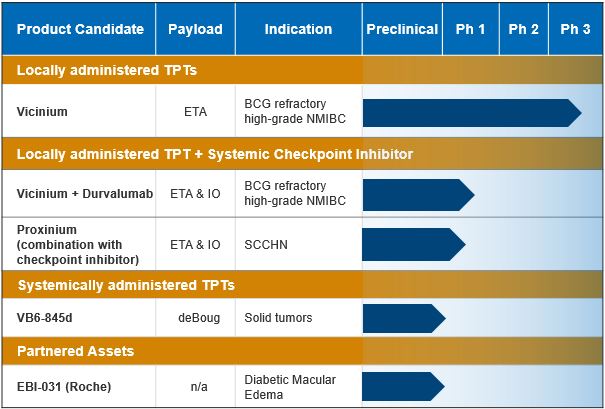
At this time we are focused exclusively on the clinical development of Vicinium and have deferred further development of our other product candidates. The following table sets forth our current development stage programs:
5
Table of Contents
Vicinium
Overview
Our most advanced locally-administered product candidate, Vicinium, is being developed for the treatment of high-grade NMIBC in subjects who have previously received two courses of BCG and whose disease is now BCG-unresponsive. Vicinium is administered by intravesical administration directly into the bladder. Vicinium utilizes an immunogenic cytotoxic protein payload that is a truncated form of ETA produced by the bacterial species,
Pseudomonas
. Vicinium also includes an anti-EpCAM ScFv targeting moiety that is required to deliver the ETA into EpCAM-expressing cancer cells. The toxicity to non-cancerous bladder cells is minimized due to their not having EpCAM over-expressed on their surface.
In a completed Phase 2 clinical trial, of the 45 evaluable subjects, 40% achieved a complete response, or CR, or no evidence of disease at three months while 16% remained disease-free for at least 18 months. Median time to disease recurrence was 274 days for subjects achieving a CR following a six-week induction phase, and this was extended to 408 days for subjects achieving a CR following a longer 12-week induction phase. No statistically significant difference was observed between the two dosing strategies (p=0.17). Vicinium was generally well-tolerated with no subjects discontinuing treatment in Phase 1 and Phase 2 clinical trials due to adverse events.
Based upon our September 2014 end of Phase 2 meeting with the FDA, we, through our subsidiary Viventia, commenced an open-label, non-randomized Phase 3 clinical trial of Vicinium in subjects with high-grade NMIBC who have received two courses of BCG, and whose disease is now BCG-unresponsive, and for whom the current standard of care is the surgical removal of their bladder, or a radical cystectomy, in the third quarter of 2015 in the United States and Canada. Based on safety and efficacy data observed with the longer 12-week induction in our Phase 2 clinical trial, the FDA agreed to our plan to employ more frequent dosing in our Phase 3 clinical trial, in which the primary end points are CR and duration of response, or DoR, in subjects with carcinoma in situ, or CIS, whose disease is BCG-unresponsive. In November 2016, the FDA issued draft guidance regarding appropriate clinical trial design for new drugs and biologics for BCG-unresponsive NMIBC, including the use of single-arm studies. The FDA finalized this guidance in February 2018 and retained many of the recommendations from the 2016 draft guidance regarding clinical trial design, including the use of single-arm studies. We completed enrollment in this clinical trial in March 2018 and anticipate reporting topline three-month data in mid-2018 and topline twelve-month data in the second quarter of 2019. If this Phase 3 clinical trial is successful, we intend to initially pursue regulatory approval in the United States and Canada.
As part of this trial, in July 2015, we submitted a Clinical Trial Application, or CTA, to Health Canada to include Canadian sites. In September 2015, we received a No Objection Letter from Health Canada, permitting us to proceed with our Phase 3 clinical trial in Canada. Assuming that we receive positive data in our Phase 3 clinical trial, we intend to initiate discussions with the EMA regarding a regulatory pathway for E.U. approval.
Overall, we believe that our efficacy and safety data support the continued clinical development of Vicinium to fulfill a significant unmet medical need in subjects with high-grade NMIBC. Because Vicinium contains ETA, an immunogenic cytotoxic payload that elicits an anti-ETA immune response, we believe the local administration of Vicinium may amplify the local host immune response within the tumor environment killing bladder cancer cells through an Immunogenic Cell Death, or ICD, mechanism. In addition, we believe that this ICD response, which potentiates host immune responses against neoantigens present on the cancer cells, can lead to a heightened host immune response against their own tumor and potentially complement checkpoint inhibitor therapies.
We own or exclusively license worldwide rights to our Vicinium intellectual property portfolio that provides unextended patent term until 2024, and, if our pending patent applications for Vicinium are granted patent protection until at least 2036. See ‘‘Business-Intellectual Property’’ for additional details.
Disease overview
Most cancers that form in the bladder are transitional cell carcinomas that derive from the transitional cell lining of the bladder. Transitional cell carcinoma of the bladder can be characterized as either high-grade or low-grade. Low-grade bladder cancer often recurs in the lining of the bladder after treatment, but rarely invades the muscular wall of the bladder or spreads to other parts of the body and is unlikely to be fatal. High-grade bladder cancer commonly recurs in the bladder, has a strong tendency to invade the muscular wall of the bladder, spreads to other parts of the body and is much more likely to result in death. Bladder cancer is also divided into muscle-invasive and NMIBC, based on invasion of the
muscularis propria
, which is the thick muscle deep in the bladder wall. Muscle invasive disease is more likely to spread to other parts of the body.
6
Table of Contents
There are three forms of high-grade NMIBC, which are Ta, a papillary tumor in the innermost layer of the bladder lining, T1, a papillary tumor that has started to grow into the connective tissue beneath the bladder lining, and CIS, flat lesions of the transitional cell lining of the bladder. Papillary tumors are generally low-grade with low risk of progression, although about two to nine percent are high-grade, with a moderately high risk of progression to muscle-invasive bladder cancer. CIS tumors are always high-grade, with a worse prognosis than papillary tumors. CIS tumors appear irregular and abnormal under a microscope and the tumors are more aggressive, with a high probability of progression to muscle-invasive disease. Furthermore, the incidence of CIS in conjunction with Ta or T1 tumors results in a higher risk of recurrence and progression. About 75% to 85% of bladder cancers are non-muscle invasive. Of these, Ta tumors account for about 57% to 70%, CIS accounts for about 5% to 13% and T1 tumors account for about 20% to 30%.
Bladder cancer is the ninth most common cancer diagnosed worldwide and the second most common malignancy of the genitourinary system. There were an estimated 430,000 new cases of bladder cancer diagnosed in 2012 and 165,000 deaths worldwide. The global prevalence of bladder cancer is estimated at 2.7 million individuals. The American Cancer Society estimated that approximately 79,000 new cases of bladder cancer would be diagnosed in 2017 and there would be approximately 16,870 deaths due to bladder cancer in the United States during 2017. Based on a 2010 estimate prepared using Medicare data from the Surveillance, Epidemiology, and End Results program, among cancers in the United States, bladder cancer has the highest per-patient treatment costs, with an estimated overall cost of $3.9 billion annually. In the United States, bladder cancer has the highest overall cost among the elderly. Based on our assessment of the market, the treatment paradigm has remained the same since those figures were generated and we believe the cost of care has increased.
NMIBC makes up 75% to 85% of all bladder cancers. The high recurrence rate and ongoing invasive monitoring requirement of bladder cancers are the key contributors to the economic and human toll of this disease. Bladder cancer occurs predominantly in older patients (about nine of the 10 people with bladder cancer are over the age of 55 years). The median age at diagnosis is approximately 73 years. Overall, the five year survival rate for bladder cancer in the United States is 77%. While the five year survival rates are 98% for stage zero and 88% for stage one NMIBC, once the cancer becomes invasive, the rates drop dramatically with five year survival rates of 63%, 46% and 15% for stage two, three and four muscle invasive bladder cancers, respectively. We are targeting subjects with BCG-unresponsive high-grade NMIBC. Our initial target market includes the approximately 25,000 patients diagnosed annually, as well as the patients who have previously failed BCG and have refused cystectomy. We would expect that, if Vicinium is approved by the FDA, patients would receive treatment until the earlier of 2 years and disease recurrence.
Current approaches to treatment
Within high-grade NMIBC, the initial treatment of Ta or T1 is transurethral resection of the bladder tumor, or TURBT, followed by BCG treatment. For CIS, whether or not TURBT is an option, BCG is the standard of care. BCG is a live attenuated strain of
Mycobacterium bovis
, with a diminished virulence in humans. Since BCG works by utilizing an immune/inflammatory mechanism, BCG is generally initiated only two to four weeks after TURBT, allowing the urothelium to heal and lowering the risk of systemic infection. When high-grade bladder tumors have been completely resected, BCG is used as adjuvant therapy to prevent recurrence. In patients with residual disease after resection, BCG helps to eradicate residual disease and delay progression. The BCG regimen consists of an induction phase followed by a maintenance phase. The induction phase involves six consecutive once-weekly instillations of the drug into the bladder. The maintenance phase involves three consecutive once-weekly instillations repeated every three to six months for at least one year. The response rate to a single induction phase of BCG is 60% to 70% with an additional 30% to 50% of the non-responders becoming responders following a second induction phase. However, BCG’s failure rate for all responders is estimated to be as high as 50% within the first 12 months of treatment and 90% within five years.
For patients who received BCG, and whose disease is now BCG-unresponsive, radical cystectomy is recommended due to the risk of progression to muscle invasive disease, which greatly reduces a patient’s prognosis. Radical cystectomy is a complex surgery associated with a significant morbidity rate of 28% to 45% and a mortality rate of 8% within six months of surgery. The surgery also entails a number of short-term risks including bleeding and/or clots, infections, bowel obstruction, bowel perforation, peritonitis and injury to the urethra. More than 25% of radical cystectomy patients require readmission for surgery-related complications within 90 days following surgery, and 34% require emergency room visits. The impact of radical cystectomy is life-altering, with major lifestyle changes, including incontinence and sexual dysfunction, and daily issues related to management of the external bag for urine collection.
In 2009, Valstar was re-launched in the United States for the treatment of BCG-refractory CIS bladder cancer in patients for whom radical cystectomy is not an option. Valstar is administered intravesically directly into the bladder once a week for six weeks. Due to drug resistance and toxicities, Valstar has had limited utility. Other than Valstar, there are no other approved therapies for CIS bladder cancer. However, there are various other product candidates in development for the
7
Table of Contents
treatment of NMIBC, including product candidates developed by AADi, LLC (ABI-009), Altor BioScience Corp. (ALT-801), Cold Genesys, Inc. (CG0070) and
FKD Therapies Oy (Instiladrin).
Clinical trials and pre-clinical studies
Pre-clinical studies.
Our
in vitro
studies of Vicinium in bladder cancer cell lines demonstrated activity following an exposure time equivalent to clinical dosing. The anti-tumor activity of Vicinium was also evaluated against human tumor xenografts (SCCHN, colorectal and small cell lung carcinoma cell lines) using an athymic mouse model. Mice bearing EpCAM-positive human tumor xenografts implanted subcutaneously were administered 0.25-0.5 mg/kg of Vicinium by intravenous injection, and tumor size monitored over the course of the pre-clinical study (33 to 51 days post-initiation of treatment) and compared to that of an untreated tumor-bearing group. Vicinium demonstrated significant tumor growth suppression. Vicinium is designed to be a local therapy and is administered by intravesical instillation directly to the bladder. Vicinium repeatedly administered subcutaneously in both rats and cynomolgus monkeys did not result in any product candidate-related systemic toxicity. Toxicities associated with subcutaneous administration were limited to localized irritation with skin lesions resolving by the end of the pre-clinical study. Vicinium was found to be immunogenic in all species tested with anti-drug antibodies observed after seven days of dosing.
Phase 1 clinical trial.
We initiated an open-label, dose-escalating Phase 1 clinical trial of Vicinium in September 2004 at 22 sites in Canada. We enrolled 64 subjects with high-grade Ta or T1 tumors with or without CIS (17 of which had CIS) and who had previously received at least one treatment of BCG. The Phase 1 clinical trial was designed to assess safety and determine the maximum tolerated dose, and the recommended Phase 2 dose. The secondary objective was to explore the anti-tumor activity of Vicinium.
Eight dose levels were initially evaluated, ranging from 0.1 to 10.56 mg dose given once weekly for six consecutive weeks. Each dose was administered by instillation and held for two hours prior to voiding. Safety data from each dose cohort was evaluated after three weeks of treatment before proceeding to the next dose cohort. A maximum tolerated dose was not reached; therefore, additional escalations through 13.73 mg, 17.85 mg, 23.20 mg and 30.16 mg were undertaken. No dose-limiting toxicities, or DLTs, were reported and no maximum tolerated dose was reached in these additional dose-escalations. Vicinium was generally well-tolerated at each of these escalated doses.
A CR was defined in this Phase 1 clinical trial as non-positive urinary cytology and either normal cystoscopy or abnormal cystoscopy with negative biopsy. Of the 64 subjects enrolled, only 61 were considered to be evaluable for efficacy as two subjects were excluded from the analysis due to an absence of BCG treatment prior to this Phase 1 clinical trial, and there was one unrelated death for whom no final tumor assessment was obtained. Evidence of clinical efficacy, as defined by a CR, was achieved by 24 of the 61 randomized subjects (39%). Only three of the 17 subjects (18%) treated in the 0.1-<1mg/dose range were CRs. In contrast, seven of the 14 subjects (50%) treated in 1.0-<10mg/dose range and 14 of the 30 subjects (46.7%) treated in the ≥10mg/dose range experienced CRs at the three month assessment. Of the subjects with CIS, five of the 17 subjects (29%) achieved a CR, while non-recurrence was observed in seven of the 16 subjects with T1 (43.8%) and 12 of the 28 subjects with Ta (42.8%). This Phase 1 clinical trial was completed in April 2006.
Phase 2 clinical trial.
Based on our Phase 1 clinical trial conducted in Canada, we submitted the IND for Vicinium to the FDA in August 2005, and we initiated an open-label Phase 2 clinical trial of Vicinium in March 2007 at 20 sites, in Canada and the United States. We enrolled 46 subjects with CIS (with or without Ta or T1) who had previously received at least one treatment of BCG. Of the 46 subjects enrolled, 27 subjects (58.7%) had received at least two treatments of BCG. The Phase 2 clinical trial was designed to determine the tolerability and explore the potential for clinical benefit from Vicinium. Clinical benefit was defined in this Phase 2 clinical trial as a CR or no evidence of disease at the three month evaluation. A CR was defined in this Phase 2 clinical trial as no histological evidence of disease and negative urine cytology. Any cases with no histological evidence of disease on initial biopsy but atypical or suspicious urine cytology were also considered CRs only if they remained negative after being evaluated with repeat biopsy, directed and random. Vicinium showed evidence of clinical efficacy. A subject was considered to have a durable CR if that subject obtained a CR and remained disease-free for a period of at least 12 months from initiation of treatment.
The dosing regimen for our Phase 2 clinical trial included an induction phase followed by a maintenance phase, consisting of three weekly treatments and then nine weeks of no treatment repeated every three months for at least one year and ending with nine weeks of no treatment. There were two treatment groups in this Phase 2 clinical trial. Treatment Arm A consisted of 23 subjects, of which 22 were ultimately evaluable as one subject violated eligibility requirements early in this Phase 2 clinical trial. Twenty-two subjects in the induction phase received six consecutive once-weekly instillations of 30 mg of Vicinium. At the three-month assessment, subjects with residual disease but no disease progression-where disease progression
8
Table of Contents
is defined as being muscle invasive-were eligible for either a second induction phase or a maintenance phase, which consisted of three consecutive once-weekly instillations repeated every three months for at least one year. Of the 13 subjects unable to achieve a CR at the three-month assessment, nine subjects elected additional treatment. From these nine, two became CRs after receiving maintenance dosing. Treatment Arm B was added to evaluate a longer induction cycle. In Treatment Arm B, 23 subjects in the induction phase received 12 consecutive once-weekly instillations of 30 mg Vicinium. At the three-month assessment, the CR rate for both treatment arms was 40%. At the 12-month assessment, the CR rate in Treatment Arm A was 13%, but 17% in Treatment Arm B. Of those subjects who did not achieve a CR at the three-month assessment, 73% had either a reduction in tumor size or did not experience further tumor growth.
The following charts demonstrate the responses in this Phase 2 clinical trial in Treatment Arm A and Treatment Arm B. The data below shows the percentage change in surface area of cancer within the bladder, based on bladder mapping data utilizing cystoscopy in 40 subjects.

9
Table of Contents

This Phase 2 clinical trial was completed in September 2009.
Near the completion of this Phase 2 clinical trial in 2009, Valstar was re-launched in the United States for the treatment of BCG-refractory CIS bladder cancer in subjects for whom immediate cystectomy would be associated with unacceptable morbidity or mortality. However, because physicians were not widely prescribing Valstar to their patients and it was not an approved therapy in Europe, this disrupted our originally designed clinical path of a head-to-head pivotal Phase 3 clinical trial of Vicinium against Valstar. Due to the uncertainty of the standard of care in this space, our efforts were put on hold until a clear clinical path was established. In May 2013, the FDA co-sponsored a public workshop where it evaluated potential trial designs for the development of therapies for NMIBC and specifically provided regulatory guidance supporting the idea that a single-arm clinical trial could provide sufficient evidence of benefit if the results were robust. The panel suggested it is acceptable to include high-grade papillary subjects without CIS in a clinical trial with CIS subjects because the clinical management and outcome if left untreated is considered to be the same. Thereafter, we began discussions with the FDA and refocused our resources to commence an open-label, non-randomized Phase 3 clinical trial of Vicinium in subjects with high-grade NMIBC.
Safety data.
We believe that our safety data from 110 subjects in our Phase 1 and Phase 2 clinical trials support further development of Vicinium. There were no Grade 4 or Grade 5 serious adverse events that were considered by the clinical investigators to be related to Vicinium. There was one Grade 5 serious adverse event, or death, which was determined by the clinical investigator to be unrelated to Vicinium. The most common treatment-related adverse events were an abnormally frequent passage of small amounts of urine, blood in the urine and painful urination, the majority of which were considered to be mild or moderate in severity. No subjects discontinued treatment due to a Vicinium-related adverse event during the Phase 1 and Phase 2 clinical trials.
Vicinium Phase 3 clinical trial development plan
Based upon our September 2014 end of Phase 2 meeting with the FDA, we, through our subsidiary Viventia, commenced an open-label, non-randomized Phase 3 clinical trial of Vicinium in subjects with high-grade NMIBC who have received two courses of BCG, and whose disease is now BCG-unresponsive, and for whom the current standard of care is the surgical removal of their bladder, or a radical cystectomy, in the third quarter of 2015 in the United States and Canada. Based
10
Table of Contents
on safety and efficacy data observed with the longer 12-week induction in our Phase 2 clinical trial, the FDA agreed to our plan to employ more frequent dosing in our Phase 3 clinical trial, in which the primary end points are CR and DoR in subjects with CIS whose disease is BCG-unresponsive. In November 2016, the FDA provided draft guidance regarding appropriate clinical trial design for new therapies for NMIBC, including the use of single-arm studies, and we believe that our Phase 3 clinical trial design is consistent with the FDA’s draft guidance. We completed enrollment in this clinical trial in March 2018 and anticipate reporting three-month topline data in mid-2018 and topline twelve-month data in the second quarter of 2019. If this Phase 3 clinical trial is successful, we intend to initially pursue regulatory approval in the United States and Canada.
As part of this trial, in July 2015, we submitted a Clinical Trial Application, or CTA, to Health Canada to include Canadian sites. In September 2015, we received a No Objection Letter from Health Canada, permitting us to proceed with our Phase 3 clinical trial in Canada. Assuming that we receive positive data in our Phase 3 clinical trial, we intend to initiate discussions with the EMA regarding a regulatory pathway for E.U. approval.
Our Phase 3 clinical trial protocol is as follows:
|
Dose
|
30 mg of Vicinium (in 50 mL of saline)
|
||
|
Estimated total enrollment
|
Approximately 134 subjects, including 77 CIS subjects whose disease is refractory to or relapsed within 6 months of the last dose of adequate BCG treatment
|
||
|
Primary endpoint
|
•
|
Complete response rate in subjects with CIS (with or without papillary disease) whose disease is refractory or relapsed in six months or less following adequate BCG treatment, which is defined as at least two courses of full dose BCG; and
|
|
|
•
|
DoR will be estimated (Kaplan-Meier Estimate) for those subjects with CIS whose disease is refractory to or relapsed within 6 months of the last dose of adequate BCG treatment (with or without papillary disease) who experience a complete response.
|
||
Subjects with CIS will be considered to have a complete response if at the time of any disease status evaluation (per protocol every 13 weeks or any unscheduled evaluation) there is no evidence of high-grade disease (CIS, high-grade Ta or high-grade T1 disease) or disease progression (e.g., to muscle invasive disease). Low-grade disease is not considered a treatment failure in these subjects and they may remain on study treatment following TURBT.
|
Secondary endpoints
|
•
|
Complete response rate and DoR in subjects with CIS whose disease is refractory to or relapsed within 6 months of the last dose of adequate BCG treatment (with or without papillary disease) whose disease is refractory or relapsed from six months to 11 months following adequate BCG treatment;
|
|
|
•
|
Complete response rate and DoR in all subjects with CIS (with or without papillary disease) following adequate BCG treatment;
|
||
|
•
|
Event-free survival, or EFS, in all subjects;
|
||
|
•
|
Complete response rate in subjects at three, six, nine, 12, 15, 18, 21, and 24 months in subjects with CIS whose disease is refractory to or relapsed within 6 months of the last dose of adequate BCG treatment;
|
||
|
•
|
Time to cystectomy in all subjects;
|
||
|
•
|
Time to disease recurrence in all subjects;
|
||
|
•
|
Progression-free survival, or PFS, in all subjects;
|
||
|
•
|
Overall survival, or OS, in all subjects; and
|
||
|
•
|
Safety and tolerability of Vicinium therapy in all subjects.
|
||
|
Exploratory endpoint
|
To evaluate biomarkers that may be associated with response or disease progression or treatment failure, which may include, for example, EpCAM status, tumor subtype morphology, furin levels in tumor cell endosomes, presence of a glycosaminoglycan coat, and presence of receptors that could impede a host anti-tumor immune response such as PD-L1.
|
||
Overall, we believe that our efficacy and safety data support the continued clinical development of Vicinium to fulfill a significant unmet medical need in subjects with high-grade NMIBC.
11
Table of Contents
Proxinium
Overview
Our second most advanced locally-administered product candidate, Proxinium, is being developed as a treatment for subjects with recurrent or metastatic EpCAM-expressing SCCHN who have received at least one prior platinum-based chemotherapy regimen with recurrent, locally advanced or metastatic EpCAM-expressing SCCHN. Proxinium utilizes an immunogenic cytotoxic protein payload that is a truncated form of ETA produced by the bacterial,
Pseudomonas
, and is designed to target EpCAM-positive cancer cells, while minimizing toxicity to non-cancerous cells. Proxinium is administered via injection directly into the targeted tumor, or intratumoral injection. Proxinium has received Orphan Drug Designation from the FDA and the EMA and Fast Track designation from the FDA.
In our two Phase 1 clinical trials, subjects treated with Proxinium had demonstrated antiitumor activity in 53% of evaluable subjects with EpCAM-expressing tumors as assessed by the investigators’ clinical measurements, the investigators' overall assessment including qualitative changes, and assessment of available radiologic data. In addition, three out of the four subjects with complete responses of injected tumors had regression or complete resolution of adjacent non injected lesions. In a Phase 2 clinical trial, we observed tumor shrinkage in 10 of the 14 evaluable subjects (71.4%). Combined results from two Phase 1 clinical trials encompassing 44 subjects have shown complete resolution or reduction in size of injected tumors in 16 of the 30 evaluable EpCAM-positive subjects (53.3%). An additional 27% of evaluable subjects had stable disease and, therefore, the results indicate an overall tumor control rate of approximately 80%. Proxinium was generally well-tolerated during the clinical trials. Dose-limiting toxicity in the Phase 1 clinical trials was transaminase elevation in liver enzymes.
In our clinical trials involving Proxinium, we have also observed some stabilization, partial reduction and complete resolution of non-injected tumors. We believe that TPT mediated killing of cancer cells occurs via a mechanism known as ICD, which is known to enhance the presentation of neoantigens to the immune system. We believe that this, combined with the immunogenic nature of our cytotoxic protein payload creates a heightened immune response, wherein naive cytotoxic T cells are stimulated by antigen presenting cells, such as dendritic cells, presenting tumor cell surface antigens following the death of cancer cells. We believe that this anti-tumor response may complement checkpoint inhibitor therapies.
We intend to initiate a Phase 1/2a clinical trial that will explore the potential of Proxinium in combination with a checkpoint inhibitor for the treatment of SCCHN and are actively seeking partners for a combination program. We anticipate that the Phase 1/2a clinical trial will explore the potential for Proxinium, due to its potential immunogenic effect, to enhance checkpoint inhibitors in combination therapy for the treatment of SCCHN. We will be measuring both the objective response rates and immune response biomarkers in a Phase 1/2a clinical trial. Should a trial yield encouraging results and we are able to secure additional funding, we will move into later stage trials.
During a Type C meeting with FDA in 2007, the FDA noted that approval of a companion diagnostic for EpCAM expression would need to coincide with Proxinium approval. During the clinical evaluation of Proxinium, we developed an immunohistochemical test to determine whether clinical trial subjects are EpCAM-positive. Internal examination from head and neck cancer subjects showed that our EpCAM antibody bound to 84% of all subject samples. We intend to seek the FDA’s input as to whether this immunohistochemical test satisfies the FDA’s request for a companion diagnostic for EpCAM expression and whether we will need to submit this test for pre-market approval as a companion diagnostic in conjunction with Proxinium.
Overall, we believe that our efficacy and safety data support the continued clinical development of Proxinium to fulfill a significant unmet medical need in subjects with recurrent, locally advanced or metastatic EpCAM-expressing SCCHN.
We believe the local administration of Proxinium mediates ICD of cancer cells leading to the release of tumor-specific neoantigens and attracting/activating cells of the host immune system. Further, Proxinium, like Vicinium, contains ETA, an immunogenic cytotoxic payload. The local activation of an anti-ETA response may further heighten the local immune response. We also believe that the effect of checkpoint inhibitors may be enhanced if they are used in combination with Proxinium due to its potential immunogenic effect.
We have deferred further development of Proxinium in order to focus our efforts and our resources on our ongoing development of Vicinium. We are also exploring collaborations for Proxinium.
We own or exclusively license worldwide rights to our Proxinium intellectual property portfolio that provide unextended patent term until 2024 and, if our pending composition of matter patent applications for Proxinium are granted, until at least 2036. See ‘‘Business-Intellectual Property’’ for additional details.
12
Table of Contents
Disease overview
Head and neck cancers, which include cancers of the oral cavity, pharynx and larynx, are collectively the sixth most common cancers in the world. Head and neck cancer develops from the mucosal linings of the upper aerodigestive tract, comprising of the nasal cavity and paranasal sinuses, the nasopharynx, the hypopharynx, larynx, and trachea, and the oral cavity and oropharynx. Squamous cell carcinoma is the most frequent malignant tumor of the head and neck region. Invasive head and neck cancers arise in most cases from preneoplastic lesions grouped under the term dysplasia. Dysplastic lesions present with an increased likelihood of progressing to squamous cell carcinoma. The altered epithelium displays architectural and cytological changes that range from mild to severe.
There are approximately 650,000 new cases annually and nearly 350,000 deaths due to head and neck cancer. In head and neck cancer, approximately 40% to 60% of deaths result from local or regional disease. The American Cancer Society estimates that there will be approximately 64,690 new cases of head and neck cancers in the United States in 2018, of which 51,540 cases would be attributed to cancers of the oral cavity and pharynx and 13,150 cases would be attributed to cancer of the larynx, and 13,740 deaths. Most of head and neck cancers are biologically similar with more than 90% being squamous cell carcinomas that commonly originate in the epithelium. They are strongly associated, more so than other cancers, with certain environmental and lifestyle risk factors, and worldwide incidence exceeds 650,000 cases annually.
New treatment modalities have been undermined by the approximately 10% to 25% of cured patients who subsequently develop second primary tumors due to field cancerization. These second primary tumors are one of the leading factors in the 40% to 50% five year survival rate. Based on our immunohistochemical test used during our clinical trials of Proxinium, we believe that approximately 84% of late-stage SCCHN are EpCAM-positive. We are initially developing Proxinium to potentially address late-stage SCCHN. We would expect that, if Proxinium is approved by the FDA, patients would receive treatment until disease progression.
Current approaches to treatment
Existing treatment options for SCCHN include immunotherapy (checkpoint inhibitors), surgery, drug therapies, radiation therapy or a combination of therapies. There is no standard treatment option for patients who progress after receiving these treatments. Approximately 60% of patients with head and neck cancer have locally recurrent disease and distant metastases occur in 20% to 30% of patients.
Currently, Erbitux, an anti-epidermal growth factor receptor antibody, is the only FDA approved tumor-targeted therapy for the treatment of late-stage SCCHN. Erbitux has been approved as a first-line therapy for late-stage SCCHN in combination with platinum-based therapy plus fluorouracil. Erbitux has also attained approval as a monotherapy or in combination with radiation therapy for second-line treatment of late-stage SCCHN in patients that have failed platinum-based therapy.
The five year survival rate for patients with locally recurrent disease is reported to be 40% to 50% and loco-regional recurrence is the predominant cause of failure and up to 70% of such patients have advanced disease. In addition, more than 50% of all patients who die from head and neck cancers have loco-regional disease as the only site of failure. If head and neck cancers are not controlled locally, they can infringe on the esophagus and airway, compromising nutrition and respiratory functions and often resulting in significant anatomic disfigurement. As such, the management of locally recurrent disease requires a multidisciplinary approach involving an array of specialists with an expertise in head and neck cancers.
Most recently checkpoint inhibitors have entered into use in the treatment of SCCHN. Two checkpoint inhibitors that target PD-1, pembrolizumab and nivolumab, have now received approval for the treatment of SCCHN. Nivolumab was granted FDA approval for the treatment of patients with SCCHN who have progressed on or after platinum-based chemotherapy. Nivolumab-treated subjects had a 30% reduction in the risk of death; a median OS of 7.5 months for nivolumab and 5.1 months for investigator's choice, or IC. There were no statistically significant differences between the two arms for progression-free survival or objective response rate, or ORR (13.3% versus 5.8% for nivolumab and IC, respectively). Pembrolizumab was granted accelerated approval by the FDA for the treatment of patients with SCCHN who have progressed on or after platinum-based chemotherapy. The major efficacy outcome measures were ORR according to Response Evaluation Criteria in Solid Tumors, or RECIST version 1.1, as assessed by blinded independent central review, and duration of response. The ORR was 16% (95% CI: 11, 22) with a complete response rate of 5%.
13
Table of Contents
Clinical trials and pre-clinical studies
Pre-clinical studies.
Pre-clinical data from
in vitro
and
in vivo
studies of Proxinium have demonstrated the potential to be safe in humans and to have clinical activity.
In vitro
pharmacology studies have demonstrated that Proxinium exhibits potent cytotoxicity against numerous EpCAM-positive cell lines, including SCCHN, bladder tumor and prostate tumor cell lines. Proxinium has also demonstrated anti-tumor activity in several human tumor xenograft animal models expressing EpCAM, including those derived from human squamous cell carcinomas and in a lung cancer subject derived xenograft, or PDX, model. In the PDX model, mice engrafted with human bone marrow cells were each implanted with two subcutaneous EpCAM-positive human PDX tumors. Tumor-bearing animals were treated with Proxinium alone in one tumor, an anti-PD-1 checkpoint inhibitor alone given systemically, or a combination of the two. Intratumoral injection of Proxinium into the tumor xenograft located on one side of the animal was able to block the growth of the tumor while also having a quantifiable anti-tumor effect on the uninjected tumor on the opposite flank. In contrast, the checkpoint inhibitor alone had little effect on tumor growth but appeared to amplify Proxinium’s activity on the uninjected tumor.

14
Table of Contents

Proxinium treatment alone was also observed to increase the numbers of CD8+ T cells, an important cytotoxic immune cell population, in the blood. We believe that this indicates that the checkpoint inhibitor alone was ineffective in initiating the anti-tumor effects of immune cells without the prior activation of cancer specific immune cells by a cytotoxic regimen, such as Proxinium.
Further, synergistic and additive effects were observed in these
in vitro
pharmacology studies with Proxinium in combination with various anti-cancer agents, as well as with radiation therapy. Toxicological studies in Sprague-Dawley rats showed no clear evidence of systemic toxicity whether given via intradermal or subcutaneous injection. The only dose-related reactions were at the injection site with most lesions resolving by the end of the observation period. Plasma concentrations of animals in a seven-day toxicology study conducted in Sprague-Dawley rats were 50 ng/mL at four hours after squamous cell injection and approximately 1,000 ng/mL at 10 minutes following intravenous injection on day one. These blood levels were approximately 5- and 100-fold higher, respectively, than the mean Cmax measured in subjects administered 700 mg weekly for four weeks (10,936 pg/mL) through the intratumoral route. In
in vivo
pharmacology studies in human tumor xenograft mouse models, we observed evidence of tumor growth suppression.
In summary,
in vitro
and
in vivo
pre-clinical data have shown that the anti-cancer agent Proxinium preferentially binds to tumor cells and has an acceptable safety profile. The local and systemic toxicological profile for Proxinium in Sprague-Dawley rats has been defined with toxicological effects at doses 1,000-fold greater than the IC50 for activity on tumor cells.
First Phase 1 clinical trial.
We initiated an open-label, dose-escalating Phase 1 clinical trial of Proxinium in December 2003 at three sites in Russia. We enrolled 24 subjects with late-stage SCCHN who had previously undergone prior radiation therapy, with a majority having completed at least one chemotherapy cycle. In addition, based on our immunohistochemical test
15
Table of Contents
used during this Phase 1 clinical trial of Proxinium, 17 of the 24 subjects (70.8%) enrolled in this Phase 1 clinical trial had tumors that tested positive for EpCAM. The Phase 1 clinical trial was designed to determine the maximum tolerated dose and the recommended Phase 2 dose. Secondary objectives included evaluation of safety, tolerability, PK profile and efficacy endpoints.
In addition, information on PK properties and immunogenicity, as well as a preliminary assessment of tumor response, was obtained.
Subjects received two cycles of Proxinium administered once per day for five consecutive days, with doses ranging from 20 µg to 280 µg, followed by 23 days off. Two DLTs occurred at the 280 µg dose level, establishing 200 µg as the maximum tolerated dose. The DLTs observed in the two subjects were elevated liver enzyme tests, which were not associated with any signs of liver damage or toxicity, were asymptomatic and were transient as they resolved to baseline values.
Objective anti-tumor responses were measured by caliper, CT scans and digital photography from baseline to final assessment. Anti-tumor responses and stable disease were observed in six of the 14 (42.9%) and four of the 14 (28.6%) evaluable subjects with EpCAM-positive tumors, respectively, for an overall response rate of 71.4% (10 of the 14 evaluable subjects). All six of the evaluable subjects with EpCAM-negative tumors had progression of their target tumors. In addition, the 10 subjects with EpCAM-positive tumors and who had responses or stable disease had a survival time of 278 days compared with a survival time of 124 days for the six subjects with EpCAM-negative tumors. The 14 evaluable EpCAM-positive subjects had a survival time of 207 days. This Phase 1 clinical trial was completed in October 2004.
Second Phase 1 clinical trial.
We initiated a second open-label, dose-escalating Phase 1 clinical trial of Proxinium in June 2004 at four sites in Brazil. We enrolled 20 subjects with late-stage SCCHN. All of the subjects enrolled in this Phase 1 clinical trial had undergone prior radiation therapy, with a majority having completed at least one chemotherapy cycle. Eighteen of the 20 subjects (90%) tested positive for EpCAM, of which two subjects were non-clinically evaluable. Preliminary efficacy data indicated 14 of the 16 evaluable EpCAM-positive subjects (87.5%) had either a ‘‘complete resolution,’’ ‘‘response,’’ or ‘‘stable’’ disease of injected tumors following Proxinium treatment, with 25% of subjects achieving a ‘‘complete response’’ of the injected tumor. The second Phase 1 clinical trial was designed to determine the maximum tolerated dose and the recommended Phase 2 dose. Secondary objectives included evaluation of safety, tolerability, PK profile and efficacy endpoints.
Subjects received Proxinium once weekly for four weeks with initial doses ranging from 100 µg to 930 µg, followed up by four weeks with once weekly doses ranging from 100 µg to 930 µg. The maximum tolerated dose was established at 700 µg, based on the occurrence of DLTs in two of the five subjects at the 930 µg dose level cohort. The DLTs observed in the two subjects were elevated liver enzyme tests. In both cases, the elevated liver enzyme tests were not associated with any signs of liver damage or toxicity, were asymptomatic, and resolved to baseline values.
Therapeutic exploratory endpoints were analyzed to evaluate the tumor response and anti-tumor activity of Proxinium. RECIST criteria were not used in this Phase 1 clinical trial and instead the clinical investigator used the following definitions for tumor responses: ‘‘complete response’’ was the complete clinical resolution of a tumor (injected or non injected), ‘‘response’’ was defined as clinically and radiologically documented reduction in the size of the target tumor indicative of anti-tumor activity from baseline to final, ‘‘stable’’ was defined as no change in the disease state captured through clinical or radiological assessments from baseline to final and ‘‘progression’’ was defined as an increase in the size of the target tumor from baseline to the final assessment.
The following table demonstrates the response rate of subjects with EpCAM-positive tumors in this Phase 1 clinical trial:
|
Number of
|
Complete
|
Stable
|
Response of
|
|
|
evaluable subjects
|
response
|
Response
|
response
|
progression
|
|
16.................................
|
4 of the 16
|
6 of the 16
|
4 of the 16
|
2 of the 16
|
|
(25.0%)
|
(37.5%)
|
(25.0%)
|
(12.5%)
|
|
An example of a ‘‘complete’’ response obtained in a Proxinium injected tumor in the second Phase 1 clinical trial can be seen in
FIGURE 1
,
FIGURE 2, FIGURE 3
and
FIGURE 4
below:
16
Table of Contents

A non injected tumor response was observed in four of the 20 subjects (20%) in the second Phase 1 clinical trial where subjects were administered Proxinium weekly and one of the 15 subjects (6.7%) in the Phase 2 clinical trial, which is discussed below, where subjects were administered Proxinium weekly. In such cases, tumor responses were seen in loco-regional tumors that themselves had not been injected with Proxinium, but were adjacent to, and in one case bi-lateral to the injected tumor. An example of a non-target tumor response is shown in
FIGURE 3
and
FIGURE 4
above. We believe that this non-target tumor response may be a consequence of surrounding cancer cells dying in response to Proxinium through diffusion (or the local spread of Proxinium) and cross priming of the immune system or the selective release of cancer antigens into the local immune tumor environment. This Phase 1 clinical trial was completed in March 2005.
Phase 2 clinical trial.
We submitted the IND for Proxinium to the FDA in August 2005. We initiated an open-label Phase 2 clinical trial of Proxinium in March 2006 at nine sites in Canada and twenty-one sites in the United States. We enrolled 15 subjects with refractory locally recurrent disease, which means that the subject must have progressed on or after receiving, or was unable to tolerate, at least one anti-cancer treatment regimen or had to have previously documented refusal of treatment for locally recurrent disease. The Phase 2 clinical trial was designed to determine the safety, tolerability and recommended dose of intratumorally injected Proxinium. Secondary objectives were to evaluate principal target tumor and target tumor response rates, determine the time to progression of the principal target tumor, overall survival time and progression-free survival, and also to confirm the PK profile and assess immunogenicity of intratumorally injected Proxinium.
The dosing regimen for our Phase 2 clinical trial included intratumoral injections once per week at 500µg or 700µg. Although the small sample size does not allow for statistical evaluation of treatment effects, it was expected that the Phase 2 clinical trial would provide some additional evidence of the therapeutic effect of Proxinium for control of local or regional late-stage SCCHN, as well as a survival benefit for those subjects. To be eligible for measurement of a radiographically confirmed response, a subject had to have a radiographic assessment at baseline/day one and at least two additional radiographic assessments, not less than four weeks apart, after day one. According to this definition, eight subjects were eligible for a principal tumor radiological response evaluation. In order to assess best tumor response, at least two CT scans, one at baseline and one post-baseline, were required. Best tumor response was defined in this Phase 2 clinical trial as the greatest degree of
17
Table of Contents
decrease in tumor size observed throughout the clinical trial. Bidimensional tumor measurements were used to determine tumor size. Bidimensional measurements of a tumor were based on its longest diameter and the greatest perpendicular measurement from this diameter from CT scans.
RECIST criteria were not used in this Phase 2 clinical trial and instead the clinical investigator used the following definitions for tumor responses. A ‘‘complete response’’ was defined in this Phase 2 clinical trial as the clinically and radiologically documented complete disappearance of the principal target tumor or other target tumors, based on bidimensional measurement as determined by two radiological observations not less than four weeks apart. A ‘‘partial response’’ was defined in this Phase 2 clinical trial as a 50% or more decrease of the bidimensional measurements in the principal target tumor that had been measured as compared to baseline. ‘‘Progressive disease’’ was defined in this Phase 2 clinical trial as either: at least a 25% increase of the bidimensional measurements for tumors greater than four cm
2
or at least a 50% increase of the bidimensional measurements for tumors less than four cm
2
in the principal target tumor as compared to the nadir, which was defined in this Phase 2 clinical trial as the smallest radiologically determined tumor size achieved during the clinical trial. ‘‘Stable disease’’ was defined in this Phase 2 clinical trial as disease that meets neither the ‘‘partial response’’ nor the ‘‘progressive disease’’ criteria during or following active treatment and based on the sum of its bidimensional measurements, includes a less than 25% increase in tumor size for tumors greater than four cm
2
, or a less than 50% increase in tumor size for tumors less than four cm
2
. Tumor measurements that were radiographically confirmed showed that four of the eight evaluable subjects (50%) demonstrated ‘‘stable disease’’ for their principal tumor.
When radiographic best responses were evaluated at any two treatment time points, including baseline, 13 of the 14 evaluable subjects (92.9%) showed ‘‘stable disease’’ or partial response, with 10 of the 14 evaluable subjects (71.4%) showing a decrease in tumor size ranging from 4% to 85%. Measurements of the principal target tumors taken at baseline and at final visit showed that three of the eight evaluable subjects (37.5%) had decreases in principal tumor size ranging from 4% to 35%. Of five subjects with multiple tumors who achieved primary tumor responses, four of those subjects also achieved responses in subsequently injected non-primary tumors. These results suggest that Proxinium may be effective in the treatment of EpCAM-positive late-stage SCCHN.
This Phase 2 clinical trial was completed in August 2007.
Phase 3 clinical trial.
We initiated a randomized Phase 3 clinical trial of Proxinium in January 2006 at 75 sites globally. Total enrollment was planned for 292 subjects with late-stage SCCHN and the protocol included two periods: a Phase 2 lead-in period comprised of 30 subjects and a Phase 3 period comprised of 262 subjects. Each subject’s locally recurrent disease had to be refractory, which means that the subject must have progressed on or after receiving, or was unable to tolerate, at least one anti-cancer treatment regimen or had to have previously documented refusal of treatment for locally recurrent disease.
This Phase 3 clinical trial was conducted to compare the overall survival time associated with intratumorally injected Proxinium and safety and efficacy data of Proxinium in combination with BSC versus BSC alone, in subjects with locally recurrent disease who had received at least one anti-cancer treatment regimen for such locally recurrent disease. Secondary objectives were to compare the loco-regional response rate and duration of loco-regional response, the local progression-free survival, symptomatic benefit and safety profile for subjects from the Proxinium in combination with BSC arm and the BSC alone arm.
During the treatment phase of this Phase 3 clinical trial, all subjects were assessed weekly and treated according to institutional standards of BSC, which included treatment measures such as the use of pain medication, hydration, antiemetics and nutritional support, but did not include the use of radiotherapy (except as needed for the palliation of distant metastases) or any agent that may have had an impact on tumor response. Subjects who were randomized to the BSC alone arm were either seen in the clinic or had weekly assessments conducted by phone; provided that at least one in-person visit was conducted every four weeks. Subjects who were randomized to Proxinium in combination with the BSC arm were also to receive BSC, as well as a once weekly intratumoral injection of Proxinium at 700 µg per dose. Subjects in both arms of this Phase 3 clinical trial continued in the treatment phase until either complete resolution of all target tumors or radiographic tumor progression occurred. All subjects were then to remain in the follow-up phase until one of the following occurred: (i) 12 months from the date that the last subject required for efficacy analyses had been randomized, died, withdrew or we terminated the trial or (ii) termination of the trial for safety reasons due to DLTs.
The intention of the Phase 2 period of the clinical trial was evaluation of available data once the first 30 subjects reached the four week treatment time point. Of the first 30 subjects enrolled, 15 were randomized to each study arm. The Phase 2 lead in period was specifically designed for the assessment of safety, with an independent review of the safety data by the data safety monitoring board, or DSMB. Following the review by the DSMB, they recommended the continuation of
18
Table of Contents
enrollment and monitoring as mandated by the protocol since the available data indicated that intratumoral administration of Proxinium was generally well-tolerated by the subjects. The Phase 3 period began immediately after the conclusion of the Phase 2 period, with no pause in enrollment.
There were 62 subjects for which post-treatment tumor measurements were available, 36 subjects in the Proxinium in combination with the BSC arm and 26 subjects in the BSC alone arm. Responses in
FIGURE 5
below represent the best percentage change in radiographically determined bidimensional measurement from baseline at any time point for the injected tumor. Of the Proxinium in combination with BSC arm, 19 of the 36 subjects (52.8%) showed tumor reduction with a median reduction in bidimensional tumor measurement of 48.3%. In contrast, only 10 of the 26 subjects (38.5%) of the BSC alone arm showed a median reduction in tumor size of 21.9%. With respect to the subjects for whom the best bidimensional percent change showed an increase in tumor size, the Proxinium in combination with BSC arm had 12 of the 36 subjects (33.3%) showing a median increase of 31.7%. The increase in tumor size was more pronounced in the BSC alone arm with 11 of the 26 subjects (42.3%) showing a median increase of 60.8%.
Targeted tumor responses in
FIGURE 5
below were categorized as ‘‘complete,’’ ‘‘partial,’’ ‘‘stable,’’ or ‘‘progressive’’ disease. A ‘‘complete’’ response was defined as radiographically confirmed complete disappearance of disease, ‘‘partial’’ response as a 50% or more decrease of the sum of the product of the bidimensional measurements as compared to baseline, and ‘‘progressive’’ disease as at least a 25% increase in the sum of the products of the bidimensional measurements compared to the radiographic nadir, when the sum at baseline was greater than four cm
2
or at least a 50% increase of the sum of the product(s) of the bidimensional measurements compared to the radiographic nadir, when the sum at baseline was less than or equal to four cm
2
. ‘‘Stable’’ disease was defined as the response when neither the complete response, partial response nor the progressive disease criteria were met.
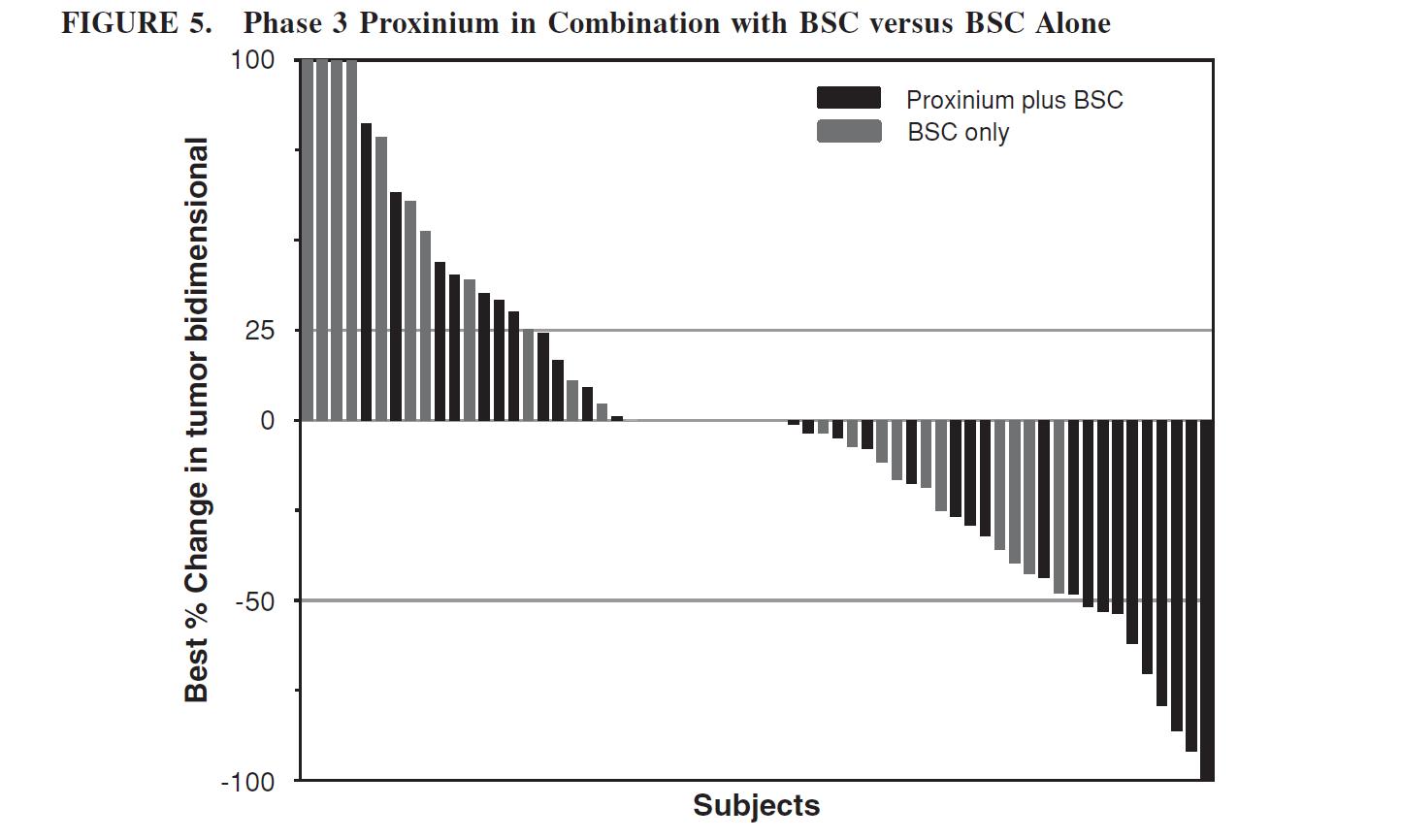
This Phase 3 clinical trial was terminated in April 2008 because of challenges relating to subject enrollment and retention for reasons specific to emerging markets, but not due to safety or efficacy concerns. Clinical trial subject enrollment and retention in emerging markets presents unique challenges compared to North America. With fewer established options for communicating with existing and new subjects, emerging market study centers have difficulty acquiring new subjects as well as maintaining consistent contact with existing subjects, making follow up very difficult. We do not believe these issues will pose the same challenges in a North American clinical trial. In the United States, study centers have established multiple options to enroll and remain in communication with subjects.
19
Table of Contents
At the time this Phase 3 clinical trial was terminated, 166 subjects had been randomized in the trial. Of these, 82 subjects were randomized to the Proxinium treatment in combination with the BSC arm and 84 subjects were randomized to the BSC alone arm (as discussed below).
Safety data.
We believe that our safety and anti-tumor activity data in our two Phase 1 clinical trials, our Phase 2 clinical trial, and our partially completed Phase 3 clinical trial support further development of Proxinium. There were no Grade 5 serious adverse events that were considered by the clinical investigator to be related to Proxinium. The serious adverse events that were reported in the clinical trials of Proxinium and were considered to be possibly, probably or definitely related to treatment consisted of abnormal tumor growth, anorexia, cancer pain, decrease in red blood cells, difficulty swallowing, elevated calcium levels, facial pain, fatigue, high blood sugar, influenza like illness, injection site pain, liver function abnormalities, low albumin level, low sodium concentration, nausea, rash, swelling, tumor hemorrhage and tumor necrosis.
Seven subjects died during the clinical trials of Proxinium, but none of the deaths were deemed to be related to Proxinium. Eleven subjects discontinued treatment due to liver function test abnormalities; however, the serum levels were transient and they eventually returned to baseline without any evidence of permanent liver damage. Four subjects withdrew from the clinical trials. Three of the four subjects withdrew at their request and one of the four subjects withdrew at the request of the investigator.
Proxinium Proposed Phase 1/2a Clinical Trial Plan
We intend to initiate a Phase 1/2a clinical trial that will explore the potential of Proxinium in combination with a checkpoint inhibitor and are actively seeking partners for a combination program. We anticipate that the Phase 1/2a clinical trial will explore the potential for Proxinium, due to its potential immunogenic effect, to enhance checkpoint inhibitors in combination therapy for the treatment of SCCHN.
Overall, we believe that our efficacy and safety data support the continued clinical development of Proxinium to fulfill a significant unmet medical need in subjects with late-stage SCCHN.
We have deferred further development of Proxinium in order to focus our efforts and our resources on our ongoing development of Vicinium. We are also exploring collaborations for Proxinium.
Potential future indications
Based on the safety and efficacy data in our two Phase 1 clinical trials, our Phase 2 clinical trial and our previous partially completed Phase 3 clinical trial of Proxinium, we also believe that there are several other potential applications for Proxinium that we may elect to pursue, including colon, thyroid and prostate cancers.
VB6-845d
Overview
Our lead systemically-administered product candidate, VB6-845d, is being developed as a treatment for multiple types of EpCAM-positive solid tumors. VB6-845d is a TPT consisting of an EpCAM targeting Fab genetically linked to deBouganin, which is administered by intravenous infusion. EpCAM is over-expressed on the cell surface of many solid tumors, including breast, colorectal, gastric, lung, ovarian and prostate. EpCAM overexpression has been shown to be involved in promoting malignant progression. In addition, EpCAM overexpression is associated with increased tumor grade, disease progression, increased proliferative phenotypes and diminished survival. EpCAM is also a cancer stem cell marker. A Phase 1 clinical trial conducted with VB6-845, the prior version of VB6-845d, revealed no clinically relevant immune response to the deBouganin payload, and five of seven subjects (71.4%) maintained stable disease (meaning no change in tumor size from baseline) after one completed cycle of treatment (four weeks) two subjects had decreases in target tumor size, and one subject who continued treatment through a third cycle (12 weeks) maintained stable disease. Interim safety data from our Phase 1 clinical trial was consistent with expectations for the study population of subjects with advanced solid tumors and the anticipated effects of targeted biological therapies containing immunogenic sequences.
Based upon the hypersensitivity reactions seen in our Phase 1 clinical trial conducted in Russia and in the country of Georgia, we de-immunized the Fab portion of VB6-845 to create VB6-845d. In April 2016, we submitted an IND to the FDA in preparation of initiating a Phase 1/2 clinical trial of VB6-845d in subjects with EpCAM-positive cancers in the United States. The IND was withdrawn in July 2016 after we received initial feedback from the FDA indicating that they had identified hold and non-hold deficiencies that needed to be addressed. In December 2016, we submitted a request for a pre-IND meeting
20
Table of Contents
to seek input on the manufacturing, nonclinical and clinical plans for VB6-845d prior to resubmitting an IND. In February 2017, the FDA provided guidance on our manufacturing and nonclinical plans for VB6-845d. Based on this guidance, we are performing additional studies and we plan on submitting an updated IND, once funding or a partner is secured for this program.
Overall, we believe that our pre-clinical data and the interim Phase 1 clinical data support further clinical investigation of VB6-845d to explore whether it may fulfill the significant unmet medical need in the treatment of subjects with EpCAM-positive solid tumors. Specifically, we believe that VB6-845d has potential to be a first-in-class TPT capable of providing clinical benefit in these difficult to treat patient populations.
We are currently developing VB6-845d, a recombinant fusion protein consisting of an anti-EpCAM fragment fused to a deBouganin payload for the systemic treatment of advanced solid tumors. DeBouganin acts by inhibiting protein synthesis and helps circumvent multi-drug resistance mechanisms. Solid tumors form an abnormal and discrete tumor mass in the body that usually does not contain cysts or liquid areas.
We believe that our TPTs utilizing our de-immunized deBouganin payload may be enhanced if combined with checkpoint inhibitors. We believe that deBouganin’s potential effect on cancer cells could promote an immunogenic response that may enhance the action of checkpoint inhibitors.
We have deferred further development of VB6-845d in order to focus our efforts and our resources on our ongoing development of Vicinium. We are also exploring collaborations for VB6-845d.
We own or exclusively license worldwide rights to our VB6-845d intellectual property portfolio that provides unextended patent term until at least 2025 and, if our pending composition of matter patent applications for VB6-845d are granted until at least 2036. See ‘‘Business-Intellectual Property’’ for additional details.
Clinical trials and pre-clinical studies
Pre-clinical studies.
VB6-845, the prior version of VB6-845d, demonstrated strong binding and potent activity with small doses of the product candidate against numerous EpCAM-positive solid tumor cell lines, including those derived from tumors of the breast, cervix, colon, endometrium, gastric, lung and ovary, in
in vitro
pharmacology studies.
In vitro
and
in vivo
pre-clinical data have also demonstrated that VB6-845 preferentially binds to tumor cells expressing EpCAM and is effective in inhibiting tumor growth and increasing survival in mouse models. These xenograft studies demonstrated that VB6-845 was able to selectively affect EpCAM-expressing tumors without observed systemic toxicity.
Phase 1 clinical trial.
We received regulatory approval from the Federal Service on Surveillance in Healthcare and Social Development of the Russian Federation (Roszdravnadzor) to conduct a Phase 1 clinical trial in Russia in March 2007 and from Ministry of Labour Health and Social Affairs of Georgia in April 2007. We initiated an open-label Phase 1 clinical trial of VB6-845 in May 2007 at five sites in Russia and one site in Georgia. We enrolled 15 subjects with EpCAM-positive solid tumors, including breast, colorectal, kidney, non-small cell lung, ovary, pancreas and stomach cancers. All subjects enrolled in this Phase 1 clinical trial had tumors that tested positive for EpCAM as confirmed by our immunohistochemical test used during this Phase 1 clinical trial of VB6-845. The Phase 1 clinical trial was designed to define the maximum tolerated dose and to evaluate immunogenicity, safety. Secondary objectives included information on PK properties and assessing exploratory efficacy of VB6-845.
Subjects were treated over three dose cohorts in this Phase 1 clinical trial. VB6-845 was administered as a monotherapy intravenous infusion (for a period of over three hours), once weekly in four-week cycles, to subjects with EpCAM-positive advanced solid tumors. Subjects were evaluated at the end of each cycle. Three subjects at the first cohort dose level received 1.00 mg/kg, 10 subjects at the second cohort dose level received 2.00 mg/kg and two subjects at the third cohort dose level received 3.34 mg/kg. Following treatment of the subjects in the second cohort, the clinical reporting company reviewed the safety data and unanimously decided to escalate to the third cohort at a dose of 3.34 mg/kg. Out of the first group of five subjects in the second cohort, one DLT (an infusion-related reaction) was reported and confirmed by the clinical trial monitoring company. As the study was stopped early, no maximum tolerated dose was reached. VB6-845 was generally well-tolerated up to the third dose cohort (3.34 mg/kg).
One of our primary objectives in this Phase 1 clinical trial was to validate the extensive pre-clinical data supporting de-immunization of the deBouganin cytotoxic protein payload in humans. For a payload to be viable systemically it must be de-immunized to prevent rapid clearance by the immune system. Subject blood samples for the assessment of an anti-VB6-845 response were collected pre-infusion for the first cycle and every four weeks thereafter. An analysis of the antibody titers at each time point revealed a minimal immune response directed against the deBouganin moiety for only two subjects after eight
21
Table of Contents
weeks. Moreover, the titer of the immune response was just above the threshold of the assay (ranging between a titer of 1500 to 1800). These findings are consistent with significant de-immunization of the parent Bouganin cytotoxic protein payload via T-cell epitope depletion.
For all cohorts, exploratory efficacy data (CT and radiographic) were available for seven subjects who completed one full cycle (four weeks) of treatment. Five of the seven subjects showed stable disease, which means tumor measurement is unchanged relative to baseline, on CT scans one week after the completion of a fourth dose of VB6-845. Of the three subjects who continued to receive treatment past the first cycle, one subject continued to have stable disease at the completion of their second (eight weeks) and third (12 weeks) cycles. There was radiographic evidence of decreases in tumor size in two subjects with renal cell carcinoma and breast carcinoma. For one subject, six measurable target tumors in the lungs as well as a measurable target tumor in a pulmonary lymph node and pelvic mesentery showed decreases by CT scan ranging from 11% to 29% on a final visit relative to the baseline. Other non-target, non-measurable tumors appeared unchanged; although there was an appearance of disease progression as a potentially new brain tumor, which was inaccessible to treatment. In one other subject, CT scan results revealed decreases in four of the five measurable target tumors in the liver, with decreases in individual tumors ranging from 4% to 15%. Non-target, non-measurable tumors in lungs, liver and bones showed stable disease.
This Phase 1 clinical trial was terminated in April 2008. Subjects in this Phase 1 clinical trial exhibited little to no immune responses to the deBouganin payload, thereby demonstrating de-immunization of deBouganin. Subjects did, however, generate antibodies against the Fab molecule in the product candidate, specifically against mouse amino acid sequences that were left in the Fab to increase the thermal stability in this early version of the molecule. Taken together, we believe this demonstrated that the subjects were fully immunocompetent, which means that they were capable of rejecting the deBouganin payload if their immune system recognized it as foreign. Furthermore, it is important to note that the deBouganin payload was presented to the subjects’ immune system as a fusion with the immunogenic Fab fragment. The ‘‘hapten-carrier effect’’ principal in immunology dictates that presenting a non-immunogenic ‘‘hapten’’ protein (deBouganin) to the immune system as a conjugate or fusion to an immunogenic ‘‘carrier’’ protein (Fab with mouse amino acid sequences) is an effective way to amplify the immunogenicity of the non-immunogenic protein. Our observation of a lack of immunogenicity of deBouganin in this setting is further evidence of its de-immunization. We have since engineered these mouse amino acid sequences out of VB6-845, which we refer to as VB6-845d, and based upon a binding specificity pre-clinical study, VB6-845d retained biologic activity.
22
Table of Contents

The chart below demonstrates why we believe that we have successfully de-immunized VB6-845 to create VB6-845d as shown by in a Phase 1 clinical trial that revealed no clinically relevant immune response to the deBouganin payload.
23
Table of Contents
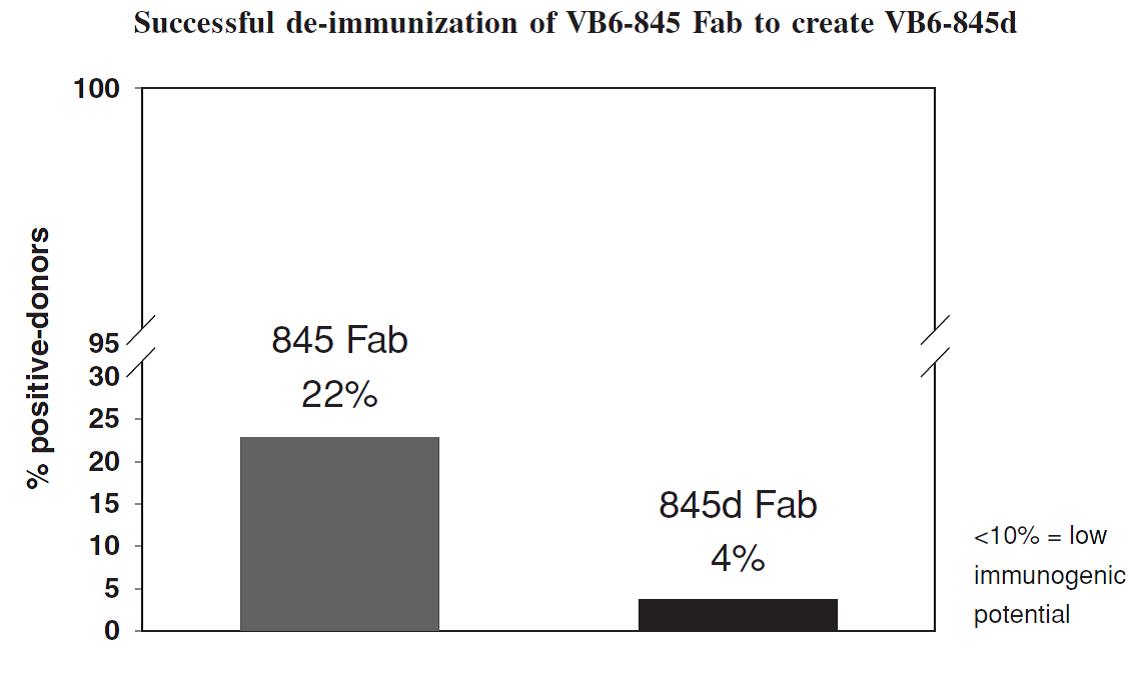
Safety data.
We believe that the interim safety data from the 15 subjects in our Phase 1 clinical trial support further development of VB6-845d. There were no Grade 5 serious adverse events that were considered by the clinical investigator to be related to VB6-845. The Grade 3 and Grade 4 serious adverse events that were reported in the Phase 1 clinical trial of VB6-845 and considered to be possibly, probably or definitely related to treatment, consisting of an infusion related reaction and an infusion site reaction that are consistent with the immunogenic nature of the Fab fragment. The subject’s condition improved and the event was considered to be resolved one day after onset without any further clinical concerns. The subject with the infusion related reaction was discontinued from the Phase 1 clinical trial in accordance with the protocol treatment stopping criteria defined for Grade 4 serious adverse events. The adverse event data reported for the subjects at the time the Phase 1 clinical trial was terminated was based upon interim data.
VB6-845d Phase1/2 clinical trial development plan
In April 2016, we submitted an IND to the FDA in preparation of initiating a Phase 1/2 clinical trial of VB6-845d in subjects with EpCAM-positive cancers in the United States. The IND was withdrawn in July 2016 after we received initial feedback from the FDA indicating that they had identified hold and non-hold deficiencies that needed to be addressed. In December 2016, we submitted a request for a pre-IND meeting to seek input on the manufacturing, nonclinical and clinical plans for VB6-845d prior to resubmitting an IND. In February 2017, the FDA provided guidance on our manufacturing and nonclinical plans for VB6-845d. Based on this guidance, we are performing additional studies and plan on submitting an updated IND.
Overall, we believe that our pre-clinical data and the interim Phase 1 clinical data support further clinical investigation of VB6-845d to explore whether it may fulfill the significant unmet medical need in the treatment of subjects with EpCAM-positive solid tumors. We also believe that the deBouganin payload in VB6-845d may enhance the action of checkpoint inhibitors as a result of the promotion of a local tumor immune response following the death of cancer cells.
EBI-031
License Agreement with Roche
On June 10, 2016, we entered into the License Agreement with Roche. The License Agreement became effective on August 16, 2016, following stockholder approval. Under the License Agreement, we granted Roche an exclusive, worldwide license, including the right to sublicense, to our patent rights and know-how related to our monoclonal antibody EBI-031 or any
24
Table of Contents
other IL-6 antagonist anti-IL-6 monoclonal antibody, to make, have made, use, have used, register, have registered, sell, have sold, offer for sale, import and export any product containing such an antibody or any companion diagnostic used to predict or monitor response to treatment with such a product, or collectively, Licensed Intellectual Property.
Pursuant to the terms of the License Agreement, Roche is required to continue developing EBI-031 and any other product made from the Licensed Intellectual Property that contains an IL-6 antagonist anti-IL-6 monoclonal antibody, or Licensed Product, at its cost.
Financial Terms
Roche paid an up-front license fee of $7.5 million upon effectiveness of the license under the License Agreement, and agreed to pay up to an additional $262.5 million upon the achievement of specified regulatory, development and commercial milestones with respect to up to two unrelated indications. Specifically, an aggregate amount of up to $197.5 million is payable to us for the achievement of specified milestones with respect to the first indication: consisting of $72.5 million in development milestones, $50.0 million in regulatory milestones and $75.0 million in commercialization milestones.
Roche paid the first development milestone of $22.5 million as a result of the IND application for EBI-031 becoming effective. Additional amounts of up to $65.0 million are payable upon the achievement of specified development and regulatory milestones in a second indication.
In addition, we are entitled to receive royalty payments in accordance with a tiered royalty rate scale, with rates ranging from 7.5% to 15% for net sales of potential future products containing EBI-031 and up to 50% of these rates for net sales of potential future products containing other IL-6 compounds, with each of the royalties subject to reduction under certain circumstances and to the buy-out options of Roche further described below.
Buy-Out Options
The License Agreement provides for two “option periods” during which Roche may elect to make a one-time payment to us and, in turn, terminate its diligence, milestone and royalty payment obligations under the License Agreement. Specifically, (i) Roche may exercise a buy-out option following the first dosing, or Initiation, in the first Phase 2 study for a Licensed Product until the day before Initiation of the first Phase 3 study for a Licensed Product, in which case Roche is required to pay us $135.0 million within 30 days after Roche’s exercise of such buy-out option and receipt of an invoice from us, or (ii) Roche may exercise a buy-out option following the day after Initiation of the first Phase 3 study for a Licensed Product until the day before the acceptance for review by the FDA or other regulatory authority of a biologics license application, or BLA, or similar application for marketing approval for a Licensed Product in either the United States or in the E.U. in which case Roche is required to pay us, within 30 days after Roche’s exercise of such buy-out option and receipt of an invoice from us, $265.0 million, which amount would be reduced to $220.0 million if none of our patent rights containing a composition of matter claim covering any compound or Licensed Product has issued in the E.U.
Termination
Either we or Roche may each terminate the License Agreement if the other party breaches any of its material obligations under the License Agreement and does not cure such breach within a specified cure period. Roche may terminate the License Agreement following effectiveness by providing advance written notice to us or by providing written notice if we are debarred, disqualified, suspended, excluded, or otherwise declared ineligible from certain federal or state agencies or programs. We may terminate the License Agreement if, prior to the first filing of a BLA for a Licensed Product, there is a period of 12 months where Roche is not conducting sufficient development activities with respect to the products made from the Licensed Intellectual Property.
Intellectual property
We currently own or exclusively license approximately 17 families of patents and applications, which generally relate to our TPT-based product candidates and evolving our platform of targeting agents, cytotoxins (such as deBouganin) and linker technologies. As our product candidates evolve through clinical development, we continue to monitor advancements and bolster patent coverage with the goal of attaining durable patent protection for at least 15 years from product launch. In addition, we may prepare and file a number of additional applications around our platform technology, including our various targeting agents, cytotoxins, and linkers that, if issued, would expire in 2038 and beyond.
Product Candidates-Vicinium and Proxinium
25
Table of Contents
We exclusively license two families (70 patents and 3 applications) from the University of Zurich, or Zurich, which, among other things, include composition of matter claims directed to EpCAM antibody chimeras, EpCAM antibody chimera-cytotoxin conjugates, and their potential use in treating bladder and head and neck cancer. These families claim all or portions of Vicinium and Proxinium, as well as certain of their respective indications under clinical development. The first family includes composition of matter claims directed to the EpCAM antibody chimeras that are used in Vicinium and Proxinium. The first family consists of 21 patents in the United States, Canada, Europe and Japan, which expire in April 2020, subject to any applicable patent term adjustment or extension that may be available on a jurisdictional basis. The second family includes claims directed to the use of Vicinium and Proxinium in the treatment of bladder and head and neck cancer, respectively, and consists of 49 issued patents in the United States, Europe, Canada, China, Israel and Japan and pending applications in the United States, Canada, and Hong Kong. The expiry date of the patents in this family is April 2024, subject to any applicable patent term adjustment or extension that may be available on a jurisdictional basis.
In addition to the Zurich portfolio, we own one issued U.S. patent with composition of matter claims directed to modified nucleic acid sequences that encode Vicinium and Proxinium and are potentially useful for high expression yield of Vicinium and Proxinium. The expiry date of this patent is in February 2029, subject to any applicable patent term extension that may be available on a jurisdictional basis. In addition, we have filed and may prepare and file a number of additional patent applications with claims around composition of matter, manufacturing and purification methods, medical applications, and various uses of our various product candidates that, if issued, would expire in 2036 and beyond.
Bouganin and deBouganin family
We exclusively license a family of patents and applications licensed from Merck KGaA, or Merck, which include claims directed to, among other things, modified de-immunized bouganin protein, EpCAM antibody-bouganin conjugates, and use claims directed to, among other things, methods of using the same to treat various diseases, including cancer. Claims in this family may cover, among other things, both the immunoconjugate, VB6-845d, and the de-immunized bouganin cytotoxins used in our product candidates. Currently the family consists of three issued patents in the United States, as well as 30 issued patents in Australia, Canada, China, Europe, Hong Kong, India, Israel, Japan, South Korea, Mexico, New Zealand, Russia and South Africa and one pending application in Brazil. The expiry date of this family is in March 2025, subject to any applicable patent term adjustment or extension that may be available on a jurisdictional basis. We also exclusively license from Merck three additional families of patents and applications with, among other things, use claims directed to various de-immunization methodologies, which expire in May 2018, December 2018 and February 2022, subject to any applicable patent term adjustment or extension that may be available on a jurisdictional basis. In addition, we have filed and may prepare and file a number of additional patent applications with, among other things, composition of matter and use claims around our various product candidates that, if issued, would expire in 2036 and beyond.
We also exclusively license a family of patents directed to the unmodified bouganin cytotoxin from Protoden Technologies Inc., or Protoden, a company owned by Clairmark Investments Ltd., or Clairmark. See ‘‘See ‘‘Board Policies-Related Party Transactions’’ for additional details. The two United States patents expire in June 2018, subject to any applicable patent term adjustment or extension that may be available on a jurisdictional basis. We do not currently view these patents and applications as significant to the development and commercialization, if approved, of our product candidates.
EBI-031 and our Legacy Product Candidates
As of March
30
, 2018, we owned the following families of patents and patent applications related to EBI-031 and our legacy product candidates, including EBI-005, or isunakinra. As of March
30
, 2018, our patent portfolio includes the following patents and applications related to our legacy product candidates:
|
•
|
a United States, a New Zealand, Japan, Taiwan, China and a South Africa composition of matter patent covering isunakinra which expires in 2031;
|
|
•
|
composition-of-matter patent applications covering isunakinra in Australia, Brazil, Canada, China, Europe, Hong Kong, India, Israel, Korea, Mexico and Russia, which, if granted, are expected to expire in 2031;
|
|
•
|
patent applications covering the formulation of isunakinra filed in the United States, Australia, Canada, China, Europe, Hong Kong, Japan, New Zealand, Russia, and Singapore, which, if granted, are expected to expire in 2034;
|
|
•
|
a patent application covering the formulation of isunakinra in a blow fill seal container filed in Taiwan, which if granted, is expected to expire in 2035;
|
Additional families of patent applications owned by Eleven include:
26
Table of Contents
|
•
|
a provisional application directed to compositions and methods for increasing the retention of therapeutic agents in the eye which, if converted and granted, is expected to expire in 2038.
|
|
•
|
a provisional application directed to compositions and methods for increasing the retention of anti-VEGF therapeutic agents in the eye which, if converted and granted, is expected to expire in 2038; and
|
|
•
|
a provisional application directed to compositions and methods for increasing the retention of RGD therapeutic agents in the eye which, if converted and granted, is expected to expire in 2038
|
To the best of our knowledge based on correspondence received prior to April 21, 2017, the following families are owned by Eleven, and licensed to Roche pursuant to the License Agreement dated June 10, 2016:
|
•
|
patent applications covering the IL-6 antagonistic anti-IL6 monoclonal antibodies and active fragments thereof, including IL-6 antibody EBI-029, filed in the United States, Australia, Brazil, Canada, China, Europe, Hong Kong, India, Israel, Japan, Korea, Mexico, New Zealand, Russia, Singapore, and South Africa, and, if granted, are expected to expire in 2033;
|
|
•
|
patent applications covering IL-6 antagonistic anti-IL6 monoclonal antibodies and active fragments thereof, including the IL-6 antibody EBI-031, having a pending PCT application and applications pending or to be filed in Algeria, Australia, Bahrain, Brazil, Canada, Chile, Colombia, Costa Rica, Egypt, Europe (to be filed), India, Israel, Korea, Malaysia, Mexico, Morocco, New Zealand, Oman, Philippines, Qatar, Russian Federation, Saudi Arabia, Singapore, South Africa, Thailand, Ukraine, United Arab Emirates, and Vietnam, and, if granted are expected to expire in 2035; and
|
|
•
|
a PCT Application and an Argentine application each corresponding to a United States provisional application covering the IL-6 antibody EBI-031 formulation, which if granted, are expected to expire in 2036.
|
License Agreements
License agreement with The University of Zurich
Overview and exclusivity.
We have a license agreement with Zurich, which grants us exclusive rights, with the right to sublicense, to make, have made, use, and sell under certain patents primarily directed to our targeting agent, including EpCAM chimera, and related immunoconjugates and methods of use and manufacture of the same. These patents cover some key aspects of our product candidates Vicinium and Proxinium. Under the terms of the agreement, we may be obligated to pay $750,000 in milestone payments, for the first product candidate that achieves applicable clinical development milestones. Based on current clinical status, we anticipate that these milestones may be triggered by Vicinium’s clinical development pathway. As part of the consideration, we will also be obligated to pay a 4% royalty on the net product sales for products covered by or manufactured using a method covered by a valid claim in the Zurich patent rights. We have the right to reduce the obligation to pay royalties in a particular country expires upon the expiration or termination of the last of the Zurich patent rights that covers the manufacture, use or sale of a product. There is no obligation to pay royalties in a country if there is no valid claim that covers the product or a method of manufacturing the product. As of the date of this Annual Report on Form 10-K, aggregate license fees of $250,000 have been paid to Zurich by Viventia prior to our acquisition of Viventia. There were no payment made for the year ended December 31, 2017.
Patent rights.
We are responsible for the patent filing, prosecution and maintenance activities pertaining to the patent rights, at our sole expense, while Zurich is afforded reasonable opportunities to review and comment on such activities. If appropriate, we shall apply for an extension of the term of any licensed patent where available, for example, in at least the United States, Europe and Japan. In the event of any substantial infringement of the patent rights, we may request Zurich to take action to enforce the licensed patents against third parties. If the infringing activity is not abated within 90 days and Zurich has elected not to take legal action, we may take legal action (in Zurich’s name, if necessary). Such action will be at our own expense and Zurich will have the opportunity to join at its own expense. Recoveries from any action shall generally belong to the party bringing the suit, but (a) in the event that we bring the action and an acceptable settlement or monetary damages are awarded, then Zurich will be reimbursed for any amount that would have been due to Zurich if the products sold by the infringer actually had been sold by us, or (b) in the event a joint legal action is brought, then the parties shall share the expense and recoveries shall be shared in proportion to the share of expense paid by the respective party. Each party is required to cooperate with the other in litigation proceedings at the expense of the party bringing the action.
Term and termination.
The term of the agreement expires as of the expiration date of the last patent to expire within the Zurich patent rights. We are currently projecting an expiration date for the U.S. licensed patents in 2024, subject to any applicable patent term adjustment or extension that may be available on a jurisdictional basis. Zurich has the right to terminate
27
Table of Contents
the agreement if we breach any obligation of the agreement and fail to cure such breach within the applicable cure periods. We have the right to terminate the agreement at any time and for any reason by giving 90 days written notice to Zurich.
License Agreement with Merck KGaA
Overview and exclusivity.
In March 2004, we entered into an exclusive license agreement with Biovation Limited, subsequently acquired by Merck, which was subsequently amended and restated in October 2015. Pursuant to the agreement, we were granted an exclusive license, with the right to sublicense, under certain patents and technology relating to the de-immunization of our cytotoxin Bouganin for therapeutic and
in vivo
diagnostic purposes in humans. The de-immunized cytotoxin is known as deBouganin, and has been incorporated into our product candidate, VB6-845d. We have the worldwide exclusive right, with the right to sublicense, under the licensed patents and technology to, among other things, make, have made, use or sell products incorporating deBouganin.
As of the date of this Annual Report on Form 10-K, aggregate license fees of $225,000 have been paid to Merck by Viventia prior to our acquisition of Viventia. There were no payments made for the year ended December 31, 2017. Under the agreement, we may be obligated to pay certain clinical development and regulatory milestones for each ‘‘licensed product’’: (A) $2,000,000 upon the start of the first Phase 3 clinical trial for a licensed product; (B) $2,000,000 upon submission of the first BLA for a licensed product; (C) $2,000,000 upon the approval of the first BLA in certain countries for a licensed product and $1,000,000 upon each of the second and third approvals of a BLA in certain additional countries for the same licensed product (total of $4,000,000); and (D) $2,000,000 upon the approval of the second BLA in certain countries for a licensed product; and $1,000,000 upon each of the second and third approvals of the second BLA in certain additional countries for the same licensed product (total of $4,000,000). As part of the consideration, we are obligated to pay a 1.5% royalty on the net product sales up to $150,000,000 and a 2% royalty on the net product sales above such amount.
Patent rights.
We have the first right to file, prosecute and maintain licensed patents relating to de-immunized plasmids and proteins, including, among other things, our deBouganin and Merck has the first right to file, prosecute and maintain any other licensed patents. We have the first right, but not the obligation, to enforce the licensed patents against third parties for suspected infringement, and, after repayment of costs and expenses, any recoveries under such suit will be treated as net product sales and we shall pay a royalty on the same. We may not settle such patent infringement suit without the prior written consent of Merck, but such consent shall not be unreasonably delayed or withheld. If we decline to enforce the licensed patents against third parties for suspected infringement, Merck may bring such a patent infringement suit and any recoveries will be retained by Merck.
Term and termination.
The agreement expires on a country-by-country and product-by-product basis until the longer of (i) the expiration of the last to expire patent within the licensed patent rights that covers a licensed product and (ii) 10 years from the first commercial sale of a licensed product in such country; provided that no royalty is payable for more than 15 years from the first commercial launch of a licensed product anywhere in the world. Either party has the right to terminate the agreement for breach of the agreement and if the other party fails to cure such breach within the applicable cure period. We have the right to terminate the agreement by giving Merck six months prior written notice.
Manufacturing
We maintain an approximately 31,400 square foot manufacturing, laboratory, warehouse and office facility in Winnipeg, Manitoba, Canada. We have three 15 liter fermentors, one 150 liter fermentor, one 500 liter fermentor and one 1,500 liter fermentor. Our classified fermentation suite and post-production processing capabilities were dedicated to producing our pre-clinical study and clinical trial batches. In September 2017, we completed the manufacturing of all Vicinium necessary for our ongoing Phase 3 registration trial in patients with NMIBC, and for our CRADA with the NCI. In conjunction with this achievement, we are ending our large-scale manufacturing activities and redirecting resources toward completing our Phase 3 trial. In the event we obtain approval from the FDA to market any of our product candidates, we will need to outsource our commercial scale manufacturing to contract manufacturing organizations, or CMOs. We are currently in the process of identifying a CMO and evaluating the manufacturing technology transfer process to that CMO.
Commercial Operations
We do not currently have an organization structured for the sales, marketing and distribution of products. We may rely on licensing and co-promotion agreements with strategic collaborators for the commercialization of our products in the United States and other territories. If we choose to build a commercial infrastructure to support marketing in the United States, such commercial infrastructure could be expected to include a sales force supported by sales management, internal sales support, an internal marketing group and distribution support. To develop the appropriate commercial infrastructure internally, we would
28
Table of Contents
have to invest financial and management resources, some of which would have to be deployed prior to the approval of any of our product candidates.
Competition
The pharmaceutical industry is highly competitive, subject to rapid and significant technological change and has a strong emphasis on developing proprietary products. While we believe that our next generation TPT platform, knowledge, experience and scientific resources provide us with competitive advantages, we face competition from both large and small pharmaceutical and biotechnology companies, academic institutions and other research organizations; specifically with companies, institutions and organizations that are actively researching and developing products that attach proprietary cell-killing payloads to antibodies for targeted delivery to cancer cells. Our competitors include, but are not limited to:
|
•
|
NMIBC: Aadi, LLC (ABI-009), Altor Bioscience Corporation (ALT-801), Cold Genesys, Inc. (CG0070), Endo Pharmaceuticals Inc. (Valstar) (approved drug), FKD Therapies Oy (Instilidrin), Merck and other pharmaceutical companies (BCG) (approved drug), Eli Lilly and Company (Gemcitabine) and Telormedix SA (Vesimune);
|
|
•
|
SCCHN: Bristol-Myers Squibb Company (nivolumab)(approved drug), Eli Lilly and Company, and Merck (Erbitux, pembrolizumab) (approved drugs);
|
|
•
|
Multiple types of solid tumors: Amgen Inc. (Panitumumab) (approved drug), Bayer AG and Onyx Pharmaceuticals (Sorafenib) (approved drug), Bristol-Myers Squibb Company, Eli Lilly and Company, and Merck (Erbitux) (approved drug), F. Hoffmann-La Roche AG (Bevacizumab) (approved drug), Genentech, Inc. (Bevacizumab, Erlotinib and Trastuzumab) (approved drugs), Pfizer, Inc. (Sunitinib) and Trion Research GmbH (Removab); and
|
|
•
|
In addition to competition from alternative treatments, we may also face competition from products that are biosimilar to, and possibly interchangeable with, our product candidates. Biosimilar products are expected to become available over the coming years. Even if our product candidates achieve marketing approval, they may be priced at a significant premium over competitive biosimilar products if any have been approved by then and insurers or other third party payors may encourage or even require the use of lower priced biosimilar products. Even if our treatments receive market authorization, they may not be listed on the formularies of payors (public or private insurers) or reimbursed. This may impact the uptake of the drug as a treatment option for patients and/or the price at which the drug can be sold at. Further, if the drug is reimbursed it may be at a narrower indication than the full scope of market authorization.
|
Many of our competitors have significantly greater financial resources and expertise in research and development, manufacturing, pre-clinical studies, conducting clinical trials, obtaining regulatory approval and marketing than we do. These competitors are also active in seeking patent protection and licensing arrangements in anticipation of collecting royalties for use of technology that they have developed. Moreover, specialized biologics, biopharmaceutical and biotechnology companies may prove to be significant competitors, particularly through collaborative arrangements with large and established companies.
Our commercial opportunity could be substantially limited in the event that our competitors develop and commercialize products that are more effective, safer, less toxic, more convenient or cheaper than our comparable products. In geographies that are critical to our commercial success, competitors may also obtain regulatory approvals before us, resulting in our competitors building a strong market position in advance of our product’s entry. We believe the factors determining the success of our programs will be the drug design, effectiveness against multi-drug resistance mechanisms, efficacy, safety, price and convenience of our product candidates.
Government Regulation
As a clinical-stage biologics company, we are subject to extensive regulation by the FDA, Health Canada and other national, supranational, state, provincial and local regulatory agencies. We are also subject to extensive regulation by similar governmental authorities in other countries in which we operate. In the United States, the Federal Food, Drug, and Cosmetic Act, or the FDCA, and the Public Health Service Act, or PHSA, and their implementing regulations set forth, among other things, requirements for the research, testing, development, manufacture, quality control, safety, effectiveness, approval, post-approval monitoring and reporting, labeling, storage, record keeping, distribution, import, export, advertising and promotion of our product candidates. Although the discussion below focuses on regulation in the United States, we anticipate seeking approval to market our products in other countries. Generally, our activities in other countries will be subject to regulation that is similar in nature and scope to that imposed in the United States, although there can be important differences. Additionally, some significant aspects of regulation in the E.U. are addressed in a centralized way through the European Commission following the opinion of the EMA, but country-specific regulation in the individual European Union Member States, or the E.U. Member States, remains essential in many respects. The process of obtaining regulatory marketing approvals and the
29
Table of Contents
subsequent compliance with appropriate supranational, federal, state, provincial, local and foreign statutes and regulations require the expenditure of substantial time and financial resources, and we may not be successful in any given jurisdiction.
U.S. Government Regulation
In the United States, drug products are regulated by the FDA under the FDCA and other laws, including, in the case of biologics, the PHSA. Drug products are also subject to other federal, state and local statutes and regulations. A failure to comply with any applicable requirements during the product development, approval, or post-approval periods may lead to administrative or judicial sanctions, including, among other things, the imposition by the FDA or an institutional review board, or IRB, of a hold on clinical trials, refusal to approve pending marketing applications or supplements, withdrawal of approval, warning letters, product recalls, product seizures, total or partial suspension of production or distribution, injunctions, fines, or administrative, civil and/or criminal investigation, penalties or prosecution.
In the United States, all of our product candidates are regulated by the FDA as biologics. Biologics require the submission of a BLA, and approval by the FDA prior to being marketed in the United States. Manufacturers of biologics may also be subject to state and local regulation.
The steps required before a biologic may be marketed in the United States generally include:
|
•
|
completion of pre-clinical studies, animal studies and formulation studies, some in compliance with the FDA’s Good Laboratory Practices, or GLP, regulations, and the Animal Welfare Act administered and enforced by the U.S. Department of Agriculture;
|
|
•
|
submission to the FDA of an IND to support human clinical testing, which must become effective before human clinical trials may commence;
|
|
•
|
approval by an IRB before each trial may be initiated at each clinical site;
|
|
•
|
performance of adequate and well-controlled clinical trials under protocols submitted to FDA for review and approval by each IRB, conducted in accordance with federal regulations and with current Good Clinical Practices, or GCPs, to establish the safety, purity and potency of the biologic for each targeted indication;
|
|
•
|
submission of a BLA to the FDA;
|
|
•
|
satisfactory completion of an FDA Advisory Committee review, if applicable;
|
|
•
|
satisfactory completion of an FDA inspection of the manufacturing facilities at which the biologic is produced to assess compliance with current Good Manufacturing Practices, or cGMP, and to assure that the facilities, methods and controls are adequate; and
|
|
•
|
FDA review and approval of the BLA.
|
Pre-clinical studies
Pre-clinical studies include laboratory evaluation of product chemistry, formulation and toxicity, as well as animal studies to assess the characteristics and potential safety and efficacy of the product candidate. The conduct of the pre-clinical studies must comply with federal regulations and requirements, including, as applicable, GLP and the Animal Welfare Act. The results of the pre-clinical studies, together with manufacturing information and analytical data, are submitted to the FDA as part of an IND. The FDA evaluates the IND to determine whether there is an adequate basis for starting the drug in initial clinical studies, and the IND must become effective before human clinical trials may be commenced. Additional pre-clinical studies may continue after the IND is submitted. A 30-day waiting period after the submission of each IND is required prior to the commencement of clinical testing in humans. If during this 30-day period the FDA does not raise any concerns or issues that must be addressed prior to the commencement of clinical trials or does not impose a clinical hold, the IND becomes effective 30 days following the FDA’s receipt of the IND and the clinical trial proposed in the IND may begin.
Clinical trials
Clinical trials involve the administration of the product candidate to healthy volunteers or patients under the supervision of qualified investigators. Clinical trials are subject to extensive regulation and must be conducted in compliance with (i) federal regulations, (ii) GCP standards, which set safeguards to protect the rights and health of patients and establish standards for conducting, recording data from, and reporting results of clinical trials, and (iii) protocols detailing the objectives of the trial, the parameters to be used in monitoring safety, and the effectiveness criteria to be evaluated, if any. Foreign studies conducted under an IND generally must meet the same requirements that apply to studies being conducted in the United States.
30
Table of Contents
The informed written consent of each study subject must be obtained before the subject may begin participation in the clinical trial. The study protocol, study plan, and informed consent forms for each clinical trial must be reviewed, approved, and conducted under the auspices of an IRB for each trial site. Investigators and IRBs must also comply with FDA regulations and guidelines, including regarding oversight of study subject informed consent, complying with the study protocol and investigational plan, adequately monitoring the clinical trial, and timely reporting of adverse events. The clinical trial program for a product candidate is generally divided into three phases. Although the phases are usually conducted sequentially, they may overlap or be combined. The three phases are as follows:
|
•
|
Phase 1.
Phase 1 involves the initial introduction of a product candidate into humans. Phase 1 clinical trials are typically conducted in healthy human subjects, but in some situations are conducted in subjects with the target disease or condition. These clinical trials are generally designed to evaluate the safety, metabolism, PK properties and pharmacologic actions of the product candidate in humans, the side effects associated with increasing doses and, if possible, to gain early evidence on effectiveness. During Phase 1 clinical trials, sufficient information about the product candidate’s PK properties and pharmacological effects may be obtained to inform and support the design of Phase 2 clinical trials. The total number of participants included in Phase 1 clinical trials varies, but is generally in the range of 20 to 80;
|
|
•
|
Phase 2.
Phase 2 includes the controlled clinical trials conducted to obtain initial evidence of effectiveness of the product candidate for a particular indication(s) in subjects with the target disease or condition, to determine dosage tolerance and optimal dosage, gather additional information on possible adverse side effects and safety risks associated with the product candidate. Phase 2 clinical trials are typically well-controlled, closely monitored, and conducted in a limited subject population, usually involving no more than several hundred participants; and
|
|
•
|
Phase 3.
Phase 3 clinical trials are controlled clinical trials conducted in an expanded subject population at geographically dispersed clinical trial sites. They are performed after preliminary evidence suggesting effectiveness of the product candidate has been obtained and are intended to further evaluate dosage, clinical effectiveness and safety, to establish the overall benefit-risk relationship of the product candidate and to provide an adequate basis for regulatory approval. Phase 3 clinical trials usually involve several hundred to several thousand participants. In most cases, the FDA requires two adequate and well controlled Phase 3 clinical trials to demonstrate the efficacy of the product candidate, although a single Phase 3 clinical trial with other confirmatory evidence may be sufficient in certain instances.
|
The decision to suspend or terminate development of a product candidate may be made by either a health authority body, such as the FDA, by an IRB, or by a company for various reasons and during any phase of clinical trials. The FDA may order the temporary, or permanent, discontinuation of a clinical trial at any time, or impose other sanctions, if it believes that the clinical trial either is not being conducted in accordance with FDA requirements or presents an unacceptable risk to the clinical trial subjects. In some cases, clinical trials are overseen by a DSMB, which is an independent group of qualified experts organized by the trial sponsor to evaluate at designated points in time whether or not a trial may move forward and/or should be modified. These decisions are based on unblinded access to data from the ongoing trial and generally involve determinations regarding the benefit-risk ratio for study subjects and the scientific integrity and validity of the clinical trial.
In addition, there are requirements for the registration of certain clinical trials of product candidates on public registries, such as ClinicalTrials.gov, and the submission of certain information pertaining to these trials, including clinical trial results after trial completion.
Assuming successful completion of all required testing in accordance with all applicable regulatory requirements, a sponsor submits extensive information about the product candidate information to the FDA in the form of a BLA to request marketing approval for the product candidate in specified indications.
Biologics License Applications
In order to obtain approval to market a biologic in the United States, a marketing application must be submitted to the FDA that provides data establishing the safety and effectiveness of the product candidate for the proposed indication. The application includes all relevant data available from pertinent pre-clinical studies and clinical trials, including negative or ambiguous results as well as positive findings, together with detailed information relating to the product’s chemistry, manufacturing, controls and proposed labeling, among other things. Data can come from company-sponsored clinical trials intended to test the safety and effectiveness of a product candidate, or from a number of alternative sources, including studies initiated by investigators. To support marketing approval, the data submitted must be sufficient in quality and quantity to establish the safety and effectiveness of the product candidate to the satisfaction of the FDA. For example, in November 2016, the FDA issued a draft guidance document on developing new drugs and biologics for treating BCG-unresponsive NMIBC, and
31
Table of Contents
finalized this guidance in February 2018. Our BLA for Vicinium may have to meet the expectations set forth in this guidance document to obtain approval.
Under the Prescription Drug User Fee Act, or PDUFA, as amended, the fees payable to the FDA for reviewing an original BLA, as well as annual program fees for approved products, can be substantial, subject to certain limited deferrals, waivers and reductions that may be available. The FDA has 60 days from receipt of a BLA to determine whether the application will be accepted for filing based on the agency’s threshold determination that it is sufficiently complete to permit substantive review. The FDA may refuse to accept for filing any BLA that it deems incomplete or not properly reviewable at the time of submission, in which case the BLA will have to be updated and resubmitted. The FDA’s PDUFA review goal is to review 90% of priority BLA applications and original efficacy supplements within six months of filing and 90% of standard applications and original efficacy supplements within 10 months of filing, whereupon a decision is to be made, but the FDA can and frequently does extend this review timeline to consider certain later-submitted information or information intended to clarify or supplement information provided in the initial submission. The FDA may not complete its review or approve a BLA within these established goal review times. The FDA reviews the BLA to determine, among other things, whether the proposed product is safe, pure, and potent for its intended use, and whether the product is being manufactured in compliance with cGMP. The FDA may also refer applications for novel product candidates which present difficult questions of safety or efficacy to an advisory committee, typically a panel that includes clinicians and other experts, for review, evaluation and a recommendation as to whether the application should be approved and under what conditions. The FDA is not bound by the recommendations of an advisory committee, but it considers such recommendations carefully when making decisions.
Before approving a BLA, the FDA will inspect the facilities at which the product candidate is manufactured or the facilities that are significantly involved in the product development and distribution process, and will not approve the product candidate unless cGMP compliance is satisfactory. Additionally, before approving a BLA, the FDA will typically inspect one or more clinical sites to assure compliance with GCP. Under the Pediatric Research Equity Act, certain BLAs must include an assessment, generally based on clinical trial data, of the safety and effectiveness of the biological product in relevant pediatric populations. The FDA may waive or defer the requirement for a pediatric assessment, either at a company’s request or by its own initiative, including waivers for certain products not likely to be used in a substantial number of pediatric patients. Products with orphan drug designation are exempt from these requirements for orphan-designated indications with no formal waiver process required.
After the FDA evaluates the BLA and the manufacturing facilities, it issues either an approval letter or a complete response letter. A complete response letter generally outlines the deficiencies in the submission and may require substantial additional testing or information in order for the FDA to reconsider the application. If and when those deficiencies have been addressed to the FDA’s satisfaction in a resubmission of the BLA, the FDA may issue an approval letter. The FDA’s PDUFA review goal to review such resubmissions is two or six months depending on the type of information included. Notwithstanding the submission of any requested additional information, the FDA ultimately may decide that the application does not satisfy the regulatory criteria for approval and deny approval of a resubmitted BLA. FDA approval of any application may include many delays or never be granted. An approval letter authorizes commercial marketing of the product candidate with specific prescribing information for specific indications. As a condition of BLA approval, the FDA may require a risk evaluation and mitigation strategy, or REMS, to help ensure that the benefits of the product outweigh the potential risks. REMS can include Medication Guides, communication plans for healthcare professionals, and also may include elements to assure safe use, or ETASU. ETASU can include, but are not limited to, special training or certification for prescribing or dispensing, dispensing only under certain circumstances, special monitoring, and the use of patient registries. The requirement for a REMS can materially affect the potential market and profitability of the biologic. Moreover, product approval may require substantial post-approval testing and surveillance to monitor the biologic’s safety, purity, or potency, which can be costly.
Changes to some of the conditions established in an approved application, including changes in indications, labeling, or manufacturing processes or facilities, require submission and FDA approval of a new BLA or a supplemental BLA before the change can be implemented. A supplemental BLA for a new indication typically requires clinical data similar to that in the original application, and the FDA generally uses the same procedures and actions in reviewing a supplemental BLA as it does in reviewing a new BLA.
Product approvals may be withdrawn if compliance with regulatory standards is not maintained or if safety or manufacturing problems occur following initial marketing. For example, quality control and manufacturing procedures must conform, on an ongoing basis, to cGMP requirements, and the FDA periodically inspects manufacturing facilities to assess compliance with cGMP. Accordingly, manufacturers must continue to spend time, money and effort to maintain cGMP compliance. In addition, new or modified government requirements, including from new legislation, may be established that could delay or prevent regulatory approval of our product candidates under development or affect our ability to maintain product approvals we have obtained.
32
Table of Contents
FDA regulation of companion diagnostics
If safe and effective use of a product candidate depends on identifying appropriate patients through an
in vitro
diagnostic test, then the FDA generally will require approval of a diagnostic test, known as an
in vitro
companion diagnostic device, or companion diagnostic, at the same time that the FDA approves the product candidate. The FDA issued an August 2014 guidance document addressing companion diagnostics. The FDA has required sponsors using companion diagnostics intended to select the patients who will respond to cancer treatment to obtain a pre-market approval, or PMA, for those diagnostics. The review of these companion diagnostics in conjunction with the review of a cancer therapeutic involves coordination of review by the FDA’s Center for Biologics Evaluation and Research and by the FDA’s Center for Devices and Radiological Health. During a Type C meeting with FDA in 2007, the FDA noted that approval of a companion diagnostic for EpCAM expression would need to coincide with Proxinium approval. We intend to clarify whether the FDA still believes that a companion diagnostic is necessary for approval of Proxinium.
PMA applications involve a rigorous premarket development program during which the applicant must generate and provide the FDA with extensive data, including from pre-clinical and clinical studies, supporting the device’s safety and effectiveness and information about the device and its components regarding, among other things, device design, manufacturing and labeling. PMA applications are subject to an application fee. For a diagnostic device, the applicant must demonstrate that the diagnostic produces reproducible results when the same sample is tested multiple times by multiple users at multiple laboratories. As part of the PMA review, the FDA will typically inspect the manufacturer’s facilities for compliance with the Quality System Regulation, or QSR, which imposes design, testing, control, documentation and other quality assurance requirements.
PMA approval is not guaranteed, and the FDA may ultimately respond to a PMA submission with a denial of approval or a “not approvable” letter based on deficiencies in the application and require additional clinical trial or other data that may be expensive and time-consuming to generate and that can substantially delay approval. If the FDA’s evaluation of the PMA application is favorable, the FDA may issue an approvable letter requiring the applicant’s agreement to specific conditions, such as changes in labeling, or specific additional information, such as submission of final labeling, in order to secure final approval of the PMA. If the FDA concludes that the applicable criteria have been met, the FDA will issue an approval letter for the approved indications, which may be more limited than those originally sought by the applicant. The PMA can include post-approval conditions that the FDA believes necessary to ensure the safety and effectiveness of the device, including, among other things, restrictions on labeling, promotion, sale and distribution. Medical devices remain subject to extensive regulatory requirements after being approved or cleared, including under the QSR.
Biosimilars and market exclusivity
Under the Biologics Price Competition and Innovation Act of 2009, or BPCIA, the FDA can approve products that are biosimilar to (but not generic copies of) innovative biologics on the basis of less extensive data than is required by a full BLA. To be biosimilar, a biological product can have no clinically meaningful differences in safety or efficacy from the reference product. An interchangeable biosimilar product must meet additional standards for interchangeability and, if approved, may be substituted for the reference product. At this juncture, it is unclear whether any product deemed ‘‘interchangeable’’ by the FDA, in fact, will be readily substituted by pharmacies, which are governed by state pharmacy law.
After an innovator has marketed its product for four years, a manufacturer may file an application for approval of a ‘‘biosimilar’’ version of the innovator product. However, although an application for approval of a biosimilar may be filed four years after approval of the innovator product, qualified innovative biological products receive 12 years of regulatory exclusivity, meaning that the FDA may not approve a biosimilar version until 12 years after the innovative biological product was first approved by the FDA under the PHSA. The BPCIA also provides a mechanism for innovators to enforce the patents that protect innovative biological products and for biosimilar applicants to challenge the patents. Such patent litigation may begin as early as four years after the innovative biological product is first approved by the FDA. Although the patents for the reference biologic may be challenged by the biosimilar applicant during that time period pursuant to the BPCIA statutory patent challenge framework, no biosimilar or interchangeable product will be licensed by the FDA until the end of the exclusivity period. The first biologic product candidate submitted under the abbreviated approval pathway that is determined to be interchangeable with the reference product has exclusivity against any other determinations of interchangeability to the reference product for the lesser of (i) one year after first commercial marketing of the interchangeable biosimilar product, (ii) 18 months after approval of the interchangeable biosimilar product if there is no legal challenge, (iii) 18 months after the resolution in the interchangeable biosimilar product applicant’s favor of a lawsuit challenging the reference product’s patents, and (iv) 42 months after approval of the interchangeable biosimilar product if a lawsuit is ongoing within the 42-month period.
33
Table of Contents
The objectives of the BPCIA are conceptually similar to those of the Hatch-Waxman Act, which established abbreviated pathways for the approval of generic drugs. The FDA has published several guidance documents providing direction on developing and obtaining approval of biosimilar product candidates. The guidance documents to date explain, among other things, that the FDA will approve a biosimilar product if there are no clinically meaningful differences between the biological product and the reference product in terms of safety, purity and potency. A determination of biosimilarity may be based upon: (1) analytical studies showing that the biological product is highly similar to, with no clinically meaningful differences from, the reference product, (2) animal studies, including toxicity assessments, and/or (3) a clinical trial or trials (including assessment of immunogenicity and PKs or pharmacodynamics) that are sufficient to demonstrate safety, purity and potency. The FDA recommends that sponsors use a stepwise approach to developing the data and information needed to support biosimiliarity. At each step, the sponsor should evaluate the extent of residual uncertainty of biosimilarity that remains and incorporate the FDA’s advice for additional studies to address remaining uncertainty. To meet the higher standard for interchangeability the sponsor must demonstrate, in addition to biosimilarity, that the proposed biological product can be expected to produce the same clinical result and, if administered more than once to any given patient, the safety risk and potential for diminished efficacy associated with switching between the proposed biological product and the reference product is not greater than continuing to use the reference product. A biological product that is determined to be interchangeable may be substituted for the reference product without the intervention of the prescribing healthcare provider. In March 2015, the FDA approved the first biosimilar product under the BPCIA, and it has approved other biosimilar products since then. If any of our product candidates is approved by the FDA, the approval of a biologic product biosimilar to one of our products could have a material impact on our business. In particular, a biosimilar could be significantly less costly to bring to market and priced significantly lower than our products, if approved by the FDA.
The ‘‘Purple Book,’’ first published by the FDA in September 2014, lists biological products, including any biosimilar and interchangeable biological products licensed by the FDA under the PHSA. The lists include the date a biological product was licensed under Section 351(a) of the PHSA and whether the FDA evaluated the biological product for reference product exclusivity under Section 351(k)(7) of the PHSA. The Purple Book will also enable a user to see whether a biological product licensed under Section 351(k) of the PHSA has been determined by the FDA to be biosimilar to or interchangeable with a reference biological product (an already-licensed FDA biological product). Biosimilar and interchangeable biological products licensed under Section 351(k) of the PHSA will be listed under the reference product to which biosimilarity or interchangeability was demonstrated.
Advertising and promotion
The FDA and other federal regulatory agencies closely regulate the marketing and promotion of biologics through standards and regulations for, among other things, direct-to-consumer advertising, communications regarding unapproved uses, industry-sponsored scientific and educational activities, and promotional activities involving the internet. A biologic cannot be commercially promoted before it is approved. After approval, promotion of a biologic can include only those claims relating to safety and effectiveness that are consistent with the labeling approved by the FDA.
Healthcare providers are permitted, however, to prescribe products for unapproved uses (also known as ‘‘off-label’’ uses) – that is, uses not approved by the FDA and therefore not described in the product’s labeling – because the FDA does not regulate the practice of medicine. However, FDA restricts manufacturers’ communications regarding unapproved uses. Broadly speaking, a manufacturer may not promote a product for an unapproved use, but may engage in non-promotional, balanced communication regarding unapproved uses under specified conditions. Failure to comply with applicable FDA requirements and restrictions in this area may subject a company to adverse publicity and enforcement action by the FDA, the Department of Justice, or the DOJ, or the Office of Inspector General of the Department of Health and Human Services, or HHS, as well as state authorities. Such enforcement action could subject a company to a range of penalties that could have a significant commercial impact, including civil and criminal fines and agreements that materially restrict the manner in which a company promotes or distributes products.
Post-approval regulation
After regulatory approval of a product is obtained, a company is required to comply with a number of post-approval requirements. For example, as a condition of BLA approval, the FDA may require post-marketing testing, including Phase 4 clinical trials, and surveillance to further assess and monitor the product’s safety and effectiveness after commercialization. Regulatory approval of oncology products often requires that subjects in clinical trials be followed for long periods to determine the overall survival benefit of the product. In addition, as a holder of an approved BLA, a company would be required to report adverse reactions and production problems to the FDA, to provide updated safety and efficacy information, and to comply with requirements concerning advertising and promotional labeling for any of its products.
34
Table of Contents
The manufacturing of our product candidates is required to comply with applicable FDA manufacturing requirements contained in the FDA’s cGMP regulations. Our product candidates were manufactured at our production plant in Winnipeg, Manitoba, Canada. In September 2017 we completed the manufacturing of all Vicinium necessary for our ongoing Phase 3 registration trial in patients with NMIBC, and for our CRADA with the NCI. In the event we obtain approval from the FDA to market any of our product candidates, we will need to outsource our commercial scale manufacturing to CMOs. Quality control and manufacturing procedures must continue to conform to cGMP after approval to assure and preserve the long term stability of the biological product. Biologic manufacturers and other entities involved in the manufacture and distribution of approved biologics are also required to register their establishments and list any products they make with the FDA and to comply with related requirements in certain states. The FDA and certain state agencies periodically inspect manufacturing facilities to assess compliance with cGMP, which imposes extensive procedural and substantive record keeping requirements, and other laws.
Discovery of problems with a product after approval may result in serious and extensive restrictions on a product or the manufacturer or holder of an approved BLA, as well as lead to potential market disruptions. These restrictions may include suspension of product manufacturing until the FDA is assured that quality standards can be met, continuing oversight of manufacturing by the FDA under a ‘‘consent decree,’’ which frequently includes the imposition of costs and continuing inspections over a period of many years, as well as possible withdrawal of the product from the market. Other potential consequences include interruption of production, issuance of warning letters or other enforcement letters, refusal to approve pending BLAs or supplements to approved BLAs, product seizure or detention, and injunctions or imposition of civil and/or criminal penalties.
In addition, changes to the manufacturing process are strictly regulated, and, depending on the significance of the change, may require prior FDA approval before being implemented. FDA regulations also require investigation, correction, and reporting of any deviations from cGMP and impose reporting and documentation requirements upon a company and any third party manufacturers that a company may decide to use. Accordingly, manufacturers must continue to expend time, money and effort in the area of production and quality control to maintain compliance with cGMP and other aspects of regulatory compliance.
Newly discovered or developed safety or effectiveness data may require changes to a product’s approved labeling, including the addition of new warnings and contraindications, and also may require the implementation of other risk management measures, such as additional post-market clinical trials to assess new safety risks or distribution-related or other restrictions under a REMS.
Patent Term Extension
Depending upon the timing, duration and specifics of the FDA approval of our product candidates, some of our U.S. patents may be eligible for limited patent term extension. The provisions of the Hatch-Waxman act permit a patent restoration term of up to five years as compensation for patent term lost during product development and the FDA regulatory review process. However, patent term restoration cannot extend the remaining term of a patent beyond a total of 14 years from the product’s approval date. The patent term restoration period is generally one-half the time between the effective date of an IND and the submission date of a BLA plus the time between the submission date of a BLA and the approval of that application. Only one patent applicable to an approved product is eligible for the extension and the application for the extension must be submitted prior to the expiration of the patent. The United States Patent and Trademark Office, in consultation with the FDA, reviews and approves the application for any patent term extension or restoration. In the future, we may apply for restoration of patent term for one of our currently owned or licensed patents to add patent life beyond its current expiration date, depending on the expected length of the clinical trials and other factors involved in the filing of the relevant BLA.
Many other countries also provide for patent term extensions or similar extensions of patent protection for biologic products. For example, in Japan, it may be possible to extend the patent term for up to five years and in Europe, it may be possible to obtain a supplementary patent certificate that would effectively extend patent protection for up to five years.
The Foreign Corrupt Practices Act
The Foreign Corrupt Practices Act, or FCPA, prohibits any U.S. individual or business from paying, offering, or authorizing payment or offering of anything of value, directly or indirectly, to any foreign official, political party or candidate for the purpose of influencing any act or decision of the foreign entity in order to assist the individual or business in obtaining or retaining business. The FCPA also obligates companies whose securities are listed in the United States to comply with accounting provisions requiring such companies to maintain books and records that accurately and fairly reflect all transactions of the corporation, including international subsidiaries, and to devise and maintain an adequate system of internal accounting controls for international operations.
35
Table of Contents
Canadian Government Regulation
In Canada, Health Canada is responsible for the regulation of pharmaceuticals under the authority of the Food and Drugs Act and the Food and Drug Regulations. Any compound that fits under the definition of ‘‘drug’’ as defined in the Food and Drugs Act must undergo a series of trials (for example, Phase 1, 2 and 3, similar to the United States) to demonstrate it is both safe and effective before it can be marketed in Canada. Approval is based on a risk-benefit assessment, in which the therapeutic benefits are weighed against the risks associated with taking the drug.
All clinical drug trials taking place in Canada are regulated through the Food and Drug Regulations, which is supplemented by the Good Clinical Practice: Consolidated Guidelines. A failure to comply with any requirements during product development, approval, or post-approval periods may lead to administrative or judicial sanctions. These sanctions could include fines, suspension or cancellation of regulatory approvals, closure of a clinical trial, product recalls, seizure of products, operating restrictions, injunctions, criminal penalties, and criminal prosecution. Our product candidates are biologics and therefore come under the purview of the Biologics and Genetic Therapies Directorate of Health Canada. To receive approval from Health Canada, biologics, like all drugs, must be shown to be safe and effective. In addition, biologics must be shown to be of suitable quality in terms of both chemistry and manufacturing. This latter requirement increases the regulatory burden, requiring additional submissions and mandatory inspections with respect to the method of manufacture, similar to that in the United States. Health Canada also has rules relating to the approval of subsequent entry biologics in Canada, following the expiry of an innovator biologic’s data exclusivity and/or patent protection.
The Canadian drug approval process requires submission and approval of a CTA as well as approval by a Research Ethics Board before each phase of human clinical trials is commenced. Canadian clinical trial development is similar to the clinical trial phases of the United States.
Exclusivity
Under the Food and Drug Regulations there are data exclusivity provisions for ‘‘innovative drugs’’ that have not been previously approved in a drug by the relevant Minister and that is not a variation of a previously approved medicinal ingredient such as a salt, ester, enantiomer, or polymorph. The term of data exclusivity is presently eight years from the date of first market approval which can be extended to an additional six months for pediatric indications if an innovator includes, in its new drug submission, or any supplement to that new drug submission filed within the first five years of the eight-year data protection period, results of clinical trials which were designed and conducted with the purpose of increasing knowledge about the use of the drug in pediatric populations and which will lead to a health benefit for children.
Also, provided certain requirements are met, the newly implemented Certificate of Supplementary Protection regime in Canada (intended to partly compensate for time spent in research and obtaining marketing authorization) can provide for up to two years of additional protection from the expiry of a patent, for drugs containing a new medicinal ingredient, or a combination thereof, protected by an eligible patent.
In addition, Canada, similar to the United States, has patent/regulatory linkage provisions. The Patented Medicines (Notice of Compliance) Regulations enable a patent with claims to the medicinal ingredient, formulation, dosage form or use to be listed on the Patent Register. A second person who files a drug submission that directly or indirectly compares itself to a drug wherein there is a patent on the Patent Register will not obtain market authorization for their product until the patent term has expired, it is determined that they will not be infringing the patent, the patent is held invalid or the inclusion of the patent on the Patent Register is found to have been made through certain false statements. Although a stay pending the outcomes of any associated proceedings (up to two years) may be obtained, it can be costly, and success is not guaranteed. If a company is not successful in any such proceeding, they may be liable for damages and also may result in a competitor’s product receiving market authorization.
Advertising, Promotion and Compliance
Advertising and promotion of health products, particular prescription drugs/biologics is regulated primarily by Health Canada pursuant to the Food and Drugs Act and Regulations, by standards set by the Pharmaceutical Advertising Advisory Board, Advertising Standards Canada and industry associations, such as Innovative Medicines Canada, the national association representing Canadians who work for Canadian research-based pharmaceutical companies, and their Code of Ethical Practices. In addition, Canada has the Competition Act and the Corruption of Foreign Public Officials Act. All of these define how drugs can be advertised and what are or are not permitted activities and interactions with public officials, healthcare professionals, the public and other stakeholders. For example, in Canada direct to consumer advertising of prescription drugs is generally prohibited. Failure to comply can result in sanctions, fines, suspension or cancellation of regulatory approvals, closure of a
36
Table of Contents
clinical trial, product recalls, seizure of products, operating restrictions, injunctions, criminal penalties, and criminal prosecution.
European Union and other international government regulation
In addition to regulations in the United States, we will be subject to a variety of regulations in other jurisdictions governing, among other things, clinical trials and any commercial sales and distribution of our product candidates. Whether or not we obtain FDA approval for a product candidate, we must obtain the requisite approvals from regulatory authorities in foreign countries prior to the commencement of clinical trials or marketing of a product in those countries. Some countries outside of the United States have a similar process that requires the submission of a CTA much like the IND prior to the commencement of human clinical trials. In the E.U., for example, a CTA must be submitted to the competent authorities of the E.U. Member States where the clinical trial is conducted and to an independent ethics committee, much like the FDA and IRB, respectively. Once the CTA is approved in accordance with a country’s requirements, clinical trial development may proceed.
Marketing authorization application for biologic medicinal products in the European Union and in other foreign countries
To obtain regulatory approval to commercialize a new drug under E.U. regulatory systems, we must submit a marketing authorization application.
In the E.U., a marketing authorization for a medicinal product can be obtained through a centralized, mutual recognition, decentralized procedure, or national procedure (single country). The centralized procedure is mandatory for certain medicinal products, including orphan medicinal products and biologic products and optional for certain other products, including medicinal products that are a significant therapeutic, scientific or technical innovation, or whose authorization would be in the interest of public or animal health.
In accordance with the centralized procedure, the applicant can submit a single application for marketing authorization to the EMA which will provide a positive opinion regarding the application if it meets certain quality, safety, and efficacy requirements. Based on the opinion of the EMA, the European Commission takes a final decision to grant a centralised marketing authorization which permits the marketing of a product in all 28 E.U. Member States and three of the four European Free Trade Association States, Iceland, Liechtenstein and Norway. Under the centralized procedure in the E.U., the maximum timeframe for the evaluation of a marketing authorization application is 210 days (excluding clock stops, when additional written or oral information is to be provided by the applicant in response to questions asked by the EMA Committee for Medicinal Products for Human Use, or CHMP).
For other countries outside of the E.U., such as countries in Eastern Europe, Latin America or Asia, the requirements governing the conduct of clinical trials, product licensing, pricing and reimbursement vary from country to country. Internationally, clinical trials are generally required to be conducted in accordance with GCPs, applicable regulatory requirements of each jurisdiction and the medical ethics principles that have their origin in the Declaration of Helsinki. If we fail to comply with applicable foreign regulatory requirements, we may be subject to, among other things, fines, suspension or withdrawal of regulatory approvals, product recalls, seizure of products, operating restrictions and criminal prosecution.
Advertising, Promotion and Compliance
In the E.U., the advertising and promotion of our products will also be subject to E.U. laws and E.U. Member States’ national laws governing promotion of medicinal products, interactions with physicians, misleading and comparative advertising and unfair commercial practices. Other E.U. Member State national legislation may also apply to the advertising and promotion of medicinal products. These laws require that promotional materials and advertising in relation to medicinal products comply with the product’s Summary of Product Characteristics, or SmPC, as approved by the competent authorities. The SmPC is the document that provides information to physicians concerning the safe and effective use of the medicinal product. The SmPC forms an intrinsic and integral part of the marketing authorization granted for the medicinal product. Promotion of a medicinal product that does not comply with the SmPC is considered to constitute off-label promotion and is prohibited in the E.U. The applicable laws at the E.U. level and in the individual E.U. Member States also prohibit the direct-to-consumer advertising of prescription-only medicinal products. Violations of the rules governing the promotion of medicinal products in the E.U. could be penalized by administrative measures, fines and imprisonment.
During all phases of development (pre- and post-marketing), failure to comply with applicable regulatory requirements may result in administrative or judicial sanctions. These penalties imposed by the European Commission, the competent authorities of the E.U. Member States or comparable foreign regulatory authorities could include the imposition of a clinical
37
Table of Contents
hold on trials, refusal to approve pending applications, withdrawal of an approval, warning letters, product recalls, product seizures, total or partial suspension of production or distribution, product detention or refusal to permit the import or export of products, injunctions, fines, civil penalties or criminal prosecution. Any agency or judicial enforcement action could have a material adverse effect on us.
Regulation of in vitro diagnostic medical devices in the European Union
In the E.U., companion diagnostics are regulated as in vitro diagnostic medical devices, or IVDs. Manufacturers of IVDs are required to comply with the Essential Requirements laid down in Annex I to the Directive 98/79/EC of the European Parliament and of the Council of 27 October 1998 on in vitro diagnostic medical devices, or the IVD Directive. Compliance with these requirements entitles manufacturers to affix the CE mark to their IVDs, without which they cannot be commercialized in the E.U. To demonstrate compliance with the Essential Requirements laid down in Annex I to the IVD Directive and obtain the right to affix the CE mark to the IVDs, manufacturers must undergo a conformity assessment procedure, which varies according to the type of IVDs. The IVD Directive groups IVDs into four categories based on the risks associated with relative dangers to public health and / or patient treatment by an IVD failing to perform as intended:
|
•
|
General IVDs;
|
|
•
|
IVDs for self-testing;
|
|
•
|
IVDs falling within the scope of Annex II, List A:
|
|
•
|
reagents and reagent products, including related calibrators and control materials, for determining the following blood groups: ABO system, rhesus (C, c, D, E, e), or anti-Kell; and
|
|
•
|
reagents and reagent products, including related calibrators and control materials, for the detection, confirmation and quantification in human specimens of markers of human immunodeficiency virus, or HIV, infection (HIV 1 and 2), human T-lymphotropic virus I and II, and hepatitis B, C and D.
|
|
•
|
IVDs falling within the scope of Annex II, List B:
|
|
•
|
reagents and reagent products, including related calibrators and control materials, for determining the following blood groups: anti-Duffy and anti-Kidd;
|
|
•
|
reagents and reagent products, including related calibrators and control materials, for determining irregular anti-erythrocyte antibodies;
|
|
•
|
reagents and reagent products, including related calibrators and control materials, for the detection and quantification in human samples of the following congenital infections: rubella, toxoplasmosis;
|
|
•
|
reagents and reagent products, including related calibrators and control materials, for diagnosing the following hereditary disease: phenylketonuria;
|
|
•
|
reagents and reagent products, including related calibrators and control materials, for determining the following human infections: cytomegalovirus, chlamydia;
|
|
•
|
reagents and reagent products, including related calibrators and control materials, for determining the following human leukocyte antigen tissue groups: DR, A, B;
|
|
•
|
reagents and reagent products, including related calibrators and control materials, for determining the following tumoral marker: prostate-specific antigen;
|
|
•
|
reagents and reagent products, including related calibrators, control materials and software, designed specifically for evaluating the risk of trisomy 21; and
|
|
•
|
the following device for self-diagnosis, including its related calibrators and control materials: device for the measurement of blood sugar.
|
Following determination of the appropriate category for an IVD, manufacturers are required to follow the related conformity assessment procedures laid down in Article 9 of the IVD Directive.
For general IVDs, a self-assessment process in accordance with Annex III of the IVD Directive and a related Declaration of Conformity by the manufacturer prior to affixing the CE mark is sufficient. In the Declaration of Conformity, the manufacturer certifies that its product complies with the Essential Requirements provided for in Annex I to the IVD Directive.
38
Table of Contents
For IVD for self-testing and those falling within List A or B of Annex II to the IVD, a notified body must undertake an assessment of the conformity of the manufacturer and/or the device with the applicable provisions of the IVD Directive.
The notified body would commonly audit and examine a product Technical File and the quality management system for the manufacture, design, and final inspection of a medical device before issuing a CE Certificate of Conformity demonstrating compliance with the requirements of the IVD Directive. Following the issuance of a CE Certificate of Conformity, manufacturers can draw up the Declaration of Conformity and affix the CE mark to the products covered by the CE Certificate of Conformity and the Declaration of Conformity.
In the European Union, companion diagnostics for EpCAM expression are regulated as general IVDs. The involvement of a notified body during the conformity assessment procedure is not, therefore, currently required. This situation will, however, change with the new Regulation on
In Vitro
Diagnostic Medical Devices, or IVDR, which will be applicable from May 26, 2022. The Regulation, which will replace the IVD Directive from May 2022, will substantially impact IVD manufacturers. In accordance with the new IVDR, companion diagnostics will be regulated as Class C IVDs and a notified body will be required to participate in the related conformity assessment procedure.
Orphan Drug Designation
The FDA may grant Orphan Drug Designation to biologics intended to treat a rare disease or condition that affects fewer than 200,000 individuals in the United States, or, if the disease or condition affects more than 200,000 individuals in the United States but there is no reasonable expectation that the cost of developing and making the drug would be recovered from sales in the United States. In the E.U., the EMA’s Committee for Orphan Medicinal Products grants Orphan Drug Designation to promote the development of products that are intended for the diagnosis, prevention or treatment of life-threatening or chronically debilitating conditions affecting not more than five in 10,000 persons in the E.U. community. Additionally, designation is granted for products intended for the diagnosis, prevention or treatment of a life-threatening, seriously debilitating or serious and chronic condition and when, without incentives, it is unlikely that sales of the drug in the E.U. would be sufficient to justify the necessary investment in developing the biologic.
In the United States, orphan drug designation entitles a party to financial incentives, such as opportunities for grant funding towards clinical trial costs, tax credits for certain research and user fee waivers under certain circumstances. In addition, if a product receives the first FDA approval for the indication for which it has orphan designation, the product is entitled to seven years of market exclusivity, which means the FDA may not approve any other application for the same biologic for the same indication for a period of seven years, except in limited circumstances, such as a showing of clinical superiority over the product with orphan exclusivity. The FDA can revoke a product’s orphan drug exclusivity under certain circumstances, including when the product sponsor is unable to assure the availability of sufficient quantities of the product to meet patient needs. Orphan drug exclusivity does not prevent the FDA from approving a different drug for the same disease or condition, or the same biologic for a different disease or condition.
In the E.U., medicinal products: (a) that are used to treat or prevent life-threatening or chronically debilitating conditions that affect no more than five in 10,000 people in the E.U.; or (b) that are used to treat or prevent life-threatening or chronically debilitating conditions and that, for economic reasons, would be unlikely to be developed without incentives; and (c) where no satisfactory method of diagnosis, prevention or treatment of the condition concerned exists, or, if such a method exists, the medicinal product would be of significant benefit to those affected by the condition, may be granted an orphan designation in the E.U. The application for orphan designation must be submitted to the EMA and approved by the European Commission before an application is made for marketing authorization for the product. Once authorized, Orphan medicinal product designation also entitles a party to financial incentives such as reduction of fees or fee waivers. Moreover, ten years of market exclusivity is granted following biologic approval. During this ten-year period, with a limited number of exceptions, neither the competent authorities of the E.U. Member States, the EMA, or the European Commission are permitted to accept applications or grant marketing authorization for other similar medicinal products with the same therapeutic indication. However, marketing authorization may be granted to a similar medicinal product with the same orphan indication during the ten-year period with the consent of the marketing authorization holder for the original orphan medicinal product or if the manufacturer of the original orphan medicinal product is unable to supply sufficient quantities. Marketing authorization may also be granted to a similar medicinal product with the same orphan indication if this latter product is demonstrated to be safer, more effective or otherwise clinically superior to the original orphan medicinal product. This period of market exclusivity may be reduced to six years, at the end of the fifth year, if the orphan designation criteria are no longer met, including where it can be demonstrated on the basis of available evidence that the product is sufficiently profitable not to justify maintenance of market exclusivity. Additionally, marketing authorization may be granted to a similar product during the ten-year period of market exclusivity for the same therapeutic indication at any time if:
39
Table of Contents
|
•
|
The second applicant can establish in its application that its product, although similar to the orphan medicinal product already authorized, is safer, more effective or otherwise clinically superior;
|
|
•
|
The holder of the marketing authorization for the original orphan medicinal product consents to a second orphan medicinal product application; or
|
|
•
|
The holder of the marketing authorization for the original orphan medicinal product cannot supply enough orphan medicinal product.
|
There is currently no orphan drug designation in Canada.
Orphan drug designation must be requested before submission of an application for marketing approval or marketing authorization. Orphan drug designation does not convey any advantage in, or shorten the duration of the regulatory review and approval process.
Proxinium has received Orphan Drug Designation from the FDA and the EMA.
Expedited Programs in the United States and Other Jurisdictions
In the United States, a product may be granted fast track designation if it is intended for the treatment of a serious or life-threatening condition and demonstrates the potential to address unmet medical needs for such condition. With fast-track designation, the sponsor may be eligible for more frequent opportunities to obtain the FDA’s feedback, and the FDA may initiate review of sections of a BLA before the application is complete. This ‘‘rolling review’’ is available if the applicant provides and the FDA approves a schedule for the remaining information. Even if a product receives fast-track designation, the designation can be rescinded and provides no assurance that a product will be reviewed or approved more expeditiously than would otherwise have been the case, or that the product will be approved at all.
FDA may designate a product candidate as a breakthrough therapy if it finds that the product candidate is intended, alone or in combination with one or more other product candidates or approved products, to treat a serious or life-threatening disease or condition, and preliminary clinical evidence indicates that the product candidate may demonstrate substantial improvement over existing therapies on one or more clinically significant endpoints. For product candidates designated as breakthrough therapies, more frequent interaction and communication between the FDA and the sponsor can help to identify the most efficient path for clinical development. Product candidates designated as breakthrough therapies by the FDA may also be eligible for priority review. We may apply for breakthrough therapy designation for some of our product candidates. However, even if we believe one of our product candidates meets the criteria for designation as a breakthrough therapy, the FDA may disagree and determine not to make such designation. In any event, the receipt of a breakthrough therapy designation for a product candidate may not result in a faster development process, review or approval compared to product candidates considered for approval under conventional FDA procedures and, in any event, does not assure ultimate approval by the FDA. In addition, even if one or more of our product candidates qualify as breakthrough therapies, the FDA may later decide that the product candidates no longer meet the conditions for designation.
Accelerated approval under FDA regulations allows a product designed to treat a serious or life-threatening disease or condition that provides a meaningful therapeutic advantage over available therapies to be approved on the basis of either an intermediate clinical endpoint or a surrogate endpoint that is reasonably likely to predict clinical benefit. Approvals of this kind typically include requirements for confirmatory clinical trials to be conducted with due diligence to validate the surrogate endpoint or otherwise confirm clinical benefit, and for all promotional materials to be submitted to the FDA for review prior to dissemination.
FDA may grant priority review designation to a product candidate, which sets the target date for FDA action on the application at six months from FDA filing, or eight months from the sponsor’s submission. Priority review may be granted where a product is intended to treat a serious or life-threatening disease or condition and, if approved, has the potential to provide a safe and effective therapy where no satisfactory alternative therapy exists or a significant improvement in safety or efficacy compared to available therapy. If criteria are not met for priority review, the standard FDA review period is ten months from FDA filing, or 12 months from sponsor submission. Priority review designation does not change the scientific/medical standard for approval or the quality of evidence necessary to support approval.
In Canada, Health Canada has a Priority Review Process, allowing for shortened review targets of eligible drug submissions. Eligibility for Priority Review is similar to that of the United States. The drug submission must be for a serious, life-threatening or severely debilitating disease or condition for which there is substantial evidence of clinical effectiveness that the drug provides (a) effective treatment, prevention or diagnosis of a disease or condition for which no drug is presently
40
Table of Contents
marketed in Canada; or (b) a significant increase in efficacy and/or significant decrease in risk such that the overall benefit/risk profile is improved over existing therapies, preventatives or diagnostic agents for a disease or condition that is not adequately managed by a drug marketed in Canada. Priority Review does not change the quality, safety, or efficacy requirements of the submission; it just shortens Health Canada’s target review timeline from 300 days down to 180 days.
Under the Centralized Procedure in the E.U., the maximum timeframe for the evaluation of a marketing authorization application is 210 days (excluding ‘‘clock stops,’’ when additional written or oral information is to be provided by the applicant in response to questions asked by the CHMP. Accelerated evaluation might be granted by CHMP in exceptional cases, when a medicinal product is expected to be of a major public health interest, defined by three cumulative criteria: (1) the seriousness of the disease (for example, heavy disabling or life-threatening diseases) to be treated, (2) the absence or insufficiency of an appropriate alternative therapeutic approach, and (3) anticipation of high therapeutic benefit. In this circumstance, EMA ensures that the opinion of CHMP is given within 150 days.
Proxinium has received Fast Track designation from the FDA.
Healthcare Reform
In the United States and some foreign jurisdictions, there have been a number of legislative and regulatory changes and proposed changes regarding the healthcare system that could, among other things, prevent or delay marketing approval of our product candidates, restrict or regulate post-approval activities and affect our ability, or the ability of any collaborators, to profitably sell any products for which we, or they, obtain marketing approval. We expect that current laws, as well as other healthcare reform measures that may be adopted in the future, may result in more rigorous coverage criteria and in additional downward pressure on the price that we, or any collaborators, may receive for any approved products.
In the United States, the Medicare Prescription Drug, Improvement, and Modernization Act of 2003, as amended by the Health Care and Education Reconciliation Act of 2010, or Medicare Modernization Act, established the Medicare Part D program and generally authorized prescription drug plan sponsors to impose limits on the number of covered drugs under their plans in a therapeutic class. The Medicare Modernization Act, including its cost reduction initiatives, could decrease the coverage and reimbursement rate that we may receive for any of our product candidates, if approved. The Centers for Medicare & Medicaid Services, or CMS, the agency that runs the Medicare program, also may revise reimbursement and implement coverage restrictions. Cost reduction initiatives and changes in coverage could decrease utilization of and reimbursement for any approved products, which would then affect the price we can receive. Private payors often follow Medicare coverage policy and payment limitations in setting their own reimbursement rates. Therefore, any reduction in reimbursement from federal legislation or regulation may lead to similar reductions in private payor reimbursement.
In addition, in March 2010, the President of the United States signed one of the most significant healthcare reform measures in decades. The Affordable Care Act, as amended by the Health Care and Education Reconciliation Act substantially changes the way healthcare will be financed by both governmental and private insurers and significantly impacts the pharmaceutical industry. The Affordable Care Act has impacted existing government healthcare programs and has resulted in the development of new programs. For example, the Affordable Care Act provides for Medicare payment for performance initiatives and improvements to the physician quality reporting system and feedback program.
Among the Affordable Care Act’s provisions of importance to the pharmaceutical industry are the following:
|
•
|
an annual, non-deductible fee on any entity that manufactures or imports specified branded prescription products and biological products;
|
|
•
|
an increase in the statutory minimum rebates a manufacturer must pay under the Medicaid Drug Rebate Program to 23.1% for innovator drugs and 13% for non-innovator drugs of the average manufacturer price;
|
|
•
|
a new methodology by which average manufacturer price is calculated and reported by manufacturers for products that are inhaled, infused, instilled, implanted or injected and not generally dispensed through retail community pharmacies;
|
|
•
|
expansion of healthcare fraud and abuse laws, including the civil False Claims Act and the federal Anti-Kickback Statute, new government investigative powers, and enhanced penalties for noncompliance;
|
|
•
|
a new partial prescription drug benefit for Medicare recipients, or Medicare Part D, coverage gap discount program, in which manufacturers must agree to offer 50% point-of-sale discounts off negotiated prices of applicable brand products to eligible beneficiaries during their coverage gap period, as a condition for the manufacturers’ outpatient products to be covered under Medicare Part D;
|
41
Table of Contents
|
•
|
extension of manufacturers’ Medicaid rebate liability from fee-for-service Medicaid utilization to include the utilization of Medicaid managed care organizations as well;
|
|
•
|
expansion of eligibility criteria for Medicaid programs by, among other things, allowing states to offer Medicaid coverage to additional individuals, thereby potentially increasing manufacturers’ Medicaid rebate liability;
|
|
•
|
expansion of the entities eligible for discounts under the Public Health Service 340B pharmaceutical pricing program;
|
|
•
|
new requirements to report to CMS annually specifying financial arrangements with physicians and teaching hospitals, as defined in the Affordable Care Act and its implementing regulations, including reporting any ‘‘payments or other transfers of value’’ made or distributed to prescribers, teaching hospitals, and other healthcare providers and reporting any ownership and investment interests held by physicians and other healthcare providers and their immediate family members and applicable group purchasing organizations during the preceding calendar year;
|
|
•
|
a new requirement to annually report product samples that manufacturers and distributors provide to physicians;
|
|
•
|
a mandatory non-deductible payment for employers with 50 or more full-time employees (or equivalents) who fail to provide certain minimum health insurance coverage for such employees and their dependents;
|
|
•
|
establishment of the Center for Medicare and Medicaid Innovation within CMS to test innovative payments and service delivery models;
|
|
•
|
a new Patient-Centered Outcomes Research Institute to oversee, identify priorities in, and conduct comparative clinical effectiveness research, along with funding for such research; and
|
|
•
|
a mandatory nondeductible payment for employers with 50 or more full-time employees (or equivalents) who fail to provide certain minimum health insurance coverage for such employees and their dependents.
|
The Affordable Care Act also establishes an Independent Payment Advisory Board, or IPAB, which has authority to recommend certain changes to the Medicare program to reduce expenditures by the program that could result in reduced payments for prescription products. The IPAB has broad discretion to propose policies to reduce expenditures, which may have a negative impact on payment rates for pharmaceutical products. A proposal made by the IPAB is required to be implemented by the U.S. federal government’s CMS unless Congress adopts a proposal with savings greater than those proposed by the IPAB. IPAB proposals may impact payments for physician and free-standing services beginning in 2015 and for hospital services beginning in 2020.
In addition, other legislative changes have been proposed and adopted since the Affordable Care Act was enacted. In August 2011, for example, the President signed into law the Budget Control Act of 2011, which, among other things, created the Joint Select Committee on Deficit Reduction to recommend proposals in spending reductions to Congress. The Joint Select Committee did not achieve its targeted deficit reduction of an amount greater than $1.2 trillion for the years 2013 through 2021, triggering the legislation’s automatic reductions to several government programs. Subsequent legislation has extended the reduction through 2025. These reductions include aggregate reductions to Medicare payments to healthcare providers of up to 2% per fiscal year.
In January 2013, the President signed into law the American Taxpayer Relief Act of 2012, which, among other things, reduced Medicare payments to several categories of healthcare providers and increased the statute of limitations period for the government to recover overpayments to providers from three to five years.
Additional legislative changes, FDA or CMS regulations, guidance or interpretations could be adopted, which may impact the marketing approvals and reimbursement of our product candidates. For example, in November 2015, the U.S. House of Representatives formed an Affordable Drug Pricing Task Force to advance legislation intended to control pharmaceutical drug costs and investigate pharmaceutical drug pricing, and the U.S. Senate has requested information from certain pharmaceutical companies in connection with an investigation into pharmaceutical drug pricing practices.
Certain legislative changes to and regulatory changes under the Affordable Care Act have occurred in the 115th United States Congress and under the Trump Administration. For example, the Tax Cuts and Jobs Act enacted on December 22, 2017, eliminated the shared responsibility payment for individuals who fail to maintain minimum essential coverage under section 5000A of the Internal Revenue Code of 1986, commonly referred to as the individual mandate, beginning in 2019. Additional legislative changes to and regulatory changes under the Affordable Care Act remain possible. We anticipate that the Affordable Care Act, as currently enacted or may be amended in the future, as well as other healthcare reform measures that may be adopted in the future, may result in additional reductions in Medicare and other healthcare funding, more rigorous coverage criteria, new payment methodologies and in additional downward pressure on coverage and the price that we receive for any
42
Table of Contents
approved product. Any reduction in reimbursement from Medicare or other government programs may result in a similar reduction in payments from private payors.
Coverage, pricing and reimbursement
Significant uncertainty exists as to the coverage and reimbursement status of any products for which we obtain regulatory approval. In the United States and in other countries, sales of any products for which we receive regulatory approval for commercial sale will depend in part on the availability of reimbursement from third-party payors. Third-party payors include government health administrative authorities, managed care providers, private health insurers and other organizations. The process for determining whether a payor will provide coverage for a biologic may be separate from the process for setting the price or reimbursement rate that the payor will pay for the biologic. Third-party payors may limit coverage to specific products on an approved list, or formulary, which might not include all of the products approved by the FDA, Health Canada or comparable foreign regulatory authorities for a particular indication or if a product is included it may not be listed on the formulary for all the indications or it may be listed on a narrower basis than what is approved by the FDA, Health Canada or comparable foreign regulatory authorities. Third-party payors are increasingly challenging the price and examining the medical necessity and cost-effectiveness of medical products and services, in addition to their safety and efficacy. We may need to conduct expensive pharmacoeconomic studies in order to demonstrate the medical necessity and cost-effectiveness of our products, in addition to the costs required to obtain FDA, Health Canada or other comparable foreign regulatory authorities’ approvals. A payor’s decision to provide coverage for a product does not imply that an adequate reimbursement rate will be approved. Adequate third party reimbursement may not be available to enable us to maintain price levels sufficient to realize an appropriate return on our investment in product development.
In 2003, the United States Congress enacted legislation providing Medicare Part D, which became effective at the beginning of 2006. Government payment for some of the costs of prescription drugs may increase demand for any products for which we receive marketing approval. However, to obtain payments under this program, we would be required to sell products to Medicare recipients through prescription drug plans operating pursuant to this legislation. These plans will likely negotiate discounted prices for our products. Federal, state and local governments in the United States continue to consider legislation to limit the growth of healthcare costs, including the cost of prescription drugs. Future legislation could limit payments for pharmaceuticals such as the product candidates that we are developing.
Different pricing and reimbursement schemes exist in other countries. In Canada, the Patented Medicines Prices Review Board evaluates and controls excessive pricing of patented products. Further, there are national, provincial and territorial formularies funded by government healthcare systems, in addition to formularies for private payors (private insurers) and hospitals or hospital groups. Listing on the formularies and price depend on evidence and submissions regarding the cost-benefit of the drug and comparison of the cost-effectiveness of a particular product candidate to currently available therapies and is often subject to negotiations.
In the E.U., once a marketing authorization is granted for a medicinal product the applicant is required to engage in pricing and reimbursement discussions and negotiate with a separate pricing authority in each of the E.U. Member States. The E.U. Member States governments influence the price of pharmaceutical products through their pricing and reimbursement rules and control of national healthcare systems that fund a large part of the cost of those products to consumers. Some jurisdictions operate positive and negative list systems under which products may only be marketed once a reimbursement price has been agreed upon. To obtain reimbursement or pricing approval, some of the E.U. Member States may require the completion of clinical trials that compare the cost-effectiveness of a particular product candidate to currently available therapies. Other E.U. Member States allow companies to fix their own prices for medicinal products, but monitor and control company profits. The downward pressure on healthcare costs in general, particularly pharmaceuticals, has become more intense. As a result, increasingly high barriers are being erected to the entry of new products. Furthermore, an increasing number of E.U. Member States and other foreign countries use prices for medicinal products established in other countries as “reference prices” to help determine the price of the product in their own territory. Consequently, a downward trend in prices of medicinal products in some countries could contribute to similar downward trends elsewhere. The E.U. Member States have discretion to restrict the range of medicinal products for which their national health insurance systems provide reimbursement and to control the prices of medicinal products for human use. An E.U. Member State may approve a specific price for the medicinal product or it may instead adopt a system of direct or indirect controls on the profitability of the company placing the medicinal product on the market. We may face competition for our products, if approved, from lower priced products in foreign countries that have placed price controls on pharmaceutical products. In addition, in some countries, cross-border imports from low-priced markets exert a commercial pressure on pricing within a country.
The sole legal instrument at the E.U. level governing the pricing and reimbursement of medicinal products is Council Directive 89/105/EEC, or the Transparency Directive. The aim of the Transparency Directive is to ensure that pricing and
43
Table of Contents
reimbursement mechanisms established in the E.U. Member States are transparent and objective, do not hinder the free movement and trade of medicinal products in the E.U. and do not hinder, prevent or distort competition on the market. The Transparency Directive does not provide any guidance concerning the specific criteria on the basis of which pricing and reimbursement decisions are to be made in individual E.U. Member States. Neither does it have any direct consequence for pricing nor reimbursement levels in individual E.U. Member States.
Health Technology Assessment, or HTA, of medicinal products is becoming an increasingly common part of the pricing and reimbursement procedures in some E.U. Member States. These E.U. Member States include the United Kingdom, France, Germany, Ireland, Italy and Sweden. The HTA process in European Economic Area, or EEA, countries is governed by the national laws of these countries. HTA is the procedure according to which the assessment of the public health impact, therapeutic impact and the economic and societal impact of use of a given medicinal product in the national healthcare systems of the individual country is conducted. HTA generally focuses on the clinical efficacy and effectiveness, safety, cost, and cost-effectiveness of individual medicinal products as well as their potential implications for the healthcare system. Those elements of medicinal products are compared with other treatment options available on the market.
The outcome of HTA regarding specific medicinal products will often influence the pricing and reimbursement status granted to these medicinal products by the competent authorities of individual E.U. Member States. The extent to which pricing and reimbursement decisions are influenced by the HTA of the specific medicinal product vary between E.U. Member States.
In 2011, Directive 2011/24/EU was adopted at the EU level. This Directive concerns the application of patients’ rights in cross-border healthcare. The Directive is intended to establish rules for facilitating access to safe and high-quality cross-border healthcare in the EU. Pursuant to this Directive, a voluntary network of national authorities or bodies responsible for HTA in the individual E.U. Member States was established. The purpose of the network is to facilitate and support the exchange of scientific information concerning HTAs. This may lead to harmonization of the criteria taken into account in the conduct of HTAs between E.U. Member States and in pricing and reimbursement decisions and may negatively affect price in at least some E.U. Member States.
The marketability of any products for which we receive regulatory approval for commercial sale may suffer if the government and third party-payors fail to provide adequate coverage and reimbursement. In addition, an increasing emphasis on managed care in the United States has increased and will continue to increase the pressure on pharmaceutical pricing. Coverage policies and third party reimbursement rates may change at any time.
Even if favorable coverage and reimbursement status is attained for one or more products for which we receive regulatory approval, less favorable coverage policies and reimbursement rates may be implemented in the future.
American Society of Clinical Oncology, or ASCO, value assessment for cancer treatments
On May 31, 2016, ASCO published a framework to assess the value of cancer treatment options. The framework was developed in response to concern that new, expensive cancer treatments may not be supported by adequate medical evidence. The purpose of the framework is to provide a standardized quantification of cancer treatments and assist oncologists and patients in deciding between new cancer treatments and the standard of care. The framework takes into account a medication’s (i) efficacy, (ii) safety and (iii) cost, to derive an overall treatment value.
This framework is described by ASCO as providing a basis for a new software tool that doctors can use to assist shared decision-making with their patients. While we believe that the safety and efficacy profiles of our product candidates are potentially better than that of the standard of care and, if approved, we intend to price our products competitively, we do not know how the data will be assessed by ASCO. It is also unknown whether use of this application could adversely affect the assessment of any of our product candidates. If this framework and software were adopted and utilized by payors and physicians, and if our product candidates were to receive low ratings, this could adversely affect the price and reimbursement of our product candidates, if approved, reduce prescriptions and harm our business.
Other healthcare laws and compliance requirements
Healthcare providers, physicians and third-party payors in the United States and elsewhere will play a primary role in the recommendation and prescription of any product candidate for which we obtain marketing approval. Our future arrangements with third-party payors and customers may expose us to broadly applicable fraud and abuse and other healthcare laws and regulations that may constrain the business or financial arrangements and relationships through which we market, sell and distribute any products for which we obtain marketing approval. In addition, we may be subject to transparency laws and patient privacy regulation by U.S. federal and state governments and by governments in foreign jurisdictions in which we
44
Table of Contents
conduct our business. We have described below some of the key federal, state and foreign healthcare laws and regulations that may affect our ability to operate.
The federal Anti-Kickback Statute prohibits, among other things, knowingly and willfully offering, paying, soliciting or receiving remuneration to induce or in return for purchasing, leasing, ordering or arranging for the purchase, lease or order of any healthcare item or service reimbursable under Medicare, Medicaid or other federally financed healthcare programs. This statute has been interpreted to apply to arrangements between pharmaceutical manufacturers on one hand and prescribers, purchasers, and formulary managers on the other. Although there are a number of statutory exemptions and regulatory safe harbors protecting some business arrangements from prosecution, the exemptions and safe harbors are drawn narrowly and practices that involve remuneration intended to induce prescribing, purchasing or recommending may be subject to scrutiny if they do not qualify for an exemption or safe harbor. Our practices may not in all cases meet all of the criteria for safe harbor protection from federal Anti-Kickback Statute liability. The Affordable Care Act, among other things, clarified that liability may be established under the federal Anti-Kickback Statute without proving actual knowledge of the statute or specific intent to violate it. In addition, the Affordable Care Act provides that the government may assert that a claim including items or services resulting from a violation of the federal Anti-Kickback Statute constitutes a false or fraudulent claim for purposes of the civil False Claims Act (discussed below).
The federal civil False Claims Act prohibits, among other things, any person from knowingly presenting, or causing to be presented, a false or fraudulent claim for payment of government funds; knowingly making, using, or causing to be made or used a false record or statement material to a false or fraudulent claim to the federal government; or knowingly concealing or knowingly and improperly avoiding, decreasing, or concealing an obligation to pay money to the federal government. As a result of a modification made by the Fraud Enforcement and Recovery Act of 2009, a claim includes ‘‘any request or demand’’ for money or property presented to the U.S. government. The False Claims Act also permits a private individual acting as a “whistleblower” to bring actions on behalf of the federal government alleging violations of the statute and to share in any monetary recovery. Recently, several pharmaceutical and other healthcare companies have faced enforcement actions under the federal civil False Claims Act for allegedly providing free product to customers with the expectation that the customers would bill federal programs for the product. Other companies have faced enforcement actions for causing false claims to be submitted because of the companies’ marketing of the product for unapproved, and thus non-reimbursable, uses. In addition, a claim can be deemed to be false due to failure to comply with legal or regulatory requirements material to the government’s payment decision. False Claims Act liability is potentially significant in the healthcare industry because the statute provides for treble damages and mandatory penalties of $10,781 to $21,563 per false claim or statement for violations occurring after November 2, 2015. Pharmaceutical and other healthcare companies also are subject to other federal false claims laws, including, among others, federal criminal healthcare fraud and false statement statutes that extend to non-government health benefit programs.
The federal Health Insurance Portability and Accountability Act of 1996, or HIPAA, as amended by the Health Information Technology for Economic and Clinical Health Act, or HITECH, among other things, imposes criminal and civil liability for knowingly and willfully executing a scheme to defraud any healthcare benefit program, including private third party payors and knowingly and willfully falsifying, concealing or covering up a material fact or making any materially false, fictitious or fraudulent statement in connection with the delivery of or payment for healthcare benefits, items or services.
The federal Physician Payment Sunshine Act, being implemented as the Open Payments Program, which requires certain pharmaceutical and biological manufacturers to engage in extensive tracking of payments or transfers of value to physicians and teaching hospitals and public reporting of the payment data. Pharmaceutical and biological manufacturers with products for which payment is available under Medicare, Medicaid or the State Children’s Health Insurance Program are required to have started tracking such payments on August 1, 2013, and must submit a report on or before the 90th day of each calendar year disclosing reportable payments made in the previous calendar year.
Many states have adopted analogous laws and regulations, including state anti-kickback and false claims laws, which may apply to items or services reimbursed under Medicaid and other state programs or, in several states, regardless of the payor. Several states have enacted legislation requiring pharmaceutical companies to, among other things, establish marketing compliance programs; file periodic reports with the state, including reports on gifts and payments to individual health care providers; make periodic public disclosures on sales, marketing, pricing, clinical trials and other activities; and/or register their sales representatives. Some states prohibit pharmacies and other healthcare entities from providing specified physician prescribing data to pharmaceutical companies for use in sales and marketing. Some states prohibit other specified sales and marketing practices, including the provision of gifts, meals, or other items to certain health care providers, and/or offering co-pay support to patients for certain prescription drugs. All of our activities are potentially subject to federal and state consumer protection and unfair competition laws. In addition, in order to distribute products commercially, we must comply with state laws that require the registration of manufacturers and wholesale distributors of pharmaceutical products in a state, including, in some states, manufacturers and distributors who ship products into the state even if such manufacturers or distributors have no
45
Table of Contents
place of business within the state. Some states also impose requirements on manufacturers and distributors to establish the pedigree of product in the chain of distribution, including some states that require manufacturers and others to adopt new technology capable of tracking and tracing product as it moves through the distribution chain.
In addition, we may be subject to data privacy and security laws and regulations by both the federal government and the states in which we conduct our business. The legislative and regulatory landscape for privacy and data protection continues to evolve, and there has been an increasing focus on privacy and data protection issues which may affect our business. Numerous federal and state laws and regulations, including state security breach notification laws, state health information privacy laws and federal and state consumer protection laws, govern the collection, use, disclosure, and protection of health-related and other personal information. Failure to comply with such laws and regulations could result in government enforcement actions and create liability for us (including the imposition of significant civil or criminal penalties), private litigation and/or adverse publicity that could negatively affect our business. HIPAA, as amended by HITECH and its implementing regulations, imposes requirements relating to the privacy, security and transmission of individually identifiable health information. HITECH also increased the civil and criminal penalties that may be imposed against covered entities, business associates and possibly other persons, and gave state attorneys general new authority to file civil actions for damages or injunctions in federal courts to enforce the federal HIPAA laws and seek attorney’s fees and costs associated with pursuing federal civil actions. In addition, state laws govern the privacy and security of health information in specified circumstances, many of which differ from each other in significant ways and may not have the same effect, thus complicating compliance efforts. Other jurisdictions, including Canada, have corresponding laws and regulations governing the handling of personal information and third party communications that may be more or less stringent than those of the United States. In Canada, such laws include the Personal Information Protection and Electronic Documents Act, similar provincial legislation regarding privacy and personal health information and anti-spam legislation, wherein the failure to comply or breaches can result in notification requirements or corrective action, including civil and criminal fines and sanctions.
In the United States, our activities are potentially subject to additional regulation by various federal, state and local authorities in addition to the FDA, including CMS, other divisions of HHS (for example, the Office of Inspector General), the DOJ and individual United States Attorney offices within the DOJ, and state and local governments.
If we participate in the Medicaid drug rebate program, we will have certain price reporting obligations to the Medicaid drug rebate program, and we may have obligations to report average sales price, or ASP, figures to the Medicare program. Under the Medicaid drug rebate program, we would be required to pay a rebate to each state Medicaid program for our covered outpatient drugs that are dispensed to Medicaid beneficiaries and paid for by a state Medicaid program as a condition of having federal funds being made available to the states for our drugs under Medicaid and Medicare Part B. Those rebates are based on pricing data reported by us on a monthly and quarterly basis to CMS. These data include average manufacturer price, or AMP and, in the case of innovator products, the best price for each drug which, in general, represents the lowest price available from the manufacturer to any entity in the United States in any pricing structure, calculated to include all sales and associated rebates, discounts and other price concessions.
Federal law also requires that a company that participates in the Medicaid drug rebate program report ASP information each quarter to CMS for certain categories of drugs that are paid under Part B of the Medicare program. Manufacturers calculate ASP based on a statutorily defined formula and interpretations of the statute by CMS. CMS uses these submissions to determine payment rates for drugs under Medicare Part B and the resulting Medicare payment rate.
Federal law requires that any company that participates in the Medicaid drug rebate program also participate in the Public Health Service’s 340B drug pricing program in order for federal funds to be available for the manufacturer’s drugs under Medicaid and Medicare Part B. The 340B drug pricing program requires participating manufacturers to agree to charge statutorily-defined covered entities no more than the 340B “ceiling price” for the manufacturer’s covered outpatient drugs. In addition, in order to be eligible to have its products paid for with federal funds under the Medicaid and Medicare Part B programs and purchased by certain federal agencies and grantees, a manufacturer also must participate in the Department of Veterans Affairs Federal Supply Schedule, or FSS, pricing program, established by Section 603 of the Veterans Health Care Act of 1992. Under this program, the manufacturer is obligated to make its “covered drugs” (biologics or innovator drugs) available for procurement on an FSS contract and charge a price to four federal agencies, Department of Veterans Affairs, Department of Defense, Public Health Service, and Coast Guard, that is no higher than the statutory federal ceiling price. The requirements under the 340B and FSS programs could reduce the revenue we may generate from any products that are commercialized in the future and could adversely affect our business and operating results.
Pricing and rebate calculations vary among products and programs. The calculations are complex and are often subject to interpretation by manufacturers, governmental or regulatory agencies, and the courts. The Medicaid rebate amount for each manufacturer is computed each quarter based on the manufacturer’s submission to CMS of its current AMP and, in the case of
46
Table of Contents
innovator products, best price figures, for the quarter. If we participate in the Medicaid drug rebate program and become aware that our reporting for a prior quarter was incorrect, or has changed, we will be obligated to resubmit the corrected data for a period not to exceed twelve quarters from the quarter in which the data originally were due. Such restatements and recalculations would increase our costs for complying with the laws and regulations governing the Medicaid drug rebate program. Any corrections to our rebate calculations could result in an overage or underage in our rebate liability for past quarters, depending on the nature of the correction. Price recalculations also may affect the ceiling price at which we would be required to offer our products to certain covered entities, such as safety-net providers, under the 340B drug discount program.
If we participate in the Medicaid drug rebate program or our products are covered under Medicare Part B, we will be liable for errors associated with our submission of pricing data. In addition to retroactive rebates and the potential for 340B program refunds, if we are found to have knowingly submitted false AMP, ASP, or best price information to the government, we may be liable for civil monetary penalties per item of false information. If we are found to have made a misrepresentation in the reporting of our ASP, the Medicare statute provides for civil monetary penalties for each misrepresentation for each day in which the misrepresentation was applied. Our failure to submit monthly/quarterly AMP, ASP, and best price data on a timely basis could result in a civil monetary penalty per day for each day the information is late beyond the due date. Such failure also could be grounds for CMS to terminate our Medicaid drug rebate agreement, pursuant to which we would participate in the Medicaid program. In the event that CMS terminates our rebate agreement, federal payments may not be available under Medicaid or Medicare Part B for our covered outpatient drugs that we are able to successfully commercialize.
Because of the breadth of these laws and the narrowness of available statutory and regulatory exemptions, it is possible that some of our business activities could be subject to challenge under one or more of such laws. If our operations are found to be in violation of any of the federal and state laws described above or any other governmental regulations that apply to us, we may be subject to penalties, including criminal and significant civil monetary penalties, damages, fines, imprisonment, exclusion from participation in government programs, injunctions, recall or seizure of products, total or partial suspension of production, denial or withdrawal of pre-marketing product approvals, private ‘‘
qui tam
’’ actions brought by individual whistleblowers in the name of the government or refusal to allow us to enter into supply contracts, including government contracts, and the curtailment or restructuring of our operations, any of which could adversely affect our ability to operate our business and our results of operations. To the extent that any of our products are sold in a foreign country, we may be subject to similar foreign laws and regulations, which may include, for instance, applicable post-marketing requirements, including safety surveillance, anti-fraud and abuse laws, and implementation of corporate compliance programs and reporting of payments or transfers of value to healthcare professionals.
In the E.U., interactions between pharmaceutical companies and physicians are also governed by strict laws, regulations, industry self-regulation codes of conduct and physicians’ codes of professional conduct in the individual E.U. Member States. The provision of benefits or advantages to physicians to induce or encourage the prescription, recommendation, endorsement, purchase, supply, order or use of medicinal products is prohibited. The provision of benefits or advantages to physicians is also governed by the national anti-bribery laws of the E.U. Member States. One example is the UK Bribery Act 2010. This act applies to any company incorporated in or “carrying on business” in the UK, irrespective of where in the world the alleged bribery activity occurs. Violation of these laws could result in substantial fines and imprisonment.
The national laws of certain E.U. Member States require payments made to physicians to be publicly disclosed. Moreover, the European Federation of Pharmaceutical Industries and Associations, or EFPIA Code on disclosure of transfers of value from pharmaceutical companies to healthcare professionals and healthcare organizations imposes a general obligation on members of EFPIA or related national industry bodies to disclose transfers of value to healthcare professionals. In addition, agreements with physicians must often be the subject of prior notification and approval by the physician’s employer, his/her competent professional organization, and/or the competent authorities of the individual E.U. Member States. These requirements are provided in the national laws, industry codes, or professional codes of conduct, applicable in the individual E.U. Member States.
If we fail to comply with applicable foreign regulatory requirements, we may be subject to, among other things, warning letters or untitled letters, injunctions, civil, administrative, or criminal penalties, monetary fines or imprisonment, suspension or withdrawal of regulatory approvals, suspension of ongoing clinical studies, refusal to approve pending applications or supplements to applications filed by us, suspension or the imposition of restrictions on operations, product recalls, the refusal to permit the import or export of our products or the seizure or detention of products.
Environmental and safety laws
We are subject to a variety of federal, provincial and local regulations relating to the use, handling, storage and disposal of hazardous materials, including chemicals and radioactive and biological materials. Our operations involve such
47
Table of Contents
hazardous materials and produce such hazardous waste products. Although we believe that our safety procedures for handling and disposing of these materials comply with the standards prescribed by federal, provincial and local regulations, the risk of accidental contamination or injury from these materials cannot be eliminated. Radioactive materials in Canada come under federal jurisdiction. Canada’s Nuclear Safety and Control Act 1997 c.9 contains a general prohibition against any activity, including possession of radioactive material, except in accordance with the terms and conditions set out in a federal license issued by the Canadian Nuclear Safety Commission. The Nuclear Substances and Radiation Devices Regulation does however, exempt licensing requirements for small quantities of radioactive substances that either meet concentrations set out in a schedule to the Regulation or, for radioactive substances not set out in the schedule, that meet certain regulatory criteria. Our operations do not currently require a federal license issued by the Canadian Nuclear Safety Commission. Our operations in Canada may be subject to license approvals, notification requirements and investigation and enforcement for air and water and waste matters.
Corporate History - Acquisition of Viventia
We were incorporated under the laws of the State of Delaware in 2008. We were formerly known as Denovo Therapeutics, Inc. and Newco LS14, Inc. before changing our name to Eleven Biotherapeutics, Inc. Our principal executive offices are located at 245 First Street, Suite 1800, Cambridge, Massachusetts 02142, and our telephone number is (617) 444-8550.
On September 20, 2016, we entered into a Share Purchase Agreement with Viventia, the shareholders of Viventia named therein - collectively referred to herein as the Selling Shareholders - and, solely in its capacity as seller representative, Clairmark, an affiliate of Leslie Dan, one of our directors, pursuant to which we agreed to and simultaneously completed the acquisition of all of the outstanding capital stock of Viventia from the Selling Shareholders, referred to herein as the Acquisition. In connection with the closing of the Acquisition, we issued 4,013,431 shares of our common stock to the Selling Shareholders according to their pro rata share of Viventia’s then-outstanding shares of common stock, which represented approximately 19.9% of our voting power as of immediately prior to the issuance of such shares of common stock.
In connection with the Acquisition, we are obligated to pay to the sellers certain post-closing contingent cash payments upon the achievement of specified milestones and based upon net sales, in each case subject to the terms and conditions set forth in the acquisition agreement, including: (i) a one-time milestone payment of $12.5 million payable upon the first sale of Vicinium or any variant or derivative thereof, other than Proxinium (referred to herein as the "Purchased Product"), in the United States; (ii) a one-time milestone payment of $7.0 million payable upon the first sale of the Purchased Product in any one of certain specified European countries; (iii) a one-time milestone payment of $3.0 million payable upon the first sale of the Purchased Product in Japan; and (iv) and quarterly earn-out payments equal to two percent (2%) of net sales of the Purchased Product during specified earn-out periods. Such earn-out payments are payable with respect to net sales in a country beginning on the date of the first sale in such country and ending on the earlier of (i) December 31, 2033 and (ii) fifteen years after the date of such sale, subject to early termination in certain circumstances if a biosimilar product is on the market in the applicable country.
Under the Share Purchase Agreement, we, our affiliates, licensees and subcontractors are required to use commercially reasonable efforts, for the first seven years following the closing of the Acquisition, to achieve marketing authorizations throughout the world and, during the applicable earn-out period, to commercialize the Purchased Product in the United States, France, Germany, Italy, Spain, United Kingdom, Japan, China and Canada.
Employees
As of
December 31, 2017
, we had
17
full-time employees and
no
part-time employees,
six
hold Ph.D. degrees and
one
is a medical doctor. This number consists of two employees engaged in administration, six employees engaged in clinical activities, three employees engaged in research and development, three employees engaged in operations (two in manufacturing and one in facility/engineering) and three employees engaged in quality and support. Three of our employees are located in our corporate headquarters in Boston, 11 of our employees are located in our Winnipeg facility, and three of our employees are located in our Philadelphia office. We have no collective bargaining agreements with our employees and none are represented by labor unions. We have not experienced any work stoppages. We believe our relationship with our employees is satisfactory.
48
Table of Contents
|
Item 1A.
|
Risk Factors
|
Risks Related to Our Financial Position and Need For Additional Capital
We have incurred significant losses since our inception and anticipate that we will continue to incur losses for the foreseeable future.
Since inception, we have incurred significant operating losses and expect to continue to incur operating losses for the foreseeable future. We had a net loss of
$29.0 million
for the year ended
December 31, 2017
, net income of
$1.9 million
for the year ended
December 31, 2016
and a net loss of
$33.5 million
for the year ended
December 31, 2015
. We had net income of
$1.9 million
for the year ended December 31, 2016 due to the
$29.6 million
of revenue from the License Agreement. As of
December 31, 2017
, we had an accumulated deficit of
$152.3 million
. To date, we have financed our operations primarily through private placements of our common stock and preferred stock and convertible bridge notes, venture debt borrowings, our initial public offering, or IPO, and our follow-on public offering, sales effected in an "at-the-market" facility through our agent, Cowen and Company, LLC, through our License Agreement with Roche and, to a lesser extent, from a collaboration. The majority of our revenue to date has been licensing revenue from our License Agreement with Roche and collaboration revenue. We have devoted substantially all of our financial resources and efforts to research and development activities. We are still in the early stages of development of certain of our product candidates, and we have not completed development of any product candidates. We expect to continue to incur significant expenses and operating losses over the next several years. Our net losses may fluctuate significantly from quarter-to-quarter and year-to-year.
We will incur substantial expenses if and as we:
|
•
|
continue our Phase 3 clinical trial for Vicinium;
|
|
•
|
continue the research and pre-clinical and clinical development of our other product candidates;
|
|
•
|
seek and conduct combination trials of one or more of our product candidates;
|
|
•
|
seek to discover and develop additional product candidates;
|
|
•
|
in-license or acquire the rights to other products, product candidates or technologies;
|
|
•
|
seek marketing approvals for any product candidates that successfully complete clinical trials;
|
|
•
|
establish sales, marketing and distribution capabilities and scale up and validate external manufacturing capabilities to commercialize any product candidates for which we may obtain marketing approval;
|
|
•
|
maintain, expand and protect our intellectual property portfolio;
|
|
•
|
add equipment and physical infrastructure to support our research and development;
|
|
•
|
hire additional clinical, quality control, scientific and management personnel; and
|
|
•
|
expand our operational, financial and management systems and personnel.
|
Because of the numerous risks and uncertainties associated with pharmaceutical product development, we are unable to accurately predict the timing or amount of increased expenses or when, or if, we will be able to achieve profitability. Our expenses will increase substantially if:
|
•
|
we are required by the FDA, the EMA or Health Canada to perform studies or clinical trials in addition to those currently expected; or
|
|
•
|
if there are any delays in enrollment of subjects in, or completing our clinical trials or the development of any product candidates that we may develop.
|
With the exception of specified regulatory, development and commercial milestones under our License Agreement with Roche, we currently have no source of product revenue and may never become profitable.
Our ability to become and remain profitable depends on our ability to generate revenue. Although we may be entitled to certain licensing fees related to specific regulatory, development and commercial milestones for EBI-031 under our License Agreement with Roche, we have not commercialized any of our product candidates. We do not expect to generate significant revenue from the development of our product candidates unless and until we obtain marketing approval for, and commercialize, Vicinium or our other product candidates that we may develop, in-license or acquire in the future. This would require us to be successful in a range of challenging activities, including:
49
Table of Contents
|
•
|
successfully completing development activities, including clinical trial design and enrollment of a sufficient number of subjects in our clinical trials and completion of the necessary clinical trials;
|
|
•
|
completing and submitting BLAs to the FDA and obtaining regulatory approval for indications for which there is a commercial market;
|
|
•
|
completing and submitting applications to, and obtaining regulatory approval from, foreign regulatory authorities, including Health Canada and the European Commission;
|
|
•
|
establishing sales, marketing and distribution capabilities, either ourselves or through collaborations or other arrangements with third parties, to effectively market and sell our product candidates;
|
|
•
|
achieving an adequate level of market acceptance of our product candidates;
|
|
•
|
successfully commercializing any product candidates, if approved;
|
|
•
|
protecting our rights to our intellectual property portfolio;
|
|
•
|
ensuring the manufacture of commercial quantities of our product candidates;
|
|
•
|
finding suitable partners to help us develop certain of our product candidates and market, sell and/or distribute any of our products that receive regulatory approval in other markets; and
|
|
•
|
obtaining adequate pricing, coverage and reimbursement from third parties, including government and private payors.
|
We are only in the preliminary stages of most of these activities. We may never succeed in these activities and, even if we do, may never generate revenues that are significant enough to achieve profitability.
Even if we do achieve profitability, we may not be able to sustain or increase profitability on a quarterly or annual basis. Our failure to become and remain profitable would depress the value of our company and could impair our ability to raise capital, expand our business, maintain our research and development efforts, diversify our product offerings or even continue our operations. A decline in the value of our company could also cause our stockholders to lose all or part of their investment.
We will need substantial additional funding. If we are unable to raise capital when needed, we could be forced to delay, reduce or eliminate our product development programs or commercialization efforts.
We are devoting substantial financial resources to our ongoing and planned activities including functions associated with operating as a public company. We expect to continue to spend substantial amounts of funds in connection with our ongoing activities, particularly as we continue our Phase 3 clinical trial for Vicinium and continue research and development activities. In addition, if we obtain regulatory approval for any of our product candidates, we would need to devote substantial financial resources to commercialization efforts, including product manufacturing, marketing, sales and distribution. Accordingly, we will need to obtain substantial additional funding in connection with our continuing operations. If we are unable to raise capital when needed or on attractive terms, we could be forced to delay, reduce or eliminate our research and development programs or any future commercialization efforts.
Our future capital requirements will depend on many factors, including:
|
•
|
the initiation, progress, timing, costs and results of clinical trials for our product candidates;
|
|
•
|
the scope, progress, results and costs of pre-clinical development and laboratory testing of our pre-clinical product candidates;
|
|
•
|
our ability to establish collaborations on favorable terms, if at all, particularly manufacturing, marketing and distribution arrangements for our product candidates;
|
|
•
|
the costs and timing of the implementation of commercial-scale manufacturing activities;
|
|
•
|
the costs and timing of establishing sales, marketing and distribution capabilities for any product candidates for which we may receive regulatory approval;
|
|
•
|
the costs and timing of preparing, filing and prosecuting patent applications, maintaining and enforcing our intellectual property rights and defending any intellectual property-related claims;
|
|
•
|
our obligation to make milestone, royalty and other payments to third party licensors under our licensing agreements;
|
50
Table of Contents
|
•
|
the extent to which we in-license or acquire rights to other products, product candidates or technologies;
|
|
•
|
the outcome, timing and cost of regulatory review by the FDA and comparable foreign regulatory authorities, including the potential for the FDA or comparable foreign regulatory authorities, including Health Canada or the EMA, to require that we perform more studies than those that we currently expect;
|
|
•
|
the effect of competing technological and market developments; and
|
|
•
|
the revenue, if any, received from commercial sales of any product candidates for which we receive regulatory approval.
|
We believe that our cash and cash equivalents of
$14.7 million
as of
December 31, 2017
, plus the approximately $9 million of net proceeds we received from the sale on March 23, 2018 of 7,968,128 shares of our common stock in a registered direct offering to certain institutional and accredited investors and 7,968,128 common warrants to purchase one share of common stock pursuant to a concurrent private placement, which we refer to as the March 2018 Financing, will be sufficient to fund our current operating plan into
early-2019
; however, we have based this estimate on assumptions that may prove to be wrong, and our capital resources may be utilized faster than we currently expect.
Identifying potential product candidates and conducting pre-clinical studies and clinical trials is a time-consuming, expensive and uncertain process that takes years to complete, and we may never generate the necessary data or results required to obtain regulatory approval and achieve product sales. Our commercial revenues, if any, will be derived from sales of any product candidates that we successfully develop, none of which we expect to be commercially available for many years, if at all. In addition, if approved, any product candidate that we develop or any product that we in-license may not achieve commercial success. Accordingly, we will need to obtain substantial additional financing to achieve our business objectives. Adequate additional financing may not be available to us on acceptable terms, or at all. In addition, we may seek additional capital due to favorable market conditions or strategic considerations, even if we believe we have sufficient funds for our current or future operating plans.
Our independent registered public accounting firm has included an explanatory paragraph relating to our ability to continue as a going concern in its report on our audited financial statements included in our Annual Report on Form 10-K.
Our report from our independent registered public accounting firm for the year ended
December 31, 2017
includes an explanatory paragraph stating that our recurring losses from operations and insufficient cash resources raise substantial doubt about our ability to continue as a going concern. If we are unable to obtain adequate financing or engage in another strategic transaction on acceptable terms and when needed, our business, prospects, financial condition and results of operations will be materially and adversely affected and we may be unable to continue as a going concern. While we believe that our cash and cash equivalents of
$14.7 million
at
December 31, 2017
, plus the approximately $9 million of net proceeds we received in the March 2018 Financing, will be sufficient to fund our current operating plan into
early-2019
, given our planned expenditures for the next several years, we and our independent registered public accounting firm have concluded that there is still a substantial doubt regarding our ability to continue as a going concern. If we are unable to continue as a going concern, we may have to liquidate our assets and may receive less than the value at which those assets are carried on our audited financial statements, and it is likely that investors will lose all or a part of their investment. If we seek additional financing to fund our business activities in the future and there remains substantial doubt about our ability to continue as a going concern, investors or other financing sources may be unwilling to provide additional funding to us on commercially reasonable terms or at all.
Future sales and issuances of shares of our common stock or rights to purchase shares of our common stock, including pursuant to our 2014 Stock Incentive Plan and 2009 Stock Incentive Plan, could result in additional dilution of the percentage ownership of our stockholders, restrict our operations or require us to relinquish rights to our technologies or product candidates.
Until such time, if ever, as we can generate substantial product revenues, we expect to finance our cash needs through a combination of equity offerings, debt financings, government or other third-party funding, collaborations, strategic alliances, licensing arrangements and marketing and distribution arrangements. We do not have any committed external source of funds other than the amounts payable under the License Agreement with Roche. To the extent that we raise additional capital through the sale of equity or convertible debt securities, our stockholders’ ownership interest will be diluted, and the terms of these securities may include liquidation or other preferences that adversely affect our stockholders’ rights as holders of our common stock. For example, in November 2017, we sold 5,525,000 units (each unit consisting of one share of common stock and one common warrant to purchase one share of common stock) and 4,475,000 pre-funded units (each pre-funded unit consisting of one pre-funded warrant to purchase one share of common stock and one common warrant to purchase one share of common stock) and in September 2016, we acquired Viventia in an all-stock transaction pursuant to which we issued 4,013,431 shares of
51
Table of Contents
our common stock to the Selling Stockholders, which resulted in further dilution to our existing stockholders. In addition, we sold 7,968,128 shares of our common stock and 7,968,128 common warrants to purchase one share of common stock in the March 2018 Financing.
We have also adopted the 2014 Stock Incentive Plan, or the 2014 Plan, to enable us and our subsidiaries to recruit and retain highly qualified employees, directors and consultants, provide those individuals with an incentive for productivity, and provide those individuals with an opportunity to share in our growth and value. As of
December 31, 2017
, we had
1,183,739
shares of common stock available for grant under the 2014 Plan. Future equity incentive grants and issuances of shares of common stock under the 2014 Plan may have an adverse effect on the market price of shares of our common stock.
Further, debt financing and preferred equity financing, if available, may involve agreements that include covenants limiting or restricting our ability to take specific actions, such as incurring additional debt, making capital expenditures or declaring dividends.
If we raise additional funds through government or other third-party funding, collaborations, strategic alliances, licensing arrangements or marketing and distribution arrangements, we may have to relinquish valuable rights to our technologies, future revenue streams, research programs or product candidates or grant licenses on terms that may not be favorable to us. If we are unable to raise additional funds through equity or debt financings when needed, we may be required to delay, limit, reduce or terminate our product development or future commercialization efforts or grant rights to develop and market products or product candidates that we would otherwise prefer to develop and market ourselves.
Our limited operating history may make it difficult for our stockholders to evaluate the success of our business to date and to assess our future viability.
We are an early-stage company. We were incorporated and commenced active operations in early 2008, and our operations to date have been limited to organizing and staffing our company, acquiring rights to intellectual property, business planning, raising capital, developing our technology, identifying potential product candidates, undertaking pre-clinical studies and conducting clinical trials. All of our product candidates which we are currently pursuing are still in clinical or pre-clinical development. We have not yet demonstrated our ability to successfully complete clinical development of any product candidate, obtain marketing approvals, manufacture at commercial scale, or arrange for a third party to do so on our behalf, or conduct sales, marketing and distribution activities necessary for successful product commercialization. Consequently, any predictions about our future success or viability may not be as accurate as they could be if we had a longer operating history.
In addition, as a new business, we may encounter unforeseen expenses, difficulties, complications, delays and other known and unknown factors. We will need to transition at some point from a company with a research and development focus to a company capable of supporting commercial activities. We may not be successful in such a transition.
We expect our financial condition and operating results to continue to fluctuate significantly from quarter-to-quarter and year-to-year due to a variety of factors, many of which are beyond our control. Accordingly, our stockholders should not rely upon the results of any quarterly or annual periods as indications of future operating performance.
Business disruptions could seriously harm our future revenues and financial condition and increase our costs and expenses.
Our operations could be subject to earthquakes, power shortages, telecommunications failures, water shortages, floods, hurricanes, typhoons, fires, extreme weather conditions, medical epidemics and other natural or man-made disasters or business interruptions. The occurrence of any of these business disruptions could seriously harm our operations and financial condition and increase our costs and expenses. The ultimate impact on us and our general infrastructure of being in certain geographical areas is unknown, but our operations and financial condition could suffer in the event of a fire or other natural disaster.
Risks Related to the Discovery and Development of Our Product Candidates
We are dependent on our lead product candidate, Vicinium. If we are unable to obtain marketing approval for or successfully commercialize our lead product candidate, either alone or through a collaboration, or experience significant delays in doing so, our business could be materially harmed.
We currently have no products approved for sale and have invested a significant portion of our efforts and financial resources in the development of Vicinium for the treatment of patients with high-grade NMIBC. Our prospects are substantially dependent on our ability to obtain marketing approval for and successfully commercialize Vicinium. The success of our lead product
52
Table of Contents
candidate will depend, among other things, on our ability to design and successfully complete clinical trials for Vicinium. The clinical trial process is uncertain, and failure of one or more clinical trials can occur at any stage of testing. For example, in 2009, Viventia put its development of Vicinium on hold due to the uncertainty of the standard of care for bladder cancer. While we did not have enrollment problems nor any retention problems with our Phase 3 clinical trial for Vicinium in the United States and Canada, the general clinical development of product candidates involves a lengthy and expensive process with an uncertain outcome. Additionally, we have deferred further development of Proxinium, our product candidate for the treatment of patients with recurrent, locally advanced or metastatic EpCAM-expressing SCCHN, and VB6-845d, our lead systemically-administered product candidate being developed for the treatment of multiple types of EpCAM-positive solid tumors, in order to focus our efforts and our resources on our ongoing development of Vicinium. EBI-031 is also in the early stages of development. We submitted an IND for EBI-031 for the treatment of diabetic macular edema, or DME, and uveitis in June 2016, which received IND Clearance from the FDA on July 7, 2016, and enables initiation of clinical development of this product candidate. Subsequently, we licensed EBI-031 pursuant to the License Agreement with Roche, who will now be responsible for the development and potential commercialization of EBI-031.
In addition to the successful completion of clinical trials, the success of Vicinium, Proxinium, VB6-845d and EBI-031 will also depend on several other factors, including the following:
|
•
|
receipt of marketing approvals from the FDA, Health Canada, the European Commission or comparable foreign regulatory authorities;
|
|
•
|
performance of our future collaborators, if any;
|
|
•
|
extent of any required post-marketing approval commitments to applicable regulatory authorities;
|
|
•
|
obtaining and maintaining patent, trade secret protection and regulatory exclusivity, both in the United States and internationally;
|
|
•
|
protection of our rights in our intellectual property portfolio;
|
|
•
|
launch of commercial sales, if and when marketing approval is received;
|
|
•
|
demonstration of an acceptable safety profile prior to and following any marketing approval;
|
|
•
|
marketplace acceptance, if and when approved, by patients, the medical community and third-party payors;
|
|
•
|
establishing and maintaining pricing sufficient to realize a meaningful return on our investment; and
|
|
•
|
competition with other therapies.
|
If we (or, in the case of EBI-031, Roche) are unable to develop, receive marketing approval for, or successfully commercialize Vicinium, Proxinium, VB6-845d or EBI-031, or experience delays as a result of any of these factors or otherwise, our business could be materially harmed.
If clinical trials of any product candidate that we develop fail to demonstrate quality, safety and efficacy to the satisfaction of the FDA, Health Canada, the EMA or other regulatory authorities or do not otherwise produce favorable results, we may incur additional costs or experience delays in completing, or ultimately be delayed or unable to complete, the development and commercialization of any product candidate.
Before obtaining marketing approval from regulatory authorities for the sale of any product candidate, we must complete pre-clinical development and then conduct extensive clinical trials to demonstrate the quality, safety and efficacy of our product candidates in humans
.
Clinical testing is expensive, difficult to design and implement, can take many years to complete and is uncertain as to outcome
.
A failure of one or more clinical trials can occur at any stage of testing
.
The outcome of pre-clinical studies and early clinical trials may not be predictive of the success of later clinical trials, and interim results of a clinical trial do not necessarily predict final results
.
Moreover, pre-clinical and clinical data are often susceptible to varying interpretations and analyses, and many companies that have believed their product candidates performed satisfactorily in pre-clinical studies and clinical trials have nonetheless failed to obtain marketing approval of their product candidates. For example, in January 2016, we announced top-line results from our Phase 3 clinical trial of isunakinra in patients with severe allergic conjunctivitis. In this trial, there was no statistically significant difference between the isunakinra treated group and the vehicle control group on the primary endpoint of ocular itching or on any secondary endpoints.
Many compounds that initially showed promise in early-stage testing for treating cancer have later been found to not be effective treatments or to cause side effects that prevented further development of the compound. The therapeutic efficacy and safety profiles of our product candidates have not been demonstrated in humans, and we may not be able to successfully develop and commercialize our product candidates.
53
Table of Contents
Our product candidates are novel and their potential benefit is unproven. Our ability to generate revenues from our product candidates, which we do not expect will occur in the short term, if ever, will depend heavily on the successful development, approval and commercialization, if achieved, of one or more of our product candidates. For example, our product candidates may not prove to be effective treatments for the cancer targets they are being designed to act against and may not demonstrate in clinical trial subjects any or all of the pharmacological data points that may have been demonstrated in pre-clinical studies and previous clinical trials. Our product candidates may interact with human biological systems in unforeseen, ineffective or harmful ways. If our product candidates are associated with undesirable side effects or have characteristics that are unexpected, we may need to abandon their development or limit development to certain uses or subpopulations in which the undesirable side effects or other characteristics are less prevalent, less severe or more acceptable from a risk-benefit perspective. Many compounds that initially showed promise in early-stage testing for treating cancer have later been found to not be effective treatments or may cause side effects that prevented further development of the compound. As a result of these and other risks described herein that are inherent in the development of novel therapeutic agents, we may never successfully develop, enter into or maintain third party licensing or collaboration transactions with respect to, or successfully commercialize our product candidates, in which case we will not achieve profitability and the value of our shares of common stock may decline.
We may expend our limited resources to pursue development of a particular product candidate or indication and fail to capitalize on product candidates or indications that have a greater likelihood of clinical success or commercial potential.
Because we have limited financial and managerial resources, we focus on research programs and product candidates that we identify for specific indications. As a result, we may forego or delay pursuit of opportunities with other product candidates or for other indications that later prove to have greater likelihood of clinical success or commercial potential. For example, we previously invested a significant portion of our efforts and financial resources in the development of isunakinra for the treatment of patients with dry eye disease and allergic conjunctivitis. Notwithstanding this significant investment, based on the results from our completed Phase 3 clinical trials in dry eye disease and allergic conjunctivitis, we do not plan to pursue further development of isunakinra. Additionally, in September 2017, we deferred further development of Proxinium and VB6-845d in order to focus our efforts and our resources on our ongoing development of Vicinium.
Our resource allocation decisions may cause us to fail to capitalize on viable commercial products or profitable market opportunities. Our spending on research and development programs and product candidates for specific indications may not yield any commercially viable products. In addition, if we do not accurately evaluate the commercial potential or target market for a particular product candidate, we may relinquish valuable rights to that product candidate through collaboration, licensing or other royalty arrangements in cases in which it would have been more advantageous for us to retain sole development and commercialization rights to such product candidate.
If we experience any of a number of possible unforeseen events in connection with our clinical trials, potential marketing approval or commercialization of our product candidates could be delayed or prevented.
We may experience numerous unforeseen events during, or as a result of, clinical trials that could delay or prevent our ability to receive marketing approval or commercialize any product candidates that we may develop, including:
|
•
|
clinical trials of our product candidates may produce negative or inconclusive results, and we may decide, or regulators may require us, to conduct additional clinical trials or abandon product development programs;
|
|
•
|
the number of subjects required for clinical trials of our product candidates may be larger than we anticipate, enrollment in these clinical trials may be slower or more challenging than we anticipate or subjects may drop out of these clinical trials at a higher rate than we anticipate;
|
|
•
|
our third-party contractors may fail to comply with regulatory requirements, including GCPs or meet their contractual obligations to us in a timely manner, or at all;
|
|
•
|
inspection of the clinical trial operations, trial sites or manufacturing facility by the FDA or other comparable foreign regulatory authorities such as Health Canada, or the competent authorities of the E.U. Member States, could result in findings of non-compliance and the imposition of a clinical suspension or termination;
|
|
•
|
regulators or IRBs may delay or not authorize us or our investigators to commence a clinical trial or conduct a clinical trial at a prospective trial site;
|
|
•
|
we may experience delays or fail to reach agreement with the FDA or a comparable foreign regulatory authority, including Health Canada, or the competent authorities of the E.U. Member States, on a trial design that we are able to execute;
|
54
Table of Contents
|
•
|
we may be unable to identify and maintain a sufficient number of trial sites, many of which may already be engaged in other clinical trial programs, including for the same indications as our clinical trials;
|
|
•
|
we may experience delays in reaching, or fail to reach, agreement on acceptable clinical trial contracts or clinical trial protocols with prospective trial sites;
|
|
•
|
trial sites and investigators may deviate from clinical trial protocols or otherwise fail to conduct the trial in accordance with regulatory requirements, and investigators may drop out of the clinical trial;
|
|
•
|
trial sites may withdraw from our clinical trials, including as a result of changing standards of care or ineligibility of a site to participate in our clinical trials;
|
|
•
|
we may decide, or regulators or IRBs/Ethics Committees or other reviewing entities, including comparable foreign regulatory authorities such as Health Canada, or the competent authorities of the E.U. Member States, may require us to suspend or terminate clinical research for various reasons, including noncompliance with regulatory requirements including GCPs or a finding that the subjects are being exposed to unacceptable health risks;
|
|
•
|
the cost of clinical trials of our product candidates may be greater than we anticipate;
|
|
•
|
we may receive feedback from DSMBs or the FDA, or a comparable foreign regulatory authority, including Health Canada or the competent authorities of the E.U. Member States, that might require modification to the protocol for the clinical trial or performance of additional studies before clinical trials may continue;
|
|
•
|
as a clinical trial proceeds, or as the results of earlier stage studies or concurrent studies become available, we may determine that we need to modify the protocol and/or other aspects of the clinical trial before it may continue;
|
|
•
|
the FDA, a comparable foreign regulatory authority, including Health Canada, or the competent authorities of the E.U. Member States, or we may decide to, or a DSMB may recommend to, suspend or terminate clinical trials at any time for safety issues or for any other reason;
|
|
•
|
the supply or quality of our product candidates or other materials necessary to conduct clinical trials of our product candidates may be insufficient or inadequate;
|
|
•
|
our product candidates may have undesirable side effects or other unexpected characteristics, causing us or our investigators, regulators or IRBs to suspend or terminate the trials;
|
|
•
|
lack of adequate funding to continue a clinical trial, including the incurrence of unforeseen costs due to enrollment delays, requirements to conduct additional clinical trials or increased expenses associated with the services of our CROs and other third parties; and
|
|
•
|
changes in applicable laws, governmental regulations or administrative actions.
|
We rely on CROs and clinical trial sites to ensure the proper and timely conduct of our clinical trials, and while we have agreements governing their activities, we have limited influence over their actual performance. Any delays in completing our clinical trials will increase our costs, slow down our development and regulatory submission process for our product candidates and jeopardize our ability to obtain regulatory approval, commence commercial sales and generate revenues, if our product candidates are ultimately approved.
Further, conducting clinical trials in foreign countries, as we have done historically for Vicinium and Proxinium and as we may decide to do in the future, presents additional risks that may delay completion of our clinical trials. These risks include the failure of enrolled subjects in foreign countries to adhere to clinical protocol as a result of differences in healthcare services or cultural customs, managing additional administrative burdens associated with foreign regulatory schemes, as well as political and economic risks relevant to such foreign countries.
If we are required to conduct additional clinical trials or other testing of our product candidates beyond those that we currently contemplate, if we are unable to successfully complete clinical trials of our product candidates or other testing, if the results of these trials or tests are not favorable or are only modestly favorable or if there are safety concerns, we may:
|
•
|
be delayed in obtaining marketing approval for our product candidates;
|
|
•
|
not obtain marketing approval at all;
|
|
•
|
obtain approval for indications or patient populations that are not as broad as intended or desired;
|
55
Table of Contents
|
•
|
obtain approval with labeling that includes significant use or distribution restrictions or safety warnings, or is subject to a REMS;
|
|
•
|
be subject to additional post-marketing testing requirements; or
|
|
•
|
have the product removed from the market after obtaining marketing approval.
|
Our product development costs will also increase if we experience delays in testing or marketing approvals. We do not know whether any of our pre-clinical studies or clinical trials will begin as planned, will need to be restructured or will be completed on schedule, or at all. Significant pre-clinical or clinical trial delays also could shorten any periods during which we may have the exclusive right to commercialize our product candidates or allow our competitors to bring products to market before we do and impair our ability to successfully commercialize our product candidates.
If we experience delays or difficulties in the enrollment of subjects in clinical trials, our receipt of necessary regulatory approvals could be delayed or prevented.
We may not be able to initiate or continue clinical trials for our product candidates if we are unable to locate and enroll a sufficient number of subjects to participate in these trials as required by the FDA or similar regulatory authorities outside the United States, including Health Canada or the EMA. We have previously experienced difficulties with clinical trial enrollment and retention, which led to the early termination of our Phase 3 trial of Proxinium in 2008, and we may experience difficulties in subject enrollment in our clinical trials in the future for a variety of reasons.
Subject enrollment is affected by a number of factors, including:
|
•
|
the severity of the disease under investigation;
|
|
•
|
the eligibility criteria for the clinical trial in question;
|
|
•
|
the size of the patient population for the disease;
|
|
•
|
the size of the subject population required for statistically significant analysis of the clinical trial’s primary endpoints;
|
|
•
|
the design of the clinical trial;
|
|
•
|
the clinicians' and subjects' perceived risks and benefits of the product candidate under study, including relative to alternative treatments;
|
|
•
|
the efforts to facilitate timely enrollment in clinical trials;
|
|
•
|
the subject referral practices of physicians;
|
|
•
|
any ongoing clinical trials conducted by competitors for the same indication;
|
|
•
|
the risk that subjects enrolled in clinical trials will drop out of the clinical trials before completion;
|
|
•
|
the ability to monitor subjects adequately during and after treatment; and
|
|
•
|
the proximity and availability of clinical trial sites for prospective subjects.
|
Further, our ability to successfully initiate, enroll and complete a clinical trial in any foreign country, should we decide to do so, is subject to numerous risks unique to conducting business in foreign countries, including:
|
•
|
difficulty in establishing or managing relationships with CROs and physicians;
|
|
•
|
different or additional standards for the conduct of clinical trials;
|
|
•
|
absence in some countries of established groups with sufficient regulatory expertise for review of the protocols associated with our product candidates;
|
|
•
|
ensuring that clinical trial quality is sufficient to meet the standards of the FDA or other regulatory authorities;
|
|
•
|
our inability to locate qualified local consultants, physicians and partners; and
|
|
•
|
the potential burden of complying with a variety of foreign laws, medical standards and regulatory requirements, including the regulation of pharmaceutical and biotechnology products and treatments.
|
In addition, our clinical trials will compete with other clinical trials for other product candidates that are in the same therapeutic areas as our product candidates, and this competition will reduce the number and types of subjects available to us, because
56
Table of Contents
some subjects who might have opted to enroll in our trials may instead opt to enroll in a trial being conducted by one of our competitors. Since the number of qualified clinical investigators is limited, we expect to conduct some of our clinical trials at the same clinical trial sites that some of our competitors use, which will reduce the number of subjects who are available for our clinical trials in such clinical trial site. Moreover, because our product candidates represent a departure from more commonly used methods for cancer treatment, potential subjects and their doctors may be inclined to use conventional therapies, such as chemotherapy, rather than enroll subjects in any of our clinical trials.
Our inability to enroll a sufficient number of subjects for our clinical trials would result in significant delays, could require us to abandon one or more clinical trials altogether and could delay or prevent our receipt of necessary regulatory approvals. Enrollment delays in our clinical trials may result in increased development costs for our product candidates, which would cause the value of our company to decline and limit our ability to obtain additional financing.
Our product candidates may cause undesirable side effects, serious adverse events or have other properties that could delay or halt clinical trials, delay or prevent their regulatory approval, limit the commercial profile of their labeling, if approved, or result in significant negative consequences following any marketing approval.
Undesirable side effects or serious adverse events caused by our product candidates could cause us or regulatory authorities to interrupt, delay or halt respective clinical trials and could result in a restrictive label or the delay or denial of regulatory approval by the FDA or other comparable foreign regulatory authorities, including Health Canada or the European Commission. For example, even though each of our product candidates that has been administered to humans in earlier-stage clinical trials has generally been well-tolerated by subjects, in some cases there were side effects and serious adverse events, some of which were severe.
High-grade NMIBC (Vicinium)
There were no Grade 4 or Grade 5 serious adverse events that were considered by the clinical investigator to be related to Vicinium during the Phase 1 and Phase 2 clinical trials. However, there was one Grade 5 serious adverse event, or death, which was determined by the clinical investigator to be unrelated to Vicinium. The most common treatment-related adverse events were an abnormally frequent passage of small amounts of urine, blood in the urine and painful urination, the majority of which were considered to be mild or moderate in severity. No subjects discontinued treatment due to a Vicinium-related adverse event during the Phase 1 and Phase 2 clinical trials.
SCCHN (Proxinium)
There were no Grade 5 serious adverse events that were considered by the clinical investigator to be related to Proxinium during the Phase 1, Phase 2 or Phase 3 clinical trials. The Grade 3 and Grade 4 serious adverse events that were reported in the clinical trials of Proxinium and were considered to be possibly, probably or definitely related to treatment consisted of abnormal tumor growth, anorexia, cancer pain, decrease in red blood cells, difficulty swallowing, elevated calcium levels, facial pain, fatigue, high blood sugar, influenza-like illness, injection site pain, liver function abnormalities, low albumin level, low sodium concentration, nausea, rash, swelling, tumor hemorrhage and tumor necrosis. Seven subjects died during the clinical trials of Proxinium, but none of the deaths were deemed to be related to Proxinium. Eleven subjects discontinued treatment due to liver function test abnormalities; however, the serum levels were transient and they eventually returned to baseline without any evidence of permanent liver damage. Four subjects withdrew from the clinical trials. Three of the four subjects withdrew at their request and one of the four subjects withdrew at the request of the investigator.
Multiple types of EpCAM-positive solid tumors (VB6-845d)
There were no Grade 5 serious adverse events that were considered by the clinical investigator to be related to VB6-845, which is the prior version of VB6-845d, during the Phase 1 clinical trial. The Grade 3 and Grade 4 serious adverse events that were considered to be possibly, probably or definitely related to treatment consisted of an infusion related reaction and an infusion site reaction.
As a result of these side effects and serious adverse events or further safety or toxicity issues that we may experience in our clinical trials in the future, we may not receive regulatory approval for any of our product candidates or we may receive approval subject to a REMS or other post-marketing obligations, which could prevent us from ever generating revenues or achieving profitability. Results of our clinical trials could reveal an unacceptably high severity and prevalence of side effects or serious adverse events. In such an event, our clinical trials could be suspended or terminated and the FDA or comparable foreign regulatory authorities, including Health Canada, the EMA and the European Commission, could order us to cease further development or deny approval of any of our product candidates for any or all targeted indications. The clinical trial
57
Table of Contents
drug-related side effects or serious adverse events could affect clinical trial subject recruitment or the ability of enrolled subjects to complete the clinical trial or result in potential product liability claims.
We have no clinical safety data on human exposure to VB6-845d or any of our other pre-clinical product candidates. Many compounds that initially showed promise in clinical or early stage testing for treating cancers have later been found to cause side effects that prevented further development of the compound.
Additionally, if our product candidates receive marketing approval, and we or others later identify undesirable side effects or serious adverse events caused by our product candidates, a number of potentially significant negative consequences could result, including:
|
•
|
we may suspend or be forced to suspend marketing of our product candidates;
|
|
•
|
we may be obliged to conduct a product recall or product withdrawal;
|
|
•
|
regulatory authorities may suspend, vary, or withdraw their approvals of our product candidates;
|
|
•
|
regulatory authorities may order the seizure or recall of our product candidates;
|
|
•
|
regulatory authorities may require additional warnings on the label or a REMS that could diminish the usage or otherwise limit the commercial success of our product candidates;
|
|
•
|
we may be required to conduct post-marketing studies;
|
|
•
|
we could be sued and held liable for harm caused to subjects or patients;
|
|
•
|
we could be required to pay fines and face other administrative, civil and criminal penalties; and
|
|
•
|
our reputation may suffer.
|
Any of these events could prevent us from achieving or maintaining market acceptance of our product candidates, if approved.
We identified a potential issue regarding the sensitivity of an assay we employed in our Vicinium clinical trials. The FDA could take a number of actions in response to this issue, which could have a material adverse effect on our business.
In our Phase 3 clinical trials of Vicinium for the treatment of subjects with NMIBC, we have and are generating pharmacokinetic data. We identified a potential issue regarding the sensitivity of the assay we employed. We used the same assay in the Phase 1 clinical trial for Vicinium. We did not evaluate pharmacokinetics in the Phase 2 clinical trial for Vicinium. We notified the FDA of this issue and are working to develop an appropriate action plan to address this issue. We are closely monitoring the subjects enrolled in our ongoing Phase 3 clinical trial of Vicinium and we do not believe that subjects in this clinical trial are exposed to any additional material risk due to the issue surrounding the assay. The FDA could take a number of actions in response to this issue, including requiring us to modify the protocol for our Phase 3 clinical trial, insisting on additional subject monitoring, placing our Phase 3 clinical trial on partial or full clinical hold. Any such actions could have a material adverse effect on our business.
We will need to obtain FDA approval of any proposed names for our product candidates, and any failure or delay associated with such naming approval may adversely impact our business.
We have not yet submitted our proposed proprietary names Vicinium and Proxinium, to the FDA or any foreign regulatory authority, including Health Canada or the European Commission, for provisional approval. Any proprietary name we propose to use with our product candidates in the United States must be approved by the FDA, regardless of whether we have registered it, or applied to register it, as a trademark. The FDA reviews any proposed product name, including an evaluation of potential for confusion with other product names. The FDA may also object to a product name if it believes the name inappropriately implies medical claims or contributes to an overstatement of efficacy. If the FDA objects to any proposed proprietary product name, we may be required to expend significant additional resources in an effort to identify a suitable proprietary product name that would qualify under applicable laws, not infringe the existing rights of third parties and be acceptable to the FDA. We may apply for and could possibly obtain provisional approval of our proprietary names by the FDA prior to submission of our BLAs. However, this approval is conditional upon a further and final review by the FDA at the time of BLA review.
We may attempt to secure approval from the FDA or comparable non-U.S. regulatory authorities through the use of accelerated registration pathways. If unable to obtain approval under an accelerated pathway, we may be required to conduct additional pre-clinical studies or clinical trials beyond those that we contemplate, which could increase the expense of obtaining, and delay the receipt of, necessary marketing approvals. Even if we receive accelerated approval from the
58
Table of Contents
FDA, if our confirmatory trials do not verify clinical benefit, or if we do not comply with rigorous post-marketing requirements, the FDA may seek to withdraw accelerated approval.
We may seek an accelerated approval development pathway for certain indications for our product candidates, including Vicinium in BCG refractory high-grade NMIBC. Under the accelerated approval provisions in the FDCA and the FDA’s implementing regulations, the FDA may grant accelerated approval to a product designed to treat a serious or life-threatening condition that provides meaningful therapeutic advantage over available therapies and demonstrates an effect on a surrogate endpoint or intermediate clinical endpoint that is reasonably likely to predict clinical benefit. The FDA considers a clinical benefit to be a positive therapeutic effect that is clinically meaningful in the context of a given disease. For the purposes of accelerated approval, a surrogate endpoint is a marker, such as a laboratory measurement, radiographic image, physical sign, or other measure that is thought to predict clinical benefit, but is not itself a measure of clinical benefit. An intermediate clinical endpoint is a clinical endpoint that can be measured earlier than an effect on irreversible morbidity or mortality that is reasonably likely to predict an effect on irreversible morbidity or mortality or other clinical benefit.
If we choose to pursue accelerated approval, we intend to seek feedback from the FDA or will otherwise evaluate our ability to seek and receive such accelerated approval. There can be no assurance that the FDA will agree that our proposed primary endpoint of a pivotal study is an appropriate surrogate endpoint. There also can be no assurance that, after our evaluation of the feedback from the FDA or other factors, we will decide to pursue or submit a BLA for accelerated approval or any other form of expedited development, review or approval. Furthermore, if we submit an application for accelerated approval, there can be no assurance that such application will be accepted or that approval will be granted on a timely basis, or at all. For example, if another company receives full approval from the FDA to market a product for treatment of BCG-unresponsive high-grade NMIBC, our ability to seek and obtain accelerated approval for Vicinium in the same indication may be materially adversely affected. The FDA or foreign regulatory authorities also could require us to conduct further studies prior to considering our application or granting approval of any type. We might not be able to fulfill the FDA’s requirements in a timely manner, which would cause delays, or approval might not be granted because our submission is deemed incomplete by the FDA. A failure to obtain accelerated approval or any other form of expedited development, review or approval for a product candidate would result in a longer time period to commercialize such product candidate, could increase the cost of development of such product candidate and could harm our competitive position in the marketplace.
Moreover, even if we receive accelerated approval from the FDA, we will be subject to rigorous post-marketing requirements, including the completion of confirmatory post-market clinical trial(s) to verify the clinical benefit of the product, and submission to the FDA of all promotional materials 30-120 days prior to their dissemination. The FDA could seek to withdraw accelerated approval for multiple reasons, including if we fail to conduct any required post-market study with due diligence, a post-market study does not confirm the predicted clinical benefit, other evidence shows that the product is not safe or effective under the conditions of use, or we disseminate promotional materials that are found by the FDA to be false and misleading.
Failure to successfully validate, develop and obtain regulatory approval for companion diagnostics for our product candidates could impede development and commercialization.
We have developed a companion diagnostic for use with Proxinium. The FDA and comparable foreign regulatory authorities, including Health Canada, will require the development and regulatory approval or CE marking of a companion diagnostic as a condition to approving Proxinium. Companion diagnostics developed in conjunction with clinical programs for the associated product candidates are subject to regulation by the FDA and comparable foreign regulatory authorities, including Health Canada or the competent authorities of the E.U. Member States, as medical devices, and require separate approval or the affixing of a CE mark prior to their commercialization. Each regulatory body that approves a product candidate will independently need to review and/or approve the companion diagnostic or verify that the product is CE marked before or concurrently with its approval of the product candidate, and before a product can be commercialized. During a Type C meeting with the FDA in 2007, the FDA noted that approval of a companion diagnostic for EpCAM expression would need to coincide with Proxinium approval. We intend to clarify whether the FDA still believes that a companion diagnostic is necessary to receive approval. The FDA may still require that a companion diagnostic for EpCAM expression be approved before or at the time of Proxinium's approval. We and any potential future third-party collaborators may encounter difficulties in developing and obtaining approval for or affixing a CE mark to any companion diagnostic. Any delay or failure by us or our future third-party collaborators to develop or obtain regulatory approval or CE mark for a companion diagnostic could delay or prevent approval of Proxinium, or limit the commercial opportunity for Proxinium. We may also have difficulty achieving adoption of Proxinium if the companion diagnostic is not commercially available or is restricted in its use by payors or other market forces. We could also incur additional expense if the FDA or comparable regulatory authorities, including Health Canada, determine that further studies are required before our companion diagnostic may be approved or CE marked. Even if approved or CE marked, we may experience delays in developing a sustainable, reproducible and scalable manufacturing process or transferring that process to commercial partners for production, all of which may prevent us from commercializing our product candidates
59
Table of Contents
on a timely or profitable basis, if at all. Additionally, we or our collaborators may encounter production difficulties that could constrain the supply of the companion diagnostics, affect the ease of use, affect the price or have difficulties gaining acceptance of the use of the companion diagnostics in the clinical community. If the companion diagnostic for use with Proxinium fails to gain market acceptance, our ability to derive revenues from sales of Proxinium, if approved, could be harmed.
Because we plan to produce commercial supply of our product candidate Vicinium, if approved, through a third-party manufacturer, the FDA or foreign regulatory authorities may require us to demonstrate that the product manufactured by our third-party manufacturer is comparable in quality, safety, and efficacy to the product that was used in our clinical trials. If we experience challenges in demonstrating comparability, or if the FDA or foreign regulatory authorities require additional nonclinical or clinical studies to demonstrate comparability, the approval and/or commercialization of Vicinium could be delayed, adversely affected or terminated, or may result in significantly higher costs.
Our product candidate, Vicinium, has been produced in our own manufacturing facility for all clinical trials for Vicinium to date, including our ongoing Phase 3 clinical trial. In September 2017, we completed the manufacturing of all Vicinium necessary for our ongoing Phase 3 clinical trial and we are ending our large-scale manufacturing activities. We intend to utilize a third-party manufacturer to produce the commercial supply of Vicinium, if approved, and plan to enter into discussions with the FDA and foreign regulatory authorities regarding the criteria for demonstrating comparability of Vicinium produced by our third-party manufacturer to Vicinium produced in our own manufacturing facility. Because this manufacturing change is being introduced at an advanced stage of development of Vicinium, the FDA and foreign regulatory authorities may require a comprehensive comparability assessment, potentially including additional nonclinical studies or clinical trials utilizing Vicinium produced by our third-party manufacturer, and/or a modification of our ongoing Phase 3 clinical trial to include Vicinium produced by our third-party manufacturer. Such requirements could result in lengthy delays and significantly higher costs for the clinical development, filing of a BLA, and potential commercialization of Vicinium. If we are unable to demonstrate comparability of Vicinium produced in our own manufacturing to Vicinium produced by our third-party manufacturer, we may not be able to obtain approval of a BLA for Vicinium. If we are unable to effectively transfer our manufacturing process to our third-party manufacturer, we may be unable to continue the clinical development of or seek approval of Vicinium.
Risks Related to the Commercialization of Our Product Candidates
Our commercial success depends upon attaining significant market acceptance of our product candidates, if approved, among physicians, patients, third-party payors and the medical community.
Even if we obtain regulatory approval for our product candidates, our product candidates may not gain market acceptance among physicians, patients, third-party payors or the medical community. The product candidates that we are developing are based on our TPT platform, which is a new technology and therapeutic approach. Market participants with significant influence over acceptance of new treatments, such as physicians and third-party payors, may not adopt a product or treatment based on our TPT platform and technologies, and we may not be able to convince the medical community and third-party payors to accept and use, or to provide favorable reimbursement for, any product candidates developed by us or any future collaborators. Market acceptance of our product candidates, if we receive approval, depends on a number of factors, including:
|
•
|
the perceived quality, efficacy and safety of our product candidates;
|
|
•
|
clinical indications for which our product candidates are approved;
|
|
•
|
availability of alternative effective treatments for the disease indications of our product candidates are intended to treat and the relative risks, benefits and costs of those treatments;
|
|
•
|
acceptance by physicians, major operators of cancer clinics and patients of our product candidates as safe and effective treatments;
|
|
•
|
the success of our physician education programs;
|
|
•
|
potential and perceived advantages of our product candidates over alternative treatments;
|
|
•
|
safety of our product candidates seen in a broader patient group, including their use outside the approved indications should physicians choose to prescribe them for such uses;
|
|
•
|
prevalence and severity of any side effects;
|
|
•
|
any new or unexpected results from additional clinical trials or further analysis of clinical data of completed clinical trials by us or our competitors;
|
60
Table of Contents
|
•
|
product labeling or patient information requirements imposed by the FDA or other foreign regulatory authorities, including Health Canada and the EMA;
|
|
•
|
timing of market introduction of our product candidates as well as competitive products;
|
|
•
|
the pricing of our treatments, particularly in relation to alternative treatments, and willingness and ability of patients to pay for our product candidates;
|
|
•
|
availability of coverage and adequate reimbursement and pricing by third-party payors and government authorities;
|
|
•
|
maintaining compliance with all applicable regulatory requirements;
|
|
•
|
relative convenience and ease of administration; and
|
|
•
|
effectiveness of our sales, marketing and distribution efforts and operations.
|
If our product candidates are approved but fail to achieve market acceptance among physicians, patients, third-party payors or the medical community, we may not be able to generate significant revenues, which would compromise our ability to become profitable.
The market opportunities for our product candidates may be limited to those patients who are ineligible for established therapies or for whom prior therapies have failed, and may be small.
Cancer therapies are sometimes characterized as first-line, second-line or third-line. When cancer is detected early enough, first-line therapy, usually chemotherapy, hormone therapy, surgery, radiotherapy or a combination of these, is sometimes adequate to cure the cancer or prolong life without a cure. Second-line and third-line therapies are administered to patients when prior therapy is not effective. We expect to seek initial approval of Vicinium for the treatment of high-grade NMIBC after prior therapies have failed. Subsequently, for those product candidates that prove to be sufficiently beneficial, if any, we would expect to seek approval potentially earlier in the treatment paradigm, but there is no guarantee that our product candidates, even if approved, would be approved for first-line therapy, and, prior to any such approvals, we will have to conduct additional clinical trials.
Our projections of both the number of people who have the cancers we are targeting, as well as the subset of people with these cancers who have previously failed prior treatments, and who have the potential to benefit from treatment with our product candidates, are based on our beliefs and estimates. These estimates have been derived from a variety of sources, including scientific literature, surveys of clinics, patient foundations or market research, and may prove to be incorrect. Further, new studies may change the estimated incidence or prevalence of these cancers and the number of patients may turn out to be lower than expected. Additionally, the potentially addressable patient population for Vicinium and our other product candidates may be limited or may not be amenable to treatment with our product candidates. Even if we receive regulatory approval for Vicinium and our other product candidates and obtain significant market share, because the potential target populations are small, we may never achieve profitability without obtaining regulatory approval for additional indications, including the use of the products as first-line or second-line therapies.
Our commercial success could depend upon the continued marketing of another company’s approved product, or the approval of another company’s product candidate, that is administered with our product candidates.
Some of our future clinical trials and some of the indications for which we are developing our product candidates may involve the use of our product candidates in combination with other companies’ marketed products or product candidates. These marketed products or product candidates may be administered in a clinical trial in combination with one or more of our product candidates. In the event that any of these pharmaceutical companies has unforeseen issues that negatively impacts the clinical development, marketing approval or availability of its product or product candidate or otherwise opts to discontinue clinical development or marketing of its product or product candidate, our ability to complete our applicable clinical trials and/or evaluate clinical results for our product candidate in combination with the other company’s marketed product or product candidate may be negatively impacted. As a result, this could adversely affect our ability to file for, obtain, or maintain regulatory approval for our product candidate on a timely basis, or at all.
If we are unable to establish sales, marketing and distribution capabilities, we may not be successful in commercializing any of our product candidates, if and when they are approved.
We do not have a sales or marketing infrastructure and have no experience in the sale, marketing or distribution of therapeutic products. To achieve commercial success for any product for which we have obtained marketing approval, we will need to
61
Table of Contents
establish sales, marketing and distribution capabilities, either ourselves or through collaborations or other arrangements with third parties.
There are risks involved with establishing our own sales, marketing and distribution capabilities. For example, recruiting and training a sales force is expensive and time consuming and could delay any product launch. If the commercial launch of any product candidate for which we recruit a sales force and establish marketing capabilities is delayed or does not occur for any reason, we would have prematurely or unnecessarily incurred these commercialization expenses. This may be costly, and our investment would be lost if we cannot retain or reposition our sales and marketing personnel.
Factors that may inhibit our efforts to commercialize any product candidates on our own include:
|
•
|
our inability to recruit, train and retain adequate numbers of effective sales and marketing personnel;
|
|
•
|
the inability of sales personnel to obtain access to physicians or persuade adequate numbers of physicians to prescribe our products;
|
|
•
|
the lack of complementary products to be offered by sales personnel, which may put us at a competitive disadvantage relative to companies with more extensive product lines; and
|
|
•
|
unforeseen costs and expenses associated with creating an independent sales and marketing organization.
|
We may enter into arrangements with third parties to perform sales, marketing and distribution services in markets outside the United States. We may also enter into arrangements with third parties to perform these services in the United States if we do not establish our own sales, marketing and distribution capabilities in the United States or if we determine that such third-party arrangements are otherwise beneficial. Our product revenues and our profitability, if any, under any such third-party sales, marketing or distribution arrangements are likely to be lower than if we were to market, sell and distribute any product candidates ourselves. In addition, we may not be successful in entering into arrangements with third parties to sell, market and distribute any product candidates or may be unable to do so on terms that are favorable to us. We likely will have little control over such third parties, and any of them may fail to devote the necessary resources and attention to sell and market our product candidates effectively. If we do not establish sales, marketing and distribution capabilities successfully, either on our own or in collaboration with third parties, we will not be successful in commercializing any product candidates for which we may obtain approval.
We face substantial competition, which may result in others discovering, developing or commercializing products before or more successfully than we do.
The development and commercialization of new biologics products is highly competitive. We face competition with respect to our product candidates and will face competition with respect to any other product candidates that we may seek to develop or commercialize in the future, from both large and small pharmaceutical, biopharmaceutical and biotechnology companies, academic institutions and other research organizations; and particularly from companies, institutions and organizations that are actively researching, developing, or marketing products that attach proprietary cell-killing payloads to antibodies for targeted delivery to cancer cells. There are a number of large pharmaceutical, biopharmaceutical and biotechnology companies that currently market and sell products or are pursuing the development of products for the treatment of the respective disease indications for which we are developing our product candidates. We believe that a significant number of products are currently under development, and may become commercially available in the future, for the treatment of conditions for which we are currently developing, and may try to develop, product candidates. There is intense and rapidly evolving competition in the biotechnology, biopharmaceutical and antibody fragment and immuno-oncology therapeutics fields. Some of these competitive products and therapies are based on scientific approaches that are similar to our approach, and others are based on entirely different approaches. We are aware of several companies that are developing, or have developed cancer immunotherapies and antibody drug conjugates, or ADCs, and we are also aware of several companies developing product candidates that target the same cancer pathways that we are targeting or that are testing product candidates in the same cancer indications that we are testing. For example, there are several companies that have programs that attach proprietary cell-killing payloads to antibodies for targeted delivery to cancer cells.
In addition to competition from alternative treatments, we eventually may also face competition from products that are biosimilar to, and possibly interchangeable with, our product candidates. Even if our product candidates achieve marketing approval, they may be priced at a significant premium over competitive biosimilar products, and insurers or other third-party payors may encourage or even require the use of lower priced biosimilar products. In addition, we may face significant competition upon expiration of our intellectual property protection.
62
Table of Contents
We also face substantial competition with respect to our EBI-031 program. The current standard of care for DME includes anti-VEGF therapies and corticosteroids. Some patients with DME are effectively treated by the current standard of care therapies. Approved anti-VEGF therapies for treating DME include Lucentis (ranibizumab) and Eylea® (aflibercept). Off-label use of Avastin (bevacizumab) is also seen in DME. Approved corticosteroid therapies include Ozurdex (dexamethasone implant) and Iluvien (fluocinolone implant). Laser photocoagulation was historically the standard of care for treating DME, in particular for a subcategory of DME called clinically significant macular edema, and is still used to treat some DME patients. However, anti-VEGF therapy has been proven in clinical trials to have superior efficacy over laser photocoagulation.
Our commercial opportunity could be reduced or eliminated if our competitors develop and commercialize products that are safer, more effective, have fewer or less severe side effects, are more convenient or are less expensive than product candidates that we may develop. Our competitors also may obtain FDA or other regulatory approval for their products more rapidly than we may obtain approval for ours, which could result in our competitors establishing a strong market position before we are able to enter the market.
In addition, our ability to compete may be affected in many cases by insurers or other third-party payors, particularly Medicare, seeking to encourage the use of generic drug products. Generic products are currently being used as part of the standard of care for the indications that we are pursuing, and additional products are expected to become available on a generic basis over the coming years. If any product candidate that we may develop achieves marketing approval, we expect that it will be priced at a significant premium over competitive generic products.
More established companies may have a competitive advantage over us due to their greater size, cash flow and institutional experience. Compared to us, many of our competitors may have significantly greater financial, technical and human resources. As a result of these factors, our competitors may obtain regulatory approval of their product candidates before we are able to, which may limit our ability to develop or commercialize our product candidates. Our competitors may also develop drugs that are safer, more effective, more widely used and cheaper than ours, and may also be more successful than us in manufacturing and marketing their products. These appreciable advantages could render our product candidates obsolete or non-competitive before we can recover the expenses of development and commercialization.
If the value framework published by the ASCO to assess the value of cancer treatment options is adopted and utilized by payors and physicians and we were to receive low ratings, it could adversely affect the price and reimbursement of our products, if approved, reduce prescriptions and harm our business.
On May 31, 2016, ASCO published a framework to assess the value of cancer treatment options. The framework was developed in response to concern that new, expensive cancer treatments may not be supported by adequate medical evidence. The purpose of the framework is to provide a standardized quantification of cancer treatments and assist oncologists and patients in deciding between new cancer treatments and the standard of care. The framework takes into account a medication’s (i) efficacy, (ii) safety and (iii) cost, to derive an overall treatment value.
This framework is described by ASCO as providing a basis for a new software tool that doctors can use to assist shared decision-making with their patients. While we believe that the safety and efficacy profiles of our product candidates are potentially better than that of the standard of care and, if approved, we intend to price our products competitively, we do not know how the data will be assessed by ASCO. It is also unknown whether use of this application could adversely affect the assessment of any of our product candidates. If this framework and software were adopted and utilized by payors and physicians, and if our product candidates were to receive low ratings, this could adversely affect the price and reimbursement of our product candidates, if approved, reduce prescriptions and harm our business.
Even if we are able to commercialize any product candidate that we may develop, the products may become subject to unfavorable pricing regulations, third-party coverage or reimbursement practices or healthcare reform initiatives, which could harm our business.
Our ability to commercialize any product candidates that we may develop successfully will depend, in part, on the extent to which coverage and adequate reimbursement for these products and related treatments will be available from government healthcare programs, private health insurers, managed care plans and other organizations. Government authorities and third-party payors, such as private health insurers and health maintenance organizations, decide which medications they will pay for and establish reimbursement levels. A primary trend in the U.S. healthcare industry and elsewhere is cost containment. Government authorities and third-party payors have attempted to control costs by limiting coverage and the amount of reimbursement for particular medications. Increasingly, third-party payors are requiring that drug companies provide them with predetermined discounts from list prices and are challenging the prices charged for medical products. Coverage and
63
Table of Contents
reimbursement may not be available for a product that we commercialize and, even if they are available, the level of reimbursement may not be satisfactory.
Inadequate reimbursement may adversely affect the demand for, or the price of, any product candidate for which we obtain marketing approval. Obtaining and maintaining adequate reimbursement for our products may be difficult. We may be required to conduct expensive pharmacoeconomic studies to justify coverage and reimbursement or the level of reimbursement relative to other therapies. If coverage and adequate reimbursement are not available or reimbursement is available only to limited levels, we may not be able to successfully commercialize any product candidate for which we obtain marketing approval.
There may be significant delays in obtaining coverage and reimbursement for newly approved drugs, and coverage may be more limited than the indications for which the drug is approved by the FDA or similar regulatory authorities outside the United States, including Health Canada, or the European Commission. Moreover, eligibility for coverage and reimbursement does not imply that a drug will be paid for in all cases or at a rate that covers our costs, including research, development, manufacture, sale and distribution expenses. Interim reimbursement levels for new drugs, if applicable, may also not be sufficient to cover our costs and may not be made permanent. Reimbursement rates may vary according to the clinical setting in which a drug is used, may be based on reimbursement levels already set for lower cost drugs and may be incorporated into existing payments for other services. Net prices for drugs may be reduced by mandatory discounts or rebates required by government healthcare programs or private payors and by any future relaxation of laws that presently restrict imports of drugs from countries where they may be sold at lower prices than in the United States. Third-party payors often rely upon Medicare coverage policy and payment limitations in setting their own reimbursement policies. Our inability to promptly obtain coverage and adequate reimbursement rates from both government-funded and private payors for any approved products that we develop would compromise our ability to generate revenues and become profitable.
The regulations that govern marketing approvals, pricing, coverage and reimbursement for new drug products vary widely from country to country. Current and future legislation may significantly change the approval requirements in ways that could involve additional costs and cause delays in obtaining approvals. Some countries require approval of the sale price of a drug before it can be marketed. In many countries, the pricing review period begins after marketing or product licensing approval is granted. In some foreign markets, prescription pharmaceutical pricing remains subject to continuing governmental control even after initial approval is granted. As a result, we might obtain marketing approval for a product in a particular country, but then be subject to price regulations that delay our commercial launch of the product, possibly for lengthy time periods, and negatively impact the revenues we are able to generate from the sale of the product in that country. To obtain reimbursement or pricing approval in some countries, we may be required to conduct a clinical trial that compares the cost-effectiveness of our product candidate to other available therapies. Adverse pricing limitations may hinder our ability to recoup our investment in one or more product candidates, even if our product candidates obtain marketing approval.
There can be no assurance that our product candidates or any products that we may in-license, if they are approved for sale in the United States or in other countries, will be considered medically reasonable and necessary for a specific indication, that they will be considered cost-effective by third-party payors, that coverage and an adequate level of reimbursement will be available, or that third-party payors’ reimbursement policies will not adversely affect our ability to sell our product candidates profitably. In addition, we are unable to predict what changes in legislation or regulation relating to the health care industry or third-party coverage and reimbursement may be enacted in the future and how such legislation or regulation could impact our business. See the risk factor entitled “Current and future legislation may increase the difficulty and cost for us and any collaborators to obtain marketing approval of our product candidates and affect the prices we, or they, may obtain” in this Annual Report on Form 10-K for more information, including with respect to the Affordable Care Act.
Product liability lawsuits against us could cause us to incur substantial liabilities and to limit commercialization of any products that we develop.
We face an inherent risk of product liability exposure related to the use of any product candidates that we develop in human clinical trials and will face an even greater risk if we commercially sell any products that we develop. If we cannot successfully defend ourselves against claims that our product candidates or products caused injuries, we will incur substantial liabilities. Regardless of merit or eventual outcome, liability claims may result in:
|
•
|
decreased demand for any product candidates or products that we develop;
|
|
•
|
injury to our reputation and significant negative media attention;
|
|
•
|
withdrawal of clinical trial subjects;
|
|
•
|
significant costs to defend the related litigation;
|
64
Table of Contents
|
•
|
substantial monetary awards to trial subjects or patients;
|
|
•
|
loss of revenue;
|
|
•
|
reduced time and attention of our management to pursue our business strategy; and
|
|
•
|
the inability to commercialize any products that we develop.
|
We currently hold $10.0 million CAD in product liability insurance coverage in the aggregate, with a per incident limit of $10.0 million CAD, which may not be adequate to cover all liabilities that we may incur. We would need to increase our insurance coverage if we expand our clinical development activities beyond historical levels. We would need to further increase our insurance coverage if we commence commercialization of any product candidate that receives marketing approval. Insurance coverage is increasingly expensive. We may not be able to maintain insurance coverage at a reasonable cost or in an amount adequate to satisfy any liability that may arise.
We conduct certain elements of our business internationally, and the decisions of sovereign governments could have a material adverse effect on our business, financial condition and results of operations.
Viventia was founded as a Canadian company and conducted its business internationally. In addition to our clinical trials in the United States and Canada, Viventia has historically conducted clinical trials in Russia and Brazil. We intend to, and may, conduct clinical trials in other jurisdictions. Sovereign governments, including Canada, may establish laws or regulations that will be deleterious to our interests or that will affect our ability, to obtain access to regulatory agencies in Russia, Brazil, Canada, and/or other jurisdictions. Governments have also, from time to time, established foreign exchange controls which could have a material adverse effect on our business, financial condition and results of operations. To date, neither our operations nor our financial condition have been materially impacted due to laws or regulations of sovereign governments.
Risks Related to the License Agreement with Roche
We depend on our license agreement with Roche for the development and commercialization of EBI-031.
On June 10, 2016, we entered into the License Agreement with Roche. The License Agreement became effective on August 16, 2016, following stockholder approval. Under the License Agreement, we granted Roche an exclusive, worldwide license, including the right to sublicense, to our patent rights and know-how related to our monoclonal antibody EBI-031 or any other IL-6 antagonist anti-IL-6 monoclonal antibody, to make, have made, use, have used, register, have registered, sell, have sold, offer for sale, import and export any product containing such an antibody or any companion diagnostic used to predict or monitor response to treatment with such a product, or collectively, Licensed Intellectual Property.
Pursuant to the terms of the License Agreement, Roche is required to continue developing EBI-031 and any other product made from the Licensed Intellectual Property that contains an IL-6 antagonist anti-IL-6 monoclonal antibody, or Licensed Product, at its cost.
Roche paid an up-front license fee of $7.5 million upon effectiveness of the license under the License Agreement, and agreed to pay up to an additional $262.5 million upon the achievement of specified regulatory, development and commercial milestones with respect to up to two unrelated indications. Specifically, an aggregate amount of up to $197.5 million is payable to us for the achievement of specified milestones with respect to the first indication: consisting of $72.5 million in development milestones, $50.0 million in regulatory milestones and $75.0 million in commercialization milestones.
The first development milestone payment equaled $22.5 million as a result of the IND application for EBI-031 becoming effective on or before September 15, 2016, and which was paid to us in September 2016. Additional amounts of up to $65.0 million are payable upon the achievement of specified development and regulatory milestones in a second indication.
In addition, we are entitled to receive royalty payments in accordance with a tiered royalty rate scale, with rates ranging from 7.5% to 15% for net sales of potential future products containing EBI-031 and up to 50% of these rates for net sales of potential future products containing other IL-6 compounds, with each of the royalties subject to reduction under certain circumstances and to the buy-out options of Roche further described below.
The License Agreement provides for two “option periods” during which Roche may elect to make a one-time payment to us and, in turn, terminate its diligence, milestone and royalty payment obligations under the License Agreement. Specifically, (i) Roche may exercise a buy-out option following Initiation in the first Phase 2 study for a Licensed Product until the day before Initiation of the first Phase 3 study for a Licensed Product, in which case Roche is required to pay us $135.0 million within 30
65
Table of Contents
days after Roche’s exercise of such buy-out option and receipt of an invoice from us, or (ii) Roche may exercise a buy-out option following the day after Initiation of the first Phase 3 study for a Licensed Product until the day before the acceptance for review by the FDA or other regulatory authority of a BLA or similar application for marketing approval for a Licensed Product in either the United States or in the E.U., in which case Roche is required to pay us, within 30 days after Roche’s exercise of such buy-out option and receipt of an invoice from us, $265.0 million, which amount would be reduced to $220.0 million if none of our patent rights containing a composition of matter claim covering any compound or Licensed Product has issued in the E.U.
The right to potential future payments under the License Agreement represents a significant portion of the value of the License Agreement to us. We cannot be certain that we will receive any future payments under the License Agreement, which would adversely affect the trading price of our common stock and our business prospects.
Additionally, if Roche were to breach or terminate the License Agreement, we may not be able to obtain, or may be delayed in obtaining, marketing approvals for EBI-031 and will not be able to, or may be delayed in our efforts to, successfully commercialize EBI-031. We may not be able to seek and obtain a viable, alternative collaborator to partner for the development and commercialization of the licensed products on similar terms or at all.
Risks Related to Our Dependence on Third Parties
We may enter into collaborations or license agreements with third parties for the development or commercialization of our product candidates. If our collaborations or licenses are not successful, we may not be able to capitalize on the market potential of these product candidates.
We may seek third-party collaborators or licensees for development and commercialization of our product candidates. Our likely collaborators or licensees for any sales, marketing, distribution, development, licensing or broader collaboration arrangements include large and mid-size pharmaceutical companies, regional and national pharmaceutical companies and biotechnology companies. We are not currently party to any such arrangement, other than the License Agreement with Roche. Our ability to generate revenues from these arrangements will depend on our collaborators’ or licensee's abilities and efforts to successfully perform the functions assigned to them in these arrangements.
Collaborations and licenses involving our product candidates, including the License Agreement with Roche, pose a number of risks, including the following:
|
•
|
collaborators or licensees have significant discretion in determining the amount and timing of efforts and resources that they will apply to these collaborations or licenses;
|
|
•
|
collaborators or licensees may not perform their obligations as expected;
|
|
•
|
collaborators or licensees may not pursue development and commercialization of our product candidates that receive marketing approval or may elect not to continue or renew development or commercialization programs based on clinical trial results, changes in the collaborators’ or licensees' strategic focus or available funding, or external factors, such as an acquisition, that divert resources or create competing priorities;
|
|
•
|
collaborators or licensees may delay clinical trials, provide insufficient funding for a clinical trial program, stop a clinical trial or abandon a product candidate, repeat or conduct new clinical trials or require a new formulation of a product candidate for clinical testing;
|
|
•
|
collaborators or licensees could independently develop, or develop with third parties, products that compete directly or indirectly with our products or product candidates if the collaborators or licensees believe that competitive products are more likely to be successfully developed or can be commercialized under terms that are more economically attractive than ours;
|
|
•
|
product candidates discovered under the collaboration or license with us may be viewed by our collaborators or licensees as competitive with their own product candidates or products, which may cause collaborators or licensees to cease to devote resources to the commercialization of our product candidates;
|
|
•
|
a collaborator or licensee with marketing and distribution rights to one or more of our product candidates that achieve regulatory approval may not commit sufficient resources to the marketing and distribution of such product or products;
|
|
•
|
disagreements with collaborators or licensees, including disagreements over proprietary rights, contract interpretation or the preferred course of development, might cause delays or termination of the research,
|
66
Table of Contents
development or commercialization of product candidates, might lead to additional responsibilities for us with respect to product candidates, or might result in litigation or arbitration, any of which would divert management attention and resources, be time-consuming and expensive;
|
•
|
collaborators or licensees may not properly maintain or defend our intellectual property rights or may use our proprietary information in such a way as to invite litigation that could jeopardize or invalidate our intellectual property or proprietary information or expose us to potential litigation;
|
|
•
|
collaborators or licensees may infringe the intellectual property rights of third parties, which may expose us to litigation and potential liability; and
|
|
•
|
collaborations or licenses may be terminated for the convenience of the collaborator or licensee and, if terminated, we could be required to raise additional capital to pursue further development or commercialization of the applicable product candidates.
|
Collaboration agreements and licenses may not lead to development or commercialization of product candidates in the most efficient manner, or at all. If any collaborations or licenses that we enter into, do not result in the successful development and commercialization of products or if one of our collaborators or licensees terminates its agreement with us, we may not receive any future research funding or milestone or royalty payments under the collaboration or license. All of the risks relating to product development, regulatory approval and commercialization described in this Annual Report on Form 10-K would also apply to the activities of any collaborators and licensees.
Additionally, subject to its contractual obligations to us, if a collaborator or licensee of ours were to be involved in a business combination, it might deemphasize or terminate the development or commercialization of any product candidate licensed to it by us. If one of our collaborators or licensees terminates its agreement with us, we may find it more difficult to attract new collaborators or licensees and our perception in the business and financial communities could be harmed.
If we are not able to establish additional collaborations, we may have to alter our development and commercialization plans and our business could be adversely affected.
For some of our product candidates, we may decide to collaborate with pharmaceutical or biotechnology companies for the development and potential commercialization of such product candidates. We face significant competition in seeking appropriate collaborators. Whether we reach a definitive collaboration agreement will depend, among other things, upon our assessment of the collaborator’s resources and expertise, the terms and conditions of the proposed collaboration and the proposed collaborator’s evaluation of a number of factors. Those factors may include the design or results of clinical trials, the likelihood of approval by the FDA or similar regulatory authorities outside the United States, including Health Canada, or the European Commission, the potential market for the subject product candidate, the costs and complexities of manufacturing and delivering such product candidate to patients, the potential of competing products, the existence of uncertainty with respect to our ownership of technology, which can exist if there is a challenge to such ownership without regard to the merits of the challenge, and industry and market conditions generally. The collaborator may also consider alternative product candidates or technologies for similar indications that may be available to collaborate on and whether such a collaboration could be more attractive than the one with us for our product candidate. We may also be restricted under future license agreements from entering into agreements on certain terms with potential collaborators. Collaborations are complex and time-consuming to negotiate and document. In addition, there have been a significant number of recent business combinations among large pharmaceutical companies that have resulted in a reduced number of potential future collaborators.
If we are unable to reach agreements with suitable collaborators on a timely basis, on acceptable terms, or at all, we may have to curtail the development of a product candidate, reduce or delay its development program or one or more of our other development programs, delay its potential commercialization or reduce the scope of any sales or marketing activities, or increase our expenditures and undertake development or commercialization activities at our own expense. If we elect to fund and undertake development or commercialization activities on our own, we may need to obtain additional expertise and additional capital, which may not be available to us on acceptable terms or at all. If we fail to enter into collaborations and do not have sufficient funds or expertise to undertake the necessary development and commercialization activities, we may not be able to further develop our product candidates or bring them to market or continue to develop our product platform.
We rely on third parties to conduct our pre-clinical studies and clinical trials. If these third parties do not successfully carry out their contractual duties or meet expected deadlines, we may not be able to obtain regulatory approval for or commercialize our product candidates.
67
Table of Contents
We rely on domestic and international third-party CROs to monitor and manage data for our ongoing pre-clinical and clinical programs. We rely on these parties for execution of our pre-clinical studies and clinical trials, and we control only some aspects of their activities. Nevertheless, we are responsible for ensuring that each of our pre-clinical studies and clinical trials is conducted in accordance with the applicable protocol and legal, regulatory and scientific standards, and our reliance on the CROs does not relieve us of our regulatory responsibilities. We also rely on third parties to assist in conducting our pre-clinical studies in accordance with GLP and the Animal Welfare Act requirements. We and our CROs are required to comply with U.S. federal regulations and current GCP, which are international standards meant to protect the rights and health of subjects and assure the credibility of clinical trial data that are enforced by the FDA, Health Canada, the competent authorities of the E.U. Member States and comparable foreign regulatory authorities for all of our product candidates in clinical development. Regulatory authorities enforce GCP through periodic inspections of trial sponsors, principal investigators and trial sites. If we or any of our CROs fail to comply with applicable GCP, the clinical data generated in our clinical trials may be deemed unreliable and the FDA or comparable foreign regulatory authorities, including Health Canada and the EMA, may require us to perform additional clinical trials before approving our marketing applications. We cannot assure you that upon inspection by a given regulatory authority, such regulatory authority will determine that any of our clinical trials comply with GCP requirements. In addition, our clinical trials must be conducted with product produced under cGMP requirements. Failure to comply with these regulations may require us to repeat pre-clinical studies and clinical trials, which would delay the regulatory approval process.
Our CROs are not our employees, and except for remedies available to us under our agreements with such CROs, we cannot control whether or not they devote sufficient time and resources to our ongoing clinical, non-clinical and pre-clinical programs. If CROs do not successfully carry out their contractual duties or obligations or meet expected deadlines or if the quality or accuracy of the data they obtain is compromised due to the failure to adhere to our protocols, regulatory requirements or for other reasons, our pre-clinical studies and clinical trials may be extended, delayed or terminated and we may not be able to obtain regulatory approval for or successfully commercialize our product candidates. As a result, our results of operations and the commercial prospects for our product candidates would be harmed, our costs could increase and our ability to generate revenues could be delayed.
Because we have relied and will continue to rely on third parties, our internal capacity to perform these functions is limited. Outsourcing these functions involves risk that third parties may not perform to our standards, may not produce results in a timely manner or may fail to perform at all. In addition, the use of third-party service providers requires us to disclose our proprietary information to these parties, which could increase the risk that this information will be misappropriated. We currently have a small number of employees, which limits the internal resources we have available to identify and monitor our third-party providers. To the extent we are unable to identify and successfully manage the performance of third-party service providers in the future, our business may be adversely affected. Though we carefully manage our relationships with our CROs, there can be no assurance that we will not encounter challenges or delays in the future or that these delays or challenges will not have a material adverse impact on our business, financial condition and prospects.
If we lose our relationships with CROs, our product development efforts could be delayed.
We rely on domestic and international third-party vendors and CROs for pre-clinical studies and clinical trials related to our product development efforts. Switching or adding additional CROs would involve additional cost and requires management time and focus. Our CROs generally have the right to terminate their agreements with us in the event of an uncured material breach. In addition, some of our CROs have an ability to terminate their respective agreements and/or research projects with us pursuant to such agreements if it can be reasonably demonstrated that the safety of the subjects participating in our clinical trials warrants such termination in accordance with the reasonable opinion of the relevant CRO. Identifying, qualifying and managing performance of third-party service providers can be difficult, time consuming and cause delays in our development programs. In addition, there is a natural transition period when a new CRO commences work and the new CRO may not provide the same type or level of services as the original provider. If any of our relationships with our third-party CROs terminate, we may not be able to enter into arrangements with alternative CROs or to do so on commercially reasonable terms.
Our experience manufacturing our product candidates is limited to our pre-clinical studies and clinical trials. We have no experience manufacturing our product candidates on a commercial scale. We are dependent on third parties for our supply chain, and if we experience problems with any such third parties, the manufacturing of our product candidates could be delayed.
We maintain an approximately 31,400 square foot manufacturing, laboratory, warehouse and office facility in Winnipeg, Manitoba, Canada. We have three 15 liter fermentors, one 150 liter fermentor, one 500 liter fermentor and one 1,500 liter fermentor. Our classified fermentation suite and post-production processing capabilities are currently dedicated to producing our pre-clinical study and clinical trial batches. In September 2017, we completed the manufacturing of all Vicinium necessary
68
Table of Contents
for our ongoing Phase 3 clinical trial in patients with NMIBC, and for our CRADA with the NCI. As a result, we are ending our large-scale manufacturing activities and redirecting resources toward completing our Phase 3 trial.
Our manufacturing facility has been audited by a third party for compliance with cGMP. The most recent audit was in January 2014 and it did not identify any major impediments to the cGMP manufacturing of product candidates up to and including Phase 3 production. Manufacturing of drugs and product candidates, including Vicinium, Proxinium and VB6-845d, must comply with cGMP standards and other regulations. Methods of manufacture as well as validation of manufacturing procedures and quality control systems are reviewed by regulatory authorities, such as the FDA, Health Canada and the competent authorities of the E.U. Member States, to determine their effect on the quality, purity and potency of product candidates. All such manufacturing procedures, validation programs and quality assessment activities must be properly documented in accordance with regulatory requirements. The FDA, Health Canada and the competent authorities of the E.U. Member States conduct inspections to determine compliance with cGMP to ensure that product candidates used in human testing are adequately characterized in terms of identity, potency and purity. In general, the cGMP standards expected for marketed drugs also apply to the supply of product candidates evaluated in most stages of clinical testing.
In the event we obtain approval from the FDA to market any of our product candidates, we intend to outsource our commercial scale manufacturing to CMOs. We do not have experience in manufacturing products at commercial scale. Additionally, the facilities used by any CMO to manufacture any of our product candidates must be the subject of a satisfactory inspection before the FDA and other applicable regulatory authorities approve a BLA or marketing authorization for each of our product candidates manufactured at that facility. We will depend on these third-party manufacturing partners for compliance with the E.U.’s, FDA’s and comparable foreign regulatory authorities’, including Health Canada’s, requirements for the manufacture of our finished products, if and when our product candidates are approved.
Any significant disruption in our supplier relationships could harm our business. Any significant delay in the supply of a product candidate or its key materials for an ongoing pre-clinical study or clinical trial could considerably delay completion of such pre-clinical study or clinical trial, product testing and potential regulatory approval of a product candidate. If our CMOs or we are unable to purchase these key materials after regulatory approval has been obtained for a product candidate, the commercial launch of such product candidate would be delayed or there would be a shortage in supply, which would impair our ability to generate revenues from the sale of such product candidate.
In the event that manufacturing process changes are necessary for the further development of a product candidate, we may not be able to reach agreement with regulatory agencies on the criteria for demonstrating comparability to the original product, which would require us to repeat clinical trials performed with the original product. This could result in lengthy delays in implementing the new process or site and substantial lost sales as a result of our inability to meet commercial demand. If we reach agreement with regulatory agencies on the criteria for establishing comparability, we may not be able to meet these criteria or may suffer lengthy delays in meeting these criteria. This may result in significant lost sales due to inability to meet commercial demand with the original product. Furthermore, studies to demonstrate comparability, or any other studies on the new process or site such as validation studies, may uncover findings that result in regulatory agencies delaying or refusing to approve the new process or site.
If we encounter difficulties in identifying and/or negotiating a commercial manufacturing agreement with a third party manufacturer of our product candidates, or if we experience problems with the third-party manufacturer, the manufacturing of our product candidates and our product development and commercialization efforts may be delayed, we may not be able to obtain regulatory approval of our product candidates, and our costs may be higher than expected, all of which could have a material adverse effect on our business.
We intend to rely upon a third-party manufacturer for the commercial supply of our product candidates. Our reliance on a third-party manufacturer will expose us to certain risks that we would not be subject to if we manufactured those products ourselves, including:
|
•
|
The development of commercial-scale manufacturing capabilities may require our third-party manufacturer to invest substantial additional funds and hire and retain technical personnel who have the necessary manufacturing experience. Our third-party manufacturer may fail to devote sufficient time and resources to develop the capabilities to manufacture our product candidates.
|
|
•
|
Because of the complex nature of our product candidates, our third party manufacturer, or other third parties we rely on, may encounter difficulties in achieving the volume of production needed to satisfy commercial demand, may not be able to achieve such volume at an acceptable cost, may experience technical issues that impact comparability, quality, or compliance with applicable regulations governing the manufacture of biological products, and may experience shortages of qualified personnel to adequately staff production operations.
|
69
Table of Contents
|
•
|
Our third-party manufacturer could default on its agreement with us to meet our requirements for commercialization of our product candidates, or it may terminate or decide not to renew its agreement with us, based on its own business priorities, at a time that is costly or damaging to us. If our third-party manufacturer were to terminate our arrangement or fail to meet our commercial manufacturing demands, we may be delayed in our ability to obtain and maintain regulatory approval of our product candidates or, if approved, commercialize our product candidates.
|
|
•
|
It may be difficult or impossible for us to find a replacement manufacturer on acceptable terms quickly, or at all. Identifying alternate manufacturers may be difficult because the number of potential manufacturers that have the necessary expertise to produce biologics is limited. Additionally, the FDA must approve any alternative manufacturer before we may use the alternative manufacturer to produce commercial supply of a product candidate, if approved.
|
Our reliance on a third party manufacturer reduces our control over our commercialization activities but does not relieve us of our responsibility to ensure compliance with applicable legal and regulatory standards. The FDA and other foreign regulatory authorities require that our product candidates and any products that we may eventually commercialize be manufactured according to cGMP and similar foreign standards. Any failure by our third-party manufacturer to comply with cGMP or to scale up manufacturing processes, including any failure to deliver sufficient quantities of product candidates in a timely manner, could lead to a delay in, or failure to obtain, regulatory approval of any of our product candidates. In addition, such failure could be the basis for the FDA or any other foreign regulatory authorities including Health Canada, the European Commission or the competent authorities of the E.U. Member States to issue a warning or untitled letter, withdraw approvals for product candidates previously granted to us, or take other regulatory or legal action, including recall or seizure, total or partial suspension of production, suspension of ongoing clinical trials, refusal to approve pending applications or supplemental applications, detention of product, refusal to permit the import or export of products, injunction, imposing administrative or civil penalties, or pursuing criminal prosecution.
Any contamination in our manufacturing process, shortages of raw materials or failure of any of our key suppliers to deliver necessary components of our TPT platform could result in delays in our timing for clinical development or obtaining marketing approval.
Given the nature of biologics manufacturing, there is a risk of contamination. Any contamination could materially adversely affect our ability to produce our product candidates on schedule and could therefore halt or delay our clinical development programs.
Some of the raw materials required in our manufacturing process are derived from biological sources. Such raw materials are difficult to procure and may also be subject to contamination or recall. A material shortage, contamination, recall, or restriction on the use of biologically derived substances in the manufacture of our product candidates could halt or delay our clinical development programs or disrupt the commercial manufacturing of our product candidates, if approved, which could materially and adversely affect our business.
The successful commercialization and continued development of EBI-031 depends substantially on the License Agreement with Roche. If Roche is unable or unwilling to commercialize or further develop EBI-031, or experiences significant delays in doing so, our business will be materially harmed.
On June 10, 2016, we entered into the License Agreement with Roche for the development and commercialization of EBI-031. Prior to this agreement, we did not have a history of working with Roche. The License Agreement provides for milestone payments to us based on the achievement of specified development, regulatory and commercial milestones, and provides us with royalty-based revenue if EBI-031 is successfully commercialized. We cannot predict the success of the License Agreement.
We are substantially dependent on Roche to develop and commercialize EBI-031. Under the License Agreement, Roche has significant control over the conduct and timing of development and commercialization efforts with respect to EBI-031. We have little control over the amount, timing and quality of resources that Roche devotes to the development or commercialization of EBI-031. If Roche fails to devote sufficient financial and other resources to the future development or commercialization of EBI-031, the development and commercialization of EBI-031 would be delayed or could fail. This would result in a delay in our receiving milestone payments or royalties at all.
Risks Related to Our Intellectual Property
If we are unable to obtain and maintain patent protection for our technology and products, or if our licensors are unable to obtain and maintain patent protection for the technology or products that we license from them, or if the scope of the patent
70
Table of Contents
protection obtained is not sufficiently broad, our competitors could develop and commercialize technology and products similar or identical to ours, and our ability to successfully commercialize our technology and products may be impaired.
Our success depends in large part on our and our licensors’ ability to obtain and maintain patent protection in the United States and other countries with respect to our proprietary technology and products. We and our licensors have sought to protect our proprietary position by filing patent applications in the United States and abroad related to our novel technologies and product candidates. The patent prosecution process is expensive and time-consuming, and we may not be able to file and prosecute all necessary or desirable patent applications at a reasonable cost or in a timely manner. It is also possible that we will fail to identify patentable aspects of our research and development output before it is too late to obtain patent protection. Moreover, in some circumstances, we do not have the right to control the preparation, filing and prosecution of patent applications, or to maintain the patents, covering technology that we license from third parties. Therefore, these patents and applications may not be prosecuted and enforced in a manner consistent with the best interests of our business. If such licensors fail to maintain such patents, or lose rights to those patents, the rights we have licensed may be reduced or eliminated.
The patent position of biotechnology and pharmaceutical companies generally is highly uncertain, involves complex legal and factual questions and has in recent years been the subject of much litigation. As a result, the issuance, scope, validity, enforceability and commercial value of our and our licensors’ patent rights are highly uncertain. Our and our licensors’ pending and future patent applications may not result in patents being issued which protect our technology or products or which effectively prevent others from commercializing competitive technologies and products. In addition, the laws of foreign countries may not protect our rights to the same extent as the laws of the United States. For example, European patent law restricts the patentability of methods of treatment of the human body more than United States law does. Publications of discoveries in the scientific literature often lag behind the actual discoveries, and patent applications in the United States and other jurisdictions are typically not published until 18 months after filing, or in some cases not at all. Therefore, we cannot know with certainty whether we or our licensors were the first to make the inventions claimed in our owned or licensed patents or pending patent applications, or that we or our licensors were the first to file for patent protection of such inventions. As a result, the issuance, scope, validity, enforceability and commercial value of our owned or licensed patent rights are highly uncertain. Our pending and future patent applications may not result in patents being issued which protect our technology or products, in whole or in part, or which effectively prevent others from commercializing competitive technologies and products. In particular, during prosecution of any patent application, the issuance of any patents based on the application may depend upon our ability to generate additional pre-clinical or clinical data that support the patentability of our proposed claims. We may not be able to generate sufficient additional data on a timely basis, or at all. Moreover, changes in either the patent laws or interpretation of the patent laws in the United States and other countries may diminish the value of our patents or narrow the scope of our patent protection.
Recent patent reform legislation could increase the uncertainties and costs surrounding the prosecution of our patent applications and the enforcement or defense of our issued patents. On September 16, 2011, the Leahy-Smith America Invents Act, or the Leahy-Smith Act, was signed into law. The Leahy-Smith Act includes a number of significant changes to United States patent law. These include provisions that affect the way patent applications are prosecuted and may also affect patent litigation. The United States Patent Office recently developed new regulations and procedures to govern administration of the Leahy-Smith Act, and many of the substantive changes to patent law associated with the Leahy-Smith Act, and in particular, the first to file provisions, only became effective on March 16, 2013. Accordingly, it is not clear what, if any, impact the Leahy-Smith Act will have on the operation of our business. However, the Leahy-Smith Act and its implementation could increase the uncertainties and costs surrounding the prosecution of our patent applications and the enforcement or defense of our issued patents.
Moreover, we may be subject to a third-party preissuance submission of prior art to the U.S. Patent and Trademark Office, or USPTO, or become involved in opposition, derivation, reexamination,
inter partes
review, post-grant review or interference proceedings challenging our patent rights or the patent rights of others. An adverse determination in any such submission, proceeding or litigation could reduce the scope of, or invalidate, our patent rights, allow third parties to commercialize our technology or products and compete directly with us, without payment to us, or result in our inability to manufacture or commercialize products without infringing third-party patent rights. In addition, if the breadth or strength of protection provided by our patents and patent applications is threatened, it could dissuade companies from collaborating with us to license, develop or commercialize current or future product candidates.
Even if our owned and licensed patent applications issue as patents, they may not issue in a form that will provide us with any meaningful protection, prevent competitors from competing with us or otherwise provide us with any competitive advantage. Our competitors may be able to circumvent our owned or licensed patents by developing similar or alternative technologies or products in a non-infringing manner.
71
Table of Contents
The issuance of a patent is not conclusive as to its inventorship, scope, validity or enforceability, and our owned and licensed patents may be challenged in the courts or patent offices in the United States and abroad. Such challenges may result in loss of exclusivity or freedom to operate or in patent claims being narrowed, invalidated or held unenforceable, in whole or in part, which could limit our ability to stop others from using or commercializing similar or identical technology and products, or limit the duration of the patent protection of our technology and products. Given the amount of time required for the development, testing and regulatory review of new product candidates, patents protecting such candidates might expire before or shortly after such candidates are commercialized. As a result, our owned and licensed patent portfolio may not provide us with sufficient rights to exclude others from commercializing products similar or identical to ours.
We may not be able to protect our intellectual property rights throughout the world.
Filing, prosecuting and defending patents on all of our product candidates and technologies throughout the world would be prohibitively expensive, and our or our licensors’ intellectual property rights in some countries outside the United States can be less extensive than those in the United States. In addition, the laws and practices of some foreign countries do not protect intellectual property rights to the same extent as federal and state laws in the United States. Consequently, we and our licensors may not be able to prevent third parties from practicing our and our licensors’ inventions in all countries outside the United States, or from selling or importing products made using our and our licensors’ inventions in and into the United States or other jurisdictions. Competitors may use our technologies in jurisdictions where we have not obtained patent protection to develop their own products, and may export infringing products to territories where we or our licensors have patent protection, but where enforcement is not as strong as in the United States. These products may compete with our products in jurisdictions where we do not have any issued patents and our patent claims or other intellectual property rights may not be effective or sufficient to prevent them from so competing.
Many companies have encountered significant problems in protecting and defending intellectual property rights in certain foreign jurisdictions. The legal systems of certain countries, particularly certain developing countries, do not favor the enforcement of patents and other intellectual property protection, particularly those relating to biopharmaceuticals, which could make it difficult for us to stop the infringement of our or our licensor’s patents or marketing of competing products in violation of our proprietary rights generally in those countries. Proceedings to enforce our patent rights in foreign jurisdictions could result in substantial cost and divert our efforts and attention from other aspects of our business, could put our and our licensors’ patents at risk of being invalidated or being interpreted narrowly and put our and our licensors’ patent applications at risk of not issuing and could provoke third parties to assert claims against us or our licensors. We or our licensors may not prevail in any lawsuits that we or our licensors initiate and the damages or other remedies awarded, if any, may not be commercially meaningful.
The laws of certain foreign countries may not protect our rights to the same extent as the laws of the United States, and these foreign laws may also be subject to change. For example, methods of treatment and manufacturing processes may not be patentable in certain jurisdictions, and the requirements for patentability may differ in certain countries, particularly developing countries. Furthermore, generic and/or biosimilar product manufacturers or other competitors may challenge the scope, validity or enforceability of our or our licensors’ patents, requiring us or our licensors to engage in complex, lengthy and costly litigation or other proceedings.
Generic or biosimilar product manufacturers may develop, seek approval for, and launch biosimilar versions or generic versions, respectively, of our products. The FDA published draft guidance documents on biosimilar product development. If a biosimilar product is also found to be interchangeable with a reference product, it may be substituted for the reference product. Complexities associated with the larger, and often more complex, structures of biological products, as well as the process by which such products are manufactured, pose significant hurdles to implementation, which are still being worked out by the FDA. If any of our product candidates are approved by the FDA, the approval of a biologic product biosimilar to or interchangeable with one of our products could have a material impact on our business. In particular, a biosimilar could be significantly less costly to bring to market and priced significantly lower than our products, if approved by the FDA.
Many countries, including E.U. countries, have compulsory licensing laws under which a patent owner may be compelled under certain circumstances to grant licenses to third parties. In those countries, we and our licensors may have limited remedies if patents are infringed or if we or our licensors are compelled to grant a license to a third party, which
could materially diminish the value of those patents. This could limit our potential revenue opportunities. Accordingly, our and our licensors’ efforts to enforce intellectual property rights around the world may be inadequate to obtain a significant commercial advantage from the intellectual property that we own or license.
We have not yet registered our trademarks in all of our potential markets, and failure to secure those registrations could adversely affect our business.
72
Table of Contents
Our future trademark applications may not be allowed for registration, and our registered trademarks may not be maintained or enforced. During trademark registration proceedings, we may receive rejections from the USPTO or other applicable foreign intellectual property offices. Although we are given an opportunity to respond to those rejections, we may be unable to overcome such rejections, or have to expend additional resources to secure registrations, such as commencing cancellation proceedings against third-party trademark registrations to remove them as obstacles to our trademark applications. In addition, in the USPTO and in comparable agencies in many foreign jurisdictions, third parties are given an opportunity to oppose pending trademark applications and to seek to cancel registered trademarks. Opposition or cancellation proceedings may be filed against our trademarks, and our trademarks may not survive such proceedings. If we do not secure registrations for our trademarks, we may encounter more difficulty in enforcing them against third parties than we otherwise would.
We depend on our license agreements with the University of Zurich and Merck KGaA and if we cannot meet the requirements under the agreements we could lose important rights to Vicinium, Proxinium or VB6-845d, which could have material adverse effect on our business.
We have an exclusive license agreement with Zurich. Pursuant to the agreement, we were granted an exclusive license, with the right to sublicense, under certain patents primarily relating, in part, to our targeting agents, EpCAM chimera and immunoconjugates (including aspects of Vicinium and Proxinium) and methods of use, to make, use, sell and import products that would otherwise infringe such patents in the field of the treatment, stasis and palliation of disease in humans. If we fail to meet our obligations under the license agreement, Zurich may have the right to terminate our license, and upon the effective date of such termination, our right to use the licensed Zurich patent rights would end. To the extent such licensed technology or patent rights relate to our product candidates, we would expect to exercise all rights and remedies available to us, including attempting to cure any breach by us, and otherwise seek to preserve our rights under the patent rights licensed to us, but we may not be able to do so in a timely manner, at an acceptable cost to us or at all. Any uncured, material breach under the license agreement could result in our loss of rights to practice the patent rights licensed to us under the license agreement, and to the extent such patent rights and other technology relate to our product candidates or other of our compounds, it could have a material adverse effect on our commercialization efforts for our product candidates, including Vicinium and Proxinium.
We also have a license agreement with Merck, which grants us an exclusive license, with the right to sublicense, under certain patents and technology relating to the de-immunization of our cytotoxin Bouganin for therapeutic and in vivo diagnostic purposes in humans. If we fail to meet our obligations under this license agreement, Merck may have the right to terminate our license, and upon the effective date of such termination, our right to use the licensed Merck patent rights and technology would end. To the extent such licensed technology or patent rights relate to our product candidates, we would expect to exercise all rights and remedies available to us, including attempting to cure any breach by us, and otherwise seek to preserve our rights under the patent rights and technology licensed to us, but we may not be able to do so in a timely manner, at an acceptable cost to us or at all. Any uncured, material breach under the license agreement could result in our loss of rights to practice the patent and technology rights licensed to us under the license agreement, and to the extent such patent rights and other technology relate to our product candidates, it could have a material adverse effect on our commercialization efforts for product candidates.
We may become involved in lawsuits to protect or enforce our patents or other intellectual property, which could be expensive, time consuming and unsuccessful.
Competitors may infringe our issued patents or other intellectual property. To counter infringement or unauthorized use, we may be required to file infringement claims, which can be expensive and time consuming. Any claims we assert against perceived infringers could provoke these parties to assert counterclaims against us alleging that we infringe their patents. In addition, in a patent infringement proceeding, a court may decide that a patent of ours is invalid or unenforceable, in whole or in part, construe the patent’s claims narrowly or refuse to stop the other party from using the technology at issue on the grounds that our patents do not cover the technology in question. An adverse result in any litigation proceeding could put one or more of our patents at risk of being invalidated or interpreted narrowly. Furthermore, because of the substantial amount of discovery required in connection with intellectual property litigation, there is a risk that some of our confidential information could be compromised by disclosure during this type of litigation.
Third parties may initiate legal proceedings alleging that we are infringing their intellectual property rights, the outcome of which would be uncertain and could have a material adverse effect on the success of our business.
Our commercial success depends upon our ability, and the ability of our collaborators, to develop, manufacture, market and sell our product candidates and use our proprietary technologies without infringing the proprietary rights of third parties. There is considerable intellectual property litigation in the biotechnology and pharmaceutical industries. We may become party to, or threatened with, future adversarial proceedings or litigation regarding intellectual property rights with respect to our products and technology, including interference or derivation proceedings before the USPTO. The risks of being involved in such
73
Table of Contents
litigation and proceedings may increase as our product candidates near commercialization and as we gain the greater visibility associated with being a public company. Third parties may assert infringement claims against us based on existing patents or patents that may be granted in the future. We may not be aware of all such intellectual property rights potentially relating to our product candidates and their uses. Thus, we do not know with certainty that any product candidate, or our commercialization thereof, does not and will not infringe or otherwise violate any third party’s intellectual property.
If we are found to infringe a third party’s intellectual property rights, we could be required to obtain a license from such third party to continue developing and marketing our products and technology. However, we may not be able to obtain any required license on commercially reasonable terms or at all. Even if we were able to obtain a license, it could be non-exclusive, thereby giving our competitors access to the same technologies licensed to us. We could be forced, including by court order, to cease commercializing the infringing technology or product. In addition, we could be found liable for monetary damages, including treble damages and attorneys’ fees if we are found to have willfully infringed a patent. A finding of infringement could prevent us from commercializing our product candidates or force us to cease some of our business operations. Claims that we have misappropriated the confidential information or trade secrets of third parties could have a similar negative impact on our business.
If we fail to comply with our obligations in our intellectual property licenses and funding arrangements with third parties, we could lose rights that are important to our business.
We are party to a number of license agreements and a collaboration agreement that impose, and, for a variety of purposes, we will likely enter into additional licensing and funding arrangements with third parties that may impose, diligence, development and commercialization timelines and milestone payment, royalty, insurance and other obligations on us. Under certain of our existing licensing agreements, we are obligated to pay royalties or make specified milestone payments on net product sales of product candidates or related technologies to the extent they are covered by the agreement. We also are obligated under certain of our existing license agreements to pay maintenance and other fees. We also have diligence and development obligations under certain of those agreements that we are required to satisfy. If we fail to comply with our obligations under current or future license and collaboration agreements, our counterparties may have the right to terminate these agreements, in which event we might not be able to develop, manufacture or market any product that is covered by these agreements or may face other penalties under the agreements. Such an occurrence could diminish the value of the product candidate being developed under any such agreement. Termination of these agreements or reduction or elimination of our rights under these agreements may result in our having to negotiate new or reinstated agreements with less favorable terms, or cause us to lose our rights under these agreements, including our rights to important intellectual property or technology.
We may be subject to claims by third parties asserting that our employees, consultants, independent contractors or we have misappropriated their intellectual property, or claiming ownership of what we regard as our own intellectual property.
Many of our employees and our licensors’ employees, including our senior management, were previously employed at universities, medical institutions or other biotechnology or pharmaceutical companies, including our competitors or potential competitors. Some of these employees, including members of our senior management, executed proprietary rights, non-disclosure and non-competition agreements, or similar agreements, in connection with such previous employment. Although we try to ensure that our employees do not use the proprietary information or know-how of others in their work for us, we may be subject to claims that these employees or we have used or disclosed intellectual property, including trade secrets or other proprietary information, of any such employee’s former employer. Litigation may be necessary to defend against these claims.
In addition, while it is our policy to require our employees and contractors who may be involved in the development of intellectual property to execute agreements assigning such intellectual property to us, we may be unsuccessful in executing such an agreement with each party who in fact develops intellectual property that we regard as our own. Our and their assignment agreements may not be self-executing or may be breached, and we may be forced to bring claims against third parties, or defend claims they may bring against us, to determine the ownership of what we regard as our intellectual property.
If we fail in prosecuting or defending any such claims, in addition to paying monetary damages, we may lose valuable intellectual property rights or personnel. Even if we are successful in prosecuting or defending against such claims, litigation could result in substantial costs and be a distraction to management.
Intellectual property litigation could cause us to spend substantial resources and distract our personnel from their normal responsibilities.
Even if resolved in our favor, litigation or other legal proceedings relating to intellectual property claims may cause us to incur significant expenses, and could distract our technical and management personnel from their normal responsibilities. In addition,
74
Table of Contents
there could be public announcements of the results of hearings, motions or other interim proceedings or developments and if securities analysts or investors perceive these results to be negative, it could have a substantial adverse effect on the price of our common stock. Such litigation or proceedings could substantially increase our operating losses and reduce the resources available for development activities or any future sales, marketing or distribution activities. We may not have sufficient financial or other resources to conduct such litigation or proceedings adequately. Some of our competitors may be able to sustain the costs of such litigation or proceedings more effectively than we can because of their greater financial resources. Uncertainties resulting from the initiation and continuation of patent litigation or other proceedings could compromise our ability to compete in the marketplace.
If we are unable to protect the confidentiality of our trade secrets, our business and competitive position would be harmed.
In addition to seeking patents for some of our technology and product candidates, we also rely on trade secrets, including unpatented know-how, technology and other proprietary information, to maintain our competitive position. We seek to protect these trade secrets, in part, by entering into non-disclosure and confidentiality agreements with parties who have access to them, such as our employees, corporate collaborators, outside scientific collaborators, contract manufacturers, consultants, advisors and other third parties. We also enter into confidentiality and invention or patent assignment agreements with our employees and consultants. Despite these efforts, any of these parties may breach the agreements and disclose our proprietary information, including our trade secrets, and we may not be able to obtain adequate remedies for such breaches. Enforcing a claim that a party illegally disclosed or misappropriated a trade secret is difficult, expensive and time-consuming, and the outcome is unpredictable. In addition, some courts inside and outside the United States are less willing or unwilling to protect trade secrets. If any of our trade secrets were to be lawfully obtained or independently developed by a competitor, we would have no right to prevent them, or those to whom they communicate it, from using that technology or information to compete with us. If any of our trade secrets were to be disclosed to or independently developed by a competitor, our competitive position would be harmed.
Intellectual property rights do not necessarily address all potential threats to our competitive advantage.
The degree of future protection afforded by our intellectual property rights is uncertain because intellectual property rights have limitations, and may not adequately protect our business, or permit us to maintain our competitive advantage. The following examples are illustrative:
|
•
|
others may be able to make product candidates that are the same as or similar to our product candidates but that are not covered by the claims of the patents that we own or have licensed;
|
|
•
|
biosimilar product manufacturers may develop, seek approval for, and launch biosimilar versions of our products, which could be significantly less costly to bring to market and priced significantly lower than our products;
|
|
•
|
we or our licensors might not have been the first inventor to file patent applications covering certain of our inventions;
|
|
•
|
others may design around our intellectual property rights or independently develop similar or alternative technologies or duplicate any of our technologies without infringing or misappropriating our intellectual property rights;
|
|
•
|
it is possible that our pending patent applications will not lead to issued patents with claims that cover our products or even issued patents;
|
|
•
|
issued patents that we own or have exclusively licensed may not provide us with any competitive advantages, or may be held invalid or unenforceable as a result of legal challenges;
|
|
•
|
our competitors might conduct research and development activities in the United States and other countries that provide a safe harbor from patent infringement claims for certain research and development activities, as well as in countries where we do not have patent rights and then use the information learned from such activities to develop competitive products for sale in our major commercial markets;
|
|
•
|
we may not develop additional proprietary technologies or product candidates that are patentable; and
|
|
•
|
the intellectual property rights of others may have an adverse effect on our business.
|
Risks Related to Regulatory and Marketing Approval of Our Product Candidates and Other Legal Compliance Matters
If we are not able to obtain required regulatory approvals, or there are delays in obtaining approvals, we will not be able to commercialize any product candidate that we may develop, and our ability to generate revenue will be materially impaired. The marketing approval process is expensive, time-consuming and uncertain. As a result, we cannot predict when or if we, or any licensees or collaborators, will obtain marketing approval to commercialize any product candidate.
75
Table of Contents
To date, we have not obtained approval from the FDA or any foreign regulatory authority, including Health Canada and the European Commission, to market or sell any of our product candidates. The failure to obtain marketing approval for a product candidate will prevent us from commercializing the product candidate. The activities associated with the development and commercialization of our product candidates, including design, testing, manufacture, quality, safety, efficacy, recordkeeping, labeling, storage, approval, advertising, promotion, sale and distribution, are subject to comprehensive regulation by the FDA and other regulatory agencies in the United States and by the EMA, the competent authorities of the E.U. Member States, Health Canada and similar regulatory authorities outside the United States. We have only limited experience in filing and supporting the applications necessary to gain marketing approvals and expect to rely on third-party CROs to assist us in this process.
The process of obtaining marketing approvals, both in the United States and abroad, is expensive and may take many years, especially if additional clinical trials are required, if approval is obtained at all. Securing marketing approval requires the submission of extensive pre-clinical and clinical data and supporting information to regulatory authorities for each therapeutic indication to establish the product candidate’s quality, safety, and efficacy. Securing marketing approval also requires the submission of information about the product manufacturing process to, and inspection of manufacturing facilities by, the regulatory authorities. The FDA, Health Canada, EMA or other regulatory authorities may determine that any product candidate that we may develop is not safe, effective or of appropriate quality, is only moderately effective or has undesirable or unintended side effects, toxicities or other characteristics that preclude our obtaining marketing approval or prevent or limit commercial use. Any marketing approval we ultimately obtain may be limited or subject to restrictions or post-approval commitments that render the approved product not commercially viable.
The regulatory process can vary substantially based upon a variety of factors, including the type, complexity and novelty of the product candidates involved. Moreover, changes in marketing approval policies during the development period, changes in or the enactment of additional statutes or regulations, or changes in regulatory review for each submitted product application, may cause delays in the approval or rejection of an application. The FDA and comparable regulatory authorities in other countries, including Health Canada and the European Commission, have substantial discretion in the approval process and may refuse to accept any application or may decide that our data is insufficient for approval and require additional pre-clinical, clinical or other studies. In addition, varying interpretations of the data obtained from pre-clinical and clinical testing could delay, limit or prevent marketing approval of a product candidate. In February 2018, the FDA issued finalized guidance on developing drugs and biologics for treating BCG-unresponsive NMIBC, which sets forth certain expectations for our development of Vicinium for the treatment of high-grade NMIBC. We may be unable to satisfy all recommendations contained in the FDA guidance and, even if we do, it is not guaranteed that meeting all such recommendations will be sufficient to obtain marketing approval.
The different requirements and expectations of the EMA and Health Canada compared with the FDA may lengthen the regulatory review process, require us to conduct additional studies or clinical trials, increase our development costs, lead to changes in regulatory positions and interpretations, delay or prevent approval and commercialization of these product candidates or lead to significant post approval limitations or restrictions. If we experience delays in obtaining regulatory approvals, the commercial prospects for our product candidates may be harmed and our ability to generate revenues will be materially impaired.
Some of our product candidates may qualify for orphan drug designation, and if we obtain approval for these product candidates, orphan drug exclusivity may afford limited protection. If another party obtains orphan drug exclusivity before we do for the same drug for the same indication we are targeting, we may be precluded from commercializing our product candidate in that indication until the other party’s period of exclusivity has ended.
Regulatory authorities in some jurisdictions, including the United States and the E.U., may designate drugs and biologics intended to treat relatively small patient populations as orphan drugs. Under the Orphan Drug Act, the FDA may designate a product as an orphan drug if it is a biologic intended to treat a rare disease or condition, which generally means a disease or condition that affects fewer than 200,000 individuals in the United States. The first BLA applicant with an orphan drug designation that receives FDA approval is entitled to a seven-year period of orphan drug exclusivity in the United States, during which the FDA generally may not approve another application for a product with the same principal molecular structural features for the same indication. In the E.U., following the opinion of the EMA’s Committee for Orphan Medicinal Products, the European Commission grants orphan drug designation to a product if (1) it is intended for the diagnosis, prevention or treatment of a life-threatening or chronically debilitating condition; (2) either (a) such condition affects no more than five in 10,000 persons in the E.U. when the application is made, or (b) the product, without the incentives derived from orphan medicinal product status, would not generate sufficient return in the E.U. to justify investment; and (3) there exists no satisfactory method of diagnosis, prevention or treatment of such condition authorized for marketing in the E.U., or if such a method exists, the product will be of significant benefit to those affected by the condition. Once authorized, orphan medicinal products are entitled to ten years of market exclusivity.
76
Table of Contents
We have obtained orphan drug designation from the FDA and the European Commission for Proxinium to treat EpCAM-positive SCCHN, and where appropriate we intend to seek orphan drug designation for our other product candidates. In the U.S., we cannot assure that any or all of our product candidates that receive orphan drug designation will, upon approval, have seven years of orphan drug exclusivity. The FDA may revoke orphan drug designation under certain circumstances, including if the agency determines that the request for orphan drug designation omitted material information or subsequently finds that the biologic had not been eligible for orphan drug designation at the time the request for designation was submitted. Revocation of orphan drug designation suspends the associated orphan drug exclusivity. Also, the FDA may approve another sponsor’s application for the same drug for the same use, prior to the expiration of our product’s orphan drug exclusivity, under certain circumstances, including if we are unable to assure sufficient quantity of our product, or if the other sponsor can demonstrate that its product candidate is clinically superior to ours by showing superior safety or efficacy or a major contribution to patient care. In addition, if a competitor obtains approval and orphan drug exclusivity for a product that is the same as a product candidate we are pursuing for the same indication, approval of our product candidate would be blocked during the period of the competitor’s orphan drug exclusivity, unless we could demonstrate that our product candidate is clinically superior to the approved product. Also, if a competitor obtains approval for a drug that is the same as a product candidate we are pursuing for a different orphan indication, the competitor’s approval may negatively impact the market opportunity for our product candidate, even if our product is granted orphan drug exclusivity.
Products authorized in the E.U. as orphan medicinal products are entitled to ten years of data exclusivity. The products are, in parallel, entitled to ten years of market exclusivity. The ten-year market exclusivity may be reduced to six years if, at the end of the fifth year, it is established that the product no longer meets the criteria for orphan designation, for example, if the product is sufficiently profitable not to justify maintenance of market exclusivity. Additionally, marketing authorization may be granted to a similar product during the ten-year period of market exclusivity for the same therapeutic indication at any time if:
|
•
|
The second applicant can establish in its application that its product, although similar to the orphan medicinal product already authorized, is safer, more effective or otherwise clinically superior;
|
|
•
|
The holder of the marketing authorization for the original orphan medicinal product consents to a second orphan medicinal product application; or
|
|
•
|
The holder of the marketing authorization for the original orphan medicinal product cannot supply enough orphan medicinal product.
|
Our product candidates for which we intend to seek approval as biological products may face competition sooner than expected.
With the enactment of the BPCIA, abbreviated pathways for approval of biosimilar and interchangeable biological products were created. The BPCIA establishes legal authority for the FDA to review and approve biosimilars for marketing, as well as biosimilars that have been designated as “interchangeable” with a previously approved biologic, or reference product. Under the BPCIA, an application for a biosimilar product cannot be approved by the FDA until 12 years after the reference product was approved under a full BLA. This period of regulatory exclusivity runs concurrently with, but is independent of, periods of patent protection for the reference product.
We believe that any of our product candidates approved as a biological product under a full BLA should qualify for a 12-year period of exclusivity. However:
|
•
|
the United States Congress could amend the BPCIA to significantly shorten this exclusivity period as has been previously proposed; and
|
|
•
|
a potential competitor could seek and obtain approval of its own BLA during our exclusivity period instead of seeking approval of a biosimilar version.
|
The BPCIA is complex and its provisions continue to be interpreted and implemented by the FDA and U.S. courts. As a result, the ultimate impact, implementation and implications of the BPCIA are subject to uncertainty and could compromise the future commercial prospects for our biological products. Moreover, it is not yet clear the extent to which a biosimilar, once approved, may be substituted for any one of our reference products in a way that is similar to traditional generic substitution for pharmaceutical products; this will depend on a number of marketplace and regulatory factors that are still developing at both the federal and state levels of government.
Failure to obtain marketing approval in foreign jurisdictions would prevent our product candidates from being marketed abroad, and any approval we are granted for our product candidates in the United States would not assure approval of product candidates in foreign jurisdictions.
77
Table of Contents
In order to market and sell any product candidate that we may develop in the E.U., Canada and many other jurisdictions, we or our third-party licensees or collaborators must obtain separate marketing approvals and comply with numerous and varying regulatory requirements. The approval procedure varies among countries and can involve additional testing. The time required to obtain approval may differ substantially from that required to obtain FDA approval. The regulatory approval process outside the United States generally includes all of the risks associated with obtaining FDA approval. In addition, in many countries outside the United States it is required that the product be approved for reimbursement before the product can be sold in that country. We or these third parties may not obtain approvals from regulatory authorities outside the United States, including Health Canada, or the European Commission, on a timely basis, if at all. Approval by the FDA does not ensure approval by regulatory authorities in other countries or jurisdictions, and approval by one regulatory authority outside the United States does not ensure approval by regulatory authorities in other countries or jurisdictions or by the FDA. We may not be able to file for marketing approvals and may not receive necessary approvals to commercialize our products in any market. If we are unable to obtain approval of our product candidates by regulatory authorities in Canada, the E.U. or other jurisdictions, the commercial prospects of our product candidates may be significantly diminished and our business prospects could decline.
Even if we, or our third-party licensees or collaborators, obtain marketing approvals for our product candidates, the terms of those approvals, ongoing regulations and post-marketing restrictions may limit how we, or they, manufacture and market our products, which could materially impair our ability to generate revenue.
Once marketing approval has been granted, an approved product and its manufacturer and marketer are subject to ongoing review and extensive regulation. We, and any collaborators we may have in the future, must therefore comply with requirements concerning advertising and promotion for any of our products for which we or they obtain marketing approval. Promotional communications with respect to prescription products are subject to a variety of legal and regulatory restrictions and must be consistent with the information in the product’s approved labeling. Thus, if any product candidate that we may develop receives marketing approval, the accompanying label may limit the approved use of our product, which could limit sales of the product.
In addition, manufacturers of approved products and those manufacturers’ facilities are required to comply with extensive FDA requirements, including ensuring that quality control and manufacturing procedures conform to cGMPs, which include requirements relating to quality control and quality assurance as well as the corresponding maintenance of records and documentation and reporting requirements. We, our contract manufacturers, our future collaborators and their contract manufacturers will also be subject to other regulatory requirements, including submissions of safety and other post-marketing information and reports, registration and listing requirements, requirements regarding the distribution of samples to physicians, recordkeeping, and potentially costly post-marketing studies or other clinical trials and surveillance to monitor the safety or efficacy of the product such as the requirement to implement a risk evaluation and mitigation strategy.
Accordingly, assuming we receive marketing approval for one or more of our product candidates, we and our contract manufacturers will continue to expend time, money and effort in all areas of regulatory compliance, including manufacturing, production, product surveillance and quality control. If we are not able to comply with post-approval regulatory requirements, we could have the marketing approvals for our products withdrawn by regulatory authorities and our ability to market any future products could be limited, which could adversely affect our ability to achieve or sustain profitability. Thus, the cost of compliance with post-approval regulations may have a negative effect on our operating results and financial condition.
Any product candidate for which we obtain marketing approval will be subject to a strict enforcement of post-marketing requirements and we could be subject to substantial penalties, including withdrawal of our product from the market, if we fail to comply with all regulatory requirements or if we experience unanticipated problems with our products, when and if any of them are approved.
Any product candidate for which we obtain marketing approval, along with the manufacturing processes, post-approval clinical trials, labeling, advertising and promotional activities for such product, will be subject to continual requirements of and review by the FDA and other federal and state regulatory authorities. These requirements include, but are not limited to, restrictions governing promotion of an approved product, submissions of safety and other post-marketing information and reports, registration and listing requirements, cGMP requirements relating to manufacturing, quality control, quality assurance and corresponding maintenance of records and documents, and requirements regarding the distribution of samples to physicians and recordkeeping. The respective safety and efficacy profiles of our product candidates will continue to be closely monitored by the FDA and comparable foreign regulatory authorities, including Health Canada, if they are approved. If new safety information becomes available after approval of our product candidates, the FDA may require labeling changes or establishment of a REMS, and the FDA or comparable foreign regulatory authorities, including Health Canada, may require a similar strategy, impose significant restrictions on our product candidates’ indicated uses or marketing, or impose ongoing requirements for potentially costly post-approval studies or post-market surveillance.
78
Table of Contents
The FDA and other federal and state agencies, including the DOJ closely regulate compliance with all requirements governing prescription drug products, including requirements pertaining to marketing and promotion of drugs in accordance with the provisions of the approved labeling and manufacturing of products in accordance with cGMP requirements. Violations of such requirements may lead to investigations alleging violations of the FDCA and other statutes, including the False Claims Act and other federal and state health care fraud and abuse laws as well as state consumer protection laws. In the United States, engaging in impermissible promotion of approved products for off-label uses can also subject us to false claims litigation under federal and state statutes, and other litigation and/or investigation, which can lead to civil and criminal penalties and fines and agreements that materially restrict the manner in which we promote or distribute our drug products. These false claims statutes include the federal civil False Claims Act, which allows any individual to bring a lawsuit against a pharmaceutical company on behalf of the federal government alleging submission of false or fraudulent claims, or causing to present such false or fraudulent claims, for payment by a federal program such as Medicare or Medicaid. If the government prevails in the lawsuit, the individual will share in any fines or settlement funds. These False Claims Act lawsuits against pharmaceutical companies have increased significantly in volume and breadth, leading to several substantial civil and criminal settlements based on certain sales practices promoting off-label drug uses. This increasing focus and scrutiny has increased the risk that a pharmaceutical company will have to defend a false claim action, pay settlement fines or restitution, agree to comply with burdensome reporting and compliance obligations, or risk being excluded from the Medicare, Medicaid and other federal and state healthcare programs. If we do not lawfully promote our approved products, we may become subject to such litigation and/or investigation and, if we are not successful in defending against such actions, those actions could compromise our ability to become profitable. Our failure to comply with all regulatory requirements, and later discovery of previously unknown adverse events or other problems with our products, manufacturers or manufacturing processes, may yield various results, including:
|
•
|
litigation involving patients taking our products;
|
|
•
|
restrictions on such products, manufacturers or manufacturing processes;
|
|
•
|
restrictions on the labeling or marketing of a product;
|
|
•
|
restrictions on product distribution or use;
|
|
•
|
requirements to conduct post-marketing studies or clinical trials;
|
|
•
|
warning letters or untitled letters;
|
|
•
|
withdrawal of the products from the market;
|
|
•
|
refusal to approve pending applications or supplements to approved applications that we submit;
|
|
•
|
recall of products;
|
|
•
|
fines, restitution or disgorgement of profits or revenues;
|
|
•
|
suspension or withdrawal of marketing approvals;
|
|
•
|
damage to relationships with any potential collaborators;
|
|
•
|
unfavorable press coverage and damage to our reputation;
|
|
•
|
refusal to permit the import or export of our products;
|
|
•
|
product seizure or detention; or
|
|
•
|
injunctions or the imposition of civil or criminal penalties.
|
The occurrence of any event or penalty described above may inhibit or preclude our ability to commercialize our product candidates and generate revenue.
Non-compliance by us or any future collaborator with regulatory requirements regarding safety monitoring or pharmacovigilance, and with requirements related to the development of products for the pediatric population, can also result in significant financial penalties.
Our failure to comply with data protection laws and regulations could lead to government enforcement actions and significant penalties against us, and adversely impact our operating results.
We are subject to U.S. data protection laws and regulations (i.e., laws and regulations that address privacy and data security) at both the federal and state levels. The legislative and regulatory landscape for data protection continues to evolve, and in recent years there has been an increasing focus on privacy and data security issues. Numerous federal and state laws, including state data breach notification laws, state health information privacy laws, and federal and state consumer protection laws, govern the
79
Table of Contents
collection, use, and disclosure of health-related and other personal information. In addition, we may obtain health information from third parties (e.g., healthcare providers who prescribe our products) that are subject to privacy and security requirements under Health Insurance Portability and Accountability Act of 1996, or HIPAA. Although we are not directly subject to HIPAA-other than potentially with respect to providing certain employee benefits-we could be subject to criminal penalties if we knowingly obtain or disclose individually identifiable health information maintained by a HIPAA-covered entity in a manner that is not authorized or permitted by HIPAA. Finally, a data breach affecting sensitive personal information, including health information, could result in significant legal and financial exposure and reputational damages that could potentially have an adverse effect on our business.
E.U. Member States, Switzerland and other countries have also adopted data protection laws and regulations, which impose significant compliance obligations. For example, the collection and use of personal health data in the E.U. is governed by the provisions of the E.U. Data Protection Directive, or the Directive. The Directive and the national implementing legislation of the E.U. Member States impose strict obligations and restrictions on the ability to collect, analyze and transfer personal data, including health data from clinical trials and adverse event reporting. In particular, these obligations and restrictions concern the consent of the individuals to whom the personal data relates, the information provided to the individuals, notification of data processing obligations to the competent national data protection authorities and the security and confidentiality of the personal data. Data protection authorities from the different E.U. Member States may interpret the Directive and national laws differently and impose additional requirements, which add to the complexity of processing personal data in the E.U.
Guidance on implementation and compliance practices are often updated or otherwise revised. For example, the E.U. Data Protection Directive prohibits the transfer of personal data to countries outside of the European Economic Area, or EEA, that are not considered by the European Commission to provide an adequate level of data protection. These countries include the United States.
The judgment by the Court of Justice of the E.U. in the Schrems case (Case C-362/14 Maximillian Schrems v. Data Protection Commissioner) determined the U.S.-E.U. Safe Harbor Framework, which was relied upon by many U.S. entities as a basis for transfer of personal data from the E.U. to the U.S., to be invalid. U.S. entities therefore, had only the possibility to rely on the alternate procedures for such data transfer provided in the E.U. Data Protection Directive.
On February 29, 2016, however, the European Commission announced an agreement with the U.S. Department of Commerce, or DOC, to replace the invalidated Safe Harbor framework with a new E.U.-U.S “Privacy Shield”. On July 12, 2016, the European Commission adopted a decision on the adequacy of the protection provided by the Privacy Shield. The Privacy Shield is intended to address the requirements set out by the Court of Justice of the E.U. in its Schrems judgment by imposing more stringent obligations on companies, providing stronger monitoring and enforcement by the DOC and the Federal Trade Commission, and making commitments on the part of public authorities regarding access to information. U.S. companies have been able to certify to the DOC their compliance with the privacy principles of the Privacy Shield since August 1, 2016 and rely on the Privacy Shield certification to transfer of personal data from the E.U. to the U.S.
On September 16, 2016, the Irish privacy advocacy group Digital Rights Ireland brought an action for annulment of the European Commission decision on the adequacy of the Privacy Shield before the Court of Justice of the E.U. (Case T-670/16). Case T-670/16 is still pending. If the Court of Justice of the E.U. invalidates the Privacy Shield, it will no longer be possible to rely on the Privacy Shield certification to transfer personal data from the E.U. to entities in the U.S. Adherence to the Privacy Shield is not, however, mandatory. U.S.-based companies are permitted to rely either on their adherence to the E.U.-US Privacy Shield or on the other authorized means and procedures to transfer personal data provided by the E.U. Data Protection Directive.
In addition, the E.U. Data Protection Regulation, intended to replace the current E.U. Data Protection Directive entered into force on May 24, 2016 and will apply from May 25, 2018. The E.U. Data Protection Regulation will introduce new data protection requirements in the E.U. and substantial fines for breaches of the data protection rules. The E.U. Data Protection Regulation will increase our responsibility and liability in relation to personal data that we process, and we may be required to put in place additional mechanisms to ensure compliance with the new data protection rules.
Our failure to comply with these laws, or changes in the way in which these laws are implemented, could lead to government enforcement actions and significant penalties against us, and adversely impact our business.
Our relationships with customers and third-party payors may be subject, directly or indirectly, to applicable anti-kickback, fraud and abuse, false claims, transparency, health information privacy and security, and other healthcare laws and regulations, which could expose us to criminal sanctions, civil penalties, contractual damages, reputational harm, administrative burdens and diminished profits and future earnings.
80
Table of Contents
Healthcare providers, physicians and third-party payors in the United States and elsewhere will play a primary role in the recommendation and prescription of any product candidate for which we obtain marketing approval. Our future arrangements with third-party payors and customers may expose us to broadly applicable fraud and abuse and other healthcare laws and regulations that may constrain the business or financial arrangements and relationships through which we market, sell and distribute any products for which we obtain marketing approval. In addition, we may be subject to transparency laws and patient privacy regulation by U.S. federal and state governments and by governments in foreign jurisdictions in which we conduct our business. The applicable federal, state and foreign healthcare laws and regulations that may affect our ability to operate include:
|
•
|
the federal Anti-Kickback Statute, which prohibits, among other things, persons from knowingly and willfully soliciting, offering, receiving or providing remuneration, directly or indirectly, in cash or in kind, to induce or reward, or in return for, either the referral of an individual for, or the purchase, order or recommendation or arranging of, any good or service, for which payment may be made under a federal healthcare program such as Medicare and Medicaid;
|
|
•
|
the federal False Claims Act imposes criminal and civil penalties, including through civil whistleblower or qui tam actions, against individuals or entities for, among other things, knowingly presenting, or causing to be presented, false or fraudulent claims for payment by a federal healthcare program or making a false statement or record material to payment of a false claim or avoiding, decreasing or concealing an obligation to pay money to the federal government, with potential liability including mandatory treble damages and significant per-claim penalties, set at $10,781 to $21,563 per false claim for violations occurring after November 2, 2015;
|
|
•
|
HIPAA, which imposes criminal and civil liability for executing a scheme to defraud any healthcare benefit program or knowingly and willfully falsifying, concealing or covering up a material fact or making any materially false, fictitious or fraudulent statement or representation, or making or using any false writing or document knowing the same to contain any materially false, fictitious or fraudulent statement or entry relating to the delivery of or payment for healthcare benefits, items or services;
|
|
•
|
the federal Physician Payments Sunshine Act requires applicable manufacturers of covered products to report payments and other transfers of value to physicians and teaching hospitals;
|
|
•
|
HIPAA, as amended by the Health Information Technology for Economic and Clinical Health Act of 2009, and their respective implementing regulations, which imposes obligations, including mandatory contractual terms, on covered healthcare providers, health plans and healthcare clearinghouses, as well as their business associates, with respect to safeguarding the privacy, security and transmission of individually identifiable health information; and
|
|
•
|
analogous state and foreign laws and regulations, such as state anti-kickback and false claims laws and transparency statutes, which may apply to sales or marketing arrangements and claims involving healthcare items or services reimbursed by non-governmental third-party payors, including private insurers; state and foreign laws that require pharmaceutical companies to comply with the pharmaceutical industry’s voluntary compliance guidelines and the relevant compliance guidance promulgated by the federal government or otherwise restrict payments that may be made to healthcare providers; state and foreign laws that require drug manufacturers to report information related to payments and other transfers of value to physicians and other healthcare providers or marketing expenditures; state laws that prohibit certain marketing-related activities, including the provision of gifts, meals, or other items to certain health care providers, and restrict the ability of manufacturers to offer co-pay support to patients for certain prescription drugs; state laws that require identification or licensing of sales representatives; and state and foreign laws governing the privacy, security, collection, use and disclosure of health information, including state data breach notification laws, state health information privacy laws, and federal and state consumer protection laws (e.g., Section 5 of the FTC Act), many of which differ from each other in significant ways and often are not preempted by HIPAA, thus complicating compliance efforts.
|
Efforts to ensure that our business arrangements with third parties will comply with applicable healthcare laws and regulations may involve substantial costs. It is possible that governmental authorities will conclude that our business practices may not comply with current or future statutes, regulations or case law involving applicable fraud and abuse or other healthcare laws and regulations. If our operations are found to be in violation of any of these laws or any other governmental regulations that may apply to us, we may be subject to significant civil, criminal and administrative penalties, including, without limitation, damages, fines, imprisonment, exclusion from participation in government funded healthcare programs, such as Medicare and Medicaid, and the curtailment or restructuring of our operations. If any of the physicians or other healthcare providers or
81
Table of Contents
entities with whom we expect to do business is found to be not in compliance with applicable laws, it may be subject to criminal, civil or administrative sanctions, including exclusions from participation in government funded healthcare programs.
Current and future legislation may increase the difficulty and cost for us and any collaborators to obtain marketing approval of our product candidates and affect the prices we, or they, may obtain.
In the United States and some foreign jurisdictions, there have been a number of legislative and regulatory changes and proposed changes regarding the healthcare system that could, among other things, prevent or delay marketing approval of our product candidates, restrict or regulate post-approval activities and affect our ability, or the ability of any collaborators, to profitably sell any products for which we, or they, obtain marketing approval. We expect that current laws, as well as other healthcare reform measures that may be adopted in the future, may result in more rigorous coverage criteria and in additional downward pressure on the price that we, or any collaborators, may receive for any approved products.
In the United States, the Medicare Modernization Act, established the Medicare Part D program and generally authorized prescription drug plan sponsors to impose limits on the number of covered drugs under their plans in a therapeutic class. The Medicare Modernization Act, including its cost reduction initiatives, could decrease the coverage and reimbursement rate that we may receive for any of our product candidates, if approved. CMS, the agency that runs the Medicare program, also may revise reimbursement and implement coverage restrictions. Cost reduction initiatives and changes in coverage could decrease utilization of and reimbursement for any approved products, which would then affect the price we can receive. Private payors often follow Medicare coverage policy and payment limitations in setting their own reimbursement rates. Therefore, any reduction in reimbursement from federal legislation or regulation may lead to similar reductions in private payor reimbursement.
In addition, in March 2010, President Obama signed into law the Affordable Care Act. Among the provisions of the Affordable Care Act of potential importance to our business and our product candidates are the following:
|
•
|
an annual, non-deductible fee on any entity that manufactures or imports specified branded prescription products and biologic agents;
|
|
•
|
an increase in the statutory minimum rebates a manufacturer must pay under the Medicaid Drug Rebate Program;
|
|
•
|
a new methodology by which average manufacturer price is calculated and reported by manufacturers for products that are inhaled, infused, instilled, implanted or injected and not generally dispensed through retail community pharmacies;
|
|
•
|
expansion of healthcare fraud and abuse laws, including the civil False Claims Act and the federal Anti-Kickback Statute, new government investigative powers and enhanced penalties for noncompliance;
|
|
•
|
a new Medicare Part D coverage gap discount program, in which manufacturers must agree to offer 50% point-of-sale discounts off negotiated prices of applicable brand products to eligible beneficiaries during their coverage gap period, as a condition for the manufacturer’s outpatient products to be covered under Medicare Part D;
|
|
•
|
extension of manufacturers’ Medicaid rebate liability from fee-for-service Medicaid utilization to include the utilization of Medicaid managed care organizations as well;
|
|
•
|
expansion of eligibility criteria for Medicaid programs;
|
|
•
|
expansion of the entities eligible for discounts under the Public Health Service 340B pharmaceutical pricing program;
|
|
•
|
new requirements to report certain financial arrangements with physicians and teaching hospitals;
|
|
•
|
a new requirement to annually report product samples that manufacturers and distributors provide to physicians;
|
|
•
|
a new Patient-Centered Outcomes Research Institute to oversee, identify priorities in, and conduct comparative clinical effectiveness research, along with funding for such research;
|
|
•
|
a new IPAB which has authority to recommend certain changes to the Medicare program to reduce expenditures by the program that could result in reduced payments for prescription products; and
|
|
•
|
establishment of the Center for Medicare and Medicaid Innovation within CMS to test innovative payment and service delivery models.
|
82
Table of Contents
Other legislative changes have been proposed and adopted since the Affordable Care Act was enacted. These changes include the Budget Control Act of 2011, which, among other things, led to aggregate reductions to Medicare payments to providers of up to 2% per fiscal year that started in 2013 and, due to subsequent legislation, will continue until 2025. In addition, the American Taxpayer Relief Act of 2012, among other things, reduced Medicare payments to several types of providers and increased the statute of limitations period for the government to recover overpayments to providers from three to five years. These new laws may result in additional reductions in Medicare and other healthcare funding and otherwise affect the prices we may obtain for any of our product candidates for which regulatory approval is obtained, which could have a material adverse effect on our financial operations.
Additional legislative changes, FDA or CMS regulations, guidance or interpretations could be adopted, which may impact the marketing approvals and reimbursement of our product candidates. For example, in November 2015, the U.S. House of Representatives formed an Affordable Drug Pricing Task Force to advance legislation intended to control pharmaceutical drug costs and investigate pharmaceutical drug pricing, and the U.S. Senate has requested information from certain pharmaceutical companies in connection with an investigation into pharmaceutical drug pricing practices. If healthcare policies or reforms intended to curb healthcare costs are adopted or if we experience negative publicity with respect to pricing of our products or the pricing of pharmaceutical drugs generally, the prices that we charge for any approved products may be limited, our commercial opportunity may be limited and/or our revenues from sales of our products may be negatively impacted.
Certain legislative changes to and regulatory changes under the Affordable Care Act have occurred in the 115th United States Congress and under the Trump Administration. For example, the Tax Cuts and Jobs Act enacted on December 22, 2017, eliminated the shared responsibility payment for individuals who fail to maintain minimum essential coverage under section 5000A of the Internal Revenue Code of 1986, commonly referred to as the individual mandate, beginning in 2019. Additional legislative changes to and regulatory changes under the Affordable Care Act remain possible. We expect that the Affordable Care Act, as currently enacted or may be amended in the future, as well as other healthcare reform measures that may be adopted in the future, may result in additional reductions in Medicare and other healthcare funding, more rigorous coverage criteria, new payment methodologies and additional downward pressure on the price that we receive for any approved product. Any reduction in reimbursement from Medicare or other government programs may result in a similar reduction in payments from private payors. The implementation of cost containment measures or other healthcare reforms may prevent us from being able to generate revenue, attain profitability, or commercialize our products. Moreover, legislative and regulatory proposals have been made to expand post-approval requirements and restrict sales and promotional activities for pharmaceutical products. We cannot be sure whether additional legislative changes will be enacted in the U.S. or outside of the U.S., or whether the FDA or CMS regulations, guidance or interpretations will be changed, or what the impact of such changes on the marketing approvals of our product candidates, if any, may be.
If we participate in the Medicaid drug rebate program and fail to comply with our reporting and payment obligations under that or other governmental pricing programs, we could be subject to additional reimbursement requirements, penalties, sanctions and fines, which could have a material adverse effect on our business, financial condition, results of operations and growth prospects.
If we participate in the Medicaid drug rebate program, we will have certain price reporting obligations to the Medicaid drug rebate program, and we may have obligations to report ASP figures to the Medicare program. Under the Medicaid drug rebate program, we would be required to pay a rebate to each state Medicaid program for our covered outpatient drugs that are dispensed to Medicaid beneficiaries and paid for by a state Medicaid program as a condition of having federal funds being made available to the states for our drugs under Medicaid and Medicare Part B. Those rebates are based on pricing data reported by us on a monthly and quarterly basis to CMS. These data include AMP and, in the case of innovator products, the best price for each drug which, in general, represents the lowest price available from the manufacturer to any entity in the United States in any pricing structure, calculated to include all sales and associated rebates, discounts and other price concessions.
Federal law also requires that a company that participates in the Medicaid drug rebate program report ASP information each quarter to CMS for certain categories of drugs that are paid under Part B of the Medicare program. Manufacturers calculate ASP based on a statutorily defined formula and interpretations of the statute by CMS. CMS uses these submissions to determine payment rates for drugs under Medicare Part B and the resulting Medicare payment rate.
Federal law requires that any company that participates in the Medicaid drug rebate program also participate in the Public Health Service’s 340B drug pricing program in order for federal funds to be available for the manufacturer’s drugs under Medicaid and Medicare Part B. The 340B drug pricing program requires participating manufacturers to agree to charge statutorily-defined covered entities no more than the 340B “ceiling price” for the manufacturer’s covered outpatient drugs. In addition, in order to be eligible to have its products paid for with federal funds under the Medicaid and Medicare Part B
83
Table of Contents
programs and purchased by certain federal agencies and grantees, a manufacturer also must participate in the FSS pricing program, established by Section 603 of the Veterans Health Care Act of 1992. Under this program, the manufacturer is obligated to make its “covered drugs” (biologics or innovator drugs) available for procurement on an FSS contract and charge a price to four federal agencies, Department of Veterans Affairs, Department of Defense, Public Health Service, and Coast Guard, that is no higher than the statutory federal ceiling price. The requirements under the 340B and FSS programs could reduce the revenue we may generate from any products that are commercialized in the future and could adversely affect our business and operating results.
Pricing and rebate calculations vary among products and programs. The calculations are complex and are often subject to interpretation by manufacturers, governmental or regulatory agencies, and the courts. The Medicaid rebate amount for each manufacturer is computed each quarter based on the manufacturer’s submission to CMS of its current AMP and, in the case of innovator products, best price figures, for the quarter. If we participate in the Medicaid drug rebate program and become aware that our reporting for a prior quarter was incorrect, or has changed, we will be obligated to resubmit the corrected data for a period not to exceed twelve quarters from the quarter in which the data originally were due. Such restatements and recalculations would increase our costs for complying with the laws and regulations governing the Medicaid drug rebate program. Any corrections to our rebate calculations could result in an overage or underage in our rebate liability for past quarters, depending on the nature of the correction. Price recalculations also may affect the ceiling price at which we would be required to offer our products to certain covered entities, such as safety-net providers, under the 340B drug discount program.
If we participate in the Medicaid drug rebate program or our products are covered under Medicare Part B, we will be liable for errors associated with our submission of pricing data. In addition to retroactive rebates and the potential for 340B program refunds, if we are found to have knowingly submitted false AMP, ASP, or best price information to the government, we may be liable for civil monetary penalties per item of false information. If we are found to have made a misrepresentation in the reporting of our ASP, the Medicare statute provides for civil monetary penalties for each misrepresentation for each day in which the misrepresentation was applied. Our failure to submit monthly/quarterly AMP, ASP, and best price data on a timely basis could result in a civil monetary penalty per day for each day the information is late beyond the due date. Such failure also could be grounds for CMS to terminate our Medicaid drug rebate agreement, pursuant to which we would participate in the Medicaid program. In the event that CMS terminates our rebate agreement, federal payments may not be available under Medicaid or Medicare Part B for our covered outpatient drugs that we are able to successfully commercialize.
Laws and regulations governing any international operations we may have in the future may preclude us from developing, manufacturing and selling certain products outside of the United States and require us to develop and implement costly compliance programs.
If we expand our operations outside of the United States, we must dedicate additional resources to comply with numerous laws and regulations in each jurisdiction in which we plan to operate. The FCPA prohibits any U.S. individual or business from paying, offering, authorizing payment or offering of anything of value, directly or indirectly, to any foreign official, political party or candidate for the purpose of influencing any act or decision of the foreign entity in order to assist the individual or business in obtaining or retaining business. The FCPA also obligates companies whose securities are listed in the United States to comply with certain accounting provisions requiring the company to maintain books and records that accurately and fairly reflect all transactions of the corporation, including international subsidiaries, and to devise and maintain an adequate system of internal accounting controls for international operations.
Compliance with the FCPA is expensive and difficult, particularly in countries in which corruption is a recognized problem. In addition, the FCPA presents particular challenges in the pharmaceutical industry, because, in many countries, hospitals are operated by the government, and doctors and other hospital employees are considered foreign officials. Certain payments to hospitals in connection with clinical trials and other work have been deemed to be improper payments to government officials and have led to FCPA enforcement actions.
Various laws, regulations and executive orders also restrict the use and dissemination outside of the United States, or the sharing with certain non-U.S. nationals, of information classified for national security purposes, as well as certain products and technical data relating to those products. If we expand our presence outside of the United States, it will require us to dedicate additional resources to comply with these laws, and these laws may preclude us from developing, manufacturing, or selling certain products and product candidates outside of the United States, which could limit our growth potential and increase our development costs.
The failure to comply with laws governing international business practices may result in substantial civil and criminal penalties and suspension or debarment from government contracting. The Securities and Exchange Commission, or SEC, also may suspend or bar issuers from trading securities on U.S. exchanges for violations of the FCPA’s accounting provisions.
84
Table of Contents
The results of the United Kingdom’s referendum on withdrawal from the E.U. may have a negative effect on global economic conditions, financial markets and our business.
In June 2016, a majority of voters in the United Kingdom elected to withdraw from the E.U. in a national referendum. In March 2017, the government of the United Kingdom initiated the formal withdrawal procedure. The procedure involves a two-year negotiation period in which the United Kingdom and the E.U. must conclude an agreement setting out the terms of the United Kingdom's withdrawal and the arrangements for the United Kingdom's future relationship with the E.U. This negotiation period could be extended by a unanimous decision of the European Council, in agreement with the United Kingdom. The referendum has created significant uncertainty about the future relationship between the United Kingdom and the E.U., including with respect to the laws and regulations that will apply as the United Kingdom determines which E.U. laws to replace or replicate in the event of a withdrawal. From a regulatory perspective, the United Kingdom's withdrawal could bear significant complexity and risks. A basic requirement related to the grant of a marketing authorization for a medicinal product in the E.U. is that the applicant is established in the E.U. Following the withdrawal of the United Kingdom from the E.U., marketing authorizations previously granted to applicants established in the United Kingdom may no longer be valid. Moreover, depending upon the exact terms of the United Kingdom's withdrawal, there is an arguable risk that the scope of a marketing authorization for a medicinal product granted by the European Commission pursuant to the centralized procedure would not, in the future, include the United Kingdom. In these circumstances, an authorization granted by the United Kingdom's competent authorities would always be required to place medicinal products on the United Kingdom market. In addition, the laws and regulations that will apply after the United Kingdom withdraws from the E.U. would affect the manufacturing sites that hold a manufacturing authorization issued by the United Kingdom competent authorities. Our capability to rely on these manufacturing sites for products intended for the E.U. market would also depend upon the exact terms of the United Kingdom's withdrawal. The referendum has also given rise to calls for the governments of other E.U. Member States to consider withdrawal from the E.U. These developments, or the perception that any of them could occur, have had and may continue to have a material adverse effect on global economic conditions and the stability of global financial markets, and may significantly reduce global market liquidity and restrict the ability of key market participants to operate in certain financial markets. Any of these factors could significantly increase the complexity of our activities in the E.U. and in the United Kingdom, could depress our economic activity and restrict our access to capital, which could have a material adverse effect on our business, financial condition and results of operations and reduce the price of our securities.
If we or our third-party manufacturers fail to comply with environmental, health and safety laws and regulations, we could become subject to fines or penalties or incur significant costs.
We and our third-party manufacturers are subject to numerous environmental, health and safety laws and regulations, including those governing laboratory procedures and the handling, use, storage, treatment and disposal of hazardous materials and wastes. From time to time and in the future, our operations may involve the use of hazardous and flammable materials, including chemicals and biological materials, and produce hazardous waste products. We generally contract with third parties for the disposal of these materials and wastes. We cannot eliminate the risk of contamination or injury from these materials. In the event of contamination or injury resulting from our use of hazardous materials, we could be held liable for any resulting damages, and any liability could exceed our resources. We also could incur significant costs associated with civil or criminal fines and penalties for failure to comply with such laws and regulations.
Although we maintain workers’ compensation insurance to cover us for costs and expenses we may incur due to injuries to our employees resulting from the use of hazardous materials, this insurance may not provide adequate coverage against potential liabilities. We do not maintain insurance for environmental liability or toxic tort claims that may be asserted against us in connection with our storage or disposal of biological, hazardous or radioactive materials.
In addition, we may incur substantial costs in order to comply with current or future environmental, health and safety laws and regulations. These current or future laws and regulations may impair our research, development or production efforts. Our failure to comply with these laws and regulations also may result in substantial fines, penalties or other sanctions.
Further, with respect to the operations of our third-party contract manufacturers, it is possible that if they fail to operate in compliance with applicable environmental, health and safety laws and regulations or properly dispose of wastes associated with our products, we could be held liable for any resulting damages, suffer reputational harm or experience a disruption in the manufacture and supply of our product candidates or products.
Our employees may engage in misconduct or other improper activities, including non-compliance with regulatory standards and requirements, which could cause significant liability for us and harm our reputation.
85
Table of Contents
We are exposed to the risk of employee fraud or other misconduct, including intentional failure to comply with FDA regulations or similar regulations of comparable non-U.S. regulatory authorities, including Health Canada, failure to provide accurate information to the FDA or comparable non-U.S. regulatory authorities, including Health Canada or the competent authorities of the E.U. Member States, failure to comply with manufacturing standards we have established, failure to comply with federal and state healthcare fraud and abuse laws and regulations and similar laws and regulations established and enforced by comparable non-U.S. regulatory authorities, and failure to report financial information or data accurately or disclose unauthorized activities to us. Employee misconduct could also involve the improper use of information obtained in the course of clinical trials, which could result in regulatory sanctions and serious harm to our reputation. It is not always possible to identify and deter employee misconduct, and the precautions we take to detect and prevent this activity may not be effective in controlling unknown or unmanaged risks or losses or in protecting us from governmental investigations or other actions or lawsuits stemming from a failure to be in compliance with such laws, standards or regulations. If any such actions are instituted against us, and we are not successful in defending ourselves or asserting our rights, those actions could have a significant impact on our business and results of operations, including the imposition of significant fines or other sanctions.
Risks Related to Employee Matters and Managing Growth
Recent changes in our senior management team could harm our business.
Effective as of October 3, 2017, Arthur DeCillis resigned as our Chief Medical Officer. Effective as of October 20, 2017, John McCabe resigned as our Chief Financial Officer. As a result of these changes, we may experience disruption in our operations or have difficulty in maintaining or developing our business during this transition. This lack of shared experience could negatively impact our senior management team's ability to quickly and efficiently respond to problems and effectively manage our business. If our management team is not able to work together as a group, our business may be harmed.
Our future success depends on our ability to attract, retain and motivate qualified personnel.
Our future growth and success depend on our ability to recruit, retain, manage and motivate our employees. The loss of any member of our senior management team or the inability to hire or retain experienced management personnel could compromise our ability to execute our business plan and harm our operating results. Recruiting and retaining qualified scientific, clinical, manufacturing and sales and marketing personnel will also be critical to our success. The loss of the services of our executive officers or other key employees could impede the achievement of our research, development and commercialization objectives and seriously harm our ability to successfully implement our business strategy. Furthermore, replacing executive officers and key employees may be difficult and may take an extended period of time because of the limited number of individuals in our industry with the breadth of skills and experience required to successfully develop, gain regulatory approval of and commercialize products. Competition to hire from this limited pool is intense, and we may be unable to hire, train, retain or motivate these key personnel on acceptable terms given the competition among numerous pharmaceutical and biotechnology companies for similar personnel. We also experience competition for the hiring of scientific and clinical personnel from universities and research institutions. In addition, we rely on consultants and advisors, including scientific and clinical advisors, to assist us in formulating our research and development and commercialization strategy. Our consultants and advisors may be employed by employers other than us and may have commitments under consulting or advisory contracts with other entities that may limit their availability to us. If we are unable to continue to attract and retain high quality personnel, our ability to pursue our growth strategy will be limited.
We will need to grow the size of our organization, and we may experience difficulties in managing this growth.
As of
December 31, 2017
, we had
17
full-time employees and
no
part-time employees,
six
hold Ph.D. degrees and
one
is a medical doctor. As our development and commercialization plans and strategies develop, or as a result of any future acquisitions, we will need additional managerial, operational, sales, marketing, financial and other resources. Our management, personnel and systems that are currently in place may not be adequate to support this future growth. Future growth would impose significant added responsibilities on members of management, including:
|
•
|
managing our clinical trials effectively;
|
|
•
|
identifying, recruiting, maintaining, motivating and integrating additional employees;
|
|
•
|
managing our internal development efforts effectively while complying with our contractual obligations to licensors, licensees, contractors and other third parties;
|
|
•
|
improving our managerial, development, operational and finance systems; and
|
|
•
|
expanding our facilities.
|
86
Table of Contents
As our operations expand, we will need to manage additional relationships with various strategic partners, suppliers and other third parties. Our future financial performance and our ability to commercialize our product candidates, if approved, and to compete effectively will depend, in part, on our ability to effectively manage any future growth. To that end, we must be able to effectively manage our development efforts and clinical trials and hire, train and integrate additional management, administrative and sales and marketing personnel. Our failure to accomplish any of these tasks could prevent us from successfully growing our company.
We may acquire other assets or businesses, or form collaborations or make investments in other companies or technologies that could harm our operating results, dilute our stockholders’ ownership, incur debt or cause us to incur significant expense.
As part of our business strategy, we may pursue acquisitions of assets or businesses, or strategic alliances and collaborations, to expand our existing technologies and operations. We may not identify or complete these transactions in a timely manner, on a cost-effective basis, or at all, and we may not realize the anticipated benefits of any such transaction, any of which could have a detrimental effect on our financial condition, results of operations and cash flows. We may not be able to find suitable acquisition candidates, and if we make any acquisitions, we may not be able to integrate these acquisitions successfully into our existing business and we may incur debt or assume unknown or contingent liabilities in connection therewith. Integration of an acquired company or assets may also disrupt ongoing operations, require the hiring of additional personnel and the implementation of additional internal systems and infrastructure, especially the acquisition of commercial assets, and require management resources that would otherwise focus on developing our existing business. We may not be able to find suitable collaboration partners or identify other investment opportunities, and we may experience losses related to any such investments.
To finance any acquisitions or collaborations, we may choose to issue debt or shares of our common stock as consideration. Any such issuance of shares would dilute the ownership of our stockholders. If the price of our common stock is low or volatile, we may not be able to acquire other assets or companies or fund a transaction using our stock as consideration. Alternatively, it may be necessary for us to raise additional capital for acquisitions through public or private financings. Additional capital may not be available on terms that are favorable to us, or at all.
If we expand our development and regulatory capabilities or implement sales, marketing and distribution capabilities, we may encounter difficulties in managing our growth, which could disrupt our operations.
To manage future growth, we must continue to implement and improve our managerial, operational and financial systems, expand our facilities and continue to recruit and train additional qualified personnel. Due to our limited financial resources and the limited experience of our management team in managing a company with such growth, we may not be able to effectively manage the expansion of our operations or recruit and train additional qualified personnel. The expansion of our operations may lead to significant costs and may divert our management and business development resources. Any inability to manage growth could delay the execution of our business plans or disrupt our operations.
We rely significantly on information technology and any failure, inadequacy, interruption or security lapse of that technology, including any cyber security incidents, could harm our ability to operate our business effectively.
Despite the implementation of security measures, our internal computer systems and those of third parties with which we contract are vulnerable to damage from cyber-attacks, computer viruses, unauthorized access, natural disasters, terrorism, war and telecommunication and electrical failures. System failures, accidents or security breaches could cause interruptions in our operations, and could result in a material disruption of our clinical and commercialization activities and business operations, in addition to possibly requiring substantial expenditures of resources to remedy. The loss of clinical trial data could result in delays in our regulatory approval efforts and significantly increase our costs to recover or reproduce the data. To the extent that any disruption or security breach were to result in a loss of, or damage to, our data or applications, or inappropriate disclosure of confidential or proprietary information, we could incur liability and our product research, development and commercialization efforts could be delayed.
Risks Related to Our Common Stock
Our executive officers, directors and principal stockholders own a substantial percentage of our common stock and, if they choose to act together, will be able to exert significant influence over matters subject to stockholder approval.
As of
March 30, 2018
, our current executive officers and directors, combined with our stockholders who own more than 5% of our outstanding common stock, in the aggregate, beneficially owned shares representing
30.6%
of our capital stock. As a result,
87
Table of Contents
if these stockholders were to choose to act together, they would have the ability to significantly influence the outcome of matters submitted to our stockholders for approval, including the election and removal of directors and any merger, consolidation or sale of all or substantially all of our assets.
This concentration of voting power may:
|
•
|
delay, defer or prevent a change in control;
|
|
•
|
entrench our management and the board of directors; or
|
|
•
|
delay or prevent a merger, consolidation, takeover or other business combination involving us on terms that other stockholders may desire.
|
Provisions in our corporate charter documents and under Delaware law could make an acquisition of our company, which may be beneficial to our stockholders, more difficult and may prevent attempts by our stockholders to replace or remove our current management.
Provisions in our certificate of incorporation and our bylaws may discourage, delay or prevent a merger, acquisition or other change in control of our company that stockholders may consider favorable, including transactions in which our stockholders might otherwise receive a premium for their shares. These provisions could also limit the price that investors might be willing to pay in the future for shares of our common stock, thereby depressing the market price of our common stock. In addition, because our board of directors is responsible for appointing the members of our management team, these provisions may frustrate or prevent any attempts by our stockholders to replace or remove our current management by making it more difficult for stockholders to replace members of our board of directors. Among other things, these provisions:
|
•
|
establish a classified board of directors such that only one of three classes of directors is elected each year;
|
|
•
|
allow the authorized number of our directors to be changed only by resolution of our board of directors;
|
|
•
|
limit the manner in which stockholders can remove directors from our board of directors;
|
|
•
|
establish advance notice requirements for stockholder proposals that can be acted on at stockholder meetings and nominations to our board of directors;
|
|
•
|
require that stockholder actions must be effected at a duly called stockholder meeting and prohibit actions by our stockholders by written consent;
|
|
•
|
limit who may call stockholder meetings;
|
|
•
|
authorize our board of directors to issue preferred stock without stockholder approval, which could be used to institute a “poison pill” that would work to dilute the stock ownership of a potential hostile acquirer, effectively preventing acquisitions that have not been approved by our board of directors; and
|
|
•
|
require the approval of the holders of at least 75% of the votes that all our stockholders would be entitled to cast to amend or repeal specified provisions of our certificate of incorporation or bylaws.
|
Moreover, because we are incorporated in Delaware, we are governed by the provisions of Section 203 of the Delaware General Corporation Law, or DGCL, which prohibits a person who owns in excess of 15% of our outstanding voting stock from merging or combining with us for a period of three years after the date of the transaction in which the person acquired in excess of 15% of our outstanding voting stock, unless the merger or combination is approved in a prescribed manner.
An active trading market for our common stock may not be sustained.
Our shares of common stock began trading on The Nasdaq Global Market on February 6, 2014. Given the limited trading history of our common stock, there is a risk that an active trading market for our shares will not be sustained, which could put downward pressure on the market price of our common stock and thereby affect the ability of our stockholders to sell their shares.
The price of our common stock has been volatile and may fluctuate in the future, which could result in substantial losses for our stockholders.
The trading price of our common stock has and may continue to fluctuate significantly. During the period from January 3, 2017 to
March 30, 2018
, the closing sales price of our common stock ranged from a high of
$2.54
per share to a low of
$0.62
per share. Our stock price experienced significant volatility in May 2015 after we announced that we failed to meet either of the
88
Table of Contents
two co-primary endpoints in our Phase 3 clinical trial of isunakinra in patients with moderate to severe dry eye disease and in January 2016 after we announced that we failed to meet the primary endpoint in our Phase 3 clinical trial of isunakinra in patients with allergic conjunctivitis. Furthermore, the stock market in general and the market for smaller biopharmaceutical companies in particular have experienced extreme volatility that has often been unrelated to the operating performance of particular companies. As a result of this volatility, our stockholders may not be able to sell their common stock at or above the price at which they purchased their shares. The market price for our common stock may be influenced by many factors, including:
|
•
|
the success of competitive products or technologies;
|
|
•
|
results of clinical trials of Vicinium or any other product candidate that we may develop;
|
|
•
|
results of clinical trials of product candidates of our competitors;
|
|
•
|
regulatory or legal developments in the United States and other countries;
|
|
•
|
developments or disputes concerning patent applications, issued patents or other proprietary rights;
|
|
•
|
the recruitment or departure of key scientific or management personnel;
|
|
•
|
the level of expenses related to any of our product candidates or clinical development programs;
|
|
•
|
the results of our efforts to discover, develop, acquire or in-license additional products, product candidates or technologies for the treatment of ophthalmic diseases, the costs of commercializing any such products and the costs of development of any such product candidates or technologies;
|
|
•
|
actual or anticipated changes in estimates as to financial results, development timelines or recommendations by securities analysts;
|
|
•
|
variations in our financial results or those of companies that are perceived to be similar to us;
|
|
•
|
changes in the structure of healthcare payment systems;
|
|
•
|
market conditions in the pharmaceutical and biotechnology sectors;
|
|
•
|
general economic, industry and market conditions; and
|
|
•
|
the other factors described in this “Risk Factors” section.
|
In the past, following periods of volatility in the market price of a company’s securities, securities class action litigation has often been instituted against that company. We also may face securities class action litigation if we cannot obtain regulatory approvals for or if we otherwise fail to commercialize Vicinium or any of our other product candidates. Such litigation, if instituted against us, could cause us to incur substantial costs to defend such claims and divert management’s attention and resources.
A significant portion of our total outstanding shares are eligible to be sold into the market, which could cause the market price of our common stock to drop significantly, even if our business is doing well.
As of
March 30, 2018
, we had outstanding
43,105,466
shares of common stock. Of these shares, 8,746,736 shares are restricted securities under Rule 144 under the Securities Act of 1933, as amended, or Securities Act. Any of our remaining shares that are not restricted securities under Rule 144 under the Securities Act may be resold in the public market without restriction unless purchased by our affiliates.
Moreover, holders of an aggregate of 7,541,729 shares of our common stock, including 3,582,328 shares of common stock issued in connection with the acquisition of Viventia, have rights, subject to specified conditions, to require us to file registration statements covering their shares or to include their shares in registration statements that we may file for ourselves or other stockholders. We have filed registration statements on April 9, 2014, March 12, 2015, March 31, 2016 and May 5, 2017 registering all shares of common stock that we may issue under our equity compensation plans.
As of
March 30, 2018
, we had outstanding options to purchase an aggregate of
2,728,004
shares of our common stock, of which options to purchase
1,250,060
shares were vested, warrants to purchase
55,000
shares of common stock at a weighted average exercise price of
$11.44
per share, warrants issued in connection with the November 2017 financing to purchase an aggregate of
9,579,222
shares of common stock at an exercise price of
$0.80
per share, and, in connection with the March 2018 Financing, we also have warrants to purchase an aggregate of 7,968,128 shares of common stock at an exercise price of $1.20 per share. Shares issuable upon exercise of these options and warrants can be freely sold in the public market upon issuance, subject to volume, notice and manner of sale limitations applicable to affiliates.
89
Table of Contents
Sales of a substantial number of shares of our common stock in the public market, or the perception in the market that the holders of a large number of shares intend to sell shares, could reduce the market price of our common stock and could impair our ability to raise capital through the sale of additional equity or equity-linked securities. We are unable to predict the effect that sales may have on the prevailing market price of our common stock.
The recently passed comprehensive tax reform bill could adversely affect our business and financial condition.
On December 22, 2017, President Trump signed into law new legislation that significantly revises the Internal Revenue Code of 1986, as amended. The newly enacted federal income tax law, among other things, contains significant changes to corporate taxation, including reduction of the corporate tax rate from a top marginal rate of 35% to a flat rate of 21%, limitation of the tax deduction for interest expense to 30% of adjusted earnings (except for certain small businesses), limitation of the deduction for net operating losses to 80% of current year taxable income in respect of net operating losses generated during or after 2018 and elimination of net operating loss carrybacks, one time taxation of offshore earnings at reduced rates regardless of whether they are repatriated, elimination of U.S. tax on foreign earnings (subject to certain important exceptions), immediate deductions for certain new investments instead of deductions for depreciation expense over time, and modifying or repealing many business deductions and credits. Notwithstanding the reduction in the corporate income tax rate, the overall impact of the new federal tax law is uncertain and our business and financial condition could be adversely affected. In addition, it is uncertain if and to what extent various states will conform to the newly enacted federal tax law. The impact of this tax reform on holders of our common stock is also uncertain and could be adverse. We urge you to consult with your legal and tax advisors with respect to this legislation and the potential tax consequences of investing in or holding our common stock.
Our effective tax rate may fluctuate, and we may incur obligations in tax jurisdictions in excess of accrued amounts.
We are currently subject to taxation in the United States, Canada and multiple US state juridictions. In preparing our financial statements, we estimate the amount of tax that will become payable in each of such places. Nevertheless, our effective tax rate may be different than experienced in the past due to numerous factors, including passage of the newly enacted federal income tax law, changes in the mix of our profitability from state to state, the results of examinations and audits of our tax filings, our inability to secure or sustain acceptable agreements with tax authorities, changes in accounting for income taxes and changes in tax laws. Any of these factors could cause us to experience an effective tax rate significantly different from previous periods or our current expectations and may result in tax obligations in excess of amounts accrued in our financial statements.
Our ability to use our net operating loss carryforwards and certain other tax attributes may be limited.
As of
December 31, 2017
, we had U.S. federal net operating loss, or NOL, carryforwards of
$119.3 million
, state NOL carryforwards of
$118.5 million
and U.S. federal and state research and development tax credit carryforwards of
$2.0 million
and
$1.0
million, respectively. These U.S. federal and state NOL carryforwards and U.S. federal and state tax credit carryforwards expire at various dates beginning in
2025
through
2037
, if not utilized. Utilization of these NOL and tax credit carryforwards may be subject to a substantial limitation under Sections 382 and 383 of the Internal Revenue Code of 1986, as amended, or the Code, and comparable provisions of state, local and foreign tax laws due to changes in ownership of our company that have occurred previously or that could occur in the future. Under Section 382 of the Code and comparable provisions of state, local and foreign tax laws, if a corporation undergoes an “ownership change,” generally defined as a greater than 50% change by value in its equity ownership over a three year period, the corporation’s ability to use its pre-change NOL carryforwards and other pre-change tax attributes, such as research and development tax credits, to reduce its post-change income may be limited. We have determined that it is more likely than not that our net operating and tax credit amounts disclosed are subject to a material limitation under Section 382. We may also experience ownership changes in the future as a result of subsequent shifts in our stock ownership. As a result, if we generate taxable income, our ability to use our pre-change NOL and tax credits carryforwards to reduce U.S. federal and state taxable income may be subject to limitations, which could result in increased future tax liability to us.
We are an “emerging growth company,” and the reduced disclosure requirements applicable to emerging growth companies may make our common stock less attractive to investors.
We are an “emerging growth company,” as defined in the Jumpstart Our Business Startups Act of 2012, or the JOBS Act, and may remain an emerging growth company for up to five years. For so long as we remain an emerging growth company, we are permitted and intend to rely on exemptions from certain disclosure requirements that are applicable to other public companies that are not emerging growth companies. These exemptions include:
|
•
|
not being required to comply with the auditor attestation requirements in the assessment of our internal control over financial reporting;
|
90
Table of Contents
|
•
|
not being required to comply with any requirement that may be adopted by the Public Company Accounting Oversight Board regarding mandatory audit firm rotation or a supplement to the auditor’s report providing additional information about the audit and the financial statements;
|
|
•
|
reduced disclosure obligations regarding executive compensation; and
|
|
•
|
exemptions from the requirements of holding a nonbinding advisory vote on executive compensation and stockholder approval of any golden parachute payments not previously approved.
|
We have taken advantage of reduced reporting burdens in this Annual Report on Form 10-K for the annual period ended
December 31, 2017
, including reduced disclosure regarding executive compensation related information that would be required if we were not an emerging growth company. We expect to continue, in our public reporting, to take advantage of some or all of the reporting exemptions available to emerging growth companies. We cannot predict whether investors will find our common stock less attractive if we rely on these exemptions. If some investors find our common stock less attractive as a result, there may be a less active trading market for our common stock and our stock price may be more volatile.
In addition, the JOBS Act also provides that an emerging growth company can take advantage of an extended transition period for complying with new or revised accounting standards
.
This allows an emerging growth company to delay the adoption of certain accounting standards until those standards would otherwise apply to private companies. We have irrevocably elected not to delay such adoption of new or revised accounting standards, and, as a result, we will comply with new or revised accounting standards on the relevant dates on which adoption of such standards is required for public companies that are not emerging growth companies.
We may record impairment charges, which would adversely impact our financial position and results of operations.
We have recorded a material amount of goodwill and indefinite lived intangible assets on our balance sheet in connection with our acquisition of Viventia. We review our goodwill and intangible assets for impairment at least annually, or whenever events or changes in circumstances indicate that the carrying amounts of these assets may not be recoverable, in accordance with Accounting Standards Codification 350,
Intangibles-Goodwill and Other
.
One potential indicator of goodwill impairment is whether our fair value, as measured by our market capitalization, is below our net book value. Whether our market capitalization triggers an impairment charge in any future period will depend on the underlying reasons for the decline in stock price, the significance of the decline, and the length of time the stock price has been trading at such prices.
In addition, the determination as to whether our indefinite lived intangible assets related to Vicinium are impaired is heavily dependent on the results of our on-going clinical trial, as well as other factors, such as the potential market for Vicinium, if approved.
In the event that we determine in a future period that impairment exists for any reason, we would record an impairment charge, which could be material and which would reduce the underlying asset’s value in the period such determination is made, which would adversely impact our financial position and results of operations.
We incur increased costs as a result of operating as a public company, and our management now is required to devote substantial time to new compliance initiatives and corporate governance practices.
As a public company, and particularly after we are no longer an emerging growth company, we will incur significant legal, accounting and other expenses that we did not incur as a private company. The Sarbanes-Oxley Act of 2002, the Dodd-Frank Wall Street Reform and Consumer Protection Act, the listing requirements of The Nasdaq Global Market and other applicable securities rules and regulations impose various requirements on public companies, including establishment and maintenance of effective disclosure and financial controls and corporate governance practices. Our management and other personnel devote a substantial amount of time to these compliance initiatives. Moreover, these rules and regulations have increased our legal and financial compliance costs and will make some activities more time-consuming and costly. For example, we expect that these rules and regulations may make it more difficult and more expensive for us to obtain director and officer liability insurance, which in turn could make it more difficult for us to attract and retain qualified members of our board of directors.
We cannot predict or estimate the amount of additional costs we may incur or the timing of such costs. These rules and regulations are often subject to varying interpretations, in many cases due to their lack of specificity, and, as a result, their application in practice may evolve over time as new guidance is provided by regulatory and governing bodies. This could result
91
Table of Contents
in continuing uncertainty regarding compliance matters and higher costs necessitated by ongoing revisions to disclosure and governance practices.
For as long as we remain an emerging growth company, we may take advantage of certain exemptions from various reporting requirements that are applicable to other public companies that are not emerging growth companies as described in the preceding risk factor. We may remain an emerging growth company until the end of the 2019 fiscal year, although if the market value of our common stock that is held by non-affiliates exceeds $700 million as of any June 30 before that time or if we have annual gross revenues of $1.07 billion or more in any fiscal year, we would cease to be an emerging growth company as of December 31 of the applicable year. We also would cease to be an emerging growth company if we issue more than $1 billion of non-convertible debt over a three-year period.
Pursuant to Section 404 of the Sarbanes-Oxley Act of 2002, or Section 404, we are required to furnish a report by our management on our internal control over financial reporting. However, while we remain an emerging growth company, we will not be required to include an attestation report on internal control over financial reporting issued by our independent registered public accounting firm. To achieve compliance with Section 404 within the prescribed period, we are engaged in a process to document and evaluate our internal control over financial reporting, which is both costly and challenging. In this regard, we continue to dedicate internal resources, potentially engage outside consultants and adopt a detailed work plan to assess and document the adequacy of internal control over financial reporting, continue steps to improve control processes as appropriate, validate through testing that controls are functioning as documented and implement a continuous reporting and improvement process for internal control over financial reporting. Despite our efforts, there is a risk that we will not be able to conclude, within the prescribed timeframe or at all, that our internal control over financial reporting is effective as required by Section 404. As of
December 31, 2017
we were still working to remediate a material weakness in our controls over the financial reporting process related to business combinations identified during the year ending December 31, 2016. In 2016, as a result of a lack of expertise in our finance and accounting group related to the accounting for business combinations, we lacked sufficient review of assumptions used and conclusions reached from the perspective of a typical market participant used in the acquisition valuation model. If we fail to remedy this material weakness or identify one or more additional material weaknesses in our internal control over financial reporting, it could result in an adverse reaction in the financial markets due to a loss of confidence in the reliability of our financial statements.
If we are unable to successfully remediate the existing material weakness in our internal control over financial reporting, we could lose investor confidence in the accuracy and completeness of our financial reports, the market price of our common stock could decline, and we could be subject to sanctions or investigations by the SEC or other regulatory authorities.
In preparing our consolidated financial statements as of December 31, 2016 and 2015 and for the three years ended December 31, 2016, our management concluded that we had a material weaknesses in our internal control over financial reporting related to accounting for business combinations which we do not believe has been remediated. A material weakness is a deficiency, or a combination of deficiencies, in internal control over financial reporting such that there is a reasonable possibility that a material misstatement of our financial statements will not be prevented or detected on a timely basis.
The material weakness in our internal control over financial reporting was attributable primarily to our lack of expertise in our finance and accounting group related to the accounting for business combinations. These deficiencies included, but were not limited to, our existing financial reporting and accounting personnel lacking sufficient and appropriate knowledge of U.S. GAAP and SEC rules and regulations related to business combinations. In response to this material weakness, we are currently evaluating the controls and procedures we will design and put in place to address the material weakness and plan to implement appropriate measures as part of this effort. These actions may include adding personnel, which may include one or more employees to our finance and accounting group and/or the engagement of independent consultants to aid us in our review of business combinations. However, we cannot assure you that we will be successful in pursuing these measures or that these measures will significantly improve or remediate the material weakness described above. We also cannot assure you that we have identified all of our existing material weaknesses, or that we will not in the future have additional material weaknesses. We have not yet remediated our material weakness, and the remediation measures that we intend to implement may be insufficient to address our existing material weakness or to identify or prevent additional material weaknesses.
We plan to continue efforts to remediate our material weakness in this area. If we are unable to remediate this weakness, or otherwise to conclude that our internal control over financial reporting is effective, or if our independent auditors determine that we have a material weakness in our internal control over financial reporting, we could lose investor confidence in the accuracy and completeness of our financial reports, the market price of our common stock could decline, and we could be subject to sanctions or investigations by the SEC or other regulatory authorities.
92
Table of Contents
Our disclosure controls and procedures may not prevent or detect all errors or acts of fraud.
We are subject to the periodic reporting requirements of the Securities Exchange Act of 1934, as amended, or Exchange Act. Our disclosure controls and procedures are designed to reasonably assure that information required to be disclosed by us in reports we file or submit under the Exchange Act is accumulated and communicated to management, recorded, processed, summarized and reported within the time periods specified in the rules and forms of the SEC. We believe that any disclosure controls and procedures, no matter how well conceived and operated, can provide only reasonable, not absolute, assurance that the objectives of the control system are met. These inherent limitations include the realities that judgments in decision-making can be faulty, and that breakdowns can occur because of simple error or mistake. Additionally, controls can be circumvented by the individual acts of some persons, by collusion of two or more people or by an unauthorized override of the controls. Accordingly, because of the inherent limitations in our control system, misstatements or insufficient disclosures due to error or fraud may occur and not be detected.
Because we do not anticipate paying any cash dividends on our common stock in the foreseeable future, capital appreciation, if any, will be our stockholders’ sole source of gain.
We have never declared or paid cash dividends on our common stock. We currently intend to retain all of our future earnings, if any, to finance the growth and development of our business. As a result, capital appreciation, if any, of our common stock will be our stockholders’ sole source of gain.
If securities or industry analysts do not publish research or publish inaccurate or unfavorable research about our business, our stock price and trading volume could decline.
The trading market for shares of our common stock depends in part on the research and reports that securities or industry analysts publish about us or our business. Securities and industry analysts do not currently, and may never, publish research on us. If no securities or industry analysts commence coverage of us, the trading price for shares of our common stock would likely be negatively impacted. In the event securities or industry analysts initiate coverage, if one or more of the analysts who cover us downgrade shares of our common stock or publish inaccurate or unfavorable research about our business, our stock price would likely decline. If one or more of these analysts cease coverage of us or fail to publish reports on us regularly, demand for shares of our common stock could decrease, which might cause our stock price and trading volume to decline.
|
Item 1B.
|
Unresolved Staff Comments.
|
Not applicable.
|
Item 2.
|
Properties.
|
Our manufacturing facility is located in Winnipeg, Manitoba, Canada, which we operate under a five-year renewable lease through September 2020 with a right to renew the lease for one subsequent five-year term. The manufacturing facility consists of an approximately 31,400 square foot manufacturing, laboratory, warehouse and office facility. Our U.S. corporate headquarters is located in Cambridge, MA, where we occupy office space under a lease that was executed in October 2016. The initial term of the lease expired in July 2017, with the lease now continuing on a month-to-month basis unless terminated by either party with the requisite notice. We also have office space in Willow Grove, PA, where we occupy office space under a
one-year
lease that was executed in May 2017. We also have office space in Philadelphia, PA, where we occupy office space under a lease that was executed in December 2017 and has a term of
six months
. We also have office space in Toronto, Ontario, Canada, where we occupy office space under a lease that is on a month-to-month basis unless terminated by either party with the requisite notice. We believe that our existing facilities are adequate to meet our current needs, and that suitable additional alternative spaces will be available in the future on commercially reasonable terms.
|
Item 3.
|
Legal Proceedings.
|
We are not currently subject to any material legal proceedings.
|
Item 4.
|
Mine Safety Disclosures.
|
Not applicable.
93
Table of Contents
|
Item 5.
|
Market for Registrant’s Common Equity, Related Stockholder Matters and Issuer Purchases of Equity Securities.
|
Our common stock trades on the Nasdaq Global Market under the symbol “EBIO”. The following table sets forth for the period indicated the high and low sale prices per share for our common stock as reported on the Nasdaq Global Market for the period indicated:
|
Market Price
|
|||||||
|
High
|
Low
|
||||||
|
First quarter 2016
|
$
|
3.00
|
|
$
|
0.25
|
|
|
|
Second quarter 2016
|
$
|
3.80
|
|
$
|
0.31
|
|
|
|
Third quarter 2016
|
$
|
5.97
|
|
$
|
1.58
|
|
|
|
Fourth quarter 2016
|
$
|
3.23
|
|
$
|
1.32
|
|
|
|
First quarter 2017
|
$
|
2.50
|
|
$
|
1.80
|
|
|
|
Second quarter 2017
|
$
|
2.54
|
|
$
|
1.31
|
|
|
|
Third quarter 2017
|
$
|
1.84
|
|
$
|
0.90
|
|
|
|
Fourth quarter 2017
|
$
|
1.70
|
|
$
|
0.62
|
|
|
As of
March 30, 2018
, we had 33 holders of record of our common stock. This number does not include beneficial owners whose shares were held in street name.
We have never declared or paid any cash dividends on our common stock. We currently intend to retain future earnings to fund the development and growth of our business. We do not expect to pay any cash dividends in the foreseeable future.
Recent Sales of Unregistered Securities
During the fiscal year ended
December 31, 2017
, we had no sales of unregistered securities that have not been previously disclosed in a Current Report on Form 8-K or Quarterly Report on Form 10-Q.
Purchase of Equity Securities
We did not purchase any of our registered equity securities during the period covered by this Annual Report on Form 10-K.
94
Table of Contents
|
Item 6.
|
Selected Financial Data.
|
Not applicable.
|
Item 7.
|
Management’s Discussion and Analysis of Financial Condition and Results of Operations.
|
The following discussion and analysis of our financial condition and results of operations should be read in conjunction with our consolidated financial statements and the notes to those financial statements appearing in this Annual Report on Form 10-K. This discussion contains forward-looking statements that involve risks and uncertainties. As a result of many factors, including those factors set forth in Part I, Item IA, “Risk Factors” of this Annual Report on Form 10-K, our actual results could differ materially from the results described in or implied by the forward-looking statements.
Overview
We are a biologics oncology company focused primarily on designing, engineering and developing targeted protein therapeutics. Our TPTs are single-protein therapeutics composed of targeting moieties genetically fused via linker domains to cytotoxic protein payloads that are produced through our proprietary recombinant one-step manufacturing process. We target tumor cell surface antigens that allow for rapid internalization into the targeted cancer cell and have limited expression on normal cells. We have designed our TPTs to overcome the fundamental efficacy and safety challenges inherent in existing antibody drug conjugates, or ADCs, where a payload is chemically attached to a targeting antibody.
Our most advanced product candidate is Vicinium, which is a locally-administered TPT. In a completed Phase 2 clinical trial, of the 45 evaluable subjects treated with Vicinium, 40% achieved a complete response or no evidence of disease at three months while 16% remained disease-free for at least 18 months. In the third quarter of 2015, we, through our subsidiary Viventia, commenced in the United States and Canada a Phase 3 clinical trial of Vicinium for the treatment of subjects with high-grade NMIBC. We completed enrollment in this clinical trial in March 2018 and anticipate reporting topline three-month data in mid-2018 and topline twelve-month data in the second quarter of 2019. In June 2017, we entered into a Cooperative Research and Development Agreement, or CRADA, with the National Cancer Institute, or NCI, for the development of Vicinium in combination with AstraZeneca’s immune checkpoint inhibitor, durvalumab, for the treatment of NMIBC. Under the terms of the CRADA, the NCI will conduct a Phase 1 clinical trial in subjects with high-grade NMIBC to evaluate the safety, efficacy and biological correlates of Vicinium in combination with durvalumab.
Our second most advanced product candidate is Proxinium, a locally-administered TPT intended for the treatment of squamous cell carcinoma of the head and neck, or SCCHN. In our two Phase 1 clinical trials, 53% of evaluable subjects treated with Proxinium demonstrated antitumor activity with with epithelial cell adhesion molecule, or EpCAM-expressing tumors as assessed by investigator’s clinical measurements, the investigator’s overall assessment including qualitative changes, and assessment of available radiologic data. In addition, three out of the four subjects with complete responses of injected tumors had regression or complete resolution of adjacent non injected lesions. In a Phase 2 clinical trial, we observed tumor shrinkage in 10 of the 14 evaluable subjects (71.4%). We intend to initiate a Phase 1/2a clinical trial that will explore the potential of Proxinium in combination with a checkpoint inhibitor for the treatment of SCCHN and are actively seeking partners for a combination program. In addition to our locally-administered TPTs, our pipeline also includes systemically-administered TPTs in development. Our systemically-administered TPTs are built around our proprietary de-immunized variant of the plant-derived cytotoxin bouganin, or deBouganin. Our lead systemically-administered product candidate, VB6-845d, is being developed for the treatment of multiple types of EpCAM-positive solid tumors. VB6-845d is administered by intravenous infusion. A Phase 1 clinical trial conducted with VB6-845, the prior version of VB6-845d, revealed no clinically relevant immune response to the deBouganin payload. We plan on submitting an IND with VB6-845d, once funding or a partner is secured for this program.
We have deferred further development of Proxinium and VB6-845d in order to focus our efforts and our resources on our ongoing development of Vicinium. We are also exploring collaboration agreements for Vicinium, Proxinium and VB6-845d.
Our locally-administered TPTs contain a targeting moiety that is designed to bind to EpCAM, which is a protein over expressed in many cancers. This targeting moiety is genetically fused to a truncated form of ETA, which is an immunogenic cytotoxic protein payload that is produced by the bacterial species, Pseudomonas. These product candidates are designed to bind to EpCAM on the surface of cancer cells. The TPT-EpCAM complex is subsequently internalized into the cell and, once inside the cell, the TPT is cleaved by a cellular enzyme to release the cytotoxic protein payload, thus enabling cancer cell-killing. We believe that our TPTs designed for local administration may not only directly kill cancer cells through a targeted delivery of a cytotoxic protein payload, but also potentiate an anti-cancer therapeutic immune response in cancer cells near the site of administration. This immune response is believed to be triggered by both the immunogenic cell death of the cancer cells due to
95
Table of Contents
our payload's mechanism of action and the subsequent release of tumor antigens and the immunologically active setting created by the nature of the cytotoxic protein payloads.
Our early pipeline product candidate, VB6-845d, was being developed for systemic administration as a treatment for multiple types of EpCAM-positive solid tumors. VB6-845d is a TPT consisting of an EpCAM targeting Fab genetically linked to deBouganin, a novel plant derived cytotoxic payload that we have optimized for minimal immunogenic potential.
We were incorporated and commenced active operations in early 2008, and our operations to date have been limited to organizing and staffing our company, acquiring rights to intellectual property, business planning, raising capital, developing our technology, identifying potential product candidates, undertaking pre-clinical studies and conducting clinical trials. To date, we have financed our operations primarily through private placements of our common stock and preferred stock and convertible bridge notes, venture debt borrowings, our IPO, and secondary offering, sales effected in an “at-the-market” facility through our agent, Cowen and Company, LLC, or Cowen, from the License Agreement with Roche, and, to a lesser extent, from our former collaboration agreement with ThromboGenics N.V., or ThromboGenics. We have devoted substantially all of our financial resources and efforts to research and development activities. We have not completed development of any of our product candidates. We expect to continue to incur significant expenses and operating losses over the next several years. Our net losses may fluctuate significantly from quarter to quarter and year to year.
We maintain global development, marketing and commercialization rights for all of our TPT-based product candidates. Upon regulatory approval for our product candidates, we will explore various commercialization strategies to market our products. If we obtain regulatory approval for Vicinium in high-grade NMIBC, we may build a North American specialty urology sales force to market the product or seek commercialization partners. If we obtain regulatory approval for our other product candidates, including Proxinium, we may seek partners with oncology expertise in order to maximize the commercial value of each asset or a portfolio of assets. We also own or exclusively license worldwide intellectual property rights for all of our TPT-based product candidates, covering our key patents with protection ranging from 2018 to 2036.
License Agreement with Roche
On June 10, 2016, we entered into the License Agreement with Roche. Under the License Agreement, we granted Roche an exclusive, worldwide license to develop and commercialize, at its cost, our monoclonal antibody EBI-031 and all other IL-6 antagonist antibody technology owned by us.
Roche paid an upfront license fee of $7.5 million and a development milestone payment of $22.5 million as a result of the IND application for EBI-031 becoming effective. Roche has also agreed to pay up to an additional $240.0 million upon the achievement of specified regulatory, development and commercial milestones. In addition, we are entitled to receive royalty payments in accordance with a tiered royalty rate scale, with rates ranging from 7.5% to 15% for net sales of potential future products containing EBI-031 and up to 50% of these rates for net sales of potential future products containing other IL-6 compounds, with each of the royalties subject to reduction under certain circumstances and to the buy-out options of Roche.
Liquidity
Since inception, we have incurred significant operating losses and expect to continue to incur operating losses for the foreseeable future. We had a net loss of
$29.0 million
for the year ended
December 31, 2017
and a net loss of
$33.5 million
for the year ended
December 31, 2015
. For the year ended
December 31, 2016
, we had net income of
$1.9 million
due to the
$29.6 million
of revenue from the License Agreement. As of
December 31, 2017
, we had an accumulated deficit of
$152.3 million
.
On November 1, 2017, we raised approximately
$7.0 million
of net proceeds from the sale of
5,525,000
units (each unit consisting of one share of common stock and one common warrant to purchase one share of common stock) and
4,475,000
pre-funded units (each pre-funded unit consisting of one pre-funded warrant to purchase one share of common stock and one common warrant to purchase one share of common stock) at a purchase price of
$0.80
per unit and
$0.79
per pre-funded unit, which we refer to as the November 2017 Financing. Each common warrant contained in a unit or pre-funded unit has an exercise price of
$0.80
per share and is exercisable immediately and will expire five years from the date of issuance. Each pre-funded warrant contained in a pre-funded unit was exercisable for one share of common stock and the exercise price was
$0.01
per share. As of December 31, 2017, all of the pre-funded warrants sold in connection with the November 2017 Financing had been exercised by the holders of such pre-funded warrants, resulting in net proceeds to us of $45,000. These proceeds, however, exclude any amounts that will be received from the exercise of the common warrants, if any.
We do not know when, or if, we will generate any revenue from the sale of our product candidates as we seek regulatory approval for, and potentially begin to commercialize, any of our product candidates. We anticipate that we will continue to
96
Table of Contents
incur losses for the next several years, and we expect the losses to increase as we continue the development of, and seek regulatory approvals for, our product candidates, and begin to commercialize any approved products. We are subject to all of the risks common to the development of new products, and we may encounter unforeseen expenses, difficulties, complications, delays and other unknown factors that may adversely affect our business. Until we can generate substantial revenue from commercial sales, if ever, we expect to seek additional capital through a combination of private and public equity offerings, debt financings, strategic collaborations and alliances and licensing arrangements. To the extent that we raise additional capital through the sale of equity or convertible debt securities, the ownership interests of existing shareholders will be diluted, and the terms may include liquidation or other preferences that adversely affect the rights of existing shareholders. Debt financing, if available, may involve agreements that include liens or other restrictive covenants limiting our ability to take important actions, such as incurring additional debt, making capital expenditures or declaring dividends. If we raise additional funds through strategic collaborations and alliances or licensing arrangements with third parties, we may have to relinquish valuable rights to our technologies or grant licenses on terms that are not favorable to us. If we are unable to raise additional funds when needed, we may be required to delay, limit, reduce or terminate our development or commercialization efforts or grant rights to develop and market our technologies that we would otherwise prefer to develop and market ourselves.
Our future capital requirements will depend on many factors, including:
|
•
|
the scope, initiation, progress, timing, costs and results of pre-clinical development and laboratory testing and clinical trials for our product candidates;
|
|
•
|
our ability to establish collaborations on favorable terms, if at all, particularly manufacturing, marketing and distribution arrangements for our product candidates;
|
|
•
|
the costs and timing of the implementation of commercial-scale manufacturing activities;
|
|
•
|
the costs and timing of establishing sales, marketing and distribution capabilities for our product candidates for which we may receive regulatory approval;
|
|
•
|
the costs and timing of preparing, filing and prosecuting patent applications, maintaining and enforcing our intellectual property rights and defending any intellectual property-related claims;
|
|
•
|
our obligation to make milestone, royalty and other payments to third-party licensors under our licensing agreements;
|
|
•
|
the extent to which we in-license or acquire rights to other products, product candidates or technologies;
|
|
•
|
the outcome, timing and cost of regulatory review by the FDA and comparable foreign regulatory authorities, including the potential for the FDA or comparable foreign regulatory authorities, including Health Canada, to require that we perform more studies or clinical trials than those that we currently expect;
|
|
•
|
our ability to achieve certain future regulatory, development and commercialization milestones under the License Agreement with Roche;
|
|
•
|
the effect of competing technological and market developments; and
|
|
•
|
the revenue, if any, received from commercial sales of any product candidates for which we receive regulatory approval.
|
Accordingly, until such time that we can generate substantial revenue from product sales, if ever, we expect to finance our operations through public or private equity or debt financings or other sources. However, we may be unable to raise additional funds or enter into such arrangements when needed on favorable terms, or at all, which would have a negative impact on our financial condition and could force us to delay, limit, reduce or terminate our development programs or commercialization efforts or grant to others rights to develop or market product candidates that we would otherwise prefer to develop and market ourselves. Failure to receive additional funding could cause us to cease operations, in part or in full. Furthermore, even if we believe we have sufficient funds for our current or future operating plans, we may seek additional capital due to favorable market conditions or strategic considerations.
We believe that our cash and cash equivalents of
$14.7 million
as of
December 31, 2017
, plus the approximately $9 million of net proceeds we received in the March 2018 Financing, will be sufficient to fund our current operating plan into
early-2019
; however, we have based this estimate on assumptions that may prove to be wrong, and our capital resources may be utilized faster than we currently expect.
Financial Operations Overview
Revenue
97
Table of Contents
To date, we have not generated any revenues from the sale of products. Substantially all of our revenue to date has been derived from the License Agreement with Roche and, to a lesser extent, from our former collaboration with ThromboGenics. We do not expect to generate significant product revenue unless and until we obtain marketing approval for, and commercialize our product candidates.
Under the terms of the License Agreement with Roche, Roche paid an upfront license fee of $7.5 million and a development milestone payment of $22.5 million as a result of the IND application for EBI-031 becoming effective.We are also entitled to receive up to an additional $240.0 million upon the achievement of other specified regulatory, development and commercial milestones, as well as royalties based on net sales of potential future products containing EBI-031 or any other potential future products containing other IL-6 compounds. The next licensing milestone payment expected from Roche, if any, will be triggered upon commencement of a Phase 2 clinical trial.
Under the collaboration and license agreement with ThromboGenics, which we entered into in May 2013, we and ThromboGenics collaborated to seek to identify protein or peptide therapeutics that directly modulate any of a specified set of targets in a novel pathway in retinal disease. In connection with the agreement, ThromboGenics paid us an upfront technology licensing fee of $1.75 million and paid us to perform activities under the agreement at a set rate per full-time equivalent person working on collaboration activities. On August 1, 2016, we received notice from ThromboGenics of ThromboGenics’s termination, effective as of October 31, 2016, of the agreement.
Research and Development Expenses
Research and development expenses consist primarily of costs incurred for the development of our product candidates, which include:
|
•
|
employee-related expenses, including salaries, benefits, travel and stock-based compensation expense;
|
|
•
|
expenses incurred under agreements with CROs, and investigative sites that conduct our clinical trials;
|
|
•
|
expenses associated with developing manufacturing capabilities and manufacturing clinical study materials;
|
|
•
|
facilities, depreciation, and other expenses, which include direct and allocated expenses for rent and maintenance of facilities, insurance, and other supplies; and
|
|
•
|
expenses associated with pre-clinical and regulatory activities.
|
We expense research and development costs as incurred. We recognize external development costs based on an evaluation of the progress to completion of specific tasks using information and data provided to us by our vendors and our clinical sites.
The successful development and commercialization of any product candidate is highly uncertain. This is due to the numerous risks and uncertainties associated with product development and commercialization, including the uncertainty of:
|
•
|
the scope, progress, outcome and costs of our clinical trials and other research and development activities;
|
|
•
|
the efficacy and potential advantages of our product candidates compared to alternative treatments, including any standard of care;
|
|
•
|
the market acceptance of our product candidates;
|
|
•
|
the cost and timing of the implementation of commercial-scale manufacturing of our product candidates;
|
|
•
|
obtaining, maintaining, defending and enforcing patent claims and other intellectual property rights;
|
|
•
|
significant and changing government regulation; and
|
|
•
|
the timing, receipt and terms of any marketing approvals.
|
A change in the outcome of any of these variables with respect to the development of any product candidate could mean a significant change in the costs and timing associated with the development of that product candidate. For example, if the FDA or another regulatory authority were to require us to conduct clinical trials or other testing beyond those that we currently contemplate will be required for the completion of clinical development of any product candidate, or if we experience significant delays in enrollment in any of our clinical trials, we could be required to expend significant additional financial resources and time on the completion of clinical development of that product candidate.
We allocate direct research and development expenses, consisting principally of external costs, such as fees paid to investigators, consultants, central laboratories and CROs in connection with our clinical trials, and costs related to
98
Table of Contents
manufacturing or purchasing clinical trial materials, to specific product programs. We do not allocate employee and contractor-related costs, costs associated with our platform and facility expenses, including depreciation or other indirect costs, to specific product programs because these costs are deployed across multiple product programs under research and development and, as such, are separately classified. The table below provides research and development expenses incurred for our Vicinium, Proxinium, VB6-845d, EBI-031 and isunakinra product programs and other expenses by category. Based on negative results for our completed Phase 3 clinical trials in dry eye disease and allergic conjunctivitis, we are no longer developing isunakinra. We have deferred further development of Proxinium and VB6-845d in order to focus our efforts and our resources on our ongoing development of Vicinium. Since the acquisition of Viventia, our research and development expenses have been related primarily to the development of Vicinium. We expect our research and development expenses for Vicinium will continue to increase during subsequent periods. We did not allocate research and development expenses to any other specific product programs during the periods presented:
|
Year ended December 31,
|
|||||||||||
|
2017
|
2016*
|
2015
|
|||||||||
|
(in thousands)
|
|||||||||||
|
Programs:
|
|||||||||||
|
Vicinium (1)
|
$
|
6,974
|
|
$
|
1,564
|
|
$
|
—
|
|
||
|
Proxinium (2)
|
—
|
|
—
|
|
—
|
|
|||||
|
VB6-845d (2)
|
—
|
|
—
|
|
—
|
|
|||||
|
EBI-031 (3)
|
—
|
|
2,996
|
|
5,384
|
|
|||||
|
Isunakinra/EBI-005 (4)
|
—
|
|
1,653
|
|
14,455
|
|
|||||
|
Total direct program expenses
|
6,974
|
|
6,213
|
|
19,839
|
|
|||||
|
Personnel and other expenses:
|
|||||||||||
|
Employee and contractor-related expenses
|
3,871
|
|
5,863
|
|
4,762
|
|
|||||
|
Platform-related lab expenses
|
455
|
|
479
|
|
620
|
|
|||||
|
Facility expenses
|
398
|
|
561
|
|
536
|
|
|||||
|
Other expenses
|
812
|
|
363
|
|
579
|
|
|||||
|
Total personnel and other expenses
|
5,536
|
|
7,266
|
|
6,497
|
|
|||||
|
Total research and development expenses
|
$
|
12,510
|
|
$
|
13,479
|
|
$
|
26,336
|
|
||
(1) We expect our development activities for Vicinium will increase significantly during subsequent periods.
(2)
W
e have deferred further development of Proxinium and VB6-845d in order to focus our efforts and our resources on our ongoing development of Vicinium.
(3) Beginning August 16, 2016, Roche is responsible for all development costs for EBI-031.
(4) Our development activities for isunakinra are no longer ongoing as of December 31, 2016.
* Includes Viventia related expenses since September 20, 2016.
General and Administrative Expenses
General and administrative expenses consist primarily of salaries and related costs for personnel, including stock-based compensation, in executive, operational, finance, business development and human resource functions. Other general and administrative expenses include facility-related costs and professional fees for legal, patent, consulting and accounting services.
Changes in Fair Value of Contingent Consideration
In connection with the acquisition of Viventia, we recorded contingent consideration pertaining to the amounts potentially payable to Viventia's shareholders pursuant to the terms of the share purchase agreement. The fair value of contingent consideration is assessed at each balance sheet date and changes, if any, to the fair value are recognized within the consolidated statements of operations and comprehensive income (loss).
Other Income (Expense), Net
Other income and expense consists primarily of interest income earned on cash and cash equivalents, interest expense on outstanding debt, the gain or loss associated with the change in the fair value of our common stock warrant liability that are carried at fair value, the loss on extinguishment of debt.
99
Table of Contents
Critical Accounting Policies and Significant Judgments and Estimates
This management’s discussion and analysis of our financial condition and results of operations is based on our consolidated financial statements, which we have prepared in accordance with U.S. generally accepted accounting principles, or GAAP. The preparation of these financial statements requires us to make estimates and judgments that affect the reported amounts of assets, liabilities, and expenses and the disclosure of contingent assets and liabilities in our financial statements. On an ongoing basis, we evaluate our estimates and judgments, including those related to revenue recognition, accrued research and development expenses, stock-based compensation, fair value of warrants to purchase common stock, fair value of intangible assets and goodwill, income taxes including the valuation allowance for deferred tax assets, contingent consideration and going concern considerations. We base our estimates on historical experience, known trends and events and various other factors that we believe are reasonable under the circumstances, the results of which form the basis for making judgments about the carrying values of assets and liabilities that are not readily apparent from other sources. Actual results may differ from these estimates under different assumptions or conditions.
While our significant accounting policies are described in more detail in the notes to our audited consolidated financial statements appearing elsewhere in this Annual Report on Form 10-K, we believe the following accounting policies to be most critical to the judgments and estimates used in the preparation of our financial statements.
Revenue Recognition
We recognize revenue in accordance with Accounting Standards Codification, or ASC, Topic 605,
Revenue Recognition,
and evaluate multiple-element arrangements based on the guidance in ASC Topic 605-25,
Revenue Recognition-Multiple-Element Arrangements
, or ASC 605-25. Revenues from license arrangements are recognized when persuasive evidence of an arrangement exists, delivery of goods or services has occurred, including title to the product, and associated risk of loss has passed to the customer, the price is fixed or determinable, collection from the customer has been reasonably assured, all performance obligations have been met, and any associated reductions of revenue can be reasonably estimated. We license certain rights to our product candidates to third parties. Activities under licensing agreements are evaluated to determine if they represent a multiple element arrangement. We identify the deliverables included within the agreement and evaluate which deliverables represent separate units of accounting. We account for those components as separate units of accounting if the following two criteria are met:
|
•
|
the delivered item or items have stand-alone value to the customer; and
|
|
•
|
delivery or performance of the undelivered item(s) is considered probable and substantially in our control, and the arrangement includes a general right of return relative to the delivered item(s).
|
Factors considered in this determination include, among other things, whether any other vendors sell the items separately and if the licensee could use the delivered item for its intended purpose without the receipt of the remaining deliverables. The consideration that is fixed or determinable is allocated to the separate units of accounting based on the relative selling prices of each deliverable. The consideration allocated to each unit of accounting is recognized as the related goods and services are delivered. The amount allocable to the delivered units of accounting is limited to the amount that is not contingent upon the delivery of additional items or meeting other specified performance conditions.
We determine the selling price on the basis of vendor-specific objective evidence, or
VSOE, third party evidence, or best estimate of selling price. VSOE is the price charged for a deliverable when it is sold separately. Third party evidence is the price that we or vendors charge for a similar deliverable when sold separately. Best estimate is the price at which we would sell the deliverable if the deliverable were sold by us regularly on a stand-alone basis.
In the case of our License Agreement with Roche, we concluded that the License Agreement contains the following deliverables: 1) an exclusive, worldwide license, including the right to sublicense, to its patent and know-how related to our monoclonal antibody EBI-031 or any other IL-6 antagonist anti-IL-6 monoclonal antibody; 2) IND regulatory clearance activities; 3) conduct a tissue cross-reactivity study; 4) transfer pre-clinical inventory, and 5) perform de minimus post-effective date services. We determined that the License Agreement contains four units of accounting. The de minimis post-effective date services were not determined to be substantive, and thus were not considered units of accounting. The $29.9 million of allocable arrangement consideration was allocated to each of the units of accounting using the relative selling price method based on our best estimate of selling price of each of the units of accounting. The best estimate of selling price of the license was calculated using a discounted cash flow model that included the following key assumptions: the development timeline of EBI-031, future revenue forecast for EBI-031, and an appropriate discount rate to discount the related cash flows and probability of successful development. The best estimate of selling price of the remaining deliverables was based on estimated
100
Table of Contents
costs plus a reasonable margin. The allocation of arrangement consideration was not particularly sensitive to changes in our best estimate of selling price given the significant value ascribed to the license deliverable.
When multiple deliverables are combined and accounted for as a single unit of accounting, we base our revenue recognition on the last element to be delivered using the straight-line or proportional performance method depending on our ability to estimate the timing of the delivery of the performance obligation. Amounts received or recorded as receivable prior to satisfying the associated revenue recognition criteria are recorded as deferred revenue in the consolidated balance sheets. Amounts not expected to be recognized within one year following the balance sheet date are classified as non-current deferred revenue.
If a future milestone payment under a license agreement is contingent upon the achievement of a substantive milestone, license revenue is recognized in its entirety in the period in which the milestone is achieved. Non-substantive milestone payments that are paid based on the passage of time or as a result of the licensee’s performance are allocated to the units of accounting within the arrangement and recognized as revenue when those deliverables are satisfied. A milestone is substantive if:
|
•
|
it can only be achieved based in whole or in part on either our performance or the occurrence of a specific outcome resulting from our performance;
|
|
•
|
there is substantive uncertainty at the date an arrangement is entered into that the event will be achieved; and
|
|
•
|
it would result in additional payments being due to us.
|
Options are considered substantive if, at the inception of the arrangement, we are at risk as to whether the licensee will choose to exercise the option. Factors that we consider in evaluating whether an option is substantive include the overall objective of the arrangement, the benefit the licensee might obtain from the arrangement without exercising the option, the cost to exercise the option and the likelihood that the option will be exercised. For arrangements under which an option is considered substantive, we do not consider the item underlying the option to be a deliverable at the inception of the arrangement and the associated option fees are not included in allocable arrangement consideration, assuming the option is not priced at a significant and incremental discount. Conversely, for arrangements under which an option is not considered substantive or if an option is priced at a significant and incremental discount, we would consider the item underlying the option to be a deliverable at the inception of the arrangement and a corresponding amount would be included in allocable arrangement consideration.
Commercial milestone and royalty payments received under license agreements are recognized as license revenue when they are earned.
Accrued Research and Development Expenses
As part of the process of preparing our consolidated financial statements, we are required to estimate our accrued expenses. This process involves reviewing quotes and contracts, identifying services that have been performed on our behalf and estimating the level of service performed and the associated cost incurred for the service when we have not yet been invoiced or otherwise notified of the actual cost. The majority of our service providers invoice us monthly in arrears for services performed or when contractual milestones are met. We make estimates of our accrued expenses as of each balance sheet date in our financial statements based on facts and circumstances known to us at that time. We periodically confirm the accuracy of our estimates with the service providers and make adjustments if necessary. The significant estimates in our accrued research and development expenses are related to fees paid to CROs and other vendors in connection with research and development activities for which we have not yet been invoiced.
We base our expenses related to CROs on our estimates of the services received and efforts expended pursuant to quotes and contracts with CROs that conduct research and development on our behalf. The financial terms of these agreements are subject to negotiation, vary from contract to contract and may result in uneven payment flows. There may be instances in which payments made to our vendors will exceed the level of services provided and result in a prepayment of the research and development expense. In accruing service fees, we estimate the time period over which services will be performed and the level of effort to be expended in each period. If the actual timing of the performance of services or the level of effort varies from our estimate, we adjust the accrual or prepayment expense accordingly. Although we do not expect our estimates to be materially different from amounts actually incurred, our understanding of the status and timing of services performed relative to the actual status and timing of services performed may vary and could result in our reporting amounts that are too high or too low in any particular period. There have been no material changes in estimates for the periods presented.
Stock-based Compensation
101
Table of Contents
We account for all stock-based compensation payments to employees, directors and non-employees using an option pricing model for estimating fair value. Accordingly, stock-based compensation expense is measured based on the estimated fair value of the awards on the date of grant, and prior to January 1, 2017, net of estimated forfeitures. We recognize stock-based compensation expense over the period during which the recipient renders the required services to us using the straight-line method. In accordance with authoritative guidance, we remeasure the fair value of non-employee stock-based awards as the awards vest, and recognize the resulting value, if any, as expense during the period the related services are rendered (A).
(A) For awards with performance conditions, we recognize expense when the condition is probable of achievement, over the implied service period of the award.
Significant Factors, Assumptions and Methodologies Used in Determining Fair Value
We apply the fair value recognition provisions of ASC Topic 718,
Compensation-Stock Compensation
, or ASC 718. Determining the amount of stock-based compensation to be recorded requires us to develop estimates of the fair value of stock options as of their grant date. We recognize stock-based compensation expense for service-based awards ratably over the requisite service period, which in most cases is the vesting period of the award. Calculating the fair value of stock-based awards requires that we make subjective assumptions.
We use the Black-Scholes option pricing model to value our stock option awards. Use of this valuation methodology requires that we make assumptions as to the volatility of our common stock, the expected term of our stock options, the risk free interest rate for a period that approximates the expected term of our stock options and our expected dividend yield. As we have only been a public company since December 2014, we do not have sufficient history to estimate the volatility of our common stock price or the expected life of the options. We calculate expected volatility based on reported data for similar publicly traded companies for which historical information is available and will continue to do so until the historical volatility of our common stock is sufficient to measure expected volatility for future option grants. During the periods we were a privately held company with a limited operating history, we utilized data from a representative group of public companies to estimate expected stock price volatility. We selected companies from the biopharmaceutical industry with similar characteristics to us, including those at a similar stage of development and with a similar therapeutic focus.
We use the “simplified method” to estimate the expected term of stock option grants to employees. Under this approach, the weighted-average expected life is presumed to be the average of the contractual term (ten years) and the vesting term (generally four years) of our stock options, taking into consideration multiple vesting tranches. We utilize this method due to a lack of historical exercise data. We have never paid, and do not anticipate paying, any cash dividends in the foreseeable future, and therefore use an expected dividend yield of zero in the option-pricing model. The risk-free rate is based on the yield curve of U.S. Treasury securities with periods commensurate with the expected term of the options being valued. The fair value of each stock option granted to employees and directors is estimated on the date of grant using the Black-Scholes option-pricing model based on the assumptions noted in the following table:
|
Year Ended December 31,
|
|||||
|
2017
|
2016
|
2015
|
|||
|
Risk-free interest rate
|
1.88 - 2.04%
|
1.23 - 2.38%
|
1.42 - 1.92%
|
||
|
Expected dividend yield
|
—%
|
—%
|
—%
|
||
|
Expected term (in years)
|
5.3 - 6
|
5.5 - 6
|
5.75 - 6
|
||
|
Expected volatility
|
75.4 - 86.66%
|
71.44 - 92.09%
|
69.06 - 74.11%
|
||
Prior to January 1, 2017, we were also required to estimate forfeitures at the time of grant and revise those estimates in subsequent periods if actual forfeitures differ from our estimates. We used historical data to estimate pre-vesting option forfeitures and record stock-based compensation expense only for those awards that were expected to vest. To the extent that actual forfeitures differed from our estimates, the difference was recorded as a cumulative adjustment in the period the estimates were revised. Stock-based compensation expense recognized in the financial statements is based on awards that ultimately vest.
Business Combinations
On September 20, 2016, we completed our acquisition of Viventia for total consideration of $45.1 million, consisting of common stock consideration of
$13.5 million
and contingent consideration with a fair value of $31.6 million. Future changes in our estimates of contingent consideration may impact research and development expense in future periods. The estimated fair value of the contingent consideration is based upon significant assumptions regarding probabilities of successful achievement
102
Table of Contents
of related milestones, the estimated timing in which the milestones are achieved and discount rates. The estimated fair value could materially differ from actual values or fair values determined using different assumptions.
This transaction was accounted for as a business combination under the purchase method of accounting. Accordingly, the tangible assets and identifiable intangible assets acquired and liabilities assumed were recorded at fair value as of the date of acquisition, with the remaining purchase price recorded as goodwill. The estimated fair values of acquired assets and assumed liabilities were determined using the methods discussed in the following paragraphs and require significant judgment and estimates, which could materially differ from actual values and fair values determined using different methods or assumptions.
The purchase accounting for our acquisition of Viventia was finalized during the third quarter of 2017. We valued the acquired assets and liabilities based on their estimated fair values as of September 20, 2016, or the Acquisition Date. The fair values included in the consolidated balance sheet as of December 31, 2017 are based on our best estimates. The consideration for the Acquisition and the final allocation of the purchase consideration presented has been updated from the amounts previously disclosed to reflect new information related to facts and circumstances which existed as of the Acquisition Date. The changes in assumptions were primarily due to additional information gathered regarding the potential market for Vicinium outside of the U.S., which resulted in adjustments to the fair value of contingent consideration as of the Acquisition Date and the in-process research and development assets for Vicinium in the E.U. and the rest of world. The assumptions related to the U.S. market were not updated as sufficient information had previously been gathered to support this estimate. The update of these assumptions also had an effect on the discount rate and certain other valuation assumptions used to value the acquired assets due to an adjustment in our specific risk factors, which effected the in-process research and development assets for Vicinium in the U.S., E.U., and the rest of world. As a result of these changes, we updated (1) the fair value of the in-process research and development assets for Vicinium, which resulted in a reduction in the fair value of the in-process research and development asset for Vicinium in the rest of the world to a di minimus amount, (2) the fair value of the contingent consideration, and (3) the related deferred tax liability and goodwill.
Goodwill
Goodwill represents the difference between the purchase price and the fair value of the identifiable tangible and intangible net assets when accounted for using the purchase method of accounting. Goodwill is not amortized, but is reviewed for impairment. We test our goodwill for impairment annually, or whenever events or changes in circumstances indicate an impairment may have occurred, by comparing its carrying value to its implied fair value in accordance with ASC Topic 350,
Intangibles - Goodwill and Other
, or ASC 350. Impairment may result from, among other things, deterioration in the performance of the acquired asset, adverse market conditions, adverse changes in applicable laws or regulations and a variety of other circumstances. If we determine that an impairment has occurred, a write-down of the carrying value and an impairment charge to operating expenses in the period the determination is made is recorded. In evaluating the carrying value of goodwill, we must make assumptions regarding estimated future cash flows and other factors to determine the fair value of the reporting unit. Changes in strategy or market conditions could significantly impact those judgments in the future and require an adjustment to the recorded balance. We have not recognized any impairment charges related to goodwill.
Indefinite-Lived Intangible Assets
In accordance with ASC 350, during the period that an asset is considered indefinite-lived, such as in-process research and development, or IPR&D, it will not be amortized. Acquired IPR&D represents the fair value assigned to research and development assets that have not reached technological feasibility. The value assigned to acquired IPR&D is determined by estimating the costs to develop the acquired technology into commercially viable products, estimating the resulting revenue from the projects, and discounting the net cash flows to present value. The revenue and costs projections used to value acquired IPR&D are, as applicable, reduced based on the probability of success of developing a new drug. Additionally, the projections consider the relevant market sizes and growth factors, expected trends in technology, and the nature and expected timing of new product introductions by us and our competitors. The rates utilized to discount the net cash flows to their present value are commensurate with the stage of development of the projects and uncertainties in the economic estimates used in the projections. Upon the acquisition of IPR&D, we complete an assessment of whether its acquisition constitutes the purchase of a single asset or a group of assets. Multiple factors are considered in this assessment, including the nature of the technology acquired, the presence or absence of separate cash flows, the development process and stage of completion, quantitative significance and the rationale for entering into the transaction. Indefinite-lived assets are maintained on our consolidated balance sheet until either the project underlying it is completed or the asset becomes impaired. Indefinite-lived assets are tested for impairment on an annual basis, or whenever events or changes in circumstances indicate the reduction in the fair value of the IPR&D asset is below its respective carrying amount. If we determine that an impairment has occurred, a write-down of the carrying value and an impairment charge to operating expenses in the period the determination is made is recorded. When
103
Table of Contents
development of an IPR&D asset is complete the associated asset would be deemed finite-lived and would then be amortized based on its respective estimated useful life at that point.
Contingent Consideration
Each reporting period, we revalue the contingent consideration obligations associated with business combinations to their fair value and record increases in their fair value as contingent consideration expense and decreases in the fair value as contingent consideration income. Changes in contingent consideration result from changes in the assumptions regarding probabilities of successful achievement of regulatory milestones and commercial sales, the period in which these milestones and sales are expected to be achieved, the level of commercial sales of Vicinium, and discount rates used to estimate the fair value of the liability. Significant changes in any of these assumptions would result in a significantly higher or lower fair value measurement.
Recently Issued Accounting Pronouncements
See Note 2 within the notes to our audited consolidated financial statements appearing elsewhere in this Annual Report on Form 10-K for a discussion on recently issued accounting pronouncements.
Emerging Growth Company Status
The JOBS Act permits an “emerging growth company” such as us to take advantage of an extended transition period to comply with new or revised accounting standards applicable to public companies until those standards would otherwise apply to private companies. We have irrevocably elected to “opt out” of this provision and, as a result, we will comply with new or revised accounting standards as required when they are adopted.
Results of Operations
Comparison of the Years Ended
December 31, 2017
and
2016
|
Year ended
December 31,
|
|||||||||||
|
2017
|
2016
|
Change
|
|||||||||
|
(in thousands)
|
|||||||||||
|
Revenue:
|
|||||||||||
|
Collaboration revenue
|
$
|
—
|
|
$
|
406
|
|
$
|
(406
|
)
|
||
|
License revenue
|
425
|
|
29,575
|
|
(29,150
|
)
|
|||||
|
Total revenue
|
425
|
|
29,981
|
|
(29,556
|
)
|
|||||
|
Operating expenses:
|
|||||||||||
|
Research and development
|
12,510
|
|
13,479
|
|
(969
|
)
|
|||||
|
General and administrative
|
8,070
|
|
14,736
|
|
(6,666
|
)
|
|||||
|
Loss (gain) from change in fair value of contingent consideration
|
9,100
|
|
(1,100
|
)
|
10,200
|
|
|||||
|
Total operating expenses
|
29,680
|
|
27,115
|
|
2,565
|
|
|||||
|
(Loss) income from operations
|
(29,255
|
)
|
2,866
|
|
(32,121
|
)
|
|||||
|
Other income (expense), net
|
226
|
|
(970
|
)
|
1,196
|
|
|||||
|
Net (loss) income before income taxes
|
(29,029
|
)
|
1,896
|
|
(30,925
|
)
|
|||||
|
Provision for income taxes
|
—
|
|
5
|
|
(5
|
)
|
|||||
|
Net (loss) income and comprehensive (loss) income
|
$
|
(29,029
|
)
|
$
|
1,891
|
|
$
|
(30,920
|
)
|
||
Revenue
. Revenue was
$0.4 million
for the year ended
December 31, 2017
compared to
$30.0 million
for the year ended
December 31, 2016
. The decrease was due primarily to a decrease in license revenue as we recognized the upfront license fee and development milestone payment under the License Agreement with Roche, relating to the execution of the License Agreement and the successful submission of the IND application for EBI-031, as well as a decrease in collaboration revenue from our terminated collaboration with ThromboGenics. This decrease was partially offset by revenue recognized under the License Agreement with Roche in 2017 relating to the transfer of pre-clinical inventory to Roche.
104
Table of Contents
Research and development expenses
. Research and development expenses were
$12.5 million
for the year ended
December 31, 2017
compared to
$13.5 million
for the year ended
December 31, 2016
. The decrease of
$1.0 million
was due primarily to a decrease in EBI-031 related development expenses of
$3.0 million
due to the License Agreement with Roche in which Roche is responsible for all on-going development expenses, as well as a decrease of
$1.7 million
of isunakinra-related development expenses, which development activities are no longer ongoing. These decreases were partially offset by increases in Vicinium related development expenses since the Acquisition Date of
$5.4 million
. In addition, employee and contractor-related expenses, including stock-based compensation and severance, were
$3.9 million
for the year ended
December 31, 2017
compared to
$5.9 million
for the year ended
December 31, 2016
.
General and administrative expenses
. General and administrative expenses were
$8.1 million
for the year ended
December 31, 2017
compared to
$14.7 million
for the year ended
December 31, 2016
. The decrease of
$6.7 million
was due primarily to a reduction of professional fees as well as salaries and related costs for personnel, including stock-based compensation. For the year ended
December 31, 2016
, we had higher professional fees related to the License Agreement with Roche, our 2016 review of strategic alternatives and the acquisition of Viventia. In addition, for the year ended
December 31, 2016
, we had higher severance costs related to the acquisition of Viventia.
Loss (gain) from change in fair value of contingent consideration
. The change in fair value of contingent consideration was
$10.2 million
for the year ended
December 31, 2017
compared to the year ended
December 31, 2016
due primarily to updates in projected revenue assumptions related to Vicinium.
Other income (expense), net
. Other income (expense), net was
$0.2 million
for the year ended
December 31, 2017
compared to
$(1.0) million
for the year ended
December 31, 2016
. The change of
$1.2 million
was due primarily to the loss on extinguishment of debt in 2016 associated with the prepayment of the loan with Silicon Valley Bank, or SVB as well as the interest expense incurred until the loan was prepaid.
Comparison of the Years Ended December 31, 2016 and 2015
|
Year ended
December 31,
|
|||||||||||
|
2016
|
2015
|
Change
|
|||||||||
|
(in thousands)
|
|||||||||||
|
Revenue:
|
|||||||||||
|
Collaboration revenue
|
$
|
406
|
|
$
|
490
|
|
$
|
(84
|
)
|
||
|
License revenue
|
29,575
|
|
500
|
|
29,075
|
|
|||||
|
Total revenue
|
29,981
|
|
990
|
|
28,991
|
|
|||||
|
Operating expenses:
|
|||||||||||
|
Research and development
|
13,479
|
|
26,336
|
|
(12,857
|
)
|
|||||
|
General and administrative
|
14,736
|
|
9,850
|
|
4,886
|
|
|||||
|
Gain from change in fair value of contingent consideration
|
(1,100
|
)
|
—
|
|
(1,100
|
)
|
|||||
|
Total operating expenses
|
27,115
|
|
36,186
|
|
(9,071
|
)
|
|||||
|
Income (loss) from operations
|
2,866
|
|
(35,196
|
)
|
38,062
|
|
|||||
|
Other income (expense), net
|
(970
|
)
|
1,744
|
|
(2,714
|
)
|
|||||
|
Net income (loss) before income taxes
|
1,896
|
|
(33,452
|
)
|
35,348
|
|
|||||
|
Provision for income taxes
|
5
|
|
$
|
—
|
|
5
|
|
||||
|
Net income (loss) and comprehensive income (loss)
|
$
|
1,891
|
|
$
|
(33,452
|
)
|
$
|
35,343
|
|
||
Revenue
. Revenue was $30.0 million for the year ended December 31, 2016 compared to $1.0 million for the year ended December 31, 2015. The increase was due primarily to revenue recognized related the fees and a milestone payment received from Roche under the License Agreement, which was partially offset by reduced fees under our former collaboration agreement with ThromboGenics.
Research and development expenses
. Research and development expenses were $13.5 million for the year ended December 31, 2016 compared to $26.3 million for the year ended December 31, 2015. The decrease of $12.9 million was due primarily to a decrease of $12.8 million of isunakinra-related development expenses, which development activities are no longer ongoing, as well as decreases in EBI-031 related development expenses of $2.4 million due to the License Agreement with Roche. These
105
Table of Contents
decreases were partially offset by increases in Vicinium related development expenses since September 20, 2016, the date of acquisition, of $1.6 million. In addition, employee and contractor-related expenses, including stock-based compensation and severance, were $5.9 million for the year ended December 31, 2016 compared to $4.8 million for the year ended December 31, 2015.
General and administrative expenses
. General and administrative expenses were $14.7 million for the year ended December 31, 2016 compared to $9.9 million for the year ended December 31, 2015. The increase of $4.9 million was due primarily to increased severance, retention and stock-based compensation expenses and professional fees related to the License Agreement with Roche, our review of strategic alternatives and the acquisition of Viventia.
Gain from change in fair value of contingent consideration.
The change in fair value of contingent consideration was $(1.1) million for the year ended December 31, 2016 due primarily to the increase in the discount rate. There was no change in the fair value of the contingent consideration for the year ended December 31, 2015.
Other income (expense), net
. Other income (expense), net was $(1.0) million for the year ended December 31, 2016 compared to $1.7 million for the year ended December 31, 2015. The change of $(2.7) million was due primarily to the decrease in the change in the fair value of our warrant liability from $3.1 million in 2015 to $0.1 million in 2016. In addition, there was a loss on extinguishment of debt in 2016 of $0.9 million associated with the prepayment of the loan with Silicon Valley Bank, or SVB. These changes were partially offset by a decrease in interest expense from $1.4 million in 2015 to $0.2 million in 2016.
Liquidity and Capital Resources
Sources of Liquidity
Since inception, we have incurred significant operating losses and expect to continue to incur operating losses for the foreseeable future. Substantially all of our revenue to date has been from the License Agreement and, to a lesser extent, from our former collaboration agreement with ThromboGenics. To date, we have financed our operations primarily through private placements of our common stock, preferred stock and bridge notes convertible into our preferred stock, venture debt borrowings, our IPO and secondary offering, sales effected in an “at-the-market” facility through our agent, Cowen, the License Agreement with Roche and, to a lesser extent, from our former collaboration agreement with ThromboGenics.
In June 2016, we entered into the License Agreement with Roche and received an up-front license fee of $7.5 million and up to an additional $262.5 million upon the achievement of specified regulatory, development and commercial milestones with respect to up to two unrelated indications. Specifically, an aggregate amount of up to $197.5 million is payable to us for the achievement of specified milestones with respect to the first indication: consisting of $72.5 million in development milestones, $50.0 million in regulatory milestones and $75.0 million in commercialization milestones. We received the first development milestone payment of $22.5 million as a result of the IND for EBI-031 becoming effective. In addition, we are entitled to receive royalty payments in accordance with a tiered royalty rate scale, with rates ranging from 7.5% to 15% for net sales of potential future products containing EBI-031 and at up to 50% of these rates for net sales of potential future products containing other IL-6 compounds, with each of the royalties subject to reduction under certain circumstances and to the buy-out options of Roche.
On November 1, 2017, we raised approximately
$7.0 million
of net proceeds from the sale of 5,525,000 units (each unit consisting of one share of common stock and one common warrant to purchase one share of common stock) and 4,475,000 pre‑funded units (each pre-funded unit consisting of one pre-funded warrant to purchase one share of common stock and one common warrant to purchase one share of common stock) at a purchase price of $0.80 per unit and $0.79 per pre-funded unit. Each common warrant contained in a unit or a pre-funded unit has an exercise price of $0.80 per share and is exercisable immediately and will expire five years from the date of issuance. Each pre-funded warrant contained in a pre-funded unit was exercisable for one share of common stock and the exercise price was $0.01 per share. As of December 31, 2017, all of the pre-funded warrants sold in connection with the November 2017 Financing had been exercised by the holders of such pre-funded warrants, resulting in net proceeds to us of $5,000. Additionally, on March 23, 2018, we raised approximately
$9.0 million
of net proceeds from the sale of
7,968,128
shares of common stock at a purchase price of $1.13 per share and a concurrent sale of sold warrants to purchase
7,968,128
shares of common stock at a purchase price of $0.125 per warrant. The warrants are exercisable immediately upon issuance at an exercise price equal to $1.20 per share of common stock, subject to adjustments as provided under the terms of the warrants.
Cash Flows
106
Table of Contents
As of
December 31, 2017
, we had cash and cash equivalents of
$14.7 million
. Cash in excess of immediate requirements is invested in accordance with our investment policy, with a view primarily to liquidity and capital preservation.
The following table sets forth the primary sources and uses of cash for each of the periods set forth below:
|
Year ended December 31,
|
|||||||||||
|
2017
|
2016
|
2015
|
|||||||||
|
(in thousands)
|
|||||||||||
|
Net cash provided by (used in):
|
|||||||||||
|
Operating activities
|
$
|
(17,765
|
)
|
$
|
2,622
|
|
$
|
(34,529
|
)
|
||
|
Investing activities
|
98
|
|
461
|
|
(287
|
)
|
|||||
|
Financing activities
|
7,005
|
|
(13,820
|
)
|
16,836
|
|
|||||
|
Net (decrease) increase in cash and cash equivalents
|
$
|
(10,662
|
)
|
$
|
(10,737
|
)
|
$
|
(17,980
|
)
|
||
Operating activities.
Net cash used in operating activities was
$17.8 million
for the year ended
December 31, 2017
, and consisted primarily of the net loss of
$29.0 million
adjusted for non-cash items, including stock-based compensation expense of
$1.4 million
, depreciation expense of
$0.3 million
, a net change of
$9.1 million
in the fair value of the contingent consideration and a net change in operating assets and liabilities of
$0.6 million
.
Net cash provided by operating activities was $2.6 million for the year ended December 31, 2016, and consisted primarily of net income of $1.9 million adjusted for non-cash items, including stock-based compensation expense of $4.0 million, depreciation expense of $0.2 million, a net change of $(0.1) million in the fair value of the warrant liability, a net change of $(1.1) million in the fair value of the contingent consideration, $0.2 million loss on extinguishment of debt and a net change in operating assets and liabilities of $(2.5) million.
Net cash used in operating activities was $34.5 million for the year ended December 31, 2015, and consisted primarily of a net loss of $33.5 million adjusted for non-cash items, including stock-based compensation expense of $2.5 million, depreciation expense of $0.4 million, a net change of $(3.1) million in the fair value of the warrant liability and a net change in operating assets and liabilities of $(1.0) million.
Investing activities
. Net cash provided by (used in) investing activities consists of sales and purchases of property and equipment. For the year ended
December 31, 2017
, we had cash proceeds from the sale of property and equipment of
$0.1 million
. For the year ended December 31, 2016, we had cash proceeds from the sale of property and equipment of $0.3 million. We also acquired $0.1 million of cash from the acquisition of Viventia. For the year ended December 31, 2015, we purchased $0.3 million of property and equipment.
Financing activities
. Net cash provided by financing activities for the year ended
December 31, 2017
consisted of the
$7.0 million
proceeds from our November 2017 Financing. Net cash used in financing activities for the year ended December 31, 2016 was $13.8 million and consisted primarily of repayment of outstanding debt obligations. On March 1, 2016, we prepaid all outstanding amounts owed to SVB and terminated our loan agreement with SVB. This was partially offset by proceeds from the exercise of stock options of $0.3 million. Net cash provided by financing activities for the year ended December 31, 2015 was $16.8 million and consisted primarily of net proceeds of $12.7 million from the issuance of common stock in connection with sales effected in an “at-the-market” facility through our agent, Cowen, and $5.0 million from additional borrowings under our loan with SVB. These amounts were partially offset by payments of notes payable of $0.9 million.
Funding Requirements
We will incur substantial expenses if and as we:
|
•
|
continue our Phase 3 clinical trial for Vicinium;
|
|
•
|
continue the research and pre-clinical and clinical development of our other product candidates;
|
|
•
|
seek to discover and develop additional product candidates;
|
|
•
|
in-license or acquire the rights to other products, product candidates or technologies;
|
|
•
|
seek marketing approvals for any product candidates that successfully complete clinical trials;
|
107
Table of Contents
|
•
|
establish sales, marketing and distribution capabilities and scale up and validate external manufacturing capabilities to commercialize any product candidates for which we may obtain marketing approval;
|
|
•
|
maintain, expand and protect our intellectual property portfolio;
|
|
•
|
add equipment and physical infrastructure to support our research and development;
|
|
•
|
hire additional clinical, quality control, scientific and management personnel; and
|
|
•
|
expand our operational, financial and management systems and personnel.
|
We believe that our cash and cash equivalents of
$14.7 million
as of
December 31, 2017
, plus the approximately $9 million of estimated net proceeds we received from the March 2018 Financing, will be sufficient to fund our current operating plan into
early-2019
; however, we have based this estimate on assumptions that may prove to be wrong, and our capital resources may be utilized faster than we currently expect.
Our future capital requirements will depend on many factors, including:
|
•
|
the scope, initiation, progress, timing, costs and results of pre-clinical development and laboratory testing of our pre-clinical product candidates;
|
|
•
|
our ability to establish collaborations on favorable terms, if at all, particularly manufacturing, marketing and distribution arrangements for our product candidates;
|
|
•
|
the costs and timing of the implementation of commercial-scale manufacturing activities;
|
|
•
|
the costs and timing of establishing sales, marketing and distribution capabilities for any product candidates for which we may receive regulatory approval;
|
|
•
|
the costs and timing of preparing, filing and prosecuting patent applications, maintaining and enforcing our intellectual property rights and defending any intellectual property-related claims;
|
|
•
|
our obligation to make milestone, royalty and other payments to third party licensors under our licensing agreements;
|
|
•
|
the extent to which we in-license or acquire rights to other products, product candidates or technologies;
|
|
•
|
the outcome, timing and cost of regulatory review by the FDA and comparable foreign regulatory authorities, including the potential for the FDA or comparable foreign regulatory authorities, including Health Canada, to require that we perform more studies or clinical trials than those that we currently expect;
|
|
•
|
our ability to achieve certain future regulatory, development and commercialization milestones under the License Agreement with Roche;
|
|
•
|
the effect of competing technological and market developments; and
|
|
•
|
the revenue, if any, received from commercial sales of any product candidates for which we receive regulatory approval.
|
Until such time, if ever, as we can generate substantial product revenues, we expect to finance our cash needs through a combination of equity offerings, debt financings, government or other third-party funding, collaborations, strategic alliances, licensing arrangements and marketing and distribution arrangements. We do not have any committed external source of funds other than the amounts payable under the License Agreement with Roche. To the extent that we raise additional capital through the sale of equity or convertible debt securities, our stockholders’ ownership interest will be diluted, and the terms of these securities may include liquidation or other preferences that adversely affect our stockholders’ rights as holders of our common stock. Debt financing and equity financing, if available, may involve agreements that include covenants limiting or restricting our ability to take specific actions, such as incurring additional debt, making capital expenditures or declaring dividends. If we raise additional funds through government or other third-party funding, collaborations, strategic alliances, licensing arrangements or marketing and distribution arrangements, we may have to relinquish valuable rights to our technologies, future revenue streams, research programs or product candidates or grant licenses on terms that may not be favorable to us. If we are unable to raise additional funds through equity or debt financings when needed, we may be required to delay, limit, reduce or terminate our product development or future commercialization efforts or grant rights to develop and market products or product candidates that we would otherwise prefer to develop and market ourselves.
Contractual Obligations and Commitments
The following table summarizes our contractual obligations at
December 31, 2017
:
108
Table of Contents
|
Total
|
Less than 1 Year
|
1 to 3 Years
|
3 to 5 Years
|
More than 5 Years
|
|||||||||||||||
|
(in thousands)
|
|||||||||||||||||||
|
Operating lease obligations (1)
|
$
|
1,017
|
|
$
|
429
|
|
$
|
588
|
|
$
|
—
|
|
$
|
—
|
|
||||
|
License maintenance fees (2)
|
1,175
|
|
185
|
|
555
|
|
435
|
|
—
|
|
|||||||||
|
Total fixed contractual obligations
|
$
|
2,192
|
|
$
|
614
|
|
$
|
1,143
|
|
$
|
435
|
|
$
|
—
|
|
||||
(1) We lease our manufacturing facility located in Winnipeg, Manitoba Canada, which consists of an approximately 31,400 square foot manufacturing, laboratory, warehouse and office facility, under a five-year renewable lease through September 2020. The monthly rent for this office space is approximately
$28,000
per month. We entered into a short-term lease for office space in Willow Grove, PA, under a one-year lease that was executed in May 2017. The monthly rent for this office space is approximately $2,000 per month. We entered into a six-month lease for office space in Philadelphia, PA, that was executed in December 2017 and has a monthly rent of approximately $7,000 per month. We entered into a fourth-month lease for office space in Cambridge, MA, that was executed in October 2017 and has a monthly rent of approximately $11,000 per month.
(2) We have entered into various license agreements that, upon successful clinical development, contingently trigger payments upon achievement of certain milestones, royalties and other such payments. See ‘‘License Agreements’’ below. Because the achievement of these milestones are uncertain, the amounts have not been included.
We enter into agreements in the normal course of business with CROs for clinical trials and with vendors for pre-clinical studies, license agreements and other services and products for operating purposes which are cancelable by us, upon prior written notice. We have an agreement with a CRO that may be terminated at any time with 30 days’ notice; however, upon termination, we would be required to pay all costs incurred by the CRO up to the termination date, plus an additional fee, which is calculated as an amount equal to either (a) 5% of the unearned fees for services as provided in the budget if we have paid 50% or more of the total fees for services as specified in the work order or (b) 3% of the amount of fees we have paid for services as of the date of termination if we have paid less than 50% of the total fees for services as specified in the work order. As of
December 31, 2017
, we have been invoiced $4.9 million in fees for services from this CRO, which is more than 50% of the total fees for services as specified in the current work order with this CRO. Therefore, as of
December 31, 2017
, we would have been required to pay a termination fee of 5% of the amount of fees as of the date of termination of this agreement, which would have equaled $229,000 as of
December 31, 2017
. Amounts owed to such CRO were not included in the ‘‘Contractual Obligations and Commitments’’ table above as it was considered a contingent payment as of
December 31, 2017
.
We also occupy office space in Toronto, Ontario, Canada with rent of approximately $2,000 per month, on a month-to-month lease, which can be terminated by either party by giving 30 days written notice. These payments are not included in the ‘‘Contractual Obligations and Commitments’’ table above.
In connection with the acquisition of Viventia, we are obligated to pay to the sellers certain post-closing contingent cash payments upon the achievement of specified milestones and based upon net sales, in each case subject to the terms and conditions set forth in the acquisition agreement, including: (i) a one-time milestone payment of $12.5 million payable upon the first sale of Vicinium or any variant or derivative thereof, other than Proxinium, in the United States; (ii) a one-time milestone payment of $7.0 million payable upon the first sale of the Purchased Product in any one of certain specified European countries; (iii) a one-time milestone payment of $3.0 million payable upon the first sale of the Purchased Product in Japan; and (iv) and quarterly earn-out payments equal to two percent (2%) of net sales of the Purchased Product during specified earn-out periods. Such earn-out payments are payable with respect to net sales in a country beginning on the date of the first sale in such country and ending on the earlier of (i) December 31, 2033 and (ii) fifteen years after the date of such sale, subject to early termination in certain circumstances if a biosimilar product is on the market in the applicable country. Because the achievement of these milestones is uncertain, the amounts have not been included in the ‘‘Contractual Obligations and Commitments’’ table above.
License Agreements
License Agreement with the University of Zurich
We have a license agreement with Zurich, which grants us exclusive license rights, with the right to sublicense, to make, have made, use and sell under certain patents primarily directed to our targeting agent, including EpCAM chimera and related immunoconjugates and methods of use and manufacture of the same. These patents cover some key aspects of our product candidates Vicinium and Proxinium.
109
Table of Contents
Under the terms of the agreement, we may be obligated to pay $0.8 million in milestone payments, for the first product candidate that achieves applicable clinical development milestones. Based on current clinical status, we anticipate that these milestones may be triggered by Vicinium’s clinical development pathway. As part of the consideration, we will also be obligated to pay up to a 4% royalty on the net product sales for products covered by or manufactured using a method covered by a valid claim in the Zurich patent rights. We have the right to reduce the amount of royalties owed to Zurich if the total royalty rate owed by us to Zurich and any other third party is 10% or greater, provided that the royalty rate may not be less than 2% of net sales. The obligation to pay royalties in a particular country expires upon the expiration or termination of the last of the Zurich patent rights that covers the manufacture, use or sale of a product. There is no obligation to pay royalties in a country if there is no valid claim that covers the product or a method of manufacturing the product.
License Agreement with Merck KGaA
We have a license agreement with Merck, which grants us an exclusive license, with the right to sublicense, under certain patents and technology relating to the de-immunization of our cytotoxin Bouganin for therapeutic and in vivo
diagnostic purposes in humans. The de-immunized cytotoxin is known as deBouganin and has been incorporated in to our product candidate, VB6-845d. We have the worldwide exclusive right, with the right to sublicense, under the licensed patents and technology to, among other things, make, have made, use or sell products incorporating deBouganin.
Under the agreement, we may be obligated to make milestone payments in respect of certain stages of regulatory approval reached by a product candidate generated by this technology or covered by a licensed patent, as well as royalties calculated with respect to net sales of these products.
Net Operating Loss Carryforwards
As of
December 31, 2017
, we had
$119.3 million
of U.S. federal NOL carryforwards, state NOL carryforwards of
$118.5 million
and U.S. federal and state research and development tax credit carryforwards of
$2.0 million
and
$1.0 million
, respectively, available to reduce future taxable income. Due to our history of losses and lack of other positive evidence, we have determined that it is more likely than not that our deferred tax assets will not be realized, and therefore, the deferred tax assets were fully reduced by a valuation allowance. These U.S. federal and state NOL carryforwards and U.S. federal and state tax credit carryforwards expire at various dates beginning in
2025
through
2037
, if not utilized. Utilization of the NOLs and general business tax credits carryforwards may be subject to a substantial limitation under Sections 382 and 383 of the Internal Revenue Code of 1986 as amended, which we refer to as the Code, due to changes in ownership of our company that have occurred previously or that could occur in the future. These ownership changes may limit the amount of NOLs and general business tax credits carryforwards that can be utilized annually to reduce future taxable income and tax, respectively. In general, an ownership change, as defined by Section 382 of the Code, results from transactions increasing the ownership of “5-percent Shareholders” (as defined in the Code) in the stock of a corporation by more than 50 percentage points over a three-year period. We have determined that it is more likely than not that our net operating and tax credit amounts disclosed above are subject to a material limitation under Section 382. We may also experience ownership changes in the future as a result of subsequent shifts in our stock ownership. As a result, if we generate taxable income, our ability to use our pre-change NOL and tax credits carryforwards to reduce U.S. federal and state taxable income may be subject to limitations, which could result in increased future tax liability to us.
Off-balance Sheet Arrangements
We did not have during the periods presented, and we do not currently have, any off-balance sheet arrangements, as defined in the rules and regulations of the SEC.
|
Item 7A.
|
Quantitative and Qualitative Disclosures About Market Risk.
|
We are a smaller reporting company as defined by Rule 12b-2 of the Securities Exchange Act of 1934, as amended, or the Exchange Act, and are not required to provide the information under this Item.
|
Item 8.
|
Financial Statements and Supplementary Data.
|
Our financial statements, together with the report of our independent registered public accounting firm, appear on pages F-1 through F-34 of this Annual Report on Form 10-K.
110
Table of Contents
|
Item 9.
|
Changes in and Disagreements with Accountants on Accounting and Financial Disclosure.
|
There has been no change of accountants nor any disagreements with accountants on any matter of accounting principles or practices or financial disclosure required to be reported under this Item.
|
Item 9A.
|
Controls and Procedures.
|
Evaluation of Disclosure Controls and Procedures
Our management, with the participation of our Chief Executive Officer and Chief Financial Officer, evaluated the effectiveness of our disclosure controls and procedures as of
December 31, 2017
. The term “disclosure controls and procedures,” as defined in Rules 13a-15(e) and 15d-15(e)) under the Exchange Act, means controls and other procedures of a company that are designed to ensure that information required to be disclosed by a company in the reports that it files or submits under the Exchange Act is recorded, processed, summarized and reported, within the time period specified in the SEC’s rules and forms. Disclosure controls and procedures include, without limitation, controls and procedures designed to ensure that information required to be disclosed by a company in the reports that it files or submits under the Exchange Act is accumulated and communicated to the company’s management, including its principal executive and principal financial officers, as appropriate to allow timely decisions regarding required disclosure. Our management recognizes that any controls and procedures, no matter how well designed and operated, can provide only reasonable assurance of achieving their objectives and management necessarily applies its judgment in evaluating the cost-benefit relationship of possible controls and procedures. Based on the evaluation of our disclosure controls and procedures as of
December 31, 2017
, our Chief Executive Officer and Chief Financial Officer concluded that, as of such date, our disclosure controls and procedures were effective at the reasonable assurance level.
Management’s Annual Report on Internal Control Over Financial Reporting
Our management is responsible for establishing and maintaining adequate internal control over financial reporting as defined in Rules 13a-15(f) and 15d-15(f) under the Exchange Act. Our internal control system was designed to provide reasonable assurance to our management and our board of directors regarding the preparation and fair presentation of published financial statements. Because of its inherent limitations, internal control over financial reporting may not prevent or detect misstatements. Projections of any evaluation of effectiveness to future periods are subject to the risk that controls may become inadequate because of changes in conditions, or that the degree of compliance with the policies or procedures may deteriorate.
Our management assessed the effectiveness of our internal control over financial reporting as of
December 31, 2017
. In making this assessment, our management used the criteria set forth by the Committee of Sponsoring Organizations of the Treadway Commission in
Internal Control—Integrated Framework (2013)
. Based on this evaluation, our management concluded that our internal control over financial reporting was effective as of
December 31, 2017
.
Previously Identified Material Weaknesses
As of December 31, 2017 there was a material weakness in our controls over the financial reporting process related to business combinations. As a result of a lack of expertise in our finance and accounting group related to the accounting for business combinations, we lacked sufficient review of assumptions used and conclusions reached from the perspective of a typical market participant used in the acquisition valuation model. As a result, our management concluded that our internal control over financial reporting was not effective as of December 31, 2017.
Remediation Status
We have implemented or have plans to implement changes to our internal control over financial reporting to address the material weakness. These actions included the engagement of independent consultants to aid our review of business combinations.
Effective as of October 20, 2017, John McCabe resigned as our Chief Financial Officer and Richard Fitzgerald was appointed as our Interim Chief Financial Officer and on January 23, 2018, Mr. Fitzgerald was appointed as our Chief Financial Officer. In order to stabilize our remediation efforts in light of this transition, we also retained consultants to assist with the review of assumptions used and conclusions reached from the perspective of a typical market participant used in the acquisition valuation model for the final purchase price allocation. In connection with our remediation plan, we are continuing to evaluate steps to address the material weaknesses, which may include the addition of new personnel, including one or more employees to our
111
Table of Contents
financial and accounting group and the engagement of independent consultants to aid in the review of our financial reporting process.
Any actions we have taken or may take to remediate the above material weaknesses is subject to continued management review supported by testing, as well as oversight by the audit committee of our board of directors. We cannot assure, in any way, even if we add one or more employees to our finance and accounting group and/or engage an independent consultant, that material weaknesses or significant deficiencies will not occur in the future and that we will be able to remediate such weaknesses or deficiencies in a timely manner, which could impair our ability to accurately and timely report our financial position, results of operations or cash flows.
This annual report does not include an attestation report of our registered independent public accounting firm regarding internal control over financial reporting. Our management’s report was not subject to attestation by our independent registered public accounting firm pursuant to rules of the SEC that permit emerging growth companies, which we are, to provide only management’s report in this annual report.
Changes in Internal Control over Financial Reporting
Except as described above, there was no change in our internal control over financial reporting (as defined in Rules 13a-15(f) and 15d-15(f) under the Exchange Act) that occurred during the three months ended
December 31, 2017
that has materially affected, or is reasonably likely to materially affect, our internal control over financial reporting.
|
Item 9B.
|
Other Information.
|
None.
112
Table of Contents
|
Item 10.
|
Directors, Executive Officers and Corporate Governance.
|
The information required by this Item will be set forth in our 2018 Proxy Statement to be filed with the SEC within 120 days of
December 31, 2017
, and is incorporated into this Annual Report on Form 10-K by reference.
|
Item 11.
|
Executive Compensation.
|
The information required by this Item will be set forth in our 2018 Proxy Statement to be filed with the SEC within 120 days of
December 31, 2017
, and is incorporated into this Annual Report on Form 10-K by reference.
|
Item 12.
|
Security Ownership of Certain Beneficial Owners and Management and Related Stockholder Matters.
|
The information required by this Item will be set forth in our 2018 Proxy Statement to be filed with the SEC within 120 days of
December 31, 2017
, and is incorporated into this Annual Report on Form 10-K by reference.
|
Item 13.
|
Certain Relationships and Related Transactions, and Director Independence.
|
The information required by this Item will be set forth in our 2018 Proxy Statement to be filed with the SEC within 120 days of
December 31, 2017
, and is incorporated into this Annual Report on Form 10-K by reference.
|
Item 14.
|
Principal Accountant Fees and Services.
|
The information required by this Item will be set forth in our 2018 Proxy Statement to be filed with the SEC within 120 days of
December 31, 2017
, and is incorporated into this Annual Report on Form 10-K by reference.
113
Table of Contents
|
Item 15.
|
Exhibits and Financial Statement Schedules.
|
(a)(1) Financial Statements
The following financial statements and supplementary data are included in Item 8 of this Annual Report on Form 10-K.
(a)(2) Exhibits
The exhibits filed as part of this Annual Report on Form 10-K are set forth on the Exhibit Index immediately preceding such exhibits, and are incorporated herein by reference.
114
Table of Contents
EXHIBIT INDEX
|
Exhibit
No.
|
Description
|
|
|
2.1
|
||
|
3.1
|
|
|
|
3.2
|
|
|
|
4.1
|
|
|
|
4.2
|
|
|
|
4.3
|
||
|
4.4
|
||
|
4.5
|
||
|
4.6
|
||
|
4.7
|
||
|
10.1+
|
|
|
|
10.2+
|
|
|
|
10.3+
|
|
|
|
10.4+
|
|
|
|
10.5+
|
|
|
|
10.6+
|
|
|
|
10.7+
|
|
|
|
10.8+
|
|
|
115
Table of Contents
|
10.9
|
||
|
10.10+
|
||
|
10.11+
|
|
|
|
10.12+
|
|
|
|
10.13†
|
|
|
|
10.14†
|
|
|
|
10.15†
|
|
|
|
10.16
|
||
|
10.17
|
||
|
10.18+
|
||
|
10.19+
|
||
|
10.20+
|
||
|
10.21+
|
||
|
10.22+
|
||
|
10.23+
|
||
|
10.24+
|
||
|
10.25
|
||
116
Table of Contents
|
10.26+
|
||
|
10.27+
|
||
|
10.28+
|
|
|
|
10.29+
|
||
|
10.30
|
||
|
21.1*
|
||
|
23.1*
|
|
|
|
31.1*
|
|
|
|
31.2*
|
|
|
|
32.1*
|
|
|
|
101.INS*
|
|
XBRL Instance Document
|
|
101.SCH*
|
|
XBRL Taxonomy Extension Schema Document
|
|
101.CAL*
|
|
XBRL Taxonomy Extension Calculation Linkbase Document
|
|
101.DEF*
|
|
XBRL Taxonomy Extension Definition Linkbase Document
|
|
101.LAB*
|
|
XBRL Taxonomy Extension Label Linkbase Document
|
|
101.PRE*
|
|
XBRL Taxonomy Extension Presentation Linkbase Document
|
|
*
|
Filed herewith.
|
|
+
|
This exhibit is a compensatory plan or arrangement in which our executive officers or directors participate.
|
|
†
|
Confidential treatment requested as to portions of the exhibit. Confidential materials omitted and filed separately with the Securities and Exchange Commission.
|
(a)(3) Financial Statement Schedules
Schedules are omitted because they are not applicable, or are not required, or because the information is included in the Consolidated Financial Statements and Notes thereto.
|
Item 16.
|
Form 10-K Summary.
|
Not applicable.
117
Table of Contents
SIGNATURES
Pursuant to the requirements of Section 13 or 15(d) of the Securities Exchange Act of 1934, the registrant has duly caused this report to be signed on its behalf by the undersigned, thereunto duly authorized.
|
ELEVEN BIOTHERAPEUTICS, INC.
|
||
|
By:
|
|
/s/ Stephen A. Hurly
|
|
|
Stephen A. Hurly
|
|
|
|
President and Chief Executive Officer
|
|
April 2, 2018
Pursuant to the requirements of the Securities and Exchange Act of 1934, this report has been signed below by the following persons on behalf of the registrant and in the capacities and on the dates indicated.
|
/s/ Stephen A. Hurly
|
Director, President and Chief Executive Officer (Principal Executive Officer)
|
April 2, 2018
|
|
|
Stephen A. Hurly
|
|
||
|
/s/ Richard F. Fitzgerald
|
|
Chief Financial Officer (Principal Financial and Accounting Officer)
|
April 2, 2018
|
|
Richard F. Fitzgerald
|
|||
|
/s/ Wendy L. Dixon, Ph.D.
|
|
Chair of the Board of Directors
|
April 2, 2018
|
|
Wendy L. Dixon, Ph.D.
|
|||
|
/s/ Abbie C. Celniker
|
|
Director
|
April 2, 2018
|
|
Abbie C. Celniker, Ph.D.
|
|||
|
/s/ Paul G. Chaney
|
|
Director
|
April 2, 2018
|
|
Paul G. Chaney
|
|||
|
/s/ Leslie Dan, B.Sc. Phm,. M.B.A., C.M.
|
|
Director
|
April 2, 2018
|
|
Leslie Dan, B.Sc. Phm,. M.B.A., C.M.
|
|||
|
/s/ Jay S. Duker, M.D.
|
|
Director
|
April 2, 2018
|
|
Jay S. Duker, M.D.
|
|||
|
/s/ Barry J. Gertz, M.D., Ph.D.
|
|
Director
|
April 2, 2018
|
|
Barry J. Gertz, M.D., Ph.D.
|
|||
|
/s/ Jane V. Henderson
|
|
Director
|
April 2, 2018
|
|
Jane V. Henderson
|
|||
|
/s/ Daniel S. Lynch
|
|
Director
|
April 2, 2018
|
|
Daniel S. Lynch
|
|||
118
Table of Contents
INDEX TO FINANCIAL STATEMENTS
|
Consolidated Statements of Operations and Comprehensive
(Loss) Income
|
|
F-1
Table of Contents
REPORT OF INDEPENDENT REGISTERED PUBLIC ACCOUNTING FIRM
To the Stockholders and Board of Directors of Eleven Biotherapeutics, Inc.
Opinion on the Financial Statements
We have audited the accompanying consolidated balance sheets of Eleven Biotherapeutics, Inc. (the “Company”) as of
December 31, 2017
and
2016
, the related consolidated statements of operations and comprehensive (loss) income, stockholders’ equity and cash flows for each of the three years in the period ended
December 31, 2017
, and the related notes (collectively referred to as the “consolidated financial statements”). In our opinion, the consolidated financial statements present fairly, in all material respects, the financial position of the Company at
December 31, 2017
and
2016
, and the results of its operations and its cash flows for each of the three years in the period ended
December 31, 2017
, in conformity with U.S. generally accepted accounting principles.
The Company’s Ability to Continue as a Going Concern
The accompanying consolidated financial statements have been prepared assuming that the Company will continue as a going concern. As discussed in Note 1 to the financial statements, the Company has suffered recurring losses from operations, has insufficient cash resources, and has stated that substantial doubt exists about the Company’s ability to continue as a going concern. Management’s evaluation of the events and conditions and management’s plans regarding these matters are also described in Note 1. The consolidated financial statements do not include any adjustments that might result from the outcome of this uncertainty.
Basis for Opinion
These financial statements are the responsibility of the Company’s management. Our responsibility is to express an opinion on the Company’s financial statements based on our audits. We are a public accounting firm registered with the Public Company Accounting Oversight Board (United States) (PCAOB) and are required to be independent with respect to the Company in accordance with the U.S. federal securities laws and the applicable rules and regulations of the Securities and Exchange Commission and the PCAOB.
We conducted our audits in accordance with the standards of the PCAOB. Those standards require that we plan and perform the audit to obtain reasonable assurance about whether the financial statements are free of material misstatement, whether due to error or fraud. The Company is not required to have, nor were we engaged to perform, an audit of its internal control over financial reporting. As part of our audits we are required to obtain an understanding of internal control over financial reporting but not for the purpose of expressing an opinion on the effectiveness of the Company’s internal control over financial reporting. Accordingly, we express no such opinion.
Our audits included performing procedures to assess the risks of material misstatement of the financial statements whether due to error or fraud, and performing procedures that respond to those risks. Such procedures included examining, on a test basis, evidence regarding the amounts and disclosures in the financial statements. Our audits also included evaluating the accounting principles used and significant estimates made by management, as well as evaluating the overall presentation of the financial statements. We believe that our audits provide a reasonable basis for our opinion.
/s/ Ernst & Young LLP
We have served as the Company’s auditor since 2010.
Boston, Massachusetts
April 2, 2018
F-2
Table of Contents
ELEVEN BIOTHERAPEUTICS, INC.
(in thousands, except share and per share data)
|
December 31,
|
|||||||
|
2017
|
2016
|
||||||
|
Assets
|
|||||||
|
Current assets:
|
|||||||
|
Cash and cash equivalents
|
$
|
14,680
|
|
$
|
25,342
|
|
|
|
Prepaid expenses and other current assets
|
301
|
|
585
|
|
|||
|
Total current assets
|
14,981
|
|
25,927
|
|
|||
|
Property and equipment, net
|
522
|
|
796
|
|
|||
|
Restricted cash
|
10
|
|
10
|
|
|||
|
Intangible assets
|
46,400
|
|
60,500
|
|
|||
|
Goodwill
|
13,064
|
|
16,864
|
|
|||
|
Other assets
|
120
|
|
—
|
|
|||
|
Total assets
|
$
|
75,097
|
|
$
|
104,097
|
|
|
|
Liabilities and stockholders’ equity
|
|||||||
|
Current liabilities:
|
|||||||
|
Accounts payable
|
$
|
907
|
|
$
|
1,667
|
|
|
|
Accrued expenses
|
3,813
|
|
1,774
|
|
|||
|
Deferred revenue, current portion
|
—
|
|
425
|
|
|||
|
Due to related party
|
—
|
|
|
114
|
|
||
|
Total current liabilities
|
4,720
|
|
3,980
|
|
|||
|
Other liabilities
|
215
|
|
—
|
|
|||
|
Warrant liability
|
—
|
|
5
|
|
|||
|
Deferred tax liability
|
12,528
|
|
16,335
|
|
|||
|
Contingent consideration
|
39,600
|
|
45,100
|
|
|||
|
Commitments and contingencies (Note 9)
|
|
|
|||||
|
Stockholders’ equity:
|
|||||||
|
Preferred stock, $0.001 par value per share; 5,000,000 shares authorized at December 31, 2017 and 2016 and no shares issued and outstanding at December 31, 2017 and 2016
|
—
|
|
—
|
|
|||
|
Common stock, $0.001 par value per share; 200,000,000 shares authorized at December 31, 2017 and 2016 and 34,702,565 and 24,531,964 shares issued and outstanding at December 31, 2017 and 2016, respectively
|
35
|
|
25
|
|
|||
|
Additional paid-in capital
|
170,330
|
|
161,963
|
|
|||
|
Accumulated deficit
|
(152,331
|
)
|
(123,311
|
)
|
|||
|
Total stockholders’ equity
|
18,034
|
|
38,677
|
|
|||
|
Total liabilities and stockholders’ equity
|
$
|
75,097
|
|
$
|
104,097
|
|
|
See accompanying notes.
F-3
Table of Contents
ELEVEN BIOTHERAPEUTICS, INC.
(in thousands, except per share data)
|
Year Ended December 31,
|
|||||||||||
|
2017
|
2016
|
2015
|
|||||||||
|
Revenue:
|
|||||||||||
|
Collaboration revenue
|
$
|
—
|
|
$
|
406
|
|
$
|
490
|
|
||
|
License revenue
|
425
|
|
29,575
|
|
500
|
|
|||||
|
Total revenue
|
425
|
|
29,981
|
|
990
|
|
|||||
|
Operating expenses:
|
|||||||||||
|
Research and development
|
12,510
|
|
13,479
|
|
26,336
|
|
|||||
|
General and administrative
|
8,070
|
|
14,736
|
|
9,850
|
|
|||||
|
Loss (gain) from change in fair value of contingent consideration
|
9,100
|
|
(1,100
|
)
|
—
|
|
|||||
|
Total operating expenses
|
29,680
|
|
27,115
|
|
36,186
|
|
|||||
|
(Loss) income from operations
|
(29,255
|
)
|
2,866
|
|
(35,196
|
)
|
|||||
|
Other income (expense):
|
|||||||||||
|
Other income (expense), net
|
226
|
|
(723
|
)
|
3,139
|
|
|||||
|
Interest expense
|
—
|
|
(247
|
)
|
(1,395
|
)
|
|||||
|
Total other income (expense), net
|
226
|
|
(970
|
)
|
1,744
|
|
|||||
|
Net (loss) income before income taxes
|
(29,029
|
)
|
1,896
|
|
(33,452
|
)
|
|||||
|
Provision for income taxes
|
—
|
|
5
|
|
—
|
|
|||||
|
Net (loss) income and comprehensive (loss) income
|
$
|
(29,029
|
)
|
$
|
1,891
|
|
$
|
(33,452
|
)
|
||
|
Net (loss) income per share applicable to common stockholders—basic
|
$
|
(1.11
|
)
|
$
|
0.09
|
|
$
|
(1.76
|
)
|
||
|
Weighted-average number of common shares used in net (loss) income per share applicable to common stockholders—basic
|
26,105
|
|
21,083
|
|
18,993
|
|
|||||
|
Net (loss) income per share applicable to common stockholders-diluted
|
$
|
(1.11
|
)
|
$
|
0.09
|
|
$
|
(1.76
|
)
|
||
|
Weighted-average number of common shares used in net (loss) income per share applicable to common stockholders—diluted
|
26,105
|
|
21,733
|
|
18,993
|
|
|||||
See accompanying notes.
F-4
Table of Contents
ELEVEN BIOTHERAPEUTICS, INC.
CONSOLIDATED STATEMENTS OF STOCKHOLDERS’ EQUITY
(in thousands, except share data)
|
|
Common Stock
|
Additional
Paid-in
Capital
|
Accumulated
Deficit
|
Stockholders’
Equity
|
||||||||||||||
|
|
Shares
|
Amount
|
||||||||||||||||
|
(in thousands, except share data)
|
||||||||||||||||||
|
Balance at December 31, 2014
|
17,933,260
|
|
$
|
18
|
|
$
|
128,558
|
|
$
|
(91,750
|
)
|
$
|
36,826
|
|
||||
|
Issuance of common stock, net of issuance costs of $819
|
1,446,781
|
|
2
|
|
12,648
|
|
—
|
|
12,650
|
|
||||||||
|
Exercise of stock options and vesting of restricted stock awards
|
239,083
|
|
—
|
|
63
|
|
—
|
|
63
|
|
||||||||
|
Issuance of common stock warrants in connection with notes payable
|
—
|
|
—
|
|
328
|
|
—
|
|
328
|
|
||||||||
|
Stock-based compensation expense
|
—
|
|
—
|
|
2,529
|
|
—
|
|
2,529
|
|
||||||||
|
Net loss
|
—
|
|
—
|
|
—
|
|
(33,452
|
)
|
(33,452
|
)
|
||||||||
|
Balance at December 31, 2015
|
19,619,124
|
|
20
|
|
144,126
|
|
(125,202
|
)
|
18,944
|
|
||||||||
|
Exercise of stock options and vesting of restricted stock awards
|
810,538
|
|
1
|
|
268
|
|
—
|
|
269
|
|
||||||||
|
Issuance of common stock pursuant to the ESPP
|
88,871
|
|
—
|
|
35
|
|
—
|
|
35
|
|
||||||||
|
Issuance of common stock in connection with the acquisition of Viventia
|
4,013,431
|
|
4
|
|
13,521
|
|
—
|
|
13,525
|
|
||||||||
|
Stock-based compensation expense
|
—
|
|
—
|
|
4,013
|
|
—
|
|
4,013
|
|
||||||||
|
Net income
|
—
|
|
—
|
|
—
|
|
1,891
|
|
1,891
|
|
||||||||
|
Balance at December 31, 2016
|
24,531,964
|
|
25
|
|
161,963
|
|
(123,311
|
)
|
38,677
|
|
||||||||
|
Cumulative effect of adoption of ASU 2016-09
|
(9
|
)
|
9
|
|
—
|
|
||||||||||||
|
Exercise of stock options and vesting of restricted stock awards
|
161,453
|
|
—
|
|
40
|
|
—
|
|
40
|
|
||||||||
|
Issuance of common stock pursuant to the ESPP
|
9,148
|
|
—
|
|
12
|
|
—
|
|
12
|
|
||||||||
|
Issuance of common stock and common stock warrants, net of issuance costs of $1 million
|
5,525,000
|
|
6
|
|
6,902
|
|
—
|
|
6,908
|
|
||||||||
|
Exercise of pre-funded common stock warrants
|
4,475,000
|
|
|
4
|
|
|
41
|
|
|
—
|
|
|
45
|
|
||||
|
Stock-based compensation expense
|
—
|
|
—
|
|
1,381
|
|
|
|
1,381
|
|
||||||||
|
Net loss
|
—
|
|
—
|
|
—
|
|
(29,029
|
)
|
(29,029
|
)
|
||||||||
|
Balance at December 31, 2017
|
34,702,565
|
|
$
|
35
|
|
$
|
170,330
|
|
$
|
(152,331
|
)
|
$
|
18,034
|
|
||||
See accompanying notes.
F-5
Table of Contents
ELEVEN BIOTHERAPEUTICS, INC.
(in thousands)
|
|
Year Ended December 31,
|
||||||||||
|
|
2017
|
2016
|
2015
|
||||||||
|
Operating activities
|
|||||||||||
|
Net (loss) income
|
$
|
(29,029
|
)
|
$
|
1,891
|
|
$
|
(33,452
|
)
|
||
|
Adjustments to reconcile net (loss) income to net cash (used in) provided by operating activities:
|
|||||||||||
|
Depreciation and amortization
|
285
|
|
178
|
|
366
|
|
|||||
|
Non-cash interest expense
|
—
|
|
26
|
|
108
|
|
|||||
|
Stock-based compensation expense
|
1,381
|
|
4,013
|
|
2,529
|
|
|||||
|
Change in fair value of warrant liability
|
(5
|
)
|
(110
|
)
|
(3,104
|
)
|
|||||
|
Loss (gain) from change in fair value of contingent consideration
|
9,100
|
|
(1,100
|
)
|
—
|
|
|||||
|
Loss on extinguishment of debt
|
—
|
|
221
|
|
—
|
|
|||||
|
Gain on sale of equipment
|
(108
|
)
|
(24
|
)
|
—
|
|
|||||
|
Changes in operating assets and liabilities:
|
|||||||||||
|
Prepaid expenses and other assets
|
164
|
|
800
|
|
110
|
|
|||||
|
Restricted cash
|
—
|
|
84
|
|
—
|
|
|||||
|
Accounts payable
|
(760
|
)
|
(742
|
)
|
(1,212
|
)
|
|||||
|
Accrued expenses and other liabilities
|
1,746
|
|
(1,936
|
)
|
226
|
|
|||||
|
Deferred revenue
|
(425
|
)
|
19
|
|
(100
|
)
|
|||||
|
Due to related party
|
(114
|
)
|
(698
|
)
|
—
|
|
|||||
|
Net cash (used in) provided by operating activities
|
(17,765
|
)
|
2,622
|
|
(34,529
|
)
|
|||||
|
Investing activities
|
|||||||||||
|
Cash acquired in acquisition
|
—
|
|
136
|
|
—
|
|
|||||
|
Net sales (purchases) of property and equipment
|
98
|
|
325
|
|
(287
|
)
|
|||||
|
Net cash provided by (used in) investing activities
|
98
|
|
461
|
|
(287
|
)
|
|||||
|
Financing activities
|
|||||||||||
|
Proceeds from issuance of notes payable, net of debt issuance costs
|
—
|
|
—
|
|
5,000
|
|
|||||
|
Payments on equipment financing and notes payable
|
—
|
|
(14,124
|
)
|
(877
|
)
|
|||||
|
Proceeds from issuance of common stock and common stock warrants, net of issuance costs
|
6,908
|
|
—
|
|
12,650
|
|
|||||
|
Proceeds from exercise of common stock options and common stock warrants
|
85
|
|
269
|
|
63
|
|
|||||
|
Proceeds from sale of common stock pursuant to ESPP
|
12
|
|
35
|
|
—
|
|
|||||
|
Net cash provided by (used in) financing activities
|
7,005
|
|
(13,820
|
)
|
16,836
|
|
|||||
|
Net decrease in cash and cash equivalents
|
(10,662
|
)
|
(10,737
|
)
|
(17,980
|
)
|
|||||
|
Cash and cash equivalents at beginning of period
|
25,342
|
|
36,079
|
|
54,059
|
|
|||||
|
Cash and cash equivalents at end of period
|
$
|
14,680
|
|
$
|
25,342
|
|
$
|
36,079
|
|
||
|
Supplemental non-cash investing and financing activities
|
|||||||||||
|
Common stock issued in connection with the acquisition (Note 3)
|
—
|
|
13,525
|
|
—
|
|
|||||
|
Fair value of assets acquired and liabilities assumed in the acquisition (Note 3):
|
|||||||||||
|
Fair value of assets acquired in the acquisition, excluding cash
|
$
|
—
|
|
$
|
79,366
|
|
$
|
—
|
|
||
|
Fair value of liabilities assumed in the acquisition
|
$
|
—
|
|
$
|
19,777
|
|
$
|
—
|
|
||
|
Adjustment to fair value of assets acquired and liabilities assumed during provisional period (Note 3)
|
$
|
14,600
|
|
$
|
—
|
|
$
|
—
|
|
||
|
Issuance of warrants to purchase common stock
|
$
|
2,679
|
|
$
|
—
|
|
$
|
328
|
|
||
|
Supplemental cash flow information
|
|||||||||||
|
Cash paid for interest
|
$
|
—
|
|
$
|
663
|
|
$
|
930
|
|
||
See accompanying notes.
F-6
Table of Contents
ELEVEN BIOTHERAPEUTICS, INC.
NOTES TO CONSOLIDATED FINANCIAL STATEMENTS
1. Organization and Basis of Presentation
Eleven Biotherapeutics, Inc. (the “Company”), a Delaware corporation formed on February 25, 2008, is a biologics oncology company primarily focused on designing, engineering and developing targeted protein therapeutics ("TPTs"). The Company's TPTs are single protein therapeutics composed of targeting moieties genetically fused via linker domains to cytotoxic protein payloads that are produced through the Company's proprietary one-step manufacturing process. The Company targets tumor cell surface antigens that allow for rapid internalization into the targeted cancer cell and have limited expression on normal cells. The Company has designed its TPTs to overcome the fundamental efficacy and safety challenges inherent in existing antibody drug conjugates ("ADCs"), where a payload is chemically attached to a targeting antibody.
Liquidity
The Company has financed its operations to date primarily through private placements of its common stock and preferred stock, and convertible bridge notes, venture debt borrowings, its initial public offering ("IPO"), secondary offerings, sales effected in an "at-the-market" offering, and the License Agreement with Roche. As of
December 31, 2017
, the Company had cash and cash equivalents totaling approximately
$14.7 million
, net working capital of
$10.3 million
and an accumulated deficit of
$152.3 million
.
In August 2014, FASB issued ASU 2014‑15,
Presentation of Financial Statements-Going Concern (Subtopic 205-40): Disclosure of Uncertainties about an Entity’s Ability to Continue as a Going Concern
("ASU 2015-14")
.
Under the new standard, management must evaluate whether there are conditions or events, considered in the aggregate, that raise substantial doubt about the Company’s ability to continue as a going concern within one year after the date that the financial statements are issued. This evaluation initially does not take into consideration the potential mitigating effect of management’s plans that have not been fully implemented as of the date the financial statements are issued. When substantial doubt exists, management evaluates whether the mitigating effect of its plans sufficiently alleviates substantial doubt about the Company’s ability to continue as a going concern. The mitigating effect of management’s plans, however, is only considered if both
(
1) it is probable that the plans will be effectively implemented within one year after the date that the financial statements are issued, and
(2) it is probable that the plans, when implemented, will mitigate the relevant conditions or events that raise substantial doubt about the entity’s ability to continue as a going concern within one year after the date that the financial statements are issued. Generally, to be considered probable of being effectively implemented, the plans must have been approved by the Company’s board of directors ("Board") before the date that the financial statements are issued. This standard was adopted by the Company at December 31, 2016.
The future success of the Company is dependent on its ability to develop its product candidates and ultimately upon its ability to attain profitable operations. The Company is subject to a number of risks similar to other early-stage life science companies, including, but not limited to, successful discovery and development of its product candidates, raising additional capital with favorable terms, development by its competitors of new technological innovations, protection of proprietary technology and market acceptance of the Company’s products. The successful discovery and development of product candidates requires substantial working capital which may not be available to the Company on favorable terms or not at all.
To date, the Company has no revenue from product sales and management expects continuing operating losses in the future. As of
December 31, 2017
, the Company had available cash and cash equivalents of
$14.7 million
, and raised an additional
$9.0 million
in estimated net proceeds upon the issuance of common stock and warrants in follow–on offerings in March 2018, which it believes is not sufficient to fund the Company's current operating plan for at least twelve months after the date the consolidated financial statements are issued. Management expects to seek additional funds through equity or debt financings or through additional collaboration, licensing transactions or other sources. The Company may be unable to obtain equity or debt financings or enter into additional collaboration or licensing transactions and, if necessary, the Company will be required to implement cost reduction strategies. These factors raise substantial doubt about the Company’s ability to continue as a going concern. The accompanying consolidated financial statements have been prepared on a going concern basis, which contemplates the realization of assets and satisfaction of liabilities in the ordinary course of business. The consolidated financial statements do not include any adjustments relating to the recoverability and classification of recorded asset amounts or the amounts and classification of liabilities that might result from the outcome of this uncertainty.
F-7
ELEVEN BIOTHERAPEUTICS, INC.
NOTES TO CONSOLIDATED FINANCIAL STATEMENTS (continued)
2. Significant Accounting Policies
Principles of Consolidation
These consolidated financial statements have been prepared in accordance with U.S. generally accepted accounting principles (“GAAP”). The consolidated financial statements include the accounts of Eleven Biotherapeutics, Inc., its wholly owned subsidiary, Viventia Bio Inc., and its indirect subsidiaries, Viventia Bio USA Inc. and Viventia Biotech (EU) Limited. All inter-company transactions and balances have been eliminated in consolidation.
Use of Estimates
The preparation of consolidated financial statements in conformity with GAAP requires management to make estimates and assumptions that affect the amounts reported in the consolidated financial statements and accompanying notes. Management considers many factors in selecting appropriate financial accounting policies and controls, and in developing the estimates and assumptions that are used in the preparation of these consolidated financial statements. Management must apply significant judgment in this process. In addition, other factors may affect estimates, including: expected business and operational changes, sensitivity and volatility associated with the assumptions used in developing estimates, and whether historical trends are expected to be representative of future trends. The estimation process often may yield a range of potentially reasonable estimates of the ultimate future outcomes and management must select an amount that falls within that range of reasonable estimates. This process may result in actual results differing materially from those estimated amounts used in the preparation of the consolidated financial statements. Estimates are used in the following areas, among others: stock-based compensation expense, fair value of warrants to purchase common stock, revenue recognition, fair value of intangible assets and goodwill, income taxes including the valuation allowance for deferred tax assets, accrued expenses, contingent consideration and going concern considerations. Actual results could differ from those estimates under different assumptions or conditions. Changes in estimates are reflected in reported results in the period in which they become known.
Revenue Recognition
The Company recognizes revenue in accordance with Accounting Standards Codification ("ASC") Topic 605,
Revenue Recognition
(“ASC 605”) and evaluates multiple-element arrangements based on the guidance in ASC Topic 605-25,
Revenue Recognition-Multiple-Element Arrangements
(“ASC 605-25”). Revenues from license arrangements are recognized when persuasive evidence of an arrangement exists, delivery of goods or services has occurred, including title to the product, and associated risk of loss has passed to the customer, the price is fixed or determinable, collection from the customer has been reasonably assured, all performance obligations have been met, and any associated reductions of revenue can be reasonably estimated. The Company licenses certain rights to its product candidates to third parties. Activities under licensing agreements are evaluated to determine if they represent a multiple element arrangement. The Company identifies the deliverables included within the agreement and evaluates which deliverables represent separate units of accounting. The Company accounts for those components as separate units of accounting if the following two criteria are met:
|
•
|
the delivered item or items have stand-alone value to the customer; and
|
|
•
|
delivery or performance of the undelivered item(s) is considered probable and substantially in the control of the Company, and the arrangement includes a general right of return relative to the delivered item(s).
|
Factors considered in this determination include, among other things, whether any other vendors sell the items separately and if the licensee could use the delivered item for its intended purpose without the receipt of the remaining deliverables. The consideration that is fixed or determinable is allocated to the separate units of accounting based on the relative selling prices of each deliverable. The consideration allocated to each unit of accounting is recognized as the related goods and services are delivered. The amount allocable to the delivered units of accounting is limited to the amount that is not contingent upon the delivery of additional items or meeting other specified performance conditions.
The Company determines the selling price on the basis of vendor-specific objective evidence ("VSOE"), third party evidence, or best estimate of selling price. VSOE is the price charged for a deliverable when it is sold separately. Third party evidence is the price that the Company or vendors charge for a similar deliverable when sold separately. Best estimate is the price at which the Company would sell the deliverable if the deliverable were sold by the Company regularly on a stand-alone basis.
F-8
ELEVEN BIOTHERAPEUTICS, INC.
NOTES TO CONSOLIDATED FINANCIAL STATEMENTS (continued)
When multiple deliverables are combined and accounted for as a single unit of accounting, the Company bases its revenue recognition on the last element to be delivered using the straight-line or proportional performance method depending on the Company’s ability to estimate the timing of the delivery of the performance obligation. Amounts received or recorded as receivable prior to satisfying the associated revenue recognition criteria are recorded as deferred revenue in the consolidated balance sheets. Amounts not expected to be recognized within one year following the balance sheet date are classified as non-current deferred revenue.
If a future milestone payment under a license agreement is contingent upon the achievement of a substantive milestone, license revenue is recognized in its entirety in the period in which the milestone is achieved. Non-substantive milestone payments that are paid based on the passage of time or as a result of the licensee’s performance are allocated to the units of accounting within the arrangement and recognized as revenue when those deliverables are satisfied. A milestone is substantive if:
|
•
|
it can only be achieved based in whole or in part on either the Company’s performance or the occurrence of a specific outcome resulting from the Company’s performance;
|
|
•
|
there is substantive uncertainty at the date an arrangement is entered into that the event will be achieved; and
|
|
•
|
it would result in additional payments being due to the Company.
|
Options are considered substantive if, at the inception of the arrangement, the Company is at risk as to whether the licensee will choose to exercise the option. Factors that the Company considers in evaluating whether an option is substantive include the overall objective of the arrangement, the benefit the licensee might obtain from the arrangement without exercising the option, the cost to exercise the option and the likelihood that the option will be exercised. For arrangements under which an option is considered substantive, the Company does not consider the item underlying the option to be a deliverable at the inception of the arrangement and the associated option fees are not included in allocable arrangement consideration, assuming the option is not priced at a significant and incremental discount. Conversely, for arrangements under which an option is not considered substantive or if an option is priced at a significant and incremental discount, the Company would consider the item underlying the option to be a deliverable at the inception of the arrangement and a corresponding amount would be included in allocable arrangement consideration.
Commercial milestone and royalty payments received under license agreements are recognized as license revenue when they are earned.
Research and Development Costs
Expenditures relating to research and development are expensed in the period incurred. Research and development expenses consist of both internal and external costs associated with all basic research activities, clinical activities and technical effort required to develop a new product or service. The research and development costs include personnel-related costs, stock-based compensation, facilities, research-related overhead, pre-approval regulatory and clinical trial costs, manufacturing costs and other contracted services, license fees, and other external costs.
In certain circumstances, the Company is required to make advance payments to vendors for goods or services that will be received in the future for use in research and development activities. In such circumstances, the advance payments are deferred and are expensed when the activity has been performed or when the goods have been received.
Stock-Based Compensation
The Company accounts for its stock-based compensation awards in accordance with ASC Topic 718,
Compensation—Stock Compensation
(“ASC 718”). ASC 718 requires all stock-based payments to employees and directors, including grants of employee stock options, to be recognized as expense in the consolidated financial statements based on their grant date fair values. For stock options granted to employees and to members of the Board for their services on the Board, the Company estimates the grant date fair value of each option award using the Black-Scholes option-pricing model. The use of the Black-Scholes option-pricing model requires management to make assumptions with respect to the expected term of the option, the expected volatility of the common stock consistent with the expected life of the option, risk-free interest rates and expected dividend yields of the common stock. For awards subject to service-based vesting conditions, the Company recognizes stock-based compensation expense equal to the grant date fair value of the stock options on a straight-line basis over the requisite service period
.
Forfeitures are recognized as they occur. For awards subject to performance-based vesting conditions, the Company recognizes stock-based compensation expense using an accelerated recognition method.
F-9
ELEVEN BIOTHERAPEUTICS, INC.
NOTES TO CONSOLIDATED FINANCIAL STATEMENTS (continued)
The Company expenses restricted stock awards and restricted stock units to employees and members of the Board based on the grant date fair value of the award on a straight-line basis over the associated service period of the award. Awards of restricted stock to non-employees are adjusted through stock-based compensation expense at each reporting period end to reflect the current fair value of such awards and expensed on a straight-line basis.
The Company records the expense for stock option grants subject to performance-based milestone vesting using the accelerated attribution method over the remaining service period when management determines that achievement of the milestone is probable. Management evaluates when the achievement of a performance-based milestone is probable based on the relative satisfaction of the performance conditions as of the reporting date.
Share-based payments issued to non-employees are recorded at their fair values, and are periodically revalued as the equity instruments vest and are recognized as expense over the related service period in accordance with the provisions of ASC 718 and ASC Topic 505-50,
Equity-Based Payments to Non-Employees
. For equity instruments granted to non-employees, the Company recognizes stock-based compensation expense on a straight-line basis.
During the years ended
December 31, 2017
,
2016
and
2015
, the Company recorded stock-based compensation expense, which was allocated as follows in the consolidated statements of operations and comprehensive (loss) income (in thousands):
|
Year Ended December 31,
|
|||||||||||
|
2017
|
2016
|
2015
|
|||||||||
|
Research and development expense
|
$
|
404
|
|
$
|
1,455
|
|
$
|
1,032
|
|
||
|
General and administrative expense
|
977
|
|
2,558
|
|
1,497
|
|
|||||
|
$
|
1,381
|
|
$
|
4,013
|
|
$
|
2,529
|
|
|||
No
related tax benefits were recognized for the years ended
December 31, 2017
,
2016
and
2015
.
Income Taxes
The Company provides for income taxes using the liability method. Under this method, deferred tax assets and liabilities are determined based on differences between the financial statement carrying amounts and the tax bases of the assets and liabilities using the enacted tax rates in effect in the years in which the differences are expected to reverse. A valuation allowance against deferred tax assets is recorded if, based on the weight of the available evidence, it is more likely than not that some or all of the deferred tax assets will not be realized.
The Company accounts for uncertain tax positions in accordance with the provisions of ASC 740,
Income Taxes
. When uncertain tax positions exist, the Company recognizes the tax benefit of tax positions to the extent that the benefit will more likely than not be realized. The determination as to whether the tax benefit will more likely than not be realized is based upon the technical merits of the tax position as well as consideration of the available facts and circumstances. As of
December 31, 2017
and
2016
, the Company did not have any significant uncertain tax positions.
Comprehensive (Loss) Income
Comprehensive (loss) income is defined as the change in equity of a business enterprise during a period from transactions and other events and circumstances from non-owner sources. For the years ended
December 31, 2017
,
2016
and
2015
, comprehensive (loss) income was equal to net (loss) income.
Cash and Cash Equivalents
The Company considers highly liquid investments with a maturity of
three months
or less when purchased to be cash equivalents.
Concentrations of Credit Risk and Off-Balance-Sheet Risk
The Company has no significant off-balance-sheet risk, such as foreign exchange contracts, option contracts, or other foreign hedging arrangements. Financial instruments that potentially expose the Company to concentrations of credit risk primarily
F-10
ELEVEN BIOTHERAPEUTICS, INC.
NOTES TO CONSOLIDATED FINANCIAL STATEMENTS (continued)
consist of cash and cash equivalents. The Company places its cash and cash equivalents in a custodian account in accredited financial institutions.
Fair Value of Financial Instruments
The fair value hierarchy prioritizes the inputs to valuation techniques used to measure fair value into three broad levels as follows: Level 1 inputs are quoted prices (unadjusted) in active markets for identical assets or liabilities; Level 2 inputs are inputs other than quoted prices included within Level 1 that are observable for the asset or liability, either directly or indirectly; and Level 3 inputs are unobservable inputs that reflect the Company’s own assumptions about the assumptions market participants would use in pricing the asset or liability. Financial assets and liabilities are classified in their entirety based on the lowest level of input that is significant to the fair value measurement.
The following table presents information about the Company’s financial assets and liabilities that have been measured at fair value, and indicates the fair value hierarchy of the valuation inputs utilized to determine such fair value. The Company determines the fair value of the common stock warrants (See Note 11) and contingent consideration (See Note 3) using Level 3 inputs.
The following table summarizes the assets and liabilities measured at fair value on a recurring basis at
December 31, 2017
(in thousands):
|
Description
|
December 31, 2017
|
Active
Markets
(Level 1)
|
Observable
Inputs
(Level 2)
|
Unobservable
Inputs
(Level 3)
|
|||||||||||
|
Assets:
|
|||||||||||||||
|
Cash and cash equivalents
|
$
|
14,680
|
|
$
|
14,680
|
|
$
|
—
|
|
$
|
—
|
|
|||
|
Restricted cash
|
10
|
|
10
|
|
—
|
|
—
|
|
|||||||
|
Total assets
|
$
|
14,690
|
|
$
|
14,690
|
|
$
|
—
|
|
$
|
—
|
|
|||
|
Liabilities:
|
|||||||||||||||
|
Contingent consideration
|
39,600
|
|
—
|
|
—
|
|
39,600
|
|
|||||||
|
Total liabilities
|
$
|
39,600
|
|
$
|
—
|
|
$
|
—
|
|
$
|
39,600
|
|
|||
The following table summarizes the assets and liabilities measured at fair value on a recurring basis at
December 31, 2016
(in thousands):
|
Description
|
December 31, 2016
|
Active
Markets
(Level 1)
|
Observable
Inputs
(Level 2)
|
Unobservable
Inputs
(Level 3)
|
|||||||||||
|
Assets:
|
|||||||||||||||
|
Cash and cash equivalents
|
$
|
25,342
|
|
$
|
25,342
|
|
$
|
—
|
|
$
|
—
|
|
|||
|
Restricted cash
|
10
|
|
10
|
|
—
|
|
—
|
|
|||||||
|
Total assets
|
$
|
25,352
|
|
$
|
25,352
|
|
$
|
—
|
|
$
|
—
|
|
|||
|
Liabilities:
|
|||||||||||||||
|
Warrant liability
|
$
|
5
|
|
$
|
—
|
|
$
|
—
|
|
$
|
5
|
|
|||
|
Contingent consideration
|
45,100
|
|
—
|
|
—
|
|
45,100
|
|
|||||||
|
Total liabilities
|
$
|
45,105
|
|
$
|
—
|
|
$
|
—
|
|
$
|
45,105
|
|
|||
The carrying amounts reflected in the balance sheets for prepaid expenses and other current assets, other assets, accounts payable and accrued expenses approximate their fair values at
December 31, 2017
and
2016
, due to their short-term nature.
There have been no changes to the valuation methods used during the years ended
December 31, 2017
and
2016
. The Company evaluates transfers between levels at the end of each reporting period. There were no transfers of assets or liabilities between levels during the years ended
December 31, 2017
and
2016
.
Property and Equipment
F-11
ELEVEN BIOTHERAPEUTICS, INC.
NOTES TO CONSOLIDATED FINANCIAL STATEMENTS (continued)
Property and equipment consists of lab equipment, furniture and fixtures, computer equipment, software, and leasehold improvements. Expenditures for maintenance and repairs are recorded to expense as incurred. Major betterments are capitalized as additions to property and equipment. Depreciation is calculated over the estimated useful lives of the assets using the straight-line method.
Business Combinations
The Company evaluates acquisitions of assets and other similar transactions to assess whether or not the transaction should be accounted for as a business combination by assessing whether or not the Company has acquired inputs and processes that have the ability to create outputs. If determined to be a business combination, the Company accounts for business acquisitions under the acquisition method of accounting as indicated in the FASB issued ASC Topic 805,
Business Combinations
(“ASC 805”), which requires the acquiring entity in a business combination to recognize the fair value of all assets acquired and liabilities assumed and establishes the acquisition date as the fair value measurement point. Accordingly, the Company recognizes assets acquired and liabilities assumed in business combinations, including contingent assets and liabilities, and non-controlling interest in the acquiree based on the fair value estimates as of the date of acquisition. In accordance with ASC 805, the Company recognizes and measures goodwill as of the acquisition date, as the excess of the fair value of the consideration paid over the fair value of the identified net assets acquired.
The consideration for the Company’s business acquisitions includes future payments that are contingent upon the occurrence of a particular event or events. The obligations for such contingent consideration payments are recorded at fair value on the acquisition date. The contingent consideration obligations are then evaluated each reporting period. Changes in the fair value of contingent consideration obligations, other than changes due to payments, are recognized as a gain or loss on fair value remeasurement of contingent consideration in the consolidated statements of operations and comprehensive income (loss).
Indefinite-Lived Intangible Assets
In accordance with ASC Topic 350,
Intangibles — Goodwill and Other
(“ASC 350”), during the period that an asset is considered indefinite-lived, such as in-process research and development (“IPR&D”), it will not be amortized. Acquired IPR&D represents the fair value assigned to research and development assets that have not reached technological feasibility. The value assigned to acquired IPR&D is determined by estimating the costs to develop the acquired technology into commercially viable products, estimating the resulting revenue from the projects, and discounting the net cash flows to present value. The revenue and costs projections used to value acquired IPR&D are, as applicable, reduced based on the probability of success of developing a new drug. Additionally, the projections consider the relevant market sizes and growth factors, expected trends in technology, and the nature and expected timing of new product introductions by the Company and its competitors. The rates utilized to discount the net cash flows to their present value are commensurate with the stage of development of the projects and uncertainties in the economic estimates used in the projections. Upon the acquisition of IPR&D, the Company completes an assessment of whether its acquisition constitutes the purchase of a single asset or a group of assets. Multiple factors are considered in this assessment, including the nature of the technology acquired, the presence or absence of separate cash flows, the development process and stage of completion, quantitative significance and the rationale for entering into the transaction. Indefinite-lived assets are maintained on the Company’s consolidated balance sheet until either the project underlying it is completed or the asset becomes impaired. Indefinite-lived assets are tested for impairment on an annual basis, or whenever events or changes in circumstances indicate the reduction in the fair value of the IPR&D asset is below its respective carrying amount. If the Company determines that an impairment has occurred, a write-down of the carrying value and an impairment charge to operating expenses in the period the determination is made is recorded. When development of an IPR&D asset is complete the associated asset would be deemed finite-lived and would then be amortized over its respective estimated useful life at that point.
Goodwill
Goodwill represents the difference between the purchase price and the fair value of the identifiable tangible and intangible net assets when accounted for using the purchase method of accounting. Goodwill is not amortized, but is reviewed for impairment. The Company tests its goodwill for impairment annually, or whenever events or changes in circumstances indicate an impairment may have occurred, by comparing its carrying value to its implied fair value in accordance with ASC 350. Impairment may result from, among other things, deterioration in the performance of the acquired asset, adverse market conditions, adverse changes in applicable laws or regulations and a variety of other circumstances. If the Company determines that an impairment has occurred, a write-down of the carrying value and an impairment charge to operating expenses in the
F-12
ELEVEN BIOTHERAPEUTICS, INC.
NOTES TO CONSOLIDATED FINANCIAL STATEMENTS (continued)
period the determination is made is recorded. In evaluating the carrying value of goodwill, the Company must make assumptions regarding estimated future cash flows and other factors to determine the fair value of the reporting unit. Changes in strategy or market conditions could significantly impact those judgments in the future and require an adjustment to the recorded balances.
Impairment of Long-Lived Assets
The Company periodically evaluates its long-lived assets for potential impairment in accordance with ASC Topic 360,
Property, Plant and Equipment
. Potential impairment is assessed when there is evidence that events or changes in circumstances indicate that the carrying amount of an asset may not be recovered. Recoverability of these assets is assessed based on undiscounted expected future cash flows from the assets, considering a number of factors, including past operating results, budgets and economic projections, market trends and product development cycles. If impairments are identified, assets are written down to their estimated fair value. The Company recognized a de minimis amount of impairment charges in the year ended
December 31, 2017
related to the strategic restructuring of the Company in August 2017. The Company did not recognize any impairment charges for charges for the years ended
December 31, 2016
and
2015
.
Warrant Liability
The Company accounts for warrant instruments that either conditionally or unconditionally obligate the issuer to transfer assets as liabilities regardless of the timing of the redemption feature or price, even though the underlying shares may be classified as permanent or temporary equity. These warrants were subject to revaluation at each balance sheet date, and any changes in fair value were recorded as a component of other income (expense), until the earlier of their exercise or expiration or upon the completion of a liquidation event. The following table sets forth a summary of changes in the fair value of the Company’s common stock warrant liability:
|
Beginning balance, January 1, 2017
|
$
|
5
|
|
|
Change in fair value of common stock warrants included in other income (expense)
|
(5
|
)
|
|
|
Ending balance, December 31, 2017
|
$
|
—
|
|
These warrants expired un-exercised in December 2017.
Contingent Consideration
In connection with the acquisition of Viventia Bio Inc., the Company recorded contingent consideration pertaining to the amounts potentially payable to Viventia Bio Inc.'s Selling Shareholders pursuant to the Share Purchase Agreement (See Note 3). Contingent consideration is measured at fair value and is based on significant inputs not observable in the market, which represents a Level 3 measurement within the fair value hierarchy. The valuation of contingent consideration uses assumptions the Company believes would be made by a market participant. The Company assesses these estimates on an on-going basis as additional data impacting the assumptions is obtained. Future changes in the fair value of contingent consideration related to updated assumptions and estimates are recognized within the consolidated statements of operations and comprehensive income (loss).
Contingent consideration may change significantly as development progresses and additional data are obtained, impacting the Company’s assumptions regarding probabilities of successful achievement of related milestones used to estimate the fair value of the liability and the timing in which they are expected to be achieved. In evaluating the fair value information, considerable judgment is required to interpret the market data used to develop the estimates. The estimates of fair value may not be indicative of the amounts that could be realized in a current market exchange. Accordingly, the use of different market assumptions and/or different valuation techniques could result in materially different fair value estimates. The following table sets forth a summary of changes in the fair value of the Company's contingent consideration liability, which represented a recurring measurement classified within Level 3 of the fair value hierarchy, wherein fair value was estimated using significant unobservable inputs (in thousands):
F-13
ELEVEN BIOTHERAPEUTICS, INC.
NOTES TO CONSOLIDATED FINANCIAL STATEMENTS (continued)
|
Beginning balance, January 1, 2017
|
$
|
45,100
|
|
|
Provisional purchase price accounting adjustment (Note 3)
|
(14,600
|
)
|
|
|
Loss from change in fair value of contingent consideration
|
9,100
|
|
|
|
Ending balance, December 31, 2017
|
$
|
39,600
|
|
The fair value of the Company’s contingent consideration was determined using probabilities of successful achievement of regulatory milestones and commercial sales, the period in which these milestones and sales are expected to be achieved ranging from 2020 to 2033, the level of commercial sales of Vicinium, and discount rates ranging from
9.3%
to
11.5%
as of December 31, 2016 and
8.3%
to
10.5%
as of
December 31, 2017
. Significant changes in any of these assumptions would result in a significantly higher or lower fair value measurement.
Segment Information
Operating segments are identified as components of an enterprise for which separate discrete financial information is available for evaluation by the chief operating decision maker, or decision making group, in making decisions on how to allocate resources and assess performance. The Company views its operations and manages its business in
one
operating segment. The Company operates in
one
geographic segment. At
December 31, 2017
, long-lived assets comprised of property and equipment of
$0.5 million
and intangibles of
$46.4 million
are all held in Canada.
Subsequent Events
The Company considers events or transactions that occur after the balance sheet date, but prior to the issuance of the consolidated financial statements, to provide additional evidence relative to certain estimates or to identify matters that require additional disclosure. Subsequent events have been evaluated through the date these consolidated financial statements were issued.
Net (Loss) Income Per Share
Basic net (loss) income per share is calculated by dividing net (loss) income by the weighted-average shares outstanding during the period, without consideration for common stock equivalents. Diluted net (loss) income per share is calculated by adjusting weighted-average shares outstanding for the dilutive effect of common stock equivalents outstanding for the period, determined using the treasury-stock method. For purposes of the diluted net (loss) income per share calculation, stock options, unvested restricted stock, restricted stock units and warrants are considered to be common stock equivalents.
The following common stock equivalents, using the treasury-stock method, were included in the calculation of diluted net (loss) income per share for the periods indicated.
|
Year ended December 31,
|
||||||||
|
|
2017
|
2016
|
2015
|
|||||
|
Stock options
|
—
|
|
650,109
|
|
—
|
|
||
|
—
|
|
650,109
|
|
|
—
|
|
||
The following common stock equivalents were excluded from the calculation of diluted net (loss) income per share for the periods indicated because including them would have had an anti-dilutive effect or the exercise prices were greater than the average market price of the common shares.
|
Year ended December 31,
|
||||||||
|
2017
|
2016
|
2015
|
||||||
|
Stock options
|
2,695,796
|
|
1,374,359
|
|
1,803,574
|
|
||
|
Unvested restricted stock
|
4,430
|
|
22,150
|
|
41,657
|
|
||
|
Restricted stock units
|
—
|
|
3,333
|
|
150,932
|
|
||
|
Common stock warrants
|
10,055,000
|
|
926,840
|
|
926,840
|
|
||
|
12,755,226
|
|
2,326,682
|
|
|
2,923,003
|
|
||
F-14
ELEVEN BIOTHERAPEUTICS, INC.
NOTES TO CONSOLIDATED FINANCIAL STATEMENTS (continued)
Recently Adopted Accounting Standards
In November 2015, the Financial Accounting Standards Board ("FASB") issued Accounting Standards Update ("ASU") No. 2015-17,
Balance Sheet Classification of Deferred Taxes
(“ASU 2015-17”). ASU 2015-17 requires companies to classify all deferred tax assets and liabilities as noncurrent on the balance sheet instead of separating deferred taxes into current and noncurrent amounts. The Company adopted, prospectively, ASU 2015-07 as of January 1, 2017. The adoption of ASU 2015-17 did not have an impact on the Company’s financial statements as the deferred tax liability was classified as noncurrent on the balance sheet as of December 31, 2016.
In March 2016, the FASB issued ASU No. 2016-09,
Improvements to Employee Share-Based Payment Accounting
("ASU 2016-09"). ASU 2016-09 simplifies several aspects of the accounting for share-based payment transactions, including the income tax consequences, classification of awards as either equity or liabilities, and classification on the statement of cash flows. The Company adopted ASU 2016-09 as of January 1, 2017 and elected an accounting policy to record forfeitures as they occur. The impact of this change in accounting policy has been recorded as a
$9,000
cumulative effect adjustment to accumulated deficit, as of January 1, 2017. ASU 2016-09 also provides that companies no longer record excess tax benefits or certain tax deficiencies in additional paid-in capital. Instead, all excess tax benefits and tax deficiencies are recorded as income tax expense or benefit in the statement of operations and comprehensive loss. There was no financial statement impact of adopting this provision of ASU 2016-09 as the Company is currently in a net operating loss position and the excess tax benefits that existed from options previously exercised had a full valuation allowance. The effects of adopting the remaining provisions in ASU 2016-09 affecting the classification of awards as either equity or liabilities when an entity partially settles the award in cash in excess of the employer’s minimum statutory withholding requirements and classification in the statement of cash flows did not have a significant impact on the Company’s financial position, results of operations or cash flows.
Recently Issued Accounting Pronouncements
In May 2014, the FASB issued ASU No. 2014-09, codified as Accounting Standards Codification ("ASC") 606,
Revenue from Contracts with Customers
("ASC 606"), which supersedes all existing revenue recognition requirements, including most industry-specific guidance. The new standard requires a company to recognize revenue when it transfers goods or services to customers in an amount that reflects the consideration that the company expects to receive for those goods or services. The new standard will be effective on January 1, 2018. ASC 606 allows for either a full retrospective adoption, in which the standard is applied to all of the periods presented, or a modified retrospective application, in which the standard is applied to the most current period presented in the financial statements. The Company expects to adopt this standard using the modified retrospective approach. All of the revenue generated in the year ended
December 31, 2017
was from the Company’s license arrangement with Roche. It is expected that the evaluation of variable consideration, and in particular, milestone payments due from Roche will require further judgment to assess the timing of when to include them in the transaction price, which may result in earlier revenue recognition under ASC 606 compared to the current guidance. The Company has assessed the potential impact that ASC 606 may have on its financial position and results of operations as it relates to this arrangement but based on its preliminary assessment does not expect the adoption of ASC 606 to have a material impact on its financial position and results of operations.
In February 2016, the FASB issued Accounting Standards Update No. 2016-02,
Leases
(Topic 842) ("ASU 2016-02"). ASU 2016-02 addresses the financial reporting of leasing transactions. Under current guidance for lessees, leases are only included on the balance sheet if certain criteria, classifying the agreement as a capital lease, are met. This update will require the recognition of a right-of-use asset and a corresponding lease liability, discounted to the present value, for all leases that extend beyond 12 months. For operating leases, the asset and liability will be expensed over the lease term on a straight-line basis, with all cash flows included in the operating section of the statement of cash flows. For finance leases, interest on the lease liability will be recognized separately from the amortization of the right-of-use asset in the statement of operations and the repayment of the principal portion of the lease liability will be classified as a financing activity while the interest component will be included in the operating section of the statement of cash flows. This guidance is effective for annual and interim reporting periods beginning after December 15, 2018. Early adoption is permitted. The Company has not yet completed the analysis of how adopting this guidance will affect its consolidated financial statements.
In August, 2016, the FASB issued Accounting Standards Update No. 2016-15,
Classification of Certain Cash Receipts and Cash Payments (a consensus of the Emerging Issues Task Force)
(“ASU 2016-15”). The amendments in ASU 2016-15 address eight specific cash flow issues and apply to all entities that are required to present a statement of cash flows under ASC Topic 230,
Statement of Cash Flows
. The amendments in ASU 2016-15 are effective for public business entities for fiscal years
F-15
ELEVEN BIOTHERAPEUTICS, INC.
NOTES TO CONSOLIDATED FINANCIAL STATEMENTS (continued)
beginning after December 15, 2017, and interim periods within those fiscal years. Early adoption is permitted, including adoption during an interim period. The Company has not yet completed the analysis of how adopting this guidance will affect its consolidated financial statements.
In November 2016, the FASB issued Accounting Standards Update No. 2016-18,
Restricted Cash (a consensus of the FASB Emerging Issue Task Force)
(“ASU 2016-18”). This new standard addresses the diversity that exists in the classification and presentation of changes in restricted cash on the statement of cash flows. The amendments in ASU 2016-18 require that a statement of cash flows explain the change during the period in the total of cash, cash equivalents, and amounts generally described as restricted cash or restricted cash equivalents. Therefore, amounts generally described as restricted cash and restricted cash equivalents should be included with cash and cash equivalents when reconciling the beginning-of-period and end-of-period total amounts shown on the statement of cash flows. This guidance is effective for fiscal years beginning after December 15, 2017, including interim periods within the year of adoption, with early adoption permitted. The Company does not expect that the adoption of ASU 2016-18 will have a material impact on its consolidated financial statements.
In January 2017, the FASB issued Accounting Standards Update No. 2017-01,
Clarifying the Definition of a Business
("ASU 2017-01"). The standard clarifies the definition of a business by adding guidance to assist entities in evaluating whether transactions should be accounted for as acquisitions of assets or businesses. ASU 2017-01 is effective for fiscal years beginning after December 15, 2017, and interim periods within those fiscal years. Under ASU 2017-01, to be considered a business, the assets in the transaction need to include an input and a substantive process that together significantly contribute to the ability to create outputs. Prior to the adoption of the new guidance, an acquisition or disposition would be considered a business if there were inputs, as well as processes that when applied to those inputs had the ability to create outputs. Early adoption is permitted for certain transactions. Adoption of ASU 2017-01 may have a material impact on the Company's consolidated financial statements if it enters into future business combinations.
In January 2017, the FASB issued Accounting Standards Update No. 2017-04,
Simplifying the Test for Goodwill Impairment
("ASU 2017-04"). ASU 2017-04 simplifies the accounting for goodwill impairment by removing Step 2 of the goodwill impairment test, which requires a hypothetical purchase price allocation. ASU 2017-04 is effective for annual or interim goodwill impairment tests in fiscal years beginning after December 15, 2019, and should be applied on a prospective basis. Early adoption is permitted for interim or annual goodwill impairment tests performed on testing dates after January 1, 2017. We are currently evaluating the impact of our pending adoption of ASU 2017-04 on our consolidated financial statements.
In May 2017, the FASB issued ASU No. 2017-09,
Compensation-Stock Compensation (Topic 718): Scope of Modification Accounting
("ASU 2017-09"). This update clarifies the changes to terms or conditions of a share-based payment award that require an entity to apply modification accounting. ASU 2017-09 is effective for annual reporting periods, and interim periods therein, beginning after December 15, 2017. Early application is permitted and prospective application is required. The Company does not expect that the adoption of this guidance will have a significant impact on the Company's financial position, results of operations or cash flows.
3. Business Combination
On September 20, 2016, the Company entered into an agreement with
Viventia Bio Inc.
, a corporation incorporated under the laws of the
Province of Ontario, Canada
(“Viventia”), the shareholders of Viventia named therein (the “Selling Shareholders”) and, solely in its capacity as seller representative, Clairmark Investments Ltd., a corporation incorporated under the laws of the Province of Ontario, Canada (“Clairmark”) (the “Share Purchase Agreement”), pursuant to which the Company agreed to and simultaneously completed the acquisition of all of the outstanding capital stock of Viventia from the Selling Shareholders (the “Acquisition”). In connection with the closing of the Acquisition, the Company issued
4,013,431
shares of its common stock to the Selling Shareholders, which represented approximately
19.9%
of the voting power of the Company as of immediately prior to the issuance of such shares of the Company's common stock. The Selling Shareholders includes Clairmark, an affiliate of one of the Company’s directors, and the Company’s CEO.
In addition, under the Share Purchase Agreement, the Company is obligated to pay to the Selling Shareholders certain post-closing contingent cash payments upon the achievement of specified milestones and based upon net sales, in each case subject to the terms and conditions set forth in the Share Purchase Agreement, including: (i) a one-time milestone payment of
$12.5 million
payable upon the first sale of Vicinium
TM
or any variant or derivative thereof, other than Proxinium
TM
(the “Purchased Product”), in the United States; (ii) a one-time milestone payment of
$7.0 million
payable upon the first sale of the Purchased Product in any one of certain specified European countries; (iii) a one-time milestone payment of
$3.0 million
payable upon the
F-16
ELEVEN BIOTHERAPEUTICS, INC.
NOTES TO CONSOLIDATED FINANCIAL STATEMENTS (continued)
first sale of the Purchased Product in Japan; and (iv) and quarterly earn-out payments equal to two percent (
2%
) of net sales of the Purchased Product during specified earn-out periods. Such earn-out payments are payable with respect to net sales in a country beginning on the date of the first sale in such country and ending on the earlier of (i) December 31, 2033 and (ii)
fifteen years
after the date of such sale, subject to early termination in certain circumstances if a biosimilar product is on the market in the applicable country (collectively, the "Contingent Consideration"). Under the Share Purchase Agreement, the Company, its affiliates, licensees and subcontractors are required to use commercially reasonable efforts, for the first
seven years
following the closing of the Acquisition, to achieve marketing authorizations throughout the world and, during the applicable earn-out period, to commercialize the Purchased Product in the United States, France, Germany, Italy, Spain, United Kingdom, Japan, China and Canada. Certain of these payments are payable to individuals or affiliates of individuals that became employees or members of the Company's Board.
Each of the Company, Viventia and the Selling Shareholders has agreed to customary representations, warranties and covenants in the Share Purchase Agreement. The Share Purchase Agreement also includes indemnification obligations in favor of the Company from the Selling Shareholders, including for breaches of representations, warranties, covenants and agreements made by Viventia and the Selling Shareholders in the Share Purchase Agreement. In connection with the closing of the Acquisition, the Company deposited
401,343
shares of its common stock (representing approximately
10%
of the Company's common stock portion of the aggregate closing consideration owed to the Selling Shareholders pursuant to the Share Purchase Agreement) into an escrow fund for a period of
fifteen
months for the purposes of securing the indemnification obligations of the Selling Shareholders to the Company for any and all losses for which the Company is entitled to indemnification pursuant to the Share Purchase Agreement. The Share Purchase Agreement also includes indemnification obligations in favor of the Selling Shareholders from the Company, including for breaches of representations, warranties, covenants and agreements made by the Company in the Share Purchase Agreement. As of
December 31, 2017
, all such shares of common stock have been released from escrow and delivered to the Selling Shareholders.
The Company concluded that the transaction included inputs and processes that have the ability to create outputs and accordingly accounted for the transaction as a business combination in accordance with ASC 805. As such, the assets acquired and liabilities assumed were recorded at fair value, with the remaining purchase price recorded as goodwill.
The purchase price consisted of the issuance of the
4,013,431
shares of the Company's common stock to the Selling Shareholders and the fair value of the Contingent Consideration.
The Company valued the shares issued at
$13.5 million
, based on the closing price of the Company's common stock on September 20, 2016 (the “Acquisition Date”). The Contingent Consideration was preliminarily valued at
$46.2 million
, using a probability-adjusted, discounted cash flow estimate as of the Acquisition Date. The total fair value of consideration for the acquisition was
$59.7 million
.
The Company finalized its purchase accounting for the Acquisition during the third quarter of 2017. The fair values included in the consolidated balance sheet as of
December 31, 2017
are based on the best estimates of the Company. The consideration for the Acquisition and the final allocation of the purchase consideration presented was updated to reflect new information related to facts and circumstances which existed as of the Acquisition Date. The changes in assumptions were primarily due to additional information gathered regarding the potential market for Vicinium outside of the U.S., which resulted in adjustments to the fair value of contingent consideration as of the Acquisition Date and the in-process research and development assets for Vicinium in the European Union ("E.U.") and the rest of world. The assumptions related to the U.S. market were not updated as sufficient information had previously been gathered to support this estimate. The update of these assumptions also had an effect on the discount rate and certain other valuation assumptions used to value the acquired assets due to an adjustment in the Company specific risk factors, which effected the in-process research and development assets for Vicinium in the U.S., E.U., and the rest of world. As a result of these changes, the Company updated (1) the fair value of the in-process research and development assets for Vicinium, which resulted in a reduction in the fair value of the in-process research and development asset for Vicinium in the rest of the world to a de minimus amount, (2) the fair value of the contingent consideration, and (3) the related deferred tax liability and goodwill.
The preliminary estimate of the purchase price and the final purchase price as of the Acquisition Date are reflected in the following table (in thousands):
F-17
ELEVEN BIOTHERAPEUTICS, INC.
NOTES TO CONSOLIDATED FINANCIAL STATEMENTS (continued)
|
Preliminary Fair Value of Consideration as of December 31, 2016
|
Adjustment
|
Final Fair Value of Consideration
|
|||||||||
|
Shares Issued
|
$
|
13,525
|
|
$
|
—
|
|
$
|
13,525
|
|
||
|
Contingent Consideration
|
46,200
|
|
(14,600
|
)
|
31,600
|
|
|||||
|
$
|
59,725
|
|
$
|
(14,600
|
)
|
$
|
45,125
|
|
|||
The preliminary allocation of the purchase consideration and the final allocation of the purchase consideration as of the Acquisition Date are reflected in the following table (in thousands):
|
Preliminary Allocation as of December 31, 2016
|
Adjustment
|
Final Allocation
|
|||||||||
|
Cash and cash equivalents
|
$
|
136
|
|
$
|
—
|
|
$
|
136
|
|
||
|
Prepaid expenses and other assets
|
1,162
|
|
—
|
|
1,162
|
|
|||||
|
Property and equipment
|
867
|
|
—
|
|
867
|
|
|||||
|
In-process research and development assets (all markets)
|
60,500
|
|
(14,100
|
)
|
46,400
|
|
|||||
|
Goodwill
|
16,864
|
|
(3,800
|
)
|
13,064
|
|
|||||
|
Accounts payable
|
(1,163
|
)
|
—
|
|
(1,163
|
)
|
|||||
|
Accrued expenses
|
(1,494
|
)
|
(507
|
)
|
(2,001
|
)
|
|||||
|
Other liabilities
|
(812
|
)
|
—
|
|
(812
|
)
|
|||||
|
Deferred tax liability
|
(16,335
|
)
|
3,807
|
|
(12,528
|
)
|
|||||
|
$
|
59,725
|
|
$
|
(14,600
|
)
|
$
|
45,125
|
|
|||
The revised fair values of indefinite-lived intangible assets, deferred tax liability and goodwill noted above did not have an impact on the Company’s consolidated statement of operations and comprehensive income (loss), as the effected assets are not amortized. The Company is required to revalue its contingent consideration at each balance sheet date. As such, changes in the fair value of contingent consideration since the Acquisition Date due to updated assumptions and estimates are recognized within the consolidated statements of operations and comprehensive income (loss).
The deferred tax liability of
$12.5 million
primarily relates to the potential future impairments or amortization associated with IPR&D intangible assets, which is not deductible for tax purposes, and which cannot be used as a source of income to realize deferred tax assets. As a result, the Company recorded the deferred tax liability with an offset to goodwill.
The amount allocated to the IPR&D is considered to be indefinite-lived until the completion or abandonment of the associated research and development efforts. As of
December 31, 2017
, there was
no
impairment related to the IPR&D.
The Company allocated the excess of the purchase price over the identifiable intangible assets to goodwill. Such goodwill is not deductible for tax purposes and represents the value placed on expected synergies and deferred tax liabilities recognized in connection with the Acquisition. As of
December 31, 2017
, there was
no
impairment of goodwill. All goodwill has been assigned to the Company’s single reporting unit.
These fair value measurements were based on significant inputs not observable in the market and thus represent Level 3 fair value measurements.
The operating results of Viventia for the period from September 20, 2016 to
December 31, 2016
, which includes
no
revenue and an operating loss of
$3.5 million
, have been included in the Company’s consolidated financial statements as of and for the year ended
December 31, 2016
.
F-18
ELEVEN BIOTHERAPEUTICS, INC.
NOTES TO CONSOLIDATED FINANCIAL STATEMENTS (continued)
The Company incurred a total of
$2.5 million
in transaction costs in connection with the transaction, excluding Viventia transaction costs, which were included in general and administrative expense within the consolidated statements of operations and other comprehensive income (loss) for the year ended
December 31, 2016
.
The Company’s financial results for the year ended
December 31, 2016
are inclusive of Viventia financial results since the Acquisition Date. The unaudited estimated pro forma results presented below include the effects of the Acquisition as if it had been consummated as of the beginning of each period. The pro forma results include the direct expenses of Viventia as well as the additional depreciation expense as a result of the increase in the fair value of the fixed assets. The pro forma results exclude the costs of the transaction, severance and stock-based compensation expenses, the Viventia forgiveness of debt and the related interest expense in connection with the Acquisition. In addition, the pro forma results do not include any anticipated synergies or other expected benefits of the Acquisition. Accordingly, the unaudited estimated pro forma financial information below is not necessarily indicative of either future results of operations or results that might have been achieved had the Acquisition been consummated as of the beginning of each period (in thousands):
|
Year Ended December 31,
|
|||||||
|
|
2016
|
2015
|
|||||
|
Revenue
|
$
|
29,981
|
|
$
|
990
|
|
|
|
Net loss
|
(3,026
|
)
|
(47,483
|
)
|
|||
4. Collaboration Agreement
On
May 28, 2013
, the Company entered into the collaboration and license agreement
(
the "Collaboration and License Agreement") with ThromboGenics N.V. ("ThromboGenics").
Under the Collaboration and License Agreement, the Company and ThromboGenics collaborated to seek to identify protein or peptide therapeutics that directly modulate any of a specified set of targets in a novel pathway in retinal disease.
ThromboGenics funded certain research and development services performed by the Company during the research term, which was initially
thirty
(30) months and automatically extended to the extent that the parties mutually agreed in writing. The initial research term concluded in November 2015, however it was amended at that time to extend the performance period into 2016. The Collaboration and License Agreement provided for potential future payments to the Company upon achievement of specified pre-clinical, clinical and regulatory milestones with respect to collaboration products and royalties on sales of collaboration products by ThromboGenics, its affiliates or sublicensees. However, as there have not been any collaboration products identified whose modulation of any of the targets has been confirmed in the course of the research conducted under the Collaboration and License Agreement, none of these milestones or royalties were payable. On August 1, 2016, the Company received notice from ThromboGenics of its termination, effective as of October 31, 2016, of the Collaboration and License Agreement.
The Company accounted for this agreement pursuant to ASC Topic 605-25. The Company received a
$1.75 million
upfront payment and subsequent payments to perform activities under the Collaboration and License Agreement at a set rate per full-time equivalent person working on collaboration activities. The Company was recognizing the arrangement consideration using the proportional performance method, by which the amounts were recognized in proportion to the costs incurred based on full time equivalent personnel efforts. Subsequent to the amendment in November 2015, the Company was recognizing revenue on a straight-line basis over the remaining performance period. The Company recorded revenue of
$0.4 million
and
$0.5 million
for the years ended December 31, 2016 and 2015, respectively. No revenue was recorded for the year ended December 31, 2017. No further amounts are expected to be recognized in the future related to this arrangement. The costs incurred by the Company related to the research activities were recorded as research and development expense in the consolidated statement of operations and comprehensive (loss) income.
5. License Agreement with Roche
On June 10, 2016, the Company entered into the License Agreement with F. Hoffmann-La Roche and Hoffmann La-Roche Inc. (collectively, "Roche"), which became effective on August 16, 2016 (the "License Agreement"). Under the License Agreement, the Company granted Roche an exclusive, worldwide license, including the right to sublicense, to its patent rights and know-how related to the Company’s monoclonal antibody EBI-031 or any other IL-6 antagonist anti-IL-6 monoclonal antibody, to make, have made, use, have used, register, have registered, sell, have sold, offer for sale, import and export any product
F-19
ELEVEN BIOTHERAPEUTICS, INC.
NOTES TO CONSOLIDATED FINANCIAL STATEMENTS (continued)
containing such an antibody or any companion diagnostic used to predict or monitor response to treatment with such a product (collectively, the “Licensed Intellectual Property”).
Under the License Agreement, Roche is required to continue developing EBI-031 and any other product made from the Licensed Intellectual Property that contains an IL-6 antagonist anti-IL-6 monoclonal antibody (a “Licensed Product”) at its cost.
Financial Terms
The Company received an upfront license fee of
$7.5 million
from Roche and Roche agreed to pay up to an additional
$262.5 million
upon the achievement of specified regulatory, development and commercial milestones with respect to up to
two
unrelated indications. Specifically, an aggregate amount of up to
$197.5 million
is payable to the Company for the achievement of specified milestones with respect to the first indication:
$72.5 million
in development milestones,
$50.0 million
in regulatory milestones and
$75.0 million
in commercialization milestones. Additional amounts of up to
$65.0 million
are payable upon the achievement of specified development and regulatory milestones in a second indication.
The first development milestone payment for the first indication was paid in the amount of
$22.5 million
as a result of the Investigational New Drug ("IND") application for EBI-031 becoming effective on or before September 15, 2016.
In addition, the Company is entitled to receive royalty payments in accordance with a tiered royalty rate scale, with rates ranging from
7.5%
to
15%
for net sales of potential future products containing EBI-031 and up to
50%
of these rates for net sales of potential future products containing other IL-6 compounds, with each of the royalties subject to reduction under certain circumstances and to the buy-out options of Roche further described below.
Buy-Out Options
The License Agreement provides for
two
“option periods” during which Roche may elect to make a one-time payment to the Company and, in turn, terminate its diligence, milestone and royalty payment obligations under the License Agreement. Specifically, (i) Roche may exercise a buy-out option following the first dosing (“Initiation”) in the first Phase 2 study for a Licensed Product until the day before Initiation of the first Phase 3 study for a Licensed Product, in which case Roche is required to pay the Company
$135.0 million
within
30 days
after Roche's exercise of such buy-out option and receipt of an invoice from the Company, or (ii) Roche may exercise a buy-out option following the day after Initiation of the first Phase 3 study for a Licensed Product until the day before the acceptance for review by the U.S. Food and Drug Administration ("FDA") or other regulatory authority of a biologics license application (“BLA”) or similar application for marketing approval for a Licensed Product in either the United States or in the E.U., in which case Roche is required to pay the Company, within
30 days
after Roche’s exercise of such buy-out option and receipt of an invoice from the Company,
$265.0 million
, which amount would be reduced to
$220.0 million
if none of the Company’s patent rights containing a composition of matter claim covering any compound or Licensed Product has issued in the E.U.
Termination
The Company or Roche may each terminate the License Agreement if the other party breaches any of its material obligations under the License Agreement and does not cure such breach within a specified cure period. Roche may terminate the License Agreement following effectiveness by providing advance written notice to the Company or by providing written notice if the Company is debarred, disqualified, suspended, excluded, or otherwise declared ineligible from certain federal or state agencies or programs. The Company may terminate the License Agreement if, prior to the first filing of a BLA for a Licensed Product, there is a period of
12 months
where Roche is not conducting sufficient development activities with respect to the products made from the Licensed Intellectual Property.
The Company’s License Agreement with Roche contains the following deliverables: 1) an exclusive, worldwide license, including the right to sublicense, to its patent and know-how related to the Company’s monoclonal antibody EBI-031 or any other IL-6 antagonist anti-IL-6 monoclonal antibody; 2) IND regulatory clearance activities; 3) conduct a tissue cross-reactivity study; 4) transfer pre-clinical inventory and 5) perform de minimus post-effective date services.
The Company has determined that the License Agreement contains
four
units of accounting. The de minimis post-effective date services were not determined to be substantive, and thus were not considered units of accounting. The
$29.9 million
of allocable arrangement consideration was allocated to each of the units of accounting using the relative selling price method based on the Company’s best estimate of selling price of each of the units of accounting. The best estimate of selling price of
F-20
ELEVEN BIOTHERAPEUTICS, INC.
NOTES TO CONSOLIDATED FINANCIAL STATEMENTS (continued)
the license was calculated using a discounted cash flow model that included the following key assumptions: the development timeline of EBI-031, future revenue forecast for EBI-031, and an appropriate discount rate to discount the related cash flows and probability of successful development. The best estimate of selling price of the remaining deliverables was based on estimated costs plus a reasonable margin. The allocation of arrangement consideration was not particularly sensitive to changes in the Company's best estimate of selling price given the significant value ascribed to the license deliverable.
The Company recognizes arrangement consideration allocated to each unit of accounting when all of the revenue recognition criteria in ASC 605-25 are satisfied for that particular unit of accounting. As of
December 31, 2016
, the basic revenue recognition criteria has been met for all units of accounting except for the transfer of pre-clinical inventory. During 2017, the Company transferred the remaining pre-clinical inventory to Roche and accordingly, recognized
$0.4 million
in revenue related to the License Agreement for the year ended
December 31, 2017
.
The Company determined that the milestone payments under the License Agreement were not subject to ASC 605-28 because the achievement of the milestone event depends solely on Roche’s performance. Milestone payments will be recognized upon achievement. The Company will recognize royalty revenue in the period of sale of the related product(s), based on the underlying contract terms, provided that the reported sales are reliably measurable and the Company has no remaining performance obligations, assuming all other revenue recognition criteria are met.
6. Property and Equipment
Property and equipment and related accumulated depreciation are as follows (in thousands):
|
Estimated Useful
Life (Years)
|
December 31,
|
||||||||
|
2017
|
2016
|
||||||||
|
Lab equipment
|
5
|
$
|
443
|
|
$
|
457
|
|
||
|
Furniture and fixtures
|
4
|
16
|
|
16
|
|
||||
|
Computer equipment
|
3
|
73
|
|
73
|
|
||||
|
Software
|
3
|
28
|
|
28
|
|
||||
|
Leasehold improvements
|
Lesser of useful life
or remaining lease term |
293
|
|
293
|
|
||||
|
853
|
|
867
|
|
||||||
|
Less accumulated depreciation and amortization
|
(331
|
)
|
(71
|
)
|
|||||
|
Total property and equipment, net
|
$
|
522
|
|
$
|
796
|
|
|||
Depreciation expense amounted to
$285,000
,
$178,000
and
$366,000
for the years ended
December 31, 2017
,
2016
and
2015
, respectively. During the years ended
December 31, 2017
and
2016
, the Company disposed/sold property and equipment with a net book value of
$0
and
$299,000
, respectively, for proceeds of
$98,000
and
$325,000
, respectively.
7. Accrued Expenses
Accrued expenses consisted of the following (in thousands):
|
|
December 31,
|
||||||
|
|
2017
|
2016
|
|||||
|
Development costs
|
$
|
2,581
|
|
$
|
852
|
|
|
|
Employee compensation
|
735
|
|
352
|
|
|||
|
Professional fees
|
463
|
|
413
|
|
|||
|
Other
|
34
|
|
|
157
|
|
||
|
$
|
3,813
|
|
$
|
1,774
|
|
||
Term Loan
F-21
ELEVEN BIOTHERAPEUTICS, INC.
NOTES TO CONSOLIDATED FINANCIAL STATEMENTS (continued)
On March 1, 2016, the Company prepaid all outstanding amounts owed to SVB under the amended Loan Agreement. These obligations included the outstanding principal and interest of
$13.8 million
and a prepayment penalty of
$0.2 million
. In addition, the Company was required to pay a final payment equal to
6%
of the amounts borrowed under the amended Loan Agreement, or
$0.9 million
, of which
$0.4 million
was accrued as of March 1, 2016. In addition, as a result of the prepayment, the Company wrote off the unamortized debt issuance costs and debt discount of
$0.2 million
. In connection with the prepayment, the Company recorded a loss on extinguishment of debt of
$0.9 million
, which is included in other income (expense) on the consolidated statements of operations and comprehensive income (loss) for the year ended
December 31, 2016
.
9. Commitments and Contingencies
Operating Leases
The Company leases a manufacturing facility located in Winnipeg, Manitoba Canada, which consists of an approximately
31,400
square foot manufacturing, laboratory, warehouse and office facility, under a
five
year renewable lease through September 2020 with a right to renew the lease for one subsequent
five
-year term. The minimum monthly rent under this lease is approximately
$28,000
per month, plus additional rent and applicable taxes. Rent expense under this lease was $
320,000
for the year ended
December 31, 2017
and
$86,000
for the period beginning on the Acquisition Date through
December 31, 2016
.
The Company leased its former corporate headquarters in Cambridge, Massachusetts under an operating lease that was scheduled to expire on April 30, 2018. On October 14, 2016, the Company and the landlord mutually agreed to terminate the lease and voluntarily surrender the premises. The Company recorded
$565,000
and
$494,000
in rent expense for the years ended
December 31, 2016
and
2015
, respectively, for this lease.
The Company leases its current corporate headquarters in Cambridge, Massachusetts under a lease that was originally executed in October 2016, and was renewed in December 2017 for a term of
four
months. The minimum monthly rent for this office space is approximately
$11,000
per month. The Company recorded
$119,000
in rent expense for the year ended December 31, 2017 for this lease.
The Company leases office space in Willow Grove, PA, where it occupies office space under a
one
-year lease that was executed in May 2017. The minimum monthly rent under this lease is approximately
$2,000
per month. The Company recorded approximately
$18,000
in rent expense for the year ended
December 31, 2017
for this lease.
The Company leases office space in Philadelphia, PA, where it occupies office space under a lease that was executed in December 2017 and has a term of
six
months. The minimum monthly rent under this lease is approximately
$7,000
per month. The Company recorded
$5,000
in rent expense for the year ended
December 31, 2017
for this lease.
The minimum aggregate future lease commitment at
December 31, 2017
is as follows (in thousands):
|
2018
|
$
|
428,806
|
|
|
2019
|
336,000
|
|
|
|
2020
|
252,000
|
|
|
|
$
|
1,016,806
|
|
|
The Company also occupies office space in Toronto, Ontario, Canada with rent of approximately
$2,000
per month, on a month-to-month lease, which can be terminated by either party by giving
30
days written notice. These payments are not included in the minimum aggregate future lease commitments above.
F-22
ELEVEN BIOTHERAPEUTICS, INC.
NOTES TO CONSOLIDATED FINANCIAL STATEMENTS (continued)
License Agreements
The Company is a party to or assignee of license agreements that may require it to make future payments relating to license fees, sublicense fees, milestone fees, and royalties on future sales of licensed products.
The following outlines the license agreements the Company believes it will owe payments under if its product candidates reach certain milestones and begin to generate revenue.
The Schepens Eye Research Institute, Inc. / The Massachusetts Eye and Ear Infirmary
In July 2010, the Company entered into a license agreement with The Schepens Eye Research Institute, Inc. (“Schepens”), pursuant to which Schepens granted the Company an exclusive royalty-bearing license, with the right to grant sublicenses, to certain intellectual property rights for the development of IL-1blocker for ophthalmic indications. The Company is obligated to pay Schepens up to
$4.7 million
and issue up to
105,000
shares of its common stock in milestone payments, contingent upon the issuance of certain patents. In addition, the Company is obligated to pay Schepens a tiered single-digit royalty based on net sales of the licensed product. During the year ended December 31, 2014, the Company paid Schepens and expensed
$350,000
upon the achievement of a clinical milestone. On February 10, 2016, the Company provided notice to Schepens of the Company’s termination of the license agreement, which termination was effective
60 days
following receipt of such notice by Schepens.
The University of Zurich
The Company has an exclusive license agreement with the University of Zurich ("Zurich"), which grants the Company an exclusive license, with the right to sublicense, to make, have made, use and sell under certain patents primarily directed to the Company's targeting agent, including EpCAM chimera, and related immunoconjugates and methods of use and manufacture of the same. These patents cover some key aspects of the Company’s product candidates Vicinium and Proxinium. The Company is obligated to pay
$750,000
in milestone payments for its first product candidate in the event it reaches the applicable clinical development milestones. As part of the consideration, the Company is also obligated to pay up to a
4%
royalty on the net product sales for any products that are covered by the applicable Zurich patent rights. The Company has the right to reduce the amount of royalties owed to Zurich if the total royalty rate owed by the Company to Zurich and any other third party is
10%
or greater, provided that the royalty rate may not be less than
2%
of net sales. The obligation to pay royalties in a particular country expires upon the expiration, lapse or abandonment of the last of the Zurich patent rights that covers the manufacture, use or sale of a product and there is no obligation to pay royalties in a country if there is no patent rights that cover the manufacture, use or sale of a product.
Merck KGaA
The Company holds an exclusive license agreement with Merck KGaA ("Merck") pursuant to which the Company was granted an exclusive license, with the right to sublicense, under certain patents and technology relating to aspects of VB6-845d, to make, use, sell and import VB6-845d or any products that would otherwise infringe such patents in the field of therapeutic or diagnostic purposes in humans. Under the agreement, the Company may be obligated to make milestone payments in respect of certain stages of regulatory approval reached by a product candidate generated by this technology or covered by a licensed patent including: (a)
$2,000,000
upon the start of the first Phase 3 clinical trial for a licensed product; (b)
$2,000,000
upon submission of the first Biologics License Application ("BLA") for a licensed product; (c)
$2,000,000
upon the approval of the first BLA in certain countries for a licensed product and
$1,000,000
upon each of the second and third approvals of a BLA in certain additional countries for the same licensed product (total of
$4,000,000
); and (d)
$2,000,000
upon the approval of the second BLA in certain countries for a licensed product; and
$1,000,000
upon each of the second and third approvals of the second BLA in certain additional countries for the same licensed product (total of
$4,000,000
). The Company may be obligated to pay a
1.5%
royalty on the net product sales up to
$150,000,000
and a
2%
royalty on the net product sales above such amount.
The license remains in force on a country-by-country basis and product-by-product basis, and expires at the longer of (i) the expiration of the last to expire patent within the licensed patent rights that covers a licensed product and (ii)
10 years
from the first commercial sale of a licensed product in such country; provided that no royalty is payable for more than
15 years
from the first commercial launch of a licensed product anywhere in the world.
Legal Contingencies
The Company does not currently have any contingencies related to ongoing legal matters.
F-23
ELEVEN BIOTHERAPEUTICS, INC.
NOTES TO CONSOLIDATED FINANCIAL STATEMENTS (continued)
10. Common Stock
The voting dividend and liquidation rights of holders of shares of common stock are subject to and qualified by the rights, powers and preferences of the holders of the shares of preferred stock. The Company’s common stock has the following characteristics:
Voting
The holders of common stock shall have voting rights at all meetings of stockholders, each such holder being entitled to
one
vote for each share thereof held by such holder; provided, however, that, except as otherwise required by law, holders of common stock shall not be entitled to vote on any amendment to the Company’s certificate of incorporation that relates solely to the terms of one or more outstanding series of preferred stock if the holders of such affected series are entitled, either separately or together as a class with the holders of one or more such series, to vote thereon. There shall be no cumulative voting.
Dividends
Dividends may be declared and paid on the common stock from funds lawfully available thereof as and when determined by the Board and subject to any preferential dividend or other rights of any then outstanding preferred stock.
Liquidation
Upon the dissolution or liquidation of the Company, whether voluntary or involuntary, holders of common stock will be entitled to receive all assets of the Company available for distribution to its stockholders, subject to any preferential or other rights of any then outstanding preferred stock.
Reserved for Future Issuance
The Company has reserved the following shares of common stock:
|
|
As of December 31,
|
||||
|
|
2017
|
2016
|
|||
|
Unvested restricted stock
|
4,430
|
|
22,150
|
|
|
|
Restricted stock units
|
—
|
|
3,333
|
|
|
|
Options to purchase common stock
|
3,879,535
|
|
3,112,771
|
|
|
|
Warrants to purchase common stock
|
10,055,000
|
|
926,840
|
|
|
|
Employee stock purchase plan
|
59,461
|
|
68,609
|
|
|
|
13,998,426
|
|
|
4,133,703
|
|
|
At-the-Market Facility
During the years ended
December 31, 2017
and
2016
, the Company did not sell any shares pursuant to the "at-the-market" sales agreement with Cowen and Company, LLC entered into in March 2015. For the year ended
December 31, 2015
, the Company had sold
1,446,781
shares pursuant to the sales agreement, resulting in proceeds of
$12.7 million
, net of commissions and issuance costs.
Secondary Public Offering
On November 1, 2017, the Company raised approximately
$7.0 million
of net proceeds from the sale of
5,525,000
units (each unit consisting of
one
share of common stock and
one
common warrant to purchase
one
share of common stock) and
4,475,000
pre-funded units (each pre-funded unit consisting of
one
pre-funded warrant to purchase
one
share of common stock and
one
common warrant to purchase
one
share of common stock) at a purchase price of
$0.80
per unit and
$0.79
per pre-funded unit (the "November 2017 Financing"). Each common warrant contained in a unit or pre-funded unit has an exercise price of
$0.80
F-24
ELEVEN BIOTHERAPEUTICS, INC.
NOTES TO CONSOLIDATED FINANCIAL STATEMENTS (continued)
per share and is exercisable immediately and will expire
five
years from the date of issuance. Each pre-funded warrant contained in a pre-funded unit was exercisable for
one
share of common stock and the exercise price was
$0.01
per share. As of
December 31, 2017
, the Company had issued
4,475,000
shares of the Company’s common stock pursuant to the exercise of all of the pre-funded warrants sold in connection with the November 2017 Financing.
11. Common Stock Warrants
On November 25, 2014, the Company issued the Warrants to purchase a total of
27,500
shares of common stock to SVB and Life Science Loans, LLC at an exercise price of
$11.04
per share in connection with the Second Loan Modification Agreement (See Note 8). In connection with the Company's drawdown of an additional
$5.0 million
pursuant to the Loan Agreement in May 2015, the Warrants automatically became exercisable for the purchase of an additional
27,500
shares of common stock at a per share exercise price of
$11.83
. The Warrants are exercisable immediately and have a
ten
-year life. The Warrants were initially valued at
$0.3 million
each using the Black-Scholes option-pricing model.
On December 2, 2014, the Company issued warrants to purchase
871,840
shares of common stock at an exercise price of
$15.00
per share in connection with a private placement of common stock (the "PIPE Warrants"). The PIPE Warrants were exercisable immediately and had a
three
-year life. Upon certain events, the Company was required to settle the PIPE Warrants for cash. As a result, the Company had classified the PIPE Warrants as a liability. The PIPE Warrants expired unexercised in December 2017.
The Company allocated
$3.0 million
to the PIPE Warrants with the residual proceeds allocated to the common stock. The fair value of the PIPE Warrants was determined using the Black-Scholes option pricing model. The fair value of the PIPE Warrants was re-measured at each reporting date using then-current assumptions with changes in fair value charged to other income (expense) on the statements of operations and comprehensive income (loss). As of
December 31, 2016
, the PIPE Warrants were valued using the Black-Scholes option-pricing model at
$5,000
. The following assumptions were used in valuing the PIPE Warrants:
|
December 31,
2016
|
|||
|
Risk-free interest rate
|
0.85
|
%
|
|
|
Expected dividend yield
|
—
|
%
|
|
|
Expected term (in years)
|
0.92
|
|
|
|
Expected volatility
|
83.39
|
%
|
|
The change in fair value of
$0.0 million
and
$0.1 million
was recorded as other income (expense) in the accompanying statements of operations and comprehensive income (loss) for the years ended
December 31, 2017
and
2016
, respectively. As of
December 31, 2017
, none of the PIPE Warrants had been exercised.
On November 1, 2017, the Company issued warrants (the "November 2017 Warrants") to purchase a total of
10,000,000
shares of common stock at an exercise price of
$0.80
per share. Each of the November 2017 Warrants is exercisable immediately and will expire
five
years from the date of issuance. The warrants were concluded to be equity classified and recorded to Additional Paid-in Capital.
12. Share-Based Payments
2009 Stock Incentive Plan
The Company maintains the Eleven Biotherapeutics, Inc. 2009 Stock Incentive Plan (the “2009 Plan”), as amended and restated, for employees, directors, consultants, and advisors to the Company. Upon the closing of the Company’s IPO in February 2014, the Company ceased granting stock incentive awards under the 2009 Plan. The 2009 Plan provided for the grant of incentive and non-qualified stock options and restricted stock grants as determined by the Board. Under the 2009 Plan, stock options could not be granted at less than fair value on the date of the grant. Furthermore, the exercise price of incentive stock options granted to an employee, who, at the time of grant, is a
10%
shareholder, could not be less than
110%
of the fair value on the date of grant.
F-25
ELEVEN BIOTHERAPEUTICS, INC.
NOTES TO CONSOLIDATED FINANCIAL STATEMENTS (continued)
Terms of stock option agreements, including vesting requirements, are determined by the Board, subject to the provisions of the 2009 Plan. Options and restricted stock awards granted by the Company generally vest ratably over
four years
, with a
one
-year cliff for new employee awards, and are exercisable from the date of grant for a period of
ten years
. Restricted stock issuances and early exercises of stock options are subject to the Company’s right of repurchase at the original issuance price, which right lapses over the vesting period of the stock. For options and restricted stock awards granted to date, the exercise price equaled the estimated fair value of the common stock as determined by the Board on the date of grant.
2014 Stock Incentive Plan
In December 2013, the Company’s 2014 Stock Incentive Plan (the “2014 Plan”) was adopted by the Board and was approved by the Company’s stockholders in January 2014. The 2014 Plan became effective immediately prior to the closing of the Company’s IPO in February 2014. The 2014 Plan provides for the grant of incentive stock options, nonstatutory stock options, restricted stock awards, restricted stock units, stock appreciation rights and other stock-based awards. The number of shares of the Company’s common stock reserved for issuance under the 2014 Plan is the sum of (1)
708,661
shares, plus (2) the number of shares (up to
1,347,821
shares) equal to (a)
1,586
shares (representing the number of shares reserved for issuance under the 2009 Plan that remained available for future issuance as of the effectiveness of the 2014 Plan) and (b) the number of shares of the Company’s common stock subject to outstanding awards under the Company’s 2009 Plan that expire, terminate or are otherwise surrendered, cancelled, forfeited or repurchased without having been fully exercised or resulting in any common stock being issued, plus (3) an annual increase, to be added on the first day of each fiscal year, equal to the lowest of
1,102,362
shares of the Company’s common stock,
4%
of the number of shares of the Company’s common stock outstanding on the first day of the applicable fiscal year and an amount determined by the Company’s Board. On January 1, 2017, the Company increased the number of shares reserved for issuance under the 2014 Plan by
982,164
shares. As of
December 31, 2017
, the total number of shares of common stock available for grant under the 2014 Plan was
1,183,739
.
The Company’s employees, officers, directors, consultants and advisors are eligible to receive awards under the 2014 Plan. However, incentive stock options may only be granted to the Company’s employees.
Inducement Grants
On September 20, 2016, in connection with the Acquisition, the Company granted stock options to purchase
650,000
shares of the Company's common stock. The grants were made in the form of inducement equity awards outside the 2014 Plan in accordance with Nasdaq Listing Rule 5635(c)(4).
These stock options were granted with an effective grant date of September 20, 2016 and an exercise price of
$3.37
per share (the closing price per share of the Company's common stock on September 20, 2016) as an inducement to each recipient in connection with his employment. The inducement equity awards were approved and recommended by the Company's Compensation Committee, approved by the Board and were made as an inducement material to each recipient's acceptance of employment with the Company in accordance with Nasdaq Listing Rule 5635(c)(4).
Each of the inducement grants expires on the day preceding the tenth anniversary of the grant date and vests over
four
years, with
25%
of the original number of shares subject to the option vesting on the one year anniversary of the date of grant of the option and an additional
6.25%
of the shares subject to the option vesting at the end of each successive three-month period following the one -year anniversary of the date of grant of the option, subject to the recipient's continued service with the Company through the applicable vesting dates.
A summary of the Company’s stock option activity and related information follows:
F-26
ELEVEN BIOTHERAPEUTICS, INC.
NOTES TO CONSOLIDATED FINANCIAL STATEMENTS (continued)
|
Shares
|
Weighted-Average
Exercise Price
|
Remaining
Contractual Life
(in years)
|
Aggregate
Intrinsic
Value
(in thousands)
|
||||||||
|
Outstanding at December 31, 2016
|
2,024,468
|
|
$
|
4.41
|
|
8.73
|
$
|
841
|
|
||
|
Granted
|
1,303,025
|
|
1.64
|
|
|||||||
|
Exercised
|
(140,400
|
)
|
0.28
|
|
|||||||
|
Cancelled or forfeited
|
(491,297
|
)
|
5.10
|
|
|||||||
|
Outstanding at December 31, 2017
|
2,695,796
|
|
$
|
3.16
|
|
8.55
|
$
|
146
|
|
||
|
Exercisable at December 31, 2017
|
1,267,285
|
|
$
|
4.35
|
|
7.56
|
$
|
146
|
|
||
|
Vested and expected to vest at December 31, 2017 (1)
|
2,275,796
|
|
$
|
3.45
|
|
8.33
|
$
|
146
|
|
||
(1)
Represents the number of vested options, plus the number of unvested options expected to vest. The Company adopted ASU 2016-09 as of January 1, 2017 and elected an accounting policy to record forfeitures as they occur.
The total intrinsic value of options exercised for the years ended
December 31, 2017
,
2016
and
2015
was
$258,000
,
$942,000
and,
$768,000
, respectively. The total fair value of employee options vested for the years ended
December 31, 2017
,
2016
and
2015
was
$1.1
million,
$3.7 million
and
$1.8 million
, respectively.
Restricted Stock
From time to time, upon approval by the Board, certain employees and advisors have been granted restricted shares of common stock. Certain shares of restricted stock were subject to repurchase rights. Accordingly, the Company recorded the proceeds from the issuance of certain restricted stock as a liability in the consolidated balance sheets. The restricted stock liability was reclassified into stockholders’ equity as the restricted stock vested. A summary of the status of unvested restricted stock as of
December 31, 2017
and
2016
, and changes during the year ended
December 31, 2017
are presented below:
|
Restricted
Stock
|
Weighted-Average
Grant Date
Fair Value
|
|||||
|
Unvested at December 31, 2016
|
22,150
|
|
$
|
11.43
|
|
|
|
Vested
|
(17,720
|
)
|
11.43
|
|
||
|
Unvested at December 31, 2017
|
4,430
|
|
$
|
11.43
|
|
|
The Company did not grant restricted stock to non-employees during the year ended
December 31, 2017
. Non-employee restricted stock is revalued as it vests. There were
no
shares of non-employee unvested restricted stock outstanding at
December 31, 2017
. The expense related to the restricted stock granted to non-employees for the years ended
December 31, 2017
,
2016
and
2015
was
$0
,
$3,000
and
$45,000
, respectively.
Restricted Stock Units
From time to time, upon approval by the Board, certain employees have been granted restricted stock units. A summary of the status of restricted stock units is presented below:
|
Restricted
Stock Units
|
Weighted-Average
Grant Date
Fair Value
|
|||||
|
Unvested at December 31, 2016
|
3,333
|
|
$
|
4.09
|
|
|
|
Vested
|
(3,333
|
)
|
4.09
|
|
||
|
Unvested at December 31, 2017
|
—
|
|
$
|
—
|
|
|
The Company did not issue any restricted stock units to non-employees during the years ended
December 31, 2017
and
2016
.
Performance-Based Stock Options
F-27
ELEVEN BIOTHERAPEUTICS, INC.
NOTES TO CONSOLIDATED FINANCIAL STATEMENTS (continued)
The Company has granted stock options to employees and founders of the Company, which contain both performance-based and service-based vesting criteria. Milestone events are specific to the Company’s corporate goals, including but not limited to certain preclinical and clinical development milestones related to the Company’s product candidates and financing objectives. Stock-based compensation expense associated with these performance-based stock options is recognized if the performance condition is considered probable of achievement using management’s best estimates. There was
no
expense recorded for performance-based stock options during the year end December 31, 2015. In the year ended
December 31, 2016
, the compensation committee of the Board determined that performance-based milestones were achieved and recorded stock-based compensation of $
40,000
. In October 2017, the Company granted
870,000
stock options with a fair value of
$1.12
to executives that vest upon achievement of certain Company objectives. In the year ended
December 31, 2017
, the Company deemed it probable that two of the performance-based milestones were achieved and recorded stock-based compensation of
$344,000
. As of
December 31, 2017
, there were
420,000
performance-based stock options outstanding and $
499,000
of unrecognized compensation expense remaining related to performance based-awards.
Stock-Based Compensation Expense
The fair value of each stock option granted to employees and directors was estimated on the date of grant using the Black-Scholes option-pricing model based on the assumptions noted in the following table:
|
Year Ended December 31,
|
|||||
|
2017
|
2016
|
2015
|
|||
|
Risk-free interest rate
|
1.88-2.04%
|
1.23-2.38%
|
1.42-1.92%
|
||
|
Expected dividend yield
|
—%
|
—%
|
—%
|
||
|
Expected term (in years)
|
5.3-6
|
5.5-6
|
5.75-6
|
||
|
Expected volatility
|
75.4-86.66%
|
71.44-73.42%
|
69.06-74.11%
|
||
Volatility
Since the Company has only been publicly traded since February 6, 2014, it does not have relevant historical data to support its expected volatility. As such, the Company has used a weighted-average of expected volatility based on the volatilities of a representative group of publicly traded biopharmaceutical companies. For purposes of identifying representative companies, the Company considered characteristics such as stage of development and area of therapeutic focus. The expected volatility has been determined using a weighted-average of the historical volatilities of the representative group of companies for a period equal to the expected term of the option grant. The Company intends to continue to consistently apply this process using the similar entities until a sufficient amount of historical information regarding the volatility of the Company’s own share price becomes available or until circumstances change, such that the identified entities are no longer representative companies. In the latter case, more suitable, similar entities whose share prices are publicly available would be utilized in the calculation.
Risk-Free Rate
The risk-free rate is based on the yield curve of U.S. Treasury securities with periods commensurate with the expected term of the options being valued.
Expected Term
The Company uses the “simplified method” to estimate the expected term of stock option grants. Under this approach, the weighted-average expected life is presumed to be the average of the contractual term (
ten years
) and the vesting term (generally
four years
) of the Company’s stock options, taking into consideration multiple vesting tranches. The Company utilizes this method due to lack of historical exercise data and the plain-vanilla nature of the Company’s share-based awards.
Dividends
The Company has never paid, and does not anticipate paying, any cash dividends in the foreseeable future, and therefore uses an expected dividend yield of zero in the option-pricing model.
Forfeitures
F-28
ELEVEN BIOTHERAPEUTICS, INC.
NOTES TO CONSOLIDATED FINANCIAL STATEMENTS (continued)
Prior to January 1, 2017, the Company was also required to estimate forfeitures at the time of grant, and revised those estimates in subsequent periods if actual forfeitures differed from its estimates. The Company used historical data to estimate pre-vesting option forfeitures and recorded stock-based compensation expense only for those awards that were expected to vest. To the extent that actual forfeitures differed from the Company’s estimates, the difference was recorded as a cumulative adjustment in the period the estimates were revised. The Company now records forfeitures as they occur. Stock-based compensation expense recognized in the consolidated financial statements is based on awards that ultimately vest.
Using the Black-Scholes option-pricing model, the weighted-average per share grant date fair values of options granted to employees in
2017
,
2016
and
2015
were
$1.18
,
$1.09
and
$5.60
, respectively. The expense related to the options granted to employees for the years ended
December 31, 2017
,
2016
and
2015
were
$0.8
million,
$3.3 million
and
$2.0 million
, respectively.
The Company granted
5,000
stock options to non-employees during the year ended
December 31, 2016
with an exercise price of
$0.28
per share. The Company did
not
grant stock options to non-employees during the years ended
December 31, 2017
and
2015
.
The fair value of each non-employee stock option is valued on grant date and revalued as it vests using the Black-Scholes option-pricing model based on assumptions noted in the following table:
|
Year Ended December 31,
|
|||||
|
2017
|
2016
|
2015
|
|||
|
Risk-free interest rate
|
1.50-2.32%
|
1.08-2.38%
|
1.19-2.26%
|
||
|
Expected dividend yield
|
—%
|
—%
|
—%
|
||
|
Expected option life (years)
|
10
|
10
|
10
|
||
|
Expected stock price volatility
|
74.4-84.31%
|
69.92-92.09%
|
67.24-92.40%
|
||
There were no non-employee stock options outstanding at
December 31, 2017
. The expense related to the options granted to non-employees for the year ended December 31, 2015 was
$168,000
. There was no expense related to options granted to non-employees for the years ended December 31, 2017 and 2016.
As of
December 31, 2017
, there was
$1.1 million
of unrecognized stock-based compensation related to unvested stock option grants which is expected to be recognized over a weighted-average period of
2.41
years.
Employee Stock Purchase Plan
On January 21, 2014, the Board adopted the 2014 Employee Stock Purchase Plan (“2014 ESPP”), which was subsequently approved by the Company's stockholders and became effective upon the closing of the Company’s IPO on February 6, 2014. The 2014 ESPP authorizes the initial issuance of up to a total of
157,480
shares of the Company’s common stock to participating employees. On March 14, 2016, the Company issued and sold
20,760
shares of its common stock at a purchase price of
$0.31
per share and on September 14, 2016, issued and sold
68,111
shares of its common stock at a purchase price of
$0.42
per share. On March 14, 2017, the Company issued and sold
2,899
shares of its common stock pursuant to the 2014 ESPP at a purchase price of
$1.71
per share. On September 14, 2017, the Company issued and sold
6,249
shares of its common stock pursuant to the 2014 ESPP at a purchase price of
$1.19
per share. The Company has estimated the number of shares to be issued at the end of the current offering period and recognizes expense over the requisite service period. The Company recognized
$12,000
and
$18,000
of stock-based compensation related to the 2014 ESPP during the years ended
December 31, 2017
and
2016
, respectively.
Acceleration of Equity Awards
In connection with the closing of the Acquisition, certain officers of the Company were terminated and entered into separation agreements with the Company. Under the separation agreements, the Company accelerated in full the vesting of all of their outstanding equity awards consistent with their existing employment agreements. As a result of the acceleration, the Company recognized
$1.7 million
of stock-based compensation expense. In addition, the Company provided that all stock options granted to Dr. Celniker under the Company’s 2009 Plan shall continue to be exercisable based on her continued service as a non-employee member of the Board. As a result of this modification, the Company recorded
$0.1 million
of stock-based compensation expense in the year ended
December 31, 2016
.
F-29
ELEVEN BIOTHERAPEUTICS, INC.
NOTES TO CONSOLIDATED FINANCIAL STATEMENTS (continued)
13. Income Taxes
The Company's pre-tax income (loss) is comprised of the following components (in thousands):
|
|
Year Ended December 31,
|
||||||||||
|
|
2017
|
2016
|
2015
|
||||||||
|
Pre-tax income (loss):
|
|||||||||||
|
U.S.
|
$
|
(9,246
|
)
|
$
|
3,981
|
|
$
|
(33,452
|
)
|
||
|
Canada
|
(19,783
|
)
|
(2,085
|
)
|
—
|
|
|||||
|
Total pre-tax income (loss)
|
$
|
(29,029
|
)
|
$
|
1,896
|
|
$
|
(33,452
|
)
|
||
The Company's tax provision is comprised of the following components (in thousands):
|
|
Year Ended December 31,
|
||||||||||
|
|
2017
|
2016
|
2015
|
||||||||
|
Current tax provision:
|
|||||||||||
|
Federal
|
$
|
—
|
|
$
|
2
|
|
$
|
—
|
|
||
|
State
|
—
|
|
—
|
|
—
|
|
|||||
|
Foreign
|
—
|
|
—
|
|
—
|
|
|||||
|
Total current provision
|
—
|
|
2
|
|
—
|
|
|||||
|
Deferred tax provision:
|
|||||||||||
|
Federal
|
—
|
|
3
|
|
—
|
|
|||||
|
State
|
—
|
|
—
|
|
—
|
|
|||||
|
Foreign
|
—
|
|
—
|
|
—
|
|
|||||
|
Total deferred provision
|
—
|
|
3
|
|
—
|
|
|||||
|
Total tax provision
|
$
|
—
|
|
$
|
5
|
|
$
|
—
|
|
||
A reconciliation of the expected income tax expense computed using the federal statutory income tax rate to the Company’s effective income tax rate was as follows:
|
|
Year Ended December 31,
|
|||||||
|
|
2017
|
2016
|
2015
|
|||||
|
Income tax benefit computed at federal statutory tax rate
|
34.0
|
%
|
34.0
|
%
|
34.0
|
%
|
||
|
Impact of foreign rate differential
|
(2.6
|
)
|
7.7
|
|
—
|
|
||
|
State taxes, net of federal benefit
|
1.4
|
|
18.8
|
|
5.6
|
|
||
|
Net operating loss write off
|
—
|
|
14.4
|
|
—
|
|
||
|
Stock option cancellations
|
(0.8
|
)
|
49.6
|
|
—
|
|
||
|
Transaction costs
|
—
|
|
33.6
|
|
—
|
|
||
|
Contingent consideration
|
(10.7
|
)
|
(15.7
|
)
|
—
|
|
||
|
General business credits and other credits
|
0.8
|
|
(25.0
|
)
|
1.8
|
|
||
|
Permanent differences
|
0.3
|
|
5.3
|
|
2.4
|
|
||
|
Change in valuation allowance
|
28.2
|
|
(122.4
|
)
|
(43.8
|
)
|
||
|
Federal statutory rate change
|
(50.6
|
)
|
—
|
|
—
|
|
||
|
Total
|
—
|
%
|
0.3
|
%
|
—
|
%
|
||
The Company has incurred net operating losses ("NOLs" or "NOL") from inception. At
December 31, 2017
, the Company has U.S. federal and state NOL carryforwards of
$119.3 million
and
$118.5 million
, respectively, available to reduce future taxable income, that expire beginning in
2031
through
2037
. The Company also had federal and state research and development tax credit carryforwards of
$2.0 million
and
$1.0
million, respectively, available to reduce future tax liabilities that expire beginning in
2025
through
2037
. As of
December 31, 2017
, the Company also has non-capital loss carryforwards available to offset future taxable income of
$16.8 million
for Canadian federal tax purposes that expire beginning in 2025 through 2027. As of
December 31, 2017
, the Company also has
$4.2 million
of Canadian scientific research and experimental development expense carryforwards available to offset future taxable income as well as
$1
million of Canadian federal and provincial
F-30
ELEVEN BIOTHERAPEUTICS, INC.
NOTES TO CONSOLIDATED FINANCIAL STATEMENTS (continued)
investment tax credit carryforwards available to offset future income taxes. The investment tax credits expire beginning in
2032
through
2037
.
Under Section 382 of the Internal Revenue Code of 1986 and comparable provisions of state, local and foreign tax laws, if a corporation undergoes an “ownership change,” generally defined as a greater than 50% change by value in its equity ownership over a three year period, the corporation’s ability to use its pre-change NOL carryforwards and other pre-change tax attributes, such as research and development tax credits, to reduce its post-change income may be limited. We have determined that it is more likely than not that our net operating and tax credit amounts disclosed are subject to a material limitation under Section 382 and as such, have reduce our NOL carryforward by
$0.8 million
.
The Company’s deferred tax assets and liabilities consist of the following (in thousands):
|
December 31,
|
|||||||
|
2017
|
2016
|
||||||
|
Deferred tax assets:
|
|||||||
|
Net operating loss carryforwards
|
$
|
37,070
|
|
$
|
45,488
|
|
|
|
Research and development credit carryforwards
|
3,690
|
|
3,355
|
|
|||
|
Accruals and other
|
2,263
|
|
2,079
|
|
|||
|
Capitalized license and organization costs
|
—
|
|
61
|
|
|||
|
Capitalized start-up costs
|
150
|
|
246
|
|
|||
|
Other
|
38
|
|
—
|
|
|||
|
Total gross deferred tax asset
|
43,211
|
|
51,229
|
|
|||
|
Deferred tax liabilities:
|
|||||||
|
IPR&D
|
(12,528
|
)
|
(16,335
|
)
|
|||
|
Property and equipment
|
(107
|
)
|
(189
|
)
|
|||
|
Total gross deferred tax liabilities
|
(12,635
|
)
|
(16,524
|
)
|
|||
|
Valuation allowance
|
(43,104
|
)
|
(51,040
|
)
|
|||
|
Net deferred tax liability
|
$
|
(12,528
|
)
|
$
|
(16,335
|
)
|
|
As required by ASC 740,
Income Taxes
(“ASC 740”), management of the Company has evaluated the positive and negative evidence bearing upon the realizability of its deferred tax assets, which are composed principally of NOL carryforwards and research and development credit carryforwards. Management has determined that it is more likely than not that the Company will not recognize the benefits of its federal and state deferred tax assets, and, as a result, a valuation allowance of
$43.1 million
and
$51.0 million
has been established at
December 31, 2017
and
2016
, respectively. The change in the valuation allowance was for
$7.9 million
for the year ended
December 31, 2017
. The Company has not, as yet, conducted a study of its research and development credit carryforwards. Such a study may result in an adjustment to the Company’s research and development credit carryforwards; however, until a study is completed and any adjustment is known, no amount is being presented as an uncertain tax position. A full valuation allowance has been provided against the Company’s research and development credits, and, if an adjustment is required, this adjustment would be offset by an adjustment to the valuation allowance. Thus, there would be no impact to the consolidated balance sheets or consolidated statements of operations and comprehensive income (loss) if an adjustment were required.
The Company applies the accounting guidance in ASC 740 related to accounting for uncertainty in income taxes. The Company’s reserves related to taxes are based on a determination of whether, and how much of, a tax benefit taken by the Company in its tax filings or positions is more likely than not to be realized following resolution of any potential contingencies present related to the tax benefit. As of
December 31, 2017
and
2016
, the Company had
no
unrecognized tax benefits. The Company recognizes interest and penalties related to uncertain tax positions in income tax expense.
In 2017, the Company adopted ASU No. 2016-09, Compensation-Stock Compensation (Topic 718): Improvements to Employee Share-Based Payment Accounting, which eliminates the requirement that excess tax benefits be realized as a reduction in current taxes payable before the associated tax benefit can be recognized in additional paid-in capital. This created approximately
$0.3
million of deferred tax assets relating to federal and state net operating losses that are fully offset by a corresponding increase in the valuation allowance. As a result, there was no cumulative effect adjustment to accumulated deficit.
F-31
ELEVEN BIOTHERAPEUTICS, INC.
NOTES TO CONSOLIDATED FINANCIAL STATEMENTS (continued)
On December 22, 2017, the President of the United States signed into law the Tax Cuts and Jobs Act (“The Act”). This legislation reduced the U.S. corporate tax rate from the existing rate of 34% to 21% for tax years beginning after December 31, 2017. As a result of the enacted law, the Company was required to revalue deferred tax assets and liabilities existing as of December 31, 2017 from the 34% federal rate in effect through the end of 2017, to the new 21% rate. This revaluation resulted in a reduction to the Company’s deferred tax asset of
$14.7 million
and a corresponding
$14.7 million
reduction to its valuation allowance. The other provisions of The Act did not have a material impact on the December 31, 2017 consolidated financial statements.
On December 22, 2017, the SEC staff issued Staff Accounting Bulletin No. 118, or SAB 118, to address the application of U.S. GAAP in situations when a registrant does not have the necessary information available, prepared, or analyzed (including computations) in reasonable detail to complete the accounting for certain income tax effects of the Tax Reform Act. The Company has recognized the provisional tax impacts related to the revaluation of the deferred tax assets and liabilities and included these amounts in its consolidated financial statements for the year ended December 31, 2017. The ultimate impact may differ from these provisional amounts due to, among other things, additional analysis, changes in interpretations and assumptions the Company has made, additional regulatory guidance that may be issued, and actions the Company may take as a result of the Tax Reform Act. The accounting is expected to be complete when the 2017 U.S. corporate income tax return is filed in 2018.
The Company files income tax returns in the U.S., certain state and Canadian tax jurisdictions. Since the Company is in a loss carryforward position, the Company is generally subject to examination by the U.S., certain state and Canadian income tax authorities for all tax years in which a loss carryforward is available. There are currently no audits in process in any of its tax filing jurisdictions.
14. Related-Party Transaction
The Company leases a manufacturing, laboratory, and office facility in Winnipeg, Manitoba, from an affiliate of a director of the Company, under a
five
-year renewable lease through September 2020 with a right to renew the lease for
one
subsequent
five
-year term. Rent expense was
$320,000
for the year ended
December 31, 2017
and
$86,000
for the period beginning on the Acquisition Date through
December 31, 2016
.
The Company leases an office facility in Toronto, Ontario from an affiliate of a director of the Company. The lease is on a month-to-month basis unless terminated by either party by giving the requisite notice. Rent expense for this facility was
$18,000
for the year ended
December 31, 2017
and
$5,000
for the period beginning on the Acquisition Date through
December 31, 2016
.
The Company pays fees, under an intellectual property license agreement, to Protoden, a company owned by Clairmark, an affiliate of a director of the Company, under an intellectual property licensing agreement. Pursuant to the agreement, the Company has an exclusive, perpetual, irrevocable and non-royalty bearing license, with the right to sublicense, under certain patents and technology to make, use and sell products that utilize such patents and technology. The annual fee is
$100,000
. Upon expiration of the term, the licenses granted to the Company will require no further payments to Protoden. During the year ended December 31, 2017,
$100,000
was paid to this related party and for the period from the Acquisition Date to December 31, 2016,
$28,000
was paid to this related party.
In connection with the forgiveness of certain debt held by Viventia immediately preceding the Acquisition, the Company irrevocably assigned and set over the right to receive up to
$814,000
in the form of research and development investment tax credits to and in favor of Clairmark, an affiliate of a director of the Company. In October 2016, the Company received
$697,000
in research and development investment tax credits and in November 2016, the Company remitted the same amount to Clairmark. As of
December 31, 2017
,
$0
is included in current liabilities as due to related party on the accompanying consolidated balance sheets.
15. Defined Contribution Benefit Plan
The Company sponsors a 401(k) retirement plan, in which substantially all of its full-time U.S. employees are eligible to participate. Participants may contribute a percentage of their annual compensation to this plan, subject to statutory limitations. The Company made matching contributions of
$62,000
to this plan during the year ended December 31, 2015 and
$19,000
to this plan during the year ended December 31, 2017. The Company did
not
provide any contributions to this plan during the year
F-32
ELEVEN BIOTHERAPEUTICS, INC.
NOTES TO CONSOLIDATED FINANCIAL STATEMENTS (continued)
ended December 31, 2016. In 2016, Viventia sponsored a 401(k) retirement plan for its U.S.-based employees. Participants contributed a percentage of their annual compensation to this plan, subject to statutory limitations. The Company made matching contributions of $
8,000
for the period from the Acquisition Date through December 31, 2016 to this plan. Viventia did not have any U.S.-based employees in 2017.
The Company maintains a defined contribution plan for its Canadian employees. Participants may contribute a percentage of their annual compensation to this plan, subject to statutory limitations. The Company contributes up to the first
4%
of eligible compensation for its Canadian-based employees to the retirement plan. The Company made contributions of
$64,000
for the year ended
December 31, 2017
and
$14,000
for the period from the Acquisition Date through December 31, 2016 to this plan.
16. Reductions in Workforce
On June 16, 2016, the Board approved a strategic restructuring of the Company to eliminate a portion of the Company’s workforce in order to preserve the Company’s resources as it determined its future strategic plans. The Company estimated total restructuring costs of
$0.6 million
in connection with this action, which included severance, benefits and related costs in accordance with the Company's severance benefit plan. On September 20, 2016, in connection with the Acquisition, the Company eliminated additional positions and recorded additional restructuring charges of
$1.3 million
. The Company recorded restructuring charges of
$1.1 million
in research and development expenses and
$0.8 million
in general and administrative expenses in the consolidated statements of operations and comprehensive income (loss) for the year ended
December 31, 2016
.
On August 15, 2017, the Board approved a strategic restructuring of the Company to eliminate a portion of the Company’s workforce in order to preserve the Company’s resources. As of December 31, 2017, the Company estimated total restructuring costs of approximately
$0.1 million
, which included severance and benefits in accordance with the Company's severance benefit plan, all of which was recorded in the third quarter of 2017.
The table below provides a roll-forward of the reduction in workforce liability (in thousands):
|
Balance as of January 1, 2017
|
$
|
31
|
|
|
|
Charges
|
170
|
|
||
|
Payments
|
(90
|
)
|
||
|
Balance as of December 31, 2017
|
$
|
111
|
|
|
On September 22, 2017, the Company announced that it has completed the manufacturing of all Vicinium necessary for its ongoing Phase 3 registration trial in patients with NMIBC, and for its Cooperative Research and Development Agreement with the National Cancer Institute. In conjunction with this achievement, the Company ended its large-scale manufacturing activities and redirected resources toward completing its Phase 3 trial and preparing for discussions with the U.S. Food and Drug Administration regarding, as appropriate, the submission of a Biologics License Application for Vicinium in patients with NMIBC. This change included the reduction in workforce discussed above.
17. Subsequent Event
In separate transactions from January 1, 2018 to
March 30, 2018
, warrant holders exercised
420,778
warrants at an exercise price of
$0.80
per warrant, resulting in the issuance of
420,778
common shares and the Company receiving
$336,622
in aggregate proceeds from the warrant exercises.
On March 23, 2018, the Company raised approximately
$9.0 million
of net proceeds from the sale of
7,968,128
shares of common stock at a purchase price of
$1.13
per share and warrants to purchase
7,968,128
shares of common stock at a purchase price of
$0.125
per share. Each warrant to purchase common stock has an exercise price of
$1.20
per share. Each common warrant is exercisable immediately and will expire
five
years from the date of issuance.
F-33
ELEVEN BIOTHERAPEUTICS, INC.
NOTES TO CONSOLIDATED FINANCIAL STATEMENTS (continued)
On March 23, 2018, upon completion of the common stock and warrant sales, the Company had
43,105,466
shares of common stock outstanding and
17,602,350
of warrants outstanding at a weighted average exercise price of
$1.01
.
18. Selected Quarterly Financial Data (Unaudited)
The following table contains quarterly financial information for
2017
and
2016
. The Company believes that the following information reflects all normal recurring adjustments necessary for a fair statement of the information for the periods presented. The operating results for any quarter are not necessarily indicative of results for any future period.
|
2017
|
|||||||||||||||||||
|
First
Quarter
|
Second
Quarter
|
Third
Quarter
|
Fourth
Quarter
|
Total
|
|||||||||||||||
|
(in thousands, except per share data)
|
|||||||||||||||||||
|
Total revenue
|
$
|
425
|
|
$
|
—
|
|
$
|
—
|
|
$
|
—
|
|
$
|
425
|
|
||||
|
Total operating expenses
|
6,587
|
|
7,350
|
|
9,150
|
|
$
|
6,593
|
|
29,680
|
|
||||||||
|
Loss from operations
|
(6,162
|
)
|
(7,350
|
)
|
(9,150
|
)
|
$
|
(6,593
|
)
|
(29,255
|
)
|
||||||||
|
Net loss
|
(6,061
|
)
|
(7,316
|
)
|
(9,105
|
)
|
$
|
(6,547
|
)
|
$
|
(29,029
|
)
|
|||||||
|
Net loss per share—basic and diluted
|
$
|
(0.25
|
)
|
$
|
(0.30
|
)
|
$
|
(0.37
|
)
|
$
|
(0.22
|
)
|
$
|
(1.11
|
)
|
||||
|
2016
|
|||||||||||||||||||
|
First
Quarter
|
Second
Quarter
|
Third
Quarter *
|
Fourth
Quarter
|
Total
|
|||||||||||||||
|
(in thousands, except per share data)
|
|||||||||||||||||||
|
Total revenue
|
$
|
229
|
|
$
|
277
|
|
$
|
28,650
|
|
$
|
825
|
|
$
|
29,981
|
|
||||
|
Total operating expenses
|
6,779
|
|
6,769
|
|
9,120
|
|
4,447
|
|
27,115
|
|
|||||||||
|
Income (loss) from operations
|
(6,550
|
)
|
(6,492
|
)
|
19,530
|
|
(3,622
|
)
|
2,866
|
|
|||||||||
|
Net income (loss)
|
(7,574
|
)
|
(6,491
|
)
|
19,487
|
|
(3,531
|
)
|
1,891
|
|
|||||||||
|
Net income (loss) per share—basic
|
$
|
(0.39
|
)
|
$
|
(0.33
|
)
|
$
|
0.95
|
|
$
|
(0.15
|
)
|
$
|
0.09
|
|
||||
|
Net income (loss) per share—diluted
|
$
|
(0.39
|
)
|
$
|
(0.33
|
)
|
$
|
0.91
|
|
$
|
(0.15
|
)
|
$
|
0.09
|
|
||||
* In the third quarter of 2016, the Company recognized revenue of
$29.0 million
in connection with the License Agreement with Roche. In addition, the Company incurred
$2.5 million
of transaction costs associated with the Acquisition of Viventia.
F-34
TABLE OF CONTENTS
Part IItem 1. BusinessItem 1A. Risk FactorsItem 1B. Unresolved Staff CommentsItem 2. PropertiesItem 3. Legal ProceedingsItem 4. Mine Safety DisclosuresPart IIItem 5. Market For Registrant S Common Equity, Related Stockholder Matters and Issuer Purchases Of Equity SecuritiesItem 6. Selected Financial DataItem 7. Management S Discussion and Analysis Of Financial Condition and Results Of OperationsItem 7A. Quantitative and Qualitative Disclosures About Market RiskItem 8. Financial Statements and Supplementary DataItem 9. Changes in and Disagreements with Accountants on Accounting and Financial DisclosureItem 9A. Controls and ProceduresItem 9B. Other InformationPart IIIItem 10. Directors, Executive Officers and Corporate GovernanceItem 11. Executive CompensationItem 12. Security Ownership Of Certain Beneficial Owners and Management and Related Stockholder MattersItem 13. Certain Relationships and Related Transactions, and Director IndependenceItem 14. Principal Accountant Fees and ServicesPart IVItem 15. Exhibits and Financial Statement SchedulesItem 16. Form 10-k Summary