|
|
|
|
|
|
|
|
|
|
|
|
|
|
|
|
|
|
|
|
|
|
|
|
|
|
|
|
|
|
|
|
|
|
|
Table of Contents
UNITED STATES
SECURITIES AND EXCHANGE COMMISSION
WASHINGTON, D.C. 20549
FORM 10-K
| x |
ANNUAL REPORT PURSUANT TO SECTION 13 OR 15(d) OF THE SECURITIES EXCHANGE ACT OF 1934 |
For the fiscal year ended December 31, 2011
OR
| ¨ |
TRANSITION REPORT PURSUANT TO SECTION 13 OR 15(d) OF THE SECURITIES EXCHANGE ACT OF 1934 |
COMMISSION FILE NUMBER: 001-31817
CEDAR REALTY TRUST, INC.
(Exact name of registrant as specified in its charter)
| Maryland | 42-1241468 | |
|
(State or other jurisdiction of incorporation or organization) |
(I.R.S. Employer Identification Number) |
| 44 South Bayles Avenue, Port Washington, NY | 11050-3765 | |
| (Address of principal executive offices) | (Zip Code) |
Registrant’s telephone number, including area code: (516) 767-6492
Securities registered pursuant to Section 12(b) of the Act:
|
Title of each class |
Name of each exchange on which registered |
|
|
Common Stock, $0.06 par value 8-7/8% Series A Cumulative Redeemable |
New York Stock Exchange | |
| Preferred Stock, $25.00 Liquidation Value | New York Stock Exchange |
Securities registered pursuant to Section 12(g) of the Act:
None
Indicate by check mark if the registrant is a well-known seasoned issuer, as defined in Rule 405 of the Securities Act. Yes ¨ No x
Indicate by check mark if the registrant is not required to file reports pursuant to Section 13 or Section 15(d) of the Act. Yes ¨ No x
Indicate by check mark whether the registrant (1) has filed all reports required to be filed by Section 13 or 15(d) of the Securities Exchange Act of 1934 during the preceding 12 months (or for such shorter period that the registrant was required to file such reports) and (2) has been subject to such filing requirements for the past 90 days. Yes x No ¨
Indicate by check mark whether the registrant has submitted electronically and posted on its corporate Web site, if any, every Interactive Data File required to be submitted and posted pursuant to Rule 405 of Regulation S-T (§232.405 of this chapter) during the preceding 12 months (or for such shorter period that the registrant was required to submit and post such files). Yes x No ¨
Indicate by check mark if disclosure of delinquent filers pursuant to Item 405 of Regulation S-K is not contained herein, and will not be contained, to the best of registrant’s knowledge, in definitive proxy or information statements incorporated by reference in Part III of this Form 10-K or any amendment to this Form 10-K. x
Indicate by check mark whether the registrant is a large accelerated filer, an accelerated filer, a non-accelerated filer, or a smaller reporting company. See the definitions of “large accelerated filer,” “accelerated filer” and “smaller reporting company” in Rule 12b-2 of the Exchange Act. (Check one):
|
Large accelerated filer |
¨ |
Accelerated filer |
x |
|||
|
Non-accelerated filer |
¨ (Do not check if a smaller reporting company) |
Smaller reporting company |
¨ |
|||
Indicate by check mark whether the registrant is a shell company (as defined in Rule 12b-2 of the Exchange Act). Yes ¨ No x
Based on the closing sales price on June 30, 2011 of $5.15 per share, the aggregate market value of the voting stock held by non-affiliates of the registrant was approximately $345,676,000.
The number of shares outstanding of the registrant’s Common Stock $.06 par value was 69,315,860 on February 29, 2012.
DOCUMENTS INCORPORATED BY REFERENCE:
Portions of the registrant’s definitive proxy statement relating to its 2012 annual meeting of shareholders are incorporated herein by reference.
Table of Contents
CEDAR REALTY TRUST, INC.
2
Table of Contents
| Items 1 and | 2. Business and Properties |
General
Cedar Realty Trust, Inc. (the “Company”), organized in 1984, is a fully-integrated real estate investment trust which focuses primarily on ownership and operation of supermarket-anchored shopping centers straddling the Washington DC to Boston corridor. At December 31, 2011, the Company owned and managed a portfolio of 70 operating properties (excluding properties “held for sale/conveyance”) totaling approximately 9.6 million square feet of gross leasable area (“GLA”). In addition, the Company has an ownership interest in 22 operating properties, with approximately 3.7 million square feet of GLA, through its Cedar/RioCan joint venture in which the Company has a 20% interest. The entire managed portfolio, including the Cedar/RioCan properties, was approximately 93.1% leased at December 31, 2011.
During 2011, in keeping with its stated goal of reducing overall leverage to an appropriate level by selling non-core and limited growth potential assets, the Company determined (1) to completely exit the Ohio market, principally the Discount Drug Mart portfolio of drugstore/convenience centers, and concentrate on the mid-Atlantic and Northeast coastal regions (10 properties sold in 2011 and four properties “held for sale” as of December 31, 2011), (2) to concentrate on grocery-anchored strip centers, by disposing of its mall and single-tenant/triple-net-lease properties (three properties sold in 2011 and 11 properties “held for sale” as of December 31, 2011), and (3) to focus on improving operations and performance at the Company’s remaining properties, and to reduce development activities, by disposing of certain development projects, land acquired for development, and other non-core assets (four properties sold in 2011 and five properties “held for sale/conveyance” as of December 31, 2011). In addition, discontinued operations reflect the anticipated consummation of the Homburg joint venture buy/sell transactions (seven properties “held for sale” as of December 31, 2011).
The Company has elected to be taxed as a real estate investment trust (“REIT”) under applicable provisions of the Internal Revenue Code of 1986, as amended (the “Code”). To qualify as a REIT under those provisions, the Company must have a preponderant percentage of its assets invested in, and income derived from, real estate and related sources. The Company’s objectives are to provide to its shareholders a professionally-managed real estate portfolio consisting primarily of supermarket-anchored shopping centers straddling the Washington DC to Boston corridor, which will provide substantial cash flow, currently and in the future, taking into account an acceptable modest risk profile, and which will present opportunities for additional growth in income and capital appreciation.
The Company, organized as a Maryland corporation, has established an umbrella partnership structure through the contribution of substantially all of its assets to Cedar Realty Trust Partnership L.P. (the “Operating Partnership”), organized as a limited partnership under the laws of Delaware. The Company conducts substantially all of its business through the Operating Partnership. At December 31, 2011, the Company owned 98.0% of the Operating Partnership and is its sole general partner. The approximately 1.4 million limited Operating Partnership Units (“OP Units”) are economically equivalent to the Company’s common stock and are convertible into the Company’s common stock at the option of the holders on a one-to-one basis.
3
Table of Contents
The Company derives substantially all of its revenues from rents and operating expense reimbursements received pursuant to long-term leases. The Company’s operating results therefore depend on the ability of its tenants to make the payments required by the terms of their leases. The Company focuses its investment activities on supermarket-anchored community shopping centers. The Company believes that, because of the need of consumers to purchase food and other staple goods and services generally available at such centers, its type of “necessities-based” properties should provide relatively stable revenue flows even during difficult economic times.
The Company, the Operating Partnership, their subsidiaries and affiliated partnerships are separate legal entities. For ease of reference, the terms “we”, “our”, “us”, “Company” and “Operating Partnership” (including their respective subsidiaries and affiliates) refer to the business and properties of all these entities, unless the context otherwise requires. The Company’s executive offices are located at 44 South Bayles Avenue, Port Washington, New York 11050-3765 (telephone 516-767-6492). The Company also maintains property management, construction management and/or leasing offices at several of its shopping-center properties. The Company’s website can be accessed at www.cedarrealtytrust.com, where a copy of the Company’s Forms 10-K, 10-Q, 8-K and other filings with the Securities and Exchange Commission (“SEC”) can be obtained free of charge. These SEC filings are added to the website as soon as reasonably practicable. The Company’s Code of Ethics, corporate governance guidelines and committee charters are also available on the website.
The Company’s Properties
Consolidated Portfolio
The following tables summarize information relating to the Company’s consolidated portfolio as of December 31, 2011:
| Number of | Percentage | |||||||||||
|
State |
properties | GLA | of GLA | |||||||||
|
Pennsylvania |
34 | 5,309,000 | 55.3 | % | ||||||||
|
Connecticut |
6 | 1,054,000 | 11.0 | % | ||||||||
|
Massachusetts |
7 | 1,005,000 | 10.5 | % | ||||||||
|
Maryland |
7 | 836,000 | 8.7 | % | ||||||||
|
Virginia |
11 | 816,000 | 8.5 | % | ||||||||
|
New Jersey |
3 | 373,000 | 3.9 | % | ||||||||
|
New York |
2 | 200,000 | 2.1 | % | ||||||||
|
|
|
|
|
|
|
|||||||
|
Total consolidated portfolio |
70 | 9,593,000 | 100.0 | % | ||||||||
|
|
|
|
|
|
|
|||||||
4
Table of Contents
| Number | Annualized | Percentage | ||||||||||||||||||||||
|
Tenant |
of
stores |
GLA | % of GLA |
Annualized
base rent |
base rent
per sq. ft. |
annualized
base rents |
||||||||||||||||||
|
Top twenty tenants (a): |
||||||||||||||||||||||||
|
Giant Foods |
16 | 981,000 | 10.2 | % | $ | 14,144,000 | $ | 14.42 | 13.9 | % | ||||||||||||||
|
LA Fitness |
6 | 251,000 | 2.6 | % | 4,028,000 | 16.05 | 4.0 | % | ||||||||||||||||
|
Farm Fresh |
6 | 364,000 | 3.8 | % | 3,909,000 | 10.74 | 3.9 | % | ||||||||||||||||
|
Shaw’s |
3 | 180,000 | 1.9 | % | 2,323,000 | 12.91 | 2.3 | % | ||||||||||||||||
|
Food Lion |
7 | 243,000 | 2.5 | % | 1,925,000 | 7.92 | 1.9 | % | ||||||||||||||||
|
Dollar Tree |
19 | 194,000 | 2.0 | % | 1,908,000 | 9.84 | 1.9 | % | ||||||||||||||||
|
Stop & Shop |
3 | 196,000 | 2.0 | % | 1,802,000 | 9.19 | 1.8 | % | ||||||||||||||||
|
Shop Rite |
2 | 118,000 | 1.2 | % | 1,695,000 | 18.80 | 1.7 | % | ||||||||||||||||
|
Staples |
5 | 104,000 | 1.1 | % | 1,682,000 | 16.17 | 1.7 | % | ||||||||||||||||
|
Redner’s |
4 | 202,000 | 2.1 | % | 1,514,000 | 7.50 | 1.5 | % | ||||||||||||||||
|
United Artists |
1 | 78,000 | 0.8 | % | 1,456,000 | 18.67 | 1.4 | % | ||||||||||||||||
|
Shoppers Food Warehouse |
2 | 120,000 | 1.3 | % | 1,237,000 | 10.31 | 1.2 | % | ||||||||||||||||
|
Ukrop’s |
1 | 63,000 | 0.7 | % | 1,098,000 | 17.43 | 1.1 | % | ||||||||||||||||
|
Carmike Cinema |
1 | 45,000 | 0.5 | % | 1,034,000 | 22.98 | 1.0 | % | ||||||||||||||||
|
Rite Aid |
7 | 83,000 | 0.9 | % | 995,000 | 11.99 | 1.0 | % | ||||||||||||||||
|
Giant Eagle |
1 | 84,000 | 0.9 | % | 922,000 | 10.98 | 0.9 | % | ||||||||||||||||
|
Marshalls |
4 | 114,000 | 1.2 | % | 819,000 | 7.18 | 0.8 | % | ||||||||||||||||
|
Dick’s Sporting Goods |
1 | 56,000 | 0.6 | % | 812,000 | 14.50 | 0.8 | % | ||||||||||||||||
|
Home Depot |
1 | 103,000 | 1.1 | % | 773,000 | 7.50 | 0.8 | % | ||||||||||||||||
|
Acme Markets |
3 | 172,000 | 1.8 | % | 756,000 | 4.40 | 0.7 | % | ||||||||||||||||
|
|
|
|
|
|
|
|
|
|
|
|
|
|||||||||||||
|
Sub-total top twenty tenants |
93 | 3,751,000 | 39.1 | % | 44,832,000 | 11.95 | 44.2 | % | ||||||||||||||||
|
Remaining tenants |
779 | 5,039,000 | 52.5 | % | 56,604,000 | 11.23 | 55.8 | % | ||||||||||||||||
|
|
|
|
|
|
|
|
|
|
|
|
|
|||||||||||||
|
Sub-total all tenants (b) |
872 | 8,790,000 | 91.6 | % | $ | 101,436,000 | $ | 11.54 | 100.0 | % | ||||||||||||||
|
|
|
|
|
|
|
|||||||||||||||||||
|
Vacant space |
N/A | 803,000 | 8.4 | % | ||||||||||||||||||||
|
|
|
|
|
|
|
|||||||||||||||||||
|
Total |
872 | 9,593,000 | 100.0 | % | ||||||||||||||||||||
|
|
|
|
|
|
|
|||||||||||||||||||
| (a) |
Several of the tenants listed above share common ownership with other tenants including, without limitation, (1) Giant Foods, Stop & Shop, and Martins at Glen Allen (GLA of 63,000; annualized base rent of $418,000), (2) Farm Fresh, Shaw’s , Shop ‘n Save (GLA of 53,000; annualized base rent of $532,000) , Shoppers Food Warehouse, and Acme Markets. |
| (b) |
Comprised of large tenants (greater than 15,000 sq. ft.) and small tenants as follows: |
| Annualized | Percentage | |||||||||||||||||||
| Annualized | base rent | annualized | ||||||||||||||||||
| GLA | % of GLA | base rent | per sq. ft. | base rents | ||||||||||||||||
|
Large tenants |
6,224,000 | 70.8 | % | $ | 61,853,000 | $ | 9.94 | 61.0 | % | |||||||||||
|
Small tenants |
2,566,000 | 29.2 | % | 39,583,000 | 15.43 | 39.0 | % | |||||||||||||
|
|
|
|
|
|
|
|
|
|
|
|||||||||||
|
Total |
8,790,000 | 100.0 | % | $ | 101,436,000 | $ | 11.54 | 100.0 | % | |||||||||||
|
|
|
|
|
|
|
|
|
|
|
|||||||||||
5
Table of Contents
|
Year of lease expiration |
Number
of leases expiring |
GLA
expiring |
Percentage
of GLA expiring |
Annualized
expiring base rents |
Annualized
expiring base rents per sq. ft. |
Percentage
of annualized expiring base rents |
||||||||||||||||||
|
Month-To-Month |
18 | 47,000 | 0.5 | % | $ | 562,000 | $ | 11.96 | 0.6 | % | ||||||||||||||
|
2012 |
107 | 377,000 | 4.3 | % | 4,364,000 | 11.58 | 4.3 | % | ||||||||||||||||
|
2013 |
119 | 520,000 | 5.9 | % | 6,985,000 | 13.43 | 6.9 | % | ||||||||||||||||
|
2014 |
132 | 1,185,000 | 13.5 | % | 10,642,000 | 8.98 | 10.5 | % | ||||||||||||||||
|
2015 |
135 | 1,267,000 | 14.4 | % | 13,465,000 | 10.63 | 13.3 | % | ||||||||||||||||
|
2016 |
117 | 1,025,000 | 11.7 | % | 11,112,000 | 10.84 | 11.0 | % | ||||||||||||||||
|
2017 |
67 | 815,000 | 9.3 | % | 9,712,000 | 11.92 | 9.6 | % | ||||||||||||||||
|
2018 |
36 | 480,000 | 5.5 | % | 6,478,000 | 13.50 | 6.4 | % | ||||||||||||||||
|
2019 |
25 | 330,000 | 3.8 | % | 3,745,000 | 11.35 | 3.7 | % | ||||||||||||||||
|
2020 |
32 | 884,000 | 10.1 | % | 8,123,000 | 9.19 | 8.0 | % | ||||||||||||||||
|
2021 |
29 | 404,000 | 4.6 | % | 5,698,000 | 14.10 | 5.6 | % | ||||||||||||||||
|
2022 |
6 | 40,000 | 0.5 | % | 540,000 | 13.50 | 0.5 | % | ||||||||||||||||
|
Thereafter |
49 | 1,416,000 | 16.1 | % | 20,010,000 | 14.13 | 19.7 | % | ||||||||||||||||
|
|
|
|
|
|
|
|
|
|
|
|
|
|||||||||||||
|
All tenants |
872 | 8,790,000 | 100.0 | % | $ | 101,436,000 | $ | 11.54 | 100.0 | % | ||||||||||||||
|
|
|
|
|
|
|
|
|
|||||||||||||||||
|
Vacant space |
N/A | 803,000 | N/A | |||||||||||||||||||||
|
|
|
|
|
|
|
|||||||||||||||||||
|
Total |
872 | 9,593,000 | N/A | |||||||||||||||||||||
|
|
|
|
|
|
|
|||||||||||||||||||
6
Table of Contents
|
Property description |
Percent
owned |
Year
acquired |
GLA |
%
occupied |
Average
base rent per leased sq. ft. |
Major tenants (a) |
||||||||||||||||
|
Connecticut (6 properties) |
||||||||||||||||||||||
|
Groton Shopping Center |
100 | % | 2007 | 117,986 | 90.8 | % | $ | 10.96 | TJ Maxx | |||||||||||||
|
Jordan Lane |
100 | % | 2005 | 181,730 | 97.7 | % | 10.87 |
Stop & Shop CW Price Retro Fitness |
||||||||||||||
|
New London Mall |
40 | % | 2009 | 259,293 | 96.9 | % | 13.98 |
Shoprite Marshalls Homegoods Petsmart AC Moore |
||||||||||||||
|
Oakland Commons |
100 | % | 2007 | 89,850 | 100.0 | % | 11.02 |
Shaw’s Bristol Ten Pin |
||||||||||||||
|
Southington Shopping Center |
100 | % | 2003 | 155,842 | 98.7 | % | 6.72 |
Wal-Mart NAMCO |
||||||||||||||
|
The Brickyard |
100 | % | 2004 | 249,553 | 59.7 | % | 8.39 |
Home Depot Syms |
||||||||||||||
|
|
|
|||||||||||||||||||||
|
Total Connecticut |
1,054,254 | 88.1 | % | 10.65 | ||||||||||||||||||
|
|
|
|||||||||||||||||||||
|
Maryland (7 properties) |
||||||||||||||||||||||
|
Kenley Village |
100 | % | 2005 | 51,894 | 76.6 | % | 9.00 | Food Lion | ||||||||||||||
|
Metro Square |
100 | % | 2008 | 71,896 | 100.0 | % | 18.68 | Shoppers Food Warehouse | ||||||||||||||
|
Oakland Mills |
100 | % | 2005 | 58,224 | 100.0 | % | 13.30 | Food Lion | ||||||||||||||
|
San Souci Plaza |
40 | % | 2009 | 264,134 | 86.9 | % | 10.21 |
Shoppers Food Warehouse Marshalls Maximum Health and Fitness |
||||||||||||||
|
St. James Square |
100 | % | 2005 | 39,903 | 100.0 | % | 11.38 | Food Lion | ||||||||||||||
|
Valley Plaza |
100 | % | 2003 | 190,939 | 97.2 | % | 4.75 |
K-Mart Ollie’s Bargain Outlet Tractor Supply |
||||||||||||||
|
Yorktowne Plaza |
100 | % | 2007 | 158,982 | 96.8 | % | 13.85 | Food Lion | ||||||||||||||
|
|
|
|||||||||||||||||||||
|
Total Maryland |
835,972 | 93.2 | % | 10.64 | ||||||||||||||||||
|
|
|
|||||||||||||||||||||
7
Table of Contents
|
Property description |
Percent
owned |
Year
acquired |
GLA |
%
occupied |
Average
base rent per leased sq. ft. |
Major tenants (a) |
||||||||||||||||
|
Massachusetts (7 properties) |
||||||||||||||||||||||
|
Fieldstone Marketplace |
20 | % | 2005 | 193,970 | 95.8 | % | 11.09 |
Shaw’s Flagship Cinema New Bedford Wine and Spirits |
||||||||||||||
|
Kings Plaza |
100 | % | 2007 | 168,243 | 95.2 | % | 6.22 |
Work Out World CW Price Ocean State Job Lot Savers |
||||||||||||||
|
Norwood Shopping Center |
100 | % | 2006 | 102,459 | 98.2 | % | 7.71 |
Hannaford Brothers Rocky’s Ace Hardware Dollar Tree |
||||||||||||||
|
Price Chopper Plaza |
100 | % | 2007 | 101,824 | 91.1 | % | 10.87 | Price Chopper | ||||||||||||||
|
The Shops at Suffolk Downs |
100 | % | 2005 | 121,251 | 86.8 | % | 12.64 | Stop & Shop | ||||||||||||||
|
Timpany Plaza |
100 | % | 2007 | 183,775 | 91.8 | % | 6.60 |
Stop & Shop Big Lots Gardner Theater |
||||||||||||||
|
West Bridgewater Plaza |
100 | % | 2007 | 133,039 | 96.9 | % | 8.55 |
Shaw’s Big Lots Planet Fitness |
||||||||||||||
|
|
|
|||||||||||||||||||||
|
Total Massachusetts |
1,004,561 | 93.8 | % | 8.90 | ||||||||||||||||||
|
|
|
|||||||||||||||||||||
|
New Jersey (3 properties) |
||||||||||||||||||||||
|
Carll’s Corner |
100 | % | 2007 | 129,582 | 88.5 | % | 8.92 |
Acme Markets Peebles |
||||||||||||||
|
Pine Grove Plaza |
100 | % | 2003 | 86,089 | 94.4 | % | 10.44 | Peebles | ||||||||||||||
|
Washington Center Shoppes |
100 | % | 2001 | 157,394 | 95.6 | % | 8.86 |
Acme Markets Planet Fitness |
||||||||||||||
|
|
|
|||||||||||||||||||||
|
Total New Jersey |
373,065 | 92.9 | % | 9.25 | ||||||||||||||||||
|
|
|
|||||||||||||||||||||
|
New York (2 properties) |
||||||||||||||||||||||
|
Carman’s Plaza |
100 | % | 2007 | 194,806 | 91.1 | % | 17.12 |
Pathmark Extreme Fitness Home Goods Department of Motor Vehicle |
||||||||||||||
|
Kingston Plaza |
100 | % | 2006 | 5,324 | 100.0 | % | 26.67 | Taco Bell | ||||||||||||||
|
|
|
|||||||||||||||||||||
|
Total New York |
200,130 | 91.4 | % | 17.40 | ||||||||||||||||||
|
|
|
|||||||||||||||||||||
8
Table of Contents
|
Property description |
Percent
owned |
Year
acquired |
GLA |
%
occupied |
Average
base rent per leased sq. ft. |
Major tenants (a) |
||||||||||||||||
|
Pennsylvania (34 properties) |
||||||||||||||||||||||
|
Academy Plaza |
100 | % | 2001 | 151,977 | 81.3 | % | 13.20 |
Acme Markets |
||||||||||||||
|
Camp Hill |
100 | % | 2002 | 472,717 | 98.8 | % | 13.44 |
Boscov’s Giant Foods LA Fitness Orthopedic Inst of PA Barnes & Noble Staples |
||||||||||||||
|
Carbondale Plaza |
100 | % | 2004 | 121,135 | 91.8 | % | 6.97 |
Weis Markets Peebles |
||||||||||||||
|
Circle Plaza |
100 | % | 2007 | 92,171 | 100.0 | % | 2.74 | K-Mart | ||||||||||||||
|
Colonial Commons |
100 | % | 2011 | 474,765 | 84.1 | % | 12.60 |
Giant Foods Dick’s Sporting Goods L.A. Fitness Ross Dress For Less Marshalls JoAnn Fabrics David’s Furniture Office Max |
||||||||||||||
|
Crossroads II |
60 | % (b) | 2008 | 133,188 | 91.4 | % | 19.51 | Giant Foods | ||||||||||||||
|
East Chestnut |
100 | % | 2005 | 21,180 | 100.0 | % | 15.42 | Rite Aid | ||||||||||||||
|
Fairview Commons |
100 | % | 2007 | 59,578 | 68.9 | % | 6.87 | Giant Foods | ||||||||||||||
|
Fairview Plaza |
100 | % | 2003 | 69,579 | 100.0 | % | 12.31 | Giant Foods | ||||||||||||||
|
Fort Washington |
100 | % | 2002 | 41,000 | 100.0 | % | 19.90 | LA Fitness | ||||||||||||||
|
Gold Star Plaza |
100 | % | 2006 | 71,720 | 82.2 | % | 8.91 | Redner’s | ||||||||||||||
|
Golden Triangle |
100 | % | 2003 | 202,943 | 97.4 | % | 12.30 |
LA Fitness Marshalls Staples Just Cabinets Aldi |
||||||||||||||
|
Halifax Plaza |
100 | % | 2003 | 51,510 | 100.0 | % | 11.77 | Giant Foods | ||||||||||||||
|
Hamburg Commons |
100 | % | 2004 | 99,580 | 97.3 | % | 6.59 |
Redner’s Peebles |
||||||||||||||
|
Huntingdon Plaza |
100 | % | 2004 | 142,845 | 68.1 | % | 5.49 |
Sears Peebles |
||||||||||||||
|
Lake Raystown Plaza |
100 | % | 2004 | 140,159 | 95.6 | % | 12.51 |
Giant Foods Tractor Supply |
||||||||||||||
|
Liberty Marketplace |
100 | % | 2005 | 68,200 | 91.2 | % | 17.45 | Giant Foods | ||||||||||||||
|
Meadows Marketplace |
20 | % | 2004 | 91,518 | 100.0 | % | 15.28 | Giant Foods | ||||||||||||||
|
Mechanicsburg Giant |
100 | % | 2005 | 51,500 | 100.0 | % | 21.78 | Giant Foods | ||||||||||||||
9
Table of Contents
|
Property description |
Percent
owned |
Year
acquired |
GLA |
%
occupied |
Average
base rent per leased sq. ft. |
Major tenants (a) |
||||||||||||||||
|
Pennsylvania (continued) |
||||||||||||||||||||||
|
Newport Plaza |
100 | % | 2003 | 64,489 | 100.0 | % | 11.51 | Giant Foods | ||||||||||||||
|
Northside Commons |
100 | % | 2008 | 64,710 | 96.1 | % | 9.88 | Redner’s Market | ||||||||||||||
|
Palmyra Shopping Center |
100 | % | 2005 | 110,970 | 89.3 | % | 5.60 |
Weis Markets Rite Aid |
||||||||||||||
|
Port Richmond Village |
100 | % | 2001 | 154,908 | 96.1 | % | 12.33 |
Thriftway Pep Boys City Stores, Inc. |
||||||||||||||
|
River View Plaza I, II and III |
100 | % | 2003 | 244,034 | 83.1 | % | 18.44 |
United Artists Avalon Carpet Pep Boys Staples |
||||||||||||||
|
South Philadelphia |
100 | % | 2003 | 283,415 | 82.3 | % | 14.02 |
Shop Rite Ross Dress For Less Bally’s Total Fitness Modell’s |
||||||||||||||
|
Swede Square |
100 | % | 2003 | 100,816 | 95.0 | % | 15.51 | LA Fitness | ||||||||||||||
|
The Commons |
100 | % | 2004 | 203,426 | 87.5 | % | 9.84 |
Bon-Ton Shop’n Save TJ Maxx |
||||||||||||||
|
The Point |
100 | % | 2000 | 268,037 | 99.0 | % | 12.30 |
Burlington Coat Factory Giant Foods AC Moore Staples |
||||||||||||||
|
Townfair Center |
100 | % | 2004 | 218,662 | 99.1 | % | 8.56 |
Lowe’s Home Centers Giant Eagle Michael’s Store |
||||||||||||||
|
Trexler Mall |
100 | % | 2005 | 339,363 | 98.5 | % | 8.67 |
Kohl’s Bon-Ton Giant Foods Lehigh Wellness Partners Trexlertown Fitness Club |
||||||||||||||
|
Trexlertown Plaza |
100 | % | 2006 | 316,143 | 78.1 | % | 13.18 |
Giant Foods Redner’s Big Lots Tractor Supply Sears |
||||||||||||||
|
Upland Square |
60 | % (b) | 2007 | 382,578 | 93.6 | % | 16.55 |
Giant Foods Carmike Cinema LA Fitness Best Buy TJ Maxx Bed, Bath & Beyond A.C. Moore Staples |
||||||||||||||
|
|
|
|||||||||||||||||||||
|
Total Pennsylvania |
5,308,816 | 91.1 | % | 12.37 | ||||||||||||||||||
|
|
|
|||||||||||||||||||||
10
Table of Contents
|
Property description |
Percent
owned |
Year
acquired |
GLA |
%
occupied |
Average
base rent per leased sq. ft. |
Major tenants (a) |
||||||||||||||||
|
Virginia (11 properties) |
||||||||||||||||||||||
|
Annie Land Plaza |
100 | % | 2006 | 42,500 | 97.18 | % | 9.30 | Food Lion | ||||||||||||||
|
Coliseum Marketplace |
100 | % | 2005 | 103,069 | 80.74 | % | 15.59 | Farm Fresh | ||||||||||||||
|
Elmhurst Square |
100 | % | 2006 | 66,250 | 89.10 | % | 9.26 | Food Lion | ||||||||||||||
|
General Booth Plaza |
100 | % | 2005 | 73,320 | 95.09 | % | 12.53 | Farm Fresh | ||||||||||||||
|
Kempsville Crossing |
100 | % | 2005 | 94,477 | 98.68 | % | 11.13 | Farm Fresh | ||||||||||||||
|
Martin’s at Glen Allen |
100 | % | 2005 | 63,328 | 100.00 | % | 6.61 | Martin’s | ||||||||||||||
|
Oak Ridge Shopping Center |
100 | % | 2006 | 38,700 | 100.00 | % | 10.62 | Food Lion | ||||||||||||||
|
Smithfield Plaza |
100 | % | 2005/2008 | 134,664 | 95.32 | % | 9.25 |
Farm Fresh Maxway Peebles |
||||||||||||||
|
Suffolk Plaza |
100 | % | 2005 | 67,216 | 100.00 | % | 9.40 | Farm Fresh | ||||||||||||||
|
Ukrop’s at Fredericksburg |
100 | % | 2005 | 63,000 | 100.00 | % | 17.42 | Ukrop’s Supermarket | ||||||||||||||
|
Virginia Little Creek |
100 | % | 2005 | 69,620 | 100.00 | % | 11.12 | Farm Fresh | ||||||||||||||
|
|
|
|||||||||||||||||||||
|
Total Virginia |
816,144 | 95.2 | % | 11.15 | ||||||||||||||||||
|
|
|
|||||||||||||||||||||
|
Total Consolidated Portfolio (70 Properties) |
9,592,942 | 91.6 | % | $ | 11.54 | |||||||||||||||||
|
|
|
|
|
|
|
|||||||||||||||||
| (a) |
Major tenants are determined as tenants with 15,000 or more sq. ft. of GLA, tenants at single-tenant properties, or the largest tenant at a property. |
The terms of the Company’s retail leases generally vary from tenancies at will to 25 years, excluding renewal options. Anchor tenant leases are typically for 10 to 25 years, with one or more renewal options available to the lessee upon expiration of the initial lease term. By contrast, smaller store leases are typically negotiated for five-year terms. The longer terms of major tenant leases serve to protect the Company against significant vacancies and to assure the presence of strong tenants which draw consumers to its centers. The shorter terms of smaller store leases allow the Company under appropriate circumstances to adjust rental rates periodically for non-major store space and, where possible, to upgrade or adjust the overall tenant mix.
Most leases contain provisions requiring tenants to pay their pro rata share of real estate taxes, insurance and certain operating costs. Some leases also provide that tenants pay percentage rent based upon sales volume generally in excess of certain negotiated minimums.
Giant Food Stores, LLC (“Giant Foods”), which is owned by Ahold N.V., a Netherlands corporation, leased approximately 10%, 8% and 8% of the Company’s GLA at December 31, 2011, 2010 and 2009, respectively, and accounted for approximately 13%, 11% and 10% of the Company’s total revenues during 2011, 2010 and 2009, respectively. Giant Foods, in combination with Stop & Shop, Inc., which is also owned by Ahold N.V., accounted for approximately 16%, 13% and 14% of the Company’s total revenues during 2011, 2010 and 2009, respectively. No other tenant leased more than 10% of GLA at December 31, 2011, 2010 or 2009, or contributed more than 10% of total revenues during 2011, 2010 or 2009.
11
Table of Contents
Cedar/RioCan Joint Venture Portfolio
The following tables summarize information relating to the Cedar/RioCan joint venture portfolio as of December 31, 2011:
| Number of | Percentage | |||||||||||
|
State |
properties | GLA | of GLA | |||||||||
|
Pennsylvania |
12 | 2,142,000 | 57.8 | % | ||||||||
|
Massachusetts |
3 | 641,000 | 17.3 | % | ||||||||
|
New Jersey |
2 | 409,000 | 11.1 | % | ||||||||
|
Virginia |
2 | 276,000 | 7.4 | % | ||||||||
|
Connecticut |
2 | 172,000 | 4.6 | % | ||||||||
|
Maryland |
1 | 68,000 | 1.8 | % | ||||||||
|
|
|
|
|
|
|
|||||||
|
Total Cedar/RioCan joint venture portfolio |
22 | 3,708,000 | 100.0 | % | ||||||||
|
|
|
|
|
|
|
|||||||
12
Table of Contents
| Percent | Average | |||||||||||||||||
| owned | % | base rent per | ||||||||||||||||
|
Property description |
by Cedar | GLA | occupied | leased sq. ft. | Major tenants (a) | |||||||||||||
|
Connecticut (2 properties) |
||||||||||||||||||
|
Montville Commons |
20 | % | 117,916 | 97.5 | % | $ | 15.00 | Stop & Shop | ||||||||||
|
Stop & Shop Plaza |
20 | % | 54,510 | 100.0 | % | 16.69 | Stop & Shop | |||||||||||
|
|
|
|||||||||||||||||
|
Total Connecticut |
172,426 | 98.3 | % | 15.54 | ||||||||||||||
|
|
|
|||||||||||||||||
|
Maryland (1 property) |
||||||||||||||||||
|
Marlboro Crossroads |
20 | % | 67,975 | 100.0 | % | 15.07 | Giant Foods | |||||||||||
|
|
|
|||||||||||||||||
|
Massachusetts (3 properties) |
||||||||||||||||||
|
Franklin Village Plaza |
20 | % | 304,347 | 93.2 | % | 19.72 | Stop & Shop | |||||||||||
| Marshalls | ||||||||||||||||||
| Team Fitness | ||||||||||||||||||
|
Northwoods Crossing |
20 | % | 159,562 | 100.0 | % | 11.70 | BJ’s Wholesale Club | |||||||||||
| Tractor Supply | ||||||||||||||||||
|
Raynham Commons |
20 | % | 176,609 | 97.7 | % | 11.57 | Shaw’s | |||||||||||
| Marshall’s | ||||||||||||||||||
| JoAnn Fabrics | ||||||||||||||||||
|
|
|
|||||||||||||||||
|
Total Massachusetts |
640,518 | 96.2 | % | 15.36 | ||||||||||||||
|
|
|
|||||||||||||||||
|
New Jersey (2 properties) |
||||||||||||||||||
|
Cross Keys Place |
20 | % | 148,173 | 100.0 | % | 16.21 | Sports Authority | |||||||||||
| Bed Bath & Beyond | ||||||||||||||||||
| AC Moore | ||||||||||||||||||
| Old Navy | ||||||||||||||||||
| Petco | ||||||||||||||||||
|
Sunrise Plaza |
20 | % | 261,060 | 97.1 | % | 7.63 | Home Depot | |||||||||||
| Kohl’s Department Store | ||||||||||||||||||
| Staples | ||||||||||||||||||
|
|
|
|||||||||||||||||
|
Total New Jersey |
409,233 | 98.2 | % | 10.79 | ||||||||||||||
|
|
|
|||||||||||||||||
|
Pennsylvania (12 properties) |
||||||||||||||||||
|
Blue Mountain Commons |
20 | % | 123,353 | 92.6 | % | 25.50 | Giant Foods | |||||||||||
|
Columbus Crossing |
20 | % | 142,166 | 100.0 | % | 17.21 | Super Fresh | |||||||||||
| Old Navy | ||||||||||||||||||
| AC Moore | ||||||||||||||||||
|
Creekview Plaza |
20 | % | 136,423 | 100.0 | % | 15.36 | Giant Foods | |||||||||||
| L.A. Fitness | ||||||||||||||||||
| Bed Bath & Beyond | ||||||||||||||||||
13
Table of Contents
| Percent | Average | |||||||||||||||||
| owned | % | base rent per | ||||||||||||||||
|
Property description |
by Cedar | GLA | occupied | leased sq. ft. | Major tenants (a) | |||||||||||||
|
Pennsylvania (continued) |
||||||||||||||||||
|
Exeter Commons |
20 | % | 361,321 | 97.9 | % | 12.84 | Lowe’s | |||||||||||
| Giant Foods | ||||||||||||||||||
| Staples | ||||||||||||||||||
|
Gettysburg Marketplace |
20 | % | 82,784 | 93.9 | % | 20.23 | Giant Foods | |||||||||||
|
Loyal Plaza |
20 | % | 293,825 | 98.3 | % | 8.06 | K-Mart | |||||||||||
| Giant Foods | ||||||||||||||||||
| Staples | ||||||||||||||||||
|
Monroe Marketplace |
20 | % | 340,930 | 96.2 | % | 10.52 | Giant Food | |||||||||||
| Kohl’s Department Store | ||||||||||||||||||
| Dick’s Sporting Goods | ||||||||||||||||||
| Best Buy | ||||||||||||||||||
| Bed Bath & Beyond | ||||||||||||||||||
| Michael’s | ||||||||||||||||||
| Pet Smart | ||||||||||||||||||
|
Northland Center |
20 | % | 108,260 | 97.6 | % | 9.83 | Giant Foods | |||||||||||
|
Pitney Road Plaza |
20 | % | 45,915 | 100.0 | % | 19.75 | Best Buy | |||||||||||
|
Sunset Crossing |
20 | % | 74,142 | 88.7 | % | 14.52 | Giant Foods | |||||||||||
|
Town Square Plaza |
20 | % | 127,678 | 100.0 | % | 13.01 | Giant Foods | |||||||||||
| A.C. Moore | ||||||||||||||||||
| Pet Smart | ||||||||||||||||||
|
York Marketplace |
20 | % | 305,410 | 96.1 | % | 8.53 | Lowe’s | |||||||||||
| Giant Foods | ||||||||||||||||||
| Office Max | ||||||||||||||||||
| Super Shoes | ||||||||||||||||||
|
|
|
|||||||||||||||||
|
Total Pennsylvania |
2,142,207 | 97.1 | % | 12.70 | ||||||||||||||
|
|
|
|||||||||||||||||
|
Virginia (2 properties) |
||||||||||||||||||
|
New River Valley |
20 | % | 164,663 | 96.1 | % | 13.78 | Best Buy | |||||||||||
| Ross Stores | ||||||||||||||||||
| Bed Bath & Beyond | ||||||||||||||||||
| Staples | ||||||||||||||||||
| Petsmart | ||||||||||||||||||
| Old Navy | ||||||||||||||||||
|
Towne Crossing |
20 | % | 111,016 | 90.6 | % | 15.29 | Bed Bath & Beyond | |||||||||||
| Michael’s | ||||||||||||||||||
|
|
|
|||||||||||||||||
|
Total Virginia |
275,679 | 93.9 | % | 14.37 | ||||||||||||||
|
|
|
|||||||||||||||||
|
Total Cedar/RioCan Joint Venture (22 properties) |
3,708,038 | 96.9 | % | $ | 13.24 | |||||||||||||
|
|
|
|||||||||||||||||
| (a) |
Major tenants are determined as tenants with 15,000 or more sq.ft of GLA. |
14
Table of Contents
Executive Offices
The Company’s executive offices are located at 44 South Bayles Avenue, Port Washington, New York, in which it presently occupies approximately 14,700 square feet leased from a partnership owned 44.9% by the Company’s former Chairman. The Company believes that the terms of its lease, which expires in February 2020, are at market.
Competition
The Company believes that competition for the acquisition and operation of retail shopping and convenience centers is highly fragmented. It faces competition from institutional investors, public and private REITs, owner-operators engaged in the acquisition, ownership and leasing of shopping centers, as well as from numerous local, regional and national real estate developers and owners in each of its markets. It also faces competition in leasing available space at its properties to prospective tenants. Competition for tenants varies depending upon the characteristics of each local market in which the Company owns and manages properties. The Company believes that the principal competitive factors in attracting tenants in its market areas are location, price and other lease terms, the presence of anchor tenants, the mix, quality and sales results of other tenants, and maintenance, appearance, access and traffic patterns of its properties.
Environmental Matters
Under various federal, state, and local laws, ordinances and regulations, an owner or operator of real estate may be required to investigate and clean up hazardous or toxic substances or other contaminants at property owned, leased, managed or otherwise operated by such person, and may be held liable to a governmental entity or to third parties for property damage, and for investigation and cleanup costs in connection with such contamination. The cost of investigation, remediation or removal of such substances may be substantial, and the presence of such substances, or the failure to properly remediate such conditions, may adversely affect the owner’s, lessor’s or operator’s ability to sell or rent such property or to arrange financing using such property as collateral. In connection with the ownership, operation and management of real estate, the Company may potentially become liable for removal or remediation costs, as well as certain other related costs and liabilities, including governmental fines and injuries to persons and/or property.
The Company believes that environmental studies conducted at the time of acquisition with respect to all of its properties have not revealed environmental liabilities that would have a material adverse effect on its business, results of operations or liquidity. However, no assurances can be given that existing environmental studies with respect to any of the properties reveal all environmental liabilities, that any prior owner of or tenant at a property did not create a material environmental condition not known to the Company, or that a material environmental condition does not otherwise exist at any one or more of its properties. If a material environmental condition does in fact exist, it could have an adverse impact upon the Company’s financial condition, results of operations and liquidity.
15
Table of Contents
Employees
As of December 31, 2011, the Company had 115 employees (109 full-time and 6 part-time). The Company believes that its relations with its employees are good.
| Item 1A. | Risk Factors |
Although improving somewhat in recent months, economic conditions in the U.S. economy in general, and specifically uncertainty in the credit markets and retail environment, could adversely affect our ability to continue to pay dividends or cause us to reduce further the amount of our dividends .
As a result of the then state of the U.S. economy, constrained capital markets and the difficult retail environment, on April 2, 2009 our Board of Directors suspended the payment of dividends. The Board reinstituted dividends at the annual rate of $.36 per share as of January 20, 2010. Subsequently, the Board determined to reduce the quarterly dividend for 2012 to a target annual rate of $.20 per share. However, there can be no assurance that as a result of economic conditions the Company will not be forced, once again, to suspend or reduce the payment of dividends.
Any volatility and instability in the credit markets could adversely affect our ability to obtain new financing or to refinance existing indebtedness .
Any continued uncertainty in the credit markets may negatively impact our ability to access debt financing, to arrange property-specific financing or to refinance our existing debt as it matures on favorable terms or at all. As a result, we may be forced to seek potentially less attractive financings, including equity investments on terms that may not be favorable to us. In doing so, the Company may be compelled to dilute the interests of existing shareholders that could also adversely reduce the trading price of our common stock.
Our properties consist primarily of supermarket-anchored community shopping centers. Our performance therefore is linked to economic conditions in the market for retail space generally .
Our properties consist primarily of supermarket-anchored community shopping centers, and our performance therefore is linked to economic conditions in the market for retail space generally. This also means that we are subject to the risks that affect the retail environment generally, including the levels of consumer spending, the willingness of retailers to lease space in our shopping centers, tenant bankruptcies, changes in economic conditions and consumer confidence. A downturn in the U.S. economy and reduced consumer spending could impact our tenants’ ability to meet their lease obligations due to poor operating results, lack of liquidity or other reasons, and therefore decrease the revenue generated by our properties and/or the value of our properties. Our ability to lease space and negotiate and maintain favorable rents could also be negatively impacted by the state of the U.S. economy. Moreover, the demand for leasing space in our shopping centers could also significantly decline during a significant downturn in the U.S. economy that could result in a decline in our occupancy percentage and reduction in rental revenues. The U.S. economy has experienced, and is expected to continue to experience, substantial unemployment at rates which approach their highest levels in the country’s history. Such levels of reported unemployment may in fact mask more serious
16
Table of Contents
unemployment issues, such as persons who have not sought to re-enter the labor force after having been unemployed for substantial periods of time and, further, may not fairly reflect persons who are under-employed or temporarily employed. Sustained levels of high unemployment can be expected to have a serious negative impact on consumer spending in affected areas. While unemployment levels may vary considerably in different areas of the country, and within the markets in which we presently operate, any sustained unemployment may have a continuing negative impact on sales by our tenants at our various shopping centers.
There has been ongoing pressure on prices of petroleum products resulting from actual or potential dislocations in the world’s supply caused by political turmoil in countries which are major sources or distribution links for such products. This has tended to adversely impact the pricing of gasoline, among other products, in this country, which may cause shoppers to restrict their trips by automobile to shopping centers, reduce their purchases of gasoline and other products from the fuel service stations affiliated with the supermarkets at several of our properties, as well as reduce their levels of discretionary spending, all of which, in turn, could adversely affect sales at our properties.
Our performance and value are subject to risks associated with real estate assets and with the real estate industry.
Our performance and value are subject to risks associated with real estate assets and with the real estate industry, including, among other things, risks related to adverse changes in national, regional and local economic and market conditions. Our continued ability to make expected distributions to our shareholders depends on our ability to generate sufficient revenues to meet operating expenses, future debt service and capital expenditure requirements. Events and conditions generally applicable to owners and operators of real property that are beyond our control may decrease cash available for distribution and the value of our properties. These events and conditions include, but may not be limited to, the following:
| 1. |
local oversupply, increased competition or declining demand for real estate; |
| 2. |
local economic conditions, which may be adversely impacted by plant closings, business layoffs, industry slow-downs, weather conditions, natural disasters and other factors; |
| 3. |
non-payment or deferred payment of rent or other charges by tenants, either as a result of tenant-specific financial ills, or general economic events or circumstances adversely affecting consumer disposable income or credit; |
| 4. |
vacancies or an inability to rent space on acceptable terms; |
| 5. |
increased operating costs, including real estate taxes, insurance premiums, utilities, and repairs and maintenance; |
17
Table of Contents
| 6. |
volatility and/or increases in interest rates, or the non-availability of funds in the credit markets in general; |
| 7. |
increased costs of complying with current, new or expanded governmental regulations; |
| 8. |
the relative illiquidity of real estate investments; |
| 9. |
changing market demographics; |
| 10. |
changing traffic patterns; |
| 11. |
an inability to arrange property-specific replacement financing for maturing mortgage loans in acceptable amounts and/or on acceptable terms. |
Our substantial indebtedness and any constraints on credit may impede our operating performance, and put us at a competitive disadvantage.
Our substantial debt may harm our business and operating results by (i) requiring us to use a substantial portion of our available liquidity to pay required debt service and/or repayments or establish additional reserves, which would reduce amounts available for distributions, (ii) placing us at a competitive disadvantage compared to competitors that have less debt or debt at more favorable terms, (iii) making us more vulnerable to economic and industry downturns and reducing our flexibility in responding to changing business and economic conditions, and (iv) limiting our ability to borrow more money for operations or capital expenditures. In addition, increases in interest rates may impede our operating performance and put us at a competitive disadvantage. Further, payments of required debt service or amounts due at maturity, or creation of additional reserves under loan agreements, could adversely affect our liquidity.
If we fail to dispose of properties presently held for sale or reduce our outstanding indebtedness, our financial condition may be adversely affected.
We have announced plans to dispose of certain shopping centers owned by us and to use the proceeds from the dispositions to reduce our outstanding indebtedness. If we fail to dispose of these properties in a timely fashion or if we do not realize the proceeds presently anticipated from such sales, we will not be able to reduce our outstanding debt as presently planned, which may adversely affect our financial condition.
As substantially all of our revenues are derived from rental income, failure of tenants to pay rent or delays in arranging leases and occupancy at our properties could seriously harm our operating results and financial condition.
Substantially all of our revenues are derived from rental income from our properties. Our tenants may experience a downturn in their respective businesses and/or in the economy generally at any time that may weaken their financial condition. As a result, any such tenants may delay lease commencement, fail to make rental payments when due, decline to extend a lease upon its expiration, become insolvent, or declare bankruptcy. Any leasing delays, failure to make rental or other payments when due, or tenant bankruptcies, could result in the termination of tenants’ leases, which would have a negative impact on our operating results. In addition, adverse market and economic conditions and competition may impede our ability to renew leases or re-let space as leases expire, which could harm our business and operating results.
18
Table of Contents
Our business may be seriously harmed if a major tenant fails to renew its lease(s) or vacates one or more properties and prevents us from re-leasing such premises by continuing to pay base rent for the balance of the lease terms. In addition, the loss of such a major tenant could result in lease terminations or reductions in rent by other tenants at the affected properties, as provided in their respective leases.
We may be restricted from re-leasing space based on existing exclusivity lease provisions with some of our tenants. In these cases, the leases contain provisions giving the tenant the exclusive right to sell particular types of merchandise or provide specific types of services within the particular retail center, which limits the ability of other tenants within that center to sell such merchandise or provide such services. When re-leasing space after a vacancy by one of such other tenants, such lease provisions may limit the number and types of prospective tenants for the vacant space. The failure to re-lease space or to re-lease space on satisfactory terms could harm operating results.
Any bankruptcy filings by, or relating to, one of our tenants or a lease guarantor would generally bar efforts by us to collect pre-bankruptcy debts from that tenant, or lease guarantor, unless we receive an order permitting us to do so from the bankruptcy court. A bankruptcy by a tenant or lease guarantor could delay efforts to collect past due balances, and could ultimately preclude full or, in fact, any collection of such sums. If a lease is affirmed by the tenant in bankruptcy, all pre-bankruptcy balances due under the lease must generally be paid in full. However, if a lease is disaffirmed by a tenant in bankruptcy, we would have only an unsecured claim for damages, which would be paid normally only to the extent that funds are available, and only in the same percentage as is paid to all other members of the same class of unsecured creditors. It is possible, and indeed likely, that we would recover substantially less than, or in fact no portion of, the full value of any unsecured claims we hold, which may in turn harm our financial condition.
“New Technology” developments may impact customer traffic at certain tenants’ stores and ultimately sales at such stores.
We may be adversely affected by developments of new technology which may cause the business of certain of our tenants to become substantially diminished or functionally obsolete, with the result that such tenants may be unable to pay rent, become insolvent, file for bankruptcy protection, close their stores, or terminate their leases. Examples of the potentially adverse effects of new technology on retail businesses include, amongst other things, the advent of on-line movie rentals on video stores, the effect of “e-books” and small screen readers on book stores, and increased sales of electronic products “on-line”.
Substantial recent annual increases in on-line sales have also caused many retailers to sell products on line on their websites with pick-ups at a store or warehouse or through deliveries. With special reference to our principal tenants, on-line grocery orders are available and especially useful in urban areas, but have not yet become a major factor affecting supermarkets in our portfolio.
19
Table of Contents
Competition may impede our ability to renew leases or re-let spaces as leases expire, which could harm our business and operating results.
We also face competition from similar retail centers within our respective trade areas that may affect our ability to renew leases or re-let space as leases expire. Certain national retail chain bankruptcies and resulting store closings/lease disaffirmations have generally resulted in increased available retail space which, in turn, has resulted in increased competitive pressure to renew tenant leases upon expiration and to find new tenants for vacant space at such properties. In addition, any new competitive properties that are developed within the trade areas of our existing properties may result in increased competition for customer traffic and creditworthy tenants. Increased competition for tenants may require us to make tenant and/or capital improvements to properties beyond those that we would otherwise have planned to make. Any unbudgeted tenant and/or capital improvements we undertake may reduce cash that would otherwise be available for distributions to shareholders. Ultimately, to the extent we are unable to renew leases or re-let space as leases expire, our business and operations could be negatively impacted.
Our current and future joint venture investments could be adversely affected by the lack of sole decision-making authority, reliance on joint venture partners’ financial condition, and any disputes that may arise between our joint venture partners and us.
We presently own a significant number of our properties in joint venture, and in the future we may continue to co-invest with third parties through joint ventures and/or contribute some of our properties to joint ventures. We are generally not in a position to exercise sole decision-making authority regarding the properties owned through joint ventures. Investments in joint ventures may, under certain circumstances, involve risks not present when a third party is not involved, including the possibility that joint venture partners might file for bankruptcy protection or fail to fund their share of required capital contributions. Joint venture partners may have business interests or goals that are inconsistent with our business interests or goals, and may be in a position to take actions contrary to our policies or objectives. Such investments also may have the potential risk of impasses on decisions, such as a sale, because neither the joint venture partner nor we would have full control over the joint venture. Any disputes that may arise between joint venture partners and us may result in litigation or arbitration that would increase our expenses and prevent our officers and/or directors from focusing their time and effort on our business. Consequently, actions by or disputes with joint venture partners might result in subjecting properties owned by the joint venture to additional risk. In addition, we may in certain circumstances be liable for the actions of our third-party joint venture partners. Our joint venture partner(s) or we may not be in a position to respond to capital calls, and such calls could thus adversely affect our ownership or profits interest through subordination, dilution or super priorities. Also, the triggering of buy/sell provisions in the respective joint venture agreements could adversely affect our ownership interests.
As indicated, we have entered into joint venture arrangements with respect to a number of our properties. The applicable joint venture agreements generally include so-called “buy/sell” provisions pursuant to which, after a specified period of years, either party may initiate a “buy/sell” arrangement pursuant to which the initiating party can designate a value for the relevant property or properties, and the other party, after a specified notice period, may then elect either to sell its proportionate ownership interest in the joint venture based on that value for the entire property or to purchase the initiating party’s ownership interest based on such valuation for the entire property, subject to certain time limits for closing and other closing conditions where applicable. On February 15, 2011, Homburg Invest Inc., our co-venturer in nine supermarket-anchored shopping centers, initiated a “buy/sell” option under the joint venture agreement. For more information, see Notes 4 and 5 of Notes to Consolidated Financial Statements elsewhere in this report.
20
Table of Contents
The risk to us is that we may not be in a position financially, by virtue of lack of access to funds at an acceptable cost and within prescribed time limits, to purchase the co-venturer’s interest in the event of such “triggering” of the buy/sell provision by the co-venturer. Accordingly, we may be forced to sell our interest in the relevant property or properties on terms and at a time when such sale might not be considered in our best interests. In the event of such sale, we might also lose the benefit of various fees payable to us by the joint venture for property management, leasing and other services, as well as the benefit, where applicable, of a “promote” structure in such joint venture arrangement pursuant to which we could realize an additional share of profits, gains, cash flow, or proceeds of a sale, financing, refinancing or other capital transactions. Among other things, such sale could adversely affect on-going rental revenues, income from joint ventures, market penetration, relationships with tenants, and overall credit metrics.
The financial covenants in our loan agreements may restrict our operating or acquisition activities, which may harm our financial condition and operating results.
The financial covenants in our loan agreements may restrict our operating or acquisition activities, which may harm our financial condition and operating results. The mortgages on our properties contain customary negative covenants, such as those that limit our ability, without the prior consent of the lender, to sell or otherwise transfer any ownership interest, to further mortgage the applicable property, to enter into leases, or to discontinue insurance coverage. Our ability to borrow under our secured revolving credit facilities is subject to compliance with these financial and other covenants, including restrictions on property eligible for collateral, the payment of dividends, and overall restrictions on the amount of indebtedness we can incur. If we breach covenants in our debt agreements, the lenders could declare a default and require us to repay the debt immediately and, if the debt is secured, could take possession of the property or properties securing the loan.
A substantial portion of our properties straddle the Washington DC to Boston corridor, which exposes us to greater economic risks than if our properties were owned in several geographic regions.
Our properties are located largely in the mid-Atlantic and Northeast coastal regions, which exposes us to greater economic risks than if we owned properties in more geographic regions (in particular, 34 of our properties are located in Pennsylvania). Any adverse economic or real estate developments resulting from the regulatory environment, business climate, fiscal problems or weather in such regions could have an adverse impact on our prospects. In addition, the economic condition of each of our markets may be dependent on one or more industries. An economic downturn in one of these industry sectors may result in an increase in tenant vacancies, which may harm our performance in the affected markets. High barriers to entry in the Mid-Atlantic and Northeast due to mature economies, road patterns, density of population, restrictions on development, and high land costs, coupled with large numbers of often overlapping government jurisdictions, may make it difficult for the Company to continue to grow in these areas.
Our success depends on key personnel whose continued service is not guaranteed.
Our success depends on the efforts of key personnel, whose continued service is not guaranteed. Key personnel could be lost because we could not offer, among other things, competitive compensation programs. The loss of services of key personnel could materially and adversely affect our operations because of diminished relationships with lenders, sources of equity capital, construction companies, and existing and prospective tenants, and the ability to conduct our business and operations without material disruption.
21
Table of Contents
Potential losses may not be covered by insurance.
Potential losses may not be covered by insurance. We carry comprehensive liability, fire, flood, extended coverage and rental loss insurance under a blanket policy covering all of our properties. We believe the policy specifications and insured limits are appropriate and adequate given the relative risk of loss, the cost of the coverage and industry practice. We do not carry insurance for losses such as from war, nuclear accidents, and nuclear, biological and chemical occurrences from terrorist’s acts. Some of the insurance, such as that covering losses due to floods and earthquakes, is subject to limitations involving large deductibles or co-payments and policy limits that may not be sufficient to cover losses. Additionally, certain tenants have termination rights in respect of certain casualties. If we receive casualty proceeds, we may not be able to reinvest such proceeds profitably or at all, and we may be forced to recognize taxable gain on the affected property. If we experience losses that are uninsured or that exceed policy limits, we could lose the capital invested in the damaged properties as well as the anticipated future cash flows from those properties. In addition, if the damaged properties are subject to recourse indebtedness, we would continue to be liable for the indebtedness, even if these properties were irreparably damaged.
Future terrorist attacks could harm the demand for, and the value of, our properties.
Future terrorist attacks, such as the attacks that occurred in New York, Pennsylvania and Washington, DC on September 11, 2001, and other acts of terrorism or war, could harm the demand for, and the value of, our properties. Terrorist attacks could directly impact the value of our properties through damage, destruction, loss or increased security costs, and the availability of insurance for such acts may be limited or may be subject to substantial cost increases. To the extent that our tenants are impacted by future attacks, their ability to continue to honor obligations under their existing leases could be adversely affected.
If we fail to continue as a REIT, our distributions will not be deductible, and our income will be subject to taxation, thereby reducing earnings available for distribution.
If we do not continue to qualify as a REIT, our distributions will not be deductible, and our income will be subject to taxation, reducing earnings available for distribution. We have elected to be taxed as a REIT under the Code. A REIT will generally not be subject to federal income taxation on that portion of its income that qualifies as REIT taxable income, to the extent that it distributes at least 90% of its taxable income to its shareholders and complies with certain other requirements. In addition, if we did not continue to qualify as a REIT, we may also be subject to state and local income taxes in certain of the jurisdictions in which our properties are located.
We intend to make distributions to shareholders to comply with the requirements of the Code. However, differences in timing between the recognition of taxable income and the actual receipt of cash could require us to sell assets, borrow funds or pay a portion of the dividend in common stock to meet the 90% distribution requirement of the Code. Certain assets generate substantial differences between
22
Table of Contents
taxable income and income recognized in accordance with accounting principles generally accepted in the United States (“GAAP”). Such assets include, without limitation, operating real estate that was acquired through structures that may limit or completely eliminate the depreciation deduction that would otherwise be available for income tax purposes. As a result, the Code requirement to distribute a substantial portion of our otherwise net taxable income in order to maintain REIT status could cause us to (i) distribute amounts that could otherwise be used for future acquisitions, capital expenditures or repayment of debt, (ii) borrow on unfavorable terms, (iii) sell assets on unfavorable terms or (iv) pay a portion of our common dividend in common stock. If we fail to obtain debt or equity capital in the future, it could limit our operations and our ability to grow, which could have a material adverse effect on the value of our common stock.
Dividends payable by REITs do not qualify for the reduced tax rates under tax legislation which reduced the maximum tax rate for dividends payable to individuals from 35% to 15% (through 2012). Although this legislation does not adversely affect the taxation of REITs or dividends paid by REITs, the more favorable rates applicable to regular corporate dividends could cause investors to perceive investments in REITs to be relatively less attractive than investments in the stock of corporations that pay dividends qualifying for reduced rates of tax, which in turn could adversely affect the value of the stock of REITs.
We could incur significant costs related to government regulation and litigation over environmental matters and various other federal, state and local regulatory requirements.
We could incur significant costs related to government regulations and litigation over environmental matters. Under various federal, state and local laws, ordinances and regulations, an owner or operator of real estate may be required to investigate and clean up hazardous or toxic substances or other contaminants at property owned, leased, managed or otherwise operated by such person, and may be held liable to a governmental entity or to third parties for property damage, and for investigation and cleanup costs in connection with such contamination. The cost of investigation, remediation or removal of such substances may be substantial, and the presence of such substances, or the failure to properly remediate such conditions, may adversely affect the owner’s, lessor’s or operator’s ability to sell or rent such property or to arrange financing using such property as collateral. In connection with the ownership, operation and management of real properties, we are potentially liable for removal or remediation costs, as well as certain other related costs and liabilities, including governmental fines, injuries to persons, and damage to property.
We may incur significant costs complying with the Americans with Disabilities Act of 1990, as amended, and similar laws, which require that all public accommodations meet federal requirements related to access and use by disabled persons, and with various other federal, state and local regulatory requirements, such as state and local fire and life safety requirements.
The Company believes environmental studies conducted at the time of acquisition with respect to all of our properties did not reveal any material environmental liabilities, and we are unaware of any subsequent environmental matters that would have created a material liability. We believe that our properties are currently in material compliance with applicable environmental, as well as non-environmental, statutory and regulatory requirements. If one or more of our properties were not in compliance with such federal, state and local laws, we could be required to incur additional costs to
23
Table of Contents
bring the property into compliance. If we incur substantial costs to comply with such requirements, our business and operations could be adversely affected. If we fail to comply with such requirements, we might incur governmental fines or private damage awards. We cannot presently determine whether existing requirements will change or whether future requirements will require us to make significant unanticipated expenditures that will adversely impact our business and operations.
Our charter and Maryland law contain provisions that may delay, defer or prevent a change of control transaction and depress our stock price.
Our charter and Maryland law contain provisions that may delay, defer or prevent a change of control transaction and depress the price of our common stock. The charter, subject to certain exceptions, authorizes directors to take such actions as are necessary and desirable relating to qualification as a REIT, and to limit any person to beneficial ownership of no more than 9.9% of the outstanding shares of our common stock. Our Board of Directors, in its sole discretion, may exempt a proposed transferee from the ownership limit, but may not grant an exemption from the ownership limit to any proposed transferee whose direct or indirect ownership could jeopardize our status as a REIT. These restrictions on transferability and ownership will not apply if our Board of Directors determines that it is no longer in our best interests to continue to qualify as, or to be, a REIT. This ownership limit may delay or impede a transaction or a change of control that might involve a premium price for our common stock or otherwise be in the best interests of shareholders. Our Board of Directors has waived the ownership limit to permit each of Inland American Real Estate Trust, Inc. and RioCan Real Estate Investment Trust to acquire up to 14% and 16%, respectively, of our stock; provided, however, that each of them has agreed to various voting restrictions and standstill provisions.
We may authorize and issue stock and OP Units without shareholder approval. Our charter authorizes the Board of Directors to issue additional shares of common or preferred stock, to issue additional OP Units, to classify or reclassify any unissued shares of common or preferred stock, and to set the preferences, rights and other terms of such classified or unclassified shares. In connection with obtaining shareholder approval to increase the number of authorized shares of preferred stock, we have agreed not to use our preferred stock for anti-takeover purposes or in connection with a shareholder rights plan unless we obtain shareholder approval. Certain provisions of the Maryland General Corporation Law (the “MGCL”) may have the effect of inhibiting a third party from making a proposal to acquire us or of impeding a change of control under circumstances that otherwise could provide the holders of shares of our common stock with the opportunity to realize a premium over the then-prevailing market price of such shares, including:
| 1. |
“business combination” provisions that, subject to limitations, prohibit certain business combinations between us and an “interested stockholder” (defined generally as any person or an affiliate thereof who beneficially owns 10% or more of the voting power of our shares) for five years after the most recent date on which the stockholder becomes an interested stockholder, and thereafter imposes special appraisal rights and special stockholder voting requirements on these combinations; and |
| 2. |
“control share” provisions that provide that our “control shares” (defined as shares that, when aggregated with other shares controlled by the stockholder, entitle the stockholder to exercise one of three increasing ranges of voting power in electing directors) acquired in a “control |
24
Table of Contents
share acquisition” (defined as the direct or indirect acquisition of ownership or control of control shares) have no voting rights except to the extent approved by our shareholders by the affirmative vote of at least two-thirds of all the votes entitled to be cast on the matter, excluding all interested shares.
We have opted out of these provisions of the MGCL. However, the Board of Directors may, by resolution, elect to opt in to the business combination provisions of the MGCL, and we may, by amendment to our bylaws, opt in to the control share provisions of the MGCL.
| Item 1B. | Unresolved Staff Comments: None |
| Item 3. | Legal Proceedings |
The Company is not presently involved in any litigation, nor, to its knowledge, is any litigation threatened against the Company or its subsidiaries, which is either not covered by the Company’s liability insurance, or, in management’s opinion, would result in a material adverse effect on the Company’s financial position or results of operations.
| Item 4. | Mine Safety Disclosures: Not applicable |
Directors and Executive Officers of the Company
Information regarding the Company’s directors and executive officers is set forth below:
|
Name |
Age |
Position |
||
|
Bruce J. Schanzer |
43 | Chief Executive Officer and President, Director | ||
|
Roger M. Widmann |
72 | Chairman of the Board of Directors | ||
|
James J. Burns |
72 | Director | ||
|
Raghunath Davloor |
50 | Director | ||
|
Pamela N. Hootkin |
64 | Director | ||
|
Paul G. Kirk Jr. |
74 | Director | ||
|
Everett B. Miller III |
66 | Director | ||
|
Philip R. Mays |
44 | Chief Financial Officer | ||
|
Brenda J. Walker |
59 | Vice President - Chief Operating Officer | ||
Bruce J. Schanzer joined the Company in June 2011 as President, Chief Executive Officer and as a director. Prior thereto, Mr. Schanzer was employed by Goldman Sachs & Co. since 2007, with his most recent position being a managing director in the real estate investment banking group. From 2001 to 2007, he was employed by Merrill Lynch, with his last position being vice president in their real estate investment banking group. Earlier in his career, Mr. Schanzer practiced real estate law for six years in New York. Mr. Schanzer received a B.A. from Yeshiva University, an M.B.A. from the University of Chicago, and a J.D. from the Benjamin N. Cardozo School of Law, where he was a member of the Law Review.
25
Table of Contents
Roger M. Widmann, a director since October 2003, the non-executive Chairman of the Board since June 2011, and a member of the Compensation and Nominating/Corporate Governance Committees, is an investment banker. He was a principal of the investment banking firm of Tanner & Co., Inc. from 1997 to 2004. From 1986 to 1995, Mr. Widmann was a senior managing director of Chemical Securities, Inc., a subsidiary of Chemical Banking Corporation (now JPMorgan Chase Corporation). Prior to joining Chemical Securities, Inc., Mr. Widmann was a founder and managing director of First Reserve Corporation, the largest independent energy investing firm in the U.S. Previously, he was senior vice president with the investment banking firm of Donaldson, Lufkin & Jenrette, responsible for the firm’s domestic and international investment banking business. He had also been a vice president with New Court Securities (now Rothschild, Inc.). He was a director of Lydall, Inc. (listed on the New York Stock Exchange), a manufacturer of thermal, acoustical and filtration materials, from 1974 to 2004, and its chairman from 1998 to 2004. He is a director of Standard Motor Products, Inc. (listed on the New York Stock Exchange), a manufacturer of automobile replacement parts, is Chairman of Keystone National Group, a fund of private equity funds, and is Chairman and CEO of Cutwater Associates LLC, a corporate advisory firm. He is also a senior moderator of the Aspen Seminar at The Aspen Institute and Vice Chairman of Oxfam America. Mr. Widmann received an A.B. from Brown University and a J.D. from the Columbia University School of Law.
James J. Burns , a director since 2001 and a member of the Audit (Chair) and Nominating/Corporate Governance Committees, was chief financial officer and senior vice president of Reis, Inc. (formerly Wellsford Real Properties, Inc.) from December 2000 until March 2006, and vice chairman from April 2006 until March 2009, when he entered into a consulting role at that company (where he continues to have the primary responsibility for income tax reporting and compliance). He joined Reis in October 1999 as chief accounting officer upon his retirement from Ernst & Young LLP in September 1999. At Ernst & Young LLP, Mr. Burns was a senior audit partner in the E&Y Kenneth Leventhal Real Estate Group for 22 years. Since 2000, Mr. Burns has also served as a director of One Liberty Properties, Inc., a real estate investment trust listed on the New York Stock Exchange. Mr. Burns is a certified public accountant and a member of the American Institute of Certified Public Accountants. Mr. Burns received a B.A. and M.B.A. from Baruch College of the City University of New York.
Raghunath Davloor , a director since October 2009, is currently Executive Vice President and Chief Financial Officer of RioCan Real Estate Investment Trust, Canada’s largest real estate investment trust. RioCan, headquartered in Toronto, Ontario, is involved in the ownership, development, management, leasing, acquisition and redevelopment of retail properties across Canada. RioCan, through a subsidiary, owns an investment in the Company, and is a partner with the Company in several joint venture properties in the U.S. Prior to joining RioCan in February 2008, Mr. Davloor spent two years as Vice-President and Director of Investment Banking at TD Securities, covering the real estate sector. For ten years prior thereto, he was with O&Y Properties Corporation and O&Y REIT in a number of progressive positions, ultimately becoming Chief Financial Officer. Prior to joining O&Y, Mr. Davloor was a Senior Tax Manager at Arthur Andersen in the real estate advisory services group, specializing in real estate and international taxation. He is a chartered accountant and a member of the Institute of Chartered Accountants of Ontario. Mr. Davloor holds a Bachelor of Commerce degree from the University of Manitoba.
26
Table of Contents
Pamela N. Hootkin, a director since June 2008 and a member of the Audit and Compensation Committees, has been senior vice president at PVH Corp. (formerly Phillips-Van Heusen Corporation) since May 2010. She joined PVH Corp. in 1988 as vice president, treasurer and corporate secretary; in 1999 she became vice president, treasurer and director of investor relations, and in June 2007 she became senior vice president, treasurer and director of investor relations. From 1986 to 1988, Ms. Hootkin was vice president and chief financial officer of Yves Saint Laurent Parfums, Inc. From 1975 to 1986, she was employed by Squibb Corporation in various capacities, with her last position being vice president and treasurer of a division of Squibb. Ms. Hootkin is a board member of Safe Horizon, New York (a not-for-profit organization) where she also serves on the executive and finance committees. Ms. Hootkin received a B.A. from the State University of New York at Binghamton and a M.A. from Boston University.
Paul G. Kirk, Jr., a director from 2005 to September 2009, when he resigned as the result of his appointment as a United States Senator for Massachusetts to the seat previously held by the late Senator Edward M. Kennedy, and re-elected to the Board in June 2010, is a member of the Compensation and Nominating/Corporate Governance (Chair) Committees, and is a retired partner of the law firm of Sullivan & Worcester, LLP of Boston, MA. He was a member of the firm from 1977 through 1990. He also serves as Chairman and CEO of Kirk & Associates, Inc., a business advisory and consulting firm. Mr. Kirk currently serves on the Board of Directors of the Hartford Financial Services Group, Inc. and the Advisory Board of Bloomberg Government. He served on the Board of Directors of Rayonier, Incorporated (a real estate investment trust listed on the New York Stock Exchange) from 1994 to 2011. He has previously served on the Boards of Directors of ITT Corporation (1989-1997) and of Bradley Real Estate, Inc. (1991-2000), a real estate investment trust that was subsequently acquired by Heritage Property Investment Trust, Inc. Mr. Kirk was a founding Director of the John F. Kennedy Library Foundation and served as its Chairman from 1992 to 2009. He was a founding Director of the Commission on Presidential Debates and served as its Co-Chairman from 1987 to 2009. From 1985 to 1989, Mr. Kirk served as Chairman of the Democratic Party of the U.S., and from 1983-1985 as its Treasurer. A graduate of Harvard College and Harvard Law School, Mr. Kirk is past-Chairman of the Harvard Board of Overseers’ Nominating Committee and of the Harvard Board of Overseers’ Committee to Visit the Department of Athletics. He has received many awards for civic leadership and public service, including honorary doctors of law degrees from Stonehill College and the Southern New England School of Law.
Everett B. Miller, III , a director since 1998 and a member of the Audit and Compensation (Chair) Committees, retired at the end of 2011 from his position as vice president of alternative investments at the YMCA Retirement Fund, a position he held since September 2003. Mr. Miller is a member of the Real Estate Advisory Committee of the New York State Common Retirement Fund, a position he has held since March 2003. Prior to his retirement in May 2002 from Commonfund Realty, Inc., a registered investment advisor, Mr. Miller was the chief operating officer of that company from 1997 until May 2002. From January 1995 through March 1997, Mr. Miller was the Principal Investment Officer for Real Estate and Alternative Investment at the Office of the Treasurer of the State of Connecticut. Prior thereto, Mr. Miller was employed for eighteen years at affiliates of Travelers Realty Investment Co., at which his last position was senior vice president. Mr. Miller received a B.S. from Yale University.
27
Table of Contents
Philip R. Mays joined the Company in June 2011 as Chief Financial Officer. From May 2005 until June 2011, Mr. Mays was with Federal Realty Investment Trust, a publicly-traded equity REIT specializing in shopping centers, where he initially served as Controller, was subsequently promoted to Chief Accounting Officer in September 2006, and again to Vice President, Chief Accounting Officer in February 2007. Prior to joining Federal Realty, he was Vice President of Finance and Corporate Controller for CRIIMI MAE, Inc. from June 2004 until May 2005. Earlier in his career, Mr. Mays held various accounting and finance positions, including seven years as an accountant at Ernst & Young, LLP, with his last position being senior manager, where he supervised audits and assisted clients in the real estate, construction and hospitality industries, including publicly-traded REITs. Mr. Mays is a certified public accountant and a member of the American Institute of Certified Public Accountants. Mr. Mays received a B.S. degree from Jacksonville University, Florida.
Brenda J. Walker has been a vice president of the Company since 1998, was elected Chief Operating Office in 2009, was a director from 1998 until June 2008, and was treasurer from April 1998 until November 1999. She was an executive officer since 1992 of the real estate management companies, and their respective predecessors and affiliates, which were merged into the Company in 2003. Ms. Walker has been involved in real estate-related finance, property and asset management for more than thirty-five years. Ms. Walker received a B.A. from Lincoln University, Pennsylvania.
| Item 5. | Market for Registrant’s Common Equity, Related Stockholder Matters and Issuer Purchases of Equity Securities |
Dividend Information
A corporation electing REIT status is required to distribute at least 90% of its “REIT taxable income”, as defined in the Code, to continue qualification as a REIT. The Company paid dividends totaling $0.36 per share during 2011. However, in keeping with its stated goal of reducing overall leverage, and in order to maximize financial flexibility, the Company’s Board of Directors determined to reduce the quarterly dividend for 2012 to a target rate of $0.05 per share (an annual rate of $0.20 per share). While the Company intends to continue paying regular quarterly dividends, future dividend declarations will continue to be at the discretion of the Board of Directors, and will depend on the cash flow and financial condition of the Company, capital requirements, annual distribution requirements under the REIT provisions of the Code, and such other factors as the Board of Directors may deem relevant.
Market Information
The Company had 67,928,337 shares of common stock outstanding held by approximately 700 shareholders of record at December 31, 2011. The Company believes it has more than 6,000 beneficial holders of its common stock. The Company’s shares trade on the NYSE under the symbol “CDR”. The following table sets forth, for each quarter for the last two years, (i) the high, low, and closing prices of the Company’s common stock, and (ii) dividends paid:
28
Table of Contents
|
Quarter ended |
Market price range | Dividends | ||||||||||||||
| High | Low | Close | paid | |||||||||||||
|
2011 |
||||||||||||||||
|
March 31 |
$ | 6.58 | $ | 5.26 | $ | 6.03 | $ | 0.09 | ||||||||
|
June 30 |
6.27 | 4.82 | 5.15 | $ | 0.09 | |||||||||||
|
September 30 |
5.44 | 3.01 | 3.11 | $ | 0.09 | |||||||||||
|
December 31 |
4.71 | 2.65 | 4.31 | $ | 0.09 | |||||||||||
|
2010 |
||||||||||||||||
|
March 31 |
$ | 8.20 | $ | 6.26 | $ | 7.91 | $ | — | ||||||||
|
June 30 |
8.39 | 5.85 | 6.02 | $ | 0.09 | |||||||||||
|
September 30 |
6.67 | 4.91 | 6.08 | $ | 0.09 | |||||||||||
|
December 31 |
6.81 | 5.81 | 6.29 | $ | 0.09 | |||||||||||
Stockholder Return Performance Presentation
The following line graph sets forth for the period January 1, 2007 through December 31, 2011 a comparison of the percentage change in the cumulative total stockholder return on the Company’s common stock compared to the cumulative total return of the Russell 2000 index and the National Association of Real Estate Investment Trusts Equity REIT Total Return Index.
The graph assumes that the shares of the Company’s common stock were bought at the price of $100 per share and that the value of the investment in each of the Company’s common stock and the indices was $100 at the beginning of the period. The graph further assumes the reinvestment of dividends when paid.
29
Table of Contents
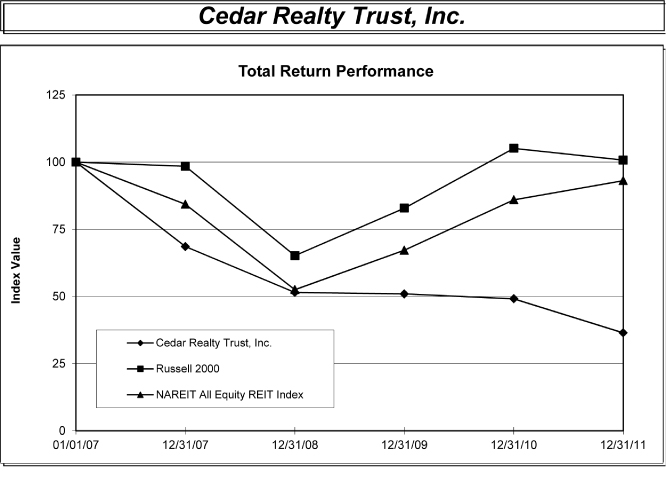
| Period Ending | ||||||||||||||||||||||||
|
Index |
01/01/07 | 12/31/07 | 12/31/08 | 12/31/09 | 12/31/10 | 12/31/11 | ||||||||||||||||||
|
Cedar Realty Trust, Inc. |
100.00 | 68.55 | 51.51 | 50.95 | 49.11 | 36.46 | ||||||||||||||||||
|
Russell 2000 |
100.00 | 98.43 | 65.18 | 82.89 | 105.14 | 100.75 | ||||||||||||||||||
|
NAREIT All Equity REIT Index |
100.00 | 84.31 | 52.50 | 67.20 | 85.98 | 93.10 | ||||||||||||||||||
30
Table of Contents
| Item 6. | Selected Financial Data (a) |
| Years ended December 31, | ||||||||||||||||||||
| 2011 | 2010 | 2009 | 2008 | 2007 | ||||||||||||||||
|
Operations data: |
||||||||||||||||||||
|
Total revenues |
$ | 135,413,000 | $ | 131,572,000 | $ | 140,395,000 | $ | 127,005,000 | $ | 111,784,000 | ||||||||||
|
|
|
|
|
|
|
|
|
|
|
|||||||||||
|
Expenses: |
||||||||||||||||||||
|
Property operating expenses |
44,236,000 | 41,783,000 | 40,457,000 | 35,056,000 | 28,523,000 | |||||||||||||||
|
General and administrative |
11,085,000 | 9,537,000 | 10,158,000 | 8,586,000 | 9,041,000 | |||||||||||||||
|
Management transition charges |
6,530,000 | — | — | — | — | |||||||||||||||
|
Impairments |
7,148,000 | 2,493,000 | 23,636,000 | — | — | |||||||||||||||
|
Acquisition transaction costs and terminated projects |
1,436,000 | 3,958,000 | 4,367,000 | 855,000 | — | |||||||||||||||
|
Depreciation and amortization |
43,250,000 | 34,872,000 | 42,853,000 | 37,097,000 | 30,914,000 | |||||||||||||||
|
|
|
|
|
|
|
|
|
|
|
|||||||||||
|
Total expenses |
113,685,000 | 92,643,000 | 121,471,000 | 81,594,000 | 68,478,000 | |||||||||||||||
|
Operating income |
21,728,000 | 38,929,000 | 18,924,000 | 45,411,000 | 43,306,000 | |||||||||||||||
|
Non-operating income and expense: |
||||||||||||||||||||
|
Interest expense and amortization/write-off of deferred financing costs |
(41,870,000 | ) | (45,690,000 | ) | (41,669,000 | ) | (36,667,000 | ) | (30,947,000 | ) | ||||||||||
|
Equity in (loss) income of unconsolidated joint ventures |
(6,290,000 | ) | 484,000 | 1,098,000 | 956,000 | 634,000 | ||||||||||||||
|
Gain on sale |
130,000 | — | 521,000 | — | — | |||||||||||||||
|
Interest income |
349,000 | 21,000 | 63,000 | 271,000 | 769,000 | |||||||||||||||
|
|
|
|
|
|
|
|
|
|
|
|||||||||||
|
Total non-operating income and expense |
(47,681,000 | ) | (45,185,000 | ) | (39,987,000 | ) | (35,440,000 | ) | (29,544,000 | ) | ||||||||||
|
(Loss) income before discontinued operations |
(25,953,000 | ) | (6,256,000 | ) | (21,063,000 | ) | 9,971,000 | 13,762,000 | ||||||||||||
|
(Loss) income from discontinued operations |
(83,445,000 | ) | (38,098,000 | ) | 3,495,000 | 10,827,000 | 10,105,000 | |||||||||||||
|
Gain on sales of discontinued operations |
884,000 | 170,000 | 557,000 | — | — | |||||||||||||||
|
|
|
|
|
|
|
|
|
|
|
|||||||||||
|
Net (loss) income |
(108,514,000 | ) | (44,184,000 | ) | (17,011,000 | ) | 20,798,000 | 23,867,000 | ||||||||||||
|
Less, net loss (income) attributable to noncontrolling interests |
||||||||||||||||||||
|
Minority interests in consolidated joint ventures |
2,507,000 | 1,613,000 | (772,000 | ) | (2,157,000 | ) | (1,415,000 | ) | ||||||||||||
|
Limited partners’ interest in Operating Partnership |
2,446,000 | 1,282,000 | 912,000 | (468,000 | ) | (627,000 | ) | |||||||||||||
|
|
|
|
|
|
|
|
|
|
|
|||||||||||
|
Net (loss) income attributable to Cedar Realty Trust, Inc. |
(103,561,000 | ) | (41,289,000 | ) | (16,871,000 | ) | 18,173,000 | 21,825,000 | ||||||||||||
|
Preferred distribution requirements |
(14,200,000 | ) | (10,196,000 | ) | (7,876,000 | ) | (7,877,000 | ) | (7,877,000 | ) | ||||||||||
|
|
|
|
|
|
|
|
|
|
|
|||||||||||
|
Net (loss) income attributable to common shareholders |
$ | (117,761,000 | ) | $ | (51,485,000 | ) | $ | (24,747,000 | ) | $ | 10,296,000 | $ | 13,948,000 | |||||||
|
|
|
|
|
|
|
|
|
|
|
|||||||||||
|
Per common share (basic and diluted) attributable to common shareholders: |
||||||||||||||||||||
|
Continuing operations |
$ | (0.61 | ) | $ | (0.24 | ) | $ | (0.60 | ) | $ | (0.01 | ) | $ | 0.09 | ||||||
|
Discontinued operations |
(1.18 | ) | (0.57 | ) | 0.06 | 0.24 | 0.23 | |||||||||||||
|
|
|
|
|
|
|
|
|
|
|
|||||||||||
| $ | (1.79 | ) | $ | (0.81 | ) | $ | (0.54 | ) | $ | 0.23 | $ | 0.32 | ||||||||
|
|
|
|
|
|
|
|
|
|
|
|||||||||||
|
Amounts attributable to Cedar Realty Trust, Inc. common shareholders, net of limited partners’ interest |
||||||||||||||||||||
|
(Loss) income from continuing operations |
$ | (39,236,000 | ) | $ | (15,504,000 | ) | $ | (27,630,000 | ) | $ | (65,000 | ) | $ | 4,278,000 | ||||||
|
(Loss) income from discontinued operations |
(78,525,000 | ) | (35,981,000 | ) | 2,883,000 | 10,361,000 | 9,670,000 | |||||||||||||
|
|
|
|
|
|
|
|
|
|
|
|||||||||||
|
Net (loss) income |
$ | (117,761,000 | ) | $ | (51,485,000 | ) | $ | (24,747,000 | ) | $ | 10,296,000 | $ | 13,948,000 | |||||||
|
|
|
|
|
|
|
|
|
|
|
|||||||||||
|
Dividends to common shareholders |
$ | 24,705,000 | $ | 17,749,000 | $ | 9,742,000 | $ | 40,027,000 | $ | 39,775,000 | ||||||||||
|
Per common share |
$ | 0.3600 | $ | 0.2700 | $ | 0.2025 | $ | 0.9000 | $ | 0.9000 | ||||||||||
|
Weighted average number of common shares—basic |
66,387,000 | 63,843,000 | 46,234,000 | 44,475,000 | 44,193,000 | |||||||||||||||
|
|
|
|
|
|
|
|
|
|
|
|||||||||||
|
Weighted average number of common shares—diluted |
66,387,000 | 63,862,000 | 46,234,000 | 44,475,000 | 44,197,000 | |||||||||||||||
|
|
|
|
|
|
|
|
|
|
|
|||||||||||
31
Table of Contents
| Item 6. | Selected Financial Data (a) (continued) |
| Years ended December 31, | ||||||||||||||||||||
| 2011 | 2010 | 2009 | 2008 | 2007 | ||||||||||||||||
|
Balance sheet data: |
||||||||||||||||||||
|
Real estate, net |
$ | 1,171,513,000 | $ | 1,132,313,000 | $ | 1,146,939,000 | $ | 1,045,046,000 | $ | 946,659,000 | ||||||||||
|
Real estate to be transferred to a joint venture |
— | — | 139,743,000 | 194,952,000 | 165,277,000 | |||||||||||||||
|
Real estate held for sale/conveyance |
206,674,000 | 348,743,000 | 392,649,000 | 419,717,000 | 403,768,000 | |||||||||||||||
|
Investment in unconsolidated joint ventures |
44,743,000 | 52,466,000 | 14,113,000 | 4,976,000 | 3,757,000 | |||||||||||||||
|
Other assets |
89,233,000 | 88,965,000 | 91,674,000 | 70,337,000 | 83,634,000 | |||||||||||||||
|
|
|
|
|
|
|
|
|
|
|
|||||||||||
|
Total assets |
$ | 1,512,163,000 | $ | 1,622,487,000 | $ | 1,785,118,000 | $ | 1,735,028,000 | $ | 1,603,095,000 | ||||||||||
|
|
|
|
|
|
|
|
|
|
|
|||||||||||
|
Mortgages and loans payable |
$ | 755,344,000 | $ | 683,122,000 | $ | 799,667,000 | $ | 771,991,000 | $ | 605,177,000 | ||||||||||
|
Mortgage loans payable—real estate to be transferred to a joint venture |
— | — | 94,018,000 | 77,307,000 | 70,458,000 | |||||||||||||||
|
Mortgage loans payable—real estate held for sale/conveyance |
122,604,000 | 156,991,000 | 158,762,000 | 164,175,000 | 175,879,000 | |||||||||||||||
|
Other liabilities |
73,827,000 | 76,850,000 | 106,269,000 | 116,361,000 | 105,654,000 | |||||||||||||||
|
|
|
|
|
|
|
|
|
|
|
|||||||||||
|
Total liabilities |
951,775,000 | 916,963,000 | 1,158,716,000 | 1,129,834,000 | 957,168,000 | |||||||||||||||
|
Noncontrolling interest—limited partners’ mezzanine OP Units |
4,616,000 | 7,053,000 | 12,638,000 | 14,257,000 | 15,570,000 | |||||||||||||||
|
Equity: |
||||||||||||||||||||
|
Cedar Realty Trust, Inc. shareholders’ equity |
493,843,000 | 630,066,000 | 538,456,000 | 523,521,000 | 557,849,000 | |||||||||||||||
|
Noncontrolling interests |
61,929,000 | 68,405,000 | 75,308,000 | 67,416,000 | 72,508,000 | |||||||||||||||
|
|
|
|
|
|
|
|
|
|
|
|||||||||||
|
Total equity |
555,772,000 | 698,471,000 | 613,764,000 | 590,937,000 | 630,357,000 | |||||||||||||||
|
|
|
|
|
|
|
|
|
|
|
|||||||||||
|
Total liabilities and equity |
$ | 1,512,163,000 | $ | 1,622,487,000 | $ | 1,785,118,000 | $ | 1,735,028,000 | $ | 1,603,095,000 | ||||||||||
|
|
|
|
|
|
|
|
|
|
|
|||||||||||
|
Weighted average number of common shares: |
||||||||||||||||||||
|
Basic earnings per share |
66,387,000 | 63,843,000 | 46,234,000 | 44,475,000 | 44,193,000 | |||||||||||||||
|
|
|
|
|
|
|
|
|
|
|
|||||||||||
|
Diluted earnings per share |
66,387,000 | 63,862,000 | 46,234,000 | 44,475,000 | 44,197,000 | |||||||||||||||
|
|
|
|
|
|
|
|
|
|
|
|||||||||||
|
Other data: |
||||||||||||||||||||
|
Funds From Operations (“FFO”) (b) |
$ | 26,717,000 | $ | 29,510,000 | $ | 51,776,000 | $ | 56,859,000 | $ | 56,190,000 | ||||||||||
|
Cash flows provided by (used in): |
||||||||||||||||||||
|
Operating activities |
$ | 39,246,000 | $ | 41,702,000 | $ | 51,942,000 | $ | 60,815,000 | $ | 53,503,000 | ||||||||||
|
Investing activities |
$ | (64,241,000 | ) | $ | (29,834,000 | ) | $ | (70,026,000 | ) | $ | (151,390,000 | ) | $ | (192,432,000 | ) | |||||
|
Financing activities |
$ | 22,899,000 | $ | (14,866,000 | ) | $ | 27,017,000 | $ | 75,517,000 | $ | 143,735,000 | |||||||||
|
Square feet of GLA |
9,593,000 | 9,015,000 | 8,809,000 | 7,853,000 | 7,698,000 | |||||||||||||||
|
Percent leased |
92 | % | 90 | % | 91 | % | 92 | % | 92 | % | ||||||||||
|
Average annualized base rent per leased square foot |
$ | 11.54 | $ | 11.34 | $ | 10.92 | $ | 10.68 | $ | 10.47 | ||||||||||
| (a) |
The data presented reflect certain reclassifications of prior period amounts to conform to the 2011 presentation, principally to reflect the sale and/or treatment as “held for sale/conveyance” of certain operating properties and the treatment thereof as “discontinued operations”. The reclassifications had no impact on the previously-reported net income attributable to common shareholders or earnings per share. |
| (b) |
See Item 7—“Management’s Discussion and Analysis of Financial Condition and Results of Operations” for a reconciliation of FFO to net (loss) attributable to common shareholders. FFO has been restated for prior years based on a recent NAREIT clarification with respect to the computation of FFO. |
32
Table of Contents
| Item 7. | Management’s Discussion and Analysis of Financial Condition and Results of Operations |
The following discussion should be read in conjunction with the Company’s consolidated financial statements and related notes thereto included elsewhere in this report.
Executive Summary
The Company is a fully-integrated real estate investment trust which currently focuses primarily on ownership and operation of supermarket-anchored shopping centers straddling the Washington DC to Boston corridor. At December 31, 2011, the Company owned and managed a portfolio of 70 operating properties (excluding properties “held for sale/conveyance”) totaling approximately 9.6 million square feet of GLA. In addition, the Company has an ownership interest in 22 operating properties, with approximately 3.7 million square feet of GLA, through its Cedar/RioCan joint venture in which the Company has a 20% interest. The entire managed portfolio, including the Cedar/RioCan properties, was approximately 93.1% leased at December 31, 2011.
During 2011, in keeping with its stated goal of reducing overall leverage to an appropriate level by selling non-core and limited growth potential assets, the Company determined (1) to completely exit the Ohio market, principally the Discount Drug Mart portfolio of drugstore/convenience centers, and concentrate on the mid-Atlantic and Northeast coastal regions (four properties “held for sale” as of December 31, 2011), (2) to concentrate on grocery-anchored strip centers, by disposing of its mall and single-tenant/triple-net-lease properties (11 properties “held for sale” as of December 31, 2011), and (3) to focus on improving operations and performance at the Company’s remaining properties, and to reduce development activities, by disposing of certain development projects, land acquired for development, and other non-core assets (five properties “held for sale/conveyance” as of December 31, 2011). In addition, discontinued operations reflect the anticipated consummation of the Homburg joint venture buy/sell transactions (seven properties “held for sale” as of December 31, 2011).
The Company, organized as a Maryland corporation, has established an umbrella partnership structure through the contribution of substantially all of its assets to the Operating Partnership, organized as a limited partnership under the laws of Delaware. The Company conducts substantially all of its business through the Operating Partnership. At December 31, 2011, the Company owned 98.0% of the Operating Partnership and is its sole general partner. The approximately 1.4 million OP Units are economically equivalent to the Company’s common stock and are convertible into the Company’s common stock at the option of the holders on a one-to-one basis.
The Company derives substantially all of its revenues from rents and operating expense reimbursements received pursuant to long-term leases. The Company’s operating results therefore depend on the ability of its tenants to make the payments required by the terms of their leases. The Company focuses its investment activities on supermarket-anchored community shopping centers. The Company believes that, because of the need of consumers to purchase food and other staple goods and services generally available at such centers, its type of “necessities-based” properties should provide relatively stable revenue flows even during difficult economic times.
33
Table of Contents
The Cedar/RioCan joint venture has acquired primarily stabilized supermarket-anchored properties in the Company’s primary market areas. The Company believes it gains additional benefits with tenants and vendors by having an interest in managing these additional properties within its primary markets.
Significant Transactions
On January 26, 2012, the Company entered into a $300 million secured credit facility (the “Credit Facility”). The Credit Facility amends, restates and consolidates the Company’s prior $185 million stabilized property revolving credit facility ($74,035,000 outstanding at December 31, 2011, bearing interest at 5.5% per annum) and its $150 million development property credit facility ($92,282,000 outstanding at December 31, 2011, bearing interest at 2.5% per annum) that were due to expire on January 31, 2012 and June 13, 2012, respectively. In anticipation of the new Credit Facility, the Company determined to forego its one-year extension option applicable to the stabilized property credit revolving facility.
34
Table of Contents
The table below details 2011 acquisitions and dispositions:
Acquisitions
| GLA / | Date | Purchase | ||||||||||||
|
Property |
Location | Acreage | Acquired | Price | ||||||||||
|
Consolidated |
||||||||||||||
|
Colonial Commons |
Lower Paxton Township, PA | 474,765 | 1/14/2011 | $ | 49,100,000 | |||||||||
|
Unconsolidated Cedar/RioCan Joint Venture |
||||||||||||||
|
Northwoods Crossing |
Taunton, MA | 159,562 | 4/15/2011 | $ | 23,400,000 | |||||||||
Dispositions
| GLA/ | Date | Sales | ||||||||||||
|
Property |
Location | Acreage | Sold | Price | ||||||||||
|
Consolidated |
||||||||||||||
|
Bergstrasse Land |
Ephrata, PA | 7.7 acres | 2/14/2011 | $ | 1,900,000 | |||||||||
|
Enon Discount Drug Mart Plaza |
Enon, OH | 42,876 | 3/30/2011 | 2,125,000 | ||||||||||
|
Hills & Dales Discount Drug Mart Plaza |
Canton, OH | 33,553 | 3/30/2011 | 1,907,000 | ||||||||||
|
Fairfield Plaza |
Fairfield, CT | 72,279 | 4/15/2011 | 10,840,000 | ||||||||||
|
CVS at Kingston |
Kingston, NY | 13,013 | 11/14/2011 | 5,250,000 | ||||||||||
|
CVS at Kinderhook |
Kinderhook, NY | 13,225 | 12/8/2011 | 4,000,000 | ||||||||||
|
Shoppes at Salem Run |
Fredericksburg, VA | 15,100 | 12/12/2011 | 1,675,000 | ||||||||||
|
Virginia Center Commons |
Glen Allen, VA | 9,763 | 12/21/2011 | 3,550,000 | ||||||||||
|
Centerville Discount Drug Mart Plaza |
Centerville, OH | 49,287 | 12/28/2011 | 2,743,000 | ||||||||||
|
Clyde Discount Drug Mart Plaza |
Clyde, OH | 34,592 | 12/28/2011 | 1,903,000 | ||||||||||
|
FirstMerit Bank at Cuyahoga Falls |
Cuyahoga Falls, OH | 3,200 | 12/28/2011 | 915,000 | ||||||||||
|
Lodi Discount Drug Mart Plaza |
Lodi, OH | 38,576 | 12/28/2011 | 2,319,000 | ||||||||||
|
Mason Discount Drug Mart Plaza |
Mason, OH | 52,896 | 12/28/2011 | 4,653,000 | ||||||||||
|
Ontario Discount Drug Mart Plaza |
Ontario, OH | 38,623 | 12/28/2011 | 2,141,000 | ||||||||||
|
Pickerington Discount Drug Mart Plaza |
Pickerington, OH | 47,810 | 12/28/2011 | 4,072,000 | ||||||||||
|
Polaris Discount Drug Mart Plaza |
Polaris, OH | 50,283 | 12/28/2011 | 4,370,000 | ||||||||||
|
Shelby Discount Drug Mart Plaza |
Shelby, OH | 36,596 | 12/28/2011 | 2,141,000 | ||||||||||
|
|
|
|||||||||||||
|
Total |
$ | 56,504,000 | ||||||||||||
|
|
|
|||||||||||||
35
Table of Contents
Discontinued operations, land dispositions and write-off of investment in unconsolidated joint venture
In connection with management’s review of the Company’s real estate investments, the Company determined (1) to completely exit the Ohio market, principally the Discount Drug Mart portfolio of drugstore/convenience centers, and concentrate on the mid-Atlantic and Northeast coastal regions (four properties “held for sale” as of December 31, 2011), (2) to concentrate on grocery-anchored strip centers, by disposing of its mall and single-tenant/triple-net-lease properties (11 properties “held for sale” as of December 31, 2011), and (3) to focus on improving operations and performance at the Company’s remaining properties, and to reduce development activities, by disposing of certain development projects, land acquired for development, and other non-core assets (five properties “held for sale/conveyance” as of December 31, 2011). In addition, discontinued operations reflect the anticipated consummation of the Homburg joint venture buy/sell transactions (seven properties “held for sale” as of December 31, 2011).
The carrying values of the assets and liabilities of these properties, principally the net book values of the real estate and the related mortgage loans payable to be assumed by the buyers (or conveyed to the mortgagee), have been reclassified as “held for sale/conveyance” on the Company’s consolidated balance sheets at December 31, 2011 and December 31, 2010. In addition, the properties’ results of operations have been classified as “discontinued operations” for all periods presented. Impairment charges relating to operating properties are included in discontinued operations in the accompanying statements of operations; impairment charges relating to land parcels are included in operating income in the accompanying statements of operations. The impairment charge amounts included in operating income for 2010 and 2009 relate to properties transferred to the Cedar/RioCan joint venture. The following is a summary of these charges:
| Years ended December 31, | ||||||||||||
| 2011 | 2010 | 2009 | ||||||||||
|
Impairment charges—land parcels and properties transferred to Cedar/RioCan joint venture |
$ | 7,148,000 | $ | 2,493,000 | $ | 23,636,000 | ||||||
|
|
|
|
|
|
|
|||||||
|
Write-off of investment in unconsolidated joint venture |
$ | 7,961,000 | $ | — | $ | — | ||||||
|
|
|
|
|
|
|
|||||||
|
Impairment charges—properties held for sale/conveyance |
$ | 88,458,000 | $ | 39,822,000 | $ | 3,559,000 | ||||||
|
|
|
|
|
|
|
|||||||
Impairment charges included in discontinued operations for 2011 included $11.1 million related to the Discount Drug Mart portfolio, $33.1 million related to malls, $5.3 million related to single-tenant/triple-net-lease properties, $36.6 million related to development projects and other non-core properties, and $2.4 million related to the Homburg joint venture properties. Impairment charges included in discontinued operations for 2010 included $26.8 million related to the Discount Drug Mart portfolio, $12.6 million related to malls, $0.1 million related to a single-tenant/triple-net-lease property, and $0.3 million related to a development project. Impairment charges included in discontinued operations for 2009 included $2.4 million related to the Discount Drug Mart portfolio and $1.2 million related to single-tenant/triple-net-lease properties.
36
Table of Contents
Summary of Critical Accounting Policies
The preparation of the consolidated financial statements in conformity with GAAP requires the Company to make estimates and judgments that affect the reported amounts of assets and liabilities, revenues and expenses, and related disclosures of contingent assets and liabilities. On an ongoing basis, management evaluates its estimates, including those related to revenue recognition and the allowance for doubtful accounts receivable, real estate investments and purchase accounting allocations related thereto, asset impairment, and derivatives used to hedge interest-rate risks. Management’s estimates are based both on information that is currently available and on various other assumptions management believes to be reasonable under the circumstances. Actual results could differ from those estimates and those estimates could be different under varying assumptions or conditions.
The Company has identified the following critical accounting policies, the application of which requires significant judgments and estimates:
Revenue Recognition
Rental income with scheduled rent increases is recognized using the straight-line method over the respective terms of the leases. The aggregate excess of rental revenue recognized on a straight-line basis over base rents under applicable lease provisions is included in straight-line rents receivable on the consolidated balance sheet. Leases also generally contain provisions under which the tenants reimburse the Company for a portion of property operating expenses and real estate taxes incurred; such income is recognized in the periods earned. In addition, certain operating leases contain contingent rent provisions under which tenants are required to pay a percentage of their sales in excess of a specified amount as additional rent. The Company defers recognition of contingent rental income until those specified targets are met.
The Company must make estimates as to the collectability of its accounts receivable related to base rent, straight-line rent, expense reimbursements and other revenues. Management analyzes accounts receivable by considering tenant creditworthiness, current economic conditions, and changes in tenants’ payment patterns when evaluating the adequacy of the allowance for doubtful accounts receivable. These estimates have a direct impact on net income, because a higher bad debt allowance would result in lower net income, whereas a lower bad debt allowance would result in higher net income.
Real Estate Investments
Real estate investments are carried at cost less accumulated depreciation. The provision for depreciation is calculated using the straight-line method based on estimated useful lives. Expenditures for maintenance, repairs and betterments that do not materially prolong the normal useful life of an asset are charged to operations as incurred. Expenditures for betterments that substantially extend the useful lives of real estate assets are capitalized.
37
Table of Contents
Real estate investments include costs of development and redevelopment activities, and construction in progress. Capitalized costs, including interest and other carrying costs during the construction and/or renovation periods, are included in the cost of the related asset and charged to operations through depreciation over the asset’s estimated useful life. The Company is required to make subjective estimates as to the useful lives of its real estate assets for purposes of determining the amount of depreciation to reflect on an annual basis. These assessments have a direct impact on net income. A shorter estimate of the useful life of an asset would have the effect of increasing depreciation expense and lowering net income, whereas a longer estimate of the useful life of an asset would have the effect of reducing depreciation expense and increasing net income.
A variety of costs are incurred in the acquisition, development and leasing of a property, such as pre-construction costs essential to the development of the property, development costs, construction costs, interest costs, real estate taxes, salaries and related costs, and other costs incurred during the period of development. After a determination is made to capitalize a cost, it is allocated to the specific component of a project that is benefited. The Company ceases capitalization on the portions substantially completed and occupied, or held available for occupancy, and capitalizes only those costs associated with the portions under construction. The Company considers a construction project as substantially completed and held available for occupancy upon the completion of tenant improvements, but not later than one year from cessation of major development activity. Determination of when a development project is substantially complete and capitalization must cease involves a degree of judgment. The effect of a longer capitalization period would be to increase capitalized costs and would result in higher net income, whereas the effect of a shorter capitalization period would be to reduce capitalized costs and would result in lower net income.
The Company allocates the fair value of real estate acquired to land, buildings and improvements. In addition, the fair value of in-place leases is allocated to intangible lease assets and liabilities. The fair value of the tangible assets of an acquired property is determined by valuing the property as if it were vacant, which value is then allocated to land, buildings and improvements based on management’s determination of the relative fair values of such assets. In valuing an acquired property’s intangibles, factors considered by management include an estimate of carrying costs during the expected lease-up periods, such as real estate taxes, insurance, other operating expenses, and estimates of lost rental revenue during the expected lease-up periods based on its evaluation of current market demand. Management also estimates costs to execute similar leases, including leasing commissions, tenant improvements, legal and other related costs.
The values of acquired above-market and below-market leases are recorded based on the present values (using discount rates which reflect the risks associated with the leases acquired) of the differences between the contractual amounts to be received and management’s estimate of market lease rates, measured over the terms of the respective leases that management deemed appropriate at the time of the acquisitions. Such valuations include a consideration of the non-cancellable terms of the respective leases as well as any applicable renewal period(s). The fair values associated with below-market rental renewal options are determined based on the Company’s experience and the relevant facts and circumstances that existed at the time of the acquisitions. The values of above-market leases are amortized to rental income over the terms of the respective non-cancelable lease periods. The portion of the values of below-market leases associated with the original non-cancelable lease terms are amortized
38
Table of Contents
to rental income over the terms of the respective non-cancelable lease periods. The portion of the values of the leases associated with below-market renewal options that are likely of exercise are amortized to rental income over the respective renewal periods. The value of other intangible assets (including leasing commissions, tenant improvements, etc.) is amortized to expense over the applicable terms of the respective leases. If a lease were to be terminated prior to its stated expiration or not renewed, all unamortized amounts relating to that lease would be recognized in operations at that time.
Management is required to make subjective assessments in connection with its valuation of real estate acquisitions. These assessments have a direct impact on net income, because (i) above-market and below-market lease intangibles are amortized to rental income, and (ii) the value of other intangibles is amortized to expense. Accordingly, higher allocations to below-market lease liability and other intangibles would result in higher rental income and amortization expense, whereas lower allocations to below-market lease liability and other intangibles would result in lower rental income and amortization expense.
Management reviews each real estate investment for impairment whenever events or circumstances indicate that the carrying value of a real estate investment may not be recoverable. The review of recoverability is based on an estimate of the future cash flows that are expected to result from the real estate investment’s use and eventual disposition. These estimates of cash flows consider factors such as expected future operating income, trends and prospects, as well as the effects of leasing demand, competition and other factors. If an impairment event exists due to the projected inability to recover the carrying value of a real estate investment, an impairment loss is recorded to the extent that the carrying value exceeds estimated fair value. A real estate investment held for sale is carried at the lower of its carrying amount or estimated fair value, less the cost of a potential sale. Depreciation and amortization are suspended during the period the property is held for sale. Management is required to make subjective assessments as to whether there are impairments in the value of its real estate properties. These assessments have a direct impact on net income, because an impairment loss is recognized in the period that the assessment is made.
New Accounting Pronouncements
See Note 2 of Notes to Consolidated Financial Statements included in Item 8 below for information relating to new accounting pronouncements.
Results of Operations
Differences in results of operations between 2011 and 2010, and between 2010 and 2009, respectively, were primarily due to the Company’s property disposition program resulting from its determination (1) to completely exit the Ohio market, principally the Discount Drug Mart portfolio of drugstore/convenience centers, and concentrate on the mid-Atlantic and Northeast coastal regions (10 properties sold in 2011 and four properties “held for sale” as of December 31, 2011), (2) to concentrate on grocery-anchored strip centers, by disposing of its mall and single-tenant/triple-net-lease properties (three properties sold in 2011 and 11 properties “held for sale” as of December 31, 2011), and (3) to focus on improving operations and performance at the Company’s remaining properties, and to reduce development activities, by disposing of certain development projects, land acquired for development, and other non-core assets (four properties sold in 2011 and five properties “held for sale/conveyance” as
39
Table of Contents
of December 31, 2011). In addition, the Company determined not to proceed with the redevelopment of two vacant single-tenant, adjacent land parcels in Philadelphia, Pennsylvania (one owned in joint venture and the other 100%-owned by the Company). Since January 1, 2009, the Company has sold, or has treated as “held for sale/conveyance”, 64 properties aggregating approximately 3.3 million square feet of GLA. Properties “held for sale/conveyance” also reflect the anticipated consummation of the Homburg joint venture buy/sell transactions. As a result, in addition to an $8.0 million write-off of its redevelopment joint venture investment in June 2011, the Company has recorded impairment charges related to discontinued operations of $88.5 million, $39.8 million and $3.6 million during 2011, 2010 and 2009, respectively. Results for 2011 also include management transition charges of approximately $6.5 million. Differences in results of operations between 2011 and 2010, and 2010 and 2009 also reflect increased results from a greater number of properties owned by the unconsolidated Cedar/RioCan joint venture, as well as more ground-up development and redevelopment projects coming on line.
Net (loss) attributable to common shareholders was ($117.8) million, ($51.5) million and ($24.7) million for 2011, 2010 and 2009, respectively.
Comparison of 2011 to 2010
| Properties | ||||||||||||||||||||||||
| Increase | Percent | held in | ||||||||||||||||||||||
| 2011 | 2010 | (decrease) | change | Other | both periods | |||||||||||||||||||
|
Total revenues |
$ | 135,413,000 | $ | 131,572,000 | $ | 3,841,000 | 3 | % | $ | 2,607,000 | $ | 1,234,000 | ||||||||||||
|
Property operating expenses |
44,236,000 | 41,783,000 | 2,453,000 | 6 | % | 997,000 | 1,456,000 | |||||||||||||||||
|
Depreciation and amortization |
43,250,000 | 34,872,000 | 8,378,000 | 24 | % | 2,223,000 | 6,155,000 | |||||||||||||||||
|
General and administrative |
11,085,000 | 9,537,000 | 1,548,000 | 16 | % | |||||||||||||||||||
|
Management transition charges |
6,530,000 | — | 6,530,000 | |||||||||||||||||||||
|
Impairments |
7,148,000 | 2,493,000 | 4,655,000 | |||||||||||||||||||||
|
Acquisition transaction costs and terminated projects |
1,436,000 | 3,958,000 | (2,522,000 | ) | ||||||||||||||||||||
|
Interest expense, including amortization of deferred financing costs |
41,870,000 | 43,138,000 | (1,268,000 | ) | -3 | % | ||||||||||||||||||
|
Accelerated write-off of deferred financing costs |
— | 2,552,000 | (2,552,000 | ) | ||||||||||||||||||||
|
Unconsolidated joint ventures: |
||||||||||||||||||||||||
|
Equity in income |
1,671,000 | 484,000 | 1,187,000 | |||||||||||||||||||||
|
Write off of investment |
7,961,000 | — | 7,961,000 | |||||||||||||||||||||
|
Gain on sale |
130,000 | — | 130,000 | |||||||||||||||||||||
|
Discontinued operations: |
||||||||||||||||||||||||
|
Income from operations |
5,013,000 | 1,724,000 | 3,289,000 | |||||||||||||||||||||
|
Impairment charges |
88,458,000 | 39,822,000 | 48,636,000 | |||||||||||||||||||||
|
Gain on sales |
884,000 | 170,000 | 714,000 | |||||||||||||||||||||
40
Table of Contents
Properties held in both periods. The Company held 67 properties (excluding “held for sale/conveyance”, ground-up and redevelopment properties) throughout 2011 and 2010.
Total revenues were higher primarily as a result of increases in (i) base rent and tenant recoveries at ground-up development properties ($1.3 million), (ii) base rent and tenant recoveries at operating properties ($1.3 million), (iii) base rent and tenant recoveries at redevelopment properties ($1.0 million), and (iv) percentage rent ($0.1 million), which are partially off-set by decreases in (v) amortization of intangible lease liabilities ($1.2 million), (vi) joint venture fee income ($0.8 million), and (vii) straight-line rents ($0.5 million).
Property operating expenses were higher primarily as a result of increases in (i) payroll and related expenses ($0.8 million), (ii) real estate taxes ($0.3 million), (iii) snow removal costs ($0.3 million), (iv) billable tenant utilities ($0.1 million), (v) repairs and maintenance ($0.1 million), (vi) insurance expense ($0.1 million), and (vii) other operating expenses ($0.2 million), which are partially off-set by decreases in (viii) the provision for doubtful accounts ($0.2 million) and (ix) utility expense ($0.2 million).
Depreciation and amortization expenses increased primarily as a result of the change in use of a building, at a redevelopment project, which is scheduled to be demolished in 2012. Other factors contributing to the increase included additional depreciation expense at ground-up and redevelopment properties as improvements have been placed into service, and increases related to capital improvements at operating properties.
General and administrative expenses were higher primarily as a result of increases in (i) payroll and payroll related expenses ($0.3 million), (ii) a legal settlement received in the Company’s favor in 2010 in excess of a legal settlement received in the Company’s favor in 2011 ($0.5 million), (iii) accounting and other professional fees ($0.2 million), (iv) information technology costs ($0.2 million), (v) rent expense ($0.1 million) and (vi) other costs ($0.2 million).
Management transition charges in 2011 relate to the retirement of the Company’s then Chairman of the Board, Chief Executive Officer and President, and the end of the employment of the Company’s then Chief Financial Officer, and include (i) an aggregate of approximately $3.7 million in cash severance payments (including the cost of related payroll taxes and benefits), (ii) the write off of all amounts related to the vesting of restricted share grants (an aggregate of approximately $2.0 million), and (iii) approximately $0.8 million of other non-recurring costs, primarily professional fees and expenses related to the hiring of a new President/Chief Executive Officer and Chief Financial Officer.
Impairments for 2011 relate principally to land parcels treated as “held for sale”, as more fully discussed elsewhere in this report. Impairments for 2010 relate principally to properties initially transferred to the Cedar/RioCan joint venture.
Acquisition transaction costs and terminated projects were lower in 2011 primarily due to fees accrued in 2010 to the Company’s advisor related to the RioCan joint venture transactions.
41
Table of Contents
Interest expense, including amortization of deferred financing costs decreased primarily as a result of (i) lower amortization of deferred financing costs, principally related to the accelerated write-off of deferred financing costs in September 2010 ($1.4 million), (ii) lower outstanding borrowings under the Company’s credit facilities ($1.1 million), and (iii) higher capitalized interest ($0.3 million), which are partially off-set by (iv) an increase in mortgage interest expense as a result of property acquisitions and property-specific financings ($1.5 million).
Accelerated write-off of deferred financing costs in 2010 resulted from the Company, at its option, reducing the commitments under the stabilized property credit facility from $285.0 million to $185.0 million.
Equity in income of unconsolidated joint ventures was higher in 2011 as a result of an increase in operating results from the Cedar/RioCan joint venture, primarily lower acquisition transaction costs in 2011 compared to those incurred in 2010, offset by nominal operating results in 2011 as compared with 2010 from the joint venture redevelopment property in Philadelphia (as more fully discussed elsewhere in this report).
Write-off of investment in unconsolidated joint venture relates to the aforementioned redevelopment joint venture, as more fully discussed elsewhere in this report.
Discontinued operations for 2011 and 2010 include the results of operations, impairment charges and gain on sales for properties sold or treated as “held for sale/conveyance”, as more fully discussed elsewhere in this report.
The “Other” column includes results for the following properties:
| Total | Property | Depreciation and | ||||||||||
| revenues | operating expenses | amortization | ||||||||||
|
Properties acquired after January 1, 2010 |
$ | 5,911,000 | $ | 1,937,000 | $2,223,000 | |||||||
|
Properties prior to transfer to Cedar/RioCan joint venture |
(3,304,000 | ) | (940,000 | ) | — | |||||||
|
|
|
|
|
|
|
|||||||
| $ | 2,607,000 | $ | 997,000 | $2,223,000 | ||||||||
|
|
|
|
|
|
|
|||||||
42
Table of Contents
Comparison 2010 to 2009
| Properties | ||||||||||||||||||||||||
| Increase | Percent | held in | ||||||||||||||||||||||
| 2010 | 2009 | (decrease) | change | Other | both periods | |||||||||||||||||||
|
Total revenues |
$ | 131,572,000 | $ | 140,395,000 | $ | (8,823,000 | ) | -6 | % | $ | (14,369,000 | ) | 5,546,000 | |||||||||||
|
Property operating expenses |
41,783,000 | 40,457,000 | 1,326,000 | 3 | % | (3,496,000 | ) | 4,822,000 | ||||||||||||||||
|
Depreciation and amortization |
34,872,000 | 42,853,000 | (7,981,000 | ) | -19 | % | (1,997,000 | ) | (5,984,000 | ) | ||||||||||||||
|
General and administrative |
9,537,000 | 10,158,000 | (621,000 | ) | -6 | % | ||||||||||||||||||
|
Impairments |
2,493,000 | 23,636,000 | (21,143,000 | ) | ||||||||||||||||||||
|
Acquisition transaction costs and terminated projects |
3,958,000 | 4,367,000 | (409,000 | ) | ||||||||||||||||||||
|
Interest expense, including amortization of deferred financing costs |
43,138,000 | 41,669,000 | 1,469,000 | 4 | % | |||||||||||||||||||
|
Accelerated write-off of deferred financing costs |
2,552,000 | — | 2,552,000 | |||||||||||||||||||||
|
Equity in income of unconsolidated joint ventures: |
484,000 | 1,098,000 | (614,000 | ) | ||||||||||||||||||||
|
Gain on sale |
— | 521,000 | (521,000 | ) | ||||||||||||||||||||
|
Discontinued operations: |
||||||||||||||||||||||||
|
Income from operations |
1,724,000 | 7,054,000 | (5,330,000 | ) | ||||||||||||||||||||
|
Impairment charges |
39,822,000 | 3,559,000 | 36,263,000 | |||||||||||||||||||||
|
Gain on sales |
170,000 | 557,000 | (387,000 | ) | ||||||||||||||||||||
Properties held in both periods. The Company held 65 properties (excluding “held for sale/conveyance”, ground-up and redevelopment properties) throughout 2010 and 2009.
Total revenues were higher primarily as a result of increases in (i) base rent and recovery income at ground-up development properties ($6.6 million), (ii) joint venture fee income ($3.5 million), and (iii) base rent and recovery income at operating properties ($0.8 million), which are partially off-set by decreases in (iv) amortization of intangible lease liabilities ($3.6 million), (v) base rent and recovery income at redevelopment properties ($1.3 million), (vi) straight-line rents ($0.4 million), and (vii) percentage rent and other income ($0.1 million).
Property operating expenses were higher primarily as a result of increases in (i) real estate tax expense ($1.7 million), (ii) payroll and related expenses ($1.4 million), (iii) management fees paid to third parties ($0.6 million), (iv) other operating expenses ($0.4 million), (v) utility expense ($0.2 million), (vi) non-billable expenses ($0.2 million), (vii) snow removal costs ($0.2 million), (viii) provision for doubtful accounts ($0.2 million), and (ix) professional fees ($0.1 million), which are partially off-set by a decrease in (x) insurance expense ($0.2 million).
43
Table of Contents
Depreciation and amortization expenses decreased primarily as a result of completion of scheduled depreciation and amortization at certain properties and the razing of a building at a redevelopment project in 2009.
General and administrative expenses were lower primarily as a result of a legal settlement received in the Company’s favor in 2010 ($0.7 million).
Impairments for 2010 and 2009 relate to the properties initially transferred to the Cedar/RioCan joint venture.
Acquisition transaction costs and terminated projects for 2010 include (i) an acquisition fee paid to the Company’s investment advisor related to the Cedar/RioCan joint venture ($2.7 million), and (ii) the write off of costs incurred in the prior years related to (a) a potential development project in Milford, Delaware that the Company determined would not go forward ($1.3 million), and (b) a cancelled acquisition ($0.1 million). Acquisition transaction costs and terminated projects for 2009 include (i) the costs associated with the acquisitions of San Souci Plaza and New London Mall (net of minority interest share) and the costs primarily associated with a cancelled acquisition (an aggregate of $1.5 million), (ii) the decision to terminate potential development opportunities in Williamsport, Pennsylvania and Ephrata, Pennsylvania (an aggregate of $2.8 million), and (iii) the costs primarily associated with a cancelled acquisition.
Interest expense, including amortization of deferred financing costs increased primarily as a result of (i) lower capitalized interest ($3.6 million), (ii) higher amortization of deferred financing costs, related principally to the closing of the stabilized property credit facility in November 2009 ($1.1 million), and (iii) increased borrowings under the Company’s credit facilities ($0.4 million), which are partially off-set by (iv) lower balances of mortgage loans payable, related principally to the initial transfers of properties to the Cedar/RioCan joint venture ($3.5 million).
Accelerated write-off of deferred financing costs in 2010 resulted from the Company, at its option, reducing the commitments under the stabilized property credit facility from $285.0 million to $185.0 million.
Equity in income of unconsolidated joint ventures was lower in 2010 as a result of higher acquisition transaction costs in 2010 compared to those incurred in 2009.
Discontinued operations for 2010 and 2009 include the results of operations, impairment charges and gain on sales for properties sold or treated as “held for sale/conveyance”, as more fully discussed elsewhere in this report.
44
Table of Contents
The “Other” column includes the results for the following properties:
| Total | Property | Depreciation and | ||||||||||
| revenues | operating expenses | amortization | ||||||||||
|
Properties acquired after January 1, 2009 |
$ | 716,000 | $ | 300,000 | $ | 2,190,000 | ||||||
|
Properties prior to transfer to Cedar/RioCan joint venture |
(15,085,000 | ) | (3,796,000 | ) | (4,187,000 | ) | ||||||
|
|
|
|
|
|
|
|||||||
| $ | (14,369,000 | ) | $ | (3,496,000 | ) | $ | (1,997,000 | ) | ||||
|
|
|
|
|
|
|
|||||||
Liquidity and Capital Resources
The Company funds operating expenses and other short-term liquidity requirements, including debt service, tenant improvements, leasing commissions, preferred and common dividend distributions, if made, and distributions to minority interest partners, if made, primarily from its operations and distributions received from the Cedar/RioCan joint venture. The Company may also use its revolving credit facilities for these purposes. The Company expects to fund long-term liquidity requirements for property acquisitions, redevelopment costs, remaining development costs, capital improvements, joint venture contributions, and maturing debt initially with its credit facilities, and ultimately through a combination of issuing and/or assuming additional mortgage debt, the sale of equity securities, the issuance of additional OP Units, and the sale of properties or interests therein (including joint venture arrangements). Although the Company believes it has access to secured financing, there can be no assurance that the Company will have the availability of mortgage financing on completed development projects, additional construction financing, net proceeds from the contribution of properties to joint ventures, or proceeds from the refinancing of existing debt.
Debt is comprised of the following at December 31, 2011:
| Interest rates | ||||||||||
| Balance | Weighted | |||||||||
|
Description |
outstanding | average |
Range |
|||||||
|
Fixed-rate mortgages |
$ | 525,259,000 | 5.8 | % | 5.0% -7.6% | |||||
|
Variable-rate mortgage |
63,768,000 | 3.0 | % | |||||||
|
|
|
|
|
|||||||
|
Total property-specific mortgages |
589,027,000 | 5.5 | % | |||||||
|
Stabilized property credit facility |
74,035,000 | 5.5 | % | |||||||
|
Development property credit facility |
92,282,000 | 2.5 | % | |||||||
|
|
|
|
|
|||||||
| $ | 755,344,000 | 5.2 | % | |||||||
|
|
|
|
|
|||||||
On January 26, 2012, the Company entered into a new $300 million amended, restated and consolidated credit facility. The Credit Facility is comprised of a four-year $75 million term loan and a three-year $225 million revolving credit facility, subject to collateral in place (the Company has pledged 27 of its shopping center properties as collateral for such borrowings, including seven properties which are being treated as “real estate held for sale/conveyance”). Borrowings under the new facility are initially priced at LIBOR plus 275 bps (a total of 3.0% per annum at closing) and can range from LIBOR plus 200 to 300 bps based on the Company’s leverage ratio. Subject to customary conditions, the
45
Table of Contents
term loan and the revolving credit facility may both be extended for one additional year at the Company’s option. Under an accordion feature, the Credit Facility can be increased to $500 million, subject to customary conditions, collateral in place and lending commitments from participating banks. The Credit Facility contains financial covenants including, but not limited to, maximum debt leverage, minimum interest coverage, minimum fixed charge coverage, and minimum net worth. In addition, the Credit Facility contains restrictions including, but not limited to, limits on indebtedness, certain investments and distributions. The Credit Facility is available to fund acquisitions, redevelopment and remaining development activities, capital expenditures, mortgage repayments, dividend distributions, working capital and other general corporate purposes. Based on covenant measurements and collateral in place at the closing, the Company was permitted to draw up to approximately $232.8 million, of which approximately $62.8 million remained available as of that date (after payment of closing costs, fees and expenses).
The variable-rate mortgage represents a $70.7 million construction facility, as amended in November 2011, pursuant to which the Company has pledged its joint venture ground-up development property in Pottsgrove, Pennsylvania as collateral for borrowings thereunder. The facility is guaranteed by the Company and will expire in October 2013, subject to a one-year extension option. Borrowings under the facility bear interest the Company’s option at either LIBOR plus a spread of 275 bps or the agent bank’s prime rate plus a spread of 125 bps, with principal payable based on a 30-year amortization schedule. Borrowings outstanding under the facility aggregated $63.8 million at December 31, 2011, and such borrowings bore interest at a rate of 3.5% per annum.
Other property-specific mortgage loans payable at December 31, 2011 consisted of fixed-rate notes totaling $525.3 million, with a weighted average interest rate of 5.8%. For 2012, the Company has approximately $9.3 million of scheduled debt principal amortization payments and $29.6 million of scheduled balloon payments.
Total mortgage loans payable and secured credit facilities have an overall weighted average interest rate of 5.2% and mature at various dates through 2029. The terms of several of the Company’s mortgage loans payable require the Company to deposit certain replacement and other reserves with its lenders. Such “restricted cash” is generally available only for property-level requirements for which the reserves have been established, and is not available to fund other property-level or Company-level obligations.
In order to continue qualifying as a REIT, the Company is required to distribute at least 90% of its “REIT taxable income”, as defined in the Code. The Company paid dividends totaling $0.36 per share during 2011. However, in keeping with its stated goal of reducing overall leverage, and in order to maximize financial flexibility, the Company’s Board of Directors determined to reduce the quarterly dividend for 2012 to a target rate of $0.05 per share (an annual rate of $0.20 per share). While the Company intends to continue paying regular quarterly dividends, future dividend declarations will continue to be at the discretion of the Board of Directors, and will depend on the cash flow and financial condition of the Company, capital requirements, annual distribution requirements under the REIT provisions of the Code, and such other factors as the Board of Directors may deem relevant.
46
Table of Contents
Contractual obligations and commercial commitments
The following table sets forth the Company’s significant debt repayment, interest and operating lease obligations at December 31, 2011:
| Maturity Date | ||||||||||||||||||||||||||||
| 2012 | 2013 | 2014 | 2015 | 2016 | Thereafter | Total | ||||||||||||||||||||||
|
Debt: (i) |
||||||||||||||||||||||||||||
|
Mortgage loans payable (ii) |
$ | 38,980,000 | $ | 125,328,000 | $ | 106,436,000 | $ | 77,325,000 | $ | 98,937,000 | $ | 142,021,000 | $ | 589,027,000 | ||||||||||||||
|
Credit facilities (iii) |
— | — | — | 91,317,000 | 75,000,000 | — | 166,317,000 | |||||||||||||||||||||
|
Interest payments (iv) |
32,506,000 | 27,058,000 | 21,335,000 | 14,385,000 | 12,558,000 | 12,838,000 | 120,680,000 | |||||||||||||||||||||
|
Operating lease obligations |
1,539,000 | 1,553,000 | 1,567,000 | 1,583,000 | 1,596,000 | 11,787,000 | 19,625,000 | |||||||||||||||||||||
|
|
|
|
|
|
|
|
|
|
|
|
|
|
|
|||||||||||||||
|
Total |
$ | 73,025,000 | $ | 153,939,000 | $ | 129,338,000 | $ | 184,610,000 | $ | 188,091,000 | $ | 166,646,000 | $ | 895,649,000 | ||||||||||||||
|
|
|
|
|
|
|
|
|
|
|
|
|
|
|
|||||||||||||||
| (i) |
Does not include amounts applicable to unconsolidated joint ventures or discontinued operations. |
| (ii) |
Mortgage loans payable for 2013 includes $62.2 million applicable to property-specific construction financing which is subject to a one-year extension option. |
| (iii) |
Reflects the amended, restated and consolidated credit facility concluded on January 26, 2012; each of the 2015 and 2016 amounts are subject to a one-year extension option. |
| (iv) |
Represents interest payments expected to be incurred on the Company’s consolidated debt obligations as of December 31, 2011, including capitalized interest. For variable-rate debt, the rate in effect at December 31, 2011 ( or the initial pricing of the new credit facility ) is assumed to remain in effect until the maturities of the respective obligations. |
In addition, the Company plans to spend between $20 million and $25 million during 2012 in connection with redevelopment and remaining development activities in process as of December 31, 2011.
Net Cash Flows
| 2011 | 2010 | 2009 | ||||||||||
|
Cash flows provided by (used in): |
||||||||||||
|
Operating activities |
$ | 39,246,000 | $ | 41,702,000 | $ | 51,942,000 | ||||||
|
Investing activities |
$ | (64,241,000 | ) | $ | (29,834,000 | ) | $ | (70,026,000 | ) | |||
|
Financing activities |
$ | 22,899,000 | $ | (14,866,000 | ) | $ | 27,017,000 | |||||
Operating Activities
The comparative changes in net cash flows provided by operating activities during 2011, 2010 and 2009 were primarily the result of the impact of the Cedar/RioCan joint venture transactions, the Company’s property acquisition/disposition program, and continuing development/redevelopment activities.
47
Table of Contents
Investing Activities
Net cash flows used in investing activities were primarily the result of the Cedar/RioCan joint venture transactions and the Company’s acquisition/disposition activities. During 2011, the Company acquired a grocery-anchored shopping center and incurred expenditures for property improvements (an aggregate of $92.1 million), had an increase in loans and other receivables and construction escrows ($6.2 million) and made investments in the Cedar/RioCan joint venture ($4.3 million), offset by proceeds from sales of properties treated as discontinued operations ($30.6 million), net proceeds relating to the properties transferred to the Cedar/RioCan joint venture ($3.5 million) and distribution of capital from the Cedar/RioCan joint venture ($4.3 million). During 2010, the Company made investments in the Cedar/RioCan joint venture ($51.4 million), acquired a single-tenant office property and incurred expenditures for property improvements (an aggregate of $30.2 million), and had an increase in other receivables and construction escrows (an aggregate of $3.4 million), offset by proceeds from the transfers of five properties to the Cedar/RioCan joint venture ($31.0 million), distributions of capital from the Cedar/RioCan joint venture ($21.5 million), and the sales of properties treated as discontinued operations ($2.7 million). During 2009, the Company acquired two shopping and convenience centers and incurred expenditures for property improvements, an aggregate of $108.3 million. The Company realized proceeds from the transfers of two properties to the RioCan joint venture ($32.1 million) and from the sales of properties treated as discontinued operations ($6.8 million).
Financing Activities
During 2011, the Company received proceeds from mortgage refinancings ($45.8 million), net advances from its revolving credit facilities ($33.7 million), proceeds from the sale of common stock ($4.3 million), and had a contribution from a consolidated joint venture minority interest ($0.3 million), offset by preferred and common stock distributions ($38.9 million), repayment of mortgage obligations ($17.4 million), distributions to noncontrolling interest (minority interest and limited partners—$3.8 million), and the payment of debt financing costs ($1.1 million). During 2010, the Company had net repayments to its revolving credit facilities ($125.1 million), preferred and common stock distributions ($31.9 million), repayment of mortgage obligations ($20.9 million, including $11.0 million of mortgage balloon payments), termination payments relating to interest rate swaps ($5.5 million), distributions paid to noncontrolling interests (minority interest and limited partners—$4.2 million), redemptions of OP Units ($3.4 million), and the payment of debt financing costs ($2.0 million), offset by the proceeds from sales of preferred and common stock ($141.2 million), the proceeds of mortgage financings ($27.0 million), and the proceeds from the exercise of the RioCan warrant ($10.0 million). During 2009, the Company received proceeds of mortgage financings of $60.9 million, proceeds from sales of common stock of $40.9 million, $12.2 million in contributions from noncontrolling interests (minority interest partners), and $5.0 million in proceeds from a standby equity advance (not settled as of December 31, 2009), offset by net repayments to its revolving credit facilities of $46.8 million, repayment of mortgage obligations of $18.2 million (including $8.9 million of mortgage balloon payments), preferred and common stock distributions of $12.9 million, the payment of financing costs of $10.0 million, and distributions paid to noncontrolling interests (minority and limited partner interests) of $4.1 million.
48
Table of Contents
Funds From Operations
Funds From Operations “FFO” is a widely-recognized non-GAAP financial measure for REITs that the Company believes, when considered with financial statements determined in accordance with GAAP, is useful to investors in understanding financial performance and providing a relevant basis for comparison among REITs. In addition, FFO is useful to investors as it captures features particular to real estate performance by recognizing that real estate generally appreciates over time or maintains residual value to a much greater extent than do other depreciable assets. Investors should review FFO, along with GAAP net income, when trying to understand a REIT’s operating performance. The Company considers FFO an important supplemental measure of its operating performance and believes that it is frequently used by securities analysts, investors and other interested parties in the evaluation of REITs.
The Company computes FFO in accordance with the “White Paper” published by the National Association of Real Estate Investment Trusts (“NAREIT”), which defines FFO as net income applicable to common shareholders (determined in accordance with GAAP), excluding gains or losses from debt restructurings and sales of properties, plus real estate-related depreciation and amortization, and after adjustments for partnerships and joint ventures (which are computed to reflect FFO on the same basis). In addition, NAREIT has recently clarified its computation of FFO so as to exclude impairment charges for all periods presented. FFO does not represent cash generated from operating activities and should not be considered as an alternative to net income applicable to common shareholders or to cash flow from operating activities. FFO is not indicative of cash available to fund ongoing cash needs, including the ability to make cash distributions. Although FFO is a measure used for comparability in assessing the performance of REITs, as the NAREIT White Paper only provides guidelines for computing FFO, the computation of FFO may vary from one company to another. The following table sets forth the Company’s calculations of FFO for 2011, 2010 and 2009:
| 2011 | 2010 | 2009 | ||||||||||
|
Net loss attributable to common shareholders |
$ | (117,761,000 | ) | $ | (51,485,000 | ) | $ | (24,747,000 | ) | |||
|
Add (deduct): |
||||||||||||
|
Real estate depreciation and amortization |
48,353,000 | 46,279,000 | 55,391,000 | |||||||||
|
Limited partners’ interest |
(2,446,000 | ) | (1,282,000 | ) | (912,000 | ) | ||||||
|
Impairment charges and write-off of joint venture interest |
103,567,000 | 42,315,000 | 27,195,000 | |||||||||
|
Gain on sales |
(884,000 | ) | (170,000 | ) | (557,000 | ) | ||||||
|
Consolidated minority interest: |
||||||||||||
|
Share of income |
(2,507,000 | ) | (1,613,000 | ) | 772,000 | |||||||
|
Share of FFO |
(5,918,000 | ) | (6,846,000 | ) | (5,787,000 | ) | ||||||
|
Unconsolidated joint venture: |
||||||||||||
|
Share of income |
(1,671,000 | ) | (484,000 | ) | (1,098,000 | ) | ||||||
|
Share of FFO |
5,984,000 | 2,796,000 | 1,519,000 | |||||||||
|
|
|
|
|
|
|
|||||||
|
FFO |
$ | 26,717,000 | $ | 29,510,000 | $ | 51,776,000 | ||||||
|
|
|
|
|
|
|
|||||||
49
Table of Contents
Inflation
Inflation has been relatively low in recent years and has not had a significant detrimental impact on the Company’s results of operations. Should inflation rates increase in the future, substantially all of the Company’s tenant leases contain provisions designed to partially mitigate the negative impact of inflation in the near term. Such lease provisions include clauses that require tenants to reimburse the Company for real estate taxes and many of the operating expenses it incurs. Significant inflation rate increases over a prolonged period of time may have a material adverse impact on the Company’s business.
| Item 7A. | Quantitative and Qualitative Disclosures About Market Risk |
One of the principal market risks facing the Company is interest rate risk on its credit facilities. The Company may, when advantageous, hedge its interest rate risk by using derivative financial instruments. The Company is not subject to foreign currency risk.
The Company is exposed to interest rate changes primarily through (i) the variable-rate credit facilities used to maintain liquidity, fund capital expenditures, ground-up development/redevelopment activities, and expand its real estate investment portfolio, (ii) property-specific variable-rate construction financing, and (iii) other property-specific variable-rate mortgages. The Company’s objectives with respect to interest rate risk are to limit the impact of interest rate changes on operations and cash flows, and to lower its overall borrowing costs. To achieve these objectives, the Company may borrow at fixed rates and may enter into derivative financial instruments such as interest rate swaps, caps, etc., in order to mitigate its interest rate risk on a related variable-rate financial instrument. The Company does not enter into derivative or interest rate transactions for speculative purposes. At December 31, 2011, the Company had approximately $32.1 million of mortgage loans payable subject to interest rate swaps which converted LIBOR-based variable rates to fixed annual rates ranging from 5.2% and 6.5% per annum. At that date, the Company had accrued liabilities of $2.1 million (included in accounts payable and accrued expenses on the consolidated balance sheet) relating to the fair value of interest rate swaps applicable to these mortgage loans payable.
At December 31, 2011, long-term debt consisted of fixed-rate mortgage loans payable and variable-rate debt (principally the Company’s variable-rate credit facilities). The average interest rate on the $525.3 million of fixed-rate indebtedness outstanding was 5.8%, with maturities at various dates through 2029. The average interest rate on the $230.1 million of variable-rate debt (including $166.3 million in advances under the Company’s revolving credit facilities) was 3.6% (3.0% reflecting the amended, restated and consolidated credit facility concluded January 26, 2012). The $75 million term loan segment of the new facility matures in January 2016, and the $91.3 million revolving credit segment matures in January 2015, each subject to a one-year extension option. With respect to the $230.1 million of variable-rate debt outstanding at December 31, 2011, if interest rates either increase or decrease by 1%, the Company’s interest cost would increase or decrease respectively by approximately $2.3 million per annum.
50
Table of Contents
| Item 8. | Financial Statements and Supplementary Data |
All other schedules have been omitted because the required information is not present, is not present in amounts sufficient to require submission of the schedule, or is included in the consolidated financial statements or notes thereto.
51
Table of Contents
Report of Independent Registered Public Accounting Firm
The Board of Directors and Shareholders of
Cedar Realty Trust, Inc.
We have audited the accompanying consolidated balance sheets of Cedar Realty Trust, Inc. (the “Company”) as of December 31, 2011 and 2010, and the related consolidated statements of operations, equity, and cash flows for each of the three years in the period ended December 31, 2011. Our audits also included the financial statement schedule listed in the Index at Item 8. These financial statements and schedule are the responsibility of the Company’s management. Our responsibility is to express an opinion on these financial statements and schedule based on our audits.
We conducted our audits in accordance with the standards of the Public Company Accounting Oversight Board (United States). Those standards require that we plan and perform the audit to obtain reasonable assurance about whether the financial statements are free of material misstatement. An audit includes examining, on a test basis, evidence supporting the amounts and disclosures in the financial statements. An audit also includes assessing the accounting principles used and significant estimates made by management, as well as evaluating the overall financial statement presentation. We believe that our audits provide a reasonable basis for our opinion.
In our opinion, the financial statements referred to above present fairly, in all material respects, the consolidated financial position of Cedar Realty Trust, Inc. at December 31, 2011 and 2010, and the consolidated results of its operations and its cash flows for each of the three years in the period ended December 31, 2011, in conformity with U.S. generally accepted accounting principles. Also, in our opinion, the related financial statement schedule, when considered in relation to the basic financial statements taken as a whole, presents fairly, in all material respects, the information set forth therein.
We also have audited, in accordance with the standards of the Public Company Accounting Oversight Board (United States), Cedar Realty Trust, Inc.’s internal control over financial reporting as of December 31, 2011, based on criteria established in Internal Control—Integrated Framework issued by the Committee of Sponsoring Organizations of the Treadway Commission and our report dated March 6, 2012 expressed an unqualified opinion thereon.
|
/s/ ERNST & YOUNG LLP |
New York, New York
March 6, 2012
52
Table of Contents
CEDAR REALTY TRUST, INC.
| December 31 | December 31, | |||||||
| 2011 | 2010 | |||||||
|
Assets |
||||||||
|
Real estate: |
||||||||
|
Land |
$ | 269,479,000 | $ | 261,673,000 | ||||
|
Buildings and improvements |
1,099,642,000 | 1,028,443,000 | ||||||
|
|
|
|
|
|||||
| 1,369,121,000 | 1,290,116,000 | |||||||
|
Less accumulated depreciation |
(197,608,000 | ) | (157,803,000 | ) | ||||
|
|
|
|
|
|||||
|
Real estate, net |
1,171,513,000 | 1,132,313,000 | ||||||
|
Real estate held for sale/conveyance |
206,674,000 | 348,743,000 | ||||||
|
Investment in unconsolidated joint ventures |
44,743,000 | 52,466,000 | ||||||
|
Cash and cash equivalents |
12,070,000 | 14,166,000 | ||||||
|
Restricted cash |
14,707,000 | 12,493,000 | ||||||
|
Receivables: |
||||||||
|
Rents and other tenant receivables, net |
6,882,000 | 7,048,000 | ||||||
|
Straight-line rents |
13,572,000 | 12,471,000 | ||||||
|
Other (including joint venture settlements of $1.2 million and $6.0 million) |
5,810,000 | 6,868,000 | ||||||
|
Other assets |
12,358,000 | 9,411,000 | ||||||
|
Deferred charges, net |
21,535,000 | 24,456,000 | ||||||
|
Assets relating to real estate held for sale/conveyance |
2,299,000 | 2,052,000 | ||||||
|
|
|
|
|
|||||
|
Total assets |
$ | 1,512,163,000 | $ | 1,622,487,000 | ||||
|
|
|
|
|
|||||
|
Liabilities and equity |
||||||||
|
Mortgage loans payable |
$ | 589,027,000 | $ | 550,525,000 | ||||
|
Mortgage loans payable—real estate held for sale/conveyance |
122,604,000 | 156,991,000 | ||||||
|
Secured revolving credit facilities |
166,317,000 | 132,597,000 | ||||||
|
Accounts payable and accrued liabilities |
32,404,000 | 29,026,000 | ||||||
|
Unamortized intangible lease liabilities |
35,017,000 | 40,253,000 | ||||||
|
Liabilities relating to real estate held for sale/conveyance |
6,406,000 | 7,571,000 | ||||||
|
|
|
|
|
|||||
|
Total liabilities |
951,775,000 | 916,963,000 | ||||||
|
|
|
|
|
|||||
|
Noncontrolling interest—limited partners’ mezzanine OP Units |
4,616,000 | 7,053,000 | ||||||
|
Commitments and contingencies |
— | — | ||||||
|
Equity: |
||||||||
|
Cedar Realty Trust, Inc. shareholders’ equity: |
||||||||
|
Preferred stock ($.01 par value, $25.00 per share liquidation value, 12,500,000 shares authorized, 6,400,000 shares issued and outstanding) |
158,575,000 | 158,575,000 | ||||||
|
Common stock ($.06 par value, 150,000,000 shares authorized 67,928,000 and 66,520,000 shares, respectively, issued and outstanding) |
4,076,000 | 3,991,000 | ||||||
|
Treasury stock (1,313,000 and 1,120,000 shares, respectively, at cost) |
(10,528,000 | ) | (10,367,000 | ) | ||||
|
Additional paid-in capital |
718,974,000 | 712,548,000 | ||||||
|
Cumulative distributions in excess of net income |
(373,741,000 | ) | (231,275,000 | ) | ||||
|
Accumulated other comprehensive loss |
(3,513,000 | ) | (3,406,000 | ) | ||||
|
|
|
|
|
|||||
|
Total Cedar Realty Trust, Inc. shareholders’ equity |
493,843,000 | 630,066,000 | ||||||
|
|
|
|
|
|||||
|
Noncontrolling interests: |
||||||||
|
Minority interests in consolidated joint ventures |
56,511,000 | 62,050,000 | ||||||
|
Limited partners’ OP Units |
5,418,000 | 6,355,000 | ||||||
|
|
|
|
|
|||||
|
Total noncontrolling interests |
61,929,000 | 68,405,000 | ||||||
|
|
|
|
|
|||||
|
Total equity |
555,772,000 | 698,471,000 | ||||||
|
|
|
|
|
|||||
|
Total liabilities and equity |
$ | 1,512,163,000 | $ | 1,622,487,000 | ||||
|
|
|
|
|
|||||
See accompanying notes to consolidated financial statements.
53
Table of Contents
CEDAR REALTY TRUST, INC.
| Years ended December 31, | ||||||||||||
| 2011 | 2010 | 2009 | ||||||||||
|
Revenues: |
||||||||||||
|
Rents |
$ | 105,452,000 | $ | 102,070,000 | $ | 113,041,000 | ||||||
|
Expense recoveries |
26,947,000 | 25,716,000 | 27,066,000 | |||||||||
|
Other |
3,014,000 | 3,786,000 | 288,000 | |||||||||
|
|
|
|
|
|
|
|||||||
|
Total revenues |
135,413,000 | 131,572,000 | 140,395,000 | |||||||||
|
|
|
|
|
|
|
|||||||
|
Expenses: |
||||||||||||
|
Operating, maintenance and management |
27,608,000 | 25,632,000 | 24,732,000 | |||||||||
|
Real estate and other property-related taxes |
16,628,000 | 16,151,000 | 15,725,000 | |||||||||
|
General and administrative |
11,085,000 | 9,537,000 | 10,158,000 | |||||||||
|
Management transition charges |
6,530,000 | — | — | |||||||||
|
Impairment charges |
7,148,000 | 2,493,000 | 23,636,000 | |||||||||
|
Acquisition transaction costs and terminated projects |
1,436,000 | 3,958,000 | 4,367,000 | |||||||||
|
Depreciation and amortization |
43,250,000 | 34,872,000 | 42,853,000 | |||||||||
|
|
|
|
|
|
|
|||||||
|
Total expenses |
113,685,000 | 92,643,000 | 121,471,000 | |||||||||
|
|
|
|
|
|
|
|||||||
|
Operating income |
21,728,000 | 38,929,000 | 18,924,000 | |||||||||
|
Non-operating income and expense: |
||||||||||||
|
Interest expense, including amortization of deferred financing costs |
(41,870,000 | ) | (43,138,000 | ) | (41,669,000 | ) | ||||||
|
Accelerated write-off of deferred financing costs |
— | (2,552,000 | ) | — | ||||||||
|
Interest income |
349,000 | 21,000 | 63,000 | |||||||||
|
Unconsolidated joint ventures: |
||||||||||||
|
Equity in income |
1,671,000 | 484,000 | 1,098,000 | |||||||||
|
Write-off of investment |
(7,961,000 | ) | — | — | ||||||||
|
Gain on sales |
130,000 | — | 521,000 | |||||||||
|
|
|
|
|
|
|
|||||||
|
Total non-operating income and expense |
(47,681,000 | ) | (45,185,000 | ) | (39,987,000 | ) | ||||||
|
|
|
|
|
|
|
|||||||
|
Loss before discontinued operations |
(25,953,000 | ) | (6,256,000 | ) | (21,063,000 | ) | ||||||
|
Discontinued operations: |
||||||||||||
|
Income from operations |
5,013,000 | 1,724,000 | 7,054,000 | |||||||||
|
Impairment charges |
(88,458,000 | ) | (39,822,000 | ) | (3,559,000 | ) | ||||||
|
Gain on sales |
884,000 | 170,000 | 557,000 | |||||||||
|
|
|
|
|
|
|
|||||||
|
Total discontinued operations |
(82,561,000 | ) | (37,928,000 | ) | 4,052,000 | |||||||
|
|
|
|
|
|
|
|||||||
|
Net loss |
(108,514,000 | ) | (44,184,000 | ) | (17,011,000 | ) | ||||||
|
Less, net loss (income) attributable to noncontrolling interests: |
||||||||||||
|
Minority interests in consolidated joint ventures |
2,507,000 | 1,613,000 | (772,000 | ) | ||||||||
|
Limited partners’ interest in Operating Partnership |
2,446,000 | 1,282,000 | 912,000 | |||||||||
|
|
|
|
|
|
|
|||||||
|
Total net loss attributable to noncontrolling interests |
4,953,000 | 2,895,000 | 140,000 | |||||||||
|
|
|
|
|
|
|
|||||||
|
Net loss attributable to Cedar Realty Trust, Inc. |
(103,561,000 | ) | (41,289,000 | ) | (16,871,000 | ) | ||||||
|
Preferred distribution requirements |
(14,200,000 | ) | (10,196,000 | ) | (7,876,000 | ) | ||||||
|
|
|
|
|
|
|
|||||||
|
Net loss attributable to common shareholders |
$ | (117,761,000 | ) | $ | (51,485,000 | ) | $ | (24,747,000 | ) | |||
|
|
|
|
|
|
|
|||||||
|
Per common share attributable to common shareholders (basic and diluted): |
||||||||||||
|
Continuing operations |
$ | (0.61 | ) | $ | (0.24 | ) | $ | (0.60 | ) | |||
|
Discontinued operations |
(1.18 | ) | (0.57 | ) | 0.06 | |||||||
|
|
|
|
|
|
|
|||||||
| $ | (1.79 | ) | $ | (0.81 | ) | $ | (0.54 | ) | ||||
|
|
|
|
|
|
|
|||||||
|
Amounts attributable to Cedar Realty Trust, Inc. common shareholders, net of limited partners’ interest: |
||||||||||||
|
Loss from continuing operations |
$ | (39,236,000 | ) | $ | (15,504,000 | ) | $ | (27,630,000 | ) | |||
|
(Loss) income from discontinued operations |
(79,391,000 | ) | (36,147,000 | ) | 2,347,000 | |||||||
|
Gain on sales of discontinued operations |
866,000 | 166,000 | 536,000 | |||||||||
|
|
|
|
|
|
|
|||||||
|
Net loss |
$ | (117,761,000 | ) | $ | (51,485,000 | ) | $ | (24,747,000 | ) | |||
|
|
|
|
|
|
|
|||||||
|
Weighted average number of common shares — basic and diluted |
66,387,000 | 63,843,000 | 46,234,000 | |||||||||
|
|
|
|
|
|
|
|||||||
See accompanying notes to consolidated financial statements.
54
Table of Contents
CEDAR REALTY TRUST, INC.
Consolidated Statements of Equity
Years ended December 31, 2011, 2010 and 2009
| Cedar Realty Trust, Inc. Shareholders | ||||||||||||||||||||||||||||||||||||
| Preferred stock | Common stock | Cumulative | Accumulated | |||||||||||||||||||||||||||||||||
| $25.00 | Treasury | Additional | distributions | other | ||||||||||||||||||||||||||||||||
| Liquidation | $0.06 | stock, | paid-in | in excess of | comprehensive | |||||||||||||||||||||||||||||||
| Shares | value | Shares | Par value | at cost | capital | net income | (loss) | Total | ||||||||||||||||||||||||||||
|
Balance, December 31, 2008 |
3,550,000 | $ | 88,750,000 | 44,468,000 | $ | 2,668,000 | $ | (9,175,000 | ) | $ | 576,086,000 | $ | (127,552,000 | ) | $ | (7,256,000 | ) | $ | 523,521,000 | |||||||||||||||||
|
Net loss |
— | — | — | — | — | — | (16,871,000 | ) | — | (16,871,000 | ) | |||||||||||||||||||||||||
|
Unrealized gain on change in fair value of cash flow hedges |
— | — | — | — | — | — | — | 4,264,000 | 4,264,000 | |||||||||||||||||||||||||||
|
|
|
|||||||||||||||||||||||||||||||||||
|
Total other comprehensive loss |
(12,607,000 | ) | ||||||||||||||||||||||||||||||||||
|
|
|
|||||||||||||||||||||||||||||||||||
|
Share-based compensation, net |
— | — | 570,000 | 34,000 | (513,000 | ) | 3,070,000 | — | — | 2,591,000 | ||||||||||||||||||||||||||
|
Net proceeds from the sales of common stock and issuance of warrants |
— | — | 7,089,000 | 425,000 | — | 40,465,000 | — | — | 40,890,000 | |||||||||||||||||||||||||||
|
Conversion of OP units into common stock |
— | — | 12,000 | 1,000 | — | 130,000 | — | — | 131,000 | |||||||||||||||||||||||||||
|
Preferred distribution requirements |
— | — | — | — | — | — | (7,876,000 | ) | — | (7,876,000 | ) | |||||||||||||||||||||||||
|
Distributions to common shareholders/noncontrolling interests |
— | — | — | — | — | — | (9,742,000 | ) | — | (9,742,000 | ) | |||||||||||||||||||||||||
|
Reallocation adjustment of limited partners’ interest |
— | — | — | — | — | 1,548,000 | — | — | 1,548,000 | |||||||||||||||||||||||||||
|
|
|
|
|
|
|
|
|
|
|
|
|
|
|
|
|
|
|
|||||||||||||||||||
|
Balance, December 31, 2009 |
3,550,000 | 88,750,000 | 52,139,000 | 3,128,000 | (9,688,000 | ) | 621,299,000 | (162,041,000 | ) | (2,992,000 | ) | 538,456,000 | ||||||||||||||||||||||||
|
Net loss |
— | — | — | — | — | — | (41,289,000 | ) | — | (41,289,000 | ) | |||||||||||||||||||||||||
|
Unrealized loss on change in fair value of cash flow hedges |
— | — | — | — | — | — | — | (414,000 | ) | (414,000 | ) | |||||||||||||||||||||||||
|
|
|
|||||||||||||||||||||||||||||||||||
|
Total other comprehensive loss |
(41,703,000 | ) | ||||||||||||||||||||||||||||||||||
|
|
|
|||||||||||||||||||||||||||||||||||
|
Share-based compensation, net |
— | — | 436,000 | 27,000 | (679,000 | ) | 3,604,000 | — | — | 2,952,000 | ||||||||||||||||||||||||||
|
Net proceeds from the sale of preferred and common stock |
2,850,000 | 69,825,000 | 12,455,000 | 747,000 | — | 77,433,000 | — | — | 148,005,000 | |||||||||||||||||||||||||||
|
Net proceeds from dividend reinvestment and direct stock purchase plan |
— | — | 1,451,000 | 87,000 | — | 8,144,000 | — | — | 8,231,000 | |||||||||||||||||||||||||||
|
Preferred distribution requirements |
— | — | — | — | — | — | (10,196,000 | ) | — | (10,196,000 | ) | |||||||||||||||||||||||||
|
Distributions to common shareholders/noncontrolling interests |
— | — | — | — | — | — | (17,749,000 | ) | — | (17,749,000 | ) | |||||||||||||||||||||||||
|
Conversion of OP Units into common stock |
— | — | 39,000 | 2,000 | — | 401,000 | — | — | 403,000 | |||||||||||||||||||||||||||
|
Reallocation adjustment of limited partners’ interest |
— | — | — | — | — | 1,667,000 | — | — | 1,667,000 | |||||||||||||||||||||||||||
|
|
|
|
|
|
|
|
|
|
|
|
|
|
|
|
|
|
|
|||||||||||||||||||
|
Balance, December 31, 2010 |
6,400,000 | 158,575,000 | 66,520,000 | 3,991,000 | (10,367,000 | ) | 712,548,000 | (231,275,000 | ) | (3,406,000 | ) | 630,066,000 | ||||||||||||||||||||||||
|
Net loss |
— | — | — | — | — | — | (103,561,000 | ) | — | (103,561,000 | ) | |||||||||||||||||||||||||
|
Unrealized gain on change in fair value of cash flow hedges |
— | — | — | — | — | — | — | 11,000 | 11,000 | |||||||||||||||||||||||||||
|
Unrealized loss on change in fair value of cash flow hedge—unconsolidated joint venture |
— | — | — | — | — | — | (118,000 | ) | (118,000 | ) | ||||||||||||||||||||||||||
|
|
|
|||||||||||||||||||||||||||||||||||
|
Total other comprehensive loss |
(103,668,000 | ) | ||||||||||||||||||||||||||||||||||
|
|
|
|||||||||||||||||||||||||||||||||||
|
Share-based compensation, net |
— | — | 676,000 | 41,000 | (161,000 | ) | 1,753,000 | — | — | 1,633,000 | ||||||||||||||||||||||||||
|
Net proceeds from sale of common stock |
— | — | 39,000 | 2,000 | — | 223,000 | — | — | 225,000 | |||||||||||||||||||||||||||
|
Net proceeds from dividend reinvestment and direct stock purchase plan |
— | — | 693,000 | 42,000 | — | 4,038,000 | — | — | 4,080,000 | |||||||||||||||||||||||||||
|
Preferred distribution requirements |
— | — | — | — | — | — | (14,200,000 | ) | — | (14,200,000 | ) | |||||||||||||||||||||||||
|
Distributions to common shareholders/noncontrolling interests |
— | — | — | — | — | — | (24,705,000 | ) | — | (24,705,000 | ) | |||||||||||||||||||||||||
|
Contribution from minority interest partners |
— | — | — | — | — | — | — | — | — | |||||||||||||||||||||||||||
|
Reallocation adjustment of limited partners’ interest |
— | — | — | — | — | 412,000 | — | — | 412,000 | |||||||||||||||||||||||||||
|
|
|
|
|
|
|
|
|
|
|
|
|
|
|
|
|
|
|
|||||||||||||||||||
|
Balance, December 31, 2011 |
6,400,000 | $ | 158,575,000 | 67,928,000 | $ | 4,076,000 | $ | (10,528,000 | ) | $ | 718,974,000 | $ | (373,741,000 | ) | $ | (3,513,000 | ) | $ | 493,843,000 | |||||||||||||||||
|
|
|
|
|
|
|
|
|
|
|
|
|
|
|
|
|
|
|
|||||||||||||||||||
See accompanying notes to consolidated financial statements.
55
Table of Contents
CEDAR REALTY TRUST, INC.
Consolidated Statements of Equity
Years ended December 31, 2011, 2010 and 2009
(continued)
| Noncontrolling Interests | ||||||||||||||||
| Minority | Limited | |||||||||||||||
| interests in | partners’ | |||||||||||||||
| consolidated | mezzanine | Total | ||||||||||||||
| joint ventures | OP Units | Total | equity | |||||||||||||
|
Balance, December 31, 2008 |
$ | 58,150,000 | $ | 9,266,000 | $ | 67,416,000 | $ | 590,937,000 | ||||||||
|
Net loss |
772,000 | (361,000 | ) | 411,000 | (16,460,000 | ) | ||||||||||
|
Unrealized gain on change in fair value of cash flow hedges |
— | 79,000 | 79,000 | 4,343,000 | ||||||||||||
|
|
|
|
|
|
|
|
|
|||||||||
|
Total other comprehensive loss |
772,000 | (282,000 | ) | 490,000 | (12,117,000 | ) | ||||||||||
|
|
|
|
|
|
|
|
|
|||||||||
|
Share-based compensation, net |
— | — | — | 2,591,000 | ||||||||||||
|
Net proceeds from the sales of common stock and issuance of warrants |
— | — | — | 40,890,000 | ||||||||||||
|
Conversion of OP units into common stock |
— | (131,000 | ) | (131,000 | ) | — | ||||||||||
|
Preferred distribution requirements |
— | — | — | (7,876,000 | ) | |||||||||||
|
Distributions to common shareholders/noncontrolling interests |
(3,905,000 | ) | (167,000 | ) | (4,072,000 | ) | (13,814,000 | ) | ||||||||
|
Reallocation adjustment of limited partners’ interest |
— | (607,000 | ) | (607,000 | ) | 941,000 | ||||||||||
|
Additional noncontrolling interests’ shares |
12,212,000 | — | 12,212,000 | 12,212,000 | ||||||||||||
|
|
|
|
|
|
|
|
|
|||||||||
|
Balance, December 31, 2009 |
67,229,000 | 8,079,000 | 75,308,000 | 613,764,000 | ||||||||||||
|
Net (loss) income |
(1,613,000 | ) | (642,000 | ) | (2,255,000 | ) | (43,544,000 | ) | ||||||||
|
Unrealized gain on change in fair value of cash flow hedges |
— | (22,000 | ) | (22,000 | ) | (436,000 | ) | |||||||||
|
|
|
|
|
|
|
|
|
|||||||||
|
Total other comprehensive loss |
(1,613,000 | ) | (664,000 | ) | (2,277,000 | ) | (43,980,000 | ) | ||||||||
|
|
|
|
|
|
|
|
|
|||||||||
|
Share-based compensation, net |
— | — | — | 2,952,000 | ||||||||||||
|
Net proceeds from the sale of preferred and common stock |
— | — | — | 148,005,000 | ||||||||||||
|
Net proceeds from dividend reinvestment and direct stock purchase plan |
— | — | — | 8,231,000 | ||||||||||||
|
Preferred distribution requirements |
— | — | — | (10,196,000 | ) | |||||||||||
|
Distributions to common shareholders/noncontrolling interests |
(3,566,000 | ) | (209,000 | ) | (3,775,000 | ) | (21,524,000 | ) | ||||||||
|
Conversion of OP Units into common stock |
— | (194,000 | ) | (194,000 | ) | 209,000 | ||||||||||
|
Reallocation adjustment of limited partners’ interest |
— | (657,000 | ) | (657,000 | ) | 1,010,000 | ||||||||||
|
|
|
|
|
|
|
|
|
|||||||||
|
Balance, December 31, 2010 |
62,050,000 | 6,355,000 | 68,405,000 | 698,471,000 | ||||||||||||
|
Net loss |
(2,507,000 | ) | (1,320,000 | ) | (3,827,000 | ) | (107,388,000 | ) | ||||||||
|
Unrealized gain on change in fair value of cash flow hedges |
— | (5,000 | ) | (5,000 | ) | 6,000 | ||||||||||
|
Unrealized loss on change in fair value of cash flow hedge—unconsolidated joint venture |
— | — | — | (118,000 | ) | |||||||||||
|
|
|
|
|
|
|
|
|
|||||||||
|
Total other comprehensive loss |
(2,507,000 | ) | (1,325,000 | ) | (3,832,000 | ) | (107,500,000 | ) | ||||||||
|
|
|
|
|
|
|
|
|
|||||||||
|
Share-based compensation, net |
— | — | — | 1,633,000 | ||||||||||||
|
Net proceeds from the sale of common stock |
— | — | — | 225,000 | ||||||||||||
|
Net proceeds from dividend reinvestment and direct stock purchase plan |
— | — | — | 4,080,000 | ||||||||||||
|
Preferred distribution requirements |
— | — | — | (14,200,000 | ) | |||||||||||
|
Distributions to common shareholders/noncontrolling interests |
(3,301,000 | ) | (276,000 | ) | (3,577,000 | ) | (28,282,000 | ) | ||||||||
|
Contribution from minority interest partners |
269,000 | — | 269,000 | 269,000 | ||||||||||||
|
Reallocation adjustment of limited partners’ interest |
— | 664,000 | 664,000 | 1,076,000 | ||||||||||||
|
|
|
|
|
|
|
|
|
|||||||||
|
Balance, December 31, 2011 |
$ | 56,511,000 | $ | 5,418,000 | $ | 61,929,000 | $ | 555,772,000 | ||||||||
|
|
|
|
|
|
|
|
|
|||||||||
See accompanying notes to consolidated financial statements.
56
Table of Contents
CEDAR REALTY TRUST, INC.
| Years ended December 31, | ||||||||||||
| 2011 | 2010 | 2009 | ||||||||||
|
Cash flow from operating activities: |
||||||||||||
|
Net loss |
$ | (108,514,000 | ) | $ | (44,184,000 | ) | $ | (17,011,000 | ) | |||
|
Adjustments to reconcile net loss to net cash provided by operating activities: |
||||||||||||
|
Equity in income of unconsolidated joint ventures |
(1,671,000 | ) | (484,000 | ) | (1,098,000 | ) | ||||||
|
Distributions from unconsolidated joint ventures |
1,399,000 | 819,000 | 921,000 | |||||||||
|
Write-off of investment in unconsolidated joint venture |
7,961,000 | — | — | |||||||||
|
Impairment charges |
7,148,000 | 2,493,000 | 23,636,000 | |||||||||
|
Acquisition transaction costs and terminated projects |
1,436,000 | 1,302,000 | 3,094,000 | |||||||||
|
Impairments charges—discontinued operations |
88,458,000 | 39,527,000 | 3,559,000 | |||||||||
|
Gain on sale |
(1,014,000 | ) | (170,000 | ) | (1,078,000 | ) | ||||||
|
Straight-line rents |
(1,611,000 | ) | (1,854,000 | ) | (2,874,000 | ) | ||||||
|
Provision for doubtful accounts |
3,270,000 | 3,952,000 | 3,859,000 | |||||||||
|
Depreciation and amortization |
48,606,000 | 46,464,000 | 55,391,000 | |||||||||
|
Amortization of intangible lease liabilities |
(6,524,000 | ) | (9,154,000 | ) | (13,522,000 | ) | ||||||
|
Amortization (including accelerated write-off) and market price adjustments relating to share-based compensation |
4,890,000 | 2,979,000 | 2,433,000 | |||||||||
|
Amortization (including accelerated write-off) of deferred financing costs |
4,138,000 | 8,109,000 | 3,648,000 | |||||||||
|
Increases/decreases in operating assets and liabilities: |
||||||||||||
|
Rents and other receivables, net |
(3,374,000 | ) | (4,561,000 | ) | (6,414,000 | ) | ||||||
|
Prepaid expenses and other |
(2,774,000 | ) | (2,029,000 | ) | (5,168,000 | ) | ||||||
|
Accounts payable and accrued expenses |
(2,578,000 | ) | (1,507,000 | ) | 2,566,000 | |||||||
|
|
|
|
|
|
|
|||||||
|
Net cash provided by operating activities |
39,246,000 | 41,702,000 | 51,942,000 | |||||||||
|
|
|
|
|
|
|
|||||||
|
Cash flow from investing activities: |
||||||||||||
|
Expenditures for real estate and improvements |
(92,152,000 | ) | (30,155,000 | ) | (108,300,000 | ) | ||||||
|
Net proceeds from sales of real estate |
30,586,000 | 2,661,000 | 6,752,000 | |||||||||
|
Net proceeds from transfers to unconsolidated Cedar/RioCan joint venture, less cash at dates of transfer |
3,545,000 | 31,013,000 | 32,089,000 | |||||||||
|
Investments in and advances to unconsolidated joint ventures |
(4,300,000 | ) | (51,441,000 | ) | (350,000 | ) | ||||||
|
Distributions of capital from unconsolidated joint ventures |
4,315,000 | 21,502,000 | — | |||||||||
|
Increase in other receivables |
(3,268,000 | ) | (2,563,000 | ) | — | |||||||
|
Construction escrows and other |
(2,967,000 | ) | (851,000 | ) | (217,000 | ) | ||||||
|
|
|
|
|
|
|
|||||||
|
Net cash used in investing activities |
(64,241,000 | ) | (29,834,000 | ) | (70,026,000 | ) | ||||||
|
|
|
|
|
|
|
|||||||
|
Cash flow from financing activities: |
||||||||||||
|
Net advances/(repayments) from/(to) revolving credit facilities |
33,720,000 | (125,088,000 | ) | (46,805,000 | ) | |||||||
|
Proceeds from mortgage financings |
45,791,000 | 26,984,000 | 60,950,000 | |||||||||
|
Mortgage repayments |
(17,404,000 | ) | (20,944,000 | ) | (18,203,000 | ) | ||||||
|
Payments of debt financing costs |
(1,068,000 | ) | (2,025,000 | ) | (9,973,000 | ) | ||||||
|
Termination payment related to interest rate swaps |
— | (5,476,000 | ) | — | ||||||||
|
Noncontrolling interests: |
||||||||||||
|
Contribution from consolidated joint venture minority interests |
269,000 | — | 12,212,000 | |||||||||
|
Distributions to consolidated joint venture minority interests |
(3,301,000 | ) | (3,566,000 | ) | (3,905,000 | ) | ||||||
|
Redemptions of Operating Partnership Units |
— | (3,443,000 | ) | — | ||||||||
|
Distributions to limited partners |
(508,000 | ) | (654,000 | ) | (227,000 | ) | ||||||
|
Net proceeds from the sales of common stock |
4,305,000 | 141,248,000 | 40,890,000 | |||||||||
|
Exercise of warrant |
— | 10,000,000 | — | |||||||||
|
Preferred stock distributions |
(14,200,000 | ) | (9,457,000 | ) | (7,876,000 | ) | ||||||
|
Distributions to common shareholders |
(24,705,000 | ) | (22,445,000 | ) | (5,046,000 | ) | ||||||
|
Proceeds from standby equity advance not settled |
— | — | 5,000,000 | |||||||||
|
|
|
|
|
|
|
|||||||
|
Net cash provided by (used in) financing activities |
22,899,000 | (14,866,000 | ) | 27,017,000 | ||||||||
|
|
|
|
|
|
|
|||||||
|
Net (decrease) increase in cash and cash equivalents |
(2,096,000 | ) | (2,998,000 | ) | 8,933,000 | |||||||
|
Cash and cash equivalents at beginning of period |
14,166,000 | 17,164,000 | 8,231,000 | |||||||||
|
|
|
|
|
|
|
|||||||
|
Cash and cash equivalents at end of period |
$ | 12,070,000 | $ | 14,166,000 | $ | 17,164,000 | ||||||
|
|
|
|
|
|
|
|||||||
See accompanying notes to consolidated financial statements.
57
Table of Contents
Cedar Realty Trust, Inc.
Notes to Consolidated Financial Statements
December 31, 2011
Cedar Realty Trust, Inc. (formerly known as Cedar Shopping Centers, Inc.—the “Company”) is a real estate investment trust (“REIT”) that focuses primarily on ownership and operation of supermarket-anchored shopping centers straddling the Washington DC to Boston corridor. At December 31, 2011, the Company owned and managed 92 operating properties (excluding properties “held for sale/conveyance”), including 22 properties in the unconsolidated Cedar/RioCan joint venture.
During the third quarter of 2011, the Company determined (1) to completely exit the Ohio market, principally the Discount Drug Mart portfolio of drugstore/convenience centers, and concentrate on the mid-Atlantic and Northeast coastal regions (10 properties sold in 2011 and four properties “held for sale” as of December 31, 2011), (2) to concentrate on grocery-anchored strip centers, by disposing of its mall and single-tenant/triple-net-lease properties (three properties sold in 2011 and 11 properties “held for sale” as of December 31, 2011), and (3) to focus on improving operations and performance at the Company’s remaining properties, and to reduce development activities, by disposing of certain development projects, land acquired for development, and other non-core assets (four properties sold in 2011 and five properties “held for sale/conveyance” as of December 31, 2011). In addition, discontinued operations reflect the anticipated consummation of the Homburg joint venture buy/sell transactions (seven properties “held for sale” as of December 31, 2011).
Cedar Realty Trust Partnership, L.P. (formerly known as Cedar Shopping Centers Partnership, L.P.—the “Operating Partnership”) is the entity through which the Company conducts substantially all of its business and owns (either directly or through subsidiaries) substantially all of its assets. At December 31, 2011 the Company owned a 98.0% economic interest in, and was the sole general partner of, the Operating Partnership. The limited partners’ interest in the Operating Partnership (2.0% at December 31, 2011) is represented by Operating Partnership Units (“OP Units”). The carrying amount of such interest is adjusted at the end of each reporting period to an amount equal to the limited partners’ ownership percentage of the Operating Partnership’s net equity. The approximately 1.4 million OP Units outstanding at December 31, 2011 are economically equivalent to the Company’s common stock. The holders of OP Units have the right to exchange their OP Units for the same number of shares of the Company’s common stock or, at the Company’s option, for cash.
As used herein, the “Company” refers to Cedar Realty Trust, Inc. and its subsidiaries on a consolidated basis, including the Operating Partnership or, where the context so requires, Cedar Realty Trust, Inc. only.
58
Table of Contents
Cedar Realty Trust, Inc.
Notes to Consolidated Financial Statements
December 31, 2011
Principles of Consolidation/ Basis of Preparation
The consolidated financial statements include the accounts and operations of the Company, the Operating Partnership, its subsidiaries, and certain joint venture partnerships in which it participates. The Company consolidates all variable interest entities (“VIEs”) for which it is the primary beneficiary. Generally, a VIE is an entity with one or more of the following characteristics: (a) the total equity investment at risk is not sufficient to permit the entity to finance its activities without additional subordinated financial support, (b) as a group, the holders of the equity investment at risk (i) lack the power to make decisions about the entity’s activities that significantly impacts the entity’s performance through voting or similar rights, (ii) have no obligation to absorb the expected losses of the entity, or (iii) have no right to receive the expected residual returns of the entity, or (c) the equity investors have voting rights that are not proportional to their economic interests, and substantially all of the entity’s activities either involve, or are conducted on behalf of, an investor that has disproportionately few voting rights. A VIE is required to be consolidated by its primary beneficiary. The primary beneficiary of a VIE has (i) the power to direct the activities that most significantly impact the entity’s economic performance, and (ii) the obligation to absorb losses of the VIE or the right to receive benefits from the VIE that could be significant to the VIE. Significant judgments related to these determinations include estimates about the current and future fair values and performance of real estate held by these VIEs and general market conditions.
With respect to its 13 consolidated joint ventures, the Company has general partnership interests of 20% in nine properties, 40% in two properties, 50% in one property, and 75% in one property. As (i) such entities are not VIEs, and (ii) the Company is the sole general partner and exercises substantial operating control over these entities, the Company has determined that such entities should be consolidated for financial statement purposes. Current accounting guidance provides a framework for determining whether a general partner controls, and should consolidate, a limited partnership or similar entity in which it owns a minority interest. Seven of the nine 20%-owned properties, and the 50%-owned and 75%-owned properties are treated as “held for sale/conveyance” at December 31, 2011 (see note 5 – “Discontinued operations, land dispositions and write-off of investment in unconsolidated joint venture”).
The Company’s has three 60%-owned joint ventures originally formed to develop the projects known as Upland Square, Heritage Crossings and Crossroads II. These joint ventures are consolidated as they are deemed to be VIEs and the Company is the primary beneficiary. In each case, the Company guarantees all related debt, the Company’s partners are not required to fund additional capital requirements, the Company has an economic interest greater than its voting proportion, and the Company participates in the management activities that significantly impact the performance of these joint ventures. At December 31, 2011, these VIEs owned real estate with a carrying value of $143.6 million. At December 31, 2011, one of the VIEs had a property-
59
Table of Contents
Cedar Realty Trust, Inc.
Notes to Consolidated Financial Statements
December 31, 2011
specific mortgage loan payable aggregating $63.8 million, and the real estate owned by the other two VIEs partially collateralized the development property credit facility to the extent of $28.1 million. Heritage Crossings is treated as “held for sale/conveyance” at December 31, 2011 (see note 5 – “Discontinued operations, land dispositions and write-off of investment in unconsolidated joint venture”).
At December 31, 2011, the Company had a deposit of $0.6 million on a land parcel to be purchased for future development. Although the entity holding the deposit is considered a VIE, the Company has not consolidated it as the Company is not the primary beneficiary.
With respect to its remaining unconsolidated joint venture, the Company has a 20% interest in a joint venture with RioCan Real Estate Investment Trust of Toronto, Canada, a publicly-traded Canadian real estate investment trust (“RioCan”), formed initially for the acquisition of seven shopping center properties owned by the Company; all seven properties had been transferred to the joint venture by May 2010 and, as of December 31, 2011, the joint venture owned 22 properties. Although the Company provides management and other services, RioCan has significant management participation rights. The Company has determined that this joint venture is not a VIE and, accordingly, the Company accounts for its investment in this joint venture under the equity method. The accounting treatment presentation on the accompanying consolidated statements of operations for 2010 and 2009 reflects the results of the properties’ operations through the respective dates of transfer in current operations and, prospectively following their transfer to the joint venture, as “equity in income of unconsolidated joint ventures”. Accordingly, the accompanying statements of operations for 2010 and 2009 include revenues of $3.3 million and $18.6 million, respectively, applicable to the periods prior to the dates of transfer.
Until June 2011, the Company had an approximate 85% limited partner’s interest in an unconsolidated joint venture (increased in the second quarter of 2011 from approximately 76% for a payment of $745,000) which owned a single-tenant property in Philadelphia, Pennsylvania. The Company had determined that this joint venture was not a VIE, as the Company had no control over the entity, did not provide any management or other services to the entity, and had no substantial participating or “kick out” rights. The Company had accounted for its investment in this joint venture under the equity method. In exchange for a payment by the Company of $838,000 to its joint venture partners, the Company (a) obtained appropriate releases, (b) assigned its limited partnership interest to other partners of the joint venture, and (c) wrote off its investment in the joint venture (all as more fully discussed note 5 – “Discontinued operations, land dispositions and write-off of investment in unconsolidated joint venture”).
The accompanying financial statements are prepared on the accrual basis in accordance with accounting principles generally accepted in the United States (“GAAP”), which requires management to make estimates and assumptions that affect the disclosure of contingent assets and liabilities, the reported amounts of assets and liabilities at the date of the financial statements, and the reported amounts of revenue and expenses during the periods covered by the financial statements. Actual results could differ from these estimates.
60
Table of Contents
Cedar Realty Trust, Inc.
Notes to Consolidated Financial Statements
December 31, 2011
The consolidated financial statements reflect certain reclassifications of prior period amounts to conform to the 2011 presentation, principally to reflect the sale and/or treatment as “held for sale/conveyance” of certain operating properties and the treatment thereof as “discontinued operations”. The reclassifications had no impact on previously-reported net income attributable to common shareholders or earnings per share.
Real Estate Investments
Real estate investments are carried at cost less accumulated depreciation. The provision for depreciation is calculated using the straight-line method based upon the estimated useful lives of the respective assets of between 3 and 40 years. Depreciation expense amounted to $40.0 million, $32.3 million and $36.0 million for 2011, 2010 and 2009, respectively. Expenditures for betterments that substantially extend the useful lives of the assets are capitalized. Expenditures for maintenance, repairs, and betterments that do not substantially prolong the normal useful life of an asset are charged to operations as incurred.
Real estate investments include costs of ground-up development and redevelopment activities, and construction in progress. Capitalized costs, including interest and other carrying costs during the construction and/or renovation periods, are included in the cost of the related asset and charged to operations through depreciation over the asset’s estimated useful life. A variety of costs are incurred in the acquisition, development and leasing of a property, such as pre-construction costs essential to the development of the property, development costs, construction costs, interest costs, real estate taxes, salaries and related costs, and other costs incurred during the period of development. After a determination is made to capitalize a cost, it is allocated to the specific component of a project that is benefited. The Company ceases capitalization on the portions substantially completed and occupied, or held available for occupancy, and capitalizes only those costs associated with the portions under development. The Company considers a construction project to be substantially completed and held available for occupancy upon the completion of tenant improvements, but not later than one year from cessation of major construction activity.
The Company allocates the fair value of real estate acquired to land, buildings and improvements. In addition, the fair value of in-place leases is allocated to intangible lease assets and liabilities. The fair value of the tangible assets of an acquired property is determined by valuing the property as if it were vacant, which value is then allocated to land, buildings and improvements based on management’s determination of the relative fair values of these assets. In valuing an acquired property’s intangibles, factors considered by management include an estimate of carrying costs during the expected lease-up periods, such as real estate taxes, insurance, other operating expenses, and estimates of lost rental revenue during the expected lease-up periods based on its evaluation of current market demand. Management also estimates costs to execute similar leases, including leasing commissions, tenant improvements, legal and other related costs.
61
Table of Contents
Cedar Realty Trust, Inc.
Notes to Consolidated Financial Statements
December 31, 2011
The values of acquired above-market and below-market leases are recorded based on the present values (using discount rates which reflect the risks associated with the leases acquired) of the differences between the contractual amounts to be received and management’s estimate of market lease rates, measured over the terms of the respective leases that management deemed appropriate at the time of the acquisitions. Such valuations include a consideration of the non-cancellable terms of the respective leases as well as any applicable renewal period(s). The fair values associated with below-market rental renewal options are determined based on the Company’s experience and the relevant facts and circumstances that existed at the time of the acquisitions. The values of above-market leases are amortized to rental income over the terms of the respective non-cancelable lease periods. The portion of the values of below-market leases associated with the original non-cancelable lease terms are amortized to rental income over the terms of the respective non-cancelable lease periods. The portion of the values of the leases associated with below-market renewal options that are likely of exercise are amortized to rental income over the respective renewal periods. The value of other intangible assets (including leasing commissions, tenant improvements, etc.) is amortized to expense over the applicable terms of the respective leases. If a lease were to be terminated prior to its stated expiration or not renewed, all unamortized amounts relating to that lease would be recognized in operations at that time.
Management reviews each real estate investment for impairment whenever events or circumstances indicate that the carrying value of a real estate investment may not be recoverable. The review of recoverability of real estate investments held for use is based on an estimate of the future cash flows that are expected to result from the real estate investment’s use and eventual disposition. These cash flows consider factors such as expected future operating income, trends and prospects, as well as the effects of leasing demand, capital expenditures, competition and other factors. If an impairment event exists due to the projected inability to recover the carrying value of a real estate investment, an impairment loss is recorded to the extent that the carrying value exceeds estimated fair value. Real estate investments held for sale/conveyance are carried at the lower of their respective carrying amounts or estimated fair values, less costs to sell. Depreciation and amortization are suspended during the periods held for sale/conveyance.
Sales of real estate are recognized only when sufficient down payments have been obtained, possession and other attributes of ownership have been transferred to the buyer and the Company has no significant continuing involvement. The Company believes these criteria were met for all real estate sold during 2011, 2010 and 2009.
During 2011, 2010, and 2009, the Company expensed acquisition transaction costs of $0.9 million, $0 and $1.6 million, respectively, related to the properties the Company acquired.
62
Table of Contents
Cedar Realty Trust, Inc.
Notes to Consolidated Financial Statements
December 31, 2011
During 2011, 2010 and 2009, the Company wrote-off costs incurred for potential development projects that the Company determined would not go forward $0.5 million, $1.3 million and $2.8 million, respectively.
During 2010, the Company incurred fees to its investment advisor of $2.7 million related to the Cedar/RioCan joint venture.
Cash and Cash Equivalents / Restricted Cash
Cash and cash equivalents consist of cash in banks and short-term investments with original maturities of less than ninety days, and include cash at consolidated joint ventures of $7.7 million and $6.7 million at December 31, 2011 and 2010, respectively.
The terms of several of the Company’s mortgage loans payable require the Company to deposit certain replacement and other reserves with its lenders. Such “restricted cash” is generally available only for property-level requirements for which the reserves have been established.
Fair Value Measurements
The fair value measurement accounting guidance establishes a fair value hierarchy that prioritizes observable and unobservable inputs used to measure fair value into three levels:
| • |
Level 1 – Inputs to the valuation methodology are quoted prices (unadjusted) for identical assets or liabilities in active markets. |
| • |
Level 2 – Inputs to the valuation methodology include quoted prices for similar assets and liabilities in active markets, and inputs that are observable for the asset or liability, either directly or indirectly, for substantially the full term of the financial instrument. |
| • |
Level 3 – Inputs to the valuation methodology are unobservable and significant to the fair value measurement. |
The fair value hierarchy gives the highest priority to Level 1 inputs and the lowest priority to Level 3 inputs. In determining fair value, the Company utilizes valuation techniques that maximize the use of observable inputs and minimize the use of unobservable inputs to the extent possible while also considering counterparty credit risk in the assessment of fair value. Financial liabilities measured at fair value in the consolidated financial statements consist of interest rate swaps. The fair values of interest rate swaps are determined using widely accepted valuation techniques, including discounted cash flow analysis, on the expected cash flows of each derivative. The analysis reflects the contractual terms of the swaps, including the period to maturity, and uses observable market-based inputs, including interest rate curves (“significant other observable inputs”). The fair value calculation also includes an amount for risk of non-performance
63
Table of Contents
Cedar Realty Trust, Inc.
Notes to Consolidated Financial Statements
December 31, 2011
using “significant unobservable inputs” such as estimates of current credit spreads to evaluate the likelihood of default. The Company has concluded, as of December 31, 2011, that the fair value associated with the “significant unobservable inputs” relating to the Company’s risk of non-performance was insignificant to the overall fair value of the interest rate swap agreements and, as a result, the Company has determined that the relevant inputs for purposes of calculating the fair value of the interest rate swap agreements, in their entirety, were based upon “significant other observable inputs”. Nonfinancial assets and liabilities measured at fair value in the consolidated financial statements consists of real estate held for sale/conveyance- discontinued operations.
Revenue Recognition and Receivables
Management has determined that all of the Company’s leases with its various tenants are operating leases. Rental income with scheduled rent increases is recognized using the straight-line method over the respective non-cancelable terms of the leases. The aggregate excess of rental revenue recognized on a straight-line basis over the contractual base rents is included in straight-line rents on the consolidated balance sheet. Leases also generally contain provisions under which the tenants reimburse the Company for a portion of property operating expenses and real estate taxes incurred, generally attributable to their respective allocable portions of gross leasable area. Such income is recognized in the periods earned. In addition, a limited number of operating leases contain contingent rent provisions under which tenants are required to pay, as additional rent, a percentage of their sales in excess of a specified amount. The Company defers recognition of contingent rental income until those specified sales targets are met.
The Company must make estimates as to the collectability of its accounts receivable related to base rent, straight-line rent, percentage rent, expense reimbursements and other revenues. When management analyzes accounts receivable and evaluates the adequacy of the allowance for doubtful accounts, it considers such things as historical bad debts, tenant creditworthiness, current economic trends, current developments relevant to a tenant’s business specifically and to its business category generally, and changes in tenants’ payment patterns. The allowance for doubtful accounts was $5.8 million and $5.4 million at December 31, 2011 and 2010, respectively. The provision for doubtful accounts (included in operating, maintenance and management expenses) was $1.9 million, $2.1 million and $2.0 million in 2011, 2010 and 2009, respectively.
Income Taxes
The Company has elected to be taxed as a REIT under the Internal Revenue Code of 1986, as amended (the “Code”). A REIT will generally not be subject to federal income taxation on that portion of its income that qualifies as REIT taxable income, to the extent that it distributes at least 90% of such REIT taxable income to its shareholders and complies with certain other requirements. As of December 30, 2011, the Company was in compliance with all REIT requirements.
64
Table of Contents
Cedar Realty Trust, Inc.
Notes to Consolidated Financial Statements
December 31, 2011
The Company follows a two-step approach for evaluating uncertain federal, state and local tax positions. Recognition (step one) occurs when an enterprise concludes that a tax position, based solely on its technical merits, is more-likely-than-not to be sustained upon examination. Measurement (step two) determines the amount of benefit that more-likely-than-not will be realized upon settlement. Derecognition of a tax position that was previously recognized would occur when a company subsequently determines that a tax position no longer meets the more-likely-than-not threshold of being sustained. The Company has not identified any uncertain tax positions which would require an accrual.
Derivative Financial Instruments
The Company occasionally utilizes derivative financial instruments, principally interest rate swaps, to manage its exposure to fluctuations in interest rates. The Company has established policies and procedures for risk assessment, and the approval, reporting and monitoring of derivative financial instruments. Derivative financial instruments must be effective in reducing the Company’s interest rate risk exposure in order to qualify for hedge accounting. When the terms of an underlying transaction are modified, or when the underlying hedged item ceases to exist, all changes in the fair value of the instrument are marked-to-market with changes in value included in net income for each period until the derivative financial instrument matures or is settled. Any derivative financial instrument used for risk management that does not meet the hedging criteria is marked-to-market with the changes in value included in net income. The Company has not entered into, and does not plan to enter into, derivative financial instruments for trading or speculative purposes.
Noncontrolling Interest — Limited Partners’ Mezzanine OP Units
The Company follows the accounting guidance related to noncontrolling interests in consolidated financial statements, which clarifies that a noncontrolling interest in a subsidiary (minority interests or certain limited partners’ interest, in the case of the Company), subject to the classification and measurement of redeemable securities, is an ownership interest in a consolidated entity which should be reported as equity in the parent company’s consolidated financial statements. The guidance requires a reconciliation of the beginning and ending balances of equity attributable to noncontrolling interests and disclosure, on the face of the consolidated income statement, of those amounts of consolidated net income attributable to the noncontrolling interests. The Company classifies the balances related to minority interests in consolidated joint ventures and limited partners’ interest in the Operating Partnership into the consolidated equity accounts, as appropriate. Certain noncontrolling interests of the Company are classified in the mezzanine section of the balance sheet (the “mezzanine OP Units”) as such OP Units do not meet the requirements for equity classification (certain of the holders of such OP Units have registration rights that provide such holders with the right to demand registration under the
65
Table of Contents
Cedar Realty Trust, Inc.
Notes to Consolidated Financial Statements
December 31, 2011
federal securities laws of the common stock of the Company issuable upon conversion of such OP Units). The Company adjusts the carrying value of the mezzanine OP Units each period to equal the greater of its historical carrying value or its redemption value. Through December 31, 2011, there have been no cumulative net adjustments recorded to the carrying amounts of the mezzanine OP Units.
Share-Based Compensation
The Company’s 2004 Stock Incentive Plan (the “Incentive Plan”) establishes the procedures for the granting of incentive stock options, stock appreciation rights, restricted shares, performance units and performance shares. The maximum number of shares of the Company’s common stock that may be issued pursuant to the Incentive Plan is 4,850,000 (including a 2,100,000 share increase approved by shareholders on June 15, 2011), and the maximum number of shares that may be granted to a participant in any calendar year may not exceed 250,000. All grants issued pursuant to the Incentive Plan are “restricted stock grants” which generally vest (i) at the end of designated time periods for time-based grants, or (ii) upon the completion of a designated period of performance for performance-based grants and satisfaction of performance criteria. Time–based grants are valued according to the market price for the Company’s common stock at the date of grant. For performance-based grants, the Company generally engages an independent appraisal company to determine the value of the shares at the date of grant, taking into account the underlying contingency risks associated with the performance criteria. The value of all grants is being expensed on a straight-line basis over the respective vesting periods (irrespective of achievement of the performance-based grants) adjusted, as applicable, for forfeitures. For restricted share grants subject to graded vesting, the amounts expensed are at least equal to the measured expense of each vested tranche. Based on the current terms of the Incentive Plan, those grants of restricted shares that are transferred to Rabbi Trusts are classified as treasury stock on the Company’s consolidated balance sheet.
66
Table of Contents
Cedar Realty Trust, Inc.
Notes to Consolidated Financial Statements
December 31, 2011
Supplemental Consolidated Statements of Cash Flows Information
| Years ended December 31, | ||||||||||||
| 2011 | 2010 | 2009 | ||||||||||
|
Supplemental disclosure of cash activities: |
||||||||||||
|
Cash paid for interest |
$ | 47,611,000 | $ | 46,247,000 | $ | 50,413,000 | ||||||
|
Supplemental disclosure of non-cash activities: |
||||||||||||
|
Assumption of mortgage loans payable—acquisitions |
— | (12,967,000 | ) | (56,214,000 | ) | |||||||
|
Assumption of mortgage loans payable upon disposition |
24,273,000 | 12,358,000 | 9,932,000 | |||||||||
|
Conversion of OP Units into common stock |
— | 403,000 | 131,000 | |||||||||
|
Issuance of warrants |
— | — | 1,643,000 | |||||||||
|
Capitalization of interest costs |
1,979,000 | 1,889,000 | 4,800,000 | |||||||||
|
Capitalization of deferred financing costs |
650,000 | 652,000 | 1,486,000 | |||||||||
|
Purchase accounting allocations: |
||||||||||||
|
Intangible lease and other assets |
6,810,000 | — | 7,057,000 | |||||||||
|
Intangible lease liabilities |
(725,000 | ) | (2,600,000 | ) | (3,215,000 | ) | ||||||
|
Deconsolidation of properties transferred to joint venture: |
||||||||||||
|
Real estate, net |
— | 139,743,000 | 42,829,000 | |||||||||
|
Mortgage loans payable |
— | (94,018,000 | ) | — | ||||||||
|
Other assets/liabilities, net |
— | (3,574,000 | ) | 1,277,000 | ||||||||
|
Investment in and advances to unconsolidated joint venture |
— | 9,423,000 | 8,610,000 | |||||||||
Recently-Issued Accounting Pronouncements
In May 2011, the Financial Accounting Standards Board (“FASB”) issued ASU No. 2011-04, “Fair Value Measurement: Amendments to Achieve Common Fair Value Measurement and Disclosure Requirements in U.S GAAP and IFRS”. This update defines fair value, clarifies a framework to measure fair value, and requires specific disclosures of fair value measurements. The guidance is effective for the Company’s interim and annual reporting periods beginning January 1, 2012 and is required to be applied prospectively. The Company does not expect adoption of this guidance to have a material impact on its financial condition or results of operations.
In June 2011, the FASB issued Accounting Standards Update 2011-05, “Presentation of Comprehensive Income”. This standard eliminates the current requirement to report other comprehensive income and its components in the statement of equity and instead requires the components of other comprehensive income to be presented either in a single continuous statement of comprehensive income or in two separate but consecutive statements. The guidance
67
Table of Contents
Cedar Realty Trust, Inc.
Notes to Consolidated Financial Statements
December 31, 2011
is effective for the Company’s interim and annual reporting periods beginning January 1, 2012 and is required to be applied retrospectively. Other than presentation in the financial statements, the adoption of this guidance will have no effect on the Company’s financial position or results of operations.
Real estate at December 31, 2011 and 2010 is comprised of the following:
| Years ended December 31, | ||||||||
| 2011 | 2010 | |||||||
|
Cost |
||||||||
|
Balance, beginning of year |
$ | 1,290,116,000 | $ | 1,273,395,000 | ||||
|
Property acquired |
46,863,000 | — | ||||||
|
Improvements and betterments |
32,373,000 | 17,631,000 | ||||||
|
Write-off of fully-depreciated assets |
(231,000 | ) | (910,000 | ) | ||||
|
|
|
|
|
|||||
|
Balance, end of the year |
$ | 1,369,121,000 | $ | 1,290,116,000 | ||||
|
|
|
|
|
|||||
|
Accumulated depreciation |
||||||||
|
Balance, beginning of the year |
$ | (157,803,000 | ) | $ | (126,456,000 | ) | ||
|
Depreciation expense |
(40,036,000 | ) | (32,257,000 | ) | ||||
|
Write-off of fully-depreciated assets |
231,000 | 910,000 | ||||||
|
|
|
|
|
|||||
|
Balance, end of the year |
$ | (197,608,000 | ) | $ | (157,803,000 | ) | ||
|
|
|
|
|
|||||
|
Net book value |
$ | 1,171,513,000 | $ | 1,132,313,000 | ||||
|
|
|
|
|
|||||
On January 14, 2011, the Company acquired Colonial Commons, a shopping center located in Lower Paxton Township, Pennsylvania. The purchase price for the property was approximately $49.1 million (in addition, the Company incurred transactions costs of $0.6 million). At closing, the Company entered into a first mortgage in the amount of $28.1 million, which bears interest at 5.6% per annum and matures in February 2021.
At December 31, 2011, substantially all of the Company’s real estate was pledged as collateral for mortgage loans payable and the secured revolving credit facilities.
The Company and RioCan have entered into an 80% (RioCan) and 20% (Cedar) joint venture (i) initially for the purchase of seven supermarket-anchored properties previously owned by the Company (completed in May 2010), and (ii) then to acquire additional primarily supermarket-anchored properties in the Company’s primary market areas, in the same joint venture format. At December 31, 2011, the joint venture owned 22 properties.
68
Table of Contents
Cedar Realty Trust, Inc.
Notes to Consolidated Financial Statements
December 31, 2011
The Company earned fees from the joint venture of approximately $2.8 million and $3.6 million for 2011 and 2010, respectively, representing accounting fees, management fees, acquisition fees and financing fees. Such fees are included in other revenues in the accompanying statements of operations.
In connection with the formation of the joint venture and the agreement to transfer the seven properties which were reclassified as “held for sale”, the Company recorded impairment charges of $2.5 million and $23.6 million in 2010 and 2009, respectively. Such charges were based on a comparison of the arms-length negotiated transfer amounts set forth in the contract with the carrying values of the properties transferred. In 2010, the Company incurred fees to its investment advisor as it relates to the Cedar/RioCan joint venture of $2.7 million. The joint venture agreement provides that, any time after December 10, 2012, either the Company or RioCan may initiate a “buy/sell” arrangement pursuant to which the initiating party can designate a value for all the joint venture’s properties (in the aggregate), and the other party may then elect either to sell its proportionate ownership interest in the joint venture based on that value or to purchase the initiating party’s ownership interest based on such valuation.
69
Table of Contents
Cedar Realty Trust, Inc.
Notes to Consolidated Financial Statements
December 31, 2011
The following summarizes certain financial information related to the Company’s investment in the Cedar/RioCan unconsolidated joint venture:
|
Balance Sheets |
December 31, | |||||||
| 2011 | 2010 | |||||||
|
Assets: |
||||||||
|
Real estate, net |
$ | 532,071,000 | $ | 524,447,000 | ||||
|
Cash and cash equivalents |
12,797,000 | 5,934,000 | ||||||
|
Restricted cash |
3,689,000 | 4,464,000 | ||||||
|
Rent and other receivables |
2,419,000 | 2,074,000 | ||||||
|
Straight-line rent |
2,743,000 | 1,000,000 | ||||||
|
Deferred charges, net |
12,682,000 | 13,269,000 | ||||||
|
Other assets |
5,549,000 | 8,514,000 | ||||||
|
|
|
|
|
|||||
|
Total assets |
$ | 571,950,000 | $ | 559,702,000 | ||||
|
|
|
|
|
|||||
|
Liabilities and partners’ capital: |
||||||||
|
Mortgage loans payable |
$ | 317,293,000 | $ | 293,400,000 | ||||
|
Due to the Company |
1,203,000 | 6,036,000 | ||||||
|
Unamortized lease liability |
22,182,000 | 24,573,000 | ||||||
|
Other liabilities |
8,248,000 | 7,738,000 | ||||||
|
|
|
|
|
|||||
|
Total liabilities |
348,926,000 | 331,747,000 | ||||||
|
Preferred stock |
97,000 | 97,000 | ||||||
|
Accumulated other comprehensive (loss) |
(590,000 | ) | — | |||||
|
Partners’ capital: |
||||||||
|
RioCan |
178,774,000 | 181,239,000 | ||||||
|
The Company |
44,743,000 | 46,619,000 | ||||||
|
|
|
|
|
|||||
|
Total partners’ capital |
223,517,000 | 227,858,000 | ||||||
|
|
|
|
|
|||||
|
Total liabilities and partners’ capital |
$ | 571,950,000 | $ | 559,702,000 | ||||
|
|
|
|
|
|||||
70
Table of Contents
Cedar Realty Trust, Inc.
Notes to Consolidated Financial Statements
December 31, 2011
The following table summarizes details of the acquisitions of the joint venture during 2011 and 2010:
| Mortgage | ||||||||||||||||||||
| Acquisition | Purchase | Loans | Int. | |||||||||||||||||
|
Property Description |
State | date | price | Payable (a) | rate | |||||||||||||||
|
2011 Acquisition |
||||||||||||||||||||
|
Northwoods Crossing |
MA | 4/15/2011 | $ | 23,450,000 | $ | 14,429,000 | 5.2 | % | ||||||||||||
|
2010 Acquisitions |
||||||||||||||||||||
|
Creekview Plaza |
PA | 9/29/2010 | 26,240,000 | 14,432,000 | 4.8 | % | ||||||||||||||
|
Cross Keys Place |
NJ | 10/13/2010 | 26,336,000 | 14,600,000 | 5.1 | % | ||||||||||||||
|
Exeter Commons |
PA | 8/3/2010 | 53,000,000 | 30,000,000 | 5.3 | % | ||||||||||||||
|
Gettysburg Marketplace |
PA | 10/21/2010 | 19,850,000 | 10,918,000 | 5.0 | % | ||||||||||||||
|
Marlboro Crossroads |
MD | 10/21/2010 | 12,500,000 | 6,875,000 | 5.1 | % | ||||||||||||||
|
Monroe Marketplace |
PA | 9/29/2010 | 41,990,000 | 23,095,000 | 4.8 | % | ||||||||||||||
|
Montville Commons |
CT | 9/29/2010 | 18,900,000 | 10,500,000 | 5.8 | % | ||||||||||||||
|
New River Valley |
VA | 9/29/2010 | 27,970,000 | 15,163,000 | 4.8 | % | ||||||||||||||
|
Northland Center |
PA | 10/21/2010 | 10,248,000 | 6,298,000 | 5.0 | % | ||||||||||||||
|
Pitney Road Plaza |
PA | 9/29/2010 | 11,060,000 | 6,083,000 | 4.8 | % | ||||||||||||||
|
Sunrise Plaza |
NJ | 9/29/2010 | 26,460,000 | 13,728,000 | 4.8 | % | ||||||||||||||
|
Town Square Plaza |
PA | 1/26/2010 | 18,854,000 | 11,000,000 | 5.0 | % | ||||||||||||||
|
Towne Crossings |
VA | 10/21/2010 | 19,000,000 | 10,450,000 | 5.0 | % | ||||||||||||||
|
York Marketplace |
PA | 10/21/2010 | 29,200,000 | 16,060,000 | 5.0 | % | ||||||||||||||
| (a) |
Mortgage loans payable represents the loan amount on the dates of borrowing and/or assumption. |
The joint venture’s property-specific mortgage loans payable are collateralized by all of the joint venture’s real estate, and bear interest at rates ranging from 4.1% to 6.4% per annum, a weighted average of 5.0% per annum.
In June 2011, the joint venture refinanced a $12.3 million, 7.2% fixed-rate mortgage originally due in June 2011. The new $14.8 million fixed-rate mortgage bears interest at 5.0% per annum, with principal and interest payments based on a 30-year amortization schedule, and matures in July 2021.
In August 2011, the joint venture refinanced a $43.3 million, 4.8% fixed-rate mortgage originally due in November 2011. The new $44.0 million fixed-rate mortgage bears interest at 4.1% per annum, with principal and interest payments based on a 30-year amortization schedule, and matures in August 2016.
71
Table of Contents
Cedar Realty Trust, Inc.
Notes to Consolidated Financial Statements
December 31, 2011
Scheduled principal payments on mortgage loans payable at December 31, 2011 are as follows:
|
2012 |
4,856,000 | |||
|
2013 |
5,105,000 | |||
|
2014 |
34,903,000 | |||
|
2015 |
101,736,000 | |||
|
2016 |
55,192,000 | |||
|
Thereafter |
115,501,000 | |||
|
|
|
|||
| 317,293,000 | ||||
|
|
|
| Years ended December 31, | ||||||||||||
|
Statements of Operations |
2011 | 2010 | 2009 | |||||||||
|
Revenues |
$ | 62,500,000 | $ | 30,194,000 | $ | 282,000 | ||||||
|
Property operating and other expenses |
(6,631,000 | ) | (2,636,000 | ) | (57,000 | ) | ||||||
|
Management fees to the Company |
(2,006,000 | ) | (973,000 | ) | (8,000 | ) | ||||||
|
Real estate taxes |
(7,214,000 | ) | (3,286,000 | ) | (10,000 | ) | ||||||
|
Acquisition transaction costs (a) |
(917,000 | ) | (7,119,000 | ) | — | |||||||
|
General and administrative |
(308,000 | ) | (622,000 | ) | — | |||||||
|
Depreciation and amortization |
(20,616,000 | ) | (9,523,000 | ) | (71,000 | ) | ||||||
|
Interest and other non-operating expenses, net |
(18,078,000 | ) | (7,903,000 | ) | — | |||||||
|
|
|
|
|
|
|
|||||||
|
Net income (loss) |
$ | 6,730,000 | $ | (1,868,000 | ) | $ | 136,000 | |||||
|
|
|
|
|
|
|
|||||||
|
RioCan |
5,384,000 | (1,493,000 | ) | 109,000 | ||||||||
|
The Company |
1,346,000 | (375,000 | ) | 27,000 | ||||||||
|
|
|
|
|
|
|
|||||||
| $ | 6,730,000 | $ | (1,868,000 | ) | $ | 136,000 | ||||||
|
|
|
|
|
|
|
|||||||
| (a) |
Includes $0.6 and $2.8 million, respectively, paid to former owners of certain acquired properties representing the values assigned for the post-closing leasing of vacant spaces in excess of the fair value amounts estimated at closing. |
In connection with management’s review of the Company’s real estate investments, the Company determined (1) to completely exit the Ohio market, principally the Discount Drug Mart portfolio of drugstore/convenience centers, and concentrate on the mid-Atlantic and Northeast
72
Table of Contents
Cedar Realty Trust, Inc.
Notes to Consolidated Financial Statements
December 31, 2011
coastal regions (four properties “held for sale” as of December 31, 2011), (2) to concentrate on grocery-anchored strip centers, by disposing of its mall and single-tenant/triple-net-lease properties (11 properties “held for sale” as of December 31, 2011), and (3) to focus on improving operations and performance at the Company’s remaining properties, and to reduce development activities, by disposing of certain development projects, land acquired for development, and other non-core assets (five properties “held for sale/conveyance” as of December 31, 2011). In addition, discontinued operations reflect the anticipated consummation of the Homburg joint venture buy/sell transactions (seven properties “held for sale” as of December 31, 2011).
The carrying values of the assets and liabilities of these properties, principally the net book values of the real estate and the related mortgage loans payable to be assumed by the buyers (or conveyed to the mortgagee), have been reclassified as “held for sale/conveyance” on the Company’s consolidated balance sheets at December 31, 2011 and December 31, 2010. The Company anticipates that sales of all such properties classified as “held for sale” will be concluded during 2012. In addition, the properties’ results of operations have been classified as “discontinued operations” for all periods presented. Impairment charges relating to operating properties are included in discontinued operations in the accompanying statements of operations; impairment charges relating to land parcels are included in operating income in the accompanying statements of operations. The impairment charge amounts included in operating income for 2010 and 2009 relate to properties transferred to the Cedar/RioCan joint venture. The following is a summary of these charges:
| Years ended December 31, | ||||||||||||
| 2011 | 2010 | 2009 | ||||||||||
|
Impairment charges—land parcels and properties transferred to Cedar/RioCan joint venture |
$ | 7,148,000 | $ | 2,493,000 | $ | 23,636,000 | ||||||
|
|
|
|
|
|
|
|||||||
|
Write-off of investment in unconsolidated joint venture |
$ | 7,961,000 | $ | — | $ | — | ||||||
|
|
|
|
|
|
|
|||||||
|
Impairment charges—properties held for sale/conveyance |
$ | 88,458,000 | $ | 39,822,000 | $ | 3,559,000 | ||||||
|
|
|
|
|
|
|
|||||||
Impairment charges included in discontinued operations for 2011 included $11.1 million related to the Discount Drug Mart portfolio, $33.1 million related to malls, $5.3 million related to single-tenant/triple-net-lease properties, $36.6 million related to development projects and other non-core properties, and $2.4 million related to the Homburg joint venture properties. Impairment charges included in discontinued operations for 2010 included $26.8 million related to the Discount Drug Mart portfolio, $12.6 million related to malls, $0.1 million related to a single-tenant/triple-net-lease property, and $0.3 million related to a development project. Impairment charges included in discontinued operations for 2009 included $2.4 million related to the Discount Drug Mart portfolio and $1.2 million related to single-tenant/triple-net-lease properties.
73
Table of Contents
Cedar Realty Trust, Inc.
Notes to Consolidated Financial Statements
December 31, 2011
The impairment charges were based on a comparison of the carrying values of the properties with either (1) the actual sales price less costs to sell for the properties sold or contract amounts for properties in the process of being sold, (2) estimated sales prices based on discounted cash flow analyses, if no contract amounts were as yet being negotiated, as discussed in more detail in Note 6 — “Fair Value Measurements”, (3) an “as is” appraisal with respect to the single-tenant property in Philadelphia, Pennsylvania to be conveyed to the mortgagee, or (4) with respect to the land parcels, estimated sales prices. Prior to the Company’s plan to dispose of properties reclassified to “held for sale/conveyance”, the Company performed recoverability analyses based on the estimated undiscounted cash flows that were expected to result from the real estate investments’ use and eventual disposal. The projected undiscounted cash flows of each property reflected that the carrying value of each real estate investment would be recovered. However, as a result of the properties’ meeting the “held for sale” criteria, such properties were written down to the lower of their carrying value and estimated fair values less costs to sell as described above.
The following is a summary of the components of (loss) income from discontinued operations:
| Years ended December 31, | ||||||||||||
| 2011 | 2010 | 2009 | ||||||||||
|
Revenues: |
||||||||||||
|
Rents |
$ | 26,986,000 | $ | 30,287,000 | $ | 34,944,000 | ||||||
|
Expense recoveries |
6,531,000 | 7,093,000 | 8,626,000 | |||||||||
|
Other |
527,000 | 81,000 | 1,127,000 | |||||||||
|
|
|
|
|
|
|
|||||||
|
Total revenues |
34,044,000 | 37,461,000 | 44,697,000 | |||||||||
|
|
|
|
|
|
|
|||||||
|
Expenses: |
||||||||||||
|
Operating, maintenance and management |
9,045,000 | 10,108,000 | 10,181,000 | |||||||||
|
Real estate and other property-related taxes |
5,375,000 | 5,411,000 | 5,888,000 | |||||||||
|
Depreciation and amortization |
5,356,000 | 11,571,000 | 12,559,000 | |||||||||
|
Interest expense |
9,255,000 | 8,647,000 | 9,015,000 | |||||||||
|
|
|
|
|
|
|
|||||||
| 29,031,000 | 35,737,000 | 37,643,000 | ||||||||||
|
|
|
|
|
|
|
|||||||
|
Income from discontinued operations before impairment charges |
5,013,000 | 1,724,000 | 7,054,000 | |||||||||
|
|
|
|
|
|
|
|||||||
|
Impairment charges |
(88,458,000 | ) | (39,822,000 | ) | (3,559,000 | ) | ||||||
|
|
|
|
|
|
|
|||||||
|
(Loss) income from discontinued operations |
$ | (83,445,000 | ) | $ | (38,098,000 | ) | $ | 3,495,000 | ||||
|
|
|
|
|
|
|
|||||||
|
Gain on sales of discontinued operations |
$ | 884,000 | $ | 170,000 | $ | 557,000 | ||||||
|
|
|
|
|
|
|
|||||||
74
Table of Contents
Cedar Realty Trust, Inc.
Notes to Consolidated Financial Statements
December 31, 2011
During 2011, the Company completed the following transactions related to properties “held for sale/conveyance”:
| Date | Sales | Gain on | ||||||||||||
|
Property |
Location | Sold | Price | Sale | ||||||||||
|
Bergstrasse Land |
Ephrata, PA | 2/14/2011 | $ | 1,900,000 | $ | 33,000 | ||||||||
|
Two properties |
OH | 3/30/2011 | 4,032,000 | — | ||||||||||
|
Fairfield Plaza |
Fairfield, CT | 4/15/2011 | 10,840,000 | 470,000 | ||||||||||
|
CVS at Kingston |
Kingston, NY | 11/14/2011 | 5,250,000 | 185,000 | ||||||||||
|
CVS at Kinderhook |
Kinderhook, NY | 12/8/2011 | 4,000,000 | 196,000 | ||||||||||
|
Shoppes at Salem Run |
Fredericksburg, VA | 12/12/2011 | 1,675,000 | — | ||||||||||
|
Virginia Center Commons |
Glen Allen, VA | 12/21/2011 | 3,550,000 | — | ||||||||||
|
Nine properties |
OH | 12/28/2011 | 25,257,000 | — | ||||||||||
The Company is also planning to arrange conveyances of three other Ohio properties to their respective mortgagees by deed-in-lieu of foreclosure processes, whereby the Company’s subsidiaries would be released from all obligations, including any unpaid principal and interest. No payments have been made on these mortgages subsequent to December 31, 2011.
During 2010, the Company completed the following transactions related to properties “held for sale/conveyance”:
| Date | Sales | Gain on | ||||||||||||
|
Property |
Location | Sold | Price | Sale | ||||||||||
|
Carrollton Discount Drug Mart Plaza |
Carrollton, OH | 1/28/2010 | $ | 3,300,000 | $ | — | ||||||||
|
Pondside Plaza |
Geneseo, NY | 2/4/2010 | 1,600,000 | — | ||||||||||
|
Family Dollar at Zanesville |
Zanesville, OH | 2/25/2010 | 575,000 | 170,000 | ||||||||||
|
Powell Discount Drug Mart Plaza |
Powell, OH | 3/23/2010 | 5,150,000 | — | ||||||||||
|
Long Reach Village |
Columbia, MD | 10/29/2010 | 5,500,000 | — | ||||||||||
Homburg Joint Venture. In February 2011, Homburg Invest Inc. (“HII”) exercised its buy/sell option pursuant to the terms of the joint venture agreements for each of the nine properties owned by the venture. The offered values for the properties, in the aggregate, amounted to approximately $55.0 million over existing property-specific financing (approximately $100.9 million at December 31, 2011). Currently, the Company has made elections to purchase HII’s 80% interest in two of the nine properties, Meadows Marketplace, located in Hershey, Pennsylvania and Fieldstone Marketplace, located in New Bedford,
75
Table of Contents
Cedar Realty Trust, Inc.
Notes to Consolidated Financial Statements
December 31, 2011
Massachusetts. At the closing, the Company will pay approximately $5.5 million to HII for its 80% interest in the two properties; the outstanding balances of the mortgage loans payable on the properties were approximately $27.7 million at December 31, 2011. The Company also determined not to meet HII’s buy/sell offers for each of the remaining seven properties, which are now being treated as “held for sale/conveyance”. At the closing, the Company will receive proceeds of approximately $8.3 million from HII for its 20% interest in the seven properties; the outstanding balances of the mortgage loans payable on the properties aggregated approximately $73.2 million at December 31, 2011. The Company’s property management agreements for the seven properties will terminate upon the closing of the sale. Although there are still uncertainties with respect to the obtaining of the required approvals of the lenders holding mortgages on the properties, the Company anticipates that the contemplated transactions will close in 2012.
Philadelphia Redevelopment Property. The tenant at two properties, one owned in an unconsolidated joint venture and the other owned 100% by the Company (acquired in October 2010), vacated both premises in April 2011, at which time both the joint venture and the Company’s wholly-owned subsidiary had CMBS non-recourse first mortgage loans secured by the properties in the amounts of $14.7 million due for payment in May 2011 and $12.9 million due for payment in March 2012, respectively ($250,000 of the $12.9 million loan is guaranteed by the Company). The Company reviewed its investment alternatives and determined that it would not be prudent to proceed with the development, sale or lease of the properties, or to advance the funds necessary to pay off the mortgages. Such determination was based on the uncertainty in obtaining favorable revisions to zoning, difficult existing deed restrictions, the uncertainty in achieving required economic returns given the extensive additional capital investments required, and uncertain current market conditions for sale or lease. Accordingly, the Company wrote off its investment in the joint venture ($8.0 million—see Note 2—“Summary of Significant Accounting Policies – Principles of Consolidation/Basis of Preparation”), and recorded an impairment charge related to the value of the 100%-owned property ($9.1 million, included in discontinued operations). No payments have been made on the 100%-owned property mortgage since May 2011, although the Company has been accruing interest expense and will pay certain property-related maintenance/security expenses as they become due. The Company is negotiating a conveyance of the property to the mortgagee by a deed-in-lieu of foreclosure process, whereby the Company’s subsidiary would be released from all obligations, including any unpaid principal and interest (other than the aforementioned $250,000 guaranty). At the time of such conveyance, the Company would recognize a gain based on the excess of the carrying amount of the liabilities (mortgage principal and any accrued property-related expenses) over the carrying amount of the property (approximately $6.8 million as of December 31, 2011).
Ohio Properties. Impairment charges related to these properties recorded in 2011 included additional charges of approximately $10.5 million, principally representing adjustments to the net realizable values of certain of the properties treated as “held for sale/conveyance” as of December 31, 2010. The additional charges were based principally on changes in the structure of previously-negotiated transactions, whereby (1) the Company terminated a contract to swap three
76
Table of Contents
Cedar Realty Trust, Inc.
Notes to Consolidated Financial Statements
December 31, 2011
properties for certain land parcels in Ohio and instead entered into a new agreement to sell the properties for cash and assumption of existing debt, and (2) as a result of amending its contract for the sale of the 12 properties discussed below, the Company revalued the properties on an individual, and not portfolio, basis (the buyers in both cases being members of the group from which the Company originally acquired substantially all of its drug store/convenience centers).
On April 27, 2011, the Company made a two-year $4.1 million loan to the developers of a site located in Columbus, Ohio (the developers are certain other members of the group from which the Company acquired substantially all of its drug store/convenience centers). The loan was made in consideration of the borrowers facilitating (but not being parties to) the contract for the sale of the 12 properties. The loan (which may be increased, under certain conditions, by an additional $300,000) bears interest at 6.25% per annum and is collateralized by a first mortgage on the development parcel. The balance of the loan and accrued interest aggregated $4.3 million as of December 31, 2011.
On April 29, 2011, the Company entered into a contract, as subsequently amended, for the sale of 12 properties, subject to the obtaining of approvals of the lenders holding mortgages on the properties. The $28.0 million net aggregate sales price for the properties, after reflecting estimated closing costs and expenses, includes mortgage loans payable to be assumed and approximates the properties’ carrying values. The sales of nine of the properties closed on December 28, 2011. Two of the remaining properties were sold in early 2012, with the remaining property expected to be sold during 2012.
The carrying amounts of cash and cash equivalents, restricted cash, rents and other receivables, certain other assets, accounts payable and accrued expenses approximate fair value. The fair value of the Company’s investments and liabilities related to deferred compensation plans were determined to be a Level 1 within the valuation hierarchy, and were based on independent values provided by financial institutions. The valuation of the liability for the Company’s interest rate swaps, which is measured on a recurring basis, was determined to be a Level 2 within the valuation hierarchy, and was based on independent values provided by financial institutions. The valuation of the assets for the Company’s real estate held for sale/conveyance – discontinued operations, which is measured on a nonrecurring basis, have been determined to be (i) a Level 2 within the valuation hierarchy, based on the respective contracts of sale or (ii) Level 3 within the valuation hierarchy, where applicable, based on estimated sales prices determined by discounted cash flow analyses if no contract amounts were as yet being negotiated. The discounted cash flow analyses included all estimated cash inflows and outflows over a specific holding period and where applicable, any estimated debt premiums. These cash flows were comprised of unobservable inputs which included contractual rental revenues and forecasted rental revenues and expenses based upon market conditions and expectations for growth. Capitalization rates and discount rates utilized in these analyses were based upon observable rates that the Company believed to be within a reasonable range of current market rates for the respective properties.
77
Table of Contents
Cedar Realty Trust, Inc.
Notes to Consolidated Financial Statements
December 31, 2011
The following tables show the hierarchy for those assets measured at fair value on a recurring basis as of December 31, 2011 and December 31, 2010, respectively:
| Assets/Liabilities Measured at Fair Value on a | ||||||||||||||||
| Recurring Basis | ||||||||||||||||
| December 31, 2011 | ||||||||||||||||
|
Description |
Level 1 | Level 2 | Level 3 | Total | ||||||||||||
|
Investments |
$ | 3,562,000 | $ | — | $ | — | $ | 3,562,000 | ||||||||
|
|
|
|
|
|
|
|
|
|||||||||
|
Liabilities relating to deferred compensation plans |
$ | 3,562,000 | $ | — | $ | — | $ | 3,562,000 | ||||||||
|
|
|
|
|
|
|
|
|
|||||||||
|
Interest rate swaps liability |
$ | — | $ | 2,053,000 | $ | — | $ | 2,053,000 | ||||||||
|
|
|
|
|
|
|
|
|
|||||||||
| Assets/Liabilities Measured at Fair Value on a | ||||||||||||||||
| Recurring Basis | ||||||||||||||||
| December 31, 2010 | ||||||||||||||||
|
Description |
Level 1 | Level 2 | Level 3 | Total | ||||||||||||
|
Interest rate swaps liability |
$ | — | $ | 1,642,000 | $ | — | $ | 1,642,000 | ||||||||
|
|
|
|
|
|
|
|
|
|||||||||
The fair value of the Company’s fixed rate mortgage loans was estimated using available market information and discounted cash flows analyses based on borrowing rates the Company believes it could obtain with similar terms and maturities. As of December 31, 2011 and December 31, 2010, the aggregate fair values of the Company’s fixed rate mortgage loans were approximately $529.0 million and $490.1 million, respectively; the carrying values of such loans were $525.3 million and $488.0 million, respectively, at those dates.
78
Table of Contents
Cedar Realty Trust, Inc.
Notes to Consolidated Financial Statements
December 31, 2011
The following tables show the hierarchy for those assets measured at fair value on a non-recurring basis as of December 31, 2011 and December 31, 2010, respectively:
| Assets Measured at Fair Value on a | ||||||||||||||||
| Non-Recurring Basis | ||||||||||||||||
| December 31, 2011 | ||||||||||||||||
|
Asset Description |
Level 1 | Level 2 | Level 3 | Total | ||||||||||||
|
Real estate held for sale/conveyance |
$ | — | $ | 124,154,000 | $ | 82,520,000 | $ | 206,674,000 | ||||||||
|
|
|
|
|
|
|
|
|
|||||||||
| Assets Measured at Fair Value on a | ||||||||||||||||
| Non-Recurring Basis | ||||||||||||||||
| December 31, 2010 | ||||||||||||||||
|
Asset Description |
Level 1 | Level 2 | Level 3 | Total | ||||||||||||
|
Real estate held for sale/conveyance |
$ | — | $ | 22,773,000 | $ | 47,186,000 | $ | 69,959,000 | (a) | |||||||
|
|
|
|
|
|
|
|
|
|||||||||
| (a) |
Excludes $278.8 million relating to properties subsequently treated as “held for sale/conveyance” as of December 31, 2011 and recorded at fair value as of that date. |
Financial instruments that potentially subject the Company to concentrations of credit risk consist primarily of cash and cash equivalents in excess of insured amounts and tenant receivables. The Company places its cash and cash equivalents with high quality financial institutions. Management performs ongoing credit evaluations of its tenants and requires certain tenants to provide security deposits and/or suitable guarantees.
Excluding properties treated as discontinued operations, Giant Food Stores, LLC (“Giant Foods”), which is owned by Ahold N.V., a Netherlands corporation, accounted for approximately 13%, 11% and 10% of the Company’s total revenues in 2011, 2010 and 2009, respectively. Giant Foods, in combination with Stop & Shop, Inc., which is also owned by Ahold N.V., accounted for approximately 16%, 13% and 14% of the Company’s total revenues in 2011, 2010 and 2009, respectively.
The Company’s properties are located largely in the mid-Atlantic and Northeast coastal regions, which exposes it to greater economic risks than if the properties it owned were located in a greater number of geographic regions (in particular, 34 of the Company’s properties are located in Pennsylvania).
79
Table of Contents
Cedar Realty Trust, Inc.
Notes to Consolidated Financial Statements
December 31, 2011
Other assets at December 31, 2011and 2010 are comprised of the following:
| December 31, | ||||||||
| 2011 | 2010 | |||||||
|
Prepaid expenses |
$ | 5,857,000 | $ | 5,258,000 | ||||
|
Investments and cumulative mark-to-market adjustments related to share-based compensation |
3,562,000 | 2,101,000 | ||||||
|
Property and other deposits |
1,430,000 | 1,527,000 | ||||||
|
Leasehold improvements, furniture and fixtures |
1,035,000 | 525,000 | ||||||
|
Other |
474,000 | — | ||||||
|
|
|
|
|
|||||
| $ | 12,358,000 | $ | 9,411,000 | |||||
|
|
|
|
|
|||||
Deferred charges at December 31, 2011 and 2010 are net of accumulated amortization and are comprised of the following:
| December 31, | ||||||||
| 2011 | 2010 | |||||||
|
Lease origination costs (a) |
$ | 14,336,000 | $ | 13,282,000 | ||||
|
Financing costs (b) |
6,268,000 | 9,623,000 | ||||||
|
Other |
931,000 | 1,551,000 | ||||||
|
|
|
|
|
|||||
| $ | 21,535,000 | $ | 24,456,000 | |||||
|
|
|
|
|
|||||
| (a) |
Lease origination costs include the unamortized balance of intangible lease assets resulting from purchase accounting allocations of $6.6 million (cost of $16.8 million and accumulated amortization of $10.2 million) and $5.9 million (cost of $14.5 million and accumulated amortization of $8.6 million), respectively. |
| (b) |
In September 2010, the Company elected to reduce the total commitments under its then stabilized property revolving credit facility by $100.0 million. In this connection, the Company accelerated the write-off of approximately $2.6 million of deferred financing costs. |
80
Table of Contents
Cedar Realty Trust, Inc.
Notes to Consolidated Financial Statements
December 31, 2011
Deferred charges are amortized over the terms of the related agreements. Amortization expense related to deferred charges (including amortization of deferred financing costs included in non-operating income and expense) amounted to $7.4 million, $10.8 million and $7.5 million for 2011, 2010 and 2009, respectively. The unamortized balances of deferred lease origination costs and deferred financing costs are net of accumulated amortization of $15.7 million and $23.5 million, respectively, and will be charged to future operations as follows (lease origination costs through 2033, and financing costs through 2029):
| Lease | ||||||||
| origination | Financing | |||||||
| costs | costs | |||||||
|
2012 |
$ | 2,509,000 | $ | 3,827,000 | (a) | |||
|
2013 |
2,250,000 | 848,000 | ||||||
|
2014 |
1,931,000 | 452,000 | ||||||
|
2015 |
1,621,000 | 300,000 | ||||||
|
2016 |
1,316,000 | 227,000 | ||||||
|
Thereafter |
4,709,000 | 614,000 | ||||||
|
|
|
|
|
|||||
| $ | 14,336,000 | $ | 6,268,000 | |||||
|
|
|
|
|
|||||
| (a) |
Includes $2.8 million relating to the stabilized property and development property credit facilities which were refinanced in January 2012. |
81
Table of Contents
Cedar Realty Trust, Inc.
Notes to Consolidated Financial Statements
December 31, 2011
Secured debt is comprised of the following at December 31, 2011 and 2010:
| December 31, 2011 | December 31, 2010 (a) | |||||||||||||||||||
| Interest rates | Interest rates | |||||||||||||||||||
| Balance | Weighted | Balance | Weighted | |||||||||||||||||
|
Description |
outstanding | average |
Range |
outstanding | average |
Range |
||||||||||||||
|
Fixed-rate mortgages |
$ | 525,259,000 | 5.8 | % | 5.0% - 7.6% | $ | 487,957,000 | 5.9 | % | 5.0% - 7.6% | ||||||||||
|
Variable-rate mortgage |
63,768,000 | 3.0 | % | 62,568,000 | 2.5 | % | ||||||||||||||
|
|
|
|
|
|
|
|
|
|||||||||||||
|
Total property-specific mortgages |
589,027,000 | 5.5 | % | 550,525,000 | 5.6 | % | ||||||||||||||
|
Stabilized property credit facility |
74,035,000 | 5.5 | % | 29,535,000 | 5.5 | % | ||||||||||||||
|
Development property credit facility |
92,282,000 | 2.5 | % | 103,062,000 | 2.5 | % | ||||||||||||||
|
|
|
|
|
|
|
|
|
|||||||||||||
| $ | 755,344,000 | 5.2 | % | $ | 683,122,000 | 5.1 | % | |||||||||||||
|
|
|
|
|
|
|
|
|
|||||||||||||
| Mortgage loans payable related to real estate held for sale/conveyance — discontinued operations (a) | ||||||||||||||||||||
|
Fixed-rate mortgages |
$ | 103,704,000 | 5.7 | % | 5.0% - 6.5% | $ | 135,991,000 | 5.6 | % | 5.0% - 6.5% | ||||||||||
|
Variable-rate mortgage |
18,900,000 | 5.9 | % | 21,000,000 | 5.9 | % | ||||||||||||||
|
|
|
|
|
|
|
|
|
|||||||||||||
| $ | 122,604,000 | 5.7 | % | $ | 156,991,000 | 5.6 | % | |||||||||||||
|
|
|
|
|
|
|
|
|
|||||||||||||
| (a) |
Restated to reflect the reclassifications of properties subsequently treated as “held for sale/conveyance”. |
Mortgage loans payable
Mortgage loan activity for 2011 and 2010 is summarized as follows:
| Years ended December 31, | ||||||||
| 2011 | 2010 | |||||||
|
Balance, beginning of year |
$ | 550,525,000 | $ | 541,979,000 | ||||
|
New mortgage borrowings and assumptions |
45,791,000 | 26,984,000 | ||||||
|
Repayments |
(7,289,000 | ) | (18,438,000 | ) | ||||
|
|
|
|
|
|||||
|
Balance, end of the year |
$ | 589,027,000 | $ | 550,525,000 | ||||
|
|
|
|
|
|||||
On July 6, 2011, the Company refinanced a property that had collateralized the development property credit facility. The new fixed-rate mortgage, aggregating $16.5 million, bears interest at 5.2% per annum, with principal payments based on a 25-year amortization schedule, and maturing in July 2021. The proceeds reduced the balances under the development property credit facility and the stabilized property credit facility by $10.8 million and $5.7 million, respectively.
82
Table of Contents
Cedar Realty Trust, Inc.
Notes to Consolidated Financial Statements
December 31, 2011
During 2010, the Company completed a $10.6 million fixed-rate mortgage loan payable on a previously unencumbered property, with an interest rate of 5.5% per annum. The property was previously included in the collateral pool for the Company’s secured revolving stabilized property credit facility. In addition, the Company refinanced three properties in 2010. The new fixed-rate mortgage loans payable aggregated $15.0 million and bear interest at a weighted average of 6.2% per annum.
The variable-rate mortgage represents a $70.7 million construction facility, as amended in November 2011, pursuant to which the Company has pledged its joint venture ground-up development property in Pottsgrove, Pennsylvania as collateral for borrowings thereunder. The facility is guaranteed by the Company and will expire in October 2013, subject to a one-year extension option. Borrowings under the facility bear interest at the Company’s option at either LIBOR plus a spread of 275 bps or the agent bank’s prime rate plus a spread of 125 bps, with principal payable based on a 30-year amortization schedule. Borrowings outstanding under the facility aggregated $63.8 million at December 31, 2011, and such borrowings bore interest at a rate of 3.0% per annum.
Amended, Restated and Consolidated Credit Facility
On January 26, 2012, the Company entered into a $300 million secured credit facility (“Credit Facility”). The Credit Facility amends, restates and consolidates the Company’s prior $185 million stabilized property revolving credit facility ($74,035,000 outstanding at December 31, 2011, bearing interest at 5.5% per annum) and its $150 million development property credit facility ($92,282,000 outstanding at December 31, 2011, bearing interest at 2.5% per annum) that were due to expire on January 31, 2012 and June 13, 2012, respectively. In anticipation of the new Credit Facility, the Company determined to forego its one-year extension option applicable to the stabilized property credit revolving facility.
The new Credit Facility is comprised of a four-year $75 million term loan and a three-year $225 million revolving credit facility, subject to collateral in place (the Company has pledged 27 of its shopping center properties as collateral for such borrowings, including seven properties which are being treated as “real estate held for sale/conveyance”). In connection with the new Credit Facility, the Company paid participating lender fees, and closing and transaction costs of approximately $3.7 million.
Borrowings under the new Credit Facility are initially priced at LIBOR plus 275 bps (a total of 3.0% per annum at closing) and can range from LIBOR plus 200 to 300 bps based on the Company’s leverage ratio. Subject to customary conditions, the term loan and the revolving credit facility may both be extended for one additional year at the Company’s option. Under an accordion feature, the Credit Facility can be increased to $500 million, subject to customary conditions, collateral in place and lending commitments from participating banks.
83
Table of Contents
Cedar Realty Trust, Inc.
Notes to Consolidated Financial Statements
December 31, 2011
The Credit Facility contains financial covenants including, but not limited to, maximum debt leverage, minimum interest coverage, minimum fixed charge coverage, and minimum net worth. In addition, the Credit Facility contains restrictions including, but not limited to, limits on indebtedness, certain investments and distributions. The Company’s failure to comply with these covenants or the occurrence of an event of default under the Credit Facility could result in the acceleration of the Company’s debt and other financial obligations under the Credit Facility. The Credit Facility will be available to fund acquisitions, redevelopment and remaining development activities, capital expenditures, mortgage repayments, dividend distributions, working capital and other general corporate purposes.
Based on covenant measurements and collateral in place at the closing, the Company was permitted to draw up to approximately $232.8 million, of which approximately $62.8 million remained available as of that date (after payment of closing costs, fees and expenses).
Scheduled Principal Payments
Scheduled principal payments on mortgage loans payable and secured revolving credit facilities at December 31, 2011, due on various dates from 2012 to 2029, are as follows (reflecting the amended, restated and consolidated credit facility concluded on January 26, 2012):
|
2012 |
38,980,000 | |||
|
2013 |
125,328,000 | (a) | ||
|
2014 |
106,436,000 | |||
|
2015 |
168,642,000 | (b) | ||
|
2016 |
173,937,000 | (c) | ||
|
Thereafter |
142,021,000 | |||
|
|
|
|||
| $ | 755,344,000 | |||
|
|
|
| (a) |
Includes $62.2 million subject to a one-year extension option. |
| (b) |
Includes $91.3 million subject to a one-year extension option. |
| (c) |
Includes $75.0 million subject to a one-year extension option. |
At December 31, 2011, the Company had approximately $32.1 million of mortgage loans payable subject to interest rate swaps. Such interest rate swaps converted LIBOR-based variable rates to fixed annual rates of 5.2% and 6.5% per annum. At that date, the Company had accrued liabilities of $2.1 million (included in accounts payable and accrued expenses on the consolidated balance sheet) relating to the fair value of interest rate swaps applicable to existing
84
Table of Contents
Cedar Realty Trust, Inc.
Notes to Consolidated Financial Statements
December 31, 2011
mortgage loans payable. Charges and/or credits relating to the changes in fair values of such interest rate swaps are made to accumulated other comprehensive (loss) income, noncontrolling interests (minority interests in consolidated joint ventures and limited partners’ interest), or operations (included in interest expense), as appropriate.
The following is a summary of the derivative financial instruments held by the Company and the Cedar/RioCan joint venture at December 31, 2011 and 2010:
| Notional values | Balance | Fair value | ||||||||||||||||||||||||||||||
| Designation/ | December 31, | December 31, | Maturity | sheet | December 31, | December 31, | ||||||||||||||||||||||||||
|
Cash flow |
Derivative |
Count | 2011 | Count | 2010 | dates |
location |
2011 | 2010 | |||||||||||||||||||||||
| Interest rate swaps | Accrued liabilities | |||||||||||||||||||||||||||||||
|
Qualifying |
Consolidated | 3 | $ | 32,091,000 | 2 | $ | 20,218,000 | 2013-2018 | Consolidated | $ | 2,053,000 | $ | 1,642,000 | |||||||||||||||||||
|
|
|
|
|
|
|
|
|
|||||||||||||||||||||||||
|
Cedar/RioCan |
Cedar/RioCan |
|||||||||||||||||||||||||||||||
|
Qualifying |
Joint Venture | 1 | $ | 14,182,000 | — | $ | — | 2016 | Joint Venture | $ | 2,419,000 | $ | — | |||||||||||||||||||
|
|
|
|
|
|
|
|
|
|||||||||||||||||||||||||
85
Table of Contents
Cedar Realty Trust, Inc.
Notes to Consolidated Financial Statements
December 31, 2011
The following presents the effect of the Company’s derivative financial instruments on the consolidated statements of operations and the consolidated statements of equity for 2011, 2010 and 2009, respectively:
| Amount of gain (loss) recognized in other | ||||||||||||||||
| comprehensive (loss) income (effective portion) | ||||||||||||||||
| Designation/ | Year ended December 31, | |||||||||||||||
|
Cash flow |
Derivative | 2011 | 2010 | 2009 | ||||||||||||
| Interest rate swaps | ||||||||||||||||
|
Non-qualifying |
Consolidated | $ | — | $ | — | 106,000 | ||||||||||
|
|
|
|
|
|
|
|||||||||||
|
Qualifying |
Consolidated | $ | (398,000 | ) | $ | (670,000 | ) | $ | 4,237,000 | |||||||
|
|
|
|
|
|
|
|||||||||||
| Cedar/RioCan | ||||||||||||||||
|
Qualifying |
Joint Venture | $ | (118,000 | ) | $ | — | $ | — | ||||||||
|
|
|
|
|
|
|
|||||||||||
The above table does not include amortization and adjustments related to the terminated Crossroads II swap which were recorded as a reduction of other comprehensive income and as a reduction of interest expense in the amount of $409,000 and $252,000 in 2011 and 2010, respectively.
| Amount of gain recognized in interest expense | ||||||||||||||||
| (ineffective portion) | ||||||||||||||||
| Year ended December 31, | ||||||||||||||||
| 2011 | 2010 | 2009 | ||||||||||||||
|
Non-qualifying |
Interest rate swaps | $ | — | $ | — | $ | 107,000 | |||||||||
|
|
|
|
|
|
|
|||||||||||
|
Qualifying |
Interest rate swaps | $ | — | $ | — | $ | 67,000 | |||||||||
|
|
|
|
|
|
|
|||||||||||
As of December 31, 2011, the Company believes it has no significant risk associated with non-performance of the financial institutions which are the counterparties to its derivative contracts. Additionally, based on the rates in effect as of December 31, 2011, if a counterparty were to default, the Company would receive a net interest benefit. On January 20, 2010, the Company paid approximately $5.5 million to terminate interest rate swaps applicable to the financing for its development joint venture project in Stroudsburg, Pennsylvania.
Unamortized intangible lease liabilities that relate to below-market leases amounted to $35.0 million and $40.3 million at December 31, 2011 and December 31, 2010, respectively. Unamortized intangible lease assets that relate to above-market leases amounted to $0.5 million and $0 at December 31, 2011 and December 31, 2010, respectively.
86
Table of Contents
Cedar Realty Trust, Inc.
Notes to Consolidated Financial Statements
December 31, 2011
The unamortized balance of intangible lease liabilities at December 31, 2011 is net of accumulated amortization of $51.8 million, and will be credited to future operations through 2043 as follows:
|
2012 |
$ | 5,097,000 | ||
|
2013 |
4,668,000 | |||
|
2014 |
4,207,000 | |||
|
2015 |
3,093,000 | |||
|
2016 |
1,911,000 | |||
|
Thereafter |
16,041,000 | |||
|
|
|
|||
| $ | 35,017,000 | |||
|
|
|
The Company is a party to certain legal actions arising in the normal course of business. Management does not expect there to be adverse consequences from these actions that would be material to the Company’s consolidated financial statements.
Under various federal, state, and local laws, ordinances, and regulations, an owner or operator of real estate may be required to investigate and clean up hazardous or toxic substances, or petroleum product releases, at its properties. The owner may be liable to governmental entities or to third parties for property damage, and for investigation and cleanup costs incurred by such parties in connection with any contamination. Management is unaware of any environmental matters that would have a material impact on the Company’s consolidated financial statements.
The Company’s executive offices are located at 44 South Bayles Avenue, Port Washington, New York, which it leased from a partnership owned 44.9% by the Company’s former Chairman and Chief Executive Officer. The terms of the lease, as amended, will expire in February 2020. Future minimum rents payable under the terms of the lease, as amended, amount to $495,000, $509,000, $523,000, $537,000, $552,000 and $1.8 million during the years 2012 through 2016, and thereafter, respectively. In addition, several of the Company’s properties and portions of several others are owned subject to operating leases which provide for annual payments subject, in certain cases, to cost-of-living or fair market value adjustments, as follows: 2012—$1.0 million, 2013—$1.0 million, 2014—$1.0 million, 2015—$1.0 million, 2016—$1.0 million and thereafter—$9.9 million.
Rent expense was $1.3 million, $1.0 million and $0.8 million for 2011, 2010 and 2009, respectively.
87
Table of Contents
Cedar Realty Trust, Inc.
Notes to Consolidated Financial Statements
December 31, 2011
The Company has entered into joint venture arrangements with respect to a number of its properties. The applicable joint venture agreements generally include buy/sell provisions pursuant to which, after a specified period of years, either party may initiate a buy/sell arrangement pursuant to which the initiating party can designate a value for the relevant property or properties, and the other party may then elect either to sell its proportionate ownership interest in the joint venture based on that value for the entire property or to purchase the initiating party’s ownership interest based on such valuation for the entire property.
The Company has a Dividend Reinvestment and Direct Stock Purchase Plan (“DRIP”) which offers a convenient method for shareholders to invest cash dividends and/or make optional cash payments to purchase shares of the Company’s common stock. Such purchases are at 100% of market value (increased in March 2011 from 98% of market value). During 2011, the Company issued 693,000 shares of its common stock at an average price of $6.02 per share and realized proceeds after expenses of approximately $4.1 million. During 2010, the Company issued 1,451,000 shares of its common stock at an average price of $5.79 per share and realized proceeds after expenses of approximately $8.2 million. At December 31, 2011, there remained 2,856,000 shares authorized under the DRIP.
In connection with litigation settlements in the Company’s favor, the Company received cash payments of $975,000 ($225,000 and $750,000, respectively, in 2011 and 2010). In addition, the defendants acquired 133,000 shares of the Company’s common stock (39,000 shares at an average price of $5.78 per share in 2011 and 94,000 shares at an average price of $8.01 per share in 2010) from which the Company realized net proceeds of an additional $975,000 ($225,000 and $750,000, respectively, in 2011 and 2010).
In February 2010, the Company concluded a public offering of 7,500,000 shares of its common stock at $6.60 per share, and realized net proceeds, after offering expenses, of approximately $47.0 million. In March 2010, the underwriters exercised their over-allotment option to the extent of 698,000 shares, and the Company realized additional net proceeds of $4.4 million. In connection with the offering, RioCan purchased 1,350,000 shares of the Company’s common stock and the Company realized additional net proceeds of $8.9 million.
In connection with the RioCan transactions, the Company issued to RioCan warrants to purchase 1,428,570 shares of the Company’s common stock at an exercise price of $7.00 per share. RioCan exercised its warrant in April 2010 and the Company realized net proceeds of $10.0 million.
In August 2010, the Company concluded a public offering of 2,850,000 shares of its 8-7/8% Series A Cumulative Redeemable preferred stock at $24.50 per share, and realized net proceeds, after offering expenses, of approximately $67.4 million. In connection with the sale, the Company’s investment advisor received an underwriter’s discount of approximately $2.4 million. The Company’s 8-7/8% Series A Cumulative Redeemable Preferred Stock has no stated
88
Table of Contents
Cedar Realty Trust, Inc.
Notes to Consolidated Financial Statements
December 31, 2011
maturity, is not convertible into any other security of the Company, and is redeemable at the Company’s option at a price of $25.00 per share, plus accrued and unpaid distributions. There were $1.6 million of accrued preferred stock distributions at both December 31, 2011 and 2010, respectively.
The Company had a Standby Equity Purchase Agreement (the “SEPA Agreement”) with an investment company for sales of its shares of common stock at a discount to market of 1.75% plus a placement agent fee 0.75% (paid to an investment advisor). In addition, the Agreement provided that Company could request advances from time to time up to $5.0 million each (with respect to such advances, the common stock sales were at a discount to market of 2.75% and the placement agent fee was 1.25%). Such advances were initially recorded as a liability and, as shares were sold on a daily basis and the advances were settled, such liability was thereafter reflected in equity. At December 31, 2009, there was an unsettled advance liability of $5.0 million which was settled in January and February 2010 by the sale of 718,000 shares of the Company’s common stock at an average selling price of $6.97 per share. Through the remainder of 2010, an additional 667,000 shares were sold pursuant to the SEPA Agreement, at an average price of $7.52 per share, and the Company realized net proceeds, after allocation of issuance expenses, of approximately $4.9 million. There have been no additional SEPA Agreement transactions and the Agreement expired in September 2011.
During 2010, the Company, at its option, elected to redeem for cash approximately 552,000 OP Units that had been offered for conversion by the holders thereof, for an aggregate purchase price of approximately $3.4 million. Such OP Units had been issued to certain members of the group from which the Company had acquired the major portion of its Ohio drug store/convenience center properties.
In connection with an acquisition of a shopping center in 2002, the Operating Partnership issued warrants to purchase approximately 83,000 OP Units to a then minority interest partner in the property. Such warrants have an exercise price of $13.50 per unit, subject to certain anti-dilution adjustments, are fully vested, and will expire on May 31, 2012.
89
Table of Contents
Cedar Realty Trust, Inc.
Notes to Consolidated Financial Statements
December 31, 2011
Rental revenues for 2011, 2010 and 2009 are comprised of the following:
| 2011 | 2010 | 2009 | ||||||||||
|
Base rents |
$ | 97,437,000 | $ | 93,493,000 | $ | 98,216,000 | ||||||
|
Percentage rent |
1,058,000 | 906,000 | 998,000 | |||||||||
|
Straight-line rents |
1,221,000 | 1,577,000 | 2,593,000 | |||||||||
|
Amortization of intangible lease liabilities |
5,736,000 | 6,094,000 | 11,234,000 | |||||||||
|
|
|
|
|
|
|
|||||||
| $ | 105,452,000 | $ | 102,070,000 | $ | 113,041,000 | |||||||
|
|
|
|
|
|
|
|||||||
Annual future base rents due to be received under non-cancelable operating leases in effect at December 31, 2011 are approximately as follows (excluding those base rents applicable to properties treated as discontinued operations):
|
2012 |
$ | 98,863,000 | ||
|
2013 |
94,271,000 | |||
|
2014 |
84,973,000 | |||
|
2015 |
74,732,000 | |||
|
2016 |
62,253,000 | |||
|
Thereafter |
319,301,000 | |||
|
|
|
|||
| $ | 734,393,000 | |||
|
|
|
Total future minimum rents do not include expense recoveries for real estate taxes and operating costs, or percentage rents based upon tenants’ sales volume. Such additional revenue amounts aggregated approximately $28.0 million, $26.6 million and $28.3 million for 2011, 2010 and 2009, respectively. In addition, such amounts do not include amortization of intangible lease liabilities.
The Company has a 401(k) retirement plan (the “Plan”), which permits all eligible employees to defer a portion of their compensation under the Code. Pursuant to the provisions of the Plan, the Company may make discretionary contributions on behalf of eligible employees. The Company made contributions to the Plan of $275,000, $266,000 and $248,000 in 2011, 2010 and 2009, respectively.
90
Table of Contents
Cedar Realty Trust, Inc.
Notes to Consolidated Financial Statements
December 31, 2011
In June 2011, the Company’s then Chairman of the Board, Chief Executive Officer and President retired, and the employment of the Company’s then Chief Financial Officer ended. Pursuant to their respective employment and/or separation agreements, (a) they are to receive an aggregate of approximately $3.7 million in cash severance payments (including the cost of related payroll taxes and benefits, and substantially all of which has been funded), and (b) all of their unvested restricted share grants became vested and all related amounts were written off (an aggregate of approximately $2.0 million – see “Stock-Based Compensation” below). Together with approximately $0.8 million of other non-recurring costs, primarily professional fees and expenses related to the hiring of a new President/Chief Executive Officer and Chief Financial Officer, the Company recorded an aggregate of approximately $6.5 million as “management transition charges”.
The following tables set forth certain share-based compensation information for 2011, 2010 and 2009, respectively:
| Years ended December 31, | ||||||||||||
| 2011 | 2010 | 2009 | ||||||||||
|
Share-based compensation: |
||||||||||||
|
Expense relating to share grants |
$ | 5,665,000 | $ | 3,260,000 | $ | 2,921,000 | ||||||
|
Adjustments to reflect changes in market price of certain share grants |
(775,000 | ) | (281,000 | ) | (488,000 | ) | ||||||
|
|
|
|
|
|
|
|||||||
|
Total charged to operations (a) |
$ | 4,890,000 | $ | 2,979,000 | $ | 2,433,000 | ||||||
|
|
|
|
|
|
|
|||||||
| Weighted average | ||||||||
| Shares | grant date value | |||||||
|
Unvested shares, December 31, 2010 |
1,280,000 | $ | 6.28 | |||||
|
Restricted share grants (b) |
961,000 | 5.40 | ||||||
|
Vested during period (c) |
(1,038,000 | ) | 6.51 | |||||
|
Forfeitures/cancellations |
(97,000 | ) | 5.70 | |||||
|
|
|
|
|
|||||
|
Unvested shares, December 31, 2011 |
1,106,000 | $ | 5.31 | |||||
|
|
|
|
|
|||||
| (a) |
Includes $1,980,000 applicable to the accelerated vestings discussed below. |
| (b) |
Does not include the equity or liability award shares discussed below. |
| (c) |
Includes 706,000 shares ($5.35 weighted average grant date fair value) applicable to the accelerated vestings discussed below. |
91
Table of Contents
Cedar Realty Trust, Inc.
Notes to Consolidated Financial Statements
December 31, 2011
The per share weighted average grant date fair values of shares granted during 2011, 2010 and 2009 were $5.40, $6.54, and $4.95, respectively. The total fair values of shares vested during 2011, 2010 and 2009 were $5,507,000, $996,000 and $569,000, respectively (the 2011 amount includes $3,569,000 applicable to the accelerated vestings discussed below).
At December 31, 2011, 2.3 million shares remained available for grants pursuant to the Incentive Plan (excluding the 1,750,000 shares and 500,000 shares, respectively, applicable to the equity and liability awards discussed below). At December 31, 2011, there remained an aggregate of approximately $13.0 million applicable to all such grants and awards to be expensed over a weighted average period of 5.8 years.
In connection with the retirement of the Company’s Chairman of the Board, Chief Executive Officer and President, and the end of the employment of the Company’s Chief Financial Officer (see Note – 17 “Management Transition Charges”), all of their outstanding restricted share grants, consisting of time-based grants (284,000 shares) and performance-based grants (422,000 shares) became vested (an aggregate of 706,000 shares), and were expensed in full at the then market value of the shares (an aggregate of approximately $2.0 million).
The Company’s new President and Chief Executive Officer is to receive restricted share grants totaling 2.5 million shares, one-half of which are to be time-based, vesting upon the seventh anniversary of the date of grant (vesting on June 15, 2018), and the other half to be performance-based, to be earned if the total annual return on an investment in the Company’s common stock (“TSR”) is at least an average of 6.5% per year for the seven years ending June 15, 2018. An independent appraisal determined the value of the performance-based award to be $4.39 per share compared to a market price at the date of grant of $4.98 per share. As a result of existing limitations within the Incentive Plan, only 250,000 shares have been issued, 1,750,000 shares are being accounted for as an “equity award”, and 500,000 shares are being accounted for as a “liability award”. The values of the equity and liability awards are being expensed on a straight-line basis over the vesting period. Consistent with such awards to other recipients, dividends are paid on all the shares, including the equity and liability award shares, with the dividends paid on the equity award shares treated as distributions to common shareholders and included in the statement of equity, and the dividends paid on the liability award shares treated as compensation and included in the statement of operations. In addition, with respect to the liability award, adjustments to reflect changes in the fair value of the award (based on changes in the market price of the Company’s common stock) are also charged to operations. It is the Company’s intention to seek a modification of the terms of the Incentive Plan (or to adopt a new stock incentive plan) so as to permit the grant of the entire 2.5 million shares. Until such changes are effectuated, the Company will issue 250,000 shares each calendar year, thereby reducing the liability established for the equity award. If, by June 15, 2018, the entire 2.5 million shares have not been issued, the parties have agreed to satisfy any remaining Company obligations on a mutually-agreeable economic basis.
92
Table of Contents
Cedar Realty Trust, Inc.
Notes to Consolidated Financial Statements
December 31, 2011
In January 2009, 2010 and 2011, the Company issued shares of common stock as performance-based grants, with vesting to be based on the TSR over the three calendar years commencing with the dates of grant. Portions of each grant are to vest (a) if the TSR on the Company’s common stock is equal to or greater than a specified average return per year (the “Absolute TSR”), and (b) if there is a positive comparison of the TSR on the Company’s common stock to the Company’s peer group (the “Relative TSR”). The Company obtained independent appraisals to determine the values of each category of the performance-based shares issued. The following table summarizes information relating to the performance-based grants:
| Absolute TSR | Relative TSR | |||||||||||||||||||||||||||
| Grant date | Annual | |||||||||||||||||||||||||||
| Grant | Shares | market | Portion of | average | Appraisal | Portion of | Appraisal | |||||||||||||||||||||
|
year |
granted | price | grant | return | value | grant | value | |||||||||||||||||||||
|
2009 |
218,000 | $ | 7.02 | 75 | % | 6 | % | $ | 5.44 | 25 | % | $ | 6.48 | |||||||||||||||
|
2010 |
227,000 | 6.70 | 50 | % | 6 | % | 4.56 | 50 | % | 6.00 | ||||||||||||||||||
|
2011 |
275,000 | 6.54 | 50 | % | 8 | % | 4.40 | 50 | % | 5.91 | ||||||||||||||||||
After the accelerated vestings in June 2011 of certain of these shares, as discussed above, there remained 82,000 shares, 84,000 shares and 123,000 shares, respectively, of the 2009, 2010 and 2011 performance-based awards. However, as the Company did not achieve either TSR measure for the three years ended December 31, 2011, none of the shares granted in 2009 vested.
In addition to the above, there were other time-based restricted shares issued, which amount to 436,000 shares, 279,000 shares and 397,000 shares, for 2011, 2010 and 2009, respectively.
93
Table of Contents
Cedar Realty Trust, Inc.
Notes to Consolidated Financial Statements
December 31, 2011
The following summarizes the activity relating to the limited partners’ mezzanine OP Units:
| December 31, | ||||||||
| 2011 | 2010 | |||||||
|
Balance, beginning of year |
$ | 7,053,000 | $ | 12,638,000 | ||||
|
|
|
|
|
|||||
|
Net loss |
(1,126,000 | ) | (640,000 | ) | ||||
|
Unrealized gain on change in fair value of cash flow hedges |
(3,000 | ) | (18,000 | ) | ||||
|
|
|
|
|
|||||
|
Total other comprehensive loss |
(1,129,000 | ) | (658,000 | ) | ||||
|
|
|
|
|
|||||
|
Distributions |
(232,000 | ) | (266,000 | ) | ||||
|
Reallocation adjustment of limited partners’ interest and conversions and redemptions of OP Units |
(1,076,000 | ) | (4,661,000 | ) | ||||
|
|
|
|
|
|||||
|
Balance, end of year |
$ | 4,616,000 | $ | 7,053,000 | ||||
|
|
|
|
|
|||||
See note 22 for information relating to 2012 conversions of mezzanine OP Units.
Basic earnings per share (“EPS”) is calculated by dividing net income (loss) attributable to the Company’s common shareholders by the weighted average number of common shares outstanding for the period including participating securities (restricted shares issued pursuant to the Company’s stock-based compensation program are considered participating securities, as such shares have non-forfeitable rights to receive dividends). Unvested restricted shares are not allocated net losses and/or any excess of dividends declared over net income, as such amounts are allocated entirely to the common shareholders. For 2011, the Company had 2.3 million weighted average unvested restricted shares outstanding (including the weighted average impact of the 2.0 million shares awarded to the Company’s new President/Chief Executive Officer in June 2011). EPS for the 2010 and 2009 is calculated based on the data presented on the face of the consolidated statements of operations for those periods. The following table provides a reconciliation of the numerator and denominator of the EPS calculations for 2011:
94
Table of Contents
Cedar Realty Trust, Inc.
Notes to Consolidated Financial Statements
December 31, 2011
|
Numerator |
||||
|
(Loss) from continuing operations |
$ | (25,953,000 | ) | |
|
Preferred distribution requirements |
(14,200,000 | ) | ||
|
Plus, net income attributable to noncontrolling interests |
917,000 | |||
|
Less, earnings allocated to unvested shares |
(810,000 | ) | ||
|
|
|
|||
|
Loss from continuing operations available for common shareholders |
(40,046,000 | ) | ||
|
Results from discontinued operations |
(78,525,000 | ) | ||
|
|
|
|||
|
Net (loss) available for common shareholders, basic and diluted |
$ | (118,571,000 | ) | |
|
|
|
|||
|
Denominator |
||||
|
Weighted average number of vested common shares outstanding |
66,387,000 | |||
|
|
|
|||
|
Earnings (loss) per common share, basic and diluted |
||||
|
Continuing operations |
$ | (0.61 | ) | |
|
Discontinued operations |
$ | (1.18 | ) | |
|
|
|
|||
| $ | (1.79 | ) | ||
|
|
|
|||
Fully-diluted EPS reflects the potential dilution that could occur if securities or other contracts to issue common stock were exercised or converted into shares of common stock. The net loss attributable to noncontrolling interests of the Operating Partnership has been excluded from the numerator and the related OP Units have been excluded from the denominator for the purpose of calculating diluted EPS as there would have been no effect had such amounts been included. The weighted average number of OP Units outstanding for 2011, 2010 and 2009 were 1,415,000, 1,814,000 and 2,014,000, respectively. In addition, warrants for the purchase of OP Units (83,000 for all periods) have been excluded as they were anti-dilutive for all periods presented.
Dividends to common shareholders in 2011, 2010 and 2009 were $24,705,000 ($0.36 per share), $17,749,000 ($0.27 per share), and $9,742,000 ($0.2025 per share), respectively.
95
Table of Contents
Cedar Realty Trust, Inc.
Notes to Consolidated Financial Statements
December 31, 2011
| Quarter ended | ||||||||||||||||
|
Year |
March 31 | June 30 | September 30 | December 31 | ||||||||||||
|
2011 |
||||||||||||||||
|
Revenues as previously reported |
$ | 41,620,000 | $ | 38,299,000 | $ | 33,460,000 | $ | 34,334,000 | ||||||||
|
Revenues from discontinued operations and reclassifications (a) |
(7,030,000 | ) | (5,690,000 | ) | 420,000 | — | ||||||||||
|
|
|
|
|
|
|
|
|
|||||||||
|
Revenues |
$ | 34,590,000 | $ | 32,609,000 | $ | 33,880,000 | $ | 34,334,000 | ||||||||
|
|
|
|
|
|
|
|
|
|||||||||
|
Net loss |
$ | (9,093,000 | ) | $ | (24,729,000 | ) | $ | (71,265,000 | ) | $ | (3,427,000 | ) | ||||
|
Net loss attributable to common shareholders |
$ | (12,309,000 | ) | $ | (27,668,000 | ) | $ | (70,105,000 | ) | $ | (7,679,000 | ) | ||||
|
Per common share (basic and diluted) (b) |
$ | (0.18 | ) | $ | (0.41 | ) | $ | (1.05 | ) | $ | (0.12 | ) | ||||
|
2010 |
||||||||||||||||
|
Revenues as previously reported |
$ | 41,786,000 | $ | 37,989,000 | $ | 31,710,000 | $ | 39,230,000 | ||||||||
|
Revenues from discontinued operations and reclassifications (a) |
(6,308,000 | ) | (6,030,000 | ) | — | (6,805,000 | ) | |||||||||
|
|
|
|
|
|
|
|
|
|||||||||
|
Revenues |
$ | 35,478,000 | $ | 31,959,000 | $ | 31,710,000 | $ | 32,425,000 | ||||||||
|
|
|
|
|
|
|
|
|
|||||||||
|
Net loss |
$ | (1,160,000 | ) | $ | (2,547,000 | ) | $ | (4,491,000 | ) | $ | (35,986,000 | ) | ||||
|
Net loss attributable to common shareholders |
$ | (3,490,000 | ) | $ | (4,251,000 | ) | $ | (6,780,000 | ) | $ | (36,964,000 | ) | ||||
|
Per common share (basic and diluted) (b) |
$ | (0.06 | ) | $ | (0.07 | ) | $ | (0.10 | ) | $ | (0.56 | ) | ||||
| (a) |
Represents revenues from discontinued operations which were previously included in revenues as previously reported. |
| (b) |
Differences between the sum of the four quarterly per share amounts and the annual per share amounts are attributable to the effect of the weighted average outstanding share calculations for the respective periods. |
In determining subsequent events, management reviewed all activity from January 1, 2012 through the date of filing this Annual Report on Form 10-K.
On January 26, 2012, the Company’s Board of Directors declared a dividend of $0.05 per share with respect to its common stock as well as an equal distribution per unit on its outstanding OP Units. At the same time, the Board declared a dividend of $0.5546875 per share with respect to the Company’s 8-7/8% Series A Cumulative Redeemable Preferred Stock. The distributions are payable on February 21, 2012 to shareholders of record on February 10, 2012.
96
Table of Contents
Cedar Realty Trust, Inc.
Notes to Consolidated Financial Statements
December 31, 2011
In January and February 2012, holders of 851,000 OP Units (including 554,000 mezzanine OP Units) converted their holdings to shares of the Company’s common stock. In connection therewith, approximately $3.5 million of the December 31, 2011 carrying value of mezzanine OP Units will be reclassified to equity.
97
Table of Contents
Cedar Realty Trust, Inc.
Real Estate and Accumulated Depreciation
Year ended December 31, 2011
| Year built/ | Gross | Initial cost to the Company | ||||||||||||||||||||
| Year | Percent | Year last | leasable | Building and | ||||||||||||||||||
|
Property |
State | acquired | owned | renovated | area | Land | Improvements | |||||||||||||||
|
Academy Plaza |
PA | 2001 | 100 | % | 1965/1998 | 151,977 | $ | 2,406,000 | $ | 9,623,000 | ||||||||||||
|
Annie Land Plaza |
VA | 2006 | 100 | % | 1999 | 42,500 | 809,000 | 4,015,000 | ||||||||||||||
|
Camp Hill |
PA | 2002 | 100 | % | 1958/2005 | 472,717 | 4,460,000 | 17,857,000 | ||||||||||||||
|
Carbondale Plaza |
PA | 2004 | 100 | % | 1972/2005 | 121,135 | 1,586,000 | 7,289,000 | ||||||||||||||
|
Carll’s Corner |
NJ | 2007 | 100 | % | 1960’s-1999/ | 129,582 | 3,034,000 | 15,293,000 | ||||||||||||||
|
Carmans Plaza |
NY | 2007 | 100 | % | 1954/2007 | 194,806 | 8,539,000 | 35,804,000 | ||||||||||||||
|
Circle Plaza |
PA | 2007 | 100 | % | 1979/1991 | 92,171 | 561,000 | 2,884,000 | ||||||||||||||
|
Coliseum Marketplace |
VA | 2005 | 100 | % | 1987/2005 | 103,069 | 2,924,000 | 14,416,000 | ||||||||||||||
|
Colonial Commons |
PA | 2011 | 100 | % | 2011 | 474,765 | 9,367,000 | 37,496,000 | ||||||||||||||
|
Crossroads II |
PA | 2008 | 60 | % | 2009 | 133,188 | 15,383,000 | — | ||||||||||||||
|
East Chestnut |
PA | 2005 | 100 | % | 1996 | 21,180 | 800,000 | 3,699,000 | ||||||||||||||
|
Elmhurst Square |
VA | 2006 | 100 | % | 1961-1983 | 66,250 | 1,371,000 | 5,994,000 | ||||||||||||||
|
Fairview Plaza |
PA | 2003 | 100 | % | 1992 | 69,579 | 2,128,000 | 8,483,000 | ||||||||||||||
|
Fairview Commons |
PA | 2007 | 100 | % | 1976/2003 | 59,578 | 858,000 | 3,568,000 | ||||||||||||||
|
Fieldstone Marketplace |
MA | 2005 | 20 | % | 1988/2003 | 193,970 | 5,229,000 | 21,440,000 | ||||||||||||||
|
Fort Washington |
PA | 2002 | 100 | % | 2003 | 41,000 | 2,462,000 | — | ||||||||||||||
|
General Booth Plaza |
VA | 2005 | 100 | % | 1985 | 73,320 | 1,935,000 | 9,493,000 | ||||||||||||||
|
Gold Star Plaza |
PA | 2006 | 100 | % | 1988 | 71,720 | 1,644,000 | 6,519,000 | ||||||||||||||
|
Golden Triangle |
PA | 2003 | 100 | % | 1960/2005 | 202,943 | 2,320,000 | 9,713,000 | ||||||||||||||
|
Groton Shopping Center |
CT | 2007 | 100 | % | 1969 | 117,986 | 3,070,000 | 12,320,000 | ||||||||||||||
|
Halifax Plaza |
PA | 2003 | 100 | % | 1994 | 51,510 | 1,412,000 | 5,799,000 | ||||||||||||||
|
Hamburg Commons |
PA | 2004 | 100 | % | 1988-1993 | 99,580 | 1,153,000 | 4,678,000 | ||||||||||||||
|
Huntingdon Plaza |
PA | 2004 | 100 | % | 1972 -2003 | 142,845 | 933,000 | 4,129,000 | ||||||||||||||
|
Jordan Lane |
CT | 2005 | 100 | % | 1969/1991 | 181,730 | 4,291,000 | 21,176,000 | ||||||||||||||
|
Kempsville Crossing |
VA | 2005 | 100 | % | 1985 | 94,477 | 2,207,000 | 11,000,000 | ||||||||||||||
|
Kenley Village |
MD | 2005 | 100 | % | 1988 | 51,894 | 726,000 | 3,512,000 | ||||||||||||||
|
Kings Plaza |
MA | 2007 | 100 | % | 1970/1994 | 168,243 | 2,413,000 | 12,604,000 | ||||||||||||||
|
Kingston Plaza |
NY | 2006 | 100 | % | 2006 | 5,324 | 1,644,000 | — | ||||||||||||||
|
Lake Raystown Plaza |
PA | 2004 | 100 | % | 1995 | 140,159 | 2,231,000 | 6,735,000 | ||||||||||||||
|
Liberty Marketplace |
PA | 2005 | 100 | % | 2003 | 68,200 | 2,665,000 | 12,639,000 | ||||||||||||||
|
Martins’s at Glen Allen |
VA | 2005 | 100 | % | 2000 | 63,328 | 6,769,000 | 683,000 | ||||||||||||||
|
Meadows Marketplace |
PA | 2004 | 20 | % | 2005 | 91,518 | 1,914,000 | — | ||||||||||||||
|
Mechanicsburg Giant |
PA | 2005 | 100 | % | 2003 | 51,500 | 2,709,000 | 12,159,000 | ||||||||||||||
|
Metro Square |
MD | 2008 | 100 | % | 1999 | 71,896 | 3,121,000 | 12,341,000 | ||||||||||||||
|
Newport Plaza |
PA | 2003 | 100 | % | 1996 | 64,489 | 1,721,000 | 7,758,000 | ||||||||||||||
|
New London Mall |
CT | 2009 | 40 | % | 1967/1997 | 259,293 | 14,891,000 | 24,967,000 | ||||||||||||||
|
Northside Commons |
PA | 2008 | 100 | % | 2009 | 64,710 | 3,332,000 | — | ||||||||||||||
98
Table of Contents
Cedar Realty Trust, Inc.
Schedule III
Real Estate and Accumulated Depreciation
Year ended December 31, 2011
(continued)
| Gross amount at which carried at | ||||||||||||||||||||||||
| Subsequent | December 31, 2011 | |||||||||||||||||||||||
| cost | Building and | Accumulated | Amount of | |||||||||||||||||||||
|
Property |
capitalized | Land | improvements | Total | depreciation (4) | Encumbrance | ||||||||||||||||||
|
Academy Plaza |
$ | 1,696,000 | $ | 2,406,000 | $ | 11,319,000 | $ | 13,725,000 | $ | 2,987,000 | $ | 8,894,000 | ||||||||||||
|
Annie Land Plaza |
54,000 | 809,000 | 4,069,000 | 4,878,000 | 773,000 | (3 | ) | |||||||||||||||||
|
Camp Hill |
43,504,000 | 4,424,000 | 61,397,000 | 65,821,000 | 11,312,000 | 65,000,000 | ||||||||||||||||||
|
Carbondale Plaza |
4,883,000 | 1,586,000 | 12,172,000 | 13,758,000 | 2,736,000 | 4,864,000 | ||||||||||||||||||
|
Carll’s Corner |
(1,425,000 | ) | 2,898,000 | 14,004,000 | 16,902,000 | 2,166,000 | 5,656,000 | |||||||||||||||||
|
Carmans Plaza |
(645,000 | ) | 8,421,000 | 35,277,000 | 43,698,000 | 5,190,000 | 33,391,000 | |||||||||||||||||
|
Circle Plaza |
65,000 | 546,000 | 2,964,000 | 3,510,000 | 351,000 | (3 | ) | |||||||||||||||||
|
Coliseum Marketplace |
3,739,000 | 3,586,000 | 17,493,000 | 21,079,000 | 3,810,000 | 11,703,000 | ||||||||||||||||||
|
Crossroads II |
28,440,000 | 17,671,000 | 26,152,000 | 43,823,000 | 1,433,000 | (3 | ) | |||||||||||||||||
|
Colonial Commons |
312,000 | 9,367,000 | 37,808,000 | 47,175,000 | 1,827,000 | 27,729,000 | ||||||||||||||||||
|
East Chestnut |
3,000 | 800,000 | 3,702,000 | 4,502,000 | 917,000 | 1,773,000 | ||||||||||||||||||
|
Elmhurst Square |
256,000 | 1,371,000 | 6,250,000 | 7,621,000 | 1,261,000 | 3,892,000 | ||||||||||||||||||
|
Fairview Plaza |
270,000 | 2,129,000 | 8,752,000 | 10,881,000 | 2,082,000 | 5,254,000 | ||||||||||||||||||
|
Fairview Commons |
— | 858,000 | 3,568,000 | 4,426,000 | 693,000 | (3 | ) | |||||||||||||||||
|
Fieldstone Marketplace |
593,000 | 5,167,000 | 22,095,000 | 27,262,000 | 4,504,000 | 17,900,000 | ||||||||||||||||||
|
Fort Washington |
5,176,000 | 2,462,000 | 5,176,000 | 7,638,000 | 1,194,000 | 5,535,000 | ||||||||||||||||||
|
General Booth Plaza |
187,000 | 1,935,000 | 9,680,000 | 11,615,000 | 2,441,000 | 5,136,000 | ||||||||||||||||||
|
Gold Star Plaza |
266,000 | 1,644,000 | 6,785,000 | 8,429,000 | 1,371,000 | 2,009,000 | ||||||||||||||||||
|
Golden Triangle |
9,796,000 | 2,320,000 | 19,509,000 | 21,829,000 | 4,980,000 | 20,387,000 | ||||||||||||||||||
|
Groton Shopping Center |
342,000 | 3,073,000 | 12,659,000 | 15,732,000 | 2,256,000 | 11,412,000 | ||||||||||||||||||
|
Halifax Plaza |
224,000 | 1,347,000 | 6,088,000 | 7,435,000 | 1,341,000 | 4,175,000 | ||||||||||||||||||
|
Hamburg Commons |
5,402,000 | 1,153,000 | 10,080,000 | 11,233,000 | 1,776,000 | 5,017,000 | ||||||||||||||||||
|
Huntingdon Plaza |
1,892,000 | 933,000 | 6,021,000 | 6,954,000 | 1,035,000 | (3 | ) | |||||||||||||||||
|
Jordan Lane |
973,000 | 4,291,000 | 22,149,000 | 26,440,000 | 4,638,000 | 12,628,000 | ||||||||||||||||||
|
Kempsville Crossing |
140,000 | 2,207,000 | 11,140,000 | 13,347,000 | 2,974,000 | 5,799,000 | ||||||||||||||||||
|
Kenley Village |
120,000 | 726,000 | 3,632,000 | 4,358,000 | 1,109,000 | (3 | ) | |||||||||||||||||
|
Kings Plaza |
337,000 | 2,408,000 | 12,946,000 | 15,354,000 | 2,141,000 | 7,538,000 | ||||||||||||||||||
|
Kingston Plaza |
(962,000 | ) | 496,000 | 186,000 | 682,000 | 30,000 | 511,000 | |||||||||||||||||
|
Lake Raystown Plaza |
6,829,000 | 2,231,000 | 13,564,000 | 15,795,000 | 2,882,000 | (3 | ) | |||||||||||||||||
|
Liberty Marketplace |
294,000 | 2,695,000 | 12,903,000 | 15,598,000 | 2,462,000 | 8,840,000 | ||||||||||||||||||
|
Martins’s at Glen Allen |
3,000 | 5,367,000 | 2,088,000 | 7,455,000 | 495,000 | (3 | ) | |||||||||||||||||
|
Meadows Marketplace |
11,402,000 | 1,914,000 | 11,402,000 | 13,316,000 | 1,685,000 | 10,002,000 | ||||||||||||||||||
|
Mechanicsburg Giant |
— | 2,709,000 | 12,159,000 | 14,868,000 | 2,137,000 | 9,075,000 | ||||||||||||||||||
|
Metro Square |
(301,000 | ) | 5,250,000 | 9,911,000 | 15,161,000 | 1,066,000 | 8,750,000 | |||||||||||||||||
|
Newport Plaza |
236,000 | 1,682,000 | 8,033,000 | 9,715,000 | 1,671,000 | 5,471,000 | ||||||||||||||||||
|
New London Mall |
999,000 | 8,827,000 | 32,030,000 | 40,857,000 | 4,431,000 | 26,388,000 | ||||||||||||||||||
|
Northside Commons |
10,001,000 | 3,379,000 | 9,954,000 | 13,333,000 | 552,000 | (3 | ) | |||||||||||||||||
99
Table of Contents
Cedar Realty Trust, Inc.
Schedule III
Real Estate and Accumulated Depreciation
Year ended December 31, 2011
(continued)
| Year built/ | Gross | Initial cost to the Company | ||||||||||||||||||||
| Year | Percent | Year last | leasable | Building and | ||||||||||||||||||
|
Property |
State | acquired | owned | renovated | area | Land | Improvements | |||||||||||||||
|
Norwood Shopping Center |
MA | 2006 | 100 | % | 1965/2006 | 102,459 | $ | 1,874,000 | $ | 8,453,000 | ||||||||||||
|
Oak Ridge |
VA | 2006 | 100 | % | 2000 | 38,700 | 960,000 | 4,254,000 | ||||||||||||||
|
Oakland Commons |
CT | 2007 | 100 | % | 1962/1995 | 89,850 | 2,504,000 | 15,662,000 | ||||||||||||||
|
Oakland Mills |
MD | 2005 | 100 | % | 1960’s/2004 | 58,224 | 1,611,000 | 6,292,000 | ||||||||||||||
|
Palmyra Shopping Center |
PA | 2005 | 100 | % | 1960/1995 | 110,970 | 1,488,000 | 6,566,000 | ||||||||||||||
|
Pine Grove Plaza |
NJ | 2003 | 100 | % | 2001/2002 | 86,089 | 2,010,000 | 6,489,000 | ||||||||||||||
|
Port Richmond Village |
PA | 2001 | 100 | % | 1988 | 154,908 | 2,942,000 | 11,769,000 | ||||||||||||||
|
Price Chopper Plaza |
MA | 2007 | 100 | % | 1960’s-2004 | 101,824 | 3,551,000 | 18,412,000 | ||||||||||||||
|
River View Plaza I, II and III |
PA | 2003 | 100 | % | 1991/1998 | 244,034 | 9,718,000 | 40,356,000 | ||||||||||||||
|
San Souci Plaza |
MD | 2009 | 40 | % | 1985 - 1997 | 264,134 | 14,849,000 | 18,445,000 | ||||||||||||||
|
Smithfield Plaza |
VA | 2005-2008 | 100 | % | 1987/1996 | 134,664 | 2,947,000 | 12,737,000 | ||||||||||||||
|
South Philadelphia |
PA | 2003 | 100 | % | 1950/2003 | 283,415 | 8,222,000 | 36,314,000 | ||||||||||||||
|
Southington Shopping Center |
CT | 2003 | 100 | % | 1972/2000 | 155,842 | — | 11,834,000 | ||||||||||||||
|
St. James Square |
MD | 2005 | 100 | % | 2000 | 39,903 | 688,000 | 3,838,000 | ||||||||||||||
|
Suffolk Plaza |
VA | 2005 | 100 | % | 1984 | 67,216 | 1,402,000 | 7,236,000 | ||||||||||||||
|
Swede Square |
PA | 2003 | 100 | % | 1980/2004 | 100,816 | 2,268,000 | 6,232,000 | ||||||||||||||
|
The Brickyard |
CT | 2004 | 100 | % | 1990 | 249,553 | 7,632,000 | 29,308,000 | ||||||||||||||
|
The Commons |
PA | 2004 | 100 | % | 2003 | 203,426 | 3,098,000 | 14,047,000 | ||||||||||||||
|
The Point |
PA | 2000 | 100 | % | 1972/2001 | 268,037 | 2,700,000 | 10,800,000 | ||||||||||||||
|
The Shops at Suffolk Downs |
MA | 2005 | 100 | % | 2005 | 121,251 | 7,580,000 | 11,089,000 | ||||||||||||||
|
Timpany Plaza |
MA | 2007 | 100 | % | 1970’s-1989 | 183,775 | 3,412,000 | 19,240,000 | ||||||||||||||
|
Townfair Center |
PA | 2004 | 100 | % | 2002 | 218,662 | 3,022,000 | 13,786,000 | ||||||||||||||
|
Trexler Mall |
PA | 2005 | 100 | % | 1973/2004 | 339,363 | 6,932,000 | 32,815,000 | ||||||||||||||
|
Trexlertown Plaza |
PA | 2006 | 100 | % | 1990/2005 | 316,143 | 13,349,000 | 23,867,000 | ||||||||||||||
|
Ukrop’s at Fredericksburg |
VA | 2005 | 100 | % | 1997 | 63,000 | 3,213,000 | 12,758,000 | ||||||||||||||
|
Valley Plaza |
MD | 2003 | 100 | % | 1975/1994 | 190,939 | 1,950,000 | 7,766,000 | ||||||||||||||
|
Virginia Little Creek |
VA | 2005 | 100 | % | 1996/2001 | 69,620 | 1,650,000 | 8,350,000 | ||||||||||||||
|
Washington Center Shoppes |
NJ | 2001 | 100 | % | 1979/1995 | 157,394 | 2,061,000 | 7,314,000 | ||||||||||||||
|
West Bridgewater Plaza |
MA | 2007 | 100 | % | 1970/2007 | 133,039 | 2,823,000 | 14,901,000 | ||||||||||||||
|
Upland Square |
PA | 2007 | 60 | % | 2009 | 382,578 | 28,187,000 | — | ||||||||||||||
|
Yorktowne Plaza |
MD | 2007 | 100 | % | 1970/2000 | 158,982 | 5,940,000 | 25,505,000 | ||||||||||||||
|
|
|
|
|
|
|
|||||||||||||||||
|
Total Consolidated Portfiolio |
9,592,942 | $ | 275,601,000 | $ | 812,521,000 | |||||||||||||||||
|
|
|
|
|
|
|
|||||||||||||||||
100
Table of Contents
Cedar Realty Trust, Inc.
Schedule III
Real Estate and Accumulated Depreciation
Year ended December 31, 2011
(continued)
| Gross amount at which carried at | ||||||||||||||||||||||||
| Subsequent | December 31, 2011 | |||||||||||||||||||||||
| cost | Building and | Accumulated | Amount of | |||||||||||||||||||||
|
Property |
capitalized | Land | improvements | Total | depreciation (4) | Encumbrance | ||||||||||||||||||
|
Norwood Shopping Center |
$ | 460,000 | $ | 1,874,000 | $ | 8,913,000 | $ | 10,787,000 | $ | 1,741,000 | (3 | ) | ||||||||||||
|
Oak Ridge |
27,000 | 960,000 | 4,281,000 | 5,241,000 | 695,000 | 3,351,000 | ||||||||||||||||||
|
Oakland Commons |
(525,000 | ) | 2,504,000 | 15,137,000 | 17,641,000 | 2,253,000 | (3 | ) | ||||||||||||||||
|
Oakland Mills |
32,000 | 1,611,000 | 6,324,000 | 7,935,000 | 1,516,000 | 4,748,000 | ||||||||||||||||||
|
Palmyra Shopping Center |
1,048,000 | 1,488,000 | 7,614,000 | 9,102,000 | 1,659,000 | (3 | ) | |||||||||||||||||
|
Pine Grove Plaza |
125,000 | 2,010,000 | 6,614,000 | 8,624,000 | 1,443,000 | 5,574,000 | ||||||||||||||||||
|
Port Richmond Village |
712,000 | 2,843,000 | 12,580,000 | 15,423,000 | 3,316,000 | 14,156,000 | ||||||||||||||||||
|
Price Chopper Plaza |
(552,000 | ) | 4,082,000 | 17,329,000 | 21,411,000 | 2,383,000 | (3 | ) | ||||||||||||||||
|
River View Plaza I, II and III |
4,091,000 | 9,718,000 | 44,447,000 | 54,165,000 | 9,908,000 | (3 | ) | |||||||||||||||||
|
San Souci Plaza |
1,559,000 | 13,406,000 | 21,447,000 | 34,853,000 | 4,169,000 | 27,200,000 | ||||||||||||||||||
|
Smithfield Plaza |
323,000 | 2,919,000 | 13,088,000 | 16,007,000 | 2,366,000 | 10,115,000 | ||||||||||||||||||
|
South Philadelphia |
2,606,000 | 8,222,000 | 38,920,000 | 47,142,000 | 10,236,000 | (3 | ) | |||||||||||||||||
|
Southington Shopping Center |
35,000 | — | 11,869,000 | 11,869,000 | 2,481,000 | 5,577,000 | ||||||||||||||||||
|
St. James Square |
644,000 | 688,000 | 4,482,000 | 5,170,000 | 1,160,000 | (3 | ) | |||||||||||||||||
|
Suffolk Plaza |
— | 1,402,000 | 7,236,000 | 8,638,000 | 1,948,000 | 4,353,000 | ||||||||||||||||||
|
Swede Square |
5,419,000 | 2,272,000 | 11,647,000 | 13,919,000 | 3,089,000 | 10,453,000 | ||||||||||||||||||
|
The Brickyard |
1,401,000 | 7,648,000 | 30,693,000 | 38,341,000 | 12,547,000 | (3 | ) | |||||||||||||||||
|
The Commons |
2,871,000 | 3,098,000 | 16,918,000 | 20,016,000 | 3,895,000 | (3 | ) | |||||||||||||||||
|
The Point |
14,546,000 | 2,996,000 | 25,050,000 | 28,046,000 | 5,847,000 | 16,277,000 | ||||||||||||||||||
|
The Shops at Suffolk Downs |
8,548,000 | 7,580,000 | 19,637,000 | 27,217,000 | 2,579,000 | (3 | ) | |||||||||||||||||
|
Timpany Plaza |
102,000 | 3,368,000 | 19,386,000 | 22,754,000 | 2,965,000 | 7,996,000 | ||||||||||||||||||
|
Townfair Center |
7,453,000 | 3,022,000 | 21,239,000 | 24,261,000 | 3,136,000 | 16,371,000 | ||||||||||||||||||
|
Trexler Mall |
3,924,000 | 6,932,000 | 36,739,000 | 43,671,000 | 6,705,000 | 20,637,000 | ||||||||||||||||||
|
Trexlertown Plaza |
21,133,000 | 13,351,000 | 44,998,000 | 58,349,000 | 3,865,000 | (3 | ) | |||||||||||||||||
|
Ukrop’s at Fredericksburg |
— | 3,213,000 | 12,758,000 | 15,971,000 | 2,267,000 | (3 | ) | |||||||||||||||||
|
Valley Plaza |
870,000 | 1,950,000 | 8,636,000 | 10,586,000 | 1,847,000 | (3 | ) | |||||||||||||||||
|
Virginia Little Creek |
(10,000 | ) | 1,639,000 | 8,351,000 | 9,990,000 | 2,068,000 | 5,035,000 | |||||||||||||||||
|
Washington Center Shoppes |
3,754,000 | 2,000,000 | 11,129,000 | 13,129,000 | 3,032,000 | 8,321,000 | ||||||||||||||||||
|
West Bridgewater Plaza |
(700,000 | ) | 2,630,000 | 14,394,000 | 17,024,000 | 1,989,000 | 10,659,000 | |||||||||||||||||
|
Upland Square |
65,708,000 | 27,112,000 | 66,783,000 | 93,895,000 | 3,444,000 | 63,768,000 | ||||||||||||||||||
|
Yorktowne Plaza |
294,000 | 5,853,000 | 25,886,000 | 31,739,000 | 4,350,000 | 19,707,000 | ||||||||||||||||||
|
|
|
|
|
|
|
|
|
|
|
|
|
|||||||||||||
|
Tota Consolidated Portfiolio |
$ | 280,999,000 | $ | 269,479,000 | $ | 1,099,642,000 | $ | 1,369,121,000 | $ | 197,608,000 | $ | 589,027,000 | ||||||||||||
|
|
|
|
|
|
|
|
|
|
|
|
|
|||||||||||||
101
Table of Contents
Cedar Realty Trust, Inc.
Schedule III
Real Estate and Accumulated Depreciation
Year ended December 31, 2011
(continued)
The changes in real estate and accumulated depreciation for the three years ended December 31, 2011 are as follows (1):
| 2011 | 2010 | 2009 | ||||||||||
|
Cost |
||||||||||||
|
Balance, beginning of the year |
$ | 1,290,116,000 | $ | 1,273,395,000 | $ | 1,141,623,000 | ||||||
|
Properties acquired |
46,863,000 | — | 73,152,000 | |||||||||
|
Improvements and betterments |
32,373,000 | 17,631,000 | 64,767,000 | |||||||||
|
Write-off fully-depreciated assets |
(231,000 | ) | (910,000 | ) | (6,147,000 | ) | ||||||
|
|
|
|
|
|
|
|||||||
|
Balance, end of the year (2) |
$ | 1,369,121,000 | $ | 1,290,116,000 | $ | 1,273,395,000 | ||||||
|
|
|
|
|
|
|
|||||||
|
Accumulated depreciation |
||||||||||||
|
Balance, beginning of the year |
$ | 157,803,000 | $ | 126,456,000 | $ | 96,593,000 | ||||||
|
Depreciation expense |
40,036,000 | 32,257,000 | 36,010,000 | |||||||||
|
Write-off fully-depreciated assets |
(231,000 | ) | (910,000 | ) | (6,147,000 | ) | ||||||
|
|
|
|
|
|
|
|||||||
|
Balance, end of the year |
$ | 197,608,000 | $ | 157,803,000 | $ | 126,456,000 | ||||||
|
|
|
|
|
|
|
|||||||
|
Net book value |
$ | 1,171,513,000 | $ | 1,132,313,000 | $ | 1,146,939,000 | ||||||
|
|
|
|
|
|
|
|||||||
| (1) |
Restated to reflect the reclassifications of properties to “real estate held for sale/conveyance” during 2011. |
| (2) |
At December 31, 2011, the aggregate cost for federal income tax purposes was approximately $17.4 million less than the Company’s recorded values. |
| (3) |
The total net book value of properties pledged as collateral under the Company’s secured revolving credit facilities was $374.8 million at December 31, 2011 (in addition, $24.5 million relating to properties treated as “real estate held for sale/conveyance” was also pledged as collateral under the Company’s secured revolving credit facility); the total amount outstanding under the secured revolving credit facilities was $166,317,000. |
| (4) |
Depreciation is provided over the estimated useful lives of the buildings and improvements, which range from 3 to 40 years. |
102
Table of Contents
None
Evaluation of Disclosure Controls and Procedures
The Company maintains disclosure controls and procedures and internal controls designed to ensure that information required to be disclosed in its filings under the Securities Exchange Act of 1934 is reported within the time periods specified in the rules and regulations of the Securities and Exchange Commission (“SEC”). In this regard, the Company has formed a Disclosure Committee currently comprised of several of the Company’s executive officers as well as certain other employees with knowledge of information that may be considered in the SEC reporting process. The Committee has responsibility for the development and assessment of the financial and non-financial information to be included in the reports filed with the SEC, and assists the Company’s Chief Executive Officer and Chief Financial Officer in connection with their certifications contained in the Company’s SEC filings. The Committee meets regularly and reports to the Audit Committee on a quarterly or more frequent basis. The Company’s principal executive and financial officers have evaluated its disclosure controls and procedures as of December 31, 2011, and have determined that such disclosure controls and procedures are effective.
There have been no changes in the internal controls over financial reporting or in other factors that have materially affected, or are reasonably likely to materially affect, these internal controls over financial reporting during the last quarter of 2011.
Management Report on Internal Control Over Financial Reporting
The Company’s management is responsible for establishing and maintaining adequate internal control over financial reporting. The Company’s internal control system was designed to provide reasonable assurance to the Company’s management and Board of Directors regarding the preparation and fair presentation of published financial statements. All internal control systems, no matter how well designed, have inherent limitations. Therefore, even those systems determined to be effective can provide only reasonable assurance with respect to financial statement preparation and presentation.
The Company’s management assessed the effectiveness of the Company’s internal control over financial reporting as of December 31, 2011. In making this assessment, it used the criteria set forth by the Committee of Sponsoring Organizations of the Treadway Commission (“COSO”) in “Internal Control – Integrated Framework”. Based on such assessment, management believes that, as of December 31, 2011, the Company’s internal control over financial reporting is effective based on those criteria.
Ernst & Young LLP, the Company’s independent registered public accounting firm, has issued an opinion on the Company’s internal control over financial reporting, which appears elsewhere in this report.
103
Table of Contents
Report of Independent Registered Public Accounting Firm
The Board of Directors and Shareholders of
Cedar Realty Trust, Inc.
We have audited Cedar Realty Trust, Inc.’s (the “Company”) internal control over financial reporting as of December 31, 2011, based on criteria established in Internal Control—Integrated Framework issued by the Committee of Sponsoring Organizations of the Treadway Commission (the COSO criteria). Cedar Realty Trust, Inc.’s management is responsible for maintaining effective internal control over financial reporting, and for its assessment of the effectiveness of internal control over financial reporting included in the accompanying Item 9A. Controls and Procedures –”Management Report on Internal Control Over Financial Reporting”. Our responsibility is to express an opinion on the Company’s internal control over financial reporting based on our audit.
We conducted our audit in accordance with the standards of the Public Company Accounting Oversight Board (United States). Those standards require that we plan and perform the audit to obtain reasonable assurance about whether effective internal control over financial reporting was maintained in all material respects. Our audit included obtaining an understanding of internal control over financial reporting, assessing the risk that a material weakness exists, testing and evaluating the design and operating effectiveness of internal control based on the assessed risk, and performing such other procedures as we considered necessary in the circumstances. We believe that our audit provides a reasonable basis for our opinion.
A company’s internal control over financial reporting is a process designed to provide reasonable assurance regarding the reliability of financial reporting and the preparation of financial statements for external purposes in accordance with generally accepted accounting principles. A company’s internal control over financial reporting includes those policies and procedures that (1) pertain to the maintenance of records that, in reasonable detail, accurately and fairly reflect the transactions and dispositions of the assets of the company; (2) provide reasonable assurance that transactions are recorded as necessary to permit preparation of financial statements in accordance with generally accepted accounting principles, and that receipts and expenditures of the company are being made only in accordance with authorizations of management and directors of the company; and (3) provide reasonable assurance regarding prevention or timely detection of unauthorized acquisition, use, or disposition of the company’s assets that could have a material effect on the financial statements.
Because of its inherent limitations, internal control over financial reporting may not prevent or detect misstatements. Also, projections of any evaluation of effectiveness to future periods are subject to the risk that controls may become inadequate because of changes in conditions, or that the degree of compliance with the policies or procedures may deteriorate.
In our opinion, Cedar Realty Trust, Inc. maintained, in all material respects, effective internal control over financial reporting as of December 31, 2011, based on the COSO criteria.
We also have audited, in accordance with the standards of the Public Company Accounting Oversight Board (United States), the 2011 consolidated financial statements of Cedar Realty Trust, Inc. and our report dated March 6, 2012 expressed an unqualified opinion thereon.
|
/s/ ERNST & YOUNG LLP |
New York, New York
March 6, 2012
104
Table of Contents
| It em 9B. | Other Information |
Effective March 1, 2012, the Board of Directors of the Company amended the Company’s By-Laws to add a new Section 2.11 relating to nomination of directors. Section 2.11 requires that nominations of persons by stockholders to serve on the Board of Directors must be made not less than 90 days nor more than 120 days prior to the first anniversary of the preceding year’s annual meeting of stockholders; provided, however, that with respect to the annual meeting to be held in 2012, such notice must be received not less than 60 days before the date of the annual meeting.
The By-Laws, as amended, are filed as an exhibit to this Annual Report on Form 10-K and reference is made to such exhibit for the full provisions of new Section 2.11.
| Item 10. | Directors, Executive Officers and Corporate Governance |
This item is incorporated by reference to the definitive proxy statement for the 2012 Annual Meeting of Shareholders, to be filed pursuant to Regulation 14A.
| Item 11. | Executive Compensation |
This item is incorporated by reference to the definitive proxy statement for the 2012 Annual Meeting of Shareholders, to be filed pursuant to Regulation 14A.
| It em 12. | Security Ownership of Certain Beneficial Owners and Management and Related Stockholder Matters |
This item is incorporated by reference to the definitive proxy statement for the 2012 Annual Meeting of Shareholders, to be filed pursuant to Regulation 14A.
| Ite m 13. | Certain Relationships and Related Transactions and Director Independence |
This item is incorporated by reference to the definitive proxy statement for the 2012 Annual Meeting of Shareholders, to be filed pursuant to Regulation 14A.
| It em 14. | Principal Accountant Fees and Services |
This item is incorporated by reference to the definitive proxy statement for the 2012 Annual Meeting of Shareholders, to be filed pursuant to Regulation 14A.
105
Table of Contents
| I tem 15. | Exhibits and Financial Statement Schedules |
| (a) |
1. Financial Statements |
The response to this portion of Item 15 is included in Item 8 of this report
2. Financial Statement Schedules
The response to this portion of Item 15 is included in Item 8 of this report.
3. Exhibits
|
Item |
Title or Description |
|
| 3.1 | Articles of Incorporation of Cedar Realty Trust, Inc., including all amendments and articles supplementary previously filed. | |
| 3.2 | By-laws of Cedar Realty Trust, Inc., including all amendments previously filed. | |
| 3.3.a | Agreement of Limited Partnership of Cedar Shopping Centers Partnership, L.P., incorporated by reference to Exhibit 3.4 of the Registration Statement on Form S-11 filed on August 20, 2003, as amended. | |
| 3.3.b | Amendment No. 1 to Agreement of Limited Partnership of Cedar Shopping Centers Partnership, L.P., incorporated by reference to Exhibit 3.5 of the Registration Statement on Form S-11 filed on August 20, 2003, as amended. | |
| 3.3.c | Amendment No. 2 to Agreement of Limited Partnership of Cedar Shopping Centers Partnership, L.P., incorporated by reference to Exhibit 3.3.c of Form 10-K for the year ended December 31, 2004. | |
| 3.3.d | Amendment No. 3 to Agreement of Limited Partnership of Cedar Shopping Centers Partnership, L.P. , incorporated by reference to Exhibit 3.3.d of Form 10-K for the year ended December 31, 2006. | |
| 3.3.e | Amendment No. 4 to Agreement of Limited Partnership of Cedar Shopping Centers Partnership, L.P. , incorporated by reference to Exhibit 3.2 of Form 10-Q for the quarterly period ended September 30, 2010. | |
| 10.1.a* | Cedar Shopping Centers, Inc. Senior Executive Deferred Compensation Plan, effective as of October 29, 2003, incorporated by reference to Exhibit 10.6.a of Form 10-K for the year ended December 31, 2004. | |
| 10.1.b* | Amendment No. 1 to the Cedar Shopping Centers, Inc. Senior Executive Deferred Compensation Plan, effective as of October 29, 2003, incorporated by reference to Exhibit 10.6.b of Form 10-K for the year ended December 31, 2004. | |
| 10.1.c* | Amendment No. 2 to the Cedar Shopping Centers, Inc. Senior Executive Deferred Compensation Plan, effective as of August 9, 2004, incorporated by reference to Exhibit 10.6.c of Form 10-K for the year ended December 31, 2004. | |
| 10.1.d* | Amendment No. 3 to the Cedar Shopping Centers, Inc. Senior Executive Deferred Compensation Plan, effective as of December 19, 2005, incorporated by reference to Exhibit 10.2 of Form 8-K filed on December 22, 2005. | |
106
Table of Contents
|
Item |
Title or Description |
|
| 10.1.e* | Amendment No. 4 to the Cedar Shopping Centers, Inc. Senior Executive Deferred Compensation Plan, effective as of December 21, 2006, incorporated by reference to Exhibit 10.1.e of Form 10-K for the year ended December 31, 2006. | |
| 10.1.f* | Amendment No. 5 to the Cedar Shopping Centers, Inc. Senior Executive Deferred Compensation Plan, effective as of December 11, 2007, incorporated by reference to Exhibit 10.1.f of Form 10-K for the year ended December 31, 2007. | |
| 10.1.g* | Amendment No. 6 to the Cedar Shopping Centers, Inc. Senior Executive Deferred Compensation Plan, effective as of December 14, 2011. | |
| 10.2.a* | 2005 Cedar Shopping Centers, Inc. Deferred Compensation Plan, incorporated by reference to Exhibit 10.1 of Form 8-K filed on December 22, 2005. | |
| 10.2.b* | Amendment No. 1 to the 2005 Cedar Shopping Centers, Inc. Deferred Compensation Plan, effective as of December 21, 2006, incorporated by reference to Exhibit 10.2.b of Form 10-K for the year ended December 31, 2006. | |
| 10.2.c* | Amendment No. 2 to the 2005 Cedar Shopping Centers, Inc. Deferred Compensation Plan, effective as of December 11, 2007, incorporated by reference to Exhibit 10.2.c of Form 10-K for the year ended December 31, 2007. | |
| 10.2.d* | Amendment No. 3 to the 2005 Cedar Shopping Centers, Inc. Deferred Compensation Plan, effective as of December 16, 2008, incorporated by reference to Exhibit 10.2.d of Form 10-K for the year ended December 31, 2008. | |
| 10.2.e* | Amendment No. 4 to the 2005 Cedar Shopping Centers, Inc. Deferred Compensation Plan, effective as of June 30, 2011, incorporated by reference to Exhibit 10.4 of Form 10-Q for the quarterly period ended September 30, 2011. | |
| 10.2.f* | Amendment No. 5 to the 2005 Cedar Shopping Centers, Inc. Deferred Compensation Plan, effective as of December 14, 2011. | |
| 10.3.a* | Employment Agreement between Cedar Shopping Centers, Inc. and Philip R. Mays, dated as of May 24, 2011, incorporated by reference to Exhibit 10.1 of Form 10-Q for the quarterly period ended June 30, 2011. | |
| 10.3.b* | Employment Agreement between Cedar Shopping Centers, Inc. and Bruce J. Schanzer, dated as of May 31, 2011, incorporated by reference to Exhibit 10.2 of Form 10-Q for the quarterly period ended June 30, 2011. | |
| 10.3.c* | Letter Agreement between Cedar Shopping Centers, Inc. and Lawrence E. Kreider, Jr., dated as of June 1, 2011, incorporated by reference to Exhibit 10.3 of Form 10-Q for the quarterly period ended June 30, 2011. | |
| 10.3.d* | Letter Agreement between Cedar Shopping Centers, Inc. and Leo S. Ullman, dated as of June 9, 2011, incorporated by reference to Exhibit 10.4 of Form 10-Q for the quarterly period ended June 30, 2011. | |
| 10.3.e* | Amended and Restated Employment Agreement between Cedar Shopping Centers, Inc. and Brenda J. Walker, dated as of September 28, 2011, incorporated by reference to Exhibit 10.2 of Form 10-Q for the quarterly period ended September 30, 2011. | |
| 10.3.f* | Consulting Agreement between Cedar Shopping Centers, Inc. and Frank C. Ullman, dated as of January 13, 2011, incorporated by reference to Exhibit 10.1 of Form 8-K filed on January 20, 2011. | |
| 10.3.g* | Termination of Consulting Agreement between Cedar Shopping Centers, Inc. and Frank C. Ullman, dated August 24, 2011. | |
| 10.4 | Amended, Restated and Consolidated Loan Agreement (the “Loan Agreement”) by and among Cedar Realty Trust Partnership, L.P., KeyBank, National Association, the other lending institutions which are or may become parties to the Loan Agreement (the “Lenders”), and KeyBank National Association (as Administrative Agent), dated as of January 26, 2012. | |
| 10.5.a | Agreement Regarding Purchase of Partnership Interests By and Between Cedar Shopping Centers Partnership, L.P. and Homburg Holdings (U.S.) Inc. dated as of March 26, 2007, incorporated by reference to Exhibit 10.4 of Form 10-Q for the quarterly period ended September 30, 2010. | |
107
Table of Contents
|
Item |
Title or Description |
|
| 10.5.b | First Amendment to Agreement Regarding Purchase of Partnership Interests dated as of June 29, 2007, incorporated by reference to Exhibit 10.1 of Form 8-K filed on December 12, 2007. | |
| 10.5.c | Second Amendment to Agreement Regarding Purchase of Partnership Interests dated as of October 31, 2007, incorporated by reference to Exhibit 10.2 of Form 8-K filed on December 12, 2007. | |
| 10.6 | Voting Agreement dated February 13, 2008 among Cedar Shopping Centers, Inc., Inland American Real Estate Trust, Inc., Inland Investment Advisors, Inc. Inland Real Estate Investment Corporation and The Inland Group, Inc., incorporated by reference to Exhibit 10.11 of Form 10-K for the year ended December 31, 2007. | |
| 10.7.a | Securities Purchase Agreement dated as of October 26, 2009, by and among Cedar Shopping Centers, Inc., Cedar Shopping Centers Partnership L.P., RioCan Holdings USA Inc. and RioCan Real Estate Investment Trust, incorporated by reference to Exhibit 10.6.a of Form 10-Q for the quarterly period ended September 30, 2010. | |
| 10.7.a.i | Amendment to Securities Purchase Agreement dated February 5, 2010, incorporated by reference to Exhibit 10.6.b of Form 10-Q for the quarterly period ended September 30, 2010. | |
| 10.7.a.ii | Amendment to Securities Purchase Agreement dated February 26, 2010, incorporated by reference to Exhibit 10.6.c of Form 10-Q for the quarterly period ended September 30, 2010. | |
| 10.7.b | Agreement regarding purchase of Partnership Interests dated October 26, 2009 between Cedar Shopping Centers, Inc. and RioCan Holdings USA Inc., incorporated by reference to Exhibit 10.7 of Form 10-Q for the quarterly period ended September 30, 2010. | |
| 21.1 | List of Subsidiaries of the Registrant | |
| 23.1 | Consent of Ernst & Young LLP, Independent Registered Public Accounting Firm | |
| 31.1 | Section 302 Chief Executive Officer Certification | |
| 31.2 | Section 302 Chief Financial Officer Certification | |
| 32.1 | Section 906 Chief Executive Officer Certification | |
| 32.2 | Section 906 Chief Financial Officer Certification | |
| 101.INS | XBRL Instance Document | |
| 101.SCH | XBRL Taxonomy Extension Schema Document | |
| 101.CAL | XBRL Taxonomy Extension Calculation Linkbase Document | |
| 101.DEF | XBRL Taxonomy Extension Definition Linkbase Document | |
| 101.LAB | XBRL Taxonomy Extension Label Linkbase Document | |
| 101.PRE | XBRL Taxonomy Extension Presentation Linkbase Document | |
| * | Management contracts or compensatory plans required to be filed pursuant to Rule 601 of Regulation S-K. |
| (b) | Exhibits |
The response to this portion of Item 15 is included in Item 15(a) (3) above.
| (c) | The following financial statement schedules are filed as part of the report: |
The response to this portion of Item 15 is included in Item 15(a) (2) above.
108
Table of Contents
SIGNATURES
Pursuant to the requirements of Section 13 or 15(d) of the Securities Exchange Act of 1934, the registrant has duly caused this report to be signed on its behalf by the undersigned thereunto duly authorized.
CEDAR REALTY TRUST, INC.
|
/s/ BRUCE J. SCHANZER |
/s/ PHILIP R. MAYS |
|||
|
Bruce J. Schanzer |
Philip R. Mays |
|||
|
President |
Chief Financial Officer |
|||
|
(principal executive officer) |
(principal financial officer) |
|||
|
/s/ GASPARE J. SAITTA, II |
||||
|
Gaspare J. Saitta, II |
||||
|
Chief Accounting Officer (principal accounting officer) |
||||
March 6, 2012
Pursuant to the requirements of the Securities Exchange Act of 1934, this report has been signed by the following persons on behalf of the registrant and in the capacities and as of the date indicated.
|
/s/ JAMES J. BURNS |
/s/ RAGHUNATH DAVLOOR |
|||
|
James J. Burns |
Raghunath Davloor |
|||
|
Director |
Director |
|
/s/ PAMELA N. HOOTKIN |
/s/ PAUL G. KIRK, JR |
|||
|
Pamela N. Hootkin |
Paul G. Kirk, Jr. |
|||
|
Director |
Director |
|
/s/ EVERETT B. MILLER, III |
/s/ BRUCE J. SCHANZER |
|||
|
Everett B. Miller, III |
Bruce J. Schanzer |
|||
|
Director |
Director |
|||
|
/s/ ROGER M. WIDMANN |
||||
|
Roger M. Widmann Director |
||||
March 6, 2012
109