UNITED STATES
SECURITIES AND EXCHANGE COMMISSION
Washington, D.C. 20549
FORM 20-F
| ☐ |
REGISTRATION STATEMENT PURSUANT TO SECTION 12(b) OR (g) OF THE SECURITIES EXCHANGE ACT OF 1934
|
OR
| ☐ |
ANNUAL REPORT PURSUANT TO SECTION 13 OR 15(d) OF THE SECURITIES EXCHANGE ACT OF 1934
For the fiscal year ended December 31, 2017
|
OR
| ☐ |
TRANSITION REPORT PURSUANT TO SECTION 13 OR 15(d) OF THE SECURITIES EXCHANGE ACT OF 1934
|
OR
| ☐ |
SHELL COMPANY REPORT PURSUANT TO SECTION 13 OR 15(d) OF THE SECURITIES EXCHANGE ACT OF 1934
for the transition period from __________ to ___________
|
Commission file number
001-36848
Check-Cap Ltd.
|
|
|
|
(Exact name of the Registrant as specified in its charter)
Israel
|
|
|
|
(Jurisdiction of incorporation or organization)
Check-Cap Building
29 Abba Hushi Avenue
P.O. Box 1271
Isfiya, 3009000, Israel
|
|
|
|
(Address of principal executive offices)
Securities registered or to be registered pursuant to Section 12(b) of the Act:
Title of Each Class
Ordinary Shares, par value NIS 2.40
Name of each exchange on which registered
NASDAQ Capital Market
Securities registered or to be registered pursuant to Section 12(g) of the Act:
None
Securities for which there is a reporting obligation pursuant to Section 15(d) of the Act: None
As of December 31, 2017, the registrant had 1
,
605
,
434 ordinary shares outstanding, NIS 2.40 par value per share.
Indicate by check mark if the registrant is a well-known seasoned issuer, as defined in Rule 405 of the Securities Act.
Yes ☐ No ☒
If this report is an annual or transition report, indicate by check mark if the registrant is not required to file reports pursuant to Section 13 or 15(d) of the Securities Exchange Act of 1934.
Yes
☐
No ☒
Indicate by check mark whether the registrant (1) has filed all reports required to be filed by Section 13 or 15(d) of the Securities Exchange Act of 1934 during the preceding 12 months (or for such shorter period that the registrant was required to file such reports), and (2) has been subject to such filing requirements for the past 90 days.
Yes ☒ No
☐
Indicate by check mark whether the registrant has submitted electronically and posted on its corporate Web site, if any, every Interactive Data File required to be submitted and posted pursuant to Rule 405 of Regulation S-T (§232.405 of this chapter) during the preceding 12 months (or for such shorter period that the registrant was required to submit and post such files).
Yes ☒ No ☐
Indicate by check mark whether the registrant is a large accelerated filer, an accelerated filer, a non-accelerated filer, or an emerging growth company.
|
☐
Large Accelerated filer
|
☐
Accelerated filer
|
☒
Non-accelerated filer
|
☒
Emerging growth company
|
If an emerging growth company that prepares its financial statements in accordance with U.S. GAAP, indicate by check mark if the registrant has elected not to use the extended transition period for complying with any new or revised financial accounting standards† provided pursuant to Section 13(a) of the Exchange Act. ☐
Indicate by check mark which basis of accounting the registrant has used to prepare the financial statements included in this filing:
|
☒ US GAAP
|
☐
International Financial Reporting
Standards as issued by the International Accounting Standards Board
|
☐
Other
|
If “Other” has been checked in response to the previous question, indicate by check mark which financial statement item the registrant has elected to follow.
☐
Item 17
☐
Item 18
If this is an annual report, indicate by check mark whether the registrant is a shell company (as defined in Rule 12b-2 of the Exchange Act).
Yes
☐
No ☒
(APPLICABLE ONLY TO ISSUERS INVOLVED IN BANKRUPTCY PROCEEDINGS DURING THE PAST FIVE YEARS)
Indicate by check mark whether the registrant has filed all documents and reports required to be filed by Sections 12, 13 or 15(d) of the Securities Exchange Act of 1934 subsequent to the distribution of the securities under a plan confirmed by a court.
Yes
☐
No
☐
ii
TABLE OF CONTENTS
|
Page
|
|||
|
4
|
|||
|
4
|
|||
|
4
|
|||
|
A.
|
Selected financial data
|
4
|
|
|
B.
|
Capitalization and indebtedness
|
5
|
|
|
C.
|
Reasons for the offer and use of proceeds
|
5
|
|
|
D.
|
Risk factors
|
6
|
|
|
35
|
|||
|
A.
|
History and Development of the Company
|
35
|
|
|
B.
|
Business Overview
|
36
|
|
|
C.
|
Organizational Structure
|
58
|
|
|
D.
|
Property, Plants and Equipment
|
59
|
|
|
59
|
|||
|
59
|
|||
|
A.
|
Operating Results
|
62
|
|
|
B.
|
Liquidity and Capital Resources
|
67
|
|
|
C.
|
Research and development, patents and licenses, etc.
|
73
|
|
|
D.
|
Trend Information
|
73
|
|
|
E.
|
Off-balance Sheet Arrangements
|
74
|
|
|
F.
|
Tabular Disclosure of Contractual Obligations.
|
74
|
|
|
74
|
|||
|
A.
|
Directors and senior management
|
74
|
|
|
B.
|
Compensation
|
79
|
|
|
C.
|
Board Practices
|
81
|
|
|
D.
|
Employees
|
91
|
|
|
E.
|
Share Ownership
|
92
|
|
|
95
|
|||
|
A.
|
Major shareholders
|
95
|
|
|
B.
|
Related party transactions
|
97
|
|
|
C.
|
Interests of experts and counsel
|
101
|
|
|
101
|
|||
|
A.
|
Statements and Other Financial Information
|
101
|
|
|
B.
|
Significant Changes
|
101
|
|
|
101
|
|||
|
A.
|
Offer and listing details
|
101
|
|
|
B.
|
Plan of distribution
|
102
|
|
|
C.
|
Markets
|
102
|
|
|
D.
|
Selling shareholders
|
102
|
|
|
E.
|
Dilution
|
102
|
|
|
F.
|
Expenses of the issue
|
102
|
|
|
102
|
|||
|
A.
|
Share capital
|
102
|
|
|
B.
|
Memorandum and articles of association
|
102
|
|
|
C.
|
Material contracts
|
107
|
|
|
D.
|
Exchange controls
|
108
|
|
|
E.
|
Taxation
|
108
|
iii
|
F.
|
Dividends and paying agents
|
119
|
|
|
G.
|
Statement by experts
|
119
|
|
|
H.
|
Documents on display
|
119
|
|
|
I.
|
Subsidiary Information
|
119
|
|
|
119
|
|||
|
120
|
|||
|
120
|
|||
|
120
|
|||
|
120
|
|||
|
121
|
|||
|
121
|
|||
|
121
|
|||
|
121
|
|||
|
122
|
|||
|
122
|
|||
|
122
|
|||
|
122
|
|||
|
123
|
|||
|
124
|
|||
|
124
|
|||
|
124
|
|||
|
126
|
|||
iv
CERTAIN INFORMATION
We are a clinical stage medical diagnostics company engaged in the development of a capsule-based system that utilizes ultra-low-dose X-rays to generate structural information on the endoluminal surface of the colon that may be used for screening of the colon to detect polyps, masses and colorectal cancers, or CRC. While CRC is the second leading cause of death from cancer for both sexes combined in the United States and is preventable with early screening and intervention, according to the National Health Interview Survey, in 2015, only 63% of Americans over the age of 50 reported being current with CRC screening recommendations. Unlike other screening modalities that are designed for direct visualization and imaging of the internal colon, such as optical colonoscopy, computed tomographic colonography, or CTC, and other capsule-based technologies, our C-Scan system is designed to function without any cathartic preparation of the colon and to transit the gastrointestinal tract by natural motility while the patient continues his or her normal daily routine. Furthermore, the C-Scan system does not require fasting prior to or during capsule transit. Our C-Scan system is comprised of three main components: (1) C-Scan Cap, an ingestible X-ray scanning capsule; (2) C-Scan Track, a biocompatible unit worn on the patient’s back for capsule control, tracking and data recording; and (3) C-Scan View, a PC-based, standalone application used to process and display structural information of the colon. We believe that this solution will be attractive to both physicians and patients, with the potential to increase the number of people completing CRC screening.
Beginning with the fourth quarter of 2015, we have prepared our consolidated financial statements in accordance with generally accepted accounting principles in the United States of America, or U.S. GAAP. We recast the comparative amounts included in our 2015 financial statements to U.S. GAAP. Prior to the fourth quarter of 2015, we prepared our financial reports in accordance with International Financial Reporting Standards as issued by International Accounting Standard Board, or IFRS. We elected to use U.S. GAAP to increase the transparency and comparability of our financial reports and facilitate research and analysis by shareholders, analysts and other participants in the U.S. capital markets.
In this Annual Report on Form 20-F, or the Annual Report, unless the context indicates otherwise, references to “NIS” are to the legal currency of Israel, “U.S. dollars,” “$” or “dollars” are to United States dollars, and the terms “we,” “us,” “our company,” “our,” and “Check-Cap” refer to Check-Cap Ltd. Unless otherwise indicated, U.S. dollar translation of NIS amounts presented in this Annual Report are translated using the rate of $1.00 = NIS 3.467, the exchange rate published by the Bank of Israel on December 31, 2017, and U.S. dollar translation of Euro amounts presented in this Annual Report are translated using the rate of $1.00 = Euro 0.8332, the exchange rates published by the Wall Street Journal on December 31, 2017.
We effected a 1-for-12 reverse stock split of our ordinary shares effective as of April 4, 2018, in accordance with the approval of our shareholders at a meeting held on April 2, 2018. All share numbers in this Annual Report are reflected on a post- reverse stock split basis.
USE OF TRADE NAMES AND TRADEMARKS
Throughout this Annual Report, we refer to various trademarks, service marks and trade names that we use in our business. The “CHECK-CAP” and “C-Scan” trademarks and design logos are the property of Check-Cap Ltd. Other trademarks and service marks appearing in this annual report are the property of their respective holders. We do not intend our use or display of other companies’ tradenames, trademarks or service marks to imply a relationship with, or endorsement or sponsorship of us by these other companies. Solely for convenience, trademarks and trade names referred to in this Annual Report appear without the ® or
TM
symbols, but such references are not intended to indicate, in any way, that we will not assert, to the fullest extent under applicable law, our rights or the rights of the applicable licensor to these trademarks and trade names.
FORWARD-LOOKING STATEMENTS
This Annual Report contains statements that may be deemed to be “forward-looking statements” within the meaning of the federal securities laws. These statements relate to anticipated future events, future results of operations and/or future financial performance. In some cases, you can identify forward-looking statements by their use of terminology such as “anticipate,” “believe,” “could,” “estimate,” “expect,” “future,” “intend,” “may,” “ought to,” “plan,” “possible,” “potentially,” “predicts,” “project,” “should,” “will,” “would,” negatives of such terms or other similar terms. These forward-looking statements involve known and unknown risks, uncertainties and other factors that may cause our actual results, performance or achievements to be materially different from any future results, performance or achievements expressed or implied by the forward-looking statements. The forward-looking statements in this Annual Report include, without limitation, statements relating to:
| • |
our goals, targets and strategies;
|
| • |
the timing and conduct of the clinical trials for our C-Scan system, including statements regarding the timing, progress and results of current and future preclinical studies and clinical trials, and our research and development programs;
|
| • |
timing or likelihood of regulatory filings, approvals and required licenses for our C-Scan system;
|
| • |
our future business development, results of operations and financial condition;
|
| • |
our ability to adequately protect our intellectual property rights and enforce such rights and to avoid violation of the intellectual property rights of others;
|
| • |
our plans to develop, launch and commercialize our C-Scan system and any future products;
|
| • |
the timing, cost or other aspects of the commercial launch of our C-Scan system;
|
| • |
our estimates regarding expenses, future revenues, capital requirements and our need for additional financing and strategic partnerships;
|
| • |
our estimates regarding the market opportunity, clinical utility, potential advantages, and market acceptance of our C-Scan system;
|
| • |
the impact of government laws and regulations;
|
| • |
our ability to recruit and retain qualified clinical, regulatory and research and development personnel;
|
| • |
the availability of reimbursement or other forms of funding for our products from government and commercial payors;
|
| • |
difficulties in maintaining commercial scale manufacturing capacity and capability and our ability to generate growth;
|
| • |
our failure to comply with regulatory guidelines;
|
| • |
uncertainty in industry demand and patient wellness behavior;
|
| • |
general economic conditions and market conditions in the medical device industry;
|
| • |
future sales of large blocks of our securities, which may adversely impact our share price;
|
| • |
depth of the trading market in our securities; and
|
| • |
our expectations regarding the use of proceeds of our August 2016, June 2017 and November 2017 registered direct offerings.
|
2
The preceding list is not intended to be an exhaustive list of all of our forward-looking statements. Forward-looking statements reflect our current views with respect to future events and are based on assumptions and subject to risks and uncertainties, including those described in Item 3D “Key Information - Risk factors.”
You should not unduly rely on any forward-looking statements. Although we believe that the expectations reflected in the forward-looking statements are reasonable, we cannot guarantee that future results, levels of activity, performance and events and circumstances reflected in the forward-looking statements will be achieved or will occur. Except as required by law, we undertake no obligation to update publicly any forward-looking statements for any reason after the date of this Annual Report or to conform these statements to actual results or to changes in our expectations.
3
|
A.
|
Directors and Senior Management
|
Not required.
|
B.
|
Advisers
|
Not required.
|
C.
|
Auditors
|
Not required.
Not required.
|
A.
|
Selected financial data
|
The following selected consolidated financial data should be read in conjunction with Item 5 “Operating and Financial Review and Prospects” and the consolidated Financial Statements and Notes thereto included elsewhere in this Annual Report.
The following table summarizes our historical consolidated financial data. We have derived the selected consolidated statements of operations data for the years ended December 31, 2017, 2016 and 2015 and the selected consolidated balance sheet data as of December 31, 2017 and 2016 from our audited consolidated financial statements included elsewhere in this Annual Report. We have derived the selected consolidated statements of operations data for the years ended December 31, 2014 and 2013 and the selected consolidated financial data as of December 31, 2015, 2014 and 2013 from our audited consolidated financial statements not included in this Annual Report. Our Consolidated Financial Statements have been prepared in accordance with U.S. GAAP.
Certain factors that affect the comparability of the information set forth in the following table are described in Item 5 “Operating and Financial Review and Prospects” and the Consolidated Financial Statements and related notes thereto included elsewhere in this Annual Report.
Consolidated Statements of Operations Data
|
|
Year Ended December 31,
|
|||||||||||||||||||
|
|
2017
|
2016
|
2015
|
2014
|
2013
|
|||||||||||||||
|
|
(US$ in thousands, except per share data)
|
|||||||||||||||||||
|
Operating expenses
(1)
|
||||||||||||||||||||
|
Research and development expenses, net
(2)
|
$
|
6,837
|
$
|
5,491
|
$
|
5,837
|
$
|
2,832
|
$
|
2,893
|
||||||||||
|
General and administrative expenses
|
3,164
|
3,571
|
6,626
|
1,703
|
1,090
|
|||||||||||||||
|
Other income (expenses)
|
-
|
-
|
-
|
-
|
11
|
|||||||||||||||
|
Operating loss
|
10,001
|
9,062
|
12,463
|
4,535
|
3,972
|
|||||||||||||||
|
Finance income, net
|
236
|
244
|
173
|
3,925
|
604
|
|||||||||||||||
|
Loss before income tax
|
9,765
|
8,818
|
12,290
|
610
|
3,368
|
|||||||||||||||
|
Taxes on income
|
6
|
8
|
-
|
-
|
-
|
|||||||||||||||
|
Net loss
|
$
|
9,771
|
$
|
8,826
|
$
|
12,290
|
$
|
610
|
$
|
3,368
|
||||||||||
|
Net loss per ordinary share of NIS 2.40 par value, basic and diluted
(3)
|
$
|
6.72
|
$
|
7.31
|
$
|
12.67
|
$
|
14.12
|
$
|
39.27
|
||||||||||
|
Weighted average number of ordinary shares outstanding – basic and diluted (in thousands)
(3)
|
1,455
|
1,208
|
993
|
182
|
136
|
|||||||||||||||
4
Consolidated Balance Sheet Data
|
|
As of December 31,
|
|||||||||||||||||||
|
|
2017
|
2016
|
2015
|
2014
|
2013
|
|||||||||||||||
|
|
(US$ in thousands, except per share data)
|
|||||||||||||||||||
|
Cash and cash equivalents
|
$
|
6,997
|
$
|
11,639
|
$
|
9,392
|
$
|
1,075
|
$
|
4,975
|
||||||||||
|
Working capital
(4)
|
$
|
5,841
|
$
|
10,514
|
$
|
12,856
|
$
|
(1,622
|
)
|
$
|
4,134
|
|||||||||
|
Total assets
|
7,906
|
12,295
|
15,298
|
2,985
|
5,374
|
|||||||||||||||
|
Capital stock
|
58,617
|
53,348
|
46,763
|
20,999
|
20,687
|
|||||||||||||||
|
Total shareholders’ equity (deficiency)
|
$
|
5,905
|
$
|
10,407
|
$
|
12,648
|
$
|
(826
|
)
|
$
|
(528
|
)
|
||||||||
______________________________
|
(1)
|
Includes share-based compensation expense in the total amount of $726,000, $1.2 million, $3.7 million, $312,000 and $56,000 for the years ended December 31, 2017, 2016, 2015, 2014 and 2013, respectively. For additional information, see Item 5B “Operating and Financial Review and Prospects—Liquidity and Capital Resources—Application of Critical Accounting Policies and Estimates-Share-based compensation.”
|
|
(2)
|
Research and development expenses, net is presented net of amount of grants received from the Israel Innovation Authority, or IIA, of the Ministry of Economy and Industry (formerly the Office of the Chief Scientist, or OCS, of the Ministry of Economy and Industry), and the Israel-United States Binational Industrial Research and Development Foundation, or the BIRD Foundation. The effect of the participation by the IIA and the BIRD Foundation totaled $202,000, $1.1 million, $354,000, $643,000 and $148,000 for the years ended December 31, 2017, 2016, 2015, 2014 and 2013, respectively. See Item 5A “Operating and Financial Review and Prospects—Operating Results - Financial Operations Overview—Research and Development, Expenses, Net” for more information.
|
|
(3)
|
Basic and diluted loss per ordinary share is computed based on the basic and diluted weighted average number of ordinary shares outstanding during each period. For purposes of these calculations, the following ordinary shares were deemed to be outstanding: (i) 8,315 ordinary shares that were issuable to Mr. Guy Neev upon exercise of options, referred to as the Neev Options, which options were exercised immediately prior to the consummation of our initial public offering on February 24, 2015; (ii) 32,174 ordinary shares that were issuable under warrants that were subject to automatic exercise, for no consideration (unless the holder thereof objected to such exercise), upon the exercise by Mr. Guy Neev of the Neev Options, of which warrants to purchase 56 and 17,149 ordinary shares were exercised during the years ended December 31, 2016 and 2015, respectively. No such warrants were exercised during the year ended December 31, 2017; (iii) since October 14, 2014, 221,556 ordinary shares issuable upon the exercise of outstanding warrants with an exercise price of NIS 2.40 per share, of which warrants to purchase 9,912, 43,739 and 129,797 ordinary shares were exercised during the years ended December 31, 2017, 2016 and 2015, respectively, and warrants to purchase 243, 761 and 2,022 ordinary shares expired during the years ended December 31, 2017, 2016 and 2015, respectively; and (iv) since August 11, 2016, 209,524 ordinary shares issuable upon the exercise of outstanding pre-funded warrants with an exercise price of NIS 2.40 per share, of which pre-funded warrants to purchase 24,167 and 185,357 ordinary shares were exercised during the years ended December 31, 2017 and 2016, respectively. For additional information, see Note 15 to our Consolidated Financial Statements for the year ended December 31, 2017 included elsewhere in this Annual Report.
|
|
(4)
|
Working capital is defined as total current assets minus total current liabilities.
|
|
B.
|
Capitalization and Indebtedness
|
Not required.
|
C.
|
Reasons for the Offer and Use of Proceeds
|
Not required.
5
|
D.
|
Risk factors
|
In conducting our business, we face many risks that may interfere with our business objectives. Some of these risks could materially and adversely affect our business, financial condition and results of operations. In particular, we are subject to various risks resulting from changing economic, political, industry, business and financial conditions. The risks and uncertainties described below are not the only ones we face. Additional risks and uncertainties not currently known to us or that we currently deem to be immaterial may also materially adversely affect our business operations.
You should carefully consider the following factors and other information in this Annual Report before you decide to invest in our ordinary shares. If any of the risks referred to below occur, our business, financial condition and results of operations could suffer. In any such case, the trading price of our ordinary shares could decline, and you may lose all or part of your investment.
Risks Related to Our Financial Position
We have a history of losses, may incur future losses and may not achieve profitability.
We are a clinical and development-stage medical diagnostics company with a limited operating history. We have incurred net losses in each fiscal year since we commenced operations in 2009. We incurred net losses of $12.3 million in 2015, $8.8 million in 2016 and $9.8 million in 2017. As of December 31, 2017, our accumulated deficit was $52.7 million. Our losses could continue for the foreseeable future as we continue our investment in research and development and clinical trials to complete the development of our technology and to attain regulatory approvals, begin the commercialization efforts for our C-Scan system, increase our marketing and selling expenses, and incur additional costs as a result of being a public company in the United States. Successful completion of our development program and, ultimately, the attainment of profitable operations is dependent upon future events, including obtaining adequate financing to fulfill our development activities and our ability to successfully commercialize our C-Scan system and achieve a level of sales adequate to support our cost structure. The extent of our future operating losses and the timing of becoming profitable are highly uncertain, and we may never achieve or sustain profitability.
Our recurring operating losses have raised substantial doubt regarding our ability to continue as a going concern.
As of December 31, 2017, we had an accumulated deficit of $52.7 million. Our recurring operating losses raise substantial doubt about our ability to continue as a going concern. Our financial statements include a note describing the conditions which raise this substantial doubt. As a result, our independent registered public accounting firm included
a “going concern”
explanatory paragraph in its report on our financial statements as of and for the year ended December 31, 2017 with respect to this uncertainty. Our ability to continue as a going concern will require us to obtain additional financing to fund our operations. The perception of our ability to continue as a going concern may make it more difficult for us to obtain financing for the continuation of our operations and could result in the loss of confidence by investors, suppliers and employees.
If we are not successful in raising capital through public or private offerings or reducing our expenses, we may exhaust our cash resources and will be unable to continue our operations. If we cannot continue as a viable entity, our shareholders would likely lose most or all of their investment in us.
We will require additional funding in order to complete the development and commercialization of our C-Scan system, which may cause dilution to our existing shareholders, restrict our operations or require us to relinquish rights to our C-Scan system or intellectual property. If additional capital is not available, we may have to delay, reduce or cease the development or commercialization of our C-Scan system.
Our operations have consumed substantial amounts of cash. We expect that we will need to continue to spend substantial amounts in order to complete the development, clinical development, regulation and commercialization of our C-Scan system. We intend to use the remaining proceeds of our August 2016, June 2017 and November 2017 registered direct offerings to finance these efforts and believe that we have sufficient capital to fund our operations into June 2018, and we will therefore need to raise additional funds to obtain the required capital prior to completing the development and commercialization of our product (see Item 5B “Operating and Financial Review and Prospects — Liquidity and Capital Resources — Sources of Liquidity”). We may seek additional funding through equity offerings, debt financings, collaborations, licensing arrangements or any other means to conduct clinical trials and develop and market our C-Scan system or for our general corporate purposes. Securing additional financing may divert our management’s attention from our day-to-day activities, which may adversely affect our ability to develop and commercialize our C-Scan system. Additional financing may not be available to us on a timely basis on terms acceptable to us, or at all. In addition, if we raise additional funds by issuing equity securities, you may experience significant dilution of your ownership interest and the newly issued securities may have rights senior to those of the holders of our ordinary shares. In addition, the issuance of additional equity securities by us, or the possibility of such issuance, may cause the market price of our ordinary shares to decline. Alternatively, if we raise additional funds by obtaining loans from third parties, the terms of those financing arrangements may include negative covenants, may require us to grant a lender a security interest in our assets or may include other restrictions on our business that could impair our operational flexibility, and could also require us to fund additional interest expense. If we raise additional funds through collaborations, licensing arrangements or other structured financing transactions, we may relinquish rights to certain of our technologies or products, grant security interests in our assets or grant licenses to third parties on terms that are unfavorable to us. If adequate additional financing on acceptable terms is not available, we may not be able to develop our C-Scan system at the rate or to the stage we desire and we may have to delay or abandon the commercialization of our C-Scan system. Any of these factors could materially adversely affect our business, financial condition and results of operations.
6
Risks Related to Our Business
We may not succeed in completing the development of our product, commercializing our product and generating significant revenues
.
Since commencing our operations, we have focused on the research and development and limited clinical trials of our C-Scan system. Although we have received CE Mark approval for the marketing and sale of our C-Scan system in the European Union, we have not received approvals in other jurisdictions, including the United States, and there can be no assurance that we will be able to receive regulatory approvals in such other jurisdictions for our C-Scan system in the foreseeable future or ever. Our ability to generate revenues and achieve profitability depends on our ability to successfully complete the development of our product, demonstrate sufficient clinical evidence, obtain required regulatory approvals and commercial licenses, and generate significant revenues. The future success of our business cannot be determined at this time, and we do not anticipate generating revenues from product sales for the foreseeable future. In addition, we have no experience in commercializing our C-Scan system and face a number of challenges with respect to our commercialization efforts, including, among others, that:
| • |
we may not have adequate financial or other resources to complete the development of our product, demonstrate adequate clinical results, attain required regulatory approvals and licensures, and begin the commercialization efforts for our C-Scan system;
|
| • |
we may fail to obtain or maintain required regulatory approvals and licensures for our C-Scan system in our target markets or may face adverse regulatory or legal actions relating to our system even if regulatory approval is obtained;
|
| • |
we may not demonstrate adequate clinical safety and clinical effectiveness results to support regulatory body approval or market acceptance and adoption;
|
| • |
we may not be able to manufacture our products in commercial quantities, at an adequate quality or at an acceptable cost;
|
| • |
we may not be able to establish adequate sales, marketing and distribution channels;
|
| • |
healthcare professionals and patients may not accept our C-Scan system;
|
| • |
we may not be aware of possible complications from the continued use of our C-Scan system because we have limited clinical experience with respect to the actual use of our C-Scan system;
|
| • |
other technological breakthroughs in CRC screening, treatment and prevention may reduce the demand for our C-Scan system;
|
| • |
changes in the market for CRC screening, new alliances between existing market participants and the entrance of new market participants may interfere with our market penetration efforts;
|
| • |
government and private third-party payors may not agree to provide coding, coverage and payment adequate to reimburse healthcare providers and patients for any or all of the purchase price of our C-Scan system, which may adversely affect healthcare providers’ and patients’ willingness to purchase our C-Scan system;
|
| • |
uncertainty as to market demand may result in inefficient pricing of our C-Scan system;
|
| • |
we may not be able to adequately protect our intellectual property or may face third-party claims of intellectual property infringement; and
|
| • |
we are dependent upon the results of ongoing clinical studies relating to our C-Scan system and the products of our competitors.
|
If we are unable to meet any one or more of these challenges successfully, our ability to effectively commercialize our C-Scan system could be limited, which in turn could have a material adverse effect on our business, financial condition and results of operations.
7
Clinical failure can occur at any stage of clinical development. Our clinical experience to date does not necessarily predict future results and may not have revealed certain potential limitations of the technology and potential complications from our C-Scan system and may require further clinical validation. Any product version we advance through clinical trials may not have favorable results in later clinical trials or receive regulatory approval.
Clinical failure can occur at any stage of clinical development. To date, we have performed clinical studies with iterative versions of both scanning and non-scanning capsules, in conjunction with iterative versions of the C-Scan Track tracking and recording systems and the C-Scan View application. Our clinical trials have been conducted under differing protocols and using specific inclusion criteria and limited groups of patients. Therefore, we have a limited ability to identify potential problems and/or inefficiencies concerning current and future versions of our C-Scan system in advance of its use in general and expanded groups of patients and we cannot assure you that its actual clinical performances will be satisfactory to support proposed indications and regulatory approvals and clinical acceptance and adoption, or that its use will not result in unanticipated complications. Furthermore, the results from laboratory, pre-clinical, and completed clinical studies, as well as preliminary analyses of the currently ongoing clinical studies, may not be indicative of final clinical results obtained from our current C-Scan system or future versions of our C-Scan system on expanded screening populations. In addition, the results of our clinical trials are subject to human analyses and interpretation of the data accumulated, which could be affected by various errors due to, among others, lack of sufficient clinical experience with our C-Scan system, interpretation errors in the analysis of the clinical trials results, including the reconstructed images by our C-Scan system, or due to uncertainty in the actual efficacy of our C-Scan system in its current clinical stage. Therefore, the safety and efficacy of our C-Scan system and the clinical results to date will require further independent professional validation and require further clinical study. If our C-Scan system does not function as expected over time, we may not be able to develop our C-Scan system at the rate or to the stage we desire, we could be subject to liability claims, our reputation may be harmed, our C-Scan system may not achieve regulatory clearances, and our C-Scan system may not be widely adopted by healthcare providers and patients.
We expect to derive most of our revenues from sales of one product or product line. Our inability to successfully commercialize this product, or any subsequent decline in demand for this product, could severely harm our ability to generate revenues.
We are currently dependent on the successful commercialization of our C-Scan system to generate revenues. As a result, factors adversely affecting our ability to successfully commercialize, or the pricing of or demand for, this product could have a material adverse effect on our financial condition and results of operations. If we are unable to successfully commercialize or create market demand for our C-Scan system, we will have limited ability to generate revenues.
Furthermore, we may be vulnerable to fluctuations in demand for our C-Scan system. Such fluctuations in demand may be due to many factors, many of which are beyond our control, including, among others:
| • |
market acceptance of a new product, including healthcare professionals’ and patients’ preferences;
|
| • |
market acceptance of the clinical safety and performance of our C-Scan system;
|
| • |
development of similarly cost-effective products by our competitors;
|
| • |
development delays of our C-Scan system;
|
| • |
technological innovations in CRC screening, treatment and prevention;
|
| • |
adverse medical side effects suffered by patients using our C-Scan system, whether actually resulting from the use of our C-Scan system or not;
|
| • |
changes in regulatory policies toward CRC screening or imaging technologies;
|
| • |
changes in regulatory approval, clearance requirements and licensure for our product;
|
| • |
third-party claims of intellectual property infringement;
|
| • |
budget constraints and the availability of reimbursement or insurance coverage from third-party payors for our C-Scan system;
|
| • |
increases in market acceptance of other technologies;
|
| • |
adverse responses from certain of our competitors to the offering of our C-Scan system;
|
8
| • |
licensure and perceived risk of manufacturing and using a product containing a radioactive source; and
|
| • |
the shelf life of our C-Scan Cap.
|
If healthcare professionals do not recommend our product to their patients, our C-Scan
system may not achieve market acceptance and we may not become profitable.
CRC screening candidates are generally referred by their healthcare professional to approved tests and screening technology options. If healthcare professionals, including physicians, do not recommend or prescribe our product to their patients, our C-Scan system may not achieve market acceptance and we may not become profitable. In addition, physicians have historically been slow to change their medical diagnostic and treatment practices because of perceived liability risks arising from the use of new products. Delayed adoption of our C-Scan system by healthcare professionals could lead to a delayed adoption by patients and government and private third-party payors. Healthcare professionals may not recommend or prescribe our C-Scan system until certain conditions have been satisfied including, among others:
| • |
there is sufficient long-term clinical and health-economic evidence to convince them to alter their existing screening methods and device recommendations;
|
| • |
there are recommendations from other prominent physicians, educators and/or associations that our C-Scan system is safe and effective;
|
| • |
we obtain favorable data from clinical and health-economic studies for our C-Scan system;
|
| • |
reimbursement or insurance coverage from government and private third-party payors is available;
|
| • |
healthcare professionals obtain required approvals and licensures for the handling, storage, dispensing, and disposal of our C-Scan system; and
|
| • |
healthcare professionals become familiar with the complexities of our C-Scan system.
|
We cannot predict when, if ever, healthcare professionals and patients may adopt the use of our C-Scan system. Even if favorable data is obtained from clinical and health-economic studies for the regulatory approval of our C-Scan system, there can be no assurance that prominent physicians would endorse it or that future clinical studies will continue to produce favorable data regarding our C-Scan system. In addition, prolonged market exposure may also be a pre-requisite to reimbursement or insurance coverage from government and private third-party payors. If our C-Scan system does not achieve an adequate level of acceptance by patients, healthcare professionals and government and private third-party payors, we may not generate significant product revenues and we may not become profitable.
We expect to face competition from large, well-established manufacturers of traditional technologies for CRC screening and detection of gastrointestinal disorders, as well as from new competitive technologies
.
Competition for our C-Scan system comes from traditional well-entrenched manufacturers of tests and equipment for CRC screening, such as colonoscopy, sigmoidoscopy, CTC, optical capsule endoscopy, fecal occult blood tests, or FOBTs, and fecal immunochemical tests, or FITs. The principal manufacturers of equipment for optical colonoscopy and sigmoidoscopy include Olympus, Pentax, Hoya and Fuji Film. The principal manufacturers of equipment for CTC include General Electric Healthcare Systems, Siemens Medical Solutions, Philips Medical Systems Ltd. and Toshiba Corporation. The principal manufacture of equipment for optical capsule endoscopy includes Medtronic plc. All of these companies have substantially greater financial resources than we do, and they have established reputations as well as worldwide distribution channels for providing medical instruments to physicians.
Several companies have developed or are developing non-invasive technologies based on stool, serum, or molecular diagnostics (from blood and other bodily fluids), or MDx, tests that are used to indicate the presence of CRC and polyps in the colon. These companies include Polymedco, Exact Sciences, Epigenomics AG,
Gene News, EDP Biotech Corporation, Illumina, Inc., Quest Diagnostics
and VolitionRx Nu.Q diagnostic.
Procedures for bowel cleansing that are less onerous are constantly being developed, which could make our entry into the market more difficult. For instance, bowel cleansing initiated by the ingestion of pills or food-substitute diet regimes rather than through drinking large amounts of distasteful liquids may be viewed as an improvement to the cleansing process, but other screening methods may be even more palatable to patients.
9
If we are unable to convince patients and physicians to adopt our C-Scan system over the current technologies marketed by our competitors, our business and results of operations may suffer.
We are planning to rely on local distributors and/or strategic partners to market and distribute our C-Scan
system in those countries where we intend to market and distribute our C-Scan
system.
We are planning to rely on local distributors and/or strategic partners for the marketing and distribution of our C-Scan system. Our success in generating sales in countries or regions where we will engage local distributors and/or strategic partners will depend in large part on the efforts of these third parties over whom we have limited control. If we are unable to identify and engage with suitable local distributors and/or strategic partners in the countries where we intend to market and distribute our C-Scan system, our business, financial condition and results of operations could be negatively affected.
We have limited manufacturing capabilities and if we are unable to scale our manufacturing operations to meet anticipated market demand, our growth could be limited and our business, financial condition and results of operations could be materially adversely affected.
We currently have limited resources, facilities and experience in commercially manufacturing sufficient quantities of our C-Scan system to meet the demand we may expect from commercialization efforts. We expect to face certain technical challenges as we increase manufacturing capacity, including, among others, logistics associated with the handling of radioactive materials, equipment design and automation, material procurement, lower than expected yields and increased scrap costs, as well as challenges related to maintaining quality control and assurance standards. Our C-Scan system includes several components that are based on new technologies and are difficult to manufacture and some are being supplied to us by single source suppliers (see “Our reliance on single source suppliers could harm our ability to conduct clinical trials and meet demand for our product in a timely manner or within budget.”). Furthermore, we may encounter similar or unforeseen challenges initiating and later expanding production of any new products. If we are unable to scale our manufacturing capabilities to meet market demand, our growth could be limited and our business, financial condition and results of operations could be materially adversely affected.
In addition, we have received and may receive in the future grants from the Government of the State of Israel through the IIA (formerly the OCS), the terms of which require that products developed with IIA grants be manufactured in Israel and that the technology developed thereunder may not be transferred outside of Israel (including by way of license), unless prior approval is received from the IIA, which we may not receive (and any such approval would be subject to increased royalty repayment rates and increased royalties). For additional information, see “Risks Related to Our Operations in Israel”. We are currently considering whether it would be possible to assemble the C-Scan Cap without the X-ray source in Israel, and have the X-ray source subsequently assembled into our C-Scan system at a reactor or cyclotron site or at a distribution center outside Israel. Even following the full repayment of any IIA grants, we must nevertheless continue to comply with the requirements of the Encouragement of Research, Development and Technological Innovation in the Industry Law 5744-1984 (formerly known as the Encouragement of Industrial Research and Development Law 5744-1984), or the Research Law, and regulations and guidelines thereunder. The foregoing restrictions may impair our ability to outsource or transfer development or manufacturing activities with respect to any product or technology outside of Israel.
Our reliance on single source suppliers could harm our ability to conduct clinical trials and meet demand for our product in a timely manner or within budget.
We currently depend on single source supplier for some of the components necessary for the production of our C-Scan system. For example, for the current version of the C-Scan system used in clinical trials, we currently have a single supplier for the motor used to rotate the collimated X-ray source in our C-Scan system and for each of the specially designed X-ray detectors, X-ray source and batteries used in our C-Scan system. There are a limited number of manufacturers worldwide who are capable of manufacturing the motor and the specially designed X-ray detectors and X-ray source that we currently use in our C-Scan system. In addition, the application-specific integrated circuit, or ASIC, residing in our C-Scan system is currently manufactured for us by a single semiconductor fabrication plant, or FAB. Furthermore, we do not currently have written contracts with all of such suppliers. While our current suppliers have been able to supply the required quantities of such components to date, if the supply of these components is disrupted or terminated or if our current suppliers are unable to supply required quantities of components, we may not be able to find alternative sources for these key components in a timely manner. Although we are planning to maintain strategic inventory of key components, the inventory may not be sufficient to satisfy the clinical requirements or demand for our C-Scan system if such supply is interrupted or otherwise affected by catastrophic events, such as a fire at our storage facility. As a result of the foregoing, we may be unable to meet the clinical requirements or demand for our C-Scan system, which could harm our ability to achieve regulatory approvals and generate revenues and lead to customer dissatisfaction and damage our reputation. If we are required to change the manufacturer of any of these key components, there may be a significant delay in locating a suitable alternative manufacturer. In addition, we may be required to verify that the new manufacturer maintains facilities and procedures that comply with FDA and other applicable quality standards and with all applicable regulations and guidelines. For example, our agreement with the supplier of the X-ray source used in our C-Scan system terminates on December 31, 2108 and we have been informed that the supplier of the batteries used in our C-Scan system shall cease to manufacture the batteries by mid-2019 and may cease to accept new orders effective immediately and, therefore, we will be required to find an alternative source for the X-ray source and batteries, which we may not be able to do in a timely manner. The delays associated with the identification of a new manufacturer could delay our ability to achieve regulatory approvals and to manufacture our C-Scan system in a timely manner or within budget. Furthermore, in the event that the manufacturer of a key component of our C-Scan system ceases operations or otherwise ceases to do business with us, we may not have access to the information necessary to enable another supplier to manufacture the component. The occurrence of any of these events could harm our ability to achieve regulatory approvals and to meet demand for our C-Scan system in a timely manner or within budget.
10
The use of any of our C-Scan Cap, C-Scan Track or C-Scan View could result in product liability or similar claims that could be expensive, damage our reputation and harm our business
.
Our business exposes us to an inherent risk of potential product liability or similar claims related to the manufacturing, marketing and sale of medical devices. The medical device industry has historically been litigious, and we face financial exposure to product liability or similar claims if the use of any of our C-Scan Cap, C-Scan Track or C-Scan View were to cause or contribute to injury or death, including, without limitation, harm to the body caused by the procedure or inaccurate diagnoses from the procedure that could affect treatment options. There is also the possibility that defects in the design or manufacture of any of these products might necessitate a product recall. Although we plan to maintain product liability insurance, the coverage limits of these policies may not be adequate to cover future claims. In the future, we may be unable to maintain product liability insurance on acceptable terms or at reasonable costs and such insurance may not provide us with adequate coverage against potential liabilities. A product liability claim, regardless of merit or ultimate outcome, or any product recall could result in substantial costs to us, damage to our reputation, customer dissatisfaction and frustration, and a substantial diversion of management attention. A successful claim brought against us in excess of, or outside of, our insurance coverage could have a material adverse effect on our business, financial condition and results of operations.
Our C-Scan
system is a complex medical device that requires training for qualified personal and care for data analysis
.
Our C-Scan system is a complex medical device that requires training for qualified personal, including physicians, and care for data analysis. Although our distributors will be required to ensure that our C-Scan system is prescribed only by trained clinicians, the potential for misuse of our C-Scan system still exists due to its complexity. Such misuse could result in adverse medical consequences for patients that could damage our reputation, subject us to costly product liability litigation and otherwise have a material adverse effect on our business, financial condition and results of operations.
We depend on third parties to manage our clinical studies and trials, perform related data collection and analysis, and to enroll patients for our clinical trials, and, as a result, we may face costs and delays that are beyond our control
.
We rely on third parties, such as third-party clinical research organizations, clinical investigators and clinical sites, to manage our clinical trials and perform data collection and analysis, and to enroll patients for our clinical trials. Although we have and expect to continue to have contractual arrangements with these third parties, we control only certain aspects of their activities. Nevertheless, we are responsible for ensuring that each of our studies is conducted in accordance with the applicable protocol and legal, regulatory and scientific standards, and our reliance on such third parties does not relieve us of our regulatory responsibilities. If such third parties fail to comply with applicable regulatory requirements, the clinical data generated in our clinical trials may be deemed unreliable and regulatory authorities may require us to perform additional clinical trials before approving our marketing applications, which would delay the regulatory approval process. Furthermore, we may not be able to control the amount and timing of resources that these parties devote to our studies and trials or the quality of these resources. If these third parties fail to properly manage our studies and trials or enroll patients for our clinical trials, we will be unable to complete them at all or in a satisfactory or timely manner, which could delay or prevent us from obtaining regulatory approvals for, or achieving market acceptance of, our product.
In addition, termination of relationships with third parties may result in delays, inability to enter into arrangements with alternative third parties or do so on commercially reasonable terms. Switching or adding additional clinical sites involves additional cost and requires management time and focus. In addition, there is a natural transition period when a new clinical site commences work. As a result, delays occur, which can materially impact our ability to meet our desired clinical development timelines.
11
We intend to sell our products in the United States, Europe and Japan and, if we are unable to manage our operations in these territories, our business, financial condition and results of operations could be materially adversely affected
.
Our headquarters and substantially all of our operations and employees are presently located in Israel, but we intend to market our products in the United States, Europe and Japan. Accordingly, we are subject to risks associated with international operations, and our international sales and operations will require significant management attention and financial resources. In addition, our international sales and operations will subject us to risks inherent in international business activities, many of which are beyond our control and include, among others:
| • |
foreign certification, registration and other regulatory requirements;
|
| • |
customs clearance and shipping delays;
|
| • |
import and export controls;
|
| • |
trade restrictions;
|
| • |
multiple and possibly overlapping tax structures;
|
| • |
difficulty forecasting the results of our international operations and managing our inventory due to our reliance on third-party distributors;
|
| • |
differing laws and regulations, business and clinical practices, licensures, government and private third-party payor reimbursement policies and patient preferences;
|
| • |
differing standards of intellectual property protection among countries;
|
| • |
difficulties in staffing and managing our international operations;
|
| • |
difficulties in penetrating markets in which our competitors’ products are more established;
|
| • |
currency exchange rate fluctuations and foreign currency exchange controls and tax rates; and
|
| • |
political and economic instability, war or acts of terrorism.
|
If we are unable to manage our international operations effectively, our business, financial condition and results of operations could be materially adversely affected.
If we lose our key personnel or are unable to attract and retain additional personnel, our business and ability to compete will be harmed
.
Our success relies upon the continued service and performance of the principal members of our management and research and development team. In order to implement our business strategy, we will need to retain our key personnel with expertise in the areas of research and development, clinical testing, government regulation, manufacturing, finance, marketing and sales. Our product development plans depend in part on our ability to retain engineers with expertise in a variety of technical fields. The loss of a number of these persons or our inability to attract and retain qualified personnel could harm our business and our ability to compete.
Substantially all of our operations are currently conducted at a single location near Haifa, Israel, and any disruption at our facility could materially adversely affect our business, financial condition and results of operations.
Substantially all of our operations are currently conducted at a single location near Haifa, Israel. We take precautions to safeguard our facility, including obtaining insurance coverage and implementing health and safety protocols. However, a natural or other disaster, such as a fire, flood or an armed conflict involving Israel (as detailed further under “Risks Related to Our Operations in Israel”), could damage or destroy our facility and our manufacturing equipment or inventory, cause substantial delays in our operations and otherwise cause us to incur additional unanticipated expenses. In addition, the insurance we maintain against fires, floods and other natural disasters and the war and terrorism insurance we maintain may not be adequate to cover our losses in any particular case. Damage to our facility or our other property or to any of our suppliers’ facilities and properties, whether located in Israel or elsewhere, due to fire, a natural disaster or casualty event or an armed conflict or terrorist attack, could materially adversely affect our business, financial condition and results of operations, with or without insurance.
12
A security breach or disruption or failure in a computer or communications systems could adversely affect us.
Our operations depend on the continued and secure functioning of our computer and communications systems and the protection of electronic information (including sensitive personal information as well as proprietary or confidential information) stored in computer databases maintained by us or by third parties. Such systems and databases are subject to breach, damage, disruption or failure from, among other things, cyber-attacks and other unauthorized intrusions, power losses, telecommunications failures, fires and other natural disasters, armed conflicts or terrorist attacks. We may be subject to threats to our computer and communications systems and databases of unauthorized access, computer hackers, computer viruses, malicious code, cyber-crime, cyber-attacks and other security problems and system disruptions. Unauthorized persons may attempt to hack into our systems to obtain personal data relating to clinical trial participants or employees or our confidential or proprietary information or of third parties or information relating to our business and financial data. If, despite our efforts to secure our systems and databases, events of this nature occur, we could expose clinical trial participants or employees to financial or medical identity theft, lose clinical trial participants or employees or have difficulty attracting new clinical trial participants or employees, be exposed to the loss or misuse of confidential information or business and financial data, have disputes with clinical trial participants or employees, suffer regulatory sanctions or penalties under applicable laws, incur expenses as a result of a data privacy breach, or suffer other adverse consequences including legal action and damage to our reputation.
We have and will continue to incur significant costs as a result of operating as a public company in the United States, and our management is required to devote substantial time to compliance initiatives
.
As a public company whose securities are traded in the United States, we have and will continue to incur significant legal, accounting and other expenses. The Sarbanes-Oxley Act of 2002, as well as rules and regulations implemented by the U.S. Securities and Exchange Commission and the NASDAQ Stock Market, impose various requirements on public companies, including requiring the establishment and maintenance of effective disclosure and financial controls. Our management and other personnel devote a substantial amount of time to these compliance initiatives. Changes in the laws, rules and regulations affecting public companies would result in increased costs to us as we respond to their requirements. These rules and regulations could make it more difficult or more expensive for us to obtain certain types of insurance, including director and officer liability insurance, and we may be required to accept reduced policy limits and coverage or incur substantial costs to obtain or maintain the same or similar coverage. The impact of these requirements could also make it more difficult for us to attract and retain qualified persons to serve on our board of directors, our board committees or as executive officers. We cannot predict or estimate the amount or timing of additional costs we may incur in order to comply with such requirements.
We are required to develop and maintain proper and effective internal controls over financial reporting. We may not complete our analysis of our internal controls over financial reporting in a timely manner, or these internal controls may have one or more material weaknesses, which may adversely affect investor confidence in our company and, as a result, the value of our securities
.
Section 404 of the Sarbanes-Oxley Act requires the management of public companies to conduct an annual review and evaluation of their internal controls and to obtain an attestation report from their registered public accounting firm regarding the effectiveness of internal controls. However, so long as we qualify as a smaller reporting company and/or emerging growth company, which we expect to, we will be exempt from the auditors’ attestation requirement under Section 404 of the Sarbanes-Oxley Act. We would no longer qualify as a smaller reporting company if the market value of our public float exceeded $75 million as of the last day of our second fiscal quarter in any fiscal year following the date of our initial public offering. We would no longer qualify as an emerging growth company at such time as described in the risk factor below.
To maintain the effectiveness of our disclosure controls and procedures and our internal control over financial reporting, we expect that we will need to continue enhancing existing, and implement new, financial reporting and management systems, procedures and controls to manage our business effectively and support our growth in the future. The process of evaluating our internal control over financial reporting requires an investment of substantial time and resources, including by our Chief Financial Officer and other members of our senior management. The determination and any remedial actions required could divert internal resources and take a significant amount of time and effort to complete and could result in us incurring additional costs that we did not anticipate, including the hiring of outside consultants. During the evaluation and testing process, if we identify one or more additional material weaknesses in our internal control over financial reporting, we will be unable to assert that our internal controls are effective. If we are unable to assert that our internal control over financial reporting is effective, we could lose investor confidence in the accuracy and completeness of our financial reports, which could cause the price of our securities to decline.
While we currently qualify as an “emerging growth company” under the JOBS Act, we will cease to be an emerging growth company on or before the end of 2020, and at such time our costs and the demands placed upon our management will increase
.
We will continue to be deemed an emerging growth company until the earliest of (i) the last day of the fiscal year in which our annual gross revenues exceed $1 billion (as indexed for inflation); (ii) the last day of the fiscal year following the fifth anniversary of the date of our
initial public offering
; (iii) the date on which we have, during the previous three-year period, issued more than $1 billion in non-convertible debt; or (iv) the date on which we are deemed to be a ‘large accelerated filer,’ as defined by the U.S. Securities and Exchange Commission, which would generally occur upon our attaining a public float of at least $700 million. Once we lose emerging growth company status, we expect the costs and demands placed upon our management to increase, as we will be required to comply with additional disclosure and accounting requirements, particularly if we also no longer qualify as a smaller reporting company.
13
Risks Related to Regulations
If we are unable to obtain, or experience significant delays in obtaining, FDA clearances or approvals, or equivalent third country approvals for our C-Scan system or future products or product enhancements, our ability to commercially distribute and market our products could suffer
.
Our products are subject to rigorous regulation by the FDA and numerous other federal, state and foreign governmental authorities and notified bodies. The process of obtaining regulatory clearances or approvals, or equivalent third country approvals to market a medical device can be costly and time consuming, and we may not be able to obtain these clearances or approvals, or equivalent third-country approvals on a timely basis, if at all. In particular, we expect to eventually generate a portion of our revenues from sales of our C-Scan system and future products in the United States, the European Union, or third countries. Before a new medical device, or a new use of, or claim for, an existing product can be marketed in the United States, it must first receive clearance under Section 510(k) of the Federal Food, Drug and Cosmetic Act, or FDA approval of a premarket approval application, or PMA, unless an exemption applies. The FDA will clear marketing of a low to moderate risk medical device through the 510(k) process if sufficiently similar predicate devices have previously been cleared via this pathway. In the 510(k) clearance process, the FDA must only determine that the proposed device is “substantially equivalent” to a device legally on the market, known as a “predicate” device, with respect to intended use/indications for use, technological characteristics and principles of operation in order to clear the proposed device for marketing. Clinical data is sometimes required to support substantial equivalence.
High risk devices deemed to pose the greatest risk, such as life-sustaining, life-supporting, or implantable devices, or devices not deemed substantially equivalent to a previously cleared device, require approval of a PMA. The PMA process is more costly, lengthy and uncertain than the 510(k) clearance process. The PMA pathway requires an applicant to demonstrate the safety and effectiveness of the device based, in part, on the data obtained in clinical trials. A PMA application must be supported by extensive data, including, but not limited to, technical, preclinical, clinical trial, manufacturing and labeling data, to demonstrate to the FDA’s satisfaction the safety and efficacy of the device for its intended use.
In instances where a device is novel and there is no suitable predicate device, but that device is deemed to be of low to moderate risk, the FDA can reclassify the device to class I or class II via de novo reclassification. This process involves the submission of a reclassification petition, and the FDA accepting that “special controls” are adequate to ensure the product’s performance and safety. The FDA now allows “direct” de novo reclassification petitions, a mechanism by which a sponsor can directly submit a detailed de novo reclassification petition as the device’s initial submission without having to first receive a not substantially equivalent, or NSE, decision on a 510(k) submission.
These processes can be expensive and lengthy. FDA’s 510(k) clearance process may take 6 to 9 months, but it can last longer. Direct de novo reclassification typically takes at least 9 to 12 months from filing to clearance. The PMA pathway is much more costly and uncertain than the 510(k) clearance process or de novo reclassification, and generally takes at least 12 to 18 months, or even longer, from the time the application is filed with FDA to ultimate approval.
We are not aware of any legally marketed predicate device upon which FDA could base a determination of substantial equivalence under a 510(k) clearance process. Our strategy therefore is to submit a direct de novo reclassification petition for our C-Scan system. To support this petition, our objective is to demonstrate that the device poses a low to moderate risk to patients. We cannot assure you that FDA will not demand that we obtain PMA approval of our C-Scan system.
FDA can delay, limit or deny clearance or approval of an application for many reasons, including, among others:
| • |
we may not be able to demonstrate to FDA’s satisfaction that our products are safe and effective for their intended use;
|
| • |
the data from our pre-clinical studies and clinical trials may be insufficient to support clearance or approval;
|
| • |
in the case of a PMA submission, that the manufacturing process or facilities we use may not meet applicable requirements; and
|
| • |
changes in FDA’s 510(k) clearance, de novo reclassification, or PMA approval processes and policies, or the adoption of new regulations may require additional data.
|
14
We may not obtain the necessary regulatory clearances, approvals or equivalent third country approvals to market our C-Scan system or future products in the United States or elsewhere. Any delay in, or failure to receive or maintain, clearance, approval for our C-Scan system or other products under development could prevent us from generating revenue from these products or achieving profitability.
There is no guarantee that the FDA will grant de novo reclassification or PMA approval of our C-Scan system and failure to obtain necessary 510(k) clearances or approvals for our future products would adversely affect our ability to grow our business
.
Our C-Scan system and some of our future products will require FDA clearance of a 510(k), de novo reclassification, or may require FDA approval of a PMA. The FDA may not approve or clear our C-Scan system or our future products for the indications that are necessary or desirable for successful commercialization. Indeed, the FDA may refuse our requests for 510(k) clearance, de novo reclassification or PMA for our C-Scan system or any other future product, new intended uses or modifications to these products once they are cleared or approved for marketing.
Our strategy is to submit a direct de novo reclassification petition for our C-Scan system. A de novo reclassification generally applies where there is no predicate device and the FDA believes the device poses a low to moderate risk. De novo reclassifications can either be submitted in lieu of a 510(k) notice, such as in our case, or after a 510(k) notice has been filed and found NSE. If a 510(k) notice is found NSE, a de novo petition must be submitted within 30 days from the receipt of the NSE determination.
To support our direct de novo reclassification petition, our objective is to demonstrate that the device poses a low to moderate risk to patients. If the FDA determines that our C-Scan system is not a candidate for de novo reclassification, it will require approval of the device for market through the PMA process. A PMA application must be supported by extensive data, including, but not limited to, technical, preclinical, clinical trial, manufacturing and labeling data, to demonstrate to the FDA’s satisfaction the safety and efficacy of the device for its intended use. By statute, the FDA has 180 days to review the “accepted application,” although, generally, review of the application can take between one and three years. During this review period, the FDA may request additional information or clarification of information already provided or even request new data that may require us to conduct additional tests. Also during the review period, an advisory panel of experts from outside the FDA may be convened to review and evaluate the application and provide recommendations to the FDA as to the approvability of the device. In addition, the FDA will conduct a preapproval inspection of the manufacturing facility to ensure compliance with quality system regulations. The FDA’s review of a PMA could significantly delay our plans to get to market. There is also no guarantee that the FDA would approve a PMA. Failure to receive clearance or approval for our C-Scan system or future products would have an adverse effect on our ability to expand our business.
If we or our future distributors do not obtain and maintain the necessary regulatory clearances or approvals, or equivalent third country approvals in a specific country or region, we will not be able to market and sell our C-Scan system or future products in that country or region
.
We intend to market our C-Scan system in a number of international markets. To be able to market and sell our C-Scan system in a specific country or region, we and/or our distributors must comply with the regulations of that country or region. While the regulations of some countries do not impose barriers to marketing and selling part or all of our products or only require notification, others require that we and/or our distributors obtain the approval of a specified regulatory authorities. We are engaged with Dekra Certification as our Notified Body for such purposes. These regulations, and the time required for regulatory review, vary from country to country. Obtaining regulatory approvals is expensive and time-consuming, and we cannot be certain that we or our distributors will receive regulatory approvals for our C-Scan system or any future products in each country or region in which we plan to market such products. If we modify our C-Scan system or any future products, we or our distributors may need to apply for new regulatory approvals or our Notified Body may need to review the planned changes before we are permitted to sell them. We may not meet the quality and safety standards required to maintain the authorizations that we or our distributors have received. If we or our distributors are unable to maintain our authorizations or CE Certificates of Conformity in a particular country or region, we will no longer be able to sell our C-Scan system or any future products in that country or region, and our ability to generate revenues will be materially and adversely affected.
15
Our
C-Scan system may be considered a drug-device combination product because of the preparatory use of iodinated oral contrast medium to provide a coating for colonic imaging. We cannot be sure how the FDA or the competent regulatory authorities of foreign countries will regulate this product. The review of combination products is often more complex and more time consuming than the review of products under the jurisdiction of only one center within the FDA
.
Our C-Scan system may be considered a combination product because of the preparatory use of iodinated oral contrast medium to provide a coating for colonic imaging. A combination product is the combination of two or more regulated components, i.e., drug/device, biologic/device, drug/biologic, or drug/device/biologic, that are combined or mixed and produced as a single entity; packaged together in a single package or as a unit; or a drug, device, or biological product packaged separately that according to its investigational plan or proposed labeling is intended for use only with an approved individually specified drug, device, or biological product where both are required to achieve the intended use, indication or effect. For a combination product, the FDA must determine which center or centers within the FDA will review the product and under what legal authority the product candidate will be reviewed. The combination product’s primary mode of action is used to determine which center within the FDA has primary regulatory jurisdiction over the product. The other centers within the agency also may provide consulting or collaborative reviews of the product as necessary. We believe that we will put forth a reasonable argument to the FDA that our C-Scan system should be regulated as a device and or a combination product with a device primary mode of action. However, we cannot be sure as to whether the FDA will treat our C-Scan system as a device or a combination product. The review of combination products is often more complex and more time consuming than the review of a product under the jurisdiction of only one center within the FDA. In the case of the system, should the FDA determine that the iodinated oral contrast medium is not being used in accordance with its approved labeling, the Center for Drug Evaluation and Research may take a prominent role it its regulation. If the FDA does not approve or clear our C-Scan system, or any future products, in a timely fashion, or at all, our business and financial condition will be adversely affected.
Similar obstacles may be encountered in foreign countries should our C-Scan system be considered as a combination product.
If the indications for use or instructions for use for which the iodinated oral contrast medium is approved are not sufficiently broad to support its use prior to the ingestion of our capsules, the FDA or the competent regulatory authorities in the EU Member States and other foreign countries may consider that contrast agent is being used off-label.
Ingestion of our C-Scan system requires the preparatory use of iodinated oral contrast medium to provide a coating for colonic imaging. We cannot be sure that the indications for which iodinated oral contrast medium are approved in the United States, or in other countries is sufficiently broad to cover such use. If the FDA or the competent regulatory authorities in other countries consider that iodinated oral contrast medium is not approved for the purpose for which it is used with the system, we may be considered to promote the off-label use of the iodinated oral contrast medium. Because the promotion of off-label use of drugs or medicinal products is prohibited in the United States, and in other countries, we could face both related issues with the FDA and/or the competent authorities of and/or other countries. In these circumstances, the FDA and/or the competent regulatory authorities and/or other countries may require us to obtain appropriate regulatory approvals for the iodinated oral contrast medium prior to marketing our C-Scan system with such substances. Under such circumstances, should we fail to obtain approval of the contrast agent for use with our C-Scan system, in a timely fashion, or at all, our business and financial condition will be adversely affected.
If we are unable to successfully complete clinical trials with respect to our C-Scan system, we may be unable to receive regulatory approvals or clearances for our C-Scan system and/or our ability to achieve market acceptance of our C-Scan system will be harmed
.
The development of medical devices typically includes pre-clinical studies. Certain other devices require the submission of data generated from clinical trials, which can be long, expensive and uncertain processes, subject to delays and failure at any stage. The data obtained from the studies and trials may be inadequate to support regulatory clearances or approvals, or equivalent third-country approval, or to allow market acceptance of the products being studied. Our C-Scan system technology is currently undergoing clinical development and clinical trials. To date, we have performed clinical studies with several versions of our C-Scan system and with several versions of our non-scanning capsules.
The development of sufficient and appropriate clinical protocols to demonstrate safety, clinical performance and clinical effectiveness are required, and we may not adequately develop such protocols to support clearance, approval, or equivalent third country approval. The clinical trials that were conducted using prior versions of our C-Scan system, were conducted under differing protocols and used groups of patients different from those we intend to study in future clinical trials. Further, the FDA, the competent regulatory authorities of other countries, or our Notified Body in the EU may require us to submit data on a greater number of patients than we originally anticipated and/or for a longer follow-up period or they may change the data collection requirements or data analysis applicable to our clinical trials.
The commencement or completion of any of our clinical studies or trials may be delayed or halted, or be inadequate to support regulatory clearance, approval or product acceptance, or equivalent third country approval, for numerous reasons, including, among others:
| • |
patients do not enroll in the clinical trial at the rate we expect;
|
| • |
patients do not comply with trial protocols;
|
| • |
patient follow-up is not at the rate we expect;
|
| • |
undetected capsule retention in patients
|
16
| • |
patients experience adverse side effects, including related to excessive radiation exposure as a result of capsule malfunction or break down;
|
| • |
patient death during a clinical trial, even though their death may be unrelated to our product;
|
| • |
FDA, institutional review boards, or IRBs, or other regulatory authorities do not approve a clinical trial protocol or a clinical trial, or place a clinical trial on hold;
|
| • |
IRBs, Ethics Committees and third-party clinical investigators may delay or reject our trial protocol and Informed Consent Form;
|
| • |
third-party clinical investigators decline to participate in a study or trial or do not perform a study or trial on our anticipated schedule or consistent with the investigator agreements, study or trial protocol, good clinical practices or other FDA or IRBs, Ethics Committees, or any other applicable requirements;
|
| • |
third-party organizations do not perform data collection, monitoring and analysis in a timely or accurate manner or consistent with the study or trial protocol or investigational or statistical plans;
|
| • |
regulatory inspections of our studies, trials or manufacturing facilities may require us to, among other things, undertake corrective action or suspend or terminate our studies or clinical trials;
|
| • |
changes in governmental regulations or administrative actions;
|
| • |
we may not be able to develop our C-Scan system at the rate or to the stage we desire:
|
| • |
the interim or final results of the study or clinical trial are inconclusive or unfavorable as to safety or efficacy;
|
| • |
a regulatory agency or our Notified Body concludes that our trial design is or was inadequate to demonstrate safety and efficacy; and
|
The results of pre-clinical and clinical studies do not necessarily predict future clinical trial results, and predecessor clinical trial results may not be repeated in subsequent clinical trials. Additionally, the FDA, other third country regulatory entities may disagree with our interpretation of the data from our pre-clinical studies and clinical trials, or may find the clinical trial design, conduct or results inadequate to demonstrate safety or efficacy, and may require us to pursue additional pre-clinical studies or clinical trials, which could further delay the clearance, approval of our products. The data we collect from our non-clinical testing, our pre-clinical studies and other clinical trials may not be sufficient to support regulatory clearance and approval.
If the third parties on which we rely to conduct our clinical trials and clinical development do not perform as contractually required or expected, we may not be able to obtain regulatory clearance or approval, or equivalent third country approval for, or commercialize, our C-Scan system or future products
.
We do not have the ability to independently conduct our clinical trials for our C-Scan system and we must rely on third parties, such as contract research organizations, medical institutions, clinical investigators and contract laboratories to conduct such trials. If these third parties do not successfully carry out their contractual duties or regulatory obligations or meet expected deadlines, if these third parties need to be replaced, or if the quality or accuracy of the data they obtain is compromised due to the failure to adhere to our clinical protocols or regulatory requirements or for other reasons, our pre-clinical development activities or clinical trials may be extended, delayed, suspended or terminated, and we may not be able to obtain regulatory clearance, approval for, or successfully commercialize, our C-Scan system or future products on a timely basis, if at all, and our business, operating results and prospects may be adversely affected. Furthermore, our third-party clinical trial investigators may be delayed in conducting our clinical trials for reasons outside of their control.
17
The results of our current or future clinical trials may not support our product candidate requirements or intended use claims or may result in the discovery of adverse side effects
.
Even if our current or future clinical trials are completed as planned, we cannot be certain that their results will support our product requirements or intended use claims, which could inhibit our marketing strategies, or that the FDA, foreign authorities or our Notified Body will agree with our conclusions regarding them. Success in pre-clinical studies and early clinical trials does not ensure that later clinical trials will be successful, and we cannot be sure that clinical trials will replicate the results of prior trials and pre-clinical studies. The clinical trial process may fail to demonstrate that our C-Scan system, or any future products, are safe and effective for the desired or proposed indicated uses, which could cause us to abandon a product and may delay development of others. Any delay or termination of our clinical trials will delay the filing of our product submissions and, ultimately, our ability to commercialize our C-Scan system, or any future products, and generate revenues. It is also possible that patients enrolled in clinical trials will experience adverse side effects that are not currently part of the product candidate’s profile.
Even if our C-Scan system or future products are cleared or approved by regulatory authorities or after obtaining CE Certificates of Conformity from our Notified Body, modifications to our C-Scan system or future products may require new regulatory clearances or approvals, new CE Certificates of Conformity, or may require us to recall or cease marketing it until the necessary clearances, approvals or CE Certificates of Conformity are obtained
.
Once cleared, approved or marketed, modifications to our C-Scan system or future products may require new regulatory approvals, clearances, including CE Certificates of Conformity from our Notified Body, 510(k) clearances or premarket approvals, or require us to recall or cease marketing the modified devices until these clearances or approvals are obtained. Any modification to a 510(k)-cleared device that could significantly affect its safety or efficacy, or that would constitute a major change in its intended use, requires a new 510(k) clearance or, possibly, a PMA. The FDA requires device manufacturers to initially make and document a determination of whether or not a modification requires a new approval, supplement or clearance. A manufacturer may determine that a modification could not significantly affect safety or efficacy and does not represent a major change in its intended use, so that no new 510(k) clearance is necessary. However, the FDA can review a manufacturer’s decision and may disagree. The FDA may also on its own initiative determine that a new clearance or approval is required. We may make modifications to our C-Scan system in the future that we believe do not or will not require additional clearances or approvals. Further, our products could be subject to recall if the FDA determines, for any reason, that our products are not safe or effective. Any recall or FDA requirement that we seek additional approvals or clearances could result in significant delays, fines, increased costs associated with modification of a product, loss of revenue and potential operating restrictions imposed by the FDA.
If a manufacturer determines that a modification to an FDA-cleared device could significantly affect its safety or efficacy, or would constitute a major change in its intended use, then the manufacturer must file for a new 510(k) clearance or possibly a premarket approval application. Where we determine that modifications to our products require a new 510(k) clearance or premarket approval application, we may not be able to obtain those additional clearances or approvals for the modifications or additional indications in a timely manner, or at all.
Any modification to a PMA-approved device must either be approved in a PMA Supplement, or if the modification does not impact the device’s safety or effectiveness, described in a 30-Day Notice or in the device’s Annual Report. The FDA may not approve a modification described in a PMA Supplement, in which case the modified device cannot be marketed. The FDA can also disagree that a change described in a 30-Day Notice or Annual Report is appropriately described in either filing, and request that the company file a PMA Supplement and/or request that the company cease marketing the modified device until the PMA Supplement is approved.
Similar rules also apply in foreign jurisdictions. In the European Union, or EU, we must inform the Notified Body that carried out the conformity assessment of the medical devices we market or sell in the EU of any planned substantial changes to our quality C-Scan system or changes to our devices which could affect compliance with the Essential Requirements laid down in Annex I to the Council Directive 93/42/EEC concerning medical devices, or Medical Devices Directive, or the devices’ intended purpose. The Notified Body will then assess the changes and verify whether they affect the products’ conformity with the Essential Requirements laid down in Annex I to the Medical Devices Directive or the conditions for the use of the device. If the assessment is favorable, the Notified Body will issue a new CE Certificate of Conformity or an addendum to the existing CE Certificate of Conformity attesting compliance with the Essential Requirements laid down in Annex I to the Medical Devices Directive.
If the Notified Body or relevant regulatory authorities disagree with our assessments and require modifications to an existing CE Certificate of Conformity, the preparation of a new CE Certificates of Conformity or new regulatory clearances or approvals for modifications, we may be required to recall and to stop marketing the modified devices.
Obtaining clearances and approvals, or new or amended CE Certificates of Conformity for device modifications can be a time-consuming process, and delays in obtaining required future clearances, approvals, or CE Certificates of Conformity could adversely affect our ability to introduce new or enhanced products in a timely manner, which in turn could harm our future growth.
18
Even if our C-Scan
system and future products are cleared or approved by regulatory authorities or after obtaining CE Certificates of Conformity from our Notified Body, if we or our suppliers fail to comply with ongoing FDA or other foreign regulatory authority requirements, or if we experience unanticipated problems with our products, our products could be subject to restrictions or withdrawal from the market
.
The manufacturing processes, reporting requirements, post-approval clinical data and promotional activities associated with any product for which we obtain clearance or approval CE Certificates of Conformity, or equivalent third country approval will be subject to continuous regulatory review, oversight and periodic inspections by the FDA other domestic and foreign regulatory authorities and our Notified Body. In particular, we and certain of our suppliers are required to comply with the FDA’s Quality System Regulations, or QSR, as well as current good manufacturing practices, or cGMP. In the EU, we will also be subject to the quality system requirements laid down in the Annexes to the Medical Devices Directive. Such compliance can be facilitated by, among other things, a certificate of compliance with ISO 13485:2003. Through compliance with the ISO 13485:2003 standard, we will benefit from a presumption of conformity with the relevant quality system requirements laid down in the Annexes to Medical Devices Directive. These regulations and standards govern the methods and documentation of the design, testing, production, control, quality assurance, labeling, packaging, storage and shipping of any product for which we obtain clearance or approval, CE Certificates of Conformity, or equivalent third country approval. Regulatory authorities, such as the FDA, and our Notified Body enforce the QSR and other regulations through periodic inspections. The failure by us or one of our suppliers to comply with applicable statutes and regulations falling within the competence of the FDA and other regulatory authorities or our Notified Body, or the failure to timely and adequately respond to any adverse inspectional observations or product safety issues, could result in, among other things, any of the following enforcement actions:
| • |
untitled letters, warning letters, fines, injunctions, corporate integrity agreements, consent decrees and civil penalties;
|
| • |
unanticipated expenditures to address or defend such actions;
|
| • |
customer notifications for repair, replacement or refunds;
|
| • |
recall, detention or seizure of our products;
|
| • |
operating restrictions or partial suspension or total shutdown of production;
|
| • |
refusing or delaying our requests for 510(k) clearance or premarket approval of new products or modified products;
|
| • |
operating restrictions;
|
| • |
withdrawing 510(k) clearances on PMA approvals that have already been granted;
|
| • |
suspension or withdrawal of our CE Certificates of Conformity;
|
| • |
refusal to grant export approval for our products; or
|
| • |
criminal prosecution.
|
If any of these actions were to occur, our reputation would be harmed, our product sales and profitability would suffer and we may not be able to generate revenue. Furthermore, our key suppliers may not currently be or may not continue to be in compliance with all applicable regulatory requirements which could result in our failure to produce our products on a timely basis and in the required quantities, if at all.
Even if regulatory clearance or approval of a product is granted, or after obtaining CE Certificates of Conformity, such clearance or approval, or CE Certificates of Conformity may be subject to limitations on the intended uses for which the product may be marketed and reduce our potential to successfully commercialize the product and generate revenue from the product. If FDA or the competent regulatory authorities of foreign countries determines that our promotional materials, labeling, training or other marketing or educational activities constitute the promotion of an unapproved use or the promotion of an intended purpose not covered by our CE mark, they could request that we cease or modify our training or promotional materials or subject us to regulatory enforcement actions. It is also possible that other federal, state or foreign enforcement authorities might take action if they consider our training or other promotional materials to constitute promotion of an unapproved use, which could result in significant fines or penalties under other statutory authorities, such as laws prohibiting false claims for reimbursement.
19
In addition, we may be required to conduct costly post-market testing and surveillance to monitor the safety or effectiveness of our products, and we must comply with medical device reporting requirements, including the reporting of adverse events and malfunctions related to our products. Later discovery of previously unknown problems with our products, including unanticipated adverse side effects or adverse side effects of unanticipated severity or frequency, manufacturing problems, or failure to comply with regulatory requirements such as QSR, may result in changes to labeling, restrictions on such products or manufacturing processes, withdrawal of the products from the market, voluntary or mandatory recalls, a requirement to repair, replace or refund the cost of any medical device we manufacture or distribute, fines, suspension or withdrawal of regulatory approvals or CE Certificates of Conformity, product seizures, injunctions or the imposition of civil or criminal penalties, all of which would adversely affect our business, financial condition and operating results and prospects.
If we fail to maintain necessary regulatory clearances or CE Certificates of Conformity for our C-Scan system and indications in our target foreign markets, if clearances or approvals, or CE Certificates of Conformity for future products and indications are delayed or not issued, or if there are regulatory changes in our existing or future target markets, our commercial operations could be harmed
Our C-Scan system is a medical device that is subject to extensive regulations that are intended to assure its safety, effectiveness and compliance with applicable consumer laws. If we fail to obtain and maintain these regulatory approvals or clearances, our ability to sell our C-Scan system and generate revenues will be materially harmed.
These laws and regulations relate to the design, development, testing, manufacturing, storage, labeling, packaging, content and language of the instructions for use of the device, sale, promotion, distribution, importing and exporting, shipping, post-sale surveillance and recall from our C-Scan system’s markets, and all countries in which we intend to sell our C-Scan system apply some form of regulations of this kind. Most notably, we must comply with the Medical Devices Directive and are subject to extensive regulation in the United States by the FDA and other federal, state and local authorities.
We will be subject to annual audits by a Notified Body under the Medical Devices Directive. During this audit, the third-party assessor or Notified Body will examine the maintenance and implementation of our quality control system, device post-marketing vigilance system and any changes or modifications made to our products.
On September 26, 2012, the European Commission adopted a package of legislative proposals designed to replace the existing regulatory framework for medical devices in the EU. These proposals are intended to strengthen the medical devices rules in the EU. On October 22, 2013, the European Parliament voted in favor of an amended draft of the Regulation. The proposed text is currently being discussed by the Council of the European Union. These adopted or expected regulatory changes may adversely affect our business, financial condition and results of operations or restrict our operations.
Our failure to comply with radiation safety or radio frequency regulations in a specific country or region could impair our ability to commercially distribute and market our C-Scan
system in that country or region
.
Our C-Scan system includes a small X-ray source and wireless radio frequency transmitter and receiver, and is therefore subject to equipment authorization requirements in a number of countries and regions. In the United States, the EU and Japan, authorities often require advance clearance of all radiation and radio frequency devices before they can be sold or marketed in these jurisdictions, subject to limited exceptions. Modifications to the approved C-Scan system design and specifications may require new or further regulatory clearances or approvals before we are permitted to market and sell a modified C-Scan system. If we are unable to obtain any required clearances or approvals from the authorities responsible for the radiation as well as the radio frequency regulations in these and other jurisdictions, the sale or use of our C-Scan system could be prevented in these countries. Any such action could negatively affect our business, financial condition and results of operations.
Our C-Scan system may in the future be subject to product recalls that could harm our reputation, business and financial results.
The FDA and similar foreign governmental authorities have the authority to require the recall of commercialized products in the event of material deficiencies or defects in design or manufacture or a public health/safety issue. In the case of the FDA, the authority to require a recall must be based on an FDA finding that there is a reasonable probability that the device would cause injury or death. In addition, foreign governmental bodies have the authority to require the recall of our products in the event of material deficiencies or defects in design or manufacture. Manufacturers may, under their own initiative, recall a product if any material deficiency in a device is found. A government-mandated or voluntary recall by us or one of our distributors could occur as a result of component failures, manufacturing errors, design or labeling defects or other deficiencies and issues. Once marketed, recalls of any of our products, including our C-Scan system, would divert managerial and financial resources and have an adverse effect on our business, financial condition and results of operations. FDA requires that certain classifications of recalls be reported to the FDA within 10 working days after the recall is initiated. Companies are required to maintain certain records of recalls, even if they are not reportable to FDA. We may initiate voluntary recalls involving our products in the future that we determine do not require us to notify the FDA. If the FDA disagrees with our determinations, they could require us to report those actions as recalls. A future recall announcement could harm our reputation with customers and negatively affect our sales. In addition, the FDA could take enforcement action against us based on our failure to report the recalls when they were conducted.
20
If our C-Scan system or future products cause or contribute to a death or a serious injury, or malfunction in such a way that causes or contributes to a death or serious injury, we will be subject to medical device reporting regulations, which can result in corrective actions or enforcement actions from regulatory authorities.
Under FDA medical device reporting regulations, medical device manufacturers are required to report to the FDA information that a device has or may have caused or contributed to a death or serious injury or has malfunctioned in a way that would likely cause or contribute to a death or serious injury if the malfunction of our device (or any similar future product) were to recur. If we fail to investigate and report these events to FDA within the required timeframes, or at all, the FDA could take enforcement action against us. Any such adverse event involving our products also could result in future corrective actions, such as recalls or customer notifications, or agency action, such as inspection or enforcement action. Any corrective action, whether voluntary or involuntary, including any legal action taken against us, will require us to devote sufficient time and capital to the matter, distract management from operating our business, and may harm our reputation and financial results.
In addition, we must also comply with the EU Medical Device Vigilance System (MEDDEV 2.12/1 rev.8), which is intended to protect the health and safety of patients, users and others by establishing reporting procedures and reducing the likelihood of reoccurrence of incidents related to the use of a medical device. Under this system, incidents (which are defined as any malfunction or deterioration in the characteristics and/or performance of a device, as well as any inadequacy in the labeling or the instructions for use which, directly or indirectly, may lead to or may have led to the death of a patient, or user or other persons or to a serious deterioration in such person’s state of health) must be reported by manufacturers through a Manufacturer’s Incident Reports to competent authorities within periods of time specified in the MEDDEV 2.12/1 rev. 8. Such incidents are evaluated and, where appropriate, information is disseminated between the competent authorities of the EU Member States. The MEDDEV 2.12/1 rev. 8 is also intended to facilitate a direct, early and harmonized establishment of Field Safety Corrective Actions, or FSCAs, across the EU Member States in which the device is being marketed. An FSCA is an action taken by a manufacturer to reduce a risk of death or serious deterioration in the state of health associated with the use of a medical device that is already placed on the market. An FSCA may include device recall, modification, exchange, or destruction. FSCAs must be reported by the manufacturer or the manufacturer’s European Authorized Representative, to its customers and/or the end users of the device through a Field Safety Notice. FSCAs must also be reported to the competent authorities of the EU Member States.
Our business is subject to complex environmental legislation that may increase our costs and our risk of noncompliance.
Our research and development and manufacturing processes involve the handling of potentially harmful radioactive and other hazardous materials. We are subject to local laws and regulations governing the use, shipping, handling, storage and disposal of these materials, and we incur expenses related to compliance with these laws and regulations. If we are found to have violated environmental, health and safety laws, whether as a result of human error, equipment failure or other causes, we could be held liable for damages, penalties and costs of remedial actions which could materially adversely affect our business, financial condition and results of operations. In the future, we could be subject to additional environmental requirements or existing environmental laws could become more stringent, which could lead to greater compliance costs and increasing risks and penalties associated with violations. For example, changes to, or restrictions on, permitting requirements or processes, hazardous or radioactive material storage or handling might require an unplanned capital investment or relocation. If we fail to comply with existing or new environmental laws or regulations, our business, financial condition and results of operations could be materially adversely affected.
If we are unable to achieve reimbursement and coverage from government and private third-party payors for procedures using our C-Scan system, or if reimbursement is insufficient to create an economic benefit for purchasing or using our C-Scan
system when compared to alternative procedures, demand for our products may not grow at the rate we expect
.
The demand for our C-Scan system will depend significantly on the eligibility of the procedures performed using our C-Scan system for reimbursement through government-sponsored healthcare payment systems and private third-party payors. Reimbursement practices vary significantly from country to country and within some countries, by region, and we must obtain reimbursement approvals on a country-by-country and/or region-by-region basis. In general, the process of obtaining reimbursement and coverage approvals has been longer outside of the United States. We may not be able to obtain reimbursement approvals in a timely manner or at all and existing reimbursement and coverage policies may be revised from time to time by government and private third-party payors. If physicians, hospitals and other healthcare providers are unable to obtain sufficient coverage and reimbursement from government and private third-party payors for procedures using our C-Scan system, if reimbursement is, or is perceived by our customers to be, insufficient to create an economic incentive for purchasing or using our C-Scan system, or if such reimbursement does not adequately compensate physicians and health care providers compared to the other procedures they offer, demand for our products may not grow at the rate we expect.
21
Federal and state privacy laws, and equivalent laws of third countries, may increase our costs of operation and expose us to civil and criminal sanction
s
.
The Health Insurance Portability and Accountability Act of 1996, as amended, and the regulations that have been issued under it, to which we refer collectively as HIPAA, and similar laws outside the United States, contain substantial restrictions and requirements with respect to the use and disclosure of individuals’ protected health information. The HIPAA privacy rules prohibit “covered entities,” such as healthcare providers and health plans, from using or disclosing an individual’s protected health information, unless the use or disclosure is authorized by the individual or is specifically required or permitted under the privacy rules. Under the HIPAA security rules, covered entities must establish administrative, physical and technical safeguards to protect the confidentiality, integrity and availability of electronic protected health information maintained or transmitted by them or by others on their behalf. While we do not believe that we are a covered entity under HIPAA, many of our customers are covered entities subject to HIPAA. Such customers may require us to enter into business associate agreements, which will obligate us to safeguard certain health information we obtain in the course of our relationship with them, restrict the manner in which we use and disclose such information and impose liability on us for failure to meet our contractual obligations.
In addition, under The Health Information Technology for Economic and Clinical Health Act of 2009, or HITECH, which was signed into law as part of the U.S. stimulus package in February 2009, certain of HIPAA’s privacy and security requirements are now also directly applicable to “business associates” of covered entities and subject them to direct governmental enforcement for failure to comply with these requirements. We may be deemed as a “business associate” of some of our customers. As a result, we may be subject as a “business associate” to civil and criminal penalties for failure to comply with applicable privacy and security rule requirements. Moreover, HITECH created a new requirement obligating “business associates” to report any breach of unsecured, individually identifiable health information to their covered entity customers and imposes penalties for failing to do so.
In addition to HIPAA, most U.S. states have enacted patient confidentiality laws that protect against the disclosure of confidential medical information, and many U.S. states have adopted or are considering adopting further legislation in this area, including privacy safeguards, security standards, and data security breach notification requirements. These U.S. state laws, which may be even more stringent than the HIPAA requirements, are not preempted by the federal requirements, and we are therefore required to comply with them to the extent they are applicable to our operations.
These and other possible changes to HIPAA or other U.S. federal or state laws or regulations, or comparable laws and regulations in countries where we conduct business, could affect our business and the costs of compliance could be significant. Failure by us to comply with any of the standards regarding patient privacy, identity theft prevention and detection, and data security may subject us to penalties, including civil monetary penalties and in some circumstances, criminal penalties. In addition, such failure may damage our reputation and adversely affect our ability to retain customers and attract new customers.
The protection of personal data, particularly patient data, is subject to strict laws and regulations in many countries. The collection and use of personal health data in the EU is governed by the provisions of Directive 95/46/EC of the European Parliament and of the Council of 24 October 1995 on the protection of individuals with regard to the processing of personal data and on the free movement of such data, commonly known as the Data Protection Directive. This Directive imposes a number of requirements, including an obligation to seek the consent of individuals to whom the personal data relates, the information that must be provided to the individuals, notification of data processing obligations to the competent national data protection authorities of individual EU Member States and the security and confidentiality of the personal data. The Data Protection Directive also imposes strict rules on the transfer of personal data out of the EU to the US. Failure to comply with the requirements of the Data Protection Directive and the related national data protection laws of the EU Member States may result in fines and other administrative penalties and harm our business. We may incur extensive costs in ensuring compliance with these laws and regulations, particularly if we are considered to be a data controller within the meaning of the Data Protection Directive.
The adoption of healthcare reform and deficit reduction measures in the United States may adversely affect our business and financial results
.
On March 23, 2010, President Obama signed into law major healthcare reform legislation under the Patient Protection and Affordable Care Act of 2010, or the PPACA, which was modified on March 30, 2010 by the enactment of the Health Care and Education Reconciliation Act of 2010. This law substantially changes the way healthcare is financed by both governmental and private insurers, and significantly impacts the device industry. The PPACA is intended to broaden access to health insurance, reduce or constrain the growth of healthcare spending, enhance remedies against fraud and abuse, add new transparency requirements for healthcare and health insurance industries, impose new taxes and fees on pharmaceutical and medical device manufacturers, and impose additional health policy reforms. Under the PPACA, it is expected that expanded healthcare coverage will be made available to millions of Americans. The increased costs to the U.S. government from the PPACA are expected to be funded through a combination of payment reductions for providers over time and several new taxes. The PPACA imposes, among other things, an annual excise tax of 2.3% on any entity that manufactures or imports medical devices offered for sale in the United States beginning in 2013, resulting in an anticipated cost to the medical device industry of up to $20 billion over the next decade. We likely will be subject to the excise tax with respect to our C-Scan system if it is approved for sale in the United States. The PPACA also limits the rate of growth in Medicare payments to providers and authorizes certain voluntary demonstration projects beginning no later than 2013 around development of bundling payments for acute, inpatient hospital services, physician services, and post-acute services for episodes of hospital care. In addition, the PPACA provides for the establishment of an Independent Payment Advisory Board, or IPAB, that, beginning in 2014, could recommend changes in Medicare payments to physicians and other providers that would take effect unless Congress passes an alternative measure to achieve the same amount of savings. The IPAB has not yet been created. The PPACA also increases fraud and abuse penalties and expands the scope and reach of the Federal Civil False Claims Act and government enforcement tools, which may adversely impact healthcare companies.
22
The U.S. Supreme Court heard a constitutional challenge to the PPACA and in June 2012 held that the PPACA is constitutional. However, states are allowed to opt out of the expansion of eligibility criteria for Medicaid under the PPACA and many states have chosen to do so, causing many uninsured patients to remain without coverage. In addition to the PPACA, the effect of which cannot presently be quantified given its recent enactment, various healthcare reform proposals have also emerged at the state level. We cannot predict whether future healthcare initiatives will be implemented at the federal or state level or the effect any future legislation or regulation will have on us. However, we anticipate that the PPACA, as well as other healthcare reform measures that may be adopted in the future, may result in more rigorous coverage criteria and an additional downward pressure on the price that we receive for any approved product, and could adversely affect our business. Any reduction in reimbursement from Medicare or other government programs may result in a similar reduction in payments from private payors. Insurers may also refuse to provide any coverage of uses of approved products for medical indications other than those for which the FDA has granted market approvals, all of which may adversely affect our business, financial condition and results of operations, possibly materially.
In addition to healthcare reform, other deficit reduction measures could affect reimbursement for our device and related procedures. For example, beginning April 1, 2013, Medicare payments for all items and services have been reduced by 2% under the sequestration (i.e., automatic spending reductions) required by the Budget Control Act of 2011, as amended by the American Taxpayer Relief Act of 2012. These cuts will remain in effect until 2024 unless Congress enacts legislation to cancel or delay the cuts. These payment reductions, or similar efforts to reduce Medicare spending to control the federal deficit, could adversely affect our business by reducing reimbursement to the providers who purchase and use our devices and perform related procedures.
The implementation of the reporting and disclosure obligations of the Physician Payment Sunshine Act's provisions relating to healthcare reform could adversely affect our business. A health care reform provision, generally referred to as the Physician Payment Sunshine Act or Open Payments Program, has imposed new reporting and disclosure requirements for drug and device manufacturers with regard to payments or other transfers of value made to certain practitioners (including physicians, dentists and teaching hospitals), and for such manufacturers and for group purchasing organizations, with regard to certain ownership interests held by physicians in the reporting entity. On February 1, 2013, the Centers for Medicare and Medicaid Services, or CMS, released the final rule to implement the Physician Payment Sunshine Act. As required under the Physician Payment Sunshine Act, CMS will publish information from these reports on a publicly available website, including amounts transferred and physician, dentist and teaching hospital identities.
The final rule implementing the Physician Payment Sunshine Act is complex, ambiguous, and broad in scope. If we participate in federal healthcare programs, meaning our product is reimbursed by a federal healthcare program such as Medicare, Medicaid, or Children’s Health Insurance Program, our product would be considered a “covered device.” Within 180 days of becoming “covered,” we would be required to collect and report detailed information regarding certain financial relationships we have with physicians and teaching hospitals. The Physician Payment Sunshine Act preempts similar state reporting laws, although we may be required to report under certain of such state laws. Our compliance with the new final rule imposes additional costs on us and requires additional resources including dedicated personnel with experience and expertise in this area. Failure to comply may expose us to federal and/or state enforcement action and fines.
If we fail to comply with the U.S. federal Anti-Kickback Statute and similar state and third-country laws, we could be subject to criminal and civil penalties and exclusion from federally funded healthcare programs including the Medicare and Medicaid programs and equivalent third-country programs, which would have a material adverse effect on our business and results of operation
s
.
A provision of the Social Security Act, commonly referred to as the federal Anti-Kickback Statute, prohibits the knowing and willful offer, payment, solicitation or receipt of any form of remuneration, directly or indirectly, in cash or in kind, to induce or reward the referring, ordering, leasing, purchasing or arranging for, or recommending the ordering, purchasing or leasing of, items or services payable, in whole or in part, by Medicare, Medicaid or any other federal healthcare program. PPACA, among other things, clarified that a person or entity needs not to have actual knowledge of the federal Anti-Kickback Statute or specific intent to violate it. Although there are a number of statutory exemptions and regulatory safe harbors to the federal Anti-Kickback Statute protecting certain common business arrangements and activities from prosecution or regulatory sanctions, the exemptions and safe harbors are drawn narrowly, and practices that do not fit squarely within an exemption or safe harbor may be subject to scrutiny. The federal Anti-Kickback Statute is very broad in scope and many of its provisions have not been uniformly or definitively interpreted by existing case law or regulations. In addition, most of the states have adopted laws similar to the federal Anti-Kickback Statute, and some of these laws are even broader than the federal Anti-Kickback Statute in that their prohibitions may apply to items or services reimbursed under Medicaid and other state programs or, in several states, apply regardless of the source of payment. Violations of the federal Anti-Kickback Statute may result in substantial criminal, civil or administrative penalties, damages, fines and exclusion from participation in federal healthcare programs.
23
All of our financial relationships with healthcare providers, purchasers, formulary managers, and others who provide products or services to federal healthcare program beneficiaries are potentially governed by the federal Anti-Kickback Statute and similar state laws. We believe our operations are in compliance with the federal Anti-Kickback Statute and similar state laws. However, we cannot be certain that we will not be subject to investigations or litigation alleging violations of these laws, which could be time-consuming and costly to us and could divert management’s attention from operating our business, which in turn could have a material adverse effect on our business. In addition, if our arrangements were found to violate the federal Anti-Kickback Statute or similar state laws, the consequences of such violations would likely have a material adverse effect on our business, results of operations and financial condition.
There are other federal and state laws that may affect our ability to operate, including the federal civil False Claims Act, which prohibits, among other things, individuals or entities from knowingly presenting, or causing to be presented, a false or fraudulent claim for payment of government funds or knowingly making, using or causing to be made or used, a false record or statement material to an obligation to pay money to the government or knowingly concealing or knowingly and improperly avoiding, decreasing, or concealing an obligation to pay money to the federal government. PPACA amended the Social Security Act to provide that the government may assert that a claim including items or services resulting from a violation of the federal Anti-Kickback Statute constitutes a false or fraudulent claim for purposes of the federal civil False Claims Act. Moreover, we may be subject to other federal false claim laws, including, among others, federal criminal healthcare fraud and false statement statutes that extend to non-government healthcare benefit programs. Moreover, there are analogous state laws. Violations of these laws can result in substantial criminal, civil or administrative penalties, damages, fines and exclusion from participation in federal healthcare programs.
Similar restrictions are imposed by the national legislation of many third countries in which our medical devices will be marketed. Moreover, the provisions of the Foreign Corrupt Practices Act of 1997 and other similar anti-bribery laws in other jurisdictions generally prohibit companies and their intermediaries from providing money or anything of value to officials of foreign governments, foreign political parties, or international organizations with the intent to obtain or retain business or seek a business advantage. Recently, there has been a substantial increase in anti-bribery law enforcement activity by U.S. regulators, with more aggressive and frequent investigations and enforcement by both the U.S. Securities and Exchange Commission and the Department of Justice. A determination that our operations or activities violated United States or foreign laws or regulations could result in imposition of substantial fines, interruption of business, loss of supplier, vendor or other third-party relationships, termination of necessary licenses and permits, and other legal or equitable sanctions. In addition, lawsuits brought by private litigants may also follow as a consequence.
If the U.S. Nuclear Regulatory Commission, or NRC, or other nuclear regulatory commissions around the world, would take the position that a system containing radioactive material cannot be passed in excreta into the sanitary sewer system without limitation, we may be subject to further regulations and patients may be required to retrieve our C-Scan system after use.
As our C-Scan system includes an ingestible capsule with a radioactive source, we must address NRC regulations in addition to FDA requirements as well as regulations of other nuclear regulatory commissions in jurisdictions in which we intend to commercialize our C-Scan system. Our C-Scan system is loaded with the X-ray source, sealed and then ingested by the patient. Although the NRC places conditions and limitations on the disposal of radioactive material in the sanitary sewer, such conditions and limitations do not apply to radioactive material contained in the excreta of individuals that are undergoing medical diagnosis or therapy with radioactive material. However, there is no assurance that the NRC or other regulatory commissions worldwide will take a similar position in relation to our C-Scan system and we may face limitations by the NRC or other nuclear regulatory commissions in jurisdictions in which we intend to commercialize our C-Scan system in relation to the disposal of our C-Scan Cap in the sanitary system, such as requiring patients to retrieve our C-Scan system after use, which could make our C-Scan system less attractive.
Our failure to comply with the necessary regulatory approval regarding the use of radioactive materials could significantly impair our ability to develop, manufacture and/or sell our C-Scan system.
The manufacture of our C-Scan system requires the use and storage of radioactive materials. In order to use such materials in the development and manufacture of our C-Scan system in Israel, we are required to obtain a permit from the Israeli Commissioner for Environmental Radiation, or the Commissioner, pursuant to the Israeli Pharmaceutical Regulations (Radioactive Elements and By-Products), 5740–1980. Should we fail to comply with the conditions of our currently existing permit, the Commissioner would have authority to cancel our permit. Should the Commissioner determine that our activities or facilities constitute a danger to the health and well-being of a person, the public or the environment, the cancellation of our permit could be immediate and without prior notice. Furthermore, we cannot guarantee the annual renewal of our permit and/or annual renewal subject to identical conditions, as the approval of an annual application and the conditions thereof are at the discretion of the Commissioner. Similar requirements and regulations may apply to the manufacture of our C-Scan system in other countries. Cancellation of or failure to renew our permit could have materially adverse consequences on our ability to manufacture and sell our products and therefore on our ability to continue our business and operations.
24
Risks Related to Our Intellectual Property
If we are unable to protect our intellectual property rights, our competitive position could be harmed
.
Our success and ability to compete depends in large part upon our ability to protect our intellectual property. Although we have patents issued in Israel, Europe, United States, Japan, China, India, Hong Kong, Canada, South Korea and Australia, we continue to file and prosecute in many of the same countries and additional countries such as Brazil. We face several risks and uncertainties in connection with our intellectual property rights, including, among others:
| • |
pending and future patent applications may not result in the issuance of patents or, if issued, may not be issued in a form that will be advantageous to us;
|
| • |
our issued patents may be challenged, invalidated or legally circumvented by third parties;
|
| • |
our patents may not be upheld as valid and enforceable or prevent the development of competitive products;
|
| • |
the eligibility of certain inventions related to diagnostic medicine, more specifically diagnostic methods and processes, for patent protection in the United States has been limited recently which may affect our ability to enforce our issued patents in the United States or may make it difficult to obtain broad patent protection going forward in the United States;
|
| • |
for a variety of reasons, we may decide not to file for patent protection on various improvements or additional features; and
|
| • |
intellectual property protection and/or enforcement may be unavailable or limited in some countries where laws or law enforcement practices may not protect our proprietary rights to the same extent as the laws of the United States, the European Union, Canada or Israel.
|
Consequently, our competitors could develop, manufacture and sell products that directly compete with our products, which could decrease our sales and diminish our ability to compete. In addition, competitors could attempt to develop their own competitive technologies that fall outside of our intellectual property rights. If our intellectual property does not adequately protect us from our competitors’ products and methods, our competitive position could be materially adversely affected.
Because the medical device industry is litigious, we are susceptible to intellectual property suits that could cause us to incur substantial costs or pay substantial damages or prohibit us from selling our C-Scan system
.
There is a substantial amount of litigation over patent and other intellectual property rights in the medical device industry. Whether a product infringes a patent involves complex legal and factual issues, the determination of which is often uncertain. We are presently unaware of any other parties’ valid patents and proprietary rights which our evolving product designs would infringe. Searches typically performed to identify potentially infringed patents of third parties are often not conclusive and because patent applications can take many years to issue, there may be applications now pending, which may later result in issued patents which our current or future products may infringe. In addition, our competitors or other parties may assert that our C-Scan system and the methods it employs may be covered by patents held by them. If our C-Scan system infringes a valid patent, we could be prevented from manufacturing or selling it unless we can obtain a license or redesign the product to avoid infringement. A license may not always be available or may require us to pay substantial royalties. We also may not be successful in any attempt to redesign our product to avoid infringement. Infringement and other intellectual property claims, with or without merit, can be expensive and time-consuming to litigate and could divert our management’s attention from operating our business.
25
The steps we have taken to protect our intellectual property may not be adequate, which could have a material adverse effect on our ability to compete in the market
.
In addition to patents, we rely on confidentiality, non-compete, non-disclosure and assignment of inventions provisions, as appropriate, with our employees, consultants and, to some extent, our distributors, to protect and otherwise seek to control access to, and distribution of, our proprietary information. These measures may not be adequate to protect our intellectual property from unauthorized disclosure, third-party infringement or misappropriation, for the following reasons:
| • |
the agreements may be breached, may not provide the scope of protection we believe they provide or may be determined to be unenforceable;
|
| • |
we may have inadequate remedies for any breach;
|
| • |
proprietary information could be disclosed to our competitors; or
|
| • |
others may independently develop substantially equivalent or superior proprietary information and techniques or otherwise gain access to our trade secrets or disclose such technologies.
|
Specifically with respect to non-compete agreements, under current United States and Israeli law, we may be unable to enforce these agreements, in whole or in part, and it may be difficult for us to restrict our competitors from gaining the expertise that our former employees gained while working for us. For example, Israeli courts have recently required employers seeking to enforce non-compete undertakings of a former employee to demonstrate that the competitive activities of the former employee will harm one of a limited number of material interests of the employer which have been recognized by the courts, such as the secrecy of a company’s confidential commercial information or its intellectual property. If we cannot demonstrate that harm would be caused to us, we may be unable to prevent our competitors from benefiting from the expertise of our former employees. In addition, some states in the United States, such as California, have laws which severely restrict the use of non-compete undertakings.
If, for any of the above reasons, our intellectual property is disclosed or misappropriated, it could harm our ability to protect our rights and could have a material adverse effect on our business, financial condition and results of operations.
Furthermore, although our employees and consultants have agreed to assign to us all rights to any intellectual property created in the scope of their employment or engagement with us and most of our current employees and consultants, have agreed to waive their economic rights with respect to our intellectual property, we cannot assure you that such claims will not be brought against us by current or former employees or consultants, despite their contractual representations and obligations toward us, or by any of the medical and/or governmental institutions that employ or engage such consultants, claiming alleged rights to our intellectual property or demanding remuneration in consideration for assigned intellectual property rights, which could result in litigation and adversely affect our business, financial condition and results of operations.
Third-party claims of infringement or other claims against us could require us to redesign our C-Scan system, seek licenses, or engage in future costly intellectual property litigation, which could negatively affect our future business and financial performance
.
Substantial litigation over intellectual property rights exists in the medical device industry in general and in the medical imaging or screening sectors in particular. We expect that we may be subject to third-party infringement claims as our revenues increase, the number of competitors grows and the functionality of products and technology in different industry segments converges. Third parties may currently have, or may eventually be issued, patents on which our current or future products or technologies may infringe.
In addition, litigation in which we are accused of infringement may cause negative publicity, adversely impact prospective customers, cause product shipment delays, prohibit us from manufacturing, marketing or selling our current or future products, require us to develop non-infringing technology, make substantial payments to third parties or enter into royalty or license agreements, which may not be available on acceptable terms, or at all. If a successful claim of infringement were made against us and we could not develop non-infringing technology or license the infringed or similar technology in a timely and cost-effective manner, our ability to generate significant revenues may be substantially harmed and we could be exposed to significant liability. A court could enter orders that temporarily, preliminarily or permanently enjoin us or our customers from making, using, selling, offering to sell or importing our current or future products, or could enter an order mandating that we undertake certain remedial activities. Claims that we have misappropriated the confidential information or trade secrets of third parties can have a similar negative impact on our reputation, business, financial condition or results of operations.
We may also become involved in litigation in connection with our brand name rights. We do not know whether others will assert that our brand name infringes their trademark rights. In addition, names we choose for our products may be claimed to infringe names held by others. If we have to change the names we use, we may experience a loss in goodwill associated with our brand name, customer confusion and a loss of sales.
26
Third parties may challenge the validity of our issued patents or challenge patent applications in administrative proceedings before various patent offices which, if successful, could negatively affect our future business and financial performance
.
Various patent offices, including in the United States and Europe, provide administrative proceedings by which a third party can challenge the validity of an issued patent or challenge an application that is being examined absent any threat of litigation. In some instances, including in the United States, the administrative proceedings provide a more efficient and favorable forum to challenge our patents which may lead to more opportunities for competitors to do so, particularly smaller competitors with limited resources. Moreover, the standards utilized in these administrative proceedings, at least in the United States, provide certain legal advantages versus challenging the validity of a patent in a district court. If a third party is successful in one of these administrative proceedings, the patent will no longer be enforceable in the corresponding jurisdiction. With this loss in patent rights, we will not be able to prevent third parties from offering identical or similar competing products which may result in lower profits and a less substantial market share.
We may need to initiate lawsuits to protect or enforce our patents and other intellectual property rights, which could be expensive and, if we lose, could cause us to lose some of our intellectual property rights, which would harm our ability to compete in the market
.
We rely on patents to protect a portion of our intellectual property and our competitive position. Patent law relating to the scope of claims in the technology fields in which we operate is still evolving and, consequently, patent positions in the medical device industry are generally uncertain. In order to protect or enforce our patent rights, we may initiate patent and related litigation against third parties, such as infringement suits or interference proceedings. Any lawsuits that we initiate could be expensive, take significant time and divert our management’s attention from other business concerns and the outcome of litigation to enforce our intellectual property rights in patents, copyrights, trade secrets or trademarks is highly unpredictable. Litigation also puts our patents at risk of being invalidated or interpreted narrowly and our patent applications at risk of not being issued. In addition, we may provoke third parties to assert claims against us. We may not prevail in any lawsuits that we initiate and the damages or other remedies awarded, including attorney fees, if any, may not be commercially valuable. The occurrence of any of these events could have a material adverse effect on our business, financial condition and results of operations.
We rely on trademark protection to distinguish our products from the products of our competitors; however, if a third party is entitled to use or trademark we could be forced to rebrand, which could result in loss of brand recognition and our ability to distinguish our products may be impaired, which could adversely affect our business.
We rely on trademark protection to distinguish our products from the products of our competitors. We have registered the following trademarks in the United States: “CHECK CAP”, CHECK CAP (logo), “C-Scan” and C-Scan (logo), and the following trademarks in the European Union: CHECK CAP (logo), “C-Scan” and C-Scan (logo). In jurisdictions where we have not registered our trademarks and logos and are using them, and as permitted by applicable local law, we rely on common law trademark protection. Third parties may oppose our trademark applications, or otherwise challenge our use of the trademarks, and may be able to use our trademarks in jurisdictions where they are not registered or otherwise protected by law. If our trademarks are successfully challenged or if a third party is using confusingly similar or identical trademarks in particular jurisdictions before we do, we could be forced to rebrand our products, which could result in loss of brand recognition, and could require us to devote additional resources to marketing new brands. If others are able to use our trademarks, our ability to distinguish our products may be impaired, which could adversely affect our business. Further, we cannot assure you that competitors will not infringe upon our trademarks, or that we will have adequate resources to enforce our trademarks.
We may not be able to enforce covenants not to compete at all or, we may be unable to enforce them for the duration contemplated in our employment contracts and may, therefore, be unable to prevent competitors from benefiting from the expertise of some of our former employees involved in research and development activities.
We currently have non-compete agreements with substantially all of our employees who are involved in research and development, all of whom are located in Israel. These agreements prohibit our employees, if they cease working for us, from directly competing with us or working for our competitors for a limited period of time following termination of employment. In many jurisdictions, courts are increasingly refusing to enforce restrictions on competition by former employees or have interpreted them narrowly. For example, in Israel, where all of our employees reside, courts have required employers seeking to enforce non-compete undertakings of a former employee to demonstrate that the competitive activities of the former employee will harm one of a limited number of material interests of the employer which have been recognized by the courts, such as the secrecy of a company’s confidential commercial information or its intellectual property. If we cannot demonstrate that harm would be caused to us, an Israeli court may refuse to enforce our non-compete restrictions or reduce the contemplated period of non-competition such that we may be unable to prevent our competitors from benefiting from the expertise of our former employees.
27
Risks Related to Our Operations in Israel
Our principal offices, research and development facilities and some of our suppliers are located in Israel and, therefore, our business, financial condition and results of operation may be adversely affected by political, economic and military instability in Israel
.
Our principal offices, research and development facilities are located in northern Israel. In addition, substantially all of our employees and officers, and certain of our directors, are residents of Israel. Accordingly, political, economic and military conditions in Israel may directly affect our business. Since the establishment of the State of Israel in 1948, a number of armed conflicts have taken place between Israel and its neighboring countries. Any hostilities involving Israel or the interruption or curtailment of trade between Israel and its trading partners could adversely affect our operations and results of operations.
During the Second Lebanon War of 2006, between Israel and Hezbollah, a militant Islamic movement, rockets were fired from Lebanon into Israel, including into the Haifa area, where our facility is located, causing casualties and major disruption of economic activities in northern Israel. An escalation in tension and violence between Israel and the militant Hamas movement (which controls the Gaza Strip) and other Palestinian Arab groups, culminated with Israel’s military campaign in Gaza in December 2008, in November 2012 and again in July and August 2014 in an endeavor to prevent continued rocket attacks against Israel’s southern towns, as well as other tension and violence between Israel and Palestinian Arab groups and individuals. It is unclear whether any negotiations that may occur between Israel and the Palestinian Authority will result in an agreement. In addition, Israel faces threats from more distant neighbors, in particular, Iran, an ally of Hezbollah and Hamas.
Popular uprisings in various countries in the Middle East and North Africa are affecting the political stability of those countries. Such instability may lead to deterioration in the political and trade relationships that exist between the State of Israel and these countries. Furthermore, several countries, principally in the Middle East, restrict doing business with Israel and Israeli companies, and additional countries may impose restrictions on doing business with Israel and Israeli companies if hostilities in the region continue or intensify. Such restrictions may seriously limit our ability to sell our products to customers in those countries. Similarly, Israeli corporations are limited in conducting business with entities from several countries. Parties with whom we may do business could decline to travel to Israel during periods of heightened unrest or tension. In addition, the political and security situation in Israel may result in parties with whom we may have agreements involving performance in Israel claiming that they are not obligated to perform their commitments under those agreements pursuant to force majeure provisions in such agreements. In addition, any hostilities involving Israel could have a material adverse effect on our facilities including our corporate office or on the facilities of our local suppliers, in which event all or a portion of our inventory may be damaged, and our ability to deliver products to customers could be materially adversely affected.
Furthermore, the war and terrorism insurance we maintain may not be adequate to cover our losses associated with armed conflicts and terrorist attacks. Although the Israeli government in the past covered the reinstatement value of certain damages that were caused by terrorist attacks or acts of war, we cannot assure you that this government coverage will be maintained, or if maintained, will be sufficient to compensate us fully for damages incurred. Any losses or damages incurred by us could have a material adverse effect on our business.
Our operations could also be disrupted by the obligations of personnel to perform military service. As of March 30, 2018, we had 43 employees and independent contractors, all of whom were based in Israel other than our Chief Executive Officer. Some of these employees may be called upon to perform up to 54 days in each three year period (and in the case of military officers, up to 84 days in each three year period) of military reserve duty until they reach the age of 40 (and in some cases, depending on their specific military profession up to 45 or even 49 years of age) and, in certain emergency circumstances, may be called to immediate and unlimited active duty. In response to increases in terrorist activity, there have been periods of significant call-ups of military reservists and it is possible that there will be similar large-scale military reserve duty call-ups in the future. Our operations could be disrupted by the absence of a significant number of employees related to military service, which could materially adversely affect our business and results of operations.
Any hostilities involving Israel, terrorist activities or political instability in the region or the interruption or curtailment of trade between Israel and its present trading partners, or significant downturns in the economic or financial condition of Israel, could adversely affect our operations and product development, cause our revenues to decrease and adversely affect our share price.
Pursuant to the terms of the Israeli government grants we received for research and development expenditures, we are obligated to pay certain royalties on our revenues to the Israeli government. The terms of the grants require us to satisfy specified conditions and to make additional payments in addition to repayment of the grants upon certain events
.
We have received grants from the Government of the State of Israel through the IIA (formerly the OCS) for the financing of a portion of our research and development expenditures pursuant to the Research Law and related regulations and guidelines. As of December 31, 2017, we had received funding from the IIA in the aggregate amount of $5.4 million. As of December 31, 2017, we had not paid any royalties to the IIA and had a contingent obligation to the IIA in the amount of $5.6 million. We may apply for additional IIA grants in the future; however, there is no assurance that such applications will be approved in the amount requested or at all. Furthermore, the funds available for IIA grants out of the annual budget of the State of Israel have been reduced in the past and may be further reduced in the future. We cannot predict whether we will be entitled to any future grants, or the amounts of any such grants.
28
Under the terms of the Research Law as currently in effect, products developed with IIA grants are required to be manufactured in Israel and technology developed thereunder may not be transferred outside of Israel (including by way of license), unless prior approval is received from the IIA, which we may not receive. In addition, payment of additional amounts would be required if manufacturing is moved outside of Israel, in which case the royalty repayment rate is increased and the royalty ceiling can reach up to three times the amount of the grants received, and if IIA developed know-how is transferred outside of Israel, the royalty ceiling can reach up to six times the amount of grants received (plus interest). We are currently considering whether it would be possible to assemble the capsule without the X-ray source in Israel, and have the X-ray source subsequently assembled into our C-Scan system at a reactor or cyclotron site or at a distribution center outside Israel. Even following the full repayment of any IIA grants, we must nevertheless continue to comply with the requirements of the Research Law and related regulations and guidelines. The foregoing restrictions and requirements for payment may impair our ability to sell our technology assets outside of Israel or to outsource or transfer development or manufacturing activities with respect to any product or technology outside of Israel. Furthermore, the consideration available to our shareholders in a transaction involving the transfer outside of Israel of technology or know-how developed with IIA funding (such as a merger or similar transaction) may be reduced by any amounts that we are required to pay to the IIA.
A significant amendment to the Research Law entered into effect on January 1, 2016, under which the IIA, a statutory government corporation, was established, which replaced the OCS. Under such amendment, the IIA is authorized to establish rules concerning the ownership and exploitation of IIA-funded know-how (including with respect to restrictions on transfer of manufacturing activities and IIA-funded know-how outside of Israel), which may differ from the restrictive laws, regulations and guidelines as in effect prior to
the establishment of such rules
(and which remain in effect until such rules have been established by the IIA).
In May 2017, the IIA issued new rules applicable to Israeli companies that receive grants from the IIA or its predecessor, the OCS, which went into effect on July 1, 2017. Among other things, the new rules establish a framework for funded companies to license IIA-funded know how to companies outside of Israel without necessarily triggering an exit payment (as described above). As of the date hereof, we cannot predict the impact these new rules will have on us or how they will be implemented by the IIA. Furthermore, it is anticipated that additional rules will be published by the IIA
and we cannot predict or estimate the changes (if any) that may be made to this legislation (including with respect to the acquisition of an IIA-funded entity or the transfer of IIA-funded technology).
If we fail to comply with any of the conditions and restrictions imposed by the Research Law and related regulations and guidelines, or by the specific terms under which we received the grants, we may be required to refund any grants previously received together with interest and penalties, and, in certain circumstances, may be subject to criminal charges.
Your rights and responsibilities as a shareholder are governed by Israeli law, which differ in some material respects from the rights and responsibilities of shareholders of U.S. companies.
The rights and responsibilities of the holders of our ordinary shares are governed by our amended articles of association and by Israeli law. These rights and responsibilities differ in some material respects from the rights and responsibilities of shareholders in U.S. based corporations. In particular, a shareholder of an Israeli company has a duty to act in good faith and in a customary manner in exercising its rights and performing its obligations towards the company and other shareholders, and to refrain from abusing its power in the company, including, among other things, in voting at a general meeting of shareholders on matters such as amendments to a company’s articles of association, increases in a company’s authorized share capital, mergers and acquisitions and related party transactions requiring shareholder approval. In addition, a shareholder who is aware that it possesses the power to determine the outcome of a shareholder vote or to appoint or prevent the appointment of a director or executive officer in the company or prevent any other power granted to a shareholder under the company's articles of association, has a duty of fairness toward the company. There is limited case law available to assist us in understanding the nature of this duty or the implications of these provisions. These provisions may be interpreted to impose additional obligations and liabilities on holders of our ordinary shares that are not typically imposed on shareholders of U.S. corporations.
It may be difficult to enforce a judgment of a U.S. court against us, certain of our officers and directors or the Israeli experts named in this Annual Report in Israel or the United States, to assert U.S. securities laws claims in Israel or to serve process on certain of our officers and directors and these experts
.
We are incorporated in Israel. All but one of our executive officers who is also a director, two of our directors and our Israeli experts, reside in Israel, and substantially all of our assets and a substantial portion of the assets of these persons are located in Israel. Therefore, a judgment obtained against us, or any of these persons, including a judgment based on the civil liability provisions of the U.S. federal securities laws, may not be collectible in the United States and may not be enforced by an Israeli court. It also may be difficult for you to effect service of process on these persons in the United States or to assert U.S. securities law claims in original actions instituted in Israel. Israeli courts may refuse to hear a claim based on an alleged violation of U.S. securities laws on the grounds that Israel is not the most appropriate forum in which to bring such a claim. In addition, even if an Israeli court agrees to hear a claim, it may determine that Israeli law and not U.S. law is applicable to the claim. If U.S. law is found to be applicable, the content of applicable U.S. law must be proven as a fact by expert witnesses, which can be a time consuming and costly process. Certain matters of procedure will also be governed by Israeli law. There is little binding case law in Israel that addresses the matters described above. As a result of the difficulty associated with enforcing a judgment against us in Israel, you may not be able to collect any damages awarded by either a U.S. or foreign court.
29
Provisions of Israeli law and our amended articles of association may delay, prevent or otherwise impede a merger with, or an acquisition of, us, even when the terms of such a transaction are favorable to us and our shareholders
.
Israeli corporate law regulates mergers, requires tender offers for acquisitions of shares above specified thresholds, requires special approvals for transactions involving directors, officers or significant shareholders and regulates other matters that may be relevant to such types of transactions. For example, a full tender offer for all of a public company’s issued and outstanding shares can only be completed if the acquirer receives positive responses from the holders of at least 95% of the issued share capital and the approval of a majority of the offerees that do not have a personal interest in the tender offer, unless at least 98% of the company’s outstanding shares are tendered. Furthermore, the shareholders, including those who indicated their acceptance of the tender offer (unless the acquirer stipulated in its tender offer that a shareholder that accepts the offer may not seek appraisal rights), may, at any time within six months following the completion of the tender offer, petition an Israeli court for an appraisal right, to alter the consideration for the acquisition. In addition, a statutory merger may not be consummated unless at least 50 days have passed from the date on which a proposal for approval of the merger was filed by each party with the Israeli Registrar of Companies and at least 30 days have passed from the date on which the merger was approved by the shareholders of each party.
We may become subject to claims for payment of compensation for assigned service inventions by our current or former employees, which could result in litigation and adversely affect our business.
Under the Israeli Patents Law, 5727-1967, or the Patents Law, inventions conceived by an employee during the scope of his or her employment are regarded as “service inventions” and are owned by the employer, absent a specific agreement between the employee and employer giving the employee service invention rights. Section 134 of the Patents Law provides that if no agreement between an employer and an employee exists that prescribes whether, to what extent, and on what conditions the employee is entitled to remuneration for his or her service inventions, then such matters may, upon application by the employee, be decided by a government-appointed compensation and royalties committee established under the Patents Law, or the Committee. Although our employees have agreed to assign to us all rights to any intellectual property created in the scope of their employment and most of our current employees, including all those involved in the development of our intellectual property, have agreed to waive their economic rights with respect to service inventions, we cannot assure you that claims will not be brought against us by current or former employees demanding remuneration in consideration for assigned service inventions. If any such claims were filed, we could potentially be required to pay remuneration to our current or former employees for such assigned service inventions, or be forced to litigate such claims, which could negatively affect our business.
Risks Related to the Company
Our ordinary shares could be delisted from the NASDAQ Capital Market.
NASDAQ has established certain standards for the continued listing of a security on the NASDAQ Capital Market. The standards for continued listing include, inter alia, that the minimum bid price for the listed securities be at least $1.00 per share. Under these rules, a security is considered deficient if it fails to achieve at least a $1.00 closing bid price for a continuous period of 30 business days. On January 18, 2018, we received a notification from NASDAQ stating that the bid price for our ordinary shares had closed below the minimum $1.00 per share for 30 consecutive business days, which is not in compliance with the NASDAQ rules for continued listing. We were provided by NASDAQ with a compliance period of 180 calendar days (i.e., until July 17, 2018) in which to regain compliance pursuant to NASDAQ Listing Rules. We are able to regain compliance, if at any time during such 180 day period, the closing bid price of our ordinary shares is at least $1.00 for a minimum of ten consecutive business days.
In order to regain compliance, on April 2, 2018, our shareholders approved a reverse share split of our ordinary shares within a range of 1:8 to 1:12, the exact ratio to be determined by further action of our Board of Directors, to be effective on a date to be determined by our Board of Directors and announced by us, and to amend our Articles of Association accordingly. On April 2, 2018, our Board approved a reverse share split of our ordinary shares at a ratio of 1-for-12,
effective as of April 4, 2018
.
As of April 4, 2018, the closing bid price of our ordinary shares was $5.44, and if the closing bid price of our ordinary shares continues to be at least $1 until May 16
, 2018, we will be provided with a written confirmation of compliance and this matter will be closed.
30
If we cannot demonstrate compliance by the end of the grace period, NASDAQ’S staff will notify us that our ordinary shares are subject to delisting. We may then be eligible for an additional 180 day grace period if we meet the NASDAQ Capital Market’s initial listing standards with the exception of the minimum bid price requirement.
There is, however, no assurance that NASDAQ would grant us an additional 180 day period to regain such compliance and, instead, NASDAQ could make a determination to delist our ordinary shares.
If we are delisted from NASDAQ, our ordinary shares may be eligible for trading on an over-the-counter market in the United States. In the event that we are not able to obtain a listing on another U.S. stock exchange or quotation service for our ordinary shares, it may be extremely difficult or impossible for shareholders to sell their ordinary shares in the United States. Moreover, if we are delisted from NASDAQ, but obtain a substitute listing for our ordinary shares in the United States, it will likely be on a market with less liquidity, and therefore experience potentially more price volatility than experienced on NASDAQ. Shareholders may not be able to sell their ordinary shares on any such substitute U.S. market in the quantities, at the times, or at the prices that could potentially be available on a more liquid trading market. As a result of these factors, if our ordinary shares are delisted from NASDAQ, the price of our ordinary shares is likely to decline.
A delisting of our ordinary shares from NASDAQ could also adversely affect our ability to obtain financing for our operations and/or result in a loss of confidence by investors, or employees.
For as long as we are an “emerging growth company,” we will not be required to comply with certain reporting requirements that apply to other public companies. We cannot predict whether the reduced disclosure requirements applicable to emerging growth companies will make our securities less attractive to investors
.
We are an “emerging growth company,” as defined in the JOBS Act. For as long as we continue to be an emerging growth company, we may choose to take advantage of certain exemptions from reporting requirements applicable to other public companies that are not emerging growth companies. These include: (i) not being required to comply with the auditor attestation requirements for the assessment of our internal controls over financial reporting provided by Section 404 of the Sarbanes-Oxley Act of 2002, or Sarbanes-Oxley Act; (ii) not being required to comply with any requirements adopted by the Public Company Accounting Oversight Board, or PCAOB, requiring mandatory audit firm rotation or a supplement to the auditor’s report in which the auditor would be required to provide additional information about the audit and the financial statements of the issuer; (iii) not being required to comply with any new audit rules adopted by the PCAOB after April 5, 2012 unless the U.S. Securities and Exchange Commission determines otherwise, (iv) not being required to provide certain disclosure regarding executive compensation required of larger public companies; and (v) not being required to hold a non-binding advisory vote on executive compensation or seek shareholder approval of any golden parachute payments not previously approved. We could be an emerging growth company until December 31, 2020, although, if the market value of our ordinary shares that is held by non-affiliates exceeds $700 million as of any June 30 before that time, we would cease to be an emerging growth company as of the following December 31. We cannot predict if investors will find our securities less attractive if we choose to rely on these exemptions. If some investors find our securities less attractive as a result of any choices to reduce future disclosure, there may be a less active trading market for our securities and the price for our securities may be more volatile. Further, as a result of these scaled regulatory requirements, our disclosure may be more limited than that of other public companies and you may not have the same protections afforded to security holders of such companies.
We are a foreign private issuer and, as a result, we are not be subject to U.S. proxy rules and are subject to the Securities Exchange Act of 1934 reporting obligations that, to some extent, are more lenient and less frequent than those applicable to a U.S. issuer
.
We report under the Securities Exchange Act of 1934, as amended, or the Exchange Act as a foreign private issuer. Because we qualify as a foreign private issuer under the Exchange Act, we are exempt from certain provisions of the Exchange Act that are applicable to U.S. public companies, including (i) the sections of the Exchange Act regulating the solicitation of proxies, consents or authorizations in respect of a security registered under the Exchange Act; (ii) the sections of the Exchange Act requiring insiders to file public reports of their stock ownership and trading activities and liability for insiders who profit from trades made in a short period of time; and (iii) the rules under the Exchange Act requiring the filing with the SEC of quarterly reports on Form 10-Q containing unaudited financial and other specified information, or current reports on Form 8-K, upon the occurrence of specified significant events. We intend to furnish quarterly reports to the SEC on Form 6-K for so long as we are subject to the reporting requirements of Section 13(g) or 15(d) of the Exchange Act, although the information we furnish may not be the same as the information that is required in quarterly reports on Form 10-Q for U.S. domestic issuers. In addition, while U.S. domestic issuers that are not large accelerated filers or accelerated filers are required to file their annual reports on Form 10-K within 90 days after the end of each fiscal year, foreign private issuers are not required to file their annual report on Form 20-F until 120 days after the end of each fiscal year. Foreign private issuers are also exempt from the Regulation Fair Disclosure, aimed at preventing issuers from making selective disclosures of material information. Although we intend to make interim reports available to our shareholders in a timely manner, you may not have the same protections afforded to shareholders of companies that are not foreign private issuers.
31
As a foreign private issuer, we are permitted, to follow, and follow certain home country corporate governance practices instead of otherwise applicable NASDAQ requirements, which may result in less protection than is accorded to investors under rules applicable to domestic U.S. issuers
.
As a foreign private issuer, we are permitted to follow certain home country corporate governance practices instead of those otherwise required under the Listing Rules of the NASDAQ Stock Market for domestic U.S. issuers. For instance, we follow home country practice in Israel with regard to, among other things, director nomination procedures, the approval of compensation of officers, and quorum requirements at general meetings of our shareholders. In addition, we intend to follow our home country law instead of the Listing Rules of the NASDAQ Stock Market that require us to obtain shareholder approval for certain dilutive events, such as the establishment or amendment of certain equity based compensation plans, an issuance that will result in a change of control of the company, certain transactions other than a public offering involving issuances of a 20% or greater interest in the company, and certain acquisitions of the stock or assets of another company. Following our home country governance practices as opposed to the requirements that would otherwise apply to a United States company listed on NASDAQ may provide less protection to you than what is accorded to investors under the Listing Rules of the NASDAQ Stock Market applicable to domestic U.S. issuers.
If we lose our status as a foreign private issuer under the SEC’s rules, our compliance costs will increase.
We would lose our foreign private issuer status if more than 50 percent of our outstanding voting securities are directly or indirectly held of record by residents of the United States and if a majority of our directors or executive officers are U.S. citizens or residents and we fail to meet additional requirements necessary to avoid loss of foreign private issuer status. Although we have elected to comply with certain U.S. regulatory provisions, our loss of foreign private issuer status would make such provisions mandatory. The regulatory and compliance costs for us under U.S. securities laws as a U.S. domestic issuer may be significantly higher. If we are not a foreign private issuer, we will be required to file periodic reports and registration statements on U.S. domestic issuer forms with the SEC, which are more detailed and extensive than the forms available to a foreign private issuer. We would also be required to follow U.S. proxy disclosure requirements, including the requirement to disclose more detailed information about the compensation of our senior executive officers on an individual basis. We may also be required to modify certain of our policies to comply with corporate governance practices associated with U.S. domestic issuers. Such conversion and modifications will involve additional costs. In addition, we may lose our ability to rely upon exemptions from certain corporate governance requirements on U.S. stock exchanges that are available to foreign private issuers.
Exchange rate fluctuations between the U.S. dollar and the NIS and the Euro and inflation may negatively affect our earnings and we may not be able to hedge our currency exchange risks successfully.
The dollar is our functional and reporting currency. However, a significant portion of our operating expenses, including personnel and facilities related expenses, are incurred in NIS. As a result, we are exposed to the risks that the NIS may appreciate relative to the U.S. dollar, or, if the NIS instead devalues relative to the U.S. dollar, that the inflation rate in Israel may exceed such rate of devaluation of the NIS, or that the timing of such devaluation may lag behind inflation in Israel. In any such event, the dollar cost of our operations in Israel would increase and our dollar-denominated results of operations would be adversely affected. The Israeli rate of inflation has not had a material adverse effect on our financial condition during the years 2017, 2016 and 2015. In addition, we expect to incur operating expenses denominated in Euros, and therefore, our operating results are also subject to fluctuations due to changes in the U.S. dollar/Euro exchange rate. Given our general lack of currency hedging arrangements to protect us from fluctuations in the exchange rates of the NIS, the Euro and other foreign currencies in relation to the U.S. dollar (and/or from inflation of such foreign currencies), we may be exposed to material adverse effects from such movements. We cannot predict any future trends in the rate of inflation in Israel or the rate of devaluation (if any) of the NIS against the U.S. dollar.
We have never declared or paid a dividend and currently do not intend to pay cash dividends in the foreseeable future. Any return on investment may be limited to the value of our securities
.
We have never declared and do not anticipate paying cash dividends on our ordinary shares in the foreseeable future. Our board of directors has discretion to declare and pay dividends on our ordinary shares and will make any determination to do so based on a number of factors, such as our operating results, financial condition, current and anticipated cash needs and other business and economic factors that our board of directors may deem relevant. In addition, we are only permitted to pay dividends out of “profits” (as defined by the Israeli Companies Law, 1999, or the Israeli Companies Law), provided that there is no reasonable concern that the dividend distribution will prevent us from meeting our existing and foreseeable obligations, as they become due. If we do not pay dividends, our ordinary shares may be less valuable because a return on your investment will only occur if the trading price of our securities appreciates. Further, you should not rely on an investment in us if you require dividend income from your investments.
If securities or industry analysts do not publish research or reports about us or our business or publish unfavorable research about us or our business, the price of our securities and their trading volume could decline
.
The trading market for our securities will depend in part on the research and reports that securities or industry analysts publish about us or our business. We currently have limited research coverage by securities and industry analysts. If one or more of the analysts who covers us downgrades our securities, the price of our securities would likely decline. We do not have control over these analysts and we do not have commitments from them to continue to write research reports about us or our business. The price of our ordinary shares could decline if one or more equity research analysts downgrade our ordinary shares or if those analysts issue other unfavorable commentary or cease publishing reports about us or our business.
32
Our stock price has and may be subject to fluctuation, and purchasers of our securities could incur substantial losses
.
Our stock price has been subject to considerable fluctuation since our initial public offering in February 2015, with the closing price per share having varied from a low of
$5.58
to a high of $70.56, and may be subject to fluctuation in the future. The stock market in general has experienced extreme volatility that has often been unrelated to the operating performance of particular companies. As a result of this volatility, investors may not be able to sell their securities at or above the purchase price. The market price for our ordinary shares on the NASDAQ Capital Market may fluctuate as a result of a number of factors, some of which are beyond our control, including, among others:
| • |
we may not be able to develop our C-Scan system at the rate or to the stage we desire;
|
| • |
inability to obtain the approvals necessary to commence further clinical trials;
|
| • |
unsatisfactory results of clinical trials;
|
| • |
announcements of regulatory approval or the failure to obtain it, or specific label indications or patient populations for its use, or changes or delays in the regulatory review process;
|
| • |
any intellectual property infringement actions in which we may become involved;
|
| • |
announcements concerning our competitors or the medical device industry in general;
|
| • |
achievement of expected product sales and profitability or our failure to meet expectations;
|
| • |
our commencement of, or involvement in, litigation;
|
| • |
any major changes in our board of directors or management;
|
| • |
legislation in the United States relating to the sale or pricing of medical device;
|
| • |
future substantial sales of our ordinary shares;
|
| • |
changes in earnings estimates or recommendations by securities analysts, if our ordinary shares are covered by analysts; or
|
| • |
the trading volume of our ordinary shares.
|
In addition, the stock market in general, and NASDAQ Stock Market in particular, have experienced extreme price and volume fluctuations that have often been unrelated or disproportionate to the operating performance of small companies. Broad market and industry factors may negatively affect the market price of our ordinary shares, regardless of our actual operating performance. Further, a systemic decline in the financial markets and related factors beyond our control may cause our share price to decline rapidly and unexpectedly.
The trading market for our ordinary shares is not always active, liquid and orderly, which may inhibit the ability of our shareholders to sell ordinary shares.
Prior to our initial public offering in February 2015, there was no public market for our ordinary shares. Since that time, the trading market for our ordinary shares has not always been active, liquid or orderly. The lack of an active market at times may impair your ability to sell your shares at the time you wish to sell them or at a price that you consider reasonable. The lack of an active market may also reduce the fair market value of your shares. An inactive market may also impair our ability to raise capital by selling shares.
We have broad discretion in how we use the net proceeds from our initial public offering and concurrent private placement and our August 2016, June 2017 and November 2017 registered direct offerings, and we may not use these proceeds effectively
.
Our management has broad discretion as to the application of the net proceeds of our initial public offering and concurrent private placement and our August 2016, June 2017 and November 2017 registered direct offerings. Our shareholders may not agree with the manner in which our management chooses to allocate and spend the net proceeds. Moreover, our management may use the net proceeds for corporate purposes that may not increase our profitability or our market value.
33
Risks Related to Taxation
There is a risk that we could be treated as a domestic (U.S.) corporation for U.S. federal income tax purposes by reason of the transactions related to our acquisition of all of the business operations and substantially all of the assets of Check-Cap LLC on May 31, 2009 (hereinafter sometimes referred to as the “reorganization”)
.
Section 7874(b) of the Internal Revenue Code of 1986, as amended, or the Code, generally provides that a foreign corporation (i.e., a corporation created or organized under the laws of a jurisdiction outside of the United States) would be treated as a domestic (U.S.) corporation for U.S. federal income tax purposes if, pursuant to a plan or a series of related transactions, (1) the foreign corporation acquires, directly or indirectly, substantially all of the assets of a domestic corporation (or substantially all of the properties constituting a trade or business of a domestic partnership), (2) after the acquisition, the former shareholders of the acquired corporation by reason of holding shares of the acquired corporation (or, in the case of an acquisition with respect to a domestic partnership, the former partners of the domestic partnership by reason of holding a capital or profits interest in the domestic partnership) own at least 80% of the stock (by vote or value) of the acquiring corporation, and (3) after the acquisition, the expanded affiliated group that includes the acquiring corporation does not have substantial business activities in the foreign country in which, or under the laws of which, the acquiring corporation is created or organized when compared to the total business activities of such expanded affiliated group. On the basis of analysis of the relevant facts and circumstances and the relevant law (including the temporary regulations under Section 7874 applicable at the time of the reorganization), it was determined that the third condition described in the preceding sentence was not met with respect to the reorganization and, therefore, that the inversion tax rules of Section 7874(b) would not apply to treat us as a domestic corporation for U.S. federal income tax purposes. However, since this determination was made on the basis of all of the relevant facts and circumstances, and it is not clear which facts and circumstances the Internal Revenue Service, or the IRS, may consider more important than others, this conclusion is not free from doubt.
If Section 7874(b) were to apply to the reorganization (and we were to be treated as a domestic corporation for U.S. federal income tax purposes), then, among other things, (i) we would be subject to U.S. federal income tax on our worldwide taxable income (if and when we have taxable income); (ii) certain payments (e.g., interest and dividends) that we make (or have made) to our foreign investors may be (or may have been) subject to U.S. withholding taxes; (iii) we may be subject to significant penalties for the failure to file certain tax returns and reports, including reports with respect to our foreign bank accounts; and (iv) the U.S. unitholders of Check-Cap LLC would not have been subject to U.S. federal income tax on royalties that are deemed to be paid to them under Section 367(d) of the Code as a result of the reorganization. As discussed under Item 5B “Operating and Financial Review and Prospects – Liquidity and Capital Resources – Application of Critical Accounting Policies and Estimates – Royalties provision – Reimbursement liability to Check-Cap LLC unitholders,” and Item 5F “Operating and Financial Review and Prospects-Tabular Disclosure of Contractual Obligations,” as part of the reorganization, we committed to reimburse the unitholders of Check-Cap LLC for any tax burdens that may be imposed on them due to the reorganization, including royalties that are deemed to be paid to the U.S. unitholders under Section 367(d) of the Code.
Prospective investors are urged to consult their own advisors on these issues. The balance of this discussion, including the discussion under Item 10E “Additional Information – Taxation – U.S. Federal Income Taxation,” assumes that we will be and have been treated as a foreign corporation for U.S. federal income tax purposes.
We may be eligible for tax benefits from government programs, which require us to meet certain conditions, including regarding the location of our property, plant and equipment and manufacturing in Israel. We can provide no assurance that we would continue to be eligible for such benefits and/or that any such benefits will not be terminated in the future
.
Our manufacturing facilities in Israel may qualify as a “Benefited Enterprise” under the Israeli Law for Encouragement of Capital Investments, 5719-1959, which would entitle us to receive certain tax benefits. In order to be eligible for such benefits, we would be required to meet certain conditions, including the making of a minimum capital investment in our productive assets and the carrying on of a required portion of our manufacturing in Israel. The amount of the benefit will be determined in accordance with various conditions, including the location of our property, plant and equipment and the location of certain of our sub-contractors. If we cease to meet the required conditions for eligibility, the tax benefits could be cancelled and we could be required to pay increased taxes or to refund the amounts of the benefits received with interest and penalties. We can provide no assurance as to the amount of future capital investment in our productive assets, our future manufacturing location and the future location of our property, plant and equipment and certain of our sub-contractors, and therefore, we cannot provide assurance that we will be eligible for such tax benefits or assurance as to the amount of such tax benefits. Even if we continue to meet the relevant requirements, the tax benefits that Benefited Enterprises receive may not be continued in the future at their current levels or at all. If these tax benefits were reduced or eliminated, the amount of taxes that we would be required to pay would likely increase, as all of our operations would consequently be subject to corporate tax at the standard rate, which could adversely affect our results of operations. See Item 10E “Additional Information—Taxation— Israeli Tax Considerations and Government Programs—Law for the Encouragement of Capital Investments, 5719-1959” for additional information concerning these tax benefits.
34
There is a risk that we may be classified as a passive foreign investment company, or PFIC, which could result in adverse U.S. federal income tax consequences to U.S. investors
.
In general, we will be treated as a PFIC for any taxable year in which either (1) at least 75% of our gross income (including our pro rata share of the gross income of our 25% or more-owned corporate subsidiaries) is passive income or (2) at least 50% of the average value of our assets (including our pro rata share of the assets of our 25% or more-owned corporate subsidiaries) is attributable to assets that produce, or are held for the production of, passive income. Passive income generally includes dividends, interest, rents, royalties, and gains from the disposition of passive assets. If we are determined to be a PFIC for any taxable year (or portion thereof) that is included in the holding period of a U.S. Holder (as defined in Item 10E “Additional Information - Taxation—U.S. Federal Income Taxation—General”) of our securities, the U.S. Holder may be subject to increased U.S. federal income tax liability upon a sale or other disposition of our securities or the receipt of certain excess distributions from us and may be subject to additional reporting requirements. We have not performed an analysis of our PFIC status for our taxable year ended December 31, 2017. In addition, our actual PFIC status for our current taxable year or any subsequent taxable year is uncertain and will not be determinable until after the end of such taxable year. Accordingly, there can be no assurance with respect to our status as a PFIC for our taxable year ended December 31, 2017 or any subsequent taxable year.
U.S. investors are urged to consult their own tax advisors regarding the possible application of the PFIC rules. For more information, see Item 10E “Additional Information—Taxation—U.S. Federal Income Taxation—U.S. Holders—Passive Foreign Investment Company Rules.”
There is a risk that a holder of Long Term Incentive Warrants will recognize ordinary compensation income on the exercise of the Long Term Incentive Warrants, which may result in U.S. federal and Israeli income tax liability to such holder without the receipt of cash.
While not free from doubt, the Long Term Incentive Warrants may be treated for U.S. federal and Israeli income tax purposes as compensatory warrants (i.e., warrants issued to compensate an original purchaser of units in our initial public offering for holding the ordinary shares underlying the units for a certain period of time after the closing date of our initial public offering). Based on this characterization, a holder may recognize ordinary compensation income for U.S. federal and Israeli income tax purposes on the exercise of the Long Term Incentive Warrants, as described under Item 10E “Additional Information—Taxation—Israeli Tax Considerations and Government Programs—Taxation of our Shareholders—Taxation of Non-Israeli Shareholders upon Exercise of Long Term Incentive Warrants” and Item 10E “Additional Information—Taxation—U.S. Federal Income Taxation—U.S. Holders—Exercise of Long Term Incentive Warrants” and “Non-U.S. Holders.” Such compensation income may result in U.S. federal or Israeli income tax liability to such holder without the receipt of cash. Holders of Long Term Incentive Warrants are urged to consult their own tax advisors with respect to the U.S. federal and Israeli income tax consequences that may arise with respect to the Long Term Incentive Warrants.
|
A.
|
History and Development of the Company
|
Our History
Our legal and commercial name is Check-Cap Ltd. We were formed as a company in Israel on April 5, 2009. On May 31, 2009, we acquired all of the business operations and substantially all of the assets of Check-Cap LLC, a Delaware limited liability company formed in December 2004. On May 15, 2015, we formed our wholly-owned subsidiary Check-Cap US, Inc., a Delaware corporation.
On February 24, 2015, we successfully completed an initial public offering in the United States and the listing of our securities on the NASDAQ Capital Market.
We are subject to the provisions of the Israeli Companies Law. Our principal executive offices are located at Check-Cap Building, 29 Abba Hushi Avenue, P.O. Box 1271, Isfiya, 3009000, Israel. Our telephone number is +972-4-8303400 and our website is located at
www.check-cap.com
(the information contained therein or linked thereto shall not be considered incorporated by reference in this annual report). Our U.S. agent is Puglisi & Associates, located at 850 Library Avenue, Suite 204, Newark, Delaware 19711.
35
Principal Capital Expenditures
For a discussion of our capital expenditures, see Item 5 “Operating and Financial Review and Prospects—Liquidity and Capital Resources.”
|
B.
|
Business Overview
|
Our Company
We are a clinical stage medical diagnostics company engaged in the development of a capsule-based system that utilizes ultra-low-dose X-rays to generate structural information on the endoluminal surface of the colon that may be used for screening of the colon to detect polyps, masses and CRC. While CRC is the second leading cause of death from cancer for both sexes combined in the United States and is preventable with early screening and intervention, according to the National Health Interview Survey, in 2015, only 63% of Americans over the age of 50 reported being current with CRC screening recommendations. Unlike other screening modalities that are designed for direct visualization and imaging of the internal colon, such as optical colonoscopy, CTC and other capsule-based technologies, our C-Scan system is designed to function without any cathartic preparation of the colon, and to transit the gastrointestinal tract by natural motility while the patient continues his or her normal daily routine. Furthermore, the C-Scan system does not require fasting prior to or during capsule transit. Our C-Scan system is comprised of three main components: (1) C-Scan Cap, an ingestible X-ray scanning capsule; (2) C-Scan Track, a biocompatible unit worn on the patient’s back for capsule control, tracking and data recording; and (3) C-Scan View, a PC-based, standalone application used to process and display structural information of the colon. We believe that this solution will be attractive to both physicians and patients, with the potential to increase the number of people completing CRC screening.
Our C-Scan Cap will be swallowed and propelled by natural motility through the gastrointestinal tract and excreted naturally with no need for retrieval for data collection. Unlike other existing CRC screening methods, this process should not disrupt a patient’s normal activities or require fasting. Our C-Scan Cap employs ultra-low-dose X-rays, which allow the C-Scan system to image the interior lining of the colon even when surrounded by intestinal content. As such, we believe that patients using our C-Scan system will not be required to undergo any prior bowel preparation. The Radiation Safety Division of the Soreq Nuclear Research Center found, as set forth in its report of November 2010 that was prepared at our request and based on the information provided by us and the relevant methods and principles known at such time, or the Report, that the radiation dose to the patient in the proposed screening procedure utilizing the scanning device developed by us at that time in routine operation and normal conditions is low relative to the radiation dose involved in conventional imaging procedures using X-rays (such as fluoroscopy and CT) and is also low when compared to the radiation dose involved in established screening procedures such as mammography, all as more fully described in the Report.
Our C-Scan Cap is being designed to transmit position, motility and the data it collects to the C-Scan Track that will be worn on the patient’s back. The external data recorder is being designed to enable the transfer of the data to our C-Scan View application to allow physicians to analyze the data collected by our C-Scan Cap. The C-Scan Track is being designed to provide the physician with accurate localization data aligned with a reconstructed image. We intend for physicians to be able to review the colon’s inner images in less time than is required to perform an optical colonoscopy.
Colonic polyps are tissue growths that occur on the lining of the colon. Polyps in the colon are common, and certain types of polyps may become cancerous over time. In the event that polyps are identified by our C-Scan system, the patient may be advised to undergo a subsequent traditional colonoscopy procedure to examine, remove and biopsy the polyps. For those patients who require a subsequent colonoscopy, concerns regarding pain, discomfort and embarrassment may still remain. We do not, however, believe that these concerns will make the use of our C-Scan system any less attractive to physicians and patients. Although patients who are initially screened utilizing a traditional colonoscopy could avoid the need for a second colonoscopy if polyps are discovered, we believe that our C-Scan system will still be attractive to physicians and patients as a large number of patients who are screened will not require a subsequent colonoscopy. Published data from a multi-center CT colonography screening study of 2,531 asymptomatic adults published in The New England Journal of Medicine in 2008 showed that if all patients with a lesion measuring 5mm or more on CT colonography were referred for colonoscopy, the colonoscopy-referral rate would have been 17%.
We initiated our first clinical studies in 2010, consisting of two single-center feasibility studies with non-scanning (no X-ray source) capsules for the purposes of measuring gastrointestinal tract activity, colon contractions and associated capsule motility, and shortening capsule transit time.
In 2013, we initiated a multi-center prospective clinical feasibility study, designed to allow for the recruitment of 100 subjects, to establish clinical proof of concept, safety and functionality of our C-Scan system in patients eligible for CRC screening. Analysis conducted on the first 66 capsules swallowed by participants showed that 65 of 66 capsules swallowed were naturally eliminated, without major or minor side effects, after 62±40.7 hours. The average calculated radiation exposure was 0.06 ± 0.04 mSv (similar to a single chest radiograph). Both pedunculated and sessile polyps were detected in several patients and validated later by colonoscopy.
36
In September 2017, we completed a multi-center study of the C-Scan system in support of CE Mark submission. The objective of the study was to assess safety and the clinical performance of the C-Scan system in detecting patients with polyps. The three-center trial enrolled 66 patients, with a mean age of 59 years. Following capsule ingestion, subjects swallowed small doses of contrast agent and fiber supplements with each meal throughout capsule passage. Average capsule transit time was 52±32 hours, and the average total X-ray dose was 0.05 mSv (CT colonography effective dose is ~ 6.0 mSv). No bowel preparation, sedation, or change in diet was required. Both confirmatory colonoscopy, performed by an independent investigator, and C-Scan review, performed by a central review group, were blinded to results. The study demonstrated a 44% sensitivity in the 45 subjects included in the analysis for polyps, with specificity of 89%. Sensitivity strongly correlated (R-squared = 0.98) to the percentage of the colon scanned. Sensitivity was 78% (p<0.05) and 100% (p<0.05) for subjects where greater than 50% and 70% of the colon was scanned, respectively. Specificity was consistent for all subjects.
In October 2017, we were accepted for late breaking oral presentation of clinical safety and performance study abstract "Clinical Performance of a Novel X-ray Based Imaging Capsule for Colonic Screening", and for a presentation of “A novel capsule technology platform for specific localized colon drug delivery” poster, recognized as one of “Posters of Excellence” at the United European Gastroenterology (UEG) Week 2017 in Barcelona, Spain.
In the fourth quarter of 2017, we initiated a clinical study for the purpose of introducing an advanced version of the C-Scan system, Version 3 (formerly referred to as Advanced C-Scan system), which incorporates the latest algorithms and system optimization and tailors scanning of the colon to the patient’s natural colonic movements to maximize the amount
of the colon that is tracked and imaged
. Evaluable results of 21 patients showed average colon imaging coverage of 64%, a 40% improvement over 46% average colon imaging coverage in the multi-center study. Sensitivity was 78% (p<0.05) for subjects with greater than 50% colon imaging coverage and 100% (p<0.05) for subjects with greater than 70% colon imaging coverage. Specificity (ability to correctly identify lack of polyps) was consistent at around 89%.
Following our certification to ISO 13485:2003 by our Notified Body, successful completion of our multi-center clinical study and achievement of compliance with the requirements of the Medical Devices Directive, in September 2017, we submitted a request for CE marking for the marketing and sale of our C-Scan system in the European Union. We received the CE Mark approval on January 9, 2018. Following the receipt of CE Mark approval, we submitted an application to register the C-Scan system for marketing and sale in Israel.
During the first quarter of 2018, we initiated an EU post-approval study using our C-Scan system Version 3 for the purpose of collecting additional evidence of clinical effectiveness and clinical utility to support market adoption. Subject to clinical results, regulatory approvals, available capital and engagement with strategic partners, we anticipate launching our C-Scan system commercially in Europe during 2019.
We conducted pre-submission meetings with the FDA during the period of December 2016 and February 2017 for the purpose of receiving feedback on the regulatory pathway for our system in the United States. We also sought feedback on a proposed protocol for a feasibility or pilot study, the primary purposes of which is to establish the safety of the C-Scan system and evaluate user compliance and satisfaction. Subject to required approvals, and available capital, we plan on initiating such a study during 2018. Following successful completion of the pilot study, receipt of required approvals and available capital, we plan to initiate during 2019, a pivotal study in the United States to (i) demonstrate device safety as evidenced by a lack of device-related serious adverse events; and (ii) provide efficacy data concerning our C-Scan system’s performance. We anticipate that FDA approval for the pivotal study will be subject to our providing sufficient clinical data from previous clinical studies, which may include the multi-center clinical feasibility study, the multicenter safety and clinical performance study, and U.S. pilot study. However, there can be no assurance that we will receive approvals for the pilot and/or pivotal studies to be conducted in the United States.
We are considering clinical trials for regulatory approvals in Japan and China in parallel to the U.S. pivotal study, subject to available capital and engagement with strategic partners. Pivotal studies are expected, among other things, to compare polyps identified by our C-Scan system with the polyps identified by traditional optical colonoscopy. These clinical findings may be analyzed in comparison with results obtained from FOBTs and FITs.
Following and subject to the successful completion of our pivotal trial and available capital, our current strategy is to submit a direct de novo reclassification petition, which we anticipate submitting by 2020, for initial FDA approval for the marketing of our C-Scan system in the United States. Direct de novo reclassification typically takes at least 9 to 12 months from filing to clearance. If the FDA determines that our C-Scan system is not a candidate for de novo reclassification, it will require approval of the device for market through the PMA process. The PMA pathway is much more costly and uncertain than the 510(k) clearance process or de novo reclassification, and generally takes at least 12 to 18 months, or even longer, from the time the application is filed with FDA to ultimate approval.
37
We have submitted patent applications covering our technology in the United States, member states of the European Patent Organisation, Australia, Brazil, Canada, China, Hong Kong, India, Israel, Japan and South Korea. We have been granted patents for our core patent by the U.S. Patent and Trademark Office as well as from the European Patent Office, Australia, China, Hong Kong, Israel, India, Canada, South Korea and Japan. We also filed patent applications describing the use of our technology in several other medical applications.
Since our formation, we have not generated any revenue. We do not anticipate generating any revenue for the foreseeable future and we do not yet have any specific launch dates for our product. We incurred net losses of $9.8 million in 2017, $8.8 million in 2016 and $12.3 million in 2015. As of December 31, 2017, we had an accumulated deficit of $52.7 million and a total shareholders’ equity of $5.9 million.
Our Solution
CRC screening can reduce the incidence of and mortality from the disease by detecting polyps at an earlier, more treatable stage. CRC is one of the few cancers that can be prevented through screening because pre-cancerous polyps, from which colon cancers often develop, can be identified and removed. Today, there is a range of options for CRC screening in the average-risk population, with current technology falling into two general categories: (i) structural exams, such as optical colonoscopy (which is currently regarded as the “gold standard” for CRC screening), sigmoidoscopy, CTC and optical capsules (all of which require aggressive bowel preparation), which are invasive exams that enable physicians to visualize the colon for abnormalities; and (ii) stool and serum based tests, such as FOBTs, FITs, stool DNA, and blood tests, which test for blood in stool and irregularities in blood and DNA. Notwithstanding the many CRC screening alternatives, despite the fact that the tests are encouraged by clinicians and insurers and the clinical value of screening for CRC, a large portion of the population is still reticent to go for CRC screening and are not satisfied with the currently available alternatives.
We believe that our C-Scan system could represent a potential breakthrough in CRC screening by providing structural information on the endoluminal surface of the colon without the discomfort and embarrassment experienced by some patients undergoing a traditional optical colonoscopy and other currently available screening methods by offering the following benefits:
| • |
eliminating the need for fasting and prior bowel preparation, which would differentiate our system from every other currently available structural screening exam;
|
| • |
providing patients with a procedure that requires them to swallow our C-Scan Cap and small amounts of a contrast agent, thereby minimizing any disruption to their normal activities;
|
| • |
eliminating the need to sedate patients;
|
| • |
obviating the requirement for the insufflation (the forcing of air into the gastrointestinal tract) of patients; and
|
| • |
providing digital reporting, storage and remote consulting capabilities.
|
Although our C-Scan system utilizes radiation that is less than one mSv, we believe that the potential risks associated with such radiation exposure are low compared to the potential risks associated with other procedures such as perforation, bleeding or sedation related effects (optical colonoscopy and sigmoidoscopy) and dehydration and damage to kidneys. Unlike FOBTs, FITs and stool DNA tests, our capsule-based imaging modality generates structural information on the colon, which could assist in the detection of pre-cancerous polyps. We therefore do not believe that the ultra-low-dose radiation in our capsule will make our C-Scan system less attractive to physicians and patients than other less-effective products that do not employ any radiation.
We believe that gastroenterologists will adopt our technology and encourage the use of our capsule. This may increase the number of people undergoing CRC screening and may cause more people with polyps to obtain a polypectomy – a therapeutic procedure during which polyps are removed.
Our goal is to become a leading supplier of CRC screening technology and to establish our technology as a leading CRC screening method. Key elements of our strategy include:
| • |
obtaining regulatory approvals for the sale of our C-Scan system initially in the United States and Japan following receipt of CE marking for the marketing and sale of our C-Scan system in the European Union;
|
| • |
In Europe and Japan, we intend to offer our C-Scan system as an imaging and screening tool for the general population. In the United States, we may choose to first obtain regulatory clearance/approval for our C-Scan system in a screening sub-population, and after we have conducted more extensive clinical studies in the United States, we would anticipate applying to the FDA for the use of our C-Scan system as a primary screening tool;
|
38
| • |
obtaining government and private third-party reimbursement for our technology;
|
| • |
improving and enhancing our existing technology portfolio and developing new technologies; and
|
| • |
successfully marketing our product to establish a large customer base.
|
Our Technology
Our technology is based on an ingestible capsule (C-Scan Cap), which is swallowed by the patient and propelled by natural motility through the gastrointestinal tract. Our capsule transmits information to a receiving device (C-Scan Track) worn on the patient’s body that stores the information for off-line analysis. Our C-Scan Cap consists of an X-ray source and several X-ray detectors. The X-ray source is contained in a rotating radiation shield, enabling the generation of 360-degree angular scans. The collection of successive angular scans is intended to enable the virtual reconstruction of a portion of the colon’s inner surface. During movement of our capsule longitudinally through the colon, successive images of portions of the colon enable the three-dimensional reconstruction of the colon. Our C-Scan system is also intended to enable identification of polyps, masses, and colorectal cancers which protrude inward into the colon, through the detection of irregularities in the topography of the colon's inner surface.
Our C-Scan system is intended to be prescribed to patients by physicians. Immediately prior to capsule ingestion, patients will swallow 15ml of iodinated oral contrast medium, combined with oral fiber, and continue to do so with normal daily meals in order to enhance the contrast of the colon surface. The capsule is propelled by natural motility through the gastrointestinal tract. During transit, information is transmitted to the C-Scan Track, which stores the information for off-line analysis. After our C-Scan Cap is expelled from a patient’s body, the C-Scan Track data will be downloaded into our workstation (C-Scan View) through which physicians will utilize our data viewer software application to analyze the data collected by our C-Scan system. Our proprietary software is being designed to process the data and produce a two and three-dimensional visualization of the colon’s inner surface. A physician will then analyze the visualization to determine whether any anatomical anomalies are present on the inner surface of the colon.
Our C-Scan system consists of the following three main subsystems that together enable the generation of high-resolution 3D imaging of the colon’s inner surface, further described below: (i) an ultra-low-dose X-ray based colon scanning capsule (C-Scan Cap); (ii) C-Scan Track; and (iii) a PC-based standalone application (C-Scan-View).
C-Scan Cap
C-Scan Cap is an X-ray scanning capsule, designed to measure, collect and transmit structural information, and is comprised of the following components:
| • |
X-ray Source – Including radioactive material sealed in a cylindrical housing.
|
| • |
Collimator – Radiation shield around the source, which absorbs most of the radiation. Several radial holes enable emission of radiation in defined directions.
|
| • |
X-ray Sensor – Comprised of several solid state X-ray detectors for measuring the scattered radiation intensity.
|
| • |
Tilt Sensor – Indication of capsule motion (3D acceleration).
|
| • |
Rotation Motor – For rotating the collimator and X-ray Source.
|
| • |
Compass sensor – Indication of true north (reference coordinate system).
|
| • |
Pressure sensor – indicating the hydrostatic pressure inside the colon.
|
| • |
Source Concealment Mechanism – Conceals the source inside the radiation shield.
|
| • |
R-T – Radio frequency transceiver device to communicate with the receiver.
|
| • |
Batteries – Electrical power supply for the capsule.
|
| • |
Memory – Data storage. The capsule should be able to store up to an hour of measured data.
|
39
| • |
C-Scan Track Coil – Transmits a continuous electromagnetic filed utilized by an external localization system to track 3D position.
|

Image for illustration purpose only
C-Scan Track
C-Scan Track is a small, disposable system of biocompatible stickers which are designed to automatically track the imaging capsule’s positioning and orientation throughout the gastrointestinal tract transit, control the capsule scan mechanism through an embedded scan control algorithm or SCA, capture imaging data from the capsule through radio frequency communication to a non-volatile memory device, and enable data retrieval, through either wired or wireless communication, to an external processor.
The C-Scan Track is comprised of the following components:
| • |
Sticker Housings – Biocompatible and water-resistant stickers and housing integrating all functional components, attached to the patient’s back, enabling five days of continuous operation.
|
| • |
Recorder – Consists of receiver electronics embedded software and nonvolatile memory.
|
| • |
Antennas – Radio frequency antennas are embedded into the sticker housings and used to communicate with the capsule.
|
| • |
Activation/Deactivation Circuit – Used to activate/deactivate the C-Scan Track through a specialized protocol.
|
| • |
UI Indicators – Provides user with vocal, light or vibration indication as required.
|
| • |
PCB – Electronics’ printed circuit boards.
|
| • |
Microcontroller – Runs embedded software, logic that manages the C-Scan Track and SCA.
|
| • |
RF Transceivers – Several transceivers used to communicate with the capsule.
|
| • |
TILT/Compass Sensors – To determine the patient’s body movements.
|
| • |
Batteries – Electrical power supply for the C-Scan Track.
|
40
| • |
Memory – Non-volatile data storage to store data acquired by the system.
|
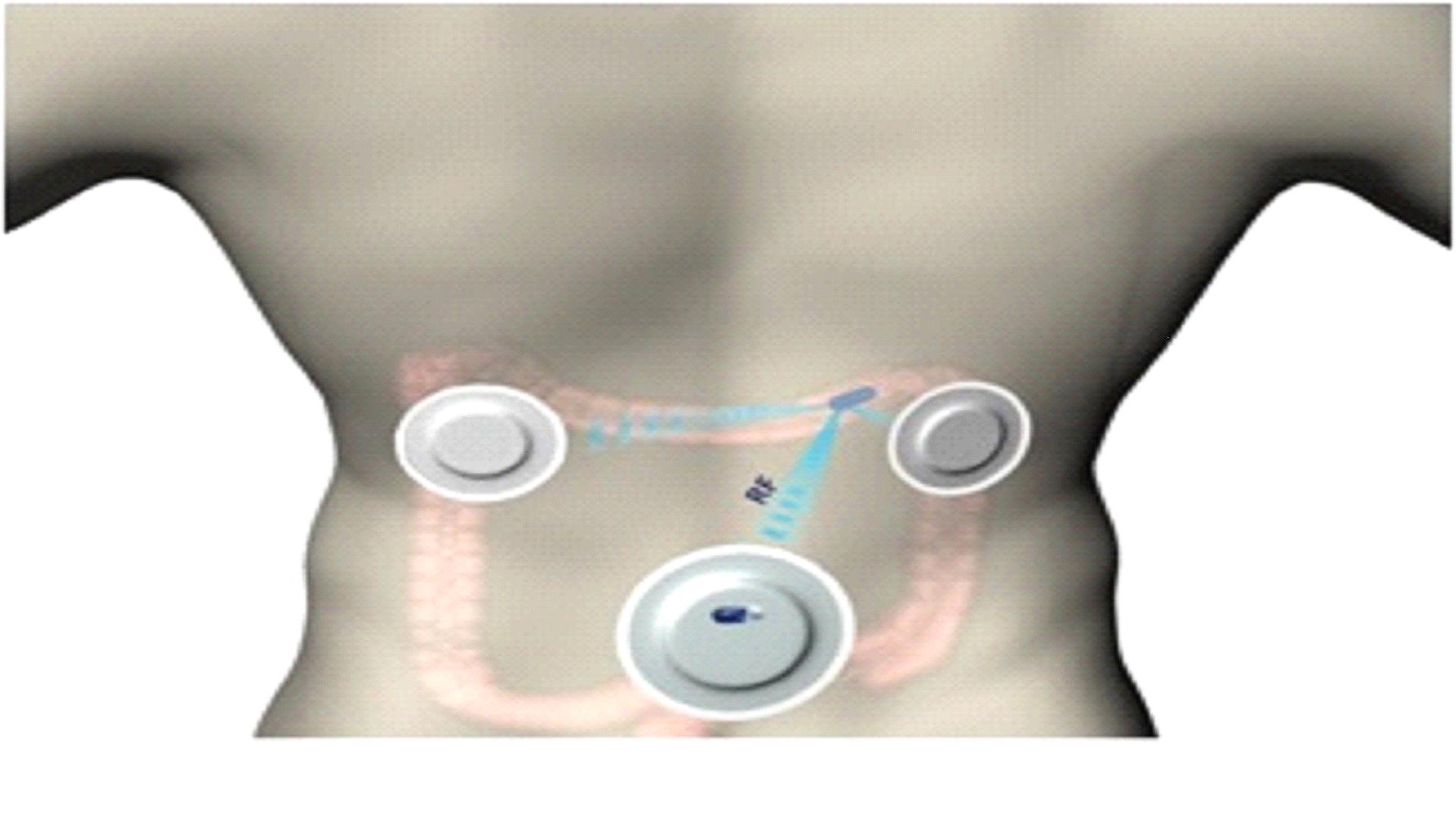
Image for illustration purpose only
C-Scan View
C-Scan View is a specialized, user friendly, personal computer-based software package designed to retrieve and process clinical data from the C-Scan Track and to reconstruct and produce 3D visualization of the colon’s inner surface. The C-Scan Track is comprised of the following software components:
| • |
Communication Driver Software – to communicate with the C-Scan Track and retrieve collected data following procedure completion.
|
| • |
Data Processing Software – to process and reconstruct clinical data into a 3D structure.
|
| • |
Data Display and Management Software – includes the following functions:
|
| ○ |
3D visualization of the reconstructed colon surface.
|
| ○ |
Annotation tools.
|
| ○ |
Registration of patient and capsule data and management of the patient database.
|
| ○ |
Report – to enable generation of clinical results report out.
|
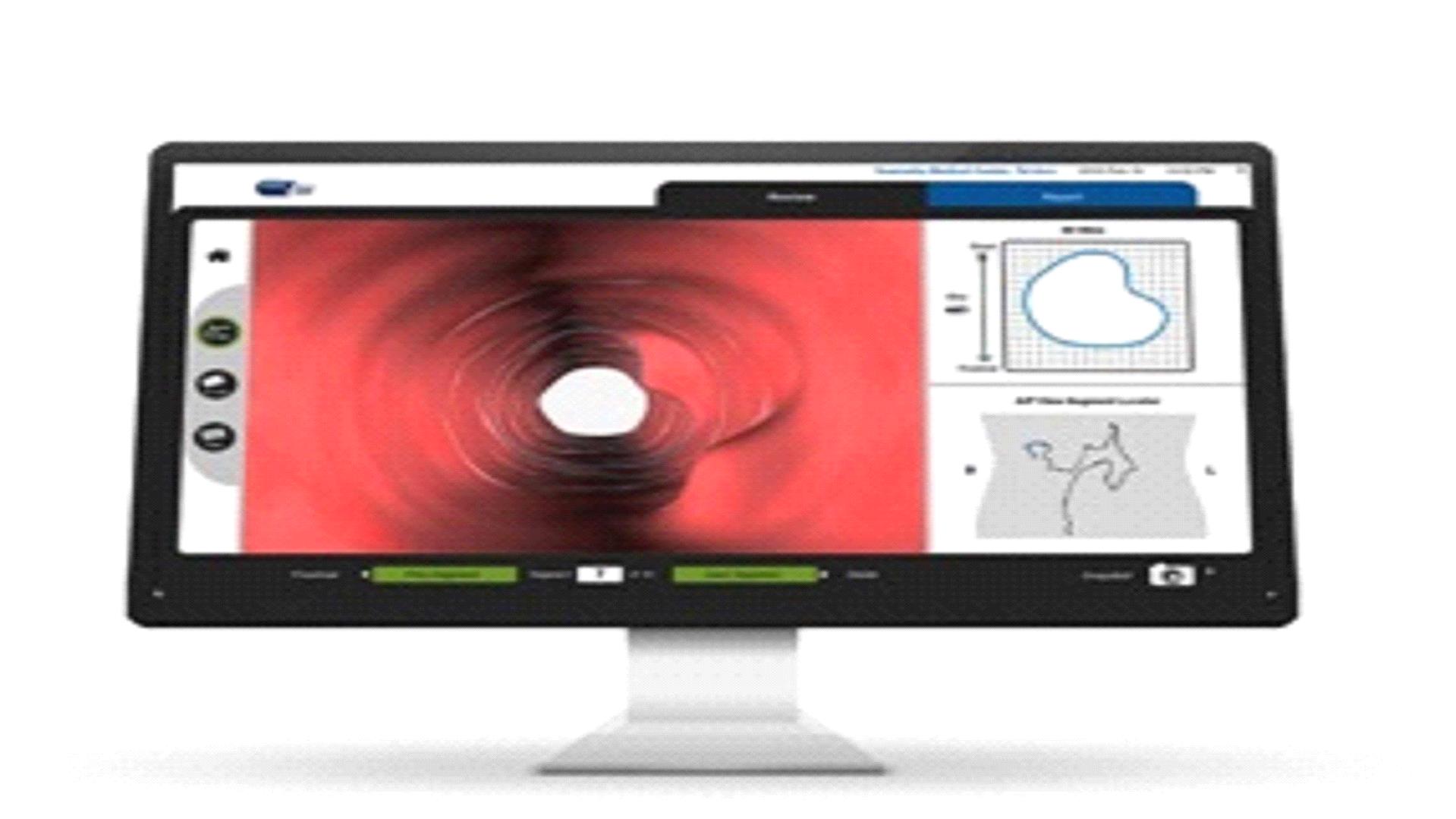
Image for illustration purpose only
C-Scan
System Non-Clinical, Pre-Clinical and Clinical History
We have developed and validated our capsule-based imaging modality for providing structural information on colonic polypoid lesions and masses for CRC screening. Below is a summary of the validation tests carried out by us in the laboratory, in phantoms, animals and humans, which were designed to evaluate this new imaging modality’s performance and potential clinical value.
41
Non-Clinical and Pre-Clinical Testing
Imaging Performance Testing
The C-Scan Cap transmits data as it transits the colon. This data consists of imaged slices perpendicular to the capsule’s longitudinal axis; slices are then reconstructed by the C-Scan View
to produce 2D and 3D images of the inner surface of the colon. Following are performance measurements of the capsule imaging.
•
Modulation Transfer Function, or MTF
. The capsule was moved along a longitudinal-edge phantom setup in 3mm steps. The figure below shows a typical raw signal after filtering for peak detection. The same test was carried out using an angular-edge phantom setup, which demonstrated similar results to those shown below. These tests do not take into account noise characteristics.
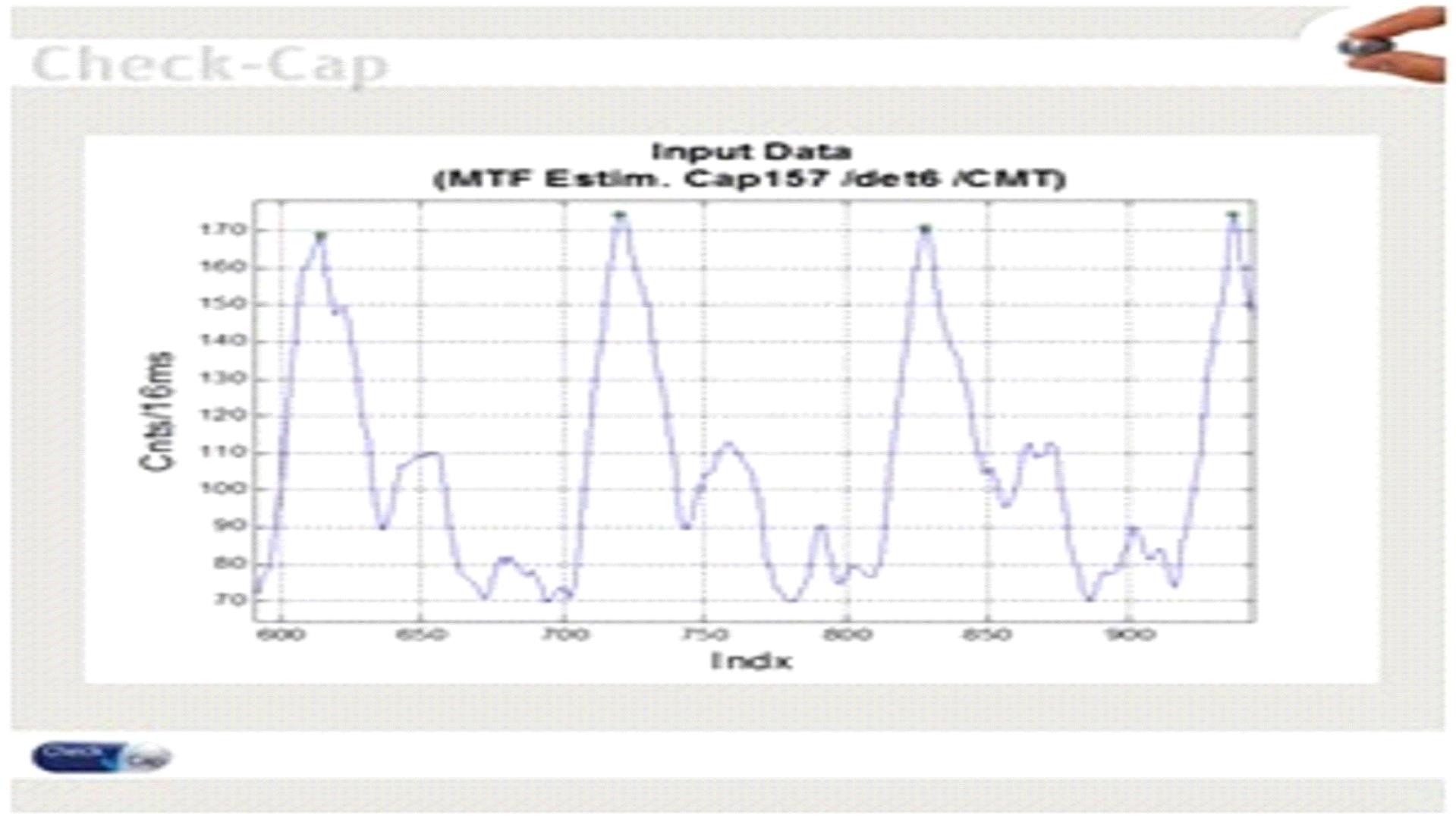
Image for illustration purpose only
For each position of the capsule in the phantom, the mean signal intensity (peak) was measured, the result of which is shown in the right figure below. Resulting line spread function, or LSF, which is the differential of the curve in the left figure below.

Image for illustration purpose only
The graphs above demonstrate that the existing design of our C-Scan system can detect objects of approximately 2-3mm when noise is not taken into account.
42
●
Resolution Limit: Estimation of the Smallest Visible Object Size.
In order to estimate the size of the smallest visible object, both spatial resolution and noise characteristics must be taken into account. The graph below presents the estimated MTF of our C-Scan system. Noise analysis indicates MTF 1/3 for minimum visibility, which demonstrates that the smallest visible object that can be detected with the existing design of our C-Scan system (in the conditions used, which included a colon diameter of 30mm) is of approximately 5-6 mm (see graph below).
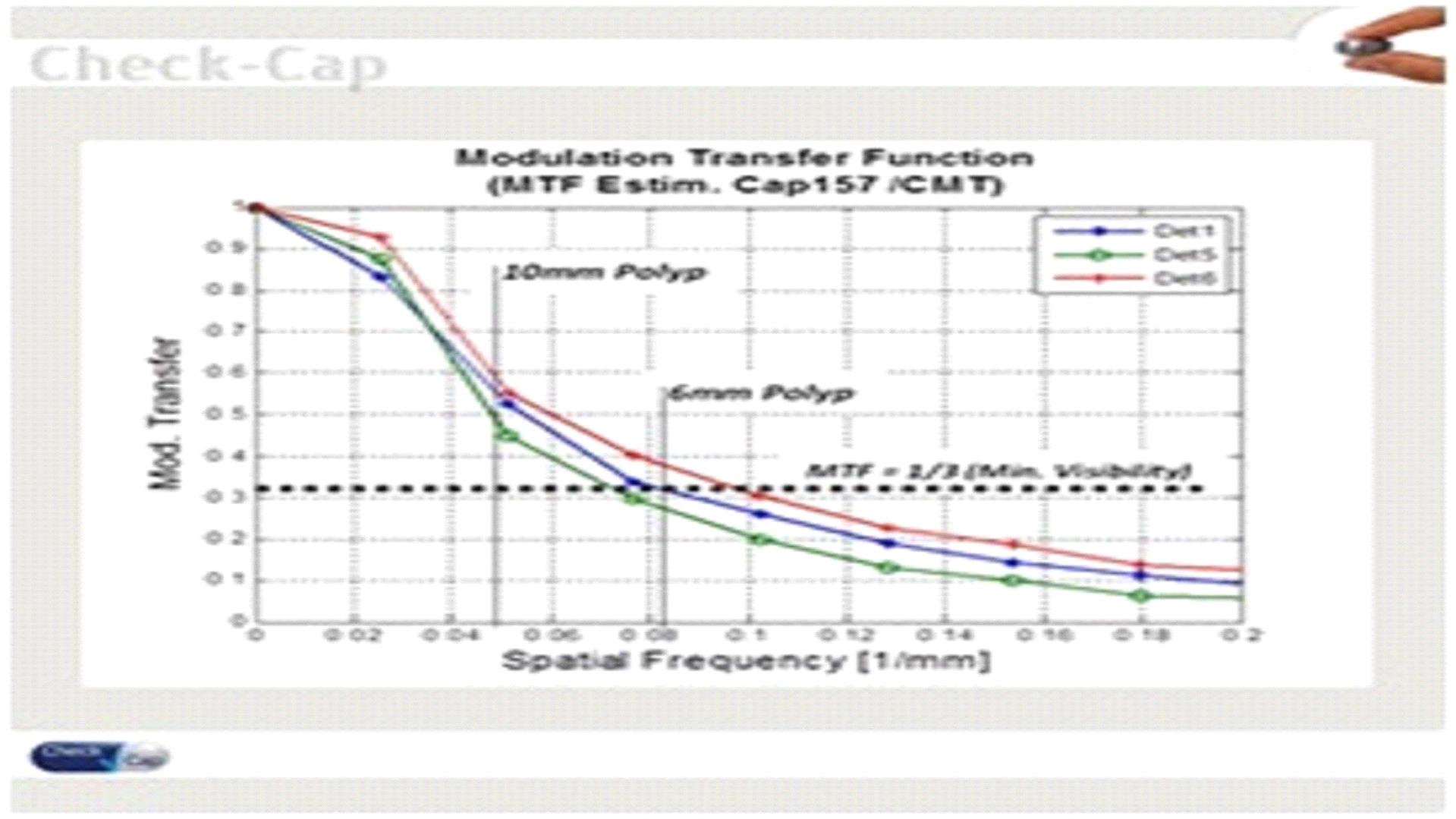
Image for illustration purpose only
Image Reconstruction
Two main characteristics of our C-Scan system contribute to the image reconstruction performance:
|
|
•
|
The number of photons hitting the detector per time frame.
|
|
|
•
|
The angular spread of the photon beam coming out of the capsule collimator.
|
Based on the laboratory tests performed with the previous version of our C-Scan system, polyps of 6 mm and larger should be visible and 10 mm polyps and larger are expected to be detected at high sensitivity. To further enhance the visibility of 6 mm - 9 mm polyps, a new design of the collimator was successfully tested in a prototype version of our C-Scan Cap, which is expected to enable 2.5 times the number of photons to be detected by the detectors, allowing the implementation of an image enhancement algorithm, which is expected to improve the imaging performance.
Animal Testing and Tissue Equivalent Phantom Image Reconstruction
The physics of our imaging modality was tested in the laboratory on phantoms with tissue equivalent material and in animals to ensure that laboratory conditions mimic real life clinical scenarios.
Following the initial proof of concept, we performed a series of studies in order to evaluate the feasibility and preliminary safety of our technology. All studies were performed in pigs ranging from 60 to 90 kg. Pigs, which are commonly used in gastrointestinal studies, were selected as the animal model for preliminary evaluation of our C-Scan system based on the resemblance of the porcine colon size and morphology to the human colon. However, there are marked differences between the colon of pigs and that of humans. The pig colon is much longer and as a larger diameter, in addition to other anatomical differences. In the pig model, the pressure waves of peristalsis are believed to be more frequent and shorter than in humans. As a result, we believe that colon content movement is substantially slower and more frequent in pigs than in humans. In these studies, we did not intend to collect statistically significant data; hence, the tests were repeated a limited number of times until adequate data was collected.
The first test was performed to demonstrate imaging proof-of-concept using a wired C-Scan system. This technology included all the basic features intended to be included in the clinical C-Scan system, but on a larger scale due to the use of off-the-shelf components. The subsequent studies used versions of the C-Scan system that integrated most of the imaging components, software and electronics of the C-Scan system that we used with humans. Since off-the-shelf components were used, the animal capsules were larger and heavier than the version of our C-Scan system that are used clinically.
43
Raw data from an animal colon showing a decrease in X-ray florescence, or XRF, photon signals and an increase in Compton backscattering, or CMT, signals corresponding to the position of a polyp that was detected when our C-Scan Cap passed over the polyp is shown in the image below. These two signals are combined in order to form a three dimensional image below.

Image for illustration purpose only
The animal studies conducted to date demonstrate that our technology provides sufficient resolution, in these studies, for the detection of 10 mm polyps which is the size of clinically significant polyps. The animal studies also demonstrated that 5 mm polyps can be detected, though with lower resolution than 10 mm polyps in the first animal capsule. Animal health was maintained throughout the studies. No adverse effects related to passage of our capsule were noted.
The capsules evaluated in the animal studies were significantly larger than the capsules that we are using with humans. The differences in anatomy, physiology, and capsules may have several effects on the data compared to use in the human population. Motility of the capsules through the digestive C-Scan system was slow due to the specific shape of the porcine gastrointestinal tract. In addition, because of the size of the capsule, it was retained in the stomach for many hours and even days. Accordingly, the animal model required that normal ingestion be replaced by direct insertion of the capsule into the small bowel. In order to simplify the development and animal testing, we used Tungsten radiation source with long half-life (120 days).
Following the success of the animal testing, a series of in-vitro tests were conducted to simulate different clinical scenarios in the laboratory using a miniaturized human capsule. Polyps were created and reconstruction of the laboratory phantoms with a human capsule was generated to assess the ability to detect polyps as the capsule advances in the colon. The in-vitro tests demonstrated the imaging capabilities of our imaging technology. Below is the reconstruction of a laboratory phantom image.
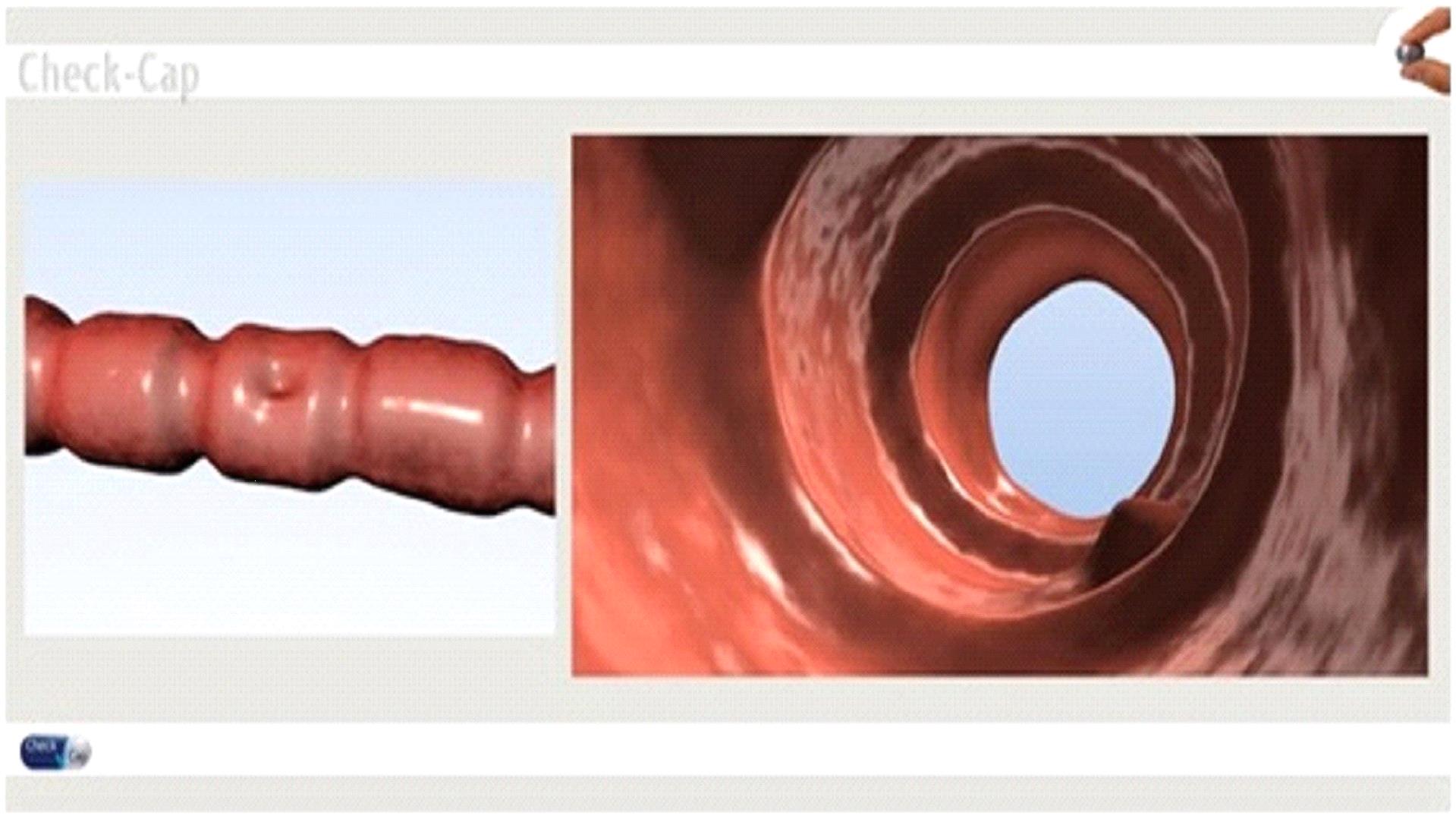
Image for illustration purpose only
44
Polyp Detection Analysis
Laboratory tests were carried out to estimate the capsule’s ability to detect polyps in phantoms and demonstrate sensitivity and specificity of such detection. Below is an example of the reconstruction of a scan composed of three slices: XRF, CMT and a fused (combined) image.
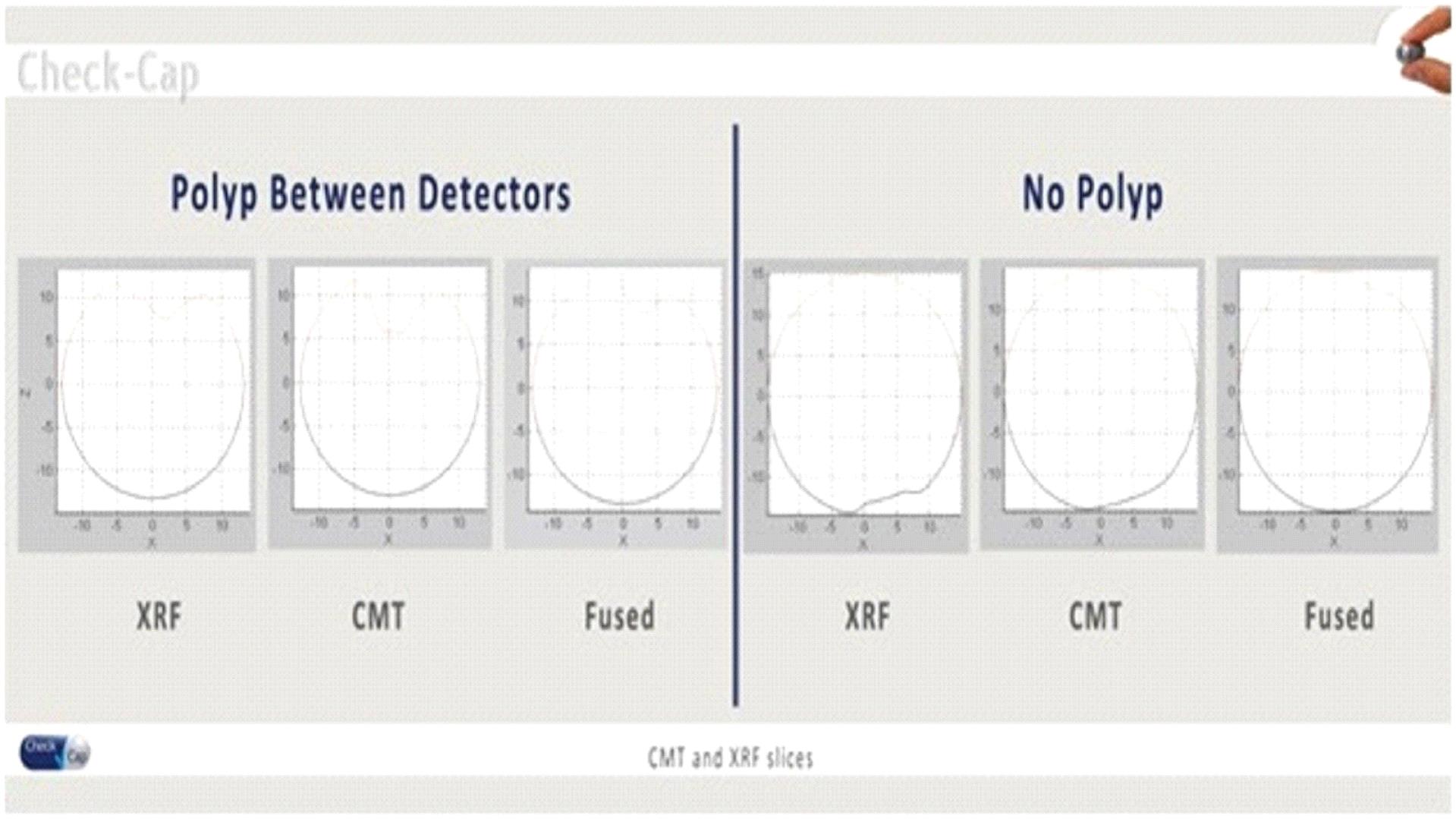
Receiver Operating Characteristics
Standard receiver operating characteristics, or ROC, curves were generated from phantom data with 8 mm polyp in a 30 mm barrel phantom with 3% iodine concentration mimicking the colon contents. CMT, XRF and fused (combined) data were analyzed based on 2D slices that were generated and standard deviation indicator. There were a few cases where the noise in the phantoms was high enough to generate polyp false positive condition separately for each data type, especially in CMT. However, fusion of CMT and XRF data contributed to noise reduction and enabled to demonstrate 100% true positive and 0% false positive.
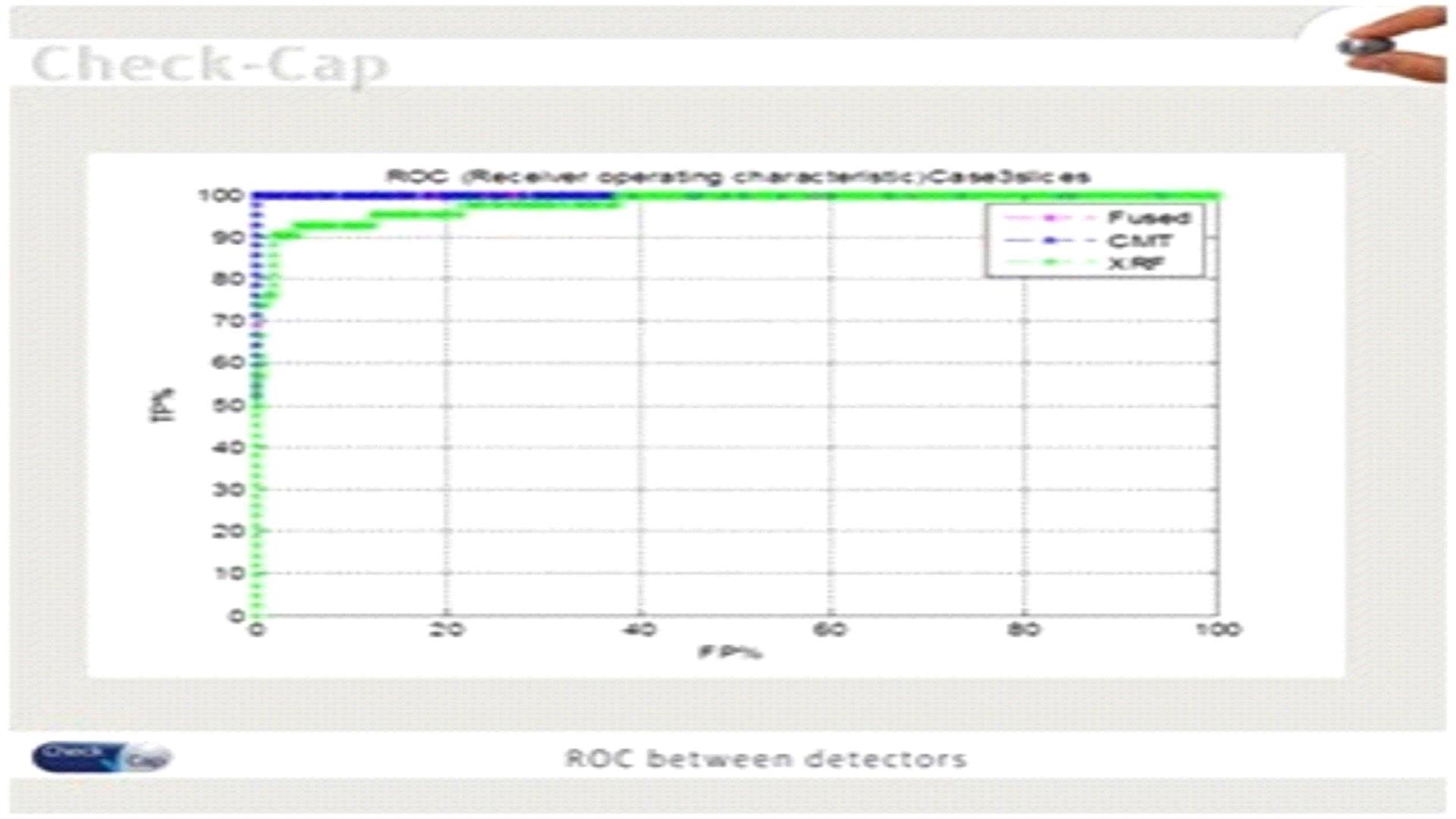
Clinical Trials
We initiated our first clinical study at University Hospital, Hamburg, Germany in 2010. The purpose of this study was to monitor and record the colon contractions and the associated motility of the capsule in the colon. This study was conducted with a passive capsule that contained no X-ray source or detectors. It included several electronic components of the C-Scan system and had similar dimensions to the current capsule. 63 healthy volunteers were enrolled and no adverse events were reported.
We completed a limited, single-center, feasibility study at Rambam Medical Center, Haifa, Israel to assess the motility of a non-scanning capsule in healthy subjects. The objective of the study was optimizing the daily routine of the subjects in order to shorten the transit time of our capsule. 15 subjects participated and swallowed a capsule with the same weight and dimensions as our current capsule. No adverse events were reported and all capsules were retrieved. A structured daily routine determined the timing of the following: capsule ingestion, the subjects’ daily meals, the contrast agent ingestion and one evening dose of 10 mg of Bisacodyl, and all subjects continued their regular active lifestyles (such as work and exercise). The average transit time of the capsule in the 15 subjects was approximately 38 ± 19 hours, which is comparable to the average transit time of our capsule in subjects participating in the multi-center feasibility study, in which the participants do not ingest a daily dose of Bisacodyl, and participants are released to their homes and continue their regular lifestyles during the study.
45
A 10 subject clinical proof-of-concept study, conducted at Tel Aviv Sourasky Medical Center in Israel and using a prior version of our C-Scan system, did not identify any material safety or feasibility issues. The study demonstrated the applicability of our C-Scan system to the human colon, generating images of the colon without any prior bowel preparation. All subjects ingested the capsule easily with smooth passage within the designated transit time, on average, within 48-72 hours. There were no reported device-related adverse events. Mild effects on bowel movements were noted, which were determined to be related to the contrast agent and passed within one to two days after the capsule excretion. Estimated total radiation exposure was calculated using standard established factors for calculating effective radiation exposure, such as the duration of the capsule inside the body, and was based on the activity of the radiation source inside the C-Scan Cap and radiation energy, both of which were measured for each case study. The average calculated exposure for the entire procedure in the 10-case study, from ingestion of the capsule to excretion, was 0.03 mSv (STD 0.007 mSv). This level of radiation exposure is similar to a single chest X-ray (approximately 0.06mSv) and two orders of magnitude less than a CTC.
The 10-subject study constituted the initial phase of a multi-center, prospective clinical feasibility study to establish the safety, functionality and preliminary efficacy of our C-Scan system in patients eligible for CRC screening, by comparing results from the clinical feasibility study with those from non-invasive, low-sensitivity FITs, as well as from optical colonoscopies. The feasibility study has been designed to allow for the recruitment of 100 subjects. The study was conducted at multiple centers in Israel. The clinical feasibility study was used to evaluate the image resolution generated by the capsule in a human colon without cathartic preparation, assess polyp imaging in various shapes and in different segments of the colon, and evaluated the safety of the device in terms of total and segmental transit time and analyze the effects of the presence of polyps and variable colon dimensions on these parameters. During the feasibility study we collected data regarding the overall imaging of the colon’s internal surfaces during the passage of the capsule to support the development of a correlation map of polyps identified through our imaging system with polyps imaged by optical colonoscopy and CTC. Additionally, the feasibility study allowed for the measurement of total radiation exposure and the distribution of contrast material within the colon.
Analysis conducted on the first 66 capsules swallowed by participants enrolled in the multi-center, prospective clinical feasibility study showed that 65 of 66 capsules swallowed were naturally eliminated, without major or minor side effects, after 62±40.7 hours. The average calculated radiation exposure was 0.06 ± 0.04 mSv (similar to a single chest radiograph). Image reconstructions allowed 2D/3D views of the colonic wall and lumen with the typical contour of different segments (hepatic flexure, triangular shape of the transverse colon). Both pedunculated and sessile polyps were detected in several patients and validated later by colonoscopy.
In September 2017, we completed a multi-center study of the C-Scan system in support of CE Mark submission. The objective of the study was to assess safety and the clinical performance of C-Scan in detecting patients with polyps. The three-center trial enrolled 66 patients, with a mean age of 59 years. Following capsule ingestion, subjects swallowed small doses of contrast agent and fiber supplements with each meal throughout capsule passage. Average capsule transit time was 52±32 hours, and the average total X-ray dose was 0.05 mSv (CT colonography effective dose is ~ 6.0 mSv). No bowel preparation, sedation, or change in diet was required. Both confirmatory colonoscopy, performed by an independent investigator, and C-Scan review, performed by a central review group, were blinded to results. The study demonstrated a 44% sensitivity in the 45 subjects included in the analysis for polyps, with specificity of 89%. Sensitivity strongly correlated (R-squared = 0.98) to the percentage of the colon scanned. Sensitivity was 78% (p<0.05) and 100% (p<0.05) for subjects where greater than 50% and 70% of the colon was scanned, respectively. Specificity was consistent for all subjects.
In October 2017, we were accepted for late breaking oral presentation of clinical safety and performance study abstract "Clinical Performance of a Novel X-ray Based Imaging Capsule for Colonic Screening", and for a presentation of “A novel capsule technology platform for specific localized colon drug delivery” poster, recognized as one of “Posters of Excellence” at the UEG Week 2017 in Barcelona, Spain.
In the fourth quarter of 2017, we initiated a clinical study for the purpose of introducing an advanced C-Scan version with improved colon scan coverage, Version 3 (formerly referred to as Advanced C-Scan system), which incorporates the latest algorithms and system optimization and tailors scanning of the colon to the patient’s natural colonic movements to maximize the amount
of the colon that is tracked and imaged
. Evaluable results of 21 patients showed average colon imaging coverage of 64%, a 40% improvement over 46% average colon imaging coverage in the multi-center study. Sensitivity was 78% (p<0.05) for subjects with greater than 50% colon imaging coverage and 100% (p<0.05) for subjects with greater than 70% colon imaging coverage. Specificity (ability to correctly identify lack of polyps) was consistent at around 89%.
During the first quarter of 2018, we initiated an EU post-approval study using our C-Scan system Version 3 for the purpose of collecting additional evidence of clinical effectiveness and clinical utility to support market adoption.
46
Research and Development
Our research and development strategy is centered on developing our C-Scan system. Our research and development team is located at our facilities in Isfiya, Israel, and consists of 39 employees and independent contractors as of March 30, 2018 and is supported by highly experienced consultants.
We have received grants from the Government of the State of Israel through the IIA (formerly the OCS) for the financing of a portion of our research and development expenditures pursuant to the Research Law and related regulations and guidelines. As of December 31, 2017, we had received funding from the IIA in the aggregate amount of $5.3 million and had a contingent obligation to the IIA in the amount of $5.6 million. As of December 31, 2017, we had not paid any royalties to the IIA. We may apply for additional IIA grants in the future; however, there is no assurance that such applications will be approved in the amount requested or at all. Furthermore, the funds available for IIA grants out of the annual budget of the State of Israel have been reduced in the past and may be further reduced in the future. We cannot predict whether we will be entitled to any future grants, or the amounts of any such grants.
We incurred approximately $6.8 million, $5.5 million and $5.8 million in research and development expenses, net (after deducting participation by others and government grants) for the years ended December 31, 2017, 2016 and 2015, respectively. For additional information, see “Management’s Discussion and Analysis of Financial Condition and Results of Operations—Financial Operations Overview— Research and Development Expenses, Net.”
Intellectual Property
An important part of our competitive strategy is to seek, when appropriate, protection for our products and proprietary technology through a combination of U.S. and foreign patents, trademarks, trade secrets and non-disclosure and confidentiality, assignment of invention and other contractual arrangements with our employees, consultants and suppliers. These measures, however, may not be adequate to protect our technology from unauthorized disclosure, third-party infringement or misappropriation as these parties may breach these agreements, and we may not have adequate remedies for any such breach. We intend to prosecute and defend our proprietary technology. The primary test for patent protection eligibility includes novelty, non-obviousness and usefulness.
We submit applications under the Patent Cooperation Treaty, or PCT, which is an international patent law treaty that provides a unified procedure for filing a single initial patent application to seek patent protection for an invention simultaneously in each of the member states. Although a PCT application is not itself examined and cannot issue as a patent, it allows the applicant to seek protection in any of the member states through national-phase applications.
As of December 31, 2017, we had 30 granted patents (not including separate validations in Europe), 2 allowed patent applications and 23 pending patent applications worldwide relating to various elements and functions of our products and related enhancements. We have submitted patent applications covering our technology in the United States, member states of the European Patent Organisation, Australia, Brazil, Canada, China, Hong Kong, India, Israel, Japan and South Korea. We have received patent grants for our core patent by the United States Patent and Trademark Office as well as from the European Patent Office, Australia, China, Hong Kong, Israel, India, Canada, South Korea and Japan. We also filed patent applications describing the use of our technology in several other medical applications.
Our registered U.S. Patent Number 7,787,926 discloses an ingestible capsule with a radiation source and radiation detectors that, when used in conjunction with a radio opaque contrast agent, is adapted to detect clinically relevant findings in the colon. Utilizing X-ray fluorescence and Compton back scatterings, the capsule is able to measure the distance between the capsule and the colon wall and to distinguish between gas, intestinal contents, and clinically significant findings in the gastrointestinal tract.
A second PCT patent application (PCT/IL2008/000163), which is pending in Canada in the national-phase and granted in Europe, Israel, United States, Australia, India, China and Hong Kong, discloses additional features such as a rotating collimator and improved scanning mechanisms, the capability to determine tissue density to differentiate between different types of polyps, as well as the capability to determine capsule movement in the colon. Another PCT application (PCT/IL2011/000462), which is pending in Brazil in the PCT national-phase and granted in Europe, Israel, United States, Canada, Australia and South Korea, discloses a number of alternate fail safe concealment mechanisms that can be utilized in the capsule to ensure that the X-ray source is blocked when the capsule is not scanning and is open when it is scanning, allowing the capsule to image the colon. The fail-safe feature ensures that in the event of power failure, the radiation source is blocked and X-rays do not escape.
In another PCT patent application (PCT/IL2008/000765), which was granted in the United States, Europe, Israel and Japan, we disclose an imaging catheter that utilizes X-ray fluorescence, Compton back scattering and electron back scattering. The imaging catheter is designed for use in cardiac applications as well as intra-operative imaging applications such as imaging inside blood vessels where optical imaging cannot be performed because of obscuring circumstances.
47
While our policy is to obtain patents by application, to maintain trade secrets and to seek to operate without infringing on the intellectual property rights of third parties, technologies related to our business have been rapidly developing in recent years. Additionally, patent applications that we may file may not result in the issuance of patents, and our issued patents and any issued patents that we may receive in the future may be challenged, invalidated or circumvented. For example, we cannot predict the extent of claims that may be allowed or enforced in our patents nor be certain of the priority of inventions covered by pending third-party patent applications. If third parties prepare and file patent applications that also claim technology or therapeutics to which we have rights, we may have to partake in proceedings to determine priority of invention, which could result in substantial costs to us, even if the eventual outcome is favorable to us. Moreover, because of the extensive time required for clinical development and regulatory review of a product we may develop, it is possible that, before our C-Scan system can be commercialized, related patents will have expired or will expire a short period following commercialization, thereby reducing the advantage of such patent. Loss or invalidation of certain of our patents, or a finding of unenforceability or limited scope of certain of our intellectual property, could have a material adverse effect on us. See “Item 3D “Key Information - Risk Factors— Risks Related to Our Intellectual Property.”
In addition to patent protection, we rely on trade secrets, including unpatented know-how, technology innovation, drawings, technical specifications and other proprietary. We also rely on protection available under trademark laws, and hold the following registered trademarks in the United States: “CHECK CAP”, CHECK CAP (logo), “C-Scan” and C-Scan (logo), and the following trademarks in the European Union: CHECK CAP (logo), “C-Scan” and C-Scan (logo).
Competition
Competition for our C-Scan system comes from traditional well-entrenched manufacturers of tests and equipment for CRC screening, such as colonoscopy, sigmoidoscopy, CTC, optical capsule endoscopy, FOBTs and FITs. The principal manufacturers of equipment for optical colonoscopy and sigmoidoscopy include Olympus, Pentax, Hoya and Fuji Film. The principal manufacturers of equipment for CTC include General Electric Healthcare Systems, Siemens Medical Solutions, Philips Medical Systems Ltd. and Toshiba Corporation. The principal manufacture of equipment for optical capsule endoscopy includes Medtronic plc. All of these companies have substantially greater financial resources than we do, and they have established reputations as well as worldwide distribution channels for providing medical instruments to physicians.
Several companies have developed or are developing non-invasive technologies based on stool, serum, or molecular diagnostics (from blood and other bodily fluids), or MDx, tests that are used to indicate the presence of CRC and polyps in the colon. These companies include Polymedco, Exact Sciences , Epigenomics AG,
Gene News, EDP Biotech Corporation, Illumina, Inc., Quest Diagnostics
and VolitionRx Nu.Q diagnostic.
Procedures for bowel cleansing that are less onerous are constantly being developed, which could make our entry into the market more difficult. For instance, bowel cleansing initiated by the ingestion of pills or food-substitute diet regimes rather than through drinking large amounts of distasteful liquids may be viewed as an improvement to the cleansing process, but other screening methods may be even more palatable to patients.
Sales and Marketing
Our goal is to establish our position as a leading player in the CRC screening market. Although we do not currently generate revenues, we expect to generate revenues through sales of our C-Scan system following demonstration of acceptable clinical safety and effectiveness and obtaining required regulatory approvals and licensures.
Because we are still in the clinical and development stage, we are subject to certain challenges, including, among others, that:
| • |
our technology has been tested on a limited basis and therefore we cannot assure the product’s clinical value;
|
| • |
following the receipt of CE Mark of conformity for the C-Scan system in the European Union, we need to obtain the requisite regulatory approvals in the United States, Japan and other markets where we plan to focus our commercialization efforts;
|
| • |
we need to raise an amount of capital sufficient to complete the development of our technology, obtain the requisite regulatory approvals and commercialize our current and future products;
|
| • |
we need to obtain reimbursement coverage from third-party payors for procedures using our C-Scan system;
|
| • |
we need to increase our manufacturing capabilities; and
|
48
| • |
we need to establish and expand our user base while competing against other sellers of capsule endoscopy systems as well as other current and future CRC screening technologies and methods.
|
Our ability to operate our business and achieve our goals and strategies is subject to numerous risks as described more fully in “Risk Factors.”
Subject to our receipt of regulatory approvals, available capital, and engagement with strategic partners, we expect to commercialize our C-Scan system during 2019 in selected markets in Europe. We intend to target major markets in Europe. In these markets, we are planning to work with strategic partners and/or local distributors who are active in the gastroenterology field and who have already demonstrated excellent performance in introducing new and innovative technologies.
In Europe and Japan, we intend to offer our C-Scan system as an imaging and screening tool for the general population. In the United States, we may choose to first obtain regulatory clearance/approval for our C-Scan system in a screening sub-population, and after we have conducted more extensive clinical studies in the United States, we would anticipate applying to the FDA for the use of our C-Scan system as a primary screening tool.
Subject to the successful completion of our clinical trials and the receipt of our initial FDA clearance/approval, we expect to launch the product in the U.S. market, where we will consider setting up our own sales force or aligning with a strategic partner. Initially, we are planning to sell our C-Scan system to the private sector. Simultaneously, we will work intensively to obtain reimbursement by Medicare and private insurers within the shortest possible time frame.
Subject to local regulatory approval, we also intend to market our C-Scan system in key markets in Asia. Initial efforts will focus in Japan in view of its developed CRC screening market.
Manufacturing and Suppliers
Our manufacturing operations are conducted at a facility located in Isfiya, Israel. We lease approximately 900 square meters at this facility under a lease agreement expiring on May 31, 2022. We have the right to terminate the agreement at any time, upon as least 60 days prior written notice. We currently have sufficient space to manufacture our C-Scan system for the clinical studies, but have limited resources, facilities and experience in commercially manufacturing large quantities of our C-Scan system and software application to meet the demand we expect from our expanded commercialization efforts. We expect to face certain technical challenges as we increase manufacturing capacity, including, among others, logistics associated with the handling of radioactive materials, equipment design and automation, material procurement, lower than expected yields and increased scrap costs, as well as challenges related to maintaining quality control and assurance standards. Our production objective is to establish a scalable capacity in order to meet such expanded demand for our C-Scan system and market expansion. If we are unable to scale our manufacturing capabilities to meet market demand, our growth could be limited and our business, financial condition and results of operations could be materially adversely affected.
We are continuing to upgrade and expand our production system and capacity and developing supply chain systems to support production for clinical trials and to meet standards for CE post-marketing. Our current capacity was built to accommodate our clinical phase. We have integrated a product life management system to enable overall life cycle tracking and documentation including full configuration management control and manufacturing documentation.
In November 2017, we entered into an agreement with GE Healthcare, which furthers our manufacturing collaboration with GE and involves GE’s final assembly, packaging and shipping of C-Scan capsules,
initially to support our U.S. pilot trial that we expect to initiate during 2018,
subject to required approvals and available capital.
We will supply GE with supporting calibration and final assembly methodology and equipment.
We do not currently have any sales. We are planning to develop a scale-up plan to meet our expected commercial supply needs. We are also working on a plan to expand our manufacturing capacity to support the expected larger clinical volume and subsequent higher volumes expected in the early commercialization stage. We are considering, among other options, the expansion of our assembly line in Israel, the buildup of new assembly lines in the United States and Europe, and alternative sources for the key capsule components (such as the motor, X-ray detectors, electrical components and PCBs). All of the facilities in which manufacturing and assembly of our products will be conducted will need to comply with applicable regulations and standards for medical devices.
49
We have received grants from Government of the State of Israel through the IIA (formerly the OCS) for the financing of a portion of our research and development expenditures pursuant to the Research Law and related regulations and guidelines. Under the terms of the Research Law as currently in effect, products developed with IIA grants are required to be manufactured in Israel and the technology developed thereunder may not be transferred outside of Israel (including by way of license), unless prior approval is received from the IIA, which we may not receive (and any such approval would be subject to increased royalty repayment rates and increased royalties). We are currently considering whether it would be possible to assemble the capsule without the X-ray source in Israel, and have the X-ray source subsequently assembled into our C-Scan system at a reactor or cyclotron site or at a distribution center outside Israel. Even following the full repayment of any IIA grants, we must nevertheless continue to comply with the requirements of the Research Law and regulations and guidelines thereunder. The foregoing restrictions may impair our ability to outsource or transfer development or manufacturing activities with respect to any product or technology outside of Israel. A significant amendment to the Research Law entered into effect on January 1, 2016, under which the IIA, a statutory government corporation, was established and replaced the OCS. Under such amendment, the IIA is authorized to establish rules concerning the ownership and exploitation of IIA-funded know-how (including with respect to restrictions on transfer of manufacturing activities and IIA-funded know-how outside of Israel, which may differ from the restrictive laws, regulations and guidelines as in effect prior to
the establishment of such rules
(and which remain in effect until such rules have been established by the IIA). See “Risk Factors – Risks Related to Our Operations in Israel.”
We currently depend on single source suppliers for some of the components necessary for the production of our C-Scan system. For example, for the current version of the C-Scan system used in clinical trials, we currently have a single supplier for the motor used to rotate the collimated X-ray source in our C-Scan system and for each of the specially designed X-ray detectors, X-ray source and batteries used in our C-Scan system. There are a limited number of manufacturers worldwide who are capable of manufacturing the motor and the specially designed X-ray detectors and X-ray source that we currently use in our C-Scan system. In addition, the ASIC residing in our C-Scan system is currently manufactured for us by a single FAB. However, there are many alternative FABs worldwide and the design of our current ASIC could be adapted in the event it became necessary to use an alternative FAB. Furthermore, we do not currently have written contracts with all of such suppliers.
While our current suppliers have been able to supply the required quantities of such components to date, if the supply of these components is disrupted or terminated or if our current suppliers are unable to supply required quantities of components, we may not be able to find alternative sources for these key components in a timely manner. Although we are planning to maintain strategic inventory of key components, the inventory may not be sufficient to satisfy the demand for our C-Scan system if such supply is interrupted, or subject to risk of loss due to catastrophic events such as a fire at our storage facility. As a result of the foregoing, we may be unable to meet the demand for our C-Scan system, which could harm our ability to generate revenues, lead to customer dissatisfaction and damage our reputation. If we are required to change the manufacturer of any of these key components, there may be a significant delay in locating a suitable alternative manufacturer. In addition, we may be required to verify that the new manufacturer maintains facilities and procedures that comply with FDA and other applicable quality standards and with all applicable regulations and guidelines. For example, our agreement with the supplier of the X-ray source used in our C-Scan system terminates on December 31, 2108 and we have been informed that the supplier of the batteries used in our C-Scan system shall cease to manufacture the batteries by mid-2019 and may cease to accept new orders effective immediately and, therefore, we will be required to find an alternative source for the X-ray source and batteries, which we may not be able to do in a timely manner. The delays associated with the identification of a new manufacturer could delay our ability to manufacture our C-Scan system in a timely manner or within budget. Furthermore, in the event that the manufacturer of a key component of our C-Scan system ceases operations or otherwise ceases to do business with us, we may not have access to the information necessary to enable another supplier to manufacture the component. The occurrence of any of these events could harm our ability to meet demand for our C-Scan system in a timely manner or within budget.
Environmental Health and Safety Matters
We are subject to environmental health and safety laws and regulations in Israel, governing, among other things, the use of radioactive materials, including the Israeli Work Safety Regulations (Occupational Safety and Health of Ionizing Radiation Practitioners) 1992-5753 and Women Employment Regulations (Work with Ionizing Radiation), 1979-5739. Our current research and development activities require, and our currently contemplated commercial activities will require, permits from various governmental authorities including, Israel’s Ministry of Environmental Protection, Israel’s Ministry of Health and local municipal authorities. Failure to obtain or maintain any such permits could have a material adverse effect on our business, financial condition and results of operations. The Ministry of Environmental Protection and the Ministry of Health conduct periodic inspections in order to review and ensure our compliance with the various regulations.
These laws, regulations and permits could potentially require expenditure by us for compliance or remediation. If we fail to comply with such laws, regulations or permits, we may be subject to fines and other civil, administrative or criminal sanctions, including the revocation of permits and licenses necessary to continue our business activities. In addition, we may be required to pay damages or civil judgments in respect of third-party claims, including those relating to personal injury (including exposure to radioactive materials) or contribution claims. Some environmental, health and safety laws allow for strict, joint and several liability for remediation costs, regardless of comparative fault. We may be identified as a responsible party under such laws. Such developments could have a material adverse effect on our business, financial condition and results of operations.
In addition, laws and regulations relating to environmental, health and safety matters are often subject to change. In the event of any changes or new laws or regulations, we could be subject to new compliance measures or to penalties for activities which were previously permitted.
50
U.S. Government Regulation
Our C-Scan system is a medical device subject to extensive regulation by FDA and other U.S. federal and state regulatory bodies. To ensure that medical products distributed in the United States are safe and effective for their intended use, FDA has imposed regulations that govern, among other things, the following activities that we or our partners perform and will continue to perform:
| • |
product design and development;
|
| • |
product testing;
|
| • |
validation and verifications;
|
| • |
product manufacturing;
|
| • |
product labeling;
|
| • |
product storage, shipping and handling;
|
| • |
premarket clearance or approval;
|
| • |
advertising and promotion;
|
| • |
product marketing, sales and distribution; and
|
| • |
post-market surveillance reporting death or serious injuries and medical device reporting.
|
FDA’s Premarket Clearance and Approval Requirements
Unless an exemption applies, before we can commercially distribute medical devices in the United States, we must obtain, depending on the type of device, either prior 510(k) clearance or PMA approval from the FDA. The FDA classifies medical devices into one of three classes:
| • |
Class I devices, which are subject to only general controls (
e.g.
, labeling, medical devices reporting, and prohibitions against adulteration and misbranding) and, in some cases, to the 510(k) premarket clearance requirements;
|
| • |
Class II devices, generally requiring 510(k) premarket clearance before they may be commercially marketed in the United States; and
|
| • |
Class III devices, consisting of devices deemed by the FDA to pose the greatest risk, such as life-sustaining, life-supporting or implantable devices, or devices deemed not substantially equivalent to a predicate device, generally requiring the submission of a PMA approval supported by clinical trial data.
|
510(k) Clearance Pathway
To obtain 510(k) clearance, we must submit a premarket notification, or 510(k) notice, demonstrating that the proposed device is substantially equivalent to a previously cleared 510(k) device or a device that was in commercial distribution before May 28, 1976 for which the FDA has not yet called for the submission of premarket approval applications. The FDA’s 510(k) clearance pathway may take approximately between 6 to 9 months, but it can take significantly longer. FDA may require additional information, including clinical data, to make a determination regarding substantial equivalence.
After a device receives 510(k) clearance, any modification that could significantly affect its safety or effectiveness, or that would constitute a new or major change in its intended use, will require a new 510(k) clearance or, depending on the modification, require premarket approval. The FDA requires each manufacturer to determine whether the proposed change requires submission of a 510(k), or a premarket approval, but the FDA can review any such decision and can disagree with a manufacturer’s determination. If the FDA disagrees with a manufacturer’s determination, the FDA can require the manufacturer to cease marketing and/or recall the modified device until 510(k) clearance or premarket approval is obtained. If the FDA requires us to seek 510(k) clearance or premarket approval for any modifications to a previously cleared product, we may be required to cease marketing or recall the modified device until we obtain this clearance or approval. Also, in these circumstances, we may be subject to significant regulatory fines or penalties.
51
De Novo Reclassification
If the FDA finds that there is no suitable predicate device for our C-Scan system, it will automatically be considered a class III device. However, in instances where a device is novel and there is no suitable predicate device, but that device is deemed to be of low to moderate risk, the FDA can reclassify the device to class I or class II via de novo reclassification. This process involves the submission of a reclassification petition, and the FDA's acceptance that “special controls” are adequate to ensure the product’s performance and safety.
The FDA now allows “direct” de novo reclassification petitions, a mechanism by which a sponsor can directly submit a detailed de novo reclassification petition as the device’s initial submission without having to first receive a not substantially equivalent, or NSE, decision on a 510(k) submission. The direct de novo pathway takes at least 9 to 12 months from submission of the petition to device clearance.
Our current strategy is to submit a direct de novo reclassification petition for our C-Scan system. To support a direct de novo reclassification petition, our objective is to demonstrate that the device poses a low to moderate risk to patients. If the FDA determines that our C-Scan system is not a candidate for de novo reclassification, it will require approval of the device for market through the PMA process.
Alternatively, if we seek 510(k) clearance and our device is found not substantially equivalent, or NSE, a de novo petition must be filed within 30 days from the receipt of the NSE determination. The request should include a description of the device, labeling for the device, reasons for the recommended classification and information to support the recommendation. The de novo process following an NSE determination has a 60-day review period, although it is typical for the review to take far longer. If the FDA classifies the device into class II, the company will then receive an approval order to market the device. This device type can then be used as a predicate device for future 510(k) submissions. However, if the FDA subsequently determines that the device will remain in the class III category, then the device may not be marketed until the company has obtained an approved PMA.
Premarket Approval Pathway
A premarket approval application must be submitted if the device cannot be cleared through the 510(k) process or is found ineligible for de novo reclassification. The premarket approval application process is generally more costly and time consuming than the 510(k) process. A premarket approval application must be supported by extensive data including, but not limited to, technical, preclinical, clinical trials, manufacturing and labeling to demonstrate to the FDA’s satisfaction the safety and effectiveness of the device for its intended use.
After a premarket approval application is sufficiently complete, the FDA will accept the application and begin an in-depth review of the submitted information. By statute, the FDA has 180 days to review the “accepted application,” although, generally, review of the application can take at least 12 to 18 months, but it may take significantly longer. During this review period, the FDA may request additional information or clarification of information already provided. Also during the review period, an advisory panel of experts from outside FDA may be convened to review and evaluate the application and provide recommendations to the FDA as to the approvability of the device. In addition, the FDA will conduct a preapproval inspection of the manufacturing facility to ensure compliance with quality system regulations. New premarket approval applications or premarket approval application supplements are required for modifications that affect the safety or effectiveness of the device, including, for example, certain types of modifications to the device’s indication for use, manufacturing process, labeling and design. Premarket approval supplements often require the submission of the same type of information as a premarket approval application, except that the supplement is limited to information needed to support any changes from the device covered by the original premarket approval application, and may not require as extensive clinical data or the convening of an advisory panel.
Clinical Trials
Clinical trials are almost always required to support a premarket approval application or de novo reclassification petition and are sometimes required for a 510(k) premarket notification. If the device presents a “significant risk,” as defined by the FDA, to human health, the FDA requires the device sponsor to file an IDE application with the FDA and obtain IDE approval prior to commencing the human clinical trials. The investigational device exemption application must be supported by appropriate data, such as animal and laboratory testing results, showing that it is safe to test the device in humans and that the testing protocol is scientifically sound. The investigational device exemption application must be approved in advance by the FDA for a specified number of patients, unless the product is deemed a “non-significant risk” device and eligible for more abbreviated investigational device exemption requirements. Clinical trials for a significant risk device may begin once the investigational device exemption application is approved by the FDA and the appropriate institutional review boards at the clinical trial sites. Future clinical trials of our motion preservation designs will require that we obtain an investigational device exemption from the FDA prior to commencing clinical trials and that the trial be conducted under the oversight of an institutional review board at the clinical trial site. Our clinical trials must be conducted in accordance with FDA regulations and federal and state regulations concerning human subject protection, including informed consent and healthcare privacy. A clinical trial may be suspended by the FDA or the investigational review board at any time for various reasons, including a belief that the risks to the study participants outweigh the benefits of participation in the study. Even if a study is completed, the results of our clinical testing may not demonstrate the safety and efficacy of the device, or may be equivocal or otherwise not be sufficient to obtain approval of our product. Similarly, in Europe the clinical study must be approved by the local ethics committee and in some cases, including studies of high-risk devices, by the Ministry of Health in the applicable country.
52
Pervasive and Continuing FDA Regulation
After a device is placed on the market, numerous regulatory requirements continue to apply. These include:
| • |
product listing and establishment registration, which helps facilitate FDA inspections and other regulatory action;
|
| • |
Quality System Regulation, or QSR, and current good manufacturing practices, or cGMP, which require manufacturers, including third-party manufacturers, to follow stringent design, testing, control, documentation and other quality assurance procedures during all aspects of the manufacturing process;
|
| • |
labeling regulations and FDA prohibitions against the promotion of products for uncleared, unapproved or off-label use or indication;
|
| • |
clearance of product modifications that could significantly affect safety or efficacy or that would constitute a major change in intended use of one of our cleared devices;
|
| • |
approval of product modifications that affect the safety or effectiveness of one of our approved devices;
|
| • |
medical device reporting regulations, which require that manufacturers comply with FDA requirements to report if their device may have caused or contributed to a death or serious injury, or has malfunctioned in a way that would likely cause or contribute to a death or serious injury if the malfunction of the device or a similar device were to recur;
|
| • |
post-approval restrictions or conditions, including post-approval study commitments;
|
| • |
post-market surveillance regulations, which apply when necessary to protect the public health or to provide additional safety and effectiveness data for the device;
|
| • |
FDA’s recall authority, whereby it can ask, or under certain conditions order, device manufacturers to recall from the market a product that is in violation of governing laws and regulations;
|
| • |
regulations pertaining to voluntary recalls; and
|
| • |
notices of corrections or removals.
|
We and our third-party manufacturers must register with the FDA as medical device manufacturers and must obtain all necessary state permits or licenses to operate our business. As manufacturers, we and our third-party manufacturers are subject to announced and unannounced inspections by the FDA to determine our compliance with quality system regulation and other regulations. We have not yet been inspected by the FDA.
Failure to comply with applicable regulatory requirements can result in enforcement action by the FDA, which may include any of the following sanctions:
| • |
untitled letters, warning letters, fines, injunctions, consent decrees and civil penalties;
|
| • |
unanticipated expenditures to address or defend such actions;
|
| • |
customer notifications for repair, replacement, refunds;
|
| • |
recall, detention or seizure of our products;
|
53
| • |
operating restrictions or partial suspension or total shutdown of production;
|
| • |
refusing or delaying our requests for 510(k) clearance or premarket approval of new products or modified products;
|
| • |
operating restrictions;
|
| • |
withdrawing 510(k) clearances on PMA approvals that have already been granted;
|
| • |
refusal to grant export approval for our products; or
|
| • |
criminal prosecution.
|
Regulatory Pathway for our C-Scan System
We have established a clinical and regulatory strategy with our advisors and have conducted a pre-IDE meeting, now referred to as a pre-submission meeting, with FDA (an informal interaction to facilitate a clearer understanding of FDA’s expectations). During this process, we received the FDA’s feedback on our submission and our questions and we are planning to continue the dialogue with FDA before the submission of a formal request for the IDE that is necessary for us to conduct the U.S. pivotal clinical trial.
Our current strategy is to submit a direct de novo reclassification petition for our system. Although the FDA could require us to submit a PMA, we believe that the device could be considered for evaluation under the FDA’s de novo reclassification provisions, which allow a novel device to be reclassified into class I or class II. To support this, our objective is to demonstrate that the device poses a low to moderate risk to patients.
We believe that important potential benefits of our C-Scan system for CRC screening are the elimination of the need for bowel preparation, the elimination of the need for conscious sedation, the minimally invasive, painless nature of the examination, and the ability to pursue normal daily activities immediately following the procedure. Furthermore, the C-Scan system is being designed to generate information from segments of the colon (
e.g.
, cecum and ascending colon) that are difficult to access by conventional optical colonoscopy (
i.e.
, incomplete colonoscopies) without the risks and discomforts of operative examination or other invasive methods. We believe these benefits will be attractive to a large number of patients from the target populations that so far refrained from any screening tests. Thus, we anticipate that our capsule will increase the public compliance to screening recommendation.
If FDA determines that our C-Scan system is not a candidate for de novo reclassification, it will require approval of the device for market through the PMA process. Because of the technological characteristics of this device, the non-clinical tests (including lab and animals) and clinical data required may not be significantly different between de novo and PMA regulatory processes. We believe that under both scenarios, we will be required to conduct a multi-center clinical study to establish the safety and efficacy and to demonstrate sensitivity and specificity of our C-Scan system in several hundreds of patients.
FCC Clearance and Regulation
Because our C-Scan system includes a wireless radio frequency transmitter and receiver, it is subject to equipment authorization requirements in the United States. The U.S. Federal Communications Commission, or FCC, requires authorization of radio frequency devices before they can be sold or marketed in the United States, subject to limited exceptions. The authorization requirements are intended to confirm that the proposed products comply with FCC radio frequency emission, power level standards, and other technical requirements and will not cause interference. Our system is using the same frequency band as other approved capsules, and we expect that it will comply with the FCC’s technical requirements, so it is expected that it will be authorized by the FCC as well.
Third-Party Coverage and Reimbursement
Coverage of and reimbursement for our C-Scan system and related procedures, after approval, will be subject to the requirements of various third-party payors, including government-sponsored healthcare payment systems and private third-party payors. Coverage policies and reimbursement methodologies vary significantly from program-to-program and may be subject to federal and state regulations. For example, the Medicare statute requires all items and services to be “reasonable and necessary for the diagnosis or treatment of illness or injury or to improve the functioning of a malformed body member” in order to be covered. Medicare currently does not provide separate reimbursement for many devices, but may include payment for the device in the payment for the related procedure. Third-party payors’ coverage and reimbursement policies, including their interpretations of whether an item or service is “reasonable and necessary” or experimental and their payment methodologies, are subject to change pursuant to legislation, regulation, or, in the case of private payors, negotiations with providers.
54
Fraud and Abuse Laws
In the United States, the healthcare industry is subject to extensive federal, state, and local regulation. Both federal and state governmental agencies subject the healthcare industry to intense regulatory scrutiny, including heightened civil and criminal enforcement efforts. These laws constrain the sales, marketing and other promotional activities of manufacturers of medical devices, by limiting the kinds of financial arrangements (including sales programs) we may have with hospitals, physicians and other potential purchasers of the medical devices. The laws and regulations that may affect our ability to operate include, but are not limited to:
| • |
The federal Anti-Kickback Statute, which prohibits, among other things, knowingly or willingly offering, paying, soliciting or receiving remuneration, directly or indirectly, in cash or in kind, to induce or reward the purchasing, leasing, ordering or arranging for or recommending the purchase, lease or order of any health care items or service for which payment may be made, in whole or in part, by federal healthcare programs such as Medicare and Medicaid. This statute has been interpreted to apply to arrangements between medical device manufacturers on one hand and prescribers, purchasers and formulary managers on the other. Further, PPACA, among other things, clarified that a person or entity needs not to have actual knowledge of the federal Anti-Kickback Statute or specific intent to violate it. Although there are a number of statutory exemptions and regulatory safe harbors to the federal Anti-Kickback Statute protecting certain common business arrangements and activities from prosecution or regulatory sanctions, the exemptions and safe harbors are drawn narrowly, and practices that do not fit squarely within an exemption or safe harbor may be subject to scrutiny;
|
| • |
The federal civil False Claims Act, which prohibits, among other things, individuals or entities from knowingly presenting, or causing to be presented, a false or fraudulent claim for payment of government funds or knowingly making, using or causing to be made or used, a false record or statement material to an obligation to pay money to the government or knowingly concealing or knowingly and improperly avoiding, decreasing, or concealing an obligation to pay money to the federal government. In addition, PPACA amended the Social Security Act to provide that the government may assert that a claim including items or services resulting from a violation of the federal Anti-Kickback Statute constitutes a false or fraudulent claim for purposes of the federal civil False Claims Act. Many medical device manufacturers and other healthcare companies have been investigated and have reached substantial financial settlements with the federal government under the civil False Claims Act for a variety of alleged improper marketing activities, including providing free product to customers with the expectation that the customers would bill federal programs for the product; providing consulting fees, grants, free travel, and other benefits to physicians to induce them to use the company’s products. In addition, in recent years the government has pursued civil False Claims Act cases against a number of manufacturers for causing false claims to be submitted as a result of the marketing of their products for unapproved, and thus non-reimbursable, uses. Device manufacturers also are subject to other federal false claim laws, including, among others, federal criminal healthcare fraud and false statement statutes that extend to non-government health benefit programs;
|
| • |
Analogous state laws and regulations, such as state anti-kickback and false claims laws, may apply to items or services reimbursed under Medicaid and other state programs or, in several states, apply regardless of the payor. Several states now require medical device manufacturers to report expenses relating to the marketing and promotion or require them to implement compliance programs or marketing codes. For example, California, Connecticut and Nevada mandate the implementation of corporate compliance programs, while Massachusetts and Vermont impose more detailed restrictions on device manufacturers' marketing practices and tracking and reporting of gifts, compensation and other remuneration to healthcare providers;
|
| • |
The federal Foreign Corrupt Practices Act of 1997 and other similar anti-bribery laws in other jurisdictions generally prohibit companies and their intermediaries from providing money or anything of value to officials of foreign governments, foreign political parties, or international organizations with the intent to obtain or retain business or seek a business advantage. Recently, there has been a substantial increase in anti-bribery law enforcement activity by U.S. regulators, with more frequent and aggressive investigations and enforcement proceedings by both the Department of Justice and the U.S. Securities and Exchange Commission. Violations of these laws can result in the imposition of substantial fines, interruptions of business, loss of supplier, vendor or other third-party relationships, termination of necessary licenses and permits, and other legal or equitable sanctions. Other internal or government investigations or legal or regulatory proceedings, including lawsuits brought by private litigants, may also follow as a consequence; and
|
55
| • |
The federal Physician Payment Sunshine Act, being implemented as the Open Payments Program, requires manufacturers of “covered products” (drugs, devices, biologics, or medical supplies for which payment is available under Medicare, Medicaid, or the Children’s Health Insurance Program) to track and publicly report payments and other transfers of value that they provide to U.S. physicians and teaching hospitals, as well as any ownership interests that U.S. physicians hold in applicable manufacturer. Applicable manufacturers must submit a report to the Centers for Medicare & Medicaid Services, or CMS, by the 90th day of each calendar year disclosing payments and transfers of value made in the preceding calendar year.
|
Violations of any of the laws described above or any other governmental regulations that apply to us, may cause us to be subject to significant civil, criminal and administrative penalties, damages, fines, exclusion from government-funded healthcare programs, like Medicare and Medicaid, and the curtailment or restructuring of our operations.
Privacy Laws
HIPAA/HITECH and related U.S. federal and state laws protect the confidentiality of certain patient health information, including patient records, and restrict the use and disclosure of that protected information. In particular, the U.S. Department of Health and Human Services promulgated patient privacy rules under HIPAA.
These privacy rules protect medical records and other personal health information by limiting their use and disclosure, giving individuals the right to access, amend and seek accounting of their protected health information and limiting most use and disclosures of health information to the minimum degree reasonably necessary to accomplish the intended purpose. Because we intend to sell products, once approved, to persons and entities subject to HIPAA and are exposed to personally-identifiable health information in the course of our operations, we also may be subject to certain elements of HIPAA, particularly as a business associate to covered entities, as well as similar state laws. HIPAA imposes civil and criminal penalties for violations of its provisions, which could be substantial. State privacy laws have their own penalty provisions which may be applicable.
NRC Regulatory Issues
As our C-Scan system includes an ingestible capsule with a radioactive source, the company must address NRC regulations, or relevant Agreement State regulations, in addition to FDA requirements. An Agreement State is a state that has signed an agreement with the NRC authorizing the state to regulate certain uses of radioactive materials within the state. Agreement State regulations are substantially similar to the NRC’s regulations.
The capsule is loaded with the X-ray source, sealed and then ingested by the patient. The capsule is excreted naturally through the patient’s system and is not intended to be recovered and therefore is disposed of in the sanitary sewer system. Although the NRC regulations in 10 CFR Part 20 place certain conditions and limitations on the disposal of radioactive material in the sanitary sewer, such conditions and limitations do not apply to radioactive material contained in excreta of individuals that are undergoing medical diagnosis or therapy with radioactive material. Our regulatory advisors have advised us that the NRC staff likely would take the position that a capsule containing radioactive material can be passed in excreta into the sanitary sewer system without limitation. If, however, the NRC were to find that our C-Scan system could not be passed in excreta into the sanitary sewer system without limitation pursuant to 10 CFR 20.2003(b) the NRC may place restrictions on the disposal of the C-Scan system in the sanitary sewer system.
An entity which manufactures, prepares, or transfers a medical capsule containing radioactive byproduct material needs to be licensed or covered by a license issued by the NRC or an Agreement State. An NRC or Agreement State licensee authorized to possess and/or distribute byproduct material can transfer the byproduct material only to another NRC, or Agreement State, approved entity or licensee. The NRC’s regulations permit only individuals who are authorized users (
e.g.
, individuals who meet certain training and experience criteria regarding the safe use of radioactive drugs) or persons working under the supervision of an authorized user to administer radioactive drugs for medical use.
The NRC regulations do exempt certain products from the NRC’s regulations. Existing exemptions from licensing requirements for the use of byproduct material include exemptions for specific products (
e.g.
, time pieces), exemptions for classes of products (
e.g.
, gas or aerosol detectors), and broader materials exemptions for “exempt concentrations” and “exempt quantities” of radioactive material. These two broad materials exemptions specifically exclude the transfer of byproduct material contained in any food, drug, or product designed for ingestion by a human being. Capsules containing our X-ray source would not qualify as an “exempt quantity” because of their intended use (
i.e.
, for ingestion) even though they may contain a smaller quantity of the source than the exempt quantities set forth in the regulations.
56
Accordingly, we will need to obtain the appropriate licenses from the NRC or an Agreement State prior to the clinical investigation and/or marketing of the device. We intend to engage a radiopharmaceutical company to manufacture our C-Scan Cap. The fact that another company will be manufacturing the capsule, however, does not exempt us from also obtaining radioactive materials licenses from the NRC or an Agreement State. Distribution activities are generally classified by the NRC as either “distribution” or “redistribution”, and both types of activities require a specific license. “Distribution” refers to the initial transfer from the manufacturing radiopharmacy, while “redistribution” refers to a subsequent transfer of the drug by an NRC licensee to an authorized user. In order to distribute the capsule commercially, we will need to obtain an NRC or Agreement State “medical distribution” radioactive materials license and may also need to obtain a radioactive materials license authorizing the possession of the radioactive material. Both types of licenses may be obtained by submitting a license application request to the NRC or an Agreement State. In the event that we develop the capsule outside the United States, we would be required to have one of our U.S. offices apply for and receive both the possession and medical distribution radioactive materials licenses. If we do not have an office in the United States, then we can contract with a company with a U.S. office to apply for and obtain these licenses, and that company would be the licensed U.S. distributor of the capsule.
We may be able to petition the NRC to carve out an exemption for the distribution licensing requirement to permit distribution to all health care professionals and not just those licensed by the NRC. This has been done successfully by other medical device companies. For example, Tri-Med, Inc. manufactures an ingestible capsule containing radioactive material for testing of H. Pylori. The company petitioned the NRC in 1994 for an exemption from the distribution licensing regulation. The NRC evaluated the petition and issued a proposed ruling for comments. After receiving comments on the proposed ruling, the NRC issued a final ruling, in 1997, providing for the exemption. This exemption is narrowly drawn, and specific to the distribution of a “radioactive drug containing one microcurie of carbon-14 urea to any person for ‘in vivo’ diagnostic use.” In creating the exemption, the NRC noted the importance of bringing an inexpensive and effective diagnostic tool to a large number of people, along with the minimum radiation contained in the capsule.
We may consider petitioning the NRC in a similar manner to make the device more widely available. As our C-Scan system imparts comparable radiation exposure to the Tri-Med device described above, and has the potential to be used widely for diagnosis, our C-Scan system may be a candidate for such an exemption.
Regulation in Europe, Japan and Other Countries
In the EU, a company that wishes to bring a medical device to market must CE mark the device following demonstration of conformity with the Essential Requirements laid down in Annex I to the Medical Devices Directive.
The company has obtained as of January 9, 2018 the CE mark of conformity for the C-Scan system.
In Japan, manufacturing and marketing medical devices are regulated by the Pharmaceutical Affairs Law, or PAL. In accordance with the PAL, manufacturers must obtain a license for manufacturing medical devices from the Ministry of Health, Labour and Welfare, or MHLW. A license is required for each manufacturing plant specified by an MHLW Ministerial Ordinance.
A licensed manufacturer is responsible only for manufacturing medical devices. In regard to the marketing of medical devices, the PAL specifies that a Marketing Authorization Holder, or MAH, licensed by MHLW is responsible for putting medical devices into marketplace. Licenses for marketing medical devices are divided into the following 3 types, which correspond to the classifications below:
| • |
No. 1 type license for marketing – Specially controlled medical devices (Class III, IV)
|
| • |
No. 2 type license for marketing – Controlled medical devices (Class II)
|
| • |
No. 3 type license for marketing – General medical devices (Class I)
|
Generally, the process for obtaining marketing clearance for medical devices in Japan ranges from twelve months (for products with only very minor modifications from previously cleared product versions) to a few years in the case of a completely new device.
In order for us to market our products in countries other than the United States, the EU and Japan (which were described above), we must obtain regulatory approvals and comply with extensive safety and quality regulations in these countries. These regulations, including the requirements for approvals or clearance and the time required for regulatory review varies from country to country. It is customary that once a product has been cleared for sales in the US and is CE marked in the EU, many other countries will follow. Failure to obtain regulatory approval or clearance in any foreign country in which we plan to market our product may harm our ability to generate revenue and harm our business.
57
Third-Party Reimbursement
Reimbursement in the United States
In the United States, healthcare providers that purchase medical devices generally rely on third-party payors, such as Medicare, Medicaid, private health insurance plans and health maintenance organizations, to reimburse all or a portion of the cost of the devices, as well as any related healthcare services utilizing the devices.
Coverage is not guaranteed simply because a product has received FDA clearance or approval. Medicare’s general definition of a medically necessary service is one that is reasonable and necessary for the diagnosis or treatment of an illness or injury, or that improves the functioning of a malformed body member. In order to be eligible for reimbursement, a device must be proven to be cost-effective, demonstrating potential decrease in spending to the U.S. health economy.
According to various studies and publications, a key criterion for reimbursement for colon cancer screening is patient adherence (for instance, see “Cost-Effectiveness of Colonoscopy in Screening for CRC,” Annals of Internal Medicine, October 17, 2000 vol. 133 no. 8 573-584). Adherence is strongly affected by patients’ willingness to use the device as a screening tool for CRC. Several models have been designed to demonstrate the cost effectiveness of optical colonoscopy, CTC, fecal testing and optical capsule endoscopy. Today, several technologies achieved Medicare coverage for CRC Screening, including: FOBT / FIT, Flexible Sigmoidoscopy, Optical Colonoscopy and Barium Enema, and stool DNA.
In 2009, the Centers for Medicare and Medicaid Services issued a decision memorandum rejecting federal reimbursement for CTC screening for CRC. Their main argument for the decision was that based on available evidence, screening with CTC would not necessarily result in cost saving, at least at current screening compliance rates. CTC was not seen as a tool which could potentially increase patients’ adherence. This procedure involves bowel preparation, as well as insufflations of the colon and the exposure of patients to very significant amount of radiation.
An important European study (C. Hassan et al, “Cost Effectiveness of Optical capsule endoscopy,” Endoscopy 2008, 40, 414-421) assessed the potential cost effectiveness of screening with optical capsule endoscopy and compared its cost-effectiveness with that of optical colonoscopy. Effectiveness of screening was measured in terms of life-years saved through prevention or down staging of CRC. The conclusion was that the cost effectiveness of capsule endoscopy in CRC screening will depend mainly on its ability to improve compliance in the general population.
Third-party payors in the United States began issuing coverage policies for optical capsule endoscopy in early 2002. Initially, all reimbursement policies provided coverage for optical capsule endoscopy of the small bowel only for the diagnosis of obscure gastrointestinal bleeding. Subsequently, reimbursement coverage has been expanded to include other diagnoses and as of December 31, 2012, approximately 220 million people in the United States are covered with most reimbursement policies providing coverage for a number of small bowel indications, including obscure gastrointestinal bleeding, suspected Crohn’s disease, suspected small bowel tumors and other small bowel pathologies.
Currently, there is no optical capsule endoscopy reimbursement available for the colon in the United States, nor is there a CPT code for such capsule or related method of screening. There can be no assurance that coverage will be obtained in the near future or at all. Third-party payors may deny coverage if they determine that a procedure was not reasonable or necessary as determined by the payor, was experimental or was used for an unapproved indication. During the past several years, the major third-party payors have substantially revised their reimbursement methodologies in an attempt to contain or reduce their healthcare reimbursement costs.
Coverage Outside the United States
In countries outside the United States, coverage for CRC screening is obtained from various sources, including governmental authorities, private health insurance plans, and labor unions. In some countries, private insurance systems may also offer payments for some therapies. Although not as prevalent as in the United States, health maintenance organizations are emerging in certain European countries. Coverage systems in international markets vary significantly by country and, within some countries, by region. Coverage approvals must be obtained on a country-by-country or region-by-region basis.
|
C.
|
Organizational Structure
|
On May 15, 2015, we formed our wholly-owned subsidiary Check-Cap US, Inc., a Delaware corporation.
58
|
D.
|
Property, Plants and Equipment
|
Our principal executive offices and operations are conducted at a facility located in Isfiya, Israel since June 1, 2009. We lease approximately 900 square meters at this facility under a lease agreement expiring on May 31, 2022, unless earlier terminated by us upon at least 60 days prior written notice. We believe that our current facilities are adequate to meet our current needs for the clinical phase of our development. See Item 4B “Information on Our Company – Business Overview – Manufacturing and Suppliers.”
None.
You should read the following discussion and analysis of our financial condition and results of operations in conjunction with our consolidated financial statements and related notes included in this Annual Report beginning on page F-1. The following discussion and analysis contain forward-looking statements that involve risks and uncertainties. Our actual results and the timing of selected events could differ materially from those anticipated in these forward-looking statements as a result of various factors, including those set forth under Item 3D “Key Information - Risk factors” and elsewhere in this Annual Report.
Overview
We are a clinical stage medical diagnostics company engaged in the development of a capsule-based system that utilizes ultra-low-dose X-rays to generate structural information on the endoluminal surface of the colon that may be used for screening of the colon to detect polyps, masses and CRC. While CRC is the second leading cause of death from cancer for both sexes combined in the United States and is preventable with early screening and intervention, according to the National Health Interview Survey, in 2015, only 63% of Americans over the age of 50 reported being current with CRC screening recommendations. Unlike other screening modalities that are designed for direct visualization and imaging of the internal colon, such as optical colonoscopy, CTC and other capsule-based technologies, our C-Scan system is designed to function without any cathartic preparation of the colon, and to transit the gastrointestinal tract by natural motility while the patient continues his or her normal daily routine. Furthermore, the C-Scan system does not require fasting prior to or during capsule transit. Our C-Scan system is comprised of three main components: (1) C-Scan Cap, a ingestible X-ray scanning capsule; (2) C-Scan Track, a biocompatible unit worn on the patient’s back for capsule control, tracking and data recording; and (3) C-Scan View, a PC-based, standalone application used to process and display structural information of the colon. We believe that this solution will be attractive to both physicians and patients, with the potential to increase the number of people completing CRC screening.
Check-Cap LLC was formed in 2004 as a Delaware limited liability company to develop a novel and superior solution for colon cancer screening. In 2009, all of the business operations and substantially all of the assets of Check-Cap LLC were transferred to Check Cap Ltd., a newly-incorporated Israeli company. Our offices are located near Haifa, in the northern part of Israel. Our management team includes an experienced group of executives in the business, research, clinical and regulatory fields. As of March 30, 2018, our research and development team consists of 39 experienced professionals (including employees and independent contractors) in a variety of fields such as clinics, physics, algorithms, electronics, software, mechanical engineering, verification and validation, and manufacturing.
Our C-Scan system is being designed to create a reconstructed three-dimensional image of the interior surface of the colon and to enable detection of clinically significant polyps with a high degree of sensitivity. Colonic polyps are tissue growths that occur on the lining of the colon. Polyps in the colon are extremely common and certain types of polyps can become cancerous over time.
Our C-Scan Cap will be swallowed and propelled by natural motility through the gastrointestinal tract and excreted naturally with no need for retrieval for data collection. Unlike other existing CRC screening methods, this process should not disrupt a patient’s normal activities or require fasting. Our C-Scan Cap employs ultra-low-dose X-rays, which allow the C-Scan system to image the interior lining of the colon even when surrounded by intestinal content. As such, we believe that patients using our C-Scan system will not be required to undergo any prior bowel preparation. The Radiation Safety Division of the Soreq Nuclear Research Center found, as set forth in its report of November 2010 that was prepared at our request and based on the information provided by us and the relevant methods and principles known at such time, or the Report, that the radiation dose to the patient in the proposed screening procedure utilizing the scanning device developed by us at that time in routine operation and normal conditions is low relative to the radiation dose involved in conventional imaging procedures using X-rays (such as fluoroscopy and CT) and is also low when compared to the radiation dose involved in established screening procedures such as mammography, all as more fully described in the Report.
59
Our C-Scan Cap is being designed to transmit position, motility and the data it collects to the C-Scan Track that will be worn on the patient’s back. The external data recorder is being designed to enable the transfer of the data to our C-Scan View to allow physicians to analyze the data collected by our C-Scan Cap. The C-Scan Track is being designed to provide the physician with accurate localization data aligned with a reconstructed image. We intend for physicians to be able to review the colon’s inner images in less time than is required to perform an optical colonoscopy.
In the event that polyps are identified by our C-Scan system, the patient may be advised to undergo a subsequent traditional colonoscopy procedure to examine, remove and biopsy the polyps. For those patients who require a subsequent colonoscopy, concerns regarding pain, discomfort and embarrassment may still remain. We do not, however, believe that these concerns will make the use of our C-Scan system any less attractive to physicians and patients. Although patients who are initially screened utilizing a traditional colonoscopy could avoid the need for a second colonoscopy if polyps are discovered, we believe that our C-Scan system will still be attractive to physicians and patients as a large number of patients who are screened will not require a subsequent colonoscopy. Published data from a multi-center CT colonography screening study of 2,531 asymptomatic adults published in The New England Journal of Medicine in 2008 showed that if all patients with a lesion measuring 5mm or more on CT colonography were referred for colonoscopy, the colonoscopy-referral rate would have been 17%.
For the past several years, we have focused on the research and development of our imaging technology. We initiated our first clinical studies in 2010, consisting of two single-center feasibility studies with non-scanning (no X-ray source) capsules for the purposes of measuring gastrointestinal tract activity, colon contractions and associated capsule motility, and shortening capsule transit time.
In 2013, we initiated a multi-center prospective clinical feasibility study, designed to allow for the recruitment of 100 subjects, to establish clinical proof of concept, safety and functionality of our C-Scan system in patients eligible for CRC screening. Analysis conducted on the first 66 capsules swallowed by participants showed that 65 of 66 capsules swallowed were naturally eliminated, without major or minor side effects, after 62±40.7 hours. The average calculated radiation exposure was 0.06 ± 0.04 mSv (similar to a single chest radiograph). Both pedunculated and sessile polyps were detected in several patients and validated later by colonoscopy.
In September 2017, we completed a multi-center study of the C-Scan system in support of CE Mark submission. The objective of the study was to assess safety and the clinical performance of the C-Scan system in detecting patients with polyps. The three-center trial enrolled 66 patients, with a mean age of 59 years. Following capsule ingestion, subjects swallowed small doses of contrast agent and fiber supplements with each meal throughout capsule passage. Average capsule transit time was 52±32 hours, and the average total X-ray dose was 0.05 mSv (CT colonography effective dose is ~ 6.0 mSv). No bowel preparation, sedation, or change in diet was required. Both confirmatory colonoscopy, performed by an independent investigator, and C-Scan review, performed by a central review group, were blinded to results. The study demonstrated a 44% sensitivity in the 45 subjects included in the analysis for polyps, with specificity of 89%. Sensitivity strongly correlated (R-squared = 0.98) to the percentage of the colon scanned. Sensitivity was 78% (p<0.05) and 100% (p<0.05) for subjects where greater than 50% and 70% of the colon was scanned, respectively. Specificity was consistent for all subjects.
In October 2017, we were accepted for late breaking oral presentation of clinical safety and performance study abstract "Clinical Performance of a Novel X-ray Based Imaging Capsule for Colonic Screening", and for a presentation of “A novel capsule technology platform for specific localized colon drug delivery” poster, recognized as one of “Posters of Excellence” at the UEG Week 2017 in Barcelona, Spain.
In the fourth quarter of 2017, we initiated a clinical study for the purpose of introducing an advanced version of the C-Scan system, Version 3 (formerly referred to as the Advanced C-Scan system), which
incorporates the latest algorithms and system optimization and tailors scanning of the colon to the patient’s natural colonic movements to maximize the amount of the colon that is tracked and imaged
. Evaluable results of 21 patients showed average colon imaging coverage of 64%, a 40% improvement over 46% average colon imaging coverage in the multi-center study. Sensitivity was 78% (p<0.05) for subjects with greater than 50% colon imaging coverage and 100% (p<0.05) for subjects with greater than 70% colon imaging coverage. Specificity (ability to correctly identify lack of polyps) was consistent at around 89%. .
Following our certification to ISO 13485:2003 by our Notified Body, successful completion of our multi-center clinical study and achievement of compliance with the requirements of the Medical Devices Directive, in September 2017, we submitted a request for CE marking for the marketing and sale of our C-Scan system in the European Union. We received the CE Mark approval on January 9, 2018. Following the receipt of CE Mark approval, we submitted an application to register the C-Scan system for marketing and sale in Israel.
During the first quarter of 2018, we initiated an EU post-approval study using our C-Scan system Version 3 for the purpose of collecting additional evidence of clinical effectiveness and clinical utility to support market adoption. Subject to clinical results, regulatory approvals, available capital and engagement with strategic partners, we anticipate launching our C-Scan system commercially in Europe during 2019.
60
We conducted pre-submission meetings with the FDA during period of December 2016 and February 2017 for the purpose of receiving feedback on the regulatory pathway for our system in the United States. We also sought feedback on a proposed protocol for a feasibility or pilot study, the primary purposes of which is to establish the safety of the C-Scan system and evaluate user compliance and satisfaction. Subject to required approvals and available capital, we plan on initiating such a study during 2018. Following the successful completion of the pilot study, receipt of required approvals and available capital, we plan to initiate during 2019, a pivotal study in the United States to (i) demonstrate device safety as evidenced by a lack of device-related serious adverse events; and (ii) provide efficacy data concerning our C-Scan system’s performance. We anticipate that FDA approval for the pivotal study will be subject to our providing sufficient clinical data from previous clinical studies, which may include the multi-center clinical feasibility study, the multicenter safety and clinical performance study, and U.S. pilot study. However, there can be no assurance that we will receive approvals for the pilot and/or pivotal studies to be conducted in the United States.
We are considering clinical trials for regulatory approvals in Japan and China in parallel to the U.S. pivotal study, subject to available capital and engagement with strategic partners. Pivotal studies are expected, among other things, to compare polyps identified by our C-Scan system with the polyps identified by traditional optical colonoscopy. These clinical findings may be analyzed in comparison with results obtained from FOBTs and FITs.
Following and subject to the successful completion of our pivotal trial, our current strategy is to submit a direct de novo reclassification petition, which we anticipate submitting by 2020, for initial FDA approval for the marketing of our C-Scan system in the United States. Direct de novo reclassification typically takes at least 9 to 12 months from filing to clearance. If the FDA determines that our C-Scan system is not a candidate for de novo reclassification, it will require approval of the device for market through the PMA process. The PMA pathway is much more costly and uncertain than the 510(k) clearance process or de novo reclassification, and generally takes at least 12 to 18 months, or even longer, from the time the application is filed with FDA to ultimate approval.
We have submitted patent applications covering our technology in the United States, member states of the European Patent Organisation, Australia, Brazil, Canada, China, Hong Kong, India, Israel, Japan and South Korea. We have been granted patents for our core patent by the U.S. Patent and Trademark Office as well as from the European Patent Office, Australia, China, Hong Kong, Israel, India and Japan. We also filed patent applications describing the use of our technology in several other medical applications.
We have generated significant losses to date, and we expect to continue to generate losses for at least the next several years as we continue our investment in research and development and clinical trials in order to complete the development of our C-Scan system and to attain regulatory approvals, begin the commercialization efforts for our products, increase our marketing and selling expenses, and incur additional costs as a result of being a public company in the United States. The extent of our future operating losses and the timing of becoming profitable are highly uncertain, and we may never achieve or sustain profitability. As of December 31, 2017, we had accumulated losses of approximately $52.7 million.
On February 24, 2015, we consummated an initial public offering of 166,667 units, each consisting of one ordinary share and one half of a Series A Warrant to purchase one ordinary share. The price per unit sold in the initial public offering was $72.00. Each unit in the initial public offering was issued with one and one half Long Term Incentive Warrants. We granted the underwriters in the initial public offering a 45-day over-allotment option to purchase up to 25,000 additional units (together with an accompanying 37,500 Long Term Incentive Warrants) from us to cover over-allotments. On March 6, 2015, the option to purchase additional 8,334 units was partially exercised. On March 18, 2015, the units were separated into one ordinary share and one-half of a Series A Warrant to purchase one ordinary share and the units ceased to exist. On April 6, 2015, the option to purchase additional 12,500 ordinary shares and 6,250 Series A Warrant was partially exercised. The aggregate offering price of the securities sold in the initial public offering (including the over-allotment option) was approximately $13.5 million. The total expenses of the offering, including underwriting discounts and commissions, were approximately $2.9 million (including certain warrants with value of $196,000 issued in connection with the IPO). The net proceeds we received from the initial public offering (including the over-allotment option) was approximately $10.8 million. Concurrently with our initial public offering, we consummated the private placement of 166,667 units in a private placement and received aggregate gross proceeds of $12,000,000 from the private placement.
On August 11, 2016, we consummated a registered direct offering of 53,635 ordinary shares at a price of $22.80 per share and pre-funded warrants to purchase 209,524 ordinary shares at a purchase price of $22.20 per pre-funded warrant. The pre-funded warrants had an exercise price of $0.60 per share, subject to certain adjustments and an expiration date of August 11, 2023, unless otherwise extended in accordance with the terms of the pre-funded warrants. We received gross proceeds from the registered direct offering of approximately $5.9 million (including proceeds from the exercise of 47,917 pre-funded warrants at the closing of the offering). As of December 31, 2017, all of the remaining pre-funded warrants to purchase an aggregate 161,607 ordinary shares had been exercised, for total additional proceeds of $97,000.
61
On June 2, 2017, we consummated a registered direct offering of 112,460 ordinary shares at a price of $24.00 per share and a simultaneous private placement of one-year warrants to purchase 112,460 ordinary shares. The warrants have an exercise price of $25.50 per share and are immediately exercisable. We received gross proceeds from the registered direct offering of approximately $2.69 and may receive up to approximately $5.57 million total gross proceeds in the event that the warrants are exercised in full for cash.
On November 22, 2017, we consummated a registered direct offering of 189,387 ordinary shares at a price of $13.20 per share and a simultaneous private placement of five-year warrants to purchase an aggregate of up to 142,042 ordinary shares. The warrants have an exercise price of $15.00 per share and are immediately exercisable. We received approximately $2.5 million gross proceeds from the offering and may receive up to approximately $4.6 million total gross proceeds in the event that the warrants are exercised in full in cash.
Our management plans to continue the development, clinical development and regulatory activities of our C-Scan system in 2018 and to maintain costs associated with such activities similar to 2017, to reach market in a timely manner. Management plans include additional fund raising in the next year. If we are not successful in raising capital through public or private offerings or are unable to reduce our expenses, we may exhaust our cash resources and will be unable to continue our operations for the next 12 months. See “Item 3D “Key Information - Risk Factors— Risks Related to Our Financial Position.”
For a more detailed description of our business and plans, see Item 4B “Information on Our Company – Business Overview.”
|
A.
|
Operating Results
|
Financial Operations Overview
Revenue
We have not generated any revenue since our inception. To date, we have funded our operations primarily through equity financings, as well as from grants that we received from the IIA (formerly the OCS). If our product development efforts result in clinical success, regulatory approval and the successful commercialization of our imaging system, we expect to generate revenue from sales of our C-Scan system.
Operating Cost and Expenses
Our operating costs and expenses are classified into two categories: research and development expenses and general and administrative expenses. For each category, the largest component is personnel costs, which consists of salaries, employee benefits and share-based compensation. Operating costs and expenses also include allocated overhead costs for depreciation of equipment. Operating costs and expenses are generally recognized as incurred. We expect personnel costs to continue to increase as we hire new employees to continue to grow our business.
Research and Development Expenses, Net
Research and development activities are central to our business model. We intend to increase our research and development operations in order to complete the development of our C-Scan system and to attain regulatory approvals.
Since 2015, we have spent approximately $19.8 million on research and development expenses as of December 31, 2017, of which $1.7 million was funded by government grants. Our total research and development expenses, net of participations in the years ended December 31, 2017, 2016, and 2015 were approximately $6.8 million, $5.5 million and $5.8 million, respectively. All research and development expenses are expensed as incurred. We expect research and development expenses to increase in absolute terms in the near term.
Research and development expenses consist primarily of costs incurred for our research activities, including:
| • |
employee-related expenses for research and development staff, including salaries, benefits and related expenses, including share-based compensation and travel expenses;
|
| • |
payments made to third-party contract research organizations, contract manufacturers, investigative sites and consultants;
|
| • |
manufacturing development costs;
|
62
| • |
costs associated with preclinical and clinical activities and regulatory operations;
|
| • |
facilities, depreciation and other expenses, which include direct and allocated expenses for rent and maintenance of facilities; and
|
| • |
costs associated with obtaining and maintaining patents.
|
Our research and development expenses, net are net of grants we have received from the Government of Israel through the IIA (formerly the OCS). Under the terms of the Research Law as currently in effect, in exchange for these grants, we are required to pay the IIA royalties from our revenues up to an aggregate of 100% (which may be increased under certain circumstances) of the U.S. dollar-linked value of the grant, plus interest at the rate of 12-month LIBOR. Pursuant to regulations under the Research Law, the rate of repayment ranges between 3% to 5% of revenues (and at an increased rate under certain circumstances). As of December 31, 2017, we had received funding from the IIA (formerly the OCS) in the aggregate amount of $5.3 million. As of December 31, 2017, we had not paid any royalties to the IIA and had a contingent obligation to the IIA in the amount of $5.6 million. For additional information regarding the IIA grants, see Item 10E “Additional Information - Taxation - Israeli Tax Considerations and Government Programs - The Encouragement of Research, Development and Technological Innovation in the Industry Law 5744-1984 (formerly the Encouragement of Industrial Research and Development Law, 5744-1984).” There can be no assurance that we will continue to receive grants from the OCS in amounts sufficient for our operations, if at all.
As of December 31, 2017, we, together with Synergy Research Inc., or Synergy, had received funding from the BIRD Foundation of $127,000 for the funding of a project entitled “Collection & Analysis of Gastrointestinal Images for Diagnostic Adenomatic Polyps and Colorectal Cancer.” We shall not be receiving additional funding from the BIRD Foundation for such project, which is no longer active. Based on the aggregate expenses that we incurred for such project, we refunded to the BIRD Foundation an amount of approximately $12,000. As of December 31, 2017, we had not paid any royalties to the BIRD Foundation and had a contingent liability to the BIRD Foundation in the amount of $125,000. See Item 5B “Operating and Financial Review and Prospects — Liquidity and Capital Resources — Sources of Liquidity” for a description of the Cooperation and Project Funding Agreement with the BIRD Foundation and Synergy.
General and Administrative Expenses
Our general and administrative expenses consist primarily of salaries and other related costs, including share-based compensation expense, for persons serving as our executive, finance, legal, human resources and administrative personnel, professional service fees and other general corporate expenses, such as communication, office and travel expenses. We expect that our general and administrative expenses will continue to increase in the future as we incur additional general and administrative costs associated with being a public company in the United States, including compliance under the Sarbanes-Oxley Act of 2002 and rules promulgated by the U.S. Securities and Exchange Commission. These public company-related expense increases will likely include costs of additional legal fees, accounting and audit fees, directors’ and officers’ liability insurance premiums and costs related to investor relations.
Financial Income and Finance Expenses
Our finance income and finance expenses in 2015 consist primarily of fair value changes with respect to warrants to purchase Series D-1 and D-2 preferred shares issued to investors and service providers in connection with our D1 investment round, and warrants to purchase Series C-1 preferred shares and warrants to purchase Series C-2 preferred shares issued to Pontifax (investing through three affiliated funds: Pontifax (Cayman) II, L.P., Pontifax (Israel) II L.P., Pontifax (Israel) II- Individual Investors L.P. which we collectively refer to as the “Pontifax Funds”), interest earned on our cash, cash equivalents and short-term investments and changes in provision for royalties primarily to Check –Cap LLC unitholders.
Our finance income and finance expenses in 2016 and 2017 consist primarily of interest earned on our cash, cash equivalents and short-term investments and changes in provision for royalties primarily to Check–Cap LLC unitholders.
Foreign currency transactions are translated into U.S. dollars using the exchange rates prevailing at the dates of the transactions or valuation where items are re-measured. Foreign exchange gains and losses resulting from the settlement of such transactions and from the translation of year-end exchange rates of monetary assets and liabilities denominated in foreign currencies are recognized in the statement of operations to “finance expenses”/”finance income.”
Taxes on Income
The standard corporate tax rate in Israel for the tax years 2017, 2016 and 2015 was 24%, 25% and 26.5%, respectively,
and was reduced to 23% in 2018
.
63
We do not generate taxable income in Israel, as we have historically incurred operating losses resulting in carryforward tax losses totaling approximately $54.5 million as of December 31, 2017. We anticipate that we will be able to carry forward these tax losses indefinitely to future tax years. However, a tax loss that can be utilized in a certain tax year cannot be carried forward to future tax years. Accordingly, we do not expect to pay taxes in Israel until we have taxable income after the full utilization of our carry forward tax losses.
Under the Law for the Encouragement of Capital Investments, 5719-1959 and other Israeli legislation, we may be entitled to certain additional tax benefits, including reduced tax rates, accelerated depreciation and amortization rates for tax purposes on certain assets, deduction of public offering expenses in three equal annual installments and amortization of other intangible property rights for tax purposes. See Item 10E “Additional Information — Taxation— Israeli Tax Considerations and Government Programs” for additional information concerning these tax benefits.
Results of Operations
For convenience purposes, the numbers set forth in the management’s discussion and analysis below are, where applicable, rounded up and presented in millions, whereas the numbers in the tables below are presented in thousands. As result, the percentages set forth in the year-over-year comparisons below are based on numbers that have (where applicable) been rounded up to millions, which may slightly differ than the percentages that would result from the corresponding numbers set forth in the table that are presented in thousands.
Year Ended December 31, 2017 Compared to Year Ended December 31, 2016
|
|
Year Ended December 31,
|
|||||||
|
|
2017
|
2016
|
||||||
|
|
(US$ in thousands, except
per
share data)
|
|||||||
|
Research and development expenses, net
|
$
|
6,837
|
$
|
5,491
|
||||
|
General and administrative expenses
|
3,164
|
3,571
|
||||||
|
Operating loss
|
10,001
|
9,062
|
||||||
|
Finance income, net
|
236
|
244
|
||||||
|
Loss before income tax
|
9,765
|
8,818
|
||||||
|
Taxes on income
|
6
|
8
|
||||||
|
Net loss
|
$
|
9,771
|
$
|
8,826
|
||||
Research and Development Expenses, net
. Our research and development expenses, net for the year ended December 31, 2017 were $6.84 million, as compared with $5.49 million for the year ended December 31, 2016, an increase of $1.35 million or 24.6%. The increase in research and development, net expenses between 2017 and 2016 was primarily due to: a $922,000 decrease in grants from the IIA; a $136,000 increase in fees to subcontractors and consultants; and a $382,000 increase in other research and development expenses relating to our clinical trials and regulatory expenses, primarily in connection with the application for CE Mark approval for our C-Scan system and preparation for the U.S. pilot study
. The increase in research and development expenses, net between 2017 and 2016 was partially offset by:
a $118,000 decrease in share-based compensation expenses relating to awards to directors, officers and employees in 2015, the expenses for which are recognized over a three to four year period, with the majority of the expenses recognized in 2016.
|
|
2017
|
2016
|
Change
|
|||||||||
|
|
(US$ in thousands)
|
|||||||||||
|
Salaries and related expenses
|
$
|
4,656
|
$
|
4,683
|
$
|
(27
|
)
|
|||||
|
Share-based compensation
|
116
|
234
|
(118
|
)
|
||||||||
|
Materials
|
614
|
596
|
18
|
|||||||||
|
Subcontractors and consultants
|
456
|
320
|
136
|
|||||||||
|
Depreciation
|
147
|
121
|
26
|
|||||||||
|
Cost for registration of patents
|
157
|
150
|
7
|
|||||||||
|
Other research and development expenses
|
893
|
511
|
382
|
|||||||||
|
|
7,039
|
6,615
|
424
|
|||||||||
|
Less participation of the IIA (formerly the OCS) and the BIRD Foundation
|
(202
|
)
|
(1,124
|
)
|
922
|
|||||||
|
Total research and development expenses, net
|
$
|
6,837
|
$
|
5,491
|
$
|
1,346
|
||||||
64
General and Administrative Expenses
. Our general and administrative expenses for the year ended December 31, 2017 were $3.16 million, as compared to $3.57 million for the year ended December 31, 2016, a decrease of $407,000, or 11.4%. The decrease in general and administrative expenses is primarily due to the following: a $365,000 decrease in 2017 of share-based compensation expenses relating to awards to directors, officers and employees in 2015, the expenses for which are recognized over a three to four year period, with the majority of the expenses recognized in 2016, and a $104,000 decrease in other general and administrative expenses primarily due to decreased public relation expenses.
|
|
2017
|
2016
|
Change
|
|||||||||
|
|
(US$ in thousands)
|
|||||||||||
|
Salaries and related expenses
|
$
|
1,395
|
$
|
1,411
|
$
|
(16
|
)
|
|||||
|
Share-based compensation
|
610
|
975
|
(365
|
)
|
||||||||
|
Professional services
|
414
|
354
|
60
|
|||||||||
|
Office rent and maintenance
|
161
|
144
|
17
|
|||||||||
|
Depreciation
|
10
|
9
|
1
|
|||||||||
|
Other general and administrative expenses
|
574
|
678
|
(104
|
)
|
||||||||
|
Total general and administrative expenses
|
$
|
3,164
|
$
|
3,571
|
$
|
(407
|
)
|
|||||
Operating Loss
. Our operating loss for the year ended December 31, 2017 was $10.0 million, as compared with $9.06 million for the year ended December 31, 2016, an increase of $940,000, or 10.4%.
The increase was as a result of the $1.35 million increase in research and development expenses, net for the year ended
December 31, 2017 compared to the year ended December 31, 2016, offset by the $407,000 decrease in general and administrative expenses in the same period.
Finance Income, net
. Our finance income, net for the year ended December 31, 2017 was $236,000, as compared to $244,000 for the year ended December 31, 2016, a decrease of $8,000. The change in our finance income, net is primarily due to the following:
|
|
|
For the year ended December 31, 2017, we recorded $66,000 of interest income on short-term deposits as compared to $139,000, for the year ended December 31, 2016, a decrease of $73,000 resulting from a lower average short-term deposits balance in 2017 .
|
|
|
|
For the year ended December 31, 2017, we recorded finance income of $82,000 as a result of changes in provision for royalties, primarily to Check –Cap LLC unitholders, as compared to a finance income of $56,000 in the year ended December 31, 2016, a decrease of $26,000.
|
|
|
|
For the year ended December 31, 2017, we recorded $95,000
finance income as
a result of exchange rate differences
as compared to $56,000, for the year ended December 31, 2016, an increase of $39,000.
|
Loss before income tax
. Our loss before income tax for the year ended December 31, 2017 was $9.76 million, as compared to $8.82 million for the year ended December 31, 2016, an increase of $940,000.
Net Loss
. Our net loss for the year ended December 31, 2017 was $9.77 million, as compared to $8.83 million for the year ended December 31, 2016, an increase of $940,000.
Year Ended December 31, 2016 Compared to Year Ended December 31, 2015
|
|
Year Ended December 31,
|
|||||||
|
|
2016
|
2015
|
||||||
|
|
(US$ in thousands, except
per
share data)
|
|||||||
|
Research and development expenses, net
|
$
|
5,491
|
$
|
5,837
|
||||
|
General and administrative expenses
|
3,571
|
6,626
|
||||||
|
Operating loss
|
9,062
|
12,463
|
||||||
|
Finance income, net
|
244
|
173
|
||||||
|
Loss before income tax
|
8,818
|
12,290
|
||||||
|
Taxes on income
|
8
|
-
|
||||||
|
Net loss
|
$
|
8,826
|
$
|
12,290
|
||||
65
Research and Development Expenses, net
.
Our research and development expenses, net for the year ended December 31, 2016 were $5.49 million, as compared with $5.84 million for the year ended December 31, 2015, a decrease of $0.35 million or 6.0%. The decrease in research and development, net expenses between 2016 and 2015 was primarily due to: a $770,000 increase in grants from the IIA
(formerly the OCS)
in 2016; a $556,000 decrease in share-based compensation, primarily due to the absence in 2016 of a $448,000 share-based compensation expense that we recorded in 2015 associated with the one-time grant of options to certain members of our management; and a $368,000 decrease in fees to subcontractors and consultants in 2016 as we increased the number of research, development and clinical employees in 2016. The decrease in research and development expenses, net between 2016 and 2015 was partially offset by a $1.1 million increase in salaries and related expenses as a result of the recruitment of research, development and clinical employees during the course of 2015, the related expenses for whom were fully accounted for in 2016 and a $229,000 increase in other research and development expenses relating to our clinical trials.
|
|
2016
|
2015
|
Change
|
|||||||||
|
|
(US$ in thousands)
|
|||||||||||
|
Salaries and related expenses
|
$
|
4,863
|
$
|
3,585
|
$
|
1,098
|
||||||
|
Share-based compensation
|
234
|
790
|
(556
|
)
|
||||||||
|
Materials
|
596
|
608
|
(12
|
)
|
||||||||
|
Subcontractors and consultants
|
320
|
688
|
(368
|
)
|
||||||||
|
Depreciation
|
121
|
85
|
36
|
|||||||||
|
Cost for registration of patents
|
150
|
153
|
(3
|
)
|
||||||||
|
Other research and development expenses
|
511
|
282
|
229
|
|||||||||
|
|
6,615
|
6,191
|
424
|
|||||||||
|
Less participation of the IIA (formerly the OCS) and the BIRD Foundation
|
(1,124
|
)
|
(354
|
)
|
(770
|
)
|
||||||
|
Total research and development expenses, net
|
$
|
5,491
|
$
|
5,837
|
$
|
(346
|
)
|
|||||
General and Administrative Expenses
.
Our general and administrative expenses for the year ended December 31, 2016 were $3.6 million, as compared to $6.6 million for the year ended December 31, 2015, a decrease of $3.0 million, or 46.6%. The decrease in general and administrative expenses is primarily due to the following:
| • |
The
absence
in 2016 of a $2.0 million share-based compensation expense that we recorded in 2015 relating to the one-time grant of options to certain of our management and warrants to Pontifax entities (for additional information see Item 7B “Major Shareholders and Related Party Transactions—Related Party Transactions—Pontifax Warrants”).
|
| • |
A $419,000 decrease in salaries and related expenses, due to the absence in 2016 of a $140,000 one-time severance payment to our former chief executive officer that we recorded in 2015 and a $109,000 decrease in provision for bonuses to certain members of our management in 2016.
|
| • |
A $715,000 decrease in professional services and other general and administrative expenses, primarily relating to a $248,000 decrease in
recruiting
expenses as in 2015 we recruited a new chief executive officer and a large number of research, development and clinical employees,
a $155,000 decrease in legal fees due to our recruitment of an in-house counsel, as well as reduced rates or services of certain other professional service providers.
|
|
|
2016
|
2015
|
Change
|
|||||||||
|
|
(US$ in thousands)
|
|||||||||||
|
Salaries and related expenses
|
$
|
1,414
|
$
|
1,830
|
$
|
(419
|
) | |||||
|
Share-based compensation
|
975
|
2,934
|
(1,959
|
) | ||||||||
|
Professional services
|
354
|
609
|
(255
|
) | ||||||||
|
Office rent and maintenance
|
144
|
108
|
36
|
|||||||||
|
Depreciation
|
9
|
7
|
2
|
|||||||||
|
Other general and administrative expenses
|
678
|
1,138
|
(460
|
) | ||||||||
|
Total general and administrative expenses
|
$
|
3,571
|
$
|
6,626
|
$
|
(3,055
|
) | |||||
Operating Loss
.
Our operating loss for the year ended December 31, 2016 was $9.1 million, as compared with $12.5 million for the year ended December 31, 2015, a decrease of $3.4 million, or 27.2%. The decrease was as a result of the $0.35 million decrease in research and development expenses, net for the year ended December 31, 2016 compared to the year ended December 31, 2015 and the $3.0 million decrease in general and administrative expenses in the same period.
66
Finance Income
, net.
Our finance income, net for the year ended December 31, 2016 was $244,000, as compared to $173,000 for the year ended December 31, 2015, an increase of $71,000. The change in our finance income, net is primarily due to the following:
| • |
The absence in 2016 of $174,000 of finance income that we recorded in 2015 relating to changes in fair value of the warrants to purchase Series D-1 and D-2 preferred shares issued to investors and service providers in connection with our Series D-1 investment round and the warrants to purchase Series C-1 and C-2 preferred shares issued to Pontifax.
|
| • |
For the year ended December 31, 2016, we recorded $139,000 of interest income on short-term deposits and $56,000 of finance income as a result of exchange rate differences, as compared to $61,000 and $18,000, respectively, for the year ended December 31, 2015.
|
| • |
For the year ended December 31, 2016, we recorded finance income of $56,000 as a result of changes in provision for royalties, as
compared
to a finance expense of $33,000 in the year ended December 31, 2015.
|
| • |
For the year ended December 31, 2016, we had bank fees of $7,000 and interest expenses and fees relating to a loan of $40,000, as
compared
to bank fees of $7,000 in the year ended December 31, 2015.
|
Loss before income tax
.
Our loss before income tax for the year ended December 31, 2016 was $8.82 million, as compared to $12.29 million for the year ended December 31, 2015, a decrease of $3.65 million.
Net Loss.
Our net loss for the year ended December 31, 2016 was $8.83 million, as compared to $12.29 million for the year ended December 31, 2015, a decrease of $3.46 million.
|
B.
|
Liquidity and Capital Resources
|
Sources of Liquidity
To date, we have funded our operations primarily with the approximately $24.5 million raised through equity financings consummated prior to our initial public offering, $13.5 million through our initial public offering (including the over-allotment exercise), $12.0 million through the private placement consummated concurrently with our initial public offering, $11.2 million though our registered direct offerings (including through the exercise of pre-funded warrants issued in the August 2016 registered direct offering), $5.4 million through grants that we received from the IIA (formerly the OCS) and the BIRD Foundation and $1.0 million drawn down under a credit line.
On July 13, 2014, we entered into a Cooperation and Project Funding Agreement with the BIRD Foundation and Synergy, pursuant to which the BIRD Foundation has agreed to award a grant to Synergy and us in the maximum amount of the lesser of (i) $900,000; and (ii) 50% of the actual expenditures for the funding of a project entitled “Collection & Analysis of Gastrointestinal Images for Diagnostic Adenomatic Polyps and Colorectal Cancer.” The development work was to be performed over a 24 month period by Synergy (or a subcontractor on its behalf) and us. As of December 31, 2017, we, together with Synergy, had received funding from the BIRD Foundation in the aggregate amount of approximately $127,000. We shall not be receiving additional funding from the BIRD Foundation for such project, which is no longer active. Based on the aggregate expenses that we incurred for such project, we refunded to the BIRD Foundation an amount of approximately $12,000. As of December 31, 2017, we had not paid any royalties to the BIRD Foundation and had a contingent obligation to the BIRD foundation in the amount of $125,000. Our research and development expenses, net is presented net of the grant amount received from the BIRD Foundation.
We are required to repay the total sum granted to us and Synergy by the BIRD Foundation, linked to the U.S. Consumer Price Index from date of receipt of each payment, up to 100%, 113%, 125%, 138% and 150% of the linked sum granted by the BIRD Foundation if repaid within one year, two years, three years, four years and five or more years, respectively, of the original project completion date in accordance with the project proposal. Repayments are made at the rate of 5% of gross revenues derived from the product funded by the project. Under the terms of the agreement, if any portion of the product funded by the project is sold outright to a third party prior to full repayment of the grant to the BIRD Foundation, one-half of the sale proceeds will be applied to the repayment of the grant. If the funded product is licensed to a third party, 30% of all payments received under the respective license agreement must be paid to the BIRD Foundation in repayment of the grant.
67
On August 20, 2014, we entered into a certain credit line agreement, pursuant to which we obtained a credit line in an aggregate principal amount of $12 million from certain lenders and existing shareholders, or the Lenders. The credit line amount was deposited in an escrow account at the closing, which was consummated on October 14, 2014.
We issued to each Lender at closing a warrant, collectively referred to as the Credit Line Warrants, to purchase a number of our ordinary shares constituting 2% of our share capital on a fully diluted basis (assuming conversion of all of our then outstanding convertible securities into ordinary shares at a 1:1 conversion rate) as of the closing for each $1 million (or portion thereof) extended by such Lender. We issued Credit Line Warrants to purchase in the aggregate 221,556 of our ordinary shares. The Credit Line Warrants are exercisable for a period of ten years at an exercise price of NIS 2.40 per share, and may be exercised on a net issuance basis. As of December 31, 2017, Credit Line Warrants to purchase an aggregate 183,448 ordinary shares had been exercised and Credit Line Warrants to purchase an aggregate 3,026 warrants expired as a result of the exercise of certain Credit Line Warrants on a net issuance basis.
Under the terms of the credit line agreement, we directed that the full credit line amount be invested in the private placement that was consummated simultaneously with our initial public offering that was consummated on February 24, 2015. We issued to the Lenders a total of 166,667 units, each consisting of one ordinary share and one half of a Series A Warrant to purchase one ordinary share, together with 250,000 Long Term Incentive Warrants for aggregate gross proceeds of $12,000,000.
On January 4, 2015, we entered into a credit line agreement with Bank Leumi le-Israel B.M., or Bank Leumi, pursuant to which we were entitled to obtain a credit line in the principal amount of up to $1,000,000, or the Bank Leumi Credit Facility. The Bank Leumi Credit Facility was required to be repaid in full by us no later than April 1, 2015 and Bank Leumi’s consent was required for early repayment. The drawn portion of the Bank Leumi Credit Facility bore interest at an annual rate of LIBOR plus 5.25% on the basis of a 365-day year, until paid in full. We drew the entire $1,000,000 Bank Leumi Credit Facility. We paid Bank Leumi a facility fee of $20,000 in connection with the facility. To secure the repayment of the Bank Leumi Credit Facility, we granted Bank Leumi (i) a first ranking fixed charge over our goodwill; and (ii) a first ranking floating charge over all of the assets and rights of any type whatsoever, which we had or may acquire in the future, subject to the rights of the IIA (formerly the OCS) and the BIRD Foundation and the rights under existing and future liens in favor of the First Intentional Bank of Israel Ltd. securing debt or indentures of up to an aggregate amount of $100,000. On March 16, 2015, we repaid all amounts outstanding under the Bank Leumi Credit Facility with the proceeds of our initial public offering and concurrent private placement.
On February 24, 2015, we consummated an initial public offering in the United States of 166,667 units, each consisting of one ordinary share and one half of a Series A Warrant to purchase one ordinary share. The price per unit sold in the initial public offering was $72.00. Each unit in the initial public offering was issued with one and one half Long Term Incentive Warrants. We granted the underwriters in the initial public offering a 45-day over-allotment option to purchase up to 25,000 additional units (together with an accompanying 37,500 Long Term Incentive Warrants) from us to cover over-allotments. On March 6, 2015, the option to purchase additional 8,334 units was partially exercised. On March 18, 2015, the units were separated into one ordinary share and one-half of a Series A Warrant to purchase one ordinary share and the units ceased to exist. On April 6, 2015, the option to purchase additional 12,500 ordinary shares and 6,250 Series A Warrant was partially exercised. The aggregate offering price of the securities sold in the initial public offering (including the over-allotment option) was approximately $13.5 million. The total expenses of the offering, in cash, including underwriting discounts and commissions, were approximately $2.9 million. Issuance expenses include certain warrants with value of $196,000 issued in connection with the initial public offering. The net proceeds we received from the initial public offering (including the over-allotment option) was approximately $10.8 million, (net of issuance cost of approximately $1.2 million, including certain warrants with value of $125 issued in connection with the private placement). In January 2015, we issued a total of 204,365 Long Term Incentive Warrants to purchasers of securities in our initial public offering who completed the required registration process by August 23, 2015.
Immediately prior to the consummation of our initial public offering, certain members of our management exercised options to purchase 25,624 ordinary shares granted to them under the 2006 Unit Option Plan.
On August 11, 2016, we consummated a registered direct offering of 53,365 ordinary shares at a price of $22.80 per share and pre-funded warrants to purchase 209,524 ordinary shares at a purchase price of $22.20 per pre-funded warrant. The pre-funded warrants had an exercise price of $0.60 per share, subject to certain adjustments and an expiration date of August 11, 2023, unless otherwise extended in accordance with the terms of the pre-funded warrants. We received gross proceeds from the August 2016 registered direct offering of approximately $5.9 million (including proceeds from the exercise of 47,917 pre-funded warrants at the closing of the offering). As of December 31, 2016, additional pre-funded warrants to purchase an aggregate 137,441 ordinary shares had been exercised, for additional proceeds of $82,500.
As of January 23, 2017, all of the remaining pre-funded warrants to purchase an aggregate 24,166 ordinary shares had been exercised, for additional proceeds of $14,500.
On June 2, 2017, we consummated a registered direct offering of 112,460 ordinary shares at a price of $24.00 per share and a simultaneous private placement of one-year warrants to purchase an aggregate of up to 112,460 ordinary shares. The warrants have an exercise price of $25.50 per share and are immediately exercisable. We received gross proceeds from the June 2017 registered direct offering of approximately $2.69 and we may receive up to approximately $5.57 million total gross proceeds in the event that the warrants are exercised in full for cash.
68
On November 22, 2017, we consummated a registered direct offering of 189,387 ordinary shares at a price of $13.20 per share and a simultaneous private placement of five-year warrants to purchase an aggregate of up to 142,042 ordinary shares. The warrants have an exercise price of $15.00 per share and are immediately exercisable. We received approximately $2.5 million gross proceeds from the November 2017 registered direct offering and may receive up to approximately $4.6 million total gross proceeds in the event that the warrants are exercised in full for cash.
For the years ended December 31, 2017, 2016 and 2015, we received $205,000, $1.5 million and $11,000, respectively, in grants from the IIA (formerly the OCS) for the financing of a portion of our research and development expenditure.
We are a clinical and development-stage medical diagnostics company with a limited operating history. We have incurred net losses in each fiscal year since we commenced operations in 2009. We incurred net losses of $12.3 million in 2015, $8.8 million in 2016 and $9.8 million in 2017. As of December 31, 2017, our accumulated deficit was $52.7 million. Our losses could continue for the foreseeable future as we continue our investment in research and development and clinical trials to complete the development of our technology and to attain regulatory approvals, begin the commercialization efforts for our C-Scan system, increase our marketing and selling expenses, and incur additional costs as a result of being a public company in the United States. Successful completion of our development program and, ultimately, the attainment of profitable operations is dependent upon future events, including obtaining adequate financing to fulfill our development activities and our ability to successfully commercialize our C-Scan system and achieve a level of sales adequate to support our cost structure. The extent of our future operating losses and the timing of becoming profitable are highly uncertain, and we may never achieve or sustain profitability.
Our recurring operating losses raise substantial doubt about our ability to continue as a going concern. Our financial statements include a note describing the conditions which raise this substantial doubt. As a result, our independent registered public accounting firm included
a “going concern”
explanatory paragraph in its report on our financial statements as of and for the year ended December 31, 2017 with respect to this uncertainty. Our ability to continue as a going concern will require us to obtain additional financing to fund our operations. The perception of our ability to continue as a going concern may make it more difficult for us to obtain financing for the continuation of our operations and could result in the loss of confidence by investors, suppliers and employees.
If we are not successful in raising capital through public or private offerings or reducing our expenses, we may exhaust our cash resources and will be unable to continue our operations. If we cannot continue as a viable entity, our shareholders would likely lose most or all of their investment in us.
To meet our capital needs, we are considering multiple alternatives, including, but not limited to, additional equity financings and other funding transactions. While we have been successful in raising financing in the past, there can be no assurance that we will be able to do so in the future on a timely basis on terms acceptable to us, or at all. Uncertain market conditions and approval by regulatory bodies and adverse results from clinical trials may (among other reasons) adversely impact our ability to raise capital in the future.
Management expects that we will continue to generate losses from the development, clinical development and regulatory activities of the C-Scan system, which will result in a negative cash flow from operating activity. We believe that current cash on hand will be sufficient to fund operations into June 2018. This has led management to conclude that substantial doubt about our ability to continue as a going concern exists. In the event we are unable to successfully raise additional capital during or before the end of the second quarter of 2018, we will not have sufficient cash flows and liquidity to finance our business operations as currently contemplated. Accordingly, in such circumstances we would be compelled to immediately reduce general and administrative expenses and delay research and development projects and clinical trials, until we are able to obtain sufficient financing. If such sufficient financing is not received timely, we would then need to pursue a plan to license or sell our assets, seek to be acquired by another entity, cease operations and/or seek bankruptcy protection. Our losses and additional funds needed, raises substantial doubt about our ability to continue as a going concern.
Historical Cash Flows
The following table summarizes our statement of cash flows for the years ended December 31, 2016, 2015 and 2014.
|
|
Year Ended December 31,
|
|||||||||||
|
|
2017
|
2016
|
2015
|
|||||||||
|
|
(US$ in thousands)
|
|||||||||||
|
Net cash used in operating activities
|
$
|
(9,150
|
)
|
$
|
(7,923
|
)
|
$
|
(8,628
|
)
|
|||
|
Net cash provided by (used in) investing activities
|
$
|
(231
|
)
|
$
|
4,691
|
$
|
(5,070
|
)
|
||||
|
Net cash provided by financing activities
|
$
|
4,575
|
$
|
5,424
|
$
|
22,013
|
||||||
69
Operating Activities
Net cash used in operating activities for the year ended December 31, 2017 was $9.2 million, as compared to $7.9 million for the year ended December 31, 2016. The increase in net cash used in operating activities in 2017 was attributable primarily to a $940,000 increase in operating loss, as compared to 2016. Net cash used in operating activities for the year ended December 31, 2016 was $7.9 million, as compared to $8.6 million for the year ended December 31, 2015. The decrease in net cash used in operating activities in 2016 was attributable primarily to a decrease in operating loss.
Investing Activities
Net cash used in investing activities for the year ended December 31, 2017 consists of purchase of property and equipment in the amount of $231,000. Net cash provided by investing activities for the year ended December 31, 2016 consists primarily of proceeds from short-term bank deposits in the amount of $4.8 million, which was partially offset by purchase of property and equipment in the amount of $166,000.
Financing Activities
Net cash provided by financing activities for the year ended December 31, 2017 was $4.6 million, comprised primarily of proceeds from the issuance of ordinary shares in the June and November registered direct offerings, net of issuance expenses in the amount of $4.4 million. Net cash provided by financing activities for the year ended December 31, 2016 was $5.4 million, comprised primarily of proceeds from the issuance of ordinary shares in the registered direct offering, net of issuance expenses in the amount of $5.3 million. Net cash provided by financing activities for the year ended December 31, 2015 was $22.0 million, comprised primarily of proceeds from the issuance of ordinary shares in the private placement consummated simultaneously with our initial public offering, net of issuance expenses in the amount of $11.0 million and from the issuance of ordinary shares in the IPO
,
net of issuance cost in the amount of $10.9 million.
Funding Requirements
We expect to incur losses from operations for the foreseeable future. We expect to incur increasing research and development expenses, including expenses related to the hiring of personnel and conducting additional clinical trials. We expect that our general and administrative expenses will also increase as we expand our finance and administrative staff, add infrastructure, and incur additional costs related to being a public company in the United States, including directors’ and officers’ insurance, investor relations programs, and increased professional fees. Our future capital requirements will depend on a number of factors, including the timing and outcome of clinical trials and regulatory approvals, the costs involved in preparing, filing, prosecuting, maintaining, defending, and enforcing patent claims and other intellectual property rights, the availability of financing, the costs involved in manufacturing our product, and our success in developing markets for our products.
Our expected future expenditures related to product, clinical and regulatory clearances includes the follows:
| • |
completion of the clinical development of our C-Scan system;
|
| • |
conducting clinical trials in Europe, the United States and other territories for purposes of regulatory approval and post-marketing validation;
|
| • |
development of future generations of our C-Scan system and future products;
|
| • |
FDA and additional regulatory filing activities in countries we intend to commercialize our system; and
|
| • |
patent maintenance fees.
|
See “Item 3D “Key Information - Risk Factors— Risks Related to Our Financial Position.”
Application of Critical Accounting Policies and Estimates
Our consolidated financial statements are prepared in accordance with U.S. GAAP. The preparation of our financial statements requires us to make estimates, judgments and assumptions that can affect the reported amounts of assets and liabilities, disclosure of contingent assets and liabilities at the date of the financial statements and the reported amounts of expenses during the reporting periods. We base our estimates, judgments and assumptions on historical experience and other factors that we believe to be reasonable under the circumstances. Materially different results can occur as circumstances change and additional information becomes known. Besides the estimates identified above that are considered critical, we make many other accounting estimates in preparing our financial statements and related disclosures. See Note 2 to our audited consolidated financial statements presented elsewhere in this Annual Report for a description of the significant accounting policies that we used to prepare our consolidated financial statements. The critical accounting policies that were impacted by the estimates, judgments and assumptions used in the preparation of our consolidated financial statements are discussed below.
70
Share-based compensation
Our share-based compensation plans provide for the award of stock options and restricted stock units.
We account for share-based compensation in accordance with ASC No. 718, “Compensation-Stock Compensation.” ASC No. 718 requires companies to estimate the fair value of equity-based payment awards on the date of grant using an Option-Pricing Model, or OPM. We recognize compensation expenses for the value of our awards granted based on the graded-vesting method in our consolidated statements of operations over the requisite service period for each separately vesting portion of the award. ASU 2016-09, Compensation-Stock Compensation (Topic 718) allows companies to account for forfeitures when they occur.
We selected the Black-Scholes-Merton option-pricing model as the most appropriate method for computing the fair value of our share-based awards, using the standard parameters established in that model including estimates relating to the fair value of our ordinary shares, volatility, estimated life of the instruments, risk-free interest rates and dividends yield as described below.
Option Valuations
The determination of the grant date fair value of options using an option pricing-model is affected by estimates and assumptions with respect to a number of complex and subjective variables. These variables include the expected volatility of our share price over the expected term of the options, share option exercise and cancellation behaviors, risk-free interest rates and expected dividends, which are estimated as follows:
| • |
Fair Value of our Ordinary Shares.
Prior to our initial public offering, due to the absence of a public market for our ordinary shares, we estimated the fair value of our ordinary shares, as discussed below in “—Valuation of our ordinary shares.” Following our initial public offering, the fair value of our ordinary shares is determined based on the trading price of our ordinary shares on the Nasdaq Capital Market.
|
| • |
Expected Volatility.
We estimated the expected share price volatility for our ordinary shares by considering the historic price volatility for industry peers based on price observations over a period equivalent to the expected term of the share option grants. Industry peers consist of public companies in the medical device and healthcare industries. We intend to continue to consistently apply this process using the same or similar industry peers until a sufficient amount of historical information regarding the volatility of our ordinary share price becomes available, or unless circumstances change such that the identified companies are no longer similar to us, in which case, more suitable companies whose share prices are publicly available would be utilized in the calculation.
|
| • |
Expected Term.
The expected term of options granted represents the period of time that options granted are expected to be outstanding, and is determined based on the simplified method in accordance with ASC No. 718-10-S99-1 (SAB No. 110), as adequate historical experience is not available to provide a reasonable estimate. ASU 2016-09, Compensation-Stock Compensation (Topic 718) permits forfeitures to be accounted for when they occur.
|
| • |
Risk-Free Rate.
The risk-free interest rate is based on the yield from U.S. Treasury zero-coupon bonds with a term equivalent to the contractual life of the options.
|
| • |
Expected
Dividend
Yield.
We have never declared or paid any cash dividends and do not presently plan to pay cash dividends in the foreseeable future. Consequently, we used an expected dividend yield of zero.
|
If any of the estimates and assumptions used in the Black-Scholes-Merton option-pricing model will change significantly, our share-based compensation for future awards may differ materially from those projected and recorded previously.
71
The fair value for options granted in 2017, 2016 and 2015 is estimated at the date of grant using a Black-Scholes-Merton option-pricing model with the following assumptions:
|
Parameters
|
Year 2017 Grants
|
Year 2016 Grants
|
February-
December
2015 Grants
|
|||||||||
|
Expected volatility (in %)
|
58-60
|
59-60
|
44-62
|
|||||||||
|
Expected term (in years)
|
5-7
|
5.5-7
|
5-7
|
|||||||||
|
Risk free interest rate (in %)
|
1.9-2.2
|
1.2-2.1
|
1.29-2.28
|
|||||||||
|
Anticipated rate of dividends (in %)
|
0
|
0
|
0
|
|||||||||
|
Share Price
|
$15.96-$26.40
|
|
$26.64-$38.40
|
|
$36.00-$61.44
|
|||||||
For information regarding share-based awards granted to employees and non-employees during the years ended December 31, 2017, 2016 and 2015, as well as the estimated fair value of the underlying ordinary shares on the grant date see Note 11 to our audited consolidated financial statements presented elsewhere in this Annual Report.
Valuation of our ordinary shares
Prior to the completion of our initial public offering, due to the absence of an active public market for our ordinary shares, the fair value of our ordinary shares for purposes of determining the exercise price for awards was determined by our management and approved by our board of directors. In connection with preparing our financial statements, our management considered the fair value of our ordinary shares based on a number of objective and subjective factors consistent with the methodologies outlined in the American Institute of Certified Public Accountants Practice Aid, Valuation of Privately-Held-Company Equity Securities Issued as Compensation, referred to as the AICPA Practice Aid.
Commencing February 24, 2015, the date our units (each consisting of one ordinary share and one half of a Series A Warrant to purchase one ordinary share) began trading on the NASDAQ Capital Market, the fair value of our ordinary shares underlying the share options for purposes of determining the exercise price for awards was derived by reference to the closing price of our unit on NASDAQ Capital Market on the relevant date, using relative fair value for each component in the unit.
After March 18, 2015, the date the units were separated into one ordinary share and one-half of a Series A Warrant to purchase one ordinary share and our ordinary shares began trading on the NASDAQ Capital Market, the grant date fair value for awards is based on the closing price of our ordinary shares on the NASDAQ Capital Market on the date of grant and fair value for all other purposes related to share-based awards is the closing price of our ordinary shares on NASDAQ Capital Market on the relevant date.
Royalties provision
Provision for royalties to an ASIC designer
In December 2007, we entered into an agreement for the development of an application specific integrated circuit, or ASIC, component to be used as an amplifier for the capture of signals at low frequencies from X-ray detectors contained in our product. The ASIC developer is entitled to receive royalties from us in the amount of €0.5 (approximately $0.60) for every ASIC component that we will sell, up to €200,000 (approximately $240,000). The net present value of the royalty liability to the ASIC designer is dependent upon our management estimates and assumption as to future product shipments and interest rates used to calculate the present value of the cash payments required to repay the royalties to the ASIC designer. In calculating the present value of future royalty payments to the ASIC designer, we used a discount factor of 17.6%, commensurate with our risk at the date of initial recognition of the liability. Any updates in the expected product shipments and the liability will be recorded to profit and loss each period. As of December 31, 2017, it was probable that we will be required pay the above mentioned royalties, and accordingly, a liability for this reimbursement has been accounted for in our financial statements in the amount of $127,000.
Reimbursement liability to Check-Cap LLC unitholders
On May 31, 2009, we entered into an asset transfer agreement with Check-Cap LLC pursuant to which Check-Cap LLC transferred all of its business operations and substantially all of its assets to us. In connection with the transaction we undertook to reimburse the unitholders of Check-Cap LLC for any tax burdens that may be imposed on them due to the reorganization. The reimbursement liability is calculated assuming deemed royalties are paid to the U.S. unitholders of Check-Cap LLC under Section 367(d) of the Code, and is based in part on our forecasted sales. The reimbursement liability is calculated using the provisions of ASC 820, under which expected cash outflows were discounted using a 17.6% discount factor commensurate with our company’s risk at the date of initial recognition of the liability. Any updates in the expected cash outflows and the liability will be recorded to profit and loss each period. As of December 31, 2017, it was probable that we will be required to reimburse the U.S. unitholders of Check-Cap LLC, and accordingly, a liability for this reimbursement has been accounted for in our financial statements in the amount of $312,000. Due to the fact that we are still in the development stage and have not generated revenues, the sales forecast is highly subjective and may vary significantly in the future. As more information is gathered to assist our management in making forecasts, the liability will be updated.
72
Fair value of financial instruments
On June 1, 2009, in connection with that certain Series C Preferred Share Purchase Agreement, we issued to the Pontifax Funds, as the lead investor, warrants for the purchase of 3,487 Series C-1 preferred shares and warrants for the purchase of 4,202 Series C-2 preferred shares. These warrants converted into warrants to purchase 7,689 ordinary shares immediately prior to the consummation of our initial public offering (the “Conversion”). These warrants included anti-dilution protection provision requiring a reduction in original exercise price as a result of subsequent issuance below the original exercise price, and therefore were classified as a liability in the balance sheet. Prior to the Conversion, the fair value of this financial instrument was determined based on an option-pricing model using similar assumptions to those used for our share-based compensation awards to employees.
In consideration for brokerage services in connection with the Series C preferred share investment: (i) on December 15, 2009, the Company issued warrants to purchase 1,549 preferred C2 shares, with an exercise price of $64.56 per share, which expired on November 22, 2014; and (ii) on April 27, 2010, the Company issued warrants to purchase 698 preferred C2 shares, with an exercise price of $64.56 per share, which expired on January 21, 2015. The warrants were classified as a liability in accordance with ASC No. 480. Immediately prior to our initial public offering upon the conversion of the warrants to purchase preferred shares into warrants to purchase ordinary shares, these warrants were converted into equity.
On March 17, 2011, in connection with Series D Preferred Share Purchase Agreement, we issued warrants for the purchase of 67,502 Series D-2 preferred shares to Series D1 investors. In addition, as consideration for brokerage services and in connection with Series D Preferred Share Purchase Agreement, we issued warrants for the purchase of 2,100 Series D-1 preferred shares and warrants for the purchase of 1,715 Series D-2 preferred shares in consideration for brokerage services. These warrants included price protection provision requiring a reduction in original exercise price as a result of subsequent issuance below the original exercise price, and therefore were classified as a liability in the balance sheet. Prior to the Conversion, the fair value of this financial instrument was determined based on an option-pricing model using similar assumptions to those used for our share-based compensation awards to employees. Series D-1 and Series D-2 warrants expired on March 17, 2015.
Recent Accounting Pronouncements
In February 2016, the Financial Accounting Standards Board (“FASB”) issued Accounting Standards Update (“ASU”) 2016-02 “Leases (Topic 842)”, which primarily changes the accounting for operating leases by requiring recognition of lease right-of-use assets and lease liabilities. The amendments are effective January 1, 2019, and for interim periods within that year, with early adoption permitted. We are evaluating the effect of ASU 2016-02 on our consolidated financial statements, but we do not expect it will have a material impact on our financial results.
In May 2017, the FASB issued ASU 2017-09, which provides guidance about which changes to the terms or conditions of a share-based payment award require an entity to apply modification accounting. The guidance is effective beginning in the first quarter of fiscal year 2018. Early adoption is permitted. We do not expect that the adoption of this guidance will have a material impact on our consolidated financial statements.
In August 2017, the FASB issued ASU 2017-12, which targets improvements to accounting for hedging activities and amends and simplifies existing guidance in order to allow companies to more accurately present the economic effects of risk management activities in the financial statements. The guidance is effective for fiscal years beginning after December 15, 2018, and interim periods within those fiscal years. We do not expect that the adoption of this guidance will have a material impact on our consolidated financial statements.
JOBS Act Exemption
The JOBS Act permits an “emerging growth company,” such as us, to take advantage of an extended transition period to comply with new or revised accounting standards applicable to public companies. We are choosing to “opt out” of this provision and, as a result, we will comply with new or revised accounting standards as required when they are adopted. This decision to opt out of the extended transition period under the JOBS Act is irrevocable.
|
C.
|
Research and development, patents and licenses, etc.
|
For a description of our research and development programs and the amounts that we have incurred over the last three years pursuant to those programs, see Item 4B “Information on Our Company—Business Overview—Research and Development.”
|
D.
|
Trend Information
|
Our results of operations and financial condition may be affected by various trends and factors discussed in Item 3D “Key Information—Risk factors,” Item 4 “Information on Our Company” and elsewhere in this Item 5 “Operating and Financial Review and Prospects”
73
|
E.
|
Off-balance Sheet Arrangements
|
We do not have any material off-balance sheet arrangements.
|
F.
|
Tabular Disclosure of Contractual Obligations
|
The following table summarizes our contractual obligations as of December 31, 2017:
|
|
Payments due by period
|
|||||||||||||||||||
|
|
(US$ in thousands)
|
|||||||||||||||||||
|
|
Total
|
Less than 1
year
|
1-3 years
|
4-5 years
|
More than 5
years
|
|||||||||||||||
|
Operating lease obligations
(1)
:
|
$
|
681
|
$
|
247
|
$
|
311
|
$
|
123
|
$
|
-
|
||||||||||
|
|
||||||||||||||||||||
|
Other long term liabilities reflected on the Statements of Financial Position:
|
||||||||||||||||||||
|
Royalties to ASIC designer
(2)
|
$
|
127
|
$
|
-
|
$
|
12
|
$
|
115
|
$
|
-
|
||||||||||
|
Reimbursement liability to Check-Cap LLC unitholders
(3)
|
312
|
$
|
-
|
$
|
14
|
$
|
121
|
$
|
177
|
|||||||||||
|
Total
|
$
|
439
|
$
|
-
|
$
|
26
|
$
|
236
|
$
|
177
|
||||||||||
_____________________
|
(1)
|
Operating lease obligations consist of payments pursuant to a lease agreement for office facilities as well as lease agreements for vehicles, which generally run for a period of three years.
|
|
(2)
|
See Item 5B “Operating and Financial Review and Prospects—Liquidity and Capital Resources—Application of Critical Accounting Policies and Estimates—Royalties provision—Provision for royalties to an ASIC designer.”
|
|
(3)
|
On May 31, 2009, we entered into an asset transfer agreement with Check-Cap LLC pursuant to which Check-Cap LLC transferred all of its business operations and substantially all of its assets to us, in connection with which we undertook to reimburse the unitholders of Check-Cap LLC for any tax burdens that may be imposed on them due to the reorganization. The reimbursement liability is calculated assuming deemed royalties are paid to the U.S. unitholders of Check-Cap LLC under Section 367(d) of the Code and is based in part on our forecasted sales. The liability is calculated based on expected cash outflows discounted using a 17.6% discount factor commensurate with our risk at the date of initial recognition of the liability. Any updates in the expected cash outflows and the liability will be recorded to profit and loss each period. As of December 31, 2017, it was probable that we will be required to reimburse the U.S. unitholders of Check-Cap LLC, and accordingly, a liability for this reimbursement has been accounted for in our financial statements for such period in the amount of $312,000.
See Item 7B “Major Shareholders and Related Party Transactions—Related Party Transactions—Transactions with Check-Cap LLC and the Members and Manager of Check-Cap LLC.”
|
|
A.
|
Directors and senior management
|
The following table sets forth information for our executive officers and directors as of the date of this Annual Report. Unless otherwise stated, the address for our directors and executive officers is c/o Check-Cap Ltd., 29 Abba Hushi Avenue, P.O. Box 1271, Isfiya, 3009000, Israel.
|
Name
|
|
Age
|
|
Position(s)
|
|
Alex Ovadia (1)
|
|
56
|
|
Chief Executive Officer
|
|
Lior Torem
|
|
49
|
|
Chief Financial Officer
|
|
Yoav Kimchy
|
|
56
|
|
Chief Technology Officer
|
|
Boaz Shpigelman
|
|
46
|
|
Vice President, Research and Development
|
|
Steven Hanley (2)(3)(4)
|
|
50
|
|
Chairman of the Board of Directors
|
|
Clara Ezed(5)
|
|
46
|
|
Director
|
|
Mary Jo Gorman (2)(3)(4)(5)
|
|
58
|
|
Director
|
|
Tomer Kariv(2)
|
|
56
|
|
Director
|
|
XiangQian (XQ) Lin
|
|
34
|
|
Director
|
|
Yuval Yanai (2)(3)(4)(5)
|
|
64
|
|
Director
|
|
(1)
|
Mr. Ovadia was appointed as our Chief Executive Officer on February 26, 2018. Mr. Ovadia succeeded William (Bill) Densel, our former Chief Executive Officer.
|
|
(2)
|
Member of our Nominating Committee.
|
|
(3)
|
Member of our Financing Committee.
|
|
(4)
|
Member of our Compensation Committee.
|
|
(5)
|
Member of our Audit Committee.
|
74
Executive Officers and Directors
Alex Ovadia
has served as our Chief Executive Officer since February 26, 2018. Mr. Ovadia has served as a member of the Board of Directors of our U.S. subsidiary, Check-Cap US, Inc., since March 2018. Prior to that,
Mr. Ovadia served as our Chief Operating Officer and Israeli Site Manager since July 1, 2015, in addition to serving as our Vice President of Research and Development since January 2013. Mr. Ovadia has more than 25 years of experience leading global operations, in addition to worldwide management of complex projects.
From 2001 to 2012, Mr. Ovadia served in various positions as global director and senior manager for CT research and development at Philips Healthcare – CT Systems. Mr. Ovadia was also appointed as a member of Global CT R&D staff and as a member of management of Philips Medical System Technologies Ltd. Prior to that, from 1990 to 2001, Mr. Ovadia served as project/systems engineering manager for large scale military projects, mainly aircraft upgrades for U.S. and European governments performed by Elbit Systems Ltd. Mr. Ovadia holds a BSc degree in electrical engineering from the Technion-Israel Institute of Technology.
Lior Torem
has served as our Chief Financial Officer since May 2010, on a part-time basis until March 2015 and on a full-time basis since March 2015. In this capacity, Mr. Torem also oversees our supply chain management. Mr. Torem has served as a member of the Board of Directors of our U.S. subsidiary, Check-Cap US, Inc., since July 2015. Beginning in January 2010, Mr. Torem served as an executive consultant to our company. From November 2008 to March 2015, Mr. Torem served as the chief financial officer, on a part-time basis, of Superfish, Inc., a developer of visual search technology for searching images. From 2003 to 2009, Mr. Torem served as vice president of finance at Actelis Networks Inc., a provider of high performance, scalable broadband over copper solutions, and from 2001 to 2003, served as vice president of finance at its subsidiary Actelis Networks Ltd. Prior to that, from 1997 to 2000, Mr. Torem served as corporate controller at Mentergy Ltd., a publicly-traded company that provides e-learning solutions and satellite communications services. Mr. Torem holds a B.A. degree in accounting and economics from Bar Ilan University and an MBA degree from Haifa University. Mr. Torem holds is a Certified Public Accountant in Israel.
Yoav Kimchy
has served as our Chief Technology Officer since our inception in April 2009 served as a member of our board of directors since from 2009 and until December 1, 2015. Dr. Kimchy founded Check-Cap LLC in December 2004, serving as its president and chief executive officer until March 2008, and as its president and chief technical officer since March 2008. Dr. Kimchy has also served as a member of the board of directors of Check-Cap Ltd. (Delaware), the manager of Check-Cap LLC, since December 2004. Between 2005 and 2012, Dr. Kimchy also served as our vice president of research and development. Between 2000 and 2003, Dr. Kimchy served as the vice president of research and development of V-Target Ltd. (Israel), a medical device company developing gamma imaging applications. Prior to that, from 1998 to 2000, Dr. Kimchy served as the Director of Cardiovascular Research at Impulse Dynamics Ltd. (Israel), a medical device company developing a unique therapeutic pulsing technology for chronic heart failure. From 1994 to 1998, Dr. Kimchy served as a systems engineer and algorithm specialist for an Israeli government contract project with the Israeli Navy. Dr. Kimchy also served as a lieutenant in the Israeli Navy. Dr. Kimchy holds a B.Sc. degree in physics and mathematics from the Hebrew University of Jerusalem, an M.Sc. degree in biomedical engineering from Tel Aviv University and a PhD from the Technion-Israel Institute of Technology.
Boaz Shpigelman
has served as our Vice President of Research and Development since March 2018. From
2012 to 2018,
Mr.
Shpigelman served as our director of
development
. From 2007 to 2012, Mr. Shpigelman served as R&D
Manager at Orsan Medical Technologies Ltd., which
develops technologies for brain monitoring, with particular attention to intracranial pressure and its influence on cerebral perfusion
. From 2003 to 2007, Mr. Shpigelman served as Vice R&D Manager at GI-View, a medical company that developed a single use auto maneuvering colonoscopy. From 1993 to 2003, Mr. Shpigelman held various positions at Scitex/Creo, a company that developed devices for the graphic art field, initially as a hardware/software developer and subsequently as a director in the input division. Mr. Shpigelman holds a BSc in Electrical Engineering from the
Technion-Israel Institute of Technology
.
75
Steven Hanley
has served as a member of our Board of Directors since February 2015 and as the Chairman of our Board of Directors since September 2017, and has served as a member of our Compensation Committee since March 2015, as a member of our Nominating Committee since October 2015 and as a member of our Financing Committee since June 2016. Mr. Hanley served as a member of our Audit Committee from March 2015 until December 2017. Mr. Hanley is currently the Co-Founder, board member and Chief Executive Officer of MediBeacon Inc., an optical diagnostic company based in St. Louis, Missouri formed upon acquiring assets and intellectual property from Covidien in 2012. Mr. Hanley is an experienced global business leader who has managed highly complex pharmaceutical and medical device operations with annual global revenue exceeding $1 billion. As the President of Covidien plc’s Imaging Solutions business unit, Mr. Hanley led a multifunctional organization that included sales, marketing, logistics, manufacturing, as well as research and development. Internationally, Mr. Hanley’s track record includes numerous new drug and device product introductions and sales force expansion in Eastern Europe, China and Latin America. Mr. Hanley is experienced working in different cultures and successfully navigating dynamic regulatory environments. Over his nearly 18 years with the Covidien family of companies, Mr. Hanley developed a large network of business leaders and clinicians to help determine market needs, commercial potential and product positioning. As a sales leader, Mr. Hanley called on radiologists, nuclear medicine physicians, cardiologists, as well as surgeons in specialties including general, orthopedic, and OB/GYN. Mr. Hanley is Principal and Founder of Neem LLC, which was founded in 2009 to focus on startup and entrepreneurial medical device and other life science companies with whom the firm works to bridge the gap between breakthrough technology and commercialization. Mr. Hanley is the Chairman of the Board of Managers for Daya CNS LLC, based in St Louis Missouri. In addition, Mr. Hanley is currently on the Advisory Board for Kogent Surgical LLC, based in St Louis Missouri. Mr. Hanley provided consultancy services to us on behalf of Neem LLC from November 2009 until December 31, 2014 and served as a Scientific Advisor to our company from June 2011 until his election to our Board of Directors in February 2015. Mr. Hanley holds B.A. and M.A. degrees in business administration from Marquette University.
Dr. Mary Jo Gorman
has served as a member of our Board of Directors (initially as an external director (within the meaning of the Israeli Companies Law and since June 2017, as
an ordinary (non-external) director
) and as a member of our Audit Committee and Compensation Committee since May 2015, and has served as a member of our Financing Committee since June 2016. Dr. Gorman serves as Managing Director at Prosper Capital, an early stage investment fund focused on women-led businesses. From 2006 to present, Dr. Gorman also serves as Founder of Advanced ICU Care, the largest telemedicine ICU services provider in the United States, in which she also served as Chairman and Chief Executive Officer from 2006 and 2014. From December 2016 to present, Dr. Gorman also serves as interim CEO and as a member of the audit committee of TripleCare, a U.S provider of telemedicine-based healthcare services to skilled nursing facilities. From 1999 to 2006, Dr. Gorman served at IPC-The Hospitalist Company (NASDAQ:IPCM), a leading national physician group practice, as Chief Medical Officer (2003-2006), Vice President of Medical Affairs (2001-2003) and Regional Medical Director (1999-2001). From 1996 to 1998, Dr. Gorman served as President of Inpatient Care Group, a hospitalist group in St. Louis, Missouri, which she had founded to provide hospitalist services to primary care physicians and hospitals and which was subsequently sold to IPC. From 1991 to 2008, Dr. Gorman served as President of Critical Care Services, Inc., a privately held corporation which she had founded and which was later sold to Advanced ICU Care. Dr. Gorman was awarded with the following awards: 2015 Distinguished Alumni Award, Southern Illinois University School of Medicine; 2013 Distinguished Alumni Award, Olin School of Business, Washington University; 2011 EY Entrepreneurial Winning WomenTM Class of 2011; 2009 Top 25 Influential Women in Healthcare by Modern HealthCare Magazine. Dr. Gorman holds a B.A. degree in Chemistry and Biology (Cum Laude) from St. Louis University, an M.B.A degree from Olin School of Business, Washington University and an M.D. from Southern Illinois University School of Medicine.
Tomer Kariv
has served as a member of our Board of Directors since June 2009 and as the chairman of our Board of Directors from July 2010 until September 2017, and has served as a member of our Nominating Committee since October 2015. Mr. Kariv has served as a member of the board of directors of Check Cap Ltd. (Delaware) and a manager of Check-Cap LLC since March 2008. Mr. Kariv is the co-founder and since December 2004, has served as Chief Executive Officer of Pontifax, a group of Israeli-based life sciences venture funds focusing on investments in bio-pharmaceutical and med-tech technologies. Mr. Kariv has also served as an active board member of many of the funds’ portfolio companies, assuming a special responsibility for strategic planning. During the 10 years prior to establishing Pontifax, Mr. Kariv played a key role in investing, managing and nurturing technology driven companies and startups and has held senior management positions at top Israeli financial institutions. Mr. Kariv also serves as a director of
VBI Vaccines Inc. Mr. Kariv has also served as director of Medical Compression Systems Ltd., Insuline Medical Ltd., Macrocure Ltd., Arno Therapeutics Inc., Allium Ltd., and CollPlant Holdings Ltd.
Mr. Kariv holds a B.A. degree in Economics from Harvard University and a J.D. from Harvard Law School.
XiangQian (XQ) Lin
has served as a member of our Board of Directors, since February 2015. Mr. Lin has served as the Group President and Chief Executive Officer of the Esco Group of Companies, a leading global life sciences and medical equipment manufacturer based in Singapore, since February 2011. Since 2014, Mr. Lin has also served as the Managing Partner of Esco Ventures, a corporate VC and venture creation arm of the Esco Group of Companies, focused on early stage investments in biotech and med-tech start-ups, since he founded it in August 2014. From January 1997 until February 2011, Mr. Lin held various positions, lastly as Vice President, of Esco Micro Pte Ltd., a family business which he re-engineered into a successful life sciences tools company when he established the Esco Biotech unit in 2000. From January 2007 to December 2010, Mr. Lin also served as the President of Esco Technologies, Inc., a wholly-owned U.S. subsidiary of Esco Micro Pte Ltd., which he established following a buy-out of a joint venture partner. Mr. Lin is the only non-U.S. member of the US NSF Standard 49 Joint Committee. Mr. Lin holds a BSc degree in Economics from the Wharton School, University of Pennsylvania.
76
Clara Ezed
has served as a member of our Board of Directors since June 2017, and has served as a member of our Audit Committee since December 2017.
Ms. Ezed has served as VP, Legal & Regulatory Affairs of Emas Pharma Ltd., a global contract research organization, since October 2013. From September 2009 to October 2013, Ms. Ezed served as VP, Regulatory Affairs & Drug Safety of European Medical Advisory Services Ltd., a global contract research organization. Ms. Ezed, a lawyer and pharmacist with nearly 20 years’ experience working in the pharmaceutical industry, has managed a large and varied portfolio working in regulatory and medical affairs, quality assurance, clinical operations and pharmacovigilance. Ms. Ezed holds a BSc. in Pharmacy from the University of Strathcylde, an MBA degree from Middlesex University, a Postgraduate Diploma in Pharmacovigilance from the University of Hertfordshire, a Postgraduate Diploma in Law from Nottingham University and a Postgraduate Diploma in Legal Professional Services from City Law School, London. Ms. Ezed is a member of the Bar of England and Wales.
Yuval Yanai
has served as a member of our Board of Directors (initially as an external director (within the meaning of the Israeli Companies Law and since June 2017, as
an ordinary (non-external) director
) and has served as the Chairman of our Audit
Committee
and Compensation Committee since March 2015, as the Chairman of our Nominating Committee since October 2015 and as the Chairman of our Financing Committee since June 2016. Mr. Yanai served as Senior Vice President and Chief Financial Officer of Given Imaging Ltd. from September 2005 through March 2014. From October 2000 through August 2005, Mr. Yanai served as Senior Vice President and Chief Financial Officer of Koor Industries Ltd., one of Israel’s largest holding companies. Prior to that, from April 1998 to September 2000, Mr. Yanai served as Vice President and Chief Financial Officer of NICE Systems Ltd., an Israeli global provider of Insight from Interactions, and, from 1991 to April 1998, he served as the Vice President, Finance and Chief Financial Officer of Elscint Ltd., a former Israeli company engaged in the developing and manufacturing of medical imaging devices that was acquired by larger companies in this field. Mr. Yanai joined Elscint in 1985 and served as Corporate Controller and Corporate Treasurer through 1991. Mr. Yanai also serves as an external director (within the meaning of the Israeli Companies Law) of Haddasah Medical Organization, and serves as the Chairman of its finance committee and as a member of its donation committee. Mr. Yanai also serves as an external director (within the meaning of the Israeli Companies Law) of Standard & Poor’s Maalot. Mr. Yanai also serves as an external director (within the meaning of the Israeli Companies Law) of Clal Biotechnology Industries and serves as the Chairman of its audit and financial reporting committees, and as a member of its compensation committee. Mr. Yanai also serves as an external director (within the meaning of the Israeli Companies Law) of Mazor Robotics Ltd., an Israeli company whose shares are listed on the NASDAQ Global Market and Tel Aviv Stock Exchange and serves as the Chairman of its Compensation committee and as a member of its audit committee. Mr. Yanai also serves as the chairman of the board of directors of Endobetix Ltd., and as a member of the board of directors of Efranat Ltd. Previously. Mr. Yanai also serves as an external director (within the meaning of the Israeli Companies Law) of Medigus Ltd., an Israeli company whose shares are listed on the NASDAQ Global Market. Mr. Yanai served as a director of Macrocure Ltd., Citycon Oj, Starplast Industries Ltd., Adama Ltd. (formerly Makteshim-Agan Industries Ltd.), ECI Telecom Ltd., Equity One, Inc., BVR Systems Ltd., Tadiran Communication Ltd., The Elisra Group, Telrad Networks Ltd. and Medical Compression Systems (D.B.N) Ltd. Mr. Yanai holds a B.Sc. degree in Accounting and Economics from Tel-Aviv University.
William (Bill) Densel
served as our Chief Executive Officer from August 2015 through February 26, 2018, and served as a member of our Board of Directors from August 2015 until June 2017. Prior to that, Mr. Densel served as our President of U.S. Operations, from May 2015 until August 2015. Mr. Densel served as the President and Chief Executive Officer and member of the Board of Directors of our U.S. subsidiary, Check-Cap US, Inc., from July 2015 through February 26, 2018. Mr. Densel has a 25-year leadership career, including in his roles as Chief Executive Officer of Beacon Endoscopic, Inc. (2013), which was acquired by Covidien plc.; as General Manager, CardioSCORE for BG Medicine Inc. (2012-2013); and at Dune Medical Devices, Inc. (2009-2011), lastly as Chief Executive Officer. Mr. Densel held leadership positions at Cytyc Corporation (2006-2009), where he served in several positions, including Vice President, Marketing – GYN Surgical, Vice President, Emerging Surgical Technologies and Senior Director, Neuroscience; Boston Scientific Corporation (2004-2006), where he served as Director, New Market Development & Strategic Planning – Endosurgery; and Genzyme Biosurgery, where he served in various positions, lastly as Senior Director, Marketing and Business Development - General and GYN Surgery (1993-2004). Mr. Densel served in the U.S. Navy from 1989 to 1993, lastly as Lieutenant, Special Operations. Mr. Densel has a BA degree in Economics from Duke University.
Arrangements Concerning Election of Directors; Family Relationships
We are not a party to, and are not aware of, any voting agreements among our shareholders. In addition, there are no family relationships among our executive officers and directors.
77
Scientific Advisors
Certain of our officers and employees, including our chief executive officer, our chief technology officer, our Israeli site manager and chief operating officer and our clinical director, consult from time to time, on an individual, as needed basis with the individuals listed below with respect to matters of scientific relevance. We refer to these individuals as our Scientific Advisors. The amount of consulting services provided by our Scientific Advisors ranges from several hours a month to several hours a year. The names and biographies of the individuals who act as our Scientific Advisors are set forth below:
Dr. Walter L. Robb
has served as a member of the Board of Directors of our U.S. subsidiary, Check-Cap US, Inc., since June 2017 and served as a member of our Board of Directors from May 2009 until June 2017. Dr. Robb has served as a member of the Board of Directors of Check Cap Ltd. (Delaware) and a manager of Check-Cap LLC since February 2005. Dr. Robb is the general partner of each of Counterpoint Ventures Fund LP, established in 2004, and Counterpoint Ventures Fund II LP, established in 2011. Since 1993, Dr. Robb has served as a management consultant and president of Vantage Management, Inc. a private investment and consulting firm. Dr. Robb served as a member of the boards of directors of Celgene Corporation from 1992 to 2011, and has served as a member of the board of directors of Mechanical Technology, Inc. since 2000. Dr. Robb has also served as a director in several start-up companies over the last 20 years. Until 1993, Dr. Robb served as senior vice president and director for corporate research and development for General Electric, and served on General Electric’s Corporate Executive Council from 1986 to 1993. Dr. Robb was the director of GE Medical Systems from 1973 to 1986. In September 1994, Dr. Robb received the National Medal of Technology from President Clinton for leadership in the CT and MR Imaging Industry. Dr. Robb holds a BS degree in chemical engineering from Penn State University and an MS degree and PhD in chemical engineering, both from the University of Illinois.
Dr. Perry J. Pickhardt
is a Professor of Radiology at the University of Wisconsin School of Medicine & Public Health. He served in the U.S. Navy, spending one year as the Department Head of Radiology, U.S. Naval Hospital Guantanamo Bay, Cuba and three years as the head of GI-GU Imaging at the National Naval Medical Center in Bethesda, MD. He also served as an Assistant Professor of Radiology at the Uniformed Services University of the Health Sciences in Bethesda. Among other projects at NNMC, Dr. Pickhardt organized a large multi-center screening trial evaluating CTC and served as the PI. Among other awards and honors, Dr. Pickhardt completed a Figley Fellowship at the AJR Editorial Office in Winston- Salem, NC in 2002. CTC and CRC screening continue to be among Dr. Pickhardt’s primary clinical and research interests. His work has resulted in over 300 scientific publications and book chapters, as well as several textbooks, including works on body CT and CTC. He graduated first in his class from the University of Wisconsin with a B.S. in Physics in 1991 and from the University of Michigan Medical School in 1995. Dr. Pickhardt has served as a Scientific Advisor to the Company since August 2009.
Prof. Nadir Arber
is a full Professor of Medicine and Gastroenterology. He is a holder of the Yechiel and Helen Lieber chair for Cancer Research at Tel Aviv University, Sackler School of Medicine. Prof. Arber serves as the Director of the Integrated Cancer Prevention Center (ICPC) at Tel Aviv Sourasky Medical Center in Tel Aviv. He chaired the grants committee of the Sackler School of Medicine at Tel Aviv University. Prof. Arber is the Head of Cancer Research Center, Head of Djerassi Oncology Center. Prof. Arber, a noted expert in the field of early detection and prevention, has been serving as the principal investigator (PI) of several international, multicenter clinical trials in the field of early detection, prevention and therapy of gastrointestinal malignancies using NSAIDs and in particular, CRC. Prof. Arber has published more than 330 publications. Prof. Arber received a MD from the Hadassah School of Medicine of the Hebrew University of Jerusalem in 1987, an MSc degree from Sackler School of Medicine, Tel Aviv University in 1991 and a MHA degree from Rekanaty School of Management, Tel Aviv University in 1991. Prof. Arber has served as a Scientific Advisor to the Company since January 2012. We have entered into a consultation service agreement with Prof. Arber who is a leading investigator in our multicenter clinical study which is held at Tel Aviv Sourasky Medical Center and other sites.
Dr. Jonathan A. Leighton
is Professor of Medicine and Vice Chair of the Department of Medicine at the Mayo Clinic in Arizona. In addition, Dr. Leighton is a member of the Board of Trustees of the American College of Gastroenterology. Dr. Leighton is an active member of, the American Gastroenterology Association, the American Society of Gastrointestinal Endoscopy, and the American College of Gastroenterology. His research interests include inflammatory bowel disease, biomarker discovery, as well as small bowel imaging including optical capsule endoscopy and deep enteroscopy. Dr. Leighton received an MD degree from the University of Arizona in 1981 and completed his internship and residency at the University of Texas Health Science Center in San Antonio, Texas in 1984. Dr. Leighton has served as a Scientific Advisor to the Company since July 2014.
Dr. Seth A. Gross
is the
Director of Clinical Care and Quality at NYU Langone Health.
Dr. Gross is Chief of Gastroenterology at NYU Langone Hospital Center. His areas of interest include CRC screening and gastrointestinal malignancies. Dr. Gross is an associate editor for Gastrointestinal Endoscopy. Dr. Gross is active in both the ACG and ASGE and serves on several committees. Dr. Gross is currently the vice president at the NYSGE.
78
|
B.
|
Compensation of Directors and Executive Officers
|
The aggregate compensation paid and share-based compensation and other payments expensed by us to our directors and executive officers with respect to the year ended December 31, 2017 was $2.4 million. This amount includes approximately $142,000 set aside or accrued to provide pension, severance, retirement or similar benefits or expenses, but does not include business travel, professional and business association dues and expenses reimbursed to office holders, and other benefits commonly reimbursed or paid by companies in our industry. As of December 31, 2017, (i) options to purchase 58,524 ordinary shares granted to our directors and executive officers were outstanding under our 2006 Unit Option Plan, with a weighted average exercise price of approximately $51.00 per share, (ii) options to purchase 104,703 ordinary shares granted to our executive officers were outstanding under our 2015 Equity Incentive Plan and the United States Sub-Plan to our 2015 Equity Incentive Plan, with a weighted average exercise price of approximately $46.44 per share; (iii) 20,750 restricted share units awarded to our executive officers were outstanding under our 2015 Equity Incentive Plan and the United States Sub-Plan to our 2015 Equity Incentive Plan.
At our 2017 annual general meeting held on June 22, 2017, our shareholders approved, following the approval of our Compensation Committee and Board of Directors, the payment to each director who is not an employee the following fees: (i) an annual fee of $25,000 for service on the Board of Directors and $2
,500 for service on the Audit Committee; and (ii)
a per meeting fee of
$850 for each meeting of the Board of Directors or any committee thereof attended in person or via telephone. In addition, our shareholders approved an annual fee of (i) $10,000 for service as Chairman of the Board of Directors (other than an Active Chairman, who may be entitled to an
increased
fee in accordance with our Compensation Policy) and (ii) $5,000 for service as Chairman of the Audit Committee.
Our directors also benefit from directors’ and officers’ indemnification and exculpation agreements as well as from our directors’ and officers’ liability insurance policy. The directors are also entitled to reimbursement of expenses (including travel, stay and lodging), subject to the Israeli Companies Law and the regulations promulgated thereunder, and in accordance with our company practices and our Compensation Policy for Executive Officers and Directors as approved by our shareholders on June 22, 2017 (the “Compensation Policy”).
We do not have any written agreements with any current director providing for benefits upon the termination of such director’s relationship with us.
To our knowledge, there are no agreements and arrangements between any director and any third party relating to compensation or other payment in connection with their candidacy or service on our Board of Directors.
The table below sets forth the compensation paid to our former chief executive officer, who ceased so serve in such capacity in February 2018, and each of our current four executive officers, in each case during or with respect to the year ended December 31, 2017. We refer to the five individuals for whom disclosure is provided herein as our “Covered Executives.”
For purposes of the table and the summary below, “compensation” includes salary cost, consultancy fees, bonuses, equity-based compensation, retirement or termination payments, benefits and perquisites such as car, phone and social benefits, to the extent applicable, and any undertaking to provide such compensation. All amounts reported in the table are in terms of cost to us, as recognized in our financial statements for the year ended December 31, 2017, plus compensation paid to such Covered Executive following the end of the year in respect of services provided during the year. Each of the Covered Employees was covered by our directors’ and officers’ liability insurance policy and was entitled to indemnification and exculpation in accordance with indemnification and exculpation agreements, our articles of association and applicable law.
The exchange rate that we used to calculate the “Salary Cost” of our chief financial officer, chief technology officer and chief operations officer
and Israeli site manager, as presented in the following table, was NIS 3.576 to US$1.00, and is provided herein for convenience (such exchange rate is based on the average of the last-day exchange rate of each of the 12 months during 2017, as published by the Bank of Israel).
|
Salary Cost
(1)
|
Share-Based
Compensation (2) |
Total
|
||||||||||
|
Name and Principal Position
|
US$
|
|||||||||||
|
William (Bill) Densel - former Chief Executive Officer (3)
|
428,101
|
389,651
|
817,752
|
|||||||||
|
Alex Ovadia - Chief Executive Officer (since February 2018); former Chief Operations Officer, Israeli Site Manager and Vice President, Research and Development (4)
|
387,762
|
39,139
|
426,895
|
|||||||||
|
Lior Torem - Chief Financial Officer
|
338,326
|
33,869
|
372,195
|
|||||||||
|
Yoav Kimchy -
Chief Technology Officer
|
286,684
|
29,657
|
316,341
|
|||||||||
|
Boaz Shpigelman -Vice President, Research and Development (since March 2018); former
director of development
(5)
|
205,238
|
12,205
|
217,443
|
|||||||||
_______________
|
(1)
|
“Salary Cost” includes the Covered Executive’s gross salary plus payment of social benefits made by us on behalf of such Covered Executive. Such benefits may include, to the extent applicable to the Covered Executive, payments, contributions and/or allocations for savings funds, education funds, pension, severance, risk insurances, payments for social security and tax gross-up payments, vacation, car, medical insurances and benefits, convalescence or recreation pay and other benefits and perquisites consistent with our policies.
|
|
(2)
|
Represents the share-based compensation expenses recorded in our consolidated financial statements for the year ended December 31, 2017 based on the fair value of the grant date of the equity awards, in accordance with accounting guidance for equity-based compensation.
|
|
(3)
|
Mr. Densel ceased to serve as our Chief Executive Officer on February 26, 2018.
|
|
(4)
|
Mr. Ovadia was appointed as our Chief Executive Officer on February 26, 2018.
|
|
(5)
|
Boaz Shpigelman was appointed as our Vice President of Research and Development in March 2018. Mr. Shpigelman served as our director of development from August 2012 to March 2018.
|
79
Employment Agreements with Executive Officers
We have entered into written employment agreements with each of our executive officers. These agreements contain standard provisions for a company in our industry regarding non-competition, confidentiality of information and assignment of inventions. The enforceability of covenants not to compete in Israel and the United States is subject to limitations. For example, Israeli courts have recently required employers seeking to enforce non-compete undertakings of a former employee to demonstrate that the competitive activities of the former employee will harm one of a limited number of material interests of the employer which have been recognized by the courts, such as the secrecy of a company’s confidential commercial information or its intellectual property.
We entered into an Employment Agreement dated as of December 27, 2012, as amended, with Alex Ovadia, or Mr. Ovadia’s Employment Agreement, pursuant to which Mr. Ovadia served as
our Vice President of Research and Development, Israeli Site Manager and Chief Operations Officer until
February 26, 2018. Effective as of February 26, 2018, Mr. Ovadia was appointed as our Chief Executive Officer and Mr. Ovadia’s Employment Agreement was amended accordingly, effective as of such date. The terms of Mr. Ovadia’s engagement in his capacity as our Chief Executive Officer were approved by our shareholders at the extraordinary general meeting of shareholders held on April 2, 2018. Mr. Ovadia’s Employment Agreement, as currently in effect, may be terminated by either us or Mr. Ovadia upon 90 days’ prior notice to the other party. Pursuant to Mr. Ovadia’s Employment Agreement, we also have the right to
immediately
terminate Mr. Ovadia’s employment for “Cause” (as defined in Mr. Ovadia’s Employment Agreement). Pursuant to Mr. Ovadia’s Employment Agreement, Mr. Ovadia is entitled to a salary of $240,000 per annum. In addition, Mr. Ovadia may be entitled to an annual bonus of up to 30% of his annual salary subject to receipt of requisite approvals. Payment of the annual bonus shall be subject to the achievement of certain milestones determined by the Compensation Committee and Board of Directors. Mr. Ovadia’s Employment Agreement also contains confidentiality, intellectual property, non-competition and non-solicitation provisions.
We entered into an Employment Agreement dated May 1, 2010, as amended, with Lior Torem, or Mr. Torem’s Employment Agreement, and also a Consulting Agreement dated as of September 9, 2012 with L.T. Factor Ltd., or the Consultant, of which Lior Torem is manager and sole shareholder, or the Consulting Agreement. We refer to Mr. Torem’s Employment Agreement and the Consulting Agreement collectively as the “Torem Agreements.” Mr. Torem serves as our Chief Financial Officer pursuant to the Torem Agreements. The Torem Agreements may be terminated by either us, the Consultant or Mr. Torem upon 90 days’ prior notice to the other party. Pursuant to the Torem Agreements, Mr. Torem is entitled to a salary of $220,000 per annum. In addition, Mr. Torem may be entitled to an annual bonus of up to 25% of his annual salary, subject to receipt of requisite approvals. Payment of the annual bonus shall be subject to the achievement of certain milestones determined by the Compensation Committee and Board of Directors. The Torem Agreements also contain confidentiality, intellectual property, non-competition and non-solicitation provisions.
We entered into an Employment Agreement dated as of September 17, 2014, as amended, with Yoav Kimchy, or Mr. Kimchy’s Employment Agreement, pursuant to which Mr. Kimchy serves our Chief Technology Officer. Mr. Kimchy’s Employment Agreement may be terminated by either us or Mr. Kimchy upon 120 business days’ prior notice to the other party. Pursuant to Mr. Kimchy’s Employment Agreement, we also have the right to
immediately
terminate Mr. Kinchy’s employment for “Cause” (as defined in Mr. Kimchy’s Employment Agreement) or if Mr. Kimchy is unable to perform his duties for a period of two consecutive months by reason of illness or accident. Pursuant to Mr. Kimchy’s Employment Agreement, Mr. Kimchy is entitled to a salary of $240,000 per annum. In addition, Mr. Kimchy may be entitled to an annual bonus of up to 30% of his annual salary, subject to receipt of requisite approvals. Payment of the annual bonus shall be subject to the achievement of certain milestones determined by the Compensation Committee and Board of Directors. Mr. Kimchy’s Employment Agreement also contains confidentiality, intellectual property, non-competition and non-solicitation provisions.
80
We entered into an Employment Agreement dated as of March 30, 2018, with
Boaz Shpigelman
, or Mr.
Shpigelman
’s Employment Agreement, pursuant to which Mr.
Shpigelman
serves as our Vice President of Research and Development. Mr.
Shpigelman’s
Employment Agreement may be terminated by either us or Mr. Ovadia upon 30 days’ prior notice to the other party. Pursuant to Mr.
Shpigelman
’s Employment Agreement, we also have the right to
immediately
terminate Mr.
Shpigelman
’s employment for “Cause” (as defined in Mr.
Shpigelman
’s Employment Agreement). Pursuant to Mr.
Shpigelman
’s Employment Agreement, Mr.
Shpigelman
is entitled to a salary of NIS 468,720 ( $135,195) per annum. Mr.
Shpigelman
’s Employment Agreement also contains confidentiality, intellectual property, non-competition and non-solicitation provisions.
The monthly salaries of each of Alex Ovadia, Lior Torem and Yoav Kimchy is paid in NIS based on an exchange rate of $1=3.85 NIS.
Our agreements with our executive officers do not provide for benefits upon the termination of their respective employment with us, other than payment of salary and benefits during the required notice period for termination of these agreements, which varies under these individual agreements.
Agreements with Former CEO
We entered into an Employment Agreement dated as of July 1, 2015, as amended, with William Densel, or Mr. Densel’s Employment Agreement, pursuant to which Mr. Densel served as President and Chief Executive Officer of our company and our subsidiary Check-Cap U.S., Inc. Mr. Densel’s employment with us as Chief Executive Officer of our company and our subsidiary Check-Cap U.S., Inc. ended on February 26, 2018. Mr. Densel’s Employment Agreement allowed for termination by either us or Mr. Densel upon not less than 90 days’ prior written notice to the other party. Pursuant to Mr. Densel’s Employment Agreement, we also had the right to terminate Mr. Densel’s employment for “Cause” (as defined in Mr. Densel’s Employment Agreement) or if Mr. Densel was unable to perform his duties for an aggregate period of at least 90 days occurring in any 180 day period by reason of illness, injury or physical or mental impairment. Pursuant to Mr. Densel’s Employment Agreement, Mr. Densel was entitled to a salary of $350,000 per annum. In addition, Mr. Densel was entitled to an annual bonus of up to 50% of his annual salary, subject to receipt of requisite approvals. Payment of the annual bonus was subject to the achievement of certain milestones determined and approved by our Compensation Committee and Board of Directors. Mr. Densel’s Employment Agreement also contained confidentiality, intellectual property, non-competition and non-solicitation provisions. Mr. Densel’s Employment Agreement provided that in the event that his engagement with us is terminated by us without “Cause” (other than due to death or disability), he would be entitled to receive, during the six month period following the termination date, his annual salary of $350,000, payable monthly, and medical and dental insurance.
We entered into a Confidential Separation Agreement as of February 25, 2018 with Mr. Densel, or Mr. Densel’s Separation Agreement, pursuant to which Mr. Densel’s employment as our Chief Executive Officer and all positions he held with us or our U.S. subsidiary, Check-Cap U.S., Inc., ended as of February 26, 2018. Pursuant to the terms of Mr. Densel’s Separation Agreement, we paid Mr. Densel a lump sum equal to 90 days of his base salary and commencing as of the 91
st
day after the separation date and for a period of six (6) months thereafter, shall pay to Mr. Densel his base salary. In addition, for a period of nine months from the separation date, we shall reimburse Mr. Densel for the cost of maintaining his health insurance coverage existing prior to the termination of his employment.
|
C.
|
Board Practices
|
Board of Directors
Under the Israeli Companies Law, the management of our business, including strategy and policies, is vested in our board of directors. Our board of directors may exercise all powers and may take all actions that are not specifically granted to our shareholders or to management. Our executive officers are responsible for our day-to-day management and have individual responsibilities established by our board of directors. Our chief executive officer is appointed by, and serves at the discretion of, our board of directors, subject to the employment agreement that we have entered into with him. All other executive officers are appointed by our chief executive officer, and are subject to the terms of any applicable employment agreements that we may enter into with them.
Under our amended articles of association, as approved at the 2017 annual general meeting of shareholders held on June 22, 2017, our board of directors must consist of at least four and not more than eleven directors, including the external directors
(
if external directors serve on the board of directors).
Our Board of Directors currently consists of six members, four of whom satisfy the independence requirements of the NASDAQ Listing Rules, such that we comply with the NASDAQ Listing Rule that requires that a majority of our board of directors be comprised of independent directors, within the meaning of NASDAQ Listing Rules.
81
Our directors are elected by the general meeting of our shareholders by the vote of a majority of the ordinary shares present, in person or by proxy, and voting at that meeting. Each director will hold office until the first annual general meeting of shareholders following his or her appointment, unless the tenure of such director expires earlier pursuant to the Israeli Companies Law or unless he or she is removed from office as described below. In addition, our amended articles of association allow our board of directors to appoint directors (other than the external directors) to fill vacancies on our board of directors, for a term of office equal to the remaining period of the term of office of the director(s) whose office(s) have been vacated.
In accordance with the exemption available to foreign private issuers under the NASDAQ Listing Rules, we do not follow the requirements of the NASDAQ Listing Rules with regard to the process of nominating directors, and instead, follow Israeli law and practice, in accordance with which our board of directors (or a committee thereof) is authorized to recommend to our shareholders director nominees for election. However, in October 2015, our Board of Directors voluntarily established a non-independent Nominating Committee, whose role is to select and recommend to the Board of Directors for selection, director nominees, while considering the appropriate size and composition of the Board of Directors, the requirements applicable to all members of the Board of Directors and the criteria for the selection of new members of the Board of Directors.
Under the Israeli Companies Law and our amended articles of association, nominations for directors may also be added to the agenda of a future general meeting of shareholders, at the request of any one or more shareholders holding at least 1% of our outstanding voting power. Any director nominated by a shareholder is required to certify to us, as required by all director nominees, that he or she meets all the requirements of the Israeli Companies Law for election as a director of a public company, and possesses the necessary qualifications and is able to dedicate sufficient time, to fulfill his or her duties as a director of our company, taking into consideration our company’s size and special needs.
Under the Israeli Companies Law, our board of directors must determine the minimum number of directors who are required to have accounting and financial expertise (as defined in regulations promulgated under the Israeli Companies Law). In determining the number of directors required to have such expertise, our board of directors must consider, among other things, the type and size of the company and the scope and complexity of its operations. Our board of directors has determined that the minimum number of directors of our company who are required to have accounting and financial expertise is one.
External Directors
Under the Israeli Companies Law, companies incorporated under the laws of the State of Israel that are “public companies,” must appoint at least two external directors who meet the qualification requirements in the Companies Law.
However, under a recent amendment to regulations promulgated under the Israeli Companies Law, Israeli companies whose shares are listed on certain stock exchanges outside of Israel (including the NASDAQ Capital Market) with no controlling shareholder (within the meaning of the Israeli Companies Law), such as ourselves, that satisfy the requirements of the laws in the foreign jurisdiction
where the company’s shares are listed,
as they apply to companies incorporated in such jurisdiction, with respect to the appointment of independent directors and the composition of the audit committee and compensation committee
, may elect to exempt themselves from the requirements of Israeli law with respect to (i) the requirement to appoint outside directors and that one outside director serve on each committee of the board of directors authorized to exercise any of the powers of the board of directors; (ii) certain limitations on the employment or service of an outside director or his or her spouse, children or other relatives, following the cessation of the service as an outside director, by or for the company, its controlling shareholder or an entity controlled by the controlling shareholder; (iii) the composition, meetings and quorum of the audit committee; and (iv) the composition and meetings of the compensation committee
. If a company has elected to avail itself from the requirement to appoint external directors and at the time a director is appointed all members of the board of directors are of the same gender, a director of the other gender must be appointed
Following analysis of our qualification to rely on the exemption, our Board of Directors determined to adopt the exemption, subject to and effective as of the approval by our shareholders of a certain amendment to our articles of association, which was obtained at our 2017 annual general meeting held on June 22, 2017. If in the future we were to have a controlling shareholder, we would again be required to comply with the requirements relating to external directors and the composition of the audit committee and compensation committee under Israeli law.
Audit Committee
Our audit committee currently consists of Yuval Yanai, May Jo Gorman and Clara Ezed. Yuval Yanai serves as the Chairman of the audit committee.
82
Composition of the Audit Committee
According to the recent amendment to regulations promulgated under the Israeli Companies Law, Israeli companies whose shares are listed on certain stock exchanges outside of Israel (including the NASDAQ Capital Market) with no controlling shareholder (within the meaning of the Israeli Companies Law), such as ourselves, that satisfy the requirements of the laws
of the foreign jurisdiction where the company’s shares are listed
as they apply to companies incorporated in such jurisdiction in respect of the appointment of independent directors and the composition of the audit committee and compensation committee,
may elect to exempt themselves from the requirements of the Israeli Companies Law with respect to (among other things) the composition, quorum and majority requirements at meetings of the audit committee
. Following analysis of our qualification to rely on such exemption, our Board of Directors determined to adopt the exemption, subject to and effective as of the approval by our shareholders of a certain amendment to our articles of association, which was obtained at our 2017 annual general meeting held on June 22, 2017.
Under the NASDAQ corporate governance rules, we are required to maintain an audit committee consisting of at least three independent directors, within the meaning of the Exchange Act and NASDAQ Listing Rules, each of whom must be able to read and understand fundamental financial statements, including the company’s balance sheet, income statement and cash flow statement (and one of whom has past employment experience in finance or accounting, requisite professional certification in accounting or other comparable experience or background that leads to financial sophistication) and none of whom has participated in the preparation of our or any of our subsidiary’s financial statements at any time during the prior three years.
All members of our audit committee meet the requirements for financial literacy under the applicable rules and regulations of the U.S. Securities and Exchange Commission and the NASDAQ Listing Rules. Our board of directors has determined that Mr. Yanai is an audit committee financial expert as defined by the U.S. Securities and Exchange Commission rules and has the requisite financial sophistication required by the NASDAQ Listing Rules.
Each of the members of the audit committee qualifies as an “independent director” within the meaning of NASDAQ Listing Rules and is “independent” as such term is defined in Rule 10A-3(b)(1) under the Securities Exchange Act of 1934, as amended, or the Exchange Act, which is different from the general NASDAQ test for independence of board and committee members.
Audit Committee Role
Our board of directors adopted an audit committee charter, which became effective upon the listing of our securities on the NASDAQ Capital Market, which sets forth the responsibilities of the audit committee consistent with the rules of the U.S. Securities and Exchange Commission and the NASDAQ Listing Rules, as well as the requirements for audit committees under the Israeli Companies Law, including the following:
| · |
oversight of our independent registered public accounting firm and recommending the engagement, compensation or termination of engagement of our independent registered public accounting firm to the board of directors or shareholders for their approval, as applicable, in accordance with the requirements of the Israeli Companies Law;
|
| · |
recommending the engagement or termination of the person filling the office of our internal auditor; and
|
| · |
recommending the terms of audit and non-audit services provided by the independent registered public accounting firm for pre-approval by our board of directors or shareholders for their approval, as applicable, in accordance with the requirements of the Israeli Companies Law.
|
Our audit committee provides assistance to our board of directors in fulfilling its legal and fiduciary obligations in matters involving our accounting, auditing, financial reporting, internal control and legal compliance functions by pre-approving the services performed by our independent accountants and reviewing their reports regarding our accounting practices and systems of internal control over financial reporting. Our audit committee also oversees the audit efforts of our independent accountants and takes those actions that it deems necessary to satisfy itself that the accountants are independent of management.
Under the Israeli Companies Law, our audit committee is responsible for:
| · |
determining whether there are deficiencies in the business management practices of our company, including in consultation with our internal auditor or the independent auditor, and making recommendations to the board of directors to improve such practices;
|
| · |
determining whether to approve certain related party transactions (including transactions in which an office holder has a personal interest) and whether such transaction is extraordinary or material under Israeli Companies Law (see “— Approval of Related Party Transactions under Israeli Law”);
|
83
| · |
determining whether a competitive process must be implemented for the approval of certain transactions with controlling shareholders or its relative or in which a controlling shareholder has a personal interest (whether or not the transaction is an extraordinary transaction), under the supervision of the audit committee or other party determined by the audit committee and in accordance with standards to be determined by the audit committee, or whether a different process determined by the audit committee should be implemented for the approval of such transactions;
|
| · |
determining the process for the approval of certain transactions with controlling shareholders or in which a controlling shareholder has a personal interest that the audit committee has determined are not extraordinary transactions but are not immaterial transactions;
|
| · |
where the board of directors approves the working plan of the internal auditor, to examine such working plan before its submission to the board of directors and proposing amendments thereto;
|
| · |
examining our internal controls and internal auditor’s performance, including whether the internal auditor has sufficient resources and tools to dispose of its responsibilities;
|
| · |
examining the scope of our auditor’s work and compensation and submitting a recommendation with respect thereto to our board of directors or shareholders, depending on which of them is considering the compensation of our auditor; and
|
| · |
establishing procedures for the handling of employees’ complaints as to the management of our business and the protection to be provided to such employees.
|
Compensation Committee and Compensation Policy
Our compensation committee currently consists of Steven Hanley, Chairman of the Board of Directors, Yuval Yanai and Mary Jo Gorman. Yuval Yanai serves as the Chairman of the compensation committee.
Composition of Audit Committee
According to the recent amendment to regulations promulgated under the Israeli Companies Law, Israeli companies whose shares are listed on certain stock exchanges outside of Israel (including the NASDAQ Capital Market) with no controlling shareholder (within the meaning of the Israeli Companies Law), such as ourselves, that satisfy the requirements of the laws
of the foreign jurisdiction where the company’s shares are listed
as they apply to companies incorporated in such jurisdiction in respect of the appointment of independent directors and the composition of the audit committee and compensation committee,
may elect to exempt themselves from the requirements of the Israeli Companies Law with respect to
(among other things) the composition and meetings of the compensation committee. Following analysis of our qualification to rely on such exemption, our Board of Directors determined to adopt the exemption, subject to and effective as of the approval by our shareholders of a certain amendment to our articles of association, which was obtained at our 2017 annual general meeting held on June 22, 2017.
Under the NASDAQ Listing Rules, we are required to maintain a compensation committee consisting of at least two directors, each of whom is an independent director within the meaning of the NASDAQ Listing Rules. Our compensation committee currently complies with the provisions of NASDAQ Listing Rules relating to composition requirements.
Compensation Committee Role
Our board of directors adopted a compensation committee charter, which became effective upon the listing of our shares on the NASDAQ Capital Market, which sets forth the responsibilities of the compensation committee consistent with the NASDAQ Listing Rules and the requirements for compensation committees under the Israeli Companies Law, including the following:
| · |
recommending to the board of directors for its approval (i) a compensation policy; (ii) whether a compensation policy should continue in effect, if the then-current policy has a term of greater than three years (approval of either a new compensation policy or the continuation of an existing compensation policy must in any case occur every three years); and (iii) periodic updates to the compensation policy. See “— Compensation Committee and Compensation Policy.” In addition, the compensation committee is required to periodically examine the implementation of the compensation policy;
|
| · |
the approval of the terms of employment and service of office holders (including determining whether the compensation terms of a candidate for chief executive officer of the company need not be brought to approval of the shareholders); and
|
| · |
reviewing and approving grants of options and other incentive awards to persons other than office holders to the extent such authority is delegated by our board of directors, subject to the limitations on such delegation as provided in the Israeli Companies Law.
|
84
Compensation Policy
Under the Israeli Companies Law, the duties of the compensation committee include the recommendation to the company’s board of directors of a policy regarding the terms of engagement of office holders, as such term is defined in the Israeli Companies Law, to which we refer to as a compensation policy, and any extensions and updates thereto.
The compensation policy must be approved at least once every three years, first, by our board of directors, upon recommendation of our compensation committee, and second, by the shareholders by
the Special Approval for Compensation (as defined below under “— Approval of Related Party Transactions under Israeli Law — Disclosure of Personal Interests of an Office Holder and Approval of Certain Transactions”).
Our initial Compensation Policy for Executive Officers and Directors was approved by our shareholders at an extraordinary general meeting held on August 13, 2015.
On June 22, 2017, our shareholders approved and adopted an amended and restated Compensation Policy
for Executive Officers and Directors, all in accordance with the provisions of the Israeli Companies Law.
Our Compensation Policy for Executive Officers and Directors serves as the basis for decisions concerning the financial terms of employment or engagement of our office holders, including exculpation, insurance, indemnification and any benefit, monetary payment or obligation of payment in respect of employment or engagement, including and any severance payment or benefit.
The Compensation Policy must be determined and later reevaluated according to certain factors, including: (i) the advancement of a company’s objectives, business plan and its long-term strategy; (ii) the creation of appropriate incentives for executives, while considering (among other things) the company’s risk management policy; (iii) the size and the nature of the company’s operations; and (iv) with respect to variable compensation, the contribution of the office holder towards the achievement of the company’s long-term goals and the maximization of its profits, all with a long-term objective and in accordance with the position of the office holder.
In accordance with the Israeli Companies law, our Compensation Policy refers to the following factors:
| • |
the knowledge, skills, expertise, professional experience and accomplishments of the relevant office holder;
|
| • |
the office holder’s roles and responsibilities and prior compensation agreements with him or her;
|
| • |
the ratio of the cost of the offered terms to the cost of compensation of the other employees of the company (including any employees employed through manpower companies), specifically to the cost of the average and median salaries of such employees and the impact of the disparities between them upon work relationships in the company;
|
| • |
with respect to variable compensation - the possibility of reducing variable compensation at the discretion of the board of directors, and the possibility of setting a limit on the exercise value of non-cash variable equity-based compensation; and
|
| • |
with respect to severance compensation, the period of employment or service of the office holder, the terms of his or her compensation during such period, the company’s performance during such period, the person’s contribution towards the company’s achievement of its goals and the maximization of its profits, and the circumstances under which the person is leaving the company.
|
In addition, in according with the Israeli Companies Law, our Compensation Policy includes the following principles:
| • |
the link between variable compensation (e.g., bonuses) and long-term performance and measurable criteria (i.e., variable compensation must be determined based on long-term performance and measurable criteria). Only “non-material” portion of variable compensation may be determined based on criteria that is not measurable, taking into account office holders’ contribution to the company;
|
| • |
the ratio of variable to fixed compensation, and the ceiling for the value of variable compensation, which is determined at the time of payment, except that the ceiling for equity-based compensation is determined at the time of grant;
|
| • |
the conditions under which an office holder would be required to repay compensation paid to him or her if it was later shown that the data upon which such compensation was based was inaccurate and was required to be restated in the company’s financial statements;
|
85
| • |
the minimum holding or vesting period for variable, equity-based compensation, while taking into account long-term objectives; and
|
| • |
maximum limits for severance compensation.
|
Nominating Committee
In accordance with the exemption available to foreign private issuers under the NASDAQ Listing Rules, we do not follow the requirements of the NASDAQ Listing Rules with regard to the process of nominating directors, and instead, follow Israeli law and practice, in accordance with which our Board of Directors (or a committee thereof) recommends to our shareholders director nominees for election. However, in October 2015, our Board of Directors voluntarily established a non-independent Nominating Committee, whose role is to select and recommend to the Board of Directors for selection, director nominees, while considering the appropriate size and composition of the Board of Directors, the requirements of applicable law regarding service as a member of our Board of Directors and the criteria for the selection of new members of the Board of Directors. The Nominating Committee is currently comprised of the following directors: Yuval Yanai (an independent director within the meaning of the NASDAQ Listing Rules), who serves as the Chairman of the Nominating Committee, Tomer Kariv and Steven Hanley (the Chairman of our Board of Directors and an independent director within the meaning of the NASDAQ Listing Rules).
Financing Committee
In June 2016, our Board of Directors established a financing committee, which currently consists of Steven Hanley, Yuval Yanai and Mary Jo Gorman. Our financing committee is responsible for the review, approval and oversight of any potential financings, including the negotiations of any potential financings, and to provide a recommendation to our Board of Directors concerning the approval of any potential financings.
Internal Auditor
Under the Israeli Companies Law, the board of directors of an Israeli public company must appoint an internal auditor recommended by the audit committee. An internal auditor may not be:
| • |
a person (or a relative of a person) who holds more than 5% of the company’s outstanding shares or voting rights;
|
| • |
a person (or a relative of a person) who has the power to appoint a director or the general manager of the company;
|
| • |
an office holder, within the meaning of the Israeli Companies Law (including a director and the general manager) of the company (or a relative thereof); or
|
| • |
a member of the company’s independent accounting firm, or anyone on his or her behalf.
|
The role of the internal auditor is to examine, among other things, our compliance with applicable law and orderly business procedures. The audit committee is required to oversee the activities and to assess the performance of the internal auditor as well as to review the internal auditor’s work plan. We have appointed Ms. Dana Gottesman Erlich of BDO as our internal auditor.
Approval of Related Party Transactions under Israeli Law
Fiduciary Duties of Directors and Executive Officers
The Israeli Companies Law codifies the fiduciary duties that office holders owe to a company. Each person listed in the table under “Management—Executive Officers and Directors” is an office holder under the Israeli Companies Law.
An office holder’s fiduciary duties consist of a duty of care and a duty of loyalty. The duty of care requires an office holder to act with the level of care with which a reasonable office holder in the same position would have acted under the same circumstances. The duty of care includes a duty to use reasonable means to obtain:
| • |
information on the advisability of a given action brought for his or her approval or performed by virtue of his or her position; and
|
86
| • |
all other important information pertaining to any such action.
|
The duty of loyalty requires an office holder to act in good faith and in the best interests of the company, and includes, among other things, the duty to:
| • |
refrain from any conflict of interest between the performance of his or her duties to the company and his or her other duties or personal affairs;
|
| • |
refrain from any activity that is competitive with the company;
|
| • |
refrain from exploiting any business opportunity of the company to receive a personal gain for himself or herself or others; and
|
| • |
disclose to the company any information or documents relating to the company’s affairs which the office holder received as a result of his or her position as an office holder.
|
We may approve an act specified above which would otherwise constitute a breach of the office holder’s duty of loyalty, provided that the office holder acted in good faith, the act or its approval does not harm the company and the office holder discloses his or her personal interest a sufficient amount of time before the date for discussion of approval of such act.
Disclosure of Personal Interests of an Office Holder and Approval of Certain Transactions
Disclosure of Personal Interests of an Office Holder
The Israeli Companies Law requires that an office holder promptly disclose to the company any “personal interest” that he or she may be aware of and all related material information or documents concerning any existing or proposed transaction with the company. An interested office holder’s disclosure must be made promptly and in any event no later than the first meeting of the board of directors at which the transaction is considered. A personal interest includes an interest of any person in an act or transaction of a company, including a personal interest of such person’s relative or of a corporate entity in which such person or a relative of such person holds 5% or more of the outstanding shares or voting rights, is a director or general manager or in which he or she has the right to appoint at least one director or the general manager, but excluding a personal interest arising from one’s ownership of shares in the company. A personal interest includes the personal interest of a person for whom the office holder holds a voting proxy or the personal interest of the office holder with respect to his or her vote on behalf of a person for whom he or she holds a proxy even if such shareholder has no personal interest in the matter. An office holder is not, however, obliged to disclose a personal interest if it derives solely from the personal interest of his or her relative in a transaction that is not considered an extraordinary transaction. Under the Israeli Companies Law, an extraordinary transaction is defined as any of the following: a transaction other than in the ordinary course of business; a transaction that is not on market terms; or a transaction that may have a material impact on a company’s profitability, assets or liabilities.
Generally, a person who has a personal interest in a matter which is considered at a meeting of the board of directors or the audit committee shall not be present at such a meeting or vote on that matter unless, with respect to an office holder, the chairman of the audit committee or board of directors (as applicable) determines that the office holder should be present during the discussions in order to present the transaction that is subject to approval (provided that the office holder may not vote on the matter). If a majority of the members of the audit committee or the board of directors (as applicable) has a personal interest in the approval of a transaction, then all directors may participate in discussions of the audit committee or the board of directors (as applicable) on such transaction and the voting on approval thereof. If a majority of the members of the board of directors has a personal interest in the approval of a transaction, shareholder approval is also required for such transaction.
Approval of Transactions with Officer Holders
If it is determined that an office holder has a personal interest in a transaction that is not an extraordinary transaction, approval by the board of directors is required for the transaction, unless the company’s articles of association provide for a different method of approval. Further, so long as an office holder has disclosed his or her personal interest in a transaction, the board of directors may approve an act by the office holder that would otherwise be deemed a breach of his or her duty of loyalty, provided that the transaction is in the company’s best interest and the office holder acted in good faith. An extraordinary transaction in which an office holder has a personal interest requires approval first by the company’s audit committee and subsequently by the board of directors.
87
Compensation of Officers Other than the Chief Executive Officer
The compensation of an office holder (other than the chief executive officer) who is not a director generally requires approval first by the company’s compensation committee, then by the company’s board of directors, according to the company’s compensation policy. In special circumstances the compensation committee and board of directors may approve a compensation arrangement that is inconsistent with the company’s compensation policy, provided that they have considered the same considerations and matters required for the approval of a compensation policy in accordance with the Israeli Companies Law and such arrangement must be approved by a majority vote of the shares present and voting at a shareholders meeting on the matter, provided that either: (i) such majority includes at least a majority of the shares held by all shareholders who are not controlling shareholders and shareholders who do not have a personal interest in such compensation arrangement present and voting on the matter, excluding abstentions; or (ii) the total number of shares of non-controlling shareholders and shareholders who do not have a personal interest in the matter and who vote against the matter does not exceed 2% of the company’s aggregate voting rights. We refer to this as the Special Approval for Compensation. However, if the shareholders of the company do not approve a compensation arrangement with an executive officer that is inconsistent with the company’s compensation policy, the compensation committee and board of directors may, in special circumstances, override the shareholders’ decision if each of the compensation committee and the board of directors discuss the arrangement again, analyze the shareholders’ objection and provide detailed reasons for their decision.
An amendment to an existing arrangement with an office holder (other than the chief executive officer) who is not a director requires only the approval of the compensation committee, if the compensation committee determines that the amendment is not material in comparison to the existing arrangement. However, according to a recent amendment to regulations promulgated under the Israeli Companies Law, an amendment to an existing arrangement with an office holder (who is not a director) who is subordinate to the chief executive officer shall not require the approval of the compensation committee, if (i) the amendment is approved by the chief executive officer and the company’s compensation policy determines that a non-material amendment to the terms of service of an office holder (other than the chief executive officer) may be approved by the chief executive officer and (ii) the engagement terms are consistent with the company’s compensation policy.
Compensation of Chief Executive Officer
The compensation of a public company’s chief executive officer generally requires the approval of first, the company’s compensation committee; second, the company’s board of directors and third (except for a number of exceptions), the company’s shareholders by the Special Approval for Compensation. However, if the shareholders of the company do not approve a compensation arrangement with a chief executive officer, the compensation committee and board of directors may, in special circumstances, override the shareholders’ decision if each of the compensation committee and the board of directors discuss the arrangement again, analyze the shareholders’ objection and provide detailed reasons for their decision. However, an amendment to an existing arrangement with a chief executive officer who is not a director requires only the approval of the compensation committee, if the compensation committee determines that the amendment is not material in comparison to the existing arrangement.
According to a recent amendment to regulations promulgated under the Israeli Companies Law, the renewal or extension of an existing arrangement with a chief executive officer shall not require shareholder approval if (i) the renewal or extension is not beneficial to the chief executive officer as compared to the prior arrangement or there is no substantial change in the terms and other relevant circumstances; and (ii) the engagement terms are consistent with the company’s compensation policy and the prior arrangement was approved by the shareholders by the Special Approval for Compensation.
Compensation of Directors
Arrangements regarding the compensation of a director require the approval of the compensation committee, board of directors and (except for a number of exceptions) shareholders by ordinary majority, in that order. The approval of the compensation committee and board of directors must be in accordance with the compensation policy. In special circumstances, the compensation committee and board of directors may approve a compensation arrangement that is inconsistent with the company’s compensation policy, provided that they have considered the same considerations and matters required for the approval of a compensation policy in accordance with the Israeli Companies Law and that shareholder approval was obtained by the Special Approval for Compensation.
With respect to compensation of an officer (including chief executive officer) or director who is also a controlling shareholder, see “— Disclosure of Personal Interests of Controlling Shareholders and Approval of Certain Transactions.”
88
Disclosure of Personal Interests of Controlling Shareholders and Approval of Certain Transactions
Pursuant to Israeli law, the disclosure requirements regarding personal interests that apply to directors and executive officers also apply to a controlling shareholder of a public company. In the context of a transaction involving a shareholder of the company, a controlling shareholder also includes a shareholder who holds 25% or more of the voting rights in the company if no other shareholder holds more than 50% of the voting rights in the company. For this purpose, the holdings of all shareholders who have a personal interest in the same transaction will be aggregated. Extraordinary transactions with a controlling shareholder or in which a controlling shareholder has a personal interest, including a private placement in which a controlling shareholder has a personal interest, and the terms of engagement with a controlling shareholder or a relative thereof, directly or indirectly (including through a corporation controlled by a controlling shareholder), for the provision of services to the company and his or her terms of employment or service as an office holder or employment as other than an office holder, require the approval of each of (i) the audit committee or the compensation committee with respect to the terms of service or employment by the company as an office holder, an employee or service provider; (ii) the board of directors; and (iii) the shareholders, in that order. The shareholder approval requires one of the following, which we refer to as a Special Majority:
| • |
a majority of the shares held by all shareholders who do not have a personal interest in the transaction and who are present and voting on the matter approves the transaction, excluding abstentions; or
|
| • |
the shares voted against the transaction by shareholders who have no personal interest in the transaction and who are present and voting at the meeting do not exceed 2% of the voting rights in the company.
|
Each shareholder voting on the approval of an extraordinary transaction with a controlling shareholder must inform the company prior to voting whether or not he or she has a personal interest in the approval of the transaction, otherwise, the shareholder is not eligible to vote on the proposal and his or her vote will not be counted for purposes of the proposal.
To the extent that any such transaction with a controlling shareholder is for a period of more than three years, approval is required once every three years, unless, with respect to any such extraordinary transactions, the audit committee determines that the duration of the transaction is reasonable given the related circumstances.
The compensation committee and board approval for arrangements regarding the terms of service or employment of a controlling shareholder must be in accordance with the company’s compensation policy. In special circumstances the compensation committee and board of directors may approve a compensation arrangement that is inconsistent with the company’s compensation policy, provided that they have considered the same considerations and matters required for the approval of a compensation policy in accordance with the Israeli Companies Law and that shareholder approval was obtained by the Special Majority.
Pursuant to regulations promulgated under the Israeli Companies Law, certain transactions with a controlling shareholder or his or her relative, or with directors, relating to terms of service or employment that would otherwise require approval of a company’s shareholders may be exempt from shareholder approval upon certain determinations of the audit committee and board of directors. In addition, disclosure of a personal interest in a private placement of a public company (including disclosure of any material fact or document) is required by (i) a shareholder holding 5% or more of the company’s issued and outstanding capital or its voting rights whose holdings will increase as result of the private placement and a shareholder who will hold 5% or more of the company’s issued and outstanding capital or its voting rights as a result of the private placement, if 20% or more of the company’s outstanding share capital prior to the private placement is issued in the private placement and the payment for which is not only in cash or listed securities or the transaction is not on market terms; and (ii) a person or entity that will become a controlling shareholder as a result of the private placement.
Shareholder Duties
Pursuant to the Israeli Companies Law, a shareholder has a duty to act in good faith and in a customary manner toward the company and other shareholders and to refrain from abusing his or her power in the company, including, among other things, in voting at a meeting of shareholder with respect to the following matters:
| • |
an amendment to the company’s articles of association;
|
| • |
an increase of the company’s authorized share capital;
|
| • |
a merger; and
|
| • |
the approval of related party transactions and acts of office holders that require shareholder approval.
|
In addition, a shareholder has a general duty to refrain from discriminating against other shareholders.
Certain shareholders have a duty of fairness toward the company. These shareholders include any controlling shareholder, any shareholder who knows that he or she has the power to determine the outcome of a shareholder vote and any shareholder who has the power to appoint or to prevent the appointment of an office holder of the company or other power towards the company. The Israeli Companies Law does not define the substance of the duty of fairness, except to state that the remedies generally available upon a breach of contract will also apply in the event of a breach of the duty to act with fairness.
89
Exculpation, Insurance and Indemnification of Directors and Officers
Under the Israeli Companies Law, a company may not exculpate an office holder from liability for a breach of the duty of loyalty. An Israeli company may exculpate an office holder in advance from liability to the company, in whole or in part, for damages caused to the company as a result of a breach of duty of care, but only if a provision authorizing such exculpation is included in its articles of association. Our amended articles of association include such a provision, to the fullest extent permitted by law. The company may not exculpate in advance a director from liability arising out of a prohibited dividend or other distribution to shareholders.
Under the Israeli Companies Law and the Israeli Securities Law, 5728-1968, or the Israeli Securities Law, a company may indemnify an office holder in respect of the following liabilities and expenses incurred for acts performed by him or her as an office holder, either pursuant to an undertaking made in advance of any such event or following an event, provided its articles of association include a provision authorizing such indemnification:
| • |
a financial liability imposed on him or her in favor of another person pursuant to a judgment, including a settlement or arbitrator’s award approved by a court. However, if an undertaking to indemnify an office holder with respect to such liability is provided in advance, then such an undertaking must be limited to events which, in the opinion of the board of directors, can be foreseen based on the company’s activities when the undertaking to indemnify is given, and to an amount or according to criteria determined by the board of directors as reasonable under the circumstances, and such undertaking shall detail the abovementioned foreseen events and amount or criteria;
|
| • |
reasonable litigation expenses, including attorneys’ fees, incurred by the office holder (1) as a result of an investigation or proceeding instituted against him or her by an authority authorized to conduct such investigation or proceeding, provided that (i) no indictment was filed against such office holder as a result of such investigation or proceeding; and (ii) no financial liability was imposed upon him or her as a substitute for the criminal proceeding as a result of such investigation or proceeding or, if such financial liability was imposed, it was imposed with respect to an offense that does not require proof of criminal intent; and (2) in connection with a monetary sanction;
|
| • |
reasonable litigation expenses, including attorneys’ fees, incurred by the office holder or imposed by a court in proceedings instituted against him or her by the company, on its behalf, or by a third party, or in connection with criminal proceedings in which the office holder was acquitted, or as a result of a conviction for an offense that does not require proof of criminal intent; and
|
| • |
expenses, including reasonable litigation expenses and legal fees, incurred by an office holder in relation to an administrative proceeding instituted against such office holder, or certain compensation payments made to an injured party imposed on an office holder by an administrative proceeding, pursuant to certain provisions of the Israeli Securities Law.
|
Under the Israeli Companies Law and the Israeli Securities Law, a company may insure an office holder against the following liabilities incurred for acts performed by him or her as an office holder if and to the extent provided in the company’s articles of association:
| • |
a breach of the duty of loyalty to the company, provided that the office holder acted in good faith and had a reasonable basis to believe that the act would not harm the company;
|
| • |
a breach of the duty of care to the company or to a third party, to the extent such a breach arises out of the negligent conduct of the office holder;
|
| • |
a financial liability imposed on the office holder in favor of a third party; and
|
| • |
expenses, including reasonable litigation expenses and legal fees, incurred by an office holder in relation to an administrative proceeding instituted against such office holder or certain compensation payments to an injured party imposed on an office holder by an administrative proceeding, pursuant to certain provisions of the Securities Law.
|
90
Under the Israeli Companies Law, a company may not indemnify, exculpate or enter into an insurance contract for office holder liability, for any of the following:
| • |
a breach of the duty of loyalty, except for indemnification and insurance for a breach of the duty of loyalty to the company to the extent that the office holder acted in good faith and had a reasonable basis to believe that the act would not prejudice the company;
|
| • |
a breach of the duty of care committed intentionally or recklessly, excluding a breach arising out of the negligent conduct of the office holder;
|
| • |
an act or omission committed with intent to derive illegal personal benefit; or
|
| • |
a fine, monetary sanction or forfeit levied against the office holder.
|
Under the Israeli Companies Law, exculpation, indemnification and insurance of office holders in a public company must be approved by the compensation committee and the board of directors and, with respect to the chief executive officer and a director or (under certain circumstances), also by the shareholders. See “— Approval of Related Party Transactions under Israeli Law.” However, under a recent amendment to regulations promulgated under the Israeli Companies Law, the insurance of office holders shall not require shareholder approval and may be approved only by the compensation committee, if the engagement terms are determined in the company’s compensation policy and that policy was approved by the shareholders by the Special Approval for Compensation, provided that the policy is on market terms and is not likely to materially impact the company’s profitability, assets or obligations.
Our amended articles of association permit us to exculpate, indemnify and insure our office holders to the fullest extent permitted under the Israeli Companies Law and the Israeli Securities Law. We have obtained directors’ and officers’ liability insurance for the benefit of our office holders and intend to continue to maintain such coverage and pay all premiums thereunder to the fullest extent permitted by the Israeli Companies Law.
We have entered into indemnification and exculpation agreements with each of our current officers and directors exculpating them from a breach of their duty of care to us to the fullest extent permitted by the Israeli Companies Law and undertaking to indemnify them to the fullest extent permitted by the Israeli Companies Law and the Israeli Securities Law, to the extent that these liabilities are not covered by insurance. This indemnification is limited to events determined as foreseeable by our board of directors based on our activities, as set forth in the indemnification agreements. Under such indemnification agreements, the maximum aggregate amount of indemnification that we may pay to any and all of our currently serving or future officers and directors together may not exceed the higher of $5 million and 25% of our shareholders equity according to our most recent financial statements at the time of payment. In the opinion of the SEC, however, indemnification of directors and office holders for liabilities arising under the Securities Act of 1933, as amended, is against public policy and therefore unenforceable.
|
D.
|
Employees
|
As of December 31, 2017, we had 47 employees and independent contractors based in Israel and 1 employee based in the United States, of whom 6 persons were in administrative, accounting and human resources and 41 persons were in research and development. As of December 31, 2016, we had 54 employees and independent contractors based in Israel and 1 employee based in the United States, of whom 6 persons were in administrative, accounting and human resources and 49 persons were in research and development. As of December 31, 2015, we had 59 employees and independent contractors based in Israel and 1 employee based in the United States, of whom 9 persons were in administrative, accounting and human resources and 50 persons were in research and development. Under Israeli law, we and our employees are subject to protective labor provisions, including the length of the workday, minimum wages for employees, annual leave, sick pay, determination of severance pay and advance notice of termination of employment, as well as procedures for hiring and dismissing employees and equal opportunity and anti-discrimination laws. While none of our employees are party to any collective bargaining agreements, orders issued by the Israeli Ministry of Economy and Industry may make certain industry-wide collective bargaining agreements applicable to us. These agreements affect matters such as the length of the workday and week, recuperation pay, travel expenses and pension rights. We have never experienced labor-related work stoppages and believe that our relationships with our employees are a significant part of our operations and that we maintain a good and positive relationship with our employees.
Israeli law generally requires the payment of severance compensation by employers upon the retirement, death or dismissal of an employee. We fund our ongoing severance obligations by making monthly payments to insurance policies. All of our current employees have agreed that upon termination of their employment, they will be entitled to receive only the amounts accrued in the insurance policies with respect to severance pay. For information regarding the severance pay to which our chief executive officer would be entitled upon termination of his employment, see Item 6B “Directors, Senior Management and Employees—Compensation—”—Employment Agreements with Executive Officers.” Furthermore, Israeli employees and employers are required to pay predetermined sums to the National Insurance Institute, which is similar to the U.S. Social Security Administration. These amounts also include payments for national health insurance.
91
In addition, we have various consulting arrangements with experts in regulatory, research and clinical matters, including with physicians.
|
E.
|
Share Ownership
|
Share Ownership of Executive Officers and Directors
For information concerning the beneficial ownership of our ordinary shares by our executive officers and directors, see the table in Item 7A. “Major Shareholders and Related Party Transactions—Major shareholders.” As of December 31, 2017, (i) options to purchase 58,524 ordinary shares granted to our directors and executive officers were outstanding under our 2006 Unit Option Plan, with a weighted average exercise price of approximately $51.00 per share; (ii) options to purchase 104,703 ordinary shares granted to our executive officers were outstanding under the Check-Cap Ltd. 2015 Equity Incentive Plan and United States Sub-Plan to our 2015 Equity Incentive Plan, with a weighted average exercise price of approximately $46.44 per share; and 20,750 restricted share units awarded to our executive officers were outstanding under the Check-Cap Ltd. 2015 Equity Incentive Plan and United States Sub-Plan to our 2015 Equity Incentive Plan.
Option and Incentive Plans
In connection with the transfer of all of the business operations and substantially all of the assets of Check-Cap LLC to us in 2009, we assumed the Check-Cap LLC 2006 Unit Option Plan, or the 2006 Plan. On June 23, 2015, our board of directors approved and adopted the Check-Cap Ltd. 2015 Equity Incentive Plan, or the 2015 Israeli Plan, and the Check-Ltd. 2015 United States Sub-Plan to Check-Cap Ltd. 2015 Equity Incentive Plan, or the 2015 U.S. Sub-Plan. The 2015 Israeli Plan and 2015 U.S. Sub-Plan are referred together as the 2015 Plan. As of such date, we ceased to grant options under the 2006 Plan and all equity-based awards made after such date shall be made under the 2015 Plan. Our shareholders approved the 2015 Plan at an extraordinary general meeting of shareholders held on August 13, 2015.
The aggregate number of our ordinary shares that may be issued under each of the 2015 Israeli Plan and 2015 U.S. Sub-Plan is equal to the sum of: (i) 169,106, constituting the remaining shares authorized but unissued under the 2006 Plan as of the date of the adoption of the 2015 Plan, which were “rolled over” to the 2015 Plan; and (ii) any ordinary shares under outstanding options under the 2006 Plan as of the date of the adoption of the 2015 Plan) (i.e., up to 140,447 ordinary shares) that are cancelled, forfeited or expire without being exercised following the date of adoption of the 2015 Plan and which were “rolled-over” to the 2015 Plan (or in the case of the 2015 Israeli Plan, such other number of ordinary shares as our Board of Directors shall determine from time to time).
The primary provisions of the 2006 Plan and 2015 Plan are described below.
2006 Plan
General
. The 2006 Plan permits the grant of options to purchase our ordinary shares to our employees, consultants and service providers. For the purpose of the 2006 Plan: (i) an “employee” means any person, including officers, directors or affiliates who are employed by us or by our affiliates; (ii) a “consultant” means any person who is engaged by us to render consulting or advisory services to us or to any of our entities provided that such services are provided in good faith and are (a) not in connection with the offer or sale of our securities in a capital raising transaction and (b) not directly or indirectly promoting or maintaining a market for our securities; (iii) a “service provider” means an employee, director, supplier or officer holder as defined in the Israeli Companies Law; and (iv) an “affiliate” means any entity which is directly or indirectly our parent or subsidiary.
Administration of the 2006 Plan
.
Our board of directors has had the authority to administer the 2006 Plan and to grant options under the 2006 Plan, including, the authority to determine the persons to whom options shall be granted, the number of shares subject to each option, the time or times at which the options will be granted, restrictions on the transferability of the options, and the schedule and conditions on which such options may be exercised.
Awards under the 2006 Plan.
The 2006 Plan provides for the grant of options pursuant to Sections 102 and 3(i) of the Israeli Income Tax Ordinance [New Version], 5721-1961, which we refer to as the Tax Ordinance. The 2006 Plan provides that Section 102 options may be granted only to employees who are Israeli residents and who do not own interests possessing more than 10% of the total combined voting power of all classes of our equity or the equity of our affiliates immediately before such option is granted. Options granted to optionees who are Israeli residents that are not intended to qualify as Section 102 Options are granted under Section 3(i) of the Tax Ordinance, which does not provide for similar tax benefits, and are referred to as Section 3(i) options. The 2006 Plan was submitted for the approval of the Israeli Tax Authority, which we refer to as the ITA, as required by applicable law.
92
Options granted to date to employees under the 2006 Plan were granted under Section 102(b)(2) of the Tax Ordinance, which permits the issuance to a trustee under the “capital gains track.” In order to comply with the terms of the capital gains track, all options granted under a specific plan and subject to the provisions of Section 102 of the Tax Ordinance, as well as the shares issued upon exercise of such options and other shares received subsequently following any realization of rights with respect to such options, such as share dividends and share splits, must be registered in the name of a trustee selected by the board of directors and held in trust for the benefit of the relevant employee, director or officer for a period of two years from the date of the grant. However, under this track, we are not allowed to deduct an expense with respect to the issuance of the options or shares.
Exercise Price; Vesting.
The exercise price of an option granted under the 2006 Plan has been determined by the board of directors or a committee appointed by it. The first option grant to an employee generally vests over a period of three years and nine months commencing on the date of grant, such that 8.33% vest on the first anniversary of the date of grant and an additional 8.33% vest on each subsequent three-month period thereafter, for 33 months. Additional option grants to an employee generally vest over a period of three years commencing on the three months anniversary of the date of grant, such that 8.33% is fully vested on the date of grant and an additional 8.33% vest on each subsequent three-month period thereafter, for 33 months.
Options Term; Termination of Employment or Service
. Options granted under the 2006 Plan generally expire within ten years of the grant date or upon the earlier termination of employment of, or services provided by, the optionee, as applicable, subject to the extended period of exercisability upon termination of employment or services, as applicable. Our board of directors may determine a shorter exercisability period for an option at the time of grant of such option. Upon termination of the employment of or services rendered by an optionee, as applicable (other than for cause, disability or death), generally vested options may be exercised within three months after the date of such termination or within such shorter time period (not to be less than 30 days) or such longer time period (not to exceed five years) as our board of directors or a committee appointed by it shall determine, but in any event no later than the expiration date of the options. If the employment or services of the optionee are terminated because of death or disability (or if the optionee dies within three months after termination of employment or services other than for cause), the optionee’s options may be exercised by the optionee or the optionee’s legal representative or authorized assignee to the extent exercisable on the date of such termination or within 12 months thereafter or as otherwise determined by the board of directors or a committee appointed by it. If the employment or services of the optionee are terminated for cause, all outstanding options will, to the extent not previously exercised, be of no force and effect as of the date of termination, unless otherwise determined by the board of directors or a committee appointed by it.
M&A Transaction
. The 2006 Plan provides that in the event of a merger or consolidation of our company in which our company is not the surviving entity, an acquisition of all or substantially all of the outstanding capital of our company or the sale of all or substantially all of our assets, the optionee shall be provided the opportunity to (i) exercise his or her options in connection with the transaction and to receive in the transaction such consideration as the holder of ordinary shares shall receive in the transaction; or (ii) retain his or her options or receive a substitute option from the surviving company, if any.
As of December 31, 2017, we had granted options to purchase an aggregate 174,416 ordinary shares under the 2006 Plan, of which options to purchase an aggregate 25,783 ordinary shares had been exercised into our ordinary shares, options to purchase an aggregate 56,032 ordinary shares had been forfeited without having been exercised and options to purchase an aggregate 92,601 ordinary shares were outstanding with a weighted average exercise price of approximately $47.32 per share.
2015 Equity Incentive Plan
Awards under the 2015 Plan.
Awards under the 2015 Plan may be options granted pursuant to Section 102 of the Tax Ordinance ( “Section 102 Options”) or Section 3(i) of the Tax Ordinance (“Section 3(i) Options”), “incentive stock options” (“ISOs”) within the meaning of Section 422 of the U.S. Internal Revenue Code of 1986, as amended, and options not intended to qualify as ISOs (“Non-statutory Stock Options”), stock appreciation rights (“SARs”), restricted stock awards (“RSAs”) and restricted stock units (“RSUs”), or any combination of the foregoing.
Unless the Administrator (as defined below) determines otherwise and subject to applicable law, Section 102 Options may be granted only to Israeli employees, executives and directors (excluding controlling shareholders) and Section 3(i) Options may be granted to consultants, controlling shareholders and non-Israeli employees, executives and directors, in each case of our company or any subsidiary. The Section 102 Options may be granted either pursuant to Section 102(c) of the Tax Ordinance, which are not required to be held in trust by a trustee, or pursuant to Section 102(b), which are required to be held in trust for a specified period to qualify for certain tax benefits. Options granted pursuant to Section 102(b) shall be designated to qualify for capital gain tax treatment in accordance with Section 102(b)(2) of the Tax Ordinance or ordinary income tax in accordance with Section 102(b)(1) of the Tax Ordinance and thereafter, only such type of Section 102(b) options shall be granted until the Administrator has determined otherwise in accordance with applicable law (which may not be prior to one year after the first grant of such type of Section 102(b) options).
Unless the Administrator determines otherwise and subject to applicable law, ISOs may be granted only to non-Israeli employees and Non-statutory Stock Options may be granted to non-Israeli employees and consultants, in each case of our company or any subsidiary. To the extent that the aggregate fair market value of the ordinary shares with respect to which ISOs are exercisable for the first time by a participant during any calendar year under all company plans exceeds $100,000, then unless the Administrator determines otherwise at any time and subject to applicable law, such options shall be treated as Non-statutory Stock Options.
93
Administration of the 2015 Plan
.
The Plan 2015 will be administered by the Board of Directors or, subject to applicable law, a committee appointed by the Board of Directors (“Committee” and the “Administrator”). Subject to the provisions of the 2015 Plan and, in the case of a Committee, the specific duties delegated by the Board of Directors, and subject to the approval of any relevant authorities and compliance with all applicable laws, the Administrator shall have the full power and authority at its sole discretion, from time to time and at any time, among other things:
| · |
To determine whether and to what extent awards are to be granted to participants under the 2015 Plan and to select the eligible recipients of awards under the 2015 Plan;
|
| · |
To approve forms of agreement for use under the 2015 Plan;
|
| · |
To determine the terms and conditions of any award under the 2015 Plan, including the exercise price, the time or times and the extent to which the awards may be exercised (which may be based on performance criteria), any vesting acceleration or waiver of forfeiture restrictions, and any restriction or limitation regarding any award or the ordinary shares relating thereto, based in each case on such factors as the Administrator, at its sole discretion, shall determine;
|
| · |
To determine the fair market value of the shares covered by each award;
|
| · |
To make an election as to the type of Section 102 Option;
|
| · |
To prescribe, amend and rescind rules and regulations relating to the 2015 Plan, including rules and regulations relating to sub-plans established for the purpose of qualifying for preferred tax treatment under foreign tax laws;
|
| · |
To authorize conversion or substitution under the 2015 Plan of any or all awards and to cancel or suspend awards, as necessary, provided the material interests of the participants are not harmed; and
|
| · |
To construe and interpret the terms of the 2015 Plan and awards granted pursuant to the 2015 Plan;
|
| · |
To alter, revise or otherwise adjust the terms of the 2015 Plan and the award agreement, as may be required pursuant to any applicable laws of local or foreign jurisdictions.
|
Term of Awards.
The term of each option shall be stated in the award agreement but in no event may it be more than ten years from the date of grant. Unless the Administrator determines otherwise and subject to applicable law, no ISO may be granted under the 2015 Plan to a grantee who possess more than 10% of the total combined voting power of our company or any of our affiliate (a “10% Shareholder”) unless the option terminates on a date that is not later than the day preceding the fifth anniversary of the date of grant. Unless otherwise specified in the applicable award agreement, the term of a SAR will be ten years.
Exercise Price.
The exercise price of any award under the 2015 Plan shall be determined by the Administrator, subject to applicable law. Unless the Administrator determines otherwise and subject to applicable law, in the case of ISOs and Non-Statutory Stock Options, the exercise price per share shall be no less than the fair market value per ordinary share on the date of grant and in the case of an ISO granted to a 10% Shareholder, no less than 110% of the fair market value per ordinary share on the date of grant.
Non-Transferability of Awards.
Unless the Administrator determines otherwise and subject to applicable law: (i) options and SARs may not be sold, pledged, assigned, hypothecated, transferred, or disposed of in any manner other than by will or by the laws of descent or distribution and may be exercised, during the lifetime of the participant, only by the participant. For as long as options or shares purchased upon the exercise of options are held by a trustee on behalf of the participant, all rights of the participant with respect to such options and shares shall be personal, and may not be transferred, assigned, pledged or mortgaged, other than by will or laws of descent and distribution; (ii) RSUs may not be sold, pledged, transferred, assigned or encumbered; and (iii) RSAs may not be sold, transferred, pledged, assigned or otherwise disposed of during the restricted period, provided that the Administrator may provide for the lapse of such restrictions in installments and may accelerate or waive such restrictions in whole or in part.
94
Termination of Employment or Service.
Options and SARs
.
If a participant ceases to be an employee or consultant, in the absence of specified period in the award agreement and unless the Administrator determines otherwise, such participant may exercise his/her options (to the extent vested on the date of such termination) or SARs within three months following such termination (but in no event later than the expiration date of the option or SAR). If a participant retires, he/she may continue to enjoy such rights with respect to awards under the 2015 Plan, on such terms and conditions as the Administrator may determine. If the participant’s employment or service is terminated as a result if his/her death or permanent disability, the participant (or, if the participant died, the participant’s estate or any person who acquired the right to exercise the option by bequest or inheritance), may exercise his/her options (to the extent vested on the date of such termination) and/or SARs within such additional period of time following such termination as specified in the award agreement (which may not be less than six months), or in the absence of a specified period in the award agreement, until 12 months following such termination or any longer period determined by the Administrator, but in no event later than the expiration date of the option or SAR.
RSAs
. If a participant’s service of employment is terminated prior to the restricted period, subject to the terms of the award agreement or as otherwise determined by the Administrator, the participant’s restricted stock and any associated dividends that remain subject to forfeiture will then be forfeited automatically.
RSUs
. If a participant’s service of employment is terminated prior to the RSU vesting, subject to the terms of the award agreement or as otherwise determined by the Administrator, the participant’s RSUs that remain subject to forfeiture will then be forfeited automatically.
M&A Transaction
.
In the event of a Transaction (as defined in the 2015 Plan, which generally includes (among other things) a sale of all or substantially all of our assets or shares, a merger, consolidation or amalgamation with or into another company or a scheme of arrangement for effecting any of the foregoing or such other transaction determined as such by the Administrator, all subject to the conditions and limitations in the 2015 Plan), unless otherwise determined by the Administrator, in its sole discretion, any award granted under the 2015 shall be assumed or substituted by us or the successor company, under terms determined by the Administrator or the terms of the 2015 Plan applied by the successor company to such assumed or substituted awards, all in accordance with the terms of the 2015 Plan. Regardless of whether or not the awards are assumed or substituted, the Administrator may, at its sole discretion, among other things, provide for the exercise of any exercisable and vested awards, the cancellation of unexercised and unvested awards, the acceleration of unvested awards, or the cancellation of awards for payment in cash, shares or other property of our company or the acquiring company or other party to the Transaction, under such terms as the Administrator may determine, all in accordance with the terms of the 2015 Plan.
Term and Termination of the 2015 Plan
.
The 2015 Plan became effective upon its adoption by our Board of Directors and shall continue in effect for a term of ten years. Our Board of Directors may at any time amend, alter, suspend or terminate the 2015 Plan. No amendment, alteration, suspension or termination of the 2015 Plan shall impair the rights of any participant, unless mutually agreed otherwise in writing between the participant and the Administrator.
As of December 31, 2017, we had granted options to purchase an aggregate 127,171 ordinary shares under the 2015 Plan, of which options to purchase an aggregate 11,570 ordinary shares had been forfeited without having been exercised and options to purchase an aggregate 115,601 ordinary shares were outstanding as of such date, with a weighted average exercise price of approximately $45.36 per share. In addition, as of December 31, 2017, we had issued 49,856 restricted share units under the 2015 Plan, of which 4,334 RSUs had been forfeited, 1,033 RSUs had vested, and 44,489 restricted share units were outstanding as of such date.
|
A.
|
Major shareholders
|
The following table sets forth information with respect to the beneficial ownership of our ordinary shares as of April 4, 2018 by (i) each person or entity known to us to beneficially own more than 5% of our outstanding ordinary shares; (ii) each of our current executive officers and directors individually; and (iii) all of our current executive officers and directors as a group.
The percentage of beneficial ownership of our ordinary shares is based on 1,610,620 ordinary shares, NIS 2.40 par value per share outstanding as of April 4, 2018. Beneficial ownership is determined in accordance with the rules of the SEC and generally includes voting power or investment power with respect to securities. All options and warrants currently exercisable or exercisable into ordinary shares within 60 days of April 4, 2018 are deemed to be outstanding and beneficially owned by the shareholder holding such options or warrants for the purpose of computing the number of shares beneficially owned by such shareholder. Such shares are also deemed outstanding for purposes of computing the percentage ownership of the person holding the option or warrant. They are not, however, deemed to be outstanding and beneficially owned for the purpose of computing the percentage ownership of any other shareholder.
Except as indicated in the footnotes below, we believe that the persons named in the table below have sole voting and investment power with respect to the ordinary shares indicated in the table as being beneficially owned by them.
95
As of April 4, 2018, based on information provided to us by our transfer agent in the United States and other information reasonably available to us, we had 59 holders of record of our ordinary shares in the United States. Such holders of record held, as of that date, 74.6% of our outstanding ordinary shares. The number of record holders is not representative of the number of beneficial holders of our ordinary shares, as 62.6% of our outstanding ordinary shares are recorded in the name of Cede & Co. as nominee for the Depository Trust Company, in whose name all shares held in “street name” are held in the United States.
|
Ordinary Shares
Beneficially Owned
|
||||||||
|
Name of Beneficial Owner
|
Number
|
Percent
|
||||||
|
5% or Greater Shareholders
|
||||||||
|
(other than directors and executive officers)
|
||||||||
|
Pontifax Funds
(1)
|
245,163
|
14.09
|
%
|
|||||
|
Shanghai Fosun Pharmaceutical Group Co. Ltd.
(2)
|
238,671
|
13.86
|
%
|
|||||
|
Quant Global Capital Advisors, LC.
(3)
|
208,335
|
11.91
|
%
|
|||||
|
Sabby Management, LLC
(4)
|
83,958
|
5.21
|
%
|
|||||
|
Armistice Capital, LLC
(5)
|
81,018
|
5.03
|
%
|
|||||
|
Directors and Executive Officers
|
||||||||
|
Alex Ovadia
|
*
|
*
|
||||||
|
Lior Torem
|
*
|
*
|
||||||
|
Yoav Kimchy
(6)
|
63,665
|
3.93
|
%
|
|||||
|
Boaz
Shpigelman
|
*
|
*
|
||||||
|
Steven Hanley
|
*
|
*
|
||||||
|
Clara Ezed
|
*
|
*
|
||||||
|
Mary Jo Gorman
|
*
|
*
|
||||||
|
Tomer Kariv
(1)
|
245,163
|
14.091
|
%
|
|||||
|
XiangQian (XQ) Lin
(7)
|
50,638
|
3.07
|
%
|
|||||
|
Yuval Yanai
|
*
|
*
|
||||||
|
All director and executive officers as a group (10 persons)
(8)
|
405,145
|
23.92
|
%
|
|||||
___________
* Less than 1% of our ordinary shares.
| (1) |
Based on our records and information contained in a Schedule 13D/A filed by Pontifax (Cayman) II, L.P., Pontifax (Israel) II, L.P. and Pontifax (Israel) II—Individual Investors, L.P (collectively, the “Pontifax Funds”) and other reporting persons with the SEC on January 3, 2017. Includes (i) 115,890 outstanding ordinary shares held by the Pontifax Funds; (ii) 62,446 ordinary shares subject to warrants that are currently exercisable held by the Pontifax Funds; (iii) 19,950 ordinary shares issuable upon exercise of the Series A Warrants that are currently exercisable held by the Pontifax Funds; and (iv) 46,877 ordinary shares issuable upon exercise of the Long Term Incentive Warrants that are currently exercisable held by the Pontifax Funds. Pontifax Management II L.P. is the general partner of the Pontifax Funds and Pontifax Management 2 G.P. (2007) Ltd. is the general partner of Pontifax Management II L.P. Tomer Kariv and Ran Nussbaum are Managing Partners of each of the Pontifax Funds and Pontifax Management II L.P. and are directors of Pontifax Management 2 G.P. (2007) Ltd. and share voting and dispositive power with respect to the shares. The principal business office of each of the foregoing entities and persons is 8 Hamanofim Street, Beit Ofek, Herzliya Pituach, Israel.
|
| (2) |
Based on our records and information contained in a Schedule 13G/A filed by Shanghai Fosun Pharmaceutical Group Co. Ltd. with the SEC on February 7, 2018. Includes: (i) 127,559 outstanding ordinary shares; (ii) 27,778 ordinary shares issuable upon exercise of the Series A Warrants that are currently exercisable; and (iii) 83,334 ordinary shares issuable upon exercise of the Long Term Incentive Warrants that are currently exercisable.
|
| (3) |
Based on our records and information contained in a Schedule 13G filed by Quant Global Capital Advisors, LLC with the SEC on March 6, 2015. Includes: (i) 69,445 outstanding ordinary shares; (ii) 34,723 ordinary shares issuable upon exercise of the Series A Warrants that are currently exercisable; and (iii) 104,167 ordinary shares issuable upon exercise of the Long Term Incentive Warrants that are currently exercisable.
|
| (4) |
Based solely on information contained in a Schedule 13G/A filed by Sabby Management, LLC (“Sabby Management”) and other reporting persons with the SEC on January 9, 2018. According to the Schedule 13G/A, (i) Sabby Healthcare Master Fund, Ltd. (“Sabby Healthcare”) beneficially owns 73,346 ordinary shares; (ii) Sabby Volatility Warrant Master Fund, Ltd. (“Sabby Volatility”) beneficially owns 10,612 ordinary shares; and (iii) Sabby Management, which serves as the investment manager of Sabby Healthcare and Sabby Volatility, and Hal Mintz, who serves as manager of Sabby Management, each may be deemed to beneficially own the aggregate 83,958 ordinary shares beneficially owned by Sabby Healthcare and Sabby Volatility.
|
96
| (5) |
Based solely on information contained in a Schedule 13G/A filed by Armistice on February 14, 2018. According to the Schedule 13G/A, Armistice Capital, LLC, Armistice Capital Master Fund Ltd. and Steven Boyd share beneficial ownership of 81,018 ordinary shares.
|
| (6) |
Includes: (i) 26,901 ordinary shares directly held by Yoav Kimchy; (ii) 9,996 ordinary shares subject to options held by Yoav Kimchy that are currently exercisable or exercisable within 60 days of this table; (iii) 68 RSUs that shall vest within 60 days of this table (iv) 26,636 ordinary shares directly held by Sigalit Kimchy, the wife of Yoav Kimchy; (v) 54 ordinary shares subject to options held by Sigalit Kimchy that are currently exercisable or exercisable within 60 days of this table; and (vi) 2 RSUs that shall vest within 60 days of this table. Yoav Kimchy and Sigalit Kimchy have joint beneficial ownership over the shares beneficially held by them.
|
| (7) |
Includes: (i) 14,121 outstanding ordinary shares held by Esco Ventures Pte Ltd.; (ii) 6,945 ordinary shares issuable upon exercise of the Series A Warrants, that are currently exercisable, held by Esco Ventures Pte Ltd.; (iii) 20,834 ordinary shares issuable upon exercise of the Long Term Incentive Warrants, that are currently exercisable, held by Esco Ventures Pte Ltd; and (iv) 8,738 ordinary shares that are currently exercisable. Mr. Lin has advised us that Esco Ventures Pte Ltd. is wholly-owned by him and that he possesses the ultimate voting and investment power over the shares beneficially owned by Esco Ventures Pte Ltd.
|
| (8) |
See footnotes (1)-(7) for certain information regarding beneficial ownership.
|
None of our shareholders have voting rights different from the voting rights of other shareholders. To the best of our knowledge, we are not owned or controlled, directly or indirectly, by another corporation or by any government. We are not aware of any arrangement that may, at a subsequent date, result in a change of control of our company.
|
B.
|
Related Party Transactions
|
Other than Mr. Densel’s Separation Agreement, the executive and director compensation, executive officer employment agreements, indemnification and exculpation arrangements and directors’ and officers’ liability insurance policy discussed in “Management,” and the transactions described below, since January 1, 2015, we have not been or are not a party to any transactions in which any of our directors, executive officers or holders of more than 5% of our share capital, or any immediate family member of, or person sharing the household with, any of these individuals or entities, had or will have a direct or indirect material interest.
Participation in Our Initial Public Offering
Certain of our shareholders who held our ordinary shares prior to our initial public offering, including affiliates of certain of our directors, purchased units, in our initial public offering that was consummated on February 24, 2015, each unit consisting of one ordinary share and one-half of a Series A Warrant to purchase one ordinary share, issued together with Long Term Incentive Warrants, at the price paid by the public ($72.00 per unit), in the following amounts: Pontifax Funds purchased 10,417 units (issued together with 15,625 Long Term Incentive Warrants) and Docor International B.V. purchased 3,473 units (issued together with 5,209 Long Term Incentive Warrants). In addition, XiangQian (XQ) Lin, who was elected as a director as of the consummation of our initial public offering, purchased in our initial public offering 13,889 units (issued together with 20,834 Long Term Incentive Warrants), at the price paid by the public ($72.00 per unit). The underwriters received the same underwriting discount on the units purchased by these persons and entities as they did on the other units sold to the public in our initial public offering.
Credit Line Agreement; Private Placement
On August 20, 2014, we entered into a certain credit line agreement, pursuant to which we obtained a credit line in an aggregate principal amount of $12.0 million from certain lenders and existing shareholders, including Pontifax, Docor International B.V. and Counterpoint Ventures Fund II LP. The credit line amount was deposited in an escrow account at the closing, which was consummated on October 14, 2014. At the closing of the credit line agreement, we issued to each Lender at closing a Credit Line Warrant, to purchase a number of our ordinary shares constituting 2% of our share capital on a fully diluted basis (assuming conversion of all of our then outstanding convertible securities into ordinary shares at a 1:1 conversion rate) as of the closing for each $1 million (or portion thereof) extended by such Lender. We issued Credit Line Warrants to purchase in the aggregate 221,556 of our ordinary shares. The Credit Line Warrants are exercisable for a period of ten years at an exercise price of NIS 2.40 per share, and may be exercised on a net issuance basis.
Under the terms of the credit line agreement, we directed that the full credit line amount be invested in the private placement that was consummated simultaneously with our initial public offering that was consummated on February 24, 2015. We issued to the lenders a total of 166,667 units, each consisting of one ordinary share and one half of a Series A Warrant to purchase one ordinary share, together with 250,000 long term incentive warrants, for aggregate gross proceeds of $12,000,000. The Pontifax Funds, Docor International, B.V and Counterpoint Ventures Fund II LP acquired 20,834, 6,945 and 3,542 units, respectively, in the private placement for an aggregate purchase price of $1,500,000, $500,000 and $255,000, respectively.
97
Pontifax Warrants
On October 14, 2014, we issued warrants to purchase an aggregate of 18,464 of our ordinary shares at an exercise price of NIS 2.40 per share, or the Pontifax Warrants, to the Pontifax Funds in consideration of their commitment to provide to us, for no consideration, the following services, if and to the extent requested by us: (i) business development services, in such scope and substance as shall be agreed between us and the Pontifax; and (ii) a representative designated by Pontifax to serve as the chairman of our board of directors. The Pontifax Funds subsequently agreed that the exercise price of fifty-percent of their warrants will increase to equal the price at which our ordinary shares are sold to the public in the initial public offering of our securities, or if units are sold in the initial public offering of our securities, the exercise price per share will increase to be equal to the effective price per share of the ordinary shares underlying the units sold to the public in the offering. The Pontifax Funds also agreed that such portion of their warrants would vest and become exercisable only upon the consummation of the initial public offering of our securities prior to their expiration date. The remaining warrants with an NIS 2.40 exercise price will vest on a quarterly basis in eight equal installments during a period of 24 months from issuance. In addition, the Pontifax Funds agreed to reduce the term of their respective warrants such that these warrants will now expire after eight years (instead of ten years) following their issuance, i.e., on October 14, 2022. Upon the closing of our initial public offering any unvested portion of the warrants became fully vested and exercisable.
Shareholders Agreement
We entered into a shareholders agreement, dated as of March 17, 2011, to which each of the holders of our preferred shares, including Pontifax (Cayman) II, L.P., Pontifax (Israel) II L.P., Pontifax (Israel) II- Individual Investors L.P., BXR Portfolio Limited (formerly named Eastern Petroleum Investment Company Limited), Docor International B.V., Spearhead Investments (Bio) Ltd., Jacobs Investment Company LLC and Emigrant Alternative Portfolios LLC, is a party, either as an original signatory or by virtue of a joinder thereto, and certain of the holders of our ordinary shares, including Yoav Kimchy and Sigalit Kimchy are parties. On October 14, 2014, the parties to such shareholders agreement and the lenders under the credit line agreement dated August 20, 2014, entered into an Amended and Restated Shareholders Agreement, or the Shareholders Agreement. Prior to the closing of our initial public offering, we amended the Shareholders Agreement to eliminate provisions related to information rights and matters related to the board of directors, such that the amended Shareholders Agreement consists primarily of the provisions regarding registration rights described below, and the undertaking discussed below under “—Transactions with Check-Cap LLC and the Members and Manager of Check-Cap LLC.”
Demand Registration Rights
At any time after the closing of our initial public offering, at the request of, either (i) holders of a majority of our former Series D preferred shares (all of which converted into ordinary shares immediately prior to the closing of our initial public offering); or (ii) holders of a majority of our former Series C preferred shares (all of which converted into ordinary shares immediately prior to the closing of our initial public offering); or (iii) persons holding at least 20% of the ordinary shares issued upon conversion of the former preferred shares or in respect thereof, we must register any or all of such shareholders’ ordinary shares. We are required to effect up to two such registrations for each former holder of our preferred shares, with respect to all of such person’s or entities’ shares. We are required to give notice of a demand registration to the other holders of registrable securities that are entitled to registration rights and include their shares in such registration if they so timely request.
Piggyback Registration Rights
All of the former holders of our preferred shares that are a party to the Shareholders Agreement have the right to request that we include their registrable securities in certain registration statements that we file in connection with the public offering of our shares. We are required to give notice of our intention to effect such a registration to all holders of our registrable securities that are entitled to registration rights and include their shares in such registration if they so timely request. At the request of certain shareholders who exercised their piggyback registration rights pursuant to the Shareholders Agreement, we registered a total of 1,083,122 shares beneficially owned by such shareholders, or the Resale Shares, for resale, from time to time, by such shareholders pursuant to a Registration Statement on Form F-3 (Registration No. 333-211065), which was filed with the SEC on May 2, 2016 and declared effective on July 11, 2016, or the F-3 Registration Statement.
Registration Priority
To the extent it is not in our best interest for all of the former holders of our preferred shares to participate in any demand or piggyback registration, the shares to be included in the registration statement on behalf of the former preferred shareholders shall be allocated as follows: first, shares sought to be registered by the former holders of our Series D preferred shares; second, shares sought to be registered by the former holders of Series C preferred shares; third, shares sought to be registered by the former holders of our Series A preferred shares; and fourth, shares sought to be registered by the former holders of our Series B preferred shares.
98
Expenses
We have agreed to pay all expenses incurred in carrying out the above registrations, including the fees of one counsel chosen by the selling shareholders that are a party to the Shareholders Agreement. However, we shall not be required to pay any registration expenses in connection with any initiated registration that is subsequently withdrawn, other than a withdrawal due to a material adverse change not known to the holder of registrable securities at the time of such demand or request by us or the underwriters to reduce the size of the offering as a result of which the holders of at least a majority of the registrable securities elect to withdraw. A registration shall not count as a permitted registration until it has remained effective for a period of at least 120 days.
Registration Statement on Form F-3
On May 2, 2016, we filed the F-3 Registration Statement with the SEC. Pursuant to the F-3 Registration Statement, which became effective on July 11, 2016, we registered (among other things) (i) the Resale Shares, as described above, which include ordinary shares issued upon conversion of our former preferred shares and ordinary shares issuable upon exercise of the Credit Line Warrants and the Series A Warrants and Long Term Incentive Warrant issued in the private placement consummated simultaneously with our initial public offering; and (ii) the offer and sale by us, from time to time, of up to 274,795 ordinary shares issuable upon exercise of the Series A Warrants and Long Term Incentive Warrant issued in our initial public offering.
Transactions with Check-Cap LLC and the Members and Manager of Check-Cap LLC
On May 31, 2009, we entered into an asset transfer agreement with Check-Cap LLC pursuant to which Check-Cap LLC transferred all of its business operations and substantially all of its assets to us. Our shareholders’ holdings on the date of the asset transfer transaction reflected their interests as members of Check-Cap LLC. In the framework of the asset transfer agreement and under the Shareholders Agreement, we undertook to use commercially reasonable efforts to procure that distributions or advance funds are made to our shareholders holding (at the date of the transaction) ordinary shares, Series A preferred shares and/or Series B preferred shares (i.e., the shareholders who are also members of Check-Cap LLC), as would be necessary to eliminate the tax impact on such shareholders of the reorganization and the transfer of all of the business operations and substantially all of the assets from Check-Cap LLC to us. Notwithstanding the foregoing, we will not advance payments to such shareholders to address the fact that they will no longer receive a “pass through” of losses generated by us as they previously received while owning units of Check-Cap LLC. These advances, if and to the extent made, will be deducted from any distributions such shareholders are entitled to receive from us. We have reserved in our financial statements $312,000 as of December 31, 2017, $382,000 as of December 31, 2016 and $418,000 as of December 31, 2015 on account of such advances.
In connection with the asset transfer agreement entered into in May 2009, we assumed the former obligation of Check-Cap LLC to distribute any proceeds it collects on the $1 million key man life insurance policy with respect to Yoav Kimchy, the Company’s chief technology officer and a former director, to the former holders of the Series A preferred units in an amount equal to their respective capital contributed to Check-Cap LLC, less any amounts previously distributed to them, plus any accrued and unpaid dividends due to them as of the date of distribution. On November 16, 2016, we cancelled the key man life insurance policy with respect to Yoav Kimchy.
Engagement of Mr. XiangQian (XQ) Lin, a Director
We engaged Mr. XiangQian (XQ) Lin, who has served as a director since February 24, 2015, to provide to us certain business development services in Asia under a consulting agreement that we entered into with him on June 1, 2015. As compensation for his services, Mr. Lin is entitled to a monthly fee of $10,000 for up to five hours per month and $300 per hour for any consultancy hour exceeding such five hours required to perform such services. In addition, we awarded Mr. Lin a one-time option grant to purchase 4,033 ordinary shares, exercisable at $60.72 per share. The options vest over a period of three years commencing on the date of grant, in 12 equal quarterly installments, such that options to purchase 337 ordinary shares vested on the three month anniversary of the date of grant and options to purchase 336 ordinary shares vest at the end of each subsequent three-month period thereafter, subject to his continuing service on each applicable vesting date. The options were granted under our 2006 Plan. We also agreed to reimburse Mr Lin for all reasonable expenses incurred by him in connection with the provision of the foregoing services (including reasonable expenses incurred by a third party engaged by him to provide the above services on his behalf provided that such expenses are approved by us in writing in advance), all in accordance with our internal reimbursement policies. Mr. Lin’s engagement as a service provider was for an initial period of 12 months, which term may be extended upon the written agreement of us and Mr. Lin. In 2015, we charged expenses in an amount of $70,000 in consideration for Mr. Lin consulting services, in addition to the said one-time option grant. Since January 1, 2016, the parties have agreed to temporarily suspend Mr. Lin’s engagement until such time as we shall require further business development services in Asia.
99
Registered Direct Offerings
On August 8, 2016, we entered into a Securities Purchase Agreement with certain affiliates of Sabby Management LLC in connection with our registered direct offering of 53,635 ordinary shares at a price of $22.80 per share and pre-funded warrants to purchase 209,524 ordinary shares at a purchase price of $22.20 per pre-funded warrant. The pre-funded warrants had an exercise price of $0.60 per share, subject to certain adjustments and an expiration date of August 11, 2023, unless otherwise extended in accordance with the terms of the pre-funded warrants. The offering was consummated on August 11, 2016. We received gross proceeds from the August 2016 registered direct offering of approximately $5.9 million (including proceeds from the exercise of 47,917 pre-funded warrants at the closing of the offering). As of December 31, 2016, additional pre-funded warrants to purchase an aggregate 137,441 ordinary shares had been exercised, for additional proceeds of $82,500.
As of January 23, 2017, all of the remaining pre-funded warrants to purchase an aggregate 24,167 ordinary shares had been exercised, for additional proceeds of $14,500.
On May 30, 2017, we entered into a Securities Purchase Agreement with certain affiliates of Sabby Management LLC in connection with our registered direct offering of 112,460 ordinary shares at a price of $24.00 per share and simultaneous private placement of one-year warrants to purchase an aggregate of up to 112,460 ordinary shares. The warrants have an exercise price of $25.50 per share and are immediately exercisable. The offering was consummated on June 2, 2017. We received gross proceeds from the June 2017 registered direct offering of approximately $2.69 and we may receive up to approximately $5.57 million total gross proceeds in the event that the warrants are exercised in full for cash.
On November 20, 2017, we entered into a Securities Purchase Agreement with certain investors including certain affiliates of Sabby Management LLC in connection with our registered direct offering of 189,387 ordinary shares at a price of $13.20 per share and simultaneous private placement of five-year warrants to purchase an aggregate of up to 142,042 ordinary shares. The warrants have an exercise price of $15.00 per share and are immediately exercisable. The offering was consummated on November 22, 2017. We received approximately $2.5 million gross proceeds from the November 2017 registered direct offering, $999,900 of which represented the aggregate purchase price paid by certain affiliates of Sabby Management LLC.
Agreements with Hadar Kimchy and Sigalit Kimchy
On July 1, 2005, we entered into an agreement with Hadar Kimchy, as amended, according to which Hadar Kimchy provided us with marketing communication and graphical design services, in consideration for a monthly fee of NIS 13,680 ($3, 945). Such services were provided to us by Sigalit Kimchy, who is employed by Hadar Kimchy. The agreement terminated as of April 4, 2016.
On April 4, 2016, we entered into an employment agreement with Sigalit Kimchy, according to which Ms. Kimchy serves as marcom and user interface lead, in a 50% part-time role (no less than 93 hours per month), for a monthly salary of NIS 11,200 ($3,230), plus up to 35 monthly overtime hours at a gross monthly rate of NIS 2,800 ($807), or an aggregate monthly salary of up to NIS 14,000 ($4,038). Ms. Kimchy is entitled to an education fund, managers’ insurance or pension fund and reimbursement of monthly travel expenses. The employment agreement is for an indefinite term and may be terminated by either party upon 30 days prior written notice, and may be terminated by us with immediate effect for cause. Ms. Kimchy also entered into a confidentially, non-competition and intellectual property agreement. Sigalit Kimchy is the wife of Yoav Kimchy, our chief technology officer and a former director. For information regarding the beneficial ownership of our ordinary shares by Yoav Kimchy and Sigalit Kimchy, see Item 7A. “Major Shareholders and Related Party Transactions—Major shareholders.”
Scientific Advisories
Dr. Walter L. Robb, a member of the board of directors of our U.S. subsidiary, Check-Cap US, Inc., since June 2017 and a director of our company from May 2009 until June 2017, and Mr. Steven Hanley, a member of our Board of Directors since February 2015 and the Chairman of our Board of Directors since September 2017, provided us with consultancy services, on a needed basis, with matters of scientific relevance, as our Scientific Advisors. The amount of consulting services provided by our Scientific Advisors ranges from several hours a month to several hours a year.
Dr. Robb has served as a Scientific Advisor to the Company since May 2009. Mr. Hanley provided consultancy services to us on behalf of Neem LLC from November 2009 until December 31, 2014 and served as a Scientific Advisor to the Company from June 2011 until his election to our Board of Directors in February 2015. For information regarding the beneficial ownership of our ordinary shares by Dr. Robb and Mr. Hanley, see Item 7A. “Major Shareholders and Related Party Transactions—Major shareholders.”
|
C.
|
Interests of Experts and Counsel
|
Not applicable.
100
|
A.
|
Consolidated Statements and Other Financial Information.
|
Consolidated Financial Statements
See Item 18 – Financial Statements.
Legal Proceedings
From time to time, we may be involved in litigation that arises through the normal course of business. As of the date of this filing, we are not a party to any material litigation nor are we aware of any such threatened or pending litigation.
There are no material proceedings in which any of our directors, officers or affiliates or any registered or beneficial shareholder of more than 5% of our ordinary shares, or any associate of any of the foregoing is an adverse party or has a material interest adverse to our interest.
Dividend Policy
We have never declared or paid dividends on our ordinary shares and currently do not intend to pay cash dividends on our ordinary shares in the foreseeable future. We currently intend to retain all of our future earnings, if any, to finance the growth and development of our business. See Item 3D “Key Information – Risk factors - Risks Related to the Company.”
Our ability to distribute dividends also may be limited by future contractual obligations and by Israeli law. The Israeli Companies Law restricts our ability to declare dividends. Unless otherwise approved by a court, we can distribute dividends only from “profits” (as defined by the Israeli Companies Law), and only if there is no reasonable concern that the dividend distribution will prevent us from meeting our existing and foreseeable obligations as they become due. Subject to the foregoing, payment of future dividends, if any, will be at the discretion of our board of directors and will depend on various factors, such as our financial condition, operating results, current and anticipated cash needs and other business and economic factors that our board of directors may deem relevant. See Item 10B. “Memorandum and Articles of Association—Dividend and Liquidation Rights.” The payment of dividends may be subject to Israeli withholding taxes. See Item 10E. “Additional Information—Taxation—Israeli Tax Considerations and Government Programs—Taxation of Our Shareholders—Taxation of Non-Israeli Shareholders on Receipt of Dividends.” Furthermore, if we pay a dividend out of income attributed to our Benefited Enterprise that was generated during the tax exemption period, we may be subject to tax on the grossed-up amount of such distributed income at the corporate tax rate which would have been applied to our Benefited Enterprise’s income had we not enjoyed the exemption. See Item 10E. “Additional Information—Taxation – Israeli Tax Considerations and Government Programs — Law for the Encouragement of Capital Investments, 5719-1959 — Tax Benefits Subsequent to the 2005 Amendment.”
|
B.
|
Significant Changes
|
Except as disclosed elsewhere in this Annual Report, there have been no other significant changes since December 31, 2017, until the date of the filing of this Annual Report.
|
A.
|
Offer and Listing Details
|
Our units were listed on the NASDAQ Capital Market on February 19, 2015 under the symbol “CHEKU.” Prior to that date, there was no public trading market for our securities. Our initial public offering was priced at $72.00 per unit on February 20, 2015. Each unit consisted of one ordinary share and one-half of a Series A Warrant to purchase one ordinary share. Each unit was issued with one and one-half non-transferrable Long Term Incentive Warrants. Each whole Series A Warrant entitles the holder to purchase one ordinary share at an exercise price of $90.00. On March 18, 2015, the units separated and ceased to exist. Since such date, our ordinary shares and Series A Warrants have been listed on the NASDAQ Capital Market under the symbols “CHEK” and “CHEKW,” respectively.
On April
4
, 2018, we e
ffected a 1-for-12 reverse stock split of our ordinary shares.
101
The following tables set forth, for the periods indicated, the high and low sales prices per ordinary share as reported on the NASDAQ Capital Market:
|
Annual (since IPO)
|
High
|
Low
|
||||||
|
December 31, 2015 (from March 18, 2015)
|
$
|
75.60
|
$
|
21.60
|
||||
|
December 31, 2016
|
$
|
44.64
|
$
|
11.64
|
||||
|
December 31, 2017
|
$
|
31.68
|
$
|
9.60
|
||||
|
Quarterly
|
High
|
Low
|
||||||
|
March 31, 2016
|
$
|
40.2
|
$
|
30.84
|
||||
|
June 30, 2016
|
$
|
36.12
|
$
|
11.64
|
||||
|
September 30, 2016
|
$
|
41.04
|
$
|
12.96
|
||||
|
December 31, 2016
|
$
|
35.40
|
$
|
20.64
|
||||
|
March 31, 2017
|
$
|
31.68
|
$
|
24.84
|
||||
|
June 30, 2017
|
$
|
28.56
|
$
|
21.72
|
||||
|
September 30, 2017
|
$
|
24.00
|
$
|
19.80
|
||||
|
December 31, 2017
|
$
|
23.88
|
$
|
9.60
|
||||
|
March 31, 2018
|
||||||||
|
Most Recent Six Months
|
High
|
Low
|
||||||
|
October 2017
|
$
|
23.88
|
$
|
15.00
|
||||
|
November 2017
|
$
|
18.24
|
$
|
11.40
|
||||
|
December 2017
|
$
|
12.24
|
$
|
9.60
|
||||
|
January 2018
|
$
|
13.68
|
$
|
9.84
|
||||
|
February 2018
|
$
|
10.80
|
$
|
7.20
|
||||
|
March 2018
|
$
|
9.12
|
$
|
5.52
|
||||
|
April 2018 (through April 4, 2018)
|
$
|
5.79
|
$
|
0.46
|
||||
On April 4, 2018, the last reported sale price of our ordinary shares on the NASDAQ Capital Market was
$5.44.
|
B.
|
Plan of Distribution
|
Not applicable.
|
C.
|
Markets for Ordinary Shares
|
See “—Offer and Listing Details” above.
|
D.
|
Selling Shareholders
|
Not applicable.
|
E.
|
Dilution
|
Not applicable.
|
F.
|
Expenses of the Issue
|
Not applicable.
|
A.
|
Share Capital
|
Not applicable.
|
B.
|
Memorandum and Articles of Association
|
Registration Number and Purposes of the Company
Our registration number with the Israeli Registrar of Companies is 51-425981-1. Our purpose as set forth in our amended articles of association is to engage in any lawful activity.
102
Voting Rights and Conversion
All ordinary shares have identical voting and other rights in all respects.
Transfer of Shares
Our fully paid ordinary shares are issued in registered form and may be freely transferred under our amended articles of association, unless the transfer is restricted or prohibited by another instrument, applicable law or the rules of a stock exchange on which the shares are listed for trade. The ownership or voting of our ordinary shares by non-residents of Israel is not restricted in any way by our amended articles of association or the laws of the State of Israel, except for ownership by nationals of some countries that are, or have been, in a state of war with Israel, according to applicable Israeli law’s requirements.
Our Board of Directors may, to the extent it deems necessary in its discretion, close the register of shareholders of registration of transfers of shares for a period determined by the Board of Directors, and no registrations of transfers of shares shall be made by us during any such period during which the register of shareholders is so closed. We shall notify shareholders with respect to such suspension of registration in such manner as shall be determined by our Board of Directors.
Election of Directors
Our ordinary shares do not have cumulative voting rights for the election of directors. As a result, the holders of a majority of the voting power represented at a shareholders meeting have the power to elect all of our directors
(subject to the special approval requirements under the Israeli Companies Law for the election of external directors, if any).
Under our amended articles of association, our board of directors must consist of not less than four but no more than eleven directors, including (if any) external directors (within the meaning of the Israeli Companies Law). Pursuant to our amended articles of association, each of our directors will be appointed by a simple majority vote of holders of our voting shares, participating and voting at an annual general meeting of our shareholders
(subject to the special approval requirements under the Israeli Companies Law for the election of external directors, if any)
. Each director (other than external directors, if any) will hold office until the next annual general meeting following the annual general meeting at which they were elected and until his or her successor is elected and qualified, or until the occurrence of certain events, in accordance with the Israeli Companies Law and our amended articles of association, including his or her earlier resignation, death or removal by a vote of the majority of the voting power of our shareholders at a general meeting of until his or her office expires by operation of law. In addition, our amended articles of association allow our board of directors to appoint directors (other than external directors) to fill vacancies on the board of directors to serve for a term of office equal to the remaining period of the term of office of the directors(s) whose office(s) have been vacated.
Dividend and Liquidation Rights
We may declare a dividend to be paid to the holders of our ordinary shares in proportion to their respective shareholdings. Under the Israeli Companies Law, dividend distributions are determined by the board of directors and do not require the approval of the shareholders of a company unless the company’s articles of association provide otherwise. Our amended articles of association do not require shareholder approval of a dividend distribution and provide that dividend distributions may be determined by our board of directors.
Pursuant to the Israeli Companies Law, we may declare and pay dividends only if, upon the determination of our board of directors, there is no reasonable concern that the distribution will prevent us from being able to meet the terms of our existing and foreseeable obligations as they become due. Under the Israeli Companies Law, the distribution amount is further limited to the greater of retained earnings or earnings generated over the two most recent years legally available for distribution according to our then last reviewed or audited financial statements (less the amount of previously distributed dividends, if not reduced from the earnings), provided that the date of the financial statements is not more than six months prior to the date of distribution. In the event that we do not have retained earnings or earnings generated over the two most recent years legally available for distribution, we must seek the approval of the court in order to distribute a dividend. The court may approve our request if it is convinced that there is no reasonable concern that the payment of a dividend will prevent us from satisfying our existing and foreseeable obligations as they become due.
In the event of our liquidation, after satisfaction of liabilities to creditors, our assets will be distributed to the holders of our ordinary shares in proportion to the nominal value of their shareholdings. This right, as well as the right to receive dividends, may be affected by the grant of preferential dividend or distribution rights to the holders of a class of shares with preferential rights that may be authorized in the future.
103
Exchange Controls
There are currently no Israeli currency control restrictions on remittances of dividends on our ordinary shares, proceeds from the sale of the shares or interest or other payments to non-residents of Israel, except for shareholders who are subjects of countries that are, or have been, in a state of war with Israel.
Shareholder Meetings
Under Israeli law, we are required to hold an annual general meeting of our shareholders once every calendar year that must be held no later than 15 months after the date of the previous annual general meeting. All meetings other than the annual general meeting of shareholders are referred to in our amended articles of association as special general meetings. Our board of directors may call special general meetings whenever it sees fit, at such time and place, within or outside of Israel, as it may determine. In addition, the Israeli Companies Law provides that our board of directors is required to convene a special general meeting upon the written request of (i) any two of our directors or one-quarter of the serving members of our board of directors; or (ii) one or more shareholders holding, in the aggregate, either (a) 5% or more of our outstanding shares and 1% of our outstanding voting power or (b) 5% or more of our outstanding voting power.
Furthermore, the Israeli Companies Law requires that resolutions regarding the following matters be approved by our shareholders at a general meeting:
| · |
amendments to our articles of association;
|
| · |
appointment
, terms of service and termination of service of our auditors;
|
| · |
appointment of external directors;
|
| · |
approval of certain related party transactions;
|
| · |
increases or reductions of our authorized share capital;
|
| · |
mergers; and
|
| · |
the exercise of our board of director’s powers by a general meeting, if our board of directors is unable to exercise its powers and the exercise of any of its powers is essential for our proper management.
|
Subject to the provisions of the Israeli Companies Law and regulations promulgated thereunder, shareholders entitled to participate and vote at general meetings are the shareholders of record on a date to be decided by the board of directors, which, as a company listed on an exchange outside Israel, may be between four and 40 days prior to the date of the meeting.
The Israeli Companies Law requires that a notice of any annual general meeting or special general meeting be provided to shareholders at least 21 days prior to the meeting and if the agenda of the meeting includes, among other things, the appointment or removal of directors, the approval of transactions with office holders or interested or related parties, an approval of a merger or the approval of the compensation policy, notice must be provided at least 35 days prior to the meeting.
Under the Israeli Companies Law, our shareholders are not permitted to take action via written consent in lieu of a meeting.
Voting rights
Quorum Requirements
Pursuant to our amended articles of association, holders of our ordinary shares have one vote for each ordinary share held on all matters submitted to a vote before the shareholders at a general meeting. The quorum required for general meetings of our shareholders is at least two shareholders present in person, by proxy or written ballot, who hold or represent between them at least 25% of the total outstanding voting rights (or if a higher percentage is required by law, such higher percentage), within half an hour of the time fixed for the commencement of the meeting. A meeting adjourned for lack of a quorum is adjourned either to the same day in the following week at the same time and place or to such day, time and place as specified in the notice of the meeting or to such day, time and place as the chairman of the general meeting shall determine. At the reconvened meeting, at least two shareholders present in person or by proxy shall constitute a lawful quorum, unless the meeting of shareholders was convened at the demand of shareholders, in which case, the quorum shall be the presence of one or more shareholders holding at least 5% of our issued share capital and at least one percent of the voting power of our shares, or one or more shareholders with at least 5% of the voting power of our shares.
104
Vote Requirements
Our amended articles of association provide that all resolutions of our shareholders require a simple majority vote, unless otherwise required by the Israeli Companies Law or by our amended articles of association. Under the Israeli Companies Law, certain actions require a special majority, including: (i) approval of an extraordinary transaction with a controlling shareholder or in which the controlling shareholder has a personal interest and the terms of employment or other engagement of the controlling shareholder or a relative of the controlling shareholder (even if not extraordinary), requiring the approval described in Item 6C “Directors, Senior Management
and Employees
—
Board Practices—
Approval of Related Party Transactions under Israeli Law— Disclosure of Personal Interests of Controlling Shareholders and Approval of Certain Transactions”; (ii) approval of a compensation policy, requiring the approval described in Item 6C “Directors, Senior Management and Employees— Board Practices— Compensation Committee and Compensation Policy”; and (iii) approval of executive officer compensation inconsistent with our office holder compensation policy or the compensation of our chief executive officer (subject to limited exceptions), requiring the approval described in Item 6C “Directors, Senior Management and Employees— Board Practices— Approval of Related Party Transactions under Israeli Law— Disclosure of Personal Interests of an Office Holder and Approval of Certain Transactions.”
In addition, under the Israeli Companies Law the appointment of external directors requires the approval of a majority vote of the shares present and voting on the matter, provided that either: (i) such majority includes a majority of the shares held by all shareholders who are non-controlling shareholders and shareholders who do not have a personal interest in the election of the external director (other than a personal interest not deriving from a relationship with a controlling shareholder) that are voted at the meeting, excluding abstentions; or (ii) the total number of shares held by shareholders who are non-controlling shareholders and shareholders who do not have a personal interest in the election of the external director (other than a personal interest not derived from a relationship with a controlling shareholder) voted against the election of the external director does not exceed 2% of the aggregate voting rights in the company.
Furthermore, under the Israeli Companies Law the authorization of the chairman of the board to assume the role or responsibilities of the chief executive officer, or the authorization of the chief executive officer or his or her relative thereof to assume the role or responsibilities of the chairman of the board, for periods of no longer than three years each, is subject to receipt of the approval of a majority of the shares voting on the matter, provided that either (i) included in such majority are at least two-thirds of the shares of shareholders who are non-controlling shareholders and shareholders who do not have a personal interest in the resolution that are voted at the meeting on the matter (excluding any abstentions); or (ii) the total number of shares of shareholders specified in clause (i) who voted against the resolution does not 2% of the voting rights in the company.
Another exception to the simple majority vote requirement is a resolution for the voluntary winding up, or an approval of a scheme of arrangement or reorganization, of the company pursuant to Section 350 of the Israeli Companies Law, which requires the approval of holders of 75% of the voting rights represented at the meeting and voting on the resolution.
Access to Corporate Records
Under the Israeli Companies Law, shareholders are provided access to: minutes of the general meetings of our shareholders; our shareholders register and principal shareholders register, articles of association and financial statements; and any document that we are required by law to file publicly with the Israeli Companies Registrar or the Israel Securities Authority. In addition, shareholders may request to be provided with any document in the company’s possession related to an action or transaction requiring shareholder approval under the related party transaction provisions of the Israeli Companies Law. We may deny this request if we believe it has not been made in good faith or if such denial is necessary to protect our interest or protect a trade secret or patent.
Modification of Class Rights
Under the Israeli Companies Law and our amended articles of association, the rights attached to any class of shares, such as voting, liquidation and dividend rights, may be modified or cancelled by adoption of a resolution by the holders of a majority of all shares as one class, without any required separate resolution of any class of shares, or otherwise in accordance with the rights attached to such class of shares, as set forth in our amended articles of association.
Registration Rights
For a discussion of registration rights we have granted to our existing shareholders, please see Item 7B “Major Shareholders and Related Party Transactions—Related Party Transactions — Shareholders Agreement.”
105
Acquisitions under Israeli Law
Full Tender Offer
A person wishing to acquire shares of an Israeli public company, and who would as a result hold over 90% of the target company’s issued and outstanding share capital, is required by the Israeli Companies Law to make a tender offer to all of the company’s shareholders for the purchase of all of the issued and outstanding shares of the company. A person wishing to acquire shares of a Israeli public company, and who would as a result hold over 90% of the issued and outstanding share capital of a certain class of shares of the company, is required to make a tender offer to all of the shareholders who hold shares of the relevant class for the purchase of all of the issued and outstanding shares of that class. If the shareholders who do not accept the offer hold less than 5% of the issued and outstanding share capital of the company or of the applicable class, and more than half of the shareholders who do not have a personal interest in the offer accept the offer, all of the shares that the acquirer offered to purchase will be transferred to the acquirer by operation of law. However, a tender offer will also be accepted if the shareholders who do not accept the offer hold less than 2% of the issued and outstanding share capital of the company or of the applicable class of shares.
Upon a successful completion of such a full tender offer, any shareholder that was an offeree in such tender offer, whether such shareholder accepted the tender offer or not, may, within six months from the date of acceptance of the tender offer, petition an Israeli court to determine whether the tender offer was for less than fair value and that the fair value should be paid as determined by the court. However, under certain conditions, the offeror may include in the terms of the tender offer that an offeree who accepted the offer will not be entitled to petition the Israeli court as described above.
If (a) the shareholders who did not respond or accept the tender offer hold at least 5% of the issued and outstanding share capital of the company, or of the applicable class, or the shareholders who accept the offer constitute less than a majority of the offerees that do not have a personal interest in the acceptance of the tender offer, or (b) the shareholders who did not accept the tender offer hold 2% or more of the issued and outstanding share capital of the company (or of the applicable class), the acquirer may not acquire shares of the company that will increase its holdings to more than 90% of the company’s issued and outstanding share capital or of the applicable class from shareholders who accepted the tender offer.
Special Tender Offer
The Israeli Companies Law provides that an acquisition of shares of an Israeli public company must be made by means of a special tender offer if as a result of the acquisition the purchaser would become a holder of 25% or more of the voting rights in the company, if there is no other shareholder that holds 25% or more of the voting rights in the company, subject to exceptions. Similarly, the Israeli Companies Law provides that an acquisition of shares in an Israeli public company must be made by means of a special tender offer if as a result of the acquisition the purchaser would become a holder of more than 45% of the voting rights in the company, if there is no other shareholder of the company who holds more than 45% of the voting rights in the company, subject to certain exceptions. No tender offer is required if the acquisition of shares: (i) occurs in the context of a private placement, that was approved by the company’s shareholders and whose purpose is to give the acquirer at least 25% of the voting rights in the company if there is no person who holds 25% or more of the voting rights in the company, or as a private placement whose purpose is to give the acquirer 45% of the voting rights in the company, if there is no person who holds 45% of the voting rights in the company; (ii) was from a holder of 25% or more of the voting rights in the company following which the purchaser will hold 25% or more of the voting rights in the company; or (iii) was from a holder of more than 45% of the voting rights in the company following which the purchaser will hold more than 45% of the voting rights in the company.
A special tender offer must be extended to all shareholders of a company but the offeror is not required to purchase shares representing more than 5% of the voting power attached to the company’s outstanding shares, regardless of how many shares are tendered by shareholders. A special tender offer may be consummated only if (i) at least 5% of the voting power attached to the company’s outstanding shares will be acquired by the offeror; and (ii) the number of shares tendered in the offer exceeds the number of shares whose holders objected to the offer (excluding the purchaser, its controlling shareholders, holders of 25% or more of the voting rights in the company or any person having a personal interest in the acceptance of the tender offer, or anyone on their behalf, including any such person’s relatives and entities under their control). If a special tender offer is accepted, then the purchaser or any person or entity controlling it, at the time of the offer, and any person or entity under common control with the purchaser or such controlling person or entity may not make a subsequent tender offer for the purchase of shares of the target company and may not enter into a merger with the target company for a period of one year from the date of the offer, unless the purchaser or such person or entity undertook to effect such an offer or merger in the initial special tender offer.
Merger
The Israeli Companies Law permits merger transactions if approved by each party’s board of directors and, unless certain requirements described under the Israeli Companies Law are met, by a majority vote of each party’s shares, and, in the case of the target company, a majority vote of each class of its shares, voted on the proposed merger at a shareholders meeting. The board of directors of a merging company may not approve the merger if it determines that there exists a reasonable concern that, as a result of the merger, the surviving company will be unable to satisfy the obligations of the merging entities.
106
For purposes of the shareholder vote of a merging company whose shares are held by the other merging company or a person or entity holding 25% or more of any of the means of control of the other merging entity, unless a court rules otherwise, the merger will not be deemed approved if a majority of the votes of shares voting on the matter at the shareholders meeting (excluding abstentions) that are held by parties other than the other party to the merger, or by any other person or entity who holds 25% or more of the voting rights or the right to appoint 25% or more of the directors of the other party, or any one on their behalf including their relatives or corporations controlled by any of them, vote against the merger. If, however, the merger involves a merger with a company’s own controlling shareholder or if the controlling shareholder has a personal interest in the merger, then the merger is instead subject to the same Special Majority approval that governs all extraordinary transactions with controlling shareholders (as described in Item 6C “Directors, Senior Management and Employees—Board Practices— Approval of Related Party Transactions under Israeli Law — Disclosure of Personal Interests of Controlling Shareholders and Approval of Certain Transactions”).
If the transaction would have been approved by the shareholders of a merging company but for the separate approval of each class or the exclusion of the votes of certain shareholders as provided above, a court may still approve the merger upon the request of holders of at least 25% of the voting rights of a company, if the court holds that the merger is fair and reasonable, taking into account the valuation of the merging companies and the consideration offered to the shareholders.
Upon the request of a creditor of either party to the proposed merger, the court may delay or prevent the merger if it concludes that there exists a reasonable concern that, as a result of the merger, the surviving company will be unable to satisfy the obligations of the merging entities, and may further give instructions to secure the rights of creditors.
In addition, a merger may not be consummated unless at least 50 days have passed from the date on which a proposal for approval of the merger was filed by each party with the Israeli Registrar of Companies and at least 30 days have passed from the date on which the merger was approved by the shareholders of each party.
Anti-Takeover Measures under Israeli Law
The Israeli Companies Law allow us to create and issue shares having rights different from those attached to our ordinary shares, including shares providing certain preferred rights with respect to voting, distributions or other matters and shares having preemptive rights. No preferred shares are currently authorized under our amended articles of association. In the future, if we do authorize, create and issue a specific class of preferred shares, such class of shares, depending on the specific rights that may be attached to it, may have the ability to frustrate or prevent a takeover or otherwise prevent our shareholders from realizing a potential premium over the market value of their ordinary shares. The authorization and designation of a class of preferred shares will require an amendment to our amended articles of association, which requires the prior approval of the holders of a majority of the voting power attached to our issued and outstanding shares at a general meeting. The convening of the meeting, the shareholders entitled to participate and the majority vote required to be obtained at such a meeting will be subject to the requirements set forth in the Israeli Companies Law and our amended articles of association as described above in “— Voting Rights.”
Borrowing Powers
Pursuant to the Israeli Companies Law and our amended articles of association, our board of directors may exercise all powers and take all actions that are not required under law or under our amended articles of association to be exercised or taken by our shareholders, including the power to borrow money for company purposes.
Changes in Capital
Our amended articles of association enable us to increase or reduce our share capital. Any such changes are subject to the provisions of the Israeli Companies Law and must be approved by a resolution duly passed by our shareholders at a general meeting by voting on such change in the capital. In addition, transactions that have the effect of reducing capital, such as the declaration and payment of dividends in the absence of sufficient retained earnings or profits, require the approval of both our board of directors and an Israeli court.
|
C.
|
Material Contracts
|
We have not entered into any material contracts other than in the ordinary course of business and other than those described in Item 4. “Information on Our Company,” Item 7B “Major Shareholders and Related Party Transactions - Related Party Transactions” or elsewhere in this Annual Report.
107
|
D.
|
Exchange controls
|
There are currently no Israeli currency control restrictions on remittances of dividends on our ordinary shares, proceeds from the sale of the shares or interest or other payments to non-residents of Israel, except for shareholders who are subjects of countries that are, or have been, in a state of war with Israel.
|
E.
|
Taxation
|
The following description is not intended to constitute a complete analysis of all tax consequences relating to our ordinary shares, Series A Warrants and Long Term Incentive Warrants (sometimes referred to collectively or individually as our “securities”). You should consult your own tax advisor concerning the tax consequences of your particular situation, as well as any tax consequences that may arise under the laws of any state, local, foreign or other taxing jurisdiction.
Israeli Tax Considerations and Government Programs
The following is a brief summary of the material Israeli tax laws applicable to us and certain Israeli Government programs that benefit us. This section also contains a discussion of material Israeli tax consequences concerning the ownership and disposition of our securities purchased by investors who are non-Israeli resident shareholders. This summary does not discuss all the aspects of Israeli tax law that may be relevant to a particular investor in light of his or her personal investment circumstances or to some types of investors subject to special treatment under Israeli law. Examples of such investors include residents of Israel or traders in securities who are subject to special tax regimes not covered in this discussion. Because parts of this discussion are based on new tax legislation that has not yet been subject to judicial or administrative interpretation, we cannot assure you that the appropriate tax authorities or the courts will accept the views expressed in this discussion. The discussion below is subject to change, including due to amendments under Israeli law or changes to the applicable judicial or administrative interpretations of Israeli law, which change could affect the tax consequences described below.
General Corporate Tax Structure in Israel
Israeli resident companies are generally subject to corporate tax, currently at the rate of 23% (effective as of January 1, 2018, reduced from 24% for the 2017 tax year and 25% for the 2016 tax year) of a company’s taxable income. However, the effective tax rate payable by a company that derives income from an Approved Enterprise, a Benefited Enterprise or a Preferred Enterprise (as discussed below) may be considerably less. Capital gains derived by an Israeli resident company are subject to tax at the prevailing corporate tax rate.
Law for the Encouragement of Industry (Taxes), 5729-1969
The Law for the Encouragement of Industry (Taxes), 5729-1969, generally referred to as the Industry Encouragement Law, provides several tax benefits for “Industrial Companies.” The Industry Encouragement Law defines an “Industrial Company” as a company resident in Israel, of which 90% or more of its income in any tax year, other than income from defense loans, is derived from an “Industrial Enterprise” owned by it. An “Industrial Enterprise” is defined as an enterprise whose principal activity in a given tax year is industrial production.
The following corporate tax benefits, among others, are available to Industrial Companies:
| · |
amortization over an eight-year period of the cost of purchased know-how and patents and rights to use a patent and know-how which are used for the development or advancement of the Industrial Enterprise;
|
| · |
under limited conditions, an election to file consolidated tax returns with related Israeli Industrial Companies; and
|
| · |
expenses related to a public offering are deductible in equal amounts over three years.
|
Eligibility for the benefits under the Industry Encouragement Law is not subject to receipt of prior approval from any governmental authority. We believe that we may qualify as an “Industrial Company” within the meaning of the Industry Encouragement Law; however, there can be no assurance that we will qualify as an Industrial Company or that the benefits described above will be available in the future.
Law for the Encouragement of Capital Investments, 5719-1959
The Law for the Encouragement of Capital Investments, 5719-1959, generally referred to as the Investment Law, provides certain incentives for capital investments in production facilities (or other eligible assets) by “Industrial Enterprises” (as defined under the Investment Law).
108
The Investment Law has been amended several times in recent years, primarily: Amendment 60, effective April 1, 2005, referred to as the 2005 Amendment; Amendment 68, effective as of January 1, 2011, referred to as the 2011 Amendment; Amendment 71, effective as of January 1, 2014, referred to as the 2014 Amendment; and Amendment 73, effective as of January 1, 2017, referred to as the 2017 Amendment. Pursuant to the foregoing amendments, generally tax benefits that were granted in accordance with the provisions of the Investment Law prior to each such amendment remain in force; however, any benefits granted subsequent to the respective amendment are subject to the provisions of the Investment Law as amended.
Tax Benefits Prior to the 2005 Amendment
Prior to the 2005 Amendment, a capital investment in eligible production facilities (or other eligible assets) could, upon application to the Investment Center of the Israeli Ministry of Economy (formerly named the Ministry of Industry, Trade and Labor), or the Investment Center, be designated as an “Approved Enterprise” and accordingly, entitled to certain tax benefits under the Investment Law. Each certificate of approval for an Approved Enterprise relates to a specific investment program in the Approved Enterprise, delineated both by the financial scope of the investment and by the physical characteristics of the facility or the asset. We do not have any Approved Enterprises.
Tax Benefits Subsequent to the 2005 Amendment
Pursuant to the 2005 Amendment, a company whose facilities meet certain criteria set forth in the 2005 Amendment may claim certain tax benefits offered by the Investment Law (as further described below) directly in its tax returns, without the need to obtain prior approval. In order to receive the tax benefits, a company must make an investment which meets all of the conditions, including exceeding a minimum entitling investment amount, set forth in the Investment Law. Such investment allows a company to receive “Benefited Enterprise” status, and may be made over a period of no more than three years ending at the end of the year in which the company chose to have the tax benefits apply to its Benefited Enterprise, referred to as the “Year of Election.”
The extent of the tax benefits available under the 2005 Amendment to qualifying income of a Benefited Enterprise depends on, among other things, the geographic location in Israel of the Benefited Enterprise. The location will also determine the period for which tax benefits are available. Under the “Exemption Track” the tax benefits include an exemption from corporate tax on undistributed income generated by the Benefited Enterprise for a period of two to ten years, depending on the geographic location of the Benefited Enterprise in Israel, and a reduced corporate tax rate of 10% to 25% for the remainder of the benefits period, depending on the level of foreign investment in the company in each year. The benefits period is for a duration of seven or ten years, depending on the location of the Benefited Enterprise, from the later of the first year in which the company generated taxable income from its Benefited Enterprise and the Year of Election, but in any event not more than 12 or 14 years from the Year of Election, depending on the location of the company. A company qualifying for tax benefits under the Exemption Track which pays a dividend out of income derived by its Benefited Enterprise during the tax exemption period will be subject to corporate tax in respect of the amount of the dividend (grossed-up to reflect the pre-tax income that it would have had to earn in order to distribute the dividend) at the corporate tax rate which would have otherwise been applicable. Dividends paid out of income attributed to a Benefited Enterprise are generally subject to withholding tax at source at the rate of 15%-20% or such lower rate as may be provided in an applicable tax treaty.
The benefits available to a Benefited Enterprise are subject to the fulfillment of conditions stipulated in the Investment Law and its regulations. If a company does not meet these conditions, it may be required to refund the amount of tax benefits, as adjusted by the Israeli consumer price index, and interest, or other monetary penalties.
We currently have one Benefited Enterprise program under the Investments Law, which, we believe, entitle us to certain tax benefits with respect to income to be derived from our Benefited Enterprise. During the benefits period, taxable income from our Benefited Enterprise program (once generated) will be tax exempt for a period of ten years commencing with the year we will first earn taxable income relating to such enterprise. We chose 2010 as the Year of Election. Due to the location of our company, we believe we are entitled to a 10-year benefit period, subject to a 14-year limitation from the Year of Election, and therefore, the tax benefit period will in any event end in 2023.
Tax Benefits under the 2011 Amendment and the 2014 Amendment
The 2011 Amendment canceled the availability of the benefits granted to companies under the Investment Law prior to 2011 and, instead, introduced new benefits for income generated by a “Preferred Company” through its “Preferred Enterprise” (as such terms are defined in the Investment Law) as of January 1, 2011. The definition of a Preferred Company includes a company incorporated in Israel that is not wholly-owned by a governmental entity, and that, among other things, owns a Preferred Enterprise and is controlled and managed from Israel. Under the 2014 Amendment, effective as of January 1, 2014, a Preferred Company is entitled to a reduced corporate tax rate of 16% with respect to its income derived by its Preferred Enterprise in 2014 and thereafter, unless the Preferred Enterprise is located in a specified development zone (referred to as “Zone A”), in which case the rate will be 9% for the 2014 tax year and thereafter and, pursuant to the 2017 Amendment (as discussed below), 7.5% from 2017 and thereafter. Our facilities are located in the Zone A specified development zone.
109
Dividends paid out of income attributed to a Preferred Enterprise are generally subject to withholding tax at source at the rate of 20% or such lower rate as may be provided in an applicable tax treaty. However, if such dividends are paid to an Israeli company, no tax is required to be withheld (although, if such dividends are subsequently distributed to individuals or a non-Israeli company, withholding tax at a rate of 20% or such lower rate as may be provided in an applicable tax treaty will apply).
The 2011 Amendment also provided transitional provisions to address companies already enjoying existing tax benefits under the Investment Law. These transitional provisions provide, among other things, that unless an irrevocable request is made to apply the provisions of the Investment Law as amended in 2011 with respect to income to be derived as of January 1, 2011, a Benefited Enterprise can elect to continue to benefit from the benefits provided to it before the 2011 Amendment came into effect, provided that certain conditions are met.
We examined the possible effect, if any, of the provisions of the 2011 Amendment on our financial statements and decided not to apply the new benefits under the 2011 Amendment.
Tax Benefits under the 2017 Amendment
Under the 2017 Amendment, in the event that a Preferred Enterprise is located in a specified development zone (referred to as “Zone A”), a Preferred Company is entitled to a reduced corporate tax rate of 7.5% with respect to its income derived by its Preferred Enterprise in 2017 and thereafter (reduced from 9% for the 2016 tax year).
In addition, the 2017 Amendment provides two new tax incentive tracks – the “Priority Technological Enterprise” track and “Special Priority Technological Enterprise” track (as such terms are defined in the Investment Law). The benefits available to a Priority Technological Enterprise or Special Priority Technological Enterprise are subject to the fulfillment of conditions stipulated in the Investment Law.
A Priority Technological Enterprise is entitled to a reduced corporate tax rate of 12% with respect to its income derived by its Priority Technological Enterprise unless the Priority Technological Enterprise is located in a specified development zone (referred to as “Zone A”), in which case the rate will be 7.5%. A Special Priority Technological Enterprises is entitled to a reduced corporate tax rate of 6% with respect to its income derived by its Special Priority Technological Enterprise.
Our company does not qualify as a Priority Technological Enterprise or Special Priority Technological Enterprise, within the meanings of the Investment Law.
The termination or substantial reduction of any of the benefits available under the Investment Law could materially increase our future tax liabilities.
The Encouragement of Research, Development and Technological Innovation in the Industry Law 5744-1984 (formerly known as the Encouragement of Industrial Research and Development Law, 5744-1984)
Under the Encouragement of Research, Development and Technological Innovation in the Industry Law 5744-1984 (formerly known as the Encouragement of Industrial Research and Development Law, 5744-1984), referred to as
the Research Law, research and development programs which meet specified criteria and are approved by the IIA (formerly the OCS) are eligible for grants.
Under the Research Law as currently in effect, the grants awarded are typically up to 50% of the project’s expenditures. The grantee is required to pay royalties to the State of Israel from the sale of products developed under the program. Regulations under the Research Law
, as currently in effect,
generally provide for the payment of royalties of 3% to 5% (and at an increased rate under certain circumstances) on sales of products and services based on technology developed using grants, until 100%
(which may be increased under certain circumstances)
of the grant, linked to the U.S. dollar and bearing interest at the LIBOR rate, is repaid. The terms of the Israeli government participation also require that products developed with IIA grants be manufactured in Israel and that the technology developed thereunder may not be transferred outside of Israel, unless approval is received from the IIA
and additional payments are made to the State of Israel
. However, this does not restrict the export of products that incorporate the funded technology. If manufacturing is moved outside of Israel, the royalty repayment rate is increased and the royalty ceiling can reach up to three times the amount of the grants received, and if IIA funded know-how is transferred outside of Israel, the royalty ceiling can reach up to six times the amount of grants (plus interest).
Even following the full repayment of any IIA grants, we must nevertheless continue to comply with the requirements of the Research Law. If we fail to comply with any of the conditions and restrictions imposed by the Research Law, or by the specific terms under which we received the grants, we may be required to refund any grants previously received together with interest and penalties, and, in certain circumstances, may be subject to criminal charges.
110
A significant amendment to the Research Law entered into effect on January 1, 2016, under which the IIA, a statutory government corporation, was established, which replaced the OCS. Under such amendment, the IIA is authorized to establish rules concerning the ownership and exploitation of IAA-funded know-how (including with respect to restrictions on transfer of manufacturing activities and IIA-funded know-how outside of Israel), which may differ from the restrictive laws, regulations and guidelines in effect
prior to the establishment of such rules
(and which remain in effect until such rules have been established by the IIA).
In May 2017, the IIA issued new rules applicable to Israeli companies that receive grants from the IIA or its predecessor, the OCS, which went into effect on July 1, 2017. Among other things, the new rules establish a framework for funded companies to license IIA-funded know how to companies outside of Israel without necessarily triggering an exit payment (as described above). As of the date hereof, we cannot predict the impact these new rules will have on us or how they will be implemented by the IIA. Furthermore, it is anticipated that additional rules will be published by the IIA
and we cannot predict or estimate the changes (if any) that may be made to this legislation (including with respect to the acquisition of a IIA-funded entity or the transfer of IIA-funded technology).
As of December 31, 2017, we had received funding from the IIA (formerly the OCS) for the financing of a portion of our research and development expenditures in an aggregate amount of $5.3 million. As of December 31, 2017, we had not paid any royalties to the IIA and had a contingent obligation to the IIA in the amount of $5.6 million.
Taxation of our Shareholders
Capital Gains Taxes Applicable to Non-Israeli Resident Shareholders
. A non-Israeli resident who derives capital gains from the sale of traded securities of an Israeli resident company that were purchased after the company was listed for trading on a stock exchange outside of Israel will be exempt from Israeli tax so long as the securities were not held through a permanent establishment that the non-resident maintains in Israel. However, non-Israeli corporations will not be entitled to the foregoing exemption if Israeli residents: (i) have a controlling interest of 25% or more in such non-Israeli corporation; or (ii) are the beneficiaries of, or are entitled to, 25% or more of the revenues or profits of such non-Israeli corporation, whether directly or indirectly.
Additionally, a sale of securities by a non-Israeli resident may be exempt from Israeli capital gains tax under the provisions of an applicable tax treaty. For example, under the Convention Between the Government of the United States of America and the Government of the State of Israel with respect to Taxes on Income, as amended, generally referred to as the United States-Israel Tax Treaty, the sale, exchange or other disposition of shares by a shareholder who (i) is a U.S. resident (for purposes of the treaty); (ii) holds the shares as a capital asset; and (iii) is entitled to claim the benefits afforded to such person by the treaty, is generally exempt from Israeli capital gains tax. Such exemption will not apply if, among other things: (i) the capital gain arising from such sale, exchange or other disposition is treated as industrial or commercial profits attributed to a permanent establishment in Israel, subject to certain conditions; (ii) the shareholder holds, directly or indirectly, shares representing 10% or more of the voting capital of the corporation during any part of the 12-month period preceding the disposition, subject to certain conditions; (iii) the capital gain arising from such sale, exchange or disposition is treated as royalties; or (iv) such U.S. resident is an individual and was present in Israel for 183 days or more during the relevant taxable year. In such case, the sale, exchange or disposition of our securities would be subject to Israeli tax, to the extent applicable; however, under the United States-Israel Tax Treaty, the taxpayer would be permitted to claim a credit for such taxes against the U.S. federal income tax imposed with respect to such sale, exchange or disposition, subject to the limitations under U.S. law applicable to foreign tax credits. The United States-Israel Tax Treaty does not relate to U.S. state or local taxes
.
In some instances where our shareholders may be liable for Israeli tax on the sale of their securities, the payment of the consideration may be subject to the withholding of Israeli tax at source. Shareholders may be required to demonstrate that they are exempt from tax on their capital gains in order to avoid withholding at source at the time of sale.
Taxation of Non-Israeli Shareholders on Receipt of Dividends
. Non-Israeli residents are generally subject to Israeli withholding tax on the receipt of dividends paid on our ordinary shares at the rate of 25%, unless relief is provided in a treaty between Israel and the shareholder’s country of residence (subject to the receipt of a valid certificate from the Israeli Tax Authority allowing for a reduced tax rate). With respect to a person who is a “substantial shareholder” at the time of receiving the dividend or at any time during the preceding 12 months, the applicable withholding tax rate is 30%, unless such “substantial shareholder” holds such shares through a nominee company, in which case the rate is 25%. A “substantial shareholder” is generally a person who alone or together with such person’s relative or another person who collaborates with such person on a permanent basis, holds, directly or indirectly, at least 10% of any of the “means of control” of the corporation. “Means of control” generally include the right to vote, receive profits, nominate a director or an executive officer, receive assets upon liquidation, or order someone who holds any of the aforesaid rights how to act, regardless of the source of such right
.
However, a distribution of dividends to non-Israeli residents is subject to withholding tax at source at a rate of 15-20% if the dividend is distributed from income attributed to an Approved Enterprise, Benefited Enterprise or a Preferred Enterprise, unless a reduced tax rate is provided under an applicable tax treaty. With respect to a Benefited Enterprise whose Year of Election is before 2014, such as ours, distribution of dividends attributed to income of such Benefited Enterprise is subject to 15% tax rate. We cannot assure you that in the event we declare a dividend we will designate the income out of which the dividend is paid in a manner that will reduce shareholders’ tax liability.
111
Under the United States-Israel Tax Treaty, the maximum rate of tax withheld at source in Israel on dividends paid to a holder of our ordinary shares who is a U.S. resident (for purposes of the United States-Israel Tax Treaty) is 25%. With respect to dividends paid to a U.S. corporation that held 10% or more of our outstanding voting capital throughout the tax year in which the dividend is distributed and the preceding tax year and provided that not more than 25% of the gross income of the paying corporation for such prior taxable year (if any) consists of certain interest or dividends, the maximum rate of tax withheld at source is 12.5%; provided, however, that if the paying corporation is an Approved Enterprise, the applicable withholding tax rate under such circumstances is reduced to 15%. We believe that the reference in the United States-Israel Tax Treaty to an Approved Enterprise under the Investment Law is deemed to include also a Benefitted Enterprise and Preferred Enterprise under the Investment Law
.
U.S. residents who are subject to Israeli withholding tax on a dividend may be entitled to a credit or deduction for U.S. federal income tax purposes in the amount of the taxes withheld, subject to detailed rules contained in U.S. tax legislation
.
Taxation of Non-Israeli Shareholders upon Exercise of Long Term Incentive Warrants
.
While not free from doubt, the Long Term Incentive Warrants may be treated for Israeli income tax purposes as compensatory warrants (i.e., issued to compensate an original purchaser of units in our initial public offering for holding the ordinary shares underlying the units for a certain period of time after the closing date of the offering). In such case, a holder of Long Term Incentive Warrants may recognize ordinary compensation income for Israeli income tax purposes on the exercise of the Long Term Incentive Warrants.
Non-Israeli residents are subject to Israeli income tax only on income from sources in Israel, which is income accrued or derived in Israel. Therefore, to the extent that the Long Term Incentive Warrants may be treated as compensatory warrants for Israeli tax purposes, the ordinary compensation income on the exercise of the Long Term Incentive Warrants would not be subject to Israeli income tax to the extent such income is deemed to be attributable to the performance of services outside of Israel. Furthermore, according to the United States-Israel Tax Treaty, income received by an individual for his performance of labor or personal services shall be treated as income from sources within the country where the service was provided (i.e., with respect to U.S. residents (for purposes of the treaty), U.S. source income) and therefore, would be exempt from Israeli income tax.
To the extent that the Long Term Incentive Warrants may be treated as compensatory warrants, the exercise of the Long Term Incentive Warrants may be subject to the withholding of Israeli tax at source by us and the warrants may not be exercised unless the withholding obligation has been fulfilled. Shareholders may be required to demonstrate that they are exempt from tax on such income in order to avoid withholding at source at the time of exercise
.
Surtax
Subject to the provisions of an applicable tax treaty, individuals who are subject to tax in Israel are also subject to an additional tax at a rate of 3% on annual income (including, but not limited to, dividends, interest and capital gain) exceeding NIS 641,880 for 2018, which amount is linked to the annual change in the Israeli consumer price index.
Estate and Gift Tax
Israeli law presently does not impose estate or gift taxes.
EACH HOLDER OF OUR SECURITIES IS URGED TO CONSULT ITS OWN TAX ADVISOR WITH RESPECT TO THE PARTICULAR TAX CONSEQUENCES TO SUCH HOLDER OF THE ACQUISITION, OWNERSHIP AND DISPOSITION OF OUR SECURITIES, INCLUDING THE APPLICABILITY AND EFFECT OF ANY ISRAELI TAX LAWS AND ANY APPLICABLE TAX TREATIES.
U.S. Federal Income Taxation
The following are the material U.S. federal income tax consequences of the acquisition, ownership and disposition of our securities.
The discussion below of the U.S. federal income tax consequences to “U.S. Holders” will apply to a beneficial owner of our securities that is for U.S. federal income tax purposes
:
| • |
an individual citizen or resident of the United States;
|
| • |
a corporation (or other entity treated as a corporation) that is created or organized (or treated as created or organized) in or under the laws of the United States, any state thereof or the District of Columbia;
|
112
| • |
an estate whose income is includible in gross income for U.S. federal income tax purposes regardless of its source; or
|
| • |
a trust if (i) a U.S. court can exercise primary supervision over the trust’s administration and one or more U.S. persons are authorized to control all substantial decisions of the trust; or (ii) it has a valid election in effect under applicable U.S. Treasury regulations to be treated as a U.S. person.
|
A beneficial owner of our securities that is described above is referred to herein as a “U.S. Holder.” If a beneficial owner of our securities is not described as a U.S. Holder and is not an entity treated as a partnership or other pass-through entity for U.S. federal income tax purposes, such owner will be considered a “Non-U.S. Holder.” The
material U.S. federal income tax consequences of the acquisition, ownership and disposition of our securities applicable specifically to Non-U.S. Holders are described below under the heading “Non-U.S. Holders.”
This discussion is based on the Internal Revenue Code of 1986, as amended (the “Code”), its legislative history, Treasury regulations promulgated thereunder, published rulings and court decisions, all as currently in effect. These authorities are subject to change or differing interpretations, possibly on a retroactive basis.
This discussion does not address all aspects of U.S. federal income taxation that may be relevant to any particular holder based on such holder’s individual circumstances. In particular, this discussion considers only holders that own and hold our securities as capital assets within the meaning of Section 1221 of the Code, and does not address the potential application of the alternative minimum tax or the U.S. federal income tax consequences to holders that are subject to special rules, including:
| • |
financial institutions or financial services entities;
|
| • |
broker-dealers;
|
| • |
persons that are subject to the mark-to-market accounting rules under Section 475 of the Code;
|
| • |
tax-exempt entities;
|
| • |
governments or agencies or instrumentalities thereof;
|
| • |
insurance companies;
|
| • |
regulated investment companies;
|
| • |
real estate investment trusts;
|
| • |
certain expatriates or former long-term residents of the United States;
|
| • |
persons that actually or constructively own 5% or more of our voting shares;
|
| • |
except as specifically discussed herein in respect of the Long Term Incentive Warrants, persons that acquired our securities pursuant to an exercise of employee options, in connection with employee incentive plans or otherwise as compensation;
|
| • |
persons that hold our securities as part of a straddle, constructive sale, hedging, conversion or other integrated transaction;
|
| • |
persons whose functional currency is not the U.S. dollar;
|
| • |
passive foreign investment companies; or
|
| • |
controlled foreign corporations.
|
113
This discussion does not address any aspect of U.S. federal non-income tax laws, such as gift or estate tax laws, or state, local or non-U.S. tax laws or, except as discussed herein, any tax reporting obligations applicable to a holder of our securities. Additionally, this discussion does not consider the tax treatment of partnerships or other pass-through entities or persons who hold our securities through such entities. If a partnership (or other entity classified as a partnership for U.S. federal income tax purposes) is the beneficial owner of our securities, the U.S. federal income tax treatment of a partner in the partnership generally will depend on the status of the partner and the activities of the partnership. This discussion also assumes that any distribution made (or deemed made) to a holder in respect of our securities and any consideration received (or deemed received) by a holder in connection with the sale or other disposition of our securities will be in U.S. dollars. In addition, as described in “Risk Factors – Risks Related to Taxation – There is a risk that we could be treated as a domestic (U.S.) corporation for U.S. federal income tax purposes by reason of the transactions related to our acquisition of all of the business operations and substantially all of the assets of Check-Cap LLC on May 31, 2009 (hereinafter sometimes referred to as the “reorganization”),” this discussion also assumes that we will be and have been treated as a foreign corporation for U.S. federal income tax purposes. Moreover, this discussion assumes that a holder owns a sufficient number of Series A Warrants and Long Term Incentive Warrants, such that the holder will not have a fractional warrant upon the exercise of a Series A Warrant and/or Long Term Incentive Warrant, as the case may be.
We have not sought, and will not seek, a ruling from the Internal Revenue Service (the “IRS”) or an opinion of counsel as to any U.S. federal income tax consequence described herein. The IRS may disagree with the description herein, and its determination may be upheld by a court. Moreover, there can be no assurance that future legislation, regulations, administrative rulings or court decisions will not adversely affect the accuracy of the statements in this discussion.
EACH HOLDER OF OUR SECURITIES IS URGED TO CONSULT ITS OWN TAX ADVISOR WITH RESPECT TO THE PARTICULAR TAX CONSEQUENCES TO SUCH HOLDER OF THE ACQUISITION, OWNERSHIP AND DISPOSITION OF OUR SECURITIES, INCLUDING THE APPLICABILITY AND EFFECT OF ANY STATE, LOCAL, AND NON-U.S. TAX LAWS, AS WELL AS U.S. FEDERAL TAX LAWS AND ANY APPLICABLE TAX TREATIES.
Characterization of the Long Term Incentive Warrants
As discussed under “U.S. Holders — Exercise of Long Term Incentive Warrants” below, while not free from doubt, the Long Term Incentive Warrants may be treated for U.S. federal income tax purposes as compensatory warrants. Based on this characterization, no portion of the purchase price of a unit generally should have been allocated to the Long Term Incentive Warrants, and a holder of the Long Term Incentive Warrants may have ordinary compensation income for U.S. federal income tax purposes on the exercise of the Long Term Incentive Warrants, as described under “U.S. Holders — Exercise of Long Term Incentive Warrants” and “Non-U.S. Holders” below.
Each holder is advised to consult its own tax advisor with respect to the risks associated with the Long Term Incentive Warrants (including alternative characterizations of the Long Term Incentive Warrants). The balance of this discussion assumes that the characterization of the Long Term Incentive Warrants as compensatory warrants will be respected for U.S. federal income tax purposes.
U.S. Holders
Taxation of Cash Distributions
Subject to the passive foreign investment company, or PFIC, rules discussed below, a U.S. Holder generally will be required to include in gross income as ordinary income the amount of any cash dividend paid in respect of our ordinary shares. A cash distribution on our ordinary shares generally will be treated as a dividend for U.S. federal income tax purposes to the extent the distribution is paid out of our current or accumulated earnings and profits (as determined for U.S. federal income tax purposes). Such dividend generally will not be eligible for the dividends-received deduction generally allowed to U.S. corporations in respect of dividends received from other U.S. corporations. The portion of such cash distribution, if any, in excess of such earnings and profits will be applied against and reduce (but not below zero) the U.S. Holder’s adjusted tax basis in the ordinary shares. Any
remaining excess generally will be treated as gain from the sale or other taxable disposition of such ordinary shares.
With respect to non-corporate U.S. Holders, any such cash dividends may be subject to U.S. federal income tax at the lower applicable regular long term capital gains tax rate (see “— Taxation on the Disposition of Ordinary Shares or the Series A Warrants” below) provided that (a) our ordinary shares are readily tradable on an established securities market in the United States or we are eligible for the benefits of the United States-Israel Tax Treaty, (b) we are not a PFIC, as discussed below, for either the taxable year in which the dividend was paid or the preceding taxable year, and (c) certain holding period requirements are met. Therefore, if our ordinary shares are not readily tradable on an established securities market, and we are not eligible for the benefits of the United States-Israel Tax Treaty, then cash dividends paid by us to non-corporate U.S. Holders will not be subject to U.S. federal income tax at the lower regular long term capital gains tax rate. Under published IRS authority, shares are considered for purposes of clause (a) above to be readily tradable on an established securities market in the United States only if they are listed on certain exchanges, which presently include the NASDAQ Capital Market. Although our ordinary shares are currently listed and traded on the NASDAQ Capital Market, U.S. Holders nevertheless should consult their own tax advisors regarding the availability of the lower rate for any cash dividends paid with respect to our ordinary shares.
114
Dividends paid to a U.S. Holder with respect to our ordinary shares generally will be foreign source income, which may be relevant in calculating such U.S. Holder’s foreign tax credit limitations. Subject to certain conditions and limitations, Israeli tax withheld on dividends may be deducted from such U.S. Holder’s taxable income or credited against such U.S. Holder’s U.S. federal income tax liability. The limitation on foreign taxes eligible for credit is calculated separately with respect to specific classes of income. For this purpose, dividends that we distribute generally should constitute “passive category income,” or, in the case of certain U.S. Holders, “general category income.” A foreign tax credit for foreign taxes imposed on distributions may be denied if a U.S. Holder does not satisfy certain minimum holding period requirements. The rules relating to the determination of the foreign tax credit are complex, and U.S. Holders should consult their tax advisors to determine whether and to what extent they will be entitled to this credit
.
Adjustments with Respect to Warrants
The terms of each Series A Warrant and Long Term Incentive Warrant provide for an adjustment to the number of ordinary shares for which the warrant may be exercised or to the exercise price of the warrant in certain events. An adjustment that has the effect of preventing dilution generally is not taxable. However, the U.S. Holders of the Series A Warrants would be treated as receiving a constructive distribution from us if, for example, the adjustment increases the warrant holders’ proportionate interest in our assets or earnings and profits (e.g., through a decrease in the exercise price of the Series A Warrants) as a result of a distribution of cash to the holders of our ordinary shares, which is taxable to the U.S. Holders of such ordinary shares as described under “— Taxation of Cash Distributions,” above. Such constructive distribution would be subject to tax as described under that section in the same manner as if the U.S. Holders of the Series A Warrants received a cash distribution from us equal to the fair market value of such increased interest. While not clear, the U.S. Holders of the Long Term Incentive Warrants may be subject to a similar tax treatment in respect of any such constructive distribution, or, alternatively, if such warrants are treated as compensatory warrants, such holders may be deemed to have additional compensation income either at the time of the adjustment or upon the exercise of the Long Term Incentive Warrants. U.S. Holders of Long Term Incentive Warrants are urged to consult their own tax advisors on this issue
.
Taxation on the Disposition of Ordinary Shares or Series A Warrants
Upon a sale or other taxable disposition of our ordinary shares or the Series A Warrants, and subject to the PFIC rules discussed below, a U.S. Holder generally will recognize capital gain or loss in an amount equal to the difference between the amount realized and the U.S. Holder’s adjusted tax basis in the securities
.
The regular U.S. federal income tax rate on capital gains recognized by U.S. Holders generally is the same as the regular U.S. federal income tax rate on ordinary income, except that long term capital gains recognized by non-corporate U.S. Holders generally are subject to U.S. federal income tax at a maximum regular rate of 20%. Capital gain or loss will constitute long term capital gain or loss if the U.S. Holder’s holding period for the securities exceeds one year. The deductibility of capital losses is subject to various limitations. Any such gain or loss that a U.S. Holder recognizes generally will be treated as U.S. source income or loss for foreign tax credit limitation purposes
.
If an Israeli capital gains tax applies to any gains from the disposition of our ordinary shares or the Series A Warrants by a U.S. Holder, as discussed in “Israeli Tax Considerations and Government Programs – Taxation of our Shareholders” above, such tax may be treated as a foreign tax eligible for a deduction from such holder’s U.S. federal taxable income or a foreign tax credit against such holder’s U.S. federal income tax liability (subject to certain conditions and limitations). In addition, if such Israeli tax applies to any such gain, a U.S. Holder may be entitled to certain benefits under the United States-Israel Tax Treaty, if such holder is considered a resident of the United States for purposes of, and otherwise meets the requirements of, the United States-Israel Tax Treaty. U.S. Holders should consult their own tax advisors regarding the deduction or credit for any such Israeli tax and their eligibility for the benefits of the United States-Israel Tax Treaty.
Additional Taxes
U.S. Holders that are individuals, estates or trusts and whose income exceeds certain thresholds generally may be subject to a 3.8% Medicare contribution tax on unearned income, including, without limitation, dividends on, and gains from the sale or other taxable disposition of, our ordinary shares or the Series A Warrants, subject to certain limitations and exceptions. U.S. Holders should consult their own tax advisors regarding the effect, if any, of such tax on their ownership and disposition of our ordinary shares or the Series A Warrants
.
Exercise or Lapse of a Series A Warrant
Subject to the PFIC rules discussed below, a U.S. Holder generally will not recognize gain or loss upon the exercise of a Series A Warrant for cash. An ordinary share acquired pursuant to the exercise of a Series A Warrant for cash generally will have a tax basis equal to the U.S. Holder’s tax basis in the Series A Warrant, increased by the amount paid to exercise the Series A Warrant. The holding period of such ordinary share generally would begin on the day after the date of exercise of the Series A Warrant. If a Series A Warrant is allowed to lapse unexercised, a U.S. Holder generally will recognize a capital loss equal to such holder’s tax basis in the Series A Warrant
.
115
The tax consequences of a cashless exercise of Series A Warrants are not clear under current tax law. A cashless exercise may be tax-free, either because it is not a realization event (i.e., not a transaction in which gain or loss is realized) or because the transaction is treated as a recapitalization for U.S. federal income tax purposes. In either tax-free situation, a U.S. Holder’s tax basis in the ordinary shares received would equal the U.S. Holder’s basis in the Series A Warrants surrendered. If the cashless exercise were treated as not being a realization event, the U.S. Holder’s holding period in the ordinary shares could be treated as commencing on the date following the date of exercise of the Series A Warrants. If the cashless exercise were treated as a recapitalization, the holding period of the ordinary shares received would include the holding period of the Series A Warrants
.
It is also possible that a cashless exercise could be treated as a taxable exchange in which gain or loss is recognized. In such event, a U.S. Holder could be deemed to have surrendered a number of Series A Warrants with a fair market value equal to the exercise price for the number of Series A Warrants deemed exercised. For this purpose, the number of Series A Warrants deemed exercised would be equal to the amount needed to receive on exercise the number of ordinary shares issued pursuant to the cashless exercise of the Series A Warrants. In this situation, the U.S. Holder would recognize capital gain or loss in an amount equal to the difference between the fair market value of the Series A Warrants deemed surrendered to pay the exercise price and the U.S. Holder’s tax basis in such Series A Warrants deemed surrendered. Such gain or loss would be long-term or short-term depending on the U.S. Holder’s holding period in the Series A Warrants. In this case, a U.S. Holder’s tax basis in the ordinary shares received would equal the sum of the fair market value of the Series A Warrants deemed surrendered to pay the exercise price and the U.S. Holder’s tax basis in the Series A Warrants deemed exercised, and a U.S. Holder’s holding period for the ordinary shares should commence on the date following the date of exercise of the Series A Warrants. There also may be alternative characterizations of any such taxable exchange that would result in similar tax consequences, except that a U.S. Holder’s gain or loss would be short-term.
Due to the absence of authority on the U.S. federal income tax treatment of a cashless exercise of Series A Warrants, it is unclear which, if any, of the alternative tax consequences and holding periods described above would be adopted by the IRS or a court of law. Accordingly, U.S. Holders should consult their tax advisors regarding the tax consequences of a cashless exercise of Series A Warrants.
Exercise of Long Term Incentive Warrants
While not free from doubt, the Long Term Incentive Warrants may be treated as compensatory warrants (i.e., warrants issued to compensate an original purchaser of units in our initial public offering for holding the ordinary shares underlying the units for a certain period of time after the closing date of our initial public offering). Based on this characterization, a U.S. Holder of the Long Term Incentive Warrants generally would recognize ordinary compensation income on the exercise of the Long Term Incentive Warrants equal to the excess of the fair market value of the ordinary shares acquired pursuant to the exercise of the Long Term Incentive Warrants over the exercise price of the Long Term Incentive Warrants. In such case, a U.S. Holder’s tax basis in the ordinary shares received should be equal to their fair market value at the time of exercise, and the holding period of such ordinary shares should begin on the date of exercise.
Passive Foreign Investment Company Rules
A foreign (i.e., non-U.S.) corporation will be a PFIC if either (a) at least 75% of its gross income in a taxable year of the foreign corporation, including its pro rata share of the gross income of any corporation in which it is considered to own at least 25% of the shares by value, is passive income, or (b) at least 50% of its assets in a taxable year of the foreign corporation, ordinarily determined based on fair market value and averaged quarterly over the year, including its pro rata share of the assets of any corporation in which it is considered to own at least 25% of the shares by value, are held for the production of, or produce, passive income. Passive income generally includes dividends, interest, rents and royalties (other than certain rents or royalties derived from the active conduct of a trade or business), and gains from the disposition of passive assets.
We have not performed an analysis of our PFIC status for our taxable year ended December 31, 2017. In addition, our actual PFIC status for our current taxable year (2018) or any subsequent taxable year is uncertain and will not be determinable until after the end of such taxable year. Accordingly, there can be no assurance with respect to our status as a PFIC for our taxable year ended December 31, 2017 or any subsequent taxable year.
116
If we are determined to be a PFIC for any taxable year (or portion thereof) that is included in the holding period of a U.S. Holder of our ordinary shares or Series A Warrants, and, in the case of our ordinary shares, the U.S. Holder did not make a timely QEF election for our first taxable year as a PFIC in which the U.S. Holder held (or was deemed to hold) the ordinary shares, a purging election, a QEF election along with a purging election, or a mark-to-market election, each as described below, such holder generally will be subject to special rules for regular U.S. federal income tax purposes with respect to:
| • |
any gain recognized by the U.S. Holder on the sale or other disposition of its ordinary shares or Series A Warrants; and
|
| • |
any “excess distribution” made to the U.S. Holder (generally, any distributions to such U.S. Holder during a taxable year of the U.S. Holder that are greater than 125% of the average annual distributions received by such U.S. Holder in respect of the ordinary shares during the three preceding taxable years of such U.S. Holder or, if shorter, such U.S. Holder’s holding period for the ordinary shares).
|
Under these rules,
| • |
the U.S. Holder’s gain or excess distribution will be allocated ratably over the U.S. Holder’s holding period for the ordinary shares or Series A Warrants;
|
| • |
the amount allocated to the U.S. Holder’s taxable year in which the U.S. Holder recognized the gain or received the excess distribution or to the period in the U.S. Holder’s holding period before the first day of our first taxable year in which we qualified as a PFIC will be taxed as ordinary income;
|
| • |
the amount allocated to other taxable years (or portions thereof) of the U.S. Holder and included in its holding period will be taxed at the highest ordinary tax rate in effect for that year and applicable to the U.S. Holder; and
|
| • |
the interest charge generally applicable to underpayments of tax will be imposed in respect of the tax attributable to each such other taxable year of the U.S. Holder.
|
Although a determination as to our PFIC status is made annually, an initial determination that we are a PFIC generally will apply for subsequent years to a U.S. Holder that held (or was deemed to hold) our ordinary shares or Series A Warrants while we were a PFIC, whether or not we meet the test for PFIC status in those subsequent years. If we are determined to be a PFIC in any taxable year, and then cease to meet the test for PFIC status in a subsequent taxable year, a U.S. Holder may be able to make a purging election to eliminate this continuing PFIC status with respect to its ordinary shares in certain circumstances. A purging election generally creates a deemed sale of such ordinary shares at their fair market value on the last day of our tax year during which we qualified as a PFIC (or, in the case of a purging election made in connection with a QEF election, the first day of our taxable year in which qualify as a QEF with respect to such U.S. Holder). Any gain recognized by the purging election generally will be treated as an excess distribution subject to the special tax and interest charge rules described above. As a result of the purging election, the U.S. Holder generally will increase the adjusted basis in its ordinary shares by the amount of gain recognized and will also have a new holding period in its ordinary shares for purposes of the PFIC rules.
In general, if we are determined to be a PFIC, a U.S. Holder may also avoid the PFIC tax consequences described above with respect to the ordinary shares by making a timely QEF election (or a QEF election along with a purging election). Pursuant to the QEF election, a U.S. Holder generally will be required to include in income its pro rata share of our net capital gains (as long term capital gain) and other earnings and profits (as ordinary income), on a current basis, in each case whether or not distributed, in the taxable year of the U.S. Holder in which or with which our taxable year ends if we are treated as a PFIC for that taxable year. However, a U.S. Holder may make a QEF election only if we agree to provide certain tax information to such holder annually. At this time, we do not intend to provide U.S. Holders with such information as may be required to make a QEF election effective.
Alternatively, if a U.S. Holder, at the close of its taxable year, owns ordinary shares in a PFIC that are treated as marketable stock, the U.S. Holder may make a mark-to-market election with respect to such ordinary shares for such taxable year. If the U.S. Holder makes a valid mark-to-market election for the first taxable year of the U.S. Holder in which the U.S. Holder holds (or is deemed to hold) the ordinary shares and for which we are determined to be a PFIC, such holder generally will not be subject to the PFIC rules described above with respect to its ordinary shares as long as such shares continue to be treated as marketable stock. Instead, in general, the U.S. Holder will include as ordinary income for each year that we are treated as a PFIC the excess, if any, of the fair market value of its ordinary shares at the end of its taxable year over the adjusted tax basis in its ordinary shares. The U.S. Holder also will be allowed to take an ordinary loss in respect of the excess, if any, of the adjusted tax basis of its ordinary shares over the fair market value of its ordinary shares at the end of its taxable year (but only to the extent of the net amount of previously included income as a result of the mark-to-market election). The U.S. Holder’s adjusted tax basis in its ordinary shares will be adjusted to reflect any such income or loss amounts, and any further gain recognized on a sale or other taxable disposition of the ordinary shares in a taxable year in which we are treated as a PFIC generally will be treated as ordinary income. Special tax rules may also apply if a U.S. Holder makes a mark-to-market election for a taxable year after the first taxable year in which the U.S. Holder holds (or is deemed to hold) our ordinary shares and for which we are determined to be a PFIC. Currently, a mark-to-market election may not be made with respect to warrants.
117
The mark-to-market election is available only for stock that is regularly traded on a national securities exchange that is registered with the U.S. Securities and Exchange Commission, including the NASDAQ Capital Market, or on a foreign exchange or market that is regulated or supervised by a governmental authority of the country in which the exchange or market is located and which (A) meets certain requirements, that are enforced by law, relating to trading volume, listing, financial disclosure, surveillance and other requirements that are designed to (i) prevent fraudulent and manipulative acts and practices, (ii) remove impediments to and perfect the mechanism of a free and open, fair and orderly market and (iii) protect investors and (B) has rules that effectively promote the active trading of listed stock. Although our ordinary shares are currently listed and traded on the NASDAQ Capital Market, U.S. Holders nevertheless should consult their own tax advisors regarding the availability and tax consequences of a mark-to-market election with respect to our ordinary shares under their particular circumstances.
If we are a PFIC and, at any time, have a foreign subsidiary that is classified as a PFIC, a U.S. Holder of our ordinary shares generally should be deemed to own a portion of the shares of such lower-tier PFIC, and generally could incur liability for the deferred tax and interest charge described above if we receive a distribution from, or dispose of all or part of our interest in, or the U.S. Holder were otherwise deemed to have disposed of an interest in, the lower-tier PFIC. A mark-to-market election generally would not be available with respect to such a lower-tier PFIC. U.S. Holders are urged to consult their own tax advisors regarding the tax issues raised by lower-tier PFICs.
A U.S. Holder that owns (or is deemed to own) ordinary shares in a PFIC during any taxable year of the U.S. Holder may have to file an IRS Form 8621 (whether or not a mark-to-market election is or has been made) with such U.S.
Holder’s U.S. federal income tax return and provide such other information as may be required by the U.S. Treasury Department.
The rules dealing with PFICs and purging and mark-to-market elections are very complex and are affected by various factors in addition to those described above. Accordingly, U.S. Holders of our securities should consult their own tax advisors concerning the application of the PFIC rules to our securities under their particular circumstances.
Non-U.S. Holders
Cash dividends paid or deemed paid to a Non-U.S. Holder with respect to our ordinary shares generally will not be subject to U.S. federal income tax unless such dividends are effectively connected with the Non-U.S. Holder’s conduct of a trade or business within the United States (and, if required by an applicable income tax treaty, are attributable to a permanent establishment or fixed base that such holder maintains or maintained in the United States).
In addition, a Non-U.S. Holder generally will not be subject to U.S. federal income tax on any gain attributable to a sale or other taxable disposition of our securities unless such gain is effectively connected with its conduct of a trade or business in the United States (and, if required by an applicable income tax treaty, is attributable to a permanent establishment or fixed base that such holder maintains or maintained in the United States) or the Non-U.S. Holder is an individual who is present in the United States for 183 days or more in the taxable year of such sale or other disposition and certain other conditions are met (in which case, such gain from U.S. sources generally is subject to U.S. federal income tax at a 30% rate or a lower applicable tax treaty rate).
Dividends and gains that are effectively connected with the Non-U.S. Holder’s conduct of a trade or business in the United States (and, if required by an applicable income tax treaty, are attributable to a permanent establishment or fixed base that such holder maintains or maintained in the United States) generally will be subject to regular U.S. federal income tax at the same regular U.S. federal income tax rates as applicable to a comparable U.S. Holder and, in the case of a Non-U.S. Holder that is a corporation for U.S. federal income tax purposes, may also be subject to an additional branch profits tax at a 30% rate or a lower applicable tax treaty rate.
As in the case of a U.S. Holder, as described under “U.S. Holders — Exercise of Long Term Incentive Warrants” and “ — Adjustments with Respect to Warrants,” a Non-U.S. Holder also may have compensation income for U.S. federal income tax purposes on the exercise of (or on certain adjustments in respect of) the Long Term Incentive Warrants. A Non-U.S. Holder may be subject to U.S. federal income tax (subject to reduction or elimination by an applicable income tax treaty) with respect to such compensation income to the extent such income is deemed to be attributable to the performance (or the refraining from the performance) of services in the United States or is otherwise considered to be U.S. source income for U.S. federal income tax purposes. Non-U.S. Holders are urged to consult their own tax advisors as to the U.S. federal income tax consequences that may arise with respect to the Long Term Incentive Warrants
.
Backup Withholding and Information Reporting
In general, information reporting for U.S. federal income tax purposes should apply to distributions made on our securities within the United States to a U.S. Holder (other than an exempt recipient) and to the proceeds from sales and other dispositions of our securities by a U.S. Holder (other than an exempt recipient) to or through a U.S. office of a broker. Payments made (and sales and other dispositions effected at an office) outside the United States will be subject to information reporting in limited circumstances. In addition, certain information concerning a U.S. Holder’s adjusted tax basis in its securities and adjustments to that tax basis and whether any gain or loss with respect to such securities is long term or short term also may be required to be reported to the IRS, and certain holders may be required to file an IRS Form 8938 (Statement of Specified Foreign Financial Assets) to report their interest in our securities.
118
Moreover, backup withholding of U.S. federal income tax, currently at a rate of 24%, generally will apply to dividends paid on our securities to a U.S. Holder (other than an exempt recipient) and the proceeds from sales and other dispositions of our securities by a U.S. Holder (other than an exempt recipient), in each case who:
| • |
fails to provide an accurate taxpayer identification number;
|
| • |
is notified by the IRS that backup withholding is required; or
|
| • |
in certain circumstances, fails to comply with applicable certification requirements.
|
A Non-U.S. Holder generally may eliminate the requirement for information reporting and backup withholding by providing certification of its foreign status, under penalties of perjury, on a duly executed applicable IRS Form W-8 or by otherwise establishing an exemption.
Backup withholding is not an additional tax. Rather, the amount of any backup withholding will be allowed as a credit against a U.S. Holder’s or a Non-U.S. Holder’s U.S. federal income tax liability and may entitle such holder to a refund, provided that certain required information is timely furnished to the IRS.
Holders are urged to consult their own tax advisors regarding the application of backup withholding and the availability of and procedures for obtaining an exemption from backup withholding in their particular circumstances.
|
F.
|
Dividends and paying agents
|
Not applicable.
|
G.
|
Statement by experts
|
Not applicable.
|
H.
|
Documents on display
|
You may inspect our securities filings, including this Annual Report and the exhibits and schedules thereto, without charge at the offices of the SEC at 100 F Street, N.E., Washington, D.C. 20549. You may obtain copies of all or any part of the Annual Report from the Public Reference Section of the SEC, 100 F Street, NE, Washington, D.C. 20549 upon the payment of the prescribed fees. You may obtain information on the operation of the Public Reference Room by calling the SEC at 1-800-SEC-0330. The SEC maintains a website at www.sec.gov that contains reports, proxy and information statements and other information regarding registrants like us that file electronically with the SEC. You can also inspect the Annual Report on this website.
A copy of each document (or a translation thereof to the extent not in English) concerning our company that is referred to in this Annual Report is available for public view (subject to confidential treatment of certain agreements pursuant to applicable law) at our principal executive offices at Check-Cap Building, 29 Abba Hushi Avenue, P.O. Box 1271, Isfiya, 3009000, Israel.
|
I.
|
Subsidiary Information
|
Not applicable.
Exchange Rate Risk
Some of our assets and liabilities are affected by fluctuations in the exchange rate between the U.S. dollar and the NIS and between the U.S. dollar and the Euro. For example, salaries and related expenses for Israeli employees are paid in NIS and some of our suppliers are located in Europe and require payment in Euros.
As of December 31, 2017, our total assets and liabilities linked to the NIS amounted to $687,000 and $1.2 million, respectively. A 10% depreciation of the dollar in relation to the NIS would cause an exchange rate loss of $51,000.
119
As of December 31, 2017, we had no assets linked to the Euro and our total liabilities linked to the Euro amounted to $127,000. A 10% depreciation of the dollar in relation to the Euro would cause an exchange rate loss of $13,000.
During the year ended December 31, 2017, the exchange rate between the U.S. dollar and the NIS decreased by 9.83% and the exchange rate between the U.S. dollar and the EURO decreased by 12.33%. During the year ended December 31, 2016, the exchange rate between the U.S. dollar and the NIS decreased by 1.4% and the exchange rate between the U.S. dollar and the EURO increased by 3.21%.
During the year ended December 31, 2015, the exchange rate between the U.S. dollar and the NIS increased by 0.33% and the exchange rate between the U.S. dollar and the EURO increased by 11.4%
.
Interest Rate Risk
Our obligation to pay royalties to the IIA is linked to LIBOR and we are therefore exposed to changes in LIBOR.
In addition, we intend to invest our cash balances, including certain of the net proceeds from our initial public offering and concurrent private placement and the August 2016, June 2017 and November 2017 registered direct offerings pending their ultimate use, primarily in bank deposits and securities issued by the U.S. and Israeli governments. We are exposed to market risks resulting from changes in interest rates relating primarily to our financial investments in cash and deposits. We do not use derivative financial instruments to limit exposure to interest rate risk. Our interest income may decline in the future as a result of changes in the financial markets; however, we believe any such potential loss would be immaterial to us.
Not applicable.
Not applicable.
Use of Proceeds
On February 24, 2015, we consummated an initial public offering of 166,667 units, each consisting of one ordinary share and one half of a Series A Warrant to purchase one ordinary share, pursuant to a Registration Statement on Form F-1, as amended (File No. 333- 201250), which became effective on February 18, 2015. The price per unit sold in the initial public offering was $72.00. Each unit in the initial public offering was issued with one and one half Long Term Incentive Warrants. Chardan Capital Markets, LLC acted as representatives of the underwriters. We granted the underwriters in the initial public offering a 45-day over-allotment option to purchase up to 25,000 additional units (together with an accompanying 37,500 Long Term Incentive Warrants) from us to cover over-allotments. On March 6, 2015, the option to purchase additional 8,334 units was partially exercised. On March 18, 2015, the units were separated into one ordinary share and one-half of a Series A Warrant to purchase one ordinary share and the units ceased to exist. On April 6, 2015, the option to purchase additional 12,500 ordinary shares and 6,250 Series A Warrant was partially exercised. The aggregate offering price of the securities sold in the initial public offering (including the over-allotment option) was approximately $13.5 million. The total expenses of the offering, including underwriting discounts and commissions, were approximately $2.9 million (including certain warrants with value of $196,000 issued in connection with the IPO). The net proceeds we received from the initial public offering (including the over-allotment option) was approximately $10.8 million. Concurrently with our initial public offering, we consummated the private placement of 166,667 units in a private placement and received aggregate gross proceeds of $12,000,000 from the private placement. From the effective date of the registration statement and until December 31, 2017, we had used all of the net proceeds from the initial public offering and simultaneous private placement.
(a)
Disclosure Controls and Procedures.
Our management, including our Chief Executive Officer and Chief Financial Officer have evaluated the effectiveness of our disclosure controls and procedures (as such term is defined in Rules 13a-15(e) and 15d-15(e) of the Exchange Act) as of the end of the period covered by this Annual Report (the “Evaluation Date”). Based on such evaluation, the Chief Executive Officer and the Chief Financial Officer have concluded that, as of the Evaluation Date, the Company’s disclosure controls and procedures are effective.
120
(b)
Management’s Annual Report on Internal Control Over Financial Reporting
. Our management is responsible for establishing and maintaining adequate internal control over financial reporting, as such term is defined in Rules 13a-15(f) and 15d-15(f) of the Exchange Act. Our management, including our Chief Executive Officer and our Chief Financial Officer, conducted an evaluation of the effectiveness of our internal control over financial reporting based on the framework and criteria established in Internal Control—Integrated Framework (2013) issued by the Committee of Sponsoring Organizations of the Treadway Commission (COSO) as of the end of the period covered by this Annual Report. Based on that evaluation, our management has concluded that our internal control over financial reporting was effective as of December 31, 2017. As all internal control systems, no matter how well designed, have inherent limitations, our internal control over financial reporting may not prevent or detect misstatements.
(c)
Attestation Report of Registered Public Accounting Firm
.
This Annual Report on Form 20-F does not include an audit report on the effectiveness of our internal controls over financial reporting as of December 31, 2017 by our registered public accounting firm due to our status as an emerging growth company under the Jumpstart Our Business Startups Act of 2012.
(d)
Changes in Internal Control Over Financial Reporting.
Based on the evaluation conducted by our Chief Executive Officer and our Chief Financial Officer pursuant to Rules 13a-15(d) and 15d-15(d) under the Exchange Act, our management has concluded that there was no change in our internal control over financial reporting that occurred during the year ended December 31, 2017 that materially affected, or is reasonably likely to materially affect, our internal control over financial reporting.
Our Board of Directors has determined that Mr. Yuval Yanai, a member of our audit committee is an audit committee financial expert as defined by rules of the U.S. Securities and Exchange Commission and is an independent director under NASDAQ Listing Rules.
We have adopted a Code of Business Conduct and Ethics that applies to all of our directors and employees, including our chief executive officer, chief financial officer, controller or principal accounting officer, or other persons performing similar functions, which complies with the “code of ethics” contemplated by Item 16B of Form 20-F promulgated by the U.S. Securities and Exchange Commission. A copy of our Code of Business Conduct and Ethics is available on our website at
http://ir.check-cap.com/corporate-governance
. Information contained on, or that can be accessed through, our website does not constitute a part of this Annual Report and is not incorporated by reference herein. If we make any amendment to the Code of Business Conduct and Ethics or grant any waivers, including any implicit waiver, from a provision of the code of ethics, we will disclose the nature of such amendment or waiver on our website to the extent required by the rules and regulations of the U.S. Securities and Exchange Commission. Under Item 16B of the U.S. Securities and Exchange Commission’s Form 20-F, if a waiver or amendment of the Code of Business Conduct and Ethics applies to our principal executive officer, principal financial officer, principal accounting officer or controller and relates to standards promoting any of the values described in Item 16B(b) of Form 20-F, we will disclose such waiver or amendment on our website in accordance with the requirements of Instruction 4 to such Item 16B.
The following table represents aggregate fees billed to us for professional services rendered for fiscal years ended December 31, 2017 and 2016 by Brightman Almagor Zohar & Co., a member firm of Deloitte Touche Tohmatsu, an independent registered accounting firm.
|
|
2017
|
2016
|
||||||
|
Audit Fees
(1)
|
$
|
60,000
|
$
|
60,000
|
||||
|
Audit-Related Fees
(2)
|
$
|
4,000
|
$
|
-
|
||||
|
All Other Fees
(3)
|
$
|
25,481
|
$
|
27,789
|
||||
|
Total
|
$
|
89,481
|
$
|
87,789
|
||||
|
(1)
|
The audit fees for the years ended December 31, 2017 and 2016 were for professional services rendered for the audits of our financial statements, consents and in connection with our filings with the U.S. Securities and Exchange Commission.
|
|
(2)
|
Audit-related fees for the year ended December 31, 2017 are for services rendered by our auditors in connection with determining the number of Long Term Incentive Warrants that were vested at February 24, 2016 and February 24, 2017.
|
|
(3)
|
Other fees for the years ended December 31, 2017 and 2016 were for services related to the application for an additional grant from the IIA (formerly the OCS).
|
121
Audit Committee Pre-approval Policies and Procedures
Our audit committee has adopted a pre-approval policy for the engagement of our independent registered public accounting firm to perform certain audit and non-audit services. Pursuant to this policy, which is designed to assure that such engagements do not impair the independence of our auditors, the audit committee pre-approves annually a catalog of specific audit and non-audit services in the categories of audit services, audit-related services and tax services that may be performed by our independent registered public accounting firm. If a type of service, that is to be provided by our auditors, has not received such general pre-approval, it will require specific pre-approval by our audit committee. The policy prohibits retention of the independent registered public accounting firm to perform the prohibited non-audit functions defined in applicable SEC rules.
Not applicable.
Not applicable.
Not applicable.
Under the Israeli Companies Law, companies incorporated under the laws of the State of Israel whose shares are publicly traded, including companies with shares listed on the NASDAQ Capital Market, are considered public companies under Israeli law and are required to comply with various corporate governance requirements relating to such matters as external directors, the audit committee, the compensation committee and an internal auditor. These requirements are in addition to the corporate governance requirements imposed by the Listing Rules of the NASDAQ Stock Market and other applicable provisions of U.S. securities laws to which we became subject (as a foreign private issuer) upon the closing of our initial public offering and the listing of our securities on the NASDAQ Capital Market.
Under the Listing Rules of the NASDAQ Stock Market, a foreign private issuer, such as us, may generally follow its home country rules of corporate governance in lieu of the comparable requirements of the Listing Rules of the NASDAQ Stock Market, except for certain matters including (among others) the composition and responsibilities of the audit committee and the independence of its members within the meaning of the rules and regulations of the U.S. Securities and Exchange Commission. We currently rely on this “home country practice exemption” solely with respect to the following items:
| • |
Nomination of our directors
. Israeli law and our amended articles of association do not require director nominations to be made by a nominating committee of our board of directors consisting solely of independent directors, as required under the Listing Rules of the NASDAQ Stock Market. In accordance with Israeli law and practice, directors are recommended by our board of directors for election by our shareholders (other than directors elected by our board of directors to fill a vacancy). However, in October 2015, our Board of Directors voluntarily established a non-independent Nominating Committee, whose role is to select and recommend to the Board of Directors for selection, director nominees, while considering the appropriate size and composition of the Board of Directors, the requirements of applicable law regarding service as a member of our Board of Directors and the criteria for the selection of new members of the Board of Directors. The Nominating Committee is currently comprised of the following directors: Yuval Yanai (an independent director within the meaning of the NASDAQ Listing Rules), who serves as the Chairman of the Nominating Committee, Tomer Kariv and Steven Hanley (the Chairman of our Board of Directors and an independent director within the meaning of the NASDAQ Listing Rules).
|
| • |
Compensation of officers
. We follow Israeli law and practice with respect to the approval of officer compensation. While our compensation committee currently complies with the provisions of the NASDAQ Listing Rules relating to composition requirements and Israeli law generally requires that the compensation of the chief executive officer and all other executive officers be approved, or recommended to the board for approval, by the compensation committee (and in certain instances, shareholder approval is required), Israeli law includes relief from compensation committee approval in certain instances. For details regarding the approvals required under the Israeli Companies Law and regulation promulgated thereunder for the approval of compensation of the chief executive officer, all other executive officers and directors, see Item 6C “Directors, Senior Management and Employees— Board Practices — Approval of Related Party Transactions under Israeli Law — Disclosure of Personal Interests of an Office Holder and Approval of Certain Transactions”).
|
122
| • |
Shareholder approval.
We will seek shareholder approval for all corporate actions requiring such approval under the requirements of the Israeli Companies Law, rather than seeking approval for corporate actions in accordance with NASDAQ Listing Rule 5635. In particular, under the NASDAQ Listing Rule, shareholder approval is generally required for: (i) an acquisition of shares/assets of another company that involves the issuance of 20% or more of the acquirer’s shares or voting rights or if a director, officer or 5% shareholder has greater than a 5% interest (or such persons collectively have a 10% or greater interest) in the target company or the assets to be acquired or the consideration to be received and the present or potential issuance of ordinary shares, or securities convertible into or exercisable for ordinary shares, could result in an increase in outstanding common shares or voting power of 5% or more; (ii) the issuance of shares leading to a change of control; (iii) adoption/amendment of a stock option or purchase plan or other equity compensation arrangements, pursuant to which stock may be acquired by officers, directors, employees or consultants (with certain limited exception); and (iv) issuances of 20% or more of the shares or voting rights (including securities convertible into, or exercisable for, equity) of a listed company via a private placement (and/or via sales by directors/officers/5% shareholders) if such equity is issued (or sold) at below the greater of the book or market value of shares. We will seek shareholder approval for all actions requiring such under the Israeli Companies Law. Under the Israeli Companies Law, the adoption of, and material changes to, equity-based compensation plans generally require the approval of the board of directors. For details regarding the approvals required under the Israeli Companies Law for the approval of compensation of the chief executive officer, all other executive officers and directors, see “Item 6C “Directors, Senior Management and Employees — Board Practices -Approval of Related Party Transactions under Israeli Law — Disclosure of Personal Interests of an Office Holder and Approval of Certain Transactions.” For details regarding the approvals required under the Israeli Companies Law for the approval of transactions with and compensation of controlling shareholders, see “Item 6C “Directors, Senior Management and Employees — Board Practices -Approval of Related Party Transactions under Israeli Law — Disclosure of Personal Interests of Controlling Shareholders and Approval of Certain Transactions. ” For details regarding the approvals required under the Israeli Companies Law for certain acquisitions of our shares and mergers, see Item 10B. “Memorandum and Articles of Association— Acquisitions under Israeli Law.”
|
| • |
Quorum requirement.
Under our amended and restated articles of association and as permitted under the Israeli Companies Law, a quorum for any meeting of shareholders shall be the presence of at least two shareholders present in person, by proxy or by a written ballot, who hold at least 25% of the voting power of our shares (or if a higher percentage is required by law, such higher percentage) instead of 33 1/3% of the issued share capital required under the NASDAQ Listing Rules. If the meeting was adjourned for lack of a quorum, at the adjourned meeting, at least two shareholders present in person or by proxy shall constitute a quorum, unless the meeting of shareholders was convened at the demand of shareholders, in which case, the quorum shall be the presence of one or more shareholders holding at least 5% of our issued share capital and at least one percent of the voting power of our shares, or one or more shareholders with at least 5% of the voting power of our shares.
|
Except as stated above, we currently intend to comply with the rules generally applicable to U.S. domestic companies listed on NASDAQ. We may in the future decide to use the foreign private issuer exemption with respect to some or all of the other NASDAQ corporate governance rules. Following our home country governance practices, as opposed to the requirements that would otherwise apply to a company listed on NASDAQ, may provide less protection than is accorded to investors under NASDAQ listing requirements applicable to domestic issuers. For more information, see “ Item 3D “Key Information - Risk Factors Risks Related to the Company”- As a foreign private issuer, we are permitted, and intend, to follow certain home country corporate governance practices instead of otherwise applicable NASDAQ requirements, which may result in less protection than is accorded to investors under rules applicable to domestic U.S. issuers.”
Not applicable.
123
Not applicable.
Our Financial Statements beginning on pages F-1 through F-36 are hereby incorporated herein by reference. These Financial Statements are filed as part of this Annual Report.
|
No.
|
Description
|
|
124
|
|
|
|
|
101.INS
|
XBRL Instant Document
|
|
|
|
|
|
|
101.SCH
|
XBRL Taxonomy Extension Schema Document
|
|
|
|
|
|
|
101.CAL
|
XBLR Taxonomy Extension Calculation Linkbase Document
|
|
|
|
|
|
|
101.DEF
|
XBRL Taxonomy Extension Definition Linkbase
|
|
|
|
|
|
|
101.LAB
|
XBRL Taxonomy Extension Label Linkbase
|
|
|
|
|
|
|
101.PRE
|
XBRL Taxonomy Extension Presentation Linkbase
|
| (1) |
Incorporated by reference to the Registration Statement on Form F-1 of the Registrant (File No. 333-201250).
|
| (2) |
Incorporated by reference to the Form 6-K filed by the Registrant with the Securities Exchange Commission on July 6, 2015.
|
| (3) |
Incorporated by reference to the Form 6-K/A filed by the Registrant with the Securities and Exchange Commission on May 24, 2017.
|
| (4) |
Incorporated by reference to the Form 6-K filed by the Registrant with the Securities and Exchange Commission on August 12, 2016.
|
| (5) |
Incorporated by reference to the Form 6-K filed by the Registrant with the Securities and Exchange Commission on June 2, 2017.
|
| (6) |
Incorporated by reference to the Form 6-K filed by the Registrant with the Securities and Exchange Commission on November 22, 2017.
|
| (7) |
Incorporated by reference to the Annual Report on Form 20-F filed by the Registrant with the Securities and Exchange Commission on March 15, 2016.
|
125
The Registrant hereby certifies that it meets all of the requirements for filing on Form 20-F and that it has duly caused and authorized the undersigned to sign this Annual Report on its behalf.
|
|
CHECK-CAP LTD.
|
|
|
|
|
|
|
Date: April 4, 2018
|
By:
|
/s/ Alex Ovadia |
|
|
Name:
|
Alex Ovadia
|
|
|
Title:
|
Chief Executive Officer
(Principal Executive Officer) |
|
|
|
|
|
|
|
|
|
|
By:
|
/s/ Lior Torem |
|
|
Name:
|
Lior Torem
|
|
|
Title:
|
Chief Financial Officer
|
|
|
|
(Principal Financial Officer
|
|
|
|
and Principal Accounting Officer)
|
126
CHECK CAP LTD.
CONSOLIDATED FINANCIAL STATEMENTS AS OF DECEMBER 31, 2017
CHECK CAP LTD.
CONSOLIDATED FINANCIAL STATEMENTS AS OF DECEMBER 31, 2017
Table of Contents
|
|
Page
|
|
|
|
|
F-3
|
|
|
|
|
|
F-4
|
|
|
|
|
|
F-5
|
|
|
|
|
|
F-6
|
|
|
|
|
|
F-7 - F-8
|
|
|
|
|
|
F-9 - F-36
|
F - 2

To the Shareholders and the Board of Directors of Check-Cap Ltd.
Opinion on the Financial Statements
We have audited the accompanying consolidated balance sheets of Check-Cap Ltd. and subsidiary (“the company”) as of December 31, 2017 and 2016, and the related consolidated statements of income, shareholders' equity, and cash flows for each of the three years in the period ended December 31, 2017, and the related notes (collectively referred to as the "consolidated financial statements"). In our opinion, the consolidated financial statements present fairly, in all material respects, the financial position of the Company as of December 31, 2017 and 2016, and the results of its operations and its cash flows for each of the three years in the period ended December 31, 2017, in conformity with accounting principles generally accepted in the United States of America.
Going Concern
The accompanying financial statements have been prepared assuming that the Company will continue as a going concern. As discussed in Note 1B to the financial statements, the Company's accumulated losses and the additional funds needed to maintain its operation raise substantial doubt about its ability to continue as a going concern. Management's plans in regard to these matters are also described in Note 1B. The financial statements do not include any adjustments that might result from the outcome of this uncertainty.
Basis for Opinion
These consolidated financial statements are the responsibility of the Company's management. Our responsibility is to express an opinion on the Company's consolidated financial statements based on our audits. We are a public accounting firm registered with the Public Company Accounting Oversight Board (United States) (PCAOB) and are required to be independent with respect to the Company in accordance with the U.S. federal securities laws and the applicable rules and regulations of the Securities and Exchange Commission and the PCAOB.
We conducted our audits in accordance with the standards of the PCAOB. Those standards require that we plan and perform the audit to obtain reasonable assurance about whether the consolidated financial statements are free of material misstatement, whether due to error or fraud
.
The Company is not required to have, nor were we engaged to perform, an audit of its internal control over financial reporting. As part of our audits, we are required to obtain an understanding of internal control over financial reporting but not for the purpose of expressing an opinion on the effectiveness of the Company’s internal control over financial reporting. Accordingly, we express no such opinion.
Our audits included performing procedures to assess the risks of material misstatement of the consolidated financial statements, whether due to error or fraud, and performing procedures that respond to those risks. Such procedures included examining, on a test basis, evidence regarding the amounts and disclosures in the consolidated financial statements. Our audits also included evaluating the accounting principles used and significant estimates made by management, as well as evaluating the overall presentation of the consolidated financial statements. We believe that our audits provide a reasonable basis for our opinion.
Brightman Almagor Zohar & Co.
Certified Public Accountants
A Member Firm of Deloitte Touche Tohmatsu Limited
Tel Aviv, Israel
April 4
, 2018
We have served as the Company's auditor since 2005.
F - 3
CHECK CAP LTD
(U.S. dollars in thousands, except share and per share data)
|
|
December 31,
|
|||||||||||
|
|
Note
|
2 0 1 7
|
2 0 1 6
|
|||||||||
|
Assets
|
||||||||||||
|
Current assets
|
||||||||||||
|
Cash and cash equivalents
|
6,997
|
11,639
|
||||||||||
|
Prepaid expenses and other current assets
|
3 |
406
|
242
|
|||||||||
|
Total current assets
|
7,403
|
11,881
|
||||||||||
|
Non-current assets
|
||||||||||||
|
Property and equipment, net
|
4 |
503
|
414
|
|||||||||
|
Total non-current assets
|
503
|
414
|
||||||||||
|
Total assets
|
7,906
|
12,295
|
||||||||||
|
|
||||||||||||
|
Liabilities and shareholders' equity
|
||||||||||||
|
Current liabilities
|
||||||||||||
|
Accounts payable and accruals
|
||||||||||||
|
Trade
|
608
|
393
|
||||||||||
|
Other
|
347
|
235
|
||||||||||
|
Other current liabilities
|
5
|
11
|
||||||||||
|
Employees and payroll accruals
|
6 |
602
|
728
|
|||||||||
|
Total current liabilities
|
1,562
|
1,367
|
||||||||||
|
|
||||||||||||
|
Non-current liabilities
|
||||||||||||
|
Royalties provision
|
8A |
439
|
521
|
|||||||||
|
Total non-current liabilities
|
439
|
521
|
||||||||||
|
|
||||||||||||
|
Shareholders' equity
|
10 | |||||||||||
|
Share capital
|
974
|
771
|
||||||||||
|
Additional paid-in capital
|
57,643
|
52,577
|
||||||||||
|
Accumulated deficit
|
(52,712
|
)
|
(42,941
|
)
|
||||||||
|
Total shareholders' equity
|
5,905
|
10,407
|
||||||||||
|
|
||||||||||||
|
Total liabilities and shareholders' equity
|
7,906
|
12,295
|
||||||||||
The accompanying notes to the consolidated financial statements are an integral part of them.
F - 4
CHECK CAP LTD
(U.S. dollars in thousands, except share and per share data)
|
|
Year ended December 31,
|
|||||||||||||||
|
|
Note
|
2 0 1 7
|
2 0 1 6
|
2 0 1 5
|
||||||||||||
|
|
||||||||||||||||
|
Research and development expenses, net
|
12 |
6,837
|
5,491
|
5,837
|
||||||||||||
|
General and administrative expenses
|
13 |
3,164
|
3,571
|
6,626
|
||||||||||||
|
Operating loss
|
10,001
|
9,062
|
12,463
|
|||||||||||||
|
|
||||||||||||||||
|
Financial income, net
|
14 |
236
|
244
|
173
|
||||||||||||
|
|
||||||||||||||||
|
Loss before income tax
|
9,765
|
8,818
|
12,290
|
|||||||||||||
|
Taxes on income
|
6
|
8
|
-
|
|||||||||||||
|
Net loss
|
9,771
|
8,826
|
12,290
|
|||||||||||||
|
|
||||||||||||||||
|
Net loss per ordinary share (in USD) basic and diluted
|
6.72
|
7.31
|
12.67
|
|||||||||||||
|
|
||||||||||||||||
|
Weighted average number of ordinary shares outstanding - basic and diluted (in thousands)
|
15 |
1,455
|
1,208
|
993
|
||||||||||||
The accompanying notes to the consolidated financial statements are an integral part of them.
F - 5
CHECK CAP LTD
(U.S. dollars in thousands, except share and per share data)
|
|
Preferred shares (1) (2)
|
Ordinary shares (1) (2)
|
||||||||||||||||||||||||||
|
|
Number
|
Amount
|
Number
|
Amount
|
Additional
paid-in capital
|
Accumulated
deficit
|
Total
shareholders'
equity
|
|||||||||||||||||||||
|
Balance as of December 31, 2014
|
361,584
|
$
|
226
|
95,812
|
$
|
53
|
$
|
20,720
|
$
|
(21,825
|
)
|
$
|
(826
|
)
|
||||||||||||||
|
Changes during 2015:
|
||||||||||||||||||||||||||||
|
Conversion of preferred shares into ordinary shares
|
(
361,584
|
)
|
(226
|
)
|
361,584
|
226
|
-
|
-
|
-
|
|||||||||||||||||||
|
Reclassification of liability warrants to equity warrants
|
-
|
-
|
-
|
-
|
233
|
-
|
233
|
|||||||||||||||||||||
|
Issuance of ordinary shares in the IPO, net of issuance expenses in an amount of $2,945(3)
|
-
|
-
|
187,500
|
113
|
10,638
|
-
|
10,751
|
|||||||||||||||||||||
|
Issuance of ordinary shares in the Private Placement, net of issuance expenses in an amount of $1,225(4)
|
-
|
-
|
166,667
|
101
|
10,799
|
-
|
10,900
|
|||||||||||||||||||||
|
Exercise of warrants into ordinary shares
|
-
|
-
|
146,946
|
90
|
(61
|
)
|
-
|
29
|
||||||||||||||||||||
|
Share-based compensation
|
-
|
-
|
-
|
-
|
3,724
|
-
|
3,724
|
|||||||||||||||||||||
|
Issuance of ordinary shares upon exercise of options by employees
|
-
|
-
|
25,783
|
16
|
-
|
-
|
16
|
|||||||||||||||||||||
|
Capital investment
|
-
|
-
|
-
|
-
|
111
|
-
|
111
|
|||||||||||||||||||||
|
Net loss
|
-
|
-
|
-
|
-
|
-
|
(12,290
|
)
|
(12,290
|
)
|
|||||||||||||||||||
|
Balance as of December 31, 2015
|
-
|
-
|
984,292
|
$
|
599
|
$
|
46,164
|
$
|
(34,115
|
)
|
$
|
12,648
|
||||||||||||||||
|
Changes during 2016:
|
||||||||||||||||||||||||||||
|
Issuance of ordinary shares and pre-funded warrants in August 2016 registered direct offering, net of issuance expenses in an amount of $615 (5)
|
-
|
-
|
53,635
|
32
|
5,227
|
-
|
5,259
|
|||||||||||||||||||||
|
Exercise of warrants into ordinary shares
|
-
|
-
|
229,153
|
140
|
(23
|
)
|
-
|
117
|
||||||||||||||||||||
|
Share-based compensation
|
-
|
-
|
-
|
-
|
1,209
|
-
|
1,209
|
|||||||||||||||||||||
|
Net loss
|
-
|
-
|
-
|
-
|
-
|
(8,826
|
)
|
(8,826
|
)
|
|||||||||||||||||||
|
Balance as of December 31, 2016
|
-
|
-
|
1,267,080
|
$
|
771
|
$
|
52,577
|
$
|
(42,941
|
)
|
$
|
10,407
|
||||||||||||||||
|
Changes during 2017:
|
||||||||||||||||||||||||||||
|
Issuance of ordinary shares and warrants in June 2017 registered direct offering, net of issuance expenses in an amount of $399 (6)
|
-
|
-
|
112,460
|
67
|
2,282
|
-
|
2,349
|
|||||||||||||||||||||
|
Issuance of ordinary shares and warrants in November 2017 registered direct offering, net of issuance expenses in an amount of $378 (6)
|
-
|
-
|
189,387
|
114
|
2,066
|
-
|
2,180
|
|||||||||||||||||||||
|
Exercise of warrants into ordinary shares
|
-
|
-
|
35,474
|
22
|
(8
|
)
|
-
|
14
|
||||||||||||||||||||
|
Share-based compensation
|
-
|
-
|
1,033
|
-
|
726
|
-
|
726
|
|||||||||||||||||||||
|
Net loss
|
-
|
-
|
-
|
-
|
-
|
(9,771
|
)
|
(9,771
|
)
|
|||||||||||||||||||
|
Balance as of December 31, 2017
|
-
|
-
|
1,605,434
|
$
|
974
|
$
|
57,643
|
$
|
(52,712
|
)
|
$
|
5,905
|
||||||||||||||||
(1) See Note 1D for the details regarding the conversion of the preferred shares.
(2) All shares amounts have been retroactively adjusted to reflect a 1-for-10 share reverse split, see Note 1C.
(3) Issuance expenses include certain warrants with a value of $196 issued in connection with the IPO.
(4) Issuance expenses include certain warrants with a value of $125 issued in connection with the Private Placement.
(5) Includes pre-funded warrants to purchase 209,524 ordinary shares at a purchase price of $22.20 per pre-funded warrant, issued in connection with the registered direct offering. See Note 10C(2)(h).
(6) Issuance expenses include certain warrants with a value of $49,
229 and
$58,298 issued in connection with the June 2017 and November 2017 registered direct offerings, respectively.
The accompanying notes to the consolidated financial statements are an integral part of them.
F - 6
CHECK CAP LTD
(U.S. dollars in thousands, except share and per share data)
|
|
Year ended December 31,
|
|||||||||||
|
|
2 0 1 7
|
2 0 1 6
|
2 0 1 5
|
|||||||||
|
CASH FLOWS FROM OPERATING ACTIVITIES
|
||||||||||||
|
Net loss
|
(9,771
|
)
|
(8,826
|
)
|
(12,290
|
)
|
||||||
|
Adjustments required to reconcile net loss to net cash used in operating activities:
|
||||||||||||
|
Revaluation of fair value of warrants to purchase preferred share
|
- |
-
|
(174
|
)
|
||||||||
|
Depreciation and amortization
|
157
|
130
|
92
|
|||||||||
|
Share-based compensation
|
726
|
1,209
|
3,724
|
|||||||||
|
Financial income, net
|
(165
|
)
|
(56
|
)
|
(11
|
)
|
||||||
|
|
||||||||||||
|
Changes in assets and liabilities items:
|
||||||||||||
|
Decrease (increase) in prepaid and other current assets
and non-current assets
|
(164
|
)
|
438
|
(563
|
)
|
|||||||
|
Increase (decrease) in trade accounts payable, accruals and other current liabilities
|
275
|
(252
|
)
|
334
|
||||||||
|
Increase (decrease) in employees and payroll accruals
|
(126
|
)
|
(510
|
)
|
227
|
|||||||
|
Increase (decrease) in royalties provision
|
(82
|
)
|
(56
|
)
|
33
|
|||||||
|
Net cash used in operating activities
|
(9,150
|
)
|
(7,923
|
)
|
(8,628
|
)
|
||||||
|
|
||||||||||||
|
CASH FLOWS FROM INVESTING ACTIVITIES
|
.
|
|||||||||||
|
Purchase of property and equipment
|
(231
|
)
|
(166
|
)
|
(270
|
)
|
||||||
|
Restricted cash
|
-
|
46
|
-
|
|||||||||
|
Proceeds from short-term bank deposit
|
-
|
4,811
|
(4,800
|
)
|
||||||||
|
Net cash provided by (used in) investing activities
|
(231
|
)
|
4,691
|
(5,070
|
)
|
|||||||
|
|
||||||||||||
|
CASH FLOWS FROM FINANCING ACTIVITIES
|
||||||||||||
|
Receipt of short-term loan from bank
|
-
|
-
|
1,000
|
|||||||||
|
Repayment of short-term loan from bank
|
-
|
-
|
(1,000
|
)
|
||||||||
|
Issuance of ordinary shares upon exercise of options by employees
|
-
|
-
|
16
|
|||||||||
|
Exercise of warrants into ordinary shares
|
196
|
117
|
29
|
|||||||||
|
Issuance of ordinary shares in the RD Offerings, net of issuance expenses
|
4,379
|
5,307
|
-
|
|||||||||
|
Issuance of ordinary shares in the Private Placement, net of issuance expenses
|
-
|
-
|
11,021
|
|||||||||
|
Issuance of ordinary shares in IPO, net of issuance expenses
|
-
|
-
|
10,947
|
|||||||||
|
Net cash provided by financing activities
|
4,575
|
5,424
|
22,013
|
|||||||||
|
|
||||||||||||
|
Effect of exchange rate changes on cash and cash equivalents
|
164
|
55
|
2
|
|||||||||
|
|
||||||||||||
|
Net increase (decrease) in cash and cash equivalents
|
(4,642
|
)
|
2,247
|
8,317
|
||||||||
|
|
||||||||||||
|
Cash and cash equivalents at the beginning of the year
|
11,639
|
9,392
|
1,075
|
|||||||||
|
|
||||||||||||
|
Cash and cash equivalents at the end of the year
|
6,997
|
11,639
|
9,392
|
|||||||||
The accompanying notes to the consolidated financial statements are an integral part of them.
F - 7
CHECK CAP LTD
CONSOLIDATED STATEMENTS OF CASH FLOWS
(U.S. dollars in thousands, except share and per share data)
Supplemental information for Cash Flow:
|
|
Year ended December 31,
|
|||||||||||
|
|
2 0 1 7
|
2 0 1 6
|
2 0 1 5
|
|||||||||
|
Supplemental disclosure of non-cash flow information
|
||||||||||||
|
Reclassification of liability warrants to equity warrants
|
-
|
-
|
233
|
|||||||||
|
Cashless exercise of warrants to purchase ordinary shares into ordinary shares
|
8
|
23
|
45
|
|||||||||
|
Conversion of preferred shares into ordinary shares
|
-
|
-
|
226
|
|||||||||
|
Purchase of property and equipment
|
15
|
8
|
||||||||||
|
Issuance expenses
|
30
|
47
|
-
|
|||||||||
|
Supplemental disclosure of cash flow information
|
||||||||||||
|
Cash paid for income taxes
|
3
|
8
|
-
|
|||||||||
|
Cash paid for interest
|
-
|
-
|
11
|
|||||||||
The accompanying notes to the consolidated financial statements are an integral part of them.
F - 8
CHECK CAP LTD
(U.S. dollars in thousands, except share and per share data)
NOTE 1 - GENERAL INFORMATION
| A. |
General
|
| (1) |
Check Cap Ltd. (together with its wholly-owned subsidiary, the “Company") was incorporated under the laws of the State of Israel. The registered address of its offices is 29 Abba Hushi Ave, Isfiya 3009000, Israel.
|
| (2) |
Check-Cap Ltd has a wholly-owned subsidiary, Check-Cap U.S. Inc., incorporated under the laws of the State of Delaware on May 15, 2015.
|
| (3) |
The Company
is a clinical-stage medical diagnostics company developing C-Scan®, the first capsule-based system for preparation-free colorectal cancer screening
(the "C-Scan system")
. Utilizing innovative ultra-low dose X-ray and wireless communication technologies, the capsule generates information on the contours of the inside of the colon as it passes naturally. This information is used to create a 3D map of the colon, which allows physicians to look for polyps and other abnormalities. Designed to improve the patient experience and increase the willingness of individuals to participate in recommended colorectal cancer screening, the C-Scan system removes many frequently-cited barriers, such as laxative bowel preparation, invasiveness and sedation
.
|
| (4) |
As described in Notes 10C(2)(b) and 10C(2)(d), on February 24, 2015 the Company consummated an Initial Public Offering in the United States (U.S.) (the "IPO") concurrently with a Private Placement (the "Private Placement").
|
On August 11, 2016, the Company consummated a registered direct offering of ordinary shares and pre-funded warrants (the "August 2016 RD Offering"). See Note 10C(2)(h).
On June 2, 2017, the Company consummated a registered direct offering of ordinary shares and a simultaneous private placement of warrants (the "June 2017 RD Offering"). See Note 10C(2)(i).
On November 22, 2017, the Company consummated a registered direct offering of ordinary shares and a simultaneous private placement of warrants (the "November 2017 RD Offering" and together with the August 2016 RD Offering and June 2017 RD Offering, the “RD
Offerings”). See Note 10C(2)(J).
The Company's ordinary shares and Series A Warrants are listed on the NASDAQ Capital Market under the symbols "CHEK," and "CHEKW," respectively.
| (5) |
The consolidated financial statements of the Company as of and for the year ended December 31, 2017 include the financial statements of the Company and its wholly-owned U.S. subsidiary.
|
| B. |
Going concern and management plans
The accompanying consolidated financial statements have been prepared on a going-concern basis, which contemplates the realization of assets and satisfaction of liabilities in the normal course of business. Since its inception, the Company has devoted substantially all of its efforts to research and development, clinical trials, recruiting management and technical staff, acquiring assets and raising capital. The Company is still in its development and clinical stage and has not yet generated revenues. The extent of the Company's future operating losses and the timing of becoming profitable are uncertain. The Company has incurred losses of $9.8 million, $8.8 million and $12.3 million for the years ended December 31, 2017, 2016 and 2015, respectively. As of December 31, 2017, the Company's accumulated deficit was $52.7 million. The Company has funded its operations to date primarily through equity financing and through grants from the Israel Innovation Authority of the Ministry of Economy and Industry (the "NATI") (formerly the Office of the Chief Scientist of the Ministry of Economy and Industry (the "OCS)).
Additional funding will be required to complete the Company's research and development and clinical trials, to attain regulatory approvals, to begin the commercialization efforts of the Company's C-Scan system and to achieve a level of sales adequate to support the Company's cost structure.
|
F - 9
CHECK CAP LTD
NOTES TO CONSOLIDATED FINANCIAL STATEMENTS
(U.S. dollars in thousands, except share and per share data)
NOTE 1 - GENERAL INFORMATION (Cont.)
| B. |
Going concern and management plans (cont.)
To meet its capital needs, the Company is considering multiple alternatives, including, but not limited to, additional equity financings and other funding transactions. While the Company has been successful in raising financing in the past, there can be no assurance that it will be able to do so in the future on a timely basis on terms acceptable to the Company, or at all. Uncertain market conditions and approval by regulatory bodies and adverse results from clinical trials may (among other reasons) adversely impact the Company's ability to raise capital in the future.
Management expects that the Company will continue to generate losses from the development, clinical development and regulatory activities of the C-Scan system, which will result in a negative cash flow from operating activity. The Company believes that current cash on hand will be sufficient to fund operations into June 2018. This has led management to conclude that substantial doubt about the Company's ability to continue as a going concern exists. In the event the Company is unable to successfully raise additional capital during or before the end of the second quarter of 2018, the Company will not have sufficient cash flows and liquidity to finance its business operations as currently contemplated. Accordingly, in such circumstances the Company would be compelled to immediately reduce general and administrative expenses and delay research and development projects and clinical trials, until it is able to obtain sufficient financing. If such sufficient financing is not received timely, the Company would then need to pursue a plan to license or sell its assets, seek to be acquired by another entity, cease operations and/or seek bankruptcy protection. The Company's losses and additional funds needed, raises substantial doubt about its ability to continue as a going concern. The Company's consolidated financial statements do not reflect any adjustments that might result from the outcome of this uncertainty.
|
| C. |
Reverse share splits
Effective April 4, 2018, the Company's Board of Directors effected a reverse share split of 1-for-12 (i.e. 12 ordinary shares were combined into one ordinary share) (“Reverse Share Split”), in accordance with the approval of the Company's shareholders at an extraordinary general meeting of shareholders held on April 2, 2018. All references in the financial statements and notes to the number of shares, price per share and weighted average number of shares outstanding of our ordinary shares prior to the Reverse Share Split have been adjusted to reflect the Reverse Share Split on a retroactive basis unless otherwise noted.
|
| D. |
Conversion of preferred shares and preferred share warrants
Effective immediately prior to the consummation of the IPO, each and every class and series of the Company's authorized and outstanding preferred shares converted, on a 1:1 basis, into ordinary shares, par value NIS 0.01 per share, of the Company (the "Pre- Splits Ordinary Shares") and all outstanding preferred share warrants converted, on a 1:1 basis, into warrants to purchase Pre-Split Ordinary Shares, in accordance with the approval of the Company's shareholders at a meeting held on January 15, 2015.
Accordingly, immediately prior to the consummation of the IPO, on February 24, 2015,
361,584
preferred shares were converted into
361,584
Post-Split Ordinary Shares and
79
,000 warrants to purchase preferred shares were converted into
79
,000 warrants to purchase Pre-Splits Ordinary Shares. Therefore, since immediately prior to the consummation of the IPO and as of the date hereof, the Company's share capital is comprised solely of ordinary shares and options and warrants to purchase ordinary shares.
|
NOTE 2 - SUMMARY OF SIGNIFICANT ACCOUNTING POLICIES
|
The Company`s consolidated financial statements are presented in accordance with U.S. generally accepted accounting principles ("U.S. GAAP").
|
| A. |
Use of estimates in preparation of financial statements
The preparation of financial statements in conformity with GAAP requires the Company to make estimates and assumptions that affect the reported amounts of assets and liabilities and disclosure of contingent assets and liabilities as of the date of the financial statements, and the reported amounts of revenues and expenses during the reporting periods. Actual results could differ from those estimates.
|
F - 10
CHECK CAP LTD
NOTES TO CONSOLIDATED FINANCIAL STATEMENTS
(U.S. dollars in thousands, except share and per share data)
NOTE 2 - SUMMARY OF SIGNIFICANT ACCOUNTING POLICIES (Cont.)
| B. |
Principles of consolidation
The Company's consolidated financial statements include the financial statements of Check-Cap Ltd. and its wholly-owned subsidiary, Check-Cap U.S., Inc. The Company's consolidated financial statements are presented after elimination of inter-company transactions and balances.
|
| C. |
Financial statements in U.S dollars
The Company has not yet generated revenues and the majority of its expenses are in U.S. dollar (dollar or USD) or NIS, while none of these currencies is significantly material compared to the other.
Management judgment, in setting the dollar as the Company's functional currency, is based mainly on the following criteria: The Company's budget and other Company internal reports, including reports to the Company's Board of Directors and investors, are presented in dollars. Management uses these reports in order to make decisions for the Company. All of the Company's equity and debt financings were in dollars; and it is expected that a significant portion of the Company's future revenue will be in dollars. The financial statements are presented in dollars, which is the functional currency of the Company.
Transactions and balances denominated in dollars are presented at their original amounts. Non-dollar transactions and balances have been re-measured to dollars in accordance with the provisions of ASC 830-10 "Foreign Currency Translation". All transaction gains and losses from re-measurement of monetary balance sheet items denominated in non-dollar currencies are reflected in the statement of operations as financial income or expenses, as appropriate.
|
| D. |
Cash and cash equivalents and restricted cash
Cash and cash equivalents includes cash in hand, short–term deposits in banks and short-term highly liquid investment with an original maturity of up to three months, with a high level of liquidity that may be easily converted to known amounts of cash, and that are exposed to insignificant risk of change in value. The Company had no restricted cash balance as of December 31, 2017 and 2016.
|
| E. |
Short-term bank deposit
Short-term bank deposits are deposits with maturities of more than three months but less than one year. The short–term bank deposits are presented at their cost, including accrued interest, which approximates fair value. As of December 31, 2017, the Company's did not have any short–term bank deposit.
|
| F. |
Concentration of credit risks
Financial instruments that potentially subject the Company to concentration of credit risk consist principally of cash, cash equivalents and short-term bank deposits. The Company deposits these instruments with highly rated financial institutions, mainly in Israeli banks. The Company has not experienced any credit losses in these accounts and does not believe it is exposed to any significant credit risk on these instruments.
|
| G. |
Property and equipment
Property and equipment are stated at cost, net of accumulated depreciation. Depreciation is calculated using the straight-line method over the estimated useful lives of the assets at the following annual rates:
|
|
|
Length of useful life
|
|
Depreciation rate
|
|
|
|
Years
|
|
%
|
|
|
|
|
|
|
|
|
Office furniture and equipment
|
10-14
|
|
7-10
|
|
|
Laboratory equipment
|
3-7
|
|
15-33
|
|
|
Computers and auxiliary equipment
|
3
|
|
33
|
|
F - 11
CHECK CAP LTD
NOTES TO CONSOLIDATED FINANCIAL STATEMENTS
(U.S. dollars in thousands, except share and per share data)
NOTE 2 - SUMMARY OF SIGNIFICANT ACCOUNTING POLICIES (Cont.)
| H. |
Impairment of long-lived assets
The Company's long-lived assets are reviewed for impairment in accordance with ASC 360-10 "Accounting for the Impairment or Disposal of Long-Lived Assets" whenever events or changes in circumstances indicate that the carrying amount of an asset (or asset group) may not be recoverable. Recoverability of assets (or asset group) to be held and used is measured by a comparison of the carrying amount of an asset to the future undiscounted cash flows expected to be generated by the assets. If such assets are considered to be impaired, the impairment to be recognized is measured by the amount by which the carrying amount of the assets exceeds the fair value of the assets. During the years ended December 31, 2017, 2016 and 2015, no impairment losses were recorded.
|
| I. |
Research and development costs
Research and development costs are expensed as incurred and consist primarily of costs for personnel, subcontractors and consultants (mainly in connection with clinical trials) and materials for research and development and clinical activities. Grants received by the Company from the IIA and from Israel-United States Binational Industrial Research and Development Foundation (the "BIRD Foundation") are recognized at the time the Company is entitled to such grants, on the basis of the costs incurred and applied as a deduction from research and development expenses. Such grants are included as a deduction of research and development costs (since at the time received the Company expects to generate sales from these projects and pay the royalties resulting from such sales).
See Note 8B(1) below regarding the offset of grants received for participation in research and development expenses.
|
| J. |
Warrants to purchase preferred shares
The Company accounts for freestanding warrants to purchase its preferred shares as a liability on the balance sheets at fair value. The warrants to purchase preferred shares are recorded as a liability as they include anti-dilution protection provision requiring a reduction in original exercise price as a result of subsequent issuance below the original exercise price. The warrants are subject to re-measurement to fair value at each balance sheet date and any change in fair value is recognized as a component of financial income (expense), net, in the statements of operations. The Company must adjust the liability for changes in fair value until the earlier of the exercise or expiration of the warrants, or the conversion of convertible preferred shares into ordinary shares Immediately prior to the consummation of the Company's IPO in February 2015, all of the remaining warrants to purchase preferred shares were converted to warrants to purchase ordinary shares, without the anti-dilution protection provision and the warrants were reclassified into equity at their current fair value (see Note 9).
|
F - 12
CHECK CAP LTD
NOTES TO CONSOLIDATED FINANCIAL STATEMENTS
(U.S. dollars in thousands, except share and per share data)
NOTE 2 - SUMMARY OF SIGNIFICANT ACCOUNTING POLICIES (Cont.)
| K. |
Fair value measurement
Fair value is defined as the exchange price that would be received for an asset or paid to transfer a liability (an exit price) in the principal or most advantageous market for the asset or liability in an orderly transaction between market participants on the measurement date. The Company uses a three-tier fair value hierarchy to classify and disclose all assets and liabilities measured at fair value on a recurring basis, as well as assets and liabilities measured at fair value on a non-recurring basis, in periods subsequent to their initial measurement. The hierarchy requires the Company to use observable inputs when available, and to minimize the use of unobservable inputs when determining fair value. If a financial instrument uses inputs that fall in different levels of the hierarchy, the instrument will be categorized based upon the lowest level of input that is significant to the fair value calculation. The three-tiers are defined as follows:
·
Level 1.
Observable inputs based on unadjusted quoted prices in active markets for identical assets or liabilities;
·
Level 2
. Inputs, other than quoted prices in active markets, that are observable either directly or indirectly; and
·
Level 3
. Unobservable inputs for which there is little or no market data requiring the Company to develop its own assumptions.
|
| L. |
Contingent liabilities
The Company accounts for its contingent liabilities in accordance with ASC No. 450, "Contingencies". A provision is recorded when it is both probable that a liability has been incurred and the amount of the loss can be reasonably estimated.
With respect to legal matters, provisions are reviewed and adjusted to reflect the impact of negotiations, estimated settlements, legal rulings, advice of legal counsel and other information and events pertaining to a particular matter. As of December 31, 2017, and 2016, the Company is not a party to any ligation that could have a material adverse effect on the Company's business, financial position, results of operations or cash flows (see Note 8).
|
| M. |
Share-based compensation
The Company recognizes expense for its share-based compensation based on the fair value of the awards that are granted. The Company’s share-based compensation plans provide for the award of stock options and restricted stock units. In accordance with ASC 718-10 "Compensation-Stock Compensation", the Company estimates the fair value of equity-based payment awards on the date of grant using an option-pricing model. The value of the portion of the award that is ultimately expected to vest is recognized as expense over the requisite service periods in the Company's consolidated statement of operations.
The Company recognizes compensation expenses for the value of its awards granted based on the graded-vesting method over the requisite service period for each separately vesting portion of the award. Accounting Standards Update (“ASU”) 2016-09, Compensation-Stock Compensation (Topic 718) allows companies to account for forfeitures when they occur.
|
F - 13
CHECK CAP LTD
NOTES TO CONSOLIDATED FINANCIAL STATEMENTS
(U.S. dollars in thousands, except share and per share data)
NOTE 2 - SUMMARY OF SIGNIFICANT ACCOUNTING POLICIES (Cont.)
| M. |
Share-based compensation (Cont.)
The Company selected the Black-Scholes-Merton option-pricing model as the most appropriate fair value method for its share-based awards. The option-pricing model requires a number of assumptions, of which the most significant are the fair market value of the underlying ordinary shares, expected share price volatility and the expected option term. Expected volatility was calculated based upon certain peer companies that the Company considered to be comparable. The expected option term represents the period of time that options granted are expected to be outstanding. The expected option term is determined based on the simplified method in accordance with Staff Accounting Bulletin No. 110, as adequate historical experience is not available to provide a reasonable estimate. The simplified method will continue to apply until enough historical experience is available to provide a reasonable estimate of the expected term. The risk-free interest rate is based on the yield from U.S. treasury bonds with an equivalent term. The Company has historically not paid dividends and has no foreseeable plans to pay dividends.
Prior to the Company's IPO, the fair value of the ordinary shares underlying the share options was determined based on recent equity investment rounds and fair value by the Company's management and approved by the Company's Board of Directors.
After the IPO and until March 18, 2015, the date the units issued by the Company in the IPO were separated into one ordinary share and one-half of a series A warrant to purchase one ordinary share, the units ceased to exist and the ordinary shares began trading on the NASDAQ Capital Market ("Unit Separation Date"), the fair value of the ordinary shares underlying the share options was derived by reference to the closing price of the Company's unit on the NASDAQ Capital Market on the relevant date using relative fair value for each component in the unit.
After the Unit Separation Date, the grant date fair value for share-options awards is based on the closing price of the ordinary shares on the NASDAQ Capital Market on the date of grant and fair value for all other purposes related to share-options awards is the closing price of the Company's ordinary shares on the NASDAQ Capital Market on the relevant date.
The fair value for options granted in 2017, 2016 and 2015 is estimated at the date of grant using a Black-Scholes-Merton option-pricing model.
The Company accounts for options granted to consultants and other service providers under ASC No. 718 and ASC No. 505, "Equity-based payments to non-employees." The fair value of these options was estimated using a Black-Scholes-Merton option-pricing model.
|
F - 14
CHECK CAP LTD
NOTES TO CONSOLIDATED FINANCIAL STATEMENTS
(U.S. dollars in thousands, except share and per share data)
NOTE 2 - SUMMARY OF SIGNIFICANT ACCOUNTING POLICIES (Cont.)
| N. |
Income taxes
The Company accounts for income taxes in accordance with ASC 740-10 "Accounting for Income Taxes." This Statement requires the use of the liability method of accounting for income taxes, whereby deferred tax asset and liability account balances are determined based on the differences between financial reporting and tax bases of assets and liabilities and are measured using the enacted tax rates and laws that will be in effect when the differences are expected to reverse. The effect on deferred tax assets and liabilities of a change in tax rates is recognized in income in the period that includes the enactment date.
In accordance with ASC 740, the Company reflects in the financial statements the benefit of positions taken in a previously filed tax return or expected to be taken in a future tax return only when it is considered 'more-likely-than-not' that the position taken will be sustained by a taxing authority. As of December 31, 2017, and 2016, the Company had no unrecognized income tax positions and accordingly, there is no impact on the Company's effective income tax rate associated with these items.
|
| O. |
New accounting pronouncements
In February 2016, the Financial Accounting Standards Board (“FASB”) issued ASU 2016-02 “Leases (Topic 842)”, which primarily changes the accounting for operating leases by requiring recognition of lease right-of-use assets and lease liabilities. The amendments are effective January 1, 2019, and for interim periods within that year, with early adoption permitted. The Company is evaluating the effect of ASU 2016-02 on its consolidated financial statements, but it does not expect it will have a material impact on its financial results.
In May 2017, the FASB issued ASU 2017-09, which provides guidance about which changes to the terms or conditions of a share-based payment award require an entity to apply modification accounting. The guidance is effective beginning in the first quarter of fiscal year 2018. Early adoption is permitted. The Company does not expect that the adoption of this guidance will have a material impact on its consolidated financial statements.
In August 2017, the FASB issued ASU 2017-12, which targets improvements to accounting for hedging activities and amends and simplifies existing guidance in order to allow companies to more accurately present the economic effects of risk management activities in the financial statements. The guidance is effective for fiscal years beginning after December 15, 2018, and interim periods within those fiscal years. The Company does not expect that the adoption of this guidance will have a material impact on its consolidated financial statements.
|
F - 15
CHECK CAP LTD
NOTES TO CONSOLIDATED FINANCIAL STATEMENTS
(U.S. dollars in thousands, except share and per share data)
NOTE 3 - PREPAID EXPENSES AND OTHER CURRENT ASSETS
Composition:
|
December 31,
|
||||||||
|
|
2 0 1 7
|
2 0 1 6
|
||||||
|
|
||||||||
|
Government institutions
|
89
|
69
|
||||||
|
Prepaid expenses
|
261
|
117
|
||||||
|
Deposits
|
55
|
56
|
||||||
|
Other assets
|
1
|
-
|
||||||
|
|
406
|
242
|
||||||
NOTE 4 - PROPERTY AND EQUIPMENT, NET
Composition:
|
|
December 31,
|
|||||||
|
|
2 0 1 7
|
2 0 1 6
|
||||||
|
Cost: (1)
|
||||||||
|
Office furniture and equipment
|
157
|
115
|
||||||
|
Laboratory equipment
|
626
|
426
|
||||||
|
Computers and auxiliary equipment
|
339
|
335
|
||||||
|
|
1,122
|
876
|
||||||
|
Accumulated depreciation (2)
|
619
|
462
|
||||||
|
Property and equipment, net
|
503
|
414
|
||||||
Depreciation expenses amounted to $157, $130 and $92 for the years ended December 31, 2017, 2016 and 2015, respectively.
| (1) |
Includes disposals amounted to $173 in the year ended December 31, 2016. In the years ended December 31, 2017 and 2015 there were no disposals.
|
| (2) |
Includes disposals amounted to $173 in the year ended December 31, 2016. In the years ended December 31, 2017 and 2015 there were no disposals.
|
NOTE 5 - SHORT TERM LOANS
On January 4, 2015, the Company entered into a credit line agreement with Bank Leumi pursuant to which it was entitled to obtain a credit line in the principal amount of up to $1,000 ("the Bank Leumi Credit Facility"). The Bank Leumi Credit Facility was required to be repaid in full by the Company no later than April 1, 2015 and Bank Leumi's consent was required for early repayment. The drawn portion of the Bank Leumi Credit Facility bore interest at an annual rate of LIBOR plus 5.25% on the basis of a 365-day year, until paid in full. The Company drew the entire $1,000 Bank Leumi Credit Facility. The Company paid Bank Leumi a facility fee of $20 in connection with the facility. To secure the repayment of the Bank Leumi Credit Facility, the Company granted Bank Leumi (i) a first ranking fixed charge over the Company's goodwill; and (ii) a first ranking floating charge over all of the assets and rights of any type whatsoever, which the Company now has or may acquire in the future, subject to the rights of the IIA (formerly the OCS) and the BIRD Foundation and the rights under existing and future liens in favor of the First Intentional Bank of Israel Ltd. securing debt or indentures of up to an aggregate amount of $100. On March 16, 2015, the Company repaid all amounts outstanding under the Bank Leumi Credit Facility with the proceeds of the IPO and concurrent Private Placement.
F - 16
CHECK CAP LTD
NOTES TO CONSOLIDATED FINANCIAL STATEMENTS
(U.S. dollars in thousands, except share and per share data)
NOTE 6 - EMPLOYEE BENEFITS AND PAYROLL ACCRUALS
| A. |
Composition:
|
| December 31, | ||||||||
|
2 0 1 7
|
2 0 1 6
|
|||||||
|
Short-term employee benefits:
|
||||||||
|
Benefits for vacation and recreation pay
|
235
|
210
|
||||||
|
Liability for payroll, bonuses and wages
|
367
|
518
|
||||||
|
|
602
|
728
|
||||||
| B. |
Post-employment benefits
Pursuant to Israel's Severance Pay Law, 1963, Israeli employees are entitled to severance pay equal to one month's salary for each year of employment, or a portion thereof. All of the Company's employees elected to be included under Section 14 of the Severance Pay Law, 1963 ("Section 14"). According to Section 14, employees are entitled only to monthly deposits, at a rate of 8.33% of their monthly salary, made in their name with insurance companies. Payments in accordance with Section 14 release the Company from any future severance payments (under the above Israeli Severance Pay Law) in respect of those employees; therefore, related assets and liabilities are not presented in the balance sheet.
|
|
C.
|
Short-term employee benefits
|
|
(1)
|
Paid vacation days
|
In accordance with the Yearly Vacation Law-1951 (the "Vacation Law"), the Company's employees are entitled to a number of paid vacation days for each year of employment. In accordance with the Vacation Law and its appendix, and as determined in the agreement between the Company and the employees, the number of vacation days per year to which each employee is entitled is based on the seniority of the employee.
The employee may use vacation days based on his or her needs and with the Company's consent, and to accrue the remainder of unused vacation days, subject to the provision of the Vacation Law. The vacation days utilized first are those credited for the current year and subsequently from any balance transferred from the prior year (on a "LIFO" basis). An employee who ceased working before utilizing the balance of vacation days accrued is entitled to payment for the balance of unutilized vacation days.
|
(2)
|
Related parties
|
For information regarding short-term employee liabilities given to related parties, see Note 16.
F - 17
CHECK CAP LTD
NOTES TO CONSOLIDATED FINANCIAL STATEMENTS
(U.S. dollars in thousands, except share and per share data)
NOTE 7 - INCOME TAXES
| A. |
The Company
|
Check-Cap Ltd. is taxed according to Israeli tax laws:
|
1.
|
Corporate tax rates in Israel
|
The Israeli corporate tax rate was 26.5% in the year 2015, 25% in year 2016 and 24% in year 2017. Future tax rates will be 23% from year 2018 onwards.
|
2.
|
The Law for the Encouragement of Capital Investments, 1959 (the "Investments Law")
|
Under the Investments Law, including Amendment No. 60 to the Investments Law as published in April 2005, by virtue of the "Approved Enterprise" or "Benefited Enterprise" status, the Company is entitled to various tax benefits as follows:
|
a)
|
Reduced tax rates
The Company has one Benefited Enterprise program under the Investments Law, which entitles it to certain tax benefits with respect to income to be derived from the Company's Benefited Enterprise. During the benefits period, taxable income from its Benefited Enterprise program (once generated) will be tax exempt for a period of ten years commencing with the year the Company will first earn taxable income relating to such enterprise. The Company chose 2010 as the year of election (the "Year of Election"). Due to the location of the Company's offices, the Company believes it is entitled to a 10 year benefit period, subject to a 14 year limitation from the Year of Election, and therefore, the tax benefit period will in any event end in 2023.
|
|
b)
|
Conditions for entitlement to the benefits
The benefits available to a Benefited Enterprise are subject to the fulfillment of conditions stipulated in the Investment Law and its regulations.
|
|
c)
|
Amendment of the Law for the Encouragement of Capital Investments, 1959
The Investments Law was amended as part of the Economic Policy Law for the years 2011-2012, which was passed by the Israeli Knesset on December 29, 2010 (the "Capital Investments Law Amendment").
The Capital Investments Law Amendment set alternative benefit tracks to those in effect prior to such amendment under the provisions of the Investments Law.
The benefits granted to the Benefited Enterprises will be unlimited in time, unlike the benefits granted to special Benefited Enterprises, which will be limited for a 10-year period. The benefits shall be granted to companies that will qualify under criteria set forth in the law; for the most part, those criteria are similar to the criteria that were set forth in the Investments Law prior to its amendment.
Under the transitional provisions of the Investments Law, the Company is entitled to take advantage of the tax benefits available under the Investments Law prior to its amendment until the end of the benefits period, as defined in the Investments Law. The Company was entitled to set the "year of election" no later than tax year 2012, provided that the minimum qualifying investment was made not later than the end of 2010. On each year during the benefits period, the Company will be able to elect that the Investments Amendment applies to the Company, thereby making the tax rates described above available to the Company. An election to have the Capital Investments Amendment apply is irrecoverable. The Company elected not to have the Capital Investments Amendment apply to the Company.
|
F - 18
CHECK CAP LTD
NOTES TO CONSOLIDATED FINANCIAL STATEMENTS
(U.S. dollars in thousands, except share and per share data)
NOTE 7 - INCOME TAXES (Cont.)
2.
The Law for the Encouragement of Capital Investments, 1959 (the "Investments Law") (Cont.)
c)
Amendment of the Law for the Encouragement of Capital Investments, 1959 (Cont.)
On December 22, 2016, the Knesset approved the 2017-2018 State budget, which includes amendment number 73 to the law for the Encouragement of Capital Investments. The amendment includes:
| 1) |
Adoption of tax benefits for high-tech preferred enterprises, based on the provisions and rules adopted by the Organization for Cooperation and Economic Development (the "GCOE"), creating new tax tracks of 7.5% for Development Area A and 12% for the rest of the country.
|
| 2) |
Reduction of corporate tax rate for all preferred enterprises from 9% to 7.5%.
|
| 3) |
Lowering the threshold for the conditions that were previously set in order to enter the track of a "special preferred enterprise" for very big enterprises entitled to a reduced tax rate of 5% in Area A or 8% in the rest of the country.
|
| 4) |
Updating the definitions of preferred income, preferred enterprise etc.
|
| 3) |
In accordance with the Income Tax Ordinance, as of December 31, 2017, all of Check-Cap Ltd.'s tax assessments through tax year 2012 are considered final.
|
| 4) |
The Company recorded $6 and $8 current taxes for the years ended December 31, 2017 and 2016. The Company did not record current taxes for the year ended December 31, 2015, since it had no taxable income during this year.
|
| 5) |
The net operating loss ("NOL") carry-forward of the Company equals to approximately $54.5 million.
|
| B. |
Check-Cap U.S. Inc.
|
| 1. |
Check-Cap U.S. Inc. is taxed according to U.S. tax laws.
|
| 2. |
There are no NOL carry-forward of Check-Cap U.S. Inc.
|
In December 2017, the Tax Cut and Jobs Act (the “Act”) was signed into law, which enacts significant changes to U.S. federal corporate tax and related laws. Some of the provisions of the Act affecting corporations include, but are not limited to: (i) a reduction of the U.S. federal corporate income tax rate from 35% to 21%; (ii) limiting the interest expense deduction; (iii) expensing of cost of acquired qualified property; and (iv) elimination of the domestic production activities deduction. The Company is currently evaluating the impact the Act will have on the future financial condition and results of operations and believe the Act will have a beneficial positive net impact. The Act did not have an effect on the financial results and position of the Company.
| C. |
Deferred income taxes
|
In assessing the realization of deferred tax assets, the Company considers whether it is more likely than not that all or some portion of the deferred tax assets will not be realized. Based on the Company's history of losses, the Company established a full valuation allowance.
|
December 31,
|
||||||||
|
2 0 1 7
|
2 0 1 6
|
|||||||
|
Carry forward tax losses
|
13,083
|
7,735
|
||||||
|
Less valuation allowance
|
(13,083
|
)
|
(7,735
|
)
|
||||
|
|
-
|
-
|
||||||
F - 19
CHECK CAP LTD
NOTES TO CONSOLIDATED FINANCIAL STATEMENTS
(U.S. dollars in thousands, except share and per share data)
NOTE 7 - INCOME TAXES (Cont.)
| D. |
Reconciliation of the theoretical tax expense to actual tax expense
|
The main reconciling item between the statutory tax rate of the Company and the effective rate is the provision for full valuation allowance in respect of tax benefits from carry forward tax losses due to the uncertainty of the realization of such tax benefits (see above).
NOTE 8 - COMMITMENTS AND CONTINGENT LIABILITIES
| A. |
Royalties provision
|
| 1. |
Royalties to an ASIC designer
|
The Company has a liability to pay royalties for the development of an ASIC component which is used as an amplifier for the capture of signals at low frequencies from X-ray detectors contained in the capsule. The institution that developed the ASIC is entitled to receive royalties from the Company in the amount of € 0.5 ($0.60) for every ASIC component that the Company will sell, capped at € 200 (approximately $240). This royalty is considered as a liability.
The royalties' liability is calculated based on estimated future sales generated by products which include the ASIC component. As of December 31, 2017, the Company believes that it will be required to pay the above mentioned royalties, and accordingly, recorded, as of December 31, 2017, a provision in a total amount of $127.
| 2. |
Reimbursement liability to Predecessor Entity's unit holders
|
On May 31, 2009, the Company entered into an asset transfer agreement with Check Cap LLC (the "Predecessor Entity"), a company with the same shareholders as the Company at the time of transfer. According to the agreement, the Predecessor Entity transferred all of its business operations and substantially all of its assets to the Company, including development and consulting agreements, cash, property and equipment and intangible ownership rights, free of any debt.
As part of the reorganization, the Company committed to reimburse the unit holders of the Predecessor Entity for any tax burdens that may be imposed on them due to the reorganization. The reimbursement liability is calculated assuming deemed royalties are paid to the U.S. unit holders of the Predecessor Entity under Section 367(d) of the Internal Revenue Code of 1986, as amended and is based in part on the forecasted sales of the Company. The contingent liability was calculated using the expected cash outflows discounted using a discount factor commensurate with the risk of the Company. Any updates in the expected cash outflows and the liability will be charged to earnings. As of December 31, 2017, the balance of the reimbursement liability totaled $312.
|
December 31,
|
||||||||
|
2 0 1 7
|
2 0 1 6
|
|||||||
|
Royalties to an ASIC designer
|
127
|
139
|
||||||
|
Reimbursement liability to Predecessor Entity's unit holders
|
312
|
382
|
||||||
|
|
439
|
521
|
||||||
F - 20
CHECK CAP LTD
NOTES TO CONSOLIDATED FINANCIAL STATEMENTS
(U.S. dollars in thousands, except share and per share data)
NOTE 8 - COMMITMENTS AND CONTINGENT LIABILITIES (Cont.)
| B. |
Commitments
|
| (1) |
Royalties
|
The Company's research and development efforts are financed, in part, through funding from the IIA (formerly the OCS) and the BIRD Foundation. Since the Company's inception through December 31, 2017, the Company received funding from the IIA and the BIRD Foundation in the total amount of $5.3 million and $115, respectively.
According to the terms of applicable law as currently in effect and the grants, the IIA is entitled to royalties equal to 3-5% (or at an increased rate under certain circumstances) of the revenues from sales of products and services based on technology developed using IIA grants, up to the full principal amount (which may be increased under certain circumstances) of the U.S. Dollar-linked value of the grants, plus interest at the rate of 12-month LIBOR. The obligation to pay these royalties is contingent on actual sales of the applicable products and services and in the absence of such sales, no payment is required. As of December 31, 2017, the Company had not paid any royalties to the IIA and had a contingent obligation to the IIA in the amount of $5.6 million.
On July 13, 2014, the Company entered into a Cooperation and Project Funding Agreement with the BIRD Foundation and Synergy, pursuant to which the BIRD Foundation agreed to award a grant to Synergy and the Company in the maximum amount of the lesser of (i) $900; and (ii) 50% of the actual expenditures for the funding of a project entitled "Collection & Analysis of Gastrointestinal Images for Diagnostic Adenomatic Polyps and Colorectal Cancer." The development work was to be performed over a 24-month period by Synergy (or a subcontractor on its behalf) and the Company.
According to the terms of the grant, the BIRD Foundation is entitled to royalties equal to 5% of the gross revenues derived from the product funded by the project, up to 100%, 113%, 125%, 138% and 150% of the U.S. Consumer Price Index linked sum granted by the BIRD Foundation if repaid within one year, two years, three years, four years and five or more years, respectively. Under the terms of the agreement, if any portion of the product funded by the project is sold outright to a third party prior to full repayment of the grant to the BIRD Foundation, one-half of the sale proceeds will be applied to the repayment of the grant. If the funded product is licensed to a third party, 30% of all payments received under the respective license agreement must be paid to the BIRD Foundation in repayment of the grant.
As of December 31, 2016, the Company had received funding from the BIRD Foundation in the aggregate amount of approximately $127. Based on the aggregate expenses that the Company incurred for such project, we refunded to the BIRD Foundation an amount of approximately $12. The Company shall not be receiving additional funding from the BIRD Foundation for the project, which is no longer active. As of December 31, 2017, we had not paid any royalties to the BIRD Foundation and had a contingent obligation to the BIRD foundation in the amount of $125.
| (2) |
Rental agreement
|
The Company leases approximately 900 square meters at a facility located in Isfiya, Israel under a lease agreement expiring on May 31, 2022. The Company has the right to terminate the agreement at any time, upon as least 60 days prior written notice. The rental expenses recorded by the Company for the years ended December 31, 2017, 2016 and 2015 were $83, $78 and $67, respectively.
| (3) |
Agreements for brokerage services
|
See Note 10C(2)(d).
F - 21
CHECK CAP LTD
NOTES TO CONSOLIDATED FINANCIAL STATEMENTS
(U.S. dollars in thousands, except share and per share data)
NOTE 8 - COMMITMENTS AND CONTINGENT LIABILITIES (Cont.)
| B. |
Commitments (Cont.)
|
| (4) |
Vehicle lease and maintenance agreements
|
The Company entered into several 32-36 months lease and maintenance agreements for vehicles, which are regularly amended as new vehicles are leased. The current monthly lease fees
is
approximately $18. The expected lease payments for the years ending December 31, 2018, 2019 and 2020 are approximately $160, $112 and $25, respectively.
|
Operating lease obligations as of December 31, 2017:
|
||||
|
|
||||
|
Lease agreement for vehicles
|
37
|
|||
|
Lease agreement for office facilities lease
|
14
|
|||
|
|
51
|
|||
| C. |
Legal
|
As of the date of the financial statements, the Company has not been and is not a party to any pending litigation.
NOTE 9 - FAIR VALUE MEASUREMENTS
Financial instruments consist of cash and cash equivalents, accounts receivable and payable, and other current liabilities. The carrying amounts of cash and cash equivalents, accounts receivable and payable, and other current liabilities approximate their respective fair values because of the short-term nature of those instruments.
F - 22
CHECK CAP LTD
NOTES TO CONSOLIDATED FINANCIAL STATEMENTS
(U.S. dollars in thousands, except share and per share data)
NOTE 10 - SHAREHOLDERS' EQUITY
| A. |
All share and per share amounts in the financial statements have been adjusted to reflect the Reverse Share Split.
|
| B. |
See Note 1D regarding the conversion on a 1:1 basis, of each and every class and series of the Company's authorized and outstanding preferred shares into the Company's Pre-Split Ordinary Shares and the conversion on a 1:1 basis of all outstanding preferred share warrants into warrants to purchase Pre-Split Ordinary Shares, each of which occurred immediately prior to the consummation of the IPO on February 24, 2015.
|
| C. |
Ordinary shares
|
1.
The ordinary shares provide their owners with rights to receive dividends in cash and shares, and rights to participate at the time of distributing liquidation dividends. Additionally, the ordinary shareholders have the right to vote at shareholder meetings in a manner that each share provides one voting right to its holder.
| 2. |
Changes in ordinary share capital
|
|
a.
|
On May 11, 2010, the Company issued, free of charge, to all of its shareholders (except for certain ordinary shareholders), warrants to purchase an aggregate of
32,174
ordinary shares (hereafter- "Anti-dilution Warrants"). The Anti-dilution Warrants were issued in order to prevent the dilution of the holdings of such Company shareholders due to certain options granted to the Company's CEO (hereafter- "CEO options"). The Anti-dilution Warrants were subject to automatic exercise, without consideration (unless the holder thereof objected to such exercise), upon the exercise by the Company's CEO of the CEO Options. The fair value of the Anti-dilution Warrants on the grant date was immaterial. Anti-dilution warrants to purchase
56
and
17,149
ordinary shares were exercised during the years ended December 31, 2016 and 2015, respectively. No such warrants were exercised during the year ended December 31, 2017. As of December 31, 2017 and December 31, 2016,
14,969
Anti-dilution Warrants were outstanding.
|
|
b.
|
On February 24, 2015, the Company consummated an IPO in the U.S. of
166,667
units at a public offering price of $
72
per unit, before underwriting discounts and offering expenses. Each unit consisted of one ordinary share and one-half of a Series A Warrant to purchase one ordinary share. Each unit was issued with one and one-half non-transferrable Long Term Incentive Warrants. Each whole Series A Warrant entitles the holder to purchase one ordinary share at an exercise price of $
90
. Upon vesting, each Long Term Incentive Warrant entitles the holder to purchase one ordinary share at an exercise price of $
82.80
.
The Company granted the underwriters a 45-day over-allotment option to purchase up to
25
,000 additional units (together with an accompanying
37,500
Long Term Incentive Warrants). The option to purchase additional
8,334
units was partially exercised on March 6, 2015. The units were separated into one ordinary share and one-half of a Series A Warrant to purchase one ordinary share on March 18, 2015, and the units ceased to exist as of such date. On April 6, 2015, the option to purchase additional
12,500
ordinary shares and
6,250
Series A Warrants was partially exercised. The Company received net proceeds from the IPO and partial exercise of the over-allotment option of approximately $10.8 million (net of issuance cost of approximately $2.9 million, including certain warrants with a value of $196 issued in connection with the IPO).
|
|
c.
|
Immediately prior to the consummation of the IPO, certain members of the Company's management exercised options to purchase
25,624
ordinary shares granted to them under the 2006 Unit Option Plan.
|
F - 23
CHECK CAP LTD
NOTES TO CONSOLIDATED FINANCIAL STATEMENTS
(U.S. dollars in thousands, except share and per share data)
NOTE 10 - SHAREHOLDERS' EQUITY (Cont.)
|
d.
|
On August 20, 2014, the Company entered into a certain credit line agreement, pursuant to which it obtained a credit line in an aggregate principal amount of $12 million from certain lenders and existing shareholders (the "Lenders"). The credit line amount was deposited in an escrow account at the closing, which was consummated on October 14, 2014. The Company issued to each Lender at closing a warrant (collectively, the "Credit Line Warrants"), to purchase a number of the Company's ordinary shares constituting 2% of its share capital on a fully diluted basis (assuming conversion of all of the Company's convertible securities into ordinary shares at a 1:1 conversion rate) as of the closing for each $1 million (or portion thereof) extended by such Lender. The Company issued Credit Line Warrants ("CLA Warrants") to purchase in the aggregate
221,556
of its ordinary shares. The CLA Warrants are exercisable for a period of ten years at an exercise price of NIS 2
.40
per share, and may be exercised on a net issuance basis.
Under the terms of the credit line agreement, the Company directed that the entire credit line amount (that was in escrow) be invested in the Private Placement, consummated simultaneously with the consummation of the IPO on February 24, 2015. The Company issued to the Lenders
166,667
units at a price of $
72
per unit, before issuance cost. Each unit consisted of one ordinary share and one-half of a Series A Warrant to purchase one ordinary share. Each unit was issued with one and one-half non-transferrable Long Term Incentive Warrants. Each whole Series A Warrant entitles the holder to purchase one ordinary share at an exercise price of $
90
. Upon vesting, each Long Term Incentive Warrant entitles the holder to purchase one ordinary share at an exercise price of $
82.80
. The Company received net proceeds from the Private Placement of approximately $10.9 million (net of issuance cost of approximately $1.2 million, including certain warrants with a value of $125 issued in connection with the Private Placement).
Upon the closing of the Private Placement, the Company issued to certain finders engaged by the Company in connection with the credit line agreement warrants to purchase
5,837
ordinary shares, with an exercise price of $
60.72
per share and exercisable until the end of two years from grant date, and warrants to purchase
1,430
ordinary shares, with an exercise price of NIS
2.40 ($
0.
60
) per share and exercisable until the end of two years from grant date (“Finders Warrants”). These grants were accounted for as a deduction of equity. In addition, the brokerage services providers received $0.9 million in cash commission. Finders Warrants to purchase
1,396
ordinary shares were exercised during the year ended December 31, 2017. The remaining
5,871
Finders Warrants were expired during the year ended December 31, 2017.
|
|
e.
|
During the years ended December 31, 2016 and 2015 certain Private Placement investors exercised CLA Warrants to purchase an aggregate 9,231 and 47,449 ordinary shares at a price per share equal to NIS 2.40 ($0.60), respectively. No such warrants were exercised during the year ended December 31, 2017.
During the years ended December 31, 2017, 2016 and 2015, certain Private Placement investors exercised CLA Warrants to purchase an aggregate 9,912, 34,508 and 82,348 ordinary shares, respectively, on a cashless basis, which resulted in the expiration of 243, 761 and 2,022 CLA Warrants, respectively. As of December 31, 2017 and 2016, 35,082 and 45,237 CLA Warrants were outstanding, respectively.
|
|
f.
|
Upon the closing of the IPO, the Company issued warrants to purchase
8,334
ordinary shares at an exercise price of $
90
to the IPO lead underwriter and warrants to purchase
1,250
ordinary shares at an exercise price of $
60.72
to the Company's U.S. legal counsel.
|
F - 24
CHECK CAP LTD
NOTES TO CONSOLIDATED FINANCIAL STATEMENTS
(U.S. dollars in thousands, except share and per share data)
NOTE 10 - SHAREHOLDERS' EQUITY (Cont.)
|
g .
|
On June 24, 2015, the Company entered into Amendment No. 1 to the Warrant Agreement, dated June 24, 2015, between the Company and American Stock Transfer & Trust Company LLC, as Warrant Agent, to extend the Registration Due Date to the date which is 180 days following the date of closing of the Company's initial public offering (i.e., August 23, 2015) in order to allow the shareholders who were the original purchasers of IPO Units additional time to become the direct registered owners of the ordinary shares underlying the IPO Units. As of December 31, 2017 and December 31, 2016,
378,047
and
388,980
Long Term Incentive Warrants were outstanding, respectively.
|
|
h.
|
On August 11, 2016, the Company consummated a registered direct offering of
53,635
ordinary shares at a price of $
22.80
per share and pre-funded warrants to purchase
209,524
ordinary shares at a purchase price of $
22.20
per pre-funded warrant. The pre-funded warrants have an exercise price of $0.
60
per share, subject to certain adjustments and will expire on August 11, 2023, unless otherwise extended in accordance with the terms of the pre-funded warrants. The Company received gross proceeds from the August registered direct offering of approximately $5.9 million (including proceeds from the exercise of
47,917
pre-funded warrants at the closing of the offering).
As of December 31, 2016, additional pre-funded warrants to purchase an aggregate
137,441
ordinary shares had been exercised, for additional proceeds of $82.5
.
On January 23, 2017, the remaining pre-funded warrants to purchase
24,167
ordinary shares were exercised, for additional proceeds of $14.5.
As of December 31, 2016,
24,167
pre-funded warrants were outstanding.
As of December 31, 2017, there were no outstanding pre-funded warrants.
|
|
i.
|
On June 2, 2017, the Company consummated a registered direct offering of
112,460
ordinary shares at a price of $
24
.00 per share and a simultaneous private placement of one-year warrants to purchase
112,460
ordinary shares at an exercise price of $
25.50
per share immediately exercisable. The Company received gross proceeds from the June registered direct offering of approximately $2.69 million. As of December 31, 2017, all the warrants issued in this offering were outstanding.
|
|
j.
|
On November 22, 2017, the Company consummated a registered direct offering of
189,387
ordinary shares at a price of $
13.20
per share and a simultaneous private placement of five-year warrants to purchase
142,042
ordinary shares at an exercise price of $
15
per share immediately exercisable. The Company received gross proceeds from the November registered direct offering of approximately $2.5 million. As of December 31, 2017, all the warrants issued in this offering were outstanding.
|
F - 25
CHECK CAP LTD
NOTES TO CONSOLIDATED FINANCIAL STATEMENTS
(U.S. dollars in thousands, except share and per share data)
NOTE 11 - SHARE-BASED COMPENSATION
| A. |
General
|
| 1. |
In connection with the transfer of all of the business operations and substantially all of the assets of Check-Cap LLC to the Company in 2009, the Company assumed the Check-Cap LLC 2006 Unit Option Plan (hereafter: the "2006 Plan"). According to the 2006 Plan, the Company is authorized to grant options to purchase ordinary shares of the Company to employees, directors and consultants of the Company. The options granted according to the 2006 Plan are generally exercisable for 10 years from the grant date unless otherwise determined by the Company's Board of Directors, vest over a period to be determined by the Company's Board of Directors, and have an exercise price to be determined by the Company's Board of Directors
.
|
| 2. |
On January 15, 2015, the Board of Directors resolved to increase the number of ordinary shares by 4% of the Company's fully-diluted share capital (including the option pool) immediately following the consummation of the IPO. As a result, the number of the Company's ordinary shares reserved for issuance under the 2006 Plan increased by
80,646
.
|
| 3. |
On April 6, 2015, the Company's Board of Directors resolved to increase the number of ordinary shares of the Company's reserved for issuance under the 2006 Plan by
143,212
shares.
|
| 4. |
On August 13, 2015, the shareholders approved and adopted the Check-Cap Ltd. 2015 Equity Incentive Plan (the "2015 Israeli Plan") and the Check-Ltd. 2015 United States Sub-Plan to Check-Cap Ltd. 2015 Equity Incentive Plan (the "2015 U.S. Sub-Plan" and together with the 2015 Israeli Plan, the "2015 Plan"). As of such date, the Company ceased to grant options under the 2006 Plan. All of the remaining shares authorized but unissued under the 2006 Plan were rolled over to the 2015 Plan.
|
| B. |
Details of share-based grants made by the Company
|
The following tables presents the grant dates, number of underlying shares and related exercise prices of awards granted to employees and non-employees during the years 2017, 2016 and 2015 as well as the estimated fair value of the underlying ordinary shares on the grant date
:
|
Grant date
|
No. of options
|
Expiration date
|
Exercise price
|
Fair value on grant date
|
|||||||||
|
February 24, 2015 (2)
|
25,205
|
February 24, 2025
|
$
|
60.72
|
$
|
32.76
|
|||||||
|
March 15, 2015 (3)
|
5,041
|
March 15, 2025
|
$
|
60.96
|
$
|
32.52
|
|||||||
|
May 19, 2015 (4)
|
43,636
|
May 19, 2025
|
$
|
54.84
|
$
|
30.00
|
|||||||
|
June 1, 2015 (5)
|
4,033
|
June 1, 2025
|
$
|
60.72
|
$
|
33.60
|
|||||||
|
June 3, 2015 (6)
|
15,763
|
June 3, 2025
|
$
|
52.20
|
$
|
31.20
|
|||||||
|
August 13, 2015 (7)
|
27,064
|
August 13, 2025
|
$
|
44.16
|
$
|
21.60
|
|||||||
|
August 13, 2015 (8)
|
35,417
|
August 13, 2025
|
$
|
44.16
|
$
|
22.20
|
|||||||
|
October 20, 2015 (9)
|
3,201
|
October 20, 2025
|
$
|
33.48
|
$
|
20.64
|
|||||||
|
February 29, 2016 (10)
|
1,642
|
March 1, 2026
|
$
|
28.44
|
$
|
24.12
|
|||||||
|
May 4, 2016 (11)
|
7,608
|
May 4, 2026
|
$
|
34.68
|
$
|
17.40
|
|||||||
|
August 4, 2016 (12)
|
404
|
August 4, 2026
|
$
|
15.36
|
$
|
20.40
|
|||||||
|
October 31, 2016 (13)
|
202
|
October 31, 2026
|
$
|
23.64
|
$
|
15.84
|
|||||||
|
February 27, 2017 (14)
|
1,964
|
February 27, 2027
|
$
|
27.96
|
$
|
14.40
|
|||||||
|
May 9, 2017 (15)
|
1,580
|
May 9, 2027
|
$
|
25.86
|
$
|
12.96
|
|||||||
|
June 22, 2017 (16)
|
5,041
|
June 22, 2027
|
$
|
22.32
|
$
|
12.60
|
|||||||
|
August 3, 2017 (17)
|
404
|
August 3, 2027
|
$
|
22.36
|
$
|
12.36
|
|||||||
|
November 2, 2017 (18)
|
853
|
November 2, 2027
|
$
|
20.76
|
$
|
8.16
|
|||||||
F - 26
CHECK CAP LTD
NOTES TO CONSOLIDATED FINANCIAL STATEMENTS
(U.S. dollars in thousands, except share and per share data)
NOTE 11 - SHARE-BASED COMPENSATION (Cont.)
| B. |
Details of share-based grants made by the Company (Cont.)
|
|
Grant date
|
No. of RSUs
|
Expiration date
|
|||
|
February 27, 2017 (19)
|
7,457
|
February 27, 2027
|
|||
|
June 22, 2017 (20)
|
17,448
|
June 22, 2027
|
|||
|
August 3, 2017 (21)
|
24,951
|
August 3, 2027
|
|||
|
Grant date
|
No. of warrants
|
Expiration date
|
Exercise price
|
Fair value on grant date
|
|||||||||
|
February 18, 2015
|
8,334
|
February 18, 2019
|
$
|
90.00
|
$
|
19.44
|
|||||||
|
February 24, 2015
|
1,250
|
February 24, 2019
|
$
|
60.72
|
$
|
27.00
|
|||||||
|
Various dates in 2015 (1)
|
7,267
|
Various dates in 2017
|
(**
|
)
|
$
|
17.16
|
|||||||
(*) See Note 11B(1)
(**) See Note 11B(4)
| 1. |
Certain finders engaged by the Company were entitled, according to the terms of their respective engagements with the Company, to be issued warrants to purchase ordinary shares upon and subject to the closing of the Private Placement pursuant to the credit line agreement dated August 20, 2014, as amended. On April 6, 2015, the Company's Board of Directors approved the grant to certain finders of warrants to purchase an aggregate
5,837
ordinary shares, at an exercise price of $
60.72
per share. On October 20, 2015, the Company's Board of Directors approved the grant to certain finders of additional warrants to purchase an aggregate
1,430
ordinary shares, at an exercise price of NIS 2
.40
per share. The warrants included in the two grants were fully (100%) vested on grant date. The compensation payment was based on the fair value on the grant date, and was estimated at approximately $125. This amount is charged to shareholders' equity as Private Placement issuance cost.
|
| 2. |
On January 15, 2015, the Company's shareholders approved the grant of options to certain members of the Company's Board of Directors to purchase an aggregate
25,205
ordinary shares, at an exercise price equal to the effective price per share of the ordinary shares underlying the units sold to the public in the IPO. Following the IPO the effective exercise price was determined at $
60.72
per share. The options vested over a period of three years commencing on the date of grant in quarterly installments. The compensation expense was based on the fair value on the grant date, and was estimated at approximately $826. This amount is charged to statement of operations over the vesting periods.
|
| 3. |
On April 6, 2015, the Company's shareholders approved the grant of options to purchase
5,041
ordinary shares, at an exercise price of $
60.96
, to a member of the Company's Board of Directors. The options vest over a period of three years commencing on the date of grant in quarterly installments. The compensation expense was based on the fair value on the grant date, and was estimated at approximately $164. This amount is charged to statement of operations over the vesting periods.
|
| 4. |
On May 19, 2015, the Company's shareholders approved the grant of options to purchase an aggregate
38,595
ordinary shares, at an exercise price of $
54.84
, to Mr. William (Bill) Densel, who served as the Company's president of U.S. operations at the time. Mr. Densel was subsequently appointed to serve as the Company's CEO, in which position he served from August 2015 through February 26, 2018. The terms of the options provided that they shall vest over a period of four years commencing on the date of grant, such that 25% of the options vested on the first anniversary of the date of grant and thereafter, the remaining options vested in monthly installments until Mr. Densel’s employment with the Company ended on February 26, 2018.
In addition, the Company's shareholders approved the grant of options to purchase
5,041
ordinary shares, at an exercise price of $
54.84
, to a member of the Company's Board of Director. The options shall vest over a period of three years commencing on the date of grant in quarterly installments.
The compensation expense was based on the fair value on the grant date, and was estimated at approximately $1.3 million. This amount is charged to statement of operations over the vesting periods.
|
F - 27
CHECK CAP LTD
NOTES TO CONSOLIDATED FINANCIAL STATEMENTS
(U.S. dollars in thousands, except share and per share data)
NOTE 11 - SHARE-BASED COMPENSATION (Cont.)
| B. |
Details of share-based grants made by the Company (Cont.)
|
| 5. |
On February 12, 2015, the Company's shareholders approved the grant of options to purchase
4,033
ordinary shares, at an exercise price of $
60.72
, to a member of the Company's Board of Directors, in consideration for certain business development services in Asia under a consulting agreement. The options vested over a period of three years commencing on the date of grant in quarterly installments. The compensation expense was based on the fair value on the grant date, and was estimated at approximately $136. This amount is charged to statement of operations over the vesting periods.
|
| 6. |
On June 3, 2015, the Company's Board of Directors approved the grant of options to purchase an aggregate
15,763
ordinary shares, at an exercise price of $
52.20
, to employees and consultants of the Company The compensation expense was based on the fair value on the grant date, and was estimated at approximately $491. This amount is charged to statement of operations over the vesting periods.
|
| 7. |
On August 13, 2015, the Company's Board of Directors approved the grant of options to purchase
27,064
ordinary shares to Mr. Densel, who served as its CEO at such time, at an exercise price of $
44.16
. The terms of the options provided that they shall vest over a period of four years commencing on the date of grant, such that 25% of the options vested on the first anniversary of the date of grant and thereafter, the remaining options vested in monthly installments until Mr. Densel’s employment with the Company ended on February 26, 2018. The compensation expense was based on the fair value on the grant date, and was estimated at approximately $586. This amount is charged to statement of operations over the vesting periods.
|
| 8. |
On August 13, 2015, the Company's Board of Directors approved the grant of options to purchase up to 35,417 ordinary shares to Mr. Densel, who served as its CEO at such time, at an exercise price of $44.16. The terms of the options provided that they shall vest over a period of four years commencing on the date of grant, such that on each of the four anniversaries after the date of grant a number of options would vest and become exercisable calculated as follows: (a) 35,417 multiplied by a quotient equal to the aggregate number of our Series A Warrants and Long Term Incentive Warrants that have been exercised prior to the applicable anniversary measurement date (to be adjusted to reflect any stock splits, reverse splits, bonus shares and the like) divided by 708,334, less (b) the aggregate number of such options that vested prior to such vesting measurement date, provided that in no event shall more than 8,855 of such options vest during any 12-month period of his employment (to be accumulated on a `carry-forward` basis). The compensation expense was based on the fair value on the grant date, and was estimated at approximately $ 700. No expenses were recorded during the years ended December 31, 2017, 2016 and 2015.
|
| 9. |
On October 20, 2015, the Company's Board of Directors approved the grant of options to purchase an aggregate
3,201
ordinary shares to certain of the Company's employees at an exercise price of $
33.48
. The options vest over a period of four years commencing on the date of grant, such that 25% of the options vested on the first anniversary of the date of grant and thereafter, the remaining options vest in quarterly installments. The compensation expense was based on the fair value on the grant date, and was estimated at approximately $58. This amount is charged to statement of operations over the vesting periods.
|
F - 28
CHECK CAP LTD
NOTES TO CONSOLIDATED FINANCIAL STATEMENTS
(U.S. dollars in thousands, except share and per share data)
NOTE 11 - SHARE-BASED COMPENSATION (Cont.)
| B. |
Details of share-based grants made by the Company (Cont.)
|
| 10. |
On February 29, 2016, the Company's Board of Directors approved the grant of options to purchase an aggregate
1,642
ordinary shares to certain of the Company's employees and service providers at an exercise price of $
28.44
. The options vest over a period of four years commencing on the date of grant, such that 25% of the options vested on the first anniversary of the date of grant and thereafter, the remaining options vest in quarterly installments. The compensation expense was based on the fair value on the grant date, and was estimated at approximately $40. This amount is charged to statement of operations over the vesting periods.
|
| 11. |
On May 4, 2016, the Company's Board of Directors approved the grant of options to purchase an aggregate
7,608
ordinary shares to certain of the Company's employees at an exercise price of $
34.68
. The options vest over a period of four years commencing on the date of grant, such that 25% of the options vested on the first anniversary of the date of grant and thereafter, the remaining options vest in quarterly installments. The compensation expense was based on the fair value on the grant date, and was estimated at approximately $132. This amount is charged to statement of operations over the vesting periods.
|
| 12. |
On August 4, 2016, the Company's Board of Directors approved the grant of options to purchase
404
ordinary shares to certain of the Company's employees at an exercise price of $
15.36
. The options vest over a period of four years commencing on the date of grant, such that 25% of the options vested on the first anniversary of the date of grant and thereafter, the remaining options vest in quarterly installments. The compensation expense was based on the fair value on the grant date, and was estimated at approximately $8. This amount is charged to statement of operations over the vesting periods.
|
| 13. |
On October 31, 2016, the Company's Board of Directors approved the grant of options to purchase
202
ordinary shares to certain of the Company's employees at an exercise price of $
23.64
. The options vest over a period of four years commencing on the date of grant, such that 25% of the options vested on the first anniversary of the date of grant and thereafter, the remaining options vest in quarterly installments. The compensation expense was based on the fair value on the grant date, and was estimated at approximately $3. This amount is charged to statement of operations over the vesting periods.
|
| 14. |
On February 27, 2017, the Company's Board of Directors approved the grant of options to purchase
1,964
ordinary shares to certain of the Company's employees at an exercise price of $
27.96
. The options vest over a period of four years commencing on the date of grant, such that 25% of the options shall vested on the first anniversary of the date of grant and thereafter, the remaining options vest in quarterly installments. The compensation expense was based on the fair value on the grant date, and was estimated at approximately $28. This amount is charged to statement of operations over the vesting periods.
|
| 15. |
On May 9, 2017, the Company's Board of Directors approved the grant of options to purchase
1,580
ordinary shares to certain of the Company's employees at an exercise price of $
25.86
. The options vest over a period of four years commencing on the date of grant, such that 25% of the options shall vest on the first anniversary of the date of grant and thereafter, the remaining options will vest in quarterly installments. The compensation expense was based on the fair value on the grant date, and was estimated at approximately $20. This amount is charged to statement of operations over the vesting periods.
|
| 16. |
On June 22, 2017, the Company's shareholders approved the grant of options to purchase
5,041
ordinary shares, at an exercise price of $
22.32
, to a member of the Company's Board of Directors. The options vest over a period of three years commencing on the date of grant in quarterly installments. The compensation expense was based on the fair value on the grant date, and was estimated at approximately $64. This amount is charged to statement of operations over the vesting periods.
|
F - 29
CHECK CAP LTD
NOTES TO CONSOLIDATED FINANCIAL STATEMENTS
(U.S. dollars in thousands, except share and per share data)
NOTE 11 - SHARE-BASED COMPENSATION (Cont.)
| B. |
Details of share-based grants made by the Company (Cont.)
|
| 17. |
On August 3, 2017, the Company's Board of Directors approved the grant of options to purchase
404
ordinary shares to certain of the Company's employees at an exercise price of $
22.36
. The options vest over a period of four years commencing on the date of grant, such that 25% of the options shall vest on the first anniversary of the date of grant and thereafter, the remaining options will vest in quarterly installments. The compensation expense was based on the fair value on the grant date, and was estimated at approximately $5. This amount is charged to statement of operations over the vesting periods.
|
| 18. |
On November 2, 2017, the Company's Board of Directors approved the grant of options to purchase
853
ordinary shares to certain of the Company's employees at an exercise price of $
20.76
. The options shall vest over a period of four years commencing on the date of grant, such that 25% of the options shall vest on the first anniversary of the date of grant and thereafter, the remaining options will vest in quarterly installments. The compensation expense was based on the fair value on the grant date, and was estimated at approximately $7. This amount is charged to statement of operations over the vesting periods.
|
| 19. |
On February 27, 2017, the Company's Board of Directors approved the grant of
7,457
restricted stock units (“RSUs”) to certain of the Company's employees. The RSUs vest over a period of four years commencing on the date of grant, such that 25% of the RSUs vested on the first anniversary of the date of grant and thereafter, the remaining RSUs vest in quarterly installments. The compensation expense was based on the fair value on the grant date, and was estimated at approximately $197. This amount is charged to statement of operations over the vesting periods.
|
| 20. |
On June 22, 2017, the Company's shareholders approved the awarded of 11,302 and 6,146 RSUs to the Mr. Densel, who served as the Company’s CEO at such time, and to certain members of the Company's Board of Directors, respectively. The terms of the RSUs awarded to the Company’s former CEO provided that they shall vest over a period of four years commencing on the date of grant, such that 25% of the RSUs shall vest on the first anniversary of the date of grant and thereafter, the remaining RSUs will vest in quarterly installments. The RSUs granted to certain members of the Company's Board of Directors shall vest over a period of three years commencing on the date of grant in quarterly installments. The compensation expense was based on the fair value on the grant date, and was estimated at approximately $255 and $138 for the RSUs granted to the Company’s CEO and to certain members of the Company's Board of Directors, respectively. These amounts are charged to statement of operations over the vesting periods.
|
| 21. |
On August 3, 2017, the Company's Board of Directors approved a performance based grant of
24,951
RSUs to certain of the Company's employees. The RSUs shall vest based on four pre-determined milestones, of which the first milestone (15%) in 2017, the second and third milestones in 2018 (22.5% each) and the forth milestone in 2019 (40%). The compensation expense was based on the fair value on the grant date, and was estimated at approximately $551. No expenses were recorded during the year ended December 31, 2017 as the Company did not achieve the pre-determined milestone for 2017, and estimates that it will not meet the other three pre-determined milestones for 2018 and 2019.
|
| 22. |
On February 26, 2018, upon the termination of the employment of Mr. Densel, the Company’s former CEO, options to purchase 61,009 ordinary shares and 11,302 RSUs expired.
|
F - 30
CHECK CAP LTD
NOTES TO CONSOLIDATED FINANCIAL STATEMENTS
(U.S. dollars in thousands, except share and per share data)
NOTE 11 - SHARE-BASED COMPENSATION (Cont.)
| C. |
Options Fair Value
The parameters which were used in applying the model are as follows:
|
|
|
For the year ended December 31,
|
|||||||||||
|
|
2 0 1 7
|
2 0 1 6
|
2 0 1 5
|
|||||||||
|
Expected volatility
|
58%-60
|
%
|
60%-59
|
%
|
44%-62
|
%
|
||||||
|
Risk-free rate
|
1.9%-2.2
|
%
|
2.1%-1.2
|
%
|
1.29%-2.28
|
%
|
||||||
|
Dividend yield
|
0
|
%
|
0
|
%
|
0
|
%
|
||||||
|
Expected term (in years)
|
5-7
|
5.5-7
|
5-7
|
|||||||||
|
Share price
|
$
|
15.96-$26.40
|
$
|
26.64-$38.40
|
$
|
36.00-$61.44
|
||||||
| D. |
Effect of share-based compensation transactions on the Company's statements of operations
|
|
|
For the year ended December 31,
|
|||||||||||
|
|
2 0 1 7
|
2 0 1 6
|
2 0 1 5
|
|||||||||
|
|
||||||||||||
|
Research and development, net
|
116
|
234
|
790
|
|||||||||
|
General and administrative
|
610
|
975
|
2,934
|
|||||||||
|
Total
|
726
|
1,209
|
3,724
|
|||||||||
| E. |
A summary of the Company's option activity related to options granted to employees, service providers and directors, and related information under the 2006 Plan and the 2015 Plan is as follows:
|
|
|
Year ended December 31, 2017
|
|||||||||||||||
|
|
Number
|
Weighted average of exercise price
(in $)
|
Weighted average remaining contractual life
(in years)(3)
|
Aggregate
intrinsic value
($ in thousands)
|
||||||||||||
|
Options and RSUs outstanding at beginning of year
|
207,769
|
47.04
|
7.39
|
(4
|
)
|
|||||||||||
|
Options granted
|
9,842
|
23.88
|
||||||||||||||
|
RSUs granted
|
49,856
|
|||||||||||||||
|
RSUs vested
|
(
1,033
|
)
|
||||||||||||||
|
RSUs forfeited
|
(
4,350
|
)
|
||||||||||||||
|
Options forfeited
|
(
9,389
|
)
|
39.24
|
|||||||||||||
|
Options and RSUs outstanding at end of year
|
252,695
|
46.32(5
|
)
|
(4
|
)
|
|||||||||||
|
|
||||||||||||||||
|
Options exercisable at end of year
|
134,550
|
48
.00
|
(4
|
)
|
||||||||||||
|
Year ended December 31, 2016
|
||||||||||||||||
|
|
Number of options
|
Weighted average of exercise price
(in $)
|
Weighted average remaining contractual life
(in years)
|
Aggregate
intrinsic value
($ in thousands)
|
||||||||||||
|
Outstanding at the beginning of the year
|
230,958
|
48.12
|
7.99
|
(4
|
)
|
|||||||||||
|
Granted
|
9,856
|
32.64
|
||||||||||||||
|
Exercised
|
-
|
-
|
||||||||||||||
|
Forfeited
|
(
33,045
|
)
|
50.52
|
|||||||||||||
|
Outstanding at the end of the year
|
207,769
|
47.04
|
7.39
|
(4
|
)
|
|||||||||||
|
|
||||||||||||||||
|
Exercisable at the end of the year
|
106,725
|
46.80
|
6.34
|
(4
|
)
|
|||||||||||
F - 31
CHECK CAP LTD
NOTES TO CONSOLIDATED FINANCIAL STATEMENTS
(U.S. dollars in thousands, except share and per share data)
NOTE 11 - SHARE-BASED COMPENSATION (Cont.)
| E. |
(Cont.)
|
|
|
Year ended December 31, 2015
|
|||||||||||||||
|
|
Number of
options
|
Weighted average of exercise price
(in $)
|
Weighted average remaining contractual life
(in years)(3)
|
Aggregate
intrinsic value
($ in thousands)
|
||||||||||||
|
Outstanding at the beginning of the year
|
108,293
|
32.76
|
7.36
|
(1,854
|
)
|
|||||||||||
|
Granted
|
162,567
|
51.36
|
||||||||||||||
|
Exercised
|
(
25,783
|
)
|
0.
60
|
|||||||||||||
|
Forfeited
|
(
14,119
|
)
|
55.20
|
|||||||||||||
|
Outstanding at the end of the year
|
230,958
|
48.12
|
7.99
|
(4
|
)
|
|||||||||||
|
Exercisable at the end of the year
|
91,046
|
46.68
|
5.94
|
(4
|
)
|
|||||||||||
| 1. |
The weighted average grant date fair values of options granted during the years ended December 31, 2017, 2016 and 2015 were $
12.48, $18.60
and $
27.12
, respectively.
The weighted average grant date fair values of RSUs awarded during the year ended December 31, 2017 was $
22.32
. There were no RSU awards in the years ended December 31, 2016 and 2015.
|
| 2. |
The aggregate intrinsic value in the table above represents the total intrinsic value that would have been received by the option holders had all option holders exercised their options on the last date of the exercise period. No option was exercised during the years ended December 31, 2017 and 2016. The total intrinsic value of options exercised for the year ended December 31, 2015 was $1.5 million. As of December 31, 2017, and 2016, there were $633 and $766 of total unrecognized compensation cost related to non-vested share-based compensation arrangements granted under the 2006 Plan and the 2015 Plan, respectively. This cost is expected to be recognized over a period of up to 4 years.
|
| 3. |
Calculation of weighted average remaining contractual term does not include the RSUs that were granted, which have an indefinite contractual term.
|
| 4. |
The aforementioned options are out of the money.
|
| 5. |
Based on
208,206
outstanding options at December 31, 2017.
|
NOTE 12 - RESEARCH AND DEVELOPMENT EXPENSES, NET
Composition:
|
|
For the year ended December 31,
|
|||||||||||
|
|
2 0 1 7
|
2 0 1 6
|
2 0 1 5
|
|||||||||
|
|
||||||||||||
|
Salaries and related expenses
|
4,656
|
4,683
|
3,585
|
|||||||||
|
Share-based compensation
|
116
|
234
|
790
|
|||||||||
|
Materials
|
614
|
596
|
608
|
|||||||||
|
Subcontractors
and consultants
|
456
|
320
|
688
|
|||||||||
|
Depreciation
|
147
|
121
|
85
|
|||||||||
|
Cost for registration of patents
|
157
|
150
|
153
|
|||||||||
|
Others
|
893
|
511
|
282
|
|||||||||
|
|
7,039
|
6,615
|
6,191
|
|||||||||
|
Less participation of the NATI and BIRD Foundation
|
(202
|
)
|
(1,124
|
)
|
(354
|
)
|
||||||
|
Total research and development, net
|
6,837
|
5,491
|
5,837
|
|||||||||
F - 32
CHECK CAP LTD
NOTES TO CONSOLIDATED FINANCIAL STATEMENTS
(U.S. dollars in thousands, except share and per share data)
NOTE 13 - GENERAL AND ADMINISTRATIVE EXPENSES
Composition:
|
|
For the year ended December 31,
|
|||||||||||
|
|
2 0 1 7
|
2 0 1 6
|
2 0 1 5
|
|||||||||
|
|
||||||||||||
|
Salaries and related expenses
|
1,395
|
1,411
|
1,830
|
|||||||||
|
Share-based compensation
|
610
|
975
|
2,934
|
|||||||||
|
Professional services
|
414
|
354
|
609
|
|||||||||
|
Office rent and maintenance
|
161
|
144
|
108
|
|||||||||
|
Depreciation
|
10
|
9
|
7
|
|||||||||
|
Others
|
574
|
678
|
1,138
|
|||||||||
|
Total general and administrative
|
3,164
|
3,571
|
6,626
|
|||||||||
NOTE 14 - FINANCE INCOME (EXPENSES), NET
Composition:
|
|
For the year ended December 31,
|
|||||||||||
|
|
2 0 1 7
|
2 0 1 6
|
2 0 1 5
|
|||||||||
|
|
||||||||||||
|
Interest income on short-term deposits
|
66
|
139
|
61
|
|||||||||
|
Bank fees and interest expenses
|
(7
|
)
|
(7
|
)
|
(47
|
)
|
||||||
|
Changes in provision for royalties
|
82
|
56
|
(33
|
)
|
||||||||
|
Exchange rate differences
|
95
|
56
|
18
|
|||||||||
|
Revaluation of fair value of warrants to purchase preferred share
|
-
|
-
|
174
|
|||||||||
|
Total financing income
|
236
|
244
|
173
|
|||||||||
F - 33
CHECK CAP LTD
NOTES TO CONSOLIDATED FINANCIAL STATEMENTS
(U.S. dollars in thousands, except share and per share data)
NOTE 15 - LOSS PER SHARE
Basic loss per share is computed based on the weighted average number of shares outstanding during each year. Diluted net loss per share is computed based on the weighted average number of shares outstanding during each year, plus the dilutive potential of the ordinary shares considered outstanding during the year, in accordance with ASC 260-10 "Earnings per share".
All outstanding options and warrants have been excluded from the calculation of the diluted loss per share for each period presented, since all such securities have an anti-dilutive effect.
The following table sets forth the computation of the Company`s basic and diluted net loss per ordinary share:
|
|
For the year ended December 31,
|
|||||||||||
|
|
2 0 1 7
|
2 0 1 6
|
2 0 1 5
|
|||||||||
|
|
||||||||||||
|
Net loss
|
9,771
|
8,826
|
12,290
|
|||||||||
|
Preferred shares dividend
|
-
|
-
|
295
|
|||||||||
|
Net loss attributable to ordinary shares
|
9,771
|
8,826
|
12,585
|
|||||||||
|
Shares used in computing net loss per ordinary share, basic and diluted (in thousands)
|
1,455
|
1,208
|
993
|
|||||||||
|
Net loss per ordinary share, basic and diluted
|
6.72
|
7.31
|
12.67
|
|||||||||
Instruments that may potentially dilute the basic loss per share in the future, but were not included in the calculation of diluted loss per share, since their effect is anti-dilutive.
|
|
For the year ended December 31,
|
|||||||||||
|
|
2 0 1 7
|
2 0 1 6
|
2 0 15
|
|||||||||
|
|
(number)
|
|||||||||||
|
Warrants and share options
|
914
|
849
|
795
|
|||||||||
|
Preferred shares
|
-
|
-
|
55
|
|||||||||
|
|
2,369
|
2,057
|
1,843
|
|||||||||
F - 34
CHECK CAP LTD
NOTES TO CONSOLIDATED FINANCIAL STATEMENTS
(U.S. dollars in thousands, except share and per share data)
NOTE 16 - RELATED PARTIES
| A. |
Compensation to the non-executive directors:
|
|
|
For the year ended December 31,
|
|||||||||||
|
|
2 0 1 7
|
2 0 1 6
|
2 0 1 5
|
|||||||||
|
|
||||||||||||
|
Fees, including reimbursement of expenses
|
274
|
238
|
291
|
|||||||||
|
Share-based compensation
|
179
|
252
|
1,264
|
|||||||||
|
|
453
|
490
|
1,555
|
|||||||||
| B. |
Transactions with related parties:
|
|
|
For the year ended December 31,
|
|||||||||||
|
|
2 0 1 7
|
2 0 1 6
|
2 0 1 5
|
|||||||||
|
|
||||||||||||
|
Consulting fees, including share-based compensation and reimbursement of expenses (1) (2)
|
57
|
67
|
177
|
|||||||||
|
Key man life insurance premium (3)
|
1
|
12
|
11
|
|||||||||
|
|
58
|
79
|
188
|
|||||||||
| 1. |
On July 1, 2005, the Company entered into an agreement with Hadar Kimchy according to which Hadar Kimchy provided marketing communication and graphical design services to the Company in consideration for a monthly fee of NIS 10,260 ($3). On August 1, 2014, the monthly fee was increased to NIS 13,680 ($4). Such services were provided to the Company by Sigalit Kimchy, who is employed by Hadar Kimchy. On April 4, 2016, the agreement was terminated.
On April 4, 2016, the Company entered into an employment agreement with Sigalit Kimchy, according to which Ms. Kimchy serves as marcom and user interface lead, in a 60% part-time role (no less than 112 hours per month), for a monthly salary of NIS 11,200 ($3), plus up to 35 monthly overtime hours at a gross monthly rate of NIS 2,800 ($782), or an aggregate monthly salary of up to NIS 14,000 ($4). Ms. Kimchy is entitled to an education fund, managers' insurance or pension fund and reimbursement of monthly travel expenses.
|
| 2. |
The Company engaged Mr. XiangQian (XQ) Lin, who has served as a director since February 24, 2015, to provide certain business development services in Asia under a consulting agreement entered into with him on June 1, 2015. As compensation for his services, Mr. Lin is entitled to a monthly fee of $10 for up to five hours per month and $300 per hour for any consultancy hour exceeding such five hours required to perform such services. In addition, during 2015 the Company awarded Mr. Lin a one-time option grant to purchase
4,070
ordinary shares, exercisable at $
60.72
per share. Since January 1, 2016, the parties have agreed to temporarily suspend Mr. Lin's engagement until such time as the Company shall require further business development services in Asia; therefore, no expenses related to the agreement with Mr. Lin were recorded in the years ended December 31, 2017 and 2016.
|
| 3. |
In connection with the asset transfer agreement entered into with the Predecessor Entity in May 2009, the Company assumed the former obligation of the Predecessor Entity to distribute any proceeds it collects on the $1 million key man life insurance policy with respect to Yoav Kimchy, the Company's chief technology officer and a former director, to the former holders of the Series A preferred units in an amount equal to their respective capital contributed to the Predecessor Entity, less any amounts previously distributed to them, plus any accrued and unpaid dividends due to them as of the date of distribution. On November 16, 2016, the Company cancelled the key man life insurance policy with respect to Yoav Kimchy.
|
F - 35
CHECK CAP LTD
NOTES TO CONSOLIDATED FINANCIAL STATEMENTS
(U.S. dollars in thousands, except share and per share data)
NOTE 16 - RELATED PARTIES (Cont.)
| C. |
Participation in the Company's IPO and concurrent Private Placement
|
| 1) |
IPO:
|
As discussed in Note 10C(2)(b), on February 24, 2015, the Company consummated the IPO of
166,667
units, at a public offering price of $
72
per unit, before underwriting discounts and offering expenses. Each unit consisted of one ordinary share and one-half of a Series A Warrant to purchase one ordinary share. Each unit was issued with one and one-half non-transferrable Long-Term Incentive Warrants. The following principal shareholders prior to the IPO purchased units in the IPO at a price of $
72
per unit. The units purchased by such shareholders, together with the proceeds, before expenses, to the Company, are shown in the table below:
|
Beneficial owner
|
Shares
purchased
|
Series A Warrants purchased
|
Long Term Incentive Warrants purchased
|
Proceeds, before expenses, to the Company
|
||||||||||||
|
Pontifax Funds
|
10,417
|
5,209
|
15,625
|
$
|
750
|
|||||||||||
|
Docor International B.V.
|
3,473
|
1,737
|
5,209
|
$
|
250
|
|||||||||||
|
Esco Ventures Pte Ltd
|
13,889
|
6,945
|
20,834
|
$
|
1,000
|
|||||||||||
| 2) |
Private Placement
|
As discussed in Note 10C(2)(c), on August 20, 2014, the Company entered into a certain credit line agreement, pursuant to which it obtained a credit line in an aggregate principal amount of $12 million from the Lenders. The credit line amount was deposited in an escrow account at the closing, which was consummated on October 14, 2014. At the closing of the credit line agreement, the Company issued to the Lenders CLA Warrants to purchase in the aggregate
221,556
of its ordinary shares. Under the terms of the credit line agreement, we directed that the full credit line amount be invested in the Private Placement that was consummated simultaneously with the IPO on February 24, 2015 The Company issued a total of
166,667
units to the Lenders at a public offering price of $
72
per unit, before expenses. Each unit consisted of one ordinary share and one-half of a Series A Warrant to purchase one ordinary share. Each unit was issued with one and one-half non-transferrable Long-Term Incentive Warrants. The following principal shareholders prior to the IPO, purchased units in the Private Placement at a price of $
72
per unit. The units purchased, together with the proceeds, before expenses, to the Company, are shown in the table below:
|
Beneficial owner
|
CLA
Warrants
|
Shares
purchased
|
Series A Warrants purchased
|
Long Term Incentive Warrants purchased
|
Proceeds, before expenses, to the Company
|
|||||||||||||||
|
Pontifax Funds
|
27,695
|
20,834
|
10,417
|
31,251
|
$
|
1,500
|
||||||||||||||
|
Docor International B.V.
|
9,231
|
6,945
|
3,473
|
10,417
|
$
|
500
|
||||||||||||||
|
Counterpoint Ventures Fund II LP
|
4,708
|
3,542
|
1,771
|
5,313
|
$
|
255
|
||||||||||||||
F - 36
TABLE OF CONTENTS
Part IItem 1. Identity Of Directors, Senior Management and AdvisersItem 2. Offer Statistics and Expected TimetableItem 3. Key InformationItem 4. Information on Our CompanyItem 4A. Unresolved Staff CommentsItem 5. Operating and Financial Review and ProspectsItem 6. Directors, Senior Management and EmployeesItem 7. Major Shareholders and Related Party TransactionsItem 8. Financial InformationItem 9. The Offer and ListingItem 10. Additional InformationItem 11. Quantitative and Qualitative Disclosure About Market RiskItem 12. Description Of Securities Other Than Equity SecuritiesPart IIItem 13. Defaults, Dividend Arrearages and DelinquenciesItem 14. Material Modifications To The Rights Of Security Holders and Use Of ProceedsItem 15. Controls and ProceduresItem 16. [reserved]Item 16A. Audit Committee Financial ExpertItem 16B. Code Of EthicsItem 16C. Rincipal Accountant Fees and ServicesItem 16D. Exemptions From The Listing Standards For Audit CommitteesItem 16E. Purchases Of Equity Securities By The Issuer and Affiliated PurchasersItem 16F. Change in Registrant S Certifying AccountantItem 16G. Corporate GovernanceItem 16H. Mine Safety DisclosurePart IIIItem 17. Financial StatementsItem 18. Financial StatementsItem 19. ExhibitsNote 2 0 1 7 2 0 1 6Note 2 0 1 7 2 0 1 6 2 0 1 5Note 1 - General InformationNote 1 - General Information (cont.)Note 2 - Summary Of Significant Accounting PoliciesNote 2 - Summary Of Significant Accounting Policies (cont.)Note 3 - Prepaid Expenses and Other Current AssetsNote 4 - Property and Equipment, NetNote 5 - Short Term LoansNote 6 - Employee Benefits and Payroll AccrualsNote 7 - Income TaxesNote 7 - Income Taxes (cont.)Note 8 - Commitments and Contingent LiabilitiesNote 8 - Commitments and Contingent Liabilities (cont.)Note 9 - Fair Value MeasurementsNote 10 - Shareholders' EquityNote 10 - Shareholders' Equity (cont.)Note 11 - Share-based CompensationNote 11 - Share-based Compensation (cont.)Note 12 - Research and Development Expenses, NetNote 13 - General and Administrative ExpensesNote 14 - Finance Income (expenses), NetNote 15 - Loss Per ShareNote 16 - Related PartiesNote 16 - Related Parties (cont.)