CMS ENERGY CORP
10-Ks and 10-Qs
|
|
|
|
|
|
|
|
|
|
|
|
|
|
|
|
|
|
|
|
|
|
|
|
|
|
|
|
|
|
|
|
|
|
|
|
|
|
|
|
|
|
|
|
|
|
|
|
|
|
|
|
|
|
|
|
UNITED STATES SECURITIES AND EXCHANGE COMMISSION
Washington, D.C. 20549
FORM
10-Q
For the quarterly period ended
March 31, 2024
OR
For the transition period from _____to_____
| Commission File No. | Registrant; State of Incorporation; Address; and Telephone Number | IRS Employer Identification No. | ||||||||||||||||||
|
|
|
|
|
|||||||||||||||||
|
(A
(
|
||||||||||||||||||||
|
|

|
|
|
|||||||||||||||||
|
(A
(
|
||||||||||||||||||||
| Securities registered pursuant to Section 12(b) of the Act: | ||||||||||||||
| Title of each class | Trading Symbol(s) | Name of each exchange on which registered | ||||||||||||
|
|
|
|
||||||||||||
|
|
|
|
||||||||||||
|
|
|
|
||||||||||||
|
|
|
|
||||||||||||
|
|
|
|
||||||||||||
|
|
|
|
||||||||||||
| Indicate by check mark whether the registrant (1) has filed all reports required to be filed by Section 13 or 15(d) of the Securities Exchange Act of 1934 during the preceding 12 months (or for such shorter period that the registrant was required to file such reports), and (2) has been subject to such filing requirements for the past 90 days. | |||||||||||||||||||||||||||||||||||
| CMS Energy Corporation: |
|
☒ | No | ☐ | Consumers Energy Company: |
|
☒ | No | ☐ | ||||||||||||||||||||||||||
| Indicate by check mark whether the registrant has submitted electronically every Interactive Data File required to be submitted pursuant to Rule 405 of Regulation S‑T (§232.405 of this chapter) during the preceding 12 months (or for such shorter period that the registrant was required to submit such files). | |||||||||||||||||||||||||||||||||||
| CMS Energy Corporation: |
|
☒ | No | ☐ | Consumers Energy Company: |
|
☒ | No | ☐ | ||||||||||||||||||||||||||
| Indicate by check mark whether the registrant is a large accelerated filer, an accelerated filer, a non‑accelerated filer, a smaller reporting company, or an emerging growth company. See the definitions of “large accelerated filer,” “accelerated filer,” “smaller reporting company,” and “emerging growth company” in Rule 12b‑2 of the Exchange Act. | |||||||||||||||||||||||||||||||||||
| CMS Energy Corporation: | Consumers Energy Company: | ||||||||||||||||||||||||||||||||||
|
|
☒ | Large accelerated filer | ☐ | ||||||||||||||||||||||||||||||||
| Non‑accelerated filer | ☐ |
|
☒ | ||||||||||||||||||||||||||||||||
| Accelerated filer | ☐ | Accelerated filer | ☐ | ||||||||||||||||||||||||||||||||
| Smaller reporting company |
|
Smaller reporting company |
|
||||||||||||||||||||||||||||||||
| Emerging growth company |
|
Emerging growth company |
|
||||||||||||||||||||||||||||||||
| If an emerging growth company, indicate by check mark if the registrant has elected not to use the extended transition period for complying with any new or revised financial accounting standards provided pursuant to Section 13(a) of the Exchange Act. | |||||||||||||||||||||||||||||||||||
| CMS Energy Corporation: | ☐ | Consumers Energy Company: | ☐ | ||||||||||||||||||||||||||||||||
| Indicate by check mark whether the registrant is a shell company (as defined in Rule 12b‑2 of the Exchange Act). | |||||||||||||||||||||||||||||||||||
| CMS Energy Corporation: | Yes |
|
No | ☒ | Consumers Energy Company: | Yes |
|
No | ☒ | ||||||||||||||||||||||||||
|
Indicate the number of shares outstanding of each of the issuer’s classes of common stock at April 8, 2024:
|
|||||||||||||||||||||||||||||||||||
| CMS Energy Corporation: | |||||||||||||||||||||||||||||||||||
|
|
|
||||||||||||||||||||||||||||||||||
| Consumers Energy Company: | |||||||||||||||||||||||||||||||||||
| Consumers Common Stock, $10 par value, privately held by CMS Energy Corporation |
|
||||||||||||||||||||||||||||||||||
CMS Energy Corporation
Consumers Energy Company
Quarterly Reports on Form 10‑Q to the Securities and Exchange Commission for the Period Ended March 31, 2024
Table of Contents
1
Glossary
Certain terms used in the text and financial statements are defined below.
| 2023 Form 10‑K | ||
| Each of CMS Energy’s and Consumers’ Annual Report on Form 10‑K for the year ended December 31, 2023 | ||
| 2023 Energy Law | ||
| Michigan’s Public Acts 229, 230, 231, 233, 234, and 235 of 2023 | ||
| 3G | ||
| Third generation technology | ||
| 4G | ||
| Fourth generation technology | ||
| ABATE | ||
| Association of Businesses Advocating Tariff Equity | ||
| Aviator Wind | ||
| Aviator Wind Holdings, LLC, a VIE in which Aviator Wind Equity Holdings holds a Class B membership interest | ||
| Aviator Wind Equity Holdings | ||
| Aviator Wind Equity Holdings, LLC, a VIE in which Grand River Wind, LLC, a wholly owned subsidiary of NorthStar Clean Energy, has a 51‑percent interest | ||
| Bay Harbor | ||
| A residential/commercial real estate area located near Petoskey, Michigan, in which CMS Energy sold its interest in 2002 | ||
| bcf | ||
| Billion cubic feet | ||
| CCR | ||
| Coal combustion residual | ||
| CEO | ||
| Chief Executive Officer | ||
| CERCLA | ||
| Comprehensive Environmental Response, Compensation, and Liability Act of 1980, as amended | ||
2
| CFO | ||
| Chief Financial Officer | ||
| Clean Air Act | ||
| Federal Clean Air Act of 1963, as amended | ||
| Clean Energy Plan | ||
| Consumers’ long-term strategy for delivering clean, reliable, resilient, and affordable energy to its customers; this plan was originally outlined and approved in Consumers’ 2018 integrated resource plan and subsequently updated and approved through its 2021 integrated resource plan | ||
| Clean Water Act | ||
| Federal Water Pollution Control Act of 1972, as amended | ||
| CMS Energy | ||
| CMS Energy Corporation and its consolidated subsidiaries, unless otherwise noted; the parent of Consumers and NorthStar Clean Energy | ||
| CMS Land | ||
| CMS Land Company, a wholly owned subsidiary of CMS Capital, L.L.C., a wholly owned subsidiary of CMS Energy | ||
| Consumers | ||
| Consumers Energy Company and its consolidated subsidiaries, unless otherwise noted; a wholly owned subsidiary of CMS Energy | ||
| Consumers 2014 Securitization Funding | ||
| Consumers 2014 Securitization Funding LLC, a wholly owned consolidated bankruptcy-remote subsidiary of Consumers and special-purpose entity organized for the sole purpose of purchasing and owning securitization property, issuing securitization bonds, and pledging its interest in securitization property to a trustee to collateralize the securitization bonds | ||
| Consumers 2023 Securitization Funding | ||
| Consumers 2023 Securitization Funding LLC, a wholly owned consolidated bankruptcy-remote subsidiary of Consumers and special-purpose entity organized for the sole purpose of purchasing and owning securitization property, issuing securitization bonds, and pledging its interest in securitization property to a trustee to collateralize the securitization bonds | ||
| Covert Generating Station | ||
|
A 1,200-MW natural gas-fueled generation station that was acquired by Consumers in May 2023 from New Covert Generating Company, LLC, a non-affiliated company
|
||
3
| Craven | ||
| Craven County Wood Energy Limited Partnership, a VIE in which HYDRA‑CO Enterprises, Inc., a wholly owned subsidiary of NorthStar Clean Energy, has a 50‑percent interest | ||
| CSAPR | ||
| Cross-State Air Pollution Rule of 2011, as amended | ||
| DB Pension Plans | ||
| Defined benefit pension plans of CMS Energy and Consumers, including certain present and former affiliates and subsidiaries | ||
| DB SERP | ||
| Defined Benefit Supplemental Executive Retirement Plan | ||
| DIG | ||
| Dearborn Industrial Generation, L.L.C., a wholly owned subsidiary of Dearborn Industrial Energy, L.L.C., a wholly owned subsidiary of NorthStar Clean Energy | ||
| Dodd-Frank Act | ||
| Dodd-Frank Wall Street Reform and Consumer Protection Act of 2010 | ||
| DTE Electric | ||
| DTE Electric Company, a non‑affiliated company | ||
| EGLE | ||
| Michigan Department of Environment, Great Lakes, and Energy | ||
| Endangered Species Act | ||
| Endangered Species Act of 1973, as amended | ||
| energy waste reduction | ||
| The reduction of energy consumption through energy efficiency and demand-side energy conservation, as established under Michigan law | ||
| EPA | ||
| U.S. Environmental Protection Agency | ||
| EPS | ||
| Earnings per share | ||
| Exchange Act | ||
| Securities Exchange Act of 1934 | ||
4
| Federal Power Act | ||
| Federal Power Act of 1920 | ||
| FERC | ||
| Federal Energy Regulatory Commission | ||
| FTR | ||
| Financial transmission right | ||
| GAAP | ||
| U.S. Generally Accepted Accounting Principles | ||
| Genesee | ||
| Genesee Power Station Limited Partnership, a VIE in which HYDRA‑CO Enterprises, Inc., a wholly owned subsidiary of NorthStar Clean Energy, has a 50-percent interest | ||
| Good Neighbor Plan | ||
| A plan issued by the EPA which secures significant reductions in ozone-forming emissions of NOx from power plants and industrial facilities | ||
| Grayling | ||
| Grayling Generating Station Limited Partnership, a VIE in which HYDRA‑CO Enterprises, Inc., a wholly owned subsidiary of NorthStar Clean Energy, has a 50-percent interest | ||
| IRS | ||
| Internal Revenue Service | ||
| kWh | ||
| Kilowatt-hour, a unit of energy equal to one thousand watt-hours | ||
| Ludington | ||
| Ludington pumped-storage plant, jointly owned by Consumers and DTE Electric | ||
| MATS | ||
| Mercury and Air Toxics Standards, which limit mercury, acid gases, and other toxic pollution from coal‑fueled and oil‑fueled power plants | ||
| MD&A | ||
| Management’s Discussion and Analysis of Financial Condition and Results of Operations | ||
| MGP | ||
| Manufactured gas plant | ||
5
| Migratory Bird Treaty Act | ||
| Migratory Bird Treaty Act of 1918, as amended | ||
| MISO | ||
| Midcontinent Independent System Operator, Inc. | ||
| mothball | ||
| To place a generating unit into a state of extended reserve shutdown in which the unit is inactive and unavailable for service for a specified period, during which the unit can be brought back into service after receiving appropriate notification and completing any necessary maintenance or other work; generation owners in MISO must request approval to mothball a unit, and MISO then evaluates the request for reliability impacts | ||
| MPSC | ||
| Michigan Public Service Commission | ||
| MW | ||
| Megawatt, a unit of power equal to one million watts | ||
| NAAQS | ||
| National Ambient Air Quality Standards | ||
| Natural Gas Act | ||
| Natural Gas Act of 1938 | ||
| Newport Solar Holdings | ||
| Newport Solar Holdings III, LLC, a VIE in which Newport Solar Equity Holdings LLC, a wholly owned subsidiary of Grand River Solar, LLC, a wholly owned subsidiary of NorthStar Clean Energy, holds a Class B membership interest | ||
| NorthStar Clean Energy | ||
| NorthStar Clean Energy Company, a wholly owned subsidiary of CMS Energy, formerly known as CMS Enterprises Company | ||
| NOx | ||
| Nitrogen oxides | ||
| NPDES | ||
| National Pollutant Discharge Elimination System, a permit system for regulating point sources of pollution under the Clean Water Act | ||
| NREPA | ||
| Part 201 of Michigan’s Natural Resources and Environmental Protection Act of 1994, as amended | ||
6
| NWO Holdco | ||
|
NWO Holdco, L.L.C., a VIE in which NWO Holdco I, LLC, a wholly owned subsidiary of Grand River Wind, LLC, a wholly owned subsidiary of NorthStar Clean Energy, holds a Class B membership interest
|
||
| OPEB | ||
| Other post-employment benefits | ||
| OPEB Plan | ||
| Postretirement health care and life insurance plans of CMS Energy and Consumers, including certain present and former affiliates and subsidiaries | ||
| PCB | ||
| Polychlorinated biphenyl | ||
| PPA | ||
| Power purchase agreement | ||
| RCRA | ||
| Federal Resource Conservation and Recovery Act of 1976 | ||
| REC | ||
| Renewable energy credit | ||
| ROA | ||
| Retail Open Access, which allows electric generation customers to choose alternative electric suppliers pursuant to Michigan’s Public Acts 141 and 142 of 2000, as amended | ||
| SEC | ||
| U.S. Securities and Exchange Commission | ||
| securitization | ||
| A financing method authorized by statute and approved by the MPSC which allows a utility to sell its right to receive a portion of the rate payments received from its customers for the repayment of securitization bonds issued by a special-purpose entity affiliated with such utility | ||
| SOFR | ||
|
Secured overnight financing rate calculated and published by the Federal Reserve Bank of New York and selected as the recommended alternative to replace the London Interbank Offered Rate for dollar-denominated financial contracts by the Alternative Reference Rates Committee
|
||
| TAES | ||
| Toshiba America Energy Systems Corporation, a non-affiliated company | ||
7
| TBJH | ||
| TBJH Inc., a non-affiliated company | ||
| TCJA | ||
| Tax Cuts and Jobs Act of 2017 | ||
| Term SOFR | ||
| The rate per annum that is a forward-looking term rate based on SOFR | ||
| T.E.S. Filer City | ||
| T.E.S. Filer City Station Limited Partnership, a VIE in which HYDRA‑CO Enterprises, Inc., a wholly owned subsidiary of NorthStar Clean Energy, has a 50-percent interest | ||
| Toshiba | ||
| Toshiba Corporation, a non-affiliated company | ||
| VIE | ||
| Variable interest entity | ||
|
Wolverine Power
|
||
|
Wolverine Power Supply Cooperative, Inc., a non-affiliated company
|
||
8
Filing Format
This combined Form 10‑Q is separately filed by CMS Energy and Consumers. Information in this combined Form 10‑Q relating to each individual registrant is filed by such registrant on its own behalf. Consumers makes no representation regarding information relating to any other companies affiliated with CMS Energy other than its own subsidiaries.
CMS Energy is the parent holding company of several subsidiaries, including Consumers and NorthStar Clean Energy. None of CMS Energy, NorthStar Clean Energy, nor any of CMS Energy’s other subsidiaries (other than Consumers) has any obligation in respect of Consumers’ debt securities or preferred stock and holders of such securities should not consider the financial resources or results of operations of CMS Energy, NorthStar Clean Energy, nor any of CMS Energy’s other subsidiaries (other than Consumers and its own subsidiaries (in relevant circumstances)) in making a decision with respect to Consumers’ debt securities or preferred stock. Similarly, neither Consumers nor any other subsidiary of CMS Energy has any obligation in respect of securities of CMS Energy.
This report should be read in its entirety. No one section of this report deals with all aspects of the subject matter of this report. This report should be read in conjunction with the consolidated financial statements and related notes and with MD&A included in the 2023 Form 10
‑
K.
Available Information
CMS Energy’s internet address is www.cmsenergy.com. CMS Energy routinely posts important information on its website and considers the Investor Relations section, www.cmsenergy.com/investor-relations, a channel of distribution for material information. Information contained on CMS Energy’s website is not incorporated herein.
Forward-looking Statements and Information
This Form 10‑Q and other CMS Energy and Consumers disclosures may contain forward-looking statements as defined by the Private Securities Litigation Reform Act of 1995. The use of “anticipates,” “assumes,” “believes,” “could,” “estimates,” “expects,” “forecasts,” “goals,” “guidance,” “intends,” “may,” “might,” “objectives,” “plans,” “possible,” “potential,” “predicts,” “projects,” “seeks,” “should,” “targets,” “will,” and other similar words is intended to identify forward-looking statements that involve risk and uncertainty. This discussion of potential risks and uncertainties is designed to highlight important factors that may impact CMS Energy’s and Consumers’ businesses and financial outlook. CMS Energy and Consumers have no obligation to update or revise forward-looking statements regardless of whether new information, future events, or any other factors affect the information contained in the statements. These forward-looking statements are subject to various factors that could cause CMS Energy’s and Consumers’ actual results to differ materially from the results anticipated in these statements. These factors include, but are not limited to, the following, all of which are potentially significant:
•
the impact and effect of recent events, such as worsening trade relations, geopolitical tensions, war, acts of terrorism, and the responses to these events, and related economic disruptions including, but not limited to, inflation, energy price volatility, and supply chain disruptions
•
the impact of new regulation by the MPSC, FERC, and other applicable governmental proceedings and regulations, including any associated impact on electric or gas rates or rate structures
9
•
potentially adverse regulatory treatment, effects of a failure to receive timely regulatory orders that are or could come before the MPSC, FERC, or other governmental authorities, or effects of a government shutdown
•
changes in the performance of or regulations applicable to MISO, Michigan Electric Transmission Company, LLC (a non‑affiliated company), pipelines, railroads, vessels, or other service providers that CMS Energy, Consumers, or any of their affiliates rely on to serve their customers
•
the adoption of or challenges to federal or state laws or regulations or changes in applicable laws, rules, regulations, principles, or practices, or in their interpretation, such as those related to energy policy, ROA, the Public Utility Regulatory Policies Act of 1978, infrastructure integrity or security, cybersecurity, gas pipeline safety, gas pipeline capacity, energy waste reduction, the environment, regulation or deregulation, reliability, health care reforms, taxes, accounting matters, climate change, air emissions, renewable energy, the Dodd-Frank Act, and other business issues that could have an impact on CMS Energy’s, Consumers’, or any of their affiliates’ businesses or financial results
•
factors affecting, disrupting, interrupting, or otherwise impacting CMS Energy’s or Consumers’ facilities, utility infrastructure, operations, or backup systems, such as costs and availability of personnel, equipment, and materials; weather and climate, including catastrophic weather-related damage and extreme temperatures; natural disasters; fires; smoke; scheduled or unscheduled equipment outages; maintenance or repairs; contractor performance; environmental incidents; failures of equipment or materials; electric transmission and distribution or gas pipeline system constraints; interconnection requirements; political and social unrest; general strikes; the government and/or paramilitary response to political or social events; changes in trade policies or regulations; accidents; explosions; physical disasters; global pandemics; cyber incidents; vandalism; war or terrorism; and the ability to obtain or maintain insurance coverage for these events
•
the ability of CMS Energy and Consumers to execute cost-reduction strategies
•
potentially adverse regulatory or legal interpretations or decisions regarding environmental matters, or delayed regulatory treatment or permitting decisions that are or could come before agencies such as EGLE, the EPA, FERC, and/or the U.S. Army Corps of Engineers, and potential environmental remediation costs associated with these interpretations or decisions, including those that may affect Consumers’ coal ash management or routine maintenance, repair, and replacement classification under New Source Review, a construction-permitting program under the Clean Air Act
•
changes in energy markets, including availability, price, and seasonality of electric capacity and the timing and extent of changes in commodity prices and availability and deliverability of coal, natural gas, natural gas liquids, electricity, oil, gasoline, diesel fuel, and certain related products
•
the price of CMS Energy common stock, the credit ratings of CMS Energy and Consumers, capital and financial market conditions, and the effect of these market conditions on CMS Energy’s and Consumers’ interest costs and access to the capital markets, including availability of financing to CMS Energy, Consumers, or any of their affiliates
•
the ability of CMS Energy and Consumers to execute their financing strategies
10
•
the investment performance of the assets of CMS Energy’s and Consumers’ pension and benefit plans, the discount rates, mortality assumptions, and future medical costs used in calculating the plans’ obligations, and the resulting impact on future funding requirements
•
the impact of the economy, particularly in Michigan, and potential future volatility in the financial and credit markets on CMS Energy’s, Consumers’, or any of their affiliates’ revenues, ability to collect accounts receivable from customers, or cost and availability of capital
•
changes in the economic and financial viability of CMS Energy’s and Consumers’ suppliers, customers, and other counterparties and the continued ability of these third parties, including those in bankruptcy, to meet their obligations to CMS Energy and Consumers
•
population changes in the geographic areas where CMS Energy and Consumers conduct business
•
national, regional, and local economic, competitive, and regulatory policies, conditions, and developments
•
loss of customer demand for electric generation supply to alternative electric suppliers, increased use of self-generation including distributed generation, energy waste reduction, or energy storage
•
loss of customer demand for natural gas due to alternative technologies or fuels or electrification
•
the ability of Consumers to meet increased renewable energy demand due to customers seeking to meet their own sustainability goals in a timely and cost-efficient manner
•
the reputational or other impact on CMS Energy and Consumers of the failure to achieve or make timely progress on their greenhouse gas reduction goals related to reducing their impact on climate change
•
adverse consequences of employee, director, or third
‑
party fraud or non‑compliance with codes of conduct or with laws or regulations
•
federal regulation of electric sales, including periodic re‑examination by federal regulators of CMS Energy’s and Consumers’ market-based sales authorizations
•
any event, change, development, occurrence, or circumstance that could impact the implementation of the Clean Energy Plan, including any action by a regulatory authority or other third party to prohibit, delay, or impair the implementation of the Clean Energy Plan
•
the availability, cost, coverage, and terms of insurance, the stability of insurance providers, and the ability of Consumers to recover the costs of any insurance from customers
•
the effectiveness of CMS Energy’s and Consumers’ risk management policies, procedures, and strategies, including strategies to hedge risk related to interest rates and future prices of electricity, natural gas, and other energy-related commodities
•
factors affecting development of electric generation projects, gas transmission, and gas and electric distribution infrastructure replacement, conversion, and expansion projects, including factors related to project site identification, construction material pricing, schedule delays, availability of qualified construction personnel, permitting, acquisition of property rights, community opposition, environmental regulations, and government actions
•
changes or disruption in fuel supply, including but not limited to supplier bankruptcy and delivery disruptions
11
•
potential costs, lost revenues, reputational harm, or other consequences resulting from misappropriation of assets or sensitive information, corruption of data, or operational disruption in connection with a cyberattack or other cyber incident
•
potential disruption to, interruption or failure of, or other impacts on information technology backup or disaster recovery systems
•
technological developments in energy production, storage, delivery, usage, and metering
•
the ability to implement and integrate technology successfully, including artificial intelligence
•
the impact of CMS Energy’s and Consumers’ integrated business software system and its effects on their operations, including utility customer billing and collections
•
adverse consequences resulting from any past, present, or future assertion of indemnity or warranty claims associated with assets and businesses previously owned by CMS Energy or Consumers, including claims resulting from attempts by foreign or domestic governments to assess taxes on or to impose environmental liability associated with past operations or transactions
•
the outcome, cost, and other effects of any legal or administrative claims, proceedings, investigations, or settlements
•
the reputational impact on CMS Energy and Consumers of operational incidents, violations of corporate policies, regulatory violations, inappropriate use of social media, and other events
•
restrictions imposed by various financing arrangements and regulatory requirements on the ability of Consumers and other subsidiaries of CMS Energy to transfer funds to CMS Energy in the form of cash dividends, loans, or advances
•
earnings volatility resulting from the application of fair value accounting to certain energy commodity contracts or interest rate contracts
•
changes in financial or regulatory accounting principles or policies
•
other matters that may be disclosed from time to time in CMS Energy’s and Consumers’ SEC filings, or in other public documents
All forward-looking statements should be considered in the context of the risk and other factors described above and as detailed from time to time in CMS Energy’s and Consumers’ SEC filings. For additional details regarding these and other uncertainties, see Part I—Item 1. Financial Statements—MD&A—Outlook and Notes to the Unaudited Consolidated Financial Statements—Note 1, Regulatory Matters and Note 2, Contingencies and Commitments; and Part I—Item 1A. Risk Factors in the 2023 Form 10-K.
12
Part I—Financial Information
Item 1. Financial Statements
Index to Financial Statements
13
CMS Energy Corporation
Consumers Energy Company
Management’s Discussion and Analysis of Financial Condition and Results of Operations
This MD&A is a combined report of CMS Energy and Consumers.
Executive Overview
CMS Energy is an energy company operating primarily in Michigan. It is the parent holding company of several subsidiaries, including Consumers, an electric and gas utility, and NorthStar Clean Energy, primarily a domestic independent power producer and marketer. Consumers’ electric utility operations include the generation, purchase, distribution, and sale of electricity, and Consumers’ gas utility operations include the purchase, transmission, storage, distribution, and sale of natural gas. Consumers’ customer base consists of a mix of primarily residential, commercial, and diversified industrial customers. NorthStar Clean Energy, through its subsidiaries and equity investments, is engaged in domestic independent power production, including the development and operation of renewable generation, and the marketing of independent power production.
CMS Energy and Consumers manage their businesses by the nature of services each provides. CMS Energy operates principally in three business segments: electric utility; gas utility; and NorthStar Clean Energy, its non‑utility operations and investments. Consumers operates principally in two business segments: electric utility and gas utility. CMS Energy’s and Consumers’ businesses are affected primarily by:
•
regulation and regulatory matters
•
state and federal legislation
•
economic conditions
•
weather
•
energy commodity prices
•
interest rates
•
their securities’ credit ratings
The Triple Bottom Line
CMS Energy’s and Consumers’ purpose is to achieve world class performance while delivering hometown service. In support of this purpose, CMS Energy and Consumers employ the “CE Way,” a lean operating model designed to improve safety, quality, cost, delivery, and employee morale.
CMS Energy and Consumers measure their progress toward the purpose by considering their impact on the “triple bottom line” of people, planet, and profit, which is underpinned by performance; this consideration takes into account not only the economic value that CMS Energy and Consumers create for customers and investors, but also their responsibility to social and environmental goals. The triple bottom line balances the interests of employees, customers, suppliers, regulators, creditors, Michigan’s residents,
14
the investment community, and other stakeholders, and it reflects the broader societal impacts of CMS Energy’s and Consumers’ activities.
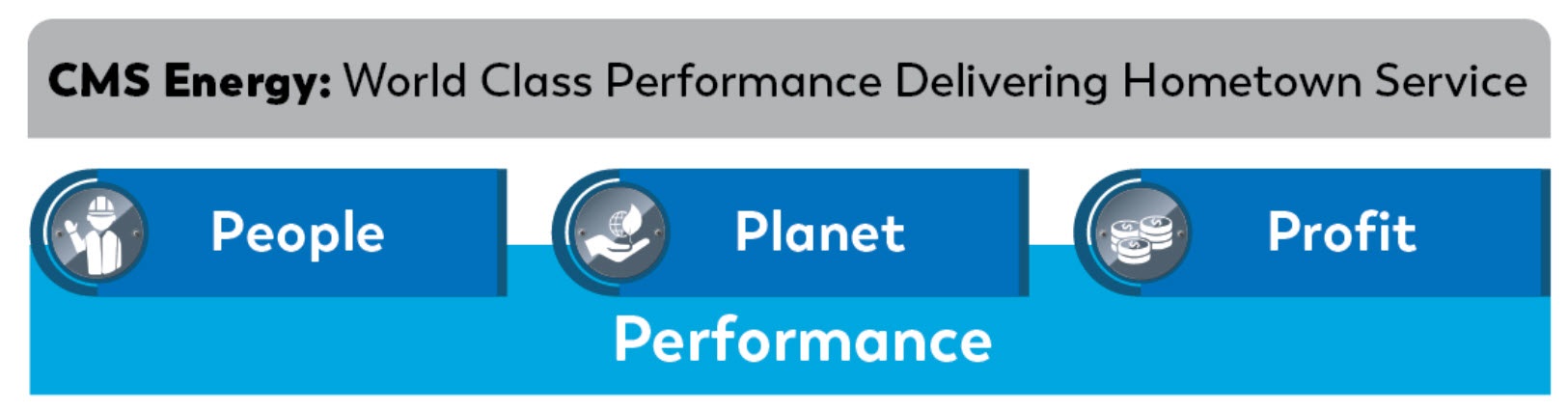
CMS Energy’s Sustainability Report, which is available to the public, describes CMS Energy’s and Consumers’ progress toward world class performance measured in the areas of people, planet, and profit.
People:
The people element of the triple bottom line represents CMS Energy’s and Consumers’ commitment to their employees, their customers, the residents of local communities in which they do business, and other stakeholders.
The safety of employees, customers, and the general public is a priority of CMS Energy and Consumers. Accordingly, CMS Energy and Consumers have worked to integrate a set of safety principles into their business operations and culture. These principles include complying with applicable safety, health, and security regulations and implementing programs and processes aimed at continually improving safety and security conditions. Over the last ten years, Consumers’ Occupational Safety and Health Administration recordable incident rate has decreased by 20 percent.
CMS Energy and Consumers also place a high priority on customer value and on providing a hometown customer experience. Consumers’ customer-driven investment program is aimed at improving safety and increasing electric and gas reliability.
In September 2023, Consumers filed its Reliability Roadmap, an update to its previous Electric Distribution Infrastructure Investment Plan filed in 2021, with the MPSC. The Reliability Roadmap outlines a five-year strategy to improve Consumers’ electric distribution system and the reliability of the grid. The plan proposes the following spending for projects designed to reduce the number and duration of power outages to customers through investment in infrastructure upgrades, forestry management, and grid modernization:
•
capital expenditures of $7 billion over the next five years; this amount is $3 billion higher than proposed in the previous plan
•
maintenance and operating spending of $1.7 billion over the next five years, reflecting an increase of $300 million over the previous plan
Consumers will request rate recovery of these proposed expenditures in future electric rate cases.
15
Central to Consumers’ commitment to its customers are the initiatives it has undertaken to keep electricity and natural gas affordable, including:
•
replacement of coal-fueled generation and PPAs with a cost-efficient mix of renewable energy, less-costly dispatchable generation sources, and energy waste reduction and demand response programs
•
targeted infrastructure investment to reduce maintenance costs and improve reliability and safety
•
supply chain optimization
•
economic development to increase sales and reduce overall rates
•
information and control system efficiencies
•
employee and retiree health care cost sharing
•
tax planning
•
cost-effective financing
•
workforce productivity enhancements
While CMS Energy and Consumers have experienced some supply chain disruptions and inflationary pressures, they have taken steps to mitigate the impact on their ability to provide safe and reliable service to customers.
Planet:
The planet element of the triple bottom line represents CMS Energy’s and Consumers’ commitment to protect the environment. This commitment extends beyond compliance with various state and federal environmental, health, and safety laws and regulations. Management considers climate change and other environmental risks in strategy development, business planning, and enterprise risk management processes.
CMS Energy and Consumers continue to focus on opportunities to protect the environment and reduce their carbon footprint from owned generation. CMS Energy, including Consumers, has decreased its combined percentage of electric supply (self-generated and purchased) from coal by 25 percentage points since 2015. Additionally, as a result of actions already taken through 2023, Consumers has:
•
reduced carbon dioxide emissions by nearly 40 percent since 2005
•
reduced methane emissions by more than 25 percent since 2012
•
reduced the volume of water used to generate electricity by more than 50 percent since 2012
•
reduced landfill waste disposal by more than 1.8 million tons since 1992
•
enhanced, restored, or protected more than 8,800 acres of land since 2017
16
Since 2005, Consumers has reduced its sulfur dioxide and particulate matter emissions by more than 95 percent and its NOx emissions by nearly 88 percent. Consumers began tracking mercury emissions in 2007; since that time, it has reduced such emissions by nearly 93 percent.
In November 2023, Michigan enacted the 2023 Energy Law, which among other things:
•
raises the renewable energy standard from the present 15-percent requirement to 50 percent by 2030 and 60 percent by 2035; renewable energy generated anywhere within MISO may be applied to meeting this standard, with certain limitations
•
sets a clean energy standard of 80 percent by 2035 and 100 percent by 2040; low- or zero-carbon emitting resources, such as nuclear generation and natural gas generation coupled with carbon capture, are considered clean energy sources under this standard
•
enhances existing incentives for energy efficiency programs and returns earned on competitively bid PPAs
•
creates a new energy storage standard that requires electric utilities to file plans by 2029 to obtain new energy storage that will contribute to a Michigan target of 2,500 MW based on their pro rata share
•
expands the statutory cap on distributed generation resources to ten percent
Consumers is required to file updates to its amended renewable energy plan before or in November 2024 and its Clean Energy Plan before or in 2027. Together, these updated plans will outline a path to meeting the requirements of the 2023 Energy Law by focusing on increasing the generation of renewable energy, deploying energy storage, helping customers use less energy, and offering demand response programs to reduce demand during critical peak times.
Consumers’ Clean Energy Plan details its strategy to meet customers’ long-term energy needs and was most recently revised and approved by the MPSC in 2022 under Michigan’s integrated resource planning process. The Clean Energy Plan outlines Consumers’ long-term strategy for delivering clean, reliable, resilient, and affordable energy to its customers, including plans to:
•
end the use of coal-fueled generation in 2025, 15 years sooner than initially planned
•
purchase the Covert Generating Station, a natural gas-fueled generating facility with 1,200 MW of nameplate capacity, allowing Consumers to continue to provide controllable sources of electricity to customers; this purchase was completed in May 2023
•
solicit up to 700 MW of capacity through PPAs from sources able to deliver to Michigan’s Lower Peninsula beginning in 2025
•
expand its investment in renewable energy, adding nearly 8,000 MW of solar generation by 2040
Under the Clean Energy Plan, and as enhanced by the 2023 Energy Law, Consumers earns a return equal to its pre-tax weighted-average cost of capital on permanent capital structure on payments made under new competitively bid PPAs with non‑affiliated entities approved by the MPSC.
17
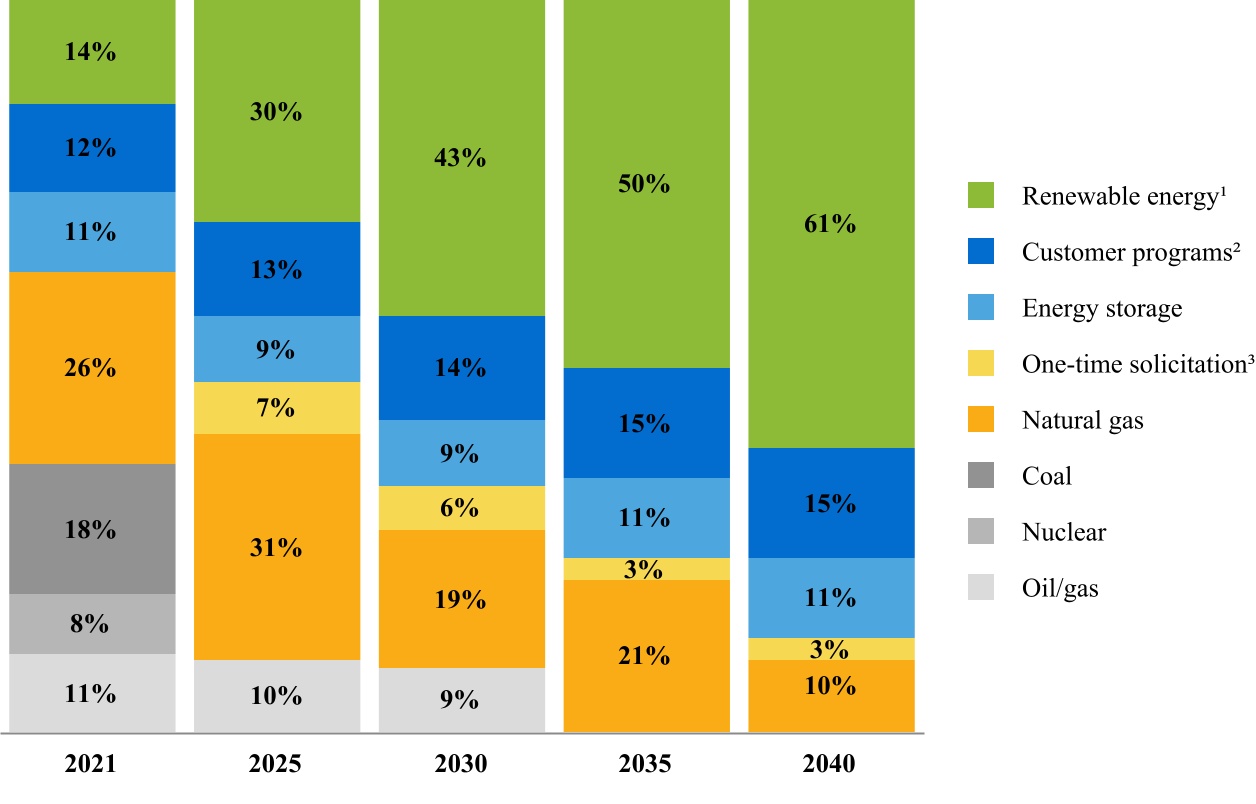
Presented in the following illustration is Consumers’ 2021 capacity portfolio and its future capacity portfolio under its Clean Energy Plan, which does not yet incorporate the requirements of the 2023 Energy Law. This illustration includes the effects of purchased capacity and customer programs and uses the nameplate capacity for all energy sources:
1
Does not include RECs.
2
Includes energy waste reduction, demand response, and conservation voltage reduction programs.
3
These amounts and fuel sources will vary and are dependent on a one‑time competitive solicitation to acquire up to 700 MW of capacity through PPAs from sources able to deliver to Michigan’s Lower Peninsula beginning in 2025.
In addition to Consumers’ plan to eliminate its use of coal-fueled generation in 2025, CMS Energy and Consumers have set the net‑zero emissions goals discussed below.
Net-zero methane emissions from natural gas delivery system by 2030:
Under its Methane Reduction Plan, Consumers plans to reduce methane emissions from its system by about 80 percent, from 2012 baseline levels, by accelerating the replacement of aging pipe, rehabilitating or retiring outdated infrastructure, and adopting new technologies and practices. The remaining emissions will likely be offset by purchasing and/or producing renewable natural gas. To date, Consumers has reduced methane emissions by more than 25 percent.
Net-zero carbon emissions from electric business by 2040:
This goal includes not only emissions from owned generation, but also emissions from the generation of power purchased through long-term PPAs and from the MISO energy market. Consumers expects to meet 90 percent of its customers’ needs with clean energy sources by 2040 through execution of its Clean Energy Plan. New technologies and carbon offset measures may be used to close the gap to achieving net-zero carbon emissions.
18
Net-zero greenhouse gas emissions target for the entire business by 2050:
This goal incorporates greenhouse gas emissions from Consumers’ natural gas delivery system, including suppliers and customers, and has an interim goal of reducing customer emissions by 20 percent by 2030. Consumers expects to meet this goal through carbon offset measures, renewable natural gas, energy efficiency and demand response programs, and the adoption of cost-effective emerging technologies once proven and commercially available.
Additionally, to advance its environmental stewardship in Michigan and to minimize the impact of future regulations, Consumers set the following goals for the five-year period 2023 through 2027:
•
to enhance, restore, or protect 6,500 acres of land by 2027; Consumers has enhanced, restored, or protected more than 2,000 acres of land towards this goal
•
to reduce water usage by 1.7 billion gallons by 2027; Consumers has reduced water usage by more than 660 million gallons towards this goal
•
to annually divert a minimum of 90 percent of waste from landfills (through waste reduction, recycling, and reuse); during 2023, Consumers’ rate of waste diverted from landfills was 91 percent
CMS Energy and Consumers are monitoring numerous legislative, policy, and regulatory initiatives, including those to regulate and report greenhouse gases, and related litigation. While CMS Energy and Consumers cannot predict the outcome of these matters, which could affect them materially, they intend to continue to move forward with their clean and lean strategy.
Profit:
The profit element of the triple bottom line represents CMS Energy’s and Consumers’ commitment to meeting their financial objectives and providing economic development opportunities and benefits in the communities in which they do business. CMS Energy’s and Consumers’ financial strength allows them to maintain solid investment-grade credit ratings and thereby reduce funding costs for the benefit of customers and investors, to attract and retain talent, and to reinvest in the communities they serve.
For the three months ended March 31, 2024, CMS Energy’s net income available to common stockholders was $285 million, and diluted EPS were $0.96. This compares with net income available to common stockholders of $202 million and diluted EPS of $0.69 for the three months ended March 31, 2023. In 2024, gas and electric rate increases, lower service restoration costs, and gains on the extinguishment of debt were offset partially by higher interest charges and income tax expense. A more detailed discussion of the factors affecting CMS Energy’s and Consumers’ performance can be found in the Results of Operations section that follows this Executive Overview.
Over the next five years, Consumers expects weather-normalized electric and gas deliveries to remain relatively stable compared to 2023. This outlook reflects modest growth in electric and gas demand, offset by the effects of energy waste reduction programs.
19
Performance: Impacting the Triple Bottom Line
CMS Energy and Consumers remain committed to achieving world class performance while delivering hometown service and positively impacting the triple bottom line of people, planet, and profit. During 2023, CMS Energy met all requirements for inclusion in the MSCI ESG Leaders Indexes; these indexes are designed to represent the performance of companies that have high environmental, social, and governance ratings relative to their sector peers. Additionally, Consumers:
•
was selected to receive a $100 million grant from the U.S. Department of Energy to fund investments in its electric distribution system, improving the reliability of Michigan’s electric grid
•
participated in the state’s economic development efforts that have resulted in commitments by large third-party manufacturers to construct facilities for electric vehicle batteries and battery components in Michigan
•
announced plans for an 85-MW solar array to be constructed at the former D.E. Karn coal-generating facilities, which were retired earlier in 2023
•
grew its voluntary large customer renewable energy program to approximately 365 MW
•
opened a state-of-the-art natural gas training facility in Flint, Michigan that facilitates employee training that is critical to keeping workers, customers, and the public safe
•
announced plans to install more than 120 automatic transfer reclosers to improve electric reliability and help prevent power outages
•
completed the first phase of its Mid-Michigan Pipeline Project, part of Consumers’ commitment to providing safe, reliable, and affordable natural gas to Michigan homes and businesses
•
announced new efforts to install electric vehicle chargers at apartment buildings, condominiums, and overnight community locations across the state of Michigan
•
was one of 15 recipients of the U.S. Department of Defense’s 2023 Secretary of Defense Employer Support Freedom Award, an honor to employers for support of National Guard and Reserve employees
CMS Energy and Consumers will continue to utilize the CE Way to enable them to achieve world class performance and positively impact the triple bottom line. Consumers’ investment plan and the regulatory environment in which it operates also drive its ability to impact the triple bottom line.
Investment Plan:
Over the next five years, Consumers expects to make significant expenditures on infrastructure upgrades, replacements, and clean generation. While it has a large number of potential investment opportunities that would add customer value, Consumers has prioritized its spending based on the criteria of enhancing public safety, increasing reliability, maintaining affordability for its customers, and advancing its environmental stewardship. Consumers’ investment program, which is subject to approval through general rate case and other MPSC proceedings, is expected to result in annual rate-base growth of more than seven percent. This rate-base growth, together with cost-control measures, should allow Consumers to maintain affordable customer prices.
20
Presented in the following illustration are Consumers’ planned capital expenditures through 2028 of $17.0 billion:
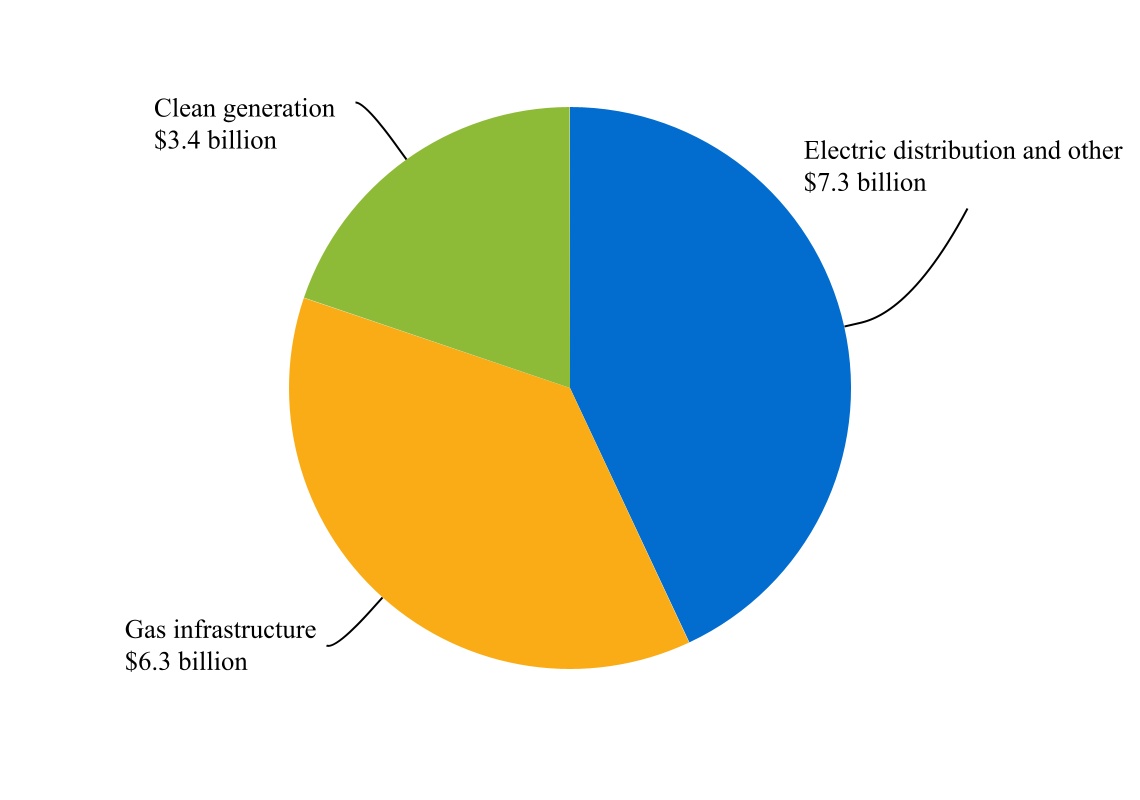
Of this amount, Consumers plans to spend $13.6 billion over the next five years primarily to maintain and upgrade its electric distribution systems and gas infrastructure in order to enhance safety and reliability, improve customer satisfaction, reduce energy waste on those systems, and facilitate its clean energy transformation. Electric distribution and other projects comprise $7.3 billion primarily to strengthen circuits and substations, replace poles, and interconnect clean energy resources. The gas infrastructure projects comprise $6.3 billion to sustain deliverability, enhance pipeline integrity and safety, and reduce methane emissions. Consumers also expects to spend $3.4 billion on clean generation, which includes investments in wind, solar, and hydroelectric generation resources.
Regulation:
Regulatory matters are a key aspect of Consumers’ business, particularly rate cases and regulatory proceedings before the MPSC, which permit recovery of new investments while helping to ensure that customer rates are fair and affordable. Important regulatory events and developments not already discussed are summarized below.
2023 Electric Rate Case
: In March 2024, the MPSC issued an order authorizing an annual rate increase of $92 million, which is inclusive of a $9 million surcharge for the recovery of select distribution investments made in 2022 that exceeded the rates authorized in accordance with the December 2021 electric rate order. The approved rate increase is based on a 9.9-percent authorized return on equity. The new rates became effective March 15, 2024.
2023 Gas Rate Case:
In December 2023, Consumers filed an application with the MPSC seeking an annual rate increase of $136 million based on a 10.25‑percent authorized return on equity for the projected 12‑month period ending September 30, 2025. The filing requests authority to recover new infrastructure investment and related costs that are expected to allow Consumers to continue to provide safe, reliable, affordable, and increasingly cleaner natural gas service.
21
Looking Forward
CMS Energy and Consumers will continue to consider the impact on the triple bottom line of people, planet, and profit in their daily operations as well as in their long-term strategic decisions. Consumers will continue to seek fair and timely regulatory treatment that will support its customer-driven investment plan, while pursuing cost-control measures that will allow it to maintain sustainable customer base rates. The CE Way is an important means of realizing CMS Energy’s and Consumers’ purpose of achieving world class performance while delivering hometown service.
22
Results of Operations
CMS Energy Consolidated Results of Operations
| In Millions, Except Per Share Amounts | ||||||||||||||||||||
| Three Months Ended March 31 | 2024 | 2023 | Change | |||||||||||||||||
| Net Income Available to Common Stockholders | $ | 285 | $ | 202 | $ | 83 | ||||||||||||||
| Basic Earnings Per Average Common Share | $ | 0.96 | $ | 0.69 | $ | 0.27 | ||||||||||||||
| Diluted Earnings Per Average Common Share | $ | 0.96 | $ | 0.69 | $ | 0.27 | ||||||||||||||
| In Millions | ||||||||||||||||||||
| Three Months Ended March 31 | 2024 | 2023 | Change | |||||||||||||||||
| Electric utility | $ | 97 | $ | 70 | $ | 27 | ||||||||||||||
| Gas utility | 169 | 154 | 15 | |||||||||||||||||
| NorthStar Clean Energy | 31 | 7 | 24 | |||||||||||||||||
| Corporate interest and other | (12) | (29) | 17 | |||||||||||||||||
| Net Income Available to Common Stockholders | $ | 285 | $ | 202 | $ | 83 | ||||||||||||||
Amounts in the following tables are presented pre-tax, with the exception of income tax changes.
Presented in the following table is a summary of changes to net income available to common stockholders for the three months ended March 31, 2024 versus 2023:
| In Millions | |||||||||||||||||
| Three Months Ended March 31, 2023 | $ | 202 | |||||||||||||||
| Reasons for the change | |||||||||||||||||
| Consumers electric utility and gas utility | |||||||||||||||||
| Electric sales | $ | 18 | |||||||||||||||
| Gas sales | (9) | ||||||||||||||||
| Electric rate increase | 32 | ||||||||||||||||
| Gas rate increase | 40 | ||||||||||||||||
| Lower service restoration costs | 30 | ||||||||||||||||
| Higher other income, net of expenses | 5 | ||||||||||||||||
| Lower other maintenance and operating expenses | 4 | ||||||||||||||||
| Higher interest charges | (27) | ||||||||||||||||
| Higher income tax expense | (26) | ||||||||||||||||
| Higher property taxes, reflecting higher capital spending, and other | (13) | ||||||||||||||||
| Higher depreciation and amortization | (12) | ||||||||||||||||
| $ | 42 | ||||||||||||||||
| NorthStar Clean Energy | 24 | ||||||||||||||||
| Corporate interest and other | 17 | ||||||||||||||||
| Three Months Ended March 31, 2024 | $ | 285 | |||||||||||||||
23
Consumers Electric Utility Results of Operations
Presented in the following table are the detailed changes to the electric utility’s net income available to common stockholders for the three months ended March 31, 2024 versus 2023:
| In Millions | |||||||||||||||||
| Three Months Ended March 31, 2023 | $ | 70 | |||||||||||||||
| Reasons for the change | |||||||||||||||||
|
Electric deliveries
1
and rate increases
|
|||||||||||||||||
| Rate increase, including return on higher renewable capital spending | $ | 32 | |||||||||||||||
| Higher revenue due primarily to non-weather sales | 14 | ||||||||||||||||
| Lower energy waste reduction program revenues | (7) | ||||||||||||||||
| Higher other revenues | 4 | ||||||||||||||||
| $ | 43 | ||||||||||||||||
| Maintenance and other operating expenses | |||||||||||||||||
| Lower service restoration costs | 30 | ||||||||||||||||
| Lower energy waste reduction program costs | 7 | ||||||||||||||||
| Lower other maintenance and operating expenses | 4 | ||||||||||||||||
| 41 | |||||||||||||||||
| Depreciation and amortization | |||||||||||||||||
| Increased plant in service, reflecting higher capital spending | (21) | ||||||||||||||||
| General taxes | |||||||||||||||||
| Higher property taxes, reflecting higher capital spending, and other | (6) | ||||||||||||||||
| Other income, net of expenses | 3 | ||||||||||||||||
| Interest charges | (17) | ||||||||||||||||
| Income taxes | |||||||||||||||||
| Higher renewable energy tax credits | 3 | ||||||||||||||||
| Higher electric utility pre-tax earnings | (11) | ||||||||||||||||
|
Absence of 2023 deferred tax liability reversal
2
|
(9) | ||||||||||||||||
| Lower other income taxes | 1 | ||||||||||||||||
| (16) | |||||||||||||||||
| Three Months Ended March 31, 2024 | $ | 97 | |||||||||||||||
1
Deliveries to end-use customers were 8.9 billion kWh in 2024 and 8.8 billion kWh in 2023.
2
See Note 7, Income Taxes.
24
Consumers Gas Utility Results of Operations
Presented in the following table are the detailed changes to the gas utility’s net income available to common stockholders for the three months ended March 31, 2024 versus 2023:
| In Millions | |||||||||||||||||
| Three Months Ended March 31, 2023 | $ | 154 | |||||||||||||||
| Reasons for the change | |||||||||||||||||
|
Gas deliveries
1
and rate increases
|
|||||||||||||||||
| Rate increase | $ | 40 | |||||||||||||||
| Higher energy waste reduction program revenues | 10 | ||||||||||||||||
| Lower revenue due primarily to unfavorable weather | (9) | ||||||||||||||||
| $ | 41 | ||||||||||||||||
| Maintenance and other operating expenses | |||||||||||||||||
| Higher energy waste reduction program costs | (10) | ||||||||||||||||
| Depreciation and amortization | |||||||||||||||||
| Lower depreciation rates, offset partially by higher capital spending | 9 | ||||||||||||||||
| General taxes | |||||||||||||||||
| Higher property taxes, reflecting higher capital spending | (7) | ||||||||||||||||
| Other income, net of expenses | 2 | ||||||||||||||||
| Interest charges | (10) | ||||||||||||||||
| Income taxes | |||||||||||||||||
| Higher gas utility pre-tax earnings | (6) | ||||||||||||||||
|
Absence of 2023 deferred tax liability reversal
2
|
(4) | ||||||||||||||||
| (10) | |||||||||||||||||
| Three Months Ended March 31, 2024 | $ | 169 | |||||||||||||||
1
Deliveries to end-use customers were 117 bcf in 2024 and 119 bcf in 2023.
2
See Note 7, Income Taxes.
NorthStar Clean Energy Results of Operations
Presented in the following table are the detailed changes to NorthStar Clean Energy’s net income available to common stockholders for the three months ended March 31, 2024 versus 2023:
| In Millions | |||||||||||||||||
| Three Months Ended March 31, 2023 | $ | 7 | |||||||||||||||
| Reason for the change | |||||||||||||||||
| Higher earnings from renewable projects | $ | 16 | |||||||||||||||
| Higher operating earnings, primarily at DIG | 7 | ||||||||||||||||
| Higher renewable energy tax credits | 1 | ||||||||||||||||
| Three Months Ended March 31, 2024 | $ | 31 | |||||||||||||||
25
Corporate Interest and Other Results of Operations
Presented in the following table are the detailed changes to corporate interest and other results for the three months ended March 31, 2024 versus 2023:
| In Millions | |||||||||||||||||
| Three Months Ended March 31, 2023 | $ | (29) | |||||||||||||||
| Reasons for the change | |||||||||||||||||
|
Gain on extinguishment of debt
1
|
$ | 22 | |||||||||||||||
| Higher income tax expense due to higher pre-tax earnings | (3) | ||||||||||||||||
| Other | (2) | ||||||||||||||||
| Three Months Ended March 31, 2024 | $ | (12) | |||||||||||||||
1
See Note 3, Financings and Capitalization.
26
Cash Position, Investing, and Financing
At March 31, 2024, CMS Energy had $861 million of consolidated cash and cash equivalents, which included $59 million of restricted cash and cash equivalents. At March 31, 2024, Consumers had $666 million of consolidated cash and cash equivalents, which included $59 million of restricted cash and cash equivalents.
Operating Activities
Presented in the following table are specific components of net cash provided by operating activities for the three months ended March 31, 2024 versus 2023:
| In Millions | ||||||||
|
CMS Energy, including Consumers
|
||||||||
| Three Months Ended March 31, 2023 | $ | 1,040 | ||||||
| Reasons for the change | ||||||||
| Higher net income | $ | 69 | ||||||
|
Non‑cash transactions
1
|
20 | |||||||
|
Unfavorable impact of changes in core working capital,
2
due primarily to lower collections and lower prices on gas sold to customers
|
(195) | |||||||
|
Favorable impact of changes in other assets and liabilities
|
22 | |||||||
| Three Months Ended March 31, 2024 | $ | 956 | ||||||
| Consumers | ||||||||
| Three Months Ended March 31, 2023 | $ | 1,070 | ||||||
| Reasons for the change | ||||||||
| Higher net income | $ | 43 | ||||||
|
Non‑cash transactions
1
|
28 | |||||||
|
Unfavorable impact of changes in core working capital,
2
due primarily to lower collections and lower prices on gas sold to customers
|
(177) | |||||||
|
Favorable impact of changes in other assets and liabilities
|
15 | |||||||
| Three Months Ended March 31, 2024 | $ | 979 | ||||||
1
Non
‑
cash transactions comprise depreciation and amortization, changes in deferred income taxes and investment tax credits, and other non‑cash operating activities and reconciling adjustments.
2
Core working capital comprises accounts receivable, accrued revenue, inventories, accounts payable, and accrued rate refunds.
27
Investing Activities
Presented in the following table are specific components of net cash used in investing activities for the three months ended March 31, 2024 versus 2023:
| In Millions | ||||||||
| CMS Energy, including Consumers | ||||||||
| Three Months Ended March 31, 2023 | $ | (651) | ||||||
| Reasons for the change | ||||||||
| Lower capital expenditures | $ | 4 | ||||||
| Other investing activities | 10 | |||||||
| Three Months Ended March 31, 2024 | $ | (637) | ||||||
| Consumers | ||||||||
| Three Months Ended March 31, 2023 | $ | (588) | ||||||
| Reasons for the change | ||||||||
| Higher capital expenditures | $ | (29) | ||||||
| Other investing activities | 10 | |||||||
| Three Months Ended March 31, 2024 | $ | (607) | ||||||
Financing Activities
Presented in the following table are specific components of net cash provided by (used in) financing activities for the three months ended March 31, 2024 versus 2023:
| In Millions | ||||||||
|
CMS Energy, including Consumers
|
||||||||
| Three Months Ended March 31, 2023 | $ | 27 | ||||||
| Reasons for the change | ||||||||
| Lower debt issuances | $ | (606) | ||||||
| Lower debt retirements | 681 | |||||||
| Higher repayments of notes payable | (73) | |||||||
| Higher issuances of common stock | 268 | |||||||
| Higher payments of dividends on common stock | (11) | |||||||
| Other financing activities | 8 | |||||||
| Three Months Ended March 31, 2024 | $ | 294 | ||||||
| Consumers | ||||||||
| Three Months Ended March 31, 2023 | $ | (199) | ||||||
| Reasons for the change | ||||||||
| Lower debt issuances | $ | (521) | ||||||
| Lower debt retirements | 1,000 | |||||||
| Higher repayments of notes payable | (73) | |||||||
| Absence of a repayment of borrowings from CMS Energy in 2023 | 75 | |||||||
| Higher stockholder contribution from CMS Energy | 245 | |||||||
| Return of stockholder contribution to CMS Energy | (320) | |||||||
| Lower payments of dividends on common stock | 22 | |||||||
| Other financing activities | 9 | |||||||
| Three Months Ended March 31, 2024 | $ | 238 | ||||||
28
Capital Resources and Liquidity
CMS Energy and Consumers expect to have sufficient liquidity to fund their present and future commitments. CMS Energy uses dividends and tax-sharing payments from its subsidiaries and external financing and capital transactions to invest in its utility and non
‑
utility businesses, retire debt, pay dividends, and fund its other obligations. The ability of CMS Energy’s subsidiaries, including Consumers, to pay dividends to CMS Energy depends upon each subsidiary’s revenues, earnings, cash needs, and other factors. In addition, Consumers’ ability to pay dividends is restricted by certain terms included in its articles of incorporation and potentially by FERC requirements and provisions under the Federal Power Act and the Natural Gas Act. For additional details on Consumers’ dividend restrictions, see Notes to the Unaudited Consolidated Financial Statements—Note 3, Financings and Capitalization—Dividend Restrictions. During the three months ended March 31, 2024, Consumers paid $265 million in dividends on its common stock to CMS Energy.
Consumers uses cash flows generated from operations and external financing transactions, as well as stockholder contributions from CMS Energy, to fund capital expenditures, retire debt, pay dividends, and fund its other obligations. Consumers also uses these sources of funding to contribute to its employee benefit plans.
Financing and Capital Resources:
CMS Energy and Consumers rely on the capital markets to fund their robust capital plan. Barring any sustained market dislocations or disruptions, CMS Energy and Consumers expect to continue to have ready access to the financial and capital markets and will continue to explore possibilities to take advantage of market opportunities as they arise with respect to future funding needs. If access to these markets were to diminish or otherwise become restricted, CMS Energy and Consumers would implement contingency plans to address debt maturities, which could include reduced capital spending.
In 2023, CMS Energy entered into an equity offering program under which it may sell shares of its common stock having an aggregate sales price of up to $1 billion in privately negotiated transactions, in “at the market” offerings, or through forward sales transactions. There have been no sales of securities under this program.
At March 31, 2024, CMS Energy had $521 million of its revolving credit facility available and Consumers had $1.3 billion available under its revolving credit facilities. CMS Energy and Consumers use these credit facilities for general working capital purposes and to issue letters of credit. An additional source of liquidity is Consumers’ commercial paper program, which allows Consumers to issue, in one or more placements, up to $500 million in aggregate principal amount of commercial paper notes with maturities of up to 365 days at market interest rates. These issuances are supported by Consumers’ revolving credit facilities. While the amount of outstanding commercial paper does not reduce the available capacity of the revolving credit facilities, Consumers does not intend to issue commercial paper in an amount exceeding the available capacity of the facilities. At March 31, 2024, there were no commercial paper notes outstanding under this program. For additional details on CMS Energy’s and Consumers’ secured revolving credit facilities and commercial paper program, see Notes to the Unaudited Consolidated Financial Statements—Note 3, Financings and Capitalization.
29
Certain of CMS Energy’s and Consumers’ credit agreements contain covenants that require CMS Energy and Consumers to maintain certain financial ratios, as defined therein. At March 31, 2024, no default had occurred with respect to any financial covenants contained in CMS Energy’s and Consumers’ credit agreements. CMS Energy and Consumers were each in compliance with these covenants as of March 31, 2024, as presented in the following table:
| Limit | Actual | |||||||
| CMS Energy, parent only | ||||||||
|
Debt to Capital
1
|
<
0.70 to 1.0
|
0.57 to 1.0 | ||||||
| Consumers | ||||||||
|
Debt to Capital
2
|
<
0.65 to 1.0
|
0.50 to 1.0 | ||||||
1
Applies to CMS Energy’s revolving credit agreement and letter of credit reimbursement agreement.
2
Applies to Consumers’ revolving credit agreements.
Outlook
Several business trends and uncertainties may affect CMS Energy’s and Consumers’ financial condition and results of operations. These trends and uncertainties could have a material impact on CMS Energy’s and Consumers’ consolidated income, cash flows, or financial position. For additional details regarding these and other uncertainties, see Forward-looking Statements and Information; Notes to the Unaudited Consolidated Financial Statements—Note 1, Regulatory Matters and Note 2, Contingencies and Commitments; and Part II—Item 1A. Risk Factors.
Consumers Electric Utility Outlook and Uncertainties
Clean Energy Plan:
Consumers’ Clean Energy Plan details its strategy to meet customers’ long-term energy needs and provides the foundation for its goal to achieve net-zero carbon emissions from its electric business by 2040. Under this net-zero goal, Consumers plans to eliminate the impact of carbon emissions created by the electricity it generates or purchases for customers. Additionally, through its Clean Energy Plan, Consumers continues to make progress on expanding its customer programs, namely its demand response, energy efficiency, and conservation voltage reduction programs, as well as increasing its renewable energy generation.
The Clean Energy Plan was most recently revised and approved by the MPSC in 2022. Under this plan, Consumers will eliminate the use of coal-fueled generation in 2025 and expects to meet 90 percent of its customers’ needs with clean energy sources by 2040. Specifically, the Clean Energy Plan provides for:
•
the retirement of the D.E. Karn coal-fueled generating units, totaling 515 MW of nameplate capacity; these units closed in June 2023
•
the retirement of the J.H. Campbell coal-fueled generating units, totaling 1,407 MW of nameplate capacity, in 2025
•
the retirement of the D.E. Karn oil and gas-fueled generating units, totaling 1,219 MW of nameplate capacity, in 2031
The MPSC authorized Consumers to issue securitization bonds to finance the recovery of and return on the D.E. Karn coal-fueled generating units; Consumers issued these bonds in December 2023. Additionally, the MPSC has authorized regulatory asset treatment for Consumers to recover the remaining book value of the J.H. Campbell coal-fueled generating units, as well as a 9.0‑percent return on equity, commencing in 2025.
30
Under the Clean Energy Plan, Consumers:
•
purchased the Covert Generating Station, a natural gas-fueled generating facility with 1,200 MW of nameplate capacity in Van Buren County, Michigan in May 2023
•
conducted a one
‑
time competitive solicitation for up to 700 MW of capacity through PPAs from sources able to deliver to Michigan’s Lower Peninsula beginning in 2025 (including up to 500 MW from dispatchable sources)
These actions are expected to help Consumers continue to provide controllable sources of electricity to customers while expanding its investment in renewable energy. The Clean Energy Plan forecasts renewable energy capacity levels of 30 percent in 2025, 43 percent in 2030, and 61 percent in 2040, including the addition of nearly 8,000 MW of solar generation. Additionally, Consumers plans to deploy battery storage beginning in 2024, with 75 MW of energy storage expected by 2027 and an additional 475 MW by 2040. The 2023 Energy Law, enacted in November 2023, set more ambitious standards for renewable energy and energy storage. Consumers is required to file updates to its amended renewable energy plan before or in November 2024 and its Clean Energy Plan before or in 2027. Together, these updated plans will outline a path to meeting these accelerated timelines.
Under its Clean Energy Plan, Consumers bids new capacity competitively and expects to own and operate approximately 50 percent of new capacity, with the remainder being built and owned by third parties. Additionally, Consumers earns a return equal to its pre-tax weighted-average cost of capital on permanent capital structure on payments made under new competitively bid PPAs with non‑affiliated entities approved by the MPSC.
As a result of requests for proposals, Consumers has entered into PPAs to purchase renewable capacity, energy, and RECs from solar generating facilities and build transfer agreements to purchase solar generating facilities. Presented in the following illustration is the aggregate renewable capacity that Consumers expects to add to its portfolio as a result of these agreements:

31
Additionally, as a result of its one-time solicitation, Consumers entered into a 20-year PPA under which it will purchase 100 MW of capacity, energy and RECs from a battery storage facility to be constructed in Branch County, Michigan. The facility is expected to be operational in 2025. Consumers continues to evaluate the acquisition of additional capacity from intermittent resources and dispatchable, non
‑
intermittent clean capacity resources (including battery storage resources). Any contracts entered into as a result of the one-time solicitation are subject to MPSC approval.
Renewable Energy Plan:
The 2023 Energy Law raises the renewable energy standard from the present 15-percent requirement to 50 percent by 2030 and 60 percent by 2035. Consumers is required to submit RECs, which represent proof that the associated electricity was generated from a renewable energy resource, in an amount equal to at least the required percentage of Consumers’ electric sales volume each year. Under its renewable energy plan, Consumers has met and expects to continue to meet its renewable energy requirement each year with a combination of newly generated RECs and previously generated RECs carried over from prior years.
The MPSC has approved the acquisition of up to 525 MW of new wind generation projects and authorized Consumers to earn a 10.7
‑
percent return on equity on any projects approved by the MPSC under Consumers’ amended renewable energy plan. Specifically, the MPSC has approved the following:
•
purchase and construction of a 150
‑
MW wind generation project in Gratiot County, Michigan; the project became operational and Consumers took full ownership in 2020
•
purchase of a 166
‑
MW wind generation project in Hillsdale, Michigan; the project became operational and Consumers took full ownership in 2021
•
purchase of a 201-MW wind generation project in Gratiot County, Michigan; the project became operational and Consumers took full ownership of the project in December 2023
The MPSC also approved the execution of a 20-year PPA under which Consumers will purchase 100 MW of renewable capacity, energy, and RECs from a 149
‑
MW solar generating facility to be constructed in Calhoun County, Michigan; the facility is targeted to be operational in 2024.
Voluntary Large Customer Renewable Energy Program:
Consumers provides service under a program that provides large full-service electric customers with the opportunity to advance the development of renewable energy beyond the present 15-percent requirement. In September 2023, Consumers filed an application to amend its renewable energy plan. Among other things, Consumers requested that the MPSC remove the 1,000-MW limit on new wind and solar generation, which will allow Consumers to meet growing customer demand for the program. Consumers competitively solicits for additional renewable energy assets based on customer applications and will construct the assets based on customer subscriptions to the program.
As part of this program, a 2022 request for proposals resulted in the execution of a build transfer agreement for a 309‑MW solar generating facility to be constructed in Calhoun County, Michigan; the facility is targeted to be operational in 2025. The build transfer agreement was approved by the MPSC in September 2023. Additionally, the request for proposals resulted in the selection of a solar generation project that Consumers will develop and construct at its D.E. Karn generating site, with a capacity of up to 85 MW. The facility is expected to be operational in 2026.
Electric Customer Deliveries and Revenue:
Consumers’ electric customer deliveries are seasonal and largely dependent on Michigan’s economy. The consumption of electric energy typically increases in the summer months, due primarily to the use of air conditioners and other cooling equipment. In addition, Consumers’ electric rates, which follow a seasonal rate design, are higher in the summer months than in the remaining months of the year. Each year in June, electric residential customers transition to a summer peak time-of-use rate that allows them to take advantage of lower-cost energy during off-peak times
32
during the summer months. Thus, customers can reduce their electric bills by shifting their consumption from on‑peak to off‑peak times.
Over the next five years, Consumers expects weather-normalized electric deliveries to remain relatively stable compared to 2023. This outlook reflects modest growth in electric demand, offset by the effects of energy waste reduction programs. Actual delivery levels will depend on:
•
energy conservation measures and results of energy waste reduction programs
•
weather fluctuations
•
Michigan’s economic conditions, including utilization, expansion, or contraction of industrial facilities, population trends, electric vehicle adoption, and housing activity
Electric ROA:
Michigan law allows electric customers in Consumers’ service territory to buy electric generation service from alternative electric suppliers in an aggregate amount capped at ten percent of Consumers’ sales, with certain exceptions. At March 31, 2024, electric deliveries under the ROA program were at the ten‑percent limit. Fewer than 300 of Consumers’ electric customers purchased electric generation service under the ROA program.
In 2016, Michigan law established a path to ensure that forward capacity is secured for all electric customers in Michigan, including customers served by alternative electric suppliers under ROA. The law also authorized the MPSC to ensure that alternative electric suppliers have procured enough capacity to cover their anticipated capacity requirements for the four
‑
year forward period. In 2017, the MPSC issued an order establishing a state reliability mechanism for Consumers. Under this mechanism, if an alternative electric supplier does not demonstrate that it has procured its capacity requirements for the four
‑
year forward period, its customers will pay a set charge to the utility for capacity that is not provided by the alternative electric supplier.
During 2017, the MPSC issued orders finding that it has statutory authority to determine and implement a local clearing requirement, which requires all electric suppliers to demonstrate that a portion of the capacity used to serve customers is located in the MISO footprint in Michigan’s Lower Peninsula. In 2020, the Michigan Supreme Court affirmed the MPSC’s statutory authority to implement a local clearing requirement on individual electric providers.
In 2020, ABATE and another intervenor filed a complaint against the MPSC in the U.S. District Court for the Eastern District of Michigan challenging the constitutionality of a local clearing requirement. The complaint requests the federal court to issue a permanent injunction prohibiting the MPSC from implementing a local clearing requirement on individual electric providers. In February 2023, the U.S. District Court for the Eastern District of Michigan dismissed the complaint. In March 2023, ABATE and the other intervenor filed a claim of appeal of the Eastern District Court’s decision with the U.S. Court of Appeals for the Sixth Circuit. Oral arguments occurred in December 2023.
Hydroelectric Facilities:
In February 2024, Consumers issued a request for proposals to explore the possibility of selling its 13 hydroelectric dams located throughout Michigan. Consumers has solicited community feedback on the dams’ futures, as federal operating licenses for the dams begin to expire in 2034. Consumers continues to evaluate each dam’s future, options for which include, but are not limited to, renewing operating licenses, transferring ownership, or removing the facilities.
Electric Rate Matters:
Rate matters are critical to Consumers’ electric utility business. For additional details on rate matters, see Notes to the Unaudited Consolidated Financial Statements—Note 1, Regulatory Matters and Note 2, Contingencies and Commitments.
33
MPSC Distribution System Audit:
In 2022, the MPSC ordered the state’s two largest electric utilities, including Consumers, to report on their compliance with regulations and past MPSC orders governing the utilities’ response to outages and downed lines. Consumers responded to the MPSC’s order as directed.
Additionally, as directed by the MPSC, the MPSC Staff has engaged a third‑party auditor to review all equipment and operations of the two utilities’ distribution systems; this audit began in August 2023. The MPSC Staff released a report prepared by the third-party auditor to summarize the audit’s progress in December 2023, and a final report is expected in late summer 2024. Consumers is committed to working with the third
‑
party auditor and the MPSC to continue improving electric reliability and safety in Michigan.
Retention Incentive Program:
Under its Clean Energy Plan, Consumers will retire the J.H. Campbell coal-fueled generating units in 2025. In order to ensure necessary staffing at J.H. Campbell through retirement, Consumers has implemented a retention incentive program. The aggregate cost of the J.H. Campbell program through 2025 is estimated to be $50 million; Consumers expects to recognize $10 million of retention benefit costs in 2024. The MPSC has approved deferred accounting treatment for these costs; these expenses are deferred as a regulatory asset. For additional details on this program, see Notes to the Unaudited Consolidated Financial Statements—Note 12, Exit Activities.
Electric Environmental Outlook:
Consumers’ electric operations are subject to various federal, state, and local environmental laws and regulations. Consumers estimates that it will incur capital expenditures of $240 million from 2024 through 2028 to continue to comply with RCRA, the Clean Air Act, and numerous other environmental regulations. Consumers expects to recover these costs in customer rates, but cannot guarantee this result. Multiple environmental laws and regulations are subject to litigation. Consumers’ primary environmental compliance focus includes, but is not limited to, the following matters.
Air Quality:
Multiple air quality regulations apply, or may apply, to Consumers’ electric utility.
MATS, emission standards for electric generating units published by the EPA based on Section 112 of the Clean Air Act, continue to apply to Consumers. The company has complied, and continues to comply, with the MATS regulation and does not expect MATS to materially impact its environmental strategy.
CSAPR requires Michigan and many other states to improve air quality by reducing power plant emissions that, according to EPA modeling, contribute to ground-level ozone in other downwind states. Since its 2015 effective date, CSAPR has been revised several times. In June 2023, the EPA published the Good Neighbor Plan, a revision to CSAPR. This regulation tightens allowance budgets for electric generating units in Michigan between 2023 and 2029 and changes the mechanism for allocating such allowances on a year-over-year basis beginning in 2026. Consumers’ initial evaluation of this regulation indicates that it will have minimal financial and operational impact in the near term. Additionally, Consumers does not expect any major financial and operational impact in the long term. However, due to the dynamic nature of this regulation, it is difficult to forecast the long-term impact.
In 2015, the EPA lowered the NAAQS for ozone and made it more difficult to construct or modify power plants and other emission sources in areas of the country that do not meet the ozone standard. As of May 2023, three counties in western Michigan have been designated as not meeting the ozone standard. None of Consumers’ fossil-fuel-fired generating units are located in these areas.
Additionally, in March 2024, the EPA published a lower fine particulate matter NAAQS, which will likely result in newly designated nonattainment areas in Michigan starting in 2026. Consumers does not expect this rule to have significant impacts on its fossil-fuel-fired generating assets or its clean energy
34
strategy. Consumers will continue to monitor NAAQS rulemakings and evaluate potential impacts to its generating assets.
Consumers continues to evaluate these rules in conjunction with other EPA and EGLE rulemakings, litigation, executive orders, treaties, and congressional actions. This evaluation could result in:
•
a change in Consumers’ fuel mix
•
changes in the types of generating units Consumers may purchase or build in the future
•
changes in how certain units are operated, including the installation of additional emission control equipment
•
the retirement, mothballing, or repowering with an alternative fuel of some of Consumers’ generating units
•
changes in Consumers’ environmental compliance costs
•
the purchase or sale of allowances
Greenhouse Gases:
There have been numerous legislative and regulatory initiatives at the state, regional, national, and international levels that involve the potential regulation and reporting of greenhouse gases. Consumers continues to monitor and comment on these initiatives, as appropriate.
In May 2023, the EPA released its proposed rule to address greenhouse gas emissions from existing fossil-fuel-fired electric generating units. Under its Clean Energy Plan, Consumers will eliminate the use of coal-fueled generation in 2025. Therefore, this proposed rule will not materially impact Consumers over the remaining operating lives of these coal-fueled facilities. The proposed rule had requirements for existing natural gas-fueled facilities that could have had a material impact on Consumers’ natural gas-fueled facilities. However, the EPA announced in March 2024 that the final rule, expected in April or May 2024, will not cover existing natural gas-fueled facilities.
Instead, the EPA expects to cover those facilities in a future rulemaking.
Consumers will continue to follow the finalization of this rule and any subsequent rules to control greenhouse gases and will continue to evaluate potential impacts to its Clean Energy Plan.
Under the Paris Agreement, an international agreement addressing greenhouse gas emissions, the U.S. has committed to reduce greenhouse gas emissions by 50 to 52 percent from 2005 levels by 2030. Under its Clean Energy Plan, Consumers plans to reduce carbon emissions from its electric business by 60 percent from 2005 levels in 2025. At this time, Consumers does not expect any adverse changes to its environmental strategy as a result of this event, as its plans exceed the nationally committed reduction. The commitment made by the U.S. is not binding without new Congressional legislation.
In 2020, Michigan’s Governor signed an executive order creating the Michigan Healthy Climate Plan, which outlines goals for Michigan to achieve economy-wide net-zero greenhouse gas emissions and to be carbon neutral by 2050. The executive order aims for a 28
‑
percent reduction below 2005 levels of greenhouse gas emissions by 2025. Consumers has already surpassed the 28
‑
percent reduction milestone for its owned electric generation and previously announced a goal of achieving net-zero carbon emissions from its electric business by 2040. The 2023 Energy Law codifies much of the Governor’s goals. For additional details on the 2023 Energy Law, see the Planet section of the Executive Overview.
Increased frequency or intensity of severe or extreme weather events, including those due to climate change, could materially impact Consumers’ facilities, energy sales, and results of operations. Consumers is unable to predict these events; however, Consumers evaluates the potential physical impacts of climate change on its operations, including increased frequency or intensity of storm activity; increased precipitation; increased temperature; and changes in lake and river levels. Consumers released a report addressing the physical risks of climate change on its infrastructure in 2022. Consumers is taking steps to mitigate these risks as appropriate.
35
While Consumers cannot predict the outcome of changes in U.S. policy or of other legislative, executive, or regulatory initiatives involving the potential regulation or reporting of greenhouse gases, it intends to move forward with its Clean Energy Plan, its present net-zero goals, and its emphasis on reliable and resilient supply. Litigation, international treaties, executive orders, federal laws and regulations (including regulations by the EPA), and state laws and regulations, if enacted or ratified, could ultimately impact Consumers. Consumers may be required to:
•
replace equipment
•
install additional emission control equipment
•
purchase emission allowances or credits (including potential greenhouse gas offset credits)
•
curtail operations
•
arrange for alternative sources of supply
•
purchase or build facilities that generate fewer emissions
•
mothball, sell, or retire facilities that generate certain emissions
•
pursue energy efficiency or demand response measures more swiftly
•
take other steps to manage, sequester, or lower the emission of greenhouse gases
Although associated capital or operating costs relating to greenhouse gas regulation or legislation could be material and cost recovery cannot be assured, Consumers expects to recover these costs in rates consistent with the recovery of other reasonable costs of complying with environmental laws and regulations.
CCRs:
In 2015, the EPA published a rule regulating CCRs under RCRA. This rule adopts minimum standards for the disposal of non‑hazardous CCRs in CCR landfills and surface impoundments and criteria for the beneficial use of CCRs. The rule also sets out conditions under which some CCR units would be forced to cease receiving CCR wastewater and initiate closure. Due to continued litigation, many aspects of the rule have been remanded to the EPA, resulting in more proposed and final rules.
Separately, Congress passed legislation in 2016 allowing participating states to develop permitting programs for CCRs under RCRA Subtitle D. The EPA was granted authority to review these permitting programs to determine if permits issued under the proposed program would be as protective as the federal rule. Once approved, permits issued from an authorized state would replace the requirement to certify compliance with each aspect of the CCR rule. In 2020, EGLE submitted a regulatory package for Michigan’s permit program to the EPA for its review, which is still pending.
Consumers, with agreement from EGLE, completed the work necessary to initiate closure by excavating CCRs or placing a final cover over each of its relevant CCR units prior to the closure initiation deadline. Consumers has historically been authorized to recover in electric rates costs related to coal ash disposal sites.
Water:
Multiple water-related regulations apply, or may apply, to Consumers.
The EPA regulates cooling water intake systems of existing electric generating plants under Section 316(b) of the Clean Water Act. The rules seek to reduce alleged harmful impacts on aquatic organisms, such as fish. In 2018, Consumers submitted to EGLE for approval all required studies and recommended plans to comply with Section 316(b) for its coal-fueled units, but has not yet received final approval.
The EPA also regulates the discharge of wastewater through its effluent limitation guidelines for steam electric generating plants. In 2020, the EPA revised previous guidelines related to the discharge of certain wastewater, but allowed for extension of the compliance deadline from the end of 2023 to the end of 2025, upon approval by EGLE through the NPDES permitting process. Consumers received such an
36
extension for its J.H. Campbell coal-fueled generating units, which it plans to retire in 2025. In March 2023, the EPA released a proposed rule seeking to replace its 2020 rule and corresponding effluent limitation guidelines. Consumers is evaluating the proposed effluent limitation guidelines for its potential impacts on its generating facilities.
In recent years, the EPA and the U.S. Army Corps of Engineers have proposed changes to the scope of federal jurisdiction over bodies of water and to the frequency of dual jurisdiction in states with authority to regulate the same waters; Michigan is one such state. A 2022 rule changed the definition of “Waters of the United States,” which defines the scope of waters protected under the Clean Water Act. Additionally, in May 2023, the U.S. Supreme Court issued a decision reducing the scope of “Waters of the United States.” Consumers does not expect adverse changes to its environmental strategy as a result of the current interpretations and court decision.
Many of Consumers’ facilities maintain NPDES permits, which are vital to the facilities’ operations. Consumers applies for renewal of these permits every five years. Failure of EGLE to renew any NPDES permit, a successful appeal against a permit, a change in the interpretation or scope of NPDES permitting, or onerous terms contained in a permit could have a significant detrimental effect on the operations of a facility.
Protected Wildlife:
Multiple regulations apply, or may apply, to Consumers relating to protected species and habitats.
Statutes like the federal Endangered Species Act, the Migratory Bird Treaty Act, and the Bald and Golden Eagle Protection Act of 1940 may impact operations at Consumers’ facilities. In 2021, the U.S. Fish and Wildlife Service announced its intent to regulate incidental take under the Migratory Bird Treaty Act. Similarly, the U.S. Fish and Wildlife Service in February 2024 published a final rule providing for bald eagle general permits for wind farms and electric distribution systems. Any resulting permitting and monitoring fees and/or restrictions on operations could impact Consumers’ existing and future operations, including wind and solar generation facilities.
Additionally, Consumers is monitoring proposed changes to the listing status of several species within its operational area due to an increase in wildlife-related regulatory activity at federal and state levels. A change in species listed under the Endangered Species Act may impact Consumers’ costs to mitigate its impact on protected species and habitats at certain existing facilities as well as siting choices for new facilities.
Other Matters:
Other electric environmental matters could have a material impact on Consumers’ outlook. For additional details on other electric environmental matters, see Notes to the Unaudited Consolidated Financial Statements—Note 2, Contingencies and Commitments—Consumers Electric Utility Contingencies—Electric Environmental Matters.
37
Consumers Gas Utility Outlook and Uncertainties
Gas Deliveries:
Consumers’ gas customer deliveries are seasonal. The peak demand for natural gas occurs in the winter due to colder temperatures and the resulting use of natural gas as heating fuel.
Over the next five years, Consumers expects weather-normalized gas deliveries to remain stable relative to 2023. This outlook reflects modest growth in gas demand, offset by the effects of energy waste reduction programs. Actual delivery levels will depend on:
•
weather fluctuations
•
use by power producers
•
availability and development of renewable energy sources
•
gas price changes
•
Michigan’s economic conditions, including population trends and housing activity
•
the price or demand of competing energy sources or fuels
•
energy efficiency and conservation impacts
Gas Rate Matters:
Rate matters are critical to Consumers’ gas utility business. For additional details on rate matters, see Notes to the Unaudited Consolidated Financial Statements—Note 1, Regulatory Matters and Note 2, Contingencies and Commitments.
2023 Gas Rate Case:
In December 2023, Consumers filed an application with the MPSC seeking an annual rate increase of $136 million based on a 10.25‑percent authorized return on equity for the projected 12‑month period ending September 30, 2025. The filing requests authority to recover new infrastructure investment and related costs that are expected to allow Consumers to continue to provide safe, reliable, affordable, and increasingly cleaner natural gas service.
Presented in the following table are the components of the requested increase in revenue:
| In Millions | ||||||||
| Projected 12-Month Period Ending September 30 | 2025 | |||||||
| Components of the requested rate increase | ||||||||
| Investment in rate base | $ | 75 | ||||||
| Operating and maintenance costs | (14) | |||||||
| Cost of capital | 45 | |||||||
| Sales and other revenue | 30 | |||||||
| Subtotal | $ | 136 | ||||||
|
Home products credit
1
|
(14) | |||||||
| Total | $ | 122 | ||||||
1
Consumers has proposed to share voluntarily half of the gain to be recognized on the sale of its unregulated appliance service plan program (discussed below).
The MPSC must issue a final order in this case before or in October 2024.
Gain Sharing Application:
In February 2024, Consumers signed an agreement to sell its unregulated appliance service plan program to a non-affiliated company. Also in February 2024, Consumers
filed
an application requesting the MPSC’s approval to share voluntarily with customers half of the gain, net of transaction costs, to be recognized on this sale. In Consumers’ 2023 gas rate case, it has proposed sharing the gain with customers over five years in the form of a surcharge credit.
38
The sale was completed in April 2024. Consumers received proceeds of $124 million from the transaction and expects to recognize a pre-tax gain of approximately $55 million in the second quarter of 2024, both of which may be impacted by customary post-closing adjustments.
Gas Pipeline and Storage Integrity and Safety:
The U.S. Department of Transportation’s Pipeline and Hazardous Materials Safety Administration has published various rules that expand federal safety standards for gas transmission pipelines and underground storage facilities. Initial expanded requirements for transmission pipelines took effect in 2020, with additional requirements released in 2023. There are also proposed rules expanding requirements for gas distribution systems pending. To comply with these rules, Consumers will incur increased capital and operating and maintenance costs to install and remediate pipelines and to expand inspections, maintenance, and monitoring of its existing pipelines and storage facilities.
Although associated capital or operating and maintenance costs relating to these regulations could be material and cost recovery cannot be assured, Consumers expects to recover such costs in rates consistent with the recovery of other reasonable costs of complying with laws and regulations.
Gas Environmental Outlook:
Consumers expects to incur response activity costs at a number of sites, including 23 former MGP sites. For additional details, see Notes to the Unaudited Consolidated Financial Statements—Note 2, Contingencies and Commitments—Consumers Gas Utility Contingencies.
Consumers’ gas operations are subject to various federal, state, and local environmental laws and regulations. Multiple environmental laws and regulations are subject to litigation. Consumers’ primary environmental compliance focus includes, but is not limited to, the following matters.
Air Quality:
Multiple air quality regulations apply, or may apply, to Consumers’ gas utility.
In 2015, the EPA lowered the NAAQS for ozone and made it more difficult to construct or modify natural gas compressor stations and other emission sources in areas of the country that do not meet the ozone standard. As of May 2023, three counties in western Michigan have been designated as not meeting the ozone standard. One of Consumers’ compressor stations is located in an ozone nonattainment area. Consequently, Consumers has initiated plans to retrofit equipment at this compressor station to lower NOx emissions and comply with a rule proposed by the State of Michigan, as required for a source located in a moderate ozone nonattainment area. Consumers will continue to monitor NAAQS rulemakings and evaluate potential impacts to its compressor stations and other applicable natural gas storage and delivery assets.
Greenhouse Gases:
There is increasing interest at the federal, state, and local levels in potential regulation of greenhouse gases or their sources. In January 2024, the EPA proposed a new fee for emitting certain waste from petroleum and natural gas systems, as directed under the Inflation Reduction Act of 2022. The proposed fees could apply to methane emissions from transmission pipeline, compression, or underground storage that exceed annual thresholds; however, initial analysis indicates Consumers would not be subject to fees under its routine operations. This regulation or others, if adopted, may involve requirements to reduce methane emissions from Consumers’ gas utility operations and carbon dioxide emissions from customer use of natural gas. Consumers will continue to monitor this proposed rule for potential impacts.
In 2020, Michigan’s Governor signed an executive order creating the Michigan Healthy Climate Plan, which outlines goals for Michigan to achieve economy-wide net-zero greenhouse gas emissions and to be carbon neutral by 2050. The executive order aims for a 28
‑
percent reduction below 2005 levels of greenhouse gas emissions by 2025. For additional details on the executive order, see Consumers Electric Utility Outlook and Uncertainties—Electric Environmental Outlook.
39
Under the Paris Agreement, an international agreement addressing greenhouse gas emissions, the U.S. has committed to reduce greenhouse gas emissions by 50 to 52 percent from 2005 levels by 2030. The commitment made by the U.S. is not binding without new Congressional legislation. Consumers continues to monitor these initiatives and comment as appropriate. Consumers cannot predict the impact of any potential future legislation or regulation on its gas utility.
Consumers is making voluntary efforts to reduce its gas utility’s methane emissions. Under its Methane Reduction Plan, Consumers has set a goal of net-zero methane emissions from its natural gas delivery system by 2030. Consumers plans to reduce methane emissions from its system by about 80 percent, from 2012 baseline levels, by accelerating the replacement of aging pipe, rehabilitating or retiring outdated infrastructure, and adopting new technologies and practices. The remaining emissions will likely be offset by purchasing and/or producing renewable natural gas. To date, Consumers has reduced methane emissions by more than 25 percent.
In 2022, Consumers also announced a net-zero greenhouse gas emissions target for its entire natural gas system by 2050. This includes suppliers and customers, and has an interim goal of reducing customer emissions by 20 percent by 2030. Consumers’ Natural Gas Delivery Plan, a rolling ten
‑
year investment plan to deliver safe, reliable, clean, and affordable natural gas to customers, outlines ways in which Consumers can make early progress toward these goals in a cost-effective manner, including energy waste reduction, carbon offsets, and renewable natural gas supply.
Consumers has already initiated work in these key areas, continuing to expand its energy waste reduction targets, launching a program allowing gas customers to purchase carbon offset credits on a voluntary basis, and announcing plans to begin development of renewable natural gas facilities that will capture methane from manure generated at Michigan-based farms and convert it into renewable natural gas. Consumers is evaluating and monitoring newer technologies to determine their role in achieving Consumers’ interim and long-term net-zero goals, including hydrogen, biofuels, and synthetic methane; carbon capture sequestration systems; and other innovative technologies.
NorthStar Clean Energy Outlook and Uncertainties
CMS Energy’s primary focus with respect to its NorthStar Clean Energy businesses is to maximize the value of generating assets, its share of which represents 1,658 MW of capacity, and to pursue opportunities for the development of renewable generation projects.
NorthStar Clean Energy’s operations may be subject to various federal, state, and local environmental laws and regulations. Multiple environmental laws and regulations are subject to litigation. NorthStar Clean Energy’s primary environmental compliance focus includes, but is not limited to, the following matters.
CSAPR requires Michigan and many other states to improve air quality by reducing power plant emissions that, according to EPA modeling, contribute to ground-level ozone in other downwind states. Since its 2015 effective date, CSAPR has been revised several times. In June 2023, the EPA published the Good Neighbor Plan, a revision to CSAPR. This regulation tightens allowance budgets for electric generating units in Michigan between 2023 and 2029 and changes the mechanism for allocating such allowances on a year-over-year basis beginning in 2026. NorthStar Clean Energy may incur increased costs to purchase allowances or retrofit equipment.
For additional details regarding the ozone or fine particulate matter NAAQS or CSAPR, including the Good Neighbor Plan, see Consumers Electric Utility Outlook and Uncertainties—Electric Environmental Outlook.
40
In May 2023, the EPA released its proposed rule to address greenhouse gas emissions from existing fossil-fuel-fired and natural gas-fueled electric generating units. However, the EPA announced in March 2024 that the final rule, expected in April or May 2024, will not cover existing natural gas-fueled facilities.
Instead, the EPA expects to cover those facilities in a future rulemaking. If these proposed regulations ultimately apply to NorthStar Clean Energy’s facilities, they could have a material financial and operational impact. NorthStar Clean Energy will continue to follow the finalization of this rule and any subsequent rules to control greenhouse gases and will continue to evaluate potential impacts to its operations.
Many of NorthStar Clean Energy’s facilities maintain NPDES permits, which are vital to the facilities’ operations. NorthStar Clean Energy applies for renewal of these permits every five years. Failure of EGLE to renew any NPDES permit, a successful appeal against a permit, a change in the interpretation or scope of NPDES permitting, or onerous terms contained in a permit could have a significant detrimental effect on the operations of a facility.
Trends, uncertainties, and other matters related to NorthStar Clean Energy that could have a material impact on CMS Energy’s consolidated income, cash flows, or financial position include:
•
investment in and financial benefits received from renewable energy and energy storage projects
•
changes in energy and capacity prices
•
severe weather events and climate change associated with increasing levels of greenhouse gases
•
changes in commodity prices on certain derivative contracts that do not qualify for hedge accounting and must be marked to market through earnings
•
changes in various environmental laws, regulations, principles, or practices, or in their interpretation
•
indemnity obligations assumed in connection with ownership interests in facilities that involve tax equity financing
•
representations, warranties, and indemnities provided by CMS Energy in connection with sales of assets
•
delays or difficulties in obtaining environmental permits for facilities located in areas associated with environmental justice concerns
For additional details regarding NorthStar Clean Energy’s uncertainties, see Notes to the Unaudited Consolidated Financial Statements—Note 2, Contingencies and Commitments—Guarantees.
Other Outlook and Uncertainties
Litigation:
CMS Energy, Consumers, and certain of their subsidiaries are named as parties in various litigation matters, as well as in administrative proceedings before various courts and governmental agencies, arising in the ordinary course of business. For additional details regarding these and other legal matters, see Notes to the Unaudited Consolidated Financial Statements—Note 1, Regulatory Matters and Note 2, Contingencies and Commitments.
New Accounting Standards
There are no new accounting standards issued but not yet effective that are expected to have a material impact on CMS Energy’s or Consumers’ consolidated financial statements.
41
| In Millions, Except Per Share Amounts | ||||||||||||||
| Three Months Ended March 31 | 2024 | 2023 | ||||||||||||
| Operating Revenue | $ |
|
$ |
|
||||||||||
| Operating Expenses | ||||||||||||||
| Fuel for electric generation |
|
|
||||||||||||
| Purchased and interchange power |
|
|
||||||||||||
| Purchased power – related parties |
|
|
||||||||||||
| Cost of gas sold |
|
|
||||||||||||
| Maintenance and other operating expenses |
|
|
||||||||||||
| Depreciation and amortization |
|
|
||||||||||||
| General taxes |
|
|
||||||||||||
| Total operating expenses |
|
|
|
|||||||||||
| Operating Income |
|
|
|
|||||||||||
| Other Income (Expense) | ||||||||||||||
| Non-operating retirement benefits, net |
|
|
||||||||||||
| Other income |
|
|
||||||||||||
| Other expense |
(
|
(
|
||||||||||||
| Total other income |
|
|
|
|||||||||||
| Interest Charges | ||||||||||||||
| Interest on long-term debt |
|
|
||||||||||||
| Interest expense – related parties |
|
|
||||||||||||
| Other interest expense |
|
|
||||||||||||
| Total interest charges |
|
|
|
|||||||||||
| Income Before Income Taxes |
|
|
||||||||||||
| Income Tax Expense |
|
|
||||||||||||
| Net Income |
|
|
||||||||||||
| Loss Attributable to Noncontrolling Interests |
(
|
(
|
||||||||||||
| Net Income Attributable to CMS Energy |
|
|
||||||||||||
| Preferred Stock Dividends |
|
|
||||||||||||
| Net Income Available to Common Stockholders | $ |
|
$ |
|
||||||||||
| Basic Earnings Per Average Common Share | $ |
|
$ |
|
||||||||||
| Diluted Earnings Per Average Common Share | $ |
|
$ |
|
||||||||||
The accompanying notes are an integral part of these statements.
42
CMS Energy Corporation
Consolidated Statements of Comprehensive Income (Unaudited)
| In Millions | |||||||||||||||||
| Three Months Ended March 31 | 2024 | 2023 | |||||||||||||||
| Net Income | $ |
|
$ |
|
|||||||||||||
| Retirement Benefits Liability | |||||||||||||||||
|
Net gain arising during the period, net of tax of $
|
|
|
|||||||||||||||
|
Amortization of net actuarial loss, net of tax of $
|
|
|
|||||||||||||||
| Other Comprehensive Income |
|
|
|||||||||||||||
| Comprehensive Income |
|
|
|||||||||||||||
| Comprehensive Loss Attributable to Noncontrolling Interests |
(
|
(
|
|||||||||||||||
| Comprehensive Income Attributable to CMS Energy | $ |
|
$ |
|
|||||||||||||
The accompanying notes are an integral part of these statements.
43
(This page intentionally left blank)
44
| In Millions | ||||||||||||||
| Three Months Ended March 31 | 2024 | 2023 | ||||||||||||
| Cash Flows from Operating Activities | ||||||||||||||
| Net income | $ |
|
$ |
|
||||||||||
| Adjustments to reconcile net income to net cash provided by operating activities | ||||||||||||||
| Depreciation and amortization |
|
|
||||||||||||
| Deferred income taxes and investment tax credits |
|
|
||||||||||||
| Other non‑cash operating activities and reconciling adjustments |
(
|
(
|
||||||||||||
| Changes in assets and liabilities | ||||||||||||||
| Accounts receivable and accrued revenue |
|
|
||||||||||||
| Inventories |
|
|
||||||||||||
| Accounts payable and accrued rate refunds |
(
|
(
|
||||||||||||
| Other current assets and liabilities |
(
|
(
|
||||||||||||
| Other non‑current assets and liabilities |
|
|
||||||||||||
| Net cash provided by operating activities |
|
|
|
|||||||||||
| Cash Flows from Investing Activities | ||||||||||||||
| Capital expenditures (excludes assets placed under finance lease) |
(
|
(
|
||||||||||||
| Cost to retire property and other investing activities |
(
|
(
|
||||||||||||
| Net cash used in investing activities |
(
|
|
(
|
|||||||||||
| Cash Flows from Financing Activities | ||||||||||||||
| Proceeds from issuance of debt |
|
|
||||||||||||
| Retirement of debt |
(
|
(
|
||||||||||||
| Decrease in notes payable |
(
|
(
|
||||||||||||
| Issuance of common stock |
|
|
||||||||||||
| Payment of dividends on common and preferred stock |
(
|
(
|
||||||||||||
| Other financing costs |
(
|
(
|
||||||||||||
| Net cash provided by financing activities |
|
|
|
|||||||||||
| Net Increase in Cash and Cash Equivalents, Including Restricted Amounts |
|
|
||||||||||||
| Cash and Cash Equivalents, Including Restricted Amounts, Beginning of Period |
|
|
||||||||||||
| Cash and Cash Equivalents, Including Restricted Amounts, End of Period | $ |
|
|
$ |
|
|||||||||
| Other Non‑cash Investing and Financing Activities | ||||||||||||||
| Non‑cash transactions | ||||||||||||||
| Capital expenditures not paid | $ |
|
$ |
|
||||||||||
The accompanying notes are an integral part of these statements.
45
CMS Energy Corporation
Consolidated Balance Sheets (Unaudited)
| ASSETS | ||||||||||||||
| In Millions | ||||||||||||||
|
March 31
2024 |
December 31
2023 |
|||||||||||||
| Current Assets | ||||||||||||||
| Cash and cash equivalents | $ |
|
$ |
|
||||||||||
| Restricted cash and cash equivalents |
|
|
||||||||||||
|
Accounts receivable and accrued revenue, less allowance of $
|
|
|
||||||||||||
| Accounts receivable – related parties |
|
|
||||||||||||
| Inventories at average cost | ||||||||||||||
| Gas in underground storage |
|
|
||||||||||||
| Materials and supplies |
|
|
||||||||||||
| Generating plant fuel stock |
|
|
||||||||||||
| Deferred property taxes |
|
|
||||||||||||
| Regulatory assets |
|
|
||||||||||||
| Prepayments and other current assets |
|
|
||||||||||||
| Total current assets |
|
|
|
|||||||||||
| Plant, Property, and Equipment | ||||||||||||||
| Plant, property, and equipment, gross |
|
|
||||||||||||
| Less accumulated depreciation and amortization |
|
|
||||||||||||
| Plant, property, and equipment, net |
|
|
|
|||||||||||
| Construction work in progress |
|
|
||||||||||||
| Total plant, property, and equipment |
|
|
|
|||||||||||
| Other Non‑current Assets | ||||||||||||||
| Regulatory assets |
|
|
||||||||||||
| Accounts receivable |
|
|
||||||||||||
| Investments |
|
|
||||||||||||
| Postretirement benefits |
|
|
||||||||||||
| Other |
|
|
||||||||||||
| Total other non‑current assets |
|
|
|
|||||||||||
| Total Assets | $ |
|
|
$ |
|
|||||||||
46
| LIABILITIES AND EQUITY | ||||||||||||||
| In Millions | ||||||||||||||
|
March 31
2024 |
December 31
2023 |
|||||||||||||
| Current Liabilities | ||||||||||||||
| Current portion of long-term debt and finance leases | $ |
|
$ |
|
||||||||||
| Notes payable |
|
|
||||||||||||
| Accounts payable |
|
|
||||||||||||
| Accounts payable – related parties |
|
|
||||||||||||
| Accrued rate refunds |
|
|
||||||||||||
| Accrued interest |
|
|
||||||||||||
| Accrued taxes |
|
|
||||||||||||
| Regulatory liabilities |
|
|
||||||||||||
| Other current liabilities |
|
|
||||||||||||
| Total current liabilities |
|
|
|
|||||||||||
| Non‑current Liabilities | ||||||||||||||
| Long-term debt |
|
|
||||||||||||
| Non-current portion of finance leases |
|
|
||||||||||||
| Regulatory liabilities |
|
|
||||||||||||
| Postretirement benefits |
|
|
||||||||||||
| Asset retirement obligations |
|
|
||||||||||||
| Deferred investment tax credit |
|
|
||||||||||||
| Deferred income taxes |
|
|
||||||||||||
| Other non‑current liabilities |
|
|
||||||||||||
| Total non‑current liabilities |
|
|
|
|||||||||||
|
Commitments and Contingencies
(Notes 1 and 2)
|
|
|
||||||||||||
| Equity | ||||||||||||||
| Common stockholders’ equity | ||||||||||||||
|
Common stock, authorized
|
|
|
||||||||||||
| Other paid-in capital |
|
|
||||||||||||
| Accumulated other comprehensive loss |
(
|
(
|
||||||||||||
| Retained earnings |
|
|
||||||||||||
| Total common stockholders’ equity |
|
|
||||||||||||
|
Cumulative redeemable perpetual preferred stock, Series C,
|
|
|
||||||||||||
| Total stockholders’ equity |
|
|
||||||||||||
| Noncontrolling interests |
|
|
||||||||||||
| Total equity |
|
|
|
|||||||||||
| Total Liabilities and Equity | $ |
|
|
$ |
|
|||||||||
The accompanying notes are an integral part of these statements.
47
| In Millions, Except Per Share Amounts | ||||||||||||||
| Three Months Ended March 31 | 2024 | 2023 | ||||||||||||
| Total Equity at Beginning of Period | $ |
|
$ |
|
||||||||||
| Common Stock | ||||||||||||||
| At beginning and end of period |
|
|
||||||||||||
| Other Paid-in Capital | ||||||||||||||
| At beginning of period |
|
|
||||||||||||
| Common stock issued |
|
|
||||||||||||
| Common stock repurchased |
(
|
(
|
||||||||||||
| At end of period |
|
|
||||||||||||
| Accumulated Other Comprehensive Income (Loss) | ||||||||||||||
| Retirement benefits liability | ||||||||||||||
| At beginning of period |
(
|
(
|
||||||||||||
| Net gain arising during the period |
|
|
||||||||||||
| Amortization of net actuarial loss |
|
|
||||||||||||
| At end of period |
(
|
(
|
||||||||||||
| Retained Earnings | ||||||||||||||
| At beginning of period |
|
|
||||||||||||
| Net income attributable to CMS Energy |
|
|
||||||||||||
| Dividends declared on common stock |
(
|
(
|
||||||||||||
| Dividends declared on preferred stock |
(
|
(
|
||||||||||||
| At end of period |
|
|
||||||||||||
| Cumulative Redeemable Perpetual Preferred Stock, Series C | ||||||||||||||
| At beginning and end of period |
|
|
||||||||||||
| Noncontrolling Interests | ||||||||||||||
| At beginning of period |
|
|
||||||||||||
| Loss attributable to noncontrolling interests |
(
|
(
|
||||||||||||
| Other changes in noncontrolling interests |
|
|
||||||||||||
| At end of period |
|
|
||||||||||||
| Total Equity at End of Period | $ |
|
$ |
|
||||||||||
| Dividends declared per common share | $ |
|
$ |
|
||||||||||
| Dividends declared per preferred stock Series C depositary share | $ |
|
$ |
|
||||||||||
The accompanying notes are an integral part of these statements.
48
(This page intentionally left blank)
49
Consumers Energy Company
Consolidated Statements of Income (Unaudited)
| In Millions | ||||||||||||||
| Three Months Ended March 31 | 2024 | 2023 | ||||||||||||
| Operating Revenue | $ |
|
$ |
|
||||||||||
| Operating Expenses | ||||||||||||||
| Fuel for electric generation |
|
|
||||||||||||
| Purchased and interchange power |
|
|
||||||||||||
| Purchased power – related parties |
|
|
||||||||||||
| Cost of gas sold |
|
|
||||||||||||
| Maintenance and other operating expenses |
|
|
||||||||||||
| Depreciation and amortization |
|
|
||||||||||||
| General taxes |
|
|
||||||||||||
| Total operating expenses |
|
|
|
|||||||||||
| Operating Income |
|
|
|
|||||||||||
| Other Income (Expense) | ||||||||||||||
| Non-operating retirement benefits, net |
|
|
||||||||||||
| Other income |
|
|
||||||||||||
| Other expense |
(
|
(
|
||||||||||||
| Total other income |
|
|
|
|||||||||||
| Interest Charges | ||||||||||||||
| Interest on long-term debt |
|
|
||||||||||||
| Interest expense – related parties |
|
|
||||||||||||
| Other interest expense |
|
|
||||||||||||
| Total interest charges |
|
|
|
|||||||||||
| Income Before Income Taxes |
|
|
||||||||||||
| Income Tax Expense |
|
|
||||||||||||
| Net Income Available to Common Stockholder | $ |
|
$ |
|
||||||||||
The accompanying notes are an integral part of these statements.
50
Consumers Energy Company
Consolidated Statements of Comprehensive Income (Unaudited)
| In Millions | ||||||||||||||
| Three Months Ended March 31 | 2024 | 2023 | ||||||||||||
| Net Income | $ |
|
$ |
|
||||||||||
| Other Comprehensive Income |
|
|
||||||||||||
| Comprehensive Income | $ |
|
$ |
|
||||||||||
The accompanying notes are an integral part of these statements.
51
(This page intentionally left blank)
52
| In Millions | ||||||||||||||
| Three Months Ended March 31 | 2024 | 2023 | ||||||||||||
| Cash Flows from Operating Activities | ||||||||||||||
| Net income | $ |
|
$ |
|
||||||||||
| Adjustments to reconcile net income to net cash provided by operating activities | ||||||||||||||
| Depreciation and amortization |
|
|
||||||||||||
| Deferred income taxes and investment tax credits |
|
|
||||||||||||
| Other non‑cash operating activities and reconciling adjustments |
(
|
(
|
||||||||||||
| Changes in assets and liabilities | ||||||||||||||
| Accounts and notes receivable and accrued revenue |
|
|
||||||||||||
| Inventories |
|
|
||||||||||||
| Accounts payable and accrued rate refunds |
(
|
(
|
||||||||||||
| Other current assets and liabilities |
(
|
(
|
||||||||||||
| Other non-current assets and liabilities |
|
|
||||||||||||
| Net cash provided by operating activities |
|
|
|
|||||||||||
| Cash Flows from Investing Activities | ||||||||||||||
| Capital expenditures (excludes assets placed under finance lease) |
(
|
(
|
||||||||||||
| Cost to retire property and other investing activities |
(
|
(
|
||||||||||||
| Net cash used in investing activities |
(
|
|
(
|
|||||||||||
| Cash Flows from Financing Activities | ||||||||||||||
| Proceeds from issuance of debt |
|
|
||||||||||||
| Retirement of debt |
|
(
|
||||||||||||
| Decrease in notes payable |
(
|
(
|
||||||||||||
| Decrease in notes payable – related parties |
|
(
|
||||||||||||
| Stockholder contribution |
|
|
||||||||||||
| Return of stockholder contribution |
(
|
|
||||||||||||
| Payment of dividends on common stock |
(
|
(
|
||||||||||||
| Other financing costs |
(
|
(
|
||||||||||||
| Net cash provided by (used in) financing activities |
|
|
(
|
|||||||||||
| Net Increase in Cash and Cash Equivalents, Including Restricted Amounts |
|
|
||||||||||||
| Cash and Cash Equivalents, Including Restricted Amounts, Beginning of Period |
|
|
||||||||||||
| Cash and Cash Equivalents, Including Restricted Amounts, End of Period | $ |
|
|
$ |
|
|||||||||
| Other Non‑cash Investing and Financing Activities | ||||||||||||||
| Non‑cash transactions | ||||||||||||||
| Capital expenditures not paid | $ |
|
$ |
|
||||||||||
The accompanying notes are an integral part of these statements.
53
Consumers Energy Company
Consolidated Balance Sheets (Unaudited)
| ASSETS | ||||||||||||||
| In Millions | ||||||||||||||
|
March 31
2024 |
December 31
2023 |
|||||||||||||
| Current Assets |
|
|
||||||||||||
| Cash and cash equivalents | $ |
|
$ |
|
||||||||||
| Restricted cash and cash equivalents |
|
|
||||||||||||
|
Accounts receivable and accrued revenue, less allowance of $
|
|
|
||||||||||||
| Accounts and notes receivable – related parties |
|
|
||||||||||||
| Inventories at average cost | ||||||||||||||
| Gas in underground storage |
|
|
||||||||||||
| Materials and supplies |
|
|
||||||||||||
| Generating plant fuel stock |
|
|
||||||||||||
| Deferred property taxes |
|
|
||||||||||||
| Regulatory assets |
|
|
||||||||||||
| Prepayments and other current assets |
|
|
||||||||||||
| Total current assets |
|
|
|
|||||||||||
| Plant, Property, and Equipment |
|
|
||||||||||||
| Plant, property, and equipment, gross |
|
|
||||||||||||
| Less accumulated depreciation and amortization |
|
|
||||||||||||
| Plant, property, and equipment, net |
|
|
|
|||||||||||
| Construction work in progress |
|
|
||||||||||||
| Total plant, property, and equipment |
|
|
|
|||||||||||
| Other Non-current Assets |
|
|
||||||||||||
| Regulatory assets |
|
|
||||||||||||
| Accounts receivable |
|
|
||||||||||||
| Accounts and notes receivable – related parties |
|
|
||||||||||||
| Postretirement benefits |
|
|
||||||||||||
| Other |
|
|
||||||||||||
| Total other non-current assets |
|
|
|
|||||||||||
| Total Assets | $ |
|
|
$ |
|
|||||||||
54
| LIABILITIES AND EQUITY | ||||||||||||||
| In Millions | ||||||||||||||
|
March 31
2024 |
December 31
2023 |
|||||||||||||
| Current Liabilities | ||||||||||||||
| Current portion of long-term debt and finance leases | $ |
|
$ |
|
||||||||||
| Notes payable |
|
|
||||||||||||
| Accounts payable |
|
|
||||||||||||
| Accounts payable – related parties |
|
|
||||||||||||
| Accrued rate refunds |
|
|
||||||||||||
| Accrued interest |
|
|
||||||||||||
| Accrued taxes |
|
|
||||||||||||
| Regulatory liabilities |
|
|
||||||||||||
| Other current liabilities |
|
|
||||||||||||
| Total current liabilities |
|
|
|
|||||||||||
| Non-current Liabilities | ||||||||||||||
| Long-term debt |
|
|
||||||||||||
| Long-term debt – related parties |
|
|
||||||||||||
| Non-current portion of finance leases |
|
|
||||||||||||
| Regulatory liabilities |
|
|
||||||||||||
| Postretirement benefits |
|
|
||||||||||||
| Asset retirement obligations |
|
|
||||||||||||
| Deferred investment tax credit |
|
|
||||||||||||
| Deferred income taxes |
|
|
||||||||||||
| Other non-current liabilities |
|
|
||||||||||||
| Total non-current liabilities |
|
|
|
|||||||||||
|
Commitments and Contingencies
(Notes 1 and 2)
|
|
|
||||||||||||
| Equity | ||||||||||||||
| Common stockholder’s equity | ||||||||||||||
|
Common stock, authorized
|
|
|
||||||||||||
| Other paid-in capital |
|
|
||||||||||||
| Accumulated other comprehensive loss |
(
|
(
|
||||||||||||
| Retained earnings |
|
|
||||||||||||
| Total common stockholder’s equity |
|
|
|
|||||||||||
|
Cumulative preferred stock, $
|
|
|
||||||||||||
| Total equity |
|
|
|
|||||||||||
| Total Liabilities and Equity | $ |
|
|
$ |
|
|||||||||
The accompanying notes are an integral part of these statements.
55
Consumers Energy Company
Consolidated Statements of Changes in Equity (Unaudited)
| In Millions | ||||||||||||||
| Three Months Ended March 31 | 2024 | 2023 | ||||||||||||
| Total Equity at Beginning of Period | $ |
|
$ |
|
||||||||||
| Common Stock | ||||||||||||||
| At beginning and end of period |
|
|
||||||||||||
| Other Paid-in Capital | ||||||||||||||
| At beginning of period |
|
|
||||||||||||
| Stockholder contribution |
|
|
||||||||||||
| Return of stockholder contribution |
(
|
|
||||||||||||
| At end of period |
|
|
||||||||||||
| Accumulated Other Comprehensive Loss | ||||||||||||||
| Retirement benefits liability | ||||||||||||||
| At beginning and end of period |
(
|
(
|
||||||||||||
| Retained Earnings (Accumulated Deficit) | ||||||||||||||
| At beginning of period |
|
|
||||||||||||
| Net income |
|
|
||||||||||||
| Dividends declared on common stock |
(
|
(
|
||||||||||||
| At end of period |
|
|
||||||||||||
| Cumulative Preferred Stock | ||||||||||||||
| At beginning and end of period |
|
|
||||||||||||
| Total Equity at End of Period | $ |
|
$ |
|
||||||||||
The accompanying notes are an integral part of these statements.
56
CMS Energy Corporation
Consumers Energy Company
Notes to the Unaudited Consolidated Financial Statements
These interim consolidated financial statements have been prepared by CMS Energy and Consumers in accordance with GAAP for interim financial information and with the instructions to Form 10‑Q and Article 10 of Regulation S‑X. As a result, CMS Energy and Consumers have condensed or omitted certain information and note disclosures normally included in consolidated financial statements prepared in accordance with GAAP. CMS Energy and Consumers have reclassified certain prior period amounts to conform to the presentation in the present period.
CMS Energy and Consumers are required to make estimates using assumptions that may affect reported amounts and disclosures; actual results could differ from these estimates. In management’s opinion, the unaudited information contained in this report reflects all adjustments of a normal recurring nature necessary to ensure that CMS Energy’s and Consumers’ financial position, results of operations, and cash flows for the periods presented are fairly stated. The notes to the unaudited consolidated financial statements and the related unaudited consolidated financial statements should be read in conjunction with the consolidated financial statements and related notes contained in the 2023 Form 10‑K. Due to the seasonal nature of CMS Energy’s and Consumers’ operations, the results presented for this interim period are not necessarily indicative of results to be achieved for the fiscal year.
1:
Regulatory Matters
Regulatory matters are critical to Consumers. The Michigan Attorney General, ABATE, the MPSC Staff, residential customer advocacy groups, environmental organizations, and certain other parties typically participate in MPSC proceedings concerning Consumers, such as Consumers’ rate cases and power supply cost recovery and gas cost recovery processes. Intervenors also participate in certain FERC matters, including FERC’s regulation of certain wholesale rates that affect Consumers’ power supply costs. These parties often challenge various aspects of those proceedings, including the prudence of Consumers’ policies and practices, and seek cost disallowances and other relief. The parties also have appealed significant MPSC orders. Depending upon the specific issues, the outcomes of rate cases and proceedings, including judicial proceedings challenging MPSC and FERC orders or other actions, could negatively affect CMS Energy’s and Consumers’ liquidity, financial condition, and results of operations. Consumers cannot predict the outcome of these proceedings.
2023 Electric Rate Case:
In May 2023, Consumers filed an application with the MPSC seeking a rate increase of $
216
million, based on an authorized return on equity of
10.25
percent for the projected 12
‑
month period ending February 28, 2025. In September 2023, Consumers revised its requested increase to $
169
million. The filing requested authority to recover costs related to new infrastructure investment primarily in distribution system reliability and cleaner energy resources.
In March 2024, the MPSC issued an order authorizing an annual rate increase of $
92
million, which is inclusive of a $
9
million surcharge for the recovery of select distribution investments made in 2022 that exceeded the rates authorized in accordance with the December 2021 electric rate order. The approved rate increase is based on a
9.9
-percent authorized return on equity. The new rates became effective March 15, 2024.
Meter Investigation:
In July 2023, the MPSC issued an order initiating an investigation into Consumers’ handling of malfunctioning meters and meters requiring transition from 3G to 4G, estimated billing, and
57
new service installations. The order directed Consumers to provide information on such meters and their replacement, meter-reading performance, communications with customers and the MPSC regarding these issues, and other information. Subsequently, the MPSC issued a show-cause order directing Consumers to provide further information on consecutive estimated billings, the provision of actual meter readings, and new service installation issues.
In April 2024, Consumers signed an agreement with the MPSC Staff and Attorney General settling this matter. Under the settlement agreement, Consumers will pay a $
1
million penalty to the MPSC and will return to customers a minimum of $
3
million, which may be satisfied with amounts received through an associated claim Consumers has filed against a vendor. The settlement agreement is subject to MPSC approval.
2:
Contingencies and Commitments
CMS Energy and Consumers are involved in various matters that give rise to contingent liabilities. Depending on the specific issues, the resolution of these contingencies could negatively affect CMS Energy’s and Consumers’ liquidity, financial condition, and results of operations. In their disclosures of these matters, CMS Energy and Consumers provide an estimate of the possible loss or range of loss when such an estimate can be made. Disclosures stating that CMS Energy or Consumers cannot predict the outcome of a matter indicate that they are unable to estimate a possible loss or range of loss for the matter.
CMS Energy Contingencies
Bay Harbor:
CMS Land retained environmental remediation obligations for the collection and treatment of leachate at Bay Harbor after selling its interests in the development in 2002. Leachate is produced when water enters into cement kiln dust piles left over from former cement plant operations at the site. In 2012, CMS Land and EGLE finalized an agreement establishing the final remedies and the future water quality criteria at the site. CMS Land completed all construction necessary to implement the remedies required by the agreement and will continue to maintain and operate a system to discharge treated leachate into Little Traverse Bay under an NPDES permit, which is valid through 2025.
At March 31, 2024, CMS Energy had a recorded liability of $
44
million for its remaining obligations for environmental remediation. CMS Energy calculated this liability based on discounted projected costs, using a discount rate of
4.34
percent and an inflation rate of
one
percent on annual operating and maintenance costs. The undiscounted amount of the remaining obligation is $
56
million.
CMS Energy expects to pay the following amounts for long-term leachate disposal and operating and maintenance costs during the remainder of 2024 and in each of the next five years:
| In Millions | ||||||||||||||||||||||||||||||||||||||
| 2024 | 2025 | 2026 | 2027 | 2028 | 2029 | |||||||||||||||||||||||||||||||||
| CMS Energy | ||||||||||||||||||||||||||||||||||||||
| Long-term leachate disposal and operating and maintenance costs | $ |
|
$ |
|
$ |
|
$ |
|
$ |
|
$ |
|
||||||||||||||||||||||||||
CMS Energy’s estimate of response activity costs and the timing of expenditures could change if there are changes in circumstances or assumptions used in calculating the liability. Although a liability for its present estimate of remaining response activity costs has been recorded, CMS Energy cannot predict the ultimate financial impact or outcome of this matter.
58
Consumers Electric Utility Contingencies
Electric Environmental Matters:
Consumers’ operations are subject to environmental laws and regulations. Historically, Consumers has generally been able to recover, in customer rates, the costs to operate its facilities in compliance with these laws and regulations.
Cleanup and Solid Waste:
Consumers expects to incur remediation and other response activity costs at a number of sites under NREPA. Consumers believes that these costs should be recoverable in rates, but cannot guarantee that outcome. Consumers estimates its liability for NREPA sites for which it can estimate a range of loss to be between $
4
million and $
5
million. At March 31, 2024, Consumers had a recorded liability of $
4
million, the minimum amount in the range of its estimated probable NREPA liability, as no amount in the range was considered a better estimate than any other amount.
Consumers is a potentially responsible party at a number of contaminated sites administered under CERCLA. CERCLA liability is joint and several. In 2010, Consumers received official notification from the EPA that identified Consumers as a potentially responsible party for cleanup of PCBs at the Kalamazoo River CERCLA site. The notification claimed that the EPA had reason to believe that Consumers disposed of PCBs and arranged for the disposal and treatment of PCB-containing materials at portions of the site. In 2011, Consumers received a follow-up letter from the EPA requesting that Consumers agree to participate in a removal action plan along with several other companies for an area of lower Portage Creek, which is connected to the Kalamazoo River. All parties asked to participate in the removal action plan, including Consumers, declined to accept liability. Until further information is received from the EPA, Consumers is unable to estimate a range of potential liability for cleanup of the river.
Based on its experience, Consumers estimates its share of the total liability for known CERCLA sites to be between $
3
million and $
8
million. Various factors, including the number and creditworthiness of potentially responsible parties involved with each site, affect Consumers’ share of the total liability. At March 31, 2024, Consumers had a recorded liability of $
3
million for its share of the total liability at these sites, the minimum amount in the range of its estimated probable CERCLA liability, as no amount in the range was considered a better estimate than any other amount.
The timing of payments related to Consumers’ remediation and other response activities at its CERCLA and NREPA sites is uncertain. Consumers periodically reviews these cost estimates. A change in the underlying assumptions, such as an increase in the number of sites, different remediation techniques, the nature and extent of contamination, and legal and regulatory requirements, could affect its estimates of NREPA and CERCLA liability.
Ludington Overhaul Contract Dispute:
Consumers and DTE Electric, co-owners of Ludington, are parties to a 2010 engineering, procurement, and construction agreement with TAES, under which TAES contracted to perform a major overhaul and upgrade of Ludington. The overhauled Ludington units are operational, but TAES’ work has been defective and non
‑
conforming. Consumers and DTE Electric have demanded that TAES provide a comprehensive plan to resolve those matters, including adherence to its warranty commitments and other contractual obligations. Consumers and DTE Electric have taken extensive efforts to resolve these issues with TAES, including a formal demand to TAES’ parent, Toshiba, under a parent guaranty it provided. TAES has not provided a comprehensive plan or otherwise met its performance obligations.
In order to enforce the contract, Consumers and DTE Electric filed a complaint against TAES and Toshiba in the U.S. District Court for the Eastern District of Michigan in 2022. TAES and Toshiba filed a motion to dismiss the complaint, along with an answer and counterclaims seeking approximately $
15
million in damages related to payments allegedly owed under the parties’ contract. As a co-owner of
59
Ludington, Consumers would be liable for
51
percent of any such damages, if liability and damages were proven. The court denied the motion to dismiss filed by TAES and Toshiba. The parties are engaged in ongoing litigation, including discovery, pursuant to a court-ordered schedule. Consumers believes the counterclaims filed by TAES and Toshiba are without merit, but cannot predict the financial impact or outcome of this matter. An unfavorable outcome could have a material adverse effect on CMS Energy’s and Consumers’ financial condition, results of operations, or liquidity.
Toshiba has announced that, through a common stock purchase, TBJH became the majority shareholder and new parent company of Toshiba. TBJH is a subsidiary of a Japanese private equity firm. Consumers and DTE Electric continue to monitor this development, but do not believe that this affects their rights under the parent guaranty provided by Toshiba.
In May 2023, the MPSC approved Consumers’ and DTE Electric’s jointly-filed request for authority to defer as a regulatory asset the costs associated with repairing or replacing the defective work performed by TAES while the litigation with TAES and Toshiba moves forward; such costs will be offset by potential future litigation proceeds received from TAES or Toshiba. Consumers and DTE Electric will have the opportunity to seek appropriate recovery and ratemaking treatment for amounts recorded as a regulatory asset following resolution of the litigation, but cannot predict the financial impact or outcome of such proceedings.
J.H. Campbell 3 Contract Dispute:
In 2022, Consumers filed a complaint against Wolverine Power in the Ottawa County Circuit Court and requested a ruling that Consumers has sole authority to decide to retire the J.H. Campbell 3 coal-fueled generating unit under Consumers’ and Wolverine Power’s agreement to jointly own and operate the unit. Wolverine Power filed an answer, affirmative defenses, and a counterclaim seeking approximately $
37
million in damages allegedly caused by Consumers’ decision to retire the unit before the end of its useful life. The state circuit court judge found that Consumers may, in its sole discretion, retire J.H. Campbell 3, provided that Consumers continues to operate and make necessary improvements to the unit while the litigation concerning Wolverine Power’s claim for damages is pending. In May 2023, the circuit court judge issued an order granting Consumers’ motion for clarification confirming that Consumers may continue to operate and invest in J.H. Campbell 3 consistent with the May 2025 retirement date.
In March 2024, the circuit court judge issued an order denying Wolverine Power’s motion for partial summary disposition and granting in part and denying in part Consumers’ motion for summary disposition. The judge granted Consumers’ motion for summary disposition on Wolverine Power’s claim that Consumers acted in bad faith in deciding to retire J.H. Campbell 3 early, finding no evidence to support that claim. The judge held that Wolverine Power did identify a genuine issue of material fact as to whether Consumers breached the joint ownership and operating agreement by failing to notify and consult with Wolverine Power regarding the unit’s early retirement.
Consumers believes Wolverine Power’s claim has no merit, but cannot predict the final impact or outcome on this matter. An unfavorable outcome could have a material adverse effect on CMS Energy’s and Consumers’ financial condition, results of operations, or liquidity.
60
Consumers Gas Utility Contingencies
Consumers expects to incur remediation and other response activity costs at a number of sites under NREPA. These sites include
23
former MGP facilities. Consumers operated the facilities on these sites for some part of their operating lives. For some of these sites, Consumers has no present ownership interest or may own only a portion of the original site.
At March 31, 2024, Consumers had a
recorded liability
of $
62
million for its remaining obligations for these sites.
Consumers expects to pay the following amounts for remediation and other response activity costs during the remainder of 2024 and in each of the next five years:
| In Millions | ||||||||||||||||||||||||||||||||||||||
| 2024 | 2025 | 2026 | 2027 | 2028 | 2029 | |||||||||||||||||||||||||||||||||
| Consumers | ||||||||||||||||||||||||||||||||||||||
| Remediation and other response activity costs | $ |
|
$ |
|
$ |
|
$ |
|
$ |
|
$ |
|
||||||||||||||||||||||||||
Consumers periodically reviews these cost estimates. Any significant change in the underlying assumptions, such as an increase in the number of sites, changes in remediation techniques, or legal and regulatory requirements, could affect Consumers’ estimates of annual response activity costs and the MGP liability.
Pursuant to orders issued by the MPSC, Consumers defers its MGP-related remediation costs and recovers them from its customers over a
ten-year
period. At March 31, 2024, Consumers had a regulatory asset of $
97
million related to the MGP sites.
Guarantees
Presented in the following table are CMS Energy’s and Consumers’ guarantees at March 31, 2024:
| In Millions | ||||||||||||||||||||
| Guarantee Description | Issue Date | Expiration Date | Maximum Obligation | Carrying Amount | ||||||||||||||||
| CMS Energy, including Consumers | ||||||||||||||||||||
|
Indemnity obligations from sale of membership interests in VIEs
1
|
various |
|
$ |
|
$ |
|
||||||||||||||
|
Indemnity obligations from stock and asset sale agreements
2
|
various |
|
|
|
||||||||||||||||
|
Guarantee
3
|
2011 |
|
|
|
||||||||||||||||
| Consumers | ||||||||||||||||||||
|
Guarantee
3
|
2011 |
|
$ |
|
$ |
|
||||||||||||||
1
These obligations arose from the sale of membership interests in Aviator Wind, Newport Solar Holdings, and NWO Holdco to tax equity investors. NorthStar Clean Energy provided certain indemnity obligations that protect the tax equity investors against losses incurred as a result of breaches of representations and warranties under the associated limited liability company agreements. These obligations are generally capped at an amount equal to the tax equity investor’s capital contributions plus a specified return, less any distributions and tax benefits it receives, in connection with its membership interest. For any indemnity obligations related to Aviator Wind, NorthStar Clean Energy would recover
49
percent of any amounts paid to the tax equity investor from the other owner of Aviator Wind Equity Holdings. Additionally, Aviator Wind holds insurance coverage that would partially protect against losses incurred as a result of certain failures to qualify for production tax credits. For further details on NorthStar Clean Energy’s ownership
61
interest in Aviator Wind, Newport Solar Holdings, and NWO Holdco, see Note 11, Variable Interest Entities.
2
These obligations arose from stock and asset sale agreements under which CMS Energy or a subsidiary of CMS Energy indemnified the purchaser for losses resulting from various matters, including claims related to taxes. The maximum obligation amount is mostly related to an Equatorial Guinea tax claim.
3
This obligation comprises a guarantee provided by Consumers to the U.S. Department of Energy in connection with a settlement agreement regarding damages resulting from the department’s failure to accept spent nuclear fuel from nuclear power plants formerly owned by Consumers.
Additionally, in the normal course of business, CMS Energy, Consumers, and certain other subsidiaries of CMS Energy have entered into various agreements containing tax and other indemnity provisions for which they are unable to estimate the maximum potential obligation. CMS Energy and Consumers consider the likelihood that they would be required to perform or incur substantial losses related to these indemnities and those disclosed in the table to be remote.
Other Contingencies
In addition to the matters disclosed in this Note and Note 1, Regulatory Matters, there are certain other lawsuits and administrative proceedings before various courts and governmental agencies, as well as unasserted claims that may result in such proceedings, arising in the ordinary course of business to which CMS Energy, Consumers, and certain other subsidiaries of CMS Energy are parties. These other lawsuits, proceedings, and unasserted claims may involve personal injury, property damage, contracts, environmental matters, federal and state taxes, rates, licensing, employment, and other matters. Further, CMS Energy and Consumers occasionally self-report certain regulatory non‑compliance matters that may or may not eventually result in administrative proceedings. CMS Energy and Consumers believe that the outcome of any one of these proceedings and potential claims will not have a material negative effect on their consolidated results of operations, financial condition, or liquidity.
3:
Financings and Capitalization
Financings:
Presented in the following table is a summary of major long-term debt issuances during the three months ended March 31, 2024:
|
Principal
(In Millions) |
Interest Rate (%) | Issuance Date | Maturity Date | ||||||||||||||
| Consumers | |||||||||||||||||
| First Mortgage Bonds | $ |
|
|
January 2024 | May 2029 | ||||||||||||
| Total Consumers | $ |
|
|||||||||||||||
Retirements:
Presented in the following table is a summary of major long-term debt retirements during the three months ended March 31, 2024:
|
Principal
(In Millions) |
Interest Rate (%) | Retirement Date | Maturity Date | ||||||||||||||
| CMS Energy, parent only | |||||||||||||||||
| Senior Notes | $ |
|
|
January 2024 | March 2024 | ||||||||||||
| CMS Energy, parent only | $ |
|
|||||||||||||||
62
CMS Energy’s Purchase of Consumers’ First Mortgage Bonds:
During the three months ended March 31, 2024, CMS Energy purchased Consumers’ first mortgage bonds with a principal balance of $
91
million in exchange for cash of $
69
million. On a consolidated basis, CMS Energy’s repurchase of Consumers’ first mortgage bonds was accounted for as a debt extinguishment and resulted in a pre-tax gain of $
22
million.
Credit Facilities:
The following credit facilities with banks were available at March 31, 2024:
| In Millions | ||||||||||||||||||||||||||
| Expiration Date | Amount of Facility | Amount Borrowed | Letters of Credit Outstanding | Amount Available | ||||||||||||||||||||||
| CMS Energy, parent only | ||||||||||||||||||||||||||
|
December 14, 2027
1
|
$ |
|
$ |
|
$ |
|
$ |
|
||||||||||||||||||
|
September 22, 2024
|
|
|
|
|
||||||||||||||||||||||
| NorthStar Clean Energy, including subsidiaries | ||||||||||||||||||||||||||
|
September 25, 2025
2
|
$ |
|
$ |
|
$ |
|
$ |
|
||||||||||||||||||
|
Consumers
3
|
||||||||||||||||||||||||||
|
December 14, 2027
|
$ |
|
$ |
|
$ |
|
$ |
|
||||||||||||||||||
|
November 18, 2025
|
|
|
|
|
||||||||||||||||||||||
1
There were no borrowings under this facility during the three months ended March 31, 2024.
2
This letter of credit facility is available to Aviator Wind Equity Holdings. For more information regarding Aviator Wind Equity Holdings, see Note 11, Variable Interest Entities.
3
Obligations under these facilities are secured by first mortgage bonds of Consumers. There were no borrowings under these facilities during the three months ended March 31, 2024.
Regulatory Authorization for Financings:
Consumers is required to maintain FERC authorization for financings. Its current authorization ends on March 31, 2025. Any long-term issuances during the authorization period are exempt from FERC’s competitive bidding and negotiated placement requirements. In March 2024, Consumers filed an application for authority to issue securities between May 1, 2024 and April 30, 2026.
Short-term Borrowings:
Under Consumers’ commercial paper program, Consumers may issue, in one or more placements, investment-grade commercial paper notes with maturities of up to 365 days at market interest rates. These issuances are supported by Consumers’ revolving credit facilities and may have an aggregate principal amount outstanding of up to $
500
million. While the amount of outstanding commercial paper does not reduce the available capacity of the revolving credit facilities, Consumers does not intend to issue commercial paper in an amount exceeding the available capacity of the facilities. At March 31, 2024, there were
no
commercial paper notes outstanding under this program.
In December 2023, Consumers renewed a short-term credit agreement with CMS Energy, permitting Consumers to borrow up to $
500
million at an interest rate of the prior month’s average one-month Term SOFR minus
0.100
percent. At March 31, 2024, there were
no
outstanding borrowings under the agreement.
Dividend Restrictions:
At March 31, 2024, payment of dividends by CMS Energy on its common stock was limited to $
7.7
billion under provisions of the Michigan Business Corporation Act of 1972.
63
Under the provisions of its articles of incorporation, at March 31, 2024, Consumers had $
2.1
billion of unrestricted retained earnings available to pay dividends on its common stock to CMS Energy. Provisions of the Federal Power Act and the Natural Gas Act appear to restrict dividends payable by Consumers to the amount of Consumers’ retained earnings. Several decisions from FERC suggest that, under a variety of circumstances, dividends from Consumers on its common stock would not be limited to amounts in Consumers’ retained earnings. Any decision by Consumers to pay dividends on its common stock in excess of retained earnings would be based on specific facts and circumstances and would be subject to a formal regulatory filing process.
During the three months ended March 31, 2024, Consumers paid $
265
million in dividends on its common stock to CMS Energy.
Issuance of Common Stock:
In 2023, CMS Energy entered into an equity offering program under which it may sell shares of its common stock having an aggregate sales price of up to $
1
billion in privately negotiated transactions, in “at the market” offerings, or through forward sales transactions. There have been no sales of securities under this program. In January 2024, CMS Energy settled the remaining forward sale contracts issued under its previous equity offering program by issuing shares at a weighted average price of
$
70.31
p
er share, resulting in net proceeds o
f $
266
million.
4:
Fair Value Measurements
Accounting standards define fair value as the price that would be received to sell an asset or paid to transfer a liability in an orderly transaction between market participants. When measuring fair value, CMS Energy and Consumers are required to incorporate all assumptions that market participants would use in pricing an asset or liability, including assumptions about risk. A fair value hierarchy prioritizes inputs used to measure fair value according to their observability in the market. The three levels of the fair value hierarchy are as follows:
•
Level 1 inputs are unadjusted quoted prices in active markets for identical assets or liabilities.
•
Level 2 inputs are observable, market-based inputs, other than Level 1 prices. Level 2 inputs may include quoted prices for similar assets or liabilities in active markets, quoted prices in inactive markets, and inputs derived from or corroborated by observable market data.
•
Level 3 inputs are unobservable inputs that reflect CMS Energy’s or Consumers’ own assumptions about how market participants would value their assets and liabilities.
CMS Energy and Consumers classify fair value measurements within the fair value hierarchy based on the lowest level of input that is significant to the fair value measurement in its entirety.
64
Assets and Liabilities Measured at Fair Value on a Recurring Basis
Presented in the following table are CMS Energy’s and Consumers’ assets and liabilities recorded at fair value on a recurring basis:
| In Millions | |||||||||||||||||||||||||||||
| CMS Energy, including Consumers | Consumers | ||||||||||||||||||||||||||||
|
March 31
2024 |
December 31
2023 |
March 31
2024 |
December 31
2023 |
||||||||||||||||||||||||||
|
Assets
1
|
|||||||||||||||||||||||||||||
| Cash equivalents | $ |
|
$ |
|
$ |
|
$ |
|
|||||||||||||||||||||
| Restricted cash equivalents |
|
|
|
|
|||||||||||||||||||||||||
| Nonqualified deferred compensation plan assets |
|
|
|
|
|||||||||||||||||||||||||
| Derivative instruments |
|
|
|
|
|||||||||||||||||||||||||
| Total assets | $ |
|
$ |
|
$ |
|
$ |
|
|||||||||||||||||||||
|
Liabilities
1
|
|||||||||||||||||||||||||||||
| Nonqualified deferred compensation plan liabilities | $ |
|
$ |
|
$ |
|
$ |
|
|||||||||||||||||||||
| Total liabilities | $ |
|
$ |
|
$ |
|
$ |
|
|||||||||||||||||||||
1
All assets and liabilities were classified as Level 1 with the exception of derivative contracts, which were classified as Level 3.
Cash Equivalents:
Cash equivalents and restricted cash equivalents consist of money market funds with daily liquidity.
Nonqualified Deferred Compensation Plan Assets and Liabilities:
The nonqualified deferred compensation plan assets consist of mutual funds, which are bought and sold only at the discretion of plan participants.The assets are valued using the daily quoted net asset values. CMS Energy and Consumers value their nonqualified deferred compensation plan liabilities based on the fair values of the plan assets, as they reflect the amount owed to the plan participants in accordance with their investment elections. CMS Energy and Consumers report the assets in other non‑current assets and the liabilities in other non‑current liabilities on their consolidated balance sheets.
Derivative Instruments:
CMS Energy and Consumers value their derivative instruments using either a market approach that incorporates information from market transactions, or an income approach that discounts future expected cash flows to a present value amount. CMS Energy’s and Consumers’ derivatives are classified as Level 3.
The majority of derivatives classified as Level 3 are FTRs held by Consumers. Due to the lack of quoted pricing information, Consumers determines the fair value of its FTRs based on Consumers’ average historical settlements. There was no material activity within the Level 3 categories of assets and liabilities during the periods presented.
65
5:
Financial Instruments
Presented in the following table are the carrying amounts and fair values, by level within the fair value hierarchy, of CMS Energy’s and Consumers’ financial instruments that are not recorded at fair value. The table excludes cash, cash equivalents, short-term financial instruments, and trade accounts receivable and payable whose carrying amounts approximate their fair values.
For information about assets and liabilities recorded at fair value and for additional details regarding the fair value hierarchy, see Note 4, Fair Value Measurements.
| In Millions | |||||||||||||||||||||||||||||||||||||||||||||||||||||||||||||||||
| March 31, 2024 | December 31, 2023 | ||||||||||||||||||||||||||||||||||||||||||||||||||||||||||||||||
| Carrying Amount | Fair Value | Carrying Amount | Fair Value | ||||||||||||||||||||||||||||||||||||||||||||||||||||||||||||||
| Total | Level | Total | Level | ||||||||||||||||||||||||||||||||||||||||||||||||||||||||||||||
| 1 | 2 | 3 | 1 | 2 | 3 | ||||||||||||||||||||||||||||||||||||||||||||||||||||||||||||
| CMS Energy, including Consumers | |||||||||||||||||||||||||||||||||||||||||||||||||||||||||||||||||
| Assets | |||||||||||||||||||||||||||||||||||||||||||||||||||||||||||||||||
|
Long-term receivables
1
|
$ |
|
$ |
|
$ |
|
$ |
|
$ |
|
$ |
|
$ |
|
$ |
|
$ |
|
$ |
|
|||||||||||||||||||||||||||||||||||||||||||||
| Liabilities | |||||||||||||||||||||||||||||||||||||||||||||||||||||||||||||||||
|
Long-term debt
2
|
|
|
|
|
|
|
|
|
|
|
|||||||||||||||||||||||||||||||||||||||||||||||||||||||
|
Long-term payables
3
|
|
|
|
|
|
|
|
|
|
|
|||||||||||||||||||||||||||||||||||||||||||||||||||||||
| Consumers | |||||||||||||||||||||||||||||||||||||||||||||||||||||||||||||||||
| Assets | |||||||||||||||||||||||||||||||||||||||||||||||||||||||||||||||||
|
Long-term receivables
1
|
$ |
|
$ |
|
$ |
|
$ |
|
$ |
|
$ |
|
$ |
|
$ |
|
$ |
|
$ |
|
|||||||||||||||||||||||||||||||||||||||||||||
|
Notes receivable – related party
4
|
|
|
|
|
|
|
|
|
|
|
|||||||||||||||||||||||||||||||||||||||||||||||||||||||
| Liabilities | |||||||||||||||||||||||||||||||||||||||||||||||||||||||||||||||||
|
Long-term debt
5
|
|
|
|
|
|
|
|
|
|
|
|||||||||||||||||||||||||||||||||||||||||||||||||||||||
| Long-term debt – related party |
|
|
|
|
|
|
|
|
|
|
|||||||||||||||||||||||||||||||||||||||||||||||||||||||
| Long-term payables |
|
|
|
|
|
|
|
|
|
|
|||||||||||||||||||||||||||||||||||||||||||||||||||||||
1
Includes current portion of long-term accounts receivable and notes receivable of $
5
million at March 31, 2024 and $
6
million at December 31, 2023.
2
Includes current portion of long-term debt of $
767
million at March 31, 2024 and $
975
million at December 31, 2023.
3
Includes current portion of long-term payables of $
1
million
at March 31, 2024.
66
4
Includes current portion of notes receivable – related party of $
7
million at March 31, 2024 and December 31, 2023.
5
Includes current portion of long-term debt of $
767
million at March 31, 2024 and $
725
million at December 31, 2023.
Notes receivable – related party represents Consumers’ portion of the DB SERP demand note payable issued by CMS Energy to the DB SERP rabbi trust. The demand note bears interest at an annual rate of
4.10
percent and has a maturity date of 2028.
6:
Retirement Benefits
CMS Energy and Consumers provide pension, OPEB, and other retirement benefits to employees under a number of different plans.
Costs:
Presented in the following table are the costs (credits) and other changes in plan assets and benefit obligations incurred in CMS Energy’s and Consumers’ retirement benefit plans:
| In Millions | |||||||||||||||||||||||||||||
| DB Pension Plans | OPEB Plan | ||||||||||||||||||||||||||||
| Three Months Ended March 31 | 2024 | 2023 | 2024 | 2023 | |||||||||||||||||||||||||
| CMS Energy, including Consumers | |||||||||||||||||||||||||||||
| Net periodic credit | |||||||||||||||||||||||||||||
| Service cost | $ |
|
$ |
|
$ |
|
$ |
|
|||||||||||||||||||||
| Interest cost |
|
|
|
|
|||||||||||||||||||||||||
| Expected return on plan assets |
(
|
(
|
(
|
(
|
|||||||||||||||||||||||||
| Amortization of: | |||||||||||||||||||||||||||||
| Net loss |
|
|
|
|
|||||||||||||||||||||||||
| Prior service cost (credit) |
|
|
(
|
(
|
|||||||||||||||||||||||||
| Settlement loss |
|
|
|
|
|||||||||||||||||||||||||
| Net periodic credit | $ |
(
|
$ |
(
|
$ |
(
|
$ |
(
|
|||||||||||||||||||||
| Consumers | |||||||||||||||||||||||||||||
| Net periodic credit | |||||||||||||||||||||||||||||
| Service cost | $ |
|
$ |
|
$ |
|
$ |
|
|||||||||||||||||||||
| Interest cost |
|
|
|
|
|||||||||||||||||||||||||
| Expected return on plan assets |
(
|
(
|
(
|
(
|
|||||||||||||||||||||||||
| Amortization of: | |||||||||||||||||||||||||||||
| Net loss |
|
|
|
|
|||||||||||||||||||||||||
| Prior service cost (credit) |
|
|
(
|
(
|
|||||||||||||||||||||||||
| Settlement loss |
|
|
|
|
|||||||||||||||||||||||||
| Net periodic credit | $ |
(
|
$ |
(
|
$ |
(
|
$ |
(
|
|||||||||||||||||||||
In Consumers’ electric and gas rate cases, the MPSC approved a mechanism allowing Consumers to defer the future recovery or refund of pension and OPEB expenses above or below the amounts used to set existing rates. The regulatory deferral will be collected from or refunded to customers over ten years. At March 31, 2024, CMS Energy, including Consumers, had deferred $
5
million of pension credits and less than $
1
million of OPEB costs under this mechanism related to 2024 expense.
67
7:
Income Taxes
Presented in the following table is a reconciliation of the statutory U.S. federal income tax rate to the effective income tax rate from continuing operations:
| Three Months Ended March 31 | 2024 | 2023 | ||||||||||||
| CMS Energy, including Consumers | ||||||||||||||
| U.S. federal income tax rate |
|
% |
|
% | ||||||||||
| Increase (decrease) in income taxes from: | ||||||||||||||
|
State and local income taxes, net of federal effect
1
|
|
(
|
||||||||||||
| Renewable energy tax credits |
(
|
(
|
||||||||||||
|
TCJA excess deferred taxes
|
(
|
(
|
||||||||||||
| Taxes attributable to noncontrolling interests |
|
|
||||||||||||
| Other, net |
|
|
||||||||||||
| Effective tax rate |
|
% |
|
% | ||||||||||
| Consumers | ||||||||||||||
| U.S. federal income tax rate |
|
% |
|
% | ||||||||||
| Increase (decrease) in income taxes from: | ||||||||||||||
|
State and local income taxes, net of federal effect
1
|
|
|
||||||||||||
| Renewable energy tax credits |
(
|
(
|
||||||||||||
|
TCJA excess deferred taxes
|
(
|
(
|
||||||||||||
| Other, net |
|
|
||||||||||||
| Effective tax rate |
|
% |
|
% | ||||||||||
1
CMS Energy initiated a plan to divest immaterial business activities in a non
‑
Michigan jurisdiction and will no longer have a taxable presence within that jurisdiction. As a result of these actions, in the first quarter of 2023, CMS Energy reversed a $
13
million non
‑
Michigan reserve, all of which was recognized at Consumers.
68
8:
Earnings Per Share—CMS Energy
Presented in the following table are CMS Energy’s basic and diluted EPS computations based on income from continuing operations:
| In Millions, Except Per Share Amounts | ||||||||||||||
| Three Months Ended March 31 | 2024 | 2023 | ||||||||||||
| Income available to common stockholders | ||||||||||||||
| Income from continuing operations | $ |
|
$ |
|
||||||||||
| Less loss attributable to noncontrolling interests |
(
|
(
|
||||||||||||
| Less preferred stock dividends |
|
|
||||||||||||
| Income from continuing operations available to common stockholders – basic and diluted | $ |
|
$ |
|
||||||||||
| Average common shares outstanding | ||||||||||||||
| Weighted-average shares – basic |
|
|
||||||||||||
| Add dilutive nonvested stock awards |
|
|
||||||||||||
| Weighted-average shares – diluted |
|
|
||||||||||||
| Income from continuing operations per average common share available to common stockholders | ||||||||||||||
| Basic | $ |
|
$ |
|
||||||||||
| Diluted |
|
|
||||||||||||
Nonvested Stock Awards
CMS Energy’s nonvested stock awards are composed of participating and non‑participating securities. The participating securities accrue cash dividends when common stockholders receive dividends. Since the recipient is not required to return the dividends to CMS Energy if the recipient forfeits the award, the nonvested stock awards are considered participating securities. As such, the participating nonvested stock awards were included in the computation of basic EPS. The non‑participating securities accrue stock dividends that vest concurrently with the stock award. If the recipient forfeits the award, the stock dividends accrued on the non‑participating securities are also forfeited. Accordingly, the non‑participating awards and stock dividends were included in the computation of diluted EPS, but not in the computation of basic EPS.
Forward Equity Sale Contracts
In January 2024, CMS Energy settled the remaining forward sale contracts issued under its previous equity offering program. These forward equity sale contracts were non‑participating securities. While the forward sale price in the forward equity sale contract was decreased on certain dates by certain predetermined amounts to reflect expected dividend payments, these price adjustments were set upon inception of the agreement and the forward contract did not give the owner the right to participate in undistributed earnings. Accordingly, the forward equity sale contracts were included in the computation of diluted EPS, but not in the computation of basic EPS. The forward equity sale contracts were anti-dilutive for the three months ended March 31, 2024. For further details on the forward equity sale contracts, see Note 3, Financings and Capitalization.
69
Convertible Securities
9:
Revenue
Presented in the following tables are the components of operating revenue:
| In Millions | ||||||||||||||||||||||||||
| Three Months Ended March 31, 2024 | Electric Utility | Gas Utility |
NorthStar Clean Energy
1
|
Consolidated | ||||||||||||||||||||||
| CMS Energy, including Consumers | ||||||||||||||||||||||||||
| Consumers utility revenue | $ |
|
$ |
|
$ | — | $ |
|
||||||||||||||||||
| Other | — | — |
|
|
||||||||||||||||||||||
| Revenue recognized from contracts with customers | $ |
|
$ |
|
$ |
|
$ |
|
||||||||||||||||||
| Leasing income | — | — |
|
|
||||||||||||||||||||||
| Financing income |
|
|
— |
|
||||||||||||||||||||||
| Consumers alternative-revenue programs |
|
|
— |
|
||||||||||||||||||||||
| Total operating revenue – CMS Energy | $ |
|
$ |
|
$ |
|
$ |
|
||||||||||||||||||
| Consumers | ||||||||||||||||||||||||||
| Consumers utility revenue | ||||||||||||||||||||||||||
| Residential | $ |
|
$ |
|
$ |
|
||||||||||||||||||||
| Commercial |
|
|
|
|||||||||||||||||||||||
| Industrial |
|
|
|
|||||||||||||||||||||||
| Other |
|
|
|
|||||||||||||||||||||||
| Revenue recognized from contracts with customers | $ |
|
$ |
|
$ |
|
||||||||||||||||||||
| Financing income |
|
|
|
|||||||||||||||||||||||
| Alternative-revenue programs |
|
|
|
|||||||||||||||||||||||
| Total operating revenue – Consumers | $ |
|
$ |
|
$ |
|
||||||||||||||||||||
70
| In Millions | ||||||||||||||||||||||||||
| Three Months Ended March 31, 2023 | Electric Utility | Gas Utility |
NorthStar Clean Energy
1
|
Consolidated | ||||||||||||||||||||||
| CMS Energy, including Consumers | ||||||||||||||||||||||||||
| Consumers utility revenue | $ |
|
$ |
|
$ | — | $ |
|
||||||||||||||||||
| Other | — | — |
|
|
||||||||||||||||||||||
| Revenue recognized from contracts with customers | $ |
|
$ |
|
$ |
|
$ |
|
||||||||||||||||||
| Leasing income | — | — |
|
|
||||||||||||||||||||||
| Financing income |
|
|
— |
|
||||||||||||||||||||||
| Total operating revenue – CMS Energy | $ |
|
$ |
|
$ |
|
$ |
|
||||||||||||||||||
| Consumers | ||||||||||||||||||||||||||
| Consumers utility revenue | ||||||||||||||||||||||||||
| Residential | $ |
|
$ |
|
$ |
|
||||||||||||||||||||
| Commercial |
|
|
|
|||||||||||||||||||||||
| Industrial |
|
|
|
|||||||||||||||||||||||
| Other |
|
|
|
|||||||||||||||||||||||
| Revenue recognized from contracts with customers | $ |
|
$ |
|
$ |
|
||||||||||||||||||||
| Financing income |
|
|
|
|||||||||||||||||||||||
| Total operating revenue – Consumers | $ |
|
$ |
|
$ |
|
||||||||||||||||||||
1
Amounts represent NorthStar Clean Energy’s operating revenue from independent power production and its sales of energy commodities. Certain of NorthStar Clean Energy’s power sales agreements are accounted for as operating leases. In addition to fixed payments, these agreements have variable payments based on energy delivered. NorthStar Clean Energy’s leasing income included variable lease payments of $
22
million for the three months ended March 31, 2023.
Electric and Gas Utilities
Consumers Utility Revenue:
Consumers recognizes revenue primarily from the sale of electric and gas utility services at tariff-based rates regulated by the MPSC. Consumers’ customer base consists of a mix of residential, commercial, and diversified industrial customers. Consumers’ tariff-based sales performance obligations are described below.
•
Consumers has performance obligations for the service of standing ready to deliver electricity or natural gas to customers, and it satisfies these performance obligations over time. Consumers recognizes revenue at a fixed rate as it provides these services. These arrangements generally do not have fixed terms and remain in effect as long as the customer consumes the utility service. The rates are set by the MPSC through the rate-making process and represent the stand-alone selling price of Consumers’ service to stand ready to deliver.
•
Consumers has performance obligations for the service of delivering the commodity of electricity or natural gas to customers, and it satisfies these performance obligations upon delivery. Consumers recognizes revenue at a price per unit of electricity or natural gas delivered, based on the tariffs established by the MPSC. These arrangements generally do not have fixed terms and remain in effect as long as the customer consumes the utility service. The rates are set by the MPSC through the rate-making process and represent the stand-alone selling price of a bundled product comprising the commodity, electricity or natural gas, and the service of delivering such commodity.
71
In some instances, Consumers has specific fixed-term contracts with large commercial and industrial customers to provide electricity or gas at certain tariff rates or to provide gas transportation services at contracted rates. The amount of electricity and gas to be delivered under these contracts and the associated future revenue to be received are generally dependent on the customers’ needs. Accordingly, Consumers recognizes revenues at the tariff or contracted rate as electricity or gas is delivered to the customer. Consumers also has other miscellaneous contracts with customers related to pole and other property rentals, appliance service plans, and utility contract work. Generally, these contracts are short term or evergreen in nature.
Accounts Receivable and Unbilled Revenues:
Accounts receivable comprise trade receivables and unbilled receivables. CMS Energy and Consumers record their accounts receivable at cost less an allowance for uncollectible accounts. The allowance is increased for uncollectible accounts expense and decreased for account write-offs net of recoveries. CMS Energy and Consumers establish the allowance based on historical losses, management’s assessment of existing economic conditions, customer payment trends, and reasonable and supported forecast information. CMS Energy and Consumers assess late payment fees on trade receivables based on contractual past-due terms established with customers. Accounts are written off when deemed uncollectible, which is generally when they become six months past due.
CMS Energy and Consumers recorded uncollectible accounts expense of $
10
million for the three months ended March 31, 2024 and $
9
million for the three months ended March 31, 2023
.
Alternative
‑
revenue Program:
Consumers accounts for its financial compensation mechanism as an alternative-revenue program. Consumers recognizes revenue related to the financial compensation mechanism as payments are made on MPSC-approved PPAs. Consumers does not reclassify revenue from its alternative-revenue program to revenue from contracts with customers at the time the amounts are collected from customers.
72
10:
Reportable Segments
Reportable segments consist of business units defined by the products and services they offer. CMS Energy and Consumers evaluate the performance of each segment based on its contribution to net income available to CMS Energy’s common stockholders.
CMS Energy
The segments reported for CMS Energy are:
•
electric utility, consisting of regulated activities associated with the generation, purchase, distribution, and sale of electricity in Michigan
•
gas utility, consisting of regulated activities associated with the purchase, transmission, storage, distribution, and sale of natural gas in Michigan
•
NorthStar Clean Energy, consisting of various subsidiaries engaging in domestic independent power production, including the development and operation of renewable generation, and the marketing of independent power production
CMS Energy presents corporate interest and other expenses, discontinued operations, and Consumers’ other consolidated entities within other reconciling items.
Consumers
The segments reported for Consumers are:
•
electric utility, consisting of regulated activities associated with the generation, purchase, distribution, and sale of electricity in Michigan
•
gas utility, consisting of regulated activities associated with the purchase, transmission, storage, distribution, and sale of natural gas in Michigan
Consumers’ other consolidated entities are presented within other reconciling items.
73
Presented in the following tables is financial information by segment:
| In Millions | ||||||||||||||
| Three Months Ended March 31 | 2024 | 2023 | ||||||||||||
| CMS Energy, including Consumers | ||||||||||||||
| Operating revenue | ||||||||||||||
| Electric utility | $ |
|
$ |
|
||||||||||
| Gas utility |
|
|
||||||||||||
| NorthStar Clean Energy |
|
|
||||||||||||
| Total operating revenue – CMS Energy | $ |
|
$ |
|
||||||||||
| Consumers | ||||||||||||||
| Operating revenue | ||||||||||||||
| Electric utility | $ |
|
$ |
|
||||||||||
| Gas utility |
|
|
||||||||||||
| Other reconciling items |
|
|
||||||||||||
| Total operating revenue – Consumers | $ |
|
$ |
|
||||||||||
| CMS Energy, including Consumers | ||||||||||||||
| Net income (loss) available to common stockholders | ||||||||||||||
| Electric utility | $ |
|
$ |
|
||||||||||
| Gas utility |
|
|
||||||||||||
| NorthStar Clean Energy |
|
|
||||||||||||
| Other reconciling items |
(
|
(
|
||||||||||||
| Total net income available to common stockholders – CMS Energy | $ |
|
$ |
|
||||||||||
| Consumers | ||||||||||||||
| Net income available to common stockholder | ||||||||||||||
| Electric utility | $ |
|
$ |
|
||||||||||
| Gas utility |
|
|
||||||||||||
| Other reconciling items |
|
|
||||||||||||
| Total net income available to common stockholder – Consumers | $ |
|
$ |
|
||||||||||
74
| In Millions | ||||||||||||||
| March 31, 2024 | December 31, 2023 | |||||||||||||
| CMS Energy, including Consumers | ||||||||||||||
| Plant, property, and equipment, gross | ||||||||||||||
|
Electric utility
1
|
$ |
|
$ |
|
||||||||||
|
Gas utility
1
|
|
|
||||||||||||
| NorthStar Clean Energy |
|
|
||||||||||||
| Other reconciling items |
|
|
||||||||||||
| Total plant, property, and equipment, gross – CMS Energy | $ |
|
$ |
|
||||||||||
| Consumers | ||||||||||||||
| Plant, property, and equipment, gross | ||||||||||||||
|
Electric utility
1
|
$ |
|
$ |
|
||||||||||
|
Gas utility
1
|
|
|
||||||||||||
| Other reconciling items |
|
|
||||||||||||
| Total plant, property, and equipment, gross – Consumers | $ |
|
$ |
|
||||||||||
| CMS Energy, including Consumers | ||||||||||||||
| Total assets | ||||||||||||||
|
Electric utility
1
|
$ |
|
$ |
|
||||||||||
|
Gas utility
1
|
|
|
||||||||||||
| NorthStar Clean Energy |
|
|
||||||||||||
| Other reconciling items |
|
|
||||||||||||
| Total assets – CMS Energy | $ |
|
$ |
|
||||||||||
| Consumers | ||||||||||||||
| Total assets | ||||||||||||||
|
Electric utility
1
|
$ |
|
$ |
|
||||||||||
|
Gas utility
1
|
|
|
||||||||||||
| Other reconciling items |
|
|
||||||||||||
| Total assets – Consumers | $ |
|
$ |
|
||||||||||
1
Amounts include a portion of Consumers’ other common assets attributable to both the electric and gas utility businesses.
75
11:
Variable Interest Entities
Consolidated VIEs:
NorthStar Clean Energy consolidates certain entities that it does not wholly own, but for which it manages and controls the entities’ operating activities. NorthStar Clean Energy is the primary beneficiary of these entities because it has the power to direct the activities that most significantly impact the economic performance of the companies, as well as the obligation to absorb losses or the right to receive benefits from the companies.
Presented in the following table is information about the VIEs NorthStar Clean Energy consolidates:
| Consolidated VIE | NorthStar Clean Energy’s ownership interest | Description of VIE | ||||||
| Aviator Wind Equity Holdings |
|
Holds a Class B membership interest in Aviator Wind | ||||||
| Aviator Wind |
Class B membership interest
2
|
Holding company of a
|
||||||
| Newport Solar Holdings |
Class B membership interest
2
|
Holding company of a
|
||||||
| NWO Holdco |
Class B membership interest
2
|
Holding company of a
|
||||||
1
The remaining
49
-percent interest is presented as noncontrolling interest on CMS Energy’s consolidated balance sheets.
2
The Class A membership interest in the entity is held by a tax equity investor and is presented as noncontrolling interest on CMS Energy’s consolidated balance sheets. Under the associated limited liability company agreement, the tax equity investor is guaranteed preferred returns from the entity
.
Earnings, tax attributes, and cash flows generated by the entities in which NorthStar Clean Energy holds a Class B membership are allocated among and distributed to the membership classes in accordance with the ratios specified in the associated limited liability company agreements; these ratios change over time and are not representative of the ownership interest percentages of each membership class. Since these entities’ income and cash flows are not distributed among their investors based on ownership interest percentages, NorthStar Clean Energy allocates the entities’ income (loss) among the investors by applying the hypothetical liquidation at book value method. This method calculates each investor’s earnings based on a hypothetical liquidation of the entities at the net book value of underlying assets as of the balance sheet date. The liquidation tax gain (loss) is allocated to each investor’s capital account, resulting in income (loss) equal to the period change in the investor’s capital account balance.
76
Presented in the following table are the carrying values of the VIEs’ assets and liabilities included on CMS Energy’s consolidated balance sheets:
| In Millions | ||||||||||||||
| March 31, 2024 | December 31, 2023 | |||||||||||||
| Current | ||||||||||||||
| Cash and cash equivalents | $ |
|
$ |
|
||||||||||
| Accounts receivable |
|
|
||||||||||||
| Prepayments and other current assets |
|
|
||||||||||||
| Non-current | ||||||||||||||
| Plant, property, and equipment, net |
|
|
||||||||||||
| Other non-current assets |
|
|
||||||||||||
|
Total assets
1
|
$ |
|
$ |
|
||||||||||
| Current | ||||||||||||||
| Accounts payable | $ |
|
$ |
|
||||||||||
| Non-current | ||||||||||||||
| Non-current portion of finance leases |
|
|
||||||||||||
| Asset retirement obligations |
|
|
||||||||||||
| Total liabilities | $ |
|
$ |
|
||||||||||
1
Assets may be used only to meet VIEs’ obligations and commitments.
NorthStar Clean Energy is obligated under certain indemnities that protect the tax equity investors against losses incurred as a result of breaches of representations and warranties under the associated limited liability company agreements. For additional details on these indemnity obligations, see Note 2, Contingencies and Commitments—Guarantees.
Consumers’ wholly-owned subsidiaries, Consumers 2014 Securitization Funding and Consumers 2023 Securitization Funding, are VIEs designed to collateralize Consumers’ securitization bonds. These entities are considered VIEs primarily because their equity capitalization is insufficient to support their operations. Consumers is the primary beneficiary of and consolidates these VIEs, as it has the power to direct the activities that most significantly impact the economic performance of the companies, as well as the obligation to absorb losses or the right to receive benefits from the companies. The VIEs’ primary assets and liabilities comprise regulatory assets and long-term debt. The carrying value of the regulatory assets were $
750
million at March 31, 2024 and $
778
million at December 31, 2023. The securitization bonds outstanding under the VIEs were $
787
million at March 31, 2024 and December 31, 2023.
Non-consolidated VIEs:
CMS Energy has variable interests in T.E.S. Filer City, Grayling, Genesee, and Craven. While CMS Energy owns
50
percent of each partnership, it is not the primary beneficiary of any of these partnerships because decision making is shared among unrelated parties, and no one party has the ability to direct the activities that most significantly impact the entities’ economic performance, such as operations and maintenance, plant dispatch, and fuel strategy. The partners must agree on all major decisions for each of the partnerships.
77
Presented in the following table is information about these partnerships:
| Name | Nature of the Entity | Nature of CMS Energy’s Involvement | ||||||
| T.E.S. Filer City | Coal-fueled power generator | Long-term PPA between partnership and Consumers | ||||||
| Employee assignment agreement | ||||||||
| Grayling | Wood waste-fueled power generator | Long-term PPA between partnership and Consumers | ||||||
|
Reduced dispatch agreement with Consumers
1
|
||||||||
| Operating and management contract | ||||||||
| Genesee | Wood waste-fueled power generator | Long-term PPA between partnership and Consumers | ||||||
|
Reduced dispatch agreement with Consumers
1
|
||||||||
| Operating and management contract | ||||||||
| Craven | Wood waste-fueled power generator | Operating and management contract | ||||||
1
Reduced dispatch agreements allow the facilities to be dispatched based on the market price of power compared with the cost of production of the plants. This results in fuel cost savings that each partnership shares with Consumers’ customers.
The creditors of these partnerships do not have recourse to the general credit of CMS Energy or Consumers. CMS Energy’s maximum risk exposure to these partnerships is generally limited to its investment in the partnerships, which is included in investments on its consolidated balance sheets in the amount of $
71
million at March 31, 2024 and $
74
million at December 31, 2023.
12:
Exit Activities
In accordance with its Clean Energy Plan, Consumers plans to retire the J.H. Campbell coal-fueled generating units in 2025. In order to ensure necessary staffing at J.H. Campbell through retirement, Consumers has implemented a retention incentive program. The aggregate cost of the J.H. Campbell program through 2025 is estimated to be $
50
million. The MPSC has approved deferred accounting treatment for these costs; these expenses are deferred as a regulatory asset.
As of March 31, 2024, the cumulative cost incurred and deferred as a regulatory asset related to the J.H. Campbell retention incentive program was $
38
million. The regulatory asset will be collected from customers over
three years
.
Presented in the following table is a reconciliation of the retention benefit liability recorded in other liabilities on Consumers’ consolidated balance sheets:
| In Millions | |||||||||||||||||
| Three Months Ended March 31 | 2024 | 2023 |
1
|
||||||||||||||
| Retention benefit liability at beginning of period | $ |
|
$ |
|
|||||||||||||
|
Costs deferred as a regulatory asset
|
|
|
|||||||||||||||
|
Retention benefit liability at the end of the period
2
|
$ |
|
$ |
|
|||||||||||||
1
Includes amounts associated with a retention incentive program at the D.E. Karn coal-fueled generating units; this program concluded following the units’ retirement in June 2023.
2
Includes current portion of other liabilities of $
8
million at March 31, 2024 and $
16
million at March 31, 2023.
78
Item 2. Management’s Discussion and Analysis of Financial Condition and Results of Operations
Management’s discussion and analysis of financial condition and results of operations for CMS Energy and Consumers is contained in Part I—Item 1. Financial Statements—MD&A, which is incorporated by reference herein.
Item 3. Quantitative and Qualitative Disclosures About Market Risk
There have been no material changes to market risk as previously disclosed in Part II—Item 7A. Quantitative and Qualitative Disclosures About Market Risk, in the 2023 Form 10‑K.
Item 4. Controls and Procedures
CMS Energy
Disclosure Controls and Procedures:
CMS Energy’s management, with the participation of its CEO and CFO, has evaluated the effectiveness of its disclosure controls and procedures (as such term is defined in Rules 13a‑15(e) and 15d‑15(e) under the Exchange Act) as of the end of the period covered by this report. Based on such evaluation, CMS Energy’s CEO and CFO have concluded that, as of the end of such period, its disclosure controls and procedures are effective.
Internal Control Over Financial Reporting:
There have not been any changes in CMS Energy’s internal control over financial reporting (as such term is defined in Rules 13a‑15(f) and 15d‑15(f) under the Exchange Act) during the last fiscal quarter that have materially affected, or are reasonably likely to affect materially, its internal control over financial reporting.
Consumers
Disclosure Controls and Procedures:
Consumers’ management, with the participation of its CEO and CFO, has evaluated the effectiveness of its disclosure controls and procedures (as such term is defined in Rules 13a‑15(e) and 15d‑15(e) under the Exchange Act) as of the end of the period covered by this report. Based on such evaluation, Consumers’ CEO and CFO have concluded that, as of the end of such period, its disclosure controls and procedures are effective.
Internal Control Over Financial Reporting:
There have not been any changes in Consumers’ internal control over financial reporting (as such term is defined in Rules 13a‑15(f) and 15d‑15(f) under the Exchange Act) during the last fiscal quarter that have materially affected, or are reasonably likely to affect materially, its internal control over financial reporting.
79
Part II—Other Information
Item 1. Legal Proceedings
CMS Energy, Consumers, and certain of their affiliates are parties to various lawsuits and regulatory matters in the ordinary course of business. For information regarding material legal proceedings, including updates to information reported under Part I—Item 3. Legal Proceedings of the 2023 Form 10‑K, see Part I—Item 1. Financial Statements—Notes to the Unaudited Consolidated Financial Statements—Note 1, Regulatory Matters and Note 2, Contingencies and Commitments.
Item 1A. Risk Factors
There have been no material changes to the Risk Factors as previously disclosed in Part I—Item 1A. Risk Factors in the 2023 Form 10
‑
K, which Risk Factors are incorporated herein by reference.
Item 2. Unregistered Sales of Equity Securities and Use of Proceeds
Unregistered Sales of Equity Securities
None.
Issuer Repurchases of Equity Securities
Presented in the following table are CMS Energy’s repurchases of common stock for the three months ended March 31, 2024:
| Period |
Total Number of Shares Purchased
1
|
Average Price Paid per Share | Total Number of Shares Purchased as Part of Publicly Announced Plans or Programs | Maximum Number of Shares That May Yet Be Purchased Under Publicly Announced Plans or Programs | ||||||||||||||||||||||
| January 1, 2024 to January 31, 2024 | 74,595 | $ | 56.44 | — | — | |||||||||||||||||||||
| February 1, 2024 to February 29, 2024 | 1,898 | 58.84 | — | — | ||||||||||||||||||||||
| March 1, 2024 to March 31, 2024 | 102,834 | 58.97 | — | — | ||||||||||||||||||||||
| Total | 179,327 | $ | 57.92 | — | — | |||||||||||||||||||||
1
All of the common shares were repurchased to satisfy the minimum statutory income tax withholding obligation for common shares that have vested under the Performance Incentive Stock Plan. The value of shares repurchased is based on the market price on the vesting date.
Item 3. Defaults Upon Senior Securities
None.
80
Item 4. Mine Safety Disclosures
Not applicable.
Item 5. Other Information
None.
81
(This page intentionally left blank)
82
Item 6. Exhibits
CMS Energy’s and Consumers’ Exhibit Index
The agreements included as exhibits to this Form 10
‑
Q filing are included solely to provide information regarding the terms of the agreements and are not intended to provide any other factual or disclosure information about CMS Energy, Consumers, or other parties to the agreements. The agreements may contain representations and warranties made by each of the parties to each of the agreements that were made exclusively for the benefit of the parties involved in each of the agreements and should not be treated as statements of fact. The representations and warranties were made as a way to allocate risk if one or more of those statements prove to be incorrect. The statements were qualified by disclosures of the parties to each of the agreements that may not be reflected in each of the agreements. The agreements may apply standards of materiality that are different than standards applied to other investors. Additionally, the statements were made as of the date of the agreements or as specified in the agreements and have not been updated. The representations and warranties may not describe the actual state of affairs of the parties to each agreement.
Additional information about CMS Energy and Consumers may be found in this filing, at www.cmsenergy.com, at www.consumersenergy.com, and through the SEC’s website at www.sec.gov.
| Exhibits | Description | |||||||
| 4.1 | — | |||||||
|
10.1
1
|
— | |||||||
|
10.2
1
|
— | |||||||
|
31.1
|
— | |||||||
|
31.2
|
— | |||||||
|
31.3
|
— | |||||||
|
31.4
|
— | |||||||
|
32.1
|
— | |||||||
|
32.2
|
— | |||||||
83
| Exhibits | Description | |||||||
|
101.INS
|
— | Inline XBRL Instance Document | ||||||
|
101.SCH
|
— | Inline XBRL Taxonomy Extension Schema | ||||||
|
101.CAL
|
— | Inline XBRL Taxonomy Extension Calculation Linkbase | ||||||
|
101.DEF
|
— | Inline XBRL Taxonomy Extension Definition Linkbase | ||||||
|
101.LAB
|
— | Inline XBRL Taxonomy Extension Labels Linkbase | ||||||
|
101.PRE
|
— | Inline XBRL Taxonomy Extension Presentation Linkbase | ||||||
|
104
|
— | Cover Page Interactive Data File (the cover page XBRL tags are embedded in the Inline XBRL document) | ||||||
1
Management contract or compensatory plan or arrangement.
84
Signatures
Pursuant to the requirements of the Securities Exchange Act of 1934, each registrant has duly caused this report to be signed on its behalf by the undersigned thereunto duly authorized. The signature for each undersigned company shall be deemed to relate only to matters having reference to such company or its subsidiary.
| CMS ENERGY CORPORATION | ||||||||
| Dated: April 25, 2024 | By: | /s/ Rejji P. Hayes | ||||||
| Rejji P. Hayes | ||||||||
| Executive Vice President and Chief Financial Officer | ||||||||
| CONSUMERS ENERGY COMPANY | ||||||||
| Dated: April 25, 2024 | By: | /s/ Rejji P. Hayes | ||||||
| Rejji P. Hayes | ||||||||
| Executive Vice President and Chief Financial Officer | ||||||||
85
TABLE OF CONTENTS
Part I Financial InformationItem 1. Financial StatementsItem 2. Management S Discussion and Analysis Of Financial Condition and Results Of OperationsItem 3. Quantitative and Qualitative Disclosures About Market RiskItem 4. Controls and ProceduresPart II Other InformationItem 1. Legal ProceedingsItem 1A. Risk FactorsItem 2. Unregistered Sales Of Equity Securities and Use Of ProceedsItem 3. Defaults Upon Senior SecuritiesItem 4. Mine Safety DisclosuresItem 5. Other InformationItem 6. Exhibits