CHEVRON CORP
10-Ks and 10-Qs
|
|
|
|
|
|
|
|
|
|
|
|
|
|
|
|
|
|
|
|
|
|
|
|
|
|
|
|
|
|
|
|
|
|
|
|
|
|
|
|
|
|
|
|
|
|
|
|
|
|
|
|
|
|
|
|
|
|
|
UNITED STATES SECURITIES AND EXCHANGE COMMISSION
Washington, D.C. 20549
Form
10-K
SECURITIES EXCHANGE ACT OF 1934
For the fiscal year ended
December 31
, 2021
OR
SECURITIES EXCHANGE ACT OF 1934
For the transition period from
______
to
______
Commission File Number
001-00368
(Exact name of registrant as specified in its charter)
|
|
|||||||||||||||||||||||
|
|
|
|
|
|
|||||||||||||||||||
|
(State or other jurisdiction of
incorporation or organization) |
(I.R.S. Employer
Identification No.) |
(Address of principal executive offices)
(Zip Code) |
|||||||||||||||||||||
Registrant’s telephone number, including area code (
925
)
842-1000
Securities registered pursuant to Section 12(b) of the Act:
| Title of each class | Trading Symbol | Name of each exchange on which registered | ||||||||||||
|
|
|
|
||||||||||||
Indicate by check mark if the registrant is a well-known seasoned issuer, as defined in Rule 405 of the Securities Act.
Indicate by check mark if the registrant is not required to file reports pursuant to Section 13 or Section 15(d) of the Act.
Yes
o
No
þ
Indicate by check mark whether the registrant (1) has filed all reports required to be filed by Section 13 or 15(d) of the Securities Exchange Act of 1934 during the preceding 12 months (or for such shorter period that the registrant was required to file such reports), and (2) has been subject to such filing requirements for the past 90 days.
Indicate by check mark whether the registrant has submitted electronically every Interactive Data File required to be submitted pursuant to Rule 405 of Regulation S-T (§ 232.405 of this chapter) during the preceding 12 months (or for such shorter period that the registrant was required to submit such files).
Indicate by check mark whether the registrant is a large accelerated filer, an accelerated filer, a non-accelerated filer, a smaller reporting company or an emerging growth company. See the definitions of “large accelerated filer,” “accelerated filer,” “smaller reporting company,” and “emerging growth company” in Rule 12b-2 of the Exchange Act.
|
|
☑ | Accelerated filer | ☐ | ||||||||||||||||||||||||||
| Non-accelerated filer | ☐ | Smaller reporting company |
|
||||||||||||||||||||||||||
| Emerging growth company |
|
||||||||||||||||||||||||||||
If an emerging growth company, indicate by check mark if the registrant has elected not to use the extended transition period for complying with any new or revised financial accounting standards provided pursuant to Section 13(a) of the Exchange Act.
o
Indicate by check mark whether the registrant has filed a report on and attestation to its management’s assessment of the effectiveness of its internal controls over financial reporting under Section 404(b) of the Sarbanes-Oxley Act (15 U.S.C. 7262(b)) by the registered public accounting firm that prepared or issued its audit report.
☑
Indicate by check mark whether the registrant is a shell company (as defined in Rule 12b-2 of the Act). Yes
☐
No
þ
The aggregate market value of the voting and non-voting common equity held by non-affiliates computed by reference to the price at which the common equity was last sold, or the average bid and asked price of such common equity, as of the last business day of the registrant’s most recently completed second fiscal quarter — $
202.5
billion (As of June 30, 2021)
Number of Shares of Common Stock outstanding as of February 10, 2022 —
1,947,553,346
DOCUMENTS INCORPORATED BY REFERENCE
(To The Extent Indicated Herein)
TABLE OF CONTENTS
| ITEM | PAGE | ||||||||||
|
9C
.
|
|||||||||||
1
CAUTIONARY STATEMENTS RELEVANT TO FORWARD-LOOKING INFORMATION
FOR THE PURPOSE OF “SAFE HARBOR” PROVISIONS OF THE
PRIVATE SECURITIES LITIGATION REFORM ACT OF 1995
FOR THE PURPOSE OF “SAFE HARBOR” PROVISIONS OF THE
PRIVATE SECURITIES LITIGATION REFORM ACT OF 1995
This
Annual Report on Form 10-K
of Chevron Corporation contains forward-looking statements relating to Chevron’s operations and energy transition plans that are based on management’s current expectations, estimates and projections about the petroleum, chemicals and other energy-related industries. Words or phrases such as “anticipates,” “expects,” “intends,” “plans,” “targets,” “advances,” “commits,” “drives,” “aims,” “forecasts,” “projects,” “believes,” “approaches,” “seeks,” “schedules,” “estimates,” “positions,” “pursues,” “may,” “can,” “could,” “should,” “will,” “budgets,” “outlook,” “trends,” “guidance,” “focus,” “on track,” “goals,” “objectives,” “strategies,” “opportunities,” “poised,” “potential,” “ambitions,” “aspires” and similar expressions are intended to identify such forward-looking statements. These statements are not guarantees of future performance and are subject to certain risks, uncertainties and other factors, many of which are beyond the company’s control and are difficult to predict. Therefore, actual outcomes and results may differ materially from what is expressed or forecasted in such forward-looking statements. The reader should not place undue reliance on these forward-looking statements, which speak only as of the date of this report. Unless legally required, Chevron undertakes no obligation to update publicly any forward-looking statements, whether as a result of new information, future events or otherwise.
Among the important factors that could cause actual results to differ materially from those in the forward-looking statements are: changing crude oil and natural gas prices and demand for the company’s products, and production curtailments due to market conditions; crude oil production quotas or other actions that might be imposed by the Organization of Petroleum Exporting Countries and other producing countries; technological advancements; changes to government policies in the countries in which the company operates; public health crises, such as pandemics (including coronavirus (COVID-19)) and epidemics, and any related government policies and actions; disruptions in the company’s global supply chain, including supply chain constraints and escalation of the cost of goods and services; changing economic, regulatory and political environments in the various countries in which the company operates; general domestic and international economic and political conditions; changing refining, marketing and chemicals margins; actions of competitors or regulators; timing of exploration expenses; timing of crude oil liftings; the competitiveness of alternate-energy sources or product substitutes; development of large carbon capture and offset markets; the results of operations and financial condition of the company’s suppliers, vendors, partners and equity affiliates, particularly during the COVID-19 pandemic; the inability or failure of the company’s joint-venture partners to fund their share of operations and development activities; the potential failure to achieve expected net production from existing and future crude oil and natural gas development projects; potential delays in the development, construction or start-up of planned projects; the potential disruption or interruption of the company’s operations due to war, accidents, political events, civil unrest, severe weather, cyber threats, terrorist acts, or other natural or human causes beyond the company’s control; the potential liability for remedial actions or assessments under existing or future environmental regulations and litigation; significant operational, investment or product changes undertaken or required by existing or future environmental statutes and regulations, including international agreements and national or regional legislation and regulatory measures to limit or reduce greenhouse gas emissions; the potential liability resulting from pending or future litigation; the company’s future acquisitions or dispositions of assets or shares or the delay or failure of such transactions to close based on required closing conditions; the potential for gains and losses from asset dispositions or impairments; government mandated sales, divestitures, recapitalizations, taxes and tax audits, tariffs, sanctions, changes in fiscal terms or restrictions on scope of company operations; foreign currency movements compared with the U.S. dollar; material reductions in corporate liquidity and access to debt markets; the receipt of required Board authorizations to implement capital allocation strategies, including future stock repurchase programs and dividend payments; the effects of changed accounting rules under generally accepted accounting principles promulgated by rule-setting bodies; the company’s ability to identify and mitigate the risks and hazards inherent in operating in the global energy industry; and the factors set forth under the heading “Risk Factors” on pages 20 through 25 in this report. Other unpredictable or unknown factors not discussed in this report could also have material adverse effects on forward-looking statements.
2
PART I
Item 1. Business
General Development of Business
Summary Description of Chevron
Chevron Corporation,
*
a Delaware corporation, manages its investments in subsidiaries and affiliates and provides administrative, financial, management and technology support to U.S. and international subsidiaries that engage in integrated energy and chemicals operations. Upstream operations consist primarily of exploring for, developing, producing and transporting crude oil and natural gas; processing, liquefaction, transportation and regasification associated with liquefied natural gas; transporting crude oil by major international oil export pipelines; transporting, storage and marketing of natural gas; and a gas-to-liquids plant. Downstream operations consist primarily of refining crude oil into petroleum products; marketing of crude oil, refined products, and lubricants; manufacturing and marketing of renewable fuels; transporting crude oil and refined products by pipeline, marine vessel, motor equipment and rail car; and manufacturing and marketing of commodity petrochemicals, plastics for industrial uses and fuel and lubricant additives.
Overview of Petroleum Industry
Petroleum industry operations and profitability are influenced by many factors. Prices for crude oil, natural gas, petroleum products and petrochemicals are generally determined by supply and demand. Production levels from the members of Organization of Petroleum Exporting Countries (OPEC), Russia and the United States are the major factors in determining worldwide supply. Demand for crude oil and its products and for natural gas is largely driven by the conditions of local, national and global economies, although weather patterns, the pace of energy transition and taxation relative to other energy sources also play a significant part. Laws and governmental policies, particularly in the areas of taxation, energy and the environment, affect where and how companies invest, conduct their operations, select feedstocks, and formulate their products and, in some cases, limit their profits directly.
Strong competition exists in all sectors of the petroleum and petrochemical industries in supplying the energy, fuel and chemical needs of industry and individual consumers. In the upstream business, Chevron competes with fully integrated, major global petroleum companies, as well as independent and national petroleum companies, for the acquisition of crude oil and natural gas leases and other properties and for the equipment and labor required to develop and operate those properties. In its downstream business, Chevron competes with fully integrated, major petroleum companies, as well as independent refining and marketing, transportation and chemicals entities and national petroleum companies in the refining, manufacturing, sale and marketing of fuels, lubricants, additives and petrochemicals.
Operating Environment
Refer to pages 32 through 40 of this Form 10-K in Management’s Discussion and Analysis of Financial Condition and Results of Operations for a discussion of the company’s current business environment and outlook.
Chevron’s Strategic Direction
Chevron’s strategy is to leverage its strengths to deliver lower carbon energy to a growing world. The company’s primary objective is to deliver higher returns, lower carbon and superior shareholder value in any business environment. In the upstream, the company’s strategy is to deliver industry-leading returns while developing high-value resource opportunities. In the downstream, the company’s strategy is to be the leading downstream and chemicals company that delivers on customer needs. Chevron aims to lower the carbon intensity of its traditional oil and gas operations and grow lower carbon businesses in renewable fuels, hydrogen, carbon capture and offsets. To grow its lower carbon businesses, Chevron plans to target sectors of the economy where emissions are harder to abate or that cannot be easily electrified, while leveraging the company’s capabilities, assets and customer relationships.
Information about the company is available on the company’s website at
www.chevron.com
. Information contained on the company’s website is not part of this Annual Report on Form 10-K. The company’s Annual Reports on Form 10-K, Quarterly Reports on Form 10-Q, Current Reports on Form 8-K, and any amendments to these reports filed or furnished pursuant to Section 13(a) or 15(d) of the Securities Exchange Act of 1934 are available free of charge on the company’s website soon after such reports are filed with or furnished to the U.S. Securities and Exchange Commission (SEC). The reports are also available on the SEC’s website at
www.sec.gov
.
________________________________________________________
*
Incorporated in Delaware in 1926 as Standard Oil Company of California, the company adopted the name Chevron Corporation in 1984 and ChevronTexaco Corporation in 2001. In 2005, ChevronTexaco Corporation changed its name to Chevron Corporation. As used in this report, the term “Chevron” and such terms as “the company,” “the corporation,” “our,” “we,” “us” and "its" may refer to Chevron Corporation, one or more of its consolidated subsidiaries, or all of them taken as a whole, but unless stated otherwise they do not include “affiliates” of Chevron — i.e., those companies accounted for by the equity method (generally owned 50 percent or less) or non-equity method investments. All of these terms are used for convenience only and are not intended as a precise description of any of the separate companies, each of which manages its own affairs.
3
Human Capital Management
Chevron invests in its employees and culture, with the objective of developing the full potential of its workforce to deliver energy solutions and drive human progress. The Chevron Way explains the company’s beliefs, vision, purpose and values. It guides how the company’s employees work and establishes a common understanding of culture and aspirations. Chevron hires, develops, and strives to retain a diverse workforce of high-performing talent, and fosters a culture that values diversity, inclusion and employee engagement. Chevron leadership is accountable for the company’s investment in people and the company’s culture. This includes reviews of metrics addressing critical function hiring, leadership development, retention, diversity and inclusion, and employee engagement.
The following table summarizes the number of Chevron employees by gender, where data is available, and by region as of December 31, 2021.
| At December 31, 2021 | ||||||||||||||||||||||||||
| Female | Male |
Gender data not available
1
|
Total Employees | |||||||||||||||||||||||
| Number of Employees | Percentage | Number of Employees | Percentage | Number of Employees | Percentage | Number of Employees | Percentage | |||||||||||||||||||
| Non-Service Station Employees | ||||||||||||||||||||||||||
| U.S. | 5,090 | 26 | % | 14,512 | 74 | % | 25 | — | % | 19,627 | 46 | % | ||||||||||||||
| Other Americas | 925 | 27 | % | 2,484 | 72 | % | 37 | 1 | % | 3,446 | 8 | % | ||||||||||||||
| Africa | 612 | 17 | % | 2,991 | 83 | % | 3 | — | % | 3,606 | 8 | % | ||||||||||||||
| Asia | 2,493 | 35 | % | 4,621 | 65 | % | 31 | — | % | 7,145 | 17 | % | ||||||||||||||
| Australia | 533 | 25 | % | 1,634 | 75 | % | 3 | — | % | 2,170 | 5 | % | ||||||||||||||
| Europe | 381 | 25 | % | 1,121 | 75 | % | 2 | — | % | 1,504 | 4 | % | ||||||||||||||
| Total Non-Service Station Employees | 10,034 | 27 | % | 27,363 | 73 | % | 101 | — | % | 37,498 | 88 | % | ||||||||||||||
| Service Station Employees | 2,170 | 43 | % | 1,732 | 34 | % | 1,195 | 23 | % | 5,097 | 12 | % | ||||||||||||||
| Total Employees | 12,204 | 29 | % | 29,095 | 68 | % | 1,296 | 3 | % | 42,595 | 100 | % | ||||||||||||||
1
Includes employees where gender data was not collected or employee chose not to disclose gender.
Hiring, Development and Retention
The company’s approach to attracting, developing and retaining a diverse workforce of high-performing talent is anchored in a long-term employment model that fosters an environment of personal growth and engagement. Chevron’s philosophy is to offer compelling career opportunities and a competitive total compensation and benefits package linked to individual and enterprise performance. Chevron recruits new employees in part through partnerships with universities and diversity associations. In addition, the company recruits experienced hires to provide specialized skills.
Chevron’s learning and development programs are designed to help employees achieve their full potential by building technical, operating and leadership capabilities at all levels to produce energy safely, reliably and efficiently. Chevron’s leadership regularly reviews metrics on employee training and development programs, which are continually evolving to meet the needs of our evolving business. For example, the company delivers learning experiences digitally to empower its employees, in any location, to develop, maintain and enhance critical skills. In addition, to ensure business continuity, leadership regularly reviews the talent pipeline, identifies and develops succession candidates, and builds succession plans for key positions. The Board of Directors provides oversight of CEO and executive succession planning.
Management routinely reviews the retention of its professional population, which includes executives, all levels of management, and the majority of its regular employee population. The annual voluntary attrition for this population was 4.5 percent, which is in line with rates over a five-year comparison period. The voluntary attrition rate generally excludes employee departures under enterprise-wide restructuring programs. Chevron believes its low voluntary attrition rate is in part a result of the company’s commitment to employee development, its long-term employment model, competitive pay and benefits, and its culture.
Diversity and Inclusion
Chevron believes innovative solutions to the most complex challenges emerge when diverse people, ideas, and experiences come together in an inclusive environment. Chevron reinforces the values of diversity and inclusion through recruitment and talent development, equitable selection processes, community partnerships and supplier diversity. Examples of
4
initiatives to further advance diversity and inclusion include the company’s MARC (Men Advocating Real Change) program launched in 2017 in partnership with the non-profit organization Catalyst to facilitate discussions on gender equity in the workplace, and selection processes that reinforce the importance of diverse selection teams and candidate slates. In addition, Chevron has twelve employee networks (voluntary groups of employees that come together based on shared identity or interests) and a Chairman’s Inclusion Council, which provides the employee network presidents with a direct line of communication to the Chairman and Chief Executive Officer, the Chief Human Resources Officer, the Chief Diversity and Inclusion Officer, and the executive leadership team to collaborate and discuss how employee networks can reinforce Chevron’s values of diversity and inclusion.
Employee Engagement
Employee engagement is an indicator of employee well-being and commitment to the company’s values, purpose and strategies. Chevron regularly conducts employee surveys to assess the health of the company’s culture; recent surveys indicate high employee engagement. In 2021, the company increased survey frequency to better understand employee sentiment throughout the year, including focused efforts to gain insights into employee well-being. Chevron prioritizes the health, safety and well-being of its employees. Chevron’s safety culture empowers every member of its workforce to exercise stop-work authority without repercussion to address any potential unsafe work conditions. Chevron developed new safeguards and operating standards and updated existing protocols to adjust for the ever-changing conditions of the pandemic, including a return to the workplace strategy, with paced, condition-based stages. The company also announced a hybrid work model based on employee feedback and learnings from the pandemic, which will allow certain employees the flexibility to combine in-office and remote work. Additionally, the company offers long-standing employee support programs such as Ombuds, an independent resource designed to equip employees with options to address and resolve workplace issues; a company hotline, where employees can report concerns to the Corporate Compliance department; and an Employee Assistance Program, a confidential consulting service that can help employees resolve a broad range of personal, family and work-related concerns.
5
Description of Business and Properties
The upstream and downstream activities of the company and its equity affiliates are widely dispersed geographically, with operations and projects
*
in North America, South America, Europe, Africa, Asia and Australia. Tabulations of segment sales and other operating revenues, earnings, assets, and income taxes for the three years ending December 31, 2021, and assets as of the end of 2021 and 2020 — for the United States and the company’s international geographic areas — are in
Note 14 Operating Segments and Geographic Data
to the Consolidated Financial Statements. Similar comparative data for the company’s investments in and income from equity affiliates and property, plant and equipment are in
Note 15 Investments and Advances
and
Note 18 Property, Plant and Equipment
. Refer to page 45 of this Form 10-K in Management’s Discussion and Analysis of Financial Condition and Results of Operations for a discussion of the company’s capital and exploratory expenditures.
Upstream
Reserves
Refer to
Table V
for a tabulation of the company’s proved reserves by geographic area, at the beginning of 2019 and at each year-end from 2019 through 2021. Reserves governance, technologies used in establishing proved reserves additions, and major changes to proved reserves by geographic area for the three-year period ended December 31, 2021, are summarized in the discussion for Table V. Discussion is also provided regarding the nature of, status of, and planned future activities associated with the development of proved undeveloped reserves. The company recognizes reserves for projects with various development periods, sometimes exceeding five years. The external factors that impact the duration of a project include scope and complexity, remoteness or adverse operating conditions, infrastructure constraints, and contractual limitations.
At December 31, 2021, 34 percent of the company’s net proved oil-equivalent reserves were located in the United States, 19 percent were located in Australia and 16 percent were located in Kazakhstan.
The net proved reserve balances at the end of each of the three years 2019 through 2021 are shown in the following table:
| At December 31 | ||||||||||||||||||||
| 2021 | 2020 | 2019 | ||||||||||||||||||
| Liquids — Millions of barrels | ||||||||||||||||||||
| Consolidated Companies | 4,756 | 4,475 | 4,771 | |||||||||||||||||
| Affiliated Companies | 1,357 | 1,672 | 1,750 | |||||||||||||||||
| Total Liquids | 6,113 | 6,147 | 6,521 | |||||||||||||||||
| Natural Gas — Billions of cubic feet | ||||||||||||||||||||
| Consolidated Companies | 28,314 | 27,006 | 26,587 | |||||||||||||||||
| Affiliated Companies | 2,594 | 2,916 | 2,870 | |||||||||||||||||
| Total Natural Gas | 30,908 | 29,922 | 29,457 | |||||||||||||||||
|
Oil-Equivalent — Millions of barrels
1
|
||||||||||||||||||||
| Consolidated Companies | 9,475 | 8,976 | 9,202 | |||||||||||||||||
| Affiliated Companies | 1,789 | 2,158 | 2,229 | |||||||||||||||||
| Total Oil-Equivalent | 11,264 | 11,134 | 11,431 | |||||||||||||||||
1
Oil-equivalent conversion ratio is 6,000 cubic feet of natural gas = 1 barrel of crude oil
.
________________________________________________________
*
As used in this report, the term “project” may describe new upstream development activity, individual phases in a multiphase development, maintenance activities, certain existing assets, new investments in downstream and chemicals capacity, investments in emerging and sustainable energy activities, and certain other activities. All of these terms are used for convenience only and are not intended as a precise description of the term “project” as it relates to any specific governmental law or regulation.
6
Net Production of Liquids and Natural Gas
The following table summarizes the net production of liquids and natural gas for 2021 and 2020 by the company and its affiliates. Worldwide oil-equivalent production of 3.099 million barrels per day in 2021 was up approximately 1 percent from 2020. Additional production from the Noble Energy, Inc. (Noble) acquisition and lower production curtailments were partially offset by asset sale related decreases of 80,000 barrels per day, expiration of the Rokan concession in Indonesia, unfavorable entitlement effects, and normal field declines. Refer to the
“Results of Operations”
section beginning on page 38 for a detailed discussion of the factors explaining the changes in production for crude oil, condensate, natural gas liquids, synthetic oil and natural gas, and refer to
Table V
for information on annual production by geographical region.
| Components of Oil-Equivalent | |||||||||||||||||||||||||||||
| Oil-Equivalent | Liquids | Natural Gas | |||||||||||||||||||||||||||
| Thousands of barrels per day (MBPD) |
(MBPD)
1
|
(MBPD) | (MMCFPD) | ||||||||||||||||||||||||||
| Millions of cubic feet per day (MMCFPD) | 2021 | 2020 | 2021 | 2020 | 2021 | 2020 | |||||||||||||||||||||||
|
United States
2
|
1,139 | 1,058 | 858 | 790 | 1,689 | 1,607 | |||||||||||||||||||||||
| Other Americas | |||||||||||||||||||||||||||||
|
Argentina
|
33 | 25 | 28 | 21 | 31 | 24 | |||||||||||||||||||||||
|
Brazil
|
3 | 6 | 3 | 6 | — | 1 | |||||||||||||||||||||||
|
Canada
3
|
161 | 159 | 136 | 138 | 150 | 126 | |||||||||||||||||||||||
|
Colombia
4
|
— | 2 | — | — | — | 14 | |||||||||||||||||||||||
| Total Other Americas | 197 | 192 | 167 | 165 | 181 | 165 | |||||||||||||||||||||||
| Africa | |||||||||||||||||||||||||||||
|
Angola
|
78 | 87 | 70 | 78 | 52 | 53 | |||||||||||||||||||||||
|
Equatorial Guinea
2
|
52 | 11 | 18 | 5 | 204 | 42 | |||||||||||||||||||||||
|
Nigeria
|
165 | 183 | 124 | 140 | 246 | 260 | |||||||||||||||||||||||
|
Republic of Congo
|
39 | 46 | 37 | 44 | 13 | 13 | |||||||||||||||||||||||
| Total Africa | 334 | 327 | 249 | 267 | 515 | 368 | |||||||||||||||||||||||
| Asia | |||||||||||||||||||||||||||||
|
Azerbaijan
4
|
— | 7 | — | 7 | — | 3 | |||||||||||||||||||||||
|
Bangladesh
|
112 | 107 | 2 | 3 | 655 | 622 | |||||||||||||||||||||||
|
China
|
30 | 32 | 12 | 15 | 104 | 100 | |||||||||||||||||||||||
|
Indonesia
|
67 | 138 | 62 | 131 | 30 | 43 | |||||||||||||||||||||||
|
Israel
2
|
91 | 20 | 1 | — | 541 | 116 | |||||||||||||||||||||||
|
Kazakhstan
|
41 | 55 | 24 | 32 | 103 | 136 | |||||||||||||||||||||||
| Kurdistan Region of Iraq | 2 | — | 2 | — | — | — | |||||||||||||||||||||||
|
Myanmar
|
15 | 15 | — | — | 92 | 92 | |||||||||||||||||||||||
|
Partitioned Zone
5
|
58 | 18 | 56 | 17 | 7 | 3 | |||||||||||||||||||||||
|
Philippines
4
|
— | 5 | — | 1 | — | 25 | |||||||||||||||||||||||
|
Thailand
|
163 | 207 | 41 | 54 | 736 | 918 | |||||||||||||||||||||||
| Total Asia | 579 | 604 | 200 | 260 | 2,268 | 2,058 | |||||||||||||||||||||||
| Australia | |||||||||||||||||||||||||||||
| Australia | 449 | 441 | 43 | 42 | 2,434 | 2,392 | |||||||||||||||||||||||
| Total Australia | 449 | 441 | 43 | 42 | 2,434 | 2,392 | |||||||||||||||||||||||
| Europe | |||||||||||||||||||||||||||||
|
United Kingdom
4
|
14 | 14 | 13 | 13 | 6 | 5 | |||||||||||||||||||||||
| Total Europe | 14 | 14 | 13 | 13 | 6 | 5 | |||||||||||||||||||||||
| Total Consolidated Companies | 2,712 | 2,636 | 1,530 | 1,537 | 7,093 | 6,595 | |||||||||||||||||||||||
|
Affiliates
6
|
387 | 447 | 284 | 331 | 616 | 695 | |||||||||||||||||||||||
|
Total Including Affiliates
7
|
3,099 | 3,083 | 1,814 | 1,868 | 7,709 | 7,290 | |||||||||||||||||||||||
|
1
Oil-equivalent conversion ratio is 6,000 cubic feet of natural gas = 1 barrel of crude oil.
|
|||||||||||||||||||||||||||||
|
2
Includes production associated with the acquisition of Noble commencing October 2020.
|
|||||||||||||||||||||||||||||
|
3
Includes synthetic oil: Canada, net
|
55 | 54 | 55 | 54 | — | — | |||||||||||||||||||||||
|
4
Chevron sold its interest in various upstream producing assets in 2020 and 2021.
|
|||||||||||||||||||||||||||||
|
5
Located between Saudi Arabia and Kuwait. Production was shut-in in May 2015 and resumed in July 2020.
|
|||||||||||||||||||||||||||||
|
6
Volumes represent Chevron’s share of production by affiliates, including Tengizchevroil in Kazakhstan and Angola LNG in Angola.
|
|||||||||||||||||||||||||||||
|
7
Volumes include natural gas consumed in operations of 592 million and 603
million cubic feet per day in 2021 and 2020, respectively. Total “as sold” natural gas volumes were 7,117 million and 6,687 million cubic feet per day for 2021 and 2020, respectively.
|
|||||||||||||||||||||||||||||
7
Production Outlook
The company estimates its average worldwide oil-equivalent production in 2022 to be flat to down three percent compared to 2021 assuming a Brent crude oil price of $60 per barrel and excluding the impact of asset sales that may close in 2022. Excluding contract expirations and 2022 asset sales, 2022 production is expected to increase by two to five percent compared to 2021. This estimate is subject to many factors and uncertainties, as described beginning on page 35. Refer to the “Review of Ongoing Exploration and Production Activities in Key Areas,” beginning on page 10, for a discussion of the company’s major crude oil and natural gas development projects.
Average Sales Prices and Production Costs per Unit of Production
Refer to
Table IV
for the company’s average sales price per barrel of crude (including crude oil and condensate) and natural gas liquids and per thousand cubic feet of natural gas produced, and the average production cost per oil-equivalent barrel for 2021, 2020 and 2019.
Gross and Net Productive Wells
The following table summarizes gross and net productive wells at year-end 2021 for the company and its affiliates:
| At December 31, 2021 | |||||||||||||||||||||||
|
Productive Oil Wells
1
|
Productive Gas Wells
1
|
||||||||||||||||||||||
| Gross | Net | Gross | Net | ||||||||||||||||||||
| United States | 37,346 | 28,321 | 2,430 | 2,055 | |||||||||||||||||||
| Other Americas | 1,094 | 682 | 245 | 161 | |||||||||||||||||||
| Africa | 1,744 | 683 | 50 | 19 | |||||||||||||||||||
| Asia | 2,276 | 1,158 | 2,454 | 1,168 | |||||||||||||||||||
| Australia | 533 | 299 | 105 | 29 | |||||||||||||||||||
| Europe | 34 | 7 | — | — | |||||||||||||||||||
| Total Consolidated Companies | 43,027 | 31,150 | 5,284 | 3,432 | |||||||||||||||||||
|
Affiliates
2
|
1,662 | 600 | — | — | |||||||||||||||||||
| Total Including Affiliates | 44,689 | 31,750 | 5,284 | 3,432 | |||||||||||||||||||
| Multiple completion wells included above | 731 | 431 | 148 | 116 | |||||||||||||||||||
|
1
Gross wells represent the total number of wells in which Chevron has an ownership interest. Net wells represent the sum of Chevron’s ownership interest in gross wells.
|
|||||||||||||||||||||||
|
2
Includes gross 1,423 and net 480 productive oil wells for interests accounted for by the non-equity method.
|
|||||||||||||||||||||||
Acreage
At December 31, 2021, the company owned or had under lease or similar agreements undeveloped and developed crude oil and natural gas properties throughout the world. The geographical distribution of the company’s acreage is shown in the following table:
|
Undeveloped
2
|
Developed | Developed and Undeveloped | ||||||||||||||||||||||||||||||||||||
|
Thousands of acres
1
|
Gross | Net | Gross | Net | Gross | Net | ||||||||||||||||||||||||||||||||
| United States | 3,949 | 3,383 | 4,513 | 3,136 | 8,462 | 6,519 | ||||||||||||||||||||||||||||||||
| Other Americas | 20,156 | 11,314 | 1,088 | 240 | 21,244 | 11,554 | ||||||||||||||||||||||||||||||||
| Africa | 9,066 | 4,941 | 2,522 | 1,051 | 11,588 | 5,992 | ||||||||||||||||||||||||||||||||
| Asia | 17,445 | 6,397 | 1,593 | 773 | 19,038 | 7,170 | ||||||||||||||||||||||||||||||||
| Australia | 9,999 | 6,099 | 2,061 | 812 | 12,060 | 6,911 | ||||||||||||||||||||||||||||||||
| Europe | 109 | 21 | 15 | 3 | 124 | 24 | ||||||||||||||||||||||||||||||||
| Total Consolidated Companies | 60,724 | 32,155 | 11,792 | 6,015 | 72,516 | 38,170 | ||||||||||||||||||||||||||||||||
|
Affiliates
3
|
697 | 287 | 107 | 49 | 804 | 336 | ||||||||||||||||||||||||||||||||
| Total Including Affiliates | 61,421 | 32,442 | 11,899 | 6,064 | 73,320 | 38,506 | ||||||||||||||||||||||||||||||||
|
1
Gross acres represent the total number of acres in which Chevron has an ownership interest. Net acres represent the sum of Chevron’s ownership interest in gross acres.
|
||||||||||||||||||||||||||||||||||||||
|
2
The gross undeveloped acres that will expire in 2022, 2023 and 2024 if production is not established by certain required dates are 11,590, 4,778, and 282, respectively.
|
||||||||||||||||||||||||||||||||||||||
|
3
Includes gross 405 and net 141 undeveloped and gross 19 and net 5 developed acreage for interests accounted for by the non-equity method.
|
||||||||||||||||||||||||||||||||||||||
Delivery Commitments
The company sells crude oil and natural gas from its producing operations under a variety of contractual obligations. Most contracts generally commit the company to sell quantities based on production from specified properties, but some natural gas and crude oil sales contracts specify delivery of fixed and determinable quantities.
8
In the United States, the company is contractually committed to deliver approximately 16 million barrels of crude oil and 759 billion cubic feet of natural gas to third parties from 2022 through 2024. The company believes it can satisfy these contracts through a combination of equity production from the company’s proved developed U.S. reserves and third-party purchases. These commitments are primarily based on contracts with indexed pricing terms.
Outside the United States, the company is contractually committed to deliver a total of 2.9 trillion cubic feet of natural gas to third parties from 2022 through 2024 from operations in Australia and Israel. The Australia sales contracts contain variable pricing formulas that generally reference the prevailing market price for crude oil, natural gas or other petroleum products at the time of delivery. The sales contracts for Israel contain formulas that generally reflect an initial base price subject to price indexation, Brent-linked or other, over the life of the contract. The company believes it can satisfy these contracts from quantities available from production of the company’s proved developed reserves in these countries.
Development Activities
Refer to
Table I
for details associated with the company’s development expenditures and costs of proved property acquisitions for 2021, 2020 and 2019.
The following table summarizes the company’s net interest in productive and dry development wells completed in each of the past three years, and the status of the company’s development wells drilling at December 31, 2021. A “development well” is a well drilled within the known area of a crude oil or natural gas reservoir to the depth of a stratigraphic horizon known to be productive.
|
Wells Drilling
1
|
Net Wells Completed | |||||||||||||||||||||||||||||||||||||
| at 12/31/21 | 2021 | 2020 | 2019 | |||||||||||||||||||||||||||||||||||
| Gross | Net | Prod. | Dry | Prod. | Dry | Prod. | Dry | |||||||||||||||||||||||||||||||
| United States | 108 | 66 | 319 | 2 | 539 | 2 | 682 | 1 | ||||||||||||||||||||||||||||||
| Other Americas | 7 | 4 | 54 | — | 27 | — | 36 | — | ||||||||||||||||||||||||||||||
| Africa | 3 | 1 | 4 | — | 5 | — | 26 | — | ||||||||||||||||||||||||||||||
| Asia | 38 | 18 | 35 | — | 94 | 2 | 181 | 2 | ||||||||||||||||||||||||||||||
| Australia | — | — | — | — | — | — | — | — | ||||||||||||||||||||||||||||||
| Europe | — | — | 1 | — | 1 | — | 1 | — | ||||||||||||||||||||||||||||||
| Total Consolidated Companies | 156 | 89 | 413 | 2 | 666 | 4 | 926 | 3 | ||||||||||||||||||||||||||||||
| Affiliates | 16 | 1 | 8 | — | 13 | — | 43 | — | ||||||||||||||||||||||||||||||
| Total Including Affiliates | 172 | 90 | 421 | 2 | 679 | 4 | 969 | 3 | ||||||||||||||||||||||||||||||
|
1
Gross wells represent the total number of wells in which Chevron has an ownership interest. Net wells represent the sum of Chevron’s ownership interest in gross wells.
|
||||||||||||||||||||||||||||||||||||||
Exploration Activities
Refer to
Table I
for detail on the company’s exploration expenditures and costs of unproved property acquisitions for 2021, 2020 and 2019.
The following table summarizes the company’s net interests in productive and dry exploratory wells completed in each of the last three years, and the number of exploratory wells drilling at December 31, 2021. “Exploratory wells” are wells drilled to find and produce crude oil or natural gas in unknown areas and include delineation and appraisal wells, which are wells drilled to find a new reservoir in a field previously found to be productive of crude oil or natural gas in another reservoir or to extend a known reservoir.
| Wells Drilling* | Net Wells Completed | |||||||||||||||||||||||||||||||||||||
| at 12/31/21 | 2021 | 2020 | 2019 | |||||||||||||||||||||||||||||||||||
| Gross | Net | Prod. | Dry | Prod. | Dry | Prod. | Dry | |||||||||||||||||||||||||||||||
| United States | 3 | 2 | 2 | 2 | 4 | 1 | 10 | 2 | ||||||||||||||||||||||||||||||
| Other Americas | 1 | — | — | — | 2 | 2 | — | — | ||||||||||||||||||||||||||||||
| Africa | — | — | — | — | — | — | — | — | ||||||||||||||||||||||||||||||
| Asia | 1 | 1 | — | — | — | — | — | — | ||||||||||||||||||||||||||||||
| Australia | — | — | — | — | — | — | — | — | ||||||||||||||||||||||||||||||
| Europe | — | — | — | — | — | — | — | — | ||||||||||||||||||||||||||||||
| Total Consolidated Companies | 5 | 3 | 2 | 2 | 6 | 3 | 10 | 2 | ||||||||||||||||||||||||||||||
| Affiliates | — | — | — | — | — | — | — | — | ||||||||||||||||||||||||||||||
| Total Including Affiliates | 5 | 3 | 2 | 2 | 6 | 3 | 10 | 2 | ||||||||||||||||||||||||||||||
| * Gross wells represent the total number of wells in which Chevron has an ownership interest. Net wells represent the sum of Chevron’s ownership interest in gross wells. | ||||||||||||||||||||||||||||||||||||||
9
Review of Ongoing Exploration and Production Activities in Key Areas
Chevron has exploration and production activities in many of the world’s major hydrocarbon basins. Chevron’s 2021 key upstream activities, some of which are also discussed in Management’s Discussion and Analysis of Financial Condition and Results of Operations, beginning on page 38, are presented below. The comments include references to “total production” and “net production,” which are defined under “Production” in
Exhibit 99.1
.
The discussion that follows references the status of proved reserves recognition for significant long-lead-time projects not on production as well as for projects recently placed on production. Reserves are not discussed for exploration activities or recent discoveries that have not advanced to a project stage, or for mature areas of production that do not have individual projects requiring significant levels of capital or exploratory investment.
United States
Upstream activities in the United States are primarily located in Texas, New Mexico, California, Colorado, and the Gulf of Mexico. Acreage for the United States can be found in the table on page 8. Net daily oil-equivalent production in the United States can be found in the table on page 7.
Chevron is one of the largest producers in the Permian Basin with a production outlook of more than one million barrels of net oil equivalent production per day by 2025. The company’s advantaged portfolio of development areas in west Texas and southeast New Mexico is comprised of stacked formations enabling production from multiple geologic zones from single surface locations. Chevron has implemented a Permian factory development strategy utilizing multi-well pads to drill a series of horizontal wells that are subsequently completed concurrently using hydraulic fracture stimulation. Top tier drilling and completions performance has enabled year-over-year capital expenditure efficiency improvement and cycle time reduction generating higher returns throughout Chevron’s Permian portfolio. Chevron’s Permian operations have also demonstrated continual progress on its lower carbon and water goals, consistently ranking among the best Permian operators for methane emissions intensity, routine flaring, and water handling (utilizing 99 percent brackish or recycled sources). In 2021, Chevron’s net daily unconventional production in the Permian Basin averaged 284,000 barrels of crude oil, 1.1 billion cubic feet of natural gas and 148,000 barrels of NGLs. Conventional production averaged 10,000 barrels of crude oil, 39 million cubic feet of natural gas and 2,000 barrels of NGLs per day.
Chevron holds mature assets in the Eagle Ford Shale in Texas that produced 29,000 barrels of oil-equivalent per day in 2021.
In 2021, Chevron was one of the largest crude oil producers in California with a net daily oil equivalent production of 96,000 barrels. Chevron completed front-end engineering and design (FEED) in second quarter 2021 on a carbon capture project for emissions reduction from the gas turbines in one of our California co-generation facilities. This project leverages two innovative technologies—carbon dioxide concentration and carbon capture—and has the potential to scale across our full fleet of turbines. A final investment decision for this project is expected in third quarter
2022, with anticipated start-up in 2024. Chevron is also progressing the installation of a 20MWh battery at the solar power plant in the Lost Hills field with start-up expected in third quarter 2022.
In Colorado, development in the Denver-Julesburg (DJ) Basin is primarily focused on Chevron’s Mustang and Wells Ranch areas where the company’s comprehensive drilling plans allow for efficient resource development. Chevron’s net daily production in the DJ Basin averaged 56,000 barrels of crude oil, 302 million cubic feet of natural gas and 36,000 barrels of NGLs during 2021.
Chevron also has operations in Colorado’s Piceance Basin as well as acreage positions in Wyoming and Utah.
During 2021, net daily production in the Gulf of Mexico averaged 180,000 barrels of crude oil, 102 million cubic feet of natural gas and 12,000 barrels of NGLs. Chevron is engaged in various operated and nonoperated exploration, development and production activities in the deepwater Gulf of Mexico. Chevron also holds nonoperated interests in several shelf fields.
The deepwater Jack and St. Malo fields are being jointly developed with a host floating production unit located between the two fields. Chevron has a 50 percent interest in the Jack Field and a 51 percent interest in the St. Malo Field. Both fields are company operated. The company has a 40.6 percent interest in the production host facility, which is designed to accommodate production from the Jack/St. Malo development and third-party tiebacks. Additional development opportunities for the Jack and St. Malo fields progressed in 2021. The St. Malo Stage 4 waterflood project includes two new production wells, three injector wells, and topsides water injection equipment at the St. Malo Field. Two oil production wells were placed online, and first injection is expected in 2023. Additional Jack development in 2021 consisted
10
of a single well tieback and related subsea infrastructure installation. The Stage 4 multiphase subsea pump project replaced the single-phase subsea pumps in both the Jack and St. Malo fields. Multiphase pump modules were completed and received in 2021 with installation expected to commence in 2022. Proved reserves have been recognized for the multiphase subsea pump project. The Jack and St. Malo fields have an estimated remaining production life of 30 years.
The company has a 15.6 percent nonoperated working interest in the deepwater Mad Dog Field. Project execution continued in 2021 on the Mad Dog 2 Project with installation of the floating production platform in November 2021. First oil is expected in the second half of 2022. Proved reserves have been recognized for the Mad Dog 2 Project.
Chevron has a 60 percent-owned and operated interest in the Big Foot Project, located in the deepwater Walker Ridge area. Development drilling activities are ongoing, with an additional production well coming online in July 2021. The project has an estimated remaining production life of 30 years.
The company has a 58 percent-owned and operated interest in the deepwater Tahiti Field. First production from the Tahiti Upper Sands Project was achieved in April 2021. The Tahiti Field has an estimated remaining production life of more than 20 years.
Chevron holds a 25 percent nonoperated working interest in the Stampede Field, which is located in the Green Canyon area. The field has an estimated remaining production life of 25 years.
Chevron has owned and operated interests of 62.9 to 75.4 percent in the unit areas containing the Anchor Field. Stage 1 of the Anchor development consists of a seven-well subsea development and a semi-submersible floating production unit. Drilling of the first development well began in December 2021. Proved reserves were recognized in 2021 for Anchor, with first production expected in 2024.
Chevron has a 60 percent-owned and operated interest in the Ballymore Field located in the Mississippi Canyon, which is being developed as a subsea tieback to the existing Blind Faith facility. Chevron entered FEED for Ballymore in March 2021, and a final investment decision is expected in second quarter 2022.
The company holds a 40 percent nonoperated working interest in the Whale discovery located in the Perdido area. A final investment decision was made for Whale in July 2021. First production is expected for Whale in 2024 and proved reserves have been recognized for this project.
During 2021, the company participated in four exploration wells in the deepwater Gulf of Mexico. Chevron was formally awarded eight blocks during 2021 as a result of 2020 U.S. Gulf of Mexico lease sales.
Other Americas
“Other Americas” includes Argentina, Brazil, Canada, Colombia, Mexico, Suriname and Venezuela. Acreage for “Other Americas” can be found in the table on page 8. Net daily oil-equivalent production from these countries can be found in the table on page 7.
Argentina
Chevron holds a 50 percent nonoperated interest in the Loma Campana and Narambuena concessions in the Vaca Muerta Shale. In 2021, the appraisal program at Narambuena was completed, with the final two wells of the four-well campaign placed on production. With completion of this program, Chevron achieved its farm-in commitment for this block. At Loma Compana, 32 horizontal wells were drilled in 2021, with 39 wells in total put on production. This concession expires in 2048.
Chevron also owns and operates a 100 percent interest in the El Trapial Field with both conventional production and Vaca Muerta Shale potential. The company utilizes waterflood operations to mitigate declines at the operated El Trapial Field and completed the Vaca Muerta appraisal program in 2021, with the final three wells of this program placed on production. The El Trapial concession expires in 2032.
Brazil
Chevron holds between 30 and 45 percent of both operated and nonoperated interests in 11 blocks within the Campos and Santos basins. One exploration well began drilling in 2021, and one exploration well commenced drilling in early 2022.
In July 2021, the company sold its 37.5 percent nonoperated interest in the Papa-Terra oil field.
Canada
Upstream interests in Canada are concentrated in Alberta and the offshore Atlantic region of Newfoundland and Labrador. The company also has interests in the Northeast British Columbia and the Beaufort Sea region of the Northwest Territories.
11
The company holds a 20 percent nonoperated working interest in the Athabasca Oil Sands Project (AOSP) and associated Quest carbon capture and storage project in Alberta. Oil sands are mined from both the Muskeg River and the Jackpine mines, and bitumen is extracted from the oil sands and upgraded into synthetic oil. Carbon dioxide emissions from the upgrader are reduced by carbon capture and storage facilities.
Chevron has a 70 percent-owned and operated interest in most of its Duvernay shale acreage. By early 2022, a total of 227 wells have been tied into production facilities.
Chevron holds a 26.9 percent nonoperated working interest in the Hibernia Field and a 24.1 percent nonoperated working interest in the unitized Hibernia Southern Extension areas offshore Atlantic Canada. The company holds a 29.6 percent nonoperated working interest in the heavy oil Hebron Field, also offshore Atlantic Canada, which has an expected remaining economic life of 30 years.
The company holds a 25 percent nonoperated working interest in blocks EL 1145, EL 1146 and EL 1148 and a 40 percent nonoperated working interest in EL 1149 located in offshore Atlantic Canada.
Colombia
Chevron holds a 40 percent-owned and operated working interest in the offshore Colombia-3 and Guajira Offshore-3 Blocks.
Mexico
The company owns and operates a 33.3 percent interest in Block 3 in the Perdido area of the Gulf of Mexico. In the Cuenca Salina area in the deepwater Gulf of Mexico, Chevron holds a 37.5 percent-owned and operated interest in Block 22. The company also holds a 40 percent nonoperated interest in Blocks 20, 21 and 23.
Suriname
Chevron was the successful bidder in an April 2021 bid round for a 40 percent-owned and operated working interest in Block 5 and signed the production-sharing contract (PSC) in October 2021. Chevron also holds a 33.3 percent nonoperated working interest in deepwater Block 42 where one exploration well is expected to be drilled during 2022.
Venezuela
Chevron’s interests in Venezuela are located in western Venezuela and the Orinoco Belt. At December 31, 2021, no proved reserves are recognized for these interests. In 2021, the company conducted activities in Venezuela consistent with the authorization provided pursuant to general licenses issued by the United States government. The company remains committed to its people, assets, and operations in Venezuela.
Chevron holds a 39.2 percent interest in Petroboscan, which operates the Boscan Field in western Venezuela under an agreement expiring in 2026. Chevron has a 30 percent interest in Petropiar, which operates the heavy oil Huyapari Field under an agreement expiring in 2033. Chevron also holds a 25.2 percent interest in Petroindependiente, which operates the LL-652 Field in Lake Maracaibo under a contract expiring in 2026, and a 35.7 percent interest in Petroindependencia, which includes the Carabobo 3 heavy oil project located in three blocks in the Orinoco Belt. The Petroindependencia contract expires in 2035.
Chevron also operates and holds a 60 percent interest in the Loran gas field offshore Venezuela. This is part of a cross- border field that includes the Manatee Field in Trinidad and Tobago. This license expires in 2039.
Africa
In Africa, the company is engaged in upstream activities in Angola, the Republic of Congo, Cameroon, Egypt, Equatorial Guinea, and Nigeria. Acreage for Africa can be found in the table on page 8. Net daily oil-equivalent production from these countries can be found in the table on page 7.
Angola
The company operates and holds a 39.2 percent interest in Block 0, a concession adjacent to the Cabinda coastline. The Block 0 partners and National Concessionaire signed an extension for an additional 20 years in December 2021. This extension to 2050 is subject to legislative approvals. The Block 0 Sanha Lean Gas Connection Project (SLGC) reached final investment decision in January 2021. SLGC is a new platform that ties the existing complex to new connecting pipelines for gathering and exporting gas from Blocks 0 and 14 to Angola LNG.
Chevron also operates and holds a 31 percent interest in a PSC for deepwater Block 14 which expires in 2028. During 2021, drilling operations restarted in Block 14 following the coronavirus (COVID-19) pandemic related shut-down.
Chevron has a 36.4 percent interest in Angola LNG Limited, which operates an onshore natural gas liquefaction plant in Soyo, Angola. The plant has the capacity to process 1.1 billion cubic feet of natural gas per day. This is the world’s first LNG plant supplied with associated gas, where the natural gas is a byproduct of crude oil production. Feedstock for the plant originates from multiple fields and operators. During 2021, work continued toward developing non-associated gas in offshore Angola, which is expected to supply the Angola LNG plant.
12
Angola-Republic of Congo Joint Development Area
Chevron operates and holds a 31.3 percent interest in the Lianzi Unitization Zone, located in an area shared equally by Angola and the Republic of Congo. This interest expires in 2031.
Republic of Congo
Chevron has a 31.5 percent nonoperated working interest in the offshore Haute Mer permit area. The permits for Nkossa, Nsoko and Moho-Bilondo expire in 2027, 2034 and 2030, respectively.
Cameroon
Chevron owns and operates the YoYo Block in the Douala Basin. Preliminary development plans include a possible joint development between YoYo and the Yolanda Field in Equatorial Guinea.
Egypt
In the Mediterranean Sea, Chevron holds a 90 percent-owned and operated interest in North Sidi Barrani (Block 2), North El Dabaa (Block 4) and the Nargis block, as well as a 27 percent nonoperated working interest in both North Marina (Block 6) and North Cleopatra (Block 7). In the Red Sea, the company holds a 45 percent-owned and operated interest in Block 1
.
Equatorial Guinea
Chevron has a 38 percent-owned and operated interest in the Aseng oil field and the Yolanda natural gas field in Block I and a 45 percent-owned and operated interest in the Alen natural gas and condensate field in Block O. The Alen Gas Project was completed in February 2021, with the first LNG cargo shipped in March 2021.
Chevron signed a production sharing agreement for an 80 percent-owned and operated interest in Block EG-09, offshore Equatorial Guinea, in the Douala Basin located south of the Alen and Aseng oil fields.
The company also holds a 32 percent nonoperated interest in the natural gas and condensate Alba Field, a 28 percent nonoperated interest in the Alba LPG Plant and a 45 percent interest in the Atlantic Methanol Production Company.
Nigeria
Chevron operates and holds a 40 percent interest in eight concessions, seven operated and one nonoperated in the onshore and near-offshore regions of the Niger Delta. The company also holds acreage positions in three operated and six nonoperated deepwater blocks, with working interests ranging from 20 to 100 percent.
Chevron is the operator of the Escravos Gas Plant (EGP) with a total processing capacity of 680 million cubic feet per day of natural gas and liquified petroleum gas and condensate export capacity of 58,000 barrels per day. The company is also the operator of the 33,000-barrel-per-day Escravos Gas to Liquids facility. In addition, the company holds a 36.9 percent interest in the West African Gas Pipeline Company Limited affiliate, which supplies Nigerian natural gas to customers in Benin, Togo and Ghana.
Chevron operates and holds a 67.3 percent interest in the Agbami Field, located in deepwater Oil Mining Lease (OML) 127 and OML 128. Additionally, Chevron holds a 30 percent nonoperated working interest in the Usan Field in OML 138. The leases that contain the Usan and Agbami Fields expire in 2023 and 2024, respectively.
Also, in the deepwater area, the Aparo Field in OML 132 and OML 140 and the third-party-owned Bonga SW Field in OML 118 share a common geologic structure and are planned to be developed jointly. Chevron holds a 16.6 percent nonoperated working interest in the unitized area. The development plan involves subsea wells tied back to a floating production, storage and offloading vessel. Work continues to progress toward a final investment decision. At the end of 2021, no proved reserves were recognized for this project.
In deepwater exploration, Chevron operates and holds a 55 percent interest in the deepwater Nsiko discoveries in OML 140. Chevron also holds a 27 percent interest in adjacent licenses OML 139 and OML 154. The company continues to work with the operator to evaluate development options for the multiple discoveries in the Usan area, including the Owowo Field, which straddles OML 139 and OML 154. The development plan for the Owowo field involves a subsea tie-back to the existing Usan floating, production, storage, and offloading vessel.
In April 2021, further to the exercise of a preemptive right by its joint venture partner, the company signed an agreement to divest its 40 percent operated interest in OML 86 and OML 88. This sale is subject to customary closing conditions.
Asia
In Asia, the company is engaged in upstream activities in Bangladesh, China, Cyprus, Indonesia, Israel, Kazakhstan, Kurdistan Region of Iraq, Myanmar, the Partitioned Zone between Saudi Arabia and Kuwait, Russia, and Thailand. Acreage for Asia can be found in the table on page 8. Net daily oil-equivalent production for these countries can be found in the table on page 7.
13
Bangladesh
Chevron operates and holds a 100 percent interest in Block 12 (Bibiyana Field) and Blocks 13 and 14 (Jalalabad and Moulavi Bazar fields). The rights to produce from Jalalabad expire in 2030, from Moulavi Bazar in 2033 and from Bibiyana in 2034.
China
Chevron has nonoperated working interests in several areas in China. The company has a 49 percent nonoperated working interest in the Chuandongbei Project, including the Loujiazhai and Gunziping natural gas fields located onshore in the Sichuan Basin.
The company also has nonoperated working interests of 32.7 percent in Block 16/19 in the Pearl River Mouth Basin and 24.5 percent in the Qinhuangdao (QHD) 32-6 Block in the Bohai Bay. The PSCs for Block 16/19 and QH
D 32-6 e
xpire
in
2028 and 2024, respectively.
Cyprus
The company holds a 35 percent-owned and operated interest in the Aphrodite gas field in Block 12. Chevron operates the field with the Government of Cyprus and has a license that expires in 2044.
Indonesia
Chevron has working interests through various PSCs in Indonesia. In offshore eastern Kalimantan, the company operates and holds a 62 percent interest in two PSCs in the Kutei Basin (Rapak and Ganal) and operates and holds a 72 percent interest in the Makassar Strait PSC. The PSCs for offshore eastern Kalimantan expire in December 2027 (Rapak and Makassar Strait) and February 2028 (Ganal). The Chevron-operated Rokan PSC in Sumatra expired in August 2021.
Chevron concluded during 2019 that the Indonesia Deepwater Development held by the Kutei Basin PSCs did not compete in its portfolio and is evaluating strategic alternatives for the participating interest in these PSCs.
Israel
Chevron holds a 39.7 percent-owned and operated interest in the Leviathan Field, which operates under a concession that expires in 2044. The company also holds a 25 percent-owned and operated interest in the Tamar gas field, which operates under a concession that expires in 2038. Opportunities to further monetize the existing gas resources are being assessed for both the Tamar and Leviathan fields.
Kazakhstan
Chevron has a 50 percent interest in the Tengizchevroil (TCO) affiliate and an 18 percent nonoperated working interest in the Karachaganak Field.
TCO is developing the Tengiz and Korolev crude oil fields in western Kazakhstan under a concession agreement that expires in 2033. All of TCO’s 2021 crude oil production was exported through the Caspian Pipeline Consortium (CPC) pipeline.
In 2021, TCO continued construction on the Future Growth Project and Wellhead Pressure Management Project (FGP/WPMP), with all modules being placed on foundation as of April 2021. The third of four metering stations associated with the project was completed in September 2021, collectively delivering over 100 MBOED of production through existing facilities in the fourth quarter. The project also successfully integrated the utility modules for the 3rd generation plant. At year-end, the project was approximately 89 percent complete. Due to pandemic impacts, it is expected that the WPMP portion will start up in mid-2023, with FGP expected to come online in late-2023 to mid-2024. Proved reserves have been recognized for FGP/WPMP.
The Karachaganak Field is located in northwest Kazakhstan, and operations are conducted under a PSC that expires in 2038. Most of the exported liquids were transported through the CPC pipeline during 2021. Development continued on the Karachaganak Expansion Project Stage 1A during 2021. The initial recognition of proved reserves occurred in 2021 for this project.
Kazakhstan/Russia
Chevron has a 15 percent interest in the CPC. Progress continued on the debottlenecking project, which is expected to further increase capacity. During 2021, CPC transported an average of 1.3 million barrels of crude oil per day, composed of 1.1 million barrels per day from Kazakhstan and 0.2 million barrels per day from Russia.
Kurdistan Region of Iraq
The company holds a 50 percent nonoperated interest in the Sarta PSC, which expires in 2047, and a 40 percent nonoperated interest in the Qara Dagh PSC. Chevron relinquished operatorship of the Sarta block effective January 2022.
Myanmar
Chevron has a 28.3 percent nonoperated working interest in a PSC for the production of natural gas from the Yadana, Badamyar and Sein fields, within Blocks M5 and M6, in the Andaman Sea. The PSC expires in 2028. The company also has a 28.3 percent nonoperated working interest in a pipeline company that transports natural gas to the Myanmar-Thailand border for delivery to power plants in Thailand. In January 2022, Chevron announced its intention to begin the process of a planned and orderly transition that will lead to an exit from the country.
14
Partitioned Zone
Chevron holds a concession to operate the Kingdom of Saudi Arabia’s 50 percent interest in the hydrocarbon resources in the onshore area of the Partitioned Zone between Saudi Arabia and Kuwait. The concession expires in 2046. Current activities focus on base business optimization and production enhancement opportunities.
Thailand
Chevron holds operated interests in the Pattani Basin, located in the Gulf of Thailand, with ownership ranging from 35 percent to 80 percent. Concessions for producing areas within this basin expire between 2022 and 2035. Chevron also has a 16 percent nonoperated working interest in the Arthit Field located in the Malay Basin. Concessions for the producing areas within this basin expire between 2036 and 2040.
Within the Pattani Basin, the company holds ownership ranging from 70 to 80 percent of the Erawan concession, which expires in April 2022. Chevron also has a 35 percent-owned and operated interest in the Ubon Project in Block 12/27.
Chevron holds between 30 to 80 percent operated and nonoperated working interests in the Thailand-Cambodia Overlapping Claims Area that are inactive, pending resolution of border issues between Thailand and Cambodia.
Australia
Chevron is Australia's largest producer of LNG. Acreage can be found in the table on page 8. Net daily oil-equivalent production can be found in the table on page 7.
Upstream activities in Australia are concentrated offshore Western Australia, where the company is the operator of two major LNG projects, Gorgon and Wheatstone, and has a nonoperated working interest in the North West Shelf (NWS) Venture and exploration acreage in the Carnarvon Basin.
Chevron holds a 47.3 percent-owned and operated interest in Gorgon on Barrow Island, which includes the development of the Gorgon and Jansz-Io fields, a three-train 15.6 million-metric-ton-per-year LNG facility, a carbon capture and underground storage facility and a domestic gas plant. Progress on the Gorgon Stage 2 project continued in 2021, with the completion of the pipelay in May 2021 and first production expected in third quarter 2022. The company reached a final investment decision on the Jansz-Io Compression Project in July 2021, and proved reserves have been recognized for this project. Gorgon’s estimated remaining economic life exceeds 40 years.
Chevron holds an 80.2 percent interest in the offshore licenses and a 64.1 percent-owned and operated interest in the LNG facilities associated with Wheatstone. Wheatstone includes the development of the Wheatstone and Iago fields, a two-train, 8.9 million-metric-ton-per-year LNG facility, and a domestic gas plant. The onshore facilities are located at Ashburton North on the coast of Western Australia. Wheatstone’s estimated remaining economic life exceeds 20 years.
Chevron has a 16.7 percent nonoperated working interest in the NWS Venture in Western Australia.
The company continues to evaluate exploration and appraisal activity across the Carnarvon Basin in which it holds more than 6.0 million net acres. Chevron relinquished 0.5 million net acres in 2021 in the Carnarvon and Browse basins.
Chevron owns and operates the Clio, Acme and Acme West fields. The company is collaborating with other Carnarvon Basin participants to assess the possibility of developing Clio and Acme through shared utilization of existing infrastructure.
United Kingdom
Acreage can be found in the table on page 8. Net oil equivalent production for the United Kingdom can be found in the table on page 7.
Chevron holds a 19.4 percent nonoperated working interest in the Clair Field, located west of the Shetland Islands. The Clair Ridge Project is the second development phase of the Clair Field, with a design capacity of 120,000 barrels of crude oil and 100 million cubic feet of natural gas per day. The Clair Field has an estimated remaining production life extending beyond 2050.
Sales of Natural Gas and Natural Gas Liquids
The company sells natural gas and NGLs from its producing operations under a variety of contractual arrangements. In addition, the company also makes third-party purchases and sales of natural gas and NGLs in connection with its supply and trading activities.
During 2021, U.S. and international sales of natural gas averaged 4.0 billion and 5.2 billion cubic feet per day, respectively, which includes the company’s share of equity affiliates’ sales. Outside the United States, substantially all of the natural gas
15
sales from the company’s producing interests are from operations in Angola, Argentina, Australia, Bangladesh, Canada, Equatorial Guinea, Kazakhstan, Indonesia, Israel, Nigeria and Thailand.
U.S. and international sales of NGLs averaged 230,000 and 180,000 barrels per day, respectively, in 2021.
Refer to “Selected Operating Data,” on page 42 in Management’s Discussion and Analysis of Financial Condition and Results of Operations, for further information on the company’s sales volumes of natural gas and natural gas liquids. Refer also to “Delivery Commitments” beginning on page 8 for information related to the company’s delivery commitments for the sale of crude oil and natural gas.
Downstream
Refining Operations
At the end of 2021, the company had a refining network capable of proce
s
sing 1.8 million barrels of crude oil per day. Operable capacity at December 31, 2021, and daily refinery inputs for 2019 through 2021 for the company and affiliate refineries, are summarized in the table below.
Average crude oil distillation capacity utilization was 82 percent in 2021 and 76 percent in 2020. At the U.S. refineries, crude oil distillation capacity utilization averaged 83 percent in 2021, compared with 73 percent in 2020. Chevron processes both imported and domestic crude oil in its U.S. refining operations. Imported crude oil accounted for about 60 percent and 59 percent of Chevron’s U.S. refinery inputs in 2021 and 2020, respectively.
In the United States, the company continued work on projects aimed at improving refinery flexibility and reliability. At the El Segundo Refinery in California, production of renewable fuels from bio-feedstocks was achieved in third quarter 2021. At the refinery in Salt Lake City, Utah, the alkylation retrofit project reached start-up in April 2021. The Pasadena Refinery enables processing of greater amounts of Permian light crude oil and provides integration with Chevron’s Gulf Coast Pascagoula, Mississippi refinery and Houston Blend Center.
Outside the United States, the company has three large refineries in Singapore, South Korea and Thailand. The Singapore Refining Company (SRC), a 50 percent-owned joint venture, has a total capacity of 290,000 barrels of crude per day and manufactures a wide range of petroleum products, including higher-quality gasoline that meets stricter emission standards. Refinery upgrades have enabled SRC to produce higher-quality gasoline that meets stricter emission standards. The 50 percent-owned, GS Caltex (GSC) operated, Yeosu Refinery in South Korea remains one of the world’s largest refineries with a total crude capacity of 800,000 barrels per day. The company’s 60.6 percent-owned refinery in Map Ta Phut, Thailand, continues to supply high-quality petroleum products through the Caltex brand into regional markets.
|
Petroleum Refineries: Locations, Capacities and Inputs
|
|||||||||||||||||||||||
| Capacities and inputs in thousands of barrels per day | December 31, 2021 | Refinery Inputs | |||||||||||||||||||||
| Locations | Number | Operable Capacity | 2021 | 2020 | 2019 | ||||||||||||||||||
| Pascagoula | Mississippi | 1 | 369 | 333 | 305 | 358 | |||||||||||||||||
| El Segundo | California | 1 | 290 | 233 | 176 | 241 | |||||||||||||||||
| Richmond | California | 1 | 257 | 211 | 198 | 236 | |||||||||||||||||
|
Pasadena
1
|
Texas | 1 | 110 | 76 | 69 | 58 | |||||||||||||||||
| Salt Lake City | Utah | 1 | 58 | 50 | 45 | 54 | |||||||||||||||||
| Total Consolidated Companies — United States | 5 | 1,084 | 903 | 793 | 947 | ||||||||||||||||||
| Map Ta Phut | Thailand | 1 | 175 | 135 | 143 | 134 | |||||||||||||||||
| Total Consolidated Companies — International | 1 | 175 | 135 | 143 | 134 | ||||||||||||||||||
| Affiliates |
Various Locations
2
|
2 | 545 | 441 | 441 | 483 | |||||||||||||||||
| Total Including Affiliates — International | 3 | 720 | 576 | 584 | 617 | ||||||||||||||||||
| Total Including Affiliates — Worldwide | 8 | 1,804 | 1,479 | 1,377 | 1,564 | ||||||||||||||||||
1
In May 2019, the company acquired the Pasadena, TX refinery.
2
In March 2020, the company sold its interest in the Pakistan refinery.
16
Marketing Operations
The company markets petroleum products under the principal brands of “Chevron,” “Texaco” and “Caltex” throughout many parts of the world. The following table identifies the company’s and its affiliates’ refined products sales volumes, excluding intercompany sales, for the three years ended December 31, 2021.
|
Refined Products Sales Volumes
|
||||||||||||||
| Thousands of barrels per day | 2021 | 2020 | 2019 | |||||||||||
| United States | ||||||||||||||
|
Gasoline
|
655 | 581 | 667 | |||||||||||
|
Jet Fuel
|
173 | 139 | 256 | |||||||||||
|
Diesel/Gas Oil
|
179 | 167 | 191 | |||||||||||
|
Residual Fuel Oil
|
39 | 33 | 42 | |||||||||||
|
Other Petroleum Products
1
|
93 | 83 | 94 | |||||||||||
| Total United States | 1,139 | 1,003 | 1,250 | |||||||||||
|
International
2
|
||||||||||||||
|
Gasoline
|
321 | 264 | 289 | |||||||||||
|
Jet Fuel
|
140 | 143 | 238 | |||||||||||
|
Diesel/Gas Oil
|
471 | 438 | 427 | |||||||||||
|
Residual Fuel Oil
|
177 | 184 | 167 | |||||||||||
|
Other Petroleum Products
1
|
206 | 192 | 206 | |||||||||||
| Total International | 1,315 | 1,221 | 1,327 | |||||||||||
|
Total Worldwide
2
|
2,454 | 2,224 | 2,577 | |||||||||||
|
1
Principally naphtha, lubricants, asphalt, and coke.
|
||||||||||||||
|
2
Includes share of affiliates’ sales:
|
357 | 348 | 379 | |||||||||||
In the United States, the company markets under the Chevron and Texaco brands. At year-end 2021, the company supplied directly or through retailers and marketers approximately 8,200
C
hevron- and Texaco-branded service stations, primarily in the southern and western states. Approximately 310 of these outlets are company-owned or -leased stations.
Outside the United States, Chevron supplied directly or through retailers and marketers approximately 5,700 branded service stations, including affiliates. The company markets in Latin America using the Texaco brand. In the Asia-Pacific region and the Middle East, the company uses the Caltex brand. In South Korea, the company operates through its 50 percent-owned affiliate, GSC. In Australia, Chevron markets primarily under the Puma brand via a network of terminals and service stations. Starting in 2022, the company will begin a rebranding project to transition to the Caltex brand in Australia.
Chevron markets commercial aviation fuel to 69 airports worldwide. The company also markets an extensive line of lubricant and coolant products under the product names Havoline, Delo, Ursa, Meropa, Rando, Clarity and Taro in the United States and worldwide under the three brands: Chevron, Texaco and Caltex.
Chemicals Operations
Chevron Oronite Company develops, manufactures and markets performance additives for lubricating oils and fuels and conducts research and development for additive component and blended packages. At the end of 2021, the company manufactured, blended or conducted research at 11 locations around the world. Commercial production from the lubricant additive blending and shipping plant in Ningbo, China was achieved in second quarter 2021.
Chevron owns a 50 percent interest in Chevron Phillips Chemical Company LLC (CPChem). CPChem produces olefins, polyolefins and alpha olefins and is a supplier of aromatics and polyethylene pipe, in addition to participating in the specialty chemical and specialty plastics markets. At the end of 2021, CPChem owned or had joint-venture interests in 28 manufacturing facilities and two research and development centers around the world.
In addition to continued efforts to debottleneck existing ethylene and polyethylene units, CPChem advanced projects at existing facilities to expand its normal alpha olefins business. In May 2021, CPChem announced plans for a second world-scale unit at Old Ocean, Texas to produce on-purpose 1-hexene with expected capacity of 266,000 metric tons per year. In December 2021, CPChem made final investment decision on a new C3 splitter unit at its Cedar Bayou facility in Baytown, Texas that is expected to have the capacity to produce 1 billion pounds of propylene annually. Target start-up for both units is 2023.
17
CPChem holds a 51 percent interest in the U.S. Gulf Coast II Petrochemical Project (USGC II) and a 30 percent interest in the Ras Laffan Petrochemical Project (RLPP) in Qatar. CPChem continued engineering on RLPP as well as continued work toward FID on USGC II.
Chevron also maintains a role in the petrochemical business through the operations of GSC, the company’s 50 percent-owned affiliate. GSC manufactures aromatics, including benzene, toluene and xylene. These base chemicals are used to produce a range of products, including adhesives, plastics and textile fibers. GSC also produces polypropylene, which is used to make automotive and home appliance parts, food packaging, laboratory equipment and textiles.
First production from the olefins mixed-feed cracker and associated polyethylene unit within the existing refining and petrochemical facilities in Yeosu, South Korea was achieved in June 2021, ahead of schedule and under budget.
Renewable Fuels
The company continued to advance lower carbon actions in the downstream business, particularly through development of renewable fuels, which include renewable natural gas (RNG), renewable diesel, sustainable aviation fuel, and renewable base oils and lubricants. The company has two partnerships to produce and market dairy biomethane, with CalBioGas and Brightmark RNG Holdings. In fourth quarter 2021, Brightmark RNG Holdings delivered first RNG. Separately, all CalBioGas farms are now online. In June 2021, the company announced its first branded compressed natural gas (CNG) site as part of its plan to have more than 30 CNG sites in California supplied with RNG by 2025. In October 2021, the company closed its acquisition of an equity interest in American Natural Gas LLC (now Beyond6, LLC) and its network of 60 CNG retail sites, in order to meet customers’ needs beyond California.
Progress has continued at the company’s El Segundo Refinery in California to produce renewable diesel and sustainable aviation fuel through the co-processing of bio-feedstock. In third quarter 2021, the refinery began co-processing about 2,000 barrels per day of bio-feedstock, producing renewable diesel at a diesel hydrotreating unit as well as a batch of sustainable aviation fuel at a fluid catalytic cracking unit. In 2022, the company expects to convert the same diesel hydrotreater at the El Segundo refinery to 100 percent renewable capability, increasing capacity to 10,000 barrels per day of renewable diesel.
The company continues development of renewable base oil through our patented technology and majority ownership in Novvi and has made progress integrating this renewable base oil into Chevron’s lubricant product lines. Chevron developed Havoline Pro-RS, with lifecycle emissions that are 35 percent lower than those of conventional motor oil of equal viscosity. In November 2021, the company made this renewable based lubricant available to professional installers in the United States and Canada, and it is expected to be available to U.S. consumers in early 2022.
Transportation
Pipelines
Chevron owns and operates a network of crude oil, natural gas and product pipelines and other infrastructure assets in the United States. In addition, Chevron operates pipelines for its 50 percent-owned CPChem affiliate. The company also has direct and indirect interests in other U.S. and international pipelines. Chevron acquired all of the outstanding common units of Noble Midstream Partners LP not already owned by Chevron or any of its affiliates in May 2021.
Refer to pages 13 and 14 in the Upstream section for information on the West African Gas Pipeline and the Caspian Pipeline Consortium.
Shipping
The company’s marine fleet includes both U.S. and foreign flagged vessels. The operated fleet consists of conventional crude tankers, product carriers and LNG carriers. These vessels transport crude oil, LNG, refined products and feedstock in support of the company’s global upstream and downstream businesses. In December 2021, Chevron joined the Sea Cargo Charter, a benchmark initiative for responsible shipping activities, transparent greenhouse gas reporting, and improved decision making in line with the United Nations’ decarbonization targets.
Other Businesses
Chevron Technical Center
The company’s technical center provides expertise to drive the application of technology, initiatives to transform Chevron’s digital future, and innovative breakthrough technologies to support the future of energy. The organization conducts research, develops and qualifies technology, and provides technical services and competency development. The disciplines cover earth sciences, reservoir and production engineering, drilling and completions,
18
facilities engineering, manufacturing, process technology, catalysis, technical computing and health, environment and safety.
Chevron’s information technology organization integrates computing, telecommunications, data management, cybersecurity and network technology to provide a digital infrastructure to enable Chevron’s global operations and business processes.
Chevron Technology Ventures (CTV) leverages innovative companies and technologies to strengthen Chevron’s core operations and identifies new opportunities with the potential to enhance the way Chevron produces and delivers affordable, reliable, and ever-cleaner energy. CTV has more than two decades of venture investing, with eight funds that have supported more than 100 startups and worked with more than 200 co-investors. In addition to the company’s own managed funds, Chevron also is a limited partner in the following funds: the Oil and Gas Climate Initiative (OGCI) Climate Investments fund, which targets the decarbonization of oil and gas, industry and commercial transportation; the Emerald Ventures fund, which targets energy, water, industrial IT and advanced materials; and the HX Venture fund, which targets Houston, Texas high-growth start-up companies.
Chevron continued its participation as a member of OGCI, a global collaboration focused on the industry’s efforts to take actions to accelerate and participate in a lower carbon future. In 2021, the Climate Investments fund made additional investments and deployed or piloted portfolio technologies with member companies, helping enable methane and CO
2
emissions reductions, as well as advancing carbon capture utilization and storage (CCUS) technologies.
Some of the investments the company makes in the areas described above are in new or unproven technologies and business processes; therefore, the ultimate technical or commercial successes of these investments are not certain. Refer to
Note 27 Other Financial Information
for quantification of the company’s research and development expenses.
Chevron New Energies
The new energies organization was formed in 2021 and is designed to advance the company’s strategy by bringing together dedicated resources focused on growing new lower carbon businesses that have the potential to scale. Its initial focus will include commercialization opportunities in hydrogen, CCUS, and carbon offsets. These businesses are expected to support the company’s efforts to reduce its greenhouse gas emissions and are also expected to become high-growth opportunities with the potential to generate accretive returns.
Environmental Protection
The company designs, operates and maintains its facilities to avoid potential spills or leaks and to minimize the impact of those that may occur. Chevron requires its facilities and operations to have operating standards and processes and emergency response plans that address significant risks identified through site-specific risk and impact assessments. Chevron also requires that sufficient resources be available to execute these plans. In the unlikely event that a major spill or leak occurs, Chevron also maintains a Worldwide Emergency Response Team comprised of employees who are trained in various aspects of emergency response, including post-incident remediation.
To complement the company’s capabilities, Chevron maintains active membership in international oil spill response cooperatives, including the Marine Spill Response Corporation, which operates in U.S. territorial waters, and Oil Spill Response, Ltd., which operates globally. The company is a founding member of the Marine Well Containment Company, whose primary mission is to expediently deploy containment equipment and systems to capture and contain crude oil in the unlikely event of a future loss of control of a deepwater well in the Gulf of Mexico. In addition, the company is a member of the Subsea Well Response Project, which has the objective to further develop the industry’s capability to contain and shut in subsea well control incidents in different regions of the world.
The company is committed to lowering the carbon intensity of its traditional oil and gas operations, in addition to complying with the greenhouse gas-related laws and regulations to which it is subject. Refer to Item 1A. Risk Factors on pages 20 through 25 for further discussion of greenhouse gas regulation and climate change and the associated risks to Chevron’s business.
Refer to Management’s Discussion and Analysis of Financial Condition and Results of Operations on page 49 for additional information on environmental matters and their impact on Chevron, and on the company’s 2021 environmental expenditures. Refer to page 49 and
Note 24 Other Contingencies and Commitments
for a discussion of environmental remediation provisions and year-end reserves.
19
Item 1A. Risk Factors
As a global energy company, Chevron is subject to a variety of risks that could materially impact the company’s results of operations and financial condition.
BUSINESS AND OPERATIONAL RISK FACTORS
Impacts of the continuation or further resurgences of the COVID-19 pandemic may have an adverse and potentially material adverse effect on Chevron’s financial and operating results
The economic, business, and oil and gas industry impacts from the COVID-19 pandemic and the disruption to capital markets have been and continue to be far reaching. While the oil and gas industry witnessed a substantial recovery of commodity prices and demand for products during 2021, there continues to be uncertainty and unpredictability about the impact of the COVID-19 pandemic on our financial and operating results in future periods. The extent to which the COVID-19 pandemic adversely impacts our future financial and operating results, and for what duration and magnitude, depends on several factors that are continuing to evolve, are difficult to predict and, in many instances, are beyond the company's control. Such factors include the duration and scope of the pandemic, including any further resurgences of the COVID-19 virus and its variants, and the impact on our workforce and operations; the negative impact of the pandemic on the economy and economic activity, including travel restrictions and prolonged low demand for our products; the ability of our affiliates, suppliers and partners to successfully navigate the impacts of the pandemic; the actions taken by governments, businesses and individuals in response to the pandemic; the actions of OPEC and other countries that otherwise impact supply and demand and, correspondingly, commodity prices; the extent and duration of recovery of economies and demand for our products after the pandemic subsides; and Chevron’s ability to keep its cost model in line with changing demand for our products.
The company’s suppliers continue to be impacted by the COVID-19 pandemic and access to materials, supplies, and contract labor has been strained. This strain on the financial health of the company’s suppliers could put pressure on the company’s financial results and may negatively impact supply assurance and supplier performance. In-country conditions, including potential future waves of the COVID-19 virus and its variants in countries that appear to have reduced their infection rates, could impact logistics and material movement and remain a risk to business continuity.
In light of the significant uncertainty around the duration and extent of the impact of the COVID-19 pandemic, management is currently unable to develop with any level of confidence estimates and assumptions that may have a material impact on the company’s consolidated financial statements and financial or operational performance in any given period. In addition, the unprecedented nature of such market conditions could cause current management estimates and assumptions to be challenged in hindsight.
In addition, the continuation or further resurgences of the pandemic could precipitate or aggravate the other risk factors identified in this Form 10-K, which in turn could materially and adversely affect our business, financial condition, liquidity, results of operations and profitability, including in ways not currently known or considered by us to present significant risks.
Chevron is exposed to the effects of changing commodity prices
Chevron is primarily in a commodities business that has a history of price volatility. The single largest variable that affects the company’s results of operations is the price of crude oil, which can be influenced by general economic conditions, industry production and inventory levels, technology advancements, production quotas or other actions that might be imposed by the Organization of Petroleum Exporting Countries or other producers, weather-related damage and disruptions due to other natural or human causes beyond our control (including without limitation due to the COVID-19 pandemic), competing fuel prices, geopolitical risks, the pace of energy transition, and governmental regulations and policies regarding the development of oil and gas reserves. Chevron evaluates the risk of changing commodity prices as a core part of its business planning process. An investment in the company carries significant exposure to fluctuations in global crude oil prices.
Extended periods of low prices for crude oil can have a material adverse impact on the company’s results of operations, financial condition and liquidity. Among other things, the company’s upstream earnings, cash flows, and capital and exploratory expenditure programs could be negatively affected, as could its production and proved reserves. Upstream assets may also become impaired. Downstream earnings could be negatively affected because they depend upon the supply and demand for refined products and the associated margins on refined product sales. A significant or sustained decline in liquidity could adversely affect the company’s credit ratings, potentially increase financing costs and reduce access to capital markets. The company may be unable to realize anticipated cost savings, expenditure reductions and asset sales that are intended to compensate for such downturns, and such downturns may also slow the pace and scale at which we are able to invest in new business lines such as the lower carbon businesses associated with our Chevron New Energies
20
organization. In some cases, liabilities associated with divested assets may return to the company when an acquirer of those assets subsequently declares bankruptcy. In addition, extended periods of low commodity prices can have a material adverse impact on the results of operations, financial condition and liquidity of the company’s suppliers, vendors, partners and equity affiliates upon which the company’s own results of operations and financial condition depends.
The scope of Chevron’s business will decline if the company does not successfully develop resources
The company is in an extractive business; therefore, if it is not successful in replacing the crude oil and natural gas it produces with good prospects for future organic opportunities or through acquisitions, the company’s business will decline. Creating and maintaining an inventory of projects depends on many factors, including obtaining and renewing rights to explore, develop and produce hydrocarbons; drilling success; reservoir optimization; ability to bring long-lead-time, capital-intensive projects to completion on budget and on schedule; and efficient and profitable operation of mature properties.
The company’s operations could be disrupted by natural or human causes beyond its control
Chevron operates in both urban areas and remote and sometimes inhospitable regions. The company’s operations are therefore subject to disruption from natural or human causes beyond its control, including risks from hurricanes, severe storms, floods, heat waves, other forms of severe weather, wildfires, ambient temperature increases, sea level rise, war, accidents, civil unrest, political events, fires, earthquakes, system failures, cyber threats, terrorist acts and epidemic or pandemic diseases such as the COVID-19 pandemic, some of which may be impacted by climate change and any of which could result in suspension of operations or harm to people or the natural environment.
Chevron’s risk management systems are designed to assess potential physical and other risks to its operations and assets and to plan for their resiliency. While capital investment reviews and decisions incorporate potential ranges of physical risks such as storm severity and frequency, sea level rise, air and water temperature, precipitation, fresh water access, wind speed, and earthquake severity, among other factors, it is difficult to predict with certainty the timing, frequency or severity of such events, any of which could have a material adverse effect on the company's results of operations or financial condition.
Cyberattacks targeting Chevron’s process control networks or other digital infrastructure could have a material adverse impact on the company’s business and results of operations
There are numerous and evolving risks to Chevron’s cybersecurity and privacy from cyber threat actors, including criminal hackers, state-sponsored intrusions, industrial espionage and employee malfeasance. These cyber threat actors, whether internal or external to Chevron, are becoming more sophisticated and coordinated in their attempts to access the company’s information technology (IT) systems and data, including the IT systems of cloud providers and other third parties with whom the company conducts business through, without limitation, malicious software; data privacy breaches by employees, insiders or others with authorized access; cyber or phishing-attacks; ransomware; attempts to gain unauthorized access to our data and systems; and other electronic security breaches. Although Chevron devotes significant resources to prevent unwanted intrusions and to protect its systems and data, whether such data is housed internally or by external third parties, the company has experienced and will continue to experience cyber incidents of varying degrees in the conduct of its business. Cyber threat actors could compromise the company’s process control networks or other critical systems and infrastructure, resulting in disruptions to its business operations, injury to people, harm to the environment or its assets, disruptions in access to its financial reporting systems, or loss, misuse or corruption of its critical data and proprietary information, including without limitation its intellectual property and business information and that of its employees, customers, partners and other third parties. Any of the foregoing can be exacerbated by a delay or failure to detect a cyber incident or the full extent of such incident. Further, the company has exposure to cyber incidents and the negative impacts of such incidents related to its critical data and proprietary information housed on third-party IT systems, including the cloud. Additionally, authorized third-party IT systems or software can be compromised and used to gain access or introduce malware to Chevron's IT systems that can materially impact the company’s business. Regardless of the precise method or form, cyber events could result in significant financial losses, legal or regulatory violations, reputational harm, and legal liability and could ultimately have a material adverse effect on the company’s business and results of operations.
The company’s operations have inherent risks and hazards that require significant and continuous oversight
Chevron’s results depend on its ability to identify and mitigate the risks and hazards inherent to operating in the crude oil and natural gas industry. The company seeks to minimize these operational risks by carefully designing and building its facilities and conducting its operations in a safe and reliable manner. However, failure to manage these risks effectively could impair our ability to operate and result in unexpected incidents, including releases, explosions or mechanical failures resulting in personal injury, loss of life, environmental damage, loss of revenues, legal liability and/or disruption to operations. Chevron has implemented and maintains a system of corporate policies, processes and systems, behaviors and compliance
21
mechanisms to manage safety, health, environmental, reliability and efficiency risks; to verify compliance with applicable laws and policies; and to respond to and learn from unexpected incidents. In certain situations where Chevron is not the operator, the company may have limited influence and control over third parties, which may limit its ability to manage and control such risks.
The company does not insure against all potential losses, which could result in significant financial exposure
The company does not have commercial insurance or third-party indemnities to fully cover all operational risks or potential liability in the event of a significant incident or series of incidents causing catastrophic loss. As a result, the company is, to a substantial extent, self-insured for such events. The company relies on existing liquidity, financial resources and borrowing capacity to meet short-term obligations that would arise from such an event or series of events. The occurrence of a significant incident, series of events, or unforeseen liability for which the company is self-insured, not fully insured or for which insurance recovery is significantly delayed could have a material adverse effect on the company’s results of operations or financial condition.
LEGAL, REGULATORY AND ESG-RELATED RISK FACTORS
Chevron’s business subjects the company to liability risks from litigation or government action
The company produces, transports, refines and markets potentially hazardous materials, and it purchases, handles and disposes of other potentially hazardous materials in the course of its business. Chevron's operations also produce byproducts, which may be considered pollutants. Often these operations are conducted through joint ventures over which the company may have limited influence and control. Any of these activities could result in liability or significant delays in operations arising from private litigation or government action. For example, liability or delays could result from an accidental, unlawful discharge or from new conclusions about the effects of the company’s operations on human health or the environment. In addition, to the extent that societal pressures or political or other factors are involved, it is possible that such liability could be imposed without regard to the company’s causation of or contribution to the asserted damage, or to other mitigating factors.
For information concerning some of the litigation in which the company is involved, see
Note 16 Litigation
.
Political instability and significant changes in the legal and regulatory environment could harm Chevron’s business
The company’s operations, particularly exploration and production, can be affected by changing political, regulatory and economic environments in the various countries in which it operates. As has occurred in the past, actions could be taken by governments to increase public ownership of the company’s partially or wholly owned businesses, to force contract renegotiations, or to impose additional taxes or royalties. In certain locations, governments have proposed or imposed restrictions on the company’s operations, trade, currency exchange controls, burdensome taxes, and public disclosure requirements that might harm the company’s competitiveness or relations with other governments or third parties. In other countries, political conditions have existed that may threaten the safety of employees and the company’s continued presence in those countries, and internal unrest, acts of violence or strained relations between a government and the company or other governments may adversely affect the company’s operations. Those developments have, at times, significantly affected the company’s operations and results and are carefully considered by management when evaluating the level of current and future activity in such countries. Further, Chevron is required to comply with sanctions and other trade laws and regulations of the United States and other jurisdictions where we operate which, depending upon their scope, could adversely impact the company’s operations and financial results in certain countries.
In addition, litigation or changes in national, state or local environmental regulations or laws, including those designed to stop or impede the development or production of oil and gas, such as those related to the use of hydraulic fracturing or bans on drilling, or any law or regulation that impacts the demand for our products, could adversely affect the company’s current or anticipated future operations and profitability.
Legislative or regulatory changes in tax laws may expose Chevron to additional tax liabilities
Changes in tax laws and regulations around the world are regularly enacted due to political or economic factors beyond the company’s control. Chevron’s taxes in the jurisdictions where the company conducts business activities have been and may be adversely affected by changes in tax laws or regulations. Furthermore, Chevron’s tax returns are subject to audit by taxing authorities around the world. There is no assurance that taxing authorities or courts will agree with the positions that Chevron has reflected on the company’s tax returns, in which case interest and penalties could be imposed that may have a material adverse effect on the company’s results of operations or financial condition.
For information concerning the company’s tax liabilities, see
Note 17 Taxes
and
Note 24 Other Contingencies and Commitments
.
22
Legislation, regulation, and other government actions and shifting customer preferences and other private efforts related to greenhouse gas (GHG) emissions and climate change could continue to increase Chevron’s operational costs and reduce demand for Chevron’s hydrocarbon and other products, resulting in a material adverse effect on the company’s results of operations and financial condition
Chevron has experienced and may be further challenged by increases in the impacts of international and domestic legislation, regulation, or other government actions relating to GHG emissions (e.g., carbon dioxide and methane) and climate change. International agreements and national, regional, and state legislation and regulatory measures that aim to directly or indirectly limit or reduce GHG emissions are in various stages of implementation. The company is currently subject to implemented programs in certain jurisdictions such as the U.S. Renewable Fuel Standard program, the European Union Emissions Trading System, and the California cap-and-trade program and low carbon fuel standard obligations. Further, the Paris Agreement went into effect in November 2016, and a number of countries in which we operate may adopt additional policies to meet their Paris Agreement goals. Globally, multiple jurisdictions are considering adopting or are in the process of implementing laws or regulations to directly regulate GHG emissions through similar or other mechanisms, such as a carbon tax, a cap-and-trade program, or performance standards, or to indirectly advance reduction of GHG emissions through restrictive permitting, trade tariffs, minimum renewable usage requirements, increased GHG reporting and climate-related disclosure requirements, or tax advantages or other incentives to promote the use of alternative energy, fuel sources or lower-carbon technologies. GHG emissions that may be directly regulated through such efforts include, among others, those associated with the company’s exploration and production of hydrocarbons; the upgrading of production from oil sands into synthetic oil; power generation; the conversion of crude oil and natural gas into refined hydrocarbon products; the processing, liquefaction, and regasification of natural gas; the transportation of crude oil, natural gas, and related products; and customers’ use of the company’s hydrocarbon products. Indirect regulation of GHG emissions could include, among other things, bans or restrictions on technologies or products that use the company’s hydrocarbon products. Many of these actions, as well as customers’ preferences and use of the company’s products or substitute products, and actions taken by the company’s competitors in response to legislation and regulations, are beyond the company’s control.
Similar to any significant changes in the regulatory environment, GHG emissions and climate change-related legislation, regulation, or other government actions may curtail profitability in the oil and gas sector, or render the extraction of the company’s hydrocarbon resources economically infeasible. In particular, GHG emissions-related legislation, regulations, and other government actions and shifting customer preferences and other private efforts aimed at reducing GHG emissions may result in increased and substantial capital, compliance, operating, and maintenance costs and could, among other things, reduce demand for hydrocarbons and the company’s hydrocarbon-based products; increase demand for lower carbon products and alternative energy sources; make the company’s products more expensive; adversely affect the economic feasibility of the company’s resources; impact or limit our business plans; and adversely affect the company’s sales volumes, revenues, margins and reputation. The ultimate effect of international agreements; national, regional, and state legislation and regulation; and government and private actions related to GHG emissions and climate change on the company’s financial performance, and the timing of these effects, will depend on a number of factors. Such factors include, among others, the sectors covered, the GHG emissions reductions required, the extent to which Chevron would be entitled to receive emission allowance allocations or would need to purchase compliance instruments on the open market or through auctions, the price and availability of emission allowances and credits and the extent to which the company is able to recover the costs incurred through the pricing of the company’s products in the competitive marketplace. Further, the ultimate impact of GHG emissions and climate change-related agreements, legislation, regulation, and government actions on the company’s financial performance is highly uncertain because the company is unable to predict with certainty, for a multitude of individual jurisdictions, the outcome of political decision-making processes, including the actual laws and regulations enacted, the variables and tradeoffs that inevitably occur in connection with such processes, and market conditions.
Increasing attention to environmental, social, and governance (ESG) matters may impact our business
Increasing attention to ESG matters, including those related to climate change and sustainability, increasing societal, investor and legislative pressure on companies to address ESG matters, and potential customer use of substitutes to Chevron’s products may result in increased costs, reduced demand for our products, reduced profits, increased investigations and litigation or threats thereof, negative impacts on our stock price and access to capital markets, and damage to our reputation. Increasing attention to climate change, for example, may result in demand shifts for our hydrocarbon products and additional governmental investigations and private litigation, or threats thereof, against the company. For instance, we have received investigative requests and demands from the U.S. Congress for information relating to climate change, methane leak
23
detection and repair, and other topics, and further requests and/or demands are possible. At this time, Chevron cannot predict the ultimate impact any Congressional or other investigations may have on the company.
In addition, organizations that provide information to investors on corporate governance and related matters have developed ratings processes for evaluating companies on their approach to ESG matters, including climate change and climate-related risks. Such ratings are used by some investors to inform their investment and voting decisions. Also, some stakeholders, including but not limited to sovereign wealth, pension, and endowment funds, have been divesting and promoting divestment of or screening out of fossil fuel equities and urging lenders to limit funding to companies engaged in the extraction of fossil fuel reserves. Unfavorable ESG ratings and investment community divestment initiatives, among other actions, may lead to negative investor sentiment toward Chevron and to the diversion of investment to other industries, which could have a negative impact on our stock price and our access to and costs of capital. Additionally, evolving expectations on various ESG matters, including biodiversity, waste and water, may increase costs, require changes in how we operate and lead to negative stakeholder sentiment.
Our aspirations, targets and disclosures related to ESG matters expose us to numerous risks, including risks to our reputation and stock price
In October 2021, Chevron announced an aspiration to achieve net zero Scope 1 and 2 emissions in Upstream by 2050. The company also has set nearer-term GHG emission-related targets for zero routine flaring, upstream carbon intensity, portfolio carbon intensity, and refining carbon intensity. These aspirations, targets or objectives reflect our current plans and aspirations and are not guarantees that we will be able to achieve them. Our efforts to accomplish and accurately report on these goals and objectives present numerous operational, regulatory, reputational, financial, legal, and other risks, any of which could have a material negative impact, including on our reputation and stock price.
Our ability to achieve any aspiration, target or objective, including with respect to climate-related initiatives, our new lower carbon strategy outlined in the Management’s Discussion and Analysis of Financial Condition and Results of Operations, pages 32 through 34, and any lower carbon new energy businesses, is subject to numerous risks, many of which are outside of our control. Examples of such risks include: (1) the continuing progress of commercially viable technologies and low- or non-carbon-based energy sources; (2) the granting of necessary permits by governing authorities; (3) the availability of cost-effective, verifiable carbon credits; (4) the availability of suppliers that can meet our sustainability and other standards; (5) evolving regulatory requirements affecting ESG standards or disclosures; (6) evolving standards for tracking and reporting on emissions and emission reductions and removals; (7) customers’ preferences and use of the company’s products or substitute products; and (8) actions taken by the company’s competitors in response to legislation and regulations.
The standards for tracking and reporting on ESG matters are relatively new, have not been harmonized and continue to evolve. Our selection of disclosure frameworks that seek to align with various voluntary reporting standards may change from time to time and may result in a lack of comparative data from period to period. In addition, our processes and controls may not always align with evolving voluntary standards for identifying, measuring, and reporting ESG metrics, our interpretation of reporting standards may differ from those of others, and such standards may change over time, any of which could result in significant revisions to our goals or reported progress in achieving such goals.
Achievement of or efforts to achieve aspirations and targets such as the foregoing and future internal climate-related initiatives may increase costs, require purchase of carbon credits, or limit or impact the company’s business plans and financial results, potentially resulting in the reduction to the economic end-of-life of certain assets, an impairment of the associated net book value, among other material adverse impacts. Our failure or perceived failure to pursue or fulfill such aspirations and targets or to satisfy various reporting standards within the timelines we announce, or at all, could have a negative impact on investor sentiment, ratings outcomes for evaluating the company’s approach to ESG matters, stock price, and cost of capital and expose us to government enforcement actions and private litigation, among other material adverse impacts.
GENERAL RISK FACTORS
Changes in management’s estimates and assumptions may have a material impact on the company’s consolidated financial statements and financial or operational performance in any given period
In preparing the company’s periodic reports under the Securities Exchange Act of 1934, including its financial statements, Chevron’s management is required under applicable rules and regulations to make estimates and assumptions as of a specified date. These estimates and assumptions are based on management’s best estimates and experience as of that date and are subject to substantial risk and uncertainty. Materially different results may occur as circumstances change and additional information becomes known.
24
Areas requiring significant estimates and assumptions by management include impairments to property, plant and equipment and investments in affiliates; estimates of crude oil and natural gas recoverable reserves; accruals for estimated liabilities, including litigation reserves; and measurement of benefit obligations for pension and other postretirement benefit plans. Changes in estimates or assumptions or the information underlying the assumptions, such as changes in the company’s business plans, general market conditions, the pace of energy transition, or changes in the company’s outlook on commodity prices, could affect reported amounts of assets, liabilities or expenses.
Item 1B. Unresolved Staff Comments
None.
Item 2. Properties
The location and character of the company’s crude oil and natural gas properties and its refining, marketing, transportation, and chemicals facilities are described beginning on page 3 under Item 1. Business. Information required by Subpart 1200 of Regulation S-K (“Disclosure by Registrants Engaged in Oil and Gas Producing Activities”) is also contained in Item 1 and in Tables I through VII on pages 97 through 109 and
Note 18 Properties, Plant and Equipment
.
Item 3. Legal Proceedings
The following is a description of legal proceedings that involve governmental authorities as a party and the company reasonably believes would result in $1.0 million or more of monetary sanctions, exclusive of interest and costs, under federal, state and local laws that have been enacted or adopted regulating the discharge of materials into the environment or primarily for the purpose of protecting the environment.
As previously disclosed, the refinery in Pasadena, Texas acquired by Chevron on May 1, 2019 (Pasadena Refining System, Inc. and PRSI Trading LLC) has multiple outstanding Notices of Violation (NOVs) that were issued by the Texas Commission on Environmental Quality related to air emissions at the refinery. The Pasadena refinery is currently negotiating a resolution of the NOVs with the Texas Attorney General. Resolution of these alleged violations is expected to result in the payment of a civil penalty of $1.0 million or more.
As previously disclosed, the California Department of Conservation, California Geologic Energy Management Division (CalGEM) (previously known as the Division of Oil, Gas and Geothermal Resources) promulgated revised rules pursuant to the Underground Injection Control program that took effect April 1, 2019. Subsequent to that date, CalGEM issued NOVs and two orders to Chevron related to seeps that occurred in the Cymric Oil Field in Kern County, California. An October 2, 2019 CalGEM order seeks a civil penalty of approximately $2.7 million. Chevron has filed an appeal of this order. Chevron is currently in discussions with CalGEM to explore a global settlement to resolve the order and all past and present seeps in the Cymric Field, which would increase the amount of penalty paid.
As previously disclosed, the United States Department of Justice and the United States Environmental Protection Agency notified Noble Energy, Inc., Noble Midstream Partners LP and Noble Midstream Services, LLC of potential penalties for alleged Clean Water Act violations at two facilities in Weld County, Colorado relating to a 2014 flood event and requirements for a Spill Prevention and Countermeasures Plan and Facility Response Plan. The parties have negotiated a resolution of these issues with the agencies, which was approved by the U.S. District Court, District of Colorado on September 28, 2021. Resolution of these alleged violations resulted in the payment of a civil penalty of $1.0 million on October 26, 2021.
Item 4. Mine Safety Disclosures
Not applicable.
Information about our Executive Officers
Information relating to the company’s executive officers is included under “Information about our Executive Officers” in Part III, Item 10, “Directors, Executive Officers and Corporate Governance” on page 28, and is incorporated herein by reference.
25
PART II
Item 5. Market for the Registrant’s Common Equity, Related Stockholder Matters and Issuer Purchases of Equity Securities
The company’s common stock is listed on the New York Stock Exchange (trading symbol: CVX). As of February 10, 2022, stockholders of record numbered approximately 109,000. There are no restrictions on the company’s ability to pay dividends. The information on Chevron’s dividends are contained in the Quarterly Results tabulations on page 54.
Chevron Corporation Issuer Purchases of Equity Securities
for Quarter Ended December 31, 2021
| Total Number | Average | Total Number of Shares | Approximate Dollar Values of Shares that | |||||||||||
| of Shares | Price Paid | Purchased as Part of Publicly | May Yet be Purchased Under the Program | |||||||||||
| Period |
Purchased
1,2
|
per Share | Announced Program |
(Billions of dollars)
2
|
||||||||||
| October 1 – October 31, 2021 | 1,998,279 | $109.20 | 1,997,367 | $18.7 | ||||||||||
| November 1 – November 30, 2021 | 2,759,499 | $114.35 | 2,757,758 | $18.4 | ||||||||||
| December 1 – December 31, 2021 | 1,861,236 | $116.38 | 1,860,752 | $18.2 | ||||||||||
| Total October 1 – December 31, 2021 | 6,619,014 | $113.36 | 6,615,877 | |||||||||||
1
Includes common shares repurchased from participants in the company's deferred compensation plans for personal income tax withholdings.
2
Refer to “Liquidity and Capital Resources” on page 44 for additional detail regarding the company's authorized stock repurchase program.
Item 6. Reserved
Item 7. Management’s Discussion and Analysis of Financial Condition and Results of Operations
The index to Management’s Discussion and Analysis of Financial Condition and Results of Operations is presented on page 31.
Item 7A. Quantitative and Qualitative Disclosures About Market Risk
The company’s discussion of interest rate, foreign currency and commodity price market risk is contained in Management’s Discussion and Analysis of Financial Condition and Results of Operations — “Financial and Derivative Instrument Market Risk,” beginning on page 47 and in
Note 10 Financial and Derivative Instruments
.
Item 8. Financial Statements and Supplementary Data
The index to Financial Statements and Supplementary Data is presented on page 31.
Item 9. Changes in and Disagreements With Accountants on Accounting and Financial Disclosure
None.
Item 9A. Controls and Procedures
(a) Evaluation of Disclosure Controls and Procedures
The company’s management has evaluated, with the participation of the Chief Executive Officer and the Chief Financial Officer, the effectiveness of the company’s disclosure controls and procedures (as defined in Rule 13a-15(e) and 15d-15(e) under the Securities Exchange Act of 1934 (Exchange Act)) as of the end of the period covered by this report. Based on this evaluation, management concluded that the company’s disclosure controls and procedures were effective as of December 31, 2021.
(b) Management’s Report on Internal Control Over Financial Reporting
The company’s management is responsible for establishing and maintaining adequate internal control over financial reporting, as defined in the Exchange Act Rules 13a-15(f) and 15d-15(f). The company’s management, including the Chief Executive Officer and Chief Financial Officer, conducted an evaluation of the effectiveness of the company’s internal control over financial reporting based on the
Internal Control – Integrated Framework
(2013)
issued by the Committee of Sponsoring Organizations of the Treadway Commission (COSO). Based on the results of this evaluation, the company’s management concluded that internal control over financial reporting was effective as of December 31, 2021.
The effectiveness of the company’s internal control over financial reporting as of December 31, 2021, has been audited by PricewaterhouseCoopers LLP, an independent registered public accounting firm, as stated in its report included herein.
26
(c) Changes in Internal Control Over Financial Reporting
During the quarter ended December 31, 2021, there were no changes in the company’s internal control over financial reporting that have materially affected, or are reasonably likely to materially affect, the company’s internal control over financial reporting.
Item 9B. Other Information
Rule 10b5-1 Plan Elections
Michael K. Wirth, Chairman of the Board, entered into a pre-arranged stock trading plan in November 2021. Mr. Wirth’s plan provides for the potential exercise of vested stock options and the associated sale of up to 93,000 shares of Chevron common stock between February 2022 and March 2023.
Pierre R. Breber, Vice President and Chief Financial Officer, entered into a pre-arranged stock trading plan in November 2021. Mr. Breber’s plan provides for the potential exercise of vested stock options and the associated sale of up to 18,500 shares of Chevron common stock between February 2022 and January 2023.
Rhonda J. Morris, Vice President and Chief Human Resources Officer, and her spouse each entered into pre-arranged stock trading plans in November 2021. The plans for Ms. Morris and her spouse provide for the potential exercise of vested stock options and the associated sale of up to 17,300 and 11,300 shares of Chevron common stock, respectively, between February 2022 and January 2023.
Colin E. Parfitt, Vice President, Midstream, entered into a pre-arranged stock trading plan in November 2021. Mr. Parfitt’s plan provides for the potential exercise of vested stock options and the associated sale of up to 55,500 shares of Chevron common stock between February 2022 and January 2023.
Item 9C. Disclosure Regarding Foreign Jurisdictions that Prevent Inspections
Not applicable.
27
PART III
Item 10. Directors, Executive Officers and Corporate Governance
Information about our Executive Officers at February 24, 2022
Members of the Corporation’s Executive Committee are the Executive Officers of the Corporation:
| Name | Age | Current and Prior Positions (up to five years) | Primary Areas of Responsibility | ||||||||
| Michael K. Wirth | 61 |
Chairman of the Board and Chief Executive Officer (since Feb 2018)
Vice Chairman of the Board (Feb 2017 - Jan 2018) and Executive Vice President, Midstream and Development (Jan 2016 - Jan 2018) |
Chairman of the Board and
Chief Executive Officer |
||||||||
| Joseph C. Geagea | 62 |
Executive Vice President and Senior Advisor to Chairman and CEO
(since Aug 2021) Executive Vice President, Technology, Projects and Services (Jun 2015 - Aug 2021) |
Advisor to the Chairman and CEO
|
||||||||
| James W. Johnson | 62 |
Executive Vice President, Upstream (since Jun 2015)
|
Worldwide Exploration and Production Activities | ||||||||
| Mark A. Nelson | 58 |
Executive Vice President, Downstream (since Mar 2019)
Vice President, Midstream, Strategy and Policy (Feb 2018 - Feb 2019) Vice President, Strategic Planning (Apr 2016 - Jan 2018) |
Worldwide Manufacturing, Marketing and Lubricants; Chemicals | ||||||||
| Eimear P. Bonner | 47 |
Vice President (since Aug 2021), Chief Technology Officer and
President of Chevron Technical Center (since Feb 2021) General Director of Tengizchevroil (Dec 2018 - Jan 2021) General Manager of Operations of Tengizchevroil (Nov 2015 - Nov 2018) |
Information Technology; Subsurface; Global Reserves; Wells; Asset Performance and Process Safety; Facilities Designs and Solutions; Capital Projects; Health, Safety and Environment; Downstream Technology
|
||||||||
| Pierre R. Breber | 57 |
Vice President and Chief Financial Officer (since Apr 2019)
Executive Vice President, Downstream (Jan 2016 - Mar 2019) |
Finance | ||||||||
| Rhonda J. Morris | 56 |
Vice President and Chief Human Resources Officer (since Feb 2019)
Vice President, Human Resources (Oct 2016 - Jan 2019) |
Human Resources; Diversity and Inclusion | ||||||||
| Colin E. Parfitt | 57 |
Vice President, Midstream (since Mar 2019)
President, Supply and Trading (Jun 2013 - Feb 2019) |
Supply and Trading Activities; Shipping; Pipeline; Power and Energy Management | ||||||||
| R. Hewitt Pate | 59 | Vice President and General Counsel (since Aug 2009) | Law, Governance and Compliance | ||||||||
The information about directors required by Item 401(a), (d), (e) and (f) of Regulation S-K and contained under the heading “Election of Directors” in the Notice of the 2022 Annual Meeting of Stockholders and 2022 Proxy Statement, to be filed pursuant to Rule 14a-6(b) under the Exchange Act in connection with the company’s 2022 Annual Meeting (the 2022 Proxy Statement), is incorporated by reference into this Annual Report on Form 10-K.
The information required by Item 406 of Regulation S-K and contained under the heading “Corporate Governance — Business Conduct and Ethics Code” in the 2022 Proxy Statement is incorporated by reference into this Annual Report on Form 10-K.
The information required by Item 407(d)(4) and (5) of Regulation S-K and contained under the heading “Corporate Governance — Board Committees” in the 2022 Proxy Statement is incorporated by reference into this Annual Report on Form 10-K.
28
Item 11. Executive Compensation
The information required by Item 402 of Regulation S-K and contained under the headings “Executive Compensation,” “CEO Pay Ratio” and “Director Compensation” in the 2022 Proxy Statement is incorporated by reference into this Annual Report on Form 10-K.
The information required by Item 407(e)(4) of Regulation S-K and contained under the heading “Corporate Governance — Board Committees” in the 2022 Proxy Statement is incorporated by reference into this Annual Report on Form 10-K.
The information required by Item 407(e)(5) of Regulation S-K and contained under the heading “Corporate Governance — Management Compensation Committee Report” in the 2022 Proxy Statement is incorporated herein by reference into this Annual Report on Form 10-K. Pursuant to the rules and regulations of the SEC under the Exchange Act, the information under such caption incorporated by reference from the 2022 Proxy Statement shall not be deemed to be “soliciting material,” or to be “filed” with the Commission, or subject to Regulation 14A or 14C or the liabilities of Section 18 of the Exchange Act, nor shall it be deemed incorporated by reference into any filing under the Securities Act of 1933.
Item 12. Security Ownership of Certain Beneficial Owners and Management and Related Stockholder Matters
The information required by Item 403 of Regulation S-K and contained under the heading “Stock Ownership Information — Security Ownership of Certain Beneficial Owners and Management” in the 2022 Proxy Statement is incorporated by reference into this Annual Report on Form 10-K.
The information required by Item 201(d) of Regulation S-K and contained under the heading “Equity Compensation Plan Information” in the 2022 Proxy Statement is incorporated by reference into this Annual Report on Form 10-K.
Item 13. Certain Relationships and Related Transactions, and Director Independence
The information required by Item 404 of Regulation S-K and contained under the heading “Corporate Governance — Related Person Transactions” in the 2022 Proxy Statement is incorporated by reference into this Annual Report on Form 10-K.
The information required by Item 407(a) of Regulation S-K and contained under the heading “Corporate Governance — Director Independence” in the 2022 Proxy Statement is incorporated by reference into this Annual Report on Form 10-K.
Item 14. Principal Accounting Fees and Services
The information required by Item 9(e) of Schedule 14A and contained under the heading “Board Proposal to Ratify PricewaterhouseCoopers LLP as the Independent Registered Public Accounting Firm for 2022” in the 2022 Proxy Statement is incorporated by reference into this Annual Report on Form 10-K.
29
THIS PAGE INTENTIONALLY LEFT BLANK
30
Financial Table of Contents
31
Management's Discussion and Analysis of Financial Condition and Results of Operations
Key Financial Results
| Millions of dollars, except per-share amounts | 2021 | 2020 | 2019 | ||||||||||||||
| Net Income (Loss) Attributable to Chevron Corporation | $ | 15,625 | $ | (5,543) | $ | 2,924 | |||||||||||
| Per Share Amounts: | |||||||||||||||||
| Net Income (Loss) Attributable to Chevron Corporation | |||||||||||||||||
| – Basic | $ | 8.15 | $ | (2.96) | $ | 1.55 | |||||||||||
| – Diluted | $ | 8.14 | $ | (2.96) | $ | 1.54 | |||||||||||
| Dividends | $ | 5.31 | $ | 5.16 | $ | 4.76 | |||||||||||
| Sales and Other Operating Revenues | $ | 155,606 | $ | 94,471 | $ | 139,865 | |||||||||||
| Return on: | |||||||||||||||||
| Capital Employed | 9.4 | % | (2.8) | % | 2.0 | % | |||||||||||
| Stockholders’ Equity | 11.5 | % | (4.0) | % | 2.0 | % | |||||||||||
| Earnings by Major Operating Area | |||||||||||||||||
| Millions of dollars | 2021 | 2020 | 2019 | ||||||||||||||
| Upstream | |||||||||||||||||
| United States | $ | 7,319 | $ | (1,608) | $ | (5,094) | |||||||||||
| International | 8,499 | (825) | 7,670 | ||||||||||||||
| Total Upstream | 15,818 | (2,433) | 2,576 | ||||||||||||||
| Downstream | |||||||||||||||||
| United States | 2,389 | (571) | 1,559 | ||||||||||||||
| International | 525 | 618 | 922 | ||||||||||||||
| Total Downstream | 2,914 | 47 | 2,481 | ||||||||||||||
| All Other | (3,107) | (3,157) | (2,133) | ||||||||||||||
|
Net Income (Loss) Attributable to Chevron Corporation
1,2
|
$ | 15,625 | $ | (5,543) | $ | 2,924 | |||||||||||
|
1
Includes foreign currency effects:
|
$ | 306 | $ | (645) | $ | (304) | |||||||||||
|
2
Income net of tax, also referred to as “earnings” in the discussions that follow.
|
|||||||||||||||||
Refer to the “Results of Operations” section beginning on page 38 for a discussion of financial results by major operating area for the three years ended December 31, 2021.
Business Environment and Outlook
Chevron Corporation is a global energy company with substantial business activities in the following countries: Angola, Argentina, Australia, Bangladesh, Brazil, Canada, China, Egypt, Equatorial Guinea, Israel, Kazakhstan, Kurdistan Region of Iraq, Mexico, Nigeria, the Partitioned Zone between Saudi Arabia and Kuwait, the Philippines, Republic of Congo, Singapore, South Korea, Thailand, the United Kingdom, the United States, and Venezuela.
The company’s objective is to deliver higher returns, lower carbon and superior shareholder value in any business environment. Earnings of the company depend mostly on the profitability of its upstream business segment. The most significant factor affecting the results of operations for the upstream segment is the price of crude oil, which is determined in global markets outside of the company’s control. In the company’s downstream business, crude oil is the largest cost component of refined products. Periods of sustained lower commodity prices could result in the impairment or write-off of specific assets in future periods and cause the company to adjust operating expenses, including employee reductions, and capital and exploratory expenditures, along with other measures intended to improve financial performance.
Governments, companies, communities, and other stakeholders are increasingly supporting efforts to address climate change, recognizing that individuals and society benefit from access to affordable, reliable, and ever-cleaner energy. International initiatives and national, regional and state legislation and regulations that aim to directly or indirectly reduce GHG emissions are in various stages of adoption and implementation. These policies, some of which support the global net zero emissions ambitions of the Paris Agreement, can change the amount of energy consumed, the rate of energy-demand growth, the energy mix, and the relative economics of one fuel versus another. Implementation of these policies can be dependent on, and can affect the pace of, technological advancements, the granting of necessary permits by governing authorities, the availability of cost-effective, verifiable carbon credits, the availability of suppliers that can meet sustainability and other standards, evolving regulatory requirements affecting ESG standards or other disclosures, and evolving standards for tracking and reporting on emissions and emission reductions and removals. Beyond the legislative and regulatory landscape, ever changing customer and consumer behavior can also influence energy demand by affecting preferences and use of the company’s products or competitors’ products, now and in the future.
32
Management's Discussion and Analysis of Financial Condition and Results of Operations
Chevron supports the Paris Agreement’s global approach to governments addressing climate change and is committed to taking actions to help lower the carbon intensity of its operations while continuing to meet the need for energy that supports society. Chevron integrates climate change-related issues and the regulatory and other responses to these issues into its strategy and planning, capital investment reviews, and risk management tools and processes, where it believes they are applicable. They are also factored into the company’s long-range supply, demand, and energy price forecasts. These forecasts reflect estimates of long-range effects from climate change-related policy actions, such as renewable fuel penetration and energy efficiency standards, and demand response to oil and natural gas prices. The actual level of expenditure required to comply with new or potential climate change-related laws and regulations and amount of additional investments in new or existing technology or facilities, such as carbon capture and storage, is difficult to predict with certainty and is expected to vary depending on the actual laws and regulations enacted or customer and consumer preference in a jurisdiction, the company’s activities in it, and market conditions. As discussed in more detail below, the company has announced planned capital spend of $10 billion through 2028 in lower carbon investments.
Although the future is uncertain, many published outlooks conclude that fossil fuels will remain a significant part of an energy system that increasingly incorporates lower carbon sources of supply. The company will continue to develop oil and gas resources to meet customers’ demand for energy. At the same time, Chevron believes that the future of energy is lower carbon. The company will continue to maintain flexibility in its portfolio to be responsive to changes in policy, technology, and customer preferences. Chevron aims to grow its traditional oil and gas business, lower the carbon intensity of its operations and grow lower carbon businesses in renewable fuels, hydrogen, carbon capture and offsets. To grow its lower carbon businesses, Chevron plans to target sectors of the economy where emissions are harder to abate or that cannot be easily electrified, while leveraging the company’s capabilities, assets and customer relationships. The company’s traditional oil and gas business may increase or decrease depending upon regulatory or market forces, among other factors.
In 2021, Chevron announced the following aspiration and targets that are aligned with its lower carbon strategy:
2050 Net Zero Upstream Aspiration
Chevron aspires to achieve net zero for Upstream production Scope 1 and 2 GHG Emissions on an equity basis by 2050.
The company believes accomplishing this aspiration depends on, among other things, partnerships with multiple stakeholders, continuing progress on commercially viable technology, government policy, successful negotiations for carbon capture and storage and nature-based projects, availability of cost-effective, verifiable offsets in the global market, and granting of necessary permits by governing authorities.
2028 Upstream Production GHG Intensity Targets
These metrics include Scope 1, direct emissions, and Scope 2, indirect emissions from imported electricity and steam, and are net of emissions from exported electricity and steam. The targeted 2028 reductions from 2016 on an equity ownership basis include a:
•
40 percent reduction in oil production GHG intensity to 24 kilograms (kg) carbon dioxide equivalent per barrel of oil-equivalent (CO
2
e/boe),
•
26 percent reduction in gas production GHG intensity to 24 kg CO
2
e/boe,
•
53 percent reduction in methane intensity to 2 kg CO
2
e/boe, and
•
66 percent reduction in flaring GHG intensity to 3 kg CO
2
e/boe.
The company also targets no routine flaring by 2030. We have set 2016 as our baseline to align with the year the Paris Agreement entered into force, and the company plans to update the metrics every five years in line with the Paris Agreement stocktakes. We believe these updates will provide additional transparency on the company’s progress toward its net zero aspiration.
2028 Portfolio Carbon Intensity Target
The company also introduced a portfolio carbon intensity (PCI) metric, which is a measure of the carbon intensity across the full value chain of Chevron’s entire business. This metric encompasses the company’s Upstream and Downstream business and includes Scope 1 (direct emissions), Scope 2 (indirect emissions from imported electricity and steam), and certain Scope 3 (primarily emissions from use of sold products) emissions. The company’s PCI target is 71 grams (g) carbon dioxide equivalent (CO e) per megajoules (MJ) by 2028, a greater than five percent reduction from 2016.
Planned Lower-Carbon Capital Spend through 2028
The company increased its planned capital spend to approximately $10 billion through 2028 to advance its lower carbon strategy, which includes approximately $2 billion to lower the carbon intensity of its traditional oil and gas operations, and approximately $8 billion for lower carbon investments in renewable fuels, hydrogen and carbon capture and offsets. We anticipate setting additional capital spending targets as the company
33
Management's Discussion and Analysis of Financial Condition and Results of Operations
progresses toward its 2050 Upstream production Scope 1 and 2 net zero aspiration and further grows its lower carbon business lines.
Refer to “Risk Factors” in Part I, Item 1A, on pages 20 through 25 for further discussion of greenhouse gas regulation and climate change and the associated risks to Chevron’s business, including the risks impacting Chevron’s lower carbon strategy and its aspirations, targets and plans.
Response to Market Conditions and COVID-19
Commodity prices and demand for most of our products have largely recovered from the impacts of COVID-19 in 2020. However, some countries face a resurgence of the virus and its variants (e.g., Delta, Omicron) that could impact demand for some of our products (e.g., jet fuel), workforce availability, timing of project start-ups and materials movement and pose a risk to our business and future financial results.
Chevron’s operations have continued with a combination of on-site and at-home work, while monitoring local vaccine and transmission rates. In refining, the company continued to take steps to maximize diesel and motor gasoline production, given the decline in jet fuel demand.
In TCO, progress continued on FGP/WPMP. Staffing is at targeted levels and at the end of December 2021, over 90 percent of the TCO workforce on-site was fully vaccinated.
The effective tax rate for the company can change substantially during periods of significant earnings volatility. This is mainly due to mix effects that are impacted both by the absolute level of earnings or losses and whether they arise in higher or lower tax rate jurisdictions. As a result, a decline or increase in the effective income tax rate in one period may not be indicative of expected results in future periods.
Note 17 Taxes
provides the company’s effective income tax rate for the last three years.
Refer to the “Cautionary Statements Relevant to Forward-Looking Information” on page 2 and to “Risk Factors” in Part I, Item 1A, on pages 20 through 25 for a discussion of some of the inherent risks that could materially impact the company’s results of operations or financial condition.
The company continually evaluates opportunities to dispose of assets that are not expected to provide sufficient long-term value and to acquire assets or operations complementary to its asset base to help augment the company’s financial performance and value growth. Asset dispositions and restructurings may result in significant gains or losses in future periods.
The company closely monitors developments in the financial and credit markets, the level of worldwide economic activity, and the implications for the company of movements in prices for crude oil and natural gas. Management takes these developments into account in the conduct of daily operations and for business planning.
Comments related to earnings trends for the company’s major business areas are as follows:
Upstream
Earnings for the upstream segment are closely aligned with industry prices for crude oil and natural gas. Crude oil and natural gas prices are subject to external factors over which the company has no control, including product demand connected with global economic conditions, industry production and inventory levels, technology advancements, production quotas or other actions imposed by OPEC+ countries, actions of regulators, weather-related damage and disruptions, competing fuel prices, natural and human causes beyond the company’s control such as the COVID-19 pandemic, and regional supply interruptions or fears thereof that may be caused by military conflicts, civil unrest or political uncertainty. Any of these factors could also inhibit the company’s production capacity in an affected region. The company closely monitors developments in the countries in which it operates and holds investments and seeks to manage risks in operating its facilities and businesses.
The longer-term trend in earnings for the upstream segment is also a function of other factors, including the company’s ability to find or acquire and efficiently produce crude oil and natural gas, changes in fiscal terms of contracts, the pace of energy transition, and changes in tax, environmental and other applicable laws and regulations.
The company is actively managing its schedule of work, contracting, procurement, and supply chain activities to effectively manage costs and ensure supply chain resiliency and continuity in support of operational goals. Third party costs for capital, exploration, and operating expenses can be subject to external factors beyond the company’s control including, but not limited to: severe weather or civil unrest, delays in construction, global and local supply chain distribution issues, the general level of inflation, tariffs or other taxes imposed on goods or services, and market based prices charged by the industry’s material and service providers. Chevron utilizes contracts with various pricing mechanisms, so there may be a lag before the company’s costs reflect changes in market trends.
34
Management's Discussion and Analysis of Financial Condition and Results of Operations
Prices for goods and services in various sectors have risen over the past year. A key factor behind this trend is the accelerated demand for goods and transportation as companies restock materials and expand working inventories as a hedge against future disruptions. Shifts in the labor market continue to create issues for companies seeking to fill positions. Geographic mismatches between skills required and available labor, reductions in the overall labor supply, and perceptions of working conditions have resulted in tight labor markets.
As U.S. and international drilling activity continues to accelerate, continued upward market pressure is expected for oil and gas industry inputs (such as rigs and well services). The pace of economic growth and shifting spending patterns may lead to more cross-industry competition for resources, which could impact the cost of certain non-oil and gas industry goods and services.
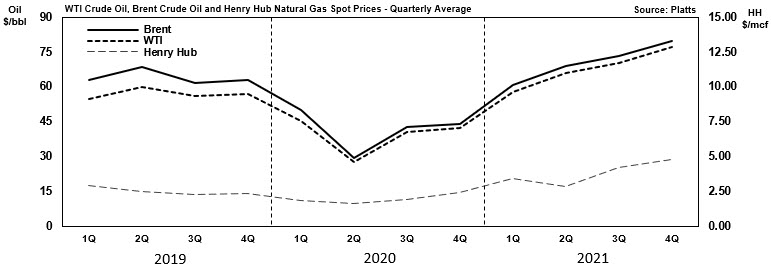
The chart above shows the trend in benchmark prices for Brent crude oil, West Texas Intermediate (WTI) crude oil and U.S. Henry Hub natural gas. The Brent price averaged $71 per barrel for the full-year 2021, compared to $42 in 2020. As of mid-February 2022, the Brent price was $100 per barrel. The WTI price averaged $68 per barrel for the full-year 2021, compared to $39 in 2020. As of mid-February 2022, the WTI price was $95 per barrel. The majority of the company’s equity crude production is priced based on the Brent benchmark.
Crude prices increased in 2021 driven by production curtailment by OPEC+ countries and steadily increasing demand for transportation fuels. The company’s average realization for U.S. crude oil and natural gas liquids in 2021 was $56 per barrel, up 84 percent from 2020. The company’s average realization for international crude oil and natural gas liquids in 2021 was $65 per barrel, up 79 percent from 2020.
Prices for natural gas are more closely aligned with seasonal supply-and-demand and infrastructure conditions in local markets. In the United States, prices at Henry Hub averaged $3.85 per thousand cubic feet (MCF) during 2021, compared with $1.98 per MCF during 2020. As of mid-February 2022, the Henry Hub spot price was $3.93 per MCF.
Outside the United States, prices for natural gas depend on a wide range of supply, demand and regulatory circumstances. The company’s long-term contract prices for liquefied natural gas (LNG) are typically linked to crude oil prices. Most of the equity LNG offtake from the operated Australian LNG projects is committed under binding long-term contracts, with some sold in the Asian spot LNG market. International natural gas realizations averaged $5.93 per MCF during 2021, compared with $4.59 per MCF during 2020. (See page 42 for the company’s average natural gas realizations for the U.S. and international regions.)
The company’s worldwide net oil-equivalent production in 2021 was a record 3.099 million barrels per day. About 27 percent of the company’s net oil-equivalent production in 2021 occurred in OPEC+ member countries of Angola, Equatorial Guinea, Kazakhstan, Nigeria, the Partitioned Zone between Saudi Arabia and Kuwait and Republic of Congo.
The company estimates that its net oil-equivalent production in 2022 will be flat to down 3 percent compared to 2021, assuming a Brent crude oil price of $60 per barrel and excluding the impact of asset sales that may close in 2022. This estimate is subject to many factors and uncertainties, including quotas or other actions that may be imposed by OPEC+; price effects on entitlement volumes; changes in fiscal terms or restrictions on the scope of company operations; delays in construction; reservoir performance; greater-than-expected declines in production from mature fields; start-up or ramp-up of projects; fluctuations in demand for crude oil and natural gas in various markets; weather conditions that may shut in
35
Management's Discussion and Analysis of Financial Condition and Results of Operations
production; civil unrest; changing geopolitics; delays in completion of maintenance turnarounds; storage constraints or economic conditions that could lead to shut-in production; or other disruptions to operations. The outlook for future production levels is also affected by the size and number of economic investment opportunities and the time lag between initial exploration and the beginning of production. The company has increased its investment emphasis on short-cycle projects.
In January 2022, Chevron announced its intent to begin the process of exiting from its nonoperated interests in Myanmar. At December 31, 2021, the carrying value of the company’s assets was approximately $200 million.
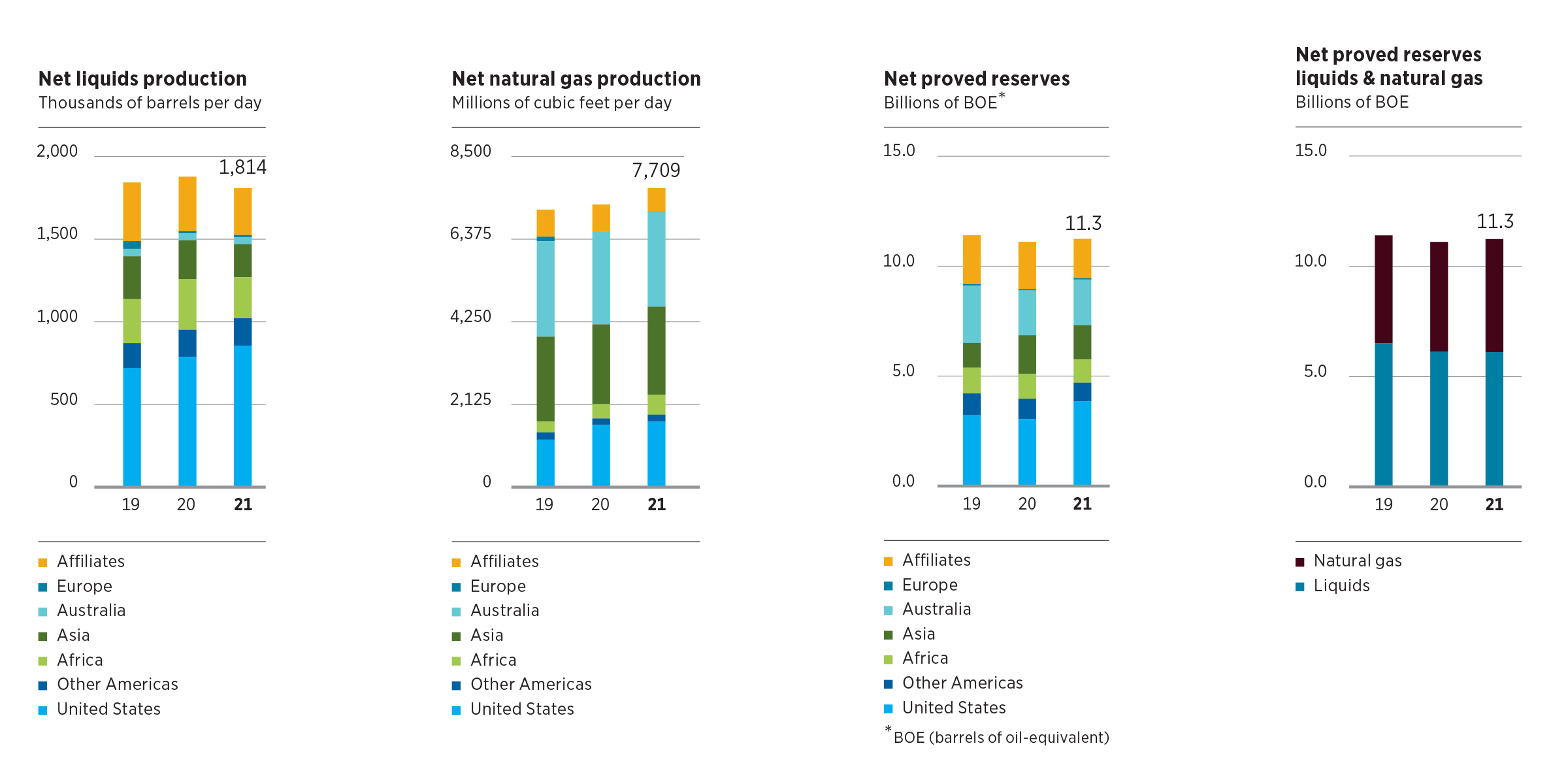
Net proved reserves for consolidated companies and affiliated companies totaled 11.3 billion barrels of oil-equivalent at year-end 2021, an increase of 1 percent from year-end 2020. The reserve replacement ratio in 2021 was 112 percent. The 5 and 10 year reserve replacement ratios were 103 percent and 100 percent, respectively. Refer to
Table V
for a tabulation of the company’s proved net oil and gas reserves by geographic area, at the beginning of 2019 and each year-end from 2019 through 2021, and an accompanying discussion of major changes to proved reserves by geographic area for the three-year period ending December 31, 2021.
Refer to the “Results of Operations” section on pages 39 and 40 for additional discussion of the company’s upstream business.
Downstream
Earnings for the downstream segment are closely tied to margins on the refining, manufacturing and marketing of products that include gasoline, diesel, jet fuel, lubricants, fuel oil, fuel and lubricant additives, petrochemicals and renewable fuels. Industry margins are sometimes volatile and can be affected by the global and regional supply-and-demand balance for refined products and petrochemicals, and by changes in the price of crude oil, other refinery and petrochemical feedstocks, and natural gas. Industry margins can also be influenced by inventory levels, geopolitical events, costs of materials and services, refinery or chemical plant capacity utilization, maintenance programs, and disruptions at refineries or chemical plants resulting from unplanned outages due to severe weather, fires or other operational events.
Other factors affecting profitability for downstream operations include the reliability and efficiency of the company’s refining, marketing and petrochemical assets, the effectiveness of its crude oil and product supply functions, and the volatility of tanker-charter rates for the company’s shipping operations, which are driven by the industry’s demand for crude oil and product tankers. Other factors beyond the company’s control include the general level of inflation and energy costs to operate the company’s refining, marketing and petrochemical assets, and changes in tax, environmental, and other applicable laws and regulations.
The company’s most significant marketing areas are the West Coast and Gulf Coast of the United States and Asia Pacific. Chevron operates or has significant ownership interests in refineries in each of these areas. Additionally, the company has a small but growing presence in renewable fuels.
36
Management's Discussion and Analysis of Financial Condition and Results of Operations
Refer to the “Results of Operations” section on page 40 for additional discussion of the company’s downstream operations.
All Other
consists of worldwide cash management and debt financing activities, corporate administrative functions, insurance operations, real estate activities and technology companies.
Operating Developments
Key operating developments and other events during 2021 and early 2022 included the following:
Upstream
Angola
Chevron’s affiliate, Cabinda Gulf Oil Company Limited (CABGOC), signed an agreement to extend the Block 0 concession for 20 years, through 2050.
Australia
Sanctioned the Jansz-Io compression project, a part of the Gorgon development and an important source of natural gas supply to the Gorgon LNG facility.
Brazil
Completed the sale of the company's 37.5 percent nonoperated interest in the Papa-Terra oil field.
Equatorial Guinea
Announced the start-up and first LNG cargo from the Alen Gas Monetization Project.
Japan
Announced the signing of a binding Sale and Purchase Agreement with Hokkaido Gas Co., Ltd. for the delivery of about a half million tons of LNG over a period of five years, starting in 2022.
United States
Entered FEED for the Ballymore project, which is being developed as a subsea tieback to the existing Blind Faith facility, in the deepwater Gulf of Mexico.
United States
Sanctioned the Whale project in the deepwater Gulf of Mexico.
Downstream
Finland
Announced an agreement to acquire Neste Oyj’s Group III base oil business, including its related sales and marketing business, and brand NEXBASE
TM
.
South Korea
Chevron’s 50 percent owned affiliate, GS Caltex, started up an olefins mixed-feed cracker and associated polyethylene unit at its Yeosu refinery ahead of schedule and under budget.
United States
Announced the commissioning and start-up of the world’s first commercial-scale ISOALKY™ process unit at the Salt Lake City Refinery. This proprietary technology uses ionic liquids to produce a high octane gasoline blending component as a cost-effective alternative to conventional alkylation technologies and offers environmental and process safety advantages.
United States
Began producing renewable diesel at the El Segundo, California refinery by co-processing bio-feedstock.
United States
Announced establishment of its first branded Compressed Natural Gas (CNG) station, as part of its plan to sell RNG through more than 30 CNG stations in California by 2025.
United States
Acquired an equity interest in American Natural Gas LLC (now Beyond6, LLC) and its network of 60 compressed natural gas stations across the United States to grow its RNG value chain.
United States
Announced the second expansion of its joint venture, Brightmark RNG Holdings LLC, to own projects across the United States to produce and market dairy biomethane, a RNG. First gas delivery at the Lawnhurst site in New York was announced in November.
United States
Announced the launch of Havoline® PRO-RS™ Renewable Full Synthetic Motor Oil made with 25 percent sustainably sourced plant-based oils.
United States
Celebrated the opening of the 1,000th ExtraMile Convenience store.
United States
Chevron’s 50 percent owned affiliate, CPChem, announced the first commercial sales of their Marlex® Anew™ Circular Polyethylene, which uses advanced recycling technology to process pyrolysis oil, a feedstock made from difficult-to-recycle waste plastics.
United States
Announced the signing of definitive transaction agreements to create a joint venture with Bunge North America, Inc., to own and operate soybean processing facilities.
37
Management's Discussion and Analysis of Financial Condition and Results of Operations
Other
United States
Announced the launch of Chevron’s $300 million Future Energy Fund II focused on technologies that have the potential to enable affordable, reliable, and ever-cleaner energy for all.
United States
Announced plans with partners to develop carbon negative bioenergy in Mendota, California.
United States
Announced memorandums of understanding with Toyota Motors North America, Inc. to explore a strategic alliance to catalyze and lead the development of commercially viable, large-scale businesses in hydrogen; with Cummins Inc. to explore a strategic alliance to develop commercially viable business opportunities in hydrogen and other alternative energy sources; with Delta Air Lines, Inc. and Google LLC to track sustainable aviation fuel test batch emissions data using cloud-based technology; and with Progress Rail Locomotive Inc., a Caterpillar company, and BNSF Railway Company to demonstrate hydrogen-fueled locomotives.
United States
Acquired all of the publicly held common units representing limited partner interests in Noble Midstream Partners LP not already owned by Chevron and its affiliates.
United States
Announced a collaboration agreement with Caterpillar Inc. to develop hydrogen demonstration projects in transportation and stationary power applications, including prime power.
United States
Announced a letter of intent with Gevo, Inc. to jointly invest in building and operating one or more new facilities that process inedible corn to produce sustainable aviation fuel.
United States
Announced agreement on a framework to acquire an equity interest in ACES Delta, LLC that owns the Advanced Clean Energy Storage project. This project aims to produce, store and transport green hydrogen at utility scale.
United States
Announced a framework with Enterprise Product Partners L.P. to study and evaluate opportunities for carbon dioxide capture, utilization, and storage from their respective business operations in the U.S. Midcontinent and Gulf Coast.
United States
Invested in companies to access lower-carbon technologies, including Baseload Capital AB (low-temperature geothermal and heat power), Starfire Energy (carbon-free ammonia and carbon-free hydrogen), Ocergy, Inc. (floating offshore and wind turbine technology), Mainspring (lower-carbon generators for electric grids), Raygen (solar-hydro plant with storage), Boomitra (soil carbon offset platform), Natel Energy (hydro-power based technology), Raven SR Inc. (modular waste-to-green hydrogen and renewable synthetic fuel facilities), Sapphire Technologies (waste energy recovery systems), Hydrogenious LOHC Technologies (liquid organic hydrogen carriers), gr3n SA (plastics recycling technology), Malta Inc. (thermal energy storage) and Ionomr Innovations Inc. (ion-exchange membranes and polymers).
Common Stock Dividends
The 2021 annual dividend was $5.31 per share, making 2021 the 34th consecutive year that the company increased its annual per share dividend payout. In January 2022, the company’s Board of Directors increased its quarterly dividend by $0.08 per share, approximately six percent, to $1.42 per share payable in March 2022.
Common Stock Repurchase Program
The company resumed stock repurchases in third quarter 2021 and purchased $1.4 billion of its common stock in 2021 under its stock repurchase program. The company currently expects to repurchase $1.25 billion of its common stock during the first quarter of 2022.
Results of Operations
The following section presents the results of operations and variances on an after-tax basis for the company’s business segments – Upstream and Downstream – as well as for “All Other.” Earnings are also presented for the U.S. and international geographic areas of the Upstream and Downstream business segments. Refer to
Note 14 Operating Segments and Geographic Data
for a discussion of the company’s “reportable segments.” This section should also be read in conjunction with the discussion in “Business Environment and Outlook” on pages 32 through 37. Refer to the “Selected Operating Data” table on page 42 for a three-year comparison of production volumes, refined product sales volumes, and refinery inputs. A discussion of variances between 2020 and 2019 can be found in the “Results of Operations” section on pages 37 through 38 of the company’s 2020 Annual Report on Form 10-K filed with the SEC on February 25, 2021.
38
Management's Discussion and Analysis of Financial Condition and Results of Operations
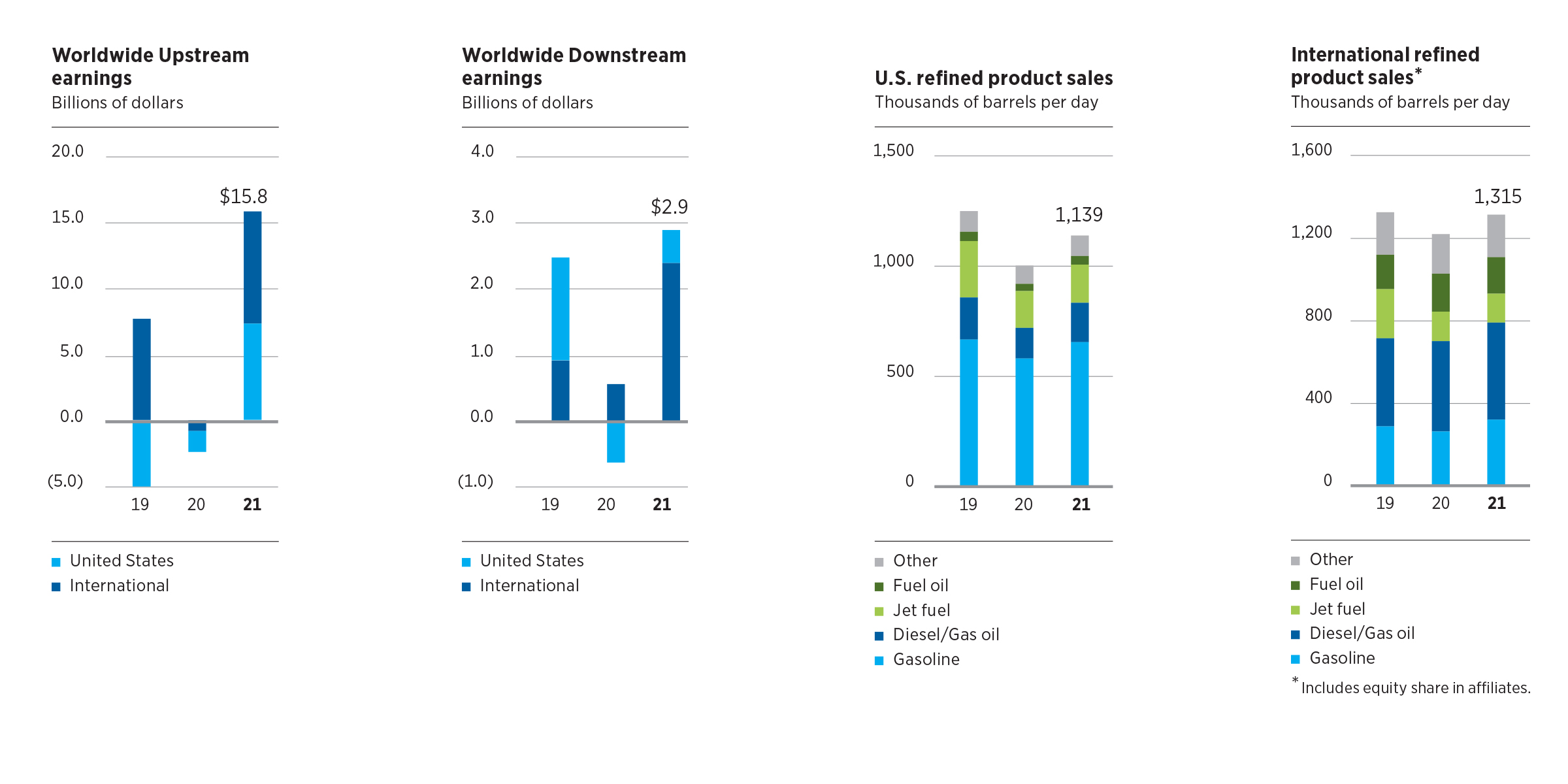
U.S. Upstream
| Millions of dollars | 2021 | 2020 | 2019 | |||||||||||||||||
| Earnings (Loss) | $ | 7,319 | $ | (1,608) | $ | (5,094) | ||||||||||||||
U.S. upstream reported earnings of $7.3 billion in 2021, compared with a loss of $1.6 billion in 2020. The increase was due to higher realizations of $6.9 billion, the absence of 2020 impairments and write-offs of $1.2 billion, higher sales volumes of $760 million, and higher asset sales gains of $640 million.
The company’s average realization for U.S. crude oil and natural gas liquids in 2021 was $56.06 per barrel compared with $30.53 in 2020. The average natural gas realization was $3.11 per thousand cubic feet in 2021, compared with $0.98 in 2020.
Net oil-equivalent production in 2021 averaged 1.14 million barrels per day, up 8 percent from 2020. The increase was due to an additional 162,000 barrels per day of production from the Noble Energy acquisition, partially offset by a 63,000 barrels per day decrease related to the Appalachian asset sale.
The net liquids component of oil-equivalent production for 2021 averaged 858,000 barrels per day, up 9 percent from 2020. Net natural gas production averaged 1.69 billion cubic feet per day in 2021, an increase of 5 percent from 2020.
International Upstream
| Millions of dollars | 2021 | 2020 | 2019 | |||||||||||||||||
|
Earnings (Loss)
*
|
$ | 8,499 | $ | (825) | $ | 7,670 | ||||||||||||||
|
*
Includes foreign currency effects:
|
$ | 302 | $ | (285) | $ | (323) | ||||||||||||||
International upstream reported earnings of $8.5 billion in 2021, compared with a loss of $825 million in 2020. The increase was primarily due to higher realizations of $7.6 billion, along with the absence of 2020 impairments and write-offs of $3.6 billion and severance charges of $290 million. Partially offsetting these increases are higher tax charges of $630 million, the absence of 2020 asset sales gains of $550 million, and higher depreciation expenses of $670 million and lower sales volumes of $540 million. Foreign currency effects had a favorable impact on earnings of $587 million between periods.
The company’s average realization for international crude oil and natural gas liquids in 2021 was $64.53 per barrel compared with $36.07 in 2020. The average natural gas realization was $5.93 per thousand cubic feet in 2021 compared with $4.59 in 2020.
International net oil-equivalent production was 1.96 million barrels per day in 2021, down 3 percent from 2020. The decrease was primarily due to the absence of 69,000 barrels per day following expiration of the Rokan concession in
39
Management's Discussion and Analysis of Financial Condition and Results of Operations
Indonesia, unfavorable entitlement effects, normal field declines and the effect of asset sales, partially offset by 113,000 barrels per day associated with the Noble Energy acquisition and lower production curtailments.
The net liquids component of international oil-equivalent production was 956,000 barrels per day in 2021, a decrease of 11 percent from 2020. International net natural gas production of 6.02 billion cubic feet per day in 2021 increased 6 percent from 2020.
U.S. Downstream
| Millions of dollars | 2021 | 2020 | 2019 | |||||||||||||||||
| Earnings (Loss) | $ | 2,389 | $ | (571) | $ | 1,559 | ||||||||||||||
U.S. downstream reported earnings of $2.4 billion in 2021, compared with a loss of $571 million in 2020. The increase was primarily due to higher margins on refined product sales of $1.6 billion, higher earnings from 50 percent-owned CPChem of $1.0 billion and higher sales volumes of $470 million, partially offset by higher operating expenses of $150 million.
Total refined product sales of 1.14 million barrels per day in 2021 increased 14 percent from 2020, mainly due to higher gasoline, jet fuel, and diesel demand as travel restrictions associated with the COVID-19 pandemic continue to ease.
International Downstream
| Millions of dollars | 2021 | 2020 | 2019 | |||||||||||||||||
|
Earnings
*
|
$ | 525 | $ | 618 | $ | 922 | ||||||||||||||
|
*
Includes foreign currency effects:
|
$ | 185 | $ | (152) | $ | 17 | ||||||||||||||
International downstream earned $525 million in 2021, compared with $618 million in 2020. The decrease in earnings was largely due to lower margins on refined product sales of $330 million and higher operating expenses of $100 million, partially offset by a favorable swing in foreign currency effects of $337 million between periods.
Total refined product sales of 1.32 million barrels per day in 2021 were up 8 percent from 2020, mainly due to the second quarter 2020 acquisition of Puma Energy (Australia) Holdings Pty Ltd. and higher diesel and gasoline demand, partially offset by lower jet fuel demand.
All Other
| Millions of dollars | 2021 | 2020 | 2019 | |||||||||||||||||
|
Net charges
*
|
$ | (3,107) | $ | (3,157) | $ | (2,133) | ||||||||||||||
|
*
Includes foreign currency effects:
|
$ | (181) | $ | (208) | $ | 2 | ||||||||||||||
All Other consists of worldwide cash management and debt financing activities, corporate administrative functions, insurance operations, real estate activities, and technology companies.
Net charges in 2021 decreased $50 million from 2020. The change between periods was mainly due to the absence of 2020 severance, Noble acquisition and mining remediation costs, and lower corporate charges, partially offset by higher employee benefit costs and a loss on early retirement of debt. Foreign currency effects decreased net charges by $27 million between periods.
Consolidated Statement of Income
Comparative amounts for certain income statement categories are shown below. A discussion of variances between 2020 and 2019 can be found in the “Consolidated Statement of Income” section on pages 39 and 40 of the company’s 2020 Annual Report on Form 10-K.
| Millions of dollars | 2021 | 2020 | 2019 | |||||||||||||||||
| Sales and other operating revenues | $ | 155,606 | $ | 94,471 | $ | 139,865 | ||||||||||||||
Sales and other operating revenues increased in 2021
mainly due to higher refined product, crude oil, and natural gas prices and sales volumes
.
40
Management's Discussion and Analysis of Financial Condition and Results of Operations
| Millions of dollars | 2021 | 2020 | 2019 | |||||||||||||||||
| Income (loss) from equity affiliates | $ | 5,657 | $ | (472) | $ | 3,968 | ||||||||||||||
Income from equity affiliates improved in 2021 mainly due to the absence of the full impairment of Petropiar and Petroboscan in Venezuela in 2020, higher upstream-related earnings from Tengizchevroil in Kazakhstan and Angola LNG, and higher downstream-related earnings from CPChem and GS Caltex in Korea.
Refer to
Note 15 Investments and Advances
for a discussion of Chevron’s investments in affiliated companies.
| Millions of dollars | 2021 | 2020 | 2019 | |||||||||||||||||
| Other income | $ | 1,202 | $ | 693 | $ | 2,683 | ||||||||||||||
Other income increased in 2021 mainly due to a favorable swing in foreign currency effects and higher gains on asset sales, partially offset by losses on the early retirement of debt.
| Millions of dollars | 2021 | 2020 | 2019 | |||||||||||||||||
| Purchased crude oil and products | $ | 89,372 | $ | 50,488 | $ | 80,113 | ||||||||||||||
Crude oil and product purchases increased in 2021 primarily due to higher crude oil, natural gas, and refined product prices and higher refined product volumes.
| Millions of dollars | 2021 | 2020 | 2019 | |||||||||||||||||
| Operating, selling, general and administrative expenses | $ | 24,740 | $ | 24,536 | $ | 25,528 | ||||||||||||||
Operating, selling, general and administrative expenses increased in 2021 primarily due to higher employee benefit and transportation costs partially offset by the absence of 2020 severance accruals.
| Millions of dollars | 2021 | 2020 | 2019 | |||||||||||||||||
| Exploration expense | $ | 549 | $ | 1,537 | $ | 770 | ||||||||||||||
Exploration expenses in 2021 decreased primarily
due to lower charges for well write-offs
.
| Millions of dollars | 2021 | 2020 | 2019 | |||||||||||||||||
| Depreciation, depletion and amortization | $ | 17,925 | $ | 19,508 | $ | 29,218 | ||||||||||||||
Depreciation, depletion and amortization expenses decreased in 2021 primarily
due to lower impairment charges, partially offset by higher rates and production
.
| Millions of dollars | 2021 | 2020 | 2019 | |||||||||||||||||
| Taxes other than on income | $ | 6,840 | $ | 4,499 | $ | 4,136 | ||||||||||||||
Taxes other than on income increased in 2021 primarily
due to higher regulatory expenses, taxes on production and excise taxes, which was primarily driven by higher refined product sales in Australia.
| Millions of dollars | 2021 | 2020 | 2019 | |||||||||||||||||
| Interest and debt expense | $ | 712 | $ | 697 | $ | 798 | ||||||||||||||
Interest and debt expenses increased in 2021 mainly due to interest expense associated with debt acquired in the Noble Energy acquisition.
| Millions of dollars | 2021 | 2020 | 2019 | |||||||||||||||||
| Other components of net periodic benefit costs | $ | 688 | $ | 880 | $ | 417 | ||||||||||||||
Other components of net periodic benefit costs decreased in 2021 primarily due to lower interest costs.
| Millions of dollars | 2021 | 2020 | 2019 | |||||||||||||||||
| Income tax expense (benefit) | $ | 5,950 | $ | (1,892) | $ | 2,691 | ||||||||||||||
The increase in income tax expense in 2021 of $7.84 billion is due to the increase in total income before tax for the company of $29.09 billion. The increase in income before taxes for the company is primarily the result of higher upstream realizations, the absence of 2020 impairments and write-offs, and higher downstream margins.
U.S. income before tax increased from a loss of $5.70 billion in 2020 to income of $9.67 billion in 2021. This $15.37 billion increase in income was primarily driven by higher upstream realizations, higher downstream margins and the absence of 2020 impairments and write-offs. The increase in income had a direct impact on the company’s U.S. income tax resulting in an increase to tax expense of $3.18 billion between year-over-year periods, from a tax benefit of $1.58 billion in 2020 to a charge of $1.60 billion in 2021.
41
Management's Discussion and Analysis of Financial Condition and Results of Operations
International income before tax increased from a loss of $1.75 billion in 2020 to income of $11.97 billion in 2021. This $13.72 billion increase in income was primarily driven by higher upstream realizations and the absence of 2020 impairments and write-offs. The increased income primarily drove the $4.66 billion increase in international income tax expense between year-over-year periods, from a tax benefit of $308 million in 2020 to a charge of $4.35 billion in 2021.
Selected Operating Data
1,2
| 2021 | 2020 | 2019 | |||||||||||||||
| U.S. Upstream | |||||||||||||||||
| Net Crude Oil and Natural Gas Liquids Production (MBPD) | 858 | 790 | 724 | ||||||||||||||
|
Net Natural Gas Production (MMCFPD)
3
|
1,689 | 1,607 | 1,225 | ||||||||||||||
| Net Oil-Equivalent Production (MBOEPD) | 1,139 | 1,058 | 929 | ||||||||||||||
| Sales of Natural Gas (MMCFPD) | 4,007 | 3,894 | 4,016 | ||||||||||||||
| Sales of Natural Gas Liquids (MBPD) | 201 | 208 | 130 | ||||||||||||||
| Revenues from Net Production | |||||||||||||||||
| Liquids ($/Bbl) | $ | 56.06 | $ | 30.53 | $ | 48.54 | |||||||||||
| Natural Gas ($/MCF) | $ | 3.11 | $ | 0.98 | $ | 1.09 | |||||||||||
| International Upstream | |||||||||||||||||
|
Net Crude Oil and Natural Gas Liquids Production (MBPD)
4
|
956 | 1,078 | 1,141 | ||||||||||||||
|
Net Natural Gas Production (MMCFPD)
3
|
6,020 | 5,683 | 5,932 | ||||||||||||||
|
Net Oil-Equivalent Production (MBOEPD)
4
|
1,960 | 2,025 | 2,129 | ||||||||||||||
| Sales of Natural Gas (MMCFPD) | 5,178 | 5,634 | 5,869 | ||||||||||||||
| Sales of Natural Gas Liquids (MBPD) | 84 | 46 | 34 | ||||||||||||||
| Revenues from Liftings | |||||||||||||||||
| Liquids ($/Bbl) | $ | 64.53 | $ | 36.07 | $ | 58.14 | |||||||||||
| Natural Gas ($/MCF) | $ | 5.93 | $ | 4.59 | $ | 5.83 | |||||||||||
| Worldwide Upstream | |||||||||||||||||
|
Net Oil-Equivalent Production (MBOEPD)
4
|
|||||||||||||||||
| United States | 1,139 | 1,058 | 929 | ||||||||||||||
| International | 1,960 | 2,025 | 2,129 | ||||||||||||||
| Total | 3,099 | 3,083 | 3,058 | ||||||||||||||
| U.S. Downstream | |||||||||||||||||
|
Gasoline Sales (MBPD)
5
|
655 | 581 | 667 | ||||||||||||||
| Other Refined Product Sales (MBPD) | 484 | 422 | 583 | ||||||||||||||
| Total Refined Product Sales (MBPD) | 1,139 | 1,003 | 1,250 | ||||||||||||||
| Sales of Natural Gas Liquids (MBPD) | 29 | 25 | 101 | ||||||||||||||
|
Refinery Input (MBPD)
6
|
903 | 793 | 947 | ||||||||||||||
| International Downstream | |||||||||||||||||
|
Gasoline Sales (MBPD)
5
|
321 | 264 | 289 | ||||||||||||||
| Other Refined Product Sales (MBPD) | 994 | 957 | 1,038 | ||||||||||||||
|
Total Refined Product Sales (MBPD)
7
|
1,315 | 1,221 | 1,327 | ||||||||||||||
| Sales of Natural Gas Liquids (MBPD) | 96 | 74 | 72 | ||||||||||||||
| Refinery Input (MBPD) | 576 | 584 | 617 | ||||||||||||||
|
1
Includes company share of equity affiliates.
|
|||||||||||||||||
|
2
MBPD – thousands of barrels per day; MMCFPD – millions of cubic feet per day; MBOEPD – thousands of barrels of oil-equivalents per day; Bbl – barrel; MCF – thousands of cubic feet. Oil-equivalent gas (OEG) conversion ratio is 6,000 cubic feet of natural gas = 1 barrel of crude oil.
|
|||||||||||||||||
|
3
Includes natural gas consumed in operations (MMCFPD):
|
|||||||||||||||||
| United States | 44 | 37 | 36 | ||||||||||||||
| International | 548 | 566 | 602 | ||||||||||||||
|
4
Includes net production of synthetic oil:
|
|||||||||||||||||
| Canada | 55 | 54 | 53 | ||||||||||||||
| Venezuela affiliate | — | — | 3 | ||||||||||||||
|
5
Includes branded and unbranded gasoline.
|
|||||||||||||||||
|
6
In May 2019, the company acquired the Pasadena Refinery in Pasadena, Texas, which has an operable capacity of 110,000 barrels per day.
|
|||||||||||||||||
|
7
Includes sales of affiliates (MBPD):
|
357 | 348 | 379 | ||||||||||||||
|
|
|||||||||||||||||
42
Management's Discussion and Analysis of Financial Condition and Results of Operations
Liquidity and Capital Resources
Sources and Uses of Cash
The strength of the company’s balance sheet enables it to fund any timing differences throughout the year between cash inflows and outflows.
Cash, Cash Equivalents and Marketable Securities
Total balances were $5.7 billion and $5.6 billion at December 31, 2021 and 2020, respectively. Cash provided by operating activities in 2021 was $29.2 billion, compared to $10.6 billion in 2020, primarily due to higher crude oil and natural gas prices. Cash provided by operating activities was net of contributions to employee pension plans of approximately $1.8 billion in 2021 and $1.2 billion in 2020. Cash provided by investing activities included proceeds and deposits related to asset sales of $1.4 billion in 2021 and $2.9 billion in 2020.
Restricted cash of $1.2 billion and $1.1 billion at December 31, 2021 and 2020, respectively, was held in cash and short-term marketable securities and recorded as “Deferred charges and other assets” and “Prepaid expenses and other current assets” on the Consolidated Balance Sheet. These amounts are generally associated with upstream decommissioning activities, tax payments and funds held in escrow for tax-deferred exchanges.
Dividends
Dividends paid to common stockholders were $10.2 billion in 2021 and $9.7 billion in 2020.
Debt and Finance Lease Liabilities
Total debt and finance lease liabilities were $31.4 billion at December 31, 2021, down from $44.3 billion at year-end 2020.
The $12.9 billion decrease in total debt and finance lease liabilities during 2021 was primarily due to the repayment of long-term notes that matured during the year, the early retirement of long-term notes and the credit facility held by Noble Midstream Partners LP, and the elimination of borrowings under the company’s commercial paper program. The company completed a tender offer, with the objective of lowering future interest expenses, and redeemed bonds with a book value (including fair market price adjustments) of $3.4 billion in October 2021. The company’s debt and finance lease liabilities due within one year, consisting primarily of the current portion of long-term debt and redeemable long-term obligations, totaled $8.0 billion at December 31, 2021, compared with $11.4 billion at year-end 2020. Of these amounts, $7.8 billion and $9.8 billion were reclassified to long-term debt at the end of 2021 and 2020, respectively.
At year-end 2021, settlement of these obligations was not expected to require the use of working capital in 2022, as the company had the intent and the ability, as evidenced by committed credit facilities, to refinance them on a long-term basis.
The company has an automatic shelf registration statement that expires in August 2023 for an unspecified amount of nonconvertible debt securities issued by Chevron Corporation or CUSA.
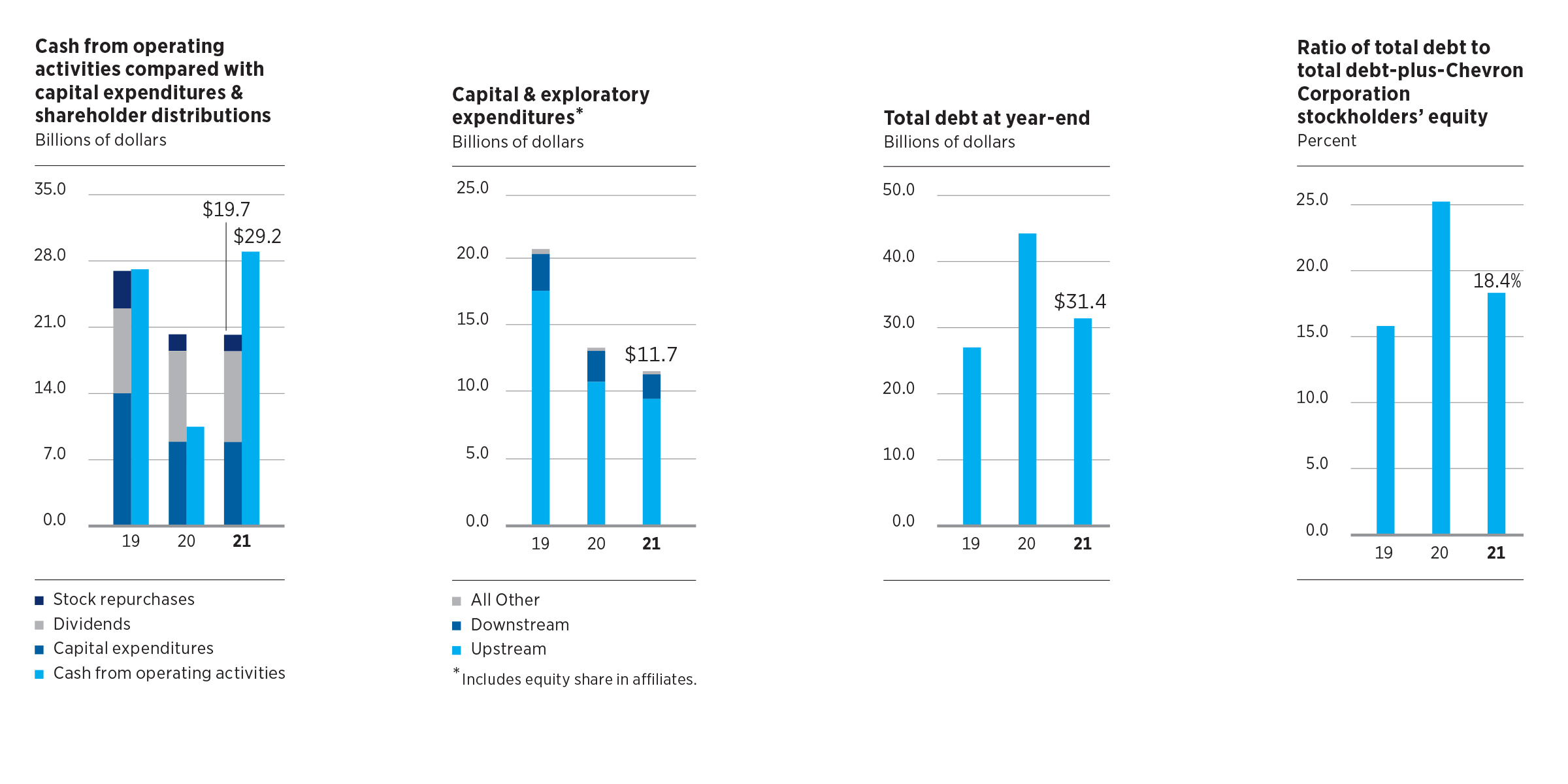
The major debt rating agencies routinely evaluate the company’s debt, and the company’s cost of borrowing can increase or decrease depending on these debt ratings. The company has outstanding public bonds issued by Chevron Corporation,
43
Management's Discussion and Analysis of Financial Condition and Results of Operations
CUSA, Noble, and Texaco Capital Inc. Most of these securities are the obligations of, or guaranteed by, Chevron Corporation and are rated AA- by Standard and Poor’s Corporation and Aa2 by Moody’s Investors Service. The company’s U.S. commercial paper is rated A-1+ by Standard and Poor’s and P-1 by Moody’s. All of these ratings denote high-quality, investment-grade securities.
The company’s future debt level is dependent primarily on results of operations, cash that may be generated from asset dispositions, the capital program, lending commitments to affiliates and shareholder distributions. Based on its high-quality debt ratings, the company believes that it has substantial borrowing capacity to meet unanticipated cash requirements. During extended periods of low prices for crude oil and natural gas and narrow margins for refined products and commodity chemicals, the company has the ability to modify its capital spending plans and discontinue or curtail the stock repurchase program. This provides the flexibility to continue paying the common stock dividend and remain committed to retaining the company’s high-quality debt ratings.
Committed Credit Facilities
Information related to committed credit facilities is included in
Note 19 Short-Term Debt
.
Summarized Financial Information for Guarantee of Securities of Subsidiaries
CUSA issued bonds that are fully and unconditionally guaranteed on an unsecured basis by Chevron Corporation (together, the “Obligor Group”). The tables below contain summary financial information for Chevron Corporation, as Guarantor, excluding its consolidated subsidiaries, and CUSA, as the issuer, excluding its consolidated subsidiaries. The summary financial information of the Obligor Group is presented on a combined basis, and transactions between the combined entities have been eliminated. Financial information for non-guarantor entities has been excluded.
| Year Ended December 31, 2021 | Year Ended December 31, 2020 | ||||||||||
| (Millions of dollars) (unaudited) | |||||||||||
| Sales and other operating revenues | $ | 88,038 | $ | 49,636 | |||||||
| Sales and other operating revenues - related party | 28,499 | 17,044 | |||||||||
| Total costs and other deductions | 86,369 | 57,575 | |||||||||
| Total costs and other deductions - related party | 28,277 | 14,052 | |||||||||
| Net income (loss) | $ | 5,515 | $ | (1,610) | |||||||
|
At December 31,
2021 |
At December 31,
2020 |
||||||||||
| (Millions of dollars) (unaudited) | |||||||||||
| Current assets | $ | 15,567 | $ | 9,196 | |||||||
| Current assets - related party | 12,227 | 5,719 | |||||||||
| Other assets | 48,461 | 48,993 | |||||||||
| Current liabilities | 22,554 | 20,965 | |||||||||
| Current liabilities - related party | 79,778 | 55,273 | |||||||||
| Other liabilities | 32,825 | 34,983 | |||||||||
| Total net equity (deficit) | $ | (58,902) | $ | (47,313) | |||||||
Common Stock Repurchase Program
The Board of Directors authorized a stock repurchase program in 2019, with a maximum dollar limit of $25 billion and no set term limits. During 2021, the company purchased 12.9 million shares for $1.4 billion under the program. As of December 31, 2021, the company had purchased a total of 61.5 million shares for $6.8 billion, resulting in $18.2 billion remaining under the program. The company currently expects to repurchase $1.25 billion of its common stock during the first quarter of 2022.
Repurchases may be made from time to time in the open market, by block purchases, in privately negotiated transactions, or in such other manner as determined by the company. The timing of the repurchases and the actual amount repurchased will depend on a variety of factors, including the market price of the company’s shares, general market and economic conditions, and other factors. The stock repurchase program does not obligate the company to acquire any particular amount of common stock, and it may be suspended or discontinued at any time.
44
Management's Discussion and Analysis of Financial Condition and Results of Operations
Capital and Exploratory Expenditures
Capital and exploratory expenditures by business segment for 2021, 2020 and 2019 are as follows:
| 2021 | 2020 | 2019 | |||||||||||||||||||||||||||||||||||||||
| Millions of dollars | U.S. | Int’l. | Total | U.S. | Int’l. | Total | U.S. | Int’l. | Total | ||||||||||||||||||||||||||||||||
| Upstream | $ | 4,698 | $ | 4,916 | $ | 9,614 | $ | 5,130 | $ | 5,784 | $ | 10,914 | $ | 8,197 | $ | 9,627 | $ | 17,824 | |||||||||||||||||||||||
| Downstream | 1,235 | 630 | 1,865 | 1,021 | 1,325 | 2,346 | 1,868 | 920 | 2,788 | ||||||||||||||||||||||||||||||||
| All Other | 221 | 20 | 241 | 226 | 13 | 239 | 365 | 17 | 382 | ||||||||||||||||||||||||||||||||
| Total | $ | 6,154 | $ | 5,566 | $ | 11,720 | $ | 6,377 | $ | 7,122 | $ | 13,499 | $ | 10,430 | $ | 10,564 | $ | 20,994 | |||||||||||||||||||||||
| Total, Excluding Equity in Affiliates | $ | 5,787 | $ | 2,766 | $ | 8,553 | $ | 6,053 | $ | 3,464 | $ | 9,517 | $ | 10,062 | $ | 4,820 | $ | 14,882 | |||||||||||||||||||||||
Total reported expenditures for 2021 were $11.7 billion, including $3.2 billion for the company’s share of equity-affiliate expenditures, which did not require cash outlays by the company. In 2020, expenditures were $13.5 billion, including the company’s share of affiliates’ expenditures of $4.0 billion. The acquisition of Noble is not included in the company’s capital and exploratory expenditures.
Of the $11.7 billion of expenditures in 2021, 82 percent, or $9.6 billion, related to upstream activities. Approximately 81 percent was expended for upstream operations in 2020. International upstream accounted for 51 percent of the worldwide upstream investment in 2021 and 53 percent in 2020.
The company estimates that 2022 organic capital and exploratory expenditures will be approximately $15 billion, including $3.6 billion of spending by affiliates, an increase of over 25 percent from 2021 expenditures. This includes approximately $800 million in lower carbon spending that aims to reduce the carbon intensity of the company’s operations and grow its lower carbon businesses.
In the upstream business, approximately $8 billion is allocated to currently producing assets, including about $3 billion for Permian Basin unconventional development and approximately $1.5 billion for other shale and tight assets worldwide. Additionally, $3 billion of the upstream program is planned for major capital projects underway, of which about $2 billion is associated with the FGP/WPMP at the Tengiz field in Kazakhstan. Finally, approximately $1.5 billion is allocated to exploration, early-stage development projects, midstream activities and carbon reduction opportunities.
Worldwide downstream spending in 2022 is estimated to be $2.3 billion, including capital targeted to grow renewable fuels and products businesses. Investments in technology businesses and other corporate operations in 2022 are budgeted at $0.4 billion.
The company monitors crude oil market conditions and can adjust future capital outlays should oil price conditions deteriorate.
Noncontrolling Interests
The company had noncontrolling interests of $873 million at December 31, 2021 and $1.0 billion at December 31, 2020. Distributions to noncontrolling interests net of contributions totaled $36 million and $24 million in 2021 and 2020, respectively. Included within noncontrolling interests at December 31, 2021 is $135 million of redeemable noncontrolling interest.
Pension Obligations
Information related to pension plan contributions is included in
Note 23 Employee Benefit Plans
, under the heading “Cash Contributions and Benefit Payments.”
Contractual Obligations
Information related to the company’s significant contractual obligations is included in
Note 19 Short-Term Debt
, in
Note 20 Long-Term Debt
and in
Note
5
Lease Commitments
. The aggregate amount of interest due on these obligations, excluding leases, is: 2022 – $683; 2023 – $533; 2024 – $447; 2025 – $388; 2026 – $305; after 2026 – $3,143.
Long-Term Unconditional Purchase Obligations and Commitments, Including Throughput and Take-or-Pay Agreements
Information related to these off-balance sheet matters is included in
Note 24 Other Contingencies and Commitments
, under the heading “Long-Term Unconditional Purchase Obligations and Commitments, Including Throughput and Take-or-Pay Agreements.”
Direct Guarantees
Information related to guarantees is included in
Note 24 Other Contingencies and Commitments
under the heading “Guarantees.”
Indemnifications
Information related to indemnifications is included in
Note 24 Other Contingencies and Commitments
under the heading “Indemnifications.”
45
Management's Discussion and Analysis of Financial Condition and Results of Operations
Financial Ratios and Metrics
The following represent several metrics the company believes are useful measures to monitor the financial health of the company and its performance over time:
Current Ratio
Current assets divided by current liabilities, which indicates the company’s ability to repay its short-term liabilities with short-term assets. The current ratio in all periods was adversely affected by the fact that Chevron’s inventories are valued on a last-in, first-out basis. At year-end 2021, the book value of inventory was lower than replacement costs, based on average acquisition costs during the year, by approximately $5.6 billion.
| At December 31 | |||||||||||||||||||||||||||||
| Millions of dollars | 2021 | 2020 | 2019 | ||||||||||||||||||||||||||
| Current assets | $ | 33,738 | $ | 26,078 | $ | 28,329 | |||||||||||||||||||||||
| Current liabilities | 26,791 | 22,183 | 26,530 | ||||||||||||||||||||||||||
| Current Ratio | 1.3 | 1.2 | 1.1 | ||||||||||||||||||||||||||
Interest Coverage Ratio
Income before income tax expense, plus interest and debt expense and amortization of capitalized interest, less net income attributable to noncontrolling interests, divided by before-tax interest costs. This ratio indicates the company’s ability to pay interest on outstanding debt. The company’s interest coverage ratio in 2021 was higher than 2020 due to higher income.
| Year ended December 31 | ||||||||||||||||||||||||||
| Millions of dollars | 2021 | 2020 | 2019 | |||||||||||||||||||||||
| Income (Loss) Before Income Tax Expense | $ | 21,639 | $ | (7,453) | $ | 5,536 | ||||||||||||||||||||
| Plus: Interest and debt expense | 712 | 697 | 798 | |||||||||||||||||||||||
| Plus: Before-tax amortization of capitalized interest | 215 | 205 | 240 | |||||||||||||||||||||||
| Less: Net income attributable to noncontrolling interests | 64 | (18) | (79) | |||||||||||||||||||||||
| Subtotal for calculation | 22,502 | (6,533) | 6,653 | |||||||||||||||||||||||
| Total financing interest and debt costs | $ | 775 | $ | 735 | $ | 817 | ||||||||||||||||||||
| Interest Coverage Ratio | 29.0 | (8.9) | 8.1 | |||||||||||||||||||||||
Free Cash Flow
The cash provided by operating activities less cash capital expenditures, which represents the cash available to creditors and investors after investing in the business.
| Year ended December 31 | ||||||||||||||||||||||||||
| Millions of dollars | 2021 | 2020 | 2019 | |||||||||||||||||||||||
| Net cash provided by operating activities | $ | 29,187 | $ | 10,577 | $ | 27,314 | ||||||||||||||||||||
| Less: Capital expenditures | 8,056 | 8,922 | 14,116 | |||||||||||||||||||||||
| Free Cash Flow | $ | 21,131 | $ | 1,655 | $ | 13,198 | ||||||||||||||||||||
Debt Ratio
Total debt as a percentage of total debt plus Chevron Corporation Stockholders’ Equity, which indicates the company’s leverage.
| At December 31 | ||||||||||||||||||||||||||
| Millions of dollars | 2021 | 2020 | 2019 | |||||||||||||||||||||||
| Short-term debt | $ | 256 | $ | 1,548 | $ | 3,282 | ||||||||||||||||||||
| Long-term debt | 31,113 | 42,767 | 23,691 | |||||||||||||||||||||||
| Total debt | 31,369 | 44,315 | 26,973 | |||||||||||||||||||||||
| Total Chevron Corporation Stockholders’ Equity | 139,067 | 131,688 | 144,213 | |||||||||||||||||||||||
| Total debt plus total Chevron Corporation Stockholders’ Equity | $ | 170,436 | $ | 176,003 | $ | 171,186 | ||||||||||||||||||||
| Debt Ratio | 18.4 | % | 25.2 | % | 15.8 | % | ||||||||||||||||||||
46
Management's Discussion and Analysis of Financial Condition and Results of Operations
Net Debt Ratio
Total debt less cash and cash equivalents and marketable securities as a percentage of total debt less cash and cash equivalents and marketable securities, plus Chevron Corporation Stockholders’ Equity, which indicates the company’s leverage, net of its cash balances.
| At December 31 | ||||||||||||||||||||||||||
| Millions of dollars | 2021 | 2020 | 2019 | |||||||||||||||||||||||
| Short-term debt | $ | 256 | $ | 1,548 | $ | 3,282 | ||||||||||||||||||||
| Long-term debt | 31,113 | 42,767 | 23,691 | |||||||||||||||||||||||
|
Total Debt
|
31,369 | 44,315 | 26,973 | |||||||||||||||||||||||
| Less: Cash and cash equivalents | 5,640 | 5,596 | 5,686 | |||||||||||||||||||||||
| Less: Marketable securities | 35 | 31 | 63 | |||||||||||||||||||||||
| Total adjusted debt | 25,694 | 38,688 | 21,224 | |||||||||||||||||||||||
|
Total Chevron Corporation Stockholders’
Equity
|
139,067 | 131,688 | 144,213 | |||||||||||||||||||||||
| Total adjusted debt plus total Chevron Corporation Stockholders’ Equity | $ | 164,761 | $ | 170,376 | $ | 165,437 | ||||||||||||||||||||
| Net Debt Ratio | 15.6 | % | 22.7 | % | 12.8 | % | ||||||||||||||||||||
Capital Employed
The sum of Chevron Corporation Stockholders’ Equity, total debt and noncontrolling interests, which represents the net investment in the business.
| At December 31 | ||||||||||||||||||||||||||
| Millions of dollars | 2021 | 2020 | 2019 | |||||||||||||||||||||||
| Chevron Corporation Stockholders’ Equity | $ | 139,067 | $ | 131,688 | $ | 144,213 | ||||||||||||||||||||
| Plus: Short-term debt | 256 | 1,548 | 3,282 | |||||||||||||||||||||||
| Plus: Long-term debt | 31,113 | 42,767 | 23,691 | |||||||||||||||||||||||
| Plus: Noncontrolling interest | 873 | 1,038 | 995 | |||||||||||||||||||||||
| Capital Employed at December 31 | $ | 171,309 | $ | 177,041 | $ | 172,181 | ||||||||||||||||||||
Return on Average Capital Employed (ROCE)
Net income attributable to Chevron (adjusted for after-tax interest expense and noncontrolling interest) divided by average capital employed. Average capital employed is computed by averaging the sum of capital employed at the beginning and end of the year. ROCE is a ratio intended to measure annual earnings as a percentage of historical investments in the business.
| Year ended December 31 | ||||||||||||||||||||||||||
| Millions of dollars | 2021 | 2020 | 2019 | |||||||||||||||||||||||
| Net income attributable to Chevron | $ | 15,625 | $ | (5,543) | $ | 2,924 | ||||||||||||||||||||
| Plus: After-tax interest and debt expense | 662 | 658 | 761 | |||||||||||||||||||||||
| Plus: Noncontrolling interest | 64 | (18) | (79) | |||||||||||||||||||||||
| Net income after adjustments | 16,351 | (4,903) | 3,606 | |||||||||||||||||||||||
| Average capital employed | $ | 174,175 | $ | 174,611 | $ | 181,141 | ||||||||||||||||||||
| Return on Average Capital Employed | 9.4 | % | (2.8) | % | 2.0 | % | ||||||||||||||||||||
Return on Stockholders
’
Equity (ROSE)
Net income attributable to Chevron divided by average Chevron Corporation Stockholders’ Equity. Average stockholders’ equity is computed by averaging the sum of stockholders’ equity at the beginning and end of the year. ROSE is a ratio intended to measure earnings as a percentage of shareholder investments.
| Year ended December 31 | ||||||||||||||||||||||||||
| Millions of dollars | 2021 | 2020 | 2019 | |||||||||||||||||||||||
| Net income attributable to Chevron | $ | 15,625 | $ | (5,543) | $ | 2,924 | ||||||||||||||||||||
| Chevron Corporation Stockholders’ Equity at December 31 | 139,067 | 131,688 | 144,213 | |||||||||||||||||||||||
| Average Chevron Corporation Stockholders’ Equity | 135,378 | 137,951 | 149,384 | |||||||||||||||||||||||
| Return on Average Stockholders’ Equity | 11.5 | % | (4.0) | % | 2.0 | % | ||||||||||||||||||||
Financial and Derivative Instrument Market Risk
The market risk associated with the company’s portfolio of financial and derivative instruments is discussed below. The estimates of financial exposure to market risk do not represent the company’s projection of future market changes. The actual impact of future market changes could differ materially due to factors discussed elsewhere in this report, including those set forth under the heading “Risk Factors” in Part I, Item 1A.
47
Management's Discussion and Analysis of Financial Condition and Results of Operations
Derivative Commodity Instruments
Chevron is exposed to market risks related to the price volatility of crude oil, refined products, natural gas, natural gas liquids, liquefied natural gas and refinery feedstocks. The company uses derivative commodity instruments to manage these exposures on a portion of its activity, including firm commitments and anticipated transactions for the purchase, sale and storage of crude oil, refined products, natural gas, natural gas liquids, liquefied natural gas and feedstock for company refineries. The company also uses derivative commodity instruments for limited trading purposes. The results of these activities were not material to the company’s financial position, results of operations or cash flows in 2021.
The company’s market exposure positions are monitored on a daily basis by an internal Risk Control group in accordance with the company’s risk management policies. The company’s risk management practices and its compliance with policies are reviewed by the Audit Committee of the company’s Board of Directors.
Derivatives beyond those designated as normal purchase and normal sale contracts are recorded at fair value on the Consolidated Balance Sheet with resulting gains and losses reflected in income. Fair values are derived principally from published market quotes and other independent third-party quotes. The change in fair value of Chevron’s derivative commodity instruments in 2021 was not material to the company’s results of operations.
The company uses the Monte Carlo simulation method as its Value-at-Risk (VaR) model to estimate the maximum potential loss in fair value, at the 95 percent confidence level with a one-day holding period, from the effect of adverse changes in market conditions on derivative commodity instruments held or issued. Based on these inputs, the VaR for the company’s primary risk exposures in the area of derivative commodity instruments at December 31, 2021 and 2020 was not material to the company’s cash flows or results of operations.
Foreign Currency
The company may enter into foreign currency derivative contracts to manage some of its foreign currency exposures. These exposures include revenue and anticipated purchase transactions, including foreign currency capital expenditures and lease commitments. The foreign currency derivative contracts, if any, are recorded at fair value on the balance sheet with resulting gains and losses reflected in income. There were no material open foreign currency derivative contracts at December 31, 2021.
Interest Rates
The company may enter into interest rate swaps from time to time as part of its overall strategy to manage the interest rate risk on its debt. Interest rate swaps, if any, are recorded at fair value on the balance sheet with resulting gains and losses reflected in income. At year-end 2021, the company had no interest rate swaps.
Transactions With Related Parties
Chevron enters into a number of business arrangements with related parties, principally its equity affiliates. These arrangements include long-term supply or offtake agreements and long-term purchase agreements. Refer to “Other Information” in
Note 15 Investments and Advances
for further discussion. Management believes these agreements have been negotiated on terms consistent with those that would have been negotiated with an unrelated party.
Litigation and Other Contingencies
Ecuador
Information related to Ecuador matters is included in
Note 16 Litigation
under the heading “Ecuador.”
Climate Change
Information related to climate change-related matters is included in
Note 16 Litigation
under the heading “Climate Change.”
Louisiana
Information related to Louisiana coastal matters is included in
Note 16 Litigation
under the heading “Louisiana.”
Environmental
The following table displays the annual changes to the company’s before-tax environmental remediation reserves, including those for U.S. federal Superfund sites and analogous sites under state laws.
| Millions of dollars | 2021 | 2020 | 2019 | ||||||||||||||
| Balance at January 1 | $ | 1,139 | $ | 1,234 | $ | 1,327 | |||||||||||
| Net additions | 114 | 179 | 200 | ||||||||||||||
| Expenditures | (293) | (274) | (293) | ||||||||||||||
| Balance at December 31 | $ | 960 | $ | 1,139 | $ | 1,234 | |||||||||||
48
Management's Discussion and Analysis of Financial Condition and Results of Operations
The company records asset retirement obligations when there is a legal obligation associated with the retirement of long-lived assets and the liability can be reasonably estimated. These asset retirement obligations include costs related to environmental issues. The liability balance of approximately $12.8 billion for asset retirement obligations at year-end 2021 is related primarily to upstream properties.
For the company’s other ongoing operating assets, such as refineries and chemicals facilities, no provisions are made for exit or cleanup costs that may be required when such assets reach the end of their useful lives unless a decision to sell or otherwise decommission the facility has been made, as the indeterminate settlement dates for the asset retirements prevent estimation of the fair value of the asset retirement obligation.
Refer to the discussion below for additional information on environmental matters and their impact on Chevron, and on the company’s 2021 environmental expenditures. Refer to
Note 24 Other Contingencies and Commitments
under the heading “Environmental” for additional discussion of environmental remediation provisions and year-end reserves. Refer also to
Note 25 Asset Retirement Obligations
for additional discussion of the company’s asset retirement obligations.
Suspended Wells
Information related to suspended wells is included in
Note 21 Accounting for Suspended Exploratory Wells
.
Income Taxes
Information related to income tax contingencies is included in
Note 17 Taxes
and in
Note 24 Other Contingencies and Commitments
under the heading “Income Taxes.”
Other Contingencies
Information related to other contingencies is included in
Note 24 Other Contingencies and Commitments
under the heading “Other Contingencies.”
Environmental Matters
The company is subject to various international, federal, state and local environmental, health and safety laws, regulations and market-based programs. These laws, regulations and programs continue to evolve and are expected to increase in both number and complexity over time and govern not only the manner in which the company conducts its operations, but also the products it sells. For example, international agreements and national, regional, and state legislation and regulatory measures that aim to limit or reduce greenhouse gas (GHG) emissions are currently in various stages of implementation. Consideration of GHG issues and the responses to those issues through international agreements and national, regional or state legislation or regulations are integrated into the company’s strategy and planning, capital investment reviews and risk management tools and processes, where applicable. They are also factored into the company’s long-range supply, demand and energy price forecasts. These forecasts reflect long-range effects from renewable fuel penetration, energy efficiency standards, climate-related policy actions, and demand response to oil and natural gas prices. In addition, legislation and regulations intended to address hydraulic fracturing also continue to evolve in many jurisdictions where we operate. Refer to “Risk Factors” in Part I, Item 1A, on pages 20 through 25 for a discussion of some of the inherent risks of increasingly restrictive environmental and other regulation that could materially impact the company’s results of operations or financial condition.
Most of the costs of complying with existing laws and regulations pertaining to company operations and products are embedded in the normal costs of doing business. However, it is not possible to predict with certainty the amount of additional investments in new or existing technology or facilities or the amounts of increased operating costs to be incurred in the future to: prevent, control, reduce or eliminate releases of hazardous materials or other pollutants into the environment; remediate and restore areas damaged by prior releases of hazardous materials; or comply with new environmental laws or regulations. Although these costs may be significant to the results of operations in any single period, the company does not presently expect them to have a material adverse effect on the company’s liquidity or financial position.
Accidental leaks and spills requiring cleanup may occur in the ordinary course of business. The company may incur expenses for corrective actions at various owned and previously owned facilities and at third-party-owned waste disposal sites used by the company. An obligation may arise when operations are closed or sold or at non-Chevron sites where company products have been handled or disposed of. Most of the expenditures to fulfill these obligations relate to facilities and sites where past operations followed practices and procedures that were considered acceptable at the time but now require investigative or remedial work or both to meet current standards.
Using definitions and guidelines established by the American Petroleum Institute, Chevron estimated its worldwide environmental spending in 2021 at approximately $1.9 billion for its consolidated companies. Included in these expenditures were approximately $0.3 billion of environmental capital expenditures and $1.6 billion of costs associated
49
Management's Discussion and Analysis of Financial Condition and Results of Operations
with the prevention, control, abatement or elimination of hazardous substances and pollutants from operating, closed or divested sites, and the decommissioning and restoration of sites.
For 2022, total worldwide environmental capital expenditures are estimated at $0.5 billion. These capital costs are in addition to the ongoing costs of complying with environmental regulations and the costs to remediate previously contaminated sites.
Critical Accounting Estimates and Assumptions
Management makes many estimates and assumptions in the application of accounting principles generally accepted in the United States of America (GAAP) that may have a material impact on the company’s consolidated financial statements and related disclosures and on the comparability of such information over different reporting periods. Such estimates and assumptions affect reported amounts of assets, liabilities, revenues and expenses, as well as disclosures of contingent assets and liabilities. Estimates and assumptions are based on management’s experience and other information available prior to the issuance of the financial statements. Materially different results can occur as circumstances change and additional information becomes known.
The discussion in this section of “critical” accounting estimates and assumptions is according to the disclosure guidelines of the SEC, wherein:
1.
the nature of the estimates and assumptions is material due to the levels of subjectivity and judgment necessary to account for highly uncertain matters, or the susceptibility of such matters to change; and
2.
the impact of the estimates and assumptions on the company’s financial condition or operating performance is material.
The development and selection of accounting estimates and assumptions, including those deemed “critical,” and the associated disclosures in this discussion have been discussed by management with the Audit Committee of the Board of Directors. The areas of accounting and the associated “critical” estimates and assumptions made by the company are as follows:
Oil and Gas Reserves
Crude oil and natural gas reserves are estimates of future production that impact certain asset and expense accounts included in the Consolidated Financial Statements. Proved reserves are the estimated quantities of oil and gas that geoscience and engineering data demonstrate with reasonable certainty to be economically producible in the future under existing economic conditions, operating methods and government regulations. Proved reserves include both developed and undeveloped volumes. Proved developed reserves represent volumes expected to be recovered through existing wells with existing equipment and operating methods. Proved undeveloped reserves are volumes expected to be recovered from new wells on undrilled proved acreage, or from existing wells where a relatively major expenditure is required for recompletion. Variables impacting Chevron’s estimated volumes of crude oil and natural gas reserves include field performance, available technology, commodity prices, and development, production and carbon costs.
The estimates of crude oil and natural gas reserves are important to the timing of expense recognition for costs incurred and to the valuation of certain oil and gas producing assets. Impacts of oil and gas reserves on Chevron’s Consolidated Financial Statements, using the successful efforts method of accounting, include the following:
1.
Amortization - Capitalized exploratory drilling and development costs are depreciated on a unit-of-production (UOP) basis using proved developed reserves. Acquisition costs of proved properties are amortized on a UOP basis using total proved reserves. During 2021, Chevron’s UOP Depreciation, Depletion and Amortization (DD&A) for oil and gas properties was $13.7 billion, and proved developed reserves at the beginning of 2021 were 6.9 billion barrels for consolidated companies. If the estimates of proved reserves used in the UOP calculations for consolidated operations had been lower by five percent across all oil and gas properties, UOP DD&A in 2021 would have increased by approximately $700 million.
2.
Impairment - Oil and gas reserves are used in assessing oil and gas producing properties for impairment. A significant reduction in the estimated reserves of a property would trigger an impairment review. Proved reserves (and, in some cases, a portion of unproved resources) are used to estimate future production volumes in the cash flow model. For a further discussion of estimates and assumptions used in impairment assessments, see
Impairment of Properties, Plant and Equipment and Investments in Affiliates
below.
Refer to
Table V
, “Reserve Quantity Information,”, for the changes in proved reserve estimates for the three years ended December 31, 2021, and to
Table VII
, “Changes in the Standardized Measure of Discounted Future Net Cash Flows From Proved Reserves” for estimates of proved reserve values for each of the three years ended December 31, 2021.
50
Management's Discussion and Analysis of Financial Condition and Results of Operations
This Oil and Gas Reserves commentary should be read in conjunction with the Properties, Plant and Equipment section of
Note 1 Summary of Significant Accounting Policies
, which includes a description of the “successful efforts” method of accounting for oil and gas exploration and production activities.
Impairment of Properties, Plant and Equipment and Investments in Affiliates
The company assesses its properties, plant and equipment (PP&E) for possible impairment whenever events or changes in circumstances indicate that the carrying value of the assets may not be recoverable. If the carrying value of an asset exceeds the future undiscounted cash flows expected from the asset, an impairment charge is recorded for the excess of the carrying value of the asset over its estimated fair value.
Determination as to whether and how much an asset is impaired involves management estimates on highly uncertain matters, such as future commodity prices, operating expenses, carbon costs, production profiles, the pace of the energy transition, and the outlook for global or regional market supply-and-demand conditions for crude oil, natural gas, commodity chemicals and refined products. However, the impairment reviews and calculations are based on assumptions that are generally consistent with the company’s business plans and long-term investment decisions. Refer also to the discussion of impairments of properties, plant and equipment in
Note 18 Properties, Plant and Equipment
and to the section on Properties, Plant and Equipment in
Note 1 Summary of Significant Accounting Policies
.
The company performs impairment assessments when triggering events arise to determine whether any write-down in the carrying value of an asset or asset group is required. For example, when significant downward revisions to crude oil and natural gas reserves are made for any single field or concession, an impairment review is performed to determine if the carrying value of the asset remains recoverable. Similarly, a significant downward revision in the company’s crude oil or natural gas price outlook would trigger impairment reviews for impacted upstream assets. In addition, impairments could occur due to changes in national, state or local environmental regulations or laws, including those designed to stop or impede the development or production of oil and gas. Also, if the expectation of sale of a particular asset or asset group in any period has been deemed more likely than not, an impairment review is performed, and if the estimated net proceeds exceed the carrying value of the asset or asset group, no impairment charge is required. Such calculations are reviewed each period until the asset or asset group is disposed. Assets that are not impaired on a held-and-used basis could possibly become impaired if a decision is made to sell such assets. That is, the assets would be impaired if they are classified as held-for-sale and the estimated proceeds from the sale, less costs to sell, are less than the assets’ associated carrying values.
Investments in common stock of affiliates that are accounted for under the equity method, as well as investments in other securities of these equity investees, are reviewed for impairment when the fair value of the investment falls below the company’s carrying value. When this occurs, a determination must be made as to whether this loss is other-than-temporary, in which case the investment is impaired. Because of the number of differing assumptions potentially affecting whether an investment is impaired in any period or the amount of the impairment, a sensitivity analysis is not practicable.
A sensitivity analysis of the impact on earnings for these periods if other assumptions had been used in impairment reviews and impairment calculations is not practicable, given the broad range of the company’s PP&E and the number of assumptions involved in the estimates. That is, favorable changes to some assumptions might have avoided the need to impair any assets in these periods, whereas unfavorable changes might have caused an additional unknown number of other assets to become impaired, or resulted in larger impacts on impaired assets.
Asset Retirement Obligations
In the determination of fair value for an asset retirement obligation (ARO), the company uses various assumptions and judgments, including such factors as the existence of a legal obligation, estimated amounts and timing of settlements, discount and inflation rates, and the expected impact of advances in technology and process improvements. A sensitivity analysis of the ARO impact on earnings for 2021 is not practicable, given the broad range of the company’s long-lived assets and the number of assumptions involved in the estimates. That is, favorable changes to some assumptions would have reduced estimated future obligations, thereby lowering accretion expense and amortization costs, whereas unfavorable changes would have the opposite effect. Refer to
Note 25 Asset Retirement Obligations
for additional discussions on asset retirement obligations.
Pension and Other Postretirement Benefit Plans
Note 23 Employee Benefit Plans
includes information on the funded status of the company’s pension and other postretirement benefit (OPEB) plans reflected on the Consolidated Balance Sheet; the components of pension and OPEB expense reflected on the Consolidated Statement of Income; and the related underlying assumptions.
The determination of pension plan expense and obligations is based on a number of actuarial assumptions. Two critical assumptions are the expected long-term rate of return on plan assets and the discount rate applied to pension plan
51
Management's Discussion and Analysis of Financial Condition and Results of Operations
obligations. Critical assumptions in determining expense and obligations for OPEB plans, which provide for certain health care and life insurance benefits for qualifying retired employees and which are not funded, are the discount rate and the assumed health care cost-trend rates. Information related to the company’s processes to develop these assumptions is included in
Note 23 Employee Benefit Plans
under the relevant headings. Actual rates may vary significantly from estimates because of unanticipated changes beyond the company’s control.
For 2021, the company used an expected long-term rate of return of 6.5 percent and a discount rate for service costs of 3.0 percent and a discount rate for interest cost of 1.9 percent for the primary U.S. pension plan. The actual return for 2021 was 11.2 percent. For the 10 years ended December 31, 2021, actual asset returns averaged 9.8 percent for this plan. Additionally, with the exception of two years within this 10-year period, actual asset returns for this plan equaled or exceeded 6.5 percent during each year.
Total pension expense for 2021 was $1.2 billion. An increase in the expected long-term return on plan assets or the discount rate would reduce pension plan expense, and vice versa. As an indication of the sensitivity of pension expense to the long-term rate of return assumption, a 1 percent increase in this assumption for the company’s primary U.S. pension plan, which accounted for about 67 percent of companywide pension expense, would have reduced total pension plan expense for 2021 by approximately $81 million. A 1 percent increase in the discount rates for this same plan would have reduced pension expense for 2021 by approximately $357 million.
The aggregate funded status recognized at December 31, 2021, was a net liability of approximately $3.4 billion. An increase in the discount rate would decrease the pension obligation, thus changing the funded status of a plan. At December 31, 2021, the company used a discount rate of 2.8 percent to measure the obligations for the primary U.S. pension plan. As an indication of the sensitivity of pension liabilities to the discount rate assumption, a 0.25 percent increase in the discount rate applied to the company’s primary U.S. pension plan, which accounted for about 60 percent of the companywide pension obligation, would have reduced the plan obligation by approximately $425 million, and would have decreased the plan’s underfunded status from approximately $1.2 billion to $800 million.
For the company’s OPEB plans, expense for 2021 was $85 million, and the total liability, all unfunded at the end of 2021, was $2.5 billion. For the primary U.S. OPEB plan, the company used a discount rate for service cost of 2.9 percent and a discount rate for interest cost of 1.6 percent to measure expense in 2021, and a 2.8 percent discount rate to measure the benefit obligations at December 31, 2021. Discount rate changes, similar to those used in the pension sensitivity analysis, resulted in an immaterial impact on 2021 OPEB expense and OPEB liabilities at the end of 2021.
Differences between the various assumptions used to determine expense and the funded status of each plan and actual experience are included in actuarial gain/loss. Refer to page 88 in
Note 23 Employee Benefit Plans
for more information on the $5.1 billion of before-tax actuarial losses recorded by the company as of December 31, 2021. In addition, information related to company contributions is included on page 91 in
Note 23 Employee Benefit Plans
under the heading “Cash Contributions and Benefit Payments.”
Contingent Losses
Management also makes judgments and estimates in recording liabilities for claims, litigation, tax matters and environmental remediation. Actual costs can frequently vary from estimates for a variety of reasons. For example, the costs for settlement of claims and litigation can vary from estimates based on differing interpretations of laws, opinions on culpability and assessments on the amount of damages. Similarly, liabilities for environmental remediation are subject to change because of changes in laws, regulations and their interpretation, the determination of additional information on the extent and nature of site contamination, and improvements in technology.
Under the accounting rules, a liability is generally recorded for these types of contingencies if management determines the loss to be both probable and estimable. The company generally reports these losses as “Operating expenses” or “Selling, general and administrative expenses” on the Consolidated Statement of Income. An exception to this handling is for income tax matters, for which benefits are recognized only if management determines the tax position is “more likely than not” (i.e., likelihood greater than 50 percent) to be allowed by the tax jurisdiction. For additional discussion of income tax uncertainties, refer to
Note 24 Other Contingencies and Commitments under the heading Income Taxes
. Refer also to the business segment discussions elsewhere in this section for the effect on earnings from losses associated with certain litigation, environmental remediation and tax matters for the three years ended December 31, 2021.
An estimate as to the sensitivity to earnings for these periods if other assumptions had been used in recording these liabilities is not practicable because of the number of contingencies that must be assessed, the number of underlying assumptions and the wide range of reasonably possible outcomes, both in terms of the probability of loss and the estimates of such loss. For further information, refer to “Changes in management’s estimates and assumptions may have a material
52
Management's Discussion and Analysis of Financial Condition and Results of Operations
impact on the company’s consolidated financial statements and financial or operational performance in any given period” in “Risk Factors” in Part I, Item 1A, on pages 24 and 25.
New Accounting Standards
53
Quarterly Results
Unaudited
| 2021 | 2020 | ||||||||||||||||||||||||||||||||||||||||||||||
| Millions of dollars, except per-share amounts | 4th Q | 3rd Q | 2nd Q | 1st Q | 4th Q | 3rd Q | 2nd Q | 1st Q | |||||||||||||||||||||||||||||||||||||||
| Revenues and Other Income | |||||||||||||||||||||||||||||||||||||||||||||||
|
Sales and other operating revenues
|
$ | 45,861 | $ | 42,552 | $ | 36,117 | $ | 31,076 | $ | 24,843 | $ | 23,997 | $ | 15,926 | $ | 29,705 | |||||||||||||||||||||||||||||||
|
Income from equity affiliates
|
1,657 | 1,647 | 1,442 | 911 | 568 | 510 | (2,515) | 965 | |||||||||||||||||||||||||||||||||||||||
|
Other income
|
611 | 511 | 38 | 42 | (165) | (56) | 83 | 831 | |||||||||||||||||||||||||||||||||||||||
| Total Revenues and Other Income | 48,129 | 44,710 | 37,597 | 32,029 | 25,246 | 24,451 | 13,494 | 31,501 | |||||||||||||||||||||||||||||||||||||||
| Costs and Other Deductions | |||||||||||||||||||||||||||||||||||||||||||||||
|
Purchased crude oil and products
|
27,341 | 23,834 | 20,629 | 17,568 | 13,387 | 13,448 | 8,144 | 15,509 | |||||||||||||||||||||||||||||||||||||||
|
Operating expenses
|
5,507 | 5,353 | 4,899 | 4,967 | 4,898 | 4,604 | 5,530 | 5,291 | |||||||||||||||||||||||||||||||||||||||
|
Selling, general and administrative expenses
|
1,271 | 657 | 1,096 | 990 | 1,129 | 832 | 1,569 | 683 | |||||||||||||||||||||||||||||||||||||||
|
Exploration expenses
|
192 | 158 | 113 | 86 | 367 | 117 | 895 | 158 | |||||||||||||||||||||||||||||||||||||||
|
Depreciation, depletion and amortization
|
4,813 | 4,304 | 4,522 | 4,286 | 4,486 | 4,017 | 6,717 | 4,288 | |||||||||||||||||||||||||||||||||||||||
|
Taxes other than on income
|
1,779 | 2,075 | 1,566 | 1,420 | 1,276 | 1,091 | 965 | 1,167 | |||||||||||||||||||||||||||||||||||||||
|
Interest and debt expense
|
155 | 174 | 185 | 198 | 199 | 164 | 172 | 162 | |||||||||||||||||||||||||||||||||||||||
|
Other components of net periodic benefit costs
|
86 | 100 | 165 | 337 | 461 | 222 | 99 | 98 | |||||||||||||||||||||||||||||||||||||||
| Total Costs and Other Deductions | 41,144 | 36,655 | 33,175 | 29,852 | 26,203 | 24,495 | 24,091 | 27,356 | |||||||||||||||||||||||||||||||||||||||
| Income (Loss) Before Income Tax Expense | 6,985 | 8,055 | 4,422 | 2,177 | (957) | (44) | (10,597) | 4,145 | |||||||||||||||||||||||||||||||||||||||
| Income Tax Expense (Benefit) | 1,903 | 1,940 | 1,328 | 779 | (301) | 165 | (2,320) | 564 | |||||||||||||||||||||||||||||||||||||||
| Net Income (Loss) | $ | 5,082 | $ | 6,115 | $ | 3,094 | $ | 1,398 | $ | (656) | $ | (209) | $ | (8,277) | $ | 3,581 | |||||||||||||||||||||||||||||||
|
Less: Net income attributable to noncontrolling interests
|
27 | 4 | 12 | 21 | 9 | (2) | (7) | (18) | |||||||||||||||||||||||||||||||||||||||
| Net Income (Loss) Attributable to Chevron Corporation | $ | 5,055 | $ | 6,111 | $ | 3,082 | $ | 1,377 | $ | (665) | $ | (207) | $ | (8,270) | $ | 3,599 | |||||||||||||||||||||||||||||||
| Per Share of Common Stock | |||||||||||||||||||||||||||||||||||||||||||||||
|
Net Income (Loss) Attributable to Chevron Corporation
|
|||||||||||||||||||||||||||||||||||||||||||||||
|
– Basic
|
$ | 2.63 | $ | 3.19 | $ | 1.61 | $ | 0.72 | $ | (0.33) | $ | (0.12) | $ | (4.44) | $ | 1.93 | |||||||||||||||||||||||||||||||
|
– Diluted
|
$ | 2.63 | $ | 3.19 | $ | 1.60 | $ | 0.72 | $ | (0.33) | $ | (0.12) | $ | (4.44) | $ | 1.93 | |||||||||||||||||||||||||||||||
| Dividends per share | $ | 1.34 | $ | 1.34 | $ | 1.34 | $ | 1.29 | $ | 1.29 | $ | 1.29 | $ | 1.29 | $ | 1.29 | |||||||||||||||||||||||||||||||
54
| Management’s Responsibility for Financial Statements | ||||||||||||||||||||
|
To the Stockholders of Chevron Corporation
Management of Chevron Corporation is responsible for preparing the accompanying consolidated financial statements and the related information appearing in this report. The statements were prepared in accordance with accounting principles generally accepted in the United States of America and fairly represent the transactions and financial position of the company. The financial statements include amounts that are based on management’s best estimates and judgments.
As stated in its report included herein, the independent registered public accounting firm of PricewaterhouseCoopers LLP has audited the company’s consolidated financial statements in accordance with the standards of the Public Company Accounting Oversight Board (United States).
The Board of Directors of Chevron has an Audit Committee composed of directors who are not officers or employees of the company. The Audit Committee meets regularly with members of management, the internal auditors and the independent registered public accounting firm to review accounting, internal control, auditing and financial reporting matters. Both the internal auditors and the independent registered public accounting firm have free and direct access to the Audit Committee without the presence of management.
The company’s management has evaluated, with the participation of the Chief Executive Officer and Chief Financial Officer, the effectiveness of the company’s disclosure controls and procedures (as defined in the Exchange Act Rules 13a-15(e) and 15d-15(e)) as of December 31, 2021. Based on that evaluation, management concluded that the company’s disclosure controls are effective in ensuring that information required to be recorded, processed, summarized and reported, are done within the time periods specified in the U.S. Securities and Exchange Commission’s rules and forms.
|
||||||||||||||||||||
| Management’s Report on Internal Control Over Financial Reporting | ||||||||||||||||||||
|
The company’s management is responsible for establishing and maintaining adequate internal control over financial reporting, as defined in the Exchange Act Rules 13a-15(f) and 15d-15(f). The company’s management, including the Chief Executive Officer and Chief Financial Officer, conducted an evaluation of the effectiveness of the company’s internal control over financial reporting based on the
Internal Control – Integrated Framework
(2013)
issued by the Committee of Sponsoring Organizations of the Treadway Commission (COSO). Based on the results of this evaluation, the company’s management concluded that internal control over financial reporting was effective as of December 31, 2021.
The effectiveness of the company’s internal control over financial reporting as of December 31, 2021, has been audited by PricewaterhouseCoopers LLP, an independent registered public accounting firm, as stated in its report included herein.
|
||||||||||||||||||||

|

|

|
||||||||||||||||||
| Michael K. Wirth | Pierre R. Breber | David A. Inchausti | ||||||||||||||||||
| Chairman of the Board | Vice President | Vice President | ||||||||||||||||||
| and Chief Executive Officer | and Chief Financial Officer | and Controller | ||||||||||||||||||
| February 24, 2022 | ||||||||||||||||||||
55
| Report of Independent Registered Public Accounting Firm | ||||||||
|
To the
Board of Directors and Stockholders of Chevron Corporation
|
||||||||
| Opinions on the Financial Statements and Internal Control over Financial Reporting | ||||||||
|
We have audited the accompanying consolidated balance sheet of Chevron Corporation and its subsidiaries (the “Company”) as of December 31, 2021 and 2020, and the related consolidated statements of income, of comprehensive income, of equity and of cash flows for each of the three years in the period ended December 31, 2021, including the related notes and financial statement schedule listed in the index appearing under Item 15(a)(2) (collectively referred to as the “consolidated financial statements”). We also have audited the Company's internal control over financial reporting as of December 31, 2021, based on criteria established in
Internal Control - Integrated Framework
(2013) issued by the Committee of Sponsoring Organizations of the Treadway Commission (COSO).
|
||||||||
|
In our opinion, the consolidated financial statements referred to above present fairly, in all material respects, the financial position of the Company as of December 31, 2021 and 2020, and the results of its operations and its cash flows for each of the three years in the period ended December 31, 2021 in conformity with accounting principles generally accepted in the United States of America. Also in our opinion, the Company maintained, in all material respects, effective internal control over financial reporting as of December 31, 2021, based on criteria established in
Internal Control - Integrated Framework
(2013) issued by the COSO.
|
||||||||
|
Basis for Opinions
The Company's management is responsible for these consolidated financial statements, for
maintaining effective internal control over financial reporting, and for its assessment of the effectiveness of internal control over financial reporting, included in the accompanying Management’s Report on Internal Control Over Financial Reporting. Our responsibility is to express opinions on the Company’s consolidated financial statements and on the Company's internal control over financial reporting based on our audits. We are a public accounting firm registered with the Public Company Accounting Oversight Board (United States) (PCAOB) and are required to be independent with respect to the Company in accordance with the U.S. federal securities laws and the applicable rules and regulations of the Securities and Exchange Commission and the PCAOB.
We conducted our audits in accordance with the standards of the PCAOB. Those standards require that we plan and perform the audits to obtain reasonable assurance about whether the consolidated financial statements are free of material misstatement, whether due to error or fraud, and whether effective internal control over financial reporting was maintained in all material respects.
Our audits of the consolidated financial statements included performing procedures to assess the risks of material misstatement of the consolidated financial statements, whether due to error or fraud, and performing procedures that respond to those risks. Such procedures included examining, on a test basis, evidence regarding the amounts and disclosures in the consolidated financial statements. Our audits also included evaluating the accounting principles used and significant estimates made by management, as well as evaluating the overall presentation of the consolidated financial statements. Our audit of internal control over financial reporting included obtaining an understanding of internal control over financial reporting, assessing the risk that a material weakness exists, and testing and evaluating the design and operating effectiveness of internal control based on the assessed risk. Our audits also included performing such other procedures as we considered necessary in the circumstances. We believe that our audits provide a reasonable basis for our opinions.
|
||||||||
|
Definition and Limitations of Internal Control over Financial Reporting
A company’s internal control over financial reporting is a process designed to provide reasonable assurance regarding the reliability of financial reporting and the preparation of financial statements for external purposes in accordance with generally accepted accounting principles. A company’s internal control over financial reporting includes those policies and procedures that (i) pertain to the maintenance of records that, in reasonable detail, accurately and fairly reflect the transactions and dispositions of the assets of the company; (ii) provide reasonable assurance that transactions are recorded as necessary to permit preparation of financial statements in accordance with generally accepted accounting principles, and that receipts and expenditures of the company are being made only in accordance with authorizations of management and directors of the company; and (iii) provide reasonable assurance regarding prevention or timely detection of unauthorized acquisition, use, or disposition of the company’s assets that could have a material effect on the financial statements.
|
||||||||
56
|
Because of its inherent limitations, internal control over financial reporting may not prevent or detect misstatements. Also, projections of any evaluation of effectiveness to future periods are subject to the risk that controls may become inadequate because of changes in conditions, or that the degree of compliance with the policies or procedures may deteriorate.
|
||||||||
|
Critical Audit Matters
The critical audit matter communicated below is a matter arising from the current period audit of the consolidated financial statements that was communicated or required to be communicated to the audit committee and that (i) relates to accounts or disclosures that are material to the consolidated financial statements and (ii) involved our especially challenging, subjective, or complex judgments. The communication of critical audit matters does not alter in any way our opinion on the consolidated financial statements, taken as a whole, and we are not, by communicating the critical audit matter below, providing a separate opinion on the critical audit matter or on the accounts or disclosures to which it relates.
|
||||||||
|
The Impact of Proved Crude Oil and Natural Gas Reserves on Upstream Property, Plant, and Equipment, Net
As described in Notes 1 and 18 to the consolidated financial statements, the Company’s upstream property, plant and equipment, net balance was $130.8 billion as of December 31, 2021, and depreciation, depletion and amortization expense was $16.5 billion for the year ended December 31, 2021. The Company follows the successful efforts method of accounting for crude oil and natural gas exploration and production activities. Depreciation and depletion of all capitalized costs of proved crude oil and natural gas producing properties, except mineral interests, are expensed using the unit-of-production method, generally by individual field, as the proved developed reserves are produced. Depletion expenses for capitalized costs of proved mineral interests are recognized using the unit-of-production method by individual field as the related proved reserves are produced. As disclosed by management, variables impacting the Company’s estimated volumes of crude oil and natural gas reserves include field performance, available technology, commodity prices, and development, production and carbon costs. Reserves are estimated by Company asset teams composed of earth scientists and engineers. As part of the internal control process related to reserves estimation, the Company maintains a Reserves Advisory Committee (RAC) (the Company’s earth scientists, engineers and RAC are collectively referred to as “management’s specialists”).
The principal considerations for our determination that performing procedures relating to the impact of proved crude oil and natural gas reserves on upstream property, plant, and equipment, net is a critical audit matter are (i) the significant judgment by management, including the use of management’s specialists, when developing the estimates of proved crude oil and natural gas reserve volumes, which in turn led to (ii) a high degree of auditor judgment, subjectivity, and effort in performing procedures and evaluating audit evidence obtained related to the data, methods and assumptions used by management and its specialists in developing the estimates of proved crude oil and natural gas reserve volumes.
Addressing the matter involved performing procedures and evaluating audit evidence in connection with forming our overall opinion on the consolidated financial statements. These procedures included testing the effectiveness of controls relating to management’s estimates of proved crude oil and natural gas reserve volumes. The work of management’s specialists was used in performing the procedures to evaluate the reasonableness of the proved crude oil and natural gas reserve volumes. As a basis for using this work, the specialists’ qualifications were understood and the Company’s relationship with the specialists was assessed. The procedures performed also included evaluation of the methods and assumptions used by the specialists, tests of the data used by the specialists and an evaluation of the specialists’ findings.
|
||||||||
|
.
|
||||||||

|
||||||||
|
|
||||||||
|
|
||||||||
| February 24, 2022 | ||||||||
|
We have served as the Company’s auditor since 1935.
|
||||||||
57
Consolidated Statement of Income
Millions of dollars, except per-share amounts
| Year ended December 31 | ||||||||||||||||||||||||||
| 2021 | 2020 | 2019 | ||||||||||||||||||||||||
| Revenues and Other Income | ||||||||||||||||||||||||||
| Sales and other operating revenues | $ |
|
$ |
|
$ |
|
||||||||||||||||||||
| Income (loss) from equity affiliates |
|
(
|
|
|||||||||||||||||||||||
| Other income |
|
|
|
|||||||||||||||||||||||
| Total Revenues and Other Income |
|
|
|
|||||||||||||||||||||||
| Costs and Other Deductions | ||||||||||||||||||||||||||
| Purchased crude oil and products |
|
|
|
|||||||||||||||||||||||
| Operating expenses |
|
|
|
|||||||||||||||||||||||
| Selling, general and administrative expenses |
|
|
|
|||||||||||||||||||||||
| Exploration expenses |
|
|
|
|||||||||||||||||||||||
| Depreciation, depletion and amortization |
|
|
|
|||||||||||||||||||||||
| Taxes other than on income |
|
|
|
|||||||||||||||||||||||
| Interest and debt expense |
|
|
|
|||||||||||||||||||||||
| Other components of net periodic benefit costs |
|
|
|
|||||||||||||||||||||||
| Total Costs and Other Deductions |
|
|
|
|||||||||||||||||||||||
| Income (Loss) Before Income Tax Expense |
|
(
|
|
|||||||||||||||||||||||
| Income Tax Expense (Benefit) |
|
(
|
|
|||||||||||||||||||||||
| Net Income (Loss) |
|
(
|
|
|||||||||||||||||||||||
| Less: Net income (loss) attributable to noncontrolling interests |
|
(
|
(
|
|||||||||||||||||||||||
| Net Income (Loss) Attributable to Chevron Corporation | $ |
|
$ |
(
|
$ |
|
||||||||||||||||||||
| Per Share of Common Stock | ||||||||||||||||||||||||||
| Net Income (Loss) Attributable to Chevron Corporation | ||||||||||||||||||||||||||
| - Basic | $ |
|
$ |
(
|
$ |
|
||||||||||||||||||||
| - Diluted | $ |
|
$ |
(
|
$ |
|
||||||||||||||||||||
| See accompanying Notes to the Consolidated Financial Statements. | ||||||||||||||||||||||||||
58
Consolidated Statement of Comprehensive Income
Millions of dollars
| Year ended December 31 | |||||||||||||||||||||||||||||
| 2021 | 2020 | 2019 | |||||||||||||||||||||||||||
| Net Income (Loss) | $ |
|
$ |
(
|
$ |
|
|||||||||||||||||||||||
| Currency translation adjustment | |||||||||||||||||||||||||||||
| Unrealized net change arising during period |
(
|
|
(
|
||||||||||||||||||||||||||
| Unrealized holding gain (loss) on securities | |||||||||||||||||||||||||||||
| Net gain (loss) arising during period |
(
|
(
|
|
||||||||||||||||||||||||||
| Derivatives | |||||||||||||||||||||||||||||
| Net derivatives loss on hedge transactions |
(
|
|
(
|
||||||||||||||||||||||||||
| Reclassification to net income |
|
|
|
||||||||||||||||||||||||||
| Income taxes on derivatives transactions |
|
|
|
||||||||||||||||||||||||||
| Total |
|
|
|
||||||||||||||||||||||||||
| Defined benefit plans | |||||||||||||||||||||||||||||
| Actuarial gain (loss) | |||||||||||||||||||||||||||||
| Amortization to net income of net actuarial loss and settlements |
|
|
|
||||||||||||||||||||||||||
| Actuarial gain (loss) arising during period |
|
(
|
(
|
||||||||||||||||||||||||||
| Prior service credits (cost) | |||||||||||||||||||||||||||||
| Amortization to net income of net prior service costs and curtailments |
(
|
(
|
|
||||||||||||||||||||||||||
| Prior service (costs) credits arising during period |
|
|
(
|
||||||||||||||||||||||||||
| Defined benefit plans sponsored by equity affiliates - benefit (cost) |
|
(
|
(
|
||||||||||||||||||||||||||
| Income tax benefit (cost) on defined benefit plans |
(
|
|
|
||||||||||||||||||||||||||
| Total |
|
(
|
(
|
||||||||||||||||||||||||||
| Other Comprehensive Gain (Loss), Net of Tax |
|
(
|
(
|
||||||||||||||||||||||||||
| Comprehensive Income |
|
(
|
|
||||||||||||||||||||||||||
| Comprehensive loss (income) attributable to noncontrolling interests |
(
|
|
|
||||||||||||||||||||||||||
| Comprehensive Income (Loss) Attributable to Chevron Corporation | $ |
|
$ |
(
|
$ |
|
|||||||||||||||||||||||
| See accompanying Notes to the Consolidated Financial Statements. | |||||||||||||||||||||||||||||
59
Consolidated Balance Sheet
Millions of dollars, except per-share amounts
| At December 31 | |||||||||||||||||
| 2021 | 2020 | ||||||||||||||||
| Assets | |||||||||||||||||
| Cash and cash equivalents | $ |
|
$ |
|
|||||||||||||
| Marketable securities |
|
|
|||||||||||||||
|
Accounts and notes receivable (less allowance: 2021 - $
|
|
|
|||||||||||||||
| Inventories: | |||||||||||||||||
| Crude oil and petroleum products |
|
|
|||||||||||||||
| Chemicals |
|
|
|||||||||||||||
| Materials, supplies and other |
|
|
|||||||||||||||
| Total inventories |
|
|
|||||||||||||||
| Prepaid expenses and other current assets |
|
|
|||||||||||||||
| Total Current Assets |
|
|
|||||||||||||||
|
Long-term receivables, net (less allowances: 2021 - $
|
|
|
|||||||||||||||
| Investments and advances |
|
|
|||||||||||||||
| Properties, plant and equipment, at cost |
|
|
|||||||||||||||
| Less: Accumulated depreciation, depletion and amortization |
|
|
|||||||||||||||
| Properties, plant and equipment, net |
|
|
|||||||||||||||
| Deferred charges and other assets |
|
|
|||||||||||||||
| Goodwill |
|
|
|||||||||||||||
| Assets held for sale |
|
|
|||||||||||||||
| Total Assets | $ |
|
$ |
|
|||||||||||||
| Liabilities and Equity | |||||||||||||||||
|
Short-term debt
|
$ |
|
$ |
|
|||||||||||||
| Accounts payable |
|
|
|||||||||||||||
| Accrued liabilities |
|
|
|||||||||||||||
| Federal and other taxes on income |
|
|
|||||||||||||||
| Other taxes payable |
|
|
|||||||||||||||
| Total Current Liabilities |
|
|
|||||||||||||||
|
Long-term debt
1
|
|
|
|||||||||||||||
| Deferred credits and other noncurrent obligations |
|
|
|||||||||||||||
| Noncurrent deferred income taxes |
|
|
|||||||||||||||
| Noncurrent employee benefit plans |
|
|
|||||||||||||||
|
Total Liabilities
2
|
$ |
|
$ |
|
|||||||||||||
|
Preferred stock (authorized
|
|
|
|||||||||||||||
|
Common stock (authorized
issued at December 31,2021 and 2020)
|
|
|
|||||||||||||||
| Capital in excess of par value |
|
|
|||||||||||||||
| Retained earnings |
|
|
|||||||||||||||
| Accumulated other comprehensive losses |
(
|
(
|
|||||||||||||||
| Deferred compensation and benefit plan trust |
(
|
(
|
|||||||||||||||
|
Treasury stock, at cost (2021 -
|
(
|
(
|
|||||||||||||||
| Total Chevron Corporation Stockholders’ Equity |
|
|
|||||||||||||||
|
Noncontrolling interests (includes redeemable noncontrolling interest of $
|
|
|
|||||||||||||||
| Total Equity |
|
|
|||||||||||||||
| Total Liabilities and Equity | $ |
|
$ |
|
|||||||||||||
|
1
Includes finance lease liabilities of $
|
|||||||||||||||||
| See accompanying Notes to the Consolidated Financial Statements. | |||||||||||||||||
60
Consolidated Statement of Cash Flows
Millions of dollars
| Year ended December 31 | |||||||||||||||||||||||
| 2021 | 2020 | 2019 | |||||||||||||||||||||
| Operating Activities | |||||||||||||||||||||||
| Net Income (Loss) | $ |
|
$ |
(
|
$ |
|
|||||||||||||||||
| Adjustments | |||||||||||||||||||||||
| Depreciation, depletion and amortization |
|
|
|
||||||||||||||||||||
| Dry hole expense |
|
|
|
||||||||||||||||||||
| Distributions more (less) than income from equity affiliates |
(
|
|
(
|
||||||||||||||||||||
| Net before-tax gains on asset retirements and sales |
(
|
(
|
(
|
||||||||||||||||||||
| Net foreign currency effects |
(
|
|
|
||||||||||||||||||||
| Deferred income tax provision |
|
(
|
(
|
||||||||||||||||||||
| Net decrease (increase) in operating working capital |
(
|
(
|
|
||||||||||||||||||||
| Decrease (increase) in long-term receivables |
|
|
|
||||||||||||||||||||
| Net decrease (increase) in other deferred charges |
(
|
(
|
(
|
||||||||||||||||||||
| Cash contributions to employee pension plans |
(
|
(
|
(
|
||||||||||||||||||||
| Other |
|
|
(
|
||||||||||||||||||||
| Net Cash Provided by Operating Activities |
|
|
|
||||||||||||||||||||
| Investing Activities | |||||||||||||||||||||||
| Cash acquired from Noble Energy, Inc. |
|
|
|
||||||||||||||||||||
| Capital expenditures |
(
|
(
|
(
|
||||||||||||||||||||
| Proceeds and deposits related to asset sales and returns of investment |
|
|
|
||||||||||||||||||||
| Net maturities of (investments in) time deposits |
|
|
|
||||||||||||||||||||
| Net sales (purchases) of marketable securities |
(
|
|
|
||||||||||||||||||||
| Net repayment (borrowing) of loans by equity affiliates |
|
(
|
(
|
||||||||||||||||||||
| Net Cash Used for Investing Activities |
(
|
(
|
(
|
||||||||||||||||||||
| Financing Activities | |||||||||||||||||||||||
| Net borrowings (repayments) of short-term obligations |
(
|
|
(
|
||||||||||||||||||||
| Proceeds from issuances of long-term debt |
|
|
|
||||||||||||||||||||
| Repayments of long-term debt and other financing obligations |
(
|
(
|
(
|
||||||||||||||||||||
| Cash dividends - common stock |
(
|
(
|
(
|
||||||||||||||||||||
| Net contributions from (distributions to) noncontrolling interests |
(
|
(
|
(
|
||||||||||||||||||||
| Net sales (purchases) of treasury shares |
|
(
|
(
|
||||||||||||||||||||
| Net Cash Provided by (Used for) Financing Activities |
(
|
(
|
(
|
||||||||||||||||||||
|
Effect of Exchange Rate Changes on Cash, Cash Equivalents and Restricted Cash
|
(
|
(
|
|
||||||||||||||||||||
| Net Change in Cash, Cash Equivalents and Restricted Cash |
|
(
|
(
|
||||||||||||||||||||
| Cash, Cash Equivalents and Restricted Cash at January 1 |
|
|
|
||||||||||||||||||||
| Cash, Cash Equivalents and Restricted Cash at December 31 | $ |
|
$ |
|
$ |
|
|||||||||||||||||
| See accompanying Notes to the Consolidated Financial Statements. | |||||||||||||||||||||||
61
Consolidated Statement of Equity
Amounts in millions of dollars
| Acc. Other | Treasury | Chevron Corp. | |||||||||||||||||||||||||||
| Common | Retained | Comprehensive | Stock | Stockholders’ | Noncontrolling | Total | |||||||||||||||||||||||
|
Stock
1
|
Earnings | Income (Loss) |
(
at cost
)
|
Equity | Interests | Equity | |||||||||||||||||||||||
| Balance at December 31, 2018 | $ |
|
$ |
|
$ |
(
|
$ |
(
|
$ |
|
$ |
|
$ |
|
|||||||||||||||
| Treasury stock transactions |
|
— | — | — |
|
— |
|
||||||||||||||||||||||
| Net income (loss) | — |
|
— | — |
|
(
|
|
||||||||||||||||||||||
|
Cash dividends ($
|
— |
(
|
— | — |
(
|
(
|
(
|
||||||||||||||||||||||
| Stock dividends | — |
(
|
— | — |
(
|
— |
(
|
||||||||||||||||||||||
| Other comprehensive income | — | — |
(
|
— |
(
|
— |
(
|
||||||||||||||||||||||
| Purchases of treasury shares | — | — | — |
(
|
(
|
— |
(
|
||||||||||||||||||||||
| Issuances of treasury shares | — | — | — |
|
|
— |
|
||||||||||||||||||||||
| Other changes, net | — |
(
|
|
— |
(
|
|
|
||||||||||||||||||||||
| Balance at December 31, 2019 | $ |
|
$ |
|
$ |
(
|
$ |
(
|
$ |
|
$ |
|
$ |
|
|||||||||||||||
| Treasury stock transactions |
|
— | — | — |
|
— |
|
||||||||||||||||||||||
|
Noble Acquisition
2
|
(
|
— | — |
|
|
|
|
||||||||||||||||||||||
| Net income (loss) | — |
(
|
— | — |
(
|
(
|
(
|
||||||||||||||||||||||
|
Cash dividends ($
|
— |
(
|
— | — |
(
|
(
|
(
|
||||||||||||||||||||||
| Stock dividends | — |
(
|
— | — |
(
|
— |
(
|
||||||||||||||||||||||
| Other comprehensive income | — | — |
(
|
— |
(
|
— |
(
|
||||||||||||||||||||||
| Purchases of treasury shares | — | — | — |
(
|
(
|
— |
(
|
||||||||||||||||||||||
| Issuances of treasury shares | — | — | — |
|
|
— |
|
||||||||||||||||||||||
| Other changes, net | — |
|
— | — |
|
(
|
(
|
||||||||||||||||||||||
| Balance at December 31, 2020 | $ |
|
$ |
|
$ |
(
|
$ |
(
|
$ |
|
$ |
|
$ |
|
|||||||||||||||
| Treasury stock transactions |
|
— | — | — |
|
— |
|
||||||||||||||||||||||
| NBLX Acquisition |
|
(
|
— |
|
|
(
|
|
||||||||||||||||||||||
| Net income (loss) | — |
|
— | — |
|
|
|
||||||||||||||||||||||
|
Cash dividends ($
|
— |
(
|
— | — |
(
|
(
|
(
|
||||||||||||||||||||||
| Stock dividends | — |
(
|
— | — |
(
|
— |
(
|
||||||||||||||||||||||
| Other comprehensive income | — | — |
|
— |
|
— |
|
||||||||||||||||||||||
| Purchases of treasury shares | — | — | — |
(
|
(
|
— |
(
|
||||||||||||||||||||||
| Issuances of treasury shares | — | — | — |
|
|
— |
|
||||||||||||||||||||||
| Other changes, net | — |
(
|
— | — |
(
|
|
|
||||||||||||||||||||||
| Balance at December 31, 2021 | $ |
|
$ |
|
$ |
(
|
$ |
(
|
$ |
|
$ |
|
$ |
|
|||||||||||||||
| Common Stock Share Activity | |||||||||||||||||||||||||||||
|
Issued
3
|
Treasury | Outstanding | |||||||||||||||||||||||||||
| Balance at December 31, 2018 |
|
(
|
|
||||||||||||||||||||||||||
| Purchases | — |
(
|
(
|
||||||||||||||||||||||||||
| Issuances | — |
|
|
||||||||||||||||||||||||||
| Balance at December 31, 2019 |
|
(
|
|
||||||||||||||||||||||||||
| Purchases | — |
(
|
(
|
||||||||||||||||||||||||||
| Issuances | — |
|
|
||||||||||||||||||||||||||
| Balance at December 31, 2020 |
|
(
|
|
||||||||||||||||||||||||||
| Purchases | — |
(
|
(
|
||||||||||||||||||||||||||
| Issuances | — |
|
|
||||||||||||||||||||||||||
| Balance at December 31, 2021 |
|
(
|
|
||||||||||||||||||||||||||
|
1
Beginning and ending balances for all periods include capital in excess of par, common stock issued at par for $
|
|||||||||||||||||||||||||||||
|
2
Includes $
|
|||||||||||||||||||||||||||||
|
3
Beginning and ending total issued share balances include
|
|||||||||||||||||||||||||||||
| See accompanying Notes to the Consolidated Financial Statements. | |||||||||||||||||||||||||||||
62
Notes to the Consolidated Financial Statements
Millions of dollars, except per-share amounts
Note 1
Summary of Significant Accounting Policies
Subsidiary and Affiliated Companies
The Consolidated Financial Statements include the accounts of controlled subsidiary companies more than 50 percent-owned and any variable interest entities in which the company is the primary beneficiary. Undivided interests in oil and gas joint ventures and certain other assets are consolidated on a proportionate basis. Investments in and advances to affiliates in which the company has a substantial ownership interest of approximately 20 percent to 50 percent, or for which the company exercises significant influence but not control over policy decisions, are accounted for by the equity method.
Investments in affiliates are assessed for possible impairment when events indicate that the fair value of the investment may be below the company’s carrying value. When such a condition is deemed to be other than temporary, the carrying value of the investment is written down to its fair value, and the amount of the write-down is included in net income. In making the determination as to whether a decline is other than temporary, the company considers such factors as the duration and extent of the decline, the investee’s financial performance, and the company’s ability and intention to retain its investment for a period that will be sufficient to allow for any anticipated recovery in the investment’s market value. The new cost basis of investments in these equity investees is not changed for subsequent recoveries in fair value.
63
Notes to the Consolidated Financial Statements
Millions of dollars, except per-share amounts
Properties, Plant and Equipment
The successful efforts method is used for crude oil and natural gas exploration and production activities. All costs for development wells, related plant and equipment, proved mineral interests in crude oil and natural gas properties, and related asset retirement obligation (ARO) assets are capitalized. Costs of exploratory wells are capitalized pending determination of whether the wells found proved reserves. Costs of wells that are assigned proved reserves remain capitalized. Costs also are capitalized for exploratory wells that have found crude oil and natural gas reserves even if the reserves cannot be classified as proved when the drilling is completed, provided the exploratory well has found a sufficient quantity of reserves to justify its completion as a producing well and the company is making sufficient progress assessing the reserves and the economic and operating viability of the project. All other exploratory wells and costs are expensed. Refer to
Note 21 Accounting for Suspended Exploratory Wells
for additional discussion of accounting for suspended exploratory well costs.
Long-lived assets to be held and used, including proved crude oil and natural gas properties, are assessed for possible impairment by comparing their carrying values with their associated undiscounted, future net cash flows. Events that can trigger assessments for possible impairments include write-downs of proved reserves based on field performance, significant decreases in the market value of an asset (including changes to the commodity price forecast or carbon costs), significant change in the extent or manner of use of or a physical change in an asset, and a more-likely-than-not expectation that a long-lived asset or asset group will be sold or otherwise disposed of significantly sooner than the end of its previously estimated useful life. Impaired assets are written down to their estimated fair values, generally their discounted, future net cash flows. For proved crude oil and natural gas properties, the company performs impairment reviews on a country, concession, PSC, development area or field basis, as appropriate. In Downstream, impairment reviews are performed on the basis of a refinery, a plant, a marketing/lubricants area or distribution area, as appropriate. Impairment amounts are recorded as incremental “Depreciation, depletion and amortization” expense.
Long-lived assets that are held for sale are evaluated for possible impairment by comparing the carrying value of the asset with its fair value less the cost to sell. If the net book value exceeds the fair value less cost to sell, the asset is considered impaired and adjusted to the lower value. Refer to
Note 9 Fair Value Measurements
relating to fair value measurements. The fair value of a liability for an ARO is recorded as an asset and a liability when there is a legal obligation associated with the retirement of a long-lived asset and the amount can be reasonably estimated. Refer also to
Note 25 Asset Retirement Obligations
relating to AROs.
Depreciation and depletion of all capitalized costs of proved crude oil and natural gas producing properties, except mineral interests, are expensed using the unit-of-production method, generally by individual field, as the proved developed reserves are produced. Depletion expenses for capitalized costs of proved mineral interests are recognized using the unit-of-production method by individual field as the related proved reserves are produced. Impairments of capitalized costs of unproved mineral interests are expensed.
The capitalized costs of all other plant and equipment are depreciated or amortized over their estimated useful lives. In general, the declining-balance method is used to depreciate plant and equipment in the United States; the straight-line method is generally used to depreciate international plant and equipment and to amortize finance lease right-of-use assets.
Gains or losses are not recognized for normal retirements of properties, plant and equipment subject to composite group amortization or depreciation. Gains or losses from abnormal retirements are recorded as expenses, and from sales as “Other income.”
Expenditures for maintenance (including those for planned major maintenance projects), repairs and minor renewals to maintain facilities in operating condition are generally expensed as incurred. Major replacements and renewals are capitalized.
Leases
Leases are classified as operating or finance leases. Both operating and finance leases recognize lease liabilities and associated right-of-use assets. The company has elected the short-term lease exception and therefore only recognizes right-of-use assets and lease liabilities for leases with a term greater than one year. The company has elected the practical expedient to not separate non-lease components from lease components for most asset classes except for certain asset classes that have significant non-lease (i.e., service) components.
Where leases are used in joint ventures, the company recognizes
100
percent of the right-of-use assets and lease liabilities when the company is the sole signatory for the lease (in most cases, where the company is the operator of a joint venture). Lease costs reflect only the costs associated with the operator’s working interest share. The lease term includes the committed lease term identified in the contract, taking into account renewal and termination options that management is
64
Notes to the Consolidated Financial Statements
Millions of dollars, except per-share amounts
Environmental Expenditures
Environmental expenditures that relate to ongoing operations or to conditions caused by past operations are expensed. Expenditures that create future benefits or contribute to future revenue generation are capitalized.
Liabilities related to future remediation costs are recorded when environmental assessments or cleanups or both are probable and the costs can be reasonably estimated. For crude oil, natural gas and mineral-producing properties, a liability for an ARO is made in accordance with accounting standards for asset retirement and environmental obligations. Refer to
Note 25 Asset Retirement Obligations
for a discussion of the company’s AROs.
Revenue Recognition
The company accounts for each delivery order of crude oil, natural gas, petroleum and chemical products as a separate performance obligation. Revenue is recognized when the performance obligation is satisfied, which typically occurs at the point in time when control of the product transfers to the customer.
Payment is generally due within 30 days of delivery.
The company accounts for delivery transportation as a fulfillment cost, not a separate performance obligation, and recognizes these costs as an operating expense in the period when revenue for the related commodity is recognized.
Revenue is measured as the amount the company expects to receive in exchange for transferring commodities to the customer. The company’s commodity sales are typically based on prevailing market-based prices and may include discounts and allowances. Until market prices become known under terms of the company’s contracts, the transaction price included in revenue is based on the company’s estimate of the most likely outcome.
Discounts and allowances are estimated using a combination of historical and recent data trends. When deliveries contain multiple products, an observable standalone selling price is generally used to measure revenue for each product. The company includes estimates in the transaction price only to the extent that a significant reversal of revenue is not probable in subsequent periods.
65
Notes to the Consolidated Financial Statements
Millions of dollars, except per-share amounts
Note 2
Changes in Accumulated Other Comprehensive Losses
The change in Accumulated Other Comprehensive Losses (AOCL) presented on the Consolidated Balance Sheet and the impact of significant amounts reclassified from AOCL on information presented in the Consolidated Statement of Income for the year ended December 31, 2021, are reflected in the table below.
| Currency Translation Adjustments | Unrealized Holding Gains (Losses) on Securities | Derivatives | Defined Benefit Plans | Total | |||||||||||||||||||||||||
| Balance at December 31, 2018 | $ |
(
|
$ |
(
|
$ |
(
|
$ |
(
|
$ |
(
|
|||||||||||||||||||
|
Components of Other Comprehensive Income (Loss)
1
:
|
|||||||||||||||||||||||||||||
|
Before Reclassifications
|
(
|
|
(
|
(
|
(
|
||||||||||||||||||||||||
|
Reclassifications
3
|
|
|
|
|
|
||||||||||||||||||||||||
|
Net Other Comprehensive Income (Loss)
|
(
|
|
|
(
|
(
|
||||||||||||||||||||||||
| Balance at December 31, 2019 | $ |
(
|
$ |
(
|
$ |
|
$ |
(
|
$ |
(
|
|||||||||||||||||||
|
Components of Other Comprehensive Income (Loss)
1
:
|
|||||||||||||||||||||||||||||
|
Before Reclassifications
|
|
(
|
|
(
|
(
|
||||||||||||||||||||||||
|
Reclassifications
3
|
|
|
|
|
|
||||||||||||||||||||||||
|
Net Other Comprehensive Income (Loss)
|
|
(
|
|
(
|
(
|
||||||||||||||||||||||||
| Balance at December 31, 2020 | $ |
(
|
$ |
(
|
$ |
|
$ |
(
|
$ |
(
|
|||||||||||||||||||
|
Components of Other Comprehensive Income (Loss)
1
:
|
|||||||||||||||||||||||||||||
|
Before Reclassifications
|
(
|
(
|
(
|
|
|
||||||||||||||||||||||||
|
Reclassifications
2, 3
|
|
|
|
|
|
||||||||||||||||||||||||
| Net Other Comprehensive Income (Loss) |
(
|
(
|
|
|
|
||||||||||||||||||||||||
| Balance at December 31, 2021 | $ |
(
|
$ |
(
|
$ |
|
$ |
(
|
$ |
(
|
|||||||||||||||||||
1
All amounts are net of tax.
3
Refer to
Note 23 Employee Benefit Plans
, for reclassified components, including amortization of actuarial gains or losses, amortization of prior service costs and settlement losses, totaling $
1,055
that are included in employee benefit costs for the year ended December 31, 2021. Related income taxes for the same period, totaling $
225
, are reflected in Income Tax Expense on the Consolidated Statement of Income. All other reclassified amounts were insignificant.
66
Notes to the Consolidated Financial Statements
Millions of dollars, except per-share amounts
Note 3
Information Relating to the Consolidated Statement of Cash Flows
| Year ended December 31 | ||||||||||||||||||||
| 2021 | 2020 | 2019 | ||||||||||||||||||
| Distributions more (less) than income from equity affiliates includes the following: | ||||||||||||||||||||
| Distributions from equity affiliates | $ |
|
$ |
|
$ |
|
||||||||||||||
| (Income) loss from equity affiliates |
(
|
|
(
|
|||||||||||||||||
| Distributions more (less) than income from equity affiliates | $ |
(
|
$ |
|
$ |
(
|
||||||||||||||
|
Net decrease (increase) in operating working capital was composed of the following:
|
||||||||||||||||||||
| Decrease (increase) in accounts and notes receivable | $ |
(
|
$ |
|
$ |
|
||||||||||||||
| Decrease (increase) in inventories |
(
|
|
|
|||||||||||||||||
| Decrease (increase) in prepaid expenses and other current assets |
|
(
|
(
|
|||||||||||||||||
| Increase (decrease) in accounts payable and accrued liabilities |
|
(
|
(
|
|||||||||||||||||
| Increase (decrease) in income and other taxes payable |
|
(
|
|
|||||||||||||||||
| Net decrease (increase) in operating working capital | $ |
(
|
$ |
(
|
$ |
|
||||||||||||||
|
Net cash provided by operating activities includes the following cash payments:
|
||||||||||||||||||||
| Interest on debt (net of capitalized interest) | $ |
|
$ |
|
$ |
|
||||||||||||||
| Income taxes |
|
|
|
|||||||||||||||||
| Proceeds and deposits related to asset sales and returns of investment consisted of the following gross amounts: | ||||||||||||||||||||
| Proceeds and deposits related to asset sales | $ |
|
$ |
|
$ |
|
||||||||||||||
| Returns of investment from equity affiliates |
|
|
|
|||||||||||||||||
| Proceeds and deposits related to asset sales and returns of investment | $ |
|
$ |
|
$ |
|
||||||||||||||
|
Net maturities (investments) of time deposits consisted of the following gross amounts:
|
||||||||||||||||||||
| Investments in time deposits | $ |
|
$ |
|
$ |
|
||||||||||||||
| Maturities of time deposits |
|
|
|
|||||||||||||||||
| Net maturities of (investments in) time deposits | $ |
|
$ |
|
$ |
|
||||||||||||||
|
Net sales (purchases) of marketable securities consisted of the following gross amounts:
|
||||||||||||||||||||
| Marketable securities purchased | $ |
(
|
$ |
|
$ |
(
|
||||||||||||||
| Marketable securities sold |
|
|
|
|||||||||||||||||
| Net sales (purchases) of marketable securities | $ |
(
|
$ |
|
$ |
|
||||||||||||||
|
Net repayment (borrowing) of loans by equity affiliates:
|
||||||||||||||||||||
| Borrowing of loans by equity affiliates | $ |
|
$ |
(
|
$ |
(
|
||||||||||||||
| Repayment of loans by equity affiliates |
|
|
|
|||||||||||||||||
| Net repayment (borrowing) of loans by equity affiliates | $ |
|
$ |
(
|
$ |
(
|
||||||||||||||
| Net borrowings (repayments) of short-term obligations consisted of the following gross and net amounts: | ||||||||||||||||||||
| Proceeds from issuances of short-term obligations | $ |
|
$ |
|
$ |
|
||||||||||||||
| Repayments of short-term obligations |
(
|
(
|
(
|
|||||||||||||||||
| Net borrowings (repayments) of short-term obligations with three months or less maturity |
(
|
(
|
(
|
|||||||||||||||||
| Net borrowings (repayments) of short-term obligations | $ |
(
|
$ |
|
$ |
(
|
||||||||||||||
|
Net sales (purchases) of treasury shares consists of the following gross and net amounts:
|
||||||||||||||||||||
| Shares issued for share-based compensation plans | $ |
|
$ |
|
$ |
|
||||||||||||||
| Shares purchased under share repurchase and deferred compensation plans |
(
|
(
|
(
|
|||||||||||||||||
| Net sales (purchases) of treasury shares | $ |
|
$ |
(
|
$ |
(
|
||||||||||||||
| Net contributions from (distributions to) noncontrolling interests consisted of the following gross and net amounts: | ||||||||||||||||||||
| Distributions to noncontrolling interests | $ |
(
|
$ |
(
|
$ |
(
|
||||||||||||||
| Contributions from noncontrolling interests |
|
|
|
|||||||||||||||||
| Net contributions from (distributions to) noncontrolling interests | $ |
(
|
$ |
(
|
$ |
(
|
||||||||||||||
The “Other” line in the Operating Activities section includes changes in postretirement benefits obligations and other long-term liabilities.
The Consolidated Statement of Cash Flows excludes changes to the Consolidated Balance Sheet that did not affect cash. “Distributions more (less) than income from equity affiliates,” “Depreciation, depletion and amortization,” “Deferred income tax provision,” and “Dry hole expense,” collectively include approximately $
4.8
billion in non-cash reductions to properties, plant and equipment in 2020 relating to impairments and other non-cash charges. The company did not have any material impairments in 2021.
67
Notes to the Consolidated Financial Statements
Millions of dollars, except per-share amounts
Refer also to
Note 25 Asset Retirement Obligations
for a discussion of revisions to the company’s AROs that also did not involve cash receipts or payments for the three years ending December 31, 2021.
The major components of “Capital expenditures” and the reconciliation of this amount to the reported capital and exploratory expenditures, including equity affiliates, are presented in the following table.
| Year ended December 31 | ||||||||||||||||||||
| 2021 | 2020 | 2019 | ||||||||||||||||||
|
Additions to properties, plant and equipment
*
|
$ |
|
$ |
|
$ |
|
||||||||||||||
| Additions to investments |
|
|
|
|||||||||||||||||
| Current-year dry hole expenditures |
|
|
|
|||||||||||||||||
|
Payments for other assets and liabilities, net
|
(
|
(
|
|
|||||||||||||||||
| Capital expenditures |
|
|
|
|||||||||||||||||
| Expensed exploration expenditures |
|
|
|
|||||||||||||||||
| Assets acquired through finance leases and other obligations |
|
|
|
|||||||||||||||||
|
Payments for other assets and liabilities, net
|
|
|
(
|
|||||||||||||||||
|
Capital and exploratory expenditures, excluding equity affiliates
|
|
|
|
|||||||||||||||||
|
Company’s share of expenditures by equity affiliates
|
|
|
|
|||||||||||||||||
|
Capital and exploratory expenditures, including equity affiliates
|
$ |
|
$ |
|
$ |
|
||||||||||||||
*
Excludes non-cash movements of $
316
in 2021, $
816
in 2020 and $(
239
) in 2019.
The table below quantifies the beginning and ending balances of restricted cash and restricted cash equivalents in the Consolidated Balance Sheet:
| Year ended December 31 | ||||||||||||||||||||
| 2021 | 2020 | 2019 | ||||||||||||||||||
|
Cash and cash equivalents
|
$ |
|
$ |
|
$ |
|
||||||||||||||
|
Restricted cash included in “Prepaid expenses and other current assets”
|
|
|
|
|||||||||||||||||
|
Restricted cash included in “Deferred charges and other assets”
|
|
|
|
|||||||||||||||||
|
Total cash, cash equivalents and restricted cash
|
$ |
|
$ |
|
$ |
|
||||||||||||||
Note 4
New Accounting Standards
There are not currently any new or pending accounting standards that have a significant impact on Chevron.
Note 5
Lease Commitments
The company enters into leasing arrangements as a lessee; any lessor arrangements are not significant. Operating lease arrangements mainly involve land, bareboat charters, terminals, drill ships, drilling rigs, time chartered vessels, office buildings and warehouses, and exploration and production equipment. Finance leases primarily include facilities, vessels, office buildings, and production equipment.
68
Notes to the Consolidated Financial Statements
Millions of dollars, except per-share amounts
| At December 31, 2021 | At December 31, 2020 | ||||||||||||||||||||||
|
Operating
Leases |
Finance
Leases |
Operating
Leases |
Finance
Leases |
||||||||||||||||||||
| Deferred charges and other assets | $ |
|
$ | — | $ |
|
$ | — | |||||||||||||||
| — |
|
— |
|
||||||||||||||||||||
| Right-of-use assets* | $ |
|
$ |
|
$ |
|
$ |
|
|||||||||||||||
| $ |
|
$ | — | $ |
|
$ | — | ||||||||||||||||
| — |
|
— |
|
||||||||||||||||||||
| Current lease liabilities |
|
|
|
|
|||||||||||||||||||
|
|
— |
|
— | ||||||||||||||||||||
| — |
|
— |
|
||||||||||||||||||||
| Noncurrent lease liabilities |
|
|
|
|
|||||||||||||||||||
|
Total lease liabilities
|
$ |
|
$ |
|
$ |
|
$ |
|
|||||||||||||||
| Weighted-average remaining lease term (in years) |
|
|
|
|
|||||||||||||||||||
| Weighted-average discount rate |
|
% |
|
% |
|
% |
|
% | |||||||||||||||
Total lease costs consist of both amounts recognized in the Consolidated Statement of Income during the period and amounts capitalized as part of the cost of another asset. Total lease costs incurred for operating and finance leases were as follows:
| Year-ended December 31 | |||||||||||||||||
| 2021 | 2020 | 2019 | |||||||||||||||
| Operating lease costs* | $ |
|
$ |
|
$ |
|
|||||||||||
| Finance lease costs |
|
|
|
||||||||||||||
|
Total lease costs
|
$ |
|
$ |
|
$ |
|
|||||||||||
*
Includes variable and short-term lease costs.
Cash paid for amounts included in the measurement of lease liabilities was as follows:
| Year-ended December 31 | |||||||||||||||||
| 2021 | 2020 | 2019 | |||||||||||||||
| Operating cash flows from operating leases | $ |
|
$ |
|
$ |
|
|||||||||||
| Investing cash flows from operating leases |
|
|
|
||||||||||||||
| Operating cash flows from finance leases |
|
|
|
||||||||||||||
| Financing cash flows from finance leases |
|
|
|
||||||||||||||
At December 31, 2021, the estimated future undiscounted cash flows for operating and finance leases were as follows:
| At December 31, 2021 | ||||||||||||||
| Operating Leases |
Finance
Leases |
|||||||||||||
| Year | 2022 | $ |
|
$ |
|
|||||||||
| 2023 |
|
|
||||||||||||
| 2024 |
|
|
||||||||||||
| 2025 |
|
|
||||||||||||
| 2026 |
|
|
||||||||||||
| Thereafter |
|
|
||||||||||||
| Total | $ |
|
$ |
|
||||||||||
| Less: Amounts representing interest |
|
|
||||||||||||
|
Total lease liabilities
|
$ |
|
$ |
|
||||||||||
Additionally, the company has $
1,074
in future undiscounted cash flows for operating leases not yet commenced. These leases are primarily for a drill ship and drilling rigs. For those leasing arrangements where the underlying asset is not yet constructed, the lessor is primarily involved in the design and construction of the asset.
69
Notes to the Consolidated Financial Statements
Millions of dollars, except per-share amounts
Note 6
Summarized Financial Data – Chevron U.S.A. Inc.
Chevron U.S.A. Inc. (CUSA) is a major subsidiary of Chevron Corporation. CUSA and its subsidiaries manage and operate most of Chevron’s U.S. businesses. Assets include those related to the exploration and production of crude oil, natural gas and natural gas liquids and those associated with the refining, marketing, supply and distribution of products derived from petroleum, excluding most of the regulated pipeline operations of Chevron. CUSA also holds the company’s investment in the Chevron Phillips Chemical Company LLC joint venture, which is accounted for using the equity method.
The summarized financial information for CUSA and its consolidated subsidiaries is as follows:
| Year ended December 31 | ||||||||||||||||||||
| 2021 | 2020 | 2019 | ||||||||||||||||||
|
Sales and other operating revenues
|
$ |
|
$ |
|
$ |
|
||||||||||||||
|
Total costs and other deductions
|
|
|
|
|||||||||||||||||
|
Net income (loss) attributable to CUSA
|
|
(
|
(
|
|||||||||||||||||
| At December 31 | ||||||||||||||
| 2021 | 2020 | |||||||||||||
| Current assets | $ |
|
$ |
|
||||||||||
| Other assets |
|
|
||||||||||||
| Current liabilities |
|
|
||||||||||||
| Other liabilities |
|
|
||||||||||||
| Total CUSA net equity | $ |
|
$ |
|
||||||||||
| Memo: Total debt | $ |
|
$ |
|
||||||||||
Note 7
Summarized Financial Data – Tengizchevroil LLP
Chevron has a
50
percent equity ownership interest in Tengizchevroil LLP (TCO). Refer to
Note 15 Investments and Advances
for a discussion of TCO operations.
Summarized financial information for
100
percent of TCO is presented in the table below:
| Year ended December 31 | ||||||||||||||||||||
| 2021 | 2020 | 2019 | ||||||||||||||||||
| Sales and other operating revenues | $ |
|
$ |
|
$ |
|
||||||||||||||
| Costs and other deductions |
|
|
|
|||||||||||||||||
| Net income attributable to TCO |
|
|
|
|||||||||||||||||
| At December 31 | ||||||||||||||
| 2021 | 2020 | |||||||||||||
| Current assets | $ |
|
$ |
|
||||||||||
| Other assets |
|
|
||||||||||||
| Current liabilities |
|
|
||||||||||||
| Other liabilities |
|
|
||||||||||||
| Total TCO net equity | $ |
|
$ |
|
||||||||||
Note 8
Summarized Financial Data – Chevron Phillips Chemical Company LLC
Chevron has a
50
percent equity ownership interest in Chevron Phillips Chemical Company LLC (CPChem). Refer to
Note 15 Investments and Advances
for a discussion of CPChem operations.
Summarized financial information for
100
percent of CPChem is presented in the table below:
|
|
Year ended December 31 | ||||||||||||||||
| 2021 | 2020 | 2019 | |||||||||||||||
| Sales and other operating revenues | $ |
|
$ |
|
$ |
|
|||||||||||
| Costs and other deductions |
|
|
|
||||||||||||||
| Net income attributable to CPChem |
|
|
|
||||||||||||||
70
Notes to the Consolidated Financial Statements
Millions of dollars, except per-share amounts
| At December 31 | |||||||||||
| 2021 | 2020 | ||||||||||
| Current assets | $ |
|
$ |
|
|||||||
| Other assets |
|
|
|||||||||
| Current liabilities |
|
|
|||||||||
| Other liabilities |
|
|
|||||||||
| Total CPChem net equity | $ |
|
$ |
|
|||||||
Note 9
Fair Value Measurements
The tables below show the fair value hierarchy for assets and liabilities measured at fair value on a recurring and nonrecurring basis at December 31, 2021 and December 31, 2020.
Marketable Securities
The company calculates fair value for its marketable securities based on quoted market prices for identical assets. The fair values reflect the cash that would have been received if the instruments were sold at December 31, 2021.
Derivatives
The company records most of its derivative instruments – other than any commodity derivative contracts that are accounted for as normal purchase and normal sale – on the Consolidated Balance Sheet at fair value, with the offsetting amount to the Consolidated Statement of Income. The company designates certain derivative instruments as cash flow hedges that, if applicable, are reflected in the table below. Derivatives classified as Level 1 include futures, swaps and options contracts traded in active markets such as the New York Mercantile Exchange. Derivatives classified as Level 2 include swaps, options and forward contracts principally with financial institutions and other oil and gas companies, the fair values of which are obtained from third-party broker quotes, industry pricing services and exchanges. The company obtains multiple sources of pricing information for the Level 2 instruments. Since this pricing information is generated from observable market data, it has historically been very consistent. The company does not materially adjust this information.
Properties, Plant and Equipment
The company did not have any individually material impairments in 2021. The company reported impairments for certain upstream properties in 2020 primarily due to downward revisions to its oil and gas price outlook.
Investments and Advances
In 2021, the company did not have any material impairments of investments and advances measured at fair value on a nonrecurring basis. In 2020, the company fully impaired its investments in Petropiar and Petroboscan in Venezuela. The impact of these impairments is included in “Income (loss) from equity affiliates” on the Consolidated Statement of Income.
Assets and Liabilities Measured at Fair Value on a Recurring Basis
| At December 31, 2021 | At December 31, 2020 | |||||||||||||||||||||||||
| Total | Level 1 | Level 2 | Level 3 | Total | Level 1 | Level 2 | Level 3 | |||||||||||||||||||
| Marketable securities | $ |
|
$ |
|
$ |
|
$ |
|
$ |
|
$ |
|
$ |
|
$ |
|
||||||||||
| Derivatives - not designated |
|
|
|
|
|
|
|
|
||||||||||||||||||
| Total assets at fair value | $ |
|
$ |
|
$ |
|
$ |
|
$ |
|
$ |
|
$ |
|
$ |
|
||||||||||
| Derivatives - not designated |
|
|
|
|
|
|
|
|
||||||||||||||||||
| Total liabilities at fair value | $ |
|
$ |
|
$ |
|
$ |
|
$ |
|
$ |
|
$ |
|
$ |
|
||||||||||
Assets and Liabilities Measured at Fair Value on a Nonrecurring Basis
| At December 31 | At December 31 | |||||||||||||||||||||||||||||||
| Before-Tax Loss | Before-Tax Loss | |||||||||||||||||||||||||||||||
| Total | Level 1 | Level 2 | Level 3 | Year 2021 | Total | Level 1 | Level 2 | Level 3 | Year 2020 | |||||||||||||||||||||||
| Properties, plant and equipment, net (held and used) | $ |
|
$ |
|
$ |
|
$ |
|
$ |
|
$ |
|
$ |
|
$ |
|
$ |
|
$ |
|
||||||||||||
| Properties, plant and equipment, net (held for sale) |
|
|
|
|
|
|
|
|
|
|
||||||||||||||||||||||
| Investments and advances |
|
|
|
|
|
|
|
|
|
|
||||||||||||||||||||||
| Total nonrecurring assets at fair value | $ |
|
$ |
|
$ |
|
$ |
|
$ |
|
$ |
|
$ |
|
$ |
|
$ |
|
$ |
|
||||||||||||
71
Notes to the Consolidated Financial Statements
Millions of dollars, except per-share amounts
At year-end 2021, the company had assets measured at fair value Level 3 using unobservable inputs of $
140
. The carrying value of these assets were written down to fair value based on estimates derived from internal discounted cash flow models. Cash flows were determined using estimates of future production, an outlook of future price based on published prices and a discount rate believed to be consistent with those used by principal market participants.
Assets and Liabilities Not Required to Be Measured at Fair Value
The company holds cash equivalents in U.S. and non-U.S. portfolios. The instruments classified as cash equivalents are primarily bank time deposits with maturities of
90
days or less and money market funds. “Cash and cash equivalents” had carrying/fair values of $
5,640
and $
5,596
at December 31, 2021, and December 31, 2020, respectively. The fair values of cash and cash equivalents are classified as Level 1 and reflect the cash that would have been received if the instruments were settled at December 31, 2021.
“Cash and cash equivalents” do not include investments with a carrying/fair value of $
1,155
and $
1,141
at December 31, 2021, and December 31, 2020, respectively. At December 31, 2021, these investments are classified as Level 1 and include restricted funds related to certain upstream decommissioning activities, tax payments and a financing program.
Long-term debt, excluding finance lease liabilities, of $
22,164
and $
30,805
at December 31, 2021, and December 31, 2020, respectively, had estimated fair values of $
23,670
and $
34,390
, respectively. Long-term debt primarily includes corporate issued bonds. The fair value of corporate bonds is $
22,835
and classified as Level 1. The fair value of other long-term debt is $
835
and classified as Level 2.
Note 10
Financial and Derivative Instruments
Derivative Commodity Instruments
The company’s derivative commodity instruments principally include crude oil, natural gas, liquefied natural gas and refined product futures, swaps, options, and forward contracts. The company applies cash flow hedge accounting to certain commodity transactions, where appropriate, to manage the market price risk associated with forecasted sales of crude oil. The company’s derivatives are not material to the company’s financial position, results of operations or liquidity. The company believes it has no material market or credit risks to its operations, financial position or liquidity as a result of its commodity derivative activities.
The company uses derivative commodity instruments traded on the New York Mercantile Exchange and on electronic platforms of the Inter-Continental Exchange and Chicago Mercantile Exchange. In addition, the company enters into swap contracts and option contracts principally with major financial institutions and other oil and gas companies in the “over-the-counter” markets, which are governed by International Swaps and Derivatives Association agreements and other master netting arrangements. Depending on the nature of the derivative transactions, bilateral collateral arrangements may also be required.
Derivative instruments measured at fair value at December 31, 2021, 2020 and 2019, and their classification on the Consolidated Balance Sheet below and Consolidated Statement of Income on the following page:
Consolidated Balance Sheet: Fair Value of Derivatives
| At December 31 | |||||||||||||||||
| Type of Contract | Balance Sheet Classification | 2021 | 2020 | ||||||||||||||
| Commodity |
Accounts and notes receivable, net
|
$ |
|
$ |
|
||||||||||||
| Commodity |
Long-term receivables, net
|
|
|
||||||||||||||
| Total assets at fair value | $ |
|
$ |
|
|||||||||||||
| Commodity | Accounts payable | $ |
|
$ |
|
||||||||||||
| Commodity |
Deferred credits and other noncurrent obligations
|
|
|
||||||||||||||
| Total liabilities at fair value | $ |
|
$ |
|
|||||||||||||
72
Notes to the Consolidated Financial Statements
Millions of dollars, except per-share amounts
Consolidated Statement of Income: The Effect of Derivatives
| Gain/(Loss) | |||||||||||||||||||||||
| Type of Derivative | Statement of | Year ended December 31 | |||||||||||||||||||||
| Contract | Income Classification | 2021 | 2020 | 2019 | |||||||||||||||||||
| Commodity | Sales and other operating revenues | $ |
(
|
$ |
|
$ |
(
|
||||||||||||||||
| Commodity |
Purchased crude oil and products
|
(
|
(
|
(
|
|||||||||||||||||||
| Commodity | Other income |
(
|
|
(
|
|||||||||||||||||||
| $ |
(
|
$ |
|
$ |
(
|
||||||||||||||||||
All designated cash flow hedges during the year were settled by December 31, 2021. The impact on sales and other operating revenues from designated hedges in 2021 was immaterial.
The table below represents gross and net derivative assets and liabilities subject to netting agreements on the Consolidated Balance Sheet at December 31, 2021 and December 31, 2020.
Consolidated Balance Sheet: The Effect of Netting Derivative Assets and Liabilities
| Gross Amounts Recognized | Gross Amounts Offset | Net Amounts Presented | Gross Amounts Not Offset | Net Amounts | ||||||||||||||||||||||||||||
| At December 31, 2021 | ||||||||||||||||||||||||||||||||
| Derivative Assets - not designated | $ |
|
$ |
|
$ |
|
$ |
|
$ |
|
||||||||||||||||||||||
| Derivative Liabilities - not designated | $ |
|
$ |
|
$ |
|
$ |
|
$ |
|
||||||||||||||||||||||
| At December 31, 2020 | ||||||||||||||||||||||||||||||||
| Derivative Assets - not designated | $ |
|
$ |
|
$ |
|
$ |
|
$ |
|
||||||||||||||||||||||
| Derivative Liabilities - not designated | $ |
|
$ |
|
$ |
|
$ |
|
$ |
|
||||||||||||||||||||||
Derivative assets and liabilities are classified on the Consolidated Balance Sheet as accounts and notes receivable, long-term receivables, accounts payable, and deferred credits and other noncurrent obligations. Amounts not offset on the Consolidated Balance Sheet represent positions that do not meet all the conditions for “a right of offset.”
Note 11
Assets Held for Sale
At December 31, 2021, the company classified $
768
of net properties, plant and equipment as “Assets held for sale” on the Consolidated Balance Sheet. These assets are associated with upstream operations that are anticipated to be sold in the next 12 months. The revenues and earnings contributions of these assets in 2021 were not material.
Note 12
Equity
Retained earnings at December 31, 2021 and 2020, included $
28,876
and $
26,532
, respectively, for the company’s share of undistributed earnings of equity affiliates.
73
Notes to the Consolidated Financial Statements
Millions of dollars, except per-share amounts
Note 13
| Year ended December 31 | ||||||||||||||||||||
| 2021 | 2020 | 2019 | ||||||||||||||||||
| Basic EPS Calculation | ||||||||||||||||||||
|
Earnings available to common stockholders - Basic
1
|
$ |
|
$ |
(
|
$ |
|
||||||||||||||
|
Weighted-average number of common shares outstanding
2
|
|
|
|
|||||||||||||||||
|
Add: Deferred awards held as stock units
|
|
|
|
|||||||||||||||||
| Total weighted-average number of common shares outstanding |
|
|
|
|||||||||||||||||
| Earnings per share of common stock - Basic | $ |
|
$ |
(
|
$ |
|
||||||||||||||
| Diluted EPS Calculation | ||||||||||||||||||||
|
Earnings available to common stockholders - Diluted
1
|
$ |
|
$ |
(
|
$ |
|
||||||||||||||
|
Weighted-average number of common shares outstanding
2
|
|
|
|
|||||||||||||||||
|
Add: Deferred awards held as stock units
|
|
|
|
|||||||||||||||||
|
Add: Dilutive effect of employee stock-based awards
|
|
|
|
|||||||||||||||||
| Total weighted-average number of common shares outstanding |
|
|
|
|||||||||||||||||
| Earnings per share of common stock - Diluted | $ |
|
$ |
(
|
$ |
|
||||||||||||||
|
1
There was no effect of dividend equivalents paid on stock units or dilutive impact of employee stock-based awards on earnings.
|
||||||||||||||||||||
|
2
Millions of shares;
|
||||||||||||||||||||
Note 14
Operating Segments and Geographic Data
Although each subsidiary of Chevron is responsible for its own affairs, Chevron Corporation manages its investments in these subsidiaries and their affiliates. The investments are grouped into
two
business segments, Upstream and Downstream, representing the company’s “reportable segments” and “operating segments.” Upstream operations consist primarily of exploring for, developing, producing and transporting crude oil and natural gas; liquefaction, transportation and regasification associated with liquefied natural gas (LNG); transporting crude oil by major international oil export pipelines; processing, transporting, storage and marketing of natural gas; and a gas-to-liquids plant. Downstream operations consist primarily of refining of crude oil into petroleum products; marketing of crude oil, refined products, and lubricants; manufacturing and marketing of renewable fuels; transporting of crude oil and refined products by pipeline, marine vessel, motor equipment and rail car; and manufacturing and marketing of commodity petrochemicals, plastics for industrial uses, and fuel and lubricant additives. All Other activities of the company include worldwide cash management and debt financing activities, corporate administrative functions, insurance operations, real estate activities, and technology activities.
The company’s segments are managed by “segment managers” who report to the “chief operating decision maker” (CODM). The segments represent components of the company that engage in activities (a) from which revenues are earned and expenses are incurred; (b) whose operating results are regularly reviewed by the CODM, which makes decisions about resources to be allocated to the segments and assesses their performance; and (c) for which discrete financial information is available.
The company’s primary country of operation is the United States of America, its country of domicile. Other components of the company’s operations are reported as “International” (outside the United States).
74
Notes to the Consolidated Financial Statements
Millions of dollars, except per-share amounts
| Year ended December 31 | ||||||||||||||||||||
| 2021 | 2020 | 2019 | ||||||||||||||||||
| Upstream | ||||||||||||||||||||
| United States | $ |
|
$ |
(
|
$ |
(
|
||||||||||||||
| International |
|
(
|
|
|||||||||||||||||
| Total Upstream |
|
(
|
|
|||||||||||||||||
| Downstream | ||||||||||||||||||||
| United States |
|
(
|
|
|||||||||||||||||
| International |
|
|
|
|||||||||||||||||
| Total Downstream |
|
|
|
|||||||||||||||||
| Total Segment Earnings |
|
(
|
|
|||||||||||||||||
| All Other | ||||||||||||||||||||
| Interest expense |
(
|
(
|
(
|
|||||||||||||||||
| Interest income |
|
|
|
|||||||||||||||||
| Other |
(
|
(
|
(
|
|||||||||||||||||
|
Net Income (Loss) Attributable to Chevron Corporation
|
$ |
|
$ |
(
|
$ |
|
||||||||||||||
Segment Assets
Segment assets do not include intercompany investments or receivables.
Assets at year-end 2021 and 2020 are as follows:
| At December 31 | ||||||||||||||
| 2021 | 2020 | |||||||||||||
| Upstream | ||||||||||||||
| United States | $ |
|
$ |
|
||||||||||
| International |
|
|
||||||||||||
| Goodwill |
|
|
||||||||||||
| Total Upstream |
|
|
||||||||||||
| Downstream | ||||||||||||||
| United States |
|
|
||||||||||||
| International |
|
|
||||||||||||
| Total Downstream |
|
|
||||||||||||
| Total Segment Assets |
|
|
||||||||||||
| All Other | ||||||||||||||
| United States |
|
|
||||||||||||
| International |
|
|
||||||||||||
| Total All Other |
|
|
||||||||||||
| Total Assets – United States |
|
|
||||||||||||
| Total Assets – International |
|
|
||||||||||||
| Goodwill |
|
|
||||||||||||
| Total Assets | $ |
|
$ |
|
||||||||||
Segment Sales and Other Operating Revenues
Operating segment sales and other operating revenues, including internal transfers, for the years 2021, 2020 and 2019, are presented in the table on the next page. Products are transferred between operating segments at internal product values that approximate market prices.
75
Notes to the Consolidated Financial Statements
Millions of dollars, except per-share amounts
|
Year ended December 31
1
|
||||||||||||||||||||
| 2021 | 2020 | 2019 | ||||||||||||||||||
| Upstream | ||||||||||||||||||||
|
United States
|
$ |
|
$ |
|
$ |
|
||||||||||||||
|
International
|
|
|
|
|||||||||||||||||
|
Subtotal
|
|
|
|
|||||||||||||||||
|
Intersegment Elimination — United States
|
(
|
(
|
(
|
|||||||||||||||||
|
Intersegment Elimination — International
|
(
|
(
|
(
|
|||||||||||||||||
| Total Upstream |
|
|
|
|||||||||||||||||
| Downstream | ||||||||||||||||||||
|
United States
|
|
|
|
|||||||||||||||||
|
International
|
|
|
|
|||||||||||||||||
|
Subtotal
|
|
|
|
|||||||||||||||||
|
Intersegment Elimination — United States
|
(
|
(
|
(
|
|||||||||||||||||
|
Intersegment Elimination — International
|
(
|
(
|
(
|
|||||||||||||||||
| Total Downstream |
|
|
|
|||||||||||||||||
| All Other | ||||||||||||||||||||
|
United States
|
|
|
|
|||||||||||||||||
|
International
|
|
|
|
|||||||||||||||||
|
Subtotal
|
|
|
|
|||||||||||||||||
|
Intersegment Elimination — United States
|
(
|
(
|
(
|
|||||||||||||||||
|
Intersegment Elimination — International
|
(
|
(
|
(
|
|||||||||||||||||
| Total All Other |
|
|
|
|||||||||||||||||
| Sales and Other Operating Revenues | ||||||||||||||||||||
|
United States
|
|
|
|
|||||||||||||||||
|
International
|
|
|
|
|||||||||||||||||
|
Subtotal
|
|
|
|
|||||||||||||||||
|
Intersegment Elimination — United States
|
(
|
(
|
(
|
|||||||||||||||||
|
Intersegment Elimination — International
|
(
|
(
|
(
|
|||||||||||||||||
|
Total Sales and Other Operating Revenues
|
$ |
|
$ |
|
$ |
|
||||||||||||||
1
Other than the United States, no other country accounted for 10 percent or more of the company’s Sales and Other Operating Revenues.
Segment Income Taxes
Segment income tax expense for the years 2021, 2020 and 2019 is as follows:
| Year ended December 31 | ||||||||||||||||||||
| 2021 | 2020 | 2019 | ||||||||||||||||||
| Upstream | ||||||||||||||||||||
| United States | $ |
|
$ |
(
|
$ |
(
|
||||||||||||||
| International |
|
(
|
|
|||||||||||||||||
| Total Upstream |
|
(
|
|
|||||||||||||||||
| Downstream | ||||||||||||||||||||
| United States |
|
(
|
|
|||||||||||||||||
| International |
|
|
|
|||||||||||||||||
| Total Downstream |
|
|
|
|||||||||||||||||
| All Other |
(
|
(
|
|
|||||||||||||||||
| Total Income Tax Expense (Benefit) | $ |
|
$ |
(
|
$ |
|
||||||||||||||
76
Notes to the Consolidated Financial Statements
Millions of dollars, except per-share amounts
Note 15
Investments and Advances
Equity in earnings, together with investments in and advances to companies accounted for using the equity method and other investments accounted for at or below cost, is shown in the following table. For certain equity affiliates, Chevron pays its share of some income taxes directly. For such affiliates, the equity in earnings does not include these taxes, which are reported on the Consolidated Statement of Income as “Income tax expense.”
| Investments and Advances | Equity in Earnings | ||||||||||||||||||||||||||||
| At December 31 | Year ended December 31 | ||||||||||||||||||||||||||||
| 2021 | 2020 | 2021 | 2020 | 2019 | |||||||||||||||||||||||||
| Upstream | |||||||||||||||||||||||||||||
| Tengizchevroil | $ |
|
$ |
|
$ |
|
$ |
|
$ |
|
|||||||||||||||||||
| Petropiar |
|
|
|
(
|
|
||||||||||||||||||||||||
| Petroboscan |
|
|
|
(
|
(
|
||||||||||||||||||||||||
| Caspian Pipeline Consortium |
|
|
|
|
|
||||||||||||||||||||||||
| Angola LNG Limited |
|
|
|
(
|
(
|
||||||||||||||||||||||||
| Other* |
|
|
|
|
(
|
||||||||||||||||||||||||
| Total Upstream |
|
|
|
(
|
|
||||||||||||||||||||||||
| Downstream | |||||||||||||||||||||||||||||
| Chevron Phillips Chemical Company LLC |
|
|
|
|
|
||||||||||||||||||||||||
| GS Caltex Corporation |
|
|
|
(
|
|
||||||||||||||||||||||||
| Other |
|
|
|
|
|
||||||||||||||||||||||||
| Total Downstream |
|
|
|
|
|
||||||||||||||||||||||||
| All Other | |||||||||||||||||||||||||||||
| Other |
(
|
(
|
|
|
|
||||||||||||||||||||||||
| Total equity method | $ |
|
$ |
|
$ |
|
$ |
(
|
$ |
|
|||||||||||||||||||
| Other non-equity method investments |
|
|
|||||||||||||||||||||||||||
| Total investments and advances | $ |
|
$ |
|
|||||||||||||||||||||||||
| Total United States | $ |
|
$ |
|
$ |
|
$ |
|
$ |
|
|||||||||||||||||||
| Total International | $ |
|
$ |
|
$ |
|
$ |
(
|
$ |
|
|||||||||||||||||||
Descriptions of major affiliates and non-equity investments, including significant differences between the company’s carrying value of its investments and its underlying equity in the net assets of the affiliates, are as follows:
Tengizchevroil
Chevron has a
50
percent equity ownership interest in Tengizchevroil (TCO), which operates the Tengiz and Korolev crude oil fields in Kazakhstan. At December 31, 2021, the company’s carrying value of its investment in TCO was about $
100
higher than the amount of underlying equity in TCO’s net assets. This difference results from Chevron acquiring a portion of its interest in TCO at a value greater than the underlying book value for that portion of TCO’s net assets. Included in the investment is a loan to TCO to fund the development of the FGP/WPMP with a balance of $
4,500
.
Petropiar
Chevron has a
30
percent interest in Petropiar, a joint stock company which operates the heavy oil Huyapari Field and upgrading project in Venezuela’s Orinoco Belt. In 2020, the company fully impaired its investments in the Petropiar affiliate and, effective July 1, 2020, began accounting for this venture as a non-equity method investment.
Petroboscan
Chevron has a
39.2
percent interest in Petroboscan, a joint stock company which operates the Boscan Field in Venezuela. In 2020, the company fully impaired its investments in the Petroboscan affiliate and, effective July 1, 2020, began accounting for this venture as a non-equity method investment. The company also has an outstanding long-term loan to Petroboscan of $
560
, which has been fully provisioned for at year-end 2021.
Caspian Pipeline Consortium
Chevron has a
15
percent interest in the Caspian Pipeline Consortium, which provides the critical export route for crude oil from both TCO and Karachaganak.
Angola LNG Limited
Chevron has a
36.4
percent interest in Angola LNG Limited, which processes and liquefies natural gas produced in Angola for delivery to international markets.
Chevron Phillips Chemical Company LLC
Chevron owns
50
percent of Chevron Phillips Chemical Company LLC. The other half is owned by Phillips 66.
GS Caltex Corporation
Chevron owns
50
percent of GS Caltex Corporation, a joint venture with GS Energy in South Korea. The joint venture imports, refines and markets petroleum products, petrochemicals and lubricants.
77
Notes to the Consolidated Financial Statements
Millions of dollars, except per-share amounts
Other Information
“Sales and other operating revenues” on the Consolidated Statement of Income includes $
10,796
, $
6,038
and $
8,006
with affiliated companies for 2021, 2020 and 2019, respectively. “Purchased crude oil and products” includes $
5,778
, $
3,003
and $
5,694
with affiliated companies for 2021, 2020 and 2019, respectively.
“Accounts and notes receivable” on the Consolidated Balance Sheet includes $
1,454
and $
807
due from affiliated companies at December 31, 2021 and 2020, respectively. “Accounts payable” includes $
552
and $
244
due to affiliated companies at December 31, 2021 and 2020, respectively.
The following table provides summarized financial information on a
100
percent basis for all equity affiliates as well as Chevron’s total share, which includes Chevron’s net loans to affiliates of $
4,704
, $
5,153
and $
4,331
at December 31, 2021, 2020 and 2019, respectively.
| Affiliates | Chevron Share | |||||||||||||||||||||||||||||||||||||
| Year ended December 31 | 2021 | 2020 | 2019 | 2021 | 2020 | 2019 | ||||||||||||||||||||||||||||||||
| Total revenues | $ |
|
$ |
|
$ |
|
$ |
|
$ |
|
$ |
|
||||||||||||||||||||||||||
| Income before income tax expense |
|
|
|
|
|
|
||||||||||||||||||||||||||||||||
| Net income attributable to affiliates |
|
|
|
|
|
|
||||||||||||||||||||||||||||||||
| At December 31 | ||||||||||||||||||||||||||||||||||||||
| Current assets | $ |
|
$ |
|
$ |
|
$ |
|
$ |
|
$ |
|
||||||||||||||||||||||||||
| Noncurrent assets |
|
|
|
|
|
|
||||||||||||||||||||||||||||||||
| Current liabilities |
|
|
|
|
|
|
||||||||||||||||||||||||||||||||
| Noncurrent liabilities |
|
|
|
|
|
|
||||||||||||||||||||||||||||||||
| Total affiliates’ net equity | $ |
|
$ |
|
$ |
|
$ |
|
$ |
|
$ |
|
||||||||||||||||||||||||||
Note 16
Litigation
Ecuador
Texaco Petroleum Company (Texpet), a subsidiary of Texaco Inc., was a minority member of an oil production consortium with Ecuadorian state-owned Petroecuador from 1967 until 1992. After termination of the consortium and a third-party environmental audit, Ecuador and the consortium parties entered into a settlement agreement specifying Texpet’s remediation obligations. Following Texpet’s completion of a
-year remediation program, Ecuador certified the remediation as proper and released Texpet and its affiliates from environmental liability. In May 2003, plaintiffs alleging environmental harm from the consortium’s activities sued Chevron in the Superior Court in Lago Agrio, Ecuador. In February 2011, that court entered a judgment against Chevron for approximately $
9,500
plus additional punitive damages. An appellate panel affirmed, and Ecuador’s National Court of Justice ratified the judgment but nullified the punitive damages, resulting in a judgment of approximately $
9,500
. Ecuador’s highest Constitutional Court rejected Chevron’s final appeal in July 2018.
In February 2011, Chevron sued the Lago Agrio plaintiffs and several of their lawyers and supporters in the U.S. District Court for the Southern District of New York (SDNY) for violations of the Racketeer Influenced and Corrupt Organizations (RICO) Act and state law. The SDNY court ruled that the Ecuadorian judgment had been procured through fraud, bribery, and corruption, and prohibited the RICO defendants from seeking to enforce the Ecuadorian judgment in the United States or profiting from their illegal acts. The Court of Appeals for the Second Circuit affirmed, and the U.S. Supreme Court denied certiorari in June 2017, rendering final the U.S. judgment in favor of Chevron. The Lago Agrio plaintiffs sought to have the Ecuadorian judgment recognized and enforced in Canada, Brazil, and Argentina. All of those recognition and enforcement actions were dismissed and resolved in Chevron’s favor. Chevron and Texpet filed an arbitration claim against Ecuador in September 2009 before an arbitral tribunal administered by the Permanent Court of Arbitration in The Hague, under the United States-Ecuador Bilateral Investment Treaty. In August 2018, the Tribunal issued an award holding that the Ecuadorian judgment was based on environmental claims that Ecuador had settled and released, and that it was procured through fraud, bribery, and corruption. According to the Tribunal, the Ecuadorian judgment “violates international public policy” and “should not be recognized or enforced by the courts of other States.” The Tribunal ordered Ecuador to remove the status of enforceability from the Ecuadorian judgment and to compensate Chevron for any injuries resulting from the judgment. The third and final phase of the arbitration, to determine the amount of compensation Ecuador owes to Chevron, is ongoing. In September 2020, the District Court of The Hague denied Ecuador’s request to set aside the Tribunal’s award, stating that it now is “common ground” between Ecuador and Chevron that the Ecuadorian judgment is fraudulent. In December 2020, Ecuador appealed the District Court’s decision to The Hague Court of Appeals. In a
78
Notes to the Consolidated Financial Statements
Millions of dollars, except per-share amounts
separate proceeding, Ecuador also admitted that the Ecuadorian judgment is fraudulent in a public filing with the Office of the United States Trade Representative in July 2020. Management continues to believe that the Ecuadorian judgment is illegitimate and unenforceable and will vigorously defend against any further attempts to have it recognized or enforced.
Climate Change
Governmental and other entities in various jurisdictions across the United States have filed legal proceedings against fossil fuel producing companies, including Chevron entities, purporting to seek legal and equitable relief to address alleged impacts of climate change. Chevron entities are or were among the codefendants in
21
separate lawsuits brought by 17 U.S. cities and counties, two U.S. states, the District of Columbia and a trade group. One of the city lawsuits was dismissed on the merits, and one of the county lawsuits was voluntarily dismissed by the plaintiff. The lawsuits assert various causes of action, including public nuisance, private nuisance, failure to warn, design defect, product defect, trespass, negligence, impairment of public trust, and violations of consumer protection statutes, based upon the company’s production of oil and gas products and alleged misrepresentations or omissions relating to climate change risks associated with those products. The unprecedented legal theories set forth in these proceedings entail the possibility of damages liability (both compensatory and punitive), injunctive and other forms of equitable relief, including without limitation abatement and disgorgement of profits, civil penalties and liability for fees and costs of suits, that, while we believe remote, could have a material adverse effect on the company’s results of operations and financial condition. Further such proceedings are likely to be filed by other parties. Management believes that these proceedings are legally and factually meritless and detract from constructive efforts to address the important policy issues presented by climate change, and will vigorously defend against such proceedings.
Louisiana
Seven coastal parishes and the State of Louisiana have filed lawsuits in Louisiana against numerous oil and gas companies seeking damages for coastal erosion in or near oil fields located within Louisiana’s coastal zone under Louisiana’s State and Local Coastal Resources Management Act (SLCRMA). Chevron entities are defendants in
39
of these cases. The lawsuits allege that the defendants’ historical operations were conducted without necessary permits or failed to comply with permits obtained and seek damages and other relief, including the costs of restoring coastal wetlands allegedly impacted by oil field operations. Plaintiffs’ SLCRMA theories are unprecedented; thus, there remains significant uncertainty about the scope of the claims and alleged damages and any potential effects on the company’s results of operations and financial condition. Management believes that the claims lack legal and factual merit and will continue to vigorously defend against such proceedings.
Note 17
Taxes
|
Income Taxes
|
Year ended December 31 | |||||||||||||||||||
| 2021 | 2020 | 2019 | ||||||||||||||||||
| Income tax expense (benefit) | ||||||||||||||||||||
| U.S. federal | ||||||||||||||||||||
| Current | $ |
|
$ |
(
|
$ |
(
|
||||||||||||||
| Deferred |
|
(
|
(
|
|||||||||||||||||
| State and local | ||||||||||||||||||||
| Current |
|
|
|
|||||||||||||||||
| Deferred |
|
(
|
(
|
|||||||||||||||||
| Total United States |
|
(
|
(
|
|||||||||||||||||
| International | ||||||||||||||||||||
| Current |
|
|
|
|||||||||||||||||
| Deferred |
(
|
(
|
(
|
|||||||||||||||||
| Total International |
|
(
|
|
|||||||||||||||||
| Total income tax expense (benefit) | $ |
|
$ |
(
|
$ |
|
||||||||||||||
79
Notes to the Consolidated Financial Statements
Millions of dollars, except per-share amounts
| 2021 | 2020 | 2019 | ||||||||||||||||||
| Income (loss) before income taxes | ||||||||||||||||||||
| United States | $ |
|
$ |
(
|
$ |
(
|
||||||||||||||
| International |
|
(
|
|
|||||||||||||||||
| Total income (loss) before income taxes |
|
(
|
|
|||||||||||||||||
| Theoretical tax (at U.S. statutory rate of 21% ) |
|
(
|
|
|||||||||||||||||
| Effect of U.S. tax reform |
|
|
|
|||||||||||||||||
| Equity affiliate accounting effect |
(
|
|
(
|
|||||||||||||||||
| Effect of income taxes from international operations |
|
(
|
|
|||||||||||||||||
|
State and local taxes on income, net of U.S. federal income tax benefit
|
|
(
|
(
|
|||||||||||||||||
|
Prior year tax adjustments, claims and settlements
1
|
|
(
|
|
|||||||||||||||||
| Tax credits |
(
|
(
|
(
|
|||||||||||||||||
|
Other U.S.
1, 2
|
(
|
(
|
(
|
|||||||||||||||||
| Total income tax expense (benefit) | $ |
|
$ |
(
|
$ |
|
||||||||||||||
| Effective income tax rate |
|
% |
|
% |
|
% | ||||||||||||||
1
Includes one-time tax costs (benefits) associated with changes in uncertain tax positions.
2
Includes one-time tax costs (benefits) associated with changes in valuation allowances (2021 - $(
624
); 2020 - $
0
; 2019 - $
0
).
The 2021 increase in income tax expense of $
7,842
is a result of the year-over-year increase in total income before income tax expense, which is primarily due to higher upstream realizations, the absence of 2020 impairment and write-offs and higher downstream margins. The company’s effective tax rate changed from
25.4
percent in 2020 to
27.5
percent in 2021. The change in effective tax rate is mainly due to mix effects resulting from the absolute level of earnings or losses and whether they arose in higher or lower tax rate jurisdictions.
The company records its deferred taxes on a tax-jurisdiction basis.
The reported deferred tax balances are composed of the following:
| At December 31 | ||||||||||||||
| 2021 | 2020 | |||||||||||||
| Deferred tax liabilities | ||||||||||||||
| Properties, plant and equipment | $ |
|
$ |
|
||||||||||
| Investments and other |
|
|
||||||||||||
| Total deferred tax liabilities |
|
|
||||||||||||
| Deferred tax assets | ||||||||||||||
| Foreign tax credits |
(
|
(
|
||||||||||||
| Asset retirement obligations/environmental reserves |
(
|
(
|
||||||||||||
| Employee benefits |
(
|
(
|
||||||||||||
| Deferred credits |
(
|
(
|
||||||||||||
| Tax loss carryforwards |
(
|
(
|
||||||||||||
| Other accrued liabilities |
(
|
(
|
||||||||||||
| Inventory |
(
|
(
|
||||||||||||
| Operating leases |
(
|
(
|
||||||||||||
| Miscellaneous |
(
|
(
|
||||||||||||
| Total deferred tax assets |
(
|
(
|
||||||||||||
| Deferred tax assets valuation allowance |
|
|
||||||||||||
| Total deferred taxes, net | $ |
|
$ |
|
||||||||||
Deferred tax liabilities decreased by $
946
from year-end 2020. The decrease to Investments and other was driven by a consolidated subsidiary restructuring, partially offset with an increase to Properties, plant and equipment. Deferred tax assets decreased by $
2,780
from year-end 2020. This decrease was primarily related to decreases in tax loss carryforwards for various locations, and employee benefits, partially offset by the increase in foreign tax credits.
The overall valuation allowance relates to deferred tax assets for U.S. foreign tax credit carryforwards, tax loss carryforwards and temporary differences. The valuation allowance reduces the deferred tax assets to amounts that are, in management’s assessment, more likely than not to be realized. At the end of 2021, the company had gross tax loss carryforwards of approximately $
10,750
and tax credit carryforwards of approximately $
993
, primarily related to various international tax jurisdictions. Whereas some of these tax loss carryforwards do not have an expiration date, others expire at various times from 2022 through 2040. U.S. foreign tax credit carryforwards of $
11,718
will expire between 2022 and 2032.
80
Notes to the Consolidated Financial Statements
Millions of dollars, except per-share amounts
At December 31, 2021 and 2020, deferred taxes were classified on the Consolidated Balance Sheet as follows:
| At December 31 | ||||||||||||||
| 2021 | 2020 | |||||||||||||
| Deferred charges and other assets | $ |
(
|
$ |
(
|
||||||||||
| Noncurrent deferred income taxes |
|
|
||||||||||||
| Total deferred income taxes, net | $ |
|
$ |
|
||||||||||
Income taxes are not accrued for unremitted earnings of international operations that have been or are intended to be reinvested indefinitely. The indefinite reinvestment assertion continues to apply for the purpose of determining deferred tax liabilities for U.S. state and foreign withholding tax purposes.
U.S. state and foreign withholding taxes are not accrued for unremitted earnings of international operations that have been or are intended to be reinvested indefinitely. Undistributed earnings of international consolidated subsidiaries and affiliates for which no deferred income tax provision has been made for possible future remittances totaled approximately $
49,200
at December 31, 2021. This amount represents earnings reinvested as part of the company’s ongoing international business. It is not practicable to estimate the amount of state and foreign taxes that might be payable on the possible remittance of earnings that are intended to be reinvested indefinitely. The company does not anticipate incurring significant additional taxes on remittances of earnings that are not indefinitely reinvested.
The following table indicates the changes to the company’s unrecognized tax benefits for the years ended December 31, 2021, 2020 and 2019. The term “unrecognized tax benefits” in the accounting standards for income taxes refers to the differences between a tax position taken or expected to be taken in a tax return and the benefit measured and recognized in the financial statements. Interest and penalties are not included.
| 2021 | 2020 | 2019 | ||||||||||||||||||
| Balance at January 1 | $ |
|
$ |
|
$ |
|
||||||||||||||
| Foreign currency effects |
(
|
|
|
|||||||||||||||||
| Additions based on tax positions taken in current year |
|
|
|
|||||||||||||||||
|
Additions for tax positions taken in prior years
|
|
|
|
|||||||||||||||||
|
Reductions for tax positions taken in prior years
|
(
|
(
|
(
|
|||||||||||||||||
|
Settlements with taxing authorities in current year
|
(
|
(
|
(
|
|||||||||||||||||
|
Reductions as a result of a lapse of the applicable statute of limitations
|
(
|
(
|
(
|
|||||||||||||||||
| Balance at December 31 | $ |
|
$ |
|
$ |
|
||||||||||||||
Approximately
82
percent of the $
5,288
of unrecognized tax benefits at December 31, 2021, would have an impact on the effective tax rate if subsequently recognized. Certain of these unrecognized tax benefits relate to tax carryforwards that may require a full valuation allowance at the time of any such recognition.
Tax positions for Chevron and its subsidiaries and affiliates are subject to income tax audits by many tax jurisdictions throughout the world. For the company’s major tax jurisdictions, examinations of tax returns for certain prior tax years had not been completed as of December 31, 2021. For these jurisdictions, the latest years for which income tax examinations had been finalized were as follows: United States – 2013, Nigeria – 2007, Australia – 2009, Kazakhstan – 2012 and Saudi Arabia – 2015.
The company engages in ongoing discussions with tax authorities regarding the resolution of tax matters in the various jurisdictions. Both the outcome of these tax matters and the timing of resolution and/or closure of the tax audits are highly uncertain. However, it is reasonably possible that developments on tax matters in certain tax jurisdictions may result in significant increases or decreases in the company’s total unrecognized tax benefits within the next 12 months. Given the number of years that still remain subject to examination and the number of matters being examined in the various tax jurisdictions, the company is unable to estimate the range of possible adjustments to the balance of unrecognized tax benefits.
81
Notes to the Consolidated Financial Statements
Millions of dollars, except per-share amounts
On the Consolidated Statement of Income, the company reports interest and penalties related to liabilities for uncertain tax positions as “Income tax expense.” As of December 31, 2021, accrual benefit of $(
76
) for anticipated interest and penalty was included on the Consolidated Balance Sheet, compared with accrual benefit of $(
95
) as of year-end 2020. Income tax expense (benefit) associated with interest and penalties was $
19
, $(
124
) and $(
3
) in 2021, 2020 and 2019, respectively.
| Taxes Other Than on Income | ||||||||||||||||||||
| Year ended December 31 | ||||||||||||||||||||
| 2021 | 2020 | 2019 | ||||||||||||||||||
| United States | ||||||||||||||||||||
| Import duties and other levies |
|
|
|
|||||||||||||||||
|
Property and other miscellaneous taxes
|
|
|
|
|||||||||||||||||
| Payroll taxes |
|
|
|
|||||||||||||||||
| Taxes on production |
|
|
|
|||||||||||||||||
| Total United States |
|
|
|
|||||||||||||||||
| International | ||||||||||||||||||||
| Import duties and other levies |
|
|
|
|||||||||||||||||
|
Property and other miscellaneous taxes
|
|
|
|
|||||||||||||||||
| Payroll taxes |
|
|
|
|||||||||||||||||
| Taxes on production |
|
|
|
|||||||||||||||||
| Total International |
|
|
|
|||||||||||||||||
| Total taxes other than on income | $ |
|
$ |
|
$ |
|
||||||||||||||
|
|
||||||||||||||||||||
Note 18
Properties, Plant and Equipment
1
| At December 31 | Year ended December 31 | ||||||||||||||||||||||||||||||||||||||||||||||
| Gross Investment at Cost | Net Investment |
Additions at Cost
2
|
Depreciation Expense
3
|
||||||||||||||||||||||||||||||||||||||||||||
| 2021 | 2020 | 2019 | 2021 | 2020 | 2019 | 2021 | 2020 | 2019 | 2021 | 2020 | 2019 | ||||||||||||||||||||||||||||||||||||
| Upstream | |||||||||||||||||||||||||||||||||||||||||||||||
| United States | $ |
|
$ |
|
$ |
|
$ |
|
$ |
|
$ |
|
$ |
|
$ |
|
$ |
|
$ |
|
$ |
|
$ |
|
|||||||||||||||||||||||
| International |
|
|
|
|
|
|
|
|
|
|
|
|
|||||||||||||||||||||||||||||||||||
| Total Upstream |
|
|
|
|
|
|
|
|
|
|
|
|
|||||||||||||||||||||||||||||||||||
| Downstream | |||||||||||||||||||||||||||||||||||||||||||||||
| United States |
|
|
|
|
|
|
|
|
|
|
|
|
|||||||||||||||||||||||||||||||||||
| International |
|
|
|
|
|
|
|
|
|
|
|
|
|||||||||||||||||||||||||||||||||||
| Total Downstream |
|
|
|
|
|
|
|
|
|
|
|
|
|||||||||||||||||||||||||||||||||||
| All Other | |||||||||||||||||||||||||||||||||||||||||||||||
| United States |
|
|
|
|
|
|
|
|
|
|
|
|
|||||||||||||||||||||||||||||||||||
| International |
|
|
|
|
|
|
|
|
|
|
|
|
|||||||||||||||||||||||||||||||||||
| Total All Other |
|
|
|
|
|
|
|
|
|
|
|
|
|||||||||||||||||||||||||||||||||||
| Total United States |
|
|
|
|
|
|
|
|
|
|
|
|
|||||||||||||||||||||||||||||||||||
| Total International |
|
|
|
|
|
|
|
|
|
|
|
|
|||||||||||||||||||||||||||||||||||
| Total | $ |
|
$ |
|
$ |
|
$ |
|
$ |
|
$ |
|
$ |
|
$ |
|
$ |
|
$ |
|
$ |
|
$ |
|
|||||||||||||||||||||||
1
Other than the United States and Australia, no other country accounted for 10 percent or more of the company’s net properties, plant and equipment (PP&E) in 2021. Australia had PP&E of
$
46,395
,
$
48,060
and $
51,359
in 2021, 2020 and 2019, respectively. Gross Investment at Cost, Net Investment and Additions at Cost for 2020 each include $
16,703
associated with the Noble acquisition.
2
Net of dry hole expense related to prior years’ expenditures of $
35
, $
709
and $
49
in 2021, 2020 and 2019, respectively.
3
Depreciation expense includes accretion expense
of $
616
,
$
560
and $
628
in 2021, 2020 and 2019, respectively, and impairments
of $
414
,
$
2,792
and $
10,797
in 2021, 2020 and 2019, respectively.
82
Notes to the Consolidated Financial Statements
Millions of dollars, except per-share amounts
Note 19
Short-Term Debt
| At December 31 | ||||||||||||||
| 2021 | 2020 | |||||||||||||
|
Commercial paper
1
|
$ |
|
$ |
|
||||||||||
|
Notes payable to banks and others with originating terms of one year or less
|
|
|
||||||||||||
| Current maturities of long-term debt |
|
|
||||||||||||
|
Current maturities of long-term finance leases
|
|
|
||||||||||||
| Redeemable long-term obligations |
|
|
||||||||||||
|
Subtotal
|
|
|
||||||||||||
| Reclassified to long-term debt |
(
|
(
|
||||||||||||
| Total short-term debt | $ |
|
$ |
|
||||||||||
|
1
Weighted-average interest rate at December 31, 2020 was
|
||||||||||||||
Redeemable long-term obligations consist primarily of tax-exempt variable-rate put bonds that are included as current liabilities because they become redeemable at the option of the bondholders during the year following the balance sheet date.
The company may periodically enter into interest rate swaps on a portion of its short-term debt. At December 31, 2021, the company had no interest rate swaps on short-term debt.
At December 31, 2021, the company had $
10,075
in
364
-day committed credit facilities with various major banks that enable the refinancing of short-term obligations on a long-term basis. The credit facilities allow the company to convert any amounts outstanding into a term loan for a period of up to one year. This supports commercial paper borrowing and can also be used for general corporate purposes. The company’s practice has been to continually replace expiring commitments with new commitments on substantially the same terms, maintaining levels management believes appropriate. Any borrowings under the facility would be unsecured indebtedness at interest rates based on the London Interbank Offered Rate (LIBOR), or Secured Overnight Financing Rate (SOFR) when LIBOR has permanently or indefinitely ceased or is no longer representative, or an average of base lending rates published by specified banks and on terms reflecting the company’s strong credit rating.
No
borrowings were outstanding under this facility at December 31, 2021.
83
Notes to the Consolidated Financial Statements
Millions of dollars, except per-share amounts
Note 20
Long-Term Debt
Total long-term debt including finance lease liabilities at December 31, 2021, was $
31,113
.
The company’s long-term debt outstanding at year-end 2021 and 2020 was as follows:
| At December 31 | ||||||||||||||||||||||||||
| 2021 | 2020 | |||||||||||||||||||||||||
|
Weighted Average Interest Rate (%)
1
|
Range of Interest Rates (%)
2
|
Principal | Principal | |||||||||||||||||||||||
| Notes due 2022 |
|
|
$ |
|
$ |
|
||||||||||||||||||||
| Floating rate notes due 2022 |
|
|
|
|
||||||||||||||||||||||
| Notes due 2023 |
|
|
|
|
||||||||||||||||||||||
| Floating rate notes due 2023 |
|
|
|
|
||||||||||||||||||||||
| Notes due 2024 |
|
|
|
|
||||||||||||||||||||||
| Notes due 2025 |
|
|
|
|
||||||||||||||||||||||
| Notes due 2026 |
|
|
|
|||||||||||||||||||||||
| Notes due 2027 |
|
|
|
|
||||||||||||||||||||||
| Notes due 2028 |
|
|
|
|||||||||||||||||||||||
| Notes due 2029 |
|
|
|
|||||||||||||||||||||||
| Notes due 2030 |
|
|
|
|||||||||||||||||||||||
| Debentures due 2031 |
|
|
|
|||||||||||||||||||||||
| Debentures due 2032 |
|
|
|
|
||||||||||||||||||||||
| Notes due 2040 |
|
|
|
|||||||||||||||||||||||
| Notes due 2041 |
|
|
|
|||||||||||||||||||||||
| Notes due 2043 |
|
|
|
|||||||||||||||||||||||
| Notes due 2044 |
|
|
|
|||||||||||||||||||||||
| Notes due 2047 |
|
|
|
|||||||||||||||||||||||
| Notes due 2049 |
|
|
|
|||||||||||||||||||||||
| Notes due 2050 |
|
|
|
|
||||||||||||||||||||||
| Debentures due 2097 |
|
|
|
|||||||||||||||||||||||
| Bank loans due 2022 - 2023 |
|
|
|
|
||||||||||||||||||||||
|
3.400% loan
3
|
|
|
|
|||||||||||||||||||||||
| Medium-term notes, maturing from 2023 to 2038 |
|
|
|
|
||||||||||||||||||||||
| Notes due 2021 |
|
|
||||||||||||||||||||||||
| Total including debt due within one year |
|
|
||||||||||||||||||||||||
| Debt due within one year |
(
|
(
|
||||||||||||||||||||||||
| Fair market value adjustment for debt acquired in the Noble Energy acquisition |
|
|
||||||||||||||||||||||||
| Reclassified from short-term debt |
|
|
||||||||||||||||||||||||
| Unamortized discounts and debt issuance costs |
(
|
(
|
||||||||||||||||||||||||
|
Finance lease liabilities
4
|
|
|
||||||||||||||||||||||||
| Total long-term debt | $ |
|
$ |
|
||||||||||||||||||||||
|
1
Weighted-average interest rate at December 31, 2021
|
||||||||||||||||||||||||||
|
2
Range of interest rates at December 31, 2021.
|
||||||||||||||||||||||||||
|
3
Principal amount to be repaid in installments between 2022 and 2025.
|
||||||||||||||||||||||||||
Chevron has an automatic shelf registration statement that expires in August 2023. This registration statement is for an unspecified amount of nonconvertible debt securities issued or guaranteed by Chevron Corporation or CUSA.
Long-term debt excluding finance lease liabilities with a principal balance of $
27,141
matures as follows: 2022 – $
4,946
; 2023 – $
5,785
; 2024 – $
1,697
; 2025 – $
4,082
; 2026 – $
2,250
; and after 2026 – $
8,381
.
In addition to the $
2.6
billion in long-term debt that matured in 2021, the company also completed a tender offer in October 2021, with the objective of lowering future interest expenses, and redeemed bonds with a face value of $
2.6
billion and a book value of $
3.4
billion (including the fair market valuation adjustment for debt acquired in the Noble Energy acquisition), which resulted in an after-tax loss on the extinguishment of debt of $
260
million. The company also repaid $
1.1
billion of bank loans associated with the NBLX acquisition during 2021.
In February 2022, the company early-redeemed $
1.4
billion in notes at face value that were scheduled to mature in March 2022.
84
Notes to the Consolidated Financial Statements
Millions of dollars, except per-share amounts
Note 21
Accounting for Suspended Exploratory Wells
The company continues to capitalize exploratory well costs after the completion of drilling when the well has found a sufficient quantity of reserves to justify completion as a producing well, and the business unit is making sufficient progress assessing the reserves and the economic and operating viability of the project. If either condition is not met or if the company obtains information that raises substantial doubt about the economic or operational viability of the project, the exploratory well would be assumed to be impaired, and its costs, net of any salvage value, would be charged to expense.
The following table indicates the changes to the company’s suspended exploratory well costs for the three years ended December 31, 2021:
| 2021 | 2020 | 2019 | |||||||||
| Beginning balance at January 1 | $ |
|
$ |
|
$ |
|
|||||
|
Additions to capitalized exploratory well costs pending the determination of proved reserves
|
|
|
|
||||||||
|
Reclassifications to wells, facilities and equipment based on the determination of proved reserves
|
(
|
(
|
(
|
||||||||
|
Capitalized exploratory well costs charged to expense
|
(
|
(
|
(
|
||||||||
|
Other
*
|
|
|
(
|
||||||||
| Ending balance at December 31 | $ |
|
$ |
|
$ |
|
|||||
*
2020 represents fair value of well costs acquired in the Noble acquisition. 2019 represents property sales.
The following table provides an aging of capitalized well costs and the number of projects for which exploratory well costs have been capitalized for a period greater than one year since the completion of drilling.
| At December 31 | |||||||||||
| 2021 | 2020 | 2019 | |||||||||
|
Exploratory well costs capitalized for a period of one year or less
|
$ |
|
$ |
|
$ |
|
|||||
|
Exploratory well costs capitalized for a period greater than one year
|
|
|
|
||||||||
| Balance at December 31 | $ |
|
$ |
|
$ |
|
|||||
|
Number of projects with exploratory well costs that have been capitalized for a period greater than one year
*
|
|
|
|
||||||||
*
Certain projects have multiple wells or fields or both.
Of the $
2,044
of exploratory well costs capitalized for more than one year at December 31, 2021, $
1,119
is related to
nine
projects that had drilling activities underway or firmly planned for the near future. The $
925
balance is related to
six
projects in areas requiring a major capital expenditure before production could begin and for which additional drilling efforts were not underway or firmly planned for the near future. Additional drilling was not deemed necessary because the presence of hydrocarbons had already been established, and other activities were in process to enable a future decision on project development.
The projects for the $
925
referenced above had the following activities associated with assessing the reserves and the projects’ economic viability: (a) $
486
(
four
projects) – undergoing front-end engineering and design with final investment decision expected within
four years
; (b) $
439
(
two
projects) – development alternatives under review. While progress was being made on all
15
projects, the decision on the recognition of proved reserves under SEC rules in some cases may not occur for several years because of the complexity, scale and negotiations associated with the projects. More than half of these decisions are expected to occur in the next
five years
.
The $
2,044
of suspended well costs capitalized for a period greater than one year as of December 31, 2021, represents
83
exploratory wells in
15
projects. The tables below contain the aging of these costs on a well and project basis:
| Aging based on drilling completion date of individual wells: | Amount | Number of wells | ||||||||||||
| 2000-2009 | $ |
|
|
|||||||||||
| 2010-2014 |
|
|
||||||||||||
| 2015-2020 |
|
|
||||||||||||
| Total | $ |
|
|
|||||||||||
| Aging based on drilling completion date of last suspended well in project: | Amount | Number of projects | ||||||||||||
| 2003-2012 | $ |
|
|
|||||||||||
| 2013-2016 |
|
|
||||||||||||
| 2017-2021 |
|
|
||||||||||||
| Total | $ |
|
|
|||||||||||
85
Notes to the Consolidated Financial Statements
Millions of dollars, except per-share amounts
Note 22
Stock Options and Other Share-Based Compensation
Compensation expense for stock options for 2021, 2020 and 2019 was $
60
($
47
after tax), $
94
($
74
after tax) and $
81
($
64
after tax), respectively. In addition, compensation expense for stock appreciation rights, restricted stock, performance shares and restricted stock units was $
701
($
554
after tax), $
96
($
76
after tax) and $
313
($
266
after tax) for 2021, 2020 and 2019, respectively. No significant stock-based compensation cost was capitalized at December 31, 2021, or December 31, 2020.
Cash received in payment for option exercises under all share-based payment arrangements for 2021, 2020 and 2019 was $
1,274
, $
226
and $
1,090
, respectively. Actual tax benefits realized for the tax deductions from option exercises were $(
15
), $
8
and $
43
for 2021, 2020 and 2019, respectively.
Cash paid to settle performance shares, restricted stock units and stock appreciation rights was $
163
, $
95
and $
119
for 2021, 2020 and 2019, respectively. Cash paid in 2021 included $
4
million for Noble awards paid under change-in-control plan provisions.
Awards under the Chevron Long-Term Incentive Plan (LTIP) may take the form of, but are not limited to, stock options, restricted stock, restricted stock units, stock appreciation rights, performance shares and nonstock grants. From April 2004 through May 2023, no more than
260
million shares may be issued under the LTIP. For awards issued on or after May 29, 2013, no more than
50
million of those shares may be in a form other than a stock option, stock appreciation right or award requiring full payment for shares by the award recipient. For the major types of awards issued before January 1, 2017, the contractual terms vary between
three years
for the performance shares and restricted stock units, and
10
years for the stock options and stock appreciation rights. For awards issued after January 1, 2017, contractual terms vary between
three years
for the performance shares and special restricted stock units,
five years
for standard restricted stock units and
10
years for the stock options and stock appreciation rights. Forfeitures for performance shares, restricted stock units, and stock appreciation rights are recognized as they occur. Forfeitures for stock options are estimated using historical forfeiture data dating back to 1990.
Noble Share-Based Plans (Noble Plans)
When Chevron acquired Noble in October 2020, outstanding stock options granted under various Noble Plans were exchanged for Chevron options. These awards retained the same provision as the original Noble Plans. Awards issued may be exercised for up to
five years
after termination of employment, depending upon the termination type, or the original expiration date, whichever is earlier. Other awards issued under the Noble Plans included restricted stock awards, restricted stock units, and performance shares, which retained the same provisions as the original Noble Plans. Upon termination of employment due to change-in-control, all unvested awards issued under the Noble Plans, including stock options, restricted stock awards, restricted stock units and performance shares become vested on the termination date. If not exercised, awards will expire between 2022 and 2029.
Fair Value and Assumptions
The fair market values of stock options and stock appreciation rights granted in 2021, 2020 and 2019 were measured on the date of grant using the Black-Scholes option-pricing model, with the following weighted-average assumptions:
| Year ended December 31 | |||||||||||||||||||||||
| 2021 | 2020 | 2019 | |||||||||||||||||||||
|
Expected term in years
1
|
|
|
|
||||||||||||||||||||
|
Volatility
2
|
|
% |
|
% |
|
% | |||||||||||||||||
|
Risk-free interest rate based on zero coupon U.S. treasury note
|
|
% |
|
% |
|
% | |||||||||||||||||
| Dividend yield |
|
% |
|
% |
|
% | |||||||||||||||||
| Weighted-average fair value per option granted | $ |
|
$ |
|
$ |
|
|||||||||||||||||
1
Expected term is based on historical exercise and post-vesting cancellation data.
2
Volatility rate is based on historical stock prices over an appropriate period, generally equal to the expected term.
A summary of option activity during 2021 is presented below:
| Shares (Thousands) |
Weighted-Average
Exercise Price |
Averaged Remaining Contractual Term (Years) | Aggregate Intrinsic Value | ||||||||||||||||||||
| Outstanding at January 1, 2021 |
|
$ |
|
||||||||||||||||||||
| Granted |
|
$ |
|
||||||||||||||||||||
| Exercised |
(
|
$ |
|
||||||||||||||||||||
| Forfeited |
(
|
$ |
|
||||||||||||||||||||
| Outstanding at December 31, 2021 |
|
$ |
|
|
$ |
|
|||||||||||||||||
| Exercisable at December 31, 2021 |
|
$ |
|
|
$ |
|
|||||||||||||||||
86
Notes to the Consolidated Financial Statements
Millions of dollars, except per-share amounts
The total intrinsic value (i.e., the difference between the exercise price and the market price) of options exercised during 2021, 2020 and 2019 was $
152
, $
92
and $
516
, respectively. During this period, the company continued its practice of issuing treasury shares upon exercise of these awards.
As of December 31, 2021, there was $
57
of total unrecognized before-tax compensation cost related to nonvested share-based compensation arrangements granted under the plan. That cost is expected to be recognized over a weighted-average period of
1.7
years.
At January 1, 2021, the number of LTIP performance shares outstanding was equivalent to
4,434,797
shares. During 2021,
2,219,379
performance shares were granted,
1,378,766
shares vested with cash proceeds distributed to recipients and
252,345
shares were forfeited. At December 31, 2021, there were
5,023,065
performance shares outstanding that are payable in cash. The fair value of the liability recorded for these instruments was $
683
and was measured using the Monte Carlo simulation method.
At January 1, 2021, the number of restricted stock units outstanding was equivalent to
3,303,933
shares. During 2021,
1,381,433
restricted stock units were granted,
111,831
units vested with cash proceeds distributed to recipients and
186,898
units were forfeited. At December 31, 2021, there were
4,386,637
restricted stock units outstanding that are payable in cash. The fair value of the liability recorded for the vested portion of these instruments was $
381
, valued at the stock price as of December 31, 2021. In addition, outstanding stock appreciation rights that were granted under LTIP totaled approximately
3.4
million equivalent shares as of December 31, 2021. The fair value of the liability recorded for the vested portion of these instruments was $
75
.
Note 23
Employee Benefit Plans
The company has defined benefit pension plans for many employees. The company typically prefunds defined benefit plans as required by local regulations or in certain situations where prefunding provides economic advantages. In the United States, all qualified plans are subject to the Employee Retirement Income Security Act (ERISA) minimum funding standard. The company does not typically fund U.S. nonqualified pension plans that are not subject to funding requirements under laws and regulations because contributions to these pension plans may be less economic and investment returns may be less attractive than the company’s other investment alternatives.
The company also sponsors other postretirement benefit (OPEB) plans that provide medical and dental benefits, as well as life insurance for some active and qualifying retired employees. The plans are unfunded, and the company and retirees share the costs. For the company’s main U.S. medical plan, the increase to the pre-Medicare company contribution for retiree medical coverage is limited to no more than
4
percent each year. Certain life insurance benefits are paid by the company.
The company recognizes the overfunded or underfunded status of each of its defined benefit pension and OPEB plans as an asset or liability on the Consolidated Balance Sheet.
87
Notes to the Consolidated Financial Statements
Millions of dollars, except per-share amounts
The funded status of the company’s pension and OPEB plans for 2021 and 2020 follows:
| Pension Benefits | |||||||||||||||||||||||||||||||||||||||||
| 2021 | 2020 | Other Benefits | |||||||||||||||||||||||||||||||||||||||
| U.S. | Int’l. | U.S. | Int’l. | 2021 | 2020 | ||||||||||||||||||||||||||||||||||||
| Change in Benefit Obligation | |||||||||||||||||||||||||||||||||||||||||
| Benefit obligation at January 1 | $ |
|
$ |
|
$ |
|
$ |
|
$ |
|
$ |
|
|||||||||||||||||||||||||||||
| Service cost |
|
|
|
|
|
|
|||||||||||||||||||||||||||||||||||
| Interest cost |
|
|
|
|
|
|
|||||||||||||||||||||||||||||||||||
| Plan participants’ contributions |
|
|
|
|
|
|
|||||||||||||||||||||||||||||||||||
| Actuarial (gain) loss |
(
|
(
|
|
|
(
|
|
|||||||||||||||||||||||||||||||||||
| Foreign currency exchange rate changes |
|
(
|
|
|
(
|
(
|
|||||||||||||||||||||||||||||||||||
| Benefits paid |
(
|
(
|
(
|
(
|
(
|
(
|
|||||||||||||||||||||||||||||||||||
| Divestitures/Acquisitions |
|
|
|
|
|
|
|||||||||||||||||||||||||||||||||||
| Curtailment |
|
(
|
|
(
|
|
(
|
|||||||||||||||||||||||||||||||||||
| Benefit obligation at December 31 |
|
|
|
|
|
|
|||||||||||||||||||||||||||||||||||
| Change in Plan Assets | |||||||||||||||||||||||||||||||||||||||||
| Fair value of plan assets at January 1 |
|
|
|
|
|
|
|||||||||||||||||||||||||||||||||||
| Actual return on plan assets |
|
|
|
|
|
|
|||||||||||||||||||||||||||||||||||
| Foreign currency exchange rate changes |
|
(
|
|
|
|
|
|||||||||||||||||||||||||||||||||||
| Employer contributions |
|
|
|
|
|
|
|||||||||||||||||||||||||||||||||||
| Plan participants’ contributions |
|
|
|
|
|
|
|||||||||||||||||||||||||||||||||||
| Benefits paid |
(
|
(
|
(
|
(
|
(
|
(
|
|||||||||||||||||||||||||||||||||||
| Fair value of plan assets at December 31 |
|
|
|
|
|
|
|||||||||||||||||||||||||||||||||||
| Funded status at December 31 | $ |
(
|
$ |
(
|
$ |
(
|
$ |
(
|
$ |
(
|
$ |
(
|
|||||||||||||||||||||||||||||
Amounts recognized on the Consolidated Balance Sheet for the company’s pension and OPEB plans at December 31, 2021 and 2020, include:
| Pension Benefits | |||||||||||||||||||||||||||||||||||||||||
| 2021 | 2020 | Other Benefits | |||||||||||||||||||||||||||||||||||||||
| U.S. | Int’l. | U.S. | Int’l. | 2021 | 2020 | ||||||||||||||||||||||||||||||||||||
| Deferred charges and other assets | $ |
|
$ |
|
$ |
|
$ |
|
$ |
|
$ |
|
|||||||||||||||||||||||||||||
| Accrued liabilities |
(
|
(
|
(
|
(
|
(
|
(
|
|||||||||||||||||||||||||||||||||||
| Noncurrent employee benefit plans |
(
|
(
|
(
|
(
|
(
|
(
|
|||||||||||||||||||||||||||||||||||
| Net amount recognized at December 31 | $ |
(
|
$ |
(
|
$ |
(
|
$ |
(
|
$ |
(
|
$ |
(
|
|||||||||||||||||||||||||||||
For the year ended December 31, 2021, the decrease in benefit obligations was primarily due to actuarial gains caused by higher discount rates used to value the obligations and large benefit payments paid to retirees in 2021. For the year ended December 31, 2020, the increase in benefit obligations was primarily due to actuarial losses caused by lower discount rates used to value the obligations.
Amounts recognized on a before-tax basis in “Accumulated other comprehensive loss” for the company’s pension and OPEB plans were $
4,979
and $
7,278
at the end of 2021 and 2020, respectively. These amounts consisted of:
| Pension Benefits | |||||||||||||||||||||||||||||||||||||||||
| 2021 | 2020 | Other Benefits | |||||||||||||||||||||||||||||||||||||||
| U.S. | Int’l. | U.S. | Int’l. | 2021 | 2020 | ||||||||||||||||||||||||||||||||||||
| Net actuarial loss | $ |
|
$ |
|
$ |
|
$ |
|
$ |
|
$ |
|
|||||||||||||||||||||||||||||
| Prior service (credit) costs |
|
|
|
|
(
|
(
|
|||||||||||||||||||||||||||||||||||
| Total recognized at December 31 | $ |
|
$ |
|
$ |
|
$ |
|
$ |
(
|
$ |
|
|||||||||||||||||||||||||||||
The accumulated benefit obligations for all U.S. and international pension plans were $
11,337
and $
4,976
, respectively, at December 31, 2021, and $
13,608
and $
5,758
, respectively, at December 31, 2020.
88
Notes to the Consolidated Financial Statements
Millions of dollars, except per-share amounts
| Pension Benefits | ||||||||||||||||||||||||||
| 2021 | 2020 | |||||||||||||||||||||||||
| U.S. | Int’l. | U.S. | Int’l. | |||||||||||||||||||||||
| Projected benefit obligations | $ |
|
$ |
|
$ |
|
$ |
|
||||||||||||||||||
| Accumulated benefit obligations |
|
|
|
|
||||||||||||||||||||||
| Fair value of plan assets |
|
|
|
|
||||||||||||||||||||||
The components of net periodic benefit cost and amounts recognized in the Consolidated Statement of Comprehensive Income for 2021, 2020 and 2019 are shown in the table below:
| Pension Benefits | |||||||||||||||||||||||||||||||||||||||||||||||
| 2021 | 2020 | 2019 | Other Benefits | ||||||||||||||||||||||||||||||||||||||||||||
| U.S. | Int’l. | U.S. | Int’l. | U.S. | Int’l. | 2021 | 2020 | 2019 | |||||||||||||||||||||||||||||||||||||||
| Net Periodic Benefit Cost | |||||||||||||||||||||||||||||||||||||||||||||||
| Service cost | $ |
|
$ |
|
$ |
|
$ |
|
$ |
|
$ |
|
$ |
|
$ |
|
$ |
|
|||||||||||||||||||||||||||||
| Interest cost |
|
|
|
|
|
|
|
|
|
||||||||||||||||||||||||||||||||||||||
| Expected return on plan assets |
(
|
(
|
(
|
(
|
(
|
(
|
|
|
|
||||||||||||||||||||||||||||||||||||||
| Amortization of prior service costs (credits) |
|
|
|
|
|
|
(
|
(
|
(
|
||||||||||||||||||||||||||||||||||||||
| Recognized actuarial losses |
|
|
|
|
|
|
|
|
(
|
||||||||||||||||||||||||||||||||||||||
| Settlement losses |
|
|
|
|
|
|
|
|
|
||||||||||||||||||||||||||||||||||||||
| Curtailment losses (gains) |
|
(
|
|
|
|
|
|
(
|
|
||||||||||||||||||||||||||||||||||||||
| Total net periodic benefit cost |
|
|
|
|
|
|
|
|
|
||||||||||||||||||||||||||||||||||||||
| Changes Recognized in Comprehensive Income | |||||||||||||||||||||||||||||||||||||||||||||||
| Net actuarial (gain) loss during period |
(
|
(
|
|
|
|
|
(
|
|
|
||||||||||||||||||||||||||||||||||||||
| Amortization of actuarial loss |
(
|
(
|
(
|
(
|
(
|
(
|
(
|
(
|
|
||||||||||||||||||||||||||||||||||||||
| Prior service (credits) costs during period |
|
|
|
|
|
|
|
|
(
|
||||||||||||||||||||||||||||||||||||||
| Amortization of prior service (costs) credits |
(
|
(
|
(
|
(
|
(
|
(
|
|
|
|
||||||||||||||||||||||||||||||||||||||
|
Total changes recognized in other
comprehensive income |
(
|
(
|
|
|
|
|
(
|
|
|
||||||||||||||||||||||||||||||||||||||
|
Recognized in Net Periodic Benefit Cost and Other Comprehensive Income
|
$ |
(
|
$ |
(
|
$ |
|
$ |
|
$ |
|
$ |
|
$ |
(
|
$ |
|
$ |
|
|||||||||||||||||||||||||||||
Assumptions
The following weighted-average assumptions were used to determine benefit obligations and net periodic benefit costs for years ended December 31:
| Pension Benefits | ||||||||||||||||||||||||||||||||||||||||||||||||||
| 2021 | 2020 | 2019 | Other Benefits | |||||||||||||||||||||||||||||||||||||||||||||||
| U.S. | Int’l. | U.S. | Int’l. | U.S. | Int’l. | 2021 | 2020 | 2019 | ||||||||||||||||||||||||||||||||||||||||||
|
Assumptions used to determine benefit obligations:
|
||||||||||||||||||||||||||||||||||||||||||||||||||
| Discount rate |
|
% |
|
% |
|
% |
|
% |
|
% |
|
% |
|
% |
|
% |
|
% | ||||||||||||||||||||||||||||||||
| Rate of compensation increase |
|
% |
|
% |
|
% |
|
% |
|
% |
|
% | N/A | N/A | N/A | |||||||||||||||||||||||||||||||||||
|
Assumptions used to determine net periodic benefit cost:
|
||||||||||||||||||||||||||||||||||||||||||||||||||
| Discount rate for service cost |
|
% |
|
% |
|
% |
|
% |
|
% |
|
% |
|
% |
|
% |
|
% | ||||||||||||||||||||||||||||||||
| Discount rate for interest cost |
|
% |
|
% |
|
% |
|
% |
|
% |
|
% |
|
% |
|
% |
|
% | ||||||||||||||||||||||||||||||||
| Expected return on plan assets |
|
% |
|
% |
|
% |
|
% |
|
% |
|
% | N/A | N/A | N/A | |||||||||||||||||||||||||||||||||||
| Rate of compensation increase |
|
% |
|
% |
|
% |
|
% |
|
% |
|
% | N/A | N/A | N/A | |||||||||||||||||||||||||||||||||||
Expected Return on Plan Assets
The company’s estimated long-term rates of return on pension assets are driven primarily by actual historical asset-class returns, an assessment of expected future performance, advice from external actuarial firms and the incorporation of specific asset-class risk factors. Asset allocations are periodically updated using pension plan asset/liability studies, and the company’s estimated long-term rates of return are consistent with these studies. For 2021, the company used an expected long-term rate of return of
6.50
percent for U.S. pension plan assets, which account for
67
percent of the company’s pension plan assets.
The market-related value of assets of the main U.S. pension plan used in the determination of pension expense was based on the market values in the
three months
preceding the year-end measurement date. Management considers the
-month time period long enough to minimize the effects of distortions from day-to-day market volatility and still be contemporaneous to the end of the year. For other plans, market value of assets as of year-end is used in calculating the pension expense.
89
Notes to the Consolidated Financial Statements
Millions of dollars, except per-share amounts
Discount Rate
The discount rate assumptions used to determine the U.S. and international pension and OPEB plan obligations and expense reflect the rate at which benefits could be effectively settled, and are equal to the equivalent single rate resulting from yield curve analysis. This analysis considered the projected benefit payments specific to the company’s plans and the yields on high-quality bonds. The projected cash flows were discounted to the valuation date using the yield curve for the main U.S. pension and OPEB plans. The effective discount rates derived from this analysis were
2.8
percent,
2.4
percent, and
3.1
percent for 2021, 2020, and 2019, respectively, for both the main U.S. pension and OPEB plans.
Other Benefit Assumptions
For the measurement of accumulated postretirement benefit obligation at December 31, 2021, for the main U.S. OPEB plan, the assumed health care cost-trend rates start with
6.2
percent in 2022 and gradually decline to
4.5
percent for 2031 and beyond. For this measurement at December 31, 2020, the assumed health care cost-trend rates started with
6.1
percent in 2021 and gradually declined to
4.5
percent for 2027 and beyond.
Plan Assets and Investment Strategy
| U.S. | Int’l. | |||||||||||||||||||||||||||||||||||||||||||||||||||||||||||||
| Total | Level 1 | Level 2 | Level 3 | NAV | Total | Level 1 | Level 2 | Level 3 | NAV | |||||||||||||||||||||||||||||||||||||||||||||||||||||
| At December 31, 2020 | ||||||||||||||||||||||||||||||||||||||||||||||||||||||||||||||
| Equities | ||||||||||||||||||||||||||||||||||||||||||||||||||||||||||||||
|
U.S.
1
|
$ |
|
$ |
|
$ |
|
$ |
|
$ |
|
$ |
|
$ |
|
$ |
|
$ |
|
$ |
|
||||||||||||||||||||||||||||||||||||||||||
| International |
|
|
|
|
|
|
|
|
|
|
||||||||||||||||||||||||||||||||||||||||||||||||||||
|
Collective Trusts/Mutual Funds
2
|
|
|
|
|
|
|
|
|
|
|
||||||||||||||||||||||||||||||||||||||||||||||||||||
| Fixed Income | ||||||||||||||||||||||||||||||||||||||||||||||||||||||||||||||
| Government |
|
|
|
|
|
|
|
|
|
|
||||||||||||||||||||||||||||||||||||||||||||||||||||
| Corporate |
|
|
|
|
|
|
|
|
|
|
||||||||||||||||||||||||||||||||||||||||||||||||||||
| Bank Loans |
|
|
|
|
|
|
|
|
|
|
||||||||||||||||||||||||||||||||||||||||||||||||||||
| Mortgage/Asset Backed |
|
|
|
|
|
|
|
|
|
|
||||||||||||||||||||||||||||||||||||||||||||||||||||
|
Collective Trusts/Mutual Funds
2
|
|
|
|
|
|
|
|
|
|
|
||||||||||||||||||||||||||||||||||||||||||||||||||||
|
Mixed Funds
3
|
|
|
|
|
|
|
|
|
|
|
||||||||||||||||||||||||||||||||||||||||||||||||||||
|
Real Estate
4
|
|
|
|
|
|
|
|
|
|
|
||||||||||||||||||||||||||||||||||||||||||||||||||||
| Alternative Investments |
|
|
|
|
|
|
|
|
|
|
||||||||||||||||||||||||||||||||||||||||||||||||||||
| Cash and Cash Equivalents |
|
|
|
|
|
|
|
|
|
|
||||||||||||||||||||||||||||||||||||||||||||||||||||
|
Other
5
|
|
(
|
|
|
|
|
(
|
|
|
|
||||||||||||||||||||||||||||||||||||||||||||||||||||
| Total at December 31, 2020 | $ |
|
$ |
|
$ |
|
$ |
|
$ |
|
$ |
|
$ |
|
$ |
|
$ |
|
$ |
|
||||||||||||||||||||||||||||||||||||||||||
| At December 31, 2021 | ||||||||||||||||||||||||||||||||||||||||||||||||||||||||||||||
| Equities | ||||||||||||||||||||||||||||||||||||||||||||||||||||||||||||||
|
U.S.
1
|
$ |
|
$ |
|
$ |
|
$ |
|
$ |
|
$ |
|
$ |
|
$ |
|
$ |
|
$ |
|
||||||||||||||||||||||||||||||||||||||||||
| International |
|
|
|
|
|
|
|
|
|
|
||||||||||||||||||||||||||||||||||||||||||||||||||||
|
Collective Trusts/Mutual Funds
2
|
|
|
|
|
|
|
|
|
|
|
||||||||||||||||||||||||||||||||||||||||||||||||||||
| Fixed Income | ||||||||||||||||||||||||||||||||||||||||||||||||||||||||||||||
| Government |
|
|
|
|
|
|
|
|
|
|
||||||||||||||||||||||||||||||||||||||||||||||||||||
| Corporate |
|
|
|
|
|
|
|
|
|
|
||||||||||||||||||||||||||||||||||||||||||||||||||||
| Bank Loans |
|
|
|
|
|
|
|
|
|
|
||||||||||||||||||||||||||||||||||||||||||||||||||||
| Mortgage/Asset Backed |
|
|
|
|
|
|
|
|
|
|
||||||||||||||||||||||||||||||||||||||||||||||||||||
|
Collective Trusts/Mutual Funds
2
|
|
|
|
|
|
|
|
|
|
|
||||||||||||||||||||||||||||||||||||||||||||||||||||
|
Mixed Funds
3
|
|
|
|
|
|
|
|
|
|
|
||||||||||||||||||||||||||||||||||||||||||||||||||||
|
Real Estate
4
|
|
|
|
|
|
|
|
|
|
|
||||||||||||||||||||||||||||||||||||||||||||||||||||
| Alternative Investments |
|
|
|
|
|
|
|
|
|
|
||||||||||||||||||||||||||||||||||||||||||||||||||||
| Cash and Cash Equivalents |
|
|
|
|
|
|
|
|
|
|
||||||||||||||||||||||||||||||||||||||||||||||||||||
|
Other
5
|
|
(
|
|
|
|
|
|
|
|
|
||||||||||||||||||||||||||||||||||||||||||||||||||||
| Total at December 31, 2021 | $ |
|
$ |
|
$ |
|
$ |
|
$ |
|
$ |
|
$ |
|
$ |
|
$ |
|
$ |
|
||||||||||||||||||||||||||||||||||||||||||
1
U.S. equities include investments in the company’s common stock in the amount of $
0
at December 31, 2021, and $
4
at December 31, 2020.
2
Collective Trusts/Mutual Funds for U.S. plans are entirely index funds; for International plans, they are mostly unit trust and index funds.
3
Mixed funds are composed of funds that invest in both equity and fixed-income instruments in order to diversify and lower risk.
4
The year-end valuations of the U.S. real estate assets are based on third-party appraisals that occur at least once a year for each property in the portfolio.
5
The “Other” asset class includes net payables for securities purchased but not yet settled (Level 1); dividends and interest- and tax-related receivables (Level 2); insurance contracts (Level 3); and investments in private-equity limited partnerships (NAV).
90
Notes to the Consolidated Financial Statements
Millions of dollars, except per-share amounts
The effects of fair value measurements using significant unobservable inputs on changes in Level 3 plan assets are outlined below:
| Equity | Fixed Income | ||||||||||||||||||||||||||||||||||||||||||||||
| International | Corporate | Bank Loans | Real Estate | Other | Total | ||||||||||||||||||||||||||||||||||||||||||
| Total at December 31, 2019 | $ |
|
$ |
|
$ |
|
$ |
|
$ |
|
$ |
|
|||||||||||||||||||||||||||||||||||
| Actual Return on Plan Assets: | |||||||||||||||||||||||||||||||||||||||||||||||
| Assets held at the reporting date |
|
|
|
|
|
|
|||||||||||||||||||||||||||||||||||||||||
| Assets sold during the period |
|
|
|
(
|
|
(
|
|||||||||||||||||||||||||||||||||||||||||
| Purchases, Sales and Settlements |
|
(
|
(
|
|
(
|
(
|
|||||||||||||||||||||||||||||||||||||||||
| Transfers in and/or out of Level 3 |
|
|
|
|
|
|
|||||||||||||||||||||||||||||||||||||||||
| Total at December 31, 2020 | $ |
|
$ |
|
$ |
|
$ |
|
$ |
|
$ |
|
|||||||||||||||||||||||||||||||||||
| Actual Return on Plan Assets: | |||||||||||||||||||||||||||||||||||||||||||||||
| Assets held at the reporting date |
|
|
|
|
|
|
|||||||||||||||||||||||||||||||||||||||||
| Assets sold during the period |
|
|
|
(
|
|
(
|
|||||||||||||||||||||||||||||||||||||||||
| Purchases, Sales and Settlements |
|
|
(
|
|
|
|
|||||||||||||||||||||||||||||||||||||||||
| Transfers in and/or out of Level 3 |
|
|
|
|
|
|
|||||||||||||||||||||||||||||||||||||||||
| Total at December 31, 2021 | $ |
|
$ |
|
$ |
|
$ |
|
$ |
|
$ |
|
|||||||||||||||||||||||||||||||||||
The primary investment objectives of the pension plans are to achieve the highest rate of total return within prudent levels of risk and liquidity, to diversify and mitigate potential downside risk associated with the investments, and to provide adequate liquidity for benefit payments and portfolio management.
The company’s U.S. and U.K. pension plans comprise
94
percent of the total pension assets. Both the U.S. and U.K. plans have an Investment Committee that regularly meets during the year to review the asset holdings and their returns. To assess the plans’ investment performance, long-term asset allocation policy benchmarks have been established.
For the primary U.S. pension plan, the company’s Investment Committee has established the following approved asset allocation ranges: Equities
40
–
65
percent, Fixed Income
20
–
40
percent, Real Estate
0
–
15
percent, Alternative Investments
0
–
5
percent and Cash
0
–
25
percent. For the U.K. pension plan, the U.K. Board of Trustees has established the following asset allocation guidelines: Equities
10
–
30
percent, Fixed Income
55
–
85
percent, Real Estate
5
–
15
percent, and Cash
0
–
5
percent. The other significant international pension plans also have established maximum and minimum asset allocation ranges that vary by plan. Actual asset allocation within approved ranges is based on a variety of factors, including market conditions and illiquidity constraints. To mitigate concentration and other risks, assets are invested across multiple asset classes with active investment managers and passive index funds.
Cash Contributions and Benefit Payments
In 2021, the company contributed $
1,552
and $
199
to its U.S. and international pension plans, respectively. In 2022, the company expects contributions to be approximately $
1,100
to its U.S. plans and $
200
to its international pension plans. Actual contribution amounts are dependent upon investment returns, changes in pension obligations, regulatory environments, tax law changes and other economic factors. Additional funding may ultimately be required if investment returns are insufficient to offset increases in plan obligations.
The company anticipates paying OPEB benefits of approximately $
150
in 2022; $
146
was paid in 2021.
The following benefit payments, which include estimated future service, are expected to be paid by the company in the next 10 years:
| Pension Benefits | Other | ||||||||||||||||
| U.S. | Int’l. | Benefits | |||||||||||||||
| 2022 | $ |
|
$ |
|
$ |
|
|||||||||||
| 2023 |
|
|
|
||||||||||||||
| 2024 |
|
|
|
||||||||||||||
| 2025 |
|
|
|
||||||||||||||
| 2026 |
|
|
|
||||||||||||||
| 2027-2031 |
|
|
|
||||||||||||||
Employee Savings Investment Plan
Eligible employees of Chevron and certain of its subsidiaries participate in the Chevron Employee Savings Investment Plan (ESIP). Compensation expense for the ESIP totaled $
252
, $
281
and $
284
in 2021, 2020 and 2019, respectively.
91
Notes to the Consolidated Financial Statements
Millions of dollars, except per-share amounts
Benefit Plan Trusts
Prior to its acquisition by Chevron, Texaco established a benefit plan trust for funding obligations under some of its benefit plans. At year-end 2021, the trust contained
14.2
million shares of Chevron treasury stock. The trust will sell the shares or use the dividends from the shares to pay benefits only to the extent that the company does not pay such benefits. The company intends to continue to pay its obligations under the benefit plans. The trustee will vote the shares held in the trust as instructed by the trust’s beneficiaries. The shares held in the trust are not considered outstanding for earnings-per-share purposes until distributed or sold by the trust in payment of benefit obligations.
Prior to its acquisition by Chevron, Unocal established various grantor trusts to fund obligations under some of its benefit plans, including the deferred compensation and supplemental retirement plans. At December 31, 2021 and 2020, trust assets of $
36
and $
36
, respectively, were invested primarily in interest-earning accounts.
Note 24
Income Taxes
The company calculates its income tax expense and liabilities quarterly. These liabilities generally are subject to audit and are not finalized with the individual taxing authorities until several years after the end of the annual period for which income taxes have been calculated. Refer to
Note 17 Taxes
for a discussion of the periods for which tax returns have been audited for the company’s major tax jurisdictions and a discussion for all tax jurisdictions of the differences between the amount of tax benefits recognized in the financial statements and the amount taken or expected to be taken in a tax return.
Settlement of open tax years, as well as other tax issues in countries where the company conducts its businesses, are not expected to have a material effect on the consolidated financial position or liquidity of the company and, in the opinion of management, adequate provisions have been made for all years under examination or subject to future examination.
92
Notes to the Consolidated Financial Statements
Millions of dollars, except per-share amounts
Environmental
The company is subject to loss contingencies pursuant to laws, regulations, private claims and legal proceedings related to environmental matters that are subject to legal settlements or that in the future may require the company to take action to correct or ameliorate the effects on the environment of prior release of chemicals or petroleum substances by the company or other parties. Such contingencies may exist for various operating, closed and divested sites, including, but not limited to, U.S. federal Superfund sites and analogous sites under state laws, refineries, chemical plants, marketing facilities, crude oil fields, and mining sites.
Although the company has provided for known environmental obligations that are probable and reasonably estimable, it is likely that the company will continue to incur additional liabilities. The amount of additional future costs are not fully determinable due to such factors as the unknown magnitude of possible contamination, the unknown timing and extent of the corrective actions that may be required, the determination of the company’s liability in proportion to other responsible parties, and the extent to which such costs are recoverable from third parties. These future costs may be material to results of operations in the period in which they are recognized, but the company does not expect these costs will have a material effect on its consolidated financial position or liquidity.
Chevron’s environmental reserve as of December 31, 2021, was $
960
. Included in this balance was $
230
related to remediation activities at approximately
145
sites for which the company had been identified as a potentially responsible party under the provisions of the U.S. federal Superfund law or analogous state laws which provide for joint and several liability for all responsible parties. Any future actions by regulatory agencies to require Chevron to assume other potentially responsible parties’ costs at designated hazardous waste sites are not expected to have a material effect on the company’s results of operations, consolidated financial position or liquidity.
Of the remaining year-end 2021 environmental reserves balance of $
730
, $
466
is related to the company’s U.S. downstream operations, $
50
to its international downstream operations, and $
214
to its upstream operations. Liabilities at all sites were primarily associated with the company’s plans and activities to remediate soil or groundwater contamination or both.
The company manages environmental liabilities under specific sets of regulatory requirements, which in the United States include the Resource Conservation and Recovery Act and various state and local regulations. No single remediation site at year-end 2021 had a recorded liability that was material to the company’s results of operations, consolidated financial position or liquidity.
Note 25
Asset Retirement Obligations
The company records the fair value of a liability for an asset retirement obligation (ARO) both as an asset and a liability when there is a legal obligation associated with the retirement of a tangible long-lived asset and the liability can be reasonably estimated. The legal obligation to perform the asset retirement activity is unconditional, even though uncertainty may exist about the timing and/or method of settlement that may be beyond the company’s control. This uncertainty about the timing and/or method of settlement is factored into the measurement of the liability when sufficient information exists to reasonably estimate fair value. Recognition of the ARO includes: (1) the present value of a liability and offsetting asset, (2) the subsequent accretion of that liability and depreciation of the asset, and (3) the periodic review of the ARO liability estimates and discount rates.
AROs are primarily recorded for the company’s crude oil and natural gas producing assets. No significant AROs associated with any legal obligations to retire downstream long-lived assets have been recognized, as indeterminate settlement dates
93
Notes to the Consolidated Financial Statements
Millions of dollars, except per-share amounts
for the asset retirements prevent estimation of the fair value of the associated ARO. The company performs periodic reviews of its downstream long-lived assets for any changes in facts and circumstances that might require recognition of a retirement obligation.
The following table indicates the changes to the company’s before-tax asset retirement obligations in 2021, 2020 and 2019:
| 2021 | 2020 | 2019 | ||||||||||||||||||
| Balance at January 1 | $ |
|
$ |
|
$ |
|
||||||||||||||
| Liabilities assumed in the Noble acquisition |
|
|
|
|||||||||||||||||
| Liabilities incurred |
|
|
|
|||||||||||||||||
| Liabilities settled |
(
|
(
|
(
|
|||||||||||||||||
| Accretion expense |
|
|
|
|||||||||||||||||
| Revisions in estimated cash flows |
|
|
(
|
|||||||||||||||||
| Balance at December 31 | $ |
|
$ |
|
$ |
|
||||||||||||||
In the table above, the amount associated with “Revisions in estimated cash flows” in 2021 primarily reflects increased cost estimates and scope changes to decommission wells, equipment and facilities. The long-term portion of the $
12,808
balance at the end of 2021 was $
11,611
.
Note 26
Revenue
Revenue from contracts with customers is presented in “Sales and other operating revenue” along with some activity that is accounted for outside the scope of Accounting Standard Codification (ASC) 606, which is not material to this line, on the Consolidated Statement of Income. Purchases and sales of inventory with the same counterparty that are entered into in contemplation of one another (including buy/sell arrangements) are combined and recorded on a net basis and reported in “Purchased crude oil and products” on the Consolidated Statement of Income. Refer to
Note 14 Operating Segments and Geographic Data
for additional information on the company’s segmentation of revenue.
Receivables related to revenue from contracts with customers are included in “Accounts and notes receivable, net” on the Consolidated Balance Sheet, net of the allowance for doubtful accounts. The net balance of these receivables was $
12,877
and $
7,631
at December 31, 2021 and December 31, 2020, respectively. Other items included in “Accounts and notes receivable, net” represent amounts due from partners for their share of joint venture operating and project costs and amounts due from others, primarily related to derivatives, leases, buy/sell arrangements and product exchanges, which are accounted for outside the scope of ASC 606
.
Contract assets and related costs are reflected in “Prepaid expenses and other current assets” and contract liabilities are reflected in “Accrued liabilities” and “Deferred credits and other noncurrent obligations” on the Consolidated Balance Sheet. Amounts for these items are not material to the company’s financial position.
Note 27
Other Financial Information
Earnings in 2021 included after-tax gains of approximately $
785
relating to the sale of certain properties. Of this amount, approximately $
30
and $
755
related to downstream and upstream, respectively. Earnings in 2020 included after-tax gains of approximately $
765
relating to the sale of certain properties, of which approximately $
30
and $
735
related to downstream and upstream assets, respectively. Earnings in 2019 included after-tax gains of approximately $
1,500
relating to the sale of certain properties, of which approximately $
50
and $
1,450
related to downstream and upstream assets, respectively. Earnings in 2021 included after-tax charges of approximately $
519
for pension settlement costs, $
260
for early retirement of debt, $
120
relating to upstream remediation and $
110
relating to downstream legal reserves. Earnings in 2020 included after-tax charges of approximately $
4,800
for impairments and other asset write-offs related to upstream. Earnings in 2019 included after-tax charges of approximately $
10,400
for impairments and other asset write-offs related to upstream.
94
Notes to the Consolidated Financial Statements
Millions of dollars, except per-share amounts
|
Other financial information is as follows:
|
||||||||||||||||||||
| Year ended December 31 | ||||||||||||||||||||
| 2021 | 2020 | 2019 | ||||||||||||||||||
| Total financing interest and debt costs | $ |
|
$ |
|
$ |
|
||||||||||||||
| Less: Capitalized interest |
|
|
|
|||||||||||||||||
| Interest and debt expense | $ |
|
$ |
|
$ |
|
||||||||||||||
| Research and development expenses | $ |
|
$ |
|
$ |
|
||||||||||||||
|
Excess of replacement cost over the carrying value of inventories (LIFO method)
|
$ |
|
$ |
|
$ |
|
||||||||||||||
| LIFO profits (losses) on inventory drawdowns included in earnings | $ |
|
$ |
(
|
$ |
(
|
||||||||||||||
|
Foreign currency effects
*
|
$ |
|
$ |
(
|
$ |
(
|
||||||||||||||
*
Includes $
180
, $(
152
) and $(
28
) in 2021, 2020 and 2019, respectively, for the company’s share of equity affiliates’ foreign currency effects.
Note 28
Financial Instruments - Credit Losses
Chevron’s expected credit loss allowance balance was $
745
million as of December 31, 2021 and $
671
million as of December 31, 2020, with a majority of the allowance relating to non-trade receivable balances.
The majority of the company’s receivable balance is concentrated in trade receivables, with a balance of $
16.4
billion as of December 31, 2021, which reflects the company’s diversified sources of revenues and is dispersed across the company’s broad worldwide customer base. As a result, the company believes the concentration of credit risk is limited. The company routinely assesses the financial strength of its customers. When the financial strength of a customer is not considered sufficient, alternative risk mitigation measures may be deployed, including requiring prepayments, letters of credit or other acceptable forms of collateral. Once credit is extended and a receivable balance exists, the company applies a quantitative calculation to current trade receivable balances that reflects credit risk predictive analysis, including probability of default and loss given default, which takes into consideration current and forward-looking market data as well as the company’s historical loss data. This statistical approach becomes the basis of the company’s expected credit loss allowance for current trade receivables with payment terms that are typically short-term in nature, with most due in less than 90 days.
Chevron’s non-trade receivable balance was $
3.4
billion as of December 31, 2021, which includes receivables from certain governments in their capacity as joint venture partners. Joint venture partner balances that are paid as per contract terms or not yet due are subject to the statistical analysis described above while past due balances are subject to additional qualitative management quarterly review. This management review includes review of reasonable and supportable repayment forecasts. Non-trade receivables also include employee and tax receivables that are deemed immaterial and low risk. Loans to equity affiliates and non-equity investees are also considered non-trade and associated allowances of $
560
million are included within “Investments and Advances” on the Consolidated Balance Sheet at both December 31, 2021 and December 30, 2020.
Note 29
Acquisition of Noble Energy, Inc.
On October 5, 2020, the company acquired Noble Energy, Inc., an independent oil and gas exploration and production company. Noble’s principal upstream operations are in the United States, the Eastern Mediterranean and West Africa. Noble’s operations also include an integrated midstream business in the United States. The acquisition of Noble provides the company with low-cost proved reserves, attractive undeveloped resources and cash-generating assets.
The aggregate purchase price of Noble was $
4,109
, with approximately
58
million shares of Chevron common stock issued as consideration in the transaction, representing approximately 3 percent of shares of Chevron common stock outstanding immediately after the acquisition. As part of the transaction, the company recognized long-term debt and finance leases with a fair value of $
9,231
.
The acquisition was accounted for as a business combination under ASC 805, which requires assets acquired and liabilities assumed to be measured at their acquisition date fair values. Provisional fair value measurements were made for acquired assets and liabilities, and adjustments to those measurements may be made in subsequent periods, up to one year from the acquisition date, as information necessary to complete the analysis is obtained. Oil and gas properties were valued using a discounted cash flow approach that incorporated internally generated price assumptions and production profiles together
95
Notes to the Consolidated Financial Statements
Millions of dollars, except per-share amounts
with appropriate operating cost and development cost assumptions. Debt assumed in the acquisition was valued based on observable market prices for Noble’s debt. As a result of measuring the assets acquired and the liabilities assumed at fair value, there was no goodwill or bargain purchase recognized.
The following table summarizes the values assigned to assets acquired and liabilities assumed:
| At October 5, 2020 | ||||||||||||||
| Current assets | $ |
|
||||||||||||
| Investments and long-term receivables |
|
|||||||||||||
|
Properties (includes $
|
|
|||||||||||||
| Other assets |
|
|||||||||||||
| Total assets acquired |
|
|||||||||||||
| Current liabilities |
|
|||||||||||||
| Long-term debt and finance leases |
|
|||||||||||||
| Deferred income taxes |
|
|||||||||||||
| Other liabilities |
|
|||||||||||||
| Total liabilities assumed |
|
|||||||||||||
| Noncontrolling interest and redeemable noncontrolling interest |
|
|||||||||||||
| Net assets acquired | $ |
|
||||||||||||
The following unaudited pro forma summary presents the results of operations as if the acquisition of Noble had occurred January 1, 2019:
| Year ended December 31 | |||||||||||||||||
| 2020 | 2019 | ||||||||||||||||
| Sales and other operating revenues | $ |
|
$ |
|
|||||||||||||
| Net income | $ |
(
|
$ |
|
|||||||||||||
The pro forma summary uses estimates and assumptions based on information available at the time. Management believes the estimates and assumptions to be reasonable; however, actual results may differ significantly from this pro forma financial information. The pro forma information does not reflect any synergistic savings that might be achieved from combining the operations and is not intended to reflect the actual results that would have occurred had the companies actually been combined during the periods presented.
96
Supplemental Information on Oil and Gas Producing Activities - Unaudited
In accordance with FASB and SEC disclosure requirements for oil and gas producing activities, this section provides supplemental information on oil and gas exploration and producing activities of the company in seven separate tables. Tables I through IV provide historical cost information pertaining to costs incurred in exploration, property acquisitions and development; capitalized costs; and results of operations. Tables V through VII present information on the company’s estimated net proved reserve quantities, standardized measure of estimated discounted future net cash flows related to
Table I - Costs Incurred in Exploration, Property Acquisitions and Development
1
| Consolidated Companies | Affiliated Companies | |||||||||||||||||||||||||||||||
| Other | ||||||||||||||||||||||||||||||||
| Millions of dollars | U.S. | Americas | Africa | Asia | Australia | Europe | Total | TCO | Other | |||||||||||||||||||||||
| Year Ended December 31, 2021 | ||||||||||||||||||||||||||||||||
| Exploration | ||||||||||||||||||||||||||||||||
| Wells | $ | 184 | $ | 31 | $ | 5 | $ | 36 | $ | — | $ | — | $ | 256 | $ | — | $ | — | ||||||||||||||
| Geological and geophysical | 67 | 58 | 40 | — | 22 | — | 187 | — | — | |||||||||||||||||||||||
| Other | 80 | 80 | 39 | 14 | 25 | 1 | 239 | — | — | |||||||||||||||||||||||
| Total exploration | 331 | 169 | 84 | 50 | 47 | 1 | 682 | — | — | |||||||||||||||||||||||
|
Property acquisitions
2
|
||||||||||||||||||||||||||||||||
| Proved - Other | 98 | — | 15 | 53 | — | — | 166 | — | — | |||||||||||||||||||||||
| Unproved - Other | 13 | 16 | — | — | — | — | 29 | — | — | |||||||||||||||||||||||
| Total property acquisitions | 111 | 16 | 15 | 53 | — | — | 195 | — | — | |||||||||||||||||||||||
|
Development
3
|
4,360 | 640 | 383 | 545 | 526 | 44 | 6,498 | 2,442 | 27 | |||||||||||||||||||||||
|
Total Costs Incurred
4
|
$ | 4,802 | $ | 825 | $ | 482 | $ | 648 | $ | 573 | $ | 45 | $ | 7,375 | $ | 2,442 | $ | 27 | ||||||||||||||
| Year Ended December 31, 2020 | ||||||||||||||||||||||||||||||||
| Exploration | ||||||||||||||||||||||||||||||||
| Wells | $ | 190 | $ | 181 | $ | 1 | $ | 8 | $ | 1 | $ | — | $ | 381 | $ | — | $ | — | ||||||||||||||
| Geological and geophysical | 83 | 29 | 58 | 3 | 12 | — | 185 | — | — | |||||||||||||||||||||||
| Other | 125 | 77 | 42 | 22 | 39 | 2 | 307 | — | — | |||||||||||||||||||||||
| Total exploration | 398 | 287 | 101 | 33 | 52 | 2 | 873 | — | — | |||||||||||||||||||||||
|
Property acquisitions
2
|
||||||||||||||||||||||||||||||||
| Proved - Noble | 3,463 | — | 438 | 7,945 | — | — | 11,846 | — | — | |||||||||||||||||||||||
| Proved - Other | 23 | — | 2 | 56 | — | — | 81 | — | — | |||||||||||||||||||||||
| Unproved - Noble | 2,845 | 2 | 113 | 129 | — | — | 3,089 | — | — | |||||||||||||||||||||||
| Unproved - Other | 35 | — | 10 | — | — | — | 45 | — | — | |||||||||||||||||||||||
| Total property acquisitions | 6,366 | 2 | 563 | 8,130 | — | — | 15,061 | — | — | |||||||||||||||||||||||
|
Development
3
|
4,622 | 740 | 386 | 1,034 | 753 | 37 | 7,572 | 2,998 | 81 | |||||||||||||||||||||||
|
Total Costs Incurred
4
|
$ | 11,386 | $ | 1,029 | $ | 1,050 | $ | 9,197 | $ | 805 | $ | 39 | $ | 23,506 | $ | 2,998 | $ | 81 | ||||||||||||||
| Year Ended December 31, 2019 | ||||||||||||||||||||||||||||||||
| Exploration | ||||||||||||||||||||||||||||||||
| Wells | $ | 571 | $ | 44 | $ | 9 | $ | 2 | $ | 4 | $ | 4 | $ | 634 | $ | — | $ | — | ||||||||||||||
| Geological and geophysical | 82 | 118 | 21 | 5 | 11 | 1 | 238 | — | — | |||||||||||||||||||||||
| Other | 140 | 52 | 35 | 29 | 44 | 6 | 306 | — | 8 | |||||||||||||||||||||||
| Total exploration | 793 | 214 | 65 | 36 | 59 | 11 | 1,178 | — | 8 | |||||||||||||||||||||||
|
Property acquisitions
2
|
||||||||||||||||||||||||||||||||
| Proved | 81 | 34 | — | 93 | — | — | 208 | — | — | |||||||||||||||||||||||
| Unproved | 68 | 150 | — | 17 | 1 | — | 236 | — | — | |||||||||||||||||||||||
| Total property acquisitions | 149 | 184 | — | 110 | 1 | — | 444 | — | — | |||||||||||||||||||||||
|
Development
3
|
7,072 | 1,216 | 279 | 1,020 | 518 | 199 | 10,304 | 5,112 | 158 | |||||||||||||||||||||||
|
Total Costs Incurred
4
|
$ | 8,014 | $ | 1,614 | $ | 344 | $ | 1,166 | $ | 578 | $ | 210 | $ | 11,926 | $ | 5,112 | $ | 166 | ||||||||||||||
| 1 |
Includes costs incurred whether capitalized or expensed. Excludes general support equipment expenditures. Includes capitalized amounts related to asset retirement obligations. See
Note 25 Asset Retirement Obligations
.
|
||||||||||||||||||||||
| 2 | Includes wells, equipment and facilities associated with proved reserves. Does not include properties acquired in nonmonetary transactions. | ||||||||||||||||||||||
| 3 |
Includes $298, $897 and $246 of costs incurred on major capital projects prior to assignment of proved reserves for consolidated companies in 2021, 2020, and 2019, respectively.
|
||||||||||||||||||||||
| 4 | Reconciliation of consolidated and affiliated companies total cost incurred to Upstream capital and exploratory (C&E) expenditures - $ billions: | ||||||||||||||||||||||
| 2021 | 2020 | 2019 | |||||||||||||||||||||
| Total cost incurred | $ | 9.8 | $ | 26.6 | $ | 17.2 | |||||||||||||||||
| Noble acquisition | — | (14.9) | — | ||||||||||||||||||||
| Non-oil and gas activities | 0.2 | — | 0.3 | (Primarily; LNG and transportation activities.) | |||||||||||||||||||
| ARO reduction/(build) | (0.4) | (0.8) | 0.3 | ||||||||||||||||||||
| Upstream C&E | $ | 9.6 | $ | 10.9 | $ | 17.8 |
Reference page 45 Upstream total
|
||||||||||||||||
97
Supplemental Information on Oil and Gas Producing Activities - Unaudited
proved reserves,
and changes in estimated discounted future net cash flows. The amounts for consolidated companies are organized by geographic areas including the United States, Other Americas, Africa, Asia, Australia/Oceania and Europe. Amounts for affiliated companies include Chevron’s equity interests in Tengizchevroil (TCO) in the Republic of Kazakhstan and in other affiliates, principally in Venezuela and Angola. Refer to
Note 15 Investments and Advances
for a discussion of the company’s major equity affiliates.
| Table II - Capitalized Costs Related to Oil and Gas Producing Activities | ||||||||||||||||||||||||||||||||
| Consolidated Companies | Affiliated Companies | |||||||||||||||||||||||||||||||
| Other | ||||||||||||||||||||||||||||||||
| Millions of dollars | U.S. | Americas | Africa | Asia | Australia | Europe | Total | TCO | Other | |||||||||||||||||||||||
| At December 31, 2021 | ||||||||||||||||||||||||||||||||
| Unproved properties | $ | 3,302 | $ | 2,382 | $ | 191 | $ | 982 | $ | 1,987 | $ | — | $ | 8,844 | $ | 108 | $ | — | ||||||||||||||
|
Proved properties and
related producing assets |
80,821 | 22,031 | 47,030 | 46,379 | 22,235 | 2,156 | 220,652 | 14,635 | 1,558 | |||||||||||||||||||||||
| Support equipment | 2,134 | 198 | 1,096 | 906 | 18,918 | — | 23,252 | 582 | — | |||||||||||||||||||||||
| Deferred exploratory wells | 328 | 121 | 196 | 246 | 1,144 | 74 | 2,109 | — | — | |||||||||||||||||||||||
| Other uncompleted projects | 6,581 | 431 | 1,096 | 903 | 1,586 | 24 | 10,621 | 19,382 | 31 | |||||||||||||||||||||||
| Gross Capitalized Costs | 93,166 | 25,163 | 49,609 | 49,416 | 45,870 | 2,254 | 265,478 | 34,707 | 1,589 | |||||||||||||||||||||||
| Unproved properties valuation | 289 | 1,536 | 131 | 855 | 110 | — | 2,921 | 70 | — | |||||||||||||||||||||||
|
Proved producing properties – Depreciation and depletion
|
55,064 | 11,745 | 37,657 | 33,300 | 8,920 | 602 | 147,288 | 8,461 | 514 | |||||||||||||||||||||||
| Support equipment depreciation | 1,681 | 155 | 778 | 623 | 3,724 | — | 6,961 | 362 | — | |||||||||||||||||||||||
| Accumulated provisions | 57,034 | 13,436 | 38,566 | 34,778 | 12,754 | 602 | 157,170 | 8,893 | 514 | |||||||||||||||||||||||
| Net Capitalized Costs | $ | 36,132 | $ | 11,727 | $ | 11,043 | $ | 14,638 | $ | 33,116 | $ | 1,652 | $ | 108,308 | $ | 25,814 | $ | 1,075 | ||||||||||||||
| At December 31, 2020 | ||||||||||||||||||||||||||||||||
| Unproved properties | $ | 3,519 | $ | 2,438 | $ | 188 | $ | 984 | $ | 1,987 | $ | — | $ | 9,116 | $ | 108 | $ | — | ||||||||||||||
|
Proved properties and
related producing assets |
81,573 | 24,108 | 46,637 | 58,086 | 22,321 | 2,117 | 234,842 | 11,326 | 1,548 | |||||||||||||||||||||||
| Support equipment | 1,882 | 197 | 1,087 | 2,042 | 18,898 | — | 24,106 | 2,023 | — | |||||||||||||||||||||||
| Deferred exploratory wells | 411 | 142 | 202 | 505 | 1,144 | 108 | 2,512 | — | — | |||||||||||||||||||||||
| Other uncompleted projects | 5,549 | 582 | 1,030 | 803 | 1,157 | 20 | 9,141 | 18,806 | 23 | |||||||||||||||||||||||
| Gross Capitalized Costs | 92,934 | 27,467 | 49,144 | 62,420 | 45,507 | 2,245 | 279,717 | 32,263 | 1,571 | |||||||||||||||||||||||
| Unproved properties valuation | 179 | 1,471 | 126 | 856 | 110 | — | 2,742 | 67 | — | |||||||||||||||||||||||
|
Proved producing properties – Depreciation and depletion
|
55,839 | 13,141 | 35,899 | 42,354 | 7,541 | 498 | 155,272 | 6,746 | 493 | |||||||||||||||||||||||
| Support equipment depreciation | 1,002 | 159 | 742 | 1,644 | 2,965 | — | 6,512 | 1,169 | — | |||||||||||||||||||||||
| Accumulated provisions | 57,020 | 14,771 | 36,767 | 44,854 | 10,616 | 498 | 164,526 | 7,982 | 493 | |||||||||||||||||||||||
| Net Capitalized Costs | $ | 35,914 | $ | 12,696 | $ | 12,377 | $ | 17,566 | $ | 34,891 | $ | 1,747 | $ | 115,191 | $ | 24,281 | $ | 1,078 | ||||||||||||||
| At December 31, 2019 | ||||||||||||||||||||||||||||||||
| Unproved properties | $ | 4,620 | $ | 2,492 | $ | 151 | $ | 1,081 | $ | 1,986 | $ | — | $ | 10,330 | $ | 108 | $ | — | ||||||||||||||
|
Proved properties and
related producing assets |
82,199 | 24,189 | 45,756 | 56,648 | 22,032 | 2,082 | 232,906 | 10,757 | 4,311 | |||||||||||||||||||||||
| Support equipment | 2,287 | 311 | 1,098 | 2,075 | 18,610 | — | 24,381 | 1,981 | — | |||||||||||||||||||||||
| Deferred exploratory wells | 533 | 147 | 405 | 513 | 1,322 | 121 | 3,041 | — | — | |||||||||||||||||||||||
| Other uncompleted projects | 5,080 | 505 | 1,176 | 926 | 1,023 | 15 | 8,725 | 16,503 | 743 | |||||||||||||||||||||||
| Gross Capitalized Costs | 94,719 | 27,644 | 48,586 | 61,243 | 44,973 | 2,218 | 279,383 | 29,349 | 5,054 | |||||||||||||||||||||||
| Unproved properties valuation | 3,964 | 1,271 | 120 | 842 | 109 | — | 6,306 | 65 | — | |||||||||||||||||||||||
|
Proved producing properties – Depreciation and depletion
|
56,911 | 12,644 | 33,613 | 44,871 | 6,064 | 404 | 154,507 | 6,018 | 1,912 | |||||||||||||||||||||||
| Support equipment depreciation | 1,635 | 226 | 772 | 1,605 | 2,272 | — | 6,510 | 1,053 | — | |||||||||||||||||||||||
| Accumulated provisions | 62,510 | 14,141 | 34,505 | 47,318 | 8,445 | 404 | 167,323 | 7,136 | 1,912 | |||||||||||||||||||||||
| Net Capitalized Costs | $ | 32,209 | $ | 13,503 | $ | 14,081 | $ | 13,925 | $ | 36,528 | $ | 1,814 | $ | 112,060 | $ | 22,213 | $ | 3,142 | ||||||||||||||
98
Supplemental Information on Oil and Gas Producing Activities - Unaudited
Table III - Results of Operations for Oil and Gas Producing Activities
1
The company’s results of operations from oil and gas producing activities for the years 2021, 2020 and 2019 are shown in the following table. Net income (loss) from exploration and production activities as reported on page 75 reflects income taxes computed on an effective rate basis.
Income taxes in Table III are based on statutory tax rates, reflecting allowable deductions and tax credits. Interest income and expense are excluded from the results reported in Table III and from the net income amounts on page 75.
| Consolidated Companies | Affiliated Companies | |||||||||||||||||||||||||||||||
| Other | ||||||||||||||||||||||||||||||||
| Millions of dollars | U.S. | Americas | Africa | Asia | Australia | Europe | Total | TCO | Other | |||||||||||||||||||||||
| Year Ended December 31, 2021 | ||||||||||||||||||||||||||||||||
| Revenues from net production | ||||||||||||||||||||||||||||||||
| Sales | $ | 6,708 | $ | 888 | $ | 1,283 | $ | 5,127 | $ | 3,725 | $ | 371 | $ | 18,102 | $ | 5,564 | $ | 868 | ||||||||||||||
| Transfers | 12,653 | 3,029 | 5,232 | 3,019 | 3,858 | — | 27,791 | — | — | |||||||||||||||||||||||
| Total | 19,361 | 3,917 | 6,515 | 8,146 | 7,583 | 371 | 45,893 | 5,564 | 868 | |||||||||||||||||||||||
| Production expenses excluding taxes | (4,325) | (974) | (1,414) | (2,156) | (548) | (67) | (9,484) | (487) | (20) | |||||||||||||||||||||||
| Taxes other than on income | (928) | (73) | (88) | (15) | (260) | (4) | (1,368) | (359) | — | |||||||||||||||||||||||
| Proved producing properties: | ||||||||||||||||||||||||||||||||
| Depreciation and depletion | (5,184) | (1,470) | (1,797) | (3,324) | (2,409) | (105) | (14,289) | (947) | (215) | |||||||||||||||||||||||
|
Accretion expense
2
|
(197) | (22) | (144) | (113) | (75) | (13) | (564) | (7) | (3) | |||||||||||||||||||||||
| Exploration expenses | (221) | (132) | (83) | (20) | (47) | (35) | (538) | — | — | |||||||||||||||||||||||
| Unproved properties valuation | (43) | (95) | (5) | — | — | — | (143) | — | — | |||||||||||||||||||||||
|
Other income (expense)
3
|
990 | (33) | (72) | (124) | 26 | 2 | 789 | 98 | (332) | |||||||||||||||||||||||
| Results before income taxes | 9,453 | 1,118 | 2,912 | 2,394 | 4,270 | 149 | 20,296 | 3,862 | 298 | |||||||||||||||||||||||
| Income tax (expense) benefit | (2,108) | (318) | (1,239) | (1,326) | (1,314) | (38) | (6,343) | (1,161) | 29 | |||||||||||||||||||||||
| Results of Producing Operations | $ | 7,345 | $ | 800 | $ | 1,673 | $ | 1,068 | $ | 2,956 | $ | 111 | $ | 13,953 | $ | 2,701 | $ | 327 | ||||||||||||||
| Year Ended December 31, 2020 | ||||||||||||||||||||||||||||||||
| Revenues from net production | ||||||||||||||||||||||||||||||||
| Sales | $ | 1,665 | $ | 505 | $ | 473 | $ | 5,629 | $ | 3,010 | $ | 149 | $ | 11,431 | $ | 3,088 | $ | 288 | ||||||||||||||
| Transfers | 7,711 | 1,683 | 3,378 | 1,092 | 1,830 | — | 15,694 | — | — | |||||||||||||||||||||||
| Total | 9,376 | 2,188 | 3,851 | 6,721 | 4,840 | 149 | 27,125 | 3,088 | 288 | |||||||||||||||||||||||
| Production expenses excluding taxes | (3,933) | (981) | (1,485) | (2,408) | (589) | (64) | (9,460) | (419) | (98) | |||||||||||||||||||||||
| Taxes other than on income | (597) | (62) | (77) | (11) | (121) | (2) | (870) | (190) | (30) | |||||||||||||||||||||||
| Proved producing properties: | ||||||||||||||||||||||||||||||||
| Depreciation and depletion | (6,482) | (1,221) | (2,323) | (3,466) | (2,192) | (92) | (15,776) | (879) | (146) | |||||||||||||||||||||||
|
Accretion expense
2
|
(165) | (22) | (136) | (120) | (62) | (10) | (515) | (9) | (6) | |||||||||||||||||||||||
| Exploration expenses | (457) | (314) | (431) | (67) | (231) | (15) | (1,515) | — | 1 | |||||||||||||||||||||||
| Unproved properties valuation | (58) | (215) | (6) | (8) | (1) | — | (288) | — | — | |||||||||||||||||||||||
|
Other income (expense)
3
|
51 | (8) | (11) | 1,053 | (2) | (9) | 1,074 | (29) | (2,103) | |||||||||||||||||||||||
| Results before income taxes | (2,265) | (635) | (618) | 1,694 | 1,642 | (43) | (225) | 1,562 | (2,094) | |||||||||||||||||||||||
| Income tax (expense) benefit | 558 | (5) | 888 | (353) | (558) | 12 | 542 | (471) | 161 | |||||||||||||||||||||||
| Results of Producing Operations | $ | (1,707) | $ | (640) | $ | 270 | $ | 1,341 | $ | 1,084 | $ | (31) | $ | 317 | $ | 1,091 | $ | (1,933) | ||||||||||||||
1
The value of owned production consumed in operations as fuel has been eliminated from revenues and production expenses, and the related volumes have been deducted from net production in calculating the unit average sales price and production cost. This has no effect on the results of producing operations.
3
Includes foreign currency gains and losses, gains and losses on property dispositions and other miscellaneous income and expenses.
99
Supplemental Information on Oil and Gas Producing Activities - Unaudited
Table III - Results of Operations for Oil and Gas Producing Activities
1
, continued
| Consolidated Companies | Affiliated Companies | |||||||||||||||||||||||||||||||
| Other | ||||||||||||||||||||||||||||||||
| Millions of dollars | U.S. | Americas | Africa | Asia | Australia | Europe | Total | TCO | Other | |||||||||||||||||||||||
| Year Ended December 31, 2019 | ||||||||||||||||||||||||||||||||
| Revenues from net production | ||||||||||||||||||||||||||||||||
| Sales | $ | 2,259 | $ | 863 | $ | 668 | $ | 7,410 | $ | 4,332 | $ | 592 | $ | 16,124 | $ | 5,603 | $ | 780 | ||||||||||||||
| Transfers | 11,043 | 2,160 | 6,534 | 1,311 | 2,596 | 655 | 24,299 | — | — | |||||||||||||||||||||||
| Total | 13,302 | 3,023 | 7,202 | 8,721 | 6,928 | 1,247 | 40,423 | 5,603 | 780 | |||||||||||||||||||||||
| Production expenses excluding taxes | (3,567) | (1,020) | (1,460) | (2,703) | (616) | (343) | (9,709) | (475) | (247) | |||||||||||||||||||||||
| Taxes other than on income | (595) | (64) | (101) | (16) | (221) | (2) | (999) | (57) | (10) | |||||||||||||||||||||||
| Proved producing properties: | ||||||||||||||||||||||||||||||||
| Depreciation and depletion | (11,659) | (1,380) | (2,548) | (3,165) | (2,192) | (85) | (21,029) | (870) | (211) | |||||||||||||||||||||||
|
Accretion expense
2
|
(191) | (21) | (148) | (133) | (53) | (37) | (583) | (5) | (8) | |||||||||||||||||||||||
| Exploration expenses | (293) | (211) | (73) | (93) | (60) | (10) | (740) | — | (8) | |||||||||||||||||||||||
| Unproved properties valuation | (3,268) | (591) | (2) | (388) | (2) | — | (4,251) | (4) | — | |||||||||||||||||||||||
|
Other income (expense)
3
|
(51) | (44) | (121) | 413 | 53 | 1,373 | 1,623 | 1 | (157) | |||||||||||||||||||||||
| Results before income taxes | (6,322) | (308) | 2,749 | 2,636 | 3,837 | 2,143 | 4,735 | 4,193 | 139 | |||||||||||||||||||||||
| Income tax (expense) benefit | 1,311 | (27) | (1,731) | (1,212) | (1,161) | (311) | (3,131) | (1,261) | (73) | |||||||||||||||||||||||
| Results of Producing Operations | $ | (5,011) | $ | (335) | $ | 1,018 | $ | 1,424 | $ | 2,676 | $ | 1,832 | $ | 1,604 | $ | 2,932 | $ | 66 | ||||||||||||||
1
The value of owned production consumed in operations as fuel has been eliminated from revenues and production expenses, and the related volumes have been deducted from net production in calculating the unit average sales price and production cost. This has no effect on the results of producing operations.
3
Includes foreign currency gains and losses, gains and losses on property dispositions and other miscellaneous income and expenses.
Table IV - Results of Operations for Oil and Gas Producing Activities - Unit Prices and Costs
1
| Consolidated Companies | Affiliated Companies | |||||||||||||||||||||||||||||||
| Other | ||||||||||||||||||||||||||||||||
| U.S. | Americas | Africa | Asia | Australia | Europe | Total | TCO | Other | ||||||||||||||||||||||||
| Year Ended December 31, 2021 | ||||||||||||||||||||||||||||||||
| Average sales prices | ||||||||||||||||||||||||||||||||
| Crude, per barrel | $ | 65.16 | $ | 62.84 | $ | 72.38 | $ | 63.71 | $ | 71.40 | $ | 69.20 | $ | 66.14 | $ | 58.31 | $ | — | ||||||||||||||
| Natural gas liquids, per barrel | 28.54 | 26.33 | 39.40 | — | 30.00 | — | 29.10 | 27.13 | 66.00 | |||||||||||||||||||||||
| Natural gas, per thousand cubic feet | 3.02 | 3.39 | 2.66 | 4.10 | 8.22 | 12.50 | 5.08 | 0.47 | 9.71 | |||||||||||||||||||||||
|
Average production costs, per barrel
2
|
10.45 | 13.91 | 12.40 | 10.52 | 3.65 | 13.40 | 9.90 | 4.09 | 1.25 | |||||||||||||||||||||||
| Year Ended December 31, 2020 | ||||||||||||||||||||||||||||||||
|
Average sales prices
3
|
||||||||||||||||||||||||||||||||
| Crude, per barrel | $ | 36.28 | $ | 35.80 | $ | 38.89 | $ | 39.77 | $ | 37.82 | $ | 34.20 | $ | 37.41 | $ | 25.39 | $ | 25.22 | ||||||||||||||
| Natural gas liquids, per barrel | 9.97 | 11.79 | 20.51 | — | 40.97 | — | 11.11 | 10.58 | 22.52 | |||||||||||||||||||||||
| Natural gas, per thousand cubic feet | 0.96 | 2.20 | 1.61 | 4.30 | 5.42 | 1.07 | 3.68 | 0.54 | 0.61 | |||||||||||||||||||||||
|
Average production costs, per barrel
2
|
10.01 | 14.27 | 13.19 | 11.24 | 4.02 | 13.23 | 10.07 | 3.17 | 3.91 | |||||||||||||||||||||||
| Year Ended December 31, 2019 | ||||||||||||||||||||||||||||||||
|
Average sales prices
3
|
||||||||||||||||||||||||||||||||
| Crude, per barrel | $ | 57.58 | $ | 57.50 | $ | 63.94 | $ | 59.53 | $ | 60.15 | $ | 61.80 | $ | 59.43 | $ | 50.85 | $ | 47.58 | ||||||||||||||
| Natural gas liquids, per barrel | 11.22 | 7.50 | 24.00 | — | — | — | 12.60 | 18.57 | 31.94 | |||||||||||||||||||||||
| Natural gas, per thousand cubic feet | 1.07 | 2.24 | 1.84 | 4.73 | 7.54 | 4.43 | 4.86 | 0.79 | 0.99 | |||||||||||||||||||||||
|
Average production costs, per barrel
2
|
10.48 | 15.97 | 11.90 | 12.74 | 4.08 | 14.28 | 10.62 | 3.53 | 7.93 | |||||||||||||||||||||||
1
The value of owned production consumed in operations as fuel has been eliminated from revenues and production expenses, and the related volumes have been deducted from net production in calculating the unit average sales price and production cost. This has no effect on the results of producing operations.
2
Natural gas converted to oil-equivalent gas (OEG) barrels at a rate of 6 MCF = 1 OEG barrel.
3
2020 and 2019 unit prices have been conformed to current presentation. Crude and NGL realizations were previously combined and disclosed as liquids.
100
Supplemental Information on Oil and Gas Producing Activities - Unaudited
Table V Proved Reserve Quantity Information*
Summary of Net Oil and Gas Reserves
| 2021 | 2020 | 2019 | ||||||||||||||||||||||||||||||||||||||||||
| Liquids in Millions of Barrels | ||||||||||||||||||||||||||||||||||||||||||||
| Natural Gas in Billions of Cubic Feet |
Crude Oil
Condensate |
SyntheticOil | NGL |
Natural
Gas |
Crude Oil
Condensate |
SyntheticOil | NGL |
Natural
Gas |
Crude Oil
Condensate |
SyntheticOil | NGL |
Natural
Gas |
||||||||||||||||||||||||||||||||
| Proved Developed | ||||||||||||||||||||||||||||||||||||||||||||
| Consolidated Companies | ||||||||||||||||||||||||||||||||||||||||||||
| U.S. | 1,177 | — | 421 | 3,136 | 1,157 | — | 346 | 2,503 | 1,121 | — | 258 | 2,998 | ||||||||||||||||||||||||||||||||
| Other Americas | 181 | 471 | 7 | 259 | 168 | 597 | 6 | 222 | 174 | 540 | 5 | 397 | ||||||||||||||||||||||||||||||||
| Africa | 428 | — | 77 | 1,884 | 497 | — | 68 | 1,629 | 525 | — | 67 | 1,472 | ||||||||||||||||||||||||||||||||
| Asia | 270 | — | — | 7,007 | 358 | — | — | 7,864 | 406 | — | — | 3,382 | ||||||||||||||||||||||||||||||||
| Australia | 102 | — | 3 | 8,057 | 115 | — | 4 | 8,951 | 136 | — | 4 | 10,697 | ||||||||||||||||||||||||||||||||
| Europe | 24 | — | — | 8 | 23 | — | — | 8 | 21 | — | — | 8 | ||||||||||||||||||||||||||||||||
| Total Consolidated | 2,182 | 471 | 508 | 20,351 | 2,318 | 597 | 424 | 21,177 | 2,383 | 540 | 334 | 18,954 | ||||||||||||||||||||||||||||||||
| Affiliated Companies | ||||||||||||||||||||||||||||||||||||||||||||
| TCO | 555 | — | 52 | 1,059 | 565 | — | 53 | 1,057 | 584 | — | 59 | 1,135 | ||||||||||||||||||||||||||||||||
| Other | 3 | — | 13 | 310 | 2 | — | 12 | 322 | 114 | — | 10 | 308 | ||||||||||||||||||||||||||||||||
| Total Consolidated and Affiliated Companies | 2,740 | 471 | 573 | 21,720 | 2,885 | 597 | 489 | 22,556 | 3,081 | 540 | 403 | 20,397 | ||||||||||||||||||||||||||||||||
| Proved Undeveloped | ||||||||||||||||||||||||||||||||||||||||||||
| Consolidated Companies | ||||||||||||||||||||||||||||||||||||||||||||
| U.S. | 887 | — | 391 | 2,749 | 593 | — | 247 | 1,747 | 807 | — | 244 | 1,730 | ||||||||||||||||||||||||||||||||
| Other Americas | 107 | — | 8 | 196 | 92 | — | 2 | 107 | 146 | — | 11 | 339 | ||||||||||||||||||||||||||||||||
| Africa | 52 | — | 28 | 912 | 57 | — | 36 | 1,208 | 88 | — | 33 | 1,286 | ||||||||||||||||||||||||||||||||
| Asia | 52 | — | — | 466 | 45 | — | — | 319 | 107 | — | — | 299 | ||||||||||||||||||||||||||||||||
| Australia | 32 | — | — | 3,627 | 26 | — | — | 2,434 | 30 | — | — | 3,961 | ||||||||||||||||||||||||||||||||
| Europe | 38 | — | — | 13 | 38 | — | — | 14 | 48 | — | — | 18 | ||||||||||||||||||||||||||||||||
| Total Consolidated | 1,168 | — | 427 | 7,963 | 851 | — | 285 | 5,829 | 1,226 | — | 288 | 7,633 | ||||||||||||||||||||||||||||||||
| Affiliated Companies | ||||||||||||||||||||||||||||||||||||||||||||
| TCO | 695 | — | 32 | 642 | 985 | — | 49 | 961 | 889 | — | 44 | 869 | ||||||||||||||||||||||||||||||||
| Other | 1 | — | 6 | 583 | 1 | — | 5 | 576 | 45 | — | 5 | 558 | ||||||||||||||||||||||||||||||||
| Total Consolidated and Affiliated Companies | 1,864 | — | 465 | 9,188 | 1,837 | — | 339 | 7,366 | 2,160 | — | 337 | 9,060 | ||||||||||||||||||||||||||||||||
| Total Proved Reserves | 4,604 | 471 | 1,038 | 30,908 | 4,722 | 597 | 828 | 29,922 | 5,241 | 540 | 740 | 29,457 | ||||||||||||||||||||||||||||||||
*Throughout Table V, some totals and percentages may not exactly agree with the sum of their component parts because of rounding.
Reserves Governance
The company has adopted a comprehensive reserves and resources classification system modeled after a system developed and approved by a number of organizations, including the Society of Petroleum Engineers, the World Petroleum Congress and the American Association of Petroleum Geologists. The company classifies discovered recoverable hydrocarbons into six categories based on their status at the time of reporting – three deemed commercial and three potentially recoverable. Within the commercial classification are proved reserves and two categories of unproved reserves: probable and possible. The potentially recoverable categories are also referred to as contingent resources. For reserves estimates to be classified as proved, they must meet all SEC and company standards.
Proved oil and gas reserves are the estimated quantities that geoscience and engineering data demonstrate with reasonable certainty to be economically producible in the future from known reservoirs under existing economic conditions, operating methods and government regulations. Net proved reserves exclude royalties and interests owned by others and reflect contractual arrangements and royalty obligations in effect at the time of the estimate.
Proved reserves are classified as either developed or undeveloped. Proved developed reserves are the quantities expected to be recovered through existing wells with existing equipment and operating methods, or in which the cost of the required equipment is relatively minor compared to the cost of a new well. Proved undeveloped reserves are the quantities expected to be recovered from new wells on undrilled acreage or from existing wells where a relatively major expenditure is required for recompletion.
Due to the inherent uncertainties and the limited nature of reservoir data, estimates of reserves are subject to change as additional information becomes available.
101
Supplemental Information on Oil and Gas Producing Activities - Unaudited
Proved reserves are estimated by company asset teams composed of earth scientists and engineers. As part of the internal control process related to reserves estimation, the company maintains a Reserves Advisory Committee (RAC) that is chaired by the Manager of Global Reserves, an organization that is separate from the upstream operating organization. The Manager of Global Reserves has more than 30 years of experience working in the oil and gas industry and holds both undergraduate and graduate degrees in geoscience. His experience includes various technical and management roles in providing reserve and resource estimates in support of major capital and exploration projects, and more than 10 years of overseeing oil and gas reserves processes. He has been named a Distinguished Lecturer by the American Association of Petroleum Geologists and is an active member of the American Association of Petroleum Geologists, the SEPM Society of Sedimentary Geologists and the Society of Petroleum Engineers.
All RAC members are degreed professionals, each with more than 10 years of experience in various aspects of reserves estimation relating to reservoir engineering, petroleum engineering, earth science or finance. The members are knowledgeable in SEC guidelines for proved reserves classification and receive annual training on the preparation of reserves estimates.
The RAC has the following primary responsibilities: establish the policies and processes used within the business units to estimate reserves; provide independent reviews and oversight of the business units’ recommended reserves estimates and changes; confirm that proved reserves are recognized in accordance with SEC guidelines; determine that reserve quantities are calculated using consistent and appropriate standards, procedures and technology; and maintain the
Chevron Corporation Reserves Manual
,
which provides standardized procedures used corporatewide for classifying and reporting hydrocarbon reserves.
During the year, the RAC is represented in meetings with each of the company’s upstream business units to review and discuss reserve changes recommended by the various asset teams. Major changes are also reviewed with the company’s senior leadership team including the Chief Executive Officer and the Chief Financial Officer. The company’s annual reserve activity is also reviewed with the Board of Directors. If major changes to reserves were to occur between the annual reviews, those matters would also be discussed with the Board.
RAC subteams also conduct in-depth reviews during the year of many of the fields that have large proved reserves quantities. These reviews include an examination of the proved reserve records and documentation of their compliance with the
Chevron Corporation Reserves Manual
.
Technologies Used in Establishing Proved Reserves Additions
In 2021, additions to Chevron’s proved reserves were based on a wide range of geologic and engineering technologies. Information generated from wells, such as well logs, wire line sampling, production and pressure testing, fluid analysis, and core analysis, was integrated with seismic data, regional geologic studies, and information from analogous reservoirs to provide “reasonably certain” proved reserves estimates. Both proprietary and commercially available analytic tools, including reservoir simulation, geologic modeling and seismic processing, have been used in the interpretation of the subsurface data. These technologies have been utilized extensively by the company in the past, and the company believes that they provide a high degree of confidence in establishing reliable and consistent reserves estimates.
Proved Undeveloped Reserves
Noteworthy changes in proved undeveloped reserves are shown in the table below and discussed on the following page.
|
Proved Undeveloped Reserves
(Millions of BOE)
|
2021 | ||||
| Quantity at January 1 | 3,404 | ||||
| Revisions | 131 | ||||
| Improved recovery | 9 | ||||
| Extension and discoveries | 658 | ||||
| Purchases | 36 | ||||
| Sales | (7) | ||||
| Transfers to proved developed | (371) | ||||
| Quantity at December 31 | 3,860 | ||||
In 2021, revisions include an increase of 202 million BOE in Australia, primarily from the approval of the Jansz Io Compression project (Gorgon and Jansz Io make up the Gorgon Project). In the United States, there was a net increase of 192 million BOE primarily from the Midland and Delaware basins, where 105 million BOE was attributed to improved commodity price environment, and performance revisions, and 91 million BOE associated with the Anchor Project in the Gulf of Mexico due to improved commodity price. In Bangladesh, there was an increase of 30 million BOE, primarily from
102
Supplemental Information on Oil and Gas Producing Activities - Unaudited
the approval of the Bibiyana Optimization Project and entitlement effects. These increases were partially offset by a decrease of 339 million BOE in Kazakhstan, primarily at TCO, which includes entitlement effects, changes in field operating assumptions, reservoir model changes and changes to the FGP/WPMP schedule.
In 2021, extensions and discoveries of 630 million BOE in the United States were primarily due to the increase of activity and planned development of new locations in shale and tight assets in the Midland and Delaware basins.
The difference in 2021 extensions and discoveries of 149 million BOE, between the net quantities of proved reserves of 807 million BOE as reflected on pages 105 to 107 and net quantities of proved undeveloped reserves of 658 million BOE, is primarily due to proved Extensions and Discoveries that were not recognized as proved undeveloped reserves in the prior year and were recognized directly as proved developed reserves in 2021.
Purchases of 36 million BOE in 2021 are from the acquisition of various properties in the Midland and Delaware basins in the United States.
Transfers to proved developed reserves in 2021 include 245 million BOE in the United States, primarily from the Midland, Delaware and DJ basin developments and 125 million BOE in Equatorial Guinea, Canada, and other international locations. These transfers are the consequence of development expenditures on completing wells and facilities.
During 2021, investments totaling approximately $6.6
billion in oil and gas producing activities and about $0.1 billion in non-oil and gas producing activities were expended to advance the development of proved undeveloped reserves. The United States accounted for about $2.8 billion related primarily to various development activities in the Midland and Delaware basins and the Gulf of Mexico. In Asia, expenditures during the year totaled approximately $2.5 billion, primarily related to development projects of TCO in Kazakhstan. An additional $0.4 billion were spent on development activities in Australia. In Africa, about $0.4 billion was expended on various offshore development and natural gas projects in Nigeria, Angola and Republic of Congo. Development activities in Canada and other international locations were primarily responsible for about $0.5 billion of expenditures.
Reserves that remain proved undeveloped for five or more years are a result of several factors that affect optimal project development and execution. These factors may include the complex nature of the development project in adverse and remote locations, physical limitations of infrastructure or plant capacities that dictate project timing, compression projects that are pending reservoir pressure declines, and contractual limitations that dictate production levels.
At year-end 2021, the company held approximately 1.6 billion BOE of proved undeveloped reserves that have remained undeveloped for five years or more. The majority of these reserves are in locations where the company has a proven track record of developing major projects. In Australia, approximately 400 million BOE remain undeveloped for five years or more related to the Gorgon and Wheatstone Projects. Further field development to convert the remaining proved undeveloped reserves is scheduled to occur in line with operating constraints and infrastructure optimization. In Africa, approximately 200 million BOE have remained undeveloped for five years or more, primarily due to facility constraints at various fields and infrastructure associated with the Escravos gas projects in Nigeria. Affiliates account for about 950 million BOE of proved undeveloped reserves with about 900 million BOE that have remained undeveloped for five years or more. Approximately 800 million BOE are related to TCO in Kazakhstan and about 100 million BOE are related to Angola LNG. At TCO and Angola LNG, further field development to convert the remaining proved undeveloped reserves is scheduled to occur in line with reservoir depletion and facility constraints.
Annually, the company assesses whether any changes have occurred in facts or circumstances, such as changes to development plans, regulations, or government policies, that would warrant a revision to reserve estimates. In 2021, improvements in commodity prices positively impacted the economic limits of oil and gas properties, resulting in proved reserve increases, and negatively impacted proved reserves due to entitlement effects. The year-end reserves quantities have been updated for these circumstances and significant changes have been discussed in the appropriate reserves sections. Over the past three years, the ratio of proved undeveloped reserves to total proved reserves has ranged between 31 percent and 35 percent.
Proved Reserve Quantities
For the three years ending December 31, 2021, the pattern of net reserve changes shown in the following tables are not necessarily indicative of future trends. Apart from acquisitions, the company’s ability to add proved reserves can be affected by events and circumstances that are outside the company’s control, such as delays in government permitting, partner approvals of development plans, changes in oil and gas prices, OPEC constraints, geopolitical uncertainties, and civil unrest.
103
Supplemental Information on Oil and Gas Producing Activities - Unaudited
At December 31, 2021, proved reserves for the company were 11.3 billion BOE. The company’s estimated net proved reserves of liquids including crude oil, condensate and synthetic oil for the years 2019, 2020 and 2021 are shown in the table on page 105. The company’s estimated net proved reserves of natural gas liquids are shown on page 106 and the company’s estimated net proved reserves of natural gas are shown on page 107.
Noteworthy changes in crude oil, condensate and synthetic oil proved reserves for 2019 through 2021 are discussed below and shown in the table on the following page:
Revisions
In 2019, portfolio optimizations, where future drilling in various fields in the Midland and Delaware basins is being targeted away from reservoirs with higher gas-to-oil ratios and lower execution efficiencies, and planned divestments in the Appalachian basin, were primarily responsible for the 153 million barrels decrease in the United States. Operational issues with the Petropiar upgrader in Venezuela resulted in a decrease in reserves of synthetic oil of 126 million barrels and an increase of crude oil and condensate reserves of 105 million barrels. Reservoir management and entitlement effects were mainly responsible for the 75 million barrels increase at TCO in Kazakhstan. Improved field performance at various fields, including Moho-Bilondo in the Republic of Congo, Mafumeira in Angola, and Sonam in Nigeria, were responsible for the 42 million barrels increase in Africa.
In 2020, capital reductions and commodity price effects in the Midland and Delaware basins and Anchor in the Gulf of Mexico, were primarily responsible for the 279 million barrels decrease in the United States. Reserves in Venezuela affiliates decreased by 149 million barrels, primarily due to impairments and accounting methodology change. Entitlement effects and performance revisions in TCO were primarily responsible for the 180 million barrels increase. Entitlement effects primarily contributed to an increase of 77 million barrels synthetic oil at the Athabasca Oil Sands in Canada and 74 million barrels at multiple locations in Asia.
In 2021, the 206 million barrels increase in United States was primarily in the Gulf of Mexico and the Midland and Delaware basins. The higher commodity price environment led to the increase of 126 million barrels in the Gulf of Mexico primarily from Anchor and a 68 million barrels increase in Midland and Delaware basins due to higher planned development activity.
In TCO, entitlement effects and technical changes in field operating assumptions, reservoir model, and project schedule were primarily responsible for the 208 million barrels decrease in Kazakhstan. Entitlement effects primarily contributed to a decrease of 106 million barrels of synthetic oil at the Athabasca Oil Sands project in Canada. In the Other Americas, performance revisions and price effects, mainly in Canada and Argentina, were primarily responsible for the 41 million barrels increase.
Extensions and Discoveries
In 2019, portfolio optimizations, where future drilling in various fields in the Midland and Delaware basins is being targeted towards liquids-rich reservoirs with higher execution efficiencies, and extensions and discoveries in the deepwater fields in the Gulf of Mexico, were primarily responsible for the 394 million barrels increase in the United States. Extensions and discoveries in Loma Campana in Argentina were primarily responsible for the 39 million barrels increase in Other Americas.
In 2020, extensions and discoveries in the Midland and Delaware basins were primarily responsible for the 105 million barrels increase in the United States.
In 2021, extensions and discoveries in the Midland and Delaware basins, and at the Whale Project in the Gulf of Mexico, were primarily responsible for the 349 million barrels increase in the United States.
Purchases
In 2020, the acquisition of Noble assets contributed 227 million barrels in the DJ basin, Midland and Delaware basins in the United States.
Sales
In 2019, sales of 69 million barrels in Europe were in the United Kingdom and Denmark.
In 2020, sales of 99 million barrels in Asia were in Azerbaijan.
In 2021, sales of 32 million barrels in the United States were in the Midland and Delaware basins.
104
Supplemental Information on Oil and Gas Producing Activities - Unaudited
Net Proved Reserves of Crude Oil, Condensate and Synthetic Oil
| Consolidated Companies | Affiliated Companies |
Total
Consolidated |
||||||||||||||||||||||||||||||||||||||||||
| Other | Synthetic | Synthetic | and Affiliated | |||||||||||||||||||||||||||||||||||||||||
| Millions of barrels | U.S. |
Americas
1
|
Africa | Asia | Australia | Europe |
Oil
2
|
Total | TCO | Oil |
Other
3
|
Companies | ||||||||||||||||||||||||||||||||
| Reserves at January 1, 2019 | 1,874 | 341 | 678 | 579 | 156 | 146 | 545 | 4,319 | 1,504 | 127 | 67 | 6,017 | ||||||||||||||||||||||||||||||||
| Changes attributable to: | ||||||||||||||||||||||||||||||||||||||||||||
| Revisions | (153) | (25) | 42 | 19 | 25 | 6 | 14 | (72) | 75 | (126) | 105 | (18) | ||||||||||||||||||||||||||||||||
| Improved recovery | 7 | — | — | — | — | — | — | 7 | — | — | — | 7 | ||||||||||||||||||||||||||||||||
| Extensions and discoveries | 394 | 39 | 1 | 1 | 1 | 2 | — | 438 | — | — | — | 438 | ||||||||||||||||||||||||||||||||
| Purchases | 19 | 2 | — | — | — | — | — | 21 | — | — | — | 21 | ||||||||||||||||||||||||||||||||
| Sales | — | (4) | — | — | — | (69) | — | (73) | — | — | — | (73) | ||||||||||||||||||||||||||||||||
| Production | (213) | (33) | (108) | (86) | (16) | (16) | (19) | (491) | (106) | (1) | (13) | (611) | ||||||||||||||||||||||||||||||||
|
Reserves at December 31, 2019
4
|
1,928 | 320 | 613 | 513 | 166 | 69 | 540 | 4,149 | 1,473 | — | 159 | 5,781 | ||||||||||||||||||||||||||||||||
| Changes attributable to: | ||||||||||||||||||||||||||||||||||||||||||||
| Revisions | (279) | (25) | 11 | 74 | (11) | (4) | 77 | (157) | 180 | — | (149) | (126) | ||||||||||||||||||||||||||||||||
| Improved recovery | 1 | 1 | — | — | — | — | — | 2 | — | — | — | 2 | ||||||||||||||||||||||||||||||||
| Extensions and discoveries | 105 | 3 | 1 | — | 1 | — | — | 110 | — | — | — | 110 | ||||||||||||||||||||||||||||||||
| Purchases | 227 | — | 21 | 10 | — | — | — | 258 | — | — | — | 258 | ||||||||||||||||||||||||||||||||
| Sales | (11) | — | — | (99) | — | — | — | (110) | — | — | — | (110) | ||||||||||||||||||||||||||||||||
| Production | (221) | (39) | (92) | (95) | (15) | (4) | (20) | (486) | (103) | — | (7) | (596) | ||||||||||||||||||||||||||||||||
|
Reserves at December 31, 2020
4
|
1,750 | 260 | 554 | 403 | 141 | 61 | 597 | 3,766 | 1,550 | — | 3 | 5,319 | ||||||||||||||||||||||||||||||||
| Changes attributable to: | ||||||||||||||||||||||||||||||||||||||||||||
| Revisions | 206 | 41 | 10 | (8) | 8 | 6 | (106) | 157 | (208) | — | 2 | (49) | ||||||||||||||||||||||||||||||||
| Improved recovery | — | 9 | — | — | — | — | — | 9 | — | — | — | 9 | ||||||||||||||||||||||||||||||||
| Extensions and discoveries | 349 | 16 | — | — | — | — | — | 365 | — | — | — | 365 | ||||||||||||||||||||||||||||||||
| Purchases | 26 | — | — | 2 | — | — | — | 28 | — | — | — | 28 | ||||||||||||||||||||||||||||||||
| Sales | (32) | — | — | (1) | — | — | — | (33) | — | — | — | (33) | ||||||||||||||||||||||||||||||||
| Production | (235) | (38) | (84) | (74) | (15) | (5) | (20) | (471) | (92) | — | (1) | (564) | ||||||||||||||||||||||||||||||||
|
Reserves at December 31, 2021
4
|
2,064 | 288 | 480 | 322 | 134 | 62 | 471 | 3,821 | 1,250 | — | 4 | 5,075 | ||||||||||||||||||||||||||||||||
1
Ending reserve balances in North America were 183, 166 and 230 and in South America were 105, 94 and 90 in 2021, 2020 and 2019, respectively.
2
Reserves associated with Canada.
3
Ending reserve balances in Africa were 4, 3 and 3 and in South America were 0, 0 and 156 in 2021, 2020 and 2019, respectively.
4
Included are year-end reserve quantities related to production-sharing contracts (PSC) (refer to page E-7 for the definition of a PSC). PSC-related reserve quantities are 7 percent, 9 percent and 11 percent for consolidated companies for 2021, 2020 and 2019, respectively.
Noteworthy changes in natural gas liquids proved reserves for 2019 through 2021 are discussed below and shown in the table on the following page:
Revisions
In 2019, portfolio optimizations and low price realizations in various fields in the Midland and Delaware basins and planned divestments in the Appalachian basin were mainly responsible for the 120 million barrels decrease in the United States.
In 2020, capital reductions and commodity price effects in various fields in Midland and Delaware basins were primarily responsible for the 71 million barrels decrease in the United States.
In 2021, higher commodity prices resulting in the increase of planned development activity in the Midland and Delaware basins were primarily responsible for the 107 million barrels increase in the United States.
Extensions and Discoveries
In 2019, extensions and discoveries in the Midland and Delaware basins and deepwater fields in the Gulf of Mexico were primarily responsible for the 140 million barrels increase in the United States.
In 2020, extensions and discoveries in various fields in Midland and Delaware basins were primarily responsible for the 60 million barrels increase in the United States.
In 2021, extensions and discoveries in the Midland and Delaware basins were primarily responsible for the 190 million barrels increase in the United States.
Purchases
In 2020, the acquisition of Noble assets contributed 198 million barrels primarily in the DJ basin, Midland and Delaware basins and Eagle Ford Shale in the United States.
105
Supplemental Information on Oil and Gas Producing Activities - Unaudited
Net Proved Reserves of Natural Gas Liquids
| Consolidated Companies | Affiliated Companies |
Total
Consolidated |
||||||||||||||||||||||||||||||||||||
| Other | and Affiliated | |||||||||||||||||||||||||||||||||||||
| Millions of barrels | U.S. |
Americas
1
|
Africa | Asia | Australia | Europe | Total | TCO |
Other
2
|
Companies | ||||||||||||||||||||||||||||
| Reserves at January 1, 2019 | 528 | 22 | 98 | — | 5 | 3 | 656 | 101 | 16 | 773 | ||||||||||||||||||||||||||||
| Changes attributable to: | ||||||||||||||||||||||||||||||||||||||
| Revisions | (120) | (4) | 6 | — | — | — | (118) | 10 | 2 | (106) | ||||||||||||||||||||||||||||
| Improved recovery | — | — | — | — | — | — | — | — | — | — | ||||||||||||||||||||||||||||
| Extensions and discoveries | 140 | — | — | — | — | — | 140 | — | — | 140 | ||||||||||||||||||||||||||||
| Purchases | 5 | — | — | — | — | — | 5 | — | — | 5 | ||||||||||||||||||||||||||||
| Sales | — | — | — | — | — | (2) | (2) | — | — | (2) | ||||||||||||||||||||||||||||
| Production | (51) | (2) | (4) | — | (1) | (1) | (59) | (8) | (3) | (70) | ||||||||||||||||||||||||||||
|
Reserves at December 31, 2019
3
|
502 | 16 | 100 | — | 4 | — | 622 | 103 | 15 | 740 | ||||||||||||||||||||||||||||
| Changes attributable to: | ||||||||||||||||||||||||||||||||||||||
| Revisions | (71) | (7) | (3) | — | — | — | (81) | 8 | 5 | (68) | ||||||||||||||||||||||||||||
| Improved recovery | — | — | — | — | — | — | — | — | — | — | ||||||||||||||||||||||||||||
| Extensions and discoveries | 60 | 1 | — | — | — | — | 61 | — | — | 61 | ||||||||||||||||||||||||||||
| Purchases | 198 | — | 12 | — | — | — | 210 | — | — | 210 | ||||||||||||||||||||||||||||
| Sales | (27) | — | — | — | — | (27) | — | — | (27) | |||||||||||||||||||||||||||||
| Production | (69) | (2) | (5) | — | — | — | (76) | (9) | (3) | (88) | ||||||||||||||||||||||||||||
|
Reserves at December 31, 2020
3
|
593 | 8 | 104 | — | 4 | — | 709 | 102 | 17 | 828 | ||||||||||||||||||||||||||||
| Changes attributable to: | ||||||||||||||||||||||||||||||||||||||
| Revisions | 107 | 5 | 8 | — | — | — | 120 | (10) | 4 | 114 | ||||||||||||||||||||||||||||
| Improved recovery | — | — | — | — | — | — | — | — | — | — | ||||||||||||||||||||||||||||
| Extensions and discoveries | 190 | 4 | — | — | — | — | 194 | — | — | 194 | ||||||||||||||||||||||||||||
| Purchases | 8 | — | — | — | — | — | 8 | — | — | 8 | ||||||||||||||||||||||||||||
| Sales | (8) | — | — | — | — | — | (8) | — | — | (8) | ||||||||||||||||||||||||||||
| Production | (78) | (2) | (6) | — | (1) | — | (87) | (8) | (3) | (98) | ||||||||||||||||||||||||||||
|
Reserves at December 31, 2021
3
|
812 | 15 | 106 | — | 3 | — | 936 | 84 | 18 | 1,038 | ||||||||||||||||||||||||||||
1
Reserves associated with North America.
2
Reserves associated with Africa.
3
Year-end reserve quantities related to production-sharing contracts (PSC) (refer to page E-7 for the definition of a PSC) are not material for 2021, 2020 and 2019, respectively.
Noteworthy changes in natural gas proved reserves for 2019 through 2021 are discussed below and shown in the table above:
Revisions
In 2019, strong performances at Wheatstone and the greater Gorgon areas were mainly responsible for 1.7 TCF increase in Australia. At TCO in Kazakhstan, reservoir management and entitlement effects were mainly responsible for 223 BCF increase. Portfolio optimizations and low price realizations in various fields of the Midland and Delaware basins and planned divestments in the Appalachian basin were mainly responsible for the 2.6 TCF decrease in the United States.
In 2020, the demotion of Jansz Io compression project reserves and lower field performance, partially offset by positive revisions at Gorgon, were mainly responsible for the net 2.5 TCF decrease in Australia. Capital reductions and commodity price effects in various fields of the Midland and Delaware basins were mainly responsible for the 509 BCF decrease in the United States. In Africa, a 229 BCF decrease was primarily due to reduced demand and development plan changes at Meren in Nigeria.
In 2021, the approval of the Jansz Io Compression project was mainly responsible for the 1.2 TCF increase in Australia. Higher commodity prices, resulting in the increase of planned development activity in the Midland and Delaware basins, were mainly responsible for the 829 BCF increase in the United States. In TCO, entitlement effects and technical changes in field operating assumptions, reservoir model, and project schedule were primarily responsible for the 179 BCF decrease.
Extensions and Discoveries
In 2019, extensions and discoveries of 1.0 TCF in the United States were primarily in the Midland and Delaware basins.
In 2020, extensions and discoveries of 385 BCF in the United States were primarily in the Midland and Delaware basins.
In 2021, extensions and discoveries of 1.4 TCF in the United States were primarily in the Midland and Delaware basins.
106
Supplemental Information on Oil and Gas Producing Activities - Unaudited
Purchases
In 2020, the acquisition of Noble assets contributed 5.4 TCF in Israel in Asia, 1.5 TCF in the DJ basin, Midland and Delaware basins and Eagle Ford Shale in the United States and 441 BCF in Equatorial Guinea in Africa.
Sales
In 2019, sales of 240 BCF in Europe were in the United Kingdom and Denmark.
In 2020, sales of 1.3 TCF were primarily in the Appalachian basin in the United States and 264 BCF primarily in Azerbaijan in Asia.
Net Proved Reserves of Natural Gas
| Consolidated Companies | Affiliated Companies |
Total
Consolidated |
||||||||||||||||||||||||||||||||||||
| Other | and Affiliated | |||||||||||||||||||||||||||||||||||||
| Billions of cubic feet (BCF) | U.S. |
Americas
1
|
Africa | Asia | Australia | Europe | Total | TCO |
Other
2
|
Companies | ||||||||||||||||||||||||||||
| Reserves at January 1, 2019 | 6,709 | 863 | 2,815 | 4,310 | 13,731 | 305 | 28,733 | 1,934 | 909 | 31,576 | ||||||||||||||||||||||||||||
| Changes attributable to: | ||||||||||||||||||||||||||||||||||||||
| Revisions | (2,565) | (107) | 46 | 165 | 1,732 | 3 | (726) | 223 | 39 | (464) | ||||||||||||||||||||||||||||
| Improved recovery | — | — | — | — | — | — | — | — | — | — | ||||||||||||||||||||||||||||
| Extensions and discoveries | 1,008 | 49 | — | 5 | 93 | 1 | 1,156 | — | 20 | 1,176 | ||||||||||||||||||||||||||||
| Purchases | 24 | — | — | — | — | — | 24 | — | — | 24 | ||||||||||||||||||||||||||||
| Sales | (1) | (2) | — | — | — | (240) | (243) | — | — | (243) | ||||||||||||||||||||||||||||
|
Production
3
|
(447) | (67) | (103) | (799) | (898) | (43) | (2,357) | (153) | (102) | (2,612) | ||||||||||||||||||||||||||||
|
Reserves at December 31, 2019
4
|
4,728 | 736 | 2,758 | 3,681 | 14,658 | 26 | 26,587 | 2,004 | 866 | 29,457 | ||||||||||||||||||||||||||||
| Changes attributable to: | ||||||||||||||||||||||||||||||||||||||
| Revisions | (509) | (178) | (229) | 169 | (2,455) | (2) | (3,204) | 162 | 138 | (2,904) | ||||||||||||||||||||||||||||
| Improved recovery | — | — | — | — | — | — | — | — | — | — | ||||||||||||||||||||||||||||
| Extensions and discoveries | 385 | 8 | 2 | — | 58 | — | 453 | — | — | 453 | ||||||||||||||||||||||||||||
| Purchases | 1,548 | — | 441 | 5,350 | — | — | 7,339 | — | — | 7,339 | ||||||||||||||||||||||||||||
| Sales | (1,314) | (177) | — | (264) | — | — | (1,755) | — | — | (1,755) | ||||||||||||||||||||||||||||
|
Production
3
|
(588) | (60) | (135) | (753) | (876) | (2) | (2,414) | (148) | (106) | (2,668) | ||||||||||||||||||||||||||||
|
Reserves at December 31, 2020
4
|
4,250 | 329 | 2,837 | 8,183 | 11,385 | 22 | 27,006 | 2,018 | 898 | 29,922 | ||||||||||||||||||||||||||||
| Changes attributable to: | ||||||||||||||||||||||||||||||||||||||
| Revisions | 829 | 129 | 147 | 119 | 1,181 | 1 | 2,406 | (179) | 82 | 2,309 | ||||||||||||||||||||||||||||
| Improved recovery | — | — | — | — | — | — | — | — | — | — | ||||||||||||||||||||||||||||
| Extensions and discoveries | 1,408 | 63 | — | — | 19 | — | 1,490 | — | — | 1,490 | ||||||||||||||||||||||||||||
| Purchases | 44 | — | — | — | — | — | 44 | — | — | 44 | ||||||||||||||||||||||||||||
| Sales | (29) | — | — | — | (13) | — | (42) | — | — | (42) | ||||||||||||||||||||||||||||
|
Production
3
|
(617) | (66) | (188) | (829) | (888) | (2) | (2,590) | (138) | (87) | (2,815) | ||||||||||||||||||||||||||||
|
Reserves at December 31, 2021
4
|
5,885 | 455 | 2,796 | 7,473 | 11,684 | 21 | 28,314 | 1,701 | 893 | 30,908 | ||||||||||||||||||||||||||||
1
Ending reserve balances in North America and South America were 347, 234 and 462 and 108, 95 and 274 in 2021, 2020 and 2019, respectively.
2
Ending reserve balances in Africa and South America were 893, 898 and 802 and 0, 0 and 64 in 2021, 2020 and 2019, respectively.
3
Total “as sold” volumes are 2,599, 2,447 and 2,379 for 2021, 2020 and 2019, respectively.
4
Includes reserve quantities related to production-sharing contracts (PSC) (refer to page E-7 for the definition of a PSC). PSC-related reserve quantities are 8 percent, 10 percent and 10 percent for consolidated companies for 2021, 2020 and 2019, respectively.
107
Supplemental Information on Oil and Gas Producing Activities - Unaudited
Table VI - Standardized Measure of Discounted Future Net Cash Flows Related to Proved Oil and Gas Reserves
The standardized measure of discounted future net cash flows is calculated in accordance with SEC and FASB requirements. This includes using the average of first-day-of-the-month oil and gas prices for the 12-month period prior to the end of the reporting period, estimated future development and production costs assuming the continuation of existing economic conditions, estimated costs for asset retirement obligations (includes costs to retire existing wells and facilities in addition to those future wells and facilities necessary to produce proved undeveloped reserves), and estimated future income taxes based on appropriate statutory tax rates. Discounted future net cash flows are calculated using 10 percent mid-period discount factors. Estimates of proved reserve quantities are imprecise and change over time as new information becomes available. Probable and possible reserves, which may become proved in the future, are excluded from the calculations. The valuation requires assumptions as to the timing and amount of future development and production costs. The calculations are made as of December 31 each year and do not represent management’s estimate of the company’s future cash flows or value of its oil and gas reserves. In the following table, the caption “Standardized Measure Net Cash Flows” refers to the standardized measure of discounted future net cash flows.
|
|
Consolidated Companies | Affiliated Companies |
Total
Consolidated |
|||||||||||||||||||||||||||||||||||
| Other | and Affiliated | |||||||||||||||||||||||||||||||||||||
| Millions of dollars | U.S. | Americas | Africa | Asia | Australia | Europe | Total | TCO | Other | Companies | ||||||||||||||||||||||||||||
| At December 31, 2021 | ||||||||||||||||||||||||||||||||||||||
| Future cash inflows from production | $ | 174,976 | $ | 48,328 | $ | 41,698 | $ | 52,881 | $ | 87,676 | $ | 4,366 | $ | 409,925 | $ | 80,297 | $ | 8,446 | $ | 498,668 | ||||||||||||||||||
| Future production costs | (40,009) | (16,204) | (15,204) | (13,871) | (13,726) | (1,400) | (100,414) | (23,354) | (285) | (124,053) | ||||||||||||||||||||||||||||
| Future development costs | (16,709) | (2,707) | (2,245) | (2,774) | (5,283) | (661) | (30,379) | (5,066) | (18) | (35,463) | ||||||||||||||||||||||||||||
| Future income taxes | (24,182) | (7,723) | (17,228) | (21,064) | (20,600) | (922) | (91,719) | (15,563) | (2,850) | (110,132) | ||||||||||||||||||||||||||||
| Undiscounted future net cash flows | 94,076 | 21,694 | 7,021 | 15,172 | 48,067 | 1,383 | 187,413 | 36,314 | 5,293 | 229,020 | ||||||||||||||||||||||||||||
|
10 percent midyear annual discount for timing of estimated cash flows
|
(41,357) | (11,370) | (1,899) | (7,277) | (21,141) | (485) | (83,529) | (14,372) | (2,244) | (100,145) | ||||||||||||||||||||||||||||
|
Standardized Measure
Net Cash Flows
|
$ | 52,719 | $ | 10,324 | $ | 5,122 | $ | 7,895 | $ | 26,926 | $ | 898 | $ | 103,884 | $ | 21,942 | $ | 3,049 | $ | 128,875 | ||||||||||||||||||
| At December 31, 2020 | ||||||||||||||||||||||||||||||||||||||
| Future cash inflows from production | $ | 74,671 | $ | 29,605 | $ | 27,521 | $ | 49,265 | $ | 53,241 | $ | 2,304 | $ | 236,607 | $ | 53,309 | $ | 1,070 | $ | 290,986 | ||||||||||||||||||
| Future production costs | (30,359) | (15,410) | (15,364) | (12,784) | (11,036) | (1,336) | (86,289) | (19,525) | (426) | (106,240) | ||||||||||||||||||||||||||||
| Future development costs | (10,492) | (2,366) | (3,017) | (2,274) | (3,205) | (522) | (21,876) | (7,138) | (38) | (29,052) | ||||||||||||||||||||||||||||
| Future income taxes | (5,874) | (3,131) | (6,197) | (17,543) | (11,700) | (178) | (44,623) | (7,994) | (212) | (52,829) | ||||||||||||||||||||||||||||
| Undiscounted future net cash flows | 27,946 | 8,698 | 2,943 | 16,664 | 27,300 | 268 | 83,819 | 18,652 | 394 | 102,865 | ||||||||||||||||||||||||||||
|
10 percent midyear annual discount for timing of estimated cash flows
|
(10,456) | (4,652) | (582) | (7,856) | (11,774) | (56) | (35,376) | (8,803) | (149) | (44,328) | ||||||||||||||||||||||||||||
|
Standardized Measure
Net Cash Flows
|
$ | 17,490 | $ | 4,046 | $ | 2,361 | $ | 8,808 | $ | 15,526 | $ | 212 | $ | 48,443 | $ | 9,849 | $ | 245 | $ | 58,537 | ||||||||||||||||||
| At December 31, 2019 | ||||||||||||||||||||||||||||||||||||||
| Future cash inflows from production | $ | 122,012 | $ | 45,701 | $ | 45,706 | $ | 43,386 | $ | 95,845 | $ | 4,466 | $ | 357,116 | $ | 85,179 | $ | 12,309 | $ | 454,604 | ||||||||||||||||||
| Future production costs | (32,349) | (18,324) | (17,982) | (14,646) | (14,141) | (1,428) | (98,870) | (22,302) | (2,487) | (123,659) | ||||||||||||||||||||||||||||
| Future development costs | (15,987) | (4,219) | (3,643) | (5,070) | (5,458) | (341) | (34,718) | (14,340) | (705) | (49,763) | ||||||||||||||||||||||||||||
| Future income taxes | (15,780) | (6,491) | (17,562) | (11,147) | (22,874) | (1,078) | (74,932) | (14,561) | (3,855) | (93,348) | ||||||||||||||||||||||||||||
| Undiscounted future net cash flows | 57,896 | 16,667 | 6,519 | 12,523 | 53,372 | 1,619 | 148,596 | 33,976 | 5,262 | 187,834 | ||||||||||||||||||||||||||||
|
10 percent midyear annual discount for timing of estimated cash flows
|
(26,422) | (9,312) | (1,629) | (3,652) | (26,536) | (650) | (68,201) | (16,990) | (2,096) | (87,287) | ||||||||||||||||||||||||||||
|
Standardized Measure
Net Cash Flows
|
$ | 31,474 | $ | 7,355 | $ | 4,890 | $ | 8,871 | $ | 26,836 | $ | 969 | $ | 80,395 | $ | 16,986 | $ | 3,166 | $ | 100,547 | ||||||||||||||||||
108
Supplemental Information on Oil and Gas Producing Activities - Unaudited
Table VII - Changes in the Standardized Measure
of Discounted Future Net Cash Flows From Proved Reserves
The changes in present values between years, which can be significant, reflect changes in estimated proved reserve quantities and prices and assumptions used in forecasting production volumes and costs. Changes in the timing of production are included with “Revisions of previous quantity estimates.”
| Total Consolidated and | ||||||||||||||||||||||||||
| Millions of dollars | Consolidated Companies | Affiliated Companies | Affiliated Companies | |||||||||||||||||||||||
| Present Value at January 1, 2019 | $ | 94,631 | $ | 24,696 | $ | 119,327 | ||||||||||||||||||||
| Sales and transfers of oil and gas produced net of production costs | (29,436) | (5,823) | (35,259) | |||||||||||||||||||||||
| Development costs incurred | 10,497 | 5,120 | 15,617 | |||||||||||||||||||||||
| Purchases of reserves | 406 | — | 406 | |||||||||||||||||||||||
| Sales of reserves | (579) | — | (579) | |||||||||||||||||||||||
| Extensions, discoveries and improved recovery less related costs | 5,697 | 43 | 5,740 | |||||||||||||||||||||||
| Revisions of previous quantity estimates | 621 | 2,122 | 2,743 | |||||||||||||||||||||||
| Net changes in prices, development and production costs | (25,056) | (11,637) | (36,693) | |||||||||||||||||||||||
| Accretion of discount | 13,538 | 3,584 | 17,122 | |||||||||||||||||||||||
| Net change in income tax | 10,077 | 2,046 | 12,123 | |||||||||||||||||||||||
| Net Change for 2019 | (14,235) | (4,545) | (18,780) | |||||||||||||||||||||||
| Present Value at December 31, 2019 | $ | 80,396 | $ | 20,151 | $ | 100,547 | ||||||||||||||||||||
| Sales and transfers of oil and gas produced net of production costs | (16,621) | (2,322) | (18,943) | |||||||||||||||||||||||
| Development costs incurred | 6,301 | 2,892 | 9,193 | |||||||||||||||||||||||
| Purchases of reserves | 10,295 | — | 10,295 | |||||||||||||||||||||||
| Sales of reserves | (803) | — | (803) | |||||||||||||||||||||||
| Extensions, discoveries and improved recovery less related costs | 2,066 | — | 2,066 | |||||||||||||||||||||||
| Revisions of previous quantity estimates | (1,293) | 4,033 | 2,740 | |||||||||||||||||||||||
| Net changes in prices, development and production costs | (62,788) | (22,925) | (85,713) | |||||||||||||||||||||||
| Accretion of discount | 11,274 | 2,948 | 14,222 | |||||||||||||||||||||||
| Net change in income tax | 19,616 | 5,317 | 24,933 | |||||||||||||||||||||||
| Net Change for 2020 | (31,953) | (10,057) | (42,010) | |||||||||||||||||||||||
| Present Value at December 31, 2020 | $ | 48,443 | $ | 10,094 | $ | 58,537 | ||||||||||||||||||||
| Sales and transfers of oil and gas produced net of production costs | (34,668) | (5,760) | (40,428) | |||||||||||||||||||||||
| Development costs incurred | 5,770 | 2,445 | 8,215 | |||||||||||||||||||||||
| Purchases of reserves | 772 | — | 772 | |||||||||||||||||||||||
| Sales of reserves | (889) | — | (889) | |||||||||||||||||||||||
| Extensions, discoveries and improved recovery less related costs | 12,091 | — | 12,091 | |||||||||||||||||||||||
| Revisions of previous quantity estimates | 2,269 | (6,675) | (4,406) | |||||||||||||||||||||||
| Net changes in prices, development and production costs | 89,031 | 30,076 | 119,107 | |||||||||||||||||||||||
| Accretion of discount | 6,657 | 1,503 | 8,160 | |||||||||||||||||||||||
| Net change in income tax | (25,592) | (6,692) | (32,284) | |||||||||||||||||||||||
| Net Change for 2021 | 55,441 | 14,897 | 70,338 | |||||||||||||||||||||||
| Present Value at December 31, 2021 | $ | 103,884 | $ | 24,991 | $ | 128,875 | ||||||||||||||||||||
109
PART IV
Item 15. Exhibit and Financial Statement Schedules
(a)
The following documents are filed as part of this report:
(1) Financial Statements:
|
Page(s)
|
|||||
| 63 to 96 | |||||
(2) Financial Statement Schedules:
Included below is Schedule II - Valuation and Qualifying Accounts for each of the three years in the period ended December 31, 2021.
(3) Exhibits:
The Exhibit Index on the following pages lists the exhibits that are filed as part of this report.
Schedule II — Valuation and Qualifying Accounts
| Year ended December 31 | |||||||||||||||||
| Millions of Dollars | 2021 | 2020 | 2019 | ||||||||||||||
| Employee Termination Benefits | |||||||||||||||||
| Balance at January 1 | $ |
|
$ |
|
$ |
|
|||||||||||
| Additions (reductions) charged to expense |
(
|
|
|
||||||||||||||
| Payments |
(
|
(
|
(
|
||||||||||||||
| Balance at December 31 | $ |
|
$ |
|
$ |
|
|||||||||||
| Expected Credit Losses | |||||||||||||||||
| Beginning allowance balance for expected credit losses | $ |
|
$ |
|
$ |
|
|||||||||||
| Current period provision |
|
|
(
|
||||||||||||||
| Write-offs charged against the allowance, if any |
|
(
|
(
|
||||||||||||||
| Balance at December 31 | $ |
|
$ |
|
$ |
|
|||||||||||
|
Deferred Income Tax Valuation Allowance
1
|
|||||||||||||||||
| Balance at January 1 | $ |
|
$ |
|
$ |
|
|||||||||||
|
Additions to deferred income tax expense
2
|
|
|
|
||||||||||||||
| Reduction of deferred income tax expense |
(
|
(
|
(
|
||||||||||||||
| Balance at December 31 | $ |
|
$ |
|
$ |
|
|||||||||||
2
Includes $
974
of additions associated with the purchase of Noble in 2020.
Item 16. Form 10-K Summary
Not applicable.
110
EXHIBIT INDEX
|
Exhibit No.
|
Description
|
||||
| 3.1 | |||||
| 3.2 | |||||
| 4.1 | Indenture, dated as of June 15, 1995, filed as Exhibit 4.1 to Chevron Corporation’s Amendment Number 1 to Registration Statement on Form S-3 filed June 14, 1995, and incorporated herein by reference. | ||||
| 4.2 | |||||
| 4.3 | |||||
| 4.4 | |||||
| 4.5 | |||||
|
10.1+
|
|||||
|
10.2+
|
|||||
|
10.3+
|
|||||
|
10.4+
|
|||||
| 10.5+ | |||||
| 10.6+* | |||||
| 10.7+ | |||||
| 10.8+ | |||||
|
10.9+
|
|||||
|
10.10+
|
|||||
|
10.11+
|
|||||
|
10.12+
|
|||||
111
| Exhibit No. | Description | ||||
| 10.13+ | |||||
| 10.14+ | |||||
| 10.15+ | |||||
| 10.16+ | |||||
| 10.17+ | |||||
| 10.18+ | |||||
| 10.19+ | |||||
| 10.20+ | |||||
|
21.1*
|
|||||
| 22.1 | |||||
|
23.1*
|
|||||
|
24.1*
|
|||||
|
31.1*
|
|||||
|
31.2*
|
|||||
|
32.1**
|
|||||
|
32.2**
|
|||||
|
99.1*
|
|||||
| 99.2 | |||||
|
101.SCH*
|
iXBRL Schema Document. | ||||
|
101.CAL*
|
iXBRL Calculation Linkbase Document. | ||||
|
101.DEF*
|
iXBRL Definition Linkbase Document. | ||||
|
101.LAB*
|
iXBRL Label Linkbase Document. | ||||
|
101.PRE*
|
iXBRL Presentation Linkbase Document. | ||||
|
104*
|
Cover Page Interactive Data File (contained in Exhibit 101) | ||||
Attached as Exhibit 101 to this report are documents formatted in iXBRL (Inline Extensible Business Reporting Language). The financial information contained in the iXBRL-related documents is “unaudited” or “unreviewed.”
___________________________________________
+ Indicates a management contract or compensatory plan or arrangement.
*
Filed herewith.
**
Furnished herewith.
Pursuant to Item 601(b)(4) of Regulation S-K, certain instruments with respect to the company’s long-term debt are not filed with this Annual Report on Form 10-K. A copy of any such instrument will be furnished to the Securities and Exchange Commission upon request.
112
Signatures
Pursuant to the requirements of Section 13 or 15(d) of the Securities Exchange Act of 1934, the Registrant has duly caused this report to be signed on its behalf by the undersigned, thereunto duly authorized, on the 24th day of February, 2022.
|
Chevron Corporation
|
|||||
| By: | /s/ MICHAEL K. WIRTH | ||||
|
Michael K. Wirth, Chairman of the Board
and Chief Executive Officer |
|||||
Pursuant to the requirements of the Securities Exchange Act of 1934, this report has been signed below by the following persons on behalf of the Registrant and in the capacities indicated on the 24th day of February, 2022.
| Principal Executive Officer | ||
| (and Director) | ||
|
/s/ MICHAEL K. WIRTH
Michael K. Wirth, Chairman of the Board and Chief Executive Officer |
||
| Principal Financial Officer | ||
|
/s/ PIERRE R. BREBER
Pierre R. Breber, Vice President and Chief Financial Officer |
||
| Principal Accounting Officer | ||
|
/s/ DAVID A. INCHAUSTI
David A. Inchausti, Vice President and Controller |
||
|
*
By:
/s/ MARY A. FRANCIS
Mary A. Francis, Attorney-in-Fact |
||
| Directors | ||
|
WANDA M. AUSTIN
*
Wanda M. Austin |
||
|
JOHN B. FRANK
*
John B. Frank |
||
|
ALICE P. GAST
*
Alice P. Gast |
||
|
ENRIQUE HERNANDEZ, JR.
*
Enrique Hernandez, Jr. |
||
|
MARILLYN A. HEWSON
*
Marillyn A. Hewson
|
||
|
JON M. HUNTSMAN JR.
*
Jon M. Huntsman Jr.
|
||
|
CHARLES W. MOORMAN IV
*
Charles W. Moorman IV |
||
|
DAMBISA F. MOYO
*
Dambisa F. Moyo |
||
|
DEBRA REED-KLAGES
*
Debra Reed-Klages |
||
|
RONALD D. SUGAR
*
Ronald D. Sugar |
||
|
D. JAMES UMPLEBY III
*
D. James Umpleby III |
||
113
TABLE OF CONTENTS
Part IItem 1. BusinessItem 1A. Risk FactorsItem 1B. Unresolved Staff CommentsItem 2. PropertiesItem 3. Legal ProceedingsItem 4. Mine Safety DisclosuresPart IIItem 5. Market For The Registrant S Common Equity, Related Stockholder Matters and Issuer Purchases Of Equity SecuritiesItem 6. ReservedItem 7. Management S Discussion and Analysis Of Financial Condition and Results Of OperationsItem 7A. Quantitative and Qualitative Disclosures About Market RiskItem 8. Financial Statements and Supplementary DataItem 9. Changes in and Disagreements with Accountants on Accounting and Financial DisclosureItem 9A. Controls and ProceduresItem 9B. Other InformationItem 9C. Disclosure Regarding Foreign Jurisdictions That Prevent InspectionsPart IIIItem 10. Directors, Executive Officers and Corporate GovernanceItem 11. Executive CompensationItem 12. Security Ownership Of Certain Beneficial Owners and Management and Related Stockholder MattersItem 13. Certain Relationships and Related Transactions, and Director IndependenceItem 14. Principal Accounting Fees and ServicesPart IVItem 15. Exhibit and Financial Statement SchedulesItem 16. Form 10-k Summary