|
|
|
|
|
|
|
|
|
|
|
|
|
|
|
|
|
|
|
|
|
|
|
|
|
|
|
|
|
|
|
|
|
|
|
|
|
|
|
|
|
|
|
|
|
|
|
|
|
|
|
|
|
|
|
|
|
|
|
Table of Contents
UNITED STATES
SECURITIES AND EXCHANGE COMMISSION
Washington, D.C. 20549
FORM 10-K
| x | Annual Report Pursuant to Section 13 or 15(d) of the Securities Exchange Act of 1934 |
For the fiscal year ended February 28, 2013
OR
| ¨ | Transition Report Pursuant to Section 13 or 15(d) of the Securities Exchange Act of 1934 |
For the transition period from to
Commission File Number 1-5807
ENNIS, INC.
(Exact Name of Registrant as Specified in Its Charter)
| Texas | 75-0256410 | |
|
(State or Other Jurisdiction of Incorporation or Organization) |
(I.R.S. Employer Identification No.) |
|
|
2441 Presidential Pkwy., Midlothian, Texas |
76065 | |
| (Address of Principal Executive Offices) | (Zip code) | |
(972) 775-9801
(Registrant’s Telephone Number, Including Area Code)
Securities registered pursuant to Section 12(b) of the Act:
|
Title of each class |
Name of each exchange on which registered |
|
| Common Stock, par value $2.50 per share | New York Stock Exchange |
Securities registered pursuant to Section 12(g) of the Act: None
Indicate by check mark if the Registrant is a well-known seasoned issuer, as defined in Rule 405 of the Securities Act. Yes ¨ No x
Indicate by check mark if the Registrant is not required to file reports pursuant to Section 13 or Section 15(d) of the Act. Yes ¨ No x
Indicate by check mark whether the Registrant (1) has filed all reports required to be filed by Section 13 or 15(d) of the Securities Exchange Act of 1934 during the preceding 12 months (or for such shorter period that the Registrant was required to file such reports), and (2) has been subject to such filing requirements for the past 90 days. Yes x No ¨
Indicate by check mark whether the registrant has submitted electronically and posted on its corporate Web site, if any, every Interactive Data File required to be submitted and posted pursuant to Rule 405 of Regulation S-T during the preceding 12 months (or for such shorter period that the registrant was required to submit and post such files). Yes x No ¨
Indicate by check mark if disclosure of delinquent filers pursuant to Item 405 of Regulation S-K is not contained herein, and will not be contained, to the best of Registrant’s knowledge, in definitive proxy or information statements incorporated by reference in Part III of this Form 10-K or any amendment to this Form 10-K. ¨
Indicate by check mark whether the Registrant is a large accelerated filer, an accelerated filer, a non-accelerated filer or a smaller reporting company. See the definitions of “large accelerated filer,” “accelerated filer” and “smaller reporting company” in Rule 12b-2 of the Exchange Act. (Check one).
| Large accelerated Filer | ¨ | Accelerated filer | x | |||
| Non-accelerated filer | ¨ (Do not check if a smaller reporting company) | Smaller reporting company | ¨ | |||
Indicate by check mark whether the Registrant is a shell company (as defined in Rule 12b-2 of the Exchange Act). Yes ¨ No x
The aggregate market value of voting stock held by non-affiliates of the Registrant as of August 31, 2012 was approximately $368.0 million. Shares of voting stock held by executive officers, directors and holders of more than 10% of the outstanding voting stock have been excluded from this calculation because such persons may be deemed to be affiliates. Exclusion of such shares should not be construed to indicate that any of such persons possesses the power, direct or indirect, to control the Registrant, or that any such person is controlled by or under common control with the Registrant.
The number of shares of the Registrant’s Common Stock, par value $2.50, outstanding at April 30, 2013 was 26,160,918.
DOCUMENTS INCORPORATED BY REFERENCE
Portions of the Registrant’s Proxy Statement for the 2013 Annual Meeting of Shareholders are incorporated by reference into Part III of this Report.
Table of Contents
ENNIS, INC. AND SUBSIDIARIES
FORM 10-K
FOR THE PERIOD ENDED FEBRUARY 28, 2013
2
Table of Contents
Cautionary Statements Regarding Forward-Looking Statements
All of the statements in this Annual Report on Form 10-K, other than historical facts, are forward-looking statements, including, without limitation, the statements made in the “Management’s Discussion and Analysis of Financial Condition and Results of Operations,” particularly under the caption “Overview.” As a general matter, forward-looking statements are those focused upon anticipated events or trends, expectations, and beliefs relating to matters that are not historical in nature. The words “could,” “should,” “feel,” “anticipate,” “aim,” “preliminary,” “expect,” “believe,” “estimate,” “intend,” “intent,” “plan,” “will,” “foresee,” “project,” “forecast,” or the negative thereof or variations thereon, and similar expressions identify forward-looking statements.
The Private Securities Litigation Reform Act of 1995 provides a “safe harbor” for these forward-looking statements. In order to comply with the terms of the safe harbor, Ennis, Inc. notes that forward-looking statements are subject to known and unknown risks, uncertainties and other factors relating to its operations and business environment, all of which are difficult to predict and many of which are beyond the control of Ennis, Inc. These known and unknown risks, uncertainties and other factors could cause actual results to differ materially from those matters expressed in, anticipated by or implied by such forward-looking statements.
These statements reflect the current views and assumptions of management with respect to future events. Ennis, Inc. does not undertake, and hereby disclaims, any duty to update these forward-looking statements, even though its situation and circumstances may change in the future. Readers are cautioned not to place undue reliance on forward-looking statements, which speak only as of the date of this report. The inclusion of any statement in this report does not constitute an admission by Ennis, Inc. or any other person that the events or circumstances described in such statement are material.
| ITEM 1. | BUSINESS |
Overview
Ennis, Inc. (formerly Ennis Business Forms, Inc.) was organized under the laws of Texas in 1909. Ennis, Inc. and its subsidiaries (collectively known as the “Company,” “Registrant,” “Ennis,” “we,” “us,” or “our”) print and manufacture a broad line of business forms and other business products (the “Print Segment”) and also manufacture a line of activewear (the “Apparel Segment”) for distribution throughout North America. The Print Segment distributes business products and forms throughout the United States primarily through independent dealers. This distributor channel encompasses print distributors, stationers, quick printers, computer software developers, and advertising agencies, among others. The Apparel Segment produces and sells activewear, including t-shirts, fleece goods and other wearables. Distribution of our activewear throughout the United States, Canada and Mexico is primarily through sales representatives. The distributor channel encompasses activewear wholesalers and screen printers. We offer a great selection of high-quality activewear apparel and hats with a wide variety of styles and colors in sizes ranging from toddler to 6XL. The apparel line features a wide variety of tees, fleece and shorts.
On February 10, 2012, we acquired from Cenveo Corporation (“Cenveo”) and its subsidiaries, Cenveo Resale Ohio, LLC and Printegra Corporation, certain assets of Cenveo’s document business, including the manufacturing facilities branded under the names PrintXcel and Printegra for $40.0 million plus the assumption of certain trade liabilities. The cash portion of the purchase was funded by borrowing under our line of credit facility. The original purchase price of $40.0 million was subsequently reduced to $36.2 million as a result of an adjustment made during the quarter ended August 31, 2012 to the acquisition date inventory balances and pursuant to the terms of the purchase agreement. The combined sales of the purchased operations were $74.4 million during the twelve month period ended December 31, 2011. The acquired assets are being operated under their respective trade names of PrintXcel and Printegra. The acquired assets expanded our pressure seal and high color commercial print capabilities, as well as our business check product lines, which are being sold through our independent distributor network.
On September 30, 2011, we purchased all of the outstanding equity of PrintGraphics, LLC (“PrintGraphics”), as well as associated land and buildings for an aggregate amount of $6.0 million in cash. PrintGraphics has locations in Vandalia, Ohio and Nevada, Iowa. The sales of the purchased operations were $15.1 million during the twelve month period ended December 31, 2010. The acquisition of PrintGraphics continued our strategy of targeted growth in the Print Segment of products to further service our existing customer base.
3
Table of Contents
Business Segment Overview
We are one of the largest providers of business forms to independent distributors in the United States and are also one of the largest providers of blank t-shirts in North America to the activewear market. We operate in two reportable segments: Print and Apparel. For additional financial information concerning segment reporting, please see Note 14 of the Notes to the Consolidated Financial Statements beginning on page F-26 included elsewhere herein, which information is incorporated herein by reference.
Print Segment
The Print Segment, which represented 63%, 54%, and 50% of our consolidated net sales for the fiscal years ended February 28, 2013, February 29, 2012, and February 28, 2011, respectively, is in the business of manufacturing, designing and selling business forms and other printed business products primarily to distributors located in the United States. The Print Segment operates 49 manufacturing locations throughout the United States in 19 strategically located states. Approximately 96% of the business products manufactured by the Print Segment are custom and semi-custom products, constructed in a wide variety of sizes, colors, number of parts and quantities on an individual job basis depending upon the customers’ specifications.
The products sold include snap sets, continuous forms, laser cut sheets, tags, labels, envelopes, integrated products, jumbo rolls and pressure sensitive products in short, medium and long runs under the following labels: Ennis ® , Royal Business Forms ® , Block Graphics ® , Specialized Printed Forms ® , 360º Custom Labels SM , Enfusion ® , Uncompromised Check Solutions ® , VersaSeal ® , Witt Printing ® , B&D Litho ® , Genforms ® , PrintGraphics SM , Calibrated Forms ® , PrintXcel™ and Printegra ® . The Print Segment also sells the Adams-McClure ® brand (which provides Point of Purchase advertising for large franchise and fast food chains as well as kitting and fulfillment); the Admore ® brand (which provides presentation folders and document folders); Ennis Tag & Label SM (which provides tags and labels, promotional products and advertising concept products); Atlas Tag & Label ® (which provides tags and labels); Trade Envelopes ® and Block Graphics ® (which provide custom and imprinted envelopes); and Northstar ® and General Financial Supply ® (which provide financial and security documents).
The Print Segment sells predominantly through private printers and independent distributors. Northstar also sells direct to a small number of customers, generally large banking organizations (where a distributor is not acceptable or available to the end-user), as does Adams-McClure, where sales are generally through advertising agencies.
The printing industry generally sells its products either through sales made predominantly to end users, a market dominated by a few large manufacturers, such as R.R. Donnelley, Standard Register, and Cenveo, or, like the Company, through a variety of independent distributors and distributor groups. While it is not possible, because of the lack of adequate public statistical information, to determine the Company’s share of the total business products market, management believes the Company is one of the largest producers of business forms in the United States distributing primarily through independent dealers and that its business forms offering is more diversified than that of most companies in the business forms industry.
There are a number of competitors that operate in this segment, ranging in size from single employee-owner operations to multi-plant organizations. We believe our strategic locations and buying power permit us to compete on a favorable basis within the distributor market on competitive factors, such as service, quality, and price.
Distribution of business forms and other business products throughout the United States is primarily done through independent dealers, including business forms distributors, stationers, printers, computer software developers, and advertising agencies.
Raw materials of the Print Segment principally consist of a wide variety of weights, widths, colors, sizes, and qualities of paper for business products purchased from a number of major suppliers at prevailing market prices.
Business products usage in the printing industry is generally not seasonal. General economic conditions and contraction of the traditional business forms industry are the predominant factor in quarterly volume fluctuations.
Apparel Segment
The Apparel Segment represented 37%, 46%, and 50% of our consolidated net sales for the fiscal years ended February 28, 2013, February 29, 2012, and February 28, 2011, respectively, and operates under the name of Alstyle Apparel (“Alstyle”). Alstyle markets high quality knitted activewear (including t-shirts, tank tops and fleece) across
4
Table of Contents
all market segments. The main products of Alstyle are standardized shirts manufactured in a variety of sizes and colors. Approximately 98.3% of Alstyle’s revenues are derived from t-shirt sales, of which 90.8% are domestic sales. Alstyle’s branded product lines are sold mainly under the AAA ® and Murina ® brands.
Effective July 2011, Alstyle began operations in an owned manufacturing facility located in Agua Prieta, Mexico. Previously Alstyle operated in a leased manufacturing facility located in Anaheim, CA. Alstyle has three cut and sew facilities in Mexico (Agua Prieta, Ensenada and Hermosillo). In addition to its own cut and sew facilities, Alstyle may also use outsourced manufacturers from time to time to supplement a portion of its cut and sew needs. After sewing and packaging is completed, the product is shipped to one of Alstyle’s nine distribution centers located across the United States, Canada, and Mexico.
Alstyle utilizes a customer-focused internal sales team comprised of twenty-two sales representatives assigned to specific geographic territories in the United States, Canada, and Mexico. Sales representatives are assigned performance objectives for their respective territories and are provided financial incentives for achievement of their target objectives. Sales representatives are responsible for developing business with large accounts and spend a majority of their time in the field.
Alstyle employs a staff of customer service representatives that handle call-in orders from smaller customers. Sales personnel sell directly to Alstyle’s customer base, which consists primarily of screen printers, embellishers, retailers, and mass marketers.
A majority of Alstyle’s sales are branded products, with the remainder being customer private label products. Generally, sales to screen printers and mass marketers are driven by price and the availability of products, which directly impacts our inventory level requirements. Sales in the private label business are characterized by slightly higher customer loyalty.
Alstyle’s most popular styles are produced based on demand management forecasts to permit quick shipment and to level production schedules. Alstyle offers same-day shipping and uses third-party carriers to ship products to its customers.
Alstyle’s sales are seasonal, with sales in the first and second fiscal quarters generally being the highest. The apparel industry is characterized by rapid shifts in fashion, consumer demand and competitive pressures, resulting in both price and demand volatility. However, the imprinted activewear market to which Alstyle sells is generally “event” driven. Blank t-shirts can be thought of as “walking billboards” promoting movies, concerts, sports teams, and “image” brands. Still, the demand for any particular product varies from time to time based largely upon changes in consumer preferences and general economic conditions affecting the apparel industry.
The apparel industry is comprised of numerous companies who manufacture and sell a wide range of products. Alstyle is primarily involved in the activewear market and produces t-shirts and outsources such products as fleece, hats, shorts, pants and other such activewear apparel from China, Thailand, Pakistan, and other foreign sources to sell to its customers through its sales representatives. Alstyle competes with many branded and private label manufacturers of knit apparel in the United States, Canada, and Mexico, some of which are larger in size and have greater financial resources than Alstyle. Alstyle competes on the basis of price, quality, service, and delivery. Alstyle’s strategy is to provide the best value to its customers by delivering a consistent, high-quality product at a competitive price. Alstyle’s competitive disadvantage is that its brand name, Alstyle Apparel, is not as well known as the brand names of its largest competitors, such as Gildan, Delta, Hanes, and Russell. While it is not possible to calculate precisely, because of the lack of adequate public statistical information, management believes that Alstyle is one of the top five providers of blank t-shirts in North America.
Raw materials of the Apparel Segment principally consist of cotton and polyester yarn purchased from a number of major suppliers at prevailing market prices, although we purchase 45% of our cotton and yarn from one supplier.
Patents, Licenses, Franchises and Concessions
We acquired a patent for our VersaSeal product in the acquisition of assets from Cenveo. We do not have any significant patents, licenses, franchises, or concessions.
5
Table of Contents
Intellectual Property
We market our products under a number of trademarks and tradenames. We have registered trademarks in the United States for Ennis®, EnnisOnline SM , Alstyle®, A Alstyle Apparel®, AA Alstyle Apparel & Activewear®, AAA Alstyle Apparel & Activewear®, B&D Litho of AZ®, B&D Litho®, ACR®, Block Graphics®, Classic by Alstyle Apparel®, Enfusion®, Murina®, 360º Custom Labels SM , Admore®, CashManagementSupply.com SM , Securestar®, Northstar®, MICRLink®, MICR Connection TM , Ennisstores.com TM , General Financial Supply®, Calibrated Forms®, PrintXcel™, Printegra®, Trade Envelopes®, Witt Printing®, Genforms®, Royal Business Forms®, Crabar/GBF SM , BF&S SM, Adams McClure®, Advertising Concepts TM , ColorWorx®, Atlas Tag & Label®, Printgraphics SM , Uncompromised Check Solutions®, VersaSeal®, Star Award Ribbon®, Canu SM , Platinum Canoe SM , EOSTouchpoint TM , and Printersmall.com SM , and variations of these brands as well as other trademarks. We have similar trademark registrations internationally. The protection of our trademarks is important to our business. We believe that our registered and common law trademarks have significant value and these trademarks are instrumental to our ability to create and sustain demand for our products.
Customers
No single customer accounts for as much as five percent of our consolidated net sales.
Backlog
At February 28, 2013, our backlog of orders was approximately $19.0 million as compared to approximately $23.3 million at February 29, 2012. The decline in our backlog at February 28, 2013 related to the decline in our Apparel backlog. See Item 7 – “Management’s Discussion and Analysis of Financial Condition and Results of Operations” section of this report on factors impacting our Apparel sales.
Research and Development
While we seek new products to sell through our distribution channel, there have been no material amounts spent on research and development in the fiscal year ended February 28, 2013.
Environment
We are subject to various federal, state, and local environmental laws and regulations concerning, among other things, wastewater discharges, air emissions and solid waste disposal. Our manufacturing processes do not emit substantial foreign substances into the environment. We do not believe that our compliance with federal, state, or local statutes or regulations relating to the protection of the environment has any material effect upon capital expenditures, earnings or our competitive position. There can be no assurance, however, that future changes in federal, state, or local regulations, interpretations of existing regulations or the discovery of currently unknown problems or conditions will not require substantial additional expenditures. Similarly, the extent of our liability, if any, for past failures to comply with laws, regulations, and permits applicable to our operations cannot be determined.
Employees
At February 28, 2013, we had approximately 5,818 employees. Approximately 3,519 of the employees are in Mexico, and approximately 22 employees are in Canada. Of the domestic employees, approximately 318 are represented by labor unions under collective bargaining agreements, which are subject to periodic renegotiations. Two unions represent all of our hourly employees in Mexico with contracts expiring at various times.
Available Information
We make our annual report on Form 10-K, quarterly reports on Form 10-Q, current reports on Form 8-K, and amendments to reports filed or furnished pursuant to Section 13(a) or 15(d) of the Securities and Exchange Act of 1934 available free of charge under the Investors Relations page on our website, www.ennis.com , as soon as reasonably practicable after such reports are electronically filed with, or furnished to, the Securities and Exchange Commission (“SEC”). Information on our website is not included as a part of, or incorporated by reference into, this report. Our SEC filings are also available through the SEC’s website, www.sec.gov . In addition, the public may read and copy any materials we file with the SEC at the SEC’s Public Reference Room at 100 F Street NE, Washington, DC 20549. Information regarding the operation of the Public Reference Room may be obtained by calling the SEC at 1-800-SEC-0330.
6
Table of Contents
| ITEM 1A. | RISK FACTORS |
You should carefully consider the risks described below, as well as the other information included or incorporated by reference in this Annual Report on Form 10-K, before making an investment in our common stock. The risks described below are not the only ones we face in our business. Additional risks and uncertainties not presently known to us or that we currently believe to be immaterial may also impair our business operations. If any of the following risks occur, our business, financial condition or operating results could be materially harmed. In such an event, our common stock could decline in price and you may lose all or part of your investment.
Our results and financial condition are affected by global and local market conditions, and competitors’ pricing strategies, which can adversely affect our sales, margins, and net income.
Our results of operations are substantially affected not only by global economic conditions, but also by local market conditions, and competitors’ pricing strategies, which can vary substantially by market. Unfavorable conditions can depress sales in a given market and may prompt promotional or other actions that adversely affect our margins, constrain our operating flexibility or result in charges. Certain macroeconomic events, such as the recent crisis in the financial markets, could have a more wide-ranging and prolonged impact on the general business environment, which could also adversely affect us. Whether we can manage these risks effectively depends mainly on the following:
| • | Our ability to manage upward pressure on commodity prices and the impact of government actions to manage national economic conditions such as consumer spending, inflation rates and unemployment levels, particularly given the current volatility in the global financial markets; and |
| • | The impact on our margins of labor costs given our labor-intensive business model, the trend toward higher wages in both mature and developing markets and the potential impact of union organizing efforts on day-to-day operations of our manufacturing facilities. |
Declining economic conditions could negatively impact our business.
Our operations are affected by local, national and worldwide economic conditions. The consequences of domestic and international economic uncertainty or instability, volatility in commodity markets, domestic or international policy uncertainty, all of what we have seen of late, and all of which can impact economic activity. This in turn can impact the demand for our products. Instability in the financial markets also may affect our cost of capital and our ability to raise capital, if needed.
The terms and conditions of our credit facility impose certain restrictions on our operations. We may not be able to raise additional capital, if needed, for proposed expansion projects.
The terms and conditions of our credit facility impose certain restrictions on our ability to incur additional debt, make capital expenditures, acquisitions and asset dispositions, as well as imposing other customary covenants, such as requiring a tangible equity level and a ratio of total funded debt to the sum of net earnings plus interest, tax, depreciation and amortization (“EBITDA”). Our ability to comply with the covenants may be affected by events beyond our control, such as distressed and volatile financial markets which could trigger an impairment charge to our recorded long-lived assets. A breach of any of these covenants could result in a default under our credit facility. In the event of a default, the bank could elect to declare the outstanding principal amount of our credit facility, all interest thereon, and all other amounts payable under our credit facility to be immediately due and payable. As of February 28, 2013, we were in compliance with all terms and conditions of our credit facility, which matures on August 18, 2016.
Declining financial market conditions and continued decline in long-term interest rates could adversely impact the funding status of our pension plan.
We maintain a noncontributory defined benefit retirement plan (the “Pension Plan”) covering approximately 9% of our employees. Included in our financial results are Pension Plan costs that are measured using actuarial valuations. The actuarial assumptions used may differ from actual results. In addition, as our Pension Plan assets are invested in marketable securities, severe fluctuations in market values could potentially negatively impact our funding status, recorded pension liability, and future required minimum contribution levels. In addition, declining interest rates in long-term debt instruments over the past several years has continued to put downward pressure on the discount rate used by plan sponsors to determine their pension liabilities. Each 10 basis point drop in the discount rate increases our computed liability by about $800,000. So, just like fluctuations in market values, a continued drop in the discount rate could potentially negatively impact our funded status, recorded pension liability and future contribution levels.
7
Table of Contents
We may be required to write down goodwill and other intangible assets which could cause our financial condition and results of operations to be negatively affected in the future.
When we acquire a business, a portion of the purchase price of the acquisition may be allocated to goodwill and other identifiable intangible assets. The amount of the purchase price which is allocated to goodwill and other intangible assets is the excess of the purchase price over the net identifiable tangible assets acquired. The annual impairment test is based on several factors requiring judgment. A decline in market conditions caused by a recession, protracted recovery there from, or other factors may indicate a potential impairment of goodwill. An impairment test was completed for our fiscal year ended February 28, 2013, and we concluded that no impairment charge was necessary. However, the spread between the carrying cost of our Apparel assets and their indicated fair market value at February 29, 2012 and February 28, 2013 declined from an average spread of 14.8% to 4.8%. While no impairment was indicated at February 28, 2013, continued sale-side pressure due to competitor’s pricing strategies or continued economic instability and/or uncertainty, could result in an impairment charge in the future. And while this charge would be a non-cash charge, it would impact the Company’s reported operating results for the period and its financial position. At February 28, 2013, our goodwill and other intangible assets were approximately $121.8 million and $84.2 million (includes $0.6 million relating to patents included in other long-term assets), respectively.
Digital technologies will continue to erode the demand for our printed business documents.
The increasing sophistication of software, internet technologies, and digital equipment combined with our customers’ general preference, as well as governmental influences, for paperless business environments will continue to reduce the number of traditional printed documents sold. Moreover, the documents that will continue to coexist with software applications will likely contain less value-added print content.
Many of our custom-printed documents help companies control their internal business processes and facilitate the flow of information. These applications will increasingly be conducted over the internet or through other electronic payment systems. The predominant method of our clients’ communication to their customers is by printed information. As their customers become more accepting of internet communications, our clients may increasingly opt for the less costly electronic option, which would reduce our revenue. The pace of these trends is difficult to predict. These factors will tend to reduce the industry-wide demand for printed documents and require us to gain market share to maintain or increase our current level of print-based revenue.
In response to the gradual obsolescence of our standardized forms business, we continue to develop our capability to provide custom and full-color products. If new printing capabilities and new product introductions do not continue to offset the obsolescence of our standardized business forms products, and we aren’t able to increase our market share, our sales and profits will be affected. Decreases in sales of our standardized business forms and products due to obsolescence could also reduce our gross margins. This reduction could in turn adversely impact our profits, unless we are able to offset the reduction through the introduction of new high margin products and services or realize cost savings in other areas.
Our distributors face increased competition from various sources, such as office supply superstores. Increased competition may require us to reduce prices or to offer other incentives in order to enable our distributors to attract new customers and retain existing customers.
Low price, high value office supply chain stores offer standardized business forms, checks and related products. Because of their size, these superstores have the buying power to offer many of these products at competitive prices. These superstores also offer the convenience of “one-stop” shopping for a broad array of office supplies that our distributors do not offer. In addition, superstores have the financial strength to reduce prices or increase promotional discounts to expand market share. This could result in us reducing our prices or offering incentives in order to enable our distributors to attract new customers and retain existing customers, which could reduce our profits.
Technological improvements may reduce our competitive advantage over some of our competitors, which could reduce our profits.
Improvements in the cost and quality of printing technology are enabling some of our competitors to gain access to products of complex design and functionality at competitive costs. Increased competition from these competitors could force us to reduce our prices in order to attract and retain customers, which could reduce our profits.
8
Table of Contents
We could experience labor disputes that could disrupt our business in the future.
As of February 28, 2013, approximately 14% of our domestic employees are represented by labor unions under collective bargaining agreements, which are subject to periodic renegotiations. Two unions represent all of our hourly employees in Mexico. While we feel we have a good working relationship with all of the unions, there can be no assurance that any future labor negotiations will prove successful, which may result in a significant increase in the cost of labor, or may break down and result in the disruption of our business or operations.
We obtain our raw materials from a limited number of suppliers, and any disruption in our relationships with these suppliers, or any substantial increase in the price of raw materials or material shortages could have a material adverse effect on us.
Cotton yarn is the primary raw material used in Alstyle’s manufacturing processes and represents a significant portion of its manufacturing costs. Alstyle acquires its yarn from three major sources that meet stringent quality and on-time delivery requirements. The largest supplier provided 48% of Alstyle’s yarn requirements during the year and has an entire yarn mill dedicated to Alstyle’s production. To maintain our high standard of color control associated with our apparel products, we purchase our dyeing chemicals from limited sources. If Alstyle’s relations with its suppliers are disrupted, Alstyle may not be able to enter into arrangements with substitute suppliers on terms as favorable as its current terms, and our results of operations could be materially adversely affected.
We also purchase our paper products from a limited number of sources, which meet stringent quality and on-time delivery standards under long-term contracts. However, fluctuations in the quality of our paper, unexpected price increases or other factors that relate to our paper products could have a material adverse effect on our operating results.
Both cotton and paper are commodities that are subject to periodic increases or decreases in price, which are sometimes quite significant. There is no effective market to cost-effectively insulate us against unexpected changes in price of paper, and corporate negotiated purchase contracts provide only limited protection against price increases. We generally acquire our cotton yarn under short-term purchase contracts with our suppliers. While we generally do not use derivative instruments, including cotton option contracts, to manage our exposure to movements in cotton market prices, we believe we are competitive with other companies in the United States apparel industry in negotiating the price of cotton. Generally, when cotton or paper prices are increased, we attempt to recover the higher costs by raising the prices of our products to our customers. In the price-competitive marketplaces in which we operate, we may not always be able to pass through any or all of the higher costs. As such, any significant increase in the price of paper or cotton or shortages in the availability of either, could have a material adverse effect on our results of operations.
We face intense competition to gain market share, which may lead some competitors to sell substantial amounts of goods at prices against which we cannot profitably compete.
Demand for Alstyle’s products is dependent on the general demand for shirts and the availability of alternative sources of supply. Alstyle’s strategy in this market environment is to be a low cost producer and to differentiate itself by providing quality service and quality products to its customers. Even if this strategy is successful, its results may be offset by reductions in demand or price declines due to competitors’ pricing strategies. Our Print Segment also faces the risk of our competition following a strategy of selling their products at or below cost in order to cover some amount of fixed costs, especially in distressed economic times.
The apparel industry is heavily influenced by general economic cycles.
The apparel industry is cyclical and dependent upon the overall level of discretionary consumer spending, which changes as regional, domestic and international economic conditions change. These include, but are not limited to, employment levels, energy costs, interest rates, tax rates, personal debt levels, and uncertainty about the future. Any deterioration in general economic conditions that creates uncertainty or alters discretionary consumer spending habits could reduce our sales, increase our costs of goods sold or require us to significantly modify our current business practices, and consequently negatively impact our results of operations.
9
Table of Contents
Our foreign-based apparel manufacturing operations could be subject to unexpected changes in regulatory requirements, tariffs and other market barriers, political and economic instability, social unrest, as well as disruption of services in the countries where it operates, which could negatively impact our operating results.
Alstyle operates manufacturing facilities in Mexico and from time to time sources product manufacturing and purchases from El Salvador, Thailand, India, Pakistan, China and other foreign sources. Alstyle’s foreign operations could be subject to unexpected changes in regulatory requirements, tariffs, and other market barriers, political and economic instability, social unrest in the countries where it operates, as well as utility and other service disruption. The impact of any such events that may occur in the future could subject Alstyle to additional costs or loss of sales, which could adversely affect our operating results. In particular, Alstyle operates its facilities in Mexico pursuant to the “maquiladora” duty-free program established by the Mexican and United States governments. This program enables Alstyle to take advantage of generally lower costs in Mexico, without paying duty on inventory shipped into or out of Mexico. There can be no assurance that the governments of Mexico and the United States will continue the program currently in place or that Alstyle will continue to be able to benefit from this program. The loss of these benefits could have an adverse effect on our business.
In addition, all Alstyle’s knit and dye operations are located in one facility in Agua Prieta, Mexico. Any disruptions in utility or other services required to continue operations that are caused by any of the above factors, as well as others, could have a material adverse effect on the Company’s operational results.
Our apparel products are subject to foreign competition, which in the past have been faced with significant U.S. government import restrictions.
Foreign producers of apparel often have significant labor cost advantages. Given the number of these foreign producers, the substantial elimination of import protections that protect domestic apparel producers could materially adversely affect Alstyle’s business. The extent of import protection afforded to domestic apparel producers has been, and is likely to remain, subject to considerable political considerations.
The North American Free Trade Agreement (NAFTA) became effective on January 1, 1994 and has created a free-trade zone among Canada, Mexico, and the United States. NAFTA contains a rule of origin requirement that products be produced in one of the three countries in order to benefit from the agreement. NAFTA has phased out all trade restrictions and tariffs among the three countries on apparel products competitive with those of Alstyle. Alstyle manufactures all of its products in the Agua Prieta manufacturing plant and performs substantially all of its cutting and sewing in three plants located in Mexico in order to take advantage of the NAFTA benefits. Subsequent repeal or alteration of NAFTA could adversely affect our business.
The Central American Free Trade Agreement (CAFTA) became effective May 28, 2004 and retroactive to January 1, 2004 for textiles and apparel. It creates a free trade zone similar to NAFTA by and between the United States and Central American countries (El Salvador, Honduras, Costa Rica, Nicaragua, and Dominican Republic). Textiles and apparel are duty-free and quota-free immediately if they meet the agreement’s rule of origin, promoting new opportunities for U.S. and Central American fiber, yarn, fabric and apparel manufacturing. The agreement gives duty-free benefits to some apparel made in Central America that contains certain fabrics from NAFTA partners Mexico and Canada. Alstyle did not outsource any of its production to outside contract manufacturers during this fiscal year, and we do not anticipate that alteration or subsequent repeal of CAFTA would have a material effect on our operations.
The World Trade Organization (WTO), a multilateral trade organization, was formed in January 1995 and is the successor to the General Agreement on Tariffs and Trade (GATT). This multilateral trade organization has set forth mechanisms by which world trade in clothing is being progressively liberalized by phasing-out quotas and reducing duties over a period of time that began in January of 1995. As it implements the WTO mechanisms, the United States government is negotiating bilateral trade agreements with developing countries, which are generally exporters of textile and apparel products, that are members of the WTO to get them to reduce their tariffs on imports of textiles and apparel in exchange for reductions by the United States in tariffs on imports of textiles and apparel.
In January 2005, United States import quotas were removed on knitted shirts from China. The elimination of quotas and the reduction of tariffs under the WTO may result in increased imports of certain apparel products into North America. In May 2005, quotas on three categories of clothing imports, including knitted shirts, from China were re-imposed. A reduction of import quotas and tariffs could make Alstyle’s products less competitive against low cost imports from developing countries.
10
Table of Contents
Environmental regulations may impact our future operating results.
We are subject to extensive and changing federal, state and foreign laws and regulations establishing health and environmental quality standards, concerning, among other things, wastewater discharges, air emissions and solid waste disposal, and may be subject to liability or penalties for violations of those standards. We are also subject to laws and regulations governing remediation of contamination at facilities currently or formerly owned or operated by us or to which we have sent hazardous substances or wastes for treatment, recycling or disposal. We may be subject to future liabilities or obligations as a result of new or more stringent interpretations of existing laws and regulations. In addition, we may have liabilities or obligations in the future if we discover any environmental contamination or liability at any of our facilities, or at facilities we may acquire.
Our manufacturing facility in Mexico is subject to certain risks regarding sales growth and cost savings as well as disruption in manufacturing risks.
Our manufacturing facility in Agua Prieta, Mexico was built to capture anticipated future growth and savings in production costs over our cost structure in Anaheim, CA. Should such growth or production savings not materialize, such events may impact our ability to achieve our expected return and/or could negatively impact our production levels, operational results and financial condition. In addition, as our apparel manufacturing through the cut process basically occurs only at our textile facility located at Agua Prieta, Mexico, any disruption in our utility services (i.e., water, electric, gas, etc.) can have a significant impact on our production levels, which depending on length of the disruption could significantly impact our sales and operational profitability.
We are exposed to the risk of non-payment by our customers on a significant amount of our sales.
Our extension of credit involves considerable judgment and is based on an evaluation of each customer’s financial condition and payment history. We monitor our credit risk exposure by periodically obtaining credit reports and updated financials on our customers. We see a heightened amount of bankruptcies by our customers, especially retailers, during economic downturns. While we maintain an allowance for doubtful receivables for potential credit losses based upon our historical trends and other available information, in times of economic turmoil, there is heightened risk that our historical indicators may prove to be inaccurate. The inability to collect on sales to significant customers or a group of customers could have a material adverse effect on our results of operations.
Our business incurs significant freight and transportation costs.
We incur significant freight costs to transport our goods, especially as it relates to our Apparel Segment where we transport yarn from our domestic suppliers to our textile facility in Mexico. The internal freight from the textile to the sewing facilities, as well as the logistic cost of keeping our product in the distribution centers to maintain our product close to the customer and on time to market is also significant. In addition, we incur transportation expenses to ship our products to our customers. Significant increases in the costs of freight and transportation could have a material adverse effect on our results of operations, as there can be no assurance that we could pass these increased costs to our customers.
The price of energy is prone to significant fluctuations and volatility.
Our apparel manufacturing operations require high inputs of energy, and therefore changes in energy prices directly impact our gross profit margins. We are focusing on manufacturing methods that will reduce the amount of energy used in the production of our apparel products to mitigate the rising costs of energy. Significant increases in energy prices could have a material adverse effect on our results of operations, as there can be no assurance that we could pass these increased costs to our customers given the competitive environment in which our Apparel segment operates.
We depend upon the talents and contributions of a limited number of individuals, many of whom would be difficult to replace.
The loss or interruption of the services of our Chief Executive Officer, Executive Vice President, Vice President of Apparel or Chief Financial Officer could have a material adverse effect on our business, financial condition or results of operations. Although we maintain employment agreements with these individuals, it cannot be assured that the services of such individuals will continue.
11
Table of Contents
Increases in the cost of employee benefits could impact the Company’s financial results and cash flow.
The Company’s expenses relating to employee health benefits are significant. Unfavorable changes in the cost of such benefits could impact the Company’s financial results and cash flow. Healthcare costs have risen significantly in recent years, and recent legislative and private sector initiatives regarding healthcare reform could result in significant changes to the U.S. healthcare system. The Company is not able at this time to determine the impact that healthcare reform could have on the Company-sponsored medical plans.
| ITEM 1B. | UNRESOLVED STAFF COMMENTS |
There are no unresolved SEC staff comments.
| ITEM 2. | PROPERTIES |
Our corporate headquarters are located in Midlothian, Texas. We operate manufacturing and distribution facilities throughout the United States and in Mexico and Canada. See the table below for additional information on our locations.
All of the Print Segment properties are used for the production, warehousing and shipping of the following: business forms, flexographic printing, advertising specialties and Post-it ® Notes (Wolfe City, Texas); presentation products (Macomb, Michigan and Anaheim, California); and printed and electronic promotional media (Denver, Colorado); envelopes (Portland, Oregon; Columbus, Kansas and Tullahoma, Tennessee); financial forms (Minneapolis/St. Paul, Minnesota; Nevada, Iowa and Bridgewater, Virginia) and other business products. The Apparel Segment properties are used for the manufacturing or distribution of t-shirts and other activewear apparel.
Our plants are operated at production levels required to meet our forecasted customer demands. Production levels fluctuate with market demands and depend upon the product mix at any given point in time. Equipment is added as existing machinery becomes obsolete or not repairable, and as new equipment becomes necessary to meet market demands; however, at any given time, these additions and replacements are not considered to be material additions to property, plant and equipment, although such additions or replacements may increase a plant’s efficiency or capacity.
All of the foregoing facilities are considered to be in good condition. We do not anticipate that substantial expansion, refurbishing, or re-equipping will be required in the near future.
All of the rented property is held under leases with original terms of one or more years, expiring at various times through April 2018. No difficulties are presently foreseen in maintaining or renewing such leases as they expire.
The accompanying list contains each of our owned and leased locations:
| Approximate Square Footage | ||||||||||
|
Location |
General Use |
Owned | Leased | |||||||
|
Print Segment |
||||||||||
|
Ennis, Texas |
Three Manufacturing Facilities * | 325,118 | — | |||||||
|
Chatham, Virginia |
Two Manufacturing Facilities | 127,956 | — | |||||||
|
Paso Robles, California |
Manufacturing | 94,120 | — | |||||||
|
DeWitt, Iowa |
Two Manufacturing Facilities | 95,000 | — | |||||||
|
Knoxville, Tennessee |
Manufacturing | 48,057 | — | |||||||
|
Ft. Scott, Kansas |
Manufacturing | 86,660 | — | |||||||
|
Portland, Oregon |
Manufacturing | — | 103,402 | |||||||
|
Wolfe City, Texas |
Two Manufacturing Facilities | 119,259 | — | |||||||
|
Moultrie, Georgia |
Manufacturing | 25,000 | — | |||||||
|
Coshocton, Ohio |
Manufacturing | 24,750 | — | |||||||
|
Macomb, Michigan |
Manufacturing | 56,350 | — | |||||||
|
Anaheim, California |
Three Manufacturing Facilities | — | 49,000 | |||||||
|
Bellville, Texas |
Leasing | 70,196 | — | |||||||
|
Denver, Colorado |
Four Manufacturing Facilities | 60,000 | 101,600 | |||||||
|
San Antonio, Texas |
Manufacturing ** | 47,426 | — | |||||||
|
Brooklyn Park, Minnesota |
Manufacturing | 94,800 | — | |||||||
12
Table of Contents
| Approximate Square Footage | ||||||||||
|
Location |
General Use |
Owned | Leased | |||||||
|
Roseville, Minnesota |
Manufacturing | — | 41,300 | |||||||
|
Roseville, Minnesota |
Warehouse | — | 20,119 | |||||||
|
Nevada, Iowa |
Two Manufacturing | 290,752 | — | |||||||
|
Bridgewater, Virginia |
Manufacturing | — | 27,000 | |||||||
|
Columbus, Kansas |
Manufacturing and Warehouse | 174,089 | — | |||||||
|
Leipsic, Ohio |
Manufacturing | 83,216 | — | |||||||
|
El Dorado Springs, Missouri |
Manufacturing | 70,894 | — | |||||||
|
Princeton, Illinois |
Manufacturing | — | 44,190 | |||||||
|
Arlington, Texas |
Two Manufacturing Facilities | 69,935 | 30,700 | |||||||
|
Tullahoma, Tennessee |
Manufacturing | 24,950 | ||||||||
|
Caledonia, New York |
Manufacturing | 138,730 | — | |||||||
|
Sun City, California |
Manufacturing | 52,617 | — | |||||||
|
Phoenix, Arizona |
Manufacturing and Warehouse | 59,000 | ||||||||
|
Neenah, Wisconsin |
Manufacturing | 57,786 | ||||||||
|
West Chester, Pennsylvania |
Sales Office | 1,150 | ||||||||
|
Vandalia, Ohio |
Manufacturing | 47,820 | ||||||||
|
Fairport, New York |
Manufacturing | 40,800 | ||||||||
|
Jaffrey, New Hampshire |
Sales Office | 647 | ||||||||
|
Indianpolis, Indiana |
Manufacturing | 24,754 | ||||||||
|
Livermore, California |
Manufacturing | 21,568 | ||||||||
|
Smyrna, Georgia |
Manufacturing | 65,000 | ||||||||
|
Clarksville, Tennessee |
Manufacturing | 51,900 | ||||||||
|
Fairhope, Alabama |
Manufacturing | 65,000 | ||||||||
|
Toledo, Ohio |
Manufacturing | 51,900 | ||||||||
|
Visalia, California |
Manufacturing | 56,000 | ||||||||
|
|
|
|
|
|||||||
| 2,396,495 | 744,016 | |||||||||
|
|
|
|
|
|||||||
|
Apparel Segment |
||||||||||
|
Anaheim, California |
Office and Distribution Center | — | 151,000 | |||||||
|
Chicago, Illinois |
Distribution Center | — | 82,100 | |||||||
|
Orlando, Flordia |
Distribution Center | — | 37,804 | |||||||
|
Carrollton, Texas |
Distribution Center | — | 26,136 | |||||||
|
Bensalem, Pennsylvania |
Distribution Center | — | 60,848 | |||||||
|
Mississauga, Canada |
Distribution Center | — | 53,982 | |||||||
|
Los Angeles, California |
Distribution Center | — | 31,600 | |||||||
|
Agua Prieta, Mexico |
Manufacturing | 700,000 | — | |||||||
|
Ensenada, Mexico |
Manufacturing | 87,145 | — | |||||||
|
Ensenada, Mexico |
Car Parking | — | 37,125 | |||||||
|
Ensenada, Mexico |
Warehouse | — | 16,146 | |||||||
|
Hermosillo, Mexico |
Manufacturing | — | 76,145 | |||||||
|
Hermosillo, Mexico |
Yard Space | — | 19,685 | |||||||
|
Hermosillo, Mexico |
Vacant | — | 8,432 | |||||||
|
Hermosillo, Mexico |
Storage for Machines | — | 1,640 | |||||||
|
|
|
|
|
|||||||
| 787,145 | 602,643 | |||||||||
|
|
|
|
|
|||||||
|
Corporate Offices |
||||||||||
|
Ennis, Texas |
Administrative Offices | 9,300 | — | |||||||
|
Midlothian, Texas |
Executive and Administrative Offices | 28,000 | — | |||||||
|
|
|
|
|
|||||||
| 37,300 | — | |||||||||
|
|
|
|
|
|||||||
| Totals | 3,220,940 | 1,346,659 | ||||||||
|
|
|
|
|
|||||||
| * | 7,000 square feet of Ennis, Texas location leased |
| ** | Subsequent to the end of the fiscal year, this facility has been transferred to “Held for Sale” |
13
Table of Contents
| ITEM 3. | LEGAL PROCEEDINGS |
From time to time we are involved in various litigation matters arising in the ordinary course of our business. We do not believe the disposition of any current matter will have a material adverse effect on our consolidated financial position or results of operations.
| ITEM 4. | MINE SAFETY DISCLOSURES |
Not applicable.
14
Table of Contents
| ITEM 5. | MARKET FOR REGISTRANT’S COMMON EQUITY, RELATED STOCKHOLDER MATTERS AND ISSUER PURCHASES OF EQUITY SECURITIES |
Our common stock is traded on the New York Stock Exchange (“NYSE”) under the trading symbol “EBF”. The following table sets forth the high and low sales prices, the common stock trading volume as reported by the New York Stock Exchange and dividends per share paid by the Company for the periods indicated:
| Common Stock | Dividends | |||||||||||||||
| Trading Volume | per share of | |||||||||||||||
| Common Stock Price Range | (number of shares | Common | ||||||||||||||
| High | Low | in thousands) | Stock | |||||||||||||
|
Fiscal Year Ended February 28, 2013 |
||||||||||||||||
|
First Quarter |
$ | 17.13 | $ | 13.92 | 1,841 | $ | 0.175 | |||||||||
|
Second Quarter |
16.22 | 13.71 | 1,985 | $ | 0.175 | |||||||||||
|
Third Quarter |
17.05 | 13.90 | 1,428 | $ | 0.175 | |||||||||||
|
Fourth Quarter |
16.09 | 14.58 | 1,535 | $ | 0.350 | |||||||||||
|
Fiscal Year Ended February 29, 2012 |
||||||||||||||||
|
First Quarter |
$ | 20.23 | $ | 14.91 | 2,660 | $ | 0.155 | |||||||||
|
Second Quarter |
19.04 | 13.81 | 3,109 | $ | 0.155 | |||||||||||
|
Third Quarter |
16.43 | 12.08 | 3,575 | $ | 0.155 | |||||||||||
|
Fourth Quarter |
17.74 | 12.80 | 2,171 | $ | 0.155 | |||||||||||
The last reported sale price of our common stock on NYSE on April 30, 2013 was $15.37. As of that date, there were approximately 936 shareholders of record of our common stock. Cash dividends may be paid or repurchases of our common stock may be made from time to time, as our Board of Directors deems appropriate, after considering our growth rate, operating results, financial condition, cash requirements, restrictive lending covenants, and such other factors as the Board of Directors may deem appropriate.
On October 20, 2008, the Board of Directors authorized the repurchase of up to $5.0 million of our common stock through a stock repurchase program. Under the board-approved repurchase program, share purchases may be made from time to time in the open market or through privately negotiated transactions depending on market conditions, share price, trading volume and other factors, and such purchases, if any, will be made in accordance with applicable insider trading and other securities laws and regulations. These repurchases may be commenced or suspended at any time or from time to time without prior notice. While no shares have been repurchased during fiscal years 2011, 2012 or 2013 under the program, there have been a total of 96,000 shares of common stock that have been purchased under the repurchase program since its inception at an average price per share of $10.45. On April 20, 2012, the Board increased the authorized amount available to repurchase our shares by an additional $5.0 million, bringing the total available to repurchase our common stock to approximately $9.0 million. Unrelated to the stock repurchase program, the Company purchased 175 and 100 shares of common stock during the fiscal years ended February 28, 2013 and February 29, 2012, respectively.
| Total Number | ||||||||||||||||
| Total | of Shares | Maximum Amount | ||||||||||||||
| Number | Average | Purchased as | that May Yet Be Used | |||||||||||||
| of Shares | Price Paid | Part of Publicly | to Purchase Shares | |||||||||||||
|
Period |
Purchased | per Share | Announced Programs | Under the Program | ||||||||||||
|
March 1, 2012 - February 28, 2013 |
— | $ | — | — | $ | 8,997,084 | ||||||||||
|
March 1, 2011 - February 29, 2012 |
— | $ | — | — | $ | 3,997,084 | ||||||||||
|
March 1, 2010 - February 28, 2011 |
— | $ | — | — | $ | 3,997,084 | ||||||||||
15
Table of Contents
Stock Performance Graph
The graph below matches our cumulative 5-year total shareholder return on common stock with the cumulative total returns of the S & P 500 index and the Russell 2000 index. The graph tracks the performance of a $100 investment in our common stock and in each of the indexes (with the reinvestment of all dividends) from February 29, 2008 to February 28, 2013.
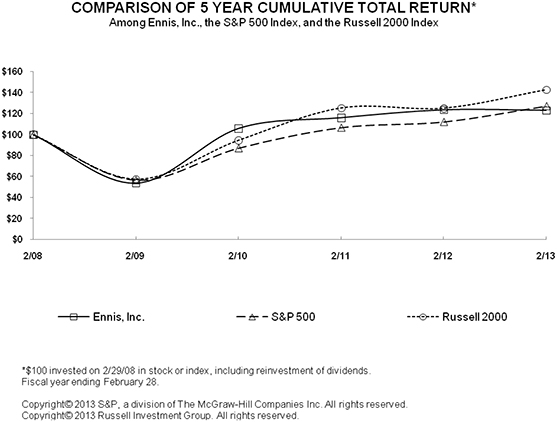
| 2008 | 2009 | 2010 | 2011 | 2012 | 2013 | |||||||||||||||||||
|
Ennis, Inc. |
$ | 100.00 | $ | 53.67 | $ | 105.77 | $ | 116.03 | $ | 123.52 | $ | 123.12 | ||||||||||||
|
S&P 500 |
100.00 | 56.68 | 87.07 | 106.72 | 112.19 | 127.29 | ||||||||||||||||||
|
Russell 2000 |
100.00 | 57.62 | 94.46 | 125.25 | 125.06 | 142.59 | ||||||||||||||||||
The stock price performance included in this graph is not necessarily indicative of future stock price performance.
| ITEM 6. | SELECTED FINANCIAL DATA |
The following selected financial data has been derived from our audited consolidated financial statements. Our consolidated financial statements and notes thereto as of February 28, 2013 and February 29, 2012, and for the three years in the period ended February 28, 2013, and the reports of Grant Thornton LLP are included in Item 15 of this Report. The selected financial data should be read in conjunction with Item 7 — “Management’s Discussion and Analysis of Financial Condition and Results of Operations” and the consolidated financial statements and notes thereto included in Item 15 of this Report.
16
Table of Contents
| Fiscal Years Ended | ||||||||||||||||||||
| 2013 | 2012 | 2011 | 2010 | 2009 | ||||||||||||||||
| (Dollars and shares in thousands, except per share amounts) | ||||||||||||||||||||
|
Operating results: |
||||||||||||||||||||
|
Net sales |
$ | 533,506 | $ | 517,014 | $ | 549,999 | $ | 517,738 | $ | 584,029 | ||||||||||
|
Gross profit margin |
124,152 | 130,513 | 154,498 | 135,319 | 143,476 | |||||||||||||||
|
SG&A expenses |
83,757 | 78,962 | 83,678 | 76,738 | 86,217 | |||||||||||||||
|
Impairment of goodwill and trademarks |
— | — | — | — | 67,851 | |||||||||||||||
|
Net earnings (loss) |
24,715 | 31,358 | 44,631 | 35,206 | (32,768 | ) | ||||||||||||||
|
Earnings (loss) and dividends per share: |
||||||||||||||||||||
|
Basic |
$ | 0.95 | $ | 1.21 | $ | 1.73 | $ | 1.37 | $ | (1.27 | ) | |||||||||
|
Diluted |
0.95 | 1.21 | 1.72 | 1.36 | (1.27 | ) | ||||||||||||||
|
Dividends |
0.88 | 0.62 | 0.62 | 0.62 | 0.62 | |||||||||||||||
|
Weighted average shares outstanding: |
||||||||||||||||||||
|
Basic |
26,036 | 25,946 | 25,855 | 25,769 | 25,724 | |||||||||||||||
|
Diluted |
26,053 | 25,968 | 25,888 | 25,797 | 25,790 | |||||||||||||||
|
Financial Position: |
||||||||||||||||||||
|
Working capital |
$ | 150,377 | $ | 168,969 | $ | 135,300 | $ | 116,638 | $ | 138,374 | ||||||||||
|
Current assets |
193,416 | 219,210 | 182,398 | 166,439 | 182,254 | |||||||||||||||
|
Total assets |
495,292 | 531,962 | 473,728 | 432,699 | 436,380 | |||||||||||||||
|
Current liabilities |
43,039 | 50,241 | 47,098 | 49,801 | 43,880 | |||||||||||||||
|
Long-term debt |
57,500 | 90,000 | 50,000 | 41,817 | 76,185 | |||||||||||||||
|
Total liabilities |
134,076 | 172,087 | 126,045 | 119,439 | 144,374 | |||||||||||||||
|
Shareholders’ equity |
361,216 | 359,875 | 347,683 | 313,260 | 292,006 | |||||||||||||||
|
Current ratio |
4.49 to 1.0 | 4.36 to 1.0 | 3.87 to 1.0 | 3.34 to 1.0 | 4.15 to 1.0 | |||||||||||||||
|
Long-term debt to equity ratio |
0.16 to 1.0 | 0.25 to 1.0 | 0.14 to 1.0 | 0.13 to 1.0 | 0.26 to 1.0 | |||||||||||||||
| ITEM 7. | MANAGEMENT’S DISCUSSION AND ANALYSIS OF FINANCIAL CONDITION AND RESULTS OF OPERATIONS |
The Management’s Discussion and Analysis provides material historical and prospective disclosures intended to enable investors and other users to assess our financial condition and results of operations. Statements that are not historical are forward-looking and involve risk and uncertainties, including those discussed under the caption “Risk Factors” in Item 1A starting on page 7 of this Annual Report on Form 10-K and elsewhere in this Report. You should read this discussion and analysis in conjunction with our Consolidated Financial Statements and the related notes appearing elsewhere in this Report. The words “anticipate,” “preliminary,” “expect,” “believe,” “intend” and similar expressions identify forward-looking statements. We believe these forward-looking statements are based upon reasonable assumptions. All such statements involve risks and uncertainties, and as a result, actual results could differ materially from those projected, anticipated, or implied by these statements.
In view of such uncertainties, investors should not place undue reliance on our forward-looking statements since such statements may prove to be inaccurate and speak only as of the date when made. We undertake no obligation to publicly update or revise any forward-looking statements, whether as a result of new information, future events or otherwise.
This Management’s Discussion and Analysis includes the following sections:
| • | Overview – An overall discussion on our Company, the business challenges and opportunities we believe are key to our success, and our plans for facing these challenges. |
| • | Critical Accounting Policies and Estimates – A discussion of the accounting policies that require our most critical judgments and estimates. This discussion provides insight into the level of subjectivity, quality, and variability involved in these judgments and estimates. This section also provides a summary of recently adopted and recently issued accounting pronouncements that have or may materially affect our business. |
| • | Results of Operations – An analysis of our consolidated results of operations and segment results for the three years presented in our consolidated financial statements. This analysis discusses material trends within our business and provides important information necessary for an understanding of our operating results. |
17
Table of Contents
| • | Liquidity and Capital Resources - An analysis of our cash flows and a discussion of our financial condition and contractual obligations. This section provides information necessary to evaluate our ability to generate cash and to meet existing and known future cash requirements over both the short and long term. |
References to 2013, 2012 and 2011 refer to the fiscal years ended February 28, 2013, February 29, 2012 and February 28, 2011, respectively.
Overview
The Company – We are one of the largest providers of business forms to independent distributors in the United States and are also one of the largest providers of blank t-shirts in North America to the activewear market. We operate in two reportable segments: Print and Apparel.
Our Print Business Challenges - In our Print Segment, we are engaged in an industry undergoing significant changes. Technology advances have made electronic distribution of documents, internet hosting, digital printing and print-on-demand valid, cost-effective alternatives to traditional custom printed documents and customer communications. In addition, the economic downturn in the economy and the associated credit crunch created highly competitive conditions in an already over-supplied, price-competitive industry, continue to present challenges today. Thus, we believe we are facing the following challenges in the Print Segment of our business:
| • | Transformation of our portfolio of products |
| • | Excess production capacity and price competition within our industry |
| • | Continued economic uncertainties |
The following is a discussion of these business challenges and our strategy for managing their effect on our print business.
Transformation of our portfolio of products – Traditional business documents are essential in order to conduct business. However, many are being replaced or devalued with advances in digital technologies, causing steady declines in demand for a large portion of our current product line. The same digital advances also introduce potential new growth opportunities, such as print-on-demand services and product offerings that assist customers in their transition to digital business environments. In addition, we will continue to look for new market opportunities and niches, such as the addition of our envelope offerings, healthcare wristbands, secure document solutions, innovative in-mold label offerings and long-run integrated products with high color web printing that provide us with an opportunity for growth and differentiate us from our competition. Transforming our product offerings in order to continue to provide innovative, valuable solutions to our customers on a proactive basis will require us to make investments in new and existing technology and to develop key strategic business relationships.
Excess production capacity and price competition within our industry – Paper mills continue to adjust production capacity through downtime and closures to attempt to keep supply in line with demand. Due to the limited number of paper mills, paper prices have been and are expected to remain fairly volatile.
Despite a continued competitive marketplace, we have generally been able to pass through increased paper costs, although it can often take several quarters to push these through due to the custom nature of our products and/or contractual relationships with some of our customers. We expect this trend to continue, however, any new downturn in the economy or continued protraction of the current recovery may limit our ability to recover all these costs. As such, we will continue to focus our efforts on effectively managing and controlling our product costs to minimize the effects of the foregoing on our operational results, primarily through the use of forecasting models and production and costing models. However, an inherent risk in this process is that our assumptions are inaccurate, which could have a negative impact on our reported profit margins.
Continued economic uncertainties – As a result of the past recessionary conditions, the economic climate has been volatile and challenging. Decreased demand and intense price competition resulted in a significant decline in our revenue during the past several fiscal years. Although we have seen improvement in some economic indicators within our markets, a generally weak domestic job market, global economic instabilities, a rather anemic domestic economic recovery and domestic policy uncertainties have and will continue to present a challenging environment for revenue growth. As we cannot predict the pace or continuance of the domestic economic recovery, the impact of
18
Table of Contents
continued global economic instability, nor the impact of domestic policy decisions, we continue to focus on customer retention, expanding our growth targeted products and continuing to develop new market niches. In addition, we have a proven history of managing our costs during tough economic times and would not expect this to change in the future.
Our Apparel Business Challenges - In our Apparel Segment, our market niche is highly competitive, commodity driven, and is generally dominated by a limited number of companies. The downturn in the economy and turmoil in the credit markets in 2009 and 2010 created an over-supply situation which further increased competitive pressures in this market. While the economic environment improved somewhat in 2011, which led to increased demand for our product during the later part of fiscal year 2011 and the start of fiscal year 2012, we have seen softness in the market due to domestic and global economic uncertainties. Whether the impact in the market associated with this instability is behind us or will still need to be dealt with for quarters to come is unknown. Such uncertainty and volatility in the economy is normally not a positive influence on the marketplace. In addition, a significant reduction in the spot price of cotton added additional complexities to an already competitive marketplace during fiscal year 2013. The divergence between the current purchase cost of cotton and the cost residing in most manufacturers’ finished goods inventories were at historical levels, creating market valuation issues for some and sale side pressure for others. However, at this point, most of the higher cost of cotton has worked through our finished goods inventory and the divergence between the current purchase cost of cotton and the average costs in our finished goods inventory has returned to a more normalized spread. Thus, we believe we are facing the following challenges in our Apparel Segment continuing into the next fiscal year:
| • | Cotton prices and market pricing |
| • | New manufacturing facility |
| • | Continued economic uncertainties |
Cotton prices – Cotton is a commodity product and subject to volatile fluctuations in price. Costs for cotton yarn and cotton-based textiles vary based upon the fluctuating cost of cotton, which is affected by, among other factors, weather, consumer demand, commodities market speculation, currency fluctuations, international actions and other factors that are generally unpredictable and beyond our control. The United States is the largest exporter of cotton in the world. Therefore, domestic prices can be significantly influenced by foreign governments actions. Over the past several years, we have seen cotton prices reach the highest historical levels and have recently seen the prices recede back to levels that, while still high, are more in line with historical averages. We are able to lock in the cost of cotton reflected in the price we pay for yarn from our primary suppliers in an attempt to protect our business from the volatility of the market price of cotton. However, our business can be affected by dramatic movements in cotton prices. The cost incurred for materials, i.e., yarn, thread, etc. are capitalized into inventory and impacts the Company’s operating results as this inventory is sold, which could be as much as six months plus after the materials were purchased, depending on inventory turns. Consequently, significant and rapid increases or decreases in cotton costs can have a material impact to the Company’s operational results. Most of the higher cost of cotton has worked through our finished goods inventory at this point, and the divergence between the current purchase cost of cotton and the average costs in our finished goods inventory has returned to a more normalized spread. Absent some economic disruption (see below), or market abnormalities, we expect to see continuing improvement in our apparel margins in the quarters to come.
Agua Prieta manufacturing facility – The manufacturing facility in Agua Prieta, Mexico (“AP”) became operational in July 2011, and all production has now been transitioned from our Anaheim, CA (“Anaheim”) facility to the AP facility. We began producing fabric from this facility during the first quarter of fiscal year 2012. Production levels at the plant are running at required levels to satisfy demand, but below originally estimated levels due to lower revenues, which can be attributed to market softness, economic conditions and the non-competitive cost position of our finished goods inventory during fiscal year 2013. In addition, from time-to-time we have had disruptions in our utility services which impacts our manufacturing through-put. However, given the improved cost position of our finished goods inventory and current level of utility services and absent some economic disruption, we expect to increase production at this facility fairly significantly during the coming year. This should allow us to realize savings through improved efficiency and utilization gains. However, the increase in production levels is dependent on economic (see below) and services stability.
Continued economic uncertainties – As a result of the past recessionary conditions, the economic climate has been and continues to be volatile and challenging both domestically and internationally. Although we saw an increase in our apparel revenues during fiscal year 2011 due to improving economic conditions, we saw a significant drop in our sales during the latter half of fiscal year 2012 due to competitive pricing pressures, which we attribute to softness in the market. International instability and continued domestic policy and economic issues continue to have an impact on the domestic economic environment and on domestic apparel sales. We are concerned with how our
19
Table of Contents
government’s economic decisions may impact our next fiscal year. The economy is already feeling the impact of sequestration, which has had a direct impact on our domestic GDP. How further actions or inactions will impact businesses, consumers and our economy in general over the short term and long term remains to be seen.
Critical Accounting Policies and Estimates
In preparing our consolidated financial statements, we are required to make estimates and assumptions that affect the disclosures and reported amounts of assets and liabilities at the date of the consolidated financial statements and the reported amounts of revenues and expenses during the reporting period. We evaluate our estimates and judgments on an ongoing basis, including those related to allowance for doubtful receivables, inventory valuations, property, plant and equipment, intangible assets, pension plan obligations, accrued liabilities and income taxes. We base our estimates and judgments on historical experience and on various other factors that we believe to be reasonable under the circumstances. Actual results may differ materially from these estimates under different assumptions or conditions. We believe the following accounting policies are the most critical due to their effect on our more significant estimates and judgments used in preparation of our consolidated financial statements.
We maintain a defined benefit retirement plan (the “Pension Plan”) for employees. Included in our financial results are Pension Plan costs that are measured using actuarial valuations. The actuarial assumptions used may differ from actual results. As our Pension Plan assets are invested in marketable securities, fluctuations in market values could potentially impact our funding status and associated liability recorded.
Amounts allocated to intangibles (amortizable and non-amortizable) and goodwill are determined based on valuation analysis for our acquisitions. Amortizable intangibles are amortized over their expected useful lives. We evaluate these amounts periodically (at least once a year) to determine whether a triggering event has occurred during the year that would indicate potential impairment.
We exercise judgment in evaluating our long-lived assets for impairment. We assess the impairment of long-lived assets that include other intangible assets, goodwill, and property, plant, and equipment annually or whenever events or changes in circumstances indicate that the carrying value may not be recoverable. In performing tests of impairment, we must make assumptions regarding the estimated future cash flows and other factors to determine the fair value of the respective assets in assessing the recoverability of our long-lived assets. If these estimates or the related assumptions change, we may be required to record impairment charges for these assets in the future. Actual results could differ from assumptions made by management. At February 28, 2013, our goodwill and other intangible assets were approximately $121.8 million and $84.2 million (includes $0.6 million relating to patents included in other long-term assets), respectively. No impairment charge was required for the year ended February 28, 2013 based on the results of our annual impairment test conducted as of November 30, 2012. The carrying value of invested capital for each reporting unit as compared to their fair value at November 30, 2012 was as follows:
Goodwill
|
Reporting Unit |
Carrying Value of
Invested Capital |
Fair Value of Invested Capital | ||
|
Apparel |
$305.2 million | $310 million to $330 million | ||
|
|
$158.9 million | $352 million to $360 million |
Trademarks/Trade names
|
Reporting Unit |
Carrying Value of
Invested Capital |
Fair Value of Invested
Capital |
||
|
Apparel |
$56.3 million | $59.0 million | ||
|
|
$2.2 million | $4.8 million |
We believe our businesses will generate sufficient undiscounted cash flow to more than recover the investments we have made in property, plant and equipment, as well as the goodwill and other intangibles recorded as a result of our acquisitions. However, we cannot predict the occurrence of future impairments or specific triggering events nor the impact such events might have on our reported asset values.
Revenue is generally recognized upon shipment of products. Net sales consist of gross sales invoiced to customers, less certain related charges, including discounts, returns and other allowances. Returns, discounts and other allowances have historically been insignificant. In some cases and upon customer request, we print and store custom print product for customer specified future delivery, generally within twelve months. In this case, risk of loss
20
Table of Contents
from obsolescence passes to the customer, the customer is invoiced under normal credit terms and revenue is recognized when manufacturing is complete. Approximately $12.3 million, $10.5 million, and $10.5 million of revenue were recognized under these agreements during fiscal years ended February 28, 2013, February 29, 2012, and February 28, 2011, respectively.
We maintain an allowance for doubtful receivables to reflect estimated losses resulting from the inability of customers to make required payments. On an on-going basis, we evaluate the collectability of accounts receivable based upon historical collection trends, current economic factors, and the assessment of the collectability of specific accounts. We evaluate the collectability of specific accounts using a combination of factors, including the age of the outstanding balances, evaluation of customers’ current and past financial condition and credit scores, recent payment history, current economic environment, discussions with our project managers, and discussions with the customers directly.
Our inventories are valued at the lower of cost or market. We regularly review inventory values on hand, using specific aging categories, and write down inventory deemed obsolete and/or slow-moving based on historical usage and estimated future usage to its estimated market value. As actual future demand or market conditions may vary from those projected by management, adjustments to inventory valuations may be required.
As part of the process of preparing our consolidated financial statements, we are required to estimate our income taxes in each jurisdiction in which we operate. This process involves estimating our actual current tax exposure together with assessing temporary differences resulting from different treatment of items for tax and accounting purposes. These differences result in deferred tax assets and liabilities, which are included in our consolidated balance sheets. We must then assess the likelihood that our deferred tax assets will be recovered from future taxable income. To the extent we believe that recovery is not likely, we must establish a valuation allowance. To the extent we establish a valuation allowance, we must include an expense within the tax provision in the consolidated statements of earnings. In the event that actual results differ from these estimates, our provision for income taxes could be materially impacted.
In addition to the above, we also have to make assessments as to the adequacy of our accrued liabilities, more specifically our liabilities recorded in connection with our workers compensation and health insurance, as these plans are self funded. To help us in this evaluation process, we routinely get outside third-party assessments of our potential liabilities under each plan.
In view of such uncertainties, investors should not place undue reliance on our forward-looking statements since such statements speak only as of the date when made. We undertake no obligation to publicly update or revise any forward-looking statements, whether as a result of new information, future events or otherwise.
Recent Accounting Pronouncements
In July 2012, the FASB issued amended standards to simplify how entities test indefinite-lived intangible assets for impairment, which improves consistency in impairment testing requirements among long-lived asset categories. These amended standards permit an assessment of qualitative factors to determine whether it is more likely than not that the fair value of an indefinite-lived intangible asset is less than its carrying value. For assets for which this assessment concludes it is more likely than not that the fair value is more than its carrying value, these amended standards eliminate the requirement to perform quantitative impairment testing as outlined in the previously issued standards. These amended standards are effective for annual impairment tests performed for fiscal years beginning after December 15, 2011. The adoption of this standard had no impact on the Company’s consolidated financial statements.
Results of Operations
The discussion that follows provides information which we believe is relevant to an understanding of our results of operations and financial condition. The discussion and analysis should be read in conjunction with the accompanying consolidated financial statements and notes thereto, which are incorporated herein by reference. This analysis is presented in the following sections:
| • | Consolidated Summary – This section provides an overview of our consolidated results of operations for fiscal years 2013, 2012 and 2011. |
| • | Segment Operating Results – This section provides an analysis of our net sales, gross profit margin and operating income by segment. |
21
Table of Contents
Consolidated Summary
| Consolidated Statements of | Fiscal Years Ended | |||||||||||||||||||||||
|
Earnings - ( Dollars in thousands ) |
2013 | 2012 | 2011 | |||||||||||||||||||||
|
Net sales |
$ | 533,506 | 100.0 | % | $ | 517,014 | 100.0 | % | $ | 549,999 | 100.0 | % | ||||||||||||
|
Cost of goods sold |
409,354 | 76.7 | 386,501 | 74.8 | 395,501 | 71.9 | ||||||||||||||||||
|
|
|
|
|
|
|
|
|
|
|
|
|
|||||||||||||
|
Gross profit margin |
124,152 | 23.3 | 130,513 | 25.2 | 154,498 | 28.1 | ||||||||||||||||||
|
Selling, general and administrative |
83,757 | 15.7 | 78,962 | 15.3 | 83,678 | 15.2 | ||||||||||||||||||
|
(Gain) loss from disposal of assets |
2 | — | (137 | ) | — | (1 | ) | — | ||||||||||||||||
|
|
|
|
|
|
|
|
|
|
|
|
|
|||||||||||||
|
Income from operations |
40,393 | 7.6 | 51,688 | 9.9 | 70,821 | 12.9 | ||||||||||||||||||
|
Other expense, net |
(1,775 | ) | (0.4 | ) | (2,308 | ) | (0.4 | ) | (1,404 | ) | (0.3 | ) | ||||||||||||
|
|
|
|
|
|
|
|
|
|
|
|
|
|||||||||||||
|
Earnings before income taxes |
38,618 | 7.2 | 49,380 | 9.5 | 69,417 | 12.6 | ||||||||||||||||||
|
Provision for income taxes |
13,903 | 2.6 | 18,022 | 3.5 | 24,786 | 4.5 | ||||||||||||||||||
|
|
|
|
|
|
|
|
|
|
|
|
|
|||||||||||||
|
Net earnings |
$ | 24,715 | 4.6 | % | $ | 31,358 | 6.0 | % | $ | 44,631 | 8.1 | % | ||||||||||||
|
|
|
|
|
|
|
|
|
|
|
|
|
|||||||||||||
Net Sales. Our consolidated net sales increased from $517.0 million for the fiscal year ended February 29, 2012 to $533.5 million for the fiscal year ended February 28, 2013, or an increase of 3.2%. Our sales increase for the year related primarily to the additional sales associated with our fiscal year 2012 print acquisitions offset by a decline in our apparel sales, which decreased $40.2 million, or 16.8%, due to softness in the market and continued pricing pressures.
Our consolidated net sales decreased from $550.0 million for the fiscal year ended February 28, 2011 to $517.0 million for fiscal year 2012, or a decrease of 6.0%. Our sales decline for fiscal year 2012 related primarily to the decline in our apparel sales which decreased $38.3 million, or 13.8%, again due to softness in the market and continued pricing pressures.
Cost of Goods Sold. Our manufacturing costs increased by $22.9 million from $386.5 million for fiscal year 2012 to $409.4 million for fiscal year 2013, or 5.9.%. Our gross profit margin (net sales less cost of goods sold) decreased from 25.2% for fiscal year 2012 to 23.3% for fiscal year 2013 due to the decline in our apparel margin during the period, which decreased from 21.6% to 13.2% from the comparable period last year. Our apparel results during the period were negatively impacted by high raw material costs and continued sale side competitive pressures. However, most of these higher costs have now made its way through our finished goods inventory, and the divergence between the current purchase cost of cotton and the average cost in our finished goods inventory has returned to a more normalized spread. As such, we expect to see a continual improvement in our apparel margin over the next several quarters, as we have over the past several, absent some economic disruption.
Our manufacturing costs decreased by $9.0 million from $395.5 million for fiscal year 2011 to $386.5 million for fiscal year 2012, or 2.3.%. Our gross profit margin decreased from 28.1% for fiscal year 2011 to 25.2% for fiscal year 2012 due to the decline in our apparel margin during the period which decreased from 27.9% to 21.6% from the comparable period last year. Again, the decline in our apparel margin was caused by higher input costs (i.e., mainly cotton) and competitive pressures on selling prices.
Selling, general, and administrative expenses. For fiscal year 2013, our selling, general and administrative expenses increased approximately $4.8 million, or 6.1% from $79.0 million, or 15.3% of sales for fiscal year 2012 to $83.8 million, or 15.7% of sales for fiscal year 2013. The increase in our selling, general and administrative expenses on a dollar and percentage of sales basis is a result of our print acquisitions last fiscal year. Legacy cost associated with those acquisitions remain as we integrate these locations into our Enterprise Resource Planning (“ERP”) system. We would expect these costs, on a percentage basis, to become more normalized once our ERP system is fully implemented in each of the plants.
For fiscal year 2012, our selling, general and administrative expenses decreased approximately $4.7 million, or 5.6% from $83.7 million, or 15.2% of sales for fiscal year 2011 to $79.0 million, or 15.3% of sales for fiscal year 2012. The decrease in our selling, general and administrative expenses in addition to being volume related, was caused by a decrease in our bad debt expense, due to improved aging of our accounts receivable, and a reduction in our performance incentive costs for the year.
Gain from disposal of assets. The loss from disposal of assets of $2,000 for fiscal year 2013 resulted from sale of vehicles and equipment. The gain from disposal of assets of $137,000 for fiscal year 2012 resulted from sale of vehicles and equipment.
22
Table of Contents
Income from operations. Our income from operations for fiscal year 2013 decreased $11.3 million from income from operations of $51.7 million, or 9.9% of sales for fiscal year 2012, to $40.4 million, or 7.6% of sales for fiscal year 2013. The decrease in our income from operations during fiscal year 2013 was primarily related to the impact associated with our decreased apparel sales which was partially offset by the impact of our increased print sales during the period.
Our income from operations for fiscal year 2012 decreased $19.1 million from income from operations of $70.8 million, or 12.9% of sales for fiscal year 2011, to income from operations of $51.7 million, or 9.9% of sales for fiscal year 2012. The decrease in our income from operations during fiscal year 2012 was primarily related to our decreased apparel sales and the associated gross profit margin thereon.
Other income and expense. Our interest expense was $1.5 million, $2.3 million and $1.2 million for fiscal years 2013, 2012 and 2011, respectively. The decrease in our interest expense in fiscal year 2013 over fiscal year 2012 was attributable to having less debt outstanding on average and a lower effective borrowing rate. In addition, during fiscal year 2012, we had an additional $0.6 million in interest expense related to the Interest Rate Swap Agreement in place for a portion of the year. Our interest expense increased in fiscal year 2012 compared to fiscal year 2011 due mainly to the fact that we did not capitalize any interest related to our Agua Prieta facility as construction was completed. During fiscal year 2011, we capitalized interest expense relating to our Agua Prieta, Mexico construction project of $1.7 million.
Provision for income taxes. Our effective tax rates for fiscal years 2013, 2012 and 2011 were 36.0%, 36.5% and 35.7%, respectively. The decrease in our effective tax rate for fiscal year 2013 was mainly caused by a percentage increase in our Domestic Production Activities Deduction (DPAD) benefit over fiscal year 2012. The increase in our effective tax rate for fiscal year 2012 over 2011 related to a reduction in the benefit associated with our DPAD, which was caused by the moving of our apparel manufacturing from the United States to Mexico.
Net earnings. Due to the above factors, our net earnings decreased from $31.4 million, or 6.0% of sales for fiscal year 2012 to earnings of $24.7 million, or 4.6% of sales for fiscal year 2013. Basic earnings per share decreased from earnings of $1.21 per share for fiscal year 2012 to earnings of $0.95 per share for fiscal year 2013. Diluted earnings per share decreased from earnings of $1.21 per share for fiscal year 2012 to earnings of $0.95 per share for fiscal year 2013.
Our net earnings decreased from $44.6 million, or 8.1% of sales for fiscal year 2011 to earnings of $31.4 million, or 6.0% of sales for fiscal year 2012. Basic earnings per share decreased from earnings of $1.73 per share for fiscal year 2011 to earnings of $1.21 per share for fiscal year 2012. Diluted earnings per share decreased from earnings of $1.72 per share for fiscal year 2011 to earnings of $1.21 per share for fiscal year 2012.
Segment Operating Results
| Fiscal Years Ended | ||||||||||||
|
Net Sales by Segment (in thousands) |
2013 | 2012 | 2011 | |||||||||
|
|
$ | 334,701 | $ | 277,988 | $ | 272,689 | ||||||
|
Apparel |
198,805 | 239,026 | 277,310 | |||||||||
|
|
|
|
|
|
|
|||||||
|
Total |
$ | 533,506 | $ | 517,014 | $ | 549,999 | ||||||
|
|
|
|
|
|
|
|||||||
Print Segment . The print segment net sales represented 63%, 54%, and 50% of our consolidated net sales for fiscal years 2013, 2012 and 2011, respectively.
Our print sales increased by $56.7 million, or 20.4% during fiscal year 2013, from $278.0 million in fiscal year 2012 to $334.7 million in fiscal year 2013. Print sales continued to be challenged by technology and economic factors during fiscal year 2013. The increase in our print sales during the year related to the impact of a full year of sales from our fiscal year 2012 print acquisitions. Overall we saw our print sales increase by 26.6% due to acquisitions and decline by 6.2% due to normal attrition or economic factors.
Our print sales increased by $5.3 million, or 1.9% during the fiscal year 2012, from $272.7 million in fiscal year 2011 to $278.0 million in fiscal year 2012. Again, our print sales during fiscal year 2012 were challenged by technological and economic factors, and any revenue growth experienced during the year was due to our acquisitions in fiscal year 2012.
23
Table of Contents
Apparel Segment . The Apparel Segment net sales represented 37%, 46%, and 50% of our consolidated net sales for fiscal years 2013, 2012 and 2011, respectively.
Our fiscal year 2013 net sales for the Apparel Segment decreased by $40.2 million, or 16.8% over fiscal year 2012, while our 2012 net sales decreased by $38.3 million, or 13.8% over fiscal year 2011. Our apparel sales continue to be impacted by soft market conditions; reduced retail and consumer sentiment attributed to the protracted and volatile economic recovery; the destocking of inventories at the retail, distributor, and screen-print levels; a drop in commodity prices and competitors’ pricing strategies. The drop in commodity prices caused corresponding expectations with respect to selling prices. These expectations caused some destocking of inventories at the retail and distributor levels, which added to the competitive pressures in the marketplace as manufacturers attempted to maintain production levels. We believe our competitors instituted various rebate programs (stock/restock programs, etc.) or announced price decreases, sometimes even selling products at prices lower than costs to produce those products. Since our pricing strategy has been to try to match our sale side with our cost side, we believe this has negatively impacted our top-line results given our competitors pricing strategies during this fiscal year. However, as higher priced inventory in the marketplace has effectively been worked through at this point, sales volumes are expected to improve as our selling prices and the cost of cotton in our inventories have become better aligned, and given an improved business environment expected for fiscal year 2014.
| Fiscal Years Ended | ||||||||||||
|
Gross Profit by Segment (in thousands) |
2013 | 2012 | 2011 | |||||||||
|
|
$ | 97,830 | $ | 78,878 | $ | 77,236 | ||||||
|
Apparel |
26,322 | 51,635 | 77,262 | |||||||||
|
|
|
|
|
|
|
|||||||
|
Total |
$ | 124,152 | $ | 130,513 | $ | 154,498 | ||||||
|
|
|
|
|
|
|
|||||||
Print Segment. Our print gross profit margin (“margin”), as a percent of sales, was 29.2%, 28.4% and 28.3% for fiscal years 2013, 2012 and 2011, respectively. Our print margins increased $18.9 million, from $78.9 million in fiscal year 2012, or 28.4% of net sales, to $97.8 million in fiscal year 2013, or 29.2% of net sales. The improvement in our Print margins during the period related primarily to the improvement in our recent acquisitions margins due to the further integration of these operations onto our ERP systems. In fiscal year 2012, our print margins rose slightly over the comparable period of fiscal year 2011.
Apparel Segment . Our apparel margin, as a percent of sales, was 13.2%, 21.6% and 27.9%, for fiscal years 2013, 2012 and 2011, respectively.
Our apparel margin continued to be impacted by higher raw material costs and competitive pressures in the marketplace throughout fiscal year 2013. Average cotton costs for the current year included in cost of sales were only marginally lower than the average cotton costs for fiscal year 2012, while our average selling price per unit for fiscal year 2013 was approximately 8% lower than our average selling price for fiscal year 2012. While our apparel results continued to be negatively impacted by these higher costs throughout fiscal year 2013, we are beginning to see consistent quarterly improvement in these margins as most of the high cost cotton has worked its way through finished goods inventory, and the spread between the cost in finished goods inventory and the current purchase cost is normalizing to historical levels. As such, we expect to see continual improvement in our apparel margin over the next several quarters, absent economic disruption.
In fiscal year 2012, the cost of cotton, our largest raw material cost, increased 98.1% over fiscal year 2011. As a result of the significant increase in spot cotton prices and the sustained level of these spot prices, most of the previously favorable forward purchase contracts expired during the first half of fiscal year 2012 and were replaced with significantly higher cotton cost contracts. As such, while we were able to offset these higher costs during fiscal year 2011, these higher cotton costs impacted us negatively in our fiscal year 2012.
| Fiscal Years Ended | ||||||||||||
|
Profit by Segment (in thousands) |
2013 | 2012 | 2011 | |||||||||
|
|
$ | 54,224 | $ | 46,238 | $ | 46,002 | ||||||
|
Apparel |
247 | 19,345 | 42,611 | |||||||||
|
|
|
|
|
|
|
|||||||
|
Total |
54,471 | 65,583 | 88,613 | |||||||||
|
Less corporate expenses |
15,853 | 16,203 | 19,196 | |||||||||
|
|
|
|
|
|
|
|||||||
|
Earnings before income taxes |
$ | 38,618 | $ | 49,380 | $ | 69,417 | ||||||
|
|
|
|
|
|
|
|||||||
24
Table of Contents
Print Segment . As a percent of sales, our Print Segment’s profits were 16.2%, 16.6%, and 16.9% for fiscal years 2013, 2012 and 2011, respectively. Our Print Segment’s profit increased for fiscal year 2013 from $46.2 million in fiscal year 2012 to $54.2 million in fiscal year 2013. This related primarily to our print acquisitions’ effect over a complete fiscal year. Our Print Segment’s profit for fiscal year 2012 increased slightly from $46.0 million in fiscal year 2011 to $46.2 million in fiscal year 2012.
Apparel Segment. As a percent of sales, our Apparel Segment’s profits were 0.1%, 8.1%, and 15.4% for fiscal years 2013, 2012 and 2011, respectively. The decrease in our Apparel profits for fiscal year 2013 compared to fiscal year 2012 and fiscal year 2012 compared to fiscal year 2011 are a result of the decrease in our apparel sales and margin as discussed previously.
Liquidity and Capital Resources
| Fiscal Years Ended | ||||||||
|
(Dollars in thousands) |
2013 | 2012 | ||||||
|
Working Capital |
$ | 150,377 | $ | 168,969 | ||||
|
Cash |
$ | 6,232 | $ | 10,410 | ||||
Working Capital. Our working capital decreased by approximately $18.6 million, or 11.0%, from $169.0 million at February 29, 2012 to $150.4 million at February 28, 2013. Our current ratio, calculated by dividing our current assets by our current liabilities, increased from 4.4-to-1.0 for fiscal year 2012 to 4.5-to-1.0 for fiscal year 2013. The decrease in our working capital related primarily to the decrease in our apparel inventory, from $107.2 million at February 29, 2012 to $88.5 million at February 28, 2013, due to the lower cost of cotton residing in inventory.
| Fiscal Years Ended | ||||||||
|
(Dollars in thousands) |
2013 | 2012 | ||||||
|
Net Cash provided by operating activities |
$ | 49,957 | $ | 24,573 | ||||
|
Net Cash provided by (used in) investing activities |
$ | 1,195 | $ | (50,810 | ) | |||
|
Net Cash provided by (used in) financing activities |
$ | (55,215 | ) | $ | 23,691 | |||
Cash flows from operating activities. Cash flows from operating activities during fiscal year 2013 increased by $25.4 million over fiscal year 2012, which had decreased by $8.2 million over fiscal year 2011. The increase in cash flows during fiscal year 2013 resulted primarily from a decrease in our inventories offset by a decrease in our earnings. The change in our cash flows for fiscal year 2012 related primarily to a decrease in our earnings and an increase in our prepaid expenses, which was offset by a decrease in our accounts receivable and an increase in our pension liability.
Cash flows from investing activities. Cash used for our investing activities decreased by $52.0 million, or 102.4%, from $50.8 million used for fiscal year 2012 to $1.2 million provided for fiscal year 2013. This decrease was as a result of no new acquisitions of businesses in fiscal year 2013, as well an adjustment decrease to the purchase price for one of our print acquisitions, and a reduction in capital expenditures of approximately $2.5 million. For contractual commitments remaining in connection with the construction of this facility – see the “Contractual Obligations & Off-Balance Sheet Arrangements” section below.
Cash flows from financing activities. We used $78.9 million more in cash associated with our financing activities in fiscal year 2013 when compared to the same period last year. We borrowed $35.0 million less in addition to repaying $37.5 million under our revolving credit line during fiscal year 2013. In addition, our dividends increased by $6.7 million in fiscal year 2013 as compared to the same period last year as a result of our Board of Directors approving an accelerated fourth quarter cash dividend along with an increase in our quarterly dividend from $.155 per share to $.175 per share.
Stock Repurchase – On October 20, 2008, our Board of Directors authorized the repurchase of up to $5.0 million of our common stock through a stock repurchase program. Under the board-approved repurchase program, share purchases may be made from time to time in the open market or through privately negotiated transactions depending on market conditions, share price, trading volume and other factors, and such purchases, if any, will be made in accordance with applicable insider trading and other securities laws and regulations. These repurchases may be commenced or suspended at any time or from time to time without prior notice. While no shares have been purchased during fiscal years 2013, 2012 or 2011 under the program, there have been a total of 96,000 shares of common stock that have been purchased under the repurchase program since its inception at an average price per share
25
Table of Contents
of $10.45. On April 20, 2012, the Board increased the authorized amount available to repurchase our shares by an additional $5.0 million, bringing the total available to repurchase our common stock to approximately $9.0 million. Unrelated to the stock repurchase program, we purchased 175 and 100 shares of common stock during the fiscal years ended February 28, 2013 and February 29, 2012, respectively.
Credit Facility – On February 22, 2012, we entered into the Second Amendment to Second Amended and Restated Credit Agreement (the “Facility”) with a group of lenders led by Bank of America, N.A. The Facility provides us access to $150.0 million in revolving credit, which we may increase to $200.0 million in certain circumstances, and matures on August 16, 2016. The Facility bears interest at the London Interbank Offered Rate (“LIBOR”) plus a spread ranging from 1.0% to 2.25% (LIBOR + 1.5% or 1.7% at February 28, 2013 and 1.74% at February 29, 2012), depending on our ratio of total funded debt to EBITDA. As of February 28, 2013, we had $57.5 million of borrowings under the revolving credit line and $4.1 million outstanding under standby letters of credit arrangements, leaving us availability of approximately $88.4 million. The Facility contains financial covenants, restrictions on capital expenditures, acquisitions, asset dispositions, and additional debt, as well as other customary covenants, such as our minimum tangible equity level and total funded debt to EBITDA ratio. We were in compliance with all these covenants as of February 28, 2013. The Facility is secured by substantially all of our domestic assets as well as all capital securities of each of the Company’s U.S. subsidiaries and 65% of all capital securities of each of the Company’s direct foreign subsidiaries.
During fiscal year 2013, we borrowed $5.0 million, and we paid down an additional $37.5 million on the revolving credit line. It is anticipated that the available line of credit is sufficient to cover, should it be required, our working capital needs for the foreseeable future.
On July 7, 2008, we entered into a three-year Interest Rate Swap Agreement (the “SWAP”) for a notional amount of $40.0 million, which matured on July 22, 2011. The SWAP effectively fixed the LIBOR rate at 3.79%.
Pension Plan – We are required to make contributions to our Pension Plan. These contributions are required under the minimum funding requirements of the Employee Retirement Income Security Act of 1974 (“ERISA”). Due to the recent enactment of the Moving Ahead for Progress in the 21 st Century (MAP-21) in July 2012, plan sponsors can calculate the discount rate used to measure the Pension Plan liability using a 25-year average of interest rates plus or minus a corridor. Prior to MAP-21, the discount rate used in measuring the pension liability was based on the 24-month average of interest rates. We anticipate that we will contribute from $2.0 million to $3.0 million during fiscal year 2014. We made contributions of $3.0 million to our Pension Plan during each of our last 3 fiscal years. As our Pension Plan assets are invested in marketable securities, fluctuations in market values could potentially impact our funding status, associated liabilities recorded and future required minimum contributions. At February 28, 2013, we had an unfunded pension liability recorded on our balance sheet of $9.3 million. The increase in our liability during the past several years has related primarily to the decrease in the discount rate used to calculate our benefit obligations. Each 10 basis point drop in the discount rate increases our computed pension liability by approximately $800,000.
Inventories – We believe our current inventory levels are sufficient to satisfy our customer demands and we anticipate having adequate sources of raw materials to meet future business requirements. We have long-term contracts in effect with paper and yarn suppliers that govern prices, but do not require minimum purchase commitments. Certain of our rebate programs do, however, require minimum purchase volumes. Management anticipates meeting the required volumes.
Capital Expenditures – We expect our capital expenditure requirements for fiscal year 2014, exclusive of capital required for possible acquisitions, will be in line with our historical levels of between $4.0 million and $5.0 million. We expect to fund these expenditures through existing cash flows. We expect to generate sufficient cash flows from our operating activities to cover our operating and other normal capital requirements for the foreseeable future.
Contractual Obligations & Off-Balance Sheet Arrangements – There have been no significant changes in our contractual obligations since February 28, 2013 that have, or are reasonably likely to have, a material impact on our results of operations or financial condition. We had no off-balance sheet arrangements in place as of February 28, 2013. The following table represents our contractual commitments as of February 28, 2013 (in thousands).
26
Table of Contents
| 2018 to | ||||||||||||||||||||||||
| Total | 2014 | 2015 | 2016 | 2017 | 2023 | |||||||||||||||||||
|
Debt: |
||||||||||||||||||||||||
|
Revolving credit facility |
$ | 57,500 | $ | — | $ | — | $ | — | $ | 57,500 | $ | — | ||||||||||||
|
Other contractual commitments: |
||||||||||||||||||||||||
|
Estimated pension benefit payments |
27,100 | 2,500 | 2,700 | 2,900 | 3,200 | 15,800 | ||||||||||||||||||
|
Letters of credit |
4,147 | 4,147 | — | — | — | — | ||||||||||||||||||
|
Operating leases |
12,576 | 4,865 | 3,185 | 2,348 | 1,256 | 922 | ||||||||||||||||||
|
|
|
|
|
|
|
|
|
|
|
|
|
|||||||||||||
|
Total other contractual commitments |
43,823 | 11,512 | 5,885 | 5,248 | 4,456 | 16,722 | ||||||||||||||||||
|
|
|
|
|
|
|
|
|
|
|
|
|
|||||||||||||
|
Total |
$ | 101,323 | $ | 11,512 | $ | 5,885 | $ | 5,248 | $ | 61,956 | $ | 16,722 | ||||||||||||
|
|
|
|
|
|
|
|
|
|
|
|
|
|||||||||||||
Subsequent to February 28, 2013 and through May 10, 2013, we paid down an additional $7.5 million on our revolving credit facility. We expect future interest payments of $1.0 million for each of the next three fiscal years through February 29, 2016, and $0.5 million for fiscal year ending February 28, 2017, assuming interest rates and debt levels remain the same throughout the remaining term of the facility.
| ITEM 7A. | QUANTITATIVE AND QUALITATIVE DISCLOSURES ABOUT MARKET RISK |
Market Risk
Interest Rates
We are exposed to interest rate risk on short-term and long-term financial instruments carrying variable interest rates. We may from time to time utilize interest rate swaps to manage overall borrowing costs and reduce exposure to adverse fluctuations in interest rates. We do not use derivative instruments for trading purposes. Our variable rate financial instruments totaled $57.5 million at February 28, 2013. We had entered into a $40.0 million SWAP designated as a cash flow hedge related to this debt, but this arrangement matured July 22, 2011; as such the entire balance of our line of credit is subject to fluctuations in the LIBOR rate. The impact on our results of operations of a one-point interest rate change on the outstanding balance of the variable rate financial instruments as of February 28, 2013 would be approximately $0.6 million.
Foreign Exchange
We have global operations and thus make investments and enter into transactions in various foreign currencies. The value of our consolidated assets and liabilities located outside the United States (translated at period end exchange rates) and income and expenses (translated using average rates prevailing during the period), generally denominated in Pesos and Canadian Dollars, are affected by the translation into our reporting currency (the U.S. Dollar). Such translation adjustments are reported as a separate component of consolidated statements of comprehensive income. In future periods, foreign exchange rate fluctuations could have an increased impact on our reported results of operations.
This market risk discussion contains forward-looking statements. Actual results may differ materially from this discussion based upon general market conditions and changes in domestic and global financial markets.
| ITEM 8. | CONSOLIDATED FINANCIAL STATEMENTS AND SUPPLEMENTARY DATA |
Our Consolidated Financial Statements and Supplementary Data required by this Item 8 are set forth following the signature page of this report and are incorporated herein by reference.
| ITEM 9. | CHANGES IN AND DISAGREEMENTS WITH ACCOUNTANTS ON ACCOUNTING AND FINANCIAL DISCLOSURE |
No matter requires disclosure.
27
Table of Contents
| ITEM 9A. | CONTROLS AND PROCEDURES |
Disclosure Controls and Procedures
A review and evaluation was carried out under the supervision and with the participation of our management, including our Chief Executive Officer and our Chief Financial Officer, of the effectiveness of the design and operation of our “disclosure controls and procedures” (as such term is defined in Rules 13a-15(e) and 15d-15(e) of the Exchange Act of 1934, as amended (the “Exchange Act”)) as of February 28, 2013. Based upon that review and evaluation, the Chief Executive Officer and the Chief Financial Officer have concluded that our disclosure controls and procedures were effective as of February 28, 2013.
Management’s Report on Internal Control over Financial Reporting
The financial statements, financial analysis and all other information in this Annual Report on Form 10-K were prepared by management, who is responsible for their integrity and objectivity and for establishing and maintaining adequate internal controls over financial reporting.
The Company’s internal control over financial reporting is designed to provide reasonable assurance regarding the reliability of financial reporting and the preparation of financial statements for external purposes in accordance with accounting principles generally accepted in the United States of America. The Company’s internal control over financial reporting includes those policies and procedures that:
| i. | Pertain to the maintenance of records that, in reasonable detail, accurately and fairly reflect the transactions and dispositions of assets of the Company; |
| ii. | Provide reasonable assurance that transactions are recorded as necessary to permit preparation of financial statements in accordance with generally accepted accounting principles, and that receipts and expenditures of the Company are being made only in accordance with authorizations of management and directors of the Company; and |
| iii. | Provide reasonable assurance regarding prevention or timely detection of unauthorized acquisition, use, or dispositions of the Company’s assets that could have a material effect on the financial statements. |
There are inherent limitations in the effectiveness of any internal control, including the possibility of human error and the circumvention or overriding of controls. Accordingly, even effective internal controls can provide only reasonable assurances with respect to financial statement preparation. Further, because of changes in conditions, the effectiveness of internal controls may vary over time.
Management assessed the design and effectiveness of the Company’s internal control over financial reporting as of February 28, 2013. In making this assessment, management used the criteria set forth by the Committee of Sponsoring Organizations of the Treadway Commission (“COSO”) in Internal Control—Integrated Framework . Based on management’s assessment using those criteria, we believe that, as of February 28, 2013, the Company’s internal control over financial reporting is effective.
Changes in Internal Controls
There were no changes in our internal control over financial reporting identified in connection with the evaluation required by paragraph (d) of Exchange Act Rules 13a-15 or 15d-15 that occurred during our last fiscal quarter that have materially affected, or are reasonably likely to materially affect, our internal control over financial reporting.
Grant Thornton LLP, an independent registered public accounting firm, has audited the consolidated financial statements of the Company for the fiscal year ended February 28, 2013 and has attested to the effectiveness of the Company’s internal control over financial reporting as of February 28, 2013. Their report on the effectiveness of internal control over financial reporting is presented on page F-3 of this Annual Report on Form 10-K.
| ITEM 9B. | OTHER INFORMATION |
No matter requires disclosure.
28
Table of Contents
| ITEM 10. | DIRECTORS, EXECUTIVE OFFICERS AND CORPORATE GOVERNANCE |
Except as set forth below, the information required by Item 10 is incorporated herein by reference to the definitive Proxy Statement for our 2013 Annual Meeting of Shareholders.
The Securities and Exchange Commission and the New York Stock Exchange have issued multiple regulations requiring policies and procedures in the corporate governance area. In complying with these regulations, it has been the goal of the Company’s Board of Directors and senior leadership to do so in a way which does not inhibit or constrain Ennis’ unique culture, and which does not unduly impose a bureaucracy of forms and checklists. Accordingly, formal, written policies and procedures have been adopted in the simplest possible way, consistent with legal requirements, including a Code of Ethics applicable to the Company’s principal executive officer, principal financial officer, and principal accounting officer or controller. The Company’s Corporate Governance Guidelines, its charters for each of its Audit, Compensation, Nominating and Corporate Governance Committees and its Code of Ethics covering all Employees are available on the Company’s website, www.ennis.com, and a copy will be mailed upon request to Investor Relations at 2441 Presidential Parkway, Midlothian, TX 76065. If we make any substantive amendments to the Code, or grant any waivers to the Code for any of our senior officers or directors, we will disclose such amendment or waiver on our website and in a report on Form 8-K.
| ITEM 11. | EXECUTIVE COMPENSATION |
The information required by Item 11 is hereby incorporated herein by reference to the definitive Proxy Statement for our 2013 Annual Meeting of Shareholders.
| ITEM 12. | SECURITY OWNERSHIP OF CERTAIN BENEFICIAL OWNERS AND MANAGEMENT AND RELATED STOCKHOLDER MATTERS |
The information required by Item 12, as to certain beneficial owners and management, is hereby incorporated by reference to the definitive Proxy Statement for our 2013 Annual Meeting of Shareholders.
| ITEM 13. | CERTAIN RELATIONSHIPS AND RELATED TRANSACTIONS, AND DIRECTOR INDEPENDENCE |
The information required by Item 13 is hereby incorporated herein by reference to the definitive Proxy Statement for our 2013 Annual Meeting of Shareholders.
| ITEM 14. | PRINCIPAL ACCOUNTANT FEES AND SERVICES |
The information required by Item 14 is hereby incorporated herein by reference to the definitive Proxy Statement for our 2013 Annual Meeting of Shareholders.
29
Table of Contents
| ITEM 15. | EXHIBITS AND FINANCIAL STATEMENT SCHEDULES |
| (a) | Documents filed as a part of the report: |
| (1) | Index to Consolidated Financial Statements of the Company |
An “Index to Consolidated Financial Statements” has been filed as a part of this Report beginning on page F-1 hereof.
| (2) | All schedules for which provision is made in the applicable accounting regulation of the SEC have been omitted because of the absence of the conditions under which they would be required or because the information required is included in the consolidated financial statements of the Registrant or the notes thereto. |
| (3) | Exhibits |
An “Index to Exhibits” has been filed as a part of this Report beginning on page E-1 and is herein incorporated by reference.
30
Table of Contents
Pursuant to the requirements of Section 13 or 15(d) of the Securities Exchange Act of 1934, the Registrant has duly caused this report to be signed on its behalf by the undersigned, thereunto duly authorized.
| ENNIS, INC. | ||||||
| Date: May 10, 2013 |
/s/ KEITH S. WALTERS |
|||||
| Keith S. Walters, Chairman of the Board, | ||||||
| Chief Executive Officer and President | ||||||
| Date: May 10, 2013 |
/s/ RICHARD L. TRAVIS, JR. |
|||||
| Richard L. Travis, Jr. | ||||||
| Senior Vice President — Finance and CFO | ||||||
Pursuant to the requirements of the Securities Exchange Act of 1934, this report has been signed below by the following persons on behalf of the Registrant and in the capacities and on the dates indicated.
| Date: May 10, 2013 |
/s/ KEITH S. WALTERS |
|
| Keith S. Walters, Chairman of the Board, Chief Executive Officer and President | ||
| Date: May 10, 2013 |
/s/ IRSHAD AHMAD |
|
| Irshad Ahmad, Vice President – Apparel Division and Chief Technology Officer and Director | ||
| Date: May 10, 2013 |
/s/ FRANK D. BRACKEN |
|
| Frank D. Bracken, Director | ||
| Date: May 10, 2013 |
/s/ GODFREY M. LONG, JR. |
|
| Godfrey M. Long, Jr., Director | ||
| Date: May 10, 2013 |
/s/ THOMAS R. PRICE |
|
| Thomas R. Price, Director | ||
| Date: May 10, 2013 |
/s/ KENNETH G. PRITCHETT |
|
| Kenneth G. Pritchett, Director | ||
| Date: May 10, 2013 |
/s/ ALEJANDRO QUIROZ |
|
| Alejandro Quiroz, Director | ||
| Date: May 10, 2013 |
/s/ MICHAEL J. SCHAEFER |
|
| Michael J. Schaefer, Director | ||
| Date: May 10, 2013 |
/s/ JAMES C. TAYLOR |
|
| James C. Taylor, Director | ||
| Date: May 10, 2013 |
/s/ RICHARD L. TRAVIS, JR. |
|
| Richard L. Travis, Jr., Principal Financial and Accounting Officer | ||
31
Table of Contents
ENNIS, INC. AND SUBSIDIARIES
Index to Consolidated Financial Statements
F-1
Table of Contents
Report of Independent Registered Public Accounting Firm
Board of Directors and Shareholders
Ennis, Inc.
We have audited the accompanying consolidated balance sheets of Ennis, Inc. (a Texas corporation) and subsidiaries (the “Company”) as of February 28, 2013 and February 29, 2012, and the related consolidated statements of earnings, comprehensive income, changes in shareholders’ equity, and cash flows for each of the three years in the period ended February 28, 2013. These financial statements are the responsibility of the Company’s management. Our responsibility is to express an opinion on these financial statements based on our audits.
We conducted our audits in accordance with the standards of the Public Company Accounting Oversight Board (United States). Those standards require that we plan and perform the audit to obtain reasonable assurance about whether the financial statements are free of material misstatement. An audit includes examining, on a test basis, evidence supporting the amounts and disclosures in the financial statements. An audit also includes assessing the accounting principles used and significant estimates made by management, as well as evaluating the overall financial statement presentation. We believe that our audits provide a reasonable basis for our opinion.
In our opinion, the consolidated financial statements referred to above present fairly, in all material respects, the financial position of Ennis, Inc. and subsidiaries as of February 28, 2013 and February 29, 2012, and the results of their operations and their cash flows for each of the three years in the period ended February 28, 2013 in conformity with accounting principles generally accepted in the United States of America.
We also have audited, in accordance with the standards of the Public Company Accounting Oversight Board (United States), the Company’s internal control over financial reporting as of February 28, 2013, based on criteria established in Internal Control—Integrated Framework issued by the Committee of Sponsoring Organizations of the Treadway Commission (COSO) and our report dated May 10, 2013 expressed an unqualified opinion on the effectiveness of Ennis, Inc. and subsidiaries’ internal control over financial reporting.
| /s/ Grant Thornton LLP |
|
Dallas, Texas |
|
May 10, 2013 |
F-2
Table of Contents
Report of Independent Registered Public Accounting Firm
Board of Directors and Shareholders
Ennis, Inc.
We have audited the internal control over financial reporting of Ennis Inc. (a Texas corporation) and subsidiaries (the “Company”) as of February 28, 2013, based on criteria established in Internal Control—Integrated Framework issued by the Committee of Sponsoring Organizations of the Treadway Commission (COSO). The Company’s management is responsible for maintaining effective internal control over financial reporting and for its assessment of the effectiveness of internal control over financial reporting, included in the accompanying Management’s Report on Internal Control over Financial Reporting. Our responsibility is to express an opinion on the Company’s internal control over financial reporting based on our audit.
We conducted our audit in accordance with the standards of the Public Company Accounting Oversight Board (United States). Those standards require that we plan and perform the audit to obtain reasonable assurance about whether effective internal control over financial reporting was maintained in all material respects. Our audit included obtaining an understanding of internal control over financial reporting, assessing the risk that a material weakness exists, testing and evaluating the design and operating effectiveness of internal control based on the assessed risk, and performing such other procedures as we considered necessary in the circumstances. We believe that our audit provides a reasonable basis for our opinion.
A company’s internal control over financial reporting is a process designed to provide reasonable assurance regarding the reliability of financial reporting and the preparation of financial statements for external purposes in accordance with generally accepted accounting principles. A company’s internal control over financial reporting includes those policies and procedures that (1) pertain to the maintenance of records that, in reasonable detail, accurately and fairly reflect the transactions and dispositions of the assets of the company; (2) provide reasonable assurance that transactions are recorded as necessary to permit preparation of financial statements in accordance with generally accepted accounting principles, and that receipts and expenditures of the company are being made only in accordance with authorizations of management and directors of the company; and (3) provide reasonable assurance regarding prevention or timely detection of unauthorized acquisition, use, or disposition of the company’s assets that could have a material effect on the financial statements.
Because of its inherent limitations, internal control over financial reporting may not prevent or detect misstatements. Also, projections of any evaluation of effectiveness to future periods are subject to the risk that controls may become inadequate because of changes in conditions, or that the degree of compliance with the policies or procedures may deteriorate.
In our opinion, the Company maintained, in all material respects, effective internal control over financial reporting as of February 28, 2013, based on criteria established in Internal Control—Integrated Framework issued by COSO.
We also have audited, in accordance with the standards of the Public Company Accounting Oversight Board (United States), the consolidated financial statements of the Company as of and for the year ended February 28, 2013, and our report dated May 10, 2013 expressed an unqualified opinion on those financial statements.
| /s/ Grant Thornton LLP |
|
Dallas, Texas |
|
May 10, 2013 |
F-3
Table of Contents
ENNIS, INC. AND SUBSIDIARIES
(Dollars in thousands)
| Fiscal Years Ended | ||||||||
| 2013 | 2012 | |||||||
| Assets | ||||||||
|
Current assets |
||||||||
|
Cash |
$ | 6,232 | $ | 10,410 | ||||
|
Accounts receivable, net of allowance for doubtful receivables of $3,952 at February 28, 2013 and $4,403 at February 29, 2012 |
60,071 | 58,790 | ||||||
|
Prepaid expenses |
7,425 | 8,091 | ||||||
|
Prepaid income taxes |
4,170 | 3,854 | ||||||
|
Inventories |
109,698 | 132,572 | ||||||
|
Deferred income taxes |
5,820 | 5,493 | ||||||
|
|
|
|
|
|||||
|
Total current assets |
193,416 | 219,210 | ||||||
|
Property, plant and equipment, at cost |
||||||||
|
Plant, machinery and equipment |
155,093 | 153,818 | ||||||
|
Land and buildings |
80,438 | 80,020 | ||||||
|
Other |
23,252 | 22,997 | ||||||
|
|
|
|
|
|||||
|
Total property, plant and equipment |
258,783 | 256,835 | ||||||
|
Less accumulated depreciation |
166,870 | 157,319 | ||||||
|
|
|
|
|
|||||
|
Net property, plant and equipment |
91,913 | 99,516 | ||||||
|
|
|
|
|
|||||
|
Goodwill |
121,809 | 121,634 | ||||||
|
Trademarks and trade names, net |
63,378 | 63,473 | ||||||
|
Customer lists, net |
20,134 | 23,188 | ||||||
|
Deferred finance charges, net |
522 | 671 | ||||||
|
Other assets |
4,120 | 4,270 | ||||||
|
|
|
|
|
|||||
|
Total assets |
$ | 495,292 | $ | 531,962 | ||||
|
|
|
|
|
|||||
See accompanying notes to consolidated financial statements.
F-4
Table of Contents
ENNIS, INC. AND SUBSIDIARIES
CONSOLIDATED BALANCE SHEETS-continued
(Dollars in thousands, except for par value and share amounts)
| Fiscal Years Ended | ||||||||
| 2013 | 2012 | |||||||
| Liabilities and Shareholders’ Equity | ||||||||
|
Current liabilities |
||||||||
|
Accounts payable |
$ | 22,256 | $ | 27,924 | ||||
|
Accrued expenses |
||||||||
|
Employee compensation and benefits |
17,003 | 16,087 | ||||||
|
Taxes other than income |
582 | 547 | ||||||
|
Income taxes payable |
621 | 1,183 | ||||||
|
Other |
2,577 | 4,500 | ||||||
|
|
|
|
|
|||||
|
Total current liabilities |
43,039 | 50,241 | ||||||
|
|
|
|
|
|||||
|
Long-term debt |
57,500 | 90,000 | ||||||
|
Liability for pension benefits |
9,341 | 7,494 | ||||||
|
Deferred income taxes |
23,184 | 23,029 | ||||||
|
Other liabilities |
1,012 | 1,323 | ||||||
|
|
|
|
|
|||||
|
Total liabilities |
134,076 | 172,087 | ||||||
|
|
|
|
|
|||||
|
Commitments and contingencies |
||||||||
|
Shareholders’ equity |
||||||||
|
Preferred stock $10 par value, authorized 1,000,000 shares; none issued |
— | — | ||||||
|
Common stock $2.50 par value, authorized 40,000,000 shares; issued 30,053,443 shares in 2013 and 2012 |
75,134 | 75,134 | ||||||
|
Additional paid-in capital |
122,186 | 121,390 | ||||||
|
Retained earnings |
251,713 | 249,862 | ||||||
|
Accumulated other comprehensive income (loss): |
||||||||
|
Foreign currency translation, net of taxes |
571 | 1,022 | ||||||
|
Minimum pension liability, net of taxes |
(15,474 | ) | (13,807 | ) | ||||
|
|
|
|
|
|||||
|
Total accumulated other comprehensive income (loss) |
(14,903 | ) | (12,785 | ) | ||||
|
|
|
|
|
|||||
|
Treasury stock |
(72,914 | ) | (73,726 | ) | ||||
|
|
|
|
|
|||||
|
Total shareholders’ equity |
361,216 | 359,875 | ||||||
|
|
|
|
|
|||||
|
Total liabilities and shareholders’ equity |
$ | 495,292 | $ | 531,962 | ||||
|
|
|
|
|
|||||
See accompanying notes to consolidated financial statements.
F-5
Table of Contents
ENNIS, INC. AND SUBSIDIARIES
CONSOLIDATED STATEMENTS OF EARNINGS
(Dollars in thousands, except share and per share amounts)
| Fiscal Years Ended | ||||||||||||
| 2013 | 2012 | 2011 | ||||||||||
|
Net sales |
$ | 533,506 | $ | 517,014 | $ | 549,999 | ||||||
|
Cost of goods sold |
409,354 | 386,501 | 395,501 | |||||||||
|
|
|
|
|
|
|
|||||||
|
Gross profit margin |
124,152 | 130,513 | 154,498 | |||||||||
|
Selling, general and administrative |
83,757 | 78,962 | 83,678 | |||||||||
|
Loss (gain) from disposal of assets |
2 | (137 | ) | (1 | ) | |||||||
|
|
|
|
|
|
|
|||||||
|
Income from operations |
40,393 | 51,688 | 70,821 | |||||||||
|
Other expense |
||||||||||||
|
Interest expense |
(1,528 | ) | (2,285 | ) | (1,234 | ) | ||||||
|
Other expense, net |
(247 | ) | (23 | ) | (170 | ) | ||||||
|
|
|
|
|
|
|
|||||||
| (1,775 | ) | (2,308 | ) | (1,404 | ) | |||||||
|
|
|
|
|
|
|
|||||||
|
Earnings before income taxes |
38,618 | 49,380 | 69,417 | |||||||||
|
Provision for income taxes |
13,903 | 18,022 | 24,786 | |||||||||
|
|
|
|
|
|
|
|||||||
|
Net earnings |
$ | 24,715 | $ | 31,358 | $ | 44,631 | ||||||
|
|
|
|
|
|
|
|||||||
|
Weighted average common shares outstanding |
||||||||||||
|
Basic |
26,035,571 | 25,946,107 | 25,855,129 | |||||||||
|
|
|
|
|
|
|
|||||||
|
Diluted |
26,053,452 | 25,967,677 | 25,887,995 | |||||||||
|
|
|
|
|
|
|
|||||||
|
Per share amounts |
||||||||||||
|
Net earnings - basic |
$ | 0.95 | $ | 1.21 | $ | 1.73 | ||||||
|
|
|
|
|
|
|
|||||||
|
Net earnings - diluted |
$ | 0.95 | $ | 1.21 | $ | 1.72 | ||||||
|
|
|
|
|
|
|
|||||||
|
Cash dividends per share |
$ | 0.88 | $ | 0.62 | $ | 0.62 | ||||||
|
|
|
|
|
|
|
|||||||
See accompanying notes to consolidated financial statements.
F-6
Table of Contents
ENNIS, INC. AND SUBSIDIARIES
(Dollars in thousands)
| Fiscal Years Ended | ||||||||||||
| 2013 | 2012 | 2011 | ||||||||||
|
Net earnings |
$ | 24,715 | $ | 31,358 | $ | 44,631 | ||||||
|
Foreign currency translation adjustment, net of deferred tax |
(451 | ) | (705 | ) | 1,460 | |||||||
|
Unrealized gain on derivative instruments, net of deferred tax |
— | 372 | 782 | |||||||||
|
Adjustment to pension, net of deferred taxes |
(1,667 | ) | (4,004 | ) | 2,573 | |||||||
|
|
|
|
|
|
|
|||||||
|
Comprehensive income |
$ | 22,597 | $ | 27,021 | $ | 49,446 | ||||||
|
|
|
|
|
|
|
|||||||
See accompanying notes to consolidated financial statements.
F-7
Table of Contents
ENNIS, INC. AND SUBSIDIARIES
CONSOLIDATED STATEMENTS OF CHANGES IN SHAREHOLDERS’ EQUITY
FOR THE FISCAL YEARS ENDED 2011, 2012, AND 2013
(Dollars in thousands, except share and per share amounts)
| Accumulated | ||||||||||||||||||||||||||||||||
| Additional | Other | |||||||||||||||||||||||||||||||
| Common Stock | Paid-in | Retained | Comprehensive | Treasury Stock | ||||||||||||||||||||||||||||
| Shares | Amount | Capital | Earnings | Income (Loss) | Shares | Amount | Total | |||||||||||||||||||||||||
|
Balance March 1, 2010 |
30,053,443 | $ | 75,134 | $ | 121,978 | $ | 206,062 | $ | (13,263 | ) | (4,292,080 | ) | $ | (76,651 | ) | $ | 313,260 | |||||||||||||||
|
Net earnings |
— | — | — | 44,631 | — | — | — | 44,631 | ||||||||||||||||||||||||
|
Foreign currency translation, net of deferred tax of $811 |
— | — | — | — | 1,460 | — | — | 1,460 | ||||||||||||||||||||||||
|
Unrealized gain on derivative instruments, net of deferred tax of $434 |
— | — | — | — | 782 | — | — | 782 | ||||||||||||||||||||||||
|
Adjustment to pension, net of deferred tax of $1,429 |
— | — | — | — | 2,573 | — | — | 2,573 | ||||||||||||||||||||||||
|
Dividends declared ($.62 per share) |
— | — | — | (16,057 | ) | — | — | — | (16,057 | ) | ||||||||||||||||||||||
|
Excess tax benefit of stock option exercises and restricted stock grants |
— | — | (49 | ) | — | — | — | — | (49 | ) | ||||||||||||||||||||||
|
Stock based compensation |
— | — | 982 | — | — | — | — | 982 | ||||||||||||||||||||||||
|
Exercise of stock options and restricted stock grants |
— | — | (1,605 | ) | — | — | 94,604 | 1,708 | 103 | |||||||||||||||||||||||
|
Stock repurchases |
— | — | — | — | — | (91 | ) | (2 | ) | (2 | ) | |||||||||||||||||||||
|
|
|
|
|
|
|
|
|
|
|
|
|
|
|
|
|
|||||||||||||||||
|
Balance February 28, 2011 |
30,053,443 | $ | 75,134 | $ | 121,306 | $ | 234,636 | $ | (8,448 | ) | (4,197,567 | ) | $ | (74,945 | ) | $ | 347,683 | |||||||||||||||
|
Net earnings |
— | — | — | 31,358 | — | — | — | 31,358 | ||||||||||||||||||||||||
|
Foreign currency translation, net of deferred tax of $436 |
— | — | — | — | (705 | ) | — | — | (705 | ) | ||||||||||||||||||||||
|
Unrealized gain on derivative instruments, net of deferred tax benefit of $230 |
— | — | — | — | 372 | — | — | 372 | ||||||||||||||||||||||||
|
Adjustment to pension, net of deferred tax of $2,476 |
— | — | — | — | (4,004 | ) | — | — | (4,004 | ) | ||||||||||||||||||||||
|
Dividends declared ($.62 per share) |
— | — | — | (16,132 | ) | — | — | — | (16,132 | ) | ||||||||||||||||||||||
|
Excess tax benefit of stock option exercises and restricted stock grants |
— | — | 63 | — | — | — | — | 63 | ||||||||||||||||||||||||
|
Stock based compensation |
— | — | 1,025 | — | — | — | — | 1,025 | ||||||||||||||||||||||||
|
Exercise of stock options and restricted stock grants |
— | — | (1,004 | ) | — | — | 67,999 | 1,221 | 217 | |||||||||||||||||||||||
|
Stock repurchases |
— | — | — | — | — | (100 | ) | (2 | ) | (2 | ) | |||||||||||||||||||||
|
|
|
|
|
|
|
|
|
|
|
|
|
|
|
|
|
|||||||||||||||||
|
Balance February 29, 2012 |
30,053,443 | $ | 75,134 | $ | 121,390 | $ | 249,862 | $ | (12,785 | ) | (4,129,668 | ) | $ | (73,726 | ) | $ | 359,875 | |||||||||||||||
|
Net earnings |
— | — | — | 24,715 | — | — | — | 24,715 | ||||||||||||||||||||||||
|
Foreign currency translation, net of deferred tax of $279 |
— | — | — | — | (451 | ) | — | — | (451 | ) | ||||||||||||||||||||||
|
Adjustment to pension, net of deferred tax of $1,031 |
— | — | — | — | (1,667 | ) | — | — | (1,667 | ) | ||||||||||||||||||||||
|
Dividends declared ($.88 per share) |
— | — | — | (22,864 | ) | — | — | — | (22,864 | ) | ||||||||||||||||||||||
|
Excess tax benefit of stock option exercises and restricted stock grants |
— | — | 66 | — | — | — | — | 66 | ||||||||||||||||||||||||
|
Stock based compensation |
— | — | 1,459 | — | — | — | — | 1,459 | ||||||||||||||||||||||||
|
Exercise of stock options and restricted stock grants |
— | — | (729 | ) | — | — | 45,078 | 814 | 85 | |||||||||||||||||||||||
|
Stock repurchases |
— | — | — | — | — | (175 | ) | (2 | ) | (2 | ) | |||||||||||||||||||||
|
|
|
|
|
|
|
|
|
|
|
|
|
|
|
|
|
|||||||||||||||||
|
Balance February 28, 2013 |
30,053,443 | $ | 75,134 | $ | 122,186 | $ | 251,713 | $ | (14,903 | ) | (4,084,765 | ) | $ | (72,914 | ) | $ | 361,216 | |||||||||||||||
|
|
|
|
|
|
|
|
|
|
|
|
|
|
|
|
|
|||||||||||||||||
See accompanying notes to consolidated financial statements.
F-8
Table of Contents
ENNIS, INC. AND SUBSIDIARIES
(Dollars in thousands)
| Fiscal Years Ended | ||||||||||||
| 2013 | 2012 | 2011 | ||||||||||
|
Cash flows from operating activities: |
||||||||||||
|
Net earnings |
$ | 24,715 | $ | 31,358 | $ | 44,631 | ||||||
|
Adjustments to reconcile net earnings to net cash provided by operating activities: |
||||||||||||
|
Depreciation |
9,957 | 9,521 | 8,066 | |||||||||
|
Amortization of deferred finance charges |
149 | 432 | 432 | |||||||||
|
Amortization of trade names, customer lists, and patent |
3,278 | 2,431 | 2,399 | |||||||||
|
Loss (gain) from disposal of assets |
2 | (137 | ) | (1 | ) | |||||||
|
Bad debt expense |
743 | 144 | 1,952 | |||||||||
|
Stock based compensation |
1,459 | 1,025 | 982 | |||||||||
|
Excess tax benefit of stock based compensation |
(66 | ) | (63 | ) | 49 | |||||||
|
Deferred income taxes |
238 | (2,022 | ) | 4,365 | ||||||||
|
Changes in operating assets and liabilities, net of the effects of acquisitions: |
||||||||||||
|
Accounts receivable |
(1,400 | ) | 7,951 | (1,643 | ) | |||||||
|
Prepaid expenses |
347 | (6,134 | ) | 1,718 | ||||||||
|
Inventories |
18,293 | (21,809 | ) | (23,753 | ) | |||||||
|
Other current assets |
(327 | ) | 564 | (717 | ) | |||||||
|
Other assets |
(49 | ) | (68 | ) | 90 | |||||||
|
Accounts payable and accrued expenses |
(7,251 | ) | 135 | (3,945 | ) | |||||||
|
Other liabilities |
(311 | ) | (197 | ) | 652 | |||||||
|
Liability for pension benefits |
180 | 1,442 | (2,511 | ) | ||||||||
|
|
|
|
|
|
|
|||||||
|
Net cash provided by operating activities |
49,957 | 24,573 | 32,766 | |||||||||
|
|
|
|
|
|
|
|||||||
|
Cash flows from investing activities: |
||||||||||||
|
Capital expenditures |
(2,560 | ) | (5,087 | ) | (33,753 | ) | ||||||
|
Purchase price of businesses, net of cash acquired |
— | (45,956 | ) | (2,237 | ) | |||||||
|
Adjustment to purchase price of businesses acquired |
3,737 | — | — | |||||||||
|
Proceeds from disposal of plant and property |
18 | 233 | 5 | |||||||||
|
|
|
|
|
|
|
|||||||
|
Net cash provided by (used in) investing activities |
1,195 | (50,810 | ) | (35,985 | ) | |||||||
|
|
|
|
|
|
|
|||||||
|
Cash flows from financing activities: |
||||||||||||
|
Borrowings on debt |
5,000 | 40,000 | 10,000 | |||||||||
|
Repayment of debt |
(37,500 | ) | — | — | ||||||||
|
Deferred financing charges |
— | (455 | ) | — | ||||||||
|
Dividends |
(22,864 | ) | (16,132 | ) | (16,057 | ) | ||||||
|
Purchase of treasury stock |
(2 | ) | (2 | ) | (2 | ) | ||||||
|
Proceeds from exercise of stock options |
85 | 217 | 103 | |||||||||
|
Excess tax benefit of stock based compensation |
66 | 63 | (49 | ) | ||||||||
|
|
|
|
|
|
|
|||||||
|
Net cash provided by (used in) financing activities |
(55,215 | ) | 23,691 | (6,005 | ) | |||||||
|
|
|
|
|
|
|
|||||||
|
Effect of exchange rate changes on cash |
(115 | ) | 651 | 466 | ||||||||
|
Net change in cash |
(4,178 | ) | (1,895 | ) | (8,758 | ) | ||||||
|
Cash at beginning of period |
10,410 | 12,305 | 21,063 | |||||||||
|
|
|
|
|
|
|
|||||||
|
Cash at end of period |
$ | 6,232 | $ | 10,410 | $ | 12,305 | ||||||
|
|
|
|
|
|
|
|||||||
See accompanying notes to consolidated financial statements.
F-9
Table of Contents
ENNIS, INC. AND SUBSIDIARIES
NOTES TO CONSOLIDATED FINANCIAL STATEMENTS
(1) Significant Accounting Policies and General Matters
Nature of Operations. Ennis, Inc. and its wholly owned subsidiaries (the Company) are principally engaged in the production of and sale of business forms, other business products and apparel to customers primarily located in the United States.
Basis of Consolidation. The consolidated financial statements include the accounts of the Company and its wholly owned subsidiaries. All significant intercompany accounts and transactions have been eliminated. The Company’s fiscal years ended on the following days: February 28, 2013, February 29, 2012 and February 28, 2011 (fiscal years ended 2013, 2012, and 2011, respectively).
Accounts Receivable. Trade receivables are uncollateralized customer obligations due under normal trade terms requiring payment generally within 30 days from the invoice date. The Company’s allowance for doubtful receivables reserve is based on an analysis that estimates the amount of its total customer receivable balance that is not collectible. This analysis includes assessing a default probability to customers’ receivable balances, which is influenced by several factors including (i) current market conditions, (ii) periodic review of customer credit worthiness, and (iii) review of customer receivable aging and payment trends.
Inventories. With the exception of approximately 14% of its print segment inventories, which are valued at the lower of last-in, first-out (LIFO) cost or market, the Company values its inventories at the lower of first-in, first-out (FIFO) cost or market. At fiscal years ended 2013 and 2012, approximately 2.6% and 3.1% of inventories, respectively, are valued at LIFO with the remainder of inventories valued at FIFO. The Company regularly reviews inventories on hand, using specific aging categories, and writes down the carrying value of its inventories for excess and potentially obsolete inventories based on historical usage and estimated future usage. In assessing the ultimate realization of its inventories, the Company is required to make judgments as to future demand requirements. As actual future demand or market conditions may vary from those projected by the Company, adjustments to inventories may be required. The Company provides reserves for excess and obsolete inventory when necessary based upon analysis of quantities on hand, recent sales volumes and reference to market prices. Reserves for excess and obsolete inventory at fiscal years ended 2013 and 2012 were $2.5 million and $3.5 million, respectively.
Property, Plant and Equipment . Depreciation of property, plant and equipment is calculated using the straight-line method over a period considered adequate to amortize the total cost over the useful lives of the assets, which range from 3 to 11 years for plant, machinery and equipment and 10 to 40 years for buildings and improvements. Leasehold improvements are amortized over the shorter of the lease term or the estimated useful life of the improvements. Repairs and maintenance are expensed as incurred. Renewals and betterments are capitalized and depreciated over the remaining life of the specific property unit. The Company capitalizes all leases that are in substance acquisitions of property.
Goodwill and Other Intangible Assets. Goodwill is the excess of the purchase price paid over the value of net assets of businesses acquired and is not amortized. Intangible assets with determinable lives are amortized on a straight-line basis over their estimated useful lives. Intangible assets with indefinite lives are not amortized. Goodwill and indefinite-lived intangibles are evaluated for impairment on an annual basis, or more frequently if impairment indicators arise, using a fair-value-based test that compares the fair value of the related business unit to its carrying value.
Long-Lived Assets . Long-lived assets are reviewed for impairment whenever events or changes in circumstances indicate that the carrying amount of an asset may not be recoverable. Recoverability of assets to be held and used is measured by a comparison of the carrying amount of an asset to future undiscounted net cash flows expected to be generated by the asset. If such assets are considered to be impaired, the impairment to be recognized is based upon future discounted net cash flows.
Fair Value of Financial Instruments . The carrying amounts of cash, accounts receivables, accounts payable and long-term debt approximate fair value because of the short maturity and/or variable rates associated with these instruments. Derivative financial instruments are recorded at fair value. Refer to Note 7 for additional discussion of fair value measurements.
F-10
Table of Contents
ENNIS, INC. AND SUBSIDIARIES
NOTES TO CONSOLIDATED FINANCIAL STATEMENTS
(1) Significant Accounting Policies and General Matters-continued
Treasury Stock . The Company accounts for repurchases of common stock using the cost method with common stock in treasury classified in the Consolidated Balance Sheets as a reduction of shareholders’ equity.
Deferred Finance Charges . Deferred finance charges in connection with the Company’s revolving credit facility are amortized to interest expense over the term of the facility using the straight-line method, which approximates the effective interest method. If the facility is extinguished before the end of the term, the remaining balance of the deferred finance charges will be amortized fully in such year.
Revenue Recognition . Revenue is generally recognized upon shipment of products. Net sales represent gross sales invoiced to customers, less certain related charges, including sales tax, discounts, returns and other allowances. Returns, discounts and other allowances have historically been insignificant. In some cases and upon customer request, the Company prints and stores custom print product for customer specified future delivery, generally within twelve months. In this case, risk of loss passes to the customer, the customer is invoiced under normal credit terms, and revenue is recognized when manufacturing is complete. Approximately $12.3 million, $10.5 million and $10.5 million of revenue was recognized under these arrangements during fiscal years 2013, 2012, and 2011 respectively.
Advertising Expenses . The Company expenses advertising costs as incurred. Catalog and brochure preparation and printing costs, which are considered direct response advertising, are amortized to expense over the life of the catalog, which typically ranges from three to twelve months. Advertising expense was approximately $1.0 million, $1.0 million, and $1.3 million, during the fiscal years ended 2013, 2012 and 2011, respectively and is included in selling, general and administrative expenses in the Consolidated Statements of Earnings. Included in advertising expense is amortization related to direct response advertising of approximately $392,000, $436,000, and $453,000 for the fiscal years ended 2013, 2012 and 2011, respectively. Unamortized direct advertising costs included in prepaid expenses at fiscal years ended 2013, 2012 and 2011 were approximately $304,000, $155,000, and $99,000, respectively.
Income Taxes. Deferred tax assets and liabilities are recognized for the estimated future tax consequences attributable to differences between the financial statement carrying amounts of existing assets and liabilities and their respective tax bases and operating loss and tax credit carry forwards. Deferred tax assets and liabilities are measured using enacted tax rates expected to apply to taxable income in the years in which those temporary differences are expected to be recovered or settled. The effect on deferred tax assets and liabilities of a change in tax rates is recognized in income in the period that includes the enactment date.
Earnings Per Share . Basic earnings per share is computed by dividing net earnings by the weighted average number of common shares outstanding during the period. Diluted earnings per share is computed by dividing net earnings by the weighted average number of common shares outstanding plus the number of additional shares that would have been outstanding if potentially dilutive securities had been issued, calculated using the treasury stock method. For fiscal years 2013, 2012 and 2011, there were 297,250, 216,443 and 93,700 options, respectively, not included in the diluted earnings per share computation because their effect was anti-dilutive.
Accumulated Other Comprehensive Income (Loss) . Accumulated other comprehensive income (loss) is defined as the change in equity resulting from transactions from non-owner sources. Other comprehensive income (loss) consisted of the following: adjustments resulting from the foreign currency translation of the Company’s Mexican and Canadian operations, changes in the fair value of derivative instruments and changes in the funded status of the Company’s pension plan.
Derivative Instruments and Hedging Activities. The Company uses derivative financial instruments to manage its exposures to interest rate fluctuations on its floating debt agreements when the Company deems it prudent to do so. The Company recognizes all derivatives as either assets or liabilities in the balance sheet, measures those instruments at fair value and recognize changes in the fair value of derivatives in earnings in the period of change, unless the derivative qualifies as an effective hedge that offsets certain exposures.
F-11
Table of Contents
ENNIS, INC. AND SUBSIDIARIES
NOTES TO CONSOLIDATED FINANCIAL STATEMENTS
(1) Significant Accounting Policies and General Matters-continued
Foreign Currency Translation. The functional currency for the Company’s foreign subsidiaries is the applicable local currency. Assets and liabilities of the foreign subsidiaries are translated to U.S. dollars at year-end exchange rates. Income and expense items are translated at the rates of exchange prevailing during the year. The adjustments resulting from translating the financial statements of the foreign subsidiary are reflected in shareholders’ equity as accumulated other comprehensive income or loss.
Transaction gains and losses that arise from exchange rate fluctuations on transactions denominated in a currency other than the functional currency are included in the results of operations in other expense, net as incurred. Transaction gains and losses totaled approximately $189,000, $(81,000), and $169,000 for fiscal years ended 2013, 2012 and 2011, respectively.
Estimates. The preparation of financial statements in conformity with accounting principles generally accepted in the United States of America requires management to make estimates and assumptions that affect the reported amounts of assets and liabilities and disclosure of contingent assets and liabilities at the date of the financial statements and the reported amounts of revenue and expenses during the reporting period. Actual results could differ from these estimates.
Shipping and Handling Costs. The Company records amounts billed to customers for shipping and handling costs in net sales and related costs are included in cost of goods sold.
Stock Based Compensation. The Company recognizes stock-based compensation expense net of estimated forfeitures (estimated at 4%) over the requisite service period of the individual grants, which generally equals the vesting period. The fair value of all share based awards is estimated on the date of grant. For a further discussion of the impact of stock based compensation on the consolidated financial statements, see Note 10, “Stock Option Plan and Stock Based Compensation.”
(2) Accounts Receivable and Allowance for Doubtful Receivables
Accounts receivable are reduced by an estimated allowance for an estimate of amounts that are uncollectible. Substantially all of the Company’s receivables are due from customers in North America. The Company extends credit to its customers based upon its evaluation of the following factors: (i) the customer’s financial condition, (ii) the amount of credit the customer requests, and (iii) the customer’s actual payment history (which includes disputed invoice resolution). The Company does not typically require its customers to post a deposit or supply collateral. The Company’s allowance for doubtful receivables is based on an analysis that estimates the amount of its total customer receivable balance that is not collectible. This analysis includes assessing a default probability to customers’ receivable balances, which is influenced by several factors including (i) current market conditions, (ii) periodic review of customer credit worthiness, and (iii) review of customer receivable aging and payment trends.
The Company writes off accounts receivable when they become uncollectible, and payments subsequently received on such receivables are credited to the allowance in the period the payment is received. Credit losses from continuing operations have consistently been within management’s expectations.
The following table represents the activity in the Company’s allowance for doubtful receivables for the fiscal years ended (in thousands):
| 2013 | 2012 | 2011 | ||||||||||
|
Balance at beginning of period |
$ | 4,403 | $ | 4,814 | $ | 4,446 | ||||||
|
Bad debt expense |
743 | 144 | 1,952 | |||||||||
|
Recoveries |
45 | 109 | 105 | |||||||||
|
Accounts written off |
(1,239 | ) | (675 | ) | (1,696 | ) | ||||||
|
Foreign currency translation |
— | 11 | 7 | |||||||||
|
|
|
|
|
|
|
|||||||
|
Balance at end of period |
$ | 3,952 | $ | 4,403 | $ | 4,814 | ||||||
|
|
|
|
|
|
|
|||||||
F-12
Table of Contents
ENNIS, INC. AND SUBSIDIARIES
NOTES TO CONSOLIDATED FINANCIAL STATEMENTS
(3) Inventories
The following table summarizes the components of inventories at the different stages of production for the fiscal years ended (in thousands):
| 2013 | 2012 | |||||||
|
Raw material |
$ | 14,470 | $ | 22,217 | ||||
|
Work-in-process |
11,238 | 11,194 | ||||||
|
Finished goods |
83,990 | 99,161 | ||||||
|
|
|
|
|
|||||
| $ | 109,698 | $ | 132,572 | |||||
|
|
|
|
|
|||||
The excess of current costs at FIFO over LIFO stated values was approximately $5.0 million and $5.4 million at fiscal years ended 2013 and 2012, respectively. During fiscal year 2013, inventory quantities were reduced. This reduction resulted in a liquidation of LIFO inventory quantities carried at lower costs prevailing in prior years as compared with the cost of fiscal year 2012, the effect of which decreased cost of sales by approximately $0.4 million and increased net earnings by approximately $0.3 million. There were no significant liquidations of LIFO inventories during the fiscal years ended 2012 and 2011. Cost includes materials, labor and overhead related to the purchase and production of inventories.
(4) Acquisitions
On February 10, 2012, the Company acquired from Cenveo Corporation (“Cenveo”) and its subsidiaries, Cenveo Resale Ohio, LLC and Printegra Corporation, certain assets of Cenveo’s document business, including the manufacturing facilities branded under the names PrintXcel and Printegra for $40.0 million plus the assumption of certain trade liabilities. The cash portion of the purchase price was funded by borrowing under the Company’s line of credit facility. As the result of an adjustment made during the quarter ended August 31, 2012 to the acquisition date inventory balances and pursuant to the terms of the purchase agreement, the net purchase price was subsequently reduced to $36.2 million. The combined sales of the purchased operations were $74.4 million during the twelve month period ended December 31, 2011. The acquired assets are being operated under their respective trade names of PrintXcel and Printegra.
The following is a summary of the purchase price allocation for PrintXcel and Printegra (in thousands):
|
Accounts receivable |
$ | 7,389 | ||
|
Inventories |
4,897 | |||
|
Other assets |
631 | |||
|
Property, plant & equipment |
8,232 | |||
|
Customer lists |
7,930 | |||
|
Trademarks |
4,840 | |||
|
Patent |
773 | |||
|
Goodwill |
4,468 | |||
|
Other long-term assets |
1 | |||
|
Accounts payable and accrued liabilities |
(2,928 | ) | ||
|
|
|
|||
| $ | 36,233 | |||
|
|
|
On September 30, 2011, the Company purchased all of the outstanding equity of PrintGraphics, LLC (“PrintGraphics”), a privately held company, as well as associated land and buildings for an aggregate of $6.0 million in cash. PrintGraphics has locations in Vandalia, Ohio and Nevada, Iowa. The sales of the purchased operations were $15.1 million during the twelve month period ended December 31, 2010.
F-13
Table of Contents
ENNIS, INC. AND SUBSIDIARIES
NOTES TO CONSOLIDATED FINANCIAL STATEMENTS
(4) Acquisitions-continued
The following is a summary of the purchase price allocation for PrintGraphics (in thousands):
|
Accounts receivable |
$ | 1,867 | ||
|
Inventories |
1,356 | |||
|
Other assets |
94 | |||
|
Property, plant & equipment |
3,572 | |||
|
Accounts payable and accrued liabilities |
(903 | ) | ||
|
|
|
|||
| $ | 5,986 | |||
|
|
|
The results of operations for PrintXcel, Printegra, and PrintGraphics are included in the Company’s consolidated financial statements from the dates of acquisition. The following table represents certain operating information on a pro forma basis as though all operations had been acquired as of March 1, 2011, after the estimated impact of adjustments such as amortization of intangible assets, interest expense, interest income and related tax effects (in thousands, except per share amounts):
| Unaudited | ||||
| 2012 | ||||
|
Pro forma net sales |
$ | 595,501 | ||
|
Pro forma net earnings |
32,311 | |||
|
Pro forma earnings per share—diluted |
1.24 | |||
The pro forma results are not necessarily indicative of what would have occurred if the acquisitions had been in effect for the periods presented.
(5) Goodwill and Other Intangible Assets
Goodwill represents the excess of the purchase price over the fair value of net assets of acquired businesses and is not amortized. Goodwill and indefinite-lived intangibles are evaluated for impairment on an annual basis, or more frequently if impairment indicators arise, using a fair-value-based test that compares the fair value of the asset to its carrying value. Fair values of reporting units are typically calculated using a factor of expected earnings before interest, taxes, depreciation, and amortization. Based on this evaluation, no impairment was recorded. The Company must make assumptions regarding estimated future cash flows and other factors to determine the fair value of the respective assets in assessing the recoverability of its goodwill and other intangibles. If these estimates or the related assumptions change, the Company may be required to record impairment charges for these assets in the future.
The cost of intangible assets is based on fair values at the date of acquisition. Intangible assets with determinable lives are amortized on a straight-line basis over their estimated useful life (between 1 and 10 years). Trademarks with indefinite lives are evaluated for impairment on an annual basis, or more frequently if impairment indicators arise. The Company assesses the recoverability of its definite-lived intangible assets primarily based on its current and anticipated future undiscounted cash flows.
F-14
Table of Contents
ENNIS, INC. AND SUBSIDIARIES
NOTES TO CONSOLIDATED FINANCIAL STATEMENTS
(5) Goodwill and Other Intangible Assets-continued
The carrying amount and accumulated amortization of the Company’s intangible assets at each balance sheet date are as follows (in thousands):
|
As of February 28, 2013 |
Weighted
Average Remaining Life (in years) |
Gross
Carrying Amount |
Accumulated
Amortization |
Net | ||||||||||||
|
Amortized intangible assets |
||||||||||||||||
|
Trade names |
— | $ | 1,234 | $ | 1,234 | $ | — | |||||||||
|
Customer lists |
6.4 | 37,887 | 17,753 | 20,134 | ||||||||||||
|
Noncompete |
— | 500 | 500 | — | ||||||||||||
|
Patent |
5.0 | 773 | 134 | 639 | ||||||||||||
|
|
|
|
|
|
|
|||||||||||
|
Total |
6.2 | $ | 40,394 | $ | 19,621 | $ | 20,773 | |||||||||
|
|
|
|
|
|
|
|||||||||||
|
As of February 29, 2012 |
||||||||||||||||
|
Amortized intangible assets |
||||||||||||||||
|
Trade names |
0.8 | $ | 1,234 | $ | 1,139 | $ | 95 | |||||||||
|
Customer lists |
7.2 | 37,887 | 14,699 | 23,188 | ||||||||||||
|
Noncompete |
— | 500 | 500 | — | ||||||||||||
|
Patent |
6.0 | 773 | 5 | 768 | ||||||||||||
|
|
|
|
|
|
|
|||||||||||
|
Total |
7.0 | $ | 40,394 | $ | 16,343 | $ | 24,051 | |||||||||
|
|
|
|
|
|
|
|||||||||||
| Fiscal years ended | ||||||||
| 2013 | 2012 | |||||||
|
Non-amortizing intangible assets |
||||||||
|
Trademarks |
$ | 63,378 | $ | 63,378 | ||||
|
|
|
|
|
|||||
Aggregate amortization expense for each of the fiscal years 2013, 2012 and 2011 was approximately $3.3 million, $2.4 million and $2.4 million, respectively.
The Company’s estimated amortization expense for the next five years is as follows (in thousands):
|
2014 |
$ | 3,180 | ||
|
2015 |
3,063 | |||
|
2016 |
3,004 | |||
|
2017 |
3,004 | |||
|
2018 |
2,765 |
Changes in the net carrying amount of goodwill for the fiscal years ended are as follows (in thousands):
| Apparel | ||||||||||||
| Segment | Segment | |||||||||||
| Total | Total | Total | ||||||||||
|
Balance as of February 28, 2011 |
$ | 42,792 | $ | 74,549 | $ | 117,341 | ||||||
|
Goodwill acquired |
4,293 | — | 4,293 | |||||||||
|
Goodwill impairment |
— | — | — | |||||||||
|
|
|
|
|
|
|
|||||||
|
Balance as of February 29, 2012 |
47,085 | 74,549 | 121,634 | |||||||||
|
Goodwill acquired adjustment |
175 | — | 175 | |||||||||
|
Goodwill impairment |
— | — | — | |||||||||
|
|
|
|
|
|
|
|||||||
|
Balance as of February 28, 2013 |
$ | 47,260 | $ | 74,549 | $ | 121,809 | ||||||
|
|
|
|
|
|
|
|||||||
F-15
Table of Contents
ENNIS, INC. AND SUBSIDIARIES
NOTES TO CONSOLIDATED FINANCIAL STATEMENTS
(6) Other Accrued Expenses
The following table summarizes the components of other accrued expenses for the fiscal years ended (in thousands):
| February 28, 2013 | February 29, 2012 | |||||||
|
Accrued taxes |
$ | 361 | $ | 293 | ||||
|
Accrued legal and professional fees |
777 | 852 | ||||||
|
Accrued interest |
120 | 48 | ||||||
|
Accrued utilities |
96 | 93 | ||||||
|
Accrued construction retainage |
— | 1,759 | ||||||
|
Accrued phantom stock obligation |
467 | 475 | ||||||
|
Accrued acquisition related obligations |
163 | 205 | ||||||
|
Other accrued expenses |
593 | 775 | ||||||
|
|
|
|
|
|||||
| $ | 2,577 | $ | 4,500 | |||||
|
|
|
|
|
|||||
(7) Derivative Instruments and Hedging Activities
The Company uses, at times, derivative financial instruments to manage its exposure to interest rate fluctuations on its floating rate debt. On July 7, 2008, the Company entered into a three-year Interest Rate Swap Agreement (the “SWAP”) for a notional amount of $40.0 million which expired on July 22, 2011. The SWAP effectively fixed the LIBOR rate for the Company’s floating rate debt at 3.79%.
The Company accounts for its derivatives as cash flow hedges and records them as either assets or liabilities in the balance sheet, measures those instruments at fair value and recognizes changes in the fair value of derivatives in earnings in the period of change, unless the derivative qualifies as an effective hedge that offsets certain exposures, at which time the changes in fair value would be recorded in Accumulated Other Comprehensive Income. During fiscal year 2012, the Company incurred an additional $0.6 million in interest expense related to the SWAP.
Long-term debt consisted of the following at fiscal years ended (in thousands):
| February 28, 2013 | February 29, 2012 | |||||||
|
Revolving credit facility |
$ | 57,500 | $ | 90,000 | ||||
On February 22, 2012, the Company entered into the Second Amendment to Second Amended and Restated Credit Agreement (the “Facility”) with a group of lenders led by Bank of America, N.A. (the “Lenders”). The Facility provides the Company access to $150.0 million in revolving credit, which the Company may increase to $200.0 million in certain circumstances, and matures on August 16, 2016. The Facility bears interest at the London Interbank Offered Rate (“LIBOR”) plus a spread ranging from 1.0% to 2.25% (LIBOR + 1.5% or 1.7% at February 28, 2013 and 1.74% at February 29, 2012), depending on the Company’s ratio of total funded debt to the sum of net earnings plus interest, tax, depreciation and amortization (“EBITDA”). As of February 28, 2013, the Company had $57.5 million of borrowings under the revolving credit line and $4.1 million outstanding under standby letters of credit arrangements, leaving the Company availability of approximately $88.4 million. The Facility contains financial covenants, restrictions on capital expenditures, acquisitions, asset dispositions, and additional debt, as well as other customary covenants, such as a minimum tangible equity level and the total funded debt to EBITDA ratio. The Company was in compliance with these covenants as of February 28, 2013. The Facility is secured by substantially all of the Company’s domestic assets as well as all capital securities of each of the Company’s U.S. subsidiaries and 65% of all capital securities of each of the Company’s direct foreign subsidiaries.
F-16
Table of Contents
ENNIS, INC. AND SUBSIDIARIES
NOTES TO CONSOLIDATED FINANCIAL STATEMENTS
(8) Long-Term Debt-continued
The Company capitalized $1.7 million of interest expense for fiscal year 2011 relating to the construction of its apparel manufacturing facility in Agua Prieta, Mexico. There was no interest capitalized for fiscal years 2012 and 2013 as construction was substantially complete at the beginning of fiscal year 2012.
The Company’s long-term debt maturities for the fiscal years following February 28, 2013 are as follows (in thousands):
| Debt | ||||
|
2014 |
$ | — | ||
|
2015 |
— | |||
|
2016 |
— | |||
|
2017 |
57,500 | |||
|
2018 |
— | |||
|
|
|
|||
| $ | 57,500 | |||
|
|
|
|||
(9) Shareholders’ Equity
On October 20, 2008, the Board of Directors authorized the repurchase of up to $5.0 million of the common stock through a stock repurchase program. Under the board-approved repurchase program, share purchases may be made from time to time in the open market or through privately negotiated transactions depending on market conditions, share price, trading volume and other factors, and such purchases, if any, will be made in accordance with applicable insider trading and other securities laws and regulations. These repurchases may be commenced or suspended at any time or from time to time without prior notice. While no shares have been repurchased during the last two fiscal years or during the current fiscal year under the program, there have been a total of 96,000 shares of common stock that have been purchased under the repurchase program since its inception at an average price per share of $10.45. On April 20, 2012, the Board increased the authorized amount available to repurchase our shares by an additional $5.0 million, bringing the total available to repurchase the Company’s common stock to approximately $9.0 million. Unrelated to the stock repurchase program, the Company purchased 175 and 100 shares of common stock during the fiscal years ended February 28, 2013 and February 29, 2012, respectively.
The Company’s revolving credit facility maintains certain restrictions on the amount of treasury shares that may be made and distributions to its shareholders.
(10) Stock Option Plan and Stock Based Compensation
The Company grants stock options and restricted stock to key executives and managerial employees and non-employee directors. At fiscal year ended 2013, the Company has one stock option plan: the 2004 Long-Term Incentive Plan of Ennis, Inc., as amended and restated as of June 30, 2011, formerly the 1998 Option and Restricted Stock Plan amended and restated as of May 14, 2008 (the “Plan”). The Company has 946,754 shares of unissued common stock reserved under the plan for issuance. The exercise price of each stock option granted under the Plan equals a referenced price of the Company’s common stock as reported on the New York Stock Exchange on the date of grant, and an option’s maximum term is ten years. Stock options and restricted stock may be granted at different times during the year and vest ratably over various periods, from grant date up to five years. The Company uses treasury stock to satisfy option exercises and restricted stock awards.
The Company recognizes compensation expense for stock options and restricted stock grants on a straight-line basis over the requisite service period. For the years ended 2013, 2012 and 2011, the Company included in selling, general and administrative expenses, compensation expense related to share based compensation of $1,459,000 ($934,000 net of tax), $1,025,000 ($651,000 net of tax) and $982,000 ($624,000 net of tax), respectively.
F-17
Table of Contents
ENNIS, INC. AND SUBSIDIARIES
NOTES TO CONSOLIDATED FINANCIAL STATEMENTS
(10) Stock Option Plan and Stock Based Compensation-continued
Stock Options
The Company had the following stock option activity for the three years ended February 28, 2013:
| Weighted | ||||||||||||||||
| Number | Weighted | Average | Aggregate | |||||||||||||
| of | Average | Remaining | Intrinsic | |||||||||||||
| Shares | Exercise | Contractual | Value(a) | |||||||||||||
| (exact quantity) | Price | Life (in years) | (in thousands) | |||||||||||||
|
Outstanding at March 1, 2010 |
250,200 | $ | 12.09 | 6.0 | ||||||||||||
|
Granted |
62,500 | 18.46 | ||||||||||||||
|
Terminated |
(11,300 | ) | 10.18 | |||||||||||||
|
Exercised |
(39,500 | ) | 7.99 | |||||||||||||
|
|
|
|||||||||||||||
|
Outstanding at February 28, 2011 |
261,900 | $ | 14.31 | 6.5 | $ | 757 | ||||||||||
|
Granted |
82,743 | 17.57 | ||||||||||||||
|
Terminated |
(2,500 | ) | 8.94 | |||||||||||||
|
Exercised |
(31,950 | ) | 10.68 | |||||||||||||
|
|
|
|||||||||||||||
|
Outstanding at February 29, 2012 |
310,193 | $ | 15.60 | 6.6 | $ | 626 | ||||||||||
|
Granted |
72,707 | 15.48 | ||||||||||||||
|
Terminated |
(11,400 | ) | 13.57 | |||||||||||||
|
Exercised |
(8,500 | ) | 8.94 | |||||||||||||
|
|
|
|||||||||||||||
|
Outstanding at February 28, 2013 |
363,000 | $ | 15.79 | 6.4 | $ | 421 | ||||||||||
|
|
|
|||||||||||||||
|
Exercisable at February 28, 2013 |
193,046 | $ | 15.87 | 4.7 | $ | 266 | ||||||||||
|
|
|
|||||||||||||||
| (a) | Intrinsic value is measured as the excess fair market value of the Company’s Common Stock as reported on the New York Stock Exchange over the applicable exercise price. |
The following is a summary of the assumptions used and the weighted average grant-date fair value of the stock options granted during fiscal years ended 2013, 2012 and 2011:
| 2013 | 2012 | 2011 | ||||||||||
|
Expected volatility |
37.02 | % | 43.76 | % | 34.63 | % | ||||||
|
Expected term (years) |
3 | 3 | 3 | |||||||||
|
Risk free interest rate |
0.43 | % | 1.16 | % | 1.58 | % | ||||||
|
Dividend yield |
4.42 | % | 3.66 | % | 4.24 | % | ||||||
|
Weighted average grant-date fair value |
$ | 2.83 | $ | 4.24 | $ | 3.35 | ||||||
A summary of the stock options exercised and tax benefits realized from stock based compensation is presented below for the three fiscal years ended (in thousands):
| Fiscal years ended | ||||||||||||
| 2013 | 2012 | 2011 | ||||||||||
|
Total cash received |
$ | 85 | $ | 217 | $ | 103 | ||||||
|
Income tax (expense) benefit |
66 | 63 | (49 | ) | ||||||||
|
Total grant-date fair value |
13 | 54 | 38 | |||||||||
|
Intrinsic value |
54 | 200 | 339 | |||||||||
F-18
Table of Contents
ENNIS, INC. AND SUBSIDIARIES
NOTES TO CONSOLIDATED FINANCIAL STATEMENTS
(10) Stock Option Plan and Stock Based Compensation-continued
A summary of the status of the company’s unvested stock options at February 28, 2013, and changes during the fiscal year ended February 28, 2013 are presented below:
| Weighted | ||||||||
| Average | ||||||||
| Number | Grant Date | |||||||
| of Options | Fair Value | |||||||
|
Unvested at February 29, 2012 |
169,411 | $ | 3.31 | |||||
|
New grants |
72,707 | 2.83 | ||||||
|
Vested |
(70,914 | ) | 3.13 | |||||
|
Forfeited |
(1,250 | ) | 1.58 | |||||
|
|
|
|||||||
|
Unvested at February 28, 2013 |
169,954 | $ | 3.20 | |||||
|
|
|
|||||||
As of February 28, 2013, there was $285,000 of unrecognized compensation cost related to unvested stock options granted under the Plan. The weighted average remaining requisite service period of the unvested stock options was 1.3 years. The total fair value of shares underlying the options vested during the fiscal year ended February 28, 2013 was $1.1 million.
The following table summarizes information about stock options outstanding at the end of fiscal year 2013:
| Options Outstanding | Options Exercisable | |||||||||||||||||||
| Weighted Average | Weighted | Weighted | ||||||||||||||||||
| Number | Remaining Contractual | Average | Number | Average | ||||||||||||||||
|
Exercise Prices |
Outstanding | Life (in Years) | Exercise Price | Exercisable | Exercise Price | |||||||||||||||
|
$8.94 to $11.67 |
61,750 | 5.8 | $ | 9.11 | 40,500 | $ | 9.19 | |||||||||||||
|
14.82 to 16.42 |
128,707 | 5.8 | 15.73 | 56,000 | 16.06 | |||||||||||||||
|
17.57 to 19.69 |
172,543 | 7.0 | 18.23 | 96,546 | 18.55 | |||||||||||||||
|
|
|
|
|
|||||||||||||||||
| 363,000 | 6.4 | 15.79 | 193,046 | 15.87 | ||||||||||||||||
|
|
|
|
|
|||||||||||||||||
Restricted Stock
The Company had the following restricted stock grants activity for the three fiscal years ended February 28, 2013:
| Weighted | ||||||||
| Average | ||||||||
| Number of | Grant Date | |||||||
| Shares | Fair Value | |||||||
|
Outstanding at March 1, 2010 |
91,470 | $ | 15.38 | |||||
|
Granted |
57,655 | 17.34 | ||||||
|
Terminated |
(268 | ) | 15.49 | |||||
|
Vested |
(68,034 | ) | 16.79 | |||||
|
|
|
|||||||
|
Outstanding at February 28, 2011 |
80,823 | $ | 15.59 | |||||
|
Granted |
93,959 | 17.57 | ||||||
|
Terminated |
— | — | ||||||
|
Vested |
(43,449 | ) | 15.34 | |||||
|
|
|
|||||||
|
Outstanding at February 29, 2012 |
131,333 | $ | 17.09 | |||||
|
Granted |
92,293 | 15.46 | ||||||
|
Terminated |
— | — | ||||||
|
Vested |
(36,578 | ) | 16.05 | |||||
|
|
|
|||||||
|
Outstanding at February 28, 2013 |
187,048 | $ | 16.49 | |||||
|
|
|
|||||||
F-19
Table of Contents
ENNIS, INC. AND SUBSIDIARIES
NOTES TO CONSOLIDATED FINANCIAL STATEMENTS
(10) Stock Option Plan and Stock Based Compensation-continued
As of February 28, 2013, the total remaining unrecognized compensation cost related to unvested restricted stock was approximately $1.6 million. The weighted average remaining requisite service period of the unvested restricted stock awards was 1.6 years. As of February 28, 2013, the Company’s outstanding restricted stock had an underlying fair value at date of grant of $3.1 million.
(11) Pension Plan
The Company and certain subsidiaries have a noncontributory defined benefit retirement plan (the “Pension Plan”), covering approximately 9% of aggregate employees. Benefits are based on years of service and the employee’s average compensation for the highest five compensation years preceding retirement or termination. The Company’s funding policy is to contribute annually an amount in accordance with the requirements of the Employee Retirement Income Security Act of 1974 (“ERISA”).
The Company’s pension plan asset allocation, by asset category, is as follows for the fiscal years ended:
| 2013 | 2012 | |||||||
|
Equity securities |
53 | % | 52 | % | ||||
|
Debt securities |
39 | % | 39 | % | ||||
|
Cash and cash equivalents |
8 | % | 9 | % | ||||
|
|
|
|
|
|||||
|
Total |
100 | % | 100 | % | ||||
|
|
|
|
|
|||||
The current asset allocation is being managed to meet the Company’s stated objective of asset growth and capital preservation. The factor is based upon the combined judgments of the Company’s Administrative Committee and its investment advisors to meet the Company’s investment needs, objectives, and risk tolerance. The Company’s target asset allocation percentage, by asset class, for the year ended February 28, 2013 is as follows:
|
Asset Class |
Target Allocation
Percentage |
|
|
Cash |
2 - 5% | |
|
Fixed Income |
43 - 53% | |
|
Equity |
45 - 55% |
The Company estimates the long-term rate of return on plan assets will be 8.0% based upon target asset allocation. Expected returns are developed based upon the information obtained from the Company’s investment advisors. The advisors provide ten-year historical and five-year expected returns on the fund in the target asset allocation. The return information is weighted based upon the asset allocation at the end of the fiscal year. The expected rate of return at the beginning of the fiscal year ended 2013 was 8.0%, the rate used in the calculation of the current year pension expense.
The following tables present the Plan’s fair value hierarchy for those assets measured at fair value as of February 28, 2013 and 2012 (in thousands):
F-20
Table of Contents
ENNIS, INC. AND SUBSIDIARIES
NOTES TO CONSOLIDATED FINANCIAL STATEMENTS
(11) Pension Plan-continued
|
Assets Measured at Fair Value |
Fair Value Measurements | |||||||||||||||
|
Description |
at 2/28/13 | (Level 1) | (Level 2) | (Level 3) | ||||||||||||
|
Cash and cash equivalents |
$ | 3,605 | $ | 3,605 | $ | — | $ | — | ||||||||
|
Government bonds |
9,972 | — | 9,972 | — | ||||||||||||
|
Corporate bonds |
7,443 | — | 7,443 | — | ||||||||||||
|
Domestic equities |
20,771 | 20,771 | — | — | ||||||||||||
|
Foreign equities |
3,183 | 3,183 | — | — | ||||||||||||
|
|
|
|
|
|
|
|
|
|||||||||
| $ | 44,974 | $ | 27,559 | $ | 17,415 | $ | — | |||||||||
|
|
|
|
|
|
|
|
|
|||||||||
|
Assets Measured at Fair Value |
Fair Value Measurements | |||||||||||||||
|
Description |
at 2/29/12 | (Level 1) | (Level 2) | (Level 3) | ||||||||||||
|
Cash and cash equivalents |
$ | 3,746 | $ | 3,746 | $ | — | $ | — | ||||||||
|
Government bonds |
9,938 | — | 9,938 | — | ||||||||||||
|
Corporate bonds |
6,441 | — | 6,441 | — | ||||||||||||
|
Domestic equities |
19,107 | 19,107 | — | — | ||||||||||||
|
Foreign equities |
2,770 | 2,770 | — | — | ||||||||||||
|
|
|
|
|
|
|
|
|
|||||||||
| $ | 42,002 | $ | 25,623 | $ | 16,379 | $ | — | |||||||||
|
|
|
|
|
|
|
|
|
|||||||||
Fair value estimates are made at a specific point in time, based on available market information and judgments about the financial asset, including estimates of timing, amount of expected future cash flows, and the credit standing of the issuer. In some cases, the fair value estimates cannot be substantiated by comparison to independent markets. The disclosed fair value may not be realized in the immediate settlement of the financial asset. In addition, the disclosed fair values do not reflect any premium or discount that could result from offering for sale at one time an entire holding of a particular financial asset. Potential taxes and other expenses that would be incurred in an actual sale or settlement are not reflected in amounts disclosed.
F-21
Table of Contents
ENNIS, INC. AND SUBSIDIARIES
NOTES TO CONSOLIDATED FINANCIAL STATEMENTS
(11) Pension Plan-continued
Pension expense is composed of the following components included in cost of goods sold and selling, general and administrative expenses in the Company’s consolidated statements of earnings for fiscal years ended (in thousands):
| 2013 | 2012 | 2011 | ||||||||||
|
Components of net periodic benefit cost |
||||||||||||
|
Service cost |
$ | 1,283 | $ | 1,214 | $ | 1,214 | ||||||
|
Interest cost |
2,402 | 2,523 | 2,618 | |||||||||
|
Expected return on plan assets |
(3,208 | ) | (3,214 | ) | (3,062 | ) | ||||||
|
Amortization of: |
||||||||||||
|
Prior service cost |
(145 | ) | (145 | ) | (145 | ) | ||||||
|
Unrecognized net loss |
1,823 | 1,262 | 1,344 | |||||||||
|
|
|
|
|
|
|
|||||||
|
Net periodic benefit cost |
2,155 | 1,640 | 1,969 | |||||||||
|
|
|
|
|
|
|
|||||||
|
Other changes in Plan Assets and Projected Benefit Obligation |
||||||||||||
|
Recognized in Other comprehensive Income |
||||||||||||
|
Net actuarial loss (gain) |
4,370 | 7,923 | (2,854 | ) | ||||||||
|
Amortization of net actuarial loss |
(1,823 | ) | (1,262 | ) | (1,344 | ) | ||||||
|
Amortization of prior service credit |
145 | 145 | 145 | |||||||||
|
|
|
|
|
|
|
|||||||
| 2,692 | 6,806 | (4,053 | ) | |||||||||
|
|
|
|
|
|
|
|||||||
|
Total recognized in net periodic pension cost and other comprehensive income |
$ | 4,847 | $ | 8,446 | $ | (2,084 | ) | |||||
|
|
|
|
|
|
|
|||||||
The following table represents the assumptions used to determine benefit obligations and net periodic pension cost for fiscal years ended:
| 2013 | 2012 | 2011 | ||||||||||
|
Weighted average discount rate (net periodic pension cost) |
5.05 | % | 5.85 | % | 6.05 | % | ||||||
|
Earnings progression (net periodic pension cost) |
3.00 | % | 3.00 | % | 3.00 | % | ||||||
|
Expected long-term rate of return on plan assets |
8.00 | % | 8.00 | % | 8.00 | % | ||||||
|
Weighted average discount rate (benefit obligations) |
4.60 | % | 5.05 | % | 5.85 | % | ||||||
|
Earnings progression (benefit obligations) |
3.00 | % | 3.00 | % | 3.00 | % | ||||||
The accumulated benefit obligation (“ABO”), change in projected benefit obligation (“PBO”), change in plan assets, funded status, and reconciliation to amounts recognized in the consolidated balance sheets are as follows (in thousands):
F-22
Table of Contents
ENNIS, INC. AND SUBSIDIARIES
NOTES TO CONSOLIDATED FINANCIAL STATEMENTS
(11) Pension Plan-continued
| 2013 | 2012 | |||||||
|
Change in benefit obligation |
||||||||
|
Projected benefit obligation at beginning of year |
$ | 49,496 | $ | 43,638 | ||||
|
Service cost |
1,283 | 1,214 | ||||||
|
Interest cost |
2,402 | 2,523 | ||||||
|
Actuarial (gain)/loss |
3,579 | 6,229 | ||||||
|
Benefits paid |
(2,445 | ) | (4,108 | ) | ||||
|
|
|
|
|
|||||
|
Projected benefit obligation at end of year |
$ | 54,315 | $ | 49,496 | ||||
|
|
|
|
|
|||||
|
Change in plan assets: |
||||||||
|
Fair value of plan assets at beginning of year |
$ | 42,002 | $ | 41,590 | ||||
|
Company contributions |
3,000 | 3,000 | ||||||
|
Gains on plan assets |
2,418 | 1,520 | ||||||
|
Benefits paid |
(2,446 | ) | (4,108 | ) | ||||
|
|
|
|
|
|||||
|
Fair value of plan assets at end of year |
$ | 44,974 | $ | 42,002 | ||||
|
|
|
|
|
|||||
|
Funded status (benefit obligation less plan assets) |
$ | (9,341 | ) | $ | (7,494 | ) | ||
|
|
|
|
|
|||||
|
Accumulated benefit obligation at end of year |
$ | 49,791 | $ | 44,997 | ||||
|
|
|
|
|
|||||
The measurement dates used to determine pension and other postretirement benefits is the Company’s fiscal year end. The Company expects to contribute from $2.0 million to $3.0 million during fiscal year 2014.
Estimated future benefit payments which reflect expected future service, as appropriate, are expected to be paid in the fiscal years ended (in thousands):
| Projected | ||||
|
Year |
Payments | |||
|
2014 |
$ | 2,500 | ||
|
2015 |
2,700 | |||
|
2016 |
2,900 | |||
|
2017 |
3,200 | |||
|
2018 |
3,300 | |||
|
2019 - 2023 |
12,500 | |||
Effective February 1, 1994, the Company adopted a Defined Contribution 401(k) Plan (the “401(k) Plan”) for its United States employees. The 401(k) Plan covers substantially all full-time employees who have completed sixty days of service and attained the age of eighteen. United States employees can contribute up to 100 percent of their annual compensation, but are limited to the maximum annual dollar amount allowable under the Internal Revenue Code. The 401(k) Plan provides for employer matching contributions or discretionary employer contributions for certain employees not enrolled in the Pension Plan for employees of the Company. Eligibility for employer contributions, matching percentage, and limitations depends on the participant’s employment location and whether the employees are covered by the Company’s pension plan, etc. The Company’s matching contributions are immediately vested. The Company made matching 401(k) contributions in the amount of $815,000, $576,000 and $376,000 in fiscal years ended 2013, 2012 and 2011, respectively.
In addition, the Northstar Computer Forms, Inc. 401(k) Profit Sharing Plan was merged into the 401(k) Plan on February 1, 2001. The Company declared profit sharing contributions on behalf of the former employees of Northstar Computer Forms, Inc. in accordance with its original plan in the amounts of $258,000, $268,000, and $289,000, in fiscal years ended 2013, 2012 and 2011, respectively.
F-23
Table of Contents
ENNIS, INC. AND SUBSIDIARIES
NOTES TO CONSOLIDATED FINANCIAL STATEMENTS
(12) Income Taxes
The following table represents components of the provision for income taxes for fiscal years ended (in thousands):
| 2013 | 2012 | 2011 | ||||||||||
|
Current: |
||||||||||||
|
Federal |
$ | 10,316 | $ | 12,650 | $ | 18,167 | ||||||
|
State and local |
2,205 | 2,575 | 3,535 | |||||||||
|
Foreign |
168 | 1,985 | 866 | |||||||||
|
|
|
|
|
|
|
|||||||
|
Total current |
12,689 | 17,210 | 22,568 | |||||||||
|
Deferred: |
||||||||||||
|
Federal |
803 | 794 | 2,085 | |||||||||
|
State and local |
411 | 18 | 133 | |||||||||
|
|
|
|
|
|
|
|||||||
|
Total deferred |
1,214 | 812 | 2,218 | |||||||||
|
|
|
|
|
|
|
|||||||
|
Total provision for income taxes |
$ | 13,903 | $ | 18,022 | $ | 24,786 | ||||||
|
|
|
|
|
|
|
|||||||
The Company’s effective tax rate on earnings from operations for the year ended February 28, 2013, was 36.0%, as compared with a 36.5% and 35.7% in 2012 and 2011, respectively. The following summary reconciles the statutory U.S. Federal income tax rate to the Company’s effective tax rate for the fiscal years ended:
| 2013 | 2012 | 2011 | ||||||||||
|
Statutory rate |
35.0 | % | 35.0 | % | 35.0 | % | ||||||
|
Provision for state income taxes, net of Federal income tax benefit |
3.7 | 3.5 | 3.1 | |||||||||
|
Domestic production activities deduction |
(2.9 | ) | (2.6 | ) | (3.0 | ) | ||||||
|
Other |
0.2 | 0.6 | 0.6 | |||||||||
|
|
|
|
|
|
|
|||||||
| 36.0 | % | 36.5 | % | 35.7 | % | |||||||
|
|
|
|
|
|
|
|||||||
Included in other assets on the balance sheet is approximately $2,800,000 of refund receivable related to amended Canadian tax returns for 2006-2008.
Deferred taxes are recorded to give recognition to temporary differences between the tax basis of assets and liabilities and their reported amounts in the financial statements. The tax effects of these temporary differences are recorded as deferred tax assets and deferred tax liabilities. Deferred tax assets generally represent items that can be used as a tax deduction or credit in future years. Deferred tax liabilities generally represent items that have been deducted for tax purposes, but have not yet been recorded in the consolidated statements of earnings. To the extent there are deferred tax assets that are more likely than not to be realized, a valuation allowance would not be recorded. The components of deferred income tax assets and liabilities are summarized as follows (in thousands) for fiscal years ended:
F-24
Table of Contents
ENNIS, INC. AND SUBSIDIARIES
NOTES TO CONSOLIDATED FINANCIAL STATEMENTS
(12) Income Taxes-continued
| 2013 | 2012 | |||||||
|
Current deferred tax assets related to: |
||||||||
|
Allowance for doubtful receivables |
$ | 1,527 | $ | 1,683 | ||||
|
Inventories |
2,522 | 1,952 | ||||||
|
Employee compensation and benefits |
1,770 | 1,667 | ||||||
|
Other |
1 | 191 | ||||||
|
|
|
|
|
|||||
| $ | 5,820 | $ | 5,493 | |||||
|
|
|
|
|
|||||
|
Noncurrent deferred tax (liabilities) assets related to: |
||||||||
|
Property, plant and equipment |
$ | (4,802 | ) | $ | (4,362 | ) | ||
|
Goodwill and other intangible assets |
(23,451 | ) | (22,280 | ) | ||||
|
Pension and noncurrent employee compensation benefits |
4,987 | 4,101 | ||||||
|
Net operating loss and foreign tax credits |
201 | 285 | ||||||
|
Property tax |
(554 | ) | (506 | ) | ||||
|
Currency exchange |
(357 | ) | (633 | ) | ||||
|
Stock options exercised |
798 | 382 | ||||||
|
Other |
(6 | ) | (16 | ) | ||||
|
|
|
|
|
|||||
| $ | (23,184 | ) | $ | (23,029 | ) | |||
|
|
|
|
|
|||||
The Company maintained a valuation allowance of approximately $250,000 to adjust the basis of net deferred taxes as of February 28, 2011. In fiscal year 2012, the Company determined it would be able to utilize certain credits and carry forwards and released the valuation reserve. Included in other non-current deferred tax liability (asset) are currency exchange, stock options exercised, and the valuation allowance. The Company has federal net operating loss carry forwards of approximately $562,000 and state net operating loss carry forwards of approximately $70,000 expiring in fiscal years 2025 through 2033. Based on historical earnings, management believes it will be able to fully utilize the net operating loss carry forwards.
Accounting standards require a two-step approach to determine how to recognize tax benefits in the financial statements where recognition and measurement of a tax benefit must be evaluated separately. A tax benefit will be recognized only if it meets a “more-likely-than-not” recognition threshold. For tax positions that meet this threshold, the tax benefit recognized is based on the largest amount of tax benefit that is greater than 50 percent likely of being realized upon ultimate settlement with the taxing authority.
Unrecognized tax benefits, including accrued interest and penalties, at fiscal year-end 2013 and 2012 of $96,000 and $337,000, respectively, related to uncertain tax positions are included in other liabilities on the consolidated balance sheets and would impact the effective rate if recognized. For fiscal year 2013, the unrecognized tax benefit includes an aggregate of $5,000 of interest expense. Approximately $30,000 of unrecognized tax benefits relate to items that are affected by expiring statutes of limitations within the next 12 months. A reconciliation of the change in the unrecognized tax benefits for fiscal years ended 2013 and 2012 is as follows (in thousands):
| 2013 | 2012 | |||||||
|
Balance at beginning of year |
$ | 337 | $ | 141 | ||||
|
Additions (reductions) based on tax positions related to the current year |
(211 | ) | 243 | |||||
|
Reductions due to lapses of statutes of limitations |
(30 | ) | (47 | ) | ||||
|
|
|
|
|
|||||
|
Balance at end of year |
$ | 96 | $ | 337 | ||||
|
|
|
|
|
|||||
The Company is subject to U.S. federal income tax as well as income tax of multiple state jurisdictions and foreign tax jurisdictions. The Company has concluded all U.S. federal income tax matters for years through 2008. All material state and local income tax matters have been concluded for years through 2007 and foreign tax jurisdictions through 2008.
F-25
Table of Contents
ENNIS, INC. AND SUBSIDIARIES
NOTES TO CONSOLIDATED FINANCIAL STATEMENTS
12) Income Taxes-continued
The Company recognizes interest expense on underpayments of income taxes and accrued penalties related to unrecognized non-current tax benefits as part of the income tax provision. Other than amounts included in the unrecognized tax benefits, the Company did not recognize any interest or penalties for the fiscal years ended 2013, 2012 and 2011.
(13) Earnings per Share
Basic earnings per share have been computed by dividing net earnings by the weighted average number of common shares outstanding during the applicable period. Diluted earnings per share reflect the potential dilution that could occur if stock options or other contracts to issue common shares were exercised or converted into common stock. The following table sets forth the computation for basic and diluted earnings per share for the fiscal years ended:
| 2013 | 2012 | 2011 | ||||||||||
|
Basic weighted average common shares outstanding |
26,035,571 | 25,946,107 | 25,855,129 | |||||||||
|
Effect of dilutive options |
17,881 | 21,570 | 32,866 | |||||||||
|
|
|
|
|
|
|
|||||||
|
Diluted weighted average common shares outstanding |
26,053,452 | 25,967,677 | 25,887,995 | |||||||||
|
|
|
|
|
|
|
|||||||
|
Per share amounts: |
||||||||||||
|
Net earnings – basic |
$ | 0.95 | $ | 1.21 | $ | 1.73 | ||||||
|
|
|
|
|
|
|
|||||||
|
Net earnings – diluted |
$ | 0.95 | $ | 1.21 | $ | 1.72 | ||||||
|
|
|
|
|
|
|
|||||||
|
Cash dividends |
$ | 0.88 | $ | 0.62 | $ | 0.62 | ||||||
|
|
|
|
|
|
|
|||||||
The Company treats unvested share-based payment awards that contain non-forfeitable rights to dividends or dividend equivalents (whether paid or unpaid) as participating securities, which are included in the computation of earnings per share pursuant to the two-class method. The Company’s participating securities are comprised of unvested restricted stock.
(14) Segment Information and Geographic Information
The Company operates in two segments – the Print Segment and the Apparel Segment.
The Print Segment, which represented 63% of the Company’s consolidated net sales for fiscal year 2013, is in the business of manufacturing, designing, and selling business forms and other printed business products primarily to distributors located in the United States. The Print Segment operates 49 manufacturing locations throughout the United States in 19 strategically located states. Approximately 96% of the business products manufactured by the Print Segment are custom and semi-custom products, constructed in a wide variety of sizes, colors, number of parts and quantities on an individual job basis depending upon the customers’ specifications.
The products sold include snap sets, continuous forms, laser cut sheets, tags, labels, envelopes, integrated products, jumbo rolls and pressure sensitive products in short, medium and long runs under the following labels: Ennis ® , Royal Business Forms ® , Block Graphics ® , Specialized Printed Forms ® , 360º Custom Labels SM , Enfusion ® , Uncompromised Check Solutions ® , VersaSeal ® , Witt Printing ® , B&D Litho ® , Genforms ® , PrintGraphics SM , Calibrated Forms ® , PrintXcel™ and Printegra ® . The Print Segment also sells the Adams-McClure ® brand (which provides Point of Purchase advertising for large franchise and fast food chains as well as kitting and fulfillment); the Admore ® brand (which provides presentation folders and document folders); Ennis Tag & Label SM (which provides tags and labels, promotional products and advertising concept products); Atlas Tag & Label ® (which provides tags and labels); Trade Envelopes ® and Block Graphics ® (which provide custom and imprinted envelopes) and Northstar ® and General Financial Supply ® (which provide financial and security documents).
The Print Segment sells predominantly through private printers and independent distributors. Northstar also sells direct to a small number of customers. Northstar has continued its focus with large banking organizations on a direct basis (where a distributor is not acceptable or available to the end-user) and has acquired several of the top 25 banks in the United States as customers and is actively working on other large banks within the top 25 tier of banks in the United States. Adams-McClure sales are generally provided through advertising agencies.
F-26
Table of Contents
ENNIS, INC. AND SUBSIDIARIES
NOTES TO CONSOLIDATED FINANCIAL STATEMENTS
(14) Segment Information and Geographic Information-continued
The Apparel Segment, which accounted for 37% of the Company’s fiscal year 2013 consolidated net sales, consists of Alstyle Apparel. This group is primarily engaged in the production and sale of activewear including t-shirts, fleece goods, and other wearables. Alstyle sales are seasonal, with sales in the first and second quarters generally being the highest. Substantially all of the Apparel Segment sales are to customers in the United States.
Corporate information is included to reconcile segment data to the consolidated financial statements and includes assets and expenses related to the Company’s corporate headquarters and other administrative costs.
Segment data for the fiscal years ended 2013, 2012 and 2011 were as follows (in thousands):
| Apparel | Consolidated | |||||||||||||||
| Segment | Segment | Corporate | Totals | |||||||||||||
|
Fiscal year ended February 28, 2013: |
||||||||||||||||
|
Net sales |
$ | 334,701 | $ | 198,805 | $ | — | $ | 533,506 | ||||||||
|
Depreciation |
5,895 | 3,815 | 247 | 9,957 | ||||||||||||
|
Amortization of identifiable intangibles |
1,811 | 1,467 | — | 3,278 | ||||||||||||
|
Segment earnings (loss) before income tax |
54,224 | 247 | (15,853 | ) | 38,618 | |||||||||||
|
Segment assets |
167,329 | 313,790 | 14,173 | 495,292 | ||||||||||||
|
Capital expenditures |
2,513 | 12 | 35 | 2,560 | ||||||||||||
|
Fiscal year ended February 29, 2012: |
||||||||||||||||
|
Net sales |
$ | 277,988 | $ | 239,026 | $ | — | $ | 517,014 | ||||||||
|
Depreciation |
5,129 | 3,979 | 413 | 9,521 | ||||||||||||
|
Amortization of identifiable intangibles |
964 | 1,467 | — | 2,431 | ||||||||||||
|
Segment earnings (loss) before income tax |
46,238 | 19,345 | (16,203 | ) | 49,380 | |||||||||||
|
Segment assets |
178,504 | 335,540 | 17,918 | 531,962 | ||||||||||||
|
Capital expenditures |
1,958 | 3,091 | 38 | 5,087 | ||||||||||||
|
Fiscal year ended February 28, 2011: |
||||||||||||||||
|
Net sales |
$ | 272,689 | $ | 277,310 | $ | — | $ | 549,999 | ||||||||
|
Depreciation |
5,396 | 1,943 | 727 | 8,066 | ||||||||||||
|
Amortization of identifiable intangibles |
933 | 1,466 | — | 2,399 | ||||||||||||
|
Segment earnings (loss) before income tax |
46,002 | 42,611 | (19,196 | ) | 69,417 | |||||||||||
|
Segment assets |
136,255 | 321,908 | 15,565 | 473,728 | ||||||||||||
|
Capital expenditures |
2,176 | 31,549 | 28 | 33,753 | ||||||||||||
F-27
Table of Contents
ENNIS, INC. AND SUBSIDIARIES
NOTES TO CONSOLIDATED FINANCIAL STATEMENTS
(14) Segment Information and Geographic Information-continued
Identifiable long-lived assets by country include property, plant, and equipment, net of accumulated depreciation. The Company attributes revenues from external customers to individual geographic areas based on the country where the sale originated. Information about the Company’s operations in different geographic areas as of and for the fiscal years ended is as follows (in thousands):
| United States | Canada | Mexico | Total | |||||||||||||
|
2013 |
||||||||||||||||
|
Net sales to unaffiliated customers |
||||||||||||||||
|
Print Segment |
$ | 334,701 | $ | — | $ | — | $ | 334,701 | ||||||||
|
Apparel Segment |
180,215 | 17,806 | 784 | 198,805 | ||||||||||||
|
|
|
|
|
|
|
|
|
|||||||||
| $ | 514,916 | $ | 17,806 | $ | 784 | $ | 533,506 | |||||||||
|
|
|
|
|
|
|
|
|
|||||||||
|
Identifiable long-lived assets |
||||||||||||||||
|
Print Segment |
$ | 41,106 | $ | — | $ | — | $ | 41,106 | ||||||||
|
Apparel Segment |
240 | 26 | 47,237 | 47,503 | ||||||||||||
|
Corporate |
3,304 | — | — | 3,304 | ||||||||||||
|
|
|
|
|
|
|
|
|
|||||||||
| $ | 44,650 | $ | 26 | $ | 47,237 | $ | 91,913 | |||||||||
|
|
|
|
|
|
|
|
|
|||||||||
|
2012 |
||||||||||||||||
|
Net sales to unaffiliated customers |
||||||||||||||||
|
Print Segment |
$ | 277,988 | $ | — | $ | — | $ | 277,988 | ||||||||
|
Apparel Segment |
219,687 | 18,377 | 962 | 239,026 | ||||||||||||
|
|
|
|
|
|
|
|
|
|||||||||
| $ | 497,675 | $ | 18,377 | $ | 962 | $ | 517,014 | |||||||||
|
|
|
|
|
|
|
|
|
|||||||||
|
Identifiable long-lived assets |
||||||||||||||||
|
Print Segment |
$ | 44,712 | $ | — | $ | — | $ | 44,712 | ||||||||
|
Apparel Segment |
196 | 29 | 51,062 | 51,287 | ||||||||||||
|
Corporate |
3,517 | — | — | 3,517 | ||||||||||||
|
|
|
|
|
|
|
|
|
|||||||||
| $ | 48,425 | $ | 29 | $ | 51,062 | $ | 99,516 | |||||||||
|
|
|
|
|
|
|
|
|
|||||||||
|
2011 |
||||||||||||||||
|
Net sales to unaffiliated customers |
||||||||||||||||
|
Print Segment |
$ | 272,689 | $ | — | $ | — | $ | 272,689 | ||||||||
|
Apparel Segment |
253,172 | 22,227 | 1,911 | 277,310 | ||||||||||||
|
|
|
|
|
|
|
|
|
|||||||||
| $ | 525,861 | $ | 22,227 | $ | 1,911 | $ | 549,999 | |||||||||
|
|
|
|
|
|
|
|
|
|||||||||
|
Identifiable long-lived assets |
||||||||||||||||
|
Print Segment |
$ | 35,867 | $ | — | $ | — | $ | 35,867 | ||||||||
|
Apparel Segment |
1,901 | 33 | 51,968 | 53,902 | ||||||||||||
|
Corporate |
3,892 | — | — | 3,892 | ||||||||||||
|
|
|
|
|
|
|
|
|
|||||||||
| $ | 41,660 | $ | 33 | $ | 51,968 | $ | 93,661 | |||||||||
|
|
|
|
|
|
|
|
|
|||||||||
F-28
Table of Contents
ENNIS, INC. AND SUBSIDIARIES
NOTES TO CONSOLIDATED FINANCIAL STATEMENTS
(15) Commitments and Contingencies
The Company leases certain of its facilities under operating leases that expire on various dates through fiscal year ended 2019. Future minimum lease commitments under non-cancelable operating leases for each of the fiscal years ending are as follows (in thousands):
| Operating | ||||
| Lease | ||||
| Commitments | ||||
|
2014 |
$ | 4,865 | ||
|
2015 |
3,185 | |||
|
2016 |
2,348 | |||
|
2017 |
1,256 | |||
|
2018 |
900 | |||
|
Thereafter |
22 | |||
|
|
|
|||
| $ | 12,576 | |||
|
|
|
|||
Rent expense attributable to such leases totaled $6.8 million, $7.5 million, and $9.0 million for the fiscal years ended 2013, 2012 and 2011, respectively.
In the ordinary course of business, the Company also enters into real property leases, which require the Company as lessee to indemnify the lessor from liabilities arising out of the Company’s occupancy of the properties. The Company’s indemnification obligations are generally covered under the Company’s general insurance policies.
From time to time, the Company is involved in various litigation matters arising in the ordinary course of business. The Company does not believe the disposition of any current matter will have a material adverse effect on its consolidated financial position or results of operations.
(16) Supplemental Cash Flow Information
Net cash flows from operating activities reflect cash payments for interest and income taxes as follows for the three fiscal years ended (in thousands):
| 2013 | 2012 | 2011 | ||||||||||
|
Interest paid |
$ | 1,456 | $ | 2,395 | $ | 4,686 | ||||||
|
Income taxes paid |
$ | 13,694 | $ | 23,346 | $ | 20,143 | ||||||
(17) Quarterly Consolidated Financial Information (Unaudited)
The following table represents the unaudited quarterly financial data of the Company for fiscal years ended 2013 and 2012 (in thousands, except per share amounts and quarter over quarter comparison):
|
For the Three Months Ended |
May 31 | August 31 | November 30 | February 28 | ||||||||||||
|
Fiscal year ended 2013: |
||||||||||||||||
|
Net sales |
$ | 142,528 | $ | 138,344 | $ | 128,996 | $ | 123,638 | ||||||||
|
Gross profit margin |
28,249 | 33,949 | 30,611 | 31,343 | ||||||||||||
|
Net earnings |
3,879 | 7,592 | 6,170 | 7,074 | ||||||||||||
|
Dividends paid |
4,560 | 4,575 | 4,576 | 9,153 | ||||||||||||
|
Per share of common stock: |
||||||||||||||||
|
Basic net earnings |
$ | 0.15 | $ | 0.29 | $ | 0.24 | $ | 0.27 | ||||||||
|
Diluted net earnings |
$ | 0.15 | $ | 0.29 | $ | 0.24 | $ | 0.27 | ||||||||
|
Dividends |
$ | 0.175 | $ | 0.175 | $ | 0.175 | $ | 0.35 | ||||||||
F-29
Table of Contents
ENNIS, INC. AND SUBSIDIARIES
NOTES TO CONSOLIDATED FINANCIAL STATEMENTS
(17) Quarterly Consolidated Financial Information (Unaudited)
|
For the Three Months Ended |
May 31 | August 31 | November 30 | February 29 | ||||||||||||
|
Fiscal year ended 2012: |
||||||||||||||||
|
Net sales |
$ | 143,258 | $ | 130,384 | $ | 121,846 | $ | 121,526 | ||||||||
|
Gross profit margin |
39,701 | 34,094 | 30,183 | 26,535 | ||||||||||||
|
Net earnings |
11,424 | 9,712 | 6,892 | 3,330 | ||||||||||||
|
Dividends paid |
4,020 | 4,038 | 4,035 | 4,039 | ||||||||||||
|
Per share of common stock: |
||||||||||||||||
|
Basic net earnings |
$ | 0.44 | $ | 0.37 | $ | 0.27 | $ | 0.13 | ||||||||
|
Diluted net earnings |
$ | 0.44 | $ | 0.37 | $ | 0.27 | $ | 0.13 | ||||||||
|
Dividends |
$ | 0.155 | $ | 0.155 | $ | 0.155 | $ | 0.155 | ||||||||
Current Quarter Compared to Same Quarter Last Year
In each of the last three quarters for fiscal year ended February 28, 2013, the Company’s net sales increased in comparison to the previous quarter, primarily as a result of a full year of sales related to the Company’s print acquisitions offset by a decrease in Apparel sales. The primary reason for the decrease in Apparel sales throughout the period was as a result of softness in the market and continued pricing pressures. The gross profit margin (“margin”) decreased in the first two quarters, but increased in the last two quarters in comparison to the previous quarter, respectively. This was the result of the Apparel segment operations. The primary reason for the decrease in Apparel margins in the first two quarters was due to higher input costs, primarily cotton. Most of this higher cost has now made its way through finished goods inventory and the divergence between the current purchase cost of cotton and the average cost in finished goods inventory has returned to a more normalized spread. As a result, the Company saw an increase in its margin the last two quarters in comparison to the same periods in fiscal year 2012.
(18) Concentrations of Risk
Financial instruments that potentially subject the Company to a concentration of credit risk principally consist of cash and trade receivables. Cash is placed with high-credit quality financial institutions. The Company’s credit risk with respect to trade receivables is limited in management’s opinion due to industry and geographic diversification. As disclosed on the Consolidated Balance Sheets, the Company maintains an allowance for doubtful receivables to cover estimated credit losses associated with accounts receivable.
The Company, for quality and pricing reasons, purchases its paper, cotton and yarn products from a limited number of suppliers. To maintain its high standard of color control associated with its apparel products, the Company purchases its dyeing chemicals from limited sources. While other sources may be available to the Company to purchase these products, they may not be available at the cost or at the quality the Company has come to expect.
For the purposes of the consolidated statements of cash flows, the Company considers cash to include cash on hand and in bank accounts. Beginning January 1, 2013, the Federal Deposit Insurance Corporation (“FDIC”) has resumed its limits of deposit insurance coverage back to the standard $250,000. At February 28, 2013, cash balances included $3.0 million that was not federally insured because it represented amounts in individual accounts above the federally insured limit for each such account. This at-risk amount is subject to fluctuation on a daily basis. While management does not believe there is significant risk with respect to such deposits, we cannot be assured that we will not experience losses on our deposits. At February 28, 2013, the Company had $0.4 million in Canadian and $2.3 million in Mexican bank accounts.
F-30
Table of Contents
INDEX TO EXHIBITS
|
Exhibit Number |
Description of Document |
|
| Exhibit 3.1(a) | Restated Articles of Incorporation, as amended through June 23, 1983 with attached amendments dated June 20, 1985, July 31, 1985 and June 16, 1988, incorporated herein by reference to Exhibit 5 to the Registrant’s Annual Report on Form 10-K for the fiscal year ended February 28, 1993 (File No. 001-05807). | |
| Exhibit 3.1(b) | Amendment to articles of Incorporation, dated June 17, 2004, incorporated herein by reference to Exhibit 3.1(b) to the Registrant’s Annual Report on Form 10-K for the fiscal year ended February 28, 2007 (File No. 001-05807). | |
| Exhibit 3.2 | Second Amended and Restated Bylaws of Ennis, Inc., dated September 21, 2012, incorporated herein by reference to Exhibit 3.1 to the Registrant’s Current Report on Form 8-K filed on September 27, 2012 (File No. 001-05807). | |
| Exhibit 10.1 | Second Amendment to Second Amended and Restated Credit Agreement between Ennis, Inc., each of the other co-borrowers who are parties, Bank of America, N.A. as Administrative Agent, Swing Line Lender and L/C Issuer, Regions Bank, as Syndication Agent, Comerica Bank, as Documentation Agent and the other lenders who are parties, dated as of February 22, 2012 herein incorporated by reference to Exhibit 10.1 to the Registrant’s Form 8-K filed on February 23, 2012 (File No. 001-05807). | |
| Exhibit 10.2 | 2004 Long-Term Incentive Plan, as amended and restated effective June 30, 2011, incorporated herein by reference to Appendix A of the Registrant’s Form DEF 14A filed on May 26, 2011. | |
| Exhibit 21 | Subsidiaries of Registrant | |
| Exhibit 23 | Consent of Independent Registered Public Accounting Firm | |
| Exhibit 31.1 | Certification Pursuant to Rule 13a-14(a)/15d-14(a) (Chief Executive Officer) | |
| Exhibit 31.2 | Certification Pursuant to Rule 13a-14(a)/15d-14(a) (Chief Financial Officer) | |
| Exhibit 32.1 | Certification pursuant to 18 U.S.C. Section 1350, as adopted pursuant to Section 906 of the Sarbanes-Oxley Act of 2002 | |
| Exhibit 32.2 | Certification pursuant to 18 U.S.C. Section 1350, as adopted pursuant to Section 906 of the Sarbanes-Oxley Act of 2002 | |
| Exhibit 101 | The following information from Ennis, Inc.’s Annual Report on Form 10-K for the year ended February 28, 2013, filed on May 10, 2013, formatted in XBRL: (i) Consolidated Balance Sheets, (ii) Consolidated Statements of Earnings, (iii) Consolidated Statements of Cash Flows, and (iv) the Notes to Consolidated Financial Statements, tagged as block of text and in detail.* | |
| * | As provided in Rule 406T of Regulation S-T, this information is furnished and not filed for purposes of Sections 11 and 12 of the Securities Act of 1933 and Section 18 of the Securities Exchange Act of 1934. |
E-1