ESSEX PROPERTY TRUST, INC.
10-Ks and 10-Qs
|
|
|
|
|
|
|
|
|
|
|
|
|
|
|
|
|
|
|
|
|
|
|
|
|
|
|
|
|
|
|
|
|
|
|
|
|
|
|
|
|
|
|
|
|
|
|
|
|
|
|
|
|
|
|
|
UNITED STATES
SECURITIES AND EXCHANGE COMMISSION
Washington, D.C. 20549
FORM
10-K
(MARK ONE)
For the fiscal year ended
December 31
, 2022
OR
For the transition period from ___________ to _____________
(Commission File Number)
(Exact name of Registrant as Specified in its Charter)
|
|
|
|||||||
| (Essex Property Trust, Inc.) | (Essex Property Trust, Inc.) | |||||||
|
|
|
|||||||
| (Essex Portfolio, L.P.) | (Essex Portfolio, L.P.) | |||||||
| (State or Other Jurisdiction of Incorporation or Organization) | (I.R.S. Employer Identification Number) | |||||||
(Address of Principal Executive Offices including Zip Code)
(
650
)
655-7800
(Registrant's Telephone Number, Including Area Code)
Securities registered pursuant to Section 12(b) of the Act:
| Title of each class |
Trading
Symbol(s) |
Name of each exchange on which registered | ||||||||||||
|
|
|
|
||||||||||||
Securities registered pursuant to Section 12(g) of the Act:
None
Indicate by check mark if the registrant is a well-known seasoned issuer, as defined in Rule 405 of the Securities Act.
| Essex Property Trust, Inc. |
|
☒ | No | ☐ | Essex Portfolio, L.P. | Yes | ☐ |
|
☒ | ||||||||||||||||||||
Indicate by check mark if the registrant is not required to file reports pursuant to Section 13 or Section 15(d) of the Act.
| Essex Property Trust, Inc. | Yes | ☐ |
|
☒ | Essex Portfolio, L.P. | Yes | ☐ |
|
☒ | ||||||||||||||||||||
Indicate by check mark whether the registrant (1) has filed all reports required to be filed by Section 13 or 15(d) of the Securities Exchange Act of 1934 during the preceding 12 months (or for such shorter period that the registrant was required to file such reports), and (2) has been subject to such filing requirements for the past 90 days.
| Essex Property Trust, Inc. |
|
☒ | No | ☐ | Essex Portfolio, L.P. |
|
☒ | No | ☐ | ||||||||||||||||||||
Indicate by check mark whether the registrant has submitted electronically every Interactive Data File required to be submitted pursuant to Rule 405 of Regulation S-T (§232.405 of this chapter) during the preceding 12 months (or for such shorter period that the registrant was required to submit such files).
| Essex Property Trust, Inc. |
|
☒ | No | ☐ | Essex Portfolio, L.P. |
|
☒ | No | ☐ | ||||||||||||||||||||
Indicate by check mark whether the registrant is a large accelerated filer, an accelerated filer, a non-accelerated filer, a smaller reporting company, or an emerging growth company. See the definitions of "large accelerated filer," "accelerated filer," "smaller reporting company," and "emerging growth company" in Rule 12b-2 of the Exchange Act.
Essex Property Trust, Inc.:
|
|
☒ | Accelerated filer | ☐ | Non-accelerated filer | ☐ | Smaller reporting company |
|
||||||||||||||||
| Emerging growth company |
|
||||||||||||||||||||||
Essex Portfolio, L.P.:
| Large accelerated filer | ☐ | Accelerated filer | ☐ |
|
☒ | Smaller reporting company |
|
||||||||||||||||
| Emerging growth company |
|
||||||||||||||||||||||
If an emerging growth company, indicate by check mark if the registrant has elected not to use the extended transition period for complying with any new or revised financial accounting standards provided pursuant to Section 13(a) of the Exchange Act.
| Essex Property Trust, Inc. | ☐ | Essex Portfolio, L.P. | ☐ | ||||||||
Indicate by check mark whether the registrant has filed a report on and attestation to its management’s assessment of the effectiveness of its internal control over financial reporting under Section 404(b) of the Sarbanes-Oxley Act (15 U.S.C. 7262(b)) by the registered public accounting firm that prepared or issued its audit report.
| Essex Property Trust, Inc. |
|
Essex Portfolio, L.P. |
|
||||||||||||||||||||||||||
If securities are registered pursuant to Section 12(b) of the Act, indicate by check mark whether the financial statements of the registrant included in the filing reflect the correction of an error to previously issued financial statements. ☐
Indicate by check mark whether any of those error corrections are restatements that required a recovery analysis of incentive-based compensation received by any of the registrant's executive officers during the relevant recovery period pursuant to §240.10D-1(b). ☐
Indicate by check mark whether any of those error corrections are restatements that required a recovery analysis of incentive-based compensation received by any of the registrant's executive officers during the relevant recovery period pursuant to §240.10D-1(b). ☐
Indicate by check mark whether the registrant is a shell company (as defined in Rule 12b-2 of the Act).
| Essex Property Trust, Inc. | Yes |
|
No | ☒ | Essex Portfolio, L.P. | Yes |
|
No | ☒ | ||||||||||||||||||||
As of June 30, 2022, the aggregate market value of the voting stock held by non-affiliates of Essex Property Trust, Inc. was $
16,906,398,955
. The aggregate market value was computed with reference to the closing price on the New York Stock Exchange on the last trading day preceding such date. Shares of common stock held by executive officers, directors and holders of more than ten percent of the outstanding common stock have been excluded from this calculation because such persons may be deemed to be affiliates. This exclusion does not reflect a determination that such persons are affiliates for any other purposes. There is no public trading market for the common units of Essex Portfolio, L.P. As a result, the aggregate market value of the common units held by non-affiliates of Essex Portfolio, L.P. cannot be determined.
As of February 21, 2023,
64,518,322
shares of common stock ($.0001 par value) of Essex Property Trust, Inc. were outstanding.
DOCUMENTS INCORPORATED BY REFERENCE:
Auditor Name:
KPMG LLP
Location:
San Francisco, California
PCAOB ID:
185
EXPLANATORY NOTE
This report combines the annual reports on Form 10-K for the year ended December 31, 2022 of Essex Property Trust, Inc., a Maryland corporation, and Essex Portfolio, L.P., a Delaware limited partnership of which Essex Property Trust, Inc. is the sole general partner.
Unless stated otherwise or the context otherwise requires, references to the "Company," "we," "us," or "our" mean collectively Essex Property Trust, Inc. and those entities/subsidiaries owned or controlled by Essex Property Trust, Inc., including Essex Portfolio, L.P., and references to the "Operating Partnership," or "EPLP" mean Essex Portfolio, L.P. and those entities/subsidiaries owned or controlled by Essex Portfolio, L.P. Unless stated otherwise or the context otherwise requires, references to "Essex" mean Essex Property Trust, Inc., not including any of its subsidiaries.
Essex operates as a self-administered and self-managed real estate investment trust ("REIT"), and is the sole general partner of the Operating Partnership. As of December 31, 2022, Essex owned approximately 96.6% of the ownership interest in the Operating Partnership with the remaining 3.4% interest owned by limited partners. As the sole general partner of the Operating Partnership, Essex has exclusive control of the Operating Partnership's day-to-day management.
The Company is structured as an umbrella partnership REIT ("UPREIT") and Essex contributes all net proceeds from its various equity offerings to the Operating Partnership. In return for those contributions, Essex receives a number of Operating Partnership limited partnership units ("OP Units," and the holders of such OP Units, "Unitholders") equal to the number of shares of common stock it has issued in the equity offerings. Contributions of properties to the Company can be structured as tax-deferred transactions through the issuance of OP Units, which is one of the reasons why the Company is structured in the manner outlined above. Based on the terms of the Operating Partnership's partnership agreement, OP Units can be exchanged into Essex common stock on a one-for-one basis. The Company maintains a one-for-one relationship between the OP Units issued to Essex and shares of common stock.
The Company believes that combining the reports on Form 10-K of Essex and the Operating Partnership into this single report provides the following benefits:
•
enhances investors' understanding of Essex and the Operating Partnership by enabling investors to view the business as a whole in the same manner as management views and operates the business;
•
eliminates duplicative disclosure and provides a more streamlined and readable presentation since a substantial portion of the disclosure applies to both Essex and the Operating Partnership; and
•
creates time and cost efficiencies through the preparation of one combined report instead of two separate reports.
Management operates Essex and the Operating Partnership as one business. The management of Essex consists of the same members as the management of the Operating Partnership.
All of the Company's property ownership, development, and related business operations are conducted through the Operating Partnership and Essex has no material assets, other than its investment in the Operating Partnership. Essex's primary function is acting as the general partner of the Operating Partnership. As general partner with control of the Operating Partnership, Essex consolidates the Operating Partnership for financial reporting purposes. Therefore, the assets and liabilities of Essex and the Operating Partnership are the same on their respective financial statements. Essex also issues equity from time to time and guarantees certain debt of the Operating Partnership, as disclosed in this report. The Operating Partnership holds substantially all of the assets of the Company, including the Company's ownership interests in its co-investments. The Operating Partnership conducts the operations of the business and is structured as a partnership with no publicly traded equity. Except for the net proceeds from equity offerings by the Company, which are contributed to the capital of the Operating Partnership in exchange for OP Units (on a one-for-one share of common stock per OP Unit basis), the Operating Partnership generates all remaining capital required by the Company's business. These sources of capital include the Operating Partnership's working capital, net cash provided by operating activities, borrowings under its revolving credit facilities, the issuance of secured and unsecured debt and equity securities and proceeds received from disposition of certain properties and co-investments.
The Company believes it is important to understand the few differences between Essex and the Operating Partnership in the context of how Essex and the Operating Partnership operate as a consolidated company. Stockholders' equity, partners' capital and noncontrolling interest are the main areas of difference between the consolidated financial statements of Essex and those of the Operating Partnership. The limited partners of the Operating Partnership are accounted for as partners' capital in the Operating Partnership's consolidated financial statements and as noncontrolling interest in Essex's consolidated financial statements. The noncontrolling interest in the Operating Partnership's consolidated financial statements include the interest of unaffiliated partners in various consolidated partnerships and co-investment partners. The noncontrolling interest in Essex's
iii
consolidated financial statements include (i) the same noncontrolling interest as presented in the Operating Partnership’s consolidated financial statements and (ii) OP Unitholders. The differences between stockholders' equity and partners' capital result from differences in the equity issued at Essex and Operating Partnership levels.
To help investors understand the significant differences between Essex and the Operating Partnership, this report on Form 10-K provides separate consolidated financial statements for Essex and the Operating Partnership; a single set of consolidated notes to such financial statements that includes separate discussions of stockholders' equity or partners' capital, and earnings per share/unit, as applicable; and a combined Management's Discussion and Analysis of Financial Condition and Results of Operations.
This report on Form 10-K also includes separate Part II, Item 9A. Controls and Procedures sections and separate Exhibits 31 and 32 certifications for each of Essex and the Operating Partnership in order to establish that the requisite certifications have been made and that Essex and the Operating Partnership are compliant with Rule 13a-15 or Rule 15d-15 of the Securities Exchange Act of 1934 (the "Exchange Act") and 18 U.S.C. §1350.
In order to highlight the differences between Essex and the Operating Partnership, the separate sections in this report on Form 10-K for Essex and the Operating Partnership specifically refer to Essex and the Operating Partnership. In the sections that combine disclosure of Essex and the Operating Partnership, this report refers to actions or holdings as being actions or holdings of the Company. Although the Operating Partnership is generally the entity that directly or indirectly enters into contracts and co-investments and holds assets and debt, reference to the Company is appropriate because the Company is one business and the Company operates that business through the Operating Partnership. The separate discussions of Essex and the Operating Partnership in this report should be read in conjunction with each other to understand the results of the Company on a consolidated basis and how management operates the Company.
The information furnished in the accompanying consolidated balance sheets, statements of income, comprehensive income, equity, capital, and cash flows of the Company and the Operating Partnership reflect all adjustments which are, in the opinion of management, necessary for a fair presentation of the aforementioned consolidated financial statements for the periods and are normal and recurring in nature, except as otherwise noted.
The accompanying consolidated financial statements should be read in conjunction with the notes to such consolidated financial statements and Management's Discussion and Analysis of Financial Condition and Results of Operations herein.
iv
ESSEX PROPERTY TRUST, INC.
ESSEX PORTFOLIO, L.P.
2022 ANNUAL REPORT ON FORM 10-K
TABLE OF CONTENTS
| Part I. | Page | |||||||
| Item 1. | ||||||||
| Item 1A. | ||||||||
| Item 1B. | ||||||||
| Item 2. | ||||||||
| Item 3. | ||||||||
| Item 4. | ||||||||
| Part II. | ||||||||
| Item 5. | ||||||||
| Item 6. | ||||||||
| Item 7. | ||||||||
| Item 7A. | ||||||||
| Item 8. | ||||||||
| Item 9. | ||||||||
| Item 9A. | ||||||||
| Item 9B. | ||||||||
| Item 9C. | ||||||||
| Part III. | ||||||||
| Item 10. | ||||||||
| Item 11. | ||||||||
| Item 12. | ||||||||
| Item 13. | ||||||||
| Item 14. | ||||||||
| Part IV. | ||||||||
| Item 15. | ||||||||
| Item 16. | ||||||||
v
PART I
Forward-Looking Statements
•
This Form 10-K contains forward-looking statements within the meaning of Section 27A of the Securities Act of 1933, as amended (the "Securities Act") and Section 21E of the Exchange Act. Such forward-looking statements are described in Item 7, Management’s Discussion and Analysis of Financial Condition and Results of Operations, "Forward-Looking Statements." Actual results could differ materially from those set forth in each forward-looking statement. Certain factors that might cause such a difference are discussed in this report, including in Item 1A, Risk Factors of this Form 10-K.
Item 1. Business
OVERVIEW
Essex Property Trust, Inc. ("Essex"), a Maryland corporation, is an S&P 500 company that operates as a self-administered and self-managed real estate investment trust ("REIT"). Essex owns all of its interest in its real estate and other investments directly or indirectly through Essex Portfolio, L.P. (the "Operating Partnership" or "EPLP"). Essex is the sole general partner of the Operating Partnership and as of December 31, 2022, had an approximately 96.6% general partner interest in the Operating Partnership. In this report, the terms the "Company," "we," "us," and "our" also refer to Essex Property Trust, Inc., the Operating Partnership and those entities/subsidiaries owned or controlled by Essex and/or the Operating Partnership.
Essex has elected to be treated as a REIT for federal income tax purposes, commencing with the year ended December 31, 1994. Essex completed its initial public offering on June 13, 1994. In order to maintain compliance with REIT tax rules, the Company utilizes taxable REIT subsidiaries for various revenue generating or investment activities. All taxable REIT subsidiaries are consolidated by the Company for financial reporting purposes.
The Company is engaged primarily in the ownership, operation, management, acquisition, development and redevelopment of predominantly apartment communities, located along the West Coast of the United States. As of December 31, 2022, the Company owned or had ownership interests in 252 operating apartment communities, aggregating 62,147 apartment homes, excluding the Company's ownership in preferred equity co-investments, loan investments, three operating commercial buildings, and a development pipeline comprised of one unconsolidated joint venture project and various predevelopment projects aggregating 264 apartment homes (collectively, the "Portfolio").
The Company’s website address is http://www.essex.com. The Company’s annual reports on Form 10-K, quarterly reports on Form 10-Q, current reports on Form 8-K and all amendments to those reports, and the Proxy Statement for its Annual Meeting of Stockholders are available, free of charge, on its website as soon as practicable after the Company files the reports with the U.S. Securities and Exchange Commission ("SEC"). The information contained on the Company's website shall not be deemed to be incorporated into this report.
BUSINESS STRATEGIES
The following is a discussion of the Company’s business strategies in regards to real estate investment and management.
Business Strategies
Research Driven Approach to Investments
–
The Company believes that successful real estate investment decisions and portfolio growth begin with extensive regional economic research and local market knowledge. The Company continually assesses markets where the Company operates, as well as markets where the Company considers future investment opportunities by evaluating markets and focusing on the following strategic criteria:
•
Major metropolitan areas that have regional population in excess of one million;
•
Constraints on new supply driven by: (i) low availability of developable land sites where competing housing could be economically built; (ii) political growth barriers, such as protected land, urban growth boundaries, and potential lengthy and expensive development permit processes; and (iii) natural limitations to development, such as mountains or waterways;
•
Rental demand enhanced by affordability of rents relative to costs of for-sale housing; and
•
Housing demand based on job growth, proximity to jobs, high median incomes and the quality of life including related commuting factors.
1
Recognizing that all real estate markets are cyclical, the Company regularly evaluates the results of its regional economic, and local market research, and adjusts the geographic focus of its portfolio accordingly. The Company seeks to increase its portfolio allocation in markets projected to have the strongest local economies and to decrease allocations in markets projected to have declining economic conditions. Likewise, the Company also seeks to increase its portfolio allocation in markets that have attractive property valuations and to decrease allocations in markets that have inflated valuations and low relative yields.
Property Operations
– The Company manages its communities by focusing on activities that may generate above-average rental growth, tenant retention/satisfaction and long-term asset appreciation. The Company intends to achieve this by utilizing the strategies set forth below:
•
Property Management
–
Oversee delivery and quality of the housing provided to our tenants and manage the properties financial performance.
•
Capital Preservation –
The Company's asset management services are responsible for the planning, budgeting and completion of major capital improvement projects at the Company’s communities.
•
Business Planning and Control –
Comprehensive business plans are implemented in conjunction with significant investment decisions. These plans include benchmarks for future financial performance based on collaborative discussions between on-site managers, the operations leadership team, and senior management.
•
Development and Redevelopment –
The Company focuses on acquiring and developing apartment communities in supply constrained markets, and redeveloping its existing communities to improve the financial and physical aspects of the Company’s communities.
CURRENT BUSINESS ACTIVITIES
Acquisitions of Real Estate Interests
Acquisitions are an important component of the Company’s business plan. For the year ended December 31, 2022, the Company purchased or increased its interests in three communities consisting of 590 apartment homes for approximately $215.9 million. The table below summarizes acquisition activity for the year ended December 31, 2022 ($ in millions):
| Property Name | Location | Apartment Homes | Essex Ownership Percentage | Ownership | Quarter in 2022 | Purchase Price | |||||||||||||||||||||||||||||||||||
| Vela | Woodland Hills, CA | 379 | 50 | % | Wesco VI | Q1 | $ | 183.0 |
(1)
|
||||||||||||||||||||||||||||||||
| Regency Palm Court and Windsor Court | Los Angeles, CA | 211 | 100 | % | EPLP | Q3 | 32.9 |
(2)
|
|||||||||||||||||||||||||||||||||
| Total 2022 | 590 | $ | 215.9 | ||||||||||||||||||||||||||||||||||||||
(1)
Represents the contract price for the entire property, not the Company’s share.
(2)
In July 2022, the Company acquired its joint venture partner’s 49.8% minority interest in two apartment communities, consisting of 211 apartment homes located in Los Angeles, CA, for a contract price of $32.9 million.
Dispositions of Real Estate
As part of its strategic plan to own quality real estate in supply-constrained markets, the Company continually evaluates all of its communities and sells those communities that no longer meet the Company's strategic criteria. The Company may use the capital generated from the dispositions to invest in higher-return communities, other real estate investments or to fund other commitments. The Company believes that the sale of these communities will not have a material impact on its future results of operations or cash flows nor will the sale of these communities materially affect the Company's ongoing operations. In general, the Company seeks to offset the dilutive impact on long-term earnings and funds from operations from these dispositions through the positive impact of reinvestment of proceeds.
For the year ended December 31, 2022, the Company sold one community consisting of 250 apartment homes for approximately $160.0 million.
| Property Name | Location | Apartment Homes | Ownership | Quarter in 2022 |
Sales Price
(in millions) |
||||||||||||||||||||||||||||||
| Anavia | Anaheim, CA | 250 | EPLP | Q4 | $ | 160.0 |
(1)
|
||||||||||||||||||||||||||||
| Total 2022 | 250 | $ | 160.0 | ||||||||||||||||||||||||||||||||
2
(1)
The Company recognized a $94.4 million gain on sale.
Development Pipeline
The Company defines development projects as new communities that are being constructed, or are newly constructed and are in a phase of lease-up and have not yet reached stabilized operations. As of December 31, 2022, the Company's development pipeline was comprised of one unconsolidated joint venture project under development aggregating 264 apartment homes and various predevelopment projects, with total incurred costs of $102.0 million. The estimated remaining project costs are approximately $25.0 million, of which $12.8 million represents the Company's share of estimated remaining costs, for total estimated project costs of $127.0 million.
The Company defines predevelopment projects as proposed communities in negotiation or in the entitlement process with an expected high likelihood of becoming entitled development projects. As of December 31, 2022, the Company had various consolidated predevelopment projects. The Company may also acquire land for future development purposes or sale.
The following table sets forth information regarding the Company’s development pipeline ($ in millions):
| As of | ||||||||||||||||||||||||||||||||
| 12/31/2022 | ||||||||||||||||||||||||||||||||
| Essex | Estimated | Incurred | Estimated | |||||||||||||||||||||||||||||
| Development Pipeline | Location | Ownership% | Apartment Homes |
Project Cost
(1)
|
Project Cost
(1)
|
|||||||||||||||||||||||||||
| Development Projects - Joint Venture | ||||||||||||||||||||||||||||||||
|
LIVIA (fka Scripps Mesa Apartments)
(2)
|
San Diego, CA | 51% | 264 | $ | 77 | $ | 102 | |||||||||||||||||||||||||
| Total Development Projects - Joint Venture | 264 | 77 | 102 | |||||||||||||||||||||||||||||
| Predevelopment Projects - Consolidated | ||||||||||||||||||||||||||||||||
| Other Projects | Various | 100% | — | 25 | 25 | |||||||||||||||||||||||||||
| Total - Consolidated Predevelopment Projects | — | 25 | 25 | |||||||||||||||||||||||||||||
| Grand Total - Development and Predevelopment Pipeline | 264 | $ | 102 | $ | 127 | |||||||||||||||||||||||||||
(1)
Includes costs related to the entire project, including both the Company's and joint venture partners' costs. Includes incurred costs and estimated costs to complete these development projects. For predevelopment projects, only incurred costs are included in estimated costs.
(2)
Incurred project cost and estimated project cost are net of a projected value for low income housing tax credit proceeds and the value of the tax-exempt bond structure.
Long Term Debt
During 2022, the Company made regularly scheduled principal payments and loan payoffs of $43.2 million to its secured mortgage notes payable at an average interest rate of 3.6%.
In October 2022, the Company obtained a $300.0 million unsecured term loan priced at Adjusted Secured Overnight Financing Rate ("SOFR") plus 0.85%. The loan has been swapped to an all-in fixed rate of 4.2% and matures in October 2024 with three 12-month extension options, exercisable at the Company's option. The loan includes a six-month delayed draw feature with the proceeds expected to be drawn in April 2023 to repay the Company's $300.0 million unsecured notes due in May 2023.
Bank Debt
As of December 31, 2022, Moody’s Investor Service and Standard and Poor's ("S&P") credit agencies rated Essex Property Trust, Inc. and Essex Portfolio, L.P. Baa1/Stable and BBB+/Stable, respectively.
At December 31, 2022, the Company had two unsecured lines of credit aggregating $1.24 billion. The Company's $1.2 billion credit facility had an interest rate of Adjusted SOFR plus 0.75% which is based on a tiered rate structure tied to the Company's credit ratings, adjusted for the Company's sustainability metric grid, and a scheduled maturity date of January 2027 with two six-month extensions, exercisable at the Company's option. The Company's $35.0 million working capital unsecured line of
3
credit had an interest rate of Adjusted SOFR plus 0.75%, which is based on a tiered rate structure tied to the Company's credit ratings, adjusted for the Company's sustainability metric grid, and a scheduled maturity date of July 2024.
Equity Transactions
During the year ended December 31, 2022, the Company did not issue any shares of common stock through its equity distribution agreement entered into in September 2021 (the "2021 ATM Program"). As of December 31, 2022, there were no outstanding forward sale agreements, and $900.0 million of shares remain available to be sold under the 2021 ATM Program.
In September 2022, the Company's Board of Directors approved a new stock repurchase plan to allow the Company to acquire shares of common stock up to an aggregate value of $500.0 million. The plan supersedes the Company's previous common stock repurchase plan announced in December 2015. During the year ended December 31, 2022, the Company repurchased and retired 740,053 shares of its common stock totaling $189.7 million, including commissions, of which 420,606 shares of common stock totaling $101.7 million were repurchased under the new plan after its approval. As of December 31, 2022, the Company had $398.3 million of purchase authority remaining under its $500.0 million stock repurchase plan.
Co-investments
The Company has entered into, and may continue in the future to enter into, joint ventures or partnerships (including limited liability companies) through which it owns an indirect economic interest in less than 100% of the community or land or other investments owned directly by the joint venture or partnership. For each joint venture the Company holds a non-controlling interest in the venture and, in most cases, may earn customary management fees, development fees, asset property management fees, and a promote interest.
The Company has also made, and may continue in the future to make, preferred equity investments in various multifamily development projects. The Company earns a preferred rate of return on these investments.
HUMAN CAPITAL MANAGEMENT
Company Overview and Values
The Company is headquartered in San Mateo, CA, and has regional corporate offices in Woodland Hills, CA; Irvine, CA and Bellevue, WA. As of December 31, 2022, the Company had 1,772 employees, 99.9% of whom were full-time employees. A total of 1,327 employees worked on-site at our operating communities and 445 worked in our corporate offices. The Company's mission is to create quality communities in premier locations and it is critical to the Company's mission that it attracts, trains and retains a talented and diverse team by providing a better place to work and significant opportunities for professional growth. The Company's culture supports its mission and is guided by its core values: to act with integrity, to care about what matters, to do right with urgency, to lead at every level and to seek fairness. The Company seeks to reinforce those values within its workforce.
Workplace Diversity
The Company believes it has one of the most diverse workforces among its peers in the real estate industry in part due to its robust and integrated diversity, equity, and inclusion strategy, which utilizes training programs, employee committees, and executive sponsorships to strengthen and promote diversity, equal opportunity, and fair treatment for all Company associates. As of December 31, 2022, the Company's workforce was, based on the voluntary self-identification of our employee base, approximately 45% Hispanic or Latino, 28% White, 12% Asian, 7% Black or African American, 1% Native Hawaiian or other Pacific Islander, 1% American Indian or Alaska Native, and 5% two or more races. 3% of employees chose to not disclose their race. 54% of the Company’s managerial level employees, 22% of its senior executives, and 20% of its named executive officers self-identified as Hispanic or Latino, Asian, Black or African American, Native Hawaiian or other Pacific Islander, American Indian or Alaska Native, or two or more races. As of December 31, 2022, the Company’s workforce was 41% female, 58% male, and 1% chose not to disclose their gender. 57% of our corporate associates and 36% of our on-site operational associates self-identified as female. The Company had 249 women in positions of manager or higher, representing 60% of managerial positions, a decrease from 65% in 2021. The slight decrease is primarily attributable to the Company’s new operational structure which resulted in 62 operational associates moving into non-managerial roles. While some oversight duties were realigned, salary and benefits were not impacted, and women continue to hold a majority of the managerial roles at the Company. Gender diversity within the Company’s leadership is similar to the overall gender diversity of the Company’s employees and managers, with women composing 60% of the Company’s executive officers and 56% of the Company’s senior executives. The tables below detail the Company’s gender representation by position and the age diversity of its workforce.
4
The Company has a Diversity, Equity, and Inclusion ("DEI") Committee which directs the overarching goal setting, implementation, and follow-up for DEI initiatives and whose chairperson reports directly to the CEO on the Committee’s activities. The Company supports the employee-led affinity groups, Women at Essex and the LGBTQ+ focused Rainbow Alliance, which foster a sense of community and inclusion for a diverse mix of associates at the Company through discussions and activities that are intended to engage, educate, enable, and empower the Company's employees. All associates are offered training aimed at preventing workplace harassment, including harassment based on age, gender or ethnicity, training covering the foundations of DEI and awareness of unconscious bias in the workplace, and all managers are required to complete anti-harassment training.
The Company is committed to pay equity and conducts a pay equity analysis on an annual basis. The Company developed a robust, multiple regression analysis model, which confirmed that we continue to maintain our gender pay parity. Our robust statistical analysis confirmed that gender was not a significant factor in determining pay decisions in 2022.
The following aligns with the Company’s EE0-1 data for 2022:
|
Gender Representation by Position
(1)
|
December 31, 2022 | |||||||||||||||||||||||||
|
Male #
(2)
|
Female #
(2)
|
Male % | Female % | |||||||||||||||||||||||
| Corporate - Top Executives, VPs, Assistant VPs, Directors, & Managers | 74 | 76 | 49% | 51% | ||||||||||||||||||||||
| Corporate - Below manager position | 100 | 173 | 37% | 63% | ||||||||||||||||||||||
| Field - Regional Directors/Managers, Community Managers | 89 | 173 | 34% | 66% | ||||||||||||||||||||||
| Field - Leasing Specialists, Leasing Managers, Relationship Reps, Bookkeepers | 110 | 216 | 34% | 66% | ||||||||||||||||||||||
| Field - Maintenance Supervisors and Techs | 548 | 11 | 98% | 2% | ||||||||||||||||||||||
| Field - Porter, Landscaper, Painter, Security Guard, Amenities Attendant | 109 | 89 | 55% | 45% | ||||||||||||||||||||||
(1)
Table excludes 4 associates that did not declare gender and does not include board directors and consultants.
(2)
Gender is labeled as how respondents elected to be self-identified.
|
Total Workforce by
Age Group
|
December 31, 2022 | |||||||||||||
|
#
|
%
|
|||||||||||||
|
<= 25
|
166 | 9% | ||||||||||||
|
26-35
|
534 | 30% | ||||||||||||
|
36-45
|
422 | 24% | ||||||||||||
|
46-55
|
348 | 20% | ||||||||||||
|
56-65
|
262 | 15% | ||||||||||||
|
> 65
|
40 | 2% | ||||||||||||
Training and Development
The Company values leadership at every level and demonstrates such value with respect to its associates by providing opportunities for all associates to develop personal and professional skills and by offering programs to encourage employee retention and advancement. These programs include leadership training, communication training, individual learning plans, Community Manager and Maintenance Manager training, investments in learning technology, and mentorship programs. Additionally, the Company provides its associates with outside educational benefits by offering an annual $3,000 tuition reimbursement to further support professional growth. To identify, retain and reward top performers, the Company offers a tenure program, which involves a cash gift for every five years of service, as well as excellence awards and a spot bonus recognition program to reward associates for good teamwork, good ideas and good service. The Company encourages internal promotions and hiring for open positions. In 2022, the Company promoted 12% of its employees to higher positions in the Company, a slight decrease from 2021 when the Company promoted 16% of its employees primarily due to the Company’s focus on ensuring proper fit for its associates entering into new roles in the new operational structure. The Company engages in succession planning for its leadership and managerial positions and its executive team identifies and mentors the Company's top talent in order to ensure strong leadership at the Company for the future.
5
Employee Well-Being and Safety
The Company's compensation and benefits program and safety practices further reinforce its commitment to investing in the well-being of its associates while incentivizing its employees to promote fulfillment of the Company’s mission. The Company offers competitive compensation and a standard suite of benefits, including health insurance, a retirement plan with a $6,000 annual matching potential benefit, life and disability coverage, paid parental leave, and commuter benefits. Additionally, the Company offers a housing discount for associates that live at Company communities, and additionally offers retirement support, associate discount programs, mental health support, including a mental health program and refresh days for our operations teams, and health benefit credits for participation in wellness programs. The Company engages in an annual compensation study to align compensation with market standards and to ensure the Company is appropriately compensating its top performers.
Providing a safe working environment and promoting employee safety is imperative to the Company, and the Company continued to prioritize its associates’ health and safety throughout 2022. The Company has safety policies in place that align with an Injury & Illness Prevention Program, which seeks to proactively prevent workplace accidents and protect the health and safety of the Company's associates through training and analysis of incident reports. The Company provides safety training to Community Managers, Maintenance Supervisors, and Maintenance Technicians on a wide-range of topics, including Industrial Safety and Health, Confined Space Awareness, Electrical Safety and Protection, Active Shooter Event, Fire Extinguishing, Safety Data Sheets, Safe Lifting the E-Way, Ladder Safety, and Heat Stress in the Workplace. Additionally, in 2022, the Company continued to provide associates with additional paid time off for COVID-19 related illness and care through its Special Circumstances Leave policy in order to enable associates with adequate time to recover and to help prevent the spread of COVID-19.
Community and Social Impact
The Company believes volunteering can create positive change in the communities where our associates live and work and that the Company's commitment to giving back helps it attract and retain associates. The Company's Volunteer Program is aimed at supporting and encouraging eligible associates to become actively involved in their communities through the Company's support of charity initiatives and offering paid hours for volunteer time. Additionally, the Company’s “Essex Cares” program provides direct aid to the Company’s residents, associates, and local communities, including those who have experienced financial hardships.
Employee Engagement
In order to engage and promote communication with our associates and solicit meaningful feedback on our efforts to create a positive work environment, the Company issues engagement surveys to all associates to measure 10 key drivers of employee experience including organizational fit, DEI, freedom of opinion, meaningful work, management support and recognition, among others. Engagement surveys are split into three phases: new hire surveys, Company-wide bi-annual surveys, and exit surveys. 89% of Company employees participated in the surveys in 2022. The Company’s overall score on the surveys was 8.3 out of 10.
INSURANCE
The Company purchases general liability and property insurance coverage, including loss of rent, for each of its communities. The Company also purchases limited earthquake, terrorism, environmental and flood insurance. There are certain types of losses which may not be covered or could exceed coverage limits. The insurance programs are subject to deductibles and self-insured retentions in varying amounts. The Company utilizes a wholly owned insurance subsidiary, Pacific Western Insurance LLC ("PWI"), to self-insure certain earthquake and property losses. As of December 31, 2022, PWI had cash and marketable securities of approximately $107.6 million, and is consolidated in the Company's financial statements.
All of the Company's communities are located in areas that are subject to earthquake activity. The Company evaluates its financial loss exposure to seismic events by using actuarial loss models developed by the insurance industry and in most cases property vulnerability analysis based on structural evaluations by seismic consultants. The Company manages this exposure, where considered appropriate, desirable, and cost-effective, by upgrading properties to increase their resistance to forces caused by seismic events, by considering available funds and coverages provided by PWI and/or by purchasing seismic insurance. In most cases the Company also purchases limited earthquake insurance for certain properties owned by the Company's co-investments.
In addition, the Company carries other types of insurance coverage related to a variety of risks and exposures.
6
Based on market conditions, the Company may change or potentially eliminate insurance coverages, or increase levels of self-insurance. Further, the Company may incur losses, which could be material, due to uninsured risks, deductibles and self-insured retentions, and/or losses in excess of coverage limits.
COMPETITION
There are numerous housing alternatives that compete with the Company’s communities in attracting tenants. These include other apartment communities, condominiums and single-family homes. If the demand for the Company’s communities is reduced or if competitors develop and/or acquire competing housing, rental rates and occupancy may drop which may have a material adverse effect on the Company’s financial condition and results of operations.
The Company faces competition from other REITs, businesses and other entities in the acquisition, development and operation of apartment communities. Some competitors are larger and have greater financial resources than the Company. This competition may result in increased costs of apartment communities the Company acquires and/or develops.
WORKING CAPITAL
The Company believes that cash flows generated by its operations, existing cash and cash equivalents, marketable securities balances, availability under existing lines of credit, access to capital markets and the ability to generate cash from the disposition of real estate are sufficient to meet all of its reasonably anticipated cash needs during 2023.
The timing, source and amounts of cash flows provided by financing activities and used in investing activities are sensitive to changes in interest rates, stock price, and other fluctuations in the capital markets environment, which can affect the Company’s plans for acquisitions, dispositions, development and redevelopment activities.
ENVIRONMENTAL CONSIDERATIONS
As a real estate owner and operator, we are subject to various federal, state and local environmental laws, regulations and ordinances and may be subject to liability and the costs of removal or remediation of certain potentially hazardous materials that may be present in our communities. See the discussion under the caption, "Risks Related to Real Estate Investments and Our Operations -
The Company’s Portfolio may have environmental liabilities"
in Item 1A, Risk Factors, for information concerning the potential effect of environmental regulations on its operations, which discussion is incorporated by reference into this Item 1.
OTHER MATTERS
Certain Policies of the Company
The Company intends to continue to operate in a manner that will not subject it to regulation under the Investment Company Act of 1940. The Company may in the future (i) issue securities senior to its common stock, (ii) fund acquisition activities with borrowings under its line of credit and (iii) offer shares of common stock and/or units of limited partnership interest in the Operating Partnership or affiliated partnerships as partial consideration for property acquisitions. The Company from time to time acquires partnership interests in partnerships and joint ventures, either directly or indirectly through subsidiaries of the Company, when such entities’ underlying assets are real estate.
The Company invests primarily in apartment communities that are located in predominantly coastal markets within Southern California, Northern California, and the Seattle metropolitan area. The Company currently intends to continue to invest in apartment communities in such regions. However, the geographical composition of the portfolio is evaluated periodically and may be modified by management.
7
ITEM 1A: RISK FACTORS
For purposes of this section, the term "stockholders" means the holders of shares of Essex Property Trust, Inc.’s common stock. Set forth below are the risks that we believe are material to Essex Property Trust, Inc.’s stockholders and Essex Portfolio, L.P.’s unitholders. You should carefully consider the following factors in evaluating our Company, our properties and our business.
Our business, operating results, cash flows and financial condition are subject to various risks and uncertainties, including, without limitation, those set forth below, any one of which could cause our actual operating results to vary materially from recent results or from our anticipated future results.
Risks Related to Our Real Estate Investments and Operations
General real estate investment risks may adversely affect property income and values, and therefore our stock price may be adversely affected.
If the communities and other real estate investments, including development and redevelopment properties, do not generate sufficient income to meet operating and financing expenses, cash flow and the ability to make distributions will be adversely affected. Income and growth from the communities may be further adversely affected by, among other things, the following factors, in addition to the other risk factors listed in this Item 1A:
•
changes in the general or local economic climate and demand for housing, including layoffs, industry slowdowns, relocations of employees from local employers, changing demographics, increased worker locational flexibility, and other events negatively impacting local employment rates, wages and the local economy;
•
changes in supply and cost of housing;
•
changing economic conditions, such as high inflationary periods in which our operating and financing costs may increase at a rate greater than our ability to increase rents, or deflationary periods where rents may decline more quickly relative to operating and financing costs; and
•
the appeal and desirability of our communities to tenants relative to other housing alternatives, including the size and amenity offerings, safety and location convenience, and our technology offerings.
Short-term leases expose us to the effects of declining market rents, and the Company may be unable to renew leases or relet units as leases expire.
If the Company is unable to promptly renew or re-let in place leases, or if the rental rates upon renewal or reletting are significantly lower than expected rates, then the Company’s results of operations and financial condition will be adversely affected.
Economic environments can negatively impact the Company’s liquidity and operating results.
In the event of a recession or other negative economic effects, the Company could incur reductions in rental and occupancy rates, property valuations and increases in costs. Any such recession or economic downturn may affect consumer confidence and spending and negatively impact the volume and pricing of real estate transactions, which could negatively affect the Company’s liquidity and its ability to vary its portfolio promptly in response to changes to the economy. Furthermore, if residents do not increase their income, they may be unable or unwilling to pay rent.
Rent control, or other changes in applicable laws, or noncompliance with applicable laws, could adversely affect the Company's operations, property values or expose us to liability.
The Company must own, operate, manage, acquire, develop and redevelop its properties in compliance with numerous federal, state and local laws and regulations, some of which may conflict with one another or be subject to limited judicial or regulatory interpretations. These laws and regulations may include zoning laws, building codes, rent control or stabilization laws, emergency orders, laws benefiting disabled persons, federal, state and local tax laws, landlord tenant laws, environmental laws, employment laws, immigration laws and other laws regulating housing or that are generally applicable to the Company's business and operations. Changes in, or noncompliance with, laws and regulations could expose the Company to liability and could require the Company to make significant unanticipated expenditures to address noncompliance.
Existing and future rent control or rent stabilization laws and regulations, along with similar laws and regulations that expand tenants’ rights or impose additional costs on landlords, may reduce rental revenues or increase operating costs. Such laws and regulations limit our ability to charge market rents, increase rents, evict tenants or recover increases in our operating expenses and could reduce the value of our communities or make it more difficult for us to dispose of properties in certain circumstances. Expenses associated with our investment in these communities, such as debt service, real estate taxes, insurance and maintenance costs, are generally not reduced when circumstances cause a reduction in rental income from the community.
8
The COVID-19 pandemic and the future outbreak of other contagious diseases could materially affect our business, financial condition, stock price, and results of operations.
Uncertainty still surrounds the long-term impact of COVID-19. If there is a future outbreak of COVID-19 or other contagious diseases, the Company may again be subject to eviction moratoria, limits on rent increases and collection efforts, or may be legally required to or otherwise agree to restructure tenants’ rent obligations and may not be able to do so on terms as favorable to us as those currently in place. In the event of tenant nonpayment, default or bankruptcy, we may incur costs in protecting our investment, collecting delinquent rents, and re-leasing our property and have limited ability to renew existing leases or sign new leases at levels consistent with market rents. A new pandemic or disease outbreak may cause increased costs, lower profitability and market fluctuations that may affect our ability to obtain necessary funds for our business or negatively impact the ability of the Company’s third-party mezzanine loan borrowers and preferred equity investment sponsors to repay the Company.
Acquisitions of communities involve various risks and uncertainties and may fail to meet expectations.
The Company intends to continue to acquire apartment communities. However, acquisitions may fail to meet the Company’s expectations due to factors including inaccurate estimates of future income, expenses and the costs of improvements or redevelopment. Further, the value and operational performance of an apartment community may be diminished if neighborhood changes occur before we are able to redevelop or sell the community. Also, in connection with such acquisitions, we may assume unknown or contingent liabilities, which could ultimately lead to material costs for us that we did not expect to incur and for which the Company may have no recourse, or only limited recourse, against the sellers. In addition, the total amount of costs and expenses that may be incurred with respect to liabilities associated with apartment communities may exceed our expectations, and we may experience other unanticipated adverse effects, all of which may adversely affect our business, financial condition and results of operations. The use of equity financing for future developments or acquisitions could dilute the interest of the Company’s existing stockholders. If the Company finances new acquisitions under existing lines of credit, there is a risk that, unless the Company obtains substitute financing, the Company may not be able to undertake additional borrowing for further acquisitions or developments or such borrowing may be not available on advantageous terms.
Development and redevelopment activities may be delayed, not completed, and/or not achieve expected results.
The Company pursues development and redevelopment projects, and those activities generally entail certain risks, including:
•
funds may be expended and management's time devoted to projects that may not be completed on time or at all;
•
construction costs may exceed original estimates possibly making some projects economically unfeasible;
•
projects may be delayed or abandoned due to, without limitation, weather conditions, labor or material shortages, municipal office closures and staff shortages, government recommended or mandated work stoppages, or environmental remediation;
•
occupancy rates and rents at a completed project may be less than anticipated;
•
expenses may be higher than anticipated, including, without limitation, due to inflationary pressures, supply chain issues, costs of litigation over construction contracts, environmental remediation or increased costs for labor, materials and leasing;
•
we may be unable to obtain, or experience a delay in obtaining, necessary governmental approvals or third party permits and authorizations, which could result in increased costs or delay or abandonment of opportunities;
•
we may be unable to obtain financing with favorable terms, or at all, for the proposed development or redevelopment of a community, which may cause us to delay or abandon an opportunity; and
•
we may incur liabilities to third parties during the development process.
The geographic concentration of the Company’s communities and fluctuations in local markets may adversely impact the Company’s financial condition and operating results.
The Company’s communities are concentrated in Northern and Southern California and the Seattle metropolitan area, which exposes the Company to greater economic risks. Factors that may adversely affect local market and economic conditions include regional specific acts of nature (e.g., earthquakes, fires, floods, etc.), layoffs affecting specific or broad sectors of the economy (such as technology-based companies), and those other factors listed in the risk factor titled “
General real estate investment risks may adversely affect property income and values
” and elsewhere in this Item 1A.
The Company is susceptible to adverse developments in economic and regulatory environments, such as increases in real estate and other taxes, and increased costs of complying with governmental regulations. The State of California recently experienced increased relocation out of the state and is generally regarded as more litigious, highly regulated and taxed than many states, which may reduce demand for the Company’s communities. Any adverse developments in the economy or real estate markets in California or Washington, or any decrease in demand for the Company’s communities resulting from the California or Washington regulatory or business environments, could have an adverse effect on the Company’s business and results of operations.
9
The Company may experience various increased costs, including increased property taxes, to own and maintain its properties.
Real property taxes on our properties may increase as our properties are reassessed by taxing authorities or as property tax rates change. Our real estate taxes in Washington could increase as a result of property value reassessments or increased property tax rates. A California law commonly referred to as Proposition 13 (“Prop 13”) generally limits annual real estate tax increases on California properties to 2% of assessed value. However, under Prop 13, property tax reassessment generally occurs as a result of a "change in ownership" of a property. Because the property taxing authorities may not determine whether there has been a "change in ownership" or the actual reassessed value of a property for a period of time after a transaction has occurred, we may not know the impact of a potential reassessment for a considerable amount of time following a particular transaction. Therefore, the amount of property taxes we are required to pay could increase substantially from the property taxes we currently pay or have paid in the past, including on a retroactive basis. Various initiatives to repeal or amend Prop 13, to eliminate its application to commercial and residential property, to increase the permitted annual real estate tax increases, and/or to introduce split tax roll legislation could increase the assessed value and/or tax rates applicable to commercial property in California. Further, changes in U.S. federal tax law could cause state and local governments to alter their taxation of real property.
The Company may experience increased costs associated with capital improvements and property maintenance as its properties advance through their life cycles. In some cases, we may spend more than budgeted amounts to make necessary improvements or maintenance, which could adversely impact the Company’s financial condition and results of operations.
Competition in the apartment community market and other housing alternatives may adversely affect operations and the rental demand for the Company’s communities.
There are numerous housing alternatives that compete with the Company’s communities in attracting tenants, including other apartment communities, condominiums and single-family homes. Competitive housing in a particular area and fluctuations in cost of owner-occupied single- and multifamily homes caused by a decrease in housing prices, mortgage interest rates and/or government programs to promote home ownership or create additional rental and/or other types of housing, or an increase in desire for more space due to work-from-home needs or increased time spent at home, could adversely affect the Company’s ability to retain its tenants, lease apartment homes and increase or maintain rents. If the demand for the Company’s communities is reduced, rental rates may drop, which may have a material adverse effect on the Company’s financial condition and results of operations. The Company also faces competition from other businesses and other entities in the acquisition, development and operation of apartment communities. This competition may result in increased costs to acquire or develop apartment communities or impact the Company’s ability to identify suitable acquisition or development transactions.
Investments in mortgages, mezzanine loans, subordinated debt, other real estate, and other marketable securities could adversely affect the Company’s cash flow from operations.
The Company may purchase or otherwise invest in securities issued by entities which own real estate and/or invest in mortgages or unsecured debt obligations. The Company may make or acquire mezzanine loans, which are generally subordinated loans. In general, investing in mortgages involves risk, including that the value of mortgaged property may be less than the amounts owed, causing realized or unrealized losses; the borrower may not pay indebtedness under the mortgage when due and amounts recovered by the Company in connection with related foreclosures may be less than the amount owed; interest rates payable on the mortgages may be lower than the Company’s cost of funds; in the case of junior mortgages, foreclosure of a senior mortgage could eliminate the junior mortgage; delays in the collection of principal and interest if a borrower claims bankruptcy; possible senior lender default or overconcentration of senior lenders in portfolio; and unanticipated early prepayments may limit the Company’s expected return on its investment. If any of the above were to occur, it could adversely affect the Company’s cash flows from operations.
The Company’s ownership of co-investments, including joint ventures and joint ownership of communities, its ownership of properties with shared facilities with a homeowners' association or other entity, its ownership of properties subject to a ground lease and its preferred equity investments and its other partial interests in entities that own communities, could limit the Company’s ability to control such communities and may restrict our ability to finance, sell or otherwise transfer our interests in these properties and expose us to loss of the properties if such agreements are breached by us or terminated.
The Company has entered into, and may continue in the future to enter into, certain co-investments, including joint ventures or partnerships through which it owns an indirect economic interest in less than 100% of the community or land or other investments owned directly by the joint venture or partnership. Joint venture partners often have shared control over the development and operation of the joint venture assets, which may prevent the Company from taking action without the partners’ approval. A joint venture partner may have interests that are inconsistent with those of the Company or may take action contrary to the Company’s interests or policies. Consequently, a joint venture partner's actions might subject property owned by the joint venture to additional risk. In some instances, the Company and the joint venture partner may each have the right to trigger a buy-sell arrangement, which could cause the Company to sell its interest, or acquire a partner’s interest, at a time when the Company otherwise would not have initiated such a transaction. Should a joint venture partner become bankrupt, the Company could become liable for such partner’s share of joint venture liabilities.
10
From time to time, the Company, through the Operating Partnership, makes certain co-investments in the form of preferred equity investments in third-party entities that have been formed for the purpose of acquiring, developing, financing, or managing real property. The Operating Partnership’s interest in these entities is typically less than a majority of the outstanding voting interests of that entity, which may limit the Operating Partnership’s ability to control the daily operations of such co-investment. The Operating Partnership may not be able to dispose of its interests in such co-investment. In the event that such co-investment or the partners in such co-investment become insolvent or bankrupt or fail to develop or operate the property in the manner anticipated, the Operating Partnership may not receive the expected return in its expected timeframe or at all and may lose up to its entire investment. Additionally, the preferred return negotiated on these co-investments may be lower than the Company's cost of funds. The Company may also incur losses if any guarantees or indemnifications were made by the Company.
The Company also owns properties indirectly under "DownREIT" structures. The Company has entered into, and in the future may enter into, transactions that could require the Company to pay the tax liabilities of partners that contribute assets into DownREITs, joint ventures or the Operating Partnership, in the event that certain taxable events, which are generally within the Company’s control, occur. Although the Company plans to hold the contributed assets or, if such assets consist of real property, defer recognition of gain on sale of such assets pursuant to the like-kind exchange rules under Section 1031 of the Internal Revenue Code of 1986, as amended (the "Code"), the Company may not be able to do so and if such tax liabilities were incurred they could have a material impact on its financial position.
Also, from time to time, the Company invests in properties (i) which may be subject to certain shared facilities agreements with homeowners’ associations and other entities and/or (ii) subject to ground leases where a subtenant may have certain similar rights to that of a party under such a shared facilities agreements or where a master landlord may have certain rights to control the use, operation and/or repair of the property. In these arrangements, we cannot guarantee that the terms of the shared facilities agreements will be enforced or interpreted in favor of the Company, and the Company’s inability to control expenditures, make necessary repairs and/or control certain decisions may adversely affect the Company’s financial condition and results of operations, and/or the property’s safety, compliance with applicable laws, marketability or market value.
We may pursue acquisitions of other REITs and real estate companies, which may not yield anticipated results and could adversely affect our results of operations.
We may make acquisitions of and/or investments in other REITs and real estate companies or enter into strategic alliances or joint ventures, which involves risks and uncertainties and may not be successful. We may not be able to identify suitable acquisition, investment, or joint venture opportunities, consummate any such transactions or relationships on terms and conditions acceptable to us, or realize the expected financial or strategic benefits of any such acquisition. The integration of acquired businesses or other acquisitions may not be successful and could result in disruption to other parts of our business. Pre-acquisition property due diligence may not identify all material issues that might arise with respect to such acquired business and its properties or as to any such other acquisitions. Any future acquisitions we make may also require significant additional debt or equity financing, which, in the case of debt financing, would increase our leverage and potentially affect our credit ratings and, in the case of equity or equity-linked financing, could be dilutive to Essex's stockholders and the Operating Partnership's unitholders. Additionally, the value of these investments could decline for a variety of reasons. These and other factors could adversely affect our financial condition and results of operations.
Real estate investments are relatively illiquid and, therefore, the Company's ability to vary its portfolio promptly in response to changes in economic or other conditions may be limited.
Real estate investments are illiquid and, in our markets, can at times be difficult to sell at prices we find acceptable, which may limit our ability to promptly reduce our portfolio in response to changes in economic or other conditions and otherwise may adversely affect our financial condition and results of operations.
The Company may not be able to lease its commercial space consistent with its projections or at market rates and the longer-term leases for existing space could result in below market rents over time.
When leases for our existing commercial space expire, the space may not be relet on a timely basis, or at all, or the terms of reletting, including the cost of allowances and concessions to tenants, may be less favorable than the current lease terms.
11
The Company’s portfolio may have environmental liabilities.
Under various federal, state and local environmental and public health laws, regulations and ordinances, we have been required, and may be required in the future, regardless of our knowledge or responsibility, to provide warnings about certain chemicals, investigate and remediate the effects of hazardous or toxic substances or petroleum product releases at our properties (including in some cases naturally occurring substances such as methane and radon gas) or properties that we acquire, develop, manage or directly or indirectly invest in. We may be held liable under these laws or common law to a governmental entity or to third parties for compliance and response costs, property damage, personal injury or natural resources damages and for investigation and remediation costs incurred as a result of the impacts resulting from such releases. While the Company is unaware of any such response action required or damage claims associated with its existing properties which would have a material adverse effect on our business, or results of operations, potential future costs and damage claims may be substantial. Further, the presence of such substances, or the failure to properly remediate any such impacts, may adversely affect our ability to borrow against, develop, sell or rent the affected property, including due to any liens imposed on the impacted property by any government agencies for penalties or damages.
The Company carries certain limited insurance coverage for this type of environmental risk as to its properties; however, such coverage is not fully available for all properties and, as to those properties for which limited coverage is fully available, it may be insufficient or may not apply to certain claims arising from known conditions present on those properties. While we conduct pre-acquisition and development Phase I environmental site assessments, such assessments may not discover, ascertain or quantify the full extent of the environmental conditions at or near a given property.
Mold growth may occur when excessive moisture accumulates in buildings or on building materials. The Company has adopted policies to address and resolve reports of mold when it is detected, and to minimize any impact mold might have on tenants of the affected property, however, the Company may not identify and respond to all mold occurrences.
The Company may incur general uninsured losses or may experience market conditions that impact the procurement of certain insurance policies.
The Company purchases general liability and property, including loss of rent, insurance coverage for each of its communities and cyber risk insurance. The Company may also purchase limited earthquake, terrorism, environmental and flood insurance for some of its communities. However, there are types of losses, generally catastrophic in nature, such as losses due to wars, acts of terrorism, earthquakes, pollution, environmental matters or extreme weather conditions such as hurricanes, fires and floods that are uninsurable or not economically insurable, or may be insured subject to limitations, such as large deductibles. The Company utilizes a wholly owned insurance subsidiary, Pacific Western Insurance LLC ("PWI"), to self-insure certain earthquake and property losses for some of the communities in its portfolio. A decline in the value of the securities held by PWI may adversely affect PWI’s ability to cover all or any portion of the amount of any insured losses. Despite our insurance coverage, the Company may incur material losses due to uninsured risks, deductibles and self-insured retentions, and/or losses in excess of coverage limits.
Our communities are located in areas that are subject to earthquake activity. The Company manages and evaluates its financial loss exposure to seismic events by using actuarial loss models and property vulnerability analyses based on structural evaluations by seismic consultants, and by making upgrades to certain properties to better resist seismic events and/or by purchasing seismic insurance in some cases. While the properties were built to the seismic codes in place at the time of construction, not all properties have been, or are required to be, retrofitted to the current seismic codes. Thus, some properties may be subject to physical risk associated with earthquakes, and may suffer significant damage, including, but not limited to, collapse for any number of reasons, including structural deficiencies. Seismic coverage is limited and may not cover the Company’s seismic related losses. Thus, we cannot assure you that an earthquake would not cause damage or losses greater than our current insured levels.
Our properties or markets may in the future be the target of actual or threatened terrorist attacks, shootings, or other acts of violence, which could directly or indirectly damage our communities both physically and financially, cause losses that exceed our insurance coverage, adversely affect the value of and our ability to operate our communities, subject us to significant liability claims, or otherwise impair our ability to achieve our expected results.
Although the Company may carry insurance for potential losses associated with its communities, employees, tenants, and compliance with applicable laws, it may still incur material losses due to uninsured risks, deductibles, copayments or losses in excess of applicable insurance coverage. In the event of a substantial loss, insurance coverage may not be able to cover the full replacement cost of the Company’s lost investment, or the insurance carrier may become insolvent and not be able to cover the full amount of the insured losses. Changes in building codes and ordinances, environmental considerations and other factors might also affect the Company’s ability to replace or renovate an apartment community after it has been damaged or destroyed. In addition, certain causalities and/or losses incurred may expose the Company in the future to higher insurance premiums.
12
Climate change may adversely affect our business.
As a result of climate change, we may experience extreme weather, an increased number of natural disasters and changes in precipitation, temperature and wild fire and drought exposure, all of which may result in physical damage, a decrease in demand for our communities located in these areas or affected by these conditions, damage to our properties, disruption of services at our properties or increased costs associated with maintaining or insuring our communities. Should the impact of climate change be material in nature or occur for lengthy periods of time, the types and pricing of insurance the Company is able to procure may be negatively impacted and our financial condition or results of operations may be adversely affected. We could experience increased costs related to further developing our communities to mitigate the effects of climate change or repairing damage related to the effects of climate change that may or may not be fully covered by insurance. In addition, changes in federal, state and local legislation and regulation on climate change could result in increased operating costs (for example, increased utility costs) and/or increased capital expenditures to improve the energy efficiency of our existing communities (for example, increased costs associated with meeting electric vehicle charging mandates) and could also require us to spend more on our new development communities without a corresponding increase in revenue and could increase our exposure to new physical risks and liabilities (for example, we may see an increase in fires caused by electric vehicle chargers).
Accidental death or severe injuries at our communities due to fires, floods, other natural disasters or hazards could adversely affect our business and results of operations.
Our insurance coverage may not cover all losses associated with such events, and we may experience difficulty marketing communities where any such events have occurred, which could have a material adverse effect on our business and results of operations.
Adverse changes in laws may adversely affect the Company's liabilities and/or operating costs relating to its properties and its operations.
Increases in real estate taxes and income, service and transfer taxes cannot always be passed through to tenants in the form of higher rents, and may adversely affect the Company's cash available for distribution and its ability to make distributions and pay amounts due on its debts. Additionally, ongoing political volatility may increase the likelihood of significant changes in laws that could affect the Company's overall strategy. Changes in laws increasing the potential liability of the Company and/or its operating costs on a range of issues, including those regarding potential liability for other environmental conditions existing on properties or increasing the restrictions on discharges or other conditions, as well as changes in laws affecting development, construction and safety requirements, may result in significant unanticipated expenditures, including without limitation, those related to structural or seismic retrofit or more costly operational safety systems and programs, which could have a material adverse effect on the Company.
Failure to succeed in new markets may limit the Company’s growth.
The Company may make acquisitions or commence development activity outside of its existing market areas if appropriate opportunities arise, which may expose the Company to new risks, including, but not limited to an inability to evaluate accurately local apartment market conditions and local economies; an inability to identify appropriate acquisition opportunities or to obtain land for development; an inability to hire and retain key personnel; and lack of familiarity with local governmental and permitting procedures.
Our business and reputation depend on our ability to continue providing high quality housing and consistent operation of our communities, the failure of which could adversely affect our business, financial condition and results of operations.
We provide tenants with reliable services, including water and electric power, along with the consistent operation of our communities, including a wide variety of amenities. Public utilities, especially those that provide water and electric power, are fundamental for the consistent operation of our communities. The delayed delivery or any prolonged interruption of these services may cause tenants to terminate their leases or may result in a reduction of rents and/or increase in our costs or other issues. In addition, we may fail to provide quality housing and continuous access to amenities as a result of other factors, including government mandated closures, mechanical failure, power outage, human error, vandalism, physical or electronic security breaches, war, terrorism or similar events. Such events may also expose us to additional liability claims and damage our reputation and brand and could cause tenants to terminate or not renew their leases, or prospective tenants to seek housing elsewhere. Any such failures could impair our ability to continue providing quality housing and consistent operation of our communities, which could adversely affect our financial condition and results of operations.
13
The Company’s real estate assets may be subject to impairment charges.
The Company continually evaluates the recoverability of the carrying value of its real estate assets under U.S. generally accepted accounting principles ("U.S. GAAP"). Factors considered in evaluating impairment of the Company’s existing multifamily real estate assets held for investment include significant declines in property operating profits, recurring property operating losses and other significant adverse changes in general market conditions that are considered permanent in nature. Generally, a multifamily real estate asset held for investment is not considered impaired if the undiscounted, estimated future cash flows of the asset over its estimated holding period are in excess of the asset’s net book value at the balance sheet date. Assumptions used to estimate annual and residual cash flow and the estimated holding period of such assets require the judgment of management. There can be no assurance that the Company will not take charges in the future related to the impairment of the Company’s assets. Any future impairment charges could have a material adverse effect on the Company’s results of operations.
We face risks associated with land holdings for future developments and related activities. Real estate markets are highly uncertain and the value of undeveloped may fluctuate significantly. In addition, carrying costs can be significant and can result in losses or reduced profitability. If there are subsequent changes in the fair value of our land holdings which we determine is less that the carrying basis of our land holdings reflected in our financial statements plus estimated costs to sell, we may be required to take future impairment changes which could have a material adverse effect on our financial condition and results of operations.
We rely on information technology in our operations, and any material failure, inadequacy, interruption or breach of the Company’s privacy or information security systems, or those of our vendors or other third parties, could materially adversely affect the Company’s business and financial condition.
We rely on information technology networks and systems to process, transmit and store electronic information, and to manage or support a variety of business processes, including financial transactions and records, personally identifiable information (“PII”), and tenant and lease data. Our business requires us and some of our vendors to use and store PII and other sensitive information of our tenants and employees. The collection and use of PII is governed by federal and state laws and regulations. Privacy and information security laws continue to evolve and may be inconsistent from one jurisdiction to another. The Company endeavors to comply with all such laws and regulations, including by providing required disclosures, promptly responding to consumer requests for data, and seeking vendor compliance with applicable privacy and information security laws. Compliance with all such laws and regulations may increase the Company’s operating costs and adversely impact the Company’s ability to market the Company’s properties and services.
Although we have taken steps to abide by privacy and security laws, and to protect the security of our information systems and maintain confidential tenant, prospective tenant and employee information, the compliance and security measures put in place by the Company, and such vendors, cannot guarantee perfect compliance or provide absolute security, and the Company and our vendors' compliance systems and/or information technology infrastructure may be vulnerable to criminal cyber-attacks or data security incidents, including ransom of data (such as, tenant and/or employee information), due to employee error, malfeasance, or other vulnerabilities. Any such incident could compromise the Company’s or such vendors’ networks (or the networks or systems of third parties that facilitate the Company’s or such vendors’ business activities), and the information stored by the Company or such vendors could be accessed, misused, publicly disclosed, corrupted, lost, or stolen, resulting in fraud, including wire fraud related to Company assets, or other harm. Moreover, if there is a compliance failure, or if a data security incident or breach affects the Company’s systems or such vendors’ systems, whether through a breach of the Company’s systems or a breach of the systems of third parties, or results in the unauthorized release of PII, the Company’s reputation and brand could be materially damaged, which could increase our costs in attracting and retaining tenants, and other serious consequences may result. Potential other consequences include that the Company may be exposed to a risk of litigation, including government enforcement actions, private litigation or criminal penalties; and that the Company may be exposed to a risk of loss including loss related to the fact that agreements with such vendors, or such vendors’ financial condition, may not allow the Company to recover all costs related to a cyber-breach for which they alone or they and the Company should be jointly responsible for, which could result in a material adverse effect on the Company’s results of operations and financial condition.
Privacy and information security risks have generally increased in recent years because of the proliferation of new technologies, such as ransomware, and the increased sophistication and activities of perpetrators of cyber-attacks. We maintain cyber risk insurance which may be insufficient in the event of a cyber-incident.
14
In the future, the Company may expend additional resources to continue to enhance the Company’s information security measures to investigate and remediate any information security vulnerabilities and/or to further ensure compliance with privacy and information security laws. Despite these steps, the Company may suffer a significant data security incident in the future, unauthorized parties may gain access to sensitive data stored on the Company’s systems, and any such incident may not be discovered in a timely manner. Further, the techniques used by criminals to obtain unauthorized access to sensitive data, such as phishing are increasing in sophistication and are often novel or change frequently; accordingly, the Company may be unable to anticipate these techniques or implement adequate preventative measures. Any failure in or breach of the Company’s information security systems, those of third party service providers, or a breach of other third party systems that ultimately impacts the operational or information security systems of the Company as a result of cyber-attacks or information security breaches could result in a wide range of potentially serious harm to our business and results of operations.
Reliance on third party software providers to host systems critical to our operations and to provide the Company with data.
We rely on certain key software vendors to support business practices critical to our operations, including the collection of rent and ancillary income and communication with our tenants, and to provide us with data. The market is currently experiencing a consolidation of these software vendors, particularly in the multi-family space, which may negatively impact the Company’s choice of vendor and pricing options. Moreover, if any of these key vendors were to terminate our relationship or access to data, or to fail, we could suffer losses while we sought to replace the services and information provided by the vendors.
Risks Related to Our Indebtedness and Financings
Capital and credit market conditions and volatility, including significant fluctuations in the price of the Company’s stock, may affect the Company’s access to sources of capital and/or the cost of capital, which could negatively affect the Company’s business, stock price, results of operations, cash flows and financial condition.
Our current balance sheet, the debt capacity available on the unsecured line of credit with a diversified bank group, access to the public and private placement debt markets and secured debt financing providers provide some insulation from volatile capital markets. We primarily use external financing, including sales of debt and equity securities, to fund acquisitions, developments, and redevelopments and to refinance indebtedness as it matures. If sufficient sources of external financing are not available to us on cost effective terms, we could be forced to limit our acquisition, development and redevelopment activity and/or take other actions to fund our business activities and repayment of debt, such as selling assets, reducing our cash dividend or distributing less than 100% of our REIT taxable income. In general, to the extent that the Company’s access to capital and credit is at a higher cost than the Company has experienced in recent years (reflected in higher interest rates for debt financing or a lower stock price for equity financing without a corresponding change to investment cap rates) the Company’s ability to make acquisitions, develop or redevelop communities, obtain new financing, and refinance existing borrowing at competitive rates could be adversely affected, which would impact the Company's financial standing and related credit rating. In addition, if our ability to obtain financing is adversely affected, the Company’s stock price may be adversely affected, and we may be unable to satisfy scheduled maturities on existing financing through other sources of our liquidity, which, in the case of secured financings, could result in lender foreclosure on the apartment communities securing such debt.
Debt financing has inherent risks.
The Company is subject to the risks normally associated with debt financing, including that cash flow may not be sufficient to meet required payments of principal and interest and the REIT distribution requirements of the Code; inability to renew, repay, or refinance maturing indebtedness on encumbered apartment communities on favorable terms or at all, possibly requiring the Company to sell a property or properties on disadvantageous terms; inability to comply with debt covenants could trigger cash management provisions limiting our ability to control cash flows, cause defaults, or an acceleration of maturity dates; paying debt before the scheduled maturity date could result in prepayment penalties; and defaulting on secured indebtedness may result in lenders seeking a foreclosure on communities or pursuing other remedies which would reduce the Company’s income and net asset value, its ability to service other debt, or create taxable income without accompanying cash proceeds, thereby hindering our ability to meet REIT distribution requirements. Any of these risks might result in losses that could have an adverse effect on the Company and its ability to make distributions and pay amounts due on its debt. Our ability to make payments on and to refinance our indebtedness and to fund our operations, working capital and capital expenditures, depends on our ability to generate cash in the future. There is a risk that we may not be able to refinance existing indebtedness or that a refinancing will not be done on as favorable terms, which in either case could have an adverse effect on our financial condition, results of operations and cash flows.
15
Compliance requirements of tax-exempt financing and below market rent requirements may limit income from certain communities.
The Company has, and expects to continue using, variable rate tax-exempt financing, which provides for certain deed restrictions and restrictive covenants. If the compliance requirements of the tax-exempt financing restrict our ability to increase our rental rates to certain tenants, or eligible/qualified tenants, then our income from these properties may be limited. While we generally believe that the interest rate benefit attendant to properties with tax-exempt bonds outweighs any loss of income due to restrictive covenants or deed restrictions, this may not always be the case. Some of these requirements are complex and our failure to comply with them may subject us to material fines or liabilities. Certain state and local authorities may impose additional rental restrictions. These restrictions may limit income from the tax-exempt financed communities if the Company is required to decrease its rental rates. If the Company does not reserve the required number of apartment homes for tenants satisfying these income requirements, the tax-exempt status of the bonds may be terminated, the obligations under the bond documents may be accelerated and the Company may be subject to additional contractual liability. Notwithstanding the limitations due to tax-exempt financing requirements, the income from certain communities may be limited due to below-market rent requirements imposed by local authorities in connection with the original development of the community.
The indentures governing our notes and other financing arrangements contain restrictive covenants that limit our operating flexibility and restrict our ability to take specific actions, even if we believe such actions to be in our best interests, including restrictions on our ability to consummate a merger, consolidation or sale of all or substantially all of our assets; and incur additional secured and unsecured indebtedness.
The instruments governing our other unsecured indebtedness require us to meet specified financial and other covenants, which may restrict our ability to expand or fully pursue our business strategies. A breach of any of these covenants could result in a default under our indebtedness, which could cause those and other obligations to become due and payable. If any of our indebtedness is accelerated, we may not be able to repay it.
Uncertainty relating to the transition from LIBOR to SOFR may materially adversely affect us.
The interest rate on certain of the Company’s debt obligations has been based on LIBOR, which is expected to be fully phased out by the end of June 2023. As of December 31, 2022, the Company has transitioned its unsecured debt obligations and the majority of its secured debt obligations to SOFR, the consensus alternative rate to LIBOR. While the transition to SOFR has not at this time caused any material impact to the Company’s debt costs, it is impossible to predict the extent to which SOFR will increase or decrease in the future, whether and to what extent banks will continue to use SOFR as the standard benchmark interest rate or if there will be any changes in the method used for determining SOFR which may result in a sudden or prolonged increase or decrease in SOFR. If a published U.S. dollar SOFR rate is unavailable, the interest rates on certain of the Company’s debt obligations could change. Any of these consequences could have a material adverse effect on our financing costs, and as a result, our financial condition and results of operations.
Interest rate hedging arrangements may result in losses.
The Company from time to time uses interest rate swaps and interest rate caps to manage certain interest rate risks. Although these agreements may partially protect against rising interest rates, they also may reduce the benefits to the Company if interest rates decline. If a hedging arrangement is not indexed to the same rate as the indebtedness that is hedged, the Company may be exposed to losses to the extent that the rate governing the indebtedness and the rate governing the hedging arrangement change independently of each other. Finally, nonperformance by the other party to the hedging arrangement may subject the Company to increased credit risks.
A downgrade in the Company's investment grade credit rating could materially and adversely affect its business and financial condition.
The Company plans to manage its operations to maintain its investment grade credit rating with a capital structure consistent with its current profile, but there can be no assurance that it will be able to maintain its current credit ratings. Any downgrades in terms of ratings or outlook by any of the rating agencies could have a material adverse impact on the Company’s cost and availability of capital, which could in turn have a material adverse impact on its financial condition, results of operations and liquidity, as well as the Company's stock price.
Changes in the Company’s financing policy may lead to higher levels of indebtedness.
The Company manages its debt to be in compliance with debt covenants under its unsecured bank facilities and senior unsecured bonds. However, the Company may increase the amount of outstanding debt at any time without a concurrent improvement in the Company’s ability to service the additional debt. Accordingly, the Company could become more leveraged, resulting in an increased risk of default on its debt covenants or on its debt obligations and in an increase in debt service requirements. Any covenant breach or significant increase in the Company’s leverage could materially adversely affect the Company’s financial condition and ability to access debt and equity capital markets in the future.
16
If the Company or any of its subsidiaries defaults on an obligation to repay outstanding indebtedness when due, the default could trigger a cross-default or cross-acceleration under other indebtedness.
A default, including a default under mortgage indebtedness, lines of credit, bank term loan, the indenture for the Company’s outstanding senior notes, or the Company’s interest rate hedging arrangements that is not waived by the applicable required lenders, holders of outstanding notes or counterparties could trigger cross-default or cross-acceleration provisions under one or more agreements governing the Company’s indebtedness, which could cause an immediate default or allow the lenders to declare all funds borrowed thereunder to be due and payable.
The Company could be negatively impacted by the condition of Fannie Mae or Freddie Mac and by changes in government support for multifamily housing.
While we believe Fannie Mae and Freddie Mac will continue to provide liquidity to our sector, should they discontinue doing so, have their mandates changed or reduced or be disbanded or reorganized by the government or if there is reduced government support for multifamily housing more generally, it may adversely affect interest rates, capital availability, development of multifamily communities and the value of multifamily residential real estate and, as a result, may adversely affect the Company and its growth and operations.
Risks Related to Personnel
The Company depends on its personnel, whose continued service is not guaranteed.
The Company’s success depends on its ability to attract, train and retain executive officers, senior officers and company managers. There is substantial competition for qualified personnel in the real estate industry and the departure of any of the Company’s key personnel could have an adverse effect on the Company. While the Company engages in regular succession planning for key positions, the Company’s plans may be impacted and therefore adjusted due to the departure of any key personnel. Additionally, executive leadership transitions can be inherently difficult to manage and, as a result, we may experience some disruption to our business. The Company must continue to recruit, train and retain qualified operational staff at its properties, which may be difficult in a highly competitive job market. Changes to our Company’s operational structure could result in an increase in issues or departures among our operational staff. Additionally, we could be subject to labor union efforts to organize our employees from time to time and, if successful, those organizational efforts may decrease our operational flexibility and increase operational costs.
The Company’s Chairman is involved in other real estate activities and investments, which may lead to conflicts of interest.
The Company’s Chairman, George M. Marcus, is not an employee of the Company, and is involved in other real estate activities and investments, which may lead to conflicts of interest. Mr. Marcus owns interests in various other real estate-related businesses and investments. He is the Chairman of the Marcus & Millichap Company ("MMC"), which is a parent company of a diversified group of real estate service, investment and development firms. Mr. Marcus is also the Chairman of and holds a controlling interest in, Marcus & Millichap, Inc., a national brokerage firm. While conflict of interest protocols and agreements are in place, Mr. Marcus and his affiliated entities may potentially compete with the Company in acquiring and/or developing apartment communities. Due to potential competition for real estate investments, Mr. Marcus and his affiliated entities may have a conflict of interest with the Company, which may be detrimental to the interests of Essex's stockholders and the Operating Partnership's unitholders.
The influence of executive officers, directors, and significant stockholders may be detrimental to holders of common stock.
Mr. Marcus currently does not have majority control over the Company. However, he has, and likely will continue to have, significant influence with respect to the election of directors and approval or disapproval of significant corporate actions. Consequently, his influence could result in decisions that do not reflect the interests of all the Company’s stockholders.
Under the partnership agreement of the Operating Partnership, the consent of the holders of limited partnership interests is generally required for certain amendments of the agreement and for certain extraordinary actions. Through their ownership of limited partnership interests and their positions with the Company, the Company’s directors and executive officers, including Mr. Marcus, have substantial influence on the Company. Consequently, their influence could result in decisions that do not reflect the interests of all stockholders.
Our related party guidelines may not adequately address all of the issues that may arise with respect to related party transactions.
The Company has adopted "Related Party Transaction Approval Process Guidelines" that are intended to determine whether a particular related party transaction is fair, reasonable and serves the interests of the Company’s stockholders. Pursuant to these guidelines, related party transactions have been approved by the Audit Committee of the Company’s Board of Directors (“Board”) from time to time. There is no assurance that this policy will be adequate for determining whether a particular related party transaction is suitable and fair for the Company. Also, the policy’s procedures may not identify and address all the potential issues and conflicts of interests with a related party transaction.
17
Employee theft or fraud could result in loss.
Should any employee compromise our information technology systems, commit fraud or theft of the Company’s assets, or misappropriate tenant or other information, we could incur losses, including significant financial or reputational harm, from which full recovery cannot be assured. We also may not have insurance that covers any losses in full or that covers losses from particular criminal acts.
Risks Related to Taxes, Our Status as a REIT and Our Organizational Structure
Failure to generate sufficient rental revenue or other liquidity needs and impacts of economic conditions could limit cash flow available for dividend distributions, as well as the form and timing of such distributions, to Essex's stockholders or the Operating Partnership's unitholders.
Significant expenditures associated with each community such as debt service payments, if any, real estate taxes, insurance and maintenance costs are generally not reduced when circumstances cause a reduction in income from a community. The form, timing and/or amount of dividend distributions will be declared at the discretion of the Board and will depend on actual cash from operations, our financial condition, capital requirements, the annual distribution requirements under the REIT provisions of the Code and other factors as the Board may consider relevant. The Board may modify our dividend policy from time to time.
Essex may choose to pay dividends in its own stock, in which case stockholders may be required to pay tax in excess of the cash they receive.
If a U.S. stockholder sells the stock it receives as a dividend in order to pay applicable taxes, the sales proceeds may be less than the amount included in income with respect to the dividend, depending on the market price of our stock at the time of the sale. Furthermore, with respect to non-U.S. stockholders, we may be required to withhold U.S. tax with respect to such dividends, including in respect of all or a portion of such dividend that is payable in stock. In addition, the trading price of Essex's stock would experience downward pressure if a significant number of our stockholders sell shares of Essex's stock in order to pay taxes owed on dividends.
The Maryland Business Combination Act may delay, defer or prevent a transaction or change in control of the Company that might involve a premium price for the Company's stock or otherwise be in the best interest of our stockholders.
Under the Maryland Business Combination Act (the “MBCA”), certain "business combinations", including a merger, between a Maryland corporation and certain “interested stockholders” or an affiliate of an interested stockholder are prohibited for five years after the most recent date on which the interested stockholder becomes an interested stockholder and must be approved pursuant to certain supermajority voting requirements, subject to certain exemptions which include business combinations that are exempted by the Board prior to the time that the interested stockholder becomes an interested stockholder. Pursuant to this exemption, the Board irrevocably has elected to exempt any business combination among the Company, Mr. Marcus and MMC or any entity owned or controlled by Mr. Marcus and MMC. However, other transactions with interested stockholders subject to the MBCA may be delayed or may not meet the related supermajority voting or other requirements of the MBCA, which may delay or prevent the consummation of such transactions.
Certain provisions contained in the Operating Partnership agreement, Charter and Bylaws, and certain provisions of the Maryland General Corporation Law could delay, defer or prevent a change in control.
While the Company is the sole general partner of the Operating Partnership, and generally has full and exclusive responsibility and discretion in the management and control of the Operating Partnership, certain provisions of the Operating Partnership agreement may limit the Company’s power to act with respect to the Operating Partnership, which could delay, defer or prevent a transaction or a change in control that may otherwise be in the best interests of its stockholders or that could otherwise adversely affect their interests.
The Company’s Charter authorizes the issuance of additional shares of common stock or preferred stock and the setting of the preferences, rights and other terms of such stock without the approval of the holders of the common stock. The Company may establish one or more classes or series of stock that could delay, defer or prevent a transaction or a change in control, or otherwise create rights that could. adversely affect the interests of holders of common stock. Additionally, the Company’s Charter contains provisions limiting the transferability and ownership of shares of capital stock, which may delay, defer or prevent a transaction or a change in control, or discourage tender offers.
The Maryland General Corporation Law (the “MGCL”) restricts the voting rights of holders of shares deemed to be "control shares." Although the Bylaws exempt the Company from the control share provisions of the MGCL, the Board may amend or eliminate the provisions of the Bylaws at any time in the future. Moreover, any such amendment or elimination of such provision of the Bylaws may result in the application of the control share provisions of the MGCL. If the provisions of the Bylaws are amended or eliminated, the control share provisions of the MGCL could delay, defer or prevent a transaction or change in control.
The Company’s Charter and Bylaws as well as the MGCL also contain other provisions that may impede various actions by stockholders without approval by the Board, and that in turn may delay, defer or prevent a transaction. Those provisions
18
include, among others, directors may be removed by stockholders, without cause, only upon the affirmative vote of at least two-thirds of the votes entitled to be cast generally in the election of the directors, and with cause, only upon the affirmative vote of a majority of the votes entitled to be cast generally in the election of the directors; the Board can fix the number of directors and fill vacant directorships upon the vote of a majority of the directors and the Board can classify the board such that the entire board is not up for re-election annually; stockholders must give advance notice to nominate directors or propose business for consideration at a stockholders’ meeting; and for stockholders to call a special meeting, the meeting must be requested by not less than a majority of all the votes entitled to be cast at the meeting.
Loss of the Company's REIT status would have significant adverse consequences to the Company and the value of the Company's common stock
. The Company has elected to be taxed as a REIT, which requires it to satisfy various annual and quarterly requirements, including income, asset and distribution tests. Although the Company intends that its current organization and method of operation enable it to qualify as a REIT, it cannot assure you that it so qualifies or that it will be able to remain so qualified in the future. If the Company fails to qualify as a REIT in any taxable year, the Company would be subject to U.S. federal corporate income tax on the Company’s taxable income, and the Company would not be allowed to deduct dividends paid to its stockholders in computing its taxable income. The Company would also be disqualified from treatment as a REIT for the four taxable years following the year in which the Company failed to qualify, unless we are entitled to relief under statutory provisions. The additional tax liability would reduce its net earnings available for investment or distributions, and the Company would no longer be required to make distributions to its stockholders for the purpose of maintaining REIT status. As a result of all these factors, the Company’s failure to qualify as a REIT also could impair its ability to expand its business and raise capital, and could adversely affect the value and market price of the Company’s common stock.
Complying with REIT requirements may affect our profitability and may force us to liquidate or forgo otherwise attractive investments.
To qualify as a REIT, we must continually satisfy certain asset, income and distribution tests and other requirements, which could materially and adversely affect us. We may be required to liquidate or forgo otherwise attractive investments in order to satisfy the asset and income tests or to qualify under certain statutory relief provisions. We also may be required to make distributions to stockholders at disadvantageous times or when we do not have funds readily available for distribution. As a result, having to comply with the distribution requirement could cause us to: (1) sell assets in adverse market conditions; (2) borrow on unfavorable terms; or (3) distribute amounts that would otherwise be invested in future acquisitions, capital expenditures or repayment of debt. Moreover, if we are compelled to liquidate our investments to meet any of these asset, income or distribution tests, or to repay obligations to our lenders, we may be unable to comply with one or more of the requirements applicable to REITs or may be subject to a 100% tax on any resulting gain if such sales constitute prohibited transactions. .
Legislative or other actions affecting REITs could have a negative effect on the Company or its stockholders.
Changes to federal income tax laws, with or without retroactive legislation, could adversely affect the Company or its stockholders. New legislation, Treasury Regulations, administrative interpretations or court decisions could significantly and negatively affect the Company’s ability to qualify as a REIT, the federal income tax consequences of such qualification, or the federal income tax consequences of an investment in the Company. Also, the law relating to the tax treatment of other entities, or an investment in other entities, could change, making an investment in such other entities more attractive relative to an investment in a REIT.
Failure of one or more of the Company’s subsidiaries to qualify as a REIT could adversely affect the Company’s ability to qualify as a REIT.
The Company owns interests in multiple subsidiary REITs that have elected to be taxed as REITs under the Code. These subsidiary REITs are subject to the various REIT qualification requirements and other limitations that are applicable to the Company. If any of the Company’s subsidiary REITs were to fail to qualify as a REIT, then the subsidiary REIT would become subject to federal income tax and the Company’s ownership of shares in such subsidiary REIT would cease to be a qualifying asset for purposes of the asset tests applicable to REITs. If any of the Company’s subsidiary REITs were to fail to qualify as REITs, it is possible that the Company could also fail to qualify as a REIT.
The tax imposed on REITs engaging in "prohibited transactions" may limit the Company’s ability to engage in transactions which would be treated as sales for federal income tax purposes.
Under the Code, unless certain exceptions apply, any gain resulting from transfers or dispositions of properties that the Company holds as inventory or primarily for sale to customers in the ordinary course of business could be treated as income from a prohibited transaction subject to a 100% penalty tax, which could potentially adversely impact our status as a REIT. Since the Company acquires properties for investment purposes, it does not believe that its occasional transfers or disposals of property should be treated as prohibited transactions. However, if the Internal Revenue Service successfully contends that certain transfers or disposals of properties by the Company are prohibited transactions, then the Company would be required to pay a 100% penalty tax on any gain allocable to it from the prohibited transaction, and the Company’s ability to retain proceeds from real property sales may be jeopardized.
19
Dividends payable by REITs may be taxed at higher rates than dividends of non-REIT corporations, which could reduce the net cash received by stockholders and may be detrimental to the Company’s ability to raise additional funds through any future sale of its stock.
Dividends paid by REITs to U.S. stockholders that are individuals, trusts or estates are generally not eligible for the reduced tax rate applicable to qualified dividends received from non-REIT corporations. U.S. stockholders that are individuals, trusts and estates generally may deduct 20% of ordinary dividends from a REIT for taxable years beginning before January 1, 2026. Although this deduction reduces the effective tax rate applicable to certain dividends paid by REITs, such tax rate is still higher than the tax rate applicable to regular corporate qualified dividends. This may cause investors to view REIT investments as less attractive than investments in non-REIT corporations, which in turn may adversely affect the value of stock in REITs.
We may face risks in connection with Section 1031 exchanges.
We occasionally dispose of real properties in transactions intended to qualify as "like-kind exchanges" under Section 1031 of the Code. If a transaction intended to qualify as a Section 1031 exchange is later determined to be taxable, we may face adverse consequences, and if the laws applicable to such transactions are amended or repealed, we may not be able to dispose of real properties on a tax deferred basis.
Partnership tax audit rules could have a material adverse effect on us.
It is possible that partnerships in which we directly or indirectly invest would be required to pay additional taxes, interest, and penalties as a result of a partnership tax audit adjustment. We, as a direct or indirect partner of these partnerships, could be required to bear the economic burden of those taxes, interest, and penalties even though Essex, as a REIT, may not otherwise have been required to pay additional corporate-level taxes had we owned the assets of the partnership directly. The partnership tax audit rules apply to Essex Portfolio, L.P. and its subsidiaries that are classified as partnerships for U.S. federal income tax purposes. There can be no assurance that these rules will not have a material adverse effect on us.
General Risks
We may from time to time be subject to litigation, which could have a material adverse effect on our business, financial condition and results of operations.
Some of these claims may result in defense costs, settlements, fines or judgments against us, some of which are not, or cannot be, covered by insurance, the payment of which could have an adverse impact on our financial position and results of operations. In addition, certain litigation or the resolution of certain litigation may affect the availability or cost of some of our insurance coverage and expose us to increased risks that would be uninsured. Litigation, including anti-trust litigation, even if resolved in our favor, could adversely impact our reputation, which could negatively impact our operations and cash flow.
Rising interest rates may affect the Company’s costs of capital and financing activities and results of operation and otherwise adversely affect the market price of our common stock.
Interest rates could increase, which could result in higher interest expense on the Company’s variable rate indebtedness or increase interest rates when refinancing maturing fixed rate debt. Prolonged interest rate increases could negatively impact the Company’s ability to make acquisitions and develop projects with positive economic returns on investment and to refinance existing borrowings.
The soundness of financial institutions could adversely affect us.
We maintain cash and cash equivalent balances generally in excess of federally insured limits at a limited number of financial institutions. The failure of one or more of these financial institutions may materially adversely affect our ability to recover our cash balances or our 401(k) assets. Certain financial institutions are lenders under our credit facilities, and, from time to time, we execute transactions with counterparties in the financial services industry. In the event that the volatility of the financial markets adversely affects these financial institutions or counterparties, we, or other parties to the transactions with us, may be unable to complete transactions as intended, which could adversely affect our business and results of operations. Additionally, certain of our tax-exempt bond financing documents require us to obtain a guarantee from a financial institution of payment of the principal and interest on the bonds. The guarantee may take the form of a letter of credit, surety bond, guarantee agreement or other additional collateral. If the financial institution defaults in its guarantee obligations, or if we are unable to renew the applicable guarantee or otherwise post satisfactory collateral, a default will occur under the applicable tax-exempt bonds and the community could be foreclosed upon if we do not redeem the bonds.
The price per share of the Company’s stock may fluctuate significantly.
The market price per share of the Company’s common stock may fluctuate significantly in response to many factors, including the factors discussed in this Item 1A, and actual or anticipated variations in the Company’s quarterly operating results, earnings estimates, or dividends, the resale of substantial amounts of the Company's stock, or the anticipation of such resale, general stock and bond market conditions, the general reputation of REITs and the Company, shifts in our investor base, natural disasters, armed conflict or geopolitical impacts, including, the ongoing conflict in Ukraine, or an active shooter incident. Many of these factors are beyond the
20
Company’s control and may cause the market price of the Company’s common stock to decline, regardless of the Company’s financial condition, results of operations, or business prospects.
The Company’s future issuances of common stock, preferred stock or convertible debt securities could be dilutive to current stockholders and adversely affect the market price of the Company’s common stock.
In order to finance the Company’s acquisition and development activities, the Company could issue and sell common stock, preferred stock and convertible debt securities, including pursuant to its equity distribution program, issue partnership units in the Operating Partnership, or enter into joint ventures which may dilute stockholder ownership in the Company and could adversely affect the market price of the common stock.
Stockholders have limited control over changes in our policies and operations.
The Board determines our major policies, including our policies regarding investments, financing, growth, debt capitalization, REIT qualification and distributions. The Board may amend or revise these and other policies without a vote of the stockholders. In addition, pursuant to the MGCL, all matters other than the election or removal of a director must be declared advisable by the Board prior to a stockholder vote.
Our score by proxy advisory firms or other corporate governance consultants advising institutional investors, as well as the increased attention to certain environmental, social and governance matters, could have an adverse effect on our reputation, the perception of our corporate governance, and thereby negatively impact the market price of our common stock.
Various proxy advisory firms and other corporate governance consultants advising institutional investors provide scores of our governance measures, nominees for election as directors, executive compensation practices, environmental, social and governance (“ESG”) matters, and other matters that may be submitted to stockholders for consideration at our annual meetings. From time to time certain matters that we propose for approval may not receive a favorable score, or may result in a recommendation against the nominee or matter proposed. Some investors and financial institutions use ESG or sustainability scores, ratings or benchmarks to make financing, investment and voting decisions. These unfavorable scores may lead to rejected proposals or a loss of stockholder confidence in our corporate governance measures, which could adversely affect the market price of our common stock.
Corporate responsibility, specifically related to ESG factors, may impose additional costs and expose us to new risks.
The Company and many of its investors and potential investors are focused on positive ESG business practices and sustainability scores to guide their investment strategies, including the decisions whether to invest in our common stock. Additionally, the SEC continues to issue evolving rules relating to climate risk disclosures, human capital management and other ESG matters and other regulatory bodies have issued new laws or regulations relating to board structure. Although the Company makes ESG disclosures and undertakes sustainability and diversity initiatives, the Company may not score highly on ESG matters in the future and may face increased costs in order to make such disclosures. If the criteria by which companies are rated changes, the Company may perform differently or worse than it has in the past, or it may become more expensive for the Company to access capital. The Company may face reputational damage in the event its corporate responsibility procedures, or its board structure, do not meet the standards set by various constituencies. Further, if we fail to comply with new ESG-related laws, regulations, expectations or reporting requirements, or if we are perceived as failing, our reputation and business could be adversely impacted. The occurrence of any of the foregoing could have an adverse effect on the price of the Company’s stock and the Company’s financial condition and results of operations. In addition, investments to attain an ESG outcome may not perform as expected, resulting in losses.
We could face adverse consequences as a result of actions of activist investors.
Responding to stockholder activism or engaging in a process or proxy contest may be costly and time-consuming, disrupt our operations and divert the attention of our management team and our employees from executing our business plan, which could adversely affect our business and results of operations.
Expanding social media vehicles present new risks
. The use of social media could cause us to suffer brand damage or information leakage. Negative posts or comments about us on any social networking website could damage our reputation. In addition, employees or others might disclose non-public sensitive information relating to our business through external media channels. The continuing evolution of social media will present us with new challenges and risks.
Any material weaknesses identified in the Company's internal control over financial reporting could have an adverse effect on the Company’s stock price.
Section 404 of the Sarbanes-Oxley Act of 2002 requires the Company to evaluate and report on its internal control over financial reporting. If the Company identifies one or more material weaknesses in its internal control over financial reporting, the Company could lose investor confidence in the accuracy and completeness of its financial reports, which in turn could have an adverse effect on the Company’s stock price.
Item 1B. Unresolved Staff Comments
None
.
21
Item 2. Properties
The Company’s portfolio as of December 31, 2022 (including communities owned by unconsolidated joint ventures, but excluding communities underlying preferred equity investments) was comprised of 252 stabilized operating apartment communities (comprising 62,147 apartment homes), of which 26,374 apartment homes are located in Southern California, 23,248 apartment homes are located in Northern California, and 12,525 apartment homes are located in the Seattle metropolitan area. The Company’s apartment communities accounted for 99.0% of the Company’s revenues for the year ended December 31, 2022.
Occupancy Rates
Financial occupancy is defined as the percentage resulting from dividing actual rental income by total scheduled rental income. Total scheduled rental income represents the value of all apartment homes, with occupied apartment homes valued at contractual rental rates pursuant to leases and vacant apartment homes valued at estimated market rents. When calculating actual rents for occupied apartment homes and market rents for vacant apartment homes, delinquencies and concessions are not taken into account. The Company believes that financial occupancy is a meaningful measure of occupancy because it considers the value of each vacant unit at its estimated market rate. Financial occupancy may not completely reflect short-term trends in physical occupancy and financial occupancy rates, and the Company's calculation of financial occupancy may not be comparable to financial occupancy as disclosed by other REITs. Market rates are determined using the recently signed effective rates on new leases at the property and are used as the starting point in the determination of the market rates of vacant apartment homes. The Company may increase or decrease these rates based on a variety of factors, including overall supply and demand for housing, concentration of new apartment deliveries within the same submarket which can cause periodic disruption due to greater rental concessions to increase leasing velocity, and rental affordability.
For communities that are development properties in lease-up without stabilized occupancy figures, the Company believes the physical occupancy rate is the appropriate performance metric. While a community is in the lease-up phase, the Company’s primary motivation is to stabilize the property, which may entail the use of rent concessions and other incentives, and thus financial occupancy which is based on contractual income is not considered the best metric to quantify occupancy.
Communities
The Company’s communities are primarily urban and suburban high density wood frame communities comprising of three to seven stories above grade construction with structured parking situated on 1-10 acres of land with densities averaging between 30-80+ units per acre. As of December 31, 2022, the Company’s communities include 104 garden-style, 138 mid-rise, and 10 high-rise communities. Garden-style communities are generally defined as on-grade properties with two and/or three-story buildings with no structured parking while mid-rise communities are generally defined as properties with three to seven story buildings and some structured parking. High-rise communities are typically defined as properties with buildings that are greater than seven stories, are steel or concrete framed, and frequently have structured parking. The communities have an average of approximately 247 apartment homes, with a mix of studio, one-, two- and some three-bedroom apartment homes. A wide variety of amenities are available at the Company’s communities, including covered parking, fireplaces, swimming pools, clubhouses with fitness facilities, playground areas and dog parks.
The Company hires, trains and supervises on-site service and maintenance personnel. The Company believes that the following primary factors enhance the Company’s ability to retain tenants:
•
located near employment centers;
•
attractive communities that are well maintained; and
•
proactive customer service.
Commercial Buildings
The Company owns three commercial buildings with approximately 283,000 square feet located in California and Washington, of which the Company occupied approximately 13,000 square feet as of December 31, 2022. Furthermore, as of December 31, 2022, the commercial buildings' physical occupancy rate was 83% consisting of 7 tenants, including the Company.
Operating Portfolio
The table below describes the Company’s operating portfolio as of December 31, 2022. (See Note 8, "Mortgage Notes Payable" to the Company’s consolidated financial statements included in Part IV, Item 15 of this Annual Report on Form 10-K for more
22
information about the Company’s secured mortgage debt and Schedule III thereto for a list of secured mortgage loans related to the Company’s portfolio.)
| Apartment | Year | Year | ||||||||||||||||||||||||||||||||||||
|
Communities
(1)
|
Location | Type | Homes | Built |
Acquired
(20)
|
Occupancy
(2)
|
||||||||||||||||||||||||||||||||
| Southern California | ||||||||||||||||||||||||||||||||||||||
| Alpine Village | Alpine, CA | Garden | 301 | 1971 | 2002 | 96% | ||||||||||||||||||||||||||||||||
|
Barkley, The
(3)(4)
|
Anaheim, CA | Garden | 161 | 1984 | 2000 | 97% | ||||||||||||||||||||||||||||||||
| Park Viridian | Anaheim, CA | Mid-rise | 320 | 2008 | 2014 | 96% | ||||||||||||||||||||||||||||||||
| Bonita Cedars | Bonita, CA | Garden | 120 | 1983 | 2002 | 97% | ||||||||||||||||||||||||||||||||
| The Village at Toluca Lake | Burbank, CA | Mid-rise | 145 | 1974 | 2017 | 97% | ||||||||||||||||||||||||||||||||
| Camarillo Oaks | Camarillo, CA | Garden | 564 | 1985 | 1996 | 96% | ||||||||||||||||||||||||||||||||
| Camino Ruiz Square | Camarillo, CA | Garden | 159 | 1990 | 2006 | 98% | ||||||||||||||||||||||||||||||||
| Pinnacle at Otay Ranch I & II | Chula Vista, CA | Mid-rise | 364 | 2001 | 2014 | 97% | ||||||||||||||||||||||||||||||||
| Mesa Village | Clairemont, CA | Garden | 133 | 1963 | 2002 | 96% | ||||||||||||||||||||||||||||||||
| Villa Siena | Costa Mesa, CA | Garden | 272 | 1974 | 2014 | 96% | ||||||||||||||||||||||||||||||||
| Emerald Pointe | Diamond Bar, CA | Garden | 160 | 1989 | 2014 | 97% | ||||||||||||||||||||||||||||||||
| Regency at Encino | Encino, CA | Mid-rise | 75 | 1989 | 2009 | 98% | ||||||||||||||||||||||||||||||||
|
The Havens
(5)
|
Fountain Valley, CA | Garden | 440 | 1969 | 2014 | 96% | ||||||||||||||||||||||||||||||||
| Valley Park | Fountain Valley, CA | Garden | 160 | 1969 | 2001 | 97% | ||||||||||||||||||||||||||||||||
|
Capri at Sunny Hills
(4)
|
Fullerton, CA | Garden | 102 | 1961 | 2001 | 95% | ||||||||||||||||||||||||||||||||
|
Haver Hill
(6)
|
Fullerton, CA | Garden | 264 | 1973 | 2012 | 96% | ||||||||||||||||||||||||||||||||
| Pinnacle at Fullerton | Fullerton, CA | Mid-rise | 192 | 2004 | 2014 | 97% | ||||||||||||||||||||||||||||||||
| Wilshire Promenade | Fullerton, CA | Mid-rise | 149 | 1992 | 1997 | 97% | ||||||||||||||||||||||||||||||||
| Montejo Apartments | Garden Grove, CA | Garden | 124 | 1974 | 2001 | 97% | ||||||||||||||||||||||||||||||||
| The Henley I | Glendale, CA | Mid-rise | 83 | 1974 | 1999 | 96% | ||||||||||||||||||||||||||||||||
| The Henley II | Glendale, CA | Mid-rise | 132 | 1970 | 1999 | 96% | ||||||||||||||||||||||||||||||||
| CBC and The Sweeps | Goleta, CA | Garden | 239 | 1962 | 2006 | 99% | ||||||||||||||||||||||||||||||||
| Huntington Breakers | Huntington Beach, CA | Mid-rise | 342 | 1984 | 1997 | 97% | ||||||||||||||||||||||||||||||||
| The Huntington | Huntington Beach, CA | Garden | 276 | 1975 | 2012 | 97% | ||||||||||||||||||||||||||||||||
|
Hillsborough Park
(7)
|
La Habra, CA | Garden | 235 | 1999 | 1999 | 97% | ||||||||||||||||||||||||||||||||
| Village Green | La Habra, CA | Garden | 272 | 1971 | 2014 | 96% | ||||||||||||||||||||||||||||||||
| The Palms at Laguna Niguel | Laguna Niguel, CA | Garden | 460 | 1988 | 2014 | 96% | ||||||||||||||||||||||||||||||||
| Trabuco Villas | Lake Forest, CA | Mid-rise | 132 | 1985 | 1997 | 98% | ||||||||||||||||||||||||||||||||
| Marbrisa | Long Beach, CA | Mid-rise | 202 | 1987 | 2002 | 96% | ||||||||||||||||||||||||||||||||
| Pathways at Bixby Village | Long Beach, CA | Garden | 296 | 1975 | 1991 | 96% | ||||||||||||||||||||||||||||||||
| 5600 Wilshire | Los Angeles, CA | Mid-rise | 284 | 2008 | 2014 | 97% | ||||||||||||||||||||||||||||||||
| Alessio | Los Angeles, CA | Mid-rise | 624 | 2001 | 2014 | 96% | ||||||||||||||||||||||||||||||||
| Ashton Sherman Village | Los Angeles, CA | Mid-rise | 264 | 2014 | 2016 | 97% | ||||||||||||||||||||||||||||||||
| Avant | Los Angeles, CA | Mid-rise | 440 | 2014 | 2015 | 95% | ||||||||||||||||||||||||||||||||
| The Avery | Los Angeles, CA | Mid-rise | 121 | 2014 | 2014 | 96% | ||||||||||||||||||||||||||||||||
| Bellerive | Los Angeles, CA | Mid-rise | 63 | 2011 | 2011 | 97% | ||||||||||||||||||||||||||||||||
| Belmont Station | Los Angeles, CA | Mid-rise | 275 | 2009 | 2009 | 96% | ||||||||||||||||||||||||||||||||
| Bunker Hill | Los Angeles, CA | High-rise | 456 | 1968 | 1998 | 95% | ||||||||||||||||||||||||||||||||
| Catalina Gardens | Los Angeles, CA | Mid-rise | 128 | 1987 | 2014 | 95% | ||||||||||||||||||||||||||||||||
| Cochran Apartments | Los Angeles, CA | Mid-rise | 58 | 1989 | 1998 | 96% | ||||||||||||||||||||||||||||||||
| Emerson Valley Village | Los Angeles, CA | Mid-rise | 144 | 2012 | 2016 | 97% | ||||||||||||||||||||||||||||||||
|
Gas Company Lofts
(6)
|
Los Angeles, CA | High-rise | 251 | 2004 | 2013 | 96% | ||||||||||||||||||||||||||||||||
| The Blake LA | Los Angeles, CA | Mid-rise | 196 | 1979 | 1997 | 97% | ||||||||||||||||||||||||||||||||
| Marbella | Los Angeles, CA | Mid-rise | 60 | 1991 | 2005 | 96% | ||||||||||||||||||||||||||||||||
23
| Apartment | Year | Year | ||||||||||||||||||||||||||||||||||||
|
Communities
(1)
|
Location | Type | Homes | Built |
Acquired
(20)
|
Occupancy
(2)
|
||||||||||||||||||||||||||||||||
|
Pacific Electric Lofts
(8)
|
Los Angeles, CA | High-rise | 314 | 2006 | 2012 | 95% | ||||||||||||||||||||||||||||||||
| Park Catalina | Los Angeles, CA | Mid-rise | 90 | 2002 | 2012 | 96% | ||||||||||||||||||||||||||||||||
| Park Place | Los Angeles, CA | Mid-rise | 60 | 1988 | 1997 | 96% | ||||||||||||||||||||||||||||||||
| Regency Palm Court | Los Angeles, CA | Mid-rise | 116 | 1987 | 2014 | 89% | ||||||||||||||||||||||||||||||||
| Santee Court | Los Angeles, CA | High-rise | 165 | 2004 | 2010 | 95% | ||||||||||||||||||||||||||||||||
| Santee Village | Los Angeles, CA | High-rise | 73 | 2011 | 2011 | 95% | ||||||||||||||||||||||||||||||||
| Tiffany Court | Los Angeles, CA | Mid-rise | 101 | 1987 | 2014 | 97% | ||||||||||||||||||||||||||||||||
| Wallace on Sunset | Los Angeles, CA | Mid-rise | 200 | 2021 | 2021 | 95% | ||||||||||||||||||||||||||||||||
| Wilshire La Brea | Los Angeles, CA | Mid-rise | 478 | 2014 | 2014 | 96% | ||||||||||||||||||||||||||||||||
| Windsor Court | Los Angeles, CA | Mid-rise | 95 | 1987 | 2014 | 93% | ||||||||||||||||||||||||||||||||
| Windsor Court | Los Angeles, CA | Mid-rise | 58 | 1988 | 1997 | 96% | ||||||||||||||||||||||||||||||||
| Aqua at Marina Del Rey | Marina Del Rey, CA | Mid-rise | 500 | 2001 | 2014 | 97% | ||||||||||||||||||||||||||||||||
|
Marina City Club
(9)
|
Marina Del Rey, CA | Mid-rise | 101 | 1971 | 2004 | 99% | ||||||||||||||||||||||||||||||||
| Mirabella | Marina Del Rey, CA | Mid-rise | 188 | 2000 | 2000 | 96% | ||||||||||||||||||||||||||||||||
| Mira Monte | Mira Mesa, CA | Garden | 354 | 1982 | 2002 | 97% | ||||||||||||||||||||||||||||||||
| Hillcrest Park | Newbury Park, CA | Garden | 608 | 1973 | 1998 | 95% | ||||||||||||||||||||||||||||||||
|
Fairway Apartments at Big Canyon
(10)
|
Newport Beach, CA | Mid-rise | 74 | 1972 | 1999 | 93% | ||||||||||||||||||||||||||||||||
| Muse | North Hollywood, CA | Mid-rise | 152 | 2011 | 2011 | 96% | ||||||||||||||||||||||||||||||||
| Country Villas | Oceanside, CA | Garden | 180 | 1976 | 2002 | 97% | ||||||||||||||||||||||||||||||||
| Mission Hills | Oceanside, CA | Garden | 282 | 1984 | 2005 | 96% | ||||||||||||||||||||||||||||||||
| Renaissance at Uptown Orange | Orange, CA | Mid-rise | 460 | 2007 | 2014 | 96% | ||||||||||||||||||||||||||||||||
| Mariner's Place | Oxnard, CA | Garden | 105 | 1987 | 2000 | 97% | ||||||||||||||||||||||||||||||||
| Monterey Villas | Oxnard, CA | Garden | 122 | 1974 | 1997 | 95% | ||||||||||||||||||||||||||||||||
| Tierra Vista | Oxnard, CA | Mid-rise | 404 | 2001 | 2001 | 96% | ||||||||||||||||||||||||||||||||
|
Arbors at Parc Rose
(8)
|
Oxnard, CA | Mid-rise | 373 | 2001 | 2011 | 96% | ||||||||||||||||||||||||||||||||
| The Hallie | Pasadena, CA | Mid-rise | 292 | 1972 | 1997 | 97% | ||||||||||||||||||||||||||||||||
| The Stuart | Pasadena, CA | Mid-rise | 188 | 2007 | 2014 | 97% | ||||||||||||||||||||||||||||||||
| Villa Angelina | Placentia, CA | Garden | 256 | 1970 | 2001 | 97% | ||||||||||||||||||||||||||||||||
| Fountain Park | Playa Vista, CA | Mid-rise | 705 | 2002 | 2004 | 96% | ||||||||||||||||||||||||||||||||
|
Highridge
(4)
|
Rancho Palos Verdes, CA | Mid-rise | 255 | 1972 | 1997 | 96% | ||||||||||||||||||||||||||||||||
| Cortesia | Rancho Santa Margarita, CA | Garden | 308 | 1999 | 2014 | 96% | ||||||||||||||||||||||||||||||||
| Pinnacle at Talega | San Clemente, CA | Mid-rise | 362 | 2002 | 2014 | 96% | ||||||||||||||||||||||||||||||||
| Allure at Scripps Ranch | San Diego, CA | Mid-rise | 194 | 2002 | 2014 | 97% | ||||||||||||||||||||||||||||||||
| Bernardo Crest | San Diego, CA | Garden | 216 | 1988 | 2014 | 97% | ||||||||||||||||||||||||||||||||
| Cambridge Park | San Diego, CA | Mid-rise | 320 | 1998 | 2014 | 96% | ||||||||||||||||||||||||||||||||
| Carmel Creek | San Diego, CA | Garden | 348 | 2000 | 2014 | 96% | ||||||||||||||||||||||||||||||||
| Carmel Landing | San Diego, CA | Garden | 356 | 1989 | 2014 | 95% | ||||||||||||||||||||||||||||||||
| Carmel Summit | San Diego, CA | Mid-rise | 246 | 1989 | 2014 | 97% | ||||||||||||||||||||||||||||||||
| CentrePointe | San Diego, CA | Garden | 224 | 1974 | 1997 | 95% | ||||||||||||||||||||||||||||||||
|
Esplanade
(5)
|
San Diego, CA | Garden | 616 | 1986 | 2014 | 96% | ||||||||||||||||||||||||||||||||
| Form 15 | San Diego, CA | Mid-rise | 242 | 2014 | 2016 | 97% | ||||||||||||||||||||||||||||||||
| Montanosa | San Diego, CA | Garden | 472 | 1990 | 2014 | 97% | ||||||||||||||||||||||||||||||||
| Summit Park | San Diego, CA | Garden | 300 | 1972 | 2002 | 97% | ||||||||||||||||||||||||||||||||
|
Essex Skyline
(11)
|
Santa Ana, CA | High-rise | 350 | 2008 | 2010 | 94% | ||||||||||||||||||||||||||||||||
|
Fairhaven Apartments
(4)
|
Santa Ana, CA | Garden | 164 | 1970 | 2001 | 97% | ||||||||||||||||||||||||||||||||
|
Parkside Court
(5)
|
Santa Ana, CA | Mid-rise | 210 | 1986 | 2014 | 97% | ||||||||||||||||||||||||||||||||
24
| Apartment | Year | Year | ||||||||||||||||||||||||||||||||||||
|
Communities
(1)
|
Location | Type | Homes | Built |
Acquired
(20)
|
Occupancy
(2)
|
||||||||||||||||||||||||||||||||
| Pinnacle at MacArthur Place | Santa Ana, CA | Mid-rise | 253 | 2002 | 2014 | 96% | ||||||||||||||||||||||||||||||||
| Hope Ranch | Santa Barbara, CA | Garden | 108 | 1965 | 2007 | 97% | ||||||||||||||||||||||||||||||||
|
Bridgeport Coast
(12)
|
Santa Clarita, CA | Mid-rise | 188 | 2006 | 2014 | 96% | ||||||||||||||||||||||||||||||||
|
Meadowood
(7)
|
Simi Valley, CA | Garden | 320 | 1986 | 1996 | 95% | ||||||||||||||||||||||||||||||||
| Shadow Point | Spring Valley, CA | Garden | 172 | 1983 | 2002 | 96% | ||||||||||||||||||||||||||||||||
|
The Fairways at Westridge
(12)
|
Valencia, CA | Mid-rise | 234 | 2004 | 2014 | 97% | ||||||||||||||||||||||||||||||||
|
The Vistas of West Hills
(12)
|
Valencia, CA | Mid-rise | 220 | 2009 | 2014 | 97% | ||||||||||||||||||||||||||||||||
| Allegro | Valley Village, CA | Mid-rise | 97 | 2010 | 2010 | 97% | ||||||||||||||||||||||||||||||||
| Lofts at Pinehurst, The | Ventura, CA | Garden | 118 | 1971 | 1997 | 96% | ||||||||||||||||||||||||||||||||
|
Pinehurst
(13)
|
Ventura, CA | Garden | 28 | 1973 | 2004 | 99% | ||||||||||||||||||||||||||||||||
| Woodside Village | Ventura, CA | Garden | 145 | 1987 | 2004 | 97% | ||||||||||||||||||||||||||||||||
|
Passage Buena Vista
(14)
|
Vista, CA | Garden | 179 | 2020 | 2021 | 96% | ||||||||||||||||||||||||||||||||
| Walnut Heights | Walnut, CA | Garden | 163 | 1964 | 2003 | 97% | ||||||||||||||||||||||||||||||||
| The Dylan | West Hollywood, CA | Mid-rise | 184 | 2014 | 2014 | 95% | ||||||||||||||||||||||||||||||||
| The Huxley | West Hollywood, CA | Mid-rise | 187 | 2014 | 2014 | 96% | ||||||||||||||||||||||||||||||||
| Reveal | Woodland Hills, CA | Mid-rise | 438 | 2010 | 2011 | 96% | ||||||||||||||||||||||||||||||||
| Avondale at Warner Center | Woodland Hills, CA | Mid-rise | 446 | 1970 | 1999 | 96% | ||||||||||||||||||||||||||||||||
|
Vela
(16)
|
Woodland Hills, CA | Mid-rise | 379 | 2018 | 2022 | 95% | ||||||||||||||||||||||||||||||||
| 26,374 | 96% | |||||||||||||||||||||||||||||||||||||
| Northern California | ||||||||||||||||||||||||||||||||||||||
| Belmont Terrace | Belmont, CA | Mid-rise | 71 | 1974 | 2006 | 96% | ||||||||||||||||||||||||||||||||
| Fourth & U | Berkeley, CA | Mid-rise | 171 | 2010 | 2010 | 94% | ||||||||||||||||||||||||||||||||
| The Commons | Campbell, CA | Garden | 264 | 1973 | 2010 | 97% | ||||||||||||||||||||||||||||||||
| Pointe at Cupertino | Cupertino, CA | Garden | 116 | 1963 | 1998 | 97% | ||||||||||||||||||||||||||||||||
| Connolly Station | Dublin, CA | Mid-rise | 309 | 2014 | 2014 | 96% | ||||||||||||||||||||||||||||||||
| Avenue 64 | Emeryville, CA | Mid-rise | 224 | 2007 | 2014 | 95% | ||||||||||||||||||||||||||||||||
|
The Courtyards at 65th Street
(15)
|
Emeryville, CA | Mid-rise | 331 | 2004 | 2019 | 94% | ||||||||||||||||||||||||||||||||
| Emme | Emeryville, CA | Mid-rise | 190 | 2015 | 2015 | 94% | ||||||||||||||||||||||||||||||||
| Foster's Landing | Foster City, CA | Garden | 490 | 1987 | 2014 | 96% | ||||||||||||||||||||||||||||||||
| Stevenson Place | Fremont, CA | Garden | 200 | 1975 | 2000 | 95% | ||||||||||||||||||||||||||||||||
| Mission Peaks | Fremont, CA | Mid-rise | 453 | 1995 | 2014 | 96% | ||||||||||||||||||||||||||||||||
| Mission Peaks II | Fremont, CA | Garden | 336 | 1989 | 2014 | 97% | ||||||||||||||||||||||||||||||||
| Paragon Apartments | Fremont, CA | Mid-rise | 301 | 2013 | 2014 | 96% | ||||||||||||||||||||||||||||||||
| Boulevard | Fremont, CA | Garden | 172 | 1978 | 1996 | 97% | ||||||||||||||||||||||||||||||||
|
Briarwood
(8)
|
Fremont, CA | Garden | 160 | 1978 | 2011 | 97% | ||||||||||||||||||||||||||||||||
|
The Woods
(8)
|
Fremont, CA | Garden | 160 | 1978 | 2011 | 96% | ||||||||||||||||||||||||||||||||
|
The Rexford
(16)
|
Fremont, CA | Garden | 203 | 1973 | 2021 | 96% | ||||||||||||||||||||||||||||||||
|
City Centre
(12)
|
Hayward, CA | Mid-rise | 192 | 2000 | 2014 | 97% | ||||||||||||||||||||||||||||||||
| City View | Hayward, CA | Garden | 572 | 1975 | 1998 | 97% | ||||||||||||||||||||||||||||||||
| Lafayette Highlands | Lafayette, CA | Garden | 150 | 1973 | 2014 | 95% | ||||||||||||||||||||||||||||||||
|
777 Hamilton
(17)
|
Menlo Park, CA | Mid-rise | 195 | 2017 | 2019 | 95% | ||||||||||||||||||||||||||||||||
| Apex | Milpitas, CA | Mid-rise | 367 | 2014 | 2014 | 96% | ||||||||||||||||||||||||||||||||
|
Regency at Mountain View
(6)
|
Mountain View, CA | Mid-rise | 142 | 1970 | 2013 | 96% | ||||||||||||||||||||||||||||||||
|
Bridgeport
(7)
|
Newark, CA | Garden | 184 | 1987 | 1987 | 97% | ||||||||||||||||||||||||||||||||
| The Landing at Jack London Square | Oakland, CA | Mid-rise | 282 | 2001 | 2014 | 96% | ||||||||||||||||||||||||||||||||
| The Grand | Oakland, CA | High-rise | 243 | 2009 | 2009 | 95% | ||||||||||||||||||||||||||||||||
| The Galloway | Pleasanton, CA | Mid-rise | 506 | 2016 | 2016 | 96% | ||||||||||||||||||||||||||||||||
25
| Apartment | Year | Year | ||||||||||||||||||||||||||||||||||||
|
Communities
(1)
|
Location | Type | Homes | Built |
Acquired
(20)
|
Occupancy
(2)
|
||||||||||||||||||||||||||||||||
| Radius | Redwood City, CA | Mid-rise | 264 | 2015 | 2015 | 95% | ||||||||||||||||||||||||||||||||
| Township | Redwood City, CA | Mid-rise | 132 | 2014 | 2019 | 95% | ||||||||||||||||||||||||||||||||
| San Marcos | Richmond, CA | Mid-rise | 432 | 2003 | 2003 | 96% | ||||||||||||||||||||||||||||||||
|
500 Folsom
(14)
|
San Francisco, CA | High-rise | 537 | 2021 | 2021 | 95% | ||||||||||||||||||||||||||||||||
| Bennett Lofts | San Francisco, CA | Mid-rise | 164 | 2004 | 2012 | 82% | ||||||||||||||||||||||||||||||||
| Fox Plaza | San Francisco, CA | High-rise | 445 | 1968 | 2013 | 96% | ||||||||||||||||||||||||||||||||
| MB 360 | San Francisco, CA | Mid-rise | 360 | 2014 | 2014 | 96% | ||||||||||||||||||||||||||||||||
| Park West | San Francisco, CA | Mid-rise | 126 | 1958 | 2012 | 95% | ||||||||||||||||||||||||||||||||
| 101 San Fernando | San Jose, CA | Mid-rise | 323 | 2001 | 2010 | 96% | ||||||||||||||||||||||||||||||||
|
360 Residences
(15)
|
San Jose, CA | Mid-rise | 213 | 2010 | 2017 | 94% | ||||||||||||||||||||||||||||||||
| Bella Villagio | San Jose, CA | Mid-rise | 231 | 2004 | 2010 | 96% | ||||||||||||||||||||||||||||||||
|
Century Towers
(14)
|
San Jose, CA | High-rise | 376 | 2017 | 2017 | 96% | ||||||||||||||||||||||||||||||||
| Enso | San Jose, CA | Mid-rise | 183 | 2014 | 2015 | 97% | ||||||||||||||||||||||||||||||||
| Epic | San Jose, CA | Mid-rise | 769 | 2013 | 2013 | 96% | ||||||||||||||||||||||||||||||||
| Esplanade | San Jose, CA | Mid-rise | 278 | 2002 | 2004 | 97% | ||||||||||||||||||||||||||||||||
| Fountains at River Oaks | San Jose, CA | Mid-rise | 226 | 1990 | 2014 | 97% | ||||||||||||||||||||||||||||||||
| Marquis | San Jose, CA | Mid-rise | 166 | 2015 | 2016 | 96% | ||||||||||||||||||||||||||||||||
|
Meridian at Midtown
(15)
|
San Jose, CA | Mid-rise | 218 | 2015 | 2018 | 95% | ||||||||||||||||||||||||||||||||
| Mio | San Jose, CA | Mid-rise | 103 | 2015 | 2016 | 97% | ||||||||||||||||||||||||||||||||
| Palm Valley | San Jose, CA | Mid-rise | 1,100 | 2008 | 2014 | 96% | ||||||||||||||||||||||||||||||||
|
Patina at Midtown
(14)
|
San Jose, CA | Mid-rise | 269 | 2021 | 2021 | 95% | ||||||||||||||||||||||||||||||||
|
Sage at Cupertino
(4)
|
San Jose, CA | Garden | 230 | 1971 | 2017 | 95% | ||||||||||||||||||||||||||||||||
|
Silver
(14)
|
San Jose, CA | Mid-rise | 268 | 2019 | 2021 | 94% | ||||||||||||||||||||||||||||||||
|
The Carlyle
(7)
|
San Jose, CA | Garden | 132 | 2000 | 2000 | 96% | ||||||||||||||||||||||||||||||||
| The Waterford | San Jose, CA | Mid-rise | 238 | 2000 | 2000 | 96% | ||||||||||||||||||||||||||||||||
| Willow Lake | San Jose, CA | Mid-rise | 508 | 1989 | 2012 | 97% | ||||||||||||||||||||||||||||||||
| Lakeshore Landing | San Mateo, CA | Mid-rise | 308 | 1988 | 2014 | 96% | ||||||||||||||||||||||||||||||||
|
Hillsdale Garden
(14)
|
San Mateo, CA | Garden | 697 | 1948 | 2006 | 96% | ||||||||||||||||||||||||||||||||
| Station Park Green | San Mateo, CA | Mid-rise | 599 | 2018 | 2018 | 95% | ||||||||||||||||||||||||||||||||
| Deer Valley | San Rafael, CA | Garden | 171 | 1996 | 2014 | 97% | ||||||||||||||||||||||||||||||||
| Bel Air | San Ramon, CA | Garden | 462 | 1988 | 1995 | 96% | ||||||||||||||||||||||||||||||||
| Canyon Oaks | San Ramon, CA | Mid-rise | 250 | 2005 | 2007 | 96% | ||||||||||||||||||||||||||||||||
| Crow Canyon | San Ramon, CA | Mid-rise | 400 | 1992 | 2014 | 97% | ||||||||||||||||||||||||||||||||
| Foothill Gardens | San Ramon, CA | Garden | 132 | 1985 | 1997 | 96% | ||||||||||||||||||||||||||||||||
| Mill Creek at Windermere | San Ramon, CA | Mid-rise | 400 | 2005 | 2007 | 96% | ||||||||||||||||||||||||||||||||
| Twin Creeks | San Ramon, CA | Garden | 44 | 1985 | 1997 | 96% | ||||||||||||||||||||||||||||||||
| 1000 Kiely | Santa Clara, CA | Garden | 121 | 1971 | 2011 | 97% | ||||||||||||||||||||||||||||||||
| Le Parc | Santa Clara, CA | Garden | 140 | 1975 | 1994 | 97% | ||||||||||||||||||||||||||||||||
|
Marina Cove
(18)
|
Santa Clara, CA | Garden | 292 | 1974 | 1994 | 96% | ||||||||||||||||||||||||||||||||
| Mylo | Santa Clara, CA | Mid-rise | 476 | 2021 | 2021 | 95% | ||||||||||||||||||||||||||||||||
|
Riley Square
(8)
|
Santa Clara, CA | Garden | 156 | 1972 | 2012 | 97% | ||||||||||||||||||||||||||||||||
| Villa Granada | Santa Clara, CA | Mid-rise | 270 | 2010 | 2014 | 96% | ||||||||||||||||||||||||||||||||
| Chestnut Street Apartments | Santa Cruz, CA | Garden | 96 | 2002 | 2008 | 98% | ||||||||||||||||||||||||||||||||
| Bristol Commons | Sunnyvale, CA | Garden | 188 | 1989 | 1995 | 96% | ||||||||||||||||||||||||||||||||
|
Brookside Oaks
(4)
|
Sunnyvale, CA | Garden | 170 | 1973 | 2000 | 98% | ||||||||||||||||||||||||||||||||
| Lawrence Station | Sunnyvale, CA | Mid-rise | 336 | 2012 | 2014 | 96% | ||||||||||||||||||||||||||||||||
|
Magnolia Lane
(19)
|
Sunnyvale, CA | Garden | 32 | 2001 | 2007 | 96% | ||||||||||||||||||||||||||||||||
26
| Apartment | Year | Year | ||||||||||||||||||||||||||||||||||||
|
Communities
(1)
|
Location | Type | Homes | Built |
Acquired
(20)
|
Occupancy
(2)
|
||||||||||||||||||||||||||||||||
|
Magnolia Square
(4)
|
Sunnyvale, CA | Garden | 156 | 1963 | 2007 | 96% | ||||||||||||||||||||||||||||||||
| Montclaire | Sunnyvale, CA | Mid-rise | 390 | 1973 | 1988 | 97% | ||||||||||||||||||||||||||||||||
| Reed Square | Sunnyvale, CA | Garden | 100 | 1970 | 2011 | 97% | ||||||||||||||||||||||||||||||||
| Solstice | Sunnyvale, CA | Mid-rise | 280 | 2014 | 2014 | 96% | ||||||||||||||||||||||||||||||||
| Summerhill Park | Sunnyvale, CA | Garden | 100 | 1988 | 1988 | 98% | ||||||||||||||||||||||||||||||||
| Via | Sunnyvale, CA | Mid-rise | 284 | 2011 | 2011 | 96% | ||||||||||||||||||||||||||||||||
| Windsor Ridge | Sunnyvale, CA | Mid-rise | 216 | 1989 | 1989 | 97% | ||||||||||||||||||||||||||||||||
| Vista Belvedere | Tiburon, CA | Mid-rise | 76 | 1963 | 2004 | 96% | ||||||||||||||||||||||||||||||||
|
Verandas
(12)
|
Union City, CA | Mid-rise | 282 | 1989 | 2014 | 97% | ||||||||||||||||||||||||||||||||
| Agora | Walnut Creek, CA | Mid-rise | 49 | 2016 | 2016 | 97% | ||||||||||||||||||||||||||||||||
|
Brio
(4)
|
Walnut Creek, CA | Mid-rise | 300 | 2015 | 2019 | 96% | ||||||||||||||||||||||||||||||||
| 23,248 | 96% | |||||||||||||||||||||||||||||||||||||
| Seattle, Washington Metropolitan Area | ||||||||||||||||||||||||||||||||||||||
| Belcarra | Bellevue, WA | Mid-rise | 296 | 2009 | 2014 | 96% | ||||||||||||||||||||||||||||||||
| BellCentre | Bellevue, WA | Mid-rise | 249 | 2001 | 2014 | 96% | ||||||||||||||||||||||||||||||||
| Cedar Terrace | Bellevue, WA | Garden | 180 | 1984 | 2005 | 96% | ||||||||||||||||||||||||||||||||
| Courtyard off Main | Bellevue, WA | Mid-rise | 110 | 2000 | 2010 | 95% | ||||||||||||||||||||||||||||||||
| Ellington | Bellevue, WA | Mid-rise | 220 | 1994 | 2014 | 94% | ||||||||||||||||||||||||||||||||
| Emerald Ridge | Bellevue, WA | Garden | 180 | 1987 | 1994 | 97% | ||||||||||||||||||||||||||||||||
| Foothill Commons | Bellevue, WA | Mid-rise | 394 | 1978 | 1990 | 96% | ||||||||||||||||||||||||||||||||
| Palisades, The | Bellevue, WA | Garden | 192 | 1977 | 1990 | 97% | ||||||||||||||||||||||||||||||||
| Park Highland | Bellevue, WA | Mid-rise | 250 | 1993 | 2014 | 96% | ||||||||||||||||||||||||||||||||
| Piedmont | Bellevue, WA | Garden | 396 | 1969 | 2014 | 96% | ||||||||||||||||||||||||||||||||
| Sammamish View | Bellevue, WA | Garden | 153 | 1986 | 1994 | 97% | ||||||||||||||||||||||||||||||||
| Woodland Commons | Bellevue, WA | Garden | 302 | 1978 | 1990 | 96% | ||||||||||||||||||||||||||||||||
|
Bothell Ridge
(5)
|
Bothell, WA | Garden | 214 | 1988 | 2014 | 96% | ||||||||||||||||||||||||||||||||
| Canyon Pointe | Bothell, WA | Garden | 250 | 1990 | 2003 | 97% | ||||||||||||||||||||||||||||||||
| Inglenook Court | Bothell, WA | Garden | 224 | 1985 | 1994 | 96% | ||||||||||||||||||||||||||||||||
| Pinnacle Sonata | Bothell, WA | Mid-rise | 268 | 2000 | 2014 | 96% | ||||||||||||||||||||||||||||||||
| Salmon Run at Perry Creek | Bothell, WA | Garden | 132 | 2000 | 2000 | 97% | ||||||||||||||||||||||||||||||||
| Stonehedge Village | Bothell, WA | Garden | 196 | 1986 | 1997 | 98% | ||||||||||||||||||||||||||||||||
| Highlands at Wynhaven | Issaquah, WA | Mid-rise | 333 | 2000 | 2008 | 96% | ||||||||||||||||||||||||||||||||
| Park Hill at Issaquah | Issaquah, WA | Garden | 245 | 1999 | 1999 | 97% | ||||||||||||||||||||||||||||||||
| Wandering Creek | Kent, WA | Garden | 156 | 1986 | 1995 | 97% | ||||||||||||||||||||||||||||||||
| Ascent | Kirkland, WA | Garden | 90 | 1988 | 2012 | 96% | ||||||||||||||||||||||||||||||||
| Bridle Trails | Kirkland, WA | Garden | 108 | 1986 | 1997 | 97% | ||||||||||||||||||||||||||||||||
| Corbella at Juanita Bay | Kirkland, WA | Garden | 169 | 1978 | 2010 | 97% | ||||||||||||||||||||||||||||||||
| Evergreen Heights | Kirkland, WA | Garden | 200 | 1990 | 1997 | 97% | ||||||||||||||||||||||||||||||||
| Slater 116 | Kirkland, WA | Mid-rise | 108 | 2013 | 2013 | 96% | ||||||||||||||||||||||||||||||||
| Montebello | Kirkland, WA | Garden | 248 | 1996 | 2012 | 97% | ||||||||||||||||||||||||||||||||
|
Martha Lake Apartments
(16)
|
Lynwood, WA | Mid-rise | 155 | 1991 | 2021 | 97% | ||||||||||||||||||||||||||||||||
|
Aviara
(19)
|
Mercer Island, WA | Mid-rise | 166 | 2013 | 2014 | 96% | ||||||||||||||||||||||||||||||||
| Laurels at Mill Creek | Mill Creek, WA | Garden | 164 | 1981 | 1996 | 98% | ||||||||||||||||||||||||||||||||
|
Monterra in Mill Creek
(16)
|
Mill Creek, WA | Garden | 139 | 2003 | 2021 | 97% | ||||||||||||||||||||||||||||||||
| Parkwood at Mill Creek | Mill Creek, WA | Garden | 240 | 1989 | 2014 | 97% | ||||||||||||||||||||||||||||||||
|
The Elliot at Mukilteo
(4)
|
Mukilteo, WA | Garden | 301 | 1981 | 1997 | 96% | ||||||||||||||||||||||||||||||||
| Castle Creek | Newcastle, WA | Garden | 216 | 1998 | 1998 | 98% | ||||||||||||||||||||||||||||||||
27
| Apartment | Year | Year | ||||||||||||||||||||||||||||||||||||
|
Communities
(1)
|
Location | Type | Homes | Built |
Acquired
(20)
|
Occupancy
(2)
|
||||||||||||||||||||||||||||||||
| Elevation | Redmond, WA | Garden | 158 | 1986 | 2010 | 96% | ||||||||||||||||||||||||||||||||
| Pure Redmond | Redmond, WA | Mid-rise | 105 | 2016 | 2019 | 96% | ||||||||||||||||||||||||||||||||
|
Redmond Hill
(8)
|
Redmond, WA | Garden | 442 | 1985 | 2011 | 96% | ||||||||||||||||||||||||||||||||
| Shadowbrook | Redmond, WA | Garden | 418 | 1986 | 2014 | 95% | ||||||||||||||||||||||||||||||||
| The Trails of Redmond | Redmond, WA | Garden | 423 | 1985 | 2014 | 95% | ||||||||||||||||||||||||||||||||
|
Vesta
(8)
|
Redmond, WA | Garden | 440 | 1998 | 2011 | 96% | ||||||||||||||||||||||||||||||||
| Brighton Ridge | Renton, WA | Garden | 264 | 1986 | 1996 | 96% | ||||||||||||||||||||||||||||||||
| Fairwood Pond | Renton, WA | Garden | 194 | 1997 | 2004 | 98% | ||||||||||||||||||||||||||||||||
| Forest View | Renton, WA | Garden | 192 | 1998 | 2003 | 97% | ||||||||||||||||||||||||||||||||
| Pinnacle on Lake Washington | Renton, WA | Mid-rise | 180 | 2001 | 2014 | 97% | ||||||||||||||||||||||||||||||||
|
8th & Republican
(15)
|
Seattle, WA | Mid-rise | 211 | 2016 | 2017 | 96% | ||||||||||||||||||||||||||||||||
| Annaliese | Seattle, WA | Mid-rise | 56 | 2009 | 2013 | 97% | ||||||||||||||||||||||||||||||||
| The Audrey at Belltown | Seattle, WA | Mid-rise | 137 | 1992 | 2014 | 96% | ||||||||||||||||||||||||||||||||
| The Bernard | Seattle, WA | Mid-rise | 63 | 2008 | 2011 | 96% | ||||||||||||||||||||||||||||||||
| Cairns, The | Seattle, WA | Mid-rise | 99 | 2006 | 2007 | 95% | ||||||||||||||||||||||||||||||||
| Collins on Pine | Seattle, WA | Mid-rise | 76 | 2013 | 2014 | 96% | ||||||||||||||||||||||||||||||||
| Canvas | Seattle, WA | Mid-rise | 123 | 2014 | 2021 | 100% | ||||||||||||||||||||||||||||||||
| Domaine | Seattle, WA | Mid-rise | 92 | 2009 | 2012 | 97% | ||||||||||||||||||||||||||||||||
|
Expo
(14)
|
Seattle, WA | Mid-rise | 275 | 2012 | 2012 | 93% | ||||||||||||||||||||||||||||||||
| Fountain Court | Seattle, WA | Mid-rise | 320 | 2000 | 2000 | 95% | ||||||||||||||||||||||||||||||||
| Patent 523 | Seattle, WA | Mid-rise | 295 | 2010 | 2010 | 96% | ||||||||||||||||||||||||||||||||
| Taylor 28 | Seattle, WA | Mid-rise | 197 | 2008 | 2014 | 96% | ||||||||||||||||||||||||||||||||
|
Velo and Ray
(15)
|
Seattle, WA | Mid-rise | 308 | 2014 | 2019 | 96% | ||||||||||||||||||||||||||||||||
| Vox Apartments | Seattle, WA | Mid-rise | 58 | 2013 | 2013 | 95% | ||||||||||||||||||||||||||||||||
| Wharfside Pointe | Seattle, WA | Mid-rise | 155 | 1990 | 1994 | 97% | ||||||||||||||||||||||||||||||||
| 12,525 | 96% | |||||||||||||||||||||||||||||||||||||
| Total/Weighted Average | 62,147 | 96% | ||||||||||||||||||||||||||||||||||||
Footnotes to the Company’s Portfolio Listing as of December 31, 2022
(1)
Unless otherwise specified, the Company consolidates each community in accordance with U.S. GAAP.
(2)
For communities, occupancy rates are based on financial occupancy for the year ended December 31, 2022, except for communities that were stabilized during the year, in which case occupancy as of December 31, 2022 was used. For an explanation of how financial occupancy is calculated, see "Occupancy Rates" in this Item 2.
(3)
The community is subject to a ground lease, which, unless extended, will expire in 2083.
(4)
Each of these communities is part of a DownREIT structure in which the Company is the general partner or manager and the other limited partners or members are granted rights of redemption for their interests.
(5)
This community is owned by BEXAEW. The Company has a 50% interest in BEXAEW, which is accounted for using the equity method of accounting.
(6)
This community is owned by Wesco III, LLC ("Wesco III"). The Company has a 50% interest in Wesco III, which is accounted for using the equity method of accounting.
(7)
This community is owned by BEX II, LLC ("BEX II"). The Company has a 50% interest in BEX II, which is accounted for using the equity method of accounting.
(8)
This community is owned by Wesco I, LLC ("Wesco I"). The Company has a 58% interest in Wesco I, which is accounted for using the equity method of accounting.
(9)
This community is subject to a ground lease, which, unless extended, will expire in 2067.
(10)
This community is subject to a ground lease, which, unless extended, will expire in 2027.
(11)
The Company has a 97% interest and a former Executive Vice President of the Company has a 3% interest in this community.
28
(12)
This community is owned by Wesco IV, LLC ("Wesco IV") The Company has a 65.1% interest in Wesco IV, which is accounted for using the equity method of accounting.
(13)
This community is subject to a ground lease, which, unless extended, will expire in 2028.
(14)
The Company has an interest in a single asset entity owning this community.
(15)
This community is owned by Wesco V, LLC ("Wesco V"). The Company has a 50% interest in Wesco V, which is accounted for using the equity method of accounting.
(16)
This community is owned by Wesco VI, LLC ("Wesco VI"). The Company has a 50% interest in Wesco VI, which is accounted for using the equity method of accounting.
(17)
This community is owned by BEX IV, LLC ("BEX IV"). The Company has a 50.1% interest in BEX IV, which is accounted for using the equity method of accounting.
(18)
A portion of this community on which 84 apartment homes are presently located is subject to a ground lease, which, unless extended, will expire in 2028.
(19)
The community is subject to a ground lease, which, unless extended, will expire in 2070.
(20)
Represents the initial year the joint venture or consolidated community was acquired.
Item 3. Legal Proceedings
The information regarding lawsuits, other proceedings and claims, set forth in Note 17, "Commitments and Contingencies", to our consolidated financial statements included in Part IV, Item 15 of this Annual Report on Form 10-K is incorporated by reference into this Item 3. In addition to such matters referred to in Note 17, the Company is subject to various other legal and/or regulatory proceedings arising in the course of its business operations. We believe that, with respect to such matters that we are currently a party to, the ultimate disposition of any such matter will not result in a material adverse effect on the Company’s financial condition, results of operations or cash flows.
Item 4. Mine Safety Disclosures
Not Applicable.
29
Part II
Item 5. Market for Registrant’s Common Equity, Related Stockholder Matters and Issuer Purchases of Equity Securities
Market Information
The shares of the Company’s common stock are traded on the New York Stock Exchange under the symbol "ESS".
There is no established public trading market for the Operating Partnership's limited partnership units ("OP Units").
Holders
The approximate number of holders of record of the shares of Essex's common stock was 987 as of February 21, 2023. This number does not include stockholders whose shares are held in investment accounts by other entities. Essex believes the actual number of stockholders is greater than the number of holders of record.
As of February 21, 2023, there were 64 holders of record of OP Units, including Essex.
Return of Capital
Under provisions of the Code, the portion of the cash dividend, if any, that exceeds earnings and profits is considered a return of capital. The return of capital is generated due to a variety of factors, including the deduction of non-cash expenses, primarily depreciation, in the determination of earnings and profits.
The status of the cash dividends distributed for the years ended December 31, 2022, 2021, and 2020 related to common stock are as follows:
| 2022 | 2021 | 2020 | ||||||||||||||||||
| Common Stock | ||||||||||||||||||||
| Ordinary income | 80.17 | % | 70.92 | % | 85.23 | % | ||||||||||||||
| Capital gain | 16.78 | % | 22.07 | % | 10.68 | % | ||||||||||||||
| Unrecaptured section 1250 capital gain | 3.05 | % | 7.01 | % | 4.09 | % | ||||||||||||||
| 100.00 | % | 100.00 | % | 100.00 | % | |||||||||||||||
Dividends and Distributions
Future dividends/distributions by Essex and the Operating Partnership will be at the discretion of the Board of Directors of Essex and will depend on the actual cash flows from operations of the Company, its financial condition, capital requirements, the annual distribution requirements under the REIT provisions of the Code, applicable legal restrictions and such other factors as the Board of Directors deems relevant. There are currently no contractual restrictions on Essex's and the Operating Partnership's present or future ability to pay dividends and distributions, and we do not anticipate that our ability to pay dividends/distributions will be impaired; however, there can be no assurances in that regard.
The Board of Directors declared a dividend/distribution for the fourth quarter of 2022 of $2.20 per share. The dividend/distribution was paid on January 13, 2023 to stockholders/unitholders of record as of January 3, 2023.
Dividend Reinvestment and Share Purchase Plan
Essex has adopted a dividend reinvestment and share purchase plan designed to provide holders of common stock with a convenient and economical means to reinvest all or a portion of their cash dividends in shares of common stock and to acquire additional shares of common stock through voluntary purchases. Computershare, LLC, which serves as Essex's transfer agent, administers the dividend reinvestment and share purchase plan. For a copy of the plan, contact Computershare, LLC at (312) 360-5354.
30
Securities Authorized for Issuance under Equity Compensation Plans
The information required by this section is incorporated herein by reference from our Proxy Statement, relating to our 2023 Annual Meeting of Shareholders, under the headings "Equity Compensation Plan Information," to be filed with the SEC within 120 days of December 31, 2022.
Issuance of Registered Equity Securities
During the year ended December 31, 2022, the Company did not issue any shares of common stock under the 2021 ATM Program. As of December 31, 2022, there were no outstanding forward sale agreements, and $900.0 million of shares remain available to be sold under the 2021 ATM Program.
Issuer Purchases of Equity Securities
In December 2015, Essex's Board of Directors authorized a stock repurchase plan to allow Essex to acquire shares of common stock up to an aggregate value of $250.0 million. In February 2019, the Board of Directors approved the replenishment of the stock repurchase plan such that, as of such date, the Company had $250.0 million of purchase authority remaining under the stock repurchase plan. In each of May and December 2020, the Board of Directors approved the replenishment of the stock repurchase plan such that, as of each such date, Essex had $250.0 million of purchase authority remaining under the replenished plan. In September 2022, the Board of Directors approved a new stock repurchase plan to allow Essex to acquire shares of common stock up to an aggregate value of $500.0 million and as of December 31, 2022, the Company had repurchased 420,606 shares of common stock under this plan, totaling $101.7 million. The plan supersedes the previous common stock repurchase plan announced in December 2015. During the year ended December 31, 2022, the Company repurchased and retired 740,053 shares of its common stock totaling $189.7 million, including commissions, at an average price of $256.37 per share. As of December 31, 2022, the Company had $398.3 million of purchase authority remaining under the stock repurchase plan.
Performance Graph
The line graph below compares the cumulative total stockholder return on Essex's common stock for the last five years with the cumulative total return on the S&P 500, the FTSE NAREIT All Equity REIT index and the FTSE NAREIT Equity Apartments index over the same period. This comparison assumes that the value of the investment in the common stock and each index was $100 on December 31, 2017 and that all dividends were reinvested. The FTSE NAREIT Equity Apartments index was added in the current year as it more closely aligns with executive compensation and performance of the Company against its more directly comparable peers.
31
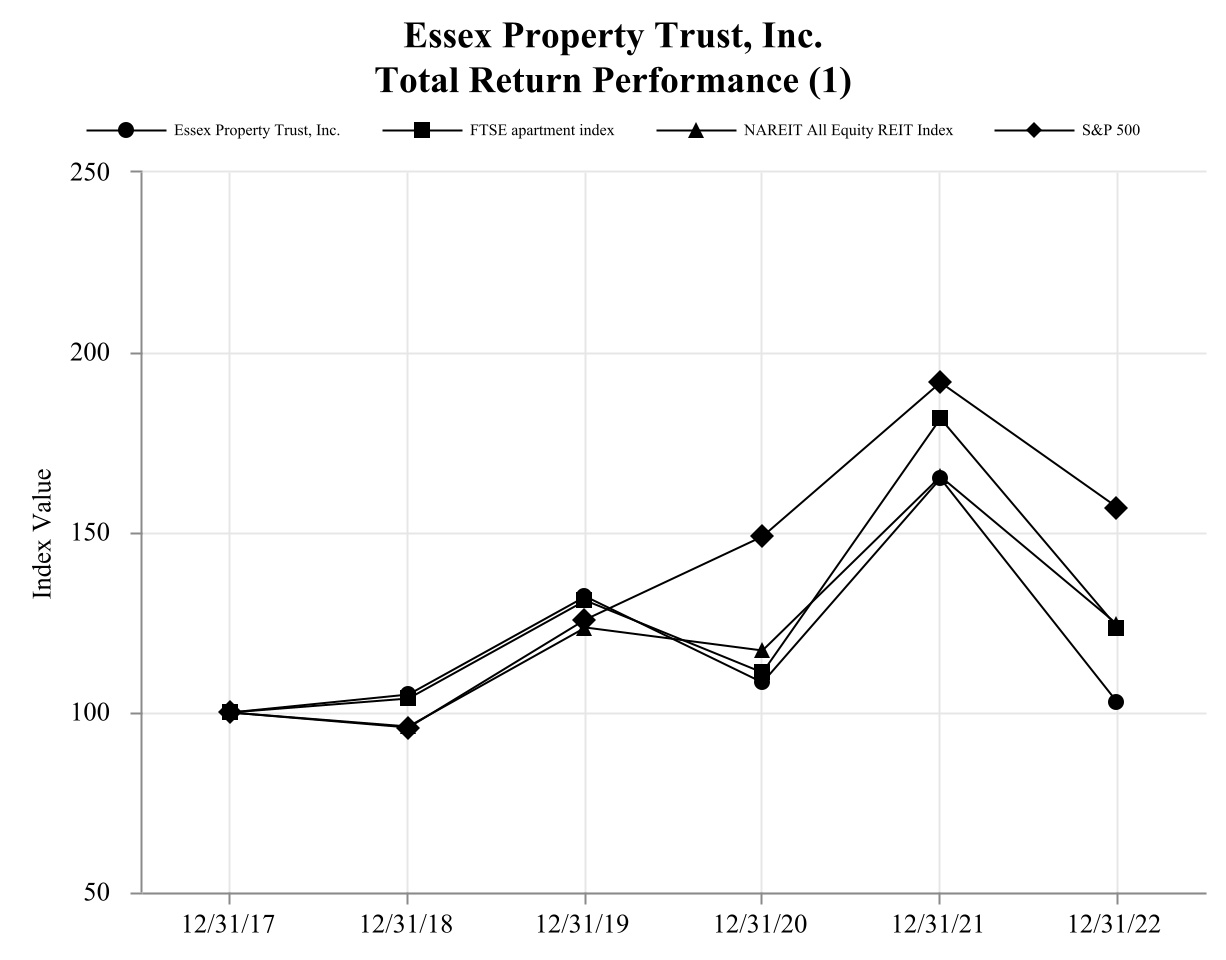
| Period Ending | ||||||||||||||||||||||||||||||||||||||
| Index | 12/31/2017 | 12/31/2018 | 12/31/2019 | 12/31/2020 | 12/31/2021 | 12/31/2022 | ||||||||||||||||||||||||||||||||
| Essex Property Trust, Inc. | $ | 100.00 | $ | 104.83 | $ | 132.00 | $ | 108.12 | $ | 164.77 | $ | 102.55 | ||||||||||||||||||||||||||
| FTSE NAREIT Equity Apartments Index | $ | 100.00 | $ | 103.70 | $ | 130.99 | $ | 110.89 | $ | 181.43 | $ | 123.46 | ||||||||||||||||||||||||||
| FTSE NAREIT All Equity REITs Index | $ | 100.00 | $ | 95.96 | $ | 123.46 | $ | 117.14 | $ | 165.51 | $ | 124.22 | ||||||||||||||||||||||||||
| S&P 500 Index | $ | 100.00 | $ | 95.62 | $ | 125.72 | $ | 148.85 | $ | 191.58 | $ | 156.88 | ||||||||||||||||||||||||||
(1)
Common stock performance data is provided by S&P Global Market Intelligence.
The graph and other information furnished under the above caption "Performance Graph" in this Part II Item 5 of this Form 10-K shall not deemed to be "soliciting material" or to be "filed" with the SEC or subject to Regulation 14A or 14C, or to the liabilities of the Exchange Act.
Unregistered Sales of Equity Securities
During the years ended December 31, 2022 and 2021, the Operating Partnership issued OP Units in private placements in reliance on the exemption from registration provided by Section 4(a)(2) of the Securities Act, in the amounts and for the consideration set forth below:
During the years ended December 31, 2022 and 2021, Essex issued an aggregate of 76,246 and 248,725 shares of its common stock upon the exercise of stock options, respectively. Essex contributed the proceeds from the option exercises of $19.5 million and $58.5 million to the Operating Partnership in exchange for an aggregate of 76,246 and 248,725 OP Units, as required by the Operating Partnership’s partnership agreement, during the years ended December 31, 2022 and 2021, respectively.
32
During the years ended December 31, 2022 and 2021, Essex issued an aggregate of 11,707 and 30,360 shares of its common stock in connection with restricted stock awards for no cash consideration, respectively. For each share of common stock issued by Essex in connection with such awards, the Operating Partnership issued OP Units to Essex as required by the Operating Partnership's partnership agreement, for an aggregate of 11,707 and 30,360 OP Units during the years ended December 31, 2022 and 2021, respectively.
During the years ended December 31, 2022 and 2021, Essex issued an aggregate of 8,310 and 10,293 shares of its common stock in connection with the exchange of OP Units by limited partners into shares of common stock. For each share of common stock issued by Essex in connection with such exchange, the Operating Partnership issued OP Units to Essex as required by the Operating Partnership's partnership agreement, for an aggregate of 8,310 and 10,293 OP Units during the year ended December 31, 2022 and 2021, respectively.
Essex may sell shares through its equity distribution program, then contribute the net proceeds from these share issuances to the Operating Partnership in exchange for OP Units as required by the Operating Partnership's partnership agreement. During the year ended December 31, 2022 and 2021, the Company did not issue or sell any shares of common stock pursuant to the 2021 ATM Program. As of December 31, 2022, there were no outstanding forward sale agreements.
Stock Repurchases
The following table summarizes the Company's purchase of shares of its common stock during the three months ended December 31, 2022:
|
Total Number of
Shares Purchased |
Average Price
Paid Per Share |
Total Number of Shares
Purchased as Part of a
Publicly Announced
Program
(1)
|
Maximum Dollar Value of Shares that May Yet Be Purchased Under the Program (in millions)
(1)
|
|||||||||||||||||||||||
| November 1, 2022 - November 30, 2022 | 28,200 | $ | 210.82 | 28,200 | $ | 424.2 | ||||||||||||||||||||
| December 1, 2022 - December 31, 2022 | 121,009 | $ | 213.45 | 121,009 | $ | 398.3 | ||||||||||||||||||||
| Total | 149,209 | $ | 212.95 | 149,209 | $ | 398.3 | ||||||||||||||||||||
(1)
In September 2022, the Board of Directors approved a new stock repurchase plan to allow the Company to acquire shares of common stock up to an aggregate of $500.0 million. The plan supersedes the Company's previous common stock repurchase plan announced in December 2015. Following the approval of the new plan, 420,606 shares of common stock totaling $101.7 million were repurchased under the new plan.
33
Item 6. [Reserved]
34
Item 7. Management’s Discussion and Analysis of Financial Condition and Results of Operations
The following discussion and analysis should be read in conjunction with the accompanying consolidated financial statements and notes thereto. These consolidated financial statements include all adjustments which are, in the opinion of management, necessary to reflect a fair statement of the results and all such adjustments are of a normal recurring nature.
OVERVIEW
Essex is a self-administered and self-managed REIT that acquires, develops, redevelops, and manages apartment communities in selected residential areas located on the West Coast of the United States. Essex owns all of its interests in its real estate investments, directly or indirectly, through the Operating Partnership. Essex is the sole general partner of the Operating Partnership and, as of December 31, 2022, had an approximately 96.6% general partner interest in the Operating Partnership.
The Company’s investment strategy has two components: constant monitoring of existing markets, and evaluation of new markets to identify areas with the characteristics that underlie rental growth. The Company’s strong financial condition supports its investment strategy by enhancing its ability to quickly shift acquisition, development, redevelopment, and disposition activities to markets that will optimize the performance of the Company's portfolio.
As of December 31, 2022, the Company owned or had ownership interests in 252 operating apartment communities, comprising 62,147 apartment homes, excluding the Company's ownership in preferred equity co-investments, loan investments, three operating commercial buildings, and a development pipeline comprised of one unconsolidated joint venture project.
The Company’s apartment communities are predominately located in the following major regions:
Southern California
(primarily Los Angeles, Orange, San Diego, and Ventura counties)
Northern California
(the San Francisco Bay Area)
Seattle Metro
(Seattle metropolitan area)
As of December 31, 2022, the Company’s development pipeline was comprised of one unconsolidated joint venture project under development aggregating 264 apartment homes and various predevelopment projects, with total incurred costs of $102.0 million. The estimated remaining project costs are approximately $25.0 million, $12.8 million of which represents the Company's estimated remaining costs, for total estimated project costs of $127.0 million.
As of December 31, 2022, the Company also had an ownership interest in three operating commercial buildings (totaling approximately 283,000 square feet).
By region, the Company's operating results for 2022 and 2021 and projection for 2023 new housing supply (defined as new multifamily apartment homes and single family homes, excluding developments with fewer than 50 apartment homes as well as student, senior and 100% affordable housing), projection for 2023 job growth, and 2023 estimated Same-Property revenue growth are as follows:
Southern California Region
: As of December 31, 2022, this region represented 43% of the Company’s consolidated operating apartment homes. Revenues for "2022 Same-Properties" (as defined below), or "Same-Property revenues," increased 11.3% in 2022 as compared to 2021. In 2023, the Company projects new residential supply of 30,300 apartment homes and single family homes, which represents 0.5% of the total housing stock. The Company projects an increase of 2,000 jobs or 0.3% in the Southern California region.
Northern California Region
: As of December 31, 2022, this region represented 37% of the Company’s consolidated operating apartment homes. Same-Property revenues increased 8.4% in 2022 as compared to 2021. In 2023, the Company projects new residential supply of 12,750 apartment homes and single family homes, which represents 0.5% of the total housing stock. The Company projects an increase of 4,500 jobs or 0.7% in the Northern California region.
Seattle Metro Region
:
As of December 31, 2022, this region represented 20% of the Company’s consolidated operating apartment homes. Same-Property revenues increased 12.0% in 2022 as compared to 2021. In 2023, the Company projects new residential supply of 14,450 apartment homes and single family homes, which represents 1.1% of the total housing stock. The Company projects an increase of 3,000 jobs or 0.4% in the Seattle Metro region.
In total, the Company projects an increase in 2023 Same-Property revenues of between 3.25% to 4.75%. Same-Property operating expenses are projected to increase in 2023 by 4.50% to 5.50%.
35
The Company’s consolidated operating communities are as follows:
| As of | As of | ||||||||||||||||||||||
| December 31, 2022 | December 31, 2021 | ||||||||||||||||||||||
| Apartment Homes | % | Apartment Homes | % | ||||||||||||||||||||
| Southern California | 22,151 | 43 | % | 22,190 | 43 | % | |||||||||||||||||
| Northern California | 19,230 | 37 | % | 19,123 | 37 | % | |||||||||||||||||
| Seattle Metro | 10,341 | 20 | % | 10,341 | 20 | % | |||||||||||||||||
| Total | 51,722 | 100 | % | 51,654 | 100 | % | |||||||||||||||||
Co-investments, developments under construction, and preferred equity interest co-investment communities are not included in the table presented above for both periods.
Market Considerations, including the COVID-19 Pandemic
Though diminishing, the COVID-19 pandemic and its related variants continue to impact the U.S. and world economies. In an effort to mitigate its impact on affected populations, federal, state and local jurisdictions implemented varying forms of requirements which may continue to negatively affect profitability. While the California eviction moratorium sunsetted during the third quarter of 2021, other state and local eviction moratoriums and laws that limit rent increases during times of emergency and impair the ability to collect unpaid rent during certain timeframes continue to be in effect in various formats at various regions in which our communities are located, impacting the Company and its properties. The Company continues to work to comply with the stated intent of local, county, state and federal laws.
While COVID-19’s impact begins to dissipate, geopolitical tensions between Russian and Ukraine increased uncertainty during
2022. Inflation has caused an increase in consumer prices, thereby reducing purchasing power and elevating the risks of a
recession. Due to increased inflation, the U.S. Federal Reserve raised the federal funds rate a total of seven times during 2022. In response, market interest rates have increased significantly during this time. At the same time, the labor market remains historically tight and companies continue to look to add employees, pushing unemployment lower.
The long-term impact of these developments will largely depend on new information which may emerge concerning the
COVID-19 pandemic, future laws that may be enacted, geopolitical tensions, inflation, the impact on job growth and the broader economy, and reactions by consumers, companies, governmental entities and capital markets.
Primarily as a result of the impact of the COVID-19 pandemic, the Company's cash delinquencies as a percentage of scheduled rental income for the Company’s stabilized apartment communities or "Same-Property" (stabilized properties consolidated by the Company for the years ended December 31, 2022 and 2021) have generally remained higher than the pre-pandemic period due to on-going eviction moratoria related to the COVID-19 pandemic, and above the typical historical range of 0.3% to 0.4% since the second quarter of 2020. Cash delinquencies remained elevated at 1.9% for 2021 but decreased to 1.2% in 2022, attributable to government payments for Emergency Rental Assistance which was mostly depleted by December 31, 2022. The Company continues to work with residents to collect such cash delinquencies. As of December 31, 2022, the delinquencies have not had a material adverse impact to the Company's liquidity position. The Company's average financial occupancy for the Company's Same-Property portfolio decreased slightly from 96.4% for the year ended December 31, 2021 to 96.1% for the year ended December 31, 2022.
The COVID-19 pandemic and the resulting macroeconomic conditions have not negatively impacted the Company's ability to access traditional funding sources on the same or reasonably similar terms as were available in recent periods prior to the pandemic, as demonstrated by the Company's financing activity during the year ended December 31, 2022 discussed in the “Liquidity and Capital Resources" section below. The Company is not at material risk of not meeting the covenants in its credit agreements and is able to timely service its debt and other obligations
.
RESULTS OF OPERATIONS
Comparison of Year Ended December 31, 2022 to the Year Ended December 31, 2021
The Company’s average financial occupancy for the Company’s stabilized apartment communities or "2022 Same-Property" (stabilized properties consolidated by the Company for the years ended December 31, 2022 and 2021) decreased 30
36
basis points to 96.1% in 2022 from 96.4% in 2021. Financial occupancy is defined as the percentage resulting from dividing actual rental income by total scheduled rental income. Actual rental income represents contractual rental income pursuant to leases without considering delinquency and concessions. Total scheduled rental income represents the value of all apartment homes, with occupied apartment homes valued at contractual rental rates pursuant to leases and vacant apartment homes valued at estimated market rents. The Company believes that financial occupancy is a meaningful measure of occupancy because it considers the value of each vacant apartment home at its estimated market rate.
Market rates are determined using the recently signed effective rates on new leases at the property and are used as the starting point in the determination of the market rates of vacant apartment homes. The Company may increase or decrease these rates based on a variety of factors, including overall supply and demand for housing, concentration of new apartment deliveries within the same submarket which can cause periodic disruption due to greater rental concessions to increase leasing velocity, and rental affordability. Financial occupancy may not completely reflect short-term trends in physical occupancy and financial occupancy rates, and the Company's calculation of financial occupancy may not be comparable to financial occupancy disclosed by other REITs.
The Company does not take into account delinquency and concessions to calculate actual rent for occupied apartment homes and market rents for vacant apartment homes. The calculation of financial occupancy compares contractual rates for occupied apartment homes to estimated market rents for unoccupied apartment homes, and thus the calculation compares the gross value of all apartment homes excluding delinquency and concessions. For apartment communities that are development properties in lease-up without stabilized occupancy figures, the Company believes the physical occupancy rate is the appropriate performance metric. While an apartment community is in the lease-up phase, the Company’s primary motivation is to stabilize the property, which may entail the use of rent concessions and other incentives, and thus financial occupancy, which is based on contractual income is not considered the best metric to quantify occupancy.
The regional breakdown of the Company’s 2022 Same-Property portfolio for financial occupancy for the years ended December 31, 2022 and 2021 is as follows:
|
Years ended
December 31, |
|||||||||||
| 2022 | 2021 | ||||||||||
| Southern California | 96.2 | % | 96.7 | % | |||||||
| Northern California | 96.1 | % | 96.2 | % | |||||||
| Seattle Metro | 95.8 | % | 96.2 | % | |||||||
The following table provides a breakdown of revenue amounts, including the revenues attributable to 2022 Same-Properties.
| Number of Apartment |
Years Ended
December 31, |
Dollar | Percentage | |||||||||||||||||||||||||||||
|
Property Revenues
($ in thousands)
|
Homes | 2022 | 2021 | Change | Change | |||||||||||||||||||||||||||
| 2022 Same-Properties: | ||||||||||||||||||||||||||||||||
| Southern California | 21,006 | $ | 624,907 | $ | 561,326 | $ | 63,581 | 11.3 | % | |||||||||||||||||||||||
| Northern California | 17,895 | 591,556 | 545,535 | 46,021 | 8.4 | % | ||||||||||||||||||||||||||
| Seattle Metro | 10,218 | 268,512 | 239,819 | 28,693 | 12.0 | % | ||||||||||||||||||||||||||
| Total 2022 Same-Property Revenues | 49,119 | 1,484,975 | 1,346,680 | 138,295 | 10.3 | % | ||||||||||||||||||||||||||
| 2022 Non-Same Property Revenues | 110,700 | 84,738 | 25,962 | 30.6 | % | |||||||||||||||||||||||||||
| Total Property Revenues | $ | 1,595,675 | $ | 1,431,418 | $ | 164,257 | 11.5 | % | ||||||||||||||||||||||||
2022 Same-Property Revenues
increased by $138.3 million or 10.3% to $1.5 billion for 2022 compared to $1.3 billion in 2021. The increase was primarily attributable to an increase of 7.2% in average rental rates from $2,320 for 2021 to $2,486 for 2022 and 2.3% of the increase was attributable to a decrease in cash concessions in 2022 compared to 2021.
2022 Non-Same Property Revenues
increased by $26.0 million or 30.6% to $110.7 million in 2022 compared to $84.7 million in 2021. The increase was primarily due to the acquisitions of The Village at Toluca Lake and Canvas in 2021, the acquisitions of Regency Palm Court and Windsor Court in 2022, and an increase in average rental rates.
37
Management and other fees from affiliates
increased by $2.0 million or 22.0% to $11.1 million in 2022 from $9.1 million in 2021. The increase was primarily due to the addition of Martha Lake Apartments, Monterra in Mill Creek, The Rexford, and Silver communities to the Company's joint venture portfolio in 2021 and Vela in 2022, partially offset by the Company's purchases of BEX III, LLC's 50.0% interest in The Village at Toluca Lake in 2021, and its joint venture partner's 49.8% interest in Essex JV LLC co-investment that owned Regency Palm Court and Windsor Court, in 2022.
Property operating expenses, excluding real estate taxes
increased by $18.5 million or 7.0% to $283.4 million in 2022 compared to $264.9 million in 2021, primarily due to increases of $9.2 million in utilities expenses, $7.4 million in maintenance and repairs expenses, and $1.9 million in administrative expenses. 2022 Same-Property operating expenses, excluding real estate taxes, increased by $15.5 million or 6.1% to $268.6 million in 2022 compared to $253.1 million in 2021, primarily due to increases of $8.0 million in utilities expenses, $6.2 million in maintenance and repairs expenses, $0.8 million in insurance and other expenses, and $0.5 million in administrative expenses.
Real estate taxes
increased by $3.5 million or 1.9% to $183.9 million in 2022 compared to $180.4 million in 2021, primarily due to real estate taxes from the completion of development properties Wallace on Sunset in 2021 and Station Park Green (Phase IV) in 2022, as well as the acquisitions of The Village at Toluca Lake, Canvas, and 7 S Linden Commercial properties during 2021. 2022 Same-Property real estate taxes increased by $0.3 million or 0.2% to $164.0 million in 2022 compared to $163.7 million in 2021 primarily due to increased valuations and tax rates.
Corporate-level property management expenses
increased by $4.5 million or 12.4% to $40.7 million in 2022 compared to $36.2 million in 2021 due to costs pertaining to the centralization of certain property level functions.
Depreciation and amortization expense
increased by $19.2 million or 3.7% to $539.3 million in 2022 compared to $520.1 million in 2021, primarily due to an increase in depreciation expense from the completion of development properties Mylo and Wallace on Sunset in 2021, Station Park Green (Phase IV) in 2022, as well as the acquisitions of The Village at Toluca Lake and Canvas in 2021, and Regency Palm Court and Windsor Court in 2022.
Gain on sale of real estate and land
of $94.4 million in 2022 was attributable to the sale of Anavia in the fourth quarter of 2022. The Company's $143.0 million gain on sale of real estate and land in 2021 was attributable to the sale of Hidden Valley, Axis 2300, Park 20, and Devonshire Apartments during 2021.
Interest expense
increased by $1.7 million or 0.8% to $204.8 million in 2022 compared to $203.1 million in 2021
,
primarily due to the issuance of new senior unsecured notes in 2021 which resulted in an increase in interest expense of $4.8 million and increased borrowing on the Company's unsecured lines of credit, and higher average interest rates, which resulted in an increase in interest expense of $3.0 million. Additionally, there was a $3.9 million decrease in capitalized interest in 2022, due to a decrease in development activity as compared to the same period in 2021. These increases in interest expense were partially offset by various debts that were paid off, matured, or regular principal payments during and after 2021 which resulted in a decrease in interest expense of $10.0 million for 2022.
Total return swap income
of $7.9 million in 2022 consists of monthly settlements related to the Company's four total return swap contracts with an aggregate notional amount of $223.6 million.
Interest and other (loss) income
decreased by $117.7 million or 119.3% to a loss of $19.0 million in 2022 compared to an income of $98.7 million in 2021, primarily due to unrealized losses resulting from a decrease in the fair value of marketable securities.
Equity income from co-investments
decreased by $85.7 million or 76.7% to $26.0 million in 2022 compared to $111.7 million in 2021, primarily due to decreases of $93.6 million in equity income from non-core co-investments, $5.3 million in income from preferred equity investments including income from early redemptions, and a $2.1 million impairment loss from an unconsolidated co-investment. These decreases were offset by $17.1 million in co-investment promote income during 2022 and an increase of $1.0 million in loss on early retirement of debt from unconsolidated co-investments.
Deferred tax benefit on unconsolidated co-investments
of $10.2 million in 2022 is primarily due to net unrealized losses from non-core unconsolidated co-investments.
Gain on remeasurement of co-investment
of $17.4 million in 2022 resulted from the Company's purchase of its joint venture partner's 49.8% membership interest in Essex JV, LLC co-investment that owned Regency Palm Court and Windsor Court. Gain on remeasurement of $2.3 million in 2021 resulted from the Company's purchase of BEX III's 50.0% interest in The Village at Toluca Lake community in the second quarter of 2021.
38
Comparison of Year Ended December 31, 2021 to the Year Ended December 31, 2020
For the comparison of the years ended December 31, 2021 and December 31, 2020, refer to Part II, Item 7 “Management's Discussion and Analysis of Financial Condition and Results of Operations" on Form 10-K for the fiscal year ended December 31, 2021, filed with the SEC on February 25, 2022 under the subheading "Comparison of Year Ended December 31, 2021 to the Year Ended December 31, 2020."
Liquidity and Capital Resources
The following table sets forth the Company’s cash flows for 2022, 2021 and 2020 ($ in thousands):
| For the year ended December 31, | ||||||||||||||||||||
| 2022 | 2021 | 2020 | ||||||||||||||||||
| Cash flow provided by (used in): | ||||||||||||||||||||
| Operating activities | $ | 975,649 | $ | 905,259 | $ | 803,108 | ||||||||||||||
| Investing activities | $ | 145,958 | $ | (397,397) | $ | (416,900) | ||||||||||||||
| Financing activities | $ | (1,137,564) | $ | (533,265) | $ | (383,261) | ||||||||||||||
Essex’s business is operated primarily through the Operating Partnership. Essex issues public equity from time to time, but does not otherwise generate any capital itself or conduct any business itself, other than incurring certain expenses from operating as a public company which are fully reimbursed by the Operating Partnership. Essex itself does not hold any indebtedness, and its only material asset is its ownership of partnership interests of the Operating Partnership. Essex’s principal funding requirement is the payment of dividends on its common stock. Essex’s sole source of funding for its dividend payments is distributions it receives from the Operating Partnership.
As of December 31, 2022, Essex owned a 96.6% general partner interest and the limited partners owned the remaining 3.4% interest in the Operating Partnership.
The liquidity of Essex is dependent on the Operating Partnership’s ability to make sufficient distributions to Essex. The primary cash requirement of Essex is its payment of dividends to its stockholders. Essex also guarantees some of the Operating Partnership’s debt, as discussed further in Notes 7 and 8 to our consolidated financial statements included in Part IV, Item 15 of this Annual Report on Form 10-K. If the Operating Partnership fails to fulfill certain of its debt requirements, which trigger Essex’s guarantee obligations, then Essex will be required to fulfill its cash payment commitments under such guarantees. However, Essex’s only significant asset is its investment in the Operating Partnership.
For Essex to maintain its qualification as a REIT, it must pay dividends to its stockholders aggregating annually at least 90% of its REIT taxable income, excluding net capital gains. While historically Essex has satisfied this distribution requirement by making cash distributions to its stockholders, it may choose to satisfy this requirement by making distributions of other property, including, in limited circumstances, Essex’s own stock. As a result of this distribution requirement, the Operating Partnership cannot rely on retained earnings to fund its ongoing operations to the same extent that other companies whose parent companies are not REITs can. Essex may need to continue to raise capital in the equity markets to fund the Operating Partnership’s working capital needs, acquisitions and developments.
At December 31, 2022, the Company had $33.3 million of unrestricted cash and cash equivalents and $112.7 million in marketable securities. The Company believes that cash flows generated by its operations, existing cash and cash equivalents, marketable securities balances and availability under existing lines of credit are sufficient to meet all of its anticipated cash needs during 2023. Additionally, the capital markets continue to be available and the Company is able to generate cash from the disposition of real estate assets to finance additional cash flow needs, including continued development and select acquisitions. In the event that economic disruptions occur, the Company may further utilize other resources such as its cash reserves, lines of credit, or decreased investment in redevelopment activities to supplement operating cash flows. The Company is carefully monitoring and managing its cash position in light of ongoing conditions and levels of operations. The timing, source and amounts of cash flows provided by financing activities and used in investing activities are sensitive to changes in interest rates and other fluctuations in the capital markets environment, which can affect the Company’s plans for acquisitions, dispositions, development and redevelopment activities.
As of December 31, 2022, the Company had $5.4 billion of fixed rate public bonds outstanding at an average interest rate of 3.3% with maturity dates ranging from 2023 to 2050.
39
As of December 31, 2022, the Company’s mortgage notes payable totaled $593.9 million, net of unamortized premiums and debt issuance costs, which consisted of $371.8 million in fixed rate debt at an average interest rate of 3.6% and maturity dates ranging from 2025 to 2028 and $222.1 million of tax-exempt variable rate demand notes with a weighted average interest rate of 3.5%. The tax-exempt variable rate demand notes have maturity dates ranging from 2027 to 2046. $223.6 million is subject to total return swaps.
As of December 31, 2022, the Company had two unsecured lines of credit aggregating $1.24 billion, including a $1.2 billion unsecured line of credit and a $35.0 million working capital unsecured line of credit. As of December 31, 2022, there was $40.0 million outstanding on the $1.2 billion unsecured line of credit. The underlying interest rate is based on a tiered rate structure tied to the Company's credit ratings, adjusted for the Company's sustainability metric grid, and was at Adjusted SOFR plus 0.75% as of December 31, 2022. This facility is scheduled to mature in January 2027, with two six-month extensions, exercisable at the Company's option. As of December 31, 2022, there was $12.1 million outstanding on the Company's $35.0 million working capital unsecured line of credit. The underlying interest rate is based on a tiered rate structure tied to the Company's credit ratings, adjusted for the Company's sustainability metric grid, and was at Adjusted SOFR plus 0.75% as of December 31, 2022. This facility is scheduled to mature in July 2024.
The Company’s unsecured lines of credit and unsecured debt agreements contain debt covenants related to limitations on indebtedness and liabilities and maintenance of minimum levels of consolidated earnings before depreciation, interest and amortization. The Company was in compliance with the debt covenants as of December 31, 2022 and 2021.
The Company pays quarterly dividends from cash available for distribution. Until it is distributed, cash available for distribution is invested by the Company primarily in investment grade securities held available for sale or is used by the Company to reduce balances outstanding under its lines of credit.
Derivative Activity
The Company uses interest rate swaps, interest rate caps, and total return swap contracts to manage certain interest rate risks. The valuation of these instruments is determined using widely accepted valuation techniques including discounted cash flow analysis on the expected cash flows of each derivative. This analysis reflects the contractual terms of the derivatives, including the period to maturity, and uses observable market-based inputs, including interest rate curves. The fair values of interest rate swaps and total return swaps are determined using the market standard methodology of netting the discounted future fixed cash receipts (or payments) and the discounted expected variable cash payments (or receipts). The variable cash payments (or receipts) are based on an expectation of future interest rates (forward curves) derived from observable market interest rate curves. The Company incorporates credit valuation adjustments to appropriately reflect both its own nonperformance risk and the respective counterparty's nonperformance risk in the fair value measurements.
The Company has four total return swap contracts, with an aggregate notional amount of $223.6 million, that effectively converts $223.6 million of fixed mortgage notes payable to a floating interest rate based on the Securities Industry and Financial Markets Association Municipal Swap Index ("SIFMA") plus a spread. The total return swaps provide fair market value protection on the mortgage notes payable to our counterparties during the initial period of the total return swap until the Company's option to call the mortgage notes at par can be exercised. The Company can currently call all four of the total return swaps, with $223.6 million of the outstanding debt at par. These derivatives do not qualify for hedge accounting.
As of December 31, 2022 and 2021, the aggregate carrying value of the interest rate swap contracts were an asset of $5.6 million and zero, respectively. As of December 31, 2022 and 2021, the swap contracts were presented in the consolidated balance sheets as an asset of $5.6 million and zero, respectively, and were included in prepaid expenses and other assets on the consolidated balance sheets. The aggregate carrying and fair value of the total return swaps was zero at both December 31, 2022 and 2021.
Hedge ineffectiveness related to cash flow hedges, which is reported in current year income as interest expense, net was zero for the years ended December 31, 2022, 2021, and 2020.
Issuance of Common Stock
In September 2021, the Company entered into the 2021 ATM Program, a new equity distribution agreement pursuant to which the Company may offer and sell shares of its common stock having an aggregate gross sales price of up to $900.0 million. In connection with the 2021 ATM Program, the Company may also enter into related forward sale agreements, and may sell shares of its common stock pursuant to these agreements. The use of a forward sale agreement would allow the Company to
40
lock in a share price on the sale of shares of its common stock at the time the agreement is executed, but defer receipt of the proceeds from the sale of shares until a later date should the Company elect to settle such forward sale agreement, in whole or in part, in shares of common stock.
The 2021 ATM Program replaced the prior equity distribution agreement entered into in September 2018 (the "2018 ATM Program"), which was terminated upon the establishment of the 2021 ATM Program. For the year ended December 31, 2022, the Company did not sell any shares of its common stock through the 2021 ATM Program. As of December 31, 2022, there were no outstanding forward purchase agreements, and $900.0 million of shares of common stock remain available to be sold under the 2021 ATM Program. For the years ended December 31, 2021 and 2020, the Company did not issue any shares of its common stock through the 2021 ATM Program or through the 2018 ATM Program.
The 2021 ATM Program replaced the prior equity distribution agreement entered into in September 2018 (the "2018 ATM Program"), which was terminated upon the establishment of the 2021 ATM Program. For the year ended December 31, 2022, the Company did not sell any shares of its common stock through the 2021 ATM Program. As of December 31, 2022, there were no outstanding forward purchase agreements, and $900.0 million of shares of common stock remain available to be sold under the 2021 ATM Program. For the years ended December 31, 2021 and 2020, the Company did not issue any shares of its common stock through the 2021 ATM Program or through the 2018 ATM Program.
Capital Expenditures
Non-revenue generating capital expenditures are improvements and upgrades that extend the useful life of the property. For the year ended December 31, 2022, non-revenue generating capital expenditures totaled approximately $2,670 per apartment home. These expenditures do not include expenditures for deferred maintenance on acquisition properties, expenditures for property renovations and improvements which are expected to generate additional revenue or cost savings, and do not include expenditures incurred due to changes in government regulations that the Company would not have incurred otherwise, retail, furniture and fixtures, or expenditures for which the Company expects to be reimbursed. The Company expects that cash from operations and/or its lines of credit will fund such expenditures.
Development and Predevelopment Pipeline
The Company defines development projects as new communities that are being constructed, or are newly constructed and are in a phase of lease-up and have not yet reached stabilized operations. As of December 31, 2022, the Company's development pipeline was comprised of one unconsolidated joint venture project under development aggregating 264 apartment homes and various predevelopment projects, with total incurred costs of $102.0 million. Estimated remaining project costs are approximately $25.0 million, $12.8 million of which represents the Company's estimated remaining costs, for total estimated project costs of $127.0 million.
The Company defines predevelopment projects as proposed communities in negotiation or in the entitlement process with an expected high likelihood of becoming entitled development projects. The Company may also acquire land for future development purposes or sale.
The Company expects to fund the development and predevelopment communities by using a combination of some or all of the following sources: its working capital, amounts available on its lines of credit, construction loans, net proceeds from public and private equity and debt issuances, and proceeds from the disposition of assets, if any.
Alternative Capital Sources
The Company utilizes co-investments as an alternative source of capital for acquisitions of both operating and development communities. As of December 31, 2022, the Company had an interest in 264 apartment homes in communities actively under development with joint ventures for total estimated costs of $102.0 million. Total estimated remaining costs total approximately $25.0 million, of which the Company estimates that its remaining investment in these development joint ventures will be approximately $12.8 million. In addition, the Company had an interest in 10,425 apartment homes in operating communities with joint ventures and other investments for a total book value of $491.8 million.
Real Estate and Other Commitments
The following table summarizes the Company's unfunded real estate and other future commitments at December 31, 2022 ($ in thousands):
41
| Number of Properties | Investment | Remaining Commitment | ||||||||||||||||||
|
Joint ventures
(1)
:
|
||||||||||||||||||||
| Preferred equity investments | 2 | $ | 98,000 | $ | 38,000 | |||||||||||||||
| Non-core co-investments | — | 87,000 | 50,120 | |||||||||||||||||
| Consolidated: | ||||||||||||||||||||
| Mezzanine loans | 2 | 82,110 | 60,932 | |||||||||||||||||
| $ | 267,110 | $ | 149,052 | |||||||||||||||||
(1)
Excludes approximately $12.8 million of the Company's share of estimated project costs for LIVIA (fka Scripps Mesa Apartments) which have been fully funded.
At December 31, 2022, the Company had operating lease commitments of $162.1 million for ground, building and garage leases with maturity dates ranging from 2025 to 2083. $7.0 million of this commitment is due within the next twelve months.
Variable Interest Entities
In accordance with accounting standards for consolidation of variable interest entities ("VIEs"), the Company consolidated the Operating Partnership, 18 DownREIT entities (comprising nine communities) and six co-investments as of December 31, 2022 and 2021. The Company consolidates these entities because it is deemed the primary beneficiary. Essex has no assets or liabilities other than its investment in the Operating Partnership. The consolidated total assets and liabilities related to the above consolidated co-investments and DownREIT entities, net of intercompany eliminations, were approximately $939.4 million and $324.3 million, respectively, as of December 31, 2022, and $909.3 million and $320.1 million, respectively, as of December 31, 2021. Noncontrolling interests in these entities were $121.5 million and $122.4 million as of December 31, 2022 and 2021, respectively. The Company's financial risk in each VIE is limited to its equity investment in the VIE. As of December 31, 2022, the Company did not have any other VIEs of which it was deemed to be the primary beneficiary.
Critical Accounting Estimates
The preparation of consolidated financial statements, in accordance with U.S. GAAP, requires the Company to make estimates and judgments that affect the reported amounts of assets, liabilities, revenues and expenses and related disclosures of contingent assets and liabilities. The Company defines critical accounting estimates as those estimates that involve a significant level of estimation uncertainty and have had or are reasonably likely to have a material impact on the financial condition or results of operations of the Company. The Company’s critical accounting estimates relate principally to the following key areas: (i) accounting for the acquisition of investments in real estate (specifically, the allocation between land and buildings during the year ended December 31, 2020); and (ii) evaluation of events and changes in circumstances indicating whether the Company’s rental properties may be impaired. The Company bases its estimates on historical experience, current market conditions, and on various other assumptions that are believed to be reasonable under the circumstances. Actual results may differ from those estimates made by management.
The Company accounts for its acquisitions of investments in real estate by assessing each acquisition to determine if it meets the definition of a business or if it qualifies as an asset acquisition. We expect that acquisitions of individual operating communities will generally be viewed as asset acquisitions, and result in the capitalization of acquisition costs, and the allocation of purchase price to the assets acquired and liabilities assumed based on the relative fair value of the respective assets and liabilities.
In making estimates of fair values for purposes of allocating purchase price, the Company utilizes a number of sources, including independent land appraisals which consider comparable market transactions, its own analysis of recently acquired or developed comparable properties in our portfolio for land comparables and building replacement costs, and other publicly available market data. In calculating the fair value of identified intangible assets of an acquired property, the in-place leases are valued based on in-place rent rates and amortized over the average remaining term of all acquired leases. The allocation of the total consideration exchanged for a real estate acquisition between the identifiable assets and liabilities and the depreciation we recognize over the estimated useful life of the asset could be impacted by different assumptions and estimates used in the calculation. The reasonable likelihood that the estimate could have a material impact on the financial condition of the Company is based on the total consideration exchanged for real estate during any given year. The allocation of the value between land and
42
building was a critical accounting estimate during the year ended December 31, 2020 as result of the potential material impact of the Company's acquisition of a land parcel and six communities for a total purchase price of $463.4 million.
The Company periodically assesses the carrying value of its real estate investments for indicators of impairment. The judgments regarding the existence of impairment indicators are based on monitoring investment market conditions and performance for operating properties including the net operating income for the most recent 12 month period, monitoring estimated costs for properties under development, the Company's ability to hold and its intent with regard to each asset, and each property's remaining useful life. Although each of these may result in an impairment indicator, the shortening of an expected holding period due to the potential sale of a property is the most likely impairment indicator. Whenever events or changes in circumstances indicate that the carrying amount of a property held for investment may not be fully recoverable, the carrying amount is evaluated. If the sum of the property’s expected future cash flows (undiscounted and without interest charges) is less than the carrying amount of the property, then the Company will recognize an impairment loss equal to the excess of the carrying amount over the fair value of the property. Changes in operating and market conditions may result in a change of our intent to hold the property through the end of its useful life and may impact the assumptions utilized to determine the future cash flows of the real estate investment.
The Company bases its accounting estimates on historical experience and on various other assumptions that are believed to be reasonable under the circumstances. Actual results may vary from those estimates and those estimates could be different under different assumptions or conditions.
Funds from Operations Attributable to Common Stockholders and Unitholders
Funds from Operations Attributable to Common Stockholders and Unitholders ("FFO") is a financial measure that is commonly used in the REIT industry. The Company presents FFO and FFO excluding non-core items (referred to as "Core FFO") as supplemental operating performance measures. FFO and Core FFO are not used by the Company as, nor should they be considered to be, alternatives to net income computed under U.S. GAAP as an indicator of the Company’s operating performance or as alternatives to cash from operating activities computed under U.S. GAAP as an indicator of the Company's ability to fund its cash needs.
FFO and Core FFO are not meant to represent a comprehensive system of financial reporting and do not present, nor do they intend to present, a complete picture of the Company's financial condition and operating performance. The Company believes that net income computed under U.S. GAAP is the primary measure of performance and that FFO and Core FFO are only meaningful when they are used in conjunction with net income.
The Company considers FFO and Core FFO to be useful financial performance measurements of an equity REIT because, together with net income and cash flows, FFO and Core FFO provide investors with additional bases to evaluate operating performance and ability of a REIT to incur and service debt and to fund acquisitions and other capital expenditures and to pay dividends. By excluding gains or losses related to sales of depreciated operating properties and excluding real estate depreciation (which can vary among owners of identical assets in similar condition based on historical cost accounting and useful life estimates), FFO can help investors compare the operating performance of a real estate company between periods or as compared to different companies. By further adjusting for items that are not considered part of the Company’s core business operations, Core FFO allows investors to compare the core operating performance of the Company to its performance in prior reporting periods and to the operating performance of other real estate companies without the effect of items that by their nature are not comparable from period to period and tend to obscure the Company’s actual operating results. The Company believes that its consolidated financial statements, prepared in accordance with U.S. GAAP, provide the most meaningful picture of its financial condition and its operating performance.
In calculating FFO, the Company follows the definition for this measure published by NAREIT, which is the leading REIT industry association. The Company believes that, under the NAREIT FFO definition, the two most significant adjustments made to net income are (i) the exclusion of historical cost depreciation and (ii) the exclusion of gains and losses from the sale of previously depreciated properties. The Company agrees that these two NAREIT adjustments are useful to investors for the following reasons:
(a)
historical cost accounting for real estate assets in accordance with U.S. GAAP assumes, through depreciation charges, that the value of real estate assets diminishes predictably over time. NAREIT stated in its White Paper on Funds from Operations “since real estate asset values have historically risen or fallen with market conditions, many industry investors have considered presentations of operating results for real estate companies that use historical cost accounting to be insufficient by themselves." Consequently, NAREIT’s definition of FFO reflects the fact that real
43
estate, as an asset class, generally appreciates over time and depreciation charges required by U.S. GAAP do not reflect the underlying economic realities.
(b)
REITs were created as a legal form of organization in order to encourage public ownership of real estate as an asset class through investment in firms that were in the business of long-term ownership and management of real estate. The exclusion, in NAREIT’s definition of FFO, of gains and losses from the sales of previously depreciated operating real estate assets allows investors and analysts to readily identify the operating results of the long-term assets that form the core of a REIT’s activity and assists in comparing those operating results between periods.
Management believes that it has consistently applied the NAREIT definition of FFO to all periods presented. However, there is judgment involved and other REITs' calculation of FFO may vary from the NAREIT definition for this measure, and thus their disclosure of FFO may not be comparable to the Company’s calculation.
The table below is a reconciliation of net income available to common stockholders to FFO and Core FFO for the years ended December 31, 2022, 2021, and 2020.
44
| As of and for the years ended December 31, | ||||||||||||||||||||
| 2022 | 2021 | 2020 | ||||||||||||||||||
| ($ in thousands, except per share amounts) | ||||||||||||||||||||
| OTHER DATA: | ||||||||||||||||||||
| Funds from operations attributable to common stockholders and unitholders: | ||||||||||||||||||||
| Net income available to common stockholders | $ | 408,315 | $ | 488,554 | $ | 568,870 | ||||||||||||||
| Adjustments: | ||||||||||||||||||||
| Depreciation and amortization | 539,319 | 520,066 | 525,497 | |||||||||||||||||
| Gains not included in FFO attributable to common stockholders and unitholders | (111,839) | (145,253) | (301,886) | |||||||||||||||||
| Impairment loss from unconsolidated co-investments | 2,105 | — | 1,825 | |||||||||||||||||
| Depreciation and amortization from unconsolidated co-investments | 72,585 | 61,059 | 51,594 | |||||||||||||||||
| Noncontrolling interest related to Operating Partnership units | 14,297 | 17,191 | 19,912 | |||||||||||||||||
|
Depreciation attributable to third party ownership and other
(1)
|
(1,421) | (571) | (539) | |||||||||||||||||
| Funds from operations attributable to common stockholders and unitholders | $ | 923,361 | $ | 941,046 | $ | 865,273 | ||||||||||||||
| Non-core items: | ||||||||||||||||||||
| Expensed acquisition and investment related costs | 2,132 | 203 | 1,591 | |||||||||||||||||
|
Deferred tax (benefit) expense on unconsolidated co-investments
(2)
|
(10,236) | 15,668 | 1,531 | |||||||||||||||||
| Gain on sale of marketable securities | (12,436) | (3,400) | (2,131) | |||||||||||||||||
| Change in unrealized losses (gains) on marketable securities, net | 57,983 | (33,104) | (12,515) | |||||||||||||||||
| Provision for credit losses | (381) | 141 | 687 | |||||||||||||||||
|
Equity loss (income) from non-core co-investments
(3)
|
38,045 | (55,602) | (5,289) | |||||||||||||||||
| Loss on early retirement of debt, net | 2 | 19,010 | 22,883 | |||||||||||||||||
| Loss (gain) on early retirement of debt from unconsolidated co-investment | 988 | 25 | (38) | |||||||||||||||||
| Co-investment promote income | (17,076) | — | (6,455) | |||||||||||||||||
| Income from early redemption of preferred equity investments and notes receivable | (1,669) | (8,469) | (210) | |||||||||||||||||
| Accelerated interest income from maturity of investment in mortgage backed security | — | — | (11,753) | |||||||||||||||||
| General and administrative and other, net | 2,536 | 1,026 | 14,958 | |||||||||||||||||
| Insurance reimbursements, legal settlements, and other, net | (5,392) | (35,234) | (81) | |||||||||||||||||
| Core funds from operations attributable to common stockholders and unitholders | $ | 977,857 | $ | 841,310 | $ | 868,451 | ||||||||||||||
|
Weighted average number of shares outstanding, diluted (FFO)
(4)
|
67,375 | 67,335 | 67,726 | |||||||||||||||||
| Funds from operations attributable to common stockholders and unitholders per share - diluted | $ | 13.70 | $ | 13.98 | $ | 12.78 | ||||||||||||||
| Core funds from operations attributable to common stockholders and unitholders per share - diluted | $ | 14.51 | $ | 12.49 | $ | 12.82 | ||||||||||||||
(1)
The Company consolidates certain co-investments. The noncontrolling interest's share of net operating income in these investments for the twelve months ended December 31, 2022 was $3.3 million.
(2)
Represents deferred tax (benefit) expense related to net unrealized gains or losses on technology co-investments.
(3)
Represents the Company's share of co-investment loss (income) from technology co-investments.
(4)
Assumes conversion of all outstanding OP Units into shares of the Company's common stock and excludes DownREIT limited partnership units.
45
Net Operating Income
Net operating income ("NOI") and Same-Property NOI are considered by management to be important supplemental performance measures to earnings from operations included in the Company’s consolidated statements of income. The presentation of Same-Property NOI assists with the presentation of the Company’s operations prior to the allocation of depreciation and any corporate-level or financing-related costs. NOI reflects the operating performance of a community and allows for an easy comparison of the operating performance of individual communities or groups of communities. In addition, because prospective buyers of real estate have different financing and overhead structures, with varying marginal impacts to overhead by acquiring real estate, NOI is considered by many in the real estate industry to be a useful measure for determining the value of a real estate asset or group of assets. The Company defines Same-Property NOI as Same-Property revenues less Same-Property operating expenses, including property taxes. Please see the reconciliation of earnings from operations to NOI and Same-Property NOI, which in the table below is the NOI for stabilized properties consolidated by the Company for the periods presented ($ in thousands):
| 2022 | 2021 | 2020 | |||||||||||||||
| Earnings from operations | $ | 595,229 | $ | 529,995 | $ | 491,441 | |||||||||||
| Adjustments: | |||||||||||||||||
| Corporate-level property management expenses | 40,704 | 36,211 | 34,361 | ||||||||||||||
| Depreciation and amortization | 539,319 | 520,066 | 525,497 | ||||||||||||||
| Management and other fees from affiliates | (11,139) | (9,138) | (9,598) | ||||||||||||||
| General and administrative | 56,577 | 51,838 | 65,388 | ||||||||||||||
| Expensed acquisition and investment related costs | 2,132 | 203 | 1,591 | ||||||||||||||
| Impairment loss | — | — | 1,825 | ||||||||||||||
| Gain on sale of real estate and land | (94,416) | (142,993) | (64,967) | ||||||||||||||
| NOI | 1,128,406 | 986,182 | 1,045,538 | ||||||||||||||
| Less: Non Same-Property NOI | (76,027) | (56,267) | (89,865) | ||||||||||||||
| Same-Property NOI | $ | 1,052,379 | $ | 929,915 | $ | 955,673 | |||||||||||
Forward-Looking Statements
Certain statements in this "Management's Discussion and Analysis of Financial Condition and Results of Operations," and elsewhere in this Annual Report on Form 10-K which are not historical facts may be considered forward-looking statements within the meaning of Section 27A of the Securities Act of 1933, as amended (the Securities Act") and Section 21E of the Exchange Act, including statements regarding the Company's expectations, estimates, assumptions, hopes, intentions, beliefs and strategies regarding the future. Words such as "expects," "assumes," "anticipates," "may," "will," "intends," "plans," "projects," "believes," "seeks," "future," "estimates," and variations of such words and similar expressions are intended to identify such forward-looking statements. Such forward-looking statements include, among other things, statements regarding the Company's expectations related to the continued evolution of the work-from-home trend in light of the COVID-19 pandemic, the Company's intent, beliefs or expectations with respect to the timing of completion of current development and redevelopment projects and the stabilization of such projects, the timing of lease-up and occupancy of its apartment communities, the anticipated operating performance of its apartment communities, the total projected costs of development and redevelopment projects, co-investment activities, qualification as a REIT under the Internal Revenue Code of 1986, as amended, 2022 Same-Property revenue and operating expenses generally and in specific regions, the real estate markets in the geographies in which the Company's properties are located and in the United States in general, the adequacy of future cash flows to meet anticipated cash needs, its financing activities and the use of proceeds from such activities, the availability of debt and equity financing, general economic conditions including the potential impacts from such economic conditions, inflation, the labor market, supply chain impacts and ongoing hostilities between Russia and Ukraine, trends affecting the Company's financial condition or results of operations, changes to U.S. tax laws and regulations in general or specifically related to REITs or real estate, changes to laws and regulations in jurisdictions in which communities the Company owns are located, and other information that is not historical information.
While the Company's management believes the assumptions underlying its forward-looking statements are reasonable, such forward-looking statements involve known and unknown risks, uncertainties and other factors, many of which are beyond the Company’s control, which could cause the actual results, performance or achievements of the Company to be materially different from any future results, performance or achievements expressed or implied by such forward-looking statements. The Company cannot assure the future results or outcome of the matters described in these statements; rather, these statements merely reflect the Company’s current expectations of the approximate outcomes of the matters discussed. Factors that might
46
cause the Company’s actual results, performance or achievements to differ materially from those expressed or implied by these forward-looking statements include, but are not limited to, the following: potential future outbreaks of infectious diseases or other health concerns, which could adversely affect the Company's business and its tenants, and cause a significant downturn in general economic conditions, the real estate industry, and the markets in which the Company's communities are located; the Company may fail to achieve its business objectives; the actual completion of development and redevelopment projects may be subject to delays; the stabilization dates of such projects may be delayed; the Company may abandon or defer development or redevelopment projects for a number of reasons, including changes in local market conditions which make development less desirable, increases in costs of development, increases in the cost of capital or lack of capital availability, resulting in losses; the total projected costs of current development and redevelopment projects may exceed expectations; such development and redevelopment projects may not be completed; development and redevelopment projects and acquisitions may fail to meet expectations; estimates of future income from an acquired property may prove to be inaccurate; occupancy rates and rental demand may be adversely affected by competition and local economic and market conditions; uncertainties regarding ongoing hostilities between Russia and Ukraine and the related impacts on macroeconomic conditions, including, among other things, interest rates and inflation; the Company may be unsuccessful in the management of its relationships with its co-investment partners; future cash flows may be inadequate to meet operating requirements and/or may be insufficient to provide for dividend payments in accordance with REIT requirements; changes in laws or regulations; the terms of any refinancing may not be as favorable as the terms of existing indebtedness; unexpected difficulties in leasing of development projects; volatility in financial and securities markets; the Company’s failure to successfully operate acquired properties; unforeseen consequences from cyber-intrusion; the Company’s inability to maintain our investment grade credit rating with the rating agencies; government approvals, actions and initiatives, including the need for compliance with environmental requirements; and those further risks, special considerations, and other factors discussed in Item 1A, Risk Factors, of this Form 10-K, and those risk factors and special considerations set forth in the Company’s other filings with the SEC which may cause the actual results, performance or achievements of the Company to be materially different from any future results, performance or achievements expressed or implied by such forward-looking statements. All forward-looking statements are made as of the date hereof, the Company assumes no obligation to update or supplement this information for any reason, and therefore, they may not represent the Company's estimates and assumptions after the date of this report.
Item 7A. Quantitative and Qualitative Disclosures About Market Risks
Interest Rate Hedging Activities
The Company’s objective in using derivatives is to add stability to interest expense and to manage its exposure to interest rate movements or other identified risks. To accomplish this objective, the Company uses interest rate swaps as part of its cash flow hedging strategy. As of December 31, 2022, the Company had one interest rate swap contract to mitigate the risk of changes in the interest-related cash outflows on $300.0 million of the unsecured term loan that had not been drawn and had a balance of zero. As of December 31, 2022, the Company also had $223.6 million of secured variable rate indebtedness. The Company’s interest rate swap is designated as a cash flow hedge as of December 31, 2022. The following table summarizes the notional amount, carrying value, and estimated fair value of the Company’s cash flow hedge derivative instruments used to hedge interest rates as of December 31, 2022. The notional amount represents the aggregate amount of a particular security that is currently hedged at one time, but does not represent exposure to credit, interest rates or market risks. The table also includes a sensitivity analysis to demonstrate the impact on the Company’s derivative instruments from an increase or decrease in 10-year Treasury bill interest rates by 50 basis points, as of December 31, 2022.
|
Notional
Amount |
Maturity
Date Range |
Carrying and
Estimated Fair Value |
Estimated Carrying Value | ||||||||||||||||||||||||||
| +50 | -50 | ||||||||||||||||||||||||||||
| ($ in thousands) | Basis Points | Basis Points | |||||||||||||||||||||||||||
| Cash flow hedges: | |||||||||||||||||||||||||||||
| Interest rate swaps | $ | 300,000 | 2026 | $ | 5,556 | $ | 10,107 | $ | 851 | ||||||||||||||||||||
| Total cash flow hedges | $ | 300,000 | 2026 | $ | 5,556 | $ | 10,107 | $ | 851 | ||||||||||||||||||||
Additionally, the Company has entered into total return swap contracts, with an aggregate notional amount of $223.6 million that effectively convert $223.6 million of fixed mortgage notes payable to a floating interest rate based on the SIFMA plus a spread and have a carrying value of zero at December 31, 2022. The Company is exposed to insignificant interest rate risk on these swaps as the related mortgages are callable, at par, by the Company, co-terminus with the termination of any related swap. These derivatives do not qualify for hedge accounting.
Interest Rate Sensitive Liabilities
47
The Company is exposed to interest rate changes primarily as a result of its lines of credit and long-term debt used to maintain liquidity and fund capital expenditures and expansion of the Company’s real estate investment portfolio and operations. The Company’s interest rate risk management objective is to limit the impact of interest rate changes on earnings and cash flows and to lower its overall borrowing costs. To achieve its objectives, the Company borrows primarily at fixed rates and may enter into derivative financial instruments such as interest rate swaps, caps and treasury locks in order to mitigate its interest rate risk on a related financial instrument. The Company does not enter into derivative or interest rate transactions for speculative purposes.
The Company’s interest rate risk is monitored using a variety of techniques. The table below presents the principal amounts and weighted average interest rates by year of expected maturity to evaluate the expected cash flows. Management has estimated the fair value of the Company’s $5.7 billion of fixed rate debt at December 31, 2022, to be $5.2 billion. Management has estimated the fair value of the Company’s $275.7 million of variable rate debt at December 31, 2022, to be $273.2 million based on the terms of existing mortgage notes payable and variable rate demand notes compared to those available in the marketplace. The following table represents scheduled principal payments ($ in thousands):
| For the Years Ended December 31, | ||||||||||||||||||||||||||||||||||||||||||||
| ($ in thousands, except for interest rates) | 2023 | 2024 | 2025 | 2026 | 2027 | Thereafter | Total | Fair value | ||||||||||||||||||||||||||||||||||||
|
Fixed rate debt
|
$ | 302,093 | $ | 402,177 | $ | 632,035 | $ | 548,291 | $ | 419,558 | $ | 3,417,000 | $ | 5,721,154 | $ | 5,195,981 | ||||||||||||||||||||||||||||
| Average interest rate | 3.4 | % | 4.0 | % | 3.5 | % | 3.5 | % | 3.8 | % | 3.0 | % | ||||||||||||||||||||||||||||||||
|
Variable rate debt
(1)
|
$ | 852 | $ | 13,005 | $ | 1,019 | $ | 1,114 | $ | 84,397 | $ | 175,269 | $ | 275,656 | $ | 273,160 | ||||||||||||||||||||||||||||
| Average interest rate | 3.6 | % | 4.3 | % | 3.6 | % | 3.6 | % | 3.4 | % | 3.7 | % | ||||||||||||||||||||||||||||||||
(1)
$223.6 million of variable rate debt is tax exempt to the note holders.
The table incorporates only those exposures that exist as of December 31, 2022; it does not consider those exposures or positions that could arise after that date. As a result, the Company’s ultimate realized gain or loss, with respect to interest rate fluctuations and hedging strategies would depend on the exposures that arise prior to settlement.
Item 8. Financial Statements and Supplementary Data
The response to this item is submitted as a separate section of this Form 10-K. See Item 15.
Item 9. Changes in and Disagreements with Accountants on Accounting and Financial Disclosure
Not applicable.
Item 9A. Controls and Procedures
Essex Property Trust, Inc.
As of December 31, 2022, Essex carried out an evaluation, under the supervision and with the participation of management, including Essex's Chief Executive Officer and Chief Financial Officer, of the effectiveness of the design and operation of Essex's disclosure controls and procedures (as defined in Rules 13a-15(e) and 15d-15(e) under the Exchange Act). Based upon that evaluation, Essex’s Chief Executive Officer and Chief Financial Officer concluded that as of December 31, 2022, Essex’s disclosure controls and procedures were effective to ensure that the information required to be disclosed by Essex in the reports that Essex files or submits under the Exchange Act was recorded, processed, summarized and reported within the time periods specified in the SEC's rules and forms and that such disclosure controls and procedures were also effective to ensure that information required to be disclosed in the reports that Essex files or submits under the Exchange Act is accumulated and communicated to Essex’s management, including Essex’s Chief Executive Officer and Chief Financial Officer, to allow timely decisions regarding required disclosure.
There were no changes in Essex’s internal control over financial reporting, that occurred during the quarter ended December 31, 2022, that have materially affected, or are reasonably likely to materially affect, Essex’s internal control over financial reporting.
48
Management’s Report on Internal Control Over Financial Reporting
Essex’s management is responsible for establishing and maintaining adequate internal control over financial reporting (as defined in Rule 13a-15(f) under the Exchange Act). Essex’s management assessed the effectiveness of Essex’s internal control over financial reporting as of December 31, 2022. In making this assessment, Essex’s management used the criteria set forth in the report entitled "Internal Control-Integrated Framework (2013)" published by the Committee of Sponsoring Organizations of the Treadway Commission ("COSO"). Essex’s management has concluded that, as of December 31, 2022, its internal control over financial reporting was effective based on these criteria. Essex’s independent registered public accounting firm, KPMG LLP, has issued an attestation report over Essex’s internal control over financial reporting, which is included herein.
Essex Portfolio, L.P.
As of December 31, 2022, the Operating Partnership carried out an evaluation, under the supervision and with the participation of management, including Essex's Chief Executive Officer and Chief Financial Officer, of the effectiveness of the design and operation of the Operating Partnership's disclosure controls and procedures (as defined in Rules 13a-15(e) and 15d-15(e) under the Exchange Act). Based upon that evaluation, the Chief Executive Officer and Chief Financial Officer concluded that as of December 31, 2022, the Operating Partnership’s disclosure controls and procedures were effective to ensure that the information required to be disclosed by the Operating Partnership in the reports that the Operating Partnership files or submits under the Exchange Act was recorded, processed, summarized and reported within the time periods specified in the SEC's rules and forms and that such disclosure controls and procedures were also effective to ensure that information required to be disclosed in the reports that the Operating Partnership files or submits under the Exchange Act is accumulated and communicated to the Operating Partnership’s management, including Essex's Chief Executive Officer and Chief Financial Officer, to allow timely decisions regarding required disclosure.
There were no changes in the Operating Partnership’s internal control over financial reporting, that occurred during the quarter ended December 31, 2022, that have materially affected, or are reasonably likely to materially affect, the Operating Partnership’s internal control over financial reporting.
Management’s Report on Internal Control Over Financial Reporting
The Operating Partnership’s management is responsible for establishing and maintaining adequate internal control over financial reporting (as defined in Rule 13a-15(f) under the Exchange Act). The Operating Partnership’s management assessed the effectiveness of the Operating Partnership’s internal control over financial reporting as of December 31, 2022. In making this assessment, the Operating Partnership’s management used the criteria set forth in the report entitled "Internal Control-Integrated Framework (2013)" published by COSO. The Operating Partnership’s management has concluded that, as of December 31, 2022, its internal control over financial reporting was effective based on these criteria.
Item 9B. Other Information
None.
Item 9C. Disclosure Regarding Foreign Jurisdictions that Prevent Inspections
Not applicable.
49
PART III
Item 10. Directors, Executive Officers and Corporate Governance
The information required by this Item is incorporated herein by reference from our Proxy Statement, relating to our 2023 Annual Meeting of Stockholders, under the heading "Board and Corporate Governance Matters," to be filed with the SEC within 120 days of December 31, 2022.
Item 11. Executive Compensation
The information required by this Item is incorporated herein by reference from our Proxy Statement, relating to our 2023 Annual Meeting of Stockholders, under the headings "Executive Compensation" and "Director Compensation," to be filed with the SEC within 120 days of December 31, 2022.
Item 12. Security Ownership of Certain Beneficial Owners and Management and Related Stockholder Matters
The information required by this Item is incorporated herein by reference from our Proxy Statement, relating to our 2023 Annual Meeting of Stockholders, under the heading "Security Ownership of Certain Beneficial Owners and Management," to be filed with the SEC within 120 days of December 31, 2022.
Item 13. Certain Relationships and Related Transactions and Director Independence
The information required by this Item is incorporated herein by reference from our Proxy Statement, relating to our 2023 Annual Meeting of Stockholders, under the heading "Certain Relationships and Related Persons Transactions," to be filed with the SEC within 120 days of December 31, 2022.
Item 14. Principal Accounting Fees and Services
The information required by this Item is incorporated herein by reference from our Proxy Statement, relating to our 2023 Annual Meeting of Stockholders, under the headings "Report of the Audit Committee" and "Fees Paid to KPMG LLP," to be filed with the SEC within 120 days of December 31, 2022.
50
PART IV
Item 15. Exhibits and Financial Statement Schedules
(A) Financial Statements
| (1) Consolidated Financial Statements of Essex Property Trust, Inc. | Page | ||||
|
Reports of Independent Registered Public Accounting Firm (PCAOB ID: 185)
|
|||||
|
Consolidated Balance Sheets: As of December 31, 2022 and 2021
|
|||||
|
Consolidated Statements of Income: Years ended December 31, 2022, 2021, and 2020
|
|||||
|
Consolidated Statements of Comprehensive Income: Years ended December 31, 2022, 2021, and 2020
|
|||||
|
Consolidated Statements of Equity: Years ended December 31, 2022, 2021, and 2020
|
|||||
|
Consolidated Statements of Cash Flows: Years ended December 31, 2022, 2021, and 2020
|
|||||
| Notes to Consolidated Financial Statements | |||||
| (2) Consolidated Financial Statements of Essex Portfolio, L.P. | |||||
| Report of Independent Registered Public Accounting Firm | |||||
|
Consolidated Balance Sheets: As of December 31, 2022 and 2021
|
|||||
|
Consolidated Statements of Income: Years ended December 31, 2022, 2021, and 2020
|
|||||
|
Consolidated Statements of Comprehensive Income: Years ended December 31, 2022, 2021, and 2020
|
|||||
|
Consolidated Statements of Capital: Years ended December 31, 2022, 2021, and 2020
|
|||||
|
Consolidated Statements of Cash Flows: Years ended December 31, 2022, 2021, and 2020
|
|||||
| Notes to Consolidated Financial Statements | |||||
|
(3) Financial Statement Schedule – Schedule III – Real Estate and Accumulated Depreciation as of December 31, 2022
|
|||||
| (4) See the Exhibit Index immediately preceding the signature page and certifications for a list of exhibits filed or incorporated by reference as part of this report. | |||||
(B) Exhibits
The Company hereby files, as exhibits to this Form 10-K, those exhibits listed on the Exhibit Index referenced in Item 15(A)(4) above.
Item 16. Form 10-K Summary
None.
51
Report of Independent Registered Public Accounting Firm
To the Stockholders and Board of Directors
Essex Property Trust, Inc.:
Opinion on the Consolidated
Financial Statements
We have audited the accompanying consolidated balance sheets of Essex Property Trust, Inc and subsidiaries (the Company) as of December 31, 2022 and 2021, the related consolidated statements of income, comprehensive income, equity, and cash flows for each of the years in the three-year period ended December 31, 2022, and the related notes and financial statement schedule III (collectively, the consolidated financial statements). In our opinion, the consolidated financial statements present fairly, in all material respects, the financial position of the Company as of December 31, 2022 and 2021, and the results of its operations and its cash flows for each of the years in the three-year period ended December 31, 2022, in conformity with U.S. generally accepted accounting principles.
We also have audited, in accordance with the standards of the Public Company Accounting Oversight Board (United States) (PCAOB), the Company’s internal control over financial reporting as of December 31, 2022, based on criteria established in Internal Control – Integrated Framework (2013) issued by the Committee of Sponsoring Organizations of the Treadway Commission, and our report dated February 23, 2023 expressed an unqualified opinion on the effectiveness of the Company’s internal control over financial reporting.
Basis for Opinion
These consolidated financial statements are the responsibility of the Company’s management. Our responsibility is to express an opinion on these consolidated financial statements based on our audits. We are a public accounting firm registered with the PCAOB and are required to be independent with respect to the Company in accordance with the U.S. federal securities laws and the applicable rules and regulations of the Securities and Exchange Commission and the PCAOB.
We conducted our audits in accordance with the standards of the PCAOB. Those standards require that we plan and perform the audit to obtain reasonable assurance about whether the consolidated financial statements are free of material misstatement, whether due to error or fraud. Our audits included performing procedures to assess the risks of material misstatement of the consolidated financial statements, whether due to error or fraud, and performing procedures that respond to those risks. Such procedures included examining, on a test basis, evidence regarding the amounts and disclosures in the consolidated financial statements. Our audits also included evaluating the accounting principles used and significant estimates made by management, as well as evaluating the overall presentation of the consolidated financial statements. We believe that our audits provide a reasonable basis for our opinion.
Critical Audit Matter
The critical audit matter communicated below is a matter arising from the current period audit of the consolidated financial statements that was communicated or required to be communicated to the audit committee and that: (1) relates to accounts or disclosures that are material to the consolidated financial statements and (2) involved our especially challenging, subjective, or complex judgments. The communication of a critical audit matter does not alter in any way our opinion on the consolidated financial statements, taken as a whole, and we are not, by communicating the critical audit matter below, providing a separate opinion on the critical audit matter or on the accounts or disclosures to which it relates.
Evaluation of events or changes in circumstances that indicate rental properties may be impaired
As discussed in Note 2 to the consolidated financial statements, the Company evaluates the carrying amount of rental properties for impairment whenever events or changes in circumstances indicate that the carrying amount of a rental property may be impaired. The Company had $10.8 billion in rental properties as of December 31, 2022.
We identified the evaluation of events or changes in circumstances that indicate rental properties may be impaired as a critical audit matter. Specifically, subjective auditor judgment was required to evaluate the length of the period the Company expects to receive cash flows from the rental property. Changes to shorten the period the Company expects to receive cash flows from the rental property could indicate a potential impairment.
F- 1
The following are the primary procedures we performed to address this critical audit matter. We evaluated the design and tested the operating effectiveness of certain internal controls over the Company’s process to evaluate events or changes in circumstances that would indicate rental properties may be impaired. This included controls over the process for determining the length of the period the Company expects to receive cash flows from the rental property. We evaluated the Company’s assessment by (1) inquiring with the Company about events or changes in circumstances considered by the Company, (2) considering certain factors related to the current economic environment, and (3) reading board of director’s minutes and external communications with investors and analysts.
|
/s/ KPMG LLP
|
||
We have served as the Company’s auditor since 1994.
San Francisco, California
February 23, 2023
F- 2
Report of Independent Registered Public Accounting Firm
To the Stockholders and Board of Directors
Essex Property Trust, Inc.:
Opinion on Internal Control Over Financial Reporting
We have audited Essex Property Trust, Inc. and subsidiaries' (the Company) internal control over financial reporting as of December 31, 2022, based on criteria established in
Internal Control – Integrated Framework (2013)
issued by the Committee of Sponsoring Organizations of the Treadway Commission. In our opinion, the Company maintained, in all material respects, effective internal control over financial reporting as of December 31, 2022, based on criteria established in
Internal Control – Integrated Framework (2013)
issued by the Committee of Sponsoring Organizations of the Treadway Commission.
We also have audited, in accordance with the standards of the Public Company Accounting Oversight Board (United States) (PCAOB), the consolidated balance sheets of the Company as of December 31, 2022 and 2021, the related consolidated statements of income, comprehensive income, equity, and cash flows for each of the years in the three-year period ended December 31, 2022, and the related notes and financial statement schedule III (collectively, the consolidated financial statements), and our report dated February 23, 2023 expressed an unqualified opinion on those consolidated financial statements.
Basis for Opinion
The Company’s management is responsible for maintaining effective internal control over financial reporting and for its assessment of the effectiveness of internal control over financial reporting, included in the accompanying Management's Report on Internal Control Over Financial Reporting. Our responsibility is to express an opinion on the Company’s internal control over financial reporting based on our audit. We are a public accounting firm registered with the PCAOB and are required to be independent with respect to the Company in accordance with the U.S. federal securities laws and the applicable rules and regulations of the Securities and Exchange Commission and the PCAOB.
We conducted our audit in accordance with the standards of the PCAOB. Those standards require that we plan and perform the audit to obtain reasonable assurance about whether effective internal control over financial reporting was maintained in all material respects. Our audit of internal control over financial reporting included obtaining an understanding of internal control over financial reporting, assessing the risk that a material weakness exists, and testing and evaluating the design and operating effectiveness of internal control based on the assessed risk. Our audit also included performing such other procedures as we considered necessary in the circumstances. We believe that our audit provides a reasonable basis for our opinion.
Definition and Limitations of Internal Control Over Financial Reporting
A company’s internal control over financial reporting is a process designed to provide reasonable assurance regarding the reliability of financial reporting and the preparation of financial statements for external purposes in accordance with generally accepted accounting principles. A company’s internal control over financial reporting includes those policies and procedures that (1) pertain to the maintenance of records that, in reasonable detail, accurately and fairly reflect the transactions and dispositions of the assets of the company; (2) provide reasonable assurance that transactions are recorded as necessary to permit preparation of financial statements in accordance with generally accepted accounting principles, and that receipts and expenditures of the company are being made only in accordance with authorizations of management and directors of the company; and (3) provide reasonable assurance regarding prevention or timely detection of unauthorized acquisition, use, or disposition of the company’s assets that could have a material effect on the financial statements.
Because of its inherent limitations, internal control over financial reporting may not prevent or detect misstatements. Also, projections of any evaluation of effectiveness to future periods are subject to the risk that controls may become inadequate because of changes in conditions, or that the degree of compliance with the policies or procedures may deteriorate.
|
/s/ KPMG LLP
|
||
San Francisco, California
February 23, 2023
F- 3
Report of Independent Registered Public Accounting Firm
To the Partners of Essex Portfolio, L.P. and the Board of Directors of Essex Property Trust, Inc.:
Opinion on the Consolidated Financial Statements
We have audited the accompanying consolidated balance sheets of Essex Portfolio, L.P. and subsidiaries (the Operating Partnership) as of December 31, 2022 and 2021, the related consolidated statements of income, comprehensive income, capital, and cash flows for each of the years in the three-year period ended December 31, 2022, and the related notes and financial statement schedule III (collectively, the consolidated financial statements). In our opinion, the consolidated financial statements present fairly, in all material respects, the financial position of the Operating Partnership as of December 31, 2022 and 2021, and the results of its operations and its cash flows for each of the years in the three-year period ended December 31, 2022, in conformity with U.S. generally accepted accounting principles.
Basis for Opinion
These consolidated financial statements are the responsibility of the Operating Partnership’s management. Our responsibility is to express an opinion on these consolidated financial statements based on our audits. We are a public accounting firm registered with the Public Company Accounting Oversight Board (United States) (PCAOB) and are required to be independent with respect to the Operating Partnership in accordance with the U.S. federal securities laws and the applicable rules and regulations of the Securities and Exchange Commission and the PCAOB.
We conducted our audits in accordance with the standards of the PCAOB. Those standards require that we plan and perform the audit to obtain reasonable assurance about whether the consolidated financial statements are free of material misstatement, whether due to error or fraud. The Operating Partnership is not required to have, nor were we engaged to perform, an audit of its internal control over financial reporting. As part of our audits, we are required to obtain an understanding of internal control over financial reporting but not for the purpose of expressing an opinion on the effectiveness of the Operating Partnership’s internal control over financial reporting. Accordingly, we express no such opinion.
Our audits included performing procedures to assess the risks of material misstatement of the consolidated financial statements, whether due to error or fraud, and performing procedures that respond to those risks. Such procedures included examining, on a test basis, evidence regarding the amounts and disclosures in the consolidated financial statements. Our audits also included evaluating the accounting principles used and significant estimates made by management, as well as evaluating the overall presentation of the consolidated financial statements. We believe that our audits provide a reasonable basis for our opinion.
Critical Audit Matter
The critical audit matter communicated below is a matter arising from the current period audit of the consolidated financial statements that was communicated or required to be communicated to the audit committee and that: (1) relates to accounts or disclosures that are material to the consolidated financial statements and (2) involved our especially challenging, subjective, or complex judgments. The communication of a critical audit matter does not alter in any way our opinion on the consolidated financial statements, taken as a whole, and we are not, by communicating the critical audit matter below, providing a separate opinion on the critical audit matter or on the accounts or disclosures to which it relates.
Evaluation of events or changes in circumstances that indicate rental properties may be impaired
As discussed in Note 2 to the consolidated financial statements, the Operating Partnership evaluates the carrying amount of rental properties for impairment whenever events or changes in circumstances indicate that the carrying amount of a rental property may be impaired. The Operating Partnership had $10.8 billion in rental properties as of December 31, 2022.
We identified the evaluation of events or changes in circumstances that indicate rental properties may be impaired as a critical audit matter. Specifically, subjective auditor judgment was required to evaluate the length of the period the Operating Partnership expects to receive cash flows from the rental property. Changes to shorten the period the Operating Partnership expects to receive cash flows from the rental property could indicate a potential impairment.
F- 4
The following are the primary procedures we performed to address this critical audit matter. We evaluated the design and tested the operating effectiveness of certain internal controls over the Operating Partnership’s process to evaluate events or changes in circumstances that would indicate rental properties may be impaired. This included controls over the process for determining the length of the period the Operating Partnership expects to receive cash flows from the rental property. We evaluated the Operating Partnership’s assessment by (1) inquiring with the Operating Partnership about events or changes in circumstances considered by the Operating Partnership, (2) considering certain factors related to the current economic environment, and (3) reading board of director’s minutes and external communications with investors and analysts.
|
/s/ KPMG LLP
|
||
We have served as the Operating Partnership's auditor since 2013.
San Francisco, California
February 23, 2023
F- 5
ESSEX PROPERTY TRUST, INC. AND SUBSIDIARIES
Consolidated Balance Sheets
December 31, 2022 and 2021
(Dollars in thousands, except share amounts)
| 2022 | 2021 | ||||||||||
| ASSETS | |||||||||||
| Real estate: | |||||||||||
| Rental properties: | |||||||||||
| Land and land improvements | $ |
|
$ |
|
|||||||
| Buildings and improvements |
|
|
|||||||||
|
|
|
||||||||||
| Less: accumulated depreciation |
(
|
(
|
|||||||||
|
|
|
||||||||||
| Real estate under development |
|
|
|||||||||
| Co-investments |
|
|
|||||||||
|
|
|
||||||||||
| Cash and cash equivalents-unrestricted |
|
|
|||||||||
| Cash and cash equivalents-restricted |
|
|
|||||||||
|
Marketable securities, net of allowance for credit losses of
|
|
|
|||||||||
|
Notes and other receivables, net of allowance for credit losses of $
|
|
|
|||||||||
| Operating lease right-of-use assets |
|
|
|||||||||
| Prepaid expenses and other assets |
|
|
|||||||||
| Total assets | $ |
|
$ |
|
|||||||
| LIABILITIES AND EQUITY | |||||||||||
| Unsecured debt, net | $ |
|
$ |
|
|||||||
| Mortgage notes payable, net |
|
|
|||||||||
| Lines of credit |
|
|
|||||||||
| Accounts payable and accrued liabilities |
|
|
|||||||||
| Construction payable |
|
|
|||||||||
| Dividends payable |
|
|
|||||||||
| Distributions in excess of investments in co-investments |
|
|
|||||||||
| Operating lease liabilities |
|
|
|||||||||
| Other liabilities |
|
|
|||||||||
| Total liabilities |
|
|
|||||||||
| Commitments and contingencies |
|
|
|||||||||
| Redeemable noncontrolling interest |
|
|
|||||||||
| Equity: | |||||||||||
|
Common stock; $
|
|
|
|||||||||
| Additional paid-in capital |
|
|
|||||||||
| Distributions in excess of accumulated earnings |
(
|
(
|
|||||||||
| Accumulated other comprehensive income (loss), net |
|
(
|
|||||||||
| Total stockholders' equity |
|
|
|||||||||
| Noncontrolling interest |
|
|
|||||||||
| Total equity |
|
|
|||||||||
| Total liabilities and equity | $ |
|
$ |
|
|||||||
See accompanying notes to consolidated financial statements.
F- 6
ESSEX PROPERTY TRUST, INC. AND SUBSIDIARIES
Consolidated Statements of Income
Years ended December 31, 2022, 2021 and 2020
(Dollars in thousands, except per share and share amounts)
| 2022 | 2021 | 2020 | |||||||||||||||
| Revenues: | |||||||||||||||||
| Rental and other property | $ |
|
$ |
|
$ |
|
|||||||||||
| Management and other fees from affiliates |
|
|
|
||||||||||||||
|
|
|
|
|||||||||||||||
| Expenses: | |||||||||||||||||
| Property operating, excluding real estate taxes |
|
|
|
||||||||||||||
| Real estate taxes |
|
|
|
||||||||||||||
| Corporate-level property management expenses |
|
|
|
||||||||||||||
| Depreciation and amortization |
|
|
|
||||||||||||||
| General and administrative |
|
|
|
||||||||||||||
| Expensed acquisition and investment related costs |
|
|
|
||||||||||||||
| Impairment loss |
|
|
|
||||||||||||||
|
|
|
|
|||||||||||||||
| Gain on sale of real estate and land |
|
|
|
||||||||||||||
| Earnings from operations |
|
|
|
||||||||||||||
| Interest expense |
(
|
(
|
(
|
||||||||||||||
| Total return swap income |
|
|
|
||||||||||||||
| Interest and other (loss) income |
(
|
|
|
||||||||||||||
| Equity income from co-investments |
|
|
|
||||||||||||||
| Deferred tax benefit (expense) on unconsolidated co-investments |
|
(
|
(
|
||||||||||||||
| Loss on early retirement of debt, net |
(
|
(
|
(
|
||||||||||||||
| Gain on remeasurement of co-investment |
|
|
|
||||||||||||||
| Net income |
|
|
|
||||||||||||||
| Net income attributable to noncontrolling interest |
(
|
(
|
(
|
||||||||||||||
| Net income available to common stockholders | $ |
|
$ |
|
$ |
|
|||||||||||
| Per share data: | |||||||||||||||||
| Basic: | |||||||||||||||||
| Net income available to common stockholders | $ |
|
$ |
|
$ |
|
|||||||||||
| Weighted average number of shares outstanding during the year |
|
|
|
||||||||||||||
| Diluted: | |||||||||||||||||
| Net income available to common stockholders | $ |
|
$ |
|
$ |
|
|||||||||||
| Weighted average number of shares outstanding during the year |
|
|
|
||||||||||||||
See accompanying notes to consolidated financial statements.
F- 7
ESSEX PROPERTY TRUST, INC. AND SUBSIDIARIES
Consolidated Statements of Comprehensive Income
Years ended December 31, 2022, 2021 and 2020
(Dollars in thousands)
| 2022 | 2021 | 2020 | |||||||||||||||
| Net income | $ |
|
$ |
|
$ |
|
|||||||||||
| Other comprehensive income (loss): | |||||||||||||||||
| Change in fair value of derivatives and amortization of swap settlements |
|
|
(
|
||||||||||||||
| Cash flow hedge losses reclassified to earnings |
|
|
|
||||||||||||||
| Change in fair value of marketable debt securities, net |
|
|
(
|
||||||||||||||
| Reversal of unrealized gains upon the sale of marketable debt securities |
(
|
|
|
||||||||||||||
| Total other comprehensive income (loss) |
|
|
(
|
||||||||||||||
| Comprehensive income |
|
|
|
||||||||||||||
| Comprehensive income attributable to noncontrolling interest |
(
|
(
|
(
|
||||||||||||||
| Comprehensive income attributable to controlling interest | $ |
|
$ |
|
$ |
|
|||||||||||
See accompanying notes to consolidated financial statements.
F- 8
ESSEX PROPERTY TRUST, INC. AND SUBSIDIARIES
Consolidated Statements of Equity
Years ended December 31, 2022, 2021 and 2020
(Dollars and shares in thousands)
| Common stock |
Additional
paid-in capital |
Distributions
in excess of accumulated earnings |
Accumulated
other comprehensive income (loss), net |
Noncontrolling
interest |
Total | |||||||||||||||||||||||||||||||||||||||
| Shares | Amount | |||||||||||||||||||||||||||||||||||||||||||
| Balances at December 31, 2019 |
|
$ |
|
$ |
|
$ |
(
|
$ |
(
|
$ |
|
$ |
|
|||||||||||||||||||||||||||||||
| Net income | — | — | — |
|
— |
|
|
|||||||||||||||||||||||||||||||||||||
| Cash flow hedge losses reclassified to earnings | — | — | — | — |
|
|
|
|||||||||||||||||||||||||||||||||||||
| Change in fair value of derivatives and amortization of swap settlements | — | — | — | — |
(
|
(
|
(
|
|||||||||||||||||||||||||||||||||||||
| Change in fair value of marketable debt securities, net | — | — | — | — |
(
|
(
|
(
|
|||||||||||||||||||||||||||||||||||||
| Issuance of common stock under: | ||||||||||||||||||||||||||||||||||||||||||||
| Stock option and restricted stock plans, net |
|
— |
|
— | — | — |
|
|||||||||||||||||||||||||||||||||||||
| Sale of common stock, net | — | — |
(
|
— | — | — |
(
|
|||||||||||||||||||||||||||||||||||||
| Equity based compensation costs | — | — |
|
— | — |
|
|
|||||||||||||||||||||||||||||||||||||
| Retirement of common stock, net |
(
|
(
|
(
|
— | — | — |
(
|
|||||||||||||||||||||||||||||||||||||
| — | — | — |
(
|
— | — |
(
|
||||||||||||||||||||||||||||||||||||||
| Changes in the redemption value of redeemable noncontrolling interest | — | — |
|
— | — |
(
|
|
|||||||||||||||||||||||||||||||||||||
| Changes in noncontrolling interest from acquisition | — | — | — | — | — |
|
|
|||||||||||||||||||||||||||||||||||||
| Distributions to noncontrolling interest | — | — | — | — | — |
(
|
(
|
|||||||||||||||||||||||||||||||||||||
| Redemptions of noncontrolling interest |
|
— |
(
|
— | — |
(
|
(
|
|||||||||||||||||||||||||||||||||||||
|
Common stock dividends ($
|
— | — | — |
(
|
— | — |
(
|
|||||||||||||||||||||||||||||||||||||
| Balances at December 31, 2020 |
|
$ |
|
$ |
|
$ |
(
|
$ |
(
|
$ |
|
$ |
|
|||||||||||||||||||||||||||||||
| Net income |
|
|
|
|||||||||||||||||||||||||||||||||||||||||
| Change in fair value of derivatives and amortization of swap settlements | — | — | — | — |
|
|
|
|||||||||||||||||||||||||||||||||||||
| Change in fair value of marketable debt securities, net | — | — | — | — |
|
|
|
|||||||||||||||||||||||||||||||||||||
| Issuance of common stock under: | ||||||||||||||||||||||||||||||||||||||||||||
| Stock option and restricted stock plans, net |
|
|
|
— | — | — |
|
|||||||||||||||||||||||||||||||||||||
| Sale of common stock, net | — | — |
(
|
— | — | — |
(
|
|||||||||||||||||||||||||||||||||||||
| Equity based compensation costs | — | — |
|
— | — |
|
|
|||||||||||||||||||||||||||||||||||||
| Retirement of common stock, net |
(
|
— |
(
|
— | — | — |
(
|
|||||||||||||||||||||||||||||||||||||
F- 9
| Changes in the redemption value of redeemable noncontrolling interest | — | — |
(
|
— | — |
|
(
|
|||||||||||||||||||||||||||||||||||||
| Contributions from noncontrolling interest | — | — | — | — | — |
|
|
|||||||||||||||||||||||||||||||||||||
| Distributions to noncontrolling interest | — | — | — | — | — |
(
|
(
|
|||||||||||||||||||||||||||||||||||||
| Redemptions of noncontrolling interest |
|
— |
(
|
— | — |
(
|
(
|
|||||||||||||||||||||||||||||||||||||
|
Common stock dividends ($
|
— | — | — |
(
|
— | — |
(
|
|||||||||||||||||||||||||||||||||||||
| Balances at December 31, 2021 |
|
$ |
|
$ |
|
$ |
(
|
$ |
(
|
$ |
|
$ |
|
|||||||||||||||||||||||||||||||
| Net income | — | — | — |
|
— |
|
|
|||||||||||||||||||||||||||||||||||||
| Reversal of unrealized gains upon the sale of marketable debt securities | — | — | — | — |
(
|
(
|
(
|
|||||||||||||||||||||||||||||||||||||
| Change in fair value of derivatives and amortization of swap settlements | — | — | — | — |
|
|
|
|||||||||||||||||||||||||||||||||||||
| Change in fair value of marketable debt securities, net | — | — | — | — |
|
|
|
|||||||||||||||||||||||||||||||||||||
| Issuance of common stock under: | ||||||||||||||||||||||||||||||||||||||||||||
| Stock option and restricted stock plans, net |
|
— |
|
— | — | — |
|
|||||||||||||||||||||||||||||||||||||
| Sale of common stock, net | — | — |
(
|
— | — | — |
(
|
|||||||||||||||||||||||||||||||||||||
| Equity based compensation costs | — | — |
|
— | — |
|
|
|||||||||||||||||||||||||||||||||||||
| Retirement of common stock, net |
(
|
(
|
(
|
— | — | — |
(
|
|||||||||||||||||||||||||||||||||||||
| Changes in the redemption value of redeemable noncontrolling interest | — | — |
|
— | — |
|
|
|||||||||||||||||||||||||||||||||||||
| Contributions from noncontrolling interest | — | — | — | — | — |
|
|
|||||||||||||||||||||||||||||||||||||
| Distributions to noncontrolling interest | — | — | — | — | — |
(
|
(
|
|||||||||||||||||||||||||||||||||||||
| Redemptions of noncontrolling interest |
|
— |
(
|
— | — |
(
|
(
|
|||||||||||||||||||||||||||||||||||||
|
Common stock dividends ($
|
— | — | — |
(
|
— |
(
|
||||||||||||||||||||||||||||||||||||||
| Balances at December 31, 2022 |
|
$ |
|
$ |
|
$ |
(
|
$ |
|
$ |
|
$ |
|
|||||||||||||||||||||||||||||||
See accompanying notes to consolidated financial statements.
F- 10
ESSEX PROPERTY TRUST, INC. AND SUBSIDIARIES
Consolidated Statements of Cash Flows
Years ended December 31, 2022, 2021 and 2020
(Dollars in thousands)
| 2022 | 2021 | 2020 | |||||||||||||||
| Cash flows from operating activities: | |||||||||||||||||
| Net income | $ |
|
$ |
|
$ |
|
|||||||||||
| Adjustments to reconcile net income to net cash provided by operating activities: | |||||||||||||||||
| Straight-lined rents |
|
|
(
|
||||||||||||||
| Depreciation and amortization |
|
|
|
||||||||||||||
| Amortization of discount on marketable securities |
|
|
(
|
||||||||||||||
| Amortization of discount and debt financing costs, net |
|
|
|
||||||||||||||
| Gain on sale of marketable securities |
(
|
(
|
(
|
||||||||||||||
| Income from early redemption of notes receivable |
(
|
(
|
|
||||||||||||||
| Provision for credit losses |
|
|
|
||||||||||||||
| Unrealized losses (gains) on equity securities recognized through income |
|
(
|
(
|
||||||||||||||
| Company's share of gain on the sales of co-investments |
|
|
(
|
||||||||||||||
| Earnings from co-investments |
(
|
(
|
(
|
||||||||||||||
| Operating distributions from co-investments |
|
|
|
||||||||||||||
| Accrued interest from notes and other receivables |
(
|
(
|
(
|
||||||||||||||
| Impairment loss |
|
|
|
||||||||||||||
| Gain on the sale of real estate and land |
(
|
(
|
(
|
||||||||||||||
| Equity-based compensation |
|
|
|
||||||||||||||
| Loss on early retirement of debt, net |
|
|
|
||||||||||||||
| Gain on remeasurement of co-investment |
(
|
(
|
(
|
||||||||||||||
| Changes in operating assets and liabilities: | |||||||||||||||||
| Prepaid expenses, receivables, operating lease right-of-use assets, and other assets |
|
|
(
|
||||||||||||||
| Accounts payable, accrued liabilities, and operating lease liabilities |
(
|
|
(
|
||||||||||||||
| Other liabilities |
|
|
|
||||||||||||||
| Net cash provided by operating activities |
|
|
|
||||||||||||||
| Cash flows from investing activities: | |||||||||||||||||
| Additions to real estate: | |||||||||||||||||
| Acquisitions of real estate and acquisition related capital expenditures, net of cash acquired |
(
|
(
|
(
|
||||||||||||||
| Redevelopment |
(
|
(
|
(
|
||||||||||||||
| Development acquisitions of and additions to real estate under development |
(
|
(
|
(
|
||||||||||||||
| Capital expenditures on rental properties |
(
|
(
|
(
|
||||||||||||||
| Investments in notes receivable |
(
|
(
|
(
|
||||||||||||||
| Collections of notes and other receivables |
|
|
|
||||||||||||||
| Proceeds from insurance for property losses |
|
|
|
||||||||||||||
| Proceeds from dispositions of real estate |
|
|
|
||||||||||||||
| Contributions to co-investments |
(
|
(
|
(
|
||||||||||||||
| Changes in refundable deposits |
(
|
(
|
|
||||||||||||||
| Purchases of marketable securities |
(
|
(
|
(
|
||||||||||||||
| Sales and maturities of marketable securities |
|
|
|
||||||||||||||
F- 11
| Non-operating distributions from co-investments |
|
|
|
||||||||||||||
| Net cash provided by (used in) investing activities |
|
(
|
(
|
||||||||||||||
| Cash flows from financing activities: | |||||||||||||||||
| Proceeds from unsecured debt and mortgage notes |
|
|
|
||||||||||||||
| Payments on unsecured debt and mortgage notes |
(
|
(
|
(
|
||||||||||||||
| Proceeds from lines of credit |
|
|
|
||||||||||||||
| Repayments of lines of credit |
(
|
(
|
(
|
||||||||||||||
| Retirement of common stock |
(
|
(
|
(
|
||||||||||||||
| Additions to deferred charges |
(
|
(
|
(
|
||||||||||||||
| Payments related to debt prepayment penalties |
|
(
|
(
|
||||||||||||||
| Net proceeds from issuance of common stock |
(
|
(
|
(
|
||||||||||||||
| Net proceeds from stock options exercised |
|
|
|
||||||||||||||
| Payments related to tax withholding for share-based compensation |
(
|
(
|
(
|
||||||||||||||
| Contributions from noncontrolling interest |
|
|
|
||||||||||||||
| Distributions to noncontrolling interest |
(
|
(
|
(
|
||||||||||||||
| Redemption of noncontrolling interest |
(
|
(
|
(
|
||||||||||||||
| Redemption of redeemable noncontrolling interest |
(
|
(
|
(
|
||||||||||||||
| Common stock dividends paid |
(
|
(
|
(
|
||||||||||||||
| Net cash used in financing activities |
(
|
(
|
(
|
||||||||||||||
| Net (decrease) increase in unrestricted and restricted cash and cash equivalents |
(
|
(
|
|
||||||||||||||
| Unrestricted and restricted cash and cash equivalents at beginning of period |
|
|
|
||||||||||||||
| Unrestricted and restricted cash and cash equivalents at end of period | $ |
|
$ |
|
$ |
|
|||||||||||
| Supplemental disclosure of cash flow information: | |||||||||||||||||
| Cash paid for interest, net of capitalized interest | $ |
|
$ |
|
$ |
|
|||||||||||
| Interest capitalized | $ |
|
$ |
|
$ |
|
|||||||||||
| Cash paid for amounts included in the measurement of lease liabilities: | |||||||||||||||||
| Operating cash flows from operating leases | $ |
|
$ |
|
$ |
|
|||||||||||
| Supplemental disclosure of noncash investing and financing activities: | |||||||||||||||||
| Transfers between real estate under development and rental properties, net | $ |
|
$ |
|
$ |
|
|||||||||||
| Transfer from real estate under development to co-investments | $ |
|
$ |
|
$ |
|
|||||||||||
| Reclassifications (from) to redeemable noncontrolling interest from additional paid in capital and noncontrolling interest | $ |
(
|
$ |
|
$ |
(
|
|||||||||||
| Debt assumed in connection with acquisition | $ |
|
$ |
|
$ |
|
|||||||||||
See accompanying notes to consolidated financial statements
F- 12
ESSEX PORTFOLIO, L.P. AND SUBSIDIARIES
Consolidated Balance Sheets
December 31, 2022 and 2021
(Dollars in thousands, except per unit amounts)
| 2022 | 2021 | ||||||||||
| ASSETS | |||||||||||
| Real estate: | |||||||||||
| Rental properties: | |||||||||||
| Land and land improvements | $ |
|
$ |
|
|||||||
| Buildings and improvements |
|
|
|||||||||
|
|
|
||||||||||
| Less: accumulated depreciation |
(
|
(
|
|||||||||
|
|
|
||||||||||
| Real estate under development |
|
|
|||||||||
| Co-investments |
|
|
|||||||||
|
|
|
||||||||||
| Cash and cash equivalents-unrestricted |
|
|
|||||||||
| Cash and cash equivalents-restricted |
|
|
|||||||||
|
Marketable securities, net of allowance for credit losses of
|
|
|
|||||||||
|
Notes and other receivables, net of allowance for credit losses of $
|
|
|
|||||||||
| Operating lease right-of-use assets |
|
|
|||||||||
| Prepaid expenses and other assets |
|
|
|||||||||
| Total assets | $ |
|
$ |
|
|||||||
| LIABILITIES AND CAPITAL | |||||||||||
| Unsecured debt, net | $ |
|
$ |
|
|||||||
| Mortgage notes payable, net |
|
|
|||||||||
| Lines of credit |
|
|
|||||||||
| Accounts payable and accrued liabilities |
|
|
|||||||||
| Construction payable |
|
|
|||||||||
| Distributions payable |
|
|
|||||||||
| Distributions in excess of investments in co-investments |
|
|
|||||||||
| Operating lease liabilities |
|
|
|||||||||
| Other liabilities |
|
|
|||||||||
| Total liabilities |
|
|
|||||||||
| Commitments and contingencies |
|
|
|||||||||
| Redeemable noncontrolling interest |
|
|
|||||||||
| Capital: | |||||||||||
| General Partner: | |||||||||||
|
Common equity (
|
|
|
|||||||||
|
|
|
||||||||||
| Limited Partners: | |||||||||||
|
Common equity (
|
|
|
|||||||||
| Accumulated other comprehensive income (loss) |
|
(
|
|||||||||
| Total partners' capital |
|
|
|||||||||
| Noncontrolling interest |
|
|
|||||||||
| Total capital |
|
|
|||||||||
| Total liabilities and capital | $ |
|
$ |
|
|||||||
See accompanying notes to consolidated financial statements
F- 13
ESSEX PORTFOLIO, L.P. AND SUBSIDIARIES
Consolidated Statements of Income
Years ended December 31, 2022, 2021, and 2020
(Dollars in thousands, except per unit and unit amounts)
| 2022 | 2021 | 2020 | |||||||||||||||
| Revenues: | |||||||||||||||||
| Rental and other property | $ |
|
$ |
|
$ |
|
|||||||||||
| Management and other fees from affiliates |
|
|
|
||||||||||||||
|
|
|
|
|||||||||||||||
| Expenses: | |||||||||||||||||
| Property operating, excluding real estate taxes |
|
|
|
||||||||||||||
| Real estate taxes |
|
|
|
||||||||||||||
| Corporate-level property management expenses |
|
|
|
||||||||||||||
| Depreciation and amortization |
|
|
|
||||||||||||||
| General and administrative |
|
|
|
||||||||||||||
| Expensed acquisition and investment related costs |
|
|
|
||||||||||||||
| Impairment loss |
|
|
|
||||||||||||||
|
|
|
|
|||||||||||||||
| Gain on sale of real estate and land |
|
|
|
||||||||||||||
| Earnings from operations |
|
|
|
||||||||||||||
| Interest expense |
(
|
(
|
(
|
||||||||||||||
| Total return swap income |
|
|
|
||||||||||||||
| Interest and other (loss) income |
(
|
|
|
||||||||||||||
| Equity income from co-investments |
|
|
|
||||||||||||||
| Deferred tax benefit (expense) on unconsolidated co-investments |
|
(
|
(
|
||||||||||||||
| Loss on early retirement of debt, net |
(
|
(
|
(
|
||||||||||||||
| Gain on remeasurement of co-investment |
|
|
|
||||||||||||||
| Net income |
|
|
|
||||||||||||||
| Net income attributable to noncontrolling interest |
(
|
(
|
(
|
||||||||||||||
| Net income available to common unitholders | $ |
|
$ |
|
$ |
|
|||||||||||
| Per unit data: | |||||||||||||||||
| Basic: | |||||||||||||||||
| Net income available to common unitholders | $ |
|
$ |
|
$ |
|
|||||||||||
| Weighted average number of common units outstanding during the year |
|
|
|
||||||||||||||
| Diluted: | |||||||||||||||||
| Net income available to common unitholders | $ |
|
$ |
|
$ |
|
|||||||||||
| Weighted average number of common units outstanding during the year |
|
|
|
||||||||||||||
See accompanying notes to consolidated financial statements
F- 14
ESSEX PORTFOLIO, L.P. AND SUBSIDIARIES
Consolidated Statements of Comprehensive Income
Years Ended December 31, 2022, 2021, and 2020
(Dollars in thousands)
| 2022 | 2021 | 2020 | |||||||||||||||
| Net income | $ |
|
$ |
|
$ |
|
|||||||||||
| Other comprehensive income (loss): | |||||||||||||||||
| Change in fair value of derivatives and amortization of swap settlements |
|
|
(
|
||||||||||||||
| Cash flow hedge losses reclassified to earnings |
|
|
|
||||||||||||||
| Change in fair value of marketable debt securities, net |
|
|
(
|
||||||||||||||
| Reversal of unrealized gains upon the sale of marketable debt securities |
(
|
|
|
||||||||||||||
| Total other comprehensive income (loss) |
|
|
(
|
||||||||||||||
| Comprehensive income |
|
|
|
||||||||||||||
| Comprehensive income attributable to noncontrolling interest |
(
|
(
|
(
|
||||||||||||||
| Comprehensive income attributable to controlling interest | $ |
|
$ |
|
$ |
|
|||||||||||
See accompanying notes to consolidated financial statements.
F- 15
ESSEX PORTFOLIO, L.P. AND SUBSIDIARIES
Consolidated Statements of Capital
Years ended December 31, 2022, 2021, and 2020
(Dollars and units in thousands)
|
Accumulated
other comprehensive income (loss), net |
|||||||||||||||||||||||||||||||||||||||||
| General Partner | Limited Partners |
Noncontrolling
interest |
Total | ||||||||||||||||||||||||||||||||||||||
| Common Equity | Common Equity | ||||||||||||||||||||||||||||||||||||||||
| Units | Amount | Units | Amount | ||||||||||||||||||||||||||||||||||||||
| Balances at December 31, 2019 |
|
$ |
|
|
$ |
|
$ |
(
|
$ |
|
$ |
|
|||||||||||||||||||||||||||||
| Net income | — |
|
— |
|
— |
|
|
||||||||||||||||||||||||||||||||||
| Cash flow hedge losses reclassified to earnings | — | — | — | — |
|
— |
|
||||||||||||||||||||||||||||||||||
| Change in fair value of derivatives and amortization of swap settlements | — | — | — | — |
(
|
— |
(
|
||||||||||||||||||||||||||||||||||
| Change in fair value of marketable debt securities, net | — | — | — | — |
(
|
— |
(
|
||||||||||||||||||||||||||||||||||
| Issuance of common units under: | |||||||||||||||||||||||||||||||||||||||||
| General partner's stock based compensation, net |
|
|
— | — | — | — |
|
||||||||||||||||||||||||||||||||||
| Sale of common stock by general partner, net | — |
(
|
— | — | — | — |
(
|
||||||||||||||||||||||||||||||||||
| Equity based compensation costs | — |
|
|
|
— | — |
|
||||||||||||||||||||||||||||||||||
| Retirement of common units, net |
(
|
(
|
— | — | — | — |
(
|
||||||||||||||||||||||||||||||||||
| — |
(
|
— | — | — | — |
(
|
|||||||||||||||||||||||||||||||||||
| Changes in the redemption value of redeemable noncontrolling interest | — |
|
— |
(
|
— |
|
|
||||||||||||||||||||||||||||||||||
| Changes in noncontrolling interest from acquisition | — | — | — | — | — |
|
|
||||||||||||||||||||||||||||||||||
| Distributions to noncontrolling interest | — | — | — | — | — |
(
|
(
|
||||||||||||||||||||||||||||||||||
| Redemptions |
|
(
|
(
|
(
|
— |
(
|
(
|
||||||||||||||||||||||||||||||||||
|
Distributions declared ($
|
— |
(
|
— |
(
|
— | — |
(
|
||||||||||||||||||||||||||||||||||
| Balances at December 31, 2020 |
|
$ |
|
|
$ |
|
$ |
(
|
$ |
|
$ |
|
|||||||||||||||||||||||||||||
| Net income | — |
|
— |
|
$ | — |
|
|
|||||||||||||||||||||||||||||||||
| Change in fair value of derivatives and amortization of swap settlements | — | — | — | — |
|
— |
|
||||||||||||||||||||||||||||||||||
| Change in fair value of marketable debt securities, net | — | — | — | — |
|
— |
|
||||||||||||||||||||||||||||||||||
| Issuance of common units under: | |||||||||||||||||||||||||||||||||||||||||
| General partner's stock based compensation, net |
|
|
— | — | — | — |
|
||||||||||||||||||||||||||||||||||
| Sale of common stock by general partner, net | — |
(
|
— | — | — | — |
(
|
||||||||||||||||||||||||||||||||||
| Equity based compensation costs | — |
|
— |
|
— | — |
|
||||||||||||||||||||||||||||||||||
| Retirement of common units, net |
(
|
(
|
— | — | — | — |
(
|
||||||||||||||||||||||||||||||||||
F- 16
| Changes in the redemption value of redeemable noncontrolling interest | — |
(
|
— |
|
— |
|
(
|
||||||||||||||||||||||||||||||||||
| Contributions from noncontrolling interest | — | — | — | — | — |
|
|
||||||||||||||||||||||||||||||||||
| Distributions to noncontrolling interest | — | — | — | — | — |
(
|
(
|
||||||||||||||||||||||||||||||||||
| Redemptions |
|
(
|
(
|
(
|
— |
(
|
(
|
||||||||||||||||||||||||||||||||||
|
Distributions declared ($
|
— |
(
|
— |
(
|
— | — |
(
|
||||||||||||||||||||||||||||||||||
| Balances at December 31, 2021 |
|
$ |
|
|
$ |
|
$ |
(
|
$ |
|
$ |
|
|||||||||||||||||||||||||||||
| Net income | — |
|
— |
|
— |
|
|
||||||||||||||||||||||||||||||||||
|
Reversal of unrealized gains upon the sale of marketable
debt securities |
— | — | — | — |
(
|
— |
(
|
||||||||||||||||||||||||||||||||||
| Change in fair value of derivatives and amortization of swap settlements | — | — | — | — |
|
— |
|
||||||||||||||||||||||||||||||||||
| Change in fair value of marketable debt securities, net | — | — | — | — |
|
— |
|
||||||||||||||||||||||||||||||||||
| Issuance of common stock under: | — | ||||||||||||||||||||||||||||||||||||||||
| General partner's stock based compensation, net |
|
|
— | — | — | — |
|
||||||||||||||||||||||||||||||||||
| Sale of common stock by general partner, net | — |
(
|
— | — | — | — |
(
|
||||||||||||||||||||||||||||||||||
| Equity based compensation costs | — |
|
— |
|
— | — |
|
||||||||||||||||||||||||||||||||||
| Retirement of common units, net |
(
|
(
|
— | — | — | — |
(
|
||||||||||||||||||||||||||||||||||
| Changes in redemption value of redeemable noncontrolling interest | — |
|
— |
|
— |
|
|
||||||||||||||||||||||||||||||||||
| Contributions from noncontrolling interest | — | — | — | — | — |
|
|
||||||||||||||||||||||||||||||||||
| Distributions to noncontrolling interest | — | — | — | — | — |
(
|
(
|
||||||||||||||||||||||||||||||||||
| Redemptions |
|
(
|
(
|
(
|
— |
(
|
(
|
||||||||||||||||||||||||||||||||||
|
Distributions declared ($
|
— |
(
|
— |
(
|
— | — |
(
|
||||||||||||||||||||||||||||||||||
| Balances at December 31, 2022 |
|
$ |
|
|
$ |
|
$ |
|
$ |
|
$ |
|
|||||||||||||||||||||||||||||
See accompanying notes to consolidated financial statements
F- 17
ESSEX PORTFOLIO, L.P. AND SUBSIDIARIES
Consolidated Statements of Cash Flows
Years ended December 31, 2022, 2021, and 2020
(Dollars in thousands)
| 2022 | 2021 | 2020 | |||||||||||||||
| Cash flows from operating activities: | |||||||||||||||||
| Net income | $ |
|
$ |
|
$ |
|
|||||||||||
| Adjustments to reconcile net income to net cash provided by operating activities: | |||||||||||||||||
| Straight-lined rents |
|
|
(
|
||||||||||||||
| Depreciation and amortization |
|
|
|
||||||||||||||
| Amortization of discount on marketable securities |
|
|
(
|
||||||||||||||
| Amortization of discount and debt financing costs, net |
|
|
|
||||||||||||||
| Gain on sale of marketable securities |
(
|
(
|
(
|
||||||||||||||
| Income from early redemption of notes receivable |
(
|
(
|
|
||||||||||||||
| Provision for credit losses |
|
|
|
||||||||||||||
| Unrealized gains on equity securities recognized through income |
|
(
|
(
|
||||||||||||||
| Company's share of gain on the sales of co-investments |
|
|
(
|
||||||||||||||
| Earnings from co-investments |
(
|
(
|
(
|
||||||||||||||
| Operating distributions from co-investments |
|
|
|
||||||||||||||
| Accrued interest from notes and other receivables |
(
|
(
|
(
|
||||||||||||||
| Impairment loss |
|
|
|
||||||||||||||
| (Gain) loss on the sale of real estate and land |
(
|
(
|
(
|
||||||||||||||
| Equity-based compensation |
|
|
|
||||||||||||||
| Loss (gain) on early retirement of debt, net |
|
|
|
||||||||||||||
| Gain on remeasurement of co-investment |
(
|
(
|
(
|
||||||||||||||
| Changes in operating assets and liabilities: | |||||||||||||||||
| Prepaid expenses, receivables, operating lease right-of-use assets, and other assets |
|
|
(
|
||||||||||||||
| Accounts payable, accrued liabilities, and operating lease liabilities |
(
|
|
(
|
||||||||||||||
| Other liabilities |
|
|
|
||||||||||||||
| Net cash provided by operating activities |
|
|
|
||||||||||||||
| Cash flows from investing activities: | |||||||||||||||||
| Additions to real estate: | |||||||||||||||||
| Acquisitions of real estate and acquisition related capital expenditures, net of cash acquired |
(
|
(
|
(
|
||||||||||||||
| Redevelopment |
(
|
(
|
(
|
||||||||||||||
| Development acquisitions of and additions to real estate under development |
(
|
(
|
(
|
||||||||||||||
| Capital expenditures on rental properties |
(
|
(
|
(
|
||||||||||||||
| Investments in notes receivable |
(
|
(
|
(
|
||||||||||||||
| Collections of notes and other receivables |
|
|
|
||||||||||||||
| Proceeds from insurance for property losses |
|
|
|
||||||||||||||
| Proceeds from dispositions of real estate |
|
|
|
||||||||||||||
| Contributions to co-investments |
(
|
(
|
(
|
||||||||||||||
| Changes in refundable deposits |
(
|
(
|
|
||||||||||||||
| Purchases of marketable securities |
(
|
(
|
(
|
||||||||||||||
| Sales and maturities of marketable securities |
|
|
|
||||||||||||||
| Non-operating distributions from co-investments |
|
|
|
||||||||||||||
F- 18
| Net cash provided by (used in) investing activities |
|
(
|
(
|
||||||||||||||
| Cash flows from financing activities: | |||||||||||||||||
| Proceeds from unsecured debt and mortgage notes |
|
|
|
||||||||||||||
| Payments on unsecured debt and mortgage notes |
(
|
(
|
(
|
||||||||||||||
| Proceeds from lines of credit |
|
|
|
||||||||||||||
| Repayments of lines of credit |
(
|
(
|
(
|
||||||||||||||
| Retirement of common units |
(
|
(
|
(
|
||||||||||||||
| Additions to deferred charges |
(
|
(
|
(
|
||||||||||||||
| Payments related to debt prepayment penalties |
|
(
|
(
|
||||||||||||||
| Net proceeds from issuance of common units |
(
|
(
|
(
|
||||||||||||||
| Net proceeds from stock options exercised |
|
|
|
||||||||||||||
| Payments related to tax withholding for share-based compensation |
(
|
(
|
(
|
||||||||||||||
| Contributions from noncontrolling interest |
|
|
|
||||||||||||||
| Distributions to noncontrolling interest |
(
|
(
|
(
|
||||||||||||||
| Redemption of noncontrolling interests |
(
|
(
|
(
|
||||||||||||||
| Redemption of redeemable noncontrolling interests |
(
|
(
|
(
|
||||||||||||||
| Common units distributions paid |
(
|
(
|
(
|
||||||||||||||
| Net cash used in financing activities |
(
|
(
|
(
|
||||||||||||||
| Net (decrease) increase in unrestricted and restricted cash and cash equivalents |
(
|
(
|
|
||||||||||||||
| Unrestricted and restricted cash and cash equivalents at beginning of period |
|
|
|
||||||||||||||
| Unrestricted and restricted cash and cash equivalents at end of period | $ |
|
$ |
|
$ |
|
|||||||||||
| Supplemental disclosure of cash flow information: | |||||||||||||||||
| Cash paid for interest, net of capitalized interest | $ |
|
$ |
|
$ |
|
|||||||||||
| Interest capitalized | $ |
|
$ |
|
$ |
|
|||||||||||
| Cash paid for amounts included in the measurement of lease liabilities: | |||||||||||||||||
| Operating cash flows from operating leases | $ |
|
$ |
|
$ |
|
|||||||||||
| Supplemental disclosure of noncash investing and financing activities: | |||||||||||||||||
| Transfers between real estate under development and rental properties, net | $ |
|
$ |
|
$ |
|
|||||||||||
| Transfer from real estate under development to co-investments | $ |
|
$ |
|
$ |
|
|||||||||||
| Reclassifications (from) to redeemable noncontrolling interest from general and limited partner capital and noncontrolling interest | $ |
(
|
$ |
|
$ |
(
|
|||||||||||
| Debt assumed in connection with acquisition | $ |
|
$ |
|
$ |
|
|||||||||||
See accompanying notes to consolidated financial statements
F- 19
ESSEX PROPERTY TRUST, INC. AND SUBSIDIARIES
ESSEX PORTFOLIO, L.P. AND SUBSIDIARIES
NOTES TO CONSOLIDATED FINANCIAL STATEMENTS
December 31, 2022, 2021, and 2020
(1)
Organization
The accompanying consolidated financial statements present the accounts of Essex Property Trust, Inc. ("Essex" or the "Company"), which include the accounts of the Company and Essex Portfolio, L.P. and its subsidiaries (the "Operating Partnership," which holds the operating assets of the Company). Unless otherwise indicated, the notes to consolidated financial statements apply to both the Company and the Operating Partnership.
Essex is the sole general partner of the Operating Partnership with a
96.6
% general partner interest and the limited partners owned a
3.4
% interest as of December 31, 2022. The limited partners may convert their Operating Partnership units into an equivalent number of shares of Essex common stock. Total Operating Partnership limited partnership units ("OP Units," and the holders of such OP Units, "Unitholders") outstanding were
2,272,496
and
2,282,464
as of December 31, 2022 and 2021, respectively, and the redemption value of the units, based on the closing price of the Company’s common stock, totaled approximately $
481.6
million and $
804.0
million, as of December 31, 2022 and 2021, respectively. The Company has reserved shares of common stock for such conversions.
As of December 31, 2022, the Company owned or had ownership interests in
252
operating apartment communities, comprising
62,147
apartment homes, excluding the Company's ownership interests in preferred interest co-investments, loan investments,
three
operating commercial buildings, and a development pipeline comprised of
one
unconsolidated joint venture project. The operating apartment communities are located in Southern California (primarily Los Angeles, Orange, San Diego, and Ventura counties), Northern California (the San Francisco Bay Area) and the Seattle metropolitan areas.
F- 20
ESSEX PROPERTY TRUST, INC. AND SUBSIDIARIES
ESSEX PORTFOLIO, L.P. AND SUBSIDIARIES
NOTES TO CONSOLIDATED FINANCIAL STATEMENTS
December 31, 2022, 2021, and 2020
(2)
Summary of Critical and Significant Accounting Policies
(a)
Principles of Consolidation and Basis of Presentation
The accounts of the Company, its controlled subsidiaries and the variable interest entities ("VIEs") in which it is the primary beneficiary are consolidated in the accompanying financial statements and prepared in accordance with U.S. generally accepted accounting principles ("U.S. GAAP"). In the opinion of management, all adjustments necessary for a fair presentation of the financial position, results of operations and cash flows for the periods presented have been included and are normal and recurring in nature. All significant inter-company accounts and transactions have been eliminated.
Noncontrolling interest includes the
3.4
% limited partner interests in the Operating Partnership not held by the Company at both December 31, 2022 and 2021. These percentages include the Operating Partnership’s vested long-term incentive plan units (see Note 14).
(b)
Recently Adopted Accounting Pronouncements
In January 2021, the Financial Accounting Standards Board (the "FASB") issued Accounting Standards Update ("ASU") No. 2020-06 "Debt - Debt with Conversion and Other Options (Subtopic 470-20) and Derivatives and Hedging - Contracts in Entity's Own Equity (Subtopic 815-40): Accounting for Convertible Instruments and Contracts in an Entity's Own Equity." The amendments in ASU 2020-06 require the use of the if-converted method for calculating diluted earnings per share ("EPS") for all convertible instruments. For instruments that may be settled in cash or shares, and are not classified as a liability, the guidance requires entities to include the effect of potential share settlement in the diluted EPS calculation, if the effect is more dilutive. The Company adopted this guidance on January 1, 2022 on a prospective basis. This adoption did not have a material impact on the Company's consolidated results of operations or financial position.
Effective January 1, 2022, we adopted ASU 2021-10, "Government Assistance (Topic 832), Disclosures by Business Entities About Government Assistance", which requires entities to provide disclosures on material government assistance transactions for annual reporting periods. The disclosures include information around the nature of the assistance, the related accounting policies used to account for government assistance, the effect of government assistance on the entity’s financial statements and any significant terms and conditions of the agreements, including commitments and contingencies.
(c)
Recent Accounting Pronouncements
(d)
Real Estate Rental Properties
Significant expenditures, which improve or extend the life of an asset and have a useful life of greater than
one year
, are capitalized. Operating real estate assets are stated at cost and consist of land and land improvements, buildings and improvements, furniture, fixtures and equipment, and other costs incurred during their development, redevelopment and acquisition. Expenditures for maintenance and repairs are charged to expense as incurred.
| Computer software and equipment |
|
||||
| Interior apartment home improvements |
|
||||
| Furniture, fixtures and equipment |
|
||||
| Land improvements and certain exterior components of real property |
|
||||
| Real estate structures |
|
||||
F- 21
ESSEX PROPERTY TRUST, INC. AND SUBSIDIARIES
ESSEX PORTFOLIO, L.P. AND SUBSIDIARIES
NOTES TO CONSOLIDATED FINANCIAL STATEMENTS
December 31, 2022, 2021, and 2020
The Company capitalizes all costs incurred with the predevelopment, development or redevelopment of real estate assets or are associated with the construction or expansion of real property. Such capitalized costs include land, land improvements, allocated costs of the Company’s project management staff, construction costs, as well as interest and related loan fees, property taxes and insurance. Capitalization begins for predevelopment, development, and redevelopment projects when activity commences. Capitalization ends when the apartment home is completed and the property is available for a new tenant or if the development activities cease.
The Company allocates the purchase price of real estate on a fair value basis to land and building including personal property, and identifiable intangible assets, such as the value of above, below and in-place leases. In making estimates of relative fair values for purposes of allocating purchase price, the Company utilizes a number of sources, including independent land and building appraisals which consider comparable market transactions, its own analysis of recently acquired or developed comparable properties in our portfolio for land comparables and building replacement costs, and other publicly available market data. In calculating the fair value of identified intangible assets of an acquired property, the in-place leases are valued based on in-place rent rates and amortized over the average remaining term of all acquired leases.
The values of the above and below market leases are amortized and recorded as either a decrease (in the case of above market leases) or an increase (in the case of below market leases) to rental revenue over the remaining term of the associated leases acquired. The value of acquired in-place leases are amortized to expense over the average remaining term of the leases acquired. The net carrying value of acquired in-place leases is $
7.4
million and $
8.9
million as of December 31, 2022 and 2021, respectively, and are included in prepaid expenses and other assets on the Company's consolidated balance sheets.
The Company periodically assesses the carrying value of its real estate investments for indicators of impairment. The judgments regarding the existence of impairment indicators are based on monitoring investment market conditions and performance compared to budget for operating properties including the net operating income for the most recent 12 month period, monitoring estimated costs for properties under development, the Company's ability to hold and its intent with regard to each asset, and each property's remaining useful life. Whenever events or changes in circumstances indicate that the carrying amount of a property held for investment may not be fully recoverable, the carrying amount is evaluated. If the sum of the expected future cash flows (undiscounted and without interest charges) is less than the carrying amount (including intangible assets) of a property held for investment, then the Company will recognize an impairment loss equal to the excess of the carrying amount over the fair value of the property. Fair value of a property is determined using conventional real estate valuation methods, such as discounted cash flow, the property’s unleveraged yield in comparison to the unleveraged yields and/or sales prices of similar communities that have been recently sold, and other third party information, if available. Communities held for sale are carried at the lower of cost or fair value less estimated costs to sell. As of December 31, 2022 and December 31, 2021,
no
properties were classified as held for sale. The Company did
no
t record an impairment charge for the years ended December 31, 2022 and December 31, 2021. The Company recorded an impairment charge of $
1.8
million for the year ended December 31, 2020 related to one of the Company's consolidated properties as a result of a change in the Company's intent to hold the property for its remaining useful life.
In the normal course of business, the Company will receive purchase offers for its communities, either solicited or unsolicited. For those offers that are accepted, the prospective buyer will usually require a due diligence period before consummation of the transaction. It is not unusual for matters to arise that result in the withdrawal or rejection of the offer during this process. The Company classifies real estate as "held for sale" when the Company has obtained necessary management approvals to sell a property and the sale of the property is expected to be completed within a year. Evaluating solicited or unsolicited offers generally does not cause properties to be classified as held for sale.
(e)
Co-investments
The Company owns investments in joint ventures in which it has significant influence, but its ownership interest does not meet the criteria for consolidation in accordance with U.S. GAAP. Therefore, the Company accounts for co-investments using the equity method of accounting. Under the equity method of accounting, the investment is carried at the cost of assets contributed, plus the Company’s equity in earnings less distributions received and the Company’s share of losses. The significant accounting policies of the Company’s co-investment entities are consistent with those of the Company in all material respects.
Upon the acquisition of a controlling interest of a co-investment, the co-investment entity is consolidated and a gain or loss is recognized upon the remeasurement of co-investments in the consolidated statement of income equal to the amount by which
F- 22
ESSEX PROPERTY TRUST, INC. AND SUBSIDIARIES
ESSEX PORTFOLIO, L.P. AND SUBSIDIARIES
NOTES TO CONSOLIDATED FINANCIAL STATEMENTS
December 31, 2022, 2021, and 2020
The Company evaluates its investments in co-investments for impairment and records a loss if the carrying value is greater than the fair value of the investment and the impairment is other-than-temporary. The Company recorded a $
2.1
million impairment loss from an unconsolidated co-investment for the year ended December 31, 2022 as a result of an other-than-temporary decrease in the fair value of the underlying investment.
No
other-than-temporary impairment charges were recorded for the years ended December 31, 2021 or 2020.
(f)
Revenues and Gains on Sale of Real Estate and Land
Revenues from tenants renting or leasing apartment homes are recorded when due from tenants and are recognized monthly as they are earned, which generally approximates a straight-line basis, else, adjustments are made to conform to a straight-line basis. Apartment homes are rented under short-term leases (generally, lease terms of
9
to
12
months). Revenues from tenants leasing commercial space are recorded on a straight-line basis over the life of the respective lease. See Note 4, Revenues, and Note 10, Lease Agreements - Company as Lessor, for additional information regarding such revenues.
The Company also generates other property-related revenue associated with the leasing of apartment homes, including storage income, pet rent, and other miscellaneous revenue. Similar to rental income, such revenues are recorded when due from tenants and recognized monthly as they are earned.
Apart from rental and other property-related revenue, revenues from contracts with customers are recognized as control of the promised services is passed to the customer. For customer contracts related to management and other fees from affiliates (which includes asset management and property management), the transaction price and amount of revenue to be recognized is determined each quarter based on the management fee calculated and earned for that month or quarter. The contract will contain a description of the service and the fee percentage for management services. Payments from such services are one month or one quarter in arrears of the service performed.
The Company recognizes any gains on sales of real estate when it transfers control of a property and when it is probable that the Company will collect substantially all of the related consideration.
(g)
Cash, Cash Equivalents and Restricted Cash
| 2022 | 2021 | 2020 | |||||||||||||||
| Cash and cash equivalents - unrestricted | $ |
|
$ |
|
$ |
|
|||||||||||
| Cash and cash equivalents - restricted |
|
|
|
||||||||||||||
| Total unrestricted and restricted cash and cash equivalents shown in the consolidated statements of cash flows | $ |
|
$ |
|
$ |
|
|||||||||||
(h)
Marketable Securities
F- 23
ESSEX PROPERTY TRUST, INC. AND SUBSIDIARIES
ESSEX PORTFOLIO, L.P. AND SUBSIDIARIES
NOTES TO CONSOLIDATED FINANCIAL STATEMENTS
December 31, 2022, 2021, and 2020
$
0.8
million, respectively, of equity securities presented within common stock and stock funds in the tables below represent investments measured at fair value, using net asset value as a practical expedient, and are not categorized in the fair value hierarchy.
Any unrealized gain or loss in debt securities classified as available for sale is recorded as other comprehensive income. There were no other than temporary impairment charges for the years ended December 31, 2022, 2021, and 2020. Unrealized gains and losses in equity securities, realized gains and losses in debt securities, interest income, and amortization of purchase discounts are included in interest and other income on the consolidated statements of income.
As of December 31, 2022 and 2021, equity securities and available for sale debt securities consisted primarily of investment funds-debt securities, common stock, preferred stock and stock funds, and investment-grade unsecured debt.
As of December 31, 2022 and 2021, marketable securities consist of the following ($ in thousands):
| December 31, 2022 | |||||||||||||||||
|
Amortized
Cost |
Gross
Unrealized Loss |
Carrying
Value |
|||||||||||||||
| Equity securities: | |||||||||||||||||
| Investment funds - debt securities | $ |
|
$ |
(
|
$ |
|
|||||||||||
| Common stock, preferred stock, and stock funds |
|
(
|
|
||||||||||||||
| Total - Marketable securities | $ |
|
$ |
(
|
$ |
|
|||||||||||
| December 31, 2021 | |||||||||||||||||
|
Amortized
Cost |
Gross
Unrealized (Loss) Gain |
Carrying
Value |
|||||||||||||||
| Equity securities: | |||||||||||||||||
| Investment funds - debt securities | $ |
|
$ |
(
|
$ |
|
|||||||||||
| Common stock and stock funds |
|
|
|
||||||||||||||
| Debt securities: | |||||||||||||||||
|
Available for sale
|
|||||||||||||||||
| Investment-grade unsecured debt |
|
|
|
||||||||||||||
| Total - Marketable securities | $ |
|
$ |
|
$ |
|
|||||||||||
For the years ended December 31, 2022, 2021 and 2020, the proceeds from sales and maturities of marketable securities totaled $
71.2
million, $
16.6
million and $
113.5
million, respectively. For the years ended December 31, 2022, 2021 and 2020, these sales resulted in gains of $
12.4
million, $
3.4
million, and $
2.1
million, respectively.
For the years ended December 31, 2022 and 2021, the portion of equity security unrealized losses or gains that were recognized in income totaled $
58.0
million in losses and $
33.1
million in gains, respectively, and were included in interest and other income on the Company's consolidated statements of income and comprehensive income.
F- 24
ESSEX PROPERTY TRUST, INC. AND SUBSIDIARIES
ESSEX PORTFOLIO, L.P. AND SUBSIDIARIES
NOTES TO CONSOLIDATED FINANCIAL STATEMENTS
December 31, 2022, 2021, and 2020
(i)
Notes Receivable
Notes receivable relate to real estate financing arrangements including mezzanine and bridge loans. Interest is recognized over the life of the note as interest income.
Each note is analyzed to determine if it is impaired. A note is impaired if it is probable that the Company will not collect all contractually due principal and interest. The Company does not accrue interest when a note is considered impaired and an allowance is recorded for any principal and previously accrued interest that are not believed to be collectible. All cash receipts on impaired notes are applied to reduce the principal amount of such notes until the principal has been recovered and, thereafter, are recognized as interest income. As of December 31, 2022 and 2021, no notes were impaired.
In the normal course of business, the Company originates and holds two types of loans: mezzanine loans issued to entities that are pursuing apartment development and short-term bridge loans issued to joint ventures with the Company.
The Company categorizes development project mezzanine loans into risk categories based on relevant information about the ability of the borrowers to service their debt, such as: current financial information, credit documentation, public information, and previous experience with the borrower. The Company initially analyzes each mezzanine loan individually to classify the credit risk of the loan. On a periodic basis the Company evaluates financial information on the project, its sponsors, and its guarantors and additionally
performs site visits of the development projects associated with the mezzanine loans to confirm whether they are on budget and whether there are any delays in development that could impact the Company's assessment of credit loss.
All bridge loans that the Company issues are, by their nature, short-term and meant only to provide time for the Company’s joint ventures to obtain long-term funding for newly acquired communities. As the Company is a partner in the joint ventures that are borrowing such funds and has performed a detailed review of each community as part of the acquisition process, there is little to no credit risk associated with such loans. As such, the Company does not review credit quality indicators for bridge loans on an ongoing basis.
(j)
Capitalization Policy
(k)
Fair Value of Financial Instruments
F- 25
ESSEX PROPERTY TRUST, INC. AND SUBSIDIARIES
ESSEX PORTFOLIO, L.P. AND SUBSIDIARIES
NOTES TO CONSOLIDATED FINANCIAL STATEMENTS
December 31, 2022, 2021, and 2020
asset or liability. The Company uses Level 1 inputs for the fair values of its cash equivalents and its marketable securities except for unsecured bonds. The Company uses Level 2 inputs for its investments in unsecured debt, notes receivable, notes payable, and derivative assets/liabilities. These inputs include interest rates for similar financial instruments. The Company’s valuation methodology for derivatives is described in Note 9. The Company’s assessment of the significance of a particular input to the fair value measurement in its entirety requires judgment, and considers factors specific to the asset or liability.
Management believes that the carrying amounts of the outstanding balances under its lines of credit, and notes and other receivables approximate fair value as of December 31, 2022 and 2021, because interest rates, yields and other terms for these instruments are consistent with interest rates, yields and other terms currently available for similar instruments. Management has estimated that the fair value of fixed rate debt with a carrying value of $
5.7
billion at both December 31, 2022 and 2021, to be $
5.2
billion and $
6.0
billion at December 31, 2022 and 2021, respectively. Management has estimated the fair value of the Company’s $
274.2
million and $
564.9
million of variable rate debt at December 31, 2022 and 2021, respectively, to be $
273.2
million and $
561.7
million at December 31, 2022 and 2021, respectively, based on the terms of existing mortgage notes payable, unsecured debt, and variable rate demand notes compared to those available in the marketplace. Management believes that the carrying amounts of cash and cash equivalents, restricted cash, accounts payable and accrued liabilities, construction payables, other liabilities and dividends payable approximate fair value as of December 31, 2022 and 2021 due to the short-term maturity of these instruments. Marketable securities are carried at fair value as of December 31, 2022 and 2021.
(l)
Interest Rate Protection, Swap, and Forward Contracts
The Company uses interest rate swaps, interest rate caps, and total return swap contracts to manage interest rate risks. The Company’s objective in using derivatives is to add stability to interest expense and to manage its exposure to interest rate movements or other identified risks. To accomplish this objective, the Company uses interest rate swaps as part of its cash flow hedging strategy.
The Company records all derivatives on its consolidated balance sheets at fair value. The accounting for changes in the fair value of derivatives depends on the intended use of the derivative and the resulting designation. Derivatives used to hedge the exposure to changes in the fair value of an asset, liability, or firm commitment attributable to a particular risk, such as interest rate risk, are considered fair value hedges. Derivatives used to hedge the exposure to variability in expected future cash flows, or other types of forecasted transactions, are considered cash flow hedges.
For derivatives designated for accounting purposes as fair value hedges, changes in the fair value of the derivative and the hedged item related to the hedged risk are recognized in earnings. For derivatives designated for accounting purposes as cash flow hedges, the effective portion of changes in the fair value of the derivative is initially reported in other comprehensive income (outside of earnings) and subsequently reclassified to earnings when the hedged transaction affects earnings, and the ineffective portion of changes in the fair value of the derivative is recognized directly in earnings. The Company assesses the initial and ongoing effectiveness of each hedging relationship by comparing the changes in fair value or cash flows of the derivative hedging instrument with the changes in fair value or cash flows of the designated hedged item or transaction.
For derivatives not designated for accounting purposes as cash flow hedges, changes in fair value are recognized in earnings. All of the Company’s interest rate swaps are considered cash flow hedges.
(m)
Income Taxes
Generally in any year in which Essex qualifies as a real estate investment trust ("REIT") under the Internal Revenue Code (the "IRC"), it is not subject to federal income tax on that portion of its income that it distributes to stockholders. No provision for federal income taxes, other than the taxable REIT subsidiaries discussed below, has been made in the accompanying consolidated financial statements for each of the years in the three-year period ended December 31, 2022 as Essex has elected to be and believes it qualifies under the IRC as a REIT and has made distributions during the periods in amounts to preclude Essex from paying federal income tax.
In order to maintain compliance with REIT tax rules, the Company utilizes taxable REIT subsidiaries
for various revenue generating or investment activities. The taxable REIT subsidiaries are consolidated by the Company. In general, the activities and tax related provisions, assets and liabilities are not material.
F- 26
ESSEX PROPERTY TRUST, INC. AND SUBSIDIARIES
ESSEX PORTFOLIO, L.P. AND SUBSIDIARIES
NOTES TO CONSOLIDATED FINANCIAL STATEMENTS
December 31, 2022, 2021, and 2020
The status of cash dividends distributed for the years ended December 31, 2022, 2021, and 2020 related to common stock are classified for tax purposes as follows:
| 2022 | 2021 | 2020 | |||||||||||||||
| Common Stock | |||||||||||||||||
| Ordinary income |
|
% |
|
% |
|
% | |||||||||||
| Capital gain |
|
% |
|
% |
|
% | |||||||||||
| Unrecaptured section 1250 capital gain |
|
% |
|
% |
|
% | |||||||||||
|
|
% |
|
% |
|
% | ||||||||||||
(n)
Equity-based Compensation
(o) Changes in Accumulated Other Comprehensive Loss, by Component
Changes in Accumulated Other Comprehensive Loss, Net, by Component
Essex Property Trust, Inc. ($ in thousands)
|
Change in fair
value and amortization of swap settlements |
Unrealized
gain on available for sale securities |
Total | |||||||||||||||
| Balance at December 31, 2021 | $ |
(
|
$ |
|
$ |
(
|
|||||||||||
| Other comprehensive income before reclassification |
|
|
|
||||||||||||||
| Amounts reclassified from accumulated other comprehensive loss |
|
(
|
(
|
||||||||||||||
| Other comprehensive income |
|
(
|
|
||||||||||||||
| Balance at December 31, 2022 | $ |
|
$ |
|
$ |
|
|||||||||||
Changes in Accumulated Other Comprehensive Loss, by Component
Essex Portfolio, L.P. ($ in thousands)
|
Change in fair
value and amortization of swap settlements |
Unrealized
gain on available for sale securities |
Total | |||||||||||||||
| Balance at December 31, 2021 | $ |
(
|
$ |
|
$ |
(
|
|||||||||||
| Other comprehensive income before reclassification |
|
|
|
||||||||||||||
| Amounts reclassified from accumulated other comprehensive loss |
|
(
|
(
|
||||||||||||||
| Other comprehensive income |
|
(
|
|
||||||||||||||
| Balance at December 31, 2022 | $ |
|
$ |
|
$ |
|
|||||||||||
F- 27
ESSEX PROPERTY TRUST, INC. AND SUBSIDIARIES
ESSEX PORTFOLIO, L.P. AND SUBSIDIARIES
NOTES TO CONSOLIDATED FINANCIAL STATEMENTS
December 31, 2022, 2021, and 2020
(p) Redeemable Noncontrolling Interest
The carrying value of redeemable noncontrolling interest in the accompanying balance sheets was $
27.2
million and $
34.7
million as of December 31, 2022 and 2021, respectively. The limited partners may redeem their noncontrolling interests for cash in certain circumstances.
The changes in the redemption value of redeemable noncontrolling interests for the years ended December 31, 2022, 2021, and 2020 are as follows:
| 2022 | 2021 | 2020 | |||||||||||||||
| Balance at January 1, | $ |
|
$ |
|
$ |
|
|||||||||||
| Reclassifications due to change in redemption value and other |
(
|
|
(
|
||||||||||||||
| Redemptions |
(
|
(
|
(
|
||||||||||||||
| Balance at December 31, | $ |
|
$ |
|
$ |
|
|||||||||||
(q)
Accounting Estimates
(r)
Variable Interest Entities
In accordance with accounting standards for consolidation of VIEs, the Company consolidated the Operating Partnership,
18
DownREIT entities (comprising
nine
communities), and
six
co-investments as of December 31, 2022 and 2021. The Company consolidates these entities because it is deemed the primary beneficiary. The Company has no assets or liabilities other than its investment in the Operating Partnership. The consolidated total assets and liabilities related to the above consolidated co-investments and DownREIT entities, net of intercompany eliminations, were approximately $
939.4
million and $
324.3
million, respectively, as of December 31, 2022, and $
909.3
million and $
320.1
million, respectively, as of December 31, 2021. Noncontrolling interests in these entities were $
121.5
million and $
122.4
million as of December 31, 2022 and 2021, respectively. The Company's financial risk in each VIE is limited to its equity investment in the VIE.
The DownREIT VIEs collectively own
nine
apartment communities in which the Company is the general partner or manager of the DownREIT entity, the Operating Partnership is a special limited partner or member, and the other limited partners or members were granted rights of redemption for their interests. Such limited partners or members can request to be redeemed and the Company, subject to certain restrictions, can elect to redeem their rights for cash or by issuing shares of its common stock on a
one
share per unit basis. Conversion values will be based on the market value of the Company's common stock at the time of redemption multiplied by the number of units stipulated under various arrangements, as noted above. The other limited partners or members receive distributions based on the Company's current dividend rate times the number of units held. Total DownREIT units outstanding were
938,513
and
978,854
as of December 31, 2022 and 2021, respectively, and the redemption value of the units, based on the closing price of the Company’s common stock totaled approximately $
198.9
million and $
344.8
million, as of December 31, 2022 and 2021, respectively. The carrying value of redeemable noncontrolling interest in the accompanying balance sheets was $
27.2
million and $
34.7
million as of December 31, 2022 and 2021, respectively. Of these amounts, $
9.2
million and $
7.7
million as of December 31, 2022 and 2021, respectively, represent units of limited partners' or members' interests in DownREIT VIEs as to which it is outside of the Company’s control to redeem the DownREIT units with Company common stock and may potentially be redeemed for cash, and are presented at either their redemption value or
F- 28
ESSEX PROPERTY TRUST, INC. AND SUBSIDIARIES
ESSEX PORTFOLIO, L.P. AND SUBSIDIARIES
NOTES TO CONSOLIDATED FINANCIAL STATEMENTS
December 31, 2022, 2021, and 2020
historical cost, depending on the limited partner's or members' right to redeem their units as of the balance sheet date. The carrying value of DownREIT units as to which it is within the control of the Company to redeem the units with its common stock was $
97.0
million and $
97.4
million as of December 31, 2022 and 2021, respectively, and are classified within noncontrolling interests in the accompanying consolidated balance sheets.
Interest holders in VIEs consolidated by the Company are allocated a priority of net income equal to the cash payments made to those interest holders or distributions from cash flow. The remaining results of operations are generally allocated to the Company.
As of December 31, 2022 and 2021, the Company did not have any other VIEs of which it was deemed to be the primary beneficiary and did not have any VIEs of which it was not deemed to be the primary beneficiary.
(s) Government Assistance
(3)
Real Estate Investments
(a)
Acquisitions of Real Estate
The table below summarizes acquisition activity for the year ended December 31, 2022 ($ in millions):
For the year ended December 31, 2022, the Company purchased
two
communities consisting of
211
apartment homes for approximately $
32.9
million.
| Property Name | Location | Apartment Homes | Essex Ownership Percentage | Quarter in 2022 | Purchase Price | |||||||||||||||||||||||||||
|
Regency Palm Court and Windsor Court
(1)
|
Los Angeles, CA |
|
|
% | Q3 | $ |
|
|||||||||||||||||||||||||
| Total 2022 |
|
$ |
|
|||||||||||||||||||||||||||||
The consolidated fair value of the acquisitions listed above was included on the Company's consolidated balance sheet as follows: $
14.1
million was included in land and land improvements, $
52.7
million was included in buildings and improvements, $
0.3
million was included in prepaid expenses and other assets.
F- 29
ESSEX PROPERTY TRUST, INC. AND SUBSIDIARIES
ESSEX PORTFOLIO, L.P. AND SUBSIDIARIES
NOTES TO CONSOLIDATED FINANCIAL STATEMENTS
December 31, 2022, 2021, and 2020
For the year ended December 31, 2021, the Company purchased
one
apartment community consisting of
123
apartment homes and
two
commercial properties for approximately $
133.6
million. Additionally, in June 2021, the Company purchased its joint venture partner's
50.0
% membership interest in the BEX III, LLC's ("BEX III") co-investment that owned an apartment community consisting of
145
apartment homes, based on a property valuation of $
63.5
million, for approximately $
31.8
million. In conjunction with the acquisition, $
29.5
million of mortgage debt that encumbered the property was paid off. As a result of this acquisition, the Company realized a gain on remeasurement of its existing co-investment of $
2.3
million. The consolidated fair value of these acquisitions was included on the Company's consolidated balance sheet as follows: $
103.3
million was included in land and land improvements, $
90.2
million was included in buildings and improvements, $
5.4
million was included in prepaid expenses and other assets, within the Company's consolidated balance sheets.
(b) Sales of Real Estate Investments
The table below summarizes the disposition activity for the year ended December 31, 2022 ($ in millions):
| Property Name | Location | Apartment Homes | Ownership | Quarter in 2022 | Sales Price | ||||||||||||||||||||||||||||||
| Anavia | Anaheim, CA |
|
EPLP | Q4 | $ |
|
(1)
|
||||||||||||||||||||||||||||
| Total 2022 |
|
$ |
|
||||||||||||||||||||||||||||||||
(1)
The Company recognized a $
94.4
million gain on sale.
For the year ended December 31, 2021, the Company sold
four
apartment communities consisting of
912
apartment homes for $
330.0
million, resulting in gains of $
143.0
million. In conjunction with the sales, the Company repaid $
29.7
million of mortgage debt that encumbered one of the properties.
For the year ended December 31, 2020, the Company sold
four
apartment communities consisting of
670
apartment homes for $
343.5
million, resulting in gains of $
65.0
million.
(c) Co-investments
The Company has joint ventures which are accounted for under the equity method. The co-investments’ accounting policies are similar to the Company’s accounting policies. The co-investments typically own, operate, and develop apartment communities. Additionally, the Company has invested in
six
technology co-investments and as of December 31, 2022 the co-investment balance of these investments was $
39.4
million and the aggregate commitment was $
87.0
million.
In January 2022, Wesco VI, LLC (“Wesco VI”), one of the Company's joint ventures with an institutional partner, acquired
Vela, a
379
-unit apartment home community located in Woodland Hills, CA, for a total contract price of $
183.0
million. The
property was encumbered by a $
100.7
million related party bridge loan from the Company, with an interest rate of
2.64
% that was paid off in January 2022 and replaced by permanent secured debt with an institutional lender. See Note 6, Related Party Transactions, for additional details.
In March 2022, the Wesco III, LLC ("Wesco III") operating agreement was amended to extend the venture. As part of the amendment, the Company earned $
17.1
million in promote interest.
In April 2022, the Wesco IV, LLC ("Wesco IV") joint venture operating agreement was amended to extend the venture. As part of the amendment, the Company and the joint venture partner agreed that the Company earned a promote interest of approximately $
37.5
million. The Company agreed to contribute the earned promote interest to the joint venture, resulting in an increase in the Company's ownership interest in Wesco IV to
65.1
%.
F- 30
ESSEX PROPERTY TRUST, INC. AND SUBSIDIARIES
ESSEX PORTFOLIO, L.P. AND SUBSIDIARIES
NOTES TO CONSOLIDATED FINANCIAL STATEMENTS
December 31, 2022, 2021, and 2020
The carrying values of the Company’s co-investments as of December 31, 2022 and 2021 are as follows ($ in thousands, except in parenthetical):
| Weighted Average Essex Ownership | December 31, | ||||||||||||||||
|
Percentage
(1)
|
2022 | 2021 | |||||||||||||||
| Ownership interest in: | |||||||||||||||||
|
Wesco I, Wesco III, Wesco IV, Wesco V and Wesco VI
(2)
|
|
% | $ |
|
$ |
|
|||||||||||
| BEXAEW, BEX II, BEX IV and 500 Folsom |
|
% |
|
|
|||||||||||||
|
Other
(3)
|
|
% |
|
|
|||||||||||||
| Total operating and other co-investments, net |
|
|
|||||||||||||||
| Total development co-investments |
|
% |
|
|
|||||||||||||
|
Total preferred interest co-investments (includes related party investments of $
|
|
|
|||||||||||||||
| Total co-investments, net | $ |
|
$ |
|
|||||||||||||
(1)
Weighted average Company ownership percentages are as of December 31, 2022.
(2)
As of December 31, 2022, the Company's investments in Wesco I, Wesco III, and Wesco IV were classified as a liability of $
41.7
million due to distributions received in excess of the Company's investment. As of December 31, 2021, the Company's investment in Wesco I was classified as a liability of $
35.3
million due to distributions received in excess of the Company's investment.
(3)
As of December 31, 2022, the Company's investments in Expo and Century Towers were classified as a liability of $
0.8
million due to distributions received in excess of the Company's investment. As of December 31, 2021, the Company's investment in Expo was classified as a liability of $
0.2
million due to distributions received in excess of the Company's investment. The weighted average Essex ownership percentage excludes our investments in non-core technology co-investments which are carried at fair value.
F- 31
ESSEX PROPERTY TRUST, INC. AND SUBSIDIARIES
ESSEX PORTFOLIO, L.P. AND SUBSIDIARIES
NOTES TO CONSOLIDATED FINANCIAL STATEMENTS
December 31, 2022, 2021, and 2020
The combined summarized financial information of co-investments is as follows ($ in thousands):
| December 31, | |||||||||||
| 2022 | 2021 | ||||||||||
|
Combined balance sheets:
(1)
|
|||||||||||
| Rental properties and real estate under development | $ |
|
$ |
|
|||||||
| Other assets |
|
|
|||||||||
| Total assets | $ |
|
$ |
|
|||||||
| Debt | $ |
|
$ |
|
|||||||
| Other liabilities |
|
|
|||||||||
| Equity |
|
|
|||||||||
| Total liabilities and equity | $ |
|
$ |
|
|||||||
| Company's share of equity | $ |
|
$ |
|
|||||||
|
Years ended
December 31, |
|||||||||||||||||
| 2022 | 2021 | 2020 | |||||||||||||||
|
Combined statements of income:
(1)
|
|||||||||||||||||
| Property revenues | $ |
|
$ |
|
$ |
|
|||||||||||
| Property operating expenses |
(
|
(
|
(
|
||||||||||||||
| Net operating income |
|
|
|
||||||||||||||
| Interest expense |
(
|
(
|
(
|
||||||||||||||
| General and administrative |
(
|
(
|
(
|
||||||||||||||
| Depreciation and amortization |
(
|
(
|
(
|
||||||||||||||
| Net income | $ |
(
|
$ |
(
|
$ |
(
|
|||||||||||
|
Company's share of net income
(2)
|
$ |
|
$ |
|
$ |
|
|||||||||||
(1)
Includes preferred equity investments held by the Company.
(2)
Includes the Company's share of equity income from joint ventures and preferred equity investments, gain on sales of co-investments, co-investment promote income and income from early redemption of preferred equity investments. Includes related party income of $
7.4
million, $
9.1
million, and $
8.6
million for the years ended December 31, 2022, 2021, and 2020, respectively.
Operating Co-investments
As of December 31, 2022 and 2021, the Company, through several joint ventures, owned
10,425
and
10,257
apartment homes, respectively, in operating communities. The Company’s book value of these co-investments was $
491.8
million and $
565.3
million at December 31, 2022 and 2021, respectively.
Predevelopment and Development Co-investments
As of both December 31, 2022 and 2021, the Company, through several joint ventures, owned
264
apartment homes in predevelopment and development communities. The Company’s book value of these co-investments was $
13.0
million and $
11.1
million at December 31, 2022 and 2021, respectively.
F- 32
ESSEX PROPERTY TRUST, INC. AND SUBSIDIARIES
ESSEX PORTFOLIO, L.P. AND SUBSIDIARIES
NOTES TO CONSOLIDATED FINANCIAL STATEMENTS
December 31, 2022, 2021, and 2020
In 2020, the Company entered into a joint venture to develop LIVIA (fka Scripps Mesa Apartments), a multifamily community comprised of
264
apartment homes located in San Diego, CA. The Company has a
51
% ownership interest in the development which has a projected total cost of $
102.0
million. Construction began in the third quarter of 2020. The property is projected to commence initial occupancy in the second quarter of 2023 and is projected to be fully stabilized in the first quarter of 2024. The Company has a $
5.9
million preferred equity investment in the project, which accrues an annualized preferred return of
10.0
% until it is redeemed.
Preferred Equity Investments
As of December 31, 2022 and 2021, the Company held preferred equity investment interests in several joint ventures which own real estate. The Company’s book value of these preferred equity investments was $
580.1
million and $
565.9
million at December 31, 2022 and 2021, respectively, and is included in the co-investments line in the accompanying consolidated balance sheets.
During 2022, the Company made commitments to fund $
84.9
million of preferred equity investment in
seven
real estate ventures, including one with a related party. See Note 6, Related Party Transactions, for additional details. The investments have initial preferred returns ranging from
8.8
% -
10.8
%, with maturities ranging from January 2026 to September 2032. As of December 31, 2022, the Company had fully funded $
84.9
million of the commitments.
During 2021, the Company made commitments to fund $
67.2
million of preferred equity investment in
four
real estate ventures. The investments have initial preferred returns ranging from
10.0
% -
12.5
%, with maturities ranging from January 2026 to December 2026. As of December 31, 2022, the Company had fully funded $
67.2
million of the commitments.
During 2020, the Company made commitments to fund $
191.3
million of preferred equity investment in
seven
preferred equity investments. The investments have initial preferred returns ranging from
9.0
%-
11.5
%, with maturities ranging from March 2022 to February 2030. As of December 31, 2022, the Company had funded $
182.3
million of the $
191.3
million of commitments.
During 2019, the Company made commitments to fund $
141.7
million of preferred equity investment in
five
preferred equity investments, some of which include related party sponsors. See Note 6, Related Party Transactions, for additional details. The investments have initial preferred returns ranging from
10.15
%-
11.3
%, with maturities ranging from July 2022 to October 2024. As of December 31, 2022, the Company had fully funded $
141.7
million of the commitments.
During 2018, the Company made commitments to fund $
45.1
million of preferred equity investment in
two
preferred equity investments, some of which include related party sponsors. See Note 6, Related Party Transactions, for additional details. The investments have initial preferred returns ranging from
10.25
%-
12.0
%, with maturities ranging from May 2023 to April 2024. As of December 31, 2022, the Company had funded $
42.1
million of the $
45.1
million of commitments. The remaining committed amount is expected to be funded when requested by the sponsors.
During 2022, the Company received cash proceeds of $
132.6
million, including an early redemption fee of $
0.9
million, for the full redemption of
three
preferred equity investments and partial redemption of
two
preferred equity investments in joint ventures that hold properties located in California. The Company recorded a $
2.1
million impairment loss from a preferred equity investment in an unconsolidated co-investment for the year ended December 31, 2022.
In November 2021, the Company converted $
11.0
million of its existing preferred equity investment in Silver, a
268
-unit apartment home community located in San Jose, CA, into a
58.0
% common equity interest in the property. The Company will retain its remaining $
13.5
million preferred equity investment in the property at a preferred return of
8.0
%. The property is encumbered by $
100.0
million of mortgage debt at a rate of
3.15
%.
(d) Real Estate under Development
The Company defines development projects as new communities that are being constructed, or are newly constructed and are in a phase of lease-up and have not yet reached stabilized operations. As of December 31, 2022, the Company's development pipeline was comprised of
one
unconsolidated joint venture project under development aggregating
264
apartment homes and various predevelopment projects, with total incurred costs of $
102.0
million.
F- 33
ESSEX PROPERTY TRUST, INC. AND SUBSIDIARIES
ESSEX PORTFOLIO, L.P. AND SUBSIDIARIES
NOTES TO CONSOLIDATED FINANCIAL STATEMENTS
December 31, 2022, 2021, and 2020
(4)
Revenues
Disaggregated Revenue
The following table presents the Company’s revenues disaggregated by revenue source ($ in thousands):
| 2022 | 2021 | 2020 | |||||||||||||||
| Rental income | $ |
|
$ |
|
$ |
|
|||||||||||
| Other property |
|
|
|
||||||||||||||
| Management and other fees from affiliates |
|
|
|
||||||||||||||
| Total revenues | $ |
|
$ |
|
$ |
|
|||||||||||
The following table presents the Company’s rental and other property revenues disaggregated by geographic operating segment ($ in thousands):
| 2022 | 2021 | 2020 | |||||||||||||||
| Southern California | $ |
|
$ |
|
$ |
|
|||||||||||
| Northern California |
|
|
|
||||||||||||||
| Seattle Metro |
|
|
|
||||||||||||||
|
Other real estate assets
(1)
|
|
|
|
||||||||||||||
| Total rental and other property revenues | $ |
|
$ |
|
$ |
|
|||||||||||
(1)
Other real estate assets consist of revenue generated from retail space, commercial properties, held for sale properties, disposition properties and straight-line rent adjustments for concessions. Executive management does not evaluate such operating performance geographically.
The following table presents the Company’s rental and other property revenues disaggregated by current property category status ($ in thousands):
| 2022 | 2021 | 2020 | |||||||||||||||
|
Same-property
(1)
|
$ |
|
$ |
|
$ |
|
|||||||||||
|
Acquisitions
(2)
|
|
|
|
||||||||||||||
|
Development
(3)
|
|
|
|
||||||||||||||
| Redevelopment |
|
|
|
||||||||||||||
|
Non-residential/other, net
(4)
|
|
|
|
||||||||||||||
|
Straight line rent concession
(5)
|
(
|
(
|
|
||||||||||||||
| Total rental and other property revenues | $ |
|
$ |
|
$ |
|
|||||||||||
(1)
Properties that have comparable stabilized results as of January 1, 2021 and are consolidated by the Company for the years ended December 31, 2022, 2021, and 2020. A community is generally considered to have reach stabilized operations once it achieves an initial occupancy of
90
%.
(2)
Acquisitions include properties acquired which did not have comparable stabilized results as of January 1, 2021.
(3)
Development includes properties developed which did not have stabilized results as of January 1, 2021.
(4)
Non-residential/other, net consists of revenue generated from retail space, commercial properties, held for sale properties, disposition properties, student housing, properties undergoing significant construction activities that do not meet our redevelopment criteria, and
two
communities located in the California counties of Santa Barbara, and Santa Cruz, which the Company does not consider its core markets.
(5)
Same-property revenues reflect concessions on a cash basis. Total rental and other property revenues reflect concessions on a straight-line basis in accordance with U.S. GAAP.
F- 34
ESSEX PROPERTY TRUST, INC. AND SUBSIDIARIES
ESSEX PORTFOLIO, L.P. AND SUBSIDIARIES
NOTES TO CONSOLIDATED FINANCIAL STATEMENTS
December 31, 2022, 2021, and 2020
Deferred Revenues and Remaining Performance Obligations
When cash payments are received or due in advance of the Company’s performance of contracts with customers, deferred revenue is recorded. The total deferred revenue balance related to such contracts was $
1.7
million and $
2.4
million as of December 31, 2022 and December 31, 2021, respectively, and was included in accounts payable and accrued liabilities within the accompanying consolidated balance sheets. The amount of revenue recognized for the year ended December 31, 2022 that was included in the December 31, 2021 deferred revenue balance was $
0.7
million, which was included in interest and other income within the consolidated statements of income and comprehensive income.
A performance obligation is a promise in a contract to transfer a distinct good or service to the customer, and is the unit of account in the new revenue recognition accounting standard. As of December 31, 2022, the Company had $
1.7
million of remaining performance obligations. The Company expects to recognize approximately
40
% of these remaining performance obligations in 2023, an additional
47
% through 2025, and the remaining balance thereafter.
Practical Expedients
The Company does not disclose the value of unsatisfied performance obligations for contracts with an original expected length of one year or less or when variable consideration is allocated entirely to a wholly unsatisfied performance obligation.
F- 35
ESSEX PROPERTY TRUST, INC. AND SUBSIDIARIES
ESSEX PORTFOLIO, L.P. AND SUBSIDIARIES
NOTES TO CONSOLIDATED FINANCIAL STATEMENTS
December 31, 2022, 2021, and 2020
(5)
Notes and Other Receivables
Notes and other receivables consist of the following as of December 31, 2022 and 2021 ($ in thousands):
| 2022 | 2021 | ||||||||||
|
Notes receivable, secured, weighted average interest rate of
(Originated March 2020)
(1)
|
$ |
|
$ |
|
|||||||
|
Note receivable, secured, bearing interest at
|
|
|
|||||||||
|
Note receivable, secured, bearing interest at
|
|
|
|||||||||
|
Related party note receivable, secured, bearing interest at
|
|
|
|||||||||
|
Related party note receivable, secured, bearing interest at
|
|
|
|||||||||
|
Note receivable, secured, bearing interest at
|
|
|
|||||||||
|
Related party note receivable, secured, bearing interest at
|
|
|
|||||||||
|
Related party note receivable, secured, bearing interest at
|
|
|
|||||||||
|
Note receivable, secured, bearing interest at
|
|
|
|||||||||
|
Notes and other receivables from affiliates
(7) (8)
|
|
|
|||||||||
|
Straight line rent receivables
(9)
|
|
|
|||||||||
| Other receivables |
|
|
|||||||||
| Allowance for credit losses |
(
|
(
|
|||||||||
| Total notes and other receivables | $ |
|
$ |
|
|||||||
(1)
In December 2022, the Company received cash of $
15.0
million to payoff the principal of this note receivable.
(2)
In November 2022, the Company received cash of $
89.3
million to payoff the principal of this note receivable. Additionally, the Company received an early redemption fee of $
0.8
million from the payoff.
(3)
In January 2022, the Company received cash of $
29.2
million to payoff the principal of this note receivable.
(4)
In January 2022, the Company received cash of $
30.3
million to payoff the principal of this note receivable.
(5)
In January 2022, the Company received cash of $
61.9
million to payoff the principal of this note receivable.
(6)
In January 2022, the Company received cash of $
48.4
million to payoff the principal of this note receivable.
(7)
See Note 6, Related Party Transactions, for additional details.
(8)
These amounts consist of short-term loans outstanding and due from various joint ventures as of December 31, 2022 and 2021, respectively.
(9)
These amounts are receivables from lease concessions recorded on a straight-line basis for the Company's operating properties.
| Mezzanine Loans | Bridge Loans | Total | |||||||||||||||
| Balance at December 31, 2021 | $ |
|
$ |
|
$ |
|
|||||||||||
| Provision for credit losses |
(
|
(
|
(
|
||||||||||||||
| Balance at December 31, 2022 | $ |
|
$ |
|
$ |
|
|||||||||||
No loans were placed on nonaccrual status or charged off during the year ended December 31, 2022 or 2021.
F- 36
ESSEX PROPERTY TRUST, INC. AND SUBSIDIARIES
ESSEX PORTFOLIO, L.P. AND SUBSIDIARIES
NOTES TO CONSOLIDATED FINANCIAL STATEMENTS
December 31, 2022, 2021, and 2020
(6)
Related Party Transactions
The Company has adopted written related party transaction guidelines that are intended to cover transactions in which the Company (including entities it controls) is a party and in which any "related person" has a direct or indirect interest. A "related person" means any person who is or was (since the beginning of the last fiscal year) a Company director, director nominee, or executive officer, any beneficial owner of more than 5% of the Company’s outstanding common stock, and any immediate family member of any of the foregoing persons. A related person may be considered to have an indirect interest in a transaction if he or she (i) is an owner, director, officer or employee of or otherwise associated with another company that is engaging in a transaction with the Company, or (ii) otherwise, through one or more entities or arrangements, has an indirect financial interest in or personal benefit from the transaction.
The related person transaction review and approval process is intended to determine, among any other relevant issues, the dollar amount involved in the transaction; the nature and value of any related person’s direct or indirect interest (if any) in the transaction; and whether or not (i) a related person’s interest is material, (ii) the transaction is fair, reasonable, and serves the best interest of the Company and its shareholders, and (iii) whether the transaction or relationship should be entered into, continued or ended.
The Company’s Chairman and founder, Mr. George Marcus, is the Chairman of the Marcus & Millichap Company ("MMC"), which is a parent company of a diversified group of real estate service, investment, and development firms. Mr. Marcus is also the Chairman of and owns a controlling interest in Marcus & Millichap, Inc. ("MMI"), a national brokerage firm listed on the NYSE that underwent its initial public offering in 2013. For the year ended December 31, 2022 and 2021, there were
no
brokerage commission fees paid by the Company to MMC and its affiliates related to real estate transactions. For the year ended December 31, 2020, the Company paid brokerage commissions of $
0.2
million to MMC and its affiliates related to real estate transactions.
The Company charges certain fees relating to its co-investments for asset management, property management, development and redevelopment services. These fees from affiliates totaled $
14.1
million, $
10.3
million, and $
11.3
million for the years ended December 31, 2022, 2021 and 2020, respectively. All of these fees are net of intercompany amounts eliminated by the Company. The Company netted development and redevelopment fees of $
3.0
million, $
1.1
million, and $
1.7
million against general and administrative expenses for the years ended December 31, 2022, 2021 and 2020, respectively.
As described in Note 5, Notes and Other Receivables, the Company has provided short-term loans to affiliates. As of December 31, 2022 and 2021, $
7.0
million and $
6.6
million, respectively, of short-term loans remained outstanding due from joint venture affiliates and are classified within notes and other receivables in the accompanying consolidated balance sheets.
In August 2022, the Company funded an $
11.2
million preferred equity investment in an entity whose sponsor includes and affiliate of MMC. The entity owns
three
multifamily communities located in Azusa, CA. The investment initially accrues interest based on a
9.5
% preferred return and is scheduled to mature in August 2027.
In February 2022, the Company provided a $
32.8
million related party bridge loan to BEX II in connection with the payoff of a debt related to one of its properties located in Southern California. The note receivable was scheduled to mature in March 2022, but was subsequently paid off in April 2022.
In January 2022, the Company provided a $
100.7
million related party bridge loan to Wesco VI in connection with the acquisition of Vela. The note receivable accrued interest at
2.64
% and was scheduled to mature in February 2022, but was paid off in January 2022. Additionally, the Company received cash of $
121.3
million in January 2022 for the payoff of the remaining related party bridge loans to Wesco VI.
In November 2021, the Company provided a $
48.4
million related party bridge loan in connection with the purchase of an interest in a single asset entity owning an apartment home community in Vista, CA. The note receivable accrued interest at
2.36
% and was scheduled to mature in February 2022 but was paid off in January 2022. The bridge loan is classified within notes and other receivables in the accompanying consolidated balance sheets.
In November 2021, the Company provided a $
61.9
million related party bridge loan to Wesco VI in connection with the acquisition of The Rexford. The note receivable accrued interest at
2.36
% and was scheduled to mature in February 2022, but
F- 37
ESSEX PROPERTY TRUST, INC. AND SUBSIDIARIES
ESSEX PORTFOLIO, L.P. AND SUBSIDIARIES
NOTES TO CONSOLIDATED FINANCIAL STATEMENTS
December 31, 2022, 2021, and 2020
was paid off in January 2022. The bridge loan is classified within notes and other receivables in the accompanying consolidated balance sheets.
In October 2021, the Company provided a $
30.3
million related party bridge loan to Wesco VI in connection with the acquisition of Monterra in Mill Creek. The note receivable accrued interest at
2.30
% and was scheduled to mature in April 2022, but was paid off in January 2022. The bridge loan is classified within notes and other receivables in the accompanying consolidated balance sheets.
In September 2021, the Company provided a $
29.2
million related party bridge loan to Wesco VI in connection with the acquisition of Martha Lake Apartments. The note receivable accrued interest at
2.15
% and was scheduled to mature in December 2021. In December 2021, the maturity date of the note receivable was extended to March 2022, and in January 2022, the note receivable was paid off. The bridge loan is classified within notes and other receivables in the accompanying consolidated balance sheets.
In March 2021, the Company provided a $
52.5
million related party bridge loan to Wesco I in connection with the payoff of a debt related to one of its properties located in Southern California. The note receivable accrued interest at
2.55
% and was paid off in July 2021.
In November 2019, the Company provided an $
85.5
million related party bridge loan to Wesco V in connection with the acquisition of Velo and Ray. The note receivable accrued interest at LIBOR plus
1.30
% and was scheduled to mature in February 2020, but was paid off in January 2020.
In June 2019, the Company acquired Brio, a
300
-unit apartment home community located in Walnut Creek, CA. The Company issued DownREIT units to an affiliate of MMC, based on a contract price of $
164.9
million. The property was encumbered by $
98.7
million of mortgage debt which was assumed by the Company at the time of acquisition. As a result of this transaction, the Company consolidated the property, based on a VIE analysis performed by the Company.
In February 2019, the Company funded a $
24.5
million preferred equity investment in an entity whose sponsor is an affiliate of MMC, which owns a multifamily development community located in Mountain View, CA. The investment initially accrued interest based on an
11.0
% preferred return which was reduced to
9.0
% upon completion and lease-up of the project. The investment is scheduled to mature in February 2024.
In October 2018, the Company funded a $
18.6
million preferred equity investment in an entity whose sponsor is an affiliate of MMC. The entity wholly owns a
268
apartment home community development located in Burlingame, CA. The investment initially accrued interest based on a
12.0
% preferred return which was reduced to
9.0
% upon completion and lease-up of the project. The investment is scheduled to mature in April 2024.
In May 2018, the Company made a commitment to fund a $
26.5
million preferred equity investment in an entity whose sponsors include an affiliate of MMC. The entity wholly owns a
400
apartment home community located in Ventura, CA. This investment accrued interest based on a
10.25
% initial preferred return. The investment was scheduled to mature in May 2023. In November 2021, the Company received cash of $
18.3
million, for the partial redemption of this preferred equity investment, and the maturity of the remaining commitment was extended to December 2028. As of December 31, 2022, the Company had a remaining commitment of $
13.0
million and continues to accrue interest on a
9.0
% preferred return. The remaining committed amount is expected to be funded if and when requested by the sponsors.
In March 2017, the Company converted its existing $
15.3
million preferred equity investment in Sage at Cupertino, a
230
apartment home community located in San Jose, CA, into a
40.5
% common equity ownership interest in the property. The Company issued DownREIT units to the other members, including an MMC affiliate, based on an estimated property valuation of $
90.0
million. At the time of the conversion, the property was encumbered by $
52.0
million of mortgage debt. As a result of this transaction, the Company consolidates the property, based on a consolidation analysis performed by the Company.
F- 38
ESSEX PROPERTY TRUST, INC. AND SUBSIDIARIES
ESSEX PORTFOLIO, L.P. AND SUBSIDIARIES
NOTES TO CONSOLIDATED FINANCIAL STATEMENTS
December 31, 2022, 2021, and 2020
(7)
Unsecured Debt
Essex does not have any indebtedness as all debt is incurred by the Operating Partnership. Essex guarantees the Operating Partnership’s unsecured debt including the revolving credit facilities up to the maximum amounts and for the full term of the facilities.
Unsecured debt consists of the following as of December 31, 2022 and 2021 ($ in thousands):
| 2022 | 2021 |
Weighted Average
Maturity In Years as of December 31, 2022 |
|||||||||||||||
|
Term loan - variable rate, net
(1)
|
$ |
(
|
$ |
|
N/A | ||||||||||||
| Bonds public offering - fixed rate, net |
|
|
|
||||||||||||||
|
Unsecured debt, net
(2)
|
|
|
|||||||||||||||
|
Lines of credit
(3)
|
|
|
N/A | ||||||||||||||
| Total unsecured debt | $ |
|
$ |
|
|||||||||||||
| Weighted average interest rate on fixed rate unsecured bonds private placement and bonds public offering |
|
% |
|
% | |||||||||||||
| Weighted average interest rate on lines of credit |
|
% |
|
% | |||||||||||||
(1)
In October 2022, the Operating Partnership obtained a $
300.0
million unsecured term loan priced at Adjusted SOFR plus
0.85
%. The loan has been swapped to an all-in fixed rate of
4.2
% and matures in October 2024 with
three
12-month
extension options, exercisable at the Company's option. The loan includes a
six-month
delayed draw feature. There was $
1.6
million of unamortized debt issuance costs as of December 31, 2022.
(2)
Includes unamortized discount, net of premiums, of $
7.9
million and $
9.9
million and unamortized debt issuance costs of $
29.9
million and $
32.9
million as of December 31, 2022 and 2021, respectively.
(3)
Lines of credit, related to the Company's
two
lines of unsecured credit aggregating $
1.24
billion, excludes unamortized debt issuance costs of $
5.1
million and $
4.4
million as of December 31, 2022 and 2021, respectively. These debt issuance costs are included in prepaid expenses and other assets on the consolidated balance sheets. In July 2022, the Company's $
1.2
billion credit facility was amended such that the scheduled maturity date was extended to January 2027 with
two
6-month
extension options, exercisable at the Company's option. The underlying interest rate on the line is based on a tiered rate structure tied to the Company's corporate ratings and is at the Adjusted Secured Overnight Financing Rate ("SOFR") plus
0.75
%. As of December 31, 2021, this credit facility had an interest rate of LIBOR plus
0.775
%, which is based on a tiered rate structure tied to the Company's credit ratings and a scheduled maturity date of September 2025 with
three
six-month
extensions, exercisable at the Company's option. In July 2022, the Company's $
35.0
million working capital unsecured line of credit was amended such that the scheduled maturity date was extended to July 2024. The underlying interest rate on this line is based on a tiered rate structure tied to the Company's corporate ratings and is at the Adjusted SOFR plus
0.75
%. As of December 31, 2021, the Company's working capital unsecured line of credit had an interest rate of LIBOR plus
0.775
%, which is based on a tiered rate structure tied to the Company's credit ratings, and had a scheduled maturity date of February 2023.
In March 2021, the Operating Partnership issued $
450.0
million of senior unsecured notes due on March 1, 2028 with a coupon rate of
1.700
% per annum (the "2028 Notes"), which are payable on March 1 and September 1 of each year, beginning on September 1, 2021. The 2028 Notes were offered to investors at a price of
99.423
% of par value. The 2028 Notes are general unsecured senior obligations of the Operating Partnership, rank equally in right of payment with all other senior unsecured indebtedness of the Operating Partnership and are unconditionally guaranteed by Essex. The Company used the net proceeds of this offering to repay upcoming debt maturities, including all or a portion of certain unsecured term loans, and for general corporate and working capital purposes. These bonds are included in the line "Bonds public offering-fixed rate" in the table above, and as of December 31, 2022, and 2021, the carrying value of the 2028 Notes, net of discount and debt issuance costs, was $
445.4
million and $
444.4
million.
F- 39
ESSEX PROPERTY TRUST, INC. AND SUBSIDIARIES
ESSEX PORTFOLIO, L.P. AND SUBSIDIARIES
NOTES TO CONSOLIDATED FINANCIAL STATEMENTS
December 31, 2022, 2021, and 2020
In June 2021, the Operating Partnership issued $
300.0
million of senior unsecured notes due on June 15, 2031 with a coupon rate of
2.550
% per annum (the "2031 Notes"), which are payable on June 15 and December 15 of each year, beginning on December 15, 2021. The 2031 Notes were offered to investors at a price of
99.367
% of par value. The 2031 Notes are general unsecured senior obligations of the Operating Partnership, rank equally in right of payment with all other senior unsecured indebtedness of the Operating Partnership and are unconditionally guaranteed by Essex. The Company used the net proceeds of this offering to repay upcoming debt maturities, including to fund the redemption of $
300.0
million aggregate principal amount (plus the make-whole amount and accrued and unpaid interest) of its outstanding
3.375
% senior unsecured notes due January 2023, and for other general corporate and working capital purposes. These bonds are included in the line "Bonds public offering-fixed rate" in the table above, and as of December 31, 2022, and 2021, the carrying value of the 2031 Notes, net of discount and debt issuance costs, was $
296.2
million and $
295.7
million.
In February 2020, the Operating Partnership issued $
500.0
million of senior unsecured notes due on March 15, 2032, with a coupon rate of
2.650
% (the "2032 Notes"), which are payable on March 15 and September 15 of each year, beginning on September 15, 2020. The 2032 Notes were offered to investors at a price of
99.628
% of par value. The 2032 Notes are general unsecured senior obligations of the Operating Partnership, rank equally in right of payment with all other senior unsecured indebtedness of the Operating Partnership and are unconditionally guaranteed by Essex. The Company used the net proceeds of this offering to repay indebtedness under its unsecured lines of credit, which had been used to fund the buyout of CPPIB's
45.0
% joint venture interests, as well as repay $
100.3
million of secured debt during the quarter that ended March 31, 2020. In June 2020, the Operating Partnership issued an additional $
150.0
million of the 2032 Notes at a price of
105.660
% of par value, plus accrued interest from February 2020 up to, but not including, the date of delivery of the additional notes, with an effective yield of
2.093
%. These additional notes have substantially identical terms as the 2032 Notes issued in February 2020. The proceeds were used to repay indebtedness under the Company's unsecured credit facilities and for other general corporate and working capital purposes. These bonds are included in the line "Bonds public offering-fixed rate" in the table above, and as of December 31, 2022, and 2021, the carrying value of the 2032 Notes, net of premiums and debt issuance costs, was $
650.8
million and $
650.6
million respectively.
In August 2020, the Operating Partnership issued $
600.0
million of senior unsecured notes, consisting of $
300.0
million aggregate principal amount due on January 15, 2031 with a coupon rate of
1.650
% (the “2031 Notes”) and $
300.0
million aggregate principal amount due on September 1, 2050 with a coupon rate of
2.650
% (the “2050 Notes” and together with the 2031 Notes, the “Notes”). The 2031 Notes were offered to investors at a price of
99.035
% of par value and the 2050 Notes at
99.691
% of par value. Interest is payable on the 2031 Notes semiannually on January 15 and July 15 of each year, beginning on January 15, 2021. Interest is payable on the 2050 Notes semiannually on March 1 and September 1 of each year, beginning on March 1, 2021. The Notes are general unsecured senior obligations of the Operating Partnership, rank equally in right of payment with all other senior unsecured indebtedness of the Operating Partnership and are unconditionally guaranteed by Essex. The Company used the net proceeds of this offering to repay debt maturities, including certain unsecured private placement notes, secured mortgage notes, and to fund the redemption of $
300.0
million aggregate principal amount of
its outstanding
3.625
% senior unsecured notes due August 2022, and for other general corporate and working capital purposes. These bonds are included in the line "Bonds public offering-fixed rate" in the table above, the carrying value of the 2031 Notes and 2050 Notes, net of discount and debt issuance costs was $
295.5
million and $
295.8
million respectively as of December 31, 2022, and $
295.1
million and $
295.8
million respectively as of December 31, 2021.
In August 2019, the Operating Partnership issued $
400.0
million of senior unsecured notes due on January 15, 2030, with a coupon rate of
3.000
% per annum (the "2030 Notes"), which are payable on January 15 and July 15 of each year, beginning on January 15, 2020. The 2030 Notes were offered to investors at a price of
98.632
% of the principal amount thereof. The 2030 Notes are general unsecured senior obligations of the Operating Partnership, rank equally in right of payment with all other senior unsecured indebtedness of the Operating Partnership and are unconditionally guaranteed by Essex Property Trust, Inc. In October 2019, the Operating Partnership issued an additional $
150.0
million of the 2030 notes at a price of
101.685
% of the principal amount thereof. These additional notes have substantially identical terms as the 2030 Notes issued in August 2019. The Company used the net proceeds of these offerings to prepay, with no prepayment penalties, certain secured indebtedness under outstanding mortgage notes, to repay indebtedness under its unsecured lines of credit and for other general corporate and working capital purposes. These bonds are included in the line "Bonds public offering-fixed rate" in the table above, and as of December 31, 2022, and 2021, the carrying value of the 2030 Notes, net of discount and debt issuance costs, was $
544.7
million and $
543.9
million, respectively.
F- 40
ESSEX PROPERTY TRUST, INC. AND SUBSIDIARIES
ESSEX PORTFOLIO, L.P. AND SUBSIDIARIES
NOTES TO CONSOLIDATED FINANCIAL STATEMENTS
December 31, 2022, 2021, and 2020
In February 2019, the Operating Partnership issued $
350.0
million of senior unsecured notes due on March 1, 2029, with a coupon rate of
4.000
% per annum (the "2029 Notes"), which are payable on March 1 and September 1 of each year, beginning on September 1, 2019. The 2029 Notes were offered to investors at a price of
99.188
% of the principal amount thereof. The 2029 Notes are general unsecured senior obligations of the Operating Partnership, rank equally in right of payment with all other senior unsecured indebtedness of the Operating Partnership and are unconditionally guaranteed by Essex Property Trust, Inc. In March 2019, the Operating Partnership issued an additional $
150.0
million of the 2029 Notes at a price of
100.717
% of the principal amount thereof. These additional notes have substantially identical terms as the 2029 Notes issued in February 2019. The Company used the net proceeds of these offerings to repay indebtedness under its unsecured lines of credit and for other general corporate and working capital purposes. These bonds are included in the line "Bonds public offering-fixed rate" in the table above, and as of December 31, 2022, and 2021, the carrying value of the 2029 Notes, net of discount and debt issuance costs was $
496.0
million and $
495.4
million, respectively.
In March 2018, the Operating Partnership issued $
300.0
million of senior unsecured notes due on March 15, 2048 with a coupon rate of
4.500
% per annum and are payable on March 15 and September 15 of each year, beginning on September 15, 2018 (the "2048 Notes"). The 2048 Notes were offered to investors at a price of
99.591
% of par value. The 2048 Notes are general unsecured senior obligations of the Operating Partnership, rank equally in right of payment with all other senior unsecured indebtedness of the Operating Partnership and are fully and unconditionally guaranteed by Essex Property Trust, Inc. These bonds are included in the line "Bonds public offering-fixed rate" in the table above, and as of December 31, 2022 and 2021, the carrying value of the 2048 Notes, net of discount and debt issuance costs was $
296.1
million and $
295.9
million, respectively.
In April 2017, the Operating Partnership issued $
350.0
million of senior unsecured notes due on May 1, 2027 with a coupon rate of
3.625
% per annum and are payable on May 1 and November 1 of each year, beginning on November 1, 2017 (the "2027 Notes"). The 2027 Notes were offered to investors at a price of
99.423
% of par value. The 2027 Notes are general unsecured senior obligations of the Operating Partnership, rank equally in right of payment with all other senior unsecured indebtedness of the Operating Partnership and are fully and unconditionally guaranteed by Essex Property Trust, Inc. These bonds are included in the line "Bonds public offering-fixed rate" in the table above, and as of December 31, 2022 and 2021, the carrying value of the 2027 Notes, net of discount and debt issuance costs was $
347.8
million and $
347.3
million, respectively.
In April 2016, the Operating Partnership issued $
450.0
million of senior unsecured notes due on April 15, 2026 with a coupon rate of
3.375
% per annum and are payable on April 15
th
and October 15
th
of each year, beginning October 15, 2016 (the "2026 Notes"). The 2026 Notes were offered to investors at a price of
99.386
% of par value. The 2026 Notes are general unsecured senior obligations of the Operating Partnership, rank equally in right of payment with all other senior unsecured indebtedness of the Operating Partnership and are fully and unconditionally guaranteed by Essex Property Trust, Inc. These bonds are included in the line "Bonds public offering-fixed rate" in the table above, and as of December 31, 2022 and 2021, the carrying value of the 2026 Notes, net of discount and debt issuance costs was $
447.8
million and $
447.1
million, respectively.
In March 2015, the Operating Partnership issued $
500.0
million of senior unsecured notes due on April 1, 2025 with a coupon rate of
3.5
% per annum and are payable on April 1
st
and October 1
st
of each year, beginning October 1, 2015 (the "2025 Notes"). The 2025 Notes were offered to investors at a price of
99.747
% of par value. The 2025 Notes are general unsecured senior obligations of the Operating Partnership, rank equally in right of payment with all other senior unsecured indebtedness of the Operating Partnership and are fully and unconditionally guaranteed by Essex Property Trust, Inc. These bonds are included in the line "Bonds public offering-fixed rate" in the table above, and as of December 31, 2022 and 2021, the carrying value of the 2025 Notes, net of discount and debt issuance costs was $
498.8
million and $
498.2
million, respectively.
In April 2014, the Company assumed $
900.0
million aggregate principal amount of BRE Property Inc.’s
5.500
% senior notes due 2017;
5.200
% senior notes due 2021; and
3.375
% senior notes due 2023 (together the "BRE Notes"). These notes are included in the line "Bonds public offering-fixed rate" in the table above, and as of December 31, 2022 and 2021, the BRE Notes had
no
amount outstanding. In March 2017, the Company paid off $
300.0
million of
5.500
% senior notes, at maturity. In December 2020, the Company paid off $
300.0
million of
5.200
% senior notes. In June 2021, the Company paid off the remaining $
300.0
million of
3.375
% senior notes due 2023.
In April 2014, the Operating Partnership issued $
400.0
million of senior unsecured notes due on May 1, 2024 with a coupon rate of
3.875
% per annum and are payable on May 1
st
and November 1
st
of each year, beginning November 1, 2014 (the "2024 Notes"). The 2024 Notes were offered to investors at a price of
99.234
% of par value. The 2024 Notes are general unsecured
F- 41
ESSEX PROPERTY TRUST, INC. AND SUBSIDIARIES
ESSEX PORTFOLIO, L.P. AND SUBSIDIARIES
NOTES TO CONSOLIDATED FINANCIAL STATEMENTS
December 31, 2022, 2021, and 2020
senior obligations of the Operating Partnership, rank equally in right of payment with all other senior unsecured indebtedness of the Operating Partnership and are fully and unconditionally guaranteed by Essex Property Trust, Inc. These bonds are included in the line "Bonds public offering-fixed rate" in the table above, and as of December 31, 2022 and 2021, the carrying value of the 2024 Notes, net of discount and debt issuance costs was $
399.1
million and $
398.5
million, respectively.
In April 2013, the Operating Partnership issued $
300.0
million of senior unsecured notes due on May 1, 2023 with a coupon rate of
3.25
% per annum and are payable on May 1
st
and November 1
st
of each year, beginning November 1, 2013 (the "2023 Notes"). The 2023 Notes were offered to investors at a price of
99.152
% of par value. The 2023 Notes are general unsecured senior obligations of the Operating Partnership, rank equally in right of payment with all other senior unsecured indebtedness of the Operating Partnership and are fully and unconditionally guaranteed by Essex Property Trust, Inc. These bonds are included in the line "Bonds public offering-fixed rate" in the table above, and as of December 31, 2022 and 2021, the carrying value of the 2023 Notes, net of discount and debt issuance costs was $
299.8
million and $
299.3
million, respectively.
| Maturity | 2022 | 2021 |
Coupon
Rate |
||||||||||||||||||||
| Senior notes | May 2023 | $ |
|
$ |
|
|
% | ||||||||||||||||
| Senior notes | May 2024 |
|
|
|
% | ||||||||||||||||||
| Senior notes | April 2025 |
|
|
|
% | ||||||||||||||||||
| Senior notes | April 2026 |
|
|
|
% | ||||||||||||||||||
| Senior notes | May 2027 |
|
|
|
% | ||||||||||||||||||
| Senior notes | March 2028 |
|
|
|
% | ||||||||||||||||||
| Senior notes | March 2029 |
|
|
|
% | ||||||||||||||||||
| Senior notes | January 2030 |
|
|
|
% | ||||||||||||||||||
| Senior notes | January 2031 |
|
|
|
% | ||||||||||||||||||
| Senior notes | June 2031 |
|
|
|
% | ||||||||||||||||||
| Senior notes | March 2032 |
|
|
|
% | ||||||||||||||||||
| Senior notes | March 2048 |
|
|
|
% | ||||||||||||||||||
| Senior notes | September 2050 |
|
|
|
% | ||||||||||||||||||
| $ |
|
$ |
|
||||||||||||||||||||
| 2023 | $ |
|
|||
| 2024 |
|
||||
| 2025 |
|
||||
| 2026 |
|
||||
| 2027 |
|
||||
| Thereafter |
|
||||
| $ |
|
||||
As of December 31, 2022, the Company had
two
unsecured lines of credit aggregating $
1.24
billion, including a $
1.2
billion unsecured line of credit and a $
35.0
million working capital unsecured line of credit.
As of December 31, 2022, there was $
40.0
million outstanding on the $
1.2
billion unsecured line of credit. In July 2022, this credit facility was amended such that the scheduled maturity date was extended to January 2027 with
two
6-month
extension options, exercisable at the Company's option. The underlying interest rate on the line is based on a tiered rate structure tied to the Company's corporate ratings and is at the Adjusted Secured Overnight Financing Rate ("SOFR") plus
0.75
%. As of December 31, 2021, there was $
340.0
million outstanding on the line with an interest rate based on a tiered rate structure tied to
F- 42
ESSEX PROPERTY TRUST, INC. AND SUBSIDIARIES
ESSEX PORTFOLIO, L.P. AND SUBSIDIARIES
NOTES TO CONSOLIDATED FINANCIAL STATEMENTS
December 31, 2022, 2021, and 2020
the Company's credit ratings and was LIBOR plus
0.775
%. This line of credit had a scheduled maturity date in September 2025 with
three
6-month
extensions, exercisable at the Company's option as of December 31, 2021.
As of December 31, 2022, there was $
12.1
million outstanding on the Company's $
35.0
million working capital unsecured line of credit. In July 2022, the line of credit facility was amended such that the scheduled maturity date was extended to July 2024. The underlying interest rate on this line is based on a tiered rate structure tied to the Company's corporate ratings and is at the Adjusted SOFR plus
0.75
%. As of December 31, 2021, there was $
1.3
million outstanding on this line with an interest rate based on a tiered rate structure tied to the Company's credit ratings and was LIBOR plus
0.775
% as of December 31, 2021.
The Company’s unsecured lines of credit and unsecured debt agreements contain debt covenants related to limitations on indebtedness and liabilities, and maintenance of minimum levels of consolidated earnings before depreciation, interest and amortization. The Company was in compliance with the debt covenants as of December 31, 2022 and 2021.
(8)
Mortgage Notes Payable
Essex does not have any indebtedness as all debt is incurred by the Operating Partnership.
Mortgage notes payable consist of the following as of December 31, 2022 and 2021 ($ in thousands):
| 2022 | 2021 | ||||||||||
| Fixed rate mortgage notes payable | $ |
|
$ |
|
|||||||
|
Variable rate mortgage notes payable
(1)
|
|
|
|||||||||
|
Total mortgage notes payable
(2)
|
$ |
|
$ |
|
|||||||
| Number of properties securing mortgage notes |
|
|
|||||||||
| Remaining terms |
|
|
|||||||||
| Weighted average interest rate |
|
% |
|
% | |||||||
The aggregate scheduled principal payments of mortgage notes payable at December 31, 2022 are as follows ($ in thousands):
| 2023 | $ |
|
|||
| 2024 |
|
||||
| 2025 |
|
||||
| 2026 |
|
||||
| 2027 |
|
||||
| Thereafter |
|
||||
| $ |
|
||||
(1)
Variable rate mortgage notes payable, including $
223.6
million in bonds that have been converted to variable rate through total return swap contracts, consists of multifamily housing mortgage revenue bonds secured by deeds of trust on rental properties and guaranteed by collateral pledge agreements, payable monthly at a variable rate as defined in the Loan Agreement (approximately
3.5
% at December 2022 and
1.1
% at December 2021) including credit enhancement and underwriting fees. Among the terms imposed on the properties, which are security for the bonds, is a requirement that
20
% of the apartment homes are subject to tenant income criteria. Once the bonds have been repaid, the properties may no longer be obligated to comply with such tenant income criteria. Principal balances are due in full at various maturity dates from December 2027 through December 2046. The Company had no interest rate cap agreements as of December 31, 2022 and 2021, respectively.
(2)
Includes total unamortized premium, net of discounts, of $
1.2
million and $
2.5
million and reduced by unamortized debt issuance costs of $
2.0
million and $
1.5
million as of December 31, 2022 and 2021, respectively.
For the Company’s mortgage notes payable as of December 31, 2022, monthly interest expense and principal amortization, excluding balloon payments, totaled approximately $
2.3
million and $
0.3
million, respectively. Second deeds of trust accounted for
none
of the mortgage notes payable balance as of both December 31, 2022 and 2021. Repayment of debt before the scheduled maturity date could result in prepayment penalties.
The prepayment penalty on the majority of the Company’s mortgage notes payable are computed by the greater of (a)
1
% of the amount of the principal being prepaid or (b) the present
F- 43
ESSEX PROPERTY TRUST, INC. AND SUBSIDIARIES
ESSEX PORTFOLIO, L.P. AND SUBSIDIARIES
NOTES TO CONSOLIDATED FINANCIAL STATEMENTS
December 31, 2022, 2021, and 2020
(9)
Derivative Instruments and Hedging Activities
The Company uses interest rate swaps, interest rate caps, and total return swap contracts to manage certain interest rate risks. The valuation of these instruments is determined using widely accepted valuation techniques including discounted cash flow analysis on the expected cash flows of each derivative. This analysis reflects the contractual terms of the derivatives, including the period to maturity, and uses observable market-based inputs, including interest rate curves. The fair values of interest rate swaps and total return swaps are determined using the market standard methodology of netting the discounted future fixed cash receipts (or payments) and the discounted expected variable cash payments (or receipts). The variable cash payments (or receipts) are based on an expectation of future interest rates (forward curves) derived from observable market interest rate curves. The Company incorporates credit valuation adjustments to appropriately reflect both its own nonperformance risk and the respective counterparty’s nonperformance risk in the fair value measurements.
In September 2022, the Company entered into
one
forward starting interest rate swap, with settlement payments commencing in May 2023, related to the $
300.0
million unsecured term loan entered into in October 2022. The term loan is priced at Adjusted SOFR plus
0.85
% and has been swapped to an all-in fixed rate of
4.2
%. The term loan matures in October 2024 with
three
12-month
extension options, each exercisable at the Company's option and the swap has a termination date of October 2026. The term loan includes a
6-month
delayed draw feature and had no balance drawn as of December 31, 2022.
In November 2016, the Company replaced its $
225.0
million term loan with a $
350.0
million
five-year
term loan with a delayed draw feature that carries a variable interest rate of LIBOR plus
95
basis points. In 2016, the Company entered into
four
forward starting interest rate swaps (settlement payments commenced in March 2017) and in 2017, the Company entered into
one
forward starting interest rate swap (settlement payments commenced in March 2017) all related to the $
350.0
million term loan. These
five
swaps, with a total notional amount of $
175.0
million were terminated during the year-ended December 31, 2021.
As of December 31, 2022 and 2021, the Company had
no
interest rate caps.
As of December 31, 2022 and 2021, the aggregate carrying value of the interest rate swap contracts were an asset of $
5.6
million and
zero
, respectively. As of December 31, 2022 and 2021, the swap contracts were presented in the consolidated balance sheets as an asset of $
5.6
million and
zero
, respectively, and were included in prepaid expenses and other assets on the consolidated balance sheets.
Hedge ineffectiveness related to cash flow hedges, which is included in interest expense on the consolidated statements of income, was
zero
for the years ended December 31, 2022, 2021, and 2020 respectively.
The Company has
four
total return swap contracts, with an aggregate notional amount of $
223.6
million, that effectively convert $
223.6
million of mortgage notes payable to a floating interest rate based on the Securities Industry and Financial Markets Association Municipal Swap Index ("SIFMA") plus a spread. The total return swaps provide fair market value protection on the mortgage notes payable to our counterparties during the initial period of the total return swap until the Company's option to call the mortgage notes at par can be exercised. The Company can currently call all
four
of the total return swaps with $
223.6
million of the outstanding debt at par. These derivatives do not qualify for hedge accounting and had a carrying and fair value of
zero
at both December 31, 2022 and 2021, respectively. These total return swaps are scheduled to mature between December 2024 and November 2033. The realized gains of $
7.9
million, $
10.8
million, and $
10.7
million as of December 31, 2022, 2021, and 2020, respectively, were reported on the consolidated statements of income as total return swap income.
(10)
Lease Agreements - Company as Lessor
F- 44
ESSEX PROPERTY TRUST, INC. AND SUBSIDIARIES
ESSEX PORTFOLIO, L.P. AND SUBSIDIARIES
NOTES TO CONSOLIDATED FINANCIAL STATEMENTS
December 31, 2022, 2021, and 2020
Although the majority of the Company’s apartment home and commercial leasing income is derived from fixed lease payments, some lease agreements also allow for variable payments. The primary driver of variable leasing income comes from utility reimbursements from apartment home leases and common area maintenance reimbursements from commercial leases. A small number of commercial leases contain provisions for lease payments based on a percentage of gross retail sales over set hurdles.
At the end of the term of apartment home leases, unless the lessee decides to renew the lease with the Company at the market rate or gives notice not to renew, the lease will be automatically renewed on a month-to-month term. Apartment home leases include an option to terminate the lease, however the lessee must pay the Company for expected or actual downtime to find a new tenant to lease the space or a lease-break fee specified in the lease agreement. Most commercial leases include options to renew, with the renewal periods extending the term of the lease for no greater than the same period of time as the original lease term. The initial option to renew for commercial leases will typically be based on a fixed price while any subsequent renewal options will generally be based on the current market rate at the time of the renewal. Certain commercial leases contain lease termination options that would require the lessee to pay termination fees based on the expected amount of time it would take the Company to re-lease the space.
The Company’s apartment home and commercial lease agreements do not contain residual value guarantees. As the Company is the lessor of real estate assets which tend to either hold their value or appreciate, residual value risk is not deemed to be substantial. Furthermore, the Company carries comprehensive liability, fire, extended coverage, and rental loss insurance for each of its communities as well as limited insurance coverage for certain types of extraordinary losses, such as, for example, losses from terrorism or earthquakes.
A maturity analysis of undiscounted future minimum non-cancelable base rent to be received under the above operating leases as of December 31, 2022 is summarized as follows ($ in thousands):
| Future Minimum Rent | |||||
| 2023 | $ |
|
|||
| 2024 |
|
||||
| 2025 |
|
||||
| 2026 |
|
||||
| 2027 |
|
||||
| Thereafter |
|
||||
| $ |
|
||||
The Company accounts for operating lease (e.g., fixed payments including rent) and non-lease components (e.g., utility reimbursements and common-area maintenance costs) as a single combined lease component under ASC 842 "Leases" as the lease components are the predominant elements of the combined components.
(11)
Lease Agreements - Company as Lessee
As of December 31, 2022, the Company is a lessee of corporate office space, ground leases and a parking lease associated with various consolidated properties, and equipment. Lease terms for the Company's office leases, in general, range between
5
to
10
years while ground leases and the parking lease have terms typically ranging from
20
to
85
years. The corporate office leases occasionally contain renewal options of approximately
five years
while certain ground leases contain renewal options that can extend the lease term from approximately
10
to
39
years.
A majority of the Company’s ground leases and the parking lease are subject to changes in the Consumer Price Index ("CPI"). Furthermore, certain of the Company’s ground leases include rental payments based on a percentage of gross or net income. While lease liabilities are not remeasured as a result of changes in the CPI or percentage of gross or net income, such changes are treated as variable lease payments and recognized in the period in which the obligation for those payments was incurred.
The Company’s lease agreements do not contain any residual value guarantees or restrictive covenants.
F- 45
ESSEX PROPERTY TRUST, INC. AND SUBSIDIARIES
ESSEX PORTFOLIO, L.P. AND SUBSIDIARIES
NOTES TO CONSOLIDATED FINANCIAL STATEMENTS
December 31, 2022, 2021, and 2020
Operating lease right-of-use assets and operating lease liabilities are recognized based on the present value of lease payments over the lease term at commencement date. Because most of the Company’s leases do not provide an implicit rate, the Company uses its incremental borrowing rate based on the information available at commencement date in determining the present value of lease payments.
As of December 31, 2022 and 2021, the Company had no material finance leases.
| Classification | December 31, 2022 | December 31, 2021 | |||||||||||||||
| Assets | |||||||||||||||||
| Operating lease right-of-use assets | Operating lease right-of-use assets | $ |
|
$ |
|
||||||||||||
| Total leased assets | $ |
|
$ |
|
|||||||||||||
| Liabilities | |||||||||||||||||
| Operating lease liabilities | Operating lease liabilities | $ |
|
$ |
|
||||||||||||
| Total lease liabilities | $ |
|
$ |
|
|||||||||||||
| December 31, 2022 | December 31, 2021 | ||||||||||
| Operating lease cost | $ |
|
$ |
|
|||||||
| Variable lease cost |
|
|
|||||||||
| Short-term lease cost |
|
|
|||||||||
| Sublease income |
(
|
(
|
|||||||||
| Total lease cost | $ |
|
$ |
|
|||||||
| Operating Leases | |||||
| 2023 | $ |
|
|||
| 2024 |
|
||||
| 2025 |
|
||||
| 2026 |
|
||||
| 2027 |
|
||||
| Thereafter |
|
||||
| Total lease payments | $ |
|
|||
| Less: Imputed interest |
(
|
||||
| Present value of lease liabilities | $ |
|
|||
| December 31, 2022 | December 31, 2021 | |||||||
| Weighted-average of remaining lease terms (years) | ||||||||
| Operating Leases |
|
|
||||||
| Weighted-average of discount rates | ||||||||
| Operating Leases |
|
% |
|
% | ||||
F- 46
ESSEX PROPERTY TRUST, INC. AND SUBSIDIARIES
ESSEX PORTFOLIO, L.P. AND SUBSIDIARIES
NOTES TO CONSOLIDATED FINANCIAL STATEMENTS
December 31, 2022, 2021, and 2020
Practical Expedients
Leases with an initial term of 12 months or less are not recorded on the balance sheet. The Company recognizes the lease expense for such leases on a straight-line basis over the lease term.
The Company has elected to account for lease components (e.g., fixed payments including rent) and non-lease components (e.g., common-area maintenance costs) as a single combined lease component as the lease components are the predominant elements of the combined components.
(12)
Equity Transactions
Common Stock Offerings
In September 2021, the Company entered into a new equity distribution agreement pursuant to which the Company may offer and sell shares of its common stock having an aggregate gross sales price of up to $
900.0
million (the "2021 ATM Program"). In connection with the 2021 ATM Program, the Company may also enter into related forward sale agreements, and may sell shares of its common stock pursuant to these agreements. The use of a forward sale agreement would allow the Company to lock in a share price on the sale of shares of its common stock at the time the agreement is executed, but defer receipt of the proceeds from the sale of shares until a later date should the Company elect to settle such forward sale agreement, in whole or in part, in shares of its common stock.
The 2021 ATM Program replaced the Company's prior equity distribution agreement entered into in September 2018 ("the "2018 ATM Program") which was terminated upon the establishment of the 2021 ATM Program.
The 2021 ATM Program replaced the Company's prior equity distribution agreement entered into in September 2018 ("the "2018 ATM Program") which was terminated upon the establishment of the 2021 ATM Program.
For the year ended December 31, 2022, the Company did not sell any shares of its common stock through the 2021 ATM Program. For the years ended December 31, 2021 and December 31, 2020, the Company did not sell any shares of its common stock through the 2021 ATM Program or the 2018 ATM Program. As of December 31, 2022, there are no outstanding forward sale agreements, and $
900.0
million of shares remain available to be sold under the 2021 ATM Program.
Operating Partnership Units and Long-Term Incentive Plan ("LTIP") Units
As of December 31, 2022 and 2021, the Operating Partnership had outstanding
2,166,359
and
2,176,327
OP Units respectively. As of both December 31, 2022 and 2021 the Operating Partnership had
106,137
vested LTIP units. The Operating Partnership’s general partner, Essex, owned
96.6
% of the partnership interests in the Operating Partnership as of both December 31, 2022 and 2021, and Essex is responsible for the management of the Operating Partnership’s business. As the general partner of the Operating Partnership, Essex effectively controls the ability to issue common stock of Essex upon a limited partner’s notice of redemption. Essex has generally acquired OP Units upon a limited partner’s notice of redemption in exchange for shares of its common stock. The redemption provisions of OP Units owned by limited partners that permit Essex to settle in either cash or common stock at the option of Essex were further evaluated in accordance with applicable accounting guidance to determine whether temporary or permanent equity classification on the balance sheet is appropriate. The Operating Partnership evaluated this guidance, including the requirement to settle in unregistered shares, and determined that, with few exceptions, these OP Units meet the requirements to qualify for presentation as permanent equity.
LTIP units represent an interest in the Operating Partnership for services rendered or to be rendered by the LTIP unitholder in its capacity as a partner, or in anticipation of becoming a partner, in the Operating Partnership. Upon the occurrence of specified events, LTIP units may over time achieve full parity with common units of the Operating Partnership for all purposes. Upon achieving full parity, LTIP units will be exchanged for an equal number of the OP Units.
The collective redemption value of OP Units and LTIP units owned by the limited partners, not including Essex, was approximately $
481.6
million and $
804.0
million based on the closing price of Essex's common stock as of December 31, 2022 and 2021, respectively.
F- 47
ESSEX PROPERTY TRUST, INC. AND SUBSIDIARIES
ESSEX PORTFOLIO, L.P. AND SUBSIDIARIES
NOTES TO CONSOLIDATED FINANCIAL STATEMENTS
December 31, 2022, 2021, and 2020
(13)
Net Income Per Common Share and Net Income Per Common Unit
Essex Property Trust, Inc.
| 2022 | 2021 | 2020 | |||||||||||||||||||||||||||||||||||||||||||||||||||
| Income |
Weighted-
average Common Shares |
Per
Common Share Amount |
Income |
Weighted-
average Common Shares |
Per
Common Share Amount |
Income |
Weighted-
average Common Shares |
Per
Common Share Amount |
|||||||||||||||||||||||||||||||||||||||||||||
| Basic: | |||||||||||||||||||||||||||||||||||||||||||||||||||||
| Net income available to common stockholders | $ |
|
|
$ |
|
$ |
|
|
$ |
|
$ |
|
|
$ |
|
||||||||||||||||||||||||||||||||||||||
| Effect of Dilutive Securities | |||||||||||||||||||||||||||||||||||||||||||||||||||||
| Stock options |
|
|
|
|
|
|
|||||||||||||||||||||||||||||||||||||||||||||||
| DownREIT units |
|
|
|
|
|
|
|||||||||||||||||||||||||||||||||||||||||||||||
| Diluted: | |||||||||||||||||||||||||||||||||||||||||||||||||||||
| Net income available to common stockholders | $ |
|
|
$ |
|
$ |
|
|
$ |
|
$ |
|
|
$ |
|
||||||||||||||||||||||||||||||||||||||
The table above excludes from the calculations of diluted earnings per share weighted average convertible OP Units of
2,276,341
,
2,289,391
and
2,296,608
, which include vested Series Z-1 Incentive Units, 2014 Long-Term Incentive Plan Units, and 2015 Long-Term Incentive Plan Units, for the years ended December 31, 2022, 2021 and 2020, respectively, because they were anti-dilutive. The related income allocated to these convertible OP Units aggregated $
14.3
million, $
17.2
million and $
20.0
million for the years ended December 31, 2022, 2021 and 2020, respectively.
Stock options of
253,845
,
116,380
, and
403,458
for the years ended December 31, 2022, 2021, and 2020, respectively, were excluded from the calculation of diluted earnings per share because the assumed proceeds per share of such options plus the average unearned compensation were greater than the average market price of the common stock for the years ended and, therefore, were anti-dilutive.
Essex Portfolio, L.P.
| 2022 | 2021 | 2020 | |||||||||||||||||||||||||||||||||||||||||||||||||||
| Income |
Weighted-
average Common Units |
Per
Common Unit Amount |
Income |
Weighted-
average Common Units |
Per
Common Unit Amount |
Income |
Weighted-
average Common Units |
Per
Common Unit Amount |
|||||||||||||||||||||||||||||||||||||||||||||
| Basic: | |||||||||||||||||||||||||||||||||||||||||||||||||||||
| Net income available to common unitholders | $ |
|
|
$ |
|
$ |
|
|
$ |
|
$ |
|
|
$ |
|
||||||||||||||||||||||||||||||||||||||
| Effect of Dilutive Securities | |||||||||||||||||||||||||||||||||||||||||||||||||||||
| Stock options |
|
|
|
|
|
|
|||||||||||||||||||||||||||||||||||||||||||||||
| DownREIT units |
|
|
|
|
|
|
|||||||||||||||||||||||||||||||||||||||||||||||
| Diluted: | |||||||||||||||||||||||||||||||||||||||||||||||||||||
| Net income available to common unitholders | $ |
|
|
$ |
|
$ |
|
|
$ |
|
$ |
|
|
$ |
|
||||||||||||||||||||||||||||||||||||||
F- 48
ESSEX PROPERTY TRUST, INC. AND SUBSIDIARIES
ESSEX PORTFOLIO, L.P. AND SUBSIDIARIES
NOTES TO CONSOLIDATED FINANCIAL STATEMENTS
December 31, 2022, 2021, and 2020
F- 49
ESSEX PROPERTY TRUST, INC. AND SUBSIDIARIES
ESSEX PORTFOLIO, L.P. AND SUBSIDIARIES
NOTES TO CONSOLIDATED FINANCIAL STATEMENTS
December 31, 2022, 2021, and 2020
(14)
Equity Based Compensation Plans
Stock Options and Restricted Stock
In May 2018, stockholders approved the Company’s 2018 Stock Award and Incentive Compensation Plan ("2018 Plan"). The 2018 Plan serves as the successor to the Company’s 2013 Stock Incentive Plan (the "2013 Plan"). The Company’s 2018 Plan provides incentives to attract and retain officers, directors and key employees. The 2018 Plan provides for the grant of stock-based awards to employees, directors and consultants of the Company and its affiliates. The aggregate number of shares of the Company’s common stock available for issuance pursuant to awards granted under the 2018 Plan is
2,000,000
shares, plus the number of shares authorized for grants and available for issuance under the 2013 Plan as of the effective date of the 2018 Plan and the number of shares subject to outstanding awards under the 2013 Plan that are forfeited or otherwise not issued under such awards. No further awards will be granted under the 2013 Plan and the shares that remained available for future issuance under the 2013 Plan as of the effective date of the 2018 Plan will be available for issuance under the 2018 Plan. In connection with the adoption of the 2018 Plan, the Board delegated to the Compensation Committee of the Board the authority to administer the 2018 Plan.
Equity-based compensation costs for options and restricted stock under the fair value method totaled $
11.4
million, $
11.7
million, and $
12.9
million for years ended December 31, 2022, 2021 and 2020, respectively. For each of the years ended December 31, 2022, 2021 and 2020 equity-based compensation costs included $
3.5
million related to restricted stock for bonuses awarded based on asset dispositions, which is recorded as a cost of real estate and land sold, respectively. Stock-based compensation for options and restricted stock related to recipients who are direct and incremental to projects under development were capitalized and totaled $
0.7
million, $
0.9
million, and $
1.3
million for the years ended December 31, 2022, 2021 and 2020, respectively. The intrinsic value of the options exercised totaled $
7.6
million, $
25.7
million, and $
7.4
million, for the years ended December 31, 2022, 2021, and 2020 respectively. The intrinsic value of the options exercisable totaled $
0.2
million and $
22.5
million as of December 31, 2022 and 2021, respectively.
Total unrecognized compensation cost related to unvested stock options totaled $
3.7
million as of December 31, 2022 and the unrecognized compensation cost is expected to be recognized over a period of
2.0
years.
The average fair value of stock options granted for the years ended December 31, 2022, 2021 and 2020 was $
23.39
, $
24.68
and $
20.69
, respectively. Certain stock options granted in 2022, 2021, and 2020 included a $
100
cap on the appreciation of the market price over the exercise price.
The fair value of stock options was estimated on the date of grant using the Black-Scholes option pricing model with the following weighted average assumptions used for grants:
| 2022 | 2021 | 2020 | |||||||||||||||
| Stock price | $ |
|
$ |
|
$ |
|
|||||||||||
| Risk-free interest rates |
|
% |
|
% |
|
% | |||||||||||
| Expected lives |
|
|
|
||||||||||||||
| Volatility |
|
% |
|
% |
|
% | |||||||||||
| Dividend yield |
|
% |
|
% |
|
% | |||||||||||
F- 50
ESSEX PROPERTY TRUST, INC. AND SUBSIDIARIES
ESSEX PORTFOLIO, L.P. AND SUBSIDIARIES
NOTES TO CONSOLIDATED FINANCIAL STATEMENTS
December 31, 2022, 2021, and 2020
| 2022 | 2021 | 2020 | |||||||||||||||||||||||||||||||||
| Shares |
Weighted-
average exercise price |
Shares |
Weighted-
average exercise price |
Shares |
Weighted-
average exercise price |
||||||||||||||||||||||||||||||
| Outstanding at beginning of year |
|
$ |
|
|
$ |
|
|
$ |
|
||||||||||||||||||||||||||
| Granted |
|
|
|
|
|
|
|||||||||||||||||||||||||||||
| Exercised |
(
|
|
(
|
|
(
|
|
|||||||||||||||||||||||||||||
| Forfeited and canceled |
(
|
|
|
|
(
|
|
|||||||||||||||||||||||||||||
| Outstanding at end of year |
|
|
|
|
|
|
|||||||||||||||||||||||||||||
| Options exercisable at year end |
|
|
|
|
|
|
|||||||||||||||||||||||||||||
| 2022 | 2021 | 2020 | |||||||||||||||||||||||||||||||||
| Shares |
Weighted-
average grant price |
Shares |
Weighted-
average grant price |
Shares |
Weighted-
average grant price |
||||||||||||||||||||||||||||||
| Unvested at beginning of year |
|
$ |
|
|
$ |
|
|
$ |
|
||||||||||||||||||||||||||
| Granted |
|
|
|
|
|
|
|||||||||||||||||||||||||||||
| Vested |
(
|
|
(
|
|
(
|
|
|||||||||||||||||||||||||||||
| Forfeited and canceled |
(
|
|
(
|
|
(
|
|
|||||||||||||||||||||||||||||
| Unvested at end of year |
|
|
|
|
|
|
|||||||||||||||||||||||||||||
The unrecognized compensation cost related to unvested restricted stock totaled $
13.8
million as of December 31, 2022 and is expected to be recognized over a period of
2.0
years.
Long-Term Incentive Plans – LTIP Units
On December 9, 2014, the Operating Partnership issued
44,750
LTIP units under the 2015 Long-Term Incentive Plan Award agreements to executives of the Company. The 2015 Long-Term Incentive Plan Units (the "2015 LTIP Units") are subject to forfeiture based on performance-based and service based conditions. An additional
24,000
LTIP units were granted subject only to performance-based criteria and were fully vested on the date granted. The 2015 LTIP Units, that are subject to vesting, vested at
20
% per year on each of the first
anniversaries of the initial grant date. The 2015 LTIP Units performance conditions measurement ended on December 9, 2015 and
95.75
% of the units awarded were earned by the recipients. 2015 LTIP Units not earned based on the performance-based criteria were automatically forfeited by the recipients. The 2015 LTIP Units are convertible
one
-for-one into OP Units which, in turn, are convertible into common stock of the Company subject to a
ten-year
liquidity restriction.
In December 2013, the Operating Partnership issued
50,500
LTIP units under the 2014 Long-Term Incentive Plan Award agreements to executives of the Company. The 2014 Long-Term Incentive Plan Units (the "2014 LTIP Units") were subject to forfeiture based on performance-based conditions and are currently subject to service based vesting. The 2014 LTIP Units vested
25
% per year on each of the first
anniversaries of the initial grant date. In December 2014, the Company achieved the performance criteria and all of the 2014 LTIP Units awarded were earned by the recipients, subject to satisfaction of service based vesting conditions. The 2014 LTIP Units are convertible
one
-for-one into OP Units which, in turn, are convertible into common stock of the Company subject to a
ten year
liquidity restriction.
The estimated fair value of the 2015 LTIP Units and 2014 LTIP Units were determined on the grant date using Monte Carlo simulations under a risk-neutral premise and considered Essex’s stock price on the date of grant, the unpaid dividends on unvested units and the discount factor for
ten years
of illiquidity.
F- 51
ESSEX PROPERTY TRUST, INC. AND SUBSIDIARIES
ESSEX PORTFOLIO, L.P. AND SUBSIDIARIES
NOTES TO CONSOLIDATED FINANCIAL STATEMENTS
December 31, 2022, 2021, and 2020
Prior to 2013, the Company issued Series Z Incentive Units and Series Z-1 Incentive Units (collectively referred to as "Z Units") of limited partnership interest in the Operating Partnership. Vesting in the Z Units is based on performance criteria established in the plan. The criteria can be revised by the Compensation Committee of the Board of Directors if the Committee deems that the plan's criterion is unachievable for any given year. The sale of Z Units is contractually prohibited. Z Units are convertible into Operating Partnership units which are exchangeable for shares of the Company’s common stock that have marketability restrictions. The estimated fair value of Z Units were determined on the grant date and considered the Company's stock price on the date of grant, the dividends that are not paid on unvested units and a marketability discount for the
8
to
15
years of illiquidity. Compensation expense is calculated by multiplying estimated vesting increases for the period by the estimated fair value as of the grant date.
During 2011 and 2010, the Operating Partnership issued
154,500
Series Z-1 Incentive Units (the "Z-1 Units") of limited partner interest to executives of the Company. The Z-1 Units are convertible
one
-for-one into common units of the Operating Partnership (which, in turn, are convertible into common stock of the Company) upon the earlier to occur of
100
percent vesting of the units or the year 2026. The conversion ratchet (accounted for as vesting) of the Z-1 Units into common units, is to increase consistent with the Company’s annual FFO growth, but is not to be less than
zero
or greater than
14
percent. Z-1 Unitholders are entitled to receive distributions, on vested units, that are now equal to dividends distributed to common stockholders.
Equity-based compensation costs for LTIP and Z Units under the fair value method totaled approximately
zero
for the years ended December 31, 2022, 2021 and 2020. Equity-based compensation costs related to LTIP Units attributable to recipients who are direct and incremental to these projects was capitalized to real estate under development and totaled approximately
zero
for the years ended December 31, 2022, 2021, and 2020. The intrinsic value of the vested and unvested LTIP Units totaled $
22.5
million as of December 31, 2022. Total unrecognized compensation cost related to the unvested LTIP Units under the LTIP Units plans was
zero
as of December 31, 2022.
| Long-Term Incentive Plan - LTIP Units | |||||||||||||||||||||||||||||
|
Total
Vested Units |
Total
Unvested Units |
Total
Outstanding Units |
Weighted-
average Grant-date Fair Value |
Weighted-
average Remaining Contractual Life (years) |
|||||||||||||||||||||||||
| Balance, December 31, 2019 |
|
|
|
$ |
|
|
|||||||||||||||||||||||
| Granted |
|
|
|
||||||||||||||||||||||||||
| Vested |
|
(
|
|
||||||||||||||||||||||||||
| Converted |
(
|
|
(
|
||||||||||||||||||||||||||
| Cancelled |
|
|
|
||||||||||||||||||||||||||
| Balance, December 31, 2020 |
|
|
|
$ |
|
|
|||||||||||||||||||||||
| Granted |
|
|
|
||||||||||||||||||||||||||
| Vested |
|
|
|
||||||||||||||||||||||||||
| Converted |
|
|
|
||||||||||||||||||||||||||
| Cancelled |
|
|
|
||||||||||||||||||||||||||
| Balance, December 31, 2021 |
|
|
|
$ |
|
|
|||||||||||||||||||||||
| Granted |
|
|
|
||||||||||||||||||||||||||
| Vested |
|
|
|
||||||||||||||||||||||||||
| Converted |
|
|
|
||||||||||||||||||||||||||
| Cancelled |
|
|
|
||||||||||||||||||||||||||
| Balance, December 31, 2022 |
|
|
|
$ |
|
|
|||||||||||||||||||||||
F- 52
ESSEX PROPERTY TRUST, INC. AND SUBSIDIARIES
ESSEX PORTFOLIO, L.P. AND SUBSIDIARIES
NOTES TO CONSOLIDATED FINANCIAL STATEMENTS
December 31, 2022, 2021, and 2020
(15)
Segment Information
The Company's segment disclosures present the measure used by the chief operating decision makers for purposes of assessing each segment's performance. The Company's chief operating decision makers are comprised of several members of its executive management team who use net operating income ("NOI") to assess the performance of the business for the Company's reportable operating segments. NOI represents total property revenues less direct property operating expenses.
The executive management team generally evaluates the Company's operating performance geographically. The Company defines its reportable operating segments as the
three
geographical regions in which its communities are located: Southern California, Northern California and Seattle Metro.
Excluded from segment revenues and NOI are management and other fees from affiliates and interest and other income. Non-segment revenues and NOI included in the following schedule also consist of revenues generated from commercial properties and properties that have been sold. Other non-segment assets include items such as real estate under development, co-investments, real estate held for sale, cash and cash equivalents, marketable securities, notes and other receivables, and prepaid expenses and other assets.
F- 53
ESSEX PROPERTY TRUST, INC. AND SUBSIDIARIES
ESSEX PORTFOLIO, L.P. AND SUBSIDIARIES
NOTES TO CONSOLIDATED FINANCIAL STATEMENTS
December 31, 2022, 2021, and 2020
| Years Ended December 31, | |||||||||||||||||
| 2022 | 2021 | 2020 | |||||||||||||||
| Revenues: | |||||||||||||||||
| Southern California | $ |
|
$ |
|
$ |
|
|||||||||||
| Northern California |
|
|
|
||||||||||||||
| Seattle Metro |
|
|
|
||||||||||||||
| Other real estate assets |
|
|
|
||||||||||||||
| Total property revenues | $ |
|
$ |
|
$ |
|
|||||||||||
| Net operating income: | |||||||||||||||||
| Southern California | $ |
|
$ |
|
$ |
|
|||||||||||
| Northern California |
|
|
|
||||||||||||||
| Seattle Metro |
|
|
|
||||||||||||||
| Other real estate assets |
|
|
|
||||||||||||||
| Total net operating income |
|
|
|
||||||||||||||
| Management and other fees from affiliates |
|
|
|
||||||||||||||
| Corporate-level property management expenses |
(
|
(
|
(
|
||||||||||||||
| Depreciation and amortization |
(
|
(
|
(
|
||||||||||||||
| General and administrative |
(
|
(
|
(
|
||||||||||||||
| Expensed acquisition and investment related costs |
(
|
(
|
(
|
||||||||||||||
| Impairment loss |
|
|
(
|
||||||||||||||
| Gain on sale of real estate and land |
|
|
|
||||||||||||||
| Interest expense |
(
|
(
|
(
|
||||||||||||||
| Total return swap income |
|
|
|
||||||||||||||
| Interest and other (loss) income |
(
|
|
|
||||||||||||||
| Equity income from co-investments |
|
|
|
||||||||||||||
| Deferred tax benefit (expense) on unconsolidated co-investments |
|
(
|
(
|
||||||||||||||
| Loss on early retirement of debt, net |
(
|
(
|
(
|
||||||||||||||
| Gain on remeasurement of co-investment |
|
|
|
||||||||||||||
| Net income | $ |
|
$ |
|
$ |
|
|||||||||||
F- 54
ESSEX PROPERTY TRUST, INC. AND SUBSIDIARIES
ESSEX PORTFOLIO, L.P. AND SUBSIDIARIES
NOTES TO CONSOLIDATED FINANCIAL STATEMENTS
December 31, 2022, 2021, and 2020
| As of December 31, | |||||||||||
| 2022 | 2021 | ||||||||||
| Assets: | |||||||||||
| Southern California | $ |
|
$ |
|
|||||||
| Northern California |
|
|
|||||||||
| Seattle Metro |
|
|
|||||||||
| Other real estate assets |
|
|
|||||||||
| Net reportable operating segments - real estate assets |
|
|
|||||||||
| Real estate under development |
|
|
|||||||||
| Co-investments |
|
|
|||||||||
| Cash and cash equivalents, including restricted cash |
|
|
|||||||||
| Marketable securities |
|
|
|||||||||
| Notes and other receivables |
|
|
|||||||||
| Operating lease right-of-use assets |
|
|
|||||||||
| Prepaid expenses and other assets |
|
|
|||||||||
| Total assets | $ |
|
$ |
|
|||||||
(16)
401(k) Plan
The Company has a 401(k) benefit plan (the "Plan") for all eligible employees. Employee contributions are limited by the maximum allowed under Section 401(k) of the Internal Revenue Code. The Company matches
50
% of the employee contributions up to a specified maximum. Company contributions to the Plan were approximately $
3.3
million, $
3.3
million, and $
2.7
million for the years ended December 31, 2022, 2021, and 2020, respectively.
(17)
Commitments and Contingencies
The Company's total minimum lease payment commitments, underground leases, parking leases, and operating leases are disclosed in Note 11, Lease Agreements - Company as Lessee.
To the extent that an environmental matter arises or is identified in the future that has other than a remote risk of having a material impact on the financial statements, the Company will disclose the estimated range of possible outcomes associated with it and, if an outcome is probable, accrue an appropriate liability for that matter. The Company will consider whether any such matter results in an impairment of value on the affected property and, if so, the impairment will be recognized.
The Company has no way of determining the magnitude of any potential liability to which it may be subject arising out of unknown environmental conditions with respect to the communities currently or formerly owned by the Company. No assurance can be given that: existing environmental assessments conducted with respect to any of these communities have revealed all environmental conditions or potential liabilities associated with such conditions; any prior owner or operator of a property did not create any material environmental condition not known to the Company; or a material unknown environmental condition does not otherwise exist as to any one or more of the communities. The Company has limited insurance coverage for some of the types of environmental conditions and associated liabilities described above.
The Company has entered into transactions that may require the Company to pay the tax liabilities of the partners or members in the Operating Partnership or in the DownREIT entities. These transactions are within the Company’s control. Although the Company plans to hold the contributed assets or defer recognition of gain on their sale pursuant to like-kind exchange rules under Section 1031 of the Internal Revenue Code, the Company can provide no assurance that it will be able to do so and if such tax liabilities were incurred they may have a material impact on the Company’s financial position.
F- 55
ESSEX PROPERTY TRUST, INC. AND SUBSIDIARIES
ESSEX PORTFOLIO, L.P. AND SUBSIDIARIES
NOTES TO CONSOLIDATED FINANCIAL STATEMENTS
December 31, 2022, 2021, and 2020
There continue to be lawsuits against owners and managers of certain of the Company's apartment communities alleging personal injury and property damage caused by the presence of mold in the residential units and common areas of those communities. Some of these lawsuits have resulted in substantial monetary judgments or settlements in the past. The Company has been sued for mold related matters and has settled some, but not all, of such suits. Insurance carriers have reacted to the increase in mold related liability awards by excluding mold related claims from standard general liability policies and pricing mold endorsements at prohibitively high rates. The Company has, however, purchased pollution liability insurance which includes coverage for some mold claims. The Company has also adopted policies intended to promptly address and resolve reports of mold and to minimize any impact mold might have on tenants of its properties. The Company believes its mold policies and proactive response to address reported mold exposures reduces its risk of loss from mold claims. While no assurances can be given that the Company has identified and responded to all mold occurrences, the Company promptly addresses and responds to all known mold reports. Liabilities resulting from such mold related matters are not expected to have a material adverse effect on the Company’s financial condition, results of operations or cash flows. As of December 31, 2022, potential liabilities for mold and other environmental liabilities are not quantifiable and an estimate of possible loss cannot be made.
The Company carries comprehensive liability, fire, extended coverage and rental loss insurance for each of the communities. There are, however, certain types of extraordinary losses, such as, for example, losses from terrorism or earthquakes, for which the Company has limited insurance coverage. Substantially all of the communities are located in areas that are subject to earthquake activity. The Company has established a wholly-owned insurance subsidiary, Pacific Western Insurance LLC ("PWI"). Through PWI, the Company is self-insured for earthquake related losses. Additionally, since January 2008, PWI has provided property and casualty insurance coverage for the first $
5.0
million of the Company’s property level insurance claims per incident. As of December 31, 2022, PWI has cash and marketable securities of approximately $
107.6
million. These assets are consolidated in the Company’s financial statements. Beginning in 2013, the Company has obtained limited third party seismic insurance on selected assets in the Company's co-investments.
F- 56
ESSEX PROPERTY TRUST, INC. AND SUBSIDIARIES
ESSEX PORTFOLIO, L.P. AND SUBSIDIARIES
FINANCIAL STATEMENT SCHEDULE III
REAL ESTATE AND ACCUMULATED DEPRECIATION
December 31, 2022
(Dollars in thousands)
| Costs | |||||||||||||||||||||||||||||||||||||||||
| Initial cost | capitalized | Gross amount carried at close of period | |||||||||||||||||||||||||||||||||||||||
| Apartment | Buildings and | subsequent to | Land and | Buildings and | Accumulated | Date of | Date | Lives | |||||||||||||||||||||||||||||||||
| Property | Homes | Location | Encumbrance | Land | improvements | acquisition | improvements | improvements |
Total
(1)
|
depreciation | construction | acquired | (years) | ||||||||||||||||||||||||||||
| Encumbered communities | |||||||||||||||||||||||||||||||||||||||||
| Belmont Station |
|
Los Angeles, CA |
|
|
|
|
|
|
|
(
|
|
|
3-30 | ||||||||||||||||||||||||||||
| Brio |
|
Walnut Creek, CA |
|
|
|
|
|
|
|
(
|
|
|
3-30 | ||||||||||||||||||||||||||||
| Fountain Park |
|
Playa Vista, CA |
|
|
|
|
|
|
|
(
|
|
|
3-30 | ||||||||||||||||||||||||||||
| Highridge |
|
Rancho Palos Verdes, CA |
|
|
|
|
|
|
|
(
|
|
|
3-30 | ||||||||||||||||||||||||||||
|
Magnolia Square/Magnolia
Lane
(2)
|
|
Sunnyvale, CA |
|
|
|
|
|
|
|
(
|
|
|
3-30 | ||||||||||||||||||||||||||||
| Marquis |
|
San Jose, CA |
|
|
|
|
|
|
|
(
|
|
|
3-30 | ||||||||||||||||||||||||||||
| Sage at Cupertino |
|
San Jose, CA |
|
|
|
|
|
|
|
(
|
|
|
3-30 | ||||||||||||||||||||||||||||
|
The Barkley
(3)
|
|
Anaheim, CA |
|
|
|
|
|
|
|
(
|
|
|
3-30 | ||||||||||||||||||||||||||||
| The Dylan |
|
West Hollywood, CA |
|
|
|
|
|
|
|
(
|
|
|
3-30 | ||||||||||||||||||||||||||||
| The Huxley |
|
West Hollywood, CA |
|
|
|
|
|
|
|
(
|
|
|
3-30 | ||||||||||||||||||||||||||||
| Township |
|
Redwood City, CA |
|
|
|
|
|
|
|
(
|
|
|
3-30 | ||||||||||||||||||||||||||||
|
|
$ |
|
$ |
|
$ |
|
$ |
|
$ |
|
$ |
|
$ |
|
$ |
(
|
|||||||||||||||||||||||||
| Unencumbered Communities | |||||||||||||||||||||||||||||||||||||||||
| Agora |
|
Walnut Creek, CA | — |
|
|
|
|
|
|
(
|
|
|
3-30 | ||||||||||||||||||||||||||||
| Alessio |
|
Los Angeles, CA | — |
|
|
|
|
|
|
(
|
|
|
5-30 | ||||||||||||||||||||||||||||
| Allegro |
|
Valley Village, CA | — |
|
|
|
|
|
|
(
|
|
|
3-30 | ||||||||||||||||||||||||||||
| Allure at Scripps Ranch |
|
San Diego, CA | — |
|
|
|
|
|
|
(
|
|
|
5-30 | ||||||||||||||||||||||||||||
| Alpine Village |
|
Alpine, CA | — |
|
|
|
|
|
|
(
|
|
|
3-30 | ||||||||||||||||||||||||||||
| Annaliese |
|
Seattle, WA | — |
|
|
|
|
|
|
(
|
|
|
3-30 | ||||||||||||||||||||||||||||
| Apex |
|
Milpitas, CA | — |
|
|
|
|
|
|
(
|
|
|
3-30 | ||||||||||||||||||||||||||||
| Aqua Marina Del Rey |
|
Marina Del Rey, CA | — |
|
|
|
|
|
|
(
|
|
|
5-30 | ||||||||||||||||||||||||||||
| Ascent |
|
Kirkland, WA | — |
|
|
|
|
|
|
(
|
|
|
3-30 | ||||||||||||||||||||||||||||
| Ashton Sherman Village |
|
Los Angeles, CA | — |
|
|
|
|
|
|
(
|
|
|
3-30 | ||||||||||||||||||||||||||||
| Avant |
|
Los Angeles, CA | — |
|
|
|
|
|
|
(
|
|
|
3-30 | ||||||||||||||||||||||||||||
| Avenue 64 |
|
Emeryville, CA | — |
|
|
|
|
|
|
(
|
|
|
5-30 | ||||||||||||||||||||||||||||
|
Aviara
(4)
|
|
Mercer Island, WA | — |
|
|
|
|
|
|
(
|
|
|
5-30 | ||||||||||||||||||||||||||||
| Avondale at Warner Center |
|
Woodland Hills, CA | — |
|
|
|
|
|
|
(
|
|
|
3-30 | ||||||||||||||||||||||||||||
| Bel Air |
|
San Ramon, CA | — |
|
|
|
|
|
|
(
|
|
|
3-30 | ||||||||||||||||||||||||||||
| Belcarra |
|
Bellevue, WA | — |
|
|
|
|
|
|
(
|
|
|
5-30 | ||||||||||||||||||||||||||||
| Bella Villagio |
|
San Jose, CA | — |
|
|
|
|
|
|
(
|
|
|
3-30 | ||||||||||||||||||||||||||||
F- 57
ESSEX PROPERTY TRUST, INC. AND SUBSIDIARIES
ESSEX PORTFOLIO, L.P. AND SUBSIDIARIES
FINANCIAL STATEMENT SCHEDULE III
REAL ESTATE AND ACCUMULATED DEPRECIATION
December 31, 2022
(Dollars in thousands)
| Costs | |||||||||||||||||||||||||||||||||||||||||
| Initial cost | capitalized | Gross amount carried at close of period | |||||||||||||||||||||||||||||||||||||||
| Apartment | Buildings and | subsequent to | Land and | Buildings and | Accumulated | Date of | Date | Lives | |||||||||||||||||||||||||||||||||
| Property | Homes | Location | Encumbrance | Land | improvements | acquisition | improvements | improvements |
Total
(1)
|
depreciation | construction | acquired | (years) | ||||||||||||||||||||||||||||
| BellCentre |
|
Bellevue, WA | — |
|
|
|
|
|
|
(
|
|
|
5-30 | ||||||||||||||||||||||||||||
| Bellerive |
|
Los Angeles, CA | — |
|
|
|
|
|
|
(
|
|
|
3-30 | ||||||||||||||||||||||||||||
| Belmont Terrace |
|
Belmont, CA | — |
|
|
|
|
|
|
(
|
|
|
3-30 | ||||||||||||||||||||||||||||
| Bennett Lofts |
|
San Francisco, CA | — |
|
|
|
|
|
|
(
|
|
|
3-30 | ||||||||||||||||||||||||||||
| Bernardo Crest |
|
San Diego, CA | — |
|
|
|
|
|
|
(
|
|
|
5-30 | ||||||||||||||||||||||||||||
| Bonita Cedars |
|
Bonita, CA | — |
|
|
|
|
|
|
(
|
|
|
3-30 | ||||||||||||||||||||||||||||
| Boulevard |
|
Fremont, CA | — |
|
|
|
|
|
|
(
|
|
|
3-30 | ||||||||||||||||||||||||||||
| Brookside Oaks |
|
Sunnyvale, CA | — |
|
|
|
|
|
|
(
|
|
|
3-30 | ||||||||||||||||||||||||||||
| Bridle Trails |
|
Kirkland, WA | — |
|
|
|
|
|
|
(
|
|
|
3-30 | ||||||||||||||||||||||||||||
| Brighton Ridge |
|
Renton, WA | — |
|
|
|
|
|
|
(
|
|
|
3-30 | ||||||||||||||||||||||||||||
| Bristol Commons |
|
Sunnyvale, CA | — |
|
|
|
|
|
|
(
|
|
|
3-30 | ||||||||||||||||||||||||||||
| Bunker Hill |
|
Los Angeles, CA | — |
|
|
|
|
|
|
(
|
|
|
3-30 | ||||||||||||||||||||||||||||
| Camarillo Oaks |
|
Camarillo, CA | — |
|
|
|
|
|
|
(
|
|
|
3-30 | ||||||||||||||||||||||||||||
| Cambridge Park |
|
San Diego, CA | — |
|
|
|
|
|
|
(
|
|
|
5-30 | ||||||||||||||||||||||||||||
| Camino Ruiz Square |
|
Camarillo, CA | — |
|
|
|
|
|
|
(
|
|
|
3-30 | ||||||||||||||||||||||||||||
| Canvas |
|
Seattle, WA | — |
|
|
|
|
|
|
(
|
|
|
3-30 | ||||||||||||||||||||||||||||
| Canyon Oaks |
|
San Ramon, CA | — |
|
|
|
|
|
|
(
|
|
|
3-30 | ||||||||||||||||||||||||||||
| Canyon Pointe |
|
Bothell, WA | — |
|
|
|
|
|
|
(
|
|
|
3-30 | ||||||||||||||||||||||||||||
| Capri at Sunny Hills |
|
Fullerton, CA | — |
|
|
|
|
|
|
(
|
|
|
3-30 | ||||||||||||||||||||||||||||
| Carmel Creek |
|
San Diego, CA | — |
|
|
|
|
|
|
(
|
|
|
5-30 | ||||||||||||||||||||||||||||
| Carmel Landing |
|
San Diego, CA | — |
|
|
|
|
|
|
(
|
|
|
5-30 | ||||||||||||||||||||||||||||
| Carmel Summit |
|
San Diego, CA | — |
|
|
|
|
|
|
(
|
|
|
5-30 | ||||||||||||||||||||||||||||
| Castle Creek |
|
Newcastle, WA | — |
|
|
|
|
|
|
(
|
|
|
3-30 | ||||||||||||||||||||||||||||
| Catalina Gardens |
|
Los Angeles, CA | — |
|
|
|
|
|
|
(
|
|
|
5-30 | ||||||||||||||||||||||||||||
| CBC Apartments & The Sweeps |
|
Goleta, CA | — |
|
|
|
|
|
|
(
|
|
|
3-30 | ||||||||||||||||||||||||||||
| Cedar Terrace |
|
Bellevue, WA | — |
|
|
|
|
|
|
(
|
|
|
3-30 | ||||||||||||||||||||||||||||
| CentrePointe |
|
San Diego, CA | — |
|
|
|
|
|
|
(
|
|
|
3-30 | ||||||||||||||||||||||||||||
| Chestnut Street Apartments |
|
Santa Cruz, CA | — |
|
|
|
|
|
|
(
|
|
|
3-30 | ||||||||||||||||||||||||||||
| City View |
|
Hayward, CA | — |
|
|
|
|
|
|
(
|
|
|
3-30 | ||||||||||||||||||||||||||||
| Collins on Pine |
|
Seattle, WA | — |
|
|
|
|
|
|
(
|
|
|
3-30 | ||||||||||||||||||||||||||||
| Connolly Station |
|
Dublin, CA | — |
|
|
|
|
|
|
(
|
|
|
3-30 | ||||||||||||||||||||||||||||
| Corbella at Juanita Bay |
|
Kirkland, WA | — |
|
|
|
|
|
|
(
|
|
|
3-30 | ||||||||||||||||||||||||||||
F- 58
ESSEX PROPERTY TRUST, INC. AND SUBSIDIARIES
ESSEX PORTFOLIO, L.P. AND SUBSIDIARIES
FINANCIAL STATEMENT SCHEDULE III
REAL ESTATE AND ACCUMULATED DEPRECIATION
December 31, 2022
(Dollars in thousands)
| Costs | |||||||||||||||||||||||||||||||||||||||||
| Initial cost | capitalized | Gross amount carried at close of period | |||||||||||||||||||||||||||||||||||||||
| Apartment | Buildings and | subsequent to | Land and | Buildings and | Accumulated | Date of | Date | Lives | |||||||||||||||||||||||||||||||||
| Property | Homes | Location | Encumbrance | Land | improvements | acquisition | improvements | improvements |
Total
(1)
|
depreciation | construction | acquired | (years) | ||||||||||||||||||||||||||||
| Cortesia |
|
Rancho Santa Margarita, CA | — |
|
|
|
|
|
|
(
|
|
|
5-30 | ||||||||||||||||||||||||||||
| Country Villas |
|
Oceanside, CA | — |
|
|
|
|
|
|
(
|
|
|
3-30 | ||||||||||||||||||||||||||||
| Courtyard off Main |
|
Bellevue, WA | — |
|
|
|
|
|
|
(
|
|
|
3-30 | ||||||||||||||||||||||||||||
| Crow Canyon |
|
San Ramon, CA | — |
|
|
|
|
|
|
(
|
|
|
5-30 | ||||||||||||||||||||||||||||
| Deer Valley |
|
San Rafael, CA | — |
|
|
|
|
|
|
(
|
|
|
5-30 | ||||||||||||||||||||||||||||
| Domaine |
|
Seattle, WA | — |
|
|
|
|
|
|
(
|
|
|
3-30 | ||||||||||||||||||||||||||||
| Elevation |
|
Redmond, WA | — |
|
|
|
|
|
|
(
|
|
|
3-30 | ||||||||||||||||||||||||||||
| Ellington |
|
Bellevue, WA | — |
|
|
|
|
|
|
(
|
|
|
3-30 | ||||||||||||||||||||||||||||
| Emerald Pointe |
|
Diamond Bar, CA | — |
|
|
|
|
|
|
(
|
|
|
5-30 | ||||||||||||||||||||||||||||
| Emerald Ridge |
|
Bellevue, WA | — |
|
|
|
|
|
|
(
|
|
|
3-30 | ||||||||||||||||||||||||||||
| Emerson Valley Village |
|
Los Angeles, CA | — |
|
|
|
|
|
|
(
|
|
|
3-30 | ||||||||||||||||||||||||||||
| Emme |
|
Emeryville, CA | — |
|
|
|
|
|
|
(
|
|
|
3-30 | ||||||||||||||||||||||||||||
| Enso |
|
San Jose, CA | — |
|
|
|
|
|
|
(
|
|
|
3-30 | ||||||||||||||||||||||||||||
| Epic |
|
San Jose, CA | — |
|
|
|
|
|
|
(
|
|
|
3-30 | ||||||||||||||||||||||||||||
| Esplanade |
|
San Jose, CA | — |
|
|
|
|
|
|
(
|
|
|
3-30 | ||||||||||||||||||||||||||||
| Essex Skyline |
|
Santa Ana, CA | — |
|
|
|
|
|
|
(
|
|
|
3-30 | ||||||||||||||||||||||||||||
| Evergreen Heights |
|
Kirkland, WA | — |
|
|
|
|
|
|
(
|
|
|
3-30 | ||||||||||||||||||||||||||||
| Fairhaven Apartments |
|
Santa Ana, CA | — |
|
|
|
|
|
|
(
|
|
|
3-30 | ||||||||||||||||||||||||||||
|
Fairway Apartments at Big Canyon
(5)
|
|
Newport Beach, CA | — |
|
|
|
|
|
|
(
|
|
|
3-28 | ||||||||||||||||||||||||||||
| Fairwood Pond |
|
Renton, WA | — |
|
|
|
|
|
|
(
|
|
|
3-30 | ||||||||||||||||||||||||||||
| Foothill Commons |
|
Bellevue, WA | — |
|
|
|
|
|
|
(
|
|
|
3-30 | ||||||||||||||||||||||||||||
| Foothill Gardens/Twin Creeks |
|
San Ramon, CA | — |
|
|
|
|
|
|
(
|
|
|
3-30 | ||||||||||||||||||||||||||||
| Forest View |
|
Renton, WA | — |
|
|
|
|
|
|
(
|
|
|
3-30 | ||||||||||||||||||||||||||||
| Form 15 |
|
San Diego, CA | — |
|
|
|
|
|
|
(
|
|
|
3-30 | ||||||||||||||||||||||||||||
| Foster's Landing |
|
Foster City, CA | — |
|
|
|
|
|
|
(
|
|
|
5-30 | ||||||||||||||||||||||||||||
| Fountain Court |
|
Seattle, WA | — |
|
|
|
|
|
|
(
|
|
|
3-30 | ||||||||||||||||||||||||||||
| Fountains at River Oaks |
|
San Jose, CA | — |
|
|
|
|
|
|
(
|
|
|
3-30 | ||||||||||||||||||||||||||||
| Fourth & U |
|
Berkeley, CA | — |
|
|
|
|
|
|
(
|
|
|
3-30 | ||||||||||||||||||||||||||||
| Fox Plaza |
|
San Francisco, CA | — |
|
|
|
|
|
|
(
|
|
|
3-30 | ||||||||||||||||||||||||||||
| The Henley I/The Henley II |
|
Glendale, CA | — |
|
|
|
|
|
|
(
|
|
|
3-30 | ||||||||||||||||||||||||||||
| Highlands at Wynhaven |
|
Issaquah, WA | — |
|
|
|
|
|
|
(
|
|
|
3-30 | ||||||||||||||||||||||||||||
| Hillcrest Park |
|
Newbury Park, CA | — |
|
|
|
|
|
|
(
|
|
|
3-30 | ||||||||||||||||||||||||||||
F- 59
ESSEX PROPERTY TRUST, INC. AND SUBSIDIARIES
ESSEX PORTFOLIO, L.P. AND SUBSIDIARIES
FINANCIAL STATEMENT SCHEDULE III
REAL ESTATE AND ACCUMULATED DEPRECIATION
December 31, 2022
(Dollars in thousands)
| Costs | |||||||||||||||||||||||||||||||||||||||||
| Initial cost | capitalized | Gross amount carried at close of period | |||||||||||||||||||||||||||||||||||||||
| Apartment | Buildings and | subsequent to | Land and | Buildings and | Accumulated | Date of | Date | Lives | |||||||||||||||||||||||||||||||||
| Property | Homes | Location | Encumbrance | Land | improvements | acquisition | improvements | improvements |
Total
(1)
|
depreciation | construction | acquired | (years) | ||||||||||||||||||||||||||||
| Hillsdale Garden |
|
San Mateo, CA | — |
|
|
|
|
|
|
(
|
|
|
3-30 | ||||||||||||||||||||||||||||
| Hope Ranch |
|
Santa Barbara, CA | — |
|
|
|
|
|
|
(
|
|
|
3-30 | ||||||||||||||||||||||||||||
| Huntington Breakers |
|
Huntington Beach, CA | — |
|
|
|
|
|
|
(
|
|
|
3-30 | ||||||||||||||||||||||||||||
| Inglenook Court |
|
Bothell, WA | — |
|
|
|
|
|
|
(
|
|
|
3-30 | ||||||||||||||||||||||||||||
| Lafayette Highlands |
|
Lafayette, CA | — |
|
|
|
|
|
|
(
|
|
|
5-30 | ||||||||||||||||||||||||||||
| Lakeshore Landing |
|
San Mateo, CA | — |
|
|
|
|
|
|
(
|
|
|
5-30 | ||||||||||||||||||||||||||||
| Laurels at Mill Creek |
|
Mill Creek, WA | — |
|
|
|
|
|
|
(
|
|
|
3-30 | ||||||||||||||||||||||||||||
| Lawrence Station |
|
Sunnyvale, CA | — |
|
|
|
|
|
|
(
|
|
|
5-30 | ||||||||||||||||||||||||||||
| Le Parc |
|
Santa Clara, CA | — |
|
|
|
|
|
|
(
|
|
|
3-30 | ||||||||||||||||||||||||||||
| Marbrisa |
|
Long Beach, CA | — |
|
|
|
|
|
|
(
|
|
|
3-30 | ||||||||||||||||||||||||||||
|
Marina City Club
(6)
|
|
Marina Del Rey, CA | — |
|
|
|
|
|
|
(
|
|
|
3-30 | ||||||||||||||||||||||||||||
|
Marina Cove
(7)
|
|
Santa Clara, CA | — |
|
|
|
|
|
|
(
|
|
|
3-30 | ||||||||||||||||||||||||||||
| Mariner's Place |
|
Oxnard, CA | — |
|
|
|
|
|
|
(
|
|
|
3-30 | ||||||||||||||||||||||||||||
| MB 360 |
|
San Francisco, CA | — |
|
|
|
|
|
|
(
|
|
|
3-30 | ||||||||||||||||||||||||||||
| Mesa Village |
|
Clairemont, CA | — |
|
|
|
|
|
|
(
|
|
|
3-30 | ||||||||||||||||||||||||||||
| Mill Creek at Windermere |
|
San Ramon, CA | — |
|
|
|
|
|
|
(
|
|
|
3-30 | ||||||||||||||||||||||||||||
| Mio |
|
San Jose, CA | — |
|
|
|
|
|
|
(
|
|
|
3-30 | ||||||||||||||||||||||||||||
| Mirabella |
|
Marina Del Rey, CA | — |
|
|
|
|
|
|
(
|
|
|
3-30 | ||||||||||||||||||||||||||||
| Mira Monte |
|
Mira Mesa, CA | — |
|
|
|
|
|
|
(
|
|
|
3-30 | ||||||||||||||||||||||||||||
| Miracle Mile/Marbella |
|
Los Angeles, CA | — |
|
|
|
|
|
|
(
|
|
|
3-30 | ||||||||||||||||||||||||||||
| Mission Hills |
|
Oceanside, CA | — |
|
|
|
|
|
|
(
|
|
|
3-30 | ||||||||||||||||||||||||||||
| Mission Peaks |
|
Fremont, CA | — |
|
|
|
|
|
|
(
|
|
|
5-30 | ||||||||||||||||||||||||||||
| Mission Peaks II |
|
Fremont, CA | — |
|
|
|
|
|
|
(
|
|
|
5-30 | ||||||||||||||||||||||||||||
| Montanosa |
|
San Diego, CA | — |
|
|
|
|
|
|
(
|
|
|
5-30 | ||||||||||||||||||||||||||||
| Montclaire |
|
Sunnyvale, CA | — |
|
|
|
|
|
|
(
|
|
|
3-30 | ||||||||||||||||||||||||||||
| Montebello |
|
Kirkland, WA | — |
|
|
|
|
|
|
(
|
|
|
3-30 | ||||||||||||||||||||||||||||
| Montejo Apartments |
|
Garden Grove, CA | — |
|
|
|
|
|
|
(
|
|
|
3-30 | ||||||||||||||||||||||||||||
| Monterey Villas |
|
Oxnard, CA | — |
|
|
|
|
|
|
(
|
|
|
3-30 | ||||||||||||||||||||||||||||
| Muse |
|
North Hollywood, CA | — |
|
|
|
|
|
|
(
|
|
|
3-30 | ||||||||||||||||||||||||||||
| Mylo |
|
Santa Clara, CA | — |
|
|
|
|
|
|
(
|
|
|
3-30 | ||||||||||||||||||||||||||||
| 1000 Kiely |
|
Santa Clara, CA | — |
|
|
|
|
|
|
(
|
|
|
3-30 | ||||||||||||||||||||||||||||
| Palm Valley |
|
San Jose, CA | — |
|
|
|
|
|
|
(
|
|
|
3-30 | ||||||||||||||||||||||||||||
| Paragon Apartments |
|
Fremont, CA | — |
|
|
|
|
|
|
(
|
|
|
3-30 | ||||||||||||||||||||||||||||
F- 60
ESSEX PROPERTY TRUST, INC. AND SUBSIDIARIES
ESSEX PORTFOLIO, L.P. AND SUBSIDIARIES
FINANCIAL STATEMENT SCHEDULE III
REAL ESTATE AND ACCUMULATED DEPRECIATION
December 31, 2022
(Dollars in thousands)
| Costs | |||||||||||||||||||||||||||||||||||||||||
| Initial cost | capitalized | Gross amount carried at close of period | |||||||||||||||||||||||||||||||||||||||
| Apartment | Buildings and | subsequent to | Land and | Buildings and | Accumulated | Date of | Date | Lives | |||||||||||||||||||||||||||||||||
| Property | Homes | Location | Encumbrance | Land | improvements | acquisition | improvements | improvements |
Total
(1)
|
depreciation | construction | acquired | (years) | ||||||||||||||||||||||||||||
| Park Catalina |
|
Los Angeles, CA | — |
|
|
|
|
|
|
(
|
|
|
3-30 | ||||||||||||||||||||||||||||
| Park Highland |
|
Bellevue, WA | — |
|
|
|
|
|
|
(
|
|
|
5-30 | ||||||||||||||||||||||||||||
| Park Hill at Issaquah |
|
Issaquah, WA | — |
|
|
|
|
|
|
(
|
|
|
3-30 | ||||||||||||||||||||||||||||
| Park Viridian |
|
Anaheim, CA | — |
|
|
|
|
|
|
(
|
|
|
5-30 | ||||||||||||||||||||||||||||
| Park West |
|
San Francisco, CA | — |
|
|
|
|
|
|
(
|
|
|
3-30 | ||||||||||||||||||||||||||||
| Parkwood at Mill Creek |
|
Mill Creek, WA | — |
|
|
|
|
|
|
(
|
|
|
5-30 | ||||||||||||||||||||||||||||
| Patent 523 |
|
Seattle, WA | — |
|
|
|
|
|
|
(
|
|
|
3-30 | ||||||||||||||||||||||||||||
| Pathways at Bixby Village |
|
Long Beach, CA | — |
|
|
|
|
|
|
(
|
|
|
3-30 | ||||||||||||||||||||||||||||
| Piedmont |
|
Bellevue, WA | — |
|
|
|
|
|
|
(
|
|
|
3-30 | ||||||||||||||||||||||||||||
|
Pinehurst
(8)
|
|
Ventura, CA | — |
|
|
|
|
|
|
(
|
|
|
3-24 | ||||||||||||||||||||||||||||
| Pinnacle at Fullerton |
|
Fullerton, CA | — |
|
|
|
|
|
|
(
|
|
|
5-30 | ||||||||||||||||||||||||||||
| Pinnacle on Lake Washington |
|
Renton, WA | — |
|
|
|
|
|
|
(
|
|
|
5-30 | ||||||||||||||||||||||||||||
| Pinnacle at MacArthur Place |
|
Santa Ana, CA | — |
|
|
|
|
|
|
(
|
|
|
5-30 | ||||||||||||||||||||||||||||
| Pinnacle at Otay Ranch I & II |
|
Chula Vista, CA | — |
|
|
|
|
|
|
(
|
|
|
5-30 | ||||||||||||||||||||||||||||
| Pinnacle at Talega |
|
San Clemente, CA | — |
|
|
|
|
|
|
(
|
|
|
5-30 | ||||||||||||||||||||||||||||
| Pinnacle Sonata |
|
Bothell, WA | — |
|
|
|
|
|
|
(
|
|
|
5-30 | ||||||||||||||||||||||||||||
| Pointe at Cupertino |
|
Cupertino, CA | — |
|
|
|
|
|
|
(
|
|
|
3-30 | ||||||||||||||||||||||||||||
| Pure Redmond |
|
Redmond, WA | — |
|
|
|
|
|
|
(
|
|
|
3-30 | ||||||||||||||||||||||||||||
| Radius |
|
Redwood City, CA | — |
|
|
|
|
|
|
(
|
|
|
3-30 | ||||||||||||||||||||||||||||
| Reed Square |
|
Sunnyvale, CA | — |
|
|
|
|
|
|
(
|
|
|
3-30 | ||||||||||||||||||||||||||||
| Regency at Encino |
|
Encino, CA | — |
|
|
|
|
|
|
(
|
|
|
3-30 | ||||||||||||||||||||||||||||
| Regency Palm Court |
|
Los Angeles, CA | — |
|
|
|
|
|
|
(
|
|
|
3-30 | ||||||||||||||||||||||||||||
| Renaissance at Uptown Orange |
|
Orange, CA | — |
|
|
|
|
|
|
(
|
|
|
5-30 | ||||||||||||||||||||||||||||
| Reveal |
|
Woodland Hills, CA | — |
|
|
|
|
|
|
(
|
|
|
3-30 | ||||||||||||||||||||||||||||
| Salmon Run at Perry Creek |
|
Bothell, WA | — |
|
|
|
|
|
|
(
|
|
|
3-30 | ||||||||||||||||||||||||||||
| Sammamish View |
|
Bellevue, WA | — |
|
|
|
|
|
|
(
|
|
|
3-30 | ||||||||||||||||||||||||||||
| 101 San Fernando |
|
San Jose, CA | — |
|
|
|
|
|
|
(
|
|
|
3-30 | ||||||||||||||||||||||||||||
| San Marcos |
|
Richmond, CA | — |
|
|
|
|
|
|
(
|
|
|
3-30 | ||||||||||||||||||||||||||||
| Santee Court/Santee Village |
|
Los Angeles, CA | — |
|
|
|
|
|
|
(
|
|
|
3-30 | ||||||||||||||||||||||||||||
| Shadow Point |
|
Spring Valley, CA | — |
|
|
|
|
|
|
(
|
|
|
3-30 | ||||||||||||||||||||||||||||
| Shadowbrook |
|
Redmond, WA | — |
|
|
|
|
|
|
(
|
|
|
5-30 | ||||||||||||||||||||||||||||
| Slater 116 |
|
Kirkland, WA | — |
|
|
|
|
|
|
(
|
|
|
3-30 | ||||||||||||||||||||||||||||
| Solstice |
|
Sunnyvale, CA | — |
|
|
|
|
|
|
(
|
|
|
5-30 | ||||||||||||||||||||||||||||
F- 61
ESSEX PROPERTY TRUST, INC. AND SUBSIDIARIES
ESSEX PORTFOLIO, L.P. AND SUBSIDIARIES
FINANCIAL STATEMENT SCHEDULE III
REAL ESTATE AND ACCUMULATED DEPRECIATION
December 31, 2022
(Dollars in thousands)
| Costs | |||||||||||||||||||||||||||||||||||||||||
| Initial cost | capitalized | Gross amount carried at close of period | |||||||||||||||||||||||||||||||||||||||
| Apartment | Buildings and | subsequent to | Land and | Buildings and | Accumulated | Date of | Date | Lives | |||||||||||||||||||||||||||||||||
| Property | Homes | Location | Encumbrance | Land | improvements | acquisition | improvements | improvements |
Total
(1)
|
depreciation | construction | acquired | (years) | ||||||||||||||||||||||||||||
| Station Park Green |
|
San Mateo, CA | — |
|
|
|
|
|
|
(
|
|
|
3-30 | ||||||||||||||||||||||||||||
| Stevenson Place |
|
Fremont, CA | — |
|
|
|
|
|
|
(
|
|
|
3-30 | ||||||||||||||||||||||||||||
| Stonehedge Village |
|
Bothell, WA | — |
|
|
|
|
|
|
(
|
|
|
3-30 | ||||||||||||||||||||||||||||
| Summerhill Park |
|
Sunnyvale, CA | — |
|
|
|
|
|
|
(
|
|
|
3-30 | ||||||||||||||||||||||||||||
| Summit Park |
|
San Diego, CA | — |
|
|
|
|
|
|
(
|
|
|
3-30 | ||||||||||||||||||||||||||||
| Taylor 28 |
|
Seattle, WA | — |
|
|
|
|
|
|
(
|
|
|
5-30 | ||||||||||||||||||||||||||||
| The Audrey at Belltown |
|
Seattle, WA | — |
|
|
|
|
|
|
(
|
|
|
5-30 | ||||||||||||||||||||||||||||
| The Avery |
|
Los Angeles, CA | — |
|
|
|
|
|
|
(
|
|
|
3-30 | ||||||||||||||||||||||||||||
| The Bernard |
|
Seattle, WA | — |
|
|
|
|
|
|
(
|
|
|
3-30 | ||||||||||||||||||||||||||||
| The Blake LA |
|
Los Angeles, CA | — |
|
|
|
|
|
|
(
|
|
|
3-30 | ||||||||||||||||||||||||||||
| The Cairns |
|
Seattle, WA | — |
|
|
|
|
|
|
(
|
|
|
3-30 | ||||||||||||||||||||||||||||
| The Commons |
|
Campbell, CA | — |
|
|
|
|
|
|
(
|
|
|
3-30 | ||||||||||||||||||||||||||||
| The Elliot at Mukilteo |
|
Mukilteo, WA | — |
|
|
|
|
|
|
(
|
|
|
3-30 | ||||||||||||||||||||||||||||
| The Galloway |
|
Pleasanton, CA | — |
|
|
|
|
|
|
(
|
|
|
3-30 | ||||||||||||||||||||||||||||
| The Grand |
|
Oakland, CA | — |
|
|
|
|
|
|
(
|
|
|
3-30 | ||||||||||||||||||||||||||||
| The Hallie |
|
Pasadena, CA | — |
|
|
|
|
|
|
(
|
|
|
3-30 | ||||||||||||||||||||||||||||
| The Huntington |
|
Huntington Beach, CA | — |
|
|
|
|
|
|
(
|
|
|
3-30 | ||||||||||||||||||||||||||||
| The Landing at Jack London Square |
|
Oakland, CA | — |
|
|
|
|
|
|
(
|
|
|
5-30 | ||||||||||||||||||||||||||||
| The Lofts at Pinehurst |
|
Ventura, CA | — |
|
|
|
|
|
|
(
|
|
|
3-30 | ||||||||||||||||||||||||||||
| The Palisades |
|
Bellevue, WA | — |
|
|
|
|
|
|
(
|
|
|
3-30 | ||||||||||||||||||||||||||||
| The Palms at Laguna Niguel |
|
Laguna Niguel, CA | — |
|
|
|
|
|
|
(
|
|
|
5-30 | ||||||||||||||||||||||||||||
| The Stuart |
|
Pasadena, CA | — |
|
|
|
|
|
|
(
|
|
|
5-30 | ||||||||||||||||||||||||||||
| The Trails of Redmond |
|
Redmond, WA | — |
|
|
|
|
|
|
(
|
|
|
5-30 | ||||||||||||||||||||||||||||
| The Village at Toluca Lake |
|
Burbank, CA | — |
|
|
|
|
|
|
(
|
|
|
3-30 | ||||||||||||||||||||||||||||
| The Waterford |
|
San Jose, CA | — |
|
|
|
|
|
|
(
|
|
|
3-30 | ||||||||||||||||||||||||||||
| Tierra Vista |
|
Oxnard, CA | — |
|
|
|
|
|
|
(
|
|
|
3-30 | ||||||||||||||||||||||||||||
| Tiffany Court |
|
Los Angeles, CA | — |
|
|
|
|
|
|
(
|
|
|
5-30 | ||||||||||||||||||||||||||||
| Trabuco Villas |
|
Lake Forest, CA | — |
|
|
|
|
|
|
(
|
|
|
3-30 | ||||||||||||||||||||||||||||
| Valley Park |
|
Fountain Valley, CA | — |
|
|
|
|
|
|
(
|
|
|
3-30 | ||||||||||||||||||||||||||||
| Via |
|
Sunnyvale, CA | — |
|
|
|
|
|
|
(
|
|
|
3-30 | ||||||||||||||||||||||||||||
| Villa Angelina |
|
Placentia, CA | — |
|
|
|
|
|
|
(
|
|
|
3-30 | ||||||||||||||||||||||||||||
| Villa Granada |
|
Santa Clara, CA | — |
|
|
|
|
|
|
(
|
|
|
5-30 | ||||||||||||||||||||||||||||
F- 62
ESSEX PROPERTY TRUST, INC. AND SUBSIDIARIES
ESSEX PORTFOLIO, L.P. AND SUBSIDIARIES
FINANCIAL STATEMENT SCHEDULE III
REAL ESTATE AND ACCUMULATED DEPRECIATION
December 31, 2022
(Dollars in thousands)
| Costs | |||||||||||||||||||||||||||||||||||||||||
| Initial cost | capitalized | Gross amount carried at close of period | |||||||||||||||||||||||||||||||||||||||
| Apartment | Buildings and | subsequent to | Land and | Buildings and | Accumulated | Date of | Date | Lives | |||||||||||||||||||||||||||||||||
| Property | Homes | Location | Encumbrance | Land | improvements | acquisition | improvements | improvements |
Total
(1)
|
depreciation | construction | acquired | (years) | ||||||||||||||||||||||||||||
| Villa Siena |
|
Costa Mesa, CA | — |
|
|
|
|
|
|
(
|
|
|
5-30 | ||||||||||||||||||||||||||||
| Village Green |
|
La Habra, CA | — |
|
|
|
|
|
|
(
|
|
|
5-30 | ||||||||||||||||||||||||||||
| Vista Belvedere |
|
Tiburon, CA | — |
|
|
|
|
|
|
(
|
|
|
3-30 | ||||||||||||||||||||||||||||
| Vox Apartments |
|
Seattle, WA | — |
|
|
|
|
|
|
(
|
|
|
3-30 | ||||||||||||||||||||||||||||
| Wallace on Sunset |
|
Los Angeles, CA | — |
|
|
|
|
|
|
(
|
|
|
3-30 | ||||||||||||||||||||||||||||
| Walnut Heights |
|
Walnut, CA | — |
|
|
|
|
|
|
(
|
|
|
3-30 | ||||||||||||||||||||||||||||
| Wandering Creek |
|
Kent, WA | — |
|
|
|
|
|
|
(
|
|
|
3-30 | ||||||||||||||||||||||||||||
| Wharfside Pointe |
|
Seattle, WA | — |
|
|
|
|
|
|
(
|
|
|
3-30 | ||||||||||||||||||||||||||||
| Willow Lake |
|
San Jose, CA | — |
|
|
|
|
|
|
(
|
|
|
3-30 | ||||||||||||||||||||||||||||
| 5600 Wilshire |
|
Los Angeles, CA | — |
|
|
|
|
|
|
(
|
|
|
5-30 | ||||||||||||||||||||||||||||
| Wilshire La Brea |
|
Los Angeles, CA | — |
|
|
|
|
|
|
(
|
|
|
5-30 | ||||||||||||||||||||||||||||
| Wilshire Promenade |
|
Fullerton, CA | — |
|
|
|
|
|
|
(
|
|
|
3-30 | ||||||||||||||||||||||||||||
| Windsor Court |
|
Los Angeles, CA |
|
|
|
|
|
|
(
|
|
|
3-30 | |||||||||||||||||||||||||||||
| Windsor Ridge |
|
Sunnyvale, CA | — |
|
|
|
|
|
|
(
|
|
|
3-30 | ||||||||||||||||||||||||||||
| Woodland Commons |
|
Bellevue, WA | — |
|
|
|
|
|
|
(
|
|
|
3-30 | ||||||||||||||||||||||||||||
| Woodside Village |
|
Ventura, CA | — |
|
|
|
|
|
|
(
|
|
|
3-30 | ||||||||||||||||||||||||||||
|
|
$ | — | $ |
|
$ |
|
$ |
|
$ |
|
$ |
|
$ |
|
$ |
(
|
|||||||||||||||||||||||||
| Costs | |||||||||||||||||||||||||||||||||||||||||
| Initial cost | capitalized | Gross amount carried at close of period | |||||||||||||||||||||||||||||||||||||||
| Buildings and | subsequent | Land and | Buildings and | Accumulated | |||||||||||||||||||||||||||||||||||||
| Property | Encumbrance | Land | improvements | to acquisition | improvements | improvements |
Total
(1)
|
depreciation | |||||||||||||||||||||||||||||||||
| Other real estate assets | — |
|
|
|
|
|
|
(
|
|||||||||||||||||||||||||||||||||
| $ | — | $ |
|
$ |
|
$ |
|
$ |
|
$ |
|
$ |
|
$ |
(
|
||||||||||||||||||||||||||
| Total | $ |
|
$ |
|
$ |
|
$ |
|
$ |
|
$ |
|
$ |
|
$ |
(
|
|||||||||||||||||||||||||
(1)
The aggregate cost for federal income tax purposes is approximately $
12.1
billion (unaudited).
(2) A portion of land is leased pursuant to a ground lease expiring 2070.
(3) The land is leased pursuant to a ground lease expiring 2083.
(4) The land is leased pursuant to a ground lease expiring 2070.
(5)
The land is leased pursuant to a ground lease expiring 2027.
(6) The land is leased pursuant to a ground lease expiring 2067.
(7)
A portion of land is leased pursuant to a ground lease expiring in 2028.
F- 63
ESSEX PROPERTY TRUST, INC. AND SUBSIDIARIES
ESSEX PORTFOLIO, L.P. AND SUBSIDIARIES
FINANCIAL STATEMENT SCHEDULE III
REAL ESTATE AND ACCUMULATED DEPRECIATION
December 31, 2022
(Dollars in thousands)
(8) The land is leased pursuant to a ground lease expiring in 2028.
A summary of activity for rental properties and accumulated depreciation is as follows:
| 2022 | 2021 | 2020 | 2022 | 2021 | 2020 | ||||||||||||||||||||||||||||||
| Rental properties: | Accumulated depreciation: | ||||||||||||||||||||||||||||||||||
| Balance at beginning of year | $ |
|
$ |
|
$ |
|
Balance at beginning of year | $ |
|
$ |
|
$ |
|
||||||||||||||||||||||
| Acquisition, development, and improvement of real estate |
|
|
|
Depreciation expense |
|
|
|
||||||||||||||||||||||||||||
| Disposition of real estate and other |
(
|
(
|
(
|
Depreciation expense - Disposals and other |
(
|
(
|
(
|
||||||||||||||||||||||||||||
| Balance at the end of year | $ |
|
$ |
|
$ |
|
Balance at the end of year | $ |
|
$ |
|
$ |
|
||||||||||||||||||||||
F- 64
| EXHIBIT INDEX | |||||
| Exhibit No. | Document | ||||
|
Fourth
Amended and Restated Revolving Credit Agreement, dated as of
Ju
ly 7, 2022,
among Essex Portfolio, L.P., PNC Bank, National Association, as Administrative Agent and L/C Issuer and other lenders party thereto, attached as Exhibit 10.1 to the Company's Quarterly Report on Form 10-Q for the quarter ended September 30, 202
2
, and incorporated herein by reference.
†
|
|||||
| 101.INS | XBRL Instance Document - the Instance Document does not appear in the Interactive Data File because its XBRL tags are embedded within the Inline XBRL document. | ||||
| 101.SCH | XBRL Taxonomy Extension Schema Document | ||||
| 101.CAL | XBRL Taxonomy Extension Calculation Linkbase Document | ||||
| 101.DEF | XBRL Taxonomy Extension Definition Linkbase Document | ||||
| 101.LAB | XBRL Taxonomy Extension Label Linkbase Document | ||||
| 101.PRE | XBRL Taxonomy Extension Presentation Linkbase Document | ||||
| 104 | Cover Page Interactive Data File (formatted as inline XBRL and contained in Exhibit 101). | ||||
* Management contract or compensatory plan or arrangement.
† The schedules and certain exhibits to this agreement, as set forth in the agreement, have not been filed herewith. The Company agrees to furnish supplementally a copy of any omitted schedule or exhibit to the Securities and Exchange Commission upon request.
SIGNATURES
Pursuant to the requirements of Section 13 or 15(d) of the Securities Exchange Act of 1934, each Registrant has duly caused this report to be signed on its behalf by the undersigned, thereunto duly authorized, in the City of San Mateo, State of California, on February 23, 2023.
|
ESSEX PROPERTY TRUST, INC
.
|
|||||
| By: /s/ BARBARA PAK | |||||
| Barbara Pak | |||||
|
Executive Vice President and Chief Financial Officer
(Authorized Officer, Principal Financial Officer) |
|||||
| By: /s/ JOHN FARIAS | |||||
| John Farias | |||||
| Senior Vice President and Chief Accounting Officer | |||||
|
ESSEX PORTFOLIO, L.P.
By: Essex Property Trust, Inc., its general partner
|
|||||
| By: /s/ BARBARA PAK | |||||
| Barbara Pak | |||||
|
Executive Vice President and Chief Financial Officer
(Authorized Officer, Principal Financial Officer) |
|||||
| By: /s/ JOHN FARIAS | |||||
| John Farias | |||||
| Senior Vice President and Chief Accounting Officer | |||||
S-1
KNOWN ALL PERSONS BY THESE PRESENTS, that each person whose signature appears below constitutes and appoints Michael J. Schall and Barbara Pak, and each of them, his or her attorney-in-fact, each with the power of substitution, for him or her in any and all capacities, to sign any amendments to this Report on Form 10-K and to file the same, with exhibits thereto and other documents in connection therewith, with the Securities and Exchange Commission, hereby ratifying and confirming all that each of said attorney-in-fact, or his or her or substitute or substitutes, may do or cause to be done by virtue hereof.
Pursuant to the requirements of the Securities Exchange Act of 1934, this report has been signed below by the following persons on behalf of each Registrant and in the capacities and on the dates indicated.
|
Signature
|
Title
|
Date
|
||||||
|
/s/ GEORGE M. MARCUS
George M. Marcus
|
Director and Chairman of the Board | February 23, 2023 | ||||||
|
/s/ KEITH R. GUERICKE
Keith R. Guericke
|
Director, and Vice Chairman of the Board
|
February 23, 2023 | ||||||
|
/s/ IRVING F. LYONS, III
Irving F. Lyons, III
|
Lead Director | February 23, 2023 | ||||||
|
/s/ MARIA R. HAWTHORNE
Maria R. Hawthorne
|
Director | February 23, 2023 | ||||||
|
/s/ AMAL M. JOHNSON
Amal M. Johnson
|
Director | February 23, 2023 | ||||||
|
/s/ MARY KASARIS
Mary Kasaris
|
Director | February 23, 2023 | ||||||
|
/s/ ANGELA L. KLEIMAN
Angela L. Kleiman
|
Chief Operating Officer and Sr. Executive Vice President, and Director | February 23, 2023 | ||||||
|
/s/ THOMAS E. ROBINSON
Thomas E. Robinson
|
Director | February 23, 2023 | ||||||
|
/s/ MICHAEL J. SCHALL
Michael J. Schall
|
Chief Executive Officer and President, and Director (Principal Executive Officer) | February 23, 2023 | ||||||
|
/s/ BYRON A. SCORDELIS
Byron A. Scordelis
|
Director | February 23, 2023 | ||||||
S-2
TABLE OF CONTENTS
Part IItem 1. BusinessItem 1A: Risk FactorsItem 1B. Unresolved Staff CommentsItem 2. PropertiesItem 3. Legal ProceedingsItem 4. Mine Safety DisclosuresPart IIItem 5. Market For Registrant S Common Equity, Related Stockholder Matters and Issuer Purchases Of Equity SecuritiesItem 6. [reserved]Item 7. Management S Discussion and Analysis Of Financial Condition and Results Of OperationsItem 7A. Quantitative and Qualitative Disclosures About Market RisksItem 8. Financial Statements and Supplementary DataItem 9. Changes in and Disagreements with Accountants on Accounting and Financial DisclosureItem 9A. Controls and ProceduresItem 9B. Other InformationItem 9C. Disclosure Regarding Foreign Jurisdictions That Prevent InspectionsPart IIIItem 10. Directors, Executive Officers and Corporate GovernanceItem 11. Executive CompensationItem 12. Security Ownership Of Certain Beneficial Owners and Management and Related Stockholder MattersItem 13. Certain Relationships and Related Transactions and Director IndependenceItem 14. Principal Accounting Fees and ServicesPart IVItem 15. Exhibits and Financial Statement SchedulesItem 16. Form 10-k Summary