FIRST BANCORP /PR/
10-Ks and 10-Qs
|
|
|
|
|
|
|
|
|
|
|
|
|
|
|
|
|
|
|
|
|
|
|
|
|
|
|
|
|
|
|
|
|
|
|
|
|
|
|
|
|
|
|
|
|
|
|
|
|
|
|
|
|
|
|
|
|
|
|
|
|
|
|
|
|
UNITED STATES
SECURITIES AND EXCHANGE COMMISSION
Washington, D.C. 20549
FORM
(Mark one)
ANNUAL REPORT PURSUANT TO SECTION 13 OR 15(D) OF THE SECURITIES EXCHANGE
ACT
OF 1934
For the Fiscal Year Ended
or
TRANSITION REPORT PURSUANT TO SECTION
13 OR 15(D) OF THE SECURITIES EXCHANGE ACT OF
1934
For the transition period from ___________________ to ___________________
COMMISSION FILE NUMBER
(EXACT NAME OF REGISTRANT AS SPECIFIED
IN ITS CHARTER)
(State or other jurisdiction of
incorporation or organization)
(I.R.S. Employer
Identification No.)
,
(Zip Code)
(Address of principal executive office)
Registrant’s telephone number, including area code:
(
)
Securities registered pursuant to Section 12(b) of the Act:
Title of each class
Trading Symbol(s)
Name of each exchange on which registered
New York Stock Exchange
Indicate by check mark if the registrant is a well-known seasoned
issuer, as defined in Rule 405 of the Securities
Act.
☑
☐
Indicate by check mark if the registrant is not required to file reports
pursuant to Section 13 or 15(d) of the Act. Yes
☐
☑
Indicate by check mark whether the registrant (1) has filed all
reports required to be filed by Section 13 or 15(d) of the Securities
Exchange Act of 1934 during the preceding 12 months (or for
such shorter period that the registrant was required to file such reports),
and (2) has been subject to such filing requirements for the
past 90 days.
☑
☐
Indicate by check mark whether the registrant has submitted
electronically every Interactive Data File required to be submitted
pursuant to Rule 405 of Regulation S-T (§232.405 of this
chapter) during the preceding 12 months (or for such shorter period
that the registrant was required to submit such files).
☑
☐
Indicate by check mark whether the registrant is a large
accelerated filer, an accelerated filer,
a non-accelerated filer, a smaller reporting company,
or an emerging growth company.
See the
definitions of “large accelerated filer,” “accelerated
filer,” “smaller reporting company,”
and “emerging growth company” in Rule 12b-2 of the Exchange
Act.
Large accelerated filer
☑
Accelerated filer
☐
☐
Smaller reporting company
☐
Emerging growth company
☐
If an emerging growth company,
indicate by check mark if the registrant has elected not to use
the extended transition period for complying with any new or revised financial
accounting
standards provided pursuant to Section 13 (a) of the Exchange Act.
☐
Indicate by check mark whether the registrant has filed a
report on and attestation to its management’s
assessment of the effectiveness of its internal control
over financial reporting under
Section 404(b) of the Sarbanes-Oxley Act (15 U.S.C. 7262(b)) by the
registered public accounting firm that prepared or issued its
audit report.
☑
If securities are registered pursuant to Section 12(b) of the Act,
indicate by check mark whether the financial statements of
the registrant included in the filing reflect the correction of
an error
to previously issued financial statements.
☐
Indicate by check mark whether any of those error corrections are
restatements that required a recovery analysis of incentive-based
compensation received by any of the registrant’s
executive
officers during the relevant recovery period pursuant
to §240.10D-1(b).
☐
Indicate by check mark whether the registrant is a shell company
(as defined in Rule 12b-2 of the Exchange Act).
Yes
☐
☑
The aggregate market value of the voting common equity held
by non-affiliates of the registrant as of June 30,
2023 (the last trading day of the registrant’s
most recently completed second
fiscal quarter) was $
nonvoting common equity outstanding as of June 30, 2023.
For the purposes of the foregoing calculation only,
the registrant has defined affiliates to include (a) the executive
officers named in
Part III of this Annual Report on Form 10-K; (b) all directors
of the registrant; and (c) each shareholder,
including the registrant’s employee benefit
plans but excluding shareholders that file on
Schedule 13G, known to the registrant to be the beneficial owner
of 5% or more of the outstanding shares of common stock of the
registrant as of June 30, 2023. The registrant’s
response to
this item is not intended to be an admission that any person
is an affiliate of the registrant for any purposes other than this
response.
Indicate the number of shares outstanding of each of the
registrant’s classes of common stock,
as of the latest practicable date:
Documents incorporated by reference:
Portions of the definitive proxy statement relating to
the registrant’s annual meeting of stockholders
scheduled to be held on May 23, 2024 are
incorporated by reference in response to Items 10, 11,
12, 13 and 14 of Part III of this Form 10-K.
2
FIRST BANCORP.
2023 ANNUAL REPORT ON FORM 10-K
TABLE OF CONTENTS
PART
I
Item 1.
5
Item 1A.
21
Item 1B.
35
Item 1C.
35
Item 2.
36
Item 3.
36
Item 4.
36
PART
II
Item 5.
37
Item 6.
40
Item 7.
41
Item 7A.
114
Item 8.
115
Item 9.
235
Item 9A.
235
Item 9B.
235
Item 9C.
235
PART
III
Item 10.
236
Item 11.
236
Item 12.
236
Item 13.
236
Item 14.
237
PART
IV
Item 15.
237
Item 16.
237
3
Forward-Looking Statements
This Annual
Report on
Form 10-K
(this “Form 10-K”)
contains forward-looking
statements within
the meaning
of Section
27A of
the Securities
Act of
1933, as
amended (the
“Securities Act”),
and Section
21E of
the Securities
Exchange Act
of 1934,
as amended
(the “Exchange Act”),
which are subject to
the safe harbor created
by such sections. When
used in this Form
10-K or future
filings by
First
BanCorp.
(the
“Corporation,”
“we,”
“us,”
or
“our”)
with
the
U.S.
Securities
and
Exchange
Commission
(the
“SEC”),
in
the
Corporation’s press
releases or in other public or
stockholder communications made by
the Corporation, or in oral statements
made on
behalf
of
the
Corporation
by,
or
with
the
approval
of,
an
authorized
executive
officer
of
the
Corporation,
the
words
or
phrases
“would,”
“intends,”
“will,”
“expect,”
“should,”
“plans,”
“forecast,”
“anticipate,”
“look
forward,”
“believes,”
and
other
terms
of
similar meaning or import, or the
negatives of these terms or variations
of them, in connection with any discussion
of future operating,
financial or other performance are meant to identify “forward-looking
statements.”
The Corporation cautions readers
not to place undue reliance on
any such “forward-looking statements,” which
speak only as of the
date made
or,
with respect
to such
forward-looking statements
contained in
this Form
10-K, the
date hereof,
and advises readers
that
any such
forward-looking statements
are not
guarantees of
future performance
and involve
certain risks,
uncertainties, estimates,
and
assumptions
by us
that are
difficult
to predict
.
Various
factors, some
of which
are beyond
our
control,
could cause
actual results
to
differ materially from those expressed in, or implied by,
such forward-looking statements.
statements include, but are not limited to, risks described or referenced
in Part I, Item 1A, “Risk Factors,” and the following:
●
the effect
of the
current interest
rate environment
or changes
in interest
rates on
the level,
composition
and performance
of
the
Corporation’s
assets
and
liabilities,
and
corresponding
effects
on
the
Corporation’s
net
interest
income,
net
interest
margin, loan originations, deposit attrition, overall results of operations,
and liquidity position;
●
the effect of
changes in the interest
rate environment, including
any adverse change
in the Corporation’s
ability to attract
and
retain
clients
and
gain
acceptance
from
current
and
prospective
customers
for
new
products
and
services,
including
those
related to the offering of digital banking and financial services;
●
volatility in the
financial services industry,
including failures or
rumored failures of
other depository institutions,
and actions
taken
by
governmental
agencies
to
stabilize
the
financial
system,
which
could
result
in,
among
other
things,
bank
deposit
runoffs, liquidity constraints, and increased regulatory
requirements and costs;
●
the
effect
of
continued
changes
in
the
fiscal
and
monetary
policies
and
regulations
of
the
United
States
(“U.S.”)
federal
government,
the Puerto
Rico government
and other governments,
including those
determined by
the Board
of the Governors
of
the
Federal
Reserve
System
(the
“Federal
Reserve
Board”),
the
Federal
Reserve
Bank
of
New
York
(the
“FED”),
the
Federal Deposit Insurance
Corporation (the “FDIC”),
government-sponsored housing agencies
and regulators in
Puerto Rico,
the U.S.,
and the
U.S. Virgin
Islands (the
“USVI”) and
British Virgin
Islands (the
“BVI”), that
may affect
the future
results
of the Corporation;
●
uncertainty as
to the
ability of
the Corporation’s
banking subsidiary,
FirstBank Puerto
Rico (“FirstBank”
or the
“Bank”), to
retain its core
deposits and
generate sufficient
cash flow through
its wholesale funding
sources, such as
securities sold under
agreements
to
repurchase,
Federal
Home
Loan
Bank
(“FHLB”)
advances,
and
brokered
certificates
of
deposit
(“brokered
CDs”), which may require us to sell investment securities at a loss;
●
adverse changes in general
economic conditions in Puerto Rico,
the U.S., and the USVI and
the BVI, including in the
interest
rate
environment,
unemployment
rates,
market
liquidity,
housing
absorption
rates,
real
estate
markets,
and
U.S.
capital
markets,
which
may
affect
funding
sources,
loan
portfolio
performance
and
credit
quality,
market
prices
of
investment
securities,
and
demand
for
the Corporation’s
products
and services,
and which
may
reduce
the
Corporation’s
revenues and
earnings and the value of the Corporation’s
assets;
●
the impact
of government
financial assistance
for hurricane
recovery and
other disaster
relief on
economic activity
in Puerto
Rico, and the timing and pace of disbursements of funds earmarked for disaster
relief;
●
the ability
of the
Corporation, FirstBank,
and third-party
service providers
on which
we rely
to identify
and prevent
cyber-
security incidents, such as data security breaches,
ransomware, malware, “denial of service” attacks,
“hacking,” identity theft,
and state-sponsored
cyberthreats, and
the occurrence
of and
response to
any such
cybersecurity incidents
that occur,
such as
an
April
2023
security
incident
at
one
of
our
third-party
vendors,
which
may
result
in
misuse
or
misappropriation
of
confidential
or
proprietary
information,
disruption,
or
damage
to
our
systems
or
those
of
third-party
service
providers
on
which we rely, increased
costs and losses and/or adverse effects
to our reputation;
4
●
general competitive
factors and other
market risks as
well as the
implementation of
strategic growth opportunities,
including
risks, uncertainties, and other factors or events related to any business acquisitions
or dispositions;
●
uncertainty as
to the
implementation of
the debt
restructuring plan
of Puerto
Rico (“Plan
of Adjustment”
or “PoA”)
and the
fiscal plan
for Puerto
Rico as
certified
on April
3, 2023
(the “2023
Fiscal Plan”)
by the
oversight
board established
by the
Puerto Rico
Oversight, Management,
and Economic
Stability Act
(“PROMESA”),
or any
revisions to
it, on
our clients
and
loan portfolios, and any potential impact from future economic or political
developments and tax regulations in Puerto Rico;
●
the
impact
of
changes
in
accounting
standards,
or
assumptions
in
applying
those
standards,
and
of
forecasts
of
economic
variables considered for the determination of the allowance for credit
losses (“ACL”);
●
the ability of FirstBank to realize the benefits of its net deferred tax assets;
●
the ability of FirstBank to generate sufficient cash flow to make dividends
to the Corporation;
●
environmental, social and governance (“ESG”) matters, including our
climate-related initiatives and commitments;
●
the impacts
of natural
or man-made
disasters, the
emergence or
continuation of
widespread health
emergencies, geopolitical
conflicts (including
sanctions, war or
armed conflict, such
as the ongoing
conflict in Ukraine,
the conflict between
Israel and
Hamas, and
the possible
expansion of
such conflicts
in surrounding
areas and
potential geopolitical
consequences),
terrorist
attacks,
or
other
catastrophic external
events,
including
impacts of
such
events on
general economic
conditions
and
on the
Corporation’s assumptions regarding
forecasts of economic variables;
●
the
risk
that
additional
portions
of
the
unrealized
losses in
the
Corporation’s
debt
securities portfolio
are
determined
to
be
credit-related, resulting
in additional
charges to
the provision
for credit
losses on
the Corporation’s
debt securities
portfolio,
and
the
potential
for
additional
credit
losses
that
could
emerge
from
the
downgrade
of
the
U.S.’s
Long-Term
Foreign-
Currency Issuer Default Rating to ‘AA+’ from ‘AAA’
in August 2023 and subsequent negative ratings outlooks;
●
the impacts of applicable
legislative, tax, or regulatory
changes, as well as of
the 2024 U.S. and
Puerto Rico general election,
on the Corporation’s financial condition
or performance;
●
the
risk
of
possible
failure
or
circumvention
of
the
Corporation’s
internal
controls
and
procedures
and
the
risk
that
the
Corporation’s risk management
policies may not be adequate;
●
the risk that the FDIC may
further increase the deposit insurance
premium and/or require further special assessments,
causing
an additional increase in the Corporation’s
non-interest expenses;
●
any need to recognize impairments on the Corporation’s
financial instruments, goodwill, and other intangible assets;
●
the risk
that the
impact
of the
occurrence
of any
of these
uncertainties on
the Corporation’s
capital would
preclude
further
growth of FirstBank and preclude the Corporation’s
Board of Directors (the “Board”) from declaring dividends; and
●
uncertainty as
to whether
FirstBank will
be able
to continue
to satisfy
its regulators
regarding,
among other
things, its
asset
quality,
liquidity
plans,
maintenance
of
capital
levels,
and
compliance
with
applicable
laws,
regulations
and
related
requirements.
reflect
occurrences
or
unanticipated
events
or
circumstances
after
the
date
of
such
statements,
except
as
required
by
the
federal
securities laws.
5
PART
I
Item 1.
Business
GENERAL
First
BanCorp.
is
a
publicly
owned
financial
holding
company
that
is
subject
to
regulation,
supervision
and
examination
by
the
Federal Reserve Board. The Corporation was incorporated under
the laws of the Commonwealth of Puerto Rico in 1948 to serve as the
bank holding company
for FirstBank. Through
its subsidiaries, including
FirstBank, the Corporation
provides full-service commercial
and
consumer
banking
services,
mortgage
banking
services,
automobile
financing,
insurance
agency
services,
and
other
financial
products and
services in
Puerto Rico,
the U.S.,
the USVI
and the
BVI. As
of December
31, 2023,
the Corporation
had total assets
of
$18.9 billion, including loans of $12.2 billion, total deposits of $16.6
billion, and total stockholders’ equity of $1.5 billion.
The
Corporation
has
two
wholly-owned
subsidiaries:
FirstBank
and
FirstBank
Insurance
Agency,
Inc.
(“FirstBank
Insurance
Agency”).
FirstBank
is
a
Puerto
Rico-chartered
commercial
bank,
and
FirstBank
Insurance
Agency
is
a
Puerto
Rico-chartered
insurance agency.
FirstBank is subject to
the supervision, examination
and regulation of both
the Office of the
Commissioner of Financial Institutions
of
Puerto
Rico
(“OCIF”)
and
the
FDIC.
Deposits
are
insured
through
the
FDIC
Deposit
Insurance
Fund
(the
“DIF”).
In
addition,
within FirstBank, the
Bank’s USVI
operations are
subject to regulation
and examination by
the USVI Division
of Banking Insurance,
and Financial
Regulation;
its BVI
operations are
subject to
regulation by
the BVI
Financial Services
Commission; and
its operations
in
the
state
of
Florida
are
subject
to
regulation
and
examination
by
the
Florida
Office
of
Financial
Regulation.
The
Consumer
Financial Protection
Bureau (“CFPB”)
regulates FirstBank’s
consumer financial
products and
services.
FirstBank Insurance
Agency
is subject to the supervision, examination
and regulation of the Office of
the Insurance Commissioner of the
Commonwealth of Puerto
Rico (the “Insurance Commissioner of Puerto Rico”) and the Division of
Banking, Insurance and Financial Regulation in the USVI.
FirstBank conducts its
business through its main
office located in
San Juan, Puerto Rico,
58 banking branches
in Puerto Rico, eight
banking
branches
in
the
USVI
and
the
BVI,
and
eight
banking
branches
in
the
state
of
Florida.
FirstBank
has
six
wholly-owned
subsidiaries
with
operations
in
Puerto
Rico:
First
Federal
Finance
Corp.
(d/b/a
Money
Express
La Financiera),
a
finance
company
specializing
in
the
origination
of
small
loans
with
25
offices
in
Puerto
Rico;
First
Management
of
Puerto
Rico,
a
Puerto
Rico
corporation,
which
holds
tax-exempt
assets;
FirstBank
Overseas
Corporation,
an
international
banking
entity
(an
“IBE”)
organized
under
the
International
Banking
Entity
Act
of
Puerto
Rico;
two
companies
engaged
in
the
operation
of
certain
real
estate
owned
(“OREO”)
properties
and
limited
liability
corporation
organized
in
2022
under
the
laws
of
the
Commonwealth
of
Puerto
Rico
and
Puerto
Rico
Tax
Incentive
Code
(“Act
60
of
2019”),
which
commenced
operations
in
2023
and
engages
in
qualified
investing
and
lending transactions.
For a
discussion of
certain significant
events that
have occurred
in the
year ended
December 31,
2023, please
refer to
“Significant
Events” included in Part II, Item
7, “Management’s
Discussion and Analysis of Financial Condition
and Results of Operations” of this
Form 10-K.
BUSINESS SEGMENTS
The Corporation has six reportable segments: Commercial and Corporate
Banking; Mortgage Banking; Consumer (Retail) Banking;
Treasury and Investments; United States
Operations; and Virgin
Islands Operations. These segments are described below,
as well as in
Note 27 – “Segment Information” to the audited consolidated financial
statements included in Part II, Item 8 of this Form 10-K.
Commercial and Corporate Banking
The
Commercial
and
Corporate
Banking
segment
consists
of
the
Corporation’s
lending
and
other
services
for
large
customers
represented
by
specialized
and
middle-market
clients
and
the
government
sector
in
the
Puerto
Rico
region.
The
Commercial
and
Corporate
Banking
segment
offers
commercial
loans,
including
commercial
real
estate
and
construction
loans,
as
well
as
other
products,
such
as
cash
management
and
business
management
services.
A
substantial
portion
of
the
commercial
and
corporate
banking portfolio is secured by the underlying real estate collateral and the personal
guarantees of the borrowers.
Mortgage Banking
The Mortgage Banking segment consists of the origination, sale and
servicing of a variety of residential mortgage loan products
and
related hedging
activities in
the Puerto
Rico region.
Originations are
sourced through
different channels,
such as
FirstBank branches
and
purchases
from
mortgage bankers,
and
in
association
with
new
project
developers.
The
Mortgage
Banking
segment
focuses
on
originating
residential
real
estate
loans,
some
of
which
conform
to
the
U.S.
Federal
Housing
Administration
(the
“FHA”),
the
U.S.
Veterans
Administration
(the
“VA”)
and
the
U.S.
Department
of
Agriculture
Rural
Development
(the
“RD”)
standards.
Originated
6
loans that meet
the FHA’s
standards qualify for
the FHA’s
insurance program whereas
loans that meet
the standards of
the VA
or the
RD are guaranteed by those respective federal agencies.
Mortgage loans that
do not qualify under
the FHA, the
VA
or the RD programs
are referred to as
conventional loans. Conventional
real estate
loans can
be conforming
or non-conforming.
Conforming loans
are residential
real estate
loans that
meet the
standards for
sale
under
the
U.S.
Federal
National
Mortgage
Association
(“FNMA”)
and
the
U.S.
Federal
Home
Loan
Mortgage
Corporation
(“FHLMC”) programs.
Loans that
do not
meet FNMA
or FHLMC
standards are
referred to
as non-conforming
residential real
estate
loans. The Mortgage
Banking segment also acquires
and sells mortgages
in the secondary
markets. Residential real
estate conforming
loans are
sold to
investors like
FNMA and
FHLMC. Most
of the
Corporation’s
residential mortgage
loan portfolio
consists of
fixed-
rate, fully
amortizing, full
documentation loans.
The Corporation
has commitment
authority to
issue Government
National Mortgage
Association
(“GNMA”)
mortgage-backed
securities
(“MBS”).
Under
this
program,
the
Corporation
has
been
selling
FHA/VA
mortgage loans into the secondary market since 2009.
Consumer (Retail) Banking
The
Consumer
(Retail)
Banking
segment
consists
of
the
Corporation’s
consumer
lending
and
deposit-taking
activities
conducted
mainly
through FirstBank’s
branch network
,
ATMs
and online
banking
in the
Puerto
Rico region.
Loans
to consumers
include
auto
loans, finance leases, boat and personal loans, credit card
loans, and lines of credit.
Deposit products include interest-bearing and non-
interest-bearing
checking
and
savings
accounts,
Individual
Retirement
Accounts
(“IRAs”)
and
retail
certificates
of
deposit
(“retail
CDs”). Retail
deposits gathered
through each
branch of
FirstBank’s
retail network
serve as one
of the
funding sources
for its
lending
and investment
activities. This
segment also
includes the
Corporation’s
insurance agency
activities in
the Puerto
Rico region
through
FirstBank Insurance Agency.
Treasury and Investments
The
Treasury
and
Investments
segment
is
responsible
for
the
Corporation’s
treasury
and
investment
management
functions.
The
treasury
function,
which
includes
funding
and
liquidity
management,
lends
funds
to
the
Commercial
and
Corporate
Banking,
the
Mortgage
Banking,
the
Consumer
(Retail)
Banking
and
the
United
States
Operations
segments
to
finance
their
respective
lending
activities and
borrows from
those segments.
The Treasury
and Investments
segment also
obtains funding
through brokered
deposits,
advances from the FHLB, and repurchase agreements involving investment
securities, among other possible funding sources.
United States Operations
The United
States Operations
segment
consists of
all banking
activities conducted
by FirstBank
on the
U.S. mainland.
FirstBank
provides a
wide range of
banking services
to individual
and corporate customers,
primarily in southern
Florida through
eight banking
branches.
The
United
States
Operations
segment
offers
an
array
of
both
consumer
and
commercial
banking
products
and
services.
Consumer banking
products include
checking, savings
and money
market accounts,
retail CDs,
internet banking
services, residential
mortgages,
home
equity
loans,
and
lines
of
credit.
Retail
deposits,
as
well
as
FHLB
advances
and
brokered
CDs
assigned
to
this
segment, serve as funding sources for its lending activities.
Commercial
banking
services
include
checking,
savings
and
money
market
accounts,
retail
CDs,
internet
banking
services,
cash
management
services,
remote
deposit
capture,
and
automated
clearing
house
(“ACH”)
transactions.
Loan
products
include
the
traditional commercial and industrial
(“C&I”) and commercial real
estate products, such as lines
of credit, term loans
and construction
loans.
Virgin Islands Operations
The Virgin
Islands Operations segment
consists of all
banking activities
conducted by
FirstBank in the
USVI and the
BVI regions,
including
consumer
and
commercial
banking
services, with
a total
of eight
banking
branches serving
the islands
of St.
Thomas,
St.
Croix,
and
St.
John
in
the
USVI,
and
the
island
of
Tortola
in
the
BVI.
The
Virgin
Islands
Operations
segment
is
driven
by
its
consumer, commercial lending and deposit
-taking activities.
Loans
to
consumers
include
auto
loans,
lines
of
credit,
and
personal
and
residential
mortgage
loans.
Deposit
products
include
interest-bearing and non-interest-bearing
checking and savings
accounts, IRAs, and
retail CDs.
Retail deposits gathered
through each
branch serve as the funding sources for its own lending activities.
7
CORPORATE SUSTAINABILITY
PROGRAM OVERVIEW
The
Corporation
is
committed
to
supporting
our
clients,
employees,
shareholders
and
communities
in
which
we
serve.
Our
Corporate Sustainability program,
which includes environmental,
social and governance
(“ESG”) matters, builds
on the Corporation’s
core
values,
including
being
a
socially
responsible
company.
The
Corporation
sees
effective
ESG
management
as
a
critical
step
towards a sustainable, inclusive and successful future.
During
2021,
the
Corporation
adopted
an
ESG
framework
through
which
it
established
and
communicated
its
corporate
sustainability
strategy
and
overarching
governance
policy.
In
2023,
the
Corporation
continued
evolving
its Corporate
Sustainability
program,
including
the
publication
of
its
annual
First
BanCorp.
Corporate
Sustainability
Report
for
2022
(the
“2022
Report”).
The
2022
Report
disclosed
information
on
a
wide
range
of
ESG
topics,
including
governance
and
oversight;
business
ethics
and
compliance;
responsible
marketing
and
sales
practices;
ESG
integration
in
credit
analysis;
data
security
and
cyber
management;
people and culture; community impact; and environmental stewardship.
ESG Governance
The Corporation’s
Board of Directors and
executive leadership team
share responsibilities relating
to oversight of our
ESG policies
and practices. In
February 2022, the
Corporate Governance and
Nominating Committee of
the Board of
Directors amended its charter
to
include
oversight
responsibility
of
ESG
matters,
and
it
has
primary
oversight
of
ESG
policies,
practices
and
disclosures.
Nonetheless, other committees
of the Corporation’s
Board of Directors
also play a role
in ESG oversight in
matters related to
risk and
cybersecurity management, human capital management, investment management
and credit risk management.
Corporation’s
Board of
Directors in 2022,
the responsibility of
day-to-day management
of our ESG
framework and
strategy has been
delegated
to a
management-level
ESG Committee,
comprised
of leaders
from different
areas, such
as Human
Resources,
Enterprise
Risk
Management,
Strategic
Planning
and
Investor
Relations,
Legal
and
Corporate
Affairs,
Marketing,
Compliance,
Finance,
and
Corporate
Internal
Audit.
The ESG
Committee
is
tasked
with
aligning
priorities
and
initiatives
for
the
year,
setting
and
monitoring
long-term
objectives
and goals,
and
leading the
annual reporting
process on
ESG related
topics. The
ESG Committee
reports
to the
Corporate Governance and Nominating Committee of the Board of
Directors.
HUMAN CAPITAL MANAGEMENT
First BanCorp.
strives to be
recognized as
a leading
and diversified financial
institution, offering
superior experience
to our clients
and employees. We
believe that the key to our success is caring about our team as much
as we care about our customers. Our goal is to
be an
employer of
choice
within our
primary operating
regions, which
we believe
is achieved
and sustained
by adding
value
to our
employees’
lives
and
providing
satisfying
and
evolving
work
experience.
The
core
of
our
employer
value
proposition,
“The
Experience of Being 1,” is our commitment to our employees’ well-being,
success, professional development, and work environment.
Employees
As of
December 31,
2023, the
Corporation and
its subsidiaries
had 3,168
regular employees
representing a
1% increase
in overall
headcount from
December 31,
2022. The
Corporation had
2,797 employees
in the
Puerto Rico
region, 209
employees in
the Florida
region,
and
162
employees
in
the
Virgin
Islands
region.
As
of
December
31,
2023,
approximately
67%
of
the
total
employee
population and 57% of management positions were women.
Oversight
Our
Human
Resources
Division
reports
directly
to
the
Corporation’s
Chief
Risk
Officer
and
manages
all
elements
of
the
Corporation’s
human
capital
programs
and
strategies,
including
talent
management,
talent
acquisition,
engagement,
learning
and
development, compensation and benefits.
The Human
Resources Division’s
efforts are
also overseen
by the
Corporation’s
Chief Executive
Officer (CEO)
and the
executive
management
team
through
regular
work-related
interactions.
Our
leaders
focus
on
strengthening
employee
management
and
engagement
and
maximizing
collaboration
between
departments
and
talents
by
promoting
an
open-door
culture
that
stimulates
frequent communication
between employees
and management.
This provides
more opportunities
to identify
employees' needs,
obtain
feedback
about
their
work-life
experience,
and
act
upon
such
feedback
to
improve
employee
engagement.
In
addition,
the
Corporation’s
Board
of
Directors
and
its
Compensation
and
Benefits
Committee
monitor
and
are
regularly
updated
on
the
Corporation’s human capital management
strategies.
8
Talent
Management
First BanCorp.
is an equal opportunity
employer which considers qualified candidates
for employment to fill its
open positions. We
focus
our
efforts
on attracting
and
retaining
the
best
talent for
the Corporation,
including
college
graduates,
and promoting
internal
mobility. The
attraction and selection process includes:
●
Promoting and posting our vacant positions
internally and externally;
●
Building our employer brand by participating in professional events and
job fairs and maintaining
relationships
with
universities through internship programs and career forums;
●
Collaboration with hiring managers to ensure an accurate match between
roles and candidates to accelerate the recruitment
process and secure top candidates;
●
A robust management information system to enhance the effectiveness
of the recruitment process and provide candidates with
a unique experience;
and
●
A robust on-boarding process to engage and support new employees
’
induction process, including assignment of a “FirstPal”
from day one to help with the organizational culture
transition and learning process.
We
believe
that financial
security
is critical
for
our employees.
Our goal
is to
maintain
compensation
levels that
are competitive
with the
market
and comparable
job categories
in similar
organizations.
Our salary
administration
program
is designed
to provide
a
compensation
structure
that
is
consistent
with
our
employees’
level
of
responsibilities
to
attract
the
best
talent
for
each
job
and
commensurately pay for performance.
In addition
to base
salaries, some
job positions
are eligible
to participate
in variable
pay programs.
The Corporation
has incentive
programs
for
revenue
generation
and
sales
support
business
units.
The
incentive
programs
are
reviewed
annually
to
align
them
to
business
strategies
and
ensure
sound
risk
management.
Further,
the
Corporation’s
Management
Award
Program
recognizes
and
rewards
outstanding performance
for exempt
employees who
do not
participate in
other variable
pay programs.
The Corporation
also
has a
long-term
incentive plan
for top-performing
leaders and
employees with
high potential.
These programs
provide awards
based
upon
the
Corporation’s
and
individual’s
performance
and
are
key
for
the
attraction
and
engagement
of
the
best
talent.
The
Corporation’s
investment in its
employees has resulted
in a stable-tenured
workforce, with an
average tenure of
10 years of service
as
of December 31, 2023, and
a voluntary turnover rate of 10.97%,
mostly related to hourly employees
in call centers, collections centers
and branches. The Corporation measures turnover among high performers
;
such employees’ turnover rate was 2.8% for 2023.
Talent Development
and Engagement
We
believe
that a
culture of
learning and
development
maximizes the
talent of
human
capital and
is the
foundation for
sustained
business success. Our commitment to employee engagement continues
throughout employees’ time with the Corporation.
Our
learning
and
development
program
strives
to
reflect
both
employees’
and
the
organization’s
needs.
The
Corporation
offers
more
than
8,000
training
opportunities
through
online
courses
and
in-person
or
virtual
classes,
as
well
as
development
activities,
special
projects,
and
partial
tuition
reimbursement
to
complete
a
bachelor’s
or
master's
degree
to
eligible
employees.
Training
is
offered on
various subjects within
five areas: fundamentals,
compliance and corporate
governance, specialized technical
subjects, soft
skills-professional development, and leadership skills.
In 2023
we provided
over 92 training
topics through
virtual and
in-person modalities
allowing our
employees to
continue learning
and complete development
plans. In 2023,
we delivered more
than 98,000 hours
of training and
each employee completed
an average
of 31 training hours.
Every
year
around
100
new
and
existing
supervisors
and
managers
receive
training
specialized
in
supervision
and
talent
management.
In addition, our leadership curriculum also
has a program to strengthen skills of
supervisors that includes several days of
training
and
encourages
managers
to
review
their
leadership
skills after
feedback
received
by
co-workers.
For
new
supervisors,
we
offer
a
program
intended
to
train
in
basic
supervision,
leadership
and
communication
skills,
and
our
human
resources
policies
and
practices.
In
addition,
our
program
for
active
supervisors
and
managers
encourages
leaders
to
review
their
leadership
skills
with
feedback
received from
instructors and
co-workers.
The program
has been
delivered
to 61%
of our
current leaders
since its
launch,
accounting for over 22,000 training hours.
In addition to these training opportunities, we have processes
to promote professional development and career
growth, including the
promotion of internal
career opportunities, performance
management processes, annual
talent review,
and robust succession
planning.
We
also
encourage
employees
to
participate
in
our
commitment
to
our
communities
through
our
volunteer
and
community
9
reinvestment programs.
In 2023, our
employees supported 32
organizations with
more than 2,154
hours of volunteer
work. The Bank
also
encourages
its
employees
to
serve
on
non-profit
organizations’
boards
of
directors.
In
2023,
First
BanCorp
employees
were
members
of
the
board
of
directors
for
30
non-profit
organizations
across
the
Puerto
Rico,
Florida,
and
Virgin
Islands
regions
and
offered approximately 2,276 hours of service.
Health & Wellness
Health
and
well-being
programs
are
a
strong
component
of
the
benefits
we
provide
to
our
employees.
First
BanCorp.
provides
competitive benefits
programs to
address even
the most
pressing needs
of our
employees and
their families
to promote
occupational,
physical,
emotional,
and financial
health.
Our
comprehensive
wellness
package
includes
health,
dental
and
vision insurance
offered
through
different
insurance company
options that
enable employees
to choose
those that
best accommodate
their and
their families’
needs. We
also offer life
insurance and disability
plans,
as well as
a defined contribution
retirement plan option
where both employee
and employer contribute.
In addition, the Corporation
offers a fitness facility
in its main offices
which allows employees to
participate
in fitness activities including instructor-led wellness sessions.
To
promote
work-life
balance,
we
grant
a
variety
of paid
time off
for
vacation,
sick,
maternity
and
paternity
leave,
bereavement
leave, marriage and personal days,
in-house health services, and a complete
wellness program, including nutrition, fitness,
health fairs,
personal
finance
education,
and
preventive
healthcare
activities,
nursing
services,
among
others.
The
Corporation
subsidizes
a
substantial
portion
of
the
cost
of
these
benefits.
Also,
more
flexible
work
arrangements
were
implemented
across
the
organization,
including
hybrid
work
for
the
Florida
region
and
certain
groups
in
Puerto
Rico,
such
as
Internal
Audit
and
Enterprise
Risk
Management.
Flexible
programs
are
constantly
under
review
for
expansion
and
amendment
according
to
business
demands
and
employees’ needs.
MARKET AREA AND COMPETITION
The
Corporation
operates
in
highly
competitive
markets
and
is
subject
to
significant
business,
economic
and
competitive
uncertainties
and contingencies.
In particular,
the banking
market
is highly
competitive in
Puerto Rico,
the main
geographic
service
area of
the Corporation.
As of December
31, 2023,
the Corporation
also had presence
in the state
of Florida
and in the
USVI and
the
BVI.
Puerto
Rico
banks
are
subject
to
the
same
federal
laws,
regulations
and
supervision
that
apply
to
similar
institutions
on
the
United States mainland.
Competitors include
other banks,
insurance companies,
mortgage banking
companies, small
loan companies,
automobile financing
companies,
leasing companies,
brokerage firms
with retail
operations,
credit unions
and certain
retailers that
operate in
Puerto
Rico,
the
USVI,
the
BVI,
and
the
state
of
Florida,
as well
as
financial
technology
(“fintech”)
companies
and
emerging
competition
from
digital
platforms.
The
Corporation’s
businesses
compete
with
these
other
firms
with
respect
to
the
range
of
products
and
services
offered and the types of clients, customers and industries served.
See Part I, Item 1A, “Risk Factors” for further discussion of risks related to competition.
SUPERVISION AND REGULATION
The
Corporation
and
FirstBank,
its
bank
subsidiary,
are
subject
to
comprehensive
federal
and
Puerto
Rican
supervision
and
regulation.
These
supervisory
and
regulatory
requirements
apply
to
all
aspects
of
the
Corporation’s
and
the
Bank’s
activities,
including commercial
and consumer
lending, deposit
taking, management,
governance and
other activities.
As part
of this
regulatory
framework, the
Corporation and
the Bank
are subject
to extensive
consumer financial
regulatory legal
and supervisory
requirements.
Further,
U.S.
financial
supervision
and
regulation
is
dynamic
in
nature,
and
supervisory
and
regulatory
requirements
are
subject
to
change
as
new
legislative
and
regulatory
actions
are
taken.
See
Part
I,
Item
1,
“Business–General”
above
for
additional
regulatory
oversight
and
supervision
of
FirstBank
Insurance
Agency.
Future
legislation
may
increase
the
regulation
and
oversight
of
the
Corporation and the
Bank. Any change in
applicable laws or regulations,
however, may
have a material adverse
effect on the business
of commercial banks and bank holding companies, including the Bank and the
Corporation.
The Corporation
is also
subject to
the disclosure
and
regulatory requirements
of the
Securities Act
of 1933,
as amended,
and
the
Securities
Exchange
Act
of
1934,
as amended,
both
as administered
by
the
SEC, as
well
as the
rules
applicable
to
companies
with
securities listed on the New York
Stock Exchange.
The following discussion summarizes
certain laws, regulations and policies
to which the Company is subject.
It does not address all
applicable laws, regulations
and policies that affect
the Company currently
or might affect
it in the future.
This discussion is
qualified
in its entirety by reference to the full texts of the laws, regulations and policies described.
10
Bank Holding Company Activities and Other Limitations
The Corporation is registered under
the Bank Holding Company Act
of 1956, as amended (the
“Bank Holding Company Act”),
and
is subject to
ongoing supervision,
regulation and
examination by the
Federal Reserve Board.
The Corporation
is required to
file with
the Federal
Reserve Board
periodic and
annual reports
and other
information concerning
its own
business operations
and those
of its
subsidiaries.
The Bank Holding
Company Act also permits
a bank holding company
to elect to become
a financial holding
company and engage
in
a
broader
range
of
financial
activities.
The
Corporation
has
elected
to
be
a
financial
holding
company
under
the
Bank
Holding
Company Act.
Financial holding
companies may
engage, directly or
indirectly,
in any activity
that is determined
to be (i)
financial in
nature, (ii) incidental to
such financial activity,
or (iii) complementary to
a financial activity and does
not pose a substantial risk
to the
safety
and
soundness
of
depository
institutions
or
the
financial
system
generally.
The
Bank
Holding
Company
Act
specifically
provides that
the following
activities have
been determined
to be
“financial in
nature”: (i)
lending, trust
and other
banking activities;
(ii) insurance activities; (iii) financial
or economic advice or services; (iv)
pooled investments; (v) securities underwriting
and dealing;
(vi) domestic activities
permitted for an
existing bank holding
company; (vii) foreign
activities permitted for
an existing bank
holding
company; and (viii) merchant banking activities.
A
financial
holding
company
that
ceases
to
meet
certain
standards
is
subject
to
a
variety
of
restrictions,
depending
on
the
circumstances,
including
precluding
the
undertaking
of
new
financial
activities
or
the
acquisition
of
shares
or
control
of
other
companies.
Until
compliance
is
restored,
the
Federal
Reserve
Board
has
broad
discretion
to
impose
appropriate
limitations
on
the
financial holding
company’s
activities. The Corporation
and FirstBank must
be “well-capitalized”
and “well-managed”
for regulatory
purposes,
and
FirstBank
must
earn
“satisfactory”
or
better
ratings
on
its
periodic
Community
Reinvestment
Act
(“CRA”)
examinations for the Corporation to preserve its financial holding company status.
Under
federal
law
and
Federal
Reserve
Board
policy,
a
bank
holding
company
such
as
the
Corporation
is
expected
to
act
as
a
source of strength
to its banking
subsidiaries and to
commit required
levels of support
to them. This
support may be
required at times
when,
absent
such
policy,
the
bank
holding
company
might
not
otherwise
provide
such
support.
In
the
event
of
a
bank
holding
company’s
bankruptcy,
any
commitment
by the
bank holding
company
to a
federal bank
regulatory
agency to
maintain capital
of a
subsidiary bank will
be assumed by
the bankruptcy trustee
and be entitled
to a priority
of payment. In
addition, any capital
loans by a
bank
holding
company
to
any
of
its
subsidiary
banks
must
be
subordinated
in
right
of
payment
to
deposits
and
to
certain
other
indebtedness
of
such
subsidiary
bank.
As
of
December
31,
2023,
and
the
date
hereof,
FirstBank
was
and
is
the
only
banking
subsidiary of the Corporation.
State-Chartered Non-Member Bank and Banking Laws and Regulations
in General
FirstBank is
subject to
regulation and
examination by
the OCIF,
the CFPB
and the
FDIC, and
is subject
to comprehensive
federal
and state
(including, for
this purpose,
the Commonwealth
of Puerto
Rico) regulations
that regulate,
among other
things, the
scope of
its businesses, its
investments, its
reserves against
deposits, the
timing and
availability of deposited
funds, and
the nature and
amount
of collateral for certain loans.
The
OCIF,
the
CFPB
and
the
FDIC
periodically
examine
FirstBank
to
test
the
Bank’s
conformance
to
safe
and
sound
banking
practices and
compliance with
various statutory
and regulatory
requirements. This
oversight establishes
a comprehensive
framework
of
permissible
activities,
and
the
supervision
by
the
FDIC
is
also
intended
for
the
protection
of
the
FDIC’s
insurance
fund
and
depositors.
These
regulatory
authorities
have
discretion
in
connection
with
their
supervisory
and
enforcement
activities
and
examination policies, including policies
with respect to the classification of
assets and the establishment of adequate
loan loss reserves
for regulatory purposes.
Their enforcement authority
includes, among other
things, the ability to
assess civil monetary
penalties, issue
cease-and-desist
or
removal
orders,
and
initiate
injunctive
actions
against
banking
organizations
and
institution-affiliated
parties.
In
general,
these
enforcement
actions
may
be
initiated
for
violations
of
laws
and
regulations
and
for
engaging
in
unsafe
or
unsound
practices.
In addition,
certain bank
actions are
required by
statute and
implementing regulations.
Other actions
or failure
to act
may
provide the basis for enforcement action, including the filing of misleading or
untimely reports with regulatory authorities.
Regulatory Capital Requirements
The federal
banking agencies
have implemented
rules for
U.S. banks
that establish
minimum
regulatory capital
requirements, the
components
of
regulatory
capital,
and
the
risk-based
capital
treatment
of
bank
assets
and
off-balance
sheet
exposures.
These
rules
currently
apply
to
the
Corporation
and
FirstBank,
and
generally
are
intended
to
align
U.S.
regulatory
capital
requirements
with
international regulatory capital standards
adopted by the Basel Committee on Banking
Supervision (“Basel Committee”), in particular,
the international capital accord known as “Basel III.”
The current rules require a minimum common
equity capital requirement and an
additional common equity Tier 1 capital conservation
buffer.
11
Under
the fully
phased-in Basel
III rules,
in order
to be
considered
adequately
capitalized and
not subject
to the
above-described
limitations,
the Corporation
is required
to maintain:
(i) a
minimum
common equity
Tier
1 Capital
(“CET1”)
to risk-weighted
assets
ratio of
at least
4.5%, plus
the 2.5%
“capital conservation
buffer,”
resulting in
a required
minimum CET1
ratio of
at least
7%; (ii)
a
minimum ratio
of total Tier
1 capital to
risk-weighted assets
of at least
6.0%, plus
the 2.5% capital
conservation buffer,
resulting in
a
required
minimum Tier
1 capital
ratio of
8.5%; (iii)
a minimum
ratio of
total Tier
1 plus
Tier
2 capital
to risk-weighted
assets of
at
least 8.0%, plus
the 2.5% capital
conservation buffer,
resulting in a required
minimum total capital ratio
of 10.5%; and
(iv) a required
minimum leverage ratio of 4%, calculated as the ratio of Tier
1 capital to average on-balance sheet (non-risk adjusted) assets.
Further,
as part
of its
response
to the
impact
of COVID-19,
on March
31, 2020,
federal banking
agencies
issued an
interim final
rule that provided
the option to
temporarily delay
the effects of
current expected
credit losses (“CECL”)
on regulatory capital
for two
years,
followed
by
a
three-year
transition
period.
The
interim
final
rule
provides
that,
at
the
election
of
a
qualified
banking
organization,
the
initial
impact
of
the
adoption
of
CECL
on
retained
earnings
plus 25%
of
the
change
in
the
ACL
(excluding
purchased credit deteriorated (“PCD”)
loans) from January
1, 2020 to December 31,
2021 will be delayed for
two years and phased-in
at 25%
per
year
beginning
on
January
1,
2022
over
a
three-year
period,
resulting
in
a
total
transition
period
of
five
years.
The
Corporation and the Bank elected to phase in the full effect of CECL on regulatory
capital over the five-year transition period.
The Corporation
and the
Bank compute
risk-weighted assets
using the
Standardized Approach
required by
the Basel
III rules.
The
Standardized
Approach
expands
the
risk-weighting
categories
from
the
four
major
categories
under
the
previous
regulatory
capital
rules (0%, 20%, 50%, and 100%) to a much larger and
more risk-sensitive number of categories, depending on the nature of the
assets.
Specific changes to the
risk-weightings of assets included,
among other things: (i) applying
a 150% risk weight instead
of a 100% risk
weight for high
volatility commercial real
estate acquisition, development
and construction loans,
(ii) assigning a 150%
risk weight to
exposures that are 90
days past due (other
than qualifying residential mortgage
exposures, which remain at
an assigned risk-weighting
of 100%),
(iii) establishing
a 20%
credit conversion
factor for
the unused
portion of
a commitment
with an
original maturity
of one
year or less that
is not unconditionally
cancellable, in contrast
to the 0% risk-weighting
under the prior
rules and (iv) requiring
capital
to be maintained against on-balance-sheet and
off-balance-sheet exposures that result from certain
cleared transactions, guarantees and
credit derivatives, and collateralized transactions (such as repurchase
agreement transactions).
In
addition,
the
Collins
Amendment
to
the
Dodd-Frank
Act,
among
other
things,
eliminates
certain
trust-preferred
securities
(“TRuPs”)
from
Tier
1
capital.
Preferred
securities
issued
under
the
U.S.
Treasury’s
Troubled
Asset
Relief
Program
(“TARP”)
are
exempt from
this change.
Bank holding
companies, such
as the
Corporation, were
required to
fully phase
out these
instruments from
Tier
1
capital
by
January
1,
2016;
however,
these
instruments
may
remain
in
Tier
2
capital
until
the
instruments
are
redeemed
or
matured.
As of
December 31,
2023,
the Corporation
had $156.9
million
in TRuPs
that were
subject to
a full
phase-out
from
Tier
1
capital under the final regulatory capital rules discussed above.
guidelines:
Banking Subsidiary
First BanCorp.
FirstBank
Well-Capitalized
Minimum
As of December 31, 2023
Total capital (Total
capital to risk-weighted assets)
18.57%
18.36%
10.00%
CET1 Capital (CET1 capital to risk-weighted assets)
16.10%
16.33%
6.50%
Tier 1 capital ratio (Tier
1 capital to risk-weighted assets)
16.10%
17.11%
8.00%
Leverage ratio
(1)
10.78%
11.45%
5.00%
_______________
(1) Tier 1 capital to average assets.
12
Stress-Testing
and Capital Planning Requirements
Federal
regulations
currently
do
not
impose
formal
stress-testing
requirements
on
banking
organizations
with
total
assets
of
less
than $100
billion, such
as the Corporation
and FirstBank.
The federal
banking agencies
have indicated
through interagency
guidance
that the
capital planning
and risk
management
practices of
institutions with
total assets
of less
than $100
billion will
continue
to be
reviewed through the regular
supervisory process. Notwithstanding,
the Corporation monitors its
capital consistent with the
safety and
soundness expectations
of the
federal regulators
and continues
to perform
internal stress
testing as
part of
its annual
capital planning
process.
Dividend Restrictions
cash
dividends
unless
its
net
income
available
to
common
shareholders
for
the
past
four
quarters,
net
of
dividends
previously
paid
during
that
period,
has
been
sufficient
to
fully
fund
the
dividends
and
the
prospective
rate
of
earnings
retention
appears
to
be
consistent with the organization’s
capital needs, asset quality,
and overall current and prospective financial condition. Furthermore,
the
Federal
Reserve Board’s
regulatory capital
rule (Regulation
Q) limits
the amount
of capital
a bank
holding
company may
distribute
under certain circumstances. A banking
organization must maintain
a capital conservation buffer
of CET1 capital in an amount
greater
than 2.5% of
total risk weighted
assets to avoid being
subject to limitations on
capital distributions. The
Corporation is also
subject to
certain restrictions
generally imposed
on Puerto
Rico corporations
with respect
to the declaration
and payment
of dividends
(i.e., that
dividends may
be paid
out only
from the
Corporation’s
capital surplus
or,
in the
absence of
such excess,
from the
Corporation’s
net
earnings for such fiscal year and/or the preceding fiscal year).
The principal
source of
funds for
the Corporation,
as a
parent holding
company,
is dividends
declared and
paid by
its subsidiary,
FirstBank. The
ability of
FirstBank to
declare and
pay dividends
on its
capital stock
is regulated
by the
Puerto Rico
Banking Law
of
1933,
as
amended
(the
“Puerto
Rico
Banking
Law”),
the
Federal
Deposit
Insurance
Act
(the
“FDIA”),
and
FDIC
regulations.
In
general
terms,
the
Puerto
Rico
Banking
Law
provides
that when
the
expenditures
of a
bank
are greater
than
receipts,
the
excess
of
expenditures over
receipts shall
be charged
against undistributed
profits of
the bank
and the
balance, if
any,
shall be
charged
against
the required
reserve fund
of the
bank. If
the reserve
fund is
not sufficient
to cover
such balance
in whole
or in
part, the
outstanding
amount must
be charged
against the
bank’s
capital account.
The Puerto
Rico Banking
Law provides
that, until
said capital
has been
restored to its original
amount and the reserve
fund to 20% of
the original capital, the
bank may not declare
any dividends. In general,
regulations
of
the
FDIA
and
the
FDIC
restrict
the
payment
of
dividends
when
a
bank
is
undercapitalized
(as
discussed
in
Prompt
Corrective
Action
below),
when
a
bank
has
failed
to
pay
insurance
assessments,
or
when
there
are
safety
and
soundness
concerns
regarding such bank.
Refer
to
Part
II,
Item
5,
“Market
for
Registrant’s
Common
Equity,
Related
Stockholder
Matters
and
Issuer
Purchases
of
Equity
Securities” of this Form 10-K for further information on the Corporation
’s distribution of dividends and repurchases
of common stock.
Consumer Financial Protection Bureau
The CFPB has
primary examination
and enforcement authority
over FirstBank and
other banks with
over $10 billion
in assets with
respect to consumer financial products and services.
The
CFPB’s
primary
functions
include
the
supervision
of
“covered
persons”
(broadly
defined
to
include
any
person
offering
or
providing a consumer
financial product or
service and any
affiliated service
provider) for compliance
with federal consumer
financial
laws.
It
implements
amendments
to
and
has
primary
authority
to
enforce
the
federal
consumer
financial
laws,
including
the
Equal
Credit Opportunity Act, the Truth
in Lending Act (“TILA”) and the
Real Estate Settlement Procedures Act (“RESPA”),
among others.
The
CFPB
also
has
broad
powers
to
prescribe
rules
applicable
to
a
covered
person
or
service
provider
in
connection
with
any
transaction with a consumer for a consumer financial product or service,
or the offering of a consumer financial product or service.
Among other
actions, the
CFPB has
issued regulations
setting forth
mortgage servicing
rules that
apply to
the Bank,
which affect
consumer notices
regarding delinquency,
foreclosure alternatives,
modification applications,
interest rate
adjustments and
options for
avoiding
“force-placed”
insurance.
Further,
the
CFPB has
adopted
rules and
forms
that
combine
certain
disclosures
that
consumers
receive in connection with applying for and closing on a mortgage loan under
the TILA and the RESPA.
The Volcker
Rule
Section 13 of the Bank Holding
Company Act (commonly known as
the Volcker
Rule), generally prohibits a banking
entity such as
the Corporation or the
Bank from acquiring or
retaining any ownership
in, or acting as sponsor
to, a hedge fund
or private equity fund
(“covered
fund”).
The
Volcker
Rule
also
prohibits
these
entities
from
engaging,
for
their
own
account,
in
short-term
proprietary
trading of certain securities, derivatives, commodity futures and options on
these instruments.
13
The Corporation and
the Bank are not engaged
in “proprietary trading” as
defined in the Volcker
Rule. In addition, the
Corporation
has reviewed its investments and concluded that they are not considered
covered funds under the Volcker
Rule.
Community Reinvestment Act and Home Mortgage Disclosure Act Regulations
The CRA encourages
banks to help meet
the credit needs of
the local communities in
which they offer
services, including low- and
moderate-income individuals, consistent with the safe and sound operation
of the bank.
The
CRA
requires
the
federal
supervisory
agencies,
as
part
of
the
general
examination
of
supervised
banks,
to
assess
a
bank’s
record of meeting the
credit needs of its
community,
assign a performance rating,
and take such record
and rating into account
in their
evaluation
of certain
applications by
such bank,
such as
an application
for approval
of a
merger
or the
establishment of
a branch.
A
rating of
less than “satisfactory”
could result
in the denial
of such applications.
The CRA
also requires
all institutions
to make
public
disclosure of their CRA ratings. FirstBank received a “satisfactory” CRA rating in
its most recent examination by the FDIC.
In
October
2023,
the
U.S.
federal
banking
regulatory
agencies
issued
a
final
rule
to
strengthen
and
modernize
their
regulations
implementing the
CRA. The
final rule,
among other
things, revises
the CRA
regulations to
better achieve
the CRA’s
core purpose
of
encouraging banks to help
meet the credit needs
of their local communities;
provides greater clarity
and consistency in the
application
of CRA regulations;
tailors performance standards,
data collection, and reporting
requirements to account
for differences in
bank size,
business model,
and local
conditions; and
promotes a
consistent regulatory
approach that
applies to
banks regulated
by the
OCC, the
Federal Reserve Board and the FDIC. The final rule takes effect
on April 1, 2024, with staggered compliance dates of January
1, 2026,
and January 1, 2027.
USA PATRIOT
Act and Other Anti-Money Laundering Requirements
As a regulated
depository institution,
FirstBank is subject
to the
Bank Secrecy
Act, which imposes
a variety of
reporting and
other
requirements,
including
the requirement
to file
suspicious
activity and
currency
transaction
reports that
are designed
to assist
in the
detection and prevention
of money laundering,
terrorist financing and
other criminal activities.
In addition, under
Title III
of the USA
PATRIOT
Act of 2001,
all financial institutions
are required to
identify their customers,
adopt formal and
comprehensive anti-money
laundering programs,
scrutinize or
prohibit certain
transactions of
special concern,
and be
prepared to
respond to
inquiries from
U.S.
law enforcement agencies concerning their customers and their transactions.
In
January
2021,
major
legislative
amendments
to
U.S.
anti-money
laundering
requirements
became
effective
through
the
enactment
of
Division
F
of
the
National
Defense
Authorization
Act
for
fiscal
year
2021,
otherwise
known
as
the
Anti-Money
Laundering
Act
of
2020
(the
“AML
Act”).
The
AML
Act
includes
a
variety
of
provisions
designed
to
modernize
the
anti-money
laundering
regulatory
regime
and
remediate
gaps
in
the
U.S.’s
approach
to
anti-money
laundering
and
countering
the
financing
of
terrorism,
including the
creation of
a national
database of
absence corporate
beneficial ownership
along with
significantly enhanced
reporting
requirements,
increased
penalties
for
Bank
Secrecy
Act
violations,
clarification
of
Suspicious
Activity
Report
filing
and
sharing
requirements,
and
provisions
addressing
the
adverse
consequences
of
“de-risking,”
namely,
the
practice
of
financial
institutions’ termination or
limitation of business relationships
with clients or classes
of clients in order
to manage the risks
associated
with such clients.
Regulations implementing the Bank Secrecy Act and the USA
PATRIOT
Act are published and primarily enforced by
the Financial
Crimes Enforcement Network (“FinCEN”), a bureau of the U.S. Treasury.
Failure of a financial institution, such as the Corporation
or
the
Bank,
to
comply
with
the
requirements
of
the
Bank
Secrecy
Act
or
the
USA
PATRIOT
Act
could
have
serious
legal
and
reputational
consequences
for
the
institution,
including
the
possibility
of
regulatory
enforcement
or
other
legal
actions,
such
as
significant
civil
monetary
penalties.
The
Corporation
is
also
required
to
comply
with
federal
economic
and
trade
sanctions
requirements enforced by the Office of Foreign Assets Control
(“OFAC”), a bureau
of the U.S. Treasury.
The Corporation believes
it has adopted appropriate
policies, procedures and controls
to address compliance with
the Bank Secrecy
Act, USA
PATRIOT
Act and
economic/trade
sanctions requirements,
and to
implement banking
agency,
FinCEN, OFAC
and
other
U.S. Treasury regulations.
Financial Privacy and Cybersecurity
The Gramm-Leach-Bliley
Act limits the ability
of financial institutions to
disclose non-public information
about consumers to non-
affiliated
third
parties.
These
limitations
require
disclosure
of
privacy
policies
to
consumers
and,
in
some
circumstances,
allow
consumers to prevent disclosure of certain personal information to
a non-affiliated third party.
The
federal
banking
regulators
regularly
issue
guidance
regarding
cybersecurity
intended
to
enhance
cyber
risk
management
standards among financial
institutions. A financial
institution is expected
to establish multiple
lines of defense
and to ensure
their risk
management processes
address the
risk posed
by potential
threats to
the institution.
A financial
institution’s
management is
expected
14
to
maintain
sufficient
processes
to
effectively
respond
and
recover
the
institution’s
operations
after
a
cyber-attack.
A
financial
institution
is
also
expected
to
develop
appropriate
processes
to
enable
recovery
of
data
and
business
operations
if
a
critical
service
provider
of the
institution
falls victim
to this
type
of
a cyber-attack.
Our Corporate
Information
Security
Program
(“CISP”) reflects
these
requirements
and
outlines
our
overall
vision,
direction,
and
governance
efforts
to
protect
the
confidentiality,
integrity,
and
availability of customer information and prevent access by unauthorized
personnel.
In
July
2023,
the
SEC
adopted
rules
requiring
registrants
to
disclose
material
cybersecurity
incidents
they
experience
and
to
disclose on
an annual
basis material
information
regarding their
cybersecurity
risk management,
strategy,
and governance.
The new
rules
require
registrants
to
disclose
on
the
new
Item
1.05
of
Form
8-K
any
cybersecurity
incident
they
determine
to
be
material
generally
within
four
business
days
of
such
determination
and
to
describe
the
material
aspects
of
the
incident’s
nature,
scope,
and
timing, as
well as
its material
impact or
reasonably likely
material impact
on the
registrant. The
new rule
also added
Regulation S-K
Item 106,
which requires
disclosure of
the registrant’s
processes, if
any,
for assessing,
identifying, and
managing material
risks from
cybersecurity
threats,
as
well
as
the
material
effects
or
reasonably
likely
material
effects
of
risks
from
cybersecurity
threats
and
previous cybersecurity
incidents on
the new
Item 1C.
Cybersecurity of
Form 10-K.
Item 106
also requires
registrants to
describe the
board
of
directors’
oversight
of
risks
from
cybersecurity
threats
and
management’s
role
and
expertise
in
assessing
and
managing
material risks from such threats. These disclosures were included in Part I, Item
1C, “Cybersecurity” to this Form 10-K.
Limitations on Transactions with Affiliates
and Insiders
Certain transactions between FDIC-insured
banks financial institutions such
as FirstBank and its affiliates
are governed by Sections
23A and
23B of the
Federal Reserve Act
and by
Federal Reserve
Regulation W.
An affiliate
of a bank
is, in general,
any corporation
or entity
that controls,
is controlled
by,
or is
under common
control with
the bank,
including the
bank’s
parent holding
company and
any companies that are controlled by such holding company.
Generally,
Sections 23A and 23B of
the Federal Reserve Act (i)
limit the extent to which
the bank or its subsidiaries
may engage in
“covered
transactions”
with
any
one
affiliate
to
an
amount
equal
to
10%
of
such
bank’s
capital
stock
and
surplus,
and
contain
an
aggregate limit
on all
such transactions
with all
affiliates to
an amount
equal to 20%
of such
bank’s
capital stock and
surplus and
(ii)
require that
all “covered
transactions” be
on terms
that are
substantially the
same, or
at least
as favorable
to the
bank or
affiliate,
as
those
provided
to
a
non-affiliate.
The
term
“covered
transaction”
includes
the
making
of
loans,
purchase
of
assets,
issuance
of
a
guarantee, credit
derivatives, securities
lending and
other similar
transactions entailing
the provision
of financial
support by
the bank
to an affiliate. In
addition, loans or other extensions
of credit by the bank to
the affiliate are required
to be collateralized in accordance
with the requirements set forth in Section 23A of the Federal Reserve Act.
In
addition,
Sections
22(h)
and
(g)
of
the
Federal
Reserve
Act,
implemented
through
Regulation
O,
place
restrictions
on
commercial bank loans to executive officers,
directors, and principal stockholders of
the bank and its affiliates. Under
Section 22(h) of
the Federal Reserve
Act, bank loans to
a director, an
executive officer,
a greater than 10%
stockholder of the
bank, and certain related
interests of these persons,
may not exceed, together
with all other outstanding
loans to such persons
and affiliated interests,
the bank’s
limit on loans
to one borrower,
which is generally
equal to 15%
of the bank’s
unimpaired capital and
surplus in the
case of loans
that
are not fully secured,
and an additional 10% of
the bank's unimpaired capital
and unimpaired surplus in
the case of loans that
are fully
secured by
readily marketable
collateral having
a market
value at
least equal
to the
amount of
the loan.
Section 22(h)
of the
Federal
Reserve Act also requires
that loans to directors,
executive officers, and
principal stockholders be made
on terms that are substantially
the same
as offered
in comparable
transactions to
other persons
and also
requires prior
board approval
for certain
loans. In
addition,
the
aggregate
amount
of
extensions
of
credit
by
a
bank
to
insiders
cannot
exceed
the
bank’s
unimpaired
capital
and
surplus.
Furthermore, Section 22(g) of the Federal Reserve Act places additional
restrictions on loans to executive officers.
Executive Compensation
The federal banking agencies have
adopted interagency guidance governing
incentive-based compensation programs,
which applies
to
all
banking
organizations
regardless
of
asset
size.
This
guidance
uses
a
principles-based
approach
to
ensure
that
incentive-based
compensation arrangements
appropriately tie
rewards to
longer-term performance
and do
not undermine
the safety
and soundness
of
banking organizations
or create
undue risks
to the
financial system.
The interagency
guidance is
based on
three major
principles:
(i)
balanced risk-taking
incentives; (ii) compatibility
with effective
controls and
risk management; and
(iii) strong
corporate governance.
The guidance further provides
that, where appropriate, the
banking agencies will take supervisory
or enforcement action to ensure
that
material deficiencies that pose a threat to the safety and soundness of the organization
are promptly addressed.
In May 2016, the federal financial regulators proposed
regulations (first proposed in 2011) governing
incentive-based compensation
practices at
covered
banking institutions,
which
would
include,
among
others,
all banking
organizations
with assets
of
$1 billion
or
greater.
Portions of these
proposed rules would
apply to the
Corporation and FirstBank.
Those applicable provisions
would generally
(i)
prohibit
types
and
features
of
incentive-based
compensation
arrangements
that
encourage
inappropriate
risk
because
they
are
“excessive”
or
“could
lead
to
material
financial
loss”
at
the
banking
institution;
(ii)
require
incentive-based
compensation
arrangements to
adhere to
three basic
principles: (1)
a balance
between risk
and reward;
(2) effective
risk management
and controls;
15
and
(3)
effective
governance;
and
(iii)
require
appropriate
board
of
directors
(or
committee)
oversight
and
recordkeeping
and
disclosures
to
the
banking
institution’s
primary
regulatory
agency.
The
nature
and
substance
of
any
final
action
to
adopt
these
proposed rules, and the timing of any such action, are not known at this time.
In October
2022, the
SEC finalized
a rule
that directs
stock exchanges
to require
listed companies
to implement
clawback policies
to recover
incentive-based compensation
from current
or former
executive officers
in the
event of
certain financial
restatements, and
requires
companies
to,
among
other
things,
file
their
clawback
policies
as
Exhibit
97
of
Form
10-K.
Our
Compensation
Clawback
Policy is compliant with NYSE’s listing
standards pursuant to this new rule, and is filed as Exhibit 97.1 to this Form 10-K.
Prompt Corrective Action
The
“prompt
corrective
action”
provisions
of
the
FDIA
require
the
federal
bank
regulatory
agencies
to
take
prompt
corrective
action
against
any
insured
depository
institution
that
is
undercapitalized.
The
FDIA
establishes
five
capital
categories:
well-
capitalized,
adequately
capitalized,
undercapitalized,
significantly
undercapitalized,
and
critically
undercapitalized.
Well-capitalized
insured depository institutions significantly exceed the required minimum level
for each relevant capital measure.
A bank’s
capital category
may not
constitute
an accurate
representation
of the
overall financial
condition
or prospects
of a
bank,
such
as
the
Bank,
and
should
be
considered
in
conjunction
with
other
available
information
regarding
the
financial
condition
and
results of operations of such bank.
Deposit Insurance
FirstBank
is
subject
to
FDIC
deposit
insurance
assessments,
which
increased
for
all
banks,
including
FirstBank,
following
the
increase
in
deposit
insurance
coverage
to
up
to
$250,000
per
customer
and
the
FDIC’s
expanded
authority
to
increase
insurance
premiums implemented
by the
Dodd-Frank Act.
The FDIA
further requires
that the
designated reserve
ratio for
the DIF
for any
year
not be
less than
1.35% of
estimated insured
deposits or
the comparable
percentage of
the new
deposit assessment
base.
In addition,
the FDIC
was required
to take
the necessary
actions for
the reserve
ratio to
reach 1.35%
of estimated
insured deposits
by September
30, 2020.
The FDIC
managed to
reach the
goal early,
achieving a
reserve ratio
of 1.36%
in September
2018. However,
in the
third
quarter of
2020, the
FDIC announced
that the
reserve ratio
of the
DIF fell
nine basis
points between
the first
and second
quarters of
2020,
from 1.39%
to 1.30%.
The decline
was attributed
to an
unprecedented
surge
in deposits.
The FDIC
approved
a plan
that
is
expected to restore
the DIF to
at least 1.35%
within eight years,
as required by
the FDIA. Under
the plan, the
FDIC will maintain
the
current
schedules
of assessment
rates for
all banks;
monitor
deposit
balance
trends,
potential losses
and
other
factors
that
affect
the
reserve
ratio;
and
provide
updates
to
its
loss
and
income
projections
at
least twice
a
year.
The
FDIC has
also
adopted
a
final
rule
raising its
industry target
ratio of
reserves to
insured deposits
to 2%,
65 basis
points above
the statutory
minimum, but
the FDIC
has
indicated that it does not project that goal to be met for several years.
In
October
2022,
the
FDIC
adopted
a
final
rule,
applicable
to
all
insured
depository
institutions,
to
increase
initial
base
deposit
insurance assessment rate schedules
uniformly by 2 basis points,
beginning in the first quarterly
assessment period of 2023.
The FDIC
also
concurrently
maintained
the
designated
reserve
ratio
for
the
DIF
at
2%
for
2023.
The
increase
in
assessment
rate
schedules
is
intended to increase
the likelihood that
the reserve ratio
of the DIF
reaches the statutory
minimum of
1.35% by the
statutory deadline
of September 30, 2028. The new assessment rate schedules
will remain in effect unless and until the reserve
ratio meets or exceeds 2%
in order
to support growth
in the DIF
and progress
toward the FDIC’s
long-term goal
of a 2%
designated reserve
ratio. Progressively
lower
assessment
rate
schedules
will
take
effect
when
the reserve
ratio
reaches
2%
and
again
when
it
reaches
2.5%.
For
2023,
the
Corporation recognized an increase of
approximately $2.4 million in deposit insurance
expense, when compared to 2022, as
a result of
the increase on the initial base deposit insurance assessment rate.
In November 2023, the
FDIC approved a final rule
to implement a special assessment
to recover the loss to
the DIF associated with
protecting uninsured
depositors following
the closure
of Silicon Valley
Bank and
Signature Bank during
the first half
of 2023.
Under
the final
rule,
the FDIC
will
collect the
special assessment
at a
quarterly
rate of
3.36
basis points
beginning
with the
first
quarterly
assessment period
of 2024 (i.e,
January 1 through
March 31, 2024)
with an invoice
payment date
of June 28,
2024, and will
continue
to
collect
special
assessments
for
an
anticipated
total
of
eight
quarterly
assessment
periods.
The
base
for
the
special
assessment
is
equal to the
estimated uninsured deposits
reported for the
December 31, 2022
reporting period, adjusted
to exclude the
first $5 billion
of such amount. In association with this final rule,
during the fourth quarter of 2023, the Corporation
recorded a charge of $6.3 million
in the
consolidated statements
of income
as part
of “FDIC
deposit insurance
expenses,” which
reflects the
expected total
payment to
be made
to the
FDIC as
of December
31, 2023.
The FDIC
retains the
ability to
cease collection
early,
extend the
special assessment
collection period
beyond the
eight-quarter collection
period, or
impose an
additional shortfall
special assessment
on a
one-time basis
after the receiverships for the two banks are terminated.
16
FDIC Insolvency Authority
Under
Puerto
Rico banking
laws, the
OCIF may
appoint
the FDIC
as conservator
or receiver
of a
failed or
failing
FDIC-insured
Puerto Rican bank, and
the FDIA authorizes the FDIC
to accept such an appointment.
In addition, the FDIC has
broad authority under
the FDIA
to appoint
itself as
conservator
or receiver
of a
failed or
failing state
bank, including
a Puerto
Rican bank.
If the
FDIC is
appointed
conservator
or
receiver
of
a
bank
upon
the
bank’s
insolvency
or
the
occurrence
of
other
events,
the
FDIC
may
sell
or
transfer some, part or all
of a bank’s
assets and liabilities to another bank,
or liquidate the bank and pay
out insured depositors, as well
as uninsured
depositors and
other creditors
to the
extent of
the closed
bank’s
available assets.
As part
of its
insolvency authority,
the
FDIC has
the authority,
among other
things, to
take possession
of and
administer the
receivership
estate, pay
out estate
claims,
and
repudiate or
disaffirm certain
types of
contracts to
which the
bank was
a party
if the
FDIC believes
such contract
is burdensome
and
its disaffirmance
will aid
in
the
administration
of the
receivership.
The
FDIA
provides
that, in
the
event
of
the
liquidation
or
other
resolution of
an insured
depository institution,
including the
Bank, the
claims of
depositors of
the institution
(including the
claims of
the
FDIC
as
subrogee
of
insured
depositors)
and
certain
claims
for
administrative
expenses
of
the
FDIC
as
a
receiver
would
have
priority over
other general
unsecured claims
against the
institution. If
the Bank
were to
fail, insured
and uninsured
depositors, along
with the
FDIC, would
have priority
in payment
ahead of
unsecured, non-deposit
creditors, including
the Corporation,
with respect
to
any extensions of credit they have made to such insured depository institution.
Activities and Investments
The
principal
activities
of
FDIC-insured,
state-chartered
banks,
such
as
FirstBank,
are
generally
limited
to
those
that
are
permissible for national
banks. Similarly,
under regulations dealing
with equity investments, an
insured state-chartered bank
generally
may not directly
or indirectly acquire or
retain any equity
investments of a type,
or in an amount,
that is not permissible
for a national
bank.
Federal Home Loan Bank System
FirstBank is
a member
of the
FHLB system.
The FHLB
system consists
of eleven
regional FHLBs
governed and
regulated by
the
Federal
Housing
Finance
Agency.
The
FHLBs
serve
as
reserve
or
credit
facilities
for
member
institutions
within
their
assigned
regions.
FirstBank is a member
of the FHLB of
New York
and, as such,
is required to
acquire and hold
shares of capital
stock in the
FHLB
of New York
in an amount calculated
in accordance with the
requirements set forth in
applicable laws and regulations.
FirstBank is in
compliance
with
the
stock
ownership
requirements
of
the
FHLB
of
New
York.
All
loans,
advances
and
other
extensions
of
credit
made
by
the
FHLB
to
FirstBank
are
secured
by
a
portion
of
FirstBank’s
mortgage
loan
or
securities
portfolios,
certain
other
investments and the capital stock of the FHLB held by FirstBank.
The board of
directors of each
FHLB can increase
the minimum investment
requirements if it
has concluded that
additional capital
is required to meet its own regulatory capital requirements. Any
increase in the minimum investment requirements outside of specified
ranges requires
the approval of
the Federal Housing
Finance Agency.
Because the extent
of any obligation
to increase our
investment
in any of
the FHLBs depends
entirely upon
the occurrence of
a future
event, the
amount of any
future investment
in the capital
stock
of the FHLBs is not determinable.
Ownership and Control
Because
of
FirstBank’s
status
as
an
FDIC-insured
bank,
as
defined
in
the
Bank
Holding
Company
Act,
the
Corporation,
as
the
owner of
FirstBank’s
common stock,
is subject to
certain restrictions and
disclosure obligations
under various federal
laws, including
the
Bank
Holding
Company
Act
and
the
Change
in
Bank
Control
Act
(the
“CBCA”).
Regulations
adopted
pursuant
to
the
Bank
Holding Company Act and
the CBCA generally require prior
Federal Reserve Board or other federal
banking agency approval or non-
objection for an acquisition
of control of an “insured
institution” (as defined in
the Act) or holding
company thereof by any person
(or
persons acting in
concert). Control is deemed
to exist if, among
other things, a person
(or group of persons
acting in concert)
acquires
25% or more
of any class of
voting stock of
an insured institution
or holding company
thereof. Under the CBCA,
control is presumed
to exist
subject to
rebuttal if
a person
(or group
of persons
acting in
concert) acquires
10% or
more of
any class
of voting
stock and
either (i) the
corporation has
registered securities under
Section 12
of the Exchange
Act, or (ii)
no person (or
group of persons
acting
in
concert)
will own,
control
or
hold
the
power
to
vote
a
greater
percentage
of that
class of
voting
securities
immediately
after
the
transaction.
The
concept
of
acting
in
concert
is
broad
and
subject
to
certain
rebuttable
presumptions,
including,
among
others,
that
relatives, business partners,
management officials,
affiliates and
others are
presumed to
be acting in
concert with
each other
and their
businesses. The regulations of the FDIC implementing the CBCA are generally
similar to those described above.
The Puerto
Rico Banking
Law requires
the approval
of the
OCIF for
changes in
control of
a Puerto
Rico bank.
See “Puerto
Rico
Banking Law” below for further detail.
17
Standards for Safety and Soundness
The
FDIA
requires
the
FDIC
and
other
federal
bank
regulatory
agencies
to
prescribe
standards
of
safety
and
soundness.
Bank
regulators
have
various
remedies
available
if
they
determine
that
the
financial
condition,
capital
resources,
asset
quality,
earnings
prospects, management,
liquidity,
or other
aspects of
a banking
organization’s
operations are
unsatisfactory.
The regulators
may also
take action
if they
determine that
the banking
organization or
its management
is violating
or has
violated any
law or
regulation. The
regulators
have
the
power
to,
among
other
things,
prohibit
unsafe
or
unsound
practices,
require
affirmative
actions
to
correct
any
violation
or
practice,
issue
administrative
orders
that
can
be
judicially
enforced,
direct
increases
in
capital,
direct
the
sale
of
subsidiaries
or
other
assets,
limit
dividends
and
distributions,
restrict
growth,
assess
civil
monetary
penalties,
remove
officers
and
directors, and terminate deposit insurance.
Engaging in
unsafe or
unsound practices
or failing
to comply
with applicable
laws, regulations,
and supervisory
agreements could
subject
the
Corporation,
its
subsidiaries,
and
their
respective
officers,
directors,
and
institution-affiliated
parties
to
the
remedies
described above,
and other
sanctions. In
addition, the
FDIC may
terminate a
bank’s
deposit insurance
upon a
finding that
the bank’s
financial condition is unsafe or unsound
or that the bank has engaged in unsafe
or unsound practices or has violated
an applicable rule,
regulation, order, or condition enacted
or imposed by the bank’s regulatory
agency.
Brokered Deposits
FDIC regulations
adopted
under the
FDIA govern
the receipt
of
brokered deposits
by banks.
Well-capitalized
institutions are
not
subject
to
limitations
on
brokered
deposits,
while
adequately
capitalized
institutions
are
able
to
accept,
renew
or
rollover
brokered
deposits only
with a
waiver from
the FDIC
and subject
to certain
restrictions on
the interest
paid on
such deposits.
Undercapitalized
institutions
are
not
permitted
to
accept
brokered
deposits.
In
October
2020,
the
FDIC
adopted
revisions
to
its
brokered
deposit
regulations that became
effective on April
1, 2021, with
full compliance extended
to January 1,
2022. For brokered
deposits, the final
rule established
a new framework
for analyzing
certain parts of
the “deposit
broker” definition,
including a new
interpretation for
the
“primary purpose” exception and the
business relationships that meet the exception.
Pursuant to this revision, during the fourth
quarter
of 2021, certain non-maturity deposits previously reported as brokered
deposits were recharacterized as non-brokered deposits.
Puerto Rico Banking Law
As
a
commercial
bank
organized
under
the
laws
of
the
Commonwealth
of
Puerto
Rico,
FirstBank
is
subject
to
supervision,
examination and regulation by the
commissioner of OCIF (the “Commissioner”)
pursuant to the Puerto Rico
Banking Law of 1933, as
amended (the “Banking Law”).
The Banking Law
contains various provisions
relating to FirstBank
and its affairs,
including its incorporation
and organization,
the
rights and responsibilities of
its directors, officers and
stockholders and its corporate powers,
lending limitations, capital requirements,
and investment requirements. In addition,
the Commissioner is given extensive rule-making
power and administrative discretion under
the Banking Law.
The Banking Law requires
every bank to maintain
a legal reserve, which shall
not be less than
20% of its demand
liabilities, except
government deposits (federal,
state and municipal) that
are secured by actual
collateral. The reserve is required
to be composed of
any
of
the
following
securities
or
a
combination
thereof:
(i) legal
tender
of
the
United
States;
(ii) checks
on
banks
or
trust
companies
located in any
part of Puerto
Rico that are
to be presented
for collection during
the day following
the day on
which they are
received;
(iii) money deposited
in other
banks provided
said deposits
are authorized
by the
Commissioner and
subject to
immediate collection;
(iv) federal
funds
sold
to any
Federal
Reserve
Bank
and
securities
purchased
under
agreements to
resell
executed
by the
bank
with
such funds
that are
subject to
be repaid
to the
bank on
or before
the close
of the
next
business day;
and
(v) any
other asset
that the
Commissioner identifies from time to time.
Section
17
of
the
Banking
Law
permits
Puerto
Rico
commercial
banks
to
make
loans
to
any
one
person,
firm,
partnership
or
corporation in an aggregate
amount of up to
15% of the sum of:
(i) the bank’s
paid-in capital; (ii) the bank’s
reserve fund; (iii) 50% of
the bank’s
retained earnings, subject
to certain limitations;
and (iv) any other
components that the
Commissioner may determine
from
time to time. If such loans are secured by
collateral worth at least 25% of the amount of the
loan, the aggregate maximum amount may
reach 33.33% of
the sum of
the bank’s
paid-in capital, reserve
fund, 50% of
retained earnings, subject
to certain limitations,
and such
other components
that the
Commissioner may
determine from
time to
time. There
are no
restrictions under
the Banking
Law on
the
amount of loans that may
be wholly secured by
bonds, securities and other
evidences of indebtedness of
the government of the
United
States,
or
of
the
Commonwealth
of
Puerto
Rico,
or
by
bonds,
not
in
default,
of
municipalities
or
instrumentalities
of
the
Commonwealth of Puerto Rico.
The Banking Law
requires that Puerto Rico
commercial banks prepare
each year a balance
summary of their
operations and submit
such balance
summary
for approval
at a
regular meeting
of stockholders,
together with
an explanatory
report thereon.
The Banking
Law also requires
that at least
10% of the
yearly net income
of a Puerto
Rico commercial bank
be credited annually
to a reserve
fund
until such reserve fund is in amount equal to the total paid-in-capital of the bank.
18
The
Banking
Law
also
provides
that
when
the
expenditures
of
a
Puerto
Rico
commercial
bank
are
greater
than
its
receipts,
the
excess of the expenditures
over receipts must be
charged against the
undistributed profits of the
bank, and the balance,
if any,
charged
against
the
reserve
fund,
as a
reduction
thereof.
If
there
is no
reserve
fund
sufficient
to cover
such balance
in
whole or
in
part,
the
outstanding amount
must be
charged against
the capital
account and
no dividend
may be declared
until said
capital has
been restored
to its original amount and the amount in the reserve fund equals 20% of the original
capital.
The Finance Board, which
is composed of nine members
from enumerated Puerto Rico
Government agencies, instrumentalities and
public
corporations,
including
the
Commissioner,
has
the
authority
to
regulate
the
maximum
interest
rates
and
finance
charges
that
may be
charged on
loans to
individuals
and unincorporated
businesses in
Puerto Rico.
The current
regulations of
the Finance
Board
provide that the applicable
interest rate on loans to
individuals and unincorporated
businesses, including real estate
development loans
but excluding certain
other personal and
commercial loans
secured by mortgages
on real estate
properties, is
to be determined
by free
competition. Accordingly,
the regulations do
not set a maximum
rate for charges
on retail installment
sales contracts, small
loans, and
credit card purchases. Furthermore, there is no
maximum rate set for installment sales contracts involving
motor vehicles, commercial,
agricultural and industrial equipment, commercial electric appliances and
insurance premiums.
International Banking Center Regulatory Act of Puerto Rico (“IBE Act 52”)
The business and operations
of FirstBank International Branch
(“FirstBank IBE” or the “IBE
division of FirstBank”) and
FirstBank
Overseas Corporation (the IBE
subsidiary of FirstBank) are subject
to supervision and regulation
by the Commissioner.
FirstBank and
FirstBank
Overseas
Corporation
were
created
under
Puerto
Rico
Act
52-1989,
as
amended,
known
as
the
“International
Banking
Center
Regulatory
Act”
(the
IBE
Act
52),
which
provides
for
total
Puerto
Rico
tax
exemption
on
net
income
derived
by
an
IBE
operating in
Puerto Rico
on the specific
activities identified
in the
IBE Act 52.
An IBE
that operates
as a
unit of a
bank pays
income
taxes at the corporate standard
rates to the extent that
the IBE’s net
income exceeds 20% of the bank’s
total net taxable income. Under
the IBE Act 52, certain
sales, encumbrances, assignments, mergers,
exchanges or transfers of shares,
interests or participation(s) in
the
capital
of
an
IBE
may
not be
initiated
without
the
prior
approval
of the
Commissioner.
The
IBE
Act
52
and
the regulations
issued
thereunder
by
the
Commissioner
(the
“IBE
Regulations”)
limit
the
business
activities
that
may
be
carried
out
by
an
IBE.
Such
activities are limited in part to persons and assets located outside of Puerto
Rico.
Pursuant to
the IBE Act
52 and the
IBE Regulations,
each of FirstBank
IBE and FirstBank
Overseas Corporation
must maintain
in
Puerto
Rico
books
and
records
of
its
transactions
in
the
ordinary
course
of
business.
FirstBank
IBE
and
FirstBank
Overseas
Corporation
are also
required to
submit to
the Commissioner
quarterly
and annual
reports of
their financial
condition and
results
of
operations, including annual audited financial statements.
The IBE Act
52 empowers
the Commissioner
to revoke
or suspend, after
notice and hearing,
a license issued
thereunder if,
among
other things, the IBE fails to
comply with the IBE Act 52, the IBE
Regulations or the terms of its license, or
if the Commissioner finds
that the business or affairs of the IBE are conducted in a manner that
is not consistent with the public interest.
In 2012, the Puerto Rico
government approved Act Number
273 (“Act 273”).
Act 273 replaces, prospectively,
IBE Act 52 with the
objective of
improving the
conditions for
conducting international
financial transactions
in Puerto Rico.
An IBE
existing on
the date
of approval
of Act
273, such
as FirstBank
IBE and
FirstBank Overseas
Corporation, can
continue operating
under IBE
Act 52,
or it
can
voluntarily
convert
to
an
International
Financial
Entity
(“IFE”)
under
Act
273
so
it
may
broaden
its
scope
of
Eligible
IFE
Activities, as
defined
below,
and
obtain
a grant
of tax
exemption
under Act
273.
As of
the date
of the
issuance of
this Form
10-K,
FirstBank IBE and FirstBank Overseas Corporation are operating under
IBE Act 52.
On February
16, 2024,
the Governor
of Puerto
Rico approved
Act 45
of 2024
which amends
the IBE
Act. The
amendments of
the
IBE Act are effective on
May 15, 2024, and, among other things,
the amendments include an increase to
the annual license fee paid by
the
IBEs
to
OCIF
from
$5
thousand
to
$25
thousand
and
amends
certain
other
compliance
matters.
The
Corporation
continues
to
evaluate the complete impact of the amendments but understands that they
do not have a material impact to the Corporation.
Puerto Rico Income Taxes
Under the
Puerto Rico
Internal Revenue
Code of
2011,
as amended
(the “PR
Tax
Code”), the
Corporation and
its subsidiaries
are
treated
as
separate
taxable
entities
and
are
not
entitled
to
file
consolidated
tax
returns
and,
thus,
the
Corporation
is
generally
not
entitled
to
utilize
losses
from
one
subsidiary
to
offset
gains
in
another
subsidiary.
Accordingly,
to
obtain
a
tax
benefit
from
a
net
operating
loss
(“NOL”),
a
particular
subsidiary
must
be
able
to
demonstrate
sufficient
taxable
income
within
the
applicable
NOL
carry-forward
period.
However,
certain
subsidiaries
that
are organized
as limited
liability
companies
with
a partnership
election
are
treated as
pass-through entities
for Puerto
Rico tax
purposes. The
PR Tax
Code provides
a dividend
received deduction
of 100%
on
dividends received from “controlled” subsidiaries subject to taxation
in Puerto Rico and 85% on dividends received from other
taxable
domestic corporations.
19
The
Corporation
has
maintained
an
effective
tax
rate
lower
than
the
maximum
statutory
rate
in
Puerto
Rico,
which
has
resulted
mainly
from conducting
business through
certain
entities
that have
special
tax treatments,
including
doing business
through
an
IBE
unit of the
Bank and through
FirstBank Overseas Corporation,
each of which
are generally exempt
from Puerto
Rico income taxation
under IBE
Act 52,
and through
a wholly-owned
subsidiary that
engages in
certain Puerto
Rico qualified
investing activities
that have
certain tax advantages under Act 60 of 2019.
United States Income Taxes
As
a
Puerto
Rico
corporation,
First
BanCorp.
is
treated
as
a
foreign
corporation
for
U.S.
and
USVI
income
tax
purposes
and,
accordingly,
is generally
subject to
U.S. and
USVI income
tax only
on its income
from sources
within the
U.S. and
USVI or
income
effectively
connected with
the conduct
of a
trade or
business in
those jurisdictions.
Any such
tax paid
in the
U.S. and
USVI
is also
creditable against the Corporation’s
Puerto Rico tax liability, subject
to certain conditions and limitations.
Insurance Operations Regulation
As a financial holding
company under the Bank
Holding Company Act, we
are permitted to engage
in a broader range of
activities,
including insurance activities, that are permitted to bank holding companies.
FirstBank Insurance Agency
is registered as an
insurance agency with
the Insurance Commissioner of
Puerto Rico and is subject
to
regulations issued by
the Insurance Commissioner
of Puerto Rico and
the Division of
Banking, Insurance and
Financial Regulation in
the USVI
relating to,
among other
things, the
licensing of
employees and
sales and
solicitation and
advertising practices,
and by
the
Federal Reserve
Board as
to certain
consumer protection
provisions mandated
by the
Gramm-Leach-Bliley Act
and its
implementing
regulations.
Mortgage Banking Operations
In
addition
to
FDIC
and
CFPB
regulations,
FirstBank
is
subject
to
the
rules
and
regulations
of
the
FHA,
VA,
FNMA,
FHLMC,
GNMA, and
the U.S.
Department of
Housing and
Urban Development
(“HUD”)
with respect
to originating,
processing,
selling and
servicing mortgage
loans and the
issuance and
sale of MBS.
Those rules
and regulations, among
other things, prohibit
discrimination
and
establish
underwriting
guidelines
that
include
provisions
for
inspections
and
appraisals,
require
credit
reports
on
prospective
borrowers
and
fix
maximum
loan
amounts,
and,
with
respect
to
VA
loans,
fix
maximum
interest
rates.
Moreover,
lenders
such
as
FirstBank are required
annually to submit
audited financial statements
to the FHA, VA,
FNMA, FHLMC, GNMA and
HUD and each
regulatory entity
has its
own financial
requirements. FirstBank’s
affairs are
also subject
to supervision
and examination
by the
FHA,
VA,
FNMA,
FHLMC,
GNMA
and
HUD
at
all
times
to
assure
compliance
with
applicable
regulations,
policies
and
procedures.
Mortgage origination activities are subject
to, among other requirements, the Equal
Credit Opportunity Act, TILA and
the RESPA
and
the
regulations
promulgated
thereunder
that,
among
other
things,
prohibit
discrimination
and
require
the
disclosure
of certain
basic
information to
mortgagors concerning
credit terms
and settlement
costs. FirstBank
is licensed
by the
Commissioner under
the Puerto
Rico
Mortgage
Banking
Law,
and,
as
such,
is
subject
to
regulation
by
the
Commissioner,
with
respect
to,
among
other
things,
licensing requirements and the establishment of maximum origination
fees on certain types of mortgage loan products.
20
WEBSITE ACCESS TO REPORT
The Corporation
makes available
annual reports
on Form
10-K, quarterly
reports on Form
10-Q, and
current reports
on Form
8-K,
and amendments to
those reports, and proxy
statements on Schedule 14A,
filed or furnished pursuant
to Sections 13(a), 14(a)
or 15(d)
of the Exchange
Act, free of
charge on or
through its internet
website at www.1firstbank.com
(under “Investor Relations”)
or directly
through
the
Corporation’s
investor
relations
website,
fbpinvestor.com,
as
soon
as
reasonably
practicable
after
the
Corporation
electronically
files
such
material
with,
or
furnishes
it
to,
the
SEC.
The
SEC
maintains
a
website
that
contains
reports,
proxy
and
information statements, and other information regarding issuers that file electronically
with the SEC at www.sec.gov.
The
Corporation
also
makes
available
its
Corporate
Governance
Guidelines
and
Principles,
the
charters
of
the
Audit,
Asset/Liability,
Compensation
and
Benefits,
Credit,
Risk,
Trust,
and
Corporate
Governance
and
Nominating
Committees
and
the
documents listed below,
free of charge on or through its internet website at www.fbpinvestor.com
(under Corporate Governance):
•
Code of Ethics for CEO and Senior Financial Officers (the “Code of
Ethics”)
•
Code of Ethical Conduct applicable to all employees
•
Independence Principles for Directors
•
Corporate Sustainability/ESG Reports
•
Sustainability Policy
The Corporate
Governance Guidelines and
Principles and the
aforementioned charters
and documents may
also be obtained
free of
charge
by
sending
a written
request
to
Mrs. Sara
Alvarez Cabrero
,
Executive
Vice
President,
General
Counsel
and
Secretary
of the
Board, PO Box 9146, San Juan, Puerto Rico 00908.
Website addresses
referenced in this Form 10-K
are provided as textual references
and for convenience only,
and the content on the
referenced
websites does
not constitute
a part
of this
Form
10-K
or any
other report
or document
that the
Corporation
files with
or
furnishes to the SEC.
21
Item 1A.
Risk Factors
Below
is a
discussion
about material
risks
and
uncertainties that
could
impact
the Corporation’s
businesses,
results
of operations
and financial condition,
including by causing
the Corporation’s
actual results to differ
materially from those
projected in any forward-
looking statements. Other risks
and uncertainties, including those
not currently known to the
Corporation or its management and
those
that
the
Corporation
or
its management
currently
deems
to
be
immaterial,
could
also
materially
adversely
affect
the Corporation
in
future periods. Thus, the following
should not be considered a complete
discussion of all of the risks and
uncertainties the Corporation
may face. See the discussion under “Forward-Looking Statements,” in
this Form 10-K.
RISKS RELATING TO
THE BUSINESS ENVIRONMENT AND OUR INDUSTRY
The effect
of the
current interest
rate environment
or changes
in interest
rates or
the level
or composition
of the
Corporation’s
assets
and
liabilities
may
impact
the
Corporation’s
net
interest
income,
net
interest
margin,
loan
originations,
deposit
attrition,
overall results of operations, and its liquidity position.
Net interest
income is
the difference
between the
amounts received
by us
on our
interest-earning assets
and the
interest paid
by us
on
our
interest-bearing
liabilities.
Differences
in
the
re-pricing
structure
of
our
assets
and
liabilities
may
result
in
changes
in
our
profits when
interest rates
change. For
instance, higher
interest rates
increase the
cost of
mortgage and
other loans
to consumers
and
businesses and
may
reduce
future demand
for such
loans, which
may
negatively
impact our
profits by
reducing
the amount
of loan
interest
income
due
to declines
in
volume.
Interest
rates
are highly
sensitive
to many
factors
that
are beyond
our
control,
including
general
economic
conditions,
inflationary
trends,
changes
in
government
spending
and
debt
issuances
and
policies
of
various
governmental and regulatory agencies, in particular,
the Federal Reserve Board.
Additionally,
basis risk is
the risk of
adverse consequences resulting
from unequal changes
in the difference,
also referred to
as the
“spread” or
basis, between
the rates
for two
or more
different
instruments with
the same
maturity and
occurs when
market rates
for
different financial
instruments or
the indices
used to
price assets and
liabilities change
at different
times or
by different
amounts. For
example, the interest expense
for liability instruments might
not change by the
same amount as interest income
received from loans
or
investments.
To
the
extent
that
the
interest
rates
on
loans
and
borrowings
change
at
different
rates
and
by
different
amounts,
the
margin between
our variable rate-based
assets and the cost
of the interest-bearing
liabilities might be
compressed and adversely
affect
net interest income.
Also, changes
in interest
rates may
impact demand
for new
loan originations,
affect the
composition of
the Corporation’s
interest-
earning
assets,
and
may
impact
the
extent
of
any
re-shifting
between
non-interest-bearing
and
interest-bearing
liabilities.
Further,
changes in interest rates impact the value of our
fixed-rate securities. Any unrealized gains or losses from
these portfolios impact other
comprehensive income, stockholders’
equity,
and the tangible common
equity ratio. Any realized gains
or losses from these
portfolios
impact regulatory capital ratios.
Changes in prepayments may adversely affect net interest income.
Net
interest
income
could
also
be
affected
by
prepayments
of
MBS.
Generally,
when
rates
rise,
prepayments
of
principal
and
interest
will
decrease,
and
the
duration
of
MBS
securities
will
increase.
Conversely,
when
rates
fall,
prepayments
of
principal
and
interest
will
increase,
and
the
duration
of
mortgage-backed
securities
will
decrease.
Such
acceleration
in
the
prepayments
of
MBS
would lower yields on
these securities, as the amortization
of premiums paid upon
the acquisition of these securities
would accelerate.
Conversely,
acceleration in
the prepayments
of MBS
would increase
yields on
securities purchased
at a
discount, as
the accretion
of
the discount
would
accelerate. Also,
net interest
income
in future
periods might
be affected
by our
investment
in callable
securities
because decreases in interest rates might prompt the early redemption of such securities.
The
volatility
in
the
financial
services
industry,
including
failures
or
rumored
failures
of
other
depository
institutions,
and
actions taken by governmental
agencies to stabilize the financial
system, could result in,
among other things, bank deposit
runoffs,
liquidity constraints, and increased regulatory requirements and costs.
The
closure
and
placement
into receivership
with
the
FDIC of
certain
large
U.S.
regional
banks
with
assets over
$100
billion
in
March
and
May
2023,
and
adverse
developments
affecting
other
banks,
resulted
in
heightened
levels
of
market
volatility
and
consequently
negatively
impacted
customer
confidence
in
the
safety
and
soundness
of
financial
institutions.
These
developments
resulted in certain
regional banks experiencing
higher than normal
deposit outflows and
an elevated level
of competition for
available
deposits in
the market.
The impact
of market
volatility from
the adverse
developments in
the banking
industry,
along with
continued
elevated
interest rates
on our
business and
related
financial results,
will depend
on future
developments,
which
are highly
uncertain
and difficult to predict.
22
In
the
aftermath
of
these
bank
failures,
the
banking
agencies
have
increased
regulatory
requirements
and
costs
that
may
impact
capital ratios or the FDIC deposit insurance premium.
For example, in November 2023, the FDIC approved
a final rule to implement a
special
assessment
to
recover
the
loss
to
the
DIF
associated
with
protecting
uninsured
depositors
following
the
closure
of
Silicon
Valley
Bank and
Signature Bank
during the
first half
of 2023.
Under the
final rule,
the FDIC
will collect
the special
assessment at
a
quarterly rate of 3.36 basis points beginning with
the first quarterly assessment period of 2024 (i.e, January
1 through March 31, 2024)
with an initial invoice
payment date of
June 28, 2024,
and will continue
to collect special
assessments for an
anticipated total of
eight
quarterly
assessment
periods.
The
base
for
the
special
assessment
is
equal
to
the
estimated
uninsured
deposits
reported
for
the
December 31, 2022
reporting period, adjusted
to exclude the
first $5 billion
of such amount.
In association with
this final rule,
during
the
fourth
quarter
of
2023,
the
Corporation
recorded
a
charge
of
$6.3
million
in
the
consolidated
statements
of
income
as
part
of
“FDIC deposit insurance
expenses,” which reflects
the expected total
payment to be
made to the FDIC
as of December
31, 2023. The
FDIC retains
the ability
to cease
collection early,
extend the
special assessment
collection period
beyond the
eight-quarter collection
period,
or
impose
an
additional
shortfall
special
assessment
on
a
one-time
basis
after
the
receiverships
for
the
two
banks
are
terminated.
Difficult
market
and
general
economic
conditions
have
affected
the
financial
industry
and
could
adversely
affect
us
in
the
future.
Given that most of our business is in Puerto Rico and the
U.S. and given the degree of interrelation between
Puerto Rico’s economy
and that
of the
U.S., we
are exposed
to downturns
in the
U.S. economy,
including factors
such as
employment levels
in the
U.S. and
real
estate
valuations.
The
deterioration
of
these
conditions
has
adversely
affected
us
in
the
past
and
in
the
future
could
adversely
affect
the
credit
performance
of
mortgage
loans,
and
result
in
significant
write-downs
of
asset
values
by
financial
institutions,
including U.S. government-sponsored entities (“GSEs”)
as well as major commercial banks and investment banks.
In particular, we may face the following
risks:
●
Our ability
to assess the
creditworthiness of
our customers
may be impaired
if the models
and approaches
we use to
select,
manage, and underwrite the loans become less predictive of future behaviors.
●
The
models
used
to
estimate
losses
inherent
in
the
credit
exposure,
particularly
those
under
CECL,
require
difficult,
subjective, and
complex judgments,
including forecasts
of economic
conditions and
how these
economic predictions
might
impair
the
ability
of
the borrowers
to
repay
their
loans, which
may
no longer
be
accurately estimated
and
which
may,
in
turn, impact the reliability of the models.
●
Our
ability
to
borrow
from
other
financial
institutions
or
to
engage
in
sales
of
mortgage
loans
to
third
parties
(including
mortgage
loan
securitization
transactions
with
GSEs
and
repurchase
agreements)
on
favorable
terms,
or
at
all,
could
be
adversely
affected
by
further
disruptions
in
the
capital
or
credit
markets
or
other
events,
including
deteriorating
investor
expectations.
●
Competitive dynamics
in the
industry could
change as
a result
of strategic
growth opportunities
in connection
with current
market conditions.
●
Expected
future
regulation
of
our
industry
may
increase
our
compliance
costs
and
limit
our
ability
to
pursue
business
opportunities.
●
There may be downward pressure on our stock price.
Any deterioration
of economic
conditions in
the U.S.
and disruptions
in the
financial markets
could adversely
affect our
ability to
access capital,
our business,
financial condition,
and results
of operations.
Unfavorable or
uncertain economic
and market
conditions
have
been
and
could
cause
declines
in
economic
growth,
business
activity
or
investor
or
business
confidence;
limitations
on
the
availability or
increases in
the cost
of credit
and capital;
increases in inflation
or interest rates;
high unemployment;
natural disasters;
epidemics and pandemics; or a combination of these or other factors.
Additionally,
the
residential
mortgage
loan
origination
business
is
impacted
by
home
values
and
has
historically
been
cyclical,
enjoying periods of strong growth and profitability followed by periods of
shrinking volumes and industry-wide losses. During periods
of rising
interest rates,
including
the series
of interest
rate increases
that have
occurred, the
refinancing
of many
mortgage
products
tends to decrease as the economic incentives for borrowers to refinance their
existing mortgage loans are reduced.
23
Any sustained
period of
increased delinquencies,
foreclosures, or
losses could
adversely affect
our ability
to sell
loans, the
prices
we receive
for loans,
the values
of mortgage
loans held
for sale,
or residual
interests in
securitizations, which
could adversely
affect
our
financial
condition
and
results
of
operations.
In
addition,
any
additional
material
decline
in
real
estate
values
would
further
weaken the loan-to-value
ratios and increase
the possibility of
loss if a
borrower defaults. In
such event, we
will be subject
to the risk
of loss on such real estate arising from borrower defaults to the extent not covered
by third-party credit enhancements.
We operate in a highly
competitive industry and market area.
We
face
substantial
competition
in
all
areas
of
our
operations
from
a
variety
of
different
competitors,
including
other
banks,
insurance
companies,
mortgage
banking
companies,
small
loan
companies,
automobile
financing
companies,
leasing
companies,
brokerage
firms
with
retail
operations,
credit
unions,
certain
retailers,
fintech
companies
and
digital
platforms.
The
Corporation’s
ability
to
compete
effectively
depends
on
the
relative
performance
of
its
products,
the
degree
to
which
the
features
of
its
products
appeal
to
customers,
and
the
extent
to
which
the
Corporation
meets
clients’
needs
and
expectations.
The
Corporation’s
ability
to
compete also depends on its ability to attract and retain professional and other
personnel, and on its reputation.
The
Corporation
encounters
intense competition
in attracting
and
retaining
deposits
and
in
its consumer
and
commercial
lending
activities. The
Corporation
competes for
loans with
other financial
institutions.
The Corporation’s
ability to
originate loans
depends
primarily on the rates and
fees charged and the
service it provides to its borrowers
in making prompt credit
decisions. There can be
no
assurance that
in the
future the
Corporation will
be able
to increase
its deposit
base, originate
loans in
the manner
or on
the terms
on
which it has done so in the past, or otherwise compete effectively.
The Corporation’s
credit quality and
the value of the
portfolio of Puerto
Rico government securities
has been, and
in the future
may
be,
adversely
affected
by
Puerto
Rico’s
economic
condition,
and
may
be
affected
by
actions
taken
by
the
Puerto
Rico
government or the PROMESA oversight board to address the ongoing fiscal and
economic challenges in Puerto Rico.
A significant
portion
of the
Corporation’s
business activities
and credit
exposure
is concentrated
in the
Commonwealth of
Puerto
Rico, which has undergone significant economic challenges
and debt reforms over the last decade.
On
June
15,
2023,
the
Puerto
Rico
Planning
Board
(“PRPB”)
presented
the
updated
Economic
Report
to
the
Governor,
which
provides
an
analysis
of
Puerto
Rico’s
economy
during
fiscal
year
2022
and
a
short-term
forecast
for
fiscal
years
2023
and
2024.
According
to
the
PRPB,
Puerto
Rico’s
real
gross
national
product
(“GNP”)
expanded
by
3.7%
in
fiscal
year
2022,
which
was
the
highest annual real GNP
growth registered in Puerto
Rico since fiscal year 1999.
The growth was primarily driven
by a sharp increase
in personal
consumption
expenditures reflecting
an increase
of approximately
8.5% when
compared
to fiscal
year
2021,
increase
in
exports of 4.8%, and growth in fixed capital investments of 12.6%,
partially offset by an increase in imports of 10.3%.
The
2023
Fiscal
Plan
prioritizes
resource
allocation
across
three
major
pillars:
(i)
entrenching
a
legacy
of
strong
financial
management
through the
implementation of
a comprehensive
financial management
agenda, (ii)
instilling a
culture of
public
-sector
performance
and excellence
to properly
delivery quality
public services,
and (iii)
investing for
economic growth
to ensure
sufficient
revenues are
generated to
support the delivery
of services. According
to the Transformation
Plan, the fiscal
and economic turnaround
of Puerto Rico cannot
be accomplished without the implementation
of structural economic reforms
that promote sustainable economic
development.
These
reforms
include
power/energy
sector
reform
to
improve
availability,
reliability
and
affordability
of
energy,
education
reform
to
expand
opportunity
and
prepare
the
workforce
to
compete
for
jobs
of
the
future,
and
an
infrastructure
reform
aimed
at
improving
the
efficiency
of
the
economy
and
facilitating
investment.
The
2023
Fiscal
Plan
projects
that
these
reforms,
if
implemented
successfully,
will contribute
0.75% in
GNP growth
by fiscal
year
2026.
Additionally,
the 2023
Fiscal Plan
provides
a
roadmap
for
a
tax
reform
directed
towards
establishing
a
tax
regime
that
is
more
competitive
for
investors
and
more
equitable
for
individuals.
The
2023
Fiscal
Plan
notes
that
Puerto
Rico
has
had
a
strong
recovery
in
the
aftermath
of
the
COVID-19
pandemic
crisis
with
labor
participation
trending
positively
and
unemployment
at
historically
low
levels.
However,
it
recognizes
that
such
recovery
has
been
primarily
fueled
by
the
unprecedented
influx
of
federal
funds
which
have
an
outsized
and
temporary
impact
that
may
mask
underlying structural
weaknesses in
the economy.
As such,
the 2023
Fiscal Plan
projects a
0.7% decline
in real
GNP for
the current
fiscal year
2023, followed
by a
period of
near-zero
real growth
in fiscal
years 2024
through 2026.
Also, the
fiscal plan
projects that
Puerto Rico’s
population will continue the long-term
trend of steady decline. Notwithstanding,
the Transformation Plan depicts
that, if
managed properly,
these non-recurring federal funds can be leveraged into sustainable longer-term
growth and opportunity.
24
The 2023
Fiscal Plan projects
that approximately
$81 billion in
total disaster relief
funding, from
federal and
private sources,
will
be disbursed
as part
of the
reconstruction
efforts over
a span
of 18
years (fiscal
years 2018
through 2035).
These funds
will benefit
individuals, the
public (e.g.,
reconstruction of
major infrastructure,
roads, and
schools), and
will cover
part of
Puerto Rico’s
share of
the
cost
of
disaster
relief
funding.
Also,
the
2023
Fiscal
Plan
projects
the
$9.3
billion
in
remaining
COVID-19
relief
funds
to
be
deployed
in
fiscal
years
2023
through
2025,
compared
to
$4.5
billion
projected
in
the
previous
fiscal
plan.
Additionally,
the
2023
Fiscal
Plan
continues
to
account
for
$2.3
billion
in
federal
funds
to
Puerto
Rico
from
the
Bipartisan
Infrastructure
Law
directed
towards improving Puerto Rico’s
infrastructure over fiscal years 2022 through 2026.
As of December
31, 2023, the
Corporation had $297.9
million of direct
exposure to the
Puerto Rico government,
its municipalities
and public corporations. As of December 31, 2023, approximately
$189.0 million of the exposure consisted of loans and obligations
of
municipalities in Puerto
Rico that are supported
by assigned property
tax revenues and
for which, in most
cases, the good
faith, credit
and unlimited taxing
power of the applicable
municipality have been
pledged to their
repayment, and $59.4
million consisted of
loans
and obligations which
are supported by one
or more specific sources
of municipal revenues.
The municipalities are
required by law
to
levy
special
property
taxes
in
such
amounts
as
are
required
for
the
payment
of
all
of
their
respective
general
obligation
bonds
and
notes.
In
addition
to
municipalities,
the
total
direct
exposure
also
included
$8.9
million
in
loans
to
an
affiliate
of
PREPA,
$37.4
million in loans to
an agency of the
Puerto Rico government,
and obligations of the
Puerto Rico government, specifically
a residential
pass-through
MBS
issued
by
the
PR
Housing
Finance
Authority
(“PRHFA”),
at
an
amortized
cost
of
$3.2
million
as
part
of
its
available-for-sale debt securities portfolio (fair value of $1.4 million as of
December 31, 2023).
In
addition,
as
of
December
31,
2023,
the
Corporation
had
$77.7
million
in
exposure
to
residential
mortgage
loans
that
are
guaranteed
by the
PRHFA.
Residential
mortgage
loans guaranteed
by the
PRHFA
are
secured
by
the underlying
properties
and
the
guarantees serve to cover
shortfalls in collateral in the event
of a borrower default.
The regulations adopted by
the PRHFA
require the
establishment of
adequate reserves
to guarantee
the solvency of
its mortgage
loans insurance program
.
As of June
30, 2022,
the most
recent date
as of
which information
is available,
the PRHFA
had a
liability of
approximately $1
million as
an estimate
of the
losses
inherent in the portfolio.
As of December
31, 2023,
the Corporation
had $2.7 billion
of public
sector deposits in
Puerto Rico,
which are
fully collateralized.
Approximately 20% of the
public sector deposits as of December
31, 2023 were from municipalities
and municipal agencies in
Puerto
Rico and 80% were from public
corporations, the Puerto Rico central government
and agencies, and U.S. federal government
agencies
in Puerto Rico.
Instability in economic conditions,
delays in the receipt of
disaster relief funds allocated
to Puerto Rico, and
the potential impact on
asset
values
resulting
from
past
or
future
natural
disaster
events,
when
added
to
Puerto
Rico’s
ongoing
fiscal
challenges,
could
materially adversely affect our business, financial condition, liquidity,
results of operations and capital position.
A
deterioration
in
economic
conditions
in
the
U.S.
Virgin
Islands
and
British
Virgin
Islands
could
harm
our
results
of
operations.
For many years, the
USVI has been experiencing
several fiscal and economic
challenges that have deteriorated
the overall financial
and
economic
conditions
in
the
area.
However,
on
May
22,
2023,
the
United
States
Bureau
of
Economic
Analysis
(the
“BEA”)
released its
estimates of
real gross domestic
product (“GDP”)
for 2021.
According to
the BEA,
the USVI’s
real GDP
increased 2.8%
in
2021
after
decreasing
1.9%
in
2020.
The
increase
in
real
GDP
reflected
increases
in
exports
and
personal
consumption
expenditures.
These
increases
were
partly
offset
by
decreases
in
private
inventory
investment,
private
fixed
investment,
and
government spending. Imports, a subtraction item in the calculation of
GDP,
also decreased.
Over the past
three years, the
USVI has been
recovering from the
adverse impact caused
by COVID-19 and
has continued to
make
progress on
its rebuilding
efforts related
to Hurricanes
Irma and
Maria, which
occurred in
2017. According
to data
published by
the
government,
over
$5.0
billion
in
disaster
recovery
funds
were
disbursed
as
of
November
2023
and
$6.2
billion
were
remaining
obligated funds
waiting to
be disbursed.
On the
fiscal front,
revenues have
trended positively
and the
USVI government
successfully
completed the restructuring
of the government
employee retirement system.
Moreover,
labor market trends
remain stable with
payroll
employment for the month of December 2023 up 0.3% when compared to
December 2022.
Finally, PROMESA
does not apply to
the USVI and, as such,
there is currently no federal
legislation permitting the restructuring
of
the debts of the USVI and
its public corporations and instrumentalities.
To the
extent that the fiscal condition of the
USVI government
deteriorates
again,
the
U.S.
Congress
or
the
government
of
the
USVI
may
enact
legislation
allowing
for
the
restructuring
of
the
financial
obligations
of
the
USVI
government
entities
or
imposing
a
stay
on
creditor
remedies,
including
by
making
PROMESA
applicable to the USVI.
As of December 31, 2023,
the Corporation had $90.5 million
in loans to USVI public corporations,
compared to $38.0 million as of
December 31, 2022. As of December 31, 2023, all loans were currently performing
and up to date on principal and interest payments.
25
We are subject to ESG risks that
could adversely affect our reputation and the market price of our securities.
There
is
an
increased
focus
from
certain
government
regulators,
investors,
customers,
business
partners
and
other
stakeholders
concerning ESG matters, and
the expectations related to
ESG matters are rapidly
evolving. The increased focus
by investors and other
stakeholders
on
the
ESG
practices
of
publicly
traded
companies,
like
us,
has
included
or
may
in
the
future
include
expanding
mandatory
and
voluntary
reporting,
diligence,
and
disclosure
on
topics
such
as
climate
change,
human
capital,
labor
and
risk
oversight,
and
could
expand
the
nature,
scope,
and
complexity
of
matters
that
we
are
required
to
control,
assess
and
report.
These
requirements would likely
result in increased ESG-related
compliance costs, which
could result in
increases to our
overall operational
costs. Failure
to
adapt
to
or
comply
with
regulatory
requirements
or
investor
or
stakeholder
expectations
and
standards
could
negatively impact our reputation, ability to do business with certain partners,
and our stock price.
For
example,
we
may
be
exposed
to
negative
publicity
based
on
the
identity
and
activities
of
those
to
whom
we
lend
and
with
which we
otherwise do
business and
the public’s
view of
the approach
and performance
of our
customers and
business partners
with
respect
to ESG matters.
Any
such
negative
publicity
could
arise
from
adverse
news
coverage
in
traditional
media
and
could
also
spread
through
the
use
of
social
media
platforms.
The
Corporation’s
relationships
and
reputation
with
its
existing
and
prospective
customers
and
third
parties
with
which
we
do
business
could
be
damaged
if
we
were
to
become
the
subject
of
any
such
negative
publicity. This,
in turn,
could have
an adverse
effect
on
our ability
to
attract
and retain
customers
and
employees
and could
have
a
negative impact
on our
business, financial
condition and
results of
operations.
In addition,
we could
be criticized
by ESG
detractors
for the scope
or nature of
our ESG initiatives
or policies or
for any revisions
to these policies.
We
could also be
subjected to
negative
responses by
governmental actors (such
as anti-ESG legislation
or retaliatory legislative
treatment) or consumers
(such as boycotts
or
negative publicity campaigns) that could adversely affect our reputation,
results of operations and financial condition.
Our results
of operations
could be
adversely affected
by natural
disasters,
public health
crises, political
crises, negative
global
climate patterns or other catastrophic events.
Natural disasters,
whose nature
and severity
may be
impacted by
climate change,
such as
hurricanes,
floods, extreme
cold events
and other
adverse weather
conditions; public
health crises;
political crises,
such as
terrorist
attacks, war,
labor unrest,
other political
instability,
trade policies and
sanctions, including the repercussions
of the ongoing conflict
in Ukraine, the conflict
between Israel and
Hamas,
and
the
possible
expansion
of
such
conflicts
to
surrounding
areas
and
potential
geopolitical
consequences;
negative
global
climate
patterns,
especially
in
water
stressed
regions;
or
other
catastrophic
events,
such
as
fires
or
other
disasters
occurring
at
our
locations, whether
occurring in
Puerto Rico,
the U.S., or
internationally,
could cause
a significant
adverse effect
on the economy
and
disrupt
our
operations.
Certain
areas
in
which
our
business
is
concentrated,
including
Puerto
Rico
and
the
USVI,
are
particularly
susceptible
to
earthquakes,
hurricanes,
and
major
storms.
Further,
climate
change
may
increase
both
the
frequency
and
severity
of
extreme weather conditions and natural
disasters, which may affect our
business operations, either in a particular region
or globally,
as
well as the activities
of our customers.
The Corporation
is also not able
to predict the
positive or negative
effects that future
events or
changes to the U.S. or global economy,
financial markets, or regulatory and business environment could have on our operations.
Climate
change,
and
efforts
to
mitigate
its
long-term
effects,
may
materially
adversely
affect
the
Corporation's
business
and
results of operations.
Concerns over
the long-term effects
of climate change
have led and
will continue to
lead to governmental
efforts around
the world
to
mitigate
those
impacts.
Consumers
and
businesses
also
may
voluntarily
change
their behavior
as a
result
of
these
concerns.
The
Corporation
and
its
customers
will
need
to
respond
to
new
laws
and
regulations
as
well
as
consumer
and
business
preferences
resulting
from
climate
change
concerns.
The
Corporation
and
its
customers
may
face
cost
increases,
asset
value
reductions
and
operating process
changes. The
impact on
our customers
will likely
vary depending
on their
specific attributes,
including reliance
on
our
role in
fossil fuel
activities. Among
the impacts
to the
Corporation,
we could
face reductions
in creditworthiness
on the
part
of
some customers
or in
the value
of assets
securing loans.
The Corporation’s
efforts to
take these
risks into
account in
making lending
and
other
decisions,
including
increasing
our
business
with
climate-responsible
companies,
may
not
be
effective
in
protecting
the
Corporation from the negative impact of new laws and regulations or changes in
consumer or business behavior.
Deterioration in collateral values may result in additional losses.
Our business is affected by the value of the assets securing our loans or underlying
our investments.
We
had a
commercial and
construction loan
portfolio held
for investment
in the
amount of
$5.7 billion
as of
December 31,
2023.
Due to
their nature,
these loans
entail a
higher credit
risk than
consumer and
residential mortgage
loans, since
they are larger
in size,
concentrate
more
risk
in
a
single
borrower
and
are
generally
more
sensitive
to
economic
downturns.
Furthermore,
in
the
case
of
a
slowdown
in the
real estate
market,
it may
be difficult
to dispose
of the
properties
securing
these loans
upon any
foreclosure
of the
properties. We
may incur losses over the near term, either because of continued
deterioration in the quality of loans or because of sales
of
problem
loans,
which
would
likely
accelerate
the
recognition
of
losses. Any
such
losses
could
adversely
impact
our
overall
financial performance and results of operations.
26
Deterioration
of
the
value
of
real
estate
collateral
securing
our
construction
and
commercial
loan
portfolios,
whether
located
in
Puerto Rico
or elsewhere,
would result
in increased
credit losses.
Whether the
collateral that
underlies our
loans is
located in
Puerto
Rico, the USVI,
the BVI, or the
U.S. mainland, the performance
of our loan portfolio
and the collateral value
backing the transactions
are
dependent
upon
the
performance
of,
and
conditions
within,
each
specific
real
estate
market.
As
of
December
31,
2023,
$2.5
billion, or
21% of
the total
loan portfolio
held for
investment, of
our commercial
and construction
loan portfolio
held for
investment
consisted of commercial mortgage and construction loans
,
of which $1.8 billion was in the Puerto Rico region.
We
measure credit
losses for
collateral dependent
loans based
on the
fair value
of the
collateral, which
is generally
obtained from
appraisals, adjusted
for undiscounted
selling costs
as appropriate.
Updated appraisals
are obtained
when we
determine that
loans are
collateral
dependent
and
are
updated
annually
thereafter.
In
addition,
appraisals
are
also
obtained
for
certain
residential
mortgage
loans on a spot
basis based on specific
characteristics, such as delinquency
levels, and age of
the appraisal. The appraised
value of the
collateral may decrease, or we may
not be able to recover collateral at
its appraised value. A significant decline
in collateral valuations
for
collateral
dependent
loans
has
required
and,
in
the
future,
may
require,
increases
in
our
credit
loss
expense
on
loans. Any
such
increase would have an adverse effect on our future financial condition
and results of operations.
Labor shortages and constraints in the supply chain could adversely affect
our clients’ operations as well as our operations.
Many
sectors in
Puerto
Rico, the
United
States, the
Virgin
Islands and
around
the world
are experiencing
a shortage
of workers.
Many of our commercial clients have
been impacted by this shortage along with
disruptions and constraints in the supply
chain, which
could
adversely
impact
their
operations
and
could
lead
to
reduced
cash
flow
and
difficulty
in
making
loan
repayments.
The
Corporation’s
industry
has
also
been
affected
by
the
shortage
of
workers,
as
well
as
increasing
wages
for
entry
level
and
certain
professional roles. This may
lead to open positions remaining
unfilled for longer periods of time,
which may affect the level
of service
provided by the Corporation, or a need to increase wages to attract workers.
The failure of other financial institutions could adversely affect
us.
Our ability to engage in
routine financing transactions could
be adversely affected
by future failures of financial
institutions and the
actions and
commercial soundness
of other
financial institutions.
Financial institutions
are interrelated
as a result
of trading,
clearing,
counterparty
and
other relationships.
We
have
exposure
to different
industries
and
counterparties
and
routinely
execute
transactions
with counterparties
in the financial
services industry,
including brokers
and dealers,
commercial banks,
investment banks,
investment
companies and other
institutional clients. In
certain of these transactions,
we are required to
post collateral to secure
the obligations to
the
counterparties.
In the
event
of
a bankruptcy
or
insolvency
proceeding
involving
one of
such counterparties,
we
may
experience
delays in recovering
the assets posted as
collateral, or we
may incur a
loss to the extent
that the counterparty
was holding collateral
in
excess of the obligation to such counterparty or under other circumstances.
In addition, many of these transactions
expose us to credit risk in
the event of a default by our
counterparty or client. The credit
risk
may be exacerbated when
the collateral held by us cannot
be realized or is liquidated
at prices not sufficient
to recover the full amount
of the loan
or derivative
exposure due to
us. Any losses
resulting from
our routine funding
transactions may
materially and adversely
affect our financial condition and results of operations.
RISKS RELATING TO
THE CORPORATION’S
BUSINESS
Certain funding sources may not be available to us, and our funding sources may
prove insufficient and/or costly to replace.
FirstBank
relies
primarily
on
customer
deposits,
the
issuance
of
brokered
CDs,
and
advances
from
the
FHLB
of
New
York
to
maintain its lending
activities and to replace
certain maturing liabilities.
As of December 31,
2023, we had $783.3
million in brokered
CDs outstanding, representing approximately 5% of
our total deposits. Approximately $700.9 million, or 89%
in brokered CDs mature
over the twelve months
ending December 31, 2024, and
the average remaining term to
maturity of the brokered CDs outstanding
as of
December 31,
2023 was
approximately 11
months.
None of
these brokered
CDs are
callable at
the Corporation’s
option. In
addition,
the Corporation had $500.0 million
of long-term FHLB advances outstanding
as of December 31, 2023, which mature
over one to five
years.
Although FirstBank has historically been
able to replace maturing deposits and
advances, we may not be able
to replace these funds
in the future if our financial condition or general market
conditions change. If we are unable to maintain access to funding
sources, our
results of operations and liquidity would be adversely affected.
Alternate
sources
of
funding
may
carry
higher
costs
than
sources
currently
utilized.
If
we
are
required
to
rely
heavily
on
more
expensive funding sources, profitability would be adversely affected.
27
We
may
determine
to
seek
debt
financing
in
the
future
to
achieve
our
long-term
business
objectives.
Additional
borrowings,
if
sought, may not be available to us, or if available, may
not be on acceptable terms. The availability of additional
financing will depend
on
a
variety
of
factors,
such
as
market
conditions,
the
general
availability
of
credit,
our
credit
ratings
and
our
credit
capacity.
In
addition,
FirstBank may seek to sell loans as an additional source of liquidity.
If additional financing sources are unavailable or are not
available on acceptable terms, our profitability and future prospects could
be adversely affected.
Downgrades in our credit ratings could further increase the cost of borrowing
funds.
The
Corporation’s
ability to
access new
non-deposit
sources of
funding
could be
adversely
affected
by downgrades
in our
credit
ratings. The Corporation’s
liquidity is to a
certain extent contingent upon
its ability to obtain
external sources of funding
to finance its
operations. The
Corporation’s
current credit
ratings and
any downgrades
in such
credit ratings
can hinder
the Corporation’s
access to
new
forms
of
external
funding
and/or
cause
external
funding
to
be
more
expensive,
which
could
in
turn
adversely
affect
results
of
operations.
We depend on
cash dividends from FirstBank to meet our cash obligations.
As a holding company,
dividends from FirstBank, our banking subsidiary,
have provided a substantial portion of our cash flow used
to
service
the
interest
payments
on
our
TRuPs
and
other
obligations.
FirstBank
is
limited
by
law
in
its
ability
to
make
dividend
payments
and other
distributions
to us
based on
its earnings
and
capital position.
A failure
by
FirstBank
to generate
sufficient
cash
flow to make dividend payments to us may have a negative impact on our results of
operations and financial condition.
Our level of non-performing assets may adversely affect our future results of
operations.
Although non-performing
assets decreased by
$3.3 million to $125.9
million as of December
31, 2023, or 3%,
from $129.2 million
as of
December
31,
2022,
we continue
to
have
a
relevant
amount
of
nonaccrual
loans.
If
we
are
unable
to
effectively
maintain
the
quality of our loan portfolio, our financial condition and results of operations
may be materially and adversely affected.
Our
ACL
may
not
be
adequate
to
cover
actual
losses,
and
we
may
be
required
to
materially
increase
our
ACL,
which
may
adversely affect our capital ratios, financial condition and results of
operations.
We are subject, among
other things, to the risk of loss from loan defaults and
foreclosures with respect to the loans we originate and
purchase. We
recognize periodic
credit loss
expenses on
loans, which
leads to
reductions in
our income
from operations,
in order
to
maintain
our ACL
on loans
at a
level that
our management
deems to
be appropriate
based upon
an assessment
of the
quality
of the
loan and lease portfolios.
Management may fail to
accurately estimate the level of
credit losses or may
have to increase our
credit loss
expense
on
loans in
the
future as
a
result
of
new
information
regarding
existing
loans,
future
increases
in
nonaccrual
loans
beyond
what
was
forecasted,
foreclosure
actions
and
loan
modifications,
changes
in
current
and
expected
economic
and
other
conditions
affecting
borrowers
or
for
other
reasons
beyond
our
control.
In
addition,
the
bank
regulatory
agencies
periodically
review
the
adequacy
of
our
ACL
on
loans
and
may
require
an
increase
in
the
credit
loss
expense
on
loans
or
the
recognition
of
additional
classified loans and loan charge-offs, based on
judgments that differ from those of management.
The level
of the
ACL reflects
management’s
estimates based
upon various
assumptions and
judgments as
to specific
credit risks;
evaluation of
industry concentrations;
loan loss
experience; current
loan portfolio
quality; present
economic, political
and regulatory
conditions;
unidentified
losses inherent
in the
current
loan portfolio
and reasonable
and supportable
forecasts. The
determination
of
the
appropriate
level
of
the
ACL
on
loans
inherently
involves
a
high
degree
of
subjectivity
and
requires
management
to
make
significant estimates and judgments
regarding current credit risks
and future trends, all
of which may undergo
material changes. If our
estimates
prove
to
be
incorrect,
our
ACL
on
loans
may
not
be
sufficient
to
cover
losses
in
our
loan
portfolio
and
our
credit
loss
expense on loans could increase substantially.
In addition, any increases in our credit loss expense on
loans or any loan losses in excess of our ACL on loans could have a material
adverse effect on our future capital ratios, financial condition
and results of operations.
The Corporation’s force-placed
insurance policies could be disputed by the customer.
The Corporation
maintains force-placed
insurance policies
that have
been put
into place
when a
borrower’s
insurance policy
on a
property has been canceled,
lapsed or was deemed
insufficient and the
borrower did not
secure a replacement policy.
A borrower may
make a
claim against
the Corporation
under such
force-placed
insurance policy,
and the
failure of
the Corporation
to resolve
such a
claim
to
the
borrower’s
satisfaction
may
result
in
a
dispute
between
the
borrower
and
the
Corporation,
which
if
not
adequately
resolved, could have an adverse effect on the Corporation.
28
Defective and repurchased loans may harm our business and financial condition.
In
connection
with
the
sale
and
securitization
of
loans,
we
are
required
to
make
a
variety
of
customary
representations
and
warranties relating
to the
loans sold
or securitized.
Our obligations
with respect
to these
representations and
warranties are
generally
outstanding
for
the
life
of
the
loan,
and
relate
to,
among
other
things,
the
following:
(i)
compliance
with
laws
and
regulations;
(ii)
underwriting
standards;
(iii)
the
accuracy
of
information
in
the
loan
documents
and
loan
files;
and
(iv)
the
characteristics
and
enforceability of the loan.
A loan that
does not comply
with the representations
and warranties made
may take longer
to sell, may impact
our ability to obtain
third-party
financing
for
the
loan,
and
may
not
be
saleable
or
may
be
saleable
only
at
a
significant
discount.
If
such a
loan
is
sold
before
we
detect
non-compliance,
we
may
be
obligated
to repurchase
the
loan
and
bear
any
associated
loss directly,
or
we
may
be
obligated
to
indemnify
the purchaser
against
any
loss,
either
of
which
could
reduce
our cash
available
for
operations
and
liquidity.
Management
believes
that
it has
established
controls
to
ensure
that
loans
are
originated
in
accordance
with
the
secondary
market’s
requirements, but certain employees may make mistakes or may deliberately
violate our lending policies.
Our controls and procedures
may fail or be circumvented,
our risk management policies and
procedures may be inadequate
and
operational risks could adversely affect our consolidated
results of operations.
We
may fail to
identify and manage
risks related to a
variety of aspects
of our business, including,
but not limited
to, liquidity risk;
interest rate
risk; market
risk; credit
risk; operational
risk; legal,
regulatory and
compliance risk;
reputational risk;
model risk;
capital
risk;
strategic
risk;
and
information
technology
and cybersecurity
risk.
We
have
adopted
and
periodically
improve
various
controls,
procedures,
policies and
systems to
monitor
and
manage risk.
Any improvements
to our
controls,
procedures,
policies
and
systems,
however,
may not
be adequate
to identify
and manage
the risks in
our various
businesses. If
our risk
framework is
ineffective,
either
because it fails to
keep pace with changes
in the financial markets
or our businesses or
for other reasons,
we could incur losses,
suffer
reputational damage, or find ourselves out of compliance with applicable
regulatory mandates or expectations.
We may also be
subject to disruptions from external events, such as natural disasters and
cyber-attacks, which could cause delays or
disruptions
to
operational
functions,
including
information
processing
and
financial
market
settlement
functions.
In
addition,
our
customers,
vendors
and
counterparties
could
suffer
from
such
events.
Should
these
events
affect
us,
or
the
customers,
vendors
or
counterparties with
which we
conduct business,
our consolidated
results of
operations could
be negatively
affected. When
we record
balance
sheet
reserves
for
probable
loss
contingencies
related
to
operational
losses,
we
may
be
unable
to
accurately
estimate
our
potential
exposure,
and
any
reserves
we
establish
to
cover
operational
losses
may
not
be
sufficient
to
cover
our
actual
financial
exposure, which
may have
a material
impact on
our consolidated
results of
operations or
financial condition
for the
periods in
which
we recognize the losses.
Our failure to attract and retain a qualified workforce could harm our overall business
and results of operations.
The Corporation’s
success depends,
in large
part, on its
ability to attract
and retain
skilled, experienced personnel.
Competition for
qualified
candidates
in
the
activities
and
markets
that
the
Corporation
and
FirstBank
serves
is
intense,
and
while
the
Corporation
invests significantly
in the training
and development of
its employees,
it may not
be able to
hire people or
to retain them.
In addition,
high inflation
has impacted
both cost
structure and
employee demand
for wage
growth, which
may lead
to sustained
higher turnover
rates.
If
the
Corporation
is
unable
to
retain
its
most
qualified
employees,
its
performance
and
competitive
positioning
could
be
materially adversely affected.
Our businesses may be adversely affected by litigation.
We
have, in
the past,
been party
to claims
and legal
actions by
our customers,
or subject
to regulatory
supervisory actions
by the
government on
behalf of
customers, relating
to our
performance of
fiduciary or
contractual responsibilities.
In the
past, we
have also
been
subject
to
securities
class
action
litigation
by
our
shareholders
and
we
have
also
faced
employment
lawsuits
and
other
legal
claims. In
any future
claims or
actions, demands
for substantial
monetary damages
may be
asserted against
us, resulting
in financial
liability
or
an
adverse
effect
on
our
reputation
among
investors
or
on
customer
demand
for
our
products
and
services.
A
securities
class
action
suit
against
us
in
the
future
could
result
in
substantial
costs,
potential
liabilities
and
the
diversion
of
management’s
attention
and
resources.
We
may
be
unable
to
accurately
estimate
our
exposure
to
litigation
risk
when
we
record
balance
sheet
reserves for probable loss contingencies.
As a result, reserves we establish to
cover any settlements or judgments may
not be sufficient
to
cover
our
actual
financial
exposure,
which
has
occurred
in
the
past
and
may
occur
in
the
future,
resulting
in
a
material
adverse
impact on our consolidated results of operations or financial condition.
In
the
ordinary
course
of
our
business,
we
are
also
subject
to
various
regulatory,
governmental
and
law
enforcement
inquiries,
investigations and
subpoenas. These
may be
directed generally
to participants
in the
businesses in
which we
are involved
or may
be
specifically directed
at us. In
regulatory enforcement
matters, claims for
disgorgement, the
imposition of penalties
and the imposition
of other remedial sanctions are possible.
29
The resolution
of legal
actions or
regulatory matters,
when unfavorable,
has had,
and could
in the
future have,
a material
adverse
effect on our consolidated results of operations for
the quarter in which such actions or matters are resolved or a reserve is established.
Our businesses may be negatively affected by adverse publicity or
other reputational harm.
Our relationships
with many of
our customers
are predicated upon
our reputation
as a fiduciary
and a service
provider that adheres
to
the
highest
standards
of
ethics,
service
quality
and
regulatory
compliance.
Adverse
publicity,
regulatory
actions,
litigation,
operational failures, the failure to meet customer expectations and other
issues with respect to one or more of our businesses, including
FirstBank as our banking
subsidiary, could
materially and adversely affect
our reputation, or our ability
to attract and retain customers
or obtain
sources of
funding for
the same
or other
businesses. Preserving
and enhancing
our reputation
also depends
on maintaining
systems and procedures that
address known risks and regulatory
requirements, as well as our
ability to identify and mitigate
additional
risks
that
arise
due
to
changes
in
our
businesses,
the
market
places
in
which
we
operate,
the
regulatory
environment
and
customer
expectations.
If we
fail to
promptly address
matters that
bear on
our reputation,
our reputation
may be
materially adversely
affected
and our business may suffer.
Any impairment of our goodwill or other intangible assets may adversely affect
our operating results.
If our goodwill or other intangible assets become impaired, we may be
required to record a significant charge to earnings.
Goodwill is
tested for
impairment on
an annual
basis, and
more frequently
if events
or circumstances
lead management
to believe
the values of
goodwill may
be impaired.
Other intangible assets
are amortized
over the projected
useful lives of
the related intangible
asset,
generally
on
a
straight-line
basis,
and
these
assets
are
reviewed
periodically
for
impairment
when
events
or
changes
in
circumstances
indicate
that
the
fair
value
may
not
exceed
their
carrying
amount.
Factors
that
may
be
considered
a
change
in
circumstances
indicating
that
the
carrying
value
of
the
goodwill
or
amortizable
intangible
assets
may
not
be
recoverable
includes
reduced future
cash flow estimates,
decreases in the
current market
price of
our common
shares, negative
information concerning
the
terminal value of similarly situated insured depository institutions, and
slower growth rates in the industry.
The goodwill
annual impairment
evaluation process
includes a
qualitative assessment
of events
and circumstances
that may
affect
each relevant
reporting unit's
fair value
to determine
whether it
was more
likely than
not that the
fair value
of any
reporting unit
was
less than its carrying amount, including
goodwill. If the result of the
qualitative assessment indicates that
it is more likely than not
that
the carrying value
of goodwill exceeds
its fair value,
a quantitative analysis is
made to determine
the amount of goodwill
impairment.
Analyzing
goodwill
includes
consideration
of
various
factors
that
continue
to
rapidly
evolve
and
for
which
significant
uncertainty
remains. Weakening
in the economic environment, which could in turn cause a decline
in the performance of the reporting units, could
cause the fair value
of one or more
of the reporting units
to fall below their
carrying value, resulting
in a goodwill impairment
charge.
Actual
values
may
differ
significantly
from
this
assessment.
Such
differences
could
result
in
future
impairment
of
goodwill
that
would,
in
turn,
negatively
impact
our
results
of
operations
and
the
reporting
unit
to
which
the
goodwill
relates.
During
the
fourth
quarter of
2023, management
performed a
qualitative analysis
of the
carrying amount
of each
relevant reporting
unit’s
goodwill and
concluded
that
it
is
more-likely-than-not
that
the
fair
value
of
the
reporting
units
exceeded
their
carrying
value.
Therefore,
no
quantitative analysis was required.
As of
December 31,
2023, the
book value
of our
goodwill was
$38.6 million,
which was
recorded at
FirstBank.
If an
impairment
determination
is
made
in
a
future
reporting
period,
our
earnings
and
book
value
of
goodwill
will
be
reduced
by
the
amount
of
the
impairment. If an
impairment loss is
recorded, it will
have little or
no impact on
the tangible book
value of our
common stock, or
our
regulatory capital
levels, but such
an impairment
loss could significantly
reduce FirstBank’s
earnings and
thereby restrict FirstBank’s
ability to make dividend payments to us without prior
regulatory approval, because Federal Reserve policy states that
the bank holding
company dividends should be paid from current earnings.
Recognition of deferred tax assets is dependent upon the generation of future taxable
income by the Bank.
As
of
December
31,
2023,
the
Corporation
had
a
deferred
tax
asset
of
$150.1
million
(net
of
a
valuation
allowance
of
$
$139.2
million, including
a valuation
allowance of
$111.4
million against
the deferred
tax assets
of FirstBank).
Under the
PR Tax
Code, the
Corporation
and its
subsidiaries, including
FirstBank, are
treated as
separate taxable
entities and
are not
entitled to
file consolidated
tax returns.
Accordingly,
in order
to obtain
a tax
benefit from
a NOL,
a particular
subsidiary must
be able
to demonstrate
sufficient
taxable
income
within
the
applicable
NOL
carry-forward
period.
Pursuant
to
the
PR Tax
Code,
the
carry-forward
period
for
NOLs
incurred
during
taxable
years
that
commenced
after
December
31,
2004
and
ended
before
January
1,
2013
is
12
years;
for
NOLs
incurred
during
taxable years
commencing
after December
31,
2012, the
carryover period
is 10
years.
Accounting
for income
taxes
requires
that
companies
assess
whether
a
valuation
allowance
should
be
recorded
against
their
deferred
tax
asset
based
on
an
assessment of
the amount
of the
deferred tax
asset that
is more
likely than
not to
be realized.
Due to
significant estimates
utilized in
determining the valuation allowance
and the potential for changes
in facts and circumstances in
the future, the Corporation may
not be
able to reverse the remaining valuation allowance or may need to increase
its current deferred tax asset valuation allowance.
30
The Corporation’s
judgments regarding tax accounting
policies and the resolution of
tax disputes may impact the
Corporation’s
earnings and cash
flow, and
changes in the tax
laws of multiple
jurisdictions can materially
affect our operations,
tax obligations,
and effective tax rate.
Significant
judgment
is
required
in
determining
the
Corporation’s
effective
tax
rate
and
in
evaluating
its
tax
positions.
The
Corporation
provides
for
uncertain
tax
positions
when
such
tax
positions
do
not
meet
the
recognition
thresholds
or
measurement
criteria prescribed by applicable generally accepted accounting principles in
the United States (“GAAP”).
Fluctuations in federal,
state, local, and foreign
taxes or a change
to uncertain tax positions,
including related interest
and penalties,
may impact
the Corporation’s
effective tax
rate. When particular
tax matters arise,
a number
of years may
elapse before such
matters
are audited
and finally
resolved. In
addition,
the Puerto
Rico Department
of Treasury
(“PRTD”),
the U.S.
Internal
Revenue Service
(“IRS”),
and
the
tax
authorities
in
the
jurisdictions
in
which
we
operate
may
challenge
our
tax
positions
and
we
may
estimate
and
provide
for
potential liabilities
that may
arise out
of tax
audits to
the extent
that uncertain
tax positions
fail to
meet the
recognition
standard under
applicable GAAP.
Unfavorable resolution
of any
tax matter
could increase
the effective
tax rate
and could
result in
a
material increase in our tax expense. Resolution of a tax issue may require
the use of cash in the year of resolution.
First BanCorp. is subject
to Puerto Rico income
tax on its income
from all sources. FirstBank
is treated as a
foreign corporation for
U.S. and USVI income
tax purposes and is generally
subject to U.S. and
USVI income tax only
on its income from
sources within the
U.S.
and
USVI
or
income
effectively
connected
with
the
conduct
of
a
trade
or
business
in
those
regions.
The
USVI
jurisdiction
imposes
income
taxes
based
on
the
U.S.
Internal
Revenue
Code
under
the
“mirror
system”
established
by
the
Naval
Service
Appropriations Act of 1922. However,
the USVI jurisdiction also imposes an additional 10% surtax on the USVI tax liability,
if any.
These
tax
laws
are
complex
and
subject
to
different
interpretations.
We
must
make
judgments
and
interpretations
about
the
application
of
these
inherently
complex
tax
laws
when
determining
our
provision
for
income
taxes,
our
deferred
tax
assets
and
liabilities, and
our valuation
allowance. In
addition, legislative
changes, particularly
changes in
tax laws,
could adversely
impact our
results of operations.
Changes in applicable
tax laws in
Puerto Rico, the
U.S., or other
jurisdictions or tax
authorities’ new interpretations
could result
in
increases in our overall taxes and the Corporation’s
financial condition or results of operations may be adversely impacted.
Our ability to use our NOL carryforwards may be limited.
The Corporation
has U.S.
and USVI
sourced NOL
carryforwards. Section
382 of
the U.S.
Internal Revenue
Code (“Section
382”)
limits the
ability to
utilize U.S.
and USVI
NOLs for income
tax purposes,
respectively,
at such
jurisdictions following
an event
of an
ownership
change. Generally,
an “ownership
change” occurs
when
certain shareholders
increase their
aggregate ownership
by more
than 50
percentage points
over their
lowest ownership
percentage over
a three-year
testing period.
Section 1034.04(u)
of the
PR Tax
Code
is significantly
similar
to Section
382.
However,
Ac No.
60 of
2019 amended
the PR
Tax
Code
to repeal
the corporate
NOL
carryover limitations upon change in control for taxable years beginning
after December 31, 2018.
Upon the occurrence of a Section 382 ownership change, the use of NOLs
attributable to the period prior to the ownership change is
subject
to
limitations
and
only
a
portion
of
the
U.S.
and
USVI
NOLs,
as
applicable,
may
be
used
by
the
Corporation
to
offset
the
annual
U.S.
and
USVI
taxable
income,
if
any.
In
2017,
the
Corporation
completed
a
formal
ownership
change
analysis
within
the
meaning of Section 382 covering a
comprehensive period, and concluded that
an ownership change, for U.S. and
USVI purposes only,
had
occurred
during
such
period.
The
Section
382
limitation
has
resulted
in
higher
U.S.
and
USVI
income
tax
liabilities
than
we
would have incurred in the absence of such limitation.
It is possible that
the utilization of our
U.S. and USVI NOLs
could be further limited
due to future changes
in our stock ownership,
as
a
result
of
either
sales
of
our
outstanding
shares
or
issuances
of
new
shares
that
could
separately
or
cumulatively
trigger
an
ownership
change
and,
consequently,
a
Section
382
limitation.
Any
further
Section
382
limitations
may
result
in
greater
U.S.
and
USVI tax
liabilities
than
we would
incur
in the
absence
of such
a limitation
and
any
increased liabilities
could
adversely affect
our
earnings and cash
flow.
We
may be able to
mitigate the adverse
effects associated with
a Section 382
limitation in the U.S.
and USVI
to the extent that we could credit any resulting
additional U.S. and USVI tax liability against our tax liability
in Puerto Rico. However,
our
ability
to
reduce
our
Puerto
Rico
tax
liability
through
such
a
credit
or
deduction
will
depend
on
our
tax
profile
at
each
annual
taxable period, which is dependent on various factors.
31
RISKS RELATING TO
CYBERSECURITY AND TECHNOLOGY
Cyber-attacks,
system risks
and data
protection breaches
to our
computer systems
and networks
or those
of third-party
service
providers could adversely
affect our
ability to conduct
business, manage our
exposure to risk
or expand our
business, result in
the
disclosure
or
misuse
of
confidential
or
proprietary
information,
increase
our
costs
to
maintain
and
update
our
operational
and
security systems and infrastructure, and present significant reputational, legal
and regulatory costs.
Our
business
is
highly
dependent
on
the
security,
controls
and
efficacy
of
our
infrastructure,
computer
and
data
management
systems,
as
well
as
those
of
our
customers,
suppliers,
and
other
third
parties.
To
access
our
network,
products
and
services,
our
employees,
customers, suppliers,
and other
third parties,
including downstream
service providers,
the financial
services industry
and
financial
data
aggregators,
with
whom
we
interact,
on
whom
we
rely
or
who
have
access
to
our
customers’
personal
or
account
information, increasingly
use personal mobile
devices or computing
devices that are
outside of our
network and control
environments
and
are
subject
to
their
own
cybersecurity
risks.
Our
business
relies
on
effective
access
management
and
the
secure
collection,
processing,
transmission,
storage and
retrieval
of confidential,
proprietary,
personal and
other
information
in our
computer
and data
management systems and networks, and in the computer and data management
systems and networks of third parties.
Information
security
risks
for
financial
institutions
have
significantly
increased
in
recent
years,
especially
given
the
increasing
sophistication and activities
of organized
computer criminals, hackers,
and terrorists and
our expansion of
online and digital
customer
services to
better meet
our
customer’s
needs.
These threats
may
derive
from fraud
or malice
on the
part of
our employees
or third-
party
providers
or
may
result
from
human
error
or
accidental
technological
failure.
These
threats
include
cyber-attacks,
such
as
computer viruses,
malicious or
destructive code,
phishing attacks,
denial of
service attacks, or
other security
breach tactics
that could
result
in
the
unauthorized
release,
gathering,
monitoring,
misuse,
loss,
destruction,
or
theft
of
confidential,
proprietary,
and
other
information, including
intellectual property,
of ours, our
employees, our customers,
or third parties,
damages to systems,
or otherwise
material
disruption
to
our
or
our
customers’
or
other
third
parties’
network
access
or
business
operations,
both
domestically
and
internationally.
While
we
maintain
an
Information
Security
Program
that
continuously
monitors
cyber-related
risks
and
ultimately
ensures
protection
for
the
processing,
transmission,
and
storage
of confidential,
proprietary,
and other
information
in our
computer
systems
and networks, as
well as a vendor
management program to
oversee third party
and vendor risks, there
is no guarantee
that we will not
be exposed to
or be affected
by a cybersecurity
incident. For example,
as previously disclosed,
one of our
third-party vendors was
the
victim
of
a
security
incident
in
April
2023
involving
a
set
of
data
that
included
some
information
on
FirstBank’s
mortgage
loan
business. In response
to learning of
the incident, we
promptly launched our
own internal investigation,
which confirmed that
our own
systems
were
not
compromised,
and
any
operational
and
financial
impact
was minimal.
Our
vendor
has
indicated
(and
we
have
no
evidence
to
the
contrary)
that
to
date
there
is
no
evidence
that
there
has
been
any
actual
or
attempted
misuse
of
information.
The
Corporation has not incurred any material expenses related to the incident and does
not expect any future impact.
Cyber threats are rapidly
changing, and future attacks or
breaches could lead to
other security breaches of
the networks, systems, or
devices that
our customers
use to
access our
integrated products
and services,
which, in
turn, could
result in
unauthorized disclosure,
release, gathering,
monitoring, misuse,
loss or
destruction of
confidential, proprietary,
and other
information (including
account data
information) or
data security
compromises. As
cyber threats
continue to
evolve, we
may be
required to
expend significant
additional
resources
to
modify
or
enhance
our
protective
measures,
investigate,
and
remediate
any
information
security
vulnerabilities
or
incidents
and
develop
our
capabilities
to
respond
and
recover.
The
full
extent
of
a
particular
cyberattack,
and
the
steps
that
the
Corporation may
need to take
to investigate
such attack, may
not be immediately
clear, and
it could take
considerable additional
time
for
us
to
determine
the complete
scope
of information
compromised,
at which
time
the impact
on the
Corporation
and
measures
to
recover and restore to
a business-as-usual state may
be difficult to assess.
These factors may also
inhibit our ability to provide
full and
reliable information about the cyberattack to our customers, third-party
vendors, regulators, and the public.
A successful penetration or circumvention of our system security,
or the systems of our customers, suppliers, and other third parties,
could cause us serious negative consequences, including significant
operational, reputational, legal, and regulatory costs and concerns.
Any of these
adverse consequences could
adversely impact our
results of operations,
liquidity,
and financial condition.
In addition,
our
insurance
policies
may
not
be
adequate
to
compensate
us
for
the
potential
costs
and
other
losses
arising
from
cyber-attacks,
failures of
information technology
systems, or
security breaches,
and such
insurance policies
may not
be available
to us in
the future
on
economically
reasonable
terms, or
at
all.
Insurers
may
also
deny
us
coverage
as to
any
future
claim.
Any of
these
results
could
harm our growth prospects, financial condition, business, and reputation.
32
Our
operational
or
security
systems
or
infrastructure,
or
those
of
third
parties,
could
fail
or
be
breached.
Any
such
future
incidents could
potentially disrupt
our business
and adversely
impact our
results of
operations, liquidity,
and financial
condition,
as well as cause legal or reputational harm.
The potential
for operational
risk exposure
exists throughout our
business and,
as a result
of our
interactions with, and
reliance on,
third
parties,
is
not
limited
to
our
own
internal
operational
functions.
Our
operational
and
security
systems
and
infrastructure,
including our computer systems,
data management, and internal
processes, as well as those
of third parties that
perform key aspects of
our
business
operations,
such
as
data
processing,
information
security,
recording
and
monitoring
transactions,
online
banking
interfaces and services,
internet connections, and
network access are
integral to our
performance. We
rely on our
employees and third
parties in
our day-to-day
and ongoing
operations,
who may,
because of
human error,
misconduct,
malfeasance,
failure, or
breach of
our or of third-party systems or infrastructure, expose us to risk.
Our ability to
implement backup systems
and other safeguards
with respect to
third-party systems is more
limited than with
respect
to
our
own
systems.
In
addition,
our
financial,
accounting,
data
processing,
backup,
or
other
operating
or
security
systems
and
infrastructure may fail to
operate properly or become disabled,
damaged, or otherwise compromised
as a result of a number
of factors,
including
events that
are wholly
or partially
beyond our
control.
We
may
need to
take our
systems offline
if they
become infected
with malware or a computer
virus or because of another form of
cyberattack. If backup systems are utilized,
they may not process data
as quickly as our primary
systems and some data might
not have been saved to backup
systems, potentially resulting in a
temporary or
permanent loss of such data.
We
frequently update
our systems
to support
our operations
and growth
and to
remain compliant
with applicable
laws, rules,
and
regulations. In
addition, we
review and
strengthen our
security systems
in response
to any
cyber incident.
Such strengthening
entails
significant
costs
and
risks
associated
with
implementing
new
systems
and
integrating
them
with
existing
ones,
including
potential
business interruptions and
the risk that this
strengthening may not
be entirely effective.
Implementation and testing
of controls related
to
our
computer
systems,
security
monitoring,
and
retaining
and
training
personnel
required
to
operate
our
systems
also
entail
significant costs.
Such operational
risk exposures
could adversely
impact our
operations, liquidity,
and financial
condition, as
well as
cause
reputational
harm.
In
addition,
we
may
not
have
adequate
insurance
coverage
to
compensate
for
losses
from
a
major
interruption.
We
must respond
to rapid
technological changes,
and these
changes may
be more
difficult or
expensive than
anticipated.
We
may also be negatively
affected if we fail
to identify and address
operational risks associated
with the introduction of
or changes to
products and services, or if we fail to respond to emerging technologies that seek to
displace traditional financial services.
Like
most
financial
institutions,
FirstBank
significantly
depends
on
technology
to
deliver
its
products
and
other
services
and
to
otherwise conduct
business. To
remain technologically
competitive and
operationally efficient,
FirstBank invests
in system
upgrades,
new
technological
solutions,
and
other
technology
initiatives.
If
competitors
introduce
new
products
and
services
embodying
new
technologies,
or if
new industry
standards and
practices emerge,
our existing
product
and service
offerings,
technology and
systems
may become obsolete.
Furthermore, if we fail
to adopt or develop
new technologies or
to adapt our products
and services to emerging
industry standards,
we may
lose current
and future
customers, which
could have
a material
adverse effect
on our
business, financial
condition and
results of
operations. The
financial services
industry is
changing rapidly
and, in
order to
remain competitive,
we must
continue
to
enhance
and
improve
the
functionality
and
features
of
our
products,
services
and
technologies.
These
changes
may
be
more difficult or expensive to implement than we anticipate.
When
we
launch
a
new
product
or
service,
introduce
a
new
platform
for
the
delivery
or
distribution
of
products
or
services
(including mobile
connectivity and
cloud computing),
or make changes
to an existing
product or service,
we may not
fully appreciate
or
identify
new operational
risks that
may
arise
from those
changes,
or
we may
fail
to
implement
adequate
controls
to mitigate
the
risks
associated
with
those
changes.
Significant
failure
in
this regard
could
diminish
our ability
to
operate
our
business or
result
in
potential
liability
to
our
customers
and
third
parties,
increased
operating
expenses,
weaker
competitive
standing,
and
significant
reputational, legal and regulatory costs.
Additionally,
some
recent
innovations
may
trend
toward
replacing
traditional
banks
as
financial
service
providers
rather
than
merely
augmenting
those
services.
For
example,
companies
which
claim
to
offer
applications
and
services
based
on
artificial
intelligence
are
beginning
to compete
much
more
directly
with
traditional
financial
services
companies
in
areas
involving
personal
advice, including
high-margin services
such as
financial planning
and wealth
management. The
low-cost, high-speed
nature of
these
“robo-advisor” services can
be especially attractive
to younger,
less-affluent clients
and potential clients,
as well as
persons interested
in “self-service” investment
management. Similarly,
inventions based on
blockchain technology
eventually may be
the foundation for
greatly enhancing
transactional security throughout
the banking industry,
but also eventually
may reduce the
need for banks
as secure
deposit-keepers
and
intermediaries.
Any
of
the
foregoing
consequences
could
materially
and
adversely
affect
our
businesses
and
results of operations.
33
The Corporation is subject
to stringent and changing
privacy laws, regulations,
and standards as well
as policies, contracts, and
other
obligations
related
to
data
privacy
and
security.
Our
failure
to
comply
with
privacy
laws and
regulations,
as
well as
other
legal obligations, could have a material adverse effect on our business.
State,
federal,
and
foreign
governments
are
increasingly
enacting
laws
and
regulations
governing
the
collection,
use,
retention,
sharing, transfer,
and security
of personally
identifiable information
and data.
A variety
of federal,
state, local,
and foreign
laws and
regulations,
orders,
rules,
codes,
regulatory
guidance,
and
certain
industry
standards
regarding
privacy,
data
protection,
consumer
protection,
information
security,
and
the
processing
of
personal
information
and
other
data
apply
to
our
business.
State
laws
are
changing
rapidly,
and
new
legislation
proposed
or
enacted
in
a
number
of
other
states
imposes,
or
has
the
potential
to
impose,
additional obligations
on companies
that process
confidential, sensitive
and personal
information, and
will continue
to shape
the data
privacy
environment
nationally.
The
U.S.
federal
government
is
also
focused
on
privacy
matters.
Any
failure
by
us
or
any
of
our
business
partners
to
comply
with
applicable
laws,
rules,
and
regulations
may
result
in
investigations
or
actions
against
us
by
governmental entities, private
claims and litigation, fines,
penalties or other liabilities.
Such events may increase
our expenses, expose
us to
liabilities, and
impair our reputation,
which could have
a material
adverse effect
on our business.
While we
aim to comply
with
applicable data protection
laws and obligations
in all material
respects, there
is no assurance
that we will
not be subject
to claims that
we
have
violated
such
laws
and
obligations,
will
be
able
to
successfully
defend
against
such
claims,
or
will
not
be
subject
to
significant fines
and penalties
in the
event of
non-compliance. Additionally,
to the
extent multiple
state-level laws
are introduced
in
the U.S. with
inconsistent or conflicting
standards and there
is no federal
law to preempt
such laws, compliance
with such laws
could
be difficult and costly,
or impossible, to achieve, and we could be subject to fines and penalties in the event
of non-compliance.
RISK RELATING
TO THE REGULATION
OF OUR INDUSTRY
We are subject to certain regulatory
restrictions that may adversely affect our operations.
We
are subject
to supervision
and regulation
by the
Federal Reserve
Board and
the FDIC.
We
are a
bank holding
company and
a
financial holding
company under
the Bank
Holding Company
Act of
1956, as
amended. The
Bank is
also subject
to supervision
and
regulation by OCIF.
Under
federal
law,
financial
holding
companies
are
permitted
to
engage
in
a
broader
range
of
“financial”
activities
than
those
permitted
to
bank
holding
companies
that
are
not
financial
holding
companies.
A
financial
holding
company
that
ceases
to
meet
certain
standards
is
subject
to
a
variety
of
restrictions,
depending
on
the
circumstances,
including
the
prohibition
from
undertaking
new activities
or acquiring
shares or
control of
other companies.
If we
fail to
comply with
the requirements
from our
regulators,
we
may
become
subject
to
regulatory
enforcement
action
and
other
adverse
regulatory
actions
that
might
have
a
material
and
adverse
effect on our operations.
The FDIC insures
deposits at
FDIC-insured depository
institutions up
to certain limits
(currently,
$250,000 per depositor
account).
The FDIC charges insured
depository institutions premiums to maintain
the DIF.
In the event of a bank
failure, the FDIC takes control
of a failed
bank and, if
necessary,
pays all insured
deposits up to
the statutory deposit
insurance limits using
the resources of
the DIF.
The FDIC
is required
by law to
maintain adequate
funding of
the DIF,
and the
FDIC may
increase premium
assessments to
maintain
such
funding.
The
Dodd-Frank
Wall
Street
Reform
and
Consumer
Protection
Act
(the
“Dodd-Frank
Act”)
requires
the
FDIC
to
increase the DIF’s
reserves against future losses, which will
require institutions with assets greater
than $10 billion, such as FirstBank,
to bear an increased responsibility for funding the prescribed reserve to support
the DIF.
The FDIC
may further
increase FirstBank’s
premiums or
impose additional
assessments or
prepayment requirements
in the
future.
The Dodd-Frank Act removed the statutory cap for the reserve ratio, leaving
the FDIC free to set this cap going forward.
Our
compensation
practices
are
subject
to
oversight
by
the
Federal
Reserve
Board
and
the
FDIC.
Any
deficiencies
in
our
compensation
practices
may
be
incorporated
into
our
supervisory
ratings,
which
can
affect
our
ability
to
make
acquisitions
or
perform other actions.
Our compensation
practices are
subject to
oversight
by the
Federal
Reserve
Board
and
the FDIC.
As discussed
in Part
I, Item
1,
“Business” of this
Form 10-K,
the Corporation
currently is subject
to the interagency
guidance governing
the incentive compensation
activities of regulated
banks and bank
holding companies,
and other financial
regulators have also
implemented regulations
regarding
compensation
practices.
Our
failure
to
satisfy
these
restrictions
and
guidelines
could
expose
us
to
adverse
regulatory
criticism,
lowered supervisory ratings, and restrictions on our operations and acquisition activities.
34
We
are
subject
to
regulatory
capital
adequacy
guidelines,
and,
if
we
fail
to
meet
these
guidelines,
our
business
and
financial
condition will be adversely affected.
We
are subject
to stringent
regulatory
capital requirements.
Although
the Corporation
and FirstBank
met general
well-capitalized
capital ratios
as of
December 31,
2023, and
we expect
both companies
will continue
to exceed
the minimum
risk-based and
leverage
capital
ratio
requirements
for
well-capitalized
status
under
the
current
capital
rules,
we
cannot
assure
that
we
will
remain
at
such
levels.
If
we
fail
to
meet
these
minimum
capital
guidelines
and
other
regulatory
requirements,
our
business
and
financial
condition
will be materially and adversely affected.
If we fail to maintain certain capital
levels or are deemed not well managed under
regulatory
exam procedures,
or if we
experience certain
regulatory violations,
our status as
a financial
holding company,
and our ability
to offer
certain financial products will be compromised and our financial condition
and results of operations could be adversely affected.
Monetary
policies
and
regulations
of
the
Federal
Reserve
Board
could
adversely
affect
our
business,
financial
condition
and
results of operations.
In addition
to being
affected
by general
economic conditions,
our earnings
and growth
are affected
by the
policies of
the Federal
Reserve Board. An important
function of the Federal
Reserve Board is to regulate
the money supply and
credit conditions. Among the
instruments
used
by
the
Federal
Reserve
Board
to
implement
these
objectives
are
open
market
operations
in
U.S.
government
securities,
adjustments
of
the
discount
rate
and
changes
in
reserve
requirements
for
bank
deposits.
These
instruments
are
used
in
varying combinations to
influence overall economic
growth and the
distribution of credit,
bank loans, investments
and deposits. Their
use also affects interest rates charged on loans or paid
on deposits.
The monetary policies
and regulations of
the Federal Reserve
Board, which include
d, but were
not limited to,
multiple increases in
the federal
funds rate
to reduce inflation,
have had
a significant effect
on the
operating results
of commercial
banks and
are expected
to continue
to do
so in
the future.
The effects
of such
policies upon
our business,
financial condition
and results
of operations
have
been adverse in the past and may be adverse in the future.
We
are subject
to numerous
laws designed
to protect
consumers, including
the Community
Reinvestment Act
and fair
lending
laws, and failure to comply with these laws could lead to a wide variety of sanctions.
The
Community
Reinvestment
Act,
the
Equal
Credit
Opportunity
Act,
the
Fair
Housing
Act
and
other
fair
lending
laws
and
regulations impose nondiscriminatory
lending requirements on financial
institutions. The U.S. Department
of Justice and other
federal
agencies
are
responsible
for
enforcing
these
laws and
regulations.
A successful
regulatory
challenge
to
an
institution's performance
under the Community Reinvestment
Act, the Equal Credit
Opportunity Act, the Fair
Housing Act or any
of the other fair lending
laws
and regulations
could result in
a wide variety
of sanctions, including
damages and civil
money penalties, injunctive
relief, restrictions
on mergers and acquisitions
activity, restrictions
on expansion and restrictions on entering
new business lines. Private parties may
also
have the
ability to
challenge an
institution's performance
under fair
lending laws
in private
class action
litigation. Such
actions could
have a material adverse effect on our business, financial condition
and results of operations.
We
face
a
risk
of
noncompliance
and
enforcement
action
related
to
the
Bank
Secrecy
Act
and
other
anti-money
laundering
statutes and regulations.
The
Bank
Secrecy
Act,
the
USA
PATRIOT
Act,
and
other
laws
and
regulations
require
financial
institutions
to
institute
and
maintain
an
effective
anti-money
laundering
program
and
file
suspicious
activity
and
currency
transaction
reports
as
appropriate,
among
other
duties.
The
Financial
Crimes
Enforcement
Network
is
authorized
to
impose
significant
civil
money
penalties
for
violations
of
those
requirements
and
has
recently
engaged
in
coordinated
enforcement
efforts
with
the
individual
federal
banking
regulators, as well
as the U.S. Department
of Justice’s
Drug Enforcement Administration.
We
are also subject
to increased scrutiny
of
our compliance with
trade and economic sanctions
requirements and rules enforced
by OFAC.
If our policies, procedures
and systems
are deemed
deficient, we
would be
subject to
liability,
including fines
and regulatory
actions, which
may include
restrictions on
our
ability to pay dividends and the necessity to obtain regulatory
approvals to proceed with certain aspects of our business
plan, including
our acquisition plans. Failure
to maintain and implement adequate
programs to combat money laundering
and terrorist financing could
also have serious reputational consequences
for us. Any of these results
could have a material adverse
effect on our business, financial
condition and results of operations.
35
Item 1B. Unresolved Staff Comments
None.
Item 1C. Cybersecurity
Cybersecurity Risk Management and Strategy
The Corporation recognizes
the significance of cybersecurity
in the financial
industry and the potential
risks associated, such
as the
risks arising from
the loss of confidentiality,
integrity,
or availability of
information systems. The
Corporation’s
processes to identify,
assess, and
monitor material
risks from
cybersecurity threats
are part
of its Enterprise
Risk Management
(“ERM”) Program,
which is
documented as
part of the
Corporate Incident
Response Program
and under which
the Corporation has
implemented a
comprehensive
Corporate Information
Security Program
(“CISP”). Cybersecurity
risk is
managed as
part of
the overall
information technology
risk,
under
the
direction
of
the
Corporate
Security
Office
(“CSO”)
led
by
the
Corporate
Security
Officer
(“CSO
Officer”),
who
directly
reports to the Chief Operations Officer.
The CSO Officer also serves as Chief Information Security Officer
(“CISO”).
The
CISP
outlines
the
Corporation’s
overall
vision,
direction,
and
governance
to
protect
the
confidentiality,
integrity,
and
availability
of
customer
information
and
seeks
to
prevent
unauthorized
access
as
required
by
regulatory
guidelines
and
industry
security best practices. The CISP
is based on well-renowned frameworks
such as the International Organizational
Standard ISO 27000
series and
the NIST
Cybersecurity Framework.
As such,
it serves as
a guide
for the
implementation of
security safeguards
across the
Corporation
and
its
subsidiaries.
The
CISP
also
addresses
cybersecurity
breaches
and
procedures
for
appropriate
response
efforts,
including
any
required
notification,
depending
on the
severity
of the
specific security
incident. In
addition,
the
CISP incorporates
a
risk-based approach
to ensure that
risk is
treated in
a consistent
and effective
matter and
is designed
to protect
classified information
to
prevent
disclosure
to
unauthorized
individuals;
prioritize
the
use
of
information
security
resources
by
concentrating
on
critical
business
applications;
develop
quality,
cost-effective,
and
reliable
systems;
ensure
the
proper
and
secure
disposal
of
sensitive
information; and implement adequate processes to ensure compliance.
The ERM
Program
includes a
risk-based
escalation process
to manage
corporate incidents,
including
cybersecurity incidents,
and
notify
the
Risk
Committee
of
the
Board
of
Directors
and
applicable
stakeholders
as
appropriate.
The
Corporation
incorporates
the
ERM Department,
which is
comprised of
several members
such as
the ERM
Director
who is
part of
senior management,
as well
as
external
expertise,
in
the
review
of
its
processes,
including
an
independent
third-party
assessment
of
cybersecurity
measures
and
controls. The
Corporation also
invests in
threat intelligence,
vulnerability management,
and incident
response drills.
Furthermore,
all
of the
Corporation’s
employees and
consultants with
access to
the Corporation’s
network are
required to
complete a
comprehensive
cybersecurity
awareness
program
on
an
annual
basis.
Additionally,
awareness
and
training
on
information
technology
and
cybersecurity risk is provided to the Board on a regular basis.
The
Corporation
has
a
Vendor
Management
Program
and
a
Third-Party
Risk
Management
function
to
manage
the
cybersecurity
risks
associated
with
conducting
business
with
third-party
vendors,
which
includes
the
requirement
for
third-party
vendors
to
implement
appropriate
measures
to
ascertain
security
and
confidentiality
of
the
Corporation’s
resources.
The
Corporation
places
vendors into tiers
based on the
inherent risk due
to the nature
of the relationship
with that vendor
to determine any
additional security
requirements commensurate to such level of risk.
The Corporation does not believe
that risks from cybersecurity threats or
attacks, including as a result of any
previous cybersecurity
incidents, have materially
affected the Corporation
’s business
strategy,
results of operations or
financial condition as
of December 31,
2023.
While
the
Corporation
continues
to
closely
monitor
cyber
risk
and
has
implemented
processes
that
are
intended
to
assess,
identify,
and manage
material risks
from cybersecurity
threats, security
controls, no
matter how
well designed
or implemented,
may
only partially
mitigate and
not fully eliminate
these risks.
Events, when
detected by
security tools
or third parties,
may not
always be
immediately
understood
or
acted
upon.
See
Item
1A,
“Risk
Factors
–
Risks
Relating
to
Cybersecurity
and
Technology”
for
more
information on how cybersecurity risk could adversely affect the
Corporation, which should be read in conjunction with this Item 1C.
36
Governance
Responsibility for
risk oversight
and management
generally lies
with the
Corporation’s
Board of
Directors. To
effectively manage
oversight
of
the
CISP’s
governance
and
cybersecurity
risk
management,
the
Board
has
delegated
such
responsibility
to
the
Risk
Committee.
As
part
of
its
oversight,
the
Risk
Committee
receives
reports
from
the
Executive
Risk
Management
Committee
and
Information
Technology
(“IT”)
Steering
Committee,
which
are
committees
at
the
management
level,
on
the
Corporation’s
cybersecurity processes.
The Corporate
Internal Audit
Department performs
periodic audits of
the Corporation’s
information security
practices
and
presents
them
to
the
Audit
Committee
of
the
Board.
The
scope
of
testing is
in
accordance
with
applicable
regulatory
guidance and prudent business practices. The periodicity of
testing is determined by the Corporate Internal Audit Department
based on
their risk
assessment. Findings
from internal
audit procedures
are reported
to Management
and the
Audit Committee
of the
Board of
Directors. In addition, the
Vendor
Management Committee periodically
reports to the Risk
Committee about the Vendor
Management
program
status.
The
Risk Committee
provides
the
Board with
updated
information
on the
matters
discussed
in
the Risk
Committee
meetings
as it
relates
to
the
CISP and
the
overall
information
security
strategic
direction
and
evaluates
and
approves
(if
necessary)
reports presented by executive management related to the information
security strategic direction of the Corporation.
The
CSO,
led
by
the
CSO
Officer,
oversees
the
CISP,
its
development,
and
any
applicable
updates
in
response
to
changes
in
operations and other circumstances,
and reports on a quarterly
basis to the IT Steering
Committee and to the
Board’s Risk Committee.
The CSO Officer,
who has been in charge since
2016, has over 20 years of experience
in functional expertise concerning all
aspects of
information
security,
integrity
and
privacy
of
systems,
and
data
resources,
and
holds
several
relevant
licenses
and/or
certifications.
Also, certain
topics related
to information
security are
presented on
an ad
hoc basis
to the
Executive
Risk Management
Committee.
The CSO provides
the Board’s
Risk Committee regular
reports and engages in
discussions on the effectiveness
of the CISP,
including
risk mitigation
strategy and
progress. The
Board’s
Risk Committee
reviews and
approves the
CISP annually
and receives
a report
on
the security safeguards annually.
See “Risk Management – Risk Governance” for more information on the Corporation’s
risk governance structure.
Item 2. Properties
As of December 31, 2023, First BanCorp. has ownership in the following
principal buildings:
-
Headquarters –
Located at
First Federal
Building, 1519
Ponce de
León Avenue,
San Juan,
Puerto Rico.
Approximately 51%
of this 16-story office building is owned by the Corporation.
-
Service Center – Located
at 1130
Muñoz Rivera Avenue,
San Juan, Puerto
Rico. This facility,
which is fully occupied
by the
Corporation,
houses
over
1,000
employees
from
Human
Resources,
Data
processing
and
operations,
Administrative
Operation, Mortgage operations, collections, and Loss Mitigation, and
certain other departments.
-
Consumer Lending
Center –
Located at
876 Muñoz
Rivera Avenue,
San Juan,
Puerto Rico.
This three-story
facility is
fully
occupied
by the
Corporation
and
accommodates
a
retail
branch,
Money
Express
Headquarters,
Auto
Wholesale
and
Retail
Financing, and Leasing Financing, among others.
The Corporation
owns 18
retail branches
and 10
office centers,
other facilities,
and/or parking
lots. It
leases 88
branch premises,
loan
and
office
centers
and
other
facilities.
In
certain
situations,
financial
services
such
as
mortgage
and
insurance
businesses
and
commercial banking
services are
in the
same building
or branch.
All of
these premises
are in
Puerto Rico,
Florida, the
USVI and
the
BVI.
Management
believes
that
the
Corporation’s
properties
are
well
maintained
and
are suitable
for
the
Corporation’s
business
as
presently conducted.
Item 3. Legal Proceedings
Reference
is
made
to
Note
29
–
“Regulatory
Matters,
Commitments
and
Contingencies”
to
the
audited
consolidated
financial
statements included in Part II, Item 8 of this Form 10-K, which is incorporated
herein by reference.
Item 4. Mine Safety Disclosure.
Not applicable.
37
PART
II
Item 5. Market for Registrant’s Common Equity and Related
Stockholder Matters and Issuer Purchases of Equity Securities
INFORMATION ABOUT
MARKET AND HOLDERS
The Corporation’s
common stock
is traded
on the
New York
Stock Exchange
(“NYSE”) under
the symbol
FBP.
On February
21,
2024, there
were 296 holders
of record
of the Corporation’s
common stock,
not including
beneficial owners
whose shares are
held in
the name of brokers or other nominees.
As
of
December 31,
2023
and
2022,
the
Corporation
had
54,360,304
and
40,954,057
shares
held
as
treasury
stock, respectively.
Refer to
“Stock Repurchases”
for more
information on
common stock
repurchases during
the fourth
quarter of
2023 held
as treasury
stock.
DIVIDENDS
Since November 2018,
the Corporation has
made quarterly cash
dividend payments on
its shares of common
stock. On February
8,
2024, the Corporation announced that its Board of
Directors had declared a quarterly cash dividend
of $0.16 per common share, which
represents
an
increase
of
$0.02
per
common
share,
or
a
14%
increase,
compared
to
its
most
recent
quarterly
dividend
paid
in
December 2023.
The dividend
is payable
on March
8, 2024
to shareholders
of record
at the
close of
business on
February 23,
2024.
The
Corporation
intends
to
continue
to
pay
quarterly
dividends
on
common
stock.
However,
the
Corporation’s
common
stock
dividends,
including
the
declaration,
timing
and
amount,
remain
subject
to
consideration
and
approval
by
the
Corporation’s
Board
Directors at
the relevant
times. Information
regarding restrictions
on dividends,
is set
forth in
Part I,
Item 1,
“Business -Supervision
and Regulation–
Dividend Restrictions” and incorporated herein by reference.
The PR Tax Code requires
the withholding of income taxes from dividend income sourced within Puerto
Rico to be received by any
individual, resident of Puerto Rico or not, trusts and estates and by non-resident
custodians, partnerships, and corporations.
Residents of Puerto Rico
A special tax of 15% withheld at
source is imposed, in lieu of a regular
tax, on any eligible dividends paid to
individuals, trusts, and
estates.
Eligible
dividends
include
dividends
paid
by
a
domestic
Puerto
Rico
corporation.
However,
the
taxpayer
can
elect
to
be
excluded from
the 15%
special tax
and be
taxed at
regular rates.
Once this
election is
made, it
is irrevocable.
The election
allows the
taxpayer
to include
the eligible
dividends
received in
ordinary income
and take
a credit
for the
amount of
tax withheld
in excess,
if
any.
Individuals that
are residents
of Puerto
Rico are subject
to an
alternative minimum
tax (“AMT”) on
the AMT Net
Taxable
Income
if their
regular tax
liability is
less than
the alternative
minimum
tax liability.
The AMT
applies to
individual
taxpayers whose
AMT
Net Taxable
Income exceeds $25,000.
The individual AMT rate ranges
from 1% to 24% depending
on the AMT Net Taxable
Income.
The AMT Net
Taxable
Income includes various
categories of tax-exempt
income and income
subject to preferential
rates as provided
by the PR Tax
Code, such as
dividends on the
Corporation’s common
stock and long-term
capital gains recognized
on the disposition
of the Corporation’s common stock.
Nonresident U.S. Citizens
Dividends paid to a U.S. citizen who is not a resident of Puerto Rico will be subject
to a 15% income tax.
Nonresident U.S. citizens
have the right to partial or total exemptions under section 1062.08
of the PR Tax Code.
Nonresident individuals that are
not US citizens
Dividends paid to any
individual who is not a
citizen of the United States and
who is not a resident
of Puerto Rico will generally
be
subject to a 15% Puerto Rico income tax which will be withheld at source.
Foreign Corporations and Partnerships
Corporations
and partnerships
not organized
under Puerto
Rico
laws that
have
not engaged
in a
trade
or business
in Puerto
Rico
during
the
taxable
year
in
which
the
dividend,
if
any,
is
paid
are
subject
to
the
10%
dividend
tax
withholding.
Corporations
or
partnerships not organized
under the laws of
Puerto Rico that have
engaged in a trade
or business in Puerto
Rico are not subject
to the
10% withholding, but they must declare any dividend as ordinary income on their
Puerto Rico income tax return.
38
STOCK REPURCHASES
Since
April
2021,
the
Corporation’s
Board
of
Directors
has
announced
three
repurchase
program
authorizations
for
repurchases
totaling
up
to
$875
million
of
the
Corporation’s
outstanding
stock.
Repurchases
under
the
program
may
be
executed
through
open
market
purchases,
accelerated
share
repurchases
and/or
privately
negotiated
transactions
or
plans,
including
under
plans
complying
with Rule
10b5-1
under the
Exchange Act.
During 2023,
the Corporation
repurchased 14,050,830
shares of
its common
stock at
an
average price
of $14.23
for a
total cost
of $200.0
million, of
which 8,969,998
million shares
for a
total cost
of $125.0
million, were
associated with
the remaining
amount of
the 2022
capital plan
authorization of
$350 million
and 5,080,832
million shares,
for a
total
cost
of
$75.0
million,
were
associated
with
the
2023
capital
plan
authorization
of
$225
million.
As
of
December
31,
2023,
the
Corporation has remaining authorization
to repurchase approximately $150
million of common stock.
The amount and timing of
stock
repurchases will be
based on various
factors, including our
capital requirements,
market conditions (including
the trading price
of our
stock), and regulatory and legal considerations.
The following table provides information relating to the
Corporation’s purchases of
shares of its common stock in the fourth quarter
of 2023.
Period
Total Number of Shares
Purchased
Average Price
Paid per Share
Total Number of
Shares Purchased as
Part of Publicly
Announced Plans or
Programs
Approximate Dollar Value
of Shares That May Yet
be
Purchased Under The Plans
or Programs (in thousands)
(1)
October 1, 2023 - October 31, 2023
1,835,096
$
13.63
1,834,086
$
200,000
November 1, 2023 - November 30, 2023
1,701,847
14.69
1,701,847
175,000
December 1, 2023 - December 31, 2023
1,544,899
16.18
1,544,899
150,000
Total
5,081,842
(2) (3)
5,080,832
(1)
As of December 31, 2023,
the Corporation was authorized to
purchase up to $225 million
of the Corporation’s
common stock under the program,
that was publicly announced
on July 24,
2023, of which $75 million had
been utilized. The remaining $150 million in
the table represents the remaining amount
authorized under the stock repurchase
program as of December 31,
2023. The program does not obligate the Corporation to acquire
any specific number of shares, does not have an
expiration date and may be modified, suspended, or terminated
at any time
at the Corporation's discretion.
Under the stock repurchase program,
shares may be repurchased through
open market purchases,
accelerated share repurchases and/or
privately negotiated
transactions, including under plans complying with Rule 10b5-1 under
the Exchange Act.
(2)
Includes 5,080,832 shares of common stock repurchased in the open
market at an average price of $14.76 for a total purchase price
of approximately $75 million.
(3)
Includes 1,010 shares
of common stock
acquired by the
Corporation to cover
minimum tax withholding
obligations upon the
vesting of equity-based
awards. The
Corporation intends to
continue to satisfy statutory tax withholding obligations in connection
with the vesting of outstanding restricted stock and performance
units through the withholding of shares.
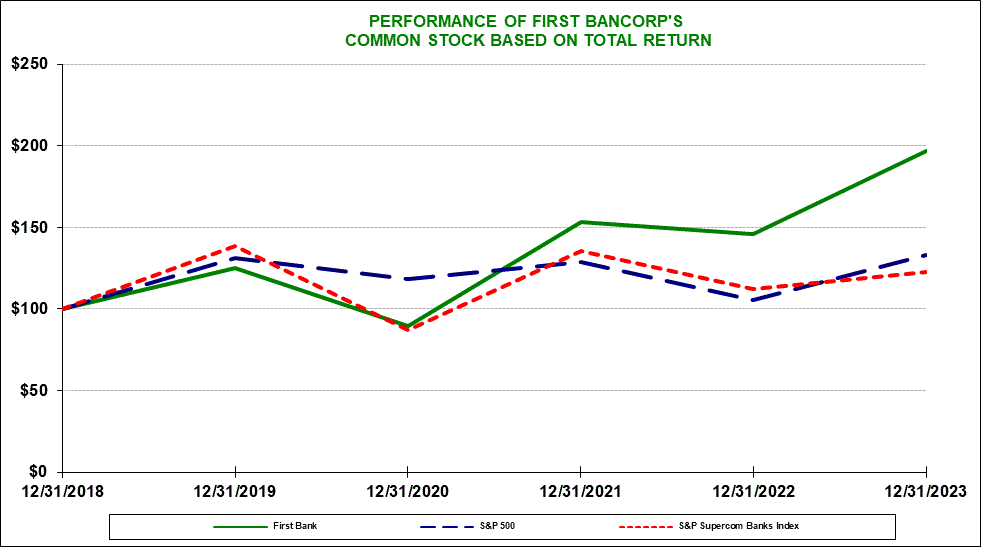
39
STOCK PERFORMANCE GRAPH
The
following
graph
shall
not
be
deemed
incorporated
by
reference
into
any
filing
under
the
Securities
Act
or
the
Exchange
Act,
except
to
the
extent
that First
BanCorp.
specifically
incorporates
this information
by
reference,
and
shall not
otherwise
be
deemed
filed with the SEC.
The
graph
below
compares
the
cumulative
total
stockholder
return
of
First
BanCorp.
during
the
measurement
period
with
the
cumulative
total return,
assuming reinvestment
of dividends,
of the
S&P 500
Index and
the S&P
Supercom
Banks Index
(the “Peer
Group”).
The Performance
Graph assumes
that $100
was invested
on December
31, 2018
in each
of First
BanCorp. common
stock,
the S&P 500 Index and
the Peer Group. The comparisons
in this table are set forth
in response to SEC disclosure requirements
and are
therefore not intended to forecast or be indicative of future performance
of First BanCorp.’s common
stock.
The cumulative total stockholder return was obtained
by dividing (i) the cumulative amount of dividends per
share, assuming dividend
reinvestment since the
measurement point, December
31, 2018, plus (ii)
the change in the
per share price
since the measurement
date,
by the share price at the measurement date.
40
Item 6. [Reserved]
41
ITEM
7.
MANAGEMENT’S
DISCUSSION
AND
ANALYSIS
OF
FINANCIAL
CONDITION
AND
RESULTS
OF
OPERATIONS (“MD&A”)
The following MD&A
relates to the accompanying
audited consolidated financial
statements of First BanCorp.
(the “Corporation,”
“we,” “us,”
“our,”
or “First
BanCorp.”) and
should be
read in
conjunction
with such
financial statements
and the
notes thereto.
This
section also
presents certain
financial measures
that are not
based on
generally accepted
accounting principles
in the
United States
of
America
(“GAAP”).
See
“Non-GAAP
Financial
Measures
and
Reconciliations”
below
for
information
about
why
non-GAAP
financial measures are
presented, reconciliations
of non-GAAP financial
measures to the
most comparable GAAP
financial measures,
and references to non-GAAP financial measures reconciliations presented
in other sections.
The detailed financial discussion
that follows focuses on
2023 results compared to
2022. For a discussion of
2022 results compared
to 2021, see Part I, Item 7,
“Management’s Discussion
and Analysis of Financial Condition
and Results of Operations” included
in the
Corporation’s Annual Report
on Form 10-K for the year ended December 31, 2022, filed on February
28, 2023.
In
this
discussion
and
analysis
of
our
financial
condition
and
results
of
operations,
we
have
included
information
that
may
constitute
“forward-looking
statements”
within
the
meaning
of
the
safe
harbor
provisions
of
Section
27A
of
the
Securities
Act
and
Section 21E
of the
Exchange Act.
Forward-looking statements
are not
historical facts
or statements
of current
conditions, but
instead
represent only our beliefs
regarding future events, many
of which, by their nature,
are inherently uncertain and
outside our control. By
identifying
these statements
for you
in this
manner,
we are
alerting you
to the
possibility that
our actual
results, financial
condition,
liquidity and capital actions may differ materially
from the anticipated results, financial condition, liquidity
and capital actions in these
forward-looking
statements. Important
factors
that could
cause our
results, financial
condition, liquidity
and capital
actions to
differ
from those in these statements include, among others, those described in
“Risk Factors” in Part I, Item 1A of this Form 10-K.
EXECUTIVE SUMMARY
First BanCorp.
is a diversified
financial holding
company headquartered
in San Juan,
Puerto Rico offering
a full range
of financial
products to
consumers and
commercial customers
through various
subsidiaries. First
BanCorp.
is the
holding company
of FirstBank
Puerto
Rico
(“FirstBank”
or the
“Bank”)
and
FirstBank
Insurance
Agency.
Through
its wholly
-owned
subsidiaries,
the Corporation
operates
in
Puerto
Rico,
the
United
States
Virgin
Islands
(“USVI”),
the
British
Virgin
Islands
(“BVI”),
and
the
state
of
Florida,
concentrating on
commercial banking,
residential mortgage loans,
credit cards, personal
loans, small loans,
auto loans and
leases, and
insurance agency activities.
Significant Events
Economy and Market Volatility
The
Federal
Reserve
Board
has
implemented
monetary
policies
designed
to
curb
inflation.
On
January
11,
2024
the
Federal
Reserve Board published
the core Personal
Consumption Expenditures Price
Index over the
last 12 months,
which showed that
the all
items
index
increased
2.9
percent
before
seasonal
adjustment.
Other
recent
indicators
suggest
that
economic
activity
has
been
expanding. For 2023 as
a whole, GDP has expanded
at 3.1%. Although still strong,
the labor market remains
tight as payroll job
gains
have been well below those seen in 2022. In January 2024, the national unemployment
rate was 3.7% for the third month in a row.
Following
its
January
31,
2024
meeting,
the
Federal
Reserve
Board
announced
its
decision
to
leave
the
federal
funds
rate
unchanged,
at a
target
rate of
5.25% to
5.50%. The
Federal Reserve
Board commentary
suggested
that its
policy rate
is likely
at its
peak and
that, if
the economy
continues to
evolve as
expected, it
will likely
be dialing
back policy
restraint at
some point
this year.
Notwithstanding, it does not expect to reach such level of confidence by
the time of the March 2024 meeting.
The Corporation closed an unprecedented and challenging year for
the banking industry with strong financial performance and solid
loan
growth.
Core
deposits,
other
than
government
and
brokered,
contracted
due
to
the
use
of
excess
liquidity
across
all
market
segments. Although
the Corporation
is seeing
an expected
correction
in the
credit cycle
of the
consumer lending
business driven
by
lower
levels
of
excess
liquidity
and
inflationary
pressures,
the
Corporation
expects
its
ample
reserve
coverage
levels
and
risk
management framework to withstand the impact of any additional credit
deterioration during 2024.
For 2024, the Corporation expects a reduction in the overall
average cost of its deposits as interest rates start to decrease
but expects
to continue to
be impacted by the
shift from non-interest-bearing
deposits to interest-bearing
deposits, though at
a lower degree. Also,
the
Corporation
expects
some
reductions
in
deposit
balances
due
to
the
customers’
use
of
their
excess
liquidity,
which
could
be
replaced with
wholesale funding
sources. Assuming
no meaningful
changes to
deposit balances,
the Corporation
expects net
interest
income
to
improve
in
2024
since
approximately
$1
billion
in
expected
cash
inflows
from
the
repayments
and
maturities
of
the
investment portfolio, which is yielding less than 1.5%, will fund
loan growth or be reinvested in higher yielding securities.
42
The Corporation remains
confident that the economic
prospects of Puerto Rico,
its primary market,
driven by a strong
labor market
and
an
unprecedented
level
of
federal
support,
will
support
the
Corporation
in
continuing
to
have
a
strong
financial
performance,
sustainable levels of loan growth, and any additional credit deterioration
contained.
Return of Capital to Shareholders and Dividend
Payment Increase
In 2023, the
Corporation returned approximately
$300 million, or close
to 100% of 2023
earnings, to its shareholders
through $200
million in repurchases of common stock and the payment of approximately
$100 million in common stock dividends.
For
the
year
ended
December
31,
2023,
the
Corporation
repurchased
14.1
million
shares of
its common
stock
for
a
total cost
of
$200
million.
Of
this
total,
$75
million
of
common
stock,
representing
5.1
million
common
shares
at
a
weighted-average
price
of
$14.76,
were
repurchased
under
the
$225
million
stock
repurchase
program
announced
on
July
24,
2023
(the
“2023
Repurchase
Plan”). As
of February
21, 2024,
the Corporation has
repurchased approximately
7.1 million
shares of common
stock totaling
$107.9
million
through open
market purchases
under the
2023 Repurchase
Plan. With
the additional
purchases, the
Corporation has
$117.1
million
remaining
for
share
repurchases
under
the
2023
Repurchase
Plan,
which
it
expects
to
execute
through
the
end
of
the
third
quarter of 2024.
On February
8, 2024,
the Corporation’s
Board of
Directors declared
a quarterly
cash dividend
of $0.16
per common
share, which
represents
an
increase
of
$0.02
per
common
share,
or
a
14%
increase,
compared
to
its
most
recent
quarterly
dividend
paid
in
December 2023.
The dividend
is payable
on March
8, 2024,
to shareholders
of record
at the close
of business
on February
23, 2024.
The increased quarterly dividend level equates to an annualized dividend
of $0.64 per common share.
Legislative and Regulatory
A
comprehensive
discussion
of
legislative
and
regulatory
matters
affecting
us
can
be
found
in
Part
I,
Item
1,
“Business
–
Supervision and Regulation” of this Form 10-K.
43
Overview of Results of Operations
The
Corporation’s
results
of operations
depend
primarily
on
its
net
interest
income,
which
is
the
difference
between
the
interest
income
earned
on
its
interest-earning
assets,
including
investment
securities
and
loans,
and
the
interest
expense
incurred
on
its
interest-bearing
liabilities,
including
deposits
and
borrowings.
Net
interest
income
is
affected
by
various
factors,
including
the
following:
(i)
the
interest
rate
environment;
(ii)
the
volumes,
mix,
and
composition
of
interest-earning
assets,
and
interest-bearing
liabilities; and
(iii) the
repricing
characteristics of
these assets
and liabilities.
The Corporation
’s
results of
operations also
depend on
the
provision
for
credit
losses,
non-interest
expenses
(such
as
personnel,
occupancy,
professional
service
fees,
the
FDIC
insurance
premium,
and
other
costs),
non-interest
income
(mainly
service
charges
and
fees
on
deposits,
cards
and
processing
income,
and
insurance income), gains (losses) on mortgage banking activities, and income
taxes.
The
Corporation
had
net
income
of
$302.9
million,
or
$1.71
per
diluted
common
share,
for
the
year
ended
December
31,
2023,
compared
to
$305.1
million,
or
$1.59
per
diluted
common
share,
for
the
year
ended
December
31,
2022.
Other
relevant
selected
financial indicators for the periods presented are included below:
Year
Ended December 31,
2023
2022
2021
Key Performance Indicator:
(1)
Return on Average
Assets
(2)
1.62
%
1.57
%
1.38
%
Return on Average
Common Equity
(3)
21.86
18.66
12.56
Efficiency Ratio
(4)
50.70
48.25
57.45
(1)
These financial ratios are used by management to monitor the Corporation’s
financial performance and whether it is using its assets efficiently.
(2)
Indicates how profitable the Corporation is in relation to its total assets
and is calculated by dividing net income by its average total
assets.
(3)
Measures the Corporation’s performance
based on its average common stockholders’ equity and is calculated
by dividing net income by its average total common stockholders’
equity.
(4)
Measures how much the Corporation incurred to generate a
dollar of revenue and is calculated by dividing non-interest expenses
by total revenue.
The key
drivers of
the Corporation’s
GAAP financial
results for
the year
ended December
31, 2023,
compared to
the year
ended
December 31, 2022, include the following:
●
Net interest
income for
the year
ended December
31, 2023
increased to
$797.1 million,
compared to
$795.3 million
for the
year ended December 31, 2022. The increase in net interest income
reflects a 10 basis points increase in net interest margin to
4.22%,
which
was mainly
associated
with the
effect
of both
a higher
interest rate
environment,
driving
an increase
in loan
and investment security yields, and the growth
in the consumer loan portfolio, partially offset
by higher rates paid on deposits
coupled
with
a
change
in
the
mix
of
deposit
and
borrowing
composition.
See
"Net
Interest
Income"
below
for
additional
information.
●
The provision
for credit
losses on
loans, finance
leases, unfunded
loan commitments
and debt
securities for
the year
ended
December 31,
2023 was
$60.9 million,
compared to
$27.7 million
for the
year ended
December 31,
2022. The
increase was
mainly driven by a
combination of loan growth,
higher delinquency and historical
charge-off levels
in the consumer loan
and
finance
lease
portfolios,
and
the
effect
in
2022
of
reductions
in
qualitative
reserves
associated
with
reduced
uncertainty
around the
economic impact
of the COVID-19
pandemic, particularly
on loans in
the hotel, transportation
and entertainment
industries.
Net charge-offs
totaled $67.4
million for
the year
ended December
31, 2023,
or 0.58%
of average
loans,
compared to
$34.2
million,
or
0.31%
of
average
loans,
for
the
year
ended
December
31,
2022,
mainly
driven
by
a
$29.1
million
increase
in
consumer loans
and finance leases
net charge-offs.
See “Provision for
Credit Losses” and
“Risk Management”
below for the
analysis of the allowance for credit losses (“ACL”) and non-performing
assets and related ratios.
●
The Corporation
recorded non-interest income
of $132.7 million
for the year
ended December 31,
2023, compared to
$123.1
million for
the year
ended December
31, 2022.
The increase
of $9.6
million in
non-interest income
was mainly
driven by
a
$3.6
million
gain
recognized
from
a
legal
settlement,
a
$3.5
million
increase
in
card
and
processing
income,
and
a
$3.0
million
gain
related
to the
sale of
banking
premise
in the
Florida
region,
partially
offset
by lower
revenues from
mortgage
banking activities. See “Non-Interest Income”
below for additional information.
44
●
The
Corporation
recorded
non-interest
expenses
of
$471.4
million
for
the
year
ended
December
31,
2023,
compared
to
$443.1 million for
the year ended
December 31, 2022.
The increase of
$28.3 million in
non-interest expenses
mainly reflects
a $16.8
million increase
in employees’
compensation and
benefits expenses,
mostly driven
by annual
salary merit
increases
and
minimum
wage adjustments,
and
a FDIC
special assessment
expense
of $6.3
million. The
efficiency
ratio for
the year
ended
December
31,
2023
was
50.70%,
compared
to
48.25%
for
the
year
ended
December
31,
2022.
See
“Non-Interest
Expenses” below for additional information.
●
Income tax
expense decreased to
$94.6 million
for the year
ended December
31, 2023, compared
to $142.5 million
for 2022
driven by a
lower effective
tax rate and
lower pre-tax income.
The Corporation’s
annual effective
tax rate, excluding
entities
with pre-tax
losses from which
a tax benefit
cannot be
recognized and
discrete items, decreased
to 23.5%
for the year
ended
December 31,
2023, compared
to 31.2%
for 2022. See
“Income Taxes”
below and
Note 22 –
“Income Taxes
”
to the audited
consolidated financial statements included in Part II, Item 8 of this Form
10-K for additional information.
●
As of
December 31,
2023, total
assets were
approximately $18.9
billion, an
increase of
$275.1 million
from December
31,
2022,
primarily reflecting
a $627.7
million increase
in the
total loan
portfolio before
the ACL and
a $182.7
million increase
in
cash
and
cash
equivalents,
partially
offset
by
a
$452.4
million
decrease
in
total
investment
securities
net
of
a
$165.4
million increase in the fair value of available-for-sale debt
securities.
●
As of December
31, 2023,
total liabilities were
$17.4 billion,
an increase of
$103.0 million
from December
31, 2022, driven
by
a
$412.5
million
increase
in
total
deposits,
which
includes
a
$677.5
million
increase
in
brokered
certificates
of
deposit
(“CDs”), partially offset
by a $272.2 million decrease
in borrowings,
primarily in short-term borrowings.
See “Liquidity Risk
Management”
below for additional information about the Corporation’s
funding sources and strategy.
●
The Bank’s
primary sources of funding
are consumer and commercial
core deposits, which exclude
government deposits and
brokered
CDs.
As
of
December
31,
2023,
these
core
deposits,
amounting
to
$12.6
billion,
funded
66.64%
of
total
assets.
Excluding
fully
collateralized
government
deposits,
estimated
uninsured
deposits amounted
to $4.4
billion
as of
December
31, 2023. In
addition to approximately
$2.8 billion in
cash and free
high-quality liquid
assets, the Bank
maintains borrowing
capacity
at
the
Federal
Home
Loan
Bank
(“FHLB”)
and
the
Federal
Reserve
Bank
of
New
York
’s
(the
“FED”)
Discount
Window.
As of
December 31,
2023,
the Corporation
had approximately
$1.5 billion
available for
funding under
the FED’s
Discount Window and
$924.2 million available for
additional borrowing capacity on FHLB
lines of credit based on
collateral
pledged
at
these
entities.
On
a
combined
basis,
as
of
December
31,
2023,
the
Corporation
had
$5.2
billion,
or
118%
of
estimated
uninsured
deposits,
available
to
meet
liquidity
needs.
See
“Liquidity
Risk
Management”
below
for
additional
information about the Corporation’s
funding sources and strategy.
●
As of
December 31,
2023, the
Corporation’s
total stockholders’
equity was
$1.5 billion,
an increase
of $172.1
million from
December 31, 2022, mainly
driven by a $165.4 million increase
in the fair value of
available-for-sale debt securities recorded
as
part
of
accumulated
other
comprehensive
loss
and
net
income
generated
in
2023,
partially
offset
by
$200.0
million
in
repurchases
of
common
stock
and
$99.6
million
in
dividends
declared
in
2023.
The
Corporation’s
CET1
capital,
tier
1
capital, total capital,
and leverage ratios
were 16.10%, 16.10%,
18.57%, and 10.78%,
respectively,
as of December
31, 2023,
compared
to
CET1
capital,
tier
1
capital,
total
capital,
and
leverage
ratios
of
16.53%,
16.53%,
19.21%,
and
10.70%,
respectively, as of
December 31, 2022.
See “Risk Management – Capital” below for additional information.
●
Total
loan
production,
including
purchases,
refinancings,
renewals,
and
draws
from
existing
revolving
and
non-revolving
commitments, decreased
by $230.8
million to
$5.1 billion
for the
year ended
December 31,
2023. See
“Financial Condition
and Operating Data Analysis” below for additional information.
●
Total
non-performing
assets were
$125.9 million
as of
December 31,
2023, a
decrease of
$3.3 million,
from December
31,
2022,
primarily
related
to
a
decrease
of
$10.6
million
in
nonaccrual
residential
mortgage
loans,
partially
offset
by
a
$7.6
million increase in nonaccrual consumer
loans, mainly in the auto loan and
finance lease portfolios.
See “Risk Management –
Nonaccrual Loans and Non-Performing Assets” below for additional information.
●
Adversely
classified
commercial
and
construction
loans
decreased
by
$26.1
million
to
$67.5
million
as
of
December
31,
2023,
compared to
December 31,
2022, mainly
driven by
the payoff
of a
$24.3 million
commercial
and industrial
(“C&I”)
participated loan in the Florida region.
45
NON-GAAP FINANCIAL MEASURES AND RECONCILIATIONS
The Corporation
has included
in this
Form 10-K
the following
financial measures
that are
not recognized
under GAAP,
which are
referred to as non-GAAP financial measures:
Net Interest Income,
Interest Rate Spread,
and Net Interest Margin, Excluding
Valuations
,
and on a Tax
-Equivalent Basis
Net interest
income, interest
rate spread,
and net
interest margin,
excluding the
changes in
the fair
value of
derivative instruments
and on
a tax-equivalent
basis, are
reported in
order to
provide to
investors additional
information about
the Corporation’s
net interest
income
that management
uses and
believes should
facilitate comparability and
analysis of
the periods
presented.
The changes
in the
fair value
of derivative
instruments have
no effect
on interest
due or
interest earned
on interest-bearing
liabilities or
interest-earning
assets, respectively.
The tax-equivalent
adjustment to
net interest
income recognizes
the income
tax savings
when comparing
taxable
and
tax-exempt
assets
and
assumes
a
marginal
income
tax
rate.
Income
from
tax-exempt
earning
assets
is
increased
by
an
amount
equivalent to
the taxes
that would
have been
paid if
this income
had been
taxable at
statutory rates.
Management believes
that it
is a
standard
practice
in
the banking
industry
to
present
net
interest
income,
interest
rate
spread,
and
net
interest
margin
on
a
fully
tax-
equivalent basis. This adjustment
puts all earning assets, most notably
tax-exempt securities and tax-exempt
loans, on a common basis
that facilitates comparison of results to the results of peers.
See “Result of Operations
– Net Interest Income”
below, for
the table that reconciles
net interest income
in accordance with GAAP
to
the
non-GAAP
financial
measure
of
net
interest
income,
excluding
valuations,
and
on
a
tax-equivalent
basis
for
the
indicated
periods. The table also reconciles
net interest spread and
net interest margin on
a GAAP basis to these items
excluding valuations, and
on a tax-equivalent basis.
Tangible
Common Equity Ratio and Tangible
Book Value
Per Common Share
The tangible
common equity
ratio and
tangible book
value per
common share
are non-GAAP
financial measures
that management
believes are generally
used by the financial
community to evaluate
capital adequacy.
Tangible
common equity is total
common equity
less
goodwill
and
other
intangibles.
Similarly,
tangible
assets
are
total
assets
less
goodwill
and
other
intangibles.
Management
and
many
stock
analysts
use
the
tangible
common
equity
ratio
and
tangible
book
value
per
common
share
in
conjunction
with
more
traditional bank capital
ratios to compare
the capital adequacy
of banking organizations
with significant
amounts of goodwill
or other
intangible assets,
typically stemming
from the
use of
the purchase
method of
accounting for
mergers
and acquisitions.
Accordingly,
the Corporation
believes that
disclosures of
these financial
measures may
be useful to
investors. Neither
tangible common
equity nor
tangible assets, or the related measures,
should be considered in isolation or
as a substitute for stockholders’ equity,
total assets, or any
other measure
calculated in
accordance with
GAAP.
Moreover,
the manner
in which
the Corporation
calculates its
tangible common
equity, tangible assets, and
any other related measures may differ from that of other companies reporting
measures with similar names.
See “Risk
Management –
Capital” below
for the
table that
reconciles the
Corporation’s
total equity
and total
assets in
accordance
with GAAP to
the tangible common
equity and tangible
assets figures used
to calculate the
non-GAAP financial measures
of tangible
common equity ratio and tangible book value per common share.
Adjusted Net Income,
Adjusted Non-Interest Income and Adjusted Non-Interest
Expenses
To
supplement the
Corporation’s
financial statements
presented in
accordance with
GAAP,
the Corporation
uses, and believes
that
investors
benefit
from
disclosure
of,
non-GAAP
financial
measures
that
reflect
adjustments
to
net
income,
non-interest
income
and
non-interest expenses
to exclude
items that
management believes
are not
reflective of
core operating
performance (“Special
Items”).
The financial results
for the year
ended December 31,
2022 did not
include any significant
Special Items. The
financial results for
the
years ended December 31, 2023 and 2021 included the following Special
Items:
Year
Ended December 31, 2023
-
A $6.3
million ($3.9
million after-tax)
FDIC special
assessment expense
recognized as
a result of
the final rule
approved by
the
FDIC
Board
of
Directors
on
November
16,
2023
to
recover
the
loss
to
the
Deposit
Insurance
Fund
associated
with
protecting
uninsured
deposits
following
certain
financial
institution
failures
during
the
first
half
of
2023
by
means
of
a
quarterly
special
assessment
rate
of
3.36
basis
points
to
be
applied
to
the
special
assessment
base
during
an
eight-quarter
collection
period.
The
special assessment
base
is equal
to estimated
uninsured
deposits reported
as of
December
31, 2022,
adjusted
to
exclude
the
first
$5
billion
of
such
deposits.
The
FDIC
special
assessment
is
reflected
in
the
consolidated
statements of income
as part of
“FDIC deposit insurance”
expenses, which
reflects the expected
total payment to
be made to
the FDIC as of December 31, 2023.
46
-
A
$3.6
million
($2.3
million
after-tax)
gain
recognized
from
a
legal
settlement
reflected
in
the
consolidated
statements
of
income as part of
“Other non-interest income.”
-
A
$1.6
million
gain
on
the
repurchase
of
$21.4
million
in
junior
subordinated
debentures
reflected
in
the
consolidated
statements
of
income
as
“Gain
on
early
extinguishment
of
debt.”
The
junior
subordinated
debentures
are
reflected
in
the
consolidated statements
of financial condition
as “Other long-term
borrowings.” The
purchase price
equated to
92.5% of the
$21.4
million
par value
of the
trust-preferred
securities (“TRuPs”).
The 7.5%
discount resulted
in the
gain
of $1.6
million.
The gain, realized at the holding company level, had no effect on
the income tax expense recorded in 2023.
Year
Ended December 31, 2021
-
Merger and restructuring
costs of $26.4 million ($16.5
million after-tax) in
connection with the Banco
Santander Puerto Rico
(“BSPR”)
acquisition
integration
process
and
related
restructuring
initiatives.
Merger
and
restructuring
costs
included
approximately
$6.5
million
related
to
a
Voluntary
Employee
Separation
Program
(the
“VSP”)
as
well
as
involuntary
separation actions
implemented in
the Puerto
Rico region.
In addition,
merger and
restructuring costs
included costs
related
to
system
conversions,
accelerated
depreciation
charges
related
to
planned
closures
and
consolidation
of
branches
in
accordance with the Corporation’s
integration and restructuring plan, and other integration related efforts.
-
Costs of
$3.0 million
($1.9 million
after-tax)
related to
the COVID-19
pandemic response
efforts,
primarily costs
related to
additional cleaning, safety materials, and security measures.
Adjusted Net Income – The
following table reconciles for
the years ended December 31,
2023 and 2021, the reported
net income to
adjusted
net
income,
a
non-GAAP
financial
measure
that
excludes
the
Special
Items
identified
above,
and
shows
the
net
income
reported for the year ended December 31, 2022.
Year Ended
December 31,
2023
2022
2021
(In thousands)
Net income, as reported (GAAP)
$
302,864
$
305,072
$
281,025
Adjustments:
Merger and restructuring costs
-
-
26,435
FDIC special assessment expense
6,311
-
-
COVID-19 pandemic-related expenses
-
-
2,958
Gain recognized from a legal settlement
(3,600)
-
-
Gain on early extinguishment of debt
(1,605)
-
-
Income tax impact of adjustments
(1)
(1,017)
-
(11,023)
Adjusted net income (Non-GAAP)
$
302,953
$
305,072
$
299,395
(1)
See "Adjusted Net Income, Adjusted Non-Interest Income and Adjusted
Non-Interest Expenses" above for the individual tax impact
related to the above adjustments, which were based on
the Puerto Rico statutory tax rate of 37.5%, as applicable.
Adjusted
non-interest
expenses
–
Non-interest
expenses
for
the
year
ended
December
31,
2023
were
adjusted
for
the
aforementioned
$6.3
million
FDIC special
assessment
expense
reflected
in
the consolidated
statements
of
income
as part
of
“FDIC
deposit insurance” expenses.
47
which is a non-GAAP financial measure that excludes the relevant Special Items identified
above:
2021
Non-Interest Expenses
(GAAP)
Merger and
Restructuring Costs
COVID 19 Pandemic-
Related Expenses
Adjusted (Non-GAAP)
(In thousands)
Non-interest expenses
$
488,974
$
26,435
$
2,958
$
459,581
Employees' compensation and benefits
200,457
-
67
200,390
Occupancy and equipment
93,253
-
2,601
90,652
Business promotion
15,359
-
22
15,337
Professional service fees
59,956
-
-
59,956
Taxes, other than income taxes
22,151
-
261
21,890
FDIC deposit insurance
6,544
-
-
6,544
Net gain on OREO operations
(2,160)
-
-
(2,160)
Credit and debit card processing expenses
22,169
-
-
22,169
Communications
9,387
-
-
9,387
Merger and restructuring costs
26,435
26,435
-
-
Other non-interest expenses
35,423
-
7
35,416
48
CRITICAL ACCOUNTING ESTIMATES
The
accounting
principles
of
the
Corporation
and
the
methods
of
applying
these
principles
conform
to
GAAP.
In
preparing
the
consolidated
financial
statements,
management
is
required
to
make
estimates,
assumptions,
and
judgments
that
affect
the
amounts
recorded for assets,
liabilities and contingent
liabilities as of
the date of
the financial statements
and the reported
amounts of revenues
and
expenses
during
the
reporting
periods.
Accounting
estimates
require
assumptions
and
judgments
about
uncertain
matters
that
could
have
a
material
effect
on
the
consolidated
financial
statements.
The
Corporation’s
critical
accounting
estimates
that
are
particularly
susceptible
to
significant
changes
include
the
following:
(i)
the
ACL;
(ii)
valuation
of
financial
instruments;
and
(iii)
income taxes. Actual results could differ from estimates and assumptions
if different outcomes or conditions prevail.
Allowance for Credit Losses
The Corporation
maintains an ACL
for loans
and finance
leases based upon
management’s
estimate of the
lifetime expected
credit
losses in the loan portfolio, as of the balance sheet date, excluding
loans held for sale. Additionally,
the Corporation maintains an ACL
for
held-to-maturity
and
available-for-sale
debt
securities,
and
other
off-balance
sheet
credit
exposures
(
e.g.
, unfunded
loan
commitments). For loans and finance leases, unfunded loan commitments,
and held-to-maturity debt securities, the estimate of lifetime
credit losses
includes the
use of
quantitative models
that incorporate
forward-looking macroeconomic
scenarios that
are applied
over
the
contractual
lives
of
the
portfolios,
adjusted,
as
appropriate,
for
prepayments
and
permitted
extension
options
using
historical
experience.
For
purposes
of
the
ACL
for
lending
commitments,
such
allowance
is
determined
using
the
same
methodology
as
the
ACL
for
loans,
while
also
taking
into
consideration
the
probability
of
drawdowns
or
funding,
and
whether
such
commitments
are
cancellable by us. The
ACL for available-for-sale debt
securities is measured using a
risk-adjusted discounted cash flow
approach that
also
considers
relevant
current
and
forward-looking
economic
variables
and
the
ACL
is
limited
to
the
difference
between
the
fair
value of the security
and its amortized cost.
Judgment is specifically applied
in the determination of
economic assumptions, the length
of
the
initial
loss
forecast
period,
the
reversion
of
losses
beyond
the
initial
forecast
period,
historical
loss
expectations,
usage
of
macroeconomic
scenarios,
and
qualitative
factors,
which
may
not
be
adequately
captured
in
the
loss
model,
as
further
discussed
below.
The macroeconomic
scenarios utilized by
the Corporation include
variables that have
historically been key
drivers of increases
and
decreases
in
credit
losses.
These
variables
include,
but
are
not
limited
to,
unemployment
rates,
housing
and
commercial
real
estate
prices, gross domestic
product levels, retail
sales, interest rate
forecasts, corporate
bond spreads, and
changes in equity
market prices.
The
Corporation
derives
the
economic
forecasts
it
uses
in
its
ACL
model
from
Moody's
Analytics.
The
latter
has
a
large
team
of
economists, database managers and operational engineers with a history of
producing monthly economic forecasts for over 25 years.
The
Corporation
has
currently
set
an
initial
forecast
period
(“reasonable
and
supportable
period”)
of
two
years
and
a
reversion
period of up to three
years, utilizing a straight-line
approach and reverting back
to the historical macroeconomic
mean for Puerto Rico
and the Virgin
Islands regions. For the
Florida region, the methodology
considers a reasonable and
supportable forecast period
and an
implicit reversion towards the historical
trend that varies for each macroeconomic
variable. After the reversion period,
a historical loss
forecast
period
covering
the
remaining
contractual
life,
adjusted
for
prepayments,
is
used
based
on
the
change
in
key
historical
economic variables
during representative
historical expansionary
and recessionary periods.
Changes in economic
forecasts impact the
probability
of
default
(“PD”),
loss-given
default
(“LGD”),
and
exposure
at
default
(“EAD”)
for
each
instrument,
and
therefore
influence the amount of future cash flows for each instrument that the Corporation
does not expect to collect.
Further,
the
Corporation
periodically
considers
the
need
for
qualitative
adjustments
to
the
ACL.
Qualitative
adjustments
may
be
related to and include,
but not be limited to,
factors such as the
following: (i) management’s
assessment of economic forecasts
used in
the
model
and
how
those
forecasts
align
with
management’s
overall
evaluation
of
current
and
expected
economic
conditions;
(ii)
organization specific
risks such
as credit
concentrations, collateral
specific risks,
nature,
and size
of the portfolio
and external
factors
that may
ultimately impact
credit quality,
and (iii)
other limitations
associated with
factors such
as changes
in underwriting
and loan
resolution
strategies,
among
others.
The
qualitative
factors
applied
at
December
31,
2023,
and
the
importance
and
levels
of
the
qualitative
factors
applied,
may
change
in
future
periods
depending
on
the
level
of
changes
to
items
such
as
the
uncertainty
of
economic
conditions
and
management's
assessment
of
the
level
of
credit
risk
within
the loan
portfolio
as
a
result
of
such
changes,
compared
to the
amount of
ACL calculated
by the
model.
The evaluation
of qualitative
factors
is inherently
imprecise
and
requires
significant management judgment.
49
The ACL can also be
impacted by factors outside the Corporation’s
control, which include unanticipated
changes in asset quality of
the
portfolio,
such
as deterioration
in
borrower
delinquencies,
or
credit
scores
in
our
residential
real
estate and
consumer
portfolio.
Further,
the current
fair
value of
collateral
is utilized
to assess
the
expected
credit losses
when
a financial
asset is
considered
to be
collateral dependent.
Our process for determining
the ACL is further
discussed in Note 1
– “Nature of Business
and Summary of
Significant Accounting
Policies” included in
Part II, Item
8 of this Form
10-K. Also, see
“Allowance for Credit
Losses for Loans
and Finance Leases”
below
for additional
information on
the weighting
of economic
scenarios to
estimate the
ACL, changes
in key
economic variables,
and the
ACL sensitivity analysis performed as of December 31, 2023.
Valuation
of financial instruments
The measurement
of fair value
is fundamental
to the Corporation’s
presentation of
its financial condition
and results of
operations.
The
Corporation
holds
debt
and
equity
securities,
derivatives,
and
other
financial
instruments
at
fair
value.
The
Corporation’s
significant assets
reflected at
fair value
on a
recurring basis
on the
Corporation’s
financial statements
consisted
of available-for-sale
debt
securities
amounting
to $5.2
billion
as of
December 31,
2023.
In addition,
fair
value
is also
used
on
a
non-recurring
basis for
measuring the fair
value of assets such
as collateral dependent
loans, other real
estate owned (“OREO”)
properties, and loans
held for
sale.
Assets
and
liabilities
carried
at
fair
value
inherently
include
subjectivity
and
may
require
the
use
of
significant
assumptions,
adjustments
and
judgment
including,
among
others,
discount
rates,
cash
flows, default
rates, and
loss rates.
A significant
change
in
assumptions
may
result
in
a
significant
change
in
fair
value,
which
in
turn,
may
result
in
a
higher
degree
of
financial
statement
volatility
and
could
result
in
significant
impact
on
our
results
of
operations,
financial
condition
or
disclosures
of
fair
value
information.
orderly transaction
between market
participants at
the measurement
date. The
Corporation categorizes
the fair
value of
its available-
for-sale
debt
securities
using
a
three-level
hierarchy
for
fair
value
measurements
that
distinguishes
between
market
participant
assumptions
developed
based
on
market
data
obtained
from
sources
independent
of
the
Corporation
(observable
inputs)
and
the
Corporation’s
own
assumptions
about
market
participant
assumptions
developed
based
on
the
best
information
available
in
the
circumstances
(unobservable
inputs).
The
hierarchy
of
inputs
used
in
determining
the
fair
value
maximizes
the
use
of
observable
inputs and
minimizes the
use of
unobservable inputs
by requiring
that observable
inputs be
used when
available. The
hierarchy level
assigned
to each
security
in the
Corporation’s
investment portfolio
was based
on management’s
assessment of
the transparency
and
reliability of the inputs used to estimate the fair values at the measurement
date.
The
fair
value
of
U.S.
Treasury
securities
included
as part
of
the
available-for-sale
debt
securities
portfolio
and
equity securities
with readily determinable fair values
was based on unadjusted quoted market
prices (Level 1). If quoted market prices
are unavailable,
the
fair
value
is
based
on
market
prices
for
comparable
assets
(as
is
the
case
with
mortgage-backed
securities
(“MBS”)
and
U.S.
agency
debt
securities)
that
are
based
on
observable
market
parameters,
including
benchmark
yields,
reported
trades,
quotes
from
brokers
or
dealers,
issuer
spreads,
bids,
offers,
and
reference
data,
including
market
research
operations,
when
available
(Level
2).
Observable prices
in the
market already
consider the
risk of
nonperformance. If
listed prices
or quotes
are not
available, fair
value is
based upon
discounted
cash flow
models
that use
unobservable
inputs due
to the
limited market
activity of
the instrument,
as is
the
case with private label MBS
held by the Corporation (Level 3).
Assets are classified in their entirety
based on the lowest level of
input
that is significant to their fair value measurement.
Private label MBS
are collateralized
by fixed-rate
mortgages on single-family
residential properties
in the U.S.
with original
FICO
scores
over
700
and
moderate
loan-to-value
ratios
(under
80%),
as
well
as
moderate
delinquency
levels.
The
interest
rate
on
these
securities
is
variable,
tied
to
3-month
CME
Term
Secured
Overnight
Financing
Rate
(“SOFR”)
plus
a
tenor
spread
adjustment
of
0.26161%
and
the
original
spread
limited
to
the
weighted-average
coupon
of
the
underlying
collateral.
The
market
valuation
represents
the estimated
net cash
flows over
the projected
life of
the pool
of underlying
assets applying
a discount
rate that
reflects
market observed
floating spreads
over SOFR,
with a
widening spread
based on
a nonrated
security.
The market
valuation
is derived
from a
model that
utilizes relevant
assumptions such
as the
prepayment rate,
default rate,
and loss
severity on
a loan
level basis.
The
Corporation
modeled
the
cash
flow
from
the
fixed-rate
mortgage
collateral
using
a
static
cash
flow
analysis
according
to
collateral
attributes of
the underlying mortgage
pool (
i.e.
, loan term,
current balance, note
rate, rate adjustment
type, rate adjustment
frequency,
rate caps,
and others)
in combination
with prepayment
forecasts based
on historical
portfolio
performance.
The Corporation
models
the variable cash flow of the security using the 3-month CME Term
SOFR forward curve.
Declines in fair
value that are
credit-related are
recorded on the
balance sheet
through an
ACL with a
corresponding adjustment
to
provision for credit losses and declines that are non-credit-related are
recognized through other comprehensive income (loss).
50
If the
Corporation intends
to sell a
debt security
in an
unrealized loss
position or
determines that
it is more
likely than
not that
the
Corporation will be
required to sell
a debt security
before it recovers
its amortized cost
basis, the debt
security is written
down to fair
value
through
earnings.
As
of December
31,
2023,
the
Corporation
did
not
intend
to
sell
any
debt
securities
in
an
unrealized
loss
position
and
it
is
not
more
likely
than
not
that
the
Corporation
will
be
required
to
sell any
debt
securities
before
recovery
of
their
amortized cost basis.
For
debt
securities
in
an unrealized
loss position
for
which the
Corporation
does not
intend
to sell
the debt
security
and
it
is not
more likely than
not that the
Corporation will be
required to sell
the debt security,
the Corporation determines
whether the loss
is due
to
credit-related
factors
or
non-credit-related
factors.
For
debt
securities
in
an
unrealized
loss
position
for
which
the
losses
are
determined to be
the result of both
credit-related and non-credit-related
factors, the credit loss
is determined as
the difference between
the present value of the cash flows expected to be collected, and the amortized
cost basis of the debt security.
Available-for-sale
debt securities
held by
the Corporation
at year-end
primarily consisted
of securities
issued by
U.S. government-
sponsored
entities (“GSEs”),
and
the aforementioned
private label
MBS. Given
the explicit
and
implicit guarantees
provided by
the
U.S. federal government, the Corporation believes the credit risk in
securities issued by the GSEs is low.
For the year ended December
31,
2023,
the
Corporation
determined
the
credit
losses
for
private
label
MBS
based
on
a
risk-adjusted
discounted
cash
flow
methodology that
considers qualitative
and quantitative
factors specific
to the
instruments, including
PDs and
LGDs that
considered,
among
other
things,
historical
payment
performance,
loan-to-value
attributes,
and
relevant
current
and
forward-looking
macroeconomic
variables,
such
as
regional
unemployment
rates
and
the
housing
price
index.
Under
this
approach,
expected
cash
flows (interest and principal) were discounted at the U.S. Treasury
yield curve as of the reporting date.
See
Note
25
–
“Fair
Value”
to
the
audited
consolidated
financial
statements
included
in
Part
II,
Item
8
of
this
Form
10-K,
for
additional information.
Income Taxes
The Corporation is required to estimate income taxes in preparing
its consolidated financial statements. This involves the estimation
of
current
income
tax
expense
together
with
an
assessment
of
temporary
differences
between
the
carrying
amounts
of
assets
and
liabilities
for
financial
reporting
purposes
and
the
amounts
used
for
income
tax
purposes.
The
determination
of
current
income
tax
expense
involves
estimates
and
assumptions
that
require
the
Corporation
to
assume
certain
positions
based
on
its
interpretation
of
current tax regulations. Management assesses the relative benefits and
risks of the appropriate tax treatment of transactions, taking into
account statutory,
judicial and regulatory
guidance, and recognizes
tax benefits
only when deemed
probable. Changes
in assumptions
affecting estimates
may be required
in the future
and estimated tax
liabilities may need
to be increased
or decreased accordingly.
The
Corporation adjusts
the accrual
of tax
contingencies in
light of
changing facts
and circumstances,
such as
the progress
of tax
audits,
case law
and emerging
legislation. The
Corporation’s
effective tax
rate includes
the impact
of tax
contingencies and
changes to
such
accruals,
as
considered
appropriate
by
management.
When
particular
tax
matters
arise,
a
number
of
years
may
elapse
before
such
matters are
audited by
the taxing
authorities and
finally resolved.
Favorable resolution
of such matters
or the
expiration of
the statute
of limitations may result in the release of tax contingencies that the
Corporation recognizes as a reduction to its effective
tax rate in the
year of resolution.
Unfavorable settlement
of any particular
issue could increase
the effective
tax rate and
may require the
use of cash
in the year of resolution.
As of December 31,
2023, we had $150.1
million of deferred tax assets,
net of a related valuation
allowance of $139.2 million.
The
determination
of
deferred
tax
expense
or
benefit
is
based
on
changes
in
the
carrying
amounts
of
assets
and
liabilities
that
generate
temporary differences
and recognizes
enacted changes
in tax
rates and
laws in
the period
in which
they occur.
The carrying
value of
the Corporation’s net deferred tax
asset assumes that the Corporation will be able to generate sufficient
future taxable income based on
estimates and
assumptions. Valuation
allowances are
established, when
necessary,
to reduce
deferred tax
assets to
the amount
that is
more likely than not to be realized.
The determination of whether a valuation
allowance for deferred tax assets is appropriate
is subject
to
considerable
judgment
and
requires
the
evaluation
of
positive
and
negative
evidence
that
can
be
objectively
verified.
Positive
evidence
necessary
to
overcome
the
negative
evidence
includes
whether
future
taxable
income
in
sufficient
amounts
and
character
within the carryforward periods is
available under the tax law.
Consideration must be given to
all sources of taxable income including,
as
applicable,
the
future
reversal
of
existing
temporary
differences,
future
taxable
income
forecasts
exclusive
of
the
reversal
of
temporary differences and
carryforwards, and tax planning
strategies. When negative evidence (e.g.,
cumulative losses in recent
years,
history
of operating
loss or
tax credit
carryforwards
expiring
unused)
exists, more
positive
evidence
than negative
evidence
will be
necessary.
The Corporation
has concluded
that based on
the level
of positive
evidence, it
is more
likely than
not that
the deferred
tax
asset will be realized, net of the existing valuation allowances
at December 31, 2023 and 2022. However,
there is no guarantee that the
tax benefits associated
with the deferred
tax assets will be
fully realized. The
positive evidence considered
by management in
arriving
at its
conclusion included
factors such
as the
following:
FirstBank’s
three-year cumulative
income position;
and sustained
periods of
profitability;
management’s
proven
ability
to
forecast
future
income
accurately
and
execute
tax
strategies.
The
negative
evidence
considered by management
included the following: uncertainties
about the state of
the Puerto Rico economy,
including considerations
51
relating to the pandemic
recovery funds together with
Puerto Rico government debt
restructuring and the ultimate
sustainability of the
latest fiscal plan certified by the Puerto Rico Oversight, Management,
and Economic Stability Act (“PROMESA”) oversight board.
See Note 22
– “
Income Taxes
”
to the audited consolidated financial statements included
in Part II, Item 8 on Form 10-K for further
information related to income taxes.
OTHER ESTIMATES
In addition
to the
critical accounting
estimates we
make in connection
with the
ACL, fair
value measurements,
and the accounting
for income
taxes, the
use of
estimates and
assumptions is
also important
in determining
the accounting
for goodwill
and identifiable
intangible
assets,
pension
and
postretirement
benefit
obligations,
and
provisions
for
losses
that
may
arise
from
litigation
and
regulatory proceedings (including governmental investigations).
Goodwill is
assessed for
impairment at
least annually
and more
frequently if
circumstances exist
that indicate
a possible
reduction
in the
fair value
of a
reporting unit
below its
carrying value.
When assessing
goodwill for
impairment, first,
a qualitative
assessment
can be
made to
determine whether
it is
more likely
than not
that the
estimated fair
value of
a reporting
unit is
less than
its estimated
carrying value. If
the results of the
qualitative assessment are
not conclusive, a
quantitative goodwill test
is performed. Estimating
the
fair
value
of
our
reporting
units
requires
judgment.
Critical
inputs
to
the
fair
value
estimates
may
include
projected
earnings,
macroeconomic conditions, interest
rate levels, and peers
performance. See Note 1 –
“Nature of Business and
Summary of Significant
Accounting Policies” and
Note 9 – “Goodwill
and Other Intangibles”
to the audited
consolidated financial statements
included in Part
II, Item 8 of this Form
10-K for further information about
goodwill and identifiable intangible
assets. Based on our annual
impairment
qualitative analysis
of goodwill
conducted in
the fourth quarter
of 2023,
it was determined
that it
is more-likely-than-not
that the
fair
value of the reporting units exceeded their carrying value; therefore, goodwill is considered
not impaired.
Identifiable
intangible
assets
are
tested
for
impairment
when
events
or
changes
in
circumstances
suggest
that
an
asset’s
or
asset
group’s
carrying
value
may
not
be
fully
recoverable.
Judgment
is
required
to
evaluate
whether
indications
of
potential
impairment
have
occurred,
and
to
test intangible
assets for
impairment,
if
required.
An
impairment
is recognized
if
the
estimated
undiscounted
cash flows
relating to
the asset
or asset
group is
less than
the corresponding
carrying value.
The amortization
of identified
intangible
assets
is
based
upon
the
estimated
economic
benefits
to
be
received
over
their
economic
life,
which
is
also
subjective.
Customer
attrition rates that are based on historical experience are used to determine the
estimated economic life of intangibles assets.
The
Corporation
maintains
two
frozen
qualified
noncontributory
defined
benefit
pension
plans,
and
a
related
complementary
postretirement
benefits
plan
covering
medical benefits
and
life insurance
after retirement.
Calculation
of the
obligations
and
related
expenses
under
these
plans
requires
the
use
of
actuarial
valuation
methods
and
assumptions,
which
are
subject
to
management
judgment
and may
differ
if different
assumptions are
used. The
discount rate
assumption used
to measure
the postretirement
benefit
obligation
is estimated
as the
single equivalent
rate such
that the
present
value of
the plan’s
projected
benefit obligation
cash flows
using
the
single
rate
equals
the
present
value
of
those
cash
flows
using
the
above
mean
actuarial
yield
curves.
See
Note
19
–
“Employee
Benefit
Plans”
to
the
audited
consolidated
financial
statements
included
in
Part
II,
Item
8
of
this
Form
10-K,
for
disclosures related to the benefit plans.
As necessary,
we
also estimate
and
provide
for potential
losses that
may
arise out
of litigation
and
regulatory
proceedings to
the
extent
that
such losses
are
probable
and
can be
reasonably
estimated.
Judgment
is required
in making
these
estimates
and
our
final
liabilities may
ultimately be
materially different.
Our total
estimated liability
with respect
to litigation
and regulatory
proceedings is
determined on
a case-by-case basis
and represents
an estimate
of probable
losses after
considering, among
other factors,
the progress
of each case, our experience and the experience of
others in similar cases, proceedings or investigations, and
the opinions and views of
legal counsel.
The outcomes
of legal
actions are
unpredictable and
subject to
significant uncertainties,
and it
is inherently
difficult to
determine whether any loss is probable or even
possible. It is also inherently difficult to estimate
the amount of any loss and there may
be matters for which
a loss is probable or
reasonably possible but not currently
estimable. Accordingly,
actual losses may be in
excess
of
the
established
accrual
or
the
range
of
reasonably
possible
loss.
See
Note
29
–
“Regulatory
Matters,
Commitments
and
Contingencies”
to the audited consolidated financial statements included in Part II,
Item 8 of this Form 10-K.
52
RESULTS
OF OPERATIONS
Net Interest Income
Net interest
income is
the excess of
interest earned
by First
BanCorp. on
its interest-earning
assets over
the interest
incurred on its
interest-bearing
liabilities.
First
BanCorp.’s
net
interest
income
is
subject
to
interest
rate
risk
due
to
the
repricing
and
maturity
mismatch
of
the
Corporation’s
assets
and
liabilities.
In
addition,
variable
sources
of
interest
income,
such
as
loan
fees,
periodic
dividends, and
collection of
interest in
nonaccrual loans,
can fluctuate
from period
to period.
Net interest
income for
the year
ended
December 31, 2023 was
$797.1 million, compared
to $795.3 million for
the year ended December
31, 2022. On a tax-equivalent
basis
and excluding
the changes
in the
fair value
of derivative
instruments, net
interest income
for the
year ended
December 31,
2023 was
$818.0 million, compared to $828.4 million for the year ended December
31, 2022.
The
following
tables
include a
detailed
analysis
of net
interest income
for
the indicated
periods.
Part I
presents
average volumes
(based
on
the
average
daily
balance)
and
rates
on
an
adjusted
tax-equivalent
basis
and
Part
II
presents,
also
on
an
adjusted
tax-
equivalent basis,
the extent
to which
changes in
interest rates
and changes
in the
volume of
interest-related assets
and liabilities
have
affected
the Corporation’s
net interest
income. For
each category
of interest-earning
assets and
interest-bearing
liabilities, the
tables
provide
information
on
changes
in
(i)
volume
(changes
in
volume
multiplied
by
prior
period
rates),
and
(ii)
rate
(changes
in
rate
multiplied by
prior period
volumes). The
Corporation has
allocated rate-volume
variances (changes
in rate
multiplied by
changes in
volume) to either the changes in volume or the changes in rate based upon the
effect of each factor on the combined totals.
Net
interest
income
on
an
adjusted
tax
equivalent
basis and
excluding
the
change
in
the fair
value
of derivative
instruments
is a
non-GAAP
financial
measure.
For
the
definition
of
this
non-GAAP
financial
measure,
refer
to
the
discussion
in
“Non-GAAP
Financial Measures and Reconciliations” above.
Part I
Average volume
Interest income
(1)
Average rate
(1)
Year Ended December
31,
2023
2022
2021
2023
2022
2021
2023
2022
2021
(Dollars in thousands)
Interest-earning assets:
Money market and other short-term investments
$
584,083
$
1,156,127
$
2,012,617
$
30,419
$
11,791
$
2,662
5.21
%
1.02
%
0.13
%
Government obligations
(2)
2,843,284
2,870,889
2,065,522
40,314
39,033
27,058
1.42
%
1.36
%
1.31
%
MBS
3,702,908
4,052,660
4,064,343
67,641
85,090
57,159
1.83
%
2.10
%
1.41
%
FHLB stock
36,606
20,419
28,208
2,799
1,114
1,394
7.65
%
5.46
%
4.94
%
Other investments
14,167
12,747
10,254
490
126
61
3.46
%
0.99
%
0.59
%
Total investments
(3)
7,181,048
8,112,842
8,180,944
141,663
137,154
88,334
1.97
%
1.69
%
1.08
%
Residential mortgage loans
2,814,102
2,886,594
3,277,087
160,009
160,359
177,747
5.69
%
5.56
%
5.42
%
Construction loans
172,952
121,642
181,470
14,811
7,350
12,766
8.56
%
6.04
%
7.03
%
C&I and commercial mortgage loans
5,244,503
5,092,638
5,228,150
365,185
281,486
261,333
6.96
%
5.53
%
5.00
%
Finance leases
789,870
636,507
518,757
60,909
46,842
38,532
7.71
%
7.36
%
7.43
%
Consumer loans
2,704,877
2,461,632
2,207,685
301,756
262,542
239,725
11.16
%
10.67
%
10.86
%
Total loans
(4)(5)
11,726,304
11,199,013
11,413,149
902,670
758,579
730,103
7.70
%
6.77
%
6.40
%
$
18,907,352
$
19,311,855
$
19,594,093
$
1,044,333
$
895,733
$
818,437
5.52
%
4.64
%
4.18
%
Interest-bearing liabilities:
Time deposits
$
2,590,313
$
2,213,145
$
2,636,303
$
68,605
$
18,102
$
26,138
2.65
%
0.82
%
0.99
%
Brokered CDs
348,829
69,694
141,959
16,630
1,500
2,982
4.77
%
2.15
%
2.10
%
Other interest-bearing deposits
7,664,793
8,279,320
8,162,280
100,226
26,759
12,362
1.31
%
0.32
%
0.15
%
Securities sold under agreements to repurchase
54,570
194,948
300,482
2,769
7,555
9,963
5.07
%
3.88
%
3.32
%
Advances from the FHLB
541,000
179,452
354,055
24,608
5,136
8,199
4.55
%
2.86
%
2.32
%
Other borrowings
171,184
184,173
183,762
13,538
8,269
5,135
7.91
%
4.49
%
2.79
%
Total interest-bearing liabilities
$
11,370,689
$
11,120,732
$
11,778,841
$
226,376
$
67,321
$
64,779
1.99
%
0.61
%
0.55
%
Net interest income on a tax-equivalent basis and excluding
valuations - non-GAAP
$
817,957
$
828,412
$
753,658
Interest rate spread
3.53
%
4.03
%
3.63
%
Net interest margin
4.33
%
4.29
%
3.85
%
(1)
On an adjusted tax-equivalent basis. The Corporation estimated the
adjusted tax-equivalent yield by dividing the interest rate
spread on exempt assets by 1 less the Puerto Rico statutory
tax rate of
37.5% and adding to it the cost of interest-bearing liabilities.
The tax-equivalent adjustment recognizes the income tax savings
when comparing taxable and tax-exempt assets. Management
believes
that it is a standard practice in the banking industry to present net
interest income, interest rate spread and net interest
margin on a fully tax-equivalent basis. Therefore, management believes
these
measures provide useful information to investors by allowing
them to make peer comparisons. The Corporation excludes
changes in the fair value of derivatives from interest income
because the
changes in valuation do not affect interest received.
See "Non-GAAP Financial Measures and Reconciliations" above.
(2)
Government obligations include debt issued by government-sponsored
agencies.
(3)
Unrealized gains and losses on available-for-sale debt securities
are excluded from the average volumes.
(4)
Average loan balances include
the average of nonaccrual loans.
(5)
Interest income on loans includes $11.9 million,
$11.2 million and $10.5 million for the years
ended December 31, 2023, 2022 and 2021, respectively,
of income from prepayment penalties and late
fees related to the Corporation’s loan portfolio.
53
Part II
Year Ended December 31,
2023 Compared to 2022
2022 Compared to 2021
Variance due to:
Variance due to:
Volume
Rate
Total
Volume
Rate
Total
(In thousands)
Interest income on interest-earning assets:
Money market and other short-term investments
$
(17,813)
$
36,441
$
18,628
$
(4,934)
$
14,063
$
9,129
Government obligations
(382)
1,663
1,281
10,914
1,061
11,975
MBS
(6,963)
(10,486)
(17,449)
(205)
28,136
27,931
FHLB stock
1,118
567
1,685
(405)
125
(280)
Other investments
16
348
364
17
48
65
Total investments
(24,024)
28,533
4,509
5,387
43,433
48,820
Residential mortgage loans
(4,075)
3,725
(350)
(21,437)
4,049
(17,388)
Construction loans
3,751
3,710
7,461
(3,793)
(1,623)
(5,416)
C&I and commercial mortgage loans
8,618
75,081
83,699
(7,132)
27,285
20,153
Finance leases
11,737
2,330
14,067
8,706
(396)
8,310
Consumer loans
26,758
12,456
39,214
27,330
(4,513)
22,817
Total loans
46,789
97,302
144,091
3,674
24,802
28,476
Total interest income
$
22,765
$
125,835
$
148,600
$
9,061
68,235
$
77,296
Interest expense on interest-bearing liabilities:
Time deposits
$
3,574
$
46,929
$
50,503
$
(3,844)
$
(4,192)
$
(8,036)
Brokered CDs
11,608
3,522
15,130
(1,537)
55
(1,482)
Other interest-bearing deposits
(5,011)
78,478
73,467
180
14,217
14,397
Securities sold under agreements to repurchase
(6,282)
1,496
(4,786)
(3,795)
1,387
(2,408)
Advances from the FHLB
15,066
4,406
19,472
(4,520)
1,457
(3,063)
Other borrowings
(805)
6,074
5,269
9
3,125
3,134
Total interest expense
18,150
140,905
159,055
(13,507)
16,049
2,542
Change in net interest income
$
4,615
$
(15,070)
$
(10,455)
$
22,568
$
52,186
$
74,754
Portions
of
the
Corporation’s
interest-earning
assets,
mostly
investments
in
obligations
of
some
U.S.
government
agencies
and
GSEs, generate
interest that
is exempt
from income
tax, principally
in Puerto
Rico. Also,
interest and
gains on
sales of
investments
held by
the Corporation’s
international banking
entities (“IBEs”)
are tax-exempt
under Puerto
Rico tax
law (see
Note 22
– “Income
Taxes”
to the audited
consolidated financial
statements herein
for additional
information). Management
believes that the
presentation
of
interest
income
on
an
adjusted
tax-equivalent
basis
facilitates
the
comparison
of
all
interest
data
related
to
these
assets.
The
Corporation estimated the tax
equivalent yield by dividing
the interest rate spread on
exempt assets by 1
less the Puerto Rico
statutory
tax
rate
(37.5%)
and
adding
to
it
the
average
cost
of
interest-bearing
liabilities.
The
computation
considers
the
interest
expense
disallowance required by Puerto Rico tax law.
Management
believes
that
the
presentation
of
net
interest
income,
excluding
the
effects
of
the
changes
in
the
fair
value
of
the
derivative
instruments
(“valuations”),
provides
additional
information
about
the
Corporation’s
net
interest
income
and
facilitates
comparability and analysis from
period to period. The changes
in the fair value of
the derivative instruments have
no effect on interest
earned on interest-earning assets.
54
The following
table reconciles
net interest
income in
accordance with
GAAP to
net interest
income, excluding
valuations, and
net
interest
income
on
an
adjusted
tax-equivalent
basis
for
the
indicated
periods.
The
table
also
reconciles
net
interest
spread
and
net
interest margin on a GAAP basis to these items excluding valuations, and
on an adjusted tax-equivalent basis:
Year Ended December 31,
2023
2022
2021
(Dollars in thousands)
Interest income - GAAP
$
1,023,486
$
862,614
$
794,708
Unrealized loss (gain) on derivative instruments
8
(30)
(24)
Interest income excluding valuations - non-GAAP
1,023,494
862,584
794,684
Tax-equivalent adjustment
20,839
33,149
23,753
Interest income on a tax-equivalent basis
and excluding valuations - non-GAAP
$
1,044,333
$
895,733
$
818,437
Interest expense - GAAP
$
226,376
$
67,321
$
64,779
Net interest income - GAAP
$
797,110
$
795,293
$
729,929
Net interest income excluding valuations - non-GAAP
$
797,118
$
795,263
$
729,905
Net interest income on a tax-equivalent basis
and excluding valuations - non-GAAP
$
817,957
$
828,412
$
753,658
Average Balances
Loans and leases
$
11,726,304
$
11,199,013
$
11,413,149
Total securities, other short-term investments and interest-bearing
cash balances
7,181,048
8,112,842
8,180,944
Average Interest-Earning Assets
$
18,907,352
$
19,311,855
$
19,594,093
Average Interest-Bearing Liabilities
$
11,370,689
$
11,120,732
$
11,778,841
Average Assets
$
18,706,423
$
19,378,649
$
20,303,033
Average Non-Interest-Bearing Deposits
$
5,741,345
$
6,391,171
$
6,063,715
Average Yield/Rate
Average yield on interest-earning assets - GAAP
5.41%
4.47%
4.06%
Average rate on interest-bearing liabilities - GAAP
1.99%
0.61%
0.55%
Net interest spread - GAAP
3.42%
3.86%
3.51%
Net interest margin - GAAP
4.22%
4.12%
3.73%
Average yield on interest-earning assets excluding valuations
- non-GAAP
5.41%
4.47%
4.06%
Average rate on interest-bearing liabilities
1.99%
0.61%
0.55%
Net interest spread excluding valuations
- non-GAAP
3.42%
3.86%
3.51%
Net interest margin excluding valuations - non-GAAP
4.22%
4.12%
3.73%
Average yield on interest-earning assets on a tax-equivalent
basis and excluding valuations
5.52%
4.64%
4.18%
Average rate on interest-bearing liabilities
1.99%
0.61%
0.55%
Net interest spread on a tax-equivalent basis
and excluding valuations - non-GAAP
3.53%
4.03%
3.63%
Net interest margin on a tax-equivalent basis and excluding
valuations - non-GAAP
4.33%
4.29%
3.85%
55
Net interest income amounted to $797.1 million for
the year ended December 31, 2023, an increase of $1.8
million, when compared
to $795.3 million for same period in 2022. The $1.8 million increase in net interest
income was primarily due to:
●
A $142.7 million increase in interest income on loans consisting of:
-
An $89.0 million increase in interest
income on commercial and construction loans,
driven by the effect of higher
market
interest
rates
on
the
upward
repricing
of
variable-rate
loans
and
on
new
loan
originations
and,
to
a
lesser
extent,
an
increase of
$259.0 million
in the
average balance
of this
portfolio (excluding
Small Business
Administration
Paycheck
Protection
Program
(“SBA
PPP”)
loans).
These
variances
were
partially
offset
by
a
$7.6
million
reduction
in
interest
income from SBA PPP loans.
As
of
December
31,
2023,
the
interest
rate
on
approximately
55%
of
the
Corporation’s
commercial
and
construction
loans was tied
to variable
rates, with 33%
based upon
SOFR of 3
months or
less, 13% based
upon the
Prime rate index,
and
9%
based
on
other
indexes.
For
the
year
ended
December
31,
2023,
the
average
one-month
SOFR
increased
321
basis points,
the average
three-month SOFR
increased 298
basis points,
and the
average Prime
rate increased
333 basis
points, compared to the average rates for such indexes for the year
ended December 31, 2022.
-
A
$53.3
million
increase
in
interest
income
on
consumer
loans
and
finance
leases,
driven
by
an
increase
of
$396.6
million in the average balance of this portfolio and, to a lesser extent, the upward repricing
of the credit cards portfolio.
-
A
$0.4
million
increase
in
interest
income
on
residential
mortgage
loans,
driven
by
the
positive
effect
of
new
loan
originations at higher current market
interest rates, partially offset by
a decline of $72.5 million in the
average balance of
this portfolio.
●
An $18.2 million increase in interest income from interest-bearing cash
balances and investment securities, consisting of:
-
An
$18.6
million
increase
in
interest
income
from
interest-bearing
cash
balances,
which
consisted
primarily
of
cash
balances
deposited
at
the
FED,
mainly
associated
with
the
effect
of
higher
market
interest
rates,
partially
offset
by
a
decline of $572.0 million in the average balance.
-
A $2.1 million
increase in dividend
income on equity
securities, of which
$1.7 million was
associated with income
from
FHLB stock.
Partially offset by:
-
A
$2.5
million
net
decrease
in
interest
income
on
debt
securities,
including
a
net
decrease
of
$4.5
million
on
U.S.
government
and
agencies
debt
securities
and
MBS
driven
by
a
net
decline
of
$343.1
million
in
the
average
balance,
partially
offset
by
an
increase
of
$2.0
million
in
interest
income
on
Puerto
Rico
municipal
bonds
that
was
mainly
attributable to the upward repricing of variable-rate bonds.
56
Partially offset by:
●
A $139.1 million increase in interest expense on interest-bearing deposits, consisting
of:
-
A $73.5 million
increase in interest
expense on interest-bearing
checking and saving
accounts, mainly driven
by a $76.5
million
increase
associated
with
higher
interest
rates
paid
in
2023
as
a
result
of
the
overall
higher
interest
rate
environment, partially offset
by a $2.9 million decrease
resulting from a $614.5 million
decline in the average balance
of
these deposits. The
average cost of
interest-bearing checking
and saving
accounts increased by
99 basis points
to 1.31%
for
2023
as compared
to 0.32
%
for
2022,
mostly driven
by government
deposits in
the Puerto
Rico
region.
Excluding
government deposits, the
average cost of
interest-bearing checking
and savings accounts
for 2023 was
0.68%, compared
to 0.26%
for 2022.
-
A
$50.5
million
increase
in
interest
expense
on
time
deposits,
excluding
brokered
CDs,
of
which
$46.9
million
was
related
to
higher
rates
paid
in
2023
on
new
issuances
and
renewals
also
associated
with
the
higher
interest
rate
environment. The
average cost
of time
deposits for
2023, excluding
brokered CDs,
increased 183
basis points
to 2.65%
when compared
to 2022. Excluding
public sector time
deposits, the average
cost of non-brokered
time deposits for
2023
increased 177 basis points
to 2.61% when compared
to 2022, reflecting the
effect of customers
allocating more cash into
higher yielding alternatives.
-
A $15.1
million increase
in interest
expense on
brokered CDs,
driven by
the increase
of $279.1
million increase
in the
average balance.
●
A $20.0 million net increase in interest expense on borrowings, consisting
of:
-
A $19.5
million increase
in interest
expense on
advances from
the FHLB,
associated with
a $361.5
million increase
in
the average balance.
-
A
$5.3
million
increase
in
interest
expense
on
other
borrowings,
mainly
driven
by
the
upward
repricing
of
junior
subordinated debentures,
partially offset by a reduction in the average balance.
Partially offset by:
-
A $4.8 million
decrease in interest
expense on repurchase
agreements, driven
by a $6.3 million
decrease associated with
a $140.4 million decline in the average balance, partially offset
by a $1.5 million increase associated with new short-term
repurchase agreements entered into during 2023 at higher interest rates.
Net interest
margin increased
by 10
basis points
to 4.22%
for 2023,
compared to
4.12% for
2022. The
net interest
margin increase
primarily
reflects
the
higher
interest
rate
environment,
driving
the
upward
repricing
of
variable-rate
commercial
loans,
and
higher
yields earned
on new
loan originations.
The net
interest margin
also benefited
from an
improved earnings
-asset mix
reflected in
the
growth
of higher
yielding
commercial and
consumer
loans. These
factors
were partially
offset
by an
increase in
the average
cost of
interest-bearing
liabilities, mainly
reflecting the
effect of
higher rates
paid on
deposits, and
a continued
migration from
non-interest-
bearing and other low-cost deposits to higher-cost deposits.
57
Provision for Credit Losses
The provision
for credit
losses for
loans and
finance leases
was $66.6
million for
the year
ended December
31, 2023,
compared to
$25.7 million for the year ended December 31, 2022. The variances by
major portfolio category were as follows:
●
Provision
for credit
losses for
the consumer
loan and
finance lease
portfolios
was an
expense of
$67.8
million for
the year
ended
December
31,
2023,
compared
to an
expense
of
$57.5
million
for
the
year
ended
December
31,
2022.
The increase
primarily
reflects
the
increases
in
the
size
of
the
consumer
loan
portfolios
coupled
with
higher
delinquency
and
historical
charge-off
levels in
all major
portfolio
classes, partially
offset by
improvements
in the
forecasted macroeconomic
variables
such as the regional unemployment rate and retail sales in the case of credit
cards.
●
Provision
for credit
losses for
the commercial
and
construction loan
portfolios
was an
expense of
$5.7 million
for the
year
ended
December
31,
2023,
compared
to
a
net
benefit
of
$23.1
million
for
year
ended
December
31,
2022.
The
expense
recognized during 2023
was mainly due
to the increase
in the size of
the commercial and
construction loan portfoli
os, a $6.0
million charge
associated with
a nonaccrual
C&I participated
loan in
the Florida
region in
the power
generation industry,
a
$1.7 million
incremental reserve recorded
during 2023
associated with the
inflow to nonaccrual
status of a
$9.5 million
C&I
loan in the Puerto
Rico region, and a $1.0
million charge-off recorded
on a nonaccrual commercial
mortgage loan transferred
to OREO during 2023, partially offset
by an improvement on the economic outlook
of certain macroeconomic variables, such
as the unemployment
rate. Meanwhile, the
net benefit recorded during
2022 mainly reflects reductions
in qualitative reserves
associated with
reduced
COVID-19
uncertainties,
partially
offset
by loan
growth
and a
less favorable
economic
outlook of
certain macroeconomic variables, such as the CRE price index.
●
Provision
for
credit
losses
for
the
residential
mortgage
loan
portfolio
was
a
net
benefit
of
$6.9
million
for
the
year
ended
December
31,
2023,
compared
to
a
net
benefit
of
$8.7
million
for
the
year
ended
December
31,
2022.
The
net
benefit
recorded during 2023 was primarily
related to updated macroeconomic variables,
such as the Regional Home Price Index
and
the unemployment rate, partially offset by newly originated
loans which have a longer life.
Provision for credit losses for
unfunded loan commitments
The
provision for
credit losses
for unfunded
commercial
and construction
loan commitments
and standby
letters of
credit
was an
expense
of
$0.4
million
for
the
year
ended
December
31,
2023,
compared
to
$2.7
million
for
year
ended
December
31,
2022.
The
expense
recorded
during
2022
was
mainly
driven
by
an
increase
in
unfunded
loan
commitments
principally
due
to
then
newly
originated facilities which remained undrawn as of December 31, 2022.
Provision for credit losses for
held-to-maturity and available-for-sale debt
securities
The provision
for credit
losses for
held-to-maturity
debt securities
was a
net benefit
of $6.1
million for
the year
ended December
31,
2023,
compared
to
a
net benefit
of
$0.3
million
for
year
ended
December
31,
2022.
The
net
benefit
recorded
during
2023
was
mostly
driven
by
the
refinancing
of
a
$46.5
million
municipal
bond
into
a
shorter-term
commercial
loan
structure
and,
to
a
lesser
extent, a reduction in qualitative reserves driven by updated financial information
of certain bond issuers received during 2023.
The provision
for credit
losses for
available-for-sale
debt securities
was an
expense of
$20 thousand
for the
year ended
December
31, 2023, compared to a net benefit of $0.4 million for the year ended December
31, 2022.
58
Non-Interest Income
Non-interest income
for the
year ended
December 31,
2023 amounted
to $132.7
million, compared
to $123.1
million for
the same
period
in
2022.
Non-interest
income
for
the
year
ended
December
31,
2023
includes
the $3.6
million
gain
recognized
from
a
legal
settlement,
included
as part
of
“Other
non-interest
income,”
and
the
$1.6
million
gain
on
the
repurchase
of
$21.4
million
in
junior
subordinated
debentures,
reported
as
“Gain
on
early
extinguishment
of
debt.”
See
“Non-GAAP
Financial
Measures
and
Reconciliations” above
for additional
information.
On a
non-GAAP basis,
excluding the
effect
of these
Special Items,
adjusted non-
interest income increased by $4.4 million primarily due
to:
●
A
$6.3 million
net increase
in adjusted
other non-interest
income including:
(i) a
$2.6 million
increase in
net gains
from
sales of
fixed assets,
of which
$3.0 million
was related
to the
sale of
a banking
premise in
the Florida
region; (ii)
a $1.4
million increase
related to higher
benefit recognized
in relation to
purchased income
tax credits realized;
(iii) $0.8
million
in
debit
card
incentives
collected
during
2023;
(iv)
a
$0.5
million
decrease
in
unrealized
losses
on
marketable
equity
securities; (v)
a $0.
4
million
increase related
to higher
unused loan
commitment
fees; and
(vi) $0.4
million
in insurance
proceeds received during 2023.
●
A
$3.5
million
increase
in
card
and
processing
income
mainly
in
interchange
income
related
to
higher
transactional
volumes.
Partially offset by:
●
A $4.7 million decrease
in revenues from mortgage
banking activities, mainly driven
by a decrease in the
net realized gain
on sales
of residential
mortgage loans
in the
secondary market
due to
a lower
volume of
sales and
lower margins.
During
2023
and
2022,
net
gains
of
$3.3
million
and
$8.4
million,
respectively,
were
recognized
as
a
result
of
GNMA
securitization
transactions
and
whole
loan
sales
to
U.S.
GSEs
amounting
to
$155.2
million
and
$238.3
million,
respectively.
●
A $0.9 million decrease in insurance commission income.
Non-Interest Expenses
Non-interest expenses for
the year ended December
31, 2023 amounted to $471.4
million, compared to $443.1
million for the same
period
in
2022.
The
efficiency
ratio
for
the
year
ended
December
31,
2023
was
50.70%,
compared
to
48.25%
for
the
year
ended
December
31,
2022.
Non-interest
expenses
for
the year
ended
December
31,
2023
include the
FDIC special
assessment
expense
of
$6.3
million.
See
“Non-GAAP
Financial
Measures
and
Reconciliations”
above
for
additional
information.
On
a
non-GAAP
basis,
excluding the effect of this Special Item, adjusted non-interest
expenses
increased by $22.0 million primarily due to:
●
A
$16.8
million
increase
in
employees’
compensation
and
benefits
expenses,
mainly
driven
by
annual
salary
merit
increases and minimum wage adjustments,
and increases
in bonuses accruals,
medical insurance premium costs, and stock-
based compensation expense; partially offset by higher
deferral of loan origination costs.
●
A
$3.3 million increase in credit and debit card processing expenses, mainly
driven by higher transactional volumes.
●
A $3.0
million
increase
in other
non-interest
expenses,
mainly
due
to an
increase
of $1.8
million
in net
periodic
cost of
pension plans and a $0.8 million increase in charges for legal and
operational reserves.
●
A
$2.4
million
increase
in
the
adjusted
FDIC deposit
insurance
expense,
driven
by
the two
basis points
increase
on
the
initial base deposit insurance assessment rate that came into effect
during the first quarter of 2023.
●
A $1.4
million increase
in business
promotion
expenses, mainly
as a
result of
a $0.9
million increase
in sponsorship
and
public relations activities and a $0.7
million increase in marketing and advertising expenses.
●
A
$1.0 million increase
in taxes, other than
income taxes, primarily
related to higher municipal
license taxes and sales
and
use taxes.
59
Partially offset by:
●
A
$2.4
million
decrease
in
occupancy
and
equipment
expenses,
primarily
reflecting
reductions
in
depreciation
charges,
rental expenses, and energy costs,
partially offset by an increase in maintenance charges
and property taxes.
●
A
$2.0 million
decrease
in professional
service fees,
in part
due
to a
reduction of
$0.8 million
in collections,
appraisals,
and other credit-related fees.
●
A
$1.3
million
increase
in
net
gains
on
OREO
operations,
mainly
driven
by
a
$0.9
million
decrease
in
property
values
write-downs and a $0.7
million increase in net
realized gains on
sales of OREO properties
,
primarily residential properties
in the Puerto Rico region.
Income Taxes
For
the
year
ended
December
31,
2023,
the
Corporation
recorded
an
income
tax
expense
of
$94.6
million,
compared
to
$142.5
million
for
the
same
period
in
2022.
The
decrease
in
income
tax
expense
for
2023,
as
compared
to
the
same
period
in
2022,
was
mainly
driven
by
a
lower
effective
tax
rate
and
lower
pre-tax
income.
The
reduction
in
the
effective
tax
rate
was
due
to
increased
business
activities
with
preferential
tax
treatment
under
the
Puerto
Rico
tax
code,
which
resulted
in
additional
deductions
in
the
banking subsidiary,
as well as a higher proportion of exempt income to taxable income.
The
Corporation’s
annual
effective
tax
rate
for
the
year
ended
December
31,
2023,
excluding
entities
from
which
a
tax
benefit
cannot
be
recognized
and
discrete
items,
was
23.5%,
compared
to
31.2%
for
2022.
The
effective
tax
rate
of
the
Corporation
is
impacted
by,
among other
things, the
composition
and
source of
its taxable
income.
Based on
current strategies,
we expect
that
the
effective tax
rate for
2024 will
be around
the same
levels of
2023. See
Note 22 -
Income Taxes,
to the
audited consolidated
financial
statements included in Part II, Item 8 of this Form 10-K, for additional information
.
As
of
December
31,
2023,
the
Corporation
had
a
deferred
tax
asset
of
$150.1
million,
net
of
a
valuation
allowance
of
$139.2
million
against
the
deferred
tax
asset,
compared
to
a
deferred
tax
asset
of
$155.6
million,
net
of
a
valuation
allowance
of
$185.5
million, as
of December
31, 2022.
The reduction
in the
valuation allowance
was related
primarily
to changes
in the
market value
of
available-for-sale debt
securities and
the expiration
of capital
losses, both
which resulted
in an
equal change
in the
deferred tax
asset
without impacting
earnings. Income
tax paid
for the
year ended
December 31,
2023 amounted
to $109.5
million, compared
to $51.8
million
in
2022.
The
increase
is
related
to
the
full
utilization
during
2022
of
certain
deferred
tax
assets
related
to
NOLs
that
were
available for regular income tax which decreased the amount due for income
taxes.
60
OPERATING SEGMENTS
Based
upon
the
Corporation’s
organizational
structure
and
the
information
provided
to
the
Chief
Executive
Officer
and
management of the Corporation, the
operating segments are based primarily on
the Corporation’s
lines of business for its operations in
Puerto Rico,
the Corporation’s
principal market,
and by
geographic areas
for its
operations outside
of Puerto
Rico. As
of December
31,
2023, the
Corporation had
six reportable
segments: Commercial
and
Corporate
Banking; Consumer
(Retail) Banking;
Mortgage
Banking; Treasury
and Investments; United
States Operations; and
Virgin
Islands Operations.
Management determined the
reportable
segments based on the
internal structure used to
evaluate performance and to
assess where to allocate resources.
Other factors, such as
the Corporation’s
organizational chart,
nature of the
products, distribution
channels, and
the economic
characteristics of the
products,
were also considered in the determination of the reportable
segments. For additional information regarding First BanCorp.’s
reportable
segments, please
refer to
Note 27,
“Segment Information”
to the
audited consolidated
financial statements
included in
Item 8
of this
Form 10-K.
The
accounting
policies
of
the
segments
are
the
same
as
those
described
in
Note
1,
“Nature
of
Business
and
Summary
of
Significant
Accounting
Policies”
to
the
audited
consolidated
financial
statements
included
in
Item
8
of
this
Form
10-K.
The
Corporation
evaluates
the
performance
of
the
segments
based
on
net
interest
income,
the
provision
for
credit
losses,
non-interest
income,
and
direct
non-interest
expenses.
The
segments
are
also
evaluated
based
on
the
average
volume
of
their
interest-earning
assets, less the ACL. For
the years ended December
31, 2023 and 2022, other
operating expenses not allocated
to a particular segment
amounted
to $168.7
million and
$155.3 million,
respectively.
Expenses pertaining
to corporate
administrative
functions that
support
the operating
segment
but are
not specifically
attributable
to or
managed by
any segment,
are not
included
in the
reported
financial
results of the
operating segments. The
unallocated corporate
expenses include certain
general and administrative
expenses and related
depreciation and amortization expenses.
The
Treasury
and
Investments
segment
lends
funds
to
the
Consumer
(Retail)
Banking,
Mortgage
Banking,
Commercial
and
Corporate
Banking and
United States
Operations segments
to finance
their lending
activities and
borrows from
those segments.
The
Consumer
(Retail)
Banking
segment
also
lends
funds
to
other
segments.
The
Corporation
allocates
the
interest
rates
charged
or
credited by the
Treasury and
Investment and the
Consumer (Retail) Banking
segments based on
market rates. The
difference between
the
allocated
interest
income
or
expense
and
the
Corporation’s
actual
net
interest
income
from
centralized
management
of
funding
costs is reported in the Treasury and Investments segment
.
61
Commercial and Corporate Banking
The
Commercial
and
Corporate
Banking
segment
consists
of
the
Corporation’s
lending
and
other
services
for
large
customers
represented
by specialized
and middle-market
clients and
the public
sector.
The Commercial
and Corporate
Banking segment
offers
commercial
loans, including
commercial real
estate and
construction loans,
as well
as other
products, such
as cash
management
and
business management
services. A
substantial portion
of the
commercial and
corporate banking
portfolio is
secured by
the underlying
real estate
collateral
and
the personal
guarantees
of the
borrowers. Since
commercial
loans involve
greater
credit risk
than
a typical
residential mortgage
loan because
they are
larger in
size and
more risk
is concentrated
in a
single borrower,
the Corporation
has and
maintains a credit
risk management infrastructure
designed to mitigate
potential losses associated
with commercial
lending, including
underwriting and loan review functions, sales of loan participations, and
continuous monitoring of concentrations within portfolios.
Segment
income
before taxes
for
the year
ended December
31,
2023 decreased
to $42.4
million,
compared
to $111.1
million
for
2022.
The highlights
of the
Commercial and
Corporate
Banking segment’s
financial results
for
the years
ended December
31, 2023
and 2022 include the following:
●
Net interest income for
the year ended December
31, 2023 was $54.7
million, compared to
$109.8 million for 2022.
The
decrease
in
net
interest
income
was
primarily
attributable
to
an
increase
in
the
cost
of
funds
charged
to
this
segment,
resulting from
higher market
interest rates,
that exceeded
the effect
of the
upward repricing
of variable-rate
commercial
and construction loans and higher average loan balances.
●
For 2023, the
provision for credit
losses was a net
benefit of $6.2
million, compared to
a net benefit of
$20.2 million for
2022.
The
net
benefit
recorded
during
2023
mainly
reflects
a
more
favorable
economic
outlook
in
the
projection
of
certain
macroeconomic
variables such
as the
unemployment rate,
partially offset
by a
$1.7 million
incremental
reserve
recorded
during
2023
associated
with
the
inflow
to
nonaccrual
status
of
a
$9.5
million
C&I
loan
and
a
$1.0
million
charge-off
recorded on
a nonaccrual
commercial
mortgage loan
transferred
to OREO
during
2023. Meanwhile,
the net
benefit
recorded
in
2022
mainly
reflects
reductions
in
qualitative
reserves
associated
with
reduced
uncertainties
regarding
the
economic
impact
of
the
COVID-19
pandemic,
particularly
on
loans
in
the
hotel,
transportation
and
entertainment
industries,
partially
offset
by
loan
growth
and
a
less
favorable
economic
outlook
in
the
projection
of
certain forecasted macroeconomic variables, such as the CRE price index.
●
Total
non-interest income
for the
year ended
December 31,
2023 amounted
to $21.3
million compared
to $18.2
million
for
2022.
The
increase
in
non-interest
income
was
mainly
related
to
the
aforementioned
$3.6
million
gain
recognized
from a legal settlement related to a commercial relationship which was settled and
collected in 2023.
●
Direct non-interest
expenses for
the year
ended December
31, 2023
were $39.7
million, compared
to $37.1
million for
2022.
The
increase
is
due
to
a
$2.9
million
increase
in
the
FDIC
deposit
insurance
expense
allocated
to
this
segment
driven
by
the
aforementioned
FDIC
special
assessment
expense
and
the
two
basis
points
increase
on
the
initial
base
deposit insurance
assessment rate
that came
into effect
during the
first quarter
of 2023;
a $0.6
million increase
in taxes,
other
than
income
taxes,
primarily
related
to
higher
municipal
license
taxes;
and
a
$0.4
million
increase
in
business
promotion expenses
mainly in sponsorship
activities. These variances
were partially
offset by
a $0.6 million
decrease in
occupancy
and
equipment
expenses,
primarily
reflecting
reductions
in
rental
expenses
and
energy
costs;
and
a
$0.4
million increase in net gains on OREO properties, mainly driven by a decrease
in property values write-downs.
62
Consumer (Retail) Banking
The
Consumer
(Retail)
Banking
segment
consists
of
the
Corporation’s
consumer
lending
and
deposit-taking
activities
conducted
mainly
through
FirstBank’s
branch
network
and
loan
centers
in
Puerto
Rico.
Loans
to
consumers
include
auto
loans
and
finance
leases,
boat
loans,
personal
loans,
credit
card
loans,
and
lines
of
credit.
Deposit
products
include
interest-bearing
and
non-interest-
bearing checking and savings accounts, individual retirement accounts
(“IRAs”), and retail CDs. Retail deposits gathered through
each
branch of FirstBank’s retail network
serve as one of the funding sources for the lending and investing activities.
Consumer lending
historically has
been mainly
driven by
auto loan
and leases
originations. The
Corporation follows
a strategy
of
seeking
to
provide
outstanding
service
to
selected
auto
dealers that
provide
the
channel for
the
bulk
of
the Corporation’s
auto
loan
originations.
Personal
loans, credit
cards,
and,
to a
lesser extent,
boat
loans also
contribute
to interest
income
generated
on consumer
lending.
Management
plans
to
continue
to
be
active
in
the
consumer
loan
market,
applying
the
Corporation’s
strict
underwriting
standards.
Other activities included in this segment are insurance activities in the Puerto
Rico region.
Segment income
before taxes
for the
year ended
December 31,
2023 increased
to $419.6
million, compared
to $301.3
million for
2022. The
highlights of
the Consumer
(Retail) Banking
segment’s
financial results
for the
years ended
December 31,
2023 and
2022
include the following:
●
Net
interest
income
for
the year
ended
December
31,
2023
was $575.4
million,
compared
to $442.6
million
for 2022.
The
increase
was
mainly
due
to
higher
income
from
funds
loaned
to
other
business
segments
resulting
from
higher
market interest
rates that
exceeded the
decrease in
interest rate
spreads resulting
from the
increase in
interest rates
paid
on retail deposits to customers.
●
The
provision
for
credit
losses
for
the
year
ended
December
31,
2023
increased
by
$8.8
million
to
$65.9
million,
compared
to $57.1
million
for
the
year
ended
December
31,
2022.
The increase
primarily
reflects
the
increases
in
the
size of the consumer loan portfolios and higher delinquency
and historical charge-off levels in all major
portfolio classes,
partially offset by
improvements in the forecasted
macroeconomic variables such
as the regional unemployment
rate and
retail sales in the case of credit cards.
●
Non-interest income for the
year ended December 31,
2023 was $83.2 million,
compared to $78.5 million
for 2022.
The
increase includes
a $4.5
million increase
in card
and processing
income driven
by higher
transactional volumes,
a $1.4
million
increase
related
to
higher
benefit
recognized
in
relation
to
purchased
income
tax
credits
realized
and
a
$0.8
million increase in debit card incentives collected during 2023.
These variances were partially offset by decreases of $0.8
million in insurance commission income and $0.7 million in service charges
and fees on deposit accounts.
●
Direct non-interest expenses for
the year ended December
31, 2023 were $173.2 million,
compared to $162.7 million
for
2022.
The increase
was primarily
related to a
$4.5 million
increase in
employees’ compensation
and benefits
expenses,
mainly
driven
by
annual
salary
merit
increases
and
minimum
wage
adjustments
and
increases
in
medical
insurance
premium
costs,
and
stock-based
compensation
expense,
partially
offset
by
higher
deferral
of
loan
origination
costs;
a
$3.1 million increase in
credit and debit card processing
expenses, mainly driven by higher
transactional volumes; a $2.7
million increase in the FDIC deposit insurance expense allocated
to this segment due to the aforementioned FDIC special
assessment expense and
the two basis points
increase on the initial
base deposit insurance
assessment rate that came
into
effect during the first quarter of 2023; and
a $0.5 million increase in business promotion expenses.
These variances were
partially
offset
by a
$0.6 million
decrease
in occupancy
and equipment
expenses
and
a $0.3
million
decrease in
taxes,
other than income taxes.
63
Mortgage Banking
The Mortgage
Banking segment conducts
its operations
mainly through
FirstBank. The
Mortgage Banking
segment consists of
the
origination, sale, and
servicing of a variety
of residential mortgage loan
products. Originations are
sourced through different
channels,
such
as
FirstBank
branches
and
purchases
from
mortgage
bankers,
and
in
association
with
new
project
developers.
The
mortgage
banking segment
focuses on
originating
residential real
estate loans,
some of
which conform
to the
Federal Housing
Administration
(the
“FHA”),
the
Veterans
Administration
(the
“VA”),
and
U.S.
Department
of
Agriculture
Rural
Development
(“RD”)
standards.
Loans originated that meet
the FHA’s
standards qualify for
the FHA’s
insurance program whereas loans
that meet the standards
of the
VA
or the RD are guaranteed by their respective federal agencies.
Mortgage
loans that
do not
qualify under
the FHA,
VA,
or RD
programs
are referred
to as
conventional
loans. Conventional
real
estate loans
can be
conforming or
non-conforming. Conforming
loans are residential
real estate loans
that meet
the standards
for sale
under
the
U.S.
Federal
National
Mortgage
Association
(“FNMA”)
and
the
U.S.
Federal
Home
Loan
Mortgage
Corporation
(“FHLMC”) programs.
Loans that
do not
meet FNMA
or FHLMC
standards are
referred to
as non-conforming
residential real
estate
loans. The Mortgage
Banking segment also acquires
and sells mortgages
in the secondary
markets. Residential real
estate conforming
loans are sold to investors like FNMA and FHLMC.
The Corporation has commitment authority to issue GNMA MBS.
Segment
income
before
taxes
for
the
year
ended
December
31,
2023
decreased
to
$74.2
million,
compared
to
$99.5
million
for
2022. The
highlights of
the Mortgage
Banking segment’s
financial results
for the
years ended
December 31,
2023 and
2022 include
the following:
●
Net interest
income for
the year ended
December 31,
2023 was
$78.7 million,
compared to
$98.9 million
for 2022.
The
decrease
in
net
interest
income
was
primarily
attributable
to
an
increase
in
the
cost
of
funds
charged
to
this
segment,
resulting from higher market interest rates, as well as a decrease in average loan balances.
●
The provision
for credit
losses for
2023 was
a net
benefit of
$7.5 million,
compared to
a net
benefit of
$7.6 million
for
2022.
The
net
benefit
recorded
during
2023
was
primarily
related
to
updated
macroeconomic
variables,
such
as
the
Regional Home
Price Index
and the
unemployment rate,
partially offset
by newly
originated loans
which have
a longer
life.
The
net
benefit
recorded
during
2022
reflects
the
effect
of
a
decrease
in
the
size
of
the
loan
portfolio
as
well
as
reductions in qualitative reserves associated with reduced COVID-19 uncertainties.
●
Non-interest income for
the year ended
December 31, 2023
was $11.4
million, compared to
$16.0 million for
2022. The
decrease was
mainly driven
by a
$4.9 million
decrease in
the net
realized gain
on sales
of residential
mortgage loans
in
the secondary market mainly due to a lower volume of sales and lower margins.
●
Direct non-interest
expenses for
the year
ended December
31, 2023
were $23.5
million, compared
to $23.0
million for
2022.
The increase was mainly related
to a $1.5 million increase in
the FDIC deposit insurance
expense allocated to this
segment due to the aforementioned FDIC
special assessment expense and the
two basis points increase on the initial base
deposit insurance assessment rate
that came into effect
during the first quarter
of 2023. This variance
was partially offset
by a $0.9
million increase in
net gains on
OREO operations mainly
driven by a
$0.4 million decrease
in property values
write-downs and a $0.4 million increase in net realized gains on sales of OREO properties.
64
Treasury and
Investments
The
Treasury
and
Investments
segment
is
responsible
for
the
Corporation’s
treasury
and
investment
management
functions.
The
treasury function, which
includes funding and
liquidity management, lends
funds to the
Commercial and Corporate
Banking segment,
the Mortgage
Banking segment,
the Consumer
(Retail) Banking
segment, and
the United
States Operations
segment to
finance their
respective lending
activities and
borrows from
those segments.
The Treasury
function also
obtains funds
through brokered
deposits,
advances from the FHLB, and repurchase agreements involving investment
securities, among other possible funding sources.
The investment function is intended to implement a leverage strategy for the
purposes of liquidity management, interest rate risk
management and earnings enhancement.
The interest rates charged or credited by Treasury
and Investments are based on market rates.
Segment loss
before taxes
for the
year ended
December 31,
2023 was
$15.7 million,
compared to
segment income
before taxes
of
$36.3 million
for 2022.
The highlights
of the
Treasury and
Investments segment’s
financial results
for the
years ended December
31,
2023 and 2022 include the following:
●
Net
interest
loss
for
the
year
ended
December
31,
2023
was
$13.9
million,
compared
to
net
interest
income
of
$39.6
million for 2022.
The decrease was mainly
related to an increase
in the net
transfer pricing charge
associated to the
cost
of
funds
borrowed
from
the
Consumer
(Retail)
Banking
segment,
resulting
from
higher
market
interest
rates,
coupled
with a reduced interest rate spread driven by a higher cost of funding.
●
Non-interest
income
for
the
year
ended
December
31,
2023
was
$2.0
million,
compared
to
non-interest
loss
of
$0.1
million for
2022.
The variance
primarily
reflects a
$1.6 million
gain recognized
on the
repurchase of
$21.4 million
in
junior subordinated debentures and a $0.5 million decrease in unrealized
losses on marketable equity securities.
●
Direct non-interest expenses
for 2023 were $3.8
million, compared to $3.7
million for 2022.
The increase was primarily
reflected in employees’ compensation and benefits expenses.
65
United States Operations
The United
States Operations
segment
consists of
all banking
activities conducted
by FirstBank
on the
U.S. mainland.
FirstBank
provides a
wide range
of banking
services to
individual and
corporate customers
primarily in
southern Florida
through eight
banking
branches.
The United
States Operations
segment
offers
an array
of both
consumer
and commercial
banking
products
and
services.
Consumer banking
products include
checking, savings
and money
market accounts,
retail CDs,
internet banking
services, residential
mortgages, and
home equity
loans and
lines of
credit. Retail
deposits, as
well as
FHLB advances
and brokered
CDs, allocated
to this
operation serve as funding sources for its lending activities.
Commercial
banking
services
include
checking,
savings
and
money
market
accounts,
retail
CDs,
internet
banking
services,
cash
management services, remote data capture,
and automated clearing house (“ACH”)
transactions.
Loan products include the traditional
C&I and commercial real estate products, such as lines of credit, term loans,
and construction loans.
Segment
income
before
taxes
for
the
year
ended
December
31,
2023
decreased
to
$42.8
million,
compared
to
$53.1
million
for
2022.
The highlights
of the
United
States operations
’
segment’s
financial
results for
the years
ended
December
31, 2023
and
2022,
include the following:
●
Net interest income
for the year
ended December 31,
2023 was $79.4
million, compared to
$80.5 million for
2022.
The
decrease
was mainly
due
to an
increase
in
the cost
of funds
charged
to this
segment,
that exceeded
the benefit
from a
slight increase in interest rate spread driven by increases in yields and average
balance of loans.
●
The
Corporation
recognized
a
provision
for
credit
losses
of
$8.7
million
for
the
year
ended
December
31,
2023,
compared to a net benefit
of $3.1 million for the
same period in 2022. The
provision for credit losses for
2023 includes a
provision
expense
of
$7.8
million
for
the
commercial
and
construction
loan
portfolios
mainly
due
to
a
$6.0
million
charge associated
with a
nonaccrual C&I
participated loan
in the
power generation
industry.
Meanwhile, the
net benefit
recorded during 2022 mainly
reflects reductions in qualitative reserves
associated with reduced COVID-19
uncertainties,
partially offset by loan growth.
●
Total non
-interest income for the year
ended December 31, 2023
amounted to $6.7 million,
compared to $2.9 million
for
2022.
The increase was primarily
related to a $3.2
million increase in net
gains from sales of
fixed assets, of which
$3.0
million was
related to
the sale
of a
banking premise;
a $0.3
million increase
related to
higher unused
loan commitment
fees; and a $0.2 million increase in income from insurance commissions.
●
Direct non-interest
expenses for
the year
ended December
31, 2023
were $34.7
million, compared
to $33.4
million for
2022.
The increase
was mainly
associated to
a $1.0
million increase
in the
FDIC deposit
insurance expense
allocated to
this segment due
to the aforementioned
FDIC special assessment
expense and the
two basis points increase
on the initial
base deposit
insurance assessment
rate that
came into effect
during the
first quarter
of 2023,
and a $0.8
million increase
in employees’
compensation and
benefits expenses.
These variances
were partially
offset by
a $0.3
million decrease
in
occupancy and equipment expenses.
66
Virgin
Islands Operations
The Virgin
Islands Operations
segment consists
of all
banking activities
conducted by
FirstBank in
the USVI
and BVI,
including
consumer
and commercial
banking
services,
with
a total
of eight
banking
branches
currently
serving
the islands
in
the USVI
of
St.
Thomas,
St.
Croix,
and
St.
John,
and
the
island
of
Tortola
in
the
BVI.
The
Virgin
Islands
Operations
segment
is
driven
by
its
consumer, commercial lending, and deposit
-taking activities.
Loans
to
consumers
include
auto
and
boat
loans,
lines
of
credit,
and
personal
and
residential
mortgage
loans.
Deposit
products
include
interest-bearing
and
non-interest-bearing
checking
and
savings
accounts,
IRAs,
and
retail
CDs.
Retail
deposits
gathered
through each branch serve as the funding sources for its own lending activities.
Segment income
before taxes for
the year ended
December 31,
2023 increased
to $2.9 million,
compared to
$1.7 million
for 2022.
The highlights
of the
Virgin
Islands operations’
segment’s
financial results
for the
years ended
December 31,
2023 and
2022
include
the following:
●
Net interest
income for
the year
ended December
31, 2023
was $22.8
million, compared
to $23.8
million for
the same
period in
2022.
The decrease
was mainly
related to
an increase
in interest
expense, particularly
in time
deposits due
to
higher rates
paid on
new issuances
and renewals,
partially offset
by an
increase in
interest income
on commercial
loans
driven by
the upward repricing
of commercial
and construction
variable-rate loans
and on new
loan originations
as well
as higher
average loan
balances and
an increase
in interest
income on
consumer loans
mainly related
to higher
average
loan balances and higher yields.
●
The
provision
for
credit
losses
for
the
year
ended
December
31,
2023,
was
$0.1
million
compared
to
$2.0
million
in
2022.
The
decrease
was
driven
by
a
more
favorable
economic
outlook
in
the
projection
of
certain
macroeconomic
variables,
such
as
the
unemployment
rate.
Meanwhile,
the
provision
recorded
during
2022
was
primarily
related
to
consumer
loans
reflecting
the
effects
of
loan
growth,
higher
delinquency
and
charge-off
levels,
and
a
less
favorable
outlook of certain macroeconomic variables.
●
Non-interest
income for
the year
ended December
31, 2023
was $8.0
million, compared
to $7.7
million for
2022.
The
increase
was
primarily
related
to
a
$0.4
million
increase
in
card
and
processing
income
and
a
$0.2
million
increase
related
to
higher
unused
loan
commitment
fees,
partially
offset
by
a
$0.3
million
decrease
in
income
from
insurance
commissions.
●
Direct non-interest expenses
for the year
ended December 31,
2023 remained flat
at $27.9 million compared
to the same
period in 2022. Non-interest
expenses include a $0.6
million increase in the FDIC
deposit insurance expense
allocated to
this segment due
to the aforementioned
FDIC special assessment
expense and the
two basis points increase
on the initial
base deposit insurance assessment rate that came into effect
during the first quarter of 2023 and a $0.2 million increase in
credit
and
debit
card
processing
expenses,
partially
offset
by
a
$0.9
million
decrease
in
occupancy
and
equipment
expenses.
67
FINANCIAL CONDITION AND OPERATING
DATA
ANALYSIS
Financial Condition
December 31,
2023
2022
2021
(In thousands)
ASSETS
Interest-earning assets:
$
584,083
$
1,156,127
$
2,012,617
2,843,284
2,870,889
2,065,522
3,702,908
4,052,660
4,064,343
36,606
20,419
28,208
14,167
12,747
10,254
7,181,048
8,112,842
8,180,944
2,814,102
2,886,594
3,277,087
172,952
121,642
181,470
5,244,503
5,092,638
5,228,150
789,870
636,507
518,757
2,704,877
2,461,632
2,207,685
11,726,304
11,199,013
11,413,149
18,907,352
19,311,855
19,594,093
Total non-interest-earning
assets
573,010
603,728
720,240
Valuation
allowances and ACL
(1)
(773,939)
(536,934)
(11,300)
$
18,706,423
$
19,378,649
$
20,303,033
LIABILITIES
Interest-bearing liabilities:
$
2,590,313
$
2,213,145
$
2,636,303
348,829
69,694
141,959
7,664,793
8,279,320
8,162,280
10,603,935
10,562,159
10,940,542
54,570
194,948
300,482
541,000
179,452
354,055
171,184
184,173
183,762
11,370,689
11,120,732
11,778,841
Total non-interest-bearing
liabilities
(2)
5,950,495
6,622,638
6,285,942
17,321,184
17,743,370
18,064,783
STOCKHOLDERS' EQUITY
Stockholders' equity:
-
-
32,938
1,385,239
1,635,279
2,205,312
1,385,239
1,635,279
2,238,250
Total liabilities and stockholders'
equity
$
18,706,423
$
19,378,649
$
20,303,033
(1) Includes, among other things, the ACL on loans and finance
leases and debt securities, as well as unrealized gains and losses
on available-for-sale debt securities.
(2) Includes, among other things, non-interest-bearing deposits.
68
The Corporation’s
total average assets
were $18.7
billion for the
year ended December
31, 2023, compared
to $19.4 billion
for the
year
ended
December
31,
2022,
a
net
decrease
of
$672.2
million.
The
variance
primarily
reflects
the
following:
(i)
a
decrease
of
$572.0
million
in
the
average
balance
of
interest-bearing
cash,
which
consisted
primarily
of
deposits
maintained
at
the
Federal
Reserve Bank; (ii)
a decrease of $377.4
million in debt
securities, mainly due
to principal repayments
of U.S. agencies MBS;
and (iii)
an
increase
of
$239.0
million
in
unrealized
losses
on
available-for-sale
debt
securities.
These
variances
were
partially
offset
by
a
$527.3 million
increase in the
average balance
of total loans,
consisting of
an increase of
$396.6 million
in consumer loans
mainly in
the auto loan and finance
lease portfolios, a $203.2
million increase in the
commercial and construction
loans, and a decrease of
$72.5
million in residential mortgage loans.
The
Corporation’s
total
average
liabilities
were
$17.3
billion
for
the
year
ended
December
31,
2023,
a
net
decrease
of
$422.2
million compared
to December
31, 2022.
The net
decrease was
mainly related
to a
combined decrease
of $1.3
billion in
the average
balance
of
non-interest
and
interest-bearing
demand
deposits,
checking,
and
savings
accounts,
primarily
reflecting
the
effect
of
customers allocating
more cash
into higher
yielding alternatives.
This variance
was partially
offset by
increases of
$377.2 million
in
the average
balance of non-brokered
time deposits, $279.1
million in the
average balance
of brokered
CDs, and $208.2
million in the
average balance of total borrowings, mainly associated with long-term FHLB advances.
69
Assets
The Corporation’s
total assets were $18.9
billion as of December
31, 2023, an increase
of $275.1 million from
December 31, 2022,
primarily
related
to
a
$627.7
million
increase
in
the
total
loan
portfolio
before
the
ACL,
mainly
in
consumer
and
commercial
and
construction
loans, and
a $182.7
million
increase in
cash and
cash equivalents
,
mainly
driven by
the net
effect
of the
end
of period
overall
increase
in
deposits,
net
of
the
decrease
in
borrowings,
partially
offset
by
a
$452.4
million
decrease
in
total
investment
securities net of a $165.4 million increase in the fair value of available-for
-sale debt securities.
Loans Receivable, including Loans Held for Sale
As of
December 31,
2023, the
Corporation’s
total loan
portfolio before
the ACL
amounted to
$12.2 billion,
an increase
of $627.7
million compared to December 31, 2022. In
terms of geography,
the growth consisted of increases of $648.9 million
and $44.9 million
in
the
Puerto
Rico
and
Virgin
Islands
regions,
respectively,
partially
offset
by
a
$66.1
million
decrease
in
the
Florida
region.
On a
portfolio
basis,
the
growth
consisted
of
increases
of
$330.2
million
in
consumer
loans,
including
a
$276.8
million
increase
in
auto
loans
and
finance
leases,
and
$328.0
million
in
commercial
and
construction
loans,
partially
offset
by
a
$30.5
million
decrease
in
residential mortgage loans.
As
of
December
31,
2023,
the Corporation’s
loans
held-for-investment
portfolio
was
comprised
of
commercial
and
construction
loans
(47%),
residential
real
estate
loans
(23%),
and
consumer
and
finance
leases
(30%).
Of
the
total
gross
loan
portfolio
held
for
investment
of
$12.2
billion
as
of
December
31,
2023,
the
Corporation
had
credit
risk
concentration
of
approximately
80%
in
the
Puerto Rico region,
17% in the
United States region
(mainly in the
state of Florida),
and 3% in
the Virgin
Islands region, as
shown in
the following table:
As of December 31, 2023
Puerto Rico
Virgin Islands
United States
Total
(In thousands)
Residential mortgage loans
$
2,187,875
$
168,131
$
465,720
$
2,821,726
Construction loans
111,664
3,737
99,376
214,777
Commercial mortgage loans
1,725,325
65,312
526,446
2,317,083
C&I loans
2,130,368
119,040
924,824
3,174,232
3,967,357
188,089
1,550,646
5,706,092
Consumer loans and finance leases
3,583,272
68,498
5,895
3,657,665
$
9,738,504
$
424,718
$
2,022,261
$
12,185,483
Loans held for sale
7,368
-
-
7,368
$
9,745,872
$
424,718
$
2,022,261
$
12,192,851
As of December 31, 2022
Puerto Rico
Virgin Islands
United States
Total
(In thousands)
Residential mortgage loans
$
2,237,983
$
179,917
$
429,390
$
2,847,290
Construction loans
30,529
4,243
98,181
132,953
Commercial mortgage loans
1,768,890
65,314
524,647
2,358,851
C&I loans
1,791,235
68,874
1,026,154
2,886,263
3,590,654
138,431
1,648,982
5,378,067
Consumer loans and finance leases
3,256,070
61,419
9,979
3,327,468
$
9,084,707
$
379,767
$
2,088,351
$
11,552,825
Loans held for sale
12,306
-
-
12,306
$
9,097,013
$
379,767
$
2,088,351
$
11,565,131
First
BanCorp.
relies
primarily
on
its
retail
network
of
branches
to
originate
residential
and
consumer
personal
loans.
The
Corporation
manages
its construction
and
commercial
loan originations
through
centralized
units
and
most
of
its originations
come
from existing customers,
as well as through
referrals and direct
solicitations. Auto loans
and finance
leases originations rely
primarily
on relationships with auto dealers and dedicated sales professionals who serve
selected locations in order facilitate originations.
70
ACL on loans and finance leases as of and for the indicated dates:
For the Year
Ended December 31,
2023
2022
2021
(Dollars in thousands)
Beginning balance as of January 1
$
11,304,667
$
10,826,783
$
11,441,691
Residential real estate loans originated and purchased
424,641
468,599
623,290
Construction loans originated
154,720
112,640
102,538
C&I and commercial mortgage loans originated and purchased
2,750,817
2,950,904
2,994,893
Finance leases originated
327,528
308,811
240,419
Consumer loans originated
1,468,794
1,516,316
1,287,487
Total loans originated
and purchased
5,126,500
5,357,270
5,248,627
Sales of loans
(155,733)
(293,213)
(620,227)
Repayments and other decreases
(1)
(4,344,426)
(4,586,173)
(5,243,308)
Net increase (decrease)
626,341
477,884
(614,908)
Ending balance as of December 31
$
11,931,008
$
11,304,667
$
10,826,783
Percentage increase (decrease)
5.54%
4.41%
-5.37%
_____________
(1)
Includes, among other things, the change in the ACL on loans
and finance leases and cancellation of loans due to the repossession
of the collateral and loans repurchased.
Residential Real Estate Loans
As of
December 31,
2023, the
Corporation’s
total residential
mortgage
loan portfolio,
including
loans held
for sale,
decreased by
$30.5
million,
as compared
to the
balance
as of
December 31,
2022.
The
decline
in
the residential
mortgage
loan
portfolio
reflects
decreases
of $55.0
million in
the Puerto
Rico region
and $11.8
million in
the Virgin
Islands region,
partially offset
by an
increase of
$36.3 million
in the
Florida region.
The decline
was driven
by repayments,
foreclosures, and
charge-offs,
which more
than offset
the
volume of new loan originations kept on the balance sheet.
As of
December 31,
2023, the
majority of
the Corporation’s
outstanding balance
of residential
mortgage loans
in the
Puerto Rico
and the Virgin
Islands regions consisted
of fixed-rate loans
that traditionally carry
higher yields than
residential mortgage loans
in the
Florida region. In
the Florida region,
approximately 38% of
the residential mortgage
loan portfolio consisted
of hybrid adjustable-rate
mortgages. In
accordance with
the Corporation’s
underwriting guidelines,
residential mortgage
loans are
primarily fully
documented
loans, and the Corporation does not originate negative amortization loans.
Residential
mortgage
loan
originations
for
the
year
ended
December
31,
2023
amounted
to
$424.6
million,
compared
to
$468.6
million for 2022.
The decrease in
residential mortgage
loan originations of
$44.0 million consisted
of declines
of $38.6 million
in the
Puerto
Rico
region
and
$9.2
million
in
the
Virgin
Islands
region,
partially
offset
by
a
$3.8
million
increase
in
the
Florida
region.
Approximately
46% of
the $324.3
million residential
mortgage loan
originations in
the Puerto
Rico region
during 2023
consisted of
conforming loans, compared to 54% of $363.0 million for 2022.
Commercial and Construction Loans
As of December 31,
2023, the Corporation’s
commercial and construction
loan portfolio increased by
$328.0 million, as compared
to the balance as of December 31, 2022.
In
the
Puerto
Rico
region,
commercial
and
construction
loans
increased
by
$376.7
million,
as
compared
to
the
balance
as
of
December 31,
2022. This
increase was
driven by
the origination
of several
term loans,
including nine
commercial relationships,
each
in
excess
of
$10
million,
which
increased
the
portfolio
by
$256.6
million,
including
a
$150.0
million
participation
on
a
C&I
loan
funded
in connection
with the
financial closing
of a
public-private
partnership (P3)
for improvement
of infrastructure
for
toll roads.
The increase
also reflects the
effect of
higher utilization
of lines of
credit including an
increase of $61.1
million associated
with three
lines
of
credit;
and
a
$73.3
million
increase
in
the
outstanding
balance
of
floor
plan
lines
of
credit.
The
variance
also
reflects
the
aforementioned refinancing of
a $46.5 million
municipal loan into
a shorter commercial
loan structure. These variances
were partially
offset by multiple payoffs and paydowns, including
four C&I relationships,
each in excess of $10 million, totaling $89.3 million.
In
the
Virgin
Islands
region,
commercial
and
construction
loans
increased
by
$49.6
million,
as
compared
to
the
balance
as
of
December 31,
2022. The
increase was
driven by
the utilization
of $57.2
million of
a new
$100.0 million
collateralized line
of credit
facility extended to a government public corporation.
71
In the
Florida region,
commercial and
construction loans
decreased by
$98.3 million,
as compared
to the
balance as
of December
31, 2022. This decrease
reflects, among other
things, the effect of
$138.1 million in payoffs
and paydowns of
eight C&I relationships,
each
in
excess
of
$10
million,
including
the
aforementioned
payoff
of
a
$24.3
million
adversely
classified
C&I
participated
loan,
partially
offset
by
the
originations
of
five
C&I
term
loans,
each
in
excess
of
$10
million,
which
increased
the
portfolio
amount
by
$71.0 million.
As of
December 31,
2023,
the Corporation
had $187.7
million outstanding
in loans
extended
to the
Puerto Rico
government,
its
municipalities,
and
public
corporations,
compared
to
$169.8
million
as
of
December
31,
2022.
See
“Exposure
to
Puerto
Rico
Government” below for additional information.
The
Corporation
also
has
credit
exposure
to
USVI
government
entities.
As
of
December
31,
2023,
the
Corporation
had
$90.5
million in
loans to
USVI government
public corporations,
compared to
$38.0 million
as of
December 31,
2022.The increase
in loans
to USVI
government public
corporations was
driven by
the aforementioned
$57.2 million
line of
credit utilization.
See “Exposure
to
USVI Government” below for additional information.
As of
December
31,
2023,
the Corporation’s
total
commercial
mortgage
loan
exposure
amounted
to
$2.3
billion,
or 19%
of
the
total loan
portfolio.
Relationships that
have an
exposure of
at least
$5 million
amounted to
$1.9 billion,
or 84%
of the
total of
such
portfolio, as of December
31, 2023. The $1.9
billion exposure consisted of
$1.5
billion and $0.4 billion
in the Puerto Rico
and Florida
regions, respectively.
The $1.5 billion
exposure in the
Puerto Rico region
was comprised mainly
of 44% in the
retail industry,
24% in
office real
estate, and 20%
in the hotel
industry.
The $0.4 billion
exposure in
the Florida
region was
comprised mainly
of 41%
in the
hotel industry,
20% in the retail industry,
and 8% in office real estate.
As
of
December
31,
2023,
the
Corporation’s
total
exposure
to
shared
national
credit
(“SNC”)
loans
(including
unused
commitments) amounted to $1.2 billion as of December
31, 2023 compared to $1.1 billion as of December
31, 2022. The increase was
primarily
related
to
the
aforementioned
$150.0
million
participation
on
a
C&I
loan
origination.
As
of
December
31,
2023,
approximately $389.8 million of
the SNC exposure is related
to the portfolio in the
Puerto Rico region and $828.6
million is related to
the portfolio in the Florida region.
Commercial and
construction loan
originations (excluding
government loans)
for the
year ended
December 31,
2023 amounted
to
$2.7 billion, compared to $3.0 billion for 2022.
The decrease of $287.5 million consisted of a decrease
of $305.1 million in the Florida
region,
partially offset by increases of $17.3 million in the Puerto Rico region
and $0.3 million in the Virgin
Islands region.
Government
loan originations
for the
year ended
December 31,
2023 amounted
to $180.7
million, compared
to $51.1
million
for
2022. Government loan originations
for 2023 were mainly related to
the aforementioned refinancing of a
$46.5 million municipal loan
into a
shorter commercial
loan structure
,
the aforementioned
$57.2 million
cash collateralized
line of
credit utilization
in the
Virgin
Islands region,
and a
$12.8 million
loan to
an agency
of the Puerto
Rico government
for a
low-income housing
project. On
the other
hand,
government
loan
originations
for 2022 were
mainly
related
to
the
renewal
of
a
public
corporation
line
of
credit in
the
Virgin
Islands region, the renewal of a municipal loan
in the Puerto Rico region, and the utilization of an
arranged overdraft line of credit of a
government entity in the Virgin
Islands region.
Consumer Loans and Finance Leases
As of December
31, 2023, the
Corporation’s
consumer loan and
finance lease portfolio
increased by $330.2
million to $3.7
billion,
as compared to
the portfolio balance
of $3.3 billion
as of December
31, 2022. This increase
was mainly related
to increases of $138.6
million
and
$138.2
million
in
the
finance
leases
and
auto
loans
portfolios,
respectively.
The
growth
in
consumer
loans
was
mainly
reflected in the Puerto Rico region across all portfolio classes.
Originations
of
auto
loans
(including
finance
leases)
for
the
year
ended
December
31,
2023
decreased
by
$31.3
million
to
$1.0
billion, as compared to the same period in 2022. The decrease consisted of a $34.3
million decrease in the Puerto Rico region, partially
offset
by a
$3.0 million
increase in
the Virgin
Islands region.
Other consumer
loan originations,
other than
credit cards,
for the
year
ended
December
31,
2023
amounted
to
$302.6
million,
compared
to
$304.5
million
for
2022.
The
utilization
activity
on
the
outstanding credit
card portfolio
for the
year ended
December 31,
2023 amounted
to $492.6
million, compared
to $488.3
million for
2022.
72
Maturities of Loans Receivable
interest rate type:
After One Year
After Five Years
Total Portfolio
One Year or Less
Through Five Years
Through 15 Years
After 15 Years
(In thousands)
Residential mortgage
$
68,105
$
433,368
$
1,212,861
$
1,107,392
$
2,821,726
Construction loans
173,170
40,035
1,121
451
214,777
Commercial mortgage loans
1,007,107
1,137,810
168,208
3,958
2,317,083
C&I loans
1,274,423
1,535,068
362,088
2,653
3,174,232
Consumer loans
1,121,631
2,269,326
265,700
1,008
3,657,665
Total loans
(1)
$
3,644,436
$
5,415,607
$
2,009,978
$
1,115,462
$
12,185,483
Amount due in one year or less at:
Amount due after one year:
Total Portfolio
Fixed Interest Rates
Variable Interest
Rates
Fixed Interest Rates
Variable Interest
Rates
Residential mortgage
$
64,349
$
3,756
$
2,568,850
$
184,771
$
2,821,726
Construction loans
40,611
132,559
26,239
15,368
214,777
Commercial mortgage loans
798,063
209,044
887,301
422,675
2,317,083
C&I loans
290,933
983,490
524,848
1,374,961
3,174,232
Consumer loans
866,565
255,066
2,530,169
5,865
3,657,665
Total loans
(1)
$
2,060,521
$
1,583,915
$
6,537,407
$
2,003,640
$
12,185,483
(1)
Scheduled repayments are included in the maturity category in which the payment is due.
The amounts provided do not reflect prepayment assumptions related to the loan portfolio.
73
Investment Activities
As
part
of
its
liquidity,
revenue
diversification,
and
interest
rate
risk
management
strategies,
First
BanCorp.
maintains
a
debt
securities portfolio classified as available for sale or held to maturity.
The
Corporation’s
total
available-for-sale
debt
securities
portfolio
as
of
December
31,
2023
amounted
to
$5.2
billion,
a
$369.5
million decrease
from December
31, 2022.
The decrease
was mainly
driven by
repayments of
approximately $396.4
million of
U.S.
agencies MBS
and debentures;
and repayments
of $137.0
million associated
to matured
securities, of
which $129.0
million were
U.S
agencies callable
debentures;
partially offset
by a $165.4
million increase in
fair value attributable
to changes in
market interest rates.
As of
December 31,
2023, the
Corporation had
a net
unrealized loss
on available-for-sale
debt securities
of $632.8
million. This
net
unrealized
loss is
attributable
to instruments
on books
carrying a
lower interest
rate than
market rates.
The Corporation
expects that
this
unrealized
loss
will
reverse
over
time
and
it
is
likely
that
it
will
not
be
required
to
sell
the
securities
before
their
anticipated
recovery.
The Corporation expects the
portfolio will continue
to decrease and the
accumulated other comprehensive
loss will decrease
accordingly, excluding
the impact of market interest rates.
As
of
December
31,
2023,
substantially
all
of
the
Corporation’s
available-for-sale
debt
securities
portfolio
was
invested
in
U.S.
government and
agencies debentures
and fixed-rate
GSEs’ MBS.
In addition,
as of
December 31,
2023, the
Corporation held
a bond
issued
by
the
PRHFA,
classified
as available
for
sale,
specifically
a
residential
pass-through
MBS in
the
aggregate
amount
of $3.2
million
(fair
value
-
$1.4
million).
This
residential
pass-through
MBS
issued
by
the
PRHFA
is
collateralized
by
certain
second
mortgages originated
under a program
launched by the
Puerto Rico government
in 2010 and
had an unrealized
loss of $1.7
million as
of
December
31,
2023,
of which
$0.4
million
is due
to credit
deterioration.
During 2021,
the
Corporation
placed
this instrument
in
nonaccrual status based on the delinquency status of the underlying
second mortgage loans collateral.
As
of
December
31,
2023,
the
Corporation’s
held-to-maturity
debt
securities
portfolio,
before
the
ACL,
decreased
to
$354.2
million, compared to
$437.5 million as
of December 31,
2022, mainly due
to the refinancing
of a $46.5 million
municipal bond into
a
shorter-term
commercial
loan
structure
and
$38.9
million
in
repayments.
Held-to-maturity
debt
securities
include
fixed-rate
GSEs’
MBS with
a carrying
value of
$247.1 million
(fair value
of $235.2
million) as
of December
31, 2023,
compared to
$271.8 million
as
of December 31,
2022. Held-to-maturity debt
securities also include financing
arrangements with Puerto
Rico municipalities issued
in
bond
form,
which
the
Corporation
accounts
for
as
securities,
but
which
were
underwritten
as
loans
with
features
that
are
typically
found in commercial
loans. Puerto Rico
municipal bonds typically
are not issued
in bearer form,
are not registered
with the SEC,
and
are
not
rated
by
external
credit
agencies.
These
bonds
have
seniority
to
the
payment
of
operating
costs
and
expenses
of
the
municipality
and, in
most cases,
are supported
by assigned
property tax
revenues. As
of December
31, 2023,
approximately 54%
of
the
Corporation’s
municipal
bonds
consisted
of
obligations
issued
by
three
of
the
largest
municipalities
in
Puerto
Rico.
The
municipalities
are
required
by
law
to
levy
special
property
taxes
in
such
amounts
as
are
required
for
the
payment
of
all
of
their
respective
general
obligation
bonds
and
loans.
Given
the
uncertainties
as
to
the
effects
that
the
fiscal
position
of
the
Puerto
Rico
central government,
and the measures
taken, or
to be
taken, by
other government
entities may
have on
municipalities, and
the higher
interest rate environment, the Corporation
cannot be certain whether future
charges to the ACL on these
securities will be required. As
of December
31, 2023,
the ACL
for held-to-maturity
debt securities
was $2.2
million, compared
to $8.3
million as
of December
31,
2022.
The decrease
in the
ACL of
held-to-maturity
debt
securities was
mostly driven
by the
aforementioned
refinancing of
a $46.5
million municipal bond
into a shorter-term
commercial loan structure
and, to a
lesser extent, a
reduction in qualitative
reserves driven
by updated financial information of certain bond issuers received during 2023.
See
“Risk Management
–
Exposure
to Puerto
Rico
Government”
below
for
information
and
details
about
the Corporation’s
total
direct
exposure
to the
Puerto Rico
government,
including municipalities
,
and
“Credit
Risk Management”
below
for the
ACL of
the
exposure to Puerto Rico municipal bonds.
74
December 31,
2023
December 31, 2022
(In thousands)
Money market investments
$
1,239
$
2,025
Available-for-sale
debt securities, at fair value:
U.S. government and agencies obligations
2,443,790
2,492,228
Puerto Rico government obligations
1,415
2,201
MBS:
2,633,161
2,941,458
151,618
163,133
Other
-
500
5,229,984
5,599,520
Held-to-maturity debt securities, at amortized cost:
MBS:
146,468
166,739
100,670
105,088
Puerto Rico municipal bonds
107,040
165,710
(2,197)
(8,286)
351,981
429,251
Equity securities, including $34.6 million and $42.9 million of FHLB stock
as of December 31, 2023 and 2022, respectively
49,675
55,289
Total money market
investments and investment securities
$
5,632,879
$
6,086,085
Carrying Amount
Weighted-Average
Yield %
(Dollars in thousands)
U.S. government and agencies obligations:
Due within one year
$
605,185
0.75
Due after one year through five years
1,821,545
0.86
Due after five years through ten years
8,163
2.64
Due after ten years
8,897
5.49
2,443,790
0.85
Puerto Rico government and municipalities obligations:
Due within one year
3,165
9.30
Due after one year through five years
51,230
7.78
Due after five years through ten years
36,050
7.13
Due after ten years
18,010
7.46
108,455
7.55
MBS
3,031,917
1.69
ACL on held-to-maturity debt securities
(2,197)
-
Total debt securities
$
5,581,965
1.45
75
Net
interest
income
in
future
periods
could
be
affected
by
prepayments
of
MBS.
Any
acceleration
in
the
prepayments
of
MBS
purchased
at
a
premium
would
lower
yields
on
these
securities,
since
the
amortization
of
premiums
paid
upon
acquisition
would
accelerate. Conversely,
acceleration of the
prepayments of MBS would
increase yields on
securities purchased at
a discount, since
the
amortization
of
the
discount
would
accelerate.
These
risks
are
directly
linked
to
future
period
market
interest
rate
fluctuations.
Net
interest
income
in future
periods
might
also
be affected
by the
Corporation’s
investment
in
callable
securities. As
of December
31,
2023, the
Corporation had
approximately $1.9
billion in
callable debt
securities (U.S.
agencies debt
securities) with
an average
yield
of 0.79%
of which approximately
62% were purchased at
a discount and 3%
at a premium. See
“Risk Management” below for
further
analysis
of
the
effects
of
changing
interest
rates
on
the
Corporation’s
net
interest
income
and
the
Corporation’s
interest
rate
risk
management strategies.
Also, refer
to Note
3 –
“Debt Securities”
to the
audited consolidated
financial statements
included in
Part II,
Item 8 of this Form 10-K, for additional information regarding the Corporation’s
debt securities portfolio.
RISK MANAGEMENT
General
Risks
are
inherent
in
virtually
all
aspects
of
the
Corporation’s
business
activities
and
operations.
Consequently,
effective
risk
management
is
fundamental
to
the
success
of
the
Corporation.
The
primary
goals
of
risk
management
are
to
ensure
that
the
Corporation’s
risk-taking activities are
consistent with the
Corporation’s
objectives and risk
tolerance, and that
there is an appropriate
balance between risks and rewards to maximize stockholder value.
The
Corporation
has
in
place
a
risk
management
framework
to
monitor,
evaluate
and
manage
the
principal
risks
assumed
in
conducting its activities. First BanCorp.’s
business is subject to eleven
broad categories of risks: (i) liquidity
risk; (ii) interest rate risk;
(iii) market risk; (iv)
credit risk; (v) operational
risk; (vi) legal and
regulatory risk; (vii)
reputational risk; (viii) model
risk; (ix) capital
risk; (x)
strategic risk;
and (xi)
information technology
risk. First
BanCorp. has
adopted policies
and procedures
designed to
identify
and manage the risks to which the Corporation is exposed.
Risk Definition
Liquidity Risk
Liquidity risk is
the risk to earnings
or capital arising
from the possibility
that the Corporation
will not have
sufficient cash to
meet
its short-term liquidity
demands, such as
from deposit redemptions
or loan commitments.
See “Liquidity Risk
and Capital Adequacy”
below for further details.
Interest Rate Risk
Interest
rate
risk
is
the
risk
arising
from
adverse
movements
in
interest
rates.
See
“Interest
Rate
Risk
Management”
below
for
further details.
Market Risk
Market
risk
is
the
risk
of
loss
in
the
value
of
assets
or
liabilities
due
to
changes
in
market
conditions,
including
movements
in
market
rates or
prices, such
as interest
rates
or equity
prices. The
Corporation
evaluates market
risk together
with interest
rate risk.
Both changes in market values
and changes in interest rates
are evaluated and forecasted. See
“Interest Rate Risk Management”
below
for the effects of changes in interest rates on net interest income.
Credit Risk
Credit risk
is the
risk arising
from a
borrower’s or
a counterparty’s
failure to
meet the
terms of
a contract
with the
Corporation or
otherwise to perform as agreed. See “Credit Risk Management”
below for further details.
Operational Risk
controls,
information
systems,
employees
and
operating
processes.
It
also
includes
risks
associated
with
the
Corporation’s
preparedness
for
the
occurrence
of
an
unforeseen
event.
This
risk
is
inherent
across
all
functions,
products,
and
services
of
the
Corporation. See “Operational Risk” below for further details.
76
Legal,
Regulatory and Compliance Risk
Legal and
regulatory
risk is
the risk
arising
from
the Corporation’s
failure
to comply
with laws
or regulations
that can
adversely
affect the Corporation’s
reputation and/or increase its exposure to litigation or penalties.
Reputational Risk
Reputational
risk
is
the
risk
arising
from
any
adverse
effect
on
the
Corporation’s
market
value,
capital,
or
earnings
arising
from
negative public opinion,
whether true or not.
This risk affects the
Corporation’s
ability to establish new
relationships or services,
or to
continue servicing existing relationships.
Model Risk
Model risk
is the potential
for adverse
consequences from
decisions based
upon incorrect
or misused
model outputs
and reports
or
based upon
an incomplete or
inaccurate model. The
use of models
exposes the Corporation
to some level
of model risk.
Model errors
can
contribute
to
incorrect
valuations
and
lead
to
operational
errors,
inappropriate
business
decisions,
or
incorrect
financial
entries.
The Corporation seeks to reduce model risk through rigorous model identification
and validation.
Capital Risk
Capital risk
is the
risk that
the Corporation
may lose
value on
its capital
or have
an inadequate
capital plan,
which would
result in
insufficient capital
resources to meet
minimum regulatory requirements
(the Corporation’s
authority to operate
as a bank is dependent
upon the maintenance of adequate capital resources), support its credit rating,
or support its growth and strategic options.
Strategic Risk
Strategic
risk
is
the
risk
arising
from
adverse
business
decisions,
poor
implementation
of
business
decisions,
or
lack
of
responsiveness
to
changes
in
the
banking
industry,
and
operating
environment.
This
risk
is
a
function
of
the
compatibility
of
the
Corporation’s strategic
goals, the business strategies
developed to achieve
those goals, the resources deployed
against these goals, and
the quality of implementation.
Information Technology
and Cybersecurity Risk
Information technology
risk is
the risk
arising from
the loss of
confidentiality,
integrity,
or availability
of information
systems and
risk
of
cyber
incidents
or
data
breaches.
It
includes
business
risks
associated
with
the
use,
ownership,
operation,
involvement,
influence, and adoption of information technology within the Corporation.
Risk Governance
The
following
discussion
highlights
the
roles
and
responsibilities
of
the
key
participants
in
the
Corporation’s
risk
management
framework:
Board of Directors
The Board
of Directors
oversees the
Corporation’s
overall
risk governance
program
with the
assistance
of the
Board
committees
discussed below.
77
Risk Committee
The
Board
of
Directors
has
appointed
the
Risk
Committee
to
assist
the
Board
in
fulfilling
its
responsibility
to
oversee
the
Corporation’s
management of
its company-wide
risk management
framework. The
committee’s
role is
one of
oversight, recognizing
that
management
is
responsible
for
designing,
implementing,
and
maintaining
an
effective
risk
management
framework.
The
committee’s primary responsibilities are
to:
●
Review and discuss management’s
assessment of the Corporation’s
aggregate enterprise-wide profile
and the alignment of the
Corporation’s risk profile with the
Corporation’s strategic plan, goals
,
and objectives;
●
Review and recommend to the Board the parameters and establishment of the Corporation’s
risk tolerance and risk appetite;
●
Receive
reports
from
management
and,
if
appropriate,
other
Board
committees,
regarding
the
Corporation’s
policies
and
procedures
related
to
the
Corporation’s
adherence
to
risk
limits
and
its
established
risk
tolerance
and
risk
appetite
or
on
selected risk topics;
●
Oversee the strategies,
policies, procedures, and
systems established by
management to identify,
assess, measure, and
manage
the
major
risks
facing
the
Corporation,
which
may
include
an
overview
of
the
Corporation’s
credit
risk,
operational
risk,
information
technology
risk,
compliance
risk,
interest
rate
risk,
liquidity
risk,
market
risk,
and
reputational
risk,
as
well
as
management’s capital management,
planning,
and process;
●
Oversee the Corporation’s Loan
Review program;
●
Oversee
management’s
activities
with
respect
to
capital
stress testing,
model
risk
management,
information
technology
risk
and operational risk;
●
Review and discuss with management risk assessments for new products
and services;
●
Review periodically the scope and effectiveness of the
Corporation’s regulatory compliance policies
and programs; and
●
Annually assess the Corporation’s
institutional insurance programs.
The
Risk
Committee
also
receives
regular
reports
and
engages
in
discussions
throughout
the
year
on
the
effectiveness
of
the
Corporate Information Security Program (“CISP”),
including its inherent risk, the roadmap for addressing those
risks, and the progress
in
doing
so.
The
Risk
Committee
annually
reviews
and
approves
the
CISP
and
annually
receives
a
report
on
related
security
safeguards in accordance with the Gramm-Leach-Bliley Act.
Asset and Liability Committee
The Board
of Directors
has appoint
ed the
Asset and
Liability Committee
to assist
the Board
in its
oversight
of the
Corporation’s
asset
and
liability
management
policies
related
to
the
management
of
the
Corporation’s
funds,
investments,
liquidity,
market
and
interest rate risk, and the use of derivatives. In doing so, the committee’s
primary functions involve:
●
The
establishment
of
a
process
to
enable
the
identification,
assessment,
and
management
of
risks
that
could
affect
the
Corporation’s assets and liabilities management;
●
The
identification
of
the
Corporation’s
risk
tolerance
levels
for
yield
maximization
relating
to
its
assets
and
liabilities
management;
●
The evaluation
of the
adequacy,
effectiveness,
and
compliance
with the
Corporation’s
risk management
process relating
to
the Corporation’s assets and liabilities management,
including management’s role in
that process;
and
●
Oversight of the Corporation’s liquidity
position and liquidity stress testing.
78
Credit Committee
The Board of
Directors has appointed
the Credit Committee to
assist the Board in
its oversight of the
Corporation’s policies
related
to the Corporation’s lending
function, or credit management. The committee’s
primary responsibilities are to:
●
Monitor the
performance and
quality of
the Corporation’s
credit portfolio
through the
review of
selected measures
of credit
quality and trends and such other information as it deems appropriate;
●
Oversee the effectiveness and administration
of credit-related policies through the review of
such processes, reports and other
information as
it deems appropriate,
including the
loan-quality grading
and examination
process, internal and
external audits
and examinations
of the
Corporation’s
credit processes,
the incidence
of new
problem assets,
the frequency
and reasons
for
credit policy exceptions, the loan review functions and the asset classification
process;
●
Review on an annual basis and recommend to the Board the lending authorities;
●
Approve loans as required by the lending authorities approved by
the Board; and
●
Report to the Board regarding credit management.
Audit Committee
The Board of Directors has appointed
the Audit Committee to assist the
Board in fulfilling its responsibility to oversee
management
regarding:
●
Oversight
of
the
charter,
strategic
plan
execution,
annual
internal
audit
plan
execution,
staffing,
budget
and
organizational
structure of the internal audit function;
●
The
conduct
and
integrity
of
the
Corporation’s
financial
reporting
to
any
governmental
or
regulatory
body,
stockholders,
other users of the Corporation’s financial
reports and the public;
●
The Corporation’s internal
control over financial reporting and disclosure controls and procedures;
●
The
qualifications,
engagement,
compensation,
independence,
and
performance
of
the
Corporation’s
independent
auditors,
their
conduct
of
the
annual
audit
of
the
Corporation’s
financial
statements,
and
their
engagement
to
provide
any
other
services;
●
The application of the Corporation’s
related parties transaction policy as established by the Board;
●
The application of the Corporation’s
code of business conduct and ethics as established by management and
the Board;
●
The preparation
of the
Audit Committee
report required
to be
included
in the
proxy statement
for the
Corporation’s
annual
stockholders’ meeting by the rules of the SEC; and
●
The Corporation’s legal and
ethical compliance.
Corporate Governance and Nominating Committee
The
Board
of
Directors
has
appointed
the
Corporate
Governance
and
Nominating
Committee
to
develop,
review,
and
assess
corporate
governance
principles.
The
Corporate
Governance
and
Nominating
Committee
is
responsible
for
director
succession,
orientation
and
compensation,
identifying
and
recommending
new
director
candidates,
overseeing
the
evaluation
of
the
Board
and
management, annually
recommending to
the Board
the designation
of a
candidate to
hold the
position of
the Chairman
of the
Board,
and
directing
and
overseeing
the
Corporation’s
executive
succession
plan.
In
addition,
the
Corporate
Governance
and
Nominating
Committee is responsible for overseeing the Corporation’s
sustainability and environmental, social, and governance (“ESG”) policies.
Compensation and Benefits Committee
The Board
of Directors
has appoint
ed the
Compensation
and Benefits
Committee
to oversee
compensation
policies and
practices
including
the
evaluation
and
recommendation
to
the
Board
of
the
proper
and
competitive
salaries
and
incentive
compensation
programs of the executive officers and key employees of
the Corporation.
79
Trust Committee
The Board
of Directors
of the
Bank has
appointed the
Trust Committee
to assist
such Board
of Directors
in fulfilling
its oversight
responsibilities with respect to the Trust
Department and its fiduciary responsibilities. The
Trust Committee’s
main responsibilities are
to
ensure
proper
exercise
of
the
fiduciary
powers
of
the
Bank
and
to
review
the
activities
of
the
Trust
Department.
The
Trust
Committee has jurisdiction over all aspects of the Trust
Department and may act on behalf of the Board of Directors of the Bank.
Management Roles and Responsibilities
While
the
Board
of
Directors
has
the
responsibility
to
oversee
the
risk
governance
program,
management
is
responsible
for
implementing
the necessary
policies and
procedures,
and internal
controls. To
carry out
these responsibilities,
the Corporation
has a
clearly
defined
risk governance
culture. To
ensure that
risk management
is communicated
at all
levels of
the Corporation,
and each
area understands
its specific
role, the
Corporation has
established several
management level
committees to
support risk
oversight,
as
follows:
Executive Risk Management Committee
The
Executive
Risk
Management
Committee
is
responsible
for
exercising
oversight
of
information
regarding
the
Corporation’s
enterprise
risk
management
framework,
including
the
significant
policies,
procedures,
and
practices
employed
to
manage
the
identified
risk
categories
(credit
risk,
operational
risk,
legal
and
regulatory
risk,
reputational
risk,
model
risk,
and
capital
risk).
In
carrying
out
its
oversight
responsibilities,
each
committee
member
is
entitled
to
rely
on
the
integrity
and
expertise
of
those
people
providing
information
to
the committee
and
on
the
accuracy
and
completeness
of
such
information,
absent
actual
knowledge
of
an
inaccuracy.
The
Chief
Executive
Officer
appoints
the
Executive
Risk Management
Committee
and members
of
the Corporation’s
senior
and
executive management have
the opportunity to
share their insights about
the types of risks
that could impede
the Corporation’s
ability
to achieve
its business
objectives. The
Chief Risk
Officer
of the
Corporation directs
the agenda
for
the meetings
and the
Enterprise
Risk Management
(“ERM”) and
Operational Risk
Director serves
as secretary
of the
committee and
maintains the
minutes on
behalf
of the committee. The General Auditor also participates in the committee as an observer.
The
committee
provides
assistance
and
support
to
the
Chief
Risk
Officer
to
promote
effective
risk
management
throughout
the
Corporation.
The
Chief
Risk
Officer
and
the
ERM
and
Operational
Risk
Director
report
to
the
Committee
matters
related
to
the
enterprise risk management framework of the Corporation, including, but not
limited to:
●
The risk governance structure;
●
The risk assessments and profile of the Corporation;
●
The Corporation’s risk appetite statement
and risk tolerance;
●
The risk management
strategy and associated risk
management initiatives and
how both support the
business strategy
and business model of the Corporation; and
●
The Corporate Incident Response Program.
Other Management Committees
As
part
of
its
governance
framework,
the
Corporation
has
various
additional
risk
management-related
committees.
These
committees are
jointly responsible
for ensuring
adequate risk
measurement and
management in
their respective
areas of authority.
At
the management level, these committees include:
●
Management’s
Investment and
Asset Liability Committee
(the “MIALCO”)
– oversees interest
rate and market
risk, liquidity
management
and
other
related
matters,
including
sensitivity
of
the
Corporation’s
earnings
under
various
interest
rate
scenarios. This committee
makes recommendations as
to any adjustments to
asset liability management and
financial resource
allocation
in
light
of
current
events,
risks,
exposures,
and
regulatory
requirements
and
approves
related
policies.
Refer
to
“Liquidity Risk and Capital Adequacy”
and “Interest Rate Risk Management”
below for further details.
●
Information Technology
Steering Committee –
oversees and counsels
on matters related
to information
technology and cyber
security, including
the development of information management policies and procedures throughout
the Corporation.
●
Bank Secrecy Act Committee – oversees, monitors,
and reports on the Corporation’s compliance with
the Bank Secrecy Act.
80
●
Credit Committees (consisting
of a Credit Management
Committee and a Delinquency
Committee) – oversees
and establishes
standards for credit
risk management processes
within the Corporation.
The Credit Management
Committee is responsible
for
the approval
of loans
above an
established size
threshold. The
Delinquency Committee
is responsible
for the
periodic review
of credit exceptions,
past-due loans, portfolio
concentrations, foreclosures,
collection, loan mitigation
programs, risk appetite,
leveraged loans, business production and the Bank’s
internal credit-risk rating classification;
●
Vendor
Management
Committee
–
oversees
policies,
procedures,
and
related
practices
related
to
the
Corporation’s
vendor
management
efforts.
The
Vendor
Management
Committee’s
primary
functions
involve
the
establishment
of
processes
and
procedures to enable the recognition, assessment, management,
and monitoring of vendor management risks.
●
ESG Committee
– primarily
responsible for
aligning ESG
priorities and
initiatives for
the year,
setting and
monitoring long-
term objectives
and goals,
and leading
the annual
reporting process
on ESG
related topics.
The Committee
also oversees
the
sustainability policy
and integrates
climate change
risk factors
into the
corporate governance,
strategy and
risk management.
The ESG Committee regularly reports to the Corporate Governance
and Nominating Committee of the Board of Directors.
●
The Community
Reinvestment Act
Executive Committee
– oversees,
monitors,
and reports
on the
Corporation’s
compliance
with Community Reinvestment Act regulatory requirements.
●
Anti-Fraud
Committee
–
oversees
the
Corporation’s
policies,
procedures
and
related
practices relating
to
the
Corporation’s
anti-fraud measures.
●
Regulatory
Compliance
Committee
–
oversees
the
Corporation’s
Regulatory
Compliance
Management
System.
The
Regulatory
Compliance
Committee
reviews
and
discusses
any
regulatory
compliance
laws
and
regulations
that
impact
performance
of
regulatory
compliance
policies,
programs
and
procedures.
The
Regulatory
Compliance
Committee
also
ensures the coordination of regulatory compliance requirements throughout
departments and business units.
●
Regulatory Reporting Committee
– oversees and
assists the senior
officers in fulfilling
their responsibility for oversight
of the
accuracy
and
timeliness
of
the
required
regulatory
reports
and
related
policies
and
procedures,
addresses
changes
and/or
concerns
communicated
by
the
regulators,
and
addresses
issues
identified
during
the
regulatory
reporting
process.
The
Regulatory
Reporting
Committee
oversees
and
updates,
as
necessary,
the
established
controls
and
procedures
designed
to
ensure that information in regulatory reports is recorded, processed, and
accurately reported and on a timely basis.
●
Complaints
Management
Committee
–
assists
in
overseeing
the
complaint
management
process
implemented
across
the
Corporation.
The Complaints
Management
Committee
supports
the
Corporation’s
complaints management
program relating
to resolution of
complaints within the
lines of business.
When appropriate,
the Complaints Management
Committee evaluates
existing corrective actions within
the lines of business related
to complaints and complaint
management practices within those
business units.
●
Project Portfolio
Management Committee
– reviews
and oversees
the performance
of the portfolio
and individual
technology
projects
during
the
Project
Management
Cycle
(Initiation,
Planning,
Execution,
Control
&
Monitoring,
and
Closing).
The
Project
Portfolio
Management
Committee
balances
conflicting
demands
between
projects,
decides
on
priorities
assigned
to
each project
based on
organizational priorities
and capacity,
and oversees
project budgets,
risks, and
actions taken
to control
and mitigate risks.
●
Current Expected Credit Losses (“CECL”)
Committee – oversees the Corporation’s
requirements for the calculation of CECL,
including the implementation
of new models,
if necessary,
selection of vendors
and monitoring of the
guidance from different
regulatory
agencies
with
regards
to
CECL
requirements.
The
CECL
Committee
reviews
estimated
credit
loss
inputs,
key
assumptions, and
qualitative overlays.
In addition,
the Committee
approves the
determination of
reasonable and
supportable
periods
used
with
respect
to macroeconomic
forecasts,
and
the
historical
loss reversion
method
and
parameters.
The CECL
Committee reports to the Audit Committee the results of the ACL each reporting period.
●
Capital Planning
Committee –
oversees the
Capital Planning
Process and
is responsible
for operating
in accordance
with the
Capital
Policy
and
ensuring
compliance
with
its
guidelines.
The
Capital
Planning
Committee
develops
and
proposes
to
the
Board
changes
to
the
Capital
Policy
and
the
capital
plan
targets,
limits,
performance
metrics,
internal
stress
testing
and
guidelines for Capital Management Activities.
●
Business Continuity
Committee –
responsible to
create governance
and planning
structure that
will enable
FirstBank to
craft
an enterprise
Business Continuity Management
(BCM) program
that ensures the
Bank is able
to continue business
operations
after a major disruption occurs.
81
●
Emergency Committee
– Responsible
to activate
an emergency
or disaster
recovery procedure
to ensure
the safety
of Bank’s
personnel and the continuity of critical Bank services.
●
Data
Governance
Council
–
Responsible
for
ensuring
the
effective
governance
of
data
assets.
This
includes
establishing
policies,
standards,
and
procedures
to
promote
data
quality,
security,
compliance,
and
strategic
data
utilization.
The
Data
Governance Council reports to the Executive Risk Management Committee.
Officers
As part of its governance framework, the following officers
play a key role in the Corporation’s risk
management process:
●
The Chief Executive
Officer (“CEO”) is
responsible for the
overall risk governance
structure of the Corporation.
The CEO is
ultimately responsible for business strategies, strategic objectives, risk management
priorities, and policies.
●
The General Auditor
is responsible for leading
the corporate internal audit
function and reporting matters
directly to the Audit
Committee and administratively to the CEO.
●
The
Chief Operating
Officer
(“COO”)
manages
the Corporation’s
operational
framework,
including
information
technology
(“IT”),
facilities,
banking
operations,
corporate
security,
and
enterprise
architecture.
The
COO
oversees
the
effective
and
efficient execution of the various technology initiatives
to support the Corporation’s growth and
improve overall efficiency.
●
The
Chief
Information
Officer
(“CIO”)
is responsible
for
overseeing
technology
services provided
by IT
vendors
including
the following:
(i) the fulfillment
of contractual
obligations and
responsibilities; (ii)
the development
of policies and
standards
related
to
the
technology;
(iii)
services
provided;
(iv)
Service
Level
Agreement
(SLA)
metrics
and
compliance;
and
v)
the
Business
Continuity
Strategy.
The
Corporate
Data
Officer
works
with
the
CIO
in
the
supervision
of
the
Data
Governance
practices.
●
The Corporate
Security Officer
(“CISO”) leads the
Corporate Security
Office (“CSO”),
which manages
the controls designed
to identify,
detect,
protect against,
respond
to, and
recover from
physical and
logical
events,
including
cybersecurity threats
and cybersecurity
incidents. The
CSO is responsible
for developing
and implementing
a CISP that
protects
the organization's
data and systems. The Corporation
engages in a continuous
risk monitoring process that
seeks to identify internal
and external
threats
to
our
information
security
systems
and
data
and
assesses
the
sufficiency
of
the
controls
in
place
to
mitigate
these
threats to acceptable levels on a risk-based basis. The CISO reports on a regular basis to
the Risk Committee on the CISP.
●
The Chief Credit
Officer is responsible
for the approval
of loans and
for reporting to
the Board regarding
Credit Management
activities
as
required
by
lending
authorities.
The
Chief
Credit
Officer,
Portfolio
Risk
Manager,
Loan
Review
Manager
and
other
Senior
Executives
are
responsible
for
managing
and
executing
the
Corporation’s
credit
risk
program.
The
credit
risk
program aims
to i)
maintain the
quality of
the Corporation’s
credit portfolio,
ii) review
the trends
affecting the
portfolio, and
iii) oversee the effectiveness and administration of credit-related
policies.
●
The
Chief
Financial
Officer
(“CFO”),
together
with
the
Corporation’s
Treasurer
and
the
Asset
and
Liability
Management
(“ALM”)
Director,
manage
the
Corporation’s
interest
rate
and
market
and
liquidity
risk
programs,
including
the
liquidity
stress testing
and policy
limits. The
CFO supervises
Capital Planning
and Capital
Stress Testing.
The CFO,
jointly with
the
Chief Accounting
Officer (“CAO”)
and the
Corporate Controller,
are responsible
for the development
and implementation
of
the
Corporation’s
accounting
policies
and
practices
and
the
review
and
monitoring
of
critical
accounts
and
transactions
to
ensure that they are reported in accordance with GAAP and the applicable
regulatory requirements for financial and regulatory
reporting purposes.
●
The Corporate Strategic
and Business Development
Director is responsible
for the development
of the Corporation’s
strategic
and
business
plan,
by
coordinating
and
collaborating
with
the
executive
team
and
all
corporate
groups
involved
with
the
strategic and business planning process.
●
The
Corporate
Strategy
and
Investor
Relations
Officer
is
responsible
for
managing
communications
with
the
investor
community
and
sell-side
research
analysts
and
for
coordinating
and
collaborating
with the
executive
team
and
all corporate
groups involved with the adequate execution of the strategic and business planning
process.
●
The Chief Risk Officer
(“CRO”) is responsible for
the oversight of the
risk management of the
Corporation as well as
the risk
governance
processes.
The
CRO, together
with
the
ERM
and
Operational
Risk Director,
monitor
key
risks
and
manage the
82
operational
risk
program.
The
CRO
provides
the
leadership
and
strategy
for
the
Corporation’s
risk
management
and
monitoring
activities and
is responsible
for the
oversight
of regulatory
compliance, loan
review,
model risk,
and operational
risk
management.
The
CRO
supervises
talent
management
efforts,
maintains
adequate
succession
planning
practices
and
promotes
employee
engagement.
The
Human
Resources
Director
supports
the
CRO
in
the
human
capital
and
talent
management efforts.
The CRO reports
regularly to the
Risk Committee of
the Board on
risk management activities
including
risk
assessments,
risk
tolerances,
regulatory
matters,
and
emerging
risks.
The
CRO
co-leads
with
the
CFO
the
CECL/allowance quarterly financial assessment.
●
The
ERM
and
Operational
Risk
Director
is
responsible
for
driving
the
identification,
assessment,
measurement,
mitigation,
and
monitoring
of
key
risks
throughout
the
Corporation.
The
ERM
and
Operational
Risk
Director
promotes
and
instills
a
culture
of
risk
control,
identifies
and
monitors
the
resolution
of
major
and
critical
operational
risk
issues
across
the
Corporation
and serves
as a
key
advisor
to business
executives with
regards
to risk
exposure
to the
organization,
corrective
actions
and
corporate
policies
and
best
practices
to
mitigate
risks.
ERM
and
Operational
Risk
Director
also
supervises
the
Corporate
Incident Response
Program.
The Financial
and Model
Risk Manager,
IT Risk
Manager,
Retail Quality
Assurance
Manager,
Regulatory
Affairs
Manager
and
Corporate
Risk
Managers
assist
the
ERM
and
Operational
Risk
Director
in
the
monitoring of
key risks
and oversight
of risk
management practices.
The ERM
and Operational
Risk Director
assist the
CFO
in
the
review
and
oversight
of
the
Corporation’s
internal
control
over
financial
reporting
and
disclosure
controls
and
procedures.
●
The
Compliance
Director
is
responsible
for
oversight
of
regulatory
compliance.
The
Compliance
Director
implements
an
enterprise-wide compliance
risk assessment,
and monitors
compliance with
significant regulations.
The Compliance
Director
is responsible for building awareness of and educating business units and subsidiaries
on, regulatory risks.
●
The General
Counsel is
responsible
for
the oversight
of legal
risks, including
matters such
as contract
structuring,
litigation
risk,
and
all
legal-related
aspects
of
the
Corporation’s
business.
The
Corporate
Affairs
Officer
assists
the
General
Counsel
with various
legal areas,
including,
but not
limited to
SEC reporting
matters, insurance
coverage
and liability,
and
the ESG
Program.
Liquidity
Risk
and
Capital
Adequacy,
Interest
Rate
Risk
Management,
Credit
Risk
Management,
Operational
Risk,
Legal
and Compliance Risk and Concentration Risk
The
following
discussion
highlights
First
BanCorp.’s
adopted
policies
and
procedures
for
liquidity
risk
and
capital
adequacy,
interest rate risk, credit risk, operational risk, legal and compliance risk,
and concentration risk.
Liquidity Risk and Capital Adequacy
Liquidity
risk
involves
the
ongoing
ability
to
accommodate
liability
maturities
and
deposit
withdrawals,
fund
asset growth
and
business operations,
and meet
contractual obligations
through unconstrained
access to funding
at reasonable
market rates. Liquidity
management
involves
forecasting
funding
requirements
and
maintaining
sufficient
capacity
to
meet
liquidity
needs
and
accommodate
fluctuations
in
asset
and
liability
levels
due
to
changes
in
the
Corporation’s
business
operations
or
unanticipated
events.
The Corporation
manages liquidity
at two
levels. The
first is
the liquidity
of the
parent company,
or First
Bancorp., which
is the
holding
company
that
owns
the
banking
and
non-banking
subsidiaries.
The
second
is
the
liquidity
of
the
banking
subsidiary,
FirstBank.
The Asset
and Liability
Committee of
the Board
is responsible
for overseeing
management’s
establishment of
the Corporation’s
liquidity
policy,
as
well
as
approving
operating
and
contingency
procedures
and
monitoring
liquidity
on
an
ongoing
basis.
The
MIALCO, which
reports to
the Board’s
Asset and
Liability Committee,
uses measures
of liquidity
developed by
management that
involve
the use
of
several
assumptions
to
review
the
Corporation’s
liquidity
position
on a
monthly
basis.
The
MIALCO
oversees
liquidity management, interest rate risk, market risk, and other related
matters.
The MIALCO is composed of
senior management officers, including
the Chief Executive Officer,
the Chief Financial Officer,
the
Chief
Risk
Officer,
the
Corporate
Strategic
and
Business
Development
Director,
the
Business
Group
Director,
the
Treasury
and
Investments Risk
Manager,
the Financial
Planning and
Asset and
Liability Management
(“ALM”) Director,
and the
Treasurer.
The
Treasury
and
Investments
Division
is
responsible
for
planning
and
executing
the
Corporation’s
funding
activities
and
strategy,
monitoring liquidity availability on
a daily basis, and reviewing
liquidity measures on a weekly
basis. The Treasury
and Investments
Accounting and
Operations area
of the
Corporate Controller’s
Department is
responsible for
calculating the
liquidity measurements
used
by
the
Treasury
and
Investment
Division
to
review
the
Corporation’s
liquidity
position
on
a
weekly
basis.
The
Financial
Planning and ALM Division is responsible for estimating the liquidity gap for
longer periods.
83
To
ensure
adequate liquidity
through the
full range
of potential
operating
environments and
market conditions,
the Corporation
conducts
its
liquidity
management
and
business
activities
in
a
manner
that
is
intended
to
preserve
and
enhance
funding
stability,
flexibility,
and
diversity.
Key
components
of
this
operating
strategy
include
a
strong
focus
on
the
continued
development
of
customer-based
funding, the
maintenance
of direct
relationships with
wholesale
market funding
providers, and
the maintenance
of
the ability to liquidate certain assets when, and if, requirements warrant.
The
Corporation
develops
and
maintains
contingency
funding
plans.
These
plans
evaluate
the
Corporation’s
liquidity
position
under various
operating circumstances
and are
designed to
help ensure
that the
Corporation will
be able
to operate
through periods
of stress when
access to normal
sources of funds
is constrained. The
plans project funding
requirements during
a potential period
of
stress, specify and quantify sources of liquidity,
outline actions and procedures for effectively managing liquidity
through a period of
stress, and
define roles
and responsibilities
for the
Corporation’s
employees. Under
the contingency
funding plans,
the Corporation
stresses the
balance sheet
and the liquidity
position to
critical levels
that mimic
difficulties in
generating funds
or even
maintaining
the current
funding position
of the
Corporation and
the Bank
and are
designed to
help ensure
the ability
of the
Corporation and
the
Bank to honor
their respective commitments.
The Corporation has
established liquidity
triggers that the
MIALCO monitors in
order
to maintain the
ordinary funding of
the banking business.
The MIALCO has
developed contingency funding
plans for the
following
three
scenarios:
a
credit rating
downgrade,
an
economic
cycle downturn
event,
and
a
concentration
event.
The
Board’s
Asset and
Liability Committee reviews and approves these plans on an annual basis.
Liquidity Risk Management
The Corporation manages
its liquidity in
a proactive manner and
in an effort
to maintain a sound
liquidity position. It uses
multiple
measures
to monitor
its liquidity
position,
including
core
liquidity,
basic
liquidity,
and time-based
reserve
measures. Cash
and
cash
equivalents amounted to $663.2 million as of December
31, 2023,
compared to $480.5 million as of December 31, 2022. When adding
$2.2 billion of free high-quality liquid securities that could be liquidated
or pledged within one day (which includes assets such as U.S.
government
and
GSEs
obligations),
the
total
core
liquidity
amounted
to
$2.8
billion
as
of
December
31,
2023,
or
14.93%
of
total
assets, compared to $3.5 billion, or 19.02% of total assets as of December
31, 2022.
In
addition
to
the
aforementioned
$2.8
billion
in
cash
and
free
high
quality
liquid
assets,
the
Corporation
had
$924.2
million
available
for
credit
with
the FHLB
based
on
the
value
of
loan
collateral
pledged
with
the
FHLB.
As
such,
the
basic
liquidity
ratio
(which adds available
secured lines of credit
to the core liquidity)
was approximately 19.82%
of total assets as
of December 31,
2023,
compared to 22.48% of total assets as of December 31, 2022.
Further,
the
Corporation
also
maintains
borrowing
capacity
at
the
FED
Discount
Window.
The
Corporation
does
not
consider
borrowing capacity
from the FED
Discount Window
as a primary
source of liquidity
but had approximately
$1.5 billion
available for
funding under
the FED’s
Borrower-in-Custody
(“BIC”) Program
as of
December 31,
2023 as
a contingent
source of
liquidity.
Total
loans
pledged
to
the
FED
BIC Program
amounted
to $2.5
billion
as of
December
31,
2023.
The
Corporation
also
does not
rely
on
uncommitted
inter-bank
lines
of
credit
(federal
funds
lines)
to
fund
its
operations
and
does
not
include
them
in
the
basic
liquidity
measure. On
a combined
basis, as of
December 31,
2023, the
Corporation had
$5.2 billion,
or 118%
of uninsured
estimated deposits,
excluding fully collateralized government deposits, available to meet
liquidity needs.
Liquidity
at
the Bank
level
is highly
dependent
on
bank deposits,
which
fund
87.7%
of the
Bank’s
assets (or
83.6%
excluding
brokered CDs).
In addition,
as further
discussed below,
the Corporation
maintains a
diversified base
of readily
available wholesale
funding
sources,
including
advances
from
the
FHLB
through
pledged
borrowing
capacity,
securities
sold
under
agreements
to
repurchase, and access to brokered CDs. Funding
through wholesale funding may continue to increase
the overall cost of funding for
the Corporation and adversely affect the net interest margin.
84
Commitments to extend credit and standby letters of credit
financial
needs
of
its
customers.
These
financial
instruments
may
include
loan
commitments
and
standby
letters
of
credit.
These
commitments
are
subject
to
the
same
credit
policies
and
approval
processes
used
for
on-balance
sheet
instruments.
These
instruments involve, to varying degrees,
elements of credit and interest rate risk
in excess of the amount recognized in the
statements
of financial
condition. As
of December
31, 2023,
the Corporation’s
commitments to
extend credit
amounted to
approximately $2.0
billion.
Commitments
to
extend
credit
are
agreements
to
lend
to
a
customer
as
long
as
there
is
no
violation
of
any
condition
established
in
the
contract.
Since
certain
commitments
are
expected
to
expire
without
being
drawn
upon,
the
total
commitment
amount does
not necessarily
represent future
cash requirements. For
most of the
commercial lines of
credit, the
Corporation has
the
option
to
reevaluate
the
agreement
prior
to
additional
disbursements.
There
have
been
no
significant
or
unexpected
draws
on
existing commitments. In the case of
credit cards and personal lines
of credit, the Corporation can
cancel the unused credit facility
at
any time and without cause.
December 31,
2023
December 31, 2022
(In thousands)
Financial instruments whose contract amounts represent credit risk:
$
234,974
$
170,639
882,486
936,231
38,956
41,988
862,963
761,634
69,543
68,647
8,313
9,160
The
Corporation
engages
in
the ordinary
course
of business
in
other
financial
transactions
that
are not
recorded
on the
balance
sheet
or
may
be
recorded
on
the
balance
sheet
in
amounts
that
are
different
from
the
full
contract
or
notional
amount
of
the
transaction
and, thus,
affect
the Corporation’s
liquidity position.
These transactions
are designed
to (i)
meet the
financial needs
of
customers, (ii) manage the
Corporation’s credit,
market and liquidity risks, (iii)
diversify the Corporation’s
funding sources, and (iv)
optimize capital.
In addition to the
aforementioned off-balance
sheet debt obligations
and unfunded commitments
to extend credit, the
Corporation
has obligations and commitments to make future payments
under contracts, amounting to approximately $4.4
billion as of December
31,
2023.
Our
material
cash
requirements
comprise
primarily
of
contractual
obligations
to
make
future
payments
related
to
time
deposits,
long-term
borrowings,
and operating
lease obligations.
We
also have
other contractual
cash obligations
related
to certain
binding agreements
we have
entered into
for services
including outsourcing
of technology
services, security,
advertising and
other
services
which
are
not
material
to
our
liquidity
needs.
We
currently
anticipate
that
our
available
funds,
credit
facilities,
and
cash
flows from
operations will
be sufficient
to meet
our operational
cash needs
and support
loan growth
and capital
plan execution
for
the foreseeable future.
Off-balance sheet
transactions are continuously
monitored to consider
their potential impact
to our liquidity
position and changes
are applied to the balance between sources and uses of funds, as deemed appropriate,
to maintain a sound liquidity position.
85
Sources of Funding
The Corporation
utilizes different
sources of
funding to
help ensure
that adequate
levels of
liquidity are
available when
needed.
Diversification
of
funding
sources
is
of
great
importance
to
protect
the
Corporation’s
liquidity
from
market
disruptions.
The
principal
sources
of
short-term
funding
are
deposits,
including
brokered
CDs.
Additional
funding
is
provided
by
securities
sold
under
agreements
to
repurchase
and
lines
of
credit
with
the
FHLB.
In
addition,
the
Corporation
also
maintains
as
additional
contingent
sources
borrowing
capacity
at
the
FED’s
BIC
Program
and
the
FED’s
BTFP,
which
provides
an
additional
short-term
source of funding until March 11, 2024.
The Asset and Liability Committee reviews credit availability
on a regular basis. The Corporation may
also sell mortgage loans as
a supplementary source of funding and obtain long-term funding
through the issuance of notes and long-term brokered CDs.
While
liquidity
is
an
ongoing
challenge
for
all
financial
institutions,
management
believes
that
the
Corporation’s
available
borrowing capacity and
efforts to grow
core deposits will be
adequate to provide
the necessary funding
for the Corporation’s
business
plans in the foreseeable future.
Deposits
The following table presents the composition of total deposits as of the indicated
dates:
As of December 31,
2023
2022
(Dollars in thousands)
Interest-bearing checking accounts
$
3,937,945
$
3,770,993
Interest-bearing saving accounts
3,596,855
3,902,888
Time deposits
3,617,064
2,356,702
Interest-bearing deposits
(1)
11,151,864
10,030,583
Non-interest-bearing deposits
5,404,121
6,112,884
Total
$
16,555,985
$
16,143,467
Interest-bearing deposits:
Average balance
outstanding
$
10,603,935
$
10,562,159
Weighted average
rate during the period on interest-bearing deposits
1.75%
0.44%
Non-interest-bearing deposits:
Average balance
outstanding
$
5,741,345
$
6,391,171
(1)
The weighted-average interest rate on total interest-bearing deposits
as of December 31, 2023 and 2022 was 2.24% and 1.03%,
respectively.
86
Retail
and
commercial
core
deposits
–
The
Corporation’s
deposit
products
include
regular
saving
accounts,
demand
deposit
accounts,
money
market
accounts,
and
retail
CDs.
As
of
December
31,
2023,
the
Corporation’s
core
deposits,
which
exclude
government deposits and brokered CDs, decreased by $667.9
million to $12.6 billion from $13.3 billion as of December
31, 2022. The
decrease was
primarily related
to non-interest
bearing and
saving deposits
across all
regions. Notwithstanding,
these reductions
were
partially
offset
by
an
increase
in
time
deposits,
including
a
shift
from
non-interest
bearing
or
low-interest
bearing
products
to
time
deposits,
driven
by
higher
market
interest
rates.
Over
the
last year,
the
Federal
Reserve
Board’s
policies
to
control
the
inflationary
economic environment,
including repeated
market interest
rate increases,
have resulted
in excess
liquidity gradually
tapering off
and
impacting
the
Corporation’s
core
deposit
balances.
Further
shifts
may
continue
to
increase
the
overall
cost
of
funding
for
the
Corporation and adversely affect the net interest margin.
Government
deposits
(fully
collateralized)
sector deposits
($2.6 billion
in transactional
accounts and
$137.2 million
in time
deposits), compared
to $2.3
billion as
of December
31, 2022.
The increase
was related
to higher
balances of
interest-bearing transactional
accounts.
Government deposits
are insured
by
the
FDIC
up
to
the
applicable
limits
and
the
uninsured
portions
are
fully
collateralized.
Approximately
20%
of
the
public
sector
deposits
as
of
December
31,
2023
were
from
municipalities
and
municipal
agencies
in
Puerto
Rico
and
80%
were
from
public
corporations, the central government and its agencies, and U.S. federal
government agencies in Puerto Rico.
In addition,
as of
December 31,
2023, the
Corporation had
$449.4
million of
government deposits
in the
Virgin
Islands region
as
compared
to
$442.8
million
as
of
December
31,
2022
and
$10.2
million
in
the
Florida
region
as
compared
to
$11.6
million
as
of
December 31, 2022.
The uninsured
portions
of government
deposits were
collateralized
by securities
and
loans with
an amortized
cost of
$3.5
billion
and
$3.1
billion
as
of
December
31,
2023
and
2022,
respectively,
and
an
estimated
market
value
of
$3.1
billion
and
$2.7
billion,
respectively.
In addition
to securities
and loans,
as of
December 31,
2023 and
2022, the
Corporation used
$175.0 million
and $200.0
million, respectively,
in letters of credit issued by the FHLB as pledges for a portion of public deposits in the Virgin
Islands.
Estimate
of
Uninsured
Deposits
–
As
of
December
31,
2023
and
2022,
the
estimated
amount
of
uninsured
deposits
totaled
$7.4
billion and
$7.3 billion,
respectively,
generally representing
the portion
of deposits that
exceed the
FDIC insurance
limit of $250,000
and amounts in any
other uninsured deposit account.
The balances presented as of
December 31, 2023 and
2022 include the uninsured
portion
of
fully
collateralized
government
deposits
which
amounted
to
$3.0
billion
and
$2.6
billion,
respectively.
Excluding
fully
collateralized government
deposits, the
estimated amount
of uninsured
deposits amounted
to $4.4
billion, which
represent 28.13%
of
total deposits
(excluding
brokered CDs),
as of
December
31, 2023,
compared to
$4.7 billion,
or 29.43%,
as of
December 31,
2022.
During the fourth quarter
of 2023, Management was able
to obtain information at the
participant level for a
specific retirement deposit
account,
which resulted in the
exclusion of such account from the estimate of uninsured deposits as of December
31, 2023 and 2022.
reporting requirements adjusted for cash held by wholly-owned subsidiaries
at the Bank.
$250,000) and other time deposits that are otherwise uninsured as of December
31, 2023:
(In thousands)
3 months or
less
3 months to
6 months
6 months to
1 year
Over 1 year
Total
U.S. time deposits in excess of FDIC insurance limits
$
328,227
$
145,423
$
294,847
$
249,564
$
1,018,061
Other uninsured time deposits
$
16,597
$
9,090
$
22,063
$
4,694
$
52,444
Brokered
CDs
million
as of
December
31,
2022.
The increase
reflects
the
effect
of new
issuances
amounting
to $1.3
billion
with
an all-in
cost
of
5.26%,
partially offset
by approximately
$583.0
million of
maturing
brokered
CDs, with
an all-in
cost of
5.02%, that
were paid
off
during 2023.
The average remaining term to maturity of the brokered CDs outstanding
as of December 31, 2023 was approximately 11
months.
The increased use of
brokered CDs in our Puerto
Rico and Florida regions
was primarily driven by
short-term funding needs due
to
the overall
decrease in deposits.
The future
use of brokered
CDs will depend
on multiple
factors including
excess liquidity
at each of
the
regions,
future
cash
needs and
any
tax
implications.
Brokered
CDs are
insured
by
the
FDIC up
to
regulatory
limits and
can
be
obtained faster than regular retail deposits.
87
Total
(In thousands)
Three months or less
$
195,308
Over three months to six months
174,591
Over six months to one year
330,963
Over one year to three years
22,574
Over three years to five years
44,466
Over five years
15,432
$
783,334
Refer to
“Net Interest
Income” above
for information
about average
balances of
interest-bearing deposits
and the
average interest
rate paid on such deposits during 2023, 2022, and 2021.
Borrowings
Weighted Average
Rate as of
As of December 31,
December 31, 2023
2023
2022
(Dollars in thousands)
Short-term fixed-rate repurchase agreements
-
$
-
$
75,133
Short-term fixed-rate advances from the FHLB
-
-
475,000
Long-term fixed-rate advances from the FHLB
4.45%
500,000
200,000
Variable
-rate long-term borrowings
8.20%
161,700
183,762
Total
5.37%
$
661,700
$
933,895
Securities
sold
under
agreements
to
repurchase
-
As
of
December
31,
2023,
there
were
no
outstanding
repurchase
agreements
(December 31, 2022 – $75.1 million).
Under the Corporation’s
repurchase agreements, as
is the case with
derivative contracts, the
Corporation is required
to pledge cash
or qualifying securities to meet margin requirements.
To the extent that the value of
securities previously pledged as collateral declines
due to changes in interest
rates, a liquidity crisis or
any other factor, the
Corporation is required to deposit
additional cash or securities
to meet
its margin
requirements, thereby
adversely affecting
its liquidity.
Given the
quality of
the collateral
pledged, the
Corporation
has not experienced margin calls from counterparties
arising from credit-quality-related write-downs in valuations.
Advances
from
the
FHLB
–
The
Bank
is
a
member
of
the
FHLB
system
and
obtains
advances
to
fund
its
operations
under
a
collateral
agreement
with
the
FHLB
that
requires
the
Bank
to
maintain
qualifying
mortgages
and/or
investments
as
collateral
for
advances
taken.
As of
December
31,
2023,
the
outstanding
balance
of
fixed-rate
FHLB
advances
was $500.0
million,
compared
to
$675.0
million
as
of
December
31,
2022.
During
2023,
the
Corporation
added
$300.0
million
of
long-term
FHLB
advances
at
an
average cost
of 4.59%
and repaid
its short-term
FHLB advances.
Of the
$500.0 million
in FHLB advances
as of December
31, 2023,
$400.0 million
were pledged
with investment
securities and
$100.0 million
were pledged
with mortgage
loans. As
of December
31,
2023,
the
Corporation
had
$924.2
million
available
for
additional credit
on FHLB
lines
of
credit based
on collateral
pledged
at the
FHLB of New York.
Trust
Preferred
Securities –
In 2004,
FBP Statutory
Trusts I
and II,
statutory trusts
that are
wholly-owned by
the Corporation
and
not consolidated in
the Corporation’s
financial statements, sold
to institutional investors
variable-rate TRuPs and
used the proceeds of
these issuances, together
with the proceeds
of the purchases by
the Corporation of
variable rate common
securities, to purchase
junior
subordinated
deferrable
debentures.
The
subordinated
debentures
are
presented
in
the
Corporation’s
consolidated
statements
of
financial condition as
other long-term borrowings.
Under the indentures,
the Corporation has the
right, from time
to time, and without
causing an
event of
default, to defer
payments of
interest on the
Junior Subordinated
Deferrable Debentures
by extending the
interest
payment
period
at
any
time
and
from
time
to
time
during
the
term
of
the
subordinated
debentures
for
up
to
twenty
consecutive
quarterly periods.
88
During
2023,
the
Corporation
completed
the
repurchase
of
$21.4
million
of
TRuPs
of
the
FBP
Statutory
Trust
I
as
part
of
a
privately-negotiated transaction, resulting
in a commensurate reduction
in the related floating rate
junior subordinated debentures.
The
purchase price
equated to
92.5% of
the $21.4
million par
value of
the TRuPs.
The 7.5%
discount resulted
in a gain
of approximately
$1.6 million,
which is reflected
in the consolidated
statements of income
as “Gain on
early extinguishment
of debt.” As
of December
31,
2023
and
2022,
the Corporation
had
junior
subordinated
debentures
outstanding
in the
aggregate
amount
of $161.7
million
and
$183.8 million, respectively,
with maturity dates
ranging from June
17, 2034 through
September 20, 2034.
As of December
31, 2023,
the Corporation
was current
on all
interest payments
due on
its subordinated
debt. See
Note 14
– “Other
Borrowings”
and Note
10 –
“Non-Consolidated Variable
Interest Entities (“VIEs”) and Servicing
Assets” to the audited consolidated
financial statements included
in Part II, Item 8 of this Form 10-K for additional information.
Other Sources
of Funds and
Liquidity
maturing deposits
and borrowings,
and deposits
withdrawals. Over
the years,
in connection
with its
mortgage banking
activities, the
Corporation has invested in technology and personnel to enhance the Corporation’s
secondary mortgage market capabilities.
These enhanced capabilities
improve the Corporation’s
liquidity profile as they
allow the Corporation to
derive liquidity,
if needed,
from the
sale of mortgage
loans in
the secondary
market. The
U.S. (including
Puerto Rico)
secondary mortgage
market is
still highly
liquid, in
large part
because of
the sale
of mortgages
through guarantee
programs of
the FHA,
VA,
U.S. Department
of Housing
and
Urban Development (“HUD”), FNMA
and FHLMC. During 2023
,
loans pooled into GNMA MBS amounted
to approximately $125.4
million. Also, during
2023, the Corporation
sold approximately $29.8
million of performing
residential mortgage
loans to FNMA and
FHLMC.
The FED Discount Window
is a cost-efficient contingent
source of short-term funding for the
Corporation in highly-volatile market
conditions.
As
previously
mentioned,
as
of
December
31,
2023,
the
Corporation
had
approximately
$1.5
billion
fully
available
for
funding under the FED’s Discount
Window and BTFP.
Effect of Credit Ratings on Access to Liquidity
The
Corporation’s
liquidity
is
contingent
upon
its
ability
to
obtain
deposits
and
other
external
sources
of
funding
to
finance
its
operations.
The Corporation’s
current credit
ratings and
any downgrade
in credit
ratings can
hinder the
Corporation’s
access to
new
forms
of
external
funding
and/or
cause
external
funding
to
be
more
expensive,
which
could,
in
turn,
adversely
affect
its
results
of
operations. Also, changes in credit ratings may further affect the
fair value of unsecured derivatives whose value takes into account
the
Corporation’s own credit risk.
The Corporation
does not
have any
outstanding debt
or derivative
agreements that
would be
affected by
credit rating
downgrades.
Furthermore, given the Corporation’s
non-reliance on corporate debt or
other instruments directly linked in
terms of pricing or volume
to credit
ratings, the
liquidity of
the Corporation
has not been
affected in
any material
way by downgrades.
The Corporation’s
ability
to access new non-deposit sources of funding, however,
could be adversely affected by credit downgrades.
As of
the date
hereof, the
Corporation’s
credit as
a long-term
issuer is
rated BB+
by S&P
and BB
by Fitch.
As of
the date
hereof,
FirstBank’s
credit
ratings
as
a
long-term
issuer
are
BB+
by
S&P,
one
notch
below
S&P’s
minimum
BBB-
level
required
to
be
considered investment
grade; and BB by
Fitch, two notches
below Fitch’s
minimum BBB- level
required to be
considered investment
grade.
The
Corporation’s
credit
ratings
are
dependent
on
a
number
of
factors,
both
quantitative
and
qualitative,
and
are
subject
to
change
at any
time. The
disclosure of
credit ratings
is not
a recommendation
to buy,
sell or
hold
the Corporation’s
securities.
Each
rating should be evaluated independently of any other rating.
89
Cash Flows
Cash
and
cash
equivalents
were
$663.2
million
as
of
December
31,
2023,
an
increase
of
$182.7
million
when
compared
to
December
31,
2022.
The
following
discussion
highlights
the
major
activities
and
transactions
that
affected
the
Corporation’s
cash
flows during 2023 and 2022:
Cash Flows from Operating Activities
First BanCorp.’s
operating assets and
liabilities vary significantly
in the normal course
of business due to
the amount and timing
of
cash flows.
Management believes
that cash
flows from
operations, available
cash balances,
and the
Corporation’s
ability to
generate
cash through
short and long-term
borrowings will be
sufficient to
fund the Corporation’s
operating liquidity
needs for the
foreseeable
future.
For the years ended December
31, 2023 and 2022, net
cash provided by operating activities
was $363.0 million and
$440.5 million,
respectively.
Net cash
generated from
operating activities
was higher
than reported
net income
largely as
a result
of adjustments
for
non-cash items such
as depreciation and
amortization, deferred income
tax expense and the
provision for credit
losses, as well as cash
generated from sales and repayments
of loans held for sale. The
decrease in net cash provided
by operating activities was driven
by an
increase in
income taxes
paid during
2023, reflecting
the effect
in 2022
of the
full utilization
of certain
deferred tax
assets related
to
NOLs
that
were
available
for
regular
income
tax
and
lower
volume
and
margins
on
sales
of
residential
mortgage
loans
in
the
secondary market.
Cash Flows from Investing Activities
The Corporation’s
investing activities primarily
relate to originating
loans to be
held for investment,
as well as
purchasing, selling,
and repaying available-for-sale
and held-to-maturity debt securities.
For the year ended December
31, 2023, net cash used in
investing
activities
was
$78.5
million,
primarily
due
to
net
disbursements
on
loans
held
for
investment,
partially
offset
by
repayments
of
available-for-sale and held-to-maturity debt securities and proceeds
from sales of repossessed assets.
For
the
year
ended
December
31,
2022,
net
cash
used
in
investing
activities
was
$681.5
million,
primarily
due
to
purchases
of
available-for-sale
and
held-to-maturity
debt
securities,
and
net
disbursements
on
loans
held
for
investment,
partially
offset
by
repayments of available-for-sale and held-to-maturity
debt securities and proceeds from sales of commercial loan participations.
The Corporation’s
financing activities
primarily
include the
receipt of
deposits and
the issuance
of brokered
CDs, the
issuance of
and payments
on long-term
debt, the
issuance of
equity instruments,
return of
capital, and
activities related
to its
short-term funding.
For the year ended December 31, 2023, net
cash used in financing activities was $101.9 million, mainly reflecting
a $269.9 million net
decrease
in
borrowings
and
$299.7
million
of
capital
returned
to
stockholders,
partially
offset
by
a
$471.0
million
net
increase
in
deposits.
For the
year ended
December 31,
2022, net
cash used
in financing
activities was
$1.8 billion,
mainly reflecting
a $1.7
billion net
decrease in
deposits and
$362.8 million
of capital
returned to
stockholders. These
variances were
partially offset
by a
$250.1 million
net increase in borrowings.
90
Capital
As of
December 31,
2023, the
Corporation’s
stockholders’ equity
was $1.5
billion, an
increase of
$172.1 million
from December
31, 2022. The increase was driven by a $165.4
million increase in the fair value of available-for-sale debt securities
recorded as part of
accumulated
other
comprehensive
loss
in
the
consolidated
statements
of
financial
condition
and
net
income
generated
in
2023,
partially
offset
by
$200.0
million
in
repurchases
of
common
stock
and
common
stock
dividends
declared
in
2023
totaling
$99.6
million or $0.56 per common share.
On February
8, 2024, the
Corporation’s
Board declared
a quarterly cash
dividend of $0.16
per common
share, which represents
an
increase of
$0.02 per
common share,
or a
14% increase,
compared to
its most
recent quarterly
dividend paid
in December
2023. The
dividend is payable on March 8, 2024 to shareholders of record
at the close of business on February 23, 2024. The Corporation
intends
to
continue
to
pay
quarterly
dividends
on
common
stock.
The
Corporation’s
common
stock
dividends,
including
the
declaration,
timing and amount, remain subject to the consideration and approval by
the Corporation’s Board at the relevant times.
During 2023,
the Corporation
repurchased 14.1
million shares of
its common
stock for
a total cost
of $200.0
million, of
which 9.0
million shares,
for a total
cost of $125.0
million, were associated
with the remaining
amount of the
2022 capital plan
authorization of
$350
million
and
5.1
million
shares,
for
a
total
cost
of
$75.0
million,
were
associated
with
the
2023
capital
plan
authorization
of
$225.0
million.
Repurchases
under
the
aforementioned
$225.0
million
stock
repurchase
program
may
be
executed
through
open
market
purchases,
accelerated share
repurchases,
and/or privately
negotiated
transactions
or plans,
including
under plans
complying
with
Rule
10b5-1
under
the Exchange
Act.
The
Corporation’s
stock
repurchase
program
is subject
to
various
factors, including
the
Corporation’s
capital position,
liquidity,
financial performance
and alternative
uses of capital,
stock trading
price, and general
market
conditions.
The Corporation’s
stock
repurchase
program
does not
obligate
it to
acquire
any
specific
number
of shares
and
does
not
have
an expiration
date. The
stock repurchase
program may
be modified
,
suspended,
or terminated
at any
time at
the Corporation’s
discretion.
As of
February 21,
2024, the
Corporation has
repurchased approximately
7.1 million
shares of
common stock
for a
total
cost of
$107.9 million
under the
$225 million
stock repurchase
program approved
in July
2023. The
Corporation’s
holding company
has no
operations and
depends on
dividends, distributions
and other
payments from
its subsidiaries
to fund
dividend payments,
stock
repurchases, and to fund all payments on its obligations, including debt obligations.
The tangible common
equity ratio and
tangible book value
per common share
are non-GAAP financial
measures generally used
by
the
financial
community
to
evaluate
capital
adequacy.
Tangible
common
equity
is
total
common
equity
less
goodwill
and
other
intangible assets. Tangible
assets are total assets less
the previously mentioned
intangible assets. See “Non-GAAP
Financial Measures
and Reconciliations” above for additional information.
91
measures, to total equity and total assets, respectively,
as of December 31,
2023 and 2022, respectively:
December 31,
2023
December 31, 2022
(In thousands, except ratios and per share information)
Total equity
- GAAP
$
1,497,609
$
1,325,540
Goodwill
(38,611)
(38,611)
Purchased credit card relationship intangible
-
(205)
Core deposit intangible
(13,383)
(20,900)
Insurance customer relationship intangible
-
(13)
Tangible common
equity - non-GAAP
$
1,445,615
$
1,265,811
Total assets - GAAP
$
18,909,549
$
18,634,484
Goodwill
(38,611)
(38,611)
Purchased credit card relationship intangible
-
(205)
Core deposit intangible
(13,383)
(20,900)
Insurance customer relationship intangible
-
(13)
Tangible
assets - non-GAAP
$
18,857,555
$
18,574,755
Common shares outstanding
169,303
182,709
Tangible common
equity ratio - non-GAAP
7.67%
6.81%
Tangible book
value per common share - non-GAAP
$
8.54
$
6.93
See Note 29
– “Regulatory
Matters, Commitments and
Contingencies” to
the audited
consolidated financial
statements included
in
the Part II,
Item 8 of
this Form 10-K
for the discussion
related to the
regulatory capital positions
of the Corporation
and FirstBank as
of December 31, 2023 and 2022, respectively.
The
Puerto
Rico
Banking
Law
of
1933,
as
amended
(the
“Puerto
Rico
Banking
Law”)
requires
that
a
minimum
of
10%
of
FirstBank’s
net income
for
the year
be transferred
to a
legal surplus
reserve
until such
surplus
equals the
total of
paid-in-capital
on
common and preferred
stock. Amounts transferred
to the legal surplus
reserve from retained
earnings are not available
for distribution
to the Corporation without the
prior consent of the Puerto
Rico Commissioner of Financial Institutions.
The Puerto Rico Banking
Law
provides that,
when the
expenditures of
a Puerto
Rico commercial
bank are
greater than
receipts, the
excess of
the expenditures
over
receipts
must
be
charged
against
the
undistributed
profits
of
the
bank,
and
the
balance,
if
any,
must
be
charged
against
the
legal
surplus
reserve,
as
a
reduction
thereof.
If
the
legal
surplus
reserve
is
not
sufficient
to
cover
such
balance
in
whole
or
in
part,
the
outstanding
amount
must
be charged
against
the
capital
account
and
the
Bank
cannot
pay
dividends
until
it
can
replenish
the
legal
surplus reserve to
an amount of at
least 20% of
the original capital contributed.
During the years ended
December 31, 2023, 2022
and
2021, the Corporation transferred $31.1 million, $30.9
million and $28.3 million, respectively,
to the legal surplus reserve. FirstBank’s
legal
surplus
reserve,
included
as
part
of
retained
earnings
in
the
Corporation’s
consolidated
statements
of
financial
condition,
amounted to $199.6 million and $168.5 million as of December 31, 2023
and 2022, respectively.
Capital risk is
the risk that
our capital is
insufficient to
support our business
activities under normal
and stressed market
conditions
or we
face capital
reductions
or risk-weighted
assets increases,
including
from
new or
revised rules
or changes
in interpretations
of
existing
rules,
and
are
therefore
unable
to
meet
our
internal
capital
targets
or
external
regulatory
capital
requirements.
Capital
adequacy
is of
critical importance
to us.
Accordingly,
we have
in place
a comprehensive
capital management
policy that
provides a
framework, defines objectives
and establishes guidelines
to maintain an
appropriate level and
composition of capital
in both business-
as-usual
and
stressed
conditions.
Our
capital
management
framework
is
designed
to
provide
us
with
the
information
needed
to
comprehensively manage risk and
develop and apply projected
stress scenarios that capture
idiosyncratic vulnerabilities with
a goal of
holding
sufficient
capital
to
remain
adequately
capitalized
even
after
experiencing
a
severe
stress
event.
We
have
established
a
comprehensive governance
structure to
manage and
oversee our
capital management
activities and
compliance with
capital rules
and
related
policies.
Capital
planning
activities
are
overseen
by
the
Capital
Planning
Committee
which
is
chaired
by
the
CEO
and
is
comprised
of
the
following
members:
the
CFO,
CRO,
and
the
Corporate
Strategy
and
Investor
Relations
Officer.
In
addition,
committees
and
members
of
senior
management
are
responsible
for
the
ongoing
monitoring
of
our
capital
adequacy
and
evaluate
current and
future regulatory
capital requirements,
review the
results of
our capital
planning and
stress tests
processes and
the results
of
our
capital models,
and
review
our
contingency
funding and
capital
plan
and
key
capital adequacy
metrics,
including
regulatory
capital ratios.
92
First
BanCorp
manages
its
asset/liability
position
to
limit
the
effects
of
changes
in
interest
rates
on
net
interest
income
and
to
maintain stability
of profitability
under varying
interest rate
scenarios. The
MIALCO oversees
interest rate
risk and
monitors, among
other things, current
and expected conditions
in global financial
markets, competition
and prevailing rates
in the local
deposit market,
liquidity,
loan
originations
pipeline,
securities
market
values,
recent
or
proposed
changes
to
the
investment
portfolio,
alternative
funding sources
and related costs,
hedging and the
possible purchase of
derivatives such as
swaps and caps,
and any tax
or regulatory
issues which may be
pertinent to these areas.
The MIALCO approves funding
decisions in light of
the Corporation’s
overall strategies
and objectives.
On at least a quarterly basis, the Corporation performs a
consolidated net interest income simulation analysis to estimate
the potential
change
in
future
earnings
from
projected
changes
in
interest
rates.
These
simulations
are
carried
out
over
a
one-to-five-year
time
horizon. The
rate scenarios
considered in
these simulations
reflect gradual
upward or
downward interest
rate movements
in the
yield
curve,
for
gradual
(ramp)
parallel
shifts
in
the
yield
curve
of
200
and
300
basis
points
(“bps”)
during
a
twelve-month
period,
or
immediate
upward
or
downward
changes
in
interest
rate
movements
of
200
bps,
for
interest
rate
shock
scenarios.
The
Corporation
carries out the simulations in two ways:
(1)
Using a static balance sheet, as the Corporation had on the simulation
date, and
(2)
Using a dynamic balance sheet based on recent patterns and current strategies.
The balance
sheet is
divided into
groups of
assets and
liabilities by
maturity or
repricing structure
and their
corresponding
interest
yields and
costs. As interest
rates rise or
fall, these
simulations incorporate
expected future
lending rates,
current and
expected future
funding sources
and costs,
the possible
exercise of
options, changes
in prepayment
rates, deposit
decay and
other factors,
which may
be important in projecting net interest income.
The Corporation uses
a simulation model
to project future movements
in the Corporation’s
balance sheet and
income statement. The
starting point
of the
projections corresponds
to the
actual values
on the
balance
sheet on
the
simulation
date.
These simulations
are
highly complex
and are based
on many assumptions
that are intended
to reflect the
general behavior of
the balance sheet
components
over the modeled periods. It is unlikely that actual events
will match these assumptions in all cases. For this reason, the results
of these
forward-looking
computations
are
only
approximations
of
the
sensitivity
of
net
interest
income
to
changes
in
market
interest
rates.
Several
benchmark
and
market
rate
curves
were
used
in
the
modeling
process,
primarily,
SOFR
curve,
Prime
Rate,
U.S.
Treasury
yield curve, FHLB rates, brokered CDs rates, repurchase agreements rates, and
the mortgage commitment rate of 30 years.
As of
December 31,
2023, the
Corporation forecasted
the 12-month
net interest
income assuming
December 31,
2023 interest
rate
curves remain constant.
Then, net interest income was
estimated under rising
and falling rates scenarios.
For the rising rate
scenario, a
gradual (ramp)
and immediate
(shock) parallel
upward shift
of the
yield curve
is assumed
during the
first twelve
months (the
“+300
ramp”, “+200
ramp” and
“+200 shock”
scenarios). Conversely,
for the
falling rate
scenario, a
gradual (ramp)
and immediate
(shock)
parallel downward shift
of the yield curve
is assumed during the
first twelve months (the
“-300 ramp”, “-200
ramp” and “-200
shock”
scenarios).
The
SOFR
curve
for
December
31,
2023,
as compared
with
December
31,
2022,
reflects
an
increase
of
40
bps
on
average
in
the
short-term
sector
of
the
curve,
or
between
one
to
twelve
months;
a
decrease
of
29
bps
in
the
medium-term
sector
of
the
curve,
or
between 2
to 5
years; and
a decrease
of 7
bps in
the long-term
sector of
the curve,
or over
5-year maturities.
A similar
behavior in
market rates changes was observed in
the Constant Maturity Treasury
yield curve with an increase of 75 bps
in the short-term sector,
a
decrease of 18 bps in the medium-term sector,
and an increase of 4 bps in the long-term sector.
93
these exclude non-cash changes in the fair value of derivatives:
Net Interest Income Risk
(% Change Projected for the next 12 months)
December 31,
2023
December 31, 2022
Gradual Change in Interest Rates:
1.08
%
1.42
%
0.73
%
0.96
%
-3.09
%
-2.78
%
-2.02
%
-1.61
%
Immediate Change in Interest Rates:
2.45
%
2.35
%
-5.67
%
-4.71
%
The Corporation
continues to
manage its
balance sheet
structure to
control and
limit the
overall interest
rate risk
by managing
its
asset composition while maintaining a sound liquidity position.
See “Liquidity Risk Management”
above for liquidity ratios.
As
of
December
31,
2023,
and
2022,
the
net
interest
income
simulations
show
that
the
Corporation
continues
to
have
an
asset
sensitive position for the next twelve months under a static balance sheet simulation.
Under
gradual
rising
scenarios,
the
net
interest
income
simulation
shows
reduction
in
interest
rate
sensitivity
as
compared
with
December
31,
2022,
due
to
higher
sensitivity
in
the
liability
side.
The
increase
in
sensitivity
in
the
liabilities
side
reflects
shifts
in
funding mix,
including an
increased migration
from non-interest-bearing
deposits and other
low-cost deposits
to higher-cost
deposits,
an
increase
in
the
average
balance
of
brokered
CDs,
and
updated
assumptions
about
depositor
behavior,
impacting
both
beta
and
decay assumptions, as a result
of the higher interest rate
environment, and options outside
the traditional banking sector.
However, the
falling rates
scenarios show
an increase
in interest
rate sensitivity,
as compared
with December
31, 2022,
due to
lower sensitivity
in
the
liability
side
as
a
result
of
a
lower
level
of
beta
assumptions
than
the
rising
rate
scenarios
that
were
applied
in
anticipation
of
pricing pressures,
deposits competition
and retention
strategies. Notwithstanding,
the sensitivity
in the
asset side
remained relatively
consistent, when compared to December 31, 2022.
Under the
static simulation,
the Corporation
assumes that
maturing instruments
are replaced
with like
instruments at
the repricing
rate with
the proportional
remaining change
in interest
rate in
the period
that the
instrument matures.
The Corporation’s
results may
vary
significantly
from
the
ones
presented
above
under
alternative
balance
sheet
compositions,
such
as
a
dynamic
balance
sheet
scenario
which,
for
example,
would
assume
that
cash
flows
from
the
investment
securities
portfolio
and
loan
repayments
will
be
redeployed into higher yielding alternatives.
Derivatives
First
BanCorp.
uses derivative
instruments
and
other
strategies
to
manage
its exposure
to
interest
rate
risk
caused
by
changes
in
interest rates beyond management’s
control.
As
of
December
31,
2023
and
2022,
the
Corporation
considered
all
of
its
derivative
instruments
to
be
undesignated
economic
hedges.
For
detailed
information
regarding
the
volume
of
derivative
activities
(e.g.,
notional
amounts),
location
and
fair
values
of
derivative
instruments
in
the
consolidated
statements
of
financial
condition
and
the
amount
of
gains
and
losses
reported
in
the
consolidated
statements
of
income,
see
Note
24
–
“Derivative
Instruments
and
Hedging
Activities”
to
the
audited
consolidated
financial statements included in Part II, Item 8 of this Form 10-K.
94
Credit Risk Management
First BanCorp.
is subject
to
credit
risk
mainly
with
respect to
its portfolio
of loans
receivable
and
off-balance-sheet
instruments,
principally
loan
commitments.
Loans
receivable
represents
loans
that
First
BanCorp.
holds
for
investment
and,
therefore,
First
BanCorp. is at risk for
the term of the loan.
Loan commitments represent commitments
to extend credit, subject
to specific conditions,
for specific amounts
and maturities. These commitments
may expose the Corporation
to credit risk and
are subject to the
same review
and
approval
process
as
for
loans
made
by
the
Bank.
See
“Liquidity
Risk
and
Capital
Adequacy”
above
for
further
details.
The
Corporation
manages
its
credit
risk
through
its
credit
policy,
underwriting,
monitoring
of
loan
concentrations
and
related
credit
quality,
counterparty
credit
risk,
economic
and
market
conditions,
and
legislative
or
regulatory
mandates.
The
Corporation
also
performs
independent
loan
review
and
quality
control
procedures,
statistical
analysis,
comprehensive
financial
analysis,
established
management committees,
and employs
proactive collection
and loss
mitigation efforts.
Furthermore, personnel
performing structured
loan
workout
functions
are
responsible
for
mitigating
defaults
and
minimizing
losses
upon
default
within
each
region
and
for
each
business segment.
In the
case of
the C&I,
commercial
mortgage and
construction loan
portfolios,
the Special
Asset Group
(“SAG”)
focuses on
strategies for
the accelerated
reduction of
non-performing assets
through note
sales, short
sales, loss
mitigation programs,
and sales of OREO. In addition to the management of the resolution process
for problem loans, the SAG oversees collection efforts
for
all loans
to prevent
migration to
the nonaccrual
and/or
adversely classified
status.
The SAG
utilizes relationship
officers,
collection
specialists and attorneys.
The
Corporation
may
also
have
risk
of
default
in
the
securities
portfolio.
The
securities
held
by
the
Corporation
are
principally
fixed-rate U.S. agencies
MBS and U.S. Treasury
and agencies securities. Thus,
a substantial portion
of these instruments is
backed by
mortgages, a guarantee of a U.S. GSE or the full faith and credit of the U.S. government.
Management, consisting of the Corporation’s
Chief Risk Officer,
Commercial Credit Risk Officer,
Retail Credit Risk Officer,
Chief
Credit Officer,
and other senior executives,
has the primary responsibility
for setting strategies to achieve
the Corporation’s
credit risk
goals and objectives. Management has documented these goals and objectives
in the Corporation’s Credit Policy.
95
Allowance for Credit Losses and Non-Performing Assets
Allowance for Credit Losses for Loans and
Finance Leases
The ACL
for loans
and finance
leases represents
the estimate
of the
level of
reserves appropriate
to absorb
expected credit
losses
over the estimated life of the
loans. The amount of the allowance
is determined using relevant available
information, from internal and
external sources, relating
to past events, current
conditions, and reasonable
and supportable forecasts.
Historical credit loss experience
is
a
significant
input
for
the
estimation
of
expected
credit
losses,
as
well
as
adjustments
to
historical
loss
information
made
for
differences in current loan-specific
risk characteristics, such as differences
in underwriting standards, portfolio mix,
delinquency level,
or
term.
Additionally,
the
Corporation’s
assessment
involves
evaluating
key
factors,
which
include
credit
and
macroeconomic
indicators,
such as
changes in
unemployment
rates, property
values, and
other relevant
factors to
account for
current and
forecasted
market conditions
that are
likely to
cause estimated
credit losses over
the life
of the
loans to differ
from historical
credit losses.
Such
factors are
subject to
regular review
and may
change to
reflect updated
performance trends
and expectations,
particularly in
times of
severe
stress.
The
process
includes
judgments
and
quantitative
elements
that
may
be
subject
to
significant
change.
Further,
the
Corporation periodically considers the need for qualitative
reserves to the ACL. Qualitative adjustments may be related
to and include,
but are
not limited
to, factors
such as
the following:
(i) management’s
assessment of
economic forecasts
used in
the model
and how
those
forecasts
align
with
management’s
overall
evaluation
of
current
and
expected
economic
conditions;
(ii)
organization
specific
risks such
as credit
concentrations,
collateral
specific risks,
nature
and
size of
the portfolio
and
external
factors that
may
ultimately
impact credit quality,
and (iii) other
limitations associated with
factors such as
changes in underwriting
and loan resolution
strategies,
among others.
The ACL
for loans
and finance
leases is
reviewed at
least on
a quarterly
basis as
part of
the Corporation’s
continued
evaluation of its asset quality.
The Corporation
generally applies
probability weights
to the
baseline and
alternative downside
economic scenarios
to estimate
the
ACL with
the
baseline
scenario
carrying
the highest
weight.
The
scenarios
that are
chosen each
quarter
and
the
weighting
given
to
each
scenario
for
the
different
loan
portfolio
categories
depend
on
a
variety
of
factors
including
recent
economic
events,
leading
national
and
regional
economic
indicators,
and
industry
trends.
As
of
December
31,
2023,
the
Corporation
applied
the
baseline
scenario
for
the
commercial
mortgage
and
construction
loan
portfolios
as
deterioration
in
the
commercial
real
estate
price
index
(“CRE
price
index”)
in
these
portfolios
was
expected
at
a
lower
extent
than
projected
in
the
alternative
downside
scenario.
The
economic
scenarios
used
in
the
ACL
determination
contained
assumptions
related
to
economic
uncertainties
associated
with
geopolitical instability,
the CRE
price index,
unemployment rate,
inflation levels,
and expected
future interest
rate adjustments
in the
Federal Reserve
Board’s
funds rate.
As of
December 31,
2023, the
Corporation’s
ACL model
considered the
following assumptions
for key economic variables in the probability-weighted economic scenarios:
●
CRE
price
index
at
the
national
level
with
an
average
projected
contraction
of
5.94%
for
the
year
2024
and
an
average
projected appreciation of
2.01 % for the
year 2025, compared to
an average projected
contraction of 1.64% for
the year 2023
and an average projected appreciation of 0.74% for the year 2024
as of December 31, 2022.
●
Regional
Home Price Index forecast in Puerto Rico (purchase only prices) shows an improvement
of 7.65% for the year 2024
when compared to the same period as of December 31, 2022. For the
Florida region, the Home Price Index forecast shows an
improvement of 11.28% for the year 2024
when compared to the same period as of December 31, 2022.
●
Average
regional
unemployment
rate
in
Puerto
Rico
is
forecasted
at
7.16%
for
the
year
2024,
compared
to
8.58%
for
the
same period as of December 31, 2022. For the Florida region, the average
unemployment rate for the year 2024 is expected to
remain flat
when compared
to the
same period
as of December
31, 2022.
For the
U.S. mainland,
the average unemployment
rate is forecasted at 4.61% for the year 2024, compared to 4.54% for the same period
as of December 31, 2022.
●
Annualized change
in GDP
in the
U.S. mainland
of 1.13%
for the
year 2024,
compared to
1.87% for
the same
period as
of
December 31, 2022.
It is difficult to estimate how potential changes
in one factor or input might affect the overall ACL because
management considers a
wide variety of
factors and inputs in
estimating the ACL.
Changes in the
factors and inputs considered
may not occur
at the same rate
and may not be consistent
across all geographies or product
types, and changes in factors
and inputs may be directionally
inconsistent,
such that improvement
in one factor
or input may
offset deterioration
in others. However,
to demonstrate the
sensitivity of credit
loss
estimates to macroeconomic
forecasts as of
December 31,
2023, management
compared the modeled
estimates under
the probability-
weighted economic
scenarios against a
more adverse scenario.
The more adverse
scenario incorporates an
additional adverse scenario
and decreases
the weight
applied to
the baseline
scenario. Under
this more
adverse scenario,
as an
example, average
unemployment
rate
for
the
Puerto
Rico
region
increases
to
7.62%
for
the
year
2024,
compared
to
7.16%
for
the
same
period
on
the
probability-
weighted economic scenario projections.
96
To
demonstrate the
sensitivity to key
economic parameters used
in the calculation
of the ACL
at December
31, 2023, management
calculated
the
difference
between
the
quantitative
ACL
and
this
more
adverse
scenario.
Excluding
consideration
of
qualitative
adjustments, this sensitivity analysis would
result in a hypothetical increase in
the ACL of approximately $45
million at December 31,
2023.
This analysis
relates only
to the
modeled credit
loss estimates
and is
not intended
to estimate
changes in
the overall
ACL as
it
does
not
reflect
any
potential
changes
in
other
adjustments
to
the
qualitative
calculation,
which
would
also
be
influenced
by
the
judgment
management
applies
to
the
modeled
lifetime
loss
estimates
to
reflect
the
uncertainty
and
imprecision
of
these
estimates
based
on
current
circumstances
and
conditions.
Recognizing
that
forecasts
of
macroeconomic
conditions
are
inherently
uncertain,
particularly in
light of
recent economic
conditions and
challenges, which
continue to
evolve, management
believes that
its process
to
consider the
available information
and associated
risks and
uncertainties is
appropriately governed
and that
its estimates
of expected
credit losses were reasonable and appropriate for the period ended
December 31, 2023.
As
of
December
31,
2023,
the
ACL
for
loans
and
finance
leases
was
$261.8
million,
an
increase
of
$1.3
million,
from
$260.5
million
as
of
December
31,
2022.
The
ACL
for
consumer
loans
increased
by
$5.6
million,
primarily
reflecting
the
effect
of
the
increase
in
the
size
of
the
consumer
loan
portfolios
coupled
with
delinquency
and
historical
charge-off
levels,
partially
offset
by
updated
macroeconomic
variables.
The
ACL
for
commercial
and
construction
loans
increased
by
$1.1
million,
mainly
due
to
the
growth
in
the
commercial
and
construction
loan
portfolios
and
a
$1.7
million
incremental
reserve
recorded
during
2023
associated
with the
inflow to
nonaccrual status
of a
$9.5 million
C&I loan
in the
Puerto Rico
region, partially
offset by
an improvement
on the
economic
outlook
of
certain
macroeconomic
variables
such
as
the
unemployment
rate.
The
ACL
for
residential
mortgage
loans
decreased
by
$5.4
million,
mainly
driven
by
updated
macroeconomic
variables,
such
as
the
Regional
Home
Price
Index
and
the
unemployment rate,
partially offset
by newly
originated loans
that have
a longer
life and
the $2.1
million cumulative
increase in
the
ACL
due
to
the
adoption
of
Accounting
Standards
Update
(“ASU”)
2022-02,
“Financial
Instruments
–
Credit
Losses
(Topic
326):
Troubled Debt Restructurings
and Vintage
Disclosures”, for which the Corporation
elected to discontinue the
use of a discounted
cash
flow methodology
for restructured
accruing loans.
See Note
1 –Nature
of Business
and Summary
of Significant
Accounting Policies
to the audited
consolidated financial
statements included
in Part II,
Item 8 of
this Form 10-K
for additional
information related
to the
adoption of ASU 2022-02 during 2023.
The ratio
of the
ACL for
loans and
finance leases
to total
loans held
for investment
decreased to
2.15%
as of
December 31,
2023,
compared to 2.25% as of December 31, 2022. An explanation for the change
for each portfolio follows:
●
The
ACL
to
total
loans
ratio
for
the
residential
mortgage
portfolio
decreased
from
2.20%
as
of
December
31,
2022
to
2.03%
as
of
December
31,
2023,
primarily
reflecting
a
more
favorable
economic
outlook
in
the
projection
of
certain
forecasted macroeconomic
variables, such
as the
Regional Home
Price Index
and the
unemployment rate,
partially offset
by newly originated
loans that have
a longer life and
the aforementioned $2.1
million cumulative increase
in the ACL due
to the adoption of ASU 2022-02 during 2023.
●
The ACL
to total
loans ratio
for the
construction loan
portfolio increased
from 1.74%
as of
December 31,
2022 to
2.61%
as of December 31, 2023 mainly due to newly originated loans which
have a longer life.
●
The
ACL to
total
loans
ratio
for
the
commercial
mortgage
portfolio
decreased
from
1.49%
as of
December
31,
2022
to
1.41% as of December 31, 2023, mainly driven by updated financial information
received during 2023.
●
The
ACL
to
total
loans
ratio
for
the
C&I
portfolio
decreased
from
1.14%
as
of
December
31,
2022
to
1.05%
as
of
December 31,
2023, mainly
due to
updated macroeconomic
variables, such
as the
unemployment rate,
and the
repayment
of a $24.3 million adversely classified C&I participated loan in the Florida
region.
●
The ACL to
total loans ratio
for the consumer
loan portfolio decreased
from 3.83% as
of December
31, 2022
to 3.64% as
of
December
31,
2023,
mainly
due
to
a
more
favorable
than
previously
estimated
outlook
of
certain
macroeconomic
variables, such as unemployment rates estimates and retail sales in the case of credit
cards.
The ratio
of the
total ACL
for loans
and finance
leases to
nonaccrual
loans held
for investment
was 312.81%
as of
December 31,
2023,
compared to 289.61%
as of December 31, 2022.
Substantially all of
the Corporation’s
loan portfolio is
located within the
boundaries of the
U.S. economy.
Whether the collateral
is
located in
Puerto Rico,
the U.S.
and British
Virgin
Islands, or
the U.S.
mainland (mainly
in the
state of
Florida), the
performance of
the Corporation’s
loan portfolio and
the value of
the collateral supporting
the transactions are
dependent upon the
performance of and
conditions
within each
specific area’s
real estate
market. The
Corporation believes
it sets
adequate loan-to-value
ratios following
its
regulatory and credit policy standards.
97
As shown
in the
following tables,
the ACL
for loans
and finance
leases amounted
to $261.8
million as
of December
31, 2023,
or
2.15% of
total loans,
compared with
$260.5 million,
or 2.25%
of total
loans, as
of December
31, 2022.
See “Results
of Operations
-
Provision for Credit Losses” above for additional information.
Year Ended December
31,
2023
2022
2021
(Dollars in thousands)
ACL for loans and finance leases, beginning of year
$
260,464
$
269,030
$
385,887
Impact of adoption of ASU 2022-02
2,116
-
-
Provision for credit losses - (benefit) expense:
Residential mortgage
(6,866)
(8,734)
(16,957)
Construction
1,408
(2,342)
(1,408)
Commercial mortgage
(2,086)
(18,994)
(55,358)
C&I
6,372
(1,770)
(8,549)
Consumer and finance leases
67,816
57,519
20,552
Total provision for credit losses
- expense (benefit)
66,644
25,679
(61,720)
Charge-offs:
Residential mortgage
(3,245)
(6,890)
(33,294)
(1)
Construction
(62)
(123)
(87)
Commercial mortgage
(1,133)
(85)
(1,494)
C&I
(6,936)
(2,067)
(1,887)
Consumer and finance leases
(76,726)
(48,165)
(43,948)
Total charge offs
(88,102)
(57,330)
(80,710)
Recoveries:
Residential mortgage
2,692
3,547
4,777
Construction
1,951
725
163
Commercial mortgage
786
1,372
281
C&I
841
2,459
6,776
Consumer and finance leases
14,451
14,982
13,576
Total recoveries
20,721
23,085
25,573
Net charge-offs
(67,381)
(34,245)
(55,137)
ACL for loans and finance leases, end of period
$
261,843
$
260,464
$
269,030
ACL for loans and finance leases to period-end total loans
held for investment
2.15%
2.25%
2.43%
Net charge-offs to average loans outstanding
during the period
0.58%
0.31%
0.48%
(2)
Provision for credit losses - expense (benefit) for loans and finance
leases to net charge-offs
during the period
0.99x
0.75x
-1.12x
(1)
Includes net charge-offs totaling $23.1 million associated with a bulk sale of residential nonaccrual loans and related servicing advance receivables.
(2)
Excluding net charge-offs associated with the bulk sale, total net charge-offs to related average loans for 2021 was 0.28%.
98
category, and the percentage
of loan balances in each category to the total of such loans as of the indicated dates:
As of December 31,
2023
Residential
Mortgage
Loans
Commercial
Mortgage
Loans
C&I Loans
Consumer and
Finance
Leases
Construction
Loans
(Dollars in thousands)
Total
Total loans held for investment:
$
2,821,726
$
214,777
$
2,317,083
$
3,174,232
$
3,657,665
$
12,185,483
23
%
2
%
19
%
26
%
30
%
100
%
$
57,397
$
5,605
$
32,631
$
33,190
$
133,020
$
261,843
2.03
%
2.61
%
1.41
%
1.05
%
3.64
%
2.15
%
As of December 31, 2022
Residential
Mortgage
Loans
Commercial
Mortgage
Loans
C&I Loans
Consumer and
Finance Leases
Construction
Loans
(Dollars in thousands)
Total
Total loans held for investment:
$
2,847,290
$
132,953
$
2,358,851
$
2,886,263
$
3,327,468
$
11,552,825
25
%
1
%
20
%
25
%
29
%
100
%
$
62,760
$
2,308
$
35,064
$
32,906
$
127,426
$
260,464
2.20
%
1.74
%
1.49
%
1.14
%
3.83
%
2.25
%
Allowance for Credit Losses for Unfunded Loan
Commitments
The Corporation estimates
expected credit losses
over the contractual
period in which
the Corporation is
exposed to credit
risk as a
result
of
a
contractual
obligation
to
extend
credit,
such as
pursuant
to unfunded
loan
commitments
and
standby
letters of
credit
for
commercial and
construction loans,
unless the
obligation is
unconditionally cancellable
by the
Corporation. The
ACL for
off-balance
sheet
credit
exposures
is
adjusted
as
a
provision
for
credit
loss
expense.
As
of
December
31,
2023,
the
ACL
for
off-balance
sheet
credit exposures increased by $0.4 million to $4.6 million, when compared
to December 31, 2022.
Allowance for Credit Losses for Held-to-Maturity
Debt Securities
As
of
December
31,
2023,
the
ACL
for
held-to-maturity
securities
portfolio
was
entirely
related
to
financing
arrangements
with
Puerto
Rico
municipalities
issued
in
bond
form,
which
the
Corporation
accounts
for
as
securities,
but
which
were
underwritten
as
loans
with
features
that
are
typically
found
in
commercial
loans.
As
of
December
31,
2023,
the
ACL
for
held-to-maturity
debt
securities was $2.2
million, compared to
$8.3 million as of
December 31, 2022.
The decrease was mostly
driven by the refinancing
of
a $46.5 million municipal bond
into a shorter-term commercial loan
structure and, to a lesser extent, a reduction
in qualitative reserves
driven by updated financial information of certain bond issuers received
during 2023.
Allowance for Credit Losses for Available
-for-Sale Debt Securities
issued by the PRHFA, was $0.5
million as of each of December 31, 2023 and 2022.
99
Nonaccrual Loans and Non-Performing Assets
Total
non-performing
assets consist
of nonaccrual
loans (generally
loans held
for
investment or
loans held
for
sale for
which
the
recognition of
interest income
was discontinued
when the
loan became
90 days
past due
or earlier
if the
full and
timely collection
of
interest or principal
is uncertain), foreclosed
real estate and
other repossessed properties,
and non-performing
investment securities, if
any.
When a
loan is placed
in nonaccrual
status, any
interest previously
recognized and
not collected
is reversed
and charged
against
interest
income.
Cash
payments
received
are
recognized
when
collected
in
accordance
with
the
contractual
terms
of
the
loans.
The
principal
portion
of the
payment is
used to
reduce
the principal
balance
of the
loan,
whereas the
interest portion
is recognized
on a
cash basis
(when collected).
However,
when management
believes that
the ultimate
collectability of
principal is
in doubt,
the interest
portion
is
applied
to
the
outstanding
principal.
The
risk
exposure
of
this
portfolio
is
diversified
as
to
individual
borrowers
and
industries, among other factors. In
addition, a large portion
is secured with real estate collateral
.
See Note 1 – “Nature
of Business and
Summary of
Significant Accounting
Policies” to the
audited consolidated financial
statements included
in Part II,
Item 8 of
this Form
10-K, for additional information.
Nonaccrual Loans Policy
Residential Real Estate Loans
interest and principal for a period of 90 days or more.
Commercial
and
Construction
Loans
construction loans) in nonaccrual
status when it has not
received interest and principal
for a period of 90
days or more or when
it does
not expect to collect all of the principal or interest due to deterioration in the financial condition
of the borrower.
Finance Leases
a period of 90 days or more.
Consumer Loans
for a period of 90 days or more. Credit card loans continue to accrue finance
charges and fees until charged-off at 180
days delinquent.
Purchased
Credit Deteriorated
Loans (“PCD”)
— For
PCD loans,
the nonaccrual
status is
determined in
the same
manner as
for
other loans,
except for
PCD loans
that prior
to the
adoption of
CECL were
classified as
purchased credit
impaired (“PCI”)
loans and
accounted
for
under
ASC
Subtopic
310-30,
“Receivables
–
Loans
and
Debt
Securities
Acquired
with
Deteriorated
Credit
Quality”
(“ASC
Subtopic
310-30”).
As
allowed
by
CECL,
the
Corporation
elected
to
maintain
pools
of
loans
accounted
for
under
ASC
Subtopic 310-30
as “units
of accounts,”
conceptually treating
each pool
as a
single asset.
Regarding interest
income recognition,
the
prospective
transition
approach
for
PCD loans
was applied
at
a
pool
level, which
froze
the
effective
interest
rate of
the pools
as of
January
1, 2020.
According
to regulatory
guidance,
the determination
of nonaccrual
or accrual
status for
PCD loans
with respect
to
which the Corporation has made
a policy election to maintain previously
existing pools upon adoption of CECL
should be made at the
pool level, not the individual
asset level. In addition, the guidance
provides that the Corporation can continue
accruing interest and not
report
the PCD
loans as
being
in nonaccrual
status if
the following
criteria are
met: (i)
the Corporation
can reasonably
estimate
the
timing and amounts of
cash flows expected to
be collected; and (ii)
the Corporation did not
acquire the asset primarily
for the rewards
of ownership
of the
underlying collateral,
such as
the use
in operations
or improving
the collateral
for resale.
Thus, the
Corporation
continues to exclude these pools of PCD loans from nonaccrual loan statistics.
Other Real Estate Owned
OREO
acquired
in
settlement
of
loans
is
carried
at
fair
value
less
estimated
costs
to
sell
the
real
estate
acquired.
Appraisals
are
obtained periodically,
generally on an annual basis.
Other Repossessed Property
The
other
repossessed
property
category
generally
includes
repossessed
boats
and
autos
acquired
in
settlement
of
loans.
Repossessed boats and autos are recorded at the lower of cost or estimated fair value.
Other Non-Performing Assets
This
category
consists
of a
residential
pass-through
MBS
issued
by
the
PRHFA placed
in
non-performing
status
in
the
second
quarter of 2021 based on the delinquency status of the underlying second
mortgage loans.
100
Loans Past-Due 90 Days and Still Accruing
These are accruing loans
that are contractually delinquent
90 days or more. These
past-due loans are either
current as to interest but
delinquent as to the
payment of principal (
i.e.
, well secured and in
process of collection) or
are insured or guaranteed
under applicable
FHA,
VA,
or
other
government-guaranteed
programs
for
residential
mortgage
loans.
Furthermore,
as
required
by
instructions
in
regulatory
reports,
loans
past
due
90
days
and
still
accruing
include
loans
previously
pooled
into
GNMA
securities
for
which
the
Corporation
has
the
option
but
not
the
obligation
to
repurchase
loans
that
meet
GNMA’s
specified
delinquency
criteria
(e.g.,
borrowers
fail
to
make
any
payment
for
three
consecutive
months).
For
accounting
purposes,
these
GNMA
loans
subject
to
the
repurchase option are required to be reflected in
the financial statements with an offsetting liability.
In addition, loans past due 90 days
and
still
accruing
include
PCD
loans,
as
mentioned
above,
and
credit
cards
that
continue
accruing
interest
until
charged-off
at
180
days.
December 31, 2023
December 31, 2022
(Dollars in thousands)
Nonaccrual loans held for investment:
Residential mortgage
$
32,239
$
42,772
Construction
1,569
2,208
Commercial mortgage
12,205
22,319
C&I
15,250
7,830
Consumer and finance leases
22,444
14,806
Total nonaccrual loans held for investment
83,707
89,935
OREO
32,669
31,641
Other repossessed property
8,115
5,380
Other assets
1,415
2,202
Total non-performing assets
$
125,906
$
129,158
Past due loans 90 days and still accruing
(2) (3) (4)
$
59,452
$
80,517
Non-performing assets to total assets
0.67
%
0.69
%
Nonaccrual loans held for investment to total loans held for investment
0.69
%
0.78
%
ACL for loans and finance leases
$
261,843
$
260,464
ACL for loans and finance leases to total nonaccrual loans held
for investment
312.81
%
289.61
%
ACL for loans and finance leases to total nonaccrual loans held
for investment, excluding residential real estate loans
508.75
%
552.26
%
(1)
Residential pass-through MBS issued by the PRHFA
held as part of the available-for-sale debt securities
portfolio.
(2)
Includes PCD loans previously accounted for under ASC Subtopic 310-30
for which the Corporation made the accounting policy
election of maintaining pools of loans as “units of
account” both at the time of adoption of CECL on January
1, 2020 and on an ongoing basis for credit loss measurement.
These loans will continue to be excluded from nonaccrual loan
statistics as long as the Corporation can reasonably estimate the
timing and amount of cash flows expected to be collected on
the loan pools. The portion of such loans contractually past due
90 days or more amounted to $8.3 million and $12.0 million as of
December 31,
2023 and 2022, respectively.
(3)
Includes FHA/VA
government-guaranteed residential mortgage as
loans past-due 90 days and still accruing as opposed
to nonaccrual loans. The Corporation continues accruing interest on
these loans until they have passed the 15 months delinquency mark,
taking into consideration the FHA interest curtailment process.
These balances include $15.4 million and $28.2 million
of FHA government guaranteed residential mortgage loans that were
over 15 months delinquent as of December 31,
2023 and 2022, respectively.
(4)
These includes rebooked loans, which were previously pooled into
GNMA securities, amounting to $7.9 million and $10.3 million
as of December 31, 2023 and 2022, respectively.
Under
the GNMA program, the Corporation has the option but not the obligation
to repurchase loans that meet GNMA’s
specified delinquency criteria. For accounting purposes,
the loans subject
to the repurchase option are required to be reflected on the financial statements
with an offsetting liability.
101
Total
nonaccrual
loans
were
$83.7
million
as
of
December
31,
2023.
This
represents
a
net
decrease
of
$6.2
million
from
$89.9
million as
of December
31, 2022,
consisting of
decreases of
$10.6 million
and $3.2
million in
nonaccrual residential
mortgage loans
and nonaccrual commercial and construction loans, respectively,
partially offset by an increase of $7.6 million in nonaccrual
consumer
loans.
The following table shows non-performing assets by geographic segment
as of the indicated dates:
December 31, 2023
December 31, 2022
(In thousands)
Puerto Rico:
Nonaccrual loans held for investment:
Residential mortgage
$
18,324
$
28,857
Construction
595
831
Commercial mortgage
3,106
14,341
C&I
13,414
5,859
Consumer and finance leases
21,954
14,142
Total nonaccrual loans held for investment
57,393
64,030
OREO
28,382
28,135
Other repossessed property
7,857
5,275
Other assets
1,415
2,202
Total non-performing assets
$
95,047
$
99,642
Past due loans 90 days and still accruing
$
53,308
$
76,417
Virgin Islands:
Nonaccrual loans held for investment:
Residential mortgage
$
6,688
$
6,614
Construction
974
1,377
Commercial mortgage
9,099
7,978
C&I
1,169
1,179
Consumer
419
469
Total nonaccrual loans held for investment
18,349
17,617
OREO
4,287
3,475
Other repossessed property
252
76
Total non-performing assets
$
22,888
$
21,168
Past due loans 90 days and still accruing
$
6,005
$
4,100
United States:
Nonaccrual loans held for investment:
Residential mortgage
$
7,227
$
7,301
C&I
667
792
Consumer
71
195
Total nonaccrual loans held for investment
7,965
8,288
OREO
-
31
Other repossessed property
6
29
Total non-performing assets
$
7,971
$
8,348
Past due loans 90 days and still accruing
$
139
$
-
102
Nonaccrual C&I
loans increased
by $7.5
million to
$15.3 million
as of
December 31,
2023, from
$7.8 million
as of December
31,
2022.
Inflows
to
nonaccrual
loans of
$21.1
million
for
the year
ended
December 31,
2023
included
a $9.5
million
C&I
loan
in
the
Puerto Rico
region and
a $7.1
million C&I
participated loan
in the
Florida region
associated with
the power
generation industry,
for
which a
$6.2 million
charge-off
was recorded
in 2023 and
the remaining
balance was
collected. These
variances were
partially offset
by $5.3 million in collections.
Nonaccrual commercial
mortgage loans
decreased by
$10.1 million
to $12.2
million as
of December
31, 2023,
from $22.3
million
as of
December 31,
2022. The
decrease of
$10.1 million
was mainly
related to
a $5.3
million nonaccrual
commercial mortgage
loan
transferred
to OREO
in the
Puerto Rico
region,
for which
a $1.0
million charge
-off
was recognized;
and $5.6
million in
collections
and loans
returned to
accrual status, including
a $2.7
million commercial
mortgage loan
in the
Puerto Rico
region; partially
offset by
inflows of $2.6 million.
Nonaccrual
construction
loans
decreased
by
$0.6
million
to
$1.6
million
as
of
December
31,
2023,
from
$2.2
million
as
of
December 31, 2022.
The
following
tables
present
the
activity
of
commercial
and
construction
nonaccrual
loans
held
for
investment
for
the
indicated
periods:
Construction
Commercial
Mortgage
C&I
Total
(In thousands)
Year Ended
December 31, 2023
Beginning balance
$
2,208
$
22,319
$
7,830
$
32,357
Plus:
Additions to nonaccrual
133
2,633
21,088
23,854
Less:
Loans returned to accrual status
-
(3,466)
(765)
(4,231)
Nonaccrual loans transferred to OREO
(367)
(5,544)
(742)
(6,653)
Nonaccrual loans charge-offs
(14)
(1,120)
(6,910)
(8,044)
Loan collections
(391)
(2,097)
(5,251)
(7,739)
Reclassification
-
6
-
6
Nonaccrual loans sold
-
(526)
-
(526)
Ending balance
$
1,569
$
12,205
$
15,250
$
29,024
Construction
Commercial
Mortgage
C&I
Total
(In thousands)
Year Ended
December 31, 2022
Beginning balance
$
2,664
$
25,337
$
17,135
$
45,136
Plus:
Additions to nonaccrual
20
2,934
2,749
5,703
Less:
Loans returned to accrual status
(48)
(1,585)
(6,864)
(8,497)
Nonaccrual loans transferred to OREO
(130)
(549)
(273)
(952)
Nonaccrual loans charge-offs
(114)
(83)
(385)
(582)
Loan collections
(184)
(3,333)
(4,934)
(8,451)
Reclassification
-
(402)
402
-
Ending balance
$
2,208
$
22,319
$
7,830
$
32,357
103
Nonaccrual
residential
mortgage loans
decreased by
$10.6 million
to $32.2
million as
of December
31, 2023,
compared to
$42.8
million as of
December 31, 2022.
The decrease was
primarily related
to $12.0 million
of loans restored
to accrual status;
$5.5 million
of loans
transferred to
OREO; and
$7.0 million
in collections,
including a
$1.4 million
collection in
the Puerto
Rico region;
partially
offset by inflows of $14.9 million.
The following table presents the activity of residential nonaccrual loans held for investment
for the indicated periods:
Year
Ended December 31,
2023
2022
(In thousands)
Beginning balance
$
42,772
$
55,127
14,946
20,320
(12,028)
(15,362)
(5,523)
(3,895)
(902)
(1,594)
(7,020)
(11,824)
(6)
-
Ending balance
$
32,239
$
42,772
The amount of
nonaccrual consumer loans,
including finance leases, increased
by $7.6 million to
$22.4 million as of
December 31,
2023,
compared
to
$14.8
million
as
of
December
31,
2022.
The
increase
was
mainly
reflected
in
the
auto
loan
and
finance
lease
portfolios.
As of December
31, 2023, approximately
$12.8 million of the
loans placed in nonaccrual
status, mainly commercial
and residential
mortgage loans,
were current,
or had delinquencies of less than
90 days in their interest payments.
Collections on these loans are being
recorded on a cash basis through earnings, or on a cost-recovery basis, as conditions
warrant.
During
the
year
ended
December
31,
2023,
interest
income
of
approximately
$0.5
million
related
to
nonaccrual
loans
with
a
carrying value
of $24.4
million as
of December
31, 2023, mainly
nonaccrual commercial
and construction
loans, was applied
against
the related principal balances under the cost-recovery method.
Total loans in early
delinquency (
i.e.
, 30-89 days past due loans, as defined in regulatory reporting
instructions) amounted to $150.8
million as
of December
31, 2023,
an increase
of $45.9
million, compared
to $104.9 million
as of December
31, 2022.
The variances
by major portfolio categories are as follows:
●
Consumer loans in early delinquency increased by $41.1 million to
$112.0 million, mainly in the auto loan portfolio.
●
Residential mortgage loans in early delinquency increased by $8.3
million to $36.5 million.
●
Commercial and construction loans
in early delinquency
decreased by $3.5 million
to $2.3 million, mainly
in the commercial
mortgage loan portfolio.
In addition,
the Corporation
provides
homeownership
preservation
assistance to
its customers
through
a loss
mitigation
program.
Depending
upon
the
nature
of
a
borrower’s
financial
condition,
restructurings
or
loan
modifications
through
this
program
are
provided,
as well
as other
restructurings
of individual
C&I, commercial
mortgage, construction,
and residential
mortgage loans.
See
Note
1
–
“Nature
of
Business
and
Summary
of
Significant
Accounting
Policies”
to
the
audited
consolidated
financial
statements
included in Part II, Item 8 of this Form 10-K for additional information
related to the accounting policies of loan modifications granted
to
borrowers
experiencing
financial
difficulty.
In
addition,
see
Note
4
–
“Loans
Held
for
Investment”
to
the
audited
consolidated
financial
statements
included
in
Part
II,
Item
8
of
this
Form
10-K
for
additional
information
and
statistics
about
the
Corporation’s
modified loans.
104
The OREO portfolio, which is part of non-performing assets,
amounted to $32.7 million as of December 31, 2023 and $31.6 million
as of
December 31,
2022. The
following tables
show the
composition of
the OREO
portfolio as
of December
31, 2023
and 2022,
as
well as the activity of the OREO portfolio by geographic area during the
year ended December 31, 2023:
OREO Composition by Region
As of December 31, 2023
(In thousands)
Puerto Rico
Virgin Islands
Florida
Consolidated
Residential
$
18,809
$
1,452
$
-
$
20,261
Construction
1,576
25
-
1,601
Commercial
7,997
2,810
-
10,807
$
28,382
$
4,287
$
-
$
32,669
As of December 31, 2022
(In thousands)
Puerto Rico
Virgin Islands
Florida
Consolidated
Residential
$
23,388
$
606
$
31
$
24,025
Construction
1,705
59
-
1,764
Commercial
3,042
2,810
-
5,852
$
28,135
$
3,475
$
31
$
31,641
OREO Activity by Region
Year
Ended December 31, 2023
(In thousands)
Puerto Rico
Virgin Islands
Florida
Consolidated
Beginning Balance
$
28,135
$
3,475
$
31
$
31,641
Additions
20,301
1,970
378
22,649
Sales
(18,445)
(1,000)
(409)
(19,854)
Write-downs and other adjustments
(1,609)
(158)
-
(1,767)
Ending Balance
$
28,382
$
4,287
$
-
$
32,669
105
Net Charge-offs and Total
Credit Losses
or 0.31% of average loans, for the year ended December 31, 2022.
Consumer loans
and finance
leases net charge
-offs for
the year
ended December
31, 2023
were $62.3
million, or
1.78% of
related
average loans, compared to net charge-offs
of $33.2 million, or 1.07% of related average loans, for the year
ended December 31, 2022.
The increase was primarily reflected in the auto, personal,
and credit card loan portfolios.
C&I loans net charge-offs
for the year ended December 31, 2023
were $6.1 million, or 0.21% of related
average loans, compared to
net recoveries
of $0.4
million, or
0.01% of
related average
loans, for
the year
ended December
31, 2022.
The net
charge-offs
for the
year ended December
31, 2023 included
a $6.0 million net
charge-off recorded
on a C&I participated
loan in the Florida
region in the
power generation industry.
Residential mortgage
loans net
charge-offs
for the
year ended
December 31,
2023 were
$0.6 million,
or 0.02%
of related
average
loans, compared to net charge-offs
of $3.3 million, or 0.12% of related average loans,
for the year ended December 31, 2022. The $3.3
million in charge-offs recorded during
2023 included $1.4 million in charge-offs
resulting from foreclosures, compared
to $6.9 million
in charge-offs recorded
during 2022 that included $2.6
million in charge-offs
resulting from foreclosures. Meanwhile,
the $2.7 million
in recoveries
recorded during
2023 included
a $0.4
million recovery
associated with
the payoff
of a
residential mortgage
loan in
the
Puerto Rico region, compared to $3.6 million in recoveries recorded
during 2022.
Commercial mortgage
loans net charge
-offs for
the year ended
December 31,
2023 were $0.3
million, or
0.01% of related
average
loans, compared to
net recoveries of $1.3
million, or 0.06% of
related average loans,
for the year ended
December 31, 2022.
The $1.1
million in
charge-offs
recorded during
2023 included
a $1.0
million charge
-off recorded
on a
nonaccrual commercial
mortgage loan
transferred to
OREO during
2023. Meanwhile,
the $0.8
million in
recoveries recorded
during 2023
included a
$0.3 million
recovery
associated with the sale of
a commercial mortgage loan in
the Puerto Rico region. For
the year ended December 31,
2022, commercial
mortgage loans net recoveries included recoveries totaling $1.2 million
associated with two commercial mortgage relationships.
Construction
loans
net
recoveries
for
the
year
ended
December
31,
2023
were
$1.9
million,
or
1.09%
of
related
average
loans,
compared to
net recoveries
of $0.6
million, or
0.49% of
related average
loans, for
the year
ended December
31, 2022.
For the
years
ended December 31,
2023 and 2022,
a recovery
of $1.4 million
and $0.5 million,
respectively,
was recorded on
a construction loan
in
the Puerto Rico region.
106
Year Ended December
31,
2023
2022
2021
Residential mortgage
(1)
0.02
%
0.12
%
0.87
%
Construction
(1.09)
%
(0.49)
%
(0.04)
%
Commercial mortgage
0.01
%
(0.06)
%
0.06
%
C&I
0.21
%
(0.01)
%
(0.16)
%
Consumer and finance leases
1.78
%
1.07
%
1.11
%
Total loans
(1)
0.58
%
0.31
%
0.48
%
(1)
For the year ended December 31, 2021, includes net charge
-offs totaling $23.1 million associated with the
bulk sale of residential nonaccrual loans and related servicing advance
receivables. Excluding net charge-offs associated with the
bulk sale, residential mortgage and total net charge-offs
to related average loans for 2021 was 0.17% and 0.28%,
respectively.
indicated periods:
Year Ended December
31,
2023
2022
2021
PUERTO RICO:
Residential mortgage
(1)
0.03
%
0.14
%
1.09
%
Construction
(2.66)
%
(1.68)
%
(0.05)
%
Commercial mortgage
0.03
%
(0.04)
%
0.08
%
C&I
(0.01)
%
(0.11)
%
(0.30)
%
Consumer and finance leases
1.78
%
1.07
%
1.10
%
Total loans
(1)
0.65
%
0.37
%
0.59
%
VIRGIN ISLANDS:
Residential mortgage
-
%
0.18
%
0.06
%
Construction
0.03
%
-
%
-
%
Commercial mortgage
(0.02)
%
(0.22)
%
(0.23)
%
Consumer and finance leases
0.26
%
1.23
%
1.16
%
Total loans
0.04
%
0.23
%
0.13
%
FLORIDA:
Residential mortgage
(0.01)
%
(0.03)
%
(0.01)
%
Construction
(0.05)
%
(0.06)
%
(0.04)
%
Commercial mortgage
(0.02)
%
(0.10)
%
(0.01)
%
C&I
0.67
%
0.17
%
0.10
%
Consumer and finance leases
(0.50)
%
0.30
%
2.15
%
Total loans
0.30
%
0.05
%
0.07
%
(1)
For the year ended December 31, 2021, includes net charge
-offs totaling $23.1 million associated with the
bulk sale of residential nonaccrual loans and related servicing advance
receivables. Excluding net charge-offs associated with the
bulk sale, residential mortgage and total net charge-offs
to related average loans in the Puerto Rico region for 2021 was
0.21%
and 0.34%, respectively.
107
The following table presents information about the OREO inventory
and credit losses for the indicated periods:
Year Ended
December 31,
2023
2022
2021
(Dollars in thousands)
OREO
OREO balances, carrying value:
Residential
$
20,261
$
24,025
$
29,533
Construction
1,601
1,764
3,984
Commercial
10,807
5,852
7,331
Total
$
32,669
$
31,641
$
40,848
OREO activity (number of properties):
Beginning property inventory
344
418
513
Properties acquired
171
156
167
Properties disposed
(238)
(230)
(262)
Ending property inventory
277
344
418
Average holding period (in days)
Residential
483
606
700
Construction
2,412
2,185
2,115
Commercial
1,491
2,570
2,018
Total average holding period (in days)
911
1,057
1,075
OREO operations (gain) loss:
Market adjustments and (gains) losses on sale:
Residential
$
(8,962)
$
(7,742)
$
(4,166)
Construction
(61)
418
(820)
Commercial
(305)
(420)
1,182
Total net gain
(9,328)
(7,744)
(3,804)
Other OREO operations expenses
2,190
1,918
1,644
Net Gain on OREO operations
$
(7,138)
$
(5,826)
$
(2,160)
108
Operational Risk
The
Corporation
faces
ongoing
and
emerging
risk
and
regulatory
pressure
related
to
the
activities
that
surround
the
delivery
of
banking
and
financial
products.
Coupled
with
external
influences,
such
as
market
conditions,
security
risks,
and
legal
risks,
the
potential for
operational and
reputational loss
has increased.
To
mitigate and
control operational
risk, the
Corporation has
developed,
and continues
to enhance, specific
internal controls,
policies and procedures
that are designed
to identify and
manage operational
risk
at
appropriate
levels
throughout
the
organization.
The
purpose
of
these
mechanisms
is
to
provide
reasonable
assurance
that
the
Corporation’s business operations
are functioning within the policies and limits established by management.
The
Corporation
classifies operational
risk
into
two
major
categories:
business-specific
and
corporate-wide
affecting
all business
lines. For business specific risks,
Enterprise Risk Management works
with the various business units to
ensure consistency in
policies,
processes
and
assessments.
With
respect
to
corporate-wide
risks,
such
as
information
security,
business
recovery,
and
legal
and
compliance,
the
Corporation
has
specialized
groups,
such
as
the
Legal
Department,
Information
Security,
Corporate
Compliance,
Operations and Enterprise
Risk Management. These
groups assist the lines
of business in
the development and
implementation of risk
management practices specific to the needs of the business groups.
Legal and Compliance Risk
Legal and compliance risk includes
the risk of noncompliance with applicable
legal and regulatory requirements, the
risk of adverse
legal
judgments
against
the
Corporation,
and
the
risk
that
a
counterparty’s
performance
obligations
will
be
unenforceable.
The
Corporation
is
subject
to
extensive
regulation
in
the
different
jurisdictions
in
which
it
conducts
its
business,
and
this
regulatory
scrutiny has
been significantly
increasing over
the years.
The Corporation
has established,
and continues
to enhance,
procedures that
are designed
to ensure
compliance with
all applicable
statutory,
regulatory
and any
other legal
requirements.
The Corporation
has a
Compliance
Director
who
reports
to
the
Chief
Risk
Officer
and
is
responsible
for
the
oversight
of
regulatory
compliance
and
implementation
of an
enterprise-wide compliance
risk assessment
process.
The Compliance
division
has officer
roles in
each major
business area with direct reporting responsibilities to the Corporate Compliance
Group.
Concentration Risk
The Corporation conducts
its operations in
a geographically concentrated
area, as its main
market is Puerto
Rico. Of the total
gross
loan portfolio
held for investment
of $12.2 billion
as of December
31, 2023, the
Corporation had
credit risk of
approximately 80%
in
the Puerto Rico region, 17% in the United States region, and 3% in the Virgin
Islands region.
109
Update on the Puerto Rico Fiscal and Economic Situation
A significant
portion
of the
Corporation’s
business activities
and credit
exposure
is concentrated
in the
Commonwealth of
Puerto
Rico, which
has experienced
economic
and fiscal
distress over
the last
decade. Since
declaring
bankruptcy
and benefitting
from the
enactment of the federal Puerto
Rico Oversight, Management and
Economic Stability Act (“PROMESA”) in
2016, the Government of
Puerto
Rico
has
made
progress
on
fiscal
matters
primarily
by
restructuring
a
large
portion
of
its
outstanding
public
debt
and
identifying funding sources for its underfunded pension system.
Economic Indicators
On
June
15,
2023,
the
Puerto
Rico
Planning
Board
(“PRPB”)
presented
the
updated
Economic
Report
to
the
Governor,
which
provides
an
analysis
of
Puerto
Rico’s
economy
during
fiscal
year
2022
and
a
short-term
forecast
for
fiscal
years
2023
and
2024.
According
to
the
PRPB,
Puerto
Rico’s
real
gross
national
product
(“GNP”)
expanded
by
3.7%
in
fiscal
year
2022,
which
was
the
highest annual real GNP
growth registered in Puerto
Rico since fiscal year 1999.
The growth was primarily driven
by a sharp increase
in personal
consumption
expenditures reflecting
an increase
of approximately
8.5% when
compared
to fiscal
year
2021,
increase
in
exports of 4.8%, and growth in fixed capital investments of 12.6%,
partially offset by an increase in imports of 10.3%.
There
are
other
indicators
that
gauge
economic
activity
and
are
published
with
greater
frequency,
for
example,
the
Economic
Development
Bank
for
Puerto
Rico’s
Economic
Activity
Index
(“EDB-EAI”).
Although
not
a
direct
measure
of
Puerto
Rico’s
real
GNP,
the EDB-EAI is correlated
to Puerto Rico’s
real GNP.
For November 2023,
estimates showed that the
EDB-EAI stood at
129.5,
up 5.9%
on a
year-over-year
basis. Over
the 12-month
period ended
November 30,
2023, the
EDB-EAI averaged
127.2, the
highest
level since October 2014 and approximately 3.0% above the comparable figure
a year earlier.
Labor
market
trends
remain
positive.
Data
published
by
the
Bureau
of
Labor
Statistics
showed
that
December
2023
payroll
employment in
Puerto Rico increased
by 2.4% when
compared to December
2022, supported by
a year-over-year
increase of 8.3%
in
Leisure
and
Hospitality
payroll employment
and
an 11.6%
year-over-year
increase
in construction
-related
payroll employment.
The
unemployment rate continued to trend downward and stood at a record
-low of 5.7%.
Fiscal Plan
On April
3, 2023,
the PROMESA
oversight board
certified the
2023 Fiscal
Plan for
Puerto Rico
(the “2023
Fiscal Plan”).
Unlike
previous versions
of the
fiscal plan,
the PROMESA
oversight board
segregated the
2023 Fiscal Plan
into three
different volumes.
As
the first fiscal plan
certified in a post-bankruptcy
environment, Volume
1 presents a
Transformation Plan
that highlights priority
areas
to cement fiscal responsibility,
accelerate economic growth in a sustainable manner,
and restore market access to Puerto Rico. Volume
2 provides additional details
on economic trends and
financial projections, and Volume
3 maps out the supplementary
implementation
details to
guide
the government’s
implementation
of the
requirements
of the
2023 Fiscal
Plan, as
well as
additional
initiatives
from
prior fiscal plans which remain mandatory and are still pending to be implemented.
The
2023
Fiscal
Plan
prioritizes
resource
allocation
across
three
major
pillars:
(i)
entrenching
a
legacy
of
strong
financial
management
through
the
implementation
of
a
comprehensive
financial
management
agenda,
(ii)
instilling
a
culture
of public
-sector
performance
and excellence
to properly
delivery quality
public services,
and (iii)
investing for
economic growth
to ensure
sufficient
revenues are
generated to
support the delivery
of services. According
to the Transformation
Plan, the fiscal
and economic turnaround
of Puerto Rico cannot
be accomplished without the implementation
of structural economic reforms
that promote sustainable economic
development.
These
reforms
include
power/energy
sector
reform
to
improve
availability,
reliability
and
affordability
of
energy,
education
reform
to
expand
opportunity
and
prepare
the
workforce
to
compete
for
jobs
of
the
future,
and
an
infrastructure
reform
aimed
at
improving
the
efficiency
of
the
economy
and
facilitating
investment.
The
2023
Fiscal
Plan
projects
that
these
reforms,
if
implemented
successfully,
will contribute
0.75% in
GNP growth
by fiscal
year
2026.
Additionally,
the 2023
Fiscal Plan
provides
a
roadmap
for
a
tax
reform
directed
towards
establishing
a
tax
regime
that
is
more
competitive
for
investors
and
more
equitable
for
individuals.
110
The 2023 Fiscal Plan notes that Puerto
Rico has had a strong recovery in the
aftermath of the COVID-19 pandemic
crisis with labor
participation
trending
positively
and
unemployment
at
historically
low
levels.
However,
it
recognizes
that
such
recovery
has
been
primarily fueled by the unprecedented
influx of federal funds which have
an outsized and temporary impact
that may mask underlying
structural weaknesses
in the
economy.
As such,
the 2023
Fiscal Plan
projects a
0.7% decline
in real
GNP for
the current
fiscal year
2023, followed by a period of near-zero
real growth in fiscal years 2024 through
2026. Also, the fiscal plan projects
that Puerto Rico’s
population
will
continue
the
long-term
trend
of
steady
decline.
Notwithstanding,
the
Transformation
Plan
depicts
that,
if
managed
properly, these non-recurring
federal funds can be leveraged into sustainable longer-term growth and opportunity.
The 2023
Fiscal Plan
projects that
approximately $81
billion in
total disaster
relief funding,
from federal
and private
sources, will
be disbursed
as part
of the
reconstruction
efforts over
a span
of 18
years (fiscal
years 2018
through 2035).
These funds
will benefit
individuals, the
public (e.g.,
reconstruction of
major infrastructure,
roads, and
schools), and
will cover
part of
Puerto Rico’s
share of
the
cost
of
disaster
relief
funding.
Also,
the
2023
Fiscal
Plan
projects
the
$9.3
billion
in
remaining
COVID-19
relief
funds
to
be
deployed
in
fiscal
years
2023
through
2025,
compared
to
$4.5
billion
projected
in
the
previous
fiscal
plan.
Additionally,
the
2023
Fiscal
Plan
continues
to
account
for
$2.3
billion
in
federal
funds
to
Puerto
Rico
from
the
Bipartisan
Infrastructure
Law
directed
towards improving Puerto Rico’s
infrastructure over fiscal years 2022 through 2026.
Debt Restructuring
Over
80%
of
Puerto
Rico’s
outstanding
debt
has
been
restructured
to
date.
On
March
15,
2022,
the
Plan
of
Adjustment
of
the
central
government’s
debt
became
effective
through
the
exchange
of more
than
$33
billion
of
existing
bonds
and
other
claims
into
approximately
$7
billion
of
new
bonds,
saving
Puerto
Rico
more
than
$50
billion
in
debt
payments
to
creditors.
Also,
the
restructurings
of
the
Puerto
Rico
Sales
Tax
Financing
Corporation
(“COFINA”),
the
Highways
and
Transportation
Authority
(“HTA”),
and
the
Puerto
Rico
Aqueducts
and
Sewers
Authority
(“PRASA”)
are
expected
to
yield
savings
of
approximately
$17.5
billion, $3.0
billion, and
$400 million,
respectively,
in future
debt service
payments. The
main restructurings
pending include
that of
the Puerto Rico Electric Power Authority (“PREPA”)
and the Puerto Rico Industrial Company (“PRIDCO”).
On
June
23,
2023,
the
Fiscal
Oversight
and
Management
Board
for
Puerto
Rico
certified
a
new
fiscal
plan
for
PREPA
which
included
the most
recent projections
of energy
consumption in
Puerto Rico
and consequently
reflected a
significant reduction
in the
projected
revenues
for
PREPA
over
the
next
years.
As
such,
PREPA
concluded
that
its
ability
to
repay
its
outstanding
debt
was
significantly less
than what
was previously
stated. On
June 26,
2023, Judge
Laura Taylor
Swain resolved
that PREPA’s
bondholders
have an unsecured claim of $2.4 billion against PREPA
and not the approximately $9.0 billion that bondholders were claiming.
On August 25,
2023, the PROMESA
oversight board
announced that it
filed the third
amended Plan of
Adjustment to reduce
more
than $10 billion
of total asserted
claims by various
creditors against PREPA
by approximately 80%
to $2.5 billion,
excluding pension
liabilities.
According
to
the
PROMESA
oversight
board,
bondholders
who
support
the
plan
would
recover
12.5%
of
their
original
asserted claim, while
bondholders who
do not agree
to the proposed
plan would recover
3.5% of
their asserted claim.
Combined with
other previous
agreements and
settlements that
remain in
place, approximately
43% of
PREPA’s
creditors support
the third
amended
plan.
In
addition
to
conforming
to
Judge
Taylor
Swain’s
ruling
made
in
June,
the
amended
plan
also
conforms
to
the
previously
disclosed
debt
sustainability
analysis
in
the
revised
PREPA
Fiscal
Plan
certified
in
June
2023
that
is
based
on
the
most
recent
projections of
PREPA’s
operating costs
and future
demand for
its services.
The PREPA
pension treatment
remains unchanged
under
the third
amended
plan. PREPA
retirees will
be paid
in full
for
all benefits
earned
through the
effective
date of
the plan.
After
that
date, no further benefits can be
earned under the defined benefit plan
by existing or new participants. The
disclosure statement hearing
for
the amended
plan
has
been
scheduled
for
November
14, 2023,
and
the
confirmation
hearing
is expected
to take
place
in
March
2024, according to a court order dated September 11,
2023.
111
Other Developments
Notable
progress
continues
to
be
made
as
part
of
the
ongoing
efforts
of
prioritizing
the
restoration,
improvement,
and
modernization of
Puerto Rico’s
infrastructure,
particularly in
the aftermath
of Hurricane
Maria in
2017. During
the 11
-month period
ended November
30, 2023,
over $2.95
billion in
disaster relief
funds have
been disbursed
through FEMA
Public Assistance
program
and
the
Department
of
Housing
and
Urban
Development’s
Community
Development
Block
Grant
program,
a
48%
increase
when
compared to the
same period in 2022.
These funds will continue
to play a key
role in supporting
Puerto Rico’s
economic stability and
are expected
to have a
positive impact on
the Island’s
infrastructure. For
example, approximately 86%
of the projects
that FEMA has
obligated
to
address
damage
caused
by
Hurricane
Maria
have
resources
to
reinforce
their
infrastructure,
among
other
hazard
mitigation
measures,
that
will
prepare
these
facilities
for
future
weather
events.
As
of
January
22,
2024,
over
2,250
projects
had
already been
completed under
FEMA’s
Public Assistance
programs while
over 21,100
projects were
active across
different stages
of
execution
for
a total
cost of
$10.3 billion,
equivalent
to approximately
31% of
the agency’s
$33 billion
obligation,
according
to the
Central Office for Recovery,
Reconstruction and Resiliency (“COR3”).
On June
21,
2023,
Fitch Ratings
issued a
credit rating
research
note
highlighting
the government’s
commitment
to improving
its
continuing
disclosure
practices and
the release
of
the 2021
audited
financial
statements.
The
government
has
made
great strides
in
recent
years with
regards to
its financial
transparency
and is
on target
to release
its audited
financial
statements on
time and
in line
with regulatory expectations.
On October 17, 2023, the Government
of Puerto Rico announced the execution
of a $2.85 billion concession agreement
with Puerto
Rico
Tollroads
LLC,
a
subsidiary
of
Abertis
Infraestructuras
SA,
to
operate,
maintain,
and
improve
the
four
Puerto
Rico toll
roads
currently managed by HTA
over the next 40 years. Pursuant to the agreement,
the $2.85 billion concession fee will enable HTA
to pay
off
approximately
$1.6 billion
of
its outstanding
debt.
In addition,
the concession
fee
will provide
an estimated
$1.1 billion
in
new
funding
to be
dedicated for
road-maintenance
purposes and
other
long-term
investments of
transportation
projects. This
transaction,
which
was
in
part
financed
by
11
banks,
including
FirstBank,
resulted
in
the
origination
of
the
aforementioned
$150.0
million
participation on a C&I loan funded during the fourth quarter of 2023.
112
Exposure to Puerto Rico Government
As of December
31, 2023, the
Corporation had $297.9
million of direct
exposure to the
Puerto Rico government,
its municipalities
and
public
corporations,
compared
to
$338.9
million
as
of
December
31,
2022.
As
of
December
31,
2023,
approximately
$189.0
million of the
exposure consisted of loans
and obligations of municipalities
in Puerto Rico that
are supported by assigned
property tax
revenues
and
for
which,
in
most
cases,
the
good
faith,
credit
and
unlimited
taxing
power
of
the
applicable
municipality
have
been
pledged to their
repayment, and $59.4
million consisted of
loans and obligations
which are supported
by one or more
specific sources
of municipal
revenues. Approximately
73% of the
Corporation’s
exposure to Puerto
Rico municipalities consisted
primarily of
senior
priority loans
and obligations concentrated
in four of
the largest municipalities
in Puerto Rico.
The municipalities are
required by law
to levy
special property
taxes in
such amounts
as are
required for
the payment
of all
of their
respective general
obligation bonds
and
notes. Furthermore,
municipalities are
also
likely to
be affected
by the
negative
economic and
other
effects
resulting
from
expense,
revenue, or cash management measures taken to address
the Puerto Rico government’s
fiscal problems and measures included in fiscal
plans
of
other
government
entities.
In
addition
to
municipalities,
the
total
direct
exposure
also
included
$8.9
million
in
loans
to an
affiliate
of PREPA,
$37.4
million in
loans to
agencies or
public corporations
of the
Puerto Rico
government,
and obligations
of the
Puerto Rico
government,
specifically a
residential pass-through
MBS issued
by the
PRHFA,
at an
amortized
cost of
$3.2 million
as
part of its available-for-sale debt securities portfolio (fair
value of $1.4 million as of December 31, 2023).
The
following
table
details
the
Corporation’s
total
direct
exposure
to
Puerto
Rico
government
obligations
according
to
their
maturities:
As of December 31, 2023
Investment
Portfolio
(Amortized
cost)
Loans
Total
Exposure
(In thousands)
Puerto Rico Housing Finance Authority:
$
3,156
$
-
$
3,156
Total
Puerto Rico Housing Finance Authority
3,156
-
3,156
Agencies and public corporation of the Puerto Rico government:
-
12,837
12,837
-
24,563
24,563
Total agencies and public
corporation of the Puerto Rico government
-
37,400
37,400
-
8,908
8,908
Total Puerto Rico government
affiliate
-
8,908
8,908
Total
Puerto Rico public corporations and government affiliate
-
46,308
46,308
Municipalities:
3,165
7,176
10,341
51,230
52,330
103,560
36,050
81,859
117,909
16,595
-
16,595
Total
Municipalities
107,040
141,365
248,405
Total
Direct Government Exposure
$
110,196
$
187,673
$
297,869
113
In
addition,
as
of
December
31,
2023,
the
Corporation
had
$77.7
million
in
exposure
to
residential
mortgage
loans
that
are
guaranteed by
the PRHFA,
a governmental instrumentality
that has been
designated as a
covered entity under
PROMESA (December
31,
2022
–
$84.7
million).
Residential
mortgage
loans
guaranteed
by
the
PRHFA
are
secured
by
the
underlying
properties
and
the
guarantees serve
to cover shortfalls
in collateral in
the event of
a borrower default.
The Puerto Rico
government guarantees up
to $75
million
of
the
principal
for
all
loans
under
the
mortgage
loan
insurance
program.
According
to
the
most
recently
released
audited
financial
statements
of
the
PRHFA,
as
of
June
30,
2022,
the
PRHFA’s
mortgage
loans
insurance
program
covered
loans
in
an
aggregate
amount
of
approximately
$418
million.
The
regulations
adopted
by
the
PRHFA
require
the
establishment
of
adequate
reserves to
guarantee
the solvency
of the
mortgage loans
insurance program.
As of
June 30,
2022, the
most recent
date as
of which
information is available, the PRHFA
had a liability of approximately $1 million as an estimate of
the losses inherent in the portfolio.
As of December
31, 2023, the
Corporation had
$2.7 billion of
public sector deposits
in Puerto Rico,
compared to $2.3
billion as of
December
31,
2022.
Approximately
20%
of
the
public
sector
deposits
as
of
December
31,
2023
were
from
municipalities
and
municipal agencies in Puerto Rico and 80% were from public
corporations, the Puerto Rico central government and
agencies, and U.S.
federal government agencies in Puerto Rico.
Exposure to USVI Government
The Corporation has operations in the USVI and has credit exposure
to USVI government entities.
For many years, the
USVI has been experiencing
several fiscal and economic
challenges that have deteriorated
the overall financial
and
economic
conditions
in
the
area.
However,
on
May
22,
2023,
the
United
States
Bureau
of
Economic
Analysis
(the
“BEA”)
released its estimates of
GDP for 2021. According
to the BEA, the
USVI’s real
GDP increased 2.8%
in 2021 after decreasing
1.9% in
2020.
The
increase
in
real
GDP reflected
increases
in
exports
and
personal
consumption
expenditures.
These
increases
were
partly
offset by decreases in
private inventory investment, private
fixed investment, and government
spending. Imports, a subtraction
item in
the calculation of GDP,
also decreased.
Over the past
three years, the
USVI has been
recovering from the
adverse impact caused
by COVID-19 and
has continued to
make
progress on
its rebuilding
efforts related
to Hurricanes
Irma and
Maria, which
occurred in
2017. According
to data
published by
the
government,
over
$5.0
billion
in
disaster
recovery
funds
were
disbursed
as
of
November
2023
and
$6.2
billion
were
remaining
obligated funds
waiting to
be disbursed.
On the
fiscal front,
revenues have
trended positively
and the
USVI government
successfully
completed the restructuring
of the government
employee retirement system.
Moreover,
labor market trends
remain stable with
payroll
employment for the month of December 2023 up 0.3% when compared to
December 2022.
On December 14, 2023,
Fitch Ratings announced that it
withdrew the ratings of the
U.S. Virgin
Islands Water
and Power Authority
(“WAPA”)
primarily
due
to
limited
availability
of
the
authority’s
operating
and
financial
information
from
public
sources
or
from
WAPA’s
management.
Finally, PROMESA
does not apply to
the USVI and, as such,
there is currently no federal
legislation permitting the restructuring
of
the debts of the USVI and
its public corporations and instrumentalities.
To the
extent that the fiscal condition of the
USVI government
deteriorates
again,
the
U.S.
Congress
or
the
government
of
the
USVI
may
enact
legislation
allowing
for
the
restructuring
of
the
financial
obligations
of
the
USVI
government
entities
or
imposing
a
stay
on
creditor
remedies,
including
by
making
PROMESA
applicable to the USVI.
As of December 31, 2023,
the Corporation had $90.5 million
in loans to USVI public corporations,
compared to $38.0 million as of
December 31,
2022. The increase
in loans to
USVI public corporations
was driven by
the aforementioned $57.2
million line of
credit
utilization.
As of December 31, 2023, all loans were currently performing and up to date on principal
and interest payments.
114
CEO and CFO Certifications
First BanCorp.’s Chief Executive
Officer and Chief Financial Officer have
filed with the SEC certifications required by Section 302
and Section 906 of the Sarbanes-Oxley Act of 2002 as Exhibits 31.1, 31.2, 32.1
and 32.2 to this Form 10-K.
In addition, in 2023, First BanCorp’s
Chief Executive Officer provided to the NYSE his annual certification,
as required for all
NYSE listed companies, that he was not aware of any violation by the Corporation
of the NYSE corporate governance listing
standards.
Item 7A. Quantitative and Qualitative Disclosures about Market
Risk
The information required
herein is incorporated by
reference to the information
included under the sub-caption
“Interest Rate Risk
Management”
in Part
II, Item
7 “Management’s
Discussion and
Analysis of
Financial Condition
and Results
of Operations,”
of this
Form 10-K.
115
Item 8. Financial Statements and Supplementary Data
FIRST BANCORP.
INDEX TO CONSOLIDATED
FINANCIAL STATEMENTS
)….…………………………..
116
…………………………………………
118
……………………………………………………………...
119
120
121
………………………………………………………………………
122
………………………………………………..
123
…………………………………………………………………..
124
116
REPORT OF INDEPENDENT REGISTERED
PUBLIC ACCOUNTING FIRM
Shareholders and the Board of Directors of First BanCorp.
San Juan, Puerto Rico
Opinions on the Financial Statements and Internal Control
over Financial Reporting
We have
audited the accompanying consolidated
statements of financial condition of
First BanCorp. (the "Company") as of
December
31,
2023,
and
2022,
the
related
consolidated
statements
of
income,
comprehensive
income
(loss),
cash
flows,
and
changes
in
stockholders’
equity
for
each
of
the
years
in
the
three-year
period
ended
December
31,
2023,
and
the
related
notes
(collectively
referred
to
as
the
"financial
statements").
We
also
have
audited
the
Company’s
internal
control
over
financial
reporting
as
of
December
31,
2023,
based
on
criteria
established
in
Internal
Control
–
Integrated
Framework:
(2013)
issued
by
the
Committee
of
Sponsoring Organizations of the Treadway
Commission (COSO).
In our opinion,
the financial statements
referred to above
present fairly,
in all material respects,
the financial position
of the Company
as of
December 31,
2023, and
2022, and
the results
of its
operations and
its cash
flows for
each of
the years
in the
three-year period
ended December
31, 2023, in
conformity with
accounting principles
generally accepted
in the United
States of America.
Also in our
opinion, the Company maintained,
in all material respects, effective
internal control over financial
reporting as of December
31, 2023,
based on criteria established in Internal Control – Integrated Framework:
(2013) issued by COSO.
Basis for Opinions
The
Company’s
management
is
responsible
for
these
financial
statements,
for
maintaining
effective
internal
control
over
financial
reporting,
and
for
its
assessment
of
the
effectiveness
of
internal
control
over
financial
reporting,
included
in
the
accompanying
Management’s
Report
on
Internal
Control
over
Financial
Reporting.
Our
responsibility
is
to
express
an
opinion
on
the
Company’s
financial statements
and an
opinion on
the Company’s
internal control
over financial
reporting based
on our
audits.
We
are a
public
accounting firm
registered with
the Public
Company Accounting
Oversight Board
(United States)
("PCAOB") and
are required
to be
independent with
respect to
the Company
in accordance
with the
U.S. federal
securities laws and
the applicable
rules and regulations
of the Securities and Exchange Commission and the PCAOB.
We conducted
our audits in accordance with the
standards of the PCAOB. Those standards require
that we plan and perform the audits
to obtain reasonable
assurance about whether
the financial statements are
free of material misstatement,
whether due to error
or fraud,
and whether effective internal control over financial reporting
was maintained in all material respects.
Our
audits
of
the
financial
statements
included
performing
procedures
to
assess
the
risks
of
material
misstatement
of
the
financial
statements, whether due to error or fraud,
and performing procedures that respond to
those risks. Such procedures included examining,
on
a
test basis,
evidence
regarding
the
amounts
and
disclosures
in
the
financial
statements.
Our
audits
also
included
evaluating
the
accounting
principles
used
and
significant
estimates
made
by
management,
as
well
as
evaluating
the
overall
presentation
of
the
financial statements. Our audit
of internal control over
financial reporting included obtaining
an understanding of internal
control over
financial reporting, assessing the risk that a material weakness
exists, and testing and evaluating the design
and operating effectiveness
of internal control
based on the
assessed risk.
Our audits also
included performing
such other procedures
as we considered
necessary
in the circumstances.
We believe that our audits
provide a reasonable basis for our opinions.
Definition and Limitations of Internal Control Over Financial Reporting
A company’s
internal control over financial reporting is a
process designed to provide reasonable assurance
regarding the reliability of
financial reporting and
the preparation of
financial statements for
external purposes in
accordance with generally
accepted accounting
principles.
A
company’s
internal
control
over
financial
reporting
includes
those
policies
and
procedures
that
(1)
pertain
to
the
maintenance
of
records
that,
in
reasonable
detail,
accurately
and
fairly
reflect
the
transactions
and
dispositions
of
the
assets
of
the
company; (2) provide
reasonable assurance that
transactions are recorded
as necessary to permit
preparation of financial
statements in
accordance with
generally accepted
accounting principles,
and that
receipts and
expenditures of
the company
are being
made only
in
accordance
with
authorizations
of
management
and
directors
of
the
company;
and
(3)
provide
reasonable
assurance
regarding
prevention or timely detection of unauthorized acquisition, use, or
disposition of the company’s
assets that could have a material effect
on the financial statements.
Because of its inherent limitations, internal control over
financial reporting may not prevent or detect misstatements.
Also, projections
of any evaluation
of effectiveness to
future periods are
subject to the
risk that controls
may become inadequate
because of changes
in
conditions, or that the degree of compliance with the policies or procedures
may deteriorate.
117
Critical Audit Matter
The
critical
audit
matter
communicated
below
is a
matter
arising
from
the
current
period
audit
of
the
financial
statements
that
was
communicated or required
to be communicated
to the audit
committee and that:
(1) relates to accounts
or disclosures that
are material
to the financial
statements and (2)
involved our especially
challenging, subjective,
or complex judgments.
The communication
of the
critical
audit
matter
does
not
alter
in
any
way
our
opinion
on
the
financial
statements,
taken
as
a
whole,
and
we
are
not,
by
communicating
the
critical
audit
matter
below,
providing
a
separate
opinion
on
the
critical
audit
matter
or
on
the
accounts
or
disclosures to which it relates.
Allowance for Credit Losses – Economic Forecasts and Macroeconomic Variables
As described
in Notes
1 and
5 to
the financial
statements, the
allowance for
credit losses
(“ACL”) for
loans and
finance leases
is an
accounting
estimate
of
expected
credit
losses
over
the
contractual
life
of
financial
assets
carried
at
amortized
cost
and
off-balance-
sheet credit exposures.
The calculation
of the
ACL for
loans and
finance leases,
is primarily
measured based
on a
probability of
default /
loss given
default
modeled approach. The
estimate of the
probability of default
and loss given
default assumptions uses
one or more
economic forecasts
of
relevant
current
and
forward-looking
macroeconomic
variables
determined
by
portfolio
segment,
such
as:
unemployment
rate;
housing
and
real
estate
price
indices;
interest
rates;
market
risk
factors;
and
gross
domestic
product,
and
considers
conditions
throughout
Puerto
Rico,
the
Virgin
Islands,
and
the
State
of
Florida.
A
significant
amount
of
judgment
is
required
to
assess
the
reasonableness
of
the
selection
of
economic
forecasts
and
macroeconomic
variables.
Changes
to
these
assumptions
could
have
a
material effect on the Company’s
financial results.
The economic
forecasts and
current and
forward-looking macroeconomic
variables used
contribute significantly
to the
determination
of the ACL for loans
and finance leases. We
identified the assessment of
economic forecasts and relevant
macroeconomic variables as
a critical
audit matter
as the
impact of
these judgments
represents a
significant portion
of the
ACL for
loans and
finance leases
and
because
management’s
estimate
required
especially
subjective
auditor
judgment
and
significant
audit
effort,
including
the
need
for
specialized skill.
The primary procedures we performed to address these critical audit matters included:
●
Testing
the effectiveness
of controls
over the
evaluation of
the selection
of economic
forecasts and
the current
and forward-
looking macroeconomic variables, including controls addressing:
o
Management’s review and
approval of the economic forecasts and macroeconomic variables.
o
Management’s
review
of
the
reasonableness
of
the
results
of
the
selection
of
economic
forecasts
and
macroeconomic variables used in the calculation.
●
Substantively
testing
management’s
process,
including
evaluating
their
judgments
and
assumptions,
for
economic
forecast
selection and macroeconomic variables, which included:
o
Evaluation of reasonableness of economic forecasts selection.
o
Evaluation
of
the
completeness
and
accuracy
of
data
inputs
used
as
a
basis
for
the
adjustments
relating
to
macroeconomic variables.
o
Evaluation,
with
the
assistance
of
professionals
with
specialized
skill
and
knowledge,
of
the
reasonableness
of
management’s
judgments related
to the
economic forecast
and macroeconomic
variables used
in the
determination
of
the
ACL
for
loans.
Among
other
procedures,
our
evaluation
considered,
evidence
from
internal
and
external
sources, loan portfolio performance trends and whether such assumptions were
applied consistently period to period.
o
Analytical evaluation of the variables period to period for directional consistency
and testing for reasonableness.
We have served
as the Company’s auditor since 2018.
/s/
February 28, 2024
Stamp No. E511125
of the
Puerto Rico Society of Certified
Public Accountants was affixed to
the record copy this report.
118
Management’s Report on Internal Control
over Financial Reporting
To the Stockholders
and Board of Directors of First BanCorp.:
First BanCorp.’s
(the “Corporation”)
internal control
over financial
reporting is
a process
designed and
effected
by those
charged
with
governance,
management,
and
other
personnel,
to
provide
reasonable
assurance
regarding
the
reliability
of
financial
reporting
and the preparation of reliable
financial statements in accordance
with accounting principles generally
accepted in the United States of
America
(“GAAP”).
The
Corporation’s
internal
control
over
financial
reporting
includes
those
policies
and
procedures
that:
(1) pertain to the
maintenance of records
that, in reasonable detail,
accurately and fairly reflect
the transactions and dispositions
of the
assets
of
the
Corporation;
(2) provide
reasonable
assurance
that
transactions
are
recorded
as
necessary
to
permit
the
preparation
of
financial
statements
in
accordance
with
GAAP,
and
that
receipts
and
expenditures
of
the
Corporation
are
being
made
only
in
accordance
with
authorizations
of
management
and
directors
of
the
Corporation;
and
(3) provide
reasonable
assurance
regarding
prevention,
or timely
detection and
correction
of unauthorized
acquisition,
use, or
disposition of
the Corporation’s
assets that
could
have a material effect on the financial statements.
Because of
its inherent
limitations,
internal control
over financial
reporting may
not prevent,
or detect
and correct
misstatements.
Also,
projections
of
any
evaluation
of
effectiveness
to
future
periods
are
subject
to
the
risk
that
controls
may
become
inadequate
because of changes in conditions, or that the degree of compliance with the policies
and procedures may deteriorate.
Management
is
responsible
for
establishing
and
maintaining
effective
internal
control
over
financial
reporting.
Management
assessed
the
effectiveness
of
the
Corporation’s
internal
control
over
financial
reporting
as
of
December 31,
2023,
based
on
the
framework
set
forth
by
the
Committee
of
Sponsoring
Organizations
of
the
Treadway
Commission
(COSO)
in
Internal
Control-
Integrated
Framework
(2013).
Based
on
that
assessment,
management
concluded
that,
as
of
December
31,
2023,
the
Corporation’s
internal control over financial reporting is effective based
on the criteria established in Internal Control-Integrated Framework (2013).
The
Corporation’s
independent
registered
public
accounting
firm,
Crowe LLP,
has
audited
the effectiveness
of the
Corporation’s
internal control over financial reporting as of December 31, 2023, as stated in
their report dated February 28, 2024.
First BanCorp.
119
FIRST BANCORP.
CONSOLIDATED STATEMENTS OF FINANCIAL CONDITION
December 31, 2023
December 31, 2022
(In thousands, except for share information)
ASSETS
Cash and due from banks
$
$
Money market investments:
Time deposits with other financial institutions
Other short-term investments
Total money market investments
Available-for-sale debt securities, at fair value:
Securities pledged with creditors’ rights
to repledge
Other available-for-sale debt securities
Total available-for-sale debt securities, at fair value (amortized cost
of $
$
December 31, 2022)
Held-to-maturity debt securities, at amortized
cost, net of ACL of $
as of December 31, 2022 (fair value of
$
Equity securities
Total investment securities
Loans, net of ACL of $
Mortgage loans held for sale, at lower of
cost or market
Total loans, net
Accrued interest receivable on loans and
investments
Premises and equipment, net
Other real estate owned (“OREO”)
Deferred tax asset, net
Goodwill
Other intangible assets
Other assets
Total assets
$
$
LIABILITIES
Non-interest-bearing deposits
$
$
Interest-bearing deposits
Total deposits
Short-term securities sold under agreements
to repurchase
Advances from the Federal Home Loan
Bank ("FHLB"):
Short-term
Long-term
Total advances from the FHLB
Other long-term borrowings
Accounts payable and other liabilities
Total liabilities
Commitments and contingencies (See
Note 29)
(nil)
(nil)
STOCKHOLDERS’ EQUITY
Common stock, $
shares outstanding as of December 31, 2023
and
Additional paid-in capital
Retained earnings, includes legal surplus
reserve of $
Treasury stock (at cost),
(
697,406
)
(
506,979
)
Accumulated other comprehensive loss,
net of tax of $
(
639,170
)
(
804,778
)
Total stockholders’ equity
Total liabilities and stockholders’ equity
$
$
The accompanying notes are an integral part
of these statements.
120
FIRST BANCORP.
CONSOLIDATED STATEMENTS OF INCOME
Year Ended December 31,
2023
2022
2021
(In thousands, except per share information)
Interest and dividend income:
$
$
$
Interest expense:
Provision for credit losses - expense (benefit):
(
61,720
)
(
3,568
)
(
6,069
)
(
719
)
(
410
)
(
65,698
)
Non-interest income:
Non-interest expenses:
(
7,138
)
(
5,826
)
(
2,160
)
Income before income taxes
Income tax expense
Net income
$
$
$
Net income attributable to common stockholders
$
$
$
Net income per common share:
$
$
$
$
$
$
The accompanying notes are an integral part
of these statements.
121
FIRST BANCORP.
CONSOLIDATED STATEMENTS OF COMPREHENSIVE INCOME
(LOSS)
Year Ended
December 31,
2023
2022
2021
(In thousands)
Net income
$
$
$
Other comprehensive income (loss), net of tax:
Available-for-sale debt securities:
Net unrealized holding gains (losses) on debt securities
(1)
(
718,582
)
(
143,115
)
Defined benefit plans adjustments:
Net actuarial gain (loss)
(
2,199
)
Reclassification adjustment for amortization of net actuarial loss
Other comprehensive income (loss) for the year, net of tax
(
720,779
)
(
139,454
)
Total comprehensive income (loss)
$
$
(
415,707
)
$
Year Ended
December 31,
2023
2022
2021
(In thousands)
Income tax effect of items included in other comprehensive income (loss):
Defined benefit plans adjustments:
Net actuarial gain (loss)
$
(
107
)
$
$
(
2,199
)
Reclassification adjustment for amortization of net actuarial loss
(
6
)
(
1
)
Total income tax effect of items included in other comprehensive income (loss)
$
(
113
)
$
$
(
2,199
)
(1) Net unrealized gains (losses) on available-for-sale
debt securities have no tax effect because securities
are either tax-exempt, held by an International
Banking Entity ("IBE")
unit or subsidiary, or have a full deferred tax asset valuation allowance.
The accompanying notes are an integral part of these statements.
122
FIRST BANCORP.
CONSOLIDATED STATEMENTS OF CASH FLOWS
Year Ended December 31,
2023
2022
2021
(In thousands)
Cash flows from operating activities:
Net income
$
$
$
Adjustments to reconcile net income to net cash provided by operating activities:
Depreciation and amortization
Amortization of intangible assets
Provision for credit losses - expense (benefit)
(
65,698
)
Deferred income tax expense
Stock-based compensation
Gain on early extinguishment of debt
(
1,605
)
Unrealized gain on derivative instruments
(
301
)
(
1,098
)
(
4,227
)
Net gain on disposals or sales, and impairments of premises
and equipment and other assets
(
3,514
)
(
706
)
(
32
)
Net gain on sales of loans and loans held-for-sale valuation adjustments
(
1,572
)
(
5,498
)
(
14,791
)
Net amortization of discounts, premiums, and deferred loan fees and
costs
(
7,853
)
(
25,294
)
Originations and purchases of loans held for sale
(
147,460
)
(
214,962
)
(
503,200
)
Sales and repayments of loans held for sale
Amortization of broker placement fees
Net amortization of premiums and discounts on investment securities
(Increase) decrease in accrued interest receivable
(
5,437
)
(
11,340
)
Increase (decrease) in accrued interest payable
(
2,776
)
(Increase) decrease in other assets
(
16,619
)
(
2,437
)
(Decrease) increase in other liabilities
(
41,290
)
(
12,506
)
Cash flows from investing activities:
Net (disbursements) repayments on loans held for investment
(
758,232
)
(
603,853
)
Proceeds from sales of loans held for investment
Proceeds from sales of repossessed assets
Purchases of available-for-sale debt securities
(
5,458
)
(
512,327
)
(
3,447,921
)
Proceeds from principal repayments and maturities of available-for-sale
debt securities
Purchases of held-to-maturity debt securities
(
289,784
)
Proceeds from principal repayments and maturities of held-to-maturity
debt securities
Additions to premises and equipment
(
22,599
)
(
20,459
)
(
13,349
)
Proceeds from sales of premises and equipment and other assets
Net redemptions (purchases) of other investments securities
(
23,637
)
Proceeds from the settlement of insurance claims - investing activities
Net cash paid from business combination
(
3,381
)
(
78,450
)
(
681,460
)
(
1,262,975
)
Cash flows from financing activities:
Net increase (decrease) in deposits
(
1,706,118
)
Net (repayments) proceeds of short-term borrowings
(
550,133
)
Repayments of long-term borrowings
(
19,795
)
(
500,000
)
(
240,000
)
Proceeds from long-term borrowings
Repurchase of outstanding common stock
(
203,241
)
(
277,769
)
(
216,522
)
Dividends paid on common stock
(
99,666
)
(
87,824
)
(
65,021
)
Dividends paid on preferred stock
(
2,453
)
Redemption of preferred stock-
Series A through E
(
36,104
)
(
101,854
)
(
1,821,578
)
Net increase (decrease) in cash and cash equivalents
(
2,062,553
)
Cash and cash equivalents at beginning of year
Cash and cash equivalents at end of period
$
$
$
Cash and cash equivalents include:
Cash and due from banks
$
$
$
Money market investments
$
$
$
The accompanying notes are an integral part of these statements.
123
FIRST BANCORP.
CONSOLIDATED STATEMENTS OF CHANGES IN STOCKHOLDERS’
EQUITY
Year Ended December 31,
2023
2022
2021
(In thousands, except per share information)
Preferred Stock:
$
$
$
(
36,104
)
Common Stock:
Additional Paid-In Capital:
(
13,531
)
(
7,365
)
(
63
)
Retained Earnings:
(
1,357
)
(
99,604
)
(
88,158
)
(
65,364
)
(
2,453
)
(
1,234
)
Treasury Stock (at cost):
(
506,979
)
(
236,442
)
(
19,389
)
(
203,241
)
(
277,769
)
(
216,522
)
(
717
)
(
133
)
(
531
)
(
697,406
)
(
506,979
)
(
236,442
)
Accumulated Other Comprehensive Loss, net of tax:
(
804,778
)
(
83,999
)
(
720,779
)
(
139,454
)
(
639,170
)
(
804,778
)
(
83,999
)
$
$
$
The accompanying notes are an integral part of these statements.
124
FIRST BANCORP.
INDEX TO NOTES TO CONSOLIDATED
FINANCIAL STATEMENTS
PAGE
Note 1 –
Nature of Business and Summary of Significant Accounting Policies
Note 2 –
Money Market Investments
Note 3 –
Debt Securities
Note 4 –
Loans Held for Investment
Note 5
–
Allowance for Credit Losses for Loans and Finance Leases
Note 6
–
Premises and Equipment
Note 7 –
Other Real Estate Owned
Note 8 –
Related-Party Transactions
Note 9 –
Goodwill and Other Intangibles
Note 10 –
Non-Consolidated Variable Interest Entities (“VIEs”) and Servicing Assets
Note 11 –
Deposits
Note 12 –
Securities Sold Under Agreements to Repurchase (“Repurchase
Agreements”)
Note 13 –
Advances from the Federal Home Loan Bank (“FHLB”)
Note 14 –
Other Borrowings
Note 15 –
Earnings per Common Share
Note 16 –
Stock-Based Compensation
Note 17 –
Stockholders’ Equity
Note 18 –
Accumulated Other Comprehensive Loss
Note 19 –
Employee Benefit Plans
Note 20 –
Other Non-Interest Income
Note 21 –
Other Non-Interest Expenses
Note 22 –
Income Taxes
Note 23 –
Operating Leases
Note 24 –
Derivative Instruments and Hedging Activities
Note 25
–
Fair Value
Note 26
–
Revenue from Contracts with Customers
Note 27 –
Segment Information
Note 28 –
Supplemental Statement of Cash Flows Information
Note 29 –
Regulatory Matters, Commitments, and Contingencies
Note 30 –
First BanCorp. (Holding Company Only) Financial Information
125
FIRST BANCORP.
NOTES TO CONSOLIDATED
FINANCIAL
STATEMENTS
NOTE 1 –
NATURE OF BUSINESS AND SUMMARY
OF SIGNIFICANT ACCOUNTING POLICIES
Nature of business
First BanCorp. (the “Corporation”)
is a publicly owned, Puerto
Rico-chartered financial holding
company organized under
the laws
of the Commonwealth
of Puerto Rico in
1948. The Corporation
is subject to regulation,
supervision, and examination
by the Board
of
Governors of
the Federal
Reserve System
(the “Federal
Reserve Board”).
Through its
subsidiaries, including
its banking
subsidiary,
FirstBank Puerto Rico (“FirstBank”
or the “Bank”), the Corporation
provides full-service commercial
and consumer banking services,
mortgage banking
services, automobile
financing, trust
services, insurance
agency services,
and other
financial products
and services
with operations in Puerto Rico, the United States, the U.S. Virgin
Islands (the “USVI”), and the British Virgin
Islands (the “BVI”).
The Corporation
has two
wholly-owned subsidiaries:
FirstBank Puerto
Rico (“FirstBank”
or the
“Bank”), and
FirstBank Insurance
Agency,
Inc.
(“FirstBank
Insurance
Agency”).
FirstBank
is
a
Puerto
Rico-chartered
commercial
bank,
and
FirstBank
Insurance
Agency is
a Puerto
Rico-chartered insurance
agency.
FirstBank is
subject to
the supervision,
examination, and
regulation of
both the
Office of
the Commissioner
of Financial
Institutions of
the Commonwealth
of Puerto
Rico (the
“OCIF”) and
the FDIC.
Deposits are
insured
through
the
FDIC
Deposit
Insurance
Fund.
FirstBank
also
operates
in
the
State
of
Florida,
subject
to
regulation
and
examination by
the Florida
Office of
Financial Regulation
and the
FDIC; in
the USVI,
subject to
regulation and
examination by
the
USVI
Division
of
Banking,
Insurance
and
Financial
Regulation;
and
in the
BVI,
subject to
regulation
by the
British Virgin
Islands
Financial
Services Commission.
The Consumer
Financial Protection
Bureau (the
“CFPB”) regulates
FirstBank’s
consumer
financial
products and services.
FirstBank
Insurance
Agency
is
subject
to
the
supervision,
examination,
and
regulation,
including
the
Office
of
the
Insurance
Commissioner of
the Commonwealth
of Puerto
Rico and
the Division
of Banking,
Insurance and
Financial Regulation
in the
USVI.
FirstBank conducts its
business through its
main office located
in San Juan, Puerto
Rico,
banking branches in the USVI and the BVI, and
subsidiaries
with
operations
in
Puerto
Rico:
First
Federal
Finance
Corp.
(d/b/a
Money
Express
La Financiera),
a
finance
company
specializing
in
the
origination
of
small
loans
with
corporation,
which
holds
tax-exempt
assets;
FirstBank
Overseas
Corporation,
an
international
banking
entity
(an
“IBE”)
organized
under the
International Banking
Entity Act
of Puerto
Rico; two
companies engaged
in the
operation of
certain real
estate properties;
and
a
limited
liability
corporation
organized
in
2022
under
the
laws
of
the
Commonwealth
of
Puerto
Rico
and
Puerto
Rico
Tax
Incentives Code (“Act 60 of 2019”), which commenced operations in
2023 and engages in investing and lending transactions.
General
principles in the
United States of
America (“GAAP”). The
following is a description
of the Corporation’s
most significant accounting
policies.
Principles of consolidation
The
consolidated
financial
statements
include
the
accounts
of
the
Corporation
and
its
subsidiaries.
All
significant
intercompany
balances
and
transactions
have
been
eliminated
in
consolidation.
The
results
of
operations
of
companies
or
assets
acquired
in
a
business combination are
included from the date
of acquisition. Entities in
which the Corporation
holds a controlling financial
interest
are
consolidated.
For
a
voting
interest
entity,
a
controlling
financial
interest
is
generally
where
the
Corporation
holds,
directly
or
indirectly,
more than
50 percent
of the
outstanding voting
shares. For
a VIE,
a controlling
financial interest
is where
the Corporation
has
the
power
to
direct
the
activities
of
an
entity
that
most
significantly
impact
the
entity’s
economic
performance
and
has
an
obligation
to
absorb
losses
or
the
right
to
receive
benefits
from
the
VIE.
Statutory
business
trusts
that
are
wholly
owned
by
the
Corporation and are issuers of trust-preferred securities
(“TRuPs”) and entities in which the Corporation has
a non-controlling interest,
are
not
consolidated
in
the
Corporation’s
consolidated
financial
statements
in
accordance
with
authoritative
guidance
issued
by
the
Financial Accounting Standards Board (“FASB”)
for consolidation of VIEs.
FIRST BANCORP.
NOTES TO CONSOLIDATED
FINANCIAL
STATEMENTS – (Continued)
126
Use of estimates in the preparation of financial statements
The
preparation
of
financial
statements
in
conformity
with GAAP
requires
management
to
make
estimates
and
assumptions
that
significantly
affect
amounts
reported
in
the
consolidated
financial
statements.
Although
estimates
and
assumptions
about
future
economic and market conditions (for
example, unemployment, market liquidity,
real estate prices, etc.) contemplate current
conditions
and
how
we expect
them to
change in
the future,
it is
reasonably
possible
that actual
conditions
could be
worse
than anticipated
in
those estimates, which could materially affect our results of operations
and financial condition.
The Corporation
utilizes processes
that involve
the use
of significant
estimates and
the judgements
of management
in determining
the amount
of its
ACL, income
taxes, as
well as
fair value
measurements
of investment
securities, goodwill,
other intangible
assets,
pension
plans,
mortgage
servicing
rights,
and
loans
held
for
sale.
As
with
any
estimate,
actual
results
could
differ
from
those
estimates.
Cash and cash equivalents
For purposes of
reporting cash
flows, cash and
cash equivalents include
cash on hand,
cash items in
transit, and
amounts due
from
the Federal Reserve Bank of New York
(the “FED”) and other depository institutions. The
term also includes money market funds and
short-term investments with original maturities of three months or less.
Investment securities
The Corporation classifies its investments in debt and equity securities into one
of four categories:
Held-to-maturity
amortized
cost.
The
Corporation
may
not
sell
or
transfer
held-to-maturity
securities
without
calling
into
question
its
intent
to
hold other debt securities to
maturity, unless
a nonrecurring or unusual event
that could not have been reasonably
anticipated has
occurred.
Trading
are
carried
at
fair
value,
with
unrealized
gains
and
losses
reported
in
earnings.
As
of
December
31,
2023,
and
2022,
the
Corporation did not hold debt securities for trading purposes.
Available-for-sale
unrealized
holding
gains
and
losses,
net
of
deferred
taxes,
reported
in
other
comprehensive
loss
(“OCL”)
as
a
separate
component of
stockholders’ equity.
The unrealized
holding gains
and losses
do not
affect earnings
until they
are realized,
or an
ACL is recorded.
Equity
securities
consolidated
statements
of
financial
condition.
These
securities
are
stated
at
cost
less
impairment,
if
any.
This
category
is
principally
composed of
FHLB stock
that the
Corporation owns
to comply
with FHLB
regulatory requirements.
The realizable
value of
the FHLB
stock equals
its cost.
Also included
in this
category
are marketable
equity securities
held at
fair value
with
changes in unrealized gains or losses recorded through earnings in other
non-interest income.
Premiums
and
discounts
on
debt
securities
are
amortized
as an
adjustment
to
interest
income
on
investments
over
the life
of
the
related securities
under the
interest method
without anticipating
prepayments, except
for mortgage-backed
securities (“MBS”)
where
prepayments are anticipated. Premiums on
callable debt securities, if any,
are amortized to the earliest call date.
Purchases and sales of
securities are
recognized on
a trade-date
basis, the
date the
order to
buy or
sell is executed.
Gains and
losses on
sales are
determined
using the specific identification method.
A debt
security
is placed
on nonaccrual
status at
the time
any
principal
or interest
payment
becomes 90 days
delinquent.
Interest
accrued but
not received
for a
security placed
on nonaccrual
is reversed
against interest
income.
See Note
3 –
“Debt Securities”
for
additional information on nonaccrual debt securities.
Allowance
for
Credit
Losses
–
Held-to-Maturity
Debt
Securities:
As
of
December
31,
2023,
the
held-to-maturity
debt
securities
portfolio consisted of U.S. government-sponsored entities (“GSEs”)
MBS and Puerto Rico municipal bonds.
FIRST BANCORP.
NOTES TO CONSOLIDATED
FINANCIAL
STATEMENTS – (Continued)
127
The ACL
on held-to-maturity
debt securities
is based
on an
expected loss
methodology referred
to as
current expected
credit loss
(“CECL”)
methodology
by
major
security
type.
Any
expected
credit
loss
is
provided
through
the
ACL
on
held-to-maturity
debt
securities
and
is
deducted
from
the
amortized
cost
basis
of
the
security
so
that
the
statement
of
financial
condition
reflects
the
net
amount the Corporation expects to collect.
The Corporation
does not
recognize an
ACL for
GSEs’ MBS
since they
are either
explicitly or
implicitly guaranteed
by the
U.S.
government,
are highly
rated by
major rating
agencies, and
have a
long history
of no
credit losses.
For the
ACL of
held-to-maturity
Puerto
Rico municipal
bonds,
the Corporation
considers historical
credit loss
information
that is
adjusted for
current conditions
and
reasonable
and
supportable
forecasts.
These
Puerto
Rico
municipal
obligations
typically
are
not
issued
in
bearer
form, nor
are they
registered
with
the
Securities
and
Exchange
Commission
(“SEC”)
and
are
not
rated
by
external
credit
agencies.
These
financing
arrangements with Puerto
Rico municipalities were
issued in bond form
and accounted for as
securities but underwritten as
loans with
features
that
are
typically
found
in
commercial
loans.
Accordingly,
similar
to
commercial
loans,
an
internal
risk
rating
(
i.e
.,
pass,
special
mention,
substandard,
doubtful,
or
loss)
is
assigned
to
each
bond
at
the
time
of
issuance
or
acquisition
and
monitored
on
a
continuous basis
with a
formal assessment
completed,
at a
minimum, on
a quarterly
basis. The
Corporation determines
the ACL
for
held-to-maturity
Puerto
Rico
municipal
bonds
based
on
the
product
of
a
cumulative
probability
of
default
(“PD”)
and
loss
given
default (“LGD”),
and the amortized
cost basis of
each bond over
its remaining expected
life. PD estimates
represent the point
-in-time
as
of
which
the
PD
is
developed,
and
are
updated
quarterly
based
on,
among
other
things,
the
payment
performance
experience,
financial
performance
and
market
value
indicators,
and
current
and
forecasted
relevant
forward-looking
macroeconomic
variables
over the
expected life
of the
bonds,
to determine
a lifetime
term structure
PD curve.
LGD estimates are
determined based
on, among
other
things,
historical
charge-off
events
and
recovery
payments
(if
any),
government
sector
historical
loss
experience,
as
well
as
relevant current
and forecasted
macroeconomic expectations
of variables,
such as unemployment
rates, interest
rates, and
market risk
factors based on industry
performance, to determine a
lifetime term structure LGD
curve. Under this approach,
all future period losses
for each
instrument are
calculated using
the PD
and LGD
loss rates
derived
from the
term structure
curves applied
to the
amortized
cost
basis
of
each
bond.
For
the
relevant
macroeconomic
expectations
of
variables,
the
methodology
considers
an
initial
forecast
period
(a
“reasonable
and
supportable
period”)
of
two
years
and
a
reversion
period
of
up
to
three
years,
utilizing
a
straight-line
approach and
reverting back
to the
historical macroeconomic
mean. After
the reversion
period, the
Corporation uses
a historical
loss
forecast period covering the remaining contractual
life based on the changes in key historical
economic variables during representative
historical
expansionary
and
recessionary
periods.
Furthermore,
the
Corporation
periodically
considers
the
need
for
qualitative
adjustments
to
the
ACL.
Qualitative
adjustments
may
be
related
to
and
include,
but
not
be
limited
to,
factors
such
as:
(i)
management’s
assessment
of
economic
forecasts
used
in
the
model
and
how
those
forecasts
align
with
management’s
overall
evaluation
of
current
and
expected
economic
conditions;
(ii)
organization
specific
risks
such
as
credit
concentrations,
collateral
specific risks, nature
and size of
the portfolio
and external factors
that may ultimately
impact credit quality,
and (iii) other
limitations
associated with factors such as changes in underwriting and resolution strategies,
among others.
The Corporation
has elected not
to measure
an ACL on
accrued interest related
to held-to-maturity
debt securities,
as uncollectible
accrued interest
receivables are written
off on
a timely manner.
See Note 3
– “Debt Securities”
for additional
information about
ACL
balances for
held-to-maturity debt
securities, activity
during the
period, and
information about
changes in
circumstances that
caused
changes in the ACL for held-to-maturity debt securities during the years ended December
31, 2023, 2022, and 2021.
Allowance
for
Credit
Losses
–
Available-for-Sale
Debt
Securities:
For
available-for-sale
debt
securities
in
an
unrealized
loss
position, the Corporation first assesses whether
it intends to sell, or it is more
likely than not that it will be required
to sell, the security
before recovery of its amortized cost basis. If either of the criteria regarding
intent or requirement to sell is met, the difference between
fair
value
and
amortized
cost
is considered
to be
impaired and
recognized
in provision
for
credit losses.
For
available-for-sale
debt
securities that
do not
meet the
aforementioned
criteria, the
Corporation evaluates
whether the
decline in
fair value
has resulted
from
credit losses or
other factors. In
making this assessment, management
considers the cash position
of the issuer and
its cash and capital
generation
capacity,
which
could increase
or
diminish
the
issuer’s
ability
to
repay
its bond
obligations,
the
extent
to which
the
fair
value
is
less
than
the
amortized
cost
basis,
any
adverse
change
to
the
credit
conditions
and
liquidity
of
the
issuer,
taking
into
consideration the latest information
available about the financial condition
of the issuer, credit
ratings, the failure of the
issuer to make
scheduled
principal or
interest payments,
recent legislation
and government
actions affecting
the issuer’s
industry,
and actions
taken
by the
issuer to
deal with
the economic
climate. The
Corporation also
takes into
consideration changes
in the
near-term prospects
of
the underlying
collateral of
a security,
if any,
such as
changes in
default rates,
loss severity
given default,
and significant
changes in
prepayment
assumptions
and
the
level
of
cash
flows
generated
from
the
underlying
collateral,
if
any,
supporting
the
principal
and
interest payments
on the
debt securities.
If this
assessment indicates
that a
credit loss
exists, the present
value of
cash flows
expected
to be collected from
the security is compared
to the amortized cost
basis of the security.
If the present value
of cash flows expected
to
be collected
is less
than the
amortized cost
basis, a
credit loss
exists and
the Corporation
records an
ACL for
the credit
loss portion,
limited to the
amount by which
the fair value
is less than
the amortized cost
basis. Meanwhile, the
non-credit portion
is recognized in
OCL. Non-credit-related impairments result from other factors, including increased
liquidity spreads and higher interest rates.
FIRST BANCORP.
NOTES TO CONSOLIDATED
FINANCIAL
STATEMENTS – (Continued)
128
Losses
are
charged
against
the
ACL
when
management
believes
the
uncollectability
of
an
available-for-sale
debt
security
is
confirmed or
when either
of the
criteria regarding
intent or requirement
to sell
is met.
The Corporation
has elected
not to measure
an
ACL on
accrued interest
related to
available-for-sale
debt securities,
as uncollectible
accrued interest
receivables are
written off
in a
timely manner as indicated above.
Substantially all
of the
Corporation’s
available-for-sale debt
securities are
issued by
GSEs. These
securities are
either explicitly
or
implicitly guarant.eed
by the U.S.
government,
are highly
rated by
major rating
agencies, and
have a
long history
of no
credit losses.
Accordingly,
there
is
a
zero-credit
loss
expectation
on
these
securities.
For
further
information,
including
the
methodology
and
assumptions
used
for
the
discounted
cash
flow
analyses
performed
on
other
available-for-sale
debt
securities
such
as
private
label
MBS
and
bonds
issued
by
the Puerto
Rico
Housing
Finance
Authority
(“PRHFA”),
see
Note
3
–
“Debt
Securities”
and
Note
25
–
“Fair Value.”
Loans held for investment
Loans that the
Corporation has the
ability and
intent to hold
for the foreseeable
future,
or until maturity
or payoff,
are classified as
held
for
investment
and
are
reported
at
amortized
cost,
net
of
its
ACL.
The
substantial
majority
of
the
Corporation’s
loans
are
classified as held for investment.
Amortized cost is the principal outstanding
balance, net of unearned interest, cumulative
charge-offs,
unamortized deferred
origination fees
and costs,
and unamortized
premiums and
discounts. The
Corporation reports
credit card
loans
at
their
outstanding
unpaid
principal
balance
plus
uncollected
billed
interest
and
fees
net
of
such
amounts
deemed
uncollectible.
Interest
income
is
accrued
on
the
unpaid
principal
balance.
Fees
collected
and
costs
incurred
in
the
origination
of
new
loans
are
deferred
and amortized
using the
interest method
or a
method that
approximates the
interest method
over the
term of
the loan
as an
adjustment to
interest yield.
Unearned
interest on
certain personal
loans, auto
loans,
and finance
leases and
discounts and
premiums
are
recognized
as
income
under
a
method
that
approximates
the
interest
method.
When
a
loan
is
paid-off
or
sold,
any
remaining
unamortized net deferred fees, or costs, discounts and premiums are included
in loan interest income in the period of payoff.
Nonaccrual
and
Past-Due
Loans
nonaccrual.
Loans
are
classified
as
nonaccrual
when
they
are
mortgage loans insured or guaranteed
by the Federal Housing Administration
(the “FHA”), the Veterans
Administration (the “VA”)
or
the
PRHFA,
and
credit
card
loans.
It
is
the
Corporation’s
policy
to
report
delinquent
mortgage
loans
insured
by
the
FHA,
or
guaranteed by
the VA
or the
PRHFA,
as loans
past due
repayment
is
insured
or
guaranteed,
and
such
loans
continue
to
accrue
interest
at
the
rate
guaranteed
by
the
government
agency.
However,
when
such FHA/VA
loans are
over
into
consideration
the
FHA
interest
curtailment
process,
and
with
respect
to
PRHFA
loans
when
such
loans
are
over
delinquent. Credit card loans continue
to accrue finance charges and
fees until charged off at
on nonaccrual status
prior to when required
by the policies described
above when the full
and timely collection
of interest or principal
becomes
uncertain
(generally
based
on
an
assessment
of
the
borrower’s
financial
condition
and
the
adequacy
of
collateral,
if
any).
When
a
loan
is
placed
on
nonaccrual
status,
any
accrued
but
uncollected
interest
income
is
reversed
and
charged
against
interest
income and amortization
of any net
deferred fees is suspended.
Interest income on
nonaccrual loans is recognized
only to the extent
it
is received in
cash. However,
when there is
doubt regarding the
ultimate collectability of
loan principal, all
cash thereafter received
is
applied to reduce
the carrying value of
such loans (
i.e.
, the cost recovery
method). Under the cost-recovery
method, interest income
is
not recognized until the loan
balance has been collected
in full, including the charged
-off portion.
Generally,
the Corporation returns a
loan
to
accrual
status
when
all
delinquent
interest
and
principal
becomes
current
under
the
terms
of
the
loan
agreement,
or
after
a
sustained
period
of
repayment
performance
(
)
and
the
loan
is
well
secured
and
in
the
process
of
collection,
and
full
repayment of
the remaining
contractual principal
and interest
is expected.
Loans that
are past
due 30
days or
more as
to principal
or
interest
are
considered
delinquent,
with
the
exception
of residential
mortgage,
commercial
mortgage,
and
construction
loans,
which
are
considered
past
due
when
the
borrower
is
in
arrears
on
two
or
more
monthly
payments.
The
Corporation
has
elected
not
to
measure an
ACL on
accrued interest
related to
loans held
for investment,
as uncollectible
accrued interest
receivables are
written off
on a timely manner.
Collateral-dependent Loans
– Certain commercial,
residential and consumer
loans for which
repayment is expected
to be provided
substantially
through
the
operation
or
sale
of
the
loan
collateral
are
considered
to
be
collateral-dependent.
Commercial
and
construction loans of $
credit deterioration,
are considered
collateral dependent.
Residential mortgage
loans and
home equity
lines of
credit are
considered
collateral dependent when
they are
collateral at
the reporting
date, adjusted
for undiscounted
estimated costs
to sell,
as further
discussed below.
Auto loans
and finance
leases are not considered collateral dependent because its ACL is calculated using
a PD/LGD model as further discussed below.
FIRST BANCORP.
NOTES TO CONSOLIDATED
FINANCIAL
STATEMENTS – (Continued)
129
Charge-off
of Uncollectible
Loans
Net charge
-offs consist
of the
unpaid principal
balances of
loans held
for investment
that the
Corporation
determines are
uncollectible,
net of
recovered amounts.
The Corporation
records charge
-offs as
a reduction
to the
ACL
and subsequent recoveries of previously charged-off
amounts are credited to the ACL.
Collateral
dependent
loans
in
the
construction,
commercial
mortgage,
and
commercial
and
industrial
(“C&I”)
loan
portfolios
are
written
down
to
their
net
realizable
value
(fair
value
of
collateral,
less
estimated
costs
to
sell)
when
loans
are
considered
to
be
uncollectible. Within
the consumer loan portfolio,
closed-end consumer loans,
including auto loans and finance
leases, are charged off
when payments are
payments are
the fair value
of the underlying
collateral less cost
to sell. Generally,
all loans may
be charged off
or written down
to the fair
value of
the collateral
prior to
the application
of the
policies described
above if
a loss-confirming
event has
occurred. Loss-confirming
events
include, but
are not
limited to,
bankruptcy (unsecured),
continued delinquency,
or receipt
of an
asset valuation
indicating a
collateral
deficiency when the asset is the sole source of repayment.
Modifications Granted
to Debtors
Experiencing
Financial Difficulties
– Effective
January 1,
2023, the
Corporation adopted
ASU
2022-02
Financial
Instruments
–
Credit
Losses
(Topic
326)
Troubled
Debt
Restructurings
(“TDR”)
and
Vintage
Disclosures.
Upon
adoption, modifications
granted to debtors
experiencing financial
difficulties during
the current reporting
period in which
there was a
change in the timing
and/or amount of contractual
cash flows in the
form of a reduction in
interest rate, term extension,
an other-than-
insignificant payment
delay,
or any
combination thereof
are disclosed.
For comparative
reporting periods,
modifications resulting
in
troubled debt
restructurings (“TDRs”)
in which
the creditor for
economic or
legal reasons
related to
the debtor’s
financial difficulties
grants
a
concession
to
the
debtor
that
it
would
not
otherwise
consider
are
disclosed.
A
debtor
is
considered
to
be
experiencing
financial
difficulties
when
there
is
significant
doubt
about
the
debtor’s
ability
to
make
required
payments
on
the
debt
or
to
get
equivalent
financing
from
another
creditor
at
a
market
rate
for
similar
debt.
Modified
loans
are
classified
as
either
accrual
or
nonaccrual loans.
Loans in
accrual status
may remain
in accrual
status when
their contractual
terms have
been modified
if the
loans
had
demonstrated
performance
prior
to
the
restructuring
and
payment
in
full
under
the
restructured
terms
is
expected.
Otherwise,
modified loans on nonaccrual
status at the time
of the restructuring will
remain on nonaccrual status
until the borrower has
proven the
ability to perform
under the modified
structure, generally for a
minimum of six months,
and there is evidence
that such payments
can,
and
are
likely
to,
continue
as agreed.
Furthermore,
the
Corporation
applies
a
non-discounted
flow
portfolio-based
approach
for
the
estimation of the ACL of modified loans to borrowers experiencing financial
difficulties for all portfolios.
Refer
to
Accounting
Standards
Updates
(“ASU”)
2022-02,
“Financial
Instruments
–
Credit
Losses
(Topic
326):
Troubled
Debt
Restructurings and Vintage
Disclosures” below for
the financial impact recognized
upon adoption of
this standard and
information on
the amendments to the TDR guidance that were effective on or after
January 1, 2023.
Allowance for credit losses for loans and finance leases
The ACL
for
loans and
finance leases
held
for
investment
is a
valuation
account
that is
deducted
from the
loans’
amortized
cost
basis to present
the net amount expected
to be collected on
loans. Loans are charged
-off against the
ACL when management
confirms
the loan balance is uncollectable.
The Corporation estimates the
ACL using relevant available
information, from internal and
external sources, relating to past
events,
current conditions,
and reasonable
and supportable
forecasts. Historical
credit loss
experience is
a significant
input for
the estimation
of
expected
credit
losses,
as
well
as
adjustments
to
historical
loss
information
made
for
differences
in
current
loan-specific
risk
characteristics,
such
as
any
difference
in
underwriting
standards,
portfolio
mix,
delinquency
level,
or
term.
Additionally,
the
Corporation’s
assessment
involves
evaluating
key
factors,
which
include
credit
and
macroeconomic
indicators,
such
as
changes
in
unemployment rates, property values, and other relevant
factors, to account for current and forecasted market
conditions that are likely
to cause
estimated credit
losses over
the life
of the
loans to
differ
from historical
credit losses.
Expected
credit losses
are
estimated
over the contractual term
of the loans, adjusted by
prepayments when appropriate.
The contractual term excludes
expected extensions,
and renewals,
unless
the extension or renewal options are included in
the original or modified contract at the reporting date and
are not
unconditionally cancellable by the Corporation.
The
Corporation
estimates
the
ACL
primarily
based
on
a
PD/LGD
modeled
approach,
or
individually
primarily
for
collateral
dependent loans. The Corporation
evaluates the need for changes
to the ACL by portfolio
segments and classes of loans
within certain
of
those
portfolio
segments.
Factors
such
as
the
credit
risk
inherent
in
a
portfolio
and
how
the
Corporation
monitors
the
related
quality, as well as the estimation
approach to estimate credit losses, are considered in the determination
of such portfolio segments and
classes. The Corporation has identified the following portfolio segments:
FIRST BANCORP.
NOTES TO CONSOLIDATED
FINANCIAL
STATEMENTS – (Continued)
130
●
Residential
mortgage
– Residential
mortgage
loans
are
loans
secured
by
residential
real
property
together
with
the
right
to
receive
the payment
of principal
and interest
on the
loan. The
majority of
the Corporation’s
residential
loans are
fixed-rate
first lien closed-end loans secured by 1-4 single-family residential properties.
●
Commercial
mortgage
which
the
primary
source
of
repayment
comes
from
rent
and
lease
payments
that
are
generated
by
an
income-producing
property.
●
Commercial and Industrial
comes
from
the
ongoing
operations
and
activities
conducted
by
the
borrower
and
not
from
rental
income
or
the
sale
or
refinancing
of
any
underlying
real
estate
collateral;
thus,
credit
risk
is
largely
dependent
on
the
commercial
borrower’s
current
and
expected
financial condition.
The
C&I
loan
portfolio
consists
of
loans
granted
to
large
corporate
customers
as
well as middle-market customers across several industries, and the government
sector.
●
Construction
–
industrial, commercial, or residential
buildings and include loans to
finance land development in preparation
for erecting new
structures.
These
loans
involve
an
inherently
higher
level
of
risk
and
sensitivity
to
market
conditions.
Demand
from
prospective tenants or purchasers may erode after construction begins because
of a general economic slowdown or otherwise.
●
Consumer
Consumer loans generally
consist of unsecured
and secured loans
extended to individuals
for household, family,
and other personal expenditures, including several classes of products.
For
purposes
of
the
ACL
determination,
the
Corporation
stratifies
portfolio
segments
by
two
main
regions
(
i.e.,
Rico/Virgin
Islands
region
and
the
Florida
region).
The
ACL
is
measured
using
a
PD/LGD
model
that
is
calculated
based
on
the
product of a
cumulative PD and
LGD. PD and
LGD estimates are
updated quarterly
for each loan
over the remaining
expected life
to
determine
lifetime
term
structure
curves.
Under
this approach,
the
Corporation
calculates losses
for
each
loan
for
all future
periods
using the
PD and
LGD loss
rates derived
from the
term structure
curves applied
to the
amortized cost
basis of
the loans,
considering
prepayments.
For
residential
mortgage
loans,
the
Corporation
stratifies
the
portfolio
segment
by
the
following
two
classes:
(i)
government-
guaranteed
residential
mortgage
loans,
and
(ii)
conventional
mortgage
loans.
Government-guaranteed
loans
are
those
originated
to
qualified
borrowers
under
the
FHA
and
the
VA
standards.
Originated
loans
that
meet
the
FHA’s
standards
qualify
for
the
FHA’s
insurance program whereas
loans that meet the
standards of the VA
are guaranteed by
such entity.
No credit losses are
determined for
loans insured or guaranteed
by the FHA or the VA
due to the explicit
guarantee of the U.S. federal
government. On the other
hand, an
ACL is
calculated for
conventional
residential mortgage
loans, which
are loans
that do
not qualify
under the
FHA or
VA
programs.
PD
estimates
are
based
on,
among
other
things,
historical
payment
performance
and
relevant
current
and
forward-looking
macroeconomic variables,
such as regional
unemployment rates. On
the other hand,
LGD estimates are based
on, among other
things,
historical
charge-off
events
and
recovery
payments,
loan-to-value
attributes,
and
relevant
current
and
forecasted
macroeconomic
variables, such as the regional housing price index.
For commercial
mortgage loans,
PD estimates
are based on,
among other
things, industry historical
loss experience,
property type,
occupancy,
and
relevant
current
and
forward-looking
macroeconomic
variables.
On
the
other
hand,
LGD
estimates
are
based
on
historical charge-off events and recovery
payments, industry historical loss experience, specific attributes of
the loans, such as loan-to-
value,
debt
service
coverage
ratios,
and
net
operating
income,
as
well
as
relevant
current
and
forecasted
macroeconomic
variables
expectations,
such
as
commercial
real
estate
price
indexes,
the
gross
domestic
product
(“GDP”),
interest
rates,
and
unemployment
rates, among others.
For C&I
loans, PD
estimates are
based on
industry historical
loss experience,
financial performance
and market
value indicators,
and
current
and
forecasted
relevant
forward-looking
macroeconomic
variables.
On
the
other
hand,
LGD
estimates
are
based
on
industry
historical
loss
experience,
specific
attributes
of
the loans,
such
as loan
to
value,
as
well
as relevant
current
and
forecasted
expectations
for
macroeconomic
variables,
such
as
unemployment
rates,
interest
rates,
and
market
risk
factors
based
on
industry
performance and the equity market.
For
construction
loans,
PD
estimates
are
based
on,
among
other
things,
historical
payment
performance
experience,
industry
historical
loss experience,
underlying
type
of collateral,
and
relevant
current and
forward-looking
macroeconomic
variables. On
the
other
hand,
LGD
estimates
are
based
on
historical
charge-off
events
and
recovery
payments,
industry
historical
loss
experience,
specific attributes of the
loans, such as loan-to-value, debt service coverage
ratios, and relevant current and
forecasted macroeconomic
variables, such as unemployment rates, GDP,
interest rates, and real estate price indexes.
FIRST BANCORP.
NOTES TO CONSOLIDATED
FINANCIAL
STATEMENTS – (Continued)
131
For consumer loans,
the Corporation stratifies
the portfolio segment by
the following five classes: (i)
auto loans; (ii) finance
leases;
(iii) credit
cards; (iv)
personal loans;
and (v)
other consumer
loans, such
as open-end
home equity
revolving lines
of credit
and other
types
of
consumer
credit
lines,
among
others.
In
determining
the
ACL,
management
considers
consumer
loans
risk
characteristics
including, but not limited to,
credit quality indicators such as
payment performance period, delinquency
and original FICO scores. For
auto loans and finance
leases, PD estimates are based on,
among other things, the historical
payment performance and relevant
current
and forward-looking macroeconomic
variables, such as regional
unemployment rates. On the
other hand, LGD estimates
are primarily
based
on
historical
charge-off
events
and
recovery
payments.
For
the
credit
card
and
personal
loan
portfolios,
the
Corporation
determines
the ACL
on a
pool basis,
based on
products
PDs and
LGDs developed
considering
historical
losses for
each origination
vintage by
length of
loan terms,
by geography,
payment performance
and by
credit score.
The PD
and LGD
for each cohort
consider
key macroeconomic variables, such as regional GDP,
unemployment rates, and retail sales, among others.
For the
ACL determination
of all
portfolios, the
expectations for
relevant macroeconomic
variables related
to the
Puerto Rico
and
Virgin
Islands
region consider
an initial
reasonable
and
supportable
period of
,
utilizing a
straight-line approach
and reverting
back to
the historical
macroeconomic
mean. For
the Florida
region, the
methodology
considers
a
reasonable
and
supportable
forecast
period
and
an
implicit
reversion
towards
the
historical
trend
that
varies
for
each
macroeconomic variable.
After the reversion
period, a
historical loss
forecast period
covering the
remaining contractual
life, adjusted
for prepayments,
is used
based on
the changes
in key
historical economic
variables during
representative historical
expansionary and
recessionary periods.
Furthermore, the
Corporation periodically
considers the
need for
qualitative adjustments
to the
ACL. Qualitative
adjustments may
be related to
and include, but not
be limited to,
factors such as: (i)
management’s
assessment of economic
forecasts used in the
model
and how
those forecasts
align with
management’s
overall evaluation
of current
and expected
economic conditions,
including, but
not
limited to,
expectations about
interest rate,
inflation, and
real estate
price levels,
as well
as labor
market challenges;
(ii) organization
specific
risks
such
as
credit
concentrations,
collateral
specific
risks,
nature
and
size
of
the
portfolio
and
external
factors
that
may
ultimately impact credit
quality,
and (iii) other
limitations associated
with factors such
as changes in
underwriting and loan
resolution
strategies, among others.
The
ACL
of
non-collateral
dependent
loans
previously
written
down
to
their
respective
realizable
values,
is
generally
measured
using a risk-adjusted discounted
cash flow method. Under this
approach, all future cash
flows (interest and principal) for
each loan are
adjusted by
the PDs
and LGDs
derived from
the term
structure curves
and prepayments
and then
discounted at
the effective
interest
rate as of the reporting date to arrive at the net present value of future cash
flows.
See Note
5 –
“Allowance
for Credit
Losses for
Loans
and Finance
Leases” for
additional information
about reserve
balances
for
each portfolio segment, activity during the period, and information
about changes in circumstances that caused changes in the ACL for
loans and finance leases during the years ended December 31, 2023,
2022, and 2021.
Refer
to
ASU
2022-02
discussion
below
for
information
on
the
amendments
to
the
TDR
guidance
that
are
effective
on
or
after
January 1, 2023.
Allowance for credit losses on off-balance sheet credit exposures and
other assets
The Corporation estimates expected
credit losses over the contractual period
in which the Corporation is exposed to
credit risk via a
contractual
obligation
to
extend
credit
unless
the
obligation
is
unconditionally
cancellable
by
the
Corporation.
The
ACL
on
off-
balance sheet
credit exposures is
adjusted as a
provision for credit
loss expense. The
estimate includes consideration
of the likelihood
that funding
will occur and
an estimate of
expected credit
losses on commitments
expected to be
funded over its
estimated life.
As of
December 31,
2023, the
off-balance sheet
credit exposures
primarily consisted
of unfunded
loan commitments
and standby
letters of
credit
for
commercial
and
construction
loans.
The
Corporation
utilized
the
PDs
and
LGDs
derived
from
the
above-explained
methodologies
for
the
commercial
and
construction
loan
portfolios.
Under
this
approach,
all
future
period
losses
for
each
loan
are
calculated using
the PD
and LGD
loss rates
derived from
the term
structure curves
applied to
the usage
given default
exposure.
The
ACL on
off-balance sheet
credit exposures
is included
as part of
accounts payable
and other
liabilities in
the consolidated
statements
of financial condition with adjustments included as part of the provision
for credit losses in the consolidated statements of income.
See Note
5 –
“Allowance
for Credit
Losses” for
Loans
and
Finance
Leases for
additional information
about reserve
balances
for
unfunded
loan commitments,
activity during
the period,
and information
about changes
in circumstances
that caused
changes in
the
ACL for off-balance sheet credit exposures
during the years ended December 31, 2023, 2022 and 2021.
FIRST BANCORP.
NOTES TO CONSOLIDATED
FINANCIAL
STATEMENTS – (Continued)
132
The
Corporation
also
estimates
expected
credit
losses
for
certain
accounts
receivable,
primarily
claims
from
government-
guaranteed
loans,
loan
servicing-related
receivables,
and
other
receivables.
The
ACL
on other
assets
measured
at
amortized
cost
is
included
as part
of other
assets in
the consolidated
statements of
financial condition
with adjustments
included
as part
of other
non-
interest expenses
in the consolidated
statements of income.
As of December
31, 2023 and
2022, the
ACL on other
assets measured at
amortized cost was immaterial.
Loans held for sale
Loans
that the
Corporation
intends to
sell or
that
the Corporation
does not
have
the ability
and
intent to
hold
for the
foreseeable
future
are
classified
as
held-for-sale
loans.
Loans
held
for
sale
are
recorded
at
the
lower
of
cost
or
fair
value
less
costs
to
sell.
Generally,
the
loans
held-for-sale
portfolio
consists
of
conforming
residential
mortgage
loans
that
will
be
pooled
into
Government
National Mortgage Association (“GNMA”)
MBS, which are then sold to
investors, and conforming residential mortgage
loans that the
Corporation intends
to sell to
GSEs, such as
the Federal National
Mortgage Association
(“FNMA”) and the
U.S. Federal Home
Loan
Mortgage Corporation (“FHLMC”).
Generally,
residential mortgage
loans held for sale
are valued on
an aggregate portfolio
basis and
the
value
is
primarily
derived
from
quotations
based
on
the
MBS
market.
The
amount
by
which
cost
exceeds
market
value
in
the
aggregate portfolio
of residential
mortgage loans
held for
sale, if
any,
is accounted
for as
a valuation
allowance with
changes therein
included
in
the
determination
of
net
income
and
reported
as
part
of
mortgage
banking
activities
in
the
consolidated
statements
of
income.
Loan
costs
and
fees
are
deferred
at
origination
and
are
recognized
in
income
at
the
time
of
sale
and
are
included
in
the
amortized cost basis when
evaluating the need for
a valuation allowance. The
fair value of commercial and
construction loans held for
sale, if any,
is primarily derived
from external appraisals,
or broker price
opinions that the
Corporation considers,
with changes in
the
valuation allowance reported as part of other non-interest income
in the consolidated statements of income.
In certain circumstances,
the Corporation transfers
loans from/to held
for sale or held
for investment based
on a change in
strategy.
If such a
change in holding
strategy is made, significant
adjustments to the loans’
carrying values may
be necessary.
Reclassifications
of loans held
for investment to held
for sale are made
at the amortized
cost on the date
of transfer and
establish a new cost
basis upon
transfer.
Write-downs of
loans transferred from
held for investment
to held for
sale are recorded
as charge-offs at
the time of
transfer.
Any
previously
recorded
ACL
is
reversed
in
earnings
after
applying
the
write-down
policy.
Subsequent
changes
in
value
below
amortized cost
are recorded
through a
valuation allowance
and are
reflected in
non-interest income
in the
consolidated statements
of
income.
Reclassifications
of
loans
held
for
sale
to
held
for
investment
are
made
at
the
amortized
cost
on
the
transfer
date
and
any
previously
recorded valuation
allowance is
reversed in
earnings. Upon
transfer to
held for
investment, the
Corporation calculates
an
ACL using the CECL impairment model.
Transfers and servicing of financial assets and extinguishment
of liabilities
After a transfer of
financial assets in a
transaction that qualifies
for accounting as
a sale, the Corporation
derecognizes the financial
assets when it has surrendered control and derecognizes liabilities when they
are extinguished.
A transfer of financial
assets in which the
Corporation surrenders control
over the assets is
accounted for as
a sale to the extent
that
consideration other
than beneficial
interests is
received in
exchange. The
criteria that
must be
met to
determine that
the control
over
transferred
assets has
been surrendered
include
the following:
(i) the assets
must be
isolated from
creditors of
the transferor;
(ii) the
transferee
must
obtain
the
right
(free
of
conditions
that
constrain
it
from
taking
advantage
of
that
right)
to
pledge
or
exchange
the
transferred
assets;
and
(iii) the
transferor
cannot
maintain
effective
control
over
the
transferred
assets
through
an
agreement
to
repurchase
them
before
their
maturity.
When
the
Corporation
transfers
financial
assets
and
the
transfer
fails
any
one
of
the
above
criteria,
the
Corporation
is
prevented
from
derecognizing
the
transferred
financial
assets
and
the
transaction
is
accounted
for
as
a
secured borrowing.
Servicing assets
The Corporation recognizes
as separate assets the
rights to service
loans for others,
whether those servicing
assets are originated
or
purchased. In the ordinary course of business, loans are
pooled into GNMA MBS for sale in the secondary
market or sold to FNMA or
FHLMC, with
servicing retained.
When the
Corporation sells
mortgage
loans, it
recognizes any
retained servicing
right (“servicing
assets” or “MSRs”) at the time of sale, based on its fair value.
MSRs
retained
in
a
sale
or
securitization
arise
from
contractual
agreements
between
the
Corporation
and
investors
in
MBS
and
mortgage
loans.
Under
these
contracts,
the
Corporation
performs
loan-servicing
functions
in
exchange
for
fees
and
other
remuneration. The
MSRs, included as
part of other
assets in the
statements of financial
condition, entitle
the Corporation to
servicing
fees
based
on
the
outstanding
principal
balance
of
the
mortgage
loans
and
the
contractual
servicing
rate.
The
servicing
fees
are
credited
to
income
on
a
monthly
basis
when
collected
and
recorded
as
part
of
mortgage
banking
activities
in
the
consolidated
FIRST BANCORP.
NOTES TO CONSOLIDATED
FINANCIAL
STATEMENTS – (Continued)
133
statements of income. In
addition, the Corporation generally receives
other remuneration consisting of
mortgagor-contracted fees such
as late charges and prepayment penalties, which are credited to income
when collected.
Considerable judgment is required
to determine the fair value of
the Corporation’s
MSRs. Unlike highly liquid investments,
the fair
value
of
MSRs
cannot
be
readily
determined
because
these
assets
are
not
actively
traded
in
securities
markets.
The
initial
carrying
value
of
an
MSR is
determined
based
on
its fair
value.
The Corporation
determines
the
fair
value
of
the
MSRs using
a
discounted
static cash
flow analysis,
which incorporates
current market
assumptions commonly
used by
buyers of
these MSRs
and was
derived
from
prevailing
conditions
in
the
secondary
servicing
market.
The
valuation
of
the
Corporation’s
MSRs
incorporates
two
sets
of
assumptions: (i) market-derived
assumptions for discount
rates, servicing costs,
escrow earnings rates,
floating earnings rates,
and the
cost
of
funds;
and
(ii) market
assumptions
calibrated
to
the
Corporation’s
loan
characteristics
and
portfolio
behavior
for
escrow
balances, delinquencies and foreclosures, late fees, prepayments, and prepayment
penalties.
Once
recorded,
the
Corporation
periodically
evaluates
MSRs
for
impairment.
Impairments
are
recognized
through
a
valuation
allowance for
each individual
stratum of
servicing assets.
For purposes
of performing
the MSR
impairment evaluation,
the servicing
portfolio is
stratified on
the basis of
certain risk
characteristics, such
as region,
terms, and
coupons. Impairment
charges are
recorded
as part of
revenues from mortgage
banking activities in
the consolidated statements
of income. If
the value of
the MSRs subsequently
increases, the recovery
in value is recognized
in current period earnings
also as part of
revenues from mortgage
banking activities and
the carrying
value of
the MSR
is adjusted
through
a reduction
in the
valuation
allowance.
The Corporation
conducts an
other-than-
temporary
impairment
analysis
to
evaluate
whether
a
loss
in
the
value
of
the
MSR
in
a
particular
stratum,
if
any,
is
other
than
temporary or
not. When
the recovery
of the
value is
unlikely in
the foreseeable
future, a write-down
of the
MSR in
the stratum
to its
estimated recoverable value is charged to the valuation
allowance.
The
MSRs
are
amortized
over
the
estimated
life
of
the
underlying
loans
based
on
an
income
forecast
method
as
a
reduction
of
servicing income.
The income forecast
method of amortization
is based on
projected cash flows.
A particular periodic
amortization is
calculated
by
applying
to
the
carrying
amount
of
the
MSRs
the
ratio
of
the
cash
flows
projected
for
the
current
period
to
total
remaining net MSR forecasted cash flow.
Premises and equipment
Premises
and
equipment
are
carried
at
cost,
net
of
accumulated
depreciation
and
amortization.
Depreciation
is
provided
on
the
straight-line method over the estimated useful
life of each type of asset. Amortization of
leasehold improvements is computed over
the
terms
of
the
leases
(
i.e.
,
the
contractual
term
plus
lease
renewals
that
are
reasonably
assured)
or
the
estimated
useful
lives
of
the
improvements, whichever
is shorter.
Costs of
maintenance and
repairs that
do not
improve or
extend the
life of
the respective
assets
are expensed
as incurred.
Costs of
renewals and
betterments
are capitalized.
When
the Corporation
sells or
disposes of
assets, their
cost and related
accumulated depreciation
are removed from
the accounts and
any gain or
loss is reflected
in earnings as
part of other
non-interest
income
in
the
consolidated
statements
of
income.
When
the
asset
is
no
longer
used
in
operations,
and
the Corporation
intends to
sell it,
the asset
is reclassified
to other
assets held
for sale
and is
reported at
the lower
of the
carrying amount
or fair
value
less cost to
sell. Premises
and equipment
are evaluated
for impairment
whenever events
or changes
in circumstances
indicate that
the
carrying amount
of the
asset may
not be
recoverable. Impairments
on premises
and equipment
are included
as part of
occupancy and
equipment expenses in the consolidated statements of income.
Operating leases
recognized
based
on
the
present
value
of
the
remaining
lease
payments,
discounted
using
the
discount
rate
for
the
lease
at
the
commencement
date,
or
at
acquisition
date
in
case
of
a
business
combination.
As
the
rates
implicit
in
the
Corporation’s
operating
leases are
not readily
determinable,
the Corporation
generally uses
an incremental
borrowing
rate based
on information
available
at
the commencement
date to
determine the
present value
of future
lease payments.
The incremental
borrowing rate
is calculated
based
on fully
amortizing secured
borrowings. Operating
right-of-use (“ROU”)
assets are
generally recognized
based on
the amount
of the
initial measurement of the
lease liability. Non-lease
components, such as common
area maintenance charges,
are not considered a part
of the
gross-up of
the ROU
asset and
lease liability
and are
recognized as
incurred. The
Corporation’s
leases are
primarily related
to
operating leases
for the
Bank’s
branches. Most
of the
Corporation’s
leases with
operating ROU
assets have
terms of
, some
of which
include options
to extend
the leases
for up
to
.
The Corporation
does not
recognize ROU
assets and
lease
liabilities
that
arise
from
short-term
leases
(less
than
12
months).
Operating
lease
expense,
which
is
included
as
part
of
occupancy and equipment expenses
in the consolidated statements
of income,
is recognized on a straight-line
basis over the lease term
that is based
on the
Corporation’s
assessment of
whether the
renewal options
are reasonably
certain to be
exercised. The
Corporation
includes
the
ROU
assets
and
lease
liabilities
as
part
of
other
assets
and
accounts
payable
and
other
liabilities,
respectively,
in
the
consolidated statements
of financial condition.
FIRST BANCORP.
NOTES TO CONSOLIDATED
FINANCIAL
STATEMENTS – (Continued)
134
As of December 31, 2023 and 2022, the Corporation, as lessee, did
t have any leases that qualified as finance leases.
Other real estate owned
OREO,
which
consists
of
real estate
acquired
in
settlement of
loans,
is recorded
at fair
value
less estimated
costs to
sell the
real
estate acquired.
Generally,
loans have
been
written down
to their
net realizable
value
prior
to
foreclosure.
Any further
reduction
to
their
net
realizable
value
is
recorded
with
a
charge
to
the
ACL
at
the
time
of
foreclosure
or
within
six
months
after
foreclosure.
Thereafter, costs of maintaining and
operating these properties, losses recognized on the periodic reevaluations of
these properties, and
gains or
losses resulting
from the
sale of
these properties
are charged
or credited
to earnings
and are
included as
part of
net gain
on
OREO operations in the consolidated statements of income. Appraisals are obtained
periodically, generally
on an annual basis
.
Claims arising from FHA/VA
government-guaranteed residential mortgage loans
Upon
the
foreclosure
on
property
collateralizing
an
FHA/VA
government-guaranteed
residential
mortgage
loan,
the
Corporation
derecognizes
the
government-guaranteed
mortgage
loan
and
recognizes
a
receivable
as
part
of
other
assets
in
the
consolidated
statements
of
condition
if
the
conditions
in
ASC
Subtopic
310-40,
“Reclassification
of
Residential
Real
Estate
Collateralized
Consumer
Mortgage
Loans
upon
Foreclosure,”
(“ASC
Subtopic
310-40”)
are
met.
See
Note
7–
“Other
Real
Estate
Owned”
for
additional information
on foreclosures
associated to
FHA/VA
government-guaranteed residential
mortgage loans
reclassified to
other
assets as of December 31, 2023 and 2022.
Goodwill and other intangible assets
Goodwill
–
Goodwill
represents
the
cost
in
excess
of
the
fair
value
of
net
assets
acquired
(including
identifiable
intangibles)
in
transactions accounted
for as
business combinations.
The Corporation
allocates goodwill
to the
reporting unit(s)
that are
expected to
benefit from
the synergies
of the
business combination.
Once goodwill
has been
assigned to
a reporting
unit, it
no longer
retains its
association with
a particular
acquisition, and
all of
the activities within
a reporting
unit, whether
acquired or
internally generated,
are
available to support
the value of the goodwill.
The Corporation tests goodwill
for impairment at
least annually and more
frequently if
circumstances exist that indicate a possible reduction
in the fair value of a reporting unit below its carrying
value. If, after assessing all
relevant
events
or
circumstances,
the
Corporation
concludes
that
it
is
more-likely-than-not
that
the
fair
value
of
a
reporting
unit
is
below its
carrying value,
then an
impairment test
is required.
In addition
to the
goodwill recorded
at the
Commercial and
Corporate,
Consumer Retail, and Mortgage
Banking reporting units in connection
with the acquisition of Banco
Santander Puerto Rico (“BSPR”)
in 2020,
the Corporation’s
goodwill is
mostly related
to the
United States
(Florida) reporting
unit. See
Note 9–
“Goodwill and
Other
Intangible Assets” for information on the qualitative assessment performed
by the Corporation during the fourth quarter of 2023.
Other Intangible
Assets
amortizes
core
deposit
intangibles
based
on
the projected
useful
lives
of
the related
deposits, generally
on
a straight
-line basis,
and
reviews these
assets for
impairment whenever
events or
changes in
circumstances indicate
that the
carrying amount
may not
exceed
their fair value.
Securities purchased and sold under agreements to repurchase
The
Corporation
accounts
for
securities
purchased
under
resale
agreements
and
securities
sold
under
repurchase
agreements
as
collateralized financing
transactions. Generally,
the Corporation
records these
agreements at
the amount
at which
the securities
were
purchased or
sold. The
Corporation monitors
the fair
value of
securities purchased
and sold,
and obtains
collateral from,
or returns
it
to,
the counterparties
when
appropriate.
These financing
transactions
do not
create material
credit risk
given
the collateral
involved
and the related monitoring process.
The Corporation sells and acquires
securities under agreements to repurchase or
resell the same or
similar
securities.
Generally,
similar
securities
are
securities
from
the
same
issuer,
with
identical
form
and
type,
similar
maturity,
identical
contractual
interest rates,
similar assets
as collateral,
and the
same aggregate
unpaid
principal amount.
The counterparty
to
certain agreements may have the right to repledge the collateral by
contract or custom. The Corporation presents such assets separately
in
the
consolidated
statements
of
financial
condition
as
securities
pledged
with
creditors’
rights
to
repledge.
Repurchase
and
resale
activities may be
transacted under
legally enforceable
master repurchase
agreements that give
the Corporation, in
the event of
default
by
the
counterparty,
the
right
to
liquidate
securities
held
and
to
offset
receivables
and
payables
with
the
same
counterparty.
The
Corporation offsets repurchase
and resale transactions with the same
counterparty in the consolidated statements
of financial condition
where it has such
a legally enforceable
right under a master
netting agreement,
the intention of setoff
is existent, the transactions
have
the same maturity date, and the amounts are determinable.
FIRST BANCORP.
NOTES TO CONSOLIDATED
FINANCIAL
STATEMENTS – (Continued)
135
From
time
to
time,
the
Corporation
modifies
repurchase
agreements
to
take
advantage
of
prevailing
interest
rates.
Following
applicable
GAAP guidance,
if
the
Corporation determines
that
the debt
under
the modified
terms
is substantially
different
from
the
original terms,
the modification
must be accounted
for as an
extinguishment of
debt. The
Corporation considers
modified terms
to be
substantially different
if the present
value of
the cash flows
under the
terms of the
new debt instrument
is at least
% different
from
the
present
value
of
the
remaining
cash
flows
under
the
terms
of
the
original
instrument.
The
new
debt
instrument
will be
initially
recorded
at fair
value, and
that amount
will be
used to
determine
the debt
extinguishment
gain or
loss to
be recognized
through
the
consolidated statements
of income
and the
effective rate
of the
new instrument.
If the
Corporation determines
that the
debt under
the
modified
terms is
not
substantially
different,
then
the
new effective
interest
rate
is determined
based on
the
carrying amount
of
the
original
debt
instrument.
The
Corporation
has
determined
that
none
of
the
repurchase
agreements
modified
in
the
past
were
substantially different from the original terms,
and, therefore, these modifications were not accounted for as extinguishments of debt
.
Income taxes
The Corporation
uses the
asset and
liability method
for the recognition
of deferred
tax assets and
liabilities for
the expected
future
tax
consequences
of events
that have
been
recognized
in
the Corporation’s
financial
statements
or
tax returns.
Deferred
income
tax
assets
and
liabilities
are
determined
for
differences
between
the
financial
statement
and
tax
bases
of
assets
and
liabilities
that
will
result in
taxable or
deductible amounts
in the
future. The
computation is
based on
enacted tax
laws and
rates applicable
to periods
in
which the temporary
differences are expected
to be recovered or
settled. The effect
on deferred tax assets and
liabilities of a change
in
tax rates
is recognized
in income
at the
time of
enactment of
such change
in tax
rates. Any
interest or
penalties due
for payment
of
income taxes are included
in the provision for income
taxes. Valuation
allowances are established, when
necessary, to
reduce deferred
tax assets to the
amount that is more
likely than not to
be realized. In making
such assessment, significant
weight is given to
evidence
that can
be objectively
verified, including
both positive
and negative
evidence. The
authoritative guidance
for accounting
for income
taxes requires the consideration of all sources of taxable income
available to realize the deferred tax asset, including the future
reversal
of
existing
temporary
differences,
tax
planning
strategies
and
future
taxable
income,
exclusive
of
the
impact
of
the
reversal
of
temporary differences and
carryforwards. In estimating
taxes, management assesses the
relative merits and risks
of the appropriate tax
treatment
of
transactions
considering
statutory,
judicial,
and
regulatory
guidance.
The Corporation
releases
income
tax effects
from
OCL
as
pension
and
postretirement
liabilities
are
extinguished.
Discounts
on
purchased
income
tax
credits
are
recognized
in
non-
interest income when realized. See Note 22 – “Income Taxes
”
for additional information.
Under
the authoritative
accounting guidance,
income tax
benefits are
recognized and
measured based
on a
two-step analysis:
i) a
tax
position
must
be
more
likely than
not
to be
sustained
based solely
on
its technical
merits
in
order
to
be recognized;
and
ii)
the
benefit
is
measured
at
the
largest
dollar
amount
of
that
position
that
is
more
likely
than
not
to
be
sustained
upon
settlement.
The
difference between
a benefit not
recognized in
accordance with
this analysis
and the
tax benefit
claimed on
a tax return
is referred
to
as an unrecognized tax benefit.
Stock repurchases
Treasury
shares
are
recorded
at
their
reacquisition
cost,
as
a
reduction
of
stockholders’
equity
in
the
consolidated
statements
of
financial condition. When
reissuing treasury shares
for the granting
of stock-based compensation
awards, treasury stock
is reduced by
the
cost
allocated
to
such
stock
and
additional
paid-in
capital
is
credited
for
gains
and
debited
for
losses
when
treasury
stock
is
reissued at prices that differ from the reacquisition cost.
Stock-based compensation
Compensation
cost
is
recognized
in
the
financial
statements
for
all
share-based
payment
grants.
The
First
BanCorp.
Omnibus
Incentive
Plan,
as
amended
(the
“Omnibus
Plan”)
provides
for
equity-based
and
non-equity-based
compensation
incentives
(the
“awards”)
through
the
grant
of
stock
options,
stock
appreciation
rights,
restricted
stock,
restricted
stock
units,
performance
shares,
other stock-based
awards and
cash-based awards.
The compensation
cost for
an award,
determined
based on
the estimate
of the
fair
value
at
the
grant
date
(considering
forfeitures
and
any
post-vesting
restrictions),
is
recognized
over
the
period
during
which
an
employee
or director
is required
to
provide
services
in
exchange
for
an
award,
which
is the
vesting
period,
taking
into account
the
retirement eligibility of the award.
Stock-based compensation
accounting guidance
requires the
Corporation to
reverse compensation
expense for
any awards
that are
forfeited due
to employee
or director
turnover.
Changes in
the estimated
forfeiture rate
may have
a significant
effect on
stock-based
compensation
as
the
Corporation
recognizes
the
effect
of
adjusting
the
rate
for
all
expense
amortization
in
the
period
in
which
the
forfeiture estimate is changed. If the actual forfeiture
rate is higher than the estimated forfeiture rate, an adjustment
is made to increase
the
estimated
forfeiture
rate,
which
will
decrease
the
expense
recognized
in
the
financial
statements.
If
the
actual
forfeiture
rate
is
lower
than
the
estimated
forfeiture
rate,
an
adjustment
is
made
to
decrease
the
estimated
forfeiture
rate,
which
will
increase
the
FIRST BANCORP.
NOTES TO CONSOLIDATED
FINANCIAL
STATEMENTS – (Continued)
136
expense recognized in the financial
statements. For additional information regarding
the Corporation’s
equity-based compensation and
awards granted, see Note 16– “Stock-Based Compensation.”
Comprehensive income (loss)
Comprehensive income
(loss) for First
BanCorp. includes
net income,
as well as
changes
in unrealized
gains (losses) on
available-
for-sale debt securities and change in unrecognized
pension and post-retirement costs, net of estimated tax effects.
Pension and other postretirement benefits
The Corporation
maintains two
frozen qualified
noncontributory defined
benefit pension
plans (the
“Pension Plans”)
(including a
complementary postretirement
benefits plan covering medical benefits
and life insurance after retirement)
that it assumed in the BSPR
acquisition.
based on
various actuarial
assumptions regarding
future experience
under the
plan, which
include costs
for services
rendered
during
the
period,
interest
costs
and
return
on
plan
assets,
as
well
as
deferral
and
amortization
of
certain
items
such
as
actuarial
gains
or
losses.
The funding
policy is to
contribute to
the plan,
as necessary,
to provide
for services
to date and
for those expected
to be earned
in
the future. To
the extent that these
requirements are fully
covered by assets in
the plan, a contribution
may not be made
in a particular
year.
The
cost
of
postretirement
benefits,
which
is determined
based on
actuarial
assumptions
and
estimates
of
the
costs of
providing
these benefits in the future, is accrued during the years that the employee renders
the required service.
The
guidance
for
compensation
retirement
benefits
of
ASC
Topic
715,
“Retirement
Benefits,”
requires
the
recognition
of
the
funded status of
each defined pension
benefit plan, retiree
health care plan
and other postretirement
benefit plans on
the statements
of
financial condition.
In addition,
the Corporation
maintains contributory
retirement plans
covering substantially
all employees.
Employer contributions
to the plan are charged
to current earnings as part of
employees’ compensation and benefits expenses
in the consolidated statements of
income.
Segment information
The Corporation reports financial and
descriptive information about its reportable
segments. Operating segments are components
of
an
enterprise
about
which
separate
financial
information
is available
that
is evaluated
regularly
by
the
Chief
Executive
Officer
and
management in
deciding how to
allocate resources
and in assessing
performance. The
Corporation’s
management determined
that the
segregation
that
best
fulfills
the
segment
definition
described
above
is
by
lines
of
business
for
its
operations
in
Puerto
Rico,
the
Corporation’s
principal
market,
and
by
geographic
areas
for
its
operations
outside
of
Puerto
Rico.
As
of
December
31,
2023,
the
Corporation had the following
Banking;
Consumer
(Retail)
Banking;
Treasury
and
Investments;
United
States
Operations;
and
Virgin
Islands
Operations.
The
accounting policies
for the
reportable business
segments are
the same
as those
used in
the preparation
of the
Consolidated Financial
Statements with respect
to activities specifically
attributable to each
business segment.
However, management
methodologies utilized
in
compiling
segment
financial
information
are
highly
subjective
and,
unlike
financial
accounting,
are
not
based
on
authoritative
guidance similar
to GAAP.
As a
result, reported
segment results are
not necessarily
comparable with
similar information
reported by
other financial institutions. See Note 27 – “Segment Information” for additional
information.
Valuation
of financial instruments
The measurement
of fair value
is fundamental
to the Corporation’s
presentation of
its financial condition
and results of
operations.
The Corporation
holds debt
and equity
securities, derivatives,
and other
financial instruments
at fair
value. The
Corporation holds
its
investments and liabilities
mainly to manage liquidity
needs and interest
rate risks. A meaningful
part of the Corporation’s
total assets
is reflected at fair value on the Corporation’s
financial statements.
The FASB’s
authoritative guidance
for fair
value measurement
defines fair
value as
the exchange
price that
would be
received for
an asset or paid to
transfer a liability (an
exit price) in the principal
or most advantageous market
for the asset or liability
in an orderly
FIRST BANCORP.
NOTES TO CONSOLIDATED
FINANCIAL
STATEMENTS – (Continued)
137
transaction between
market participants on
the measurement date.
This guidance also
establishes a fair
value hierarchy for
classifying
financial
instruments.
The
hierarchy
is
based
on
whether
the
inputs
to
the
valuation
techniques
used
to
measure
fair
value
are
observable or unobservable.
Under the
fair value
accounting guidance,
an entity
has the
irrevocable option
to elect,
on a
contract-by-contract
basis, to measure
certain financial assets and
liabilities at fair value
at the inception of
the contract and, thereafter,
to reflect any changes
in fair value in
current earnings.
The Corporation
did not
make any fair
value option
election as of
December 31, 2023
or 2022. See
Note 25 –
“Fair
Value”
for additional information.
Revenue from contract with customers
See Note 26 –
“Revenue from Contracts with
Customers”
for a detailed description
of the Corporation’s
policies on the recognition
and presentation
of revenues from
contracts with customers,
including the
income recognition for
the insurance agency
commissions’
revenue.
Earnings per common share
Basic earnings per share
is calculated by dividing net
income attributable to common stockholders
by the weighted-average number
of
common
shares
issued
and outstanding.
Net
income
attributable
to
common
stockholders
represents
net
income
adjusted
for
any
preferred
stock
dividends,
if
any,
including
any
preferred
stock
dividends
declared
but
not
yet
paid,
and
any
cumulative
preferred
stock dividends
related to the
current dividend period
that have not
been declared as
of the end
of the period.
Basic weighted-average
common
shares
outstanding
excludes
unvested
shares
of
restricted
stock
that
do
not
contain
non-forfeitable
dividend
rights.
The
computation of diluted earnings per share is similar to the computation
of basic earnings per share except that the number of weighted-
average
common
shares
is
increased
to
include
the
number
of
additional
common
shares
that
would
have
been
outstanding
if
the
dilutive common shares had been issued, referred to as potential common shares.
Potential dilutive
common shares
consist of
unvested shares
of restricted
stock that
do not
contain non-forfeitable
dividend rights,
warrants
outstanding
during
the
period,
and
common
stock
issued
under
the
assumed
exercise
of
stock
options,
if
any,
using
the
treasury
stock method.
This method
assumes that
the potential
dilutive
common
shares are
issued and
outstanding
and the
proceeds
from the exercise, in addition to the amount
of compensation cost attributable to future services, are used
to purchase common stock at
the
exercise
date.
The
difference
between
the
number
of
potential
dilutive
shares
issued
and
the
shares
purchased
is
added
as
incremental
shares
to
the
actual
number
of
shares
outstanding
to
compute
diluted
earnings
per
share.
Unvested
shares
of
restricted
stock, stock options, and
warrants outstanding during the
period, if any,
that result in lower potential
dilutive shares issued than
shares
purchased
under
the
treasury
stock
method
are
not
included
in
the
computation
of
dilutive
earnings
per
share
since
their
inclusion
would have
an antidilutive
effect on
earnings per
share. Potential
dilutive common
shares also
include performance
units that
do not
contain non-forfeitable dividend rights if the performance condition
is met as of the end of the reporting period.
FIRST BANCORP.
NOTES TO CONSOLIDATED
FINANCIAL
STATEMENTS – (Continued)
138
Adoption of New Accounting Requirements
Standard
Description
Effective Date
Effect on the financial statements
ASU 2022-02 – Financial
Instruments – Credit Losses
(Topic 326): Troubled Debt
Restructurings and Vintage
Disclosures, Issued March
2022
The amendments in this update eliminate
TDR accounting while enhancing disclosure
requirements for certain loan modifications
when a borrower is experiencing financial
difficulty.
The ASU also requires disclosure
of current period gross charge-offs by year of
origination for financing receivables and net
investment in leases.
Management adopted the guidance
during the first quarter of 2023.
The ASU has been applied
prospectively, except for the portion
of the standard related to the
recognition and measurement of
TDRs where we elected to use a
modified retrospective transition
method. The adoption resulted in a
net increase to the ACL of $
million and a decrease to retained
earnings of $
predominantly driven by residential
mortgage loans. Modifications that
do not impact the contractual
payment terms, such as covenant
waivers, insignificant payment
deferrals, and any modifications
made to loans held-for-sale and
leases are not included in the
disclosures. TDRs disclosures are
presented for comparative periods
only.
FIRST BANCORP.
NOTES TO CONSOLIDATED
FINANCIAL
STATEMENTS – (Continued)
139
Recently Issued Accounting Standards Not Yet
Effective or Not Yet
Adopted
Standard
Description
Effective Date
Effect on the financial statements
ASU 2023-09 - Income
Taxes (Topic
740):
Improvements to Income
Tax Disclosures, Issued
December 2023
In December 2023, the FASB issued ASU
2023-09 to improve the annual income tax
disclosures to, among other things, require
disclosure of the following: eight prescribed
categories in the tabular rate reconciliation
(using both percentages and dollar amounts)
with certain reconciling items at or above 5%
further broken out by nature and/or
jurisdiction; income taxes paid (net of refunds
received) disaggregated by federal, state, and
foreign taxes; the amount of income taxes
paid (net of refunds received) disaggregated
by individual jurisdictions in which income
taxes paid (net of refunds received) is equal to
or greater than 5% of total income taxes paid
(net of refunds received); income or loss from
continuing operations before income tax
expense or benefit disaggregated between
domestic and foreign; and income tax expense
or benefit from continuing operations
disaggregated by federal, state, and foreign.
Effective for fiscal years ending
on December 31, 2025. Early
adoption is permitted for annual
financial statements not yet issued.
The amendments in this ASU
should be applied on a prospective
basis. Retrospective application is
permitted.
The Corporation will be impacted by
the standard and will disclose
required information by the adoption
date.
ASU 2023-07 - Segment
Reporting (Topic 280):
Improvements to Reportable
Segment Disclosure, Issued
November 2023
In November 2023, the FASB issued ASU
2023-07 to improve the disclosures about a
public entity’s reportable segments. Among
other things, the amendments in this ASU
require disclosure on an interim and annual
basis of the following: significant segment
expenses that are regularly provided to the
chief operating decision maker (“CODM”)
and included within each reported measure of
segment profit or loss; and an amount for
other segment items (to reconcile segment
revenues less significant expenses to the
reported measure(s) of a segment’s profit or
loss) by reportable segment and a description
of its composition. This ASU also requires
disclosure on an annual basis of the title and
position of the CODM and an explanation of
how the CODM uses the reported measure(s)
of segment profit or loss in assessing segment
performance and deciding how to allocate
resources. In addition, this ASU requires
interim disclosure of segment-related
disclosures that were previously only required
on an annual basis and permits disclosure of
multiple measures of segment profit or loss,
provided that disclosure of the measure that is
closest to GAAP is also provided and certain
other criteria are met.
Effective for fiscal years ending
on December 31, 2024 and interim
periods beginning on January 1,
2025. Early adoption is permitted.
The amendments in this ASU
apply retrospectively to all periods
presented in the financial
statements, unless impracticable to
do so.
The Corporation will be impacted by
the standard and will disclose
required information by the adoption
date.
FIRST BANCORP.
NOTES TO CONSOLIDATED
FINANCIAL
STATEMENTS – (Continued)
140
The Corporation does not expect to be impacted by the following ASUs
issued during 2023 that are not yet effective
or have not yet been
adopted:
●
ASU 2023-08, “Goodwill and
Other – Crypto Assets (Subtopic 350-60): Accounting for and
Disclosure of Crypto Assets”
●
ASU
2023-06,
“Disclosure
Improvements:
Codification
Amendments
in
Response
to
the
SEC’s
Disclosure
Update
and
Simplification Initiative”
●
ASU 2023-05, “Business Combinations – Joint Venture
Formations (Subtopic 805-60): Recognition and Initial Measurement”
●
ASU
2023-02,
“Investments
–
Equity
Method
and
Joint
Ventures
(Topic
323):
Accounting
for
Investments
in
Tax
Credit
Structures Using the Proportional Amortization Method”
●
ASU 2023-01,
“Leases
(Topic 842): Common
Control
Arrangements”
●
ASU
2022-03, “Fair
Value
Measurement
(Topic
820):
Fair Value
Measurement of
Equity
Securities
Subject
to
Contractual
Sale Restrictions”
FIRST BANCORP.
NOTES TO CONSOLIDATED
FINANCIAL
STATEMENTS – (Continued)
141
NOTE 2 – MONEY MARKET
.
INVESTMENTS
Money market investments are composed of time deposits,
overnight deposits with other financial institutions,
and other short-term
investments with original maturities of three months or less.
Money market investments were as follows as of the indicated dates:
As of December 31,
2023
2022
(Dollars in thousands)
Time deposits with other financial institutions
(1)
$
$
Overnight deposits with other financial institutions
(2)
Other short-term investments
(3)
$
$
(1)
Consists of time deposits segregated for compliance with the Puerto
Rico International Banking Law.
Interest rate of
% and
% as of December 31, 2023 and 2022, respectively.
(2)
Weighted-average interest rate
of
% and
% as of December 31, 2023 and 2022, respectively.
(3)
Weighted-average interest rate
of
% and
% as of December 31, 2023 and 2022, respectively.
As
of
December
31,
2023,
the
Corporation
had
$
collateral as part of margin calls associated to derivative contracts.
FIRST BANCORP.
NOTES TO CONSOLIDATED
FINANCIAL
STATEMENTS – (Continued)
142
NOTE 3 – DEBT SECURITIES
Available-for-Sale
Debt Securities
The amortized
cost, gross
unrealized gains
and losses,
ACL, estimated
fair value,
and weighted-average
yield of
available-for-sale
debt securities by contractual maturities as of December 31, 2023
and December 31, 2022 were as follows:
December 31, 2023
Amortized cost
(1)
Gross
ACL
Fair value
Unrealized
Weighted-
Gains
Losses
average yield%
(Dollars in thousands)
U.S. Treasury securities:
$
$
$
$
$
U.S. GSEs obligations:
Puerto Rico government obligations:
(3)
United States and Puerto Rico government obligations
MBS:
Total Residential MBS
Total Commercial MBS
Total MBS
Total available-for-sale debt securities
$
$
$
$
$
(1)
Excludes accrued interest receivable on available-for-sale debt securities that totaled $
consolidated statements of financial condition, and excluded from the estimate of credit losses.
(2)
Includes $
uninsured portion of government deposits. The secured parties are not permitted to sell or repledge the collateral.
(3)
Consists of a residential pass-through MBS issued by the PRHFA that is collateralized by certain second mortgages originated under a program launched by the Puerto Rico government in 2010 and is in nonaccrual status
based on the delinquency status of the underlying second mortgage loans collateral.
FIRST BANCORP.
NOTES TO CONSOLIDATED
FINANCIAL
STATEMENTS – (Continued)
143
December 31, 2022
Amortized cost
Gross
ACL
Fair value
Unrealized
Weighted-
Gains
Losses
average yield%
(Dollars in thousands)
U.S. Treasury securities:
$
$
$
$
$
U.S. GSEs’ obligations:
Puerto Rico government obligations:
(3)
United States and Puerto Rico government obligations
MBS:
CMOs issued or guaranteed by the FHLMC, FNMA,
Total Residential MBS
Total Commercial MBS
Total MBS
Other
Due within one year
Total available-for-sale debt securities
$
$
$
$
$
(1)
Excludes accrued interest receivable on available-for-sale debt securities that totaled $
consolidated statements of financial condition, and excluded from the estimate of credit losses.
(2)
Includes $
uninsured portion of government deposits. The secured parties are not permitted to sell or repledge the collateral.
(3)
Consists of a residential pass-through MBS issued by the PRHFA that is collateralized by certain second mortgages originated under a program launched by the Puerto Rico government in 2010 and is in nonaccrual
status based on the delinquency status of the underlying second mortgage loans collateral.
FIRST BANCORP.
NOTES TO CONSOLIDATED
FINANCIAL
STATEMENTS – (Continued)
144
Maturities
of
available-for-sale
debt
securities
are
based
on
the
period
of
final
contractual
maturity.
Expected
maturities
might
differ
from
contractual
maturities
because
they
may
be
subject
to
prepayments
and/or
call
options.
The
weighted-average
yield
on
available-for-sale
debt
securities
is
based
on
amortized
cost
and,
therefore,
does
not
give
effect
to
changes
in
fair
value.
The
net
unrealized loss
on available-for-sale
debt securities
is presented
as part
of accumulated
other comprehensive
loss in
the consolidated
statements of financial condition.
The
following
tables
present
the
fair
value
and
gross
unrealized
losses
of
the
Corporation’s
available-for-sale
debt
securities,
aggregated by
investment category
and length of
time that individual
securities have
been in a
continuous unrealized
loss position, as
of December 31, 2023 and 2022. The tables also include debt securities for
which an ACL was recorded.
As of December 31, 2023
Less than 12 months
12 months or more
Total
Unrealized
Unrealized
Unrealized
Fair Value
Fair Value
Fair Value
(In thousands)
$
$
$
$
$
$
(1)
(1)
$
$
$
$
$
$
(1)
Unrealized losses do not include the credit loss component recorded
as part of the ACL. As of December 31, 2023, the
PRHFA bond and private label MBS
had an ACL of $
and $
As of December 31, 2022
Less than 12 months
12 months or more
Total
Unrealized
Unrealized
Unrealized
Fair Value
Fair Value
Fair Value
(In thousands)
$
$
$
$
$
$
(1)
(1)
$
$
$
$
$
$
(1)
Unrealized losses do not include the credit loss component recorded
as part of the ACL. As of December 31, 2022, the
PRHFA bond and private label MBS
had an ACL of $
and $
FIRST BANCORP.
NOTES TO CONSOLIDATED
FINANCIAL
STATEMENTS – (Continued)
145
Assessment for Credit Losses
Debt securities
issued by
U.S. government
agencies,
U.S. GSEs,
and
the U.S.
Treasury,
including
notes and
MBS, accounted
for
substantially all of the total available-for
-sale portfolio as of December 31, 2023, and
the Corporation expects no credit losses on
these
securities,
given
the
explicit
and
implicit
guarantees
provided
by
the
U.S.
federal
government.
Because
the
decline
in
fair
value
is
attributable to changes in interest
rates, and not credit quality,
and because, as of December 31,
2023, the Corporation did not have
the
intent to
sell these
U.S. government
and agencies
debt securities
and determined
that it
was likely
that it
will not
be required
to sell
these
securities
before
their
anticipated
recovery,
the
Corporation
does
not
consider
impairments
on
these
securities
to
be
credit
related. The Corporation’s
credit loss assessment was
concentrated mainly on
private label MBS and
on Puerto Rico government
debt
securities, for which credit losses are evaluated on a quarterly basis.
Private label MBS
held as part
of the Corporation’s
available for sale
portfolio consist of
trust certificates issued
by an unaffiliated
party
backed
by
fixed-rate,
single-family
residential
mortgage
loans
in
the
U.S.
mainland
with
original
FICO
scores
over
700
and
moderate
loan-to-value
ratios (under
%), as
well
as moderate
delinquency
levels.
The interest
rate
on
these
private label
MBS is
variable, tied
to 3-month
CME Term
Secured Overnight
Financing Rate
(“SOFR”) plus
a tenor
spread adjustment
of
% and
the
original
spread
limited
to
the
weighted-average
coupon
of
the
underlying
collateral.
The
Corporation
determined
the
ACL
for
private
label
MBS
based
on
a
risk-adjusted
discounted
cash
flow
methodology
that
considers
the
structure
and
terms
of
the
instruments.
The Corporation
utilized PDs
and LGDs
that considered,
among other
things, historical
payment performance,
loan-to-
value
attributes,
and
relevant
current
and
forward-looking
macroeconomic
variables,
such
as
regional
unemployment
rates
and
the
housing
price
index.
Under
this
approach,
expected
cash
flows
(interest
and
principal)
were
discounted
at
the
U.S.
Treasury
yield
curve
as of
the reporting
date. See
Note 25
– “Fair
Value
”
for
the significant
assumptions used
in the
valuation
of the
private
label
MBS as of December 31, 2023 and 2022.
For the residential
pass-through MBS issued by
the PRHFA
held as part of
the Corporation’s
available-for-sale portfolio
backed by
second
mortgage
residential
loans
in
Puerto
Rico,
the
ACL
was
determined
based
on
a
discounted
cash
flow
methodology
that
considered the structure and
terms of the debt security.
The expected cash flows were
discounted at the U.S. Treasury
yield curve plus
a spread as of
the reporting date and
compared to the
amortized cost. The
Corporation utilized PDs and
LGDs that considered,
among
other
things,
historical
payment
performance,
loan-to-value
attributes,
and
relevant
current
and
forward-looking
macroeconomic
variables, such as
regional unemployment
rates, the housing
price index,
and expected recovery
from the PRHFA
guarantee. PRHFA,
not the
Puerto Rico
government, provides
a guarantee
in the event
of default
and subsequent
foreclosure of
the properties underlying
the
second
mortgage
loans.
In
the
event
that
the
second
mortgage
loans
default
and
the
collateral
is
insufficient
to
satisfy
the
outstanding
balance
of
this
residential
pass-through
MBS,
PRHFA’s
ability
to
honor
such
guarantee
will
depend
on,
among
other
factors,
its
financial
condition
at
the
time
such
obligation
becomes
due
and
payable.
Deterioration
of
the
Puerto
Rico
economy
or
fiscal health of the PRHFA
could impact the value of this security,
resulting in additional losses to the Corporation.
FIRST BANCORP.
NOTES TO CONSOLIDATED
FINANCIAL
STATEMENTS – (Continued)
146
The
following
tables
present
a
roll-forward
of
the
ACL on
available-for-sale
debt
securities by
major
security
type
for
the
years
ended December 31, 2023, 2022 and 2021:
Year
Ended December 31, 2023
Private label MBS
Puerto Rico
Government
Obligations
Total
(In thousands)
Beginning balance
$
$
$
Provision for credit losses - expense
Net recoveries
$
$
$
Year
Ended December 31, 2022
Private label MBS
Puerto Rico
Government
Obligations
Total
(In thousands)
Beginning balance
$
$
$
Provision for credit losses - (benefit) expense
(
501
)
(
434
)
Net charge-offs
(
213
)
(
213
)
$
$
$
Year
Ended December 31, 2021
Private label MBS
Puerto Rico
Government
Obligations
Total
(In thousands)
Beginning balance
$
$
$
Provision for credit losses - benefit
(
136
)
(
136
)
Net charge-offs
(
69
)
(
69
)
$
$
$
During
2023,
the
Corporation
recognized
$
million; 2021 - $
primarily relate to MBS and
government obligations held by
IBEs (as defined in the
International Banking Entity
Act of Puerto Rico),
whose interest income and sales are exempt from Puerto Rico income
taxation under that act.
FIRST BANCORP.
NOTES TO CONSOLIDATED
FINANCIAL
STATEMENTS – (Continued)
147
Held-to-Maturity Debt Securities
The
amortized
cost,
gross
unrecognized
gains
and
losses,
estimated
fair
value,
ACL,
weighted-average
yield
and
contractual
maturities of held-to-maturity debt securities as of December 31,
2023 and 2022 were as follows:
December 31, 2023
Amortized cost
(1) (2)
Gross Unrecognized
Fair value
Weighted-
Gains
Losses
ACL
average yield%
(Dollars in thousands)
Puerto Rico municipal bonds:
Due within one year
$
$
$
$
$
After 1 to 5 years
After 5 to 10 years
After 10 years
Total Puerto Rico municipal bonds
MBS:
FHLMC certificates:
After 5 to 10 years
After 10 years
GNMA certificates:
After 10 years
FNMA certificates:
After 10 years
CMOs issued or guaranteed by
After 10 years
Total Residential MBS
After 1 to 5 years
After 10 years
Total Commercial MBS
Total MBS
Total held-to-maturity debt securities
$
$
$
$
$
(1)
Excludes accrued interest receivable on held-to-maturity debt securities that totaled $
consolidated statements of financial condition, and excluded from the estimate of credit losses.
(2)
Includes $
FIRST BANCORP.
NOTES TO CONSOLIDATED
FINANCIAL
STATEMENTS – (Continued)
148
December 31, 2022
Amortized cost
(1) (2)
Gross Unrecognized
Fair value
Weighted-
Gains
Losses
ACL
average yield%
(Dollars in thousands)
Puerto Rico municipal bonds:
Due within one year
$
$
$
$
$
After 1 to 5 years
After 5 to 10 years
After 10 years
Total held-to-maturity debt securities
MBS:
FHLMC certificates:
After 5 to 10 years
After 10 years
GNMA certificates:
After 10 years
FNMA certificates:
After 10 years
CMOs issued or guaranteed by
After 10 years
Total Residential MBS
After 1 to 5 years
After 10 years
Total Commercial MBS
Total MBS
Total held-to-maturity debt securities
$
$
$
$
$
(1)
Excludes accrued interest receivable on held-to-maturity debt securities that totaled $
consolidated statements of financial condition, and excluded from the estimate of credit losses.
(2)
Includes $
FIRST BANCORP.
NOTES TO CONSOLIDATED
FINANCIAL
STATEMENTS – (Continued)
149
During
2023,
there
were
approximately $
The
following
tables
present
the
Corporation’s
held-to-maturity
debt
securities’
fair
value
and
gross
unrecognized
losses,
aggregated
by
category
and
length
of
time
that
individual
securities
had
been
in
a
continuous
unrecognized
loss
position,
as
of
December 31, 2023 and 2022, including debt securities for which an ACL was recorded:
As of December 31, 2023
Less than 12 months
12 months or more
Total
Unrecognized
Unrecognized
Unrecognized
Fair Value
Fair Value
Fair Value
(In thousands)
$
$
$
$
$
$
Total held-to-maturity debt securities
$
$
$
$
$
$
As of December 31, 2022
Less than 12 months
12 months or more
Total
Unrecognized
Unrecognized
Unrecognized
Fair Value
Fair Value
Fair Value
(In thousands)
$
$
$
$
$
$
Total held-to-maturity debt securities
$
$
$
$
$
$
FIRST BANCORP.
NOTES TO CONSOLIDATED
FINANCIAL
STATEMENTS – (Continued)
150
The
Corporation
classifies
the
held-to-maturity
debt
securities
portfolio
into
the
following
major
security
types:
MBS
issued
by
GSEs and
Puerto Rico
municipal bonds.
The Corporation
does not
recognize an
ACL for MBS
issued by
GSEs since
they are
highly
rated by major rating agencies
and have a long history
of no credit losses. In the
case of Puerto Rico municipal bonds,
the Corporation
determines
the
ACL
based
on
the
product
of
a
cumulative
PD
and
LGD,
and
the
amortized
cost
basis
of
the
bonds
over
their
remaining expected life as described in Note 1 – “Nature of Business and Summary
of Significant Accounting Policies.”
The Corporation
performs periodic
credit quality
reviews on
these issuers.
All of
the Puerto
Rico municipal
bonds were
current as
to
scheduled
contractual
payments
as
of
December
31,
2023.
The
ACL
of
Puerto
Rico
municipal
bonds
decreased
to
$
December
31, 2023,
from $
a
shorter-term
commercial
loan
structure
and,
to
a
lesser
extent,
a
reduction
in
qualitative
reserves
driven
by
updated
financial
information of certain bond issuers received during 2023.
December 31, 2023, 2022 and 2021:
Puerto Rico Municipal Bonds
Year
Ended December 31,
2023
2022
2021
(In thousands)
Beginning Balance
$
$
$
Provision for credit losses - benefit
(
6,089
)
(
285
)
(
274
)
ACL on held-to-maturity debt securities
$
$
$
During the second quarter of 2019, the oversight board established
by Puerto Rico Oversight, Management, and
Economic Stability
Act
(“PROMESA”)
announced
the
designation
of
Puerto
Rico’s
78
municipalities
as
covered
instrumentalities
under
PROMESA.
Municipalities
may
be
affected
by
the
negative
economic
and
other
effects
resulting
from
expense,
revenue,
or
cash
management
measures taken
by the
Puerto Rico government
to address its
fiscal situation,
or measures
included in
its fiscal
plan or
fiscal plans
of
other
government
entities. Given
the
inherent
uncertainties
about
the fiscal
situation
of the
Puerto
Rico
central
government
and
the
measures taken, or
to be taken, by
other government entities
in response to
economic and fiscal challenges,
the Corporation cannot
be
certain whether future charges to the ACL on these securities will be required.
considered
cash
and
cash
equivalents
and
are
classified
as
money
market
investments
in
the
consolidated
statements
of
financial
condition. As of
December 31,
2023 and
2022, the
Corporation had
cash and cash equivalents.
During
2023,
the
Corporation
recognized
$
million; 2021
- $
relate to tax-exempt Puerto Rico municipal bonds
and MBS held by IBEs (as defined in the International Banking
Entity Act of Puerto
Rico), whose interest income and sales are exempt from Puerto Rico income
taxation under that act.
FIRST BANCORP.
NOTES TO CONSOLIDATED
FINANCIAL
STATEMENTS – (Continued)
151
Credit Quality Indicators:
The held-to-maturity debt securities
portfolio consisted of GSEs’
MBS and financing arrangements
with Puerto Rico municipalities
issued in
bond form.
As previously
mentioned,
the Corporation
expects
no credit
losses on
GSEs MBS.
The Puerto
Rico municipal
bonds
are
accounted
for
as
securities
but
are
underwritten
as
loans
with
features
that
are
typically
found
in
commercial
loans.
Accordingly, the
Corporation monitors the credit quality of these municipal bonds through the use of
internal credit-risk ratings, which
are generally updated
on a quarterly basis.
The Corporation considers
a municipal bond
as a criticized asset
if its risk rating
is Special
Mention,
Substandard,
Doubtful,
or
Loss.
Puerto
Rico
municipal
bonds
that
do
not
meet
the
criteria
for
classification
as
criticized
assets are considered to be Pass-rated securities. The asset categories are
defined below:
Pass –
Assets classified
as Pass
have a
well-defined primary
source of
repayment, with
no apparent
risk, strong
financial position,
minimal operating
risk, profitability,
liquidity and
strong capitalization
and include
assets categorized
as Watch.
Assets classified
as
Watch
have
acceptable business
credit,
but borrowers’
operations, cash
flow or
financial condition
evidence more
than average
risk
and requires additional level of supervision and attention from loan officers.
Special Mention – Special
Mention assets have potential
weaknesses that deserve management’s
close attention. If left uncorrected,
these potential
weaknesses may
result in
deterioration of
the repayment
prospects for
the asset or
in the
Corporation’s
credit position
at some future date.
Special Mention assets are
not adversely classified and
do not expose the
Corporation to sufficient
risk to warrant
adverse classification.
Substandard – Substandard assets are inadequately protected
by the current sound worth and paying capacity of the obligor
or of the
collateral
pledged,
if
any.
Assets
classified
as
Substandard
must
have
a
well-defined
weakness
or
weaknesses
that
jeopardize
the
liquidation of
the debt.
They are
characterized by
the distinct
possibility that
the institution
will sustain
some loss
if the
deficiencies
are not corrected.
Doubtful –
Doubtful classifications
have all
the weaknesses
inherent in
those classified
Substandard
with the
added characteristic
that
the
weaknesses
make
collection
or
liquidation
in
full
highly
questionable
and
improbable,
based
on
currently
known
facts,
conditions and
values. A
Doubtful classification
may be
appropriate in
cases where
significant risk
exposures are
perceived, but
loss
cannot be determined because of specific reasonable pending factors,
which may strengthen the credit in the near term.
Loss – Assets classified
as Loss are considered
uncollectible and of
such little value that
their continuance as
bankable assets is not
warranted. This classification does not mean that the asset has absolutely
no recovery or salvage value, but rather that it is not practical
or desirable
to defer
writing off
this asset even
though partial
recovery may
occur in
the future. There
is little or
no prospect
for near
term improvement and no realistic strengthening action of significance
pending.
The
Corporation
periodically
reviews
its Puerto
Rico
municipal
bonds
to
evaluate
if
they are
properly
classified,
and to
measure
credit losses on
these securities. The
frequency of these
reviews will depend
on the amount
of the aggregate
outstanding debt, and
the
risk rating classification of the obligor.
The
Corporation
has
a
Loan
Review
Group
that
reports
directly
to
the
Corporation’s
Risk
Management
Committee
and
administratively
to
the
Chief
Risk
Officer.
The
Loan
Review
Group
performs
annual
comprehensive
credit
process
reviews
of
the
Bank’s
commercial
loan
portfolios,
including
the
above-mentioned
Puerto
Rico
municipal
bonds
accounted
for
as
held-to-maturity
debt
securities.
The objective
of
these
loan
reviews is
to
assess accuracy
of the
Bank’s
determination
and
maintenance
of
loan
risk
rating
and
its
adherence
to
lending
policies,
practices
and
procedures.
The
monitoring
performed
by
this
group
contributes
to
the
assessment
of
compliance
with
credit
policies
and
underwriting
standards,
the
determination
of
the
current
level
of
credit
risk,
the
evaluation of
the effectiveness
of the credit
management process,
and the identification
of any deficiency
that may arise
in the credit-
granting process. Based
on its findings, the
Loan Review Group recommends
corrective actions, if
necessary,
that help in maintaining
a sound credit process. The Loan Review Group reports the results of the credit
process reviews to the Risk Management Committee.
As of December 31, 2023 and 2022, all Puerto Rico municipal bonds
classified as held-to-maturity were classified as Pass.
2023 and 2022. A security is considered to be past due once it is 30 days contractually
past due under the terms of the agreement.
FIRST BANCORP.
NOTES TO CONSOLIDATED
FINANCIAL
STATEMENTS – (Continued)
152
NOTE 4 – LOANS HELD FOR INVESTMENT
The
following table
provides information
about
the
loan
portfolio held
for
investment by
portfolio segment
and
disaggregated by
geographic locations
as of the indicated
dates:
As of December 31,
As of December 31,
2023
2022
(In thousands)
Puerto Rico and Virgin Islands region:
Residential mortgage loans, mainly secured by first mortgages
$
$
Construction loans
Commercial mortgage loans
C&I loans
Consumer loans
Loans held for investment
$
$
Florida region:
Residential mortgage loans, mainly secured by first mortgages
$
$
Construction loans
Commercial mortgage loans
C&I loans
Consumer loans
Loans held for investment
$
$
Total:
Residential mortgage loans, mainly secured by first mortgages
$
$
Construction loans
Commercial mortgage loans
C&I loans
(1)
Consumer loans
Loans held for investment
(2)
ACL on loans and finance leases
(
261,843
)
(
260,464
)
Loans held for investment, net
$
$
(1)
As of December 31, 2023 and 2022, includes $
the primary source of repayment at origination was not dependent
upon such real estate.
(2)
Includes accretable fair value net purchase discounts of $
As
of
December 31,
2023,
and
2022,
the
Corporation
had
net
deferred
origination
costs
on
its
loan
portfolio
amounting
to
$
million and
$
December 31, 2023 and 2022, respectively,
of which $
2023 and 2022, respectively.
As of
December 31,
2023,
the Corporation
was servicing
residential
mortgage
loans owned
by others
in an
aggregate
amount
of
$
of December 31, 2023 (2022 — $
Various
loans
were
assigned
as
collateral
for
borrowings,
government
deposits,
time
deposits
accounts,
and
related
unused
commitments.
The carrying
value of
loans pledged
as collateral
amounted
to $
and 2022, respectively.
As of each of
December 31, 2023
and 2022, loans
pledged as collateral
include $
at the FHLB as collateral for borrowings and letters of credit; $
for borrowings, compared
to $
government deposits,
compared to
$
Bank
(“FHLB”)”
and
Note
14
–
“Other
Borrowings”
for
information
related
to
the
unused
portion
of
FHLB
advances
and
FED
programs, respectively.
FIRST BANCORP.
NOTES TO CONSOLIDATED
FINANCIAL
STATEMENTS – (Continued)
153
The Corporation’s
aging of
the loan
portfolio held
for investment,
as well
as information
about nonaccrual
loans with
no ACL,
by
portfolio classes as of December 31, 2023 and 2022 are as follows:
As of December 31, 2023
Days Past Due and Accruing
Current
30-59
60-89
90+
(1) (2) (3)
Nonaccrual
(4)
Total loans held
for investment
Nonaccrual
Loans with no
ACL
(5)
(In thousands)
Residential mortgage loans, mainly secured by first mortgages:
(1) (3) (6)
$
$
$
$
$
$
$
(2) (6)
Commercial loans:
(2) (6)
Consumer loans:
$
$
$
$
$
$
$
(1)
It is the Corporation's policy to report delinquent FHA/VA government-guaranteed residential mortgage loans as past-due loans 90 days and still accruing as opposed to
nonaccrual loans. The Corporation continues
accruing interest on these loans until they have passed the 15 months delinquency mark, taking into consideration the FHA interest curtailment process. These balances include $
loans guaranteed by the FHA that were over 15 months delinquent as of December 31, 2023.
(2)
Includes purchased credit deteriorated ("PCD") loans previously accounted for under ASC Subtopic 310-30 for which the Corporation made the accounting policy election of maintaining pools of loans as “units of
account” both at the time of adoption of CECL on January 1, 2020 and on an ongoing basis for credit loss measurement. These loans will continue to be excluded from nonaccrual loan statistics as long as the
Corporation can reasonably estimate the timing and amount of cash flows expected to be collected on the loan pools. The portion of such loans contractually past due 90 days or more, amounting to $
December 31,
2023 ($
(3)
Include rebooked loans, which were previously pooled into GNMA securities, amounting to $
repurchase loans that meet GNMA’s
specified delinquency criteria. For accounting purposes, these loans subject to the repurchase option are required to be reflected on the financial statements with an offsetting
liability.
(4)
Nonaccrual loans in the Florida region amounted to $
(5)
There were
(6)
According to the Corporation's delinquency policy and consistent with the instructions for the preparation of the Consolidated Financial Statements for Bank Holding Companies (FR Y-9C) required
by the Federal
Reserve Board, residential mortgage, commercial mortgage, and construction loans are considered past due when the borrower is in arrears on two or more monthly payments. FHA/VA
government-guaranteed loans,
conventional residential mortgage loans, and commercial mortgage loans past due 30-59 days, but less than two payments in arrears, as of December 31, 2023 amounted to $
respectively.
FIRST BANCORP.
NOTES TO CONSOLIDATED
FINANCIAL
STATEMENTS – (Continued)
154
As of December 31, 2022
Days Past Due and Accruing
Current
30-59
60-89
90+
(1)(2)(3)
Nonaccrual
(4)
Total loans held
for investment
Nonaccrual
Loans with no
ACL
(5)
(In thousands)
Residential mortgage loans, mainly secured by first mortgages:
(1) (3) (6)
$
$
$
$
$
$
$
(2) (6)
Commercial loans:
(2) (6)
Consumer loans:
$
$
$
$
$
$
$
(1)
It is the Corporation's policy to report delinquent FHA/VA government-guaranteed residential mortgage loans as past-due loans 90 days and still accruing as opposed to
nonaccrual loans. The Corporation continues
accruing interest on these loans until they have passed the 15 months delinquency mark, taking into consideration the FHA interest curtailment process. These balances include $
guaranteed by the FHA that were over 15 months delinquent as of December 31, 2022.
(2)
Includes PCD loans previously accounted for under ASC Subtopic 310-30 for which the Corporation made the accounting policy election of maintaining pools of loans as “units of account” both at the time of adoption
of CECL on January 1, 2020 and on an ongoing basis for credit loss measurement. These loans will continue to be excluded from nonaccrual loan statistics as long as the Corporation can reasonably estimate the timing
and amount of cash flows expected to be collected on the loan pools. The portion of such loans contractually past due 90 days or more, amounting to $
residential mortgage loans and $
(3)
Include rebooked loans, which were previously pooled into GNMA securities, amounting to $
repurchase loans that meet GNMA’s
specified delinquency criteria. For accounting purposes, these loans subject to the repurchase option are required to be reflected on the financial statements with an offsetting
liability.
(4)
Nonaccrual loans in the Florida region amounted to $
(5)
Includes $
(6)
According to the Corporation's delinquency policy and consistent with the instructions for the preparation of the Consolidated Financial Statements for Bank Holding Companies (FR Y-9C) required
by the Federal
Reserve Board, residential mortgage, commercial mortgage, and construction loans are considered past due when the borrower is in arrears on two or more monthly payments. FHA/VA
government-guaranteed loans,
conventional residential mortgage loans, and commercial mortgage loans past due 30-59 days, but less than two payments in arrears, as of December 31, 2022 amounted to $
respectively.
When
a
loan
is placed
in
nonaccrual
status,
any
accrued
but uncollected
interest
income
is reversed
and
charged
against interest
income
and the
amortization of
any net
deferred fees
is suspended.
The amount
of accrued
interest reversed
against interest
income
totaled
$
years ended
December 31,
2023, 2022,
and 2021, the
cash interest income
recognized on
nonaccrual loans
amounted to
$
$
As of
December 31,
2023, the
recorded investment
on residential
mortgage loans
collateralized by
residential real
estate property
that
were
in
the
process
of
foreclosure
amounted
to
$
mortgage
loans,
and
$
The
Corporation
commences
the
foreclosure
process
on
residential
real
estate
loans
when
a
borrower
becomes
procedures
and
timelines
vary
depending
on
whether
the
property
is
located
in
a
judicial
or
non-judicial
state.
Occasionally,
foreclosures may be delayed due to, among other reasons, mandatory
mediations, bankruptcy,
court delays, and title issues.
Credit Quality Indicators:
The Corporation
categorizes loans
into risk
categories based
on relevant
information
about the
ability of
the borrowers
to service
their debt
such as
current financial
information, historical
payment experience,
credit documentation,
public information,
and current
economic
trends,
among
other
factors.
The
Corporation
analyzes
non-homogeneous
loans,
such
as commercial
mortgage,
C&I,
and
construction
loans
individually
to
classify
the
loans’
credit
risk.
As
mentioned
above,
the
Corporation
periodically
reviews
its
commercial
and
construction
loans
to
evaluate
if
they
are
properly
classified.
The
frequency
of
these
reviews
will
depend
on
the
amount of
the aggregate
outstanding debt,
and the
risk rating
classification of
the obligor.
In addition,
during the
renewal and
annual
review process of
applicable credit facilities, the
Corporation evaluates the
corresponding loan grades.
The Corporation uses
the same
definition
for
risk
ratings
as
those
described
for
Puerto
Rico
municipal
bonds
accounted
for
as
held-to-maturity
debt
securities,
as
discussed in Note 3 – “Debt Securities.”
For residential mortgage and consumer loans, the Corporation evaluates credit
quality based on its interest accrual status.
FIRST BANCORP.
NOTES TO CONSOLIDATED
FINANCIAL
STATEMENTS – (Continued)
155
Based on
the most
recent analysis
performed, the
amortized cost
of commercial
and construction
loans by portfolio
classes and
by
origination year
based on
the internal
credit-risk category
as of
December 31,
2023 and
2022,
and the
gross charge
-offs for
the year
ended December 31, 2023 by portfolio classes and by origination year,
were as follows:
As of December 31, 2023
Puerto Rico and Virgin Islands Regions
Term Loans
Amortized Cost Basis by Origination Year
(1)
2023
2022
2021
2020
2019
Prior
Revolving Loans
Amortized Cost
Basis
Total
(In thousands)
CONSTRUCTION
$
$
$
$
$
$
$
$
$
$
$
$
$
$
$
$
$
$
$
$
$
$
$
$
COMMERCIAL MORTGAGE
$
$
$
$
$
$
$
$
$
$
$
$
$
$
$
$
$
$
$
$
$
$
$
$
C&I
$
$
$
$
$
$
$
$
$
$
$
$
$
$
$
$
$
$
$
$
$
$
$
$
(1) Excludes accrued interest receivable.
FIRST BANCORP.
NOTES TO CONSOLIDATED
FINANCIAL
STATEMENTS – (Continued)
156
As of December 31, 2023
Term Loans
Florida Region
Amortized Cost Basis by Origination Year
(1)
2023
2022
2021
2020
2019
Prior
Revolving Loans
Amortized Cost
Basis
Total
(In thousands)
CONSTRUCTION
$
$
$
$
$
$
$
$
$
$
$
$
$
$
$
$
$
$
$
$
$
$
$
$
COMMERCIAL MORTGAGE
$
$
$
$
$
$
$
$
$
$
$
$
$
$
$
$
$
$
$
$
$
$
$
$
C&I
$
$
$
$
$
$
$
$
$
$
$
$
$
$
$
$
$
$
$
$
$
$
$
$
(1) Excludes accrued interest receivable.
FIRST BANCORP.
NOTES TO CONSOLIDATED
FINANCIAL
STATEMENTS – (Continued)
157
As of December 31, 2023
Term Loans
Total
Amortized Cost Basis by Origination Year (1)
2023
2022
2021
2020
2019
Prior
Revolving Loans
Amortized Cost
Basis
Total
(In thousands)
CONSTRUCTION
$
$
$
$
$
$
$
$
$
$
$
$
$
$
$
$
$
$
$
$
$
$
$
$
COMMERCIAL MORTGAGE
$
$
$
$
$
$
$
$
$
$
$
$
$
$
$
$
$
$
$
$
$
$
$
$
C&I
$
$
$
$
$
$
$
$
$
$
$
$
$
$
$
$
$
$
$
$
$
$
$
$
(1) Excludes accrued interest receivable.
FIRST BANCORP.
NOTES TO CONSOLIDATED
FINANCIAL
STATEMENTS – (Continued)
158
As of December 31,
2022
Puerto Rico and Virgin Islands Regions
Term Loans
Amortized Cost Basis by Origination Year
(1)
2022
2021
2020
2019
2018
Prior
Revolving Loans
Amortized Cost
Basis
Total
(In thousands)
CONSTRUCTION
$
$
$
$
$
$
$
$
$
$
$
$
$
$
$
$
COMMERCIAL MORTGAGE
$
$
$
$
$
$
$
$
$
$
$
$
$
$
$
$
C&I
$
$
$
$
$
$
$
$
$
$
$
$
$
$
$
$
(1) Excludes accrued interest receivable.
FIRST BANCORP.
NOTES TO CONSOLIDATED
FINANCIAL
STATEMENTS – (Continued)
159
As of December 31,
2022
Term Loans
Florida Region
Amortized Cost Basis by Origination Year
(1)
2022
2021
2020
2019
2018
Prior
Revolving Loans
Amortized Cost
Basis
Total
(In thousands)
CONSTRUCTION
$
$
$
$
$
$
$
$
$
$
$
$
$
$
$
$
COMMERCIAL MORTGAGE
$
$
$
$
$
$
$
$
$
$
$
$
$
$
$
$
C&I
$
$
$
$
$
$
$
$
$
$
$
$
$
$
$
$
(1) Excludes accrued interest receivable.
FIRST BANCORP.
NOTES TO CONSOLIDATED
FINANCIAL
STATEMENTS – (Continued)
160
As of December 31,
2022
Term Loans
Total
Amortized Cost Basis by Origination Year (1)
2022
2021
2020
2019
2018
Prior
Revolving Loans
Amortized Cost
Basis
Total
(In thousands)
CONSTRUCTION
$
$
$
$
$
$
$
$
$
$
$
$
$
$
$
$
COMMERCIAL MORTGAGE
$
$
$
$
$
$
$
$
$
$
$
$
$
$
$
$
C&I
$
$
$
$
$
$
$
$
$
$
$
$
$
$
$
$
(1) Excludes accrued interest receivable.
FIRST BANCORP.
NOTES TO CONSOLIDATED
FINANCIAL
STATEMENTS – (Continued)
161
The following
tables present the
amortized cost of
residential mortgage
loans by portfolio
classes and by
origination year
based on
accrual status as of December 31, 2023 and 2022, and the gross charge-offs
for the year ended December 31, 2023 by origination year:
As of December 31, 2023
Term Loans
Amortized Cost Basis by Origination Year
(1)
2023
2022
2021
2020
2019
Prior
Revolving
Loans
Amortized Cost
Basis
Total
(In thousands)
Puerto Rico and Virgin Islands Regions:
FHA/VA government-guaranteed loans
Accrual Status:
Performing
$
$
$
$
$
$
$
$
Non-Performing
Total FHA/VA
government-guaranteed loans
$
$
$
$
$
$
$
$
Conventional residential mortgage loans
Accrual Status:
Performing
$
$
$
$
$
$
$
$
Non-Performing
Total conventional residential mortgage loans
$
$
$
$
$
$
$
$
Total
Accrual Status:
Performing
$
$
$
$
$
$
$
$
Non-Performing
Total residential mortgage loans
$
$
$
$
$
$
$
$
Charge-offs on residential mortgage loans
$
$
$
$
$
$
$
$
(1)
Excludes accrued interest receivable.
As of December 31, 2023
Term Loans
Amortized Cost Basis by Origination Year
(1)
2023
2022
2021
2020
2019
Prior
Revolving Loans
Amortized Cost
Basis
Total
(In thousands)
Florida Region:
FHA/VA government-guaranteed loans
Accrual Status:
Performing
$
$
$
$
$
$
$
$
Non-Performing
Total FHA/VA
government-guaranteed loans
$
$
$
$
$
$
$
$
Conventional residential mortgage loans
Accrual Status:
Performing
$
$
$
$
$
$
$
$
Non-Performing
Total conventional residential mortgage loans
$
$
$
$
$
$
$
$
Total
Accrual Status:
Performing
$
$
$
$
$
$
$
$
Non-Performing
Total residential mortgage loans
$
$
$
$
$
$
$
$
Charge-offs on residential mortgage loans
$
$
$
$
$
$
$
$
(1)
Excludes accrued interest receivable.
FIRST BANCORP.
NOTES TO CONSOLIDATED
FINANCIAL
STATEMENTS – (Continued)
162
As of December 31, 2023
Term Loans
Amortized Cost Basis by Origination Year
(1)
2023
2022
2021
2020
2019
Prior
Revolving Loans
Amortized Cost
Basis
Total
(In thousands)
Total:
FHA/VA government-guaranteed loans
Accrual Status:
Performing
$
$
$
$
$
$
$
$
Non-Performing
Total FHA/VA
government-guaranteed loans
$
$
$
$
$
$
$
$
Conventional residential mortgage loans
Accrual Status:
Performing
$
$
$
$
$
$
$
$
Non-Performing
Total conventional residential mortgage loans
$
$
$
$
$
$
$
$
Total
Accrual Status:
Performing
$
$
$
$
$
$
$
$
Non-Performing
Total residential mortgage loans
$
$
$
$
$
$
$
$
Charge-offs on residential mortgage loans
$
$
$
$
$
$
$
$
(1)
Excludes accrued interest receivable.
As of December 31,
2022
Term Loans
Amortized Cost Basis by Origination Year
(1)
2022
2021
2020
2019
2018
Prior
Revolving Loans
Amortized Cost
Basis
Total
(In thousands)
Puerto Rico and Virgin Islands Regions:
FHA/VA government-guaranteed loans
Accrual Status:
Performing
$
$
$
$
$
$
$
$
Non-Performing
Total FHA/VA
government-guaranteed loans
$
$
$
$
$
$
$
$
Conventional residential mortgage loans
Accrual Status:
Performing
$
$
$
$
$
$
$
$
Non-Performing
Total conventional residential mortgage loans
$
$
$
$
$
$
$
$
Total
Accrual Status:
Performing
$
$
$
$
$
$
$
$
Non-Performing
Total residential mortgage loans
$
$
$
$
$
$
$
$
(1)
Excludes accrued interest receivable.
FIRST BANCORP.
NOTES TO CONSOLIDATED
FINANCIAL
STATEMENTS – (Continued)
163
As of December 31,
2022
Term Loans
Amortized Cost Basis by Origination Year
(1)
2022
2021
2020
2019
2018
Prior
Revolving Loans
Amortized Cost
Basis
Total
(In thousands)
Florida Region:
FHA/VA government-guaranteed loans
Accrual Status:
Performing
$
$
$
$
$
$
$
$
Non-Performing
Total FHA/VA
government-guaranteed loans
$
$
$
$
$
$
$
$
Conventional residential mortgage loans
Accrual Status:
Performing
$
$
$
$
$
$
$
$
Non-Performing
Total conventional residential mortgage loans
$
$
$
$
$
$
$
$
Total
Accrual Status:
Performing
$
$
$
$
$
$
$
$
Non-Performing
Total residential mortgage loans
$
$
$
$
$
$
$
$
(1)
Excludes accrued interest receivable.
FIRST BANCORP.
NOTES TO CONSOLIDATED
FINANCIAL
STATEMENTS – (Continued)
164
As of December 31,
2022
Term Loans
Amortized Cost Basis by Origination Year
(1)
2022
2021
2020
2019
2018
Prior
Revolving Loans
Amortized Cost
Basis
Total
(In thousands)
Total:
FHA/VA government-guaranteed loans
Accrual Status:
Performing
$
$
$
$
$
$
$
$
Non-Performing
Total FHA/VA
government-guaranteed loans
$
$
$
$
$
$
$
$
Conventional residential mortgage loans
Accrual Status:
Performing
$
$
$
$
$
$
$
$
Non-Performing
Total conventional residential mortgage loans
$
$
$
$
$
$
$
$
Total
Accrual Status:
Performing
$
$
$
$
$
$
$
$
Non-Performing
Total residential mortgage loans
$
$
$
$
$
$
$
$
(1)
Excludes accrued interest receivable.
FIRST BANCORP.
NOTES TO CONSOLIDATED
FINANCIAL
STATEMENTS – (Continued)
165
The
following
tables present
the
amortized
cost
of
consumer
loans
by
portfolio
classes
and
by origination
year
based on
accrual
status as of December 31,
2023 and 2022, and
the gross charge-offs
for the year ended
December 31, 2023 by portfolio
classes and by
origination year:
As of December 31,
2023
Term Loans
Amortized Cost Basis by Origination Year
(1)
2023
2022
2021
2020
2019
Prior
Revolving
Loans
Amortized
Cost Basis
Total
(In thousands)
Puerto Rico and Virgin Islands Regions:
Auto loans
Accrual Status:
Performing
$
$
$
$
$
$
$
$
Non-Performing
Total auto loans
$
$
$
$
$
$
$
$
Charge-offs on auto loans
$
$
$
$
$
$
$
$
Finance leases
Accrual Status:
Performing
$
$
$
$
$
$
$
$
Non-Performing
Total finance leases
$
$
$
$
$
$
$
$
Charge-offs on finance leases
$
$
$
$
$
$
$
$
Personal loans
Accrual Status:
Performing
$
$
$
$
$
$
$
$
Non-Performing
Total personal loans
$
$
$
$
$
$
$
$
Charge-offs on personal loans
$
$
$
$
$
$
$
$
Credit cards
Accrual Status:
Performing
$
$
$
$
$
$
$
$
Non-Performing
Total credit cards
$
$
$
$
$
$
$
$
Charge-offs on credit cards
$
$
$
$
$
$
$
$
Other consumer loans
Accrual Status:
Performing
$
$
$
$
$
$
$
$
Non-Performing
Total other consumer loans
$
$
$
$
$
$
$
$
Charge-offs on other consumer loans
$
$
$
$
$
$
$
$
Total
Accrual Status:
Performing
$
$
$
$
$
$
$
$
Non-Performing
Total consumer loans
$
$
$
$
$
$
$
$
Charge-offs on total consumer loans
$
$
$
$
$
$
$
$
(1)
Excludes accrued interest receivable.
FIRST BANCORP.
NOTES TO CONSOLIDATED
FINANCIAL
STATEMENTS – (Continued)
166
As of December 31,
2023
Term Loans
Amortized Cost Basis by Origination Year
(1)
2023
2022
2021
2020
2019
Prior
Revolving
Loans
Amortized
Cost Basis
Total
(In thousands)
Florida Region:
Auto loans
Accrual Status:
Performing
$
$
$
$
$
$
$
$
Non-Performing
Total auto loans
$
$
$
$
$
$
$
$
Charge-offs on auto loans
$
$
$
$
$
$
$
$
Finance leases
Accrual Status:
Performing
$
$
$
$
$
$
$
$
Non-Performing
Total finance leases
$
$
$
$
$
$
$
$
Charge-offs on finance leases
$
$
$
$
$
$
$
$
Personal loans
Accrual Status:
Performing
$
$
$
$
$
$
$
$
Non-Performing
Total personal loans
$
$
$
$
$
$
$
$
Charge-offs on personal loans
$
$
$
$
$
$
$
$
Credit cards
Accrual Status:
Performing
$
$
$
$
$
$
$
$
Non-Performing
Total credit cards
$
$
$
$
$
$
$
$
Charge-offs on credit cards
$
$
$
$
$
$
$
$
Other consumer loans
Accrual Status:
Performing
$
$
$
$
$
$
$
$
Non-Performing
Total other consumer loans
$
$
$
$
$
$
$
$
Charge-offs on other consumer loans
$
$
$
$
$
$
$
$
Total
Accrual Status:
Performing
$
$
$
$
$
$
$
$
Non-Performing
Total consumer loans
$
$
$
$
$
$
$
$
Charge-offs on total consumer loans
$
$
$
$
$
$
$
$
(1)
Excludes accrued interest receivable.
FIRST BANCORP.
NOTES TO CONSOLIDATED
FINANCIAL
STATEMENTS – (Continued)
167
As of December 31,
2023
Term Loans
Amortized Cost Basis by Origination Year
(1)
2023
2022
2021
2020
2019
Prior
Revolving
Loans
Amortized
Cost Basis
Total
(In thousands)
Total:
Auto loans
Accrual Status:
Performing
$
$
$
$
$
$
$
$
Non-Performing
Total auto loans
$
$
$
$
$
$
$
$
Charge-offs on auto loans
$
$
$
$
$
$
$
$
Finance leases
Accrual Status:
Performing
$
$
$
$
$
$
$
$
Non-Performing
Total finance leases
$
$
$
$
$
$
$
$
Charge-offs on finance leases
$
$
$
$
$
$
$
$
Personal loans
Accrual Status:
Performing
$
$
$
$
$
$
$
$
Non-Performing
Total personal loans
$
$
$
$
$
$
$
$
Charge-offs on personal loans
$
$
$
$
$
$
$
$
Credit cards
Accrual Status:
Performing
$
$
$
$
$
$
$
$
Non-Performing
Total credit cards
$
$
$
$
$
$
$
$
Charge-offs on credit cards
$
$
$
$
$
$
$
$
Other consumer loans
Accrual Status:
Performing
$
$
$
$
$
$
$
$
Non-Performing
Total other consumer loans
$
$
$
$
$
$
$
$
Charge-offs on other consumer loans
$
$
$
$
$
$
$
$
Total
Accrual Status:
Performing
$
$
$
$
$
$
$
$
Non-Performing
Total consumer loans
$
$
$
$
$
$
$
$
Charge-offs on total consumer loans
$
$
$
$
$
$
$
$
(1)
Excludes accrued interest receivable.
FIRST BANCORP.
NOTES TO CONSOLIDATED
FINANCIAL
STATEMENTS – (Continued)
168
As of December 31,
2022
Term Loans
Amortized Cost Basis by Origination Year
(1)
2022
2021
2020
2019
2018
Prior
Revolving
Loans
Amortized
Cost Basis
Total
(In thousands)
Puerto Rico and Virgin Islands Regions:
Auto loans
Accrual Status:
Performing
$
$
$
$
$
$
$
$
Non-Performing
Total auto loans
$
$
$
$
$
$
$
$
Finance leases
Accrual Status:
Performing
$
$
$
$
$
$
$
$
Non-Performing
Total finance leases
$
$
$
$
$
$
$
$
Personal loans
Accrual Status:
Performing
$
$
$
$
$
$
$
$
Non-Performing
Total personal loans
$
$
$
$
$
$
$
$
Credit cards
Accrual Status:
Performing
$
$
$
$
$
$
$
$
Non-Performing
Total credit cards
$
$
$
$
$
$
$
$
Other consumer loans
Accrual Status:
Performing
$
$
$
$
$
$
$
$
Non-Performing
Total other consumer loans
$
$
$
$
$
$
$
$
Total
Accrual Status:
Performing
$
$
$
$
$
$
$
$
Non-Performing
Total consumer loans
$
$
$
$
$
$
$
$
(1)
Excludes accrued interest receivable.
FIRST BANCORP.
NOTES TO CONSOLIDATED
FINANCIAL
STATEMENTS – (Continued)
169
As of December 31,
2022
Term Loans
Amortized Cost Basis by Origination Year
(1)
2022
2021
2020
2019
2018
Prior
Revolving
Loans
Amortized
Cost Basis
Total
(In thousands)
Florida Region:
Auto loans
Accrual Status:
Performing
$
$
$
$
$
$
$
$
Non-Performing
Total auto loans
$
$
$
$
$
$
$
$
Finance leases
Accrual Status:
Performing
$
$
$
$
$
$
$
$
Non-Performing
Total finance leases
$
$
$
$
$
$
$
$
Personal loans
Accrual Status:
Performing
$
$
$
$
$
$
$
$
Non-Performing
Total personal loans
$
$
$
$
$
$
$
$
Credit cards
Accrual Status:
Performing
$
$
$
$
$
$
$
$
Non-Performing
Total credit cards
$
$
$
$
$
$
$
$
Other consumer loans
Accrual Status:
Performing
$
$
$
$
$
$
$
$
Non-Performing
Total other consumer loans
$
$
$
$
$
$
$
$
Total
Accrual Status:
Performing
$
$
$
$
$
$
$
$
Non-Performing
Total consumer loans
$
$
$
$
$
$
$
$
(1)
Excludes accrued interest receivable.
FIRST BANCORP.
NOTES TO CONSOLIDATED
FINANCIAL
STATEMENTS – (Continued)
170
As of December 31,
2022
Term Loans
Amortized Cost Basis by Origination Year
(1)
2022
2021
2020
2019
2018
Prior
Revolving
Loans
Amortized
Cost Basis
Total
(In thousands)
Total:
Auto loans
Accrual Status:
Performing
$
$
$
$
$
$
$
$
Non-Performing
Total auto loans
$
$
$
$
$
$
$
$
Finance leases
Accrual Status:
Performing
$
$
$
$
$
$
$
$
Non-Performing
Total finance leases
$
$
$
$
$
$
$
$
Personal loans
Accrual Status:
Performing
$
$
$
$
$
$
$
$
Non-Performing
Total personal loans
$
$
$
$
$
$
$
$
Credit cards
Accrual Status:
Performing
$
$
$
$
$
$
$
$
Non-Performing
Total credit cards
$
$
$
$
$
$
$
$
Other consumer loans
Accrual Status:
Performing
$
$
$
$
$
$
$
$
Non-Performing
Total other consumer loans
$
$
$
$
$
$
$
$
Total
Accrual Status:
Performing
$
$
$
$
$
$
$
$
Non-Performing
Total consumer loans
$
$
$
$
$
$
$
$
(1)
Excludes accrued interest receivable.
As of December 31, 2023 and 2022, the balance of revolving loans converted to term
loans was
t material.
Accrued interest
receivable on loans
totaled $
accrued
interest receivable
on loans
and
investment
securities in
the consolidated
statements
of financial
condition,
and is
excluded
from the estimate of credit losses.
FIRST BANCORP.
NOTES TO CONSOLIDATED
FINANCIAL
STATEMENTS – (Continued)
171
The
following
tables
present
information
about
collateral
dependent
loans
that
were
individually
evaluated
for
purposes
of
determining the ACL as of December 31, 2023 and 2022
:
As of December 31, 2023
Collateral Dependent Loans -
With Allowance
Collateral Dependent
Loans - With No
Related Allowance
Collateral Dependent Loans - Total
Amortized Cost
Related
Allowance
Amortized Cost
Amortized Cost
Related
Allowance
(In thousands)
Residential mortgage loans:
Conventional residential mortgage loans
$
$
$
$
$
Commercial loans:
Construction loans
Commercial mortgage loans
C&I loans
Consumer loans:
Personal loans
Other consumer loans
$
$
$
$
$
As of December 31, 2022
Collateral Dependent Loans -
With Allowance
Collateral Dependent
Loans - With No
Related Allowance
Collateral Dependent Loans - Total
Amortized Cost
Related
Allowance
Amortized Cost
Amortized Cost
Related
Allowance
(In thousands)
Residential mortgage loans:
Conventional residential mortgage loans
$
$
$
$
$
Commercial loans:
Construction loans
Commercial mortgage loans
C&I loans
Consumer loans:
Personal loans
Other consumer loans
$
$
$
$
$
The
underlying
collateral
for
residential
mortgage
and
consumer
collateral
dependent
loans consisted
of
single-family
residential
properties,
and for
commercial and
construction loans
consisted primarily
of office
buildings, multifamily
residential properties,
and
retail establishments. The
weighted-average loan-to-value
coverage for collateral
dependent loans as of
December 31, 2023
was
%,
compared
to
%
as
of
December
31,
2022,
mainly
related
to
a
nonaccrual
commercial
mortgage
loan,
with
a
loan-to-value
over
%, transferred to OREO during 2023.
FIRST BANCORP.
NOTES TO CONSOLIDATED
FINANCIAL
STATEMENTS – (Continued)
172
Purchases and Sales of Loans
In
the
ordinary
course
of
business,
the
Corporation
enters
into
securitization
transactions
and
whole
loan
sales
with
GNMA
and
GSEs,
such
as
FNMA
and
FHLMC.
During
the
years
ended
December
31,
2023,
2022,
and
2021,
loans
pooled
into GNMA
MBS
amounted to
approximately $
net gain
on sale of
$
and 2021, the Corporation sold
approximately $
mortgage
loans to
FNMA
and
FHLMC,
for
which
the Corporation
recognized
a net
gain
on
sale of
$
$
loans. In
addition, the
Corporation agrees
to repurchase
loans if
it breaches
any of
the representations
and warranties
included in
the
sale agreement. These representations
and warranties are consistent with
the GSEs’ selling and
servicing guidelines (
i.e.
, ensuring that
the mortgage was properly underwritten according to established guidelines).
For loans
pooled into
GNMA MBS,
the Corporation,
as servicer,
holds an
option to
repurchase individual
delinquent loans
issued
on or
after January 1,
2003 when certain
delinquency criteria are
met. This option
gives the Corporation
the unilateral ability,
but not
the obligation, to
repurchase the delinquent
loans at par without
prior authorization from
GNMA. Since the
Corporation is considered
to
have
regained
effective
control
over
the
loans,
it
is
required
to
recognize
the
loans
and
a
corresponding
repurchase
liability
regardless
of
its
intent
to
repurchase
the
loans.
As
of
December
31,
2023
and
2022,
rebooked
GNMA
delinquent
loans
that
were
included in the residential mortgage loan portfolio amounted to $
During
the
years
ended
December
31,
2023,
2022,
and
2021,
the
Corporation
repurchased,
pursuant
to
the
aforementioned
repurchase
option,
$
principal
balance
of
these
loans
is
fully
guaranteed,
and
the
risk
of
loss
related
to
the
repurchased
loans
is generally
limited
to
the
difference between
the delinquent interest
payment advanced to
GNMA, which is computed
at the loan’s
interest rate, and
the interest
payments
reimbursed
by
FHA,
which
are
computed
at
a
pre-determined
debenture
rate.
Repurchases
of
GNMA
loans
allow
the
Corporation,
among
other
things,
to maintain
acceptable
delinquency
rates
on outstanding
GNMA
pools
and
remain as
a
seller
and
servicer in good standing with GNMA.
Historically, losses
on these repurchases of GNMA
delinquent loans have been immaterial
and
no provision has been made at the time of sale.
Loan sales to FNMA and FHLMC are without recourse
in relation to the future performance of the loans.
The Corporation’s risk of
loss
with
respect
to
these
loans
is
also
minimal
as
these
repurchased
loans
are
generally
performing
loans
with
documentation
deficiencies.
During
the
years
ended
December
31,
2023,
2022,
and
2021,
the
Corporation
purchased
C&I
loan
participations
in
the
Florida
region totaling $
There were
December
31,
2022,
the
Corporation
sold
a
$
criticized C&I loan
participation in the Florida
region. During the
year ended December
31, 2021, the
Corporation sold a $
construction
loan
in
the
Puerto
Rico
region
and
four
criticized
commercial
loan
participations
in
the
Florida
region
totaling
$
million.
Further,
during
the
third
quarter
of
2021,
the
Corporation
sold
$
related
servicing
advances
of
$
%
of
book
value
before
reserves,
for
the
$
the loans
sold. The
transaction resulted
in total
net charge-offs
of $
recorded as charge to the provision for credit losses in the third
quarter of 2021.
FIRST BANCORP.
NOTES TO CONSOLIDATED
FINANCIAL
STATEMENTS – (Continued)
173
Loan Portfolio Concentration
The Corporation’s
primary
lending area
is Puerto
Rico. The
Corporation’s
banking subsidiary,
FirstBank, also
lends in
the USVI
and the BVI markets and
in the United States (principally
in the state of Florida).
Of the total gross loans held
for investment portfolio
of $
% in
Puerto Rico,
% in
the U.S.,
and
%
in the USVI and the BVI.
As of
December
31,
2023,
the Corporation
had
$
municipalities
and
public
corporations,
compared
to
$
approximately
$
assigned
property
tax
revenues,
and
$
revenues. The
vast
majority
of
revenues
of
the
municipalities
included
in
the
Corporation’s
loan
portfolio
are
independent
of
budgetary subsidies provided by the Puerto Rico central
government. These municipalities are required
by law to levy special property
taxes in such amounts as are required to satisfy the
payment of all of their respective general obligation
bonds and notes. In addition to
loans extended
to municipalities,
the Corporation’s
exposure to
the Puerto
Rico government
as of
December 31,
2023 included
$
million in
loans granted to
an affiliate of
the Puerto Rico
Electric Power Authority
(“PREPA”)
and $
or public corporations of the Puerto Rico government.
In
addition,
as
of
December
31,
2023,
the
Corporation
had
$
guaranteed by the
PRHFA, a
government instrumentality
that has been designated
as a covered entity
under PROMESA, compared
to
$
properties and the guarantees serve to cover shortfalls in collateral in the event
of a borrower default.
The
Corporation
also
has
credit
exposure
to
USVI
government
entities.
As
of
December
31,
2023,
the
Corporation
had
$
million in
loans to
USVI government
public corporations,
compared to
$
2023, all loans were currently performing and up to date on principal
and interest payments.
FIRST BANCORP.
NOTES TO CONSOLIDATED
FINANCIAL
STATEMENTS – (Continued)
174
Loss Mitigation Program for Borrowers Experiencing
Financial Difficulty
Effective January 1, 2023, the Corporation
adopted ASU 2022-02. For additional information
on the adoption, see Note 1 – “Nature
of Business and Summary of Significant Accounting Policies.”
The Corporation provides assistance to
its customers through a loss mitigation
program. Depending upon the
nature of a borrower’s
financial
condition,
restructurings
or
loan
modifications
through
this
program
are
provided,
as
well
as
other
restructurings
of
individual
C&I,
commercial
mortgage,
construction,
and
residential
mortgage
loans.
The
Corporation
may
also
modify
contractual
terms to comply with regulations regarding the treatment of certain bankruptcy
filings and discharge situations.
The
loan
modifications
granted
to
borrowers
experiencing
financial
difficulty
that
are
associated
with
payment
delays
typically
include the following:
-
Forbearance plans –
Payments of either interest
and/or principal are
deferred for a pre-established
period of time, generally
not
exceeding
six
months
in
any
given
year.
The
deferred
interest
and/or
principal
is
repaid
as
either
a
lump
sum
payment
at
maturity date or by extending the loan’s
maturity date by the number of forbearance months granted.
-
Payment
plans
–
Borrowers
are
allowed
to
pay
the
regular
monthly
payment
plus
the
pre-established
delinquent
amounts
during a period generally not exceeding
six months.
At the end of the payment plan, the
borrower is required to resume making
its regularly scheduled loan payments.
-
Trial modifications
– These types of loan
modifications are granted for
residential mortgage loans. Borrower
s
continue making
reduced monthly payments during
the trial period, which is
generally of up to six
months. The reduced payments
that are made
by the
borrower during
the trial
period will
result in
a payment
delay with
respect to
the original
contractual terms
of the
loan
since
the
loan
has
not
yet
been
contractually
modified.
After
successful
completion
of
the
trial
period,
the
mortgage
loan
is
contractually modified.
Modifications
in
the
form
of
a
reduction
in
interest
rate,
term
extension,
an
other-than-insignificant
payment
delay,
or
any
combination
of
these
types
of
loan
modifications
that
have
occurred
in
the
current
reporting
period
for
a
borrower
experiencing
financial
difficulty
are
disclosed
in
the
tables
below.
Many
factors
are
considered
when
evaluating
whether
there
is
an
other-than-
insignificant
payment
delay,
such as
the significance
of the
restructured
payment
amount relative
to the
unpaid
principal balance
or
collateral value of the loan or the relative significance of the delay to
the original loan terms.
The
below
disclosures
relate
to
loan
modifications
granted
to
borrowers
experiencing
financial
difficulty
in
which
there
was
a
change
in
the
timing
and/or
amount
of
contractual
cash
flows
in
the
form
of
any
of
the
aforementioned
types
of
modifications,
including
restructurings
that
resulted
in
a
more-than-insignificant
payment
delay.
These
disclosures
exclude
$
restructured
residential
mortgage
loans
that
are
government-guaranteed
(e.g.,
FHA/VA
loans)
and
were
modified
during
the
year
ended December 31, 2023.
FIRST BANCORP.
NOTES TO CONSOLIDATED
FINANCIAL
STATEMENTS – (Continued)
175
The
following
table
presents
the
amortized
cost
basis
as
of
December
31,
2023
of
loans
modified
to
borrowers
experiencing
financial
difficulty
during
the
year
ended
December
31,
2023,
by
portfolio
classes
and
type
of
modification
granted,
and
the
percentage of these modified loans relative to the total period-end
amortized cost basis of receivables in the portfolio class:
Year Ended December 31, 2023
Payment Delay Only
Forbearance
Payment Plan
Trial
Modification
Interest Rate
Reduction
Term
Extension
Combination
of Interest
Rate
Reduction
and Term
Extension
Other
Total
Percentage
of Total by
Portfolio
Classes
(In thousands)
Conventional residential mortgage loans
$
$
$
$
$
$
$
$
Construction loans
Commercial mortgage loans
C&I loans
Consumer loans:
Auto loans
(1)
Personal loans
Credit cards
(2)
Other consumer loans
(1)
$
$
$
$
$
$
$
$
(1)
Modification consists of reduction to 0% interest rate for remaining loan term to borrowers in bankruptcy proceedings or consumer credit counseling programs unless dismissal occurs.
(2)
Modification consists of reduction in interest rate and revocation of revolving line privileges.
The
following
table
presents
by
portfolio
classes
the
financial
effects
of
the
modifications
granted
to
borrowers
experiencing
financial difficulty,
other than those
associated to payment
delay,
during the year
ended December 31,
2023. The financial
effects of
the modifications associated to payment delay were discussed above and, as such,
were excluded from the table below:
Year Ended December 31,
2023
Combination of Interest Rate Reduction and Term
Extension
Weighted-Average
Interest Rate Reduction
(%)
Weighted-Average Term
Extension (in months)
Weighted-Average
Interest Rate Reduction
(%)
Weighted-Average Term
Extension (in months)
(In thousands)
Conventional residential mortgage loans
%
%
Construction loans
%
-
%
-
Commercial mortgage loans
%
%
C&I loans
%
%
-
Consumer loans:
Auto loans
%
%
Personal loans
%
%
Credit cards
%
-
%
-
Other consumer loans
%
%
FIRST BANCORP.
NOTES TO CONSOLIDATED
FINANCIAL
STATEMENTS – (Continued)
176
The following table presents by portfolio classes the performance of loans modified
during the year ended December 31,
2023
that were granted to borrowers experiencing financial difficulty:
Year Ended December 31,
2023
30-59
60-89
90+
Total
Delinquency
Current
Total
(In thousands)
Conventional residential mortgage loans
$
$
$
$
$
$
Construction loans
Commercial mortgage loans
C&I loans
Consumer loans:
Auto loans
Personal loans
Credit cards
Other consumer loans
$
$
$
$
$
$
The following table presents the amortized cost basis of classes of financing receivables
that had a payment default (failure by the
borrower to make payments of either principal, interest, or both for a period of 90 days
or more) and were modified to borrowers
experiencing financial difficulty during the year ended
December 31, 2023:
Year ended
December 31,
2023
Interest Rate
Reduction
Term
Extension
Combination
of Interest
Rate
Reduction
and Term
Extension
Forgiveness of
Principal
and/or
Interest
Other
Total
(In thousands)
Conventional residential mortgage
loans
$
$
$
$
$
$
Construction loans
Commercial mortgage loans
C&I loans
Consumer loans:
Auto loans
Personal loans
Credit cards
Other consumer loans
$
$
$
$
$
$
FIRST BANCORP.
NOTES TO CONSOLIDATED
FINANCIAL
STATEMENTS – (Continued)
177
Troubled Debt
Restructuring ("TDR") Disclosures Prior to
Adoption of ASU 2022-02
Restructurings
by
Creditors,
related
to
the
years
ended
December
31,
2022
and
2021.
Prior
to
the
adoption
of
ASU
2022-02,
a
restructuring of
a loan
constituted a
TDR if
the creditor,
for economic
or legal
reasons related
to the
borrower's financial
difficulties,
granted
a
concession
to
the
borrower
that
it
would
not
otherwise
consider.
See
Note
1
-
"Nature
of
Business
and
Summary
of
Significant Accounting
Policies" and Note
4 - "Loans
Held For
Investment" to
the audited
consolidated financial
statements included
in the
Annual Report
on Form
10-K
for the year
ended December 31,
2022, filed
with the
SEC on February
28, 2023, for
additional
discussion of TDRs. The following tables present TDR loans completed during
the years ended December 31, 2022 and 2021:
Year Ended December 31,
2022
Total
Interest rate
below market
Maturity or
term extension
Combination
of reduction in
interest rate
and extension
of maturity
Forgiveness of
principal
and/or interest
Other
(1)
Total
(In thousands)
TDRs:
Conventional residential mortgage loans
$
$
$
$
$
$
Construction loans
Commercial mortgage loans
C&I loans
Consumer loans:
Auto loans
Finance leases
Personal loans
Credit cards
(2)
Other consumer loans
Total TDRs
$
$
$
$
$
$
(1)
Other concessions granted by the Corporation include payment
plans under judicial stipulation or loss mitigation programs, or
a combination of two or more of the concessions listed
in
the table. Amounts included in Other that represent a combination of
concessions are excluded from the amounts reported in the
column for such individual concessions.
(2)
Concession consists of reduction in interest rate and revocation
of revolving line privileges.
Year Ended December 31,
2021
Total
Interest rate
below market
Maturity or
term extension
Combination
of reduction in
interest rate
and extension
of maturity
Forgiveness of
principal
and/or interest
Other
(1)
Total
(In thousands)
TDRs:
Conventional residential mortgage loans
$
$
$
$
$
$
Construction loans
Commercial mortgage loans
C&I loans
Consumer loans:
Auto loans
Finance leases
Personal loans
Credit cards
(2)
Other consumer loans
Total TDRs
$
$
$
$
$
$
(1)
Other concessions granted by the Corporation include payment
plans under judicial stipulation or loss mitigation programs, or
a combination of two or more of the concessions listed
in
the table. Amounts included in Other that represent a combination of
concessions are excluded from the amounts reported in the
column for such individual concessions.
(2)
Concession consists of reduction in interest rate and revocation
of revolving line privileges.
FIRST BANCORP.
NOTES TO CONSOLIDATED
FINANCIAL
STATEMENTS – (Continued)
178
Year Ended December
31,
2022
Year Ended December
31,
2021
Number of
contracts
Pre-modification
Amortized Cost
Post-modification
Amortized Cost
Number of
contracts
Pre-modification
Amortized Cost
Post-modification
Amortized Cost
(Dollars in thousands)
TDRs:
Conventional residential mortgage loans
$
$
$
$
Construction loans
Commercial mortgage loans
C&I loans
Consumer loans:
$
$
$
$
Loan modifications considered
TDR loans that defaulted
(failure by the
borrower to make
payments of either
principal, interest, or
both for a period of 90
days or more) during the years
ended December 31, 2022 and 2021,
and had become TDR loans during
the 12-
months preceding the default date, were as follows:
Year Ended December 31,
2022
Year Ended December 31,
2021
Number of contracts
Amortized Cost
Number of contracts
Amortized Cost
(Dollars in thousands)
Conventional residential mortgage loans
$
$
Construction loans
Commercial mortgage loans
C&I loans
Consumer loans:
Auto loans
Finance leases
Personal loans
Credit cards
Other consumer loans
Total
$
$
FIRST BANCORP.
NOTES TO CONSOLIDATED
FINANCIAL
STATEMENTS – (Continued)
179
NOTE 5 – ALLOWANCE
FOR CREDIT LOSSES FOR LOANS AND FINANCE LEASES
The following tables present the activity in the ACL on loans and finance leases by
portfolio segment for the indicated periods:
Residential Mortgage
Loans
Construction
Loans
Commercial
Mortgage
C&I
Loans
Consumer Loans
Total
Year Ended December
31,
2023
(In thousands)
ACL:
Beginning balance
$
$
$
$
$
$
Impact of adoption of ASU 2022-02
Provision for credit losses - (benefit) expense
(
6,866
)
(
2,086
)
Charge-offs
(
3,245
)
(
62
)
(
1,133
)
(
6,936
)
(
76,726
)
(
88,102
)
Recoveries
Ending balance
$
$
$
$
$
$
Residential Mortgage
Loans
Construction
Loans
Commercial
Mortgage
C&I
Loans
Consumer Loans
Total
Year Ended December
31,
2022
(In thousands)
ACL:
Beginning balance
$
$
$
$
$
$
Provision for credit losses - (benefit) expense
(
8,734
)
(
2,342
)
(
18,994
)
(
1,770
)
Charge-offs
(
6,890
)
(
123
)
(
85
)
(
2,067
)
(
48,165
)
(
57,330
)
Recoveries
Ending balance
$
$
$
$
$
$
Residential Mortgage
Loans
Construction
Loans
Commercial
Mortgage
C&I
Loans
Consumer Loans
Total
Year Ended December
31, 2021
(In thousands)
ACL:
Beginning balance
$
$
$
$
$
$
Provision for credit losses - (benefit) expense
(
16,957
)
(
1,408
)
(
55,358
)
(
8,549
)
(
61,720
)
Charge-offs
(
33,294
)
(
87
)
(
1,494
)
(
1,887
)
(
43,948
)
(
80,710
)
Recoveries
Ending balance
$
$
$
$
$
$
FIRST BANCORP.
NOTES TO CONSOLIDATED
FINANCIAL
STATEMENTS – (Continued)
180
The
Corporation
estimates
the
ACL
following
the
methodologies
described
in
Note
1
–
“Nature
of
Business
and
Summary
of
Significant Accounting Policies” for each portfolio segment.
The Corporation
generally applies
probability weights
to the
baseline and
alternative downside
economic scenarios
to estimate
the
ACL with
the
baseline
scenario
carrying
the highest
weight.
The
scenarios
that are
chosen each
quarter
and
the
weighting
given
to
each
scenario
for
the
different
loan
portfolio
categories
depend
on
a
variety
of
factors
including
recent
economic
events,
leading
national
and
regional
economic
indicators,
and
industry
trends.
As
of
December
31,
2023,
the
Corporation
applied
the
baseline
scenario
for
the
commercial
mortgage
and
construction
loan
portfolios
as
deterioration
in
the
commercial
real
estate
price
index
(“CRE price index”) in these portfolios
was expected at a lower extent than
projected in the alternative downside scenario,
particularly
in the Puerto Rico region.
As
of
December
31,
2023,
the
ACL
for
loans
and
finance
leases
was
$
million
as
of
December
31,
2022.
The
ACL
for
consumer
loans
increased
by
$
increase
in the
size of
the consumer
loan portfolios
and increases
in delinquency
and historical
charge-off
levels, partially
offset
by
updated
macroeconomic
variables.
The
ACL
for
commercial
and
construction
loans
increased
by
$
growth
in
the
commercial
and
construction
loan
portfolios
and
a
$
with the
inflow to
nonaccrual status
of a
$
economic
outlook
of
certain
macroeconomic
variables,
such
as
the
CRE
price
index.
The
ACL
for
residential
mortgage
loans
decreased
by
$
unemployment rate,
partially offset
by newly
originated loans
that have
a longer
life and
the $
ACL
due
to
the
adoption
of
ASU
2022-02
on
January
1,
2023.
See
Note
1
–“Nature
of
Business
and
Summary
of
Significant
Accounting Policies” for additional information related to the adoption
of ASU 2022-02.
Net
charge-offs
totaled
$
December 31, 2022,
mainly driven by
a $
in
the
auto,
personal,
and
credit card
loan
portfolios;
and
a
$
charge-off recorded on a C&I participated
loan in the Florida region in the power generation industry.
FIRST BANCORP.
NOTES TO CONSOLIDATED
FINANCIAL
STATEMENTS – (Continued)
181
The tables below
present the ACL
related to loans
and finance leases
and the carrying
values of loans
by portfolio segment
as of
December 31,
2023 and 2022:
As of December 31,
2023
Residential Mortgage
Loans
Construction
Loans
Commercial Mortgage
Loans
C&I
Loans
Consumer Loans
Total
(Dollars in thousands)
Total loans held for investment:
$
$
$
$
$
$
%
%
%
%
%
%
As of December 31, 2022
Residential Mortgage
Loans
Construction
Loans
Commercial Mortgage
Loans
C&I
Loans
Consumer Loans
Total
(Dollars in thousands)
Total loans held for investment:
$
$
$
$
$
$
%
%
%
%
%
%
In
addition,
the
Corporation
estimates
expected
credit
losses
over
the
contractual
period
in
which
the
Corporation
is
exposed
to
credit
risk
via
a
contractual
obligation
to
extend
credit,
such
as
unfunded
loan
commitments
and
standby
letters
of
credit
for
commercial
and
construction
loans,
unless
the
obligation
is
unconditionally
cancellable
by
the
Corporation.
See
Note
29
–
“Regulatory Matters,
Commitments and
Contingencies” for information
on off-balance
sheet exposures as
of December
31, 2023 and
2022.
The
Corporation
estimates
the
ACL
for
these
off-balance
sheet
exposures
following
the
methodology
described
in
Note
1
–
“Nature
of
Business
and
Summary
of
Significant
Accounting
Policies.”
As
of
December
31,
2023,
the
ACL
for
off-balance
sheet
credit exposures increased to $
The
following
table
presents
the
activity
in
the
ACL
for
unfunded
loan
commitments
and
standby
letters
of
credit
for
the
years
ended December 31, 2023, 2022 and 2021:
Year
Ended December 31,
2023
2022
2021
(In thousands)
Beginning Balance
$
$
$
Provision for credit losses - expense (benefit)
(
3,568
)
$
$
$
FIRST BANCORP.
NOTES TO CONSOLIDATED
FINANCIAL
STATEMENTS – (Continued)
182
NOTE 6 – PREMISES AND EQUIPMENT
Premises and equipment comprise:
Useful Life Range In Years
As of December 31,
Minimum
Maximum
2023
2022
(Dollars in thousands)
Buildings and improvements
$
$
Leasehold improvements
Furniture, equipment and software
Accumulated depreciation and amortization
(
277,853
)
(
264,233
)
Land
Projects in progress
$
$
Depreciation and
amortization expense
amounted to
$
31, 2023, 2022, and 2021, respectively.
During the year ended December 31, 2023, the Corporation
recognized $
$
December 31, 2022.
During the year
ended December 31, 2023,
the Corporation received insurance
proceeds of $
related
to
the
collection
of
an
insurance
claim
associated
with
property
damage
caused
by
Hurricane
Fiona.
Also,
during
the
year
ended December
31, 2021,
the Corporation
received insurance
proceeds of
$
insurance
claim
associated
with
a
damaged
property.
These
amounts
are
included
as
part
of
other
non-interest
income
in
the
consolidated statements of income.
See Note 25 – “Fair Value”
for information on write-downs recorded on long-lived assets held for sale.
FIRST BANCORP.
NOTES TO CONSOLIDATED
FINANCIAL
STATEMENTS – (Continued)
183
NOTE 7
–
OTHER REAL ESTATE
OWNED
The following table presents the OREO inventory as of the indicated dates:
December 31, 2023
December 31, 2022
(In thousands)
OREO balances, carrying value:
Residential
(1)
$
$
Construction
Commercial
Total
$
$
(1)
Excludes $
Real Estate Collateralized Consumer Mortgage Loans upon
Foreclosure,” and are presented as a receivable as part of other
assets in the consolidated statements of financial condition.
See
Note
25
–
“Fair
Value”
for
information
on
the
subsequent
measurement
recorded
on
OREO
properties
in
the
consolidated
statements of income within “Net gain on OREO operations” during the
years ended December 31, 2023, 2022, and 2021.
NOTE 8 – RELATED-PARTY
TRANSACTIONS
The
Corporation
has
granted
loans
to
its
directors,
executive
officers,
and
certain
related
individuals
or
entities
in
the
ordinary
course of business. The movement and balance of these loans were as follows:
Amount
(1)
(In thousands)
Balance at December 31,
2021
$
Additions
Payments
(
149
)
Balance at December 31,
2022
Additions
Payments
(
389
)
Balance at December 31,
2023
$
(1) Includes loans granted to related parties which were then
sold in the secondary market.
These
loans
were
made
subject
to
the
provisions
of
the
Federal
Reserve
Board’s
Regulation
O
–
“Loans
to
Executive
Officers,
Directors
and
Principal
Shareholders
of
Member
Banks,”
which
governs
the
permissible
lending
relationships
between
a
financial
institution and its
executive officers, directors,
principal shareholders, their
families, and related
parties. There were
no changes in
the
status of related parties during 2023 and 2022.
From
time
to
time,
the
Corporation,
in
the
ordinary
course
of
its
business,
obtains
services
from
related
parties
or
makes
contributions to non-profit organizations that have some association
with the Corporation.
FIRST BANCORP.
NOTES TO CONSOLIDATED
FINANCIAL
STATEMENTS – (Continued)
184
NOTE 9 – GOODWILL AND OTHER INTANGIBLES
Goodwill
Goodwill as of each of December
31, 2023 and 2022 amounted to $
There were
carrying
amount
of
goodwill
attributable
to
operating
segments
during
the
year
ended
December
31,
2021
are
reflected
in
the
following table.
Mortgage Banking
Consumer (Retail)
Banking
Commercial and
Corporate Banking
United States
Operations
Total
(In thousands)
Goodwill, January 1, 2021
$
$
$
$
$
Measurement period adjustment
(1)
(
148
)
(
21
)
Goodwill, December 31, 2021
$
$
$
$
$
(1)
Relates to the fair value estimate update performed within one year
of the closing of the BSPR acquisition, in accordance with
ASC Topic 805, "Business
Combinations"("ASC 805").
(2)
Includes $
Merger and Restructuring Costs – BSPR Acquisition
In connection
with the
BSPR acquisition
on September
1, 2020,
the Corporation
recognized acquisition
expenses of
$
during
the
year
ended
December
31,
2021.
Acquisition,
integration,
and
restructuring
expenses
were
included
in
merger
and
restructuring
costs
in
the
consolidated
statements
of
income,
and
consisted
primarily
of
costs
related
to
voluntary
and
involuntary
separation actions
and systems
conversions, as
well as
accelerated depreciation
charges related
to planned
closures and
consolidation
of branches in accordance with the Corporation’s
integration and restructuring plan, and other integration related efforts.
FIRST BANCORP.
NOTES TO CONSOLIDATED
FINANCIAL
STATEMENTS – (Continued)
185
Other Intangible Assets
The
following
table
presents
the
gross
amount
and
accumulated
amortization
of
the
Corporation’s
intangible
assets
subject
to
amortization as of the indicated dates:
As of
As of
December 31,
December 31,
2023
2022
(Dollars in thousands)
Core deposit intangible:
Gross amount
$
$
Accumulated amortization
(
74,161
)
(
66,644
)
Net carrying amount
$
$
Remaining amortization period (in years)
Purchased credit card relationship intangible:
Gross amount
$
$
Accumulated amortization
(
3,595
)
Net carrying amount
$
$
Remaining amortization period (in years)
-
Insurance customer relationship intangible:
Gross amount
$
$
Accumulated amortization
(
1,054
)
Net carrying amount
$
$
Remaining amortization period (in years)
-
During
the
years
ended
December
31,
2023,
2022,
and
2021,
the
Corporation
recognized
$
million, respectively,
in amortization expense on its other intangibles subject to amortization
The estimated
aggregate annual
amortization expense
related to the
intangible assets
subject to amortization
for future periods
was
as follows as of December 31, 2023
:
(In thousands)
2024
$
2025
2026
2027
2028
2029 and after
FIRST BANCORP.
NOTES TO CONSOLIDATED
FINANCIAL
STATEMENTS – (Continued)
186
NOTE 10 – NON-CONSOLIDATED
VARIABLE
INTEREST ENTITIES (“VIEs”) AND SERVICING
ASSETS
The Corporation
transfers residential
mortgage loans
in sale
or securitization
transactions in
which it
has continuing
involvement,
including
servicing
responsibilities
and
guarantee
arrangements.
All
such
transfers
have
been
accounted
for
as
sales
as
required
by
applicable accounting guidance.
When
evaluating
the
need
to
consolidate
counterparties
to
which
the
Corporation
has
transferred
assets,
or
with
which
the
Corporation has
entered into
other transactions,
the Corporation
first determines
if the
counterparty is
an entity
for which
a variable
interest
exists.
If
no
scope
exception
is
applicable
and
a
variable
interest
exists,
the
Corporation
then
evaluates
whether
it
is
the
primary beneficiary of the VIE and whether the entity should be consolidated
or not.
Below is a summary of transactions with VIEs for which the Corporation has retained
some level of continuing involvement:
Trust-Preferred
Securities (“TRuPs”)
In April 2004,
FBP Statutory Trust
I, a financing
trust that is wholly
owned by the
Corporation, sold to
institutional investors $
million of its variable
-rate TRuPs. FBP Statutory
Trust I used
the proceeds of the
issuance, together with the
proceeds of the purchase
by
the
Corporation
of
$
principal
amount
of
the
Corporation’s
Junior
Subordinated
Deferrable
Debentures.
In
September
2004,
FBP
Statutory
Trust
II,
a
financing
trust that
is wholly
owned by
the Corporation,
sold to
institutional investors
$
Statutory Trust
II used
the proceeds of
the issuance,
together with
the proceeds of
the purchase by
the Corporation
of $
FBP Statutory
Trust
II variable-rate
common securities,
to purchase
$
Junior
Subordinated
Deferrable
Debentures.
The
debentures,
net
of
related
issuance
costs,
are
presented
in
the
Corporation’s
consolidated statements of financial
condition as other long-term borrowings.
These TRuPs are variable-rate
instruments indexed to
% and the
original spread
of
% for the
FBP Statutory
Trust I
and
% for
the FBP
Statutory Trust
II.
During 2023,
the Corporation
completed the
repurchase of
$
negotiated transaction with investors, resulting in a commensurate reduction
in the related floating rate junior subordinated debentures.
The purchase
price paid
by the Corporation
equated to
% of
the $
% discount
resulted in
a gain of
approximately $
As of December 31, 2023 and 2022, these Junior
Subordinated Deferrable Debentures amounted to $
respectively.
Under the indentures of these instruments,
the Corporation has the right, from
time to time, and without causing
an event of default,
to defer
payments of
interest on
the Junior
Subordinated Deferrable
Debentures by
extending the
interest payment
period at
any time
and from time
to time during
the term of the
subordinated debentures for
up to twenty
consecutive quarterly periods.
As of December
31, 2023, the Corporation was current on all interest payments due on its subordinated
debt.
FIRST BANCORP.
NOTES TO CONSOLIDATED
FINANCIAL
STATEMENTS – (Continued)
187
Private Label MBS
During
2004
and
2005,
an unaffiliated
party,
referred
to in
this subsection
as the
seller,
established
a
series of
statutory
trusts
to
effect
the
securitization
of
mortgage
loans
and
the
sale
of
trust
certificates
(“private
label
MBS”).
The
seller
initially
provided
the
servicing for
a fee, which
is senior to
the obligations to
pay private label
MBS holders. The
seller then entered
into a sales
agreement
through
which
it sold
and
issued
the
private
label
MBS in
favor
of
the
Corporation’s
banking
subsidiary,
FirstBank.
Currently,
the
Bank is
the sole
owner of
these private
label MBS;
the servicing
of the
underlying
residential mortgages
that generate
the principal
and interest cash
flows is performed
by another third party
,
which
receives a servicing
fee. These private
label MBS are variable
-rate
securities indexed
to
% and
the original
spread
limited to
the
weighted-average
coupon
of
the
underlying
collateral.
The
principal
payments
from
the
underlying
loans
are
remitted
to
a
paying
agent
(servicer),
who
then
remits
interest
to
the
Bank.
Interest
income
is
shared
to
a
certain
extent
with
the
FDIC,
which
has
an
interest only strip (“IO”) tied to the
cash flows of the underlying loans
and is entitled to receive the excess
of the interest income less a
servicing
fee
over
the
variable
rate
income
that
the
Bank
earns
on
the
securities.
The
FDIC
became
the
owner
of
the
IO
upon
its
intervention of the seller,
a failed financial institution.
No recourse agreement exists, and
the Bank, as the sole
holder of the securities,
absorbs all
risks from
losses on
non-accruing loans
and repossessed
collateral. As
of December
31, 2023,
the amortized
cost and
fair
value
of these
private
label MBS
amounted
to $
%,
which is included
as part of
the Corporation’s
available-for-sale debt
securities portfolio.
As described
in Note 3
– “Debt
Securities,”
the ACL on these private label MBS amounted to $
Servicing Assets (MSRs)
The
Corporation
typically
transfers
first
lien
residential
mortgage
loans in
conjunction
with
GNMA
securitization
transactions
in
which the
loans are
exchanged for
cash or
securities that
are readily
redeemed for
cash proceeds
and servicing
rights. The
securities
issued
through
these
transactions
are
guaranteed
by
GNMA
and,
under
seller/servicer
agreements,
the
Corporation
is
required
to
service
the
loans
in
accordance
with
the
issuers’
servicing
guidelines
and
standards.
As
of
December
31,
2023,
the
Corporation
serviced
loans securitized
through
GNMA with
a principal
balance
of
$
sold to FNMA or FHLMC
with servicing retained. The
Corporation recognizes as separate
assets the rights to service
loans for others,
whether those servicing
assets are originated or
purchased. MSRs are included
as part of other
assets in the consolidated
statements of
financial condition.
The changes in MSRs are shown below for the indicated periods:
Year
Ended December 31,
2023
2022
2021
(In thousands)
Balance at beginning of year
$
$
$
Capitalization of servicing assets
Amortization
(
4,322
)
(
4,978
)
(
7,215
)
Temporary impairment
recoveries
Other
(1)
(
26
)
(
159
)
(
188
)
Balance at end of year
$
$
$
(1)
Mainly represents adjustments related to the repurchase
of loans serviced for others.
Impairment
charges
are
recognized
through
a
valuation
allowance
for
each
individual
stratum
of
servicing
assets.
The
valuation
allowance
is adjusted
to reflect
the amount,
if any,
by which
the cost
basis of
the servicing
asset for
a given
stratum of
loans being
serviced exceeds its fair value. Any fair value in excess of the cost basis of the servicing
asset for a given stratum is not recognized.
FIRST BANCORP.
NOTES TO CONSOLIDATED
FINANCIAL
STATEMENTS – (Continued)
188
Changes in the impairment allowance were as follows for the indicated periods:
Year
Ended December 31,
2023
2022
2021
(In thousands)
Balance at beginning of year
$
$
$
Temporary impairment
recoveries
(
12
)
(
66
)
(
124
)
$
$
$
The components
of net servicing
income, included as
part of mortgage
banking activities in
the consolidated
statements of income,
are shown below for the indicated periods:
Year
Ended December 31,
2023
2022
2021
(In thousands)
Servicing fees
$
$
$
Late charges and prepayment penalties
Other
(1)
(
26
)
(
159
)
(
189
)
Amortization and impairment of servicing assets
(
4,310
)
(
4,912
)
(
7,091
)
$
$
$
(1) Mainly represents adjustments related to the repurchase
of loans serviced for others.
FIRST BANCORP.
NOTES TO CONSOLIDATED
FINANCIAL
STATEMENTS – (Continued)
189
The Corporation’s
MSRs are subject
to prepayment and
interest rate risks.
Key economic assumptions
used in determining
the fair
value at the time of sale of the related mortgages for the indicated periods
ranged as follows:
Weighted Average
Maximum
Minimum
Year Ended
December 31, 2023
Constant prepayment rate:
%
%
%
%
%
%
%
%
%
Discount rate:
%
%
%
%
%
%
%
%
%
Year Ended
December 31, 2022
Constant prepayment rate:
%
%
%
%
%
%
%
%
%
Discount rate:
%
%
%
%
%
%
%
%
%
Year Ended
December 31, 2021
Constant prepayment rate:
%
%
%
%
%
%
%
%
%
Discount rate:
%
%
%
%
%
%
%
%
%
FIRST BANCORP.
NOTES TO CONSOLIDATED
FINANCIAL
STATEMENTS – (Continued)
190
The weighted
averages of the
key economic
assumptions that the
Corporation used
in its valuation
model and the
sensitivity of the
current
fair
value
to
immediate
%
and
%
adverse
changes
in
those
assumptions
for
mortgage
loans
were
as
follows
as
of
the
indicated dates:
December 31,
December 31,
2023
2022
(In thousands)
Carrying amount of servicing assets
$
$
Fair value
$
$
Weighted-average
expected life (in years)
Constant prepayment rate (weighted-average annual
rate)
%
%
$
$
$
$
Discount rate (weighted-average annual rate)
%
%
$
$
$
$
.
FIRST BANCORP.
NOTES TO CONSOLIDATED
FINANCIAL
STATEMENTS – (Continued)
191
NOTE 11 – DEPOSITS
The following table summarizes deposit balances as of the indicated dates:
December 31,
2023
December 31, 2022
(In thousands)
Type of account:
Non-interest-bearing deposit accounts
$
$
Interest-bearing checking accounts
Interest-bearing saving accounts
Time deposits
Brokered certificates of deposits ("CDs")
$
$
The
weighted-average
interest
rate
on
total
interest-bearing
deposits
as
of
December 31,
2023
and
2022
was
%
and
%,
respectively.
As
of
December 31,
2023,
the
aggregate
amount
of
unplanned
overdrafts
of
demand
deposits
that
were
reclassified
as
loans
amounted
to
$
million as of December 31, 2023 (2022 - $
The following table presents the contractual maturities of time deposits, including
brokered CDs, as of December 31,
2023:
Total
(In thousands)
Three months or less
$
Over three months to six months
Over six months to one year
Over one year to two years
Over two years to three years
Over three years to four years
Over four years to five years
Over five years
$
Total
Puerto
Rico
and
U.S.
time
deposits
with
balances
of
more
than
$250,000
amounted
to
$
December 31, 2023
and 2022, respectively.
This amount does not
include brokered
CDs that are generally
participated out by
brokers
in
shares
of
less
than
the
FDIC
insurance
limit.
As
of
December 31,
2023,
unamortized
broker
placement
fees
amounted
to
$
million (2022 - $
As of
December 31,
2023, deposit
accounts
issued to
government
agencies amounted
to $
deposits are insured by the FDIC up to the applicable limits. The uninsured
portions were collateralized by securities and loans with an
amortized cost
of $
securities
and
loans,
as
of
December
31,
2023
and
2022,
the
Corporation
used
$
letters of credit issued by the FHLB as pledges for public
deposits in the Virgin
Islands. As of December 31, 2023 the Corporation
had
$
and $
FIRST BANCORP.
NOTES TO CONSOLIDATED
FINANCIAL
STATEMENTS – (Continued)
192
A table showing interest expense on interest-bearing deposits for
the indicated periods follows:
Year Ended
December 31,
2023
2022
2021
(In thousands)
Checking accounts
$
$
$
Saving accounts
Time deposits
Brokered CDs
$
$
$
The
total
interest
expense
on deposits
included
the
amortization
of
broker
placement
fees
related
to
brokered
CDs
amounting
to
$
$
the BSPR acquisition.
FIRST BANCORP.
NOTES TO CONSOLIDATED
FINANCIAL
STATEMENTS – (Continued)
193
NOTE 12 – SECURITIES SOLD UNDER AGREEMENTS TO REPURCHASE
(“REPURCHASE AGREEMENTS”)
Repurchase agreements consisted of the following as of the indicated
dates:
December 31, 2023
December 31, 2022
(In thousands)
Short-term Fixed-rate repurchase agreements
(1) (2)
$
$
(1)
Weighted-average interest rate
of
% as of December 31, 2022.
(2)
As of December 31, 2022, the securities underlying such agreements
were delivered to the dealers with which the repurchase
agreements were transacted. In accordance with the master
agreements, in the event of default, repurchase agreements
have a right of set-off against the other party for amounts
owed under the related agreement and any other amount or obligation
owed with respect to any other agreement or transaction between
them. As of December 31, 2022, repurchase agreements were
fully collateralized and not offset in the consolidated
statements of financial condition. See Note 24 - "Derivative Instruments
and Hedging Activities" for information on rights of set-off
associated to economic undesignated hedges.
The following securities were sold under agreements to repurchase as of the indicated date:
As of December 31,
2022
Underlying Securities
Amortized Cost
of Underlying
Securities
Balance of
Borrowing
Approximate
Fair Value of
Underlying
Securities
Weighted Average
Interest Rate of
Security
(Dollars in thousands)
U.S. government-sponsored agencies
$
$
$
%
MBS
%
$
$
$
Accrued interest receivable
$
The
maximum
aggregate
balance
of repurchase
agreements outstanding
at
any
month-end
for
the years
ended
December 31,
2023
and
2022
was
$
million).
NOTE 13 – ADVANCES
FROM THE FEDERAL HOME LOAN BANK (“FHLB
”)
The following is a summary of the advances from the FHLB as of the indicated dates:
December 31, 2023
December 31, 2022
(In thousands)
Short-term
-rate advances from the FHLB
(1)
$
$
Long-term
-rate advances from the FHLB
(2)
$
$
(1)
Weighted-average interest rate of
% as of December 31, 2022.
(2)
Weighted-average interest rate of
% and
% as of December 31, 2023 and 2022, respectively.
Advances from the FHLB mature as follows as of the indicated date:
December 31, 2023
(In thousands)
Over one to five years
(1)
$
(1) Average remaining term to maturity of
During 2023, the
Corporation added $
%, and repaid its
short-
term FHLB advances.
FIRST BANCORP.
NOTES TO CONSOLIDATED
FINANCIAL
STATEMENTS – (Continued)
194
The maximum
aggregate balance
of advances
from the
FHLB outstanding
at any month
end during
the years
ended December
31,
2023 and
2022 was
$
$
The Corporation
receives advances
and applies
for the
issuance of
letters of
credit from
the FHLB
under an
Advances, Collateral
Pledge, and
Security Agreement
(the “Collateral
Agreement”), which
requires the
Corporation to
maintain a
minimum of
qualifying
mortgage collateral or
U.S. Treasury
or U.S. agencies MBS
collateral, as applicable.
The amount of collateral
required for an
advance
incorporates a
collateral discount
or “haircut,”
which is incorporated
into the member’s
pledge and determined
by the FHLB.
Haircut
refers to the percentage
by which an asset’s
market value is reduced
for the purpose of collateral
levels. As of December
31, 2023 and
2022,
the estimated
value of
specific mortgage
loans pledged
as collateral,
net of
haircut, amounted
to $
respectively,
as
computed
by
the
FHLB
for
collateral
purposes.
As
of
December
31,
2023
and
2022,
the
estimated
value
of
U.S.
government-sponsored agencies’
obligations and U.S.
agencies MBS pledged
as collateral, net
of haircut, amounted
to $
and $
on this
credit facility
based on
collateral pledged
at the
FHLB, adjusted
by a
haircut reflecting
the perceived
risk associated
with the
collateral. Advances may be repaid prior to
maturity, in whole or
in part, at the option of the borrower upon
payment of any applicable
fee
specified
in
the
contract
governing
such
advance.
In
calculating
the
fee,
due
consideration
is
given
to
(i)
all
relevant
factors,
including,
but
not
limited
to,
any
and
all
applicable
costs
of
repurchasing
and/or
prepaying
any
associated
liabilities
and/or
hedges
entered into with respect to the
applicable advance; (ii) the financial characteristics,
in their entirety,
of the advance being prepaid;
and
(iii),
in
the
case
of
adjustable-rate
advances,
the
expected
future
earnings
of
the
replacement
borrowing
as long
as
the replacement
borrowing is at
least equal to the
original advance’s
par value and the
replacement borrowing’s
tenor is at least
equal to the remaining
maturity of the prepaid advance.
NOTE 14 – OTHER BORROWINGS
Junior Subordinated Debentures
Junior subordinated debentures, as of the indicated dates, consisted of:
(In thousands)
December 31,
2023
December 31, 2022
Long-term floating rate junior subordinated debentures (FBP Statutory Trust I) (1) (3)
$
$
Long-term floating rate junior subordinated debentures (FBP Statutory Trust II) (2) (3)
$
$
(1)
Amount represents junior subordinated interest-bearing debentures
due in 2034 with a floating interest rate of
% over
% tenor spread
adjustment as of December 31,
2023 and
% over
% as of December 31, 2023 and
% as of December 31, 2022).
(2)
Amount represents junior subordinated interest-bearing debentures
due in 2034 with a floating interest rate of
% over
% tenor spread
adjustment as of December 31,
2023 and
% over
% as of December 31,
2023 and
% as of December 31, 2022).
(3)
See Note 10 - "Non-Consolidated Variable
Interest Entities
(“VIEs”) and Servicing Assets," for additional information on these
debentures.
Loans Payable
The Corporation
participates in
the Borrower-in-Custody
Program (the
“BIC Program”)
of the
FED. Through
the BIC
Program, a
broad
range
of
loans
(including
commercial,
consumer,
and
residential
mortgages)
may
be
pledged
as
collateral
for
borrowings
through the FED Discount Window.
As of December 31, 2023, pledged collateral that is related
to this credit facility amounted to $
billion, net
of haircut,
mainly commercial,
consumer,
and residential
mortgage
loans,
which is
fully available
for funding.
The FED
Discount
Window
program
provides
the
opportunity
to
access
a
low-rate
short-term
source
of
funding
in
a
high
volatility
market
environment.
In addition,
the Corporation participates
in the FED’s
Bank Term
Funding Program (“BTFP”),
which provides
an additional short-
term source
of funding
until March
11,
2024. Through
the BTFP,
eligible collateral
such as
U.S. Treasuries,
U.S. agency
securities,
and U.S.
agency MBS,
may be
pledged as
collateral and
valued at
its par
value.
As of
December 31,
2023, pledged
collateral that
is
related to this credit facility amounted to $
FIRST BANCORP.
NOTES TO CONSOLIDATED
FINANCIAL
STATEMENTS – (Continued)
195
NOTE 15 – EARNINGS PER COMMON
.
SHARE
The calculations of earnings per common share for the years ended December 31,
2023, 2022, and 2021 are as follows:
Year
Ended December 31,
2023
2022
2021
(In thousands, except per share information)
Net income
$
$
$
Less: Preferred stock dividends
(
2,453
)
Less: Excess of redemption value over carrying value of Series A through E
(
1,234
)
Net income attributable to common stockholders
$
$
$
Weighted-Average
Shares:
Earnings per common share:
Basic
$
$
$
Diluted
$
$
$
Earnings
per
common
share
is
computed
by
dividing
net
income
attributable
to
common
stockholders
by
the
weighted-average
number of common shares issued and outstanding. Net income attributable
to common stockholders represents net income adjusted for
any preferred
stock dividends,
including any
dividends declared
but not
yet paid,
and any cumulative
dividends related
to the
current
dividend period that have not been declared as of
the end of the period. For 2021, net income attributable
to common stockholders was
also adjusted due
to the one
-time effect
to retained
earnings of the
excess of the
redemption value
paid over the
carrying value of
the
Series
A
through
E
Preferred
Stock
redeemed
as
discussed
in
Note
17
–
“Stockholders’
Equity.”
Basic
weighted-average
common
shares outstanding exclude unvested shares of restricted stock that do not contain
non-forfeitable dividend rights.
Potential dilutive
common
shares consist
of unvested
shares of
restricted
stock
and
performance
units (if
any
of the
performance
conditions
are
met
as
of
the
end
of
the
reporting
period)
that
do
not
contain
non-forfeitable
dividend
or
dividend
equivalent
rights
using the
treasury stock
method. This
method assumes
that proceeds
equal to
the amount
of compensation
cost attributable
to future
services
is
used
to
repurchase
shares
on
the
open
market
at
the
average
market
price
for
the
period.
The
difference
between
the
number
of
potential
dilutive
shares
issued
and
the
shares
purchased
is
added
as
incremental
shares
to
the
actual
number
of
shares
outstanding
to
compute
diluted
earnings
per
share.
Unvested
shares
of
restricted
stock
outstanding
during
the
period
that
result
in
lower potentially
dilutive shares issued
than shares purchased
under the
treasury stock method
are not included
in the computation
of
dilutive
earnings
per
share
since
their
inclusion
would
have an
antidilutive
effect
on
earnings
per
share.
There
were
shares of common stock during the years ended December 31,
2023, 2022 and 2021.
FIRST BANCORP.
NOTES TO CONSOLIDATED
FINANCIAL
STATEMENTS – (Continued)
196
NOTE 16 – STOCK-BASED
.
COMPENSATION
The Omnibus Plan, which
is effective until May 24,
2026, provides for equity-based
and non-equity-based compensation incentives
(the
“awards”).
The Omnibus
Plan
authorizes
the
issuance of
up to
stock splits,
reorganizations
and other
similar events.
As of
December 31,
2023, there
were
stock
available
for
issuance
under
the
Omnibus
Plan.
The
Corporation’s
Board
of
Directors,
based
on
the
recommendation
of
the
Compensation and Benefits
Committee of the
Board, has the power
and authority to
determine those eligible
to receive awards
and to
establish
the
terms
and
conditions
of
any
awards,
subject
to
various
limits
and
vesting
restrictions
that
apply
to
individual
and
aggregate awards.
Restricted Stock
Under the
Omnibus Plan,
the Corporation
may grant
restricted stock
to plan
participants, subject
to forfeiture
upon the
occurrence
of certain
events until
the dates
specified in
the participant’s
award agreement.
While the
restricted stock
is subject
to forfeiture
and
does
not
contain
non-forfeitable
dividend
rights,
participants
may
exercise
full
voting
rights
with
respect
to
the
shares
of
restricted
stock
granted
to
them.
The
fair
value
of
the
shares
of
restricted
stock
granted
was
based
on
the
market
price
of
the
Corporation’s
common
stock on
the date
of the
respective grant.
The shares
of restricted
stocks granted
to employees
are subject
to the
following
vesting period:
fifty percent
(
%) of
those shares
vest on
the two-year
anniversary of
the grant
date and
the remaining
% vest
on
the three-year
anniversary of
the grant
date. The
shares of
restricted stock
granted to
directors are
generally subject
to vesting
on the
one-year
anniversary
of
the
grant
date.
The
Corporation
issued
connection with restricted stock awards, which were reissued from
treasury shares.
The following table summarizes the restricted stock activity under the Omnibus
Plan during the years ended December 31, 2023,
2022 and 2021:
Year Ended December 31,
2023
2022
2021
Number of
Weighted-
Number of
Weighted-
Number of
Weighted-
shares of
Average
shares of
Average
shares of
Average
restricted
Grant Date
restricted
Grant Date
restricted
Grant Date
stock
stock
stock
Unvested shares outstanding at beginning of year
$
$
$
Granted (1)
Forfeited
(
63,133
)
(
15,108
)
(
82,486
)
Vested
(
508,517
)
(
522,371
)
(
413,822
)
Unvested shares outstanding at end of year
$
$
$
(1)
For the year ended December 31, 2023, includes
which
restricted stock awarded to independent directors and
thus charged to earnings as of the grant date. For the
year ended December 31, 2021, includes
restricted stock awarded to employees, of which
For the
years ended
December 31,
2023, 2022
and 2021,
the Corporation
recognized
$
respectively,
of
stock-based
compensation
expense
related
to
restricted
stock
awards.
As
of
December
31,
2023,
there
was
$
million of total unrecognized compensation cost related to
unvested shares of restricted stock that the Corporation expects to recognize
over a weighted average period of
FIRST BANCORP.
NOTES TO CONSOLIDATED
FINANCIAL
STATEMENTS – (Continued)
197
Performance Units
Under the Omnibus Plan, the Corporation may award
performance units to participants, with each unit representing
the value of one
share
of
the
Corporation’s
common
stock.
The following table summarizes the
performance units activity under
the Omnibus Plan during the
years ended December 31, 2023,
2022 and 2021:
Year Ended
December 31,
2023
2022
2021
Number
Weighted-
Number
Weighted-
Number
Weighted-
of
Average
of
Average
of
Average
Performance
Grant Date
Performance
Grant Date
Performance
Grant Date
Units
Fair Value
Units
Fair Value
Units
Fair Value
Performance units at beginning of year
$
$
$
Additions
(1)
Vested
(2)
(
474,538
)
(
189,645
)
(
304,408
)
Forfeited
(
47,946
)
Performance units at end of year
$
$
$
(1)
Units granted during 2023 are subject to the achievement of the Relative TSR and TBVPS performance goals during a three-year performance cycle beginning January 1, 2023 and ending on December 31, 2025. Units
granted during 2022 are subject to the achievement of the TBVPS performance goal during a three-year performance cycle beginning January 1, 2022 and ending on December 31, 2024. Units granted during 2021 are
subject to the achievement of the TBVPS performance goal during a three-year performance cycle beginning January 1, 2021 and ending on December 31, 2023.
(2)
Units vested during 2023 and 2022 are related to performance units granted in 2020 and 2019, respectively, that met certain pre-established targets and were settled with shares of common stock reissued from treasury
shares. Units vested during 2021 are related to performance units granted in 2018 that met certain pre-established targets and were settled with new shares of common stock.
FIRST BANCORP.
NOTES TO CONSOLIDATED
FINANCIAL
STATEMENTS – (Continued)
198
The following
table summarizes
the valuation
assumptions used
to calculate
the fair
value of
the Relative
TSR component
of the
performance units granted under the Omnibus Plan during 2023:
Year
Ended
December 31,
2023
Risk-free interest rate
(1)
%
Correlation coefficient
Expected dividend yield
(2)
Expected volatility
(3)
Expected life (in years)
(1)
Based on the yield on zero-coupon U.S. Treasury
Separate Trading of Registered Interest and
Principal of Securities as of the grant date.
(2)
Assumes that dividends are reinvested at each ex-dividend date.
(3)
Calculated based on the historical volatility of the Corporation's
stock price with a look-back period equal to the simulation
term using daily stock prices.
For the
years ended
December 31,
2023, 2022
and 2021,
the Corporation
recognized $
respectively,
of stock-based
compensation expense
related to performance
units. As of
December 31,
2023, there
was $
total unrecognized compensation
cost related to unvested
performance units that the Corporation
expects to recognize over
a weighted
average period of
Shares withheld
During 2023,
the Corporation
withheld
vested during such period
to cover the officers’
payroll and income tax withholding
liabilities; these shares are held as
treasury shares.
The
Corporation
paid
in
cash
any
fractional
share
of
salary
stock
to
which
an
officer
was
entitled.
In
the
consolidated
financial
statements, the Corporation presents shares withheld for tax purposes as common
stock repurchases.
FIRST BANCORP.
NOTES TO CONSOLIDATED
FINANCIAL
STATEMENTS – (Continued)
199
NOTE 17 –
STOCKHOLDERS’
EQUITY
Stock Repurchase Programs
During 2023,
the Corporation
repurchased
$
completed the $
On July
24, 2023,
the Corporation
announced that
its Board
of Directors
approved a
new stock
repurchase program,
under which
the Corporation may repurchase up to $
third quarter of 2024. Repurchases
under the program may be
executed through open market purchases,
accelerated share repurchases,
and/or
privately
negotiated
transactions
or
plans,
including
under
plans
complying
with
Rule
10b5-1
under
the
Exchange
Act.
The
Corporation’s
stock repurchase
program is
subject to
various factors,
including the
Corporation’s
capital position,
liquidity,
financial
performance
and
alternative
uses of
capital,
stock
trading price,
and
general
market
conditions.
The
Corporation’s
stock
repurchase
program
does
not
obligate
it
to
acquire
any
specific
number
of
shares
and
does
not
have
an
expiration
date.
The
stock
repurchase
program
may
be
modified,
suspended,
or
terminated
at
any
time
at
the
Corporation’s
discretion.
During
2023,
the
Corporation
repurchased
approximately
$
authorization to repurchase
approximately $
depends
on
dividends,
distributions
and
other
payments
from
its
subsidiaries
to
fund
dividend
payments,
stock
repurchases,
and
to
fund all payments on its obligations, including debt obligations.
Common Stock
The following table shows the changes in shares of common stock outstanding for
the years ended December 31,
2023, 2022 and
2021:
Total
Number of Shares
2023
2022
2021
Common stock outstanding, beginning of year
Common stock repurchased
(1)
(
14,340,453
)
(
19,619,178
)
(
16,954,841
)
Common stock reissued/issued under stock-based compensation
plan
Restricted stock forfeited
(
63,133
)
(
15,108
)
(
82,486
)
Common stock outstanding, end of year
(1)
For 2023, 2022 and 2021, includes
;
For
the
years
ended
December
31,
2023,
2022
and
2021,
total
cash
dividends
declared
on
shares
of
common
stock
amounted
to
$
, the
Corporation’s
Board declared
a quarterly
cash dividend
of $
per common share, or a
% increase, compared to its most recent
quarterly dividend paid in December 2023.
The dividend is payable
on
. The Corporation
intends to continue
to pay
quarterly
dividends
on
common
stock.
However,
the
Corporation’s
common
stock dividends,
including
the
declaration,
timing,
and
amount, remain subject to consideration and approval by the Corporation’s
Board Directors at the relevant times.
Preferred Stock
The Corporation
has
, subject to
certain terms. This
stock
may be issued
in series and
the shares of
each series have
such rights and
preferences as are
fixed by the
Board when authorizing
the
issuance of
that particular
series and
are redeemable
at the Corporation’s
option.
December 31, 2023 and 2022.
On
November
30,
2021,
the
Corporation
redeemed
all
of
its
Stock for
its liquidation
value of
$
value was $
listed on any
securities exchange or
automated quotation system.
For the year
ended December 31,
2021, total cash
dividends paid on
shares of preferred stock amounted to $
FIRST BANCORP.
NOTES TO CONSOLIDATED
FINANCIAL
STATEMENTS – (Continued)
200
Treasury Stock
The following table shows the changes in shares of treasury stock for the years ended
December 31,
2023, 2022 and 2021:
Total
Number of Shares
2023
2022
2021
Treasury stock, beginning of year
Common stock repurchased
Common stock reissued under stock-based compensation plan
(
997,339
)
(
516,840
)
Restricted stock forfeited
Treasury stock, end of year
FirstBank Statutory Reserve (Legal Surplus)
The
Puerto
Rico
Banking
Law
of
1933,
as
amended
(the
“Puerto
Rico
Banking
Law”),
requires
that
a
minimum
of
%
of
FirstBank’s
net income
for
the year
be transferred
to a
legal surplus
reserve
until such
surplus
equals the
total of
paid-in-capital
on
common and preferred
stock. Amounts transferred
to the legal surplus
reserve from retained
earnings are not available
for distribution
to the Corporation without the
prior consent of the Puerto
Rico Commissioner of Financial Institutions.
2021, the Corporation transferred $
legal
surplus
reserve,
included
as
part
of
retained
earnings
in
the
Corporation’s
consolidated
statements
of
financial
condition,
amounted to $
FIRST BANCORP.
NOTES TO CONSOLIDATED
FINANCIAL
STATEMENTS – (Continued)
201
NOTE 18 – ACCUMULATED
OTHER COMPREHENSIVE LOSS
The following
table presents
the changes
in accumulated
other comprehensive
loss for
the years
ended December
31, 2023,
2022,
and 2021:
Changes in Accumulated Other Comprehensive
Loss by Component
(1)
Year Ended December 31,
2023
2022
2021
(In thousands)
Unrealized net holding losses on available-for-sale
debt securities:
Beginning balance
$
(
805,972
)
$
(
87,390
)
$
(
718,582
)
(
143,115
)
Ending balance
$
(
640,552
)
$
(
805,972
)
$
(
87,390
)
Adjustment of pension and postretirement
benefit plans:
Beginning balance
$
$
$
(
270
)
(
2,197
)
Ending balance
$
$
$
(1) All amounts presented are net of tax.
The following table presents the amounts reclassified out of each component
of accumulated other comprehensive loss for the years
ended December 31, 2023, 2022, and 2021:
Reclassifications Out of Accumulated Other
Comprehensive Loss
Affected Line Item in the Consolidated
Statements of Income
Year Ended December 31,
2023
2022
2021
(In thousands)
Adjustment of pension and postretirement benefit plans:
Amortization of net loss
Other expenses
$
$
$
Total before tax
$
$
$
Income tax expense
(
6
)
(
1
)
Total, net of tax
$
$
$
FIRST BANCORP.
NOTES TO CONSOLIDATED
FINANCIAL
STATEMENTS – (Continued)
202
NOTE 19 – EMPLOYEE BENEFIT PLANS
The Corporation
maintains two frozen
qualified noncontributory
defined benefit pension
plans (the “Pension
Plans”), and
a related
complementary
post-retirement
benefit
plan
(the
“Postretirement
Benefit
Plan”)
covering
medical
benefits
and
life
insurance
after
retirement that it
obtained in the BSPR
acquisition on September
1, 2020. One
defined benefit pension
plan covers substantially
all of
BSPR’s
former employees
who were
active before
January 1,
2007, while
the other
defined benefit
pension plan
covers personnel
of
an
institution
previously
acquired
by
BSPR.
Benefits
are
based
on
salary
and
years
of
service.
The
accrual
of
benefits
under
the
Pension Plans is frozen to all participants.
The
Corporation
requires
recognition
of
a
plan’s
overfunded
and
underfunded
status
as
an
asset
or
liability
with
an
offsetting
adjustment to accumulated other comprehensive loss pursuant to
the ASC Topic 715, “Compensation-Retirement
Benefits.”
The following
table presents
the changes
in projected
benefit obligation
and changes
in plan
assets for
the years
ended December
31, 2023 and 2022:
December 31, 2023
December 31, 2022
(In thousands)
Changes in projected benefit obligation:
Projected benefit obligation at the beginning of year,
defined benefit pension plans
$
$
Interest cost
Actuarial loss (gain)
(1)
(
21,265
)
Benefits paid
(
5,727
)
(
5,708
)
Projected benefit obligation at the end of year,
pension plans
$
$
Projected benefit obligation, other postretirement benefit plan
Projected benefit obligation at the end of year
$
$
Changes in plan assets:
Fair value of plan assets at the beginning of year
$
$
Actual return on plan assets - gain (loss)
(
20,590
)
Benefits paid
(
5,727
)
(
5,708
)
Fair value of pension plan assets at the end of year
(2)
$
$
Net asset, pension plans
Net benefit obligation, other postretirement benefit plan
(
244
)
(
182
)
Net asset
$
$
(1)
For 2022, significant components of the Pension Plans’ actuarial loss
(gain) that changed the benefit obligation were mainly related
to updates in discount rates.
(2)
Other postretirement plan did not contain any assets as of
December 31, 2023 and 2022.
The weighted-average
discount rate
used to
determine
the benefit
obligation
as of
December
31, 2023
and
2022, was
% and
%,
respectively.
The
discount
rate
is
estimated
as
the
single
equivalent
rate
such
that
the
present
value
of
the
plan’s
projected
benefit obligation
cash flows
using the
single rate
equals the
present value
of those
cash flows
using the
above mean
actuarial yield
curve.
In
developing
the
expected
long-term
rate
of
return
assumption,
the
Corporation
evaluated
input
from
a
consultant
and
the
Corporation’s
long-term inflation
assumptions and
interest rate
scenarios. Projected
returns are
based on
the same
asset categories
as
the plan using
well-known broad
indexes. Expected
returns are based
on historical
returns with adjustments
to reflect a
more realistic
future return. The Corporation anticipated
that the Plan’s portfolio
would generate a long-term rate of
return of
% and
% as of
December 31, 2023 and 2022. Adjustments are done
by categories, taking into consideration current and future
market conditions. The
Corporation also considered
historical returns on
its plan assets to
review the expected
rate of return. The
investment policy statement
for
the
Pension
Plans
includes
the
following:
(i)
liability
hedging
assets
to
reduce
funded
status
risk,
(ii)
diversified
return
seeking
assets to reduce
equity risk,
and (iii) establishes
different glidepaths
specific for
each plan
to systematically reduce
risk as
the funded
status improves.
FIRST BANCORP.
NOTES TO CONSOLIDATED
FINANCIAL
STATEMENTS – (Continued)
203
The following
table presents
information
for
the plans
with a
projected
benefit obligation
and accumulated
benefit obligation
in
excess of plan assets for the years ended December 31, 2023 and 2022:
December 31, 2023
December 31, 2022
(In thousands)
Projected benefit obligation
$
$
Accumulated benefit obligation
Fair value of plan assets
The following table presents the components of net periodic cost (benefit)
for the years ended December 31, 2023, 2022, and 2021:
Affected Line Item
in the Consolidated
Year Ended December 31,
Statements of Income
2023
2022
2021
(In thousands)
Net periodic benefit, pension plans:
Interest cost
Other expenses
$
$
$
Expected return on plan assets
Other expenses
(
3,543
)
(
4,158
)
(
4,523
)
Net periodic cost (benefit), pension plans
(
1,544
)
(
2,050
)
Net periodic cost, postretirement plan
Other expenses
Net periodic cost (benefit)
$
$
(
1,536
)
$
(
2,044
)
The following table presents the
weighted-average assumptions used to
determine the net periodic cost (benefit)
for the pension and
other postretirement benefit plans for the years ended December 31, 2023,
2022, and 2021:
Year Ended December 31,
2023
2022
2021
Discount rate
Expected return on plan assets
The following table presents the changes in pre-tax accumulated other comprehensive
income of the Pension Plans and
Postretirement Benefit Plan for the years ended December 31, 2023, 2022,
and 2021:
Year Ended December 31,
2023
2022
2021
(In thousands)
Accumulated other comprehensive income (loss) at beginning
of year, pension plans
$
$
$
(
404
)
Net gain (loss)
(
3,483
)
Accumulated other comprehensive income at end of year, pension plans
Accumulated other comprehensive loss at end of year, postretirement plan
(
155
)
(
61
)
(
29
)
Accumulated other comprehensive income at end of year
$
$
$
The following
are the
pre-tax amounts
recognized in
accumulated other
comprehensive income
for the
years ended
December 31,
2023, 2022, and 2021:
Year
Ended December 31,
2023
2022
2021
(In thousands)
Net actuarial gain (loss), pension plans
$
$
(
3,483
)
$
Net actuarial loss, other postretirement benefit plan
(
111
)
(
35
)
(
2
)
Amortization of net loss
Net amount recognized
$
$
(
3,515
)
$
FIRST BANCORP.
NOTES TO CONSOLIDATED
FINANCIAL
STATEMENTS – (Continued)
204
The Pension Plans asset allocations by asset category are as follows as of the indicated
dates:
December 31, 2023
December 31, 2022
Asset category
Investment in funds
Other
As
of
December
31,
2023
and
2022,
substantially
all
of
the
plan
assets
of
$
invested in common collective trusts, which primarily consist of equity securities,
MBS, corporate bonds and U.S. Treasuries.
Determination of Fair Value
The following is a description of the valuation inputs and techniques
used to measure the fair value of pension plan assets:
Investment in Funds
-
Investment in common collective
trusts have been measured
at fair value using
the net asset value per
unit as
a practical
expedient and,
accordingly,
have not
been
classified in
the fair
value hierarchy.
Fair value
is based
on the
calculated
net
asset value of shares held by the Plan as reported by the sponsor of the funds.
Interest-Bearing
Deposits
-
Interest-bearing
deposits consist
of
money
market
accounts with
short-term
maturities and,
therefore,
the carrying value approximates fair value.
The Corporation does not expect to contribute to the Pension Plans during
2024.
The Corporation’s
investment policy
with respect
to the
Corporation’s
Pension
Plans is
to optimize,
without undue
risk, the
total
return
on investment
of the
Plan assets
after inflation,
within
a framework
of prudent
and reasonable
portfolio
risk. The
investment
portfolio
is
diversified
in
multiple
asset
classes
to
reduce
portfolio
risk,
and
assets
may
be
shifted
between
asset
classes
to
reduce
volatility when
warranted by projections
of the economic
and/or financial
market environment,
consistent with
Employee Retirement
Income
Security Act
of 1974,
as amended
(ERISA).
As circumstances
and
market conditions
change,
the Corporation’s
target
asset
allocations
may
be
amended
to reflect
the
most
appropriate
distribution
given
the new
environment,
consistent with
the
investment
objectives.
Expected future benefit payments for the plans during the next ten years
are as follows:
Amount
(In thousands)
2024
$
2025
2026
2027
2028
2029 through 2033
$
FIRST BANCORP.
NOTES TO CONSOLIDATED
FINANCIAL
STATEMENTS – (Continued)
205
Defined Contribution Plan
In
addition,
FirstBank
provides
contributory
retirement
plans
pursuant
to
Section 1081.01
of
the
PR
Tax
Code
for
Puerto
Rico
employees
and
Section 401(k)
of
the
U.S. Internal
Revenue
Code
for
USVI
and
U.S. employees
(the
“Plans”).
Eligible
employees
may participate in the Plans after
completion of
1,000
non-elective
contributions.
The
Bank
contributes
a
matching
contribution
of
fifty
cents
for
every
dollar
up
to
the
first
%
of
the
participants’
eligible
compensation
that
a
participant
contributes
to
the
Plan
on
a pre-tax basis.
the years ended December 31,
2023, 2022 and 2021
(USVI and U.S. employees -
$
2021).
Additional
contributions
to
the
Plans
may
be
voluntarily
made
by
the
Bank
as
determined
by
its
Board
of
Directors.
additional
discretionary
contributions were
made for
the years
ended
December 31,
2023, 2022,
and 2021.
The Bank
had
total plan
expenses of $
FIRST BANCORP.
NOTES TO CONSOLIDATED
FINANCIAL
STATEMENTS – (Continued)
206
NOTE 20 – OTHER NON-INTEREST INCOME
A detail of other non-interest income is as follows for the indicated periods:
Year
Ended December 31,
2023
2022
2021
(In thousands)
Non-deferrable loan fees
$
$
$
Mail and cable transmission commissions
Gain from insurance proceeds
Net gain (loss) on equity securities
(
522
)
(
102
)
Insurance referrals commissions
Gain from sales of fixed assets
(1)
Gain recognized from legal settlement
Other
$
$
$
(1) See Note 6 - "Premises and Equipment" for additional
information related to gains from sales of fixed assets.
NOTE 21 – OTHER NON-INTEREST EXPENSES
A detail of other non-interest expenses is as follows for the indicated periods:
Year
Ended December 31,
2023
2022
2021
(In thousands)
Supplies and printing
$
$
$
Amortization of intangible assets
Servicing and processing fees
Insurance and supervisory fees
Provision for operational losses
Net periodic cost (benefit), pension and other postretirement plans
(
1,536
)
(
2,044
)
Other
$
$
$
FIRST BANCORP.
NOTES TO CONSOLIDATED
FINANCIAL
STATEMENTS – (Continued)
207
NOTE 22 –
INCOME TAXES
The Corporation
is subject to Puerto
Rico income tax
on its income
from all sources.
Under the PR Tax
Code, the Corporation
and
its subsidiaries are treated as separate taxable entities and
are not entitled to file consolidated tax returns. However,
certain subsidiaries
that
are
organized
as limited
liability
companies
with
a
partnership
election
are
treated
as pass-through
entities
for
Puerto
Rico
tax
purposes.
The
Corporation
conducts
business
through
certain
entities
that
have
special
tax
treatments,
including
doing
business
through an
IBE unit
of the
Bank and
through FirstBank
Overseas Corporation,
each of
which are
generally exempt
from Puerto
Rico
income taxation
under the
International Banking
Entity Act
of Puerto
Rico (“IBE
Act”), and
through a
wholly-owned subsidiary
that
engages in certain Puerto Rico qualified investing and lending activities that
have certain tax advantages under Act 60 of 2019.
Under
the
PR Tax
Code,
the Corporation
is generally
not entitled
to
utilize
losses from
one
subsidiary
to offset
gains in
another
subsidiary.
Accordingly,
in order
to
obtain
a
tax benefit
from
a
net
operating
loss (“NOL”),
a
particular
subsidiary
must be
able
to
demonstrate
sufficient
taxable
income
within
the
applicable
NOL
carry-forward
period.
Pursuant
to
the
PR
Tax
Code,
the
carry-
forward period for NOLs
incurred during taxable years
that commenced after December
31, 2004 and ended before
January 1, 2013 is
12 years; for NOLs incurred
during taxable years commencing
after December 31, 2012, the carryover
period is 10 years. The PR
Tax
Code
provides
a
dividend
received
deduction
of
%
on
dividends
received
from
“controlled”
subsidiaries
subject
to
taxation
in
Puerto
Rico
and
%
on
dividends
received
from
other
taxable
domestic
corporations.
In
addition,
the
IBE
unit
of
the
Bank
and
FirstBank
Overseas
Corporation,
which
were
created
under
the
IBE
Act,
have
an
exemption
on
net
income
derived
from
specific
activities identified in such Act. An IBE that operates as a unit of a bank
pays income taxes at the corporate standard rates to the extent
that the IBE’s net income exceeds
% of the bank’s total net taxable income.
Income
tax
expense
also
includes
USVI
income
taxes,
as
well
as
applicable
U.S.
federal
and
state
taxes.
As
a
Puerto
Rico
corporation, FirstBank
is treated as
a foreign corporation
for U.S. and
USVI income tax
purposes and is
generally subject to
U.S. and
USVI income
tax only
on its
income from
sources within
the U.S.
and USVI
or income
effectively
connected with
the conduct
of a
trade or business in those jurisdictions.
Such tax paid in the U.S. and USVI
is also creditable against the Corporation’s
Puerto Rico tax
liability, subject to certain
conditions and limitations.
The components of income tax expense are summarized below for the indicated periods:
Year
Ended December 31,
2023
2022
2021
(In thousands)
Current income tax expense
$
$
$
Deferred income tax expense
Total income
tax expense
$
$
$
FIRST BANCORP.
NOTES TO CONSOLIDATED
FINANCIAL
STATEMENTS – (Continued)
208
The Corporation maintains an effective tax rate lower than the Puerto
Rico maximum statutory tax rate of
%. The
differences between the income tax expense applicable to income before
the provision for income taxes and the amount computed
by applying the statutory tax rate in Puerto Rico were as follows for the indicated periods:
Year Ended December
31,
2023
2022
2021
Amount
% of Pretax
Income
Amount
% of Pretax
Income
Amount
% of Pretax
Income
(Dollars in thousands)
Computed income tax at statutory rate
$
%
$
%
$
%
Federal and state taxes
%
%
%
Benefit of net exempt income
(
35,153
)
(
8.8
)
%
(
31,266
)
(
7.0
)
%
(
20,717
)
(
4.8
)
%
Disallowed NOL carryforward resulting from net exempt income
(1)
%
%
%
Deferred tax valuation allowance
(1)
%
(
8,410
)
(
1.9
)
%
(
13,572
)
(
3.2
)
%
Share-based compensation windfall
(
2,134
)
(
0.5
)
%
(
1,492
)
(
0.3
)
%
(
1,044
)
(
0.2
)
%
Preferential tax treatment on qualified investing and lending activities
(
19,125
)
(
4.8
)
%
(
4,500
)
(
1.0
)
%
%
Other permanent differences
(
5,138
)
(
1.3
)
%
(
3,147
)
(
0.7
)
%
(
1,185
)
(
0.3
)
%
Tax return to provision adjustments
(
1,709
)
(
0.4
)
%
(
519
)
(
0.1
)
%
(
406
)
(
0.1
)
%
Other-net
(
1,215
)
(
0.3
)
%
(
487
)
(
0.1
)
%
%
$
%
$
%
$
%
(1)
During 2022 the Corporation fully utilized certain NOLs which under the PR Tax Code were disallowed for carryforward purposes; therefore, there was no adjustment in 2023 in the amount of disallowed NOL
carryforward and any related deferred tax valuation allowance.
Deferred income taxes reflect the net tax effects of temporary differences
between the carrying amounts of assets and liabilities for
financial reporting purposes and their tax bases. Significant components
of the Corporation's deferred tax assets and liabilities as of
December 31, 2023 and 2022 were as follows:
As of December 31,
2023
2022
(In thousands)
Deferred tax asset:
$
$
$
$
Deferred tax liabilities:
Valuation
allowance
(
139,188
)
(
185,506
)
$
$
FIRST BANCORP.
NOTES TO CONSOLIDATED
FINANCIAL
STATEMENTS – (Continued)
209
Accounting
for
income
taxes
requires
that
companies
assess
whether
a
valuation
allowance
should
be
recorded
against
their
deferred
tax
asset
based
on
an
assessment
of
the
amount
of
the
deferred
tax
asset
that
is
“more
likely
than
not”
to
be
realized.
Valuation
allowances are
established,
when necessary,
to reduce
deferred tax
assets to
the amount
that is
more likely
than not
to be
realized. Management
assesses the valuation
allowance recorded
against deferred
tax assets at
each reporting
date. The determination
of whether a
valuation allowance for
deferred tax assets is
appropriate is subject
to considerable judgment
and requires the
evaluation
of
positive
and
negative
evidence
that
can
be
objectively
verified.
Consideration
must
be
given
to
all
sources
of
taxable
income
available to realize
the deferred tax asset,
including, as applicable,
the future reversal
of existing temporary
differences, future
taxable
income forecasts exclusive of the reversal of temporary
differences and carryforwards, and tax planning
strategies. In estimating taxes,
management assesses
the relative
merits and
risks of
the appropriate
tax treatment
of transactions
considering statutory,
judicial, and
regulatory guidance.
As
of
December
31,
2023,
the
Corporation
had
a
deferred
tax
asset
of
$
million, compared
to a deferred
tax asset of
$
The net
deferred tax
asset of
the Corporation’s
banking subsidiary,
FirstBank, amounted
to $
net of a valuation
allowance of $
$
value of
available-for-sale
debt securities
and the
expiration of
capital loss
carryforwards,
both which
resulted in
an equal
change in
the
deferred
tax
asset
without
impacting
earnings.
The
Corporation
maintains
a
full
valuation
allowance
for
its
deferred
tax
assets
associated with capital loss carryforwards, NOL carryforwards, and unrealized
losses of available-for-sale debt securities.
Management’s
estimate
of
future
taxable
income
is
based
on
internal
projections
that
consider
historical
performance,
multiple
internal scenarios and
assumptions, as well as
external data that
management believes is
reasonable. If events
are identified that
affect
the Corporation’s
ability to utilize
its deferred tax
assets, the analysis
will be updated
to determine if
any adjustments to
the valuation
allowance
are
required.
If
actual
results
differ
significantly
from
the
current
estimates
of
future
taxable
income,
even
if
caused
by
adverse
macro-economic
conditions,
the
remaining
valuation
allowance
may
need
to
be
increased.
Such
an
increase
could
have
a
material adverse effect on the Corporation’s
financial condition and results of operations.
As of December
31, 2023, approximately
$
differences
or
tax
credit
carryforwards
that
have
no
expiration
date,
compared
to
$
attributable to
FirstBank’s
deferred tax
assets of $
of available-for-sale debt securities, NOLs attributable
to the Virgin
Islands jurisdiction, and capital loss carryforwards. The remaining
balance of $
NOLs at the
holding company
level. The
Corporation will
continue to
provide a valuation
allowance against
its deferred
tax assets in
each applicable tax jurisdiction until the need for
a valuation allowance is eliminated. The need for a valuation
allowance is eliminated
when
the Corporation
determines that
it is
more
likely than
not the
deferred
tax assets
will be
realized.
The ability
to recognize
the
remaining deferred tax assets that
continue to be subject to
a valuation allowance will be
evaluated on a quarterly basis
to determine if
there are any significant
events that would affect
the ability to utilize
these deferred tax assets. As
of December 31,
2023, of the $
million of NOL and capital loss carryforwards
deferred tax assets, $
from year
2024 through
year 2037.
From this
amount,
approximately
$
realized.
In
2017,
the
Corporation
completed
a
formal
ownership
change
analysis
within
the
meaning
of
Section
382
of
the
U.S.
Internal
Revenue Code
(“Section 382”)
covering a
comprehensive period
and concluded
that an
ownership
change had
occurred during
such
period.
The
Section
382
limitation
has
resulted
in
higher
U.S.
and
USVI
income
tax
liabilities
than
we
would
have
incurred
in
the
absence of such limitation. The Corporation has mitigated
to an extent the adverse effects associated with the
Section 382 limitation as
any
such
tax
paid
in
the
U.S.
or
USVI
can
be
creditable
against
Puerto
Rico
tax
liabilities
or
taken
as
a
deduction
against
taxable
income. However,
our ability
to reduce
our Puerto
Rico tax
liability through
such a
credit or
deduction depends
on our
tax profile
at
each annual
taxable period,
which is
dependent on
various factors.
For 2023,
2022, and
2021,
FirstBank incurred
current income
tax
expense of approximately
$
not impact the USVI operations in 2023, 2022, and 2021.
FIRST BANCORP.
NOTES TO CONSOLIDATED
FINANCIAL
STATEMENTS – (Continued)
210
The Corporation
accounts for uncertain
tax positions under
the provisions of
ASC Topic
740. The Corporation’s
policy is to
report
interest and penalties related to unrecognized
tax positions in income tax expense.
As of December 31, 2023, the Corporation
had $
million of
accrued interest
and penalties
related to
uncertain tax
positions in
the amount
of $
which,
if
recognized,
would
decrease
the
effective
income
tax
rate
in
future
periods.
During
2023,
a
$
million
benefit
was
recognized as a
result of the
expiration of uncertain
tax positions acquired
from BSPR.
The amount of
unrecognized tax benefits
may
increase
or
decrease
in
the
future
for
various
reasons,
including
adding
amounts
for
current
tax
year
positions,
expiration
of
open
income
tax returns
due
to the
statute of
limitations,
changes
in management’s
judgment about
the level
of uncertainty,
the status
of
examinations,
litigation
and
legislative activity,
and
the addition
or elimination
of uncertain
tax positions.
The statute
of
limitations
under the
PR Tax
Code is
four years
after a
tax return
is due or
filed, whichever
is later; the
statute of
limitations for
U.S. and
USVI
income
tax
purposes
is
three
years
after
a
tax
return
is
due
or
filed,
whichever
is
later.
The
completion
of
an
audit
by
the
taxing
authorities
or
the
expiration
of
the
statute
of
limitations
for
a
given
audit
period
could
result
in
an
adjustment
to
the Corporation’s
liability for
income taxes. Any
such adjustment could
be material to
the results of
operations for any
given quarterly
or annual period
based, in part, upon
the results of operations
for the given period.
For U.S. and USVI
income tax purposes, all
tax years subsequent
to
2019 remain open to examination. For Puerto Rico tax purposes, all tax years
subsequent to 2018 remain open to examination.
FIRST BANCORP.
NOTES TO CONSOLIDATED
FINANCIAL
STATEMENTS – (Continued)
211
NOTE 23
–
OPERATING
LEASES
The
Corporation
accounts
for
its
leases
in
accordance
with
ASC
842
“Leases”
(“ASC
Topic
842).
The
Corporation’s
operating
leases are primarily
related to the
Corporation’s
branches. Our
leases mainly have
terms ranging
from
, some of
which
include
options
to
extend
the
leases
for
up
to
.
Liabilities
to
make
future
lease
payments
are
recorded
in
accounts
payable and
other liabilities,
while ROU
assets are
recorded in
other assets
in the
Corporation’s
consolidated statements
of financial
condition. As of December 31, 2023 and 2022, the Corporation
did not classify any of its leases as a finance lease.
Operating lease cost for the
year ended December 31, 2023
amounted to $
and is recorded in occupancy and equipment in the consolidated
statements
of income.
Supplemental balance sheet information related to leases was as follows as of the
indicated dates:
As of December 31,
2023
2022
(Dollars in thousands)
ROU asset
$
$
Operating lease liability
$
$
Operating lease weighted-average remaining lease term (in years)
Operating lease weighted-average discount rate
Generally,
the
Corporation
cannot
practically
determine
the interest
rate
implicit
in
the lease.
Therefore,
the Corporation
uses
its
incremental
borrowing
rate
as
the
discount
rate
for
the
lease.
See
Note
1
–
“Nature
of
Business
and
Summary
of
Significant
Accounting Policies” for information on how the Corporation determines
its incremental borrowing rate.
Supplemental cash flow information related to leases was as follows:
Year Ended
December 31,
2023
2022
2021
(In thousands)
Operating cash flow from operating leases
(1)
$
$
$
ROU assets obtained in exchange for operating lease liabilities
$
$
$
(1)
Represents cash paid for amounts included in the measurement of
operating lease liabilities.
(2)
Represents non-cash activity and, accordingly,
is not reflected in the consolidated statements of cash flows.
(3)
For the years ended December 31, 2023, 2022 and 2021 excludes
$
Maturities under operating lease liabilities as of December 31, 2023,
were as follows:
Amount
(In thousands)
2024
$
2025
2026
2027
2028
2029 and after
Total lease payments
Less: imputed interest
(
7,911
)
Total present value
of lease liability
$
FIRST BANCORP.
NOTES TO CONSOLIDATED
FINANCIAL
STATEMENTS – (Continued)
212
NOTE 24 – DERIVATIVE
INSTRUMENTS AND HEDGING ACTIVITIES
One of
the market
risks facing
the Corporation
is interest
rate risk,
which includes
the risk that
changes in
interest rates
will result
in changes in the value of
the Corporation’s assets or
liabilities and will adversely
affect the Corporation’s
net interest income from its
loan
and
investment
portfolios.
The
overall
objective
of
the
Corporation’s
interest
rate
risk
management
activities
is
to
reduce
the
variability of earnings caused by changes in interest rates.
As of
December 31,
2023 and
2022, all
derivatives held
by the
Corporation were
considered economic
undesignated hedges.
The
Corporation records these undesignated hedges at fair value with the
resulting gain or loss recognized in current earnings.
The following summarizes the principal derivative activities used by
the Corporation in managing interest rate risk:
Interest Rate
Cap Agreements
a contractual rate. The value of
the interest rate cap increases as the
reference interest rate rises. The Corporation
enters into interest
rate cap agreements for protection from rising interest rates.
Forward
Contracts
delivery
date
and
do
not
qualify
as
“regular
way”
security
trades.
Regular-way
security
trades
are
contracts
that
have
no
net
settlement provision and no market
mechanism to facilitate net settlement
and that provide for delivery
of a security within the
time
frame
generally
established
by
regulations
or
conventions
in
the
marketplace
or
exchange
in
which
the
transaction
is
being
executed.
The forward
sales are
considered
derivative
instruments
that need
to be
marked
to market.
The Corporation
uses these
securities
to
economically
hedge
the
FHA/VA
residential
mortgage
loan
securitizations
of
the mortgage
banking
operations.
The
Corporation
also
reports
as forward
contracts
the mandatory
mortgage
loan
sales commitments
that
it enters
into with
GSEs that
require or permit net settlement via a pair-off
transaction or the payment of a pair-off fee.
Interest
Rate
Lock
Commitments
credit
to
a
borrower
under
certain
specified
terms
and
conditions
in
which
the
interest
rate
and
the
maximum
amount
of
the
residential
mortgage
loan
are
set
prior
to
funding.
Under
the
agreement,
the
Corporation
commits
to
lend
funds
to
a
potential
borrower, generally on a fixed rate basis, regardless
of whether interest rates change in the market.
Interest
Rate
Swaps
agreements consist
of the
Corporation offering
borrower-facing
derivative products
using a
“back-to-back”
structure in
which the
borrower-facing
derivative
transaction is
paired with
an identical,
offsetting
transaction with
an approved
dealer-counterparty.
By
using
a back-to-back
trading structure,
both
the commercial
borrower
and
the Corporation
are largely
insulated
from market
risk
and volatility.
The agreements
set the
dates on
which the
cash flows
will be
paid and
the manner
in which
the cash
flows will
be
calculated.
To
satisfy
the
needs
of
its
customers,
the
Corporation
may
enter
into
non-hedging
transactions.
In
these
transactions,
the
Corporation generally participates as
a buyer in one
of the agreements and
as a seller in the
other agreement under
the same terms and
conditions.
In addition, the Corporation
enters into certain contracts
with embedded derivatives that
do not require separate accounting
as these
are clearly and closely
related to the economic
characteristics of the host
contract. When the embedded
derivative possesses economic
characteristics that are not clearly and closely related
to the economic characteristics of the host contract,
it is bifurcated, carried at fair
value, and designated as a trading or non-hedging derivative instrument.
FIRST BANCORP.
NOTES TO CONSOLIDATED
FINANCIAL
STATEMENTS – (Continued)
213
The following table summarizes for derivative instruments their notional
amounts, fair values and location in the consolidated
statements of financial condition as of the indicated dates:
Asset Derivatives
Liability Derivatives
Notional Amounts
(1)
Statements of Financial
Condition Location
Fair Value
Statements of Financial Condition
Location
Fair Value
December 31,
December 31,
December 31,
2023
2022
2023
2022
2023
2022
(In thousands)
Undesignated economic hedges:
Interest rate contracts:
$
$
Other assets
$
$
Accounts payable and other liabilities
$
$
Other assets
Accounts payable and other liabilities
Other assets
Accounts payable and other liabilities
Other assets
Accounts payable and other liabilities
Forward Contracts:
Other assets
Accounts payable and other liabilities
$
$
$
$
$
$
(1) Notional amounts are presented on a gross basis with no netting of offsetting exposure positions.
The following table summarizes the effect of derivative
instruments on the consolidated statements of income for the indicated
periods:
Gain (Loss)
Location of Gain (Loss)
Year Ended
on Derivatives Recognized in
December 31,
Statements of Income
2023
2022
2021
(In thousands)
Undesignated economic hedges:
Interest income - loans
$
(
7
)
$
$
Interest income - loans
(
1
)
Mortgage banking activities
(
74
)
(
322
)
(
687
)
Mortgage banking activities
(
119
)
Mortgage banking activities
(
20
)
$
(
201
)
$
(
177
)
$
(
549
)
Derivative
instruments
are
subject
to
market
risk.
As
is
the
case
with
investment
securities,
the
market
value
of
derivative
instruments
is largely
a
function
of
the financial
market’s
expectations
regarding
the future
direction
of interest
rates.
Accordingly,
current market
values are
not necessarily
indicative of
the future
impact of
derivative instruments
on earnings.
This will
depend, for
the most part, on the shape of the yield curve, and the level of interest rates, as well as the expectations
for rates in the future.
As of
December 31,
2023 and
2022, the
Corporation had
not entered
into any
derivative instrument
containing credit
-risk-related
contingent features.
FIRST BANCORP.
NOTES TO CONSOLIDATED
FINANCIAL
STATEMENTS – (Continued)
214
Credit and Market Risk of Derivatives
The
Corporation
uses
derivative
instruments
to
manage
interest
rate
risk.
By
using
derivative
instruments,
the
Corporation
is
exposed to credit and market risk.
If the
counterparty fails
to perform,
credit risk
is equal
to the
extent of
the Corporation’s
fair value
gain on
the derivative.
When
the fair value of
a derivative instrument contract
is positive, this generally
indicates that the counterparty
owes the Corporation which,
therefore, creates a credit
risk for the Corporation.
When the fair value
of a derivative instrument
contract is negative, the
Corporation
owes the counterparty.
The Corporation minimizes
its credit risk in
derivative instruments by
entering into transactions with
reputable
broker
dealers
(
i.e.,
financial
institutions)
that
are
reviewed
periodically
by
the
Management
Investment
and
Asset
Liability
Committee
of the
Corporation
(the “MIALCO”)
and
by the
Corporation’s
Board
of Directors.
The Corporation
also has
a policy
of
requiring
that
all
derivative
instrument
contracts
be
governed
by
an
International
Swaps
and
Derivatives
Association
Master
Agreement, which
includes a
provision for
netting. The
Corporation has
a policy
of diversifying
derivatives counterparties
to reduce
the
consequences
of
counterparty
default.
The
cumulative
mark-to-market
effect
of
credit
risk
in
the
valuation
of
derivative
instruments in 2023, 2022, and 2021 was immaterial.
Market risk is
the adverse effect
that a change
in interest rates
or implied volatility
rates has on
the value of
a financial instrument.
The Corporation
manages the
market risk
associated with
interest rate
contracts by
establishing and
monitoring limits
as to
the types
and degree of risk that may be undertaken.
In
accordance
with
the
master
agreements,
in
the
event
of
default,
each
party
has
a
right
of
set-off
against
the
other
party
for
amounts
owed
under
the
related
agreement
and
any
other
amount
or
obligation
owed
with
respect
to
any
other
agreement
or
transaction
between
them.
As of
December
31, 2023
and
2022,
derivatives were
overcollateralized.
See Note
12
–
Under
Agreements
to
Repurchase
(“Repurchase
Agreements”)”
for
information
on
rights
of
set-off
associated
to
assets
sold
under
agreements to repurchase.
FIRST BANCORP.
NOTES TO CONSOLIDATED
FINANCIAL
STATEMENTS – (Continued)
215
NOTE 25 –
FAIR VALUE
Fair Value
Measurement
transfer
a
liability
(an
exit
price)
in
the
principal
or
most
advantageous
market
for
the
asset
or
liability
in
an
orderly
transaction
between market
participants on
the measurement
date. This
guidance also
establishes a
fair value
hierarchy for
classifying assets
and
liabilities, which is based on
whether the inputs to
the valuation techniques used
to measure fair value are
observable or unobservable.
One of three levels of inputs may be used to measure fair value:
Valuations
of
Level
1
assets
and
liabilities
are
obtained
from
readily-available
pricing
sources
for
market
transactions involving identical assets or liabilities in active markets.
Va
luations of
Level 2 assets
and liabilities
are based on
observable inputs
other than Level
1 prices, such
as quoted
prices for similar assets or liabilities, or other inputs that are
observable or can be corroborated by observable market
data for substantially the full term of the assets or liabilities.
Va
luations of Level 3 assets and
liabilities are based on unobservable
inputs that are supported by
little or no market
activity and
are significant to
the fair value
of the assets
or liabilities. Level
3 assets and
liabilities include financial
instruments
whose value
is determined
by using
pricing models
for
which
the determination
of fair
value
requires
significant management judgment as to the estimation.
the classification of
such instruments pursuant
to the fair value
hierarchy.
There were no
transfers of assets and
liabilities measured
at
fair value between Level 1 and Level 2 measurements during the years
ended December 31, 2023 and 2022.
Financial Instruments Recorded at Fair Value
on a Recurring Basis
Debt securities available for sale and marketable equity securities held at fair value
and equity securities with
readily determinable fair values),
when available (Level 1),
or market prices for comparable
assets (as is the
case with
U.S. agencies
MBS and
U.S. agency
debt securities)
that are
based on
observable market
parameters, including
benchmark
yields,
reported
trades,
quotes
from
brokers
or
dealers,
issuer
spreads,
bids,
offers
and
reference
data,
including
market
research
operations, when
available (Level
2). Observable
prices in
the market
already consider
the risk
of nonperformance.
If listed
prices or
quotes are
not available, fair
value is based
upon discounted
cash flow models
that use unobservable
inputs due to
the limited market
activity of the instrument, as is the case with certain private label MBS held by the
Corporation (Level 3).
Derivative instruments
into consideration
the credit
risk component
of paying
counterparties, when
appropriate. On
interest rate
caps, only
the seller's
credit
risk is considered. The Corporation
valued the interest rate swaps and
caps using a discounted cash flow
approach based on the related
reference rate for each cash flow.
FIRST BANCORP.
NOTES TO CONSOLIDATED
FINANCIAL
STATEMENTS – (Continued)
216
Assets and liabilities measured at fair value on a recurring basis are summarized below as of
December 31,
2023 and 2022:
As of December 31,
2023
As of December 31, 2022
Fair Value Measurements Using
Fair Value Measurements Using
Level 1
Level 2
Level 3
Total
Level 1
Level 2
Level 3
Total
(In thousands)
Assets:
Debt securities available for sale:
U.S. Treasury securities
$
$
$
$
$
$
$
$
Noncallable U.S. agencies debt securities
Callable U.S. agencies debt securities
MBS
(1)
(1)
Puerto Rico government obligations
Other investments
Equity securities
Derivative assets
Liabilities:
Derivative liabilities
(1) Related to private label MBS.
The table
below presents
a reconciliation
of the
beginning and
ending balances
of all
assets measured
at fair
value on
a recurring
basis using significant unobservable inputs (Level 3) for the years ended
December 31, 2023, 2022, and 2021:
Securities Available for Sale
(1)
Level 3 Instruments Only
2023
2022
2021
(In thousands)
Beginning balance
$
$
$
(
750
)
(
401
)
(2)
(
20
)
(3)
(
1,525
)
(
2,622
)
(
3,310
)
Ending balance
$
$
$
(1)
(2)
(3)
FIRST BANCORP.
NOTES TO CONSOLIDATED
FINANCIAL
STATEMENTS – (Continued)
217
The tables below present quantitative information for significant assets measured at fair
value on a recurring basis using
significant unobservable inputs (Level 3) as of December 31,
2023 and 2022:
December 31,
2023
Fair Value
Valuation Technique
Unobservable Input
Range
Weighted
Average
Minimum
Maximum
(Dollars in thousands)
Available-for-sale
debt securities:
$
Discounted cash flows
Discount rate
Prepayment rate
Projected cumulative loss rate
$
Discounted cash flows
Discount rate
Projected cumulative loss rate
December 31, 2022
Fair Value
Valuation Technique
Unobservable Input
Range
Weighted
Average
Minimum
Maximum
(Dollars in thousands)
Available-for-sale
debt securities:
$
Discounted cash flows
Discount rate
Prepayment rate
Projected cumulative loss rate
$
Discounted cash flows
Discount rate
Projected cumulative loss rate
Information about Sensitivity to Changes in Significant Unobservable Inputs
Private label
MBS: The
significant unobservable
inputs in
the valuation
include probability
of default,
the loss
severity
assumption,
and prepayment
rates. Shifts
in those
inputs would
result in different
fair value
measurements. Increases
in the probability
of default,
loss
severity
assumptions,
and
prepayment
rates
in
isolation
would
generally
result
in
an
adverse
effect
on
the
fair
value
of
the
instruments. The Corporation modeled meaningful and possible
shifts of each input to assess the effect on the fair value estimation.
Puerto Rico
Government Obligations:
The significant
unobservable input
used in
the fair value
measurement is
the assumed
loss rate
of the
underlying residential
mortgage loans
that collateralize
a pass-through
MBS guaranteed
by the
PRHFA.
A significant
increase
(decrease) in
the assumed
rate would
lead to
a (lower)
higher fair
value estimate.
See Note
3 –
“Debt Securities”
for information
on
the methodology used to calculate the fair value of these debt securities.
FIRST BANCORP.
NOTES TO CONSOLIDATED
FINANCIAL
STATEMENTS – (Continued)
218
Additionally, fair value
is used on a nonrecurring basis to evaluate certain assets in accordance with GAAP.
As of December 31, 2023, the Corporation recorded losses or valuation adjustments
for assets recognized at fair value on a non-
recurring basis and still held at December 31, 2023, as shown in the following
table:
Carrying value as of December 31,
Related to losses recorded for the Year Ended
December 31,
2023
2022
2021
2023
2022
2021
(In thousands)
Level 3:
Loans receivable
(1)
$
$
$
$
(
1,839
)
$
(
736
)
$
(
5,466
)
OREO
(2)
(
416
)
(
917
)
(
48
)
Premises and equipment
(3)
(
218
)
Level 2:
Loans held for sale
(4)
$
$
$
$
$
(
106
)
$
(1)
Consists mainly
of collateral dependent
commercial and construction
loans. The Corporation
generally measured losses
based on
the fair
value of the
collateral. The Corporation
derived the fair
values from external
appraisals that took into
consideration prices in observed transactions
involving similar assets in
similar locations but adjusted for
specific characteristics and assumptions of
the collateral (e.g., absorption rates),
which
are not market observable. The haircuts applied on appraisals ranged from
% to
%.
(2)
The Corporation derived the fair values from appraisals that took
into consideration prices in observed transactions involving similar assets in similar
locations but adjusted for specific characteristics and assumptions of
the properties (e.g., absorption rates and net
operating income of income producing properties), which are
not market observable. Losses were related to market
valuation adjustments after the transfer of the loans
to the
OREO portfolio. The haircuts applied on appraisals ranged from
% to
%.
(3)
Relates to a banking facility reclassified to held-for-sale and measured at the fair value of the collateral.
(4)
The Corporation derived the fair value of these loans based on published secondary market prices of MBS with similar characteristics.
Qualitative information regarding the fair value measurements for Level 3 financial
instruments as of December 31, 2023 are as
follows:
December 31, 2023
Method
Inputs
Loans
Income, Market, Comparable
Sales, Discounted Cash Flows
External appraised values; probability weighting of broker price
opinions; management assumptions regarding market trends or other
relevant factors
OREO
Income, Market, Comparable
Sales, Discounted Cash Flows
External appraised values; probability weighting of broker price
opinions; management assumptions regarding market trends or other
relevant factors
Premises and equipment
Market
External appraised value
FIRST BANCORP.
NOTES TO CONSOLIDATED
FINANCIAL
STATEMENTS – (Continued)
219
The following tables present the carrying value, estimated fair value and estimated
fair value level of the hierarchy of financial
instruments as of December 31,
2023 and 2022:
Total Carrying Amount
in Statement of
Financial Condition as
of December 31,
2023
Fair Value Estimate as
of
December 31,
2023
Level 1
Level 2
Level 3
(In thousands)
Assets:
Cash and due from banks and money market investments (amortized
cost)
$
$
$
$
$
Available-for-sale debt
securities (fair value)
Held-to-maturity debt securities:
(
2,197
)
$
Equity securities (amortized cost)
(1)
Other equity securities (fair value)
Loans held for sale (lower of cost or market)
Loans held for investment:
(
261,843
)
$
MSRs (amortized cost)
Derivative assets (fair value)
Liabilities:
Deposits (amortized cost)
$
$
$
$
$
Advances from the FHLB (amortized cost):
Other long-term borrowings (amortized cost)
Derivative liabilities (fair value)
(1) Includes FHLB stock with a carrying value of $
(2) Includes interest rate swap agreements, interest rate caps, forward contracts, and interest rate lock commitments.
FIRST BANCORP.
NOTES TO CONSOLIDATED
FINANCIAL
STATEMENTS – (Continued)
220
Total Carrying
Amount in Statement
of Financial Condition
as of December 31,
2022
Fair Value Estimate as
of
December 31, 2022
Level 1
Level 2
Level 3
(In thousands)
Assets:
Cash and due from banks and money market investments (amortized
cost)
$
$
$
$
$
Available-for-sale debt
securities (fair value)
Held-to-maturity debt securities:
(
8,286
)
$
Equity securities (amortized cost)
(1)
Other equity securities (fair value)
Loans held for sale (lower of cost or market)
Loans held for investment:
(
260,464
)
$
MSRs (amortized cost)
Derivative assets (fair value)
(2)
Liabilities:
Deposits (amortized cost)
$
$
$
$
$
Short-term securities sold under agreements to repurchase (amortized
cost)
Advances from the FHLB (amortized cost)
Other long-term borrowings (amortized cost)
Derivative liabilities (fair value)
(2)
(1) Includes FHLB stock with a carrying value of $
(2) Includes interest rate swap agreements, interest rate caps, forward contracts, interest rate lock commitments, and forward loan sales commitments.
The short-term nature
of certain assets and
liabilities result in their
carrying value approximating
fair value. These include
cash and
cash
due
from
banks
and
other
short-term
assets,
such
as
FHLB
stock.
Certain
assets,
the
most
significant
being
premises
and
equipment,
goodwill
and
other
intangible
assets, are
not
considered
financial
instruments
and
are
not
included
above. Accordingly,
this fair
value
information
is not
intended
to, and
does not,
represent
the Corporation’s
underlying
value.
Many of
these assets
and
liabilities that
are subject
to the
disclosure requirements
are not
actively traded,
requiring management
to estimate
fair values.
These
estimates
necessarily
involve
the
use
of
assumptions
and
judgment
about
a
wide
variety
of
factors,
including
but
not
limited
to,
relevancy of market prices of comparable instruments, expected future cash flows,
and appropriate discount rates.
FIRST BANCORP.
NOTES TO CONSOLIDATED
FINANCIAL
STATEMENTS – (Continued)
221
NOTE 26 – REVENUE FROM CONTRACTS WITH CUSTOMERS
Revenue Recognition
In accordance with
ASC Topic
606, “Revenue from
Contracts with Customers” (“ASC
Topic
606”), revenues are
recognized when
control
of
promised
goods
or
services
is
transferred
to
customers
and
in
an
amount
that
reflects
the
consideration
to
which
the
Corporation expects to be
entitled in exchange for those
goods or services. At contract
inception, once the contract is
determined to be
within the
scope of
ASC Topic
606, the
Corporation assesses
the goods
or services
that are
promised within
each contract,
identifies
the
respective
performance
obligations,
and
assesses
whether
each
promised
good
or
service
is
distinct.
The
Corporation
then
recognizes
as revenue
the amount
of the
transaction price
that is
allocated to
the respective
performance obligation
when (or
as) the
performance obligation is satisfied.
Disaggregation of Revenue
The
following
tables
summarize
the
Corporation’s
revenue,
which
includes
net
interest
income
on
financial
instruments
that
is
outside
of
ASC
Topic
606
and
non-interest
income,
disaggregated
by
type
of
service
and
business
segment
for
the
years
ended
December 31, 2023, 2022 and 2021:
Year Ended December
31, 2023
Mortgage
Banking
Consumer
(Retail)
Banking
Commercial and
Corporate
Treasury and
Investments
United States
Operations
Virgin Islands
Operations
Total
(In thousands)
Net interest income loss
(1)
$
$
$
$
(
13,916
)
$
$
$
Service charges and fees on deposit accounts
Insurance commission income
Card and processing income
Other service charges and fees
Not in scope of ASC Topic
606
Total Revenue
$
$
$
$
(
11,878
)
$
$
$
Year Ended December
31, 2022
Mortgage
Banking
Consumer
(Retail)
Banking
Commercial and
Corporate
Treasury and
Investments
United States
Operations
Virgin Islands
Operations
Total
(In thousands)
Net interest income
(1)
$
$
$
$
$
$
$
Service charges and fees on deposit accounts
Insurance commission income
Card and processing income
Other service charges and fees
Not in scope of ASC Topic
606
(
74
)
(
74
)
Total Revenue
$
$
$
$
$
$
$
FIRST BANCORP.
NOTES TO CONSOLIDATED
FINANCIAL
STATEMENTS – (Continued)
222
Year Ended December
31, 2021
Mortgage
Banking
Consumer
(Retail)
Banking
Commercial and
Corporate
Treasury and
Investments
United States
Operations
Virgin Islands
Operations
Total
(In thousands)
Net interest income
(1)
$
$
$
$
$
$
$
Service charges and fees on deposit accounts
Insurance commission income
Card and processing income
Other service charges and fees
Not in scope of ASC Topic
606 (1)
Total Revenue
$
$
$
$
$
$
$
(1)
Most of
the Corporation’s
revenue is
not within
the scope
of ASC
Topic
606. The
guidance explicitly
excludes net
interest income
from financial
assets and
liabilities, as well as other non-interest income from loans,
leases, investment securities and derivative financial instruments.
For
2023,
2022,
and
2021,
most
of
the
Corporation’s
revenue
within
the
scope
of
ASC
Topic
606
was
related
to
performance
obligations satisfied at a point in time.
The following is a discussion of the revenues under the scope of ASC Topic
606.
Service Charges and Fees on Deposit Accounts
Service
charges
and fees
on deposit
accounts
relate to
fees generated
from a
variety of
deposit products
and
services rendered
to
customers. Charges
primarily include,
but are not
limited to, overdraft
fees, insufficient
fund fees,
dormant fees,
and monthly
service
charges. Such
fees are recognized
concurrently with
the event at
the time of
occurrence or on
a monthly basis,
in the case
of monthly
service charges.
These depository arrangements are considered
day-to-day contracts that do not extend
beyond the services performed,
as customers have the right to terminate these contracts with no penalty or,
if any, nonsubstantive penalties.
Insurance Commissions
For
insurance
commissions,
which
include
regular
and
contingent
commissions
paid
to
the
Corporation’s
insurance
agency,
the
agreements
contain
a
performance
obligation
related
to
the
sale/issuance
of
the
policy
and
ancillary
administrative
post-issuance
support.
The performance
obligations
are
satisfied
when
the policies
are
issued, and
revenue
is recognized
at
that point
in
time.
In
addition,
contingent
commission
income
may
be
considered
to
be
constrained,
as
defined
under
ASC
Topic
606.
Contingent
commission income is included
in the transaction price
only to the extent that
it is probable that a
significant reversal in the
amount of
cumulative revenue
recognized will
not occur
or payments
are received,
thus, is
recorded in
subsequent periods.
For the
years ended
December
31,
2023,
2022,
and
2021,
the
Corporation
recognized
contingent
commission
income
at
the
time
that
payments
were
confirmed and constraints
were released of
$
of insurance policies sold in the prior year.
Card and processing
income
Card and processing income includes merchant-related income, and
credit and debit card fees.
For
merchant-related
income,
the
determination
of
income
recognition
included
the
consideration
of
a
2015
sale
of
merchant
contracts
that
involved
sales
of
point
of
sale
(“POS”)
terminals
and
a
marketing
alliance
under
a
revenue-sharing
agreement.
The
Corporation
concluded
that
control
of
the
POS
terminals
and
merchant
contracts
was
transferred
to
the
customer
at
the
contract’s
inception.
With
respect
to
the
related
revenue-sharing
agreement,
the
Corporation
satisfies
the
marketing
alliance
performance
obligation over
the life of
the contract,
and recognizes the
associated transaction price
as the entity
performs and any
constraints over
the variable consideration are resolved.
Credit
and
debit
card
fees
primarily
represent
revenues
earned
from
interchange
fees
and
ATM
fees.
Interchange
and
network
revenues are earned on credit and
debit card transactions conducted with
payment networks. ATM
fees are primarily earned as a
result
of surcharges
assessed to
non-FirstBank customers
who use
a FirstBank
ATM.
Such fees
are generally
recognized concurrently
with
the delivery of services on a daily basis.
FIRST BANCORP.
NOTES TO CONSOLIDATED
FINANCIAL
STATEMENTS – (Continued)
223
The
Corporation
offers
products,
primarily
credit
cards,
that
offer
various
rewards
to
reward
program
members,
such
as
airline
tickets, cash, or
merchandise, based
on account
activity.
The Corporation
generally recognizes the
cost of rewards
as part of
business
promotion
expenses when
the rewards
are earned
by the
customer and,
at that
time, records
the corresponding
reward liability.
The
Corporation
determines
the
reward
liability
based
on
points
earned
to
date
that
the
Corporation
expects
to
be
redeemed
and
the
average
cost
per
point
redemption.
The
reward
liability
is
reduced
as
points
are
redeemed.
In
estimating
the
reward
liability,
the
Corporation considers historical
reward redemption behavior,
the terms of the
current reward program,
and the card purchase
activity.
The reward liability
is sensitive to
changes in the
reward redemption
type and redemption
rate, which is
based on the
expectation that
the
vast
majority
of
all points
earned
will eventually
be
redeemed.
The reward
liability,
which
is included
in other
liabilities in
the
consolidated statements of financial condition, totaled $
Other Fees
Other fees primarily
include revenues generated
from wire transfers,
lockboxes, bank
issuances of checks
and trust fees
recognized
from
transfer
paying
agent,
retirement
plan,
and
other
trustee
activities.
Revenues
are
recognized
on
a
recurring
basis
when
the
services are rendered and are included as part of other non-interest income
in the consolidated statements of income.
Contract Balances
As of December
31, 2023 and
2022, there were
Moreover, the balances of contract liabilities as of such
dates were not significant.
Other
The Corporation
also did
not have
any material contract
acquisition costs
and did
not make
any significant
judgments or
estimates
in recognizing revenue for financial reporting purposes.
FIRST BANCORP.
NOTES TO CONSOLIDATED
FINANCIAL
STATEMENTS – (Continued)
224
NOTE 27 – SEGMENT INFORMATION
Based
upon
the
Corporation’s
organizational
structure
and
the
information
provided
to
the
Chief
Executive
Officer
and
management, the
operating segments
are based
primarily on
the Corporation’s
lines of
business for
its operations
in Puerto
Rico, the
Corporation’s
principal
market,
and
by
geographic
areas
for
its
operations
outside
of
Puerto
Rico.
As
of
December
31,
2023,
the
Corporation
had
Treasury and
Investments; United States
Operations; and Virgin
Islands Operations. Management
determined the reportable
segments
based
on
the
internal
structure
used
to
evaluate
performance
and
to
assess
where
to
allocate
resources.
Other
factors,
such
as
the
Corporation’s
organizational
chart,
nature
of
the
products,
distribution
channels,
and
the
economic
characteristics
of
the
products,
were also considered in the determination of the reportable segments.
The
Mortgage
Banking
segment
consists
of
the
origination,
sale,
and
servicing
of
a
variety
of
residential
mortgage
loans.
The
Mortgage
Banking
segment
also
acquires
and
sells
mortgages
in
the
secondary
markets.
The
Consumer
(Retail)
Banking
segment
consists
of
the Corporation’s
consumer
lending
and deposit
-taking
activities
conducted
mainly
through
its branch
network
and loan
centers. The Commercial and
Corporate Banking segment
consists of the Corporation’s
lending and other services
for large customers
represented
by specialized
and middle-market
clients and
the public
sector.
The Commercial
and Corporate
Banking segment
offers
commercial loans,
including commercial
real estate
and construction
loans, and
floor plan financings,
as well
as other
products, such
as cash
management and
business management
services. The
Treasury
and Investments
segment is
responsible for
the Corporation’s
investment
portfolio
and
treasury
functions
that
are
executed
to
manage
and
enhance
liquidity.
This
segment
lends
funds
to
the
Commercial
and
Corporate
Banking,
the
Mortgage
Banking,
the
Consumer
(Retail)
Banking,
and
the
United
States
Operations
segments
to
finance
their
lending
activities
and
borrows
from
those
segments.
The
Consumer
(Retail)
Banking
segment
also
lends
funds to
other segments.
The interest
rates charged
or credited
by the
Treasury
and Investments
and the
Consumer (Retail)
Banking
segments are
allocated based
on market
rates. The
difference between
the allocated
interest income
or expense
and the Corporation’s
actual
net
interest income
from
centralized
management
of funding
costs is
reported
in the
Treasury
and Investments
segment.
The
United States
Operations segment
consists of
all banking
activities conducted
by FirstBank
in the
United States
mainland,
including
commercial and consumer banking
services. The Virgin
Islands Operations segment consists of all
banking activities conducted by the
Corporation in the USVI and the BVI, including commercial and consumer
banking services.
The
accounting
policies
of
the
segments
are
the
same
as
those
referred
to
in
Note
1
–
“Nature
of
Business
and
Summary
of
Significant Accounting Policies.”
The
Corporation
evaluates
the
performance
of
the
segments
based
on
net
interest
income,
the
provision
for
credit
losses,
non-
interest
income
and
direct
non-interest
expenses.
The
segments
are
also
evaluated
based
on
the
average
volume
of
their
interest-
earning assets less the ACL.
The following tables present information about the reportable segments for
the indicated periods:
Mortgage
Banking
Consumer (Retail)
Banking
Commercial
and Corporate
Banking
Treasury and
Investments
United States
Operations
Virgin Islands
Operations
Total
(In thousands)
Year Ended December
31, 2023
Interest income
$
$
$
$
$
$
$
Net (charge) credit for transfer of funds
(
47,915
)
(
210,737
)
(
93,405
)
(
4,205
)
Interest expense
(
135,796
)
(
36,893
)
(
48,862
)
(
4,825
)
(
226,376
)
Net interest income (loss)
(
13,916
)
Provision for credit losses - (benefit) expense
(
7,531
)
(
6,189
)
Non-interest income
Direct non-interest expenses
$
$
$
$
(
15,697
)
$
$
$
Average earnings assets
$
$
$
$
$
$
$
FIRST BANCORP.
NOTES TO CONSOLIDATED
FINANCIAL
STATEMENTS – (Continued)
225
Mortgage
Banking
Consumer (Retail)
Banking
Commercial
and Corporate
Banking
Treasury and
Investments
United States
Operations
Virgin Islands
Operations
Total
(In thousands)
Year Ended December
31, 2022
Interest income
$
$
$
$
$
$
$
Net (charge) credit for transfer of funds
(
31,265
)
(
96,066
)
(
43,838
)
(
2,748
)
Interest expense
(
33,924
)
(
20,777
)
(
11,549
)
(
1,071
)
(
67,321
)
Net interest income
Provision for credit losses - (benefit) expense
(
7,643
)
(
20,241
)
(
434
)
(
3,073
)
Non-interest income (loss)
(
74
)
Direct non-interest expenses
$
$
$
$
$
$
$
Average earnings assets
$
$
$
$
$
$
$
Mortgage
Banking
Consumer (Retail)
Banking
Commercial
and Corporate
Banking
Treasury and
Investments
United States
Operations
Virgin Islands
Operations
Total
(In thousands)
Year ended December
31, 2021:
Interest income
$
$
$
$
$
$
$
Net (charge) credit for transfer of funds
(
39,565
)
(
9,767
)
(
4,214
)
Interest expense
(
28,283
)
(
23,197
)
(
12,013
)
(
1,286
)
(
64,779
)
Net interest income
Provision for credit losses - (benefit) expense
(
16,030
)
(
67,544
)
(
136
)
(
975
)
(
1,335
)
(
65,698
)
Non-interest income
Direct non-interest expenses
$
$
$
$
$
$
$
Average earnings assets
$
$
$
$
$
$
$
The following table presents a reconciliation of the reportable segment financial information to the consolidated totals for the indicated periods:
Year Ended
December 31,
2023
2022
2021
(In thousands)
Net income:
Total income for segments
$
$
$
Other operating expenses
Income before income taxes
Income tax expense
$
$
$
Average assets:
Total average earning assets for segments
$
$
$
Average non-earning assets
$
$
$
(1)
Expenses pertaining to corporate administrative functions that support
the operating segment, but are not specifically attributable to
or managed by any segment, are not included in the
reported financial results of the operating segments. The
unallocated corporate expenses include certain general and administrative
expenses and related depreciation and amortization
expenses.
FIRST BANCORP.
NOTES TO CONSOLIDATED
FINANCIAL
STATEMENTS – (Continued)
226
The following table presents revenues (interest income plus non-interest income) and selected balance sheet data by geography based on the
location in which the transaction was originated as of the indicated dates:
2023
2022
2021
(In thousands)
Revenues:
$
$
$
$
$
$
Selected Balance Sheet Information:
Total assets:
$
$
$
Loans:
$
$
$
Deposits:
(1)
$
$
$
(2)
(1)
For 2023, 2022, and 2021, includes $
(2)
For 2023, 2022, and 2021 includes $
FIRST BANCORP.
NOTES TO CONSOLIDATED
FINANCIAL
STATEMENTS – (Continued)
227
NOTE 28 – SUPPLEMENTAL
STATEMENT
OF CASH FLOWS INFORMATION
Supplemental statement of cash flows information is as follows for the indicated
periods:
Year Ended
December 31,
2023
2022
2021
(In thousands)
Cash paid for:
$
$
$
Non-cash investing and financing activities:
Acquisition
(1)
:
$
$
$
(1)
Relates to the fair value estimate update performed within one year
of the closing of the BSPR acquisition (measurement period adjustments),
in accordance with ASC 805.
FIRST BANCORP.
NOTES TO CONSOLIDATED
FINANCIAL
STATEMENTS – (Continued)
228
NOTE 29 – REGULATORY
MATTERS, COMMITMENTS
AND CONTINGENCIES
Regulatory Matters
The
Corporation
and
FirstBank
are
each
subject
to
various
regulatory
capital
requirements
imposed
by
the
U.S.
federal
banking
agencies. Failure
to meet
minimum capital
requirements can
result in
certain mandatory
and possibly
additional discretionary
actions
by regulators
that, if
undertaken, could
have a
direct material
adverse effect
on the
Corporation’s
financial statements
and activities.
Under
capital
adequacy
guidelines
and
the
regulatory
framework
for
prompt
corrective
action,
the
Corporation
must
meet
specific
capital
guidelines
that
involve
quantitative
measures
of
the Corporation’s
and
FirstBank’s
assets,
liabilities,
and
certain
off-balance
sheet items
as calculated
under regulatory
accounting practices.
The Corporation’s
capital amounts
and classification
are also
subject
to qualitative judgments and
adjustment by the regulators with respect
to minimum capital requirements, components,
risk weightings,
and other factors.
As of December
31, 2023 and
2022, the Corporation
and FirstBank exceeded
the minimum regulatory
capital ratios
for
capital
adequacy
purposes
and
FirstBank
exceeded
the
minimum
regulatory
capital
ratios
to
be
considered
a
well-capitalized
institution under
the regulatory framework
for prompt corrective
action. As of
December 31, 2023,
management does not
believe that
any condition has changed or event has occurred that would have changed
the institution’s status.
The Corporation and FirstBank
compute risk-weighted assets
using the standardized approach
required by the U.S.
Basel III capital
rules (“Basel III rules”).
The
Basel
III
rules
require
the
Corporation
to
maintain
an
additional
capital
conservation
buffer
of
%
on
certain
regulatory
capital
ratios
to
avoid
limitations
on
both
(i)
capital
distributions
(
e.g.
,
repurchases
of
capital
instruments,
dividends
and
interest
payments on capital instruments) and (ii) discretionary bonus payments
to executive officers and heads of major business lines.
As part
of its
response to
the impact
of COVID-19,
on March
31, 2020,
the federal
banking agencies
issued an
interim final
rule
that
provided
the
option
to
temporarily
delay
the
effects
of
CECL
on
regulatory
capital
for
two
years,
followed
by
a
three-year
transition
period.
The
interim
final
rule
provides
that,
at
the
election
of
a
qualified
banking
organization,
the
day
one
impact
to
retained earnings plus
% of the change in
the ACL (as defined
in the final rule) from
January 1, 2020 to
December 31, 2021 will
be
delayed
for
two
years
and
phased-in
at
%
per
year
beginning
on
January
1,
2022
over
a
three-year
period,
resulting
in
a
total
transition period
of five years.
Accordingly,
as of December
31, 2023, the
capital measures of
the Corporation and
the Bank included
$
% of
the increase
in the
ACL (as
defined in
the
interim
final
rule)
from
January
1,
2020
to
December
31,
2021,
and
$
remainder of
the three-year
transition period.
The federal
financial regulatory
agencies may
take other
measures affecting
regulatory
capital to address
macroeconomic conditions,
as well as
the effect
of
regional bank failures
in the U.S.
mainland during
the first half
of 2023, although the nature and impact of such actions cannot be predicted
at this time.
FIRST BANCORP.
NOTES TO CONSOLIDATED
FINANCIAL
STATEMENTS – (Continued)
229
The regulatory capital position
of the Corporation and
FirstBank as of December
31, 2023 and 2022,
which reflects the delay in
the
full effect of CECL on regulatory capital, were as follows:
Regulatory Requirements
Actual
For Capital Adequacy Purposes
To be Well
-Capitalized
Thresholds
Amount
Ratio
Amount
Ratio
Amount
Ratio
(Dollars in thousands)
As of December 31, 2023
Total Capital (to Risk-Weighted
Assets)
$
%
$
%
N/A
N/A
$
%
$
%
$
%
CET1 Capital (to Risk-Weighted Assets)
$
%
$
%
N/A
N/A
$
%
$
%
$
%
Tier I Capital (to Risk-Weighted
Assets)
$
%
$
%
N/A
N/A
$
%
$
%
$
%
Leverage ratio
$
%
$
%
N/A
N/A
$
%
$
%
$
%
As of December 31, 2022
Total Capital (to Risk-Weighted
Assets)
$
%
$
%
N/A
N/A
$
%
$
%
$
%
CET1 Capital (to Risk-Weighted Assets)
$
%
$
%
N/A
N/A
%
$
%
$
%
$
%
Tier I Capital (to Risk-Weighted
Assets)
$
%
$
%
N/A
N/A
$
%
$
%
$
%
Leverage ratio
$
%
$
%
N/A
N/A
$
%
$
%
$
%
Cash Restrictions
Cash and
cash
equivalents
include
amounts
segregated
for
regulatory
purposes.
The
Corporation’s
bank
subsidiary,
FirstBank,
is
required
by
the
Puerto
Rico
Banking
Law
to
maintain
minimum
average
weekly
reserve
balances
to
cover
demand
deposits.
The
amount of those minimum average weekly reserve
balances for the period that ended December 31, 2023
was $
billion).
As
of
December 31,
2023
and
2022,
the
Bank
complied
with
the
requirement.
Cash
and
due
from
banks
as
well
as
other
highly liquid securities are used to cover the required average reserve balances.
As of December
31, 2023, and
as required by
the Puerto Rico
International Banking
Law,
the Corporation maintained
$
in time deposits, related to FirstBank Overseas Corporation, an international
banking entity that is a subsidiary of FirstBank.
FIRST BANCORP.
NOTES TO CONSOLIDATED
FINANCIAL
STATEMENTS – (Continued)
230
Commitments
The
Corporation’s
exposure
to
credit
loss
in
the
event
of
nonperformance
by
the
other
party
to
the
financial
instrument
on
commitments to extend credit
and standby letters of credit
is represented by the contractual amount
of those instruments. Management
uses the same
credit policies
and approval process
in entering into
commitments and
conditional obligations
as it does
for on-balance
sheet instruments.
Commitments to extend
credit are agreements
to lend to
a customer as long
as there is no
violation of any
conditions established in
the contract. Commitments generally have fixed expiration
dates or other termination clauses. Since certain commitments
are expected
to expire
without being drawn
upon, the
total commitment
amount does not
necessarily represent
future cash requirements.
For most
of the commercial
lines of credit, the
Corporation has the
option to reevaluate
the agreement prior
to additional disbursements.
In the
case of credit cards and personal lines of credit, the Corporation can cancel the unused credit facility
at any time and without cause.
In
general,
commercial
and
standby
letters
of
credit
are
issued
to
facilitate
foreign
and
domestic
trade
transactions.
Normally,
commercial and standby
letters of credit
are short-term commitments
used to finance
commercial contracts for
the shipment of goods.
The
collateral
for
these
letters
of
credit
includes
cash
or
available
commercial
lines
of
credit.
The
fair
value
of
commercial
and
standby letters
of credit
is based
on the
fees currently
charged for
such agreements,
which, as
of December 31,
2023 and
2022, were
not significant.
The following table summarizes commitments to extend credit and standby letters of
credit as of the indicated dates:
December 31,
2023
2022
(In thousands)
Financial instruments whose contract amounts represent credit risk:
$
$
FIRST BANCORP.
NOTES TO CONSOLIDATED
FINANCIAL
STATEMENTS – (Continued)
231
Contingencies
As of
December 31,
2023, First
BanCorp. and
its subsidiaries
were defendants
in various
legal proceedings,
claims and
other loss
contingencies
arising
in
the
ordinary
course
of
business.
On
at
least
a
quarterly
basis,
the
Corporation
assesses
its
liabilities
and
contingencies in connection
with threatened and
outstanding legal proceedings,
claims and other
loss contingencies utilizing
the latest
information
available. For
legal proceedings,
claims and
other loss
contingencies where
it is
both probable
that the
Corporation
will
incur
a
loss
and
the
amount
can
be
reasonably
estimated,
the
Corporation
establishes
an
accrual
for
the
loss.
Once
established,
the
accrual
is
adjusted
as
appropriate
to
reflect
any
relevant
developments.
For
legal
proceedings,
claims
and
other
loss
contingencies
where a loss is not probable or the amount of the loss cannot be estimated, no accrual
is established.
Any estimate
involves significant
judgment, given
the varying
stages of
the proceedings
(including the
fact that
some of
them are
currently in
preliminary stages),
the existence
in some
of the
current proceedings
of multiple
defendants whose
share of
liability has
yet
to
be
determined,
the
numerous
unresolved
issues
in
the
proceedings,
and
the
inherent
uncertainty
of
the
various
potential
outcomes of such
proceedings. Accordingly,
the Corporation’s
estimate will change
from time to time,
and actual losses
may be more
or less than the current estimate.
While
the
final
outcome
of
legal
proceedings,
claims,
and
other
loss
contingencies
is
inherently
uncertain,
based
on
information
currently
available,
management
believes
that
the
final
disposition
of
the
Corporation’s
legal
proceedings,
claims
and
other
loss
contingencies,
to
the
extent
not
previously
provided
for,
will
not
have
a
material
adverse
effect
on
the
Corporation’s
consolidated
financial position as a whole.
If management believes that, based on available information,
it is at least reasonably possible that a material loss (or material
loss in
excess
of
any
accrual)
will
be
incurred
in
connection
with
any
legal
contingencies,
the
Corporation
discloses
an
estimate
of
the
possible loss or
range of loss,
either individually or
in the aggregate,
as appropriate, if
such an estimate can
be made, or
discloses that
an estimate cannot be made. Based on the Corporation’s
assessment as of December 31, 2023, no such disclosures were necessary.
On
November
16,
2023,
the
FDIC
approved
a
final
rule
to
implement
a
special
assessment
to
recover
the
loss
to
the
Deposit
Insurance
Fund
associated
with
protecting
uninsured
depositors
following
the
closure
of
Silicon
Valley
Bank
and
Signature
Bank
during the
first half
of 2023.
Under the
final rule,
the FDIC
will collect
the special
assessment at
quarterly rate
of 3.36
basis points,
beginning with the
first quarterly assessment
period of 2024
(i.e, January 1
through March 31,
2024) with an
invoice payment date
of
June 28, 2024,
and will continue to
collect special assessments
for an anticipated
total of eight quarterly
assessment periods. The
base
for the
special assessment
is equal
to the
estimated uninsured
deposits reported
for the
December 31,
2022 reporting
period, adjusted
to exclude
the first $5
billion of such
amount. In
association with this
final rule
and as required
by ASC Topic
450, “Contingencies,”
during the
fourth quarter
of 2023,
the Corporation
recorded a
charge of
$
of “FDIC deposit insurance expenses”, which reflects the expected total
payment to be made to the FDIC as of December 31, 2023.
On
February
23,
2024,
the
FDIC
informed
that
the
estimated
loss
attributable
to
the
protection
of
uninsured
depositors
of
the
aforementioned
failed
institutions
is
$20.4
billion,
an
increase
of
approximately
$4.1
billion
from
the
estimate
of
$16.3
billion
described
in
the
final
rule.
The
FDIC
retains
the
ability
to
cease
collection
early,
extend
the
special
assessment
collection
period
beyond
the
eight-quarter
collection
period,
or
impose
an
additional
shortfall
special
assessment
on
a
one-time
basis
after
the
receiverships for
the two banks
are terminated.
The collection period
may change due
to updates to
the estimated loss
pursuant to
the
systemic
risk
determination
or
if
assessments
collected
change
due
to
corrective
amendments
to
the
amount
of
uninsured
deposits
reported for
the December
31, 2022
reporting period.
The FDIC
will provide
any updates
on the
estimated loss
and collection
period
for the special assessment
with the first quarter
2024 special assessment invoice,
released in June 2024.
As of December 31, 2023,
the
Corporation
cannot
reasonably
estimate
the
additional
impact
on
the
initial
estimate
of
the
special
assessment,
as
such
estimate
is
dependent on the progress of liquidation efforts of the failed institutions.
FIRST BANCORP.
NOTES TO CONSOLIDATED
FINANCIAL
STATEMENTS – (Continued)
232
NOTE 30 – FIRST BANCORP.
(HOLDING COMPANY
ONLY) FINANCIAL
INFORMATION
The following
condensed financial information
presents the financial
position of
First BanCorp.
at the holding
company level only
as of December
31, 2023 and
2022, and the
results of its operations
and cash flows
for the years
ended December
31, 2023, 2022
and
2021:
Statements of Financial Condition
As of December 31,
2023
2022
(In thousands)
Assets
Cash and due from banks
$
$
Other investment securities
Investment in First Bank Puerto Rico, at equity
Investment in First Bank Insurance Agency,
at equity
Investment in FBP Statutory Trust I
Investment in FBP Statutory Trust II
Dividends receivable
Other assets
$
$
Liabilities and Stockholders’ Equity
Liabilities:
Long-term borrowings
$
$
Accounts payable and other liabilities
Stockholders’ equity
$
$
FIRST BANCORP.
NOTES TO CONSOLIDATED
FINANCIAL
STATEMENTS – (Continued)
233
Statements of Income
Year
Ended December 31,
2023
2022
2021
(In thousands)
Income
$
$
$
Expense
Income before income taxes and equity
Income tax expense
Equity in undistributed earnings of subsidiaries
(
12,580
)
(
50,494
)
Net income
$
$
$
Other comprehensive income (loss), net of tax
(
720,779
)
(
139,454
)
Comprehensive income (loss)
$
$
(
415,707
)
$
FIRST BANCORP.
NOTES TO CONSOLIDATED
FINANCIAL
STATEMENTS – (Continued)
234
Statements of Cash Flows
Year Ended December 31,
2023
2022
2021
(In thousands)
Cash flows from operating activities:
Net income
$
$
$
Adjustments to reconcile net income to net cash provided by operating activities:
Stock-based compensation
Equity in undistributed earnings of subsidiaries
(
162,678
)
Gain on early extinguishment of debt
(
1,605
)
Net (increase) decrease in other assets
(
146
)
(
688
)
Net increase in other liabilities
Net cash provided by operating activities
Cash flows from investing activities:
Purchase of equity securities
(
90
)
(
450
)
Return of capital from wholly-owned subsidiaries
(1)
Net cash (used in) provided by investing activities
(
90
)
Cash flows from financing activities:
Repurchase of common stock
(
203,241
)
(
277,769
)
(
216,522
)
Repayment of junior subordinated debentures
(
19,795
)
Dividends paid on common stock
(
99,666
)
(
87,824
)
(
65,021
)
Dividends paid on preferred stock
(
2,453
)
Redemption of preferred stock - Series A through E
(
36,104
)
(
322,702
)
(
365,593
)
(
320,100
)
Net (decrease) increase in cash and cash equivalents
(
7,827
)
(
1,472
)
Cash and cash equivalents at beginning of the year
Cash and cash equivalents at end of year
$
$
$
Cash and cash equivalents include:
Cash and due from banks
$
$
$
Money market instruments
$
$
$
(1)
During 2022 and 2021, FirstBank, a wholly-owned subsidiary of First BanCorp., redeemed
respectively, for a total price of approximately $
235
Item 9. Changes in and Disagreements with Accountants on Accounting
and
Financial Disclosures
None.
Item 9A. Controls and Procedures
Disclosure Controls and Procedures
First
BanCorp.’s
management,
including
its
Chief
Executive
Officer
and
Chief
Financial
Officer,
evaluated
the
effectiveness
of
First BanCorp.’s
disclosure
controls and
procedures
(as defined
in Rule
13a-15(e) and
15d-15(e) under
the Exchange
Act) as
of the
end of the period covered
by this Form 10-K. Based
on this evaluation as of
the period covered by this Form
10-K, our CEO and CFO
concluded
that
the
Corporation’s
disclosure
controls
and
procedures
were
effective
and
provide
reasonable
assurance
that
the
information
required
to
be
disclosed
by
the
Corporation
in
reports
that
the
Corporation
files
or
submits
under
the
Exchange
Act
is
recorded,
processed,
summarized
and
reported
within
the
time
periods
specified
in
SEC
rules
and
forms
and
is
accumulated
and
reported to
the Corporation’s
management,
including the
CEO and
CFO, as
appropriate to
allow timely
decisions regarding
required
disclosure.
Management’s Report on Internal Control
over Financial Reporting
Management’s
Report
on
Internal
Control
over
Financial
Reporting
is
included
in
Part
II,
Item
8
of
this
Form
10-K
and
incorporated herein by reference.
The effectiveness of the Corporation’s
internal control over financial reporting as of December
31, 2023 has been audited by Crowe
LLP,
an independent
registered public
accounting firm,
as stated
in their
report included
in Part
II, Item
8 of
this Annual
Report on
Form 10-K.
Changes in Internal Control over Financial Reporting
There have
been no
changes to
the Corporation’s
internal control
over financial
reporting (as
defined in
Rules 13a-15(f)
and 15d-
15(f)
under
the
Exchange
Act)
during
our
most
recent
quarter
ended
December
31,
2023
that
have
materially
affected,
or
are
reasonably likely to materially affect, the Corporation’s
internal control over financial reporting.
Item 9B. Other Information
Rule 10b5-1 Trading Arrangements
During
the
quarter
ended
December
31,
2023,
none
of
the
Company’s
directors
or
officers
(as
defined
in
Rule
16a-1(f)
of
the
Exchange Act)
adopted
terminated
non-Rule
10b5-1
are defined in Item 408 of Regulation S-K.
Item 9C. Disclosure Regarding Foreign Jurisdictions that Prevent Inspections
Not applicable.
236
PART
III
Item 10. Directors, Executive Officers and Corporate Governance
Information
in
response
to
this
item
is
incorporated
herein
by
reference
from
the
sections
entitled
“Information
With
Respect
to
Nominees Standing for Election as
Directors and With Respect
to Executive Officers of the
Corporation,” “Corporate Governance and
Related Matters,”
“Delinquent Section
16(a) Reports”
and “Audit
Committee Report”
contained in
First BanCorp.’s
definitive Proxy
Statement for use
in connection with its
2024 Annual Meeting
of Stockholders (the “2024
Proxy Statement”) to
be filed with the
SEC
within 120 days of December 31, 2023.
Item 11. Executive Compensation.
Information
in
response
to
this
item
is
incorporated
herein
by
reference
from
the
sections
entitled
“Compensation
Committee
Interlocks
and
Insider
Participation,”
“Compensation
of
Directors,”
“Non-Management
Chairman
and
Specialized
Expertise,”
“Executive Compensation Disclosure –
Compensation Discussion and Analysis,” “Executive
Compensation Tables
and Compensation
Information” and “Compensation Committee Report” in the 2024
Proxy Statement.
Item 12.
Security Ownership of Certain Beneficial Owners and Management and
Related Stockholder Matters
existing equity compensation plan as of December 31, 2023:
Plan category
(a)
Number of Securities to
be Issued Upon Exercise
of Outstanding Options,
Warrants and Rights
(b)
Weighted Average Exercise
Price of Outstanding
Options, Warrants and
Rights
(c)
Number of Securities
Remaining Available for
Future Issuance Under
Equity Compensation
Plans (Excluding
Securities Reflected in
Column (a))
Equity compensation plans, approved by stockholders
534,261
(1)
$
-
3,153,621
(2)
Equity compensation plans not approved by stockholders
N/A
N/A
N/A
Total
534,261
$
-
3,153,621
(1)
Amount represents unvested performance-based
units granted to executives, with each
unit representing one share of the
Corporation's common stock.
Performance shares will vest on
the
achievement of
a pre-established
performance
target goal
at the
end of
a three-year
performance period.
Refer to
Note 16
- "Stock-Based
Compensation"
to the
consolidated financial
statements for more information on performance units.
(2)
Securities available for
future issuance under
the First BanCorp.
2008 Omnibus Incentive
Plan (the "Omnibus Plan"),
which was initially approved
by stockholders on April
29, 2008. On
May 24, 2016, the
Omnibus Plan was amended
to, among other things,
increase the number of shares
of common stock reserved
for issuance under the
Omnibus Plan and extend
the term
of the Omnibus Plan
to May 24, 2026.
The Omnibus Plan provides
for equity-based compensation incentives
through the grant of
stock options, stock
appreciation rights, restricted stock,
restricted stock units, performance
shares, and other stock-based
awards. As amended,
the Omnibus Plan provides
for the issuance of
up to 14,169,807 shares
of common stock, subject
to
adjustments for stock splits, reorganization and other similar events.
Additional
information
in
response
to
this
item
is
incorporated
by
reference
from
the
section
entitled
“Security
Ownership
of
Certain Beneficial Owners and Management” in the 2024 Proxy
Statement.
Item 13. Certain Relationships and Related Transactions,
and Director Independence
Person Transactions” and “Corporate
Governance and Related Matters” in the 2024 Proxy Statement.
237
Item 14. Principal Accountant Fees and Services.
Audit Fees
Information
in
response
to
this
item
is
incorporated
herein
by
reference
from
the
section
entitled
“Audit
Fees”
and
“Audit
Committee Report” in the 2024 Proxy Statement.
PART
IV
Item 15. Exhibits and Financial Statement Schedules
(1)
Financial Statements.
The
following
consolidated
financial
statements
of
First
BanCorp.,
together
with
the
reports
thereon
of
First
BanCorp.’s
independent
registered public
accounting
firm, Crowe
LLP (PCAOB
ID No.
173),
dated February
28, 2024,
are included
in Part
II,
Item 8 of this Form 10-K:
– Report of Crowe LLP,
Independent Registered Public Accounting Firm.
– Attestation Report of Crowe LLP,
Independent Registered Public Accounting Firm on Internal Control
over Financial
Reporting.
– Consolidated Statements of Financial Condition as of December 31,
2023 and 2022.
– Consolidated Statements of Income for Each of the Three Years
in the Period Ended December 31, 2023.
– Consolidated Statements of Comprehensive Income (Loss) for
Each of the Three Years
in the Period Ended December 31,
2023.
– Consolidated Statements of Cash Flows for Each of the Three Years
in the Period Ended December 31, 2023.
– Consolidated Statements of Changes in Stockholders’ Equity for
Each of the Three Years
in the Period Ended December 31,
2023.
– Notes to the Consolidated Financial Statements.
(2)
Financial statement schedules.
All financial schedules have been omitted because they are not applicable or
the required information is shown in the financial
statements or notes thereto.
herein by reference.
Item 16. Form 10-K Summary
Not applicable.
238
EXHIBIT INDEX
Exhibit No.
Description
3.1
3.2
4.1
10.1*
10.2*
10.3*
10.4*
10.5*
10.6*
10.7*
10.8*
10.9*
10.10*
10.11*
10.12*
10.13*
10.14*
10.15*
10.16*
by reference from Exhibit 10.1 of the Form 10-Q for the quarter
ended September 30, 2022, filed on November 8,
2022.
18.1
21.1
23.1
31.1
31.2
32.1
32.2
97.1
101.INS
Inline XBRL Instance Document, filed herewith. The
instance document does not appear in the interactive
data file because
its XBRL tags are embedded within the inline XBRL
document.
101.SCH
Inline XBRL Taxonomy Extension Schema Document, filed herewith
101.CAL
Inline XBRL Taxonomy Extension Calculation Linkbase Document, filed herewith
101.LAB
Inline XBRL Taxonomy Extension Label Linkbase Document, filed herewith
101.PRE
Inline XBRL Taxonomy Extension Presentation Linkbase Document, filed herewith
101.DEF
Inline XBRL Taxonomy Extension Definitions Linkbase Document, filed herewith
104
The cover page of First BanCorp. Annual Report on Form
10-K for the year ended December 31, 2023, formatted in Inline
XBRL (included within the Exhibit 101 attachments)
_____________________________
*Management contract or compensatory plan or agreement.
239
SIGNATURES
Pursuant to the requirements of
the Securities Exchange Act of
1934, the Corporation has
duly caused this report to
be signed on its behalf
by the
undersigned hereunto duly authorized.
FIRST BANCORP.
/s/ Aurelio Alemán
Date: 2/28/2024
Aurelio Alemán
President, Chief Executive Officer and Director
Pursuant
to
the
requirements
of
the
Securities
Exchange
Act
of
1934,
this
report
has
been
signed
by
the
following
persons
on
behalf
of
the
registrant and in the capacities and on the dates indicated.
/s/ Aurelio Alemán
Date: 2/28/2024
Aurelio Alemán
President, Chief Executive Officer and Director
/s/ Orlando Berges
Date: 2/28/2024
Orlando Berges, CPA
Executive Vice President and Chief Financial Officer
/s/ Roberto R. Herencia
Date: 2/28/2024
Roberto R. Herencia,
Director and Chairman of the Board
/s/ Patricia M. Eaves
Date: 2/28/2024
Patricia M. Eaves,
Director
/s/ Luz A. Crespo
Date: 2/28/2024
Luz A. Crespo,
Director
/s/ Juan Acosta-Reboyras
Date: 2/28/2024
Juan Acosta-Reboyras,
Director
/s/ John A. Heffern
Date: 2/28/2024
John A. Heffern,
Director
/s/ Daniel E. Frye
Date: 2/28/2024
Daniel E. Frye,
Director
/s/ Tracey Dedrick
Date: 2/28/2024
Tracey Dedrick,
Director
/s/ Felix Villamil
Date: 2/28/2024
Felix Villamil,
Director
/s/ Said Ortiz
Date: 2/28/2024
Said Ortiz, CPA
Senior Vice President and Chief Accounting Officer
TABLE OF CONTENTS
Part IPart IIItem 8 Of This Form 10-k, For Additional Information Regarding The Corporation S Debt Securities PortfolioNote 1 Nature Of Business and Summary Of Significant Accounting Policies To The Audited Consolidated Financial StatementsItem 7A. Quantitative and Qualitative Disclosures About Market RiskItem 8. Financial Statements and Supplementary DataNote 1 Nature Of Business and Summary Of Significant Accounting PoliciesNote 2 Money Market.investmentsNote 2 Money MarketNote 3 Debt SecuritiesNote 4 Loans Held For InvestmentNote 5 Allowance For Credit Losses For Loans and Finance LeasesNote 6 Premises and Equipment Premises and Equipment Comprise:Note 6 Premises and EquipmentNote 7 Other Real Estate OwnedNote 8 Related-party TransactionsNote 9 Goodwill and Other IntangiblesNote 10 Non-consolidated Variable Interest Entities ( Vies ) and Servicing AssetsNote 11 DepositsNote 12 Securities Sold Under Agreements To Repurchase ( Repurchase Agreements )Note 13 Advances From The Federal Home Loan Bank ( FhlbNote 14 Other Borrowings Junior Subordinated DebenturesNote 14 Other BorrowingsNote 15 Earnings Per Common.shareNote 15 Earnings Per CommonNote 16 Stock-based.compensationNote 16 Stock-basedNote 17 Stockholders EquityNote 18 Accumulated Other Comprehensive LossNote 19 Employee Benefit PlansNote 20 Other Non-interest IncomeNote 21 Other Non-interest ExpensesNote 22 Income TaxesNote 23 Operating LeasesNote 24 Derivative Instruments and Hedging ActivitiesNote 25 Fair ValueNote 26 Revenue From Contracts with CustomersNote 27 Segment InformationNote 28 Supplemental Statement Of Cash Flows InformationNote 29 Regulatory Matters, Commitments and ContingenciesNote 30 First Bancorp. (holding Company Only) Financial InformationItem 9. Changes in and Disagreements with Accountants on Accounting andItem 9A. Controls and ProceduresItem 9B. Other InformationItem 9C. Disclosure Regarding Foreign Jurisdictions That Prevent InspectionsPart IIIItem 10. Directors, Executive Officers and Corporate GovernanceItem 11. Executive CompensationItem 12. Security Ownership Of Certain Beneficial Owners and Management and Related Stockholder MattersItem 13. Certain Relationships and Related Transactions, and Director IndependenceItem 14. Principal Accountant Fees and ServicesPart IVItem 15. Exhibits and Financial Statement SchedulesItem 8 Of This Form 10-k:Item 16. Form 10-k Summary