|
|
|
|
|
|
|
|
|
|
|
|
|
|
|
|
|
|
|
|
|
|
|
|
|
|
|
|
|
|
|
|
|
|
|
|
|
|
|
|
|
|
|
|
|
|
|
|
|
|
|
|
|
|
|
|
wh
UNITED STATES
SECURITIES AND EXCHANGE COMMISSION
Washington, D.C. 20549
FORM 10-K
(Mark One)
|
|
|
|
☒ |
ANNUAL REPORT PURSUANT TO SECTION 13 OR 15(d) OF THE SECURITIES EXCHANGE ACT OF 1934 |
For the fiscal year ended December 31, 2016
|
|
|
|
☐ |
TRANSITION REPORT PURSUANT TO SECTION 13 OR 15(d) OF THE SECURITIES EXCHANGE ACT OF 1934 |
For the transition period from to
Commission File No. 001-32470
FRANKLIN STREET PROPERTIES CORP.
(Exact name of registrant as specified in its charter)
|
Maryland |
|
04-3578653 |
|
(State or other jurisdiction of
|
|
(I.R.S. Employer
|
|
|
|
|
|
401 Edgewater Place, Suite 200, Wakefield, Massachusetts |
|
01880 |
|
(Address of principal executive offices) |
|
(Zip Code) |
Registrant’s telephone number, including area code: (781) 557-1300
Securities registered pursuant to Section 12(b) of the Act:
|
Title of each class: |
|
Name of each exchange on which registered: |
|
Common Stock, $.0001 par value per share |
|
NYSE MKT |
Securities registered pursuant to Section 12(g) of the Act: None
Indicate by check mark if the registrant is a well-known seasoned issuer, as defined in Rule 405 of the Securities Act. Yes ☒ No ☐.
Indicate by check mark if the registrant is not required to file reports pursuant to Section 13 or Section 15(d) of the Act. Yes ☐ No ☒.
Indicate by check mark whether the registrant (1) has filed all reports required to be filed by Section 13 or 15(d) of the Securities Exchange Act of 1934 during the preceding 12 months (or for such shorter period that the registrant was required to file such reports), and (2) has been subject to such filing requirements for the past 90 days. Yes ☒ No ☐.
Indicate by check mark whether the registrant has submitted electronically and posted on its corporate Website, if any, every Interactive Data File required to be submitted and posted pursuant to Rule 405 of Regulation S-T (§ 232.405 of this chapter) during the preceding 12 months (or for such shorter period that the registrant was required to submit and post such files). Yes ☒ No ☐.
Indicate by check mark if disclosure of delinquent filers pursuant to Item 405 of Regulation S-K (§ 229.405 of this chapter) is not contained herein, and will not be contained, to the best of registrant’s knowledge, in definitive proxy or information statements incorporated by reference in Part III of this Form 10-K or any amendment to this Form 10-K. ☐
Indicate by check mark whether the registrant is a large accelerated filer, an accelerated filer, a non-accelerated filer, or a smaller reporting company. See the definitions of “large accelerated filer,” “accelerated filer” and “smaller reporting company” in Rule 12b-2 of the Exchange Act.
|
Large accelerated filer ☒ |
|
Accelerated filer ☐ |
|
|
|
|
|
Non-accelerated filer ☐ (Do not check if a smaller reporting company) |
|
Smaller reporting company ☐ |
Indicate by check mark whether the registrant is a shell company (as defined in Rule 12b-2 of the Act). Yes ☐ No ☒.
The aggregate market value of the voting and non-voting common equity held by non-affiliates based on the closing sale price as reported on NYSE MKT, as of the last business day of the registrant’s most recently completed second fiscal quarter, June 30, 2016, was approximately $1,178,450,796.
There were 107,231,155 shares of common stock of the registrant outstanding as of February 10, 2017.
Documents incorporated by reference: The registrant intends to file a definitive proxy statement pursuant to Regulation 14A, promulgated under the Securities Exchange Act of 1934, as amended, to be used in connection with the registrant’s Annual Meeting of Stockholders to be held on May 11, 2017 (the “Proxy Statement”). The information required in response to Items 10 — 14 of Part III of this Form 10-K, other than that contained in Part I under the caption, “Directors and Executive Officers of FSP Corp.,” is hereby incorporated by reference to the Proxy Statement.
TABLE OF CONTENTS
History
Our company, Franklin Street Properties Corp., which we refer to as FSP Corp., the Company, we or our, is a Maryland corporation that operates in a manner intended to qualify as a real estate investment trust, or REIT, for federal income tax purposes. Our common stock is traded on the NYSE MKT under the symbol “FSP”. FSP Corp. is the successor to Franklin Street Partners Limited Partnership, or the FSP Partnership, which was originally formed as a Massachusetts general partnership in January 1997 as the successor to a Massachusetts general partnership that was formed in 1981. On January 1, 2002, the FSP Partnership converted into FSP Corp., which we refer to as the conversion. As a result of this conversion, the FSP Partnership ceased to exist and we succeeded to the business of the FSP Partnership. In the conversion, each unit of both general and limited partnership interests in the FSP Partnership was converted into one share of our common stock. As a result of the conversion, we hold, directly and indirectly, 100% of the interest in three former subsidiaries of the FSP Partnership: FSP Investments LLC, FSP Property Management LLC, and FSP Holdings LLC. We operate some of our business through these subsidiaries.
Our Business
We are a REIT focused on commercial real estate investments primarily in office markets and currently operate in only one segment: real estate operations. The principal revenue sources for our real estate operations include rental income from real estate leasing, interest income from secured loans made on office properties, property dispositions and fee income from asset/property management and development.
Our current strategy is to invest in select urban infill and central business district properties, with primary emphasis on our top five markets of Atlanta, Dallas, Denver, Houston and Minneapolis. We believe that our top five markets have macro-economic drivers that have the potential to increase occupancies and rents. We will also monitor other markets for opportunistic investments. We seek value-oriented investments with an eye towards long-term growth and appreciation, as well as current income.
Previously we also operated in an investment banking segment, which was discontinued in December 2011. Our investment banking segment generated brokerage commissions, loan origination fees, development services and other fees related to the organization of single-purpose entities that own real estate and the private placement of equity in those entities. We refer to these entities, which are organized as corporations and operated in a manner intended to qualify as REITs, as Sponsored REITs. On December 15, 2011, we announced that our broker/dealer subsidiary, FSP Investments LLC, would no longer sponsor the syndication of shares of preferred stock in newly-formed Sponsored REITs. On July 15, 2014, FSP Investments LLC withdrew its registration as a broker/dealer with FINRA.
From time-to-time we may acquire real estate or invest in real estate by making secured loans on real estate. We may also pursue on a selective basis the sale of our properties to take advantage of the value creation and demand for our properties, or for geographic or property specific reasons.
Real Estate
We own and operate a portfolio of real estate consisting of 36 office properties as of December 31, 2016, including one property that was held for sale and subsequently sold on January 6, 2017. We derive rental revenue from income paid to us by tenants of these properties. We also have one property that is being redeveloped and currently is classified as non-operating. See Item 2 of this Annual Report on Form 10-K for more information about our properties. From time-to-time we dispose of properties generating gains or losses in an ongoing effort to improve and upgrade our portfolio. We also held preferred stock investments in two Sponsored REITs as of December 31, 2016, from which we record our share of income or loss under the equity method of accounting, and from which we receive dividends.
1
We provide asset management, property management, property accounting, investor and/or development services to our portfolio and certain of our Sponsored REITs through our subsidiaries FSP Investments LLC and FSP Property Management LLC. FSP Corp. recognizes revenue from its receipt of fee income from Sponsored REITs that have not been consolidated or acquired by us. Neither FSP Investments LLC nor FSP Property Management LLC receives any rental income.
From time-to-time we may make secured loans to Sponsored REITs in the form of mortgage loans or revolving lines of credit to fund construction costs, capital expenditures, leasing costs and for other purposes. We anticipate that these loans will be repaid at their maturity or earlier from long-term financings of the underlying properties, cash flows from the underlying properties or some other capital event. We refer to these loans as Sponsored REIT Loans. We had five Sponsored REIT Loans secured by real estate outstanding as of December 31, 2016, from which we derive interest income.
Investment Objectives
Our investment objectives are to create shareholder value by increasing revenue from rental, dividend, interest and fee income and net gains from sales of properties and increase the cash available for distribution in the form of dividends to our stockholders. We expect that we will continue to derive real estate revenue from owned properties and Sponsored REIT Loans and fees from asset management, property management and investor services. We may also acquire additional real properties.
We may acquire, and have acquired, real properties in any geographic area of the United States and of any property type. We own 36 properties that are located in 12 different states as of December 31, 2016, including one property that was held for sale and subsequently sold on January 6, 2017. We also have one property that is being redeveloped and currently is classified as non-operating. See Item 2 of this Annual Report on Form 10-K for more information about our properties.
From time to time, as market conditions warrant, we may sell properties owned by us. We sold an office property located in Milpitas, California on January 6, 2017 at a $2.3 million gain. We sold an office property located in Maryland Heights, Missouri on April 5, 2016 at a $4.2 million gain and an office property located in Federal Way, Washington on December 16, 2016 at a $7.1 million loss. We sold an office property located in Plano, Texas on February 23, 2015 at a $1.5 million gain, an office property located in Eden Prairie, Minnesota on March 31, 2015 at a $9.0 million gain, an office property located in Charlotte, North Carolina on May 13, 2015 at a $0.9 million gain and an office property located in San Jose, California on December 9, 2015 at a $12.3 million gain. We also sold one office property located in Colorado Springs, Colorado on December 3, 2014 at a $0.9 million gain. When we sell a property, we either distribute some or all of the sale proceeds to our stockholders as a distribution or retain some or all of such proceeds for investment in real properties or other corporate activities.
We rely on the following principles in selecting real properties for acquisition by FSP Corp. and managing them after acquisition:
|
|
· |
|
we seek to buy or develop investment properties at a price which produces value for investors and avoid overpaying for real estate merely to outbid competitors; |
|
|
· |
|
we seek to buy or develop properties in excellent locations with substantial infrastructure in place around them and avoid investing in locations where the future construction of such infrastructure is speculative; |
|
|
· |
|
we seek to buy or develop properties that are well-constructed and designed to appeal to a broad base of users and avoid properties where quality has been sacrificed for cost savings in construction or which appeal only to a narrow group of users; |
|
|
· |
|
we aggressively manage, maintain and upgrade our properties and refuse to neglect or undercapitalize management, maintenance and capital improvement programs; and |
|
|
· |
|
we believe that we have the ability to hold properties through down cycles because we generally do not have significant leverage on the Company, which could place the properties at risk of foreclosure. As of February 10, 2017, none of our owned properties was subject to mortgage debt. |
2
Competition
With respect to our real estate investments, we face competition in each of the markets where our properties are located. In order to establish, maintain or increase the rental revenues for a property, it must be competitive on location, cost and amenities with other buildings of similar use. Some of our competitors may have significantly more resources than we do and may be able to offer more attractive rental rates or services. On the other hand, some of our competitors may be smaller or have less fixed overhead costs, less cash or other resources that make them willing or able to accept lower rents in order to maintain a certain occupancy level. In markets where there is not currently significant existing property competition, our competitors may decide to enter the market and build new buildings to compete with our existing projects or those in a development stage. Our competition is not only with other developers, but also with property users who choose to own their building or a portion of the building in the form of an office condominium. Competitive conditions are affected by larger market forces beyond our control, such as general economic conditions, which may increase competition among landlords for quality tenants, and individual decisions by tenants that are beyond our control.
Employees
We had 39 employees as of December 31, 2016 and 39 employees as of February 10, 2017.
Available Information
We are subject to the informational requirements of the Securities Exchange Act of 1934, and, in accordance therewith, we file reports and other information with the Securities and Exchange Commission, or SEC. The reports and other information we file can be inspected and copied at the SEC Public Reference Room at 100 F Street, N.E., Washington, D.C. 20549. Such reports and other information may also be obtained from the web site that the SEC maintains at http://www.sec.gov. Further information about the operation of the Public Reference Room may be obtained by calling the SEC at 1-800-SEC-0330.
We make available, free of charge through our website http://www.fspreit.com our annual report on Form 10-K, quarterly reports on Form 10-Q, current reports on Form 8-K, and amendments to those reports filed or furnished pursuant to Section 13(a) or 15(d) of the Exchange Act as soon as reasonably practicable after we electronically file such material with the SEC.
We will voluntarily provide paper copies of our filings and code of ethics upon written request received at the address on the cover of this Annual Report on Form 10-K, free of charge.
3
Directors and Executive Officers of FSP Corp.
The following table sets forth the names, ages and positions of all our directors and executive officers as of February 10, 2017.
|
Name |
|
Age |
|
Position |
|
|
George J. Carter (6) |
|
68 |
|
Chief Executive Officer and Chairman of the Board |
|
|
John N. Burke (1) (2) (3) (5) (7) |
|
55 |
|
Director |
|
|
Brian N. Hansen (1) (2) (3) (4) (9) |
|
45 |
|
Director |
|
|
Kenneth Hoxsie (1) (3) (5) |
|
66 |
|
Director |
|
|
Dennis J. McGillicuddy (1) (4) |
|
75 |
|
Director |
|
|
Georgia Murray (1) (2) (6) (8) (10) |
|
66 |
|
Director |
|
|
Kathryn P. O'Neil (2) (3) (5) |
|
53 |
|
Director |
|
|
Jeffrey B. Carter |
|
45 |
|
President and Chief Investment Officer |
|
|
Scott H. Carter |
|
45 |
|
Executive Vice President, General Counsel and Secretary |
|
|
John G. Demeritt |
|
56 |
|
Executive Vice President, Chief Financial Officer and Treasurer |
|
|
John F. Donahue |
|
50 |
|
Executive Vice President |
|
|
Eriel Anchondo |
|
39 |
|
Executive Vice President and Chief Operating Officer |
|
|
|
(1) |
|
Member of the Audit Committee |
|
|
(2) |
|
Member of the Compensation Committee |
|
|
(3) |
|
Member of the Nominating and Corporate Governance Committee |
|
|
(4) |
|
Class I Director |
|
|
(5) |
|
Class II Director |
|
|
(6) |
|
Class III Director |
|
|
(7) |
|
Chair of the Audit Committee |
|
|
(8) |
|
Chair of the Compensation Committee |
|
|
(9) |
|
Chair of the Nominating and Corporate Governance Committee |
|
|
(10) |
|
Lead Independent Director |
George J. Carter, age 68, is Chief Executive Officer and has been Chairman of the Board of Directors of FSP Corp. since 2002. Mr. Carter also was the President of FSP Corp. from 2002 to May 2016. Mr. Carter is responsible for all aspects of the business of FSP Corp. and its affiliates, with special emphasis on the evaluation, acquisition and structuring of real estate investments. Prior to the conversion, he was President of the general partner of the FSP Partnership and was responsible for all aspects of the business of the FSP Partnership and its affiliates. From 1992 through 1996 he was President of Boston Financial Securities, Inc. (“Boston Financial”). Prior to joining Boston Financial, Mr. Carter was owner and developer of Gloucester Dry Dock, a commercial shipyard in Gloucester, Massachusetts. From 1979 to 1988, Mr. Carter served as Managing Director in charge of marketing at First Winthrop Corporation, a national real estate and investment banking firm headquartered in Boston, Massachusetts. Prior to that, he held a number of positions in the brokerage industry including those with Merrill Lynch & Co. and Loeb Rhodes & Co. Mr. Carter is a graduate of the University of Miami (B.S.).
John N. Burke, age 55, has been a Director of FSP Corp. since 2004 and Chair of the Audit Committee since June 2004. Mr. Burke is a certified public accountant with over 30 years of experience in the practice of public accounting working with both private and publicly traded companies with extensive experience serving clients in the real estate and REIT industry. His experience includes analysis and evaluation of financial reporting, accounting systems, internal controls and audit matters. Mr. Burke has been involved as an advisor on several public offerings, private equity and debt financings and merger and acquisition transactions. Mr. Burke’s consulting experience includes a wide range of accounting, tax and business planning matters. Prior to starting his own firm in 2003, Mr. Burke was an Audit Partner in the Boston office of BDO USA, LLP. Mr. Burke is a member of the American Institute of Certified Public Accountants and the Massachusetts Society of CPAs. Mr. Burke earned an M.S. in Taxation and studied undergraduate accounting at Bentley University.
4
Brian N. Hansen, age 45, has been a Director of FSP Corp. since 2012 and Chair of the Nominating and Corporate Governance Committee since 2013. Since 2007, Mr. Hansen has served as President and Chief Operating Officer of Confluence Investment Management LLC, a St. Louis based Registered Investment Advisor. Prior to founding Confluence in 2007, Mr. Hansen served as a Managing Director in A.G. Edwards’ Financial Institutions & Real Estate Investment Banking practice. While at A.G. Edwards, Mr. Hansen advised a wide variety of Real Estate Investment Trusts on numerous capital markets transactions, including public and private offerings of debt and equity securities as well as the analysis of various merger & acquisition opportunities. Prior to joining A.G. Edwards, Mr. Hansen served as a Manager in Arthur Andersen LLP’s Audit & Business Advisory practice. Mr. Hansen serves on the board of a number of non-profit entities and the Investment Committee of the Archdiocese of St. Louis. Mr. Hansen earned his M.B.A. from the Kellogg School of Management at Northwestern University and his Bachelor of Science in Commerce from DePaul University. Mr. Hansen is a Certified Public Accountant.
Kenneth A. Hoxsie, age 66, has been a Director of FSP Corp. since January 2016. Mr. Hoxsie was a Partner at the international law firm of Wilmer Cutler Pickering Hale and Dorr LLP (“WilmerHale”) until his retirement on December 31, 2015. He joined Hale and Dorr (the predecessor of WilmerHale) in 1981, subsequently worked at Copley Real Estate Advisors, an institutional real estate investment advisory firm, and rejoined Hale and Dorr in 1994. Mr. Hoxsie has over 30 years’ experience in real estate capital markets transactions, fund formation, public company counselling and mergers and acquisitions and has advised the Company since its formation in 1997. Mr. Hoxsie earned his J.D. (Cum Laude) from Harvard Law School, his M.A. from Harvard University and his B.A. (Summa Cum Laude) from Amherst College, where he was elected to Phi Beta Kappa.
Dennis J. McGillicuddy, age 75, has been a Director of FSP Corp. since May 2002. Mr. McGillicuddy graduated from the University of Florida with a B.A. degree and from the University of Florida Law School with a J.D. degree. In 1968, Mr. McGillicuddy joined Barry Silverstein in founding Coaxial Communications, a cable television company. In 1998 and 1999, Coaxial sold its cable systems. Mr. McGillicuddy has served on the boards of various charitable organizations. He is currently president of the Board of Trustees of Florida Studio Theater, a professional non-profit theater organization, and he serves as a Co-Chair, together with his wife, of Embracing Our Differences, an annual month-long art exhibit that promotes the values of diversity and inclusion. Mr. McGillicuddy also is a director of All-Star Children’s Foundation, an organization engaged in creating a new paradigm for foster care. He also is a member of the Advisory Board to the Center For Mindfulness In Medicine, Health Care & Society, University of Massachusetts Medical School.
Georgia Murray, age 66, has been a Director of FSP Corp. since April 2005, Chair of the Compensation Committee since October 2006 and Lead Independent Director since February 2014. Ms. Murray is retired from Lend Lease Real Estate Investments, Inc., where she served as a Principal from November 1999 until May 2000. From 1973 through October 1999, Ms. Murray worked at The Boston Financial Group, Inc., serving as Senior Vice President and a Director at times during her tenure. Boston Financial was an affiliate of the Boston Financial Group, Inc. She is a past Trustee of the Urban Land Institute and a past President of the Multifamily Housing Institute. Ms. Murray previously served on the Board of Directors of Capital Crossing Bank. She also serves on the boards of numerous non-profit entities. Ms. Murray is a graduate of Newton College.
Kathryn P. O’Neil, age 53, has been a Director of FSP Corp. since January 2016. Ms. O’Neil was a Director at Bain Capital in the Investor Relations area where she focused on Private Equity and had oversight of the Investment Advisory sector from 2011 until her retirement in 2014. From 1999 to 2007, Ms. O’Neil was a Partner at FLAG Capital Management LLC, a manager of fund-of-funds investment vehicles in Private Equity, Venture Capital, Real Estate and Natural Resources. Previously, Ms. O’Neil was an Investment Consultant at Cambridge Associates where she specialized in Alternative Assets. Ms. O’Neil currently serves on a variety of non-profit boards, including the Board of Directors and Finance Committee of Horizon’s for Homeless Children, the President’s Council and Investment Committee for the Trustees of Reservations, and the Board of Overseers of the Peabody Essex Museum, where she is a member of the Finance, Audit, and Investment Committees. Ms. O’Neil is a Trustee Emeritus of Colby College and a former member of the Board of Overseers of the Boston Museum of Science. Ms. O’Neil holds a B.A. (Summa Cum Laude) and M.A. (Honorary) from Colby College where she was elected to Phi Beta Kappa. Ms. O’Neil received her M.B.A. from The Harvard Graduate School of Business Administration.
5
Jeffrey B. Carter, age 45, is President and Chief Investment Officer of FSP Corp. Mr. Carter served as Executive Vice President and Chief Investment Officer from February 2012 until May 2016, when he was appointed as President in addition to his position as Chief Investment Officer. Previously, Mr. Carter served as Senior Vice President and Director of Acquisitions of FSP Corp. from 2005 to 2012 and as Vice President - Acquisitions from 2003 to 2005. Mr. Carter oversees the day-to-day execution of the Company’s strategic objectives and business plan. In addition, Mr. Carter is primarily responsible for developing and implementing the Company’s investment strategy, including coordination of acquisitions and dispositions. Prior to joining FSP Corp., Mr. Carter worked in Trust Administration for Northern Trust Bank in Miami, Florida. Mr. Carter is a graduate of Arizona State University (B.A.), The George Washington University (M.A.) and Cornell University (M.B.A.). Mr. Carter’s father, George J. Carter, serves as Chief Executive Officer and Chairman of the Board of Directors of FSP Corp. and Mr. Carter’s brother, Scott H. Carter, serves as Executive Vice President, General Counsel and Secretary of FSP Corp.
Scott H. Carter, age 45, is Executive Vice President, General Counsel and Secretary of FSP Corp. Mr. Carter has served as General Counsel since February 2008. Mr. Carter joined FSP Corp. in October 2005 as Senior Vice President and In-house Counsel. Mr. Carter is primarily responsible for the management of all of the legal affairs of FSP Corp. and its affiliates. Prior to joining FSP Corp. in October 2005, Mr. Carter was associated with the law firm of Nixon Peabody LLP, which he originally joined in 1999. At Nixon Peabody LLP, Mr. Carter concentrated his practice on the areas of real estate syndication, acquisitions and finance. Mr. Carter received a Bachelor of Business Administration (B.B.A.) degree in Finance and Marketing and a Juris Doctor (J.D.) degree from the University of Miami. Mr. Carter is admitted to practice law in the Commonwealth of Massachusetts. Mr. Carter’s father, George J. Carter, serves as Chief Executive Officer and Chairman of the Board of Directors of FSP Corp. and Mr. Carter’s brother, Jeffrey B. Carter, serves as President and Chief Investment Officer of FSP Corp.
John G. Demeritt, age 56, is Executive Vice President, Chief Financial Officer and Treasurer of FSP Corp. and has been Chief Financial Officer since March 2005. Mr. Demeritt previously served as Senior Vice President, Finance and Principal Accounting Officer from September 2004 to March 2005. Prior to September 2004, Mr. Demeritt was a Manager with Caturano & Company, an independent accounting firm (which later merged with McGladrey) where he focused on Sarbanes Oxley compliance. Previously, from March 2002 to March 2004 he provided consulting services to public and private companies where he focused on SEC filings, evaluation of business processes and acquisition integration. During 2001 and 2002 he was Vice President of Financial Planning & Analysis at Cabot Industrial Trust, a publicly traded real estate investment trust, which was acquired by CalWest in December 2001. From October 1995 to December 2000 he was Controller and Officer of The Meditrust Companies, a publicly traded real estate investment trust (formerly known as the The La Quinta Companies, which was then acquired by the Blackstone Group), where he was involved with a number of merger and financing transactions. Prior to that, from 1986 to 1995 he had financial and accounting responsibilities at three other public companies, and was previously associated with Laventhol & Horwath, an independent accounting firm from 1983 to 1986. Mr. Demeritt is a Certified Public Accountant and holds a Bachelor of Science degree from Babson College.
John F. Donahue, age 50, is Executive Vice President of FSP Corp. and President of FSP Property Management LLC and has held those positions since May 2016. Mr. Donahue is primarily responsible for the oversight of the management of all of the real estate assets of FSP Corp. and its affiliates. Mr. Donahue joined FSP Corp. in August 2001 as Vice President of FSP Property Management LLC. From 2001 to May 2016, Mr. Donahue was responsible for the management of certain of the real estate assets of FSP Corp. and its affiliates. From 1992 to 2001, Mr. Donahue worked in the pension fund advisory business for GE Capital and AEW Capital Management with oversight of office, research and development, industrial and land investments. From 1989 to 1992, Mr. Donahue worked for Krupp Realty in various accounting and finance roles. Mr. Donahue holds a Bachelor of Science in Business Administration from Bryant College.
Eriel Anchondo, age 39, is Executive Vice President and Chief Operating Officer of FSP Corp. and has held those positions since May 2016. Mr. Anchondo joined FSP Corp. in 2015 as Senior Vice President of Operations. Mr. Anchondo is responsible for ensuring that the Company has the proper operational controls, administrative and reporting procedures, and people systems and infrastructure in place to effectively grow the organization and maintain financial strength and operating efficiency. Prior to joining FSP Corp., from July 2014 to December 2014, Mr. Anchondo provided consulting services to the retail banking division of ISBAN, which is part of the Technology and Operations
6
division of the Santander Group of financial institutions. From May 2007 to July 2013, Mr. Anchondo was employed by Mercer, a global consulting leader in talent, health, retirement, and investments, as an Employee Education Manager across all lines of Mercer’s business. From May 2005 to May 2007, Mr. Anchondo was a Communications Consultant at New York Life Investment Management. From December 2002 to May 2005, Mr. Anchondo worked in the Preferred Client Services Group at Putnam Investments. Mr. Anchondo is a graduate of Boston University (B.A.) and Cornell University (M.B.A.).
Except for Eriel Anchondo, who joined FSP Corp. in 2015, each of the above executive officers has been a full-time employee of FSP Corp. for the past five fiscal years.
George J. Carter, Jeffrey B. Carter, John G. Demeritt and John F. Donahue are each also a director of FSP 303 East Wacker Drive Corp., which is a public reporting company and a Sponsored REIT. Each of these directors holds office from the time of his or her election until the next annual meeting and until a successor is elected and qualified, or until such director’s earlier death, resignation or removal.
The following important factors, among others, could cause actual results to differ materially from those indicated by forward-looking statements made in this Annual Report on Form 10-K and presented elsewhere by management from time-to-time.
Economic conditions in the United States could have a material adverse impact on our earnings and financial condition.
Because economic conditions in the United States may affect real estate values, occupancy levels and property income, current and future economic conditions in the United States could have a material adverse impact on our earnings and financial condition. The economy in the United States is continuing to experience a period of slow economic growth, with continued declining unemployment from recent levels. These conditions may continue or worsen in the future. Economic conditions may be affected by numerous factors, including but not limited to, the pace of economic growth and/or recessionary concerns, inflation, increases in the levels of unemployment, energy prices, changes in currency exchange rates, uncertainty about government fiscal and tax policy, geopolitical events, the regulatory environment, the availability of credit and interest rates. Future economic factors may negatively affect real estate values, occupancy levels and property income.
If a Sponsored REIT defaults on a Sponsored REIT Loan, we may be required to request additional draws, keep balances outstanding on our existing debt, exercise any maturity date extension rights, seek new debt or use our cash balance to repay our existing debt, which may reduce cash available for distribution to our stockholders or for other corporate purposes.
From time-to-time, we may make secured loans to Sponsored REITs in the form of mortgage loans or revolving lines of credit to fund construction costs, capital expenditures, leasing costs and for other purposes. We refer to these loans as Sponsored REIT Loans. We anticipate that each Sponsored REIT Loan will be repaid at maturity or earlier from long term financing of the property securing the loan, cash flows from that underlying property or some other capital event. If a Sponsored REIT defaults on a Sponsored REIT Loan, the Sponsored REIT could be unable to fully repay the Sponsored REIT Loan and we may have to satisfy our obligations under our existing debt through other means, including without limitation, requesting additional draws, keeping balances outstanding, exercising any maturity date extension rights, seeking new debt, and/or using our cash balance. If that happens, we may have less cash available for distribution to our stockholders or for other corporate purposes.
Our operating results and financial condition could be adversely affected if we are unable to refinance the BAML Credit Facility, the BMO Term Loan or the JPM Term Loan.
There can be no assurance that we will be able to refinance the revolving line of credit portion of the BAML Credit Facility (as defined in Note 5 to the Consolidated Financial Statements) upon its maturity on October 29, 2018
7
(subject to extension until October 29, 2019), the term loan portion of the BAML Credit Facility upon its maturity on September 27, 2021, the BMO Term Loan (as defined in Note 5 to the Consolidated Financial Statements) upon its maturity on August 26, 2020 or the JPM Term Loan (as defined in Note 5 to the Consolidated Financial Statements) upon its maturity on November 30, 2018, that any such refinancings would be on terms as favorable as the terms of the BAML Credit Facility, the BMO Term Loan or the JPM Term Loan, or that we will be able to otherwise obtain funds by selling assets or raising equity to make required payments on the BAML Credit Facility, the BMO Term Loan or the JPM Term Loan. If we are unable to refinance the BAML Credit Facility, the BMO Term Loan or the JPM Term Loan at maturity or meet our payment obligations, the amount of our distributable cash flow and our financial condition would be adversely affected.
Failure to comply with covenants in the BAML Credit Facility, the BMO Term Loan or the JPM Term Loan credit agreements could adversely affect our financial condition.
The BAML Credit Facility, the BMO Term Loan and JPM Term Loan credit agreements contain customary affirmative and negative covenants for credit facilities of this type, including limitations with respect to indebtedness, liens, investments, mergers and acquisitions, disposition of assets, changes in business, certain restricted payments, the requirement to have subsidiaries provide a guaranty in the event that they incur recourse indebtedness and transactions with affiliates. The BAML Credit Facility, the BMO Term Loan and the JPM Term Loan credit agreements also contain financial covenants that require us to maintain a minimum tangible net worth, a maximum leverage ratio, a maximum secured leverage ratio, a minimum fixed charge coverage ratio, a maximum unencumbered leverage ratio, minimum unsecured interest coverage and a maximum ratio of certain investments to total assets. Our continued ability to borrow under the BAML Credit Facility, the BMO Term Loan and the JPM Term Loan is subject to compliance with our financial and other covenants. Failure to comply with such covenants could cause a default under the BAML Credit Facility, the BMO Term Loan or the JPM Term Loan, and we may then be required to repay either or both of them with capital from other sources. Under those circumstances, other sources of capital may not be available to us, or be available only on unattractive terms.
We may use the BAML Credit Facility, the BMO Term Loan or the JPM Term Loan to finance the acquisition of real properties and for other permitted investments, to finance investments associated with Sponsored REITs, to refinance or retire indebtedness and for working capital and other general business purposes, in each case to the extent permitted under the respective credit agreements. If we breach covenants in the BAML Credit Facility, the BMO Term Loan or the JPM Term Loan credit agreements, the lenders can declare a default. A default under the BAML Credit Facility, the BMO Term Loan or the JPM Term Loan credit agreements could result in difficulty financing growth in our business and could also result in a reduction in the cash available for distribution to our stockholders or for other corporate purposes. A default under the BAML Credit Facility, the BMO Term Loan or the JPM Term Loan credit agreements could materially and adversely affect our financial condition and results of operations.
An increase in interest rates would increase our interest costs on variable rate debt and could adversely impact our ability to refinance existing debt or sell assets.
As of December 31, 2016, we had approximately $280 million of indebtedness under the revolving line of credit portion of our BAML Credit Facility that bears interest at variable rates based on our credit rating, and we may incur more of such indebtedness in the future. Borrowings under the revolving line of credit portion of our BAML Credit Facility may not exceed $500 million outstanding at any time. As of December 31, 2016, $400 million was drawn and outstanding under the term loan portion of our BAML Credit Facility. The BAML Credit Facility includes an accordion feature that allows for an aggregate amount of up to $350 million of additional borrowing capacity. On September 27, 2012, we fixed the base LIBOR rate on the term loan portion of our BAML Credit Facility at 0.75% for five years until September 27, 2017 by entering into an interest rate swap agreement. On July 22, 2016, we fixed the base LIBOR rate at 1.12% for an additional four years until September 27, 2021 by entering into an interest rate swap agreement.
As of December 31, 2016, $220 million was drawn and outstanding under the BMO Term Loan, although such amount may be increased by up to an additional $50 million through the exercise of an accordion feature. On
8
August 26, 2013, we fixed the base LIBOR rate on the BMO Term Loan at 2.32% for seven years until August 26, 2020 by entering into an interest rate swap agreement.
As of December 31, 2016, $150 million was drawn and outstanding under the JPM Term Loan. The JPM Term Loan bears interest at variable rates based on our credit rating.
In the future, if interest rates increase, then the interest costs on our unhedged variable rate debt will also increase, which could adversely affect our cash flow, our ability to pay principal and interest on our debt and our ability to make distributions to stockholders. In addition, rising interest rates could limit our ability to incur new debt or to refinance existing debt when it matures. From time to time, we may enter into additional interest rate swap agreements and other interest rate hedging contracts, including swaps, caps and floors. While these agreements are intended to lessen the impact of rising interest rates on us, they also expose us to the risks that the other parties to the agreements will not perform, we could incur significant costs associated with the settlement of the agreements, the agreements will be unenforceable and the underlying transactions will fail to qualify as highly-effective cash flow hedges. In addition, an increase in interest rates could decrease the amount third parties are willing to pay for our assets, thereby limiting our ability to change our portfolio promptly in response to changes in economic or other conditions.
Downgrades in our credit ratings could increase our borrowing costs or reduce our access to funding sources in the credit and capital markets.
We are currently assigned a corporate credit rating from Moody’s Investors Service, Inc. (“Moody’s”) based on its evaluation of our creditworthiness. Although our corporate credit rating from Moody’s is currently investment grade, there can be no assurance that we will not be downgraded or that our rating will remain investment grade. If our credit rating is downgraded or other negative action is taken, we could be required, among other things, to pay additional interest and fees on outstanding borrowings under the BAML Credit Facility, BMO Term Loan and the JPM Term Loan.
Credit rating reductions by one or more rating agencies could also adversely affect our access to funding sources, the cost and other terms of obtaining funding as well as our overall financial condition, operating results and cash flow.
If we are not able to collect sufficient rents from each of our owned real properties, or investments in Sponsored REITs, or collect interest on Sponsored REIT Loans we fund, we may suffer significant operating losses or a reduction in cash available for future dividends.
A substantial portion of our revenue is generated by the rental income of our real properties and investments in Sponsored REITs. If our properties do not provide us with a steady rental income or we do not collect interest income from Sponsored REIT Loans we fund, our revenues will decrease, which may cause us to incur operating losses in the future and reduce the cash available for distribution to our stockholders.
We may not be able to identify properties that meet our criteria for purchase.
Growth in our portfolio of real estate is dependent on the ability of our acquisition executives to identify properties for sale and/or development which meet the applicable investment criteria. To the extent they fail to identify such properties, we would be unable to increase the size of our portfolio of real estate, which could reduce the cash otherwise available for distribution to our stockholders.
We are dependent on key personnel.
We depend on the efforts of George J. Carter, our Chief Executive Officer and Chairman of the Board of Directors; Jeffrey B. Carter, our President and Chief Investment Officer; Scott H. Carter, our General Counsel, Secretary and an Executive Vice President; John G. Demeritt, our Chief Financial Officer, Treasurer and an Executive Vice President; John F. Donahue, our President of FSP Property Management LLC and an Executive Vice President; and Eriel
9
Anchondo, our Chief Operating Officer and an Executive Vice President. If any of our executive officers were to resign, our operations could be adversely affected. We do not have employment agreements with any of our executive officers.
Our level of dividends may fluctuate.
Because our real estate occupancy levels and rental rates can fluctuate, there is no predictable recurring level of revenue from such activities. As a result of this, the amount of cash available for distribution to our stockholders may fluctuate, which may result in our not being able to maintain or grow dividend levels in the future.
We face risks from tenant defaults or bankruptcies.
If any of our tenants defaults on its lease, we may experience delays in enforcing our rights as a landlord and may incur substantial costs in protecting our investment. In addition, at any time, a tenant of one of our properties may seek the protection of bankruptcy laws, which could result in the rejection and termination of such tenant’s lease and thereby cause a reduction in cash available for distribution to our stockholders.
The real properties held by us may significantly decrease in value.
As of December 31, 2016, we owned 36 properties, including one property that was held for sale and subsequently sold on January 6, 2017. We also have one property that is being redeveloped and currently is classified as non-operating. Some or all of these properties may decline in value. To the extent our real properties decline in value, our stockholders could lose some or all of the value of their investments. The value of our common stock may be adversely affected if the real properties held by us decline in value since these real properties represent the majority of the tangible assets held by us. Moreover, if we are forced to sell or lease the real property held by us below its initial purchase price or its carrying costs, respectively, or if we are forced to lease real property at below market rates because of the condition of the property, our results of operations would be adversely affected and such negative results of operations may result in lower dividends being paid to holders of our common stock.
New acquisitions may fail to perform as expected.
We may fund the acquisition of new properties with cash, by drawing on the revolving line of credit portion of our BAML Credit Facility, by assuming existing indebtedness, by entering into new indebtedness, by issuing debt securities, by issuing shares of our stock or by other means. During the year ended December 31, 2016, we acquired one property located in Minnesota, one property located in Georgia and one property located in Colorado. During the year ended December 31, 2015, we acquired one property located in Georgia. During the year ended December 31, 2014, we did not acquire any properties. Newly acquired properties may fail to perform as expected, in which case, our results of operations could be adversely affected.
We face risks in owning, developing and operating real property.
An investment in us is subject to the risks incident to the ownership, development and operation of real estate-related assets. These risks include the fact that real estate investments are generally illiquid, which may affect our ability to vary our portfolio in response to changes in economic and other conditions, as well as the risks normally associated with:
|
|
· |
|
changes in general and local economic conditions; |
|
|
· |
|
the supply or demand for particular types of properties in particular markets; |
|
|
· |
|
changes in market rental rates; |
|
|
· |
|
the impact of environmental protection laws; |
|
|
· |
|
changes in tax, real estate and zoning laws; and |
|
|
· |
|
the impact of obligations and restrictions contained in title-related documents. |
Certain significant costs, such as real estate taxes, utilities, insurance and maintenance costs, generally are not reduced even when a property’s rental income is reduced. In addition, environmental and tax laws, interest rate levels,
10
the availability of financing and other factors may affect real estate values and property income. Furthermore, the supply of commercial space fluctuates with market conditions.
We may encounter significant delays in reletting vacant space, resulting in losses of income.
When leases expire, we may incur expenses and may not be able to re-lease the space on the same terms. While we cannot predict when existing vacant space in properties will be leased, if existing tenants with expiring leases will renew their leases or what the terms and conditions of the lease renewals will be, we expect to renew or sign new leases at current market rates for locations in which the buildings are located, which in some cases may be below the expiring rates. Certain leases provide tenants the right to terminate early if they pay a fee. If we are unable to re-lease space promptly, if the terms are significantly less favorable than anticipated or if the costs are higher, we may have to reduce distributions to our stockholders. Typical lease terms range from five to ten years, so up to approximately 20% of our rental revenue from commercial properties could be expected to expire each year.
We face risks of tenant-type concentration.
As of December 31, 2016, approximately 17% and 7% of our tenants as a percentage of the total rentable square feet operated in the energy services industry and the bank and credit services industry, respectively. An economic downturn in these or any industry in which a high concentration of our tenants operate or in which a significant number of our tenants currently or may in the future operate, could negatively impact the financial condition of such tenants and cause them to fail to make timely rental payments or default on lease obligations, fail to renew their leases or renew their leases on terms less favorable to us, become bankrupt or insolvent, or otherwise become unable to satisfy their obligations to us, which could adversely affect our financial condition and results of operations.
We face risks from geographic concentration.
The properties in our portfolio as of December 31, 2016, by aggregate square footage, are distributed geographically as follows: South — 45.5%, West — 26.0%, Midwest — 15.4% and East — 13.1%. However, within certain of those regions, we hold a larger concentration of our properties in Greater Denver, Colorado — 25.6%, Atlanta, Georgia — 19.7%, Dallas, Texas — 12.1% and Houston, Texas — 11.7%. We are likely to face risks to the extent that any of these areas in which we hold a larger concentration of our properties suffer deteriorating economic conditions. Given the fact that the Dallas, Denver and Houston metropolitan areas have a significant presence in the energy sector, a prolonged period of low oil or natural gas prices, or other factors negatively impacting the energy industry could have an adverse impact on our ability to maintain the occupancy of our properties in those areas or could cause us to lease space at rates below current in-place rents, or at rates below the rates we have leased space in those areas in the prior year. In addition, factors negatively impacting the energy industry could reduce the market values of our properties in those areas, which could reduce our net asset value and adversely affect our financial condition and results of operations, or cause a decline in the value of our common stock.
We compete with national, regional and local real estate operators and developers, which could adversely affect our cash flow.
Competition exists in every market in which our properties are currently located and in every market in which properties we may acquire in the future will be located. We compete with, among others, national, regional and numerous local real estate operators and developers. Such competition may adversely affect the percentage of leased space and the rental revenues of our properties, which could adversely affect our cash flow from operations and our ability to make expected distributions to our stockholders. Some of our competitors may have more resources than we do or other competitive advantages. Competition may be accelerated by any increase in availability of funds for investment in real estate. For example, decreases in interest rates tend to increase the availability of funds and therefore can increase competition. To the extent that our properties continue to operate profitably, this will likely stimulate new development of competing properties. The extent to which we are affected by competition will depend in significant part on both local market conditions and national and global economic conditions.
11
We are subject to possible liability relating to environmental matters, and we cannot assure you that we have identified all possible liabilities.
Under various federal, state and local laws, ordinances and regulations, an owner or operator of real property may become liable for the costs of removal or remediation of certain hazardous substances released on or in its property. Such laws may impose liability without regard to whether the owner or operator knew of, or caused, the release of such hazardous substances. The presence of hazardous substances on a property may adversely affect the owner’s ability to sell such property or to borrow using such property as collateral, and it may cause the owner of the property to incur substantial remediation costs. In addition to claims for cleanup costs, the presence of hazardous substances on a property could result in the owner incurring substantial liabilities as a result of a claim by a private party for personal injury or a claim by an adjacent property owner for property damage.
In addition, we cannot assure you that:
|
|
· |
|
future laws, ordinances or regulations will not impose any material environmental liability; |
|
|
· |
|
proposed legislation to address climate change will not increase utility and other costs of operating our properties which, if not offset by rising rental income and/or paid by tenants, would materially and adversely affect our financial condition and results of operations; |
|
|
· |
|
the current environmental conditions of our properties will not be affected by the condition of properties in the vicinity of such properties (such as the presence of leaking underground storage tanks) or by third parties unrelated to us; |
|
|
· |
|
tenants will not violate their leases by introducing hazardous or toxic substances into our properties that could expose us to liability under federal or state environmental laws; or |
|
|
· |
|
environmental conditions, such as the growth of bacteria and toxic mold in heating and ventilation systems or on walls, will not occur at our properties and pose a threat to human health. |
We are subject to compliance with the Americans With Disabilities Act and fire and safety regulations, any of which could require us to make significant capital expenditures.
All of our properties are required to comply with the Americans With Disabilities Act (ADA), and the regulations, rules and orders that may be issued thereunder. The ADA has separate compliance requirements for “public accommodations” and “commercial facilities,” but generally requires that buildings be made accessible to persons with disabilities. Compliance with ADA requirements might require, among other things, removal of access barriers. Noncompliance with such requirements could result in the imposition of fines by the U.S. government or an award of damages to private litigants.
In addition, we are required to operate our properties in compliance with fire and safety regulations, building codes and other land use regulations, as they may be adopted by governmental agencies and bodies and become applicable to our properties. Compliance with such requirements may require us to make substantial capital expenditures, which expenditures would reduce cash otherwise available for distribution to our stockholders.
We face risks associated with our tenants being designated “Prohibited Persons” by the Office of Foreign Assets Control.
Pursuant to Executive Order 13224 and other laws, the Office of Foreign Assets Control of the United States Department of the Treasury, or OFAC, maintains a list of persons designated as terrorists or who are otherwise blocked or banned, which we refer to as Prohibited Persons. OFAC regulations and other laws prohibit conducting business or engaging in transactions with Prohibited Persons (the “OFAC Requirements”). Our current leases and certain other agreements require the other party to comply with the OFAC Requirements. If a tenant or other party with whom we contract is placed on the OFAC list we may be required by the OFAC Requirements to terminate the lease or other agreement. Any such termination could result in a loss of revenue or a damage claim by the other party that the termination was wrongful.
12
Security breaches and other disruptions could compromise our information and expose us to liability, which could cause our business and reputation to suffer.
In the ordinary course of our business, we collect and store sensitive data concerning investors in the Sponsored REITS, tenants and vendors. Despite our security measures, our information technology and infrastructure may be vulnerable to attacks by hackers or breached due to employee error, malfeasance or other disruptions. Any such breach could compromise our networks and the information stored there could be accessed, publicly disclosed, lost or stolen. Any such access, disclosure or other loss of information could result in legal claims or proceedings and liability under laws that protect the privacy of personal information, and could damage our reputation.
Actual or threatened terrorist attacks may adversely affect our ability to generate revenues and the value of our properties.
We have significant investments in markets that may be the targets of actual or threatened terrorism attacks in the future. As a result, some tenants in these markets may choose to relocate their businesses to other markets or to lower-profile office buildings within these markets that may be perceived to be less likely targets of future terrorist activity. This could result in an overall decrease in the demand for office space in these markets generally or in our properties in particular, which could increase vacancies in our properties or necessitate that we lease our properties on less favorable terms or both. In addition, future terrorist attacks in these markets could directly or indirectly damage our properties, both physically and financially, or cause losses that materially exceed our insurance coverage. As a result of the foregoing, our ability to generate revenues and the value of our properties could decline materially. See also “ We may lose capital investment or anticipated profits if an uninsured event occurs. ”
We may lose capital investment or anticipated profits if an uninsured event occurs.
We carry, or our tenants carry, comprehensive liability, fire and extended coverage with respect to each of our properties, with policy specification and insured limits customarily carried for similar properties. There are, however, certain types of losses that may be either uninsurable or not economically insurable. Should an uninsured material loss occur, we could lose both capital invested in the property and anticipated profits.
Our employee retention plan may prevent changes in control.
During February 2006, our Board of Directors approved a change in control plan, which included a form of retention agreement and discretionary payment plan. Payments under the discretionary plan are capped at 1% of the market capitalization of FSP Corp. as reduced by the amount paid under the retention plan. The costs associated with these two components of the plan may have the effect of discouraging a third party from making an acquisition proposal for us and may thereby inhibit a change in control under circumstances that could otherwise give the holders of our common stock the opportunity to realize a greater premium over the then-prevailing market prices.
Further issuances of equity securities may be dilutive to current stockholders.
The interests of our existing stockholders could be diluted if we issue additional equity securities to finance future acquisitions, repay indebtedness or to fund other general corporate purposes. Our ability to execute our business strategy depends on our access to an appropriate blend of debt financing, including unsecured lines of credit and other forms of secured and unsecured debt, and equity financing.
The price of our common stock may vary.
The market prices for our common stock may fluctuate with changes in market and economic conditions, including the market perception of REITs in general, and changes in our financial condition and results of operations. Such fluctuations may depress the market price of our common stock independent of the financial performance of FSP Corp. The market conditions for REIT stocks generally could affect the market price of our common stock.
13
We would incur adverse tax consequences if we failed to qualify as a REIT.
The provisions of the tax code governing the taxation of real estate investment trusts are very technical and complex, and although we expect that we will be organized and will operate in a manner that will enable us to meet such requirements, no assurance can be given that we will always succeed in doing so. In addition, as a result of our past acquisition of certain Sponsored REITs by merger, which we refer to as target REITs, we might no longer qualify as a real estate investment trust. We could lose our ability to so qualify for a variety of reasons relating to the nature of the assets acquired from the target REITs, the identity of the stockholders of the target REITs who become our stockholders or the failure of one or more of the target REITs to have previously qualified as a real estate investment trust. Moreover, if one or more of the target REITs that we acquired in May 2008, April 2006, April 2005 or June 2003 did not qualify as a REIT immediately prior to the consummation of its acquisition, we could be disqualified as a REIT as a result of such acquisition.
If in any taxable year we do not qualify as a real estate investment trust, we would be taxed as a corporation and distributions to our stockholders would not be deductible by us in computing our taxable income. In addition, if we were to fail to qualify as a real estate investment trust, we could be disqualified from treatment as a real estate investment trust in the year in which such failure occurred and for the next four taxable years and, consequently, we would be taxed as a regular corporation during such years. Failure to qualify for even one taxable year could result in a significant reduction of our cash available for distribution to our stockholders or could require us to incur indebtedness or liquidate investments in order to generate sufficient funds to pay the resulting federal income tax liabilities.
Provisions in our organizational documents may prevent changes in control.
Our Articles of Incorporation and Bylaws contain provisions, described below, which may have the effect of discouraging a third party from making an acquisition proposal for us and may thereby inhibit a change of control under circumstances that could otherwise give the holders of our common stock the opportunity to realize a premium over the then-prevailing market prices.
Ownership Limits . In order for us to maintain our qualification as a real estate investment trust, the holders of our common stock may be limited to owning, either directly or under applicable attribution rules of the Internal Revenue Code, no more than 9.8% of the lesser of the value or the number of our equity shares, and no holder of common stock may acquire or transfer shares that would result in our shares of common stock being beneficially owned by fewer than 100 persons. Such ownership limit may have the effect of preventing an acquisition of control of us without the approval of our board of directors. Our Articles of Incorporation give our board of directors the right to refuse to give effect to the acquisition or transfer of shares by a stockholder in violation of these provisions.
Staggered Board . Our board of directors is divided into three classes. The terms of these classes are staggered and will expire in 2017, 2018 and 2019, respectively. Directors of each class are elected for a three-year term upon the expiration of the respective term of each class. The staggered terms for directors may affect our stockholders’ ability to effect a change in control even if a change in control may be in the stockholders’ best interests.
Preferred Stock . Our Articles of Incorporation authorize our board of directors to issue up to 20,000,000 shares of preferred stock, par value $.0001 per share, and to establish the preferences and rights of any such shares issued. The issuance of preferred stock could have the effect of delaying or preventing a change in control even if a change in control may be in our stockholders’ best interest.
Increase of Authorized Stock . Our board of directors, without any vote or consent of the stockholders, may increase the number of authorized shares of any class or series of stock or the aggregate number of authorized shares we have authority to issue. The ability to increase the number of authorized shares and issue such shares could have the effect of delaying or preventing a change in control even if a change in control may be in our stockholders’ best interest.
Amendment of Bylaws . Our board of directors has the sole power to amend our Bylaws. This power could have the effect of delaying or preventing a change in control even if a change in control may be in our stockholders’ best interests.
14
Stockholder Meetings . Our Bylaws require advance notice for stockholder proposals to be considered at annual and special meetings of stockholders and for stockholder nominations for election of directors at annual and special meetings of stockholders. The advance notice provisions require a proponent to provide us with detailed information about the proponent and/or nominee. Our Bylaws also provide that stockholders entitled to cast more than 50% of all the votes entitled to be cast at a meeting must join in a request by stockholders to call a special meeting of stockholders and that a specific process for the meeting request must be followed. These provisions could have the effect of delaying or preventing a change in control even if a change in control may be in the best interests of our stockholders.
Supermajority Votes Required . Our Articles of Incorporation require the affirmative vote of the holders of no less than 80% of the shares of capital stock outstanding and entitled to vote in order (i) to amend the provisions of our Articles of Incorporation relating to the classification of directors, removal of directors, limitation of liability of officers and directors or indemnification of officers and directors or (ii) to amend our Articles of Incorporation to impose cumulative voting in the election of directors. These provisions could have the effect of delaying or preventing a change in control even if a change in control may be in our stockholders’ best interest.
None.
15
Set forth below is information regarding our properties as of December 31, 2016:
|
|
|
|
|
Approx. |
|
Percent |
|
Approx. |
|
|
|
|
|
|
Date of |
|
Square |
|
Leased as |
|
Number |
|
|
|
|
Property Location |
|
Purchase (1) |
|
Feet |
|
of 12/31/16 |
|
of Tenants |
|
Major Tenants (2) |
|
|
|
|
|
|
|
|
|
|
|
|
|
|
|
Office |
|
|
|
|
|
|
|
|
|
|
|
|
678-686 Hillview Drive |
|
3/9/99 |
|
|
|
|
% |
|
|
Headway Technologies, Inc. |
|
|
Milpitas, CA 95035 |
|
|
|
|
|
|
|
|
|
|
|
|
|
|
|
|
|
|
|
|
|
|
|
|
|
600 Forest Point Circle |
|
7/8/99 |
|
|
|
|
% |
|
|
American National Red Cross |
|
|
Charlotte, NC 28273 |
|
|
|
|
|
|
|
|
|
|
|
|
|
|
|
|
|
|
|
|
|
|
|
|
|
14151 Park Meadow Drive |
|
3/15/01 |
|
|
|
|
% |
|
|
American Systems Corporation |
|
|
Chantilly, VA 20151 |
|
|
|
|
|
|
|
|
|
Omniplex World Services |
|
|
|
|
|
|
|
|
|
|
|
|
Booz Allen Hamilton, Inc. |
|
|
|
|
|
|
|
|
|
|
|
|
|
|
|
1370 & 1390 Timberlake |
|
5/24/01 |
|
|
|
|
% |
|
|
Centene Management Company, LLC |
|
|
Manor Parkway, |
|
|
|
|
|
|
|
|
|
Amdocs, Inc. |
|
|
Chesterfield, MO 63017 |
|
|
|
|
|
|
|
|
|
|
|
|
|
|
|
|
|
|
|
|
|
|
|
|
|
50 Northwest Point Rd. |
|
12/5/01 |
|
|
|
|
% |
|
|
Citicorp Credit Services, Inc. |
|
|
Elk Grove Village, IL 60005 |
|
|
|
|
|
|
|
|
|
|
|
|
|
|
|
|
|
|
|
|
|
|
|
|
|
1350 Timberlake Manor Parkway |
|
3/4/02 |
|
|
|
|
% |
|
|
Centene Management Company, LLC |
|
|
Chesterfield, MO 63017 |
|
|
|
|
|
|
|
|
|
Edgewell Personal Care Company |
|
|
|
|
|
|
|
|
|
|
|
|
|
|
|
16285 Park Ten Place |
|
6/27/02 |
|
|
|
|
% |
|
|
Bluware, Inc. |
|
|
Houston, TX 77084 |
|
|
|
|
|
|
|
|
|
Subsea Solutions LLC |
|
|
|
|
|
|
|
|
|
|
|
|
BAE Systems Land & Armaments, LP |
|
|
|
|
|
|
|
|
|
|
|
|
|
|
|
15601 Dallas Parkway |
|
9/30/02 |
|
|
|
|
% |
|
|
Federal National Mortgage Association |
|
|
Addison, TX 75001 |
|
|
|
|
|
|
|
|
|
Behringer Harvard Holdings, LLC |
|
|
|
|
|
|
|
|
|
|
|
|
Compass Production Partners, LP |
|
|
|
|
|
|
|
|
|
|
|
|
|
|
|
1500 & 1600 Greenville Ave. |
|
3/3/03 |
|
|
|
|
% |
|
|
ARGO Data Resource Corp. |
|
|
Richardson, TX 75080 |
|
|
|
|
|
|
|
|
|
VCE Company, LLC |
|
|
|
|
|
|
|
|
|
|
|
|
Id Software, LLC |
|
|
|
|
|
|
|
|
|
|
|
|
|
|
|
6550 & 6560 Greenwood Plaza |
|
2/24/05 |
|
|
|
|
% |
|
|
DIRECTV, Inc. |
|
|
Englewood, CO 80111 |
|
|
|
|
|
|
|
|
|
Kaiser Foundation Health Plan |
|
|
|
|
|
|
|
|
|
|
|
|
|
|
|
3815-3925 River Crossing Pkwy |
|
7/6/05 |
|
|
|
|
% |
|
|
Somerset CPAs, P.C. |
|
|
Indianapolis, IN 46240 |
|
|
|
|
|
|
|
|
|
Crowe Horwath, LLP |
|
|
|
|
|
|
|
|
|
|
|
|
Blackboard, Inc. |
|
|
|
|
|
|
|
|
|
|
|
|
|
|
16
|
|
|
|
|
Approx. |
|
Percent |
|
Approx. |
|
|
|
|
|
|
Date of |
|
Square |
|
Leased as |
|
Number |
|
|
|
|
Property Location |
|
Purchase (1) |
|
Feet |
|
of 12/31/16 |
|
of Tenants |
|
Major Tenants (2) |
|
|
5055 & 5057 Keller Springs Rd. |
|
2/24/06 |
|
|
|
|
% |
|
|
See Footnote 3 |
|
|
Addison, TX 75001 |
|
|
|
|
|
|
|
|
|
|
|
|
|
|
|
|
|
|
|
|
|
|
|
|
|
5505 Blue Lagoon Drive |
|
11/6/03 |
|
|
|
|
% |
|
|
Burger King Corporation |
|
|
Miami, FL 33126 |
|
|
|
|
|
|
|
|
|
|
|
|
|
|
|
|
|
|
|
|
|
|
|
|
|
5600, 5620 & 5640 Cox Road |
|
7/16/03 |
|
|
|
|
% |
|
|
SunTrust Bank |
|
|
Glen Allen, VA 23060 |
|
|
|
|
|
|
|
|
|
General Electric Company |
|
|
|
|
|
|
|
|
|
|
|
|
ChemTreat, Inc. |
|
|
|
|
|
|
|
|
|
|
|
|
|
|
|
1293 Eldridge Parkway |
|
1/16/04 |
|
|
|
|
% |
|
|
CITGO Petroleum Corporation |
|
|
Houston, TX 77077 |
|
|
|
|
|
|
|
|
|
|
|
|
|
|
|
|
|
|
|
|
|
|
|
|
|
380 Interlocken Crescent |
|
8/15/03 |
|
|
|
|
% |
|
|
VMWare, Inc. |
|
|
Broomfield, CO 80021 |
|
|
|
|
|
|
|
|
|
Cooley LLP |
|
|
|
|
|
|
|
|
|
|
|
|
Sierra Financial Services, Inc. |
|
|
|
|
|
|
|
|
|
|
|
|
|
|
|
3625 Cumberland Boulevard |
|
6/27/06 |
|
|
|
|
% |
|
|
Randstad General Partner (US) |
|
|
Atlanta, GA 30339 |
|
|
|
|
|
|
|
|
|
Gas South LLC |
|
|
|
|
|
|
|
|
|
|
|
|
Bennett Thrasher PC |
|
|
|
|
|
|
|
|
|
|
|
|
|
|
|
390 Interlocken Crescent |
|
12/21/06 |
|
|
|
|
% |
|
|
Vail Holdings, Inc. |
|
|
Broomfield, CO 80021 |
|
|
|
|
|
|
|
|
|
AppExtremes, LLC |
|
|
|
|
|
|
|
|
|
|
|
|
|
|
|
120 East Baltimore St. |
|
6/13/07 |
|
|
|
|
% |
|
|
State Retirement and Pension Systems |
|
|
Baltimore, MD 21202 |
|
|
|
|
|
|
|
|
|
of Maryland |
|
|
|
|
|
|
|
|
|
|
|
|
State’s Attorney for Baltimore City |
|
|
|
|
|
|
|
|
|
|
|
|
|
|
|
16290 Katy Freeway |
|
9/28/05 |
|
|
|
|
% |
|
|
Murphy Exploration and Production |
|
|
Houston, TX 77094 |
|
|
|
|
|
|
|
|
|
Company |
|
|
|
|
|
|
|
|
|
|
|
|
|
|
|
45925 Horseshoe Drive |
|
12/23/08 |
|
|
|
|
% |
|
|
Giesecke & Devrient America, Inc. |
|
|
Sterling, VA 20166 |
|
|
|
|
|
|
|
|
|
|
|
|
|
|
|
|
|
|
|
|
|
|
|
|
|
4807 Stonecroft Blvd. |
|
6/26/09 |
|
|
|
|
% |
|
|
Northrop Grumman Systems Corp. |
|
|
Chantilly, VA 20151 |
|
|
|
|
|
|
|
|
|
|
|
|
|
|
|
|
|
|
|
|
|
|
|
|
|
121 South Eighth Street |
|
6/29/10 |
|
|
|
|
% |
|
|
Schwegman, Lundberg & Woessner |
|
|
Minneapolis, MN 55402 |
|
|
|
|
|
|
|
|
|
|
|
|
|
|
|
|
|
|
|
|
|
|
|
|
|
801 Marquette Ave. South |
|
6/29/10 |
|
— |
|
— |
% |
— |
|
|
|
|
Minneapolis, MN 55402 |
|
|
|
|
|
|
|
|
|
|
|
|
|
|
|
|
|
|
|
|
|
|
|
|
|
4820 Emperor Boulevard |
|
3/4/11 |
|
|
|
|
% |
|
|
QuintilesIMS Health Incorporated |
|
|
Durham, NC 27703 |
|
|
|
|
|
|
|
|
|
|
|
|
|
|
|
|
|
|
|
|
|
|
|
|
|
5100 & 5160 Tennyson Pkwy |
|
3/10/11 |
|
|
|
|
% |
|
|
Denbury Onshore LLC |
|
17
|
|
|
|
|
Approx. |
|
Percent |
|
Approx. |
|
|
|
|
|
|
Date of |
|
Square |
|
Leased as |
|
Number |
|
|
|
|
Property Location |
|
Purchase (1) |
|
Feet |
|
of 12/31/16 |
|
of Tenants |
|
Major Tenants (2) |
|
|
Plano, TX 75024 |
|
|
|
|
|
|
|
|
|
ARK-LA-TEX Financial Services, LLC |
|
|
|
|
|
|
|
|
|
|
|
|
|
|
|
7500 Dallas Parkway |
|
3/24/11 |
|
|
|
|
% |
|
|
ADS Alliance Data Systems, Inc. |
|
|
Plano, TX 75024 |
|
|
|
|
|
|
|
|
|
Americorp., Inc. d/b/a Altair Global |
|
|
|
|
|
|
|
|
|
|
|
|
|
|
|
909 Davis Street |
|
9/30/11 |
|
|
|
|
% |
|
|
Houghton Mifflin Harcourt |
|
|
Evanston, IL 60201 |
|
|
|
|
|
|
|
|
|
Publishing Company |
|
|
|
|
|
|
|
|
|
|
|
|
Northshore University Healthsystem |
|
|
|
|
|
|
|
|
|
|
|
|
|
|
|
One Ravinia Drive |
|
7/31/12 |
|
|
|
|
% |
|
|
T-Mobile South LLC |
|
|
Atlanta, GA 30301 |
|
|
|
|
|
|
|
|
|
Internap Network Services Corporation |
|
|
|
|
|
|
|
|
|
|
|
|
Cedar Document Technologies, Inc. |
|
|
|
|
|
|
|
|
|
|
|
|
|
|
|
Two Ravinia Drive |
|
4/8/15 |
|
|
|
|
% |
|
|
See Footnote 3 |
|
|
Atlanta, GA 30301 |
|
|
|
|
|
|
|
|
|
|
|
|
|
|
|
|
|
|
|
|
|
|
|
|
|
10370 & 10350 Richmond Ave. |
|
11/1/12 |
|
|
|
|
% |
|
|
Petrobras America, Inc. |
|
|
Houston, TX 77042 |
|
|
|
|
|
|
|
|
|
|
|
|
|
|
|
|
|
|
|
|
|
|
|
|
|
1999 Broadway |
|
5/22/13 |
|
|
|
|
% |
|
|
United States Government |
|
|
Denver, CO 80202 |
|
|
|
|
|
|
|
|
|
|
|
|
|
|
|
|
|
|
|
|
|
|
|
|
|
999 Peachtree Street |
|
7/1/13 |
|
|
|
|
% |
|
|
Sutherland Asbill Brennan LLP |
|
|
Atlanta, GA 30301 |
|
|
|
|
|
|
|
|
|
Heery International, Inc. |
|
|
|
|
|
|
|
|
|
|
|
|
|
|
|
1001 17th Street |
|
8/28/13 |
|
|
|
|
% |
|
|
Newfield Exploration |
|
|
Denver, CO 80202 |
|
|
|
|
|
|
|
|
|
WPX Energy. Inc. |
|
|
|
|
|
|
|
|
|
|
|
|
|
|
|
45 South Seventh Street |
|
6/6/16 |
|
|
|
|
% |
|
|
PricewaterhouseCoopers LLP |
|
|
Minneapolis, MN 55402 |
|
|
|
|
|
|
|
|
|
Northland Securities, Inc. |
|
|
|
|
|
|
|
|
|
|
|
|
|
|
|
1420 Peachtree Street, NE |
|
8/10/16 |
|
|
|
|
% |
|
|
Jones Day |
|
|
Atlanta, GA 30301 |
|
|
|
|
|
|
|
|
|
|
|
|
|
|
|
|
|
|
|
|
|
|
|
|
|
600 17th Street |
|
12/1/16 |
|
|
|
|
% |
|
|
EOG Resources, Inc. |
|
|
Denver, CO 80202 |
|
|
|
|
|
|
|
|
|
|
|
|
|
|
|
|
|
|
|
|
|
|
|
|
|
Total Office |
|
|
|
|
|
|
% |
|
|
|
|
|
|
(1) |
|
Date of purchase or merged entity date of purchase. |
|
|
(2) |
|
Major tenants that occupy 10% or more of the space in an individual property. |
|
|
(3) |
|
No tenant occupies more than 10% of the space. |
All of the properties listed above are owned, directly or indirectly, by us. None of our properties are subject to any mortgage loans. We have no material undeveloped or unimproved properties, or proposed programs for material renovation, improvement or development of any of our properties in 2017. We believe that our properties are adequately covered by insurance as of December 31, 2016.
18
The information presented below provides the weighted average GAAP rent per square foot for the year ending December 31, 2016 for our properties and weighted occupancy square feet and percentages. GAAP rent includes the impact of tenant concessions and reimbursements. This table does not include information about properties held by our investments in nonconsolidated REITs or those which we have provided Sponsored REIT Loans.
|
|
|
|
|
|
|
|
|
|
|
|
|
Weighted |
|
|
|
|
|
|
|
|
|
|
|
|
|
|
|
|
|
Occupied |
|
Weighted |
|
|
|
|
|
|
|
|
|
Year Built |
|
|
|
Weighted |
|
Percentage as of |
|
Average |
|
|
|
|
|
|
|
|
|
or |
|
Net Rentable |
|
Occupied |
|
December 31, |
|
Rent per Occupied |
|
|
|
Property Name |
|
City |
|
State |
|
Renovated |
|
Square Feet |
|
Sq. Ft. |
|
2016 (a) |
|
Square Feet (b) |
|
|
|
|
|
|
|
|
|
|
|
|
|
|
|
|
|
|
|
|
|
Forest Park |
|
Charlotte |
|
NC |
|
1999 |
|
|
|
|
|
|
% |
$ |
|
|
|
Meadow Point |
|
Chantilly |
|
VA |
|
1999 |
|
|
|
|
|
|
% |
|
|
|
|
Innsbrook |
|
Glen Allen |
|
VA |
|
1999 |
|
|
|
|
|
|
% |
|
|
|
|
East Baltimore |
|
Baltimore |
|
MD |
|
1989 |
|
|
|
|
|
|
% |
|
|
|
|
Loudoun Tech Center |
|
Dulles |
|
VA |
|
1999 |
|
|
|
|
|
|
% |
|
|
|
|
Stonecroft |
|
Chantilly |
|
VA |
|
2008 |
|
|
|
|
|
|
% |
|
|
|
|
Emperor Boulevard |
|
Durham |
|
NC |
|
2009 |
|
|
|
|
|
|
% |
|
|
|
|
East total |
|
|
|
|
|
|
|
|
|
|
|
|
% |
|
|
|
|
Northwest Point |
|
Elk Grove Village |
|
IL |
|
1999 |
|
|
|
|
|
|
% |
|
|
|
|
909 Davis Street |
|
Evanston |
|
IL |
|
2002 |
|
|
|
|
|
|
% |
|
|
|
|
River Crossing |
|
Indianapolis |
|
IN |
|
1998 |
|
|
|
|
|
|
% |
|
|
|
|
Timberlake |
|
Chesterfield |
|
MO |
|
1999 |
|
|
|
|
|
|
% |
|
|
|
|
Timberlake East |
|
Chesterfield |
|
MO |
|
2000 |
|
|
|
|
|
|
% |
|
|
|
|
121 South 8th Street |
|
Minneapolis |
|
MN |
|
1974 |
|
|
|
|
|
|
% |
|
|
|
|
Plaza Seven |
|
Minneapolis |
|
MN |
|
1987 |
|
|
|
|
|
|
% |
|
|
|
|
Midwest total |
|
|
|
|
|
|
|
|
|
|
|
|
% |
|
|
|
|
Blue Lagoon Drive |
|
Miami |
|
FL |
|
2002 |
|
|
|
|
|
|
% |
|
|
|
|
One Overton Place |
|
Atlanta |
|
GA |
|
2002 |
|
|
|
|
|
|
% |
|
|
|
|
Park Ten |
|
Houston |
|
TX |
|
1999 |
|
|
|
|
|
|
% |
|
|
|
|
Addison Circle |
|
Addison |
|
TX |
|
1999 |
|
|
|
|
|
|
% |
|
|
|
|
Collins Crossing |
|
Richardson |
|
TX |
|
1999 |
|
|
|
|
|
|
% |
|
|
|
|
Eldridge Green |
|
Houston |
|
TX |
|
1999 |
|
|
|
|
|
|
% |
|
|
|
19
The following table is continued from the previous page and provides the weighted average GAAP rent per square foot for the year ending December 31, 2016 for our properties and weighted occupancy square feet and percentages. GAAP rent includes the impact of tenant concessions and reimbursements. This table does not include information about properties held by our investments in nonconsolidated REITs or those which we have provided Sponsored REIT Loans.
|
|
|
|
|
|
|
|
|
|
|
|
|
Weighted |
|
|
|
|
|
|
|
|
|
|
|
|
|
|
|
|
|
Occupied |
|
Weighted |
|
|
|
|
|
|
|
|
|
Year Built |
|
|
|
Weighted |
|
Percentage as of |
|
Average |
|
|
|
|
|
|
|
|
|
or |
|
Net Rentable |
|
Occupied |
|
December 31, |
|
Rent per Occupied |
|
|
|
Property Name |
|
City |
|
State |
|
Renovated |
|
Square Feet |
|
Sq. Ft. |
|
2016 (a) |
|
Square Feet (b) |
|
|
|
|
|
|
|
|
|
|
|
|
|
|
|
|
|
|
|
|
|
Park Ten Phase II |
|
Houston |
|
TX |
|
2006 |
|
|
|
|
|
|
% |
$ |
|
|
|
Liberty Plaza |
|
Addison |
|
TX |
|
1985 |
|
|
|
|
|
|
% |
|
|
|
|
Legacy Tennyson Center |
|
Plano |
|
TX |
|
1999/2008 |
|
|
|
|
|
|
% |
|
|
|
|
One Legacy Circle |
|
Plano |
|
TX |
|
2008 |
|
|
|
|
|
|
% |
|
|
|
|
One Ravinia Drive |
|
Atlanta |
|
GA |
|
1985 |
|
|
|
|
|
|
% |
|
|
|
|
Two Ravinia Drive |
|
Atlanta |
|
GA |
|
1987 |
|
|
|
|
|
|
% |
|
|
|
|
Westchase I & II |
|
Houston |
|
TX |
|
1983/2008 |
|
|
|
|
|
|
% |
|
|
|
|
Pershing Park Plaza |
|
Atlanta |
|
GA |
|
1989 |
|
|
|
|
|
|
% |
|
|
|
|
999 Peachtree |
|
Atlanta |
|
GA |
|
1987 |
|
|
|
|
|
|
% |
|
|
|
|
South Total |
|
|
|
|
|
|
|
|
|
|
|
|
% |
|
|
|
|
380 Interlocken |
|
Broomfield |
|
CO |
|
2000 |
|
|
|
|
|
|
% |
|
|
|
|
1999 Broadway |
|
Denver |
|
CO |
|
1986 |
|
|
|
|
|
|
% |
|
|
|
|
1001 17th Street |
|
Denver |
|
CO |
|
1977/2006 |
|
|
|
|
|
|
% |
|
|
|
|
600 17th Street |
|
Denver |
|
CO |
|
1982 |
|
|
|
|
|
|
% |
|
|
|
|
Greenwood Plaza |
|
Englewood |
|
CO |
|
2000 |
|
|
|
|
|
|
% |
|
|
|
|
390 Interlocken |
|
Broomfield |
|
CO |
|
2002 |
|
|
|
|
|
|
% |
|
|
|
|
Hillview Center |
|
Milpitas |
|
CA |
|
1984 |
|
|
|
|
|
|
% |
|
|
|
|
West Total |
|
|
|
|
|
|
|
|
|
|
|
|
% |
|
|
|
|
|
|
|
|
|
|
|
|
|
|
|
|
|
|
|
|
|
|
Grand Total |
|
|
|
|
|
|
|
|
|
|
|
|
% |
$ |
|
|
Excludes a property at 801 Marquette in Minneapolis, MN that is being redeveloped and is a non-operating property.
|
|
(a) |
|
Based on weighted occupied square feet for the year ended December 31, 2016, including month-to-month tenants, divided by the Property’s net rentable square footage. |
|
|
(b) |
|
Represents annualized GAAP rental revenue for the year ended December 31, 2016 per weighted occupied square foot. |
20
The information presented below is a lease expiration table for ten years and thereafter, stating (i) the number of tenants whose leases will expire, (ii) the total area in square feet covered by such leases, (iii) the annual rental represented by such leases in dollars and by square feet, and (iv) the percentage of gross annual rental represented by such leases.
|
|
|
|
|
Rentable |
|
|
|
|
Annualized |
|
Percentage |
|
|
|
|
|
|
|
Number of |
|
Square |
|
|
|
|
Rent |
|
of Total |
|
|
|
|
|
Year of |
|
Leases |
|
Footage |
|
Annualized |
|
Per Square |
|
Annualized |
|
|
|
||
|
Lease |
|
Expiring |
|
Subject to |
|
Rent Under |
|
Foot Under |
|
Rent Under |
|
|
|
||
|
Expiration |
|
Within the |
|
Expiring |
|
Expiring |
|
Expiring |
|
Expiring |
|
Cumulative |
|
||
|
December 31, |
|
Year (a) |
|
Leases |
|
Leases (b) |
|
Leases |
|
Leases |
|
Total |
|
||
|
|
|
|
|
|
|
|
|
|
|
|
|
|
|
|
|
|
2017 |
|
|
(c) |
|
|
$ |
|
|
$ |
|
|
|
% |
|
% |
|
2018 |
|
|
|
|
|
|
|
|
|
|
|
|
% |
|
% |
|
2019 |
|
|
|
|
|
|
|
|
|
|
|
|
% |
|
% |
|
2020 |
|
|
|
|
|
|
|
|
|
|
|
|
% |
|
% |
|
2021 |
|
|
|
|
|
|
|
|
|
|
|
|
% |
|
% |
|
2022 |
|
|
|
|
|
|
|
|
|
|
|
|
% |
|
% |
|
2023 |
|
|
|
|
|
|
|
|
|
|
|
|
% |
|
% |
|
2024 |
|
|
|
|
|
|
|
|
|
|
|
|
% |
|
% |
|
2025 |
|
|
|
|
|
|
|
|
|
|
|
|
% |
|
% |
|
2026 |
|
|
|
|
|
|
|
|
|
|
|
|
% |
|
% |
|
2027 and thereafter |
|
|
|
|
(d) |
|
|
|
|
|
|
|
% |
|
% |
|
|
|
|
|
|
|
$ |
|
|
$ |
|
|
|
% |
|
|
|
Vacancies as of 12/31/16 |
|
|
|
|
|
|
|
|
|
|
|
|
|
|
|
|
Total Portfolio Square Footage |
|
|
|
|
|
|
|
|
|
|
|
|
|
|
|
|
|
(a) |
|
The number of leases approximates the number of tenants. Tenants with lease maturities in different years are included in annual totals for each lease. Tenants may have multiple leases in the same year. |
|
|
(b) |
|
Annualized rent represents the monthly rent charged, including tenant reimbursements, for each lease in effect at December 31, 2016 multiplied by 12. Tenant reimbursements generally include payment of real estate taxes, operating expenses and common area maintenance and utility charges. |
|
|
(c) |
|
Includes 10 leases that are month-to-month. |
|
|
(d) |
|
Includes 99,069 square feet that are non-revenue producing building amenities. |
21
From time to time, we may be subject to legal proceedings and claims that arise in the ordinary course of our business. Although occasional adverse decisions (or settlements) may occur, we believe that the final disposition of such matters will not have a material adverse effect on our financial position, cash flows or results of operations.
Not applicable.
Our common stock is listed on the NYSE MKT under the symbol “FSP”. The following table sets forth the high and low sales prices on the NYSE MKT for the quarterly periods indicated.
|
Three Months |
|
Range |
|
||||
|
Ended |
|
High |
|
Low |
|
||
|
December 31, 2016 |
|
$ |
|
|
$ |
|
|
|
September 30, 2016 |
|
$ |
|
|
$ |
|
|
|
June 30, 2016 |
|
$ |
|
|
$ |
|
|
|
March 31, 2016 |
|
$ |
|
|
$ |
|
|
|
|
|
|
|
|
|
|
|
|
December 31, 2015 |
|
$ |
|
|
$ |
|
|
|
September 30, 2015 |
|
$ |
|
|
$ |
|
|
|
June 30, 2015 |
|
$ |
|
|
$ |
|
|
|
March 31, 2015 |
|
$ |
|
|
$ |
|
|
As of February 1, 2017, there were 10,345 holders of our common stock, including both holders of record and participants in securities position listings.
On January 6, 2017, our board of directors declared a dividend of $0.19 per share of our common stock payable to stockholders of record as of January 20, 2017 that was paid on February 9, 2017. Set forth below are the distributions per share of common stock made by FSP Corp. in each quarter since 2015.
|
Quarter |
|
Distribution Per Share of |
|
|
|
Ended |
|
Common Stock of FSP Corp. |
|
|
|
December 31, 2016 |
|
$ |
|
|
|
September 30, 2016 |
|
$ |
|
|
|
June 30, 2016 |
|
$ |
|
|
|
March 31, 2016 |
|
$ |
|
|
|
|
|
|
|
|
|
December 31, 2015 |
|
$ |
|
|
|
September 30, 2015 |
|
$ |
|
|
|
June 30, 2015 |
|
$ |
|
|
|
March 31, 2015 |
|
$ |
|
|
While not guaranteed, we expect that cash dividends on our common stock comparable to our most recent quarterly dividend will continue to be paid in the future. See Part I, Item 1A Risk Factors, “Our level of dividends may fluctuate.” for additional information.
22
The following graph compares the cumulative total stockholder return on the Company’s common stock between December 31, 2011 and December 31, 2016 with the cumulative total return of (1) the NAREIT Equity Index, (2) the Standard & Poor’s 500 Composite Stock Price Index (“S&P 500”) and (3) the Russell 2000 Total Return Index over the same period. This graph assumes the investment of $100.00 on December 31, 2011 and assumes that any distributions are reinvested.
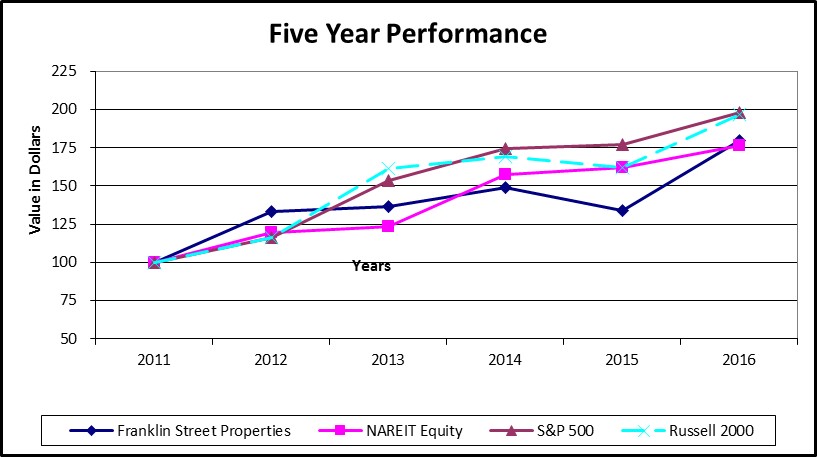
|
|
|
As of December 31, |
|
||||||||||||||||
|
|
|
2011 |
|
2012 |
|
2013 |
|
2014 |
|
2015 |
|
2016 |
|
||||||
|
FSP |
|
$ |
|
|
$ |
|
|
$ |
|
|
$ |
|
|
$ |
|
|
$ |
|
|
|
NAREIT Equity |
|
|
|
|
|
|
|
|
|
|
|
|
|
|
|
|
|
|
|
|
S&P 500 |
|
|
|
|
|
|
|
|
|
|
|
|
|
|
|
|
|
|
|
|
Russell 2000 |
|
|
|
|
|
|
|
|
|
|
|
|
|
|
|
|
|
|
|
Notes to Graph:
The above performance graph and related information shall not be deemed “soliciting material” or to be “filed” with the Securities and Exchange Commission, nor shall such information be incorporated by reference into any future filing under the Securities Act of 1933 or Securities Exchange Act of 1934, each as amended, except to the extent that we specifically incorporate it by reference into such filing.
23
Item 6. Selected Financial Data
The following selected financial information is derived from the historical consolidated financial statements of FSP Corp. This information should be read in conjunction with “Management’s Discussion and Analysis of Financial Condition and Results of Operations” in Item 7 and with FSP Corp.’s consolidated financial statements and related notes thereto included in Item 8.
|
|
|
Year Ended December 31, |
|
|||||||||||||
|
(In thousands, except per share amounts) |
|
2016 |
|
2015 |
|
2014 |
|
2013 |
|
2012 |
|
|||||
|
|
|
|
|
|
|
|
|
|
|
|
|
|
|
|
|
|
|
Operating Data: |
|
|
|
|
|
|
|
|
|
|
|
|
|
|
|
|
|
Total revenue |
|
$ |
|
|
$ |
|
|
$ |
|
|
$ |
|
|
$ |
|
|
|
Income from: |
|
|
|
|
|
|
|
|
|
|
|
|
|
|
|
|
|
Income from continuing operations |
|
|
|
|
|
|
|
|
|
|
|
|
|
|
|
|
|
Income from discontinued operations |
|
|
— |
|
|
— |
|
|
— |
|
|
|
|
|
|
|
|
Net income |
|
|
|
|
|
|
|
|
|
|
|
|
|
|
|
|
|
|
|
|
|
|
|
|
|
|
|
|
|
|
|
|
|
|
|
Basic and diluted income per share: |
|
|
|
|
|
|
|
|
|
|
|
|
|
|
|
|
|
Continuing operations |
|
$ |
|
|
$ |
|
|
$ |
|
|
$ |
|
|
$ |
|
|
|
Discontinued operations |
|
|
— |
|
|
— |
|
|
— |
|
|
|
|
|
|
|
|
Total |
|
$ |
|
|
$ |
|
|
$ |
|
|
$ |
|
|
$ |
|
|
|
|
|
|
|
|
|
|
|
|
|
|
|
|
|
|
|
|
|
Distributions declared per share outstanding: |
|
$ |
|
|
$ |
|
|
$ |
|
|
$ |
|
|
$ |
|
|
|
|
|
As of December 31, |
|
|||||||||||||
|
|
|
2016 |
|
2015 |
|
2014 |
|
2013 |
|
2012 |
|
|||||
|
Balance Sheet Data: |
|
|
|
|
|
|
|
|
|
|
|
|
|
|
|
|
|
Total assets |
|
$ |
|
|
$ |
|
|
$ |
|
|
$ |
|
|
$ |
|
|
|
Total liabilities |
|
|
|
|
|
|
|
|
|
|
|
|
|
|
|
|
|
Total shareholders’ equity |
|
|
|
|
|
|
|
|
|
|
|
|
|
|
|
|
24
The following discussion should be read in conjunction with the financial statements and notes thereto appearing elsewhere in this report. Historical results and percentage relationships set forth in the consolidated financial statements, including trends which might appear, should not be taken as necessarily indicative of future operations. The following discussion and other parts of this Annual Report on Form 10-K may also contain forward-looking statements based on current judgments and current knowledge of management, which are subject to certain risks, trends and uncertainties that could cause actual results to differ materially from those indicated in such forward-looking statements. Accordingly, readers are cautioned not to place undue reliance on forward-looking statements. Investors are cautioned that our forward-looking statements involve risks and uncertainty, including without limitation, economic conditions in the United States, disruptions in the debt markets, economic conditions in the markets in which we own properties, risks of a lessening of demand for the types of real estate owned by us, uncertainties relating to fiscal policy, changes in government regulations and regulatory uncertainty, geopolitical events, and expenditures that cannot be anticipated such as utility rate and usage increases, unanticipated repairs, additional staffing, insurance increases and real estate tax valuation reassessments. See “Risk Factors” in Item 1A. Although we believe the expectations reflected in the forward-looking statements are reasonable, we cannot guarantee future results, levels of activity, performance or achievements. We may not update any of the forward-looking statements after the date this Annual Report on Form 10-K is filed to conform them to actual results or to changes in our expectations that occur after such date, other than as required by law.
Overview
FSP Corp., or we or the Company, operates in a single reportable segment: real estate operations. The real estate operations market involves real estate rental operations, leasing, secured financing of real estate and services provided for asset management, property management, property acquisitions, dispositions and development. Our current strategy is to invest in select urban infill and central business district properties, with primary emphasis on our top five markets of Atlanta, Dallas, Denver, Houston and Minneapolis. We believe that our top five markets have macro-economic drivers that have the potential to increase occupancies and rents. We will also monitor other markets for opportunistic investments. We seek value-oriented investments with an eye towards long-term growth and appreciation, as well as current income.
As of December 31, 2016, approximately 7.7 million square feet, or approximately 75.3% of our total owned portfolio, was located in our top five markets. From time-to-time we may dispose of our smaller, suburban office assets and replace them with larger urban infill and central business district office assets located primarily in our top five markets. As we execute this strategy, short term operating results could be adversely impacted. However, we believe that the transformed portfolio has the potential to provide higher profit and asset value growth over a longer period of time.
The main factor that affects our real estate operations is the broad economic market conditions in the United States. These market conditions affect the occupancy levels and the rent levels on both a national and local level. We have no influence on broader economic/market conditions. We look to acquire and/or develop quality properties in good locations in order to lessen the impact of downturns in the market and to take advantage of upturns when they occur.
Trends and Uncertainties
Economic Conditions
The economy in the United States is continuing to experience a period of slow economic growth, with continued declining unemployment rates, which directly affects the demand for office space, our primary income producing asset. The broad economic market conditions in the United States are affected by numerous factors, including but not limited to, inflation and employment levels, energy prices, the pace of economic growth and/or recessionary concerns, uncertainty about government fiscal and tax policy, changes in currency exchange rates, geopolitical events, the regulatory environment, the availability of credit and interest rates. In addition, the Federal Reserve Bank has indicated that it anticipates raising interest rates in 2017. Any increase in interest rates could result in increased borrowing costs to us. However, we could also benefit from any further improved economic fundamentals and
25
increasing levels of employment. We believe that the economy is in a cyclically-slower but prolonged broad-based upswing. However, future economic factors may negatively affect real estate values, occupancy levels and property income.
Real Estate Operations
Leasing
Our real estate portfolio was approximately 89.3% leased as of December 31, 2016, a decrease from 91.6% as of December 31, 2015. The 2.3% decrease in leased space was a result of lease expirations and terminations during 2016 that were not leased at December 31, 2016. As of December 31, 2016, we had 1,086,000 square feet of vacancy in our portfolio compared to 800,000 square feet of vacancy at December 31, 2015. During the year ended December 31, 2016, we leased approximately 1,194,000 square feet of office space, of which approximately 895,000 square feet were with existing tenants, at a weighted average term of 6.6 years. On average, tenant improvements for such leases were $18.71 per square foot, lease commissions were $10.05 per square foot and rent concessions were approximately three months of free rent. Average GAAP base rents under such leases were $29.64 per square foot, or 10.4% higher than average rents in the respective properties as applicable compared to the year ended December 31, 2015.
In January 2016, our property at 801 Marquette Avenue in Minneapolis, Minnesota, with approximately 170,000 square feet of space, became vacant and we are redeveloping the property. After extensive costing analysis with our potential development partners and outside professionals, we have decided to redevelop the existing building ourselves, rather than raze it and build a new, mixed use tower with outside development partners. Interior demolition and construction work commenced during the three months ended September 30, 2016. We estimate the total redevelopment cost to be approximately $20 million, including leasing costs. Delivery of the completed project is expected by the end of the second quarter of 2017. Upon completion, we expect the redevelopment to result in approximately 128,000 net rental square feet and for the property to attain rents of approximately $17 to $19 net rent per square foot compared to previously expired net rent of approximately $4.75 per square foot.
As of December 31, 2016, leases for approximately 6.9% and 12.0% of the square footage in our portfolio are scheduled to expire during 2017 and 2018, respectively. As the first quarter of 2017 begins, we believe that our property portfolio is well stabilized, with a balanced lease expiration schedule, and that existing vacancy is being actively marketed to numerous potential tenants. We believe that most of our largest property markets are now experiencing generally steady or improving rental conditions. We anticipate continued positive leasing activity within the portfolio in 2017.
While we cannot generally predict when an existing vacancy in our real estate portfolio will be leased or if existing tenants with expiring leases will renew their leases or what the terms and conditions of the lease renewals will be, we expect to renew or sign new leases at then-current market rates for locations in which the buildings are located, which could be above or below the expiring rates. Also, we believe the potential for any of our tenants to default on its lease or to seek the protection of bankruptcy exists. If any of our tenants defaults on its lease, we may experience delays in enforcing our rights as a landlord and may incur substantial costs in protecting our investment. In addition, at any time, a tenant of one of our properties may seek the protection of bankruptcy laws, which could result in the rejection and termination of such tenant’s lease and thereby cause a reduction in cash available for distribution to our stockholders.
Real Estate Acquisition and Investment Activity
During 2016:
|
|
· |
|
on January 19, we received approximately $37.5 million from FSP 385 Interlocken Development Corp. as repayment in full of a Sponsored REIT Loan; |
|
|
· |
|
during the year ended December 31, we received approximately $2.3 million from FSP Satellite Place Corp., as partial prepayment of a Sponsored REIT Loan; |
|
|
· |
|
on June 6, we acquired an office property with approximately 325,800 rentable square feet for $82 million located in Minneapolis, Minnesota; |
26
|
|
· |
|
on August 10, we acquired an office property with approximately 160,000 rentable square feet for $45.5 million located in Atlanta, Georgia; |
|
|
· |
|
on December 1, we acquired an office property with approximately 613,000 rentable square feet for $154.2 million located in Denver, Colorado; and |
|
|
· |
|
we have continued to actively explore additional potential real estate investment opportunities and anticipate further real estate investments in the future. |
During 2015:
|
|
· |
|
we funded advances on Sponsored REIT Loans for revolving lines of credit in the aggregate amount of approximately $4.0 million; |
|
|
· |
|
on April 8, we acquired an office property with approximately 442,130 rentable square feet of space for $78.0 million located in the Central Perimeter Submarket of Atlanta, Georgia; and |
|
|
· |
|
on December 7, we funded a Sponsored REIT Loan for a mortgage loan secured by a property of approximately $21.0 million. |
During 2014:
|
|
· |
|
we funded advances on Sponsored REIT Loans for revolving lines of credit in the aggregate amount of approximately $11.2 million; |
|
|
· |
|
on June 19, we received approximately $13.9 million from FSP Galleria North Corp. as repayment in full of a Sponsored REIT Loan; and |
|
|
· |
|
on December 23, we received approximately $3.4 million from FSP Highland Place I Corp. as repayment in full of a Sponsored REIT Loan. |
Property Dispositions and Assets Held for Sale
On April 5, 2016, we sold an office property located in Maryland Heights, Missouri at approximately a $4.2 million gain. During the three months ended June 30, 2016, we reached a decision to classify our office property located in Federal Way, Washington, as an asset held for sale. In evaluating the Federal Way, Washington property, management considered various subjective factors, including the time, cost and likelihood of successfully leasing the property, the effect of the property’s results on its unencumbered asset value, which is part of the leverage ratio used to compare to a maximum leverage covenant in the BMO Term Loan and the BAML Credit Facility, future capital costs to upgrade and reposition the multi-tenant property and to lease up the building, recent leasing and economic activity in the local area, and offers to purchase the property. We concluded that selling the property was the more prudent decision and outweighed the potential future benefit of continuing to hold the property. The property was expected to sell within one year at a loss, which was recorded as a provision for loss on a property held for sale of $4.8 million net of applicable income taxes and was classified as an asset held for sale of $9.3 million at June 30, 2016. During the three months ended September 30, 2016, we increased the provision for loss by $0.5 million to $5.3 million net of applicable income taxes and the property was classified as an asset held for sale in the amount of $8.8 million at September 30, 2016. The Company sold the property on December 16, 2016 for net proceeds of $7.3 million resulting in a total loss of $7.1 million, net of applicable income taxes. During the three months ended December 31, 2016, we reached an agreement to sell an office property located in Milpitas, California. The property was classified as an asset held for sale at December 31, 2016 and was sold on January 6, 2017 at a $2.3 million gain.
During 2015, we sold an office property located in Plano, Texas on February 23, 2015 at a $1.5 million gain, sold an office property located in Eden Prairie, Minnesota on March 31, 2015 at a $9.0 million gain, sold an office property located in Charlotte, North Carolina on May 13, 2015 at a $0.9 million gain and sold an office property located in San Jose, California on December 9, 2015 at a $12.3 million gain. During 2014, we sold an office property located in Colorado Springs, Colorado on December 3, 2014 at a $0.9 million gain.
The disposal of these properties did not represent a strategic shift that has a major effect on the Company’s operations and financial results. Accordingly, the properties remained classified within continuing operations for all periods presented.
27
We will continue to evaluate our portfolio, and in the future may decide to dispose of additional properties from time-to-time in the ordinary course of business. We believe that the current property sales environment continues to improve in many markets relative to both liquidity and pricing. We believe that both improving office property fundamentals as well as attractive financing availability will likely be required to continue improvement in the marketplace for potential property dispositions. As an important part of our total return strategy, we intend to be active in property dispositions when we believe that market conditions warrant such activity and, as a consequence, we continuously review and evaluate our portfolio of properties for potentially advantageous dispositions.
Critical Accounting Policies
We have certain critical accounting policies that are subject to judgments and estimates by our management and uncertainties of outcome that affect the application of these policies. We base our estimates on historical experience and on various other assumptions we believe to be reasonable under the circumstances. On an on-going basis, we evaluate our estimates. In the event estimates or assumptions prove to be different from actual results, adjustments are made in subsequent periods to reflect more current information. The accounting policies that we believe are most critical to the understanding of our financial position and results of operations, and that require significant management estimates and judgments, are discussed below. Significant estimates in the consolidated financial statements include the allowance for doubtful accounts, purchase price allocations, useful lives of fixed assets, impairment considerations and the valuation of derivatives.
Critical accounting policies are those that have the most impact on the reporting of our financial condition and results of operations and those requiring significant judgments and estimates. We believe that our judgments and estimates are consistently applied and produce financial information that fairly presents our results of operations. Our most critical accounting policies involve our investments in Sponsored REITs and our investments in real property. These policies affect our:
|
|
· |
|
allocation of purchase price; |
|
|
· |
|
allowance for doubtful accounts; |
|
|
· |
|
assessment of the carrying values and impairments of long lived assets; |
|
|
· |
|
useful lives of fixed assets and intangibles; |
|
|
· |
|
valuation of derivatives; |
|
|
· |
|
classification of leases; and |
|
|
· |
|
ownership of stock in a Sponsored REIT and related interests. |
These policies involve significant judgments made based upon our experience, including judgments about current valuations, ultimate realizable value, estimated useful lives, salvage or residual value, the ability of our tenants to perform their obligations to us, current and future economic conditions and competitive factors in the markets in which our properties are located. Competition, economic conditions and other factors may cause occupancy declines in the future. In the future we may need to revise our carrying value assessments to incorporate information which is not now known and such revisions could increase or decrease our depreciation expense related to properties we own, result in the classification of our leases as other than operating leases or decrease the carrying values of our assets.
Allocation of Purchase Price
We allocate the value of real estate acquired among land, buildings, improvements and identified intangible assets and liabilities, which may consist of the value of above market and below market leases, the value of in-place leases, and the value of tenant relationships. Purchase price allocations and the determination of the useful lives are based on management’s estimates. Under some circumstances we may rely upon studies commissioned from independent real estate appraisal firms in determining the purchase price allocations.
Purchase price allocated to land and building and improvements is based on management’s determination of the relative fair values of these assets assuming the property was vacant. Management determines the fair value of a property using methods similar to those used by independent appraisers. Purchase price allocated to above or below market leases is based on the present value (using an interest rate which reflects the risks associated with the leases acquired) of the
28
difference between (i) the contractual amounts to be paid pursuant to the in-place leases including consideration of potential lease renewals and (ii) our estimate of fair market lease rates for the corresponding leases, measured over a period equal to the remaining non-cancelable terms of the respective leases. This aggregate value is allocated between in-place lease values and tenant relationships based on management’s evaluation of the specific characteristics of each tenant’s lease; however, the value of tenant relationships has not been separated from in-place lease value because such value and its consequence to amortization expense is immaterial for acquisitions reflected in our financial statements. Factors considered by us in performing these analyses include (i) an estimate of carrying costs during the expected lease-up periods, including real estate taxes, insurance and other operating income and expenses, and (ii) costs to execute similar leases in current market conditions, such as leasing commissions, legal and other related costs. If future acquisitions result in our allocating material amounts to the value of tenant relationships, those amounts would be separately allocated and amortized over the estimated life of the relationships.
Allowance for Doubtful Accounts
We provide an allowance for doubtful accounts based on our estimate of a tenant’s ability to make future rent payments. The computation of this allowance is based in part on the tenants’ payment history and current credit status.
Impairment
We periodically evaluate our real estate properties for impairment indicators. These indicators may include declining tenant occupancy, weak or declining tenant profitability, cash flow or liquidity, our decision to dispose of an asset before the end of its estimated useful life or legislative, economic or market changes that permanently reduce the value of our investments. If indicators of impairment are present, we evaluate the carrying value of the property by comparing it to its expected future undiscounted cash flows. If the sum of these expected future cash flows is less than the carrying value, we reduce the net carrying value of the property to the present value of these expected future cash flows. This analysis requires us to judge whether indicators of impairment exist and to estimate likely future cash flows. If we misjudge or estimate incorrectly or if future tenant profitability, market or industry factors differ from our expectations, we may record an impairment charge which is inappropriate or fail to record a charge when we should have done so, or the amount of such charges may be inaccurate.
Depreciation and Amortization Expense
We compute depreciation expense using the straight-line method over estimated useful lives of up to 39 years for buildings and improvements, and up to 15 years for personal property. Costs incurred in connection with leasing (primarily tenant improvements and leasing commissions) are capitalized and amortized over the lease period. The allocated cost of land is not depreciated. The value of above or below-market leases is amortized over the remaining non-cancelable periods of the respective leases as an adjustment to rental income. The value of in-place leases, exclusive of the value of above-market and below-market in-place leases, is also amortized over the remaining non-cancelable periods of the respective leases. If a lease is terminated prior to its stated expiration, all unamortized amounts relating to that lease are written off. Inappropriate allocation of acquisition costs, or incorrect estimates of useful lives, could result in depreciation and amortization expenses which do not appropriately reflect the allocation of our capital expenditures over future periods, as is required by generally accepted accounting principles.
Derivative Instruments
We recognize derivatives on the balance sheet at fair value. Derivatives that do not qualify, or are not designated as hedge relationships, must be adjusted to fair value through income. Derivative instruments designated in a hedge relationship to mitigate exposure to variability in expected future cash flows, or other types of forecasted transactions, are considered cash flow hedges. Cash flow hedges are accounted for by recording the fair value of the derivative instrument on the balance sheet as either an asset or liability. To the extent hedges are effective, a corresponding amount, adjusted for swap payments, is recorded in accumulated other comprehensive income within stockholders’ equity. Amounts are then reclassified from accumulated other comprehensive income to the income statement in the period or periods the hedged forecasted transaction affects earnings. The ineffective portion of the derivatives’ fair value is recognized directly into earnings as “Other” in our income statement. Derivative instruments
29
designated in a hedge relationship to mitigate exposure to changes in the fair value of an asset, liability, or firm commitment attributable to a particular risk, such as interest rate risk, are considered fair value hedges. We currently have no fair value hedges outstanding. Fair values of derivatives are subject to significant variability based on changes in interest rates and counterparty credit risk. To the extent we enter into fair value hedges in the future, the results of such variability could be a significant increase or decrease in our derivative assets, derivative liabilities, book equity, and/or earnings.
Lease Classification
Some of our real estate properties are leased on a triple net basis, pursuant to non-cancelable, fixed term, operating leases. Each time we enter a new lease or materially modify an existing lease we evaluate whether it is appropriately classified as a capital lease or as an operating lease. The classification of a lease as capital or operating affects the carrying value of a property, as well as our recognition of rental payments as revenue. These evaluations require us to make estimates of, among other things, the remaining useful life and market value of a property, discount rates and future cash flows. Incorrect assumptions or estimates may result in misclassification of our leases.
Ownership of Stock in a Sponsored REIT and Related Interests
We currently hold preferred stock interests in two Sponsored REITs. As a result of our common and preferred stock interests in these two Sponsored REITs, we exercise influence over, but do not control these entities. These preferred stock interests are accounted for using the equity method. Under the equity method of accounting our cost basis is adjusted by our share of the Sponsored REITs’ operations and distributions received. We also agreed to vote our preferred shares (i) with respect to any merger in the same manner that a majority of the other stockholders of the Sponsored REIT vote for or against the merger and (ii) with respect to any other matter presented to a vote by the stockholders of these Sponsored REITs in the same proportion as shares voted by other stockholders of that Sponsored REIT.
The equity investments in Sponsored REITS are reviewed for impairment each reporting period. The Company records impairment charges when events or circumstances indicate a decline in the fair value below the carrying value of the investment has occurred and such decline is other-than-temporary. The ultimate realization of the equity investments in Sponsored REITS is dependent on a number of factors, including the performance of each investment and market conditions. An impairment charge is recorded if its determined that a decline in the value below the carrying value of an equity investment in a Sponsored REIT is other than temporary.
Results of Operations
Impact of Real Estate Acquisitions, Dispositions and Investment Activity:
The results of operations for each of the acquired properties, and properties sold prior to their date of sale are included in our operating results as of their respective purchase dates or the date of funding and repayment for mortgage investments, as applicable. Increases and decreases in rental revenues and interest income from loans and expenses for the year ended December 31, 2016 compared to the year ended December 31, 2015, or for the year ended December 31, 2015 compared to the year ended December 31, 2014, are primarily a result of the timing of these acquisitions and dispositions and the contribution of these acquired properties after their acquisition date or sold properties prior to their sale date, as well as the effect on interest income from the dates of funding and repayment on our mortgage investments.
30
The following table shows financial results for the years ended December 31, 2016 and 2015.
|
|
|
Year ended December 31, |
|
|||||||
|
(in thousands) |
|
2016 |
|
2015 |
|
Change |
|
|||
|
Revenues: |
|
|
|
|
|
|
|
|
|
|
|
Rental |
|
$ |
|
|
$ |
|
|
$ |
|
|
|
Related party revenue: |
|
|
|
|
|
|
|
|
|
|
|
Management fees and interest income from loans |
|
|
|
|
|
|
|
|
|
|
|
Other |
|
|
|
|
|
|
|
|
|
|
|
Total revenues |
|
|
|
|
|
|
|
|
|
|
|
Expenses: |
|
|
|
|
|
|
|
|
|
|
|
Real estate operating expenses |
|
|
|
|
|
|
|
|
|
|
|
Real estate taxes and insurance |
|
|
|
|
|
|
|
|
|
|
|
Depreciation and amortization |
|
|
|
|
|
|
|
|
|
|
|
Selling, general and administrative |
|
|
|
|
|
|
|
|
|
|
|
Interest |
|
|
|
|
|
|
|
|
|
|
|
Total expenses |
|
|
|
|
|
|
|
|
|
|
|
|
|
|
|
|
|
|
|
|
|
|
|
Income before interest income, equity in losses of non-consolidated REITs, other, gain (loss) on sale of properties, less applicable income tax and taxes |
|
|
|
|
|
|
|
|
|
|
|
Interest income |
|
|
— |
|
|
|
|
|
|
|
|
Equity in losses of non-consolidated REITs |
|
|
|
|
|
|
|
|
|
|
|
Other |
|
|
|
|
|
— |
|
|
|
|
|
Gain (loss) on sale of properties, less applicable income tax |
|
|
|
|
|
|
|
|
|
|
|
|
|
|
|
|
|
|
|
|
|
|
|
Income before taxes on income |
|
|
|
|
|
|
|
|
|
|
|
Taxes on income |
|
|
|
|
|
|
|
|
|
|
|
|
|
|
|
|
|
|
|
|
|
|
|
Net income |
|
$ |
|
|
$ |
|
|
$ |
|
|
Comparison of the year ended December 31, 2016 to the year ended December 31, 2015
Revenues
Total revenues increased by approximately $6.0 million to $249.9 million for the year ended December 31, 2016, as compared to the year ended December 31, 2015. The increase was primarily a result of:
|
|
· |
|
An increase in rental revenue of approximately $6.5 million arising primarily from rental revenue for properties that we acquired on each of April 8, 2015, June 6, 2016, August 10, 2016 and December 1, 2016, which was partially offset by the loss of revenue from the disposition of four other properties during 2015 and 2016. We sold a property on each of May 13, 2015, December 9, 2015, April 5, 2016 and December 16, 2016. In addition, our leased space decreased 2.3% to 89.3% at December 31, 2016 compared to 91.6% at December 31, 2015. |
The increase was partially offset by:
|
|
· |
|
A decrease in interest income from loans to Sponsored REITs of approximately $0.5 million as a result of repayments of Sponsored REIT Loans and lower interest rates, which was partially offset by the funding of an advance and a Sponsored REIT Loan we made in December 2015. |
31
Expenses
Total expenses increased by $8.5 million to $239.5 million for the year ended December 31, 2016, as compared to the year ended December 31, 2015. The increase was primarily a result of:
|
|
· |
|
An increase in real estate operating expenses and real estate taxes and insurance of approximately $4.9 million and an increase in depreciation and amortization of approximately $1.7 million, which were attributable to the acquisition of properties on April 8, 2015, June 6, 2016, August 10, 2016 and December 1, 2016, and were partially offset by decreases as a result of the disposition of four properties during 2015 and 2016. |
|
|
· |
|
An increase in selling, general and administrative expenses of $0.8 million as a result of increases in acquisition costs and personnel related expenses. We had 39 employees as of December 31, 2016 and 40 employees as of December 31, 2015. |
|
|
· |
|
An increase in interest expense of approximately $1.1 million to $26.5 million for the year ended December 31, 2016 compared to the same period in 2015. The increase was primarily attributable to higher interest rates, additional borrowings under the JPM Term Loan (as defined below) we entered into on November 30, 2016 and an increase in amortization of deferred financing costs during the year ended December 31, 2016 as compared to the same period in 2015. |
Equity in losses of non-consolidated REITs
Equity in losses from non-consolidated REITs decreased approximately $0.6 million to a loss of $0.8 million during the year ended December 31, 2016 compared to the same period in 2015. The decrease was primarily attributable to equity in the loss from our preferred stock investment in a Sponsored REIT, FSP 303 East Wacker Drive Corp., which we refer to as East Wacker, decreased $0.8 million during the year ended December 31, 2016, compared to the same period in 2015.
Gains (loss) on sale of properties, less applicable income tax
We sold an office property located in Maryland Heights, Missouri on April 5, 2016, at a $4.2 million gain. During the three months ended June 30, 2016, we reached a decision to classify our office property located in Federal Way, Washington, as an asset held for sale. In evaluating the Federal Way, Washington property, management considered various subjective factors, including the time, cost and likelihood of successfully leasing the property, the effect of the property’s results on its unencumbered asset value, which is part of the leverage ratio used to compare to a maximum leverage covenant in the BMO Term Loan and the BAML Credit Facility, future capital costs to upgrade and reposition the multi-tenant property and to lease up the building, recent leasing and economic activity in the local area, and offers to purchase the property. We concluded that selling the property was the more prudent decision and outweighed the potential future benefit of continuing to hold the property. The property was expected to sell within one year at a loss, which was recorded as a provision for loss on a property held for sale of $4.8 million net of applicable income taxes and was classified as an asset held for sale of $9.3 million at June 30, 2016. During the three months ended September 30, 2016, we increased the provision for loss by $0.5 million to $5.3 million net of applicable income taxes and was the property was classified as an asset held for sale in the amount of $8.8 million at September 30, 2016. The Company estimated the fair value of the property, less estimated costs to sell using the offers to purchase the property made by third parties (Level 3 inputs, as there is no active market). The Company sold the property on December 16, 2016 for $7.3 million of net proceeds, resulting in a total loss of $7.1 million, net of applicable income taxes. During the year ended December 31, 2015, we recorded gains on sale of four properties. We sold an office property located in Plano, Texas on February 23, 2015 at a $1.5 million gain, an office property located in Eden Prairie, Minnesota on March 31, 2015 at a $9.0 million gain, an office property located in Charlotte, North Carolina on May 13, 2015 at a $0.9 million gain and an office property located in San Jose, California on December 9, 2015 at a $12.3 million gain.
Other
A $1.9 million credit to Other expense for the year ended Decmeber 31, 2016 is attributable to hedge ineffectiveness from our derivatives’ fair value. The ineffective portion of the derivatives’ fair value are recognized directly into earnings each quarter as hedge ineffectiveness.
32
Taxes on income
Included in income taxes is the Revised Texas Franchise Tax, a tax on revenues from Texas properties, which decreased $46,000 while federal and other income taxes increased $31,000 for year ended December 31, 2016, compared to the same period in 2015.
Net Income
Net Income for the year ended December 31, 2016 was $8.4 million compared to $35.0 million for the year ended December 31, 2015, for the reasons described above.
33
The following table shows financial results for the years ended December 31, 2015 and 2014.
|
|
|
Year ended December 31, |
|
|||||||
|
(in thousands) |
|
2015 |
|
2014 |
|
Change |
|
|||
|
Revenues: |
|
|
|
|
|
|
|
|
|
|
|
Rental |
|
$ |
|
|
$ |
|
|
$ |
|
|
|
Related party revenue: |
|
|
|
|
|
|
|
|
|
|
|
Management fees and interest income from loans |
|
|
|
|
|
|
|
|
|
|
|
Other |
|
|
|
|
|
|
|
|
|
|
|
Total revenues |
|
|
|
|
|
|
|
|
|
|
|
Expenses: |
|
|
|
|
|
|
|
|
|
|
|
Real estate operating expenses |
|
|
|
|
|
|
|
|
|
|
|
Real estate taxes and insurance |
|
|
|
|
|
|
|
|
|
|
|
Depreciation and amortization |
|
|
|
|
|
|
|
|
|
|
|
Selling, general and administrative |
|
|
|
|
|
|
|
|
|
|
|
Interest |
|
|
|
|
|
|
|
|
|
|
|
Total expenses |
|
|
|
|
|
|
|
|
|
|
|
|
|
|
|
|
|
|
|
|
|
|
|
Income before interest income, equity in losses of non-consolidated REITs, gain (loss) on sale of properties, less applicable income tax and taxes |
|
|
|
|
|
|
|
|
|
|
|
Interest income |
|
|
|
|
|
|
|
|
|
|
|
Equity in losses of non-consolidated REITs |
|
|
|
|
|
|
|
|
|
|
|
Gain (loss) on sale of properties, less applicable income tax |
|
|
|
|
|
|
|
|
|
|
|
|
|
|
|
|
|
|
|
|
|
|
|
Income before taxes on income |
|
|
|
|
|
|
|
|
|
|
|
Taxes on income |
|
|
|
|
|
|
|
|
|
|
|
|
|
|
|
|
|
|
|
|
|
|
|
Net income |
|
$ |
|
|
$ |
|
|
$ |
|
|
Comparison of the year ended December 31, 2015 to the year ended December 31, 2014
Revenues
Total revenues decreased by $5.8 million to $243.9 million for the year ended December 31, 2015, as compared to the year ended December 31, 2014. The decrease was primarily a result of:
|
|
· |
|
A decrease in rental revenue of approximately $5.5 million arising primarily from loss of revenue from the disposition of a property on December 3, 2014 and the disposition of four properties during 2015. During 2015, a property was sold on each of February 23, 2015, March 31, 2015, May 13, 2015 and December 9, 2015. In addition, our rental revenues decreased because leased space in our real estate portfolio decreased approximately 1.2 percentage points to 91.6% at December 31, 2015 compared to 92.8% at December 31, 2014. These decreases were partially offset by increased rental revenue from a property we acquired on April 8, 2015. |
|
|
· |
|
A decrease in interest income from loans to Sponsored REITs of approximately $0.3 million as a result of repayments of Sponsored REIT Loans and lower interest rates, which was partially offset by the funding of an advance and a Sponsored REIT Loan we made in December 2015. |
Expenses
Total expenses decreased by $4.6 million to $230.6 million for the year ended December 31, 2015, as compared to the year ended December 31, 2014. The decrease was primarily a result of:
|
|
· |
|
A decrease in depreciation and amortization of $4.5 million and real estate operating expenses of $0.1 million as a result of the disposition of one property in December 2014 and the disposition of four properties during 2015. A property was sold on each of February 23, 2015, March 31, 2015, May 13, 2015 and December 9, |
34
|
2015. In addition, our real estate operating expenses decreased because leased space in our real estate portfolio decreased approximately 1.2% percentage points to 91.6% at December 31, 2015 compared to 92.8% at December 31, 2014. These decreases were partially offset by depreciation and amortization and real estate operating expenses of a property we acquired on April 8, 2015. |
|
|
· |
|
A decrease in interest expense of approximately $2.0 million to $25.4 million for the year ended December 31, 2015 compared to the same period in 2014. The decrease was primarily attributable to lower interest rates during the year ended December 31, 2015 compared to the year ended December 31, 2014. |
These decreases were partially offset by:
|
|
· |
|
An increase in real estate taxes and insurance of approximately $1.8 million, which was primarily the result of increases in property taxes in properties in our portfolio and from a property we acquired on April 8, 2015, which was partially offset by the disposition of one property in December 2014 and four properties in 2015. |
|
|
· |
|
An increase in selling, general and administrative expenses of approximately $0.3 million, which was primarily the result of increased personnel related expenses and professional fees. We had 40 and 39 employees as of December 31, 2015 and 2014, respectively, at our headquarters in Wakefield, Massachusetts. |
Equity in losses of non-consolidated REITs
Equity in losses from non-consolidated REITs decreased approximately $0.3 million to a loss of $1.5 million during the year ended December 31, 2015 compared to the same period in 2014. The decrease was primarily because equity in loss from our preferred stock investment in a Sponsored REIT, FSP 303 East Wacker Drive Corp., which we refer to as East Wacker, decreased $0.2 million during the year ended December 31, 2015, compared to the same period in 2014.
Gains on sale of properties, less applicable income tax
During the year ended December 31, 2015, we recorded gains on sale of four properties. We sold an office property located in Plano, Texas on February 23, 2015 at a $1.5 million gain, an office property located in Eden Prairie, Minnesota on March 31, 2015 at a $9.0 million gain, an office property located in Charlotte, North Carolina on May 13, 2015 at a $0.9 million gain and an office property located in San Jose, California on December 9, 2015 at a $12.3 million gain. During the year ended December 31, 2014, we sold an office property located in Colorado Springs, Colorado on December 3, 2014 at a gain of approximately $0.9 million.
Taxes on income
Included in income taxes is the Revised Texas Franchise Tax, which is a tax on revenues from Texas properties that decreased $76,000 while federal and other income taxes increased $11,000 for year ended December 31, 2015, compared to the same period in 2014.
Net Income
Net Income for the year ended December 31, 2015 was $35.0 million compared to $13.1 million for the year ended December 31, 2014, for the reasons described above.
35
Non-GAAP Financial Measures
During the three months ended June 30, 2016 we changed the definition of Funds from Operations, which we refer to as FFO, and Net Operating Income, which we refer to as NOI, to exclude hedge ineffectiveness, which does not affect any prior period. Our interest rate swaps effectively fix interest rates on our term loans, however, there is no floor on the variable interest rate of the swaps whereas the current term loans are subject to a zero percent floor. As a result there is a mismatch and the ineffective portion of the derivatives’ changes in fair value are recognized directly into earnings each quarter as hedge ineffectiveness. We believe that FFO and Property NOI excluding hedge ineffectiveness is useful supplemental information regarding our operating performance as it provides a more meaningful and consistent comparison of our operating performance and allows investors to more easily compare our operating results.
During the year ended December 31, 2016, we recorded $1.9 million of other income from hedge ineffectiveness in earnings attributable to the zero percent floor mismatch in the hedging relationships.
Funds From Operations
The Company evaluates performance based on FFO as management believes that FFO represents the most accurate measure of activity and is the basis for distributions paid to equity holders. The Company defines FFO as net income (computed in accordance with GAAP), excluding gains (or losses) from sales of property, hedge ineffectiveness and acquisition costs of newly acquired properties that are not capitalized, plus depreciation and amortization, including amortization of acquired above and below market lease intangibles and impairment charges on properties or investments in non-consolidated REITs, and after adjustments to exclude equity in income or losses from, and, to include the proportionate share of FFO from, non-consolidated REITs.
FFO should not be considered as an alternative to net income (determined in accordance with GAAP), nor as an indicator of the Company’s financial performance, nor as an alternative to cash flows from operating activities (determined in accordance with GAAP), nor as a measure of the Company’s liquidity, nor is it necessarily indicative of sufficient cash flow to fund all of the Company’s needs.
Other real estate companies and the National Association of Real Estate Investment Trusts, or NAREIT may define this term in a different manner. We have included the NAREIT FFO definition as of May 17, 2016 in the table and note that other REITs may not define FFO in accordance with the NAREIT definition or may interpret the current NAREIT definition differently than we do.
We believe that in order to facilitate a clear understanding of the results of the Company, FFO should be examined in connection with net income and cash flows from operating, investing and financing activities in the consolidated financial statements.
The calculations of FFO are shown in the following table:
|
|
|
For the Year Ended December 31, |
|
|||||||
|
(in thousands): |
|
2016 |
|
2015 |
|
2014 |
|
|||
|
Net income |
|
$ |
|
$ |
|
|
$ |
|
|
|
|
(Gain) loss on sale of properties,
|
|
|
|
|
|
|
|
|
|
|
|
Equity in losses of non-consolidated REITs |
|
|
|
|
|
|
|
|
|
|
|
FFO from non-consolidated REITs |
|
|
|
|
|
|
|
|
|
|
|
Depreciation and amortization |
|
|
|
|
|
|
|
|
|
|
|
NAREIT FFO |
|
|
|
|
|
|
|
|
|
|
|
Hedge ineffectiveness |
|
|
|
|
|
— |
|
|
— |
|
|
Acquisition costs of new properties |
|
|
|
|
|
|
|
|
|
|
|
|
|
|
|
|
|
|
|
|
|
|
|
Funds From Operations |
|
$ |
|
|
$ |
|
|
$ |
|
|
36
Net Operating Income (NOI)
The Company provides property performance based on NOI. Management believes that investors are interested in this information. NOI is a non-GAAP financial measure that the Company defines as net income (the most directly comparable GAAP financial measure) plus selling, general and administrative expenses, depreciation and amortization, including amortization of acquired above and below market lease intangibles and impairment charges, interest expense, less equity in earnings of nonconsolidated REITs, interest income, management fee income, hedge ineffectiveness, gains or losses on the sale of assets and excludes non-property specific income and expenses. The information presented includes footnotes and the data is shown by region with properties owned in both periods, which we call Same Store. The Comparative Same Store results include properties held for the periods presented and exclude properties that are non-operating, being developed or redeveloped, dispositions and significant nonrecurring income such as bankruptcy settlements and lease termination fees. NOI, as defined by the Company, may not be comparable to NOI reported by other REITs that define NOI differently. NOI should not be considered an alternative to net income as an indication of our performance or to cash flows as a measure of the Company’s liquidity or its ability to make distributions. The calculations of NOI are shown in the following table:
|
|
|
|
|
|
|
|
|
|
|
|
|
|
|
|
|
|
|
Net Operating Income (NOI)* |
|
|||||||||||
|
|
|
|
|
Year |
|
Year |
|
|
|
|
|
|
||
|
(in thousands) |
|
Rentable |
|
Ended |
|
Ended |
|
Inc |
|
% |
|
|||
|
Region |
|
Square Feet |
|
31-Dec-16 |
|
31-Dec-15 |
|
(Dec) |
|
Change |
|
|||
|
East |
|
|
|
$ |
|
|
$ |
|
|
$ |
|
|
|
% |
|
MidWest |
|
|
|
|
|
|
|
|
|
|
|
|
|
% |
|
South |
|
|
|
|
|
|
|
|
|
|
|
|
|
% |
|
West |
|
|
|
|
|
|
|
|
|
|
|
|
|
% |
|
Same Store |
|
|
|
|
|
|
|
|
|
|
|
|
|
% |
|
|
|
|
|
|
|
|
|
|
|
|
|
|
|
|
|
Acquisitions |
|
|
|
|
|
|
|
|
|
|
|
|
|
% |
|
Property NOI from the continuing portfolio |
|
|
|
|
|
|
|
|
|
|
|
|
|
% |
|
Dispositions, Non-Operating, Development or Redevelopment |
|
|
|
|
|
|
|
|
|
|
|
|
|
% |
|
Property NOI |
|
|
|
$ |
|
|
$ |
|
|
$ |
|
|
|
% |
|
|
|
|
|
|
|
|
|
|
|
|
|
|
|
|
|
Same Store |
|
|
|
$ |
|
|
$ |
|
|
$ |
|
|
|
% |
|
|
|
|
|
|
|
|
|
|
|
|
|
|
|
|
|
Less Nonrecurring |
|
|
|
|
|
|
|
|
|
|
|
|
|
|
|
Items in NOI (a) |
|
|
|
|
|
|
|
|
|
|
|
|
|
% |
|
|
|
|
|
|
|
|
|
|
|
|
|
|
|
|
|
Comparative |
|
|
|
|
|
|
|
|
|
|
|
|
|
|
|
Same Store |
|
|
|
$ |
|
|
$ |
|
|
$ |
|
|
|
% |
37
|
|
|
Year |
|
Year |
|
||
|
|
|
Ended |
|
Ended |
|
||
|
Reconciliation to Net income |
|
31-Dec-16 |
|
31-Dec-15 |
|
||
|
Net Income |
|
$ |
|
|
$ |
|
|
|
Add (deduct): |
|
|
|
|
|
|
|
|
(Gain) loss on sale of properties, |
|
|
|
|
|
|
|
|
less applicable income taxes |
|
|
|
|
|
|
|
|
Hedge ineffectiveness |
|
|
|
|
|
— |
|
|
Management fee income |
|
|
|
|
|
|
|
|
Depreciation and amortization |
|
|
|
|
|
|
|
|
Amortization of above/below market leases |
|
|
|
|
|
|
|
|
Selling, general and administrative |
|
|
|
|
|
|
|
|
Interest expense |
|
|
|
|
|
|
|
|
Interest income |
|
|
|
|
|
|
|
|
Equity in losses of non-consolidated REITs |
|
|
|
|
|
|
|
|
Non-property specific items, net |
|
|
|
|
|
|
|
|
Property NOI |
|
$ |
|
|
$ |
|
|
|
|
(a) |
|
Nonrecurring Items in NOI include proceeds from bankruptcies, lease termination fees or other significant nonrecurring income or expenses, which may affect comparability. |
* Excludes NOI from investments in and interest income from secured loans to non-consolidated REITs.
38
Liquidity and Capital Resources
Cash and cash equivalents were $9.3 million and $18.2 million at December 31, 2016 and December 31, 2015, respectively. The decrease of $8.9 million is attributable to $94.3 million provided by operating activities, less $245.0 million used in investing activities plus $141.8 million provided by financing activities. Management believes that existing cash, cash anticipated to be generated internally by operations and our existing debt financing will be sufficient to meet working capital requirements and anticipated capital expenditures for at least the next 12 months. Although there is no guarantee that we will be able to obtain the funds necessary for our future growth, we anticipate generating funds from continuing real estate operations. We believe that we have adequate funds to cover unusual expenses and capital improvements, in addition to normal operating expenses. Our ability to maintain or increase our level of dividends to stockholders, however, depends in significant part upon the level of rental income from our real properties.
Operating Activities
The cash provided by our operating activities of $94.3 million is primarily attributable to net income of $8.4 million excluding a net loss on the sale of properties of $2.9 million, plus the add-back of $91.7 million of non-cash expenses and a decrease in accounts payable and accrued expenses of $5.8 million and a decrease in tenant security deposits of $0.5 million. These increases were partially offset by a $13.0 million increase in payments of deferred leasing commissions, a $1.1 million increase in lease acquisition costs, a $0.7 million increase in prepaid expenses and other assets and a $0.2 million increase in tenant rent receivables.
Investing Activities
Our cash used by investing activities for the year ended December 31, 2016 of $245.0 million is primarily attributable to the cost of three properties acquired during 2016 of approximately $272.6 million, purchases of other real estate assets and office equipment investments and office equipment of approximately $37.5 million and an investment in a related party mortgage loan receivable of $3.0 million. These uses were partially offset by repayments received from related party mortgage receivables of $39.8 million, net proceeds received from the sale of a property on April 5, 2016 of $20.0 million and net proceeds from the sale of a property in December 16, 2016 of $7.3 million and distributions received from non-consolidated REITs of $1.0 million.
Financing Activities
Our cash provided by financing activities for the year ended December 31, 2016 of $141.8 million is primarily attributable to net proceeds from an equity offering of common stock of $82.9 million and proceeds of the JPM Term Loan of $150 million, partially offset by distributions paid to stockholders of $77.5 million, net repayments on the BAML Revolver (as defined below) of $10.0 million and financing costs paid of $3.6 million.
JPM Term Loan
On November 30, 2016, the Company entered into a Credit Agreement with JPMorgan Chase Bank, N.A., as administrative agent and lender, and the other lending institutions party thereto (“JPM Credit Agreement”), to provide a single unsecured bridge loan in the aggregate principal amount of $150 million (the “JPM Term Loan”) that remains fully advanced and outstanding. The JPM Term Loan has a two year term that matures on November 30, 2018.
The JPM Term Loan bears interest at either (i) a number of basis points over the Eurodollar Rate depending on the Company’s credit rating (135.0 basis points over the Eurodollar Rate at December 31, 2016) or (ii) a number of basis points over the base rate depending on the Company’s credit rating (35.0 basis points over the base rate at December 31, 2016).
39
The actual margin over the Eurodollar Rate or base rate is determined based on the Company’s credit rating pursuant to the following grid:
|
|
|
|
|
EURODOLLAR |
|
|
|
|||
|
|
|
CREDIT |
|
RATE |
|
BASE RATE |
|
|||
|
LEVEL |
|
RATING |
|
MARGIN |
|
MARGIN |
|
|||
|
I |
|
BBB |
/ |
Baa2 (or higher) |
|
|
|
bps |
|
bps |
|
II |
|
BBB- |
/ |
Baa3 |
|
|
|
bps |
|
bps |
|
III |
|
<BBB- |
/ |
Baa3 |
|
|
|
bps |
|
bps |
For purposes of the JPM Term Loan, base rate means, for any day, a fluctuating rate per annum equal to the greatest of: (i) JPMorgan Chase Bank, N.A.’s prime rate in effect on such day, (ii) the greater of the Federal Funds Rate or the overnight bank funding rate in effect on such day, plus ½ of 1.00% (but no less than zero), and (iii) the one month Adjusted LIBOR based rate for a such day plus 1.00%. For purposes of the JPM Term Loan, the Eurodollar Rate means, for any interest period, the LIBO Rate for the applicable interest period multiplied by the statutory reserve rate, and in any event, the Eurodollar Rate shall not be less than zero. As of December 31, 2016, the Company’s credit rating from Moody’s Investors Service was Baa3.
Based upon the Company’s credit rating, as of December 31, 2016, the weighted average interest rate on the JPM Term Loan was 2.16% per annum. The weighted average interest rate on the JPM Term Loan during the year ended December 31, 2016 was approximately 1.99% per annum.
The JPM Credit Agreement contains customary affirmative and negative covenants for credit facilities of this type, including limitations with respect to indebtedness, liens, investments, mergers and acquisitions, disposition of assets, changes in business, certain restricted payments, the requirement to have subsidiaries provide a guaranty in the event that they incur recourse indebtedness and transactions with affiliates. The JPM Credit Agreement also contains financial covenants that require the Company to maintain a minimum tangible net worth, a minimum fixed charge coverage ratio, a maximum secured leverage ratio, a maximum leverage ratio, a maximum unencumbered leverage ratio, a minimum unsecured interest coverage and a maximum ratio of certain investments to total assets. The JPM Credit Agreement provides for customary events of default with corresponding grace periods, including failure to pay any principal or interest when due, certain cross defaults and a change in control of the Company (as defined in the JPM Credit Agreement). In the event of a default by the Company, the administrative agent may, and at the request of the requisite number of lenders shall, declare all obligations under the JPM Credit Agreement immediately due and payable, and enforce any and all rights of the lenders or administrative agent under the JPM Credit Agreement and related documents. For certain events of default related to bankruptcy, insolvency, and receivership, all outstanding obligations of the Company will become immediately due and payable. The Company was in compliance with the JPM Term Loan financial covenants as of December 31, 2016.
The Company used the net proceeds of the JPM Term Loan to acquire the property located at 600 17th Street, Denver, Colorado on December 1, 2016 and for other general business purposes.
BMO Term Loan
On July 21, 2016, the Company entered into a First Amendment (the “BMO First Amendment”) to the Amended and Restated Credit Agreement dated October 29, 2014, among the Company, the lending institutions party thereto and Bank of Montreal, as administrative agent ( as amended by the BMO First Amendment, the “BMO Credit Agreement”). The BMO Credit Agreement provides for a single, unsecured term loan borrowing in the amount of $220 million (the “BMO Term Loan”) that remains fully advanced and outstanding. The BMO Term Loan matures on August 26, 2020. The BMO Credit Agreement also includes an accordion feature that allows up to $50 million of additional loans, subject to receipt of lender commitments and satisfaction of certain customary conditions.
The BMO Term Loan bears interest at either (i) a number of basis points over LIBOR depending on the Company’s credit rating (165 basis points over LIBOR at December 31, 2016) or (ii) a number of basis points over the base rate depending on the Company’s credit rating (65 basis points over the base rate at December 31, 2016).
40
The actual margin over LIBOR rate or base rate is determined based on the Company’s credit rating pursuant to the following grid:
|
|
|
CREDIT |
|
LIBOR RATE |
|
BASE RATE |
|
|||
|
LEVEL |
|
RATING |
|
MARGIN |
|
MARGIN |
|
|||
|
I |
|
A- |
/ |
A3 |
(or higher) |
|
|
bps |
|
bps |
|
II |
|
BBB+ |
/ |
Baa1 |
|
|
|
bps |
|
bps |
|
III |
|
BBB |
/ |
Baa2 |
|
|
|
bps |
|
bps |
|
IV |
|
BBB- |
/ |
Baa3 |
|
|
|
bps |
|
bps |
|
V |
|
<BBB- |
/ |
Baa3 |
|
|
|
bps |
|
bps |
For purposes of the BMO Term Loan, base rate means, for any day, a fluctuating rate per annum equal to the highest of: (i) the bank’s prime rate for such day, (ii) the Federal Funds Rate for such day, plus 1/2 of 1.00%, and (iii) the one month LIBOR based rate for such day plus 1.00%. As of December 31, 2016, the Company’s credit rating from Moody’s Investors Service was Baa3.
Although the interest rate on the BMO Term Loan is variable, under the Original BMO Credit Agreement and under the BMO Credit Agreement, the Company fixed the base LIBOR interest rate by entering into an interest rate swap agreement. On August 26, 2013, the Company entered into an ISDA Master Agreement with Bank of Montreal that fixed the base LIBOR interest rate on the BMO Term Loan at 2.32% per annum for seven years, until the August 26, 2020 maturity date. Accordingly, based upon the Company’s credit rating, as of December 31, 2016, the effective interest rate on the BMO Term Loan was 3.97% per annum.
The BMO Credit Agreement contains customary affirmative and negative covenants for credit facilities of this type, including limitations with respect to indebtedness, liens, investments, mergers and acquisitions, disposition of assets, changes in business, certain restricted payments, the requirement to have subsidiaries provide a guaranty in the event that they incur recourse indebtedness and transactions with affiliates. The BMO Credit Agreement also contains financial covenants that require the Company to maintain a minimum tangible net worth, a maximum leverage ratio, a maximum secured leverage ratio, a minimum fixed charge coverage ratio, a maximum unencumbered leverage ratio, minimum unsecured interest coverage and a maximum ratio of certain investments to total assets. The BMO Credit Agreement provides for customary events of default with corresponding grace periods, including failure to pay any principal or interest when due, certain cross defaults and a change in control of the Company (as defined in the BMO Credit Agreement). In the event of a default by the Company, the administrative agent may, and at the request of the requisite number of lenders shall, declare all obligations under the BMO Credit Agreement immediately due and payable, terminate the lenders’ commitments to make loans under the BMO Credit Agreement, and enforce any and all rights of the lenders or BMO administrative agent under the BMO Credit Agreement and related documents. For certain events of default related to bankruptcy, insolvency, and receivership, the commitments of lenders will be automatically terminated and all outstanding obligations of the Company will become immediately due and payable. The Company was in compliance with the BMO Term Loan financial covenants as of December 31, 2016.
The Company may use the proceeds of the loans under the BMO Credit Agreement to finance the acquisition of real properties and for other permitted investments; to finance investments associated with Sponsored REITs, to refinance or retire indebtedness and for working capital and other general business purposes, in each case to the extent permitted under the BMO Credit Agreement.
BAML Credit Facility
On July 21, 2016, the Company entered into a First Amendment (the “BAML First Amendment”) to the Second Amended and Restated Credit Agreement dated October 29, 2014 among the Company, the lending institutions party thereto and Bank of America, N.A., as administrative agent, L/C Issuer and Swing Line Lender (as amended by the BAML First Amendment, the “BAML Credit Facility”) that continued an existing unsecured revolving line of credit (the “BAML Revolver”) and extended the maturity of a term loan (the “BAML Term Loan”).
41
BAML Revolver Highlights
|
|
· |
|
The BAML Revolver is for borrowings, at the Company's election, of up to $500 million. Borrowings made pursuant to the BAML Revolver may be revolving loans, swing line loans or letters of credit, the combined sum of which may not exceed $500 million outstanding at any time. |
|
|
· |
|
Borrowings made pursuant to the BAML Revolver may be borrowed, repaid and reborrowed from time to time until the initial maturity date of October 29, 2018. The Company has the right to extend the initial maturity date of the BAML Revolver by an additional 12 months, or until October 29, 2019, upon payment of a fee and satisfaction of certain customary conditions. |
|
|
· |
|
The BAML Credit Facility includes an accordion feature that allows for an aggregate amount of up to $350 million of additional borrowing capacity applicable to the BAML Revolver and/or the BAML Term Loan subject to receipt of lender commitments and satisfaction of certain customary conditions. |
As of December 31, 2016, there were borrowings of $280 million outstanding under the BAML Revolver. The BAML Revolver bears interest at either (i) a margin over LIBOR depending on the Company’s credit rating (1.25% over LIBOR at December 31, 2016) or (ii) a margin over the base rate depending on the Company’s credit rating (0.25% over the base rate at December 31, 2016). The BAML Credit Facility also obligates the Company to pay an annual facility fee in an amount that is also based on the Company’s credit rating. The facility fee is assessed against the total amount of the BAML Revolver, or $500 million (0.25% at December 31, 2016). The actual amount of any applicable facility fee, and the margin over LIBOR rate or base rate is determined based on the Company’s credit rating pursuant to the following grid.
|
|
|
|
|
|
|
|
LIBOR |
|
|
|
Base |
|
|
|
|
|
|
|
|
|
Rate |
|
Facility |
|
Rate |
|
|
Level |
|
Credit Rating |
|
Margin |
|
Fee |
|
Margin |
|
|||
|
I |
|
A- |
/ |
A3 |
(or higher) |
|
|
% |
|
% |
|
% |
|
II |
|
BBB+ |
/ |
Baa1 |
|
|
|
% |
|
% |
|
% |
|
III |
|
BBB |
/ |
Baa2 |
|
|
|
% |
|
% |
|
% |
|
IV |
|
BBB- |
/ |
Baa3 |
|
|
|
% |
|
% |
|
% |
|
V |
|
<BBB- |
/ |
Baa3 |
|
|
|
% |
|
% |
|
% |
For purposes of the BAML Credit Facility, base rate means, for any day, a fluctuating rate per annum equal to the highest of: (i) the bank’s prime rate for such day, (ii) the Federal Funds Rate for such day, plus 1/2 of 1.00%, and (iii) the one month LIBOR based rate for such day plus 1.00%. As of December 31, 2016, the Company’s credit rating from Moody’s Investors Service was Baa3.
Based upon the Company’s credit rating, as of December 31, 2016, the weighted average interest rate on the BAML Revolver was 1.88% per annum and there were borrowings of $280 million outstanding. The weighted average interest rate on all amounts outstanding on the BAML Revolver during the year ended December 31, 2016 was approximately 1.73% per annum. As of December 31, 2015, there were borrowings of $290 million outstanding under the BAML Revolver at a weighted average rate of 1.54% per annum.
BAML Term Loan Highlights
|
|
· |
|
The BAML Term Loan continues to be for $400 million. |
|
|
· |
|
The BAML Term Loan matures on September 27, 2021. |
|
|
· |
|
The BAML Credit Facility includes an accordion feature that allows for an aggregate amount of up to $350 million of additional borrowing capacity to the BAML Revolver and/or the BAML Term Loan, subject to receipt of lender commitments and satisfaction of certain customary conditions. |
|
|
· |
|
On September 27, 2012, the Company drew down the entire $400 million under the Original BAML Credit Agreement and such amount remains fully advanced and outstanding under the BAML Credit Agreement. |
42
The BAML Term Loan bears interest at either (i) a margin over LIBOR depending on the Company’s credit rating (1.45% over LIBOR at December 31, 2016) or (ii) a margin over the base rate depending on the Company’s credit rating (0.45% over the base rate at December 31, 2016). The actual margin over LIBOR rate or base rate is determined based on the Company’s credit rating pursuant to the following grid:
|
|
|
|
|
|
|
|
LIBOR Rate |
|
Base Rate |
|
|
Level |
|
Credit Rating |
|
Margin |
|
Margin |
|
|||
|
I |
|
A- |
/ |
A3 |
(or higher) |
|
|
% |
|
% |
|
II |
|
BBB+ |
/ |
Baa1 |
|
|
|
% |
|
% |
|
III |
|
BBB |
/ |
Baa2 |
|
|
|
% |
|
% |
|
IV |
|
BBB- |
/ |
Baa3 |
|
|
|
% |
|
% |
|
V |
|
<BBB- |
/ |
Baa3 |
|
|
|
% |
|
% |
For purposes of the BAML Credit Facility, base rate means, for any day, a fluctuating rate per annum equal to the highest of: (i) the bank’s prime rate for such day, (ii) the Federal Funds Rate for such day, plus 1/2 of 1.00%, and (iii) the one month LIBOR based rate for such day plus 1.00%. As of December 31, 2016, the Company’s credit rating from Moody’s Investors Service was Baa3.
Although the interest rate on the BAML Credit Facility is variable, the Company fixed the base LIBOR interest rate on the BAML Term Loan by entering into an interest rate swap agreement. On September 27, 2012, the Company entered into an ISDA Master Agreement with Bank of America, N.A. that fixed the base LIBOR interest rate on the BAML Term Loan at 0.75% per annum for five years, until the September 27, 2017 maturity date. On July 22, 2016, the Company entered into ISDA Master Agreements with a group of banks that fixed the base LIBOR interest rate on the BAML Term Loan at 1.12% per annum for the period beginning on September 27, 2017 and ending on September 27, 2021. Accordingly, based upon the Company’s credit rating, as of December 31, 2016, the effective interest rate on the BAML Term Loan was 2.20% per annum.
BAML Credit Facility General Information
The BAML Credit Facility contains customary affirmative and negative covenants for credit facilities of this type, including limitations with respect to indebtedness, liens, investments, mergers and acquisitions, disposition of assets, changes in business, certain restricted payments, the requirement to have subsidiaries provide a guaranty in the event that they incur recourse indebtedness and transactions with affiliates. The BAML Credit Facility also contains financial covenants that require the Company to maintain a minimum tangible net worth, a maximum leverage ratio, a maximum secured leverage ratio, a minimum fixed charge coverage ratio, a maximum unencumbered leverage ratio, minimum unsecured interest coverage and a maximum ratio of certain investments to total assets. The BAML Credit Facility provides for customary events of default with corresponding grace periods, including failure to pay any principal or interest when due, certain cross defaults and a change in control of the Company (as defined in the BAML Credit Facility). In the event of a default by the Company, the administrative agent may, and at the request of the requisite number of lenders shall, declare all obligations under the BAML Credit Facility immediately due and payable, terminate the lenders’ commitments to make loans under the BAML Credit Facility, and enforce any and all rights of the lenders or administrative agent under the BAML Credit Facility and related documents. For certain events of default related to bankruptcy, insolvency, and receivership, the commitments of lenders will be automatically terminated and all outstanding obligations of the Company will become immediately due and payable. The Company was in compliance with the BAML Credit Facility financial covenants as of December 31, 2016.
The Company may use the proceeds of the loans under the BAML Credit Facility to finance the acquisition of real properties and for other permitted investments; to finance investments associated with Sponsored REITs, to refinance or retire indebtedness and for working capital and other general business purposes, in each case to the extent permitted under the BAML Credit Facility.
Equity Offering
On August 16, 2016, the Company completed an underwritten public offering of 7,043,750 shares of its common stock (including 918,750 shares issued as a result of the full exercise of an overallotment option by the
43
underwriter) at a price to the public of $12.35 per share. The proceeds from this public offering, net of underwriter discounts and offering expenses, totaled approximately $82.9 million.
As of December 31, 2016, we had an automatic shelf registration statement on Form S-3 on file with the Securities and Exchange Commission relating to the offer and sale, from time to time, of an indeterminate amount of our debt securities, common stock, preferred stock or depository shares. From time to time, we expect to issue debt securities, common stock, preferred stock or depository shares under our existing automatic shelf registration statements or a different registration statement to fund the acquisition of additional properties, to pay down any existing debt financing and for other corporate purposes.
Contingencies
From time to time, we may provide financing to Sponsored REITs in the form of a construction loan and/or a revolving line of credit secured by a mortgage. As of December 31, 2016, we were committed to fund up to $90.3 million to four Sponsored REITs under such arrangements for the purpose of funding construction costs, capital expenditures, leasing costs or for other purposes, of which $81.8 million has been drawn and is outstanding. We anticipate that advances made under these facilities will be repaid at their maturity date or earlier from long term financings of the underlying properties, cash flows from the underlying properties or another other capital event.
We may be subject to various legal proceedings and claims that arise in the ordinary course of our business. Although occasional adverse decisions (or settlements) may occur, we believe that the final disposition of such matters will not have a material adverse effect on our financial position or results of operations.
Related Party Transactions
We intend to draw on the BAML Credit Facility in the future for a variety of corporate purposes, including the acquisition of properties that we acquire directly for our portfolio and for Sponsored REIT Loans as described below.
Loans to Sponsored REITs
Sponsored REIT Loans
From time to time we may make secured loans (“Sponsored REIT Loans”) to Sponsored REITs in the form of mortgage loans or revolving lines of credit to fund construction costs, capital expenditures, leasing costs and for other purposes. We anticipate that each Sponsored REIT Loan will be repaid at maturity or earlier from long term financings of the underlying properties, cash flows from the underlying properties or some other capital event. Each Sponsored REIT Loan is secured by a mortgage on the underlying property and has a term of approximately two to three years. Except for two mortgage loans which bear interest at a fixed rate, advances under each Sponsored REIT Loan bear interest at a rate equal to the 30-day LIBOR rate plus an agreed upon amount of basis points and advances also require a 50 basis point draw fee.
Our Sponsored REIT Loans subject us to credit risk. However, we believe that our position as asset manager of each of the Sponsored REITs helps mitigate that risk by providing us with unique insight and the ability to rely on qualitative analysis of the Sponsored REITs. Before making a Sponsored REIT Loan, we consider a variety of subjective factors, including the quality of the underlying real estate, leasing, the financial condition of the applicable Sponsored REIT and local and national market conditions. These factors are subject to change and we do not apply a formula or assign relative weights to the factors. Instead, we make a subjective determination after considering such factors collectively.
Additional information about our Sponsored REIT Loans outstanding as of December 31, 2016, including a summary table of our Sponsored REIT Loans, is incorporated herein by reference to Note 4, “Related Party Transactions and Investments in Non-Consolidated Entities - Management fees and interest income from loans”, in the Notes to Consolidated Financial Statements included in this report.
44
Other Considerations
We generally pay the ordinary annual operating expenses of our properties from the rental revenue generated by the properties. For the years ended December 31, 2016 and 2015, respectively, the rental income exceeded the expenses for each individual property, with the exception of one property located in Chesterfield, Missouri for the year ended December 31, 2015, and one property located in Minneapolis, Minnesota for the year ended December 31, 2016.
Our property located in Chesterfield, Missouri has approximately 116,000 square feet of rentable space and was approximately 96.2% leased as of December 31, 2015. In January 2015, two tenants with leases for an aggregate of 99,000 square feet of rentable space vacated the property. During 2015, we signed leases with two new tenants. As of December 31, 2015, tenants occupied approximately 50,000 square feet of rentable space at the property and we had entered into a lease for 62,000 square feet of rentable space, but such lease had not yet commenced. As a result of the vacancy during 2015, the rental revenue from the property did not cover operating expenses for the year ended December 31, 2015. The property generated rental income of $835,000 and had operating expenses of $1,044,000 for the year ended December 31, 2015. Rental revenue from the property covered operating expenses for the year ended December 31, 2016.
Our property located in Minneapolis, Minnesota has approximately 170,000 square feet of rentable space and became vacant in January 2016. During the first quarter of 2016, we evaluated development and redevelopment opportunities at the property. On March 31, 2016, we commenced a redevelopment plan for the property. As a result of the vacancy, we had no rental income and had operating expenses of $290,000 during the year ended December 31, 2016.
Rental Income Commitments
Our commercial real estate operations include the leasing of office buildings subject to leases with terms greater than one year. The leases thereon expire at various dates through 2031. Approximate future minimum rental income from non-cancelable operating leases as of December 31, 2016 is:
|
|
|
Year ending |
|
|
|
(in thousands) |
|
December 31, |
|
|
|
|
|
|
|
|
|
2017 |
|
$ |
|
|
|
2018 |
|
|
|
|
|
2019 |
|
|
|
|
|
2020 |
|
|
|
|
|
2021 |
|
|
|
|
|
Thereafter (2022-2031) |
|
|
|
|
|
|
|
$ |
|
|
Contractual Obligations
The following table sets forth our contractual obligations as of December 31, 2016:
|
|
|
Payment due by period |
|
|||||||||||||||||||
|
Contractual |
|
(in thousands) |
|
|||||||||||||||||||
|
Obligations |
|
Total |
|
2017 |
|
2018 |
|
2019 |
|
2020 |
|
2021 |
|
Thereafter |
|
|||||||
|
BAML Revolver (1) (2) |
|
$ |
|
|
$ |
|
|
$ |
|
|
$ |
— |
|
$ |
— |
|
$ |
— |
|
$ |
— |
|
|
JPM Term Loan (1) (3) |
|
|
|
|
|
|
|
|
|
|
|
— |
|
|
— |
|
|
— |
|
|
— |
|
|
BAML Term Loan (1) |
|
|
|
|
|
|
|
|
|
|
|
|
|
|
|
|
|
|
|
|
— |
|
|
BMO Term Loan (1) |
|
|
|
|
|
|
|
|
|
|
|
|
|
|
|
|
|
— |
|
|
— |
|
|
Operating Lease |
|
|
|
|
|
|
|
|
|
|
|
|
|
|
|
|
|
|
|
|
|
|
|
Total |
|
$ |
|
|
$ |
|
|
$ |
|
|
$ |
|
|
$ |
|
|
$ |
|
|
$ |
|
|
|
|
(1) |
|
Amounts include principal and interest payments. |
45
|
|
(2) |
|
Interest payments were estimated based on the variable rate in effect as of December 31, 2016, which was at an annual rate of 2.02% plus a facility fee calculated as 0.0025% of the $500 million available to be drawn. |
|
|
(3) |
|
Interest payments were estimated based on the variable rate in effect as of December 31, 2016, which was at an annual rate of 2.16%. |
The operating lease in the table above consists of our lease of corporate office space, which commenced September 1, 2010, and was amended on October 25, 2016. The amended lease expires on September 30, 2024 and has one five year renewal option. The lease includes a base annual rent and additional rent for our share of taxes and operating costs.
In addition to the amounts in the table above, from time to time, we may provide Sponsored REIT Loans to our Sponsored REITs. As of December 31, 2016, we were committed to fund Sponsored REIT Loans up to $90.3 million to five Sponsored REITs, of which $81.8 million in the aggregate was drawn and outstanding. Additional information about our Sponsored REIT Loans outstanding as of December 31, 2016, including a summary table of our Sponsored REIT Loans, is incorporated herein by reference to Note 4, “Related Party Transactions and Investments in Non-Consolidated Entities - Management fees and interest income from loans”, in the Notes to Consolidated Financial Statements included in this report.
Off-Balance Sheet Arrangements
Investments in Sponsored REITs
Previously we operated in the investment banking segment, and in December 2011, we discontinued those activities. The investment banking segment involved the structuring of real estate investments and broker/dealer services that included the organization of Sponsored REITs, the acquisition and development of real estate on behalf of Sponsored REITs and the raising of capital to equitize the Sponsored REITs through sale of preferred stock in private placements. On December 15, 2011, we announced that our broker/dealer subsidiary, FSP Investments LLC, would no longer sponsor the syndication of shares of preferred stock in newly-formed Sponsored REITs. On July 15, 2014, FSP Investments LLC withdrew its registration as a broker/dealer with FINRA.
The Sponsored REITs own real estate, purchases of which were financed through the private placement of equity in those entities, typically through syndication. These Sponsored REITs are operated in a manner intended to qualify as real estate investment trusts. We earned fees related to the sale of preferred stock in the Sponsored REITs in these syndications. The Sponsored REITs issued both common stock and preferred stock. The common stock is owned by FSP Corp. Generally the preferred stock is owned by unaffiliated investors, however, we currently hold an interest in preferred shares of two Sponsored REITs. In addition, directors and officers of FSP Corp., have from time to time invested in Sponsored REITs. Following consummation of the offerings, the preferred stockholders in each of the Sponsored REITs were entitled to 100% of the Sponsored REIT’s cash distributions. Subsequent to the completion of the offering of preferred shares, except for the preferred stock we own, we do not share in any of the Sponsored REIT’s earnings, or any related dividend, and the common stock ownership interests have virtually no economic benefit or risk.
As a common stockholder, we have no rights to the Sponsored REIT’s earnings or any related cash distributions. However, upon liquidation of a Sponsored REIT, we are entitled to our percentage interest as a common stockholder in any proceeds remaining after the preferred stockholders have recovered their investment. Our common stock percentage interest in each Sponsored REIT is less than 1%. The affirmative vote of the holders of a majority of the Sponsored REIT’s preferred stockholders is required for any actions involving merger, sale of property, amendment to charter or issuance of additional capital stock. In addition, all of the Sponsored REITs allow the holders of more than 50% of the outstanding preferred shares to remove (without cause) and replace one or more members of that Sponsored REIT’s board of directors.
We have acquired a preferred stock interest in five Sponsored REITs, including one that sold the property owned by it on December 20, 2012 and made a liquidating distribution to us, one we acquired on May 15, 2008 by cash merger and another we acquired on April 30, 2006 by merger. As a result of our common stock interest and our
46
preferred stock interest in the remaining two Sponsored REITs, we exercise influence over, but do not control these entities. These preferred share investments are accounted for using the equity method. Under the equity method of accounting our cost basis is adjusted by our share of the Sponsored REITs’ operations and distributions received. We also agreed to vote our preferred shares in any matter presented to a vote by the stockholders of these Sponsored REITs in the same proportion as shares voted by other stockholders of the Sponsored REITs.
At December 31, 2016, 2015 and 2014, we held a common stock interest in 7, 9, and 10 Sponsored REITs, respectively, all of which were fully syndicated and in which we no longer share economic benefit or risk.
From time to time, we may provide Sponsored REIT Loans to our Sponsored REITs. As of December 31, 2016, we were committed to fund Sponsored REIT Loans up to $90.3 million to five Sponsored REITs, of which $81.8 million in the aggregate was drawn and outstanding. Additional information about our Sponsored REIT Loans outstanding as of December 31, 2016, including a summary table of our Sponsored REIT Loans, is incorporated herein by reference to Note 4, “Related Party Transactions and Investments in Non-Consolidated Entities - Management fees and interest income from loans”, in the Notes to Consolidated Financial Statements included in this report.
47
Item 7A. Quantitative and Qualitative Disclosures About Market Risk .
Market Rate Risk
We are exposed to changes in interest rates primarily from our floating rate borrowing arrangements. We use interest rate derivative instruments to manage exposure to interest rate changes. As of December 31, 2016 and December 31, 2015, if market rates on our outstanding borrowings under our BAML Revolver increased by 10% at maturity, or approximately 21 and 17 basis points, respectively, over the current variable rate, the increase in interest expense would decrease future earnings and cash flows by $0.9 million and $0.5 million annually, respectively. Based upon our credit rating, the interest rate on the BAML Revolver as of December 31, 2016 was LIBOR plus 125 basis points, or 1.88% per annum. Based upon our credit rating, the interest rate on the JPM Term Loan as of December 31, 2016 was the Eurodollar Rate plus 135 basis points, or 2.16% per annum . We do not believe that the interest rate risk on the BAML Revolver and the JPM Term Loan is material as of December 31, 2016.
Although the interest rates on the BMO Term Loan and the BAML Term Loan are variable, the Company fixed the base LIBOR interest rates on the BMO Term Loan and the BAML Term Loan by entering into interest rate swap agreements. On July 22, 2016, the Company entered into ISDA Master Agreements with a group of banks that fixed the base LIBOR interest rate on the BAML Term Loan at 1.12% per annum for the period beginning September 27, 2017 and ending September 27, 2021 (the “2017 Interest Rate Swap”). On August 26, 2013, the Company entered into an ISDA Master Agreement with Bank of Montreal that fixed the base LIBOR interest rate on the BMO Term Loan at 2.32% per annum until August 26, 2020 (the “BMO Interest Rate Swap”). On September 27, 2012, the Company entered into an ISDA Master Agreement with Bank of America, N.A. that fixed the base LIBOR interest rate on the BAML Term Loan at 0.75% per annum until September 27, 2017 (the “BAML Interest Rate Swap”). Accordingly, based upon our credit rating, as of December 31, 2016, the interest rate on the BMO Term Loan was 3.97% per annum and the interest rate on the BAML Term Loan was 2.20% per annum. The fair value of the 2017 Interest Rate Swap, the BMO Interest Rate Swap and the BAML Interest Rate Swap are affected by changes in market interest rates. We believe that we have mitigated interest rate risk with respect to the BAML Term Loan through the 2017 Interest Rate Swap from September 27, 2017 until September 27, 2021. We believe we have mitigated interest rate risk with respect to the BMO Term Loan through the BMO Interest Rate Swap until August 26, 2020. We believe that we have mitigated interest rate risk with respect to the BAML Term Loan through the BAML Interest Rate Swap until September 27, 2017. The 2017 Interest Rate Swap, the BMO Interest Rate Swap, the BAML Interest Rate Swap were our only derivative instruments as of December 31, 2016.
The table below lists our derivative instruments, which are hedging variable cash flows related to interest on our BMO Term Loan and our BAML Term Loan as of December 31, 2016 (in thousands):
|
|
|
Notional |
|
Strike |
|
Effective |
|
Expiration |
|
Fair |
|
||
|
(in thousands) |
|
Value |
|
Rate |
|
Date |
|
Date |
|
Value |
|
||
|
|
|
|
|
|
|
|
|
|
|
|
|
|
|
|
2017 Interest Rate Swap |
|
$ |
|
|
|
% |
Sep-17 |
|
Sep-21 |
|
$ |
|
|
|
BMO Interest Rate Swap |
|
$ |
|
|
|
% |
Aug-13 |
|
Aug-20 |
|
$ |
|
|
|
BAML Interest Rate Swap |
|
$ |
|
|
|
% |
Sep-12 |
|
Sep-17 |
|
$ |
|
|
Our BMO Term Loan and our BAML Term Loan hedging transactions used derivative instruments that involve certain additional risks such as counterparty credit risk, the enforceability of hedging contracts and the risk that unanticipated and significant changes in interest rates will cause a significant loss of basis in either or both of the contracts. We require our derivatives contracts to be with counterparties that have investment grade ratings. The counterparties to the 2017 Interest Rate Swap are a group of banks, the counterparty to the BMO Interest Rate Swap is Bank of Montreal and the counterparty to the BAML Interest Rate Swap is Bank of America, N.A., all of which have investment grade ratings. As a result, we do not anticipate that either counterparty will fail to meet its obligations. However, there can be no assurance that we will be able to adequately protect against the foregoing risks or that we will ultimately realize an economic benefit that exceeds the related amounts incurred in connection with engaging in such hedging strategies.
48
The Company’s derivatives are recorded at fair value in other liabilities in the consolidated balance sheets, the effective portion of the derivatives’ fair value is recorded to other comprehensive income in the consolidated statements of other comprehensive income (loss) and the ineffective portion of the derivatives’ fair value is recognized directly into earnings as other in the consolidated statements of income.
The interest rate swaps effectively fix the interest rate on the BAML Term Loan and BMO Term Loan; however, there is no floor on the variable interest rate of the swap whereas the current BAML Term Loan and BMO Term Loan are subject to a zero percent floor. As a result there is a mismatch and the ineffective portion of the derivatives’ changes in fair value are recognized directly into earnings.
During the year ended December 31, 2016, we recorded $ 1.9 million of hedge ineffectiveness in earnings, which is included in other in the consolidated statements of income.
The BAML Revolver has a term of four years and matures on October 29, 2018. We have the right to extend the initial maturity date of the BAML Revolver by an additional 12 months, or until October 29, 2019, upon payment of a fee and satisfaction of certain customary conditions. The BAML Credit Facility includes an accordion feature that allows for up to $350 million of additional borrowing capacity applicable to the BAML Revolver and/or the BAML Term Loan, subject to receipt of lender commitments and satisfaction of certain customary conditions. Upon maturity, our future income, cash flows and fair values relevant to financial instruments will be dependent upon the balance then outstanding and prevalent market interest rates.
The JPM Term Loan bears interest at either (i) a number of basis points (110 to 185 ) over the Eurodollar Rate depending on the Company’s credit rating (135.0 basis points over the Eurodollar Rate) or (ii) a number of basis points (10 to 85) over the base rate depending on the Company’s credit rating (35.0 basis points over the base rate). Based upon the Company’s credit rating, as of December 31, 2016, the weighted average interest rate on the JPM Term Loan was 2.16% per annum and there were borrowings of $150 million outstanding. The weighted average interest rate on all amounts outstanding on the JPM Term Loan during the year ended December 31, 2016 was approximately 1.99% per annum.
We borrow from time-to-time under the BAML Revolver. These borrowings bear interest at either (i) a rate equal to LIBOR plus 87.5 to 165 basis points depending on our credit rating at the time of the borrowing (LIBOR plus 125 basis points, or 2.02% at December 31, 2016) or (ii) a rate equal to the bank’s base rate plus up to 65 basis points depending on our credit rating at the time of the borrowing (the bank’s base rate plus 25 basis points, or 4.00% at December 31, 2016). There were borrowings totaling $280 million and $290 million on the BAML Revolver, at a weighted average rate of 1.73% and 1.54% outstanding at December 31, 2016 and December 31, 2015, respectively. We have drawn on the BAML Revolver, and intend to draw on the BAML Revolver in the future for a variety of corporate purposes, including the funding of Sponsored REIT Loans and the acquisition of properties that we acquire directly for our portfolio. Information about our Sponsored REIT Loans as of December 31, 2016 is incorporated herein by reference to Note 4, “Related Party Transactions and Investments in Non-Consolidated Entities - Management fees and interest income from loans”, in the Notes to Consolidated Financial Statements included in this report.
The following table presents as of December 31, 2016 our contractual variable rate borrowings under our BAML Revolver, which matures on October 29, 2018, under our JPM Term Loan, which matures on November 30, 2018, under our BAML Term Loan, which matures on September 27, 2021 and under our BMO Term Loan, which matures on August 26, 2020. Under the BAML Revolver, we have the right to extend the initial maturity date by an additional 12 months, or until October 29, 2019, upon payment of a fee and satisfaction of certain customary conditions.
|
|
|
Payment due by period |
|
|||||||||||||||||||
|
|
|
(in thousands) |
|
|||||||||||||||||||
|
|
|
Total |
|
2017 |
|
2018 |
|
2019 |
|
2020 |
|
2021 |
|
Thereafter |
|
|||||||
|
BAML Revolver |
|
$ |
|
|
$ |
— |
|
$ |
|
|
$ |
— |
|
$ |
— |
|
$ |
— |
|
$ |
— |
|
|
JPM Term Loan |
|
|
|
|
|
— |
|
|
|
|
|
— |
|
|
— |
|
|
— |
|
|
— |
|
|
BAML Term Loan |
|
|
|
|
|
— |
|
|
— |
|
|
— |
|
|
— |
|
|
|
|
|
— |
|
|
BMO Term Loan |
|
|
|
|
|
— |
|
|
— |
|
|
— |
|
|
|
|
|
— |
|
|
— |
|
|
Total |
|
$ |
|
|
$ |
— |
|
$ |
|
|
$ |
— |
|
$ |
|
|
$ |
|
|
$ |
— |
|
49
Item 8. Financial Statements and Supplementary Data
The information required by this item is included in the financial pages following the Exhibit Index herein and incorporated herein by reference. Reference is made to the Index to Consolidated Financial Statements in Item 15 of Part IV.
Item 9. Changes in and Disagreements With Accountants on Accounting and Financial Disclosure
Not applicable.
Item 9A. Controls and Procedures
Disclosure Controls and Procedures
Our management, with the participation of our chief executive officer and chief financial officer, evaluated the effectiveness of our disclosure controls and procedures as of December 31, 2016. The term “disclosure controls and procedures,” as defined in Rules 13a-15(e) and 15d-15(e) under the Securities Exchange Act of 1934, means controls and other procedures of a company that are designed to ensure that information required to be disclosed by a company in the reports that it files or submits under the Exchange Act is recorded, processed, summarized and reported, within the time periods specified in the SEC’s rules and forms. Disclosure controls and procedures include, without limitation, controls and procedures designed to ensure that information required to be disclosed by a company in the reports that it files or submits under the Exchange Act is accumulated and communicated to the company’s management, including its principal executive and principal financial officers, as appropriate to allow timely decisions regarding required disclosure. Management recognizes that any controls and procedures, no matter how well designed and operated, can provide only reasonable assurance of achieving their objectives and management necessarily applies its judgment in evaluating the cost-benefit relationship of possible controls and procedures. Based on the evaluation of our disclosure controls and procedures as of December 31, 2016, our chief executive officer and chief financial officer concluded that, as of such date, our disclosure controls and procedures were effective at the reasonable assurance level.
Management’s Annual Report on Internal Control Over Financial Reporting
The management of the Company is responsible for establishing and maintaining adequate internal control over financial reporting. Internal control over financial reporting is defined in Rules 13a-15(f) or 15d-15(f) promulgated under the Securities Exchange Act of 1934 as a process designed by, or under the supervision of, the Company’s principal executive and principal financial officer and effected by the Company’s board of directors, management and other personnel, to provide reasonable assurance regarding the reliability of financial reporting and the preparation of financial statements for external purposes in accordance with generally accepted accounting principles and includes those policies and procedures that:
|
|
· |
|
Pertain to the maintenance of records that in reasonable detail accurately and fairly reflect the transactions and dispositions of the assets of the Company; |
|
|
· |
|
Provide reasonable assurance that transactions are recorded as necessary to permit preparation of financial statements in accordance with generally accepted accounting principles, and that receipts and expenditures of the Company are being made only in accordance with authorizations of management and directors of the Company; and |
|
|
· |
|
Provide reasonable assurance regarding prevention or timely detection of unauthorized acquisition, use or disposition of the Company’s assets that could have a material effect on the financial statements. |
Because of its inherent limitations, internal control over financial reporting may not prevent or detect misstatements. Projections of any evaluation of effectiveness to future periods are subject to the risk that controls may become inadequate because of changes in conditions, or that the degree of compliance with the policies or procedures may deteriorate.
50
The Company’s management assessed the effectiveness of the Company’s internal control over financial reporting as of December 31, 2016. In making this assessment, the Company’s management used the criteria set forth by the Committee of Sponsoring Organizations of the Treadway Commission (COSO) in Internal Control-Integrated Framework, 2013 framework.
Based on our assessment, management concluded that, as of December 31, 2016, the Company’s internal control over financial reporting is effective based on those criteria.
Ernst & Young LLP, the independent registered public accounting firm that audited our financial statements included elsewhere in this annual report on Form 10-K, has issued an attestation report on our internal control over financial reporting as of December 31, 2016. Please see page F-3.
Changes in Internal Control Over Financial Reporting
No change in our internal control over financial reporting occurred during the quarter ended December 31, 2016 that has materially affected, or is reasonably likely to materially affect, our internal control over financial reporting.
None.
51
Certain information required by Part III of this Form 10-K will be contained in our definitive proxy statement pursuant to Regulation 14A (the “Proxy Statement”) which we plan to file not later than 120 days after the end of the fiscal year covered by this Annual Report on Form 10-K, and is incorporated herein by reference.
The response to this item is contained under the caption “Directors and Executive Officers of FSP Corp.” in Part I hereof and in the Proxy Statement under the captions “CORPORATE GOVERNANCE” “PROPOSAL ONE - ELECTION OF DIRECTORS” and “SECTION 16(A) BENEFICIAL OWNERSHIP REPORTING COMPLIANCE” and is incorporated herein by reference.
Our board of directors has adopted a code of business conduct and ethics that applies to all of our executive officers, directors and employees. The code was approved by the audit committee of our board of directors and by the full board of directors. We have posted a current copy of our code under “Corporate Governance” in the “Investor Relations” section of our website at http://www.fspreit.com. To the extent permitted by applicable rules of the NYSE MKT, we intend to satisfy the disclosure requirements under Item 5.05 of Form 8-K regarding an amendment to, or waiver from, a provision of the code of business conduct and ethics with respect to our principal executive officer, principal financial officer, principal accounting officer or controller, or persons performing similar functions, by posting such information on our website.
The response to this item is contained in the Proxy Statement under the captions “COMPENSATION DISCUSSION AND ANALYSIS” and “DIRECTOR COMPENSATION AND STOCK OWNERSHIP GUIDELINES” and is incorporated herein by reference.
The “Compensation Committee Report” contained in the Proxy Statement shall not be deemed “soliciting material” or “filed” with the SEC or otherwise subject to the liabilities of Section 18 of the Securities Exchange Act of 1934, nor shall it be deemed incorporated by reference in any filing under the Securities Act of 1933, as amended or the Exchange Act, except to the extent we specifically request that such information be treated as soliciting material or specifically incorporate such information by reference into a document filed under the Securities Act or the Exchange Act.
The response to this item is contained in the Proxy Statement under the captions “SECURITY OWNERSHIP OF CERTAIN BENEFICIAL OWNERS AND MANAGEMENT” and “SECURITIES AUTHORIZED FOR ISSUANCE UNDER EQUITY COMPENSATION PLANS” and is incorporated herein by reference.
The response to this item is contained in the Proxy Statement under the captions “PROPOSAL ONE - ELECTION OF DIRECTORS” “CORPORATE GOVERNANCE” and “TRANSACTIONS WITH RELATED PERSONS” and is incorporated herein by reference.
The response to this item is contained in the Proxy Statement under the caption “PROPOSAL TWO - RATIFICATION OF THE APPOINTMENT OF INDEPENDENT REGISTERED PUBLIC ACCOUNTING FIRM” and is incorporated herein by reference.
52
|
|
(a) |
|
The following documents are filed as part of this report: |
|
|
1. |
|
Financial Statements: |
The Financial Statements listed in the accompanying Index to Consolidated Financial Statements are filed as part of this Annual Report on Form 10-K.
|
|
2. |
|
Financial Statement Schedules: |
The Financial Statement Schedules listed on the accompanying Index to Consolidated Financial Statements are filed as part of this Annual Report on Form 10-K.
Schedules other than those listed are omitted as they are not applicable or the required or equivalent information has been included in the financial statements or notes thereto.
|
|
3. |
|
Exhibits: |
The Exhibits listed in the Exhibit Index are filed as part of this Annual Report on Form 10-K.
Not Applicable.
53
Pursuant to the requirements of Section 13 or 15(d) of the Securities Exchange Act of 1934, the registrant has duly caused this report to be signed on its behalf as of February 14, 2017 by the undersigned, thereunto duly authorized.
|
|
FRANKLIN STREET PROPERTIES CORP. |
|
|
|
|
|
|
|
By: |
/s/ George J. Carter |
|
|
|
George J. Carter |
|
|
|
Chief Executive Officer |
Pursuant to the requirements of the Securities Exchange Act of 1934, this report has been signed by the following persons on behalf of the registrant and in the capacities and on the dates indicated.
|
Signature |
|
Title |
|
Date |
|
|
|
|
|
|
|
/s/ George J. Carter |
|
Chief Executive Officer and Director (Principal Executive Officer) |
|
February 14, 2017 |
|
George J. Carter |
|
|||
|
|
|
|
|
|
|
/s/ John G. Demeritt |
|
Executive Vice President and Chief Financial Officer and Treasurer (Principal Financial Officer and Principal Accounting Officer) |
|
February 14, 2017 |
|
John G. Demeritt |
|
|||
|
|
|
|
|
|
|
/s/ John N. Burke |
|
Director |
|
February 14, 2017 |
|
John Burke |
|
|||
|
|
|
|
|
|
|
/s/ Brian N. Hansen |
|
Director |
|
February 14, 2017 |
|
Brian N. Hansen |
|
|||
|
|
|
|
|
|
|
/s/ Kenneth A. Hoxsie |
|
Director |
|
February 14, 2017 |
|
Kenneth Hoxsie |
|
|||
|
|
|
|
|
|
|
/s/ Dennis J. McGillicuddy |
|
Director |
|
February 14, 2017 |
|
Dennis J. McGillicuddy |
|
|||
|
|
|
|
|
|
|
/s/ Georgia Murray |
|
Director |
|
February 14, 2017 |
|
Georgia Murray |
|
|||
|
|
|
|
|
|
|
/s/ Kathryn P. O’Neil |
|
Director |
|
February 14, 2017 |
|
Kathryn P. O’Neil |
|
54
|
Exhibit No. |
|
Description |
||
|
3.1 (1) |
|
Articles of Incorporation. |
||
|
|
|
|
||
|
3.2 (2) |
|
Amended and Restated By-laws. |
||
|
|
|
|
||
|
10.1+ (3) |
|
2002 Stock Incentive Plan of FSP Corp. |
||
|
|
|
|
||
|
10.2 (4) |
|
Amended and Restated Credit Agreement, dated October 29, 2014, among FSP Corp., Bank of Montreal and the other parties thereto |
||
|
|
|
|
||
|
10.3 (5) |
|
First Amendment to Amended and Restated Credit Agreement, dated July 21, 2016, among FSP Corp., Bank of Montreal, and the other parties thereto. |
||
|
|
|
|
||
|
10.4 (6) |
|
Second Amended and Restated Credit Agreement, dated October 29, 2014, among FSP Corp., Bank of America, N.A. and the other parties thereto. |
||
|
|
|
|
||
|
10.5 (7) |
|
First Amendment to Second Amended and Restated Credit Agreement, dated July 21, 2016, among FSP Corp., Bank of America, N.A. and the other parties thereto. |
||
|
|
|
|
||
|
10.6 (8) |
|
Credit Agreement, dated November 30, 2016, among FSP Corp., JPMorgan Chase Bank, N.A. and the other parties thereto. |
||
|
|
|
|
||
|
10.7+(9) |
|
Form of Retention Agreement. |
||
|
|
|
|
||
|
10.8+(10) |
|
Change in Control Discretionary Plan. |
||
|
|
|
|
||
|
12* |
|
Calculation of Consolidated Ratios of Earnings to Fixed Charges and Consolidated Ratios of Earnings to Combined Fixed Charges and Preferred Stock Dividends. |
||
|
|
|
|
||
|
21.1* |
|
Subsidiaries of the Registrant. |
||
|
|
|
|
||
|
23.1* |
|
Consent of Ernst & Young LLP. |
||
|
|
|
|
||
|
31.1* |
|
Certification of FSP Corp.’s Chief Executive Officer pursuant to Section 302 of the Sarbanes-Oxley Act of 2002. |
||
|
|
|
|
||
|
31.2* |
|
Certification of FSP Corp.’s Chief Financial Officer pursuant to Section 302 of the Sarbanes-Oxley Act of 2002. |
||
|
|
|
|
||
|
32.1* |
|
Certification of FSP Corp.’s Chief Executive Officer pursuant to 18 U.S.C. Section 1350, as adopted pursuant to Section 906 of the Sarbanes-Oxley Act of 2002. |
||
|
|
|
|
||
|
32.2* |
|
Certification of FSP Corp.’s Chief Financial Officer pursuant to 18 U.S.C. Section 1350, as adopted pursuant to Section 906 of the Sarbanes-Oxley Act of 2002. |
||
|
|
|
|
||
|
101* |
|
The following materials from FSP Corp.’s Annual Report on Form 10-K for the year ended December 31, 2016, formatted in XBRL (eXtensible Business Reporting Language): (i) the Consolidated Balance Sheets; (ii) the Consolidated Statements of Income; (iii) the Consolidated Statements of Cash Flows; (iv) the Consolidated Statements of Other Comprehensive Income; and (v) the Notes to Consolidated Financial Statements.
|
||
55
|
(1) |
|
Incorporated by reference to FSP Corp.’s Form 8-A, filed on April 5, 2005 (File No. 001-32470). |
|
|
|
|
|
(2) |
|
Incorporated by reference to FSP Corp.’s Current Report on Form 8-K, filed on February 15, 2013 (File No. 001-32470). |
|
|
|
|
|
(3) |
|
Incorporated by reference to FSP Corp.’s Annual Report on Form 10-K, filed on March 29, 2002 (File No. 000-32615). |
|
|
|
|
|
(4) |
|
Incorporated by reference to FSP Corp.’s Current Report on Form 8-K, filed on October 29, 2014 (File No. 001-32470). |
|
|
|
|
|
(5) |
|
Incorporated by reference to FSP Corp.’s Current Report on Form 8-K, filed on July 27, 2016 (File No. 001-32470). |
|
|
|
|
|
(6) |
|
Incorporated by reference to FSP Corp.’s Current Report on Form 8-K, filed on October 29, 2014 (File No. 001-32470). |
|
|
|
|
|
(7) |
|
Incorporated by reference to FSP Corp.’s Current Report on Form 8-K, filed on July 27, 2016 (File No. 001-32470). |
|
|
|
|
|
(8) |
|
Incorporated by reference to FSP Corp.’s Current Report on Form 8-K, filed on December 2, 2016 (File No. 001-32470). |
|
|
|
|
|
(9) |
|
Incorporated by reference to FSP Corp.’s Annual Report on Form 10-K, filed on February 24, 2006 (File No. 001-32470). |
|
|
|
|
|
(10) |
|
Incorporated by reference to FSP Corp.’s Current Report on Form 8-K, filed on February 8, 2006 (File No. 001-32470). |
|
|
|
|
|
|
|
|
|
+ |
|
Management contract or compensatory plan or arrangement filed as an Exhibit to this Form 10-K pursuant to Item 15(b) of Form 10-K. |
|
|
|
|
|
* |
|
Filed herewith. |
56
Franklin Street Properties Corp.
Index to Consolidated Financial Statements
|
F-2 |
|
|
|
|
|
|
|
|
|
|
|
Consolidated Balance Sheets as of December 31, 2016 and 2015 |
F-4 |
|
|
|
|
Consolidated Statements of Income for each of the three years in the period ended December 31, 2016 |
F-6 |
|
|
|
|
F-7 |
|
|
|
|
|
F-8 |
|
|
|
|
|
F-9 |
|
|
|
|
|
F-11 |
|
|
|
|
|
F-32 |
All other schedules for which a provision is made in the applicable accounting resolutions of the Securities and Exchange Commission are not required under the related instructions or are inapplicable, and therefore have been omitted.
F-1
Report of Independent Registered Public Accounting Firm
To the Board of Directors and
Stockholders of Franklin Street Properties Corp.:
We have audited the accompanying consolidated balance sheets of Franklin Street Properties Corp. as of December 31, 2016 and 2015, and the related consolidated statements of income, other comprehensive income, stockholders’ equity and cash flows for each of the three years in the period ended December 31, 2016. Our audits also included the financial statement schedules listed in the Index at Item 15(a)(2). These financial statements and schedules are the responsibility of the Company’s management. Our responsibility is to express an opinion on these financial statements and schedules based on our audits.
We conducted our audits in accordance with the standards of the Public Company Accounting Oversight Board (United States). Those standards require that we plan and perform the audit to obtain reasonable assurance about whether the financial statements are free of material misstatement. An audit includes examining, on a test basis, evidence supporting the amounts and disclosures in the financial statements. An audit also includes assessing the accounting principles used and significant estimates made by management, as well as evaluating the overall financial statement presentation. We believe that our audits provide a reasonable basis for our opinion.
In our opinion, the financial statements referred to above present fairly, in all material respects, the consolidated financial position of Franklin Street Properties Corp. at December 31, 2016 and 2015, and the consolidated results of its operations and its cash flows for each of the three years in the period ended December 31, 2016, in conformity with U.S. generally accepted accounting principles. Also, in our opinion, the related financial statement schedules, when considered in relation to the basic financial statements taken as a whole, present fairly in all material respects the information set forth therein.
We also have audited, in accordance with the standards of the Public Company Accounting Oversight Board (United States), Franklin Street Properties Corp.’s internal control over financial reporting as of December 31, 2016, based on criteria established in Internal Control — Integrated Framework issued by the Committee of Sponsoring Organizations of the Treadway Commission (2013 framework) and our report dated February 14, 2017 expressed an unqualified opinion thereon.
|
/s/ Ernst & Young LLP |
|
|
|
|
|
|
|
|
Boston, Massachusetts |
|
|
February 14, 2017 |
|
F-2
Report of Independent Registered Public Accounting Firm
To the Board of Directors and
Stockholders of Franklin Street Properties Corp.:
We have audited Franklin Street Properties Corp.’s internal control over financial reporting as of December 31, 2016, based on criteria established in Internal Control—Integrated Framework issued by the Committee of Sponsoring Organizations of the Treadway Commission (2013 framework) (the COSO criteria). Franklin Street Properties Corp.’s management is responsible for maintaining effective internal control over financial reporting, and for its assessment of the effectiveness of internal control over financial reporting included in Item 9A of Franklin Street Properties Corp.’s Annual Report on Form 10-K under the heading Management’s Annual Report on Internal Control Over Financial Reporting. Our responsibility is to express an opinion on the company’s internal control over financial reporting based on our audit.
We conducted our audit in accordance with the standards of the Public Company Accounting Oversight Board (United States). Those standards require that we plan and perform the audit to obtain reasonable assurance about whether effective internal control over financial reporting was maintained in all material respects. Our audit included obtaining an understanding of internal control over financial reporting, assessing the risk that a material weakness exists, testing and evaluating the design and operating effectiveness of internal control based on the assessed risk, and performing such other procedures as we considered necessary in the circumstances. We believe that our audit provides a reasonable basis for our opinion.
A company’s internal control over financial reporting is a process designed to provide reasonable assurance regarding the reliability of financial reporting and the preparation of financial statements for external purposes in accordance with generally accepted accounting principles. A company’s internal control over financial reporting includes those policies and procedures that (1) pertain to the maintenance of records that, in reasonable detail, accurately and fairly reflect the transactions and dispositions of the assets of the company; (2) provide reasonable assurance that transactions are recorded as necessary to permit preparation of financial statements in accordance with generally accepted accounting principles, and that receipts and expenditures of the company are being made only in accordance with authorizations of management and directors of the company; and (3) provide reasonable assurance regarding prevention or timely detection of unauthorized acquisition, use, or disposition of the company’s assets that could have a material effect on the financial statements.
Because of its inherent limitations, internal control over financial reporting may not prevent or detect misstatements. Also, projections of any evaluation of effectiveness to future periods are subject to the risk that controls may become inadequate because of changes in conditions, or that the degree of compliance with the policies or procedures may deteriorate.
In our opinion, Franklin Street Properties Corp. maintained, in all material respects, effective internal control over financial reporting as of December 31, 2016, based on the COSO criteria.
We also have audited, in accordance with the standards of the Public Company Accounting Oversight Board (United States), the 2016 consolidated financial statements of Franklin Street Properties Corp. and our report dated February 14, 2017 expressed an unqualified opinion thereon.
|
/s/ Ernst & Young LLP |
|
|
|
|
|
|
|
|
Boston, Massachusetts |
|
|
February 14, 2017 |
|
F-3
Franklin Street Properties Corp.
|
|
|
December 31, |
|
||||
|
(in thousands) |
|
2016 |
|
2015 |
|
||
|
|
|
|
|
|
|
|
|
|
Assets: |
|
|
|
|
|
|
|
|
Real estate assets: |
|
|
|
|
|
|
|
|
Land |
|
$ |
|
|
$ |
|
|
|
Buildings and improvements |
|
|
|
|
|
|
|
|
Fixtures and equipment |
|
|
|
|
|
|
|
|
|
|
|
|
|
|
|
|
|
Less accumulated depreciation |
|
|
|
|
|
|
|
|
Real estate assets, net |
|
|
|
|
|
|
|
|
|
|
|
|
|
|
|
|
|
Acquired real estate leases, less accumulated amortization of $112,441 and $112,844, respectively |
|
|
|
|
|
|
|
|
Investment in non-consolidated REITs |
|
|
|
|
|
|
|
|
Asset held for sale |
|
|
|
|
|
— |
|
|
Cash and cash equivalents |
|
|
|
|
|
|
|
|
Restricted cash |
|
|
|
|
|
|
|
|
Tenant rent receivables, less allowance for doubtful accounts of $100 and $130, respectively |
|
|
|
|
|
|
|
|
Straight-line rent receivable, less allowance for doubtful accounts of $50 and $50, respectively |
|
|
|
|
|
|
|
|
Prepaid expenses and other assets |
|
|
|
|
|
|
|
|
Other assets: derivative asset |
|
|
|
|
|
|
|
|
Related party mortgage loan receivable |
|
|
|
|
|
|
|
|
Office computers and furniture, net of accumulated depreciation of $1,277 and $1,333, respectively |
|
|
|
|
|
|
|
|
Deferred leasing commissions, net of accumulated amortization of $18,301 and $20,002, respectively |
|
|
|
|
|
|
|
|
|
|
|
|
|
|
|
|
|
Total assets |
|
$ |
|
|
$ |
|
|
The accompanying notes are an integral part of these consolidated financial statements.
F-4
Franklin Street Properties Corp.
Consolidated Balance Sheets
|
|
|
December 31, |
|
||||
|
(in thousands, except share and par value amounts) |
|
2016 |
|
2015 |
|
||
|
|
|
|
|
|
|
|
|
|
Liabilities and Stockholders’ Equity: |
|
|
|
|
|
|
|
|
Liabilities: |
|
|
|
|
|
|
|
|
Bank note payable |
|
$ |
|
|
$ |
|
|
|
Term loans payable, less unamortized financing costs of $4,783 and $2,353, respectively |
|
|
|
|
|
|
|
|
Accounts payable and accrued expenses |
|
|
|
|
|
|
|
|
Accrued compensation |
|
|
|
|
|
|
|
|
Tenant security deposits |
|
|
|
|
|
|
|
|
Other liabilities: derivative liabilities |
|
|
|
|
|
|
|
|
Acquired unfavorable real estate leases, less accumulated amortization of $8,422 and $9,368, respectively |
|
|
|
|
|
|
|
|
|
|
|
|
|
|
|
|
|
Total liabilities |
|
|
|
|
|
|
|
|
|
|
|
|
|
|
|
|
|
Commitments and contingencies |
|
|
|
|
|
|
|
|
|
|
|
|
|
|
|
|
|
Stockholders’ Equity: |
|
|
|
|
|
|
|
|
Preferred stock, $.0001 par value, 20,000,000 shares authorized, none issued or outstanding |
|
|
- |
|
|
- |
|
|
Common stock, $.0001 par value, 180,000,000 shares authorized, 107,231,155 and 100,187,405 shares issued and outstanding, respectively |
|
|
|
|
|
|
|
|
Additional paid-in capital |
|
|
|
|
|
|
|
|
Accumulated other comprehensive income (loss) |
|
|
|
|
|
|
|
|
Distributions in excess of accumulated earnings |
|
|
|
|
|
|
|
|
|
|
|
|
|
|
|
|
|
Total stockholders’ equity |
|
|
|
|
|
|
|
|
|
|
|
|
|
|
|
|
|
Total liabilities and stockholders’ equity |
|
$ |
|
|
$ |
|
|
The accompanying notes are an integral part of these consolidated financial statements.
F-5
Franklin Street Properties Corp.
|
|
|
For the Year Ended |
|
|||||||
|
|
|
December 31, |
|
|||||||
|
(in thousands, except per share amounts) |
|
2016 |
|
2015 |
|
2014 |
|
|||
|
|
|
|
|
|
|
|
|
|
|
|
|
Revenues: |
|
|
|
|
|
|
|
|
|
|
|
Rental |
|
$ |
|
|
$ |
|
|
$ |
|
|
|
Related party revenue: |
|
|
|
|
|
|
|
|
|
|
|
Management fees and interest income from loans |
|
|
|
|
|
|
|
|
|
|
|
Other |
|
|
|
|
|
|
|
|
|
|
|
Total revenues |
|
|
|
|
|
|
|
|
|
|
|
Expenses: |
|
|
|
|
|
|
|
|
|
|
|
Real estate operating expenses |
|
|
|
|
|
|
|
|
|
|
|
Real estate taxes and insurance |
|
|
|
|
|
|
|
|
|
|
|
Depreciation and amortization |
|
|
|
|
|
|
|
|
|
|
|
Selling, general and administrative |
|
|
|
|
|
|
|
|
|
|
|
Interest |
|
|
|
|
|
|
|
|
|
|
|
Total expenses |
|
|
|
|
|
|
|
|
|
|
|
|
|
|
|
|
|
|
|
|
|
|
|
Income before interest income, equity in losses of non-consolidated REITs, other and gain (loss) on sale of properties, less applicable income tax and taxes |
|
|
|
|
|
|
|
|
|
|
|
Interest income |
|
|
— |
|
|
|
|
|
|
|
|
Equity in losses of non-consolidated REITs |
|
|
|
|
|
|
|
|
|
|
|
Other |
|
|
|
|
|
— |
|
|
— |
|
|
Gain (loss) on sale of properties, less applicable income tax |
|
|
|
|
|
|
|
|
|
|
|
|
|
|
|
|
|
|
|
|
|
|
|
Income before taxes on income |
|
|
|
|
|
|
|
|
|
|
|
Taxes on income |
|
|
|
|
|
|
|
|
|
|
|
|
|
|
|
|
|
|
|
|
|
|
|
Net income |
|
$ |
|
|
$ |
|
|
$ |
|
|
|
|
|
|
|
|
|
|
|
|
|
|
|
Weighted average number of shares outstanding, basic and diluted |
|
|
|
|
|
|
|
|
|
|
|
|
|
|
|
|
|
|
|
|
|
|
|
Net income per share, basic and diluted |
|
$ |
|
|
$ |
|
|
$ |
|
|
The accompanying notes are an integral part of these consolidated financial statements.
F-6
Franklin Street Properties Corp.
Consolidated Statements of Other Comprehensive Income
|
|
|
For the |
|
|||||||
|
|
|
Year Ended |
|
|||||||
|
|
|
December 31, |
|
|||||||
|
(in thousands) |
|
2016 |
|
2015 |
|
2014 |
|
|||
|
|
|
|
|
|
|
|
|
|
|
|
|
Net income |
|
$ |
|
|
$ |
|
|
$ |
|
|
|
|
|
|
|
|
|
|
|
|
|
|
|
Other comprehensive income (loss): |
|
|
|
|
|
|
|
|
|
|
|
Unrealized gain (loss) on derivative financial instruments |
|
|
|
|
|
|
|
|
|
|
|
|
|
|
|
|
|
|
|
|
|
|
|
Total other comprehensive income (loss) |
|
|
|
|
|
|
|
|
|
|
|
|
|
|
|
|
|
|
|
|
|
|
|
Comprehensive income (loss) |
|
$ |
|
|
$ |
|
|
$ |
|
|
The accompanying notes are an integral part of these consolidated financial statements.
F-7
Franklin Street Properties Corp.
Consolidated Statements of Stockholders’ Equity
|
|
|
|
|
|
|
|
|
|
|
|
|
|
|
|
|
|
|
|
|
|
|
|
|
|
|
|
|
|
|
|
|
|
|
|
|
|
|
|
|
|
|
|
|
|
|
|
|
|
|
Accumulated |
|
Distributions |
|
|
|
|
||
|
|
|
|
|
|
|
|
Additional |
|
other |
|
in excess of |
|
Total |
|
||||
|
|
|
Common Stock |
|
Paid-In |
|
comprehensive |
|
accumulated |
|
Stockholders’ |
|
|||||||
|
(in thousands) |
|
Shares |
|
Amount |
|
Capital |
|
income (loss) |
|
earnings |
|
Equity |
|
|||||
|
|
|
|
|
|
|
|
|
|
|
|
|
|
|
|
|
|
|
|
|
Balance, December 31, 2013 |
|
|
|
$ |
|
|
$ |
|
|
$ |
|
|
$ |
|
|
$ |
|
|
|
Comprehensive income |
|
— |
|
|
— |
|
|
— |
|
|
|
|
|
|
|
|
|
|
|
Distributions |
|
— |
|
|
— |
|
|
— |
|
|
— |
|
|
|
|
|
|
|
|
Balance, December 31, 2014 |
|
|
|
|
|
|
|
|
|
|
|
|
|
|
|
|
|
|
|
Comprehensive income |
|
— |
|
|
— |
|
|
— |
|
|
|
|
|
|
|
|
|
|
|
Distributions |
|
— |
|
|
— |
|
|
— |
|
|
— |
|
|
|
|
|
|
|
|
Balance, December 31, 2015 |
|
|
|
|
|
|
|
|
|
|
|
|
|
|
|
|
|
|
|
Comprehensive income |
|
— |
|
|
— |
|
|
— |
|
|
|
|
|
|
|
|
|
|
|
Shares issued for: |
|
|
|
|
|
|
|
|
|
|
|
|
|
|
|
|
|
|
|
Equity offering |
|
|
|
|
|
|
|
|
|
|
— |
|
|
— |
|
|
|
|
|
Distributions |
|
— |
|
|
— |
|
|
— |
|
|
— |
|
|
|
|
|
|
|
|
Balance, December 31, 2016 |
|
|
|
$ |
|
|
$ |
|
|
$ |
|
|
$ |
|
|
$ |
|
|
The accompanying notes are an integral part of these consolidated financial statements.
F-8
Franklin Street Properties Corp.
|
|
|
For the Year Ended December 31, |
|
|||||||
|
(in thousands) |
|
2016 |
|
2015 |
|
2014 |
|
|||
|
Cash flows from operating activities: |
|
|
|
|
|
|
|
|
|
|
|
Net income |
|
$ |
|
|
$ |
|
|
$ |
|
|
|
Adjustments to reconcile net income to net cash provided by operating activities: |
|
|
|
|
|
|
|
|
|
|
|
Depreciation and amortization expense |
|
|
|
|
|
|
|
|
|
|
|
Amortization of above market lease |
|
|
|
|
|
|
|
|
|
|
|
Hedge ineffectiveness |
|
|
|
|
|
— |
|
|
— |
|
|
(Gain) loss on sale of properties, less applicable income tax |
|
|
|
|
|
|
|
|
|
|
|
Equity in losses of non-consolidated REITs |
|
|
|
|
|
|
|
|
|
|
|
Increase (decrease) in allowance for doubtful accounts |
|
|
|
|
|
|
|
|
|
|
|
Changes in operating assets and liabilities: |
|
|
|
|
|
|
|
|
|
|
|
Restricted cash |
|
|
|
|
|
|
|
|
|
|
|
Tenant rent receivables |
|
|
|
|
|
|
|
|
|
|
|
Straight-line rents |
|
|
|
|
|
|
|
|
|
|
|
Lease acquisition costs |
|
|
|
|
|
|
|
|
|
|
|
Prepaid expenses and other assets |
|
|
|
|
|
|
|
|
|
|
|
Accounts payable, accrued expenses and other items |
|
|
|
|
|
|
|
|
|
|
|
Accrued compensation |
|
|
|
|
|
|
|
|
|
|
|
Tenant security deposits |
|
|
|
|
|
|
|
|
|
|
|
Payment of deferred leasing commissions |
|
|
|
|
|
|
|
|
|
|
|
Net cash provided by operating activities |
|
|
|
|
|
|
|
|
|
|
|
Cash flows from investing activities: |
|
|
|
|
|
|
|
|
|
|
|
Property acquisitions |
|
|
|
|
|
|
|
|
— |
|
|
Property improvements, fixtures and equipment |
|
|
|
|
|
|
|
|
|
|
|
Office computers and furniture |
|
|
|
|
|
|
|
|
|
|
|
Acquired real estate leases |
|
|
|
|
|
|
|
|
— |
|
|
Distributions in excess of earnings from non-consolidated REITs |
|
|
|
|
|
|
|
|
|
|
|
Investment in related party mortgage loan receivable |
|
|
|
|
|
|
|
|
|
|
|
Repayment of related party mortgage receivable |
|
|
|
|
|
— |
|
|
|
|
|
Proceeds received on sales of real estate assets |
|
|
|
|
|
|
|
|
|
|
|
Net cash provided by (used in) investing activities |
|
|
|
|
|
|
|
|
|
|
|
Cash flows from financing activities: |
|
|
|
|
|
|
|
|
|
|
|
Distributions to stockholders |
|
|
|
|
|
|
|
|
|
|
|
Proceeds from equity offering |
|
|
|
|
|
— |
|
|
— |
|
|
Offering costs |
|
|
|
|
|
— |
|
|
— |
|
|
Borrowings under bank note payable |
|
|
|
|
|
|
|
|
|
|
|
Repayments of bank note payable |
|
|
|
|
|
|
|
|
|
|
|
Borrowing of term loan payable |
|
|
|
|
|
— |
|
|
— |
|
|
Deferred financing costs |
|
|
|
|
|
— |
|
|
|
|
|
Net cash provided by (used in) financing activities |
|
|
|
|
|
|
|
|
|
|
|
Net increase (decrease) in cash and cash equivalents |
|
|
|
|
|
|
|
|
|
|
|
Cash and cash equivalents , beginning of year |
|
|
|
|
|
|
|
|
|
|
|
Cash and cash equivalents , end of period |
|
$ |
|
|
$ |
|
|
$ |
|
|
|
|
|
|
|
|
|
|
|
|
|
|
The accompanying notes are an integral part of these consolidated financial statements.
F-9
Franklin Street Properties Corp.
Consolidated Statements of Cash Flows
|
|
|
For the Year Ended December 31, |
|
|||||||
|
(in thousands) |
|
2016 |
|
2015 |
|
2014 |
|
|||
|
|
|
|
|
|
|
|
|
|
|
|
|
Supplemental disclosure of cash flow information: |
|
|
|
|
|
|
|
|
|
|
|
Cash paid for: |
|
|
|
|
|
|
|
|
|
|
|
Interest |
|
$ |
|
|
$ |
|
|
$ |
|
|
|
Taxes on income |
|
$ |
|
|
$ |
|
|
$ |
|
|
|
Non-cash investing and financing activities: |
|
|
|
|
|
|
|
|
|
|
|
Accrued costs for purchase of real estate assets |
|
$ |
|
|
$ |
|
|
$ |
|
|
The accompanying notes are an integral part of these consolidated financial statements.
F-10
Franklin Street Properties Corp.
Notes to the Consolidated Financial Statements
Franklin Street Properties Corp. (“FSP Corp.” or the “Company”), holds, directly and indirectly, 100% of the interest in FSP Investments LLC, FSP Property Management LLC, FSP Holdings LLC and FSP Protective TRS Corp. FSP Property Management LLC provides asset management and property management services. The Company also has a non-controlling common stock interest in seven corporations organized to operate as real estate investment trusts (“REIT”) and a non-controlling preferred stock interest in two of those REITs. Collectively, the seven REITs are referred to as the “Sponsored REITs”.
As of December 31, 2016, the Company owned and operated a portfolio of real estate consisting of 36 properties, one property that is in redevelopment and seven managed Sponsored REITs and held five promissory notes secured by mortgages on real estate owned by Sponsored REITs, including two mortgage loans and three revolving lines of credit. From time-to-time, the Company may acquire real estate or make additional secured loans. The Company may also pursue, on a selective basis, the sale of its properties in order to take advantage of the value creation and demand for its properties, or for geographic or property specific reasons.
2. Significant Accounting Policies
Basis of Presentation
The accompanying consolidated financial statements include all of the accounts of the Company and its majority-owned subsidiaries. All significant intercompany accounts and transactions have been eliminated in consolidation.
Estimates and Assumptions
The Company prepares its financial statements and related notes in conformity with accounting principles generally accepted in the United States of America (“GAAP”). These principles require management to make estimates and assumptions that affect the reported amounts of assets and liabilities and disclosure of contingent assets and liabilities at the date of the financial statements and the reported amounts of revenue and expenses during the reporting period. Actual results could differ from those estimates. Significant estimates in the consolidated financial statements include the allowance for doubtful accounts, purchase price allocations, useful lives of fixed assets and the valuation of derivatives.
Investments in non-consolidated REITs
The Company has a non-controlling common stock interest in seven Sponsored REITs and a non-controlling preferred stock interest in two of those Sponsored REITs. The Company exercises influence over, but does not control these entities and investments are accounted for using the equity method. Under the equity method of accounting, the Company's cost basis is adjusted by its share of the Sponsored REITs' earnings or losses. Equity in earnings or losses of Sponsored REITs is not recognized to the extent that the investment balance would become negative and distributions received are recognized as income once the investment balance is reduced to zero.
The equity investments in Sponsored REITS are reviewed for impairment each reporting period. The Company records impairment charges when events or circumstances indicate a decline in the fair value below the carrying value of the investment has occurred and such decline is other-than-temporary. The ultimate realization of the equity investments in Sponsored REITS is dependent on a number of factors, including the performance of each investment and market conditions. An impairment charge is recorded if its determined that a decline in the value below the carrying value of an equity investment in a Sponsored REIT is other than temporary.
On December 27, 2007, the Company purchased 965.75 preferred shares (approximately 43.7%) of a Sponsored REIT, FSP 303 East Wacker Drive Corp. (“East Wacker”), for $82,813,000. The Company agreed to vote its shares in any
F-11
matter presented to a vote by the stockholders of East Wacker in the same proportion as shares voted by other stockholders of East Wacker. The investment in East Wacker is accounted for under the equity method.
On May 29, 2009, the Company purchased 175.5 preferred shares (approximately 27.0%) of a Sponsored REIT, FSP Grand Boulevard Corp. (“Grand Boulevard”), for $15,049,000. The Company agreed to vote its shares in any matter presented to a vote by the stockholders of Grand Boulevard in the same proportion as shares voted by other stockholders of Grand Boulevard. The investment in Grand Boulevard is accounted for under the equity method.
Real Estate and Depreciation
Real estate assets are stated at cost less accumulated depreciation. If the Company determines that impairment has occurred, the affected assets are reduced to their fair value.
The Company allocates the value of real estate acquired among land, buildings and identified intangible assets or liabilities. Costs related to land, building and improvements are capitalized. Typical capital items include new roofs, site improvements, various exterior building improvements and major interior renovations. Costs incurred in connection with leasing (primarily tenant improvements and leasing commissions) are capitalized and amortized over the lease period. Routine replacements and ordinary maintenance and repairs that do not extend the life of the asset are expensed as incurred. Funding for repairs and maintenance items typically is provided by cash flows from operating activities. Depreciation is computed using the straight-line method over the assets’ estimated useful lives as follows:
|
Category |
|
Years |
|
||
|
Commercial buildings |
|
|
39 |
|
|
|
Building improvements |
|
15 |
- |
39 |
|
|
Fixtures and equipment |
|
3 |
- |
7 |
|
The Company reviews its properties to determine if their carrying amounts will be recovered from future operating cash flows if certain indicators of impairment are identified at those properties. The evaluation of anticipated cash flows is highly subjective and is based in part on assumptions regarding future occupancy, rental rates and capital requirements that could differ materially from actual results in future periods. Since cash flows are considered on an undiscounted basis in the analysis that the Company conducts to determine whether an asset has been impaired, the Company’s strategy of holding properties over the long term directly decreases the likelihood of recording an impairment loss. If the Company’s strategy changes or market conditions otherwise dictate an earlier sale date, an impairment loss may be recognized.
Acquired Real Estate Leases and Amortization
The Company recorded the value of acquired real estate leases as a result of three acquisitions in 2016 and one acquisition in 2015. Acquired real estate leases represent costs associated with acquiring an in-place lease (i.e., the market cost to execute a similar lease, including leasing commission, tenant improvements, legal, vacancy and other related costs) and the value relating to leases with rents above the market rate. Amortization is computed using the straight-line method over the term of the leases, which range from 3 months to 281 months. Amortization expense of these combined components was approximately $36,854,000, $38,829,000 and $44,701,000 for the years ended December 31, 2016, 2015 and 2014, respectively.
F-12
Amortization related to costs associated with acquiring an in-place lease is included in depreciation and amortization on the consolidated statements of income. Amortization related to leases with rents above the market rate is offset against the rental revenue in the consolidated statements of income. The estimated annual amortization expense for the five years and thereafter following December 31, 2016 is as follows:
|
(in thousands) |
|
December 31, |
|
|
|
2017 |
|
$ |
|
|
|
2018 |
|
|
|
|
|
2019 |
|
|
|
|
|
2020 |
|
|
|
|
|
2021 |
|
|
|
|
|
2022 and thereafter |
|
|
|
|
Acquired Unfavorable Real Estate Leases and Amortization
The Company recorded the value of acquired unfavorable leases as a result three acquisitions in 2016 and one acquisition in 2015. Acquired unfavorable real estate leases represent the value relating to leases with rents below the market rate. Amortization is computed using the straight-line method over the term of the leases, which range from 16 months to 281 months. Amortization expense was approximately $3,292,000, $3,242,000 and $3,229,000 for the years ended December 31, 2016, 2015 and 2014, respectively.
Amortization related to leases with rents below the market rate is included with rental revenue in the consolidated statements of income. The estimated annual amortization for the five years and thereafter following December 31, 2016 is as follows:
|
(in thousands) |
|
December 31, |
|
|
|
2017 |
|
$ |
|
|
|
2018 |
|
|
|
|
|
2019 |
|
|
|
|
|
2020 |
|
|
|
|
|
2021 |
|
|
|
|
|
2022 and thereafter |
|
|
|
|
Asset Held For Sale
Classification of a property as held for sale typically occurs upon the execution of a purchase and sale agreement and belief by management that the sale or disposition is probable of occurrence within one year. Upon determining that a property was held for sale, the Company discontinues depreciating the property and reflects the property in its consolidated balance sheet at the lower of its carrying amount or fair value less the cost to sell. The Company presents the property held for sale on its consolidated balance sheet as “Asset held for sale”. The Company reports the results of operations of its properties sold or held for sale in its consolidated statements of income through the date of sale.
Cash and Cash Equivalents
The Company considers all highly liquid instruments purchased with an original maturity of three months or less to be cash equivalents.
Restricted Cash
Restricted cash consists of tenant security deposits, which are required by law in some states or by contractual agreement to be kept in a segregated account, and escrows arising from property sales. Tenant security deposits are refunded when tenants vacate, provided that the tenant has not damaged the property.
F-13
Cash held in escrow is paid when the related issue is resolved. Restricted cash also may include funds segregated for specific tenant improvements per lease agreements.
Tenant Rent Receivables
Tenant rent receivables are expected to be collected within one year. The Company provides an allowance for doubtful accounts based on its estimate of a tenant’s ability to make future rent payments. The computation of this allowance is based in part on the tenants’ payment history and current credit status. The Company wrote off $108,000 in receivables and increased its allowance by $78,000 during 2016; wrote off $89,000 in receivables and decreased its allowance by $106,000 during 2015; and wrote-off $119,000 in receivables and increased its allowance by $394,000 during 2014, based on such analysis.
Related Party Mortgage Loan Receivable
Management monitors and evaluates the secured loans compared to the expected performance, cash flow and value of the underlying real estate and has not experienced a loss on these loans to date.
Concentration of Credit Risks
Financial instruments that potentially subject the Company to concentrations of credit risk consist primarily of cash investments, derivatives and accounts receivable. The Company maintains its cash balances principally in two banks which the Company believes to be creditworthy. The Company periodically assesses the financial condition of the banks and believes that the risk of loss is minimal. Cash balances held with various financial institutions frequently exceed the insurance limit of $250,000 provided by the Federal Deposit Insurance Corporation. The derivatives that we have are from two interest rate swap agreements that are discussed in Note 6. The Company performs ongoing credit evaluations of our tenants and requires certain tenants to provide security deposits or letters of credit. Though these security deposits and letters of credit are insufficient to meet the total value of a tenant’s lease obligation, they are a measure of good faith and a source of funds to offset the economic costs associated with lost rent and the costs associated with re-tenanting the space. The Company has no single tenant which accounts for more than 10% of its annualized rent.
Financial Instruments
The Company estimates that the carrying values of cash and cash equivalents, restricted cash, receivables, prepaid expenses, accounts payable and accrued expenses, accrued compensation, tenant security deposits approximate their fair values based on their short-term maturity and the bank note and term loans payable approximate their fair values as they bear interest at variable interest rates.
Straight-line Rent Receivable
Certain leases provide for fixed rent increases over the term of the lease. Rental revenue is recognized on a straight-line basis over the related lease term; however, billings by the Company are based on the lease agreements. Straight-line rent receivable, which is the cumulative revenue recognized in excess of amounts billed by the Company, was $50,930,000 and $48,502,000 at December 31, 2016 and 2015, respectively. The Company provides an allowance for doubtful accounts based on its estimate of a tenant’s ability to make future rent payments. The computation of this allowance is based in part on the tenants’ payment history and current credit status. The reserve balance was not changed during 2016: the Company wrote off $112,000 in receivables during 2015; and increased its allowance by $27,000 during 2014, based on such analysis.
Deferred Leasing Commissions
Deferred leasing commissions represent direct and incremental external leasing costs incurred in the leasing of commercial space. These costs are capitalized and are amortized on a straight-line basis over the terms of the related lease agreements. Amortization expense was approximately $6,272,000, $5,680,000 and $5,786,000 for the years ended December 31, 2016, 2015 and 2014, respectively.
F-14
The estimated annual amortization for the five years and thereafter following December 31, 2016 is as follows:
|
(in thousands) |
|
December 31, |
|
|
|
2017 |
|
$ |
|
|
|
2018 |
|
|
|
|
|
2019 |
|
|
|
|
|
2020 |
|
|
|
|
|
2021 |
|
|
|
|
|
2022 and thereafter |
|
|
|
|
Common Share Repurchases
The Company recognizes the gross cost of the common shares it repurchases as a reduction in stockholders’ equity using the treasury stock method. Maryland law does not recognize a separate treasury stock account but provides that shares repurchased are classified as authorized but unissued shares. Accordingly, the Company reduces common stock for the par value and the excess of the purchase price over the par value is a reduction to additional paid-in capital.
Revenue Recognition
Rental Revenue - The Company has retained substantially all of the risks and benefits of ownership of the Company’s commercial properties and accounts for its leases as operating leases. Rental revenue includes income from leases, certain reimbursable expenses, straight-line rent adjustments and other income associated with renting the property. Rental income from leases, which includes rent concessions (including free rent and other lease inducements) and scheduled increases in rental rates during the lease term, is recognized on a straight-line basis. The Company does not have any significant percentage rent arrangements with its commercial property tenants. Reimbursable expenses are included in rental income in the period earned. A summary of rental revenue is shown in the following table:
|
|
|
Year Ended |
|
|||||||
|
|
|
December 31, |
|
|||||||
|
(in thousands) |
|
2016 |
|
2015 |
|
2014 |
|
|||
|
Income from leases |
|
$ |
|
|
$ |
|
|
$ |
|
|
|
Reimbursable expenses |
|
|
|
|
|
|
|
|
|
|
|
Straight-line rent adjustment |
|
|
|
|
|
|
|
|
|
|
|
Amortization of favorable and unfavorable leases |
|
|
|
|
|
|
|
|
|
|
|
|
|
$ |
|
|
$ |
|
|
$ |
|
|
Related Party and Other Revenue - Property and asset management fees, interest income on loans and other income are recognized when the related services are performed and the earnings process is complete.
Segment Reporting
The Company is a REIT focused on real estate investments primarily in the office market and currently operates in only one segment: real estate operations.
Income Taxes
Taxes on income for the years ended December 31, 2016, 2015 and 2014 represent taxes incurred by FSP Protective TRS Corp, which is a taxable REIT subsidiary and the State of Texas franchise tax applicable to FSP Corp., which is classified as an income tax for reporting purposes.
Net Income Per Share
Basic net income per share is computed by dividing net income by the weighted average number of shares outstanding during the period. Diluted net income per share reflects the potential dilution that could occur if securities or other
F-15
contracts to issue shares were exercised or converted into shares. There were no potential dilutive shares outstanding at December 31, 2016, 2015, and 2014. The denominator used for calculating basic and diluted net income per share was 102,843,000, 100,187,000, and 100,187,000 for the years ended December 31, 2016, 2015, and 2014, respectively.
Derivative Instruments
The Company recognizes derivatives on the consolidated balance sheets at fair value. Derivatives that do not qualify, or are not designated as hedge relationships, must be adjusted to fair value through income. Derivative instruments designated in a hedge relationship to mitigate exposure to variability in expected future cash flows, or other types of forecasted transactions, are considered cash flow hedges. Cash flow hedges are accounted for by recording the fair value of the derivative instrument on the consolidated balance sheets as either an asset or liability. To the extent hedges are effective, a corresponding amount, adjusted for swap payments, is recorded in accumulated other comprehensive income within stockholders’ equity. Amounts are then reclassified from accumulated other comprehensive income to the income statement in the period or periods the hedged forecasted transaction affects earnings. Ineffectiveness, if any, is recorded in the income statement. The Company reviews the effectiveness of each hedging transaction, which involves estimating future cash flows, at least quarterly. Derivative instruments designated in a hedge relationship to mitigate exposure to changes in the fair value of an asset, liability, or firm commitment attributable to a particular risk, such as interest rate risk, are considered fair value hedges. The Company currently has no fair value hedges outstanding. Fair values of derivatives are subject to significant variability based on changes in interest rates and counterparty credit risk. The results of such variability could be a significant increase or decrease in our derivative assets, derivative liabilities, book equity, and/or earnings.
Fair Value Measurements
Fair value is defined as the exchange price that would be received for an asset or paid to transfer a liability (an exit price) in the principal or most advantageous market for the asset or liability in an orderly transaction between market participants on the measurement date. There is also an established fair value hierarchy which requires an entity to maximize the use of observable inputs and minimize the use of unobservable inputs when measuring fair value. The standard describes three levels of inputs that may be used to measure fair value. Financial assets and liabilities recorded on the consolidated balance sheets at fair value are categorized based on the inputs to the valuation techniques as follows:
Level 1 inputs are quoted prices (unadjusted) in active markets for identical assets or liabilities that the Company has the ability to access. Level 2 inputs are inputs other than quoted prices included in Level 1 that are observable for the asset or liability, either directly or indirectly. Level 2 inputs may include quoted prices for similar assets and liabilities in active markets, as well as inputs that are observable for the asset or liability (other than quoted prices), such as interest rates and yield curves that are observable at commonly quoted intervals. Level 3 inputs are unobservable inputs for the asset or liability, which is typically based on an entity’s own assumptions, as there is little, if any, related market activity or information. In instances where the determination of the fair value measurement is based on inputs from different levels of the fair value hierarchy, the level in the fair value hierarchy within which the entire fair value measurement falls is based on the lowest level input that is significant to the fair value measurement in its entirety. The Company’s assessment of the significance of a particular input to the fair value measurement in its entirety requires judgment, and considers factors specific to the asset or liability including credit risk, which was not significant to the overall value. These inputs were considered and applied to the Company’s derivative, and Level 2 inputs were used to value the interest rate swap.
Subsequent Events
In preparing these consolidated financial statements the Company evaluated events that occurred through the date of issuance of these financial statements for potential recognition or disclosure.
Recent Accounting Standards
F-16
In May 2014, the FASB issued ASU No. 2014-09, Revenue from Contracts with Customers (“Topic 606”), which provides guidance for revenue recognition. The standard’s core principle is that a company will recognize revenue when promised goods or services are transferred to customers in an amount that reflects the consideration to which a company expects to be entitled in exchange for those goods or services. This update is effective for interim and annual reporting periods beginning after December 15, 2017. A substantial portion of our revenue consists of rental income from leasing arrangements, which is specifically excluded from Topic 606. We are continuing to evaluate Topic 606, however, we do not believe there will be a material impact on the timing of our revenue recognition in the consolidated financial statements. We currently expect to adopt the standard using the modified retrospective approach.
In August 2014, the FASB issued ASU 2014-15, Presentation of Financial Statements – Going Concern: Disclosure of Uncertainties about an Entity’s Ability to Continue as a Going Concern. This update requires an entity to evaluate whether there are conditions or events that raise substantial doubt about the entity’s ability to continue as a going concern within one year after the date that the financial statements are issued (or within one year after the financial statements are available to be issued when applicable) and to provide related footnote disclosures in certain circumstances. This update is effective for the annual period ending after December 15, 2016, and for annual and interim periods thereafter with early adoption permitted. The implementation of this update did not cause any significant changes to the consolidated financial statements.
In February 2015, the FASB issued ASU 2015-02, “Consolidation (Topic 810): Amendments to the Consolidation Analysis” (“ASU 2015-02”). ASU 2015-02 affects reporting entities that are required to evaluate whether they should consolidate certain legal entities. ASU 2015-02 modifies the evaluation of whether limited partnerships and similar legal entities are VIEs or voting interest entities, eliminates the presumption that a general partner should consolidate a limited partnership and affects the consolidation analysis of reporting entities that are involved with VIEs, particularly those that have fee arrangements and related party relationships. ASU 2015-02 is effective for fiscal years, and for interim periods within those fiscal years, beginning after December 15, 2015. A reporting entity may apply the amendments in ASU 2015-02 using: (a) a modified retrospective approach by recording a cumulative-effect adjustment to equity as of the beginning of the fiscal year of adoption; or (b) by applying the amendments retrospectively. The implementation of this update did not cause any material changes to the consolidated financial statements.
In February 2016, the FASB issued ASU 2016-02, Leases (Topic 842), (“ASU 2016-02). ASU 2016-02 requires lessees to establish a lease liability for the obligation to make lease payments and a right of use asset for the right to use the underlying asset for the lease term on their balance sheets. Lessees will continue to recognize lease expenses on their income statements in a manner similar to current accounting. The guidance also eliminates current real estate-specific provisions for all entities. For lessors, the guidance modifies the classification criteria and the accounting for sales-type and direct financing leases. This new standard is effective for annual periods beginning after December 15, 2018, and interim periods thereafter with early adoption permitted. The Company is currently evaluating the potential changes from Topic 842 to future financial reporting and disclosures. The Company expects the adoption of this standard in 2019 will increase our assets and liabilities by approximately $3 million for the addition of right-of-use assets and lease liabilities related to an operating lease for office space; however, we do not expect it to have a material impact to our results of operations or liquidity.
Reclassification
Certain amounts from the 2015 financial statements have been reclassified to conform to the 2016 presentation. The reclassification was related primarily to conform to ASU No. 2015-03, Simplifying the Presentation of Debt Issuance Costs, which requires debt issuance costs to be presented in the balance sheet as a direct deduction from the associated debt liability. This new standard was effective for interim and annual reporting periods beginning after December 15, 2015 and requires retrospective application. Approximately $2.4 million of debt issuance costs were reclassified from other assets to contra term loans on the balance sheet at December 31, 2015. There was no change to net income for any period presented as a result of this reclassification.
F-17
3. Significant Acquisitions
During the year ended December 31, 2016, the Company acquired three properties with an aggregate of approximately 1,099,000 rentable square feet at an aggregate purchase price of approximately $282 million before deductions of closing costs and adjustments of approximately $9 million. One property is located in Minneapolis, Minnesota, one property is located in Atlanta, Georgia and one property is located in Denver, Colorado. The Company expensed acquisition costs of approximately $479,000 related to these acquisitions for the year ended December 31, 2016 .
The purchase prices of the properties were allocated to real estate investments and leases, including lease origination costs. Lease origination costs represent the value associated with acquiring an in-place lease (i.e. the market cost to execute a similar lease, including leasing commission, legal, vacancy, and other related costs). The value assigned to buildings approximates their replacement cost; the value assigned to land approximates its appraised value; and the value assigned to leases approximates their fair value. Other assets and liabilities are recorded at their historical costs, which approximates fair value.
The following table summarizes the estimated fair value of the assets acquired at the date of acquisition:
|
(in thousands) |
|
|
|
|
|
|
|
|
|
Real estate assets |
|
$ |
|
|
Value of acquired real estate leases |
|
|
|
|
Acquired unfavorable leases |
|
|
|
|
Total |
|
$ |
|
The Company assessed the fair value of the acquired real estate leases based on estimated cash flow projections that utilize appropriate discount rates and available market information. Such inputs are Level 3 in the fair value hierarchy.
Pro forma operating results for the Company and the acquisitions are shown in the following table. The results assume that the properties were acquired on January 1, 2015. The results are not necessarily indicative of what the Company’s actual results of operations would have been for the periods indicated, nor do they purport to represent the results of operations of any future periods.
|
(unaudited) |
|
Year Ended December 31, |
||||
|
(in thousands except per share amounts) |
|
2016 |
|
2015 |
||
|
|
|
|
|
|
|
|
|
Revenue |
|
$ |
|
|
$ |
|
|
Income from continuing operations |
|
$ |
|
|
$ |
|
|
Net income |
|
$ |
|
|
$ |
|
|
|
|
|
|
|
|
|
|
Weighted average shares outstanding |
|
|
|
|
|
|
|
|
|
|
|
|
|
|
|
Income from continuing operations per share |
|
$ |
|
|
$ |
|
|
Net income per share |
|
$ |
|
|
$ |
|
During the year ended December 31, 2016, the Company recognized approximately $10.5 million of revenues and $0.1 million of net loss from these acquisitions .
4. Related Party Transactions and Investments in Non-Consolidated Entities
Investment in Sponsored REITs
The Company held a common stock interest in 7, 9 and 10 Sponsored REITs at December 31, 2016, 2015 and 2014, respectively. The Company holds a non-controlling preferred stock investment in two of these Sponsored REITs East Wacker and Grand Boulevard, from which it continues to derive economic benefits and risks.
F-18
During the year ended December 31, 2016, properties owned by two Sponsored REITs were sold and, thereafter, liquidating distributions for their preferred shareholders were declared and issued. The Company held a mortgage loan with one of these entities, which was secured by the property owned by FSP 385 Interlocken Development Corp. (“385 Interlocken”). The loan with 385 Interlocken in the principal amount of $37,500,000 was repaid by the proceeds of the sale.
During the year ended December 31, 2015, a property owned by one Sponsored REIT was sold and, thereafter, liquidating distributions for their preferred shareholders were declared and issued.
During the year ended December 31, 2014, properties owned by four Sponsored REITs were sold and, thereafter, liquidating distributions for their preferred shareholders were declared and issued. The Company held a mortgage loan with two of these entities secured by the property owned by FSP Galleria North Corp. (“Galleria”) and the property owned by FSP Highland Place I Corp. (“Highland”). The loan with Galleria in the principal amount of $13,880,000 was repaid by the proceeds of the sale and the loan with Highland in the principal amount of $3,395,000 was repaid by the proceeds of the sale.
Equity in losses of investment in non-consolidated REITs:
The following table includes equity in losses of investments in non-consolidated REITs:
|
|
|
Year Ended December 31, |
|
|||||||
|
(in thousands) |
|
2016 |
|
2015 |
|
2014 |
|
|||
|
|
|
|
|
|
|
|
|
|
|
|
|
Equity in losses of East Wacker |
|
$ |
|
|
$ |
|
|
$ |
|
|
|
Equity in losses of Grand Boulevard |
|
|
|
|
|
|
|
|
|
|
|
|
|
$ |
|
|
$ |
|
|
$ |
|
|
Equity in losses of East Wacker is derived from the Company’s preferred stock investment in the entity. In December 2007, the Company purchased 965.75 preferred shares or 43.7% of the outstanding preferred shares of East Wacker for $82,813,000 (which represented $96,575,000 at the offering price net of commissions of $7,726,000, loan fees of $5,553,000 and acquisition fees of $483,000 that were excluded).
Equity in losses of Grand Boulevard is derived from the Company’s preferred stock investment in the entity. In May 2009, the Company purchased 175.5 preferred shares or 27.0% of the outstanding preferred shares of Grand Boulevard for $15,049,000 (which represented $17,550,000 at the offering price net of commissions of $1,404,000, loan fees of $1,009,000 and acquisition fees of $88,000 that were excluded).
The following table includes distributions received from non-consolidated REITs:
|
|
|
Year Ended December 31, |
|
|||||||
|
(in thousands) |
|
2016 |
|
2015 |
|
2014 |
|
|||
|
|
|
|
|
|
|
|
|
|
|
|
|
Distributions from East Wacker |
|
$ |
|
|
$ |
— |
|
$ |
— |
|
|
Distributions from Grand Boulevard |
|
|
|
|
|
|
|
|
|
|
|
|
|
$ |
|
|
$ |
|
|
$ |
|
|
Non-consolidated REITs
The operating data below for 2016 includes the operations of the 9 Sponsored REITs and the 7 Sponsored REITs the Company held an interest in as of December 31, 2016. The operating data below for 2015 includes the operations of the 10 Sponsored REITs the Company held an interest in during the year and the 9 Sponsored REITs the Company held an interest in as of December 31, 2015. The operating data below for 2014 includes the operations of the 14 Sponsored REITs the Company held an interest in during the year and the 10 Sponsored REITs the Company held an interest in as of December 31, 2014.
F-19
Summarized financial information for the Sponsored REITs is as follows:
|
|
|
December 31, |
|
December 31, |
|
||
|
(in thousands) |
|
2016 |
|
2015 |
|
||
|
|
|
|
|
|
|
|
|
|
Balance Sheet Data (unaudited): |
|
|
|
|
|
|
|
|
Real estate, net |
|
$ |
|
|
$ |
|
|
|
Other assets |
|
|
|
|
|
|
|
|
Total liabilities |
|
|
|
|
|
|
|
|
Shareholders’ equity |
|
$ |
|
|
$ |
|
|
|
|
|
For the Year Ended |
|
|||||||
|
|
|
December 31, |
|
|||||||
|
(in thousands) |
|
2016 |
|
2015 |
|
2014 |
|
|||
|
|
|
|
|
|
|
|
|
|
|
|
|
Operating Data (unaudited): |
|
|
|
|
|
|
|
|
|
|
|
Rental revenues |
|
$ |
|
|
$ |
|
|
$ |
|
|
|
Other revenues |
|
|
|
|
|
|
|
|
|
|
|
Operating and maintenance expenses |
|
|
|
|
|
|
|
|
|
|
|
Depreciation and amortization |
|
|
|
|
|
|
|
|
|
|
|
Interest expense |
|
|
|
|
|
|
|
|
|
|
|
Gain on sale, less applicable income tax |
|
|
|
|
|
— |
|
|
— |
|
|
Net income (loss) |
|
$ |
|
|
$ |
|
|
$ |
|
|
Management fees and interest income from loans:
Asset management fees range from 1% to 5% of collected rents and the applicable contracts are cancelable with 30 day notice. Asset management fee income from non-consolidated entities amounted to approximately $631,000, $701,000 and $945,000 for the years ended December 31, 2016, 2015 and 2014, respectively.
From time to time the Company may make secured loans (“Sponsored REIT Loans”) to Sponsored REITs in the form of mortgage loans or revolving lines of credit to fund construction costs, capital expenditures, leasing costs and for other purposes. The Company reviews Sponsored REIT loans for impairment each reporting period. A loan is impaired when, based on current information and events, it is probable that the Company will be unable to collect all amounts recorded on the balance sheet. The Company applies normal loan review and underwriting procedures (as may be implemented or modified from time to time) in making that judgment. None of the Sponsored REIT loans have been impaired.
The Company anticipates that each Sponsored REIT Loan will be repaid at maturity or earlier from long term financings of the underlying properties, cash flows from the underlying properties or some other capital event. Each Sponsored REIT Loan is secured by a mortgage on the underlying property and has a term of approximately one to three years. Except for two mortgage loans which bear interest at a fixed rate, advances under each Sponsored REIT Loan bear interest at a rate equal to the 30-day LIBOR rate plus an agreed upon amount of basis points and require a 50 basis point draw fee.
F-20
The following is a summary of the Sponsored REIT Loans outstanding as of December 31, 2016:
|
|
|
|
|
|
|
Maximum |
|
Amount |
|
|
|
|
|
|
Interest |
|
||
|
(dollars in thousands) |
|
|
|
Maturity |
|
Amount |
|
Drawn at |
|
Interest |
|
Draw |
|
Rate at |
|
|||
|
Sponsored REIT |
|
Location |
|
Date |
|
of Loan |
|
31-Dec-16 |
|
Rate (1) |
|
Fee (2) |
|
31-Dec-16 |
|
|||
|
|
|
|
|
|
|
|
|
|
|
|
|
|
|
|
|
|
|
|
|
Secured revolving lines of credit |
|
|
|
|
|
|
|
|
|
|
|
|
|
|
|
|
|
|
|
FSP Satellite Place Corp. |
|
Duluth, GA |
|
31-Mar-17 |
|
$ |
|
|
$ |
|
|
L+ |
|
% |
|
% |
|
% |
|
FSP 1441 Main Street Corp. |
|
Columbia, SC |
|
31-Mar-17 |
|
|
|
|
|
|
|
L+ |
|
% |
|
% |
|
% |
|
FSP Energy Tower I Corp. |
|
Houston, TX |
|
30-Jun-17 |
|
|
|
|
|
|
|
L+ |
|
% |
|
% |
|
% |
|
|
|
|
|
|
|
|
|
|
|
|
|
|
|
|
|
|
|
|
|
Mortgage loan secured by property |
|
|
|
|
|
|
|
|
|
|
|
|
|
|
|
|
|
|
|
FSP Monument Circle LLC (3) |
|
Indianapolis, IN |
|
7-Dec-18 |
|
|
|
|
|
|
|
|
|
% |
n/a |
|
|
% |
|
FSP Energy Tower I Corp. (4) |
|
Houston, TX |
|
30-Jun-17 |
|
|
|
|
|
|
|
|
|
% |
n/a |
|
|
% |
|
|
|
|
|
|
|
|
|
|
|
|
|
|
|
|
|
|
|
|
|
|
|
|
|
|
|
$ |
|
|
$ |
|
|
|
|
|
|
|
|
|
|
|
(1) |
|
The interest rate is 30-day LIBOR rate plus the additional rate indicated, otherwise a fixed rate. |
|
|
(2) |
|
The draw fee is a percentage of each new advance, and is paid at the time of each new draw. |
|
|
(3) |
|
This mortgage loan includes an origination fee of $164,000 and an exit fee of $38,000 when repaid by the borrower. |
|
|
(4) |
|
This mortgage loan includes an annual extension fee of $108,900 paid by the borrower. |
The Company recognized interest income and fees from the Sponsored REIT Loans of approximately $4,834,000, $5,230,000 and $5,296,000 for the years ended December 31, 2016, 2015 and 2014, respectively.
5. Bank Note Payable and Term Note Payable
JPM Term Loan
On November 30, 2016, the Company entered into a Credit Agreement with JPMorgan Chase Bank, N.A., as administrative agent and lender, and the other lending institutions party thereto (“JPM Credit Agreement”), to provide a single unsecured bridge loan in the aggregate principal amount of $150 million (the “JPM Term Loan”) that remains fully advanced and outstanding. The JPM Term Loan has a two year term that matures on November 30, 2018.
The JPM Term Loan bears interest at either (i) a number of basis points over the Eurodollar Rate depending on the Company’s credit rating (135.0 basis points over the Eurodollar Rate at December 31, 2016) or (ii) a number of basis points over the base rate depending on the Company’s credit rating (35.0 basis points over the base rate at December 31, 2016).
The actual margin over the Eurodollar Rate or base rate is determined based on the Company’s credit rating pursuant to the following grid:
|
|
|
|
|
EURODOLLAR |
|
|
|
|||
|
|
|
CREDIT |
|
RATE |
|
BASE RATE |
|
|||
|
LEVEL |
|
RATING |
|
MARGIN |
|
MARGIN |
|
|||
|
I |
|
BBB |
/ |
Baa2 (or higher) |
|
|
|
bps |
|
bps |
|
II |
|
BBB- |
/ |
Baa3 |
|
|
|
bps |
|
bps |
|
III |
|
<BBB- |
/ |
Baa3 |
|
|
|
bps |
|
bps |
For purposes of the JPM Term Loan, base rate means, for any day, a fluctuating rate per annum equal to the greatest of: (i) JPMorgan Chase Bank, N.A.’s prime rate in effect on such day, (ii) the greater of the Federal Funds Rate or the overnight bank funding rate in effect on such day, plus ½ of 1.00% (but no less than zero), and (iii) the one month Adjusted LIBOR based rate for a such day plus 1.00%. For purposes of the JPM Term Loan, the Eurodollar Rate means, for any interest period, the LIBO Rate for the applicable interest period multiplied by the statutory reserve rate, and in any event, the Eurodollar Rate shall not be less than zero. As of December 31, 2016, the Company’s credit rating from Moody’s Investors Service was Baa3.
F-21
Based upon the Company’s credit rating, as of December 31, 2016, the weighted average interest rate on the JPM Term Loan was 2.16% per annum. The weighted average interest rate on the JPM Term Loan during the year ended December 31, 2016 was approximately 1.99% per annum.
The JPM Credit Agreement contains customary affirmative and negative covenants for credit facilities of this type, including limitations with respect to indebtedness, liens, investments, mergers and acquisitions, disposition of assets, changes in business, certain restricted payments, the requirement to have subsidiaries provide a guaranty in the event that they incur recourse indebtedness and transactions with affiliates. The JPM Credit Agreement also contains financial covenants that require the Company to maintain a minimum tangible net worth, a minimum fixed charge coverage ratio, a maximum secured leverage ratio, a maximum leverage ratio, a maximum unencumbered leverage ratio, a minimum unsecured interest coverage and a maximum ratio of certain investments to total assets. The JPM Credit Agreement provides for customary events of default with corresponding grace periods, including failure to pay any principal or interest when due, certain cross defaults and a change in control of the Company (as defined in the JPM Credit Agreement). In the event of a default by the Company, the administrative agent may, and at the request of the requisite number of lenders shall, declare all obligations under the JPM Credit Agreement immediately due and payable, and enforce any and all rights of the lenders or administrative agent under the JPM Credit Agreement and related documents. For certain events of default related to bankruptcy, insolvency, and receivership, all outstanding obligations of the Company will become immediately due and payable. The Company was in compliance with the JPM Term Loan financial covenants as of December 31, 2016.
The Company used the net proceeds of the JPM Term Loan to acquire the property located at 600 17th Street, Denver, Colorado on December 1, 2016 and for other general business purposes.
BMO Term Loan
On July 21, 2016, the Company entered into a First Amendment (the “BMO First Amendment”) to the Amended and Restated Credit Agreement dated October 29, 2014 (among the Company, the lending institutions party thereto and Bank of Montreal, as administrative agent ( as amended by the BMO First Amendment, the “BMO Credit Agreement”). The BMO Credit Agreement provides for a single, unsecured term loan borrowing in the amount of $220 million (the “BMO Term Loan”) that remains fully advanced and outstanding. The BMO Term Loan matures on August 26, 2020. The BMO Credit Agreement also includes an accordion feature that allows up to $50 million of additional loans, subject to receipt of lender commitments and satisfaction of certain customary conditions.
The BMO Term Loan bears interest at either (i) a number of basis points over LIBOR depending on the Company’s credit rating (165 basis points over LIBOR at December 31, 2016) or (ii) a number of basis points over the base rate depending on the Company’s credit rating (65 basis points over the base rate at December 31, 2016). The actual margin over LIBOR rate or base rate is determined based on the Company’s credit rating pursuant to the following grid:
|
|
|
Credit |
|
LIBOR Rate |
|
Base Rate |
|
|||
|
Level |
|
Rating |
|
Margin |
|
Margin |
|
|||
|
I |
|
A- |
/ |
A3 |
(or higher) |
|
|
bps |
|
bps |
|
II |
|
BBB+ |
/ |
Baa1 |
|
|
|
bps |
|
bps |
|
III |
|
BBB |
/ |
Baa2 |
|
|
|
bps |
|
bps |
|
IV |
|
BBB- |
/ |
Baa3 |
|
|
|
bps |
|
bps |
|
V |
|
<BBB- |
/ |
Baa3 |
|
|
|
bps |
|
bps |
For purposes of the BMO Term Loan, base rate means, for any day, a fluctuating rate per annum equal to the highest of: (i) the bank’s prime rate for such day, (ii) the Federal Funds Rate for such day, plus 1/2 of 1.00%, and (iii) the one month LIBOR based rate for such day plus 1.00%. As of December 31, 2016, the Company’s credit rating from Moody’s Investors Service was Baa3.
Although the interest rate on the BMO Term Loan is variable, under the Original BMO Credit Agreement and under the BMO Credit Agreement, the Company fixed the base LIBOR interest rate by entering into an interest rate swap agreement. On August 26, 2013, the Company entered into an ISDA Master Agreement with Bank of Montreal that fixed the base LIBOR interest rate on the BMO Term Loan at 2.32% per annum for seven years, until the August 26, 2020
F-22
maturity date. Accordingly, based upon the Company’s credit rating, as of December 31, 2016, the effective interest rate on the BMO Term Loan was 3.97% per annum.
The BMO Credit Agreement contains customary affirmative and negative covenants for credit facilities of this type, including limitations with respect to indebtedness, liens, investments, mergers and acquisitions, disposition of assets, changes in business, certain restricted payments, the requirement to have subsidiaries provide a guaranty in the event that they incur recourse indebtedness and transactions with affiliates. The BMO Credit Agreement also contains financial covenants that require the Company to maintain a minimum tangible net worth, a maximum leverage ratio, a maximum secured leverage ratio, a minimum fixed charge coverage ratio, a maximum unencumbered leverage ratio, minimum unsecured interest coverage and a maximum ratio of certain investments to total assets. The BMO Credit Agreement provides for customary events of default with corresponding grace periods, including failure to pay any principal or interest when due, certain cross defaults and a change in control of the Company (as defined in the BMO Credit Agreement). In the event of a default by the Company, the administrative agent may, and at the request of the requisite number of lenders shall, declare all obligations under the BMO Credit Agreement immediately due and payable, terminate the lenders’ commitments to make loans under the BMO Credit Agreement, and enforce any and all rights of the lenders or BMO administrative agent under the BMO Credit Agreement and related documents. For certain events of default related to bankruptcy, insolvency, and receivership, the commitments of lenders will be automatically terminated and all outstanding obligations of the Company will become immediately due and payable. The Company was in compliance with the BMO Term Loan financial covenants as of December 31, 2016.
The Company may use the proceeds of the loans under the BMO Credit Agreement to finance the acquisition of real properties and for other permitted investments; to finance investments associated with Sponsored REITs, to refinance or retire indebtedness and for working capital and other general business purposes, in each case to the extent permitted under the BMO Credit Agreement.
BAML Credit Facility
On July 21, 2016, the Company entered into a First Amendment (the “BAML First Amendment”) to the Second Amended and Restated Credit Agreement dated October 29, 2014 among the Company, the lending institutions party thereto and Bank of America, N.A., as administrative agent, L/C Issuer and Swing Line Lender (as amended by the BAML First Amendment, the “BAML Credit Facility”) that continued an existing unsecured revolving line of credit (the “BAML Revolver”) and extended the maturity of a term loan (the “BAML Term Loan”).
BAML Revolver Highlights
|
|
· |
|
The BAML Revolver is for borrowings, at the Company's election, of up to $500 million. Borrowings made pursuant to the BAML Revolver may be revolving loans, swing line loans or letters of credit, the combined sum of which may not exceed $500 million outstanding at any time. |
|
|
· |
|
Borrowings made pursuant to the BAML Revolver may be borrowed, repaid and reborrowed from time to time until the initial maturity date of October 29, 2018. The Company has the right to extend the initial maturity date of the BAML Revolver by an additional 12 months, or until October 29, 2019, upon payment of a fee and satisfaction of certain customary conditions. |
|
|
· |
|
The BAML Credit Facility includes an accordion feature that allows for an aggregate amount of up to $350 million of additional borrowing capacity applicable to the BAML Revolver and/or the BAML Term Loan subject to receipt of lender commitments and satisfaction of certain customary conditions. |
As of December 31, 2016, there were borrowings of $280 million outstanding under the BAML Revolver. The BAML Revolver bears interest at either (i) a margin over LIBOR depending on the Company’s credit rating (1.25% over LIBOR at December 31, 2016) or (ii) a margin over the base rate depending on the Company’s credit rating (0.25% over the base rate at December 31, 2016). The BAML Credit Facility also obligates the Company to pay an annual facility fee in an amount that is also based on the Company’s credit rating. The facility fee is assessed against the total amount of the BAML Revolver, or $500 million (0.25% at December 31, 2016). The actual amount of any applicable facility fee, and the margin over LIBOR rate or base rate is determined based on the Company’s credit rating pursuant to the following grid:
F-23
|
|
|
|
|
|
|
|
|
|
|
|
Base |
|
|
|
|
|
|
|
|
|
LIBOR Rate |
|
Facility |
|
Rate |
|
|
Level |
|
Credit Rating |
|
Margin |
|
Fee |
|
Margin |
|
|||
|
I |
|
A- |
/ |
A3 |
(or higher) |
|
|
% |
|
% |
|
% |
|
II |
|
BBB+ |
/ |
Baa1 |
|
|
|
% |
|
% |
|
% |
|
III |
|
BBB |
/ |
Baa2 |
|
|
|
% |
|
% |
|
% |
|
IV |
|
BBB- |
/ |
Baa3 |
|
|
|
% |
|
% |
|
% |
|
V |
|
<BBB- |
/ |
Baa3 |
|
|
|
% |
|
% |
|
% |
For purposes of the BAML Credit Facility, base rate means, for any day, a fluctuating rate per annum equal to the highest of: (i) the bank’s prime rate for such day, (ii) the Federal Funds Rate for such day, plus 1/2 of 1.00%, and (iii) the one month LIBOR based rate for such day plus 1.00%. As of December 31, 2016, the Company’s credit rating from Moody’s Investors Service was Baa3.
Based upon the Company’s credit rating, as of December 31, 2016, the weighted average interest rate on the BAML Revolver was 1.88% per annum and there were borrowings of $280 million outstanding. The weighted average interest rate on all amounts outstanding on the BAML Revolver during the year ended December 31, 2016 was approximately 1.73% per annum.
As of December 31, 2015, there were borrowings of $290 million outstanding under the BAML Revolver at a weighted average rate of 1.54% per annum.
BAML Term Loan Highlights
|
|
· |
|
The BAML Term Loan continues to be for $400 million. |
|
|
· |
|
The BAML Term Loan matures on September 27, 2021. |
|
|
· |
|
The BAML Credit Facility includes an accordion feature that allows for an aggregate amount of up to $350 million of additional borrowing capacity applicable to the BAML Revolver and/or the BAML Term Loan subject to receipt of lender commitments and satisfaction of certain customary conditions. |
|
|
· |
|
On September 27, 2012, the Company drew down the entire $400 million under the Original BAML Credit Agreement and such amount remains fully advanced and outstanding under the BAML Credit Agreement. |
The BAML Term Loan bears interest at either (i) a margin over LIBOR depending on the Company’s credit rating (1.45% over LIBOR at December 31, 2016) or (ii) a margin over the base rate depending on the Company’s credit rating (0.45% over the base rate at December 31, 2016). The actual margin over LIBOR rate or base rate is determined based on the Company’s credit rating pursuant to the following grid:
|
|
|
|
|
|
|
|
|
|
|
|
|
|
|
|
|
|
|
|
LIBOR Rate |
|
Base Rate |
|
|
Level |
|
Credit Rating |
|
Margin |
|
Margin |
|
|||
|
I |
|
A- |
/ |
A3 |
(or higher) |
|
|
% |
|
% |
|
II |
|
BBB+ |
/ |
Baa1 |
|
|
|
% |
0.025 |
% |
|
III |
|
BBB |
/ |
Baa2 |
|
|
|
% |
0.200 |
% |
|
IV |
|
BBB- |
/ |
Baa3 |
|
|
|
% |
0.450 |
% |
|
V |
|
<BBB- |
/ |
Baa3 |
|
|
|
% |
0.900 |
% |
For purposes of the BAML Credit Facility, base rate means, for any day, a fluctuating rate per annum equal to the highest of: (i) the bank’s prime rate for such day, (ii) the Federal Funds Rate for such day, plus 1/2 of 1.00%, and (iii) the one month LIBOR based rate for such day plus 1.00%. As of December 31, 2016, the Company’s credit rating from Moody’s Investors Service was Baa3.
Although the interest rate on the BAML Credit Facility is variable, the Company fixed the base LIBOR interest rate on the BAML Term Loan by entering into an interest rate swap agreement. On September 27, 2012, the Company entered into an ISDA Master Agreement with Bank of America, N.A. that fixed the base LIBOR interest rate on the BAML Term Loan at 0.75% per annum for five years, until the September 27, 2017 maturity date. On July 22, 2016, the Company entered into ISDA Master Agreements with a group of banks that fixed the base LIBOR interest rate on the
F-24
BAML Term Loan at 1.12% per annum for the period beginning on September 27, 2017 and ending on September 27, 2021.Accordingly, based upon the Company’s credit rating, as of December 31, 2016, the effective interest rate on the BAML Term Loan was 2.20% per annum.
BAML Credit Facility General Information
The BAML Credit Facility contains customary affirmative and negative covenants for credit facilities of this type, including limitations with respect to indebtedness, liens, investments, mergers and acquisitions, disposition of assets, changes in business, certain restricted payments, the requirement to have subsidiaries provide a guaranty in the event that they incur recourse indebtedness and transactions with affiliates. The BAML Credit Facility also contains financial covenants that require the Company to maintain a minimum tangible net worth, a maximum leverage ratio, a maximum secured leverage ratio, a minimum fixed charge coverage ratio, a maximum unencumbered leverage ratio, minimum unsecured interest coverage and a maximum ratio of certain investments to total assets. The BAML Credit Facility provides for customary events of default with corresponding grace periods, including failure to pay any principal or interest when due, certain cross defaults and a change in control of the Company (as defined in the BAML Credit Facility). In the event of a default by the Company, the administrative agent may, and at the request of the requisite number of lenders shall, declare all obligations under the BAML Credit Facility immediately due and payable, terminate the lenders’ commitments to make loans under the BAML Credit Facility, and enforce any and all rights of the lenders or administrative agent under the BAML Credit Facility and related documents. For certain events of default related to bankruptcy, insolvency, and receivership, the commitments of lenders will be automatically terminated and all outstanding obligations of the Company will become immediately due and payable. The Company was in compliance with the BAML Credit Facility financial covenants as of December 31, 2016.
The Company may use the proceeds of the loans under the BAML Credit Facility to finance the acquisition of real properties and for other permitted investments; to finance investments associated with Sponsored REITs, to refinance or retire indebtedness and for working capital and other general business purposes, in each case to the extent permitted under the BAML Credit Facility.
6. Financial Instruments: Derivatives and Hedging
On July 22, 2016, the Company fixed the interest rate for the period beginning on September 27, 2017 and ending on September 27, 2021 on the BAML Term Loan with multiple interest rate swap agreements (the “2017 Interest Rate Swap”), on August 26, 2013, the Company fixed the interest rate until August 26, 2020 on the BMO Term Loan with an interest rate swap agreement (the “BMO Interest Rate Swap”) and on September 27, 2012, the Company fixed the interest rate until September 27, 2017 on the BAML Term Loan with an interest rate swap agreement (the “BAML Interest Rate Swap”). The variable rates that were fixed under the 2017 Interest Rate Swap, the BMO Interest Rate Swap and the BAML Interest Rate Swap are described in Note 5.
The 2017 Interest Rate Swap, the BMO Interest Rate Swap and the BAML Interest Rate Swap qualify as cash flow hedges and have been recognized on the consolidated balance sheet at fair value. If a derivative qualifies as a hedge, depending on the nature of the hedge, changes in the fair value of the derivative will either be offset against the change in fair value of the hedged asset, liability, or firm commitment through earnings, or recognized in other comprehensive income until the hedged item is recognized in earnings. The ineffective portion of a derivative’s change in fair value will be immediately recognized in earnings, which may increase or decrease reported net income and stockholders’ equity prospectively, depending on future levels of interest rates and other variables affecting the fair values of derivative instruments and hedged items, but will have no effect on cash flows.
F-25
The following table summarizes the notional and fair value of our derivative financial instruments at December 31, 2016. The notional value is an indication of the extent of our involvement in these instruments at that time, but does not represent exposure to credit, interest rate or market risks.
|
|
|
Notional |
|
Strike |
|
Effective |
|
Expiration |
|
Fair |
|
||
|
(in thousands) |
|
Value |
|
Rate |
|
Date |
|
Date |
|
Value |
|
||
|
|
|
|
|
|
|
|
|
|
|
|
|
|
|
|
2017 Interest Rate Swap |
|
$ |
|
|
|
% |
Sep-17 |
|
Sep-21 |
|
$ |
|
|
|
BMO Interest Rate Swap |
|
$ |
|
|
|
% |
Aug-13 |
|
Aug-20 |
|
$ |
|
|
|
BAML Interest Rate Swap |
|
$ |
|
|
|
% |
Sep-12 |
|
Sep-17 |
|
$ |
|
|
On December 31, 2016, the 2017 Interest Rate Swap was reported an asset at its fair value of approximately $12.5 million, the BMO Interest Rate Swap was reported as a liability at its fair value of approximately $5.5 million and the BAML Interest Rate Swap was reported as an asset at its fair value of approximately $0.4 million. These are included in other liabilities: derivative liability and other assets: derivative asset on the consolidated balance sheet at December 31, 2016, respectively. Offsetting adjustments are reported as unrealized gains or losses on derivative financial instruments in accumulated other comprehensive income of $12.6 million. During the year ended December 31, 2016, $5.2 million was reclassified out of other comprehensive income and into interest expense.
Over time, the unrealized gains and losses held in accumulated other comprehensive income will be reclassified into earnings as an increase or reduction to interest expense in the same periods in which the hedged interest payments affect earnings. We estimate that approximately $1.1 million of the current balance held in accumulated other comprehensive income will be reclassified into earnings within the next 12 months.
We are hedging the exposure to variability in future cash flows for forecasted transactions in addition to anticipated future interest payments on existing debt.
The fair value of the Company’s derivative instruments are determined using the net discounted cash flows of the expected cash flows of the derivative based on the market based interest rate curve and are adjusted to reflect credit or nonperformance risk. The risk is estimated by the Company using credit spreads and risk premiums that are observable in the market. These financial instruments were classified within Level 2 of the fair value hierarchy and were classified as an asset or liability on the consolidated balance sheets.
The Company’s derivatives are recorded at fair value in other liabilities: derivative liability in the consolidated balance sheets and the effective portion of the derivatives’ fair value is recorded to other comprehensive income in the consolidated statements of other comprehensive income (loss) and the ineffective portion of the derivatives’ fair value is recognized directly into earnings as other in the consolidated statements of income.
The interest rate swaps effectively fix the interest rate on the BAML Term Loan and BMO Term Loan; however, there is no floor on the variable interest rate of the swaps whereas the BAML Term Loan and BMO Term Loan are subject to a zero percent floor. As a result there is a mismatch and the ineffective portion of the derivatives’ changes in fair value are recognized directly into earnings.
During the year ended December 31, 2016, the Company recorded $1.9 million of hedge ineffectiveness in earnings, which is included in other in the consolidated statements of income.
In the event that LIBOR is negative, the Company will make payments to the hedge counterparty equal to the spread between LIBOR and zero, which will be included in interest expense in the income statement.
7. Stockholders’ Equity
Equity Offerings
On August 16, 2016, the Company completed an underwritten public offering of 7,043,750 shares of its common stock (including 918,750 shares issued as a result of the full exercise of an overallotment option by the underwriter) at a price
F-26
to the public of $12.35 per share. The proceeds from this public offering, net of underwriter discounts and offering costs, totaled approximately $82.9 million.
Equity-Based Compensation
On May 20, 2002, the stockholders of the Company approved the 2002 Stock Incentive Plan (the “Plan”). The Plan is an equity-based incentive compensation plan, and provides for the grants of up to a maximum of 2,000,000 shares of the Company’s common stock (“Awards”). All of the Company’s employees, officers, directors, consultants and advisors are eligible to be granted awards. Awards under the Plan are made at the discretion of the Company’s Board of Directors, and have no vesting requirements. Upon granting an Award, the Company will recognize compensation cost equal to the fair value of the Company’s common stock, as determined by the Company’s Board of Directors, on the date of the grant.
The Company has not issued any shares under the Plan since 2005, and there are currently 1,944,428 shares available for grant under the Plan.
8. Federal Income Tax Reporting
General
The Company has elected to be taxed as a REIT under the Internal Revenue Code of 1986, as amended (the “Code”). As a REIT, the Company generally is entitled to a tax deduction for distributions paid to its shareholders, thereby effectively subjecting the distributed net income of the Company to taxation at the shareholder level only. The Company must comply with a variety of restrictions to maintain its status as a REIT. These restrictions include the type of income it can earn, the type of assets it can hold, the number of shareholders it can have and the concentration of their ownership, and the amount of the Company’s taxable income that must be distributed annually.
One such restriction is that the Company generally cannot own more than 10% of the voting power or value of the securities of any one issuer unless the issuer is itself a REIT or a taxable REIT subsidiary (“TRS”). In the case of TRSs, the Company’s ownership of securities in all TRSs generally cannot exceed 25% of the value of all of the Company’s assets and, when considered together with other non-real estate assets, cannot exceed 25% of the value of all of the Company’s assets. FSP Investments LLC and FSP Protective TRS Corp. are the Company’s taxable REIT subsidiaries operating as taxable corporations under the Code.
Income taxes are recorded based on the future tax effects of the difference between the tax and financial reporting bases of the Company’s assets and liabilities. In estimating future tax consequences, potential future events are considered except for potential changes in income tax law or in rates.
The Company adopted an accounting pronouncement related to uncertainty in income taxes effective January 1, 2007, which did not result in recording a liability, nor was any accrued interest and penalties recognized with the adoption. Accrued interest and penalties will be recorded as income tax expense, if the Company records a liability in the future. The Company’s effective tax rate was not affected by the adoption. The Company and one or more of its subsidiaries files income tax returns in the U.S. federal jurisdiction and various state jurisdictions. The statute of limitations for the Company’s income tax returns is generally three years and as such, the Company’s returns that remain subject to examination would be primarily from 2013 and thereafter.
The Company is subject to a business tax known as the Revised Texas Franchise Tax. Some of the Company’s leases allow reimbursement by tenants for these amounts because the Revised Texas Franchise Tax replaces a portion of the property tax for school districts. Because the tax base on the Revised Texas Franchise Tax is derived from an income based measure, it is considered an income tax. The Company recorded a provision for the Revised Texas Franchise Tax of $352,000, $398,000 and $474,000 for the years ended December 31, 2016, 2015 and 2014, respectively.
F-27
Net operating losses
Section 382 of the Code restricts a corporation’s ability to use net operating losses (“NOLs”) to offset future taxable income following certain “ownership changes.” Such ownership changes occurred with past mergers and accordingly a portion of the NOLs incurred by the Sponsored REITs available for use by the Company in any particular future taxable year will be limited. To the extent that the Company does not utilize the full amount of the annual NOLs limit, the unused amount may be carried forward to offset taxable income in future years. NOLs expire 20 years after the year in which they arise, and the last of the Company’s NOLs will expire in 2027. A valuation allowance is provided for the full amount of the NOLs as the realization of any tax benefits from such NOLs is not assured. The gross amount of NOLs available to the Company was $13,041,000 as of each of December 31, 2016, 2015 and 2014.
Income Tax Expense
The income tax expense reflected in the consolidated statements of income relates primarily to a franchise tax on our Texas properties. FSP Protective TRS Corp. provides taxable services to tenants at some of the Company’s properties and the tax expense associated with these activities are reported in the table as Other Taxes in the table below:
|
|
|
For the Year Ended December 31, |
|
|||||||
|
(Dollars in thousands) |
|
2016 |
|
2015 |
|
2014 |
|
|||
|
|
|
|
|
|
|
|
|
|
|
|
|
Revised Texas franchise tax |
|
$ |
|
|
$ |
|
|
$ |
|
|
|
Other Taxes |
|
|
|
|
|
|
|
|
|
|
|
Taxes on income |
|
$ |
|
|
$ |
|
|
$ |
|
|
Taxes on income are a current tax expense. No deferred income taxes were provided as there were no material temporary differences between the financial reporting basis and the tax basis of the TRSs.
At December 31, 2016, the Company’s net tax basis of its real estate assets is more than the amount set forth in the Company’s consolidated balance sheets by $197,669,000 and at December 31, 2015 the net tax basis is more than the Company’s consolidated balance sheets by $161,606,000.
Reconciliation Between GAAP Net Income and Taxable Income
The following reconciles book net income to taxable income for the years ended December 31, 2016, 2015 and 2014.
|
|
|
For the year ended December 31, |
|
|||||||
|
(in thousands) |
|
2016 |
|
2015 |
|
2014 |
|
|||
|
|
|
|
|
|
|
|
|
|
|
|
|
Net income per books |
|
$ |
|
|
$ |
|
|
$ |
|
|
|
Adjustments to book income: |
|
|
|
|
|
|
|
|
|
|
|
Book depreciation and amortization |
|
|
|
|
|
|
|
|
|
|
|
Tax depreciation and amortization |
|
|
|
|
|
|
|
|
|
|
|
Tax basis more than book basis on assets sold |
|
|
|
|
|
|
|
|
|
|
|
Straight line rent adjustment, net |
|
|
|
|
|
|
|
|
|
|
|
Deferred rent, net |
|
|
|
|
|
|
|
|
|
|
|
Non-taxable distributions |
|
|
|
|
|
— |
|
|
|
|
|
Other, net |
|
|
|
|
|
|
|
|
|
|
|
Taxable income |
|
|
|
|
|
|
|
|
|
|
|
Less: Capital gains recognized |
|
|
— |
|
|
|
|
|
— |
|
|
Taxable income subject to distribution requirement |
|
$ |
|
|
$ |
|
|
$ |
|
|
F-28
Tax Components
The following summarizes the tax components of the Company’s common distributions paid per share for the years ended December 31, 2016, 2015 and 2014:
|
|
|
2016 |
|
2015 |
|
2014 |
|
|||||||||
|
|
|
Per Share |
|
% |
|
Per Share |
|
% |
|
Per Share |
|
% |
|
|||
|
Ordinary income |
|
$ |
|
|
|
% |
$ |
|
|
|
% |
$ |
|
|
|
% |
|
Capital gain (1) |
|
|
— |
|
— |
% |
|
|
|
|
% |
|
— |
|
— |
% |
|
Return of capital |
|
|
|
|
|
% |
|
|
|
|
% |
|
|
|
|
% |
|
Total |
|
$ |
|
|
|
% |
$ |
|
|
|
% |
$ |
|
|
|
% |
|
|
(1) |
|
For 2015, 11.6% of the total distributions are taxed as capital gains, and, 5.96%, was taxed as an Unrecaptured Section 1250 gain. |
9. Commitments
The Company’s commercial real estate operations include the leasing of office buildings and industrial properties subject to leases with terms greater than one year. The leases expire at various dates through 2031. The following is a schedule of approximate future minimum rental income on non-cancelable operating leases as of December 31, 2016:
|
|
|
Year ending |
|
|
|
(in thousands) |
|
December 31, |
|
|
|
|
|
|
|
|
|
2017 |
|
$ |
|
|
|
2018 |
|
|
|
|
|
2019 |
|
|
|
|
|
2020 |
|
|
|
|
|
2021 |
|
|
|
|
|
Thereafter (2022-2031) |
|
|
|
|
|
|
|
$ |
|
|
The Company leases its corporate office space under an operating lease that commenced September 1, 2010. The lease was amended on October 25, 2016 to extend the lease through September 30, 2024. The lease has a five-year extension option. The lease includes a base annual rent and additional rent for the Company’s share of taxes and operating costs. Future minimum lease payments are as follows:
|
|
|
Year ending |
|
|
|
(in thousands) |
|
December 31, |
|
|
|
2017 |
|
$ |
|
|
|
2018 |
|
|
|
|
|
2019 |
|
|
|
|
|
2020 |
|
|
|
|
|
2021 |
|
|
|
|
|
Thereafter |
|
|
|
|
|
|
|
$ |
|
|
Rent expense was approximately $411,000, $408,000 and $407,000 for the years ended December 31, 2016, 2015 and 2014, respectively, and is included in selling, general and administration expenses in the consolidated statements of income.
The Company has entered into the Sponsored REIT Loans described in Note 4, which provide for up to $90.3 million in borrowings of which $81.8 million have been drawn and are outstanding as of December 31, 2016. The Company
F-29
anticipates that any advances made will be repaid at their maturity or earlier from long term financing of the underlying properties, cash flows of the underlying properties or some other capital events.
10. Retirement Plan
In 2006, the Company established a 401(k) plan to cover eligible employees, which permitted deferral of up to $17,000 per year (indexed for inflation) into the 401(k) plan, subject to certain limitations imposed by the Internal Revenue Code. An employee’s elective deferrals are immediately vested upon contribution to the 401(k) plan. The Company matches employee contributions to the 401(k) plan dollar for dollar up to 3% of each employee’s annual compensation up to $200,000. In addition, we may elect to make an annual discretionary profit-sharing contribution. The Company’s total contribution under the 401(k) plan amounted to $143,000, $134,000 and $127,000 for the years ended December 31, 2016, 2015 and 2014, respectively.
11. Dispositions of Property
The Company sold an office property located in Maryland Heights, Missouri on April 5, 2016, at a $4.2 million gain. During the three months ended June 30, 2016, the Company reached a decision to classify its office property located in Federal Way, Washington, as an asset held for sale. In evaluating the Federal Way, Washington property, management considered various subjective factors, including the time, cost and likelihood of successfully leasing the property, the effect of the property’s results on its unencumbered asset value, which is part of the leverage ratio used to compare to a maximum leverage covenant in the BMO Term Loan and the BAML Credit Facility, future capital costs to upgrade and reposition the multi-tenant property and to lease up the building, recent leasing and economic activity in the local area, and offers to purchase the property. The Company concluded that selling the property was the more prudent decision and outweighed the potential future benefit of continuing to hold the property. The property was expected to sell within one year at a loss, which was recorded as a provision for loss on a property held for sale of $4.8 million net of applicable income taxes and was classified as an asset held for sale of $9.3 million at June 30, 2016. During the three months ended September 30, 2016, we increased the provision for loss by $0.5 million to $5.3 million net of applicable income taxes and the property was classified as an asset held for sale in the amount of $8.8 million at September 30, 2016. The Company estimated the fair value of the property, less estimated costs to sell using the offers to purchase the property made by third parties (Level 3 inputs, as there is no active market). The Company sold the property on December 16, 2016 for $7.3 million of net proceeds resulting in a total loss of $7.1 million, net of applicable income taxes. During the three months ended December 31, 2016, we reached an agreement to sell an office property located in Milpitas, California. The property was classified as an asset held for sale at December 31, 2016 and was sold on January 6, 2017 at approximately a $2.3 million gain.
The Company sold an office property located in Plano, Texas on February 23, 2015 at a $1.5 million gain, sold an office property located in Eden Prairie, Minnesota on March 31, 2015 at a $9.0 million gain, sold an office property located in Charlotte, North Carolina on May 13, 2015 at a $0.9 million gain and sold an office property located in San Jose, California on December 9, 2015 at a $12.3 million gain. The Company sold an office property located in Colorado Springs, Colorado on December 3, 2014 at a $0.9 million gain. The disposal of these properties did not represent a strategic shift that has a major effect on the Company's operations and financial results. Accordingly, the properties remained classified within continuing operations for all periods presented.
12. Subsequent Events
On January 6, 2017, the Board of Directors of the Company declared a cash distribution of $0.19 per share of common stock payable on February 9, 2017 to stockholders of record on January 20, 2017.
On January 6, 2017, the Company completed the sale of an office property located in Milpitas, California and received net proceeds of approximately $6.2 million at approximately a $2.3 million gain. The property was classified as an asset held for sale at December 31, 2016.
F-30
13. Selected Unaudited Quarterly Information
Selected unaudited quarterly information is shown in the following table:
|
|
|
2016 |
|
||||||||||
|
|
|
First |
|
Second |
|
Third |
|
Fourth |
|
||||
|
|
|
Quarter |
|
Quarter |
|
Quarter |
|
Quarter |
|
||||
|
|
|
(in thousands, except per share data) |
|
||||||||||
|
|
|
|
|
|
|
|
|
|
|
|
|
|
|
|
Revenue |
|
$ |
|
|
$ |
|
|
$ |
|
|
$ |
|
|
|
|
|
|
|
|
|
|
|
|
|
|
|
|
|
|
Income from continuing operations |
|
$ |
|
|
$ |
|
|
$ |
|
|
$ |
|
|
|
Income from discontinued operations |
|
$ |
— |
|
$ |
— |
|
$ |
— |
|
$ |
— |
|
|
Net income |
|
$ |
|
|
$ |
|
|
$ |
|
|
$ |
|
|
|
|
|
|
|
|
|
|
|
|
|
|
|
|
|
|
Basic and diluted net income per share |
|
$ |
|
|
$ |
|
|
$ |
|
|
$ |
|
|
|
|
|
|
|
|
|
|
|
|
|
|
|
|
|
|
Weighted average number of shares outstanding |
|
|
|
|
|
|
|
|
|
|
|
|
|
|
|
|
2015 |
|
||||||||||
|
|
|
First |
|
Second |
|
Third |
|
Fourth |
|
||||
|
|
|
Quarter |
|
Quarter |
|
Quarter |
|
Quarter |
|
||||
|
|
|
(in thousands, except per share data) |
|
||||||||||
|
|
|
|
|
|
|
|
|
|
|
|
|
|
|
|
Revenue |
|
$ |
|
|
$ |
|
|
$ |
|
|
$ |
|
|
|
|
|
|
|
|
|
|
|
|
|
|
|
|
|
|
Income from continuing operations |
|
$ |
|
|
$ |
|
|
$ |
|
|
$ |
|
|
|
Income from discontinued operations |
|
$ |
— |
|
$ |
— |
|
$ |
— |
|
$ |
— |
|
|
Net income |
|
$ |
|
|
$ |
|
|
$ |
|
|
$ |
|
|
|
|
|
|
|
|
|
|
|
|
|
|
|
|
|
|
Basic and diluted net income per share |
|
$ |
|
|
$ |
|
|
$ |
|
|
$ |
|
|
|
|
|
|
|
|
|
|
|
|
|
|
|
|
|
|
Weighted average number of shares outstanding |
|
|
|
|
|
|
|
|
|
|
|
|
|
F-31
Schedule II
Franklin Street Properties Corp.
Valuation and qualifying accounts:
|
|
|
|
|
|
Additions |
|
|
|
|
|
|
|
|
|
|
|
|
|
|
|
|
|
(Decreases) |
|
|
|
|
|
|
|
|
|
|
|
|
|
|
Balance at |
|
charged to |
|
|
|
|
|
|
|
Balance |
|
|||
|
(in thousands) |
|
beginning |
|
costs and |
|
|
|
|
|
|
|
at end |
|
|||
|
Classification |
|
of year |
|
expenses |
|
Deductions |
|
Other |
|
of year |
|
|||||
|
|
|
|
|
|
|
|
|
|
|
|
|
|
|
|
|
|
|
Allowance for doubtful accounts |
|
|
|
|
|
|
|
|
|
|
|
|
|
|
|
|
|
2014 |
|
$ |
|
|
$ |
|
|
$ |
|
|
|
— |
|
|
|
|
|
2015 |
|
|
|
|
|
|
|
|
|
|
|
— |
|
|
|
|
|
2016 |
|
|
|
|
|
|
|
|
|
|
|
— |
|
|
|
|
|
|
|
|
|
|
|
|
|
|
|
|
|
|
|
|
|
|
|
Straight-line rent allowance for doubtful accounts |
|
|
|
|
|
|
|
|
|
|
|
|
|
|
|
|
|
2014 |
|
$ |
|
|
$ |
|
|
$ |
— |
|
|
— |
|
|
|
|
|
2015 |
|
|
|
|
|
|
|
|
— |
|
|
— |
|
|
|
|
|
2016 |
|
|
|
|
|
— |
|
|
— |
|
|
— |
|
|
|
|
F-32
SCHEDULE III
FRANKLIN STREET PROPERTIES CORP.
REAL ESTATE AND ACCUMULATED DEPRECIATION
December 31, 2016
|
|
|
|
|
Initial Cost |
|
Historical Cost |
|
|
|
|
|
|
|
|
|
|
|
|
|
|
|
|
|
|
|||||||||||
|
|
|
|
|
|
|
|
|
|
|
Costs |
|
|
|
|
|
|
|
|
|
|
|
|
|
|
|
|
|
|
|
|
|
|
|
|
|
|
|
|
|
|
|
|
|
|
|
|
Capitalized |
|
|
|
|
Buildings |
|
|
|
|
|
|
|
Total Costs, |
|
|
|
|
|
|
|
|
|
|||
|
|
|
|
|
|
|
|
Buildings |
|
(Disposals) |
|
|
|
|
Improvements |
|
|
|
|
|
|
|
Net of |
|
Depreciable |
|
|
|
Date of |
|
||||||
|
|
|
Encumbrances |
|
|
|
|
Improvements |
|
Subsequent to |
|
|
|
|
and |
|
|
|
|
Accumulated |
|
Accumulated |
|
Life |
|
Year |
|
Acquisition |
|
|||||||
|
Description |
|
(1) |
|
Land |
|
and Equipment |
|
Acquisition |
|
Land |
|
Equipment |
|
Total (2) |
|
Depreciation |
|
Depreciation |
|
Years |
|
Built |
|
(3) |
|
||||||||||
|
|
|
(in thousands) |
|
||||||||||||||||||||||||||||||||
|
Commercial Properties: |
|
|
|
|
|
|
|
|
|
|
|
|
|
|
|
|
|
|
|
|
|
|
|
|
|
|
|
|
|
|
|
|
|
|
|
|
Forest Park, Charlotte, NC |
|
— |
|
$ |
|
|
$ |
|
|
$ |
|
|
$ |
|
|
$ |
|
|
$ |
|
|
|
|
|
$ |
|
|
5 |
- |
39 |
|
1999 |
|
1999 |
|
|
Meadow Point, Chantilly, VA |
|
— |
|
|
|
|
|
|
|
|
|
|
|
|
|
|
|
|
|
|
|
|
|
|
|
|
|
5 |
- |
39 |
|
1999 |
|
2001 |
|
|
Timberlake, Chesterfield, MO |
|
— |
|
|
|
|
|
|
|
|
|
|
|
|
|
|
|
|
|
|
|
|
|
|
|
|
|
5 |
- |
39 |
|
1999 |
|
2001 |
|
|
Northwest Point, Elk Grove Village, IL |
|
— |
|
|
|
|
|
|
|
|
|
|
|
|
|
|
|
|
|
|
|
|
|
|
|
|
|
5 |
- |
39 |
|
1999 |
|
2001 |
|
|
Timberlake East, Chesterfield, MO |
|
— |
|
|
|
|
|
|
|
|
|
|
|
|
|
|
|
|
|
|
|
|
|
|
|
|
|
5 |
- |
39 |
|
2000 |
|
2002 |
|
|
Park Ten, Houston, TX |
|
— |
|
|
|
|
|
|
|
|
|
|
|
|
|
|
|
|
|
|
|
|
|
|
|
|
|
5 |
- |
39 |
|
1999 |
|
2002 |
|
|
Addison, Addison, TX |
|
— |
|
|
|
|
|
|
|
|
|
|
|
|
|
|
|
|
|
|
|
|
|
|
|
|
|
5 |
- |
39 |
|
1999 |
|
2002 |
|
|
Collins, Richardson, TX |
|
— |
|
|
|
|
|
|
|
|
|
|
|
|
|
|
|
|
|
|
|
|
|
|
|
|
|
5 |
- |
39 |
|
1999 |
|
2003 |
|
|
Greenwood, Englewood, CO |
|
— |
|
|
|
|
|
|
|
|
|
|
|
|
|
|
|
|
|
|
|
|
|
|
|
|
|
5 |
- |
39 |
|
2000 |
|
2005 |
|
|
River Crossing, Indianapolis, IN |
|
— |
|
|
|
|
|
|
|
|
|
|
|
|
|
|
|
|
|
|
|
|
|
|
|
|
|
5 |
- |
39 |
|
1998 |
|
2005 |
|
|
Innsbrook, Glenn Allen, VA |
|
— |
|
|
|
|
|
|
|
|
|
|
|
|
|
|
|
|
|
|
|
|
|
|
|
|
|
5 |
- |
39 |
|
1999 |
|
2003 |
|
|
380 Interlocken, Bloomfield, CO |
|
— |
|
|
|
|
|
|
|
|
|
|
|
|
|
|
|
|
|
|
|
|
|
|
|
|
|
5 |
- |
39 |
|
2000 |
|
2003 |
|
|
Blue Lagoon, Miami, FL |
|
— |
|
|
|
|
|
|
|
|
|
|
|
|
|
|
|
|
|
|
|
|
|
|
|
|
|
5 |
- |
39 |
|
2002 |
|
2003 |
|
|
Eldridge Green, Houston, TX |
|
— |
|
|
|
|
|
|
|
|
|
|
|
|
|
|
|
|
|
|
|
|
|
|
|
|
|
5 |
- |
39 |
|
1999 |
|
2004 |
|
|
Liberty Plaza, Addison, TX |
|
— |
|
|
|
|
|
|
|
|
|
|
|
|
|
|
|
|
|
|
|
|
|
|
|
|
|
5 |
- |
39 |
|
1985 |
|
2006 |
|
|
One Overton, Atlanta, GA |
|
— |
|
|
|
|
|
|
|
|
|
|
|
|
|
|
|
|
|
|
|
|
|
|
|
|
|
5 |
- |
39 |
|
2002 |
|
2006 |
|
|
390 Interlocken, Broomfield, CO |
|
— |
|
|
|
|
|
|
|
|
|
|
|
|
|
|
|
|
|
|
|
|
|
|
|
|
|
5 |
- |
39 |
|
2002 |
|
2006 |
|
|
East Baltimore, Baltimore, MD |
|
— |
|
|
|
|
|
|
|
|
|
|
|
|
|
|
|
|
|
|
|
|
|
|
|
|
|
5 |
- |
39 |
|
1989 |
|
2007 |
|
|
Park Ten II, Houston, TX |
|
— |
|
|
|
|
|
|
|
|
|
|
|
|
|
|
|
|
|
|
|
|
|
|
|
|
|
5 |
- |
39 |
|
2006 |
|
2006 |
|
|
Dulles Virginia, Sterling, VA |
|
— |
|
|
|
|
|
|
|
|
|
|
|
|
|
|
|
|
|
|
|
|
|
|
|
|
|
5 |
- |
39 |
|
1999 |
|
2008 |
|
|
Stonecroft, Chantilly, VA |
|
— |
|
|
|
|
|
|
|
|
— |
|
|
|
|
|
|
|
|
|
|
|
|
|
|
|
|
5 |
- |
39 |
|
2008 |
|
2009 |
|
|
121 South Eight Street, Minneapolis, MN |
|
— |
|
|
|
|
|
|
|
|
|
|
|
|
|
|
|
|
|
|
|
|
|
|
|
|
|
5 |
- |
39 |
|
1974 |
|
2010 |
|
|
801 Marquette Ave South, Minneapolis, MN |
|
— |
|
|
|
|
|
— |
|
|
|
|
|
|
|
|
|
|
|
|
|
|
|
|
|
|
|
5 |
- |
39 |
|
1923 |
|
2010 |
|
|
909 Davis, Evanston, IL |
|
— |
|
|
|
|
|
|
|
|
|
|
|
|
|
|
|
|
|
|
|
|
|
|
|
|
|
5 |
- |
39 |
|
2002 |
|
2011 |
|
|
Emperor Boulevard, Durham, NC |
|
— |
|
|
|
|
|
|
|
|
|
|
|
|
|
|
|
|
|
|
|
|
|
|
|
|
|
5 |
- |
39 |
|
2009 |
|
2011 |
|
|
Legacy Tennyson Center, Plano, TX |
|
— |
|
|
|
|
|
|
|
|
|
|
|
|
|
|
|
|
|
|
|
|
|
|
|
|
|
5 |
- |
39 |
|
2008 |
|
2011 |
|
|
One Legacy Circle, Plano, TX |
|
— |
|
|
|
|
|
|
|
|
|
|
|
|
|
|
|
|
|
|
|
|
|
|
|
|
|
5 |
- |
39 |
|
2008 |
|
2011 |
|
|
One Ravinia Drive, Atlanta, GA |
|
— |
|
|
|
|
|
|
|
|
|
|
|
|
|
|
|
|
|
|
|
|
|
|
|
|
|
5 |
- |
39 |
|
1985 |
|
2012 |
|
|
Two Ravinia Drive, Atlanta, GA |
|
— |
|
|
|
|
|
|
|
|
|
|
|
|
|
|
|
|
|
|
|
|
|
|
|
|
|
5 |
- |
39 |
|
1987 |
|
2015 |
|
|
Westchase I & II, Houston, TX |
|
— |
|
|
|
|
|
|
|
|
|
|
|
|
|
|
|
|
|
|
|
|
|
|
|
|
|
5 |
- |
39 |
|
2008 |
|
2012 |
|
|
1999 Broadway, Denver CO |
|
— |
|
|
|
|
|
|
|
|
|
|
|
|
|
|
|
|
|
|
|
|
|
|
|
|
|
5 |
- |
39 |
|
1986 |
|
2013 |
|
|
999 Peachtree, Atlanta, GA |
|
— |
|
|
|
|
|
|
|
|
|
|
|
|
|
|
|
|
|
|
|
|
|
|
|
|
|
5 |
- |
39 |
|
1987 |
|
2013 |
|
|
1001 17th Street, Denver, CO |
|
— |
|
|
|
|
|
|
|
|
|
|
|
|
|
|
|
|
|
|
|
|
|
|
|
|
|
5 |
- |
39 |
|
2006 |
|
2013 |
|
|
Plaza Seven, Minneapolis, MN |
|
— |
|
|
|
|
|
|
|
|
|
|
|
|
|
|
|
|
|
|
|
|
|
|
|
|
|
5 |
- |
39 |
|
1987 |
|
2016 |
|
|
Pershing Plaza, Atlanta, GA |
|
— |
|
|
|
|
|
|
|
|
|
|
|
|
|
|
|
|
|
|
|
|
|
|
|
|
|
5 |
- |
39 |
|
1989 |
|
2016 |
|
|
600 17th Street, Denver, CO |
|
— |
|
|
|
|
|
|
|
|
|
|
|
|
|
|
|
|
|
|
|
|
|
|
|
|
|
5 |
- |
39 |
|
1982 |
|
2016 |
|
|
Balance — Real Estate |
|
— |
|
$ |
|
|
$ |
|
|
$ |
|
|
$ |
|
|
$ |
|
|
$ |
|
|
$ |
|
|
$ |
|
|
|
|
|
|
|
|
|
|
|
|
|
|
|
|
|
|
|
|
|
|
|
|
|
|
|
|
|
|
|
|
|
|
|
|
|
|
|
|
|
|
|
|
|
|
|
|
Asset Held For Sale |
|
— |
|
|
|
|
|
|
|
|
|
|
|
|
|
|
|
|
|
|
|
|
|
|
|
|
|
5 |
- |
39 |
|
1984 |
|
1999 |
|
|
Balance — Real Estate |
|
— |
|
$ |
|
|
$ |
|
|
$ |
|
|
$ |
|
|
$ |
|
|
$ |
|
|
$ |
|
|
$ |
|
|
|
|
|
|
|
|
|
|
|
|
(1) |
|
There are no encumbrances on the above properties. |
|
|
(2) |
|
The aggregate cost for Federal Income Tax purposes is $2,228,368. |
|
|
(3) |
|
Original date of acquisition by Sponsored Entity. |
F-33
The following table summarizes the changes in the Company’s real estate investments and accumulated depreciation:
|
|
|
December 31, |
|
|||||||
|
(in thousands) |
|
2016 |
|
2015 |
|
2014 |
|
|||
|
Real estate investments, at cost: |
|
|
|
|
|
|
|
|
|
|
|
Balance, beginning of year |
|
$ |
|
|
$ |
|
|
$ |
|
|
|
Acquisitions |
|
|
|
|
|
|
|
|
— |
|
|
Improvements |
|
|
|
|
|
|
|
|
|
|
|
Assets held for sale |
|
|
|
|
|
— |
|
|
— |
|
|
Dispositions |
|
|
|
|
|
|
|
|
|
|
|
Balance -Real Estate |
|
|
|
|
|
|
|
|
|
|
|
|
|
|
|
|
|
|
|
|
|
|
|
Assets held for sale |
|
|
|
|
|
— |
|
|
— |
|
|
Balance, end of year |
|
$ |
|
|
$ |
|
|
$ |
|
|
|
|
|
|
|
|
|
|
|
|
|
|
|
Accumulated depreciation: |
|
|
|
|
|
|
|
|
|
|
|
Balance, beginning of year |
|
$ |
|
|
$ |
|
|
$ |
|
|
|
Depreciation |
|
|
|
|
|
|
|
|
|
|
|
Assets held for sale |
|
|
|
|
|
— |
|
|
— |
|
|
Dispositions |
|
|
|
|
|
|
|
|
|
|
|
Balance - Accumulated Depreciation |
|
|
|
|
|
|
|
|
|
|
|
|
|
|
|
|
|
|
|
|
|
|
|
Assets held for sale |
|
|
|
|
|
— |
|
|
— |
|
|
Balance, end of year |
|
$ |
|
|
$ |
|
|
$ |
|
|
F-34