CEDAR FAIR L P
10-Ks and 10-Qs
|
|
|
|
|
|
|
|
|
|
|
|
|
|
|
|
|
|
|
|
|
|
|
|
|
|
|
|
|
|
|
|
|
|
|
|
|
|
|
|
|
UNITED STATES
SECURITIES AND EXCHANGE COMMISSION
Washington, D.C. 20549
FORM 10-K
(Mark One)
|
x
|
ANNUAL REPORT PURSUANT TO SECTION 13 OR 15(d) OF THE SECURITIES EXCHANGE ACT OF 1934
|
For the fiscal year ended:
December 31, 2013
OR
|
o
|
TRANSITION REPORT PURSUANT TO SECTION 13 OR 15(d) OF THE SECURITIES EXCHANGE ACT OF 1934
|
For the transition period from to .
Commission file number 1-9444
CEDAR FAIR, L.P.
(Exact name of registrant as specified in its charter)
|
DELAWARE
|
|
34-1560655
|
|
(State or other jurisdiction of incorporation or organization)
|
|
(I.R.S. Employer Identification No.)
|
|
One Cedar Point Drive
|
||
|
Sandusky, Ohio
|
44870-5259
|
|
|
(Address of principal executive office)
|
(Zip Code)
|
|
|
Registrant's telephone number, including area code: (419) 626-0830
|
Securities registered pursuant to Section 12(b) of the Act:
|
Title of each class
|
Name of each exchange on which registered
|
|||
|
Depositary Units (Representing Limited Partner Interests)
|
New York Stock Exchange
|
|||
Indicate by check mark if the registrant is a well-known seasoned issuer, as defined in Rule 405 of the Securities Act. Yes
o
No
x
Indicate by check mark if the registrant is not required to file reports pursuant to Section 13 or Section 15(d) of the Act. Yes
o
No
x
Indicate by check mark whether the registrant (1) has filed all reports required to be filed by Section 13 or 15(d) of the Securities Exchange Act of 1934 during the preceding 12 months (or for such shorter period that the Registrant was required to file such reports), and (2) has been subject to such filing requirements for the past 90 days. Yes
x
No
o
Indicate by check mark whether the registrant has submitted electronically and posted on its corporate Web site, if any, every Interactive Data File required to be submitted and posted pursuant to Rule 405 of Regulation S-T (§232.405 of this chapter) during the preceding 12 months (or for such shorter period that the registrant was required to submit and post such files). Yes
x
No
o
Indicate by check mark if disclosure of delinquent filers pursuant to Item 405 of Regulation S-K (§229.405 of this chapter) is not contained herein, and will not be contained, to the best of registrant's knowledge, in definitive proxy or information statements incorporated by reference in Part III of this Form 10-K or any amendment to this Form 10-K.
x
Indicate by check mark whether the registrant is a large accelerated filer, an accelerated filer, a non-accelerated filer, or a smaller reporting company. See the definitions of “large accelerated filer,” “accelerated filer” and “smaller reporting company” in Rule 12b-2 of the Exchange Act. (Check one):
|
Large accelerated filer
|
|
x
|
|
Accelerated filer
|
|
o
|
|
Non-accelerated filer
|
|
o
(Do not check if a smaller reporting company)
|
|
Smaller reporting company
|
|
o
|
Indicate by check mark whether the registrant is a shell company (as defined in Rule 12b-2 of the Exchange Act). Yes
o
No
x
The aggregate market value of Depositary Units held by non-affiliates of the Registrant based on the closing price of such units on June 30, 2013 of $41.40 per unit was approximately $2,282,477,924.
Number of Depositary Units representing limited partner interests outstanding as of
February 14, 2014
:
55,724,825
DOCUMENTS INCORPORATED BY REFERENCE
Part III of this Form 10-K incorporates by reference certain information from the Registrant's definitive proxy statement to be used in connection with its annual meeting of unitholders to be held in June 2014.
************
The Exhibit Index is located on page 65
Page 1 of 125 pages
CEDAR FAIR, L.P.
INDEX
|
|
PAGE
|
||||
|
|
|
3
|
|
||
|
|
|
7
|
|
||
|
|
|
11
|
|
||
|
|
|
11
|
|
||
|
12
|
|
||||
|
12
|
|
||||
|
|
|||||
|
|
|
12
|
|
||
|
|
|
14
|
|
||
|
|
|
15
|
|
||
|
24
|
|
||||
|
25
|
|
||||
|
56
|
|
||||
|
56
|
|
||||
|
58
|
|
||||
|
58
|
|
||||
|
58
|
|
||||
|
58
|
|
||||
|
59
|
|
||||
|
59
|
|
||||
|
60
|
|
||||
|
|
64
|
|
|||
|
|
65
|
|
|||
|
Consent
|
122
|
|
|||
|
Certifications
|
123
|
|
|||
Introduction
Cedar Fair, L.P. (together with its affiliated companies, the "Partnership") is a publicly traded Delaware limited partnership formed in 1987 and ma
naged by Cedar Fair Management, Inc., an Ohio corporation (the "General Partner") whose shares are held by an Ohio trust. The Partnership is one of the largest regional amusement park operators in the world and owns eleven amusement parks, three outdoor water parks, one indoor water park and five hotels.
In 2013, the Partnership entertained more than 23 million visitors. All of the Partnership's parks are family-oriented, with recreational facilities for people of all ages, and provide clean and attractive environments with exciting rides and entertainment. The amusement parks include: Cedar Point, located on Lake Erie between Cleveland and Toledo in Sandusky, Ohio; Kings Island near Cincinnati, Ohio; Canada's Wonderland near Toronto, Canada; Dorney Park & Wildwater Kingdom (“Dorney Park”), located near Allentown in South Whitehall Township, Pennsylvania; Valleyfair, located near Minneapolis/St. Paul in Shakopee, Minnesota; Michigan's Adventure located near Muskegon, Michigan; Kings Dominion near Richmond, Virginia; Carowinds in Charlotte, North Carolina; Worlds of Fun located in Kansas City, Missouri; Knott's Berry Farm, located near Los Angeles in Buena Park, California; and California's Great America (“Great America”) located in Santa Clara, California. Additionally, the Partnership has a contract to manage and operate Gilroy Gardens Family Theme Park in Gilroy, California.
The Partnership also owns and operates the Castaway Bay Indoor Waterpark Resort in Sandusky, Ohio, and three separately gated outdoor water parks. Two of the outdoor water parks are located adjacent to Cedar Point and Knott's Berry Farm, and the third is Wildwater Kingdom (formerly known as Geauga Lake) located near Cleveland in Aurora, Ohio. With limited exceptions, all rides and attractions at the amusement and water parks are owned and operated by the Partnership.
The Partnership's seasonal amusement parks are generally open during weekends beginning in April or May, and then daily from Memorial Day until Labor Day, after which they are open during weekends in September and, in most cases, October. The three outdoor water parks also operate seasonally, generally from Memorial Day to Labor Day, plus some additional weekends before and after this period. As a result, virtually all of the operating revenues of these parks are generated during an approximately 130- to 140-day operating season. Knott's Berry Farm is open daily on a year-round basis. Castaway Bay is generally open daily from Memorial Day to Labor Day, plus a limited daily schedule for the balance of the year. Each park charges a basic daily admission price, which allows unlimited use of most rides and attractions.
The demographic groups that are most important to the parks are young people ages 12 through 24 and families. Families are believed to be attracted by a combination of rides, live entertainment and the clean, wholesome atmosphere. Young people are believed to be attracted by the action-packed rides. During their operating season, the parks conduct active television, radio, newspaper and internet advertising campaigns in their major market areas geared toward these two groups.
Description of Parks
Cedar Point
Cedar Fair's flagship park, Cedar Point, was first developed as a recreational area in 1870. Located on a peninsula in Sandusky, Ohio bordered by Lake Erie and Sandusky Bay, the park is approximately 60 miles west of Cleveland and 100 miles southeast of Detroit. Cedar Point is believed to be the largest seasonal amusement park in the United States, measured by the number of rides and attractions and the hourly ride capacity. For 16 consecutive years Cedar Point has been voted the "Best Amusement Park in the World" in
Amusement Today's
international survey.
Attractive to both families and thrill-seekers, the park features 15 world-class roller coasters, including many record-breakers, and four children's areas. Cedar Point serves a six-state region which includes nearly all of Ohio and Michigan, western Pennsylvania and New York, northern West Virginia and Indiana, as well as southwestern Ontario, Canada. The park's total market area includes approximately 26 million people, and the major areas of dominant influence (Cleveland, Detroit, Toledo, Akron, Columbus, Grand Rapids, Flint and Lansing) include approximately 15 million people.
Located adjacent to the park is Soak City, a separately gated water park that features more than 20 water rides and attractions, as well as Challenge Park, which features several extra-charge attractions including a 18-hole themed miniature golf course and two go-kart tracks.
Wildwater Kingdom, located near Cleveland, Ohio, is a seasonal water-park that is operated as a division of Cedar Point. The park offers many water rides and attractions, including numerous water slides, a giant wave pool, a lazy river inner tube ride and two children's areas, as well as various food and merchandise shops.
Cedar Point also owns and operates four hotels. The park's only year-round hotel is Castaway Bay Indoor Waterpark Resort, which is located at the
Causeway entrance to the park. Castaway Bay features a tropical Caribbean theme with 237 hotel rooms centered around a 38,000-square-foot indoor water park. The park's largest hotel, the historic Hotel Breakers, has more than 600 guest rooms. Hotel Breakers has various dining and lounge facilities, a private beach, lake swimming, a conference/meeting center, an indoor pool and two outdoor pools. Located near the Causeway entrance to the park, Breakers Express is a 350-room, limited-service seasonal hotel. In addition to Hotel Breakers and Breakers
3
Express, Cedar Point offers the lake-front Sandcastle Suites Hotel, which features 187 suites, a courtyard pool, tennis courts and a contemporary waterfront restaurant.
Cedar Point also owns and operates the Cedar Point Marina, Castaway Bay Marina and Camper Village. Cedar Point Marina is one of the largest full-service marinas on the Great Lakes and provides dock facilities for more than 740 boats, including floating docks and full guest amenities. In addition, Cedar Point Marina features two restaurants accessible by the general public. Castaway Bay Marina is a full-service marina featuring 180 slips. Camper Village includes more than 100 RV campsites and Lighthouse Point, which offers lake-front cottages, cabins and full-service RV campsites.
The Partnership, through a wholly owned subsidiary, owns and operates the Cedar Point Causeway across Sandusky Bay. This Causeway is a major access route to Cedar Point. The Partnership also owns dormitory facilities located near the park that house approximately 3,500 of the
park's approximately 4,600 seasonal and part-time employees.
Knott's Berry Farm
Knott's Berry Farm, located near Los Angeles in Buena Park, California, first opened in 1920 and was acquired by the Partnership in late 1997. The park is one of several year-round theme parks in Southern California and serves a total market area of approximately 20 million people centered in Orange County and a large national and international tourism population.
The park is renowned for its seasonal events, including a special Christmas promotion, “Knott's Merry Farm,” and a Halloween event called “Knott's Scary Farm,” which has been held for more than 40 years and is annually rated one of the best Halloween events in the industry by
Amusement Today's
international survey.
Adjacent to Knott's Berry Farm is “Knott's Soak City-Orange County,” a separately gated seasonal water park that features more than 20 water rides and attractions.
The Partnership also owns and operates the Knott's Berry Farm Hotel, a 320-room, full-service hotel located adjacent to Knott's Berry Farm, which features a pool, tennis courts and meeting/banquet facilities.
Canada's Wonderland
Canada's Wonderland, a combination amusement and water park located near Toronto in Vaughan, Ontario, first opened in 1981 and was acquired by the Partnership in June of 2006. It contains more than 200 attractions, including 16 roller coasters, and is one of the most attended regional amusement parks in North America. Canada's Wonderland is in a culturally diverse metropolitan market with large populations of different ethnicities and national origins. Each year, numerous cultural festivals featuring renowned music artists from across the world perform in the Kingswood Music Theatre located within the park. The park's total market area includes approximately 9 million people.
Kings Island
Kings Island, a combination amusement and water park located near Cincinnati, Ohio, first opened in 1972 and was acquired by the Partnership in June of 2006. Kings Island is one of the largest seasonal amusement parks in the United States, measured by the number of rides and attractions and the hourly ride capacity. The park features a children's area that has been named the "Best Kids' Area in the World" for 13 consecutive years by
Amusement Today.
The park's total market area includes approximately 15 million people, and the major areas of dominant influence in this market area, which are Cincinnati, Dayton and Columbus, Ohio, Louisville and Lexington, Kentucky, and Indianapolis, Indiana, include approximately 8 million people.
Dorney Park
Dorney Park, a combination amusement and water park located near Allentown in South Whitehall Township, Pennsylvania, was first developed as a summer resort area in 1884 and was acquired by the Partnership in 1992. Dorney Park is one of the largest amusement parks in the Northeastern United States and serves a total market area of approximately 35 million people. The park's major markets include Philadelphia, New Jersey, New York City, Lancaster, Harrisburg, York, Scranton, Wilkes-Barre, Hazleton and the Lehigh Valley.
Kings Dominion
Kings Dominion, a combination amusement and water park located near Richmond, Virginia, first opened in 1975 and was acquired by the Partnership in June of 2006. The park's total market area includes approximately 19 million people and the major areas of dominant influence in this market area, which are Richmond and Norfolk, Virginia, Raleigh, North Carolina, Baltimore, Maryland and Washington, D.C, include approximately 12 million people.
Additionally, the park offers Kings Dominion Campground, a camping area featuring a swimming pool, playground, volleyball courts, miniature golf, and laundry facilities. The campground also offers a free shuttle service between the campground and amusement park.
The Partner
ship also owns a dormitory facility located adjacent to Kings Dominion that houses up to 440 of the park's approximately 3,700 seasonal employees.
4
Carowinds
Carowinds, a combination amusement and water park located in Charlotte, North Carolina, first opened in 1973 and was acquired by the Partnership in June of 2006. Carowinds' major markets include Charlotte, Greensboro, and Raleigh, North Carolina as well as Greenville and Columbia, South Carolina. The park's total market area includes approximately 14 million people.
The park also offers Camp Wilderness Resort, a camping area that features a convenience and merchandise store, laundry facilities, and a swimming pool. The campground has more than 140 RV sites, 56 spacious tent and pop-up sites, and 15 luxury cabins. The campground also offers a free shuttle service between the campground and amusement park.
Great America
Great America, a combination amusement and water park located in Santa Clara, California, first opened in 1976 and was acquired by the Partnership in June of 2006. The park's total market area includes approximately 13 million people and draws its visitors primarily from San Jose, San Francisco, Sacramento, Modesto and Monterey, among other cities in northern California.
Valleyfair
Valleyfair, which opened in 1976 and was acquired by the Partnership's predecessor in 1978, is a combination amusement and water park located near Minneapolis-St. Paul in Shakopee, Minnesota. It is the largest amusement park in Minnesota. Valleyfair's market area is centered in Minneapolis-St. Paul, which has a population of approximately 3 million, but the park also draws visitors from other areas in Minnesota and surrounding states with a combined population base of 9 million people.
The Partnership also owns a dormitory facility located adjacent to Valleyfair that houses up to 420 of the park's approximately 2,200 seasonal employees.
Worlds o
f Fun
Worlds of Fun, which opened in 1973 was acquired by the Partnership in 1995, is a combination amusement and water park located in Kansas City Missouri. Worlds of Fun serves a total market area of approximately 7 million people centered in Kansas City, as well as most of Missouri and portions of Kansas and Nebraska.
Worlds of Fun also features Worlds of Fun Village, an upscale camping area that offers overnight guest accommodations next to the park in 20 wood-side cottages, 22 log cabins and 80 deluxe RV sites. Included within the Village is a clubhouse with a swimming pool and arcade games.
Michigan's Adventure
Michigan's Adventure, which was acquired by the Partnership in 2001, is the largest amusement park in Michigan. The combination amusement and water park located near Muskegon, Michigan serves a total market area of approximately 5 million people, principally from central and western Michigan and eastern Indiana.
CAPITAL EXPENDITURES AND WORKING CAPITAL
The Partnership believes that annual park attendance is influenced by the investment in new attractions from year to year. Capital expenditures are planned on a seasonal basis with the majority of such capital expenditures made in the period from October through May, prior to the beginning of the peak operating season. Capital expenditures made in a calendar year may differ materially from amounts identified with a particular operating season because of timing considerations such as weather conditions, site preparation requirements and availability of ride components, which may result in accelerated or delayed expenditures around calendar year-end.
During the operating season, the Partnership carries significant receivables and inventories of food and merchandise, as well as payables and payroll-related accruals. Amounts are substantially reduced in non-operating periods. Seasonal working capital needs are funded with revolving credit facilities, which are established at levels sufficient to accommodate the Partnership's peak borrowing requirements in April and May as the seasonal parks complete preparations for opening. Revolving credit borrowings are reduced daily with the Partnership's positive cash flow during the seasonal operating period.
5
COM
PETITION
In general, the Partnership competes for discretionary spending with all aspects of the recreation industry within its primary market areas, including several destination and regional amusement parks. The Partnership also competes with other forms of entertainment and recreational activities, including movies, sports events, restaurants and vacation travel.
The principal competitive factors in the amusement park industry include the uniqueness and perceived quality of the rides and attractions in a particular park, its proximity to metropolitan areas, the atmosphere and cleanliness of the park, and the quality and variety of the food and entertainment available. The Partnership believes that its amusement parks feature a sufficient quality and variety of rides and attractions,
restaurants, gift shops and family atmosphere to make them highly competitive with other parks and forms of entertainment.
GOVERNMENT REGULATION
The Partnership's properties and operations are subject to a variety of federal, state and local environmental, health and safety laws and regulations. Currently, the Partnership believes it is in substantial compliance with applicable requirements under these laws and regulations. However, such requirements have generally become more strict over time, and there can be no assurance that new requirements, changes in enforcement policies or newly discovered conditions relating to its properties or operations will not require significant expenditures in the future.
All rides are operated and inspected daily by both the Partnership's maintenance and ride operations personnel before being put into operation. The parks are also periodically inspected by the Partnership's insurance carrier and, at all parks except Valleyfair, Worlds of Fun, and Carowinds' South Carolina rides, by state or county ride-safety inspectors. Valleyfair, Worlds of Fun and Carowinds each contract with a third party to inspect its rides pursuant to Minnesota, Missouri, and South Carolina law, respectively, and submit the third-party report to the respective state agency.
EMPLOYEES
The Partnership has approximately 1,700 full-time employees. During the operating season, the Partnership employs in aggregate approximately 43,000 seasonal and part-time employees, many of whom are high school and college students. Approximately 3,500 of Cedar Point's seasonal employees, 400 of Valleyfair's seasonal employees, and 250 of Kings Dominion's seasonal employees live in dormitories owned by the Partnership. The Partnership maintains training programs for all new employees and believes that its relations with its employees are good.
AVA
ILABLE INFORMATION
Copies of the Partnership's annual report on Form 10-K, quarterly reports on Form 10-Q, and current reports on Form 8-K and all amendments
to those reports as filed or furnished with the SEC are available without charge upon written request to the Partnership's Investor Relations Office or through its website (
www.cedarfair.com
).
You may read and copy any materials filed with the SEC at the SEC's Public Reference Room at 100 F Street, N.E., Washington, DC 20549. You may obtain information on the operation of the Public Reference Room by calling the SEC at 1-800-SEC-0330. The SEC maintains an Internet site at
http://www.sec.gov
that contains the Partnership's reports, proxy statements and other information.
See Item 6 for Selected Financial Data, including net revenues, net income (loss) and total assets.
6
SUPPLEMENTAL ITEM. Executive Officers of Cedar Fair
|
Name
|
Age
|
Position(s)
|
|||
|
Matthew A. Ouimet
|
55
|
|
Matt Ouimet has served as Chief Executive Officer since January 2012. Prior to that, he served as President of Cedar Fair since June 2011. Before joining Cedar Fair, Matt served as President and Chief Operating Officer for Corinthian Colleges from July 2009 to October 2010 and as Executive Vice President – Operations from January 2009 to June 2009. Prior to joining Corinthian Colleges, he served as President, Hotel Group for Starwood Hotels and Resorts Worldwide from August 2006 to September 2008.
|
||
|
Richard A. Zimmerman
|
53
|
|
Richard Zimmerman has served as Chief Operating Officer since October of 2011. Prior to that, he served as Executive Vice President since November 2010, previously serving as Regional Vice President since June 2007. Before serving as Regional Vice President, he served as Vice President and General Manager of Kings Dominion since 1998.
|
||
|
Brian C. Witherow
|
47
|
|
Brian Witherow has served as Executive Vice President and Chief Financial Officer since January 2012. Prior to that, he served as Vice President and Corporate Controller beginning in July 2005. He served as Corporate Treasurer from May 2004 to June 2005 and as Corporate Director of Investor Relations from 1995 through 2004.
|
||
|
H. Philip Bender
|
58
|
|
Phil Bender has served as Executive Vice President, Operations, since November 2010, previously serving as Regional Vice President beginning in June 2006. Prior to that, he served as Vice President & General Manager of Worlds of Fun / Oceans of Fun since the end of 2000.
|
||
|
Robert A. Decker
|
53
|
|
Rob Decker has served as Corporate Vice President of Planning & Design since the end of 2002. Prior to that, he served as Corporate Director of Planning and Design since 1999.
|
||
|
Craig J. Freeman
|
60
|
|
Craig Freeman has served as Corporate Vice President of Administration since September 2005. Prior to that, he served as Vice President and General Manager of Knott's Camp Snoopy at the Mall of America from 1996 through 2005.
|
||
|
Duffield E. Milkie
|
48
|
|
Duff Milkie has served as Corporate Vice President and General Counsel since February 2008 and Corporate Secretary since February 2012. Prior to that, he was a partner in the law firm of Wickens, Herzer, Panza, Cook, & Batista since 1998.
|
||
|
David R. Hoffman
|
45
|
|
Dave Hoffman has served as Senior Vice President and Chief Accounting Officer since January 2012. Prior to that, he served as Vice President of Finance and Corporate Tax since November 2010. He served as Vice President of Corporate Tax from October 2006 until November 2010. Before joining Cedar Fair in 2006, he served as a business advisor with Ernst & Young.
|
||
|
Kelley Semmelroth
|
49
|
|
Kelley Semmelroth has served as Executive Vice President and Chief Marketing Officer since February 2012. Prior to joining Cedar Fair, Kelley served as Senior Vice President, Marketing Planning Director for TD Bank beginning in 2010. From 2005 to 2010, Kelley served as Senior Vice President of Brand Strategy and Management at Bank of America.
|
||
We compete for discretionary spending and discretionary free-time with many other entertainment alternatives and are subject to factors that generally affect the recreation and leisure industry, including general economic conditions.
Our parks compete for discretionary spending and discretionary free-time with other amusement, water and theme parks and with other types of recreational activities and forms of entertainment, including movies, sporting events, restaurants and vacation travel. Our business is also subject to factors that generally affect the recreation and leisure industries and are not within our control. Such factors include, but are not limited to, general economic conditions, including relative fuel prices, and changes in consumer tastes and spending habits. The continued uncertainty regarding regional economic conditions and any deterioration in the economy generally may adversely impact attendance figures and guest spending patterns at our parks, and disproportionately affect different demographics of our target customers within our core markets. For example, group sales and season-pass sales, which represent a significant portion of our revenues, are disproportionately affected by general economic conditions. Both attendance and guest per capita spending at our parks are key drivers of our revenues and profitability, and reductions in either can directly and negatively affect revenues and profitability.
Uncertain economic conditions, such as high unemployment rates, could affect our guests' levels of discretionary spending. A decrease in discretionary spending due to decreases in consumer confidence in the economy, a continued economic slowdown or further deterioration in the economy could adversely affect the frequency with which our guests choose to attend our amusement parks and the amount that our guests spend
7
on our products when they visit. The continued materialization of these risks could lead to a decrease in our revenues, operating income and cash flows.
Bad or extreme weather conditions can adversely impact attendance at our parks, which in turn would reduce our revenues.
Because most of the attractions at our parks are outdoors, attendance at our parks can be adversely affected by continuous bad or extreme weather and by forecasts of bad or mixed weather conditions, which would negatively affect our revenues. We believe that our ownership of many parks in different geographic locations reduces, but does not completely eliminate, the effect that adverse weather can have on our consolidated results.
The operating season at most of our parks is of limited duration, which can magnify the impact of adverse conditions or events occurring within that operating season.
Ten of our amusement parks are seasonal, generally operating during a portion of April or May, then daily from Memorial Day through Labor Day, and during weekends in September and, in most cases, October. Our outdoor water parks also operate seasonally, generally from Memorial Day through Labor Day and during some additional weekends before and after that period. Most of our revenues are generated during this 130- to 140-day annual operating season. As a result, when conditions or events described as risk factors occur during the operating season, particularly during the peak vacation months of July and August or the important fall season, there is only a limited period of time during which the impact of those conditions or events can be mitigated. Accordingly, the timing of such conditions or events may have a disproportionate adverse effect upon our revenues.
Our growth strategy may not achieve the anticipated results.
Our future success will depend on our ability to grow our business, including capital investments to improve our parks through new rides and attractions, as well as in-park product offerings and product offerings outside of our parks. Our growth and innovation strategies require significant commitments of management resources and capital investments and may not grow our revenues at the rate we expect or at all. As a result, we may not be able to recover the costs incurred in developing our new projects and initiatives or to realize their intended or projected benefits, which could have a material adverse effect our business, financial condition or results of operations.
Cyber-security risks and the failure to maintain the integrity of internal or customer data could result in damages to our reputation and/or subject us to costs, fines or lawsuits.
In the normal course of business, we collect and retain large volumes of internal and customer data, including credit card numbers and other personally identifiable information, which is used for target marketing and promotional purposes, and our various information technology systems enter, process, summarize and report such data. We also maintain personally identifiable information about our employees. The integrity and protection of such data is critical to our business, and our guests and employees have a high expectation that we will adequately protect their personal information. The regulatory environment, as well as the requirements imposed on us by the credit card industry, governing information, security and privacy laws is increasingly demanding and continues to evolve. Maintaining compliance with applicable security and privacy regulations may increase our operating costs and/or adversely impact our ability to market our parks, products and services to our guests. Furthermore, if a person is able to circumvent our security measures, he or she could destroy or steal valuable information or disrupt our operations. Any security breach could expose us to risks of data loss, which could harm our reputation and result in remedial and other costs, fines or lawsuits. Although we carry liability insurance to cover this risk, there can be no assurance that our coverage will be adequate to cover liabilities, or that we will be able to obtain adequate coverage should a catastrophic incident occur.
Our business depends on our ability to meet our workforce needs.
Our success depends on our ability to attract, motivate and retain qualified employees to keep pace with our needs. If we are unable to do so, our results of operations and cash flows may be adversely affected. In addition, we employ a significant seasonal workforce. We recruit year-round to fill thousands of seasonal staffing positions each season and work to manage seasonal wages and the timing of the hiring process to ensure the appropriate workforce is in place. There is no assurance that we will be able to recruit and hire adequate seasonal personnel as the business requires or that we will not experience material increases in the cost of securing our seasonal workforce in the future.
Increased costs of labor and employee health and welfare benefits may impact our results of operations.
Labor is a primary component in the cost of operating our business. Increased labor costs, due to competition, increased minimum wage or employee benefit costs, including health care costs, or otherwise, could adversely impact our operating expenses. The Patient Protection and Affordable Care Act of 2010 contains provisions which could materially impact our future health-care costs. Recently proposed changes to the federal minimum wage rate could also materially impact our future seasonal labor rates. While the ultimate impact of such legislation is not yet known, it is possible that these changes could significantly increase our labor costs, which would adversely affect our operating results and cash flows.
If we lose key personnel, our business may be adversely affected.
Our success depends in part upon a number of key employees, including our senior management team, whose members have been involved in the leisure and hospitality industries for an average of more than 20 years. The loss of the services of our key employees could have a material adverse effect on our business.
The high fixed cost structure of amusement park operations can result in significantly lower margins if revenues decline.
A large portion of our expenses is relatively fixed because the costs for full-time employees, maintenance, utilities, advertising and insurance do not vary significantly with attendance. These fixed costs may increase at a greater rate than our revenues and may not be able to be reduced at the same rate as declining revenues. If cost-cutting efforts are insufficient to offset declines in revenues or are impractical, we could experience a material decline in margins, revenues, profitability and cash flows. Such effects can be especially pronounced during periods of economic contraction or slow economic growth.
8
There is a risk of accidents occurring at amusement parks, which may reduce attendance and negatively impact our revenues.
The safety of our guests and employees is one of our top priorities. All of our amusement parks feature thrill rides. There are inherent risks involved with these attractions, and an accident or a serious injury at any of our amusement parks may result in negative publicity and could reduce attendance and result in decreased revenues. In addition, accidents or injuries at parks operated by our competitors could influence the general attitudes of amusement park patrons and adversely affect attendance at our amusement parks.
Unanticipated construction delays in completing capital improvement projects in our parks and resort facilities, or significant ride downtime, can adversely affect our revenues.
A principal competitive factor for an amusement park is the uniqueness and perceived quality of its rides and attractions in a particular market area. Accordingly, the regular addition of new rides and attractions is important, and a key element of our revenue growth is strategic capital spending on new rides and attractions. Any construction delays or ride down-time can adversely affect our attendance and our ability to realize revenue growth.
Instability in general economic conditions throughout the world could impact our profitability and liquidity while increasing our exposure to counter-party risk.
Unfavorable general economic conditions, such as high unemployment rates, a constrained credit market, and higher prices for consumer goods, may hinder the ability of those with which we do business, including vendors, concessionaires and customers, to satisfy their obligations to us. Our exposure to credit losses will depend on the financial condition of our vendors, concessionaires and customers and other factors beyond our control, such as deteriorating conditions in the world economy or in the theme/amusement park industry. Market turmoil, coupled with a reduction of business activity, generally increases our risks related to our status as an unsecured creditor of most of our vendors, concessionaires and customers. Credit losses, if significant, would have a material adverse effect on our business, financial condition and results of operations. Moreover, these issues could also increase the counter-party risk inherent in our business, including with our suppliers, vendors and financial institutions with which we enter into hedging agreements and long-term debt agreements, such as our credit facilities. The soundness of these counter-parties could adversely affect us. In this difficult economic environment, our credit evaluations may be inaccurate and we cannot assure you that credit performance will not be materially worse than anticipated, and, as a result, materially and adversely affect our business, financial position and results of operations.
Our debt agreements contain restrictions that could limit our flexibility in operating our business.
Our credit agreement and the indentures governing our notes contain, and any future indebtedness of ours will likely contain, a number of covenants that could impose significant operating and financial restrictions on us, including restrictions on our and our subsidiaries' ability to, among other things:
|
•
|
pay distributions on or make distributions in respect of our capital stock or units or make other restricted payments;
|
|
•
|
incur additional debt or issue certain preferred equity;
|
|
•
|
make certain investments;
|
|
•
|
sell certain assets;
|
|
•
|
create restrictions on distributions from restricted subsidiaries;
|
|
•
|
create liens on certain assets to secure debt;
|
|
•
|
consolidate, merge, amalgamate, sell or otherwise dispose of all or substantially all of our assets;
|
|
•
|
enter into certain transactions with our affiliates; and
|
|
•
|
designate our subsidiaries as unrestricted subsidiaries.
|
Our credit agreement requires us to meet certain maximum leverage ratios and minimum fixed charge coverage ratios and the failure to do so may constitute an event of default under our credit agreement. As a result of these covenants, we could be limited in the manner in which we conduct our business, and we may be unable to engage in favorable business activities or finance future operations or capital needs. The most critical of these ratios is the Consolidated Leverage Ratio. The maximum allowed ratio, as set forth in our credit agreement, is 6.25x Consolidated Total Debt (excluding revolving debt)-to-Consolidated EBITDA. Based on 2013 results, our Consolidated Total Debt (excluding revolving debt)-to-Consolidated EBITDA ratio at December 31, 2013 was in compliance with the covenant at 3.59x, providing $180.1 million of Consolidated EBITDA cushion on the Consolidated Leverage Ratio. In spite of this cushion, to the extent that our 2014 attendance levels are negatively impacted by, among other things, deteriorating economic and market conditions, and Consolidated EBITDA falls below approximately $244 million for the 2014 fiscal year, based on debt levels at December 31, 2013, our ability to satisfy the Consolidated Leverage Ratio would be difficult.
Our credit agreement and the indenture governing our notes also contain provisions that govern restricted payments, including our ability to declare and pay partnership distributions. Under the terms of the credit agreement, in 2013 our ability to make restricted payments is permitted based on an Excess-Cash-Flow formula, should our pro-forma Consolidated Leverage Ratio be less than or equal to 5.00x Consolidated Total Debt (excluding revolving debt)-to-Consolidated EBITDA (as defined), as measured quarterly utilizing trailing twelve month information. Under the terms of the more restrictive indenture, our ability to make restricted payments is based a pro-forma Total-Indebtedness-to-Consolidated-Cash-Flow Ratio be less than or equal to 4.75x. As of December 31, 2013, Total-Indebtedness-to-Consolidated-Cash-Flow Ratio was 3.65x, providing $98.2 million of Consolidated Cash Flow cushion on the ratio.
Variable rate indebtedness subjects us to the risk of higher interest rates, which could cause our future debt service obligations to increase.
As of December 31, 2013, after giving consideration to current outstanding interest-rate swap arrangements, all of our indebtedness under our term loan facility accrues interest that is either fixed or swapped to a fixed rate. After giving consideration to the swap agreements, certain of
9
our borrowings may be at variable rates of interest and expose us to interest rate risk. If interest rates increase, our annual debt service obligations on any variable-rate indebtedness would increase even though the amount borrowed remained the same, and our net income would decrease.
Our substantial indebtedness could adversely affect our ability to raise additional capital to fund our operations, limit our ability to react to changes in the economy or our industry and prevent us from fulfilling our obligations under our debt agreements.
We had $1,540.2 million of outstanding indebtedness as of December 31, 2013 (after giving effect to $16.3 million of outstanding letters of credit under our revolving credit facility and $3.2 million of unamortized original issue discount on our notes).
Our substantial indebtedness could have important consequences. For example, it could:
|
•
|
limit our ability to borrow money for our working capital, capital expenditures, debt service requirements, strategic initiatives or other purposes;
|
|
•
|
limit our flexibility in planning or reacting to changes in business and future business operations; and
|
|
•
|
make it more difficult for us to satisfy our obligations with respect to our indebtedness, and any failure to comply with the obligations of any of our debt instruments, including restrictive covenants and borrowing conditions, could result in an event of default under the agreements governing other indebtedness.
|
In addition, we may not be able to generate sufficient cash flow from operations, or be able to draw under our revolving credit facility or otherwise, in an amount sufficient to fund our liquidity needs, including the payment of principal and interest on our debt obligations. If our cash flows and capital resources are insufficient to service our indebtedness, we may be forced to reduce or delay capital expenditures, sell assets, seek additional capital or restructure or refinance our indebtedness. These alternative measures may not be successful and may not permit us to meet our scheduled debt service obligations. Our ability to restructure or refinance our debt will depend on the condition of the capital markets and our financial condition at such time. Any refinancing of our debt could be at higher interest rates and may require us to comply with more onerous covenants, which could further restrict our business operations. In addition, the terms of our existing or future debt agreements, including our credit agreement and the indenture governing our notes, may restrict us from adopting some of these alternatives. In the absence of such operating results and resources, we could face substantial liquidity problems and might be required to dispose of material assets or operations to meet our debt service and other obligations. We may not be able to consummate those dispositions for fair market value or at all. Furthermore, any proceeds that we could realize from any such dispositions may not be adequate to meet our debt service obligations then due.
Despite our substantial indebtedness, we may be able to incur significant additional amounts of debt, which could further exacerbate the risks associated with our substantial indebtedness.
Turmoil in the credit and capital markets could impede our future ability to refinance our long term debt or prevent us from obtaining additional funds required to effectively operate our business, including funds from our revolving credit facility.
From 2008 through 2010, U.S. and global credit markets experienced significant disruption, making it difficult for many businesses to obtain financing on acceptable or previously customary terms. Additionally, the volatility in equity markets due to rapid and wide fluctuations in value resulted in a reduction of public offerings of equity securities. If these conditions return, our borrowing costs may increase, and it may be more difficult to secure funding for our operations, including capital expenditures for theme park attractions. These risks could also impact our long-term debt ratings which would likely increase our cost of borrowing and/or make it more difficult for us to obtain funding. These factors are particularly important given our substantial long-term debt as of December 31, 2013 of $1,523.9 million (before reduction of $3.2 million of original issue discount on our notes).
Our operations and our ownership of property subject us to environmental regulation, which creates uncertainty regarding future environmental expenditures and liabilities.
We may be required to incur costs to comply with environmental requirements, such as those relating to water resources, discharges to air, water and land; the handling and disposal of solid and hazardous waste; and the cleanup of properties affected by regulated materials. Under these and other environmental requirements we may be required to investigate and clean up hazardous or toxic substances or chemical releases from current or formerly owned or operated facilities. Environmental laws typically impose cleanup responsibility and liability without regard to whether the relevant entity knew of or caused the presence of the contaminants. The costs of investigation, remediation or removal of regulated materials may be substantial, and the presence of those substances, or the failure to remediate a property properly, may impair our ability to use, transfer or obtain financing regarding our property. We may be required to incur costs to remediate potential environmental hazards, mitigate environmental risks in the future, or comply with other environmental requirements.
Our insurance coverage may not be adequate to cover all possible losses that we could suffer, and our insurance costs may increase.
Companies engaged in the amusement park business may be sued for substantial damages in the event of an actual or alleged accident. An accident occurring at our parks or at competing parks could reduce attendance, increase insurance premiums, and negatively impact our operating results. Although we carry liability insurance to cover this risk, there can be no assurance that our coverage will be adequate to cover liabilities, or that we will be able to obtain adequate coverage should a catastrophic incident occur.
Our tax treatment is dependent on our status as a partnership for federal income tax purposes. If the tax laws were to treat us as a corporation or we become subject to a material amount of entity-level taxation, it may substantially reduce the amount of cash available for distribution to our unitholders.
We are a limited partnership under Delaware law and are treated as a partnership for federal income tax purposes. A change in current tax law may cause us to be taxed as a corporation for federal income tax purposes or otherwise subject us to taxation as an entity. If we were treated as a corporation for federal income tax purposes, we would pay federal income tax on our entire taxable income at the corporate tax rate, rather
10
than only on the taxable income from our corporate subsidiaries, and may be subject to additional state taxes at varying rates. Further, unitholder distributions would generally be taxed again as corporate distributions or dividends and no income, gains, losses, or deductions would flow through to unitholders. Because additional entity level taxes would be imposed upon us as a corporation, our cash available for distribution could be substantially reduced. Although we are not currently aware of any legislative proposal that would adversely impact our treatment as a partnership, we are unable to predict whether any changes or other proposals will ultimately be enacted.
Other factors, including local events, natural disasters and terrorist activities, can adversely impact park attendance and our revenues.
Lower attendance may result from various local events, natural disasters or terrorist activities, all of which are outside of our control.
None.
ITEM 2.
PROPERTIES.
Cedar Point and Soak City are located on approximately 365 acres, virtually all of which have been developed, on the Cedar Point peninsula in Sandusky, Ohio. Wildwater Kingdom, located near Cleveland, Ohio, is situated on approximately 670 total acres, of which 65 acres have been developed and are in use at the water park and an additional 65 acres are available for future expansion. The remaining acreage is available for sale.
The Partnership also owns approximately 100 acres of property on the mainland adjoining the approach to the Cedar Point Causeway. The Breakers Express hotel, the Castaway Bay Indoor Waterpark Resort and adjoining TGI Friday's restaurant, Castaway Bay Marina and two seasonal-employee housing complexes are located on this property.
The Partnership controls, through ownership or an easement, a six-mile public highway and owns approximately 38 acres of vacant land adjacent to this highway, which is a secondary access route to Cedar Point and serves about 250 private residences. The roadway is maintained by the Partnership pursuant to deed provisions. The Cedar Point Causeway, a four-lane roadway across Sandusky Bay, is the principal access road to Cedar Point and is owned by a subsidiary of the Partnership.
Knott's Berry Farm and Knott's Soak City-Orange County, located in California, are situated on approximately 147 acres and 13 acres, respectively, virtually all of which have been developed.
Kings Island, located in Ohio, is situated on approximately 677 acres, of which 349 acres have been developed and 328 acres remain available for future expansion.
Canada's Wonderland, located near Toronto in Vaughn, Ontario, is situated on approximately 290 acres, virtually all of which have been developed.
Kings Dominion, located in Virginia, is situated on approximately 738 acres, of which 279 acres have been developed and 459 acres remain available for future expansion.
Dorney Park, located in Pennsylvania, is situated on approximately 208 acres, of which 181 acres have been developed and 27 acres remain available for future expansion.
Carowinds, located in Charlotte, North Carolina, is situated on approximately 398 acres, of which 299 acres have been developed and 99 acres remain available for future expansion.
Valleyfair, located in Minnesota, is situated on approximately 180 acres, of which 113 acres have been developed and approximately 77 additional acres remain available for future expansion.
Worlds of Fun, located in Missouri, is situated on approximately 330 acres, of which 230 acres have been developed and 100 acres remain available for future expansion or other uses.
Great America, located in California, is situated on approximately 165 acres, virtually all of which have been developed.
Michigan's Adventure, located in Michigan, is situated on approximately 250 acres, of which 119 acres have been developed and 131 acres remain available for future expansion.
The Partnership, through its subsidiary Cedar Point of Michigan, Inc., also owns approximately 450 acres of land in southern Michigan. This land is currently under contract to be sold.
All of the Partnership's property is owned in fee simple, with the exception of Great America in Santa Clara, California, and is encumbered by the Partnership's credit agreement. The Partnership leases the land at Great America from the City of Santa Clara through a long-term lease agreement that is renewable in 2039 with options to terminate at the Partnership's discretion. The Partnership considers its properties to be well maintained, in good condition and adequate for its present uses and business requirements.
11
ITE
M 3.
LEGAL PROCEEDINGS.
Jacob T. Falfas vs. Cedar Fair, L.P.
On July 23, 2010, Jacob T. (Jack) Falfas, the former Chief Operating Officer, filed a demand for private arbitration as provided by his employment agreement. In that demand, Mr. Falfas disputed the Partnership's position that he had resigned in June 2010, alleging instead that his employment with the Partnership was terminated without cause. That dispute went to private arbitration, and on February 28, 2011, an arbitration panel ruled 2-to-1 in favor of Mr. Falfas finding that he did not resign but was terminated without cause. Rather than fashioning a remedy consistent with the employment agreement, the panel ruled that Mr. Falfas should be reinstated. The Partnership believed that the arbitrators exceeded their authority by creating a remedy not legally available to Mr. Falfas under his contract with Cedar Fair. On March 21, 2011, the Partnership filed an action in Erie County Court of Common Pleas (Case No. 2011 CV 0217) seeking to have the award modified or vacated. On March 22, 2011, Mr. Falfas commenced a related action in the Erie County Court of Common Pleas (Case No. 2011 CV 0218) demanding enforcement of the arbitration ruling. The two actions were combined into Case No. 2011 CV 0217, before Judge Roger E. Binette. On February 22, 2012 the Erie County Common Pleas Court issued a ruling partially vacating the arbitration award and declaring that Mr. Falfas was not entitled to reinstatement of his employment. The ruling also provided that in accord with paragraph 2 of the arbitration award Mr. Falfas was entitled to certain back pay and other benefits under his 2007 Amended and Restated Employment Agreement as if the employment relationship had not been severed. In March of 2012 Mr. Falfas and the Company both filed appeals of the Court's ruling with the Ohio Sixth District Court of Appeals in Toledo, Ohio. On April 19, 2013 the Court of Appeals issued a ruling reversing the Erie County Common Pleas Court's order regarding the reinstatement of Mr. Falfas' employment and affirming the order regarding back pay and other benefits and remanding the case back to the Erie County Common Pleas Court for further proceedings. On June 3, 2013 the Partnership filed a Notice of Appeal and Memorandum in Support of Jurisdiction with the Ohio Supreme Court related to the April 19, 2013 Court of Appeals decision. On July 2, 2013 Mr. Falfas filed a Memorandum in Opposition to Jurisdiction with the Ohio Supreme Court. On September 25, 2013 the Supreme Court of Ohio accepted the appeal on Proposition of Law No. 1 related to the Supreme Court’s holding in Masetta v. National Bronze & Aluminum Foundry Co. 159 Ohio St. 306 (1953), barring specific performance as a remedy for a personal services contract under Ohio law and its applicability to individual employment agreements. The matter now proceeds on the merits and both sides have filed briefs with the court in support of their respective arguments. The Partnership believes the liability recorded as of December 31, 2013 to be adequate and does not expect the arbitration ruling or the court order to materially affect its financial results in future periods.
Not applicable.
Cedar Fair, L.P. Depositary Units representing limited partner interests are listed for trading on The New York Stock Exchange under the symbol “FUN.” As of January 31, 2014, there were approximately 6,300 registered holders of Cedar Fair, L.P. Depositary Units, representing limited partner interests. Attention is directed to Item 12 in this Form 10-K for information regarding the Partnership's equity incentive plans, which information is incorporated herein by reference. The cash distributions declared and the high and low prices of the Partnership's units for each quarter of the past two years are shown in the table below:
|
2013
|
Distribution
|
High
|
Low
|
||||||||
|
4th quarter
|
$
|
0.70
|
|
$
|
50.16
|
|
$
|
42.67
|
|
||
|
3rd quarter
|
0.63
|
|
44.49
|
|
41.11
|
|
|||||
|
2nd quarter
|
0.63
|
|
44.29
|
|
38.28
|
|
|||||
|
1st quarter
|
0.63
|
|
39.90
|
|
33.95
|
|
|||||
|
2012
|
|||||||||||
|
4th quarter
|
$
|
0.40
|
|
$
|
37.69
|
|
$
|
30.90
|
|
||
|
3rd quarter
|
0.40
|
|
34.96
|
|
30.06
|
|
|||||
|
2nd quarter
|
0.40
|
|
31.74
|
|
25.24
|
|
|||||
|
1st quarter
|
0.40
|
|
29.98
|
|
21.75
|
|
|||||
The Partnership's credit agreement includes provisions that allow the Partnersh
ip to make restricted payments up to $60 million at the discretion of the Board of Directors, so long as no default or event of default has occurred and is continuing. These restricted payments are not subject to any specific covenants. Additional restricted payments are allowed to be made based on an Excess-Cash-Flow formula, should the Partnership’s
12
pro-forma Consolidated Leverage Ratio be less than or equal to 5.0x as measured quarterly utilizing trailing twelve month information. Per the
terms of our more restrictive notes indenture, the ability to make restricted payments is permitted should the Partnership's pro forma Total-Indebtedness-to-Consolidated-Cash-Flow Ratio be less than or equal to 4.75x.
U
nitholder Return Performance Graph
The graph below shows a comparison of the five-year cumulative total return (assuming all distributions/dividends reinvested) on Cedar Fair, L.P. limited partnership units, the S&P 500 Index, the S&P 400 Index and the S&P - Movies and Entertainment Index, assuming investment of $100 on December 31, 2008.
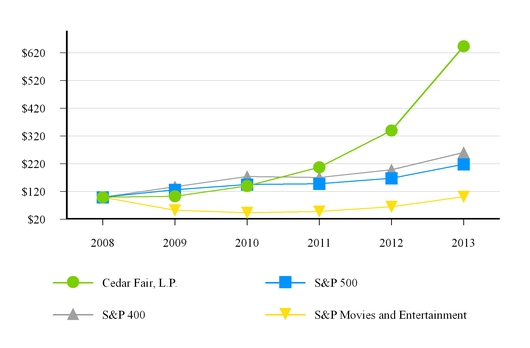
|
Base Period
|
Return
|
|||||||||||||||||||||||||
|
2008
|
2009
|
2010
|
2011
|
2012
|
2013
|
|||||||||||||||||||||
|
Cedar Fair, L.P.
|
$
|
100.00
|
|
$
|
103.48
|
|
$
|
139.82
|
|
$
|
207.82
|
|
$
|
340.32
|
|
$
|
643.57
|
|
||||||||
|
S&P 500
|
100.00
|
|
126.46
|
|
145.49
|
|
148.56
|
|
168.48
|
|
218.36
|
|
||||||||||||||
|
S&P 400
|
100.00
|
|
137.38
|
|
173.98
|
|
170.97
|
|
198.44
|
|
261.08
|
|
||||||||||||||
|
S&P Movies and Entertainment
|
100.00
|
|
52.36
|
|
43.59
|
|
48.54
|
|
65.35
|
|
101.67
|
|
||||||||||||||
13
|
2013
|
2012
(1)
|
2011
|
2010
(2)
|
2009
(3)
|
||||||||||||||||
|
(In thousands, except per unit and per capita amounts)
|
||||||||||||||||||||
|
|
||||||||||||||||||||
|
Net revenues
|
$
|
1,134,572
|
|
$
|
1,068,454
|
|
$
|
1,028,472
|
|
$
|
977,592
|
|
$
|
916,075
|
|
|||||
|
Operating income
|
301,761
|
|
233,675
|
|
227,946
|
|
151,669
|
|
183,890
|
|
||||||||||
|
Income (loss) before taxes
|
128,447
|
|
133,614
|
|
73,173
|
|
(30,382
|
)
|
48,754
|
|
||||||||||
|
Net income (loss)
|
108,204
|
|
101,857
|
|
65,296
|
|
(33,052
|
)
|
34,184
|
|
||||||||||
|
Net income (loss) per unit - basic
|
1.95
|
|
1.83
|
|
1.18
|
|
(0.60
|
)
|
0.62
|
|
||||||||||
|
Net income (loss) per unit - diluted
|
1.94
|
|
1.82
|
|
1.17
|
|
(0.60
|
)
|
0.61
|
|
||||||||||
|
Balance Sheet Data
|
||||||||||||||||||||
|
Total assets
|
$
|
2,014,627
|
|
$
|
2,019,865
|
|
$
|
2,047,168
|
|
$
|
2,065,877
|
|
$
|
2,130,932
|
|
|||||
|
Working capital (deficit)
|
27,698
|
|
2,904
|
|
(104,928
|
)
|
(98,518
|
)
|
(70,212
|
)
|
||||||||||
|
Long-term debt
|
1,520,632
|
|
1,532,180
|
|
1,556,379
|
|
1,579,703
|
|
1,626,346
|
|
||||||||||
|
Partners' equity
|
139,131
|
|
154,451
|
|
136,350
|
|
121,628
|
|
113,839
|
|
||||||||||
|
Distributions
|
||||||||||||||||||||
|
Declared per limited partner unit
|
$
|
2.58
|
|
$
|
1.60
|
|
$
|
1.00
|
|
$
|
0.25
|
|
$
|
1.23
|
|
|||||
|
Paid per limited partner unit
|
2.58
|
|
1.60
|
|
1.00
|
|
0.25
|
|
1.23
|
|
||||||||||
|
Other Data
|
||||||||||||||||||||
|
Depreciation and amortization
|
$
|
122,487
|
|
$
|
126,306
|
|
$
|
125,837
|
|
$
|
128,856
|
|
$
|
134,398
|
|
|||||
|
Adjusted EBITDA
(4)
|
425,430
|
|
390,954
|
|
374,576
|
|
359,231
|
|
316,512
|
|
||||||||||
|
Capital expenditures
|
120,488
|
|
96,232
|
|
90,190
|
|
71,706
|
|
69,136
|
|
||||||||||
|
Combined attendance
(5)
|
23,519
|
|
23,300
|
|
23,386
|
|
22,794
|
|
21,136
|
|
||||||||||
|
Combined in-park guest per capita spending
(6)
|
$
|
44.15
|
|
$
|
41.95
|
|
$
|
40.03
|
|
$
|
39.21
|
|
$
|
39.56
|
|
|||||
Notes:
|
(1)
|
Operating results for 2012 include a non-cash charge of $25.0 million for the impairment of long-lived assets at Wildwater Kingdom.
|
|
(2)
|
Operating results for 2010 include a loss on debt extinguishment of $35.3 million and a non-cash charge of $62.0 million for the impairment of long-lived assets at Great America, the majority of which were originally recorded with the PPI acquisition.
|
|
(3)
|
Operating results for 2009 include a gain of $23.1 million for the sale of excess land near Canada's Wonderland and a $4.5 million non-cash charge for the impairment of trade-names originally recorded with the PPI acquisition.
|
|
(4)
|
Adjusted EBITDA represents earnings before interest, taxes, depreciation, amortization, other non-cash items, and adjustments as defined in our current credit agreement. Adjusted EBITDA is not a measurement of operating performance computed in accordance with GAAP and should not be considered as a substitute for operating income, net income or cash flows from operating activities computed in accordance with GAAP. We believe that Adjusted EBITDA is a meaningful measure of park-level operating profitability and we use it for measuring returns on capital investments, evaluating potential acquisitions, determining awards under incentive compensation plans, and calculating compliance with certain loan covenants. Adjusted EBITDA may not be comparable to similarly titled measures of other companies. A reconciliation of net income (loss) to Adjusted EBITDA is provided below.
|
|
(5)
|
Combined attendance includes attendance figures from the eleven amusement parks and all separately gated outdoor water parks.
|
|
(6)
|
Combined in-park guest per capita spending ("per capita spending") includes all amusement park, outdoor water park, causeway tolls and parking revenues for the amusement park and water park operating seasons. Revenues from indoor water park, hotel,
campground, marina and other out-of-park operations are excluded from per capita statistics.
|
14
Reconciliation of Net Income (Loss) to Adjusted EBITDA:
|
2013
|
2012
|
2011
|
2010
|
2009
|
||||||||||||||||
|
|
(In thousands )
|
|||||||||||||||||||
|
Net income (loss)
|
$
|
108,204
|
|
$
|
101,857
|
|
$
|
65,296
|
|
$
|
(33,052
|
)
|
$
|
34,184
|
|
|||||
|
Interest expense
|
103,071
|
|
110,619
|
|
157,185
|
|
150,285
|
|
124,706
|
|
||||||||||
|
Interest income
|
(154
|
)
|
(68
|
)
|
(157
|
)
|
(1,154
|
)
|
(44
|
)
|
||||||||||
|
Provision for taxes
|
20,243
|
|
31,757
|
|
7,877
|
|
2,670
|
|
14,570
|
|
||||||||||
|
Depreciation and amortization
|
122,487
|
|
126,306
|
|
125,837
|
|
128,856
|
|
134,398
|
|
||||||||||
|
EBITDA
|
353,851
|
|
370,471
|
|
356,038
|
|
247,605
|
|
307,814
|
|
||||||||||
|
Loss on early debt extinguishment
|
34,573
|
|
—
|
|
—
|
|
35,289
|
|
—
|
|
||||||||||
|
Net effect of swaps
|
6,883
|
|
(1,492
|
)
|
(13,119
|
)
|
18,194
|
|
9,170
|
|
||||||||||
|
Unrealized foreign currency (gain) loss
|
29,085
|
|
(9,181
|
)
|
9,830
|
|
(17,464
|
)
|
—
|
|
||||||||||
|
Equity-based compensation
|
5,535
|
|
3,265
|
|
(239
|
)
|
(89
|
)
|
(26
|
)
|
||||||||||
|
Loss on impairment of goodwill and other intangibles
|
—
|
|
—
|
|
—
|
|
2,293
|
|
4,500
|
|
||||||||||
|
Loss on impairment/retirement of fixed assets, net
|
2,539
|
|
30,336
|
|
11,355
|
|
62,752
|
|
244
|
|
||||||||||
|
Gain on sale of other assets
|
(8,743
|
)
|
(6,625
|
)
|
—
|
|
—
|
|
(23,098
|
)
|
||||||||||
|
Terminated merger costs
|
—
|
|
—
|
|
230
|
|
10,375
|
|
5,619
|
|
||||||||||
|
Refinancing costs
|
—
|
|
—
|
|
955
|
|
—
|
|
832
|
|
||||||||||
|
Licensing dispute settlement costs
|
—
|
|
—
|
|
—
|
|
—
|
|
1,980
|
|
||||||||||
|
Class action settlement costs
|
—
|
|
—
|
|
—
|
|
276
|
|
9,477
|
|
||||||||||
|
Other non-recurring costs
(1)
|
1,707
|
|
4,180
|
|
9,526
|
|
—
|
|
—
|
|
||||||||||
|
Adjusted EBITDA
|
$
|
425,430
|
|
$
|
390,954
|
|
$
|
374,576
|
|
$
|
359,231
|
|
$
|
316,512
|
|
|||||
|
|
|
|
|
|
||||||||||||||||
|
(1)
|
The Company's 2010, 2011 and 2013 Credit Agreements reference certain costs as non-recurring or unusual. These items are excluded in the calculation of Adjusted EBITDA and have included litigation expenses and costs for SEC compliance matters related to Special Meeting requests, costs associated with certain unusual ride abandonment and relocation expenses, and costs associated with the transition to a new advertising agency.
|
|
ITEM 7.
|
MANAGEMENT'S DISCUSSION AND ANALYSIS OF FINANCIAL CONDITION AND RESULTS OF OPERATIONS.
|
Business Overview
We generate our revenues primarily from sales of (1) admission to our parks, (2) food, merchandise and games inside our parks, and (3) hotel rooms, food and other attractions outside our parks. Our principal costs and expenses, which include salaries and wages, advertising, maintenance, operating supplies, utilities and insurance, are relatively fixed and do not vary significantly with attendance.
Each of our properties is run by a park general manager and operates autonomously. Management reviews operating results, evaluates performance and makes operating decisions, including the allocation of resources, on a property-by-property basis.
Discrete financial information and operating results are prepared at the individual park level for use by the CEO, who is the Chief Operating Decision Maker (CODM), as well as by the Chief Financial Officer, the Chief Operating Officer, the Executive Vice President of Operations, a
nd the park general managers.
15
The following ta
ble presents certain financial data expressed as a percent of total net revenues and selective statistical information for the periods indicated.
|
For the years ended December 31,
|
2013
|
2012
|
2011
|
|||||||||||||||||||
|
( amounts in millions, except attendance, per capita spending and percentages)
|
||||||||||||||||||||||
|
Net revenues:
|
||||||||||||||||||||||
|
Admissions
|
$
|
647.0
|
|
57.0
|
%
|
$
|
612.1
|
|
57.3
|
%
|
$
|
596.0
|
|
57.9
|
%
|
|||||||
|
Food, merchandise and games
|
356.1
|
|
31.4
|
%
|
342.2
|
|
32.0
|
%
|
349.5
|
|
34.0
|
%
|
||||||||||
|
Accommodations and other
|
131.5
|
|
11.6
|
%
|
114.1
|
|
10.7
|
%
|
83.0
|
|
8.1
|
%
|
||||||||||
|
Net revenues
|
1,134.6
|
|
100.0
|
%
|
1,068.4
|
|
100.0
|
%
|
1,028.5
|
|
100.0
|
%
|
||||||||||
|
Operating costs and expenses
|
716.5
|
|
63.2
|
%
|
684.7
|
|
64.1
|
%
|
663.3
|
|
64.5
|
%
|
||||||||||
|
Depreciation and amortization
|
122.5
|
|
10.8
|
%
|
126.3
|
|
11.8
|
%
|
125.8
|
|
12.2
|
%
|
||||||||||
|
Loss on impairment / retirement of fixed assets
|
2.5
|
|
0.2
|
%
|
30.3
|
|
2.8
|
%
|
11.4
|
|
1.1
|
%
|
||||||||||
|
Gain on sale of other assets
|
(8.7
|
)
|
(0.8
|
)%
|
(6.6
|
)
|
(0.6
|
)%
|
—
|
|
—
|
%
|
||||||||||
|
Operating income
|
301.8
|
|
26.6
|
%
|
233.7
|
|
21.9
|
%
|
228.0
|
|
22.2
|
%
|
||||||||||
|
Interest and other expense, net
|
102.9
|
|
9.0
|
%
|
110.6
|
|
10.3
|
%
|
158.0
|
|
15.4
|
%
|
||||||||||
|
Net effect of swaps
|
6.9
|
|
0.6
|
%
|
(1.5
|
)
|
(0.1
|
)%
|
(13.1
|
)
|
(1.3
|
)%
|
||||||||||
|
Loss on early debt extinguishment
|
34.6
|
|
3.0
|
%
|
—
|
|
—
|
%
|
—
|
|
—
|
%
|
||||||||||
|
Unrealized / realized foreign currency (gain) loss
|
28.9
|
|
2.5
|
%
|
(9.0
|
)
|
(0.8
|
)%
|
9.9
|
|
1.0
|
%
|
||||||||||
|
Provision for taxes
|
20.3
|
|
1.8
|
%
|
31.7
|
|
3.0
|
%
|
7.9
|
|
0.8
|
%
|
||||||||||
|
Net income
|
$
|
108.2
|
|
9.5
|
%
|
$
|
101.9
|
|
9.5
|
%
|
$
|
65.3
|
|
6.3
|
%
|
|||||||
|
Other data:
|
||||||||||||||||||||||
|
Combined attendance (in thousands)
|
23,519
|
|
23,300
|
|
23,386
|
|
||||||||||||||||
|
Combined in-park guest per capita spending
|
$
|
44.15
|
|
$
|
41.95
|
|
$
|
40.03
|
|
|||||||||||||
Critical Accounting Policies
Management's Discussion and Analysis of Financial Condition and Results of Operations is based upon our consolidated financial statements, which were prepared in accordance with accounting principles generally accepted in the United States of America. These principles require us to make judgments, estimates and assumptions during the normal course of business that affect the amounts reported in the Consolidated Financial Statements and related notes. The following discussion addresses our critical accounting policies, which are those that are most important to the portrayal of our financial condition and operating results or involve a higher degree of judgment and complexity (see Note 2 to our Consolidated Financial Statements for a complete discussion of our significant accounting policies). Application of the critical accounting policies described below involves the exercise of judgment and the use of assumptions as to future uncertainties, and, as a result, actual results could differ from these estimates and assumptions.
Impairment of Long-Lived Assets
The carrying values of long-lived assets, including property and equipment, are reviewed whenever events or changes in circumstances indicate that the carrying values of the assets may not be recoverable. An impairment loss may be recognized when estimated undiscounted future cash flows expected to result from the use of the assets, including disposition, are less than the carrying value of the assets. The measurement of the impairment loss to be recognized is based on the difference between the fair value and the carrying amounts of the assets. Fair value is generally determined based on a discounted cash flow analysis. In order to determine if an asset has been impaired, assets are grouped and tested at the lowest level for which identifiable, independent cash flows are available.
The determination of both undiscounted and discounted cash flows requires management to make significant estimates and consider an anticipated course of action as of the balance sheet date. Subsequent changes in estimated undiscounted and discounted cash flows arising from changes in anticipated actions could impact the determination of whether impairment exists, the amount of the impairment charge recorded and whether the effects could materially impact the consolidated financial statements.
There was no impairment of any long-lived assets in 2013. At the end of the third quarter of 2012, we concluded based on 2012 operating results through the third quarter and updated forecasts, that a review of the carrying value of operating long-lived assets at Wildwater Kingdom was warranted. After performing our review, we determined that a portion of the park's fixed assets were impaired. Also, at the end of the third quarter of 2012, we concluded that market conditions had changed on the adjacent non-operating land of Wildwater Kingdom. After performing a review of the updated market value of the land, we determined the land was impaired. Accordingly, we recognized a total of $25.0 million of
16
fixed-asset impairment for operating and non-operating assets during the third quarter of 2012. There was no impairment of long-lived assets in 2011.
Goodwill and Other Intangible Assets
Goodwill and other
indefinite-lived intangible assets, including trade-names, are reviewed for impairment annually, or more frequently if indicators of impairment exist. A significant amount of judgment is involved in determining if an indicator of impairment has occurred. Such indicators may include, among others: a significant decline in expected future cash flows; a sustained, significant decline in equity price and market capitalization; a significant adverse change in legal factors or in the business climate; unanticipated competition; the testing for recoverability of a significant asset group within a reporting unit; and slower growth rates. Any adverse change in these factors could have a significant impact on the recoverability of these assets and could have a material impact on our consolidated financial statements.
An impairment loss may be recognized if the carrying value of the reporting unit is higher than its fair value, which is estimated using both an income (discounted cash flow) and market approach. The amount of impairment is determined by comparing the implied fair value of reporting unit goodwill to the carrying value of the goodwill in the same manner as if the reporting unit was being acquired in a business combination. If the implied fair value of goodwill is less than the recorded goodwill, an impairment charge is recorded for the difference. Goodwill and trade-names have been assigned at the reporting unit, or park level, for purposes of impairment testing.
We compl
eted the review of goodwill and other indefinite-lived intangibles as of December 31, 2013, December 31, 2012 and December 31, 2011, respectively, and determined the goodwill was not impaired at these balance sheet dates.
It is possible that our assumptions about future performance, as well as the economic outlook and related conclusions regarding the valuation of our reporting units (parks), could change adversely, which may result in additional impairment that would have a material effect on our financial position a
nd results of operations in future periods. At December 31, 2013, all reporting units with goodwill had fair values in excess of their carrying values by greater than 10%.
Self-Insurance Reserves
Reserves are recorded for the estimated amounts of guest and employee claims and expenses incurred each period that are not covered by insurance. Reserves are established for both identified claims and incurred but not reported (IBNR) claims. Such amounts are accrued for when claim amounts become probable and estimable. Reserves for identified claims are based upon our own historical claims experience and third-party estimates of settlement costs. Reserves for IBNR claims, which are not material to our consolidated financial statements, are based upon our own claims data history. All reserves are periodically reviewed for changes in facts and circumstances and adjustments are made as necessary.
Derivative Financial Instruments
Derivative financial instruments are used within our overall risk management program to manage certain interest rate and foreign currency risks. By utilizing a derivative instrument to hedge our exposure to LIBOR rate changes, we are exposed to credit risk. Credit risk is the failure of the counterparty to perform under the terms of the derivative contract. To mitigate this risk, hedging instruments are placed with a counterparty that we believe poses minimal credit risk.
We do not use derivative financial instruments for trading purposes.
Derivative financial instruments used in hedging transactions are assessed both at inception and quarterly thereafter to ensure they are effective in offsetting changes in the cash flows of the related underlying exposures. For derivative instruments that are designated and qualify as cash flow hedges, t
he effective portion of the change in fair value of the derivative instrument is reported as a component of “Other comprehensive income (loss)” and reclassified into earnings in the period during which the hedged transaction affects earnings. Changes in fair value of derivative instruments that do not qualify as effective hedging activities are reported as “Net effect of swaps” in the consolidated statement of operations. Additionally, the “Accumulated other comprehensive income (loss)” related to interest rate swaps that become ineffective is amortized over the remaining life of the interest rate swap, and reported as a component of “Net effect of swaps” in the consolidated statements of operations.
Revenue Recognition
Revenues on multi-d
ay admission tickets are recognized over the estimated number of visits expected for each type of ticket, and are adjusted periodically during the season. All other revenues are recognized on a daily basis based on actual guest spending at our facilities, or over the park operating season in the case of certain marina revenues and certain sponsorship revenues. Revenues on admission tickets for the next operating season, including season passes, are deferred in the year received and recognized as revenue in the following operating season.
Admission revenues include amounts paid to gain admission into our parks, including parking fees. Revenues related to extra-charge attractions, including our premium benefit offerings, are included in Accommodations and other revenue.
17
Income Taxes
Our legal structure includes both partnerships and corporate subsidiaries. As a publicly traded partnership, we are subject to an entity-level tax (the "PTP tax"). Accordingly, the partnership itself is not subject to corporate income taxes; rather, the partnership's tax attributes (except those of the corporate subsidiaries) are included in the tax returns of our partners. Our corporate subsidiaries are subject to entity-level income taxes. Our "Provision for taxes" includes both the PTP tax and the income taxes from the corporate subsidiaries.
Our corporate subsidiaries account for income taxes under the asset and liability method. Accordingly, deferred tax assets and liabilities are recognized for the future book and tax consequences attributable to temporary differences between the financial statement carrying amounts of existing assets and liabilities and their respective tax bases. Deferred tax assets and liabilities are determined using enacted tax rate expected to apply in the year in which those temporary differences are expected to be recovered or settled.
We record a valuation allowance if, based on the weight of available evidence, it is more likely than not that some portion, or all, of a deferred tax asset will not be realized. Through December 31, 2012, we had recorded an $11.3 million valuation allowance related to a $31.2 million deferred tax asset for foreign tax credit carryforwards. The need for this allowance was based on several factors including the ten-year carryforward period allowed for excess foreign tax credits, experience to date of foreign tax credit limitations, and management's long term estimates of domestic and foreign source income.
During 2013, we continued to utilize the foreign tax credits and updated our long term estimates of domestic and foreign source income. Based on these updated estimates, we believe no additional adjustments to the valuation allowance was warranted. As of December 31, 2013, we had $24.3 million of deferred tax assets associated with the foreign tax credit carryforwards and a $6.8 million related valuation allowance.
There is inherent uncertainty in the estimates used to project the amount of foreign tax credit carryforwards that are more likely than not to be realized. It is possible that our future income projections, as well as the economic outlook and related conclusions regarding the valuation allowance could change, which may result in additional valuation allowance being recorded or may result in additional valuation allowance reductions, which may have a material negative or positive effect on our reported financial position and results of operations in future periods.
Results of Operations
2013 vs. 2012
The following table presents key operating and financial information for the years ended December 31, 2013 and 2012 (amounts in thousands, except per capita spending and percentages):
|
|
Increase (Decrease)
|
||||||||||||||
|
|
12/31/13
|
12/31/12
|
$
|
%
|
|||||||||||
|
Net revenues
|
$
|
1,134,572
|
|
$
|
1,068,454
|
|
$
|
66,118
|
|
6.2
|
%
|
||||
|
Operating costs and expenses
|
716,528
|
|
684,762
|
|
31,766
|
|
4.6
|
%
|
|||||||
|
Depreciation and amortization
|
122,487
|
|
126,306
|
|
(3,819
|
)
|
(3.0
|
)%
|
|||||||
|
Loss on impairment/retirement of fixed assets
|
2,539
|
|
30,336
|
|
(27,797
|
)
|
N/M
|
|
|||||||
|
Gain on sale of other assets
|
(8,743
|
)
|
(6,625
|
)
|
(2,118
|
)
|
N/M
|
|
|||||||
|
Operating income
|
$
|
301,761
|
|
$
|
233,675
|
|
$
|
68,086
|
|
29.1
|
%
|
||||
|
Other Data:
|
|||||||||||||||
|
Adjusted EBITDA
(1)
|
$
|
425,430
|
|
$
|
390,954
|
|
$
|
34,476
|
|
8.8
|
%
|
||||
|
Adjusted EBITDA margin
|
37.5
|
%
|
36.6
|
%
|
—
|
|
0.9
|
%
|
|||||||
|
Attendance
|
23,519
|
|
23,300
|
|
219
|
|
0.9
|
%
|
|||||||
|
Per capita spending
|
$
|
44.15
|
|
$
|
41.95
|
|
$
|
2.20
|
|
5.2
|
%
|
||||
|
Out-of-park revenues
|
$
|
124,164
|
|
$
|
116,767
|
|
$
|
7,397
|
|
6.3
|
%
|
||||
|
N/M - Not meaningful
|
|||||||||||||||
|
(1) for additional information regarding Adjusted EBITDA, including how we define and use Adjusted EBITDA, as well as a reconciliation from net income, see Item 6, "Selected Financial Data," on pages 14-15.
|
|||||||||||||||
Con
solidated net revenues totaled
$1,134.6 million
in 2013, increasing $66.1 million, from
$1,068.5 million
in 2012. The
6%
increase in revenues reflects a
5%
, or
$2.20
, increase in average in-park guest per capita spending compared with a year ago, a 6%, or $7.4 million, increase in out-of-park revenues, and a 1%, or
0.2 million
-visit, increase in attendance. In-park guest per capita spending represents the amount spent per attendee to gain admission to a park, plus all amounts spent while inside the park gates. The increase in per capita spending was primarily due to increases in admissions pricing, strong returns from investments in our food and beverage programs, and results of premium benefit offerings.
18
Out-of-park revenues include the sale of hotel rooms, food, merchandise, and other complementary activities located outside of the park gates, as well as transaction fees from on-line product sales. The increase in out-of-park revenues was primarily driven by the strong performance of our resort properties, which drove higher average daily room rates and occupancy rates.
The 1% increase in attendance for 2013 compared to 2012 was due largely to the continued success of our season pass programs, which grew in terms of both number of passes sold and number of total visits. Excluding the sale of two of our water parks over the past two years, attendance would
have increased 2%, or approximately 0.5 million visits.
The increase in revenues for the fiscal year also reflects the negative impact of currency exchange rates from the strengthening U.S. dollar on our Canadian operations (approximately $4.1 million) during 2013.
Operating costs and expenses increased $31.7 million, or 5%, to $716.5 million versus $684.8 million for 2012. The increase in costs and expenses was the result of a $3.2 million decrease in cost of goods sold, a $20.9 million increase in operating expenses, and a $14.1 million increase in selling, general and administrative costs. As a percent of net revenues, operating expenses decreased by 61 basis points year-over-year. The 3% decrease in cost of goods sold was primarily driven by food and beverage efficiency initiatives. Operating expenses increased primarily due to higher normal operating and maintenance expenses, enhancements to park infrastructure, and increased employment related costs including performance bonuses. The increase in selling, general and administrative costs was primarily due to increases in full time labor and benefits costs including incentive compensation, and advertising agency and consumer relationship management database development costs.
The increase in expenses for the fiscal year also reflects the positive impact of currency exchange rates from the strengthening U.S. dollar on our Canadian operations (approximately $1.7 million) during 2013.
Depreciation and amortization expense decreased $3.8 million due to several significant assets being fully depreciated at the end of 2012. The $8.7 million gain on sale of other assets relates to the sale of one of our non-core water parks during the year. Loss on impairment/retirement of fixed assets in 2013 totaled $2.5 million for the retirement of assets at several of our properties. During 2012, two non-core assets were sold at a total gain of $6.6 million, which was recorded in gain on sale of other assets. Loss on impairment/retirement of fixed assets for 2012 totaled $30.3 million, which reflected a non-cash charge of $25.0 million for the partial impairment of operating and non-operating assets at Wildwater Kingdom, along with retirements at several of our properties. After depreciation, amortization, gain on sale of other assets, loss on impairment / retirement of fixed assets, and all other non-cash costs, operating income for 2013 increased $68.1 million to $301.8 million compared with operating income for 2012 of $233.7 million.
Interest expense for the year decreased $7.5 million to $103.1 million from $110.6 million in the prior year. The decrease in interest expense was due to the settlement of our Canadian cross-currency swaps in the first quarter of 2012, a decrease in non-cash amortization expense resulting from the write-off of loan fees related to our prior credit agreement, a decrease in revolver interest due to lower average borrowings and a lower effective interest rate from the March 2013 refinancing.
During 2013, the net effect of our swaps was recorded as a charge to earnings of $6.9 million compared to a benefit to earnings of $1.5 million in 2012. The difference reflects the regularly scheduled amortization of amounts in Accumulated Other Comprehensive Income ("AOCI") and the write-off
of amounts related to de-designated swaps, which were partially offset by gains from marking the ineffective and de-designated swaps to market during the year. During 2013, we also recognized a $28.9 million charge to earnings for unrealized/realized foreign currency losses, which included a $29.1 million unrealized foreign currency loss on the U.S.-dollar denominated debt held at our Canadian property. Additiona
lly, due to our March 2013 refinancing, loan fees related to our 2010 and 2011 financings were written off, resulting in a $34.6 million charge to earnings in the current year-to-date period.
A provision for taxes of $20.2 million was recorded in 2013, consisting of a provision for income taxes of $10.6 million and a provision for PTP taxes of $9.6 million. This compares with a provision for taxes of $31.7 million in 2012, consisting of a provision for income taxes of $23.0 million and a provision for PTP taxes of $8.8 million. The change in provision for income taxes was primarily due to the impact of currency exchange rates on pre-tax income.
After interest expense and provision for taxes, net income for 2013 totaled $108.2 million, or $1.94 per diluted limited partner unit, compared with net income of $101.9 million, or $1.82 per unit, a year ago.
We believe Adjusted EBITDA is a meaningful measure of our operating results (for additional information regarding Adjusted EBITDA, including how we define and use Adjusted EBITDA, as well as a reconciliation from net income, see Note 6 in Item 6, “Selected Financial Data,” on pages 14-15). In 2013, Adjusted EBITDA increased $34.5 million, or 9%, to $425.4 million, with our Adjusted EBITDA margin (Adjusted EBITDA divided by net revenues) increasing 90 bps to 37.5% from 36.6% in 2012. The increase in Adjusted EBITDA was primarily due to the success of high-margin revenue initiatives during the year, such as growth in our premium-benefit offerings and our admission pricing, combined with another year of growth in our season pass base and a continued focus on controlling operating costs at the park level.
19
Results of Operations
2012 vs. 2011
The following table presents key operating and financial information for the years ended December 31, 2012 and 2011 (amounts in thousands, except per capita spending and percentages):
|
|
Increase (Decrease)
|
||||||||||||||
|
|
12/31/12
|
12/31/11
|
$
|
%
|
|||||||||||
|
Net revenues
|
$
|
1,068,454
|
|
$
|
1,028,472
|
|
$
|
39,982
|
|
3.9
|
%
|
||||
|
Operating costs and expenses
|
684,762
|
|
663,334
|
|
21,428
|
|
3.2
|
%
|
|||||||
|
Depreciation and amortization
|
126,306
|
|
125,837
|
|
469
|
|
0.4
|
%
|
|||||||
|
Loss on impairment/retirement of fixed assets
|
30,336
|
|
11,355
|
|
18,981
|
|
N/M
|
|
|||||||
|
Gain on sale of other assets
|
(6,625
|
)
|
—
|
|
(6,625
|
)
|
N/M
|
|
|||||||
|
Operating income
|
$
|
233,675
|
|
$
|
227,946
|
|
$
|
5,729
|
|
2.5
|
%
|
||||
|
Other Data:
|
|||||||||||||||
|
Adjusted EBITDA
(1)
|
$
|
390,954
|
|
$
|
374,576
|
|
$
|
16,378
|
|
4.4
|
%
|
||||
|
Adjusted EBITDA margin
|
36.6
|
%
|
36.4
|
%
|
—
|
|
0.2
|
%
|
|||||||
|
Attendance
|
23,300
|
|
23,386
|
|
(86
|
)
|
(0.4
|
)%
|
|||||||
|
Per capita spending
|
$
|
41.95
|
|
$
|
40.03
|
|
$
|
1.92
|
|
4.8
|
%
|
||||
|
Out-of-park revenues
|
$
|
116,767
|
|
$
|
117,556
|
|
$
|
(789
|
)
|
(0.7
|
)%
|
||||
|
N/M - Not meaningful
|
|||||||||||||||
|
(1) for additional information regarding Adjusted EBITDA, including how we define and use Adjusted EBITDA, as well as a reconciliation from net income, see Item 6, "Selected Financial Data," on pages 14-15.
|
|||||||||||||||
Consolidated net revenues totaled $1,068.5 million in 2012, increasing $40.0 million, from
$1,028.5 million
in 2011. The
4%
increase in revenues reflects a
5%
, or
$1.92
, increase in average in-park guest per capita spending compared with a year ago and a less than 1%, or
0.1 million
visit, decrease in attendance. In-park guest per capita spending represents the amount spent per attendee to gain admission to a park, plus all amounts spent while inside the park gates. The increase in per capita spending was primarily due to new premium benefit offerings and the positive impact of new customer messaging and dynamic pricing. The slight decrease in attendance for 2012 compared to 2011 was largely due to less than favorable weather that the parks experienced during the fourth quarter of 2012. Despite the slight decrease in overall attendance, the parks experienced growth in the number of season passes sold, as well as season pass visits, which was a focus of management heading into the 2012 season. The growth in season-pass visits was the result of an increased marketing focus toward season passes at several of our parks, resulting in a record number of season passes sold in 2012.
The increase in 2012 revenues was somewhat offset by a decrease of less than
1%
, or approximately $0.8 million, in out-of-park revenues, which represents the sale of hotel rooms, food, merchandise and other complementary activities located outside of the park gates. The decrease in out-of-park revenues was primarily driven by softness in our overall hotel properties performance in 2012. The increase in revenues for 2012 also reflects the negative impact of currency exchange rates and the weakening U.S. dollar on our Canadian operations (approximately $4.0 million) during 2012.
Operating costs and expenses increased $21.4 million, or 3%, to $684.7 million versus $663.3 million for 2011 and were in line with expectations. The increase in costs and expenses was the result of a $3.0 million increase in cost of goods sold, a $20.5 million increase in operating expenses, offset somewhat by a $2.1 decrease in selling, general and administrative costs. The 3% increase in cost of goods sold is consistent with anticipated cost increases associated with our efforts to improve the quality of food and other product offerings at the parks in 2012. Operating expenses increased due to several factors, including higher employment-related costs, higher operating supply costs, and higher self-insurance expenses. Employment-related costs increased approximately $11.0 million due to normal merit increases, increases in health-related benefit costs, additional staffing levels associated with new premium benefit offerings and other initiatives aimed at improving the overall guest experience, and non-recurring severance payments. Operating supplies and expenses increased approximately $4.6 million due primarily to initiatives to expand or enhance live entertainment at the parks, as well as incremental costs associated with our new e-commerce platform. During the year, public liability and workers compensation expense increased $3.3 million due to claim settlements and an increase in our reserves based on management's estimates of future claims. The decrease in selling, general and administrative costs was due to a decrease in employment-related costs ($1.5 million) and professional and administrative costs ($7.6 million), offset by an increase in operating supplies ($4.8 million) and advertising fees ($2.4 million). The decrease in employment costs was primarily due to a decrease in costs associated with a legal accrual made in 2011, offset somewhat by higher wages and benefits due to normal merit increases and additional staffing. Professional and administrative fees decreased primarily due to a reduction in litigation expenses and costs for SEC compliance matters related to Special Meeting requests in 2011. The operating supplies and advertising increases were due to incremental costs to support 2012 operating initiatives including general
20
infrastructure improvements. The overall increase in costs and expenses also reflects the positive impact of exchange rates on our Canadian operations ($1.3 million) during 2012.
The loss on impairment/retirement of fixed assets, net, during 2012 totaled $30.3 million, reflects a non-cash charge of $25.0 million for the partial impairment of operating and non-operating assets at Wildwater Kingdom along with losses on other retirements in the normal course of business. During 2012, two non-core assets were sold at gains totaling $6.6 million. In 2011, a charge of $11.4 million for the retirement of fixed assets, which included the retirement of a composite asset.
Depreciation and amortization expense for 2012 increased $0.5 million compared with 2011 due to the increase in capital spending in 2012 when compared with the prior year. After depreciation and amortization, as well as impairment charges and all other non-cash costs, operating income for 2012 increased $5.7 million to $233.7 million from $227.9 million in 2011.
Interest expense for the year decreased $46.6 million to $110.6 million from $157.2 million in 2011. The reduction in interest expense was primarily attributable to an approximate 300 basis point (bps) decline in our effective interest rate, the result of lower fixed rates on London InterBank Offered Rate (LIBOR) within our interest-rate swap contracts. The average fixed LIBOR rate in our swap agreements declined from 5.62% in 2011 to 2.48% in 2012. Additionally during 2012, $25.0 million of term debt principal payments were made, reducing our average debt
outstanding.
During 2012, the net effect of our swaps was recorded as a benefit to earnings of $1.5 million compared to a benefit to earnings of $13.1 million in 2011. T
he difference reflects the regularly scheduled amortization of amounts in AOCI related to the swaps, which were offset by gains from marking the ineffective and de-designated swaps to market and foreign currency gains related to the U.S.-dollar denominated Canadian term loan in the current period. During 2012, we also recognized a $9.0 million net benefit to earnings for unrealized/realized foreign currency gains, which included a $9.2 million unrealized foreign currency gain on the U.S.-dollar denominated debt held at our Canadian property.
A provision for taxes of $31.7 million was recorded in 2012, consisting of a provision for the tax attributes of our corporate subsidiaries of $23.0 million and a provision for PTP taxes of $8.8 million. This compares with a provision for taxes of $7.9 million in 2011, consisting of a benefit for the tax attributes of our corporate subsidiaries of $0.4 million and a provision for PTP taxes of $8.3 million.
After interest expense and provision for taxes, net income for the period totaled $101.9 million, or $1.82 per diluted limited partner unit, compared wit
h net income of $65.3 million, or $1.17 per unit, a year ago.
In 2012, Adjusted EBITDA (for additional information regarding Adjusted EBITDA, including how we define and use Adjusted EBITDA, as well as a reconciliation from net income, see Note 6 in Item 6, “Selected Financial Data,” on pages 14-15) increased $16.4 million, or 4%, to $391.0 million, with our Adjusted EBITDA margin (Adjusted EBITDA divided by net revenues) increasing 20 bps to 36.6% from 36.4% in 2011. The increase in Adjusted EBITDA was due to the increase in revenues resulting from the successful introduction of our new premium benefit offerings and dynamic pricing initiatives, as well as the successful expansion of our season pass base.
Financial Condition
With respect to both liquidity and cash flow, we ended 2013 in sound condition. The working capital ratio (current assets divided by current liabilities) of 1.2 at December 31, 2013 compares to the working capital ratio of 1.0 at December 31, 2012. Receivables and inventories are at nor
mally low seasonal levels and cash and credit facilities are in place to fund current liabilities, capital expenditures, partnership distributions, and pre-opening expenses as required.
Operating Activities
Net cash from operating activities in 2013 increased $38.5 million to $324.4 million from $285.9 million in 2012. The increase in operating cash flows between years was primarily attributable to the increase in the operating results of our parks in 2013 over 2012 and a positive change in working capital.
Net cash from operating activities in 2012 increased $67.7 million to $285.9 million from $218.2 million in 2011. The increase in operating cash flows between years was primarily attributable to the increase in the operating results of our parks in 2012 over 2011 and deferred taxes, somewhat offset by a negative change in working capital.
Investing Activities
Investing activities consist principally of capital investments we make in our parks and resort properties. During 2013, we sold a non-core asset and received net proceeds of $15.3 million. Total cash spent on capital expenditures during 2013 totaled $120.4 million as we continued to reinvest in our properties and expand our capital program. During 2012, we sold two non-core assets and received net proceeds of $16.0 million. Total cash spent on capital expenditures was $96.2 million in 2012. Including the effect of the two asset sales, net cash used for investing activities in 2012 totaled $80.2 million, compared to $90.2 million in 2011.
Historically, we have been able to improve our revenues and profitability by continuing to make substantial capital investments in our park and resort facilities. This has enabled us to maintain or increase attendance levels, as well as to generate increases in guest per capita spending and
21
revenues from guest accommodations. For the 2014 operating season, we will be investing approximately 9% of net revenues in marketable capital investments across our properties, with the highlights of the 2014 program being the addition of Banshee, the world's longest inverted coaster, at Kings Island, and the introduction of Wonder Mountain's Guardian, a 4-D interactive dark ride, at Canada's Wonderland.
In addition to these new thrill rides, we are also investing in other capital improvements across our parks, including the upgrading of the Camp Snoopy childrens' area at Knott's Berry Farm, the addition of new water slides at Dorney Park, and the additions of new family rides at Cedar Point and Valleyfair. We will also be enhancing entertainment offerings and continuing our infrastructure upgrades across our properties.
Financing Activities
Net cash utilized for financing activities in 2013 totaled $178.3 million, compared with $163.0 million in 2012 and $100.7 million in 2011. An increase in distribution payments in 2013 ($143.5 million versus $88.8 million in 2012) and $23.5 million of loan issuance costs paid in 2013 for the March 2013 refinancing
were somewhat offset by the 2012 cash settlement of a Canadian cross currency derivative contract in the first quarter of 2012. Net cash utilized for financing activities in 2012 totaled $163.0 million, compared with $100.7 million in 2011. An increase in distribution payments in 2012 ($88.8 million vs. $55.3 million in 2011) and the settlement of a Canadian cross-currency derivative contract in the first quarter of 2012 ($50.5 million) were somewhat offset by an increase in cash from operating activities.
Liquidity and Capital Resources
In July 2010, we issued $405 million of 9.125% senior unsecured notes, maturing in 2018, in a private placement, including $5.6 million of Original Issue Discount (OID) to yield 9.375%. The $405 million senior unsecured notes require semi-annual interest payments in February and August, with the principal due in full on August 1, 2018. The notes may be redeemed, in whole or in part, at any time prior to August 1, 2014 at a price equal to 100% of the principal amount of the notes redeemed plus a “make-whole” premium together with accrued and unpaid interest, if any, to the redemption date. Thereafter, the notes may be redeemed, in whole or in part, at various prices depending on the date redeemed.
In March 2013, we issued
$500 million
of
5.25%
senior unsecured notes, maturing in 2021, in a private placement, with no OID. Our
$500 million
of senior unsecured notes pay interest semi-annually in March and September, with the principal due in full on
March 15, 2021
. The notes may be redeemed, in whole or in part, at any time prior to
March 15, 2016
at a price equal to
100%
of the principal amount of the notes redeemed plus a “make-whole” premium together with accrued and unpaid interest, if any, to the redemption date. Thereafter, the notes may be redeemed, in whole or in part, at various prices depending on the date redeemed. Prior to
March 15, 2016
, up to
35%
of the notes may be redeemed with the net cash proceeds of certain equity offerings at
105.25%
.
Concurrently with the March 2013 offering, we entered into a new
$885 million
credit agreement (the "2013 Credit Agreement"), which included a
$630 million
senior secured term loan facility and a
$255 million
senior secured revolving credit facility. The net proceeds from the notes issued in March 2013 and borrowings in connection with entering the 2013 Credit Agreement were used to repay in full all amounts outstanding under our previous credit facilities. The facilities provided under the 2013 Credit Agreement are collateralized by substantially all of the assets of the Partnership. The Partnership has historically used LIBOR as its rate for its borrowings. The terms of the senior secured term loan facility include a maturity date of March 15, 2020 and an interest rate of LIBOR plus
250
bps with a LIBOR floor of
75
bps. The term loan amortizes at
$6.3 million
annually.
Terms of the 2013 Credit Agreement include a revolving credit facility of a combined
$255 million
. The Canadian portion of the revolving credit facility has a limit of
$15 million
. U.S. denominated and Canadian denominated loans made under the revolving credit facility bear interest at a rate of LIBOR plus
225
bps (with no LIBOR floor). The revolving credit facility is scheduled to mature in March 2018 and also provides for the issuance of documentary and standby letters of credit. The 2013 Credit Agreement requires the Partnership to pay a commitment fee of
38
bps per annum on the unused portion of the credit facilities.
At
December 31, 2013
, we had $618.9 million of variable-rate term debt, $901.8 million of outstanding fixed-rate notes, and no borrowings outstanding under our revolving credit facility. After letters of credit, which totaled $16.3 million at
December 31, 2013
, we had $238.7 million of available borrowings u
nder our revolving credit facility. The maximum outstanding balance under our revolving credit facility during 2013 was $123.0 million. During the fourth quarter of 2013,
$8.0 million
of term debt was prepaid, resulting in no amortized amounts due until the first quarter of 2015.
We have entered into several interest rate swaps that effectively fix all of our variable rate debt payments. As of December 31, 2013, we have $800 million of variable-rate debt to fixed rates swaps that mature in December 2015 and fix LIBOR at a weighted average rate of 2.38%. These swaps have been de-designated as cash flow hedges. During the third quarter and fourth quarter of 2013, we entered into four forward-starting interest rate swap agreements that will effectively convert $500 million of variable-rate debt to fixed rates beginning in December of 2015. These swaps, which were designated as cash flow hedges, mature on December 31, 2018 and fix LIBOR at a weighted average rate of 2.94%.
In comparison, at December 31, 2012 we had $1,131.1 million of variable-rate term debt outstanding under our previous credit agreement (none of which was scheduled to mature during 2013), $401.1 million in outstanding fixed-rate notes, and no borrowings outstanding under our previous revolving credit facility. After letters of credit, which totaled $16.4 million at December 31, 2012, we had $243.6 million of available borrowings under our revolving credit facility at the end of 2012. After considering the impact of interest rate swap agreements in effect at the time, at December 31, 2012, approximately $1.2 billion of our outstanding long-term debt represented fixed-rate debt and approximately $331.1 million
22
represented variable-rate debt. Additional detail regarding our current and historical swap arrangements is provided in Note 6 to our Consolidated Financial Statements.
The fair market value of our swap portfolio was a liability of
$26.7 million
at
December 31, 2013
and a liability of $32.2 million at December 31, 2012, and w
as recorded in "Derivative Liability" on the consolidated balance sheet. Additional detail regarding our current and historical swap arrangements is provided in Note 6 to our Consolidated Financial Statements.
The 2013 Credit Agreement requires us to maintain specified financial ratios, which if breached for any reason and not cured, could result in an event of default under the agreement. The most critical of these ratios is the Consolidated Leverage Ratio, which is measured on a trailing-twelve-month quarterly basis. At the end of the fourth quarter of 2013, this ratio was set at 6.25x consolidated total debt (excluding the revolving debt)-to-consolidated EBITDA. The ratio will remain at that level through the end of the first quarter in 2014 and will decrease by 0.25x each second quarter beginning in the second quarter of 2014 until it reaches 5.25x. As of
December 31, 2013
, our Consolidated Leverage Ratio was 3.59x, providing $180.1 million of EBITDA cushion on the ratio at the end of the fourth quarter. We were in compliance with all other covenants under the 2013 Credit Agreement as of
December 31, 2013
.
The 2013 Credit Agreement allows restricted payments of up to $60 million annually so long as no default or event of default has occurred and is continuing. Additional restricted payments are allowed to be made based on an excess-cash-flow formula, should our pro-forma Consolidated Leverage Ratio be less than or equal to 5.0x, measured on a trailing-twelve-month quarterly basis.
The indentures governing our notes also include annual restricted payment limitations and additional permitted payment formulas. The restricted payment provisions applicable to our 2018 notes are more restrictive than those that apply to our 2021 notes. Under the more restrictive indenture covenants, we can make restricted payments of $20 million annually so long as no default or event of default has occurred and is continuing. Our ability to make additional restricted payments in 2013 and beyond is permitted should our pro-forma trailing-twelve-month Total-Indebtedness-to-Consolidated-Cash-Flow Ratio be less than or equal to 4.75x.
In accordance with these debt provisions, on November 7, 2013, we announced the declaration of a distribution of $0.70 per limited partner unit, which was paid on December 16, 2013, and on February 26, 2014 we announced the declaration of a distribution of $0.70 per limited partner unit, payable March 25, 2014.
Existing credit facilities and cash flows from operations are expected to be sufficient to meet working capital needs, debt service, partnership distributions and planned capital expenditures for the foreseeable future.
Contractual Obligations
The following table summarizes certain obligations (on an undiscounted basis) at
December 31, 2013
(in millions):
|
Payments Due by Period
|
|||||||||||||||||||
|
2019 -
|
|||||||||||||||||||
|
Total
|
2014
|
2015-2016
|
2017-2018
|
Thereafter
|
|||||||||||||||
|
|
|
||||||||||||||||||
|
Long-term debt
(1)
|
$
|
2,103.2
|
|
$
|
102.7
|
|
$
|
209.8
|
|
$
|
606.8
|
|
$
|
1,183.9
|
|
||||
|
Capital expenditures
(2)
|
76.5
|
|
68.2
|
|
8.3
|
|
—
|
|
—
|
|
|||||||||
|
Lease & other obligations
(3)
|
169.4
|
|
21.6
|
|
18.7
|
|
15.7
|
|
113.4
|
|
|||||||||
|
Total
|
$
|
2,349.1
|
|
$
|
192.5
|
|
$
|
236.8
|
|
$
|
622.5
|
|
$
|
1,297.3
|
|
||||
|
(1)
|
Represents maturities and mandatory prepayments on long-term debt obligations, fixed interest on senior notes, variable interest on term debt assuming current LIBOR interest rates, and the impact of our various derivative contracts. See Note 5 in “Notes to Consolidated Financial Statements” for further information.
|
|
(2)
|
Represents contractual obligations in place at year-end for the purchase of new rides and attractions. Obligations not denominated in U.S. dollars have been converted based on the currency exchange rates as of
December 31, 2013
.
|
|
(3)
|
Represents contractual lease and purchase obligations in place at year-end.
|
Off-Ba
lance Sheet Arrangements
We had
$16.3 million
of letters of credit, which are primarily in place to backstop insurance arrangements, outstanding on our revolving credit facility as of
December 31, 2013
. We have no other significant off-balance sheet financing arrangements.
23
Quantitative and Qualitative Disclosures about Market Risk
We are exposed to market risks from fluctuations in interest rates, and to a lesser extent on currency exchange rates on our operations in Canada and, from time to time, on imported rides and equipment. The objective of our financial risk management is to reduce the potential negative impact of interest rate and foreign currency exchange rate fluctuations to acceptable levels. We do not acquire market risk sensitive instruments for trading purposes.
We manage interest rate risk through the use of a combination of fixed-rate long-term debt and interest rate swaps to fix some or all of our variable-rate long-term debt. Translation exposures with regard to our Canadian operations are not hedged.
For derivative instruments that are designated and qualify as cash flow hedges, the effective portion of the change in fair value of the derivative instrument is reported as a component of “Other comprehensive income (loss)” and reclassified into earnings in the period during which the hedged transaction affects earnings. Changes in fair value of derivative instruments that do not qualify as effective hedging activities are reported as “Net effect of swaps” in the consolidated statement of operations. Additionally, the “Other comprehensive income (loss)” related to interest rate swaps that become ineffective is amortized over the remaining life of the interest rate swap, and reported as a component of “Net effect of swaps” in the consolidated statement of operations.
After considering the impact of interest rate swap agreements, at
December 31, 2013
, virtually all of our outstanding long-term debt represents fixed-rate debt. Assuming an average balance on our revolving credit borrowings of approximately $31 million, a hypothetical 100 bps increase in 30-day LIBOR on our variable-rate debt would lead to an essentially flat annual cash interest costs due to the impact of our fixed-rate swap agreements.
Assuming a hypothetical 100 bps increase in 30-day LIBOR, the amount of net cash interest paid on our derivative portfolio would decrease by $4.3 million over the next year.
A uniform 10% strengthening of the U.S. dollar relative to the Canadian dollar would result in a $3.7 million decrease in annual operating income.
Impact of Inflation
Substantial increases in costs and expenses could impact our operating results to the extent such increases could not be passed along to our guests. In particular, increases in labor, supplies, taxes, and utility expenses could have an impact on our operating results. The majority of our employees are seasonal and are paid hourly rates which are consistent with federal and state minimum wage laws. Historically, we have been able to pass along cost increases to guests through increases in admission, food, merchandise and other prices, and we believe that we will continue to have the ability to do so over the long term. We believe that the effects of inflation, if any, on our operating results and financial condition have been and will continue to be minor.
Fo
rward Looking Statements
Some of the statements contained in this report (including the “Management's Discussion and Analysis of Financial Condition and Results of Operations” section) that are not historical in nature are forward-looking statements within the meaning of Section 27A of the Securities Act of 1933 and Section 21E of the Securities and Exchange Act of 1934, including statements as to our expectations, beliefs and strategies regarding the future. These forward-looking statements may involve risks and uncertainties that are difficult to predict, may be beyond our control and could cause actual results to differ materially from those described in such statements. Although we believe that the expectations reflected in such forward-looking statements are reasonable, we can give no assurance that such expectations will prove to be correct. Important factors, including those listed under Item 1A in this Form 10-K could adversely affect our future financial performance and cause actual results, or our beliefs or strategies, to differ materially from our expectations. We do not undertake any obligation to publicly update or revise any forward-looking statements to reflect future events, information or circumstances that arise after the filing date of this document.
ITEM
7A. QUANTITATIVE AND QUALITATIVE DISCLOSURES ABOUT MARKET RISK.
The information appearing under the subheading “Quantitative and Qualitative Disclosures About Market Risk” under the heading “Management's Discussion and Analysis of Financial Condition and Results of Operations” on page 24 of this Report is incorporated herein by reference.
24
Quarterly operating results for 2013 and 2012 are presented in the table below (in thousands, except per unit amounts):
|
Net income
|
Net income
|
|||||||||||||||||||
|
(loss) per
|
(loss) per
|
|||||||||||||||||||
|
Operating income
|
Net income
|
limited partner
|
limited partner
|
|||||||||||||||||
|
(Unaudited)
|
Net revenues
|
(loss)
|
(loss)
|
unit-basic
|
unit-diluted
|
|||||||||||||||
|
2013
|
||||||||||||||||||||
|
1st Quarter
(1)
|
$
|
41,799
|
|
$
|
(66,320
|
)
|
$
|
(109,126
|
)
|
$
|
(1.95
|
)
|
$
|
(1.95
|
)
|
|||||
|
2nd Quarter
|
361,620
|
|
97,455
|
|
47,390
|
|
0.85
|
|
0.85
|
|
||||||||||
|
3rd Quarter
|
592,076
|
|
266,723
|
|
190,424
|
|
3.43
|
|
3.41
|
|
||||||||||
|
4th Quarter
|
139,077
|
|
3,903
|
|
(20,484
|
)
|
(0.37
|
)
|
(0.37
|
)
|
||||||||||
|
$
|
1,134,572
|
|
$
|
301,761
|
|
$
|
108,204
|
|
$
|
1.95
|
|
$
|
1.94
|
|
||||||
|
2012
|
||||||||||||||||||||
|
1st Quarter
|
$
|
28,198
|
|
$
|
(69,329
|
)
|
$
|
(65,415
|
)
|
$
|
(1.18
|
)
|
$
|
(1.18
|
)
|
|||||
|
2nd Quarter
|
357,606
|
|
87,326
|
|
36,583
|
|
0.65
|
|
0.65
|
|
||||||||||
|
3rd Quarter
(2)
|
553,445
|
|
204,565
|
|
141,013
|
|
2.54
|
|
2.52
|
|
||||||||||
|
4th Quarter
|
129,205
|
|
11,113
|
|
(10,324
|
)
|
(0.19
|
)
|
(0.19
|
)
|
||||||||||
|
$
|
1,068,454
|
|
$
|
233,675
|
|
$
|
101,857
|
|
$
|
1.83
|
|
$
|
1.82
|
|
||||||
(1) The first quarter of 2013 included a non-cash charge of $34.6 million for the loss on early extinguishment of debt due to the March 2013 refinancing.
(2) The third quarter of 2012 included a non-cash charge of $25 million for the impairment of long-lived assets at Wildwater Kingdom.
|
Note:
|
To assure that our highly seasonal operations will not result in misleading comparisons of interim periods, the Partnership has adopted the following reporting procedures: (a) seasonal operating costs are expensed over the operating season, including some costs incurred prior to the season, which are deferred and amortized over the season, and (b) all other costs are expensed as incurred or ratably over the entire year.
|
25
REPORT OF INDEPENDENT REGISTERED PUBLIC ACCOUNTING FIRM
To the Board of Directors and Unitholders of Cedar Fair, L.P.
Sandusky, Ohio
We have audited the accompanying consolidated balance sheets of Cedar Fair, L.P. and subsidiaries (the "Partnership") as of December 31, 2013 and 2012, and the related consolidated statements of operations and comprehensive income, partners' equity, and cash flows for each of the three years in the period ended December 31, 2013. These financial statements are the responsibility of the Partnership's management. Our responsibility is to express an opinion on these financial statements based on our audits.
We conducted our audits in accordance with the standards of the Public Company Accounting Oversight Board (United States). Those standards require that we plan and perform the audit to obtain reasonable assurance about whether the financial statements are free of material misstatement. An audit includes examining, on a test basis, evidence supporting the amounts and disclosures in the financial statements. An audit also includes assessing the accounting principles used and significant estimates made by management, as well as evaluating the overall financial statement presentation. We believe that our audits provide a reasonable basis for our opinion.
In our opinion, such consolidated financial statements present fairly, in all material respects, the financial position of Cedar Fair, L.P. and subsidiaries as of December 31, 2013 and 2012, and the results of their operations and their cash flows for each of the three years in the period ended December 31, 2013, in conformity with accounting principles generally accepted in the United States of America.
We have also audited, in accordance with the standards of the Public Company Accounting Oversight Board (United States), the Partnership's internal control over financial reporting as of December 31, 2013, based on the criteria established in
Internal Control - Integrated Framework
(1992) issued by the Committee of Sponsoring Organizations of the Treadway Commission and our report dated February 26, 2014 expressed an unqualified opinion on the Partnership's internal control over financial reporting.
/s/ DELOITTE & TOUCHE LLP
Cleveland, Ohio
February 26, 2014
26
CEDAR FAIR, L.P.
(In thousands)
|
|
12/31/2013
|
12/31/2012
|
||||||
|
ASSETS
|
||||||||
|
Current Assets:
|
||||||||
|
Cash and cash equivalents
|
$
|
118,056
|
|
$
|
78,830
|
|
||
|
Receivables
|
21,333
|
|
18,192
|
|
||||
|
Inventories
|
26,080
|
|
27,840
|
|
||||
|
Current deferred tax asset
|
9,675
|
|
8,184
|
|
||||
|
Other current assets
|
11,353
|
|
8,060
|
|
||||
|
186,497
|
|
141,106
|
|
|||||
|
Property and Equipment:
|
||||||||
|
Land
|
283,313
|
|
303,348
|
|
||||
|
Land improvements
|
350,869
|
|
339,081
|
|
||||
|
Buildings
|
584,659
|
|
584,854
|
|
||||
|
Rides and equipment
|
1,494,112
|
|
1,450,231
|
|
||||
|
Construction in progress
|
44,550
|
|
28,971
|
|
||||
|
2,757,503
|
|
2,706,485
|
|
|||||
|
Less accumulated depreciation
|
(1,251,740
|
)
|
(1,162,213
|
)
|
||||
|
1,505,763
|
|
1,544,272
|
|
|||||
|
Goodwill
|
238,089
|
|
246,221
|
|
||||
|
Other Intangibles, net
|
39,471
|
|
40,652
|
|
||||
|
Other Assets
|
44,807
|
|
47,614
|
|
||||
|
$
|
2,014,627
|
|
$
|
2,019,865
|
|
|||
|
LIABILITIES AND PARTNERS’ EQUITY
|
||||||||
|
Current Liabilities:
|
||||||||
|
Accounts payable
|
$
|
13,222
|
|
$
|
10,734
|
|
||
|
Deferred revenue
|
44,521
|
|
39,485
|
|
||||
|
Accrued interest
|
23,201
|
|
15,512
|
|
||||
|
Accrued taxes
|
19,481
|
|
17,813
|
|
||||
|
Accrued salaries, wages and benefits
|
29,200
|
|
24,836
|
|
||||
|
Self-insurance reserves
|
23,653
|
|
23,906
|
|
||||
|
Other accrued liabilities
|
5,521
|
|
5,916
|
|
||||
|
158,799
|
|
138,202
|
|
|||||
|
Deferred Tax Liability
|
158,113
|
|
153,792
|
|
||||
|
Derivative Liability
|
26,662
|
|
32,260
|
|
||||
|
Other Liabilities
|
11,290
|
|
8,980
|
|
||||
|
Long-Term Debt:
|
||||||||
|
Term debt
|
618,850
|
|
1,131,100
|
|
||||
|
Notes
|
901,782
|
|
401,080
|
|
||||
|
1,520,632
|
|
1,532,180
|
|
|||||
|
Commitments and Contingencies (Note 10)
|
|
|
||||||
|
Partners’ Equity:
|
||||||||
|
Special L.P. interests
|
5,290
|
|
5,290
|
|
||||
|
General partner
|
2
|
|
1
|
|
||||
|
Limited partners, 55,716, and 55,618 units outstanding at December 31, 2013 and December 31, 2012, respectively
|
148,847
|
|
177,660
|
|
||||
|
Accumulated other comprehensive loss
|
(15,008
|
)
|
(28,500
|
)
|
||||
|
139,131
|
|
154,451
|
|
|||||
|
$
|
2,014,627
|
|
$
|
2,019,865
|
|
|||
The accompanying Notes to Consolidated Financial Statements are an integral part of these statements.
27
CEDAR FAIR, L.P.
CONSOLIDATED STATEMENTS OF OPERATIONS AND COMPREHENSIVE INCOME
(In thousands, except per unit amounts)
|
For the years ended December 31,
|
2013
|
2012
|
2011
|
|||||||||
|
Net revenues:
|
||||||||||||
|
Admissions
|
$
|
647,007
|
|
$
|
612,069
|
|
$
|
596,042
|
|
|||
|
Food, merchandise and games
|
356,105
|
|
342,214
|
|
349,436
|
|
||||||
|
Accommodations and other
|
131,460
|
|
114,171
|
|
82,994
|
|
||||||
|
1,134,572
|
|
1,068,454
|
|
1,028,472
|
|
|||||||
|
Costs and expenses:
|
|
|||||||||||
|
Cost of food, merchandise and games revenues
|
91,772
|
|
95,048
|
|
92,057
|
|
||||||
|
Operating expenses
|
472,344
|
|
451,403
|
|
430,851
|
|
||||||
|
Selling, general and administrative
|
152,412
|
|
138,311
|
|
140,426
|
|
||||||
|
Depreciation and amortization
|
122,487
|
|
126,306
|
|
125,837
|
|
||||||
|
Loss on impairment / retirement of fixed assets, net
|
2,539
|
|
30,336
|
|
11,355
|
|
||||||
|
Gain on sale of other assets
|
(8,743
|
)
|
(6,625
|
)
|
—
|
|
||||||
|
832,811
|
|
834,779
|
|
800,526
|
|
|||||||
|
Operating income
|
301,761
|
|
233,675
|
|
227,946
|
|
||||||
|
Interest expense
|
103,071
|
|
110,619
|
|
157,185
|
|
||||||
|
Net effect of swaps
|
6,883
|
|
(1,492
|
)
|
(13,119
|
)
|
||||||
|
Loss on early debt extinguishment
|
34,573
|
|
—
|
|
—
|
|
||||||
|
Unrealized/realized foreign currency (gain) loss
|
28,941
|
|
(8,998
|
)
|
9,909
|
|
||||||
|
Other (income) expense
|
(154
|
)
|
(68
|
)
|
798
|
|
||||||
|
Income before taxes
|
128,447
|
|
133,614
|
|
73,173
|
|
||||||
|
Provision for taxes
|
20,243
|
|
31,757
|
|
7,877
|
|
||||||
|
Net income
|
108,204
|
|
101,857
|
|
65,296
|
|
||||||
|
Net income allocated to general partner
|
1
|
|
1
|
|
1
|
|
||||||
|
Net income allocated to limited partners
|
$
|
108,203
|
|
$
|
101,856
|
|
$
|
65,295
|
|
|||
|
Net income
|
$
|
108,204
|
|
$
|
101,857
|
|
$
|
65,296
|
|
|||
|
Other comprehensive income, (net of tax):
|
||||||||||||
|
Cumulative foreign currency translation adjustment
|
2,756
|
|
369
|
|
933
|
|
||||||
|
Unrealized income on cash flow hedging derivatives
|
10,736
|
|
139
|
|
3,767
|
|
||||||
|
Other comprehensive income, (net of tax)
|
13,492
|
|
508
|
|
4,700
|
|
||||||
|
Total comprehensive income
|
$
|
121,696
|
|
$
|
102,365
|
|
$
|
69,996
|
|
|||
|
Basic earnings per limited partner unit:
|
||||||||||||
|
Weighted average limited partner units outstanding
|
55,476
|
|
55,518
|
|
55,345
|
|
||||||
|
Net income per limited partner unit
|
$
|
1.95
|
|
$
|
1.83
|
|
$
|
1.18
|
|
|||
|
Diluted earnings per limited partner unit:
|
||||||||||||
|
Weighted average limited partner units outstanding
|
55,825
|
|
55,895
|
|
55,886
|
|
||||||
|
Net income per limited partner unit
|
$
|
1.94
|
|
$
|
1.82
|
|
$
|
1.17
|
|
|||
The accompanying Notes to Consolidated Financial Statements are an integral part of these statements.
28
CEDAR FAIR, L.P.
(In thousands)
|
For the years ended December 31,
|
2013
|
2012
|
2011
|
|||||||||
|
CASH FLOWS FROM OPERATING ACTIVITIES
|
||||||||||||
|
Net income
|
$
|
108,204
|
|
$
|
101,857
|
|
$
|
65,296
|
|
|||
|
Adjustments to reconcile net income to net cash from operating activities:
|
||||||||||||
|
Depreciation and amortization
|
122,487
|
|
126,306
|
|
125,837
|
|
||||||
|
Non-cash equity based compensation expense
|
6,391
|
|
4,476
|
|
(239
|
)
|
||||||
|
Loss on early debt extinguishment
|
34,573
|
|
—
|
|
—
|
|
||||||
|
Loss on impairment / retirement of fixed assets, net
|
2,539
|
|
30,336
|
|
11,355
|
|
||||||
|
Gain on sale of other assets
|
(8,743
|
)
|
(6,625
|
)
|
—
|
|
||||||
|
Net effect of swaps
|
6,883
|
|
(1,492
|
)
|
(13,119
|
)
|
||||||
|
Amortization of debt issuance costs
|
6,130
|
|
10,417
|
|
10,000
|
|
||||||
|
Unrealized foreign currency (gain) loss on notes
|
27,786
|
|
(8,758
|
)
|
8,753
|
|
||||||
|
Deferred income taxes
|
3,348
|
|
27,502
|
|
677
|
|
||||||
|
Excess tax benefit from unit-based compensation expense
|
(855
|
)
|
(1,208
|
)
|
—
|
|
||||||
|
Change in operating assets and liabilities:
|
||||||||||||
|
(Increase) decrease in receivables
|
(6,257
|
)
|
(10,543
|
)
|
4,516
|
|
||||||
|
(Increase) decrease in inventories
|
1,535
|
|
5,251
|
|
(1,045
|
)
|
||||||
|
(Increase) decrease in current assets
|
(317
|
)
|
3,923
|
|
(1,785
|
)
|
||||||
|
(Increase) decrease in other assets
|
(1,737
|
)
|
(2,739
|
)
|
173
|
|
||||||
|
Increase (decrease) in accounts payable
|
174
|
|
170
|
|
(1,144
|
)
|
||||||
|
Increase (decrease) in deferred revenue
|
5,491
|
|
9,804
|
|
3,724
|
|
||||||
|
Increase (decrease) in accrued interest
|
8,714
|
|
(587
|
)
|
(4,399
|
)
|
||||||
|
Increase (decrease) in accrued taxes
|
1,690
|
|
1,883
|
|
835
|
|
||||||
|
Increase (decrease) in accrued salaries and wages
|
4,440
|
|
(8,576
|
)
|
15,406
|
|
||||||
|
Increase (decrease) in self-insurance reserves
|
(136
|
)
|
2,625
|
|
(206
|
)
|
||||||
|
Increase (decrease) in other current liabilities
|
(386
|
)
|
(1,986
|
)
|
(561
|
)
|
||||||
|
Increase (decrease) in other liabilities
|
2,503
|
|
3,897
|
|
(5,897
|
)
|
||||||
|
Net cash from operating activities
|
324,457
|
|
285,933
|
|
218,177
|
|
||||||
|
CASH FLOWS FOR INVESTING ACTIVITIES
|
||||||||||||
|
Proceeds from the sale of other assets
|
15,297
|
|
16,058
|
|
—
|
|
||||||
|
Capital expenditures
|
(120,448
|
)
|
(96,232
|
)
|
(90,190
|
)
|
||||||
|
Net cash for investing activities
|
(105,151
|
)
|
(80,174
|
)
|
(90,190
|
)
|
||||||
|
CASH FLOWS FOR FINANCING ACTIVITIES
|
||||||||||||
|
Net (payments) borrowings on revolving credit loans
|
—
|
|
—
|
|
(23,200
|
)
|
||||||
|
Term debt borrowings
|
630,000
|
|
—
|
|
22,938
|
|
||||||
|
Note borrowings
|
500,000
|
|
—
|
|
—
|
|
||||||
|
Derivative settlement
|
—
|
|
(50,450
|
)
|
—
|
|
||||||
|
Term debt payments, including early termination penalties
|
(1,142,250
|
)
|
(25,000
|
)
|
(23,900
|
)
|
||||||
|
Distributions paid to partners
|
(143,457
|
)
|
(88,813
|
)
|
(55,347
|
)
|
||||||
|
Payment of debt issuance costs
|
(23,532
|
)
|
—
|
|
(21,214
|
)
|
||||||
|
Exercise of limited partnership unit options
|
52
|
|
76
|
|
5
|
|
||||||
|
Excess tax benefit from unit-based compensation expense
|
855
|
|
1,208
|
|
—
|
|
||||||
|
Net cash for financing activities
|
(178,332
|
)
|
(162,979
|
)
|
(100,718
|
)
|
||||||
|
EFFECT OF EXCHANGE RATE CHANGES ON CASH AND CASH EQUIVALENTS
|
(1,748
|
)
|
526
|
|
(1,510
|
)
|
||||||
|
CASH AND CASH EQUIVALENTS
|
||||||||||||
|
Net increase for the year
|
39,226
|
|
43,306
|
|
25,759
|
|
||||||
|
Balance, beginning of year
|
78,830
|
|
35,524
|
|
9,765
|
|
||||||
|
Balance, end of year
|
$
|
118,056
|
|
$
|
78,830
|
|
$
|
35,524
|
|
|||
|
SUPPLEMENTAL INFORMATION
|
||||||||||||
|
Cash payments for interest expense
|
$
|
90,834
|
|
$
|
101,883
|
|
$
|
153,326
|
|
|||
|
Interest capitalized
|
1,610
|
|
1,322
|
|
1,835
|
|
||||||
|
Cash payments for income taxes, net of refunds
|
14,822
|
|
1,783
|
|
6,135
|
|
||||||
The accompanying Notes to Consolidated Financial Statements are an integral part of these statements.
29
CEDAR FAIR, L.P.
CONSOLIDATED STATEMENTS OF PARTNERS’ EQUITY
(In thousands, except per unit amounts)
|
For the years ended December 31,
|
2013
|
2012
|
2011
|
||||||||
|
|
|||||||||||
|
Limited Partnership Units Outstanding
|
|||||||||||
|
Beginning balance
|
55,618
|
|
55,346
|
|
55,334
|
|
|||||
|
Limited partnership unit options exercised
|
6
|
|
16
|
|
—
|
|
|||||
|
Limited partnership unit forfeitures
|
(1
|
)
|
—
|
|
—
|
|
|||||
|
Issuance of limited partnership units as compensation
|
93
|
|
256
|
|
12
|
|
|||||
|
55,716
|
|
55,618
|
|
55,346
|
|
||||||
|
Limited Partners’ Equity
|
|||||||||||
|
Beginning balance
|
$
|
177,660
|
|
$
|
160,068
|
|
$
|
150,047
|
|
||
|
Net income
|
108,203
|
|
101,856
|
|
65,295
|
|
|||||
|
Partnership distribution declared (2013 - $2.58; 2012 - $1.60; 2011 - $1.00)
|
(143,457
|
)
|
(88,813
|
)
|
(55,347
|
)
|
|||||
|
Expense (income) recognized for limited partnership unit options
|
903
|
|
345
|
|
(239
|
)
|
|||||
|
Limited partnership unit options exercised
|
52
|
|
76
|
|
5
|
|
|||||
|
Tax effect of units involved in option exercises and treasury unit transactions
|
855
|
|
1,208
|
|
127
|
|
|||||
|
Issuance of limited partnership units as compensation
|
4,631
|
|
2,920
|
|
180
|
|
|||||
|
148,847
|
|
177,660
|
|
160,068
|
|
||||||
|
General Partner’s Equity
|
|||||||||||
|
Beginning balance
|
1
|
|
—
|
|
(1
|
)
|
|||||
|
Net income
|
1
|
|
1
|
|
1
|
|
|||||
|
2
|
|
1
|
|
—
|
|
||||||
|
Special L.P. Interests
|
5,290
|
|
5,290
|
|
5,290
|
|
|||||
|
Accumulated Other Comprehensive Income (Loss)
|
|||||||||||
|
Cumulative foreign currency translation adjustment:
|
|||||||||||
|
Beginning balance
|
(2,751
|
)
|
(3,120
|
)
|
(4,053
|
)
|
|||||
|
Current year activity, net of tax (($1,586) in 2013, ($213) in 2012, $245 in 2011)
|
2,756
|
|
369
|
|
933
|
|
|||||
|
5
|
|
(2,751
|
)
|
(3,120
|
)
|
||||||
|
Unrealized loss on cash flow hedging derivatives:
|
|||||||||||
|
Beginning balance
|
(25,749
|
)
|
(25,888
|
)
|
(29,655
|
)
|
|||||
|
Current year activity, net of tax (($1,745) in 2013, ($210) in 2012, $5,508 in 2011)
|
10,736
|
|
139
|
|
3,767
|
|
|||||
|
(15,013
|
)
|
(25,749
|
)
|
(25,888
|
)
|
||||||
|
(15,008
|
)
|
(28,500
|
)
|
(29,008
|
)
|
||||||
|
Total Partners’ Equity
|
$
|
139,131
|
|
$
|
154,451
|
|
$
|
136,350
|
|
||
The accompanying Notes to Consolidated Financial Statements are an integral part of these statements.
30
Notes To Consolidated Financial Statements
(1) Partnership Organization:
Cedar Fair, L.P. (together with its affiliated companies, the "Partnership") is a Delaware limited partnership that commenced operations in 1983 when it acquired Cedar Point, Inc., and became a publicly traded partnership in 1987. The Partnership's general partner is Cedar Fair Management, Inc., an Ohio corporation (the “General Partner”) whose shares are held by an Ohio trust. The General Partner owns a
0.001%
interest in the Partnership's income, losses and cash distributions, except in defined circumstances, and has full responsibility for management of the Partnership. At
December 31, 2013
there were
55,716,300
outstanding limited partnership units listed on The New York Stock Exchange, net of
1,345,683
units held in treasury. At
December 31, 2012
, there were
55,617,901
outstanding limited partnership units listed, net of
1,444,082
units held in treasury.
The G
eneral Partner may, with the approval of a specified percentage of the limited partners, make additional capital contributions to the Partnership, but is only obligated to do so if the liabilities of the Partnership cannot otherwise be paid or there exists a negative balance in its capital account at the time of its withdrawal from the Partnership. The General Partner, in accordance with the terms of the Partnership Agreement, is required to make regular cash distributions on a quarterly basis of all the Partnership's available cash, as defined in the Partnership Agreement. In accordance with the Partnership agreement and restrictions within the Partnership's 2013 Credit Agreement, the General Partner paid
$2.58
per limited partner unit in distributions, or approximately
$143.5 million
in aggregate, in 2013.
(2) Summary of Significant Accounting Policies:
The following policies are used by the Partnership in its preparation of the accompanying consolidated financial statements.
Principles of Consolidation
The consolidated financial statements include the accounts of the Partnership and its subsidiaries, all of which are wholly owned. Intercompany transactions and balances are eliminated in consolidation.
Foreign Currency
The financial statements of the Partnership's Canadian subsidiary are measured using the Canadian dollar as its functional currency. Assets and liabilities are translated into U.S. dollars at current currency exchange rates, while income and expenses are translated at average monthly currency exchange rates. Translation gains and losses are included as components of accumulated other comprehensive loss in partners' equity.
In 2013, the Partnership recognized a
$28.9 million
charge to earnings for unrealized/realized foreign currency losses,
$29.1 million
of which represented an unrealized foreign currency loss on the U.S.-dollar denominated debt held at its Canadian property. In 2012, the Partnership r
ecognized a
$9.0 million
benefit to earnings for unrealized/realized foreign currency gains,
$9.2 million
of which represented an unrealized foreign currency gain on the U.S.-dollar denominated notes held at its Canadian property. All other transaction gains and losses included in the 2013, 2012 and 2011 consolidated statements of operations were not material.
Segment Reporting
Each of the Partnership's parks operates autonomously, and management reviews operating results, evaluates performance and makes operating decisions, including the allocation of resources, on a property-by-property basis. In addition to reviewing and evaluating performance of the business at the individual park level, the structure of the Partnership's management incentive compensation systems are centered around the operating results of each park as an integrated operating unit. Therefore, each park represents a separate operating segment of the Partnership's business. Although the Partnership manages its parks with a high degree of autonomy, each park offers and markets a similar collection of products and services to similar customers. In addition, the parks all have similar economic characteristics, in that they all show similar long-term growth trends in key industry metrics such as attendance, guest per capita spending, net revenue, operating costs and operating profit. Therefore, the Partnership operates within the single reportable segment of amusement/water parks with accompanying resort facilities.
Estimates
The preparation of financial statements in conformity with generally accepted accounting principles requires management to make estimates and assumptions that affect the reported amounts of assets and liabilities and disclosure of contingent assets and liabilities at the date of the financial statements, and the reported amounts of revenues and expenses during each period. Actual results could differ from those estimates.
Cash and Cash Equivalents
The Partnership considers all highly liquid instruments purchased with an original maturity of three months or less to be cash equivalents.
Inventories
The Partnership's inventories primarily consist of purchased products, such as merchandise and food, for sale to its customers. Inventories are stated at the lower of cost or market using the first-in, first-out (FIFO) or average cost methods of accounting at the park level.
Property and Equipment
Property and equipment are recorded at cost. Expenditures made to maintain such assets in their original operating condition are expensed as in
curred, and improvements and upgrades are generally capitalized. Depreciation is computed on a straight-line basis over the estimated useful lives of the assets. Depreciation expense totaled
$122.4 million
in 2013,
$126.3 million
in 2012, and
$125.8 million
in 2011. As a result of the retirements of fixed assets at our parks in 2013, a total of
$2.5 million
was charged to earnings and was recorded in "Loss on impairment / retirement of fixed assets, net" on the consolidated statements of operations. In 2012, a
$25.0 million
charge for the impairment of assets at Wildwater Kingdom was recorded in "Loss on impairment / retirement of fixed assets, net" on the consolidated statement of operations and comprehensive income and is discussed in detail in Note 3. As a result of the sale of two non-core assets,
$8.7 million
and
31
$6.6 million
was recorded in "Gain on sale of other assets" on the consolidated statement of operations and comprehensive income during 2013 and 20
12, respectively. As a result of a retirement of a ride at one of the parks in 2011,
$8.8 million
of net book value has been recorded in loss on impairment / retirement of fixed assets, net.
The estimated useful lives of the assets are as follows:
|
Land improvements
|
Approximately
|
25 years
|
||
|
Buildings
|
25 years
|
-
|
40 years
|
|
|
Rides
|
Approximately
|
20 years
|
||
|
Equipment
|
3 years
|
-
|
10 years
|
|
Impairment of Long-Lived Assets
Financial Accounting Standards Board (FASB) Accounting Standards Codification (ASC) 360 “Property, Plant, and Equipment” requires that long-lived assets be reviewed for impairment upon the occurrence of events or changes in circumstances that would indicate that the carrying value of the assets may not be recoverable. An impairment loss may be recognized when estimated undiscounted future cash flows expected to result from the use of the asset, including disposition, are less than the carrying value of the asset. The measurement of the impairment loss to be recognized is based on the difference between the fair value and the carrying amounts of the assets. Fair value is generally determined based on a discounted cash flow analysis. In order to determine if an asset has been impaired, assets
are grouped and tested at the lowest level for which identifiable, independent cash flows are available.
Goodwill
FASB ASC 350 “Intangibles - Goodwill and Other” requires that goodwill be tested for impairment. An impairment charge would be recognize
d for the amount, if any, by which the carrying amount of goodwill exceeds its implied fair value. The fair value of a reporting unit and the related implied fair value of its respective goodwill are established using a combination of an income (discounted cash flow) approach and market approach. Goodwill is reviewed annually for impairment, or whenever events or changes in circumstances indicate that the carrying value may not be recoverable. All of the Partnership's goodwill is allocated to its reporting units and goodwill impairment tests are performed at the reporting unit level. The Partnership performed its annual goodwill impairment tests as of December 31, 2013 and concluded there was no impairment of the carrying value of the goodwill.
Other Intangible Assets
The Partnership's other intangible assets consist primarily of trade-names and license and franchise agreements. The Partnership assesses the indefinite-lived trade-names for impairment separately from goodwill. After considering the expected use of the trade-names and reviewing any legal, regulatory, contractual, obsolescence, demand, competitive or other economic factors that could limit the useful lives of the trade-names, in accordance with FASB ASC 350, the Partnership determined that the trade-names had indefinite lives. Pursuant to FASB ASC 350, indefinite-lived intangible assets are no longer amortized, but rather are reviewed, along with goodwill, annually for impairment or more frequently if impairment indicators arise. The Partnership's license and franchise agreements are amortized over the life of the agreement, generally ranging from
five
to
twenty
years.
Self-Insurance Reserves
Reserves are recorded for the estimated amounts of guest and employee claims and expenses incurred each period that are not covered by insurance. Reserves are established for both identified claims and incurred but not reported (IBNR) claims. Such amounts are accrued f
or when claim amounts become probable and estimable. Reserves for identified claims are based upon the Partnership's own historical claims experience and third-party estimates of settlement costs. Reserves for IBNR claims, which are not material to our consolidated financial s
tatements, are based upon the Partnership's own claims data history. All reserves are periodically reviewed for changes in facts and circumstances and adjustments are made as necessary. At December 31, 2013 and 2012 the accrued reserves totaled
$23.7 million
and
$23.9 million
, respectively.
Derivative Financial Instruments
The Partnership is exposed to market risks, primarily resulting from changes in interest rates and currency exchange rates. To manage these risks, it may enter into derivative transactions pursuant to its overall financial risk management program. The Partnership does not use them for trading purposes.
The Partnership accounts for the use of derivative financial instruments according to FASB ASC 815 “Derivatives and Hedging”. For derivative instruments that hedge the exposure of variability in short-term rates, designated as cash flow hedges, the effective portion of the change in fair value of the derivative instrument is reported as a component of “Other comprehensive income (loss)” and reclassified into earnings in the period during which the hedged transaction affects earnings. For the ineffective portion of a derivative, the change in fair value, if any, is reported in “Net effect of swaps” in earnings together with the changes in fair value of derivatives not designated as hedges. Derivative financial instruments used in hedging transactions are assessed both at inception and quarterly thereafter to ensure they are effective in offsetting changes in either the fair value or cash flows of the related underlying exposures.
Revenue Recognition
Revenues on multi-day admission tickets are recognized over the estimated number of visits expected for each type of ticket, and are adjusted periodically during the season. All other revenues are recognized on a daily basis based on actual guest spending at the Partnership's fa
cilities, or over the park operating season in the case of certain marina revenues and certain sponsorship revenues. Revenues on admission tickets for the next operating season, including season passes, are deferred in the year received and recognized as revenue in the following operating season.
Admission revenues include amounts paid to gain admission into the Partnership's parks, including parking fees. Revenues related to extra-charge attractions, including our premium benefit offerings, are included in Accommodations and other revenue.
32
Advertising Costs
The Partnership expenses all costs associated with its advertising, promotion and marketing programs over each park's operating season, including certain costs incurred prior to the season that are amortized over the season. Advertising expense totaled
$57.8 million
in 2013,
$55.4 million
in 2012 and
$53.0 million
in 2011. Certain prepaid costs incurred through year-end for the following year's
advertising programs are included in other current assets.
Unit-Based Compensation
The Partnership accounts for unit-based compensation in accordance with FASB ASC 718 “Compensation - Stock Compensation”
which requires measurement of compensation cost for all equity-based awards at fair value on the date of grant and recognition of compensation over the service period for awards expected to vest. The Partnership uses a binomial option-pricing model for all grant date estimations of fair value.
Income Taxes
The Partnership's legal structure includes both partnerships and corporate subsidiaries. As a publicly traded partnership, the Partnership is subject to an entity-level tax (the "PTP tax"). Accordingly, the Partnership itself is not subject to corporate income taxes; rather, the Partnership's tax attributes (except those of the corporate subsidiaries) are included in the tax returns of its partners. The Partnership's corporate subsidiaries are subject to entity-level income taxes.
Neither the Partnership's financial reporting income, nor the cash distributions to unitholders, can be used as a substitute for the detailed tax calculations that the Partnership must perform annually for its partners. Net income from the Partnership is not treated as “passive income” for federal income tax purposes. As a result, partners subject to the passive activity loss rules are not permitted to offset income from the Partnership with passive losses from other sources.
The Partnership's corporate subsidiaries account for income taxes under the asset and liability method. Accordingly, deferred tax assets and liabilities are recognized for the future book and tax consequences attributable to temporary differences between the financial statement carrying amounts of existing assets and liabilities and their respective tax bases. Deferred tax assets and liabilities are determined using enacted tax rates expected to apply in the year in which those temporary differences are expected to be recovered or settled. The effect on deferred tax assets and liabilities of a change in tax rates is recognized in income at the time of enactment of such change in tax rates. Any interest or penalties due for p
ayment of income taxes are included in the provision for income taxes. The Partnership's total provision for taxes includes PTP taxes owed (see Note 9).
Earnings Per Unit
For purposes of calculating the basic and diluted earnings per limited partner unit, no adjustments have been made to the reported amounts of net income. The unit amounts used are as follows:
|
2013
|
2012
|
2011
|
||||||||||
|
(In thousands except per unit amounts)
|
||||||||||||
|
Basic weighted average units outstanding
|
55,476
|
|
55,518
|
|
55,345
|
|
||||||
|
Effect of dilutive units:
|
||||||||||||
|
Unit options (Note 7)
|
162
|
|
43
|
|
—
|
|
||||||
|
Phantom units (Note 7)
|
187
|
|
334
|
|
541
|
|
||||||
|
Diluted weighted average units outstanding
|
55,825
|
|
55,895
|
|
55,886
|
|
||||||
|
Net income per unit - basic
|
$
|
1.95
|
|
$
|
1.83
|
|
$
|
1.18
|
|
|||
|
Net income per unit - diluted
|
$
|
1.94
|
|
$
|
1.82
|
|
$
|
1.17
|
|
|||
Weighted average unit options of
5,300
,
11,600
, and
63,000
were excluded from the diluted earnings per unit calculation as they were anti-dilutive for 2013, 2012, and 2011, respectively.
Accounting pronouncements
In January 2013, the FASB ASU 2013-01, “Clarifying the Scope of Disclosures about Offsetting Assets and Liabilities,” which clarifies that ordinary trade receivables and receivables are not in the scope of ASU 2011-11, Balance Sheet (Topic 210): Disclosures about Offsetting Assets and Liabilities
. Specifically, Update 2011-11 applies only to derivatives, repurchase agreements and reverse purchase agreements, and securities borrowing and securities lending transactions that are either offset in accordance with specific criteria contained in the FASB Codification or subject to a master netting arrangement or similar agreement. The Partnership adopted this guidance during the first quarter of 2013 and it did not impact its consolidated financial statements.
In February 2013, the FASB issued ASU 2013-02, “Comprehensive Income - Reporting of Amounts Reclassified Out of Accumulated Other Comprehensive Income,” which requires an entity to present information about significant items reclassified out of Accumulated Other Comprehensive Income ("AOCI") by component either on the face of the statement where net income is presented or as a separate disclosure in the notes to the financial statements. We adopted this guidance during the first quarter of 2013 and it did not impact the Partnership's consolidated financial statements. The Partnership has elected to present movements out of Other Comprehensive Income ("OCI") in an additional disclosure in the notes to the consolidated financial statements (see Note 12 to the accompanying financial statements).
33
In February 2013, the FASB issued ASU 2013-04, “Obligations Resulting from Joint and Several Liability Arrangements for Which the Total Amount of the Obligation Is Fixed at the Reporting Date,” which requires an entity to measure obligations resulting from joint and several liability arrangements for which the total amount of the obligation within the scope of this guidance is fixed at the reporting date, as the sum of the following:
|
•
|
The amount the reporting entity agreed to pay on the basis of its arrangement among its co-obligors.
|
|
•
|
Any additional amount the reporting entity expects to pay on behalf of its co-obligors.
|
The guidance in this Update also requires an entity to disclose the nature and amount of the obligation as other information about those obligations. The amendments in the Update are effective for fiscal years, and interim periods within those years, beginning after December 15, 2013, however early adoption is permitted. The Partnership is in the process of determining the potential impact this guidance may have of on its consolidated financial statements.
On July 17, 2013, the FASB issued ASU 2013-10 "Derivatives and Hedging (Topic 815): Inclusion of the Fed Funds Effective Swap Rate (or Overnight Index Swap Rate) as a Benchmark Interest Rate for Hedge Accounting Purposes (a consensus of the FASB Emerging Issues Task Force)". The ASU amends ASC 815 to allow entities to use the Fed Funds Effective Swap Rate, in addition to U.S. Treasury rates and LIBOR, as a benchmark interest rate in accounting for fair value and cash flow hedges in the United States. The ASU also eliminates the provision from ASC 815-20-25-6 that prohibits the use of different benchmark rates for similar hedges except in rare and justifiable circumstances.
The ASU is effective prospectively for qualifying new hedging relationships entered into on or after July 17, 2013 (i.e., the ASU’s issuance date), and for hedging relationships redesignated on or after that date. The Partnership adopted this guidance in the third quarter and no material impact on its financial statements occurred.
On July 18, 2013, the FASB issued ASU 2013-11 "Income Taxes (Topic 740): Presentation of an Unrecognized Tax Benefit When a Net Operating Loss Carryforward, a Similar Tax Loss, or a Tax Credit Carryforward Exists (a consensus of the FASB Emerging Issues Task Force)". The ASU provides guidance on financial statement presentation of an unrecognized tax benefit ("UTB") when a net operating loss ("NOL") carryforward, a similar tax loss, or a tax credit carryforward exists. The FASB’s objective in issuing this ASU is to eliminate diversity in practice resulting from a lack of guidance on this topic in current U.S. GAAP. Under the ASU, an entity must present a UTB, or a portion of a UTB, in the financial statements as a reduction to a deferred tax asset ("DTA") for an NOL carryforward, a similar tax loss, or a tax credit carryforward except when:
|
•
|
An NOL carryforward, a similar tax loss, or a tax credit carryforward is not available as of the reporting date under the governing tax law to settle taxes that would result from the disallowance of the tax position.
|
|
•
|
The entity does not intend to use the DTA for this purpose (provided that the tax law permits a choice).
|
If either of these conditions exists, an entity should present a UTB in the financial statements as a liability and should not net the UTB with a DTA. New recurring disclosures are not required because the ASU does not affect the recognition or measurement of uncertain tax positions under ASC 740. The ASU’s amendments are effective for fiscal years beginning after December 15, 2013, and interim periods within those years. The Partnership does not anticipate this guidance having a material impact on its consolidated financial statements.
(3) Long-Lived Assets:
Long-lived assets are reviewed for impairment upon the occurrence of events or changes in circumstances that would indicate that the carrying value of the assets may not be recoverable. In order to determine if an asset has been impaired, assets are grouped and tested at the lowest level for which identifiable, independent cash flows are available. A significant amount of judgment is involved in determining if an indicator of impairment has occurred. Such indicators may include, among others: a significant decline in expected future cash flows; a sustained, significant decline in equity price and market capitalization; a significant adverse change in legal factors or in the business climate; unanticipated competition; and slower growth rates. Any adverse change in these factors could have a significant impact on the recoverability of these assets and could have a material impact on our consolidated financial statements.
The long-lived asset impairment test involves a two-step process. The first step is a comparison of each asset group's carrying value to its estimated undiscounted future cash flows expected to result from the use of the assets, including disposition. Projected future cash flows reflect management's best estimates of economic and market conditions over the projected period, including growth rates in revenues and costs, estimates of future expected changes in operating margins and cash expenditures. Other significant estimates and assumptions include terminal value growth rates and future estimates of capital expenditures. If the carrying value of the asset group is higher than its undiscounted future cash flows, there is an indication that impairment exists and the second step must be performed to measure the amount of impairment loss. The amount of impairment is determined by comparing the implied fair value of the asset group to its carrying value in a manner consistent with the highest and best use of those assets. The Partnership estimates fair value of operating assets using an income (discounted cash flows) approach, which uses an asset group's projection of estimated operating results and cash flows that is discounted using a weighted-average cost of capital reflective of current market conditions. If the implied fair value of the assets is less than their carrying value, an impairment charge is recorded for the difference.
Non-operating assets are evaluated for impairment based on changes in market conditions. When changes in market conditions are observed, impairment is estimated using a market-based approach. If the estimated fair value of the non-operating assets is less than their carrying value, an impairment charge is recorded for the difference.
34
There were no fixed assets that were impaired during 2013. At the end of the third quarter of 2012, the Partnership concluded based on 2012 operating results through the third quarter and updated forecasts, that a review of the carrying value of operating long-lived assets at Wildwater Kingdom was warranted. After performing its review, the Partnership determined that a portion of the park's fixed assets were impaired. Also, at the end of the third quarter of 2012, the Partnership concluded that market conditions had changed on the adjacent non-operating land of Wildwater Kingdom. After performing its review of the updated market value of the land, the Partnership determined the land was impaired. The Partnership recognized a total of
$25.0 million
of non-operating and operating fixed-asset impairment during the third quarter of 2012 which was recorded in "Loss on impairment / retirement of fixed assets, net" on the consolidated statement of operations and comprehensive income.
(4) Goodwill and Other Intangible Assets:
Goodwill and other indefinite-lived intangible assets, including trade-names, are reviewed for impairment annually, or more frequently if indicators of impairment exist. A significant amount of judgment is involved in determining if an indicator of impairment has occurred. Such indicators may include, among others: a significant decline in expected future cash flows; a sustained, significant decline in equity price and market capitalization; a significant adverse change in legal factors or in the business climate; unanticipated competition; the testing for recoverability of a significant asset group within a reporting unit; and slower growth rates. Any adverse change in these factors could have a sign
ificant impact on the recoverability of these assets and could have a material impact on our consolidated financial statements.
The goodwill impairment test involves a two-step process. The first step is a comparison of each reporting unit's fair value to its carrying value. The Pa
rtnership estimates fair value using both an income (discounted cash flows) and market approach. The income approach uses a reporting unit's projection of estimated operating results and cash flows that is discounted using a weighted-average cost of capital that reflects current market conditions. The projection uses management's best estimates of economic and market conditions over the projected period including growth rates in revenues and costs, estimates of future expected changes in operating margins and cash expenditures. Other significant estimates and assumptions include terminal value growth rates, future estimates of capital expenditures and changes in future working capital requirements. A market approach estimates fair value by applying cash flow multiples to the reporting unit's operating performance. The multiples are derived from comparable publicly traded companies with similar operating and investment characteristics of the reporting units.
If the carrying value of the reporting unit is higher than its fair value, there is an indication that impairment may exist and the second step must be performed to measure the amount of impairment loss. The amount of impairment is determined by comparing the implied fair value of reporting unit goodwill to the carrying value of the goodwill in the same manner as if the reporting unit was being acquired in a business combination. If the implied fair value of goodwill is less than the recorded goodwill, an impairment charge is recorded for the difference.
A relief-from-royalty model is used to determine whether the fair value of trade-names exceed their carrying amounts. The fair value of the trade-names is determined as the present value of fees avoided by owning the respective trade-name.
A summary of changes in the Partnership's carrying value of goodwill is as follows:
|
Accumulated
|
||||||||||||
|
Goodwill
|
Impairment
|
Goodwill
|
||||||||||
|
(gross)
|
Losses
|
(net)
|
||||||||||
|
($'s in thousands)
|
||||||||||||
|
Balance at December 31, 2011
|
$
|
323,358
|
|
$
|
(79,868
|
)
|
$
|
243,490
|
|
|||
|
Foreign currency exchange translation
|
2,731
|
|
—
|
|
2,731
|
|
||||||
|
Balance at December 31, 2012
|
326,089
|
|
(79,868
|
)
|
246,221
|
|
||||||
|
Foreign currency exchange translation
|
(8,132
|
)
|
—
|
|
(8,132
|
)
|
||||||
|
Balance at December 31, 2013
|
$
|
317,957
|
|
$
|
(79,868
|
)
|
$
|
238,089
|
|
|||
35
The Partnership's other intangible assets consisted of the following at December 31, 2013 and 2012:
|
Weighted
|
|||||||||||||||
|
Average
|
Gross
|
Net
|
|||||||||||||
|
Amortization
|
Carrying
|
Accumulated
|
Carrying
|
||||||||||||
|
Period
|
Amount
|
Amortization
|
Value
|
||||||||||||
|
($'s in thousands)
|
|||||||||||||||
|
December 31, 2013
|
|||||||||||||||
|
Other intangible assets:
|
|||||||||||||||
|
Trade names
|
—
|
|
$
|
39,070
|
|
$
|
—
|
|
$
|
39,070
|
|
||||
|
License / franchise agreements
|
14.7 years
|
|
800
|
|
399
|
|
401
|
|
|||||||
|
Total other intangible assets
|
14.7 years
|
|
$
|
39,870
|
|
$
|
399
|
|
$
|
39,471
|
|
||||
|
December 31, 2012
|
|||||||||||||||
|
Other intangible assets:
|
|||||||||||||||
|
Trade names
|
—
|
|
$
|
40,222
|
|
$
|
—
|
|
$
|
40,222
|
|
||||
|
License / franchise agreements
|
14.3 years
|
|
790
|
|
360
|
|
430
|
|
|||||||
|
Total other intangible assets
|
14.3 years
|
|
$
|
41,012
|
|
$
|
360
|
|
$
|
40,652
|
|
||||
Amortization expense of other intangible assets for 2013, 2012, and 2011 was
$39,000
,
$38,000
, and
$58,000
, respectively. Amortization expense of other intangible assets held at December 31, 2013, is expected to total less than
$50,000
in each of the years 2014-2018.
Long-term debt at December 31, 2013 and 2012:
|
($'s in thousands)
|
2013
|
2012
|
||||||
|
Revolving credit facility (due 2018)
|
$
|
—
|
|
$
|
—
|
|
||
|
Term debt
(1)
|
||||||||
|
March 2013 U.S. term loan averaging 3.25% at 2013 (due 2013-2020)
|
618,850
|
|
—
|
|
||||
|
February 2011 Amended U.S. term loan averaging 4.0% at 2011 (due 2011-2017)
|
—
|
|
1,131,100
|
|
||||
|
Notes
|
||||||||
|
March 2013 U.S. fixed rate note at 5.25% (due 2021)
|
500,000
|
|
—
|
|
||||
|
July 2010 U.S. fixed rate note at 9.125% (due 2018)
|
401,782
|
|
401,080
|
|
||||
|
1,520,632
|
|
1,532,180
|
|
|||||
|
Less: current portion
|
—
|
|
—
|
|
||||
|
$
|
1,520,632
|
|
$
|
1,532,180
|
|
|||
|
(1)
|
These average interest rates do not reflect the effect of interest rate swap agreements entered into on variable-rate term debt (see Note 6).
|
In
July 2010, the Partnership issued
$405 million
of
9.125%
senior unsecured notes, maturing in 2018, in a private placement, including
$5.6 million
of original issue discount to yield
9.375%
. Concurrently with this offering, the Partnership entered into a new
$1,435.0 million
credit agreement (the 2010 Credit Agreement), which included a
$1,175.0 million
senior secured term loan facility and a
$260.0 million
senior secured revolving credit facility.
In
February 2011
, the Partnership amended its 2010 Credit Agreement (as so amended, the “Amended 2010 Credit Agreement”) to extend the maturity date of the U.S. term loan portion of the credit facilities by one year. The extended U.S. term loan was scheduled to mature in
December 2017
and bore interest at a rate of LIBOR plus
300
bps, with a LIBOR floor of
100
bps.
In March 2013, the Partnership issued
$500 million
of
5.25%
senior unsecured notes, maturing in 2021, in a private placement. Concurrently with this offering, the Partnership entered into a new
$885 million
credit agreement (the "2013 Credit Agreement"), which included a
$630 million
senior secured term loan facility and a
$255 million
senior secured revolving credit facility. The Partnership has historically used LIBOR
36
as its rate for borrowings. The terms of the senior secured term loan facility include a maturity date of March 6, 2020 and an interest rate of LIBOR plus
250
bps with a LIBOR floor of
75
bps. The term loan amortizes at
$6.3 million
annually. During the fourth quarter of 2013,
$8.0 million
of term debt was prepaid, resulting in no amortized amounts due until the first quarter of 2015. The net proceeds from the notes issued in March 2013 and borrowings under the 2013 Credit Agreement were used to repay in full all amounts outstanding under the previous credit facilities. The facilities provided under the 2013 Credit Agreement are collateralized by substantially all of the assets of the Partnership.
Cedar Fair, L.P., Canada’s Wonderland Company ("Cedar Canada"), and Magnum Management Corporation ("Magnum") are the co-issuers of the notes and co-borrowers of the senior secured credit facilities. Both the notes and senior secured credit facilities have been fully and unconditionally guaranteed, on a joint and several basis, by each
100%
owned subsidiary of Cedar Fair (other than Cedar Canada and Magnum). There are no non-guarantor subsidiaries.
Revolving Credit Loans
Terms of the 2013 Credit Agreement include a combined
$255.0 million
facility. Under the agreement, the Canadian portion of the revolving credit facility has a limit of
$15.0 million
. U.S. denominated and Canadian denominated loans made under the revolving credit facility bear interest at a rate of LIBOR plus
225
basis points (bps). The revolving credit facility, which matures in March 2018, also provides for the issuance of documentary and standby letters of credit. As of December 31, 2013, no borrowings under the revolving credit facility were outstanding and standby letters of credit totaled
$16.3 million
. After letters of credit, the Partnership had
$238.7 million
of available borrowings under its revolving credit facility as of December 31, 2013. The maximum outstanding balance during 2013 was
$123.0 million
unde
r the revolving credit facility. The 2013 Credit Agreement requires the Partnership to pay a commitment fee of
38
bps per annum on the unused portion of the credit facilities.
Term Debt
The credit facilities provided under the 2013 Credit Agreement include a
$630.0 million
U.S. term loan maturing in March 2020. As of December 31, 2013, the U.S. term loan bore interest at a rate of LIBOR plus
250
bps, with a LIBOR floor of
75
bps.
At December 31, 2013, the scheduled annual maturities of term debt were as follows ($'s in thousands):
|
2014
|
2015
|
2016
|
2017
|
2018
|
2019 and beyond
|
Total
|
|||||||||||||||||||||
|
U.S. Term loan maturing in 2020
|
$
|
—
|
|
$
|
6,175
|
|
$
|
6,300
|
|
$
|
6,300
|
|
$
|
6,300
|
|
$
|
593,775
|
|
$
|
618,850
|
|
||||||
The fair value of the term debt at December 31, 2013, was approximately
$620.4 million
, based on borrowing rates available as of that date to the Partnership on long-term debt with similar terms and maturities. The fair value of the outstanding debt at December 31, 2012, was approximately
$1,117.1 million
, based on borrowing rates available to the Partnership on long-term debt with similar terms and maturities at December 31, 2012.
The Partnership may prepay some or all of its term debt maturing in 2020 without premium or penalty at any time.
Notes
The
notes issued by the Partnership in July 2010 require semi-annual interest payments in February and August, with the principal due in full on August 1, 2018. The notes may be redeemed, in whole or in part, at any time prior to August 1, 2014 at a price equal to
100%
of the principal amount of the notes redeemed plus a “make-whole” premium together with accrued and unpaid interest, if any, to the redemption date. Thereafter, the notes may be redeemed, in whole or in part, at various prices depending on the date redeemed.
The notes issued by the Partnership in March 2013 pay interest semi-annually in March and September, with the principal due in full on March 15, 2021. The notes may be redeemed, in whole or in part, at any time prior to March 15, 2016 at a price equal to
100%
of the principal amount of the notes redeemed plus a “make-whole” premium together with accrued and unpaid interest, if any, to the redemption date. Thereafter, the notes may be redeemed, in whole or in part, at various prices depending on the date redeemed. Prior to March 15, 2016, up to
35%
of the notes may be redeemed with the net cash proceeds of certain equity offerings at
105.25%
.
As market conditions warrant, the Partnership may from time to time repurchase debt securities issued by the Partnership, in privately negotiated or
open market transactions, by tender offer, exchange offer or otherwise.
The fair value of the notes at December 31, 2013, was approximately
$933.2 million
based on borrowing rates available to the Partnership as of that date on notes with similar terms and maturities. The fair value of the notes at December 31, 2012, was approximately
$353.8 million
, based on borrowing rates available to the Partnership as of that date on notes with similar terms and maturities.
Covenants
The 2013 Amended Credit Agreement requires the Partnership to maintain specified financial ratios, which if breached for any rea
son could result in an event of default under the agreement. The most critical of these ratios is the Consolidated Leverage Ratio. As of December 3
1, 2013 this ratio is set at
6.25
x Consolidated Total Debt (excluding the revolving debt)-to-Consolidated EBITDA. As of December 31, 2013, the Partnership’s Consolidated Total Debt (excluding revolving debt)-to-Consolidated EBITDA (as defined) ratio was
3.59
x, providing
$180.1 million
of Consolidated EBITDA cushion on the Consolidated Leverage Ratio. The Partnership was also in compliance with all other covenants as of December 31, 2013.
The 2013 Amended Credit Agreement also includes provisions that allow the Partnership to make restricted payments of up to
$60.0 million
annually so long as no default or event of default has occurred and is continuing. These restricted payments are not subject to any specific covenants. Add
itional restricted payments are allowed to be made based on an Excess-Cash-Flow formula, should the Partnership’s pro-forma
37
Consolidated Leverage Ratio be less than or equal to
5.00
x Consolidated Total Debt-to-Consolidated EBITDA. Per the terms of the more restrictive indenture, the ability to make restricted payments is permitted should the Partnership's trailing-twelve-month Total-Indebtedness-to-Consolidated-Cash-Flow Ratio be less than or equal to
4.75
x Consolidated Total Indebtedness (including average revolving debt)-to-Consolidated EBITDA, measured on a quarterly basis using trailing-twelve month data. As of December 31, 2013, Total-Indebtedness-to-Consolidated-Cash-Flow Ratio was
3.65
x, providing
$98.2 million
of Consolidated Cash Flow cushion on the ratio.
The Partnership's policy is to capitalize interest on major construction projects. In 2013, interest payments of
$1.6 million
were capitalized, as compared to interest of
$1.3 million
in 2012 and
$1.8 million
capitalized in 2011.
(6) Derivative Financial Instruments:
Derivative financial instruments are used within the Partnership’s overall risk management program to manage certain interest rate and foreign currency risks. By utilizing a derivative instrument to hedge our exposure to LIBOR rate changes, the Partnership is exposed to credit risk. Credit risk is the failure of the counterparty to perform under the terms of the derivative contract. To mitigate this risk, hedging instruments are placed with a counterparty that the Partnership believes poses minimal credit risk.
The Partnership does not use derivative financial instruments for trading purposes.
In September 2010, the Partnership entered into several forward-starting swap agreements ("September 2010 swaps") to effectively convert a total of
$600 million
of variable-rate debt to fixed rates beginning in October 2011. As a result of the February 2011 amendment to the 2010 Credit Agreement, the LIBOR floor on the term loan portion of its credit facilities decreased to
100
bps from
150
bps, causing a mismatch in critical terms of the September 2010 swaps and the underlying debt. Because of the mismatch of critical terms, the Partnership determined the September 2010 swaps, which were originally designated as cash flow hedges, were no longer highly effective, resulting in the de-designation of the swaps as of the end of February 2011. As a result of this ineffectiveness, gains of
$7.2 million
recorded in accumulated other comprehensive income (AOCI) through the date of de-designation are being amortized through December 2015.
On March 15, 2011, the Partnership entered into several additional forward-starting basis-rate swap agreements ("March 2011 swaps") that, when combined with the September 2010 swaps, effectively converted
$600 million
of variable-rate debt to fixed rates beginning in October 2011. The September 2010 swaps and the March 2011 swaps, which were jointly designated as cash flow hedges, mature in December 2015 and fixed LIBOR at a weighted average rate of
2.46%
. For the period that the September 2010 swaps were de-designated, their fair value decreased by
$3.3 million
, the offset of which was recognized as a direct charge to the Partnership's earnings and recorded to “Net effect of swaps” on the consolidated statement of operations along with the regular amortization of “Other comprehensive income (loss)” balances related to these swaps. No other ineffectiveness related to these swaps was recorded in any period presented.
On May 2, 2011, the Partnership entered into
four
additional forward-starting interest-rate swap agreements ("May 2011 forward-starting swaps") that effectively converted another
$200 million
of variable-rate debt to fixed rates beginning in October 2011. These swaps, which were designated as cash flow hedges, mature in December 2015 and fixed LIBOR at a weighted average rate of
2.54%
.
As a result of the 2013 Credit Agreement, the previously described swaps were de-designated as the spreads of the 2013 Credit Agreement decreased to
75
bps from
100
bps in the Amended 2010 Credit Agreement. The May 2011 swaps remain de-designated as the amount of variable rate debt decreased to
$630 million
, resulting in no hedging relationship for these swaps. On March 4, 2013, the Partnership entered into several forward-starting swap agreements ("March 2013 swaps") that were not designated as a cash flow hedge on that date. On March 6, 2013, the March 2013 swaps were combined with the September 2010 swaps and the March 2011 swaps (together referred to as the "Combination Swaps"), and designated as cash flow hedges, effectively converting
$600 million
of variable-rate debt to fixed rates. The Combination Swaps, which were designated as cash flow hedges, mature in December 2015 and fix LIBOR at a weighted average rate of
2.331%
. At the time of the de-designation, the fair market value of the September 2010 swaps and March 2011 swaps was
$22.2 million
. Amounts in Accumulated Other Comprehensive Income (“AOCI”) at the time of de-designation related to these swaps was
$26.1 million
. This amount is being amortized out of AOCI into expense in "Net effect of swaps" in the Consolidated Statements of Operations and Comprehensive Income through December 2015. At the time of the de-designation, the fair market value of the May 2011 swaps was
$7.8 million
and was immediately recognized into expense in "Net effect of swaps" in the Consolidated Statements of Operations and Comprehensive Income. During the third quarter of 2013, the Combination Swaps were de-designated as the hedge effectiveness testing indicated that these swaps would be ineffective throughout the remaining periods until maturity. This de-designation had no effect on the Consolidated Statements of Operations and Comprehensive Income.
During 2013, the Partnership entered into
four
forward-starting interest rate swap agreements that will effectively convert
$500 million
of variable-rate debt to fixed rates beginning in December of 2015. These swaps, which were designated as cash flow hedges, mature on December 31, 2018 and fix LIBOR at a weighted average rate of
2.94%
.
The fair market value of our swap portfolio was a liability of
$26.7 million
and
$32.3 million
, at December 31, 2013 and December 31, 2012,
respectively, and was recorded in “Derivative Liability” on the consolidated balance sheet.
38
|
($'s in thousands):
|
Consolidated
Balance Sheet Location
|
Fair Value as of
|
Fair Value as of
|
|||||||
|
December 31, 2013
|
December 31, 2012
|
|||||||||
|
Derivatives designated as hedging instruments:
|
||||||||||
|
Interest rate swaps
|
Derivative Liability
|
$
|
(3,916
|
)
|
$
|
(32,260
|
)
|
|||
|
Total derivatives designated as hedging instruments:
|
(3,916
|
)
|
(32,260
|
)
|
||||||
|
|
|
|||||||||
|
Derivatives not designated as hedging instruments:
|
||||||||||
|
Interest rate swaps
|
Derivative Liability
|
(22,746
|
)
|
—
|
|
|||||
|
Total derivatives not designated as hedging instruments:
|
(22,746
|
)
|
—
|
|
||||||
|
Net derivative liability
|
$
|
(26,662
|
)
|
$
|
(32,260
|
)
|
||||
The following table presents our interest rate swaps, along with their notional amounts and their fixed interest rates which compare to 30 day LIBOR of
0.17%
at December 31, 2013.
|
Interest Rate Swaps
|
|||||||||||||
|
($'s in thousands)
|
Derivatives designated as hedging instruments
|
Derivatives not designated as hedging instruments
|
|||||||||||
|
Notional Amounts
|
LIBOR Rate
|
Notional Amounts
|
LIBOR Rate
|
||||||||||
|
$
|
200,000
|
|
3.00
|
%
|
$
|
200,000
|
|
2.27
|
%
|
||||
|
100,000
|
|
3.00
|
%
|
150,000
|
|
2.43
|
%
|
||||||
|
100,000
|
|
3.00
|
%
|
75,000
|
|
2.30
|
%
|
||||||
|
100,000
|
|
2.70
|
%
|
70,000
|
|
2.54
|
%
|
||||||
|
50,000
|
|
2.54
|
%
|
||||||||||
|
50,000
|
|
2.54
|
%
|
||||||||||
|
50,000
|
|
2.43
|
%
|
||||||||||
|
50,000
|
|
2.29
|
%
|
||||||||||
|
50,000
|
|
2.29
|
%
|
||||||||||
|
30,000
|
|
2.54
|
%
|
||||||||||
|
25,000
|
|
2.30
|
%
|
||||||||||
|
Total $'s / Average Rate
|
$
|
500,000
|
|
2.94
|
%
|
$
|
800,000
|
|
2.38
|
%
|
|||
39
Effects of Derivative Instruments on Income and Other Comprehensive Income (Loss):
|
($'s in thousands):
|
Amount of Gain (Loss)
recognized in OCI on Derivatives (Effective Portion) |
Amount and Location of (Loss)
Reclassified from Accumulated OCI into Income (Effective Portion) |
Amount and Location of Gain Recognized in Income on Derivative (Ineffective Portion)
|
|||||||||||||||||||||||||
|
Year ended 12/31/13
|
Year ended 12/31/12
|
|
Year ended 12/31/13
|
Year ended 12/31/12
|
|
Year ended 12/31/13
|
Year ended 12/31/12
|
|||||||||||||||||||||
|
Interest rate swaps
|
$
|
(1,650
|
)
|
$
|
140
|
|
Interest Expense
|
$
|
(2,797
|
)
|
$
|
(12,027
|
)
|
Net effect of swaps
|
$
|
3,703
|
|
$
|
—
|
|
||||||||
|
(In thousands):
|
Amount and Location of Gain (Loss) Recognized
in Income on Derivatives
|
||||||||||
|
Derivatives not designated as Cash Flow
Hedging Relationships
|
|||||||||||
|
|
Year ended 12/31/13
|
Year ended 12/31/12
|
|||||||||
|
Interest rate swaps
|
Net effect of swaps
|
$
|
3,547
|
|
$
|
—
|
|
||||
|
Cross-currency swaps
|
Net effect of swaps
|
—
|
|
(4,999
|
)
|
||||||
|
Foreign currency swaps
|
Net effect of swaps
|
—
|
|
6,278
|
|
||||||
|
$
|
3,547
|
|
$
|
1,279
|
|
||||||
In addition to the
$3.7 million
gain recognized in income on the ineffective portion of derivatives and
$3.5 million
gain on the derivatives not designated as cash flow hedges (as noted in the tables above),
$6.3 million
of expense representing the amortization of amounts in AOCI for the swaps and
$7.8 million
of expense related to the write off of OCI balances on our May 2011 swaps. The net effect of these amounts resulted in a charge to earnings for the year of
$6.9 million
recorded in “Net effect of swaps.”
For 2012, in addition to the
$1.3 million
of gain recognized in income on the ineffective portion of both designated and not designated derivatives noted in the table above,
$16.0 thousand
of expense representing the amortization of amounts in AOCI for the swaps and a
$0.2 million
foreign currency gain during the year related to the U.S. dollar denominated Canadian term loan was recorded during the fiscal year in the consolidated statements of operations. The net effect of these amounts resulted in a benefit to earnings for the year of
$1.5 million
recorded in “Net effect of swaps.”
(7) Partners' Equity:
Special L.P. Interests
In accordance with the Partnership Agreement, certain partners were allocated
$5.3 million
of 1987 and 1988 taxable income (without any related cash distributions) for which they received Special L.P. Interests. The Special L.P. Interests do not participate in cash distributions and have no voting rights. However, the holders of Special L.P. Interests will receive in the aggregate
$5.3 million
upon liquidation of the Partnership.
Equity-Based Incentive Plans
The 2008 Omnibus Plan was approved by the Partnership's unitholders in May of 2008 allowing the award of up to
2.5 million
unit options and other forms of equity as determined by the Compensation Committee of the Board of Directors as an element of compensation to senior management and other key employees. The 2008 Omnibus Plan provides an opportunity for officers, directors, and eligible persons to acquire an interest in the growth and performance of our units and provides employees annual and long-term incentive awards as determined by the Board of Directors. Under the 2008 Omnibus Plan, the Compensation Committee of the Board of Directors may grant unit options, unit appreciation rights, restricted units, performance awards, other unit awards, cash incentive awards and long-term incentive awards.
Phantom Units
During 2013, no “phantom units” were awarded. Outstanding phantom unit awards generally vest over an approximate four-year period and can be paid with cash, limited partnership units, or a combination of both, as determined by the Compensation Committee. The effect of outstanding “phantom units” has been included in the diluted earnings per unit calculation, as a portion of the awards are expected to be settled
in limited partnership units. Approximately
$5.0 million
,
$3.4 million
and
$5.4 million
in compensation expense related to “phantom units” was recognized in 2013, 2012 and 2011, respectively. These amounts are included in “Selling, General and Administrative Expense” in the accompanying Consolidated Statements of Operations and Comprehensive Income.
At December 31, 2013, the Partnership had
191,607
“phantom units” outstanding,
164,008
of which were vested, at the December 31, 2013 closing price of
$49.58
per unit. The aggregate market value of the “phantom units” vested at year-end has been reflected on the Balance Sheet with the current portion recorded in "Accrued salaries, wages and benefits" and the long-term portion recorded in “Other Liabilities.” At December 31, 2013, the current and long-term portions were
$4.9 million
and
$3.2 million
, respectively. At December 31, 2012, the current and long-term portions were
$0.5 million
and
$4.4 million
, respectively. At December 31, 2013, unamortized compensation related to unvested phantom unit awards totaled approximately
$1.4 million
, which is expected to be amortized over a weighted average period of
1.0
years.
40
Perform
ance Units
During 2013,
78,111
“performance units” were awarded at a grant price of
$36.95
per unit. The number of “performance units” issuable is contingently based upon certain performance targets over a three-year period. The current awards vest ratably over the term of the grant. Assuming targets are achieved, the "performance units" can be paid with cash, limited partnership units, or a combination of both as determined by the Compensation Committee, after the end of the performance period. The effect of outstanding “performance units” in which the performance conditions have not been met are excluded from the diluted earnings per unit calculation. Performance units in which the performance conditions have been met are included in diluted earnings per unit. Approximately
$3.6 million
,
$3.4 million
and
$2.6 million
in 2013, 2012 and 2011, respectively, were recorded in compensation expense related to “performance units” and are included in “Selling, General and Administrative Expense” in the accompanying Consolidated Statements of Operations and Comprehensive Income.
At December 31, 2013, the Partnership had
149,752
“performance units” outstanding,
72,761
of which were vested, at the December 31, 2013 closing price of
$49.58
per unit. The estimated aggregate market value of the “performance units” contingently issuable at year-end has been reflected on the Balance Sheet, with the current portion being recorded in "Accrued salaries, wages and benefits" and the long-term portion in
“Other Liabilities.” At December 31, 2013 the liability was all long-term and totaled
$3.6 million
. At December 31, 2012, the market value of the current and long-term portions were
$3.8 million
and
$0.5 million
. At December 31, 2013, unamortized compensation related to unvested “performance unit” awards totaled approximately
$3.8 million
, which is expected to be amortized over a weighted average period of
1.7
years.
Restricted Units
During
2013, restricted unit grants of
39,052
were awarded at a restricted grant price of
$36.95
. Compensation expense related to restricted units vest ratably over a
three
-year period and the restrictions on these units lapse at the end of the
three
-year period. During the time of restriction, the units accumulate distribution-equivalents, which, when the units are fully vested, will be paid in the form accrued. Approximately
$2.6 million
and
$1.2 million
in 2013 and 2012, respectively, were recorded in compensation expense related to restricted units and are included in "Selling, General, and Administrative Expense" in the accompanying Consolidated Statement of Operations and Comprehensive Income. As of December 31, 2013, the amount of distribution equivalents accrued and recorded on the Balance Sheet in "Other Liabilities" was approximately
$0.7 million
.
At December 31, 2013, the Partnership had
227,999
restricted units outstanding,
115,290
of which were vested.
The intrinsic value of restricted units for which expense was accrued in 2013 was approximately
$1.2 million
.
At December 31, 2013, unamortized compensation expense related to unvested restricted unit awards totaled approximately,
$3.8 million
, which is expected to be amortized over a weighted average period of
1.6
years.
Unit Options
Options are issued with an exercise price no less than the market price of the Partnership's units on the day before the date of grant. Options granted
in 2013 and 2012 vest ratably over a
three
-year period and have a maximum term of
ten
years. Options granted in prior years vest ratably over a
five
-year period, or when other conditions are met, and have a maximum term of
ten
years. As of December 31, 2013, the Partnership had
684,822
fixed-price options outstanding and no variable options under the Equity Incentive Plan.
During 2013,
413,248
unit options were granted at a fair value of
$3.47
. The significant assumptions used in the Black Scholes model to determine the fair value of these options include the stock option exercise price equal to the grant price, the options have a maximum term of
ten
years, the expected volatility is
30.1%
, the assumed risk-free interest rate is
1.88%
and the units receive an annual distribution of
$2.50
per unit. During 2012,
280,672
unit options were granted at a fair value of
$4.92
. The significant assumptions used to determine the fair value of these options include the stock option exercise price equals the grant price, the options have a maximum term of
ten
years, the expected volatility is
37.2%
, the assumed risk-free interest rate is
2.31%
and the units receive an annual distribution of
$1.60
per unit. There were no unit options
granted in 2011.
Non-cash compensation expense relating to unit options in 2013 and 2012 totaled
$0.9 million
and
$0.3 million
No non-cash compensation expense relating to unit options was recognized in 2011.
41
A summary of unit option activity in 2013 and 2012 is presented
below:
|
2013
|
2012
|
||||||||||||||
|
Weighted Average
|
Weighted Average
|
||||||||||||||
|
Unit Options
|
Exercise Price
|
Unit Options
|
Exercise Price
|
||||||||||||
|
Outstanding, beginning of year
|
294,022
|
|
$
|
29.45
|
|
224,500
|
|
$
|
24.40
|
|
|||||
|
Granted
|
413,248
|
|
36.95
|
|
280,672
|
|
29.53
|
|
|||||||
|
Exercised
|
(16,278
|
)
|
28.36
|
|
(206,150
|
)
|
24.19
|
|
|||||||
|
Forfeited
|
(6,170
|
)
|
32.93
|
|
(5,000
|
)
|
23.81
|
|
|||||||
|
Outstanding, end of year
|
684,822
|
|
$
|
33.97
|
|
294,022
|
|
$
|
29.45
|
|
|||||
|
Options exercisable, end of year
|
274,252
|
|
$
|
32.61
|
|
83,518
|
|
$
|
29.26
|
|
|||||
Cash received from unit option exercises totaled approximately
$52,000
in 2013,
$76,000
in 2012 and
$5,000
in 2011.
The following table summarizes information about vested unit options outstanding at December 31, 2013:
|
Vested Options Outstanding
|
||||||||||||||||||
|
Type
|
Range of Exercise Prices
|
Unit Options
|
Weighted Average Remaining Contractual Life
|
Weighted Average Exercise Price
|
||||||||||||||
|
Outstanding at year-end
|
$
|
29.53
|
|
—
|
|
$
|
36.95
|
|
684,822
|
|
8.8 years
|
$
|
33.97
|
|
||||
|
Aggregate intrinsic value ($'s in thousands)
|
$
|
4,654
|
|
|||||||||||||||
A summary of the status of the Partnership's nonvested unit options at December 31, 2013 is presented below:
|
Unit Options
|
Weighted Average Grant-Date Fair Value
|
||||||||
|
Nonvested, beginning of year
|
210,504
|
|
$
|
29.53
|
|
||||
|
Granted, net of forfeitures
|
409,837
|
|
36.95
|
|
|||||
|
Vested
|
(204,084
|
)
|
33.67
|
|
|||||
|
Exercised
|
(4,128
|
)
|
29.53
|
|
|||||
|
Forfeited
|
(1,559
|
)
|
$
|
29.53
|
|
||||
|
Nonvested, end of year
|
410,570
|
|
$
|
34.88
|
|
||||
Th
e total intrinsic value of options exercised during the years ended December 31, 2013, 2012 and 2011 were
$0.2 million
,
$0.4 million
, and
$0.0 million
, respectively.
The Partnership had
410,570
unvested unit options at December 31, 2013. In addition, the Partnership had
$1.6 million
of unamortized compensation expense related to unvested options which is expected to be amortized over a weighted average period of
1.8 years
.
The Partnership has a policy of issuing limited partnership units from treasury to satisfy option exercises and expects its treasury unit balance to be sufficient for 2014, based on estimates of option exercises for that period.
(8) Retirement Plans:
The Partnership has trusteed, noncontributory retirement plans for the majority of its full-time employees. Contributions are discretionary and amounts accrued were approximately
$4.4 million
in 2013,
$3.9 million
in 2012 and
$3.9 million
in 2011. Additionally, the Partnership has a trusteed, contributory retirement plans for the majority of its full-time employees. This plan permits employees to contribute specified percentages of their salary, matched up to a limit by the Partnership. Matching contributions, net of forfeitures, approximated
$1.9 million
in 2013,
$1.7 million
in 2012 and
$1.6 million
in 2011.
In addition, approximately
235
employees are covered by union-sponsored, multi-employer pension plans for which approximately
$1.3 million
,
$1.3 million
and
$1.2 million
were contributed for the years ended December 31, 2013, 2012, and 2011, respectively. The Partnership has no
42
plans to withdraw from any of the multi-employer plans. The Partnership believes that the liability resulting from any such withdrawal, as defined by the Multi-employer Pension Plan Amendments Act of 1980, would not be material.
(9) Income and Partnership Taxes:
Federal and state tax legislation in 1997 provided a permanent income tax exemption to existing publicly traded partnerships (PTP), such as Cedar Fair, L.P., with a PTP tax levied on partnership gross income (net revenues less cost of food, merchandise and games) beginning in 1998. In addition, income taxes are recognized for the amount of taxes payable by the Partnership's corporate subsidiaries for the current year and for the impact of deferred tax assets and liabilities, which represent future tax consequences of events that have been recognized differently in the financial statements than for tax purposes. As such, the Partnership's "Provision for taxes" includes amounts for both the PTP tax and for income taxes on the Partnership's corporate subsidiaries.
The Partnership's 2013 tax provision totals
$20.2 million
, which consists of an
$9.6 million
provision for the PTP tax and a
$10.6 million
provision for income taxes. This compares to the Partnership's 2012 tax provision of
$31.8 million
, which consisted of a
$8.7 million
provision for the PTP tax and a
$23.0 million
provision for income taxes, and the 2011 tax provision of
$7.9 million
which consisted of a
$8.3 million
provision for the PTP tax and a
$0.4 million
benefit for income taxes. The calculation of the provision for taxes involves significant estimates and assumptions and actual results could differ from those estimates.
Significant components of income (loss) before taxes are
as follows:
|
($'s in thousands)
|
2013
|
2012
|
2011
|
|||||||||
|
Domestic
|
$
|
159,256
|
|
$
|
113,132
|
|
$
|
93,926
|
|
|||
|
Foreign
|
(30,809
|
)
|
20,482
|
|
(20,753
|
)
|
||||||
|
$
|
128,447
|
|
$
|
133,614
|
|
$
|
73,173
|
|
||||
The provision (benefit) for income taxes is comprised of the following:
|
($'s in thousands)
|
2013
|
2012
|
2011
|
|||||||||
|
Income taxes:
|
||||||||||||
|
Current federal
|
$
|
5,398
|
|
$
|
(1,081
|
)
|
$
|
399
|
|
|||
|
Current state and local
|
1,436
|
|
743
|
|
894
|
|
||||||
|
Current foreign
|
412
|
|
(4,152
|
)
|
(2,381
|
)
|
||||||
|
Total current
|
7,246
|
|
(4,490
|
)
|
(1,088
|
)
|
||||||
|
Deferred federal, state and local
|
9,989
|
|
9,237
|
|
1,866
|
|
||||||
|
Deferred foreign
|
(6,641
|
)
|
18,265
|
|
(1,189
|
)
|
||||||
|
Total deferred
|
3,348
|
|
27,502
|
|
677
|
|
||||||
|
$
|
10,594
|
|
$
|
23,012
|
|
$
|
(411
|
)
|
||||
The provision (benefit) for income taxes for the Partnership's corporate subsidiaries differs from the amount computed by applying the U.S. federal statutory income tax rate of
35%
to the Partnership's income (loss) before taxes.
The sources and tax effects of the differences are as follows:
|
($'s in thousands)
|
2013
|
2012
|
2011
|
|||||||||
|
Income tax provision based on the U.S. federal statutory tax rate
|
$
|
44,956
|
|
$
|
46,765
|
|
$
|
25,611
|
|
|||
|
Partnership income not includible in corporate income
|
(31,574
|
)
|
(21,273
|
)
|
(16,188
|
)
|
||||||
|
State and local taxes, net of federal income tax benefit
|
2,459
|
|
3,486
|
|
1,674
|
|
||||||
|
Valuation allowance
|
(4,460
|
)
|
(6,030
|
)
|
(10,460
|
)
|
||||||
|
Tax credits
|
(1,303
|
)
|
(2,100
|
)
|
(1,791
|
)
|
||||||
|
Nondeductible expenses and other
|
516
|
|
2,164
|
|
743
|
|
||||||
|
$
|
10,594
|
|
$
|
23,012
|
|
$
|
(411
|
)
|
||||
43
Deferred income taxes reflect the net tax effects of temporary differences between the carrying amounts of assets and liabilities for financial reporting purposes and the amounts used for income tax purposes.
Significant components of deferred tax assets and liabilities as of December 31, 2013 and 2012 are as follows:
|
($'s in thousands)
|
2013
|
2012
|
||||||
|
Deferred tax assets:
|
||||||||
|
Options and deferred compensation
|
$
|
11,086
|
|
$
|
7,741
|
|
||
|
Accrued expenses
|
6,369
|
|
4,519
|
|
||||
|
Foreign tax credits
|
24,300
|
|
31,162
|
|
||||
|
Tax attribute carryforwards
|
8,566
|
|
10,948
|
|
||||
|
Derivatives
|
4,377
|
|
10,661
|
|
||||
|
Other
|
1,785
|
|
4,126
|
|
||||
|
Deferred tax assets
|
56,483
|
|
69,157
|
|
||||
|
Valuation allowance
|
(6,792
|
)
|
(11,253
|
)
|
||||
|
Net deferred tax assets
|
49,691
|
|
57,904
|
|
||||
|
Deferred tax liabilities:
|
||||||||
|
Property
|
(190,175
|
)
|
(190,976
|
)
|
||||
|
Intangibles
|
(7,569
|
)
|
(3,864
|
)
|
||||
|
Foreign currency translation
|
(385
|
)
|
(8,672
|
)
|
||||
|
Deferred tax liabilities
|
(198,129
|
)
|
(203,512
|
)
|
||||
|
Net deferred tax liability
|
$
|
(148,438
|
)
|
$
|
(145,608
|
)
|
||
The Partnership records a valuation allowance if, based on the weight of av
ailable evidence, it is more likely than not that some portion, or all, of a deferred tax asset will not be realized. Through December 31, 2012, the Partnership had recorded an
$11.3 million
valuation allowance related to a
$31.2 million
deferred tax asset for foreign tax credit carryforwards. The need for this allowance was based on several factors including the ten-year carryforward period allowed for excess foreign tax credits, experience to date of foreign tax credit limitations, and management's long term estimates of domestic and foreign source income.
During 2013, we reduced the valuation allowance recorded by
$4.5 million
related to
$6.9 million
of foreign tax credits utilized. This compares to the reduction of the valuation allowance of
$6.0 million
and
$10.5 million
for the years ended December 31, 2012 and 2011, respectively. Further, we updated our long term estimates of domestic and foreign source income and believed based on these updated estimates no additional adjustments to the valuation allowance was warranted. As of December 31, 2013, we had
$24.3 million
of deferred tax assets associated with the foreign tax credit carryforwards and a related
$6.8 million
valuation allowance.
Additionally, as of December 31, 2013, the Partnership had
$8.6 million
of tax attribute carryforwards consisting of alternative minimum tax credits (
$0.8 million
), general business credits (
$3.2 million
) and the tax effect of state net operating loss carryforwards (
$4.6 million
). Alternative minimum tax credits do not expire. The general business credits will begin to expire in 2027. The state net operating loss carryforwards will expire from 2017 to 2027. The Partnership expects to fully realize these tax attribute carryforwards. As such, no valuation allowance has been recorded relating to these tax attribute carryforwards.
The net current and non-current components of deferred taxes recognized as of December 31, 2013 and 2012 in the consolidated balance sheets are as follows:
|
($'s in thousands)
|
2013
|
2012
|
||||||
|
Net current deferred tax asset
|
$
|
9,675
|
|
$
|
8,184
|
|
||
|
Net non-current deferred tax liability
|
(158,113
|
)
|
(153,792
|
)
|
||||
|
Net deferred tax liability
|
$
|
(148,438
|
)
|
$
|
(145,608
|
)
|
||
The Partnership has recorded a deferred tax liability of
$1.2 million
and a deferred tax asset of
$2.2 million
as of December 31, 2013 and 2012, respectively, to account for the tax effect of derivatives and foreign currency translation adjustments included in Other Comprehensive Income.
44
The Partnership has unrecognized income tax benefits as of December 31, 2013. The following is a reconciliation of beginning and ending unrecognized tax benefits:
|
($'s in thousands)
|
||||
|
Balance, beginning of year
|
$
|
1,100
|
|
|
|
Increase from current year tax positions
|
—
|
|
||
|
Increase from prior year's tax positions
|
—
|
|
||
|
Decrease from settlements with taxing authority
|
—
|
|
||
|
Decrease from expiration of statute of limitations
|
—
|
|
||
|
Balance, end of year
|
$
|
1,100
|
|
|
At December 31, 2013 a total of
$1.1 million
of unrecognized tax benefits was recorded for state and local income tax positions, there were
$1.1 million
of unrecognized tax positions during 2012 and no unrecognized tax positions during 2011. If recognized, the tax benefits would decrease the Partnership taxes by
$1.1 million
.
The Partnership recognizes accrued interest and penalties related to unrecognized tax benefits as income tax expense. Related to the unrecognized tax benefits noted, the Partnership accrued interest of
$0.3 million
and penalties of
$0.2 million
during 2013. The Partnership does not anticipate a significant change to the amount of unrecognized tax benefits over the next 12 months.
The Partnership and its corporate subsidiaries are subject to taxation in the U.S., Canada and various state and local jurisdictions. The tax returns of the Partnership are subject to examination by state and federal tax authorities. With few exceptions, the Partnership and its corporate subsidiaries are no longer subject to examination by the major taxing authorities for tax years before 2009.
(10) Operating Lease Commitments and Contingencies:
Operating Lease Commitments
The Partnership has commitments under various operating leases at its parks. Minimum lease payments under non-cancelable operating leases as of December 31, 2013 are as follows ($'s in thousands):
|
2014
|
$
|
9,565
|
|
|
2015
|
9,046
|
|
|
|
2016
|
8,531
|
|
|
|
2017
|
8,051
|
|
|
|
2018
|
7,613
|
|
|
|
Thereafter
|
113,405
|
|
|
|
$
|
156,211
|
|
|
The amount due after 2018 includes the land lease at California's Great America which is renewable in 2039. Lease expense, which includes short-term rentals for equipment and machinery, for 2013, 2012 and 2011 totaled
$12.7 million
,
$12.0 million
and
$9.7 million
, respectively.
Co
ntingencies
The Partnership is also a party to a number of lawsuits arising in the normal course of business. In the opinion of management, none of these matters are expected to have a material effect in the aggregate on the Partnership's financial statements.
(11) Fair Value Measurements:
The FASB's ASC 820 "Fair Value Measurement" emphasizes that fair value is a market-based measurement that should be determined based on assumptions (inputs) that market participants would use in pricing an asset or liability. Inputs may be observable or unobservable, and valuation techniques used to measure fair value should maximize the use of relevant observable inputs and minimize the use of unobservable inputs. Accordingly, the FASB’s ASC 820 establishes a hierarchal disclosure framework that ranks the quality and reliability of information used to determine fair values. The hierarchy is associated with the level of pricing observability utilized in measuring fair value and defines three levels of inputs to the fair value measurement process—quoted prices are the most reliable valuation inputs, whereas model values that include inputs based on unobservable data are the least reliable. Each fair value measurement must be assigned to a level corresponding to the lowest level input that is significant to the fair value measurement in its entirety.
45
The three broad levels of inputs defined by the fair value hierarchy are as follows:
|
•
|
Level 1 – inputs to the valuation methodology are quoted prices (unadjusted) for identical assets or liabilities in active markets.
|
|
•
|
Level 2 – inputs to the valuation methodology include quoted prices for similar assets and liabilities in active markets, and inputs that are observable for the asset or liability, either directly or indirectly, for substantially the full term of the financial instrument.
|
|
•
|
Level 3 – inputs to the valuation methodology are unobservable and significant to the fair value measurement.
|
A financial instrument’s categorization within the valuation hierarchy is based upon the lowest level of input that is significant to the fair value measurement. The table below presents the balances of liabilities measured at fair value as of December 31, 2013 and 2012 on a recurring basis:
|
($'s in thousands)
|
Total
|
Level 1
|
Level 2
|
Level 3
|
||||||||||||
|
December 31, 2013
|
||||||||||||||||
|
Interest rate swap agreements
(1)
|
$
|
(3,916
|
)
|
$
|
—
|
|
$
|
(3,916
|
)
|
$
|
—
|
|
||||
|
Interest rate swap agreements
(2)
|
(22,746
|
)
|
—
|
|
(22,746
|
)
|
—
|
|
||||||||
|
Total
|
$
|
(26,662
|
)
|
$
|
—
|
|
$
|
(26,662
|
)
|
$
|
—
|
|
||||
|
|
|
|
|
|||||||||||||
|
December 31, 2012
|
||||||||||||||||
|
Interest rate swap agreements
(1)
|
$
|
(32,260
|
)
|
$
|
—
|
|
$
|
(32,260
|
)
|
$
|
—
|
|
||||
|
Total
|
$
|
(32,260
|
)
|
$
|
—
|
|
$
|
(32,260
|
)
|
$
|
—
|
|
||||
|
(1)
|
Designated as hedging instruments and included in "Derivative Liability" on the Consolidated Balance Sheet
|
|
(2)
|
Not designated as hedging instruments and included in "Derivative Liability" on the Consolidated Balance Sheet
|
Fai
r values of the interest rate swap agreements are determined using significant inputs, including the LIBOR, that are considered Level 2 observable market inputs. In addition, the Partnership considered the effect of its credit and non-performance risk on the fair values provided, and recognized an adjustment decreasing the derivative liabilities by approximately
$0.5 million
as of December 31, 2013. The Partnership monitors the credit and non-performance risk associated with its derivative counter-parties and believes them to be insignificant and not warranting a credit adjustment at December 31, 2013.
At the end of the third quarter in 2012, the Partnership concluded based on operating results, as well as updated forecasts, and changes in market conditions, that a review of the carrying value of long-lived assets at Wildwater Kingdom was warranted. After performing its review, the Partnership determined that a portion of the park's fixed assets were impaired. Based on Level 3 unobservable valuation assumptions and other market inputs, the assets were marked to a fair value of
$19.8 million
, resulting in an impairment charge of
$25.0 million
for operating and non-operating assets during the quarter.
The carrying value of cash and cash equivalents, accounts receivable, accounts payable, and accrued liabilities approximates fair value because of the short maturity of these instruments.
A relief-from-royalty model is used to determine whether the fair value of trade-names exceeds their carrying amount. The fair value of the trade-names is determined as the present value of fees avoided by owning the respective trade-name.
46
(12) Changes in Accumulated Other Comprehensive Income ("AOCI"):
The following tables reflect the changes in AOCI related to limited partners' equity for the twelve-month period ended
December 31, 2013
:
|
Changes in Accumulated Other Comprehensive Income by Component
(1)
|
|||||||||||||
|
($'s in thousands)
|
|||||||||||||
|
Unrealized income
|
Foreign currency
|
||||||||||||
|
on cash flow hedges
|
translation adjustment
|
Total
|
|||||||||||
|
Balance at December 31, 2012
|
$
|
(25,749
|
)
|
$
|
(2,751
|
)
|
$
|
(28,500
|
)
|
||||
|
Other comprehensive income before reclassifications
|
(1,246
|
)
|
2,756
|
|
1,510
|
|
|||||||
|
Amounts reclassified from accumulated other comprehensive income
(2)
|
11,982
|
|
—
|
|
11,982
|
|
|||||||
|
Net current-period other comprehensive income
|
10,736
|
|
2,756
|
|
13,492
|
|
|||||||
|
December 31, 2013
|
$
|
(15,013
|
)
|
$
|
5
|
|
$
|
(15,008
|
)
|
||||
(1) All amounts are net of tax. Amounts in parentheses indicate debits.
(2) See Reclassifications Out of Accumulated Other Comprehensiv
e Income table below for reclassification details.
|
Reclassifications Out of Accumulated Other Comprehensive Income
(1)
|
||||||||
|
($' in thousands)
|
||||||||
|
Details about Accumulated Other Comprehensive Income Components
|
Amount Reclassified from Accumulated Other Comprehensive Income
|
Affected Line Item in the Statement Where Net Income is Presented
|
||||||
|
Gains and losses on cash flow hedges
|
||||||||
|
Interest rate swaps
|
$
|
14,132
|
|
Net effect of swaps
|
||||
|
$
|
14,132
|
|
Total before tax
|
|||||
|
(2,150
|
)
|
Provision (benefit) for taxes
|
||||||
|
$
|
11,982
|
|
Net of tax
|
|||||
(1) Amounts in parentheses indicate gains.
(13) Consolidating Financial Information of Guarantors and Issuers:
Cedar Fair, L.P., Canada's Wonderland Company ("Cedar Canada"), and Magnum Management Corporation ("Magnum") are the co-issuers of the Partnership's
9.125%
and
5.25%
notes (see Note 5). The notes have been fully and unconditionally guaranteed, on a joint and several basis, by each
100%
owned subsidiary of Cedar Fair (other than Cedar Canada and Magnum) that guarantees the Partnership's senior secured credit facilities. There are no non-guarantor subsidiaries.
The following consolidating schedules present condensed financial information for Cedar Fair, L.P., Cedar Canada, and Magnum, the co-issuers, and each
100%
owned subsidiary of Cedar Fair (other than Cedar Canada and Magnum), the guarantors (on a combined basis), as of
December 31, 2013
and
December 31, 2012
and for the periods ended
December 31, 2013
,
December 31, 2012
, and
December 31, 2011
. In lieu of providing separate audited financial statements for the guarantor subsidiaries, the accompanying condensed consolidating financial statements have been included.
Since Cedar Fair, L.P., Cedar Canada and Magnum are co-issuers of the notes and co-borrowers under the 2013 Credit Agreement, all outstanding debt has been equally reflected within each co-issuer's
December 31, 2013
and December 31, 2012 balance sheets in the accompanying condensed consolidating financial statements.
47
CEDAR FAIR, L.P.
CONDENSED CONSOLIDATING BALANCE SHEET
DECEMBER 31, 2013
(In thousands)
|
Cedar Fair L.P. (Parent)
|
Co-Issuer Subsidiary (Magnum)
|
Co-Issuer Subsidiary (Cedar Canada)
|
Guarantor Subsidiaries
|
Eliminations
|
Total
|
|||||||||||||||||||
|
ASSETS
|
||||||||||||||||||||||||
|
Current Assets:
|
||||||||||||||||||||||||
|
Cash and cash equivalents
|
$
|
75,000
|
|
$
|
4,144
|
|
$
|
35,575
|
|
$
|
3,337
|
|
$
|
—
|
|
$
|
118,056
|
|
||||||
|
Receivables
|
6
|
|
115,972
|
|
67,829
|
|
552,633
|
|
(715,107
|
)
|
21,333
|
|
||||||||||||
|
Inventories
|
—
|
|
1,968
|
|
1,898
|
|
22,214
|
|
—
|
|
26,080
|
|
||||||||||||
|
Current deferred tax asset
|
—
|
|
5,430
|
|
800
|
|
3,445
|
|
—
|
|
9,675
|
|
||||||||||||
|
Other current assets
|
599
|
|
4,443
|
|
14,266
|
|
7,764
|
|
(15,719
|
)
|
11,353
|
|
||||||||||||
|
75,605
|
|
131,957
|
|
120,368
|
|
589,393
|
|
(730,826
|
)
|
186,497
|
|
|||||||||||||
|
Property and Equipment, net
|
447,724
|
|
976
|
|
243,208
|
|
813,855
|
|
—
|
|
1,505,763
|
|
||||||||||||
|
Investment in Park
|
514,948
|
|
796,735
|
|
142,668
|
|
63,948
|
|
(1,518,299
|
)
|
—
|
|
||||||||||||
|
Goodwill
|
9,061
|
|
—
|
|
117,810
|
|
111,218
|
|
—
|
|
238,089
|
|
||||||||||||
|
Other Intangibles, net
|
—
|
|
—
|
|
16,683
|
|
22,788
|
|
—
|
|
39,471
|
|
||||||||||||
|
Deferred Tax Asset
|
—
|
|
31,122
|
|
—
|
|
117
|
|
(31,239
|
)
|
—
|
|
||||||||||||
|
Intercompany Receivable
|
873,067
|
|
1,063,568
|
|
1,104,629
|
|
—
|
|
(3,041,264
|
)
|
—
|
|
||||||||||||
|
Other Assets
|
25,210
|
|
10,002
|
|
6,657
|
|
2,938
|
|
—
|
|
44,807
|
|
||||||||||||
|
$
|
1,945,615
|
|
$
|
2,034,360
|
|
$
|
1,752,023
|
|
$
|
1,604,257
|
|
$
|
(5,321,628
|
)
|
$
|
2,014,627
|
|
|||||||
|
LIABILITIES AND PARTNERS’ EQUITY
|
||||||||||||||||||||||||
|
Current Liabilities:
|
||||||||||||||||||||||||
|
Accounts payable
|
$
|
259,850
|
|
$
|
188,818
|
|
$
|
17,632
|
|
$
|
262,029
|
|
$
|
(715,107
|
)
|
$
|
13,222
|
|
||||||
|
Deferred revenue
|
—
|
|
—
|
|
2,815
|
|
41,706
|
|
—
|
|
44,521
|
|
||||||||||||
|
Accrued interest
|
4,637
|
|
3,223
|
|
15,341
|
|
—
|
|
—
|
|
23,201
|
|
||||||||||||
|
Accrued taxes
|
4,609
|
|
—
|
|
—
|
|
30,591
|
|
(15,719
|
)
|
19,481
|
|
||||||||||||
|
Accrued salaries, wages and benefits
|
—
|
|
21,596
|
|
1,101
|
|
6,503
|
|
—
|
|
29,200
|
|
||||||||||||
|
Self-insurance reserves
|
—
|
|
5,757
|
|
1,742
|
|
16,154
|
|
—
|
|
23,653
|
|
||||||||||||
|
Other accrued liabilities
|
1,146
|
|
2,993
|
|
181
|
|
1,201
|
|
—
|
|
5,521
|
|
||||||||||||
|
270,242
|
|
222,387
|
|
38,812
|
|
358,184
|
|
(730,826
|
)
|
158,799
|
|
|||||||||||||
|
Deferred Tax Liability
|
—
|
|
—
|
|
57,704
|
|
131,648
|
|
(31,239
|
)
|
158,113
|
|
||||||||||||
|
Derivative Liability
|
15,610
|
|
11,052
|
|
—
|
|
—
|
|
—
|
|
26,662
|
|
||||||||||||
|
Other Liabilities
|
—
|
|
7,858
|
|
—
|
|
3,432
|
|
—
|
|
11,290
|
|
||||||||||||
|
Long-Term Debt:
|
||||||||||||||||||||||||
|
Term debt
|
618,850
|
|
618,850
|
|
618,850
|
|
—
|
|
(1,237,700
|
)
|
618,850
|
|
||||||||||||
|
Notes
|
901,782
|
|
901,782
|
|
901,782
|
|
—
|
|
(1,803,564
|
)
|
901,782
|
|
||||||||||||
|
1,520,632
|
|
1,520,632
|
|
1,520,632
|
|
—
|
|
(3,041,264
|
)
|
1,520,632
|
|
|||||||||||||
|
Equity
|
139,131
|
|
272,431
|
|
134,875
|
|
1,110,993
|
|
(1,518,299
|
)
|
139,131
|
|
||||||||||||
|
$
|
1,945,615
|
|
$
|
2,034,360
|
|
$
|
1,752,023
|
|
$
|
1,604,257
|
|
$
|
(5,321,628
|
)
|
$
|
2,014,627
|
|
|||||||
48
CEDAR FAIR, L
.P.
CONDENSED CONSOLIDATING BALANCE SHEET
December 31, 2012
(In thousands)
|
Cedar Fair L.P. (Parent)
|
Co-Issuer Subsidiary (Magnum)
|
Co-Issuer Subsidiary (Cedar Canada)
|
Guarantor Subsidiaries
|
Eliminations
|
Total
|
|||||||||||||||||||
|
ASSETS
|
||||||||||||||||||||||||
|
Current Assets:
|
||||||||||||||||||||||||
|
Cash and cash equivalents
|
$
|
25,000
|
|
$
|
444
|
|
$
|
50,173
|
|
$
|
3,213
|
|
$
|
—
|
|
$
|
78,830
|
|
||||||
|
Receivables
|
4
|
|
101,093
|
|
71,099
|
|
498,555
|
|
(652,559
|
)
|
18,192
|
|
||||||||||||
|
Inventories
|
—
|
|
1,724
|
|
2,352
|
|
23,764
|
|
—
|
|
27,840
|
|
||||||||||||
|
Current deferred tax asset
|
—
|
|
3,705
|
|
816
|
|
3,663
|
|
—
|
|
8,184
|
|
||||||||||||
|
Other current assets
|
563
|
|
17,858
|
|
530
|
|
5,490
|
|
(16,381
|
)
|
8,060
|
|
||||||||||||
|
25,567
|
|
124,824
|
|
124,970
|
|
534,685
|
|
(668,940
|
)
|
141,106
|
|
|||||||||||||
|
Property and Equipment, net
|
439,506
|
|
1,013
|
|
268,157
|
|
835,596
|
|
—
|
|
1,544,272
|
|
||||||||||||
|
Investment in Park
|
485,136
|
|
772,183
|
|
115,401
|
|
53,790
|
|
(1,426,510
|
)
|
—
|
|
||||||||||||
|
Goodwill
|
9,061
|
|
—
|
|
125,942
|
|
111,218
|
|
—
|
|
246,221
|
|
||||||||||||
|
Other Intangibles, net
|
—
|
|
—
|
|
17,835
|
|
22,817
|
|
—
|
|
40,652
|
|
||||||||||||
|
Deferred Tax Asset
|
—
|
|
36,443
|
|
—
|
|
90
|
|
(36,533
|
)
|
—
|
|
||||||||||||
|
Intercompany Receivable
|
877,612
|
|
1,070,125
|
|
1,116,623
|
|
—
|
|
(3,064,360
|
)
|
—
|
|
||||||||||||
|
Other Assets
|
22,048
|
|
14,832
|
|
8,419
|
|
2,315
|
|
—
|
|
47,614
|
|
||||||||||||
|
$
|
1,858,930
|
|
$
|
2,019,420
|
|
$
|
1,777,347
|
|
$
|
1,560,511
|
|
$
|
(5,196,343
|
)
|
$
|
2,019,865
|
|
|||||||
|
LIABILITIES AND PARTNERS’ EQUITY
|
||||||||||||||||||||||||
|
Current Liabilities:
|
||||||||||||||||||||||||
|
Current maturities of long-term debt
|
$
|
—
|
|
$
|
—
|
|
$
|
—
|
|
$
|
—
|
|
$
|
—
|
|
$
|
—
|
|
||||||
|
Accounts payable
|
147,264
|
|
213,279
|
|
16,101
|
|
286,649
|
|
(652,559
|
)
|
10,734
|
|
||||||||||||
|
Deferred revenue
|
—
|
|
—
|
|
4,996
|
|
34,489
|
|
—
|
|
39,485
|
|
||||||||||||
|
Accrued interest
|
98
|
|
64
|
|
15,350
|
|
—
|
|
—
|
|
15,512
|
|
||||||||||||
|
Accrued taxes
|
4,518
|
|
—
|
|
6,239
|
|
23,437
|
|
(16,381
|
)
|
17,813
|
|
||||||||||||
|
Accrued salaries, wages and benefits
|
—
|
|
17,932
|
|
1,214
|
|
5,690
|
|
—
|
|
24,836
|
|
||||||||||||
|
Self-insurance reserves
|
—
|
|
5,528
|
|
1,754
|
|
16,624
|
|
—
|
|
23,906
|
|
||||||||||||
|
Other accrued liabilities
|
1,110
|
|
2,502
|
|
140
|
|
2,164
|
|
—
|
|
5,916
|
|
||||||||||||
|
152,990
|
|
239,305
|
|
45,794
|
|
369,053
|
|
(668,940
|
)
|
138,202
|
|
|||||||||||||
|
Deferred Tax Liability
|
—
|
|
—
|
|
63,460
|
|
126,865
|
|
(36,533
|
)
|
153,792
|
|
||||||||||||
|
Derivative Liability
|
19,309
|
|
12,951
|
|
—
|
|
—
|
|
—
|
|
32,260
|
|
||||||||||||
|
Other Liabilities
|
—
|
|
5,480
|
|
—
|
|
3,500
|
|
—
|
|
8,980
|
|
||||||||||||
|
Long-Term Debt:
|
||||||||||||||||||||||||
|
Term debt
|
1,131,100
|
|
1,131,100
|
|
1,131,100
|
|
—
|
|
(2,262,200
|
)
|
1,131,100
|
|
||||||||||||
|
Notes
|
401,080
|
|
401,080
|
|
401,080
|
|
—
|
|
(802,160
|
)
|
401,080
|
|
||||||||||||
|
1,532,180
|
|
1,532,180
|
|
1,532,180
|
|
—
|
|
(3,064,360
|
)
|
1,532,180
|
|
|||||||||||||
|
Equity
|
154,451
|
|
229,504
|
|
135,913
|
|
1,061,093
|
|
(1,426,510
|
)
|
154,451
|
|
||||||||||||
|
$
|
1,858,930
|
|
$
|
2,019,420
|
|
$
|
1,777,347
|
|
$
|
1,560,511
|
|
$
|
(5,196,343
|
)
|
$
|
2,019,865
|
|
|||||||
49
CEDAR FAIR, L.P.
CONDENSED CONSOLIDATING STATEMENT OF OPERATIONS AND COMPREHENSIVE INCOME
For the Year Ended
December 31, 2013
(In thousands)
|
Cedar Fair L.P. (Parent)
|
Co-Issuer Subsidiary (Magnum)
|
Co-Issuer Subsidiary (Cedar Canada)
|
Guarantor Subsidiaries
|
Eliminations
|
Total
|
|||||||||||||||||||
|
|
|
|
|
|
|
|||||||||||||||||||
|
Net revenues
|
$
|
152,469
|
|
$
|
296,077
|
|
$
|
127,692
|
|
$
|
1,006,469
|
|
$
|
(448,135
|
)
|
$
|
1,134,572
|
|
||||||
|
Costs and expenses:
|
||||||||||||||||||||||||
|
Cost of food, merchandise and games revenues
|
—
|
|
—
|
|
9,322
|
|
82,450
|
|
—
|
|
91,772
|
|
||||||||||||
|
Operating expenses
|
6,003
|
|
183,604
|
|
47,770
|
|
683,102
|
|
(448,135
|
)
|
472,344
|
|
||||||||||||
|
Selling, general and administrative
|
5,717
|
|
100,825
|
|
10,984
|
|
34,886
|
|
—
|
|
152,412
|
|
||||||||||||
|
Depreciation and amortization
|
36,807
|
|
37
|
|
17,333
|
|
68,310
|
|
—
|
|
122,487
|
|
||||||||||||
|
Loss on impairment / retirement of fixed assets, net
|
424
|
|
—
|
|
479
|
|
1,636
|
|
—
|
|
2,539
|
|
||||||||||||
|
Gain on sale of other assets
|
—
|
|
—
|
|
—
|
|
(8,743
|
)
|
—
|
|
(8,743
|
)
|
||||||||||||
|
48,951
|
|
284,466
|
|
85,888
|
|
861,641
|
|
(448,135
|
)
|
832,811
|
|
|||||||||||||
|
Operating income
|
103,518
|
|
11,611
|
|
41,804
|
|
144,828
|
|
—
|
|
301,761
|
|
||||||||||||
|
Interest expense, net
|
42,630
|
|
28,875
|
|
39,376
|
|
(7,964
|
)
|
—
|
|
102,917
|
|
||||||||||||
|
Net effect of swaps
|
4,190
|
|
2,693
|
|
—
|
|
—
|
|
—
|
|
6,883
|
|
||||||||||||
|
Loss on early debt extinguishment
|
21,175
|
|
12,781
|
|
617
|
|
—
|
|
—
|
|
34,573
|
|
||||||||||||
|
Unrealized / realized foreign currency loss
|
—
|
|
—
|
|
28,941
|
|
—
|
|
—
|
|
28,941
|
|
||||||||||||
|
Other (income) expense
|
750
|
|
(11,257
|
)
|
3,679
|
|
6,828
|
|
—
|
|
—
|
|
||||||||||||
|
(Income) loss from investment in affiliates
|
(83,557
|
)
|
(37,520
|
)
|
(17,438
|
)
|
2,477
|
|
136,038
|
|
—
|
|
||||||||||||
|
Income (loss) before taxes
|
118,330
|
|
16,039
|
|
(13,371
|
)
|
143,487
|
|
(136,038
|
)
|
128,447
|
|
||||||||||||
|
Provision (benefit) for taxes
|
10,126
|
|
(12,133
|
)
|
(10,856
|
)
|
33,106
|
|
—
|
|
20,243
|
|
||||||||||||
|
Net income (loss)
|
$
|
108,204
|
|
$
|
28,172
|
|
$
|
(2,515
|
)
|
$
|
110,381
|
|
$
|
(136,038
|
)
|
$
|
108,204
|
|
||||||
|
Other comprehensive income (loss), (net of tax):
|
||||||||||||||||||||||||
|
Cumulative foreign currency translation adjustment
|
2,756
|
|
—
|
|
2,756
|
|
—
|
|
(2,756
|
)
|
2,756
|
|
||||||||||||
|
Unrealized income on cash flow hedging derivatives
|
10,736
|
|
2,848
|
|
—
|
|
—
|
|
(2,848
|
)
|
10,736
|
|
||||||||||||
|
Other comprehensive income, (net of tax)
|
13,492
|
|
2,848
|
|
2,756
|
|
—
|
|
(5,604
|
)
|
13,492
|
|
||||||||||||
|
Total Comprehensive Income
|
$
|
121,696
|
|
$
|
31,020
|
|
$
|
241
|
|
$
|
110,381
|
|
$
|
(141,642
|
)
|
$
|
121,696
|
|
||||||
50
CEDAR FAIR,
L.P.
CONDENSED CONSOLIDATING STATEMENT OF OPERATIONS AND COMPREHENSIVE INCOME
For the Year Ended
December 31, 2012
(In thousands)
|
Cedar Fair L.P. (Parent)
|
Co-Issuer Subsidiary (Magnum)
|
Co-Issuer Subsidiary (Cedar Canada)
|
Guarantor Subsidiaries
|
Eliminations
|
Total
|
|||||||||||||||||||
|
|
|
|
|
|
|
|||||||||||||||||||
|
Net revenues
|
$
|
145,715
|
|
$
|
258,136
|
|
$
|
140,418
|
|
$
|
927,668
|
|
$
|
(403,483
|
)
|
$
|
1,068,454
|
|
||||||
|
Costs and expenses:
|
||||||||||||||||||||||||
|
Cost of food, merchandise and games revenues
|
—
|
|
—
|
|
10,316
|
|
84,732
|
|
—
|
|
95,048
|
|
||||||||||||
|
Operating expenses
|
5,380
|
|
176,356
|
|
47,863
|
|
625,287
|
|
(403,483
|
)
|
451,403
|
|
||||||||||||
|
Selling, general and administrative
|
6,495
|
|
86,615
|
|
11,135
|
|
34,066
|
|
—
|
|
138,311
|
|
||||||||||||
|
Depreciation and amortization
|
37,660
|
|
40
|
|
18,199
|
|
70,407
|
|
—
|
|
126,306
|
|
||||||||||||
|
Loss on impairment / retirement of fixed assets, net
|
25,997
|
|
—
|
|
6
|
|
4,333
|
|
—
|
|
30,336
|
|
||||||||||||
|
Gain on sale of other assets
|
(862
|
)
|
—
|
|
—
|
|
(5,763
|
)
|
—
|
|
(6,625
|
)
|
||||||||||||
|
74,670
|
|
263,011
|
|
87,519
|
|
813,062
|
|
(403,483
|
)
|
834,779
|
|
|||||||||||||
|
Operating income (loss)
|
71,045
|
|
(4,875
|
)
|
52,899
|
|
114,606
|
|
—
|
|
233,675
|
|
||||||||||||
|
Interest expense, net
|
48,524
|
|
29,328
|
|
40,870
|
|
(8,171
|
)
|
—
|
|
110,551
|
|
||||||||||||
|
Net effect of swaps
|
(138
|
)
|
121
|
|
(1,475
|
)
|
—
|
|
—
|
|
(1,492
|
)
|
||||||||||||
|
Unrealized / realized foreign currency gain
|
—
|
|
—
|
|
(8,998
|
)
|
—
|
|
—
|
|
(8,998
|
)
|
||||||||||||
|
Other (income) expense
|
749
|
|
(9,507
|
)
|
2,020
|
|
6,738
|
|
—
|
|
—
|
|
||||||||||||
|
(Income) loss from investment in affiliates
|
(90,022
|
)
|
(66,150
|
)
|
(14,597
|
)
|
(31,759
|
)
|
202,528
|
|
—
|
|
||||||||||||
|
Income before taxes
|
111,932
|
|
41,333
|
|
35,079
|
|
147,798
|
|
(202,528
|
)
|
133,614
|
|
||||||||||||
|
Provision (benefit) for taxes
|
10,075
|
|
(9,856
|
)
|
3,413
|
|
28,125
|
|
—
|
|
31,757
|
|
||||||||||||
|
Net income
|
$
|
101,857
|
|
$
|
51,189
|
|
$
|
31,666
|
|
$
|
119,673
|
|
$
|
(202,528
|
)
|
$
|
101,857
|
|
||||||
|
Other comprehensive income, (net of tax):
|
||||||||||||||||||||||||
|
Cumulative foreign currency translation adjustment
|
369
|
|
—
|
|
369
|
|
—
|
|
(369
|
)
|
369
|
|
||||||||||||
|
Unrealized income on cash flow hedging derivatives
|
139
|
|
114
|
|
21
|
|
—
|
|
(135
|
)
|
139
|
|
||||||||||||
|
Other comprehensive income, (net of tax)
|
508
|
|
114
|
|
390
|
|
—
|
|
(504
|
)
|
508
|
|
||||||||||||
|
Total Comprehensive Income
|
$
|
102,365
|
|
$
|
51,303
|
|
$
|
32,056
|
|
$
|
119,673
|
|
$
|
(203,032
|
)
|
$
|
102,365
|
|
||||||
51
CEDAR FAIR, L.P.
CONDENSED CONSOLIDATING STATEMENT OF OPERATIONS AND COMPREHENSIVE INCOME
For the Year Ended
December 31, 2011
(In thousands)
|
Cedar Fair L.P. (Parent)
|
Co-Issuer Subsidiary (Magnum)
|
Co-Issuer Subsidiary (Cedar Canada)
|
Guarantor Subsidiaries
|
Eliminations
|
Total
|
|||||||||||||||||||
|
|
|
|
|
|
|
|||||||||||||||||||
|
Net revenues
|
$
|
141,149
|
|
$
|
251,064
|
|
$
|
126,972
|
|
$
|
901,120
|
|
$
|
(391,833
|
)
|
$
|
1,028,472
|
|
||||||
|
Costs and expenses:
|
||||||||||||||||||||||||
|
Cost of food, merchandise and games revenues
|
—
|
|
—
|
|
9,932
|
|
82,125
|
|
—
|
|
92,057
|
|
||||||||||||
|
Operating expenses
|
5,491
|
|
165,409
|
|
45,765
|
|
606,019
|
|
(391,833
|
)
|
430,851
|
|
||||||||||||
|
Selling, general and administrative
|
10,073
|
|
84,270
|
|
11,314
|
|
34,769
|
|
—
|
|
140,426
|
|
||||||||||||
|
Depreciation and amortization
|
37,283
|
|
47
|
|
17,325
|
|
71,182
|
|
—
|
|
125,837
|
|
||||||||||||
|
Loss on impairment / retirement of fixed assets, net
|
990
|
|
—
|
|
(61
|
)
|
10,426
|
|
—
|
|
11,355
|
|
||||||||||||
|
53,837
|
|
249,726
|
|
84,275
|
|
804,521
|
|
(391,833
|
)
|
800,526
|
|
|||||||||||||
|
Operating income
|
87,312
|
|
1,338
|
|
42,697
|
|
96,599
|
|
—
|
|
227,946
|
|
||||||||||||
|
Interest expense, net
|
84,391
|
|
15,030
|
|
52,814
|
|
4,793
|
|
—
|
|
157,028
|
|
||||||||||||
|
Net effect of swaps
|
(12,214
|
)
|
718
|
|
(1,623
|
)
|
—
|
|
—
|
|
(13,119
|
)
|
||||||||||||
|
Unrealized / realized foreign currency loss
|
—
|
|
—
|
|
9,909
|
|
—
|
|
—
|
|
9,909
|
|
||||||||||||
|
Other (income) expense
|
1,705
|
|
(7,798
|
)
|
2,349
|
|
4,699
|
|
—
|
|
955
|
|
||||||||||||
|
(Income) loss from investment in affiliates
|
(60,251
|
)
|
(11,912
|
)
|
(6,945
|
)
|
15,573
|
|
63,535
|
|
—
|
|
||||||||||||
|
Income (loss) before taxes
|
73,681
|
|
5,300
|
|
(13,807
|
)
|
71,534
|
|
(63,535
|
)
|
73,173
|
|
||||||||||||
|
Provision (benefit) for taxes
|
8,385
|
|
(23,000
|
)
|
2,970
|
|
19,522
|
|
—
|
|
7,877
|
|
||||||||||||
|
Net income (loss)
|
$
|
65,296
|
|
$
|
28,300
|
|
$
|
(16,777
|
)
|
$
|
52,012
|
|
$
|
(63,535
|
)
|
$
|
65,296
|
|
||||||
|
Other comprehensive income (loss), (net of tax):
|
||||||||||||||||||||||||
|
Cumulative foreign currency translation adjustment
|
933
|
|
—
|
|
933
|
|
—
|
|
(933
|
)
|
933
|
|
||||||||||||
|
Unrealized income (loss) on cash flow hedging derivatives
|
3,767
|
|
(9,499
|
)
|
291
|
|
—
|
|
9,208
|
|
3,767
|
|
||||||||||||
|
Other comprehensive income (loss), (net of tax)
|
4,700
|
|
(9,499
|
)
|
1,224
|
|
—
|
|
8,275
|
|
4,700
|
|
||||||||||||
|
Total Comprehensive Income
|
$
|
69,996
|
|
$
|
18,801
|
|
$
|
(15,553
|
)
|
$
|
52,012
|
|
$
|
(55,260
|
)
|
$
|
69,996
|
|
||||||
52
CEDAR FAIR, L.P.
CONDENSED CONSOLIDATING STATEMENT OF CASH FLOWS
For the Year Ended
December 31, 2013
(In thousands)
|
Cedar Fair L.P. (Parent)
|
Co-Issuer Subsidiary (Magnum)
|
Co-Issuer Subsidiary (Cedar Canada)
|
Guarantor Subsidiaries
|
Eliminations
|
Total
|
|||||||||||||||||||
|
|
||||||||||||||||||||||||
|
NET CASH FROM (FOR) OPERATING ACTIVITIES
|
$
|
304,815
|
|
$
|
37,035
|
|
$
|
30,786
|
|
$
|
45,916
|
|
$
|
(94,095
|
)
|
$
|
324,457
|
|
||||||
|
CASH FLOWS FROM (FOR) INVESTING ACTIVITIES
|
||||||||||||||||||||||||
|
Investment in joint ventures and affiliates
|
(29,812
|
)
|
(24,552
|
)
|
(33,113
|
)
|
(6,618
|
)
|
94,095
|
|
—
|
|
||||||||||||
|
Sale of other assets
|
—
|
|
—
|
|
—
|
|
15,297
|
|
—
|
|
15,297
|
|
||||||||||||
|
Capital expenditures
|
(56,254
|
)
|
—
|
|
(9,723
|
)
|
(54,471
|
)
|
—
|
|
(120,448
|
)
|
||||||||||||
|
Net cash for investing activities
|
(86,066
|
)
|
(24,552
|
)
|
(42,836
|
)
|
(45,792
|
)
|
94,095
|
|
(105,151
|
)
|
||||||||||||
|
CASH FLOWS FROM (FOR) FINANCING ACTIVITIES
|
||||||||||||||||||||||||
|
Term debt borrowings
|
359,022
|
|
256,500
|
|
14,478
|
|
—
|
|
—
|
|
630,000
|
|
||||||||||||
|
Note borrowings
|
294,897
|
|
205,103
|
|
—
|
|
—
|
|
—
|
|
500,000
|
|
||||||||||||
|
Term debt payments, including early termination penalties
|
(661,180
|
)
|
(466,336
|
)
|
(14,734
|
)
|
—
|
|
—
|
|
(1,142,250
|
)
|
||||||||||||
|
Distributions (paid) received
|
(146,953
|
)
|
3,496
|
|
—
|
|
—
|
|
—
|
|
(143,457
|
)
|
||||||||||||
|
Payment of debt issuance costs
|
(14,535
|
)
|
(8,453
|
)
|
(544
|
)
|
—
|
|
—
|
|
(23,532
|
)
|
||||||||||||
|
Exercise of limited partnership unit options
|
—
|
|
52
|
|
—
|
|
—
|
|
—
|
|
52
|
|
||||||||||||
|
Excess tax benefit from unit-based compensation expense
|
—
|
|
855
|
|
—
|
|
—
|
|
—
|
|
855
|
|
||||||||||||
|
Net cash (for) financing activities
|
(168,749
|
)
|
(8,783
|
)
|
(800
|
)
|
—
|
|
—
|
|
(178,332
|
)
|
||||||||||||
|
EFFECT OF EXCHANGE RATE CHANGES ON CASH AND CASH EQUIVALENTS
|
—
|
|
—
|
|
(1,748
|
)
|
—
|
|
—
|
|
(1,748
|
)
|
||||||||||||
|
CASH AND CASH EQUIVALENTS
|
||||||||||||||||||||||||
|
Net increase (decrease) for the year
|
50,000
|
|
3,700
|
|
(14,598
|
)
|
124
|
|
—
|
|
39,226
|
|
||||||||||||
|
Balance, beginning of year
|
25,000
|
|
444
|
|
50,173
|
|
3,213
|
|
—
|
|
78,830
|
|
||||||||||||
|
Balance, end of year
|
$
|
75,000
|
|
$
|
4,144
|
|
$
|
35,575
|
|
$
|
3,337
|
|
$
|
—
|
|
$
|
118,056
|
|
||||||
|
|
|
|
|
|
|
|||||||||||||||||||
53
CEDAR FAIR, L.P.
CONDENSED CONSOLIDATING STATEMENT OF CASH FLOWS
For the Year Ended
December 31, 2012
(In thousands)
|
Cedar Fair L.P. (Parent)
|
Co-Issuer Subsidiary (Magnum)
|
Co-Issuer Subsidiary (Cedar Canada)
|
Guarantor Subsidiaries
|
Eliminations
|
Total
|
||||||||||||||||||||
|
|
|||||||||||||||||||||||||
|
NET CASH FROM (FOR) OPERATING ACTIVITIES
|
$
|
130,043
|
|
$
|
30,996
|
|
$
|
21,256
|
|
$
|
143,489
|
|
$
|
(39,851
|
)
|
$
|
285,933
|
|
|||||||
|
CASH FLOWS FROM (FOR) INVESTING ACTIVITIES
|
|||||||||||||||||||||||||
|
Investment in joint ventures and affiliates
|
30,855
|
|
(56,099
|
)
|
2,172
|
|
(16,779
|
)
|
39,851
|
|
—
|
|
|||||||||||||
|
Sale of other assets
|
1,173
|
|
—
|
|
—
|
|
14,885
|
|
—
|
|
16,058
|
|
|||||||||||||
|
Capital expenditures
|
(33,664
|
)
|
(8
|
)
|
(14,551
|
)
|
(48,009
|
)
|
—
|
|
(96,232
|
)
|
|||||||||||||
|
Net cash from (for) investing activities
|
(1,636
|
)
|
(56,107
|
)
|
(12,379
|
)
|
(49,903
|
)
|
39,851
|
|
(80,174
|
)
|
|||||||||||||
|
CASH FLOWS FROM (FOR) FINANCING ACTIVITIES
|
|||||||||||||||||||||||||
|
Derivative settlement
|
—
|
|
—
|
|
(50,450
|
)
|
—
|
|
—
|
|
—
|
|
(50,450
|
)
|
|||||||||||
|
Intercompany (payments) receipts
|
—
|
|
93,845
|
|
—
|
|
(93,845
|
)
|
—
|
|
—
|
|
|||||||||||||
|
Term debt payments, including early termination penalties
|
(14,468
|
)
|
(10,212
|
)
|
(320
|
)
|
—
|
|
—
|
|
(25,000
|
)
|
|||||||||||||
|
Distributions (paid) received
|
(88,939
|
)
|
126
|
|
—
|
|
—
|
|
—
|
|
(88,813
|
)
|
|||||||||||||
|
Capital (contribution) infusion
|
—
|
|
(60,000
|
)
|
60,000
|
|
—
|
|
—
|
|
—
|
|
|||||||||||||
|
Exercise of limited partnership unit options
|
—
|
|
76
|
|
—
|
|
—
|
|
—
|
|
76
|
|
|||||||||||||
|
Excess tax benefit from unit-based compensation expense
|
—
|
|
1,208
|
|
—
|
|
—
|
|
—
|
|
1,208
|
|
|||||||||||||
|
Net cash from (for) financing activities
|
(103,407
|
)
|
25,043
|
|
9,230
|
|
(93,845
|
)
|
—
|
|
(162,979
|
)
|
|||||||||||||
|
EFFECT OF EXCHANGE RATE CHANGES ON CASH AND CASH EQUIVALENTS
|
—
|
|
—
|
|
526
|
|
—
|
|
—
|
|
526
|
|
|||||||||||||
|
CASH AND CASH EQUIVALENTS
|
|||||||||||||||||||||||||
|
Net increase (decrease) for the year
|
25,000
|
|
(68
|
)
|
18,633
|
|
(259
|
)
|
—
|
|
43,306
|
|
|||||||||||||
|
Balance, beginning of year
|
—
|
|
512
|
|
31,540
|
|
3,472
|
|
—
|
|
35,524
|
|
|||||||||||||
|
Balance, end of year
|
$
|
25,000
|
|
$
|
444
|
|
$
|
50,173
|
|
$
|
3,213
|
|
$
|
—
|
|
$
|
78,830
|
|
|||||||
54
CEDAR FAIR, L.P.
CONDENSED CONSOLIDATING STATEMENT OF CASH FLOWS
For the Year Ended
December 31, 2011
(In thousands)
|
Cedar Fair L.P. (Parent)
|
Co-Issuer Subsidiary (Magnum)
|
Co-Issuer Subsidiary (Cedar Canada)
|
Guarantor Subsidiaries
|
Eliminations
|
Total
|
|||||||||||||||||||
|
|
||||||||||||||||||||||||
|
NET CASH FROM (FOR) OPERATING ACTIVITIES
|
$
|
141,935
|
|
$
|
(155,251
|
)
|
$
|
47,935
|
|
$
|
183,753
|
|
$
|
(195
|
)
|
$
|
218,177
|
|
||||||
|
CASH FLOWS FROM (FOR) INVESTING ACTIVITIES
|
||||||||||||||||||||||||
|
Investment in joint ventures and affiliates
|
(8,954
|
)
|
(13,523
|
)
|
(1,414
|
)
|
23,696
|
|
195
|
|
—
|
|
||||||||||||
|
Capital expenditures
|
(41,851
|
)
|
—
|
|
(19,344
|
)
|
(28,995
|
)
|
—
|
|
(90,190
|
)
|
||||||||||||
|
Net cash from (for) investing activities
|
(50,805
|
)
|
(13,523
|
)
|
(20,758
|
)
|
(5,299
|
)
|
195
|
|
(90,190
|
)
|
||||||||||||
|
CASH FLOWS FROM (FOR) FINANCING ACTIVITIES
|
||||||||||||||||||||||||
|
Net borrowings (payments) on revolving credit loans
|
(23,200
|
)
|
—
|
|
—
|
|
—
|
|
—
|
|
(23,200
|
)
|
||||||||||||
|
Term debt borrowings
|
13,246
|
|
9,357
|
|
335
|
|
—
|
|
—
|
|
22,938
|
|
||||||||||||
|
Intercompany term debt (payments) receipts
|
—
|
|
176,343
|
|
—
|
|
(176,343
|
)
|
—
|
|
—
|
|
||||||||||||
|
Term debt payments, including early termination penalties
|
(13,831
|
)
|
(9,763
|
)
|
(306
|
)
|
—
|
|
—
|
|
(23,900
|
)
|
||||||||||||
|
Distributions (paid) received
|
(55,562
|
)
|
215
|
|
—
|
|
—
|
|
—
|
|
(55,347
|
)
|
||||||||||||
|
Payment of debt issuance costs
|
(11,783
|
)
|
(8,332
|
)
|
(1,099
|
)
|
—
|
|
—
|
|
(21,214
|
)
|
||||||||||||
|
Exercise of limited partnership unit options
|
—
|
|
5
|
|
—
|
|
—
|
|
—
|
|
5
|
|
||||||||||||
|
Net cash from (for) financing activities
|
(91,130
|
)
|
167,825
|
|
(1,070
|
)
|
(176,343
|
)
|
—
|
|
(100,718
|
)
|
||||||||||||
|
EFFECT OF EXCHANGE RATE CHANGES ON CASH AND CASH EQUIVALENTS
|
—
|
|
—
|
|
(1,510
|
)
|
—
|
|
—
|
|
(1,510
|
)
|
||||||||||||
|
CASH AND CASH EQUIVALENTS
|
||||||||||||||||||||||||
|
Net increase (decrease) for the year
|
—
|
|
(949
|
)
|
24,597
|
|
2,111
|
|
—
|
|
25,759
|
|
||||||||||||
|
Balance, beginning of year
|
—
|
|
1,461
|
|
6,943
|
|
1,361
|
|
—
|
|
9,765
|
|
||||||||||||
|
Balance, end of year
|
$
|
—
|
|
$
|
512
|
|
$
|
31,540
|
|
$
|
3,472
|
|
$
|
—
|
|
$
|
35,524
|
|
||||||
55
AND FINANCIAL DISCLOSURE.
None.
Disclosure Controls and Procedures
The Partnership maintains a system of controls and procedures designed to ensure that information required to be disclosed by the Partnership in its reports under the Securities Exchange Act of 1934, as amended, is recorded, processed, summarized and reported within the time periods specified by the Commission and that such information is accumulated and communicated to the Partnership's management, including the Chief Executive Officer and the Chief Financial Officer, as appropriate, to allow timely decisions regarding required disclosure. As of
December 31, 2013
, the Partnership's management, with the participation of the Partnership's Chief Executive Officer and Chief Financial Officer, has evaluated the effectiveness of the Partnership's disclosure controls and procedures. Based upon that evaluation, the Chief Executive Officer and Chief Financial Officer concluded that the Partnership's disclosure controls and procedures were effective as of December 31, 2013.
Management's Report on Internal Control over Financial Reporting
The Partnership's management is responsible for establishing and maintaining adequate internal control over financial reporting, as defined in Rules 13a-15(f) and 15d-15(f) under the Exchange Act. The Partnership's internal control over financial reporting is a process designed to provide reasonable assurance regarding the reliability of financial reporting and the preparation of financial statements for external purposes in accordance with generally accepted accounting principles. Management, with the participation of the Partnership's Chief Executive Officer and Chief Financial Officer, assessed the effectiveness of the Partnership's internal control over financial reporting as of
December 31, 2013
. In making this assessment, it used the criteria described in “Internal Control - Integrated Framework” (1992) issued by the Committee of Sponsoring Organizations (COSO) of the Treadway Commission. As a result of its assessment, management concluded that, as of
December 31, 2013
, the Partnership's internal control over financial reporting was effective. Deloitte & Touche LLP, the independent registered public accounting firm that audited the financial statements included in this Form 10-K, has issued an attestation report on the Partnership's internal control over financial reporting.
Changes in Internal Control over Financial Reporting
There were no changes in the Partnership's internal control over financial reporting that occurred during the fourth quarter of 2013 that have materially affected, or are reasonably likely to materially affect, the Partnership's internal control over financial reporting.
56
RE
PORT OF INDEPENDENT REGISTERED PUBLIC ACCOUNTING FIRM
To the Board of Directors and Unitholders of Cedar Fair, L.P.
Sandusky, Ohio
We have audited the internal control over financial reporting of Cedar Fair, L.P. and subsidiaries (the "Partnership") as of December 31, 2013, based on criteria established in
Internal Control - Integrated Framework
(1992) issued by the Committee of Sponsoring Organizations of the Treadway Commission. The Partnership's management is responsible for maintaining effective internal control over financial reporting and for its assessment of the effectiveness of internal control over financial reporting, included in the accompanying Management's Report on Internal Control Over Financial Reporting. Our responsibility is to express an opinion on the Partnership's internal control over financial reporting based on our audit.
We conducted our audit in accordance with the standards of the Public Company Accounting Oversight Board (United States). Those standards require that we plan and perform the audit to obtain reasonable assurance about whether effective internal control over financial reporting was maintained in all material respects. Our audit included obtaining an understanding of internal control over financial reporting, assessing the risk that a material weakness exists, testing and evaluating the design and operating effectiveness of internal control based on the assessed risk, and performing such other procedures as we considered necessary in the circumstances. We believe that our audit provides a reasonable basis for our opinion.
A company's internal control over financial reporting is a process designed by, or under the supervision of, the company's principal executive and principal financial officers, or persons performing similar functions, and effected by the company's board of directors, management, and other personnel to provide reasonable assurance regarding the reliability of financial reporting and the preparation of financial statements for external purposes in accordance with generally accepted accounting principles. A company's internal control over financial reporting includes those policies and procedures that (1) pertain to the maintenance of records that, in reasonable detail, accurately and fairly reflect the transactions and dispositions of the assets of the company; (2) provide reasonable assurance that transactions are recorded as necessary to permit preparation of financial statements in accordance with generally accepted accounting principles, and that receipts and expenditures of the company are being made only in accordance with authorizations of management and directors of the company; and (3) provide reasonable assurance regarding prevention or timely detection of unauthorized acquisition, use, or disposition of the company's assets that could have a material effect on the financial statements.
Because of the inherent limitations of internal control over financial reporting, including the possibility of collusion or improper management override of controls, material misstatements due to error or fraud may not be prevented or detected on a timely basis. Also, projections of any evaluation of the effectiveness of the internal control over financial reporting to future periods are subject to the risk that the controls may become inadequate because of changes in conditions, or that the degree of compliance with the policies or procedures may deteriorate.
In our opinion, the Partnership maintained, in all material respects, effective internal control over financial reporting as of December 31, 2013, based on the criteria established in
Internal Control - Integrated Framework
(1992) issued by the Committee of Sponsoring Organizations of the Treadway Commission.
We have also audited, in accordance with the standards of the Public Company Accounting Oversight Board (United States), the consolidated financial statements as of and for the year ended December 31, 2013 of the Partnership and our report dated February 26, 2014 expressed an unqualified opinion on those financial statements.
/s/ DELOITTE & TOUCHE LLP
Cleveland, Ohio
February 26, 2014
57
None
Cedar Fair Management, Inc., an Ohio corporation owned by an Ohio trust, is the General Partner of the Partnership and has full responsibility for the management of the Partnership. For additional information, attention is directed to Note 1 in “Notes to Consolidated Financial Statements” on page 31 of this Report.
A. Identification of Directors:
The information required by this item is incorporated by reference to the material in our Proxy Statement to be used in connection with the annual meeting of limited partner unitholders to be held in June 2014 (the “Proxy Statement”) under the captions “Proposal One. Election of Directors,” “Board Committees” and “Section 16(a) Beneficial Ownership Reporting Compliance.”
B. Identification of Executive Officers:
Information regarding executive officers of the Partnership is included in this Annual Report on Form 10-K under the caption “Supplemental Item. Executive Officers of Cedar Fair” in Item I of Part I and is incorporated herein by reference.
C.
Code of Ethics and Certifications:
In accordance with Section 406 of the Sarbanes-Oxley Act of 2002 and Item 406 of Regulation S-K, the Partnership has adopted a Code of Conduct and Ethics (the “Code”), which applies to all directors, officers and employees of the Partnership, including the Chief Executive Officer, Chief Financial Officer and Chief Accounting Officer. A copy of the Code is available on the Internet at the Investor Relations section of our web site (
www.cedarfair.com
).
The Partnership submitted an unqualified Section 303A.12(a) Chief Executive Officer certification to the New York Stock Exchange on June 11, 2013, stating that the Partnership was in compliance with the NYSE's Corporate Governance Listing Standards. The Chief Executive Officer and Chief Financial Officer certifications under Section 302 of the Sarbanes-Oxley Act are included as exhibits to this Form 10-K.
The information required by this item is incorporated by reference to the material in our Proxy Statement under the captions “Executive Compensation,” “Compensation Committee Interlocks and Insider Participation,” and “Compensation Committee Report.”
The information re
quired by this item is incorporated by reference to the material in our Proxy Statement under the caption “Security Ownership of Certain Beneficial Owners and Management.”
58
EQUITY COMPENSATION PLAN INFORMATION
The following table sets forth information concerning units authorized
or available for issuance under our equity compensation plans as of
December 31, 2013.
|
Plan Category
|
Number of units to be issued upon exercise of outstanding options, warrants and
rights
(a)
|
Weighted-average exercise price of outstanding options, warrants and rights
(b)
(1)
|
Number of units remaining available for future issuance under equity compensation plans
(excluding units
reflected in column (a))
(c)
|
|||||||
|
Equity compensation plans approved by unitholders
|
1,060,395
|
|
$
|
33.97
|
|
908,694
|
|
|||
|
Equity compensation plans not approved by unitholders
|
—
|
|
—
|
|
—
|
|
||||
|
Total
|
1,060,395
|
|
$
|
33.97
|
|
908,694
|
|
|||
(1) The weighted average price in column (b) represents the weighted average price of 684,822 unit options outstanding.
Attention is directed to Note 7 in “Notes to Consolidated Financial Statements” for additional information regarding the Partnership's equity incentive plans.
The information required by this item is incorporated by reference to the material in our Proxy Statement under the captions “Certain Relationships
and Related Transactions,” “Board of Directors,” and “Board Committees.”
The information required by this item is incorporated by reference to the material in our Proxy Statement under the caption “Independent Registered Public Accounting Firm Services and Fees.”
59
A. 1. Financial Statements
The following consolidated financial statements of the Registrant, the notes thereto and the related Report of Independent Registered Public Accounting Firm are filed under Item 8 of this Report:
|
Page
|
|||
|
(i)
|
Report of Independent Registered Public Accounting Firm.
|
26
|
|
|
(ii)
|
Consolidated Balance Sheets - December 31, 2013 and 2012.
|
27
|
|
|
(iii)
|
Consolidated Statements of Operations and Comprehensive Income - Years ended December 31, 2013, 2012, and 2011.
|
28
|
|
|
(iv)
|
Consolidated Statements of Cash Flows - Years ended December 31, 2013, 2012, and 2011.
|
29
|
|
|
(v)
|
Consolidated Statements of Partners' Equity - Years ended December 31, 2013, 2012, and 2011.
|
30
|
|
|
(vi)
|
Notes to Consolidated Financial Statements - December 31, 2013, 2012, and 2011.
|
31-55
|
|
A. 2. Financial Statement Schedules
All Schedules are omitted, as the information is not required or is otherwise furnished.
60
A. 3. Exhibits
The exhibits listed below are incorporated herein by reference to prior SEC filings by Registrant or are included as exhibits in this Form 10-K.
|
Exhibit Number
|
Description
|
|
|
2.1
|
|
Agreement and Plan of Merger, dated as of December 16, 2009, by and among Siddur Holdings, Ltd., Siddur Merger Sub, LLC, Cedar Fair Management, Inc. and Cedar Fair, L.P., dated as of December 16, 2009. Incorporated herein by reference to Exhibit 2.1 to the Registrant's Form 8-K filed on December 17, 2009.
|
|
2.2
|
|
Termination and Settlement Agreement among Cedar Fair, L.P. and its affiliates, and the Apollo Parties thereto, dated April 5, 2010. Incorporated herein by reference to Exhibit 2.1 to the Registrant's Form 8-K filed on April 6, 2010.
|
|
3.1
|
|
Sixth Amended and Restated Agreement of Limited Partnership of Cedar Fair, L.P. Incorporated herein by reference to Exhibit 3.1 to the Registrant's Form 10-Q (File No. 001-9444) filed November 4, 2011.
|
|
3.2
|
|
Regulations of Cedar Fair Management Inc. Incorporated herein by reference to Exhibit 3.2 to the Registrant's Form 10-Q filed November 4, 2011.
|
|
4.1
|
|
Indenture, by and among Cedar Fair, L.P., Canada's Wonderland Company, and Magnum Management Corporation, as issuers, the guarantors named therein, and The Bank of New York Mellon, as trustee, dated as of July 29, 2010 (including form of 9.125% Senior Notes due 2018). Incorporated herein by reference to Exhibit 4.1 to the Registrant's Form 8-K filed on July 29, 2010.
|
|
4.2
|
|
Registration Rights Agreement, among Cedar Fair, L.P., Canada's Wonderland Company, and Magnum Management Corporation, as issuers, the guarantors named therein, and J.P. Morgan Securities Inc., as representative of the initial purchasers named therein, dated July 29, 2010. Incorporated herein by reference to Exhibit 4.2 to the Registrant's Form 8-K filed on July 29, 2010.
|
|
4.3
|
|
Indenture, by and among Cedar Fair, L.P., Canada's Wonderland Company, and Magnum Management Corporation, as issuers, the guarantors named therein, and The Bank of New York Mellon, as trustee, dated as of March 6, 2013 (including form of 5.25% Senior Note due 2021). Incorporated herein by reference to Exhibit 4.1 to the Registrant's Form 8-K filed on March 8, 2013.
|
|
4.4
|
|
Registration Rights Agreement, among Cedar Fair, L.P., Canada's Wonderland Company, and Magnum Management Corporation, as issuers, the guarantors named therein, and J.P. Morgan Securities Inc., as representative of the initial purchasers named therein, dated March 6, 2013. Incorporated herein by reference to Exhibit 4.3 to the Registrant's Form 8-K filed on March 8, 2013.
|
|
10.1
|
|
Cedar Fair, L.P. Amended and Restated Executive Severance Plan dated July 18, 2007. Incorporated herein by reference to Exhibit 10.1 to the Registrant's Quarterly Report on Form 10-Q (File No. 001-09444) filed on August 3, 2007. (+)
|
|
10.2
|
|
Cedar Fair, L.P. Amended and Restated 2000 Equity Incentive Plan dated July 18, 2007. Incorporated herein by reference to Exhibit 10.2 to the Registrant's Quarterly Report on Form 10-Q (File No. 001-09444) filed on August 3, 2007. (+)
|
|
10.3
|
|
Cedar Fair, L.P. Amended and Restated 2000 Senior Executive Management Incentive Plan dated July 18, 2007. Incorporated herein by reference to Exhibit 10.3 to the Registrant's Quarterly Report on Form 10-Q (File No. 001-09444) filed on August 3, 2007. (+)
|
|
10.4
|
|
Cedar Fair, L.P. Amended and Restated Senior Management Long-Term Incentive Compensation Plan dated July 18, 2007. Incorporated herein by reference to Exhibit 10.4 to the Registrant's Quarterly Report on Form 10-Q (File No. 001-09444) filed on August 3, 2007. (+)
|
|
10.5
|
|
Cedar Fair, L.P. Amended and Restated Supplemental Retirement Program dated July 18, 2007. Incorporated herein by reference to Exhibit 10.5 to the Registrants Quarterly Report on Form 10-Q (File No. 001-09444) filed on August 3, 2007. (+)
|
|
10.6
|
|
Cedar Fair, L.P. 2008 Supplemental Retirement Program dated February 4, 2008. Incorporated herein by reference to Exhibit 10.5 to the Registrant's Annual Report on Form 10-K (File No. 001-09444) filed on February 29, 2008. (+)
|
|
10.7
|
|
2007 Amended and Restated Employment Agreement with Richard L. Kinzel. Incorporated herein by reference to Exhibit 10.6 to the Registrant's Quarterly Report on Form 10-Q (File No. 001-09444) filed on August 3, 2007. (+)
|
|
10.8
|
|
Amendment to the 2007 Amended and Restated Employment Agreement with Richard L. Kinzel dated January 24, 2011. Incorporated herein by reference to Exhibit 10.1 to the Registrant's Quarterly Report on Form 10-Q filed on May 6, 2011. (+)
|
|
10.9
|
|
Employment Agreement with Matthew A. Ouimet, dated June 20, 2011. Incorporated herein by reference to Exhibit 10.1 to the Registrant's Form 8-K filed on June 24, 2011. (+)
|
|
10.10
|
|
2011 Amended and Restated Employment Agreement with Richard A. Zimmerman dated June 27, 2011. Incorporated herein by reference to Exhibit 10.3 to the Registrant's Form 8-K filed June 28, 2011. (+)
|
|
10.11
|
|
Employment Agreement with Richard A. Zimmerman, dated October 14, 2011. Incorporated herein by reference to Exhibit 10.1 to the Registrant's Form 8-K filed on October 18, 2011. (+)
|
61
|
Exhibit Number
|
Description
|
|
|
10.12
|
|
2011 Amended and Restated Employment Agreement with Robert A. Decker dated June 27, 2011. Incorporated herein by reference to Exhibit 10.3 to the Registrant's Quarterly Report on Form 10-Q filed on August 5, 2011. (+)
|
|
10.13
|
|
2011 Amended and Restated Employment Agreement with H. Philip Bender dated June 27, 2011. Incorporated herein by reference to Exhibit 10.1 to the Registrant's Form 8-K filed June 28, 2011. (+)
|
|
10.14
|
|
Cedar Fair, L.P. 2008 Omnibus Incentive Plan dated as of May 15, 2008. Incorporated herein by reference to Exhibit 10.1 to the Registrant's Form 8-K (File No. 001-09444) filed on May 20, 2008. (+)
|
|
10.15
|
|
Cedar Fair, L.P. 2008 Omnibus Incentive Plan Long-Term Incentive Award Agreement. Incorporated herein by reference to Exhibit 10.13 to the Registrant's Form 10-K filed on March 2, 2009. (+)
|
|
10.16
|
|
Cedar Fair, L.P. 2008 Omnibus Incentive Plan 2008-2011 Performance Award Agreement. Incorporated herein by reference to Exhibit 10.13 to the Registrant's Form 10-K filed on March 2, 2009. (+)
|
|
10.17
|
|
Cedar Fair, L.P. 2008 Omnibus Incentive Plan Form of Restricted Phantom Unit Award Agreement, Incorporated herein by reference to Exhibit 10 to the Registrant's Form 10-Q filed on May 8, 2009 (+)
|
|
10.18
|
|
Credit Agreement, among Cedar Fair, L.P., Magnum Management Corporation and Canada's Wonderland Company as borrowers, the several lenders from time to time party thereto, Keybank National Association, Wells Fargo Bank, N.A., UBS Loan Finance LLC and Fifth Third Bank as co-syndication agents and JPMorgan Chase Bank, N.A. as administrative agent and collateral agent, dated July 29, 2010. Incorporated herein by reference to Exhibit 10.1 to the Registrant's Form 8-K filed on July 29, 2010.
|
|
10.19
|
|
Amendment No. 1, dated February 25, 2011, to Credit Agreement, among Cedar Fair, L.P.,Magnum Management Corporation and Canada's Wonderland Company as borrowers, the several lenders from time to time party thereto, KeyBank National Association, Wells Fargo Bank, N.A., UBS Loan Finance, LLC and Fifth Third Bank as co-syndication agents and JPMorgan Chase Bank, N.A. as administrative agent and collateral agent. Incorporated herein by reference to Exhibit 10.1 to the Registrant's Form 8-K filed on March 3, 2011.
|
|
10.20
|
|
Form of Indemnification Agreement. Incorporated herein by reference to Exhibit 10.1 to the Registrant's Form 8-K filed November 1, 2011. (+)
|
|
10.21
|
|
2008 Omnibus Incentive Plan Form of Restricted Unit Award Agreement. Incorporated herein by reference to Exhibit 10.1 to the Registrant's Form 8-K filed March 28, 2012. (+)
|
|
10.22
|
|
2008 Omnibus Incentive Plan Form of Option Award Agreement. Incorporated herein by reference to Exhibit 10.2 to the Registrant's Form 8-K filed March 28, 2012. (+)
|
|
10.23
|
|
2008 Omnibus Incentive Plan Form of Performance Award Agreement. Incorporated herein by reference to Exhibit 10.3 to the Registrant's Form 8-K filed March 28, 2012. (+)
|
|
10.24
|
|
Amended and Restated Employment Agreement, by and among Cedar Fair, L.P., Cedar Fair Management, Inc., Magnum Management Corporation and David Hoffman, dated April 24, 2012. Incorporated herein by reference to Exhibit 10.1 to the Registrant's Form 8-K filed April 27, 2012. (+)
|
|
10.25
|
|
Employment Agreement by and among Cedar Fair, L.P., Cedar Fair Management, Inc., Magnum Corporation and Brian Witherow, dated December 4, 2012. Incorporated herein by reference to Exhibit 10.1 to the Registrant's Form 8-K filed December 7, 2012. (+)
|
|
10.26
|
|
Employment Agreement by and among Cedar Fair, L.P., Cedar Fair Management, Inc., Magnum Corporation and Kelley Semmelroth, dated December 4, 2012. Incorporated herein by reference to Exhibit 10.2 to the Registrant's Form 8-K filed December 7, 2012. (+)
|
|
10.27
|
|
Amended and Restated Employment Agreement by and among Cedar Fair, L.P., Cedar Fair Management, Inc., Magnum Management Corporation and Matthew A. Ouimet, dated December 4, 2012. Incorporated herein by reference to Exhibit 10.3 to the Registrant's Form 8-K filed December 7, 2012. (+)
|
|
10.28
|
|
Amended and Restated Employment Agreement by and among Cedar Fair, L.P., Cedar Fair Management, Inc., Magnum Management Corporation and Richard Zimmerman, dated December 4, 2012. Incorporated herein by reference to Exhibit 10.4 to the Registrant's Form 8-K filed December 7, 2012. (+)
|
|
10.29
|
|
Amended and Restated Employment Agreement by and among Cedar Fair, L.P., Cedar Fair Management, Inc., Magnum Management Corporation and H. Phillip Bender, dated December 4, 2012. Incorporated herein by reference to Exhibit 10.5 to the Registrant's Form 8-K filed December 7, 2012. (+)
|
|
10.30
|
|
Amended and Restated Employment Agreement by and among Cedar Fair, L.P., Cedar Fair Management, Inc., Magnum Management Corporation and Duffield Milkie, dated December 4, 2012. (+)
|
|
10.31
|
|
Amended and Restated Employment Agreement by and among Cedar Fair, L.P., Cedar Fair Management, Inc., Magnum Management Corporation and Robert Decker, dated December 10, 2012. (+)
|
|
10.32
|
|
Credit Agreement, among Cedar Fair, L.P., Magnum Management Corporation and Canada's Wonderland Company as borrowers, the several lenders from time to time party thereto, JPMorgan Chase Bank, N.A. as administrative agent and collateral agent and the other parties thereto, dated March 6, 2013. Incorporated herein by reference to Exhibit 10.1 to the Registrant's Form 8-K filed on March 8, 2013.
|
62
|
Exhibit
Number
|
Description
|
|
|
10.33
|
|
Amendment No. 1, dated September 30, 2013, to Credit Agreement, among Cedar Fair, L.P., Magnum Management Corporation and Canada's Wonderland Company as borrowers, the several lenders from time to time party thereto, JPMorgan Chase Bank, N.A. as administrative agent and collateral agent and the other parties thereto. Incorporated herein by reference to Exhibit 10.1 to the Registrant's Form 10-Q filed on November 7, 2013.
|
|
10.34
|
|
Amended and Restated Employment Agreement by and among Cedar Fair, L.P., Cedar Fair Management, Inc., Magnum Management Corporation and Matthew A. Ouimet, dated October 21, 2013. Incorporated herein by reference to Exhibit 10.1 to the Registrant's Form 8-K filed October 21, 2013. (+)
|
|
12.1
|
|
Computation of Ratio of Earnings to Fixed Charges
|
|
21
|
|
Subsidiaries of Cedar Fair, L.P.
|
|
23
|
|
Consent of Independent Registered Public Accounting Firm
|
|
31.1
|
|
Certification of Chief Executive Officer pursuant to Section 302 of the Sarbanes-Oxley Act of 2002.
|
|
31.2
|
|
Certification of Chief Financial Officer pursuant to Section 302 of the Sarbanes-Oxley Act of 2002.
|
|
32
|
|
Certifications of Chief Executive Officer and Chief Financial Officer pursuant to 18 U.S.C. Section 1350, as adopted pursuant to Section 906 of the Sarbanes-Oxley Act of 2002.
|
|
101
|
|
The following materials from the Company’s Annual Report on Form 10-K for the year ended December 31, 2013 formatted in Extensible Business Reporting Language (XBRL): (i) the Consolidated Statements of Operations and Comprehensive Income, (ii) the Consolidated Balance Sheets, (iii) the Consolidated Statements of Cash Flows, (iv) the Consolidated Statements of Partners' Equity and, (v) related notes.
|
(+) Management contracts or compensatory plan or arrangement.
63
SIGNATURES
Pursuant to the requirements of Section 13 or 15(d) of the Securities Exchange Act of 1934, the registrant has duly caused this report to be signed on its behalf by the undersigned, thereunto duly authorized.
CEDAR FAIR, L.P.
(Registrant)
DATED: February 26, 2014 By: Cedar Fair Management, Inc.
General Partner
|
/S/ Matthew A. Ouimet
|
|
Matthew A. Ouimet
|
|
President and Chief Executive Officer
|
Pursuant to the requirements of the Securities Exchange Act of 1934, this report has been signed below by the following persons on behalf of the registrant and in the capacities and on the dates indicated.
|
Signature
|
Title
|
Date
|
||
|
/S/
|
Matthew A. Ouimet
|
President and Chief Executive Officer
|
February 26, 2014
|
|
|
Matthew A. Ouimet
|
Director
|
|||
|
/S/
|
Brian C. Witherow
|
Executive Vice President and Chief Financial Officer
|
February 26, 2014
|
|
|
Brian C. Witherow
|
(Principal Financial Officer)
|
|||
|
/S/
|
David R. Hoffman
|
Senior Vice President and Chief Accounting Officer
|
February 26, 2014
|
|
|
David R. Hoffman
|
(Principal Accounting Officer)
|
|||
|
/S/
|
Eric L. Affeldt
|
Chairman
|
February 26, 2014
|
|
|
Eric L. Affeldt
|
||||
|
/S/
|
Gina D. France
|
Director
|
February 26, 2014
|
|
|
Gina D. France
|
||||
|
/S/
|
Daniel J. Hanrahan
|
Director
|
February 26, 2014
|
|
|
Daniel J. Hanrahan
|
||||
|
/S/
|
Tom Klein
|
Director
|
February 26, 2014
|
|
|
Tom Klein
|
||||
|
/S/
|
D. Scott Olivet
|
Director
|
February 26, 2014
|
|
|
D. Scott Olivet
|
||||
|
/S/
|
John M. Scott III
|
Director
|
February 26, 2014
|
|
|
John M. Scott III
|
||||
|
/S/
|
Lauri M. Shanahan
|
Director
|
February 26, 2014
|
|
|
Lauri M. Shanahan
|
||||
|
/S/
|
Debra Smithart-Oglesby
|
Director
|
February 26, 2014
|
|
|
Debra Smithart-Oglesby
|
||||
64
EXHIBIT INDEX
|
Exhibit
Number
|
Description
|
Page
|
|
|
2.1
|
|
Agreement and Plan of Merger, dated as of December 16, 2009, by and among Siddur Holdings, Ltd., Siddur Merger Sub, LLC, Cedar Fair Management, Inc. and Cedar Fair, L.P., dated as of December 16, 2009. Incorporated herein by reference to Exhibit 2.1 to the Registrant's Form 8-K filed on December 17, 2009.
|
*
|
|
2.2
|
|
Termination and Settlement Agreement among Cedar Fair, L.P. and its affiliates, and the Apollo Parties thereto, dated April 5, 2010. Incorporated herein by reference to Exhibit 2.1 to the Registrant's Form 8-K filed on April 6, 2010.
|
*
|
|
3.1
|
|
Sixth Amended and Restated Agreement of Limited Partnership of Cedar Fair, L.P. Incorporated herein by reference to Exhibit 3.1 to the Registrant's Form 10-Q (File No. 001-9444) filed November 4, 2011.
|
*
|
|
3.2
|
|
Regulations of Cedar Fair Management Inc. Incorporated herein by reference to Exhibit 3.2 to the Registrant's Form 10-Q filed November 4, 2011.
|
*
|
|
4.1
|
|
Indenture, by and among Cedar Fair, L.P., Canada's Wonderland Company, and Magnum Management Corporation, as issuers, the guarantors named therein, and The Bank of New York Mellon, as trustee, dated as of July 29, 2010 (including form of 9.125% Senior Notes due 2018). Incorporated herein by reference to Exhibit 4.1 to the Registrant's Form 8-K filed on July 29, 2010.
|
*
|
|
4.2
|
|
Registration Rights Agreement, among Cedar Fair, L.P., Canada's Wonderland Company, and Magnum Management Corporation, as issuers, the guarantors named therein, and J.P. Morgan Securities Inc., as representative of the initial purchasers named therein, dated July 29, 2010. Incorporated herein by reference to Exhibit 4.2 to the Registrant's Form 8-K filed on July 29, 2010.
|
*
|
|
4.3
|
|
Indenture, by and among Cedar Fair, L.P., Canada's Wonderland Company, and Magnum Management Corporation, as issuers, the guarantors named therein, and The Bank of New York Mellon, as trustee, dated as of March 6, 2013 (including form of 5.25% Senior Note due 2021). Incorporated herein by reference to Exhibit 4.1 to the Registrant's Form 8-K filed on March 8, 2013.
|
*
|
|
4.4
|
|
Registration Rights Agreement, among Cedar Fair, L.P., Canada's Wonderland Company, and Magnum Management Corporation, as issuers, the guarantors named therein, and J.P. Morgan Securities Inc., as representative of the initial purchasers named therein, dated March 6, 2013. Incorporated herein by reference to Exhibit 4.3 to the Registrant's Form 8-K filed on March 8, 2013.
|
*
|
|
10.1
|
|
Cedar Fair, L.P. Amended and Restated Executive Severance Plan dated July 18, 2007. Incorporated herein by reference to Exhibit 10.1 to the Registrant's Quarterly Report on Form 10-Q (File No. 001-09444) filed on August 3, 2007. (+)
|
*
|
|
10.2
|
|
Cedar Fair, L.P. Amended and Restated 2000 Equity Incentive Plan dated July 18, 2007. Incorporated herein by reference to Exhibit 10.2 to the Registrant's Quarterly Report on Form 10-Q (File No. 001-09444) filed on August 3, 2007. (+)
|
*
|
|
10.3
|
|
Cedar Fair, L.P. Amended and Restated 2000 Senior Executive Management Incentive Plan dated July 18, 2007. Incorporated herein by reference to Exhibit 10.3 to the Registrant's Quarterly Report on Form 10-Q (File No. 001-09444) filed on August 3, 2007. (+)
|
*
|
|
10.4
|
|
Cedar Fair, L.P. Amended and Restated Senior Management Long-Term Incentive Compensation Plan dated July 18, 2007. Incorporated herein by reference to Exhibit 10.4 to the Registrant's Quarterly Report on Form 10-Q (File No. 001-09444) filed on August 3, 2007. (+)
|
*
|
|
10.5
|
|
Cedar Fair, L.P. Amended and Restated Supplemental Retirement Program dated July 18, 2007. Incorporated herein by reference to Exhibit 10.5 to the Registrants Quarterly Report on Form 10-Q (File No. 001-09444) filed on August 3, 2007. (+)
|
*
|
|
10.6
|
|
Cedar Fair, L.P. 2008 Supplemental Retirement Program dated February 4, 2008. Incorporated herein by reference to Exhibit 10.5 to the Registrant's Annual Report on Form 10-K (File No. 001-09444) filed on February 29, 2008. (+)
|
*
|
|
10.7
|
|
2007 Amended and Restated Employment Agreement with Richard L. Kinzel. Incorporated herein by reference to Exhibit 10.6 to the Registrant's Quarterly Report on Form 10-Q (File No. 001-09444) filed on August 3, 2007. (+)
|
*
|
|
10.8
|
|
Amendment to the 2007 Amended and Restated Employment Agreement with Richard L. Kinzel dated January 24, 2011. Incorporated herein by reference to Exhibit 10.1 to the Registrant's Quarterly Report on Form 10-Q filed on May 6, 2011. (+)
|
*
|
|
10.9
|
|
Employment Agreement with Matthew A. Ouimet, dated June 20, 2011. Incorporated herein by reference to Exhibit 10.1 to the Registrant's Form 8-K filed on June 24, 2011. (+)
|
*
|
|
10.10
|
|
2011 Amended and Restated Employment Agreement with Richard A. Zimmerman dated June 27, 2011. Incorporated herein by reference to Exhibit 10.3 to the Registrant's Form 8-K filed June 28, 2011. (+)
|
*
|
|
10.11
|
|
Employment Agreement with Richard A. Zimmerman, dated October 14, 2011. Incorporated herein by reference to Exhibit 10.1 to the Registrant's Form 8-K filed on October 18, 2011. (+)
|
*
|
65
EXHIBIT INDEX (continued)
|
Exhibit
Number
|
Description
|
Page
|
|
|
10.12
|
|
2011 Amended and Restated Employment Agreement with Robert A. Decker dated June 27, 2011. Incorporated herein by reference to Exhibit 10.3 to the Registrant's Quarterly Report on Form 10-Q filed on August 5, 2011. (+)
|
*
|
|
10.13
|
|
2011 Amended and Restated Employment Agreement with H. Philip Bender dated June 27, 2011. Incorporated herein by reference to Exhibit 10.1 to the Registrant's Form 8-K filed June 28, 2011. (+)
|
*
|
|
10.14
|
|
Cedar Fair, L.P. 2008 Omnibus Incentive Plan dated as of May 15, 2008. Incorporated herein by reference to Exhibit 10.1 to the Registrant's Form 8-K (File No. 001-09444) filed on May 20, 2008. (+)
|
*
|
|
10.15
|
|
Cedar Fair, L.P. 2008 Omnibus Incentive Plan Long-Term Incentive Award Agreement. Incorporated herein by reference to Exhibit 10.13 to the Registrant's Form 10-K filed on March 2, 2009. (+)
|
*
|
|
10.16
|
|
Cedar Fair, L.P. 2008 Omnibus Incentive Plan 2008-2011 Performance Award Agreement. Incorporated herein by reference to Exhibit 10.13 to the Registrant's Form 10-K filed on March 2, 2009. (+)
|
*
|
|
10.17
|
|
Cedar Fair, L.P. 2008 Omnibus Incentive Plan Form of Restricted Phantom Unit Award Agreement, Incorporated herein by reference to Exhibit 10 to the Registrant's Form 10-Q filed on May 8, 2009 (+)
|
*
|
|
10.18
|
|
Credit Agreement, among Cedar Fair, L.P., Magnum Management Corporation and Canada's Wonderland Company as borrowers, the several lenders from time to time party thereto, Keybank National Association, Wells Fargo Bank, N.A., UBS Loan Finance LLC and Fifth Third Bank as co-syndication agents and JPMorgan Chase Bank, N.A. as administrative agent and collateral agent, dated July 29, 2010. Incorporated herein by reference to Exhibit 10.1 to the Registrant's Form 8-K filed on July 29, 2010.
|
*
|
|
10.19
|
|
Amendment No. 1, dated February 25, 2011, to Credit Agreement, among Cedar Fair, L.P.,Magnum Management Corporation and Canada's Wonderland Company as borrowers, the several lenders from time to time party thereto, KeyBank National Association, Wells Fargo Bank, N.A., UBS Loan Finance, LLC and Fifth Third Bank as co-syndication agents and JPMorgan Chase Bank, N.A. as administrative agent and collateral agent. Incorporated herein by reference to Exhibit 10.1 to the Registrant's Form 8-K filed on March 3, 2011.
|
*
|
|
10.20
|
|
Form of Indemnification Agreement. Incorporated herein by reference to Exhibit 10.1 to the Registrant's Form 8-K filed November 1, 2011. (+)
|
*
|
|
10.21
|
|
2008 Omnibus Incentive Plan Form of Restricted Unit Award Agreement. Incorporated herein by reference to Exhibit 10.1 to the Registrant's Form 8-K filed March 28, 2012. (+)
|
*
|
|
10.22
|
|
2008 Omnibus Incentive Plan Form of Option Award Agreement. Incorporated herein by reference to Exhibit 10.2 to the Registrant's Form 8-K filed March 28, 2012. (+)
|
*
|
|
10.23
|
|
2008 Omnibus Incentive Plan Form of Performance Award Agreement. Incorporated herein by reference to Exhibit 10.3 to the Registrant's Form 8-K filed March 28, 2012. (+)
|
*
|
|
10.24
|
|
Amended and Restated Employment Agreement, by and among Cedar Fair, L.P., Cedar Fair Management, Inc., Magnum Management Corporation and David Hoffman, dated April 24, 2012. Incorporated herein by reference to Exhibit 10.1 to the Registrant's Form 8-K filed April 27, 2012. (+)
|
*
|
|
10.25
|
|
Employment Agreement by and among Cedar Fair, L.P., Cedar Fair Management, Inc., Magnum Corporation and Brian Witherow, dated December 4, 2012. Incorporated herein by reference to Exhibit 10.1 to the Registrant's Form 8-K filed December 7, 2012. (+)
|
*
|
|
10.26
|
|
Employment Agreement by and among Cedar Fair, L.P., Cedar Fair Management, Inc., Magnum Corporation and Kelley Semmelroth, dated December 4, 2012. Incorporated herein by reference to Exhibit 10.2 to the Registrant's Form 8-K filed December 7, 2012. (+)
|
*
|
|
10.27
|
|
Amended and Restated Employment Agreement by and among Cedar Fair, L.P., Cedar Fair Management, Inc., Magnum Management Corporation and Matthew A. Ouimet, dated December 4, 2012. Incorporated herein by reference to Exhibit 10.3 to the Registrant's Form 8-K filed December 7, 2012. (+)
|
*
|
|
10.28
|
|
Amended and Restated Employment Agreement by and among Cedar Fair, L.P., Cedar Fair Management, Inc., Magnum Management Corporation and Richard Zimmerman, dated December 4, 2012. Incorporated herein by reference to Exhibit 10.4 to the Registrant's Form 8-K filed December 7, 2012. (+)
|
*
|
|
10.29
|
|
Amended and Restated Employment Agreement by and among Cedar Fair, L.P., Cedar Fair Management, Inc., Magnum Management Corporation and H. Phillip Bender, dated December 4, 2012. Incorporated herein by reference to Exhibit 10.5 to the Registrant's Form 8-K filed December 7, 2012. (+)
|
*
|
|
10.30
|
|
Amended and Restated Employment Agreement by and among Cedar Fair, L.P., Cedar Fair Management, Inc., Magnum Management Corporation and Duffield Milkie, dated December 4, 2012. (+)
|
68
|
|
10.31
|
|
Amended and Restated Employment Agreement by and among Cedar Fair, L.P., Cedar Fair Management, Inc., Magnum Management Corporation and Robert Decker, dated December 10, 2012. (+)
|
94
|
|
10.32
|
|
Credit Agreement, among Cedar Fair, L.P., Magnum Management Corporation and Canada's Wonderland Company as borrowers, the several lenders from time to time party thereto, JPMorgan Chase Bank, N.A. as administrative agent and collateral agent and the other parties thereto, dated March 6, 2013. Incorporated herein by reference to Exhibit 10.1 to the Registrant's Form 8-K filed on March 8, 2013.
|
*
|
66
EXHIBIT INDEX (continued)
|
10.33
|
|
Amendment No. 1, dated September 30, 2013, to Credit Agreement, among Cedar Fair, L.P., Magnum Management Corporation and Canada's Wonderland Company as borrowers, the several lenders from time to time party thereto, JPMorgan Chase Bank, N.A. as administrative agent and collateral agent and the other parties thereto. Incorporated herein by reference to Exhibit 10.1 to the Registrant's Form 10-Q filed on November 7, 2013.
|
*
|
|
10.34
|
|
Amended and Restated Employment Agreement by and among Cedar Fair, L.P., Cedar Fair Management, Inc., Magnum Management Corporation and Matthew A. Ouimet, dated October 21, 2013. Incorporated herein by reference to Exhibit 10.1 to the Registrant's Form 8-K filed October 21, 2013. (+)
|
*
|
|
12.1
|
|
Computation of Ratio of Earnings to Fixed Charges
|
120
|
|
21
|
|
Subsidiaries of Cedar Fair, L.P.
|
121
|
|
23
|
|
Consent of Independent Registered Public Accounting Firm
|
122
|
|
31.1
|
|
Certification of Chief Executive Officer pursuant to Section 302 of the Sarbanes-Oxley Act of 2002.
|
123
|
|
31.2
|
|
Certification of Chief Financial Officer pursuant to Section 302 of the Sarbanes-Oxley Act of 2002.
|
124
|
|
32
|
|
Certifications of Chief Executive Officer and Chief Financial Officer pursuant to 18 U.S.C. Section 1350, as adopted pursuant to Section 906 of the Sarbanes-Oxley Act of 2002.
|
125
|
|
101
|
|
The following materials from the Company’s Annual Report on Form 10-K for the year ended December 31, 2013 formatted in Extensible Business Reporting Language (XBRL): (i) the Consolidated Statements of Operations and Comprehensive Income, (ii) the Consolidated Balance Sheets, (iii) the Consolidated Statements of Cash Flows, (iv) the Consolidated Statements of Partners' Equity and, (v) related notes.
|
*
|
(+) Management contracts or compensatory plan or arrangement.
67
TABLE OF CONTENTS
Part IItem 1. BusinessItem 1A. Risk FactorsItem 1B. Unresolved Staff CommentsItem 2. PropertiesItem 4. Mine Safety DisclosuresPart II - Other InformationItem 5. Market For Registrant's Depositary Units, Related Unitholder Matters and Issuer Purchases Of Depositary UnitsItem 6. Selected Financial DataItem 7. Management's Discussion and Analysis Of Financial Condition and Results Of OperationsItem 7A. Quantitative and Qualitative Disclosures About Market RiskItem 8. Financial Statements and Supplementary DataItem 9. Changes in and Disagreements with Accountants on AccountingItem 9A. Controls and ProceduresItem 9B. Other InformationPart IIIItem 10. Directors, Executive Officers and Corporate GovernanceItem 11. Executive CompensationItem 12. Security Ownership Of Certain Beneficial Owners and Management and Related Unitholder MattersItem 13. Certain Relationships and Related Transactions, and Director IndependenceItem 14. Principal Accounting Fees and ServicesPart IVItem 15. Exhibits, Financial Statement Schedules