Form 10-Q
UNITED STATES SECURITIES AND EXCHANGE COMMISSION
Washington, D.C. 20549
Form 10-Q
|
x
|
QUARTERLY REPORT PURSUANT TO SECTION 13 OR 15(d) OF THE SECURITIES EXCHANGE ACT OF 1934
|
For the quarterly period ended September 30, 2014
or
|
¨
|
TRANSITION REPORT PURSUANT TO SECTION 13 OR 15(d) OF THE SECURITIES EXCHANGE ACT OF 1934
|
|
|
|
|
|
For the transition period
from
to
|
|
|
Commission File Number:
001-14965
The Goldman Sachs Group, Inc.
(Exact name of registrant as specified in its charter)
|
|
|
|
|
Delaware
|
|
13-4019460
|
(State or other jurisdiction of
incorporation or organization)
|
|
(I.R.S. Employer
Identification No.)
|
|
|
|
|
200 West Street, New York, N.Y.
|
|
10282
|
|
(Address of principal executive offices)
|
|
(Zip Code)
|
(212) 902-1000
(Registrant’s telephone number, including area code)
Indicate by check mark whether the registrant (1) has filed all reports required to be filed by Section 13 or
15(d) of the Securities Exchange Act of 1934 during the preceding 12 months (or for such shorter period that the registrant was required to file such reports), and (2) has been subject to such filing requirements for the past 90 days.
x
Yes
¨
No
Indicate by check mark whether the registrant has submitted electronically and posted on its corporate Web
site, if any, every Interactive Data File required to be submitted and posted pursuant to Rule 405 of Regulation S-T (§232.405 of this chapter) during the preceding 12 months (or for such shorter period that the registrant was
required to submit and post such files).
x
Yes
¨
No
Indicate by check mark whether the registrant is a large
accelerated filer, an accelerated filer, a non-accelerated filer, or a smaller reporting company. See the definitions of “large accelerated filer,” “accelerated filer” and “smaller reporting company” in Rule 12b-2
of the Exchange Act.
|
|
|
|
|
Large accelerated filer
x
Accelerated filer
¨
|
|
|
|
Non-accelerated filer
¨
(Do not
check if a smaller reporting company) Smaller reporting company
¨
|
Indicate by check mark whether the registrant is a shell company (as defined in
Rule 12b-2 of the Exchange Act).
¨
Yes
x
No
APPLICABLE ONLY TO CORPORATE ISSUERS
As of October 17, 2014, there were 435,545,529 shares of the registrant’s common stock outstanding.
THE GOLDMAN SACHS GROUP, INC.
QUARTERLY REPORT ON FORM 10-Q FOR THE QUARTER ENDED SEPTEMBER 30, 2014
INDEX
|
|
|
|
|
|
|
Form 10-Q Item Number
|
|
Page No.
|
|
|
|
PART I
|
|
FINANCIAL INFORMATION
|
|
2
|
|
|
|
Item 1
|
|
Financial Statements (Unaudited)
|
|
2
|
|
|
|
|
|
Condensed Consolidated Statements of Earnings for the three and nine months ended September
30, 2014 and September 30, 2013
|
|
2
|
|
|
|
|
|
Condensed Consolidated Statements of Comprehensive Income for the three and nine months ended September 30, 2014
and September 30, 2013
|
|
3
|
|
|
|
|
|
Condensed Consolidated Statements of Financial Condition as of September 30,
2014 and December 31, 2013
|
|
4
|
|
|
|
|
|
Condensed Consolidated Statements of Changes in Shareholders’ Equity for the nine months ended September 30, 2014
and year ended December 31, 2013
|
|
5
|
|
|
|
|
|
Condensed Consolidated Statements of Cash Flows for the nine months ended September 30,
2014 and September 30, 2013
|
|
6
|
|
|
|
|
|
Notes to Condensed Consolidated Financial Statements
|
|
7
|
|
|
|
|
|
Note 1. Description of Business
|
|
7
|
|
|
|
|
|
Note 2. Basis of Presentation
|
|
7
|
|
|
|
|
|
Note 3. Significant Accounting
Policies
|
|
8
|
|
|
|
|
|
Note 4.
Financial Instruments Owned, at Fair Value and Financial Instruments Sold, But Not
Yet Purchased, at Fair Value
|
|
13
|
|
|
|
|
|
Note 5. Fair Value Measurements
|
|
14
|
|
|
|
|
|
Note 6. Cash Instruments
|
|
16
|
|
|
|
|
|
Note 7. Derivatives and Hedging
Activities
|
|
27
|
|
|
|
|
|
Note 8. Fair Value Option
|
|
43
|
|
|
|
|
|
Note 9. Collateralized Agreements and
Financings
|
|
52
|
|
|
|
|
|
Note 10. Securitization Activities
|
|
57
|
|
|
|
|
|
Note 11. Variable Interest Entities
|
|
59
|
|
|
|
|
|
Note 12. Other Assets
|
|
64
|
|
|
|
|
|
Note 13. Goodwill and Identifiable Intangible
Assets
|
|
65
|
|
|
|
|
|
Note 14. Deposits
|
|
66
|
|
|
|
|
|
Note 15. Short-Term Borrowings
|
|
67
|
|
|
|
|
|
Note 16. Long-Term Borrowings
|
|
68
|
|
|
|
|
|
Note 17. Other Liabilities and Accrued
Expenses
|
|
70
|
|
|
|
|
|
Note 18. Commitments, Contingencies and
Guarantees
|
|
71
|
|
|
|
|
|
Note 19. Shareholders’ Equity
|
|
77
|
|
|
|
|
|
Note 20. Regulation and Capital Adequacy
|
|
80
|
|
|
|
|
|
Note 21. Earnings Per Common Share
|
|
89
|
|
|
|
|
|
Note 22. Transactions with Affiliated Funds
|
|
89
|
|
|
|
|
|
Note 23. Interest Income and Interest
Expense
|
|
90
|
|
|
|
|
|
Note 24. Income Taxes
|
|
91
|
|
|
|
|
|
Note 25. Business Segments
|
|
92
|
|
|
|
|
|
Note 26. Credit Concentrations
|
|
94
|
|
|
|
|
|
Note 27. Legal Proceedings
|
|
95
|
|
|
|
|
|
Report of Independent Registered Public Accounting Firm
|
|
103
|
|
|
|
|
|
Statistical Disclosures
|
|
104
|
|
|
|
Item 2
|
|
Management’s Discussion and Analysis of Financial Condition and Results of
Operations
|
|
106
|
|
|
|
Item 3
|
|
Quantitative and Qualitative Disclosures About Market Risk
|
|
183
|
|
|
|
Item 4
|
|
Controls and Procedures
|
|
183
|
|
|
|
PART II
|
|
OTHER INFORMATION
|
|
184
|
|
|
|
Item 1
|
|
Legal Proceedings
|
|
184
|
|
|
|
Item 2
|
|
Unregistered Sales of Equity Securities and Use of Proceeds
|
|
184
|
|
|
|
Item 5
|
|
Other Information
|
|
184
|
|
|
|
Item 6
|
|
Exhibits
|
|
185
|
|
|
|
SIGNATURES
|
|
186
|
|
|
|
|
|
|
|
|
|
Goldman Sachs September 2014 Form 10-Q
|
|
1
|
PART I. FINANCIAL INFORMATION
Item 1. Financial Statements (Unaudited)
THE GOLDMAN
SACHS GROUP, INC. AND SUBSIDIARIES
Condensed Consolidated Statements of Earnings
(Unaudited)
|
|
|
|
|
|
|
|
|
|
|
|
|
|
|
|
|
|
|
|
|
|
|
Three Months
Ended September
|
|
|
|
|
Nine Months
Ended September
|
|
|
in millions, except per share amounts
|
|
|
2014
|
|
|
|
2013
|
|
|
|
|
|
2014
|
|
|
|
2013
|
|
|
Revenues
|
|
|
|
|
|
|
|
|
|
|
|
|
|
|
|
|
|
|
|
Investment banking
|
|
|
$1,464
|
|
|
|
$1,166
|
|
|
|
|
|
$ 5,024
|
|
|
|
$ 4,286
|
|
|
|
|
|
Investment management
|
|
|
1,386
|
|
|
|
1,153
|
|
|
|
|
|
4,262
|
|
|
|
3,670
|
|
|
|
|
|
Commissions and fees
|
|
|
783
|
|
|
|
765
|
|
|
|
|
|
2,441
|
|
|
|
2,467
|
|
|
|
|
|
Market making
|
|
|
2,087
|
|
|
|
1,364
|
|
|
|
|
|
6,911
|
|
|
|
7,493
|
|
|
|
|
|
Other principal transactions
|
|
|
1,618
|
|
|
|
1,434
|
|
|
|
|
|
5,116
|
|
|
|
4,917
|
|
|
Total non-interest revenues
|
|
|
7,338
|
|
|
|
5,882
|
|
|
|
|
|
23,754
|
|
|
|
22,833
|
|
|
|
|
|
Interest income
|
|
|
2,297
|
|
|
|
2,398
|
|
|
|
|
|
7,470
|
|
|
|
7,669
|
|
|
|
|
|
Interest expense
|
|
|
1,248
|
|
|
|
1,558
|
|
|
|
|
|
4,384
|
|
|
|
5,078
|
|
|
Net interest income
|
|
|
1,049
|
|
|
|
840
|
|
|
|
|
|
3,086
|
|
|
|
2,591
|
|
|
Net revenues, including net interest income
|
|
|
8,387
|
|
|
|
6,722
|
|
|
|
|
|
26,840
|
|
|
|
25,424
|
|
|
Operating
expenses
|
|
|
|
|
|
|
|
|
|
|
|
|
|
|
|
|
|
|
|
Compensation and benefits
|
|
|
2,801
|
|
|
|
2,382
|
|
|
|
|
|
10,736
|
|
|
|
10,424
|
|
|
|
|
|
Brokerage, clearing, exchange and
distribution fees
|
|
|
624
|
|
|
|
573
|
|
|
|
|
|
1,832
|
|
|
|
1,747
|
|
|
|
|
|
Market development
|
|
|
129
|
|
|
|
117
|
|
|
|
|
|
408
|
|
|
|
398
|
|
|
|
|
|
Communications and technology
|
|
|
190
|
|
|
|
202
|
|
|
|
|
|
576
|
|
|
|
572
|
|
|
|
|
|
Depreciation and amortization
|
|
|
301
|
|
|
|
280
|
|
|
|
|
|
985
|
|
|
|
848
|
|
|
|
|
|
Occupancy
|
|
|
212
|
|
|
|
205
|
|
|
|
|
|
627
|
|
|
|
633
|
|
|
|
|
|
Professional fees
|
|
|
220
|
|
|
|
211
|
|
|
|
|
|
656
|
|
|
|
675
|
|
|
|
|
|
Insurance reserves
|
|
|
—
|
|
|
|
—
|
|
|
|
|
|
—
|
|
|
|
176
|
|
|
|
|
|
Other expenses
|
|
|
605
|
|
|
|
585
|
|
|
|
|
|
1,873
|
|
|
|
1,766
|
|
|
Total non-compensation expenses
|
|
|
2,281
|
|
|
|
2,173
|
|
|
|
|
|
6,957
|
|
|
|
6,815
|
|
|
Total operating expenses
|
|
|
5,082
|
|
|
|
4,555
|
|
|
|
|
|
17,693
|
|
|
|
17,239
|
|
|
Pre-tax earnings
|
|
|
3,305
|
|
|
|
2,167
|
|
|
|
|
|
9,147
|
|
|
|
8,185
|
|
|
|
|
|
Provision for taxes
|
|
|
1,064
|
|
|
|
650
|
|
|
|
|
|
2,836
|
|
|
|
2,477
|
|
|
Net earnings
|
|
|
2,241
|
|
|
|
1,517
|
|
|
|
|
|
6,311
|
|
|
|
5,708
|
|
|
|
|
|
Preferred stock dividends
|
|
|
98
|
|
|
|
88
|
|
|
|
|
|
266
|
|
|
|
230
|
|
|
Net earnings applicable to common shareholders
|
|
|
$2,143
|
|
|
|
$1,429
|
|
|
|
|
|
$ 6,045
|
|
|
|
$ 5,478
|
|
|
Earnings per common
share
|
|
|
|
|
|
|
|
|
|
|
|
|
|
|
|
|
|
|
|
Basic
|
|
|
$ 4.69
|
|
|
|
$ 3.07
|
|
|
|
|
|
$ 13.05
|
|
|
|
$ 11.55
|
|
|
|
|
|
Diluted
|
|
|
4.57
|
|
|
|
2.88
|
|
|
|
|
|
12.69
|
|
|
|
10.89
|
|
|
|
|
|
Dividends declared per common
share
|
|
|
$ 0.55
|
|
|
|
$ 0.50
|
|
|
|
|
|
$ 1.65
|
|
|
|
$ 1.50
|
|
|
|
|
|
Average common shares
outstanding
|
|
|
|
|
|
|
|
|
|
|
|
|
|
|
|
|
|
|
|
Basic
|
|
|
455.5
|
|
|
|
463.4
|
|
|
|
|
|
461.8
|
|
|
|
472.7
|
|
|
|
|
|
Diluted
|
|
|
469.2
|
|
|
|
496.4
|
|
|
|
|
|
476.5
|
|
|
|
503.2
|
|
The accompanying notes are an integral part of these
condensed consolidated financial statements.
|
|
|
|
|
|
|
2
|
|
Goldman Sachs September 2014 Form 10-Q
|
|
|
THE GOLDMAN SACHS GROUP, INC. AND SUBSIDIARIES
Condensed Consolidated Statements of Comprehensive Income
(Unaudited)
|
|
|
|
|
|
|
|
|
|
|
|
|
|
|
|
|
|
|
|
|
|
|
Three Months
Ended September
|
|
|
|
|
Nine Months
Ended September
|
|
|
$ in millions
|
|
|
2014
|
|
|
|
2013
|
|
|
|
|
|
2014
|
|
|
|
2013
|
|
|
Net earnings
|
|
|
$2,241
|
|
|
|
$1,517
|
|
|
|
|
|
$6,311
|
|
|
|
$5,708
|
|
|
|
|
|
Other comprehensive income/(loss) adjustments, net of tax:
|
|
|
|
|
|
|
|
|
|
|
|
|
|
|
|
|
|
|
|
Currency translation
|
|
|
(44
|
)
|
|
|
(19
|
)
|
|
|
|
|
(103
|
)
|
|
|
(75
|
)
|
|
|
|
|
Pension and postretirement liabilities
|
|
|
(7
|
)
|
|
|
(4
|
)
|
|
|
|
|
(21
|
)
|
|
|
(11
|
)
|
|
|
|
|
Available-for-sale securities
|
|
|
—
|
|
|
|
—
|
|
|
|
|
|
—
|
|
|
|
(327
|
)
|
|
|
|
|
Cash flow hedges
|
|
|
3
|
|
|
|
6
|
|
|
|
|
|
5
|
|
|
|
6
|
|
|
Other comprehensive loss
|
|
|
(48
|
)
|
|
|
(17
|
)
|
|
|
|
|
(119
|
)
|
|
|
(407
|
)
|
|
Comprehensive income
|
|
|
$2,193
|
|
|
|
$1,500
|
|
|
|
|
|
$6,192
|
|
|
|
$5,301
|
|
The accompanying notes are an integral part of these condensed consolidated
financial statements.
|
|
|
|
|
|
|
|
|
Goldman Sachs September 2014 Form 10-Q
|
|
3
|
THE GOLDMAN SACHS GROUP, INC. AND SUBSIDIARIES
Condensed Consolidated Statements of Financial Condition
(Unaudited)
|
|
|
|
|
|
|
|
|
|
|
|
|
As of
|
|
|
$ in millions, except per share amounts
|
|
|
September
2014
|
|
|
|
December
2013
|
|
|
Assets
|
|
|
|
|
|
|
|
|
|
Cash and cash equivalents
|
|
|
$ 54,150
|
|
|
|
$ 61,133
|
|
|
|
|
|
Cash and securities segregated for regulatory and other purposes (includes $27,986 and $31,937 at fair value as of September 2014 and
December 2013, respectively)
|
|
|
44,190
|
|
|
|
49,671
|
|
|
|
|
|
Collateralized agreements:
|
|
|
|
|
|
|
|
|
|
Securities purchased under agreements to resell and federal funds sold (includes $125,047 and $161,297 at fair value
as of
September 2014 and December 2013, respectively)
|
|
|
125,669
|
|
|
|
161,732
|
|
|
|
|
|
Securities borrowed (includes $71,139 and $60,384 at fair value as of September 2014 and
December 2013, respectively)
|
|
|
172,372
|
|
|
|
164,566
|
|
|
|
|
|
Receivables from:
|
|
|
|
|
|
|
|
|
|
Brokers, dealers and clearing organizations
|
|
|
27,380
|
|
|
|
23,840
|
|
|
|
|
|
Customers and counterparties (includes $7,723 and $7,416 at fair value as of September 2014 and
December 2013, respectively)
|
|
|
97,626
|
|
|
|
88,935
|
|
|
|
|
|
Financial instruments owned, at fair value (includes $69,185 and $62,348 pledged as collateral as of September 2014
and
December 2013, respectively)
|
|
|
325,326
|
|
|
|
339,121
|
|
|
|
|
|
Other assets (includes $18 at fair value as of December 2013)
|
|
|
22,220
|
|
|
|
22,509
|
|
|
Total assets
|
|
|
$868,933
|
|
|
|
$911,507
|
|
|
Liabilities and
shareholders’ equity
|
|
|
|
|
|
|
|
|
|
Deposits (includes $11,733 and $7,255 at fair value as of September 2014 and December 2013, respectively)
|
|
|
$ 77,951
|
|
|
|
$ 70,807
|
|
|
|
|
|
Collateralized financings:
|
|
|
|
|
|
|
|
|
|
Securities sold under agreements to repurchase, at fair value
|
|
|
96,660
|
|
|
|
164,782
|
|
|
|
|
|
Securities loaned (includes $1,163 and $973 at fair value as of September 2014 and December 2013, respectively)
|
|
|
6,337
|
|
|
|
18,745
|
|
|
|
|
|
Other secured financings (includes $24,301 and $23,591 at fair value as of September 2014 and
December 2013, respectively)
|
|
|
25,910
|
|
|
|
24,814
|
|
|
|
|
|
Payables to:
|
|
|
|
|
|
|
|
|
|
Brokers, dealers and clearing organizations
|
|
|
13,115
|
|
|
|
5,349
|
|
|
|
|
|
Customers and counterparties
|
|
|
206,232
|
|
|
|
199,416
|
|
|
|
|
|
Financial instruments sold, but not yet purchased, at fair value
|
|
|
132,021
|
|
|
|
127,426
|
|
|
|
|
|
Unsecured short-term borrowings, including the current portion of unsecured long-term borrowings (includes $19,019
and $19,067 at fair
value as of September 2014 and December 2013, respectively)
|
|
|
48,282
|
|
|
|
44,692
|
|
|
|
|
|
Unsecured long-term borrowings (includes $15,124 and $11,691 at fair value as of September 2014 and
December 2013, respectively)
|
|
|
165,304
|
|
|
|
160,965
|
|
|
|
|
|
Other liabilities and accrued expenses (includes $574 and $388 at fair value as of
September 2014 and December 2013, respectively)
|
|
|
14,846
|
|
|
|
16,044
|
|
|
Total liabilities
|
|
|
786,658
|
|
|
|
833,040
|
|
|
|
|
|
Commitments, contingencies and
guarantees
|
|
|
|
|
|
|
|
|
|
Shareholders’
equity
|
|
|
|
|
|
|
|
|
|
Preferred stock, par value $0.01 per share; aggregate liquidation preference of $9,200 and $7,200 as of September 2014 and
December 2013, respectively
|
|
|
9,200
|
|
|
|
7,200
|
|
|
|
|
|
Common stock, par value $0.01 per share; 4,000,000,000 shares authorized, 851,632,488 and 837,219,068 shares
issued as of
September 2014 and December 2013, respectively, and 435,734,150 and 446,359,012 shares outstanding as of September 2014 and December 2013, respectively
|
|
|
9
|
|
|
|
8
|
|
|
|
|
|
Restricted stock units and employee stock options
|
|
|
3,687
|
|
|
|
3,839
|
|
|
|
|
|
Nonvoting common stock, par value $0.01 per share; 200,000,000 shares authorized, no shares issued and outstanding
|
|
|
—
|
|
|
|
—
|
|
|
|
|
|
Additional paid-in capital
|
|
|
50,016
|
|
|
|
48,998
|
|
|
|
|
|
Retained earnings
|
|
|
77,227
|
|
|
|
71,961
|
|
|
|
|
|
Accumulated other comprehensive loss
|
|
|
(643
|
)
|
|
|
(524
|
)
|
|
|
|
|
Stock held in treasury, at cost, par value $0.01 per share; 415,898,340 and 390,860,058 shares as
of September 2014
and December 2013, respectively
|
|
|
(57,221
|
)
|
|
|
(53,015
|
)
|
|
Total shareholders’ equity
|
|
|
82,275
|
|
|
|
78,467
|
|
|
Total liabilities and shareholders’ equity
|
|
|
$868,933
|
|
|
|
$911,507
|
|
The accompanying notes are an integral part of these condensed consolidated financial statements.
|
|
|
|
|
|
|
4
|
|
Goldman Sachs September 2014 Form 10-Q
|
|
|
THE GOLDMAN SACHS GROUP, INC. AND SUBSIDIARIES
Condensed Consolidated Statements of Changes in Shareholders’ Equity
(Unaudited)
|
|
|
|
|
|
|
|
|
|
|
|
|
|
|
Nine Months Ended
|
|
|
|
|
Year Ended
|
|
|
$ in millions
|
|
|
September
2014
|
|
|
|
|
|
December
2013
|
|
|
Preferred stock
|
|
|
|
|
|
|
|
|
|
|
|
Balance, beginning of year
|
|
|
$ 7,200
|
|
|
|
|
|
$ 6,200
|
|
|
|
|
|
Issued
|
|
|
2,000
|
|
|
|
|
|
1,000
|
|
|
Balance, end of period
|
|
|
9,200
|
|
|
|
|
|
7,200
|
|
|
|
|
|
Common stock
|
|
|
|
|
|
|
|
|
|
|
|
Balance, beginning of year
|
|
|
8
|
|
|
|
|
|
8
|
|
|
|
|
|
Issued
|
|
|
1
|
|
|
|
|
|
—
|
|
|
Balance, end of period
|
|
|
9
|
|
|
|
|
|
8
|
|
|
|
|
|
Restricted stock units and employee stock options
|
|
|
|
|
|
|
|
|
|
|
|
Balance, beginning of year
|
|
|
3,839
|
|
|
|
|
|
3,298
|
|
|
|
|
|
Issuance and amortization of restricted stock units and employee stock options
|
|
|
1,904
|
|
|
|
|
|
2,017
|
|
|
|
|
|
Delivery of common stock underlying restricted stock units
|
|
|
(1,720
|
)
|
|
|
|
|
(1,378
|
)
|
|
|
|
|
Forfeiture of restricted stock units and employee stock options
|
|
|
(52
|
)
|
|
|
|
|
(79
|
)
|
|
|
|
|
Exercise of employee stock options
|
|
|
(284
|
)
|
|
|
|
|
(19
|
)
|
|
Balance, end of period
|
|
|
3,687
|
|
|
|
|
|
3,839
|
|
|
|
|
|
Additional paid-in capital
|
|
|
|
|
|
|
|
|
|
|
|
Balance, beginning of year
|
|
|
48,998
|
|
|
|
|
|
48,030
|
|
|
|
|
|
Delivery of common stock underlying share-based awards
|
|
|
2,109
|
|
|
|
|
|
1,483
|
|
|
|
|
|
Cancellation of restricted stock units and employee stock options in satisfaction of withholding tax requirements
|
|
|
(1,775
|
)
|
|
|
|
|
(599
|
)
|
|
|
|
|
Preferred stock issuance costs
|
|
|
(20
|
)
|
|
|
|
|
(9
|
)
|
|
|
|
|
Excess net tax benefit related to share-based awards
|
|
|
705
|
|
|
|
|
|
94
|
|
|
|
|
|
Cash settlement of share-based compensation
|
|
|
(1
|
)
|
|
|
|
|
(1
|
)
|
|
Balance, end of period
|
|
|
50,016
|
|
|
|
|
|
48,998
|
|
|
|
|
|
Retained earnings
|
|
|
|
|
|
|
|
|
|
|
|
Balance, beginning of year
|
|
|
71,961
|
|
|
|
|
|
65,223
|
|
|
|
|
|
Net earnings
|
|
|
6,311
|
|
|
|
|
|
8,040
|
|
|
|
|
|
Dividends and dividend equivalents declared on common stock and restricted stock units
|
|
|
(779
|
)
|
|
|
|
|
(988
|
)
|
|
|
|
|
Dividends declared on preferred stock
|
|
|
(266
|
)
|
|
|
|
|
(314
|
)
|
|
Balance, end of period
|
|
|
77,227
|
|
|
|
|
|
71,961
|
|
|
|
|
|
Accumulated other comprehensive loss
|
|
|
|
|
|
|
|
|
|
|
|
Balance, beginning of year
|
|
|
(524
|
)
|
|
|
|
|
(193
|
)
|
|
|
|
|
Other comprehensive loss
|
|
|
(119
|
)
|
|
|
|
|
(331
|
)
|
|
Balance, end of period
|
|
|
(643
|
)
|
|
|
|
|
(524
|
)
|
|
|
|
|
Stock held in treasury, at cost
|
|
|
|
|
|
|
|
|
|
|
|
Balance, beginning of year
|
|
|
(53,015
|
)
|
|
|
|
|
(46,850
|
)
|
|
|
|
|
Repurchased
|
|
|
(4,219
|
)
|
|
|
|
|
(6,175
|
)
|
|
|
|
|
Reissued
|
|
|
46
|
|
|
|
|
|
40
|
|
|
|
|
|
Other
|
|
|
(33
|
)
|
|
|
|
|
(30
|
)
|
|
Balance, end of period
|
|
|
(57,221
|
)
|
|
|
|
|
(53,015
|
)
|
|
Total shareholders’ equity
|
|
|
$ 82,275
|
|
|
|
|
|
$ 78,467
|
|
The accompanying notes are an integral part of these
condensed consolidated financial statements.
|
|
|
|
|
|
|
|
|
Goldman Sachs September 2014 Form 10-Q
|
|
5
|
THE GOLDMAN SACHS GROUP, INC. AND SUBSIDIARIES
Condensed Consolidated Statements of Cash Flows
(Unaudited)
|
|
|
|
|
|
|
|
|
|
|
|
|
Nine Months
Ended September
|
|
|
$ in millions
|
|
|
2014
|
|
|
|
2013
|
|
|
Cash flows from operating activities
|
|
|
|
|
|
|
|
|
|
Net earnings
|
|
|
$ 6,311
|
|
|
|
$ 5,708
|
|
|
|
|
|
Adjustments to reconcile net earnings to net cash provided by/(used for) operating activities
|
|
|
|
|
|
|
|
|
|
Depreciation and amortization
|
|
|
985
|
|
|
|
848
|
|
|
|
|
|
Share-based compensation
|
|
|
1,931
|
|
|
|
1,821
|
|
|
|
|
|
Gain on extinguishment of junior subordinated debt
|
|
|
(270
|
)
|
|
|
—
|
|
|
|
|
|
Changes in operating assets and liabilities
|
|
|
|
|
|
|
|
|
|
Cash and securities segregated for regulatory and other purposes
|
|
|
5,480
|
|
|
|
(4,346
|
)
|
|
|
|
|
Receivables and payables, net
|
|
|
12,952
|
|
|
|
5,817
|
|
|
|
|
|
Collateralized transactions (excluding other secured financings), net
|
|
|
(52,273
|
)
|
|
|
(75,448
|
)
|
|
|
|
|
Financial instruments owned, at fair value
|
|
|
13,228
|
|
|
|
65,520
|
|
|
|
|
|
Financial instruments sold, but not yet purchased, at fair value
|
|
|
4,580
|
|
|
|
5,011
|
|
|
|
|
|
Other, net
|
|
|
(5,515
|
)
|
|
|
(2,668
|
)
|
|
Net cash provided by/(used for) operating activities
|
|
|
(12,591
|
)
|
|
|
2,263
|
|
|
|
|
|
Cash flows from investing activities
|
|
|
|
|
|
|
|
|
|
Purchase of property, leasehold improvements and equipment
|
|
|
(508
|
)
|
|
|
(498
|
)
|
|
|
|
|
Proceeds from sales of property, leasehold improvements and equipment
|
|
|
17
|
|
|
|
57
|
|
|
|
|
|
Business acquisitions, net of cash acquired
|
|
|
(626
|
)
|
|
|
(1,266
|
)
|
|
|
|
|
Proceeds from sales of investments
|
|
|
1,127
|
|
|
|
1,840
|
|
|
|
|
|
Purchase of available-for-sale securities
|
|
|
—
|
|
|
|
(738
|
)
|
|
|
|
|
Proceeds from sales of available-for-sale securities
|
|
|
—
|
|
|
|
817
|
|
|
|
|
|
Loans held for investment, net
|
|
|
(10,601
|
)
|
|
|
(6,027
|
)
|
|
Net cash used for investing activities
|
|
|
(10,591
|
)
|
|
|
(5,815
|
)
|
|
|
|
|
Cash flows from financing activities
|
|
|
|
|
|
|
|
|
|
Unsecured short-term borrowings, net
|
|
|
1,417
|
|
|
|
135
|
|
|
|
|
|
Other secured financings (short-term), net
|
|
|
417
|
|
|
|
(6,415
|
)
|
|
|
|
|
Proceeds from issuance of other secured financings (long-term)
|
|
|
5,700
|
|
|
|
4,883
|
|
|
|
|
|
Repayment of other secured financings (long-term), including the current portion
|
|
|
(5,562
|
)
|
|
|
(2,032
|
)
|
|
|
|
|
Proceeds from issuance of unsecured long-term borrowings
|
|
|
30,402
|
|
|
|
26,578
|
|
|
|
|
|
Repayment of unsecured long-term borrowings, including the current portion
|
|
|
(19,940
|
)
|
|
|
(24,461
|
)
|
|
|
|
|
Purchase of trust preferred securities
|
|
|
(1,429
|
)
|
|
|
—
|
|
|
|
|
|
Derivative contracts with a financing element, net
|
|
|
550
|
|
|
|
829
|
|
|
|
|
|
Deposits, net
|
|
|
7,144
|
|
|
|
1,446
|
|
|
|
|
|
Common stock repurchased
|
|
|
(4,219
|
)
|
|
|
(4,775
|
)
|
|
|
|
|
Dividends and dividend equivalents paid on common stock, preferred stock and restricted stock units
|
|
|
(1,045
|
)
|
|
|
(956
|
)
|
|
|
|
|
Proceeds from issuance of preferred stock, net of issuance costs
|
|
|
1,980
|
|
|
|
991
|
|
|
|
|
|
Proceeds from issuance of common stock, including stock option exercises
|
|
|
79
|
|
|
|
49
|
|
|
|
|
|
Excess tax benefit related to share-based compensation
|
|
|
706
|
|
|
|
90
|
|
|
|
|
|
Cash settlement of share-based compensation
|
|
|
(1
|
)
|
|
|
(1
|
)
|
|
Net cash provided by/(used for) financing activities
|
|
|
16,199
|
|
|
|
(3,639
|
)
|
|
Net decrease in cash and cash equivalents
|
|
|
(6,983
|
)
|
|
|
(7,191
|
)
|
|
|
|
|
Cash and cash equivalents, beginning of year
|
|
|
61,133
|
|
|
|
72,669
|
|
|
Cash and cash equivalents, end of period
|
|
|
$ 54,150
|
|
|
|
$ 65,478
|
|
SUPPLEMENTAL DISCLOSURES:
Cash payments for interest, net of capitalized interest, were $5.45 billion and $4.68 billion during the nine months ended September 2014 and September 2013, respectively.
Cash payments for income taxes, net of refunds, were $2.51 billion and $3.81 billion during the nine months ended September 2014 and
September 2013, respectively.
Non-cash activities:
The firm exchanged $1.59 billion of Trust Preferred Securities, common beneficial interests and senior guaranteed trust securities held by the firm for $1.86 billion of the firm’s junior subordinated
debt held by the issuing trusts during the nine months ended September 2014. Following the exchange, this junior subordinated debt was extinguished.
The accompanying notes are an integral part of these condensed consolidated financial statements.
|
|
|
|
|
|
|
6
|
|
Goldman Sachs September 2014 Form 10-Q
|
|
|
THE GOLDMAN SACHS GROUP, INC. AND SUBSIDIARIES
Notes to Condensed Consolidated Financial Statements
(Unaudited)
Note 1.
Description of Business
The Goldman Sachs Group, Inc. (Group Inc.), a Delaware
corporation, together with its consolidated subsidiaries (collectively, the firm), is a leading global investment banking, securities and investment management firm that provides a wide range of financial services to a substantial and diversified
client base that includes corporations, financial institutions, governments and high-net-worth individuals. Founded in 1869, the firm is headquartered in New York and maintains offices in all major financial centers around the world.
The firm reports its activities in the following four business segments:
Investment Banking
The firm
provides a broad range of investment banking services to a diverse group of corporations, financial institutions, investment funds and governments. Services include strategic advisory assignments with respect to mergers and acquisitions,
divestitures, corporate defense activities, risk management, restructurings and spin-offs, and debt and equity underwriting of public offerings and private placements, including domestic and cross-border transactions, as well as derivative
transactions directly related to these activities.
Institutional Client Services
The firm facilitates client transactions and makes markets in fixed income, equity, currency and commodity products, primarily with
institutional clients such as corporations, financial institutions, investment funds and governments. The firm also makes markets in and clears client transactions on major stock, options and futures exchanges worldwide and provides financing,
securities lending and other prime brokerage services to institutional clients.
Investing & Lending
The firm invests in and originates loans to provide financing to clients. These investments and loans are typically longer-term in nature.
The firm makes investments, some of which are consolidated, directly and indirectly through funds that the firm manages, in debt securities and loans, public and private equity securities and real estate entities.
Investment Management
The firm provides investment management services and offers investment products (primarily through separately managed accounts and commingled vehicles, such as mutual funds and private investment funds)
across all major asset classes to a diverse set of institutional and individual clients. The firm also offers wealth advisory services, including portfolio management and financial counseling, and brokerage and other transaction services to
high-net-worth individuals and families.
Note 2.
Basis of Presentation
These condensed consolidated financial statements are prepared
in accordance with accounting principles generally accepted in the United States (U.S. GAAP) and include the accounts of Group Inc. and all other entities in which the firm has a controlling financial interest. Intercompany transactions and balances
have been eliminated.
These condensed consolidated financial statements are unaudited and should be read in conjunction with
the audited consolidated financial statements included in the firm’s Annual Report on Form 10-K for the year ended December 31, 2013. References to “the 2013 Form 10-K” are to the firm’s Annual Report on
Form 10-K for the year ended December 31, 2013. The condensed consolidated financial information as of December 31, 2013 has been derived from audited consolidated financial statements not included herein.
These unaudited condensed consolidated financial statements reflect all adjustments that are, in the opinion of management, necessary for
a fair statement of the results for the interim periods presented. These adjustments are of a normal, recurring nature. Interim period operating results may not be indicative of the operating results for a full year.
All references to September 2014, June 2014, December 2013 and September 2013 refer to the firm’s periods ended,
or the dates, as the context requires, September 30, 2014, June 30, 2014, December 31, 2013 and September 30, 2013, respectively. Any reference to a future year refers to a year ending on December 31 of
that year. Certain reclassifications have been made to previously reported amounts to conform to the current presentation.
|
|
|
|
|
|
|
|
|
Goldman Sachs September 2014 Form 10-Q
|
|
7
|
THE GOLDMAN SACHS GROUP, INC. AND SUBSIDIARIES
Notes to Condensed Consolidated Financial Statements
(Unaudited)
Note 3.
Significant Accounting Policies
The firm’s significant accounting policies include when and how to measure the fair
value of assets and liabilities, accounting for goodwill and identifiable intangible assets, and when to consolidate an entity. See Notes 5 through 8 for policies on fair value measurements, Note 13 for policies on goodwill and
identifiable intangible assets, and below and Note 11 for policies on consolidation accounting. All other significant accounting policies are either discussed below or included in the following footnotes:
|
|
|
|
|
|
|
|
|
|
Financial Instruments Owned, at Fair Value
and Financial Instruments Sold, But Not Yet
Purchased, at Fair Value
|
|
|
Note 4
|
|
|
|
|
|
Fair Value Measurements
|
|
|
Note 5
|
|
|
|
|
|
Cash Instruments
|
|
|
Note 6
|
|
|
|
|
|
Derivatives and Hedging Activities
|
|
|
Note 7
|
|
|
|
|
|
Fair Value Option
|
|
|
Note 8
|
|
|
|
|
|
Collateralized Agreements and Financings
|
|
|
Note 9
|
|
|
|
|
|
Securitization Activities
|
|
|
Note 10
|
|
|
|
|
|
Variable Interest Entities
|
|
|
Note 11
|
|
|
|
|
|
Other Assets
|
|
|
Note 12
|
|
|
|
|
|
Goodwill and Identifiable Intangible Assets
|
|
|
Note 13
|
|
|
|
|
|
Deposits
|
|
|
Note 14
|
|
|
|
|
|
Short-Term Borrowings
|
|
|
Note 15
|
|
|
|
|
|
Long-Term Borrowings
|
|
|
Note 16
|
|
|
|
|
|
Other Liabilities and Accrued Expenses
|
|
|
Note 17
|
|
|
|
|
|
Commitments, Contingencies and Guarantees
|
|
|
Note 18
|
|
|
|
|
|
Shareholders’ Equity
|
|
|
Note 19
|
|
|
|
|
|
Regulation and Capital Adequacy
|
|
|
Note 20
|
|
|
|
|
|
Earnings Per Common Share
|
|
|
Note 21
|
|
|
|
|
|
Transactions with Affiliated Funds
|
|
|
Note 22
|
|
|
|
|
|
Interest Income and Interest Expense
|
|
|
Note 23
|
|
|
|
|
|
Income Taxes
|
|
|
Note 24
|
|
|
|
|
|
Business Segments
|
|
|
Note 25
|
|
|
|
|
|
Credit Concentrations
|
|
|
Note 26
|
|
|
|
|
|
Legal Proceedings
|
|
|
Note 27
|
|
Consolidation
The firm consolidates entities in which the firm has a controlling financial interest. The firm determines whether it has a controlling financial interest in an entity by first evaluating whether the
entity is a voting interest entity or a variable interest entity (VIE).
Voting Interest Entities.
Voting interest entities are entities in which (i) the total equity investment at risk is sufficient to enable the entity to finance its activities independently and (ii) the equity holders have the power to direct the activities of the
entity that most significantly impact its economic performance, the obligation to absorb the losses of the entity and the right to receive the residual returns of the entity. The usual condition for a controlling financial interest in a voting
interest entity is ownership of a majority voting interest. If the firm has a majority voting interest in a voting interest entity, the entity is consolidated.
Variable Interest Entities.
A VIE is an entity that lacks one or more of the
characteristics of a voting interest entity. The firm has a controlling financial interest in a VIE when the firm has a variable interest or interests that provide it with (i) the power to direct the activities of the VIE that most
significantly impact the VIE’s economic performance and (ii) the obligation to absorb losses of the VIE or the right to receive benefits from the VIE that could potentially be significant to the VIE. See Note 11 for further
information about VIEs.
Equity-Method Investments.
When the firm does not have a controlling financial interest in an entity but can exert significant influence over the entity’s operating and financial policies, the investment is accounted for
either (i) under the equity method of accounting or (ii) at fair value by electing the fair value option available under U.S. GAAP. Significant influence generally exists when the firm owns 20% to 50% of the entity’s common stock or
in-substance common stock.
In general, the firm accounts for investments acquired after the fair value option became
available, at fair value. In certain cases, the firm applies the equity method of accounting to new investments that are strategic in nature or closely related to the firm’s principal business activities, when the firm has a significant degree
of involvement in the cash flows or operations of the investee or when cost-benefit considerations are less significant. See Note 12 for further information about equity-method investments.
|
|
|
|
|
|
|
8
|
|
Goldman Sachs September 2014 Form 10-Q
|
|
|
THE GOLDMAN SACHS GROUP, INC. AND SUBSIDIARIES
Notes to Condensed Consolidated Financial Statements
(Unaudited)
Investment Funds.
The firm has formed numerous investment funds with third-party investors. These funds are typically organized as limited partnerships or limited liability companies for which the firm acts as general
partner or manager. Generally, the firm does not hold a majority of the economic interests in these funds. These funds are usually voting interest entities and generally are not consolidated because third-party investors typically have rights to
terminate the funds or to remove the firm as general partner or manager. Investments in these funds are included in “Financial instruments owned, at fair value.” See Notes 6, 18 and 22 for further information about investments in
funds.
Use of Estimates
Preparation of these condensed consolidated financial statements requires management to make certain estimates and assumptions, the most
important of which relate to fair value measurements, accounting for goodwill and identifiable intangible assets, discretionary compensation accruals and the provisions for losses that may arise from litigation, regulatory proceedings and tax
audits. These estimates and assumptions are based on the best available information but actual results could be materially different.
Revenue
Recognition
Financial Assets and Financial Liabilities at Fair
Value.
Financial instruments owned, at fair value and Financial instruments sold, but not yet purchased, at fair value are recorded at fair value either under the fair value option or in
accordance with other U.S. GAAP. In addition, the firm has elected to account for certain of its other financial assets and financial liabilities at fair value by electing the fair value option. The fair value of a financial instrument is the amount
that would be received to sell an asset or paid to transfer a liability in an orderly transaction between market participants at the measurement date. Financial assets are marked to bid prices and financial liabilities are marked to offer prices.
Fair value measurements do not include transaction costs. Fair value gains or losses are generally included in “Market making” for positions in Institutional Client Services and “Other principal transactions” for positions in
Investing & Lending. See Notes 5 through 8 for further information about fair value measurements.
Investment Banking.
Fees from financial advisory assignments and underwriting revenues are recognized in earnings when the services related to the underlying transaction are completed under the terms of the assignment.
Expenses associated with such transactions are deferred until the related revenue is recognized or the assignment is otherwise concluded. Expenses associated with financial advisory assignments are recorded as non-compensation expenses, net of
client reimbursements. Underwriting revenues are presented net of related expenses.
Investment Management.
The firm earns management fees and incentive fees for investment management services. Management fees for mutual funds are
calculated as a percentage of daily net asset value and are received monthly. Management fees for hedge funds and separately managed accounts are calculated as a percentage of month-end net asset value and are generally received quarterly.
Management fees for private equity funds are calculated as a percentage of monthly invested capital or commitments and are received quarterly, semi-annually or annually, depending on the fund. All management fees are recognized over the period that
the related service is provided. Incentive fees are calculated as a percentage of a fund’s or separately managed account’s return, or excess return above a specified benchmark or other performance target. Incentive fees are generally based
on investment performance over a 12-month period or over the life of a fund. Fees that are based on performance over a
12-month
period are subject to adjustment prior to the end of the measurement period. For
fees that are based on investment performance over the life of the fund, future investment underperformance may require fees previously distributed to the firm to be returned to the fund. Incentive fees are recognized only when all material
contingencies have been resolved. Management and incentive fee revenues are included in “Investment management” revenues.
The firm makes payments to brokers and advisors related to the placement of the firm’s investment funds. These payments are computed based on either a percentage of the management fee or the
investment fund’s net asset value. Where the firm is principal to the arrangement, such costs are recorded on a gross basis and included in “Brokerage, clearing, exchange and distribution fees,” and where the firm is agent to the
arrangement, such costs are recorded on a net basis in “Investment management” revenues.
|
|
|
|
|
|
|
|
|
Goldman Sachs September 2014 Form 10-Q
|
|
9
|
THE GOLDMAN SACHS GROUP, INC. AND SUBSIDIARIES
Notes to Condensed Consolidated Financial Statements
(Unaudited)
Commissions and Fees.
The firm earns “Commissions and fees” from executing and clearing client transactions on stock, options and futures markets. Commissions and fees are recognized on the day the trade is
executed.
Transfers of Assets
Transfers of assets are accounted for as sales when the firm has relinquished control over the assets transferred. For transfers of assets accounted for as sales, any related gains or losses are
recognized in net revenues. Assets or liabilities that arise from the firm’s continuing involvement with transferred assets are measured at fair value. For transfers of assets that are not accounted for as sales, the assets remain in
“Financial instruments owned, at fair value” and the transfer is accounted for as a collateralized financing, with the related interest expense recognized over the life of the transaction. See Note 9 for further information about
transfers of assets accounted for as collateralized financings and Note 10 for further information about transfers of assets accounted for as sales.
Cash and Cash Equivalents
The firm
defines cash equivalents as highly liquid overnight deposits held in the ordinary course of business. As of September 2014 and December 2013, “Cash and cash equivalents” included $6.97 billion and $4.14 billion,
respectively, of cash and due from banks, and $47.18 billion and $56.99 billion, respectively, of interest-bearing deposits with banks.
Receivables from Customers and Counterparties
Receivables from customers and counterparties generally relate to collateralized transactions. Such receivables are primarily comprised of customer margin loans, certain transfers of assets accounted for
as secured loans rather than purchases at fair value, collateral posted in connection with certain derivative transactions, and loans held for investment. Certain of the firm’s receivables from customers and counterparties are accounted for at
fair value under the fair value option, with changes in fair value generally included in “Market making” revenues. Receivables from customers and counterparties not accounted for at fair value, including loans held for investment, are
accounted for at amortized cost net of estimated uncollectible amounts. Interest on receivables from customers and counterparties is recognized over the life of the transaction and included in “Interest income.” See Note 8 for further
information about receivables from customers and counterparties.
Receivables from and Payables to Brokers, Dealers and Clearing Organizations
Receivables from and payables to brokers, dealers and clearing organizations are accounted for at cost plus accrued interest, which
generally approximates fair value. While these receivables and payables are carried at amounts that approximate fair value, they are not accounted for at fair value under the fair value option or at fair value in accordance with other U.S. GAAP and
therefore are not included in the firm’s fair value hierarchy in Notes 6, 7 and 8. Had these receivables and payables been included in the firm’s fair value hierarchy, substantially all would have been classified in level 2 as of
September 2014 and December 2013.
Payables to Customers and Counterparties
Payables to customers and counterparties primarily consist of customer credit balances related to the firm’s prime brokerage
activities. Payables to customers and counterparties are accounted for at cost plus accrued interest, which generally approximates fair value. While these payables are carried at amounts that approximate fair value, they are not accounted for at
fair value under the fair value option or at fair value in accordance with other U.S. GAAP and therefore are not included in the firm’s fair value hierarchy in Notes 6, 7 and 8. Had these payables been included in the firm’s fair
value hierarchy, substantially all would have been classified in level 2 as of September 2014 and December 2013.
|
|
|
|
|
|
|
10
|
|
Goldman Sachs September 2014 Form 10-Q
|
|
|
THE GOLDMAN SACHS GROUP, INC. AND SUBSIDIARIES
Notes to Condensed Consolidated Financial Statements
(Unaudited)
Offsetting Assets and Liabilities
To reduce credit exposures on derivatives and securities financing transactions, the firm may enter into master netting agreements or similar arrangements (collectively, netting agreements) with
counterparties that permit it to offset receivables and payables with such counterparties. A netting agreement is a contract with a counterparty that permits net settlement of multiple transactions with that counterparty, including upon the exercise
of termination rights by a non-defaulting party. Upon exercise of such termination rights, all transactions governed by the netting agreement are terminated and a net settlement amount is calculated. In addition, the firm receives and posts cash and
securities collateral with respect to its derivatives and securities financing transactions, subject to the terms of the related credit support agreements or similar arrangements (collectively, credit support agreements). An enforceable credit
support agreement grants the non-defaulting party exercising termination rights the right to liquidate the collateral and apply the proceeds to any amounts owed. In order to assess enforceability of the firm’s right of setoff under netting and
credit support agreements, the firm evaluates various factors including applicable bankruptcy laws, local statutes and regulatory provisions in the jurisdiction of the parties to the agreement.
Derivatives are reported on a net-by-counterparty basis (i.e., the net payable or receivable for derivative assets and liabilities for a
given counterparty) in the condensed consolidated statements of financial condition when a legal right of setoff exists under an enforceable netting agreement. Resale and repurchase agreements and securities borrowed and loaned transactions with the
same term and currency are presented on a net-by-counterparty basis in the condensed consolidated statements of financial condition when such transactions meet certain settlement criteria and are subject to netting agreements.
In the condensed consolidated statements of financial condition, derivatives are reported net of cash collateral received and posted under
enforceable credit support agreements, when transacted under an enforceable netting agreement. In the condensed consolidated statements of financial condition, resale and repurchase agreements, and securities borrowed and loaned, are not
reported net of the related cash and securities received or posted as collateral. See Note 9 for further information about collateral received and pledged, including rights to deliver or repledge collateral. See Notes 7 and 9 for further
information about offsetting.
Share-based Compensation
The cost of employee services received in exchange for a share-based award is generally measured based on the grant-date fair value of the award. Share-based awards that do not require future service
(i.e., vested awards, including awards granted to retirement-eligible employees) are expensed immediately. Share-based awards that require future service are amortized over the relevant service period. Expected forfeitures are included in
determining share-based employee compensation expense.
The firm pays cash dividend equivalents on outstanding restricted stock
units (RSUs). Dividend equivalents paid on RSUs are generally charged to retained earnings. Dividend equivalents paid on RSUs expected to be forfeited are included in compensation expense. The firm accounts for the tax benefit related to dividend
equivalents paid on RSUs as an increase to additional paid-in capital.
The firm generally issues new shares of common stock
upon delivery of share-based awards. In certain cases, primarily related to conflicted employment (as outlined in the applicable award agreements), the firm may cash settle share-based compensation awards accounted for as equity instruments. For
these awards, whose terms allow for cash settlement, additional paid-in capital is adjusted to the extent of the difference between the value of the award at the time of cash settlement and the grant-date value of the award.
Foreign Currency Translation
Assets and liabilities denominated in non-U.S. currencies are translated at rates of exchange prevailing on the date of the condensed
consolidated statements of financial condition and revenues and expenses are translated at average rates of exchange for the period. Foreign currency remeasurement gains or losses on transactions in nonfunctional currencies are recognized in
earnings. Gains or losses on translation of the financial statements of a non-U.S. operation, when the functional currency is other than the U.S. dollar, are included, net of hedges and taxes, in the condensed consolidated statements of
comprehensive income.
|
|
|
|
|
|
|
|
|
Goldman Sachs September 2014 Form 10-Q
|
|
11
|
THE GOLDMAN SACHS GROUP, INC. AND SUBSIDIARIES
Notes to Condensed Consolidated Financial Statements
(Unaudited)
Recent Accounting Developments
Investment Companies (ASC
946).
In June 2013, the FASB issued ASU No. 2013-08, “Financial Services — Investment Companies (Topic 946) — Amendments to the Scope, Measurement,
and Disclosure Requirements.” ASU No. 2013-08 clarifies the approach to be used for determining whether an entity is an investment company and provides new measurement and disclosure requirements. ASU No. 2013-08 is effective for
interim and annual reporting periods in fiscal years that begin after December 15, 2013. Adoption of ASU No. 2013-08 on January 1, 2014 did not affect the firm’s financial condition, results of operations, or cash
flows.
Inclusion of the Fed Funds Effective Swap Rate (or Overnight Index
Swap Rate) as a Benchmark Interest Rate for Hedge Accounting Purposes (ASC 815).
In July 2013, the FASB issued ASU No. 2013-10, “Derivatives and Hedging
(Topic 815) — Inclusion of the Fed Funds Effective Swap Rate (or Overnight Index Swap Rate) as a Benchmark Interest Rate for Hedge Accounting Purposes.” ASU No. 2013-10 permits the use of the Fed Funds Effective Swap Rate
(OIS) as a U.S. benchmark interest rate for hedge accounting purposes. The ASU also removes the restriction on using different benchmark rates for similar hedges. ASU No. 2013-10 was effective for qualifying new or redesignated hedging
relationships entered into on or after July 17, 2013 and adoption did not materially affect the firm’s financial condition, results of operations, or cash flows.
Revenue from Contracts with Customers (ASC 606).
In May 2014, the FASB issued ASU No. 2014-09, “Revenue from Contracts with Customers (Topic 606).” ASU No. 2014-09 provides comprehensive guidance on the recognition of
revenue from customers arising from the transfer of goods and services. The ASU also provides guidance on accounting for certain contract costs, and requires new disclosures. ASU No. 2014-09 is effective for annual reporting periods
beginning after December 15, 2016, including interim periods within that reporting period. Early adoption is not permitted. The firm is still evaluating the effect of the ASU on its financial condition, results of operations, and cash
flows.
Repurchase-to-Maturity Transactions,
Repurchase Financings, and Disclosures (ASC 860).
In June 2014, the FASB issued ASU No. 2014-11, “Transfers and Servicing (Topic 860) —
Repurchase-to-Maturity Transactions, Repurchase Financings, and Disclosures.” ASU No. 2014-11 changes the accounting for repurchase- and resale-to-maturity agreements by requiring that such agreements be recognized as financing
arrangements, and requires that a transfer of a financial asset and a repurchase agreement entered into contemporaneously be accounted for separately. ASU No. 2014-11 also requires additional disclosures about certain transferred financial
assets accounted for as sales and certain securities financing transactions. The accounting changes and additional disclosures about certain transferred financial assets accounted for as sales are effective for the first interim and annual reporting
periods beginning after December 15, 2014. The additional disclosures for securities financing transactions are required for annual reporting periods beginning after December 15, 2014 and for interim reporting periods beginning
after March 15, 2015. Early adoption is not permitted. Adoption of ASU No. 2014-11 is not expected to materially affect the firm’s financial condition, results of operations, or cash flows.
Measuring the Financial Assets and the Financial Liabilities of a Consolidated
Collateralized Financing Entity (ASU 810).
In August 2014, the FASB issued ASU No. 2014-13, “Consolidation (Topic 810) — Measuring the Financial Assets and
the Financial Liabilities of a Consolidated Collateralized Financing Entity (CFE).” ASU No. 2014-13 provides an alternative to reflect changes in the fair value of the financial assets and the financial liabilities of the CFE by measuring
either the fair value of the assets or liabilities, whichever is more observable. ASU No. 2014-13 provides new disclosure requirements for those electing this approach, and is effective for interim and annual periods beginning after
December 15, 2015. Early adoption is permitted. Adoption of ASU No. 2014-13 will not materially affect the firm’s financial condition, results of operations, or cash flows.
|
|
|
|
|
|
|
12
|
|
Goldman Sachs September 2014 Form 10-Q
|
|
|
THE GOLDMAN SACHS GROUP, INC. AND SUBSIDIARIES
Notes to Condensed Consolidated Financial Statements
(Unaudited)
|
|
|
|
|
|
|
Note 4.
Financial Instruments Owned, at Fair Value and Financial Instruments Sold, But Not Yet Purchased, at Fair Value
|
|
|
|
|
Financial instruments owned, at fair value and financial instruments sold, but not yet
purchased, at fair value are accounted for at fair value either under the fair value option or in accordance with other U.S. GAAP. See Note 8 for further information about other financial assets and
financial liabilities accounted for at fair value primarily under the fair value option. The table below presents the firm’s financial instruments owned, at fair value, including those
pledged as collateral, and financial instruments sold, but not yet purchased, at fair value.
|
|
|
|
|
|
|
|
|
|
|
|
|
|
|
|
|
|
|
|
|
|
|
As of September 2014
|
|
|
|
|
As of December 2013
|
|
|
$ in millions
|
|
|
Financial
Instruments
Owned
|
|
|
|
Financial
Instruments
Sold, But
Not Yet
Purchased
|
|
|
|
|
|
Financial
Instruments
Owned
|
|
|
|
Financial
Instruments
Sold, But
Not Yet
Purchased
|
|
|
Commercial paper, certificates of deposit, time deposits
and other money market instruments
|
|
|
$ 4,884
|
|
|
|
$ —
|
|
|
|
|
|
$ 8,608
|
|
|
|
$ —
|
|
|
|
|
|
U.S. government and federal agency obligations
|
|
|
59,915
|
|
|
|
16,794
|
|
|
|
|
|
71,072
|
|
|
|
20,920
|
|
|
|
|
|
Non-U.S. government and agency obligations
|
|
|
38,825
|
|
|
|
21,559
|
|
|
|
|
|
40,944
|
|
|
|
26,999
|
|
|
|
|
|
Mortgage and other asset-backed loans and securities:
|
|
|
|
|
|
|
|
|
|
|
|
|
|
|
|
|
|
|
|
Loans and securities backed by commercial real estate
|
|
|
5,826
|
|
|
|
21
|
|
|
|
|
|
6,596
|
|
|
|
1
|
|
|
|
|
|
Loans and securities backed by residential real estate
|
|
|
11,259
|
|
|
|
1
|
|
|
|
|
|
9,025
|
|
|
|
2
|
|
|
|
|
|
Bank loans and bridge loans
|
|
|
16,203
|
|
|
|
600
|
1
|
|
|
|
|
17,400
|
|
|
|
925
|
1
|
|
|
|
|
Corporate debt securities
|
|
|
21,399
|
|
|
|
5,312
|
|
|
|
|
|
17,412
|
|
|
|
5,253
|
|
|
|
|
|
State and municipal obligations
|
|
|
1,249
|
|
|
|
—
|
|
|
|
|
|
1,476
|
|
|
|
51
|
|
|
|
|
|
Other debt obligations
|
|
|
3,204
|
|
|
|
3
|
|
|
|
|
|
3,129
|
|
|
|
4
|
|
|
|
|
|
Equities and convertible debentures
|
|
|
101,970
|
|
|
|
31,606
|
|
|
|
|
|
101,024
|
|
|
|
22,583
|
|
|
|
|
|
Commodities
|
|
|
3,963
|
|
|
|
1,799
|
|
|
|
|
|
4,556
|
|
|
|
966
|
|
|
Subtotal
|
|
|
268,697
|
|
|
|
77,695
|
|
|
|
|
|
281,242
|
|
|
|
77,704
|
|
|
|
|
|
Derivatives
|
|
|
56,629
|
|
|
|
54,326
|
|
|
|
|
|
57,879
|
|
|
|
49,722
|
|
|
Total
|
|
|
$325,326
|
|
|
|
$132,021
|
|
|
|
|
|
$339,121
|
|
|
|
$127,426
|
|
|
1.
|
Primarily relates to the fair value of unfunded lending commitments for which the fair value option was elected.
|
|
|
|
|
|
|
|
|
|
Goldman Sachs September 2014 Form 10-Q
|
|
13
|
THE GOLDMAN SACHS GROUP, INC. AND SUBSIDIARIES
Notes to Condensed Consolidated Financial Statements
(Unaudited)
Gains and Losses from Market Making and Other Principal Transactions
The table below presents “Market making” revenues by major product type, as well as “Other principal transactions”
revenues. These gains/(losses) are primarily related to the firm’s financial instruments owned, at fair value and financial instruments sold, but not yet purchased, at fair value, including both derivative and non-derivative financial
instruments. These gains/(losses) exclude related interest income and interest expense. See Note 23 for further information about interest income and interest expense.
The gains/(losses) in the table below are not representative of the manner in which the firm manages its business activities because many
of the firm’s market-making and client facilitation strategies utilize financial instruments across various product types. Accordingly, gains or losses in one product type frequently offset gains or losses in other product types. For example,
most of the firm’s longer-term derivatives across product types are sensitive to changes in interest rates and may be economically hedged with interest rate swaps. Similarly, a significant portion of the firm’s cash instruments and
derivatives across product types has exposure to foreign currencies and may be economically hedged with foreign currency contracts.
|
|
|
|
|
|
|
|
|
|
|
|
|
|
|
|
|
|
|
|
|
$ in millions
Product Type
|
|
Three Months
Ended September
|
|
|
|
|
Nine Months
Ended September
|
|
|
|
|
2014
|
|
|
|
2013
|
|
|
|
|
|
2014
|
|
|
|
2013
|
|
|
Interest rates
|
|
|
$(2,811
|
)
2
|
|
|
$ 1,546
|
|
|
|
|
|
$ (3,267
|
)
2
|
|
|
$ 513
|
|
|
|
|
|
Credit
|
|
|
497
|
|
|
|
155
|
|
|
|
|
|
2,699
|
|
|
|
1,609
|
|
|
|
|
|
Currencies
|
|
|
3,689
|
|
|
|
(1,318
|
)
|
|
|
|
|
4,545
|
|
|
|
2,042
|
|
|
|
|
|
Equities
|
|
|
498
|
|
|
|
857
|
|
|
|
|
|
1,725
|
|
|
|
2,126
|
|
|
|
|
|
Commodities
|
|
|
214
|
|
|
|
187
|
|
|
|
|
|
1,209
|
|
|
|
836
|
|
|
|
|
|
Other
|
|
|
—
|
|
|
|
(63
|
)
|
|
|
|
|
—
|
|
|
|
367
|
|
|
Market making
|
|
|
2,087
|
|
|
|
1,364
|
|
|
|
|
|
6,911
|
|
|
|
7,493
|
|
|
Other principal transactions
1
|
|
|
1,618
|
|
|
|
1,434
|
|
|
|
|
|
5,116
|
|
|
|
4,917
|
|
|
Total
|
|
|
$ 3,705
|
|
|
|
$ 2,798
|
|
|
|
|
|
$12,027
|
|
|
|
$12,410
|
|
|
1.
|
Other principal transactions are included in the firm’s Investing & Lending segment. See Note 25 for net revenues, including net interest
income, by product type for Investing & Lending, as well as the amount of net interest income included in Investing & Lending. The “Other” category in Note 25 relates to the firm’s consolidated investment
entities, and primarily includes commodities and real estate-related net revenues.
|
|
2.
|
Includes a gain of $270 million related to the extinguishment of the firm’s junior subordinated debt. See Note 16 for further information.
|
Note 5.
Fair Value Measurements
The fair value of a financial instrument is the amount that
would be received to sell an asset or paid to transfer a liability in an orderly transaction between market participants at the measurement date. Financial assets are marked to bid prices and financial liabilities are marked to offer prices. Fair
value measurements do not include transaction costs. The firm measures certain financial assets and financial liabilities as a portfolio (i.e., based on its net exposure to market and/or credit risks).
The best evidence of fair value is a quoted price in an active market. If quoted prices in active markets are not available, fair value is
determined by reference to prices for similar instruments, quoted prices or recent transactions in less active markets, or internally developed models that primarily use market-based or independently sourced parameters as inputs including, but not
limited to, interest rates, volatilities, equity or debt prices, foreign exchange rates, commodity prices, credit spreads and funding spreads (i.e., the spread, or difference, between the interest rate at which a borrower could finance a given
financial instrument relative to a benchmark interest rate).
U.S. GAAP has a three-level fair value hierarchy for
disclosure of fair value measurements. The fair value hierarchy prioritizes inputs to the valuation techniques used to measure fair value, giving the highest priority to level 1 inputs and the lowest priority to level 3 inputs. A financial
instrument’s level in the fair value hierarchy is based on the lowest level of input that is significant to its fair value measurement.
|
|
|
|
|
|
|
14
|
|
Goldman Sachs September 2014 Form 10-Q
|
|
|
THE GOLDMAN SACHS GROUP, INC. AND SUBSIDIARIES
Notes to Condensed Consolidated Financial Statements
(Unaudited)
The fair value hierarchy is as follows:
Level 1.
Inputs are unadjusted quoted prices in active markets to which the
firm had access at the measurement date for identical, unrestricted assets or liabilities.
Level 2.
Inputs to valuation techniques are observable, either directly or indirectly.
Level 3.
One or more inputs to valuation techniques are significant and unobservable.
The fair values for substantially all of the firm’s financial assets and financial liabilities are based on observable prices and
inputs and are classified in levels 1 and 2 of the fair value hierarchy. Certain level 2 and level 3 financial assets and financial liabilities may require appropriate valuation adjustments that a market participant would require to
arrive at fair value for factors such as counterparty and the firm’s credit quality, funding risk, transfer restrictions, liquidity and bid/offer spreads. Valuation adjustments are generally based on market evidence.
See Notes 6, 7 and 8 for further information about fair value measurements of cash instruments, derivatives and other financial
assets and financial liabilities accounted for at fair value primarily under the fair value option (including information about significant unrealized gains and losses related to level 3 financial assets and financial liabilities, and transfers
in and out of level 3), respectively.
The table below presents financial assets and financial liabilities accounted
for at fair value under the fair value option or in accordance with other U.S. GAAP. In the table below, counterparty and cash collateral netting represents the impact on derivatives of netting across levels of the fair value hierarchy. Netting
among positions classified in the same level is included in that level.
|
|
|
|
|
|
|
|
|
|
|
|
|
|
|
|
|
As of
|
|
|
$ in millions
|
|
|
September
2014
|
|
|
|
June
2014
|
|
|
|
December
2013
|
|
|
Total level 1 financial assets
|
|
|
$ 143,586
|
|
|
|
$153,025
|
|
|
|
$156,030
|
|
|
|
|
|
Total level 2 financial assets
|
|
|
472,667
|
|
|
|
441,295
|
|
|
|
499,480
|
|
|
|
|
|
Total level 3 financial assets
|
|
|
40,976
|
|
|
|
39,760
|
|
|
|
40,013
|
|
|
|
|
|
Counterparty and cash collateral netting
|
|
|
(100,008
|
)
|
|
|
(96,842
|
)
|
|
|
(95,350
|
)
|
|
Total financial assets at fair value
|
|
|
$ 557,221
|
|
|
|
$537,238
|
|
|
|
$600,173
|
|
|
|
|
|
Total assets
1
|
|
|
$ 868,933
|
|
|
|
$859,914
|
|
|
|
$911,507
|
|
|
|
|
|
Total level 3 financial assets as a percentage of Total assets
|
|
|
4.7%
|
|
|
|
4.6%
|
|
|
|
4.4%
|
|
|
|
|
|
Total level 3 financial assets as a percentage of Total financial assets at fair value
|
|
|
7.4%
|
|
|
|
7.4%
|
|
|
|
6.7%
|
|
|
|
|
|
Total level 1 financial liabilities
|
|
|
$ 68,274
|
|
|
|
$ 67,579
|
|
|
|
$ 68,412
|
|
|
|
|
|
Total level 2 financial liabilities
|
|
|
249,247
|
|
|
|
247,288
|
|
|
|
300,583
|
|
|
|
|
|
Total level 3 financial liabilities
|
|
|
14,180
|
|
|
|
12,389
|
|
|
|
12,046
|
|
|
|
|
|
Counterparty and cash collateral netting
|
|
|
(31,106
|
)
|
|
|
(27,811
|
)
|
|
|
(25,868
|
)
|
|
Total financial liabilities at fair value
|
|
|
$ 300,595
|
|
|
|
$299,445
|
|
|
|
$355,173
|
|
|
|
|
|
Total level 3 financial liabilities as a percentage of Total financial liabilities at fair
value
|
|
|
4.7%
|
|
|
|
4.1%
|
|
|
|
3.4%
|
|
|
1.
|
Includes approximately $847 billion, $837 billion and $890 billion as of September 2014, June 2014 and December 2013,
respectively, that is carried at fair value or at amounts that generally approximate fair value.
|
Level 3 financial assets as of September 2014 increased compared with June 2014, primarily reflecting an increase in
corporate debt securities and loans and securities backed by commercial real estate, partially offset by a decrease in bank loans and bridge loans. The increase in corporate debt securities primarily reflected purchases and net transfers from
level 2, partially offset by settlements and sales. The increase in loans and securities backed by commercial real estate primarily reflected net transfers from level 2. The decrease in bank loans and bridge loans primarily reflected
settlements, partially offset by purchases.
Level 3 financial assets as of September 2014 increased compared
with December 2013, primarily reflecting an increase in equities and convertible debentures, corporate debt securities and loans and securities backed by commercial real estate, partially offset by a decrease in bank loans and bridge loans and
derivative assets. The increase in equities and convertible debentures primarily reflected purchases and net unrealized gains, partially offset by sales, settlements and net transfers to level 2. The increase in corporate debt securities
primarily reflected purchases, partially offset by sales and settlements. The increase in loans and securities backed by commercial real estate primarily reflected purchases, partially offset by settlements and sales. The decrease in bank loans and
bridge loans primarily reflected settlements and sales, partially offset by purchases. The decrease in derivative assets primarily reflected a decline in credit derivative assets, principally due to settlements, partially offset by net unrealized
gains.
|
|
|
|
|
|
|
|
|
Goldman Sachs September 2014 Form 10-Q
|
|
15
|
THE GOLDMAN SACHS GROUP, INC. AND SUBSIDIARIES
Notes to Condensed Consolidated Financial Statements
(Unaudited)
Note 6.
Cash Instruments
Cash instruments include U.S. government and federal agency obligations, non-U.S.
government and agency obligations, bank loans and bridge loans, corporate debt securities, equities and convertible debentures, and other non-derivative financial instruments owned and financial instruments sold, but not yet purchased. See below for
the types of cash instruments included in each level of the fair value hierarchy and the valuation techniques and significant inputs used to determine their fair values. See Note 5 for an overview of the firm’s fair value
measurement policies.
Level 1 Cash Instruments
Level 1 cash instruments include U.S. government obligations and most non-U.S. government obligations, actively traded listed equities, certain government agency obligations and money market
instruments. These instruments are valued using quoted prices for identical unrestricted instruments in active markets.
The firm defines active markets for equity instruments based on the average daily trading volume both in absolute terms and relative to
the market capitalization for the instrument. The firm defines active markets for debt instruments based on both the average daily trading volume and the number of days with trading activity.
Level 2 Cash Instruments
Level 2 cash instruments include commercial
paper, certificates of deposit, time deposits, most government agency obligations, certain non-U.S. government obligations, most corporate debt securities, commodities, certain mortgage-backed loans and securities, certain bank loans and bridge
loans, restricted or less liquid listed equities, most state and municipal obligations and certain lending commitments.
Valuations of level 2 cash instruments can be verified to quoted prices, recent
trading activity for identical or similar instruments, broker or dealer quotations or alternative pricing sources with reasonable levels of price transparency. Consideration is given to the nature of the quotations (e.g., indicative or firm) and the
relationship of recent market activity to the prices provided from alternative pricing sources.
Valuation adjustments are
typically made to level 2 cash instruments (i) if the cash instrument is subject to transfer restrictions and/or (ii) for other premiums and liquidity discounts that a market participant would require to arrive at fair value.
Valuation adjustments are generally based on market evidence.
Level 3 Cash Instruments
Level 3 cash instruments have one or more significant valuation inputs that are not observable. Absent evidence to the contrary,
level 3 cash instruments are initially valued at transaction price, which is considered to be the best initial estimate of fair value. Subsequently, the firm uses other methodologies to determine fair value, which vary based on the type of
instrument. Valuation inputs and assumptions are changed when corroborated by substantive observable evidence, including values realized on sales of financial assets.
|
|
|
|
|
|
|
16
|
|
Goldman Sachs September 2014 Form 10-Q
|
|
|
THE GOLDMAN SACHS GROUP, INC. AND SUBSIDIARIES
Notes to Condensed Consolidated Financial Statements
(Unaudited)
Valuation Techniques and Significant Inputs
The table below presents the valuation techniques and the nature of significant inputs.
These valuation techniques and
significant inputs are generally used to determine the fair values of each type of level 3 cash instrument.
|
|
|
|
|
|
|
Level 3 Cash Instruments
|
|
|
|
Valuation Techniques and Significant Inputs
|
|
Loans and
securities backed by commercial real estate
Ÿ
Collateralized by a single commercial real estate property or a portfolio of properties
Ÿ
May include tranches of varying levels of subordination
|
|
|
|
Valuation techniques vary by instrument, but are generally based on discounted cash flow techniques.
|
|
|
|
|
Significant inputs are generally determined based on relative value analyses and include:
|
|
|
|
|
Ÿ
Transaction prices in both the underlying collateral and instruments with the same or similar underlying collateral and the basis, or price difference, to such
prices
|
|
|
|
|
Ÿ
Market yields implied by transactions of similar or related assets and/or current levels and changes in market indices such as the CMBX (an index that tracks the performance of
commercial mortgage bonds)
|
|
|
|
|
Ÿ
A measure of expected future cash flows in a default scenario (recovery rates) implied by the value of the underlying collateral, which is mainly driven by current performance
of the underlying collateral, capitalization rates and multiples. Recovery rates are expressed as a percentage of notional or face value of the instrument and reflect the benefit of credit enhancements on certain instruments
|
|
|
|
|
Ÿ
Timing of expected future cash flows (duration) which, in certain cases, may incorporate the impact of other unobservable inputs (e.g., prepayment speeds)
|
|
Loans and securities backed by residential real estate
Ÿ
Collateralized by portfolios of residential real estate
Ÿ
May include tranches of varying levels of subordination
|
|
|
|
Valuation techniques vary by instrument, but are generally based on discounted cash flow techniques.
|
|
|
|
|
Significant inputs are generally determined based on relative value analyses, which incorporate comparisons to instruments with similar collateral
and risk profiles. Significant inputs include:
|
|
|
|
|
Ÿ
Transaction prices in both the underlying collateral and instruments with the same or similar underlying collateral
|
|
|
|
|
Ÿ
Market yields implied by transactions of similar or related assets
|
|
|
|
|
Ÿ
Cumulative loss expectations, driven by default rates, home price projections, residential property liquidation timelines and related costs
|
|
|
|
|
Ÿ
Duration, driven by underlying loan prepayment speeds and residential property liquidation timelines
|
|
Bank loans and bridge loans
|
|
|
|
Valuation techniques vary by instrument, but are generally based on discounted cash flow techniques.
|
|
|
|
|
Significant inputs are generally determined based on relative value analyses, which incorporate comparisons both to prices of credit default swaps
that reference the same or similar underlying instrument or entity and to other debt instruments for the same issuer for which observable prices or broker quotations are available. Significant inputs include:
|
|
|
|
|
Ÿ
Market yields implied by transactions of similar or related assets and/or current levels and trends of market indices such as CDX and LCDX (indices that track the performance of
corporate credit and loans, respectively)
|
|
|
|
|
Ÿ
Current performance and recovery assumptions and, where the firm uses credit default swaps to value the related cash instrument, the cost of borrowing the underlying reference
obligation
|
|
|
|
|
Ÿ
Duration
|
|
Non-U.S. government and
agency obligations
Corporate debt securities
State and municipal obligations
Other debt obligations
|
|
|
|
Valuation techniques vary by instrument, but are generally based on discounted cash flow techniques.
|
|
|
|
|
Significant inputs are generally determined based on relative value analyses, which incorporate comparisons both to prices of credit default swaps
that reference the same or similar underlying instrument or entity and to other debt instruments for the same issuer for which observable prices or broker quotations are available. Significant inputs include:
|
|
|
|
|
Ÿ
Market yields implied by transactions of similar or related assets and/or current levels and trends of market indices such as CDX, LCDX and MCDX (an index that tracks the
performance of municipal obligations)
|
|
|
|
|
Ÿ
Current performance and recovery assumptions and, where the firm uses credit default swaps to value the related cash instrument, the cost of borrowing the underlying reference
obligation
|
|
|
|
|
Ÿ
Duration
|
|
Equities and convertible debentures (including private equity investments and investments in real estate entities)
|
|
|
|
Recent third-party completed or pending transactions (e.g., merger proposals, tender offers, debt restructurings) are considered to be the best evidence for any change in fair value. When these are not available,
the following valuation methodologies are used, as appropriate:
|
|
|
|
Ÿ
Industry multiples (primarily EBITDA multiples) and public comparables
|
|
|
|
Ÿ
Transactions in similar instruments
|
|
|
|
Ÿ
Discounted cash flow techniques
|
|
|
|
Ÿ
Third-party appraisals
|
|
|
|
Ÿ
Net asset value per share (NAV)
|
|
|
|
The
firm also considers changes in the outlook for the relevant industry and financial performance of the issuer as compared to projected performance. Significant inputs include:
|
|
|
|
Ÿ
Market and transaction multiples
|
|
|
|
Ÿ
Discount rates, long-term growth rates, earnings compound annual growth rates and capitalization rates
|
|
|
|
Ÿ
For equity instruments with debt-like features: market yields implied by transactions of similar or
related assets, current performance and recovery assumptions, and duration
|
|
|
|
|
|
|
|
|
|
Goldman Sachs September 2014 Form 10-Q
|
|
17
|
THE GOLDMAN SACHS GROUP, INC. AND SUBSIDIARIES
Notes to Condensed Consolidated Financial Statements
(Unaudited)
Significant Unobservable Inputs
The tables below present the ranges of significant unobservable inputs used to value the
firm’s level 3 cash instruments. These ranges represent the significant unobservable inputs that were used in the valuation of each type of cash instrument. Weighted averages in the tables below are calculated by weighting each input by
the relative fair value of the respective financial instruments. The ranges and weighted averages of these inputs are not representative of the appropriate inputs to use when
calculating the fair value of any one cash instrument. For example, the highest multiple presented in the tables below for private equity investments is appropriate for valuing a specific private
equity investment but may not be appropriate for valuing any other private equity investment. Accordingly, the ranges of inputs presented below do not represent uncertainty in, or possible ranges of, fair value measurements of the firm’s
level 3 cash instruments.
|
|
|
|
|
|
|
|
|
|
|
Level 3 Cash
Instruments
|
|
|
|
Level 3 Assets
as of September 2014
($ in millions)
|
|
Valuation Techniques
and
Significant Unobservable Inputs
|
|
Range of Significant Unobservable
Inputs (Weighted Average)
as of September 2014
|
|
Loans and
securities backed by commercial real estate
Ÿ
Collateralized by a single commercial real estate property or a portfolio of properties
Ÿ
May include tranches of varying levels of subordination
|
|
|
|
$3,306
|
|
Discounted cash flows:
|
|
|
|
|
|
|
|
|
Ÿ
Yield
|
|
2.8% to 21.9% (10.7%)
|
|
|
|
|
|
|
Ÿ
Recovery rate
|
|
24.6% to 94.5% (70.3%)
|
|
|
|
|
|
|
Ÿ
Duration (years)
|
|
0.4
to 4.6 (2.2)
|
|
|
|
|
|
|
Ÿ
Basis
|
|
(8)
points to 11 points (1 point)
|
|
Loans and securities backed by residential real estate
Ÿ
Collateralized by portfolios of residential real estate
Ÿ
May include tranches of varying levels of subordination
|
|
|
|
$2,300
|
|
Discounted cash
flows:
|
|
|
|
|
|
|
|
|
Ÿ
Yield
|
|
2.5% to 17.5% (7.8%)
|
|
|
|
|
|
|
Ÿ
Cumulative loss rate
|
|
0.0% to 89.7% (25.5%)
|
|
|
|
|
|
|
Ÿ
Duration (years)
|
|
1.0
to 10.6 (3.8)
|
|
Bank loans and bridge loans
|
|
|
|
$7,803
|
|
Discounted cash
flows:
|
|
|
|
|
|
|
|
|
Ÿ
Yield
|
|
1.7% to 24.8% (7.6%)
|
|
|
|
|
|
|
Ÿ
Recovery rate
|
|
26.6% to 96.4% (59.2%)
|
|
|
|
|
|
|
Ÿ
Duration (years)
|
|
0.3
to 5.0 (2.3)
|
|
Non-U.S. government and agency obligations
Corporate debt securities
State and municipal obligations
Other debt
obligations
|
|
|
|
$4,455
|
|
Discounted cash
flows:
|
|
|
|
|
|
|
|
|
Ÿ
Yield
|
|
1.0% to 24.0% (9.3%)
|
|
|
|
|
|
|
Ÿ
Recovery rate
|
|
0.0% to 73.6% (62.7%)
|
|
|
|
|
|
|
Ÿ
Duration (years)
|
|
0.7
to 12.2 (3.4)
|
|
Equities and convertible debentures
(including private equity
investments and investments in real estate entities)
|
|
|
|
$16,653
1
|
|
Comparable
multiples:
|
|
|
|
|
|
|
|
Ÿ
Multiples
|
|
0.8x to 19.9x (6.9x)
|
|
|
|
|
|
Discounted cash flows:
|
|
|
|
|
|
|
|
Ÿ
Discount rate/yield
|
|
6.0% to 25.0% (14.5%)
|
|
|
|
|
|
Ÿ
Long-term growth rate/compound annual growth rate
|
|
(3.5)% to 22.0% (7.6%)
|
|
|
|
|
|
Ÿ
Capitalization rate
|
|
5.1% to 12.1% (7.5%)
|
|
1.
|
The fair value of any one instrument may be determined using multiple valuation techniques. For example, market comparables and discounted cash flows may be
used together to determine fair value. Therefore, the level 3 balance encompasses both of these techniques.
|
|
|
|
|
|
|
|
18
|
|
Goldman Sachs September 2014 Form 10-Q
|
|
|
THE GOLDMAN SACHS GROUP, INC. AND SUBSIDIARIES
Notes to Condensed Consolidated Financial Statements
(Unaudited)
|
|
|
|
|
|
|
|
|
|
|
Level 3 Cash Instruments
|
|
|
|
Level 3 Assets
as of December 2013
($ in millions)
|
|
Valuation Techniques and Significant Unobservable Inputs
|
|
Range of Significant Unobservable
Inputs (Weighted Average)
as of December 2013
|
|
Loans and securities backed by commercial real estate
Ÿ
Collateralized by a single commercial real estate property or a portfolio of
properties
Ÿ
May include tranches of varying levels of subordination
|
|
|
|
$2,692
|
|
Discounted cash
flows:
|
|
|
|
|
|
|
|
Ÿ
Yield
|
|
2.7% to 29.1% (10.1%)
|
|
|
|
|
|
Ÿ
Recovery rate
|
|
26.2% to 88.1% (74.4%)
|
|
|
|
|
|
Ÿ
Duration (years)
|
|
0.6
to 5.7 (2.0)
|
|
|
|
|
|
Ÿ
Basis
|
|
(9) points to 20 points (5 points)
|
|
Loans and securities backed by residential real estate
Ÿ
Collateralized by portfolios of residential real estate
Ÿ
May include tranches of varying levels of subordination
|
|
|
|
$1,961
|
|
Discounted cash
flows:
|
|
|
|
|
|
|
|
Ÿ
Yield
|
|
2.6% to 25.8% (10.1%)
|
|
|
|
|
|
Ÿ
Cumulative loss rate
|
|
9.8% to 56.6% (24.9%)
|
|
|
|
|
|
Ÿ
Duration (years)
|
|
1.4
to 16.7 (3.6)
|
|
Bank loans and bridge loans
|
|
|
|
$9,324
|
|
Discounted cash
flows:
|
|
|
|
|
|
|
|
Ÿ
Yield
|
|
1.0% to 39.6% (9.3%)
|
|
|
|
|
|
Ÿ
Recovery rate
|
|
40.0% to 85.0% (54.9%)
|
|
|
|
|
|
Ÿ
Duration (years)
|
|
0.5
to 5.3 (2.1)
|
|
Non-U.S. government and agency obligations
Corporate debt securities
State and municipal obligations
Other debt
obligations
|
|
|
|
$3,977
|
|
Discounted cash
flows:
|
|
|
|
|
|
|
|
Ÿ
Yield
|
|
1.5% to 40.2% (8.9%)
|
|
|
|
|
|
Ÿ
Recovery rate
|
|
0.0% to 70.0% (61.9%)
|
|
|
|
|
|
Ÿ
Duration (years)
|
|
0.6
to 16.1 (4.2)
|
|
Equities and convertible debentures
(including private equity
investments and investments in real estate entities)
|
|
|
|
$14,685
1
|
|
Comparable
multiples:
|
|
|
|
|
|
|
|
Ÿ
Multiples
|
|
0.6x to 18.8x (6.9x)
|
|
|
|
|
|
Discounted cash flows:
|
|
|
|
|
|
|
|
Ÿ
Discount rate/yield
|
|
6.0% to 29.1% (14.6%)
|
|
|
|
|
|
Ÿ
Long-term growth rate/compound annual growth rate
|
|
1.0% to 19.0% (8.1%)
|
|
|
|
|
|
Ÿ
Capitalization rate
|
|
4.6% to 11.3% (7.1%)
|
|
1.
|
The fair value of any one instrument may be determined using multiple valuation techniques. For example, market comparables and discounted cash flows may be
used together to determine fair value. Therefore, the level 3 balance encompasses both of these techniques.
|
Increases in yield, discount rate, capitalization rate, duration or cumulative loss rate
used in the valuation of the firm’s level 3 cash instruments would result in a lower fair value measurement, while increases in recovery rate, basis, multiples, long-term growth rate or compound annual
growth rate would result in a higher fair value measurement. Due to the distinctive nature of each of the firm’s level 3 cash instruments, the interrelationship of inputs is not
necessarily uniform within each product type.
|
|
|
|
|
|
|
|
|
Goldman Sachs September 2014 Form 10-Q
|
|
19
|
THE GOLDMAN SACHS GROUP, INC. AND SUBSIDIARIES
Notes to Condensed Consolidated Financial Statements
(Unaudited)
Fair Value of Cash Instruments by Level
The tables below present, by level within the fair value hierarchy, cash instrument assets
and liabilities, at fair value. Cash instrument assets and liabilities are included in
“Financial instruments owned, at fair value” and “Financial instruments sold, but not yet purchased, at fair value,” respectively.
|
|
|
|
|
|
|
|
|
|
|
|
|
|
|
|
|
|
|
|
|
Cash Instrument Assets at Fair Value as of September
2014
|
|
|
$ in millions
|
|
|
Level 1
|
|
|
|
Level 2
|
|
|
|
Level 3
|
|
|
|
Total
|
|
|
Commercial paper, certificates of deposit, time deposits and other money market instruments
|
|
|
$ 1
|
|
|
|
$ 4,883
|
|
|
|
$ —
|
|
|
|
$ 4,884
|
|
|
|
|
|
U.S. government and federal agency obligations
|
|
|
19,138
|
|
|
|
40,777
|
|
|
|
—
|
|
|
|
59,915
|
|
|
|
|
|
Non-U.S. government and agency obligations
|
|
|
31,334
|
|
|
|
7,367
|
|
|
|
124
|
|
|
|
38,825
|
|
|
|
|
|
Mortgage and other asset-backed loans and
securities
1
:
|
|
|
|
|
|
|
|
|
|
|
|
|
|
|
|
|
|
Loans and securities backed by commercial real estate
|
|
|
—
|
|
|
|
2,520
|
|
|
|
3,306
|
|
|
|
5,826
|
|
|
|
|
|
Loans and securities backed by residential real estate
|
|
|
—
|
|
|
|
8,959
|
|
|
|
2,300
|
|
|
|
11,259
|
|
|
|
|
|
Bank loans and bridge loans
|
|
|
—
|
|
|
|
8,400
|
|
|
|
7,803
|
|
|
|
16,203
|
|
|
|
|
|
Corporate debt securities
2
|
|
|
256
|
|
|
|
17,554
|
|
|
|
3,589
|
|
|
|
21,399
|
|
|
|
|
|
State and municipal obligations
|
|
|
—
|
|
|
|
1,118
|
|
|
|
131
|
|
|
|
1,249
|
|
|
|
|
|
Other debt obligations
2
|
|
|
—
|
|
|
|
2,593
|
|
|
|
611
|
|
|
|
3,204
|
|
|
|
|
|
Equities and convertible debentures
|
|
|
75,326
|
|
|
|
9,991
|
|
|
|
16,653
|
3
|
|
|
101,970
|
|
|
|
|
|
Commodities
|
|
|
—
|
|
|
|
3,963
|
|
|
|
—
|
|
|
|
3,963
|
|
|
Total
|
|
|
$126,055
|
|
|
|
$108,125
|
|
|
|
$34,517
|
|
|
|
$268,697
|
|
|
|
|
|
|
|
Cash Instrument Liabilities at Fair Value as of September 2014
|
|
|
$ in millions
|
|
|
Level 1
|
|
|
|
Level 2
|
|
|
|
Level 3
|
|
|
|
Total
|
|
|
U.S. government and federal agency obligations
|
|
|
$ 16,749
|
|
|
|
$ 45
|
|
|
|
$ —
|
|
|
|
$ 16,794
|
|
|
|
|
|
Non-U.S. government and agency obligations
|
|
|
19,938
|
|
|
|
1,621
|
|
|
|
—
|
|
|
|
21,559
|
|
|
|
|
|
Mortgage and other asset-backed loans and securities:
|
|
|
|
|
|
|
|
|
|
|
|
|
|
|
|
|
|
Loans and securities backed by commercial real estate
|
|
|
—
|
|
|
|
20
|
|
|
|
1
|
|
|
|
21
|
|
|
|
|
|
Loans and securities backed by residential real estate
|
|
|
—
|
|
|
|
1
|
|
|
|
—
|
|
|
|
1
|
|
|
|
|
|
Bank loans and bridge loans
|
|
|
—
|
|
|
|
426
|
|
|
|
174
|
|
|
|
600
|
|
|
|
|
|
Corporate debt securities
|
|
|
9
|
|
|
|
5,294
|
|
|
|
9
|
|
|
|
5,312
|
|
|
|
|
|
Other debt obligations
|
|
|
—
|
|
|
|
1
|
|
|
|
2
|
|
|
|
3
|
|
|
|
|
|
Equities and convertible debentures
|
|
|
31,433
|
|
|
|
170
|
|
|
|
3
|
|
|
|
31,606
|
|
|
|
|
|
Commodities
|
|
|
—
|
|
|
|
1,799
|
|
|
|
—
|
|
|
|
1,799
|
|
|
Total
|
|
|
$ 68,129
|
|
|
|
$ 9,377
|
|
|
|
$ 189
|
|
|
|
$ 77,695
|
|
|
1.
|
Includes $112 million and $495 million of collateralized debt obligations (CDOs) backed by real estate in level 2 and level 3,
respectively.
|
|
2.
|
Includes $238 million and $956 million of CDOs and collateralized loan obligations (CLOs) backed by corporate obligations in level 2 and
level 3, respectively.
|
|
3.
|
Includes $14.95 billion of private equity investments, $1.22 billion of investments in real estate entities and $485 million of convertible
debentures.
|
|
|
|
|
|
|
|
20
|
|
Goldman Sachs September 2014 Form 10-Q
|
|
|
THE GOLDMAN SACHS GROUP, INC. AND SUBSIDIARIES
Notes to Condensed Consolidated Financial Statements
(Unaudited)
|
|
|
|
|
|
|
|
|
|
|
|
|
|
|
|
|
|
|
|
|
Cash Instrument Assets at Fair Value as of December 2013
|
|
|
$ in millions
|
|
|
Level 1
|
|
|
|
Level 2
|
|
|
|
Level 3
|
|
|
|
Total
|
|
|
Commercial paper, certificates of deposit, time
deposits and other money market instruments
|
|
|
$ 216
|
|
|
|
$ 8,392
|
|
|
|
$ —
|
|
|
|
$ 8,608
|
|
|
|
|
|
U.S. government and federal agency obligations
|
|
|
29,582
|
|
|
|
41,490
|
|
|
|
—
|
|
|
|
71,072
|
|
|
|
|
|
Non-U.S. government and agency obligations
|
|
|
29,451
|
|
|
|
11,453
|
|
|
|
40
|
|
|
|
40,944
|
|
|
|
|
|
Mortgage and other asset-backed loans and
securities
1
:
|
|
|
|
|
|
|
|
|
|
|
|
|
|
|
|
|
|
Loans and securities backed by commercial real estate
|
|
|
—
|
|
|
|
3,904
|
|
|
|
2,692
|
|
|
|
6,596
|
|
|
|
|
|
Loans and securities backed by residential real estate
|
|
|
—
|
|
|
|
7,064
|
|
|
|
1,961
|
|
|
|
9,025
|
|
|
|
|
|
Bank loans and bridge loans
|
|
|
—
|
|
|
|
8,076
|
|
|
|
9,324
|
|
|
|
17,400
|
|
|
|
|
|
Corporate debt securities
2
|
|
|
240
|
|
|
|
14,299
|
|
|
|
2,873
|
|
|
|
17,412
|
|
|
|
|
|
State and municipal obligations
|
|
|
—
|
|
|
|
1,219
|
|
|
|
257
|
|
|
|
1,476
|
|
|
|
|
|
Other debt obligations
2
|
|
|
—
|
|
|
|
2,322
|
|
|
|
807
|
|
|
|
3,129
|
|
|
|
|
|
Equities and convertible debentures
|
|
|
76,945
|
|
|
|
9,394
|
|
|
|
14,685
|
3
|
|
|
101,024
|
|
|
|
|
|
Commodities
|
|
|
—
|
|
|
|
4,556
|
|
|
|
—
|
|
|
|
4,556
|
|
|
Total
|
|
|
$136,434
|
|
|
|
$112,169
|
|
|
|
$32,639
|
|
|
|
$281,242
|
|
|
|
|
|
|
|
Cash Instrument Liabilities at Fair Value as of December 2013
|
|
|
$ in millions
|
|
|
Level 1
|
|
|
|
Level 2
|
|
|
|
Level 3
|
|
|
|
Total
|
|
|
U.S. government and federal agency obligations
|
|
|
$ 20,871
|
|
|
|
$ 49
|
|
|
|
$ —
|
|
|
|
$ 20,920
|
|
|
|
|
|
Non-U.S. government and agency obligations
|
|
|
25,325
|
|
|
|
1,674
|
|
|
|
—
|
|
|
|
26,999
|
|
|
|
|
|
Mortgage and other asset-backed loans and securities:
|
|
|
|
|
|
|
|
|
|
|
|
|
|
|
|
|
|
Loans and securities backed by commercial real estate
|
|
|
—
|
|
|
|
—
|
|
|
|
1
|
|
|
|
1
|
|
|
|
|
|
Loans and securities backed by residential real estate
|
|
|
—
|
|
|
|
2
|
|
|
|
—
|
|
|
|
2
|
|
|
|
|
|
Bank loans and bridge loans
|
|
|
—
|
|
|
|
641
|
|
|
|
284
|
|
|
|
925
|
|
|
|
|
|
Corporate debt securities
|
|
|
10
|
|
|
|
5,241
|
|
|
|
2
|
|
|
|
5,253
|
|
|
|
|
|
State and municipal obligations
|
|
|
—
|
|
|
|
50
|
|
|
|
1
|
|
|
|
51
|
|
|
|
|
|
Other debt obligations
|
|
|
—
|
|
|
|
3
|
|
|
|
1
|
|
|
|
4
|
|
|
|
|
|
Equities and convertible debentures
|
|
|
22,107
|
|
|
|
468
|
|
|
|
8
|
|
|
|
22,583
|
|
|
|
|
|
Commodities
|
|
|
—
|
|
|
|
966
|
|
|
|
—
|
|
|
|
966
|
|
|
Total
|
|
|
$ 68,313
|
|
|
|
$ 9,094
|
|
|
|
$ 297
|
|
|
|
$ 77,704
|
|
|
1.
|
Includes $295 million and $411 million of CDOs backed by real estate in level 2 and level 3, respectively.
|
|
2.
|
Includes $451 million and $1.62 billion of CDOs and CLOs backed by corporate obligations in level 2 and level 3, respectively.
|
|
3.
|
Includes $12.82 billion of private equity investments, $1.37 billion of investments in real estate entities and $491 million of convertible
debentures.
|
Transfers Between Levels of the Fair Value Hierarchy
Transfers between levels of the fair value hierarchy are reported at the beginning of the
reporting period in which they occur. During the three months ended September 2014, transfers into level 2 from level 1 of cash instruments were $25 million, reflecting transfers of public equity securities due to decreased
market activity in these instruments. During the three months ended September 2014, transfers into level 1 from level 2 of cash instruments were $1 million, reflecting transfers of public equity securities due to increased market
activity in these instruments. During the three months ended September 2013, transfers into level 2 from level 1 of cash instruments were $31 million, reflecting transfers of public equity securities due to decreased market
activity in these instruments. During the three months ended September 2013, transfers into level 1 from level 2 of cash instruments were $22 million, reflecting transfers of public equity securities due to increased market
activity in these instruments.
During the nine months ended September 2014, transfers into level 2 from
level 1 of cash instruments were $65 million, including $47 million of public equity securities and $18 million of U.S. government and federal agency obligations due to decreased market activity in these instruments. During the
nine months ended September 2014, transfers into level 1 from level 2 of cash instruments were $80 million, reflecting transfers of public equity securities due to increased market activity in these instruments. During the nine
months ended September 2013, transfers into level 2 from level 1 of cash instruments were $24 million, reflecting transfers of public equity securities due to decreased market activity in these instruments. During the nine months
ended September 2013, transfers into level 1 from level 2 of cash instruments were $71 million, reflecting transfers of public equity securities, primarily due to increased market activity in these instruments.
See level 3 rollforward below for information about transfers between level 2 and level 3.
|
|
|
|
|
|
|
|
|
Goldman Sachs September 2014 Form 10-Q
|
|
21
|
THE GOLDMAN SACHS GROUP, INC. AND SUBSIDIARIES
Notes to Condensed Consolidated Financial Statements
(Unaudited)
Level 3 Rollforward
If a cash instrument asset or liability was transferred to level 3 during a reporting
period, its entire gain or loss for the period is included in level 3.
Level 3 cash instruments are frequently
economically hedged with level 1 and level 2 cash instruments and/or level 1, level 2 or level 3 derivatives. Accordingly, gains or losses that are reported in level 3 can be partially offset by gains or losses
attributable to level 1 or level 2 cash
instruments and/or level 1, level 2 or level 3 derivatives. As a result, gains or losses included in the level 3 rollforward below do not necessarily represent the overall impact
on the firm’s results of operations, liquidity or capital resources.
The tables below present changes in fair value for
all cash instrument assets and liabilities categorized as level 3 as of the end of the period. Purchases in the tables below include both originations and secondary market purchases.
|
|
|
|
|
|
|
|
|
|
|
|
|
|
|
|
|
|
|
|
|
|
|
|
|
|
|
|
|
|
|
|
|
|
|
|
|
|
|
|
|
Level 3 Cash Instrument Assets at Fair Value for the Three Months Ended September 2014
|
|
|
$ in millions
|
|
|
Balance,
beginning
of period
|
|
|
|
Net
realized
gains/
(losses)
|
|
|
|
Net unrealized
gains/(losses)
relating to
instruments
still held at
period-end
|
|
|
|
Purchases
|
|
|
|
Sales
|
|
|
|
Settlements
|
|
|
|
Transfers
into
level 3
|
|
|
|
Transfers
out of
level 3
|
|
|
|
Balance,
end of
period
|
|
|
Non-U.S. government and agency obligations
|
|
|
$ 53
|
|
|
|
$ 1
|
|
|
|
$ —
|
|
|
|
$ 87
|
|
|
|
$ (6
|
)
|
|
|
$
(11
|
)
|
|
|
$ —
|
|
|
|
$ —
|
|
|
|
$ 124
|
|
|
|
|
|
Mortgage and other asset-backed
loans and securities:
|
|
|
|
|
|
|
|
|
|
|
|
|
|
|
|
|
|
|
|
|
|
|
|
|
|
|
|
|
|
|
|
|
|
|
|
|
|
Loans and securities backed by commercial real estate
|
|
|
2,620
|
|
|
|
56
|
|
|
|
(3
|
)
|
|
|
122
|
|
|
|
(62
|
)
|
|
|
(179
|
)
|
|
|
877
|
|
|
|
(125
|
)
|
|
|
3,306
|
|
|
|
|
|
Loans and securities backed by residential real estate
|
|
|
2,039
|
|
|
|
37
|
|
|
|
37
|
|
|
|
373
|
|
|
|
(167
|
)
|
|
|
(125
|
)
|
|
|
155
|
|
|
|
(49
|
)
|
|
|
2,300
|
|
|
|
|
|
Bank loans and bridge loans
|
|
|
8,947
|
|
|
|
134
|
|
|
|
(78
|
)
|
|
|
1,060
|
|
|
|
(355
|
)
|
|
|
(2,270
|
)
|
|
|
984
|
|
|
|
(619
|
)
|
|
|
7,803
|
|
|
|
|
|
Corporate debt securities
|
|
|
2,330
|
|
|
|
83
|
|
|
|
(40
|
)
|
|
|
1,767
|
|
|
|
(491
|
)
|
|
|
(518
|
)
|
|
|
697
|
|
|
|
(239
|
)
|
|
|
3,589
|
|
|
|
|
|
State and municipal obligations
|
|
|
169
|
|
|
|
2
|
|
|
|
(1
|
)
|
|
|
3
|
|
|
|
(35
|
)
|
|
|
–
|
|
|
|
27
|
|
|
|
(34
|
)
|
|
|
131
|
|
|
|
|
|
Other debt obligations
|
|
|
629
|
|
|
|
5
|
|
|
|
2
|
|
|
|
102
|
|
|
|
(12
|
)
|
|
|
(68
|
)
|
|
|
44
|
|
|
|
(91
|
)
|
|
|
611
|
|
|
|
|
|
Equities and convertible debentures
|
|
|
16,259
|
|
|
|
30
|
|
|
|
586
|
|
|
|
688
|
|
|
|
(283
|
)
|
|
|
(391
|
)
|
|
|
893
|
|
|
|
(1,129
|
)
|
|
|
16,653
|
|
|
Total
|
|
|
$33,046
|
|
|
|
$348
|
1
|
|
|
$503
|
1
|
|
|
$4,202
|
|
|
|
$(1,411
|
)
|
|
|
$(3,562
|
)
|
|
|
$3,677
|
|
|
|
$(2,286
|
)
|
|
|
$34,517
|
|
|
|
|
|
|
|
Level 3 Cash Instrument Liabilities at Fair Value for the Three Months Ended September 2014
|
|
|
$ in millions
|
|
|
Balance,
beginning
of period
|
|
|
|
Net
realized
(gains)/
losses
|
|
|
|
Net unrealized
(gains)/losses
relating to
instruments
still held at
period-end
|
|
|
|
Purchases
|
|
|
|
Sales
|
|
|
|
Settlements
|
|
|
|
Transfers
into
level 3
|
|
|
|
Transfers
out of
level 3
|
|
|
|
Balance,
end of
period
|
|
|
Total
|
|
|
$ 197
|
|
|
|
$ 6
|
|
|
|
$ 20
|
|
|
|
$ (76
|
)
|
|
|
$ 31
|
|
|
|
$ (7
|
)
|
|
|
$ 29
|
|
|
|
$ (11
|
)
|
|
|
$ 189
|
|
|
1.
|
The aggregate amounts include gains of approximately $27 million, $527 million and $297 million reported in “Market making,”
“Other principal transactions” and “Interest income,” respectively.
|
The net unrealized gain on level 3 cash instruments of $483 million (reflecting a
$503 million gain on cash instrument assets and a $20 million loss on cash instrument liabilities) for the three months ended September 2014 reflected gains on private equity investments principally driven by company-specific events
and strong corporate performance.
Transfers into level 3 during the three months ended September 2014 primarily
reflected transfers of certain bank loans and bridge loans, private equity investments, loans and securities back by commercial real estate and
corporate debt securities from level 2 principally due to reduced price transparency as a result of a lack of market evidence, including fewer market transactions in these instruments.
Transfers out of level 3 during the three months ended September 2014 primarily reflected transfers of certain
private equity investments and bank loans and bridge loans to level 2 principally due to increased price transparency as a result of market evidence, including market transactions in these instruments.
|
|
|
|
|
|
|
22
|
|
Goldman Sachs September 2014 Form 10-Q
|
|
|
THE GOLDMAN SACHS GROUP, INC. AND SUBSIDIARIES
Notes to Condensed Consolidated Financial Statements
(Unaudited)
|
|
|
|
|
|
|
|
|
|
|
|
|
|
|
|
|
|
|
|
|
|
|
|
|
|
|
|
|
|
|
|
|
|
|
|
|
|
|
|
|
Level 3 Cash Instrument Assets at Fair Value for the Nine Months Ended September 2014
|
|
|
$ in millions
|
|
|
Balance,
beginning
of period
|
|
|
|
Net
realized
gains/
(losses)
|
|
|
|
Net unrealized
gains/(losses)
relating to
instruments
still held at
period-end
|
|
|
|
Purchases
|
|
|
|
Sales
|
|
|
|
Settlements
|
|
|
|
Transfers
into
level 3
|
|
|
|
Transfers
out of
level 3
|
|
|
|
Balance,
end of
period
|
|
|
Non-U.S. government and agency obligations
|
|
|
$ 40
|
|
|
|
$ 4
|
|
|
|
$ 2
|
|
|
|
$ 93
|
|
|
|
$ (19
|
)
|
|
|
$ (4
|
)
|
|
|
$ 8
|
|
|
|
$ —
|
|
|
|
$ 124
|
|
|
|
|
|
Mortgage and other asset-backed loans and securities:
|
|
|
|
|
|
|
|
|
|
|
|
|
|
|
|
|
|
|
|
|
|
|
|
|
|
|
|
|
|
|
|
|
|
|
|
|
|
Loans and securities backed by commercial real estate
|
|
|
2,692
|
|
|
|
112
|
|
|
|
139
|
|
|
|
1,332
|
|
|
|
(373
|
)
|
|
|
(559
|
)
|
|
|
178
|
|
|
|
(215
|
)
|
|
|
3,306
|
|
|
|
|
|
Loans and securities backed by residential real estate
|
|
|
1,961
|
|
|
|
145
|
|
|
|
148
|
|
|
|
648
|
|
|
|
(289
|
)
|
|
|
(329
|
)
|
|
|
232
|
|
|
|
(216
|
)
|
|
|
2,300
|
|
|
|
|
|
Bank loans and bridge loans
|
|
|
9,324
|
|
|
|
523
|
|
|
|
18
|
|
|
|
3,023
|
|
|
|
(1,155
|
)
|
|
|
(3,846
|
)
|
|
|
383
|
|
|
|
(467
|
)
|
|
|
7,803
|
|
|
|
|
|
Corporate debt securities
|
|
|
2,873
|
|
|
|
233
|
|
|
|
34
|
|
|
|
2,247
|
|
|
|
(934
|
)
|
|
|
(833
|
)
|
|
|
391
|
|
|
|
(422
|
)
|
|
|
3,589
|
|
|
|
|
|
State and municipal obligations
|
|
|
257
|
|
|
|
3
|
|
|
|
3
|
|
|
|
31
|
|
|
|
(112
|
)
|
|
|
(1
|
)
|
|
|
—
|
|
|
|
(50
|
)
|
|
|
131
|
|
|
|
|
|
Other debt obligations
|
|
|
807
|
|
|
|
45
|
|
|
|
62
|
|
|
|
99
|
|
|
|
(187
|
)
|
|
|
(106
|
)
|
|
|
18
|
|
|
|
(127
|
)
|
|
|
611
|
|
|
|
|
|
Equities and convertible debentures
|
|
|
14,685
|
|
|
|
188
|
|
|
|
1,929
|
|
|
|
2,928
|
|
|
|
(1,336
|
)
|
|
|
(966
|
)
|
|
|
1,186
|
|
|
|
(1,961
|
)
|
|
|
16,653
|
|
|
Total
|
|
|
$32,639
|
|
|
|
$1,253
|
1
|
|
|
$2,335
|
1
|
|
|
$10,401
|
|
|
|
$(4,405
|
)
|
|
|
$(6,644
|
)
|
|
|
$2,396
|
|
|
|
$(3,458
|
)
|
|
|
$34,517
|
|
|
|
|
|
|
|
Level 3 Cash Instrument Liabilities at Fair Value for the Nine Months Ended September 2014
|
|
|
$ in millions
|
|
|
Balance,
beginning
of period
|
|
|
|
Net
realized
(gains)/
losses
|
|
|
|
Net unrealized
(gains)/losses
relating to
instruments
still held at
period-end
|
|
|
|
Purchases
|
|
|
|
Sales
|
|
|
|
Settlements
|
|
|
|
Transfers
into
level 3
|
|
|
|
Transfers
out of
level 3
|
|
|
|
Balance,
end of
period
|
|
|
Total
|
|
|
$ 297
|
|
|
|
$ (2
|
)
|
|
|
$ (47
|
)
|
|
|
$ (171
|
)
|
|
|
$ 89
|
|
|
|
$ 27
|
|
|
|
$ 19
|
|
|
|
$ (23
|
)
|
|
|
$ 189
|
|
|
1.
|
The aggregate amounts include gains of approximately $464 million, $2.27 billion and $853 million reported in “Market making,”
“Other principal transactions” and “Interest income,” respectively.
|
The net unrealized gain on level 3 cash instruments of $2.38 billion (reflecting
a $2.34 billion gain on cash instrument assets and a $47 million gain on cash instrument liabilities) for the nine months ended September 2014 primarily consisted of gains on private equity investments principally driven by
company-specific events and strong corporate performance.
Transfers into level 3 during the nine months ended
September 2014 primarily reflected transfers of certain private equity investments, corporate debt securities and bank loans and bridge loans from level 2 principally due to reduced price transparency as a result of a lack of market
evidence, including fewer market transactions in these instruments.
Transfers out of level 3 during the nine months ended September 2014 primarily
reflected transfers of certain private equity investments, bank loans and bridge loans and corporate debt securities to level 2 principally due to increased price transparency as a result of market evidence, including market transactions in
these instruments.
|
|
|
|
|
|
|
|
|
Goldman Sachs September 2014 Form 10-Q
|
|
23
|
THE GOLDMAN SACHS GROUP, INC. AND SUBSIDIARIES
Notes to Condensed Consolidated Financial Statements
(Unaudited)
|
|
|
|
|
|
|
|
|
|
|
|
|
|
|
|
|
|
|
|
|
|
|
|
|
|
|
|
|
|
|
|
|
|
|
|
|
|
|
|
|
Level 3 Cash Instrument Assets at Fair Value for the Three Months Ended September 2013
|
|
|
$ in millions
|
|
|
Balance,
beginning
of period
|
|
|
|
Net
realized
gains/
(losses)
|
|
|
|
Net unrealized
gains/(losses)
relating to
instruments
still held at
period-end
|
|
|
|
Purchases
|
|
|
|
Sales
|
|
|
|
Settlements
|
|
|
|
Transfers
into
level 3
|
|
|
|
Transfers
out of
level 3
|
|
|
|
Balance,
end of
period
|
|
|
Non-U.S. government and
agency obligations
|
|
|
$ 90
|
|
|
|
$ —
|
|
|
|
$ 3
|
|
|
|
$ 2
|
|
|
|
$ (27
|
)
|
|
|
$ —
|
|
|
|
$ 11
|
|
|
|
$ (24
|
)
|
|
|
$ 55
|
|
|
|
|
|
Mortgage and other asset-backed
loans and securities:
|
|
|
|
|
|
|
|
|
|
|
|
|
|
|
|
|
|
|
|
|
|
|
|
|
|
|
|
|
|
|
|
|
|
|
|
|
|
Loans and securities backed by
commercial real estate
|
|
|
2,969
|
|
|
|
40
|
|
|
|
66
|
|
|
|
320
|
|
|
|
(338
|
)
|
|
|
(363
|
)
|
|
|
77
|
|
|
|
(87
|
)
|
|
|
2,684
|
|
|
|
|
|
Loans and securities backed by
residential real estate
|
|
|
1,738
|
|
|
|
17
|
|
|
|
37
|
|
|
|
207
|
|
|
|
(84
|
)
|
|
|
(114
|
)
|
|
|
61
|
|
|
|
(92
|
)
|
|
|
1,770
|
|
|
|
|
|
Bank loans and bridge loans
|
|
|
9,997
|
|
|
|
118
|
|
|
|
105
|
|
|
|
1,317
|
|
|
|
(580
|
)
|
|
|
(1,446
|
)
|
|
|
706
|
|
|
|
(742
|
)
|
|
|
9,475
|
|
|
|
|
|
Corporate debt securities
|
|
|
2,492
|
|
|
|
80
|
|
|
|
61
|
|
|
|
190
|
|
|
|
(357
|
)
|
|
|
(63
|
)
|
|
|
137
|
|
|
|
(227
|
)
|
|
|
2,313
|
|
|
|
|
|
State and municipal obligations
|
|
|
322
|
|
|
|
1
|
|
|
|
(2
|
)
|
|
|
28
|
|
|
|
(59
|
)
|
|
|
(1
|
)
|
|
|
4
|
|
|
|
(66
|
)
|
|
|
227
|
|
|
|
|
|
Other debt obligations
|
|
|
876
|
|
|
|
13
|
|
|
|
15
|
|
|
|
116
|
|
|
|
(26
|
)
|
|
|
(56
|
)
|
|
|
48
|
|
|
|
(214
|
)
|
|
|
772
|
|
|
|
|
|
Equities and convertible debentures
|
|
|
15,417
|
|
|
|
20
|
|
|
|
697
|
|
|
|
306
|
|
|
|
(115
|
)
|
|
|
(378
|
)
|
|
|
496
|
|
|
|
(263
|
)
|
|
|
16,180
|
|
|
Total
|
|
|
$33,901
|
|
|
|
$289
|
1
|
|
|
$982
|
1
|
|
|
$2,486
|
|
|
|
$(1,586
|
)
|
|
|
$(2,421
|
)
|
|
|
$1,540
|
|
|
|
$(1,715
|
)
|
|
|
$33,476
|
|
|
|
|
|
|
|
Level 3 Cash Instrument Liabilities at Fair Value for the Three Months Ended September 2013
|
|
|
$ in millions
|
|
|
Balance,
beginning
of period
|
|
|
|
Net
realized
(gains)/
losses
|
|
|
|
Net unrealized
(gains)/losses
relating to
instruments
still held at
period-end
|
|
|
|
Purchases
|
|
|
|
Sales
|
|
|
|
Settlements
|
|
|
|
Transfers
into
level 3
|
|
|
|
Transfers
out of
level 3
|
|
|
|
Balance,
end of
period
|
|
|
Total
|
|
|
$ 385
|
|
|
|
$ (4
|
)
|
|
|
$ 17
|
|
|
|
$ (101
|
)
|
|
|
$ 49
|
|
|
|
$ 3
|
|
|
|
$ 32
|
|
|
|
$ (14
|
)
|
|
|
$ 367
|
|
|
1.
|
The aggregate amounts include gains of approximately $149 million, $891 million and $231 million reported in “Market making,”
“Other principal transactions” and “Interest income,” respectively.
|
The net unrealized gain on level 3 cash instruments of $965 million (reflecting
$982 million of gains on cash instrument assets and $17 million of losses on cash instrument liabilities) for the three months ended September 2013 primarily consisted of gains on private equity investments, primarily driven by strong
corporate performance and company-specific events.
Transfers into level 3 during the three months ended
September 2013 primarily reflected transfers of certain bank loans and bridge loans and private equity investments from level 2, due to a lack of market transactions in these instruments.
Transfers out of level 3 during the three months ended September 2013 primarily
reflected transfers to level 2 of certain bank loans and bridge loans, private equity investments and other debt obligations, as a result of market transactions in these or similar instruments, and corporate debt obligations, principally due to
increased transparency as a result of market transactions in these instruments and certain unobservable inputs not being significant to the valuation of these instruments.
|
|
|
|
|
|
|
24
|
|
Goldman Sachs September 2014 Form 10-Q
|
|
|
THE GOLDMAN SACHS GROUP, INC. AND SUBSIDIARIES
Notes to Condensed Consolidated Financial Statements
(Unaudited)
|
|
|
|
|
|
|
|
|
|
|
|
|
|
|
|
|
|
|
|
|
|
|
|
|
|
|
|
|
|
|
|
|
|
|
|
|
|
|
|
|
Level 3 Cash Instrument Assets at Fair Value for the Nine Months Ended September 2013
|
|
|
$ in millions
|
|
|
Balance,
beginning
of period
|
|
|
|
Net
realized
gains/
(losses)
|
|
|
|
Net unrealized
gains/(losses)
relating to
instruments
still held at
period-end
|
|
|
|
Purchases
|
|
|
|
Sales
|
|
|
|
Settlements
|
|
|
|
Transfers
into
level 3
|
|
|
|
Transfers
out of
level 3
|
|
|
|
Balance,
end of
period
|
|
|
Non-U.S. government and agency obligations
|
|
|
$ 26
|
|
|
|
$ 5
|
|
|
|
$ 9
|
|
|
|
$ 23
|
|
|
|
$ (14
|
)
|
|
|
$ (2
|
)
|
|
|
$ 11
|
|
|
|
$ (3
|
)
|
|
|
$ 55
|
|
|
|
|
|
Mortgage and other asset-backed
loans and securities:
|
|
|
|
|
|
|
|
|
|
|
|
|
|
|
|
|
|
|
|
|
|
|
|
|
|
|
|
|
|
|
|
|
|
|
|
|
|
Loans and securities backed by commercial real estate
|
|
|
3,389
|
|
|
|
86
|
|
|
|
197
|
|
|
|
549
|
|
|
|
(627
|
)
|
|
|
(965
|
)
|
|
|
197
|
|
|
|
(142
|
)
|
|
|
2,684
|
|
|
|
|
|
Loans and securities backed by
residential real estate
|
|
|
1,619
|
|
|
|
37
|
|
|
|
99
|
|
|
|
633
|
|
|
|
(380
|
)
|
|
|
(236
|
)
|
|
|
78
|
|
|
|
(80
|
)
|
|
|
1,770
|
|
|
|
|
|
Bank loans and bridge loans
|
|
|
11,235
|
|
|
|
356
|
|
|
|
278
|
|
|
|
3,494
|
|
|
|
(2,042
|
)
|
|
|
(3,408
|
)
|
|
|
1,052
|
|
|
|
(1,490
|
)
|
|
|
9,475
|
|
|
|
|
|
Corporate debt securities
|
|
|
2,821
|
|
|
|
255
|
|
|
|
393
|
|
|
|
542
|
|
|
|
(1,392
|
)
|
|
|
(420
|
)
|
|
|
353
|
|
|
|
(239
|
)
|
|
|
2,313
|
|
|
|
|
|
State and municipal obligations
|
|
|
619
|
|
|
|
3
|
|
|
|
1
|
|
|
|
99
|
|
|
|
(461
|
)
|
|
|
(2
|
)
|
|
|
6
|
|
|
|
(38
|
)
|
|
|
227
|
|
|
|
|
|
Other debt obligations
|
|
|
1,185
|
|
|
|
35
|
|
|
|
16
|
|
|
|
563
|
|
|
|
(410
|
)
|
|
|
(60
|
)
|
|
|
17
|
|
|
|
(574
|
)
|
|
|
772
|
|
|
|
|
|
Equities and convertible debentures
|
|
|
14,855
|
|
|
|
154
|
|
|
|
1,635
|
|
|
|
1,640
|
|
|
|
(650
|
)
|
|
|
(1,396
|
)
|
|
|
1,015
|
|
|
|
(1,073
|
)
|
|
|
16,180
|
|
|
Total
|
|
|
$35,749
|
|
|
|
$931
|
1
|
|
|
$2,628
|
1
|
|
|
$7,543
|
|
|
|
$(5,976
|
)
|
|
|
$(6,489
|
)
|
|
|
$2,729
|
|
|
|
$(3,639
|
)
|
|
|
$33,476
|
|
|
|
|
|
|
|
Level 3 Cash Instrument Liabilities at Fair Value for the Nine Months Ended September 2013
|
|
|
$ in millions
|
|
|
Balance,
beginning
of period
|
|
|
|
Net
realized
(gains)/
losses
|
|
|
|
Net unrealized
(gains)/losses
relating to
instruments
still held at
period-end
|
|
|
|
Purchases
|
|
|
|
Sales
|
|
|
|
Settlements
|
|
|
|
Transfers
into
level 3
|
|
|
|
Transfers
out of
level 3
|
|
|
|
Balance,
end of
period
|
|
|
Total
|
|
|
$ 642
|
|
|
|
$ 7
|
|
|
|
$ —
|
|
|
|
$ (368
|
)
|
|
|
$ 187
|
|
|
|
$ 13
|
|
|
|
$ 46
|
|
|
|
$ (160
|
)
|
|
|
$ 367
|
|
|
1.
|
The aggregate amounts include gains of approximately $664 million, $2.31 billion and $585 million reported in “Market making,”
“Other principal transactions” and “Interest income,” respectively.
|
The net unrealized gain on level 3 cash instruments of $2.63 billion for the nine
months ended September 2013 primarily consisted of gains on private equity investments, primarily driven by strong corporate performance and company-specific events, corporate debt securities, primarily due to tighter credit spreads, and bank
loans and bridge loans, primarily due to company-specific events.
Transfers into level 3 during the nine months ended
September 2013 primarily reflected transfers of certain bank loans and bridge loans and private equity investments from level 2, principally due to a lack of market transactions in these instruments.
Transfers out of level 3 during the nine months ended September 2013 primarily
reflected transfers of certain bank loans and bridge loans, private equity investments and other debt obligations to level 2, principally due to increased transparency of market prices as a result of market transactions in these instruments and
transfers related to the firm’s European insurance business of certain level 3 “Bank loans and bridge loans” within cash instruments to level 3 “Other assets” within other financial assets at fair value, as this
business was classified as held for sale during the period.
|
|
|
|
|
|
|
|
|
Goldman Sachs September 2014 Form 10-Q
|
|
25
|
THE GOLDMAN SACHS GROUP, INC. AND SUBSIDIARIES
Notes to Condensed Consolidated Financial Statements
(Unaudited)
|
|
|
|
|
|
|
Investments in Funds That Are Calculated Using Net Asset Value Per Share
|
|
|
|
|
Cash instruments at fair value include investments in funds that are calculated based on
the net asset value per share (NAV) of the investment fund. The firm uses NAV as its measure of fair value for fund investments when (i) the fund investment does not have a readily determinable fair value and (ii) the NAV of the investment
fund is calculated in a manner consistent with the measurement principles of investment company accounting, including measurement of the underlying investments at fair value.
The firm’s investments in funds that are calculated using NAV primarily consist of investments in firm-sponsored private equity, credit, real estate and hedge funds where the firm co-invests with
third-party investors.
Private equity funds primarily invest in a broad range of industries worldwide in a variety of
situations, including leveraged buyouts, recapitalizations, growth investments and distressed investments. Credit funds generally invest in loans and other fixed income instruments and are focused on providing private high-yield capital for mid- to
large-sized leveraged and management buyout transactions, recapitalizations, financings, refinancings, acquisitions and restructurings for private equity firms, private family companies and corporate issuers. Real estate funds invest globally,
primarily in real estate companies, loan portfolios, debt recapitalizations and property. The private equity, credit and real estate funds are primarily closed-end funds in which the firm’s investments are generally not eligible for redemption.
Distributions will be received from these funds as the underlying assets are liquidated or distributed.
The firm also
invests in hedge funds, primarily multi-disciplinary hedge funds that employ a fundamental bottom-up investment approach across various asset classes and strategies including long/short equity, credit, convertibles, risk arbitrage, special
situations and capital structure arbitrage. The firm has submitted redemption requests for approximately $375 million of its interests in hedge funds to be redeemed. Excluding the interests related to these redemption requests, the remainder of
the firm’s investments in hedge funds primarily include interests where the underlying assets are illiquid in nature, and proceeds from redemptions will not be received until the underlying assets are liquidated or distributed.
Many of the funds described above are “covered funds” as defined by the Volcker
Rule of the U.S. Dodd-Frank Wall Street Reform and Consumer Protection Act (Dodd-Frank Act) which has a conformance period that ends in July 2015 subject to possible extensions through July 2017.
The firm continues to manage its existing funds, taking into account the transition periods under the Volcker Rule.
In order to be compliant with the Volcker Rule, the firm will be required to reduce most of its interests in the funds in the table below
by the prescribed compliance date. To the extent that the underlying investments of particular funds are not sold, the firm may be required to sell its investments in such funds. If that occurs, the firm may receive a value for its investments that
is less than the then carrying value, as there could be a limited secondary market for these investments and the firm may be unable to sell them in orderly transactions.
Since March 2012, the firm has redeemed approximately $2.55 billion of its interests in hedge funds, including approximately $285 million and $345 million during the three and nine
months ended September 2014, respectively.
The tables below present the fair value of the firm’s investments
in, and unfunded commitments to, funds that are calculated using NAV.
|
|
|
|
|
|
|
|
|
|
|
|
|
As of September 2014
|
|
|
$ in millions
|
|
|
Fair Value of
Investments
|
|
|
|
Unfunded
Commitments
|
|
|
Private equity funds
|
|
|
$ 6,957
|
|
|
|
$2,337
|
|
|
|
|
|
Credit funds
1
|
|
|
1,426
|
|
|
|
301
|
|
|
|
|
|
Hedge funds
|
|
|
1,330
|
|
|
|
—
|
|
|
|
|
|
Real estate funds
|
|
|
1,667
|
|
|
|
344
|
|
|
Total
|
|
|
$11,380
|
|
|
|
$2,982
|
|
|
|
|
|
|
|
As of December 2013
|
|
|
$ in millions
|
|
|
Fair Value of
Investments
|
|
|
|
Unfunded
Commitments
|
|
|
Private equity funds
|
|
|
$ 7,446
|
|
|
|
$2,575
|
|
|
|
|
|
Credit funds
1
|
|
|
3,624
|
|
|
|
2,515
|
|
|
|
|
|
Hedge funds
|
|
|
1,394
|
|
|
|
—
|
|
|
|
|
|
Real estate funds
|
|
|
1,908
|
|
|
|
471
|
|
|
Total
|
|
|
$14,372
|
|
|
|
$5,561
|
|
|
1.
|
The decreases from December 2013 to September 2014 primarily reflect both cash and in-kind distributions received and the related cancellations of
the firm’s commitments to certain credit funds.
|
|
|
|
|
|
|
|
26
|
|
Goldman Sachs September 2014 Form 10-Q
|
|
|
THE GOLDMAN SACHS GROUP, INC. AND SUBSIDIARIES
Notes to Condensed Consolidated Financial Statements
(Unaudited)
Note 7.
Derivatives and Hedging Activities
Derivative Activities
Derivatives are instruments that derive their value from underlying asset prices, indices,
reference rates and other inputs, or a combination of these factors. Derivatives may be traded on an exchange (exchange-traded) or they may be privately negotiated contracts, which are usually referred to as over-the-counter (OTC) derivatives.
Certain of the firm’s OTC derivatives are cleared and settled through central clearing counterparties (OTC-cleared), while others are bilateral contracts between two counterparties (bilateral OTC).
Market-Making.
As a
market maker, the firm enters into derivative transactions to provide liquidity to clients and to facilitate the transfer and hedging of their risks. In this capacity, the firm typically acts as principal and is consequently required to commit
capital to provide execution. As a market maker, it is essential to maintain an inventory of financial instruments sufficient to meet expected client and market demands.
Risk Management.
The firm also enters into derivatives to actively manage risk exposures that arise from its market-making and investing and lending
activities in derivative and cash instruments. The firm’s holdings and exposures are hedged, in many cases, on either a portfolio or risk-specific basis, as opposed to an instrument-by-instrument basis. The offsetting impact of this economic
hedging is reflected in the same business segment as the related revenues. In addition, the firm may enter into derivatives designated as hedges under U.S. GAAP. These derivatives are used to manage interest rate exposure in certain fixed-rate
unsecured long-term and short-term borrowings, and deposits, to manage foreign currency exposure on the net investment in certain non-U.S. operations, and to manage the exposure to the variability in cash flows associated with the forecasted sales
of certain energy commodities by one of the firm’s consolidated investments.
The firm enters into various types of
derivatives, including:
|
Ÿ
|
|
Futures and Forwards.
Contracts that commit counterparties to purchase or sell financial
instruments, commodities or currencies in the future.
|
|
Ÿ
|
|
Swaps.
Contracts that require
counterparties to exchange cash flows such as currency or interest payment streams. The amounts exchanged are based on the specific terms of the contract with reference to specified rates, financial instruments, commodities, currencies
or indices.
|
|
Ÿ
|
|
Options.
Contracts in which the
option purchaser has the right, but not the obligation, to purchase from or sell to the option writer financial instruments, commodities or currencies within a defined time period for a specified price.
|
Derivatives are reported on a net-by-counterparty basis (i.e., the net payable or receivable for derivative assets and liabilities for a
given counterparty) when a legal right of setoff exists under an enforceable netting agreement (counterparty netting). Derivatives are accounted for at fair value, net of cash collateral received or posted under enforceable credit support agreements
(cash collateral netting). Derivative assets and liabilities are included in “Financial instruments owned, at fair value” and “Financial instruments sold, but not yet purchased, at fair value,” respectively. Substantially all
gains and losses on derivatives not designated as hedges under ASC 815 are included in “Market making” and “Other principal transactions.”
The tables below present the fair value of derivatives on a net-by-counterparty basis.
|
|
|
|
|
|
|
|
|
|
|
|
|
As of September 2014
|
|
|
$ in millions
|
|
|
Derivative
Assets
|
|
|
|
Derivative
Liabilities
|
|
|
Exchange-traded
|
|
|
$ 2,193
|
|
|
|
$ 2,153
|
|
|
|
|
|
OTC
|
|
|
54,436
|
|
|
|
52,173
|
|
|
Total
|
|
|
$56,629
|
|
|
|
$54,326
|
|
|
|
|
|
|
|
As of December 2013
|
|
|
$ in millions
|
|
|
Derivative
Assets
|
|
|
|
Derivative
Liabilities
|
|
|
Exchange-traded
|
|
|
$ 4,277
|
|
|
|
$ 6,366
|
|
|
|
|
|
OTC
|
|
|
53,602
|
|
|
|
43,356
|
|
|
Total
|
|
|
$57,879
|
|
|
|
$49,722
|
|
|
|
|
|
|
|
|
|
|
Goldman Sachs September 2014 Form 10-Q
|
|
27
|
THE GOLDMAN SACHS GROUP, INC. AND SUBSIDIARIES
Notes to Condensed Consolidated Financial Statements
(Unaudited)
The table below presents the fair value and the notional amount of derivative contracts by
major product type on a gross basis. Gross fair values exclude the effects of both counterparty netting and collateral, and therefore are not representative of the firm’s exposure. The table below also presents the amounts of counterparty and
cash collateral netting in the condensed consolidated statements of financial condition, as well as cash and securities collateral posted and received under enforceable credit support
agreements that do not meet the criteria for netting under U.S. GAAP. Where the firm has received or posted collateral under credit support agreements, but has not yet determined such agreements
are enforceable, the related collateral has not been netted in the table below. Notional amounts, which represent the sum of gross long and short derivative contracts, provide an indication of the volume of the firm’s derivative activity and do
not represent anticipated losses.
|
|
|
|
|
|
|
|
|
|
|
|
|
|
|
|
|
|
|
|
|
|
|
|
|
|
|
|
|
|
|
As of September 2014
|
|
|
|
|
As of December 2013
|
|
|
$ in millions
|
|
|
Derivative
Assets
|
|
|
|
Derivative
Liabilities
|
|
|
|
Notional
Amount
|
|
|
|
|
|
Derivative
Assets
|
|
|
|
Derivative
Liabilities
|
|
|
|
Notional
Amount
|
|
|
Derivatives not accounted for as hedges
|
|
|
|
|
|
|
|
|
|
|
|
|
|
|
|
|
|
|
|
|
|
|
|
|
|
|
|
Interest rates
|
|
|
$ 635,391
|
|
|
|
$ 583,912
|
|
|
|
$47,804,487
|
|
|
|
|
|
$ 641,186
|
|
|
|
$ 587,110
|
|
|
|
$44,110,483
|
|
|
|
|
|
Exchange-traded
|
|
|
212
|
|
|
|
235
|
|
|
|
3,959,258
|
|
|
|
|
|
157
|
|
|
|
271
|
|
|
|
2,366,448
|
|
|
|
|
|
OTC-cleared
|
|
|
250,118
|
|
|
|
229,578
|
|
|
|
28,889,374
|
|
|
|
|
|
266,230
|
|
|
|
252,596
|
|
|
|
24,888,301
|
|
|
|
|
|
Bilateral OTC
|
|
|
385,061
|
|
|
|
354,099
|
|
|
|
14,955,855
|
|
|
|
|
|
374,799
|
|
|
|
334,243
|
|
|
|
16,855,734
|
|
|
|
|
|
Credit
|
|
|
51,581
|
|
|
|
48,430
|
|
|
|
2,682,973
|
|
|
|
|
|
60,751
|
|
|
|
56,340
|
|
|
|
2,946,376
|
|
|
|
|
|
OTC-cleared
|
|
|
5,659
|
|
|
|
5,599
|
|
|
|
414,987
|
|
|
|
|
|
3,943
|
|
|
|
4,482
|
|
|
|
348,848
|
|
|
|
|
|
Bilateral OTC
|
|
|
45,922
|
|
|
|
42,831
|
|
|
|
2,267,986
|
|
|
|
|
|
56,808
|
|
|
|
51,858
|
|
|
|
2,597,528
|
|
|
|
|
|
Currencies
|
|
|
101,994
|
|
|
|
96,995
|
|
|
|
5,521,754
|
|
|
|
|
|
70,757
|
|
|
|
63,659
|
|
|
|
4,311,971
|
|
|
|
|
|
Exchange-traded
|
|
|
150
|
|
|
|
123
|
|
|
|
26,604
|
|
|
|
|
|
98
|
|
|
|
122
|
|
|
|
23,908
|
|
|
|
|
|
OTC-cleared
|
|
|
134
|
|
|
|
116
|
|
|
|
14,379
|
|
|
|
|
|
88
|
|
|
|
97
|
|
|
|
11,319
|
|
|
|
|
|
Bilateral OTC
|
|
|
101,710
|
|
|
|
96,756
|
|
|
|
5,480,771
|
|
|
|
|
|
70,571
|
|
|
|
63,440
|
|
|
|
4,276,744
|
|
|
|
|
|
Commodities
|
|
|
15,749
|
|
|
|
15,801
|
|
|
|
716,381
|
|
|
|
|
|
18,007
|
|
|
|
18,228
|
|
|
|
701,101
|
|
|
|
|
|
Exchange-traded
|
|
|
3,973
|
|
|
|
3,831
|
|
|
|
363,782
|
|
|
|
|
|
4,323
|
|
|
|
3,661
|
|
|
|
346,057
|
|
|
|
|
|
OTC-cleared
|
|
|
231
|
|
|
|
265
|
|
|
|
3,143
|
|
|
|
|
|
11
|
|
|
|
12
|
|
|
|
135
|
|
|
|
|
|
Bilateral OTC
|
|
|
11,545
|
|
|
|
11,705
|
|
|
|
349,456
|
|
|
|
|
|
13,673
|
|
|
|
14,555
|
|
|
|
354,909
|
|
|
|
|
|
Equities
|
|
|
53,960
|
|
|
|
54,254
|
|
|
|
1,650,751
|
|
|
|
|
|
56,719
|
|
|
|
55,472
|
|
|
|
1,406,499
|
|
|
|
|
|
Exchange-traded
|
|
|
10,397
|
|
|
|
10,503
|
|
|
|
625,274
|
|
|
|
|
|
10,544
|
|
|
|
13,157
|
|
|
|
534,840
|
|
|
|
|
|
Bilateral OTC
|
|
|
43,563
|
|
|
|
43,751
|
|
|
|
1,025,477
|
|
|
|
|
|
46,175
|
|
|
|
42,315
|
|
|
|
871,659
|
|
|
Subtotal
|
|
|
858,675
|
|
|
|
799,392
|
|
|
|
58,376,346
|
|
|
|
|
|
847,420
|
|
|
|
780,809
|
|
|
|
53,476,430
|
|
|
Derivatives accounted for as hedges
|
|
|
|
|
|
|
|
|
|
|
|
|
|
|
|
|
|
|
|
|
|
|
|
|
|
|
|
Interest rates
|
|
|
12,239
|
|
|
|
471
|
|
|
|
122,023
|
|
|
|
|
|
11,403
|
|
|
|
429
|
|
|
|
132,879
|
|
|
|
|
|
OTC-cleared
|
|
|
3,556
|
|
|
|
214
|
|
|
|
36,237
|
|
|
|
|
|
1,327
|
|
|
|
27
|
|
|
|
10,637
|
|
|
|
|
|
Bilateral OTC
|
|
|
8,683
|
|
|
|
257
|
|
|
|
85,786
|
|
|
|
|
|
10,076
|
|
|
|
402
|
|
|
|
122,242
|
|
|
|
|
|
Currencies
|
|
|
129
|
|
|
|
20
|
|
|
|
9,114
|
|
|
|
|
|
74
|
|
|
|
56
|
|
|
|
9,296
|
|
|
|
|
|
OTC-cleared
|
|
|
8
|
|
|
|
3
|
|
|
|
1,385
|
|
|
|
|
|
1
|
|
|
|
10
|
|
|
|
869
|
|
|
|
|
|
Bilateral OTC
|
|
|
121
|
|
|
|
17
|
|
|
|
7,729
|
|
|
|
|
|
73
|
|
|
|
46
|
|
|
|
8,427
|
|
|
|
|
|
Commodities
|
|
|
45
|
|
|
|
—
|
|
|
|
147
|
|
|
|
|
|
36
|
|
|
|
—
|
|
|
|
335
|
|
|
|
|
|
Exchange-traded
|
|
|
—
|
|
|
|
—
|
|
|
|
—
|
|
|
|
|
|
—
|
|
|
|
—
|
|
|
|
23
|
|
|
|
|
|
Bilateral OTC
|
|
|
45
|
|
|
|
—
|
|
|
|
147
|
|
|
|
|
|
36
|
|
|
|
—
|
|
|
|
312
|
|
|
Subtotal
|
|
|
12,413
|
|
|
|
491
|
|
|
|
131,284
|
|
|
|
|
|
11,513
|
|
|
|
485
|
|
|
|
142,510
|
|
|
Gross fair value/notional amount of derivatives
|
|
|
$ 871,088
|
1
|
|
|
$ 799,883
|
1
|
|
|
$58,507,630
|
|
|
|
|
|
$ 858,933
|
1
|
|
|
$ 781,294
|
1
|
|
|
$53,618,940
|
|
|
Amounts that have been offset in the condensed consolidated statements of financial condition
|
|
|
|
|
|
|
|
|
|
|
|
|
|
|
|
|
|
|
|
|
|
|
|
|
|
|
|
Counterparty netting
|
|
|
(715,548
|
)
|
|
|
(715,548
|
)
|
|
|
|
|
|
|
|
|
(707,411
|
)
|
|
|
(707,411
|
)
|
|
|
|
|
|
|
|
|
Exchange-traded
|
|
|
(12,539
|
)
|
|
|
(12,539
|
)
|
|
|
|
|
|
|
|
|
(10,845
|
)
|
|
|
(10,845
|
)
|
|
|
|
|
|
|
|
|
OTC-cleared
|
|
|
(234,307
|
)
|
|
|
(234,307
|
)
|
|
|
|
|
|
|
|
|
(254,756
|
)
|
|
|
(254,756
|
)
|
|
|
|
|
|
|
|
|
Bilateral OTC
|
|
|
(468,702
|
)
|
|
|
(468,702
|
)
|
|
|
|
|
|
|
|
|
(441,810
|
)
|
|
|
(441,810
|
)
|
|
|
|
|
|
|
|
|
Cash collateral netting
|
|
|
(98,911
|
)
|
|
|
(30,009
|
)
|
|
|
|
|
|
|
|
|
(93,643
|
)
|
|
|
(24,161
|
)
|
|
|
|
|
|
|
|
|
OTC-cleared
|
|
|
(25,255
|
)
|
|
|
(1,393
|
)
|
|
|
|
|
|
|
|
|
(16,353
|
)
|
|
|
(2,515
|
)
|
|
|
|
|
|
|
|
|
Bilateral OTC
|
|
|
(73,656
|
)
|
|
|
(28,616
|
)
|
|
|
|
|
|
|
|
|
(77,290
|
)
|
|
|
(21,646
|
)
|
|
|
|
|
|
Fair value included in financial instruments
owned/
financial instruments sold, but not yet purchased
|
|
|
$ 56,629
|
|
|
|
$ 54,326
|
|
|
|
|
|
|
|
|
|
$ 57,879
|
|
|
|
$ 49,722
|
|
|
|
|
|
|
Amounts that have not been offset in the condensed consolidated statements of financial condition
|
|
|
|
|
|
|
|
|
|
|
|
|
|
|
|
|
|
|
|
|
|
|
|
|
|
|
|
Cash collateral received/posted
|
|
|
(1,015
|
)
|
|
|
(3,168
|
)
|
|
|
|
|
|
|
|
|
(636
|
)
|
|
|
(2,806
|
)
|
|
|
|
|
|
|
|
|
Securities collateral received/posted
|
|
|
(12,716
|
)
|
|
|
(12,412
|
)
|
|
|
|
|
|
|
|
|
(13,225
|
)
|
|
|
(10,521
|
)
|
|
|
|
|
|
Total
|
|
|
$ 42,898
|
|
|
|
$ 38,746
|
|
|
|
|
|
|
|
|
|
$ 44,018
|
|
|
|
$ 36,395
|
|
|
|
|
|
|
1.
|
Includes derivative assets and derivative liabilities of $27.33 billion and $27.57 billion, respectively, as of September 2014, and derivative
assets and derivative liabilities of $23.18 billion and $23.46 billion, respectively, as of December 2013, which are not subject to an enforceable netting agreement or are subject to a netting agreement that the firm has not yet
determined to be enforceable.
|
|
|
|
|
|
|
|
28
|
|
Goldman Sachs September 2014 Form 10-Q
|
|
|
THE GOLDMAN SACHS GROUP, INC. AND SUBSIDIARIES
Notes to Condensed Consolidated Financial Statements
(Unaudited)
Valuation Techniques for Derivatives
The firm’s level 2 and level 3 derivatives are valued using derivative pricing models (e.g., discounted cash flow models, correlation models, and models that incorporate option pricing
methodologies, such as Monte Carlo simulations). Price transparency of derivatives can generally be characterized by product type.
|
Ÿ
|
|
Interest Rate.
In general, the
prices and other inputs used to value interest rate derivatives are transparent, even for long-dated contracts. Interest rate swaps and options denominated in the currencies of leading industrialized nations are characterized by high trading volumes
and tight bid/offer spreads. Interest rate derivatives that reference indices, such as an inflation index, or the shape of the yield curve (e.g., 10-year swap rate vs. 2-year swap rate) are more complex, but the prices and other inputs are
generally observable.
|
|
Ÿ
|
|
Credit.
Price transparency for
credit default swaps, including both single names and baskets of credits, varies by market and underlying reference entity or obligation. Credit default swaps that reference indices, large corporates and major sovereigns generally exhibit the most
price transparency. For credit default swaps with other underliers, price transparency varies based on credit rating, the cost of borrowing the underlying reference obligations, and the availability of the underlying reference obligations for
delivery upon the default of the issuer. Credit default swaps that reference loans, asset-backed securities and emerging market debt instruments tend to have less price transparency than those that reference corporate bonds. In addition, more
complex credit derivatives, such as those sensitive to the correlation between two or more underlying reference obligations, generally have less price transparency.
|
|
Ÿ
|
|
Currency.
Prices for currency
derivatives based on the exchange rates of leading industrialized nations, including those with longer tenors, are generally transparent. The primary difference between the price transparency of developed and emerging market currency derivatives is
that emerging markets tend to be observable for contracts with shorter tenors.
|
|
Ÿ
|
|
Commodity.
Commodity derivatives
include transactions referenced to energy (e.g., oil and natural gas), metals (e.g., precious and base) and soft commodities (e.g., agricultural). Price transparency varies based on the underlying commodity, delivery location, tenor and product
quality (e.g., diesel fuel compared to unleaded gasoline). In general, price transparency for commodity derivatives is greater for contracts with shorter tenors and contracts that are more closely aligned with major and/or benchmark
commodity indices.
|
|
Ÿ
|
|
Equity.
Price transparency for
equity derivatives varies by market and underlier. Options on indices and the common stock of corporates included in major equity indices exhibit the most price transparency. Equity derivatives generally have observable market prices, except for
contracts with long tenors or reference prices that differ significantly from current market prices. More complex equity derivatives, such as those sensitive to the correlation between two or more individual stocks, generally have less
price transparency.
|
Liquidity is essential to observability of all product types. If transaction
volumes decline, previously transparent prices and other inputs may become unobservable. Conversely, even highly structured products may at times have trading volumes large enough to provide observability of prices and other inputs. See Note 5
for an overview of the firm’s fair value measurement policies.
Level 1 Derivatives
Level 1 derivatives include short-term contracts for future delivery of securities when the underlying security is a level 1
instrument, and exchange-traded derivatives if they are actively traded and are valued at their quoted market price.
Level 2 Derivatives
Level 2 derivatives include OTC derivatives for which all significant valuation inputs are corroborated by market
evidence and exchange-traded derivatives that are not actively traded and/or that are valued using models that calibrate to market-clearing levels of OTC derivatives. In evaluating the significance of a valuation input, the firm considers, among
other factors, a portfolio’s net risk exposure to that input.
|
|
|
|
|
|
|
|
|
Goldman Sachs September 2014 Form 10-Q
|
|
29
|
THE GOLDMAN SACHS GROUP, INC. AND SUBSIDIARIES
Notes to Condensed Consolidated Financial Statements
(Unaudited)
The selection of a particular model to value a derivative depends on the contractual terms
of and specific risks inherent in the instrument, as well as the availability of pricing information in the market. For derivatives that trade in liquid markets, model selection does not involve significant management judgment because outputs of
models can be calibrated to market-clearing levels.
Valuation models require a variety of inputs, such as contractual terms,
market prices, yield curves, discount rates (including those derived from interest rates on collateral received and posted as specified in credit support agreements for collateralized derivatives), credit curves, measures of volatility, prepayment
rates, loss severity rates and correlations of such inputs. Significant inputs to the valuations of level 2 derivatives can be verified to market transactions, broker or dealer quotations or other alternative pricing sources with reasonable
levels of price transparency. Consideration is given to the nature of the quotations (e.g., indicative or firm) and the relationship of recent market activity to the prices provided from alternative pricing sources.
Level 3 Derivatives
Level 3 derivatives are valued using models which utilize observable level 1 and/or level 2 inputs, as well as unobservable
level 3 inputs.
|
Ÿ
|
|
For the majority of the firm’s interest rate and currency derivatives classified within level 3, significant unobservable inputs include
correlations of certain currencies and interest rates (e.g., the correlation between Euro inflation and Euro interest rates) and specific interest rate volatilities.
|
|
Ÿ
|
|
For level 3 credit derivatives, significant unobservable inputs include illiquid credit spreads and upfront credit points, which are unique to
specific reference obligations and reference entities, recovery rates and certain correlations required to value credit and mortgage derivatives (e.g., the likelihood of default of the underlying reference obligation relative to one another).
|
|
Ÿ
|
|
For level 3 equity derivatives, significant unobservable inputs generally include equity volatility inputs for options that are very long-dated
and/or have strike prices that differ significantly from current market prices. In addition, the valuation of certain structured trades requires the use of level 3 correlation inputs, such as the correlation of the price performance of two or
more individual stocks or the correlation of the price performance for a basket of stocks to another asset class such as commodities.
|
|
Ÿ
|
|
For level 3 commodity derivatives, significant unobservable inputs include volatilities for options with strike prices that differ
significantly from current market prices and prices or spreads for certain products for which the product quality or physical location of the commodity is not aligned with benchmark indices.
|
Subsequent to the initial valuation of a level 3 derivative, the firm updates the level 1 and level 2 inputs to reflect
observable market changes and any resulting gains and losses are recorded in level 3. Level 3 inputs are changed when corroborated by evidence such as similar market transactions, third-party pricing services and/or broker or dealer
quotations or other empirical market data. In circumstances where the firm cannot verify the model value by reference to market transactions, it is possible that a different valuation model could produce a materially different estimate of fair
value. See below for further information about significant unobservable inputs used in the valuation of level 3 derivatives.
Valuation
Adjustments
Valuation adjustments are integral to determining the fair value of derivative portfolios and are used to
adjust the mid-market valuations produced by derivative pricing models to the appropriate exit price valuation. These adjustments incorporate bid/offer spreads, the cost of liquidity, credit valuation adjustments and funding valuation adjustments,
which account for the credit and funding risk inherent in the uncollateralized portion of derivative portfolios. The firm also makes funding valuation adjustments to collateralized derivatives where the terms of the agreement do not permit the firm
to deliver or repledge collateral received. Market-based inputs are generally used when calibrating valuation adjustments to market-clearing levels.
In addition, for derivatives that include significant unobservable inputs, the firm makes model or exit price adjustments to account for the valuation uncertainty present in the transaction.
|
|
|
|
|
|
|
30
|
|
Goldman Sachs September 2014 Form 10-Q
|
|
|
THE GOLDMAN SACHS GROUP, INC. AND SUBSIDIARIES
Notes to Condensed Consolidated Financial Statements
(Unaudited)
Significant Unobservable Inputs
The tables below present the ranges of significant unobservable inputs used to value the
firm’s level 3 derivatives as well as averages and medians of these inputs. The ranges represent the significant unobservable inputs that were used in the valuation of each type of derivative. Averages represent the arithmetic average of
the inputs and are not weighted by the relative fair value or notional of the respective financial instruments. An average greater than the median indicates that the majority of inputs are below the average. The ranges, averages and medians of these
inputs are not representative of the appropriate inputs to use when calculating the fair value of any one derivative. For example, the highest correlation presented in the tables below for
interest rate derivatives is appropriate for valuing a specific interest rate derivative but may not be appropriate for valuing any other interest rate derivative. Accordingly, the ranges of inputs presented below do not represent uncertainty in, or
possible ranges of, fair value measurements of the firm’s level 3 derivatives.
|
|
|
|
|
|
|
|
|
Level 3
Derivative
Product Type
|
|
Net Level 3
Assets/(Liabilities)
as of September 2014
($ in millions)
|
|
Valuation Techniques and
Significant Unobservable Inputs
|
|
Range of Significant Unobservable
Inputs
(Average / Median) as of September 2014
|
|
Interest rates
|
|
$(98)
|
|
Option pricing models:
Correlation
2
Volatility
|
|
(16)% to 84% (44% / 40%)
36 basis points per annum (bpa) to
156 bpa (100 bpa / 115 bpa)
|
|
Credit
|
|
$3,320
1
|
|
Option pricing models, correlation models and discounted cash flows models:
Correlation
2
Credit spreads
Upfront credit points
Recovery rates
|
|
5% to 94% (64% / 65%)
2 basis points (bps) to 1,365 bps (129 bps / 93 bps)
3
0 points to 99 points (45 points / 45 points)
20% to 83% (49% / 40%)
|
|
Currencies
|
|
$(286)
|
|
Option pricing models:
Correlation
2
|
|
65% to 79% (72% / 72%)
|
|
Commodities
|
|
$188
1
|
|
Option pricing models and discounted
cash flows models:
Volatility
Spread per million British Thermal units (MMBTU) of natural gas
Spread per Metric Tonne (MT) of coal
|
|
11% to 61% (23% / 21%)
$(2.25) to $5.75 ($(0.11) / $(0.04))
$(13.00) to $2.50 ($(6.18) / $(9.87))
|
|
Equities
|
|
$(3,427)
|
|
Option pricing models:
Correlation
2
Volatility
|
|
31% to 99% (53% / 49%)
5% to 74% (20% / 20%)
|
|
1.
|
The fair value of any one instrument may be determined using multiple valuation techniques. For example, option pricing models and discounted cash flows
models are typically used together to determine fair value. Therefore, the level 3 balance encompasses both of these techniques.
|
|
2.
|
The range of unobservable inputs for correlation across derivative product types (i.e., cross-asset correlation) was (30)% to 78% (Average: 31% / Median: 32%)
as of September 2014.
|
|
3.
|
The difference between the average and the median for the credit spreads input indicates that the majority of the inputs fall in the lower end of the range.
|
|
|
|
|
|
|
|
|
|
Goldman Sachs September 2014 Form 10-Q
|
|
31
|
THE GOLDMAN SACHS GROUP, INC. AND SUBSIDIARIES
Notes to Condensed Consolidated Financial Statements
(Unaudited)
|
|
|
|
|
|
|
|
|
Level 3
Derivative
Product Type
|
|
Net Level 3
Assets/(Liabilities)
as of December 2013
($ in millions)
|
|
Valuation Techniques and
Significant Unobservable Inputs
|
|
Range of Significant Unobservable Inputs
(Average /
Median) as of December 2013
|
|
Interest rates
|
|
$(86)
|
|
Option pricing models:
Correlation
2
Volatility
|
|
22% to 84% (58% / 60%)
36 bpa to 165 bpa (107 bpa / 112 bpa)
|
|
Credit
|
|
$4,176
1
|
|
Option pricing models, correlation models and discounted cash flows models:
Correlation
2
Credit spreads
Upfront credit points
Recovery rates
|
|
5% to 93% (61% /
61%)
1 bps to 1,395 bps
(153 bps / 116 bps)
3
0 points to 100 points (46 points / 43 points)
20% to 85% (50% / 40%)
|
|
Currencies
|
|
$(200)
|
|
Option pricing models:
Correlation
2
|
|
65% to 79% (72% / 72%)
|
|
Commodities
|
|
$60
1
|
|
Option pricing models and discounted
cash flows models:
Volatility
Spread per MMBTU of natural gas
Spread per MT of coal
|
|
15% to 52% (23% /
21%)
$(1.74) to $5.62 ($(0.11) / $(0.04))
$(17.00) to $0.50 ($(6.54) / $(5.00))
|
|
Equities
|
|
$(959)
|
|
Option pricing models:
Correlation
2
Volatility
|
|
23% to 99% (58% / 59%)
6% to 63% (20% / 20%)
|
|
1.
|
The fair value of any one instrument may be determined using multiple valuation techniques. For example, option pricing models and discounted cash flows
models are typically used together to determine fair value. Therefore, the level 3 balance encompasses both of these techniques.
|
|
2.
|
The range of unobservable inputs for correlation across derivative product types (i.e., cross-asset correlation) was (42)% to 78% (Average: 25% / Median: 30%)
as of December 2013.
|
|
3.
|
The difference between the average and the median for the credit spreads input indicates that the majority of the inputs fall in the lower end of the range.
|
|
|
|
|
|
|
|
32
|
|
Goldman Sachs September 2014 Form 10-Q
|
|
|
THE GOLDMAN SACHS GROUP, INC. AND SUBSIDIARIES
Notes to Condensed Consolidated Financial Statements
(Unaudited)
Range of Significant Unobservable Inputs
The following provides further information about the ranges of significant unobservable inputs used to value the firm’s level 3
derivative instruments.
|
Ÿ
|
|
Correlation.
Ranges for correlation
cover a variety of underliers both within one market (e.g., equity index and equity single stock names) and across markets (e.g., correlation of an interest rate and a foreign exchange rate), as well as across regions. Generally, cross-asset
correlation inputs are used to value more complex instruments and are lower than correlation inputs on assets within the same derivative product type.
|
|
Ÿ
|
|
Volatility.
Ranges for volatility
cover numerous underliers across a variety of markets, maturities and strike prices. For example, volatility of equity indices is generally lower than volatility of single stocks.
|
|
Ÿ
|
|
Credit spreads, upfront credit points and recovery rates.
The ranges for credit spreads, upfront credit points and recovery rates cover a variety of underliers (index and single names), regions, sectors, maturities and credit qualities (high-yield and
investment-grade). The broad range of this population gives rise to the width of the ranges of significant unobservable inputs.
|
|
Ÿ
|
|
Commodity prices and spreads.
The
ranges for commodity prices and spreads cover variability in products, maturities and locations, as well as peak and off-peak prices.
|
Sensitivity of Fair Value Measurement to Changes in Significant Unobservable Inputs
The following provides a description of the directional sensitivity of the firm’s level 3 fair value measurements to changes in
significant unobservable inputs, in isolation. Due to the distinctive nature of each of the firm’s level 3 derivatives, the interrelationship of inputs is not necessarily uniform within each product type.
|
Ÿ
|
|
Correlation.
In general, for
contracts where the holder benefits from the convergence of the underlying asset or index prices (e.g., interest rates, credit spreads, foreign exchange rates, inflation rates and equity prices), an increase in correlation results in a higher fair
value measurement.
|
|
Ÿ
|
|
Volatility.
In general, for
purchased options an increase in volatility results in a higher fair value measurement.
|
|
Ÿ
|
|
Credit spreads, upfront credit points and recovery rates.
In general, the fair value of purchased credit protection increases as credit spreads or upfront credit points increase or recovery rates decrease. Credit spreads, upfront credit points and recovery
rates are strongly related to distinctive risk factors of the underlying reference obligations, which include reference entity-specific factors such as leverage, volatility and industry, market-based risk factors, such as borrowing costs or
liquidity of the underlying reference obligation, and macroeconomic conditions.
|
|
Ÿ
|
|
Commodity prices and spreads.
In
general, for contracts where the holder is receiving a commodity, an increase in the spread (price difference from a benchmark index due to differences in quality or delivery location) or price results in a higher fair value measurement.
|
|
|
|
|
|
|
|
|
|
Goldman Sachs September 2014 Form 10-Q
|
|
33
|
THE GOLDMAN SACHS GROUP, INC. AND SUBSIDIARIES
Notes to Condensed Consolidated Financial Statements
(Unaudited)
Fair Value of Derivatives by Level
The tables below present the fair value of derivatives on a gross basis by level and major
product type as well as the impact of netting. The gross fair values exclude the effects of both counterparty netting and collateral netting, and therefore are not representative of the firm’s exposure.
Counterparty netting is reflected in each level to the extent that receivable and payable balances are netted within the same level and is included in “Counterparty and cash collateral
netting.” Where the counterparty netting is across levels, the netting is reflected in “Cross-Level Netting.”
|
|
|
|
|
|
|
|
|
|
|
|
|
|
|
|
|
|
|
|
|
|
|
|
|
|
|
|
|
Derivative Assets at Fair Value as of September 2014
|
|
|
$ in millions
|
|
|
Level 1
|
|
|
|
Level 2
|
|
|
|
Level 3
|
|
|
|
Cross-Level
Netting
|
|
|
|
Cash Collateral
Netting
|
|
|
|
Total
|
|
|
Interest rates
|
|
|
$ 28
|
|
|
|
$ 647,190
|
|
|
|
$ 412
|
|
|
|
$ —
|
|
|
|
$ —
|
|
|
|
$ 647,630
|
|
|
|
|
|
Credit
|
|
|
—
|
|
|
|
44,705
|
|
|
|
6,876
|
|
|
|
—
|
|
|
|
—
|
|
|
|
51,581
|
|
|
|
|
|
Currencies
|
|
|
—
|
|
|
|
101,901
|
|
|
|
222
|
|
|
|
—
|
|
|
|
—
|
|
|
|
102,123
|
|
|
|
|
|
Commodities
|
|
|
—
|
|
|
|
15,100
|
|
|
|
694
|
|
|
|
—
|
|
|
|
—
|
|
|
|
15,794
|
|
|
|
|
|
Equities
|
|
|
11
|
|
|
|
53,237
|
|
|
|
712
|
|
|
|
—
|
|
|
|
—
|
|
|
|
53,960
|
|
|
Gross fair value of derivative assets
|
|
|
39
|
|
|
|
862,133
|
|
|
|
8,916
|
|
|
|
—
|
|
|
|
—
|
|
|
|
871,088
|
|
|
|
|
|
Counterparty and cash collateral netting
|
|
|
—
|
|
|
|
(711,882
|
)
|
|
|
(2,569
|
)
|
|
|
(1,097
|
)
|
|
|
(98,911
|
)
|
|
|
(814,459
|
)
|
|
Fair value included in financial instruments owned
|
|
|
$ 39
|
|
|
|
$ 150,251
|
|
|
|
$ 6,347
|
|
|
|
$(1,097
|
)
|
|
|
$(98,911
|
)
|
|
|
$ 56,629
|
|
|
|
|
|
|
|
Derivative Liabilities at Fair Value as of September 2014
|
|
|
$ in millions
|
|
|
Level 1
|
|
|
|
Level 2
|
|
|
|
Level 3
|
|
|
|
Cross-Level
Netting
|
|
|
|
Cash Collateral
Netting
|
|
|
|
Total
|
|
|
Interest rates
|
|
|
$ 75
|
|
|
|
$ 583,798
|
|
|
|
$ 510
|
|
|
|
$ —
|
|
|
|
$ —
|
|
|
|
$ 584,383
|
|
|
|
|
|
Credit
|
|
|
—
|
|
|
|
44,874
|
|
|
|
3,556
|
|
|
|
—
|
|
|
|
—
|
|
|
|
48,430
|
|
|
|
|
|
Currencies
|
|
|
—
|
|
|
|
96,507
|
|
|
|
508
|
|
|
|
—
|
|
|
|
—
|
|
|
|
97,015
|
|
|
|
|
|
Commodities
|
|
|
—
|
|
|
|
15,295
|
|
|
|
506
|
|
|
|
—
|
|
|
|
—
|
|
|
|
15,801
|
|
|
|
|
|
Equities
|
|
|
70
|
|
|
|
50,045
|
|
|
|
4,139
|
|
|
|
—
|
|
|
|
—
|
|
|
|
54,254
|
|
|
Gross fair value of derivative liabilities
|
|
|
145
|
|
|
|
790,519
|
|
|
|
9,219
|
|
|
|
—
|
|
|
|
—
|
|
|
|
799,883
|
|
|
|
|
|
Counterparty and cash collateral netting
|
|
|
—
|
|
|
|
(711,882
|
)
|
|
|
(2,569
|
)
|
|
|
(1,097
|
)
|
|
|
(30,009
|
)
|
|
|
(745,557
|
)
|
|
Fair value included in financial instruments sold,
but not
yet purchased
|
|
|
$145
|
|
|
|
$ 78,637
|
|
|
|
$ 6,650
|
|
|
|
$(1,097
|
)
|
|
|
$(30,009
|
)
|
|
|
$ 54,326
|
|
|
|
|
|
|
|
Derivative Assets at Fair Value as of December 2013
|
|
|
$ in millions
|
|
|
Level 1
|
|
|
|
Level 2
|
|
|
|
Level 3
|
|
|
|
Cross-Level
Netting
|
|
|
|
Cash Collateral
Netting
|
|
|
|
Total
|
|
|
Interest rates
|
|
|
$ 91
|
|
|
|
$ 652,104
|
|
|
|
$ 394
|
|
|
|
$ —
|
|
|
|
$ —
|
|
|
|
$ 652,589
|
|
|
|
|
|
Credit
|
|
|
—
|
|
|
|
52,834
|
|
|
|
7,917
|
|
|
|
—
|
|
|
|
—
|
|
|
|
60,751
|
|
|
|
|
|
Currencies
|
|
|
—
|
|
|
|
70,481
|
|
|
|
350
|
|
|
|
—
|
|
|
|
—
|
|
|
|
70,831
|
|
|
|
|
|
Commodities
|
|
|
—
|
|
|
|
17,517
|
|
|
|
526
|
|
|
|
—
|
|
|
|
—
|
|
|
|
18,043
|
|
|
|
|
|
Equities
|
|
|
3
|
|
|
|
55,826
|
|
|
|
890
|
|
|
|
—
|
|
|
|
—
|
|
|
|
56,719
|
|
|
Gross fair value of derivative assets
|
|
|
94
|
|
|
|
848,762
|
|
|
|
10,077
|
|
|
|
—
|
|
|
|
—
|
|
|
|
858,933
|
|
|
|
|
|
Counterparty and cash collateral netting
|
|
|
—
|
|
|
|
(702,703
|
)
|
|
|
(3,001
|
)
|
|
|
(1,707
|
)
|
|
|
(93,643
|
)
|
|
|
(801,054
|
)
|
|
Fair value included in financial instruments owned
|
|
|
$ 94
|
|
|
|
$ 146,059
|
|
|
|
$ 7,076
|
|
|
|
$(1,707
|
)
|
|
|
$(93,643
|
)
|
|
|
$ 57,879
|
|
|
|
|
|
|
|
Derivative Liabilities at Fair Value as of December 2013
|
|
|
$ in millions
|
|
|
Level 1
|
|
|
|
Level 2
|
|
|
|
Level 3
|
|
|
|
Cross-Level
Netting
|
|
|
|
Cash Collateral
Netting
|
|
|
|
Total
|
|
|
Interest rates
|
|
|
$ 93
|
|
|
|
$ 586,966
|
|
|
|
$ 480
|
|
|
|
$ —
|
|
|
|
$ —
|
|
|
|
$ 587,539
|
|
|
|
|
|
Credit
|
|
|
—
|
|
|
|
52,599
|
|
|
|
3,741
|
|
|
|
—
|
|
|
|
—
|
|
|
|
56,340
|
|
|
|
|
|
Currencies
|
|
|
—
|
|
|
|
63,165
|
|
|
|
550
|
|
|
|
—
|
|
|
|
—
|
|
|
|
63,715
|
|
|
|
|
|
Commodities
|
|
|
—
|
|
|
|
17,762
|
|
|
|
466
|
|
|
|
—
|
|
|
|
—
|
|
|
|
18,228
|
|
|
|
|
|
Equities
|
|
|
6
|
|
|
|
53,617
|
|
|
|
1,849
|
|
|
|
—
|
|
|
|
—
|
|
|
|
55,472
|
|
|
Gross fair value of derivative liabilities
|
|
|
99
|
|
|
|
774,109
|
|
|
|
7,086
|
|
|
|
—
|
|
|
|
—
|
|
|
|
781,294
|
|
|
|
|
|
Counterparty and cash collateral netting
|
|
|
—
|
|
|
|
(702,703
|
)
|
|
|
(3,001
|
)
|
|
|
(1,707
|
)
|
|
|
(24,161
|
)
|
|
|
(731,572
|
)
|
|
Fair value included in financial instruments sold,
but not yet purchased
|
|
|
$ 99
|
|
|
|
$ 71,406
|
|
|
|
$ 4,085
|
|
|
|
$(1,707
|
)
|
|
|
$(24,161
|
)
|
|
|
$ 49,722
|
|
|
|
|
|
|
|
|
34
|
|
Goldman Sachs September 2014 Form 10-Q
|
|
|
THE GOLDMAN SACHS GROUP, INC. AND SUBSIDIARIES
Notes to Condensed Consolidated Financial Statements
(Unaudited)
Level 3 Rollforward
If a derivative was transferred to level 3 during a reporting period, its entire gain
or loss for the period is included in level 3. Transfers between levels are reported at the beginning of the reporting period in which they occur. In the tables below, negative amounts for transfers into level 3 and positive amounts for
transfers out of level 3 represent net transfers of derivative liabilities.
Gains and losses on level 3
derivatives should be considered in the context of the following:
|
Ÿ
|
|
A derivative with level 1 and/or level 2 inputs is classified in level 3 in its entirety if it has at least one significant
level 3 input.
|
|
Ÿ
|
|
If there is one significant level 3 input, the entire gain or loss from adjusting only observable inputs (i.e., level 1 and level 2
inputs) is classified as level 3.
|
|
Ÿ
|
|
Gains or losses that have been reported in level 3 resulting from changes in level 1 or level 2 inputs are frequently offset by gains
or losses attributable to level 1 or level 2 derivatives and/or level 1, level 2 and level 3 cash instruments. As a result, gains/(losses) included in the level 3 rollforward below do not necessarily represent the
overall impact on the firm’s results of operations, liquidity or capital resources.
|
The tables
below present changes in fair value for all derivatives categorized as level 3 as of the end of the period.
|
|
|
|
|
|
|
|
|
|
|
|
|
|
|
|
|
|
|
|
|
|
|
|
|
|
|
|
|
|
|
|
|
|
|
|
|
|
|
|
|
Level 3 Derivative Assets and Liabilities at Fair Value for the Three Months Ended
September 2014
|
|
|
$ in millions
|
|
|
Asset/
(liability)
balance,
beginning
of period
|
|
|
|
Net
realized
gains/
(losses)
|
|
|
|
Net unrealized
gains/(losses)
relating to
instruments
still held at
period-end
|
|
|
|
Purchases
|
|
|
|
Sales
|
|
|
|
Settlements
|
|
|
|
Transfers
into
level 3
|
|
|
|
Transfers
out of
level 3
|
|
|
|
Asset/
(liability)
balance,
end of
period
|
|
|
Interest rates — net
|
|
|
$ (129
|
)
|
|
|
$(28
|
)
|
|
|
$ 6
|
|
|
|
$ 1
|
|
|
|
$ (1
|
)
|
|
|
$ 21
|
|
|
|
$ 27
|
|
|
|
$ 5
|
|
|
|
$ (98
|
)
|
|
|
|
|
Credit — net
|
|
|
3,900
|
|
|
|
9
|
|
|
|
170
|
|
|
|
11
|
|
|
|
(36
|
)
|
|
|
(512
|
)
|
|
|
(116
|
)
|
|
|
(106
|
)
|
|
|
3,320
|
|
|
|
|
|
Currencies — net
|
|
|
(81
|
)
|
|
|
(22
|
)
|
|
|
(256
|
)
|
|
|
6
|
|
|
|
—
|
|
|
|
61
|
|
|
|
9
|
|
|
|
(3
|
)
|
|
|
(286
|
)
|
|
|
|
|
Commodities — net
|
|
|
(7
|
)
|
|
|
6
|
|
|
|
61
|
|
|
|
27
|
|
|
|
(20
|
)
|
|
|
4
|
|
|
|
126
|
|
|
|
(9
|
)
|
|
|
188
|
|
|
|
|
|
Equities — net
|
|
|
(1,499
|
)
|
|
|
13
|
|
|
|
(175
|
)
|
|
|
36
|
|
|
|
(2,939
|
)
|
|
|
340
|
|
|
|
(212
|
)
|
|
|
1,009
|
|
|
|
(3,427
|
)
|
|
Total derivatives — net
|
|
|
$ 2,184
|
|
|
|
$(22
|
)
1
|
|
|
$(194
|
)
1
|
|
|
$81
|
|
|
|
$(2,996
|
)
|
|
|
$ (86
|
)
|
|
|
$(166
|
)
|
|
|
$ 896
|
|
|
|
$ (303
|
)
|
|
1.
|
The aggregate amounts include gains/(losses) of approximately $(243) million and $27 million reported in “Market making” and “Other
principal transactions,” respectively.
|
The net unrealized loss on level 3 derivatives of $194 million for the three
months ended September 2014 principally resulted from changes in observable inputs and was primarily attributable to the impact of changes in foreign exchange rates on certain currency derivatives and a decrease in equity prices on certain
equity derivatives, partially offset by the impact of wider credit spreads on certain credit derivatives.
Transfers into
level 3 derivatives during the three months ended September 2014 primarily reflected transfers of certain equity derivative liabilities from level 2, principally due to reduced transparency of volatility inputs used to value
these derivatives, transfers of certain credit derivative liabilities from level 2, primarily due to reduced transparency of upfront credit point inputs used to value these derivatives, and transfers of certain commodity derivative assets
from level 2, reflecting the impact of unobservable volatility inputs becoming significant to the valuation of these derivatives.
Transfers out of level 3 derivatives during the three months ended September 2014
primarily reflected transfers of certain equity derivative liabilities to level 2, principally due to unobservable correlation inputs no longer being significant to the valuation of these derivatives.
|
|
|
|
|
|
|
|
|
Goldman Sachs September 2014 Form 10-Q
|
|
35
|
THE GOLDMAN SACHS GROUP, INC. AND SUBSIDIARIES
Notes to Condensed Consolidated Financial Statements
(Unaudited)
|
|
|
|
|
|
|
|
|
|
|
|
|
|
|
|
|
|
|
|
|
|
|
|
|
|
|
|
|
|
|
|
|
|
|
|
|
|
|
|
|
Level 3 Derivative Assets and Liabilities at Fair Value for the Nine Months Ended
September 2014
|
|
|
$ in millions
|
|
|
Asset/
(liability)
balance,
beginning
of period
|
|
|
|
Net
realized
gains/
(losses)
|
|
|
|
Net unrealized
gains/(losses)
relating to
instruments
still held at
period-end
|
|
|
|
Purchases
|
|
|
|
Sales
|
|
|
|
Settlements
|
|
|
|
Transfers
into
level 3
|
|
|
|
Transfers
out of
level 3
|
|
|
|
Asset/
(liability)
balance,
end of
period
|
|
|
Interest rates — net
|
|
|
$ (86
|
)
|
|
|
$ (57
|
)
|
|
|
$ (63
|
)
|
|
|
$ 4
|
|
|
|
$ (8
|
)
|
|
|
$
103
|
|
|
|
$ 33
|
|
|
|
$ (24
|
)
|
|
|
$ (98
|
)
|
|
|
|
|
Credit — net
|
|
|
4,176
|
|
|
|
(18
|
)
|
|
|
803
|
|
|
|
174
|
|
|
|
(139
|
)
|
|
|
(1,491
|
)
|
|
|
(102
|
)
|
|
|
(83
|
)
|
|
|
3,320
|
|
|
|
|
|
Currencies — net
|
|
|
(200
|
)
|
|
|
(60
|
)
|
|
|
(210
|
)
|
|
|
15
|
|
|
|
(24
|
)
|
|
|
188
|
|
|
|
8
|
|
|
|
(3
|
)
|
|
|
(286
|
)
|
|
|
|
|
Commodities — net
|
|
|
60
|
|
|
|
130
|
|
|
|
73
|
|
|
|
38
|
|
|
|
(37
|
)
|
|
|
(58
|
)
|
|
|
41
|
|
|
|
(59
|
)
|
|
|
188
|
|
|
|
|
|
Equities — net
|
|
|
(959
|
)
|
|
|
(27
|
)
|
|
|
(253
|
)
|
|
|
187
|
|
|
|
(3,204
|
)
|
|
|
111
|
|
|
|
(150
|
)
|
|
|
868
|
|
|
|
(3,427
|
)
|
|
Total derivatives — net
|
|
|
$ 2,991
|
|
|
|
$ (32
|
)
1
|
|
|
$ 350
|
1
|
|
|
$418
|
|
|
|
$(3,412
|
)
|
|
|
$(1,147
|
)
|
|
|
$(170
|
)
|
|
|
$699
|
|
|
|
$
(303
|
)
|
|
1.
|
The aggregate amounts include gains/(losses) of approximately $394 million and $(76) million reported in “Market making” and “Other
principal transactions,” respectively.
|
The net unrealized gain on level 3 derivatives of $350 million for the nine
months ended September 2014 principally resulted from changes in observable inputs and was primarily attributable to the impact of tighter credit spreads and a decrease in interest rates on certain credit derivatives, partially offset by the
impact of changes in foreign exchange rates on certain currency derivatives and a decrease in equity prices on certain equity derivatives.
Transfers into level 3 derivatives during the nine months ended September 2014 primarily reflected transfers of certain equity derivative liabilities from level 2, principally
due to reduced transparency of volatility inputs used to value these derivatives, and transfers of certain credit derivative liabilities from level 2, primarily due to reduced transparency
of upfront credit point inputs used to value these derivatives.
Transfers out of level 3 derivatives during the nine
months ended September 2014 primarily reflected transfers of certain equity derivative liabilities to level 2, principally due to unobservable correlation inputs no longer being significant to the valuation of these derivatives.
|
|
|
|
|
|
|
|
|
|
|
|
|
|
|
|
|
|
|
|
|
|
|
|
|
|
|
|
|
|
|
|
|
|
|
|
|
|
|
|
|
Level 3 Derivative Assets and Liabilities at Fair Value for the Three Months Ended September 2013
|
|
|
$ in millions
|
|
|
Asset/
(liability)
balance,
beginning
of period
|
|
|
|
Net
realized
gains/
(losses)
|
|
|
|
Net unrealized
gains/(losses)
relating to
instruments
still held at
period-end
|
|
|
|
Purchases
|
|
|
|
Sales
|
|
|
|
Settlements
|
|
|
|
Transfers
into
level 3
|
|
|
|
Transfers
out of
level 3
|
|
|
|
Asset/
(liability)
balance,
end of
period
|
|
|
Interest rates — net
|
|
|
$ (230
|
)
|
|
|
$
(49
|
)
|
|
|
$
16
|
|
|
|
$
—
|
|
|
|
$
—
|
|
|
|
$ 42
|
|
|
|
$
88
|
|
|
|
$
61
|
|
|
|
$ (72
|
)
|
|
|
|
|
Credit — net
|
|
|
4,621
|
|
|
|
13
|
|
|
|
(391
|
)
|
|
|
10
|
|
|
|
(14
|
)
|
|
|
(224
|
)
|
|
|
68
|
|
|
|
(81
|
)
|
|
|
4,002
|
|
|
|
|
|
Currencies — net
|
|
|
30
|
|
|
|
(26
|
)
|
|
|
2
|
|
|
|
2
|
|
|
|
—
|
|
|
|
53
|
|
|
|
6
|
|
|
|
(39
|
)
|
|
|
28
|
|
|
|
|
|
Commodities — net
|
|
|
25
|
|
|
|
9
|
|
|
|
(105
|
)
|
|
|
12
|
|
|
|
(8
|
)
|
|
|
(19
|
)
|
|
|
51
|
|
|
|
(46
|
)
|
|
|
(81
|
)
|
|
|
|
|
Equities — net
|
|
|
$(2,605
|
)
|
|
|
(21
|
)
|
|
|
662
|
|
|
|
38
|
|
|
|
(134
|
)
|
|
|
307
|
|
|
|
(44
|
)
|
|
|
256
|
|
|
|
(1,541
|
)
|
|
Total derivatives — net
|
|
|
$ 1,841
|
|
|
|
$
(74
|
)
1
|
|
|
$
184
|
1
|
|
|
$ 62
|
|
|
|
$
(156
|
)
|
|
|
$
159
|
|
|
|
$
169
|
|
|
|
$
151
|
|
|
|
$
2,336
|
|
|
1.
|
The aggregate amounts include gains/(losses) of approximately $140 million and $(30) million reported in “Market making” and “Other
principal transactions,” respectively.
|
The net unrealized gain on level 3 derivatives of $184 million for the three
months ended September 2013 principally resulted from changes in level 2 inputs and was primarily attributable to the impact of an increase in equity prices on certain equity derivatives, partially offset by losses on certain credit
derivatives, primarily due to the impact of changes in foreign exchange rates and tighter credit spreads, and certain commodity derivatives, primarily due to an increase in certain commodity prices.
Transfers into level 3 derivatives during the three months ended September 2013 primarily reflected transfers of certain
interest rate derivative assets from level 2,
principally due to reduced transparency of volatility inputs used to value these derivatives and transfers of certain credit derivatives from level 2, principally due to unobservable credit
spread inputs becoming significant to the valuation of these derivatives.
Transfers out of level 3 derivatives during the
three months ended September 2013 primarily reflected transfers of certain equity derivative liabilities and certain credit derivatives to level 2, principally due to unobservable inputs no longer being significant to the valuation of
these derivatives.
|
|
|
|
|
|
|
36
|
|
Goldman Sachs September 2014 Form 10-Q
|
|
|
THE GOLDMAN SACHS GROUP, INC. AND SUBSIDIARIES
Notes to Condensed Consolidated Financial Statements
(Unaudited)
|
|
|
|
|
|
|
|
|
|
|
|
|
|
|
|
|
|
|
|
|
|
|
|
|
|
|
|
|
|
|
|
|
|
|
|
|
|
|
|
|
Level 3 Derivative Assets and Liabilities at Fair Value for the Nine Months Ended September 2013
|
|
|
$ in millions
|
|
|
Asset/
(liability)
balance,
beginning
of period
|
|
|
|
Net
realized
gains/
(losses)
|
|
|
|
Net unrealized
gains/(losses)
relating to
instruments
still held at
period-end
|
|
|
|
Purchases
|
|
|
|
Sales
|
|
|
|
Settlements
|
|
|
|
Transfers
into
level 3
|
|
|
|
Transfers
out of
level 3
|
|
|
|
Asset/
(liability)
balance,
end of
period
|
|
|
Interest rates — net
|
|
|
$ (355
|
)
|
|
|
$(100
|
)
|
|
|
$ 132
|
|
|
|
$ 1
|
|
|
|
$ (1
|
)
|
|
|
$ 192
|
|
|
|
$ 48
|
|
|
|
$ 11
|
|
|
|
$ (72
|
)
|
|
|
|
|
Credit — net
|
|
|
6,228
|
|
|
|
25
|
|
|
|
(688
|
)
|
|
|
110
|
|
|
|
(181
|
)
|
|
|
(1,179
|
)
|
|
|
69
|
|
|
|
(382
|
)
|
|
|
4,002
|
|
|
|
|
|
Currencies — net
|
|
|
35
|
|
|
|
(80
|
)
|
|
|
(209
|
)
|
|
|
10
|
|
|
|
(5
|
)
|
|
|
146
|
|
|
|
164
|
|
|
|
(33
|
)
|
|
|
28
|
|
|
|
|
|
Commodities — net
|
|
|
(304
|
)
|
|
|
40
|
|
|
|
17
|
|
|
|
79
|
|
|
|
(36
|
)
|
|
|
(24
|
)
|
|
|
(48
|
)
|
|
|
195
|
|
|
|
(81
|
)
|
|
|
|
|
Equities — net
|
|
|
(1,248
|
)
|
|
|
(21
|
)
|
|
|
616
|
|
|
|
97
|
|
|
|
(1,851
|
)
|
|
|
767
|
|
|
|
(47
|
)
|
|
|
146
|
|
|
|
(1,541
|
)
|
|
Total derivatives — net
|
|
|
$ 4,356
|
|
|
|
$(136
|
)
1
|
|
|
$(132
|
)
1
|
|
|
$297
|
|
|
|
$(2,074
|
)
|
|
|
$ (98
|
)
|
|
|
$186
|
|
|
|
$ (63
|
)
|
|
|
$ 2,336
|
|
|
1.
|
The aggregate amounts include losses of approximately $62 million and $206 million reported in “Market making” and “Other principal
transactions,” respectively.
|
The net unrealized loss on level 3 derivatives of $132 million for the nine
months ended September 2013 principally resulted from changes in level 2 inputs and was primarily attributable to the impact of tighter credit spreads on certain credit derivatives and changes in foreign exchange rates on certain currency
derivatives, partially offset by the impact of an increase in equity prices on certain equity derivatives.
Transfers into
level 3 derivatives during the nine months ended September 2013 primarily reflected transfers of certain currency derivative assets from level 2, principally due to unobservable correlation inputs becoming significant to the valuation
of these derivatives.
Transfers out of level 3 derivatives during the nine months ended September 2013 primarily
reflected transfers of certain credit derivatives to level 2, principally due to unobservable inputs not being significant to the net risk of certain portfolios, transfers of certain commodity derivative liabilities to level 2, principally
due to unobservable volatility inputs no longer being significant to the valuation of these derivatives, and transfers of certain equity derivative liabilities to level 2, primarily due to increased transparency of unobservable correlation
inputs used to value these derivatives.
Impact of Credit Spreads on Derivatives
On an ongoing basis, the firm realizes gains or losses relating to changes in credit risk through the unwind of derivative contracts and
changes in credit mitigants.
The net gain/(loss), including hedges, attributable to the impact of changes in credit exposure
and credit spreads (counterparty and the firm’s) on derivatives was $24 million and $(21) million for the three months ended September 2014 and September 2013, respectively, and $173 million and $16 million for the
nine months ended September 2014 and September 2013, respectively.
Bifurcated Embedded Derivatives
The table below presents the fair value and the notional amount of derivatives that have been bifurcated from their related borrowings.
These derivatives, which are recorded at fair value, primarily consist of interest rate, equity and commodity products and are included in “Unsecured short-term borrowings” and “Unsecured long-term borrowings” with the related
borrowings. See Note 8 for further information.
|
|
|
|
|
|
|
|
|
|
|
|
|
As of
|
|
|
$ in millions
|
|
|
September
2014
|
|
|
|
December
2013
|
|
|
Fair value of assets
|
|
|
$ 304
|
|
|
|
$ 285
|
|
|
|
|
|
Fair value of liabilities
|
|
|
361
|
|
|
|
373
|
|
|
Net liability
|
|
|
$ 57
|
|
|
|
$ 88
|
|
|
Notional amount
|
|
|
$7,709
|
|
|
|
$7,580
|
|
|
|
|
|
|
|
|
|
|
Goldman Sachs September 2014 Form 10-Q
|
|
37
|
THE GOLDMAN SACHS GROUP, INC. AND SUBSIDIARIES
Notes to Condensed Consolidated Financial Statements
(Unaudited)
OTC Derivatives
The tables below present the fair values of OTC derivative assets and liabilities by tenor
and major product type. Tenor is based on expected duration for mortgage-related credit derivatives and generally on remaining contractual maturity for other derivatives. Counterparty netting within the same product type and tenor category is
included within
such product type and tenor category. Counterparty netting across product types within the same tenor category is included in “Counterparty and cash collateral netting.” Where the
counterparty netting is across tenor categories, the netting is reflected in “Cross-Tenor Netting.”
|
|
|
|
|
|
|
|
|
|
|
|
|
|
|
|
|
|
|
|
|
|
|
|
|
|
|
|
|
OTC Derivative Assets as of September 2014
|
|
|
$ in millions
|
|
|
0 - 12
Months
|
|
|
|
1 - 5
Years
|
|
|
|
5 Years or
Greater
|
|
|
|
Cross-Tenor
Netting
|
|
|
|
Cash Collateral
Netting
|
|
|
|
Total
|
|
|
Interest rates
|
|
|
$
6,009
|
|
|
|
$24,397
|
|
|
|
$85,857
|
|
|
|
$
—
|
|
|
|
$
—
|
|
|
|
$
116,263
|
|
|
|
|
|
Credit
|
|
|
1,564
|
|
|
|
6,011
|
|
|
|
5,261
|
|
|
|
—
|
|
|
|
—
|
|
|
|
12,836
|
|
|
|
|
|
Currencies
|
|
|
16,499
|
|
|
|
9,624
|
|
|
|
7,909
|
|
|
|
—
|
|
|
|
—
|
|
|
|
34,032
|
|
|
|
|
|
Commodities
|
|
|
3,124
|
|
|
|
3,428
|
|
|
|
144
|
|
|
|
—
|
|
|
|
—
|
|
|
|
6,696
|
|
|
|
|
|
Equities
|
|
|
3,815
|
|
|
|
10,518
|
|
|
|
4,355
|
|
|
|
—
|
|
|
|
—
|
|
|
|
18,688
|
|
|
|
|
|
Counterparty and cash collateral netting
|
|
|
(3,315
|
)
|
|
|
(6,795
|
)
|
|
|
(3,895
|
)
|
|
|
(21,163
|
)
|
|
|
(98,911
|
)
|
|
|
(134,079
|
)
|
|
Total
|
|
|
$27,696
|
|
|
|
$47,183
|
|
|
|
$99,631
|
|
|
|
$(21,163
|
)
|
|
|
$(98,911
|
)
|
|
|
$
54,436
|
|
|
|
|
|
|
|
OTC Derivative Liabilities as of September 2014
|
|
|
$ in millions
|
|
|
0 - 12
Months
|
|
|
|
1 - 5
Years
|
|
|
|
5 Years or
Greater
|
|
|
|
Cross-Tenor
Netting
|
|
|
|
Cash Collateral
Netting
|
|
|
|
Total
|
|
|
Interest rates
|
|
|
$
6,753
|
|
|
|
$16,422
|
|
|
|
$29,818
|
|
|
|
$
—
|
|
|
|
$
—
|
|
|
|
$
52,993
|
|
|
|
|
|
Credit
|
|
|
3,434
|
|
|
|
4,581
|
|
|
|
1,670
|
|
|
|
—
|
|
|
|
—
|
|
|
|
9,685
|
|
|
|
|
|
Currencies
|
|
|
17,112
|
|
|
|
6,285
|
|
|
|
5,553
|
|
|
|
—
|
|
|
|
—
|
|
|
|
28,950
|
|
|
|
|
|
Commodities
|
|
|
2,431
|
|
|
|
2,038
|
|
|
|
2,377
|
|
|
|
—
|
|
|
|
—
|
|
|
|
6,846
|
|
|
|
|
|
Equities
|
|
|
8,209
|
|
|
|
7,374
|
|
|
|
3,293
|
|
|
|
—
|
|
|
|
—
|
|
|
|
18,876
|
|
|
|
|
|
Counterparty and cash collateral netting
|
|
|
(3,315
|
)
|
|
|
(6,795
|
)
|
|
|
(3,895
|
)
|
|
|
(21,163
|
)
|
|
|
(30,009
|
)
|
|
|
(65,177
|
)
|
|
Total
|
|
|
$34,624
|
|
|
|
$29,905
|
|
|
|
$38,816
|
|
|
|
$(21,163
|
)
|
|
|
$(30,009
|
)
|
|
|
$
52,173
|
|
|
|
|
|
|
|
OTC Derivative Assets as of December 2013
|
|
|
$ in millions
|
|
|
0 - 12
Months
|
|
|
|
1 - 5
Years
|
|
|
|
5 Years or
Greater
|
|
|
|
Cross-Tenor
Netting
|
|
|
|
Cash Collateral
Netting
|
|
|
|
Total
|
|
|
Interest rates
|
|
|
$
7,235
|
|
|
|
$26,029
|
|
|
|
$75,731
|
|
|
|
$ —
|
|
|
|
$
—
|
|
|
|
$
108,995
|
|
|
|
|
|
Credit
|
|
|
1,233
|
|
|
|
8,410
|
|
|
|
5,787
|
|
|
|
—
|
|
|
|
—
|
|
|
|
15,430
|
|
|
|
|
|
Currencies
|
|
|
9,499
|
|
|
|
8,478
|
|
|
|
7,361
|
|
|
|
—
|
|
|
|
—
|
|
|
|
25,338
|
|
|
|
|
|
Commodities
|
|
|
2,843
|
|
|
|
4,040
|
|
|
|
143
|
|
|
|
—
|
|
|
|
—
|
|
|
|
7,026
|
|
|
|
|
|
Equities
|
|
|
7,016
|
|
|
|
9,229
|
|
|
|
4,972
|
|
|
|
—
|
|
|
|
—
|
|
|
|
21,217
|
|
|
|
|
|
Counterparty and cash collateral netting
|
|
|
(2,559
|
)
|
|
|
(5,063
|
)
|
|
|
(3,395
|
)
|
|
|
(19,744
|
)
|
|
|
(93,643
|
)
|
|
|
(124,404
|
)
|
|
Total
|
|
|
$25,267
|
|
|
|
$51,123
|
|
|
|
$90,599
|
|
|
|
$(19,744
|
)
|
|
|
$(93,643
|
)
|
|
|
$
53,602
|
|
|
|
|
|
|
|
OTC Derivative Liabilities as of December 2013
|
|
|
$ in millions
|
|
|
0 - 12
Months
|
|
|
|
1 - 5
Years
|
|
|
|
5 Years or
Greater
|
|
|
|
Cross-Tenor
Netting
|
|
|
|
Cash Collateral
Netting
|
|
|
|
Total
|
|
|
Interest rates
|
|
|
$
5,019
|
|
|
|
$16,910
|
|
|
|
$21,903
|
|
|
|
$ —
|
|
|
|
$ —
|
|
|
|
$
43,832
|
|
|
|
|
|
Credit
|
|
|
2,339
|
|
|
|
6,778
|
|
|
|
1,901
|
|
|
|
—
|
|
|
|
—
|
|
|
|
11,018
|
|
|
|
|
|
Currencies
|
|
|
8,843
|
|
|
|
5,042
|
|
|
|
4,313
|
|
|
|
—
|
|
|
|
—
|
|
|
|
18,198
|
|
|
|
|
|
Commodities
|
|
|
3,062
|
|
|
|
2,424
|
|
|
|
2,387
|
|
|
|
—
|
|
|
|
—
|
|
|
|
7,873
|
|
|
|
|
|
Equities
|
|
|
6,325
|
|
|
|
6,964
|
|
|
|
4,068
|
|
|
|
—
|
|
|
|
—
|
|
|
|
17,357
|
|
|
|
|
|
Counterparty and cash collateral netting
|
|
|
(2,559
|
)
|
|
|
(5,063
|
)
|
|
|
(3,395
|
)
|
|
|
(19,744
|
)
|
|
|
(24,161
|
)
|
|
|
(54,922
|
)
|
|
Total
|
|
|
$23,029
|
|
|
|
$33,055
|
|
|
|
$31,177
|
|
|
|
$(19,744
|
)
|
|
|
$(24,161
|
)
|
|
|
$
43,356
|
|
|
|
|
|
|
|
|
38
|
|
Goldman Sachs September 2014 Form 10-Q
|
|
|
THE GOLDMAN SACHS GROUP, INC. AND SUBSIDIARIES
Notes to Condensed Consolidated Financial Statements
(Unaudited)
Derivatives with Credit-Related Contingent Features
Certain of the firm’s derivatives have been transacted under bilateral agreements with counterparties who may require the firm to
post collateral or terminate the transactions based on changes in the firm’s credit ratings. The firm assesses the impact of these bilateral agreements by determining the collateral or termination payments that would occur assuming a downgrade
by all rating agencies. A downgrade by any one rating agency, depending on the agency’s relative ratings of the firm at the time of the downgrade, may have an impact which is comparable to the impact of a downgrade by all rating agencies.
The table below presents the aggregate fair value of net derivative liabilities under such agreements (excluding application
of collateral posted to reduce these liabilities), the related aggregate fair value of the assets posted as collateral, and the additional collateral or termination payments that could have been called at the reporting date by counterparties in the
event of a one-notch and two-notch downgrade in the firm’s credit ratings.
|
|
|
|
|
|
|
|
|
|
|
|
|
As of
|
|
|
$ in millions
|
|
|
September
2014
|
|
|
|
December
2013
|
|
|
Net derivative liabilities under bilateral agreements
|
|
|
$27,750
|
|
|
|
$22,176
|
|
|
|
|
|
Collateral posted
|
|
|
22,842
|
|
|
|
18,178
|
|
|
|
|
|
Additional collateral or termination
payments for a one-notch downgrade
|
|
|
1,340
|
|
|
|
911
|
|
|
|
|
|
Additional collateral or termination
payments for a two-notch downgrade
|
|
|
3,206
|
|
|
|
2,989
|
|
Credit Derivatives
The firm enters into a broad array of credit derivatives in locations around the world to facilitate client transactions and to manage the credit risk associated with market-making and investing and
lending activities. Credit derivatives are actively managed based on the firm’s net risk position.
Credit
derivatives are individually negotiated contracts and can have various settlement and payment conventions. Credit events include failure to pay, bankruptcy, acceleration of indebtedness, restructuring, repudiation and dissolution of the reference
entity.
Credit Default Swaps.
Single-name credit default swaps protect the buyer against the loss of principal on one or more bonds, loans or mortgages (reference obligations) in the event the issuer (reference entity) of the
reference obligations suffers a credit event. The buyer of protection pays an initial or periodic premium to the seller and receives protection for the period of the contract. If there is no credit event, as defined in the contract, the seller of
protection makes no payments to the buyer of protection. However, if a credit event occurs, the seller of protection is required to make a payment to the buyer of protection, which is calculated in accordance with the terms of the contract.
Credit Indices, Baskets and Tranches.
Credit derivatives may reference a basket of single-name credit default swaps or a broad-based index. If a credit event occurs in one of the underlying reference obligations, the protection seller pays
the protection buyer. The payment is typically a pro-rata portion of the transaction’s total notional amount based on the underlying defaulted reference obligation. In certain transactions, the credit risk of a basket or index is separated into
various portions (tranches), each having different levels of subordination. The most junior tranches cover initial defaults and once losses exceed the notional amount of these junior tranches, any excess loss is covered by the next most senior
tranche in the capital structure.
Total Return Swaps.
A total return swap transfers the risks relating to economic performance of a reference obligation from the protection buyer to the protection seller. Typically, the protection buyer receives from the
protection seller a floating rate of interest and protection against any reduction in fair value of the reference obligation, and in return the protection seller receives the cash flows associated with the reference obligation, plus any increase in
the fair value of the reference obligation.
|
|
|
|
|
|
|
|
|
Goldman Sachs September 2014 Form 10-Q
|
|
39
|
THE GOLDMAN SACHS GROUP, INC. AND SUBSIDIARIES
Notes to Condensed Consolidated Financial Statements
(Unaudited)
Credit Options.
In a credit option, the option writer assumes the obligation to purchase or sell a reference obligation at a specified price or credit spread. The option purchaser buys the right, but does not assume the
obligation, to sell the reference obligation to, or purchase it from, the option writer. The payments on credit options depend either on a particular credit spread or the price of the reference obligation.
The firm economically hedges its exposure to written credit derivatives primarily by entering into offsetting purchased credit derivatives
with identical underlyings. Substantially all of the firm’s purchased credit derivative transactions are with financial institutions and are subject to stringent collateral thresholds. In addition, upon the occurrence of a specified trigger
event, the firm may take possession of the reference obligations underlying a particular written credit derivative, and consequently may, upon liquidation of the reference obligations, recover amounts on the underlying reference obligations in the
event of default.
As of September 2014, written and purchased credit derivatives had total gross notional amounts of
$1.30 trillion and $1.38 trillion, respectively, for total net notional purchased protection of $73.82 billion. As of
December 2013, written and purchased credit derivatives had total gross notional amounts of $1.43 trillion and $1.52 trillion, respectively, for total net notional purchased
protection of $81.55 billion. Substantially all of the firm’s written and purchased credit derivatives are in the form of credit default swaps.
The table below presents certain information about credit derivatives. In the table below:
|
Ÿ
|
|
fair values exclude the effects of both netting of receivable balances with payable balances under enforceable netting agreements, and netting of
cash received or posted under enforceable credit support agreements, and therefore are not representative of the firm’s credit exposure;
|
|
Ÿ
|
|
tenor is based on expected duration for mortgage-related credit derivatives and on remaining contractual maturity for other credit derivatives; and
|
|
Ÿ
|
|
the credit spread on the underlying, together with the tenor of the contract, are indicators of payment/performance risk. The firm is less likely to
pay or otherwise be required to perform where the credit spread and the tenor are lower.
|
|
|
|
|
|
|
|
|
|
|
|
|
|
|
|
|
|
|
|
|
|
|
|
|
|
|
|
|
|
|
|
|
|
|
|
|
|
|
|
|
|
|
|
|
|
Maximum Payout/Notional Amount
of Written Credit Derivatives by Tenor
|
|
|
|
|
Maximum Payout/Notional
Amount of Purchased
Credit
Derivatives
|
|
|
|
|
Fair Value of
Written Credit Derivatives
|
|
|
$ in millions
|
|
|
0 - 12
Months
|
|
|
|
1 - 5
Years
|
|
|
|
5 Years or
Greater
|
|
|
|
Total
|
|
|
|
|
|
Offsetting
Purchased
Credit
Derivatives
|
1
|
|
|
Other
Purchased
Credit
Derivatives
|
2
|
|
|
|
|
Asset
|
|
|
|
Liability
|
|
|
|
Net
Asset/
(Liability)
|
|
|
As of September 2014
|
|
|
|
|
|
|
|
|
|
|
|
|
|
|
|
|
|
|
|
|
|
|
|
|
|
|
|
|
|
|
|
|
|
|
|
|
|
|
|
|
|
Credit spread on underlying
(basis points)
|
|
|
|
|
|
|
|
|
|
|
|
|
|
|
|
|
|
|
|
|
|
|
|
|
|
|
|
|
|
|
|
|
|
|
|
|
|
|
|
|
|
0-250
|
|
|
$274,580
|
|
|
|
$ 845,872
|
|
|
|
$78,138
|
|
|
|
$1,198,590
|
|
|
|
|
|
$1,100,024
|
|
|
|
$169,359
|
|
|
|
|
|
$29,053
|
|
|
|
$ 3,535
|
|
|
|
$
25,518
|
|
|
|
|
|
251-500
|
|
|
11,570
|
|
|
|
35,463
|
|
|
|
5,407
|
|
|
|
52,440
|
|
|
|
|
|
42,058
|
|
|
|
12,284
|
|
|
|
|
|
2,180
|
|
|
|
728
|
|
|
|
1,452
|
|
|
|
|
|
501-1,000
|
|
|
5,107
|
|
|
|
17,179
|
|
|
|
1,775
|
|
|
|
24,061
|
|
|
|
|
|
21,876
|
|
|
|
2,356
|
|
|
|
|
|
263
|
|
|
|
1,567
|
|
|
|
(1,304
|
)
|
|
|
|
|
Greater than 1,000
|
|
|
6,507
|
|
|
|
21,776
|
|
|
|
1,314
|
|
|
|
29,597
|
|
|
|
|
|
26,996
|
|
|
|
3,551
|
|
|
|
|
|
176
|
|
|
|
10,633
|
|
|
|
(10,457
|
)
|
|
Total
|
|
|
$297,764
|
|
|
|
$ 920,290
|
|
|
|
$86,634
|
|
|
|
$1,304,688
|
|
|
|
|
|
$1,190,954
|
|
|
|
$187,550
|
|
|
|
|
|
$31,672
|
|
|
|
$16,463
|
|
|
|
$
15,209
|
|
|
|
|
|
|
|
|
|
|
|
|
|
|
|
As of December 2013
|
|
|
|
|
|
|
|
|
|
|
|
|
|
|
|
|
|
|
|
|
|
|
|
|
|
|
|
|
|
|
|
|
|
|
|
|
|
|
|
|
|
Credit spread on underlying
(basis points)
|
|
|
|
|
|
|
|
|
|
|
|
|
|
|
|
|
|
|
|
|
|
|
|
|
|
|
|
|
|
|
|
|
|
|
|
|
|
|
|
|
|
0-250
|
|
|
$286,029
|
|
|
|
$ 950,126
|
|
|
|
$79,241
|
|
|
|
$1,315,396
|
|
|
|
|
|
$1,208,334
|
|
|
|
$183,665
|
|
|
|
|
|
$32,508
|
|
|
|
$ 4,396
|
|
|
|
$
28,112
|
|
|
|
|
|
251-500
|
|
|
7,148
|
|
|
|
42,570
|
|
|
|
10,086
|
|
|
|
59,804
|
|
|
|
|
|
44,642
|
|
|
|
16,884
|
|
|
|
|
|
2,837
|
|
|
|
1,147
|
|
|
|
1,690
|
|
|
|
|
|
501-1,000
|
|
|
3,968
|
|
|
|
18,637
|
|
|
|
1,854
|
|
|
|
24,459
|
|
|
|
|
|
22,748
|
|
|
|
2,992
|
|
|
|
|
|
101
|
|
|
|
1,762
|
|
|
|
(1,661
|
)
|
|
|
|
|
Greater than 1,000
|
|
|
5,600
|
|
|
|
27,911
|
|
|
|
1,226
|
|
|
|
34,737
|
|
|
|
|
|
30,510
|
|
|
|
6,169
|
|
|
|
|
|
514
|
|
|
|
12,436
|
|
|
|
(11,922
|
)
|
|
Total
|
|
|
$302,745
|
|
|
|
$1,039,244
|
|
|
|
$92,407
|
|
|
|
$1,434,396
|
|
|
|
|
|
$1,306,234
|
|
|
|
$209,710
|
|
|
|
|
|
$35,960
|
|
|
|
$19,741
|
|
|
|
$
16,219
|
|
|
1.
|
Offsetting purchased credit derivatives represent the notional amount of purchased credit derivatives that economically hedge written credit derivatives with
identical underlyings.
|
|
2.
|
This purchased protection represents the notional amount of all other purchased credit derivatives not included in “Offsetting Purchased Credit
Derivatives.”
|
|
|
|
|
|
|
|
40
|
|
Goldman Sachs September 2014 Form 10-Q
|
|
|
THE GOLDMAN SACHS GROUP, INC. AND SUBSIDIARIES
Notes to Condensed Consolidated Financial Statements
(Unaudited)
Hedge Accounting
The firm applies hedge accounting for (i) certain interest rate swaps used to manage the interest rate exposure of certain fixed-rate unsecured long-term and short-term borrowings and certain
fixed-rate certificates of deposit, (ii) certain foreign currency forward contracts and foreign currency-denominated debt used to manage foreign currency exposures on the firm’s net investment in certain non-U.S. operations and
(iii) certain commodities-related swap and forward contracts used to manage the exposure to the variability in cash flows associated with the forecasted sales of certain energy commodities by one of the firm’s consolidated investments.
To qualify for hedge accounting, the derivative hedge must be highly effective at reducing the risk from the exposure being
hedged. Additionally, the firm must formally document the hedging relationship at inception and test the hedging relationship at least on a quarterly basis to ensure the derivative hedge continues to be highly effective over the life of the hedging
relationship.
Fair Value Hedges
The firm designates certain interest rate swaps as fair value hedges. These interest rate swaps hedge changes in fair value attributable to the designated benchmark interest rate (e.g., London Interbank
Offered Rate (LIBOR) or OIS), effectively converting a substantial portion of fixed-rate obligations into floating-rate obligations.
The firm applies a statistical method that utilizes regression analysis when assessing the effectiveness of its fair value hedging relationships in achieving offsetting changes in the fair values of the
hedging instrument and the risk being hedged (i.e., interest rate risk). An interest rate swap is considered highly effective in offsetting changes in fair value attributable to changes in the hedged risk when the regression analysis results in a
coefficient of determination of 80% or greater and a slope between 80% and 125%.
For qualifying fair value hedges, gains or losses on derivatives are included in
“Interest expense.” The change in fair value of the hedged item attributable to the risk being hedged is reported as an adjustment to its carrying value and is subsequently amortized into interest expense over its remaining life. Gains or
losses resulting from hedge ineffectiveness are included in “Interest expense.” When a derivative is no longer designated as a hedge, any remaining difference between the carrying value and par value of the hedged item is amortized to
interest expense over the remaining life of the hedged item using the effective interest method. See Note 23 for further information about interest income and interest expense.
The table below presents the gains/(losses) from interest rate derivatives accounted for as hedges, the related hedged borrowings and bank
deposits, and the hedge ineffectiveness on these derivatives, which primarily consists of amortization of prepaid credit spreads resulting from the passage of time.
|
|
|
|
|
|
|
|
|
|
|
|
|
|
|
|
|
|
|
|
|
|
|
Three Months
Ended September
|
|
|
|
|
Nine Months
Ended September
|
|
|
$ in millions
|
|
|
2014
|
|
|
|
2013
|
|
|
|
|
|
2014
|
|
|
|
2013
|
|
|
Interest rate hedges
|
|
|
$(564
|
)
|
|
|
$(886
|
)
|
|
|
|
|
$ 292
|
|
|
|
$(6,990
|
)
|
|
|
|
|
Hedged borrowings and bank deposits
|
|
|
438
|
|
|
|
500
|
|
|
|
|
|
(766
|
)
|
|
|
5,698
|
|
|
Hedge ineffectiveness
|
|
|
$(126
|
)
|
|
|
$(386
|
)
|
|
|
|
|
$(474
|
)
|
|
|
$(1,292
|
)
|
|
|
|
|
|
|
|
|
|
Goldman Sachs September 2014 Form 10-Q
|
|
41
|
THE GOLDMAN SACHS GROUP, INC. AND SUBSIDIARIES
Notes to Condensed Consolidated Financial Statements
(Unaudited)
Net Investment Hedges
The firm seeks to reduce the impact of fluctuations in foreign exchange rates on its net investment in certain non-U.S. operations through the use of foreign currency forward contracts and foreign
currency-denominated debt. For foreign currency forward contracts designated as hedges, the effectiveness of the hedge is assessed based on the overall changes in the fair value of the forward contracts (i.e., based on changes in forward rates). For
foreign currency-denominated debt designated as a hedge, the effectiveness of the hedge is assessed based on changes in spot rates.
For qualifying net investment hedges, the gains or losses on the hedging instruments, to the extent effective, are included in “Currency translation” within the condensed consolidated statements
of comprehensive income.
The table below presents the gains/(losses) from net investment hedging.
|
|
|
|
|
|
|
|
|
|
|
|
|
|
|
|
|
|
|
|
|
|
|
Three Months
Ended September
|
|
|
|
|
Nine Months
Ended September
|
|
|
$ in millions
|
|
|
2014
|
|
|
|
2013
|
|
|
|
|
|
2014
|
|
|
|
2013
|
|
|
Foreign currency forward contract hedges
|
|
|
$494
|
|
|
|
$(272
|
)
|
|
|
|
|
$223
|
|
|
|
$173
|
|
|
|
|
|
Foreign currency-denominated
debt hedges
|
|
|
155
|
|
|
|
(22
|
)
|
|
|
|
|
77
|
|
|
|
328
|
|
The gain/(loss) related to ineffectiveness and the gain/(loss) reclassified to earnings from accumulated
other comprehensive income were not material for the three and nine months ended September 2014 and September 2013.
As of September 2014 and December 2013, the firm had designated $1.48 billion and $1.97 billion, respectively, of
foreign currency-denominated debt, included in “Unsecured long-term borrowings” and “Unsecured short-term borrowings,” as hedges of net investments in non-U.S. subsidiaries.
Cash Flow Hedges
The firm designates certain commodities-related swap and forward contracts as cash flow hedges. These swap and forward contracts hedge the firm’s exposure to the variability in cash flows associated
with the forecasted sales of certain energy commodities by one of the firm’s consolidated investments.
The firm
applies a statistical method that utilizes regression analysis when assessing hedge effectiveness. A cash flow hedge is considered highly effective in offsetting changes in forecasted cash flows attributable to the hedged risk when the regression
analysis results in a coefficient of determination of 80% or greater and a slope between 80% and 125%.
For qualifying
cash flow hedges, the gains or losses on derivatives, to the extent effective, are included in “Cash flow hedges” within the condensed consolidated statements of comprehensive income. Such gains or losses are reclassified to “Other
principal transactions” within the condensed consolidated statements of earnings when the hedged commodities are sold or it becomes probable that the hedged forecasted sales will not occur. Gains or losses resulting from hedge ineffectiveness
are included in “Other principal transactions.”
The effective portion of the gains recognized on these cash
flow hedges, gains reclassified to earnings from accumulated other comprehensive income and gains related to hedge ineffectiveness were not material for the three and nine months ended September 2014 and September 2013. There were no
gains/(losses) excluded from the assessment of hedge effectiveness for the three and nine months ended September 2014 and September 2013. The firm does not expect that gains related to cash flow hedges that would be reclassified to
earnings within the next twelve months will be material. The length of time over which the firm is hedging its exposure to the variability in future cash flows for forecasted transactions is approximately fifteen months.
|
|
|
|
|
|
|
42
|
|
Goldman Sachs September 2014 Form 10-Q
|
|
|
THE GOLDMAN SACHS GROUP, INC. AND SUBSIDIARIES
Notes to Condensed Consolidated Financial Statements
(Unaudited)
Note 8.
Fair Value Option
|
|
|
|
|
|
|
Other Financial Assets and Financial Liabilities at Fair Value
|
|
|
|
|
In addition to all cash and derivative instruments included in “Financial instruments
owned, at fair value” and “Financial instruments sold, but not yet purchased, at fair value,” the firm accounts for certain of its other financial assets and financial liabilities at fair value primarily under the fair
value option.
The primary reasons for electing the fair value option are to:
|
Ÿ
|
|
reflect economic events in earnings on a timely basis;
|
|
Ÿ
|
|
mitigate volatility in earnings from using different measurement attributes (e.g., transfers of financial instruments owned accounted for as
financings are recorded at fair value whereas the related secured financing would be recorded on an accrual basis absent electing the fair value option); and
|
|
Ÿ
|
|
address simplification and cost-benefit considerations (e.g., accounting for hybrid financial instruments at fair value in their entirety versus
bifurcation of embedded derivatives and hedge accounting for debt hosts).
|
Hybrid financial instruments are
instruments that contain bifurcatable embedded derivatives and do not require settlement by physical delivery of non-financial assets (e.g., physical commodities). If the firm elects to bifurcate the embedded derivative from the associated debt, the
derivative is accounted for at fair value and the host contract is accounted for at amortized cost, adjusted for the effective portion of any fair value hedges. If the firm does not elect to bifurcate, the entire hybrid financial instrument is
accounted for at fair value under the fair value option.
Other financial assets and financial liabilities accounted for at fair value under the fair
value option include:
|
Ÿ
|
|
repurchase agreements and substantially all resale agreements;
|
|
Ÿ
|
|
securities borrowed and loaned within Fixed Income, Currency and Commodities Client Execution;
|
|
Ÿ
|
|
substantially all other secured financings, including transfers of assets accounted for as financings rather than sales;
|
|
Ÿ
|
|
certain unsecured short-term borrowings, consisting of all promissory notes and commercial paper and certain hybrid financial instruments;
|
|
Ÿ
|
|
certain unsecured long-term borrowings, including certain prepaid commodity transactions and certain hybrid financial instruments;
|
|
Ÿ
|
|
certain receivables from customers and counterparties, including transfers of assets accounted for as secured loans rather than purchases and
certain margin loans;
|
|
Ÿ
|
|
certain time deposits issued by the firm’s bank subsidiaries (deposits with no stated maturity are not eligible for a fair value option
election), including structured certificates of deposit, which are hybrid financial instruments; and
|
|
Ÿ
|
|
certain subordinated liabilities issued by consolidated VIEs.
|
These financial assets and financial liabilities at fair value are generally valued based on discounted cash flow techniques, which
incorporate inputs with reasonable levels of price transparency, and are generally classified as level 2 because the inputs are observable. Valuation adjustments may be made for liquidity and for counterparty and the firm’s credit quality.
|
|
|
|
|
|
|
|
|
Goldman Sachs September 2014 Form 10-Q
|
|
43
|
THE GOLDMAN SACHS GROUP, INC. AND SUBSIDIARIES
Notes to Condensed Consolidated Financial Statements
(Unaudited)
See below for information about the significant inputs used to value other financial assets
and financial liabilities at fair value, including the ranges of significant unobservable inputs used to value the level 3 instruments within these categories. These ranges represent the significant unobservable inputs that were used in the
valuation of each type of other financial assets and financial liabilities at fair value. The ranges and weighted averages of these inputs are not representative of the appropriate inputs to use when calculating the fair value of any one instrument.
For example, the highest yield presented below for resale and repurchase agreements is appropriate for valuing a specific agreement in that category but may not be appropriate for valuing any other agreements in that category. Accordingly, the
ranges of inputs presented below do not represent uncertainty in, or possible ranges of, fair value measurements of the firm’s level 3 other financial assets and financial liabilities.
Resale and Repurchase Agreements and Securities Borrowed and Loaned.
The
significant inputs to the valuation of resale and repurchase agreements and securities borrowed and loaned are funding spreads, the amount and timing of expected future cash flows and interest rates. As of both September 2014 and
December 2013, there were no level 3 securities borrowed or securities loaned. The ranges of significant unobservable inputs used to value level 3 resale and repurchase agreements are as follows:
As of September 2014:
|
Ÿ
|
|
Yield: 1.5% to 4.7% (weighted average: 1.9%)
|
|
Ÿ
|
|
Duration: 0.1 to 1.9 years (weighted average: 1.7 years)
|
As of December 2013:
|
Ÿ
|
|
Yield: 1.3% to 3.9% (weighted average: 1.4%)
|
|
Ÿ
|
|
Duration: 0.2 to 2.7 years (weighted average: 2.5 years)
|
Generally, increases in yield or duration, in isolation, would result in a lower fair value measurement. Due to the distinctive nature of
each of the firm’s level 3 resale and repurchase agreements, the interrelationship of inputs is not necessarily uniform across such agreements. See Note 9 for further information about collateralized agreements and financings.
Other Secured Financings.
The
significant inputs to the valuation of other secured financings at fair value are the amount and timing of expected future cash flows, interest rates, funding spreads, the fair value of the collateral delivered by the firm (which is determined using
the amount and timing of expected future cash flows, market prices, market yields and recovery assumptions) and the frequency of additional collateral calls. The ranges of significant unobservable inputs used to value level 3 other secured
financings are as follows:
As of September 2014:
|
Ÿ
|
|
Funding spreads: 210 bps to 325 bps (weighted average: 278 bps)
|
|
Ÿ
|
|
Yield: 1.1% to 10.0% (weighted average: 3.9%)
|
|
Ÿ
|
|
Duration: 1.0 to 4.1 years (weighted average: 2.8 years)
|
As of December 2013:
|
Ÿ
|
|
Funding spreads: 40 bps to 250 bps (weighted average: 162 bps)
|
|
Ÿ
|
|
Yield: 0.9% to 14.3% (weighted average: 5.0%)
|
|
Ÿ
|
|
Duration: 0.8 to 16.1 years (weighted average: 3.7 years)
|
Generally, increases in funding spreads, yield or duration, in isolation, would result in a lower fair value measurement. Due to the
distinctive nature of each of the firm’s level 3 other secured financings, the interrelationship of inputs is not necessarily uniform across such financings. See Note 9 for further information about collateralized agreements
and financings.
|
|
|
|
|
|
|
44
|
|
Goldman Sachs September 2014 Form 10-Q
|
|
|
THE GOLDMAN SACHS GROUP, INC. AND SUBSIDIARIES
Notes to Condensed Consolidated Financial Statements
(Unaudited)
Unsecured Short-term and Long-term
Borrowings.
The significant inputs to the valuation of unsecured short-term and long-term borrowings at fair value are the amount and timing of expected future cash flows, interest rates, the credit spreads of the firm, as well as
commodity prices in the case of prepaid commodity transactions. The inputs used to value the embedded derivative component of hybrid financial instruments are consistent with the inputs used to value the firm’s other derivative instruments. See
Note 7 for further information about derivatives. See Notes 15 and 16 for further information about unsecured short-term and long-term borrowings, respectively.
Certain of the firm’s unsecured short-term and long-term instruments are included in level 3, substantially all of which are hybrid financial instruments. As the significant unobservable inputs
used to value hybrid financial instruments primarily relate to the embedded derivative component of these borrowings, these inputs are incorporated in the firm’s derivative disclosures related to unobservable inputs in Note 7.
Receivables from Customers and Counterparties.
Receivables from customers and
counterparties at fair value are primarily comprised of transfers of assets accounted for as secured loans rather than purchases. The significant inputs to the valuation of such receivables are commodity prices, interest rates, the amount and timing
of expected future cash flows and funding spreads. As of September 2014, the firm’s level 3 receivables from customers and counterparties were not material. The range of significant unobservable inputs used to value level 3
secured loans as of December 2013 was 40 bps to 477 bps (weighted average: 142 bps) for funding spreads. Generally, an increase in funding spreads would result in a lower fair value measurement.
Receivables from customers and counterparties not accounted for at fair value are accounted
for at amortized cost net of estimated uncollectible amounts, which generally approximates fair value. Such receivables are primarily comprised of customer margin loans and collateral posted in connection with certain derivative transactions. While
these items are carried at amounts that approximate fair value, they are not accounted for at fair value under the fair value option or at fair value in accordance with other U.S. GAAP and therefore are not included in the firm’s fair value
hierarchy in Notes 6, 7 and 8. Had these items been included in the firm’s fair value hierarchy, substantially all would have been classified in level 2 as of September 2014 and December 2013.
Receivables from customers and counterparties not accounted for at fair value also includes loans held for investment, which are primarily
comprised of collateralized loans to private wealth management clients and corporate loans. As of September 2014 and December 2013, the carrying value of such loans was $25.50 billion and $14.90 billion, respectively, which
generally approximated fair value. As of September 2014, had these loans been carried at fair value and included in the fair value hierarchy, $11.99 billion and $13.49 billion would have been classified in level 2 and
level 3, respectively. As of December 2013, had these loans been carried at fair value and included in the fair value hierarchy, $6.16 billion and $8.75 billion would have been classified in level 2 and level 3,
respectively.
Deposits.
The significant inputs to the valuation of time deposits are interest rates and the amount and timing of future cash flows. The inputs used to value the embedded derivative component of hybrid financial
instruments are consistent with the inputs used to value the firm’s other derivative instruments. See Note 7 for further information about derivatives. See Note 14 for further information about deposits.
The firm’s deposits that are included in level 3 are hybrid financial instruments. As the significant unobservable inputs used
to value hybrid financial instruments primarily relate to the embedded derivative component of these deposits, these inputs are incorporated in the firm’s derivative disclosures related to unobservable inputs in Note 7.
|
|
|
|
|
|
|
|
|
Goldman Sachs September 2014 Form 10-Q
|
|
45
|
THE GOLDMAN SACHS GROUP, INC. AND SUBSIDIARIES
Notes to Condensed Consolidated Financial Statements
(Unaudited)
|
|
|
|
|
|
|
Fair Value of Other Financial Assets and Financial Liabilities by Level
|
|
|
|
|
The tables below present, by level within the fair value hierarchy, other financial assets
and financial liabilities
accounted for at fair value primarily under the fair value option.
|
|
|
|
|
|
|
|
|
|
|
|
|
|
|
|
|
|
|
|
|
Other Financial Assets at Fair Value as of September
2014
|
|
|
$ in millions
|
|
|
Level 1
|
|
|
|
Level 2
|
|
|
|
Level 3
|
|
|
|
Total
|
|
|
Securities segregated for regulatory and other
purposes
1
|
|
|
$17,492
|
|
|
|
$ 10,494
|
|
|
|
$
—
|
|
|
|
$ 27,986
|
|
|
|
|
|
Securities purchased under agreements to resell
|
|
|
—
|
|
|
|
124,997
|
|
|
|
50
|
|
|
|
125,047
|
|
|
|
|
|
Securities borrowed
|
|
|
—
|
|
|
|
71,139
|
|
|
|
—
|
|
|
|
71,139
|
|
|
|
|
|
Receivables from customers and counterparties
|
|
|
—
|
|
|
|
7,661
|
|
|
|
62
|
|
|
|
7,723
|
|
|
Total
|
|
|
$17,492
|
|
|
|
$214,291
|
|
|
|
$ 112
|
|
|
|
$231,895
|
|
|
|
|
|
|
|
Other Financial Liabilities at Fair Value as of September
2014
|
|
|
$ in millions
|
|
|
Level 1
|
|
|
|
Level 2
|
|
|
|
Level 3
|
|
|
|
Total
|
|
|
Deposits
|
|
|
$ —
|
|
|
|
$ 11,133
|
|
|
|
$ 600
|
|
|
|
$ 11,733
|
|
|
|
|
|
Securities sold under agreements to repurchase
|
|
|
—
|
|
|
|
96,264
|
|
|
|
396
|
|
|
|
96,660
|
|
|
|
|
|
Securities loaned
|
|
|
—
|
|
|
|
1,163
|
|
|
|
—
|
|
|
|
1,163
|
|
|
|
|
|
Other secured financings
|
|
|
—
|
|
|
|
23,446
|
|
|
|
855
|
|
|
|
24,301
|
|
|
|
|
|
Unsecured short-term borrowings
|
|
|
—
|
|
|
|
16,288
|
|
|
|
2,731
|
|
|
|
19,019
|
|
|
|
|
|
Unsecured long-term borrowings
|
|
|
—
|
|
|
|
12,899
|
|
|
|
2,225
|
|
|
|
15,124
|
|
|
|
|
|
Other liabilities and accrued expenses
|
|
|
—
|
|
|
|
40
|
|
|
|
534
|
|
|
|
574
|
|
|
Total
|
|
|
$ —
|
|
|
|
$161,233
|
|
|
|
$7,341
|
|
|
|
$168,574
|
|
|
|
|
|
|
|
Other Financial Assets at Fair Value as of December 2013
|
|
|
$ in millions
|
|
|
Level 1
|
|
|
|
Level 2
|
|
|
|
Level 3
|
|
|
|
Total
|
|
|
Securities segregated for regulatory and other
purposes
1
|
|
|
$19,502
|
|
|
|
$ 12,435
|
|
|
|
$
—
|
|
|
|
$ 31,937
|
|
|
|
|
|
Securities purchased under agreements to resell
|
|
|
—
|
|
|
|
161,234
|
|
|
|
63
|
|
|
|
161,297
|
|
|
|
|
|
Securities borrowed
|
|
|
—
|
|
|
|
60,384
|
|
|
|
—
|
|
|
|
60,384
|
|
|
|
|
|
Receivables from customers and counterparties
|
|
|
—
|
|
|
|
7,181
|
|
|
|
235
|
|
|
|
7,416
|
|
|
|
|
|
Other assets
|
|
|
—
|
|
|
|
18
|
|
|
|
—
|
|
|
|
18
|
|
|
Total
|
|
|
$19,502
|
|
|
|
$241,252
|
|
|
|
$ 298
|
|
|
|
$261,052
|
|
|
|
|
|
|
|
Other Financial Liabilities at Fair Value as of December 2013
|
|
|
$ in millions
|
|
|
Level 1
|
|
|
|
Level 2
|
|
|
|
Level 3
|
|
|
|
Total
|
|
|
Deposits
|
|
|
$ —
|
|
|
|
$ 6,870
|
|
|
|
$ 385
|
|
|
|
$ 7,255
|
|
|
|
|
|
Securities sold under agreements to repurchase
|
|
|
—
|
|
|
|
163,772
|
|
|
|
1,010
|
|
|
|
164,782
|
|
|
|
|
|
Securities loaned
|
|
|
—
|
|
|
|
973
|
|
|
|
—
|
|
|
|
973
|
|
|
|
|
|
Other secured financings
|
|
|
—
|
|
|
|
22,572
|
|
|
|
1,019
|
|
|
|
23,591
|
|
|
|
|
|
Unsecured short-term borrowings
|
|
|
—
|
|
|
|
15,680
|
|
|
|
3,387
|
|
|
|
19,067
|
|
|
|
|
|
Unsecured long-term borrowings
|
|
|
—
|
|
|
|
9,854
|
|
|
|
1,837
|
|
|
|
11,691
|
|
|
|
|
|
Other liabilities and accrued expenses
|
|
|
—
|
|
|
|
362
|
|
|
|
26
|
|
|
|
388
|
|
|
Total
|
|
|
$ —
|
|
|
|
$220,083
|
|
|
|
$7,664
|
|
|
|
$227,747
|
|
|
1.
|
Includes securities segregated for regulatory and other purposes accounted for at fair value under the fair value option, which consists of securities
borrowed and resale agreements. In addition, level 1 consists of securities segregated for regulatory and other purposes accounted for at fair value under other U.S. GAAP, consisting of U.S. Treasury securities and money market instruments.
|
Transfers Between Levels of the Fair Value Hierarchy
Transfers between levels of the fair value hierarchy are reported at the beginning of the reporting period in which they occur. There were
no transfers of other financial assets and financial liabilities between level 1 and level 2 during the three and nine months ended September 2014 and September 2013. The tables below present information about transfers between
level 2 and level 3.
Level 3 Rollforward
If a financial asset or financial liability was transferred to level 3 during a reporting period, its entire gain or loss for the period is included in level 3.
|
|
|
|
|
|
|
46
|
|
Goldman Sachs September 2014 Form 10-Q
|
|
|
THE GOLDMAN SACHS GROUP, INC. AND SUBSIDIARIES
Notes to Condensed Consolidated Financial Statements
(Unaudited)
The tables below present changes in fair value for other financial assets and financial
liabilities accounted for at fair value categorized as level 3 as of the end of the period. Level 3 other financial assets and liabilities are frequently economically hedged with cash instruments and derivatives. Accordingly, gains or
losses that are reported in level 3 can
be partially offset by gains or losses attributable to level 1, 2 or 3 cash instruments or derivatives. As a result, gains or losses included in the level 3 rollforward below do not
necessarily represent the overall impact on the firm’s results of operations, liquidity or capital resources.
|
|
|
|
|
|
|
|
|
|
|
|
|
|
|
|
|
|
|
|
|
|
|
|
|
|
|
|
|
|
|
|
|
|
|
|
|
|
|
|
|
|
|
|
|
Level 3 Other Financial Assets at Fair Value for the Three Months Ended September 2014
|
|
|
$ in millions
|
|
|
Balance,
beginning
of period
|
|
|
|
Net
realized
gains/
(losses)
|
|
|
|
Net unrealized
gains/(losses)
relating to
instruments
still held at
period-end
|
|
|
|
Purchases
|
|
|
|
Sales
|
|
|
|
Issuances
|
|
|
|
Settlements
|
|
|
|
Transfers
into
level 3
|
|
|
|
Transfers
out of
level 3
|
|
|
|
Balance,
end of
period
|
|
|
Securities purchased under agreements to resell
|
|
|
$ 50
|
|
|
|
$—
|
|
|
|
$ —
|
|
|
|
$—
|
|
|
|
$—
|
|
|
|
$ —
|
|
|
|
$ —
|
|
|
|
$ —
|
|
|
|
$ —
|
|
|
|
$ 50
|
|
|
|
|
|
Receivables from customers and counterparties
|
|
|
55
|
|
|
|
1
|
|
|
|
—
|
|
|
|
7
|
|
|
|
—
|
|
|
|
—
|
|
|
|
(1
|
)
|
|
|
—
|
|
|
|
—
|
|
|
|
62
|
|
|
Total
|
|
|
$ 105
|
|
|
|
$ 1
|
1
|
|
|
$ —
|
|
|
|
$ 7
|
|
|
|
$—
|
|
|
|
$ —
|
|
|
|
$ (1
|
)
|
|
|
$ —
|
|
|
|
$ —
|
|
|
|
$ 112
|
|
|
1. Included in “Market making.”
|
|
|
|
|
|
|
|
Level 3 Other Financial Liabilities at Fair Value for the Three Months Ended September 2014
|
|
|
$ in millions
|
|
|
Balance,
beginning
of period
|
|
|
|
Net
realized
(gains)/
losses
|
|
|
|
Net unrealized
(gains)/losses
relating to
instruments
still held at
period-end
|
|
|
|
Purchases
|
|
|
|
Sales
|
|
|
|
Issuances
|
|
|
|
Settlements
|
|
|
|
Transfers
into
level 3
|
|
|
|
Transfers
out of
level 3
|
|
|
|
Balance,
end of
period
|
|
|
Deposits
|
|
|
$ 525
|
|
|
|
$—
|
|
|
|
$ (2
|
)
|
|
|
$ (2
|
)
|
|
|
$—
|
|
|
|
$ 107
|
|
|
|
$ (1
|
)
|
|
|
$ —
|
|
|
|
$ (27
|
)
|
|
|
$ 600
|
|
|
|
|
|
Securities sold under agreements to repurchase
|
|
|
555
|
|
|
|
—
|
|
|
|
8
|
|
|
|
—
|
|
|
|
—
|
|
|
|
—
|
|
|
|
(167
|
)
|
|
|
—
|
|
|
|
—
|
|
|
|
396
|
|
|
|
|
|
Other secured financings
|
|
|
1,035
|
|
|
|
2
|
|
|
|
(14
|
)
|
|
|
18
|
|
|
|
—
|
|
|
|
—
|
|
|
|
(221
|
)
|
|
|
47
|
|
|
|
(12
|
)
|
|
|
855
|
|
|
|
|
|
Unsecured short-term
borrowings
|
|
|
3,057
|
|
|
|
36
|
|
|
|
19
|
|
|
|
9
|
|
|
|
(7
|
)
|
|
|
720
|
|
|
|
(435
|
)
|
|
|
255
|
|
|
|
(923
|
)
|
|
|
2,731
|
|
|
|
|
|
Unsecured long-term borrowings
|
|
|
2,163
|
|
|
|
47
|
|
|
|
(179
|
)
|
|
|
1
|
|
|
|
—
|
|
|
|
372
|
|
|
|
(177
|
)
|
|
|
157
|
|
|
|
(159
|
)
|
|
|
2,225
|
|
|
|
|
|
Other liabilities and accrued expenses
|
|
|
432
|
|
|
|
—
|
|
|
|
121
|
|
|
|
—
|
|
|
|
—
|
|
|
|
—
|
|
|
|
(19
|
)
|
|
|
—
|
|
|
|
—
|
|
|
|
534
|
|
|
Total
|
|
|
$7,767
|
|
|
|
$85
|
1
|
|
|
$ (47
|
)
1
|
|
|
$26
|
|
|
|
$(7
|
)
|
|
|
$1,199
|
|
|
|
$(1,020
|
)
|
|
|
$459
|
|
|
|
$(1,121
|
)
|
|
|
$7,341
|
|
|
1.
|
The aggregate amounts include (gains)/losses of approximately $(94) million, $129 million and $3 million reported in “Market making,”
“Other principal transactions” and “Interest expense,” respectively.
|
The net unrealized gain on level 3 other financial liabilities of $47 million for
the three months ended September 2014 primarily reflected gains on certain hybrid financial instruments included in unsecured long-term borrowings, principally due to the impact of wider credit spreads, partially offset by losses on certain
subordinated liabilities included in other liabilities and accrued expenses, principally due to changes in the market value of the related underlying investments.
Transfers into level 3 of other financial liabilities during the three months ended September 2014 primarily reflected transfers of certain hybrid financial instruments included in unsecured
short-term and long-term borrowings from level 2, principally due to unobservable inputs being significant to the valuation of these instruments.
Transfers out of level 3 of other financial liabilities during the three months ended
September 2014 primarily reflected transfers of certain hybrid financial instruments included in unsecured short-term borrowings to level 2, principally due to increased transparency of certain volatility and correlation inputs used to
value these instruments and certain unobservable inputs no longer being significant to the valuation of other hybrid financial instruments.
|
|
|
|
|
|
|
|
|
Goldman Sachs September 2014 Form 10-Q
|
|
47
|
THE GOLDMAN SACHS GROUP, INC. AND SUBSIDIARIES
Notes to Condensed Consolidated Financial Statements
(Unaudited)
|
|
|
|
|
|
|
|
|
|
|
|
|
|
|
|
|
|
|
|
|
|
|
|
|
|
|
|
|
|
|
|
|
|
|
|
|
|
|
|
|
|
|
|
|
Level 3 Other Financial Assets at Fair Value for the Nine Months Ended September 2014
|
|
|
$ in millions
|
|
|
Balance,
beginning
of period
|
|
|
|
Net
realized
gains/
(losses)
|
|
|
|
Net unrealized
gains/(losses)
relating to
instruments
still held at
period-end
|
|
|
|
Purchases
|
|
|
|
Sales
|
|
|
|
Issuances
|
|
|
|
Settlements
|
|
|
|
Transfers
into
level 3
|
|
|
|
Transfers
out of
level 3
|
|
|
|
Balance,
end of
period
|
|
|
Securities purchased under agreements to resell
|
|
|
$ 63
|
|
|
|
$ 1
|
|
|
|
$ —
|
|
|
|
$—
|
|
|
|
$—
|
|
|
|
$ —
|
|
|
|
$ (14
|
)
|
|
|
$
—
|
|
|
|
$ —
|
|
|
|
$ 50
|
|
|
|
|
|
Receivables from customers and counterparties
|
|
|
235
|
|
|
|
2
|
|
|
|
3
|
|
|
|
29
|
|
|
|
—
|
|
|
|
—
|
|
|
|
(27
|
)
|
|
|
—
|
|
|
|
(180
|
)
|
|
|
62
|
|
|
Total
|
|
|
$ 298
|
|
|
|
$ 3
|
1
|
|
|
$ 3
|
1
|
|
|
$29
|
|
|
|
$—
|
|
|
|
$ —
|
|
|
|
$ (41
|
)
|
|
|
$
—
|
|
|
|
$ (180
|
)
|
|
|
$ 112
|
|
|
1. The aggregate amounts include gains of approximately $5 million and $1 million reported
in “Market making” and “Interest Income,” respectively.
|
|
|
|
|
|
|
|
Level 3 Other Financial Liabilities at Fair Value for the Nine Months Ended September 2014
|
|
|
$ in millions
|
|
|
Balance,
beginning
of period
|
|
|
|
Net
realized
(gains)/
losses
|
|
|
|
Net unrealized
(gains)/losses
relating to
instruments
still held at
period-end
|
|
|
|
Purchases
|
|
|
|
Sales
|
|
|
|
Issuances
|
|
|
|
Settlements
|
|
|
|
Transfers
into
level 3
|
|
|
|
Transfers
out of
level 3
|
|
|
|
Balance,
end of
period
|
|
|
Deposits
|
|
|
$ 385
|
|
|
|
$ —
|
|
|
|
$ 14
|
|
|
|
$ (2
|
)
|
|
|
$—
|
|
|
|
$
235
|
|
|
|
$ (5)
|
|
|
|
$ —
|
|
|
|
$ (27
|
)
|
|
|
$ 600
|
|
|
|
|
|
Securities sold under agreements to repurchase
|
|
|
1,010
|
|
|
|
—
|
|
|
|
3
|
|
|
|
—
|
|
|
|
—
|
|
|
|
—
|
|
|
|
(617
|
)
|
|
|
—
|
|
|
|
—
|
|
|
|
396
|
|
|
|
|
|
Other secured financings
|
|
|
1,019
|
|
|
|
14
|
|
|
|
(19
|
)
|
|
|
26
|
|
|
|
—
|
|
|
|
402
|
|
|
|
(446
|
)
|
|
|
66
|
|
|
|
(207
|
)
|
|
|
855
|
|
|
|
|
|
Unsecured short-term
borrowings
|
|
|
3,387
|
|
|
|
41
|
|
|
|
76
|
|
|
|
6
|
|
|
|
(7
|
)
|
|
|
1,524
|
|
|
|
(1,564
|
)
|
|
|
508
|
|
|
|
(1,240
|
)
|
|
|
2,731
|
|
|
|
|
|
Unsecured long-term borrowings
|
|
|
1,837
|
|
|
|
123
|
|
|
|
(181
|
)
|
|
|
(1
|
)
|
|
|
—
|
|
|
|
810
|
|
|
|
(383
|
)
|
|
|
1,062
|
|
|
|
(1,042
|
)
|
|
|
2,225
|
|
|
|
|
|
Other liabilities and accrued expenses
|
|
|
26
|
|
|
|
5
|
|
|
|
220
|
|
|
|
—
|
|
|
|
—
|
|
|
|
—
|
|
|
|
(18
|
)
|
|
|
301
|
|
|
|
—
|
|
|
|
534
|
|
|
Total
|
|
|
$7,664
|
|
|
|
$183
|
1
|
|
|
$ 113
|
1
|
|
|
$29
|
|
|
|
$(7
|
)
|
|
|
$2,971
|
|
|
|
$(3,033
|
)
|
|
|
$1,937
|
|
|
|
$(2,516
|
)
|
|
|
$7,341
|
|
|
1.
|
The aggregate amounts include losses of approximately $5 million, $276 million and $15 million reported in “Market making,”
“Other principal transactions” and “Interest expense,” respectively.
|
The net unrealized loss on level 3 other financial assets and liabilities of
$110 million (reflecting $3 million of gains on other financial assets and $113 million of losses on other financial liabilities) for the nine months ended September 2014 primarily reflected losses on certain subordinated
liabilities included in other liabilities and accrued expenses, principally due to changes in the market value of the related underlying investments, and certain hybrid financial instruments included in unsecured short-term borrowings, principally
due to a decrease in interest rates, partially offset by gains on certain hybrid financial instruments included in unsecured long-term borrowings, principally due to the impact of wider credit spreads.
Transfers out of level 3 of other financial assets during the nine months ended September 2014 primarily reflected transfers of
certain secured loans included in receivables from customers and counterparties to level 2, principally due to unobservable inputs not being significant to the net risk of the portfolio.
Transfers into level 3 of other financial liabilities during the nine months ended
September 2014 primarily reflected transfers of certain hybrid financial instruments included in unsecured short-term and long-term borrowings from level 2, principally due to unobservable inputs being significant to the valuation of
these instruments.
Transfers out of level 3 of other financial liabilities during the nine months ended
September 2014 primarily reflected transfers of certain hybrid financial instruments included in unsecured short-term and long-term borrowings to level 2, principally due to unobservable inputs not being significant to the valuation of
these instruments.
|
|
|
|
|
|
|
48
|
|
Goldman Sachs September 2014 Form 10-Q
|
|
|
THE GOLDMAN SACHS GROUP, INC. AND SUBSIDIARIES
Notes to Condensed Consolidated Financial Statements
(Unaudited)
|
|
|
|
|
|
|
|
|
|
|
|
|
|
|
|
|
|
|
|
|
|
|
|
|
|
|
|
|
|
|
|
|
|
|
|
|
|
|
|
|
|
|
|
|
Level 3 Other Financial Assets at Fair Value for the Three Months Ended September 2013
|
|
|
$ in millions
|
|
|
Balance,
beginning
of period
|
|
|
|
Net
realized
gains/
(losses)
|
|
|
|
Net unrealized
gains/(losses)
relating to
instruments
still held at
period-end
|
|
|
|
Purchases
|
|
|
|
Sales
|
|
|
|
Issuances
|
|
|
|
Settlements
|
|
|
|
Transfers
into
level 3
|
|
|
|
Transfers
out of
level 3
|
|
|
|
Balance,
end of
period
|
|
|
Securities purchased under agreements to resell
|
|
|
$ 101
|
|
|
|
$ 1
|
|
|
|
$ —
|
|
|
|
$
—
|
|
|
|
$ —
|
|
|
|
$
—
|
|
|
|
$ (21
|
)
|
|
|
$
—
|
|
|
|
$
—
|
|
|
|
$ 81
|
|
|
|
|
|
Receivables from customers and counterparties
|
|
|
165
|
|
|
|
—
|
|
|
|
7
|
|
|
|
—
|
|
|
|
—
|
|
|
|
—
|
|
|
|
—
|
|
|
|
—
|
|
|
|
—
|
|
|
|
172
|
|
|
|
|
|
Other assets
|
|
|
1,062
|
|
|
|
1
|
|
|
|
27
|
|
|
|
275
|
|
|
|
—
|
|
|
|
—
|
|
|
|
(2
|
)
|
|
|
—
|
|
|
|
(118
|
)
|
|
|
1,245
|
|
|
Total
|
|
|
$ 1,328
|
|
|
|
$ 2
|
1
|
|
|
$ 34
|
1
|
|
|
$ 275
|
|
|
|
$ —
|
|
|
|
$
—
|
|
|
|
$ (23
|
)
|
|
|
$
—
|
|
|
|
$(118
|
)
|
|
|
$ 1,498
|
|
|
1. The aggregate amounts include gains of approximately $35 million and $1 million reported
in “Market making” and “Interest income,” respectively.
|
|
|
|
|
|
|
|
Level 3 Other Financial Liabilities at Fair Value for the Three Months Ended September 2013
|
|
|
$ in millions
|
|
|
Balance,
beginning
of period
|
|
|
|
Net
realized
(gains)/
losses
|
|
|
|
Net unrealized
(gains)/losses
relating to
instruments
still held
at
period-end
|
|
|
|
Purchases
|
|
|
|
Sales
|
|
|
|
Issuances
|
|
|
|
Settlements
|
|
|
|
Transfers
into
level 3
|
|
|
|
Transfers
out of
level 3
|
|
|
|
Balance,
end of
period
|
|
|
Deposits
|
|
|
$ 360
|
|
|
|
$ —
|
|
|
|
$ 2
|
|
|
|
$
—
|
|
|
|
$ —
|
|
|
|
$
17
|
|
|
|
$ (3
|
)
|
|
|
$
—
|
|
|
|
$ (18
|
)
|
|
|
$ 358
|
|
|
|
|
|
Securities sold under agreements to repurchase
|
|
|
1,018
|
|
|
|
—
|
|
|
|
—
|
|
|
|
—
|
|
|
|
—
|
|
|
|
250
|
|
|
|
—
|
|
|
|
—
|
|
|
|
—
|
|
|
|
1,268
|
|
|
|
|
|
Other secured financings
|
|
|
886
|
|
|
|
2
|
|
|
|
—
|
|
|
|
—
|
|
|
|
—
|
|
|
|
189
|
|
|
|
(13
|
)
|
|
|
15
|
|
|
|
(66
|
)
|
|
|
1,013
|
|
|
|
|
|
Unsecured short-term borrowings
|
|
|
2,913
|
|
|
|
(3
|
)
|
|
|
142
|
|
|
|
—
|
|
|
|
—
|
|
|
|
492
|
|
|
|
(156
|
)
|
|
|
127
|
|
|
|
(83
|
)
|
|
|
3,432
|
|
|
|
|
|
Unsecured long-term borrowings
|
|
|
1,273
|
|
|
|
(2
|
)
|
|
|
43
|
|
|
|
—
|
|
|
|
—
|
|
|
|
67
|
|
|
|
(18
|
)
|
|
|
315
|
|
|
|
(59
|
)
|
|
|
1,619
|
|
|
|
|
|
Other liabilities and accrued expenses
|
|
|
9,975
|
|
|
|
—
|
|
|
|
800
|
|
|
|
1,920
|
|
|
|
—
|
|
|
|
—
|
|
|
|
(119
|
)
|
|
|
—
|
|
|
|
—
|
|
|
|
12,576
|
|
|
Total
|
|
|
$16,425
|
|
|
|
$ (3
|
)
1
|
|
|
$987
|
1
|
|
|
$1,920
|
|
|
|
$ —
|
|
|
|
$1,015
|
|
|
|
$(309
|
)
|
|
|
$457
|
|
|
|
$(226
|
)
|
|
|
$20,266
|
|
|
1.
|
The aggregate amounts include losses of approximately $886 million, $96 million and $2 million reported in “Market making,”
“Other principal transactions” and “Interest expense,” respectively.
|
The net unrealized loss on level 3 other financial assets and liabilities of
$953 million (reflecting $34 million of gains on other financial assets and $987 million of losses on other financial liabilities) for the three months ended September 2013 primarily reflected losses on certain insurance
liabilities, principally due to the impact of changes in foreign exchange rates, and losses on certain equity-linked notes, principally due to an increase in global equity prices.
Transfers out of level 3 other financial assets during the three months ended September 2013 primarily reflected the transfer of
a non-U.S. government obligation related to the firm’s European insurance business to level 2, principally due to improved transparency of market prices used to value these instruments.
Transfers into level 3 of other financial liabilities during the three months ended
September 2013 primarily reflected transfers from level 2 of certain hybrid financial instruments included in unsecured short-term and long-term borrowings, principally due to reduced transparency of certain correlation and volatility
inputs used to value these instruments.
Transfers out of level 3 of other financial liabilities during the three months
ended September 2013 primarily reflected transfers to level 2 of certain hybrid financial instruments included in unsecured short-term and long-term borrowings, principally due to increased transparency of certain correlation and
volatility inputs used to value these instruments, and transfers to level 2 of certain other secured financings due to unobservable duration inputs not being significant to the valuation of these instruments.
|
|
|
|
|
|
|
|
|
Goldman Sachs September 2014 Form 10-Q
|
|
49
|
THE GOLDMAN SACHS GROUP, INC. AND SUBSIDIARIES
Notes to Condensed Consolidated Financial Statements
(Unaudited)
|
|
|
|
|
|
|
|
|
|
|
|
|
|
|
|
|
|
|
|
|
|
|
|
|
|
|
|
|
|
|
|
|
|
|
|
|
|
|
|
|
|
|
|
|
Level 3 Other Financial Assets at Fair Value for the Nine Months Ended September 2013
|
|
|
$ in millions
|
|
|
Balance,
beginning
of period
|
|
|
|
Net
realized
gains/
(losses)
|
|
|
|
Net unrealized
gains/(losses)
relating to
instruments
still held at
period-end
|
|
|
|
Purchases
|
|
|
|
Sales
|
|
|
|
Issuances
|
|
|
|
Settlements
|
|
|
|
Transfers
into
level 3
|
|
|
|
Transfers
out of
level 3
|
|
|
|
Balance,
end of
period
|
|
|
Securities purchased under agreements to resell
|
|
|
$ 278
|
|
|
|
$ 3
|
|
|
|
$ —
|
|
|
|
$ —
|
|
|
|
$ —
|
|
|
|
$ —
|
|
|
|
$ (41
|
)
|
|
|
$ —
|
|
|
|
$(159
|
)
|
|
|
$ 81
|
|
|
|
|
|
Receivables from customers and counterparties
|
|
|
641
|
|
|
|
—
|
|
|
|
6
|
|
|
|
—
|
|
|
|
—
|
|
|
|
—
|
|
|
|
(1
|
)
|
|
|
—
|
|
|
|
(474
|
)
|
|
|
172
|
|
|
|
|
|
Other assets
|
|
|
507
|
|
|
|
1
|
|
|
|
24
|
|
|
|
411
|
|
|
|
(507
|
)
|
|
|
—
|
|
|
|
(2
|
)
|
|
|
811
|
|
|
|
—
|
|
|
|
1,245
|
|
|
Total
|
|
|
$ 1,426
|
|
|
|
$ 4
|
1
|
|
|
$ 30
|
1
|
|
|
$ 411
|
|
|
|
$(507
|
)
|
|
|
$ —
|
|
|
|
$ (44
|
)
|
|
|
$
811
|
|
|
|
$(633
|
)
|
|
|
$ 1,498
|
|
|
1. The aggregate amounts include gains of approximately $31 million and $3 million reported
in “Market making” and “Interest income,” respectively.
|
|
|
|
|
|
|
|
Level 3 Other Financial Liabilities at Fair Value for the Nine Months Ended September 2013
|
|
|
$ in millions
|
|
|
Balance,
beginning
of period
|
|
|
|
Net
realized
(gains)/
losses
|
|
|
|
Net unrealized
(gains)/losses
relating to
instruments
still held at
period-end
|
|
|
|
Purchases
|
|
|
|
Sales
|
|
|
|
Issuances
|
|
|
|
Settlements
|
|
|
|
Transfers
into
level 3
|
|
|
|
Transfers
out of
level 3
|
|
|
|
Balance,
end of
period
|
|
|
Deposits
|
|
|
$ 359
|
|
|
|
$—
|
|
|
|
$ (11
|
)
|
|
|
$ —
|
|
|
|
$ —
|
|
|
|
$ 91
|
|
|
|
$ (4
|
)
|
|
|
$ —
|
|
|
|
$ (77
|
)
|
|
|
$ 358
|
|
|
|
|
|
Securities sold under agreements to repurchase
|
|
|
1,927
|
|
|
|
—
|
|
|
|
—
|
|
|
|
—
|
|
|
|
—
|
|
|
|
—
|
|
|
|
(659
|
)
|
|
|
—
|
|
|
|
—
|
|
|
|
1,268
|
|
|
|
|
|
Other secured financings
|
|
|
1,412
|
|
|
|
9
|
|
|
|
(24
|
)
|
|
|
—
|
|
|
|
—
|
|
|
|
347
|
|
|
|
(822
|
)
|
|
|
142
|
|
|
|
(51
|
)
|
|
|
1,013
|
|
|
|
|
|
Unsecured short-term borrowings
|
|
|
2,584
|
|
|
|
5
|
|
|
|
48
|
|
|
|
—
|
|
|
|
—
|
|
|
|
1,559
|
|
|
|
(1,029
|
)
|
|
|
501
|
|
|
|
(236
|
)
|
|
|
3,432
|
|
|
|
|
|
Unsecured long-term borrowings
|
|
|
1,917
|
|
|
|
10
|
|
|
|
(33
|
)
|
|
|
(3
|
)
|
|
|
(10
|
)
|
|
|
367
|
|
|
|
(441
|
)
|
|
|
390
|
|
|
|
(578
|
)
|
|
|
1,619
|
|
|
|
|
|
Other liabilities and accrued expenses
|
|
|
11,274
|
|
|
|
—
|
|
|
|
105
|
|
|
|
2,225
|
|
|
|
(692
|
)
|
|
|
—
|
|
|
|
(336
|
)
|
|
|
—
|
|
|
|
—
|
|
|
|
12,576
|
|
|
Total
|
|
|
$19,473
|
|
|
|
$24
|
1
|
|
|
$ 85
|
1
|
|
|
$2,222
|
|
|
|
$(702
|
)
|
|
|
$2,364
|
|
|
|
$(3,291
|
)
|
|
|
$1,033
|
|
|
|
$(942
|
)
|
|
|
$20,266
|
|
|
1.
|
The aggregate amounts include (gains)/losses of approximately $(122) million, $224 million and $7 million reported in “Market
making,” “Other principal transactions” and “Interest expense,” respectively.
|
Transfers into level 3 of other financial assets during the nine months ended
September 2013 included transfers of level 3 assets related to the firm’s European insurance business from receivables from customers and counterparties and financial instruments owned, at fair value to other assets, as this business
was classified as held for sale during the period.
Transfers out of level 3 of other financial assets during the nine
months ended September 2013 included transfers of level 3 assets related to the firm’s European insurance business from receivables from customers and counterparties to level 3 other assets, as this business was classified as
held for sale during the period and transfers of certain resale agreements to level 2, principally due to increased price transparency as a result of market transactions in similar instruments.
Transfers into level 3 of other financial liabilities during the nine months ended
September 2013 primarily reflected transfers from level 3 unsecured long-term borrowings to level 3 unsecured short-term borrowings, as these borrowings neared maturity, and transfers of certain hybrid financial instruments included
in unsecured short-term and long-term borrowings to level 3, principally due to decreased transparency of certain correlation and volatility inputs used to value these instruments.
Transfers out of level 3 of other financial liabilities during the nine months ended September 2013 primarily reflected
transfers to level 3 unsecured short-term borrowings from level 3 unsecured long-term borrowings, as these borrowings neared maturity, and transfers of certain hybrid financial instruments included in unsecured short-term and long-term
borrowings to level 2, principally due to increased transparency of certain correlation and volatility inputs used to value these instruments.
|
|
|
|
|
|
|
50
|
|
Goldman Sachs September 2014 Form 10-Q
|
|
|
THE GOLDMAN SACHS GROUP, INC. AND SUBSIDIARIES
Notes to Condensed Consolidated Financial Statements
(Unaudited)
Gains and Losses on Financial Assets and Financial Liabilities Accounted for at Fair Value Under
the Fair Value Option
The table below presents the gains and losses recognized as a result of the firm electing to apply
the fair value option to certain financial assets and financial liabilities. These gains and losses are included in “Market making” and “Other principal transactions.” The table below also includes gains and losses on the
embedded derivative component of hybrid financial instruments included in unsecured short-term borrowings, unsecured long-term borrowings and deposits. These gains and losses would have been recognized under other U.S. GAAP even if the firm had not
elected to account for the entire hybrid financial instrument at fair value.
The amounts in the table exclude contractual
interest, which is included in “Interest income” and “Interest expense,” for all instruments other than hybrid financial instruments. See Note 23 for further information about interest income and interest expense.
|
|
|
|
|
|
|
|
|
|
|
|
|
|
|
|
|
|
|
|
|
|
|
Gains/(Losses) on Financial Assets
and Financial Liabilities at
Fair
Value Under the Fair Value Option
|
|
|
|
|
Three Months
Ended September
|
|
|
|
|
Nine Months
Ended September
|
|
|
$ in millions
|
|
|
2014
|
|
|
|
2013
|
|
|
|
|
|
2014
|
|
|
|
2013
|
|
|
Unsecured short-term borrowings
1
|
|
|
$(370
|
)
|
|
|
$ (336
|
)
|
|
|
|
|
$ (602
|
)
|
|
|
$ 280
|
|
|
|
|
|
Unsecured long-term borrowings
2
|
|
|
(107
|
)
|
|
|
50
|
|
|
|
|
|
(883
|
)
|
|
|
598
|
|
|
|
|
|
Other liabilities and
accrued expenses
3
|
|
|
(103
|
)
|
|
|
(841
|
)
|
|
|
|
|
(182
|
)
|
|
|
(57
|
)
|
|
|
|
|
Other
4
|
|
|
22
|
|
|
|
(100
|
)
|
|
|
|
|
(92
|
)
|
|
|
(256
|
)
|
|
Total
|
|
|
$(558
|
)
|
|
|
$(1,227
|
)
|
|
|
|
|
$(1,759
|
)
|
|
|
$ 565
|
|
|
1.
|
Includes gains/(losses) on the embedded derivative component of hybrid financial instruments of $(405) million and $(315) million for the three
months ended September 2014 and September 2013, respectively, and $(603) million and $293 million for the nine months ended September 2014 and September 2013, respectively.
|
|
2.
|
Includes gains/(losses) on the embedded derivative component of hybrid financial instruments of $(155) million and $98 million for the three months
ended September 2014 and September 2013, respectively, and $(930) million and $690 million for the nine months ended September 2014 and September 2013, respectively.
|
|
3.
|
Includes gains/(losses) on certain subordinated liabilities issued by consolidated VIEs. Gains/(losses) for the three and nine months ended
September 2013 also includes gains on certain insurance contracts.
|
|
4.
|
Primarily consists of gains/(losses) on securities borrowed, receivables from customers and counterparties, deposits and other secured financings.
|
Excluding the gains and losses on the instruments accounted for under the fair value option
described above, “Market making” and “Other principal transactions” primarily represent gains and losses on “Financial instruments owned, at fair value” and “Financial instruments sold, but not yet purchased, at
fair value.”
Loans and Lending Commitments
The table below presents the difference between the aggregate fair value and the aggregate contractual principal amount for loans and long-term receivables for which the fair value option was elected.
|
|
|
|
|
|
|
|
|
|
|
|
|
As of
|
|
|
$ in millions
|
|
|
September
2014
|
|
|
|
December
2013
|
|
|
Performing loans and long-term receivables
|
|
|
|
|
|
|
|
|
|
Aggregate contractual principal in excess of the related fair value
|
|
|
$ 1,596
|
|
|
|
$ 3,106
|
|
|
|
|
|
Loans on nonaccrual status and/or more than 90 days past
due
1
|
|
|
|
|
|
|
|
|
|
Aggregate contractual principal in excess of the related fair value (excluding loans carried at zero fair value and
considered uncollectible)
|
|
|
12,947
|
|
|
|
11,041
|
|
|
|
|
|
Aggregate fair value of loans on nonaccrual
status and/or more than 90 days past due
|
|
|
3,212
|
|
|
|
2,781
|
|
|
1.
|
The aggregate contractual principal amount of these loans exceeds the related fair value primarily because the firm regularly purchases loans, such as
distressed loans, at values significantly below contractual principal amounts.
|
As of
September 2014 and December 2013, the fair value of unfunded lending commitments for which the fair value option was elected was a liability of $592 million and $1.22 billion, respectively, and the related total contractual
amount of these lending commitments was $33.13 billion and $51.54 billion, respectively. See Note 18 for further information about lending commitments.
|
|
|
|
|
|
|
|
|
Goldman Sachs September 2014 Form 10-Q
|
|
51
|
THE GOLDMAN SACHS GROUP, INC. AND SUBSIDIARIES
Notes to Condensed Consolidated Financial Statements
(Unaudited)
Long-Term Debt Instruments
The aggregate contractual principal amount of long-term other secured financings for which the fair value option was elected exceeded the related fair value by $158 million and $154 million as
of September 2014 and December 2013, respectively. The aggregate contractual principal amount of unsecured long-term borrowings for which the fair value option was elected exceeded the related fair value by $400 million and
$92 million as of September 2014 and December 2013, respectively. The amounts above include both principal and non-principal-protected long-term borrowings.
Impact of Credit Spreads on Loans and Lending Commitments
The estimated net gain attributable to changes in instrument-specific credit spreads on loans and lending commitments for which the fair value option was elected was $278 million and
$519 million for the three months ended September 2014 and September 2013, respectively, and $1.49 billion and $1.98 billion for the nine months ended September 2014 and September 2013, respectively. Changes in the
fair value of loans and lending commitments are primarily attributable to changes in instrument-specific credit spreads. Substantially all of the firm’s performing loans and lending commitments are floating-rate.
Impact of Credit Spreads on Borrowings
The table below presents the net gains/(losses) attributable to the impact of changes in the firm’s own credit spreads on borrowings for which the fair value option was elected. The firm calculates
the fair value of borrowings by discounting future cash flows at a rate which incorporates the firm’s credit spreads.
|
|
|
|
|
|
|
|
|
|
|
|
|
|
|
|
|
|
|
|
|
|
|
Three Months
Ended September
|
|
|
|
|
Nine Months
Ended September
|
|
|
$ in millions
|
|
|
2014
|
|
|
|
2013
|
|
|
|
|
|
2014
|
|
|
|
2013
|
|
|
Net gains/(losses) including hedges
|
|
|
$66
|
|
|
|
$(72
|
)
|
|
|
|
|
$62
|
|
|
|
$ (90
|
)
|
|
|
|
|
Net gains/(losses) excluding hedges
|
|
|
66
|
|
|
|
(68
|
)
|
|
|
|
|
60
|
|
|
|
(110
|
)
|
Note 9
.
Collateralized Agreements and Financings
Collateralized agreements are securities
purchased under agreements to resell (resale agreements) and securities borrowed. Collateralized financings are securities sold under agreements to repurchase (repurchase agreements), securities loaned and other secured financings. The firm enters
into these transactions in order to, among other things, facilitate client activities, invest excess cash, acquire securities to cover short positions and finance certain firm activities.
Collateralized agreements and financings are presented on a net-by-counterparty basis when a legal right of setoff exists. Interest on
collateralized agreements and collateralized financings is recognized over the life of the transaction and included in “Interest income” and “Interest expense,” respectively. See Note 23 for further information about
interest income and interest expense.
The table below presents the carrying value of resale and repurchase agreements and
securities borrowed and loaned transactions.
|
|
|
|
|
|
|
|
|
|
|
|
|
As of
|
|
|
$ in millions
|
|
|
September
2014
|
|
|
|
December
2013
|
|
|
Securities purchased under agreements
to resell
1
|
|
|
$125,669
|
|
|
|
$161,732
|
|
|
|
|
|
Securities borrowed
2
|
|
|
172,372
|
|
|
|
164,566
|
|
|
|
|
|
Securities sold under agreements
to repurchase
1
|
|
|
96,660
|
|
|
|
164,782
|
|
|
|
|
|
Securities
loaned
2
|
|
|
6,337
|
|
|
|
18,745
|
|
|
1.
|
Substantially all resale agreements and all repurchase agreements are carried at fair value under the fair value option. See Note 8 for further
information about the valuation techniques and significant inputs used to determine fair value.
|
|
2.
|
As of September 2014 and December 2013, $71.14 billion and $60.38 billion of securities borrowed, and $1.16 billion and
$973 million of securities loaned were at fair value, respectively.
|
|
|
|
|
|
|
|
52
|
|
Goldman Sachs September 2014 Form 10-Q
|
|
|
THE GOLDMAN SACHS GROUP, INC. AND SUBSIDIARIES
Notes to Condensed Consolidated Financial Statements
(Unaudited)
Resale and Repurchase Agreements
A resale agreement is a transaction in which the firm purchases financial instruments from a seller, typically in exchange for cash, and simultaneously enters into an agreement to resell the same or
substantially the same financial instruments to the seller at a stated price plus accrued interest at a future date.
A
repurchase agreement is a transaction in which the firm sells financial instruments to a buyer, typically in exchange for cash, and simultaneously enters into an agreement to repurchase the same or substantially the same financial instruments from
the buyer at a stated price plus accrued interest at a future date.
The financial instruments purchased or sold in resale and
repurchase agreements typically include U.S. government and federal agency, and investment-grade sovereign obligations.
The
firm receives financial instruments purchased under resale agreements, makes delivery of financial instruments sold under repurchase agreements, monitors the market value of these financial instruments on a daily basis, and delivers or obtains
additional collateral due to changes in the market value of the financial instruments, as appropriate. For resale agreements, the firm typically requires collateral with a fair value approximately equal to the carrying value of the relevant assets
in the condensed consolidated statements of financial condition.
Even though repurchase and resale agreements involve the
legal transfer of ownership of financial instruments, they are accounted for as financing arrangements because they require the financial instruments to be repurchased or resold at the maturity of the agreement. However,
“repos-to-maturity” are accounted for as sales. A repo-to-maturity is a transaction in which the firm transfers a security under an agreement to repurchase the security where the maturity date of the repurchase agreement matches the
maturity date of the underlying security. Therefore, the firm effectively no longer has a repurchase obligation and has relinquished control over the underlying security and, accordingly, accounts for the transaction as a sale. See Note 3 for
information about future changes to the accounting for repos-to-maturity. The firm had no repos-to-maturity outstanding as of September 2014 or December 2013.
Securities Borrowed and Loaned Transactions
In a securities borrowed transaction, the firm borrows securities from a counterparty in exchange for cash or securities. When the firm
returns the securities, the counterparty returns the cash or securities. Interest is generally paid periodically over the life of the transaction.
In a securities loaned transaction, the firm lends securities to a counterparty typically in exchange for cash or securities. When the counterparty returns the securities, the firm returns the cash or
securities posted as collateral. Interest is generally paid periodically over the life of the transaction.
The firm
receives securities borrowed, makes delivery of securities loaned, monitors the market value of these securities on a daily basis, and delivers or obtains additional collateral due to changes in the market value of the securities, as appropriate.
For securities borrowed transactions, the firm typically requires collateral with a fair value approximately equal to the carrying value of the securities borrowed transaction.
Securities borrowed and loaned within Fixed Income, Currency and Commodities Client Execution are recorded at fair value under the fair
value option. See Note 8 for further information about securities borrowed and loaned accounted for at fair value.
Securities borrowed and loaned within Securities Services are recorded based on the amount of cash collateral advanced or received plus
accrued interest. As these arrangements generally can be terminated on demand, they exhibit little, if any, sensitivity to changes in interest rates. Therefore, the carrying value of such arrangements approximates fair value. While these
arrangements are carried at amounts that approximate fair value, they are not accounted for at fair value under the fair value option or at fair value in accordance with other U.S. GAAP and therefore are not included in the firm’s fair value
hierarchy in Notes 6, 7 and 8. Had these arrangements been included in the firm’s fair value hierarchy, they would have been classified in level 2 as of September 2014 and December 2013.
|
|
|
|
|
|
|
|
|
Goldman Sachs September 2014 Form 10-Q
|
|
53
|
THE GOLDMAN SACHS GROUP, INC. AND SUBSIDIARIES
Notes to Condensed Consolidated Financial Statements
(Unaudited)
Offsetting Arrangements
The tables below present the gross and net resale and repurchase agreements and securities
borrowed and loaned transactions, and the related amount of netting with the same counterparty under enforceable netting agreements (i.e., counterparty netting) included in the condensed consolidated statements of financial condition. Substantially
all of the gross carrying values of these arrangements are subject to enforceable netting agreements. The tables below also present the amounts not offset in the
condensed consolidated statements of financial condition including counterparty netting that does not meet the criteria for netting under U.S. GAAP and the fair value of cash or securities
collateral received or posted subject to enforceable credit support agreements. Where the firm has received or posted collateral under credit support agreements, but has not yet determined such agreements are enforceable, the related collateral has
not been netted in the tables below.
|
|
|
|
|
|
|
|
|
|
|
|
|
|
|
|
|
|
|
|
|
|
|
As of September 2014
|
|
|
|
|
Assets
|
|
|
|
|
Liabilities
|
|
|
$ in millions
|
|
|
Securities purchased
under agreements
to resell
|
|
|
|
Securities
borrowed
|
|
|
|
|
|
Securities sold
under agreements
to repurchase
|
|
|
|
Securities
loaned
|
|
|
Amounts included in the condensed consolidated
statements of financial condition
|
|
|
|
|
|
|
|
|
|
|
|
|
|
|
|
|
|
|
|
Gross carrying value
|
|
|
$ 164,264
|
|
|
|
$ 181,221
|
|
|
|
|
|
$ 129,118
|
|
|
|
$ 10,829
|
|
|
|
|
|
Counterparty netting
|
|
|
(32,458
|
)
|
|
|
(4,492
|
)
|
|
|
|
|
(32,458
|
)
|
|
|
(4,492
|
)
|
|
Total
|
|
|
131,806
|
1
|
|
|
176,729
|
1
|
|
|
|
|
96,660
|
|
|
|
6,337
|
|
|
Amounts that have not been offset in the condensed
consolidated statements of financial condition
|
|
|
|
|
|
|
|
|
|
|
|
|
|
|
|
|
|
|
|
Counterparty netting
|
|
|
(5,085
|
)
|
|
|
(668
|
)
|
|
|
|
|
(5,085
|
)
|
|
|
(668
|
)
|
|
|
|
|
Collateral
|
|
|
(121,613
|
)
|
|
|
(155,614
|
)
|
|
|
|
|
(85,894
|
)
|
|
|
(5,474
|
)
|
|
Total
|
|
|
$ 5,108
|
|
|
|
$ 20,447
|
|
|
|
|
|
$ 5,681
|
|
|
|
$ 195
|
|
|
|
|
|
|
|
As of December 2013
|
|
|
|
|
Assets
|
|
|
|
|
Liabilities
|
|
|
$ in millions
|
|
|
Securities purchased
under agreements
to resell
|
|
|
|
Securities
borrowed
|
|
|
|
|
|
Securities sold
under agreements
to repurchase
|
|
|
|
Securities
loaned
|
|
|
Amounts included in the condensed consolidated
statements of financial condition
|
|
|
|
|
|
|
|
|
|
|
|
|
|
|
|
|
|
|
|
Gross carrying value
|
|
|
$ 190,536
|
|
|
|
$ 172,283
|
|
|
|
|
|
$ 183,913
|
|
|
|
$ 23,700
|
|
|
|
|
|
Counterparty netting
|
|
|
(19,131
|
)
|
|
|
(4,955
|
)
|
|
|
|
|
(19,131
|
)
|
|
|
(4,955
|
)
|
|
Total
|
|
|
171,405
|
1
|
|
|
167,328
|
1
|
|
|
|
|
164,782
|
|
|
|
18,745
|
|
|
Amounts that have not been offset in the condensed
consolidated statements of financial condition
|
|
|
|
|
|
|
|
|
|
|
|
|
|
|
|
|
|
|
|
Counterparty netting
|
|
|
(10,725
|
)
|
|
|
(2,224
|
)
|
|
|
|
|
(10,725
|
)
|
|
|
(2,224
|
)
|
|
|
|
|
Collateral
|
|
|
(152,914
|
)
|
|
|
(147,223
|
)
|
|
|
|
|
(141,300
|
)
|
|
|
(16,278
|
)
|
|
Total
|
|
|
$ 7,766
|
|
|
|
$ 17,881
|
|
|
|
|
|
$ 12,757
|
|
|
|
$ 243
|
|
|
1.
|
As of September 2014 and December 2013, the firm had $6.13 billion and $9.67 billion, respectively, of securities received under resale
agreements, and $4.36 billion and $2.77 billion, respectively, of securities borrowed transactions that were segregated to satisfy certain regulatory requirements. These securities are included in “Cash and securities segregated for
regulatory and other purposes.”
|
|
|
|
|
|
|
|
54
|
|
Goldman Sachs September 2014 Form 10-Q
|
|
|
THE GOLDMAN SACHS GROUP, INC. AND SUBSIDIARIES
Notes to Condensed Consolidated Financial Statements
(Unaudited)
Other Secured Financings
In addition to repurchase agreements and securities lending transactions, the firm funds
certain assets through the use of other secured financings and pledges financial instruments and other assets as collateral in these transactions. These other secured financings consist of:
|
Ÿ
|
|
liabilities of consolidated VIEs;
|
|
Ÿ
|
|
transfers of assets accounted for as financings rather than sales (primarily collateralized central bank financings, pledged commodities, bank loans
and mortgage whole loans); and
|
|
Ÿ
|
|
other structured financing arrangements.
|
Other secured financings include arrangements that are nonrecourse. As of September 2014 and December 2013, nonrecourse other secured financings were $1.89 billion and $1.54 billion,
respectively.
The firm has elected to apply the fair value option to substantially all other secured financings because the
use of fair value eliminates non-economic volatility in earnings that would arise from using different measurement attributes. See Note 8 for further information about other secured financings that are accounted for at fair value.
Other secured financings that are not recorded at fair value are recorded based on the amount of cash received plus accrued interest,
which generally approximates fair value. While these financings are carried at amounts that approximate fair value, they are not accounted for at fair value under the fair value option or at fair value in accordance with other U.S. GAAP and
therefore are not included in the firm’s fair value hierarchy in Notes 6, 7 and 8. Had these financings been included in the firm’s fair value hierarchy, they would have primarily been classified in level 2 as of
September 2014 and December 2013.
The tables below present information about other secured financings. In the tables
below:
|
Ÿ
|
|
short-term secured financings include financings maturing within one year of the financial statement date and financings that are redeemable within
one year of the financial statement date at the option of the holder;
|
|
Ÿ
|
|
long-term secured financings that are repayable prior to maturity at the option of the firm are reflected at their contractual maturity dates;
|
|
Ÿ
|
|
long-term secured financings that are redeemable prior to maturity at the option of the holders are reflected at the dates such options become
exercisable; and
|
|
Ÿ
|
|
weighted average interest rates exclude secured financings at fair value and include the effect of hedging activities. See Note 7 for further
information about hedging activities.
|
|
|
|
|
|
|
|
|
|
|
|
|
|
|
|
|
|
As of September 2014
|
|
|
$ in millions
|
|
|
U.S.
Dollar
|
|
|
|
Non-U.S.
Dollar
|
|
|
|
Total
|
|
|
Other secured financings
(short-term):
|
|
|
|
|
|
|
|
|
|
|
|
|
|
At fair value
|
|
|
$ 9,162
|
|
|
|
$ 9,626
|
|
|
|
$18,788
|
|
|
|
|
|
At amortized cost
|
|
|
69
|
|
|
|
—
|
|
|
|
69
|
|
|
|
|
|
Weighted average interest rates
|
|
|
4.32%
|
|
|
|
—%
|
|
|
|
|
|
|
|
|
|
Other secured financings (long-term):
|
|
|
|
|
|
|
|
|
|
|
|
|
|
At fair value
|
|
|
3,108
|
|
|
|
2,405
|
|
|
|
5,513
|
|
|
|
|
|
At amortized cost
|
|
|
514
|
|
|
|
1,026
|
|
|
|
1,540
|
|
|
|
|
|
Weighted average interest rates
|
|
|
2.96%
|
|
|
|
1.81%
|
|
|
|
|
|
|
Total
1
|
|
|
$12,853
|
|
|
|
$13,057
|
|
|
|
$25,910
|
|
|
Amount of other secured financings collateralized by:
|
|
|
|
|
|
|
|
|
|
|
|
|
|
Financial instruments
2
|
|
|
$12,563
|
|
|
|
$12,497
|
|
|
|
$25,060
|
|
|
|
|
|
Other assets
|
|
|
290
|
|
|
|
560
|
|
|
|
850
|
|
|
|
|
|
|
|
As of December 2013
|
|
|
$ in millions
|
|
|
U.S.
Dollar
|
|
|
|
Non-U.S.
Dollar
|
|
|
|
Total
|
|
|
Other secured financings
(short-term):
|
|
|
|
|
|
|
|
|
|
|
|
|
|
At fair value
|
|
|
$ 9,374
|
|
|
|
$ 7,828
|
|
|
|
$17,202
|
|
|
|
|
|
At amortized cost
|
|
|
88
|
|
|
|
—
|
|
|
|
88
|
|
|
|
|
|
Weighted average interest rates
|
|
|
2.86%
|
|
|
|
—%
|
|
|
|
|
|
|
|
|
|
Other secured financings (long-term):
|
|
|
|
|
|
|
|
|
|
|
|
|
|
At fair value
|
|
|
3,711
|
|
|
|
2,678
|
|
|
|
6,389
|
|
|
|
|
|
At amortized cost
|
|
|
372
|
|
|
|
763
|
|
|
|
1,135
|
|
|
|
|
|
Weighted average interest rates
|
|
|
3.78%
|
|
|
|
1.53%
|
|
|
|
|
|
|
Total
1
|
|
|
$13,545
|
|
|
|
$11,269
|
|
|
|
$24,814
|
|
|
Amount of other secured financings collateralized by:
|
|
|
|
|
|
|
|
|
|
|
|
|
|
Financial instruments
2
|
|
|
$13,366
|
|
|
|
$10,880
|
|
|
|
$24,246
|
|
|
|
|
|
Other assets
|
|
|
179
|
|
|
|
389
|
|
|
|
568
|
|
|
1.
|
Includes $1.27 billion and $1.54 billion related to transfers of financial assets accounted for as financings rather than sales as of
September 2014 and December 2013, respectively. Such financings were collateralized by financial assets included in “Financial instruments owned, at fair value” of $1.27 billion and $1.58 billion as of
September 2014 and December 2013, respectively.
|
|
2.
|
Includes $11.85 billion and $14.75 billion of other secured financings collateralized by financial instruments owned, at fair value as of
September 2014 and December 2013, respectively, and includes $13.21 billion and $9.50 billion of other secured financings collateralized by financial instruments received as collateral and repledged as of September 2014 and
December 2013, respectively.
|
|
|
|
|
|
|
|
|
|
Goldman Sachs September 2014 Form 10-Q
|
|
55
|
THE GOLDMAN SACHS GROUP, INC. AND SUBSIDIARIES
Notes to Condensed Consolidated Financial Statements
(Unaudited)
The table below presents other secured financings by maturity.
|
|
|
|
|
|
|
$ in millions
|
|
|
As of
September 2014
|
|
|
Other secured financings (short-term)
|
|
|
$18,857
|
|
|
|
|
|
Other secured financings (long-term):
|
|
|
|
|
|
2015
|
|
|
983
|
|
|
|
|
|
2016
|
|
|
2,582
|
|
|
|
|
|
2017
|
|
|
1,483
|
|
|
|
|
|
2018
|
|
|
738
|
|
|
|
|
|
2019
|
|
|
480
|
|
|
|
|
|
2020-thereafter
|
|
|
787
|
|
|
Total other secured financings (long-term)
|
|
|
7,053
|
|
|
Total other secured financings
|
|
|
$25,910
|
|
Collateral Received and Pledged
The firm receives cash and securities (e.g., U.S. government and federal agency, other sovereign and corporate obligations, as well as equities and convertible debentures) as collateral, primarily in
connection with resale agreements, securities borrowed, derivative transactions and customer margin loans. The firm obtains cash and securities as collateral on an upfront or contingent basis for derivative instruments and collateralized agreements
to reduce its credit exposure to individual counterparties.
In many cases, the firm is permitted to deliver or repledge
financial instruments received as collateral when entering into repurchase agreements and securities lending agreements, primarily in connection with secured client financing activities. The firm is also permitted to deliver or repledge these
financial instruments in connection with other secured financings, collateralizing derivative transactions and meeting firm or customer settlement requirements.
The firm also pledges certain financial instruments owned, at fair value in connection with
repurchase agreements, securities lending agreements and other secured financings, and other assets (primarily real estate and cash) in connection with other secured financings to counterparties who may or may not have the right to deliver or
repledge them.
The table below presents financial instruments at fair value received as collateral that were available to
be delivered or repledged and were delivered or repledged by the firm.
|
|
|
|
|
|
|
|
|
|
|
|
|
As of
|
|
|
$ in millions
|
|
|
September
2014
|
|
|
|
December
2013
|
|
|
Collateral available to be delivered or repledged
|
|
|
$602,599
|
|
|
|
$608,390
|
|
|
|
|
|
Collateral that was delivered or repledged
|
|
|
450,058
|
|
|
|
450,127
|
|
The table below presents information about assets pledged.
|
|
|
|
|
|
|
|
|
|
|
|
|
As of
|
|
|
$ in millions
|
|
|
September
2014
|
|
|
|
December
2013
|
|
|
Financial instruments owned, at fair value pledged to counterparties that:
|
|
|
|
|
|
|
|
|
|
Had the right to deliver or repledge
|
|
|
$ 69,185
|
|
|
|
$ 62,348
|
|
|
|
|
|
Did not have the right to deliver or repledge
|
|
|
65,674
|
|
|
|
84,799
|
|
|
|
|
|
Other assets pledged to counterparties that:
|
|
|
|
|
|
|
|
|
|
Did not have the right to deliver or repledge
|
|
|
1,078
|
|
|
|
769
|
|
|
|
|
|
|
|
|
56
|
|
Goldman Sachs September 2014 Form 10-Q
|
|
|
THE GOLDMAN SACHS GROUP, INC. AND SUBSIDIARIES
Notes to Condensed Consolidated Financial Statements
(Unaudited)
Note 10.
Securitization Activities
The firm securitizes residential and commercial mortgages, corporate bonds, loans and other
types of financial assets by selling these assets to securitization vehicles (e.g., trusts, corporate entities and limited liability companies) or through a resecuritization. The firm acts as underwriter of the beneficial interests that are sold to
investors. The firm’s residential mortgage securitizations are substantially all in connection with government agency securitizations.
Beneficial interests issued by securitization entities are debt or equity securities that give the investors rights to receive all or portions of specified cash inflows to a securitization vehicle and
include senior and subordinated interests in principal, interest and/or other cash inflows. The proceeds from the sale of beneficial interests are used to pay the transferor for the financial assets sold to the securitization vehicle or to purchase
securities which serve as collateral.
The firm accounts for a securitization as a sale when it has relinquished control over
the transferred assets. Prior to securitization, the firm accounts for assets pending transfer at fair value and therefore does not typically recognize significant gains or losses upon the transfer of assets. Net revenues from underwriting
activities are recognized in connection with the sales of the underlying beneficial interests to investors.
For transfers of
assets that are not accounted for as sales, the assets remain in “Financial instruments owned, at fair value” and the transfer is accounted for as a collateralized financing, with the related interest expense recognized over the life of
the transaction. See Notes 9 and 23 for further information about collateralized financings and interest expense, respectively.
The firm generally receives cash in exchange for the transferred assets but may also have
continuing involvement with transferred assets, including ownership of beneficial interests in securitized financial assets, primarily in the form of senior or subordinated securities. The firm may also purchase senior or subordinated securities
issued by securitization vehicles (which are typically VIEs) in connection with secondary market-making activities.
The
primary risks included in beneficial interests and other interests from the firm’s continuing involvement with securitization vehicles are the performance of the underlying collateral, the position of the firm’s investment in the capital
structure of the securitization vehicle and the market yield for the security. These interests are accounted for at fair value, are included in “Financial instruments owned, at fair value” and are substantially all classified in
level 2 of the fair value hierarchy. See Notes 5 through 8 for further information about fair value measurements.
The table below presents the amount of financial assets securitized and the cash flows received on retained interests in securitization
entities in which the firm had continuing involvement.
|
|
|
|
|
|
|
|
|
|
|
|
|
|
|
|
|
|
|
|
|
|
|
Three Months
Ended September
|
|
|
|
|
Nine Months
Ended September
|
|
|
$ in millions
|
|
|
2014
|
|
|
|
2013
|
|
|
|
|
|
2014
|
|
|
|
2013
|
|
|
Residential mortgages
|
|
|
$6,499
|
|
|
|
$ 8,849
|
|
|
|
|
|
$17,080
|
|
|
|
$23,489
|
|
|
|
|
|
Commercial mortgages
|
|
|
543
|
|
|
|
2,358
|
|
|
|
|
|
543
|
|
|
|
5,224
|
|
|
|
|
|
Other financial assets
|
|
|
—
|
|
|
|
—
|
|
|
|
|
|
481
|
|
|
|
—
|
|
|
Total
|
|
|
$7,042
|
|
|
|
$11,207
|
|
|
|
|
|
$18,104
|
|
|
|
$28,713
|
|
|
Cash flows on retained interests
|
|
|
$ 108
|
|
|
|
$ 102
|
|
|
|
|
|
$ 220
|
|
|
|
$ 235
|
|
|
|
|
|
|
|
|
|
|
Goldman Sachs September 2014 Form 10-Q
|
|
57
|
THE GOLDMAN SACHS GROUP, INC. AND SUBSIDIARIES
Notes to Condensed Consolidated Financial Statements
(Unaudited)
The tables below present the firm’s continuing involvement in nonconsolidated
securitization entities to which the firm sold assets, as well as the total outstanding principal amount of transferred assets in which the firm has continuing involvement. In these tables:
|
Ÿ
|
|
the outstanding principal amount is presented for the purpose of providing information about the size of the securitization entities in which the
firm has continuing involvement and is not representative of the firm’s risk of loss;
|
|
Ÿ
|
|
for retained or purchased interests, the firm’s risk of loss is limited to the fair value of these interests; and
|
|
Ÿ
|
|
purchased interests represent senior and subordinated interests, purchased in connection with secondary market-making activities, in securitization
entities in which the firm also holds retained interests.
|
|
|
|
|
|
|
|
|
|
|
|
|
|
|
|
|
|
As of September 2014
|
|
|
$ in millions
|
|
|
Outstanding
Principal
Amount
|
|
|
|
Fair Value of
Retained
Interests
|
|
|
|
Fair Value of
Purchased
Interests
|
|
|
U.S. government
agency-issued
collateralized mortgage obligations
|
|
|
$61,585
|
|
|
|
$2,877
|
|
|
|
$ —
|
|
|
|
|
|
Other residential
mortgage-backed
|
|
|
2,187
|
|
|
|
109
|
|
|
|
—
|
|
|
|
|
|
Other commercial
mortgage-backed
|
|
|
1,437
|
|
|
|
84
|
|
|
|
78
|
|
|
|
|
|
CDOs, CLOs and other
|
|
|
3,858
|
|
|
|
58
|
|
|
|
27
|
|
|
Total
|
|
|
$69,067
|
|
|
|
$3,128
|
|
|
|
$105
|
|
|
|
|
|
|
|
As of December 2013
|
|
|
$ in millions
|
|
|
Outstanding
Principal
Amount
|
|
|
|
Fair Value of
Retained
Interests
|
|
|
|
Fair Value of
Purchased
Interests
|
|
|
U.S. government
agency-issued
collateralized mortgage obligations
|
|
|
$61,543
|
|
|
|
$3,455
|
|
|
|
$ —
|
|
|
|
|
|
Other residential
mortgage-backed
|
|
|
2,072
|
|
|
|
46
|
|
|
|
—
|
|
|
|
|
|
Other commercial
mortgage-backed
|
|
|
7,087
|
|
|
|
140
|
|
|
|
153
|
|
|
|
|
|
CDOs, CLOs and other
|
|
|
6,861
|
|
|
|
86
|
|
|
|
8
|
|
|
Total
1
|
|
|
$77,563
|
|
|
|
$3,727
|
|
|
|
$161
|
|
|
1.
|
Outstanding principal amount includes $418 million related to securitization entities in which the firm’s only continuing involvement is retained
servicing which is not a variable interest.
|
In addition, the outstanding principal and fair value of retained interests in the tables
above relate to the following types of securitizations and vintage as described:
|
Ÿ
|
|
the outstanding principal amount and fair value of retained interests for U.S. government agency-issued collateralized mortgage obligations as of
September 2014 primarily relate to securitizations during 2014, 2013 and 2012, and as of December 2013 primarily relate to securitizations during 2013 and 2012;
|
|
Ÿ
|
|
the outstanding principal amount and fair value of retained interests for other residential mortgage-backed obligations as of September 2014
primarily relate to prime and Alt-A securitizations during 2007 and 2006, and resecuritizations during 2014, and as of December 2013 primarily relate to prime and Alt-A securitizations during 2007 and 2006;
|
|
Ÿ
|
|
the outstanding principal amount and fair value of retained interests for other commercial mortgage-backed obligations as of September 2014
primarily relate to securitizations during 2014 and 2013, and as of December 2013 primarily relate to securitizations during 2013; and
|
|
Ÿ
|
|
the outstanding principal amount and fair value of retained interests for CDOs, CLOs and other as of September 2014 primarily relate to
securitizations during 2014 and 2007, and as of December 2013 primarily relate to securitizations during 2007.
|
In addition to the interests in the tables above, the firm had other continuing involvement in the form of derivative transactions with certain nonconsolidated VIEs. The carrying value of these
derivatives was a net asset of $91 million and $26 million as of September 2014 and December 2013, respectively. The notional amounts of these derivatives are included in maximum exposure to loss in the nonconsolidated VIE tables
in Note 11.
|
|
|
|
|
|
|
58
|
|
Goldman Sachs September 2014 Form 10-Q
|
|
|
THE GOLDMAN SACHS GROUP, INC. AND SUBSIDIARIES
Notes to Condensed Consolidated Financial Statements
(Unaudited)
The tables below present the weighted average key economic assumptions used in measuring
the fair value of retained interests and the sensitivity of this fair value to immediate adverse changes of 10% and 20% in those assumptions.
|
|
|
|
|
|
|
|
|
|
|
|
|
As of September 2014
|
|
|
|
|
Type of Retained Interests
|
|
|
$ in millions
|
|
|
Mortgage-Backed
|
|
|
|
Other
|
1
|
|
Fair value of retained interests
|
|
|
$3,070
|
|
|
|
$ 58
|
|
|
|
|
|
Weighted average life (years)
|
|
|
6.7
|
|
|
|
4.5
|
|
|
|
|
|
Constant prepayment rate
|
|
|
10.3%
|
|
|
|
N.M.
|
|
|
|
|
|
Impact of 10% adverse change
|
|
|
$ (36
|
)
|
|
|
N.M.
|
|
|
|
|
|
Impact of 20% adverse change
|
|
|
(63
|
)
|
|
|
N.M.
|
|
|
|
|
|
Discount rate
|
|
|
3.6%
|
|
|
|
N.M.
|
|
|
|
|
|
Impact of 10% adverse change
|
|
|
$ (56
|
)
|
|
|
N.M.
|
|
|
|
|
|
Impact of 20% adverse change
|
|
|
(109
|
)
|
|
|
N.M.
|
|
|
|
|
|
|
|
As of December 2013
|
|
|
|
|
Type of Retained Interests
|
|
|
$ in millions
|
|
|
Mortgage-Backed
|
|
|
|
Other
|
1
|
|
Fair value of retained interests
|
|
|
$3,641
|
|
|
|
$ 86
|
|
|
|
|
|
Weighted average life (years)
|
|
|
8.3
|
|
|
|
1.9
|
|
|
|
|
|
Constant prepayment rate
|
|
|
7.5%
|
|
|
|
N.M.
|
|
|
|
|
|
Impact of 10% adverse change
|
|
|
$ (36
|
)
|
|
|
N.M.
|
|
|
|
|
|
Impact of 20% adverse change
|
|
|
(64
|
)
|
|
|
N.M.
|
|
|
|
|
|
Discount rate
|
|
|
3.9%
|
|
|
|
N.M.
|
|
|
|
|
|
Impact of 10% adverse change
|
|
|
$ (85
|
)
|
|
|
N.M.
|
|
|
|
|
|
Impact of 20% adverse change
|
|
|
(164
|
)
|
|
|
N.M.
|
|
|
1.
|
Due to the nature and current fair value of certain of these retained interests, the weighted average assumptions for constant prepayment and discount rates
and the related sensitivity to adverse changes are not meaningful as of September 2014 and December 2013. The firm’s maximum exposure to adverse changes in the value of these interests is the carrying value of $58 million and
$86 million as of September 2014 and December 2013, respectively.
|
In the tables above:
|
Ÿ
|
|
amounts do not reflect the benefit of other financial instruments that are held to mitigate risks inherent in these retained interests;
|
|
Ÿ
|
|
changes in fair value based on an adverse variation in assumptions generally cannot be extrapolated because the relationship of the change in
assumptions to the change in fair value is not usually linear;
|
|
Ÿ
|
|
the impact of a change in a particular assumption is calculated independently of changes in any other assumption. In practice, simultaneous changes
in assumptions might magnify or counteract the sensitivities disclosed above;
|
|
Ÿ
|
|
the constant prepayment rate is included only for positions for which it is a key assumption in the determination of fair value;
|
|
Ÿ
|
|
the discount rate for retained interests that relate to U.S. government agency-issued collateralized mortgage obligations does not include any
credit loss; and
|
|
Ÿ
|
|
expected credit loss assumptions are reflected in the discount rate for the remainder of retained interests.
|
Note 11.
Variable
Interest Entities
VIEs generally finance the purchase of assets by issuing debt and equity securities that are either
collateralized by or indexed to the assets held by the VIE. The debt and equity securities issued by a VIE may include tranches of varying levels of subordination. The firm’s involvement with VIEs includes securitization of financial assets, as
described in Note 10, and investments in and loans to other types of VIEs, as described below. See Note 10 for additional information about securitization activities, including the definition of beneficial interests. See Note 3 for
the firm’s consolidation policies, including the definition of a VIE.
The firm is principally involved with VIEs through
the following business activities:
Mortgage-Backed VIEs and Corporate CDO
and CLO VIEs.
The firm sells residential and commercial mortgage loans and securities to mortgage-backed VIEs and corporate bonds and loans to corporate CDO and CLO VIEs and may retain
beneficial interests in the assets sold to these VIEs. The firm purchases and sells beneficial interests issued by mortgage-backed and corporate CDO and CLO VIEs in connection with market-making activities. In addition, the firm may enter into
derivatives with certain of these VIEs, primarily interest rate swaps, which are typically not variable interests. The firm generally enters into derivatives with other counterparties to mitigate its risk from derivatives with these VIEs.
|
|
|
|
|
|
|
|
|
Goldman Sachs September 2014 Form 10-Q
|
|
59
|
THE GOLDMAN SACHS GROUP, INC. AND SUBSIDIARIES
Notes to Condensed Consolidated Financial Statements
(Unaudited)
Certain mortgage-backed and corporate CDO and CLO VIEs, usually referred to as synthetic
CDOs or credit-linked note VIEs, synthetically create the exposure for the beneficial interests they issue by entering into credit derivatives, rather than purchasing the underlying assets. These credit derivatives may reference a single asset, an
index, or a portfolio/basket of assets or indices. See Note 7 for further information about credit derivatives. These VIEs use the funds from the sale of beneficial interests and the premiums received from credit derivative counterparties to
purchase securities which serve to collateralize the beneficial interest holders and/or the credit derivative counterparty. These VIEs may enter into other derivatives, primarily interest rate swaps, which are typically not variable interests. The
firm may be a counterparty to derivatives with these VIEs and generally enters into derivatives with other counterparties to mitigate its risk.
Real Estate, Credit-Related and Other Investing VIEs.
The firm purchases equity and debt
securities issued by and makes loans to VIEs that hold real estate, performing and nonperforming debt, distressed loans and equity securities. The firm typically does not sell assets to, or enter into derivatives with, these VIEs.
Other Asset-Backed VIEs.
The firm structures VIEs that issue notes to clients, and purchases and sells beneficial interests issued by other asset-backed VIEs in connection with market-making activities. In addition, the firm may enter into derivatives with certain other
asset-backed VIEs, primarily total return swaps on the collateral assets held by these VIEs under which the firm pays the VIE the return due to the note holders and receives the return on the collateral assets owned by the VIE. The firm generally
can be removed as the total return swap counterparty. The firm generally enters into derivatives with other counterparties to mitigate its risk from derivatives with these VIEs. The firm typically does not sell assets to the other asset-backed VIEs
it structures.
Principal-Protected Note
VIEs.
The firm structures VIEs that issue principal-protected notes to clients. These VIEs own portfolios of assets, principally with exposure to hedge funds. Substantially all of the
principal protection on the notes issued by these VIEs is provided by the asset portfolio rebalancing that is required under the terms of the notes. The firm enters into total return swaps with these VIEs under which the firm pays the VIE the return
due to the principal-protected note holders and receives the return on the assets owned by the VIE. The firm may enter into derivatives with other counterparties to mitigate the risk it has from the derivatives it enters into with these VIEs. The
firm also obtains funding through these VIEs.
Other VIEs.
Other primarily includes nonconsolidated power-related and investment fund VIEs. The firm purchases debt and equity securities issued by VIEs that hold power-related assets, and may provide commitments
to these VIEs. The firm also makes equity investments in certain of the investment fund VIEs it manages, and is entitled to receive fees from these VIEs. The firm typically does not sell assets to, or enter into derivatives with, these VIEs.
VIE Consolidation Analysis
A variable interest in a VIE is an investment (e.g., debt or equity securities) or other interest (e.g., derivatives or loans and lending commitments) in a VIE that will absorb portions of the VIE’s
expected losses and/or receive portions of the VIE’s expected residual returns.
The firm’s variable interests in
VIEs include senior and subordinated debt in residential and commercial mortgage-backed and other asset-backed securitization entities, CDOs and CLOs; loans and lending commitments; limited and general partnership interests; preferred and common
equity; derivatives that may include foreign currency, equity and/or credit risk; guarantees; and certain of the fees the firm receives from investment funds. Certain interest rate, foreign currency and credit derivatives the firm enters into with
VIEs are not variable interests because they create rather than absorb risk.
|
|
|
|
|
|
|
60
|
|
Goldman Sachs September 2014 Form 10-Q
|
|
|
THE GOLDMAN SACHS GROUP, INC. AND SUBSIDIARIES
Notes to Condensed Consolidated Financial Statements
(Unaudited)
The enterprise with a controlling financial interest in a VIE is known as the primary
beneficiary and consolidates the VIE. The firm determines whether it is the primary beneficiary of a VIE by performing an analysis that principally considers:
|
Ÿ
|
|
which variable interest holder has the power to direct the activities of the VIE that most significantly impact the VIE’s economic performance;
|
|
Ÿ
|
|
which variable interest holder has the obligation to absorb losses or the right to receive benefits from the VIE that could potentially be
significant to the VIE;
|
|
Ÿ
|
|
the VIE’s purpose and design, including the risks the VIE was designed to create and pass through to its variable interest holders;
|
|
Ÿ
|
|
the VIE’s capital structure;
|
|
Ÿ
|
|
the terms between the VIE and its variable interest holders and other parties involved with the VIE; and
|
|
Ÿ
|
|
related-party relationships.
|
The firm reassesses its initial evaluation of whether an entity is a VIE when certain reconsideration events occur. The firm reassesses its determination of whether it is the primary beneficiary of a VIE
on an ongoing basis based on current facts and circumstances.
Nonconsolidated VIEs
The firm’s exposure to the obligations of VIEs is generally limited to its interests in these entities. In certain instances, the
firm provides guarantees, including derivative guarantees, to VIEs or holders of variable interests in VIEs.
The tables below
present information about nonconsolidated VIEs in which the firm holds variable interests. Nonconsolidated VIEs are aggregated based on principal business activity. The nature of the firm’s variable interests can take different forms, as
described in the rows under maximum exposure to loss. In the tables below:
|
Ÿ
|
|
The maximum exposure to loss excludes the benefit of offsetting financial instruments that are held to mitigate the risks associated with these
variable interests.
|
|
Ÿ
|
|
For retained and purchased interests, and loans and investments, the maximum exposure to loss is the carrying value of these interests.
|
|
Ÿ
|
|
For commitments and guarantees, and derivatives, the maximum exposure to loss is the notional amount, which does not represent anticipated losses
and also has not been reduced by unrealized losses already recorded. As a result, the maximum exposure to loss exceeds liabilities recorded for commitments and guarantees, and derivatives provided to VIEs.
|
The carrying values of the firm’s variable interests in nonconsolidated VIEs are included in the condensed consolidated statement of
financial condition as follows:
|
Ÿ
|
|
Substantially all assets held by the firm related to mortgage-backed, corporate CDO and CLO, and other asset-backed VIEs are included in
“Financial instruments owned, at fair value.” Substantially all liabilities held by the firm related to corporate CDO and CLO, and other asset-backed VIEs are included in “Financial instruments sold, but not yet purchased, at
fair value.”
|
|
Ÿ
|
|
Substantially all assets held by the firm related to real estate, credit-related and other investing VIEs are included in “Financial
instruments owned, at fair value,” “Receivables from customers and counterparties,” and “Other assets.” Substantially all liabilities held by the firm related to real estate, credit-related and other investing VIEs are
included in “Financial Instruments sold, but not yet purchased, at fair value” and “Other liabilities and accrued expenses.”
|
|
Ÿ
|
|
Substantially all assets held by the firm related to other VIEs are included in “Financial instruments owned, at fair value.”
|
|
|
|
|
|
|
|
|
|
Goldman Sachs September 2014 Form 10-Q
|
|
61
|
THE GOLDMAN SACHS GROUP, INC. AND SUBSIDIARIES
Notes to Condensed Consolidated Financial Statements
(Unaudited)
|
|
|
|
|
|
|
|
|
|
|
|
|
|
|
|
|
|
|
|
|
|
|
|
|
|
|
|
|
Nonconsolidated VIEs as of September 2014
|
|
|
$ in millions
|
|
|
Mortgage-
backed
|
|
|
|
Corporate
CDOs and
CLOs
|
|
|
|
Real estate,
credit-related
and other
investing
|
|
|
|
Other
asset-
backed
|
|
|
|
Other
|
|
|
|
Total
|
|
|
Assets in VIE
|
|
|
$79,225
|
2
|
|
|
$10,583
|
|
|
|
$8,429
|
|
|
|
$6,949
|
|
|
|
$5,408
|
|
|
|
$110,594
|
|
|
|
|
|
Carrying Value of the Firm’s Variable Interests
|
|
|
|
|
|
|
|
|
|
|
|
|
|
|
|
|
|
|
|
|
|
|
|
|
|
Assets
|
|
|
5,049
|
|
|
|
565
|
|
|
|
2,914
|
|
|
|
707
|
|
|
|
236
|
|
|
|
9,471
|
|
|
|
|
|
Liabilities
|
|
|
—
|
|
|
|
8
|
|
|
|
2
|
|
|
|
9
|
|
|
|
—
|
|
|
|
19
|
|
|
|
|
|
Maximum Exposure to Loss in Nonconsolidated VIEs
|
|
|
|
|
|
|
|
|
|
|
|
|
|
|
|
|
|
|
|
|
|
|
|
|
|
Retained interests
|
|
|
3,070
|
|
|
|
6
|
|
|
|
—
|
|
|
|
52
|
|
|
|
—
|
|
|
|
3,128
|
|
|
|
|
|
Purchased interests
|
|
|
1,979
|
|
|
|
278
|
|
|
|
—
|
|
|
|
517
|
|
|
|
—
|
|
|
|
2,774
|
|
|
|
|
|
Commitments and guarantees
|
|
|
—
|
|
|
|
—
|
|
|
|
494
|
|
|
|
160
|
|
|
|
631
|
|
|
|
1,285
|
|
|
|
|
|
Derivatives
1
|
|
|
414
|
|
|
|
3,188
|
|
|
|
—
|
|
|
|
2,473
|
|
|
|
84
|
|
|
|
6,159
|
|
|
|
|
|
Loans and investments
|
|
|
—
|
|
|
|
—
|
|
|
|
2,914
|
|
|
|
—
|
|
|
|
236
|
|
|
|
3,150
|
|
|
Total
|
|
|
$ 5,463
|
2
|
|
|
$ 3,472
|
|
|
|
$3,408
|
|
|
|
$3,202
|
|
|
|
$ 951
|
|
|
|
$ 16,496
|
|
|
|
|
|
|
|
Nonconsolidated VIEs as of December 2013
|
|
|
$ in millions
|
|
|
Mortgage-
backed
|
|
|
|
Corporate
CDOs and
CLOs
|
|
|
|
Real estate,
credit-related
and other
investing
|
|
|
|
Other
asset-
backed
|
|
|
|
Other
|
|
|
|
Total
|
|
|
Assets in VIE
|
|
|
$86,562
|
2
|
|
|
$19,761
|
|
|
|
$8,599
|
|
|
|
$4,401
|
|
|
|
$2,925
|
|
|
|
$122,248
|
|
|
|
|
|
Carrying Value of the Firm’s Variable Interests
|
|
|
|
|
|
|
|
|
|
|
|
|
|
|
|
|
|
|
|
|
|
|
|
|
|
Assets
|
|
|
5,269
|
|
|
|
1,063
|
|
|
|
2,756
|
|
|
|
284
|
|
|
|
165
|
|
|
|
9,537
|
|
|
|
|
|
Liabilities
|
|
|
—
|
|
|
|
3
|
|
|
|
2
|
|
|
|
40
|
|
|
|
—
|
|
|
|
45
|
|
|
|
|
|
Maximum Exposure to Loss in Nonconsolidated VIEs
|
|
|
|
|
|
|
|
|
|
|
|
|
|
|
|
|
|
|
|
|
|
|
|
|
|
Retained interests
|
|
|
3,641
|
|
|
|
80
|
|
|
|
—
|
|
|
|
6
|
|
|
|
—
|
|
|
|
3,727
|
|
|
|
|
|
Purchased interests
|
|
|
1,627
|
|
|
|
659
|
|
|
|
—
|
|
|
|
142
|
|
|
|
—
|
|
|
|
2,428
|
|
|
|
|
|
Commitments and guarantees
|
|
|
—
|
|
|
|
—
|
|
|
|
485
|
|
|
|
—
|
|
|
|
281
|
|
|
|
766
|
|
|
|
|
|
Derivatives
1
|
|
|
586
|
|
|
|
4,809
|
|
|
|
—
|
|
|
|
2,115
|
|
|
|
—
|
|
|
|
7,510
|
|
|
|
|
|
Loans and investments
|
|
|
—
|
|
|
|
—
|
|
|
|
2,756
|
|
|
|
—
|
|
|
|
165
|
|
|
|
2,921
|
|
|
Total
|
|
|
$ 5,854
|
2
|
|
|
$ 5,548
|
|
|
|
$3,241
|
|
|
|
$2,263
|
|
|
|
$ 446
|
|
|
|
$ 17,352
|
|
|
1.
|
The aggregate amounts include $1.66 billion and $2.01 billion as of September 2014 and December 2013, respectively, related to derivative
transactions with VIEs to which the firm transferred assets.
|
|
2.
|
Assets in VIE and maximum exposure to loss include $3.15 billion and $648 million, respectively, as of September 2014, and $4.55 billion
and $900 million, respectively, as of December 2013, related to CDOs backed by mortgage obligations.
|
|
|
|
|
|
|
|
62
|
|
Goldman Sachs September 2014 Form 10-Q
|
|
|
THE GOLDMAN SACHS GROUP, INC. AND SUBSIDIARIES
Notes to Condensed Consolidated Financial Statements
(Unaudited)
Consolidated VIEs
The tables below present the carrying amount and classification of assets and liabilities
in consolidated VIEs, excluding the benefit of offsetting financial instruments that are held to mitigate the risks associated with the firm’s variable interests. Consolidated VIEs are aggregated based on principal business activity and their
assets and liabilities are presented net of intercompany eliminations. The majority of the assets in principal-protected notes VIEs are intercompany and are eliminated in consolidation.
Substantially all the assets in consolidated VIEs can only be used to settle obligations of
the VIE.
The tables below exclude VIEs in which the firm holds a majority voting interest if (i) the VIE meets the
definition of a business and (ii) the VIE’s assets can be used for purposes other than the settlement of its obligations.
The liabilities of real estate, credit-related and other investing VIEs, and CDOs, mortgage-backed and other asset-backed VIEs do not have recourse to the general credit of the firm.
|
|
|
|
|
|
|
|
|
|
|
|
|
|
|
|
|
|
|
|
|
Consolidated VIEs as of September 2014
|
|
|
$ in millions
|
|
|
Real estate,
credit-related
and other
investing
|
|
|
|
CDOs,
mortgage-
backed and
other asset-
backed
|
|
|
|
Principal-
protected
notes
|
|
|
|
Total
|
|
|
Assets
|
|
|
|
|
|
|
|
|
|
|
|
|
|
|
|
|
|
Cash and cash equivalents
|
|
|
$ 71
|
|
|
|
$
—
|
|
|
|
$
—
|
|
|
|
$ 71
|
|
|
|
|
|
Cash and securities segregated for regulatory and other purposes
|
|
|
11
|
|
|
|
—
|
|
|
|
43
|
|
|
|
54
|
|
|
|
|
|
Receivables from customers and counterparties
|
|
|
634
|
|
|
|
—
|
|
|
|
—
|
|
|
|
634
|
|
|
|
|
|
Financial instruments owned, at fair value
|
|
|
2,297
|
|
|
|
136
|
|
|
|
350
|
|
|
|
2,783
|
|
|
|
|
|
Other assets
|
|
|
357
|
|
|
|
—
|
|
|
|
—
|
|
|
|
357
|
|
|
Total
|
|
|
$3,370
|
|
|
|
$136
|
|
|
|
$
393
|
|
|
|
$3,899
|
|
|
Liabilities
|
|
|
|
|
|
|
|
|
|
|
|
|
|
|
|
|
|
Other secured financings
|
|
|
$ 409
|
|
|
|
$114
|
|
|
|
$
445
|
|
|
|
$ 968
|
|
|
|
|
|
Financial instruments sold, but not yet purchased, at fair value
|
|
|
—
|
|
|
|
9
|
|
|
|
—
|
|
|
|
9
|
|
|
|
|
|
Unsecured short-term borrowings, including the current portion of
unsecured long-term borrowings
|
|
|
—
|
|
|
|
—
|
|
|
|
1,147
|
|
|
|
1,147
|
|
|
|
|
|
Unsecured long-term borrowings
|
|
|
28
|
|
|
|
—
|
|
|
|
122
|
|
|
|
150
|
|
|
|
|
|
Other liabilities and accrued expenses
|
|
|
711
|
|
|
|
—
|
|
|
|
—
|
|
|
|
711
|
|
|
Total
|
|
|
$1,148
|
|
|
|
$123
|
|
|
|
$1,714
|
|
|
|
$2,985
|
|
|
|
|
|
|
|
Consolidated VIEs as of December 2013
|
|
|
$ in millions
|
|
|
Real estate,
credit-related
and other
investing
|
|
|
|
CDOs,
mortgage-
backed and
other asset-
backed
|
|
|
|
Principal-
protected
notes
|
|
|
|
Total
|
|
|
Assets
|
|
|
|
|
|
|
|
|
|
|
|
|
|
|
|
|
|
Cash and cash equivalents
|
|
|
$ 183
|
|
|
|
$
—
|
|
|
|
$
—
|
|
|
|
$ 183
|
|
|
|
|
|
Cash and securities segregated for regulatory and other purposes
|
|
|
84
|
|
|
|
—
|
|
|
|
63
|
|
|
|
147
|
|
|
|
|
|
Receivables from customers and counterparties
|
|
|
50
|
|
|
|
—
|
|
|
|
—
|
|
|
|
50
|
|
|
|
|
|
Financial instruments owned, at fair value
|
|
|
1,309
|
|
|
|
310
|
|
|
|
155
|
|
|
|
1,774
|
|
|
|
|
|
Other assets
|
|
|
921
|
|
|
|
—
|
|
|
|
—
|
|
|
|
921
|
|
|
Total
|
|
|
$2,547
|
|
|
|
$310
|
|
|
|
$
218
|
|
|
|
$3,075
|
|
|
Liabilities
|
|
|
|
|
|
|
|
|
|
|
|
|
|
|
|
|
|
Other secured financings
|
|
|
$ 417
|
|
|
|
$198
|
|
|
|
$ 404
|
|
|
|
$1,019
|
|
|
|
|
|
Unsecured short-term borrowings, including the current portion of
unsecured long-term borrowings
|
|
|
—
|
|
|
|
—
|
|
|
|
1,258
|
|
|
|
1,258
|
|
|
|
|
|
Unsecured long-term borrowings
|
|
|
57
|
|
|
|
—
|
|
|
|
193
|
|
|
|
250
|
|
|
|
|
|
Other liabilities and accrued expenses
|
|
|
556
|
|
|
|
—
|
|
|
|
—
|
|
|
|
556
|
|
|
Total
|
|
|
$1,030
|
|
|
|
$198
|
|
|
|
$1,855
|
|
|
|
$3,083
|
|
|
|
|
|
|
|
|
|
|
Goldman Sachs September 2014 Form 10-Q
|
|
63
|
THE GOLDMAN SACHS GROUP, INC. AND SUBSIDIARIES
Notes to Condensed Consolidated Financial Statements
(Unaudited)
Note 12.
Other Assets
Other assets are generally less liquid, non-financial assets. The table below presents
other assets by type.
|
|
|
|
|
|
|
|
|
|
|
|
|
As of
|
|
|
$ in millions
|
|
|
September
2014
|
|
|
|
December
2013
|
|
|
Property, leasehold improvements
and equipment
|
|
|
$ 8,682
|
|
|
|
$ 9,196
|
|
|
|
|
|
Goodwill and identifiable intangible assets
|
|
|
4,386
|
|
|
|
4,376
|
|
|
|
|
|
Income tax-related assets
|
|
|
5,290
|
|
|
|
5,241
|
|
|
|
|
|
Equity-method investments
1
|
|
|
391
|
|
|
|
417
|
|
|
|
|
|
Miscellaneous receivables and other
2
|
|
|
3,471
|
|
|
|
3,279
|
|
|
Total
|
|
|
$22,220
|
|
|
|
$22,509
|
|
|
1.
|
Excludes investments accounted for at fair value under the fair value option where the firm would otherwise apply the equity method of accounting of
$6.38 billion and $6.07 billion as of September 2014 and December 2013, respectively, which are included in “Financial instruments owned, at fair value.” The firm has generally elected the fair value option for such
investments acquired after the fair value option became available.
|
|
2.
|
Includes $427 million related to investments in qualified affordable housing projects as of September 2014.
|
Property, Leasehold Improvements and Equipment
Property, leasehold improvements and equipment in the table above is presented net of accumulated depreciation and amortization of $9.08 billion and $9.04 billion as of September 2014 and
December 2013, respectively. Property, leasehold improvements and equipment included $5.91 billion and $6.02 billion as of September 2014 and December 2013, respectively, related to property, leasehold improvements and
equipment that the firm uses in connection with its operations. The remainder is held by investment entities, including VIEs, consolidated by the firm.
Substantially all property and equipment are depreciated on a straight-line basis over the useful life of the asset. Leasehold improvements are amortized on a straight-line basis over the useful life of
the improvement or the term of the lease, whichever is shorter. Certain costs of software developed or obtained for internal use are capitalized and amortized on a straight-line basis over the useful life of the software.
Impairments
The firm tests property, leasehold improvements and equipment, identifiable intangible assets and other assets for impairment whenever events or changes in circumstances suggest that an asset’s or
asset group’s carrying value may not be fully recoverable. To the extent the carrying value of an asset exceeds the projected undiscounted cash flows expected to result from the use and eventual disposal of the asset or asset group, the firm
determines the asset is impaired and records an impairment loss equal to the difference between the estimated fair value and the carrying value of the asset or asset group. In addition, the firm will recognize an impairment loss prior to the sale of
an asset if the carrying value of the asset exceeds its estimated fair value.
During the first nine months of 2014, as a
result of continued deterioration in market and operating conditions, the firm determined that certain assets were impaired and recorded impairment losses of $250 million, all of which were included in “Depreciation and amortization.”
These impairment losses consisted of $180 million related to property, leasehold improvements and equipment, substantially all of which was attributable to a consolidated investment in Latin America, and $70 million related to identifiable
intangible assets, primarily attributable to the firm’s exchange-traded fund lead market maker rights.
The impairment
losses related to property, leasehold improvements and equipment were included in the firm’s Investing & Lending segment and the impairment losses related to identifiable intangible assets were principally included in the firm’s
Institutional Client Services segment. These impairment losses represented the excess of the carrying values of these assets over their estimated fair values, substantially all of which are calculated using level 3 measurements. These fair
values were calculated using a combination of discounted cash flow analyses and relative value analyses, including the estimated cash flows expected to result from the use and eventual disposition of these assets.
|
|
|
|
|
|
|
64
|
|
Goldman Sachs September 2014 Form 10-Q
|
|
|
THE GOLDMAN SACHS GROUP, INC. AND SUBSIDIARIES
Notes to Condensed Consolidated Financial Statements
(Unaudited)
|
|
|
|
|
|
|
Note 13.
Goodwill and Identifiable Intangible Assets
|
|
|
|
|
The tables below present the carrying values of goodwill and identifiable intangible
assets, which are included in “Other assets.”
|
|
|
|
|
|
|
|
|
|
|
|
|
Goodwill as of
|
|
|
$ in millions
|
|
|
September
2014
|
|
|
|
December
2013
|
|
|
Investment Banking:
|
|
|
|
|
|
|
|
|
|
Financial Advisory
|
|
|
$ 98
|
|
|
|
$ 98
|
|
|
|
|
|
Underwriting
|
|
|
183
|
|
|
|
183
|
|
|
|
|
|
Institutional Client Services:
|
|
|
|
|
|
|
|
|
|
Fixed Income, Currency and
Commodities Client Execution
|
|
|
269
|
|
|
|
269
|
|
|
|
|
|
Equities Client Execution
|
|
|
2,403
|
|
|
|
2,404
|
|
|
|
|
|
Securities Services
|
|
|
105
|
|
|
|
105
|
|
|
|
|
|
Investing & Lending
|
|
|
60
|
|
|
|
60
|
|
|
|
|
|
Investment Management
|
|
|
588
|
|
|
|
586
|
|
|
Total
|
|
|
$3,706
|
|
|
|
$3,705
|
|
|
|
|
|
|
|
Identifiable Intangible
Assets as of
|
|
|
$ in millions
|
|
|
September
2014
|
|
|
|
December
2013
|
|
|
Institutional Client Services:
|
|
|
|
|
|
|
|
|
|
Fixed Income, Currency and
Commodities Client
Execution
1
|
|
|
$ 184
|
|
|
|
$ 35
|
|
|
|
|
|
Equities Client Execution
|
|
|
258
|
|
|
|
348
|
|
|
|
|
|
Investing & Lending
|
|
|
121
|
|
|
|
180
|
|
|
|
|
|
Investment Management
|
|
|
117
|
|
|
|
108
|
|
|
Total
|
|
|
$ 680
|
|
|
|
$ 671
|
|
|
1.
|
The increase from December 2013 to September 2014 is primarily related to the acquisition of commodities-related intangible assets.
|
Goodwill
Goodwill is the cost of acquired companies in excess of the fair value of net assets, including identifiable intangible assets, at the acquisition date.
When assessing goodwill for impairment, first, qualitative factors are assessed to determine whether it is more likely than not that the
fair value of a reporting unit is less than its carrying amount. If results of the qualitative assessment are not conclusive, a quantitative test would be performed.
The quantitative goodwill impairment test consists of two steps.
|
Ÿ
|
|
The first step compares the estimated fair value of each reporting unit with its estimated net book value (including goodwill and identifiable
intangible assets). If the reporting unit’s fair value exceeds its estimated net book value, goodwill is not impaired.
|
|
Ÿ
|
|
If the estimated fair value of a reporting unit is less than its estimated net book value, the second step of the goodwill impairment test is
performed to measure the amount of impairment loss, if any. An impairment loss is equal to the excess of the carrying amount of goodwill over its fair value.
|
During the fourth quarter of 2013, the firm assessed goodwill for impairment. Multiple factors were assessed with respect to each of the
firm’s reporting units to determine whether it was more likely than not that the fair value of any of the reporting units was less than its carrying amount. The qualitative assessment also considered changes since the quantitative goodwill
impairment test performed during the fourth quarter of 2012. During the fourth quarter of 2013, the firm determined that it was more likely than not that the fair value of each of the reporting units exceeded its respective carrying amount.
Therefore, the firm determined that goodwill was not impaired and that a quantitative goodwill impairment test was not required.
Goodwill is assessed annually in the fourth quarter for impairment or more frequently if events occur or circumstances change that
indicate an impairment may exist. There were no events or changes in circumstances during the nine months ended September 2014 that would indicate that it was more likely than not that the fair value of each of the reporting units did not
exceed its respective carrying amount as of September 2014.
|
|
|
|
|
|
|
|
|
Goldman Sachs September 2014 Form 10-Q
|
|
65
|
THE GOLDMAN SACHS GROUP, INC. AND SUBSIDIARIES
Notes to Condensed Consolidated Financial Statements
(Unaudited)
Identifiable Intangible Assets
The table below presents the gross carrying amount, accumulated amortization and net carrying amount of identifiable intangible assets and their weighted average remaining lives.
|
|
|
|
|
|
|
|
|
|
|
|
|
|
|
As of
|
|
|
$ in millions
|
|
|
September
2014
|
|
|
Weighted Average
Remaining Lives
(years)
|
|
|
December
2013
|
|
|
Customer lists
|
|
|
|
|
|
|
|
|
|
|
|
Gross carrying amount
|
|
|
$ 1,088
|
|
|
|
|
|
$ 1,102
|
|
|
|
|
|
Accumulated amortization
|
|
|
(725
|
)
|
|
|
|
|
(706
|
)
|
|
Net carrying amount
|
|
|
363
|
|
|
7
|
|
|
396
|
|
|
|
|
|
Commodities-related
1
|
|
|
|
|
|
|
|
|
|
|
|
Gross carrying amount
|
|
|
642
|
|
|
|
|
|
510
|
|
|
|
|
|
Accumulated amortization
|
|
|
(382
|
)
|
|
|
|
|
(341
|
)
|
|
Net carrying amount
|
|
|
260
|
|
|
8
|
|
|
169
|
|
|
|
|
|
Other
|
|
|
|
|
|
|
|
|
|
|
|
Gross carrying amount
2
|
|
|
198
|
|
|
|
|
|
906
|
|
|
|
|
|
Accumulated
amortization
2
|
|
|
(141
|
)
|
|
|
|
|
(800
|
)
|
|
Net carrying amount
|
|
|
57
|
|
|
5
|
|
|
106
|
|
|
|
|
|
Total
|
|
|
|
|
|
|
|
|
|
|
|
Gross carrying amount
|
|
|
1,928
|
|
|
|
|
|
2,518
|
|
|
|
|
|
Accumulated amortization
|
|
|
(1,248
|
)
|
|
|
|
|
(1,847
|
)
|
|
Net carrying amount
|
|
|
$ 680
|
|
|
7
|
|
|
$ 671
|
|
|
1.
|
Primarily includes commodities-related transportation rights, customer contracts and relationships, and permits.
|
|
2.
|
The decrease from December 2013 to September 2014 is primarily due to the sale of the firm’s New York Stock Exchange Designated Market Maker
rights in August 2014.
|
Substantially all of the firm’s identifiable intangible assets are
considered to have finite lives and are amortized over their estimated lives using the straight-line method or based on economic usage for certain commodities-related intangibles.
The tables below present amortization for the three and nine months ended September 2014 and September 2013, and the estimated
future amortization through 2019 for identifiable intangible assets.
|
|
|
|
|
|
|
|
|
|
|
|
|
|
|
|
|
|
|
|
|
|
|
Three Months
Ended September
|
|
|
|
|
Nine Months
Ended September
|
|
|
$ in millions
|
|
|
2014
|
|
|
|
2013
|
|
|
|
|
|
2014
|
|
|
|
2013
|
|
|
Amortization
|
|
|
$91
|
|
|
|
$47
|
|
|
|
|
|
$177
|
|
|
|
$119
|
|
|
|
|
|
|
|
|
$ in millions
Estimated future amortization
|
|
|
As of
September 2014
|
|
|
Remainder of 2014
|
|
|
$ 41
|
|
|
|
|
|
2015
|
|
|
132
|
|
|
|
|
|
2016
|
|
|
120
|
|
|
|
|
|
2017
|
|
|
113
|
|
|
|
|
|
2018
|
|
|
95
|
|
|
|
|
|
2019
|
|
|
65
|
|
See Note 12 for information about impairment testing and impairments of the firm’s identifiable
intangible assets.
Note 14.
Deposits
The table below presents deposits held in U.S. and non-U.S. offices,
substantially all of which were interest-bearing. Substantially all U.S. deposits were held at Goldman Sachs Bank USA (GS Bank USA) and substantially all non-U.S. deposits were held at Goldman Sachs International Bank (GSIB).
|
|
|
|
|
|
|
|
|
|
|
|
|
|
|
As of
|
|
|
$ in millions
|
|
|
September
2014
|
|
|
|
|
|
December
2013
|
|
|
U.S. offices
|
|
|
$64,810
|
|
|
|
|
|
$61,016
|
|
|
|
|
|
Non-U.S. offices
|
|
|
13,141
|
|
|
|
|
|
9,791
|
|
|
Total
|
|
|
$77,951
|
|
|
|
|
|
$70,807
|
|
The table below presents maturities of time deposits held in U.S. and non-U.S. offices.
|
|
|
|
|
|
|
|
|
|
|
|
|
|
|
|
|
As of September 2014
|
|
|
$ in millions
|
|
|
U.S.
|
|
|
|
Non-U.S.
|
|
|
|
Total
|
|
|
Remainder of 2014
|
|
|
$ 1,134
|
|
|
|
$4,654
|
|
|
|
$ 5,788
|
|
|
|
|
|
2015
|
|
|
4,812
|
|
|
|
3,773
|
|
|
|
8,585
|
|
|
|
|
|
2016
|
|
|
3,339
|
|
|
|
8
|
|
|
|
3,347
|
|
|
|
|
|
2017
|
|
|
3,662
|
|
|
|
—
|
|
|
|
3,662
|
|
|
|
|
|
2018
|
|
|
2,259
|
|
|
|
—
|
|
|
|
2,259
|
|
|
|
|
|
2019
|
|
|
2,422
|
|
|
|
—
|
|
|
|
2,422
|
|
|
|
|
|
2020 - thereafter
|
|
|
4,886
|
|
|
|
44
|
|
|
|
4,930
|
|
|
Total
|
|
|
$22,514
|
1
|
|
|
$8,479
|
2
|
|
|
$30,993
|
3
|
|
1.
|
Includes $148 million greater than $100,000, of which $3 million matures within three months, $2 million matures within three to six months,
$4 million matures within six to twelve months, and $139 million matures after twelve months.
|
|
2.
|
Includes $6.43 billion greater than $100,000.
|
|
3.
|
Includes $11.73 billion of time deposits accounted for at fair value under the fair value option. See Note 8 for further information about deposits
accounted for at fair value.
|
|
|
|
|
|
|
|
66
|
|
Goldman Sachs September 2014 Form 10-Q
|
|
|
THE GOLDMAN SACHS GROUP, INC. AND SUBSIDIARIES
Notes to Condensed Consolidated Financial Statements
(Unaudited)
As of September 2014 and December 2013, deposits include $46.96 billion and
$46.02 billion, respectively, of savings and demand deposits, which have no stated maturity, and were recorded based on the amount of cash received plus accrued interest, which approximates fair value. In addition, the firm designates certain
derivatives as fair value hedges on substantially all of its time deposits for which it has not elected the fair value option. Accordingly, $19.26 billion and $17.53 billion as of September 2014 and December 2013, respectively,
of time deposits were effectively converted from fixed-rate obligations to floating-rate obligations and were recorded at amounts that generally approximate fair value. While these savings and demand deposits and time deposits are carried at amounts
that approximate fair value, they are not accounted for at fair value under the fair value option or at fair value in accordance with other U.S. GAAP and therefore are not included in the firm’s fair value hierarchy in Notes 6, 7 and 8.
Had these deposits been included in the firm’s fair value hierarchy, they would have been classified in level 2 as of September 2014 and December 2013.
Note 15.
Short-Term Borrowings
The table below presents details about the firm’s short-term borrowings.
|
|
|
|
|
|
|
|
|
|
|
|
|
As of
|
|
|
$ in millions
|
|
|
September
2014
|
|
|
|
December
2013
|
|
|
Other secured financings (short-term)
|
|
|
$18,857
|
|
|
|
$17,290
|
|
|
|
|
|
Unsecured short-term borrowings
|
|
|
48,282
|
|
|
|
44,692
|
|
|
Total
|
|
|
$67,139
|
|
|
|
$61,982
|
|
See Note 9 for information about other secured financings.
Unsecured short-term borrowings include the portion of unsecured long-term borrowings maturing within one year of the financial statement
date and unsecured long-term borrowings that are redeemable within one year of the financial statement date at the option of the holder.
The firm accounts for promissory notes, commercial paper and certain hybrid financial
instruments at fair value under the fair value option. See Note 8 for further information about unsecured short-term borrowings that are accounted for at fair value. The carrying value of unsecured short-term borrowings that are not recorded at
fair value generally approximates fair value due to the short-term nature of the obligations. While these unsecured short-term borrowings are carried at amounts that approximate fair value, they are not accounted for at fair value under the fair
value option or at fair value in accordance with other U.S. GAAP and therefore are not included in the firm’s fair value hierarchy in Notes 6, 7 and 8. Had these borrowings been included in the firm’s fair value hierarchy,
substantially all would have been classified in level 2 as of September 2014 and December 2013.
The table below
presents details about the firm’s unsecured short-term borrowings.
|
|
|
|
|
|
|
|
|
|
|
|
|
As of
|
|
|
$ in millions
|
|
|
September
2014
|
|
|
|
December
2013
|
|
|
Current portion of unsecured
long-term borrowings
|
|
|
$28,913
|
|
|
|
$25,312
|
|
|
|
|
|
Hybrid financial instruments
|
|
|
13,775
|
|
|
|
13,391
|
|
|
|
|
|
Promissory notes
|
|
|
319
|
|
|
|
292
|
|
|
|
|
|
Commercial paper
|
|
|
934
|
|
|
|
1,011
|
|
|
|
|
|
Other short-term borrowings
|
|
|
4,341
|
|
|
|
4,686
|
|
|
Total
|
|
|
$48,282
|
|
|
|
$44,692
|
|
|
Weighted average interest rate
1
|
|
|
1.42%
|
|
|
|
1.65%
|
|
|
1.
|
The weighted average interest rates for these borrowings include the effect of hedging activities and exclude financial instruments accounted for at fair
value under the fair value option. See Note 7 for further information about hedging activities.
|
|
|
|
|
|
|
|
|
|
Goldman Sachs September 2014 Form 10-Q
|
|
67
|
THE GOLDMAN SACHS GROUP, INC. AND SUBSIDIARIES
Notes to Condensed Consolidated Financial Statements
(Unaudited)
Note 16.
Long-Term Borrowings
The table below presents details about the firm’s long-term borrowings.
|
|
|
|
|
|
|
|
|
|
|
|
|
As of
|
|
|
$ in millions
|
|
|
September
2014
|
|
|
|
December
2013
|
|
|
Other secured financings (long-term)
|
|
|
$ 7,053
|
|
|
|
$ 7,524
|
|
|
|
|
|
Unsecured long-term borrowings
|
|
|
165,304
|
|
|
|
160,965
|
|
|
Total
|
|
|
$172,357
|
|
|
|
$168,489
|
|
See Note 9 for information about other secured financings. The tables below present unsecured
long-term borrowings extending through 2061 and consisting principally of senior borrowings.
|
|
|
|
|
|
|
|
|
|
|
|
|
|
|
|
|
As of September 2014
|
|
|
$ in millions
|
|
|
U.S.
Dollar
|
|
|
|
Non-U.S.
Dollar
|
|
|
|
Total
|
|
|
Fixed-rate obligations
1
|
|
|
$ 87,610
|
|
|
|
$37,397
|
|
|
|
$125,007
|
|
|
|
|
|
Floating-rate
obligations
2
|
|
|
25,566
|
|
|
|
14,731
|
|
|
|
40,297
|
|
|
Total
|
|
|
$113,176
|
|
|
|
$52,128
|
|
|
|
$165,304
|
|
|
|
|
|
|
|
As of December 2013
|
|
|
$ in millions
|
|
|
U.S.
Dollar
|
|
|
|
Non-U.S.
Dollar
|
|
|
|
Total
|
|
|
Fixed-rate obligations
1
|
|
|
$ 85,515
|
|
|
|
$35,351
|
|
|
|
$120,866
|
|
|
|
|
|
Floating-rate
obligations
2
|
|
|
22,590
|
|
|
|
17,509
|
|
|
|
40,099
|
|
|
Total
|
|
|
$108,105
|
|
|
|
$52,860
|
|
|
|
$160,965
|
|
|
1.
|
Interest rates on U.S. dollar-denominated debt ranged from 1.33% to 10.04% (with a weighted average rate of 5.07%) and 1.35% to 10.04% (with a weighted
average rate of 5.19%) as of September 2014 and December 2013, respectively. Interest rates on non-U.S. dollar-denominated debt ranged from 0.02% to 13.00% (with a weighted average rate of 4.07%) and 0.33% to 13.00% (with a weighted
average rate of 4.29%) as of September 2014 and December 2013, respectively.
|
|
2.
|
Floating interest rates generally are based on LIBOR or OIS. Equity-linked and indexed instruments are included in floating-rate obligations.
|
The table below presents unsecured long-term borrowings by maturity date.
|
|
|
|
|
|
|
$ in millions
|
|
|
As of
September 2014
|
|
|
2015
|
|
|
$ 5,223
|
|
|
|
|
|
2016
|
|
|
22,586
|
|
|
|
|
|
2017
|
|
|
21,220
|
|
|
|
|
|
2018
|
|
|
24,012
|
|
|
|
|
|
2019
|
|
|
11,511
|
|
|
|
|
|
2020 - thereafter
|
|
|
80,752
|
|
|
Total
1
|
|
|
$165,304
|
|
|
1.
|
Includes $8.09 billion of adjustments to the carrying value of certain unsecured long-term borrowings resulting from the application of hedge accounting
by year of maturity as follows: $46 million in 2015, $534 million in 2016, $794 million in 2017, $820 million in 2018, $442 million in 2019 and $5.45 billion in 2020 and thereafter.
|
In the table above:
|
Ÿ
|
|
unsecured long-term borrowings maturing within one year of the financial statement date and unsecured long-term borrowings that are redeemable
within one year of the financial statement date at the option of the holders are excluded from the table as they are included as unsecured short-term borrowings;
|
|
Ÿ
|
|
unsecured long-term borrowings that are repayable prior to maturity at the option of the firm are reflected at their contractual maturity
dates; and
|
|
Ÿ
|
|
unsecured long-term borrowings that are redeemable prior to maturity at the option of the holders are reflected at the dates such options
become exercisable.
|
The firm designates certain derivatives as fair value hedges to effectively convert
a substantial portion of its fixed-rate unsecured long-term borrowings which are not accounted for at fair value into floating-rate obligations. Accordingly, excluding the cumulative impact of changes in the firm’s credit spreads, the carrying
value of unsecured long-term borrowings approximated fair value as of September 2014 and December 2013. See Note 7 for further information about hedging activities. For unsecured long-term borrowings for which the firm did not elect
the fair value option, the cumulative impact due to changes in the firm’s own credit spreads would be an increase of approximately 3% in the carrying value of total unsecured long-term borrowings as of both September 2014 and
December 2013. As these borrowings are not accounted for at fair value under the fair value option or at fair value in accordance with other U.S. GAAP, their fair value is not included in the firm’s fair value hierarchy in Notes 6, 7
and 8. Had these borrowings been included in the firm’s fair value hierarchy, substantially all would have been classified in level 2 as of September 2014 and December 2013.
|
|
|
|
|
|
|
68
|
|
Goldman Sachs September 2014 Form 10-Q
|
|
|
THE GOLDMAN SACHS GROUP, INC. AND SUBSIDIARIES
Notes to Condensed Consolidated Financial Statements
(Unaudited)
The table below presents unsecured long-term borrowings, after giving effect to hedging
activities that converted a substantial portion of fixed-rate obligations to floating-rate obligations.
|
|
|
|
|
|
|
|
|
|
|
|
|
As of
|
|
|
$ in millions
|
|
|
September
2014
|
|
|
|
December
2013
|
|
|
Fixed-rate obligations
|
|
|
|
|
|
|
|
|
|
At fair value
|
|
|
$ 564
|
|
|
|
$ 471
|
|
|
|
|
|
At amortized cost
1
|
|
|
32,508
|
|
|
|
33,700
|
|
|
|
|
|
Floating-rate obligations
|
|
|
|
|
|
|
|
|
|
At fair value
|
|
|
14,560
|
|
|
|
11,220
|
|
|
|
|
|
At amortized
cost
1
|
|
|
117,672
|
|
|
|
115,574
|
|
|
Total
|
|
|
$165,304
|
|
|
|
$160,965
|
|
|
1.
|
The weighted average interest rates on the aggregate amounts were 2.54% (4.86% related to fixed-rate obligations and 1.92% related to floating-rate
obligations) and 2.73% (5.23% related to fixed-rate obligations and 2.04% related to floating-rate obligations) as of September 2014 and December 2013, respectively. These rates exclude financial instruments accounted for at fair value
under the fair value option.
|
Subordinated Borrowings
Unsecured long-term borrowings include subordinated debt and junior subordinated debt. Junior subordinated debt is junior in right of
payment to other subordinated borrowings, which are junior to senior borrowings. As of September 2014 and December 2013, subordinated debt had maturities ranging from 2017 to 2038, and 2015 to 2038, respectively. The tables below present
subordinated borrowings.
|
|
|
|
|
|
|
|
|
|
|
|
|
|
|
|
|
As of September 2014
|
|
|
$ in millions
|
|
|
Par
Amount
|
|
|
|
Carrying
Amount
|
|
|
|
Rate
|
1
|
|
Subordinated debt
|
|
|
$14,365
|
|
|
|
$17,045
|
|
|
|
3.60%
|
|
|
|
|
|
Junior subordinated debt
|
|
|
1,582
|
|
|
|
2,124
|
|
|
|
6.10%
|
|
|
Total subordinated borrowings
|
|
|
$15,947
|
|
|
|
$19,169
|
|
|
|
3.85%
|
|
|
|
|
|
|
|
As of December 2013
|
|
|
$ in millions
|
|
|
Par
Amount
|
|
|
|
Carrying
Amount
|
|
|
|
Rate
|
1
|
|
Subordinated debt
|
|
|
$14,508
|
|
|
|
$16,982
|
|
|
|
4.16%
|
|
|
|
|
|
Junior subordinated debt
|
|
|
2,835
|
|
|
|
3,760
|
|
|
|
4.79%
|
|
|
Total subordinated borrowings
|
|
|
$17,343
|
|
|
|
$20,742
|
|
|
|
4.26%
|
|
|
1.
|
Weighted average interest rates after giving effect to fair value hedges used to convert these fixed-rate obligations into floating-rate obligations. See
Note 7 for further information about hedging activities. See below for information about interest rates on junior subordinated debt.
|
Junior Subordinated Debt
Junior Subordinated Debt Held by 2012 Trusts.
In 2012, the Vesey Street Investment Trust I
and the Murray Street Investment Trust I (together, the 2012 Trusts) issued an aggregate of $2.25 billion of senior guaranteed trust securities to third parties. The proceeds of that offering were used to fund purchases of $1.75 billion of
junior subordinated debt issued by Group Inc. that pays interest semi-annually at a fixed annual rate of 4.647% and matures on March 9, 2017, and $500 million of junior subordinated debt issued by Group Inc. that pays interest
semi-annually at a fixed annual rate of 4.404% and matures on September 1, 2016. During the second quarter of 2014, the firm exchanged $175 million of the senior guaranteed trust securities held by the firm for $175 million of
junior subordinated debt held by the Murray Street Investment Trust I. Following the exchange, these senior guaranteed trust securities and junior subordinated debt were extinguished.
The 2012 Trusts purchased the junior subordinated debt from Goldman Sachs Capital II and Goldman Sachs Capital III (APEX Trusts). The APEX
Trusts used the proceeds from such sales to purchase shares of Group Inc.’s Perpetual Non-Cumulative Preferred Stock, Series E (Series E Preferred Stock) and Perpetual Non-Cumulative Preferred Stock, Series F (Series F
Preferred Stock). See Note 19 for more information about the Series E and Series F Preferred Stock.
The
2012 Trusts are required to pay distributions on their senior guaranteed trust securities in the same amounts and on the same dates that they are scheduled to receive interest on the junior subordinated debt they hold, and are required to redeem
their respective senior guaranteed trust securities upon the maturity or earlier redemption of the junior subordinated debt they hold.
|
|
|
|
|
|
|
|
|
Goldman Sachs September 2014 Form 10-Q
|
|
69
|
THE GOLDMAN SACHS GROUP, INC. AND SUBSIDIARIES
Notes to Condensed Consolidated Financial Statements
(Unaudited)
The firm has the right to defer payments on the junior subordinated debt, subject to
limitations. During any such deferral period, the firm will not be permitted to, among other things, pay dividends on or make certain repurchases of its common or preferred stock. However, as Group Inc. fully and unconditionally guarantees the
payment of the distribution and redemption amounts when due on a senior basis on the senior guaranteed trust securities issued by the 2012 Trusts, if the 2012 Trusts are unable to make scheduled distributions to the holders of the senior guaranteed
trust securities, under the guarantee, Group Inc. would be obligated to make those payments. As such, the $2.08 billion of junior subordinated debt held by the 2012 Trusts for the benefit of investors, included in “Unsecured long-term
borrowings” in the condensed consolidated statements of financial condition, is not classified as subordinated borrowings.
The APEX Trusts and the 2012 Trusts are Delaware statutory trusts sponsored by the firm and wholly-owned finance subsidiaries of the firm for regulatory and legal purposes but are not consolidated for
accounting purposes.
The firm has covenanted in favor of the holders of Group Inc.’s 6.345% junior subordinated debt
due February 15, 2034, that, subject to certain exceptions, the firm will not redeem or purchase the capital securities issued by the APEX Trusts or shares of Group Inc.’s Series E or Series F Preferred Stock prior to
specified dates in 2022 for a price that exceeds a maximum amount determined by reference to the net cash proceeds that the firm has received from the sale of qualifying securities.
Junior Subordinated Debt Issued in Connection with Trust Preferred
Securities.
Group Inc. issued $2.84 billion of junior subordinated debt in 2004 to Goldman Sachs Capital I (Trust), a Delaware statutory trust. The Trust issued
$2.75 billion of guaranteed preferred beneficial interests (Trust Preferred Securities) to third parties and $85 million of common beneficial interests to Group Inc. and used the proceeds from the issuances to purchase the junior
subordinated debt from Group Inc. During the second quarter of 2014, the firm purchased $1.22 billion (par amount) of Trust Preferred Securities. The firm delivered these Trust Preferred Securities and $37.6 million of common beneficial
interests to the Trust in the third quarter of 2014 in exchange for a corresponding par amount of the junior subordinated debt. Following the
exchange, these Trust Preferred Securities, common beneficial interests and junior subordinated debt were extinguished and the firm recognized a gain of $270 million which is included in
“Market making” in the condensed consolidated statements of earnings. The Trust is a wholly-owned finance subsidiary of the firm for regulatory and legal purposes but is not consolidated for accounting purposes.
The firm pays interest semi-annually on the junior subordinated debt at an annual rate of 6.345% and the debt matures on
February 15, 2034. The coupon rate and the payment dates applicable to the beneficial interests are the same as the interest rate and payment dates for the junior subordinated debt. The firm has the right, from time to time, to defer
payment of interest on the junior subordinated debt, and therefore cause payment on the Trust’s preferred beneficial interests to be deferred, in each case up to ten consecutive semi-annual periods. During any such deferral period, the firm
will not be permitted to, among other things, pay dividends on or make certain repurchases of its common stock. The Trust is not permitted to pay any distributions on the common beneficial interests held by Group Inc. unless all dividends payable on
the preferred beneficial interests have been paid in full.
N
ote 17.
Other Liabilities and Accrued Expenses
The table below presents other liabilities and accrued expenses by type.
|
|
|
|
|
|
|
|
|
|
|
|
|
As of
|
|
|
$ in millions
|
|
|
September
2014
|
|
|
|
December
2013
|
|
|
Compensation and benefits
|
|
|
$ 7,866
|
|
|
|
$ 7,874
|
|
|
|
|
|
Noncontrolling interests
1
|
|
|
393
|
|
|
|
326
|
|
|
|
|
|
Income tax-related liabilities
|
|
|
1,402
|
|
|
|
1,974
|
|
|
|
|
|
Employee interests in consolidated funds
|
|
|
194
|
|
|
|
210
|
|
|
|
|
|
Subordinated liabilities issued by consolidated VIEs
|
|
|
622
|
|
|
|
477
|
|
|
|
|
|
Accrued expenses and other
|
|
|
4,369
|
|
|
|
5,183
|
|
|
Total
|
|
|
$14,846
|
|
|
|
$16,044
|
|
|
1.
|
Primarily relates to consolidated investment funds.
|
|
|
|
|
|
|
|
70
|
|
Goldman Sachs September 2014 Form 10-Q
|
|
|
THE GOLDMAN SACHS GROUP, INC. AND SUBSIDIARIES
Notes to Condensed Consolidated Financial Statements
(Unaudited)
Note 18.
Commitments, Contingencies and Guarantees
Commitments
The table below presents the firm’s commitments.
|
|
|
|
|
|
|
|
|
|
|
|
|
|
|
|
|
|
|
|
|
|
|
|
|
|
|
|
|
|
|
Commitment Amount by Period of
Expiration as of September 2014
|
|
|
|
|
Total Commitments
as of
|
|
|
$ in millions
|
|
|
Remainder
of 2014
|
|
|
|
2015-
2016
|
|
|
|
2017-
2018
|
|
|
|
2019-
Thereafter
|
|
|
|
|
|
September
2014
|
|
|
|
December
2013
|
|
|
Commitments to extend credit
|
|
|
|
|
|
|
|
|
|
|
|
|
|
|
|
|
|
|
|
|
|
|
|
|
|
|
|
Commercial lending:
|
|
|
|
|
|
|
|
|
|
|
|
|
|
|
|
|
|
|
|
|
|
|
|
|
|
|
|
Investment-grade
|
|
|
$ 812
|
|
|
|
$17,962
|
|
|
|
$24,712
|
|
|
|
$18,957
|
|
|
|
|
|
$ 62,443
|
|
|
|
$ 60,499
|
|
|
|
|
|
Non-investment-grade
|
|
|
768
|
|
|
|
4,543
|
|
|
|
9,488
|
|
|
|
11,189
|
|
|
|
|
|
25,988
|
|
|
|
25,412
|
|
|
|
|
|
Warehouse financing
|
|
|
—
|
|
|
|
1,281
|
|
|
|
354
|
|
|
|
143
|
|
|
|
|
|
1,778
|
|
|
|
1,716
|
|
|
Total commitments to extend credit
|
|
|
1,580
|
|
|
|
23,786
|
|
|
|
34,554
|
|
|
|
30,289
|
|
|
|
|
|
90,209
|
|
|
|
87,627
|
|
|
|
|
|
Contingent and forward starting resale and securities borrowing agreements
|
|
|
43,723
|
|
|
|
2,283
|
|
|
|
243
|
|
|
|
—
|
|
|
|
|
|
46,249
|
|
|
|
34,410
|
|
|
|
|
|
Forward starting repurchase and secured lending agreements
|
|
|
11,349
|
|
|
|
—
|
|
|
|
—
|
|
|
|
—
|
|
|
|
|
|
11,349
|
|
|
|
8,256
|
|
|
|
|
|
Letters of credit
1
|
|
|
51
|
|
|
|
283
|
|
|
|
10
|
|
|
|
4
|
|
|
|
|
|
348
|
|
|
|
501
|
|
|
|
|
|
Investment commitments
|
|
|
718
|
|
|
|
2,924
|
|
|
|
12
|
|
|
|
387
|
|
|
|
|
|
4,041
|
|
|
|
7,116
|
|
|
|
|
|
Other
|
|
|
4,358
|
|
|
|
396
|
|
|
|
13
|
|
|
|
60
|
|
|
|
|
|
4,827
|
|
|
|
3,955
|
|
|
Total commitments
|
|
|
$61,779
|
|
|
|
$29,672
|
|
|
|
$34,832
|
|
|
|
$30,740
|
|
|
|
|
|
$157,023
|
|
|
|
$141,865
|
|
|
1.
|
Consists of commitments under letters of credit issued by various banks which the firm provides to counterparties in lieu of securities or cash to satisfy
various collateral and margin deposit requirements.
|
Commitments to Extend Credit
The firm’s commitments to extend credit are agreements to lend with fixed termination
dates and depend on the satisfaction of all contractual conditions to borrowing. These commitments are presented net of amounts syndicated to third parties. The total commitment amount does not necessarily reflect actual future cash flows because
the firm may syndicate all or substantial additional portions of these commitments. In addition, commitments can expire unused or be reduced or cancelled at the counterparty’s request.
As of September 2014 and December 2013, $53.44 billion and $35.66 billion, respectively, of the firm’s lending
commitments were held for investment and were accounted for on an accrual basis. The carrying value and the estimated fair value of such lending commitments were liabilities of $158 million and $1.44 billion, respectively, as of
September 2014, and $132 million and $1.02 billion, respectively, as of December 2013. As these lending commitments are not accounted for at fair value under the fair value option or at fair value in accordance with other U.S.
GAAP, their fair value is not included in the firm’s fair value hierarchy in Notes 6, 7 and 8. Had these commitments been included in the firm’s fair value hierarchy, they would have primarily been classified in level 3 as of
September 2014 and December 2013.
The firm accounts for the remaining commitments to extend credit at fair value. Losses, if
any, are generally recorded, net of any fees in “Other principal transactions.”
Commercial Lending.
The firm’s commercial lending commitments are extended to investment-grade and non-investment-grade corporate borrowers. Commitments to investment-grade corporate borrowers are
principally used for operating liquidity and general corporate purposes. The firm also extends lending commitments in connection with contingent acquisition financing and other types of corporate lending as well as commercial real estate financing.
Commitments that are extended for contingent acquisition financing are often intended to be short-term in nature, as borrowers often seek to replace them with other funding sources.
|
|
|
|
|
|
|
|
|
Goldman Sachs September 2014 Form 10-Q
|
|
71
|
THE GOLDMAN SACHS GROUP, INC. AND SUBSIDIARIES
Notes to Condensed Consolidated Financial Statements
(Unaudited)
Sumitomo Mitsui Financial Group, Inc. (SMFG) provides the firm with credit loss protection
on certain approved loan commitments (primarily investment-grade commercial lending commitments). The notional amount of such loan commitments was $28.32 billion and $29.24 billion as of September 2014 and December 2013,
respectively. The credit loss protection on loan commitments provided by SMFG is generally limited to 95% of the first loss the firm realizes on such commitments, up to a maximum of approximately $950 million. In addition, subject to the
satisfaction of certain conditions, upon the firm’s request, SMFG will provide protection for 70% of additional losses on such commitments, up to a maximum of $1.13 billion, of which $870 million of protection had been provided as of
both September 2014 and December 2013. The firm also uses other financial instruments to mitigate credit risks related to certain commitments not covered by SMFG. These instruments primarily include credit default swaps that reference the
same or similar underlying instrument or entity, or credit default swaps that reference a market index.
Warehouse Financing.
The firm provides financing to clients who warehouse financial assets. These arrangements are secured by the warehoused assets,
primarily consisting of corporate loans and commercial mortgage loans.
Contingent and Forward Starting Resale and Securities
Borrowing Agreements/Forward Starting Repurchase and Secured Lending Agreements
The firm enters into resale and securities
borrowing agreements and repurchase and secured lending agreements that settle at a future date, generally within three business days. The firm also enters into commitments to provide contingent financing to its clients and counterparties through
resale agreements. The firm’s funding of these commitments depends on the satisfaction of all contractual conditions to the resale agreement and these commitments can expire unused.
Investment Commitments
The firm’s investment commitments of $4.04 billion and $7.12 billion as of September 2014 and December 2013, respectively, include commitments to invest in private equity, real
estate and other assets directly and through funds that the firm raises and manages. Of these amounts, $2.96 billion and $5.48 billion as of September 2014 and December 2013, respectively, relate to commitments to invest in funds
managed by the firm. If these commitments are called, they would be funded at market value on the date of investment.
Leases
The firm has contractual obligations under long-term noncancelable lease agreements, principally for office space, expiring on various
dates through 2069. Certain agreements are subject to periodic escalation provisions for increases in real estate taxes and other charges. The table below presents future minimum rental payments, net of minimum sublease rentals.
|
|
|
|
|
|
|
$ in millions
|
|
|
As of
September 2014
|
|
|
Remainder of 2014
|
|
|
$ 84
|
|
|
|
|
|
2015
|
|
|
332
|
|
|
|
|
|
2016
|
|
|
290
|
|
|
|
|
|
2017
|
|
|
270
|
|
|
|
|
|
2018
|
|
|
221
|
|
|
|
|
|
2019
|
|
|
196
|
|
|
|
|
|
2020 - thereafter
|
|
|
883
|
|
|
Total
|
|
|
$2,276
|
|
Operating leases include office space held in excess of current requirements. Rent expense relating to
space held for growth is included in “Occupancy.” The firm records a liability, based on the fair value of the remaining lease rentals reduced by any potential or existing sublease rentals, for leases where the firm has ceased using the
space and management has concluded that the firm will not derive any future economic benefits. Costs to terminate a lease before the end of its term are recognized and measured at fair value on termination.
|
|
|
|
|
|
|
72
|
|
Goldman Sachs September 2014 Form 10-Q
|
|
|
THE GOLDMAN SACHS GROUP, INC. AND SUBSIDIARIES
Notes to Condensed Consolidated Financial Statements
(Unaudited)
Contingencies
Legal Proceedings.
See Note 27 for information about legal proceedings, including certain mortgage-related matters, and agreements the firm has entered into to toll the statute of limitations.
Certain Mortgage-Related Contingencies.
There are multiple areas of focus by regulators, governmental agencies and others within the mortgage market that may impact originators, issuers, servicers and investors. There remains significant
uncertainty surrounding the nature and extent of any potential exposure for participants in this market.
|
Ÿ
|
|
Representations and Warranties.
The
firm has not been a significant originator of residential mortgage loans. The firm did purchase loans originated by others and generally received loan-level representations of the type described below from the originators. During the period 2005
through 2008, the firm sold approximately $10 billion of loans to government-sponsored enterprises and approximately $11 billion of loans to other third parties. In addition, the firm transferred loans to trusts and other mortgage
securitization vehicles. As of September 2014 and December 2013, the outstanding balance of the loans transferred to trusts and other mortgage securitization vehicles during the period 2005 through 2008 was approximately $26 billion
and $29 billion, respectively. These amounts reflect paydowns and cumulative losses of approximately $99 billion ($23 billion of which are cumulative losses) as of September 2014 and approximately $96 billion
($22 billion of which are cumulative losses) as of December 2013. A small number of these Goldman Sachs-issued securitizations with an outstanding principal balance of $416 million and total paydowns and cumulative losses of
$1.64 billion ($546 million of which are cumulative losses) as of September 2014, and an outstanding principal balance of $463 million and total paydowns and cumulative losses of $1.60 billion ($534 million of which are
cumulative losses) as of December 2013, were structured with credit protection obtained from monoline insurers. In connection with both sales of loans and securitizations, the firm provided loan level representations of the type described below
and/or assigned the loan level representations from the party from whom the firm purchased the loans.
|
|
|
The loan level representations made in connection with the sale or securitization of mortgage loans varied among transactions but were generally detailed
representations
|
|
|
|
applicable to each loan in the portfolio and addressed matters relating to the property, the borrower and the note. These representations generally included, but were not limited to, the
following: (i) certain attributes of the borrower’s financial status; (ii) loan-to-value ratios, owner occupancy status and certain other characteristics of the property; (iii) the lien position; (iv) the fact that the loan
was originated in compliance with law; and (v) completeness of the loan documentation.
|
|
|
The firm has received repurchase claims for residential mortgage loans based on alleged breaches of representations from government-sponsored enterprises, other
third parties, trusts and other mortgage securitization vehicles, which have not been significant. During both the three and nine months ended September 2014 and September 2013, the firm repurchased loans with an unpaid principal balance
of less than $10 million and related losses were not material. The firm has received a communication from counsel purporting to represent certain institutional investors in portions of Goldman Sachs-issued securitizations between 2003 and 2007,
such securitizations having a total original notional face amount of approximately $150 billion, offering to enter into a “settlement dialogue” with respect to alleged breaches of representations made by Goldman Sachs in connection
with such offerings.
|
|
|
Ultimately, the firm’s exposure to claims for repurchase of residential mortgage loans based on alleged breaches of representations will depend on a number
of factors including the following: (i) the extent to which these claims are actually made within the statute of limitations taking into consideration the agreements to toll the statute of limitations the firm has entered into with trustees
representing trusts; (ii) the extent to which there are underlying breaches of representations that give rise to valid claims for repurchase; (iii) in the case of loans originated by others, the extent to which the firm could be held
liable and, if it is, the firm’s ability to pursue and collect on any claims against the parties who made representations to the firm; (iv) macroeconomic factors, including developments in the residential real estate market; and
(v) legal and regulatory developments. Based upon the large number of defaults in residential mortgages, including those sold or securitized by the firm, there is a potential for increasing claims for repurchases. However, the firm is not in a
position to make a meaningful estimate of that exposure at this time.
|
|
|
|
|
|
|
|
|
|
Goldman Sachs September 2014 Form 10-Q
|
|
73
|
THE GOLDMAN SACHS GROUP, INC. AND SUBSIDIARIES
Notes to Condensed Consolidated Financial Statements
(Unaudited)
|
Ÿ
|
|
Foreclosure and Other Mortgage Loan Servicing Practices and Procedures.
The firm had received a number of requests for information from regulators and other agencies, including state attorneys general and banking regulators, as part of an industry-wide focus on the practices
of lenders and servicers in connection with foreclosure proceedings and other aspects of mortgage loan servicing practices and procedures. The requests sought information about the foreclosure and servicing protocols and activities of Litton Loan
Servicing LP (Litton), a residential mortgage servicing subsidiary sold by the firm to Ocwen Financial Corporation (Ocwen) in the third quarter of 2011. The firm is cooperating with the requests and these inquiries may result in the imposition of
fines or other regulatory action.
|
|
|
In connection with the sale of Litton, the firm provided customary representations and warranties, and indemnities for breaches of these representations and
warranties, to Ocwen. These indemnities are subject to various limitations, and are capped at approximately $50 million. The firm has not yet received any claims under these indemnities. The firm also agreed to provide specific indemnities to
Ocwen related to claims made by third parties with respect to servicing activities during the period that Litton was owned by the firm and which are in excess of the related reserves accrued for such matters by Litton at the time of the sale. These
indemnities are capped at approximately $125 million. The firm has recorded a reserve for the portion of these potential losses that it believes is probable and can be reasonably estimated. As of September 2014, claims received and
payments made in connection with these claims were not material to the firm.
|
|
|
The firm further agreed to provide indemnities to Ocwen not subject to a cap, which primarily relate to potential liabilities constituting fines or civil
monetary penalties which could be imposed in settlements with certain terms with U.S. states’ attorneys general or in consent orders with certain terms with the Federal Reserve, the Office of Thrift Supervision, the Office of the Comptroller of
the Currency, the FDIC or the New York State Department of Financial Services, in each case relating to Litton’s foreclosure and servicing practices while it was owned by the firm. The firm has entered into a settlement with the Board of
Governors of the Federal Reserve System (Federal Reserve Board) relating to foreclosure and servicing matters as described below.
|
|
|
Under the Litton sale agreement the firm also retained liabilities associated with claims related to Litton’s failure to maintain lender-placed mortgage insurance, obligations to repurchase
certain loans from government-sponsored enterprises, subpoenas from one of Litton’s regulators, and fines or civil penalties imposed by the Federal Reserve or the New York State Department of Financial Services in connection with certain
compliance matters. Management is unable to develop an estimate of the maximum potential amount of future payments under these indemnities because the firm has received no claims under these indemnities other than an immaterial amount with respect
to government-sponsored enterprises. However, management does not believe, based on currently available information, that any payments under these indemnities will have a material adverse effect on the firm’s financial condition.
|
|
|
In September 2011, Group Inc. and GS Bank USA entered into a Consent Order (the Order) with the Federal Reserve Board relating to the servicing of
residential mortgage loans. The terms of the Order were substantially similar and, in many respects, identical to the orders entered into with the Federal Reserve Board by other large U.S. financial institutions. The Order set forth
various allegations of improper conduct in servicing by Litton, requires that Group Inc. and GS Bank USA cease and desist such conduct, and required that Group Inc. and GS Bank USA, and their boards of directors, take various affirmative
steps. The Order required (i) Group Inc. and GS Bank USA to engage a third-party consultant to conduct a review of certain foreclosure actions or proceedings that occurred or were pending between January 1, 2009 and
December 31, 2010; (ii) the adoption of policies and procedures related to management of third parties used to outsource residential mortgage servicing, loss mitigation or foreclosure; (iii) a “validation report” from
an independent third-party consultant regarding compliance with the Order for the first year; and (iv) submission of quarterly progress reports as to compliance with the Order by the boards of directors (or committees thereof) of Group Inc. and
GS Bank USA. In February 2013, Group Inc. and GS Bank USA entered into a settlement with the Federal Reserve Board relating to the servicing of residential mortgage loans and foreclosure processing. This settlement amends the Order which is
described above, provides for the termination of the independent foreclosure review under the Order and calls for Group Inc. and GS Bank USA collectively to: (i) make cash payments into a settlement fund for distribution to eligible borrowers;
and (ii) provide other assistance for foreclosure prevention and loss mitigation through January 2015. The other provisions of the Order remain in effect.
|
|
|
|
|
|
|
|
74
|
|
Goldman Sachs September 2014 Form 10-Q
|
|
|
THE GOLDMAN SACHS GROUP, INC. AND SUBSIDIARIES
Notes to Condensed Consolidated Financial Statements
(Unaudited)
Guarantees
Derivative Guarantees.
The firm enters into various derivatives that meet the definition of a guarantee under U.S. GAAP, including written equity and commodity put options, written currency contracts and interest rate caps,
floors and swaptions. These derivatives are risk managed together with derivatives that do not meet the definition of a guarantee, and therefore the amounts in the tables below do not reflect the firm’s overall risk related to its derivative
activities. Disclosures about derivatives are not required if they may be cash settled and the firm has no basis to conclude it is probable that the counterparties held the underlying instruments at inception of the contract. The firm has concluded
that these conditions have been met for certain large, internationally active commercial and investment bank counterparties, central clearing counterparties and certain other counterparties. Accordingly, the firm has not included such contracts in
the tables below.
Derivatives are accounted for at fair value and therefore the carrying value is considered the best
indication of payment/performance risk for individual contracts. However, the carrying values in the tables below exclude the effect of counterparty and cash collateral netting.
Securities Lending Indemnifications.
The firm, in its capacity as an agency lender, indemnifies most of its securities lending customers against losses incurred in the event that borrowers do not return securities and the collateral held is
insufficient to cover the market value of the securities borrowed. Collateral held by the lenders in connection with securities lending indemnifications was $31.59 billion and $27.14 billion as of September 2014 and
December 2013, respectively. Because the contractual nature of these arrangements requires the firm to obtain collateral with a market value that exceeds the value of the securities lent to the borrower, there is minimal performance risk
associated with these guarantees.
Other Financial Guarantees.
In the ordinary course of business, the firm provides other financial guarantees of the obligations of third parties (e.g., standby letters of credit and other guarantees to enable clients to complete
transactions and fund-related guarantees). These guarantees represent obligations to make payments to beneficiaries if the guaranteed party fails to fulfill its obligation under a contractual arrangement with that beneficiary.
The tables below present information about certain derivatives that meet the definition of a guarantee, securities lending
indemnifications and certain other guarantees. The maximum payout in the tables below is based on the notional amount of the contract and therefore does not represent anticipated losses. See Note 7 for information about credit derivatives that
meet the definition of a guarantee which are not included below. The tables below also exclude certain commitments to issue standby letters of credit that are included in “Commitments to extend credit.” See the table in
“Commitments” above for a summary of the firm’s commitments.
|
|
|
|
|
|
|
|
|
|
|
|
|
|
|
|
|
As of September 2014
|
|
|
$ in millions
|
|
|
Derivatives
|
|
|
|
Securities
lending
indemnifications
|
|
|
|
Other
financial
guarantees
|
|
|
Carrying Value of Net Liability
|
|
|
$ 7,792
|
|
|
|
$ —
|
|
|
|
$ 114
|
|
|
Maximum
Payout/Notional Amount by Period of Expiration
|
|
|
Remainder of 2014
|
|
|
$249,539
|
|
|
|
$30,521
|
|
|
|
$ 611
|
|
|
|
|
|
2015 - 2016
|
|
|
419,025
|
|
|
|
—
|
|
|
|
551
|
|
|
|
|
|
2017 - 2018
|
|
|
50,265
|
|
|
|
—
|
|
|
|
1,162
|
|
|
|
|
|
2019 - Thereafter
|
|
|
80,327
|
|
|
|
—
|
|
|
|
2,059
|
|
|
Total
|
|
|
$799,156
|
|
|
|
$30,521
|
|
|
|
$4,383
|
|
|
|
|
|
|
|
As of December 2013
|
|
|
$ in millions
|
|
|
Derivatives
|
|
|
|
Securities
lending
indemnifications
|
|
|
|
Other
financial
guarantees
|
|
|
Carrying Value of Net Liability
|
|
|
$ 7,634
|
|
|
|
$ —
|
|
|
|
$ 213
|
|
|
Maximum
Payout/Notional Amount by Period of Expiration
|
|
|
2014
|
|
|
$517,634
|
|
|
|
$26,384
|
|
|
|
$1,361
|
|
|
|
|
|
2015 - 2016
|
|
|
180,543
|
|
|
|
—
|
|
|
|
620
|
|
|
|
|
|
2017 - 2018
|
|
|
39,367
|
|
|
|
—
|
|
|
|
1,140
|
|
|
|
|
|
2019 - Thereafter
|
|
|
57,736
|
|
|
|
—
|
|
|
|
1,046
|
|
|
Total
|
|
|
$795,280
|
|
|
|
$26,384
|
|
|
|
$4,167
|
|
|
|
|
|
|
|
|
|
|
Goldman Sachs September 2014 Form 10-Q
|
|
75
|
THE GOLDMAN SACHS GROUP, INC. AND SUBSIDIARIES
Notes to Condensed Consolidated Financial Statements
(Unaudited)
Guarantees of Securities Issued by
Trusts.
The firm has established trusts, including Goldman Sachs Capital I, the APEX Trusts, the 2012 Trusts, and other entities for the limited purpose of issuing securities to third
parties, lending the proceeds to the firm and entering into contractual arrangements with the firm and third parties related to this purpose. The firm does not consolidate these entities. See Note 16 for further information about the
transactions involving Goldman Sachs Capital I, the APEX Trusts, and the 2012 Trusts.
The firm effectively provides for
the full and unconditional guarantee of the securities issued by these entities. Timely payment by the firm of amounts due to these entities under the guarantee, borrowing, preferred stock and related contractual arrangements will be sufficient to
cover payments due on the securities issued by these entities.
Management believes that it is unlikely that any
circumstances will occur, such as nonperformance on the part of paying agents or other service providers, that would make it necessary for the firm to make payments related to these entities other than those required under the terms of the
guarantee, borrowing, preferred stock and related contractual arrangements and in connection with certain expenses incurred by these entities.
Indemnities and Guarantees of Service Providers.
In the ordinary course of business, the
firm indemnifies and guarantees certain service providers, such as clearing and custody agents, trustees and administrators, against specified potential losses in connection with their acting as an agent of, or providing services to, the firm or
its affiliates.
The firm may also be liable to some clients or other parties, for losses arising from its custodial role
or caused by acts or omissions of third-party service providers, including sub-custodians and third-party brokers. In certain cases, the firm has the right to seek indemnification from these third-party service providers for certain relevant losses
incurred by the firm. In addition, the firm is a member of payment, clearing and settlement networks as well as securities exchanges around the world that may require the firm to meet the obligations of such networks and exchanges in the event of
member defaults and other loss scenarios.
In connection with its prime brokerage and clearing businesses, the firm agrees to clear
and settle on behalf of its clients the transactions entered into by them with other brokerage firms. The firm’s obligations in respect of such transactions are secured by the assets in the client’s account as well as any proceeds received
from the transactions cleared and settled by the firm on behalf of the client. In connection with joint venture investments, the firm may issue loan guarantees under which it may be liable in the event of fraud, misappropriation, environmental
liabilities and certain other matters involving the borrower.
The firm is unable to develop an estimate of the maximum
payout under these guarantees and indemnifications. However, management believes that it is unlikely the firm will have to make any material payments under these arrangements, and no material liabilities related to these guarantees and
indemnifications have been recognized in the condensed consolidated statements of financial condition as of September 2014 and December 2013.
Other Representations, Warranties and Indemnifications.
The firm provides representations
and warranties to counterparties in connection with a variety of commercial transactions and occasionally indemnifies them against potential losses caused by the breach of those representations and warranties. The firm may also provide
indemnifications protecting against changes in or adverse application of certain U.S. tax laws in connection with ordinary-course transactions such as securities issuances, borrowings or derivatives.
In addition, the firm may provide indemnifications to some counterparties to protect them in the event additional taxes are owed or
payments are withheld, due either to a change in or an adverse application of certain non-U.S. tax laws.
These
indemnifications generally are standard contractual terms and are entered into in the ordinary course of business. Generally, there are no stated or notional amounts included in these indemnifications, and the contingencies triggering the obligation
to indemnify are not expected to occur. The firm is unable to develop an estimate of the maximum payout under these guarantees and indemnifications. However, management believes that it is unlikely the firm will have to make any material payments
under these arrangements, and no material liabilities related to these arrangements have been recognized in the condensed consolidated statements of financial condition as of September 2014 or December 2013.
|
|
|
|
|
|
|
76
|
|
Goldman Sachs September 2014 Form 10-Q
|
|
|
THE GOLDMAN SACHS GROUP, INC. AND SUBSIDIARIES
Notes to Condensed Consolidated Financial Statements
(Unaudited)
Guarantees of Subsidiaries.
Group Inc. fully and unconditionally guarantees the securities issued by GS Finance Corp., a wholly-owned finance subsidiary of the firm.
Group Inc. has guaranteed the payment obligations of Goldman, Sachs & Co. (GS&Co.), GS Bank USA and Goldman Sachs
Execution & Clearing, L.P. (GSEC), subject to certain exceptions.
In November 2008, the firm contributed
subsidiaries into GS Bank USA, and Group Inc. agreed to guarantee the reimbursement of certain losses, including credit-related losses, relating to assets held by the contributed entities. In connection with this guarantee, Group Inc. also agreed to
pledge to GS Bank USA certain collateral, including interests in subsidiaries and other illiquid assets.
In addition,
Group Inc. guarantees many of the obligations of its other consolidated subsidiaries on a transaction-by-transaction basis, as negotiated with counterparties. Group Inc. is unable to develop an estimate of the maximum payout under its subsidiary
guarantees; however, because these guaranteed obligations are also obligations of consolidated subsidiaries, Group Inc.’s liabilities as guarantor are not separately disclosed.
N
ote 19.
Shareholders’ Equity
Common Equity
On October 15, 2014, the Board of Directors of Group Inc. (Board) increased the firm’s quarterly dividend to $0.60 per
common share from $0.55 per common share. The dividend will be paid on December 30, 2014 to common shareholders of record on December 2, 2014.
The firm’s share repurchase program is intended to help maintain the appropriate level of common equity. The share repurchase program is effected primarily through regular open-market purchases, the
amounts and timing of which are determined primarily by the firm’s current and projected capital position, but which may also be influenced by general market conditions and the prevailing price and trading volumes of the firm’s common
stock. Prior to repurchasing common stock, the firm must receive confirmation that the Federal Reserve Board does not object to such capital actions.
The table below presents the amount of common stock repurchased by the firm under the share repurchase program during the three and nine months ended September 2014.
|
|
|
|
|
|
|
|
|
|
|
|
|
September 2014
|
|
|
in millions, except per share amounts
|
|
|
Three Months
Ended
|
|
|
|
Nine Months
Ended
|
|
|
Common share repurchases
|
|
|
7.1
|
|
|
|
25.2
|
|
|
|
|
|
Average cost per share
|
|
|
$176.00
|
|
|
|
$167.48
|
|
|
|
|
|
Total cost of common share repurchases
|
|
|
$ 1,250
|
|
|
|
$ 4,219
|
|
Pursuant to the terms of certain share-based compensation plans, employees may remit shares to the firm or
the firm may cancel RSUs or stock options to satisfy minimum statutory employee tax withholding requirements and the exercise price of stock options. Under these plans, during the nine months ended September 2014, employees remitted 173,875
shares with a total value of $30 million, and the firm cancelled 5.8 million of RSUs with a total value of $973 million and 13.7 million stock options with a total value of $2.29 billion.
|
|
|
|
|
|
|
|
|
Goldman Sachs September 2014 Form 10-Q
|
|
77
|
THE GOLDMAN SACHS GROUP, INC. AND SUBSIDIARIES
Notes to Condensed Consolidated Financial Statements
(Unaudited)
Preferred Equity
The tables below present details about the perpetual preferred stock issued and outstanding
as of September 2014.
|
|
|
|
|
|
|
|
|
|
|
|
|
|
|
Series
|
|
|
Shares
Authorized
|
|
|
|
Shares
Issued
|
|
|
|
Shares
Outstanding
|
|
|
A
|
|
|
50,000
|
|
|
|
30,000
|
|
|
|
29,999
|
|
|
|
|
|
B
|
|
|
50,000
|
|
|
|
32,000
|
|
|
|
32,000
|
|
|
|
|
|
C
|
|
|
25,000
|
|
|
|
8,000
|
|
|
|
8,000
|
|
|
|
|
|
D
|
|
|
60,000
|
|
|
|
54,000
|
|
|
|
53,999
|
|
|
|
|
|
E
|
|
|
17,500
|
|
|
|
17,500
|
|
|
|
17,500
|
|
|
|
|
|
F
|
|
|
5,000
|
|
|
|
5,000
|
|
|
|
5,000
|
|
|
|
|
|
I
|
|
|
34,500
|
|
|
|
34,000
|
|
|
|
34,000
|
|
|
|
|
|
J
|
|
|
46,000
|
|
|
|
40,000
|
|
|
|
40,000
|
|
|
|
|
|
K
1
|
|
|
32,200
|
|
|
|
28,000
|
|
|
|
28,000
|
|
|
|
|
|
L
1
|
|
|
52,000
|
|
|
|
52,000
|
|
|
|
52,000
|
|
|
Total
|
|
|
372,200
|
|
|
|
300,500
|
|
|
|
300,498
|
|
|
1.
|
In April 2014, Group Inc. issued 28,000 shares of Series K perpetual 6.375% Fixed-to-Floating Rate Non-Cumulative Preferred Stock (Series K
Preferred Stock) and 52,000 shares of Series L perpetual 5.70% Fixed-to-Floating Rate Non-Cumulative Preferred Stock (Series L Preferred Stock).
|
|
|
|
|
|
|
|
|
|
|
|
|
|
|
|
Series
|
|
|
Liquidation
Preference
|
|
|
|
Redemption
Price Per Share
|
|
|
|
Redemption
Value
($ in millions)
|
|
|
A
|
|
|
$ 25,000
|
|
|
|
$25,000 plus declared
and unpaid
dividends
|
|
|
|
$ 750
|
|
|
|
|
|
B
|
|
|
25,000
|
|
|
|
$25,000 plus declared
and unpaid dividends
|
|
|
|
800
|
|
|
|
|
|
C
|
|
|
25,000
|
|
|
|
$25,000 plus declared
and unpaid dividends
|
|
|
|
200
|
|
|
|
|
|
D
|
|
|
25,000
|
|
|
|
$25,000 plus declared
and unpaid dividends
|
|
|
|
1,350
|
|
|
|
|
|
E
|
|
|
100,000
|
|
|
|
$100,000 plus declared
and unpaid
dividends
|
|
|
|
1,750
|
|
|
|
|
|
F
|
|
|
100,000
|
|
|
|
$100,000 plus declared
and unpaid dividends
|
|
|
|
500
|
|
|
|
|
|
I
|
|
|
25,000
|
|
|
|
$25,000 plus accrued
and unpaid dividends
|
|
|
|
850
|
|
|
|
|
|
J
|
|
|
25,000
|
|
|
|
$25,000 plus accrued
and unpaid dividends
|
|
|
|
1,000
|
|
|
|
|
|
K
|
|
|
25,000
|
|
|
|
$25,000 plus accrued
and unpaid dividends
|
|
|
|
700
|
|
|
|
|
|
L
|
|
|
25,000
|
|
|
|
$25,000 plus accrued
and unpaid dividends
|
|
|
|
1,300
|
|
|
|
|
|
|
|
|
|
|
|
|
|
$9,200
|
|
In the tables above:
|
Ÿ
|
|
Each share of non-cumulative Series A, Series B, Series C and Series D Preferred Stock issued and outstanding is represented by
1,000 depositary shares and is redeemable at the firm’s option.
|
|
Ÿ
|
|
Each share of non-cumulative Series E and Series F Preferred Stock issued and outstanding is redeemable at the firm’s option, subject
to certain covenant restrictions governing the firm’s ability to redeem or purchase the preferred stock without issuing common stock or other instruments with equity-like characteristics. See Note 16 for information about the replacement
capital covenants applicable to the Series E and Series F Preferred Stock.
|
|
Ÿ
|
|
Each share of non-cumulative Series I Preferred Stock issued and outstanding is represented by 1,000 depositary shares and is redeemable at the
firm’s option beginning November 10, 2017.
|
|
Ÿ
|
|
Each share of non-cumulative Series J Preferred Stock issued and outstanding is represented by 1,000 depositary shares and is redeemable at the
firm’s option beginning May 10, 2023.
|
|
Ÿ
|
|
Each share of non-cumulative Series K Preferred Stock issued and outstanding is represented by 1,000 depositary shares and is redeemable at the
firm’s option beginning May 10, 2024.
|
|
Ÿ
|
|
Each share of non-cumulative Series L Preferred Stock issued and outstanding is represented by 25 depositary shares and is redeemable at the
firm’s option beginning May 10, 2019.
|
Prior to redeeming preferred stock, the firm must
receive confirmation that the Federal Reserve Board does not object to such capital actions. All series of preferred stock are pari passu and have a preference over the firm’s common stock on liquidation. Dividends on each series of preferred
stock, excluding Series L Preferred Stock, if declared, are payable quarterly in arrears. Dividends on Series L Preferred Stock, if declared, are payable semi-annually in arrears from the issuance date to, but excluding,
May 10, 2019, and quarterly thereafter. The firm’s ability to declare or pay dividends on, or purchase, redeem or otherwise acquire, its common stock is subject to certain restrictions in the event that the firm fails to pay or set
aside full dividends on the preferred stock for the latest completed dividend period. All shares of preferred stock have a par value of $0.01 per share.
|
|
|
|
|
|
|
78
|
|
Goldman Sachs September 2014 Form 10-Q
|
|
|
THE GOLDMAN SACHS GROUP, INC. AND SUBSIDIARIES
Notes to Condensed Consolidated Financial Statements
(Unaudited)
The table below presents the dividend rates of the firm’s perpetual preferred stock as
of September 2014.
|
|
|
|
|
Series
|
|
Dividend Rate
|
|
A
|
|
3 month LIBOR + 0.75%, with floor of 3.75% per annum
|
|
|
|
B
|
|
6.20% per annum
|
|
|
|
C
|
|
3 month LIBOR + 0.75%, with floor of 4.00% per annum
|
|
|
|
D
|
|
3 month LIBOR + 0.67%, with floor of 4.00% per annum
|
|
|
|
E
|
|
3 month LIBOR + 0.77%, with floor of 4.00% per annum
|
|
|
|
F
|
|
3 month LIBOR + 0.77%, with floor of 4.00% per annum
|
|
|
|
I
|
|
5.95% per annum
|
|
|
|
J
|
|
5.50% per annum to, but excluding, May 10, 2023;
3 month LIBOR + 3.64% per annum thereafter
|
|
|
|
K
|
|
6.375% per annum to, but excluding, May 10, 2024;
3 month LIBOR + 3.55% per annum thereafter
|
|
|
|
L
|
|
5.70% per annum to, but excluding, May 10, 2019;
3 month LIBOR + 3.884% per annum thereafter
|
The tables below present preferred dividends declared on the firm’s preferred stock.
|
|
|
|
|
|
|
|
|
|
|
|
|
|
|
|
|
|
|
|
|
|
|
Three Months Ended September
|
|
|
|
|
2014
|
|
|
|
|
2013
|
|
|
Series
|
|
|
per share
|
|
|
|
$ in millions
|
|
|
|
|
|
per share
|
|
|
|
$ in millions
|
|
|
A
|
|
|
$ 236.98
|
|
|
|
$ 7
|
|
|
|
|
|
$ 244.79
|
|
|
|
$ 7
|
|
|
|
|
|
B
|
|
|
387.50
|
|
|
|
13
|
|
|
|
|
|
387.50
|
|
|
|
13
|
|
|
|
|
|
C
|
|
|
252.78
|
|
|
|
2
|
|
|
|
|
|
261.11
|
|
|
|
2
|
|
|
|
|
|
D
|
|
|
252.78
|
|
|
|
14
|
|
|
|
|
|
261.11
|
|
|
|
14
|
|
|
|
|
|
E
|
|
|
1,022.22
|
|
|
|
19
|
|
|
|
|
|
1,022.22
|
|
|
|
19
|
|
|
|
|
|
F
|
|
|
1,022.22
|
|
|
|
5
|
|
|
|
|
|
1,022.22
|
|
|
|
5
|
|
|
|
|
|
I
|
|
|
371.88
|
|
|
|
12
|
|
|
|
|
|
371.88
|
|
|
|
12
|
|
|
|
|
|
J
|
|
|
343.75
|
|
|
|
14
|
|
|
|
|
|
401.04
|
|
|
|
16
|
|
|
|
|
|
K
|
|
|
451.56
|
|
|
|
12
|
|
|
|
|
|
—
|
|
|
|
—
|
|
|
Total
|
|
|
|
|
|
|
$ 98
|
|
|
|
|
|
|
|
|
|
$ 88
|
|
|
|
|
|
|
|
Nine Months Ended September
|
|
|
|
|
2014
|
|
|
|
|
2013
|
|
|
Series
|
|
|
per share
|
|
|
|
$ in millions
|
|
|
|
|
|
per share
|
|
|
|
$ in millions
|
|
|
A
|
|
|
$ 708.34
|
|
|
|
$ 21
|
|
|
|
|
|
$ 708.34
|
|
|
|
$ 21
|
|
|
|
|
|
B
|
|
|
1,162.50
|
|
|
|
37
|
|
|
|
|
|
1,162.50
|
|
|
|
37
|
|
|
|
|
|
C
|
|
|
755.56
|
|
|
|
6
|
|
|
|
|
|
755.55
|
|
|
|
6
|
|
|
|
|
|
D
|
|
|
755.56
|
|
|
|
41
|
|
|
|
|
|
755.55
|
|
|
|
41
|
|
|
|
|
|
E
|
|
|
3,044.44
|
|
|
|
54
|
|
|
|
|
|
3,044.44
|
|
|
|
54
|
|
|
|
|
|
F
|
|
|
3,044.44
|
|
|
|
15
|
|
|
|
|
|
3,044.44
|
|
|
|
15
|
|
|
|
|
|
I
|
|
|
1,115.64
|
|
|
|
38
|
|
|
|
|
|
1,181.75
|
|
|
|
40
|
|
|
|
|
|
J
|
|
|
1,031.25
|
|
|
|
42
|
|
|
|
|
|
401.04
|
|
|
|
16
|
|
|
|
|
|
K
|
|
|
451.56
|
|
|
|
12
|
|
|
|
|
|
—
|
|
|
|
—
|
|
|
Total
|
|
|
|
|
|
|
$266
|
|
|
|
|
|
|
|
|
|
$230
|
|
Accumulated Other Comprehensive Loss
The tables below present accumulated other comprehensive loss, net of tax by type.
|
|
|
|
|
|
|
|
|
|
|
|
|
|
|
|
|
September 2014
|
|
|
$ in millions
|
|
|
Balance,
beginning
of year
|
|
|
|
Other
comprehensive
income/(loss)
adjustments,
net of tax
|
|
|
|
Balance,
end of
period
|
|
|
Currency translation
|
|
|
$(364
|
)
|
|
|
$(103
|
)
|
|
|
$(467
|
)
|
|
|
|
|
Pension and postretirement liabilities
|
|
|
(168
|
)
|
|
|
(21
|
)
|
|
|
(189
|
)
|
|
|
|
|
Cash flow hedges
|
|
|
8
|
|
|
|
5
|
|
|
|
13
|
|
|
Accumulated other comprehensive loss, net of tax
|
|
|
$(524
|
)
|
|
|
$(119
|
)
|
|
|
$(643
|
)
|
|
|
|
|
|
|
December 2013
|
|
|
$ in millions
|
|
|
Balance,
beginning
of year
|
|
|
|
Other
comprehensive
income/(loss)
adjustments,
net of tax
|
|
|
|
Balance,
end of
year
|
|
|
Currency translation
|
|
|
$(314
|
)
|
|
|
$ (50
|
)
|
|
|
$(364
|
)
|
|
|
|
|
Pension and postretirement liabilities
|
|
|
(206
|
)
|
|
|
38
|
|
|
|
(168
|
)
|
|
|
|
|
Available-for-sale securities
|
|
|
327
|
|
|
|
(327
|
)
|
|
|
—
|
|
|
|
|
|
Cash flow hedges
|
|
|
—
|
|
|
|
8
|
|
|
|
8
|
|
|
Accumulated other comprehensive loss, net of tax
|
|
|
$(193
|
)
|
|
|
$(331
|
)
|
|
|
$(524
|
)
|
|
|
|
|
|
|
|
|
|
Goldman Sachs September 2014 Form 10-Q
|
|
79
|
THE GOLDMAN SACHS GROUP, INC. AND SUBSIDIARIES
Notes to Condensed Consolidated Financial Statements
(Unaudited)
Note 20.
Regulation and Capital Adequacy
The Federal Reserve Board is the primary regulator of Group Inc., a bank holding company
under the Bank Holding Company Act of 1956 (BHC Act) and a financial holding company under amendments to the BHC Act. As a bank holding company, the firm is subject to consolidated risk-based regulatory capital requirements which are computed in
accordance with the applicable risk-based capital regulations of the Federal Reserve Board.
These capital requirements
are expressed as capital ratios that compare measures of regulatory capital to risk-weighted assets (RWAs). The firm’s capital levels are subject to qualitative judgments by the regulators about components of capital, risk weightings and other
factors. In addition, the firm is subject to requirements with respect to leverage.
Furthermore, certain of the
firm’s subsidiaries are subject to separate regulations and capital requirements as described below.
Applicable Capital Framework
As of December 2013, the firm was subject to the risk-based capital regulations of the Federal Reserve Board that
were based on the Basel I Capital Accord of the Basel Committee on Banking Supervision (Basel Committee), and incorporated the revised market risk regulatory capital requirements, which became effective on January 1, 2013 (together,
the Prior Capital Rules).
As of January 1, 2014, the firm became subject to the Federal Reserve Board’s
revised risk-based capital and leverage regulations (Revised Capital Framework), subject to certain transitional provisions. These regulations are largely based on the Basel Committee’s final capital framework for strengthening international
capital standards (Basel III) and also implement certain provisions of the Dodd-Frank Act. Under the Revised Capital Framework, the firm is an “Advanced approach” banking organization.
The firm was notified in the first quarter of 2014 that it had completed a “parallel
run” to the satisfaction of the Federal Reserve Board, as required under the Revised Capital Framework. As such, additional changes in the firm’s capital requirements became effective April 1, 2014. Accordingly:
|
Ÿ
|
|
As of and for the three months ended March 2014, regulatory capital was calculated based on the Revised Capital Framework (subject to
transitional provisions) and RWAs were calculated based on the Prior Capital Rules, adjusted for certain items related to capital deductions under the previous definition of regulatory capital and for the phase-in of new capital deductions (Hybrid
Capital Rules).
|
|
Ÿ
|
|
As of and for the three months ended June 2014 and September 2014, regulatory capital continues to be calculated under the Revised Capital
Framework, but RWAs are required to be calculated using both the Advanced approach and the market risk rules set out in the Revised Capital Framework (together, the Basel III Advanced Rules) as well as the Hybrid Capital Rules. The lower of the
ratios calculated under the Basel III Advanced Rules and those calculated under the Hybrid Capital Rules are the binding regulatory risk-based capital requirements for the firm.
|
As a result of the changes in the applicable capital framework in 2014, the firm’s capital ratios as of September 2014 and
December 2013 are calculated on a different basis and, accordingly, are not comparable.
The Basel III Advanced
Rules and the Hybrid Capital Rules are discussed in more detail below.
|
|
|
|
|
|
|
80
|
|
Goldman Sachs September 2014 Form 10-Q
|
|
|
THE GOLDMAN SACHS GROUP, INC. AND SUBSIDIARIES
Notes to Condensed Consolidated Financial Statements
(Unaudited)
Regulatory Capital and Capital
Ratios.
The Revised Capital Framework changed the definition of regulatory capital to include the introduction of a new capital measure called Common Equity Tier 1 (CET1) and the
related regulatory capital ratio of CET1 to RWAs (CET1 ratio), and changed the definition of Tier 1 capital. The Revised Capital Framework also increased the level of the minimum risk-based capital and leverage ratios applicable to
the firm.
The table below presents the minimum ratios currently applicable to the firm.
|
|
|
|
|
|
|
|
|
|
September 2014
Minimum Ratio
|
|
|
CET1 ratio
|
|
|
4.0%
|
|
|
|
|
|
Tier 1 capital ratio
|
|
|
5.5%
|
|
|
|
|
|
Total capital ratio
|
|
|
8.0%
|
|
|
|
|
|
Tier 1 leverage
ratio
1
|
|
|
4.0%
|
|
|
1.
|
Tier 1 leverage ratio is defined as Tier 1 capital divided by average adjusted total assets (which includes adjustments for goodwill and
identifiable intangible assets, and certain investments in nonconsolidated financial institutions).
|
Certain aspects of the Revised Capital Framework’s requirements phase in over time (transitional provisions). These include increases
in the minimum capital ratio requirements and the introduction of new capital buffers and certain deductions from CET1 (such as investments in nonconsolidated financial institutions). In addition, junior subordinated debt issued to trusts is being
phased out of regulatory capital. The minimum CET1, Tier 1 and Total capital ratios applicable to the firm will increase as the transitional provisions phase in and new capital buffers are introduced.
In order to meet the quantitative requirements for being “well-capitalized” under the Federal Reserve Board’s capital
regulations, bank holding companies must meet a required minimum Tier 1 capital ratio of 6.0% and Total capital ratio of 10.0%. Bank holding companies may be expected to maintain ratios well above these minimum levels, depending on their
particular condition, risk profile and growth plans.
Definition of Risk-Weighted
Assets.
RWAs are currently calculated under both the Basel III Advanced Rules and the Hybrid Capital Rules:
|
Ÿ
|
|
The Basel III Advanced Rules are largely based on the Basel Committee’s Basel III framework and the revised market risk capital
requirements, and include adjustments for the phase-in of new capital deductions.
|
|
Ÿ
|
|
The Hybrid Capital Rules are based on the Prior Capital Rules, adjusted for certain items related to capital deductions under the previous
definition of regulatory capital and for the phase-in of new capital deductions.
|
|
Ÿ
|
|
Under both the Basel III Advanced Rules and the Hybrid Capital Rules, certain amounts not required to be deducted from CET1 under the
transitional provisions are either deducted from Tier 1 capital or are risk weighted.
|
The primary
difference between the Basel III Advanced Rules and the Hybrid Capital Rules is that the latter utilizes prescribed risk-weightings for credit RWAs and does not contemplate the use of internal models to compute exposure for credit risk on
derivatives and securities financing transactions, whereas the Basel III Advanced Rules permit the use of such models, subject to supervisory approval. In addition, RWAs under the Hybrid Capital Rules depend largely on the type of counterparty
(e.g., whether the counterparty is a sovereign, bank, broker-dealer or other entity), rather than on assessments of each counterparty’s creditworthiness. Furthermore, the Hybrid Capital Rules do not include a capital requirement for
operational risk.
As of December 2013, the firm calculated RWAs under the Prior Capital Rules.
|
|
|
|
|
|
|
|
|
Goldman Sachs September 2014 Form 10-Q
|
|
81
|
THE GOLDMAN SACHS GROUP, INC. AND SUBSIDIARIES
Notes to Condensed Consolidated Financial Statements
(Unaudited)
Credit Risk
Credit RWAs are calculated based upon measures of exposure, which are then risk weighted. The exposure amount is generally based on the following:
|
Ÿ
|
|
For on-balance-sheet assets, the carrying value; and
|
|
Ÿ
|
|
For off-balance-sheet exposures, including commitments and guarantees, a credit equivalent exposure amount is calculated based on the notional
amount of each exposure multiplied by a credit conversion factor.
|
Counterparty credit risk is a
component of total credit risk, and includes credit exposure arising from derivatives, securities financing transactions and eligible margin loans.
|
Ÿ
|
|
For the Basel III Advanced Rules, the firm uses the Internal Models Method for the measurement of exposure on derivatives, securities financing
transactions and eligible margin loans. The Revised Capital Framework requires that a bank holding company obtain prior written agreement from its regulators before using the Internal Models Method.
|
|
Ÿ
|
|
For the Hybrid and Prior Capital Rules, the exposure amount for derivatives is based on a combination of positive net exposure and a percentage of
the notional amount for each trade, and includes the effect of counterparty netting and collateral, as applicable; for securities financing transactions and eligible margin loans, it is based on the carrying value.
|
All exposures are then assigned a risk weight computed as follows:
|
Ÿ
|
|
For the Basel III Advanced Rules, the firm has been given permission by its supervisors to compute risk weights for certain exposures in
accordance with the Advanced Internal Ratings-Based approach. Key inputs to the risk weight calculation are the probability of default, loss given default and the effective maturity. RWAs for securitization and equity exposures are calculated using
specific required formula approaches.
|
|
Ÿ
|
|
For the Hybrid and Prior Capital Rules, a standard risk weight is assigned depending on, among other things, whether the counterparty is a
sovereign, bank or a qualifying securities firm or other entity (and if collateral is held, the risk weight may depend on the nature of the collateral).
|
Market Risk
RWAs for market risk are determined using measures for Value-at-Risk (VaR), stressed VaR, incremental risk and comprehensive risk based on
internal models, and a standardized measurement method for specific risk. The market risk regulatory capital rules require that a bank holding company obtain prior written agreement from its regulators before using any internal model to calculate
its risk-based capital requirement.
|
Ÿ
|
|
VaR is the potential loss in value of inventory positions, as well as certain other financial assets and financial liabilities, due to adverse
market movements over a defined time horizon with a specified confidence level. For both risk management purposes and regulatory capital calculations the firm uses a single VaR model which captures risks including those related to interest rates,
equity prices, currency rates and commodity prices. However, VaR used for regulatory capital requirements (regulatory VaR) differs from risk management VaR due to different time horizons and confidence levels (10-day and 99% for regulatory VaR vs.
one-day and 95% for risk management VaR), as well as differences in the scope of positions on which VaR is calculated. In addition, the daily trading net revenues used to determine risk management VaR exceptions (i.e., comparing the daily trading
net revenues to the VaR measure calculated as of the prior business day) include intraday activity, whereas the Federal Reserve Board’s regulatory capital regulations require that intraday activity be excluded from daily trading net revenues
when calculating regulatory VaR exceptions. Intraday activity includes bid/offer net revenues, which are more likely than not to be positive.
|
|
Ÿ
|
|
Stressed VaR is the potential loss in value of inventory positions during a period of significant market stress.
|
|
Ÿ
|
|
Incremental risk is the potential loss in value of non-securitized inventory positions due to the default or credit migration of issuers of
financial instruments over a one-year time horizon.
|
|
Ÿ
|
|
Comprehensive risk is the potential loss in value, due to price risk and defaults, within the firm’s credit correlation positions.
|
The standardized measurement method is used to determine RWAs for specific risk on certain positions by
applying supervisory defined risk-weighting factors to such positions after applicable netting is performed.
|
|
|
|
|
|
|
82
|
|
Goldman Sachs September 2014 Form 10-Q
|
|
|
THE GOLDMAN SACHS GROUP, INC. AND SUBSIDIARIES
Notes to Condensed Consolidated Financial Statements
(Unaudited)
Operational Risk
The Basel III Advanced Rules include a capital requirement for operational risk. The firm has been given permission by its supervisors to compute operational RWAs in accordance with the
“Advanced Measurement Approach” of the Revised Capital Framework. Operational RWAs are therefore calculated based on an internal risk-based operational risk quantification model that meets the requirements for the “Advanced
Measurement Approach.”
Consolidated Regulatory Capital Ratios
September 2014 Capital Ratios and RWAs.
The firm is required to calculate ratios under
both the Basel III Advanced Rules and Hybrid Capital Rules as of September 2014, in both cases subject to transitional provisions. The ratios calculated under the Basel III Advanced Rules presented in the table below were lower than
those calculated under the Hybrid Capital Rules and therefore are the binding ratios for the firm as of September 2014.
|
|
|
|
|
|
|
$ in millions
|
|
|
As of
September 2014
|
|
|
Common shareholders’ equity
|
|
|
$ 73,075
|
|
|
|
|
|
Deduction for goodwill and identifiable intangible assets, net of deferred tax liabilities
|
|
|
(2,918
|
)
|
|
|
|
|
Deduction for investments in nonconsolidated financial institutions
|
|
|
(1,129
|
)
|
|
|
|
|
Other adjustments
|
|
|
(87
|
)
|
|
Common Equity Tier 1
|
|
|
68,941
|
|
|
Perpetual non-cumulative preferred stock
|
|
|
9,200
|
|
|
|
|
|
Junior subordinated debt issued to trusts
|
|
|
733
|
|
|
|
|
|
Other adjustments
|
|
|
(1,391
|
)
|
|
Tier 1 capital
|
|
|
77,483
|
|
|
Qualifying subordinated debt
|
|
|
12,013
|
|
|
|
|
|
Junior subordinated debt issued to trusts
|
|
|
733
|
|
|
|
|
|
Other adjustments
|
|
|
(20
|
)
|
|
Tier 2 capital
|
|
|
12,726
|
|
|
Total capital
|
|
|
$ 90,209
|
|
|
Basel III Advanced
|
|
|
|
|
|
Credit RWAs
|
|
|
$336,457
|
|
|
|
|
|
Market RWAs
|
|
|
151,320
|
|
|
|
|
|
Operational RWAs
|
|
|
98,650
|
|
|
Total Basel III Advanced RWAs
|
|
|
$586,427
|
|
|
CET1 ratio
|
|
|
11.8%
|
|
|
|
|
|
Tier 1 capital ratio
|
|
|
13.2%
|
|
|
|
|
|
Total capital ratio
|
|
|
15.4%
|
|
|
|
|
|
Tier 1 leverage ratio
|
|
|
9.0%
|
|
In the table above:
|
Ÿ
|
|
The deduction for goodwill and identifiable intangible assets, net of deferred tax liabilities, represents goodwill of $3.71 billion and
identifiable intangible assets of $136 million (20% of $680 million), net of associated deferred tax liabilities of $924 million. The remaining
|
|
|
|
80% of the deduction of identifiable intangible assets will be phased in ratably per year from 2015 to 2018. Identifiable intangible assets that are not deducted during the transitional period
are risk weighted.
|
|
Ÿ
|
|
The deduction for investments in nonconsolidated financial institutions represents the amount by which the firm’s investments in the capital of
nonconsolidated financial institutions exceed certain prescribed thresholds. As of September 2014, 20% of the deduction was reflected (calculated based on transitional thresholds). The remaining 80% will be phased in ratably per year from
2015 to 2018. The balance that is not deducted during the transitional period is risk weighted.
|
|
Ÿ
|
|
Other adjustments within CET1 and Tier 1 capital primarily include accumulated other comprehensive loss, credit valuation adjustments on
derivative liabilities, the overfunded portion of the firm’s defined benefit pension plan obligation, net of associated deferred tax liabilities, disallowed deferred tax assets and other required credit risk-based deductions. As of
September 2014, 20% of the deductions related to credit valuation adjustments on derivative liabilities, the overfunded portion of the firm’s defined benefit pension plan obligation, net of associated deferred tax liabilities,
disallowed deferred tax assets and other required credit risk-based deductions were included in other adjustments within CET1 and 80% of the deductions were included in other adjustments within Tier 1 capital. Most of the deductions that were
included in other adjustments within Tier 1 capital will be phased into CET1 ratably per year from 2015 to 2018. Other adjustments within Tier 1 capital also include a deduction for investments in the preferred equity of nonconsolidated
financial institutions.
|
|
Ÿ
|
|
Junior subordinated debt issued to trusts is reflected in both Tier 1 capital (50%) and Tier 2 capital (50%) and is reduced by
the amount of trust preferred securities purchased by the firm. Junior subordinated debt issued to trusts will be fully phased out of Tier 1 capital by 2016, and then also from Tier 2 capital by 2022. See Note 16 for additional
information about the firm’s junior subordinated debt issued to trusts and trust preferred securities purchased by the firm.
|
|
Ÿ
|
|
Qualifying subordinated debt represents subordinated debt issued by Group Inc. with an original term to maturity of five years or greater. The
outstanding amount of subordinated debt qualifying for Tier 2 capital is reduced, or discounted, upon reaching a remaining maturity of five years. See Note 16 for additional information about the firm’s subordinated debt.
|
|
|
|
|
|
|
|
|
|
Goldman Sachs September 2014 Form 10-Q
|
|
83
|
THE GOLDMAN SACHS GROUP, INC. AND SUBSIDIARIES
Notes to Condensed Consolidated Financial Statements
(Unaudited)
The table below presents the changes in CET1, Tier 1 capital and Tier 2 capital
for the period December 31, 2013 to September 30, 2014.
|
|
|
|
|
|
|
$ in millions
|
|
|
Period Ended
September 2014
|
|
|
Common Equity Tier 1
|
|
|
|
|
|
Balance, December 31, 2013
|
|
|
$63,248
|
|
|
|
|
|
Change in CET1 related to the transition to the Revised Capital Framework
1
|
|
|
3,177
|
|
|
|
|
|
Increase in common shareholders’ equity
|
|
|
1,808
|
|
|
|
|
|
Change in deduction for goodwill and identifiable intangible assets, net of deferred tax liabilities
|
|
|
13
|
|
|
|
|
|
Change in deduction for investments in nonconsolidated financial institutions
|
|
|
663
|
|
|
|
|
|
Change in other adjustments
|
|
|
32
|
|
|
Balance, September 30, 2014
|
|
|
$68,941
|
|
|
Tier 1 capital
|
|
|
|
|
|
Balance, December 31, 2013
|
|
|
$72,471
|
|
|
|
|
|
Change in CET1 related to the transition to the Revised Capital Framework
1
|
|
|
3,177
|
|
|
|
|
|
Change in Tier 1 capital related to the transition to the Revised Capital Framework
2
|
|
|
(443
|
)
|
|
|
|
|
Other net increase in CET1
|
|
|
2,516
|
|
|
|
|
|
Increase in perpetual non-cumulative preferred stock
|
|
|
2,000
|
|
|
|
|
|
Redesignation of junior subordinated debt issued to trusts and decrease related to trust preferred securities purchased by
the firm
|
|
|
(1,330
|
)
|
|
|
|
|
Change in other adjustments
|
|
|
(908
|
)
|
|
Balance, September 30, 2014
|
|
|
77,483
|
|
|
Tier 2 capital
|
|
|
|
|
|
Balance, December 31, 2013
|
|
|
13,632
|
|
|
|
|
|
Change in Tier 2 capital related to the transition to the Revised Capital Framework
3
|
|
|
(197
|
)
|
|
|
|
|
Decrease in qualifying subordinated debt
|
|
|
(760
|
)
|
|
|
|
|
Redesignation of junior subordinated debt issued to trusts, net of trust preferred securities purchased by the firm
|
|
|
46
|
|
|
|
|
|
Change in other adjustments
|
|
|
5
|
|
|
Balance, September 30, 2014
|
|
|
12,726
|
|
|
Total capital
|
|
|
$90,209
|
|
|
1.
|
Includes $3.66 billion related to the transition to the Revised Capital Framework on January 1, 2014 as well as $(479) million related to
the firm’s transition to the Basel III Advanced Rules on April 1, 2014.
|
|
2.
|
Includes $(219) million related to the transition to the Revised Capital Framework on January 1, 2014 as well as $(224) million related to
the firm’s transition to the Basel III Advanced Rules on April 1, 2014.
|
|
3.
|
Includes $(2) million related to the transition to the Revised Capital Framework on January 1, 2014 as well as $(195) million related to
the firm’s transition to the Basel III Advanced Rules on April 1, 2014.
|
The change in CET1 related to the transition to the Revised Capital Framework is
principally related to the change in treatment of equity investments in certain nonconsolidated entities. Under the Prior Capital Rules, such investments were treated as deductions. However, during the transition to the Revised Capital Framework,
only a portion of such investments that exceed certain prescribed thresholds are treated as deductions from CET1 and the remainder are risk weighted.
The table below presents the components of RWAs under the Basel III Advanced Rules as of September 2014.
|
|
|
|
|
|
|
$ in millions
|
|
|
As of
September 2014
|
|
|
Credit RWAs
|
|
|
|
|
|
Derivatives
|
|
|
$132,998
|
|
|
|
|
|
Commitments, guarantees and loans
|
|
|
87,097
|
|
|
|
|
|
Securities financing transactions
1
|
|
|
20,525
|
|
|
|
|
|
Equity investments
|
|
|
42,366
|
|
|
|
|
|
Other
2
|
|
|
53,471
|
|
|
Total Credit RWAs
|
|
|
336,457
|
|
|
Market RWAs
|
|
|
|
|
|
Regulatory VaR
|
|
|
10,838
|
|
|
|
|
|
Stressed VaR
|
|
|
31,350
|
|
|
|
|
|
Incremental risk
|
|
|
18,638
|
|
|
|
|
|
Comprehensive risk
|
|
|
10,238
|
|
|
|
|
|
Specific risk
|
|
|
80,256
|
|
|
Total Market RWAs
|
|
|
151,320
|
|
|
Total Operational RWAs
|
|
|
98,650
|
|
|
Total RWAs
|
|
|
$586,427
|
|
|
1.
|
Represents resale and repurchase agreements and securities borrowed and loaned transactions.
|
|
2.
|
Principally includes receivables, other assets, and cash and cash equivalents.
|
|
|
|
|
|
|
|
84
|
|
Goldman Sachs September 2014 Form 10-Q
|
|
|
THE GOLDMAN SACHS GROUP, INC. AND SUBSIDIARIES
Notes to Condensed Consolidated Financial Statements
(Unaudited)
The table below presents the changes in RWAs under the Basel III Advanced Rules for
the period December 31, 2013 to September 30, 2014.
|
|
|
|
|
|
|
$ in millions
|
|
|
Period Ended
September 2014
|
|
|
Risk-weighted assets
|
|
|
|
|
|
Balance, December 31, 2013
|
|
|
$433,226
|
|
|
|
|
|
Credit RWAs
|
|
|
|
|
|
Change related to the transition to the Revised Capital Framework
1
|
|
|
69,101
|
|
|
|
|
|
Other changes:
|
|
|
|
|
|
Decrease in derivatives
|
|
|
(13,612
|
)
|
|
|
|
|
Increase in commitments, guarantees and loans
|
|
|
10,096
|
|
|
|
|
|
Increase in securities financing transactions
|
|
|
2,125
|
|
|
|
|
|
Decrease in equity investments
|
|
|
(508
|
)
|
|
|
|
|
Increase in other
|
|
|
1,008
|
|
|
Change in Credit RWAs
|
|
|
68,210
|
|
|
Market RWAs
|
|
|
|
|
|
Change related to the transition to the Revised Capital Framework
|
|
|
1,626
|
|
|
|
|
|
Decrease in regulatory VaR
|
|
|
(4,575
|
)
|
|
|
|
|
Decrease in stressed VaR
|
|
|
(9,787
|
)
|
|
|
|
|
Increase in incremental risk
|
|
|
9,175
|
|
|
|
|
|
Decrease in comprehensive risk
|
|
|
(4,529
|
)
|
|
|
|
|
Decrease in specific risk
|
|
|
(5,569
|
)
|
|
Change in Market RWAs
|
|
|
(13,659
|
)
|
|
Operational RWAs
|
|
|
|
|
|
Change related to the transition to the Revised Capital Framework
|
|
|
88,938
|
|
|
|
|
|
Increase in operational risk
|
|
|
9,712
|
|
|
Change in Operational RWAs
|
|
|
98,650
|
|
|
Total RWAs, September 30, 2014
|
|
|
$586,427
|
|
|
1.
|
Includes $26.67 billion of RWA changes related to the transition to the Revised Capital Framework on January 1, 2014 and $42.43 billion of
changes to the calculation of Credit RWAs under the Basel III Advanced Rules related to the firm’s transition to the Basel III Advanced Rules on April 1, 2014.
|
Credit RWAs as of September 2014 increased by $68.21 billion compared with December 2013, primarily due to increased risk
weightings related to counterparty credit risk for derivative exposures and the inclusion of RWAs for equity investments in certain nonconsolidated entities, both resulting from the transition to the Revised Capital Framework. Market RWAs as of
September 2014 decreased by $13.66 billion compared with December 2013, primarily due to a decrease in stressed VaR reflecting reduced fixed income and equities exposures. Operational RWAs as of September 2014 increased by
$98.65 billion compared with December 2013, substantially all of which was due to the transition to the Revised Capital Framework.
December 2013 Capital Ratios and
RWAs.
The table below presents information about Group Inc.’s regulatory ratios as of December 2013 under the Prior Capital Rules.
|
|
|
|
|
|
|
$ in millions
|
|
|
As of
December 2013
|
|
|
Common shareholders’ equity
|
|
|
$ 71,267
|
|
|
|
|
|
Perpetual non-cumulative preferred stock
|
|
|
7,200
|
|
|
|
|
|
Junior subordinated debt issued to trusts
|
|
|
2,063
|
|
|
|
|
|
Deduction for goodwill and identifiable intangible assets
|
|
|
(4,376
|
)
|
|
|
|
|
Deduction for equity investments in certain entities
|
|
|
(3,314
|
)
|
|
|
|
|
Other adjustments
|
|
|
(369
|
)
|
|
Tier 1 capital
|
|
|
72,471
|
|
|
Qualifying subordinated debt
|
|
|
12,773
|
|
|
|
|
|
Junior subordinated debt issued to trusts
|
|
|
687
|
|
|
|
|
|
Other adjustments
|
|
|
172
|
|
|
Tier 2 capital
|
|
|
13,632
|
|
|
Total capital
|
|
|
$ 86,103
|
|
|
Credit RWAs
|
|
|
$268,247
|
|
|
|
|
|
Market RWAs
|
|
|
164,979
|
|
|
Total RWAs
|
|
|
$433,226
|
|
|
Tier 1 capital ratio
|
|
|
16.7%
|
|
|
|
|
|
Total capital ratio
|
|
|
19.9%
|
|
|
|
|
|
Tier 1 leverage ratio
|
|
|
8.1%
|
|
In the table above:
|
Ÿ
|
|
Junior subordinated debt issued to trusts is reflected in both Tier 1 capital (75%) and Tier 2 capital (25%). See Note 16 for
additional information about the firm’s junior subordinated debt issued to trusts.
|
|
Ÿ
|
|
The deduction for goodwill and identifiable intangible assets includes goodwill of $3.71 billion and identifiable intangible assets of
$671 million.
|
|
Ÿ
|
|
Other adjustments within Tier 1 capital primarily include disallowed deferred tax assets and the overfunded portion of the firm’s defined
benefit pension plan obligation, net of associated deferred tax liabilities.
|
|
Ÿ
|
|
Qualifying subordinated debt represents subordinated debt issued by Group Inc. with an original term to maturity of five years or greater. The
outstanding amount of subordinated debt qualifying for Tier 2 capital is reduced, or discounted, upon reaching a remaining maturity of five years. See Note 16 for additional information about the firm’s subordinated debt.
|
|
|
|
|
|
|
|
|
|
Goldman Sachs September 2014 Form 10-Q
|
|
85
|
THE GOLDMAN SACHS GROUP, INC. AND SUBSIDIARIES
Notes to Condensed Consolidated Financial Statements
(Unaudited)
The table below presents the changes in Tier 1 capital and Tier 2 capital for the
period ended December 2013 under the Prior Capital Rules.
|
|
|
|
|
|
|
$ in millions
|
|
|
Period Ended
December 2013
|
|
|
Tier 1 capital
|
|
|
|
|
|
Balance, December 31, 2012
|
|
|
$ 66,977
|
|
|
|
|
|
Increase in common shareholders’ equity
|
|
|
1,751
|
|
|
|
|
|
Increase in perpetual non-cumulative preferred stock
|
|
|
1,000
|
|
|
|
|
|
Redesignation of junior subordinated debt issued to trusts
|
|
|
(687
|
)
|
|
|
|
|
Change in goodwill and identifiable intangible assets
|
|
|
723
|
|
|
|
|
|
Change in equity investments in certain entities
|
|
|
1,491
|
|
|
|
|
|
Change in other adjustments
|
|
|
1,216
|
|
|
Balance, December 31, 2013
|
|
|
72,471
|
|
|
Tier 2 capital
|
|
|
|
|
|
Balance, December 31, 2012
|
|
|
13,429
|
|
|
|
|
|
Decrease in qualifying subordinated debt
|
|
|
(569
|
)
|
|
|
|
|
Redesignation of junior subordinated debt issued to trusts
|
|
|
687
|
|
|
|
|
|
Change in other adjustments
|
|
|
85
|
|
|
Balance, December 31, 2013
|
|
|
13,632
|
|
|
Total capital
|
|
|
$ 86,103
|
|
The table below presents the components of RWAs as of December 2013 under the Prior
Capital Rules.
|
|
|
|
|
|
|
$ in millions
|
|
|
As of
December 2013
|
|
|
Credit RWAs
|
|
|
|
|
|
Derivatives
|
|
|
$ 94,753
|
|
|
|
|
|
Commitments, guarantees and loans
|
|
|
78,997
|
|
|
|
|
|
Securities financing transactions
1
|
|
|
30,010
|
|
|
|
|
|
Equity investments
|
|
|
3,673
|
|
|
|
|
|
Other
2
|
|
|
60,814
|
|
|
Total Credit RWAs
|
|
|
268,247
|
|
|
Market RWAs
|
|
|
|
|
|
Regulatory VaR
|
|
|
13,425
|
|
|
|
|
|
Stressed VaR
|
|
|
38,250
|
|
|
|
|
|
Incremental risk
|
|
|
9,463
|
|
|
|
|
|
Comprehensive risk
|
|
|
18,150
|
|
|
|
|
|
Specific risk
|
|
|
85,691
|
|
|
Total Market RWAs
|
|
|
164,979
|
|
|
Total RWAs
|
|
|
$433,226
|
|
|
1.
|
Represents resale and repurchase agreements and securities borrowed and loaned transactions.
|
|
2.
|
Principally includes receivables, other assets, and cash and cash equivalents.
|
The table below presents the changes in RWAs for the period ended
December 31, 2013 under the Prior Capital Rules.
|
|
|
|
|
|
|
$ in millions
|
|
|
Period Ended
December 2013
|
|
|
Risk-weighted assets
|
|
|
|
|
|
Balance, December 31, 2012
|
|
|
$399,928
|
|
|
|
|
|
Credit RWAs
|
|
|
|
|
|
Decrease in derivatives
|
|
|
(12,516
|
)
|
|
|
|
|
Increase in commitments, guarantees and loans
|
|
|
18,151
|
|
|
|
|
|
Decrease in securities financing transactions
|
|
|
(17,059
|
)
|
|
|
|
|
Increase in equity investments
|
|
|
1,077
|
|
|
|
|
|
Change in other
|
|
|
(8,932
|
)
|
|
Change in Credit RWAs
|
|
|
(19,279
|
)
|
|
Market RWAs
|
|
|
|
|
|
Increase related to the revised market risk rules
|
|
|
127,608
|
|
|
|
|
|
Decrease in regulatory VaR
|
|
|
(2,038
|
)
|
|
|
|
|
Decrease in stressed VaR
|
|
|
(13,700
|
)
|
|
|
|
|
Decrease in incremental risk
|
|
|
(17,350
|
)
|
|
|
|
|
Decrease in comprehensive risk
|
|
|
(9,568
|
)
|
|
|
|
|
Decrease in specific risk
|
|
|
(32,375
|
)
|
|
|
|
|
Change in Market RWAs
|
|
|
52,577
|
|
|
Total RWAs, December 31, 2013
|
|
|
$433,226
|
|
Credit RWAs as of December 2013 decreased $19.28 billion compared with December 2012,
primarily due to a decrease in securities financing exposure. Market RWAs as of December 2013 increased by $52.58 billion compared with December 2012, reflecting the impact of the revised market risk regulatory capital requirements,
which became effective on January 1, 2013, partially offset by, among other things, a decrease in specific risk due to a decrease in inventory.
Bank Subsidiaries
Regulatory
Capital Ratios.
GS Bank USA, an FDIC-insured, New York State-chartered bank and a member of the Federal Reserve System, is supervised and regulated by the Federal Reserve Board, the FDIC,
the New York State Department of Financial Services and the Consumer Financial Protection Bureau, and is subject to minimum capital requirements (described below) that are calculated in a manner similar to those applicable to bank holding companies.
For purposes of assessing the adequacy of its capital, GS Bank USA computes its risk-based capital ratios in accordance with the regulatory capital requirements applicable to state member banks. Those requirements are based on the Revised Capital
Framework described above, with changes to the definition of regulatory capital and capital ratios effective from January 1, 2014. GS Bank USA was notified in the first quarter of 2014 that it had completed a “parallel run” to
the satisfaction of the Federal Reserve Board, as required under the Revised Capital Framework. As such, additional changes in GS Bank USA’s capital requirements, including changes to RWAs, became effective April 1, 2014. GS Bank USA
is an Advanced approach banking organization under the Revised Capital Framework.
|
|
|
|
|
|
|
86
|
|
Goldman Sachs September 2014 Form 10-Q
|
|
|
THE GOLDMAN SACHS GROUP, INC. AND SUBSIDIARIES
Notes to Condensed Consolidated Financial Statements
(Unaudited)
Under the Revised Capital Framework, as of January 1, 2014, GS Bank USA became
subject to a new minimum CET1 ratio requirement of 4.0%.
Under the regulatory framework for prompt corrective action
applicable to GS Bank USA as of September 2014, in order to meet the quantitative requirements for being a “well-capitalized” depository institution, GS Bank USA is required to maintain a Tier 1 capital ratio of at least 6.0%, a
Total capital ratio of at least 10.0% and a Tier 1 leverage ratio of at least 5.0%. GS Bank USA agreed with the Federal Reserve Board to maintain minimum capital ratios in excess of these “well-capitalized” levels. Accordingly, for a
period of time, GS Bank USA is expected to maintain a Tier 1 capital ratio of at least 8.0%, a Total capital ratio of at least 11.0% and a Tier 1 leverage ratio of at least 6.0%. As noted in the tables below, GS Bank USA was in compliance
with these minimum capital requirements as of September 2014 and December 2013. GS Bank USA’s capital levels and prompt corrective action classification are also subject to qualitative judgments by the regulators about components of
capital, risk weightings and other factors.
Similar to the firm, GS Bank USA is required to calculate ratios under both
the Basel III Advanced Rules and Hybrid Capital Rules as of September 2014, in both cases subject to transitional provisions. The ratios calculated under the Hybrid Capital Rules presented in the table below were lower than those
calculated under the Basel III Advanced Rules, and therefore are the binding ratios for GS Bank USA as of September 2014.
As a result of the changes in the applicable capital framework in 2014, GS Bank USA’s capital ratios as of September 2014 and December 2013 are calculated on a different basis and,
accordingly, are not comparable.
|
|
|
|
|
|
|
$ in millions
|
|
|
As of
September 2014
|
|
|
Common Equity Tier 1
|
|
|
$ 20,902
|
|
|
|
|
|
Tier 1 capital
|
|
|
$ 20,902
|
|
|
|
|
|
Tier 2 capital
|
|
|
$ 2,169
|
|
|
|
|
|
Total capital
|
|
|
$ 23,071
|
|
|
|
|
|
Total Hybrid Capital RWAs
|
|
|
$139,355
|
|
|
CET1 ratio
|
|
|
15.0%
|
|
|
|
|
|
Tier 1 capital ratio
|
|
|
15.0%
|
|
|
|
|
|
Total capital ratio
|
|
|
16.6%
|
|
|
|
|
|
Tier 1 leverage ratio
|
|
|
17.9%
|
|
The table below presents information as of December 2013 regarding GS Bank USA’s
regulatory ratios under the Prior Capital Rules.
|
|
|
|
|
|
|
$ in millions
|
|
|
As of
December 2013
|
|
|
Tier 1 capital
|
|
|
$ 20,086
|
|
|
|
|
|
Tier 2 capital
|
|
|
$ 116
|
|
|
|
|
|
Total capital
|
|
|
$ 20,202
|
|
|
|
|
|
Risk-weighted assets
|
|
|
$134,935
|
|
|
Tier 1 capital ratio
|
|
|
14.9%
|
|
|
|
|
|
Total capital ratio
|
|
|
15.0%
|
|
|
|
|
|
Tier 1 leverage ratio
|
|
|
16.9%
|
|
The firm’s principal non-U.S. bank subsidiary, GSIB, is a wholly-owned credit institution, regulated
by the Prudential Regulation Authority (PRA) and the Financial Conduct Authority (FCA) and is subject to minimum capital requirements. As of September 2014 and December 2013, GSIB was in compliance with all regulatory
capital requirements.
Other.
The deposits of GS Bank USA are insured by the FDIC to the extent provided by law. The Federal Reserve Board requires that GS Bank USA maintain cash reserves with the Federal Reserve Bank of New
York. The amount deposited by GS Bank USA held at the Federal Reserve Bank of New York was $39.80 billion and $50.39 billion as of September 2014 and December 2013, respectively, which exceeded required reserve
amounts by $39.62 billion and $50.29 billion as of September 2014 and December 2013, respectively.
Transactions between GS Bank USA and its subsidiaries and Group Inc. and its subsidiaries and affiliates (other than, generally,
subsidiaries of GS Bank USA) are regulated by the Federal Reserve Board. These regulations generally limit the types and amounts of transactions (including credit extensions from GS Bank USA) that may take place and generally require those
transactions to be on market terms or better to GS Bank USA.
|
|
|
|
|
|
|
|
|
Goldman Sachs September 2014 Form 10-Q
|
|
87
|
THE GOLDMAN SACHS GROUP, INC. AND SUBSIDIARIES
Notes to Condensed Consolidated Financial Statements
(Unaudited)
Broker-Dealer Subsidiaries
U.S. Regulated Broker-Dealer Subsidiaries.
The firm’s U.S. regulated broker-dealer
subsidiaries include GS&Co. and GSEC. GS&Co. and GSEC are registered U.S. broker-dealers and futures commission merchants, and are subject to regulatory capital requirements, including those imposed by the SEC, the U.S. Commodity Futures
Trading Commission (CFTC), the Chicago Mercantile Exchange, the Financial Industry Regulatory Authority, Inc. (FINRA) and the National Futures Association. Rule 15c3-1 of the SEC and Rule 1.17 of the CFTC specify uniform minimum net
capital requirements, as defined, for their registrants, and also effectively require that a significant part of the registrants’ assets be kept in relatively liquid form. GS&Co. and GSEC have elected to compute their minimum capital
requirements in accordance with the “Alternative Net Capital Requirement” as permitted by Rule 15c3-1.
As of
September 2014 and December 2013, GS&Co. had regulatory net capital, as defined by Rule 15c3-1, of $13.62 billion and $15.81 billion, respectively, which exceeded the amount required by $11.30 billion and
$13.76 billion, respectively. As of September 2014 and December 2013, GSEC had regulatory net capital, as defined by Rule 15c3-1, of $1.49 billion and $1.38 billion, respectively, which exceeded the amount required by
$1.30 billion and $1.21 billion, respectively.
In addition to its alternative minimum net capital requirements,
GS&Co. is also required to hold tentative net capital in excess of $1 billion and net capital in excess of $500 million in accordance with the market and credit risk standards of Appendix E of Rule 15c3-1. GS&Co. is also
required to notify the SEC in the event that its tentative net capital is less than $5 billion. As of September 2014 and December 2013, GS&Co. had tentative net capital and net capital in excess of both the minimum and the
notification requirements.
Non-U.S. Regulated Broker-Dealer
Subsidiaries.
The firm’s principal non-U.S. regulated broker-dealer subsidiaries include Goldman Sachs International (GSI) and Goldman Sachs Japan Co., Ltd. (GSJCL). GSI, the
firm’s regulated U.K. broker-dealer, is regulated by the PRA and the FCA. GSJCL, the firm’s Japanese broker-dealer, is regulated by Japan’s Financial Services Agency. These and certain other non-U.S. subsidiaries of the firm are also
subject to capital adequacy requirements promulgated by authorities of the countries in which they operate. As of September 2014 and December 2013, these subsidiaries were in compliance with their local capital adequacy requirements.
Restrictions on Payments
Group Inc.’s ability to withdraw capital from its regulated subsidiaries is limited by minimum equity capital requirements applicable
to those subsidiaries, as well as by provisions of applicable law and regulations that limit the ability of those subsidiaries to declare and pay dividends without prior regulatory approval even if the relevant subsidiary would satisfy the equity
capital requirements applicable to it after giving effect to the dividend. As of September 2014 and December 2013, Group Inc. was required to maintain $38.92 billion and $31.20 billion, respectively, of minimum equity capital in
its regulated subsidiaries in order to satisfy the regulatory requirements of such subsidiaries. In addition to statutory limitations on the payment of dividends, the Federal Reserve Board, the FDIC and the New York State Department of Financial
Services have authority to prohibit or to limit the payment of dividends by the banking organizations they supervise (including GS Bank USA) if, in the relevant regulator’s opinion, payment of a dividend would constitute an unsafe or unsound
practice in the light of the financial condition of the banking organization. Similar restrictions are imposed by regulators in jurisdictions outside of the U.S.
|
|
|
|
|
|
|
88
|
|
Goldman Sachs September 2014 Form 10-Q
|
|
|
THE GOLDMAN SACHS GROUP, INC. AND SUBSIDIARIES
Notes to Condensed Consolidated Financial Statements
(Unaudited)
Note 21.
Earnings Per Common Share
Basic earnings per common share (EPS) is calculated by
dividing net earnings applicable to common shareholders by the weighted average number of common shares outstanding. Common shares outstanding includes common stock and RSUs for which no future service is required as a condition to the delivery of
the underlying common stock. Diluted EPS includes the determinants of basic EPS and, in addition, reflects the dilutive effect of the common stock deliverable for stock warrants and options and for RSUs for which future service is required as a
condition to the delivery of the underlying common stock.
The table below presents the computations of basic and
diluted EPS.
|
|
|
|
|
|
|
|
|
|
|
|
|
|
|
|
|
|
|
|
|
|
|
Three Months
Ended September
|
|
|
|
|
Nine Months
Ended September
|
|
|
in millions, except per share amounts
|
|
|
2014
|
|
|
|
2013
|
|
|
|
|
|
2014
|
|
|
|
2013
|
|
|
Numerator for basic and diluted EPS — net earnings applicable to
common shareholders
|
|
|
$2,143
|
|
|
|
$1,429
|
|
|
|
|
|
$6,045
|
|
|
|
$5,478
|
|
|
Denominator for basic EPS — weighted average number of common shares
|
|
|
455.5
|
|
|
|
463.4
|
|
|
|
|
|
461.8
|
|
|
|
472.7
|
|
|
|
|
|
Effect of dilutive securities:
|
|
|
|
|
|
|
|
|
|
|
|
|
|
|
|
|
|
|
|
RSUs
|
|
|
6.5
|
|
|
|
7.5
|
|
|
|
|
|
5.9
|
|
|
|
7.0
|
|
|
|
|
|
Stock options and warrants
|
|
|
7.2
|
|
|
|
25.5
|
|
|
|
|
|
8.8
|
|
|
|
23.5
|
|
|
Dilutive potential common shares
|
|
|
13.7
|
|
|
|
33.0
|
|
|
|
|
|
14.7
|
|
|
|
30.5
|
|
|
Denominator for diluted EPS — weighted average number of common shares and dilutive
potential common shares
|
|
|
469.2
|
|
|
|
496.4
|
|
|
|
|
|
476.5
|
|
|
|
503.2
|
|
|
Basic EPS
|
|
|
$ 4.69
|
|
|
|
$ 3.07
|
|
|
|
|
|
$13.05
|
|
|
|
$11.55
|
|
|
|
|
|
Diluted EPS
|
|
|
4.57
|
|
|
|
2.88
|
|
|
|
|
|
12.69
|
|
|
|
10.89
|
|
In the table above, unvested share-based awards that have non-forfeitable rights to dividends or dividend
equivalents are treated as a separate class of securities in calculating EPS. The impact of applying this methodology was a reduction in basic EPS of $0.01 for both the three months ended September 2014 and September 2013 and $0.04 for
both the nine months ended September 2014 and September 2013.
The diluted EPS computations in the table above do not
include antidilutive RSUs and common shares underlying antidilutive stock options of 6.0 million for both the three months ended September 2014 and September 2013 and 6.2 million for both the nine months ended September 2014
and September 2013.
Note 22.
Transactions with Affiliated Funds
The firm has formed numerous nonconsolidated
investment funds with third-party investors. As the firm generally acts as the investment manager for these funds, it is entitled to receive management fees and, in certain cases, advisory fees or incentive fees from these funds. Additionally, the
firm invests alongside the third-party investors in certain funds.
The tables below present fees earned from affiliated
funds, fees receivable from affiliated funds and the aggregate carrying value of the firm’s interests in affiliated funds.
|
|
|
|
|
|
|
|
|
|
|
|
|
|
|
|
|
|
|
|
|
|
|
Three Months
Ended September
|
|
|
|
|
Nine Months
Ended September
|
|
|
$ in millions
|
|
|
2014
|
|
|
|
2013
|
|
|
|
|
|
2014
|
|
|
|
2013
|
|
|
Fees earned from affiliated funds
|
|
|
$ 725
|
|
|
|
$ 611
|
|
|
|
|
|
$ 2,335
|
|
|
|
$ 1,993
|
|
|
|
|
|
|
|
|
|
|
|
|
|
|
|
|
|
|
As of
|
|
|
$ in millions
|
|
|
|
|
|
|
|
|
|
|
|
|
September
2014
|
|
|
|
December
2013
|
|
|
Fees receivable from funds
|
|
|
|
|
|
$ 600
|
|
|
|
$ 817
|
|
|
|
|
|
Aggregate carrying value of interests in funds
1
|
|
|
10,481
|
|
|
|
13,124
|
|
|
1.
|
The decrease from December 2013 to September 2014 primarily reflects both cash and in-kind distributions received by the firm.
|
As of September 2014 and December 2013, the firm had outstanding guarantees on behalf of its funds
of $304 million and $147 million, respectively. The amounts as of September 2014 and December 2013 primarily relate to a guarantee that the firm has voluntarily provided in connection with a financing agreement with a third-party
lender executed by one of the firm’s real estate funds that is not covered by the Volcker Rule. As of September 2014 and December 2013, the firm had no outstanding loans or commitments to extend credit to affiliated funds.
|
|
|
|
|
|
|
|
|
Goldman Sachs September 2014 Form 10-Q
|
|
89
|
THE GOLDMAN SACHS GROUP, INC. AND SUBSIDIARIES
Notes to Condensed Consolidated Financial Statements
(Unaudited)
The Volcker Rule will restrict the firm from providing financial support to covered funds
(as defined in the rule) after the expiration of the transition period in July 2015, subject to possible extensions through July 2017. As a general matter, in the ordinary course of business, the firm does not expect to provide additional
voluntary financial support to any covered funds but may choose to do so with respect to funds that are not subject to the Volcker Rule; however, in the event that such support is provided, the amount is not expected to be material.
In addition, in the ordinary course of business, the firm may also engage in other activities with its affiliated funds including, among
others, securities lending, trade execution, market making, custody, and acquisition and bridge financing. See Note 18 for the firm’s investment commitments related to these funds.
Note 23.
Interest Income and Interest Expense
Interest income is recorded on an accrual basis
based on contractual interest rates. The table below presents the firm’s sources of interest income and interest expense.
|
|
|
|
|
|
|
|
|
|
|
|
|
|
|
|
|
|
|
|
|
|
|
Three Months
Ended September
|
|
|
|
|
Nine Months
Ended September
|
|
|
$ in millions
|
|
|
2014
|
|
|
|
2013
|
|
|
|
|
|
2014
|
|
|
|
2013
|
|
|
Interest income
|
|
|
|
|
|
|
|
|
|
|
|
|
|
|
|
|
|
|
|
Deposits with banks
|
|
|
$ 44
|
|
|
|
$ 39
|
|
|
|
|
|
$ 143
|
|
|
|
$ 137
|
|
|
|
|
|
Securities borrowed, securities purchased under agreements to resell and federal funds sold
1
|
|
|
(42
|
)
|
|
|
36
|
|
|
|
|
|
(5
|
)
|
|
|
26
|
|
|
|
|
|
Financial instruments owned, at fair value
|
|
|
1,790
|
|
|
|
1,907
|
|
|
|
|
|
5,803
|
|
|
|
6,337
|
|
|
|
|
|
Other interest
2
|
|
|
505
|
|
|
|
416
|
|
|
|
|
|
1,529
|
|
|
|
1,169
|
|
|
Total interest income
|
|
|
2,297
|
|
|
|
2,398
|
|
|
|
|
|
7,470
|
|
|
|
7,669
|
|
|
Interest expense
|
|
|
|
|
|
|
|
|
|
|
|
|
|
|
|
|
|
|
|
Deposits
|
|
|
87
|
|
|
|
98
|
|
|
|
|
|
254
|
|
|
|
292
|
|
|
|
|
|
Securities loaned and securities sold under agreements to repurchase
|
|
|
91
|
|
|
|
126
|
|
|
|
|
|
350
|
|
|
|
436
|
|
|
|
|
|
Financial instruments sold, but not yet purchased, at fair value
|
|
|
374
|
|
|
|
468
|
|
|
|
|
|
1,353
|
|
|
|
1,578
|
|
|
|
|
|
Short-term borrowings
3
|
|
|
121
|
|
|
|
88
|
|
|
|
|
|
320
|
|
|
|
309
|
|
|
|
|
|
Long-term borrowings
3
|
|
|
847
|
|
|
|
915
|
|
|
|
|
|
2,675
|
|
|
|
2,797
|
|
|
|
|
|
Other interest
4
|
|
|
(272
|
)
|
|
|
(137
|
)
|
|
|
|
|
(568
|
)
|
|
|
(334
|
)
|
|
Total interest expense
|
|
|
1,248
|
|
|
|
1,558
|
|
|
|
|
|
4,384
|
|
|
|
5,078
|
|
|
Net interest income
|
|
|
$1,049
|
|
|
|
$ 840
|
|
|
|
|
|
$3,086
|
|
|
|
$2,591
|
|
|
1.
|
Includes rebates paid and interest income on securities borrowed.
|
|
2.
|
Includes interest income on customer debit balances and other interest-earning assets.
|
|
3.
|
Includes interest on unsecured borrowings and other secured financings.
|
|
4.
|
Includes rebates received on other interest-bearing liabilities and interest expense on customer credit balances.
|
|
|
|
|
|
|
|
90
|
|
Goldman Sachs September 2014 Form 10-Q
|
|
|
THE GOLDMAN SACHS GROUP, INC. AND SUBSIDIARIES
Notes to Condensed Consolidated Financial Statements
(Unaudited)
Note 24.
Income Taxes
Provision for Income Taxes
Income taxes are provided for using the asset and liability method under which deferred tax assets and liabilities are recognized for temporary differences between the financial reporting and tax bases of
assets and liabilities. The firm reports interest expense related to income tax matters in “Provision for taxes” and income tax penalties in “Other expenses.”
Deferred Income Taxes
Deferred income taxes reflect the net tax effects of temporary
differences between the financial reporting and tax bases of assets and liabilities. These temporary differences result in taxable or deductible amounts in future years and are measured using the tax rates and laws that will be in effect when such
differences are expected to reverse. Valuation allowances are established to reduce deferred tax assets to the amount that more likely than not will be realized and primarily relate to the ability to utilize losses in various tax jurisdictions. Tax
assets and liabilities are presented as a component of “Other assets” and “Other liabilities and accrued expenses,” respectively.
Unrecognized Tax Benefits
The firm
recognizes tax positions in the financial statements only when it is more likely than not that the position will be sustained on examination by the relevant taxing authority based on the technical merits of the position. A position that meets this
standard is measured at the largest amount of benefit that will more likely than not be realized on settlement. A liability is established for differences between positions taken in a tax return and amounts recognized in the
financial statements.
Regulatory Tax Examinations
The firm is subject to examination by the U.S. Internal Revenue Service (IRS) and other taxing authorities in jurisdictions where the firm has significant business operations, such as the United Kingdom,
Japan, Hong Kong, Korea and various states, such as New York. The tax years under examination vary by jurisdiction. The firm does not expect completion of these audits to have a material impact on the firm’s financial condition but it may be
material to operating results for a particular period, depending, in part, on the operating results for that period.
The table below presents the earliest tax years that remain subject to examination by
major jurisdiction.
|
|
|
|
|
|
|
Jurisdiction
|
|
|
As of
September 2014
|
|
|
U.S. Federal
|
|
|
2008
|
|
|
|
|
|
New York State and City
|
|
|
2007
|
|
|
|
|
|
United Kingdom
|
|
|
2008
|
|
|
|
|
|
Japan
|
|
|
2010
|
|
|
|
|
|
Hong Kong
|
|
|
2006
|
|
|
|
|
|
Korea
|
|
|
2010
|
|
For U.S. Federal, IRS examinations of fiscal 2008 through calendar 2010 began in 2011. The field work for
the examinations of 2008 through 2010 has been completed but the examinations have not been administratively finalized. The examinations of 2011 and 2012 began in 2013.
New York State and City examinations of fiscal 2004 through 2006 were finalized during the first quarter of 2014. The examinations of fiscal 2007 through 2010 began in 2013.
All years subsequent to the years in the table above remain open to examination by the taxing authorities. The firm believes that the
liability for unrecognized tax benefits it has established is adequate in relation to the potential for additional assessments.
In January 2013, the firm was accepted into the Compliance Assurance Process program by the IRS. This program allows the firm to work with the IRS to identify and resolve potential U.S. federal tax
issues before the filing of tax returns. The 2013 tax year is the first year that was examined under the program, and remains subject to post-filing review. The firm was accepted into the program again for the 2014 tax year.
|
|
|
|
|
|
|
|
|
Goldman Sachs September 2014 Form 10-Q
|
|
91
|
THE GOLDMAN SACHS GROUP, INC. AND SUBSIDIARIES
Notes to Condensed Consolidated Financial Statements
(Unaudited)
Note 25.
Business Segments
The firm reports its activities in the following four business segments: Investment
Banking, Institutional Client Services, Investing & Lending and Investment Management.
Basis of Presentation
In reporting segments, certain of the firm’s business lines have been aggregated where they have similar economic characteristics and
are similar in each of the following areas: (i) the nature of the services they provide, (ii) their methods of distribution, (iii) the types of clients they serve and (iv) the regulatory environments in which they operate.
The cost drivers of the firm taken as a whole — compensation, headcount and levels of business activity — are
broadly similar in each of the firm’s business segments. Compensation and benefits expenses in the firm’s segments reflect, among other factors, the overall performance of the firm as well as the performance of individual businesses.
Consequently, pre-tax margins in one segment of the firm’s business may be significantly affected by the performance of the firm’s other business segments.
The firm allocates assets (including allocations of excess liquidity and cash, secured client financing and other assets), revenues and expenses among the four business segments. Due to the integrated
nature of these segments, estimates and judgments are made in allocating certain assets, revenues and expenses. The allocation process is based on the manner in which management currently views the performance of the segments. Transactions between
segments are based on specific criteria or approximate third-party rates. Total operating expenses include corporate items that have not been allocated to individual business segments.
Management believes that the following information provides a reasonable representation of each segment’s contribution to
consolidated
pre-tax
earnings and total assets.
|
|
|
|
|
|
|
|
|
|
|
|
|
|
|
|
|
|
|
|
|
|
|
Three
Months Ended
or as of September
|
|
|
|
|
Nine Months
Ended September
|
|
|
$ in millions
|
|
|
2014
|
|
|
|
2013
|
|
|
|
|
|
2014
|
|
|
|
2013
|
|
|
Investment Banking
|
|
|
|
|
|
|
|
|
|
|
|
|
|
|
|
|
|
|
|
Financial Advisory
|
|
|
$ 594
|
|
|
|
$ 423
|
|
|
|
|
|
$ 1,782
|
|
|
|
$ 1,393
|
|
|
Equity underwriting
|
|
|
426
|
|
|
|
276
|
|
|
|
|
|
1,408
|
|
|
|
1,037
|
|
|
|
|
|
Debt underwriting
|
|
|
444
|
|
|
|
467
|
|
|
|
|
|
1,834
|
|
|
|
1,856
|
|
|
Total Underwriting
|
|
|
870
|
|
|
|
743
|
|
|
|
|
|
3,242
|
|
|
|
2,893
|
|
|
Total net revenues
|
|
|
1,464
|
|
|
|
1,166
|
|
|
|
|
|
5,024
|
|
|
|
4,286
|
|
|
|
|
|
Operating expenses
|
|
|
805
|
|
|
|
674
|
|
|
|
|
|
2,926
|
|
|
|
2,763
|
|
|
Pre-tax earnings
|
|
|
$ 659
|
|
|
|
$ 492
|
|
|
|
|
|
$ 2,098
|
|
|
|
$ 1,523
|
|
|
Segment assets
|
|
|
$ 2,062
|
|
|
|
$ 1,829
|
|
|
|
|
|
|
|
|
|
|
|
|
|
|
|
|
|
|
Institutional Client Services
|
|
|
|
|
|
|
|
|
|
|
|
|
|
|
|
|
Fixed Income, Currency and Commodities Client Execution
|
|
|
$ 2,170
|
|
|
|
$ 1,247
|
|
|
|
|
|
$ 7,243
|
|
|
|
$ 6,927
|
|
|
Equities client execution
|
|
|
429
|
|
|
|
549
|
|
|
|
|
|
1,328
|
|
|
|
1,996
|
|
|
|
|
|
Commissions and fees
|
|
|
745
|
|
|
|
727
|
|
|
|
|
|
2,324
|
|
|
|
2,356
|
|
|
|
|
|
Securities services
|
|
|
428
|
|
|
|
340
|
|
|
|
|
|
1,153
|
|
|
|
1,036
|
|
|
Total Equities
|
|
|
1,602
|
|
|
|
1,616
|
|
|
|
|
|
4,805
|
|
|
|
5,388
|
|
|
Total net revenues
|
|
|
3,772
|
|
|
|
2,863
|
|
|
|
|
|
12,048
|
|
|
|
12,315
|
2
|
|
|
|
|
Operating expenses
|
|
|
2,585
|
|
|
|
2,484
|
|
|
|
|
|
8,723
|
|
|
|
9,170
|
|
|
Pre-tax earnings
|
|
|
$ 1,187
|
|
|
|
$ 379
|
|
|
|
|
|
$ 3,325
|
|
|
|
$ 3,145
|
|
|
Segment assets
|
|
|
$718,496
|
|
|
|
$803,438
|
|
|
|
|
|
|
|
|
|
|
|
|
|
|
|
|
|
|
|
Investing & Lending
|
|
|
|
|
|
|
|
|
|
|
|
|
|
|
|
|
|
|
|
Equity securities
|
|
|
$ 876
|
|
|
|
$ 938
|
|
|
|
|
|
$ 2,831
|
|
|
|
$ 2,527
|
|
|
|
|
|
Debt securities and loans
|
|
|
606
|
|
|
|
300
|
|
|
|
|
|
1,807
|
|
|
|
1,524
|
|
|
|
|
|
Other
|
|
|
210
|
|
|
|
237
|
|
|
|
|
|
655
|
|
|
|
907
|
|
|
Total net revenues
|
|
|
1,692
|
|
|
|
1,475
|
|
|
|
|
|
5,293
|
|
|
|
4,958
|
|
|
|
|
|
Operating expenses
|
|
|
591
|
|
|
|
417
|
|
|
|
|
|
2,481
|
|
|
|
2,118
|
|
|
Pre-tax earnings
|
|
|
$ 1,101
|
|
|
|
$ 1,058
|
|
|
|
|
|
$ 2,812
|
|
|
|
$ 2,840
|
|
|
Segment assets
|
|
|
$133,698
|
|
|
|
$105,769
|
|
|
|
|
|
|
|
|
|
|
|
|
|
|
|
|
|
|
|
Investment Management
|
|
|
|
|
|
|
|
|
|
|
|
|
|
|
|
|
|
|
|
Management and other fees
|
|
|
$ 1,214
|
|
|
|
$ 1,085
|
|
|
|
|
|
$ 3,569
|
|
|
|
$ 3,243
|
|
|
|
|
|
Incentive fees
|
|
|
133
|
|
|
|
71
|
|
|
|
|
|
576
|
|
|
|
329
|
|
|
|
|
|
Transaction revenues
|
|
|
112
|
|
|
|
62
|
|
|
|
|
|
330
|
|
|
|
293
|
|
|
Total net revenues
|
|
|
1,459
|
|
|
|
1,218
|
|
|
|
|
|
4,475
|
|
|
|
3,865
|
|
|
|
|
|
Operating expenses
|
|
|
1,101
|
|
|
|
977
|
|
|
|
|
|
3,560
|
|
|
|
3,177
|
|
|
Pre-tax earnings
|
|
|
$ 358
|
|
|
|
$ 241
|
|
|
|
|
|
$ 915
|
|
|
|
$ 688
|
|
|
Segment assets
|
|
|
$ 14,677
|
|
|
|
$ 12,187
|
|
|
|
|
|
|
|
|
|
|
|
|
|
|
|
|
|
|
|
Total net revenues
|
|
|
$ 8,387
|
|
|
|
$ 6,722
|
|
|
|
|
|
$26,840
|
|
|
|
$25,424
|
|
|
|
|
|
Total operating
expenses
1
|
|
|
5,082
|
|
|
|
4,555
|
|
|
|
|
|
17,693
|
|
|
|
17,239
|
|
|
Total pre-tax earnings
|
|
|
$ 3,305
|
|
|
|
$ 2,167
|
|
|
|
|
|
$ 9,147
|
|
|
|
$ 8,185
|
|
|
Total assets
|
|
|
$868,933
|
|
|
|
$923,223
|
|
|
|
|
|
|
|
|
|
|
|
|
1.
|
Includes real estate-related exit costs of $3 million for the three months ended September 2013, and $3 million and $11 million for the
nine months ended September 2014 and September 2013, respectively, that have not been allocated to the firm’s segments. Real estate-related exit costs are included in “Depreciation and amortization” and “Occupancy”
in the condensed consolidated statements of earnings.
|
|
2.
|
Includes $37 million for the nine months ended September 2013 of realized gains on available-for-sale securities.
|
|
|
|
|
|
|
|
92
|
|
Goldman Sachs September 2014 Form 10-Q
|
|
|
THE GOLDMAN SACHS GROUP, INC. AND SUBSIDIARIES
Notes to Condensed Consolidated Financial Statements
(Unaudited)
The segment information presented in the table above is prepared according to the following
methodologies:
|
Ÿ
|
|
Revenues and expenses directly associated with each segment are included in determining pre-tax earnings.
|
|
Ÿ
|
|
Net revenues in the firm’s segments include allocations of interest income and interest expense to specific securities, commodities and other
positions in relation to the cash generated by, or funding requirements of, such underlying positions. Net interest is included in segment net revenues as it is consistent with the way in which management assesses segment performance.
|
|
Ÿ
|
|
Overhead expenses not directly allocable to specific segments are allocated ratably based on direct segment expenses.
|
The tables below present the amounts of net interest income or interest expense included in net revenues,
and the amounts of depreciation and amortization expense included in pre-tax earnings.
|
|
|
|
|
|
|
|
|
|
|
|
|
|
|
|
|
|
|
|
|
|
|
Three Months
Ended September
|
|
|
|
|
Nine Months
Ended September
|
|
|
$ in millions
|
|
|
2014
|
|
|
|
2013
|
|
|
|
|
|
2014
|
|
|
|
2013
|
|
|
Investment Banking
|
|
|
$ —
|
|
|
|
$ —
|
|
|
|
|
|
$ —
|
|
|
|
$ —
|
|
|
|
|
|
Institutional Client Services
|
|
|
940
|
|
|
|
772
|
|
|
|
|
|
2,813
|
|
|
|
2,466
|
|
|
|
|
|
Investing & Lending
|
|
|
74
|
|
|
|
41
|
|
|
|
|
|
177
|
|
|
|
41
|
|
|
|
|
|
Investment Management
|
|
|
35
|
|
|
|
27
|
|
|
|
|
|
96
|
|
|
|
84
|
|
|
Total net interest income
|
|
|
$1,049
|
|
|
|
$840
|
|
|
|
|
|
$3,086
|
|
|
|
$2,591
|
|
|
|
|
|
|
|
|
|
Three Months
Ended September
|
|
|
|
|
Nine Months
Ended September
|
|
|
$ in millions
|
|
|
2014
|
|
|
|
2013
|
|
|
|
|
|
2014
|
|
|
|
2013
|
|
|
Investment Banking
|
|
|
$ 35
|
|
|
|
$ 36
|
|
|
|
|
|
$ 102
|
|
|
|
$ 107
|
|
|
|
|
|
Institutional Client Services
|
|
|
166
|
|
|
|
144
|
|
|
|
|
|
402
|
|
|
|
425
|
|
|
|
|
|
Investing & Lending
|
|
|
65
|
|
|
|
59
|
|
|
|
|
|
369
|
|
|
|
192
|
|
|
|
|
|
Investment Management
|
|
|
35
|
|
|
|
41
|
|
|
|
|
|
110
|
|
|
|
122
|
|
|
Total depreciation and amortization
1
|
|
|
$ 301
|
|
|
|
$280
|
|
|
|
|
|
$ 985
|
|
|
|
$ 848
|
|
|
1.
|
Includes real estate-related exit costs of $2 million for both the nine months ended September 2014 and September 2013 that have not been
allocated to the firm’s segments.
|
Geographic Information
Due to the highly integrated nature of international financial markets, the firm manages its businesses based on the profitability of the
enterprise as a whole. The methodology for allocating profitability to geographic regions is dependent on estimates and management judgment because a significant portion of the firm’s activities require cross-border coordination in order to
facilitate the needs of the firm’s clients.
Geographic results are generally allocated as follows:
|
Ÿ
|
|
Investment Banking: location of the client and investment banking team.
|
|
Ÿ
|
|
Institutional Client Services: Fixed Income, Currency and Commodities Client Execution, and Equities (excluding Securities Services): location of
the market-making desk; Securities Services: location of the primary market for the underlying security.
|
|
Ÿ
|
|
Investing & Lending: Investing: location of the investment; Lending: location of the client.
|
|
Ÿ
|
|
Investment Management: location of the sales team.
|
The tables below present the total net revenues and pre-tax earnings of the firm by geographic region allocated based on the methodology referred to above, as well as the percentage of total net revenues
and pre-tax earnings (excluding Corporate) for each geographic region. In the tables below, Asia includes Australia and New Zealand.
|
|
|
|
|
|
|
|
|
|
|
|
|
|
|
|
|
|
|
|
|
Three Months Ended September
|
|
|
$ in millions
|
|
|
2014
|
|
|
|
2013
|
|
|
Net revenues
|
|
|
|
|
|
|
|
|
|
|
|
|
|
|
|
|
|
Americas
|
|
|
$ 4,605
|
|
|
|
55%
|
|
|
|
$ 4,089
|
|
|
|
61%
|
|
|
|
|
|
Europe, Middle East and Africa
|
|
|
2,175
|
|
|
|
26%
|
|
|
|
1,681
|
|
|
|
25%
|
|
|
|
|
|
Asia
|
|
|
1,607
|
|
|
|
19%
|
|
|
|
952
|
|
|
|
14%
|
|
|
Total net revenues
|
|
|
$ 8,387
|
|
|
|
100%
|
|
|
|
$ 6,722
|
|
|
|
100%
|
|
|
Pre-tax earnings
|
|
|
|
|
|
|
|
|
|
|
|
|
|
|
|
|
|
Americas
|
|
|
$ 1,644
|
|
|
|
50%
|
|
|
|
$ 1,293
|
|
|
|
60%
|
|
|
|
|
|
Europe, Middle East and Africa
|
|
|
929
|
|
|
|
28%
|
|
|
|
585
|
|
|
|
27%
|
|
|
|
|
|
Asia
|
|
|
732
|
|
|
|
22%
|
|
|
|
292
|
|
|
|
13%
|
|
|
Subtotal
|
|
|
3,305
|
|
|
|
100%
|
|
|
|
2,170
|
|
|
|
100%
|
|
|
|
|
|
Corporate
|
|
|
—
|
|
|
|
|
|
|
|
(3
|
)
|
|
|
|
|
|
Total pre-tax earnings
|
|
|
$ 3,305
|
|
|
|
|
|
|
|
$ 2,167
|
|
|
|
|
|
|
|
|
|
|
|
Nine Months Ended September
|
|
|
$ in millions
|
|
|
2014
|
|
|
|
2013
|
|
|
Net revenues
|
|
|
|
|
|
|
|
|
|
|
|
|
|
|
|
|
|
Americas
|
|
|
$15,304
|
|
|
|
57%
|
|
|
|
$14,977
|
|
|
|
59%
|
|
|
|
|
|
Europe, Middle East and Africa
|
|
|
7,551
|
|
|
|
28%
|
|
|
|
6,264
|
|
|
|
25%
|
|
|
|
|
|
Asia
|
|
|
3,985
|
|
|
|
15%
|
|
|
|
4,183
|
|
|
|
16%
|
|
|
Total net revenues
|
|
|
$26,840
|
|
|
|
100%
|
|
|
|
$25,424
|
|
|
|
100%
|
|
|
Pre-tax earnings
|
|
|
|
|
|
|
|
|
|
|
|
|
|
|
|
|
|
Americas
|
|
|
$ 4,787
|
|
|
|
52%
|
|
|
|
$ 4,494
|
|
|
|
55%
|
|
|
|
|
|
Europe, Middle East and Africa
|
|
|
2,914
|
|
|
|
32%
|
|
|
|
2,221
|
|
|
|
27%
|
|
|
|
|
|
Asia
|
|
|
1,449
|
|
|
|
16%
|
|
|
|
1,481
|
|
|
|
18%
|
|
|
Subtotal
|
|
|
9,150
|
|
|
|
100%
|
|
|
|
8,196
|
|
|
|
100%
|
|
|
|
|
|
Corporate
|
|
|
(3
|
)
|
|
|
|
|
|
|
(11
|
)
|
|
|
|
|
|
Total pre-tax earnings
|
|
|
$ 9,147
|
|
|
|
|
|
|
|
$ 8,185
|
|
|
|
|
|
|
|
|
|
|
|
|
|
|
Goldman Sachs September 2014 Form 10-Q
|
|
93
|
THE GOLDMAN SACHS GROUP, INC. AND SUBSIDIARIES
Notes to Condensed Consolidated Financial Statements
(Unaudited)
Note 26.
Credit Concentrations
Credit concentrations may arise from market making, client facilitation, investing,
underwriting, lending and collateralized transactions and may be impacted by changes in economic, industry or political factors. The firm seeks to mitigate credit risk by actively monitoring exposures and obtaining collateral from
counterparties as deemed appropriate.
While the firm’s activities expose it to many different industries and
counterparties, the firm routinely executes a high volume of transactions with asset managers, investment funds, commercial banks, brokers and dealers, clearing houses and exchanges, which results in significant credit concentrations.
In the ordinary course of business, the firm may also be subject to a concentration of credit risk to a particular
counterparty, borrower or issuer, including sovereign issuers, or to a particular clearing house or exchange.
The table below
presents the credit concentrations in cash instruments held by the firm.
|
|
|
|
|
|
|
|
|
|
|
|
|
As of
|
|
|
$ in millions
|
|
|
September
2014
|
|
|
|
December
2013
|
|
|
U.S. government and federal
agency obligations
1
|
|
|
$77,407
|
|
|
|
$90,118
|
|
|
|
|
|
% of total assets
|
|
|
8.9%
|
|
|
|
9.9%
|
|
|
|
|
|
Non-U.S. government and
agency obligations
1
|
|
|
$38,825
|
|
|
|
$40,944
|
|
|
|
|
|
% of total assets
|
|
|
4.5%
|
|
|
|
4.5%
|
|
|
1.
|
Included in “Financial instruments owned, at fair value” and “Cash and securities segregated for regulatory and other purposes.”
|
As of September 2014 and December 2013, the firm did not have credit exposure to any other
counterparty that exceeded 2% of total assets.
To reduce credit exposures, the firm may enter into agreements with counterparties that
permit the firm to offset receivables and payables with such counterparties and/or enable the firm to obtain collateral on an upfront or contingent basis. Collateral obtained by the firm related to derivative assets is principally cash and is held
by the firm or a third-party custodian. Collateral obtained by the firm related to resale agreements and securities borrowed transactions is primarily U.S. government and federal agency obligations and non-U.S. government and agency obligations. See
Note 9 for further information about collateralized agreements and financings.
The table below presents U.S.
government and federal agency obligations, and non-U.S. government and agency obligations, that collateralize resale agreements and securities borrowed transactions (including those in “Cash and securities segregated for regulatory and other
purposes”). Because the firm’s primary credit exposure on such transactions is to the counterparty to the transaction, the firm would be exposed to the collateral issuer only in the event of counterparty default.
|
|
|
|
|
|
|
|
|
|
|
|
|
As of
|
|
|
$ in millions
|
|
|
September
2014
|
|
|
|
December
2013
|
|
|
U.S. government and federal agency obligations
|
|
|
$94,977
|
|
|
|
$100,672
|
|
|
|
|
|
Non-U.S. government and agency obligations
1
|
|
|
73,266
|
|
|
|
79,021
|
|
|
1.
|
Principally consists of securities issued by the governments of France, the United Kingdom, Japan and Germany.
|
|
|
|
|
|
|
|
94
|
|
Goldman Sachs September 2014 Form 10-Q
|
|
|
THE GOLDMAN SACHS GROUP, INC. AND SUBSIDIARIES
Notes to Condensed Consolidated Financial Statements
(Unaudited)
Note 27.
Legal Proceedings
The firm is involved in a number of judicial, regulatory and arbitration proceedings
(including those described below) concerning matters arising in connection with the conduct of the firm’s businesses. Many of these proceedings are in early stages, and many of these cases seek an indeterminate amount of damages.
Under ASC 450, an event is “reasonably possible” if “the chance of the future event or events occurring is more than remote
but less than likely” and an event is “remote” if “the chance of the future event or events occurring is slight.” Thus, references to the upper end of the range of reasonably possible loss for cases in which the firm is able
to estimate a range of reasonably possible loss mean the upper end of the range of loss for cases for which the firm believes the risk of loss is more than slight.
With respect to matters described below for which management has been able to estimate a range of reasonably possible loss where (i) actual or potential plaintiffs have claimed an amount of money
damages, (ii) the firm is being, or threatened to be, sued by purchasers in an underwriting and is not being indemnified by a party that the firm believes will pay any judgment, or (iii) the purchasers are demanding that the firm
repurchase securities, management has estimated the upper end of the range of reasonably possible loss as being equal to (a) in the case of (i), the amount of money damages claimed, (b) in the case of (ii), the amount of securities that
the firm sold in the underwritings and (c) in the case of (iii), the price that purchasers paid for the securities less the estimated value, if any, as of September 2014 of the relevant securities, in each of cases (i), (ii) and
(iii), taking into account any factors believed to be relevant to the particular matter or matters of that type. As of the date hereof, the firm has estimated the upper end of the range of reasonably possible aggregate loss for such matters and for
any other matters described below where management has been able to estimate a range of reasonably possible aggregate loss to be approximately $2.5 billion in excess of the aggregate reserves for such matters.
Management is generally unable to estimate a range of reasonably possible loss for matters
other than those included in the estimate above, including where (i) actual or potential plaintiffs have not claimed an amount of money damages, except in those instances where management can otherwise determine an appropriate amount,
(ii) matters are in early stages (such as the action filed by the Libyan Investment Authority discussed below), (iii) matters relate to regulatory investigations or reviews, except in those instances where management can otherwise
determine an appropriate amount, (iv) there is uncertainty as to the likelihood of a class being certified or the ultimate size of the class, (v) there is uncertainty as to the outcome of pending appeals or motions, (vi) there are
significant factual issues to be resolved, and/or (vii) there are novel legal issues presented. For example, the firm’s potential liability with respect to future mortgage-related “put-back” claims and any future claims arising
from the ongoing investigations by members of the Residential Mortgage-Backed Securities Working Group of the U.S. Financial Fraud Enforcement Task Force (RMBS Working Group) may ultimately result in a significant increase in the firm’s
liabilities for mortgage-related matters, but is not included in management’s estimate of reasonably possible loss. Similarly, the firm’s potential liability with respect to the investigations and reviews discussed below under
“Regulatory Investigations and Reviews and Related Litigation” also is not included. However, management does not believe, based on currently available information, that the outcomes of such matters will have a material adverse effect on
the firm’s financial condition, though the outcomes could be material to the firm’s operating results for any particular period, depending, in part, upon the operating results for such period. See Note 18 for further information
on mortgage-related contingencies.
|
|
|
|
|
|
|
|
|
Goldman Sachs September 2014 Form 10-Q
|
|
95
|
THE GOLDMAN SACHS GROUP, INC. AND SUBSIDIARIES
Notes to Condensed Consolidated Financial Statements
(Unaudited)
Mortgage-Related Matters.
Beginning in April 2010, a number of purported securities law class actions were filed in the U.S. District Court for the Southern District of New York challenging the adequacy of Group Inc.’s
public disclosure of, among other things, the firm’s activities in the CDO market, the firm’s conflict of interest management, and the SEC investigation that led to GS&Co. entering into a consent agreement with the SEC, settling all
claims made against GS&Co. by the SEC in connection with the ABACUS
2007-AC1
CDO offering (ABACUS
2007-AC1
transaction), pursuant to which GS&Co. paid
$550 million of disgorgement and civil penalties. The consolidated amended complaint filed on July 25, 2011, which names as defendants Group Inc. and certain officers and employees of Group Inc. and its affiliates, generally alleges
violations of Sections 10(b) and 20(a) of the Exchange Act and seeks unspecified damages. On June 21, 2012, the district court dismissed the claims based on Group Inc.’s not disclosing that it had received a “Wells” notice
from the staff of the SEC related to the ABACUS
2007-AC1
transaction, but permitted the plaintiffs’ other claims to proceed.
In June 2012, the Board received a demand from a shareholder that the Board investigate and take action relating to the firm’s mortgage-related activities and to stock sales by certain directors
and executives of the firm. On February 15, 2013, this shareholder filed a putative shareholder derivative action in New York Supreme Court, New York County, against Group Inc. and certain current or former directors and employees, based
on these activities and stock sales. The derivative complaint includes allegations of breach of fiduciary duty, unjust enrichment, abuse of control, gross mismanagement and corporate waste, and seeks, among other things, unspecified monetary
damages, disgorgement of profits and certain corporate governance and disclosure reforms. On May 28, 2013, Group Inc. informed the shareholder that the Board completed its investigation and determined to refuse the demand. On
June 20, 2013, the shareholder made a books and records demand requesting materials relating to the Board’s determination. The parties have agreed to stay proceedings in the putative derivative action pending resolution of the books
and records demand.
In addition, the Board has received books and records demands from several shareholders for materials
relating to, among other subjects, the firm’s mortgage servicing and foreclosure activities, participation in federal programs providing assistance to financial institutions and homeowners, loan sales to Fannie Mae and Freddie Mac,
mortgage-related activities and conflicts management.
GS&Co., Goldman Sachs Mortgage Company and GS Mortgage Securities Corp. and three
current or former Goldman Sachs employees are defendants in a putative class action commenced on December 11, 2008 in the U.S. District Court for the Southern District of New York brought on behalf of purchasers of various mortgage
pass-through certificates and asset-backed certificates issued by various securitization trusts established by the firm and underwritten by GS&Co. in 2007. The complaint generally alleges that the registration statement and prospectus
supplements for the certificates violated the federal securities laws, and seeks unspecified compensatory damages and rescission or rescissionary damages. By a decision dated September 6, 2012, the U.S. Court of Appeals for the Second
Circuit affirmed the district court’s dismissal of plaintiff’s claims with respect to 10 of the 17 offerings included in plaintiff’s original complaint but vacated the dismissal and remanded the case to the district court with
instructions to reinstate the plaintiff’s claims with respect to the other seven offerings. On October 31, 2012, the plaintiff served an amended complaint relating to those seven offerings, plus seven additional offerings (additional
offerings). On July 10, 2014, the court granted the defendants’ motion to dismiss as to the additional offerings. On June 3, 2010, another investor filed a separate putative class action asserting substantively similar
allegations relating to one of the additional offerings and thereafter moved to further amend its amended complaint to add claims with respect to two of the additional offerings. On March 27, 2014, the district court largely denied
defendants’ motion to dismiss as to the original offering, but denied the separate plaintiff’s motion to add the two additional offerings through an amendment. The securitization trusts issued, and GS&Co. underwrote, approximately
$11 billion principal amount of certificates to all purchasers in the fourteen offerings at issue in the complaints.
On September 30, 2010, a class action was filed in the U.S. District Court for the Southern District of New York against
GS&Co., Group Inc. and two former GS&Co. employees on behalf of investors in $823 million of notes issued in 2006 and 2007 by two synthetic CDOs (Hudson Mezzanine 2006-1 and 2006-2). The amended complaint asserts federal securities law
and common law claims, and seeks unspecified compensatory, punitive and other damages. The defendants’ motion to dismiss was granted as to plaintiff’s claim of market manipulation and denied as to the remainder of plaintiff’s claims
by a decision dated March 21, 2012. On May 21, 2012, the defendants counterclaimed for breach of contract and fraud. On June 27, 2014, the appellate court denied defendants’ petition for leave to appeal from the
district court’s January 22, 2014 order granting class certification.
|
|
|
|
|
|
|
96
|
|
Goldman Sachs September 2014 Form 10-Q
|
|
|
THE GOLDMAN SACHS GROUP, INC. AND SUBSIDIARIES
Notes to Condensed Consolidated Financial Statements
(Unaudited)
Various alleged purchasers of, and counterparties and providers of credit enhancement
involved in transactions relating to, mortgage pass-through certificates, CDOs and other mortgage-related products (including Aozora Bank, Ltd., Basis Yield Alpha Fund (Master), the Charles Schwab Corporation, CIFG Assurance of North America, Inc.,
CMFG Life Insurance Company and related parties, Deutsche Zentral-Genossenschaftbank, the FDIC (as receiver for Guaranty Bank), the Federal Home Loan Banks of Chicago and Seattle, IKB Deutsche Industriebank AG, John Hancock and related parties,
Massachusetts Mutual Life Insurance Company, National Australia Bank, the National Credit Union Administration (as conservator or liquidating agent for several failed credit unions), Phoenix Light SF Limited and related parties, Royal Park
Investments SA/NV, The Union Central Life Insurance Company, Ameritas Life Insurance Corp., Acacia Life Insurance Company, Watertown Savings Bank, Commerzbank, Texas County & District Retirement System and the Commonwealth of Virginia (on
behalf of the Virginia Retirement System)) have filed complaints or summonses with notice in state and federal court or initiated arbitration proceedings against firm affiliates, generally alleging that the offering documents for the securities that
they purchased contained untrue statements of material fact and material omissions and generally seeking rescission and/or damages. Certain of these complaints allege fraud and seek punitive damages. Certain of these complaints also name other firms
as defendants.
A number of other entities (including John Hancock and related parties, Norges Bank Investment Management,
Selective Insurance Company and the State of Illinois (on behalf of Illinois state retirement systems)) have threatened to assert claims of various types against the firm in connection with the sale of mortgage-related securities. The firm has
entered into agreements with a number of these entities to toll the relevant statute of limitations.
As of the date hereof,
the aggregate amount of mortgage-related securities sold to plaintiffs in active and threatened cases described in the preceding two paragraphs where those plaintiffs are seeking rescission of such securities was approximately $6.7 billion
(which does not reflect adjustment for any subsequent paydowns or distributions or any residual value of such securities, statutory interest or any other adjustments that may be claimed). This amount does not include the potential claims by these or
other purchasers in the same or other mortgage-related offerings that have not been described above, or claims that have been dismissed.
During the third quarter, GS&Co. resolved all federal and state securities law claims
brought by the Federal Housing Finance Agency (as conservator for Fannie Mae and Freddie Mac) with respect to residential mortgage-backed securities purchased by Fannie Mae and Freddie Mac over the 2005-2007 period.
The firm has entered into agreements with Deutsche Bank National Trust Company and U.S. Bank National Association to toll the relevant
statute of limitations with respect to claims for repurchase of residential mortgage loans based on alleged breaches of representations related to $11.4 billion original notional face amount of securitizations issued by trusts for which they
act as trustees.
Group Inc., Litton, Ocwen and Arrow Corporate Member Holdings LLC, a former subsidiary of Group Inc.,
are defendants in a putative class action pending since January 23, 2013 in the U.S. District Court for the Southern District of New York generally challenging the procurement manner and scope of “force-placed” hazard insurance
arranged by Litton when homeowners failed to arrange for insurance as required by their mortgages. The complaint asserts claims for breach of contract, breach of fiduciary duty, misappropriation, conversion, unjust enrichment and violation of
Florida unfair practices law, and seeks unspecified compensatory and punitive damages as well as declaratory and injunctive relief. An amended complaint, filed on November 19, 2013, added an additional plaintiff and RICO claims. On
September 29, 2014, the court denied without prejudice and with leave to renew at a later date Group Inc.’s motion to sever the claims against it and certain other defendants.
The firm has also received, and continues to receive, requests for information and/or subpoenas from federal, state and local regulators
and law enforcement authorities, including members of the RMBS Working Group, relating to the mortgage-related securitization process, subprime mortgages, CDOs, synthetic mortgage-related products, sales communications and particular transactions
involving these products, and servicing and foreclosure activities, and is cooperating with these regulators and other authorities, including in some cases agreeing to the tolling of the relevant statute of limitations. See also “Regulatory
Investigations and Reviews and Related Litigation” below.
|
|
|
|
|
|
|
|
|
Goldman Sachs September 2014 Form 10-Q
|
|
97
|
THE GOLDMAN SACHS GROUP, INC. AND SUBSIDIARIES
Notes to Condensed Consolidated Financial Statements
(Unaudited)
The firm expects to be the subject of additional putative shareholder derivative actions,
purported class actions, rescission and “put back” claims and other litigation, additional investor and shareholder demands, and additional regulatory and other investigations and actions with respect to mortgage-related offerings, loan
sales, CDOs, and servicing and foreclosure activities. See Note 18 for information regarding mortgage-related contingencies not described in this Note 27.
Private Equity-Sponsored Acquisitions Litigation.
Group Inc. is among numerous private
equity firms named as defendants in a federal antitrust action filed in the U.S. District Court for the District of Massachusetts in December 2007. As amended, the complaint generally alleges that the defendants have colluded to limit
competition in bidding for private equity-sponsored acquisitions of public companies, thereby resulting in lower prevailing bids and, by extension, less consideration for shareholders of those companies in violation of Section 1 of the U.S.
Sherman Antitrust Act and common law. The complaint seeks, among other things, treble damages in an unspecified amount. In June 2014, Group Inc. and the plaintiffs agreed to a settlement, which the court preliminarily approved on
September 29, 2014.
RALI Pass-Through Certificates
Litigation.
GS&Co. is among numerous underwriters named as defendants in a securities class action initially filed in September 2008 in New York Supreme Court, and subsequently
removed to the U.S. District Court for the Southern District of New York. As to the underwriters, plaintiffs allege that the offering documents in connection with various offerings of mortgage-backed pass-through certificates violated the disclosure
requirements of the federal securities laws. In addition to the underwriters, the defendants include Residential Capital, LLC (ResCap), Residential Accredit Loans, Inc. (RALI), Residential Funding Corporation (RFC), Residential Funding Securities
Corporation (RFSC), and certain of their officers and directors. On January 3, 2013, the district court certified a class in connection with one offering underwritten by GS&Co. which includes only initial purchasers who bought the
securities directly from the underwriters or their agents no later than ten trading days after the offering date. On April 30, 2013, the district court granted in part plaintiffs’
request to reinstate a number of the previously dismissed claims relating to an additional nine offerings underwritten by GS&Co. On May 10, 2013, the plaintiffs filed an
amended complaint incorporating those nine additional offerings. On December 27, 2013, the court granted the plaintiffs’ motion for class certification as to the nine additional offerings but denied the plaintiffs’ motion to
expand the time period and scope covered by the previous class definition. On October 17, 2014, the plaintiffs and defendants moved for summary judgment.
GS&Co. underwrote approximately $5.57 billion principal amount of securities to all purchasers in the offerings included in the amended complaint. On May 14, 2012, ResCap, RALI and RFC
filed for Chapter 11 bankruptcy in the U.S. Bankruptcy Court for the Southern District of New York. On June 28, 2013, the district court entered a final order and judgment approving a settlement between plaintiffs and ResCap, RALI, RFC,
RFSC and their officers and directors named as defendants in the action.
MF
Global Securities Litigation.
GS&Co. is among numerous underwriters named as defendants in class action complaints and an individual action filed in the U.S. District Court for the
Southern District of New York commencing November 18, 2011. These complaints generally allege that the offering materials for two offerings of MF Global Holdings Ltd. (MF Global) convertible notes (aggregating approximately
$575 million in principal amount) in February 2011 and July 2011, among other things, failed to describe adequately the nature, scope and risks of MF Global’s exposure to European sovereign debt, in violation of the disclosure
requirements of the federal securities laws. On November 12, 2013, the court denied the defendants’ motions to dismiss the consolidated amended class action complaint. GS&Co. underwrote an aggregate principal amount of
approximately $227 million of the notes. On October 31, 2011, MF Global filed for Chapter 11 bankruptcy in the U.S. Bankruptcy Court in Manhattan, New York.
GS&Co. has also received inquiries from various governmental and regulatory bodies and self-regulatory organizations concerning certain transactions with MF Global prior to its bankruptcy filing.
Goldman Sachs is cooperating with all such inquiries.
|
|
|
|
|
|
|
98
|
|
Goldman Sachs September 2014 Form 10-Q
|
|
|
THE GOLDMAN SACHS GROUP, INC. AND SUBSIDIARIES
Notes to Condensed Consolidated Financial Statements
(Unaudited)
Zynga Securities Litigation.
GS&Co. is among the underwriters named as defendants in a putative securities class action filed on August 1, 2012 in the California Superior Court, County of San Francisco. In addition to
the underwriters, the defendants include Zynga Inc. (Zynga) and certain of its directors and officers. The consolidated amended complaint, filed on April 29, 2013, generally alleges that the offering materials for the March 2012
$516 million secondary offering of Zynga common stock by certain of Zynga’s shareholders violated the disclosure requirements of the federal securities laws, and seeks compensatory damages in an unspecified amount and rescission. On
September 29, 2014, the court overruled the defendants’ demurrers, which sought to have the complaint dismissed. GS&Co. underwrote 14,824,358 shares for a total offering price of approximately $178 million.
FireEye Securities Litigation.
GS&Co. is among the underwriters named as defendants in several putative securities class actions, filed beginning in June 2014 in the California Superior Court, County of Santa Clara. In
addition to the underwriters, the defendants include FireEye, Inc. (FireEye) and certain of its directors and officers. The complaints generally allege misstatements and omissions in connection with the offering materials for the March 2014
offering of approximately $1.15 billion of FireEye common stock, assert claims under the federal securities laws, and seek compensatory damages in an unspecified amount and rescission. GS&Co. underwrote 2,100,000 shares for a total offering
price of approximately $172 million.
Millennial Media Securities
Litigation.
GS&Co. is among the underwriters named as defendants in a putative securities class action filed on September 30, 2014 in the U.S. District Court for the
Southern District of New York. In addition to the underwriters, the defendants include Millennial Media, Inc. (Millennial Media) and certain of its directors, officers and shareholders. As to the underwriters, the complaint generally alleges
misstatements and omissions in connection with Millennial Media’s $152 million March 2012 initial public offering and the October 2012 offering of approximately $163 million of Millennial Media’s common stock, asserts
claims under the federal securities laws, and seeks compensatory damages in an unspecified amount and rescission. GS&Co. underwrote 3,519,000 and 3,450,000 shares of common stock in the March and October 2012 offerings, respectively,
for an aggregate offering price of approximately $95 million.
GT Advanced Technologies Securities
Litigation.
GS&Co. is among the underwriters named as defendants in several putative securities class actions filed in October 2014 in the U.S. District Court for the District of
New Hampshire. In addition to the underwriters, the defendants include certain directors and officers of GT Advanced Technologies Inc. (GT Advanced Technologies). As to the underwriters, the complaints generally allege misstatements and omissions in
connection with the December 2013 offerings by GT Advanced Technologies of approximately $86 million of common stock and $214 million principal amount of convertible senior notes, assert claims under the federal securities laws, and
seek compensatory damages in an unspecified amount and rescission. GS&Co. underwrote 3,479,769 shares of common stock and $75 million principal amount of notes for an aggregate offering price of approximately $105 million. On
October 6, 2014, GT Advanced Technologies filed for Chapter 11 bankruptcy.
Employment-Related Matters.
On September 15, 2010, a putative class action was filed in the U.S. District Court for the Southern District
of New York by three female former employees alleging that Group Inc. and GS&Co. have systematically discriminated against female employees in respect of compensation, promotion, assignments, mentoring and performance evaluations. The complaint
alleges a class consisting of all female employees employed at specified levels in specified areas by Group Inc. and GS&Co. since July 2002, and asserts claims under federal and New York City discrimination laws. The complaint seeks class
action status, injunctive relief and unspecified amounts of compensatory, punitive and other damages. On July 17, 2012, the district court issued a decision granting in part Group Inc.’s and GS&Co.’s motion to strike certain
of plaintiffs’ class allegations on the ground that plaintiffs lacked standing to pursue certain equitable remedies and denying Group Inc.’s and GS&Co.’s motion to strike plaintiffs’ class allegations in their entirety as
premature. On March 21, 2013, the U.S. Court of Appeals for the Second Circuit held that arbitration should be compelled with one of the named plaintiffs, who as a managing director was a party to an arbitration agreement with the firm. On
May 19, 2014, plaintiffs moved for class certification.
Group Inc. and GS&Co. are named as defendants in a
putative class action complaint, filed on October 30, 2014, in the U.S. District Court for the Southern District of New York, alleging that the method for paying overtime compensation to certain nonexempt employees did not comply with the
Fair Labor Standards Act and seeking unspecified damages, including alleged unpaid overtime compensation and liquidated damages.
|
|
|
|
|
|
|
|
|
Goldman Sachs September 2014 Form 10-Q
|
|
99
|
THE GOLDMAN SACHS GROUP, INC. AND SUBSIDIARIES
Notes to Condensed Consolidated Financial Statements
(Unaudited)
Investment Management
Services.
Group Inc. and certain of its affiliates are parties to various civil litigation and arbitration proceedings and other disputes with clients relating to losses allegedly
sustained as a result of the firm’s investment management services. These claims generally seek, among other things, restitution or other compensatory damages and, in some cases, punitive damages.
Financial Advisory
Services.
Group Inc. and certain of its affiliates are from time to time parties to various civil litigation and arbitration proceedings and other disputes with clients and third parties
relating to the firm’s financial advisory activities. These claims generally seek, among other things, compensatory damages and, in some cases, punitive damages, and in certain cases allege that the firm did not appropriately disclose or deal
with conflicts of interest.
Credit Derivatives Antitrust
Matters.
The European Commission announced in April 2011 that it was initiating proceedings to investigate further numerous financial services companies, including Group Inc., in
connection with the supply of data related to credit default swaps and in connection with profit sharing and fee arrangements for clearing of credit default swaps, including potential anti-competitive practices. On July 1, 2013, the
European Commission issued to those financial services companies a Statement of Objections alleging that they colluded to limit competition in the trading of exchange-traded unfunded credit derivatives and exchange trading of credit default swaps
more generally, and setting out its process for determining fines and other remedies. Group Inc.’s current understanding is that the proceedings related to profit sharing and fee arrangements for clearing of credit default swaps have been
suspended indefinitely. The firm has received civil investigative demands from the U.S. Department of Justice for information on similar matters. Goldman Sachs is cooperating with the investigations and reviews.
GS&Co. and Group Inc. are among the numerous defendants in putative antitrust class
actions relating to credit derivatives, filed beginning in May 2013 and consolidated in the U.S. District Court for the Southern District of New York. The complaints generally allege that defendants violated federal antitrust laws by conspiring
to forestall the development of alternatives to over-the-counter trading of credit derivatives and to maintain inflated bid-ask spreads for credit derivatives trading. The complaints seek declaratory and injunctive relief as well as treble damages
in an unspecified amount. On September 4, 2014, the court granted in part and denied in part the defendants’ motion to dismiss, permitting the claim alleging an antitrust conspiracy to proceed but confining it to a period after the
fall of 2008.
Libya-Related Litigation.
GSI is the defendant in an action filed on January 21, 2014 with the High Court of Justice in London by the Libyan Investment Authority, relating to nine derivative transactions between the
plaintiff and GSI and seeking, among other things, rescission of the transactions and unspecified equitable compensation and damages exceeding $1 billion. On August 4, 2014, GSI withdrew its April 10, 2014 motion for summary
judgment, and on September 16, 2014, the Libyan Investment Authority moved to amend its statement of claim.
|
|
|
|
|
|
|
100
|
|
Goldman Sachs September 2014 Form 10-Q
|
|
|
THE GOLDMAN SACHS GROUP, INC. AND SUBSIDIARIES
Notes to Condensed Consolidated Financial Statements
(Unaudited)
Municipal Securities Matters.
GS&Co. (along with, in some cases, other financial services firms) is named as respondent in a number of FINRA arbitrations filed by municipalities, municipal-owned entities, state-owned agencies or
instrumentalities and non-profit entities, based on GS&Co.’s role as underwriter of the claimants’ issuances of an aggregate of approximately $2.2 billion of auction rate securities from 2003 through 2007 and as a broker-dealer
with respect to auctions for these securities. The claimants generally allege that GS&Co. failed to disclose that it had a practice of placing cover bids in auctions, and/or failed to inform the claimant of the deterioration of the auction rate
market beginning in the fall of 2007, and that, as a result, the claimant was forced to engage in a series of expensive refinancing and conversion transactions after the failure of the auction market in February 2008. Certain claimants also
allege that GS&Co. advised them to enter into interest rate swaps in connection with their auction rate securities issuances, causing them to incur additional losses. The claims include breach of fiduciary duty, fraudulent concealment, negligent
misrepresentation, breach of contract, violations of the Exchange Act and state securities laws, and breach of duties under the rules of the Municipal Securities Rulemaking Board and the NASD. One claimant has also filed a complaint against
GS&Co. in federal court asserting the same claims as in the FINRA arbitration.
GS&Co. filed complaints and motions in
federal court seeking to enjoin certain of the arbitrations to effectuate the exclusive forum selection clauses in the transaction documents. In one case, the district court denied the injunction but was reversed by the appellate court, and the
claimant has filed a petition for certiorari with the U.S. Supreme Court seeking review of the appellate court’s decision; in other cases, the district court granted the injunctions, which have been affirmed by the appellate court.
Commodities-Related
Litigation.
Group Inc. and its subsidiaries, GS Power Holdings LLC (GS Power) and Metro International Trade Services LLC (Metro), are among the defendants in a number of putative class
actions filed beginning on August 1, 2013 and consolidated in the U.S. District Court for the Southern District of New York. The complaints generally allege violation of federal antitrust laws and other federal and state laws in connection
with the management of aluminum storage facilities. The complaints seek declaratory, injunctive and other equitable relief as well as unspecified monetary damages, including treble damages. On August 29, 2014, the court granted the Goldman
Sachs defendants’ motion to dismiss. Certain plaintiffs appealed on September 24, 2014, and the remaining plaintiffs filed proposed amended complaints on October 9 and 10, 2014.
Group Inc., GS Power, Metro and GSI are among the defendants named in putative class actions, filed beginning May 23, 2014 in
the U.S. District Court for the Southern District of New York, based on similar alleged violations of the federal antitrust laws in connection with the management of zinc storage facilities.
Currencies-Related Litigation.
GS&Co. and Group Inc. are among the defendants named in several putative antitrust class actions relating to trading in the foreign exchange markets, filed beginning in December 2013 in the U.S.
District Court for the Southern District of New York. The complaints generally allege that defendants violated federal antitrust laws in connection with an alleged conspiracy to manipulate the foreign currency exchange markets and seek declaratory
and injunctive relief as well as treble damages in an unspecified amount. On February 13, 2014, the cases were consolidated into one action. On February 28, 2014, Group Inc. was named in a separate putative class action
containing substantially similar allegations, which was not consolidated but is coordinated with the other proceeding for pretrial purposes; that complaint was amended on April 30, 2014. On May 30, 2014, defendants moved to
dismiss the complaints in both actions.
|
|
|
|
|
|
|
|
|
Goldman Sachs September 2014 Form 10-Q
|
|
101
|
THE GOLDMAN SACHS GROUP, INC. AND SUBSIDIARIES
Notes to Condensed Consolidated Financial Statements
(Unaudited)
ISDAFIX-Related Litigation.
GS&Co. is among the defendants named in several putative class actions relating to trading in interest rate derivatives, filed beginning in September 2014 in the U.S. District Court for the
Southern District of New York. The complaints generally allege that the defendants violated federal antitrust laws and the Commodity Exchange Act in connection with an alleged conspiracy to manipulate the ISDAFIX benchmark and seek declaratory and
injunctive relief as well as treble damages in an unspecified amount.
Regulatory Investigations and Reviews and Related Litigation.
Group Inc. and certain of its affiliates are subject to a number of other investigations and reviews by, and in some cases have received subpoenas and requests for documents and information from, various
governmental and regulatory bodies and self-regulatory organizations and litigation relating to various matters relating to the firm’s businesses and operations, including:
|
Ÿ
|
|
the 2008 financial crisis;
|
|
Ÿ
|
|
the public offering process;
|
|
Ÿ
|
|
the firm’s investment management and financial advisory services;
|
|
Ÿ
|
|
research practices, including research independence and interactions between research analysts and other firm personnel, including investment
banking personnel, as well as third parties;
|
|
Ÿ
|
|
transactions involving municipal securities, including wall-cross procedures and conflict of interest disclosure with respect to state and municipal
clients, the trading and structuring of municipal derivative instruments in connection with municipal offerings, political contribution rules, underwriting of Build America Bonds, municipal advisory services and the possible impact of credit default
swap transactions on municipal issuers;
|
|
Ÿ
|
|
the sales, trading and clearance of corporate and government securities, currencies, commodities and other financial products and related sales and
other communications and activities, including compliance with the SEC’s short sale rule, algorithmic, high-frequency and quantitative trading, the firm’s U.S. alternative trading system, futures trading, options trading, transaction
reporting, technology systems and controls, securities lending practices, trading and clearance of credit derivative instruments, commodities activities and metals storage, private placement practices, allocations of and trading in securities, and
trading activities and communications in connection with the establishment of benchmark rates;
|
|
Ÿ
|
|
compliance with the U.S. Foreign Corrupt Practices Act, including with respect to the firm’s hiring practices; and
|
|
Ÿ
|
|
insider trading, the potential misuse and dissemination of material nonpublic information regarding corporate and governmental developments and the
effectiveness of the firm’s insider trading controls and information barriers.
|
Goldman Sachs is
cooperating with all such regulatory investigations and reviews.
|
|
|
|
|
|
|
102
|
|
Goldman Sachs September 2014 Form 10-Q
|
|
|
Report of Independent Registered Public Accounting Firm
To the Board of Directors and the Shareholders of
The Goldman Sachs Group, Inc.:
We have reviewed the accompanying condensed consolidated statement of financial condition
of The Goldman Sachs Group, Inc. and its subsidiaries (the Company) as of September 30, 2014, the related condensed consolidated statements of earnings for the three and nine months ended September 30, 2014 and 2013, the
condensed consolidated statements of comprehensive income for the three and nine months ended September 30, 2014 and 2013, the condensed consolidated statement of changes in shareholders’ equity for the nine months ended
September 30, 2014, and the condensed consolidated statements of cash flows for the nine months ended September 30, 2014 and 2013. These condensed consolidated interim financial statements are the responsibility of the
Company’s management.
We conducted our review in accordance with the standards of the Public Company Accounting Oversight
Board (United States). A review of interim financial information consists principally of applying analytical procedures and making inquiries of persons responsible for financial and accounting matters. It is substantially less in scope than an audit
conducted in accordance with the standards of the Public Company Accounting Oversight Board (United States), the objective of which is the expression of an opinion regarding the financial statements taken as a whole. Accordingly, we do not express
such an opinion.
Based on our review, we are not aware of any material modifications that should be made to
the accompanying condensed consolidated interim financial statements for them to be in conformity with accounting principles generally accepted in the United States of America.
We previously audited, in accordance with the standards of the Public Company Accounting Oversight Board (United States), the consolidated statement of financial condition as of
December 31, 2013, and the related consolidated statements of earnings, comprehensive income, changes in shareholders’ equity and cash flows for the year then ended (not presented herein), and in our report dated
February 27, 2014, we expressed an unqualified opinion on those consolidated financial statements. In our opinion, the information set forth in the accompanying condensed consolidated statement of financial condition as of
December 31, 2013, and the condensed consolidated statement of changes in shareholders’ equity for the year ended December 31, 2013, is fairly stated in all material respects in relation to the consolidated financial
statements from which it has been derived.
/s/ P
RICEWATERHOUSE
C
OOPERS
LLP
New York, New York
November 4, 2014
|
|
|
|
|
|
|
|
|
Goldman Sachs September 2014 Form 10-Q
|
|
103
|
THE GOLDMAN SACHS GROUP, INC. AND SUBSIDIARIES
Statistical Disclosures
|
|
|
|
|
|
|
Distribution of Assets, Liabilities and Shareholders’ Equity
|
|
|
|
|
The tables below present a summary of consolidated average balances and interest rates.
Assets, liabilities and interest are
classified as U.S. and non-U.S. based on the location of the legal entity in which the assets and liabilities are held.
|
|
|
|
|
|
|
|
|
|
|
|
|
|
|
|
|
|
|
|
|
|
|
|
|
|
|
|
|
|
|
Three Months Ended September
|
|
|
|
|
2014
|
|
|
|
|
2013
|
|
|
$ in millions
|
|
|
Average
balance
|
|
|
|
Interest
|
|
|
|
Average
rate
(annualized)
|
|
|
|
|
|
Average
balance
|
|
|
|
Interest
|
|
|
|
Average
rate
(annualized)
|
|
|
Assets
|
|
|
|
|
|
|
|
|
|
|
|
|
|
|
|
|
|
|
|
|
|
|
|
|
|
|
|
Deposits with banks
|
|
|
$ 60,785
|
|
|
|
$ 44
|
|
|
|
0.29%
|
|
|
|
|
|
$ 58,726
|
|
|
|
$ 39
|
|
|
|
0.26%
|
|
|
|
|
|
U.S.
|
|
|
54,655
|
|
|
|
38
|
|
|
|
0.28%
|
|
|
|
|
|
53,953
|
|
|
|
35
|
|
|
|
0.26%
|
|
|
|
|
|
Non-U.S.
|
|
|
6,130
|
|
|
|
6
|
|
|
|
0.39%
|
|
|
|
|
|
4,773
|
|
|
|
4
|
|
|
|
0.33%
|
|
|
|
|
|
Securities borrowed, securities purchased under agreements to resell and federal funds sold
|
|
|
285,670
|
|
|
|
(42)
|
|
|
|
(0.06)%
|
|
|
|
|
|
337,263
|
|
|
|
36
|
|
|
|
0.04%
|
|
|
|
|
|
U.S.
|
|
|
186,762
|
|
|
|
(135)
|
|
|
|
(0.29)%
|
|
|
|
|
|
213,190
|
|
|
|
(52)
|
|
|
|
(0.10)%
|
|
|
|
|
|
Non-U.S.
|
|
|
98,908
|
|
|
|
93
|
|
|
|
0.37%
|
|
|
|
|
|
124,073
|
|
|
|
88
|
|
|
|
0.28%
|
|
|
|
|
|
Financial instruments owned, at fair
value
1
|
|
|
265,189
|
|
|
|
1,790
|
|
|
|
2.68%
|
|
|
|
|
|
274,235
|
|
|
|
1,907
|
|
|
|
2.76%
|
|
|
|
|
|
U.S.
|
|
|
164,883
|
|
|
|
1,216
|
|
|
|
2.93%
|
|
|
|
|
|
174,836
|
|
|
|
1,275
|
|
|
|
2.89%
|
|
|
|
|
|
Non-U.S.
|
|
|
100,306
|
|
|
|
574
|
|
|
|
2.27%
|
|
|
|
|
|
99,399
|
|
|
|
632
|
|
|
|
2.52%
|
|
|
|
|
|
Other interest-earning assets
2
|
|
|
156,897
|
|
|
|
505
|
|
|
|
1.28%
|
|
|
|
|
|
152,987
|
|
|
|
416
|
|
|
|
1.08%
|
|
|
|
|
|
U.S.
|
|
|
102,352
|
|
|
|
374
|
|
|
|
1.45%
|
|
|
|
|
|
93,773
|
|
|
|
297
|
|
|
|
1.26%
|
|
|
|
|
|
Non-U.S.
|
|
|
54,545
|
|
|
|
131
|
|
|
|
0.95%
|
|
|
|
|
|
59,214
|
|
|
|
119
|
|
|
|
0.80%
|
|
|
Total interest-earning assets
|
|
|
768,541
|
|
|
|
2,297
|
|
|
|
1.19%
|
|
|
|
|
|
823,211
|
|
|
|
2,398
|
|
|
|
1.16%
|
|
|
|
|
|
Cash and due from banks
|
|
|
5,332
|
|
|
|
|
|
|
|
|
|
|
|
|
|
6,168
|
|
|
|
|
|
|
|
|
|
|
|
|
|
Other non-interest-earning assets
1
|
|
|
91,191
|
|
|
|
|
|
|
|
|
|
|
|
|
|
98,036
|
|
|
|
|
|
|
|
|
|
|
Total assets
|
|
|
$865,064
|
|
|
|
|
|
|
|
|
|
|
|
|
|
$927,415
|
|
|
|
|
|
|
|
|
|
|
Liabilities
|
|
|
|
|
|
|
|
|
|
|
|
|
|
|
|
|
|
|
|
|
|
|
|
|
|
|
|
Interest-bearing deposits
|
|
|
$ 73,686
|
|
|
|
$ 87
|
|
|
|
0.47%
|
|
|
|
|
|
$ 69,648
|
|
|
|
$ 98
|
|
|
|
0.56%
|
|
|
|
|
|
U.S.
|
|
|
63,717
|
|
|
|
73
|
|
|
|
0.45%
|
|
|
|
|
|
60,599
|
|
|
|
90
|
|
|
|
0.59%
|
|
|
|
|
|
Non-U.S.
|
|
|
9,969
|
|
|
|
14
|
|
|
|
0.56%
|
|
|
|
|
|
9,049
|
|
|
|
8
|
|
|
|
0.35%
|
|
|
|
|
|
Securities loaned and securities sold under agreements to repurchase
|
|
|
109,582
|
|
|
|
91
|
|
|
|
0.33%
|
|
|
|
|
|
172,505
|
|
|
|
126
|
|
|
|
0.29%
|
|
|
|
|
|
U.S.
|
|
|
66,713
|
|
|
|
50
|
|
|
|
0.30%
|
|
|
|
|
|
113,596
|
|
|
|
47
|
|
|
|
0.16%
|
|
|
|
|
|
Non-U.S.
|
|
|
42,869
|
|
|
|
41
|
|
|
|
0.38%
|
|
|
|
|
|
58,909
|
|
|
|
79
|
|
|
|
0.53%
|
|
|
|
|
|
Financial instruments sold, but not yet purchased, at fair
value
1
|
|
|
76,920
|
|
|
|
374
|
|
|
|
1.93%
|
|
|
|
|
|
90,314
|
|
|
|
468
|
|
|
|
2.06%
|
|
|
|
|
|
U.S.
|
|
|
38,669
|
|
|
|
168
|
|
|
|
1.72%
|
|
|
|
|
|
35,471
|
|
|
|
138
|
|
|
|
1.54%
|
|
|
|
|
|
Non-U.S.
|
|
|
38,251
|
|
|
|
206
|
|
|
|
2.14%
|
|
|
|
|
|
54,843
|
|
|
|
330
|
|
|
|
2.39%
|
|
|
|
|
|
Short-term borrowings
3
|
|
|
67,524
|
|
|
|
121
|
|
|
|
0.71%
|
|
|
|
|
|
58,253
|
|
|
|
88
|
|
|
|
0.60%
|
|
|
|
|
|
U.S.
|
|
|
49,370
|
|
|
|
111
|
|
|
|
0.89%
|
|
|
|
|
|
36,981
|
|
|
|
83
|
|
|
|
0.89%
|
|
|
|
|
|
Non-U.S.
|
|
|
18,154
|
|
|
|
10
|
|
|
|
0.22%
|
|
|
|
|
|
21,272
|
|
|
|
5
|
|
|
|
0.09%
|
|
|
|
|
|
Long-term borrowings
3
|
|
|
172,815
|
|
|
|
847
|
|
|
|
1.94%
|
|
|
|
|
|
173,216
|
|
|
|
915
|
|
|
|
2.10%
|
|
|
|
|
|
U.S.
|
|
|
164,937
|
|
|
|
825
|
|
|
|
1.98%
|
|
|
|
|
|
168,149
|
|
|
|
894
|
|
|
|
2.11%
|
|
|
|
|
|
Non-U.S.
|
|
|
7,878
|
|
|
|
22
|
|
|
|
1.11%
|
|
|
|
|
|
5,067
|
|
|
|
21
|
|
|
|
1.64%
|
|
|
|
|
|
Other interest-bearing liabilities
4
|
|
|
211,850
|
|
|
|
(272)
|
|
|
|
(0.51)%
|
|
|
|
|
|
204,783
|
|
|
|
(137)
|
|
|
|
(0.27)%
|
|
|
|
|
|
U.S.
|
|
|
150,832
|
|
|
|
(339)
|
|
|
|
(0.89)%
|
|
|
|
|
|
146,937
|
|
|
|
(214)
|
|
|
|
(0.58)%
|
|
|
|
|
|
Non-U.S.
|
|
|
61,018
|
|
|
|
67
|
|
|
|
0.44%
|
|
|
|
|
|
57,846
|
|
|
|
77
|
|
|
|
0.53%
|
|
|
Total interest-bearing liabilities
|
|
|
712,377
|
|
|
|
1,248
|
|
|
|
0.70%
|
|
|
|
|
|
768,719
|
|
|
|
1,558
|
|
|
|
0.80%
|
|
|
|
|
|
Non-interest-bearing deposits
|
|
|
880
|
|
|
|
|
|
|
|
|
|
|
|
|
|
609
|
|
|
|
|
|
|
|
|
|
|
|
|
|
Other non-interest-bearing liabilities
1
|
|
|
70,205
|
|
|
|
|
|
|
|
|
|
|
|
|
|
80,536
|
|
|
|
|
|
|
|
|
|
|
Total liabilities
|
|
|
783,462
|
|
|
|
|
|
|
|
|
|
|
|
|
|
849,864
|
|
|
|
|
|
|
|
|
|
|
|
|
|
Shareholders’ equity
|
|
|
|
|
|
|
|
|
|
|
|
|
|
|
|
|
|
|
|
|
|
|
|
|
|
|
|
Preferred stock
|
|
|
9,200
|
|
|
|
|
|
|
|
|
|
|
|
|
|
7,200
|
|
|
|
|
|
|
|
|
|
|
|
|
|
Common stock
|
|
|
72,402
|
|
|
|
|
|
|
|
|
|
|
|
|
|
70,351
|
|
|
|
|
|
|
|
|
|
|
Total shareholders’ equity
|
|
|
81,602
|
|
|
|
|
|
|
|
|
|
|
|
|
|
77,551
|
|
|
|
|
|
|
|
|
|
|
|
|
|
Total liabilities and shareholders’ equity
|
|
|
$865,064
|
|
|
|
|
|
|
|
|
|
|
|
|
|
$927,415
|
|
|
|
|
|
|
|
|
|
|
Interest rate spread
|
|
|
|
|
|
|
|
|
|
|
0.49%
|
|
|
|
|
|
|
|
|
|
|
|
|
|
0.36%
|
|
|
|
|
|
Net interest income and net yield on interest-earning assets
|
|
|
|
|
|
|
$1,049
|
|
|
|
0.54%
|
|
|
|
|
|
|
|
|
|
$ 840
|
|
|
|
0.40%
|
|
|
|
|
|
U.S.
|
|
|
|
|
|
|
605
|
|
|
|
0.47%
|
|
|
|
|
|
|
|
|
|
517
|
|
|
|
0.38%
|
|
|
|
|
|
Non-U.S.
|
|
|
|
|
|
|
444
|
|
|
|
0.68%
|
|
|
|
|
|
|
|
|
|
323
|
|
|
|
0.45%
|
|
|
|
|
|
Percentage of interest-earning assets and interest-bearing liabilities attributable to non-U.S. operations
|
|
|
|
|
|
|
|
|
|
|
|
|
|
|
|
|
|
|
|
|
|
|
|
|
|
|
|
Assets
|
|
|
|
|
|
|
|
|
|
|
33.82%
|
|
|
|
|
|
|
|
|
|
|
|
|
|
34.92%
|
|
|
|
|
|
Liabilities
|
|
|
|
|
|
|
|
|
|
|
25.01%
|
|
|
|
|
|
|
|
|
|
|
|
|
|
26.93%
|
|
|
1.
|
Derivative instruments and commodities are included in other non-interest-earning assets and other non-interest-bearing liabilities.
|
|
2.
|
Primarily consists of certain receivables from customers and counterparties and cash and securities segregated for regulatory and other purposes.
|
|
3.
|
Interest rates include the effects of interest rate swaps accounted for as hedges.
|
|
4.
|
Primarily consists of certain payables to customers and counterparties.
|
|
|
|
|
|
|
|
104
|
|
Goldman Sachs September 2014 Form 10-Q
|
|
|
THE GOLDMAN SACHS GROUP, INC. AND SUBSIDIARIES
Statistical Disclosures
|
|
|
|
|
|
|
|
|
|
|
|
|
|
|
|
|
|
|
|
|
|
|
|
|
|
|
|
|
|
|
Nine Months Ended September
|
|
|
|
|
2014
|
|
|
|
|
2013
|
|
|
$ in millions
|
|
|
Average
balance
|
|
|
|
Interest
|
|
|
|
Average
rate
(annualized)
|
|
|
|
|
|
Average
balance
|
|
|
|
Interest
|
|
|
|
Average
rate
(annualized)
|
|
|
Assets
|
|
|
|
|
|
|
|
|
|
|
|
|
|
|
|
|
|
|
|
|
|
|
|
|
|
|
|
Deposits with banks
|
|
|
$ 60,335
|
|
|
|
$ 143
|
|
|
|
0.32%
|
|
|
|
|
|
$ 59,465
|
|
|
|
$ 137
|
|
|
|
0.31%
|
|
|
|
|
|
U.S.
|
|
|
53,718
|
|
|
|
122
|
|
|
|
0.30%
|
|
|
|
|
|
55,950
|
|
|
|
122
|
|
|
|
0.29%
|
|
|
|
|
|
Non-U.S.
|
|
|
6,617
|
|
|
|
21
|
|
|
|
0.42%
|
|
|
|
|
|
3,515
|
|
|
|
15
|
|
|
|
0.57%
|
|
|
|
|
|
Securities borrowed, securities purchased under agreements to resell and federal funds sold
|
|
|
308,673
|
|
|
|
(5)
|
|
|
|
—
|
|
|
|
|
|
329,760
|
|
|
|
26
|
|
|
|
0.01%
|
|
|
|
|
|
U.S.
|
|
|
196,568
|
|
|
|
(375)
|
|
|
|
(0.26)%
|
|
|
|
|
|
195,935
|
|
|
|
(224)
|
|
|
|
(0.15)%
|
|
|
|
|
|
Non-U.S.
|
|
|
112,105
|
|
|
|
370
|
|
|
|
0.44%
|
|
|
|
|
|
133,825
|
|
|
|
250
|
|
|
|
0.25%
|
|
|
|
|
|
Financial instruments owned, at fair
value
1
|
|
|
273,468
|
|
|
|
5,803
|
|
|
|
2.84%
|
|
|
|
|
|
300,512
|
|
|
|
6,337
|
|
|
|
2.82%
|
|
|
|
|
|
U.S.
|
|
|
171,714
|
|
|
|
3,885
|
|
|
|
3.02%
|
|
|
|
|
|
186,122
|
|
|
|
4,161
|
|
|
|
2.99%
|
|
|
|
|
|
Non-U.S.
|
|
|
101,754
|
|
|
|
1,918
|
|
|
|
2.52%
|
|
|
|
|
|
114,390
|
|
|
|
2,176
|
|
|
|
2.54%
|
|
|
|
|
|
Other interest-earning assets
2
|
|
|
161,968
|
|
|
|
1,529
|
|
|
|
1.26%
|
|
|
|
|
|
143,795
|
|
|
|
1,169
|
|
|
|
1.09%
|
|
|
|
|
|
U.S.
|
|
|
106,713
|
|
|
|
1,064
|
|
|
|
1.33%
|
|
|
|
|
|
88,198
|
|
|
|
745
|
|
|
|
1.13%
|
|
|
|
|
|
Non-U.S.
|
|
|
55,255
|
|
|
|
465
|
|
|
|
1.13%
|
|
|
|
|
|
55,597
|
|
|
|
424
|
|
|
|
1.02%
|
|
|
Total interest-earning assets
|
|
|
804,444
|
|
|
|
7,470
|
|
|
|
1.24%
|
|
|
|
|
|
833,532
|
|
|
|
7,669
|
|
|
|
1.23%
|
|
|
|
|
|
Cash and due from banks
|
|
|
5,012
|
|
|
|
|
|
|
|
|
|
|
|
|
|
6,166
|
|
|
|
|
|
|
|
|
|
|
|
|
|
Other non-interest-earning assets
1
|
|
|
92,295
|
|
|
|
|
|
|
|
|
|
|
|
|
|
110,916
|
|
|
|
|
|
|
|
|
|
|
Total assets
|
|
|
$901,751
|
|
|
|
|
|
|
|
|
|
|
|
|
|
$950,614
|
|
|
|
|
|
|
|
|
|
|
Liabilities
|
|
|
|
|
|
|
|
|
|
|
|
|
|
|
|
|
|
|
|
|
|
|
|
|
|
|
|
Interest-bearing deposits
|
|
|
$ 71,335
|
|
|
|
$ 254
|
|
|
|
0.48%
|
|
|
|
|
|
$ 69,587
|
|
|
|
$ 292
|
|
|
|
0.56%
|
|
|
|
|
|
U.S.
|
|
|
61,493
|
|
|
|
214
|
|
|
|
0.47%
|
|
|
|
|
|
60,968
|
|
|
|
270
|
|
|
|
0.59%
|
|
|
|
|
|
Non-U.S.
|
|
|
9,842
|
|
|
|
40
|
|
|
|
0.54%
|
|
|
|
|
|
8,619
|
|
|
|
22
|
|
|
|
0.34%
|
|
|
|
|
|
Securities loaned and securities sold under agreements to repurchase
|
|
|
143,045
|
|
|
|
350
|
|
|
|
0.33%
|
|
|
|
|
|
179,784
|
|
|
|
436
|
|
|
|
0.32%
|
|
|
|
|
|
U.S.
|
|
|
84,915
|
|
|
|
153
|
|
|
|
0.24%
|
|
|
|
|
|
115,948
|
|
|
|
189
|
|
|
|
0.22%
|
|
|
|
|
|
Non-U.S.
|
|
|
58,130
|
|
|
|
197
|
|
|
|
0.45%
|
|
|
|
|
|
63,836
|
|
|
|
247
|
|
|
|
0.52%
|
|
|
|
|
|
Financial instruments sold, but not yet purchased, at fair
value
1
|
|
|
84,432
|
|
|
|
1,353
|
|
|
|
2.14%
|
|
|
|
|
|
97,079
|
|
|
|
1,578
|
|
|
|
2.17%
|
|
|
|
|
|
U.S.
|
|
|
40,637
|
|
|
|
631
|
|
|
|
2.08%
|
|
|
|
|
|
38,359
|
|
|
|
492
|
|
|
|
1.71%
|
|
|
|
|
|
Non-U.S.
|
|
|
43,795
|
|
|
|
722
|
|
|
|
2.20%
|
|
|
|
|
|
58,720
|
|
|
|
1,086
|
|
|
|
2.47%
|
|
|
|
|
|
Short-term borrowings
3
|
|
|
65,574
|
|
|
|
320
|
|
|
|
0.65%
|
|
|
|
|
|
61,073
|
|
|
|
309
|
|
|
|
0.68%
|
|
|
|
|
|
U.S.
|
|
|
46,018
|
|
|
|
294
|
|
|
|
0.85%
|
|
|
|
|
|
40,837
|
|
|
|
287
|
|
|
|
0.94%
|
|
|
|
|
|
Non-U.S.
|
|
|
19,556
|
|
|
|
26
|
|
|
|
0.18%
|
|
|
|
|
|
20,236
|
|
|
|
22
|
|
|
|
0.15%
|
|
|
|
|
|
Long-term borrowings
3
|
|
|
170,932
|
|
|
|
2,675
|
|
|
|
2.09%
|
|
|
|
|
|
174,996
|
|
|
|
2,797
|
|
|
|
2.14%
|
|
|
|
|
|
U.S.
|
|
|
164,125
|
|
|
|
2,588
|
|
|
|
2.11%
|
|
|
|
|
|
169,045
|
|
|
|
2,721
|
|
|
|
2.15%
|
|
|
|
|
|
Non-U.S.
|
|
|
6,807
|
|
|
|
87
|
|
|
|
1.71%
|
|
|
|
|
|
5,951
|
|
|
|
76
|
|
|
|
1.71%
|
|
|
|
|
|
Other interest-bearing liabilities
4
|
|
|
215,444
|
|
|
|
(568)
|
|
|
|
(0.35)%
|
|
|
|
|
|
202,523
|
|
|
|
(334)
|
|
|
|
(0.22)%
|
|
|
|
|
|
U.S.
|
|
|
152,717
|
|
|
|
(869)
|
|
|
|
(0.76)%
|
|
|
|
|
|
144,479
|
|
|
|
(680)
|
|
|
|
(0.63)%
|
|
|
|
|
|
Non-U.S.
|
|
|
62,727
|
|
|
|
301
|
|
|
|
0.64%
|
|
|
|
|
|
58,044
|
|
|
|
346
|
|
|
|
0.80%
|
|
|
Total interest-bearing liabilities
|
|
|
750,762
|
|
|
|
4,384
|
|
|
|
0.78%
|
|
|
|
|
|
785,042
|
|
|
|
5,078
|
|
|
|
0.86%
|
|
|
|
|
|
Non-interest-bearing deposits
|
|
|
772
|
|
|
|
|
|
|
|
|
|
|
|
|
|
656
|
|
|
|
|
|
|
|
|
|
|
|
|
|
Other non-interest-bearing liabilities
1
|
|
|
69,817
|
|
|
|
|
|
|
|
|
|
|
|
|
|
87,691
|
|
|
|
|
|
|
|
|
|
|
Total liabilities
|
|
|
821,351
|
|
|
|
|
|
|
|
|
|
|
|
|
|
873,389
|
|
|
|
|
|
|
|
|
|
|
|
|
|
Shareholders’ equity
|
|
|
|
|
|
|
|
|
|
|
|
|
|
|
|
|
|
|
|
|
|
|
|
|
|
|
|
Preferred stock
|
|
|
8,400
|
|
|
|
|
|
|
|
|
|
|
|
|
|
6,800
|
|
|
|
|
|
|
|
|
|
|
|
|
|
Common stock
|
|
|
72,000
|
|
|
|
|
|
|
|
|
|
|
|
|
|
70,425
|
|
|
|
|
|
|
|
|
|
|
Total shareholders’ equity
|
|
|
80,400
|
|
|
|
|
|
|
|
|
|
|
|
|
|
77,225
|
|
|
|
|
|
|
|
|
|
|
|
|
|
Total liabilities and shareholders’ equity
|
|
|
$901,751
|
|
|
|
|
|
|
|
|
|
|
|
|
|
$950,614
|
|
|
|
|
|
|
|
|
|
|
Interest rate spread
|
|
|
|
|
|
|
|
|
|
|
0.46%
|
|
|
|
|
|
|
|
|
|
|
|
|
|
0.37%
|
|
|
|
|
|
Net interest income and net yield on interest-earning assets
|
|
|
|
|
|
|
$3,086
|
|
|
|
0.51%
|
|
|
|
|
|
|
|
|
|
$2,591
|
|
|
|
0.42%
|
|
|
|
|
|
U.S.
|
|
|
|
|
|
|
1,685
|
|
|
|
0.43%
|
|
|
|
|
|
|
|
|
|
1,525
|
|
|
|
0.39%
|
|
|
|
|
|
Non-U.S.
|
|
|
|
|
|
|
1,401
|
|
|
|
0.68%
|
|
|
|
|
|
|
|
|
|
1,066
|
|
|
|
0.46%
|
|
|
|
|
|
Percentage of interest-earning assets and interest-bearing liabilities attributable to non-U.S. operations
|
|
|
|
|
|
|
|
|
|
|
|
|
|
|
|
|
|
|
|
|
|
|
|
|
|
|
|
Assets
|
|
|
|
|
|
|
|
|
|
|
34.28%
|
|
|
|
|
|
|
|
|
|
|
|
|
|
36.87%
|
|
|
|
|
|
Liabilities
|
|
|
|
|
|
|
|
|
|
|
26.75%
|
|
|
|
|
|
|
|
|
|
|
|
|
|
27.44%
|
|
|
1.
|
Derivative instruments and commodities are included in other non-interest-earning assets and other non-interest-bearing liabilities.
|
|
2.
|
Primarily consists of certain receivables from customers and counterparties and cash and securities segregated for regulatory and other purposes.
|
|
3.
|
Interest rates include the effects of interest rate swaps accounted for as hedges.
|
|
4.
|
Primarily consists of certain payables to customers and counterparties.
|
|
|
|
|
|
|
|
|
|
Goldman Sachs September 2014 Form 10-Q
|
|
105
|
Item 2. Management’s Discussion and Analysis of
Financial Condition and Results of Operations
INDEX
|
|
|
|
|
|
|
106
|
|
Goldman Sachs September 2014 Form 10-Q
|
|
|
THE GOLDMAN SACHS GROUP, INC. AND SUBSIDIARIES
Management’s Discussion and Analysis
Introduction
The Goldman Sachs Group, Inc. (Group Inc.) is a leading global investment banking, securities and investment management firm that provides
a wide range of financial services to a substantial and diversified client base that includes corporations, financial institutions, governments and high-net-worth individuals. Founded in 1869, the firm is headquartered in New York and maintains
offices in all major financial centers around the world.
We report our activities in four business segments: Investment
Banking, Institutional Client Services, Investing & Lending and Investment Management. See “Results of Operations” below for further information about our business segments.
This Management’s Discussion and Analysis of Financial Condition and Results of Operations should be read in conjunction with our
Annual Report on Form 10-K for the year ended December 31, 2013. References to “the 2013 Form 10-K” are to our Annual Report on Form 10-K for the year ended December 31, 2013.
When we use the terms “Goldman Sachs,” “the firm,” “we,” “us” and “our,” we mean Group
Inc., a Delaware corporation, and its consolidated subsidiaries.
References to “the September 2014
Form 10-Q” are to our Quarterly Report on Form 10-Q for the quarterly period ended September 30, 2014. All references to “the condensed consolidated financial statements” are to Part I, Item 1 of our
Quarterly Report on Form 10-Q for the quarterly period ended September 30, 2014. All references to September 2014, June 2014, December 2013 and September 2013 refer to our periods ended, or the dates, as the
context requires, September 30, 2014, June 30, 2014, December 31, 2013 and September 30, 2013, respectively. Any reference to a future year refers to a year ending on December 31 of that year. Certain
reclassifications have been made to previously reported amounts to conform to the current presentation.
Executive Overview
Three Months Ended September 2014 versus September 2013.
The firm generated net earnings of $2.24 billion and diluted earnings per common share of $4.57 for the third quarter of 2014, compared with $1.52 billion and $2.88 per common share,
respectively, for the third quarter of 2013. Annualized return on average common shareholders’ equity (ROE) was 11.8% for the third quarter of 2014, compared with 8.1% for the third quarter of 2013.
Book value per common share was $161.38 and tangible book value per common share
1
was $151.70 as of September 2014, both approximately 2% higher
compared with the end of the second quarter of 2014. During the quarter, the firm repurchased 7.1 million shares of its common stock for a total cost of $1.25 billion. Our Common Equity Tier 1 ratio
2
was 11.8% as of September 2014, up from 11.4% as of
June 2014, in each case under the Basel III Advanced approach reflecting the applicable transitional provisions.
The firm generated net revenues of $8.39 billion for the third quarter of 2014, compared with $6.72 billion for the third
quarter of 2013, reflecting significantly higher net revenues in Institutional Client Services, Investment Banking and Investment Management, as well as higher net revenues in Investing & Lending.
An overview of net revenues for each of our business segments is provided below.
|
1.
|
Tangible book value per common share is a non-GAAP measure and may not be comparable to similar non-GAAP measures used by other companies. See “Balance
Sheet and Funding Sources — Balance Sheet Analysis and Metrics” below for further information about our calculation of tangible book value per common share.
|
|
2.
|
See Note 20 to the condensed consolidated financial statements for further information about our capital ratios.
|
|
|
|
|
|
|
|
|
|
Goldman Sachs September 2014 Form 10-Q
|
|
107
|
THE GOLDMAN SACHS GROUP, INC. AND SUBSIDIARIES
Management’s Discussion and Analysis
Investment Banking
Net revenues in Investment Banking increased significantly compared with the third quarter of 2013, due to significantly higher net revenues in Financial Advisory, reflecting an increase in industry-wide
completed mergers and acquisitions, and higher net revenues in Underwriting. The increase in Underwriting was due to significantly higher net revenues in equity underwriting, principally from initial public offerings, partially offset by slightly
lower net revenues in debt underwriting.
Institutional Client Services
Net revenues in Institutional Client Services increased significantly compared with the third quarter of 2013, reflecting significantly
higher net revenues in Fixed Income, Currency and Commodities Client Execution.
Net revenues in Fixed Income, Currency and
Commodities Client Execution, which included a gain of $157 million related to the extinguishment of certain of our junior subordinated debt, were significantly higher compared with a challenging third quarter of 2013. Excluding this gain, the
increase in net revenues in Fixed Income, Currency and Commodities Client Execution was due to significantly higher net revenues in currencies, as well as in commodities, interest rate products and mortgages, partially offset by significantly lower
net revenues in credit products. During the quarter, Fixed Income, Currency and Commodities Client Execution continued to operate in an environment characterized by generally low levels of activity, although during the latter part of the quarter,
market-making conditions were generally more favorable.
Net revenues in Equities, which included a gain of
$113 million related to the extinguishment of certain of our junior subordinated debt ($28 million and $85 million included in equities client execution and securities services, respectively), were essentially unchanged compared with
the third quarter of 2013. Excluding this gain, net revenues in equities client execution were lower, reflecting a decrease in cash products, and securities services net revenues were essentially unchanged. Commissions and fees were slightly higher
compared with the third quarter of 2013. During the quarter, Equities operated in an environment characterized by continued low volatility levels and generally lower market volumes in the United States and Europe compared with the second quarter of
2014.
The net gain attributable to the impact of changes in our own credit spreads on borrowings
for which the fair value option was elected was $66 million ($37 million and $29 million related to Fixed Income, Currency and Commodities Client Execution and equities client execution, respectively) for the third quarter of 2014,
compared with a net loss of $72 million ($47 million and $25 million related to Fixed Income, Currency and Commodities Client Execution and equities client execution, respectively) for the third quarter of 2013.
Investing & Lending
Net
revenues in Investing & Lending increased compared with the third quarter of 2013, due to a significant increase in net revenues from debt securities and loans, primarily reflecting net gains from sales of certain investments during the
third quarter of 2014 and an increase in net interest income. Net gains from investments in equity securities were lower compared with the third quarter of 2013, reflecting a significant decrease in net gains from investments in public equities, as
movements in global equity prices during the third quarter of 2014 were generally less favorable compared with the same prior year period. This decrease was partially offset by an increase in net gains from investments in private equities, driven by
company-specific events during the third quarter of 2014. In addition, other net revenues, related to our consolidated investments, were lower compared with the same prior year period, reflecting a decrease in operating revenues from
commodities-related consolidated investments.
Investment Management
Net revenues in Investment Management increased significantly compared with the third quarter of 2013, primarily due to higher management and other fees, reflecting higher average assets under
supervision. In addition, incentive fees and transaction revenues were higher. During the quarter, total assets under supervision increased $8 billion to $1.15 trillion. Long-term assets under supervision increased $1 billion,
including net inflows of $13 billion, largely offset by net market depreciation of $12 billion, both primarily in equity and fixed income assets. In addition, liquidity products increased $7 billion.
|
|
|
|
|
|
|
108
|
|
Goldman Sachs September 2014 Form 10-Q
|
|
|
THE GOLDMAN SACHS GROUP, INC. AND SUBSIDIARIES
Management’s Discussion and Analysis
Nine Months Ended September 2014
versus September 2013.
The firm generated net earnings of $6.31 billion and diluted earnings per common share of $12.69 for the first nine months of 2014, compared with
$5.71 billion and $10.89 per common share, respectively, for the first nine months of 2013. Annualized ROE was 11.2% for the first nine months of 2014, compared with 10.4% for the first nine months of 2013.
The firm generated net revenues of $26.84 billion for the first nine months of 2014, compared with $25.42 billion for the first
nine months of 2013, reflecting higher net revenues in Investment Banking, Investment Management and Investing & Lending, partially offset by slightly lower net revenues in Institutional Client Services.
An overview of net revenues for each of our business segments is provided below.
Investment Banking
Net revenues in
Investment Banking increased compared with the first nine months of 2013, due to significantly higher net revenues in Financial Advisory, primarily reflecting an increase in net revenues from advisory activity in the United States, and higher net
revenues in Underwriting. The increase in Underwriting was due to significantly higher net revenues in equity underwriting, principally from primary and secondary offerings. Net revenues in debt underwriting were essentially unchanged compared with
a strong first nine months of 2013.
Institutional Client Services
Net revenues in Institutional Client Services were slightly lower compared with the first nine months of 2013, reflecting lower net revenues in Equities, partially offset by slightly higher net revenues
in Fixed Income, Currency and Commodities Client Execution.
Net revenues in Fixed Income, Currency and Commodities Client Execution, which included a
gain of $157 million related to the extinguishment of certain of our junior subordinated debt, were slightly higher compared with the first nine months of 2013. Excluding this gain, the increase in net revenues in Fixed Income, Currency and
Commodities Client Execution included significantly higher net revenues in commodities and slightly higher net revenues in currencies. These increases were largely offset by lower net revenues in credit products and slightly lower net revenues in
interest rate products. Net revenues in mortgages were essentially unchanged compared with the first nine months of 2013. During the first nine months of 2014, Fixed Income, Currency and Commodities Client Execution continued to operate in a
challenging environment as market volatility and levels of activity generally remained low.
Net revenues in Equities,
which included a gain of $113 million related to the extinguishment of certain of our junior subordinated debt ($28 million and $85 million included in equities client execution and securities services, respectively), were lower
compared with the first nine months of 2013. Excluding this gain, net revenues in equities client execution were significantly lower, while securities services net revenues were slightly higher. The decrease in equities client execution was
primarily due to the sale of a majority stake in our Americas reinsurance business in April 2013 and significantly lower net revenues in derivatives. Commissions and fees were essentially unchanged compared with the first nine months of 2013.
During the first nine months of 2014, Equities operated in an environment generally characterized by low volatility levels.
The net gain attributable to the impact of changes in our own credit spreads on borrowings for which the fair value option was elected was
$62 million ($53 million and $9 million related to Fixed Income, Currency and Commodities Client Execution and equities client execution, respectively) for the first nine months of 2014, compared with a net loss of $90 million
($57 million and $33 million related to Fixed Income, Currency and Commodities Client Execution and equities client execution, respectively) for the first nine months of 2013.
|
|
|
|
|
|
|
|
|
Goldman Sachs September 2014 Form 10-Q
|
|
109
|
THE GOLDMAN SACHS GROUP, INC. AND SUBSIDIARIES
Management’s Discussion and Analysis
Investing & Lending
Net revenues in Investing & Lending increased compared with the first nine months of 2013, reflecting increases in net gains from investments in equity securities and net revenues from debt
securities and loans. The increase in net gains from investments in equity securities was due to a significant increase in net gains from investments in private equities, primarily driven by company-specific events, partially offset by a significant
decrease in net gains from investments in public equities, as movements in global equity prices during the first nine months of 2014 were generally less favorable compared with the same prior year period. The increase in net revenues from debt
securities and loans primarily reflected net gains from sales of certain investments during the third quarter of 2014 and an increase in net interest income. Other net revenues, related to our consolidated investments, were significantly lower
compared with the same prior year period, reflecting a decrease in operating revenues from commodities-related consolidated investments.
Investment Management
Net revenues in Investment Management increased compared with the first nine months of 2013, primarily due to higher management and other fees, reflecting higher average assets under supervision, as well
as significantly higher incentive fees. During the first nine months of 2014, total assets under supervision increased $108 billion to $1.15 trillion. Long-term assets under supervision increased $99 billion, including net inflows of
$74 billion, primarily in fixed income assets (including $19 billion of fixed income asset inflows in connection with our acquisition of Deutsche Asset & Wealth Management’s stable value business). Net market appreciation of
$25 billion during the first nine months of 2014 was primarily in fixed income and equity assets. In addition, liquidity products increased $9 billion (including $6 billion of inflows in connection with our acquisition of RBS Asset
Management’s money market funds).
Our businesses, by their nature, do not produce predictable earnings. Our results
in any given period can be materially affected by conditions in global financial markets, economic conditions generally and other factors. For a further discussion of the factors that may affect our future operating results, see “Certain Risk
Factors That May Affect Our Businesses” below, as well as “Risk Factors” in Part I, Item 1A of the 2013 Form 10-K.
|
|
|
|
|
|
|
110
|
|
Goldman Sachs September 2014 Form 10-Q
|
|
|
THE GOLDMAN SACHS GROUP, INC. AND SUBSIDIARIES
Management’s Discussion and Analysis
Business Environment
Global
During the third quarter of 2014, global economic conditions were mixed. Real gross domestic product (GDP) growth in the United States remained relatively high, although it decelerated following a strong
rebound in domestic demand in the second quarter of 2014. In addition, real GDP growth in the Euro area, Japan and China appeared to increase compared with the second quarter of 2014. Monetary policy from the U.S. Federal Reserve and the Bank of
Japan (BOJ) remained accommodative, while the European Central Bank (ECB) reinforced monetary accommodation by cutting policy rates and by announcing a purchase program for asset-backed securities and covered bonds. Market tensions related to the
political situation in Ukraine and Russia receded over the course of the quarter, although political instability in the Middle East generated concern. Market conditions were mixed during the quarter, as interest rates outside the United States
declined, equity prices in the United States and Japan increased but generally declined in the Euro area, and the U.S. dollar strengthened. In addition, levels of volatility remained low, although there were periods of increased volatility during
the quarter. In investment banking, industry-wide underwriting activity significantly declined compared with strong activity in the second quarter of 2014, while industry-wide completed mergers and acquisitions activity increased. Industry-wide
announced mergers and acquisitions significantly declined during the quarter.
United States
In the United States, real GDP growth decelerated during the quarter following a strong rebound in the second quarter of 2014. The decline
in growth reflected slowdowns in consumer spending and business fixed investment, while net exports and federal government spending increased. Measures of consumer and business confidence improved slightly, and house sales and housing starts
increased compared with the previous quarter. The unemployment rate declined slightly after a significant decline in the previous quarter, but continued to reflect a high degree of slack in the labor market. Measures of inflation declined during the
quarter. The U.S. Federal Reserve maintained its federal funds rate at a target range of zero to 0.25%, continued to reduce the size of its monthly program to purchase U.S. Treasury securities and mortgage-backed securities, and kept forward
guidance broadly unchanged. The 10-year U.S. Treasury note yield ended the quarter at 2.52%, essentially unchanged compared with the end of the second quarter of 2014. In equity markets, the NASDAQ Composite Index increased by 2%, and the S&P
500 Index and the Dow Jones Industrial Average both increased by 1% compared with the end of the second quarter of 2014.
Europe
In the Euro area, real GDP growth appeared to increase from the previous quarter, but remained at weak levels. The increase reflected a strengthening of exports growth, which offset slowdowns in consumer
spending and government consumption. Measures of unemployment remained high and measures of inflation declined during the quarter. The increased downside risks to the inflation outlook prompted the ECB to announce further steps to strengthen the
measures of monetary policy accommodation announced in the previous quarter. In particular, the ECB cut the main refinancing operations and deposit rates by 10 basis points to 0.05% and (0.20)%, respectively. The ECB also announced a purchase
program for asset-backed securities and covered bonds, with details scheduled to be announced during the fourth quarter of 2014. The Euro depreciated by 8% against the U.S. dollar. In the United Kingdom, real GDP growth decelerated during the
quarter, but remained at high levels. The Bank of England maintained its official bank rate at 0.50% and the British pound depreciated by 5% against the U.S. dollar. Long-term government bond yields in the region generally declined. In equity
markets, the DAX Index decreased by 4%, the FTSE 100 Index decreased by 2%, and the CAC 40 Index and the Euro Stoxx 50 Index were both essentially unchanged compared with the end of the previous quarter.
Asia
In Japan, real GDP appeared
to increase modestly during the quarter after contracting sharply, following a consumption tax hike, during the second quarter of 2014. The BOJ continued its program of quantitative and qualitative monetary easing, but did not announce any new
policy measures during the quarter. The yield on 10-year Japanese government bonds declined and the Japanese yen depreciated against the U.S. dollar by 8%. The Nikkei 225 Index increased by 7% compared with the end of the second quarter of 2014. In
China, real GDP growth accelerated during the quarter. Measures of inflation remained moderate. The Chinese yuan was essentially unchanged against the U.S. dollar. In equity markets, the Hang Seng Index declined by 1%, while the Shanghai Composite
Index increased by 15%. In India, economic growth appeared to decelerate during the quarter after increasing in the second quarter of 2014. The rate of wholesale inflation increased and the Indian rupee depreciated by 3% against the U.S. dollar. The
BSE Sensex Index increased by 5% compared with the end of the second quarter of 2014.
|
|
|
|
|
|
|
|
|
Goldman Sachs September 2014 Form 10-Q
|
|
111
|
THE GOLDMAN SACHS GROUP, INC. AND SUBSIDIARIES
Management’s Discussion and Analysis
Critical Accounting Policies
Fair Value
Fair Value Hierarchy.
Financial instruments owned, at fair value and Financial instruments sold, but not yet purchased, at fair value (i.e., inventory), as well as certain other financial assets and financial liabilities, are
reflected in our condensed consolidated statements of financial condition at fair value (i.e., marked-to-market), with related gains or losses generally recognized in our condensed consolidated statements of earnings. The use of fair value to
measure financial instruments is fundamental to our risk management practices and is our most critical accounting policy.
The fair value of a financial instrument is the amount that would be received to sell an asset or paid to transfer a liability in an
orderly transaction between market participants at the measurement date. We measure certain financial assets and financial liabilities as a portfolio (i.e., based on its net exposure to market and/or credit risks). In determining fair value,
the hierarchy under U.S. generally accepted accounting principles (U.S. GAAP) gives (i) the highest priority to unadjusted quoted prices in active markets for identical, unrestricted assets or liabilities (level 1 inputs), (ii) the
next priority to inputs other than level 1 inputs that are observable, either directly or indirectly (level 2 inputs), and (iii) the lowest priority to inputs that cannot be observed in market activity (level 3 inputs). Assets
and liabilities are classified in their entirety based on the lowest level of input that is significant to their fair value measurement.
The fair values for substantially all of our financial assets and financial liabilities are based on observable prices and inputs and are classified in levels 1 and 2 of the fair value hierarchy.
Certain level 2 and level 3 financial assets and financial liabilities may require appropriate valuation adjustments that a market participant would require to arrive at fair value for factors such as counterparty and the firm’s
credit quality, funding risk, transfer restrictions, liquidity and bid/offer spreads. Valuation adjustments are generally based on market evidence.
Instruments categorized within level 3 of the fair value hierarchy are those which
require one or more significant inputs that are not observable. As of September 2014, June 2014 and December 2013, level 3 assets represented 4.7%, 4.6% and 4.4%, respectively, of our total assets. Absent evidence to the
contrary, instruments classified within level 3 of the fair value hierarchy are initially valued at transaction price, which is considered to be the best initial estimate of fair value. Subsequent to the transaction date, we use other
methodologies to determine fair value, which vary based on the type of instrument. Estimating the fair value of level 3 financial instruments requires judgments to be made. These judgments include:
|
Ÿ
|
|
determining the appropriate valuation methodology and/or model for each type of level 3 financial instrument;
|
|
Ÿ
|
|
determining model inputs based on an evaluation of all relevant empirical market data, including prices evidenced by market transactions, interest
rates, credit spreads, volatilities and correlations; and
|
|
Ÿ
|
|
determining appropriate valuation adjustments, including those related to illiquidity or counterparty credit quality.
|
Regardless of the methodology, valuation inputs and assumptions are only changed when corroborated by substantive evidence.
Controls Over Valuation of Financial Instruments.
Market makers and investment professionals in our revenue-producing units are responsible for pricing our financial instruments. Our control infrastructure is independent of the revenue-producing units
and is fundamental to ensuring that all of our financial instruments are appropriately valued at market-clearing levels. In the event that there is a difference of opinion in situations where estimating the fair value of financial instruments
requires judgment (e.g., calibration to market comparables or trade comparison, as described below), the final valuation decision is made by senior managers in control and support functions that are independent of the revenue-producing units. This
independent price verification is critical to ensuring that our financial instruments are properly valued.
|
|
|
|
|
|
|
112
|
|
Goldman Sachs September 2014 Form 10-Q
|
|
|
THE GOLDMAN SACHS GROUP, INC. AND SUBSIDIARIES
Management’s Discussion and Analysis
Price Verification.
All financial instruments at fair value in levels 1, 2 and 3 of the fair value hierarchy are subject to our independent price verification process. The objective of price verification is to have an
informed and independent opinion with regard to the valuation of financial instruments under review. Instruments that have one or more significant inputs which cannot be corroborated by external market data are classified within level 3 of the
fair value hierarchy. Price verification strategies utilized by our independent control and support functions include:
|
Ÿ
|
|
Trade Comparison.
Analysis of trade
data (both internal and external where available) is used to determine the most relevant pricing inputs and valuations.
|
|
Ÿ
|
|
External Price Comparison.
Valuations and prices are compared to pricing data obtained from third parties (e.g., broker or dealers, MarkIt, Bloomberg, IDC, TRACE). Data obtained from various sources is compared to ensure consistency and validity. When broker or dealer
quotations or third-party pricing vendors are used for valuation or price verification, greater priority is generally given to executable quotations.
|
|
Ÿ
|
|
Calibration to Market Comparables.
Market-based transactions are used to corroborate the valuation of positions with similar characteristics, risks and components.
|
|
Ÿ
|
|
Relative Value Analyses.
Market-based transactions are analyzed to determine the similarity, measured in terms of risk, liquidity and return, of one instrument relative to another or, for a given instrument, of one maturity relative to another.
|
|
Ÿ
|
|
Collateral Analyses.
Margin calls
on derivatives are analyzed to determine implied values which are used to corroborate our valuations.
|
|
Ÿ
|
|
Execution of Trades.
Where
appropriate, trading desks are instructed to execute trades in order to provide evidence of market-clearing levels.
|
|
Ÿ
|
|
Backtesting.
Valuations are
corroborated by comparison to values realized upon sales.
|
See Notes 5 through 8 to the condensed
consolidated financial statements for further information about fair value measurements.
Review of Net Revenues.
Independent control and support functions ensure adherence to our pricing policy through a combination of daily procedures, including the explanation and attribution of net revenues based on the
underlying factors. Through this process we independently validate net revenues, identify and resolve potential fair value or trade booking issues on a timely basis and seek to ensure that risks are being properly categorized and quantified.
Review of Valuation Models.
The firm’s independent model validation group, consisting of quantitative professionals who are separate from model developers, performs an independent model approval process. This process
incorporates a review of a diverse set of model and trade parameters across a broad range of values (including extreme and/or improbable conditions) in order to critically evaluate:
|
Ÿ
|
|
the model’s suitability for valuation and risk management of a particular instrument type;
|
|
Ÿ
|
|
the model’s accuracy in reflecting the characteristics of the related product and its significant risks;
|
|
Ÿ
|
|
the suitability of the calculation techniques incorporated in the model;
|
|
Ÿ
|
|
the model’s consistency with models for similar products; and
|
|
Ÿ
|
|
the model’s sensitivity to input parameters and assumptions.
|
New or changed models are reviewed and approved prior to being put into use. Models are evaluated and re-approved annually to assess the
impact of any changes in the product or market and any market developments in pricing theories.
|
|
|
|
|
|
|
|
|
Goldman Sachs September 2014 Form 10-Q
|
|
113
|
THE GOLDMAN SACHS GROUP, INC. AND SUBSIDIARIES
Management’s Discussion and Analysis
Level 3 Financial Assets at Fair
Value.
The table below presents financial assets measured at fair value and the amount of such assets that are classified within level 3 of the fair value hierarchy.
Total level 3 financial assets were $40.98 billion, $39.76 billion and $40.01 billion as of September 2014,
June 2014 and December 2013, respectively.
See Notes 5 through 8 to the condensed consolidated financial statements for further
information about changes in level 3 financial assets and fair value measurements.
|
|
|
|
|
|
|
|
|
|
|
|
|
|
|
|
|
|
|
|
|
|
|
|
|
|
|
|
|
|
|
|
|
As of September 2014
|
|
|
|
|
As of June 2014
|
|
|
|
|
As of December 2013
|
|
|
$ in millions
|
|
|
Total at
Fair Value
|
|
|
|
Level 3
Total
|
|
|
|
|
|
Total at
Fair Value
|
|
|
|
Level 3
Total
|
|
|
|
|
|
Total at
Fair Value
|
|
|
|
Level 3
Total
|
|
|
Commercial paper, certificates of deposit, time deposits and other money market instruments
|
|
|
$ 4,884
|
|
|
|
$ —
|
|
|
|
|
|
$ 6,537
|
|
|
|
$ —
|
|
|
|
|
|
$ 8,608
|
|
|
|
$ —
|
|
|
|
|
|
U.S. government and federal agency obligations
|
|
|
59,915
|
|
|
|
—
|
|
|
|
|
|
75,648
|
|
|
|
—
|
|
|
|
|
|
71,072
|
|
|
|
—
|
|
|
|
|
|
Non-U.S. government and agency obligations
|
|
|
38,825
|
|
|
|
124
|
|
|
|
|
|
44,787
|
|
|
|
53
|
|
|
|
|
|
40,944
|
|
|
|
40
|
|
|
|
|
|
Mortgage and other asset-backed loans and securities:
|
|
|
|
|
|
|
|
|
|
|
|
|
|
|
|
|
|
|
|
|
|
|
|
|
|
|
|
|
|
Loans and securities backed by commercial real estate
|
|
|
5,826
|
|
|
|
3,306
|
|
|
|
|
|
6,374
|
|
|
|
2,620
|
|
|
|
|
|
6,596
|
|
|
|
2,692
|
|
|
|
|
|
Loans and securities backed by residential real estate
|
|
|
11,259
|
|
|
|
2,300
|
|
|
|
|
|
9,857
|
|
|
|
2,039
|
|
|
|
|
|
9,025
|
|
|
|
1,961
|
|
|
|
|
|
Bank loans and bridge loans
|
|
|
16,203
|
|
|
|
7,803
|
|
|
|
|
|
18,731
|
|
|
|
8,947
|
|
|
|
|
|
17,400
|
|
|
|
9,324
|
|
|
|
|
|
Corporate debt securities
|
|
|
21,399
|
|
|
|
3,589
|
|
|
|
|
|
23,459
|
|
|
|
2,330
|
|
|
|
|
|
17,412
|
|
|
|
2,873
|
|
|
|
|
|
State and municipal obligations
|
|
|
1,249
|
|
|
|
131
|
|
|
|
|
|
1,406
|
|
|
|
169
|
|
|
|
|
|
1,476
|
|
|
|
257
|
|
|
|
|
|
Other debt obligations
|
|
|
3,204
|
|
|
|
611
|
|
|
|
|
|
3,645
|
|
|
|
629
|
|
|
|
|
|
3,129
|
|
|
|
807
|
|
|
|
|
|
Equities and convertible debentures
|
|
|
101,970
|
|
|
|
16,653
|
|
|
|
|
|
97,462
|
|
|
|
16,259
|
|
|
|
|
|
101,024
|
|
|
|
14,685
|
|
|
|
|
|
Commodities
|
|
|
3,963
|
|
|
|
—
|
|
|
|
|
|
4,057
|
|
|
|
—
|
|
|
|
|
|
4,556
|
|
|
|
—
|
|
|
Total cash instruments
|
|
|
268,697
|
|
|
|
34,517
|
|
|
|
|
|
291,963
|
|
|
|
33,046
|
|
|
|
|
|
281,242
|
|
|
|
32,639
|
|
|
|
|
|
Derivatives
|
|
|
56,629
|
|
|
|
6,347
|
|
|
|
|
|
53,843
|
|
|
|
6,609
|
|
|
|
|
|
57,879
|
|
|
|
7,076
|
|
|
Financial instruments owned, at fair value
|
|
|
325,326
|
|
|
|
40,864
|
|
|
|
|
|
345,806
|
|
|
|
39,655
|
|
|
|
|
|
339,121
|
|
|
|
39,715
|
|
|
|
|
|
Securities segregated for regulatory and other purposes
|
|
|
27,986
|
|
|
|
—
|
|
|
|
|
|
23,947
|
|
|
|
—
|
|
|
|
|
|
31,937
|
|
|
|
—
|
|
|
|
|
|
Securities purchased under agreements to resell
|
|
|
125,047
|
|
|
|
50
|
|
|
|
|
|
108,504
|
|
|
|
50
|
|
|
|
|
|
161,297
|
|
|
|
63
|
|
|
|
|
|
Securities borrowed
|
|
|
71,139
|
|
|
|
—
|
|
|
|
|
|
51,971
|
|
|
|
—
|
|
|
|
|
|
60,384
|
|
|
|
—
|
|
|
|
|
|
Receivables from customers and counterparties
|
|
|
7,723
|
|
|
|
62
|
|
|
|
|
|
7,010
|
|
|
|
55
|
|
|
|
|
|
7,416
|
|
|
|
235
|
|
|
|
|
|
Other assets
|
|
|
—
|
|
|
|
—
|
|
|
|
|
|
—
|
|
|
|
—
|
|
|
|
|
|
18
|
|
|
|
—
|
|
|
Total
|
|
|
$557,221
|
|
|
|
$40,976
|
|
|
|
|
|
$537,238
|
|
|
|
$39,760
|
|
|
|
|
|
$600,173
|
|
|
|
$40,013
|
|
|
|
|
|
|
|
|
114
|
|
Goldman Sachs September 2014 Form 10-Q
|
|
|
THE GOLDMAN SACHS GROUP, INC. AND SUBSIDIARIES
Management’s Discussion and Analysis
Goodwill and Identifiable Intangible Assets
Goodwill.
Goodwill is the
cost of acquired companies in excess of the fair value of net assets, including identifiable intangible assets, at the acquisition date. Goodwill is assessed annually in the fourth quarter for impairment, or more frequently if events occur or
circumstances change that indicate an impairment may exist, by first assessing qualitative factors to determine whether it is more likely than not that the fair value of a reporting unit is less than its carrying amount. If the results of the
qualitative assessment are not conclusive, a quantitative goodwill test would be performed by comparing the estimated fair value of each reporting unit with its estimated net book value.
During the fourth quarter of 2013, we assessed goodwill for impairment. The qualitative assessment required management to make judgments
and to evaluate several factors, which included, but were not limited to, macroeconomic conditions, industry and market considerations, cost factors, overall financial performance, entity-specific events, events affecting reporting units and
sustained changes in our stock price. Based on our evaluation of these factors, we determined that it was more likely than not that the fair value of each of the reporting units exceeded its respective carrying amount, and therefore, we determined
that goodwill was not impaired and that a quantitative goodwill impairment test was not required.
If we experience a
prolonged period of weakness in the business environment or financial markets, our goodwill could be impaired in the future. In addition, significant changes to critical inputs of the quantitative goodwill impairment test (e.g., cost of equity)
could cause the estimated fair value of our reporting units to decline, which could result in an impairment of goodwill in the future.
See Note 13 to the condensed consolidated financial statements for further information about our goodwill.
Identifiable Intangible
Assets.
We amortize our identifiable intangible assets over their estimated lives using the straight-line method or based on economic usage for certain commodities-related intangibles.
Identifiable intangible assets are tested for impairment whenever events or changes in circumstances suggest that an asset’s or asset group’s carrying value may not be fully recoverable. See Note 13 to the condensed consolidated
financial statements for the carrying value and estimated remaining lives of our identifiable intangible assets by major asset class.
A prolonged period of market weakness or significant changes in regulation could adversely impact our businesses and impair the value of our identifiable intangible assets. In addition, certain events
could indicate a potential impairment of our identifiable intangible assets, including weaker business performance resulting in a decrease in our customer base and decreases in revenues from commodities-related transportation rights, customer
contracts and relationships. Management judgment is required to evaluate whether indications of potential impairment have occurred, and to test intangible assets for impairment if required.
An impairment loss, generally calculated as the difference between the estimated fair value and the carrying value of an asset or asset
group, is recognized if the total of the estimated undiscounted cash flows relating to the asset or asset group is less than the corresponding carrying value.
See Note 12 to the condensed consolidated financial statements for impairments of our identifiable intangible assets.
Recent Accounting Developments
See Note 3 to the
condensed consolidated financial statements for information about Recent Accounting Developments.
|
|
|
|
|
|
|
|
|
Goldman Sachs September 2014 Form 10-Q
|
|
115
|
THE GOLDMAN SACHS GROUP, INC. AND SUBSIDIARIES
Management’s Discussion and Analysis
Use of Estimates
The use of generally accepted accounting principles requires management to make certain
estimates and assumptions. In addition to the estimates we make in connection with fair value measurements, the accounting for goodwill and identifiable intangible assets, and discretionary compensation accruals, the use of estimates and assumptions
is also important in determining provisions for losses that may arise from litigation, regulatory proceedings and tax audits.
A substantial portion of our compensation and benefits represents discretionary compensation, which is finalized at year-end. We believe the most appropriate way to allocate estimated annual discretionary
compensation among interim periods is in proportion to the net revenues earned in such periods. In addition to the level of net revenues, our overall compensation expense in any given year is also influenced by, among other factors, overall
financial performance, prevailing labor markets, business mix, the structure of our share-based compensation programs and the external environment. See “Results of Operations — Financial Overview — Operating Expenses”
below for information about our ratio of compensation and benefits to net revenues.
We estimate and provide for potential losses that may arise out of litigation and
regulatory proceedings to the extent that such losses are probable and can be reasonably estimated. In addition, we estimate the upper end of the range of reasonably possible aggregate loss in excess of the related reserves for litigation
proceedings where the firm believes the risk of loss is more than slight. See Notes 18 and 27 to the condensed consolidated financial statements for information about certain judicial, regulatory and legal proceedings.
Significant judgment is required in making these estimates and our final liabilities may ultimately be materially different. Our total
estimated liability in respect of litigation and regulatory proceedings is determined on a case-by-case basis and represents an estimate of probable losses after considering, among other factors, the progress of each case or proceeding, our
experience and the experience of others in similar cases or proceedings, and the opinions and views of legal counsel.
In
accounting for income taxes, we estimate and provide for potential liabilities that may arise out of tax audits to the extent that uncertain tax positions fail to meet the recognition standard under FASB Accounting Standards Codification 740. See
Note 24 to the condensed consolidated financial statements for further information about accounting for income taxes.
|
|
|
|
|
|
|
116
|
|
Goldman Sachs September 2014 Form 10-Q
|
|
|
THE GOLDMAN SACHS GROUP, INC. AND SUBSIDIARIES
Management’s Discussion and Analysis
Results of Operations
The composition of our net revenues has varied over time as financial markets and the scope
of our operations have changed. The composition of net revenues can also vary over the shorter term due to fluctuations in U.S. and global economic and market conditions. See “Certain Risk Factors That May Affect Our Businesses” below and
“Risk Factors” in Part I, Item 1A of the 2013 Form 10-K for a further discussion of the impact of economic and market conditions on our results of operations.
Financial Overview
The table below presents an overview of our
financial results.
|
|
|
|
|
|
|
|
|
|
|
|
|
|
|
|
|
|
|
|
|
$ in millions, except
per share amounts
|
|
Three Months
Ended September
|
|
|
|
|
Nine Months
Ended September
|
|
|
|
|
2014
|
|
|
|
2013
|
|
|
|
|
|
2014
|
|
|
|
2013
|
|
|
Net revenues
|
|
|
$ 8,387
|
|
|
|
$ 6,722
|
|
|
|
|
|
$26,840
|
|
|
|
$25,424
|
|
|
|
|
|
Pre-tax earnings
|
|
|
3,305
|
|
|
|
2,167
|
|
|
|
|
|
9,147
|
|
|
|
8,185
|
|
|
|
|
|
Net earnings
|
|
|
2,241
|
|
|
|
1,517
|
|
|
|
|
|
6,311
|
|
|
|
5,708
|
|
|
|
|
|
Net earnings applicable to common shareholders
|
|
|
2,143
|
|
|
|
1,429
|
|
|
|
|
|
6,045
|
|
|
|
5,478
|
|
|
|
|
|
Diluted earnings per common share
|
|
|
4.57
|
|
|
|
2.88
|
|
|
|
|
|
12.69
|
|
|
|
10.89
|
|
|
|
|
|
Annualized return on average common shareholders’ equity
1
|
|
|
11.8%
|
|
|
|
8.1%
|
|
|
|
|
|
11.2%
|
|
|
|
10.4%
|
|
|
1.
|
Annualized ROE is computed by dividing annualized net earnings applicable to common shareholders by average monthly common shareholders’ equity. The
table below presents our average common shareholders’ equity.
|
|
|
|
|
|
|
|
|
|
|
|
|
|
|
|
|
|
|
|
|
|
|
|
Average for the
|
|
|
|
|
Three Months
Ended September
|
|
|
|
|
Nine Months
Ended September
|
|
|
$ in millions
|
|
|
2014
|
|
|
|
2013
|
|
|
|
|
|
2014
|
|
|
|
2013
|
|
|
Total shareholders’ equity
|
|
|
$81,602
|
|
|
|
$77,551
|
|
|
|
|
|
$80,400
|
|
|
|
$77,225
|
|
|
|
|
|
Preferred stock
|
|
|
(9,200
|
)
|
|
|
(7,200
|
)
|
|
|
|
|
(8,400
|
)
|
|
|
(6,800
|
)
|
|
Common shareholders’ equity
|
|
|
$72,402
|
|
|
|
$70,351
|
|
|
|
|
|
$72,000
|
|
|
|
$70,425
|
|
The table below presents selected financial ratios.
|
|
|
|
|
|
|
|
|
|
|
|
|
|
|
|
|
|
|
|
|
|
|
Three Months
Ended September
|
|
|
|
|
Nine Months
Ended September
|
|
|
|
|
|
2014
|
|
|
|
2013
|
|
|
|
|
|
2014
|
|
|
|
2013
|
|
|
Annualized net earnings to average assets
|
|
|
1.0%
|
|
|
|
0.7%
|
|
|
|
|
|
0.9%
|
|
|
|
0.8%
|
|
|
|
|
|
Annualized return on average total shareholders’
equity
1
|
|
|
11.0%
|
|
|
|
7.8%
|
|
|
|
|
|
10.5%
|
|
|
|
9.9%
|
|
|
|
|
|
Total average equity to average assets
|
|
|
9.4%
|
|
|
|
8.4%
|
|
|
|
|
|
8.9%
|
|
|
|
8.1%
|
|
|
|
|
|
Dividend payout
ratio
2
|
|
|
12.0%
|
|
|
|
17.4%
|
|
|
|
|
|
13.0%
|
|
|
|
13.8%
|
|
|
1.
|
Annualized return on average total shareholders’ equity is computed by dividing annualized net earnings by average monthly total
shareholders’ equity.
|
|
2.
|
Dividend payout ratio is computed by dividing dividends declared per common share by diluted earnings per common share.
|
Net Revenues
Three Months Ended September 2014 versus September 2013.
Net revenues on the
condensed consolidated statements of earnings were $8.39 billion for the third quarter of 2014, 25% higher than the third quarter of 2013, primarily reflecting significantly higher market-making revenues, as well as significantly higher
investment banking revenues, investment management revenues and net interest income. In addition, other principal transactions revenues were higher and commissions and fees were slightly higher compared with the third quarter of 2013.
Nine Months Ended September 2014 versus
September 2013.
Net revenues on the condensed consolidated statements of earnings were $26.84 billion for the first nine months of 2014, 6% higher than the first nine months of
2013, reflecting higher investment banking revenues, investment management revenues and net interest income, as well as slightly higher other principal transactions revenues. These increases were partially offset by lower market-making revenues.
Commissions and fees were essentially unchanged compared with the first nine months of 2013.
Non-interest Revenues
Investment banking
During the
third quarter of 2014, investment banking revenues reflected an operating environment generally characterized by a significant decline in industry-wide underwriting activity compared with strong activity in the second quarter of 2014, while
industry-wide completed mergers and acquisitions activity increased. Industry-wide announced mergers and acquisitions activity significantly declined during the quarter. In the future, if market conditions become less favorable, and client activity
levels in underwriting and announced mergers and acquisitions continue to decline or client activity levels in completed mergers and acquisitions decline, investment banking revenues would likely continue to be negatively impacted.
Three Months Ended September 2014 versus September 2013.
Investment banking revenues on the condensed consolidated statements of earnings were $1.46 billion for the third quarter of 2014, 26% higher than the third quarter of 2013, due to significantly
higher revenues in financial advisory, reflecting an increase in industry-wide completed mergers and acquisitions, and higher revenues in underwriting. The increase in underwriting was due to significantly higher revenues in equity underwriting,
principally from initial public offerings, partially offset by slightly lower revenues in debt underwriting.
|
|
|
|
|
|
|
|
|
Goldman Sachs September 2014 Form 10-Q
|
|
117
|
THE GOLDMAN SACHS GROUP, INC. AND SUBSIDIARIES
Management’s Discussion and Analysis
Nine Months Ended September 2014
versus September 2013.
Investment banking revenues on the condensed consolidated statements of earnings were $5.02 billion for the first nine months of 2014, 17% higher than the
first nine months of 2013, due to significantly higher revenues in financial advisory, primarily reflecting an increase in revenues from advisory activity in the United States, and higher revenues in underwriting. The increase in underwriting was
due to significantly higher revenues in equity underwriting, principally from primary and secondary offerings. Revenues in debt underwriting were essentially unchanged compared with a strong first nine months of 2013.
Investment management
During the
third quarter of 2014, investment management revenues reflected an operating environment generally characterized by relatively stable asset prices. In addition, the mix of average assets under supervision was essentially unchanged compared with the
second quarter of 2014. In the future, if asset prices were to decline, or investors favor asset classes that typically generate lower fees or investors withdraw their assets, investment management revenues would likely be negatively impacted. In
addition, concerns about the global economic outlook could result in downward pressure on assets under supervision.
Three Months Ended September 2014 versus September 2013.
Investment management revenues on the condensed consolidated statements of
earnings were $1.39 billion for the third quarter of 2014, 20% higher than the third quarter of 2013, primarily due to higher management and other fees, reflecting higher average assets under supervision. In addition, incentive fees and
transaction revenues were higher.
Nine Months Ended
September 2014 versus September 2013.
Investment management revenues on the condensed consolidated statements of earnings were $4.26 billion for the first nine months of
2014, 16% higher than the first nine months of 2013, primarily due to higher management and other fees, reflecting higher average assets under supervision, as well as significantly higher incentive fees, driven by a performance fee related to the
sale of an investment during the first quarter of 2014.
Commissions and fees
During the third quarter of 2014, commissions and fees reflected an operating environment characterized by generally lower average daily volumes in listed cash equities, particularly in the United States
and Europe, compared with the second quarter of 2014, and continued low volatility levels. If market volumes continue to decline, commissions and fees would likely be negatively impacted.
Three Months Ended September 2014 versus September 2013.
Commissions and fees on the condensed consolidated statements of earnings were $783 million for the third quarter of 2014, slightly higher compared with the third quarter of 2013. During the third
quarter of 2014, our average daily volumes were higher in Asia and relatively unchanged in both Europe and the United States compared with the third quarter of 2013, generally consistent with listed cash equity market volumes.
Nine Months Ended September 2014 versus September 2013.
Commissions and fees on the condensed consolidated statements of earnings were $2.44 billion for the first nine months of 2014, essentially unchanged compared with the first nine months of 2013,
reflecting lower volumes in the United States and Asia, partially offset by an increase in European equity volumes, generally consistent with market volumes in these regions.
Market making
“Market making” is comprised of revenues (excluding net
interest) from client execution activities related to making markets in interest rate products, credit products, mortgages, currencies, commodities and equity products. Market-making activities are included in our Institutional Client
Services segment.
During the third quarter of 2014, market-making revenues reflected an operating environment generally
characterized by improving economic conditions in the United States, although uncertainty around the outlook for the global economy contributed to generally low levels of activity. During the latter part of the quarter, market-making conditions were
generally more favorable for fixed income products, while the operating environment for equities products continued to reflect low volatility levels. If macroeconomic concerns continue over the long term and activity levels remain low, market-making
revenues would likely continue to be negatively impacted.
|
|
|
|
|
|
|
118
|
|
Goldman Sachs September 2014 Form 10-Q
|
|
|
THE GOLDMAN SACHS GROUP, INC. AND SUBSIDIARIES
Management’s Discussion and Analysis
Three Months Ended September 2014
versus September 2013.
Market-making revenues on the condensed consolidated statements of earnings were $2.09 billion, including a gain of $270 million related to the
extinguishment of certain of our junior subordinated debt, for the third quarter of 2014, and were 53% higher than the third quarter of 2013. This increase reflected significantly higher revenues in currencies, as well as in interest rate products,
commodities and mortgages, partially offset by significantly lower revenues in credit products and lower revenues in equity cash products.
Nine Months Ended September 2014 versus September 2013.
Market-making revenues on
the condensed consolidated statements of earnings were $6.91 billion, including a gain of $270 million related to the extinguishment of certain of our junior subordinated debt, for the first nine months of 2014, and were 8% lower than the
first nine months of 2013. This decrease reflected significantly lower revenues in credit products and equity derivatives, as well as the sale of a majority stake in our Americas reinsurance business in April 2013, partially offset by
significantly higher revenues in commodities and higher revenues in interest rate products and equity cash products. In addition, revenues in currencies and mortgages were slightly higher compared with the first nine months of 2013.
Other principal transactions
“Other principal transactions” is comprised of revenues (excluding net interest) from our investing activities and the
origination of loans to provide financing to clients. In addition, “Other principal transactions” includes revenues related to our consolidated investments. Other principal transactions are included in our Investing &
Lending segment.
During the third quarter of 2014, other principal transactions revenues generally reflected net gains
from company-specific events, including initial public offerings, and net gains in public equities, as well as net gains from sales of certain debt investments. However, concerns about the outlook for the global economy and uncertainty over the
impact of financial regulatory reform continue to be meaningful considerations for the global marketplace. If equity markets decline or credit spreads continue to widen, other principal transactions revenues would likely be negatively impacted.
Three Months Ended September 2014
versus September 2013.
Other principal transactions revenues on the condensed consolidated statements of earnings were $1.62 billion for the third quarter of 2014, 13% higher
than the third quarter of 2013, due to a significant increase in net gains from debt securities and loans, primarily reflecting net gains from sales of certain investments during the third quarter of 2014. Net gains from investments in equity
securities were lower compared with the third quarter of 2013, reflecting a significant decrease in net gains from investments in public equities, as movements in global equity prices during the third quarter of 2014 were generally less favorable
compared with the same prior year period. This decrease was partially offset by an increase in net gains from investments in private equities, driven by company-specific events during the third quarter of 2014.
Nine Months Ended September 2014 versus September 2013.
Other principal transactions revenues on the condensed consolidated statements of earnings were $5.12 billion for the first nine months of 2014, slightly higher than the first nine months of 2013,
reflecting increases in net gains from investments in equity securities and net gains from debt securities and loans. The increase in net gains from investments in equity securities was due to a significant increase in net gains from investments in
private equities, primarily driven by company-specific events, partially offset by a significant decrease in net gains from investments in public equities, as movements in global equity prices during the first nine months of 2014 were generally less
favorable compared with the same prior year period. The increase in net gains from debt securities and loans primarily reflected net gains from sales of certain investments during the third quarter of 2014. Revenues related to our consolidated
investments were lower compared with the same prior year period, reflecting a decrease in operating revenues from commodities-related consolidated investments.
|
|
|
|
|
|
|
|
|
Goldman Sachs September 2014 Form 10-Q
|
|
119
|
THE GOLDMAN SACHS GROUP, INC. AND SUBSIDIARIES
Management’s Discussion and Analysis
Net Interest Income
Three Months Ended September 2014 versus September 2013.
Net interest income on
the condensed consolidated statements of earnings was $1.05 billion for the third quarter of 2014, 25% higher than the third quarter of 2013, primarily due to lower interest expense related to other interest-bearing liabilities, financial
instruments sold, but not yet purchased, at fair value, partially offset by lower interest income related to financial instruments owned, at fair value.
Nine Months Ended September 2014 versus September 2013.
Net interest income on
the condensed consolidated statements of earnings was $3.09 billion for the first nine months of 2014, 19% higher than the first nine months of 2013, primarily due to lower interest expense related to other interest-bearing liabilities,
financial instruments sold, but not yet purchased, at fair value and higher interest income related to receivables from customers and counterparties, partially offset by lower interest income in financial instruments owned, at fair value.
See “Statistical Disclosures — Distribution of Assets, Liabilities and Shareholders’ Equity” in the
September 2014 Form 10-Q for further information about our sources of net interest income.
Operating Expenses
Our operating expenses are primarily influenced by compensation, headcount and levels of business activity. Compensation and benefits
includes salaries, estimated year-end discretionary compensation, amortization of equity awards and other items such as benefits. Discretionary compensation is significantly impacted by, among other factors, the level of net revenues, overall
financial performance, prevailing labor markets, business mix, the structure of our share-based compensation programs and the external environment.
The table below presents our operating expenses and total staff (which includes employees,
consultants and temporary staff).
|
|
|
|
|
|
|
|
|
|
|
|
|
|
|
|
|
|
|
|
|
|
|
Three Months
Ended September
|
|
|
|
|
Nine Months
Ended September
|
|
|
$ in millions
|
|
|
2014
|
|
|
|
2013
|
|
|
|
|
|
2014
|
|
|
|
2013
|
|
|
Compensation
and benefits
|
|
|
$ 2,801
|
|
|
|
$ 2,382
|
|
|
|
|
|
$10,736
|
|
|
|
$10,424
|
|
|
|
|
|
Brokerage, clearing, exchange and distribution fees
|
|
|
624
|
|
|
|
573
|
|
|
|
|
|
1,832
|
|
|
|
1,747
|
|
|
|
|
|
Market development
|
|
|
129
|
|
|
|
117
|
|
|
|
|
|
408
|
|
|
|
398
|
|
|
|
|
|
Communications and technology
|
|
|
190
|
|
|
|
202
|
|
|
|
|
|
576
|
|
|
|
572
|
|
|
|
|
|
Depreciation and amortization
|
|
|
301
|
|
|
|
280
|
|
|
|
|
|
985
|
|
|
|
848
|
|
|
|
|
|
Occupancy
|
|
|
212
|
|
|
|
205
|
|
|
|
|
|
627
|
|
|
|
633
|
|
|
|
|
|
Professional fees
|
|
|
220
|
|
|
|
211
|
|
|
|
|
|
656
|
|
|
|
675
|
|
|
|
|
|
Insurance reserves
1
|
|
|
—
|
|
|
|
—
|
|
|
|
|
|
—
|
|
|
|
176
|
|
|
|
|
|
Other expenses
|
|
|
605
|
|
|
|
585
|
|
|
|
|
|
1,873
|
|
|
|
1,766
|
|
|
Total non-compensation
expenses
|
|
|
2,281
|
|
|
|
2,173
|
|
|
|
|
|
6,957
|
|
|
|
6,815
|
|
|
Total operating expenses
|
|
|
$ 5,082
|
|
|
|
$ 4,555
|
|
|
|
|
|
$17,693
|
|
|
|
$17,239
|
|
|
Total staff
at period-end
|
|
|
33,500
|
|
|
|
32,600
|
|
|
|
|
|
|
|
|
|
|
|
|
1.
|
Consists of changes in reserves related to our Americas reinsurance business, including interest credited to policyholder account balances, and expenses
related to property catastrophe reinsurance claims. In April 2013, we completed the sale of a majority stake in our Americas reinsurance business and no longer consolidate this business.
|
Three Months Ended September 2014 versus September 2013.
Operating expenses on the condensed consolidated statements of earnings were $5.08 billion for the third quarter of 2014, 12% higher than the third quarter of 2013. The accrual for compensation and
benefits expenses on the condensed consolidated statements of earnings was $2.80 billion for the third quarter of 2014, 18% higher than the third quarter of 2013, reflecting an increase in net revenues. Total staff increased 3% during the third
quarter of 2014.
Non-compensation expenses on the condensed consolidated statements of earnings were $2.28 billion
for the third quarter of 2014, 5% higher than the third quarter of 2013, primarily reflecting higher brokerage, clearing, exchange and distribution fees, an increase in depreciation and amortization expenses due to higher impairment charges, and an
increase in other expenses reflecting higher net provisions for litigation and regulatory proceedings. The third quarter of 2014 included net provisions for litigation and regulatory proceedings of $194 million compared with $142 million
for the third quarter of 2013.
|
|
|
|
|
|
|
120
|
|
Goldman Sachs September 2014 Form 10-Q
|
|
|
THE GOLDMAN SACHS GROUP, INC. AND SUBSIDIARIES
Management’s Discussion and Analysis
Nine Months Ended September 2014
versus September 2013.
Operating expenses on the condensed consolidated statements of earnings were $17.69 billion for the first nine months of 2014, 3% higher than the first
nine months of 2013. The accrual for compensation and benefits expenses on the condensed consolidated statements of earnings was $10.74 billion for the first nine months of 2014, 3% higher than the first nine months of 2013, reflecting an
increase in net revenues. The ratio of compensation and benefits to net revenues for the first nine months of 2014 was 40.0%, compared with 43.0% for the first half of 2014 and 41.0% for the first nine months of 2013. Total staff increased 2% during
the first nine months of 2014.
Non-compensation expenses on the condensed consolidated statements of earnings were
$6.96 billion for the first nine months of 2014, 2% higher than the first nine months of 2013. This increase reflected an increase in depreciation and amortization expenses due to higher impairment charges, primarily related to consolidated
investments, and an increase in other expenses due to higher net provisions for litigation and regulatory proceedings, partially offset by lower operating expenses related to consolidated investments. In addition, brokerage, clearing, exchange and
distribution fees were higher. These increases were partially offset by a decline in insurance reserves, reflecting the sale of our Americas reinsurance business. The first nine months of 2014 included net provisions for litigation and regulatory
proceedings of $593 million compared with $401 million for the first nine months of 2013.
Provision for Taxes
The effective income tax rate for the first nine months of 2014 was 31.0%, up from 30.3% for the first half of 2014 primarily due to the
impact of permanent benefits. The effective income tax rate of 31.0% was down from the full year tax rate of 31.5% for 2013, primarily due to the geographic mix of earnings.
The rules related to the deferral of U.S. tax on certain non-repatriated active financing income expired effective
December 31, 2013. This change did not have a material impact on our effective tax rate for the nine months ended September 2014, and we do not expect it will have a material impact on our effective tax rate for the remainder of 2014.
Depending on the level of earnings from these
non-repatriated
activities, this change may have a material impact on our effective tax rate for 2015 if the expired provisions are
not re-enacted.
In March 2014, New York State enacted executive budget
legislation for the 2014-2015 fiscal year which changes the taxation of corporations doing business in the state. This change did not have a material impact on our effective tax rate for the nine months ended September 2014, and we do not
expect it will have a material impact on our effective tax rate for the remainder of 2014 or for 2015.
Segment Operating Results
The table below presents the net revenues, operating expenses and pre-tax earnings of our segments.
|
|
|
|
|
|
|
|
|
|
|
|
|
|
|
|
|
|
|
|
|
|
|
Three Months
Ended September
|
|
|
|
|
Nine Months
Ended September
|
|
|
$ in millions
|
|
|
2014
|
|
|
|
2013
|
|
|
|
|
|
2014
|
|
|
|
2013
|
|
|
Investment Banking
|
|
|
|
|
|
|
|
|
|
|
|
|
|
|
|
|
|
|
|
Net revenues
|
|
|
$1,464
|
|
|
|
$1,166
|
|
|
|
|
|
$ 5,024
|
|
|
|
$ 4,286
|
|
|
|
|
|
Operating expenses
|
|
|
805
|
|
|
|
674
|
|
|
|
|
|
2,926
|
|
|
|
2,763
|
|
|
Pre-tax earnings
|
|
|
$ 659
|
|
|
|
$ 492
|
|
|
|
|
|
$ 2,098
|
|
|
|
$ 1,523
|
|
|
Institutional Client Services
|
|
|
|
|
|
|
|
|
|
|
|
|
|
|
|
|
|
|
|
Net revenues
|
|
|
$3,772
|
|
|
|
$2,863
|
|
|
|
|
|
$12,048
|
|
|
|
$12,315
|
|
|
|
|
|
Operating expenses
|
|
|
2,585
|
|
|
|
2,484
|
|
|
|
|
|
8,723
|
|
|
|
9,170
|
|
|
Pre-tax earnings
|
|
|
$1,187
|
|
|
|
$ 379
|
|
|
|
|
|
$ 3,325
|
|
|
|
$ 3,145
|
|
|
Investing &
Lending
|
|
|
|
|
|
|
|
|
|
|
|
|
|
|
|
|
|
|
|
Net revenues
|
|
|
$1,692
|
|
|
|
$1,475
|
|
|
|
|
|
$ 5,293
|
|
|
|
$ 4,958
|
|
|
|
|
|
Operating expenses
|
|
|
591
|
|
|
|
417
|
|
|
|
|
|
2,481
|
|
|
|
2,118
|
|
|
Pre-tax earnings
|
|
|
$1,101
|
|
|
|
$1,058
|
|
|
|
|
|
$ 2,812
|
|
|
|
$ 2,840
|
|
|
Investment Management
|
|
|
|
|
|
|
|
|
|
|
|
|
|
|
|
|
|
|
|
Net revenues
|
|
|
$1,459
|
|
|
|
$1,218
|
|
|
|
|
|
$ 4,475
|
|
|
|
$ 3,865
|
|
|
|
|
|
Operating expenses
|
|
|
1,101
|
|
|
|
977
|
|
|
|
|
|
3,560
|
|
|
|
3,177
|
|
|
Pre-tax earnings
|
|
|
$ 358
|
|
|
|
$ 241
|
|
|
|
|
|
$ 915
|
|
|
|
$ 688
|
|
|
Total net
revenues
|
|
|
$8,387
|
|
|
|
$6,722
|
|
|
|
|
|
$26,840
|
|
|
|
$25,424
|
|
|
|
|
|
Total operating
expenses
1
|
|
|
5,082
|
|
|
|
4,555
|
|
|
|
|
|
17,693
|
|
|
|
17,239
|
|
|
Total pre-tax earnings
|
|
|
$3,305
|
|
|
|
$2,167
|
|
|
|
|
|
$ 9,147
|
|
|
|
$ 8,185
|
|
|
1.
|
Includes real estate-related exit costs of $3 million for the three months ended September 2013, and $3 million and $11 million for the
nine months ended September 2014 and September 2013, respectively, that have not been allocated to our segments. Real estate-related exit costs are included in “Depreciation and amortization” and “Occupancy” in the
condensed consolidated statements of earnings.
|
Net revenues in our segments include allocations of interest
income and interest expense to specific securities, commodities and other positions in relation to the cash generated by, or funding requirements of, such underlying positions. See Note 25 to the condensed consolidated financial statements for
further information about our business segments.
The cost drivers of Goldman Sachs taken as a whole —
compensation, headcount and levels of business activity — are broadly similar in each of our business segments. Compensation and benefits expenses within our segments reflect, among other factors, the overall performance of Goldman Sachs
as well as the performance of individual businesses. Consequently, pre-tax margins in one segment of our business may be significantly affected by the performance of our other business segments. A discussion of segment operating
results follows.
|
|
|
|
|
|
|
|
|
Goldman Sachs September 2014 Form 10-Q
|
|
121
|
THE GOLDMAN SACHS GROUP, INC. AND SUBSIDIARIES
Management’s Discussion and Analysis
Investment Banking
Our Investment Banking segment is comprised of:
Financial Advisory.
Includes strategic advisory assignments with respect to mergers and acquisitions, divestitures, corporate defense activities, risk management, restructurings and spin-offs, and derivative transactions directly related to these client advisory
assignments.
Underwriting.
Includes public offerings and private placements, including domestic and cross-border transactions, of a wide range of securities, loans and other financial instruments, and derivative transactions
directly related to these client underwriting activities.
The table below presents the operating results of our Investment
Banking segment.
|
|
|
|
|
|
|
|
|
|
|
|
|
|
|
|
|
|
|
|
|
|
|
Three Months
Ended September
|
|
|
|
|
Nine Months
Ended September
|
|
|
$ in millions
|
|
|
2014
|
|
|
|
2013
|
|
|
|
|
|
2014
|
|
|
|
2013
|
|
|
Financial Advisory
|
|
|
$ 594
|
|
|
|
$ 423
|
|
|
|
|
|
$1,782
|
|
|
|
$1,393
|
|
|
Equity underwriting
|
|
|
426
|
|
|
|
276
|
|
|
|
|
|
1,408
|
|
|
|
1,037
|
|
|
|
|
|
Debt underwriting
|
|
|
444
|
|
|
|
467
|
|
|
|
|
|
1,834
|
|
|
|
1,856
|
|
|
Total Underwriting
|
|
|
870
|
|
|
|
743
|
|
|
|
|
|
3,242
|
|
|
|
2,893
|
|
|
Total net revenues
|
|
|
1,464
|
|
|
|
1,166
|
|
|
|
|
|
5,024
|
|
|
|
4,286
|
|
|
|
|
|
Operating expenses
|
|
|
805
|
|
|
|
674
|
|
|
|
|
|
2,926
|
|
|
|
2,763
|
|
|
Pre-tax earnings
|
|
|
$ 659
|
|
|
|
$ 492
|
|
|
|
|
|
$2,098
|
|
|
|
$1,523
|
|
The table below presents our financial advisory and underwriting transaction
volumes.
1
|
|
|
|
|
|
|
|
|
|
|
|
|
|
|
|
|
|
|
|
|
|
|
Three Months
Ended September
|
|
|
|
|
Nine Months
Ended September
|
|
|
$ in billions
|
|
|
2014
|
|
|
|
2013
|
|
|
|
|
|
2014
|
|
|
|
2013
|
|
|
Announced mergers and acquisitions
|
|
|
$ 175
|
|
|
|
$ 235
|
|
|
|
|
|
$ 758
|
|
|
|
$ 497
|
|
|
|
|
|
Completed mergers and acquisitions
|
|
|
142
|
|
|
|
94
|
|
|
|
|
|
481
|
|
|
|
475
|
|
|
|
|
|
Equity and
equity-related offerings
2
|
|
|
17
|
|
|
|
15
|
|
|
|
|
|
62
|
|
|
|
60
|
|
|
|
|
|
Debt
offerings
3
|
|
|
54
|
|
|
|
65
|
|
|
|
|
|
216
|
|
|
|
229
|
|
|
1.
|
Source: Thomson Reuters. Announced and completed mergers and acquisitions volumes are based on full credit to each of the advisors in a transaction. Equity
and equity-related offerings and debt offerings are based on full credit for single book managers and equal credit for joint book managers. Transaction volumes may not be indicative of net revenues in a given period. In addition, transaction volumes
for prior periods may vary from amounts previously reported due to the subsequent withdrawal or a change in the value of a transaction.
|
|
2.
|
Includes Rule 144A and public common stock offerings, convertible offerings and rights offerings.
|
|
3.
|
Includes non-convertible preferred stock, mortgage-backed securities, asset-backed securities and taxable municipal debt. Includes publicly registered and
Rule 144A issues. Excludes leveraged loans.
|
Three Months Ended September 2014
versus September 2013.
Net revenues in Investment Banking were $1.46 billion for the third quarter of 2014, 26% higher than the third quarter of 2013.
Net revenues in Financial Advisory were $594 million, 40% higher than the third quarter of 2013, reflecting an increase in
industry-wide completed mergers and acquisitions. Net revenues in Underwriting were $870 million, 17% higher than the third quarter of 2013, due to significantly higher net revenues in equity underwriting, principally from initial public
offerings. This increase was partially offset by slightly lower net revenues in debt underwriting.
During the third
quarter of 2014, Investment Banking operated in an environment generally characterized by a significant decline in industry-wide underwriting activity compared with strong activity in the second quarter of 2014, while industry-wide completed mergers
and acquisitions activity increased. Industry-wide announced mergers and acquisitions activity significantly declined during the quarter. In the future, if market conditions become less favorable, and client activity levels in underwriting and
announced mergers and acquisitions continue to decline or client activity levels in completed mergers and acquisitions decline, net revenues in Investment Banking would likely continue to be negatively impacted.
During the third quarter of 2014, our investment banking transaction backlog increased due to an increase in estimated net revenues from
both potential advisory transactions and potential underwriting transactions. Estimated net revenues from potential debt underwriting transactions and potential equity underwriting transactions both increased compared with the end of the second
quarter of 2014, reflecting increases across most products.
|
|
|
|
|
|
|
122
|
|
Goldman Sachs September 2014 Form 10-Q
|
|
|
THE GOLDMAN SACHS GROUP, INC. AND SUBSIDIARIES
Management’s Discussion and Analysis
Our investment banking transaction backlog represents an estimate of our future net
revenues from investment banking transactions where we believe that future revenue realization is more likely than not. We believe changes in our investment banking transaction backlog may be a useful indicator of client activity levels which, over
the long term, impact our net revenues. However, the time frame for completion and corresponding revenue recognition of transactions in our backlog varies based on the nature of the assignment, as certain transactions may remain in our backlog for
longer periods of time and others may enter and leave within the same reporting period. In addition, our transaction backlog is subject to certain limitations, such as assumptions about the likelihood that individual client transactions will occur
in the future. Transactions may be cancelled or modified, and transactions not included in the estimate may also occur.
Operating expenses were $805 million for the third quarter of 2014, 19% higher than the third quarter of 2013, primarily due to
increased compensation and benefits expenses, resulting from higher net revenues. Pre-tax earnings were $659 million in the third quarter of 2014, 34% higher than the third quarter of 2013.
Nine Months Ended September 2014 versus September 2013.
Net revenues in Investment Banking were $5.02 billion for the first nine months of 2014, 17% higher than the first nine months of 2013.
Net revenues in Financial Advisory were $1.78 billion, 28% higher than the first nine months of 2013, primarily reflecting an
increase in net revenues from advisory activity in the United States. Net revenues in Underwriting were $3.24 billion, 12% higher than the first nine months of 2013, due to significantly higher net revenues in equity underwriting, principally
from primary and secondary offerings. Net revenues in debt underwriting were essentially unchanged compared with a strong first nine months of 2013.
During the first nine months of 2014, Investment Banking operated in an environment generally characterized by strong industry-wide underwriting activity in both equity and debt, and an increase in
industry-wide completed mergers and acquisitions activity compared with the first nine months of 2013. Industry-wide announced mergers and acquisitions activity significantly increased compared with the first nine months of 2013. In the future, if
market conditions become less favorable, and client activity levels broadly decline, net revenues in Investment Banking would likely be negatively impacted.
During the first nine months of 2014, our investment banking transaction backlog increased
significantly due to a significant increase in estimated net revenues from potential advisory transactions. Estimated net revenues from potential underwriting transactions were essentially unchanged compared with the end of 2013, as an increase in
estimated net revenues from potential debt underwriting transactions, principally related to investment-grade and leveraged finance transactions, was offset by a decrease in estimated net revenues from potential equity underwriting transactions,
particularly in initial public offerings.
Operating expenses were $2.93 billion for the first nine months of 2014, 6%
higher than the first nine months of 2013, primarily due to increased compensation and benefits expenses, resulting from higher net revenues. Pre-tax earnings were $2.10 billion in the first nine months of 2014, 38% higher than the first nine
months of 2013.
Institutional Client Services
Our Institutional Client Services segment is comprised of:
Fixed Income, Currency and Commodities Client Execution.
Includes client execution activities related to making markets in interest rate products,
credit products, mortgages, currencies and commodities.
We generate market-making revenues in these activities in three ways:
|
Ÿ
|
|
In large, highly liquid markets (such as markets for U.S. Treasury bills or certain mortgage pass-through certificates), we execute a high volume of
transactions for our clients for modest spreads and fees.
|
|
Ÿ
|
|
In less liquid markets (such as mid-cap corporate bonds, growth market currencies or certain non-agency mortgage-backed securities), we execute
transactions for our clients for spreads and fees that are generally somewhat larger.
|
|
Ÿ
|
|
We also structure and execute transactions involving customized or tailor-made products that address our clients’ risk exposures, investment
objectives or other complex needs (such as a jet fuel hedge for an airline).
|
Given the focus on the mortgage
market, our mortgage activities are further described below.
Our activities in mortgages include commercial mortgage-related
securities, loans and derivatives, residential mortgage-related securities, loans and derivatives (including U.S. government agency-issued collateralized mortgage obligations, other prime, subprime and Alt-A securities and loans), and other
asset-backed securities, loans and derivatives.
|
|
|
|
|
|
|
|
|
Goldman Sachs September 2014 Form 10-Q
|
|
123
|
THE GOLDMAN SACHS GROUP, INC. AND SUBSIDIARIES
Management’s Discussion and Analysis
We buy, hold and sell long and short mortgage positions, primarily for market making for
our clients. Our inventory therefore changes based on client demands and is generally held for short-term periods.
See
Notes 18 and 27 to the condensed consolidated financial statements for information about exposure to mortgage repurchase requests, mortgage rescissions and mortgage-related litigation.
Equities.
Includes client
execution activities related to making markets in equity products and commissions and fees from executing and clearing institutional client transactions on major stock, options and futures exchanges worldwide, as well as over-the-counter
transactions. Equities also includes our securities services business, which provides financing, securities lending and other prime brokerage services to institutional clients, including hedge funds, mutual funds, pension funds and foundations, and
generates revenues primarily in the form of interest rate spreads or fees.
The table below presents the operating results
of our Institutional Client Services segment.
|
|
|
|
|
|
|
|
|
|
|
|
|
|
|
|
|
|
|
|
|
|
|
Three Months
Ended September
|
|
|
|
|
Nine Months
Ended September
|
|
|
$ in millions
|
|
|
2014
|
|
|
|
2013
|
|
|
|
|
|
2014
|
|
|
|
2013
|
|
|
Fixed Income, Currency and Commodities Client Execution
|
|
|
$2,170
|
|
|
|
$1,247
|
|
|
|
|
|
$ 7,243
|
|
|
|
$ 6,927
|
|
|
Equities client
execution
|
|
|
429
|
|
|
|
549
|
|
|
|
|
|
1,328
|
|
|
|
1,996
|
1
|
|
|
|
|
Commissions and fees
|
|
|
745
|
|
|
|
727
|
|
|
|
|
|
2,324
|
|
|
|
2,356
|
|
|
|
|
|
Securities services
|
|
|
428
|
|
|
|
340
|
|
|
|
|
|
1,153
|
|
|
|
1,036
|
|
|
Total Equities
|
|
|
1,602
|
|
|
|
1,616
|
|
|
|
|
|
4,805
|
|
|
|
5,388
|
|
|
Total net revenues
|
|
|
3,772
|
|
|
|
2,863
|
|
|
|
|
|
12,048
|
|
|
|
12,315
|
|
|
|
|
|
Operating expenses
|
|
|
2,585
|
|
|
|
2,484
|
|
|
|
|
|
8,723
|
|
|
|
9,170
|
|
|
Pre-tax earnings
|
|
|
$1,187
|
|
|
|
$ 379
|
|
|
|
|
|
$ 3,325
|
|
|
|
$ 3,145
|
|
|
1.
|
Net revenues related to the Americas reinsurance business were $317 million for the nine months ended September 2013. In April 2013, we
completed the sale of a majority stake in our Americas reinsurance business and no longer consolidate this business.
|
Three Months Ended September 2014
versus September 2013.
Net revenues in Institutional Client Services were $3.77 billion for the third quarter of 2014, 32% higher than the third quarter of 2013.
Net revenues in Fixed Income, Currency and Commodities Client Execution were $2.17 billion, including a gain of $157 million
related to the extinguishment of certain of our junior subordinated debt, and were 74% higher than a challenging third quarter of 2013. Excluding this gain, the increase in net revenues in Fixed Income, Currency and Commodities Client Execution was
due to significantly higher net revenues in currencies, as well as in commodities, interest rate products and mortgages, reflecting the impact of favorable market-making conditions in each of these businesses, particularly during the latter part of
the third quarter of 2014, compared with challenging market-making conditions, particularly in currencies, during the third quarter of 2013. These increases were partially offset by significantly lower net revenues in credit products, primarily
reflecting lower activity levels.
Net revenues in Equities were $1.60 billion, including a gain of $113 million
related to the extinguishment of certain of our junior subordinated debt ($28 million and $85 million included in equities client execution and securities services, respectively), and were essentially unchanged compared with the third
quarter of 2013. Excluding this gain, net revenues in equities client execution were lower, reflecting a decrease in cash products, and securities services net revenues were essentially unchanged. Commissions and fees were slightly higher compared
with the third quarter of 2013. During the third quarter of 2014, our average daily volumes were higher in Asia and relatively unchanged in both Europe and the United States compared with the third quarter of 2013, generally consistent with listed
cash equity market volumes.
The net gain attributable to the impact of changes in our own credit spreads on borrowings for
which the fair value option was elected was $66 million ($37 million and $29 million related to Fixed Income, Currency and Commodities Client Execution and equities client execution, respectively) for the third quarter of 2014,
compared with a net loss of $72 million ($47 million and $25 million related to Fixed Income, Currency and Commodities Client Execution and equities client execution, respectively) for the third quarter of 2013.
|
|
|
|
|
|
|
124
|
|
Goldman Sachs September 2014 Form 10-Q
|
|
|
THE GOLDMAN SACHS GROUP, INC. AND SUBSIDIARIES
Management’s Discussion and Analysis
During the third quarter of 2014, Institutional Client Services operated in an environment
generally characterized by improving economic conditions in the United States, although uncertainty around the outlook for the global economy contributed to generally low levels of activity. During the latter part of the quarter, market-making
conditions were generally more favorable for Fixed Income, Currency and Commodities Client Execution, while Equities operated in an environment characterized by continued low volatility levels. If macroeconomic concerns continue over the long term
and activity levels remain low, net revenues in Fixed Income, Currency and Commodities Client Execution and Equities would likely continue to be negatively impacted.
Operating expenses were $2.59 billion for the third quarter of 2014, 4% higher than the third quarter of 2013, primarily due to increased compensation and benefits expenses, resulting from higher net
revenues. Pre-tax earnings were $1.19 billion in the third quarter of 2014, compared with $379 million in the third quarter of 2013.
Nine Months Ended September 2014 versus September 2013.
Net revenues in
Institutional Client Services were $12.05 billion for the first nine months of 2014, 2% lower than the first nine months of 2013.
Net revenues in Fixed Income, Currency and Commodities Client Execution were $7.24 billion, including a gain of $157 million related to the extinguishment of certain of our junior subordinated
debt, and were 5% higher than the first nine months of 2013. Excluding this gain, the increase in net revenues in Fixed Income, Currency and Commodities Client Execution included significantly higher net revenues in commodities, primarily reflecting
more favorable market-making conditions in certain energy products during the first quarter of 2014, and slightly higher net revenues in currencies. These increases were largely offset by lower net revenues in credit products, primarily reflecting
lower activity levels, and slightly lower net revenues in interest rate products. Net revenues in mortgages were essentially unchanged compared with the first nine months of 2013.
Net revenues in Equities were $4.81 billion, including a gain of $113 million
related to the extinguishment of certain of our junior subordinated debt ($28 million and $85 million included in equities client execution and securities services, respectively), and were 11% lower than the first nine months of 2013.
Excluding this gain, net revenues in equities client execution were significantly lower, while securities services net revenues were slightly higher. The decrease in equities client execution was primarily due to the sale of a majority stake in our
Americas reinsurance business in April 2013 and significantly lower net revenues in derivatives. Commissions and fees were essentially unchanged compared with the first nine months of 2013, reflecting lower volumes in the United States and
Asia, partially offset by an increase in European equity volumes, generally consistent with market volumes in these regions.
The net gain attributable to the impact of changes in our own credit spreads on borrowings for which the fair value option was elected was $62 million ($53 million and $9 million related to
Fixed Income, Currency and Commodities Client Execution and equities client execution, respectively) for the first nine months of 2014, compared with a net loss of $90 million ($57 million and $33 million related to Fixed Income,
Currency and Commodities Client Execution and equities client execution, respectively) for the first nine months of 2013.
During the first nine months of 2014, Institutional Client Services operated in a challenging environment generally characterized by
continued low volatility levels. Uncertainty around the outlook for the global economy contributed to subdued risk appetite for our clients and generally low levels of activity. If macroeconomic concerns continue over the long term and activity
levels remain low, net revenues in Fixed Income, Currency and Commodities Client Execution and Equities would likely continue to be negatively impacted.
Operating expenses were $8.72 billion for the first nine months of 2014, 5% lower than the first nine months of 2013, due to decreased compensation and benefits expenses, resulting from lower net
revenues, and lower expenses as a result of the sale of a majority stake in our Americas reinsurance business. These decreases were partially offset by increased net provisions for litigation and regulatory proceedings. Pre-tax earnings were
$3.33 billion in the first nine months of 2014, 6% higher than the first nine months of 2013.
|
|
|
|
|
|
|
|
|
Goldman Sachs September 2014 Form 10-Q
|
|
125
|
THE GOLDMAN SACHS GROUP, INC. AND SUBSIDIARIES
Management’s Discussion and Analysis
Investing & Lending
Investing & Lending includes our investing activities and the origination of loans to provide financing to clients. These investments and loans are typically longer-term in nature. We make
investments, some of which are consolidated, directly and indirectly through funds that we manage, in debt securities and loans, public and private equity securities, and real estate entities.
The table below presents the operating results of our Investing & Lending segment.
|
|
|
|
|
|
|
|
|
|
|
|
|
|
|
|
|
|
|
|
|
|
|
Three Months
Ended September
|
|
|
|
|
Nine Months
Ended September
|
|
|
$ in millions
|
|
|
2014
|
|
|
|
2013
|
|
|
|
|
|
2014
|
|
|
|
2013
|
|
|
Equity securities
|
|
|
$ 876
|
|
|
|
$ 938
|
|
|
|
|
|
$2,831
|
|
|
|
$2,527
|
|
|
|
|
|
Debt securities and loans
|
|
|
606
|
|
|
|
300
|
|
|
|
|
|
1,807
|
|
|
|
1,524
|
|
|
|
|
|
Other
|
|
|
210
|
|
|
|
237
|
|
|
|
|
|
655
|
|
|
|
907
|
|
|
Total net revenues
|
|
|
1,692
|
|
|
|
1,475
|
|
|
|
|
|
5,293
|
|
|
|
4,958
|
|
|
|
|
|
Operating expenses
|
|
|
591
|
|
|
|
417
|
|
|
|
|
|
2,481
|
|
|
|
2,118
|
|
|
Pre-tax earnings
|
|
|
$1,101
|
|
|
|
$1,058
|
|
|
|
|
|
$2,812
|
|
|
|
$2,840
|
|
Three Months Ended September 2014 versus
September 2013.
Net revenues in Investing & Lending were $1.69 billion for the third quarter of 2014, 15% higher than the third quarter of 2013, due to a significant
increase in net revenues from debt securities and loans, primarily reflecting net gains from sales of certain investments during the third quarter of 2014 and an increase in net interest income. Net gains from investments in equity securities were
lower compared with the third quarter of 2013, reflecting a significant decrease in net gains from investments in public equities, as movements in global equity prices during the third quarter of 2014 were generally less favorable compared with the
same prior year period. This decrease was partially offset by an increase in net gains from investments in private equities, driven by company-specific events during the third quarter of 2014. In addition, other net revenues, related to our
consolidated investments, were lower compared with the same prior year period, reflecting a decrease in operating revenues from commodities-related consolidated investments.
Operating expenses were $591 million for the third quarter of 2014, 42% higher than the third quarter of 2013, primarily due to
increased compensation and benefits expenses, resulting from higher net revenues. Pre-tax earnings were $1.10 billion in the third quarter of 2014, 4% higher than the third quarter of 2013.
Nine Months Ended September 2014
versus September 2013.
Net revenues in Investing & Lending were $5.29 billion for the first nine months of 2014, 7% higher than the first nine months of 2013,
reflecting increases in net gains from investments in equity securities and net revenues from debt securities and loans. The increase in net gains from investments in equity securities was due to a significant increase in net gains from investments
in private equities, primarily driven by company-specific events, partially offset by a significant decrease in net gains from investments in public equities, as movements in global equity prices during the first nine months of 2014 were generally
less favorable compared with the same prior year period. The increase in net revenues from debt securities and loans primarily reflected net gains from sales of certain investments during the third quarter of 2014 and an increase in net interest
income. Other net revenues, related to our consolidated investments, were significantly lower compared with the same prior year period, reflecting a decrease in operating revenues from commodities-related consolidated investments.
Operating expenses were $2.48 billion for the first nine months of 2014, 17% higher than the first nine months of 2013,
primarily due to increased compensation and benefits expenses, resulting from higher net revenues, and an increase in expenses related to consolidated investments, reflecting higher impairment charges, partially offset by lower operating expenses.
Pre-tax earnings were $2.81 billion in the first nine months of 2014, essentially unchanged compared with the first nine months of 2013.
Investment Management
Investment
Management provides investment management services and offers investment products (primarily through separately managed accounts and commingled vehicles, such as mutual funds and private investment funds) across all major asset classes to a diverse
set of institutional and individual clients. Investment Management also offers wealth advisory services, including portfolio management and financial counseling, and brokerage and other transaction services to high-net-worth individuals
and families.
|
|
|
|
|
|
|
126
|
|
Goldman Sachs September 2014 Form 10-Q
|
|
|
THE GOLDMAN SACHS GROUP, INC. AND SUBSIDIARIES
Management’s Discussion and Analysis
Assets under supervision include assets under management and other client assets. Assets
under management include client assets where we earn a fee for managing assets on a discretionary basis. This includes net assets in our mutual funds, hedge funds, credit funds and private equity funds (including real estate funds), and separately
managed accounts for institutional and individual investors. Other client assets include client assets invested with third-party managers, bank deposits and advisory relationships where we earn a fee for advisory and other services, but do not have
investment discretion. Assets under supervision do not include the self-directed brokerage assets of our clients. Long-term assets under supervision represent assets under supervision excluding liquidity products. Liquidity products represent money
markets and bank deposit assets.
Assets under supervision typically generate fees as a percentage of net asset value,
which vary by asset class and are affected by investment performance as well as asset inflows and redemptions. Asset classes such as alternative investment and equity assets typically generate higher fees relative to fixed income and liquidity
product assets. The average effective management fee (which excludes non-asset-based fees) we earned on our assets under supervision was 40 basis points for each of the three and nine months ended September 2014 and September 2013.
In certain circumstances, we are also entitled to receive incentive fees based on a percentage of a fund’s or a
separately managed account’s return, or when the return exceeds a specified benchmark or other performance targets. Incentive fees are recognized only when all material contingencies are resolved.
The table below presents the operating results of our Investment Management segment.
|
|
|
|
|
|
|
|
|
|
|
|
|
|
|
|
|
|
|
|
|
|
|
Three Months
Ended September
|
|
|
|
|
Nine Months
Ended September
|
|
|
$ in millions
|
|
|
2014
|
|
|
|
2013
|
|
|
|
|
|
2014
|
|
|
|
2013
|
|
|
Management and other fees
|
|
|
$1,214
|
|
|
|
$1,085
|
|
|
|
|
|
$3,569
|
|
|
|
$3,243
|
|
|
|
|
|
Incentive fees
|
|
|
133
|
|
|
|
71
|
|
|
|
|
|
576
|
|
|
|
329
|
|
|
|
|
|
Transaction revenues
|
|
|
112
|
|
|
|
62
|
|
|
|
|
|
330
|
|
|
|
293
|
|
|
Total net revenues
|
|
|
1,459
|
|
|
|
1,218
|
|
|
|
|
|
4,475
|
|
|
|
3,865
|
|
|
|
|
|
Operating expenses
|
|
|
1,101
|
|
|
|
977
|
|
|
|
|
|
3,560
|
|
|
|
3,177
|
|
|
Pre-tax earnings
|
|
|
$ 358
|
|
|
|
$ 241
|
|
|
|
|
|
$ 915
|
|
|
|
$ 688
|
|
The tables below present our period-end assets under supervision (AUS) by asset class and by
distribution channel.
|
|
|
|
|
|
|
|
|
|
|
|
|
|
|
|
|
|
|
|
|
|
|
As of
|
|
|
|
|
September
|
|
|
|
|
December
|
|
|
$ in billions
|
|
|
2014
|
|
|
|
2013
|
|
|
|
|
|
2013
|
|
|
|
2012
|
|
|
Assets under management
|
|
|
$1,008
|
|
|
|
$ 878
|
|
|
|
|
|
$ 919
|
|
|
|
$ 854
|
|
|
|
|
|
Other client assets
|
|
|
142
|
|
|
|
113
|
|
|
|
|
|
123
|
|
|
|
111
|
|
|
Total AUS
|
|
|
$1,150
|
|
|
|
$ 991
|
|
|
|
|
|
$1,042
|
|
|
|
$ 965
|
|
|
Asset Class
|
|
|
|
|
|
|
|
|
|
|
|
|
|
|
|
|
|
|
|
Alternative investments
1
|
|
|
$ 146
|
|
|
|
$ 144
|
|
|
|
|
|
$ 142
|
|
|
|
$ 151
|
|
|
|
|
|
Equity
|
|
|
232
|
|
|
|
190
|
|
|
|
|
|
208
|
|
|
|
153
|
|
|
|
|
|
Fixed income
|
|
|
517
|
|
|
|
429
|
|
|
|
|
|
446
|
|
|
|
411
|
|
|
Long-term AUS
|
|
|
895
|
|
|
|
763
|
|
|
|
|
|
796
|
|
|
|
715
|
|
|
|
|
|
Liquidity products
|
|
|
255
|
|
|
|
228
|
|
|
|
|
|
246
|
|
|
|
250
|
|
|
Total AUS
|
|
|
$1,150
|
|
|
|
$ 991
|
|
|
|
|
|
$1,042
|
|
|
|
$ 965
|
|
|
Distribution Channel
|
|
|
|
|
|
|
|
|
|
|
|
|
|
|
|
|
|
|
|
Directly distributed:
|
|
|
|
|
|
|
|
|
|
|
|
|
|
|
|
|
|
|
|
Institutional
|
|
|
$ 411
|
|
|
|
$ 355
|
|
|
|
|
|
$ 363
|
|
|
|
$ 343
|
|
|
|
|
|
High-net-worth individuals
|
|
|
358
|
|
|
|
314
|
|
|
|
|
|
330
|
|
|
|
294
|
|
|
|
|
|
Third-party distributed:
|
|
|
|
|
|
|
|
|
|
|
|
|
|
|
|
|
|
|
|
Institutional, high-net-worth individuals and retail
|
|
|
381
|
|
|
|
322
|
|
|
|
|
|
349
|
|
|
|
328
|
|
|
Total AUS
|
|
|
$1,150
|
|
|
|
$ 991
|
|
|
|
|
|
$1,042
|
|
|
|
$ 965
|
|
|
1.
|
Primarily includes hedge funds, credit funds, private equity, real estate, currencies, commodities and asset allocation strategies.
|
|
|
|
|
|
|
|
|
|
Goldman Sachs September 2014 Form 10-Q
|
|
127
|
THE GOLDMAN SACHS GROUP, INC. AND SUBSIDIARIES
Management’s Discussion and Analysis
The table below presents a summary of the changes in our assets under supervision.
|
|
|
|
|
|
|
|
|
|
|
|
|
|
|
|
|
|
|
|
|
|
|
Three Months
Ended September
|
|
|
|
|
Nine Months
Ended September
|
|
|
$ in billions
|
|
|
2014
|
|
|
|
2013
|
|
|
|
|
|
2014
|
|
|
|
2013
|
|
|
Balance, beginning of period
|
|
|
$1,142
|
|
|
|
$955
|
|
|
|
|
|
$1,042
|
|
|
|
$965
|
|
|
|
|
|
Net inflows/(outflows)
|
|
|
|
|
|
|
|
|
|
|
|
|
|
|
|
|
|
|
|
Alternative investments
|
|
|
—
|
|
|
|
—
|
|
|
|
|
|
2
|
|
|
|
(9
|
)
|
|
|
|
|
Equity
|
|
|
7
|
|
|
|
4
|
|
|
|
|
|
14
|
|
|
|
9
|
|
|
|
|
|
Fixed income
|
|
|
6
|
|
|
|
12
|
|
|
|
|
|
58
|
|
|
|
28
|
|
|
Long-term AUS net
inflows/(outflows)
|
|
|
13
|
|
|
|
16
|
|
|
|
|
|
74
|
|
|
|
28
|
2
|
|
|
|
|
Liquidity products
|
|
|
7
|
|
|
|
1
|
|
|
|
|
|
9
|
|
|
|
(22
|
)
|
|
Total AUS net
inflows/(outflows)
|
|
|
20
|
|
|
|
17
|
|
|
|
|
|
83
|
1
|
|
|
6
|
|
|
|
|
|
Net market
appreciation/(depreciation)
|
|
|
(12
|
)
|
|
|
19
|
|
|
|
|
|
25
|
|
|
|
20
|
|
|
Balance, end of period
|
|
|
$1,150
|
|
|
|
$991
|
|
|
|
|
|
$1,150
|
|
|
|
$991
|
|
|
1.
|
Net inflows in long-term assets under supervision include $19 billion of fixed income asset inflows for the nine months ended September 2014 in
connection with our acquisition of Deutsche Asset & Wealth Management’s stable value business. Net inflows in liquidity products include $6 billion of inflows for the nine months ended September 2014 in connection with our
acquisition of RBS Asset Management’s money market funds.
|
|
2.
|
Fixed income flows for the nine months ended September 2013 include $10 billion in assets managed by the firm related to our Americas reinsurance
business, in which a majority stake was sold in April 2013, that were previously excluded from assets under supervision as they were assets of a consolidated subsidiary.
|
The table below presents our average monthly assets under supervision by asset class.
|
|
|
|
|
|
|
|
|
|
|
|
|
|
|
|
|
|
|
|
|
|
|
Average for the
|
|
|
|
|
Three Months
Ended
September
|
|
|
|
|
Nine Months
Ended
September
|
|
|
$ in billions
|
|
|
2014
|
|
|
|
2013
|
|
|
|
|
|
2014
|
|
|
|
2013
|
|
|
Alternative investments
|
|
|
$ 146
|
|
|
|
$143
|
|
|
|
|
|
$ 145
|
|
|
|
$146
|
|
|
|
|
|
Equity
|
|
|
232
|
|
|
|
181
|
|
|
|
|
|
221
|
|
|
|
173
|
|
|
|
|
|
Fixed income
|
|
|
516
|
|
|
|
422
|
|
|
|
|
|
494
|
|
|
|
419
|
|
|
Long-term AUS
|
|
|
894
|
|
|
|
746
|
|
|
|
|
|
860
|
|
|
|
738
|
|
|
|
|
|
Liquidity products
|
|
|
248
|
|
|
|
226
|
|
|
|
|
|
242
|
|
|
|
235
|
|
|
Total AUS
|
|
|
$1,142
|
|
|
|
$972
|
|
|
|
|
|
$1,102
|
|
|
|
$973
|
|
Three Months Ended September 2014
versus September 2013.
Net revenues in Investment Management were $1.46 billion for the third quarter of 2014, 20% higher than the third quarter of 2013, primarily due to
higher management and other fees, reflecting higher average assets under supervision. In addition, incentive fees and transaction revenues were higher. During the quarter, total assets under supervision increased $8 billion to
$1.15 trillion. Long-term assets under supervision increased $1 billion, including net inflows of $13 billion, largely offset by net market depreciation of $12 billion, both primarily in equity and fixed income assets. In
addition, liquidity products increased $7 billion.
During the third quarter of 2014, Investment Management operated in an
environment generally characterized by relatively stable asset prices. In addition, the mix of average assets under supervision was essentially unchanged compared with the second quarter of 2014. In the future, if asset prices were to decline, or
investors favor asset classes that typically generate lower fees or investors withdraw their assets, net revenues in Investment Management would likely be negatively impacted. In addition, concerns about the global economic outlook could result in
downward pressure on assets under supervision.
Operating expenses were $1.10 billion for the third quarter of 2014,
13% higher than the third quarter of 2013, due to increased compensation and benefits expenses, resulting from higher net revenues, and higher fund distribution fees. Pre-tax earnings were $358 million in the third quarter of 2014, 49% higher
than the third quarter of 2013.
|
|
|
|
|
|
|
128
|
|
Goldman Sachs September 2014 Form 10-Q
|
|
|
THE GOLDMAN SACHS GROUP, INC. AND SUBSIDIARIES
Management’s Discussion and Analysis
Nine Months Ended September 2014
versus September 2013.
Net revenues in Investment Management were $4.48 billion for the first nine months of 2014, 16% higher than the first nine months of 2013, primarily due
to higher management and other fees, reflecting higher average assets under supervision. In addition, incentive fees were significantly higher, driven by a performance fee related to the sale of an investment during the first quarter of 2014. During
the first nine months of 2014, total assets under supervision increased $108 billion to $1.15 trillion. Long-term assets under supervision increased $99 billion, including net inflows of $74 billion, primarily in fixed income
assets (including $19 billion of fixed income asset inflows in connection with our acquisition of Deutsche Asset & Wealth Management’s stable value business). Net market appreciation of $25 billion during the first nine
months of 2014 was primarily in fixed income and equity assets. In addition, liquidity products increased $9 billion (including $6 billion of inflows in connection with our acquisition of RBS Asset Management’s money
market funds).
During the first nine months of 2014, Investment Management operated in an environment
generally characterized by improved asset prices, primarily in fixed income and equity assets, resulting in appreciation in the value of client assets. In addition, the mix of average assets under supervision shifted slightly from liquidity products
to long-term assets under supervision, due to growth in fixed income and equity assets, compared with the first nine months of 2013. In the future, if asset prices were to decline, or investors favor asset classes that typically generate lower fees
or investors withdraw their assets, net revenues in Investment Management would likely be negatively impacted. In addition, concerns about the global economic outlook could result in downward pressure on assets under supervision.
Operating expenses were $3.56 billion for the first nine months of 2014, 12% higher than the first nine months of 2013, primarily due
to increased compensation and benefits expenses, resulting from higher net revenues, and higher fund distribution fees. Pre-tax earnings were $915 million in the first nine months of 2014, 33% higher than the first nine months of 2013.
Geographic Data
See
Note 25 to the condensed consolidated financial statements for a summary of our total net revenues and pre-tax earnings by geographic region.
|
|
|
|
|
|
|
|
|
Goldman Sachs September 2014 Form 10-Q
|
|
129
|
THE GOLDMAN SACHS GROUP, INC. AND SUBSIDIARIES
Management’s Discussion and Analysis
Balance Sheet and Funding Sources
Balance Sheet Management
One of our most important risk management disciplines is our ability to manage the size and
composition of our balance sheet. While our asset base changes due to client activity, market fluctuations and business opportunities, the size and composition of our balance sheet reflect (i) our overall risk tolerance, (ii) our ability
to access stable funding sources and (iii) the amount of equity capital we hold. See “Equity Capital Management and Regulatory Capital — Equity Capital Management” for information about our equity capital
management process.
Although our balance sheet fluctuates on a day-to-day basis, our total assets at quarterly and
year-end dates are generally not materially different from those occurring within our reporting periods.
In order to
ensure appropriate risk management, we seek to maintain a liquid balance sheet and have processes in place to dynamically manage our assets and liabilities which include:
|
Ÿ
|
|
business-specific limits;
|
|
Ÿ
|
|
monitoring of key metrics; and
|
Quarterly Planning.
We prepare a quarterly balance sheet plan that combines our projected
total assets and composition of assets with our expected funding sources for the upcoming quarter. The objectives of this quarterly planning process are:
|
Ÿ
|
|
to develop our near-term balance sheet projections, taking into account the general state of the financial markets and expected business activity
levels, as well as current regulatory requirements;
|
|
Ÿ
|
|
to determine the target amount, tenor and type of funding to raise, based on our projected assets and forecasted maturities; and
|
|
Ÿ
|
|
to allow business risk managers and managers from our independent control and support functions to objectively evaluate balance sheet limit requests
from business managers in the context of the firm’s overall balance sheet constraints, including the firm’s liability profile and equity capital levels, and key metrics. Limits are typically set at levels that will be periodically
exceeded, rather than at levels which reflect our maximum risk appetite.
|
To prepare our quarterly
balance sheet plan, business risk managers and managers from our independent control and support functions meet with business managers to review current and prior period metrics and discuss expectations for the upcoming quarter. The specific metrics
reviewed include asset and liability size and composition, aged inventory, limit utilization, risk and performance measures, and capital usage.
Our consolidated quarterly plan, including our balance sheet plans by business, funding projections, and projected key metrics, is reviewed by the Firmwide Finance Committee. See “Overview and
Structure of Risk Management” for an overview of our risk management structure.
Business-Specific Limits.
The Firmwide Finance Committee sets asset and liability limits for each business and aged inventory limits for certain
financial instruments as a disincentive to hold inventory over longer periods of time. These limits are set at levels which are close to actual operating levels in order to ensure prompt escalation and discussion among business managers and managers
in our independent control and support functions on a routine basis. The Firmwide Finance Committee reviews and approves balance sheet limits on a quarterly basis and may also approve changes in limits on an ad hoc basis in response to changing
business needs or market conditions. Requests for changes in limits are evaluated after giving consideration to their impact on key firm metrics.
Monitoring of Key Metrics.
We monitor key balance sheet metrics daily both by business and
on a consolidated basis, including asset and liability size and composition, aged inventory, limit utilization, risk measures and capital usage. We allocate assets to businesses and review and analyze movements resulting from new business activity
as well as market fluctuations.
|
|
|
|
|
|
|
130
|
|
Goldman Sachs September 2014 Form 10-Q
|
|
|
THE GOLDMAN SACHS GROUP, INC. AND SUBSIDIARIES
Management’s Discussion and Analysis
Scenario Analyses.
We conduct scenario analyses including as part of the Comprehensive Capital Analysis and Review (CCAR) and Dodd-Frank Act Stress Tests (DFAST) as well as our resolution and recovery planning. See
“Equity Capital Management and Regulatory Capital — Equity Capital Management” below for further information. These scenarios cover short-term and long-term time horizons using various macroeconomic and firm-specific assumptions,
based on a range of economic scenarios. We use these analyses to assist us in developing our longer-term balance sheet management strategy, including the level and composition of assets, funding and equity capital. Additionally, these analyses help
us develop approaches for maintaining appropriate funding, liquidity and capital across a variety of situations, including a severely stressed environment.
Balance Sheet Allocation
In addition to preparing our condensed consolidated
statements of financial condition in accordance with U.S. GAAP, we prepare a balance sheet that generally allocates assets to our businesses, which is a non-GAAP presentation and may not be comparable to similar non-GAAP presentations used by other
companies. We believe that presenting our assets on this basis is meaningful because it is consistent with the way management views and manages risks associated with the firm’s assets and better enables investors to assess the liquidity of the
firm’s assets. The table below presents our balance sheet allocation.
|
|
|
|
|
|
|
|
|
|
|
|
|
As of
|
|
|
$ in millions
|
|
|
September
2014
|
|
|
|
December
2013
|
|
|
Excess liquidity (Global Core Excess)
|
|
|
$180,040
|
|
|
|
$184,070
|
|
|
|
|
|
Other cash
|
|
|
7,054
|
|
|
|
5,793
|
|
|
Excess liquidity and cash
|
|
|
187,094
|
|
|
|
189,863
|
|
|
|
|
|
Secured client financing
|
|
|
213,899
|
|
|
|
263,386
|
|
|
|
|
|
Inventory
|
|
|
240,209
|
|
|
|
255,534
|
|
|
|
|
|
Secured financing agreements
|
|
|
81,456
|
|
|
|
79,635
|
|
|
|
|
|
Receivables
|
|
|
47,777
|
|
|
|
39,557
|
|
|
Institutional Client Services
|
|
|
369,442
|
|
|
|
374,726
|
|
|
|
|
|
Public equity
|
|
|
3,915
|
|
|
|
4,308
|
|
|
|
|
|
Private equity
|
|
|
18,515
|
|
|
|
16,236
|
|
|
|
|
|
Debt
1
|
|
|
25,208
|
|
|
|
23,274
|
|
|
|
|
|
Receivables and
other
2
|
|
|
28,640
|
|
|
|
17,205
|
|
|
Investing & Lending
|
|
|
76,278
|
|
|
|
61,023
|
|
|
Total inventory and related assets
|
|
|
445,720
|
|
|
|
435,749
|
|
|
|
|
|
Other assets
|
|
|
22,220
|
|
|
|
22,509
|
|
|
Total assets
|
|
|
$868,933
|
|
|
|
$911,507
|
|
|
1.
|
Includes $18.53 billion and $15.76 billion as of September 2014 and December 2013, respectively, of direct loans primarily extended to
corporate and private wealth management clients that are accounted for at fair value.
|
|
2.
|
Includes $25.50 billion and $14.90 billion as of September 2014 and December 2013, respectively, related to loans held for investment that
are accounted for at amortized cost, net of estimated uncollectible amounts. Such loans are primarily comprised of corporate loans and loans to private wealth management clients.
|
Below is a description of the captions in the table above.
|
Ÿ
|
|
Excess Liquidity and Cash.
We
maintain substantial excess liquidity to meet a broad range of potential cash outflows and collateral needs in the event of a stressed environment. See “Liquidity Risk Management” below for details on the composition and sizing of our
excess liquidity pool or “Global Core Excess” (GCE). In addition to our excess liquidity, we maintain other operating cash balances, primarily for use in specific currencies, entities, or jurisdictions where we do not have immediate access
to parent company liquidity.
|
|
Ÿ
|
|
Secured Client Financing.
We
provide collateralized financing for client positions, including margin loans secured by client collateral, securities borrowed, and resale agreements primarily collateralized by government obligations. As a result of client activities, we are
required to segregate cash and securities to satisfy regulatory requirements. Our secured client financing arrangements, which are generally short-term, are accounted for at fair value or at amounts that approximate fair value, and include daily
margin requirements to mitigate counterparty credit risk.
|
|
Ÿ
|
|
Institutional Client Services.
In
Institutional Client Services, we maintain inventory positions to facilitate market-making in fixed income, equity, currency and commodity products. Additionally, as part of market-making activities, we enter into resale or securities borrowing
arrangements to obtain securities which we can use to cover transactions in which we or our clients have sold securities that have not yet been purchased. The receivables in Institutional Client Services primarily relate to
securities transactions.
|
|
Ÿ
|
|
Investing & Lending.
In
Investing & Lending, we make investments and originate loans to provide financing to clients. These investments and loans are typically longer-term in nature. We make investments, directly and indirectly through funds that we manage, in
debt securities, loans, public and private equity securities, real estate entities and other investments.
|
|
Ÿ
|
|
Other Assets.
Other assets are
generally less liquid, non-financial assets, including property, leasehold improvements and equipment, goodwill and identifiable intangible assets, income tax-related receivables, equity-method investments, assets classified as held for sale and
miscellaneous receivables.
|
|
|
|
|
|
|
|
|
|
Goldman Sachs September 2014 Form 10-Q
|
|
131
|
THE GOLDMAN SACHS GROUP, INC. AND SUBSIDIARIES
Management’s Discussion and Analysis
The tables below present the reconciliation of this balance sheet allocation to our U.S.
GAAP balance sheet. In the tables below, total assets for Institutional Client Services and Investing & Lending represent inventory and related assets. These amounts differ from total assets by business
segment disclosed in Note 25 to the condensed consolidated financial statements because total assets disclosed in Note 25 include allocations of our excess liquidity and cash, secured
client financing and other assets.
|
|
|
|
|
|
|
|
|
|
|
|
|
|
|
|
|
|
|
|
|
|
|
|
|
|
|
|
|
As of September 2014
|
|
|
$ in millions
|
|
|
Excess
Liquidity
and Cash
|
1
|
|
|
Secured
Client
Financing
|
|
|
|
Institutional
Client
Services
|
|
|
|
Investing &
Lending
|
|
|
|
Other
Assets
|
|
|
|
Total
Assets
|
|
|
Cash and cash equivalents
|
|
|
$ 54,150
|
|
|
|
$ —
|
|
|
|
$ —
|
|
|
|
$ —
|
|
|
|
$ —
|
|
|
|
$ 54,150
|
|
|
|
|
|
Cash and securities segregated for regulatory and other purposes
|
|
|
—
|
|
|
|
44,190
|
|
|
|
—
|
|
|
|
—
|
|
|
|
—
|
|
|
|
44,190
|
|
|
|
|
|
Securities purchased under agreements to resell and federal funds sold
|
|
|
64,090
|
|
|
|
34,041
|
|
|
|
26,530
|
|
|
|
1,008
|
|
|
|
—
|
|
|
|
125,669
|
|
|
|
|
|
Securities borrowed
|
|
|
32,108
|
|
|
|
85,338
|
|
|
|
54,926
|
|
|
|
—
|
|
|
|
—
|
|
|
|
172,372
|
|
|
|
|
|
Receivables from brokers, dealers and clearing organizations
|
|
|
—
|
|
|
|
7,425
|
|
|
|
19,943
|
|
|
|
12
|
|
|
|
—
|
|
|
|
27,380
|
|
|
|
|
|
Receivables from customers and counterparties
|
|
|
—
|
|
|
|
42,905
|
|
|
|
27,834
|
|
|
|
26,887
|
|
|
|
—
|
|
|
|
97,626
|
|
|
|
|
|
Financial instruments owned, at fair value
|
|
|
36,746
|
|
|
|
—
|
|
|
|
240,209
|
|
|
|
48,371
|
|
|
|
—
|
|
|
|
325,326
|
|
|
|
|
|
Other assets
|
|
|
—
|
|
|
|
—
|
|
|
|
—
|
|
|
|
—
|
|
|
|
22,220
|
|
|
|
22,220
|
|
|
Total assets
|
|
|
$187,094
|
|
|
|
$213,899
|
|
|
|
$369,442
|
|
|
|
$76,278
|
|
|
|
$22,220
|
|
|
|
$868,933
|
|
|
|
|
|
|
|
As of December 2013
|
|
|
$ in millions
|
|
|
Excess
Liquidity
and Cash
|
1
|
|
|
Secured
Client
Financing
|
|
|
|
Institutional
Client
Services
|
|
|
|
Investing &
Lending
|
|
|
|
Other
Assets
|
|
|
|
Total
Assets
|
|
|
Cash and cash equivalents
|
|
|
$ 61,133
|
|
|
|
$ —
|
|
|
|
$ —
|
|
|
|
$ —
|
|
|
|
$ —
|
|
|
|
$ 61,133
|
|
|
|
|
|
Cash and securities segregated for regulatory and other purposes
|
|
|
—
|
|
|
|
49,671
|
|
|
|
—
|
|
|
|
—
|
|
|
|
—
|
|
|
|
49,671
|
|
|
|
|
|
Securities purchased under agreements to resell and federal funds sold
|
|
|
64,595
|
|
|
|
61,510
|
|
|
|
35,081
|
|
|
|
546
|
|
|
|
—
|
|
|
|
161,732
|
|
|
|
|
|
Securities borrowed
|
|
|
25,113
|
|
|
|
94,899
|
|
|
|
44,554
|
|
|
|
—
|
|
|
|
—
|
|
|
|
164,566
|
|
|
|
|
|
Receivables from brokers, dealers and clearing organizations
|
|
|
—
|
|
|
|
6,650
|
|
|
|
17,098
|
|
|
|
92
|
|
|
|
—
|
|
|
|
23,840
|
|
|
|
|
|
Receivables from customers and counterparties
|
|
|
—
|
|
|
|
50,656
|
|
|
|
22,459
|
|
|
|
15,820
|
|
|
|
—
|
|
|
|
88,935
|
|
|
|
|
|
Financial instruments owned, at fair value
|
|
|
39,022
|
|
|
|
—
|
|
|
|
255,534
|
|
|
|
44,565
|
|
|
|
—
|
|
|
|
339,121
|
|
|
|
|
|
Other assets
|
|
|
—
|
|
|
|
—
|
|
|
|
—
|
|
|
|
—
|
|
|
|
22,509
|
|
|
|
22,509
|
|
|
Total assets
|
|
|
$189,863
|
|
|
|
$263,386
|
|
|
|
$374,726
|
|
|
|
$61,023
|
|
|
|
$22,509
|
|
|
|
$911,507
|
|
|
1.
|
Includes unencumbered cash, U.S. government and federal agency obligations (including highly liquid U.S. federal agency mortgage-backed obligations), and
German, French, Japanese and United Kingdom government obligations.
|
As of September 2014, our total assets decreased $42.57 billion from
December 2013 due to a decrease in assets related to secured client financing primarily reflecting a decline in the matched book, and, to a lesser extent, a decrease in Institutional Client Services primarily due to a decrease in financial
instruments owned, at fair value, principally reflecting a decrease in U.S. government and federal agency obligations, partially offset by an increase in
both receivables from customers and counterparties and brokers, dealers and clearing organizations, reflecting client activity. These decreases were partially offset by an increase in assets
related to Investing & Lending primarily due to an increase in receivables from customers and counterparties, principally reflecting an increase in loans held for investment.
|
|
|
|
|
|
|
132
|
|
Goldman Sachs September 2014 Form 10-Q
|
|
|
THE GOLDMAN SACHS GROUP, INC. AND SUBSIDIARIES
Management’s Discussion and Analysis
Balance Sheet Analysis and Metrics
During the second quarter of 2014, we undertook an initiative to reduce our balance sheet
in response to regulatory developments, to improve the overall efficiency of our balance sheet and to position the firm to provide additional risk capacity to our clients. We performed a comprehensive analysis of our balance sheet and identified
opportunities for reduction, primarily related to lower return activities within our matched book and other secured client financing activities.
As of September 2014, total assets on our condensed consolidated statements of financial condition were $868.93 billion, a decrease of $42.57 billion from December 2013. This decrease
was primarily due to a decrease in collateralized agreements of $28.26 billion, primarily reflecting a decline in the matched book of approximately $50 billion, partially offset by an increase in other firm and client activity, and a
decrease in financial instruments owned, at fair value of $13.80 billion, primarily due to a decrease in U.S government and federal agency obligations.
As of September 2014, total liabilities on our condensed consolidated statements of financial condition were $786.66 billion, a decrease of $46.38 billion from December 2013. This
decrease was primarily due to a decrease in collateralized financings of $79.43 billion primarily due to client activity and firm financing activity including a decline in the matched book of approximately $50 billion. This decrease was
partially offset by an increase in payables to brokers, dealers and clearing organizations of $7.77 billion, an increase in deposits of $7.14 billion and an increase in payables to customers and counterparties of $6.82 billion.
As of September 2014 and December 2013, our total securities sold under agreements to repurchase, accounted for as
collateralized financings, were $96.66 billion and $164.78 billion, respectively, which were 5% lower and 5% higher, respectively, compared with the daily average amount of repurchase agreements over the respective quarters. As of
September 2014, the decrease in our repurchase agreements relative to the daily average during the quarter resulted from a decrease in firm and client activity toward the end of the quarter, including a reduction in our matched book. The level
of our repurchase agreements fluctuates between and within periods as a result of providing clients with access to highly liquid collateral, such as U.S. government and federal agency, and investment-grade sovereign obligations through
collateralized financing activities.
The table below presents information about our assets, unsecured long-term borrowings,
shareholders’ equity and leverage ratios.
|
|
|
|
|
|
|
|
|
|
|
|
|
As of
|
|
|
$ in millions
|
|
|
September
2014
|
|
|
|
December
2013
|
|
|
Total assets
|
|
|
$868,933
|
|
|
|
$911,507
|
|
|
|
|
|
Unsecured long-term borrowings
|
|
|
$165,304
|
|
|
|
$160,965
|
|
|
|
|
|
Total shareholders’ equity
|
|
|
$ 82,275
|
|
|
|
$ 78,467
|
|
|
|
|
|
Leverage ratio
|
|
|
10.6x
|
|
|
|
11.6x
|
|
|
|
|
|
Debt to equity ratio
|
|
|
2.0x
|
|
|
|
2.1x
|
|
In the table above:
|
Ÿ
|
|
The leverage ratio equals total assets divided by total shareholders’ equity and measures the proportion of equity and debt the firm is using
to finance assets. This ratio is different from the Tier 1 leverage ratio included in Note 20 to the condensed consolidated financial statements.
|
|
Ÿ
|
|
The debt to equity ratio equals unsecured long-term borrowings divided by total shareholders’ equity.
|
The table below presents information about our shareholders’ equity and book value per common share, including the reconciliation of
total shareholders’ equity to tangible common shareholders’ equity.
|
|
|
|
|
|
|
|
|
|
|
|
|
As of
|
|
|
$ in millions, except per share amounts
|
|
|
September
2014
|
|
|
|
December
2013
|
|
|
Total shareholders’ equity
|
|
|
$ 82,275
|
|
|
|
$ 78,467
|
|
|
|
|
|
Deduct: Preferred stock
|
|
|
(9,200
|
)
|
|
|
(7,200
|
)
|
|
Common shareholders’ equity
|
|
|
73,075
|
|
|
|
71,267
|
|
|
|
|
|
Deduct: Goodwill and identifiable intangible assets
|
|
|
(4,386
|
)
|
|
|
(4,376
|
)
|
|
Tangible common shareholders’ equity
|
|
|
$ 68,689
|
|
|
|
$ 66,891
|
|
|
Book value per common share
|
|
|
$ 161.38
|
|
|
|
$ 152.48
|
|
|
|
|
|
Tangible book value per common share
|
|
|
151.70
|
|
|
|
143.11
|
|
In the table above:
|
Ÿ
|
|
Tangible common shareholders’ equity equals total shareholders’ equity less preferred stock, goodwill and identifiable intangible assets.
We believe that tangible common shareholders’ equity is meaningful because it is a measure that we and investors use to assess capital adequacy. Tangible common shareholders’ equity is a non-GAAP measure and may not be comparable to
similar non-GAAP measures used by other companies.
|
|
|
|
|
|
|
|
|
|
Goldman Sachs September 2014 Form 10-Q
|
|
133
|
THE GOLDMAN SACHS GROUP, INC. AND SUBSIDIARIES
Management’s Discussion and Analysis
|
Ÿ
|
|
Book value per common share and tangible book value per common share are based on common shares outstanding, including restricted stock units (RSUs)
granted to employees with no future service requirements, of 452.8 million and 467.4 million as of September 2014 and December 2013, respectively. We believe that tangible book value per common share (tangible common
shareholders’ equity divided by common shares outstanding, including RSUs granted to employees with no future service requirements) is meaningful because it is a measure that we and investors use to assess capital adequacy. Tangible book value
per common share is a non-GAAP measure and may not be comparable to similar non-GAAP measures used by other companies.
|
Funding
Sources
Our primary sources of funding are secured financings, unsecured long-term and short-term borrowings, and
deposits. We seek to maintain broad and diversified funding sources globally across products, programs, markets, currencies and creditors to avoid funding concentrations.
We raise funding through a number of different products, including:
|
Ÿ
|
|
collateralized financings, such as repurchase agreements, securities loaned and other secured financings;
|
|
Ÿ
|
|
long-term unsecured debt (including structured notes) through syndicated U.S. registered offerings, U.S. registered and Rule 144A medium-term
note programs, offshore medium-term note offerings and other debt offerings;
|
|
Ÿ
|
|
savings and demand deposits through deposit sweep programs and time deposits through internal and third-party broker-dealers; and
|
|
Ÿ
|
|
short-term unsecured debt through U.S. and non-U.S. hybrid financial instruments, commercial paper and promissory note issuances and
other methods.
|
Our funding is primarily raised in U.S. dollar, Euro, British pound and Japanese yen. We
generally distribute our funding products through our own sales force and third-party distributors, to a large, diverse creditor base in a variety of markets in the Americas, Europe and Asia. We believe that our relationships with our creditors are
critical to our liquidity. Our creditors include banks, governments, securities lenders, pension funds, insurance companies, mutual funds and individuals. We have imposed various internal guidelines to monitor creditor concentration across our
funding programs.
Secured Funding.
We fund a significant amount of inventory on a secured basis. Secured funding is less sensitive to changes in our credit quality than unsecured funding, due to our posting of collateral to our lenders.
Nonetheless, we continually analyze the refinancing risk of our secured funding activities, taking into account trade tenors, maturity profiles, counterparty concentrations, collateral eligibility and counterparty rollover probabilities. We seek to
mitigate our refinancing risk by executing term trades with staggered maturities, diversifying counterparties, raising excess secured funding, and pre-funding residual risk through our GCE.
We seek to raise secured funding with a term appropriate for the liquidity of the assets that are being financed, and we seek longer
maturities for secured funding collateralized by asset classes that may be harder to fund on a secured basis especially during times of market stress. Substantially all of our secured funding, excluding funding collateralized by liquid government
obligations, is executed for tenors of one month or greater. Assets that may be harder to fund on a secured basis during times of market stress include certain financial instruments in the following categories: mortgage and other asset-backed loans
and securities, non-investment grade corporate debt securities, equities and convertible debentures and emerging market securities. Assets that are classified as level 3 in the fair value hierarchy are generally funded on an unsecured basis.
See Notes 5 and 6 to the condensed consolidated financial statements for further information about the classification of financial instruments in the fair value hierarchy and “— Unsecured Long-Term Borrowings” below for
further information about the use of unsecured long-term borrowings as a source of funding.
The weighted average maturity
of our secured funding, excluding funding collateralized by highly liquid securities eligible for inclusion in our GCE, exceeded 120 days as of September 2014.
A majority of our secured funding for securities not eligible for inclusion in the GCE is executed through term repurchase agreements and securities lending contracts. We also raise financing through
other types of collateralized financings, such as secured loans and notes. Goldman Sachs Bank USA (GS Bank USA) has access to funding through the Federal Reserve Bank discount window. While we do not rely on this funding in our liquidity planning
and stress testing, we maintain policies and procedures necessary to access this funding and test discount window borrowing procedures.
|
|
|
|
|
|
|
134
|
|
Goldman Sachs September 2014 Form 10-Q
|
|
|
THE GOLDMAN SACHS GROUP, INC. AND SUBSIDIARIES
Management’s Discussion and Analysis
Unsecured Long-Term
Borrowings.
We issue unsecured long-term borrowings as a source of funding for inventory and other assets and to finance a portion of our GCE. We issue in different tenors, currencies and
products to
maximize the diversification of our investor base. The chart below presents our quarterly unsecured long-term borrowings maturity profile through the third quarter of 2020 as of
September 2014.
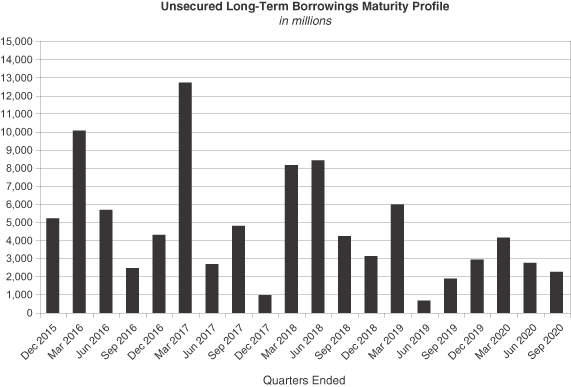
The weighted average maturity of our unsecured long-term borrowings as of
September 2014 was approximately eight years. To mitigate refinancing risk, we seek to limit the principal amount of debt maturing on any one day or during any week or year. We enter into interest rate swaps
to convert a substantial portion of our long-term borrowings into floating-rate obligations in order to manage our exposure to interest rates. See Note 16 to the condensed consolidated
financial statements for further information about our unsecured long-term borrowings.
|
|
|
|
|
|
|
|
|
Goldman Sachs September 2014 Form 10-Q
|
|
135
|
THE GOLDMAN SACHS GROUP, INC. AND SUBSIDIARIES
Management’s Discussion and Analysis
Deposits.
As part of our efforts to diversify our funding base, we raise deposits mainly through GS Bank USA and Goldman Sachs International Bank (GSIB). The tables below present the type and sources of
our deposits.
|
|
|
|
|
|
|
|
|
|
|
|
|
As of September 2014
|
|
|
$ in millions
|
|
|
Savings and Demand
|
1
|
|
|
Time
|
2
|
|
Private bank deposits
3
|
|
|
$31,904
|
|
|
|
$ 658
|
|
|
|
|
|
Certificates of deposit
|
|
|
—
|
|
|
|
24,561
|
|
|
|
|
|
Deposit sweep programs
4
|
|
|
15,029
|
|
|
|
—
|
|
|
|
|
|
Institutional
|
|
|
25
|
|
|
|
5,774
|
|
|
Total
5
|
|
|
$46,958
|
|
|
|
$30,993
|
|
|
|
|
|
|
|
As of December 2013
|
|
|
$ in millions
|
|
|
Savings and Demand
|
1
|
|
|
Time
|
2
|
|
Private bank deposits
3
|
|
|
$30,475
|
|
|
|
$ 212
|
|
|
|
|
|
Certificates of deposit
|
|
|
—
|
|
|
|
19,709
|
|
|
|
|
|
Deposit sweep programs
4
|
|
|
15,511
|
|
|
|
—
|
|
|
|
|
|
Institutional
|
|
|
33
|
|
|
|
4,867
|
|
|
Total
5
|
|
|
$46,019
|
|
|
|
$24,788
|
|
|
1.
|
Represents deposits with no stated maturity.
|
|
2.
|
Weighted average maturity of approximately three years as of both September 2014 and December 2013.
|
|
3.
|
Substantially all were from overnight deposit sweep programs related to private wealth management clients.
|
|
4.
|
Represents long-term contractual agreements with several U.S. broker-dealers who sweep client cash to FDIC-insured deposits.
|
|
5.
|
Deposits insured by the FDIC as of September 2014 and December 2013 were approximately $43.83 billion and
$41.22 billion, respectively.
|
Unsecured
Short-Term Borrowings.
A significant portion of our short-term borrowings was originally long-term debt that is scheduled to mature within one year of the reporting date. We use
short-term borrowings to finance liquid assets and for other cash management purposes. We issue hybrid financial instruments, commercial paper and promissory notes.
As of September 2014 and December 2013, our unsecured short-term borrowings, including the current portion of unsecured long-term borrowings, were $48.28 billion and $44.69 billion,
respectively. See Note 15 to the condensed consolidated financial statements for further information about our unsecured short-term borrowings.
Equity Capital Management and Regulatory Capital
Capital adequacy is of critical importance to us. Our objective is to be conservatively capitalized in terms of the amount and composition
of our equity base, both relative to our risk exposures and compared to external requirements and benchmarks. Accordingly, we have in place a comprehensive capital management policy that provides a framework and set of guidelines to assist us in
determining the level and composition of capital that we target and maintain.
Equity Capital Management
We determine the appropriate level and composition of our equity capital by considering multiple factors including our current and future
consolidated regulatory capital requirements, the results of our capital planning and stress testing process and other factors such as rating agency guidelines, subsidiary capital requirements, the business environment, conditions in the financial
markets, and assessments of potential future losses due to adverse changes in our business and market environments. Our capital planning and stress testing process incorporates our internally designed stress tests and those required under CCAR and
DFAST rules, and is also designed to identify and measure material risks associated with our business activities, including market risk, credit risk and operational risk. We project sources and uses of capital given a range of business environments,
including stressed conditions. In addition, as part of our comprehensive capital management policy, we maintain a contingency capital plan that provides a framework for analyzing and responding to an actual or perceived capital shortfall.
We principally manage the level and composition of our equity capital through issuances and repurchases of our common stock.
We may also, from time to time, issue or repurchase our preferred stock, junior subordinated debt issued to trusts, and other subordinated debt or other forms of capital as business conditions warrant. Prior to any repurchases, we must receive
confirmation that the Board of Governors of the Federal Reserve System (Federal Reserve Board) does not object to such capital actions. We manage our capital requirements and the levels of our capital usage principally by setting limits on balance
sheet assets and/or limits on risk, in each case both at the consolidated and business levels. See Notes 16 and 19 to the condensed consolidated financial statements for further information about our preferred stock, junior subordinated debt
issued to trusts and other subordinated debt.
|
|
|
|
|
|
|
136
|
|
Goldman Sachs September 2014 Form 10-Q
|
|
|
THE GOLDMAN SACHS GROUP, INC. AND SUBSIDIARIES
Management’s Discussion and Analysis
Share Repurchase Program.
We use our share repurchase program to help maintain the appropriate level of common equity. The repurchase program is effected primarily through regular open-market purchases, the amounts and timing of
which are determined primarily by our current and projected capital position, but which may also be influenced by general market conditions and the prevailing price and trading volumes of our common stock.
As of September 2014, under the share repurchase program approved by the Board of Directors of Group Inc. (Board), we can repurchase
up to 32.0 million additional shares of common stock; however, prior to any such repurchases, we must receive confirmation that the Federal Reserve Board does not object to such capital actions. See “Unregistered Sales of Equity Securities
and Use of Proceeds” in Part II, Item 2 of the September 2014 Form 10-Q and Note 19 to the condensed consolidated financial statements for additional information about our share repurchase program and see below for
information about our capital planning and stress testing process.
Capital Planning and Stress Testing Process.
Our capital planning and stress testing process incorporates our internally designed stress tests and those required under CCAR and DFAST. The process is designed to identify and measure material risks
associated with our business activities. We also perform an internal risk-based capital assessment, attribute capital usage to each of our businesses and maintain a contingency capital plan. The following is a description of our capital planning and
stress testing process:
|
Ÿ
|
|
Stress Testing.
Our stress testing
process incorporates an internal capital adequacy assessment with the objective of ensuring that the firm is appropriately capitalized relative to the risks in our business. As part of our assessment, we project sources and uses of capital given a
range of business environments, including stressed conditions. Our stress scenarios incorporate our internally designed stress tests, including our internally developed severely adverse scenario, and those required under CCAR and DFAST rules and are
designed to capture our specific vulnerabilities and risks and to analyze whether we hold an appropriate amount of capital. Our goal is to hold sufficient capital to ensure we remain adequately capitalized after experiencing a severe stress event.
Our assessment of capital adequacy is viewed in tandem with our assessment of liquidity adequacy and is integrated into our overall risk management structure, governance and policy framework. We provide additional information about our stress test
processes and a summary of the results on our web site as described under “Available Information” below.
|
|
Ÿ
|
|
Internal Risk-Based Capital Assessment.
Our capital planning process includes an internal risk-based capital assessment. This assessment incorporates market risk, credit risk and operational risk. Market risk is calculated by using
Value-at-Risk (VaR) calculations supplemented by risk-based add-ons which include risks related to rare events (tail risks). Credit risk utilizes assumptions about our counterparties’ probability of default and the size of our losses in the
event of a default. Operational risk is calculated based on scenarios incorporating multiple types of operational failures as well as incorporating internal and external actual loss experience. Backtesting is used to gauge the effectiveness of
models at capturing and measuring relevant risks.
|
|
Ÿ
|
|
Capital Attribution.
We attribute
capital usage to each of our businesses based upon regulatory capital requirements as well as our internal risk-based capital assessment. We manage the levels of our capital usage based upon balance sheet and risk limits, as well as capital return
analyses of our businesses based on our capital attribution.
|
|
Ÿ
|
|
Contingency Capital Plan.
As part
of our comprehensive capital management policy, we maintain a contingency capital plan. Our contingency capital plan provides a framework for analyzing and responding to a perceived or actual capital deficiency, including, but not limited to,
identification of drivers of a capital deficiency, as well as mitigants and potential actions. It outlines the appropriate communication procedures to follow during a crisis period, including internal dissemination of information as well as ensuring
timely communication with external stakeholders.
|
As required by the Federal Reserve Board’s annual
CCAR rules, we submit a capital plan for review by the Federal Reserve Board. The purpose of the Federal Reserve Board’s review is to ensure that we have a robust, forward-looking capital planning process that accounts for our unique risks and
that permits continued operation during times of economic and financial stress.
|
|
|
|
|
|
|
|
|
Goldman Sachs September 2014 Form 10-Q
|
|
137
|
THE GOLDMAN SACHS GROUP, INC. AND SUBSIDIARIES
Management’s Discussion and Analysis
The Federal Reserve Board evaluates us based, in part, on whether we have the capital
necessary to continue operating under the baseline and stress scenarios provided by the Federal Reserve Board and those developed internally. This evaluation also takes into account our process for identifying risk, our controls and governance for
capital planning, and our guidelines for making capital planning decisions. In addition, the Federal Reserve Board evaluates our plan to make capital distributions (i.e., dividend payments, repurchases or redemptions of stock, subordinated debt or
other capital securities) and issue capital, across a range of macroeconomic scenarios and firm-specific assumptions.
In
addition, the DFAST rules require us to conduct stress tests on a semi-annual basis and publish a summary of certain results. The annual DFAST submission is incorporated into our CCAR submission. The Federal Reserve Board also conducts its own
annual stress tests and publishes a summary of certain results.
We submitted our initial 2014 CCAR to the Federal Reserve
Board in January 2014 and, based on the Federal Reserve Board feedback, we submitted revised capital actions in March 2014. The Federal Reserve Board informed us that it did not object to our revised capital actions, including the
repurchase of outstanding common stock, a potential increase in our quarterly common stock dividend and the possible issuance, redemption and modification of other capital securities through the first quarter of 2015. We published a summary of our
annual DFAST results in March 2014. See “Available Information” below.
We submitted the results of our
mid-cycle DFAST to the Federal Reserve Board in July 2014 and published a summary of our mid-cycle DFAST results under our internally developed severely adverse scenario in September 2014. We provide additional information on our internal
stress test processes, our internally developed severely adverse scenario used for mid-cycle DFAST and a summary of the results on our web site as described under “Available Information” below.
In October 2014, the Federal Reserve Board issued a final rule to modify the regulations for capital planning and stress testing. The
final rule changes the due dates for submitting the capital plan and stress test results beginning with the 2016 capital plan cycle and includes certain modifications to the rule, including a limitation on capital distributions to the extent that
actual capital issuances are less than the amount indicated in the capital plan.
In addition, the rules adopted by the Federal Reserve Board under the U.S. Dodd-Frank Wall
Street Reform and Consumer Protection Act (Dodd-Frank Act) require GS Bank USA to conduct stress tests on an annual basis and publish a summary of certain results. GS Bank USA submitted its annual DFAST stress results to the Federal Reserve in
January 2014 and published a summary of its results in March 2014. See “Available Information” below.
Resolution and Recovery Plans.
We are required by the Federal Reserve Board and the FDIC to submit an annual plan that describes our strategy for a rapid and orderly resolution (resolution plan) in the event of material financial
distress or failure. We are also required by the Federal Reserve Board to submit, on an annual basis, a global recovery plan that outlines the steps that management could take to reduce risk, maintain sufficient liquidity, and conserve capital in
times of prolonged stress. We submitted our 2013 resolution plan in September 2013 and our 2014 resolution plan in June 2014. In August 2014, we, along with other industry participants, were notified by the Federal Reserve Board and
the FDIC that certain shortcomings in the 2013 resolution plans must be addressed in the 2015 resolution plans, which are required to be submitted on or before July 1, 2015.
In addition, GS Bank USA is required by the FDIC to submit a resolution plan. GS Bank USA submitted its 2013 resolution plan in
September 2013 and its 2014 resolution plan in June 2014.
Rating
Agency Guidelines.
The credit rating agencies assign credit ratings to the obligations of Group Inc., which directly issues or guarantees substantially all of the firm’s senior
unsecured obligations. Goldman, Sachs & Co. (GS&Co.), GSI and GSIB have been assigned long- and short-term issuer ratings by certain credit rating agencies. GS Bank USA has also been assigned long- and short-term issuer ratings, as well
as ratings on its long-term and short-term bank deposits. In addition, credit rating agencies have assigned ratings to debt obligations of certain other subsidiaries of Group Inc.
The level and composition of our equity capital are among the many factors considered in determining our credit ratings. Each agency has
its own definition of eligible capital and methodology for evaluating capital adequacy, and assessments are generally based on a combination of factors rather than a single calculation. See “Liquidity Risk Management — Credit
Ratings” for further information about credit ratings of Group Inc., GS Bank USA, GSIB, GS&Co. and GSI.
|
|
|
|
|
|
|
138
|
|
Goldman Sachs September 2014 Form 10-Q
|
|
|
THE GOLDMAN SACHS GROUP, INC. AND SUBSIDIARIES
Management’s Discussion and Analysis
Consolidated Regulatory Capital
As of December 2013, we were subject to the risk-based capital regulations of the
Federal Reserve Board that were based on the Basel I Capital Accord of the Basel Committee on Banking Supervision (Basel Committee), and incorporated the revised market risk regulatory capital requirements, which became effective on
January 1, 2013 (together, the Prior Capital Rules).
As of January 1, 2014, we became subject to the
Federal Reserve Board’s revised risk-based capital and leverage regulations (Revised Capital Framework), subject to certain transitional provisions. These regulations are largely based on the Basel Committee’s final capital framework for
strengthening international capital standards (Basel III) and also implement certain provisions of the Dodd-Frank Act. Under the Revised Capital Framework, we are an “Advanced approach” banking organization.
We were notified in the first quarter of 2014 that we had completed a “parallel run” to the satisfaction of the Federal Reserve
Board, as required under the Revised Capital Framework. As such, additional changes in our capital requirements became effective April 1, 2014. Accordingly:
|
Ÿ
|
|
As of and for the three months ended March 2014, regulatory capital was calculated based on the Revised Capital Framework (subject to
transitional provisions) and risk-weighted assets (RWAs) were calculated based on the Prior Capital Rules, adjusted for certain items related to capital deductions under the previous definition of regulatory capital and for the phase-in of new
capital deductions (Hybrid Capital Rules).
|
|
Ÿ
|
|
As of and for the three months ended June 2014 and September 2014, regulatory capital continues to be calculated under the Revised Capital
Framework, but RWAs are required to be calculated using both the Advanced approach and the market risk rules set out in the Revised Capital Framework (together, the Basel III Advanced Rules) as well as the Hybrid Capital Rules. The lower of the
ratios calculated under the Basel III Advanced Rules and those calculated under the Hybrid Capital Rules are the binding regulatory risk-based capital requirements for the firm.
|
As a result of the changes in the applicable capital framework in 2014, our capital ratios
as of September 2014 and those as of December 2013 included in Note 20 to the condensed consolidated financial statements are calculated on a different basis and, accordingly, are not comparable. See Note 20 to the condensed
consolidated financial statements and the 2013 Form 10-K for the firm’s capital ratios as of December 2013 and for a description of the Prior Capital Rules.
See Note 20 to the condensed consolidated financial statements for additional information about the Revised Capital Framework, including the transitional arrangements related to new deductions from
Common Equity Tier 1 (CET1), and the requirement to calculate RWAs based on the higher of the Basel III Advanced Rules and the Hybrid Capital Rules. Also see “Business — Regulation” in Part I, Item 1 of the
2013 Form 10-K for additional information about our regulatory requirements.
|
|
|
|
|
|
|
|
|
Goldman Sachs September 2014 Form 10-Q
|
|
139
|
THE GOLDMAN SACHS GROUP, INC. AND SUBSIDIARIES
Management’s Discussion and Analysis
Risk-Weighted Assets
Under the Revised Capital Framework, the firm’s binding ratios for the second quarter of 2014 and future quarters are based on the following RWA calculations:
|
Ÿ
|
|
For the second quarter of 2014 and remaining quarters of 2014 — the higher of RWAs computed under the Basel III Advanced Rules or
Hybrid Capital Rules (in each case reflecting transitional provisions); and
|
|
Ÿ
|
|
Beginning in the first quarter of 2015 — the higher of RWAs computed under the Basel III Advanced Rules or the Standardized Capital
Rules, as discussed below.
|
The primary difference between the Basel III Advanced Rules and the
Standardized Capital Rules is that the latter utilizes prescribed risk-weightings for credit RWAs and does not contemplate the use of internal models to compute exposure for credit risk on derivatives and securities financing transactions, whereas
the Basel III Advanced Rules permit the use of such models, subject to supervisory approval. In the Standardized Capital Rules, the exposure measure for securities financing transactions is calculated to reflect adjustments for potential price
volatility, the size of which depends on factors such as the type and maturity of the security, and whether it is denominated in the same currency as the other side of the financing transaction. In addition, RWAs under the Standardized Capital Rules
depend largely on the type of counterparty (e.g., whether the counterparty is a sovereign, bank, broker-dealer or other entity), rather than on assessments of each counterparty’s creditworthiness. Furthermore, the Standardized Capital Rules do
not include a capital requirement for operational risk. RWAs for market risk under both sets of rules incorporate the revised market risk regulatory capital requirements.
We also attribute RWAs to our business segments. As of September 2014, approximately 70% of RWAs were attributed to our Institutional Client Services segment and substantially all of the remaining
RWAs were attributed to our Investing & Lending segment.
See Note 20 to the condensed consolidated
financial statements for additional information about the firm’s current RWAs. We provide additional information about the firm’s RWAs and capital ratios as described under “Available Information” below.
Minimum Capital Ratios and Capital Buffers
The table below presents the minimum ratios currently applicable under the Revised Capital Framework, and the minimum ratios that we
expect will apply at the end of the transitional provisions in January 2019.
|
|
|
|
|
|
|
|
|
|
|
|
|
|
September 2014
Minimum Ratio
|
1
|
|
|
January 2019
Minimum Ratio
|
|
|
CET1 ratio
|
|
|
4.0%
|
|
|
|
8.5%
|
3
|
|
|
|
|
Tier 1 capital ratio
|
|
|
5.5%
|
|
|
|
10.0%
|
3
|
|
|
|
|
Total capital ratio
|
|
|
8.0%
|
|
|
|
12.0%
|
3
|
|
|
|
|
Tier 1 leverage
ratio
2
|
|
|
4.0%
|
|
|
|
4.0%
|
|
|
1.
|
Does not reflect the capital conservation buffer or provisional G-SIB buffer discussed below.
|
|
2.
|
Tier 1 leverage ratio is defined as Tier 1 capital divided by average adjusted total assets (which includes adjustments for goodwill and
identifiable intangible assets, and certain investments in nonconsolidated financial institutions).
|
|
3.
|
Includes the required increases in minimum ratios on January 1, 2015, the capital conservation buffer of 2.5% and a provisional G-SIB buffer of 1.5%
discussed below.
|
The table below presents the supplementary leverage ratio that becomes effective in
January 2018. See “Supplementary Leverage Ratio” below for further information.
|
|
|
|
|
|
|
|
|
|
Minimum Ratio
|
|
|
Supplementary leverage ratio
|
|
|
5.0%
|
|
Under the Revised Capital Framework, on January 1, 2015 the minimum CET1 ratio will increase
from 4.0% to 4.5% and the minimum Tier 1 capital ratio will increase from 5.5% to 6.0%. In addition, these minimum ratios will be supplemented by a new capital conservation buffer that phases in, beginning January 1, 2016, in
increments of 0.625% per year until it reaches 2.5% on January 1, 2019.
|
|
|
|
|
|
|
140
|
|
Goldman Sachs September 2014 Form 10-Q
|
|
|
THE GOLDMAN SACHS GROUP, INC. AND SUBSIDIARIES
Management’s Discussion and Analysis
The January 2019 minimum ratios in the table above assume the future implementation of an
additional preliminary buffer for Global Systemically Important Banks (G-SIBs). Under the methodology published by the Basel Committee, the required amount of additional CET1 for these institutions will initially range from 1% to 2.5% and could be
higher in the future for a banking institution that increases its systemic footprint (e.g., by increasing total assets). In November 2013, the Financial Stability Board (established at the direction of the leaders of the Group of 20) indicated
that, based on our 2012 financial data, we would be required to hold an additional 1.5% of CET1 as a G-SIB. The Federal Reserve Board has indicated that it intends to implement capital buffers for certain G-SIBs that are higher than those calculated
under the methodology published by the Basel Committee. The minimum ratios in the table above do not reflect an estimate of this higher buffer. The final determination of the amount of additional CET1 that we will be required to hold will be based
on the U.S. banking regulators’ implementation of the Basel Committee’s methodology. The Basel Committee indicated that G-SIBs will be required to meet the capital surcharges on a phased-in basis beginning in 2016 through 2019.
The Revised Capital Framework also introduces a new counter-cyclical capital buffer, to be imposed in the event that national supervisors
deem it necessary in order to counteract excessive credit growth. The table above does not reflect any such buffer.
Our
regulators could change these buffers in the future. As a result, the minimum ratios we are subject to as of January 1, 2019 could be higher than the amounts presented in the above table.
Transitional Capital Ratios
The table below presents our ratio of CET1 to RWAs calculated under the Basel III Advanced Rules and the Standardized Capital Rules reflecting the transitional provisions that became effective
January 1, 2014.
|
|
|
|
|
|
|
|
|
|
|
|
|
As of
|
|
|
$ in millions
|
|
|
September
2014
|
|
|
|
December
2013
|
|
|
Common shareholders’ equity
|
|
|
$ 73,075
|
|
|
|
$ 71,267
|
|
|
|
|
|
Deductions for goodwill and identifiable intangible assets, net of deferred tax liabilities
|
|
|
(2,918
|
)
|
|
|
(2,931
|
)
|
|
|
|
|
Deductions for investments in nonconsolidated financial institutions
|
|
|
(1,129
|
)
|
|
|
(1,792
|
)
|
|
|
|
|
Other adjustments
|
|
|
(87
|
)
|
|
|
360
|
|
|
CET1
|
|
|
$ 68,941
|
|
|
|
$ 66,904
|
|
|
Basel III Advanced RWAs
|
|
|
$586,427
|
|
|
|
$590,371
|
|
|
|
|
|
Basel III Advanced CET1 ratio
|
|
|
11.8%
|
|
|
|
11.3%
|
|
|
|
|
|
Standardized RWAs
|
|
|
$618,820
|
|
|
|
$629,268
|
|
|
|
|
|
Standardized CET1 ratio
|
|
|
11.1%
|
|
|
|
10.6%
|
|
Although the Standardized CET1 ratio is not applicable until 2015 and the Basel III Advanced CET1
transitional ratio did not become applicable until April 1, 2014, we believe that these ratios are meaningful because they are measures that we, our regulators and investors use to assess capital adequacy. The Basel III Advanced CET1
transitional ratio as of December 2013 and the Standardized CET1 transitional ratios as of both September 2014 and December 2013 are non-GAAP measures and may not be comparable to similar non-GAAP measures used by other companies (as
of those dates). The Basel III Advanced CET1 transitional ratio became a formal regulatory measure for the firm on April 1, 2014.
In the table above:
|
Ÿ
|
|
The deduction for goodwill and identifiable intangible assets, net of deferred tax liabilities, represents goodwill of $3.71 billion as of both
September 2014 and December 2013, and identifiable intangible assets of $136 million (20% of $680 million) and $134 million (20% of $671 million) as of September 2014 and December 2013, respectively, net of
associated deferred tax liabilities of $924 million and $908 million as of September 2014 and December 2013, respectively. The remaining 80% of the deduction of identifiable intangible assets will be phased in ratably per year
from 2015 to 2018. Identifiable intangible assets that are not deducted during the transitional period are risk weighted.
|
|
|
|
|
|
|
|
|
|
Goldman Sachs September 2014 Form 10-Q
|
|
141
|
THE GOLDMAN SACHS GROUP, INC. AND SUBSIDIARIES
Management’s Discussion and Analysis
|
Ÿ
|
|
The deduction for investments in nonconsolidated financial institutions represents the amount by which the firm’s investments in the capital of
nonconsolidated financial institutions exceed certain prescribed thresholds. As of both September 2014 and December 2013, 20% of the deduction was reflected (calculated based on transitional thresholds). The remaining 80% will be
phased in ratably per year from 2015 to 2018. The balance that is not deducted during the transitional period is risk weighted. The decrease from December 2013 to September 2014 primarily reflects both cash and in-kind distributions we
received related to our fund investments.
|
|
Ÿ
|
|
Other adjustments primarily include accumulated other comprehensive loss, credit valuation adjustments on derivative liabilities, the overfunded
portion of the firm’s defined benefit pension plan obligation, net of associated deferred tax liabilities, disallowed deferred tax assets and other required credit risk-based deductions. As of both September 2014 and
December 2013, 20% of the deductions related to credit valuation adjustments on derivative liabilities, the overfunded portion of the firm’s defined benefit pension plan obligation, net of associated deferred tax liabilities,
disallowed deferred tax assets and other required credit risk-based deductions were included in other adjustments within CET1. The remaining 80% will be phased in ratably per year from 2015 to 2018.
|
The Standardized CET1 transitional ratio is based on our current interpretation, expectations and understanding of the Revised Capital
Framework and may evolve as we discuss its interpretation and application with our regulators.
Fully Phased-in Capital Ratios
The table below presents our ratio of CET1 to RWAs calculated under the Basel III Advanced Rules and the Standardized Capital Rules on a fully phased-in basis.
|
|
|
|
|
|
|
|
|
|
|
|
|
As of
|
|
|
$ in millions
|
|
|
September
2014
|
|
|
|
December
2013
|
|
|
Common shareholders’ equity
|
|
|
$ 73,075
|
|
|
|
$ 71,267
|
|
|
|
|
|
Deductions for goodwill and identifiable intangible assets, net of deferred tax liabilities
|
|
|
(3,459
|
)
|
|
|
(3,468
|
)
|
|
|
|
|
Deductions for investments in nonconsolidated financial institutions
|
|
|
(5,806
|
)
|
|
|
(9,091
|
)
|
|
|
|
|
Other adjustments
|
|
|
(1,139
|
)
|
|
|
(489
|
)
|
|
CET1
|
|
|
$ 62,671
|
|
|
|
$ 58,219
|
|
|
Basel III Advanced RWAs
|
|
|
$593,461
|
|
|
|
$594,662
|
|
|
|
|
|
Basel III Advanced CET1 ratio
|
|
|
10.6%
|
|
|
|
9.8%
|
|
|
|
|
|
Standardized RWAs
|
|
|
$626,442
|
|
|
|
$635,092
|
|
|
|
|
|
Standardized CET1 ratio
|
|
|
10.0%
|
|
|
|
9.2%
|
|
Although the fully phased in capital ratios are not applicable until 2019, we believe that the ratios in
the above table are meaningful because they are measures that we, our regulators and investors use to assess capital adequacy. The fully phased-in Basel III Advanced CET1 ratios and Standardized CET1 ratios are non-GAAP measures as of both
September 2014 and December 2013 and may not be comparable to similar non-GAAP measures used by other companies (as of those dates).
|
|
|
|
|
|
|
142
|
|
Goldman Sachs September 2014 Form 10-Q
|
|
|
THE GOLDMAN SACHS GROUP, INC. AND SUBSIDIARIES
Management’s Discussion and Analysis
In the table above:
|
Ÿ
|
|
The deduction for goodwill and identifiable intangible assets, net of deferred tax liabilities, represents goodwill of $3.71 billion as of both
September 2014 and December 2013, and identifiable intangible assets of $680 million and $671 million as of September 2014 and December 2013, respectively, net of associated deferred tax liabilities of $927 million
and $908 million as of September 2014 and December 2013, respectively.
|
|
Ÿ
|
|
The deduction for investments in nonconsolidated financial institutions represents the amount by which the firm’s investments in the capital of
nonconsolidated financial institutions exceed certain prescribed thresholds. The decrease from December 2013 to September 2014 primarily reflects both cash and in-kind distributions we received related to our fund investments.
|
|
Ÿ
|
|
Other adjustments primarily include the overfunded portion of the firm’s defined benefit pension plan obligation, net of associated deferred
tax liabilities, and disallowed deferred tax assets, credit valuation adjustments on derivative liabilities and debt valuation adjustments, as well as other required credit risk-based deductions.
|
These estimated ratios are based on our current interpretation, expectations and understanding of the Revised Capital Framework and may
evolve as we discuss its interpretation and application with our regulators.
Supplementary Leverage Ratio
The Revised Capital Framework introduces a new supplementary leverage ratio for Advanced approach banking organizations. The supplementary
leverage ratio compares Tier 1 capital to a measure of leverage exposure, defined as the sum of the firm’s assets less certain deductions plus certain off-balance-sheet exposures, including a measure of derivatives exposures and
commitments. The Revised Capital Framework requires a minimum supplementary leverage ratio of 5.0% (comprised of the minimum requirement of 3.0% plus a 2.0% buffer) for U.S. banks deemed to be G-SIBs, effective January 1, 2018, but with
disclosure required beginning in the first quarter of 2015.
In September 2014, the U.S. federal bank regulatory agencies approved a final rule
that implements the supplementary leverage ratio aligned with the definition of leverage established by the Basel Committee in January 2014 (the Final Rule). As of September 2014, our supplementary leverage ratio (reflecting the Final
Rule) was 4.9%, including Tier 1 capital on a fully phased-in basis of $71.38 billion (CET1 of $62.67 billion plus perpetual non-cumulative preferred stock of $9.20 billion less other adjustments of $490 million) divided by
total leverage exposure of $1.45 trillion (total average assets of $865 billion plus adjustments of $585 billion, primarily comprised of off-balance-sheet exposure related to derivatives, commitments and guarantees).
Our supplementary leverage ratio (reflecting the Final Rule) was greater than 5.2% as of September 2014 after adjusting for the
capital impact of reducing the firm’s fund investments to comply with the Volcker Rule. See “Regulatory Developments” below for information about the Volcker Rule.
We believe that the supplementary leverage ratios are meaningful because they are measures that we, our regulators and investors use to
assess capital adequacy. The supplementary leverage ratios are non-GAAP measures and may not be comparable to similar non-GAAP measures used by other companies.
These estimated supplementary leverage ratios are based on our current interpretation and understanding of the Final Rule and may evolve as we discuss its interpretation and application with our
regulators.
|
|
|
|
|
|
|
|
|
Goldman Sachs September 2014 Form 10-Q
|
|
143
|
THE GOLDMAN SACHS GROUP, INC. AND SUBSIDIARIES
Management’s Discussion and Analysis
Subsidiary Capital Requirements
Many of our subsidiaries, including GS Bank USA and our broker-dealer subsidiaries, are
subject to separate regulation and capital requirements of the jurisdictions in which they operate.
GS Bank USA.
GS Bank USA is subject to minimum capital requirements that are calculated in a manner similar to those applicable to bank holding
companies and computes its risk-based capital ratios in accordance with the regulatory capital requirements applicable to state member banks, which, as of September 2014, were based on the Revised Capital Framework and, as of
December 2013, were based on the Prior Capital Rules. The capital regulations also include requirements with respect to leverage.
As of January 2015, the minimum CET1 ratio for GS Bank USA will increase from 4.0% to 4.5%. In addition, the Revised Capital Framework changes the standards for “well-capitalized” status
under prompt corrective action regulations by, among other things, introducing a CET1 ratio requirement of 6.5% and increasing the Tier 1 capital ratio requirement from 6.0% to 8.0%. GS Bank USA agreed with the Federal Reserve Board to maintain
minimum capital ratios in excess of these “well-capitalized” levels. Accordingly, for a period of time, GS Bank USA is expected to maintain a Tier 1 capital ratio of at least 8.0%, a Total capital ratio of at least 11.0% and a Tier 1
leverage ratio of at least 6.0%.
GS Bank USA’s capital levels and prompt corrective action classification are also
subject to qualitative judgments by its regulators about components of capital, risk weightings and other factors.
The Basel
Committee published its final guidelines for calculating incremental capital requirements for domestic systemically important banking institutions. These guidelines are complementary to the framework outlined above for G-SIBs. The impact of these
guidelines on the regulatory capital requirements of GS Bank USA will depend on how they are implemented by the banking regulators in the United States.
In addition, under Federal Reserve Board rules finalized in September 2014, commencing
January 1, 2018, in order to be considered a “well-capitalized” depository institution, GS Bank USA must have a supplementary leverage ratio of 6.0% or greater. As of September 2014, GS Bank USA’s supplementary leverage
ratio under the Final Rule and on a fully phased-in basis was 5.9%. This estimated supplementary leverage ratio is based on our current interpretation and understanding of the Final Rule and may evolve as we discuss its interpretation and
application with our regulators.
See Note 20 to the condensed consolidated financial statements for further
information about the Revised Capital Framework as it relates to GS Bank USA.
GSI.
Our regulated U.K.
broker-dealer, Goldman Sachs International (GSI), is one of the firm’s principal non-U.S. regulated subsidiaries and is regulated by the Prudential Regulation Authority (PRA) and the Financial Conduct Authority (FCA). Effective
January 1, 2014, GSI became subject to capital regulations which are largely based on Basel III and which, similar to the Revised Capital Framework, also introduce leverage ratio reporting requirements in the future. As of
September 2014, GSI had a CET1 ratio of 8.4%, a Tier 1 capital ratio of 8.4% and a Total capital ratio of 11.2%. Under PRA rules, as of September 2014, GSI is required to maintain a minimum CET1 ratio of 4.0%, Tier 1 capital
ratio of 5.5%, and Total capital ratio of 8.0%. In January 2015, the minimum CET1 ratio requirement will increase to 4.5%, and the minimum Tier 1 capital ratio requirement will increase to 6.0%. GSI’s future capital requirements may
also be impacted by developments such as the introduction of capital buffers as described above.
As of December 2013, GSI
was subject to capital regulations, which were based on the Basel Committee’s June 2006 Framework (Basel II) as modified by the Basel Committee’s February 2011 Revisions to the Basel II market risk framework and as
implemented in the European Union (EU) through the Capital Requirements Directives. As of December 2013, GSI had a Tier 1 capital ratio of 14.4% and a Total capital ratio of 18.5%.
|
|
|
|
|
|
|
144
|
|
Goldman Sachs September 2014 Form 10-Q
|
|
|
THE GOLDMAN SACHS GROUP, INC. AND SUBSIDIARIES
Management’s Discussion and Analysis
Other Subsidiaries.
We expect that the capital requirements of several of our subsidiaries are likely to increase in the future due to the various developments arising from the Basel Committee, the Dodd-Frank Act, and other
governmental entities and regulators. See Note 20 to the condensed consolidated financial statements for information about the capital requirements of our other regulated subsidiaries.
Subsidiaries not subject to separate regulatory capital requirements may hold capital to satisfy local tax and legal guidelines, rating
agency requirements (for entities with assigned credit ratings) or internal policies, including policies concerning the minimum amount of capital a subsidiary should hold based on its underlying level of risk. In certain instances, Group Inc. may be
limited in its ability to access capital held at certain subsidiaries as a result of regulatory, tax or other constraints. As of September 2014 and December 2013, Group Inc.’s equity investment in subsidiaries was $77.82 billion
and $73.39 billion, respectively, compared with its total shareholders’ equity of $82.28 billion and $78.47 billion, respectively.
Our capital invested in non-U.S. subsidiaries is generally exposed to foreign exchange risk, substantially all of which is managed through a combination of derivatives and non-U.S. denominated debt.
Guarantees of Subsidiaries.
Group Inc. has guaranteed the payment obligations of GS&Co., GS Bank USA, and Goldman Sachs Execution & Clearing, L.P. (GSEC) subject to certain exceptions. In November 2008, Group Inc.
contributed subsidiaries into GS Bank USA, and Group Inc. agreed to guarantee certain losses, including credit-related losses, relating to assets held by the contributed entities. In connection with this guarantee, Group Inc. also agreed to pledge
to GS Bank USA certain collateral, including interests in subsidiaries and other illiquid assets.
Regulatory Developments
Our businesses are subject to significant and evolving regulation. The Dodd-Frank Act, enacted in July 2010, significantly altered
the financial regulatory regime within which we operate. In addition, other reforms have been adopted or are being considered by other regulators and policy makers worldwide. We expect that the principal areas of impact from regulatory reform for us
will be increased regulatory capital requirements and increased regulation and restriction on certain activities. However, given that many of the new and proposed rules are highly complex, the full impact of regulatory reform will not be known until
the rules are implemented and market practices develop under the final regulations.
See “Business —
Regulation” in Part I, Item 1 of the 2013 Form 10-K for more information on the laws, rules and regulations and proposed laws, rules and regulations that apply to us and our operations. In addition, see Note 20 to the
condensed consolidated financial statements for information about regulatory developments as they relate to our regulatory capital and leverage ratios, and “Liquidity Risk Management — Liquidity Framework” below for information
on the U.S. federal bank regulatory agencies’ final rules implementing the liquidity coverage ratio.
There has been
increased regulation of, and limitations on, our activities, including the Dodd-Frank prohibition on “proprietary trading” and the limitation on the sponsorship of, and investment in covered funds (as defined in the Volcker Rule). In
addition, there is increased regulation of, and restrictions on, over-the-counter (OTC) derivatives markets and transactions, particularly related to swaps and security-based swaps.
|
|
|
|
|
|
|
|
|
Goldman Sachs September 2014 Form 10-Q
|
|
145
|
THE GOLDMAN SACHS GROUP, INC. AND SUBSIDIARIES
Management’s Discussion and Analysis
Volcker Rule
In December 2013, the final rules to implement the provisions of the Dodd-Frank Act
referred to as the “Volcker Rule” were adopted. We are required to be in compliance with the rule (including the development of an extensive compliance program) by July 2015 with certain provisions of the rule subject to possible
extensions through July 2017. We are also required to calculate daily quantitative metrics on certain trading activities and deliver these metrics to regulators on a monthly basis. In July 2014, we commenced the calculation of these
required quantitative metrics and in September 2014, we commenced the monthly delivery of these metrics to regulators.
The Volcker Rule prohibits “proprietary trading,” but will allow activities such as underwriting, market making and
risk-mitigation hedging. In anticipation of the final rule, we evaluated this prohibition and determined that businesses that engage in “bright line” proprietary trading were most likely to be prohibited. In 2010 and 2011, we liquidated
substantially all of our Global Macro Proprietary and Principal Strategies trading positions.
Based on what we know as of the
date of this filing, we do not expect the impact of the prohibition on proprietary trading to be material to our financial condition, results of operations or cash flows. However, the rule is highly complex, and its impact will not be known until
market practices are fully developed.
In addition to the prohibition on proprietary trading, the Volcker Rule limits the
sponsorship of, and investment in, “covered funds” (as defined in the rule) by banking entities, including Group Inc. and its subsidiaries. It also limits certain types of transactions between us and our sponsored funds, similar to the
limitations on transactions between depository institutions and their affiliates as described in “Business — Regulation” in Part I, Item 1 of the 2013 Form 10-K. Covered funds include our private equity funds,
certain of our credit and real estate funds, our hedge funds and certain other investment structures. The limitation on investments in covered funds requires us to reduce our investment in each such fund to 3% or less of the fund’s net asset
value, and to reduce our aggregate investment in all such funds to 3% or less of our Tier 1 capital. In anticipation of the final rule, we limited our initial investment in certain new covered funds to 3% of the fund’s net asset value.
We continue to manage our existing funds, taking into account the transition periods under
the Volcker Rule. We plan to continue to conduct our investing and lending activities in ways that are permissible under the Volcker Rule.
Our current investment in funds that are calculated using NAV is $11.38 billion as disclosed in Note 6 to the condensed consolidated financial statements. In order to be compliant with the
Volcker Rule, we will be required to reduce most of our interests in these funds by the prescribed compliance date. To the extent that the underlying investments of particular funds are not sold, we may be required to sell our investments in such
funds. If that occurs, we may receive a value for our investments that is less than the then carrying value as there could be a limited secondary market for these investments and we may be unable to sell them in orderly transactions.
In March 2012, we began redeeming certain interests in our hedge funds and since then, we have redeemed approximately
$2.55 billion of our interests in these funds, including approximately $285 million and $345 million during the three and nine months ended September 2014, respectively. We have submitted additional redemption requests for
approximately $375 million of our interests in hedge funds. Excluding the interests related to these redemption requests, the remainder of our investments in hedge funds primarily include interests where the underlying assets are illiquid in
nature, and proceeds from redemptions will not be received until the underlying assets are liquidated or distributed.
Although
our net revenues from investments in our private equity, credit, real estate and hedge funds may vary from period to period, our aggregate net revenues from these investments were not material to our aggregate total net revenues over the period from
1999 through the third quarter of 2014.
|
|
|
|
|
|
|
146
|
|
Goldman Sachs September 2014 Form 10-Q
|
|
|
THE GOLDMAN SACHS GROUP, INC. AND SUBSIDIARIES
Management’s Discussion and Analysis
Swap Dealers and Derivatives Regulation
The Dodd-Frank Act also provides for significantly increased regulation of and restrictions on derivative markets. The firm has registered
certain subsidiaries as “swap dealers” under the U.S. Commodity Futures Trading Commission (CFTC) rules, including GS&Co., GS Bank USA, GSI, and J. Aron & Company. These entities and other entities that would require
registration under the CFTC or SEC rules will be subject to regulatory capital requirements, which have not been finalized by the CFTC and SEC. In September 2014, a number of U.S. federal bank regulatory agencies (acting jointly) and the CFTC
issued separate proposals that would impose mandatory margining requirements for certain swaps that are not cleared. Similar regulations have been proposed or adopted in jurisdictions outside the United States, including the adoption of standardized
execution and clearing, margining and reporting requirements for OTC derivatives. For instance, the EU has established a set of new regulatory requirements for OTC derivatives activities under the European market infrastructure regulation. These
requirements include various risk mitigation requirements and regulatory reporting and clearing requirements. The full application of new derivatives rules across different national and regulatory jurisdictions has not yet been
fully established.
In October 2014, we, along with a number of other major global banks, indicated an intent to
adhere to a new International Swaps and Derivatives Association (ISDA) protocol (the Protocol) that is being developed in coordination with the Financial Stability Board, which is expected to take effect in January 2015. The Protocol would
impose a stay on certain cross-default and early termination rights within standard ISDA derivatives contracts between adhering parties in the event that one of them is subject to resolution in its home jurisdiction, including a resolution under
Title II of the Dodd-Frank Act in the United States. The Protocol is expected to be adopted more broadly in the future, following the adoption of regulations by banking regulators, and expanded to include instances where a U.S. financial holding
company becomes subject to proceedings under the U.S. bankruptcy code.
See “Business — Regulation” in
Part I, Item 1 of the 2013 Form 10-K for a discussion of the requirements imposed by the Dodd-Frank Act and the status of SEC and CFTC rulemaking, as well as non-U.S. regulation, in this area.
Money Market Reform
In July 2014, the SEC adopted amendments to the rules that govern SEC registered money market mutual funds. The new rules require institutional prime money market funds to value their portfolio
securities using market-based factors and to sell and redeem their shares based on a floating net asset value. In addition, the rules allow, in certain circumstances, for the board of directors of money market mutual funds to impose liquidity fees
and redemption gates and also require additional disclosure, reporting and stress testing. We are currently evaluating the impact of the rules. The firm’s money market mutual funds will be required to comply with the floating net asset value
and fees and gates amendments in 2016, with certain reporting requirements becoming effective in 2015.
Other Developments
The Basel Committee has recently issued several updates and consultative papers which propose further changes to capital regulations. In
particular, it has finalized a revised standard approach for calculating RWAs for counterparty credit risk on derivatives exposures (“Standardized Approach for measuring Counterparty Credit Risk exposures,” known as “SA-CCR”). In
addition, it has published guidelines for measuring and controlling large exposures (“Supervisory Framework for measuring and controlling Large Exposures”). The Basel Committee has also issued consultation papers on a “Fundamental
Review of the Trading Book” and “Revisions to the Securitization Framework.” The impact of all of these developments on the firm (including RWAs and regulatory capital ratios) will not be known with certainty until after any resulting
rules are finalized by the U.S. federal bank regulatory agencies.
The EU finalized legislation to implement Basel III,
which became effective on January 1, 2014. The Dodd-Frank Act, other reform initiatives proposed and announced by the U.S. federal bank regulatory agencies, the Basel Committee, and other governmental entities and regulators (including the
EU and the U.K.’s PRA and the FCA) are not in all cases consistent with one another, which adds further uncertainty to the firm’s future capital, leverage and liquidity requirements, and those of the firm’s subsidiaries.
|
|
|
|
|
|
|
|
|
Goldman Sachs September 2014 Form 10-Q
|
|
147
|
THE GOLDMAN SACHS GROUP, INC. AND SUBSIDIARIES
Management’s Discussion and Analysis
Off-Balance-Sheet Arrangements
and Contractual Obligations
Off-Balance-Sheet
Arrangements
We have various types of off-balance-sheet arrangements that we enter into in the ordinary
course of business. Our involvement in these arrangements can take many different forms, including:
|
Ÿ
|
|
purchasing or retaining residual and other interests in special purpose entities such as mortgage-backed and other asset-backed
securitization vehicles;
|
|
Ÿ
|
|
holding senior and subordinated debt, interests in limited and general partnerships, and preferred and common stock in other
nonconsolidated vehicles;
|
|
Ÿ
|
|
entering into interest rate, foreign currency, equity, commodity and credit derivatives, including total return swaps;
|
|
Ÿ
|
|
entering into operating leases; and
|
|
Ÿ
|
|
providing guarantees, indemnifications, loan commitments, letters of credit and representations and warranties.
|
We enter into these arrangements for a variety of business purposes, including securitizations. The securitization vehicles that purchase
mortgages, corporate bonds, and other types of financial assets are critical to the functioning of several significant investor markets, including the mortgage-backed and other asset-backed securities markets, since they offer investors access to
specific cash flows and risks created through the securitization process.
We also enter into these arrangements to underwrite
client securitization transactions; provide secondary market liquidity; make investments in performing and nonperforming debt, equity, real estate and other assets; provide investors with credit-linked and asset-repackaged notes; and receive or
provide letters of credit to satisfy margin requirements and to facilitate the clearance and settlement process.
Our financial interests in, and derivative transactions with, such nonconsolidated entities
are generally accounted for at fair value, in the same manner as our other financial instruments, except in cases where we apply the equity method of accounting.
The table below presents where a discussion of our various off-balance-sheet arrangements may be found in the September 2014 Form 10-Q. In addition, see Note 3 to the condensed consolidated
financial statements for a discussion of our consolidation policies.
|
|
|
|
|
|
|
Type of Off-Balance-Sheet Arrangement
|
|
|
|
Disclosure in Form 10-Q
|
|
Variable interests and other obligations, including contingent obligations, arising from variable interests in nonconsolidated VIEs
|
|
|
|
See Note 11 to the condensed consolidated financial statements.
|
|
|
|
Leases, letters of credit, and lending and other commitments
|
|
|
|
See “Contractual Obligations” below and Note 18 to the condensed consolidated financial statements.
|
|
|
|
Guarantees
|
|
|
|
See “Contractual Obligations” below and Note 18 to the condensed consolidated financial statements.
|
|
|
|
Derivatives
|
|
|
|
See “Credit Risk Management — Credit Exposures — OTC Derivatives” below and Notes 4, 5, 7 and
18 to the condensed consolidated financial statements.
|
|
|
|
|
|
|
|
148
|
|
Goldman Sachs September 2014 Form 10-Q
|
|
|
THE GOLDMAN SACHS GROUP, INC. AND SUBSIDIARIES
Management’s Discussion and Analysis
Contractual Obligations
We have certain contractual obligations which require us to make future cash payments.
These contractual obligations include our unsecured long-term borrowings, secured long-term financings, time deposits and contractual interest payments, all of which are included in our condensed consolidated statements of financial condition. Our
obligations to make future cash payments also include certain off-balance-sheet contractual obligations such as purchase obligations, minimum rental payments under noncancelable leases and
commitments and guarantees. The table below presents our contractual obligations, commitments and guarantees as of September 2014.
|
|
|
|
|
|
|
|
|
|
|
|
|
|
|
|
|
|
|
|
|
|
|
$ in millions
|
|
|
Remainder
of 2014
|
|
|
|
2015-
2016
|
|
|
|
2017-
2018
|
|
|
|
2019-
Thereafter
|
|
|
|
Total
|
|
|
Amounts related to on-balance-sheet obligations
|
|
|
|
|
|
|
|
|
|
|
|
|
|
|
|
|
|
|
|
|
|
Time deposits
|
|
|
$ —
|
|
|
|
$ 4,535
|
|
|
|
$ 5,921
|
|
|
|
$ 7,352
|
|
|
|
$ 17,808
|
|
|
|
|
|
Secured long-term financings
|
|
|
—
|
|
|
|
3,565
|
|
|
|
2,221
|
|
|
|
1,267
|
|
|
|
7,053
|
|
|
|
|
|
Unsecured long-term borrowings
|
|
|
—
|
|
|
|
27,809
|
|
|
|
45,232
|
|
|
|
92,263
|
|
|
|
165,304
|
|
|
|
|
|
Contractual interest payments
|
|
|
1,338
|
|
|
|
13,720
|
|
|
|
10,714
|
|
|
|
38,662
|
|
|
|
64,434
|
|
|
|
|
|
Subordinated liabilities issued by consolidated VIEs
|
|
|
4
|
|
|
|
—
|
|
|
|
—
|
|
|
|
618
|
|
|
|
622
|
|
|
|
|
|
Amounts related to off-balance-sheet arrangements
|
|
|
|
|
|
|
|
|
|
|
|
|
|
|
|
|
|
|
|
|
|
Commitments to extend credit
|
|
|
1,580
|
|
|
|
23,786
|
|
|
|
34,554
|
|
|
|
30,289
|
|
|
|
90,209
|
|
|
|
|
|
Contingent and forward starting resale and securities borrowing agreements
|
|
|
43,723
|
|
|
|
2,283
|
|
|
|
243
|
|
|
|
—
|
|
|
|
46,249
|
|
|
|
|
|
Forward starting repurchase and secured lending agreements
|
|
|
11,349
|
|
|
|
—
|
|
|
|
—
|
|
|
|
—
|
|
|
|
11,349
|
|
|
|
|
|
Letters of credit
|
|
|
51
|
|
|
|
283
|
|
|
|
10
|
|
|
|
4
|
|
|
|
348
|
|
|
|
|
|
Investment commitments
1
|
|
|
718
|
|
|
|
2,924
|
|
|
|
12
|
|
|
|
387
|
|
|
|
4,041
|
|
|
|
|
|
Other commitments
|
|
|
4,358
|
|
|
|
396
|
|
|
|
13
|
|
|
|
60
|
|
|
|
4,827
|
|
|
|
|
|
Minimum rental payments
|
|
|
84
|
|
|
|
622
|
|
|
|
491
|
|
|
|
1,079
|
|
|
|
2,276
|
|
|
|
|
|
Derivative guarantees
|
|
|
249,539
|
|
|
|
419,025
|
|
|
|
50,265
|
|
|
|
80,327
|
|
|
|
799,156
|
|
|
|
|
|
Securities lending indemnifications
|
|
|
30,521
|
|
|
|
—
|
|
|
|
—
|
|
|
|
—
|
|
|
|
30,521
|
|
|
|
|
|
Other financial guarantees
|
|
|
611
|
|
|
|
551
|
|
|
|
1,162
|
|
|
|
2,059
|
|
|
|
4,383
|
|
|
1.
|
$2.91 billion of commitments to covered funds (as defined by the Volcker Rule) are included in the remainder of 2014 and 2015-2016 columns. We expect
that substantially all of these commitments will not be called.
|
In the table above:
|
Ÿ
|
|
Obligations maturing within one year of our financial statement date or redeemable within one year of our financial statement date at the option of
the holder are excluded and are treated as short-term obligations.
|
|
Ÿ
|
|
Obligations that are repayable prior to maturity at our option are reflected at their contractual maturity dates and obligations that are redeemable
prior to maturity at the option of the holders are reflected at the dates such options become exercisable.
|
|
Ÿ
|
|
Amounts included in the table do not necessarily reflect the actual future cash flow requirements for these arrangements because commitments and
guarantees represent notional amounts and may expire unused or be reduced or cancelled at the counterparty’s request.
|
|
Ÿ
|
|
Due to the uncertainty of the timing and amounts that will ultimately be paid, our liability for unrecognized tax benefits has been excluded. See
Note 24 to the condensed consolidated financial statements for further information about our unrecognized tax benefits.
|
|
Ÿ
|
|
Unsecured long-term borrowings includes $8.09 billion of adjustments to the carrying value of certain unsecured long-term borrowings resulting
from the application of hedge accounting.
|
|
Ÿ
|
|
The aggregate contractual principal amount of secured long-term financings and unsecured long-term borrowings for which the fair value option was
elected exceeded the related fair value by $158 million and $400 million, respectively.
|
|
Ÿ
|
|
Contractual interest payments represents estimated future interest payments related to unsecured long-term borrowings, secured long-term financings
and time deposits based on applicable interest rates as of September 2014, and includes stated coupons, if any, on structured notes.
|
|
|
|
|
|
|
|
|
|
Goldman Sachs September 2014 Form 10-Q
|
|
149
|
THE GOLDMAN SACHS GROUP, INC. AND SUBSIDIARIES
Management’s Discussion and Analysis
See Notes 15 and 18 to the condensed consolidated financial statements for further
information about our short-term borrowings and commitments and guarantees, respectively.
As of September 2014, our
unsecured long-term borrowings were $165.30 billion, with maturities extending to 2061, and consisted principally of senior borrowings. See Note 16 to the condensed consolidated financial statements for further information about our
unsecured
long-term borrowings.
As of September 2014, our future minimum
rental payments net of minimum sublease rentals under noncancelable leases were $2.28 billion. These lease commitments, principally for office space, expire on various dates through 2069. Certain agreements are subject to periodic escalation
provisions for increases in real estate taxes and other charges. See Note 18 to the condensed consolidated financial statements for further information about our leases.
Our occupancy expenses include costs associated with office space held in excess of our current requirements. This excess space, the cost
of which is charged to earnings as incurred, is being held for potential growth or to replace currently occupied space that we may exit in the future. We regularly evaluate our current and future space capacity in relation to current and projected
staffing levels. During the three and nine months ended September 2014, total occupancy expenses for space held in excess of our current requirements and exit costs related to our office space were not material. We may incur exit costs in the
future to the extent we (i) reduce our space capacity or (ii) commit to, or occupy, new properties in the locations in which we operate and, consequently, dispose of existing space that had been held for potential growth. These exit costs
may be material to our results of operations in a given period.
Risk Management and Risk Factors
Risks are inherent in our business and include liquidity, market, credit, operational, legal, regulatory and reputational risks. For a
further discussion of our risk management processes, see “Overview and Structure of Risk Management” below. Our risks include the risks across our risk categories, regions or global businesses, as well as those which have uncertain
outcomes and have the potential to materially impact our financial results, our liquidity and our reputation. For a further discussion of our areas of risk, see “— Liquidity Risk Management,” “— Market Risk Management,”
“— Credit Risk Management,” “— Operational Risk Management” and “Certain Risk Factors That May Affect Our Businesses” below.
|
|
|
|
|
|
|
150
|
|
Goldman Sachs September 2014 Form 10-Q
|
|
|
THE GOLDMAN SACHS GROUP, INC. AND SUBSIDIARIES
Management’s Discussion and Analysis
Overview and Structure of Risk
Management
Overview
We believe that effective risk management is of primary importance to the success of the
firm. Accordingly, we have comprehensive risk management processes through which we monitor, evaluate and manage the risks we assume in conducting our activities. These include market, credit, liquidity, operational, legal, regulatory and
reputational risk exposures. Our risk management framework is built around three core components: governance, processes and people.
Governance.
Risk management governance starts with our Board, which plays an important role
in reviewing and approving risk management policies and practices, both directly and through its committees, including its Risk Committee. The Board also receives regular briefings on firmwide risks, including market risk, liquidity risk, credit
risk and operational risk from our independent control and support functions, including the chief risk officer, and on matters impacting our reputation from the chair of our Firmwide Client and Business Standards Committee. The chief risk officer,
as part of the review of the firmwide risk portfolio, regularly advises the Risk Committee of the Board of relevant risk metrics and material exposures. Next, at the most senior levels of the firm, our leaders are experienced risk managers, with a
sophisticated and detailed understanding of the risks we take. Our senior managers lead and participate in risk-oriented committees, as do the leaders of our independent control and support functions — including those in Compliance,
Controllers, our Credit Risk Management department (Credit Risk Management), Human Capital Management, Legal, our Market Risk Management department (Market Risk Management), Operations, our Operational Risk Management department (Operational Risk
Management), Tax, Technology and Treasury.
The firm’s governance structure provides the protocol and responsibility for
decision-making on risk management issues and ensures implementation of those decisions. We make extensive use of risk-related committees that meet regularly and serve as an important means to facilitate and foster ongoing discussions to identify,
manage and mitigate risks.
We maintain strong communication about risk and we have a culture of collaboration in
decision-making among the revenue-producing units, independent control and support functions, committees and senior management. While we believe that the first line of defense in managing risk rests with the managers in our revenue-producing units,
we dedicate extensive resources to independent control and support functions in order to ensure a strong oversight structure and an appropriate segregation of duties. We regularly reinforce the firm’s strong culture of escalation and
accountability across all divisions and functions.
Processes.
We maintain various processes and procedures that are critical components of our risk management. First and foremost is our daily discipline of marking substantially all of the firm’s inventory to
current market levels. Goldman Sachs carries its inventory at fair value, with changes in valuation reflected immediately in our risk management systems and in net revenues. We do so because we believe this discipline is one of the most effective
tools for assessing and managing risk and that it provides transparent and realistic insight into our financial exposures.
We also apply a rigorous framework of limits to control risk across multiple transactions, products, businesses and markets. This includes setting credit and market risk limits at a variety of levels and
monitoring these limits on a daily basis. Limits are typically set at levels that will be periodically exceeded, rather than at levels which reflect our maximum risk appetite. This fosters an ongoing dialogue on risk among revenue-producing units,
independent control and support functions, committees and senior management, as well as rapid escalation of risk-related matters. See “Market Risk Management” and “Credit Risk Management” for further information on our
risk limits.
Active management of our positions is another important process. Proactive mitigation of our market and
credit exposures minimizes the risk that we will be required to take outsized actions during periods of stress.
|
|
|
|
|
|
|
|
|
Goldman Sachs September 2014 Form 10-Q
|
|
151
|
THE GOLDMAN SACHS GROUP, INC. AND SUBSIDIARIES
Management’s Discussion and Analysis
We also focus on the rigor and effectiveness of the firm’s risk systems. The goal of
our risk management technology is to get the right information to the right people at the right time, which requires systems that are comprehensive, reliable and timely. We devote significant time and resources to our risk management technology to
ensure that it consistently provides us with complete, accurate and timely information.
People.
Even the best technology serves only as a tool for helping to make informed decisions in real time about the risks we are taking. Ultimately,
effective risk management requires our people to interpret our risk data on an ongoing and timely basis and adjust risk positions accordingly. In both our revenue-producing units and our independent control and support functions, the experience of
our professionals, and their understanding of the nuances and limitations of each risk measure, guide the firm in assessing exposures and maintaining them within prudent levels.
We reinforce a culture of effective risk management in our training and development programs as well as the way we evaluate performance,
and recognize and reward our people. Our training and development programs, including certain sessions led by the most senior leaders of the firm, are focused on the importance of risk management, client relationships and reputational excellence. As
part of our annual performance review process, we assess reputational excellence including how an employee exercises good risk management and reputational judgment, and adheres to our code of conduct and compliance policies. Our review and reward
processes are designed to communicate and reinforce to our professionals the link between behavior and how people are recognized, the need to focus on our clients and our reputation, and the need to always act in accordance with the highest
standards of the firm.
Structure
Ultimate oversight of risk is the responsibility of the firm’s Board. The Board oversees risk both directly and through its committees, including its Risk Committee. The Risk Committee consists of
all of our independent directors. Within the firm, a series of committees with specific risk management mandates have oversight or decision-making responsibilities for risk management activities. Committee membership generally consists of senior
managers from both our revenue-producing units and our independent control and support functions. We have established procedures for these committees to ensure that appropriate information barriers are in place. Our primary risk committees, most of
which also have additional sub-committees or working groups, are described below. In addition to these committees, we have other risk-oriented committees which provide oversight for different businesses, activities, products, regions and legal
entities. All of our firmwide, regional and divisional committees have responsibility for considering the impact of transactions and activities which they oversee on our reputation.
Membership of the firm’s risk committees is reviewed regularly and updated to reflect changes in the responsibilities of the
committee members. Accordingly, the length of time that members serve on the respective committees varies as determined by the committee chairs and based on the responsibilities of the members within the firm.
In addition, independent control and support functions, which report to the chief financial officer, the chief risk officer, the general
counsel and the chief administrative officer, are responsible for day-to-day oversight or monitoring of risk, as discussed in greater detail in the following sections. Internal Audit, which reports to the Audit Committee of the Board and includes
professionals with a broad range of audit and industry experience, including risk management expertise, is responsible for independently assessing and validating key controls within the risk management framework.
|
|
|
|
|
|
|
152
|
|
Goldman Sachs September 2014 Form 10-Q
|
|
|
THE GOLDMAN SACHS GROUP, INC. AND SUBSIDIARIES
Management’s Discussion and Analysis
The chart below presents an overview of our risk management governance structure,
highlighting the
oversight of our Board, our key risk-related committees and the independence of our control and support functions.
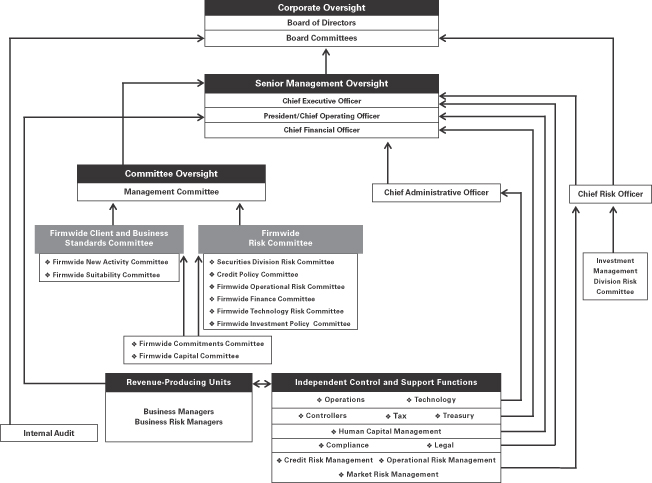
Management Committee.
The Management Committee oversees the global activities of the firm, including all of the firm’s independent control and support functions. It provides this oversight directly and through authority
delegated to committees it has established. This committee is comprised of the most senior leaders of the firm, and is chaired by the firm’s chief executive officer. The Management Committee has established various committees with delegated
authority and the chairperson of the Management Committee appoints the chairpersons of these committees. Most members of the Management Committee are also members of other firmwide, divisional and regional committees. The following are the
committees that are principally involved in firmwide risk management.
Firmwide Client and Business Standards
Committee.
The Firmwide Client and Business Standards Committee assesses and makes determinations regarding business standards and practices, reputational risk management, client
relationships and client service, is chaired by the firm’s president and chief operating officer, and reports to the Management Committee. This committee also has responsibility for overseeing recommendations of the Business Standards
Committee. This committee periodically updates and receives guidance from the Public Responsibilities Subcommittee of the Corporate Governance, Nominating and Public Responsibilities Committee of the Board. This committee has established the
following risk-related committees that report to it:
|
|
|
|
|
|
|
|
|
Goldman Sachs September 2014 Form 10-Q
|
|
153
|
THE GOLDMAN SACHS GROUP, INC. AND SUBSIDIARIES
Management’s Discussion and Analysis
|
Ÿ
|
|
Firmwide New Activity Committee.
The Firmwide New Activity Committee is responsible for reviewing new activities and for establishing a process to identify and review previously approved activities that are significant and that have changed in complexity and/or structure or present
different reputational and suitability concerns over time to consider whether these activities remain appropriate. This committee is co-chaired by the firm’s head of operations/chief operating officer for Europe, Middle East and Africa (EMEA)
and the chief administrative officer of our Investment Management Division, who are appointed by the Firmwide Client and Business Standards Committee chairperson.
|
|
Ÿ
|
|
Firmwide Suitability Committee.
The
Firmwide Suitability Committee is responsible for setting standards and policies for product, transaction and client suitability and providing a forum for consistency across divisions, regions and products on suitability assessments. This committee
also reviews suitability matters escalated from other firm committees. This committee is co-chaired by the deputy head of our Global Compliance Division and the co-head of Global Fixed Income, Currency and Commodities Sales, who are appointed by the
Firmwide Client and Business Standards Committee chairperson.
|
Firmwide Risk Committee.
The Firmwide Risk Committee is globally responsible for the ongoing monitoring and management of the firm’s financial
risks. Through both direct and delegated authority, the Firmwide Risk Committee approves firmwide, product, divisional and business-level limits for both market and credit risks, approves sovereign credit risk limits and reviews results of stress
tests and scenario analyses. This committee is co-chaired by the firm’s chief financial officer and the firm’s chief risk officer, and reports to the Management Committee. The following are the primary committees that report to the
Firmwide Risk Committee. The chairperson of the Securities Division Risk Committee is appointed by the chairpersons of the Firmwide Risk Committee; the chairpersons of the Credit Policy and Firmwide Operational Risk Committees are appointed by the
firm’s chief risk officer; the chairpersons of the Firmwide Finance Committee and the Firmwide Technology Risk Committee are appointed by the Firmwide Risk Committee; and the chairpersons of the Firmwide Investment Policy Committee are
appointed by the firm’s president and chief operating officer in conjunction with the firm’s chief financial officer.
|
Ÿ
|
|
Securities Division Risk Committee.
The Securities Division Risk Committee sets market risk limits, subject to overall firmwide risk limits, for the Securities Division based on a number of risk measures, including but not limited to VaR, stress tests, scenario analyses and balance
sheet levels. This committee is chaired by the chief risk officer of our Securities Division.
|
|
Ÿ
|
|
Credit Policy Committee.
The Credit
Policy Committee establishes and reviews broad firmwide credit policies and parameters that are implemented by Credit Risk Management. This committee is chaired by the firm’s chief credit officer.
|
|
Ÿ
|
|
Firmwide Operational Risk
Committee.
The Firmwide Operational Risk Committee provides oversight of the ongoing development and implementation of our operational risk policies, framework and methodologies, and
monitors the effectiveness of operational risk management. This committee is co-chaired by a managing director in Credit Risk Management and a managing director in Operational Risk Management.
|
|
Ÿ
|
|
Firmwide Finance Committee.
The
Firmwide Finance Committee has oversight responsibility for liquidity risk, the size and composition of our balance sheet and capital base, and credit ratings. This committee regularly reviews our liquidity, balance sheet, funding position and
capitalization, approves related policies, and makes recommendations as to any adjustments to be made in light of current events, risks, exposures and regulatory requirements. As a part of such oversight, among other things, this committee reviews
and approves balance sheet limits and the size of our GCE. This committee is co-chaired by the firm’s chief financial officer and the firm’s global treasurer.
|
|
Ÿ
|
|
Firmwide Technology Risk Committee.
The Firmwide Technology Risk Committee reviews matters related to the design, development, deployment and use of technology. This committee oversees technology risk management frameworks and methodologies, and monitors their effectiveness. This
committee is co-chaired by the firm’s chief information officer and the head of Global Investment Research.
|
|
|
|
|
|
|
|
154
|
|
Goldman Sachs September 2014 Form 10-Q
|
|
|
THE GOLDMAN SACHS GROUP, INC. AND SUBSIDIARIES
Management’s Discussion and Analysis
|
Ÿ
|
|
Firmwide Investment Policy
Committee.
The Firmwide Investment Policy Committee reviews, approves and sets policies, and provides oversight, for certain illiquid principal investments. This committee is co-chaired
by the head of our Merchant Banking Division and a co-head of our Securities Division.
|
The following
committees report jointly to the Firmwide Risk Committee and the Firmwide Client and Business Standards Committee:
|
Ÿ
|
|
Firmwide Commitments Committee.
The
Firmwide Commitments Committee reviews the firm’s underwriting and distribution activities with respect to equity and equity-related product offerings, and sets and maintains policies and procedures designed to ensure that legal, reputational,
regulatory and business standards are maintained on a global basis. In addition to reviewing specific transactions, this committee periodically conducts general strategic reviews of sectors and products and establishes policies in connection with
transaction practices. This committee is co-chaired by the firm’s senior strategy officer and the co-head of Global Mergers & Acquisitions, who are appointed by the Firmwide Client and Business Standards
Committee chairperson.
|
|
Ÿ
|
|
Firmwide Capital Committee.
The
Firmwide Capital Committee provides approval and oversight of debt-related transactions, including principal commitments of the firm’s capital. This committee aims to ensure that business and reputational standards for underwritings and capital
commitments are maintained on a global basis. This committee is co-chaired by the firm’s global treasurer and the head of credit finance for EMEA who are appointed by the Firmwide Risk Committee chairpersons.
|
Investment Management Division Risk Committee.
The Investment Management Division Risk Committee is responsible for the ongoing monitoring and control of global market, counterparty credit and liquidity risks associated with the activities of our
investment management businesses. The head of Investment Management Division risk management is the chair of this committee. The Investment Management Division Risk Committee reports to the firm’s chief risk officer.
Conflicts Management
Conflicts of interest and the firm’s approach to dealing with them are fundamental to our client relationships, our reputation and our long-term success. The term “conflict of interest”
does not have a universally accepted meaning, and conflicts can arise in many forms within a business or between businesses. The responsibility for identifying potential conflicts, as well as complying with the firm’s policies and procedures,
is shared by the entire firm.
We have a multilayered approach to resolving conflicts and addressing reputational risk.
The firm’s senior management oversees policies related to conflicts resolution. The firm’s senior management, the Business Selection and Conflicts Resolution Group, the Legal Department and Compliance Division, the Firmwide Client and
Business Standards Committee and other internal committees all play roles in the formulation of policies, standards and principles and assist in making judgments regarding the appropriate resolution of particular conflicts. Resolving potential
conflicts necessarily depends on the facts and circumstances of a particular situation and the application of experienced and informed judgment.
At the transaction level, various people and groups have roles. As a general matter, the Business Selection and Conflicts Resolution Group reviews all financing and advisory assignments in Investment
Banking and certain investing, lending and other activities of the firm. Various transaction oversight committees, such as the Firmwide Capital, Commitments and Suitability Committees and other committees across the firm, also review new
underwritings, loans, investments and structured products. These committees work with internal and external lawyers and the Compliance Division to evaluate and address any actual or potential conflicts.
We regularly assess our policies and procedures that address conflicts of interest in an effort to conduct our business in accordance with
the highest ethical standards and in compliance with all applicable laws, rules, and regulations.
|
|
|
|
|
|
|
|
|
Goldman Sachs September 2014 Form 10-Q
|
|
155
|
THE GOLDMAN SACHS GROUP, INC. AND SUBSIDIARIES
Management’s Discussion and Analysis
Liquidity Risk Management
Liquidity is of critical importance to financial institutions. Most of the failures of
financial institutions have occurred in large part due to insufficient liquidity. Accordingly, the firm has in place a comprehensive and conservative set of liquidity and funding policies to address both firm-specific and broader industry or market
liquidity events. Our principal objective is to be able to fund the firm and to enable our core businesses to continue to serve clients and generate revenues, even under adverse circumstances.
We manage liquidity risk according to the following principles:
Excess Liquidity.
We
maintain substantial excess liquidity to meet a broad range of potential cash outflows and collateral needs in a stressed environment.
Asset-Liability Management.
We assess anticipated holding periods for our assets and their
expected liquidity in a stressed environment. We manage the maturities and diversity of our funding across markets, products and counterparties, and seek to maintain liabilities of appropriate tenor relative to our asset base.
Contingency Funding Plan.
We maintain a contingency funding plan to provide a framework for analyzing and responding to a liquidity crisis situation or periods of market stress. This framework sets forth the plan of action to fund normal business activity in emergency and
stress situations. These principles are discussed in more detail below.
Excess Liquidity
Our most important liquidity policy is to pre-fund our estimated potential cash and collateral needs during a liquidity crisis and hold
this excess liquidity in the form of unencumbered, highly liquid securities and cash. We believe that the securities held in our global core excess would be readily convertible to cash in a matter of days, through liquidation, by entering into
repurchase agreements or from maturities of resale agreements, and that this cash would allow us to meet immediate obligations without needing to sell other assets or depend on additional funding from credit-sensitive markets.
As of September 2014 and December 2013, the fair value of the securities and
certain overnight cash deposits included in our GCE totaled $180.04 billion and $184.07 billion, respectively. Based on the results of our internal liquidity risk model, discussed below, as well as our consideration of other factors
including, but not limited to, an assessment of our potential intraday liquidity needs and a qualitative assessment of the condition of the financial markets and the firm, we believe our liquidity position as of both September 2014 and
December 2013 was appropriate.
The table below presents the fair value of the securities and certain overnight cash
deposits that are included in our GCE.
|
|
|
|
|
|
|
|
|
|
|
|
|
Average for the
|
|
|
$ in millions
|
|
|
Three Months Ended
September 2014
|
|
|
|
Year Ended
December 2013
|
|
|
U.S. dollar-denominated
|
|
|
$138,577
|
|
|
|
$136,824
|
|
|
|
|
|
Non-U.S.
dollar-denominated
|
|
|
44,415
|
|
|
|
45,826
|
|
|
Total
|
|
|
$182,992
|
|
|
|
$182,650
|
|
The U.S. dollar-denominated excess is composed of (i) unencumbered U.S. government and federal agency
obligations (including highly liquid U.S. federal agency mortgage-backed obligations), all of which are eligible as collateral in Federal Reserve open market operations and (ii) certain overnight U.S. dollar cash deposits. The non-U.S.
dollar-denominated excess is composed of only unencumbered German, French, Japanese and United Kingdom government obligations and certain overnight cash deposits in highly liquid currencies. We strictly limit our excess liquidity to this narrowly
defined list of securities and cash because they are highly liquid, even in a difficult funding environment. We do not include other potential sources of excess liquidity, such as less liquid unencumbered securities or committed credit facilities,
in our GCE.
|
|
|
|
|
|
|
156
|
|
Goldman Sachs September 2014 Form 10-Q
|
|
|
THE GOLDMAN SACHS GROUP, INC. AND SUBSIDIARIES
Management’s Discussion and Analysis
The table below presents the fair value of our GCE by asset class.
|
|
|
|
|
|
|
|
|
|
|
|
|
Average for the
|
|
|
$ in millions
|
|
|
Three Months Ended
September 2014
|
|
|
|
Year Ended
December 2013
|
|
|
Overnight cash deposits
|
|
|
$ 59,283
|
|
|
|
$ 61,265
|
|
|
|
|
|
U.S. government obligations
|
|
|
64,051
|
|
|
|
76,019
|
|
|
|
|
|
U.S. federal agency obligations, including highly liquid U.S. federal agency mortgage-backed obligations
|
|
|
17,651
|
|
|
|
2,551
|
|
|
|
|
|
German, French, Japanese and United Kingdom government obligations
|
|
|
42,007
|
|
|
|
42,815
|
|
|
Total
|
|
|
$182,992
|
|
|
|
$182,650
|
|
The table below presents our GCE held by Group Inc. and our major broker-dealer and bank subsidiaries.
|
|
|
|
|
|
|
|
|
|
|
|
|
Average for the
|
|
|
$ in millions
|
|
|
Three Months Ended
September 2014
|
|
|
|
Year Ended
December 2013
|
|
|
Group Inc.
|
|
|
$ 37,295
|
|
|
|
$ 29,752
|
|
|
|
|
|
Major broker-dealer subsidiaries
|
|
|
92,215
|
|
|
|
93,103
|
|
|
|
|
|
Major bank subsidiaries
|
|
|
53,482
|
|
|
|
59,795
|
|
|
Total
|
|
|
$182,992
|
|
|
|
$182,650
|
|
Our GCE reflects the following principles:
|
Ÿ
|
|
The first days or weeks of a liquidity crisis are the most critical to a company’s survival.
|
|
Ÿ
|
|
Focus must be maintained on all potential cash and collateral outflows, not just disruptions to financing flows. Our businesses are diverse, and our
liquidity needs are determined by many factors, including market movements, collateral requirements and client commitments, all of which can change dramatically in a difficult funding environment.
|
|
Ÿ
|
|
During a liquidity crisis, credit-sensitive funding, including unsecured debt and some types of secured financing agreements, may be unavailable,
and the terms (e.g., interest rates, collateral provisions and tenor) or availability of other types of secured financing may change.
|
|
Ÿ
|
|
As a result of our policy to pre-fund liquidity that we estimate may be needed in a crisis, we hold more unencumbered securities and have larger
debt balances than our businesses would otherwise require. We believe that our liquidity is stronger with greater balances of highly liquid unencumbered securities, even though it increases our total assets and our funding costs.
|
We believe that our GCE provides us with a resilient source of funds that would be
available in advance of potential cash and collateral outflows and gives us significant flexibility in managing through a difficult funding environment.
In order to determine the appropriate size of our GCE, we use an internal liquidity model, referred to as the Modeled Liquidity Outflow, which captures and quantifies the firm’s liquidity risks. We
also consider other factors including, but not limited to, an assessment of our potential intraday liquidity needs through an additional internal liquidity model, referred to as the Intraday Liquidity Model, and a qualitative assessment of the
condition of the financial markets and the firm.
We distribute our GCE across entities, asset types, and clearing agents
to provide us with sufficient operating liquidity to ensure timely settlement in all major markets, even in a difficult funding environment.
We maintain our GCE to enable us to meet current and potential liquidity requirements of our parent company, Group Inc., and its subsidiaries. Our Modeled Liquidity Outflow and Intraday Liquidity Model
incorporate a consolidated requirement for the firm as well as a standalone requirement for each of our major broker-dealer and bank subsidiaries. Liquidity held directly in each of these major subsidiaries is intended for use only by that
subsidiary to meet its liquidity requirements and is assumed not to be available to Group Inc. unless (i) legally provided for and (ii) there are no additional regulatory, tax or other restrictions. In addition, the Modeled Liquidity
Outflow and Intraday Liquidity Model also incorporate a broader assessment of standalone liquidity requirements for other subsidiaries and we hold a portion of our GCE directly at Group Inc. to support such requirements. In addition to the GCE, we
maintain operating cash balances in several of our other operating entities, primarily for use in specific currencies, entities, or jurisdictions where we do not have immediate access to parent company liquidity.
In addition to our GCE, we have a significant amount of other unencumbered cash and financial instruments, including other government
obligations, high-grade money market securities, corporate obligations, marginable equities, loans and cash deposits not included in our GCE. The fair value of these assets averaged $87.72 billion for the three months ended September 2014
and $90.77 billion for the year ended December 2013. We do not consider these assets liquid enough to be eligible for our GCE liquidity pool and therefore conservatively do not assume we will generate liquidity from these assets in our
Modeled Liquidity Outflow.
|
|
|
|
|
|
|
|
|
Goldman Sachs September 2014 Form 10-Q
|
|
157
|
THE GOLDMAN SACHS GROUP, INC. AND SUBSIDIARIES
Management’s Discussion and Analysis
Modeled Liquidity Outflow.
Our Modeled Liquidity Outflow is based on conducting multiple scenarios that include combinations of market-wide and firm-specific stress. These scenarios are characterized by the following
qualitative elements:
|
Ÿ
|
|
Severely challenged market environments, including low consumer and corporate confidence, financial and political instability, adverse changes in
market values, including potential declines in equity markets and widening of credit spreads.
|
|
Ÿ
|
|
A firm-specific crisis potentially triggered by material losses, reputational damage, litigation, executive departure, and/or a ratings downgrade.
|
The following are the critical modeling parameters of the Modeled Liquidity Outflow:
|
Ÿ
|
|
Liquidity needs over a 30-day scenario.
|
|
Ÿ
|
|
A two-notch downgrade of the firm’s long-term senior unsecured credit ratings.
|
|
Ÿ
|
|
A combination of contractual outflows, such as upcoming maturities of unsecured debt, and contingent outflows (e.g., actions though not
contractually required, we may deem necessary in a crisis). We assume that most contingent outflows will occur within the initial days and weeks of a crisis.
|
|
Ÿ
|
|
No issuance of equity or unsecured debt.
|
|
Ÿ
|
|
No support from government funding facilities. Although we have access to various central bank funding programs, we do not assume reliance on them
as a source of funding in a liquidity crisis.
|
|
Ÿ
|
|
We do not assume asset liquidation, other than the GCE.
|
The Modeled Liquidity Outflow is calculated and reported to senior management on a daily basis. We regularly refine our model to reflect changes in market or economic conditions and the firm’s
business mix.
The potential contractual and contingent cash and collateral outflows covered in our Modeled Liquidity
Outflow include:
Unsecured Funding
|
Ÿ
|
|
Contractual: All upcoming maturities of unsecured long-term debt, commercial paper, promissory notes and other unsecured funding products. We assume
that we will be unable to issue new unsecured debt or rollover any maturing debt.
|
|
Ÿ
|
|
Contingent: Repurchases of our outstanding long-term debt, commercial paper and hybrid financial instruments in the ordinary course of business as a
market maker.
|
Deposits
|
Ÿ
|
|
Contractual: All upcoming maturities of term deposits. We assume that we will be unable to raise new term deposits or rollover any maturing
term deposits.
|
|
Ÿ
|
|
Contingent: Withdrawals of bank deposits that have no contractual maturity. The withdrawal assumptions reflect, among other factors, the type of
deposit, whether the deposit is insured or uninsured, and the firm’s relationship with the depositor.
|
Secured Funding
|
Ÿ
|
|
Contractual: A portion of upcoming contractual maturities of secured funding due to either the inability to refinance or the ability to refinance
only at wider haircuts (i.e., on terms which require us to post additional collateral). Our assumptions reflect, among other factors, the quality of the underlying collateral, counterparty roll probabilities (our assessment of the
counterparty’s likelihood of continuing to provide funding on a secured basis at the maturity of the trade) and counterparty concentration.
|
|
Ÿ
|
|
Contingent: Adverse changes in value of financial assets pledged as collateral for financing transactions, which would necessitate additional
collateral postings under those transactions.
|
OTC Derivatives
|
Ÿ
|
|
Contingent: Collateral postings to counterparties due to adverse changes in the value of our OTC derivatives, excluding those that are cleared and
settled through central counterparties (OTC-cleared).
|
|
Ÿ
|
|
Contingent: Other outflows of cash or collateral related to OTC derivatives, excluding OTC-cleared, including the impact of trade terminations,
collateral substitutions, collateral disputes, loss of rehypothecation rights, collateral calls or termination payments required by a two-notch downgrade in our credit ratings, and collateral that has not been called by counterparties, but is
available to them.
|
|
|
|
|
|
|
|
158
|
|
Goldman Sachs September 2014 Form 10-Q
|
|
|
THE GOLDMAN SACHS GROUP, INC. AND SUBSIDIARIES
Management’s Discussion and Analysis
Exchange-Traded and OTC-cleared Derivatives
|
Ÿ
|
|
Contingent: Variation margin postings required due to adverse changes in the value of our outstanding exchange-traded and OTC-cleared derivatives.
|
|
Ÿ
|
|
Contingent: An increase in initial margin and guaranty fund requirements by derivative clearing houses.
|
Customer Cash and Securities
|
Ÿ
|
|
Contingent: Liquidity outflows associated with our prime brokerage business, including withdrawals of customer credit balances, and a reduction in
customer short positions, which serve as a funding source for long positions.
|
Unfunded Commitments
|
Ÿ
|
|
Contingent: Draws on our unfunded commitments. Draw assumptions reflect, among other things, the type of commitment and counterparty.
|
Other
|
Ÿ
|
|
Other upcoming large cash outflows, such as tax payments.
|
Intraday Liquidity Model.
Our Intraday Liquidity Model measures the firm’s intraday liquidity needs using a scenario analysis characterized by the same qualitative elements as our Modeled Liquidity Outflow. The model assesses the risk of increased intraday liquidity
requirements during a scenario where access to sources of intraday liquidity may become constrained.
The following are
key modeling elements of the Intraday Liquidity Model:
|
Ÿ
|
|
Liquidity needs over a one-day settlement period.
|
|
Ÿ
|
|
Delays in receipt of counterparty cash payments.
|
|
Ÿ
|
|
A reduction in the availability of intraday credit lines at our third-party clearing agents.
|
|
Ÿ
|
|
Higher settlement volumes due to an increase in activity.
|
We regularly refine our model to reflect changes in market conditions, business mix and operational processes.
Asset-Liability Management
Our liquidity risk management policies are designed to ensure we have a sufficient amount of financing, even when funding markets experience persistent stress. We seek to maintain a long-dated and
diversified funding profile, taking into consideration the characteristics and liquidity profile of our assets.
Our
approach to asset-liability management includes:
|
Ÿ
|
|
Conservatively managing the overall characteristics of our funding book, with a focus on maintaining long-term, diversified sources of funding in
excess of our current requirements. See “Balance Sheet and Funding Sources — Funding Sources” for additional details.
|
|
Ÿ
|
|
Actively managing and monitoring our asset base, with particular focus on the liquidity, holding period and our ability to fund assets on a secured
basis. This enables us to determine the most appropriate funding products and tenors. See “Balance Sheet and Funding Sources — Balance Sheet Management” for more detail on our balance sheet management process and
“— Funding Sources — Secured Funding” for more detail on asset classes that may be harder to fund on a secured basis.
|
|
Ÿ
|
|
Raising secured and unsecured financing that has a long tenor relative to the liquidity profile of our assets. This reduces the risk that our
liabilities will come due in advance of our ability to generate liquidity from the sale of our assets. Because we maintain a highly liquid balance sheet, the holding period of certain of our assets may be materially shorter than their contractual
maturity dates.
|
Our goal is to ensure that the firm maintains sufficient liquidity to fund its assets
and meet its contractual and contingent obligations in normal times as well as during periods of market stress. Through our dynamic balance sheet management process, we use actual and projected asset balances to determine secured and unsecured
funding requirements. Funding plans are reviewed and approved by the Firmwide Finance Committee on a quarterly basis. In addition, senior managers in our independent control and support functions regularly analyze, and the Firmwide Finance Committee
reviews, our consolidated total capital position (unsecured long-term borrowings plus total shareholders’ equity) so that we maintain a level of long-term funding that is sufficient to meet our long-term financing requirements. In a liquidity
crisis, we would first use our GCE in order to avoid reliance on asset sales (other than our GCE). However, we recognize that orderly asset sales may be prudent or necessary in a severe or persistent liquidity crisis.
|
|
|
|
|
|
|
|
|
Goldman Sachs September 2014 Form 10-Q
|
|
159
|
THE GOLDMAN SACHS GROUP, INC. AND SUBSIDIARIES
Management’s Discussion and Analysis
Subsidiary Funding Policies.
The majority of our unsecured funding is raised by Group Inc. which lends the necessary funds to its subsidiaries, some of which are regulated, to meet their asset financing, liquidity and capital
requirements. In addition, Group Inc. provides its regulated subsidiaries with the necessary capital to meet their regulatory requirements. The benefits of this approach to subsidiary funding are enhanced control and greater flexibility to meet the
funding requirements of our subsidiaries. Funding is also raised at the subsidiary level through a variety of products, including secured funding, unsecured borrowings and deposits.
Our intercompany funding policies assume that, unless legally provided for, a subsidiary’s funds or securities are not freely
available to its parent company or other subsidiaries. In particular, many of our subsidiaries are subject to laws that authorize regulatory bodies to block or reduce the flow of funds from those subsidiaries to Group Inc. Regulatory action of that
kind could impede access to funds that Group Inc. needs to make payments on its obligations. Accordingly, we assume that the capital provided to our regulated subsidiaries is not available to Group Inc. or other subsidiaries and any other financing
provided to our regulated subsidiaries is not available until the maturity of such financing.
Group Inc. has provided
substantial amounts of equity and subordinated indebtedness, directly or indirectly, to its regulated subsidiaries. For example, as of September 2014, Group Inc. had $29.39 billion of equity and subordinated indebtedness invested in
GS&Co., its principal U.S. registered broker-dealer; $27.49 billion invested in GSI, a regulated U.K. broker-dealer; $2.27 billion invested in GSEC, a U.S. registered broker-dealer; $2.92 billion invested in Goldman Sachs Japan
Co., Ltd., a regulated Japanese broker-dealer; $23.14 billion invested in GS Bank USA, a regulated New York State-chartered bank; and $3.54 billion invested in GSIB, a regulated U.K. bank. Group Inc. also provided, directly or indirectly,
$82.79 billion of unsubordinated loans and $7.99 billion of collateral to these entities, substantially all of which was to GS&Co., GSI and GS Bank USA, as of September 2014. In addition, as of September 2014, Group Inc. had
significant amounts of capital invested in and loans to its other regulated subsidiaries.
Contingency Funding Plan
The Goldman Sachs contingency funding plan sets out the plan of action we would use to fund business activity in crisis situations and periods of market stress. The contingency funding plan outlines a
list of potential risk factors, key reports and metrics that are reviewed on an ongoing basis to assist in assessing the severity of, and managing through, a liquidity crisis and/or market dislocation. The contingency funding plan also describes in
detail the firm’s potential responses if our assessments indicate that the firm has entered a liquidity crisis, which include pre-funding for what we estimate will be our potential cash and collateral needs as well as utilizing secondary
sources of liquidity. Mitigants and action items to address specific risks which may arise are also described and assigned to individuals responsible for execution.
The contingency funding plan identifies key groups of individuals to foster effective coordination, control and distribution of information, all of which are critical in the management of a crisis or
period of market stress. The contingency funding plan also details the responsibilities of these groups and individuals, which include making and disseminating key decisions, coordinating all contingency activities throughout the duration of the
crisis or period of market stress, implementing liquidity maintenance activities and managing internal and external communication.
Liquidity
Framework
The Basel Committee’s international framework for liquidity risk measurement, standards and monitoring
calls for imposition of a liquidity coverage ratio (LCR), designed to ensure that banks and bank holding companies maintain an adequate level of unencumbered high-quality liquid assets based on expected cash outflows under an acute liquidity stress
scenario. Under the Basel Committee framework, the LCR will be introduced on January 1, 2015 and there will be a phase-in period whereby firms will have a 60% minimum in 2015 which will increase by 10% per year until 2019.
|
|
|
|
|
|
|
160
|
|
Goldman Sachs September 2014 Form 10-Q
|
|
|
THE GOLDMAN SACHS GROUP, INC. AND SUBSIDIARIES
Management’s Discussion and Analysis
In addition, in September 2014, the Office of the Comptroller of the Currency, the
Federal Reserve Board and the FDIC approved the final rules on minimum liquidity standards that are generally consistent with the Basel Committee’s framework as described above, but include accelerated transition provisions, and more stringent
requirements related to both the range of assets that qualify as high-quality liquid assets and cash outflow assumptions for certain types of funding. Under the accelerated transition timeline, the LCR will be introduced on January 1, 2015
and there will be a U.S. phase-in period whereby firms will have an 80% minimum in 2015 which will increase by 10% per year until 2017. Our current estimate of the LCR exceeds the fully phased-in minimum requirement, however this estimate is based
on our current interpretation and understanding of the new frameworks and may evolve as we discuss their interpretation and application with our regulators.
The Basel Committee’s international framework for liquidity risk measurement, standards and monitoring also calls for a net stable funding ratio (NSFR), designed to promote more medium- and long-term
funding of the assets and activities of banks and bank holding companies. On October 31, 2014, the Basel Committee issued the final rules on the calculation of the NSFR which requires banks to maintain a stable funding profile in relation
to the composition of their assets and off-balance sheet activities. Under the Basel Committee framework, the NSFR will be introduced as a requirement on January 1, 2018. For U.S. banking organizations, the NSFR is subject to
implementation by the U.S. federal bank regulatory agencies.
We are currently evaluating the impact of both the LCR and
the NSFR rules. The implementation of these rules (and any amendments adopted by the U.S. federal bank regulatory agencies) could impact our liquidity and funding requirements and practices in the future.
Credit Ratings
We rely on the
short-term and long-term debt capital markets to fund a significant portion of our day-to-day operations and the cost and availability of debt financing is influenced by our credit ratings. Credit ratings are also important when we are competing in
certain markets, such as OTC derivatives, and when we seek to engage in longer-term transactions. See “Certain Risk Factors That May Affect Our Businesses” below and “Risk Factors” in Part I, Item 1A of the 2013
Form 10-K for a discussion of the risks associated with a reduction in our credit ratings.
The table below presents the unsecured credit ratings by DBRS, Inc. (DBRS), Fitch, Inc.
(Fitch), Moody’s Investors Service (Moody’s), Standard & Poor’s Ratings Services (S&P), and Rating and Investment Information, Inc. (R&I) and outlook of Group Inc. During the third quarter of 2014, as part of a
reassessment of its ratings criteria for certain capital instruments issued by financial institutions, S&P lowered the ratings on our Trust Preferred Securities and Preferred Stock from BB+ to BB.
|
|
|
|
|
|
|
|
|
|
|
|
|
|
|
|
|
|
|
|
|
|
|
|
|
As of September 2014
|
|
|
|
|
|
DBRS
|
|
|
|
Fitch
|
|
|
|
Moody’s
|
|
|
|
S&P
|
|
|
|
R&I
|
|
|
Short-term
Debt
|
|
|
R-1 (middle)
|
|
|
|
F1
|
|
|
|
P-2
|
|
|
|
A-2
|
|
|
|
a-1
|
|
|
|
|
|
Long-term
Debt
1
|
|
|
A (high)
|
|
|
|
A
|
|
|
|
Baa1
|
|
|
|
A-
|
|
|
|
A+
|
|
|
|
|
|
Subordinated Debt
|
|
|
A
|
|
|
|
A-
|
|
|
|
Baa2
|
|
|
|
BBB+
|
|
|
|
A
|
|
|
|
|
|
Trust Preferred
2
|
|
|
A
|
|
|
|
BBB-
|
|
|
|
Baa3
|
|
|
|
BB
|
|
|
|
N/A
|
|
|
|
|
|
Preferred Stock
3
|
|
|
BBB (high
|
)
|
|
|
BB+
|
|
|
|
Ba2
|
|
|
|
BB
|
|
|
|
N/A
|
|
|
|
|
|
Ratings Outlook
|
|
|
Stable
|
|
|
|
Stable
|
|
|
|
Stable
|
|
|
|
Negative
|
|
|
|
Negative
|
|
|
1.
|
Fitch, Moody’s and S&P include the senior guaranteed trust securities issued by Murray Street Investment Trust I and Vesey Street Investment Trust I.
|
|
2.
|
Trust preferred securities issued by Goldman Sachs Capital I.
|
|
3.
|
DBRS, Fitch, Moody’s and S&P include Group Inc.’s non-cumulative preferred stock and the APEX issued by Goldman Sachs Capital II and Goldman
Sachs Capital III.
|
The table below presents the unsecured credit ratings of GS Bank USA, GSIB, GS&Co.
and GSI.
|
|
|
|
|
|
|
|
|
|
|
|
|
|
|
|
|
As of September 2014
|
|
|
|
|
|
Fitch
|
|
|
|
Moody’s
|
|
|
|
S&P
|
|
|
GS Bank USA
|
|
|
|
|
|
|
|
|
|
|
|
|
|
Short-term Debt
|
|
|
F1
|
|
|
|
P-1
|
|
|
|
A-1
|
|
|
|
|
|
Long-term Debt
|
|
|
A
|
|
|
|
A2
|
|
|
|
A
|
|
|
|
|
|
Short-term Bank Deposits
|
|
|
F1
|
|
|
|
P-1
|
|
|
|
N/A
|
|
|
|
|
|
|
|
|
|
|
|
|
|
|
|
|
Long-term Bank Deposits
|
|
|
A+
|
|
|
|
A2
|
|
|
|
N/A
|
|
|
GSIB
|
|
|
|
|
|
|
|
|
|
|
|
|
|
Short-term Debt
|
|
|
F1
|
|
|
|
P-1
|
|
|
|
A-1
|
|
|
|
|
|
Long-term Debt
|
|
|
A
|
|
|
|
A2
|
|
|
|
A
|
|
|
|
|
|
Short-term Bank Deposits
|
|
|
F1
|
|
|
|
P-1
|
|
|
|
N/A
|
|
|
|
|
|
Long-term Bank Deposits
|
|
|
A
|
|
|
|
A2
|
|
|
|
N/A
|
|
|
GS&Co.
|
|
|
|
|
|
|
|
|
|
|
|
|
|
Short-term Debt
|
|
|
F1
|
|
|
|
N/A
|
|
|
|
A-1
|
|
|
|
|
|
Long-term Debt
|
|
|
A
|
|
|
|
N/A
|
|
|
|
A
|
|
|
GSI
|
|
|
|
|
|
|
|
|
|
|
|
|
|
Short-term Debt
|
|
|
F1
|
|
|
|
P-1
|
|
|
|
A-1
|
|
|
|
|
|
Long-term Debt
|
|
|
A
|
|
|
|
A2
|
|
|
|
A
|
|
|
|
|
|
|
|
|
|
|
Goldman Sachs September 2014 Form 10-Q
|
|
161
|
THE GOLDMAN SACHS GROUP, INC. AND SUBSIDIARIES
Management’s Discussion and Analysis
We believe our credit ratings are primarily based on the credit rating agencies’
assessment of:
|
Ÿ
|
|
our liquidity, market, credit and operational risk management practices;
|
|
Ÿ
|
|
the level and variability of our earnings;
|
|
Ÿ
|
|
our franchise, reputation and management;
|
|
Ÿ
|
|
our corporate governance; and
|
|
Ÿ
|
|
the external operating environment, including the assumed level of government support.
|
Certain of the firm’s derivatives have been transacted under bilateral agreements with counterparties who may require us to post
collateral or terminate the transactions based on changes in our credit ratings. We assess the impact of these bilateral agreements by determining the collateral or termination payments that would occur assuming a downgrade by all rating
agencies. A downgrade by any one rating agency, depending on the agency’s relative ratings of the firm at the time of the downgrade, may have an impact which is comparable to the impact of a downgrade by all rating agencies. We
allocate a portion of our GCE to ensure we would be able to make the additional collateral or termination payments that may be required in the event of a two-notch reduction in our long-term credit ratings, as well as collateral that has not been
called by counterparties, but is available to them. The table below presents the additional collateral or termination payments related to our net derivative liabilities under bilateral agreements that could have been called at the reporting date by
counterparties in the event of a one-notch and two-notch downgrade in our credit ratings.
|
|
|
|
|
|
|
|
|
|
|
|
|
As of
|
|
|
$ in millions
|
|
|
September
2014
|
|
|
|
December
2013
|
|
|
Additional collateral or termination payments for a one-notch downgrade
|
|
|
$1,340
|
|
|
|
$ 911
|
|
|
|
|
|
Additional collateral or termination payments for a two-notch downgrade
|
|
|
3,206
|
|
|
|
2,989
|
|
Cash Flows
As a global financial institution, our cash flows are complex and bear little relation to our net earnings and net assets. Consequently, we believe that traditional cash flow analysis is less meaningful
in evaluating our liquidity position than the excess liquidity and asset-liability management policies described above. Cash flow analysis may, however, be helpful in highlighting certain macro trends and strategic initiatives in
our businesses.
Nine Months Ended September 2014.
Our cash and cash equivalents decreased by $6.98 billion to $54.15 billion at the end of the third quarter of 2014. We used net cash of $23.18 billion for operating and investing
activities. We generated $16.20 billion in net cash from financing activities primarily from net issuances of unsecured long-term borrowings and preferred stock, and net deposits.
Nine Months Ended September 2013.
Our cash and cash equivalents decreased by $7.19 billion to $65.48 billion at the end of the third quarter of 2013. We generated net cash of $2.26 billion from operating activities. We
used net cash of $9.45 billion for investing and financing activities to fund loans held for investment, repurchases of common stock and net repayments of secured and unsecured borrowings.
|
|
|
|
|
|
|
162
|
|
Goldman Sachs September 2014 Form 10-Q
|
|
|
THE GOLDMAN SACHS GROUP, INC. AND SUBSIDIARIES
Management’s Discussion and Analysis
Market Risk Management
Overview
Market risk is the risk of loss in the value of our inventory, as well as certain other financial assets and financial liabilities, due to changes in market conditions. The firm employs a variety of risk
measures, each described in the respective sections below, to monitor market risk. We hold inventory primarily for market making for our clients and for our investing and lending activities. Our inventory therefore changes based on client demands
and our investment opportunities. Our inventory is accounted for at fair value and therefore fluctuates on a daily basis, with the related gains and losses included in “Market making,” and “Other principal transactions.”
Categories of market risk include the following:
|
Ÿ
|
|
Interest rate risk: results from exposures to changes in the level, slope and curvature of yield curves, the volatilities of interest rates,
mortgage prepayment speeds and credit spreads.
|
|
Ÿ
|
|
Equity price risk: results from exposures to changes in prices and volatilities of individual equities, baskets of equities and equity indices.
|
|
Ÿ
|
|
Currency rate risk: results from exposures to changes in spot prices, forward prices and volatilities of currency rates.
|
|
Ÿ
|
|
Commodity price risk: results from exposures to changes in spot prices, forward prices and volatilities of commodities, such as crude oil, petroleum
products, natural gas, electricity, and precious and base metals.
|
Market Risk Management Process
We manage our market risk by diversifying exposures, controlling position sizes and establishing economic hedges in related securities or
derivatives. This includes:
|
Ÿ
|
|
accurate and timely exposure information incorporating multiple risk metrics;
|
|
Ÿ
|
|
a dynamic limit setting framework; and
|
|
Ÿ
|
|
constant communication among revenue-producing units, risk managers and senior management.
|
Market Risk Management, which is independent of the revenue-producing units and reports to
the firm’s chief risk officer, has primary responsibility for assessing, monitoring and managing market risk at the firm. We monitor and control risks through strong firmwide oversight and independent control and support functions across the
firm’s global businesses.
Managers in revenue-producing units are accountable for managing risk within prescribed
limits. These managers have in-depth knowledge of their positions, markets and the instruments available to hedge their exposures.
Managers in revenue-producing units and Market Risk Management discuss market information, positions and estimated risk and loss scenarios on an ongoing basis.
Risk Measures
Market Risk
Management produces risk measures and monitors them against market risk limits set by our firm’s risk committees. These measures reflect an extensive range of scenarios and the results are aggregated at trading desk, business and
firmwide levels.
We use a variety of risk measures to estimate the size of potential losses for both moderate and more
extreme market moves over both short-term and long-term time horizons. Our primary risk measures are VaR, which is used for shorter-term periods, and stress tests. Our risk reports detail key risks, drivers and changes for each desk and business,
and are distributed daily to senior management of both our revenue-producing units and our independent control and support functions.
Value-at-Risk
VaR is the potential
loss in value due to adverse market movements over a defined time horizon with a specified confidence level. For positions included in VaR, see “— Financial Statement Linkages to Market Risk Measures.” We typically employ a
one-day time horizon with a 95% confidence level. We use a single VaR model which captures risks including interest rates, equity prices, currency rates and commodity prices. As such, VaR facilitates comparison across portfolios of different risk
characteristics. VaR also captures the diversification of aggregated risk at the firmwide level.
|
|
|
|
|
|
|
|
|
Goldman Sachs September 2014 Form 10-Q
|
|
163
|
THE GOLDMAN SACHS GROUP, INC. AND SUBSIDIARIES
Management’s Discussion and Analysis
We are aware of the inherent limitations to VaR and therefore use a variety of risk
measures in our market risk management process. Inherent limitations to VaR include:
|
Ÿ
|
|
VaR does not estimate potential losses over longer time horizons where moves may be extreme.
|
|
Ÿ
|
|
VaR does not take account of the relative liquidity of different risk positions.
|
|
Ÿ
|
|
Previous moves in market risk factors may not produce accurate predictions of all future market moves.
|
When calculating VaR, we use historical simulations with full valuation of approximately 70,000 market factors. VaR is calculated at a
position level based on simultaneously shocking the relevant market risk factors for that position. We sample from five years of historical data to generate the scenarios for our VaR calculation. The historical data is weighted so that the
relative importance of the data reduces over time. This gives greater importance to more recent observations and reflects current asset volatilities, which improves the accuracy of our estimates of potential loss. As a result, even if our positions
included in VaR were unchanged, our VaR would increase with increasing market volatility and vice versa.
Given its
reliance on historical data, VaR is most effective in estimating risk exposures in markets in which there are no sudden fundamental changes or shifts in market conditions.
Our VaR measure does not include:
|
Ÿ
|
|
positions that are best measured and monitored using sensitivity measures; and
|
|
Ÿ
|
|
the impact of changes in counterparty and our own credit spreads on derivatives, as well as changes in our own credit spreads on unsecured
borrowings for which the fair value option was elected.
|
Stress Testing
Stress testing is a method of determining the effect on the firm of various hypothetical stress scenarios. We use stress testing to examine risks of specific portfolios as well as the potential
impact of significant risk exposures across the firm. We use a variety of stress testing techniques to calculate the potential loss from a wide range of market moves on the firm’s portfolios, including sensitivity analysis, scenario analysis
and firmwide stress tests. The results of our various stress tests are analyzed together for risk management purposes.
Sensitivity analysis is used to quantify the impact of a market move in a single risk factor across all positions (e.g., equity prices or
credit spreads) using a variety of defined market shocks, ranging from those that could be expected over a one-day time horizon up to those that could take many months to occur. We also use sensitivity analysis to quantify the impact of the default
of a single corporate entity, which captures the risk of large or concentrated exposures.
Scenario analysis is used to
quantify the impact of a specified event, including how the event impacts multiple risk factors simultaneously. For example, for sovereign stress testing we calculate potential direct exposure associated with our sovereign inventory as well as the
corresponding debt, equity and currency exposures associated with our non-sovereign inventory that may be impacted by the sovereign distress. When conducting scenario analysis, we typically consider a number of possible outcomes for each scenario,
ranging from moderate to severely adverse market impacts. In addition, these stress tests are constructed using both historical events and forward-looking hypothetical scenarios.
Firmwide stress testing combines market, credit, operational and liquidity risks into a single combined scenario. Firmwide stress tests
are primarily used to assess capital adequacy as part of our capital planning and stress testing process; however, we also ensure that firmwide stress testing is integrated into our risk governance framework. This includes selecting appropriate
scenarios to use for our capital planning and stress testing process. See “Equity Capital Management and Regulatory Capital — Equity Capital Management” above for further information.
|
|
|
|
|
|
|
164
|
|
Goldman Sachs September 2014 Form 10-Q
|
|
|
THE GOLDMAN SACHS GROUP, INC. AND SUBSIDIARIES
Management’s Discussion and Analysis
Unlike VaR measures, which have an implied probability because they are calculated at a
specified confidence level, there is generally no implied probability that our stress test scenarios will occur. Instead, stress tests are used to model both moderate and more extreme moves in underlying market factors. When estimating potential
loss, we generally assume that our positions cannot be reduced or hedged (although experience demonstrates that we are generally able to do so).
Stress test scenarios are conducted on a regular basis as part of the firm’s routine risk management process and on an ad hoc basis in response to market events or concerns. Stress testing is an
important part of the firm’s risk management process because it allows us to quantify our exposure to tail risks, highlight potential loss concentrations, undertake risk/reward analysis, and assess and mitigate our risk positions.
Limits
We use risk
limits at various levels in the firm (including firmwide, product and business) to govern risk appetite by controlling the size of our exposures to market risk. Limits are set based on VaR and on a range of stress tests relevant to the firm’s
exposures. Limits are reviewed frequently and amended on a permanent or temporary basis to reflect changing market conditions, business conditions or tolerance for risk.
The Firmwide Risk Committee sets market risk limits at firmwide and product levels and our Securities Division Risk Committee sets sub-limits for market-making and investing activities at a business
level. The purpose of the firmwide limits is to assist senior management in controlling the firm’s overall risk profile. Sub-limits set the desired maximum amount of exposure that may be managed by any particular business on a day-to-day basis
without additional levels of senior management approval, effectively leaving day-to-day trading decisions to individual desk managers and traders. Accordingly, sub-limits are a management tool designed to ensure appropriate escalation rather than to
establish maximum risk tolerance. Sub-limits also distribute risk among various businesses in a manner that is consistent with their level of activity and client demand, taking into account the relative performance of each area.
Our market risk limits are monitored daily by Market Risk Management, which is responsible
for identifying and escalating, on a timely basis, instances where limits have been exceeded. The business-level limits that are set by the Securities Division Risk Committee are subject to the same scrutiny and limit escalation policy as the
firmwide limits.
When a risk limit has been exceeded (e.g., due to changes in market conditions, such as increased
volatilities or changes in correlations), it is reported to the appropriate risk committee and a discussion takes place with the relevant desk managers, after which either the risk position is reduced or the risk limit is temporarily or
permanently increased.
Model Review and Validation
Our VaR and stress testing models are subject to review and validation by our independent model validation group. This review includes:
|
Ÿ
|
|
a critical evaluation of the model, its theoretical soundness and adequacy for intended use;
|
|
Ÿ
|
|
verification of the testing strategy utilized by the model developers to ensure that the model functions as intended; and
|
|
Ÿ
|
|
verification of the suitability of the calculation techniques incorporated in the model.
|
Our VaR and stress testing models are regularly reviewed and enhanced in order to incorporate changes in the composition of positions
included in the firm’s market risk measures, as well as variations in market conditions. Prior to implementing significant changes to our assumptions and/or models, we perform model validation and test runs. Significant changes to our VaR and
stress testing models are reviewed with the firm’s chief risk officer and chief financial officer, and approved by the Firmwide Risk Committee.
We evaluate the accuracy of our VaR model through daily backtesting (i.e., by comparing daily trading net revenues to the VaR measure calculated as of the prior business day) at the firmwide level and for
each of our businesses and major regulated subsidiaries.
|
|
|
|
|
|
|
|
|
Goldman Sachs September 2014 Form 10-Q
|
|
165
|
THE GOLDMAN SACHS GROUP, INC. AND SUBSIDIARIES
Management’s Discussion and Analysis
Systems
We have made a significant investment in technology to monitor market risk including:
|
Ÿ
|
|
an independent calculation of VaR and stress measures;
|
|
Ÿ
|
|
risk measures calculated at individual position levels;
|
|
Ÿ
|
|
attribution of risk measures to individual risk factors of each position;
|
|
Ÿ
|
|
the ability to report many different views of the risk measures (e.g., by desk, business, product type or legal entity); and,
|
|
Ÿ
|
|
the ability to produce ad hoc analyses in a timely manner.
|
Metrics
We analyze VaR at the firmwide level and a variety of more detailed levels,
including by risk category, business, and region. The tables below present, by risk category, average daily VaR and period-end VaR, as well as the high and low VaR for the period. Diversification effect in the tables below represents the difference
between total VaR and the sum of the VaRs for the four risk categories. This effect arises because the four market risk categories are not perfectly correlated.
The following table presents average daily VaR.
|
|
|
|
|
|
|
|
|
|
|
|
|
|
|
|
|
|
|
|
|
$ in millions
Risk Categories
|
|
Three Months
Ended September
|
|
|
|
|
Nine Months
Ended September
|
|
|
|
|
2014
|
|
|
|
2013
|
|
|
|
|
|
2014
|
|
|
|
2013
|
|
|
Interest rates
|
|
|
$ 46
|
|
|
|
$ 68
|
|
|
|
|
|
$ 54
|
|
|
|
$ 63
|
|
|
|
|
|
Equity prices
|
|
|
24
|
|
|
|
30
|
|
|
|
|
|
27
|
|
|
|
30
|
|
|
|
|
|
Currency rates
|
|
|
19
|
|
|
|
17
|
|
|
|
|
|
17
|
|
|
|
18
|
|
|
|
|
|
Commodity prices
|
|
|
20
|
|
|
|
17
|
|
|
|
|
|
21
|
|
|
|
19
|
|
|
|
|
|
Diversification effect
|
|
|
(43
|
)
|
|
|
(48
|
)
|
|
|
|
|
(44
|
)
|
|
|
(50
|
)
|
|
Total
|
|
|
$ 66
|
|
|
|
$ 84
|
|
|
|
|
|
$ 75
|
|
|
|
$ 80
|
|
Our average daily VaR decreased to $66 million for the third quarter of 2014 from
$84 million for the third quarter of 2013, primarily reflecting a decrease in the interest rates category due to lower levels of volatility and reduced exposures.
Our average daily VaR decreased to $75 million for the nine months ended September 2014 from $80 million for the nine months ended September 2013, primarily reflecting a decrease in
the interest rates category due to lower levels of volatility and reduced exposures, partially offset by a decrease in the diversification benefit across risk categories.
The following table presents quarter-end VaR and high and low VaR.
|
|
|
|
|
|
|
|
|
|
|
|
|
|
|
|
|
|
|
$ in millions
Risk Categories
|
|
As of
|
|
|
|
|
Three Months Ended
September 2014
|
|
|
|
September
|
|
|
June
|
|
|
|
|
|
|
|
2014
|
|
|
|
2014
|
|
|
|
|
High
|
|
|
Low
|
|
|
Interest rates
|
|
|
$ 43
|
|
|
|
$ 53
|
|
|
|
|
$56
|
|
|
$38
|
|
|
|
|
|
Equity prices
|
|
|
28
|
|
|
|
29
|
|
|
|
|
34
|
|
|
18
|
|
|
|
|
|
Currency rates
|
|
|
23
|
|
|
|
16
|
|
|
|
|
30
|
|
|
13
|
|
|
|
|
|
Commodity prices
|
|
|
23
|
|
|
|
21
|
|
|
|
|
26
|
|
|
15
|
|
|
|
|
|
Diversification effect
|
|
|
(49
|
)
|
|
|
(43
|
)
|
|
|
|
|
|
|
|
|
|
Total
|
|
|
$ 68
|
|
|
|
$ 76
|
|
|
|
|
$78
|
|
|
$56
|
|
Our daily VaR decreased to $68 million as of September 2014 from $76 million as of
June 2014, primarily reflecting a decrease in the interest rates category principally due to lower levels of volatility, and an increase in the diversification benefit across risk categories. These decreases were partially offset by an increase
in the currency rates category principally due to increased exposures.
During the third quarter of 2014, the firmwide VaR risk
limit was not exceeded, raised or reduced.
|
|
|
|
|
|
|
166
|
|
Goldman Sachs September 2014 Form 10-Q
|
|
|
THE GOLDMAN SACHS GROUP, INC. AND SUBSIDIARIES
Management’s Discussion and Analysis
The chart below reflects our daily VaR over the last four quarters.

Daily trading net revenues are compared with VaR calculated as of the end of the prior
business day. Trading losses incurred on a single day did not exceed our 95% one-day VaR during the third quarter of 2014 (i.e., a VaR exception).
During periods in which the firm has significantly more positive net revenue days than net revenue loss days, we expect to have fewer VaR exceptions because, under normal conditions, our business model
generally produces positive net revenues. In periods in which our franchise
revenues are adversely affected, we generally have more loss days, resulting in more VaR exceptions. The daily market-making revenues used to determine VaR exceptions reflect the impact of any
intraday activity, including bid/offer net revenues, which are more likely than not to be positive by their nature.
The
chart below presents the frequency distribution of our daily trading net revenues for substantially all positions included in VaR for the quarter ended September 2014.

|
|
|
|
|
|
|
|
|
Goldman Sachs September 2014 Form 10-Q
|
|
167
|
THE GOLDMAN SACHS GROUP, INC. AND SUBSIDIARIES
Management’s Discussion and Analysis
Sensitivity Measures
Certain portfolios and individual positions are not included in VaR because VaR is not the
most appropriate risk measure. Other sensitivity measures we use to analyze market risk are described below.
10% Sensitivity Measures.
The table below presents market risk for inventory positions that are not included in VaR. The market risk of these
positions is determined by estimating the potential reduction in net revenues of a 10% decline in the underlying asset value. Equity positions below relate to private and restricted public equity securities, including interests in funds that invest
in corporate equities and real estate and interests in hedge funds, which are included in “Financial instruments owned, at fair value.” Debt positions include interests in funds that invest in corporate mezzanine and senior debt
instruments, loans backed by commercial and residential real estate, corporate bank loans and other corporate debt, including acquired portfolios of distressed loans. These debt positions are included in “Financial instruments owned, at fair
value.” See Note 6 to the condensed consolidated financial statements for further information about cash instruments. These measures do not reflect diversification benefits across asset categories or across other market risk measures.
|
|
|
|
|
|
|
|
|
|
|
|
|
As of
|
|
|
$ in millions
Asset Categories
|
|
|
September
2014
|
|
|
|
June
2014
|
|
|
Equity
|
|
|
$2,217
|
|
|
|
$2,259
|
|
|
|
|
|
Debt
|
|
|
1,594
|
|
|
|
1,727
|
|
|
Total
|
|
|
$3,811
|
|
|
|
$3,986
|
|
Credit Spread Sensitivity on Derivatives
and Borrowings.
VaR excludes the impact of changes in counterparty and our own credit spreads on derivatives as well as changes in our own credit spreads on unsecured borrowings for which
the fair value option was elected. The estimated sensitivity to a one basis point increase in credit spreads (counterparty and our own) on derivatives was a gain of $4 million (including hedges) as of both September 2014 and
June 2014. In addition, the estimated sensitivity to a one basis point increase in our own credit spreads on unsecured borrowings for which the fair value option was elected was a gain of $11 million and $10 million (including hedges)
as of September 2014 and June 2014, respectively. However, the actual net impact of a change in our own credit spreads is also affected by the liquidity, duration and convexity (as the sensitivity is not linear to changes in yields) of
those unsecured borrowings for which the fair value option was elected, as well as the relative performance of any hedges undertaken.
Interest Rate Sensitivity.
As of September 2014 and June 2014, the firm had
$25.50 billion and $21.39 billion, respectively, of loans held for investment which were accounted for at amortized cost and included in “Receivables from customers and counterparties,” substantially all of which had floating
interest rates. As of September 2014 and June 2014, the estimated sensitivity to a 100 basis point increase in interest rates on such loans was $225 million and $194 million, respectively, of additional interest income over a
12-month period, which does not take into account the potential impact of an increase in costs to fund such loans. See Note 8 to the condensed consolidated financial statements for further information about loans held for investment.
|
|
|
|
|
|
|
168
|
|
Goldman Sachs September 2014 Form 10-Q
|
|
|
THE GOLDMAN SACHS GROUP, INC. AND SUBSIDIARIES
Management’s Discussion and Analysis
Financial Statement Linkages to Market Risk Measures
The firm employs a variety of risk measures, each described in the respective sections above, to monitor market risk across the condensed
consolidated statements of financial condition and condensed consolidated statements of earnings. The related gains and losses on these positions are included in “Market making,” “Other principal transactions,” “Interest
income” and “Interest expense.” The table below presents certain categories in our condensed consolidated statements of financial condition and the market risk measures used to assess those assets and liabilities. Certain categories
on the condensed consolidated statements of financial condition are incorporated in more than one risk measure.
|
|
|
|
|
Categories on the Condensed
Consolidated
Statements of
Financial Condition Included in
Market Risk Measure
|
|
Market Risk Measure
|
|
Securities segregated for regulatory and other purposes, at fair value
|
|
Ÿ
VaR
|
|
Collateralized agreements
Ÿ
Securities purchased under agreements to resell, at fair value
Ÿ
Securities borrowed, at fair value
|
|
Ÿ
VaR
|
|
Receivables from customers and counterparties
|
|
|
|
Ÿ
Certain secured loans, at fair value
|
|
Ÿ
VaR
|
|
Ÿ
Loans held for investment, at amortized cost
|
|
Ÿ
Interest Rate Sensitivity
|
|
Financial instruments owned, at fair value
|
|
Ÿ
VaR
Ÿ
10% Sensitivity Measures
Ÿ
Credit Spread Sensitivity — Derivatives
|
|
Collateralized financings
Ÿ
Securities sold under agreements to repurchase, at fair value
Ÿ
Securities loaned, at fair value
Ÿ
Other secured financings, at fair value
|
|
Ÿ
VaR
|
|
Financial instruments sold, but not yet purchased, at fair value
|
|
Ÿ
VaR
Ÿ
Credit Spread Sensitivity — Derivatives
|
|
Unsecured short-term borrowings and unsecured long-term borrowings, at fair value
|
|
Ÿ
VaR
Ÿ
Credit Spread Sensitivity — Borrowings
|
Other Market Risk Considerations
In addition, as of September 2014 and June 2014, we had commitments and held loans for which we have obtained credit loss protection from Sumitomo Mitsui Financial Group, Inc. See Note 18
to the condensed consolidated financial statements for further information about such lending commitments.
Additionally,
we make investments accounted for under the equity method and we also make direct investments in real estate, both of which are included in “Other assets” in the condensed consolidated statements of financial condition. Direct investments
in real estate are accounted for at cost less accumulated depreciation. See Note 12 to the condensed consolidated financial statements for information about “Other assets.”
|
|
|
|
|
|
|
|
|
Goldman Sachs September 2014 Form 10-Q
|
|
169
|
THE GOLDMAN SACHS GROUP, INC. AND SUBSIDIARIES
Management’s Discussion and Analysis
Credit Risk Management
Overview
Credit risk represents the potential for loss due to the default or deterioration in credit quality of a counterparty (e.g., an OTC derivatives counterparty or a borrower) or an issuer of securities or
other instruments we hold. Our exposure to credit risk comes mostly from client transactions in OTC derivatives and loans and lending commitments. Credit risk also comes from cash placed with banks, securities financing transactions (i.e., resale
and repurchase agreements and securities borrowing and lending activities) and receivables from brokers, dealers, clearing organizations, customers and counterparties.
Credit Risk Management, which is independent of the revenue-producing units and reports to the firm’s chief risk officer, has primary responsibility for assessing, monitoring and managing credit risk
at the firm. The Credit Policy Committee and the Firmwide Risk Committee establish and review credit policies and parameters. In addition, we hold other positions that give rise to credit risk (e.g., bonds held in our inventory and secondary bank
loans). These credit risks are captured as a component of market risk measures, which are monitored and managed by Market Risk Management, consistent with other inventory positions. The firm also enters into derivatives to manage market risk
exposures. Such derivatives also give rise to credit risk which is monitored and managed by Credit Risk Management.
Policies authorized by the Firmwide Risk Committee and the Credit Policy Committee prescribe the level of formal approval required for the
firm to assume credit exposure to a counterparty across all product areas, taking into account any applicable netting provisions, collateral or other credit risk mitigants.
Credit Risk Management Process
Effective management of credit risk requires accurate and timely information, a high level of communication and knowledge of customers, countries, industries and products. Our process for managing credit
risk includes:
|
Ÿ
|
|
approving transactions and setting and communicating credit exposure limits;
|
|
Ÿ
|
|
monitoring compliance with established credit exposure limits;
|
|
Ÿ
|
|
assessing the likelihood that a counterparty will default on its payment obligations;
|
|
Ÿ
|
|
measuring the firm’s current and potential credit exposure and losses resulting from counterparty default;
|
|
Ÿ
|
|
reporting of credit exposures to senior management, the Board and regulators;
|
|
Ÿ
|
|
use of credit risk mitigants, including collateral and hedging; and
|
|
Ÿ
|
|
communication and collaboration with other independent control and support functions such as operations, legal and compliance.
|
As part of the risk assessment process, Credit Risk Management performs credit reviews which include initial
and ongoing analyses of our counterparties. A credit review is an independent judgment about the capacity and willingness of a counterparty to meet its financial obligations. For substantially all of our credit exposures, the core of our process is
an annual counterparty review. A counterparty review is a written analysis of a counterparty’s business profile and financial strength resulting in an internal credit rating which represents the probability of default on financial obligations
to the firm. The determination of internal credit ratings incorporates assumptions with respect to the counterparty’s future business performance, the nature and outlook for the counterparty’s industry, and the economic environment. Senior
personnel within Credit Risk Management, with expertise in specific industries, inspect and approve credit reviews and internal credit ratings.
Our global credit risk management systems capture credit exposure to individual counterparties and on an aggregate basis to counterparties and their subsidiaries (economic groups). These systems also
provide management with comprehensive information on our aggregate credit risk by product, internal credit rating, industry, country and region.
|
|
|
|
|
|
|
170
|
|
Goldman Sachs September 2014 Form 10-Q
|
|
|
THE GOLDMAN SACHS GROUP, INC. AND SUBSIDIARIES
Management’s Discussion and Analysis
Risk Measures and Limits
We measure our credit risk based on the potential loss in an event of non-payment by a counterparty. For derivatives and securities financing transactions, the primary measure is potential exposure, which
is our estimate of the future exposure that could arise over the life of a transaction based on market movements within a specified confidence level. Potential exposure takes into account netting and collateral arrangements. For loans and lending
commitments, the primary measure is a function of the notional amount of the position. We also monitor credit risk in terms of current exposure, which is the amount presently owed to the firm after taking into account applicable netting
and collateral.
We use credit limits at various levels (counterparty, economic group, industry, country) to control the
size of our credit exposures. Limits for counterparties and economic groups are reviewed regularly and revised to reflect changing risk appetites for a given counterparty or group of counterparties. Limits for industries and countries are based on
the firm’s risk tolerance and are designed to allow for regular monitoring, review, escalation and management of credit risk concentrations.
Stress Tests/Scenario Analysis
We
use regular stress tests to calculate the credit exposures, including potential concentrations that would result from applying shocks to counterparty credit ratings or credit risk factors (e.g., currency rates, interest rates, equity prices). These
shocks include a wide range of moderate and more extreme market movements. Some of our stress tests include shocks to multiple risk factors, consistent with the occurrence of a severe market or economic event. In the case of sovereign default, we
estimate the direct impact of the default on our sovereign credit exposures, changes to our credit exposures arising from potential market moves in response to the default, and the impact of credit market deterioration on corporate borrowers and
counterparties that may result from the sovereign default. Unlike potential exposure, which is calculated within a specified confidence level, with a stress test there is generally no assumed probability of these events occurring.
We run stress tests on a regular basis as part of our routine risk management processes and conduct tailored stress tests on an ad hoc
basis in response to market developments. Stress tests are regularly conducted jointly with the firm’s market and liquidity risk functions.
Risk Mitigants
To reduce our credit exposures on derivatives and securities financing transactions, we may enter into netting agreements with counterparties that permit us to offset receivables and payables with such
counterparties. We may also reduce credit risk with counterparties by entering into agreements that enable us to obtain collateral from them on an upfront or contingent basis and/or to terminate transactions if the counterparty’s credit rating
falls below a specified level. We monitor the fair value of the collateral on a daily basis to ensure that our credit exposures are appropriately collateralized. We seek to minimize exposures where there is a significant positive correlation between
the creditworthiness of our counterparties and the market value of collateral we receive.
For loans and lending
commitments, depending on the credit quality of the borrower and other characteristics of the transaction, we employ a variety of potential risk mitigants. Risk mitigants include: collateral provisions, guarantees, covenants, structural seniority of
the bank loan claims and, for certain lending commitments, provisions in the legal documentation that allow the firm to adjust loan amounts, pricing, structure and other terms as market conditions change. The type and structure of risk mitigants
employed can significantly influence the degree of credit risk involved in a loan.
When we do not have sufficient
visibility into a counterparty’s financial strength or when we believe a counterparty requires support from its parent company, we may obtain third-party guarantees of the counterparty’s obligations. We may also mitigate our credit risk
using credit derivatives or participation agreements.
|
|
|
|
|
|
|
|
|
Goldman Sachs September 2014 Form 10-Q
|
|
171
|
THE GOLDMAN SACHS GROUP, INC. AND SUBSIDIARIES
Management’s Discussion and Analysis
Credit Exposures
As of September 2014, our credit exposures increased as compared with
December 2013, primarily reflecting increases in loans and lending commitments. The percentage of our credit exposure arising from non-investment-grade counterparties (based on our internally determined public rating agency equivalents)
increased from December 2013, primarily reflecting an increase in loans and lending commitments. During the nine months ended September 2014, there were approximately five additional counterparty defaults compared with the same prior year
period, primarily related to loans and lending commitments. The total number of counterparty defaults remained low, representing less than 0.5% of all counterparties, and were primarily related to loans and lending commitments. Estimated losses
associated with counterparty defaults were higher compared with the same prior year period and were not material to the firm. The firm’s credit exposures are described further below.
Cash and Cash
Equivalents.
Cash and cash equivalents include both interest-bearing and non-interest-bearing deposits. To mitigate the risk of credit loss, we place substantially all of our deposits
with highly-rated banks and central banks.
OTC Derivatives.
The firm’s credit exposure on OTC derivatives arises primarily from our market-making activities. The firm, as a market maker, enters into derivative transactions to provide liquidity to clients and
to facilitate the transfer and hedging of their risks. The firm also enters into derivatives to manage market risk exposures. We manage our credit exposure on OTC derivatives using the credit risk process, measures, limits and risk mitigants
described above.
Derivatives are reported on a net-by-counterparty basis (i.e., the net payable or receivable for
derivative assets and liabilities for a given counterparty) when a legal right of setoff exists under an enforceable netting agreement. Derivatives are accounted for at fair value, net of cash collateral received or posted under enforceable credit
support agreements. We generally enter into OTC derivatives transactions under bilateral collateral arrangements with daily exchange of collateral.
As credit risk is an essential component of fair value, the firm includes a credit valuation adjustment (CVA) in the fair value of derivatives to reflect counterparty credit risk, as described in
Note 7 to the condensed consolidated financial statements. CVA is a function of the present value of expected exposure, the probability of counterparty default and the assumed recovery upon default.
|
|
|
|
|
|
|
172
|
|
Goldman Sachs September 2014 Form 10-Q
|
|
|
THE GOLDMAN SACHS GROUP, INC. AND SUBSIDIARIES
Management’s Discussion and Analysis
The tables below present the distribution of our exposure to OTC derivatives by tenor,
based on expected duration for mortgage-related credit derivatives and generally on remaining contractual maturity for other derivatives, both before and after the effect of collateral and netting agreements. Receivable and payable balances for the
same counterparty across tenor categories are netted under enforceable netting agreements, and cash collateral received is netted under enforceable credit support agreements. Receivable and payable balances with the same counterparty in the same
tenor category are netted within
such tenor category. Net credit exposure in the tables below represents OTC derivative assets, all of which are included in “Financial instruments owned, at fair value,” less cash
collateral and the fair value of securities collateral, primarily U.S. government and federal agency obligations and non-U.S. government and agency obligations, received under credit support agreements, which management considers when determining
credit risk, but such collateral is not eligible for netting under U.S. GAAP. The categories shown reflect our internally determined public rating agency equivalents.
|
|
|
|
|
|
|
|
|
|
|
|
|
|
|
|
|
|
|
|
|
|
|
|
|
|
|
|
|
|
|
|
|
As of September 2014
|
|
|
$ in millions
Credit Rating Equivalent
|
|
|
0 - 12
Months
|
|
|
|
1 - 5
Years
|
|
|
|
5 Years
or Greater
|
|
|
|
Total
|
|
|
|
Netting
|
|
|
|
OTC
Derivative
Assets
|
|
|
|
Net
Credit
Exposure
|
|
|
AAA/Aaa
|
|
|
$ 1,331
|
|
|
|
$ 768
|
|
|
|
$ 3,483
|
|
|
|
$ 5,582
|
|
|
|
$ (2,194
|
)
|
|
|
$ 3,388
|
|
|
|
$ 3,082
|
|
|
|
|
|
AA/Aa2
|
|
|
7,056
|
|
|
|
12,378
|
|
|
|
37,738
|
|
|
|
57,172
|
|
|
|
(40,800
|
)
|
|
|
16,372
|
|
|
|
10,788
|
|
|
|
|
|
A/A2
|
|
|
9,854
|
|
|
|
20,254
|
|
|
|
27,514
|
|
|
|
57,622
|
|
|
|
(43,353
|
)
|
|
|
14,269
|
|
|
|
9,130
|
|
|
|
|
|
BBB/Baa2
|
|
|
5,909
|
|
|
|
7,905
|
|
|
|
25,921
|
|
|
|
39,735
|
|
|
|
(28,311
|
)
|
|
|
11,424
|
|
|
|
6,994
|
|
|
|
|
|
BB/Ba2 or lower
|
|
|
2,987
|
|
|
|
5,768
|
|
|
|
4,866
|
|
|
|
13,621
|
|
|
|
(5,377
|
)
|
|
|
8,244
|
|
|
|
6,902
|
|
|
|
|
|
Unrated
|
|
|
559
|
|
|
|
110
|
|
|
|
109
|
|
|
|
778
|
|
|
|
(39
|
)
|
|
|
739
|
|
|
|
462
|
|
|
Total
|
|
|
$27,696
|
|
|
|
$47,183
|
|
|
|
$99,631
|
|
|
|
$174,510
|
|
|
|
$(120,074
|
)
|
|
|
$54,436
|
|
|
|
$37,358
|
|
|
|
|
|
|
|
As of December 2013
|
|
|
$ in millions
Credit Rating Equivalent
|
|
|
0 - 12
Months
|
|
|
|
1 - 5
Years
|
|
|
|
5 Years
or Greater
|
|
|
|
Total
|
|
|
|
Netting
|
|
|
|
OTC
Derivative
Assets
|
|
|
|
Net
Credit
Exposure
|
|
|
AAA/Aaa
|
|
|
$ 473
|
|
|
|
$ 1,470
|
|
|
|
$ 2,450
|
|
|
|
$ 4,393
|
|
|
|
$ (2,087
|
)
|
|
|
$ 2,306
|
|
|
|
$ 2,159
|
|
|
|
|
|
AA/Aa2
|
|
|
3,463
|
|
|
|
7,642
|
|
|
|
29,926
|
|
|
|
41,031
|
|
|
|
(27,918
|
)
|
|
|
13,113
|
|
|
|
8,596
|
|
|
|
|
|
A/A2
|
|
|
12,693
|
|
|
|
25,666
|
|
|
|
29,701
|
|
|
|
68,060
|
|
|
|
(48,803
|
)
|
|
|
19,257
|
|
|
|
11,188
|
|
|
|
|
|
BBB/Baa2
|
|
|
4,377
|
|
|
|
10,112
|
|
|
|
24,013
|
|
|
|
38,502
|
|
|
|
(29,213
|
)
|
|
|
9,289
|
|
|
|
5,952
|
|
|
|
|
|
BB/Ba2 or lower
|
|
|
2,972
|
|
|
|
6,188
|
|
|
|
4,271
|
|
|
|
13,431
|
|
|
|
(5,357
|
)
|
|
|
8,074
|
|
|
|
6,381
|
|
|
|
|
|
Unrated
|
|
|
1,289
|
|
|
|
45
|
|
|
|
238
|
|
|
|
1,572
|
|
|
|
(9
|
)
|
|
|
1,563
|
|
|
|
1,144
|
|
|
Total
|
|
|
$25,267
|
|
|
|
$51,123
|
|
|
|
$90,599
|
|
|
|
$166,989
|
|
|
|
$(113,387
|
)
|
|
|
$53,602
|
|
|
|
$35,420
|
|
|
|
|
|
|
|
|
|
|
Goldman Sachs September 2014 Form 10-Q
|
|
173
|
THE GOLDMAN SACHS GROUP, INC. AND SUBSIDIARIES
Management’s Discussion and Analysis
Lending and Financing
Activities.
We manage the firm’s lending and financing activities using the credit risk process, measures, limits and risk mitigants described above. Other lending positions,
including secondary trading positions, are risk-managed as a component of market risk.
|
Ÿ
|
|
Lending Activities.
The firm’s
lending activities include lending to investment-grade and non-investment-grade corporate borrowers. Loans and lending commitments associated with these activities are principally used for operating liquidity and general corporate purposes or in
connection with contingent acquisitions. The firm’s lending activities also include extending loans to borrowers that are secured by commercial and other real estate. See the tables below for further information about our credit exposures
associated with these lending activities.
|
|
Ÿ
|
|
Securities Financing Transactions.
The firm enters into securities financing transactions in order to, among other things, facilitate client activities, invest excess cash, acquire securities to cover short positions and finance certain firm activities. The firm bears credit risk
related to resale agreements and securities borrowed only to the extent that cash advanced or the value of securities pledged or delivered to the counterparty exceeds the value of the collateral received. The firm also has credit exposure on
repurchase agreements and securities loaned to the extent that the value of securities pledged or delivered to the counterparty for these transactions exceeds the amount of cash or collateral received. Securities collateral obtained for securities
financing transactions primarily includes U.S. government and federal agency obligations and non-U.S. government and agency obligations. We had approximately $33 billion and $29 billion as of September 2014 and December 2013,
respectively, of credit exposure related to securities financing transactions reflecting both netting agreements and collateral that management considers when determining credit risk. As of both September 2014 and December 2013,
substantially all of our credit exposure related to securities financing transactions was with investment-grade financial institutions, funds and governments, primarily located in the Americas and EMEA.
|
|
Ÿ
|
|
Other Credit Exposures.
The firm is
exposed to credit risk from its receivables from brokers, dealers and clearing organizations and customers and counterparties. Receivables from brokers, dealers and clearing organizations are primarily comprised of initial cash margin placed with
clearing organizations and receivables related to sales of securities which have traded, but not yet settled. These receivables generally have minimal credit risk due to the low probability of clearing organization default and the short-term nature
of receivables related to securities settlements. Receivables from customers and counterparties are generally comprised of collateralized receivables related to customer securities transactions and generally have minimal credit risk due to both the
value of the collateral received and the short-term nature of these receivables. Our net credit exposure related to these activities was approximately $22 billion and $18 billion as of September 2014 and December 2013,
respectively, and was primarily comprised of initial margin (both cash and securities) placed with investment-grade clearing organizations. The regional breakdown of our net credit exposure related to these activities was approximately 48% and 55%
in the Americas, approximately 12% and 10% in Asia as of September 2014 and December 2013, respectively, and approximately 40% and 35% in EMEA as of September 2014 and December 2013, respectively.
|
In addition, the firm extends other loans and lending commitments to its private wealth
clients that are generally longer-term in nature and are primarily secured by residential real estate or other assets. The gross exposure related to such loans and lending commitments was approximately $16 billion and $11 billion as of
September 2014 and December 2013, respectively, and was substantially all concentrated in the Americas region. The fair value of the collateral received against such loans and lending commitments exceeded the gross exposure as of both
September 2014 and December 2013.
|
|
|
|
|
|
|
174
|
|
Goldman Sachs September 2014 Form 10-Q
|
|
|
THE GOLDMAN SACHS GROUP, INC. AND SUBSIDIARIES
Management’s Discussion and Analysis
|
|
|
|
|
|
|
Credit Exposure by Industry, Region and Credit Quality
|
|
|
|
|
The tables below present the firm’s credit exposures related to cash, OTC derivatives,
and loans and lending commitments (excluding Securities Financing Transactions
and Other Credit Exposures above) broken down by industry, region and credit quality.
|
|
|
|
|
|
|
|
|
|
|
|
|
|
|
|
|
|
|
|
|
|
|
|
|
|
|
|
|
|
|
$ in millions
Credit Exposure by Industry
|
|
Cash as of
|
|
|
|
|
OTC Derivatives as of
|
|
|
|
|
Loans and Lending
Commitments as of
|
|
|
|
|
September
2014
|
|
|
|
December
2013
|
|
|
|
|
|
September
2014
|
|
|
|
December
2013
|
|
|
|
|
|
September
2014
|
|
|
|
December
2013
|
|
|
Asset Managers & Funds
|
|
|
$ 56
|
|
|
|
$ 91
|
|
|
|
|
|
$13,204
|
|
|
|
$10,812
|
|
|
|
|
|
$ 3,059
|
|
|
|
$ 2,075
|
|
|
|
|
|
Banks, Brokers & Other Financial Institutions
|
|
|
12,286
|
|
|
|
9,742
|
|
|
|
|
|
9,569
|
|
|
|
11,448
|
|
|
|
|
|
11,533
|
|
|
|
11,824
|
|
|
|
|
|
Consumer Products, Non-Durables & Retail
|
|
|
—
|
|
|
|
—
|
|
|
|
|
|
3,231
|
|
|
|
3,448
|
|
|
|
|
|
20,389
|
|
|
|
16,477
|
|
|
|
|
|
Government & Central Banks
|
|
|
41,803
|
|
|
|
51,294
|
|
|
|
|
|
15,045
|
|
|
|
13,446
|
|
|
|
|
|
1,716
|
|
|
|
1,897
|
|
|
|
|
|
Healthcare & Education
|
|
|
—
|
|
|
|
—
|
|
|
|
|
|
1,971
|
|
|
|
2,157
|
|
|
|
|
|
10,196
|
|
|
|
12,283
|
|
|
|
|
|
Insurance
|
|
|
—
|
|
|
|
—
|
|
|
|
|
|
2,894
|
|
|
|
2,771
|
|
|
|
|
|
3,693
|
|
|
|
3,085
|
|
|
|
|
|
Natural Resources & Utilities
|
|
|
—
|
|
|
|
—
|
|
|
|
|
|
2,657
|
|
|
|
4,781
|
|
|
|
|
|
19,882
|
|
|
|
17,970
|
|
|
|
|
|
Real Estate
|
|
|
5
|
|
|
|
6
|
|
|
|
|
|
276
|
|
|
|
388
|
|
|
|
|
|
9,711
|
|
|
|
8,550
|
|
|
|
|
|
Technology, Media, Telecommunications & Services
|
|
|
—
|
|
|
|
—
|
|
|
|
|
|
2,841
|
|
|
|
2,124
|
|
|
|
|
|
21,689
|
|
|
|
16,740
|
|
|
|
|
|
Transportation
|
|
|
—
|
|
|
|
—
|
|
|
|
|
|
1,675
|
|
|
|
673
|
|
|
|
|
|
7,286
|
|
|
|
6,729
|
|
|
|
|
|
Other
|
|
|
—
|
|
|
|
—
|
|
|
|
|
|
1,073
|
|
|
|
1,554
|
|
|
|
|
|
10,693
|
|
|
|
7,695
|
|
|
Total
|
|
|
$54,150
|
|
|
|
$61,133
|
|
|
|
|
|
$54,436
|
|
|
|
$53,602
|
|
|
|
|
|
$119,847
|
|
|
|
$105,325
|
|
|
|
|
|
|
|
|
|
$ in millions
Credit Exposure by Region
|
|
Cash as of
|
|
|
|
|
OTC Derivatives as of
|
|
|
|
|
Loans and Lending
Commitments as of
|
|
|
|
|
September
2014
|
|
|
|
December
2013
|
|
|
|
|
|
September
2014
|
|
|
|
December
2013
|
|
|
|
|
|
September
2014
|
|
|
|
December
2013
|
|
|
Americas
|
|
|
$46,739
|
|
|
|
$54,470
|
|
|
|
|
|
$20,119
|
|
|
|
$21,423
|
|
|
|
|
|
$ 84,836
|
|
|
|
$ 77,710
|
|
|
|
|
|
EMEA
|
|
|
1,889
|
|
|
|
2,143
|
|
|
|
|
|
27,966
|
|
|
|
25,983
|
|
|
|
|
|
31,004
|
|
|
|
25,222
|
|
|
|
|
|
Asia
|
|
|
5,522
|
|
|
|
4,520
|
|
|
|
|
|
6,351
|
|
|
|
6,196
|
|
|
|
|
|
4,007
|
|
|
|
2,393
|
|
|
Total
|
|
|
$54,150
|
|
|
|
$61,133
|
|
|
|
|
|
$54,436
|
|
|
|
$53,602
|
|
|
|
|
|
$119,847
|
|
|
|
$105,325
|
|
|
|
|
|
|
|
|
|
$ in millions
Credit Exposure by Credit Quality (Credit Rating Equivalent)
|
|
Cash as of
|
|
|
|
|
OTC Derivatives as of
|
|
|
|
|
Loans and Lending
Commitments as of
|
|
|
|
|
September
2014
|
|
|
|
December
2013
|
|
|
|
|
|
September
2014
|
|
|
|
December
2013
|
|
|
|
|
|
September
2014
|
|
|
|
December
2013
|
|
|
AAA/Aaa
|
|
|
$39,849
|
|
|
|
$50,519
|
|
|
|
|
|
$ 3,388
|
|
|
|
$ 2,306
|
|
|
|
|
|
$ 2,784
|
|
|
|
$ 3,079
|
|
|
|
|
|
AA/Aa2
|
|
|
3,972
|
|
|
|
2,748
|
|
|
|
|
|
16,372
|
|
|
|
13,113
|
|
|
|
|
|
7,842
|
|
|
|
7,001
|
|
|
|
|
|
A/A2
|
|
|
9,753
|
|
|
|
6,821
|
|
|
|
|
|
14,269
|
|
|
|
19,257
|
|
|
|
|
|
20,863
|
|
|
|
23,250
|
|
|
|
|
|
BBB/Baa2
|
|
|
386
|
|
|
|
527
|
|
|
|
|
|
11,424
|
|
|
|
9,289
|
|
|
|
|
|
36,714
|
|
|
|
30,496
|
|
|
|
|
|
BB/Ba2 or lower
|
|
|
190
|
|
|
|
518
|
|
|
|
|
|
8,244
|
|
|
|
8,074
|
|
|
|
|
|
51,035
|
|
|
|
41,114
|
|
|
|
|
|
Unrated
|
|
|
—
|
|
|
|
—
|
|
|
|
|
|
739
|
|
|
|
1,563
|
|
|
|
|
|
609
|
|
|
|
385
|
|
|
Total
|
|
|
$54,150
|
|
|
|
$61,133
|
|
|
|
|
|
$54,436
|
|
|
|
$53,602
|
|
|
|
|
|
$119,847
|
|
|
|
$105,325
|
|
|
|
|
|
|
|
|
|
|
Goldman Sachs September 2014 Form 10-Q
|
|
175
|
THE GOLDMAN SACHS GROUP, INC. AND SUBSIDIARIES
Management’s Discussion and Analysis
Selected Country Exposures
During 2014, the political situations in Iraq, Russia and Ukraine have negatively affected
market sentiment toward those countries. In addition, the U.S. and the EU have imposed sanctions against certain Russian individuals and institutions, and Argentina has defaulted on its sovereign debt.
As of September 2014, our total credit exposure to Russia was $614 million and was substantially all with non-sovereign
counterparties or borrowers. Such exposure was comprised of $414 million (including the benefit of $25 million of cash and securities collateral) related to securities financing transactions and other secured receivables, $129 million
related to loans and lending commitments and $71 million (including the benefit of $90 million of cash collateral) related to OTC derivatives. In addition, our total market exposure to Russia as of September 2014 was
$802 million, which was primarily with non-sovereign issuers or underliers. Such exposure was comprised of $588 million related to credit derivatives, $79 million related to debt and $135 million related to equities. Subsequent
to September 2014, Russia’s sovereign debt was downgraded by Moody’s. This did not have a material effect on our financial condition, results of operations, liquidity or capital resources. Our total credit and market exposure to
Argentina, Iraq and Ukraine as of September 2014 was not material.
Credit exposure represents the potential for loss
due to the default or deterioration in credit quality of a counterparty or borrower. Market exposure represents the potential for loss in value of our long and short inventory due to changes in market prices. There is no overlap between the credit
and market exposures in the amounts above. We determine the country of risk by the location of the counterparty, issuer or underlier’s assets, where they generate revenue, the country in which they are headquartered, and/or the government whose
policies affect their ability to repay their obligations.
We economically hedge our exposure to written credit derivatives by entering into
offsetting purchased credit derivatives with identical underlyings. Where possible, we endeavor to match the tenor and credit default terms of such hedges to that of our written credit derivatives. Substantially all purchased credit derivatives
related to Russia are both bought from investment-grade counterparties domiciled outside of Russia and are collateralized with cash. The gross purchased and written credit derivative notionals related to Russia for single-name and index credit
default swaps (included in credit derivatives above) were $19.3 billion and $20.2 billion, respectively, as of September 2014. Including netting under legally enforceable netting agreements, the purchased and written credit derivative
notionals related to Russia for single-name and index credit default swaps were $3.5 billion and $4.4 billion, respectively, as of September 2014. These notionals are not representative of our exposure because they exclude available
netting under legally enforceable netting agreements on other derivatives outside of Russia and collateral received or posted under credit support agreements.
For information about the nature of or payout under trigger events related to written and purchased credit protection contracts see Note 7 to the condensed consolidated financial statements.
|
|
|
|
|
|
|
176
|
|
Goldman Sachs September 2014 Form 10-Q
|
|
|
THE GOLDMAN SACHS GROUP, INC. AND SUBSIDIARIES
Management’s Discussion and Analysis
During 2012, and continuing into early 2013, there were concerns about European sovereign
debt risk and its impact on the European banking system, as a number of European member states, including Greece, Ireland, Italy, Portugal and Spain, experienced significant credit deterioration. Although many of the immediate concerns have
subsided, some of the countries in the region face long-term economic and financial challenges. As of September 2014, our aggregate credit exposure and aggregate market exposure to these five European countries was $8.3 billion and
$1.7 billion, respectively. We continue to closely monitor our risk exposure to these five countries as part of our risk management process.
To supplement our regular stress tests, we conduct tailored stress tests on an ad hoc basis in response to specific market events that we deem significant. For example, in response to the Euro area debt
crisis, we conducted stress tests intended to estimate the direct and indirect impact that might result from a variety of possible events involving certain European member states, including sovereign defaults and the exit of one or more countries
from the Euro area. In the stress tests, described in “Market Risk Management — Stress Testing” and “Credit Risk Management — Stress Tests/Scenario Analysis,” we estimated the direct impact of the event on our
credit and market exposures resulting from shocks to risk factors including, but not limited to, currency rates, interest rates, and equity prices. The parameters of these shocks varied based on the scenario reflected in each stress test. We also
estimated the indirect impact on our exposures arising from potential market moves in response to the event, such as the impact of credit market deterioration on corporate borrowers and counterparties along with the shocks to the risk factors
described above. We reviewed estimated losses produced by the stress tests in order to understand their magnitude, highlight potential loss concentrations, and assess and mitigate our exposures where necessary.
The Euro area exit scenarios included analysis of the impacts on exposure that might result
from the redenomination of assets in the exiting country or countries. We also tested our operational and risk management readiness and capability to respond to a redenomination event. Constructing stress tests for these scenarios requires many
assumptions about how exposures might be directly impacted and how resulting secondary market moves would indirectly impact such exposures. Given the multiple parameters involved in such scenarios, losses from such events are inherently difficult to
quantify and may materially differ from our estimates.
See “Liquidity Risk Management — Modeled Liquidity
Outflow,” “Market Risk Management — Stress Testing” and “Credit Risk Management — Stress Tests/Scenario Analysis” for further discussion.
|
|
|
|
|
|
|
|
|
Goldman Sachs September 2014 Form 10-Q
|
|
177
|
THE GOLDMAN SACHS GROUP, INC. AND SUBSIDIARIES
Management’s Discussion and Analysis
Operational Risk Management
Overview
Operational risk is the risk of loss resulting from inadequate or failed internal processes, people and systems or from external events. Our exposure to operational risk arises from routine processing
errors as well as extraordinary incidents, such as major systems failures. Potential types of loss events related to internal and external operational risk include:
|
Ÿ
|
|
clients, products and business practices;
|
|
Ÿ
|
|
execution, delivery and process management;
|
|
Ÿ
|
|
business disruption and system failures;
|
|
Ÿ
|
|
employment practices and workplace safety;
|
|
Ÿ
|
|
damage to physical assets;
|
The firm maintains a comprehensive control framework designed to provide a well-controlled environment to minimize operational risks. The Firmwide Operational Risk Committee, along with the support of
regional or entity-specific working groups or committees, provides oversight of the ongoing development and implementation of our operational risk policies and framework. Operational Risk Management is a risk management function independent of our
revenue-producing units, reports to the firm’s chief risk officer, and is responsible for developing and implementing policies, methodologies and a formalized framework for operational risk management with the goal of minimizing our exposure to
operational risk.
Operational Risk Management Process
Managing operational risk requires timely and accurate information as well as a strong control culture. We seek to manage our operational risk through:
|
Ÿ
|
|
the training, supervision and development of our people;
|
|
Ÿ
|
|
the active participation of senior management in identifying and mitigating key operational risks across the firm;
|
|
Ÿ
|
|
independent control and support functions that monitor operational risk on a daily basis, and implementation of extensive policies and procedures,
and controls designed to prevent the occurrence of operational risk events;
|
|
Ÿ
|
|
proactive communication between our revenue-producing units and our independent control and support functions; and
|
|
Ÿ
|
|
a network of systems throughout the firm to facilitate the collection of data used to analyze and assess our operational risk exposure.
|
We combine top-down and bottom-up approaches to manage and measure operational risk. From a top-down
perspective, the firm’s senior management assesses firmwide and business level operational risk profiles. From a bottom-up perspective, revenue-producing units and independent control and support functions are responsible for risk management on
a day-to-day basis, including identifying, mitigating, and escalating operational risks to senior management.
Our
operational risk framework is in part designed to comply with the operational risk measurement rules under Basel III and has evolved based on the changing needs of our businesses and regulatory guidance. Our framework comprises the
following practices:
|
Ÿ
|
|
risk identification and reporting;
|
Internal Audit performs an independent review of our operational risk framework, including our key controls, processes and applications, on an annual basis to assess the effectiveness of
our framework.
|
|
|
|
|
|
|
178
|
|
Goldman Sachs September 2014 Form 10-Q
|
|
|
THE GOLDMAN SACHS GROUP, INC. AND SUBSIDIARIES
Management’s Discussion and Analysis
Risk Identification and Reporting
The core of our operational risk management framework is risk identification and reporting. We have a comprehensive data collection process, including firmwide policies and procedures, for operational
risk events.
We have established policies that require managers in our revenue-producing units and our independent
control and support functions to escalate operational risk events. When operational risk events are identified, our policies require that the events be documented and analyzed to determine whether changes are required in the firm’s systems
and/or processes to further mitigate the risk of future events.
In addition, our firmwide systems capture internal
operational risk event data, key metrics such as transaction volumes, and statistical information such as performance trends. We use an internally-developed operational risk management application to aggregate and organize this information. Managers
from both revenue-producing units and independent control and support functions analyze the information to evaluate operational risk exposures and identify businesses, activities or products with heightened levels of operational risk. We also
provide periodic operational risk reports to senior management, risk committees and the Board.
Risk Measurement
We measure the firm’s operational risk exposure over a twelve-month time horizon using both statistical modeling and scenario analyses, which involve qualitative assessments of the potential
frequency and extent of potential operational risk losses, for each of the firm’s businesses. Operational risk measurement incorporates qualitative and quantitative assessments of factors including:
|
Ÿ
|
|
internal and external operational risk event data;
|
|
Ÿ
|
|
assessments of the firm’s internal controls;
|
|
Ÿ
|
|
evaluations of the complexity of the firm’s business activities;
|
|
Ÿ
|
|
the degree of and potential for automation in the firm’s processes;
|
|
Ÿ
|
|
new product information;
|
|
Ÿ
|
|
the legal and regulatory environment;
|
|
Ÿ
|
|
changes in the markets for the firm’s products and services, including the diversity and sophistication of the firm’s customers and
counterparties; and
|
|
Ÿ
|
|
the liquidity of the capital markets and the reliability of the infrastructure that supports the capital markets.
|
The results from these scenario analyses are used to monitor changes in operational risk and to determine business lines that may have
heightened exposure to operational risk. These analyses ultimately are used in the determination of the appropriate level of operational risk capital to hold.
Risk Monitoring
We evaluate changes in the operational risk profile of the firm and
its businesses, including changes in business mix or jurisdictions in which the firm operates, by monitoring the factors noted above at a firmwide level. The firm has both detective and preventive internal controls, which are designed to reduce the
frequency and severity of operational risk losses and the probability of operational risk events. We monitor the results of assessments and independent internal audits of these internal controls.
|
|
|
|
|
|
|
|
|
Goldman Sachs September 2014 Form 10-Q
|
|
179
|
THE GOLDMAN SACHS GROUP, INC. AND SUBSIDIARIES
Management’s Discussion and Analysis
|
|
|
|
|
|
|
Certain Risk Factors That May Affect Our Businesses
|
|
|
|
|
We face a variety of risks that are substantial and inherent in our businesses, including
market, liquidity, credit, operational, legal, regulatory and reputational risks. For a discussion of how management seeks to manage some of these risks, see “Overview and Structure of Risk Management.” A summary of the more important
factors that could affect our businesses follows. For a further discussion of these and other important factors that could affect our businesses, financial condition, results of operations, cash flows and liquidity, see “Risk Factors” in
Part I, Item 1A of the 2013 Form 10-K.
|
Ÿ
|
|
Our businesses have been and may continue to be adversely affected by conditions in the global financial markets and economic
conditions generally.
|
|
Ÿ
|
|
Our businesses have been and may be adversely affected by declining asset values. This is particularly true for those businesses in which we have
net “long” positions, receive fees based on the value of assets managed, or receive or post collateral.
|
|
Ÿ
|
|
Our businesses have been and may be adversely affected by disruptions in the credit markets, including reduced access to credit and higher costs of
obtaining credit.
|
|
Ÿ
|
|
Our market-making activities have been and may be affected by changes in the levels of market volatility.
|
|
Ÿ
|
|
Our investment banking, client execution and investment management businesses have been adversely affected and may continue to be adversely affected
by market uncertainty or lack of confidence among investors and CEOs due to general declines in economic activity and other unfavorable economic, geopolitical or market conditions.
|
|
Ÿ
|
|
Our investment management business may be affected by the poor investment performance of our investment products.
|
|
Ÿ
|
|
We may incur losses as a result of ineffective risk management processes and strategies.
|
|
Ÿ
|
|
Our liquidity, profitability and businesses may be adversely affected by an inability to access the debt capital markets or to sell assets or by a
reduction in our credit ratings or by an increase in our credit spreads.
|
|
Ÿ
|
|
Conflicts of interest are increasing and a failure to appropriately identify and address conflicts of interest could adversely affect
our businesses.
|
|
Ÿ
|
|
Group Inc. is a holding company and is dependent for liquidity on payments from its subsidiaries, many of which are subject to restrictions.
|
|
Ÿ
|
|
Our businesses, profitability and liquidity may be adversely affected by deterioration in the credit quality of, or defaults by, third parties who
owe us money, securities or other assets or whose securities or obligations we hold.
|
|
Ÿ
|
|
Concentration of risk increases the potential for significant losses in our market-making, underwriting, investing and lending activities.
|
|
Ÿ
|
|
The financial services industry is both highly competitive and interrelated.
|
|
Ÿ
|
|
We face enhanced risks as new business initiatives lead us to transact with a broader array of clients and counterparties and expose us to new asset
classes and new markets.
|
|
Ÿ
|
|
Derivative transactions and delayed settlements may expose us to unexpected risk and potential losses.
|
|
Ÿ
|
|
Our businesses may be adversely affected if we are unable to hire and retain qualified employees.
|
|
Ÿ
|
|
Our businesses and those of our clients are subject to extensive and pervasive regulation around the world.
|
|
Ÿ
|
|
We may be adversely affected by increased governmental and regulatory scrutiny or negative publicity.
|
|
Ÿ
|
|
A failure in our operational systems or infrastructure, or those of third parties, could impair our liquidity, disrupt our businesses, result in the
disclosure of confidential information, damage our reputation and cause losses.
|
|
Ÿ
|
|
Substantial legal liability or significant regulatory action against us could have material adverse financial effects or cause us significant
reputational harm, which in turn could seriously harm our business prospects.
|
|
Ÿ
|
|
The growth of electronic trading and the introduction of new trading technology may adversely affect our business and may increase competition.
|
|
Ÿ
|
|
Our commodities activities, particularly our physical commodities activities, subject us to extensive regulation, potential catastrophic events and
environmental, reputational and other risks that may expose us to significant liabilities and costs.
|
|
Ÿ
|
|
In conducting our businesses around the world, we are subject to political, economic, legal, operational and other risks that are inherent in
operating in many countries.
|
|
Ÿ
|
|
We may incur losses as a result of unforeseen or catastrophic events, including the emergence of a pandemic, terrorist attacks, extreme weather
events or other natural disasters.
|
|
|
|
|
|
|
|
180
|
|
Goldman Sachs September 2014 Form 10-Q
|
|
|
THE GOLDMAN SACHS GROUP, INC. AND SUBSIDIARIES
Management’s Discussion and Analysis
Available Information
Our internet address is www.gs.com and the investor relations section of our web site is located at www.gs.com/shareholders. We make
available free of charge through the investor relations section of our web site, annual reports on Form 10-K, quarterly reports on Form 10-Q and current reports on Form 8-K and amendments to those reports filed or furnished pursuant
to Section 13(a) or 15(d) of the U.S. Securities Exchange Act of 1934 (Exchange Act), as well as proxy statements, as soon as reasonably practicable after we electronically file such material with, or furnish it to, the SEC. Also posted on our
web site, and available in print upon request of any shareholder to our Investor Relations Department, are our certificate of incorporation and by-laws, charters for our Audit Committee, Risk Committee, Compensation Committee, and Corporate
Governance, Nominating and Public Responsibilities Committee, our Policy Regarding Director Independence Determinations, our Policy on Reporting of Concerns Regarding Accounting and Other Matters, our Corporate Governance Guidelines and our Code of
Business Conduct and Ethics governing our directors, officers and employees. Within the time period required by the SEC, we will post on our web site any amendment to the Code of Business Conduct and Ethics and any waiver applicable to any executive
officer, director or senior financial officer.
In addition, our web site includes information concerning purchases and
sales of our equity securities by our executive officers and directors, as well as disclosure relating to certain non-GAAP financial measures (as defined in the SEC’s Regulation G) that we may make public orally, telephonically, by webcast, by
broadcast or by similar means from time to time. In addition, we make available on the Investor Relations section of our web site information regarding DFAST results and information on the firm’s risk management practices and regulatory capital
ratios, as required under the disclosure-related provisions of the Federal Reserve Board’s market risk capital rules.
Our Investor Relations Department can be contacted at The Goldman Sachs Group, Inc., 200 West Street, 29th Floor, New York,
New York 10282, Attn: Investor Relations, telephone: 212-902-0300,
e-mail:
gs-investor-relations@gs.com.
Cautionary Statement Pursuant to the
U.S. Private Securities Litigation Reform Act of 1995
We have included or incorporated by reference in
the September 2014 Form 10-Q, and from time to time our management may make, statements that may constitute
“forward-looking
statements” within the meaning of the safe harbor provisions of
the U.S. Private Securities Litigation Reform Act of 1995. Forward-looking statements are not historical facts, but instead represent only our beliefs regarding future events, many of which, by their nature, are inherently uncertain and outside our
control. It is possible that our actual results and financial condition may differ, possibly materially, from the anticipated results and financial condition indicated in these
forward-looking
statements. For
a discussion of some of the risks and important factors that could affect our future results and financial condition, see “Certain Risk Factors That May Affect Our Businesses” above, as well as “Risk Factors” in Part I,
Item 1A of the 2013 Form 10-K.
Statements about our investment banking transaction backlog also may constitute
forward-looking statements. Such statements are subject to the risk that the terms of these transactions may be modified or that they may not be completed at all; therefore, the net revenues, if any, that we actually earn from these transactions may
differ, possibly materially, from those currently expected. Important factors that could result in a modification of the terms of a transaction or a transaction not being completed include, in the case of underwriting transactions, a decline or
continued weakness in general economic conditions, outbreak of hostilities, volatility in the securities markets generally or an adverse development with respect to the issuer of the securities and, in the case of financial advisory transactions, a
decline in the securities markets, an inability to obtain adequate financing, an adverse development with respect to a party to the transaction or a failure to obtain a required regulatory approval. For a discussion of other important factors that
could adversely affect our investment banking transactions, see “Certain Risk Factors That May Affect Our Businesses” above, as well as “Risk Factors” in Part I, Item 1A of the 2013 Form 10-K.
|
|
|
|
|
|
|
|
|
Goldman Sachs September 2014 Form 10-Q
|
|
181
|
THE GOLDMAN SACHS GROUP, INC. AND SUBSIDIARIES
Management’s Discussion and Analysis
The firm has voluntarily provided in this filing information regarding the firm’s
capital ratios, including the estimated CET1 ratio under the Advanced approach on a fully phased-in basis and estimated CET1 ratios under the Standardized approach on a fully phased-in and transitional basis, as well as the LCR and estimated
supplementary leverage ratios for the firm and GS Bank USA. The statements with respect to these estimated ratios are forward-looking statements, based on our current interpretation, expectations and understanding of the relevant regulatory rules
and guidance, and reflect
significant assumptions concerning the treatment of various assets and liabilities and the manner in which the ratios are calculated. As a result, the methods used to calculate these ratios may
differ, possibly materially, from those used in calculating the ratios for any future voluntary disclosures as well as those used when such ratios are required to be disclosed. The ultimate methods of calculating the ratios will depend on, among
other things implementation guidance or further rulemaking from the U.S. federal bank regulatory agencies and the development of market practices and standards.
|
|
|
|
|
|
|
182
|
|
Goldman Sachs September 2014 Form 10-Q
|
|
|
Item 3. Quantitative and Qualitative Disclosures About Market Risk
Quantitative and qualitative disclosures about market risk are set forth under “Management’s Discussion and
Analysis of Financial Condition and Results of Operations — Market Risk Management” in Part I, Item 2 above.
Item 4. Controls and Procedures
As of the end of the period covered by this report, an evaluation was carried out by Goldman Sachs’ management, with the
participation of our Chief Executive Officer and Chief Financial Officer, of the effectiveness of our disclosure controls and procedures (as defined in Rule 13a-15(e) under the Securities Exchange Act of 1934 (Exchange Act)). Based upon that
evaluation, our Chief Executive Officer and Chief Financial Officer concluded that these disclosure controls and procedures were effective as of the end of the period covered by this report. In addition, no change in our internal control over
financial reporting (as defined in Rule 13a-15(f) under the Exchange Act) occurred during our most recent quarter that has materially affected, or is reasonably likely to materially affect, our internal control over financial reporting.
|
|
|
|
|
|
|
|
|
Goldman Sachs September 2014 Form 10-Q
|
|
183
|
PART II. OTHER INFORMATION
Item 1. Legal Proceedings
We are involved in a number of judicial, regulatory and arbitration proceedings concerning matters arising in connection with the conduct
of our businesses. Many of these proceedings are in early stages, and many of these cases seek an indeterminate amount of damages. However, we believe, based on currently available information, that the results of such proceedings, in the aggregate,
will not have a material adverse effect on our financial condition, but may be material to our operating results for any particular period, depending, in part, upon the operating results for such period. Given the range of litigation and
investigations presently under way, our litigation expenses can be expected to remain high. See “Management’s Discussion and Analysis of Financial Condition and Results of Operations — Use of Estimates” in Part I,
Item 2 of the September 2014 Form 10-Q. See Note 27 to the condensed consolidated financial statements in Part I, Item 1 of the September 2014 Form 10-Q for information about certain judicial, regulatory and
legal proceedings.
Item 2. Unregistered Sales of Equity
Securities and Use of Proceeds
The table below sets forth the information with respect to purchases made by or on behalf
of The Goldman Sachs Group, Inc. (Group Inc.) or any “affiliated purchaser” (as defined in Rule 10b-18(a)(3) under the Securities Exchange Act of 1934) of our common stock during the three months ended September 30, 2014.
|
|
|
|
|
|
|
|
|
|
|
|
|
|
|
|
|
|
|
|
|
|
Total
number
of
shares
purchased
|
|
|
|
Average
price
paid per
share
|
|
|
|
Total
number
of shares
purchased
as part of
publicly
announced
plans or
programs
|
1
|
|
|
Maximum
number
of shares
that may
yet be
purchased
under the
plans
or
programs
|
1
|
Month #1
(July 1, 2014 to
July 31, 2014)
|
|
|
1,887,701
|
|
|
|
$173.99
|
|
|
|
1,887,701
|
|
|
|
37,209,396
|
|
|
|
|
Month #2
(August 1, 2014 to
August 31, 2014)
|
|
|
3,247,977
|
|
|
|
173.65
|
|
|
|
3,247,977
|
|
|
|
33,961,419
|
|
|
|
|
Month #3
(September 1, 2014 to
September 30, 2014)
|
|
|
1,966,532
|
|
|
|
181.82
|
|
|
|
1,966,532
|
|
|
|
31,994,887
|
|
|
Total
|
|
|
7,102,210
|
|
|
|
|
|
|
|
7,102,210
|
|
|
|
|
|
|
1.
|
On March 21, 2000, we announced that the Board of Directors of Group Inc. (Board) had approved a repurchase program, pursuant to which up to
15 million shares of our common stock may be repurchased. This repurchase program was increased by an aggregate of 430 million shares by resolutions of our Board adopted from June 2001 through April 2013. We use our
share repurchase program to help maintain the appropriate level of common equity. The repurchase program is effected primarily through regular open-market purchases, the amounts and timing of which are determined primarily by the firm’s current
and projected capital position, but which may also be influenced by general market conditions and the prevailing price and trading volumes of our common stock. The repurchase program has no set expiration or termination date. Prior to repurchasing
common stock, the firm must receive confirmation that the Board of Governors of the Federal Reserve System does not object to such capital actions.
|
Item 5. Other Information
Amendment and Restatement
of By-Laws
Effective October 31, 2014, the Board of Directors of The Goldman Sachs Group, Inc. (Board) amended
and restated our by-laws to limit indemnification as of right under the by-laws to those officers who are appointed to that position by a resolution of the Board, to provide that the Board may extend (or authorize management to extend) rights of
indemnification and/or reimbursement of expenses to any person, to clarify the authority of the Lead Independent Director, and to make other simplifying, clarifying and technical changes.
The foregoing summary of the amendment and restatement is qualified in its entirety by reference to our Amended and Restated By-laws,
which are attached hereto as Exhibit 3.1 (marked to show changes from the prior version) and incorporated by reference herein.
|
|
|
|
|
|
|
184
|
|
Goldman Sachs September 2014 Form 10-Q
|
|
|
Item 6. Exhibits
Exhibits
|
|
|
|
|
|
|
|
3.1
|
|
Amended and Restated By-Laws of The Goldman Sachs Group, Inc., amended as of October 31, 2014.
|
|
|
|
|
12.1
|
|
Statement re: Computation of Ratios of Earnings to Fixed Charges and Ratios of Earnings to Combined Fixed Charges and Preferred Stock
Dividends.
|
|
|
|
|
15.1
|
|
Letter re: Unaudited Interim Financial Information.
|
|
|
|
|
31.1
|
|
Rule 13a-14(a) Certifications.
|
|
|
|
|
32.1
|
|
Section 1350 Certifications. *
|
|
|
|
|
101
|
|
Interactive data files pursuant to Rule 405 of Regulation
S-T:
(i) the Condensed Consolidated Statements of Earnings
for the three and nine months ended September 30, 2014 and September 30, 2013, (ii) the Condensed Consolidated Statements of Comprehensive Income for the three and nine months ended September 30, 2014 and
September 30, 2013, (iii) the Condensed Consolidated Statements of Financial Condition as of September 30, 2014 and December 31, 2013, (iv) the Condensed Consolidated Statements of Changes in Shareholders’ Equity
for the nine months ended September 30, 2014 and year ended December 31, 2013, (v) the Condensed Consolidated Statements of Cash Flows for the nine months ended September 30, 2014 and September 30, 2013, and
(vi) the notes to the Condensed Consolidated Financial Statements.
|
|
|
|
|
|
|
*
This
information is furnished and not filed for purposes of Sections 11 and 12 of the Securities Act of 1933 and Section 18 of the Securities Exchange Act of 1934.
|
|
|
|
|
|
|
|
|
|
Goldman Sachs September 2014 Form 10-Q
|
|
185
|
SIGNATURES
Pursuant to the requirements of the Securities Exchange Act of 1934, the registrant has duly caused this report to be signed on its behalf by the undersigned thereunto duly authorized.
|
|
|
|
|
THE GOLDMAN SACHS GROUP, INC.
|
|
|
|
|
By:
|
|
/s/ Harvey M. Schwartz
|
|
|
|
Name: Harvey M. Schwartz
|
|
|
|
Title: Chief Financial Officer
|
|
|
|
|
By:
|
|
/s/ Sarah E. Smith
|
|
|
|
Name: Sarah E. Smith
|
|
|
|
Title: Principal Accounting Officer
|
Date: November 4, 2014
|
|
|
|
|
|
|
186
|
|
Goldman Sachs September 2014 Form 10-Q
|
|
|