|
|
|
|
|
|
|
|
|
|
|
|
|
|
|
|
|
|
|
|
|
|
|
|
|
|
|
|
|
|
|
|
|
|
|
|
|
|
|
|
|
|
|
|
|
|
|
|
|
|
|
|
|
|
|
|
Table of Contents
UNITED STATES
SECURITIES AND EXCHANGE COMMISSION
Washington, D.C. 20549
FORM 10-K
| x | ANNUAL REPORT PURSUANT TO SECTION 13 OR 15(d) OF THE SECURITIES EXCHANGE ACT OF 1934 |
For the Fiscal Year Ended December 31, 2012
or
| ¨ | TRANSITION REPORT PURSUANT TO SECTION 13 OR 15(d) OF THE SECURITIES EXCHANGE ACT OF 1934 |
For the Transition Period From To
Commission File Number: 000-30421
HANMI FINANCIAL CORPORATION
(Exact Name of Registrant as Specified in its Charter)
|
Delaware |
95-4788120 |
|
| (State or Other Jurisdiction of Incorporation or Organization) | (I.R.S. Employer Identification No.) | |
|
3660 Wilshire Boulevard, Penthouse Suite A Los Angeles, California |
90010 |
|
| (Address of Principal Executive Offices) | (Zip Code) | |
(213) 382-2200
(Registrant’s Telephone Number, Including Area Code)
Securities Registered Pursuant to Section 12(b) of the Act:
| Title of Each Class | Name of Each Exchange on Which Registered | |
|
Common Stock, $0.001 Par Value |
NASDAQ “Global Select Market” |
Securities Registered Pursuant to Section 12(g) of the Act:
None
(Title of Class)
Indicate by check mark if the Registrant is a well-known seasoned issuer, as defined in Rule 405 of the Securities Act. Yes ¨ No x
Indicate by check mark if the Registrant is not required to file reports pursuant to Section 13 or Section 15(d) of the Act. Yes ¨ No x
Indicate by check mark whether the Registrant (1) has filed all reports required to be filed by Section 13 or 15(d) of the Securities Exchange Act of 1934 during the preceding 12 months (or for such shorter period that the Registrant was required to file such reports), and (2) has been subject to such filing requirements for the past 90 days. Yes x No ¨
Indicate by check mark whether the registrant has submitted electronically and posted on its corporate Web site, if any, every Interactive Data File required to be submitted and posted pursuant to Rule 405 of Regulation S-T (§ 232.405 of this chapter) during the preceding 12 months (or for such shorter period that the registrant was required to submit and post such files). Yes x No ¨
Indicate by check mark if disclosure of delinquent filers pursuant to Item 405 of Regulation S-K is not contained herein, and will not be contained, to the best of Registrant’s knowledge, in definitive proxy or information statements incorporated by reference in Part III of this Form 10-K or any amendment to this Form 10-K. ¨
Indicate by check mark whether the Registrant is a large accelerated filer, an accelerated filer, a non-accelerated filer or a smaller reporting company. See definitions of “large accelerated filer,” “accelerated filer” and “smaller reporting company” in Rule 12b-2 of the Exchange Act.
| Large Accelerated Filer | ¨ | Accelerated Filer | x | |||
| Non-Accelerated Filer | ¨ (Do Not Check if a Smaller Reporting Company) | Smaller Reporting Company | ¨ |
Indicate by check mark whether the Registrant is a shell company (as defined in Rule 12b-2 of the Act). Yes ¨ No x
As of June 30, 2012, the aggregate market value of the common stock held by non-affiliates of the Registrant was approximately $320,085,000. For purposes of the foregoing calculation only, in addition to affiliated companies, all directors and officers of the Registrant have been deemed affiliates.
Number of shares of common stock of the Registrant outstanding as of March 1, 2013 was 31,584,193 shares.
Documents Incorporated By Reference Herein: Registrant’s Definitive Proxy Statement for its 2013 Annual Meeting of Stockholders, which will be filed within 120 days of the fiscal year ended December 31, 2012, is incorporated by reference into Part III of this report (or information will be provided by amendment to this Form 10-K).
Table of Contents
HANMI FINANCIAL CORPORATION
ANNUAL REPORT ON FORM 10-K FOR THE FISCAL YEAR ENDED DECEMBER 31, 2012
2
Table of Contents
CAUTIONARY NOTE REGARDING FORWARD-LOOKING STATEMENTS
Some of the statements under “ Item 1. Business ,” “Item 7. Management’s Discussion and Analysis of Financial Condition and Results of Operations” and elsewhere in this Annual Report on Form 10-K constitute forward-looking statements within the meaning of Section 27A of the Securities Act of 1933, as amended, and Section 21E of the Securities Exchange Act of 1934, as amended (the “Exchange Act”). All statements in this Annual Report on Form 10-K other than statements of historical fact are “forward –looking statements” for purposes of federal and state securities laws, including, but not limited to, statements about anticipated future operating and financial performance, financial position and liquidity, business strategies, regulatory and competitive outlook, investment and expenditure plans, capital and financing needs, plans and objectives of management for future operations, and other similar forecasts and statements of expectation and statements of assumption underlying any of the foregoing. In some cases, you can identify forward-looking statements by terminology such as “may,” “will,” “should,” “could,” “expects,” “plans,” “intends,” “anticipates,” “believes,” “estimates,” “predicts,” “potential,” or “continue,” or the negative of such terms and other comparable terminology. Although we believe that the expectations reflected in the forward-looking statements are reasonable, we cannot guarantee future results, levels of activity, performance or achievements. These statements involve known and unknown risks, uncertainties and other factors that may cause our actual results, levels of activity, performance or achievements to differ from those expressed or implied by the forward-looking statement. These factors include the following:
| • |
failure to attract new deposits and loans; |
| • |
failure to maintain adequate levels of capital to support our operations; |
| • |
a significant number of customers failing to perform under their loans and other extensions of credit; |
| • |
fluctuations in interest rates and a decline in the level of our interest rate spread; |
| • |
inability to access sufficient funding sources when needed; |
| • |
regulatory restrictions on Hanmi Bank’s ability to pay dividends to us and on our ability to make payments on our obligations; |
| • |
significant reliance on loans secured by real estate and the associated vulnerability to downturns in the local real estate market, natural disasters and other variables impacting the value of real estate; |
| • |
our use of appraisals in deciding whether to make loans secured by real property, which does not ensure that the value of the real property collateral will be sufficient to pay our loans; |
| • |
failure to attract or retain our key employees; |
| • |
credit quality and the effect of credit quality on our provision for credit losses and allowance for loan losses; |
| • |
volatility and disruption in financial, credit and securities markets, and the price of our common stock; |
| • |
deterioration in financial markets that may result in impairment charges relating to our securities portfolio; |
| • |
competition and demographic changes in our primary market areas; |
| • |
global hostilities, acts of war or terrorism, including but not limited to, conflict between North Korea and South Korea; |
| • |
the effects of litigation against us; |
3
Table of Contents
| • |
significant government regulations, legislation and potential changes thereto, including as a result of the Dodd-Frank Act; and |
| • |
other risks described herein and in the other reports and statements we file with the U.S. Securities and Exchange Commission. |
For additional information concerning risks we face, see “Item 1A. Risk Factors,” “Item 7. Management’s Discussion and Analysis of Financial Condition and Results of Operations – Interest Rate Risk Management” and “– Capital Resources and Liquidity.” We undertake no obligation to update these forward-looking statements to reflect events or circumstances that occur after the date on which such statements were made, except as required by law.
4
Table of Contents
| ITEM 1. | BUSINESS |
General
Hanmi Financial Corporation (“Hanmi Financial,” the “Company,” “we,” “us” or “our”) is a Delaware corporation incorporated on March 14, 2000 to be the holding company for Hanmi Bank (the “Bank”) and is subject to the Bank Holding Company Act of 1956, as amended (“BHCA”). Hanmi Financial also elected financial holding company status under the BHCA in 2000. Our principal office is located at 3660 Wilshire Boulevard, Penthouse Suite A, Los Angeles, California 90010, and our telephone number is (213) 382-2200.
Hanmi Bank, our primary subsidiary, is a state chartered bank incorporated under the laws of the State of California on August 24, 1981, and licensed pursuant to the California Financial Code (“Financial Code”) on December 15, 1982. The Bank’s deposit accounts are insured under the Federal Deposit Insurance Act (“FDIA”) up to applicable limits thereof, and the Bank is a member of the Federal Reserve System. The Bank’s headquarters is located at 3660 Wilshire Boulevard, Penthouse Suite A, Los Angeles, California 90010.
The Bank is a community bank conducting general business banking, with its primary market encompassing the Korean-American community as well as other communities in the multi-ethnic populations of Los Angeles County, Orange County, San Bernardino County, San Diego County, the San Francisco Bay area, and the Silicon Valley area in Santa Clara County. The Bank’s full-service offices are located in business areas where many of the businesses are run by immigrants and other minority groups. The Bank’s client base reflects the multi-ethnic composition of these communities. At December 31, 2012, the Bank maintained a branch network of 27 full-service branch offices in California and one loan production office (“LPO”) in Washington.
Our other subsidiaries are Chun-Ha Insurance Services, Inc. (“Chun-Ha”) and All World Insurance Services, Inc. (“All World”), which were acquired in January 2007. Founded in 1989, Chun-Ha and All World are insurance agencies that offer a complete line of insurance products, including life, commercial, automobile, health, and property and casualty.
The Bank’s revenues are derived primarily from interest and fees on our loans, interest and dividends on our securities portfolio, and service charges on deposit accounts. A summary of revenues for the periods indicated follows:
| Year Ended December 31, | ||||||||||||||||||||||||
| 2012 | 2011 | 2010 | ||||||||||||||||||||||
| (In Thousands) | ||||||||||||||||||||||||
|
Interest and Fees on Loans |
$ | 108,982 | 75.3 | % | $ | 117,671 | 77.1 | % | $ | 137,328 | 80.8 | % | ||||||||||||
|
Interest and Dividends on Investments |
9,630 | 6.7 | % | 10,518 | 6.9 | % | 6,631 | 3.9 | % | |||||||||||||||
|
Other Interest Income |
1,188 | 0.8 | % | 618 | 0.4 | % | 553 | 0.3 | % | |||||||||||||||
|
Service Charges on Deposit Accounts |
12,146 | 8.4 | % | 12,826 | 8.4 | % | 14,049 | 8.3 | % | |||||||||||||||
|
Other Non-Interest Income |
12,666 | 8.8 | % | 11,025 | 7.2 | % | 11,357 | 6.7 | % | |||||||||||||||
|
|
|
|
|
|
|
|
|
|
|
|
|
|||||||||||||
|
Total Revenues |
$ | 144,612 | 100.0 | % | $ | 152,658 | 100.0 | % | $ | 169,918 | 100.0 | % | ||||||||||||
|
|
|
|
|
|
|
|
|
|
|
|
|
|||||||||||||
Termination of Regulatory Enforcement Actions
On November 2, 2009, the Board of Directors of the Bank consented to the issuance of the Final Order (the “Order”) with the California Department of Financial Institutions (the “DFI”). On the same date, Hanmi Financial and the Bank entered into a Written Agreement (the “Written Agreement”) with the Federal Reserve Bank of San Francisco (the “FRB”). The Order and the Written Agreement contained a list of strict requirements ranging from a capital directive to developing a contingency funding plan.
5
Table of Contents
Following a target joint examination of the Bank by the DFI and the FRB, which commenced in February 2012, and based on the improved condition of the Bank noted at the examination, the Bank entered into a Memorandum of Understanding (“MOU”) with the DFI on May 1, 2012. Concurrently with the entry into the MOU, the DFI issued an order terminating the Order.
After our annual joint examination of the Bank by the DFI and the FRB, which commenced in August 2012, the DFI informed the Bank that the Bank’s overall condition had improved and that the MOU had been terminated effective October 29, 2012. Furthermore, on December 4, 2012, the FRB informed Hanmi Financial and the Bank that the Written Agreement has been terminated. Accordingly, Hanmi Financial and the Bank are no longer subject to any of the requirements imposed by the MOU and the Written Agreement or any other enforcement action.
Market Area
The Bank historically has provided its banking services through its branch network to a wide variety of small- to medium-sized businesses. Throughout the Bank’s service areas, competition is intense for both loans and deposits. While the market for banking services is dominated by a few nationwide banks with many offices operating over wide geographic areas, the Bank’s primary competitors are relatively smaller community banks that focus their marketing efforts on Korean-American businesses in the Bank’s service areas. Substantially all of our assets are located in, and substantially all of our revenues are derived from clients located within California.
Lending Activities
The Bank originates loans for its own portfolio and for sale in the secondary market. Lending activities include real estate loans (commercial property, construction and residential property), commercial and industrial loans (commercial term loans, commercial lines of credit, SBA loans and international trade finance), and consumer loans.
Real Estate Loans
Real estate lending involves risks associated with the potential decline in the value of the underlying real estate collateral and the cash flow from income-producing properties. Declines in real estate values and cash flows can be caused by a number of factors, including adversity in general economic conditions, rising interest rates, changes in tax and other laws and regulations affecting the holding of real estate, environmental conditions, governmental and other use restrictions, development of competitive properties and increasing vacancy rates. When real estate values decline, the Bank’s real estate dependence increases the risk of loss both in the Bank’s loan portfolio and any holdings of other real estate owned (“OREO”) because of foreclosures on loans.
Commercial Property
The Bank offers commercial real estate loans. These loans are generally collateralized by first deeds of trust. For these commercial real estate loans, the Bank generally obtains formal appraisals in accordance with applicable regulations to support the value of the real estate collateral. All appraisal reports on commercial mortgage loans are reviewed by an appraisal review officer. The review generally covers an examination of the appraiser’s assumptions and methods that were used to derive a value for the property, as well as compliance with the Uniform Standards of Professional Appraisal Practice (“USPAP”). The Bank first looks to cash flow from the borrower to repay the loan and then to cash flow from other sources. The majority of the properties securing these loans are located in Los Angeles County and Orange County.
The Bank’s commercial real estate loans are principally secured by investor-owned commercial buildings and owner-occupied commercial and industrial buildings. Generally, these types of loans are made for a period of up
6
Table of Contents
to seven years based on a longer amortization period. These loans usually have a loan-to-value ratio at time of origination of 65 percent or less, using an adjustable rate indexed to the prime rate appearing in the West Coast edition of The Wall Street Journal (“WSJ Prime Rate”) or the Bank’s prime rate (“Bank Prime Rate”), as adjusted from time to time. The Bank also offers fixed-rate commercial real estate loans, including hybrid-fixed rate loans that are fixed for one to five years and convert to adjustable rate loans for the remaining term. Amortization schedules for commercial real estate loans generally do not exceed 25 years.
Payments on loans secured by investor-owned and owner-occupied properties are often dependent upon successful operation or management of the properties. Repayment of such loans may be subject to a greater extent to the risk of adverse conditions in the real estate market or the economy. The Bank seeks to minimize these risks in a variety of ways, including limiting the size of such loans in relation to the market value of the property and strictly scrutinizing the property securing the loan. The Bank manages these risks in a variety of ways, including vacancy and interest rate hike sensitivity analysis at the time of loan origination and quarterly risk assessment of the total commercial real estate secured loan portfolio that includes most recent industry trends. When possible, the Bank also obtains corporate or individual guarantees from financially capable parties. Representatives of the Bank visit all of the properties securing the Bank’s real estate loans before the loans are approved.
The Bank requires title insurance insuring the status of its lien on all of the real estate secured loans when a trust deed on the real estate is taken as collateral. The Bank also requires the borrower to maintain fire insurance, extended coverage casualty insurance and, if the property is in a flood zone, flood insurance, in an amount equal to the outstanding loan balance, subject to applicable laws that may limit the amount of hazard insurance a lender can require to replace such improvements. We cannot assure that these procedures will protect against losses on loans secured by real property.
Construction
The Bank finances the construction of multifamily, low-income housing, commercial and industrial properties within its market area. The future condition of the local economy could negatively affect the collateral values of such loans. The Bank’s construction loans typically have the following characteristics:
| • |
maturities of two years or less; |
| • |
a floating rate of interest based on the Bank Prime Rate or the WSJ Prime Rate; |
| • |
minimum cash equity of 35 percent of project cost; |
| • |
reserve of anticipated interest costs during construction or advance of fees; |
| • |
first lien position on the underlying real estate; |
| • |
loan-to-value ratios at time of origination generally not exceeding 65 percent; and |
| • |
recourse against the borrower or a guarantor in the event of default. |
The Bank does, on a case-by-case basis, commit to making permanent loans on the property with loan conditions that command strong project stability and debt service coverage. Construction loans involve additional risks compared to loans secured by existing improved real property. These include the following:
| • |
the uncertain value of the project prior to completion; |
| • |
the inherent uncertainty in estimating construction costs, which are often beyond the borrower’s control; |
7
Table of Contents
| • |
construction delays and cost overruns; |
| • |
possible difficulties encountered in connection with municipal or other governmental regulations during construction; and |
| • |
the difficulty in accurately evaluating the market value of the completed project. |
Because of these uncertainties, construction lending often involves the disbursement of substantial funds with repayment dependent, in part, on the success of the ultimate project rather than the ability of the borrower or guarantor to repay principal and interest. If the Bank is forced to foreclose on a project prior to or at completion due to a default, there can be no assurance that the Bank will be able to recover all of the unpaid balance of, or accrued interest on, the loans as well as the related foreclosure and holding costs. In addition, the Bank may be required to fund additional amounts to complete a project and may have to hold the property for an indeterminable period. The Bank has underwriting procedures designed to identify what it believes to be acceptable levels of risk in construction lending. Among other things, qualified and bonded third parties are engaged to provide progress reports and recommendations for construction disbursements. No assurance can be given that these procedures will prevent losses arising from the risks described above.
Residential Property
The Bank originates fixed-rate and variable-rate mortgage loans secured by one- to four-family properties with amortization schedules of 15 to 30 years and maturities of up to 30 years. The loan fees charged, interest rates and other provisions of the Bank’s residential loans are determined by an analysis of the Bank’s cost of funds, cost of origination, cost of servicing, risk factors and portfolio needs. The Bank may sell some of the mortgage loans that it originates to secondary market participants. The typical turn-around time from origination to sale is between 30 and 90 days. The interest rate and the price of the loan are typically agreed to prior to the loan origination.
Commercial and Industrial Loans
The Bank offers commercial loans for intermediate and short-term credit. Commercial loans may be unsecured, partially secured or fully secured. The majority of the origination of commercial loans is in Los Angeles County and Orange County, and loan maturities are normally 12 to 60 months. The Bank requires a credit underwriting before considering any extension of credit. The Bank finances primarily small and middle market businesses in a wide spectrum of industries. Commercial and industrial loans consist of credit lines for operating needs, loans for equipment purchases and working capital, and various other business purposes.
As compared to consumer lending, commercial lending entails significant additional risks. These loans typically involve larger loan balances, are generally dependent on the cash flow of the business and may be subject to adverse conditions in the general economy or in a specific industry. Short-term business loans generally are intended to finance current operations and typically provide for principal payment at maturity, with interest payable monthly. Term loans normally provide for floating interest rates, with monthly payments of both principal and interest.
In general, it is the intent of the Bank to take collateral whenever possible, regardless of the loan purpose(s). Collateral may include liens on inventory, accounts receivable, fixtures and equipment, leasehold improvements and real estate. When real estate is the primary collateral, the Bank obtains formal appraisals in accordance with applicable regulations to support the value of the real estate collateral. Typically, the Bank requires all principals of a business to be co-obligors on all loan instruments and all significant stockholders of corporations to execute a
8
Table of Contents
specific debt guaranty. All borrowers must demonstrate the ability to service and repay not only their obligations to the Bank debt, but also all outstanding business debt, without liquidating the collateral, based on historical earnings or reliable projections.
Commercial Term Loans
The Bank finances small and middle market businesses in a wide spectrum of industries throughout California. The Bank offers term loans for a variety of needs, including loans for working capital, purchases of equipment, machinery or inventory, business acquisitions, renovation of facilities, and refinancing of existing business-related debts. These loans have repayment terms of up to seven years.
Commercial Lines of Credit
The Bank offers lines of credit for a variety of short-term needs, including lines of credit for working capital, account receivable and inventory financing, and other purposes related to business operations. Commercial lines of credit usually have a term of 12 months or less.
SBA Loans
The Bank originates loans qualifying for guarantees issued by the U.S. Small Business Administration (“SBA”), an independent agency of the federal government. The SBA guarantees on such loans currently range from 75 percent to 85 percent of the principal. The Bank typically requires that SBA loans be secured by business assets and by a first or second deed of trust on any available real property. When the loan is secured by a first deed of trust on real property, the Bank generally obtains appraisals in accordance with applicable regulations. SBA loans have terms ranging from 5 to 20 years depending on the use of the proceeds. To qualify for a SBA loan, a borrower must demonstrate the capacity to service and repay the loan, without liquidating the collateral, based on historical earnings or reliable projections.
The Bank normally sells to unrelated third parties a substantial amount of the guaranteed portion of the SBA loans that it originates. When the Bank sells a SBA loan, it has an obligation to repurchase the loan if the loan defaults. If the Bank repurchases a loan, the Bank will make a demand for guarantee purchase to the SBA. The Bank retains the right to service the SBA loans, for which it receives servicing fees. The unsold portions of the SBA loans that remain owned by the Bank are included in loans receivable on the Consolidated Balance Sheets. As of December 31, 2012, the Bank had $156.6 million of SBA loans in its portfolio, and was servicing $297.2 million of SBA loans sold to investors.
International Trade Finance
The Bank offers a variety of international finance and trade services and products, including letters of credit, import financing (trust receipt financing and bankers’ acceptances) and export financing. Although most of our trade finance activities are related to trade with Asian countries, all of our loans are made to companies domiciled in the United States. A substantial portion of this business involves California-based customers engaged in import activities.
Consumer Loans
Consumer loans are extended for a variety of purposes, including automobile loans, secured and unsecured personal loans, home improvement loans, home equity lines of credit, overdraft protection loans, unsecured lines of credit and credit cards. Management assesses the borrower’s creditworthiness and ability to repay the debt
9
Table of Contents
through a review of credit history and ratings, verification of employment and other income, review of debt-to-income ratios and other measures of repayment ability. Although creditworthiness of the applicant is of primary importance, the underwriting process also includes a comparison of the value of the collateral, if any, to the proposed loan amount. Most of the Bank’s loans to individuals are repayable on an installment basis.
Any repossessed collateral for a defaulted consumer loan may not provide an adequate source of repayment of the outstanding loan balance, because the collateral is more likely to suffer damage or depreciation. The remaining deficiency often does not warrant further collection efforts against the borrower beyond obtaining a deficiency judgment. In addition, the collection of loans to individuals is dependent on the borrower’s continuing financial stability, and thus is more likely to be adversely affected by job loss, divorce, illness or personal bankruptcy. Furthermore, various federal and state laws, including bankruptcy and insolvency laws, often limit the amount that the lender can recover on loans to individuals. Loans to individuals may also give rise to claims and defenses by a consumer borrower against the lender on these loans, and a borrower may be able to assert against any assignee of the note these claims and defenses that the borrower has against the seller of the underlying collateral.
Off-Balance Sheet Commitments
As part of its service to its small- to medium-sized business customers, the Bank from time to time issues formal commitments and lines of credit. These commitments can be either secured or unsecured. They may be in the form of revolving lines of credit for seasonal working capital needs or may take the form of commercial letters of credit or standby letters of credit. Commercial letters of credit facilitate import trade. Standby letters of credit are conditional commitments issued by the Bank to guarantee the performance of a customer to a third party.
Lending Procedures and Loan Limits
Individual lending authority is granted to the Chief Credit Officer and certain additional officers, including District Leaders. Loans for which direct and indirect borrower liability exceeds an individual’s lending authority are referred to the Bank’s Management Credit Committee and, for those in excess of the Management Credit Committee’s approval limits, to the Board of Directors’ Loan Committee.
Legal lending limits are calculated in conformance with the California Financial Code, which prohibits a bank from lending to any one individual or entity or its related interests on an unsecured basis any amount that exceeds 15 percent of the sum of the such bank’s stockholders’ equity plus the allowance for loan losses, capital notes and any debentures, plus an additional 10 percent on a secured basis. At December 31, 2012, the Bank’s authorized legal lending limits for loans to one borrower were $75.5 million for unsecured loans plus an additional $50.3 million for specific secured loans. However, the Bank has established internal loan limits that are lower than the legal lending limits.
The Bank seeks to mitigate the risks inherent in its loan portfolio by adhering to certain underwriting practices. The review of each loan application includes analysis of the applicant’s experience, prior credit history, income level, cash flow, financial condition, tax returns, cash flow projections, and the value of any collateral to secure the loan, based upon reports of independent appraisers and/or audits of accounts receivable or inventory pledged as security. In the case of real estate loans over a specified amount, the review of collateral value includes an appraisal report prepared by an independent Bank-approved appraiser. All appraisal reports on commercial real property secured loans are reviewed by an appraisal review officer. The review generally covers an examination of the appraiser’s assumptions and methods that were used to derive a value for the property, as well as compliance with the USPAP.
10
Table of Contents
Allowance for Loan Losses, Allowance for Off-Balance Sheet Items and Provision for Credit Losses
The Bank maintains an allowance for loan losses at a level considered by management to be adequate to cover the inherent risks of loss associated with its loan portfolio under prevailing economic conditions. In addition, the Bank maintains an allowance for off-balance sheet items associated with unfunded commitments and letters of credit, which is included in other liabilities on the Consolidated Balance Sheets.
The Bank analyzes its allowance for loan losses on a quarterly basis. As an integral part of the quarterly credit review process of the Bank, the allowance for loan losses and allowance for off-balance sheet items are reviewed for adequacy. The DFI and the FRB may require the Bank to recognize additions to the allowance for loan losses through a provision for credit losses based upon their assessment of the information available to them at the time of their examinations.
Deposits
The Bank offers a traditional array of deposit products, including non-interest bearing checking accounts, interest bearing checking and savings accounts, negotiable order of withdrawal (“NOW”) accounts, money market accounts and certificates of deposit. These accounts, except for non-interest bearing checking accounts, earn interest at rates established by management based on competitive market factors and management’s desire to increase certain types or maturities of deposit liabilities. Our approach is to tailor fit products and bundle those that meet the customer’s needs. This approach is designed to add value for the customer, increase products per household and produce higher service fee income.
Website
We maintain an Internet website at www.hanmi.com . We make available on the website our Annual Reports on Form 10-K, Quarterly Reports on Form 10-Q, Current Reports on Form 8-K and any amendments thereto, as soon as reasonably practicable after we file such reports with the U. S. Securities and Exchange Commission (“SEC”). None of the information on or hyperlinked from our website is incorporated into this Annual Report on Form 10-K. These reports and other information on file can be inspected and copied at the public reference facilities of the SEC at 100 F Street, N.E., Washington D.C., 20549. The public may obtain information on the operation of the Public Reference Room by calling the SEC at 1-800-SEC-0330. The SEC maintains a website that contains the reports, proxy and information statements and other information we file with them. The address of the site is www.sec.gov .
Employees
As of December 31, 2012, the Bank had 415 full-time employees and 17 part-time employees, and Chun-Ha and All World had 37 full-time employees and 1 part-time employee. Our employees are not represented by a union or covered by a collective bargaining agreement. We believe that our employee relations are satisfactory.
Insurance
We maintain financial institution bond and commercial insurance at levels deemed adequate by management to protect Hanmi Financial from certain litigation and other losses.
Competition
The banking and financial services industry in California generally, and in the Bank’s market areas specifically, are highly competitive. The increasingly competitive environment faced by banks is primarily the result
11
Table of Contents
of changes in laws and regulation, changes in technology and product delivery systems, new competitors in the market, and the accelerating pace of consolidation among financial service providers. We compete for loans, deposits and customers with other commercial banks, savings institutions, securities and brokerage companies, mortgage companies, real estate investment trusts, insurance companies, finance companies, money market funds, credit unions and other non-bank financial service providers. Some of these competitors are larger in total assets and capitalization, have greater access to capital markets, including foreign-ownership, and/or offer a broader range of financial services.
Among the advantages that the major banks have over the Bank is their ability to finance extensive advertising campaigns and to allocate their investment assets to the regions with the highest yield and demand. Many of the major commercial banks operating in the Bank’s service areas offer specific services (for instance, trust services) that are not offered directly by the Bank. By virtue of their greater total capitalization, these banks also have substantially higher lending limits.
Other institutions, including brokerage firms, credit card companies and retail establishments, offer banking services to consumers in competition with the Bank, including money market funds with check access and cash advances on credit card accounts. In addition, other entities (both public and private) seeking to raise capital through the issuance and sale of debt or equity securities compete with banks for the acquisition of deposits.
The Bank’s major competitors are relatively smaller community banks that focus their marketing efforts on Korean-American businesses in the Bank’s service areas. These banks compete for loans primarily through the interest rates and fees they charge and the convenience and quality of service they provide to borrowers. The competition for deposits is primarily based on the interest rate paid and the convenience and quality of service.
In order to compete with other financial institutions in its service area, the Bank relies principally upon local promotional activity, including advertising in the local media, personal contacts, direct mail and specialized services. The Bank’s promotional activities emphasize the advantages of dealing with a locally owned and headquartered institution attuned to the particular needs of the community.
Economic Legislative and Regulatory Developments
Future profitability, like that of most financial institutions, is primarily dependent on interest rate differentials and credit quality. In general, the difference between the interest rates paid by us on interest-bearing liabilities, such as deposits and other borrowings, and the interest rates received by us on our interest-earning assets, such as loans extended to our customers and securities held in our investment portfolio, will comprise the major portion of our earnings. These rates are highly sensitive to many factors that are beyond our control, such as inflation, recession and unemployment, and the impact that future changes in domestic and foreign economic conditions might have on us cannot be predicted.
Our business is also influenced by the monetary and fiscal policies of the Board of Governors of the Federal Reserve System (the “Federal Reserve”) and the Federal Government and the policies of regulatory agencies, particularly the FRB. The Federal Reserve implements national monetary policies (with objectives such as curbing inflation and combating recession) through its open-market operations in U.S. Government securities, by adjusting the required level of reserves for depository institutions subject to its reserve requirements, and by varying the target federal funds and discount rates applicable to borrowings by depository institutions. The actions of the Federal Reserve in these areas influence the growth of bank loans, investments and deposits and affect interest earned on interest-earning assets and interest paid on interest-bearing liabilities. The nature and impact on us of any future changes in monetary and fiscal policies cannot be predicted.
12
Table of Contents
From time to time, federal and state legislation is enacted that may have the effect of materially increasing the cost of doing business, limiting or expanding permissible activities, or affecting the competitive balance between banks and other financial services providers, such as recent federal legislation permitting affiliations among commercial banks, insurance companies and securities firms. We cannot predict whether or when any potential legislation will be enacted, and if enacted, the effect that it, or any implementing regulations, would have on our financial condition or results of operations. In addition, the outcome of any investigations initiated by state authorities or litigation raising issues may result in necessary changes in our operations, additional regulation and increased compliance costs.
The Dodd-Frank Wall Street Reform and Consumer Protection Act
The Dodd-Frank Wall Street Reform and Consumer Protection Act (“Dodd-Frank”), which became law on July 21, 2010, significantly revised and expanded the rulemaking, supervisory and enforcement authority of federal bank regulators. Dodd-Frank followed other legislative and regulatory initiatives in 2008 and 2009 in response to the economic downturn and financial industry instability. Dodd-Frank impacts many aspects of the financial industry and, in many cases, will impact larger and smaller financial institutions and community banks differently over time. Dodd-Frank includes, among other things, the following:
| (i) | the creation of a Financial Services Oversight Counsel to identify emerging systemic risks and improve interagency cooperation; |
| (ii) | expanded FDIC resolution authority to conduct the orderly liquidation of certain systemically significant non-bank financial companies in addition to depository institutions; |
| (iii) | the establishment of strengthened capital and liquidity requirements for banks and bank holding companies, including minimum leverage and risk-based capital requirements no less than the strictest requirements in effect for depository institutions as of the date of enactment; |
| (iv) | the requirement by statute that bank holding companies serve as a source of financial strength for their depository institution subsidiaries; |
| (v) | enhanced regulation of financial markets, including the derivative and securitization markets, and the elimination of certain proprietary trading activities by banks; |
| (vi) | the termination of investments by the U.S. Treasury under TARP; |
| (vii) | the elimination and phase out of trust preferred securities from Tier 1 capital with certain exceptions; |
| (viii) | a permanent increase of FDIC deposit insurance to $250,000; |
| (ix) | authorization for financial institutions to pay interest on business checking accounts; |
| (x) | changes in the calculation of FDIC deposit insurance assessments, such that the assessment base will no longer be the institution’s deposit base, but instead, will be its average consolidated total assets less its average tangible equity and an increase in the minimum insurance ratio for the Deposit Insurance Fund (“DIF”) from 1.15 percent to 1.35 percent; |
| (xi) | the elimination of remaining barriers to de novo interstate branching by federal- and state-chartered banks; |
| (xii) | expanded restrictions on transactions with affiliates and insiders under Section 23A and 23B of the Federal Reserve Act and lending limits for derivative transactions, repurchase agreements and securities lending and borrowing transactions; |
13
Table of Contents
| (xiii) | the transfer of oversight of federally chartered thrift institutions to the Office of the Comptroller of the Currency and state chartered savings banks to the FDIC, and the elimination of the Office of Thrift Supervision; |
| (xiv) | provisions that affect corporate governance and executive compensation at most United States publicly traded companies, including financial institutions, including (1) stockholder advisory votes on executive compensation, (2) executive compensation “clawback” requirements for companies listed on national securities exchanges in the event of materially inaccurate statements of earnings, revenues, gains or other criteria, (3) enhanced independence requirements for compensation committee members, and (4) authority for the SEC to adopt proxy access rules which would permit stockholders of publicly traded companies to nominate candidates for election as director and have those nominees included in a company’s proxy statement; and |
| (xv) | the creation of a Consumer Financial Protection Bureau, which is authorized to promulgate consumer protection regulations relating to bank and non-bank financial products and examine and enforce these regulations on banks with more than $10 billion in assets. |
We cannot predict the extent to which the interpretations and implementation of this wide-ranging federal legislation by regulations and in supervisory policies and practices may affect us. Many of the requirements of Dodd-Frank will be implemented over time and most will be subject to regulations to be implemented or which will not become fully effective for several years. There can be no assurance that these or future reforms (such as possible new standards for commercial real estate (“CRE”) lending or new stress testing guidance for all banks) arising out of these regulations and studies and reports required by Dodd-Frank will not significantly increase our compliance or other operating costs and earnings or otherwise have a significant impact on our business, financial condition and results of operations. Dodd-Frank will likely result in more stringent capital, liquidity and leverage requirements on us and may otherwise adversely affect our business. For example, the provisions that affect the payment of interest on demand deposits and interchange fees are likely to increase the costs associated with deposits as well as place limitations on certain revenues those deposits may generate. Provisions that revoke the Tier 1 capital treatment of trust preferred securities and otherwise require revisions to the capital requirements of Hanmi Financial and the Bank could require Hanmi Financial and the Bank to seek other sources of capital in the future.
As a result of the changes required by Dodd-Frank, the profitability of our business activities may be impacted, and we may be required to make changes to certain of our business practices. These changes may also require us to invest significant management attention and resources to evaluate and make any changes necessary to comply with new statutory and regulatory requirements.
International Capital and Liquidity Initiatives
The international Basel Committee on Banking Supervision (the “Basel Committee”) is a committee of central banks and bank supervisors and regulators from the major industrialized countries. The Basel Committee develops broad policy guidelines for use by each country’s supervisors in determining the supervisory policies they apply. In December 2009, the Basel Committee released two consultative documents proposing significant changes to bank capital, leverage and liquidity requirements in response to the economic downturn to enhance the Basel II framework which had not yet been fully implemented internationally and even less so in the United States. The Group of Twenty Finance Ministers and Central Bank Governors (commonly referred to as the G-20), including the United States, endorsed the reform package, referred to as Basel III, and proposed phase in timelines in November, 2010.
14
Table of Contents
Basel III provides for increases in the minimum Tier 1 common equity ratio and the minimum requirement for the Tier 1 capital ratio. Basel III additionally includes a “capital conservation buffer” on top of the minimum requirement designed to absorb losses in periods of financial and economic distress; and an additional required countercyclical buffer percentage to be implemented according to a particular nation’s circumstances. These capital requirements are further supplemented under Basel III by a non-risk-based leverage ratio. Basel III also reaffirms the Basel Committee’s intention to introduce higher capital requirements on securitization and trading activities at the end of 2011.
In June 2012, the Federal Reserve released proposed rules regarding implementation of the Basel III regulatory capital rules for United States banking regulators. The proposed rules address a significant number of outstanding issues and questions regarding how certain provisions of Basel III are proposed to be adopted in the United States. Key provisions of the proposed rules include the total phase-out from tier 1 capital of trust preferred securities for all banks, a capital conservation buffer of 2.50 percent above minimum capital ratios, inclusion of accumulated other comprehensive income in tier 1 common equity, inclusion in tier 1 capital of perpetual preferred stock and an effective floor for tier 1 common equity of 7.00 percent. Final rules are expected to be adopted in 2013. We are unable at this time to predict how the final rules will differ from the proposed rules and the effective date of the final rules. We will continue to monitor Basel III developments and remain committed to managing our capital levels in a prudent manner.
Supervision and Regulation
General
We are extensively regulated under both federal and certain state laws. Regulation and supervision by the federal and state banking agencies is intended primarily for the protection of depositors and the Deposit Insurance Fund administered by the FDIC, and not for the benefit of stockholders. Set forth below is a summary description of the principal laws and regulations that relate to our operations. These descriptions are qualified in their entirety by reference to the applicable laws and regulations.
Hanmi Financial
As a bank and financial holding company, we are subject to supervision and examination by the FRB under the BHCA. Accordingly, we are subject to the FRB’s authority to:
| • |
require periodic reports and such additional information as the FRB may require. |
| • |
require bank holding companies to maintain certain levels of capital. |
| • |
require that bank holding companies serve as a source of financial and managerial strength to subsidiary banks and commit resources as necessary to support each subsidiary bank. |
| • |
restrict the ability of bank holding companies to obtain dividends or other distributions from their subsidiary banks. |
| • |
terminate an activity or terminate control of or liquidate or divest certain subsidiaries, affiliates or investments if the FRB believes the activity or the control of the subsidiary or affiliate constitutes a significant risk to the financial safety, soundness or stability of any bank subsidiary. |
| • |
take formal or informal enforcement action or issue other supervisory directives and assess civil money penalties for non-compliance under certain circumstances. |
15
Table of Contents
| • |
require the prior approval of senior executive officers or director changes and golden parachute payments, including change in control agreements or new employment agreements with payment terms which are contingent upon termination. |
| • |
regulate provisions of certain bank holding company debt, including the authority to impose interest ceilings and reserve requirements on such debt and require prior approval to purchase or redeem our securities in certain situations. |
| • |
limit or prohibit and require the FRB’s prior approval of the payment of dividends. |
| • |
require financial holding companies to divest non-banking activities or subsidiary banks if they fail to meet certain financial holding company standards. |
| • |
approve acquisitions of more than 5 percent of the voting shares of another bank and mergers with other banks or savings institutions and consider certain competitive, management, financial and other factors in granting these approvals. Similar California and other state banking agency approvals may also be required. |
A bank holding company is required to file with the FRB annual reports and other information regarding its business operations and those of its non-banking subsidiaries. It is also subject to supervision and examination by the FRB. Examinations are designed to inform the FRB of the financial condition and nature of the operations of the bank holding company and its subsidiaries and to monitor compliance with the BHCA and other laws affecting the operations of bank holding companies. To determine whether potential weaknesses in the condition or operations of bank holding companies might pose a risk to the safety and soundness of their subsidiary banks, examinations focus on whether a bank holding company has adequate systems and internal controls in place to manage the risks inherent in its business, including credit risk, interest rate risk, market risk, liquidity risk, operational risk, legal risk and reputation risk.
Bank holding companies may be subject to potential enforcement actions by the FRB for unsafe or unsound practices in conducting their businesses or for violations of any law, rule, regulation or any condition imposed in writing by the FRB. Enforcement actions may include the issuance of cease and desist orders, the imposition of civil money penalties, the requirement to meet and maintain specific capital levels for any capital measure, the issuance of directives to increase capital, formal and informal agreements, or removal and prohibition orders against officers or directors and other “institution-affiliated” parties.
Regulatory Restrictions on Dividends; Source of Strength
Hanmi Financial is regarded as a legal entity separate and distinct from its other subsidiaries. The principal source of our revenue is dividends received from the Bank. Various federal and state statutory provisions limit the amount of dividends the Bank can pay to Hanmi Financial without regulatory approval. It is the policy of the Federal Reserve that bank holding companies should pay cash dividends on common stock only out of income available over the past year and only if prospective earnings retention is consistent with the organization’s expected future needs and financial condition. The policy provides that bank holding companies should not maintain a level of cash dividends that undermines the bank holding company’s ability to serve as a source of strength to its banking subsidiaries.
The Federal Reserve’s view is that in serving as a source of strength to its subsidiary banks, a bank holding company should stand ready to use available resources to provide adequate capital funds to its subsidiary banks during periods of financial stress or adversity and should maintain financial flexibility and capital-raising capacity to obtain additional resources for assisting its subsidiary banks. A bank holding company’s failure to meet its
16
Table of Contents
source-of-strength obligations may constitute an unsafe and unsound practice or a violation of the Federal Reserve’s regulations, or both. The source-of-strength doctrine, now codified in the federal banking statues pursuant to Dodd-Frank, most directly affects bank holding companies where a bank holding company’s subsidiary bank fails to maintain adequate capital levels. In such a situation, the subsidiary bank will be required by the bank’s federal regulator to take “prompt corrective action” including obtaining a guarantee by the bank holding company of a capital plan for undercapitalized bank subsidiaries. See “Prompt Corrective Action Regulations” below. Additionally, if a bank holding company has more than one bank subsidiary, the FDIA provides that each subsidiary bank may have “cross-guaranty” liability for any loss incurred by the FDIC in connection with the failure of another commonly-controlled bank.
Because Hanmi Financial is a legal entity separate and distinct from the Bank, its right to participate in the distribution of assets of any subsidiary upon the subsidiary’s liquidation or reorganization will be subject to the prior claims of the subsidiary’s creditors. In the event of a liquidation or other resolution of the Bank, the claims of depositors and other general or subordinated creditors of the Bank would be entitled to a priority of payment over the claims of holders of any obligation of the Bank to its stockholders, including any depository institution holding company (such as Hanmi Financial) or any stockholder or creditor of such holding company. In the event of a bank holding company’s bankruptcy under Chapter 11 of the United States Bankruptcy Code, the trustee will be deemed to have assumed, and is required to cure immediately, any deficit under any commitment by the debtor holding company to any of the federal banking agencies to maintain the capital of an insured depository institution, and any claim for breach of such obligation will generally have priority over most other unsecured claims.
Regulatory Restrictions on Activities
Subject to prior notice or FRB approval, bank holding companies may generally engage in, or acquire shares of companies engaged in, activities determined by the FRB to be so closely related to banking or managing or controlling banks as to be a proper incident thereto. Bank holding companies which elect and retain “financial holding company” status pursuant to the Gramm-Leach-Bliley Act of 1999 (“GLBA”) may engage in these nonbanking activities and broader securities, insurance, merchant banking and other activities that are determined to be “financial in nature” or are incidental or complementary to activities that are financial in nature without prior Federal Reserve approval. Pursuant to GLBA and Dodd-Frank, in order to elect and retain financial holding company status, a bank holding company and all depository institution subsidiaries of a bank holding company must be well capitalized, and well managed, and, except in limited circumstances, depository subsidiaries must be in satisfactory compliance with the Community Reinvestment Act (“CRA”), which requires banks to help meet the credit needs of the communities in which they operate. Failure to sustain compliance with these requirements or correct any non-compliance within a fixed time period could lead to divestiture of subsidiary banks or require all activities to conform to those permissible for a bank holding company. Hanmi Financial elected financial holding company status and Chun-Ha and All World are considered financial subsidiaries of Hanmi Financial.
Hanmi Financial is also a bank holding company within the meaning of Section 3700 of the California Financial Code. Therefore, Hanmi Financial and any of its subsidiaries are subject to examination by, and may be required to file reports with, the DFI.
Privacy Policies
Under the GLBA, all financial institutions are required to adopt privacy policies, restrict the sharing of nonpublic customer data with nonaffiliated parties and establish procedures and practices to protect customer data from unauthorized access. Hanmi Financial and its subsidiaries have established policies and procedures to assure our compliance with all privacy provisions of the GLBA.
17
Table of Contents
Capital Adequacy Requirements
At December 31, 2012, Hanmi Financial and the Bank’s capital ratios exceeded the minimum percentage requirements to be deemed “well capitalized” for regulatory purposes. See “Notes to Consolidated Financial Statements, Note 1 — Regulatory Matters.” The regulatory capital guidelines and the actual capital ratios for Hanmi Financial and the Bank as of December 31, 2012, were as follows:
| Regulatory Capital Guidelines | Actual | |||||||||||||||
|
Adequately
Capitalized |
Well
Capitalized |
Hanmi
Financial |
Hanmi
Bank |
|||||||||||||
|
Total Risk-Based Capital Ratio |
8.00 | % | 10.00 | % | 20.65 | % | 19.85 | % | ||||||||
|
Tier 1 Risk-Based Capital Ratio |
4.00 | % | 6.00 | % | 19.37 | % | 18.58 | % | ||||||||
|
Tier 1 Leverage Rate |
4.00 | % | 5.00 | % | 14.95 | % | 14.33 | % | ||||||||
Bank holding companies and banks are subject to various regulatory capital requirements administered by state and federal banking agencies. Increased capital requirements are expected as a result of Dodd-Frank and the Basel III international supervisory developments. Capital adequacy guidelines and, additionally for banks, prompt corrective action regulations, involve quantitative measures of assets, liabilities, and certain off-balance sheet items calculated under regulatory accounting practices. Capital amounts and classifications are also subject to qualitative judgments by regulators about components, risk weighting, and other factors.
The current risk-based capital guidelines for bank holding companies and banks adopted by the federal banking agencies are expected to provide a measure of capital that reflects the degree of risk associated with a banking organization’s operations for both transactions reported on the balance sheet as assets, such as loans, and those recorded as off-balance sheet items, such as commitments, letters of credit and recourse arrangements. The risk-based capital ratio is determined by classifying assets and certain off-balance sheet financial instruments into weighted categories, with higher levels of capital being required for those categories perceived as representing greater risks and dividing its qualifying capital by its total risk-adjusted assets and off-balance sheet items.
Under the risk-based capital guidelines, the nominal dollar amounts of assets and credit-equivalent amounts of off-balance sheet items are multiplied by one of several risk adjustment percentages, which range from 0 percent for assets with low credit risk, such as certain U.S. Treasury securities, to 100 percent for assets with relatively high credit risk, such as business loans.
The risk-based capital requirements also take into account concentrations of credit (i.e., relatively large proportions of loans involving one borrower, industry, location, collateral or loan type) and the risks of “non-traditional” activities (those that have not customarily been part of the banking business). The risk-based capital regulations also include exposure to interest rate risk as a factor that the regulators will consider in evaluating a bank’s capital adequacy. Interest rate risk is the exposure of a bank’s current and future earnings and equity capital arising from adverse movements in interest rates. While interest rate risk is inherent in a bank’s role as financial intermediary, it introduces volatility to bank earnings and to the economic value of the institution. Bank holding companies and banks engaged in significant trading activity may also be subject to the market risk capital guidelines and be required to incorporate additional market and interest rate risk components into their risk-based capital standards. Neither Hanmi Financial nor the Bank is currently subject to the market risk capital rules.
Qualifying capital is classified depending on the type of capital:
| • |
“Tier I capital” currently includes common equity and trust preferred securities, subject to certain criteria and quantitative limits. The capital received from trust preferred offerings also qualifies as Tier I |
18
Table of Contents
|
capital, subject to the new provisions of Dodd-Frank. Under Dodd-Frank, depository institution holding companies with more than $15 billion in total consolidated assets as of December 31, 2009, will no longer be able to include trust preferred securities as Tier 1 regulatory capital after the end of a 3-year phase-out period beginning 2013, and would need to replace any outstanding trust preferred securities issued prior to May 19, 2010 with qualifying Tier 1 regulatory capital during the phase-out period. For institutions with less than $15 billion in total consolidated assets, existing trust preferred capital will still qualify as Tier 1. Since the Company had less than $15 billion in assets at December 31, 2012, under the Dodd-Frank Act, it will be able to continue to include its existing trust preferred debt in Tier 1 capital. |
| • |
“Tier II capital” includes hybrid capital instruments, other qualifying debt instruments, a limited amount of the allowance for loan and lease losses, and a limited amount of unrealized holding gains on equity securities. Following the phase-out period under Dodd-Frank, trust preferred securities will be treated as Tier II capital. The maximum amount of supplemental capital elements that qualifies as Tier 2 capital is limited to 100 percent of Tier 1 capital. |
| • |
“Tier III capital” consists of qualifying unsecured debt. The sum of Tier II and Tier III capital may not exceed the amount of Tier I capital. |
Under the current capital guidelines, there are three fundamental capital ratios: a total risk-based capital ratio, a Tier 1 risk-based capital ratio and a Tier 1 leverage ratio. To be deemed “well capitalized,” a bank must have a total risk-based capital ratio, a Tier 1 risk-based capital ratio and a Tier 1 leverage ratio of at least 10 percent, 6 percent and 5 percent, respectively. At December 31, 2012, the respective capital ratios of Hanmi Financial and the Bank exceeded the minimum percentage requirements to be deemed “well-capitalized” for regulatory purposes.
In addition to the requirements of Dodd-Frank and Basel III, the federal banking agencies may change existing capital guidelines or adopt new capital guidelines in the future. Pursuant to federal regulations, banks must maintain capital levels commensurate with the level of risk to which they are exposed, including the volume and severity of problem loans. FRB guidelines also provide that banking organizations experiencing internal growth or making acquisitions will be expected to maintain strong capital positions, substantially above the minimum supervisory levels, without significant reliance on intangible assets. Federal banking regulators may set higher capital requirements when a bank’s particular circumstances warrant and have required many banks and bank holding companies subject to enforcement actions to maintain capital ratios in excess of the minimum ratios otherwise required to be deemed well capitalized. In such cases, the institutions may no longer be deemed well capitalized and may therefore additionally be subject to restrictions on taking brokered deposits.
Hanmi Financial and the Bank are also required to maintain a leverage capital ratio designed to supplement the risk-based capital guidelines. Banks and bank holding companies that have received the highest rating of the five categories used by regulators to rate banks and that are not anticipating or experiencing any significant growth must maintain a ratio of Tier 1 capital (net of all intangibles) to adjusted total assets of at least 3 percent. All other institutions are required to maintain a leverage ratio of at least 100 to 200 basis points above the 3 percent minimum, for a minimum of 4 percent to 5 percent. As of December 31, 2012, the Hanmi Financial’s leverage capital ratio was 14.95 percent, and the Bank’s leverage capital ratio was 14.33 percent, both ratios well exceeding regulatory minimums.
Imposition of Liability for Undercapitalized Subsidiaries
Bank regulators are required to take “prompt corrective action” to resolve problems associated with insured depository institutions whose capital declines below certain levels. In the event an institution becomes
19
Table of Contents
“undercapitalized,” it must submit a capital restoration plan. The capital restoration plan will not be accepted by the regulators unless each company having control of the undercapitalized institution guarantees the subsidiary’s compliance with the capital restoration plan up to a certain specified amount. Any such guarantee from a depository institution’s holding company is entitled to a priority of payment in bankruptcy.
The aggregate liability of the holding company of an undercapitalized bank is limited to the lesser of 5 percent of the institution’s assets at the time it became undercapitalized or the amount necessary to cause the institution to be “adequately capitalized.” The bank regulators have greater power in situations where an institution becomes “significantly” or “critically” undercapitalized or fails to submit a capital restoration plan. For example, a bank holding company controlling such an institution can be required to obtain prior Federal Reserve approval of proposed dividends, or might be required to consent to a consolidation or to divest the troubled institution or other affiliates.
Acquisitions by Bank Holding Companies
The Bank Holding Company Act requires every bank holding company to obtain the prior approval of the Federal Reserve before it may acquire all, or substantially all, of the assets of any bank, or ownership or control of any voting shares of any bank, if after such acquisition it would own or control, directly or indirectly, more than 5 percent of the voting shares of such bank. In approving bank acquisitions by bank holding companies, the Federal Reserve is required to consider the financial and managerial resources and future prospects of the bank holding company and the banks concerned, the convenience and needs of the communities to be served, and various competitive factors.
Control Acquisitions
The Change in Bank Control Act prohibits a person or group of persons from acquiring “control” of a bank holding company unless the Federal Reserve has been notified and has not objected to the transaction. Under a rebuttable presumption established by the Federal Reserve, the acquisition of 10 percent or more of a class of voting stock of a bank holding company with a class of securities registered under Section 12 of the Exchange Act would, under the circumstances set forth in the presumption, constitute acquisition of control.
In addition, any company is required to obtain the approval of the Federal Reserve under the Bank Holding Company Act before acquiring 25 percent (5 percent in the case of an acquirer that is a bank holding company) or more of the outstanding common stock of the company, or otherwise obtaining control or a “controlling influence” over the company.
Sarbanes-Oxley Act
The Company is subject to the accounting oversight and corporate governance requirements of the Sarbanes-Oxley Act of 2002, including, among other things, required executive certification of financial presentations, requirements for board audit committees and their members, and disclosure to stockholders of internal control reports and assessments by management regarding financial reporting.
Securities Registration
Hanmi Financial’s common stock is publicly held and listed on the NASDAQ Stock Market (“NASDAQ”). Hanmi Financial is subject to the periodic reporting, information, proxy solicitation, insider trading, corporate governance and other requirements and restrictions of the Securities Exchange Act of 1934 and the regulations of the SEC promulgated thereunder as well as listing requirements of NASDAQ. Dodd-Frank includes the following provisions
20
Table of Contents
that affect corporate governance and executive compensation at most United States publicly traded companies, including Hanmi Financial: (1) stockholder advisory votes on executive compensation, (2) executive compensation “clawback” requirements for companies listed on national securities exchanges in the event of materially inaccurate statements of earnings, revenues, gains or other criteria similar to the requirements of the American Recovery and Reinvestment Act of 2009 for TARP CPP recipients, (3) enhanced independence requirements for compensation committee members, and (4) SEC authority to adopt proxy access rules which would permit stockholders of publicly traded companies to nominate candidates for election as director and have those nominees included in a company’s proxy statement.
The Bank
As a California commercial bank whose deposits are insured by the FDIC, the Bank is subject to regulation, supervision and regular examination by the DFI and by the FRB, as the Bank’s primary federal regulator, and must additionally comply with certain applicable regulations of the Federal Reserve. Specific federal and state laws and regulations which are applicable to banks regulate, among other things, the scope of their business, their investments, their reserves against deposits, the timing of the availability of deposited funds, their activities relating to dividends, investments, loans, the nature and amount of and collateral for certain loans, borrowings, capital requirements, certain check-clearing activities, branching, and mergers and acquisitions. California banks are also subject to statutes and federal banking regulations including Regulation O and Federal Reserve Act Sections 23A and 23B and Regulation W, which restrict or limit loans or extensions of credit to “insiders,” including officers directors and principal stockholders, and loans or extension of credit by banks to affiliates or purchases of assets from affiliates, including parent bank holding companies, except pursuant to certain exceptions and terms and conditions at least as favorable to those prevailing for comparable transactions with unaffiliated parties.
Dodd-Frank expanded definitions and restrictions on transactions with affiliates and insiders under Section 23A and 23B and also lending limits for derivative transactions, repurchase agreements and securities lending and borrowing transactions.
Pursuant to the FDIA and the Financial Code, California state chartered commercial banks may generally engage in any activity permissible for national banks. Therefore, the Bank may form subsidiaries to engage in the many so-called “closely related to banking” or “nonbanking” activities commonly conducted by national banks in operating subsidiaries or by non-bank subsidiaries of bank holding companies. Further, pursuant to GLBA, California banks may conduct certain “financial” activities in a subsidiary to the same extent as may a national bank, provided the bank is and remains “well-capitalized,” “well-managed” and in satisfactory compliance with the CRA. The Bank currently has no financial subsidiaries.
If, as a result of an examination, the DFI or the FRB should determine that the financial condition, capital resources, asset quality, earnings prospects, management, liquidity or other aspects of the Bank’s operations are unsatisfactory or that the Bank or its management is violating or has violated any law or regulation, the DFI and the FRB, and separately the FDIC as insurer of the Bank’s deposits, have residual authority to:
| • |
require affirmative action to correct any conditions resulting from any violation or practice; |
| • |
direct an increase in capital or establish specific minimum capital ratios; |
| • |
restrict the Bank’s growth geographically, by products and services or by mergers and acquisitions; |
| • |
enter into informal non-public or formal public memoranda of understanding or written agreements; |
| • |
enjoin unsafe and unsound practices and issue cease and desist orders to take corrective action; |
21
Table of Contents
| • |
remove officers and directors and assess civil monetary penalties; |
| • |
terminate the Bank’s deposit insurance, which would also result in the revocation of the Bank’s license by the DFI; and |
| • |
take possession and close and liquidate the Bank. |
Brokered Deposits
Under the FDIA, banks may be restricted in their ability to accept brokered deposits, depending on their capital classification. “Well-capitalized” banks are permitted to accept brokered deposits, but all banks that are not well-capitalized could be restricted to accept such deposits. The FDIC may, on a case-by-case basis, permit banks that are adequately capitalized to accept brokered deposits if the FDIC determines that acceptance of such deposits would not constitute an unsafe or unsound banking practice with respect to the bank. As of December 31, 2012, the Bank had no brokered deposits.
Community Reinvestment Act
Under the CRA, a financial institution has a continuing and affirmative obligation, consistent with its safe and sound operation, to help meet the credit needs of its entire community, including low and moderate income neighborhoods. The CRA does not establish specific lending requirements or programs for financial institutions nor does it limit an institution’s discretion to develop the types of products and services that it believes are best suited to its particular community, consistent with the CRA. The CRA requires federal examiners, in connection with the examination of a financial institution, to assess the institution’s record of meeting the credit needs of its community and to take such record into account in its evaluation of certain applications by such institution. The CRA also requires all institutions to make public disclosure of their CRA ratings. Hanmi Financial has a Compliance Committee, which oversees the planning of products, and services offered to the community, especially those aimed to serve low and moderate income communities. The Federal Reserve rated the Bank as “satisfactory” in meeting community credit needs under the CRA at its most recent examination for CRA performance.
Federal Home Loan Bank System
The Bank is a member and stockholder of the capital stock of the Federal Home Loan Bank of San Francisco. Among other benefits, each Federal Home Loan Bank (“FHLB”) serves as a reserve or central bank for its members within its assigned region and makes available loans or advances to its members. Each FHLB is financed primarily from the sale of consolidated obligations of the FHLB system. Each FHLB makes available loans or advances to its members in compliance with the policies and procedures established by the Board of Directors of the individual FHLB. Each member of the FHLB of San Francisco is required to own stock in an amount equal to the greater of (i) a membership stock requirement with an initial cap of $25 million (100 percent of “membership asset value” as defined), or (ii) an activity based stock requirement (based on percentage of outstanding advances). At December 31, 2012, the Bank was in compliance with the FHLB’s stock ownership requirement, and our investment in FHLB capital stock totaled $17.8 million. The total borrowing capacity available based on pledged collateral and the remaining available borrowing capacity as of December 31, 2012 were $275.1 million and $272.1 million, respectively.
Federal Reserve System
The FRB requires all depository institutions to maintain noninterest-bearing reserves at specified levels against their transaction accounts (primarily checking and non-personal time deposits). At December 31, 2012, the Bank was in compliance with these requirements.
22
Table of Contents
Prompt Corrective Action Regulations
The FDIA requires the relevant federal banking regulator to take “prompt corrective action” with respect to a depository institution if that institution does not meet certain capital adequacy standards, including requiring the prompt submission of an acceptable capital restoration plan. Supervisory actions by the appropriate federal banking regulator under the prompt corrective action rules generally depend upon an institution’s classification within five capital categories as defined in the regulations. The relevant capital measures are the capital ratio, the Tier 1 capital ratio, and the leverage ratio. However, the federal banking agencies have also adopted non-capital safety and soundness standards to assist examiners in identifying and addressing potential safety and soundness concerns before capital becomes impaired. These include operational and managerial standards relating to: (i) internal controls, information systems and internal audit systems, (ii) loan documentation, (iii) credit underwriting, (iv) asset quality and growth, (v) earnings, (vi) risk management, and (vii) compensation and benefits.
A depository institution’s capital tier under the prompt corrective action regulations will depend upon how its capital levels compare with various relevant capital measures and the other factors established by the regulations. A bank will be: (i) “well capitalized” if the institution has a total risk-based capital ratio of 10.0 percent or greater, a Tier 1 risk-based capital ratio of 6.0 percent or greater, and a leverage ratio of 5.0 percent or greater and is not subject to any order or written directive by any such regulatory authority to meet and maintain a specific capital level for any capital measure; (ii) “adequately capitalized” if the institution has a total risk-based capital ratio of 8.0 percent or greater, a Tier 1 risk-based capital ratio of 4.0 percent or greater, and a leverage ratio of 4.0 percent or greater and is not “well capitalized”; (iii) “undercapitalized” if the institution has a total risk-based capital ratio that is less than 8.0 percent, a Tier 1 risk-based capital ratio of less than 4.0 percent, or a leverage ratio of less than 4.0 percent; (iv) “significantly undercapitalized” if the institution has a total risk-based capital ratio of less than 6.0 percent, a Tier 1 risk-based capital ratio of less than 3.0 percent, or a leverage ratio of less than 3.0 percent; and (v) “critically undercapitalized” if the institution’s tangible equity is equal to or less than 2.0 percent of average quarterly tangible assets. An institution may be downgraded to, or deemed to be in, a capital category that is lower than indicated by its capital ratios if it is determined to be in an unsafe or unsound condition or if it receives an unsatisfactory examination rating with respect to certain matters.
The FDIA generally prohibits a depository institution from making any capital distributions (including payment of a dividend) or paying any management fee to its parent holding company if the depository institution would thereafter be “undercapitalized.” “Undercapitalized” institutions are subject to growth limitations and are required to submit a capital restoration plan. The regulatory agencies may not accept such a plan without determining, among other things, that the plan is based on realistic assumptions and is likely to succeed in restoring the depository institution’s capital. In addition, for a capital restoration plan to be acceptable, the depository institution’s parent holding company must guarantee that the institution will comply with such capital restoration plan. The bank holding company must also provide appropriate assurances of performance. The aggregate liability of the parent holding company is limited to the lesser of (i) an amount equal to 5.0 percent of the depository institution’s total assets at the time it became undercapitalized and (ii) the amount which is necessary (or would have been necessary) to bring the institution into compliance with all capital standards applicable with respect to such institution as of the time it fails to comply with the plan. If a depository institution fails to submit an acceptable plan, it is treated as if it is “significantly undercapitalized.” “Significantly undercapitalized” depository institutions may be subject to a number of requirements and restrictions, including orders to sell sufficient voting stock to become “adequately capitalized,” requirements to reduce total assets, and cessation of receipt of deposits from correspondent banks. “Critically undercapitalized” institutions are subject to the appointment of a receiver or conservator.
23
Table of Contents
The appropriate federal banking agency may, under certain circumstances, reclassify a well-capitalized insured depository institution as adequately capitalized. The FDIA provides that an institution may be reclassified if the appropriate federal banking agency determines (after notice and opportunity for a hearing) that the institution is in an unsafe or unsound condition or deems the institution to be engaging in an unsafe or unsound practice. The appropriate agency is also permitted to require an adequately capitalized or undercapitalized institution to comply with the supervisory provisions as if the institution were in the next lower category (but not treat a significantly undercapitalized institution as critically undercapitalized) based on supervisory information other than the capital levels of the institution.
FDIC Deposit Insurance
The FDIC is an independent federal agency that insures deposits, up to prescribed statutory limits, of federally insured banks and savings institutions and safeguards the safety and soundness of the banking and savings industries. The FDIC insures our customer deposits through the Deposit Insurance Fund (the “DIF”) up to prescribed limits for each depositor. Pursuant to Dodd-Frank, the maximum deposit insurance amount has been permanently increased to $250,000. The amount of FDIC assessments paid by each DIF member institution is based on its relative risk of default as measured by regulatory capital ratios and other supervisory factors.
In October 2010, the FDIC adopted a new DIF restoration plan to ensure that the fund reserve ratio reaches 1.35% by September 30, 2020, as required by Dodd-Frank. At least semi-annually, the FDIC will update its loss and income projections for the DIF and, if needed, increase or decrease assessment rates.
On February 7, 2011, the FDIC approved a final rule, as mandated by Dodd-Frank, changing the deposit insurance assessment system from one that is based on total domestic deposits to one that is based on average consolidated total assets minus average tangible equity. In addition, the final rule creates a scorecard-based assessment system for larger banks (those with more than $10 billion in assets) and suspends dividend payments if the Deposit Insurance Fund reserve ratio exceeds 1.5 percent, but provides for decreasing assessment rates when the Deposit Insurance Fund reserve ratio reaches certain thresholds. Larger insured depository institutions will likely pay higher assessments to the Deposit Insurance Fund than under the old system. Additionally, the final rule includes a new adjustment for depository institution debt whereby an institution would pay an additional premium equal to 50 basis points on every dollar of long-term, unsecured debt held as an asset that was issued by another insured depository institution (excluding debt guaranteed under the FDIC’s Temporary Liquidity Guarantee Program) to the extent that all such debt exceeds 3 percent of the other insured depository institution’s Tier 1 capital. The new rule took effect for the quarter beginning April 1, 2011.
Our FDIC insurance expense totaled $4.2 million for 2012. FDIC insurance expense includes deposit insurance assessments and Financing Corporation (“FICO”) assessments related to outstanding FICO bonds to fund interest payments on bonds to recapitalize the predecessor to the DIF. These assessments will continue until the FICO bonds mature in 2017. The FICO assessment rate, which is determined quarterly, was 0.00160% of insured deposits for the year ended December 31, 2012. The total FICO assessment in 2012 was $157,000.
We are generally unable to control the amount of premiums that we are required to pay for FDIC insurance. If there are additional bank or financial institution failures or if the FDIC otherwise determines, we may be required to pay even higher FDIC premiums than the recently increased levels. These announced increases and any future increases in FDIC insurance premiums may have a material effect on our earnings.
In November 2008, the FDIC approved the final ruling establishing the Transaction Account Guarantee Program ( “TAGP”) as part of the Temporary Liquidity Guarantee Program ( “TLGP”). Under this program, all non-interest
24
Table of Contents
bearing transaction accounts became fully guaranteed by the FDIC for the entire amount in the account. The TAGP expired as of December 31, 2012 and the FDIC will no longer provide separate, unlimited deposit insurance under that program.
The FDIC may terminate the deposit insurance of any insured depository institution if it determines that the institution has engaged in or is engaging in unsafe and unsound banking practices, is in an unsafe or unsound condition or has violated any applicable law, regulation or order or any condition imposed in writing by, or pursuant to, any written agreement with the FDIC. The termination of deposit insurance for the Bank could have a material adverse effect on our financial condition and results of operations due to the fact that the Bank’s liquidity position would likely be affected by deposit withdrawal activity.
Loans-to-One-Borrower
With certain limited exceptions, the maximum amount that a California bank may lend to any borrower at any one time (including the obligations to the bank of certain related entities of the borrower) may not exceed 25 percent (and unsecured loans may not exceed 15 percent) of the bank’s stockholders’ equity, allowance for loan losses, and any capital notes and debentures of the bank.
Extensions of Credit to Insiders and Transactions with Affiliates
The Federal Reserve Act and FRB Regulation O place limitations and conditions on loans or extensions of credit to:
| • |
a bank or bank holding company’s executive officers, directors and principal stockholders (i.e., in most cases, those persons who own, control or have power to vote more than 10 percent of any class of voting securities); |
| • |
any company controlled by any such executive officer, director or stockholder; or |
| • |
any political or campaign committee controlled by such executive officer, director or principal stockholder. |
Such loans and leases:
| • |
must comply with loan-to-one-borrower limits; |
| • |
require prior full board approval when aggregate extensions of credit to the person exceed specified amounts; |
| • |
must be made on substantially the same terms (including interest rates and collateral) and follow credit-underwriting procedures no less stringent than those prevailing at the time for comparable transactions with non-insiders; |
| • |
must not involve more than the normal risk of repayment or present other unfavorable features; and |
| • |
in the aggregate limit not exceed the bank’s unimpaired capital and unimpaired surplus. |
California has laws and the DFI has regulations that adopt and apply Regulation O to the Bank.
The Bank also is subject to certain restrictions imposed by Federal Reserve Act Sections 23A and 23B, as amended by Dodd-Frank, and FRB Regulation W on any extensions of credit to, or the issuance of a guarantee or letter of credit on behalf of, any affiliates, the purchase of, or investments in, stock or other securities thereof, the taking of such securities as collateral for loans, and the purchase of assets of any affiliates. Affiliates include
25
Table of Contents
parent holding companies, sister banks, sponsored and advised companies, financial subsidiaries and investment companies where the Bank’s affiliate serves as investment advisor. Sections 23A and 23B and Regulation W generally:
| • |
prevent any affiliates from borrowing from the Bank unless the loans are secured by marketable obligations of designated amounts; |
| • |
limit such loans and investments to or in any affiliate individually to 10 percent of the Bank’s capital and surplus; |
| • |
limit such loans and investments to all affiliates in the aggregate to 20 percent of the Bank’s capital and surplus; and |
| • |
require such loans and investments to or in any affiliate to be on terms and under conditions substantially the same or at least as favorable to the Bank as those prevailing for comparable transactions with non-affiliated parties. |
Additional restrictions on transactions with affiliates may be imposed on the Bank under the FDIA’s prompt corrective action regulations and the supervisory authority of the federal and state banking agencies discussed above.
Dividends
Holders of Hanmi Financial common stock and preferred stock are entitled to receive dividends as and when declared by the Board of Directors out of funds legally available therefore under the laws of the State of Delaware. Delaware corporations such as Hanmi Financial may make distributions to their stockholders out of their surplus, or out of their net profits for the fiscal year in which the dividend is declared and for the preceding fiscal year. However, dividends may not be paid out of a corporation’s net profits if, after the payment of the dividend, the corporation’s capital would be less than the capital represented by the issued and outstanding stock of all classes having a preference upon the distribution of assets.
The FRB has advised bank holding companies that it believes that payment of cash dividends in excess of current earnings from operations is inappropriate and may be cause for supervisory action. As a result of this policy, banks and their holding companies may find it difficult to pay dividends out of retained earnings from historical periods prior to the most recent fiscal year or to take advantage of earnings generated by extraordinary items such as sales of buildings or other large assets in order to generate profits to enable payment of future dividends. In a February 2009 guidance letter, the FRB directed that a bank holding company should inform the FRB if it is planning to pay a dividend that exceeds earnings for a given quarter or that could affect the bank’s capital position in an adverse way. Further, the FRB’s position that holding companies are expected to provide a source of managerial and financial strength to their subsidiary banks potentially restricts a bank holding company’s ability to pay dividends.
The Bank is a legal entity that is separate and distinct from its holding company. Hanmi Financial receives income through dividends paid by the Bank. Subject to the regulatory restrictions described below, future cash dividends by the Bank will depend upon management’s assessment of future capital requirements, contractual restrictions and other factors.
The powers of the Board of Directors of the Bank to declare a cash dividend to its holding company is subject to California law as set forth in the Financial Code, which restricts the amount available for cash dividends to the lesser of a bank’s retained earnings or net income for its last three fiscal years (less any distributions to stockholders made during such period). Where the above test is not met, cash dividends may still be paid, with the prior approval of the
26
Table of Contents
DFI, in an amount not exceeding the greatest of: 1) retained earnings of the bank; 2) the net income of the bank for its last fiscal year; or 3) the net income of the bank for its current fiscal year. Due to the Bank’s retained deficit of $122.6 million as of December 31, 2012, the Bank is restricted under the Financial Code from making dividends to Hanmi Financial without the prior approval of the DFI. See “Item 5. Market for Registrant’s Common Equity, Related Stockholder Matters and Issuer Purchases of Equity Securities — Dividends” for a further discussion of restrictions on the Bank’s ability to pay dividends to Hanmi Financial.
Bank regulators also have authority to prohibit a bank from engaging in business practices considered to be unsafe or unsound. It is possible, depending upon the financial condition of a bank and other factors, that regulators could assert that the payment of dividends or other payments might, under certain circumstances, be an unsafe or unsound practice, even if technically permissible.
Bank Secrecy Act and USA PATRIOT Act
The Bank Secrecy Act (“BSA”) is a disclosure law that forms the basis of the Federal Government’s framework to prevent and detect money laundering and to deter other criminal enterprises. Under the BSA, financial institutions such as the Bank are required to maintain certain records and file certain reports regarding domestic currency transactions and cross-border transportations of currency. Among other requirements, the BSA requires financial institutions to report imports and exports of currency in the amount of $10,000 or more and, in general, all cash transactions of $10,000 or more. The Bank has established a BSA compliance policy under which, among other precautions, the Bank keeps currency transaction reports to document cash transactions in excess of $10,000 or in multiples totaling more than $10,000 during one business day, monitors certain potentially suspicious transactions such as the exchange of a large number of small denomination bills for large denomination bills, and scrutinizes electronic funds transfers for BSA compliance. The BSA also requires that financial institutions report to relevant law enforcement agencies any suspicious transactions potentially involving violations of law.
The USA PATRIOT Act and its implementing regulations significantly expanded the anti-money laundering and financial transparency laws in response to the terrorist attacks in September 2001. The Bank has adopted additional comprehensive policies and procedures to address the requirements of the USA PATRIOT Act. Material deficiencies in anti-money laundering compliance can result in public enforcement actions by the banking agencies, including the imposition of civil money penalties and supervisory restrictions on growth and expansion. Such enforcement actions could also have serious reputation consequences for us and the Bank.
Consumer Laws
The Bank must comply with numerous consumer protection statutes and implementing regulations, including the CRA, the Fair Credit Reporting Act, as amended by the Fair and Accurate Credit Transactions Act, the Equal Credit Opportunity Act, the Truth in Lending Act, the Fair Housing Act, the Home Mortgage Disclosure Act, the Real Estate Settlement Procedures Act, the National Flood Insurance Act, the Americans with Disabilities Act, statues and regulations regarding unfair, deceptive or abusive acts or practices, and various federal and state privacy protection laws. These laws and regulations mandate certain disclosure requirements and regulate the manner in which financial institutions must deal with customers when taking deposits, making loans, collecting loans, and providing other services. Failure to comply with these laws and regulations can subject the Bank to various penalties, including, but not limited to, enforcement actions, injunctions, fines or criminal penalties, punitive damages to consumers, and the loss of certain contractual rights.
Dodd-Frank provides for the creation of the Consumer Financial Protection Bureau as an independent entity within the Federal Reserve. This bureau is a new regulatory agency for United States banks. It will have broad
27
Table of Contents
rulemaking, supervisory and enforcement authority over consumer financial products and services, including deposit products, residential mortgages, home-equity loans and credit cards, and contains provisions on mortgage-related matters such as steering incentives, determinations as to a borrower’s ability to repay and prepayment penalties. The bureau’s functions include investigating consumer complaints, conducting market research, rulemaking, supervising and examining banks consumer transactions, and enforcing rules related to consumer financial products and services. Banks with less than $10 billion in assets, such as the Bank, will continue to be examined for consumer financial protection compliance by their primary federal banking agency.
Regulation of Subsidiaries
Non-bank subsidiaries are subject to additional or separate regulation and supervision by other state, federal and self-regulatory bodies. Chun-Ha and All World are subject to the licensing and supervisory authority of the California Commissioner of Insurance.
| ITEM 1A. | RISK FACTORS |
Together with the other information on the risks we face and our management of risk contained in this Annual Report on Form 10-K (this “Report”) or in our other SEC filings, the following presents significant risks that may affect us. Events or circumstances arising from one or more of these risks could adversely affect our business, financial condition, operating results and prospects and the value and price of our common stock could decline. The risks identified below are not intended to be a comprehensive list of all risks we face and additional risks that we may currently view as not material may also adversely impact our financial condition, business operations and results of operations.
Risks Relating to our Business
Unfavorable economic and market conditions could continue to adversely affect our industry. Declines in the housing market, with decreasing home prices and increasing delinquencies and foreclosures, have negatively impacted the credit performance of mortgage and construction loans and resulted in significant write-downs of assets by many financial institutions. Unfavorable economic developments beginning in 2008 have negatively impacted the credit performance of commercial and consumer credit, resulting in additional write-downs. The impact on the Bank’s credit quality has stabilized; however, there is a risk that economic conditions will deteriorate. Further economic deterioration could exacerbate the adverse effects of the difficult market conditions on us and others in the financial institutions industry. Particularly, we may face the following risks in connection with these events:
| • |
We potentially face increased regulation of our industry. Compliance with such regulation may increase our costs and limit our ability to pursue business opportunities. |
| • |
The process we use to estimate losses inherent in our credit exposure requires difficult, subjective and complex judgments, including forecasts of economic conditions and how these economic conditions might impair the ability of our borrowers to repay their loans. The level of uncertainty concerning economic conditions may adversely affect the accuracy of our estimates, which may, in turn, impact the reliability of the process. |
| • |
Our liquidity could be negatively impacted by an inability to access the capital markets, unforeseen or extraordinary demands on cash, or regulatory restrictions. |
Our Southern California business focus and economic conditions in Southern California could adversely affect our operations. The Bank’s operations are located primarily in Los Angeles County and Orange
28
Table of Contents
County in Southern California. Because of this geographic concentration, our results depend largely upon economic conditions in these areas. The continued deterioration in economic conditions in the Bank’s market areas, continued high unemployment or a significant natural or man-made disaster in these market areas, could have a material adverse effect on the quality of the Bank’s loan portfolio, the demand for its products and services and on its overall financial condition and results of operations.
Our concentration in loans collateralized by commercial real estate property located primarily in Southern California could have adverse effects on credit quality. As of December 31, 2012, the Bank’s loan portfolio included commercial property, construction, and commercial and industrial loans, which were collateralized by commercial real estate properties located primarily in Southern California, totaling $1.8 billion, or 87.7 percent of total gross loans. Because of this concentration, a potential deterioration of the commercial real estate market in Southern California could affect the ability of borrowers, guarantors and related parties to perform in accordance with the terms of their loans. Among the factors that could contribute to such a potential decline are general economic conditions in Southern California, interest rates and local market construction and sales activity.
Our concentrations of loans in certain industries could have adverse effects on credit quality. As of December 31, 2012, the Bank’s loan portfolio included loans to: (i) lessors of non-residential buildings totaling $451.5 million, or 22.0 percent of total gross loans; (ii) borrowers in the accommodation industry totaling $330.7 million, or 16.1 percent of total gross loans; and (iii) gas stations totaling $276.0 million, or 13.5 percent of total gross loans. Most of these loans are in Southern California. Because of these concentrations of loans in specific industries, a continued deterioration of the Southern California economy overall, and specifically within these industries, could affect the ability of borrowers, guarantors and related parties to perform in accordance with the terms of their loans, which could have material and adverse consequences for the Bank.
Our focus on lending to small to mid-sized community-based businesses may increase our credit risk. Most of our commercial business and commercial real estate loans are made to small or middle market businesses. These businesses generally have fewer financial resources in terms of capital or borrowing capacity than larger entities and have a heightened vulnerability to economic conditions. If general economic conditions in the markets in which we operate negatively impact this important customer sector, our results of operations and financial condition and the value of our common stock may be adversely affected. Moreover, a portion of these loans have been made by us in recent years and the borrowers may not have experienced a complete business or economic cycle. Furthermore, the deterioration of our borrowers’ businesses may hinder their ability to repay their loans with us, which could have a material adverse effect on our business, financial condition, results of operations, and cash flows.
Our use of appraisals in deciding whether to make loans secured by real property does not ensure that the value of the real property collateral will be sufficient to repay our loans. In considering whether to make a loan secured by real property, we require an appraisal of the property. However, an appraisal is only an estimate of the value of the property at the time the appraisal is made and requires the exercise of a considerable degree of judgment and adherence to professional standards. If the appraisal does not reflect the amount that may be obtained upon sale or foreclosure of the property, whether due to declines in property values after the date of the original appraisal or defective preparation, we may not realize an amount equal to the indebtedness secured by the property and may suffer losses.
Changes in economic conditions could materially hurt our business. Our business is directly affected by changes in economic conditions, including finance, legislative and regulatory changes and changes in government monetary and fiscal policies and inflation, all of which are beyond our control. The economic conditions in the markets in which many of our borrowers operate have deteriorated and the levels of loan delinquency and defaults that we experienced were substantially higher than historical levels.
29
Table of Contents
If economic conditions deteriorate, it may exacerbate the following consequences:
| • |
problem assets and foreclosures may increase; |
| • |
demand for our products and services may decline; |
| • |
low cost or non-interest bearing deposits may decrease; and |
| • |
collateral for loans made by us, especially real estate, may decline in value. |
If a significant number of borrowers, guarantors or related parties fail to perform as required by the terms of their loans, we could sustain losses. A significant source of risk arises from the possibility that losses will be sustained because borrowers, guarantors or related parties may fail to perform in accordance with the terms of their loans. We have adopted underwriting and credit monitoring procedures and credit policies, including the establishment and review of the allowance for loan losses, that management believe are appropriate to limit this risk by assessing the likelihood of non-performance, tracking loan performance and diversifying our credit portfolio.
Our loan portfolio is predominantly secured by real estate and thus we have a higher degree of risk from a downturn in our real estate markets. A downturn in the real estate markets could hurt our business because many of our loans are secured by real estate. Real estate values and real estate markets are generally affected by changes in national, regional or local economic conditions, fluctuations in interest rates and the availability of loans to potential purchasers, changes in tax laws and other governmental statutes, regulations and policies and acts of nature, such as earthquakes and national disasters particular to California. Substantially all of our real estate collateral is located in California. If real estate values continue to decline, the value of real estate collateral securing our loans could be significantly reduced. Our ability to recover on defaulted loans by foreclosing and selling the real estate collateral would then be diminished and we would be more likely to suffer material losses on defaulted loans.
We are exposed to risk of environmental liabilities with respect to properties to which we take title. In the course of our business, we may foreclose and take title to real estate, and could be subject to environmental liabilities with respect to these properties. We may be held liable to a governmental entity or to third parties for property damage, personal injury, investigation and clean-up costs incurred by these parties in connection with environmental contamination, or may be required to investigate or clean-up hazardous or toxic substances, or chemical releases at a property. The costs associated with investigation or remediation activities could be substantial. In addition, if we are the owner or former owner of a contaminated site, we may be subject to common law claims by third parties based on damages and costs resulting from environmental contamination emanating from the property. If we become subject to significant environmental liabilities, our business, financial condition, results of operations and prospects could be materially and adversely affected.
Our allowance for loan losses may not be adequate to cover actual losses. A significant source of risk arises from the possibility that we could sustain losses because borrowers, guarantors and related parties may fail to perform in accordance with the terms of their loans. The underwriting and credit monitoring policies and procedures that we have adopted to address this risk may not prevent unexpected losses that could have a material adverse effect on our business, financial condition, results of operations and cash flows. We maintain an allowance for loan losses to provide for loan defaults and non-performance. The allowance is also increased for new loan growth. While we believe that our allowance for loan losses is adequate to cover inherent losses, we cannot assure you that we will not increase the allowance for loan losses further or that our regulators will not require us to increase this allowance.
30
Table of Contents
Our earnings are affected by changing interest rates. Changes in interest rates affect the level of loans, deposits and investments, the credit profile of existing loans, the rates received on loans and securities and the rates paid on deposits and borrowings. Significant fluctuations in interest rates may have a material adverse effect on our financial condition and results of operations. The current historically low interest rate environment caused by the response to the financial market crisis and the global economic recession may affect our operating earnings negatively.
Liquidity risk could impair our ability to fund operations and jeopardize our financial condition. Liquidity is essential to our business. An inability to raise funds through deposits, including brokered deposits, borrowings, the sale of loans and other sources could have a material adverse effect on our liquidity. Our access to funding sources in amounts adequate to finance our activities could be impaired by factors that affect us specifically or the financial services industry in general. Factors that could detrimentally impact our access to liquidity sources include a decrease in the level of our business activity due to a market downturn or adverse regulatory action against us.
Our ability to acquire deposits or borrow could also be impaired by factors that are not specific to us, such as a severe disruption of the financial markets or negative views and expectations about the prospects for the financial services industry as a whole as a result of the recent turmoil faced by banking organizations in the domestic and worldwide credit markets.
We are subject to government regulations that could limit or restrict our activities, which in turn could adversely affect our operations. The financial services industry is subject to extensive federal and state supervision and regulation. Significant new laws, including the enactment of Dodd-Frank Act, changes in existing laws, or repeals of existing laws may cause our results to differ materially from historical and projected performance. Further, federal monetary policy, particularly as implemented through the Federal Reserve Board, significantly affects credit conditions and a material change in these conditions could have a material adverse impact on our financial condition and results of operations.
Additional requirements imposed by the Dodd-Frank Act and other regulations could adversely affect us. The Dodd-Frank Act and related regulations subject us and other financial institutions to more restrictions, oversight, reporting obligations and costs. In addition, this increased regulation of the financial services industry restricts the ability of institutions within the industry to conduct business consistent with historical practices, including aspects such as compensation, interest rates, new and inconsistent consumer protection regulations and mortgage regulation, among others. Federal and state regulatory agencies also frequently adopt changes to their regulations or change the manner in which existing regulations are applied.
Current and future legal and regulatory requirements, restrictions and regulations, including those imposed under Dodd-Frank, may adversely impact our business, financial condition, and results of operations, may require us to invest significant management attention and resources to evaluate and make any changes required by the legislation and accompanying rules and may make it more difficult for us to attract and retain qualified executive officers and employees.
Our Tier 1 risk-based capital will be negatively impacted by the Collins Amendment provisions of the Dodd-Frank Act. The Collins Amendment provision of the Dodd-Frank Act imposes increased capital requirements in the future. The Collins Amendment also requires federal banking regulators to establish minimum leverage and risk-based capital requirements to apply to insured depository institutions, bank and thrift holding companies, and systemically important nonbank financial companies. These capital requirements must not be less than the Generally Applicable Risk Based Capital Requirements and the Generally Applicable Leverage Capital Requirements as of July 21, 2010, and must not be quantitatively lower than the requirements that were in effect
31
Table of Contents
for insured depository institution as of July 21, 2010. The Collins Amendment defines Generally Applicable Risk Based Capital Requirements and Generally Applicable Leverage Capital Requirements to mean the risk-based capital requirements and minimum ratios of Tier 1 risk-based capital to average total assets, respectively, established by the appropriate federal banking agencies to apply to insured depository institutions under the Prompt Corrective Action provisions, regardless of total consolidated asset size or foreign financial exposure. Over a three-year phase-out period effective January 1, 2013, trust preferred securities will no longer qualify as Tier 1 risk-based capital for certain bank holding companies.
The Consumer Financial Protection Bureau. The Dodd-Frank Act created the Consumer Financial Protection Bureau (“Bureau”) within the Federal Reserve. The Bureau is tasked with establishing and implementing rules and regulations under certain federal consumer protection laws with respect to the conduct of providers of certain consumer financial products and services. The Bureau has rulemaking authority over many of the statutes governing products and services offered to bank consumers. In addition, the Dodd-Frank Act permits states to adopt consumer protection laws and regulations that are more stringent than those regulations promulgated by the Bureau, and state attorneys general are permitted to enforce consumer protection rules adopted by the Bureau against state-chartered institutions, including the Bank.
The FDIC’s restoration plan and the related increased assessment rate could adversely affect our earnings. As required by the Dodd-Frank Act, the FDIC adopted a new DIF restoration plan which became effective on January 1, 2011. Among other things, the plan (i) raises the minimum designated reserve ratio, which the FDIC is required to set each year, to 1.35 percent (from the former minimum of 1.15 percent) and removes the upper limit on the designated reserve ratio (which was formerly capped at 1.5 percent) and consequently on the size of the fund, and (ii) requires that the fund reserve ratio reach 1.35 percent by September 30, 2020 (rather than 1.15 percent by the end of 2016, as formerly required. The Federal Deposit Insurance Act continues to require that the FDIC’s Board of Directors consider the appropriate level for the designated reserve ratio annually and, if changing the designated reserve ratio, engage in notice-and-comment rulemaking before the beginning of the calendar year. The FDIC has set a long-term goal of getting its reserve ratio up to 2 percent of insured deposits by 2027.
The amount of premiums that we are required to pay for FDIC insurance is generally beyond our control. If there are additional bank or financial institution failures or if the FDIC otherwise determines, we may be required to pay even higher FDIC premiums than the recently increased levels. These increases and any future increases in FDIC insurance premiums may have a material and adverse effect on our earnings and could have a material adverse effect on the value of, or market for, our common stock.
The impact of the new Basel III capital standards will likely impose enhanced capital adequacy standards on us. On September 12, 2010, the Group of Governors and Heads of Supervision, the oversight body of the Basel Committee, announced agreement on the calibration and phase-in arrangements for a strengthened set of capital requirements, known as Basel III, which were approved in November 2010 by the G20 leadership. In June 2012, the Federal Reserve released proposed rules regarding implementation of the Basel III regulatory capital rules for United States banking institutions. The proposed rules address a significant number of outstanding issues and questions regarding how certain provisions of Basel III are proposed to be adopted in the United States. Key provisions of the proposed rules include the total phase-out from tier 1 capital of trust preferred securities for all banks, a capital conservation buffer of 2.50 percent above minimum capital ratios, inclusion of accumulated other comprehensive income in tier 1 common equity, inclusion in tier 1 capital of perpetual preferred stock, and an effective floor for tier 1 common equity of 7.00 percent. Final rules are expected to be adopted in 2013. There is no assurance that the proposed rules will be adopted in their current form, what changes may be made prior to adoption, or when the final rules will be effective.
32
Table of Contents
We are subject to the risk that the global credit crisis, despite efforts by global governments to halt that crisis, may affect interest rates and the availability of financing in general, which could adversely affect our financing and our operating results. Global capital markets and economic conditions are still unstable and the resulting disruption has been particularly acute in the financial sector. During the past several years, several large European banks experienced financial difficulty and were either rescued by government assistance or by other large European banks. Several European governments have coordinated plans to attempt to shore up their financial sectors through loans, credit guarantees, capital infusions, promises of continued liquidity funding and interest rate cuts. Additionally, other governments of the world’s largest economic countries also implemented interest rate cuts. There is no assurance that these and other plans and programs will be successful in halting the global credit crisis or in preventing other banks from failing. The failure of regulatory initiatives to help stabilize the financial markets and a worsening of financial market conditions could materially and adversely affect our business, financial condition, results of operations, access to capital, liquidity, the financial condition of our borrowers, and credit or the value of our securities.
Competition may adversely affect our performance. The banking and financial services businesses in our market areas are highly competitive. We face competition in attracting deposits, making loans, and attracting and retaining employees, particularly in the Korean-American community. The increasingly competitive environment is a result of changes in regulation, changes in technology and product delivery systems, new competitors in the market, and the pace of consolidation among financial services providers. Our results in the future may be materially and adversely impacted depending upon the nature and level of competition.
We continually encounter technological change, and we may have fewer resources than many of our competitors to continue to invest in technological improvements. The financial services industry is undergoing rapid technological changes, with frequent introductions of new technology-driven products and services. The effective use of technology increases efficiency and enables financial institutions to better serve customers and to reduce costs. Our future success will depend, in part, upon our ability to address the needs of our clients by using technology to provide products and services that will satisfy client demands for convenience, as well as to create additional efficiencies in our operations. Many of our competitors have substantially greater resources to invest in technological improvements. We may not be able to effectively implement new technology-driven products and services or be successful in marketing these products and services to our customers.
We could be liable for breaches of security in our online banking services. Fear of security breaches could limit the growth of our online services. We offer various Internet-based services to our clients, including online banking services. The secure transmission of confidential information over the Internet is essential to maintain our clients’ confidence in our online services. Advances in computer capabilities, new discoveries or other developments could result in a compromise or breach of the technology we use to protect client transaction data. Although we have developed systems and processes that are designed to prevent security breaches and periodically test our security, failure to mitigate breaches of security could adversely affect our ability to offer and grow our online services and could harm our business.
The soundness of other financial institutions could adversely affect us. Financial services institutions are interrelated as a result of trading, clearing, counterparty or other relationships. We have exposure to many different industries and counterparties, and we routinely execute transactions with counterparties in the financial industry, including brokers and dealers, commercial banks, investment banks, mutual and hedge funds, and other institutional clients. Many of these transactions expose us to credit risk in the event of default of our counterparty or client. In addition, our credit risk may be exacerbated when the collateral held by us cannot be realized upon or is liquidated at prices not sufficient to recover the full amount of the financial instrument exposure due us. Any such losses could have a material adverse effect on our financial condition and results of operations.
33
Table of Contents
We rely on communications, information, operating and financial control systems technology from third party service providers, and we may suffer an interruption in those systems. We rely heavily on third-party service providers for much of our communications, information, operating and financial control systems technology, including our internet banking services and data processing systems. Any failure or interruption of these services or systems or breaches in security of these systems could result in failures or interruptions in our customer relationship management, general ledger, deposit, servicing and/or loan origination systems. The occurrence of any failures or interruptions may require us to identify alternative sources of such services, and we cannot assure you that we could negotiate terms that are as favorable to us, or could obtain services with similar functionality as found in our existing systems without the need to expend substantial resources, if at all.
Negative publicity could damage our reputation. Reputation risk, or the risk to our earnings and capital from negative publicity or public opinion, is inherent in our business. Negative publicity or public opinion could adversely affect our ability to keep and attract customers and expose us to adverse legal and regulatory consequences. Negative public opinion could result from our actual or perceived conduct in any number of activities, including lending practices, corporate governance, regulatory compliance, mergers and acquisitions, and disclosure, sharing or inadequate protection of customer information, and from actions taken by government regulators and community organizations in response to that conduct.
We are dependent on key personnel and the loss of one or more of those key personnel may materially and adversely affect our prospects. Our success depends in large part on our ability to attract key people who are qualified and have knowledge and experience in the banking industry in our markets and to retain those people to successfully implement our business objectives. Competition for qualified employees and personnel in the banking industry is intense and there are a limited number of qualified persons with knowledge of, and experience in, our banking space. The process of recruiting personnel with the combination of skills and attributes required to carry out our strategies is often lengthy. In addition, legislation and regulations which impose restrictions on executive compensation may make it more difficult for us to retain and recruit key personnel. Our success depends to a significant degree upon our ability to attract and retain qualified management, loan origination, finance, administrative, marketing and technical personnel and upon the continued contributions of our management and personnel. The unexpected loss of services of one or more of our key personnel of failure to attract or retain such employees could have a material adverse effect on our financial condition and results of operations.
Our controls and procedures could fail or be circumvented. Management regularly reviews and updates our internal controls, disclosure controls and procedures and corporate governance policies and procedures. Any system of controls, however well designed and operated, is based in part on certain assumptions and can provide only reasonable, but not absolute, assurances of the effectiveness of these systems and controls, and that the objectives of these controls have been met. Any failure or circumvention of our controls and procedures, and any failure to comply with regulations related to controls and procedures could adversely affect our business, results of operations and financial condition.
Changes in accounting standards may affect how we record and report our financial condition and results of operations. Our accounting policies and methods are fundamental to how we record and report our financial condition and results of operations. From time to time, the Financial Accounting Standards Board and SEC change the financial accounting and reporting standards that govern the preparation of our financial statements. These changes and their impacts on us can be hard to predict and may result in unexpected and materially adverse impacts on our reported financial condition and results of operations.
34
Table of Contents
We are required to assess the recoverability of our deferred tax assets on an ongoing basis. Deferred tax assets are evaluated on a quarterly basis to determine if they are expected to be recoverable in the future. Our evaluation considers positive and negative evidence to assess whether it is more likely than not that a portion of the asset will not be realized. Future negative operating performance or other negative evidence may result in a valuation allowance being recorded against some or the entire amount. A valuation allowance on our deferred tax asset could have a material adverse impact on our capital and results of operations.
We may become subject to regulatory restrictions in the event that our capital levels decline. We cannot provide any assurance that our total risk-based capital ratio or other capital ratios will not decline in the future such that the Bank may be considered to be “undercapitalized” for regulatory purposes. If a state member bank, like the Bank, is classified as undercapitalized, the bank is required to submit a capital restoration plan to the Federal Reserve Bank. Pursuant to Federal Deposit Insurance Corporation Improvement Act, an undercapitalized bank is prohibited from increasing its assets, engaging in a new line of business, acquiring any interest in any company or insured depository institution, or opening or acquiring a new branch office, except under certain circumstances, including the acceptance by the Federal Reserve Bank of a capital restoration plan for the bank. Pursuant to Section 38 of the Federal Deposit Insurance Act and Federal Reserve Board Regulation H, the Federal Reserve Bank also has the discretion to impose certain other corrective actions.
If a bank is classified as significantly undercapitalized, the Federal Reserve Bank would be required to take one or more prompt corrective actions. These actions would include, among other things, requiring sales of new securities to bolster capital; improvements in management; limits on interest rates paid; prohibitions on transactions with affiliates; termination of certain risky activities and restrictions on compensation paid to executive officers. These actions may also be taken by the Federal Reserve Bank at any time on an undercapitalized bank if it determines those restrictions are necessary. If a bank is classified as critically undercapitalized, in addition to the foregoing restrictions, the Federal Deposit Insurance Corporation Improvement Act prohibits payment on any subordinated debt and requires the bank to be placed into conservatorship or receivership within 90 days, unless the Federal Reserve Bank determines that other action would better achieve the purposes of the Federal Deposit Insurance Corporation Improvement Act regarding prompt corrective action with respect to undercapitalized banks.
We could be negatively impacted by downturns in the South Korean economy . Many of our customers are locally based Korean-Americans who also conduct business in South Korea. Although we conduct most of our business with locally-based customers and rely on domestically located assets to collateralize our loans and credit arrangements, we have historically had some exposure to the economy of South Korea. Management closely monitors our exposure to the South Korean economy, and to date, we have not experienced any significant loss attributable to our exposure to South Korea. Nevertheless, our efforts to minimize exposure to downturns in the South Korean economy may not be successful in the future, and a significant downturn in the South Korean economy could possibly have a material adverse effect on our financial condition and results of operations.
In addition, due to our customer base being largely made up of Korean-Americans, our deposit base could significantly decrease as a result of deterioration in the Korean economy. For example, some of our customers’ businesses may rely on funds from South Korea. Further, our customers may temporarily withdraw deposits in order to transfer funds and benefit from gains on foreign exchange and interest rates, and/or to support their relatives in South Korea during downturns in the Korean economy. A significant decrease in our deposits could also have a material adverse effect on our financial condition and results of operations.
Our board of directors is exploring and evaluating strategic alternatives. Our board of directors is exploring and evaluating potential strategic alternatives that may be available to us. We currently have no agreements or commitments to engage in any specific strategic transactions, and we cannot assure you that our
35
Table of Contents
exploration of strategic alternatives will result in any specific action or transaction. We do not intend to provide updates or make further comments regarding the evaluation of strategic alternatives, unless otherwise required by law.
Risks Relating to Ownership of Our Common Stock
The Bank is currently restricted from paying dividends to us and we are restricted from paying dividends to stockholders. The primary source of our income from which we pay our obligations and distribute dividends to our stockholders is from the receipt of dividends from the Bank. The availability of dividends from the Bank is limited by various statutes and regulations. The Bank currently has a retained deficit of $122.6 million as of December 31, 2012 and suffered net losses in 2010, 2009 and 2008, largely caused by provision for credit losses and goodwill impairments. As a result, the California Financial Code does not provide authority for the Bank to declare a dividend to us, with or without Commissioner approval.
The price of our common stock may be volatile or may decline. The trading price of our common stock may fluctuate widely because of a number of factors, many of which are outside our control. In addition, the stock market is subject to fluctuations in the share prices and trading volumes that affect the market prices of the shares of many companies. These broad market fluctuations could adversely affect the market price of our common stock. Among the factors that could affect our stock price are:
| • |
actual or anticipated quarterly fluctuations in our operating results and financial condition; |
| • |
changes in revenue or earnings estimates or publication of research reports and recommendations by financial analysts; |
| • |
failure to meet analysts’ revenue or earnings estimates; |
| • |
speculation in the press or investment community; |
| • |
strategic actions by us or our competitors, such as acquisitions or restructurings; |
| • |
actions by institutional stockholders; |
| • |
fluctuations in the stock price and operating results of our competitors; |
| • |
general market conditions and, in particular, developments related to market conditions for the financial services industry; |
| • |
proposed or adopted legislative or regulatory changes or developments; |
| • |
anticipated or pending investigations, proceedings or litigation that involve or affect us; or |
| • |
domestic and international economic factors unrelated to our performance. |
The stock market and, in particular, the market for financial institution stocks, has experienced significant volatility. As a result, the market price of our common stock may be volatile. In addition, the trading volume in our common stock may fluctuate more than usual and cause significant price variations to occur. The trading price of the shares of our common stock and the value of our other securities will depend on many factors, which may change from time to time, including, without limitation, our financial condition, performance, creditworthiness and prospects, future sales of our equity or equity-related securities, and other factors identified above in “Cautionary Note Regarding Forward-Looking Statements.” A significant decline in our stock price could result in substantial losses for individual stockholders and could lead to costly and disruptive securities litigation and potential delisting from the NASDAQ.
Your share ownership may be diluted by the issuance of additional shares of our common stock in the future. Your share ownership may be diluted by the issuance of additional shares of our common stock in the future. We may decide to raise additional funds through public or private debt or equity financings for a number
36
Table of Contents
of reasons, including in response to regulatory or other requirements to meet our liquidity and capital needs, to finance our operations and business strategy or for other reasons. If we raise funds by issuing equity securities or instruments that are convertible into equity securities, the percentage ownership of our existing stockholders will further be reduced, the new equity securities may have rights, preferences and privileges superior to those of our common stock, and the market of our common stock could decline.
In addition, we have adopted a stock option plan that provides for the granting of stock options to our directors, executive officers and other employees. As of December 31, 2012, 21,550 shares of our common stock were issuable under options granted in connection with our stock option plans and stock warrants issued in connection with the registered rights and best efforts offerings. It is probable that the stock options will be exercised during their respective terms if the fair market value of our common stock exceeds the exercise price of the particular option. If the stock options are exercised, your share ownership will be diluted.
Furthermore, as of December 31, 2011, our Amended and Restated Certificate of Incorporation authorizes the issuance of up to an additional 32,500,000 shares of common stock. Our Amended and Restated Certificate of Incorporation does not provide for preemptive rights to the holders of our common stock. Any authorized but unissued shares are available for issuance by our Board of Directors. As a result, if we issue additional shares of common stock to raise additional capital or for other corporate purposes, you may be unable to maintain your pro rata ownership in the Company.
Future sales of common stock by existing stockholders may have an adverse impact on the market price of our common stock. Sales of a substantial number of shares of our common stock in the public market, or the perception that large sales could occur, could cause the market price of our common stock to decline or limit our future ability to raise capital through an offering of equity securities.
Holders of our junior subordinated debentures have rights that are senior to those of our stockholders. As of December 31, 2012, we had outstanding $82.4 million of trust preferred securities issued by our subsidiary trusts. Payments of the principal and interest on the trust preferred securities are conditionally guaranteed by us. The junior subordinated debentures underlying the trust preferred securities are senior to our shares of common stock. As a result, we must make payments on the junior subordinated debentures before any dividends can be paid on our common stock and, in the event of our bankruptcy, dissolution or liquidation, the holders of the junior subordinated debentures must be satisfied before any distributions can be made on our common stock. We have the right to defer distributions on the junior subordinated debentures (and the related trust preferred securities) for up to five years, during which time no dividends may be paid on our common stock.
Anti-takeover provisions and state and federal law may limit the ability of another party to acquire us, which could cause our stock price to decline. Various provisions of our Amended and Restated Certificate of Incorporation and By-laws could delay or prevent a third-party from acquiring us, even if doing so might be beneficial to our stockholders. These provisions provide for, among other things, supermajority voting approval for certain actions, limitation on large stockholders taking certain actions and the authorization to issue “blank check” preferred stock by action of the Board of Directors acting alone, thus without obtaining stockholder approval. The Bank Holding Company Act of 1956, as amended, and the Change in Bank Control Act of 1978, as amended, together with federal regulations, require that, depending on the particular circumstances, either Federal Reserve Bank approval must be obtained or notice must be furnished to the Federal Reserve Bank and not disapproved prior to any person or entity acquiring “control” of a state member bank, such as the Bank. These provisions may prevent a merger or acquisition that would be attractive to stockholders and could limit the price investors would be willing to pay in the future for our common stock.
| ITEM 1B. | UNRESOLVED STAFF COMMENTS |
None.
37
Table of Contents
| ITEM 2. | PROPERTIES |
Hanmi Financial’s principal office is located at 3660 Wilshire Boulevard, Penthouse Suite A, Los Angeles, California. The office is leased pursuant to a five-year term, which expires on November 30, 2013.
The following table sets forth information about our offices as of December 31, 2012:
|
Office |
Address | City/State |
Owned/
Leased |
|||
|
Corporate Headquarters (1) |
3660 Wilshire Boulevard, Penthouse Suite A | Los Angeles, CA | Leased | |||
|
Branches: |
||||||
|
Beverly Hills Branch |
9300 Wilshire Boulevard, Suite 101 | Beverly Hills, CA | Leased | |||
|
Cerritos – Artesia Branch |
11754 East Artesia Boulevard | Artesia, CA | Leased | |||
|
Cerritos – South Branch |
11900 South Street, Suite 109 | Cerritos, CA | Leased | |||
|
Downtown – Los Angeles Branch |
950 South Los Angeles Street | Los Angeles, CA | Leased | |||
|
Diamond Bar Branch |
1101 Brea Canyon Road, Suite A-1 | Diamond Bar, CA | Leased | |||
|
Fashion District Branch |
726 East 12th Street, Suite 211 | Los Angeles, CA | Leased | |||
|
Fullerton – Beach Branch (3) |
5245 Beach Boulevard | Buena Park, CA | Leased | |||
|
Garden Grove – Brookhurst Branch |
9820 Garden Grove Boulevard | Garden Grove, CA | Owned | |||
|
Garden Grove – Magnolia Branch |
9122 Garden Grove Boulevard | Garden Grove, CA | Owned | |||
|
Gardena Branch |
2001 West Redondo Beach Boulevard | Gardena, CA | Leased | |||
|
Irvine Branch |
14474 Culver Drive, Suite D | Irvine, CA | Leased | |||
|
Koreatown Galleria Branch |
3250 West Olympic Boulevard, Suite 200 | Los Angeles, CA | Leased | |||
|
Koreatown Plaza Branch |
928 South Western Avenue, Suite 260 | Los Angeles, CA | Leased | |||
|
Northridge Branch |
10180 Reseda Boulevard | Northridge, CA | Leased | |||
|
Olympic Branch (2) |
3737 West Olympic Boulevard | Los Angeles, CA | Owned | |||
|
Olympic – Kingsley Branch |
3099 West Olympic Boulevard | Los Angeles, CA | Owned | |||
|
Rancho Cucamonga Branch |
9759 Baseline Road | Rancho Cucamonga, CA | Leased | |||
|
Rowland Heights Branch |
18720 East Colima Road | Rowland Heights, CA | Leased | |||
|
San Diego Branch |
4637 Convoy Street, Suite 101 | San Diego, CA | Leased | |||
|
San Francisco Branch |
1469 Webster Street | San Francisco, CA | Leased | |||
|
Silicon Valley Branch |
2765 El Camino Real | Santa Clara, CA | Leased | |||
|
Torrance – Crenshaw Branch |
2370 Crenshaw Boulevard, Suite H | Torrance, CA | Leased | |||
|
Torrance – Del Amo Mall Branch |
21838 Hawthorne Boulevard | Torrance, CA | Leased | |||
|
Van Nuys Branch |
14427 Sherman Way | Van Nuys, CA | Leased | |||
|
Vermont Branch (3) |
933 South Vermont Avenue | Los Angeles, CA | Owned | |||
|
Western Branch |
120 South Western Avenue | Los Angeles, CA | Leased | |||
|
Wilshire – Hobart Branch |
3660 Wilshire Boulevard, Suite 103 | Los Angeles, CA | Leased | |||
|
Departments: |
||||||
|
Commercial Loan Department (1) |
3660 Wilshire Boulevard, Suite 1050 | Los Angeles, CA | Leased | |||
|
Consumer Lending Center (1) |
3660 Wilshire Boulevard, Suite 116 | Los Angeles, CA | Leased | |||
|
Private Banking Department (1) |
3737 West Olympic Boulevard | Los Angeles, CA | Leased | |||
|
International Finance Department (1) |
933 South Vermont Avenue, 2nd Floor | Los Angeles, CA | Leased | |||
|
SBA Loan Center (1) |
928 South Western Avenue, Suite 260 | Los Angeles, CA | Leased | |||
|
LPOs and Subsidiaries: |
||||||
|
Northwest Region LPO (1) |
500 108th Avenue NE, Suite 1760 | Bellevue, WA | Leased | |||
|
Chun-Ha/All World (1) |
12912 Brookhurst Street, Suite 480 | Garden Grove, CA | Leased | |||
|
Chun-Ha (1) |
3660 Wilshire Boulevard, Suite 528 | Los Angeles, CA | Leased |
38
Table of Contents
| (1) |
Deposits are not accepted at this facility. |
| (2) |
Training Facility is also located at this facility. |
| (3) |
Administrative offices are also located at this facility. |
As of December 31, 2012, our consolidated investment in premises and equipment, net of accumulated depreciation and amortization, totaled $15.2 million. Our lease expense was $5.5 million for the year ended December 31, 2012. Hanmi Financial and its subsidiaries consider their present facilities to be sufficient for their current operations.
| ITEM 3. | LEGAL PROCEEDINGS |
From time to time, Hanmi Financial and its subsidiaries are parties to litigation that arises in the ordinary course of business, such as claims to enforce liens, claims involving the origination and servicing of loans, and other issues related to the business of Hanmi Financial and its subsidiaries. In the opinion of management and in consultation with external legal counsel, the resolution of any such issues would not have a material adverse impact on the financial condition, results of operations, or liquidity of Hanmi Financial or its subsidiaries.
| ITEM 4. | MINE SAFETY DISCLOSURES |
Not applicable.
39
Table of Contents
| ITEM 5. | MARKET FOR REGISTRANT’S COMMON EQUITY, RELATED STOCKHOLDER MATTERS AND ISSUER PURCHASES OF EQUITY SECURITIES |
Market Information
The following table sets forth, for the periods indicated, the high and low trading prices of Hanmi Financial’s common stock for the last two years as reported on the Nasdaq Global Select Market under the symbol “HAFC”:
| High | Low | Cash Dividend | ||||||||
|
2012: |
||||||||||
|
Fourth Quarter |
$ | 13.62 | $ | 11.77 | $— | |||||
|
Third Quarter |
$ | 13.33 | $ | 10.38 | $— | |||||
|
Second Quarter |
$ | 10.68 | $ | 9.17 | $— | |||||
|
First Quarter |
$ | 10.59 | $ | 7.72 | $— | |||||
|
2011: |
||||||||||
|
Fourth Quarter |
$ | 8.56 | $ | 6.48 | $— | |||||
|
Third Quarter |
$ | 10.00 | $ | 6.40 | $— | |||||
|
Second Quarter |
$ | 11.44 | $ | 6.64 | $— | |||||
|
First Quarter |
$ | 11.44 | $ | 8.80 | $— | |||||
Holders
Hanmi Financial had 229 registered stockholders of record as of February 1, 2013.
Dividends
It is the Federal Reserve’s policy that a bank holding company should generally pay dividends on common stock only out of income available to it over the past year, and only if prospective earnings retention is consistent with the organization’s expected future needs and financial condition. It is also the Federal Reserve’s policy that a bank holding company should not maintain dividend levels that undermine its ability to be a source of strength to its banking subsidiaries. Additionally, in consideration of the current financial and economic environment, the Federal Reserve has indicated that a bank holding company should carefully review its dividend policy, and has discouraged payment ratios that are at maximum allowable levels unless both asset quality and capital are very strong.
The ability of Hanmi Financial to pay dividends to its stockholders is also directly dependent on the ability of the Bank to pay dividends to us. Section 642 of the California Financial Code provides that neither a California state-chartered bank nor a majority-owned subsidiary of a bank can pay dividends to its stockholders in an amount which exceeds the lesser of (a) the retained earnings of the bank or (b) the net income of the bank for its last three fiscal years, in each case less the amount of any previous distributions made during such period. FRB Regulation H Section 208.5 provides that the Bank must obtain FRB approval to declare and pay a dividend if the total of all dividends declared during the calendar year, including the proposed dividend, exceeds the sum of the Bank’s net income during the current calendar year and the retained net income of the prior two calendar years.
As a result of the net loss incurred by the Bank in prior years, the Bank is currently not able to pay dividends to Hanmi Financial under Section 642. Financial Code Section 643 provides, alternatively, that, notwithstanding the foregoing restriction set forth in Section 642, dividends in an amount not exceeding the greatest of (a) the retained earnings of the bank; (b) the net income of the bank for its last fiscal year or (c) the net income of the
40
Table of Contents
bank for its current fiscal year may be declared with the prior approval of the California Commissioner of Financial Institutions. The Bank had an accumulated deficit of $122.6 million as of December 31, 2012 and is not able to pay dividends under Section 643.
The junior subordinated debentures underlying our trust preferred securities are senior to our shares of common stock. As a result, we must make payments on the junior subordinated debentures before any dividends can be paid on our common stock and, in the event of our bankruptcy, dissolution or liquidation, the holders of the junior subordinated debentures must be satisfied before any distributions can be made on our common stock. We deferred distributions on our $82.4 million of outstanding junior subordinated debentures (and related trust preferred securities) with the interest payment that was due on January 15, 2009. Upon termination of the regulatory enforcement actions by the FRB on December 4, 2012 and the DFI on October 29, 2012, Hanmi Financial paid accrued interest of $4.6 million on December 15, 2012 for the Trust II and, subsequent to December 31, 2012, has paid accrued interest of $5.2 million and $3.1 million in January 2013 for the Trust I and III, respectively.
41
Table of Contents
Performance Graph
The following graph shows a comparison of stockholder return on Hanmi Financial’s common stock with the cumulative total returns for: 1) the Nasdaq Composite ® (U.S.) Index; 2) the Standard and Poor’s (“S&P”) 500 Financials Index; and 3) the SNL Bank $1B-$5B Index, which was compiled by SNL Financial LC of Charlottesville, Virginia. The graph assumes an initial investment of $100 and reinvestment of dividends. The graph is historical only and may not be indicative of possible future performance. The performance graph shall not be deemed incorporated by reference to any general statement incorporating by reference this Annual Report on Form 10-K into any filing under the Securities Act of 1933, as amended, or under the Exchange Act, except to the extent that we specifically incorporate this information by reference, and shall not otherwise be deemed filed under such Acts.
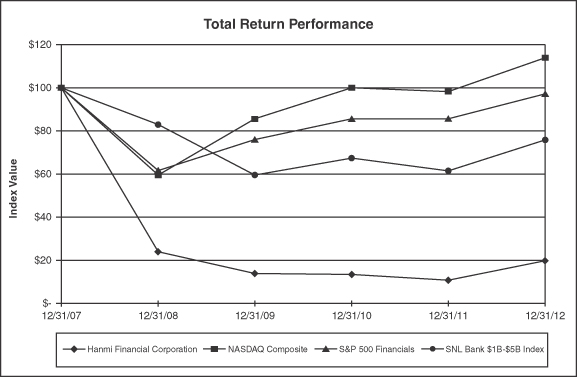
| As of December 31, | ||||||||||||||||||||||||
| 2007 | 2008 | 2009 | 2010 | 2011 | 2012 | |||||||||||||||||||
|
Hanmi Financial Corporation |
$ | 100.00 | $ | 23.90 | $ | 13.92 | $ | 13.34 | $ | 10.73 | $ | 19.71 | ||||||||||||
|
NASDAQ Composite |
$ | 100.00 | $ | 59.46 | $ | 85.55 | $ | 100.02 | $ | 98.22 | $ | 113.85 | ||||||||||||
|
S&P 500 Financials |
$ | 100.00 | $ | 61.51 | $ | 75.94 | $ | 85.65 | $ | 85.65 | $ | 97.13 | ||||||||||||
|
SNL Bank $1B-$5B Index |
$ | 100.00 | $ | 82.94 | $ | 59.45 | $ | 67.39 | $ | 61.46 | $ | 75.78 | ||||||||||||
Purchases of Equity Securities by the Issuer and Affiliated Purchasers
During the fourth quarter of 2012, there were no purchases of Hanmi Financial’s equity securities by Hanmi Financial or its affiliates. As of December 31, 2012, there was no current plan authorizing purchases of Hanmi Financial’s equity securities by Hanmi Financial or its affiliates.
42
Table of Contents
| ITEM 6. | SELECTED FINANCIAL DATA |
The following table presents selected historical financial information, including per share information as adjusted for the stock dividends and stock splits declared by us. This selected historical financial data should be read in conjunction with our Consolidated Financial Statements and the Notes thereto appearing elsewhere in this Report and the information contained in “Item 7. Management’s Discussion and Analysis of Financial Condition and Results of Operations.” The selected historical financial data as of and for each of the years in the five-year period ended December 31, 2012 is derived from our audited financial statements. In the opinion of management, the information presented reflects all adjustments, including normal and recurring accruals, considered necessary for a fair presentation of the results of such periods.
| As of and for the Year Ended December 31, | ||||||||||||||||||||
| 2012 | 2011 | 2010 | 2009 | 2008 | ||||||||||||||||
| (In Thousands, Except for Per Share Data) | ||||||||||||||||||||
|
SUMMARY STATEMENTS OF OPERATIONS: |
||||||||||||||||||||
|
Interest and Dividend Income |
$ | 119,800 | $ | 128,807 | $ | 144,512 | $ | 184,147 | $ | 238,183 | ||||||||||
|
Interest Expense |
18,745 | 27,630 | 38,638 | 82,918 | 103,782 | |||||||||||||||
|
|
|
|
|
|
|
|
|
|
|
|||||||||||
|
Net Interest Income Before Provision for Credit Losses |
101,055 | 101,177 | 105,874 | 101,229 | 134,401 | |||||||||||||||
|
Provision for Credit Losses |
6,000 | 12,100 | 122,496 | 196,387 | 75,676 | |||||||||||||||
|
Non-Interest Income |
24,812 | 23,851 | 25,406 | 32,110 | 32,854 | |||||||||||||||
|
Non-Interest Expense |
76,861 | 84,048 | 96,805 | 90,354 | 195,027 | |||||||||||||||
|
|
|
|
|
|
|
|
|
|
|
|||||||||||
|
Income (Loss) Before Provision (Benefit) for Income Taxes |
43,006 | 28,880 | (88,021 | ) | (153,402 | ) | (103,448 | ) | ||||||||||||
|
Provision (Benefit) for Income Taxes |
(47,368 | ) | 733 | (12 | ) | (31,125 | ) | (1,355 | ) | |||||||||||
|
|
|
|
|
|
|
|
|
|
|
|||||||||||
|
NET INCOME (LOSS) |
$ | 90,374 | $ | 28,147 | $ | (88,009 | ) | $ | (122,277 | ) | $ | (102,093 | ) | |||||||
|
|
|
|
|
|
|
|
|
|
|
|||||||||||
|
SUMMARY BALANCE SHEETS: |
||||||||||||||||||||
|
Cash and Cash Equivalents |
$ | 268,047 | $ | 201,683 | $ | 249,720 | $ | 154,110 | $ | 215,947 | ||||||||||
|
Total Investment Securities |
451,060 | 441,604 | 413,963 | 133,289 | 197,117 | |||||||||||||||
|
Net Loans (1) |
1,986,051 | 1,871,607 | 2,121,067 | 2,674,064 | 3,291,125 | |||||||||||||||
|
Total Assets |
2,882,520 | 2,744,824 | 2,907,148 | 3,162,706 | 3,875,816 | |||||||||||||||
|
Total Deposits |
2,395,963 | 2,344,910 | 2,466,721 | 2,749,327 | 3,070,080 | |||||||||||||||
|
Total Liabilities |
2,504,156 | 2,459,216 | 2,733,892 | 3,012,962 | 3,611,901 | |||||||||||||||
|
Total Stockholders’ Equity |
378,364 | 285,608 | 173,256 | 149,744 | 263,915 | |||||||||||||||
|
Tangible Equity |
377,029 | 284,075 | 171,023 | 146,362 | 258,965 | |||||||||||||||
|
Average Net Loans (1) |
1,917,453 | 1,995,313 | 2,368,369 | 3,044,395 | 3,276,142 | |||||||||||||||
|
Average Investment Securities |
412,554 | 446,198 | 215,280 | 188,325 | 271,802 | |||||||||||||||
|
Average Interest-Earning Assets |
2,686,425 | 2,752,696 | 2,981,878 | 3,611,009 | 3,653,720 | |||||||||||||||
|
Average Total Assets |
2,792,352 | 2,787,707 | 2,998,507 | 3,717,179 | 3,866,856 | |||||||||||||||
|
Average Deposits |
2,349,082 | 2,404,655 | 2,587,686 | 3,109,322 | 2,913,171 | |||||||||||||||
|
Average Borrowings |
85,760 | 153,148 | 243,690 | 341,514 | 591,930 | |||||||||||||||
|
Average Interest-Bearing Liabilities |
1,758,135 | 1,957,077 | 2,268,954 | 2,909,014 | 2,874,470 | |||||||||||||||
|
Average Stockholders’ Equity |
328,016 | 200,517 | 137,968 | 225,708 | 323,462 | |||||||||||||||
|
Average Tangible Equity |
326,589 | 198,626 | 135,171 | 221,537 | 264,490 | |||||||||||||||
|
PER SHARE DATA: |
||||||||||||||||||||
|
Earnings (Loss) Per Share – Basic (2) |
$ | 2.87 | $ | 1.38 | $ | (7.46 | ) | $ | (20.56 | ) | $ | (17.84 | ) | |||||||
|
Earnings (Loss) Per Share – Diluted (2) |
$ | 2.87 | $ | 1.38 | $ | (7.46 | ) | $ | (20.56 | ) | $ | (17.84 | ) | |||||||
|
Book Value Per Share (3) |
$ | 12.01 | $ | 9.07 | $ | 9.20 | $ | 23.44 | $ | 46.00 | ||||||||||
|
Tangible Book Value Per Share (4) |
$ | 11.97 | $ | 9.02 | $ | 9.04 | $ | 22.88 | $ | 45.12 | ||||||||||
|
Cash Dividends Per Share |
$ | — | $ | — | $ | — | $ | — | $ | 0.72 | ||||||||||
|
Common Shares Outstanding |
31,496,540 | 31,489,201 | 18,899,799 | 6,397,799 | 5,738,194 | |||||||||||||||
| (1) |
Loans receivable, net of allowance for loan losses and deferred loan fees. |
| (2) |
The computation of basic and diluted earnings (loss) per share was adjusted retroactively for all periods presented to reflect the 1-for-8 reverse stock split, which became effective on December 19, 2011. |
| (3) |
Total stockholders’ equity divided by common shares outstanding. |
| (4) |
Tangible equity divided by common shares outstanding. |
43
Table of Contents
| As of and for the Year Ended December 31, | ||||||||||||||||||||
| 2012 | 2011 | 2010 | 2009 | 2008 | ||||||||||||||||
|
SELECTED PERFORMANCE RATIOS: |
||||||||||||||||||||
|
Return on Average Assets (5) |
3.24 | % | 1.01 | % | -2.94 | % | -3.29 | % | -2.64 | % | ||||||||||
|
Return on Average Stockholders’ Equity (6) |
27.55 | % | 14.04 | % | -63.79 | % | -54.17 | % | -31.56 | % | ||||||||||
|
Return on Average Tangible Equity (7) |
27.67 | % | 14.17 | % | -65.11 | % | -55.19 | % | -38.60 | % | ||||||||||
|
Net Interest Spread (8) |
3.40 | % | 3.27 | % | 3.15 | % | 2.28 | % | 2.95 | % | ||||||||||
|
Net Interest Margin (9) |
3.77 | % | 3.68 | % | 3.55 | % | 2.84 | % | 3.72 | % | ||||||||||
|
Efficiency Ratio (10) |
61.07 | % | 67.22 | % | 73.74 | % | 67.76 | % | 116.60 | % | ||||||||||
|
Dividend Payout Ratio (11) |
— | — | — | — | -4.05 | % | ||||||||||||||
|
Average Stockholders’ Equity to Average Total Assets |
11.75 | % | 7.19 | % | 4.60 | % | 6.07 | % | 8.36 | % | ||||||||||
|
SELECTED CAPITAL RATIOS: |
||||||||||||||||||||
|
Total Capital to Total Risk-Weighted Assets: |
||||||||||||||||||||
|
Hanmi Financial |
20.65 | % | 18.66 | % | 12.32 | % | 9.12 | % | 10.79 | % | ||||||||||
|
Hanmi Bank |
19.85 | % | 17.57 | % | 12.22 | % | 9.07 | % | 10.70 | % | ||||||||||
|
Tier 1 Capital to Total Risk-Weighted Assets: |
||||||||||||||||||||
|
Hanmi Financial |
19.37 | % | 17.36 | % | 10.09 | % | 6.76 | % | 9.52 | % | ||||||||||
|
Hanmi Bank |
18.58 | % | 16.28 | % | 10.91 | % | 7.77 | % | 9.44 | % | ||||||||||
|
Tier 1 Capital to Average Total Assets: |
||||||||||||||||||||
|
Hanmi Financial |
14.95 | % | 13.34 | % | 7.90 | % | 5.82 | % | 8.93 | % | ||||||||||
|
Hanmi Bank |
14.33 | % | 12.50 | % | 8.55 | % | 6.69 | % | 8.85 | % | ||||||||||
|
SELECTED ASSET QUALITY RATIOS: |
||||||||||||||||||||
|
Non-Performing Loans to Total Gross Loans (12) |
1.82 | % | 2.70 | % | 6.38 | % | 7.78 | % | 3.67 | % | ||||||||||
|
Non-Performing Assets to Total Assets (13) |
1.32 | % | 1.91 | % | 5.04 | % | 7.76 | % | 3.17 | % | ||||||||||
|
Net Loan Charge-Offs to Average Total Gross Loans |
1.70 | % | 3.25 | % | 4.79 | % | 3.88 | % | 1.38 | % | ||||||||||
|
Allowance for Loan Losses to Total Gross Loans |
3.09 | % | 4.64 | % | 6.55 | % | 5.15 | % | 2.13 | % | ||||||||||
|
Allowance for Loan Losses to Non-Performing Loans |
169.81 | % | 171.71 | % | 102.54 | % | 66.19 | % | 58.23 | % | ||||||||||
| (5) |
Net income (loss) divided by average total assets. |
| (6) |
Net income (loss) divided by average stockholders’ equity. |
| (7) |
Net income (loss) divided by average tangible equity. |
| (8) |
Average yield earned on interest-earning assets less average rate paid on interest-bearing liabilities. Computed on a tax-equivalent basis using an effective marginal rate of 35 percent. |
| (9) |
Net interest income before provision for credit losses divided by average interest-earning assets. Computed on a tax-equivalent basis using an effective marginal rate of 35 percent. |
| (10) |
Total non-interest expense divided by the sum of net interest income before provision for credit losses and total non-interest income. |
| (11) |
Dividends declared per share divided by basic earnings (loss) per share. |
| (12) |
Non-performing loans, excluding loans held for sale, consist of non-accrual loan and loans past due 90 days or more still accruing interest. |
| (13) |
Non-performing assets consist of non-performing loans and other real estate owned. |
Non-GAAP Financial Measures
Return on Average Tangible Equity
Return on average tangible equity is supplemental financial information determined by a method other than in accordance with U.S. generally accepted accounting principles (“GAAP”). This non-GAAP measure is used by management in the analysis of Hanmi Financial’s performance. Average tangible equity is calculated by subtracting average goodwill and average other intangible assets from average stockholders’ equity. Banking and financial institution regulators also exclude goodwill and other intangible assets from stockholders’ equity when assessing the capital adequacy of a financial institution. Management believes the presentation of this financial measure excluding the impact of these items provides useful supplemental information that is essential to a proper understanding of the financial results of Hanmi Financial, as it provides a method to assess management’s success in utilizing tangible capital. This disclosure should not be viewed as a substitution for results determined in accordance with GAAP, nor is it necessarily comparable to non-GAAP performance measures that may be presented by other companies.
44
Table of Contents
The following table reconciles this non-GAAP performance measure to the GAAP performance measure for the periods indicated:
| As of December 31, | ||||||||||||||||||||
| 2012 | 2011 | 2010 | 2009 | 2008 | ||||||||||||||||
| (In Thousands) | ||||||||||||||||||||
|
Average Stockholders’ Equity |
$ | 328,016 | $ | 200,517 | $ | 137,968 | $ | 225,708 | $ | 323,462 | ||||||||||
|
Less Average Goodwill and Average Other Intangible Assets |
(1,427 | ) | (1,891 | ) | (2,797 | ) | (4,171 | ) | (58,972 | ) | ||||||||||
|
|
|
|
|
|
|
|
|
|
|
|||||||||||
|
Average Tangible Equity |
$ | 326,589 | $ | 198,626 | $ | 135,171 | $ | 221,537 | $ | 264,490 | ||||||||||
|
|
|
|
|
|
|
|
|
|
|
|||||||||||
|
Return on Average Stockholders’ Equity |
27.55 | % | 14.04 | % | -63.79 | % | -54.17 | % | -31.56 | % | ||||||||||
|
Effect of Average Goodwill and Average Other Intangible Assets |
0.12 | % | 0.13 | % | -1.32 | % | -1.02 | % | -7.04 | % | ||||||||||
|
|
|
|
|
|
|
|
|
|
|
|||||||||||
|
Return on Average Tangible Equity |
27.67 | % | 14.17 | % | -65.11 | % | -55.19 | % | -38.60 | % | ||||||||||
|
|
|
|
|
|
|
|
|
|
|
|||||||||||
Tangible Book Value Per Share
Tangible book value per share is supplemental financial information determined by a method other than in accordance with GAAP. This non-GAAP measure is used by management in the analysis of Hanmi Financial’s performance. Tangible book value per share is calculated by subtracting goodwill and other intangible assets from total stockholders’ equity and dividing the difference by the number of shares of common stock outstanding. Management believes the presentation of this financial measure excluding the impact of these items provides useful supplemental information that is essential to a proper understanding of the financial results of Hanmi Financial, as it provides a method to assess management’s success in utilizing tangible capital. This disclosure should not be viewed as a substitution for results determined in accordance with GAAP, nor is it necessarily comparable to non-GAAP performance measures that may be presented by other companies.
The following table reconciles this non-GAAP performance measure to the GAAP performance measure for the periods indicated:
| As of December 31, | ||||||||||||||||||||
| 2012 | 2011 | 2010 | 2009 | 2008 | ||||||||||||||||
| (In Thousands, Except Per Share Data) | ||||||||||||||||||||
|
Total Stockholders’ Equity |
$ | 378,364 | $ | 285,608 | $ | 173,256 | $ | 149,744 | $ | 263,915 | ||||||||||
|
Less Goodwill and Other Intangible Assets |
(1,335 | ) | (1,533 | ) | (2,233 | ) | (3,382 | ) | (4,950 | ) | ||||||||||
|
|
|
|
|
|
|
|
|
|
|
|||||||||||
|
Tangible Equity |
$ | 377,029 | $ | 284,075 | $ | 171,023 | $ | 146,362 | $ | 258,965 | ||||||||||
|
|
|
|
|
|
|
|
|
|
|
|||||||||||
|
Book Value Per Share |
$ | 12.01 | $ | 9.07 | $ | 9.20 | $ | 23.44 | $ | 46.00 | ||||||||||
|
Effect of Goodwill and Other Intangible Assets |
(0.04 | ) | (0.05 | ) | (0.16 | ) | (0.56 | ) | (0.88 | ) | ||||||||||
|
|
|
|
|
|
|
|
|
|
|
|||||||||||
|
Tangible Book Value Per Share |
$ | 11.97 | $ | 9.02 | $ | 9.04 | $ | 22.88 | $ | 45.12 | ||||||||||
|
|
|
|
|
|
|
|
|
|
|
|||||||||||
45
Table of Contents
| ITEM 7. | MANAGEMENT’S DISCUSSION AND ANALYSIS OF FINANCIAL CONDITION AND RESULTS OF OPERATIONS |
This discussion presents management’s analysis of the financial condition and results of operations as of and for the years ended December 31, 2012, 2011, and 2010. This discussion should be read in conjunction with our Consolidated Financial Statements and the Notes related thereto presented elsewhere in this Report. See also “Cautionary Note Regarding Forward-Looking Statements.”
CRITICAL ACCOUNTING POLICIES
We have established various accounting policies that govern the application of U.S. generally accepted accounting principles (“GAAP”) in the preparation of our Consolidated Financial Statements. The preparation of financial statements in conformity with GAAP requires management to make estimates and assumptions to arrive at the carrying value of assets and liabilities and amounts reported for revenues and expenses. Our financial position and results of operations can be materially affected by these estimates and assumptions. Critical accounting policies are those policies that are most important to the determination of our financial condition and results of operations or that require management to make assumptions and estimates that are subjective or complex. Our significant accounting policies are discussed in the “Notes to Consolidated Financial Statements, Note 2 — Summary of Significant Accounting Policies.” Management believes that the following policies are critical.
Allowance for Loan Losses and Allowance for Off-Balance Sheet Items
Our allowance for loan losses methodologies incorporate a variety of risk considerations, both quantitative and qualitative, in establishing an allowance for loan losses that management believes is appropriate at each reporting date. Quantitative factors include our historical loss experiences on 14 segmented loan pools by type and risk rating, delinquency and charge-off trends, collateral values, changes in non-performing loans, and other factors. Qualitative factors include the general economic environment in our markets, delinquency and charge-off trends, and the change in non-performing loans. Concentration of credit, change of lending management and staff, quality of loan review system, and change in interest rates are other qualitative factors that are considered in our methodologies. See “Financial Condition — Allowance for Loan Losses and Allowance for Off-Balance Sheet Items,” “Results of Operations — Provision for Credit Losses” and “Notes to Consolidated Financial Statements, Note 2 — Summary of Significant Accounting Policies” for additional information on methodologies used to determine the allowance for loan losses and allowance for off-balance sheet items.
Loan Sales
We normally sell guaranteed portion of certain SBA loans to secondary market investors. When SBA guaranteed loans are sold, we generally retain the right to service these loans. We record a loan servicing asset when the benefits of servicing are expected to be more than adequate compensation to a servicer, which is determined by discounting all of the future net cash flows associated with the contractual rights and obligations of the servicing agreement. The expected future net cash flows are discounted at a rate equal to the return that would adequately compensate a substitute servicer for performing the servicing. In addition to the anticipated rate of loan prepayments and discount rates, other assumptions (such as the cost to service the underlying loans, foreclosure costs, ancillary income and float rates) are also used in determining the value of the loan servicing assets. Loan servicing assets are discussed in more detail in “Notes to Consolidated Financial Statements, Note 2 — Summary of Significant Accounting Policies” and “Note 5 — Loans” presented elsewhere herein.
46
Table of Contents
We reclassify certain loans to loans held for sale. In such reclassification, we take into consideration a number of factors, including, but not limited to, the following:
| • |
NPL and/or classified status, non-accrual status, and days delinquent; |
| • |
possibility of rehabilitation or workout for the near future and long term earning capability as an asset; |
| • |
number of times the loan was modified; |
| • |
overall debt coverage ratio; |
| • |
whether the debt is on troubled debt restructure status; |
| • |
the location of the collateral; and |
| • |
the borrower’s overall financial condition. |
The fair value of nonperforming loans held for sale is generally based upon the recent appraisals, quotes, bids or sales contract prices which approximate the fair value. All loans held for sale are recorded at the lower of cost or fair value.
Investment Securities
The classification and accounting for investment securities are discussed in more detail in “Notes to Consolidated Financial Statements, Note 2 — Summary of Significant Accounting Policies” and “ Note 5 – Investment Securities ” presented elsewhere herein. Under FASB ASC 320, “Investment,” investment securities generally must be classified as held-to-maturity, available-for-sale or trading. The appropriate classification is based partially on our ability to hold the securities to maturity and largely on management’s intentions with respect to either holding or selling the securities. The classification of investment securities is significant since it directly impacts the accounting for unrealized gains and losses on securities. Unrealized gains and losses on trading securities flow directly through earnings during the periods in which they arise. Investment securities that are classified as held-to-maturity are recorded at amortized cost. Unrealized gains and losses on available-for-sale securities are recorded as a separate component of stockholders’ equity (accumulated other comprehensive income or loss) and do not affect earnings until realized or are deemed to be other-than-temporarily impaired.
The fair values of investment securities are generally determined by quoted market prices obtained from independent external brokers or independent external pricing service providers who have experience in valuing these securities. In obtaining such valuation information from third parties, we have evaluated the methodologies used to develop the resulting fair values. We perform a monthly analysis on the broker quotes received from third parties to ensure that the prices represent a reasonable estimate of the fair value. The procedures include, but are not limited to, initial and on-going review of third party pricing methodologies, review of pricing trends, and monitoring of trading volumes.
We review investment securities on an ongoing basis for the presence of other-than-temporary impairment (“OTTI”) or permanent impairment, taking into consideration current market conditions, fair value in relationship to cost, extent and nature of the change in fair value, issuer rating changes and trends, whether we intend to sell a security or if it is likely that we will be required to sell the security before recovery of our amortized cost basis of the investment, which may be maturity, and other factors.
For debt securities, the classification of OTTI depends on whether we intend to sell the security or if it is more likely than not that we will be required to sell the security before recovery of its costs basis, and on the nature of the impairment. If we intend to sell a security or if it is more likely than not that we will be required to sell the
47
Table of Contents
security before recovery, an OTTI write-down is recognized in earnings equal to the entire difference between the security’s amortized cost basis and its fair value. If we do not intend to sell the security or it is not more likely than not that we will be required to sell the security before recovery, the OTTI write-down is separated into an amount representing credit loss, which is recognized in earnings, and the amount related to all other factors, which is recognized in other comprehensive income net of tax. A credit loss is the difference between the cost basis of the security and the present value of cash flows expected to be collected, discounted at the security’s effective interest rate at the date of acquisition. The cost basis of an other than temporarily impaired security is written down by the amount of impairment recognized in earnings. The new cost basis is not adjusted for subsequent recoveries in fair value.
The Company had an equity investment of less than five percent in a publicly traded company, Pacific International Bancorp (“PIB”), and recognized an OTTI of $176,000 and $116,000 in the second and third quarter, respectively, of 2012. We will continue to monitor the investment for impairment and make appropriate reductions in carrying value when necessary. Other than this OTTI, management does not believe that there is any investment securities that are deemed other-than-temporarily impaired as of December 31, 2012.
Income Taxes
In accordance with the provisions of FASB ASC 740, the Company periodically reviews its income tax positions based on tax laws and regulations and financial reporting considerations, and records adjustments as appropriate. This review takes into consideration the status of current taxing authorities’ examinations of the Company’s tax returns, recent positions taken by the taxing authorities on similar transactions, if any, and the overall tax environment.
As of December 31, 2012, the Company’s deferred tax assets of $51.0 million were primarily the result of net operating loss carryforwards, allowance for loan losses, and tax credit carryforwards. For the year ended December 31, 2012, the Company recorded a net valuation allowance release of $62.6 million based on management’s reassessment of the amount of its deferred tax assets that are more likely than not to be realized.
The Company’s management considers new evidence, both positive and negative, that could impact management’s view with regards to future realization of deferred tax assets. As of December 31, 2012, in part because possible sources of taxable income were available under the tax law to realize a tax benefit for deductible temporary differences and carryforwards, management determined that sufficient positive evidence existed as of December 31, 2012, to conclude that it is more likely than not that deferred taxes were fully realizable, and therefore, reduced the valuation allowance accordingly.
Income taxes are discussed in more detail in “Notes to Consolidated Financial Statements, Note 2 — Summary of Significant Accounting Policies” and “Note 11 — Income Taxes” presented elsewhere herein.
EXECUTIVE OVERVIEW
For the years ended December 31, 2012, 2011 and 2010, we recognized net income of $90.4 million and $28.1 million and net loss of $88.0 million, respectively. The increase in net income for the year ended December 31, 2012 as compared to the year ended December 31, 2011 was primarily attributable to the reversal of the deferred tax asset (“DTA”) valuation allowance, which contributed an income tax benefit of $47.4 million. The increase in net income for the year ended December 31, 2011 as compared to the year ended December 31, 2010 was primarily the result of lower levels of provision for credit losses of $12.1 million compared to $122.5 million in 2010. For the years ended December 31, 2012, 2011 and 2010, our earnings per diluted share was $2.87, $1.38 and a loss per diluted share of $7.46, respectively.
48
Table of Contents
Subsequent to our annual full-scope examination by the California Department of Financial Institutions (the “DFI”) and the Federal Reserve Bank (the “FRB”), which commenced in August 2012, the DFI terminated the Memorandum of Understanding on October 29, 2012 and the FRB terminated the Written Agreement on December 4, 2012. As a result, Hanmi Financial and the Bank are no longer subject to any regulatory enforcement actions, allowing us to focus on growth and profitability.
Significant financial highlights include:
| • |
With improvement in new loan production, gross loans increased by $109.8 million, or 5.7 percent, to $2.05 billion as of December 31, 2012, compared to $1.94 billion as of December 31, 2011. During 2011, gross loans decreased by $292.3 million, or 13.1 percent, compared to $2.23 billion as of December 31, 2010, owing mainly to higher levels of problem loan sales and charge offs. |
| • |
Asset quality improved in 2012 as indicated by lower levels of non-performing assets declining to1.32 percent of total assets as of December 31, 2012, compared to 1.91 percent of total assets as of December 31, 2011. Similarly, delinquent loans, 30 to 89 days past due and still accruing, declined to $2.4 million, or 0.12 percent of gross loans, at December 31, 2012 from $13.9 million, or 0.72 percent of gross loans, at December 31, 2011. The Bank’s strategy of selling notes before non-performing assets were moved into foreclosure has allowed us to efficiently reduce them. |
| • |
Reversal of a $62.6 million DTA valuation allowance contributed an income tax benefit of $47.4 million to net income of $90.4 million for the year ended December 31, 2012. Our effective tax rate is estimated to be approximately 39% for 2013. |
| • |
Net interest margin continued to increase year over year. For the year ended December 31, 2012, net interest margin was 3.77 percent, increases of 9 and 22 basis points compared to 3.68 percent and 3.55 percent for the years ended December 31, 2011 and 2010, respectively. |
| • |
Operating efficiency improved to 61.07 percent for the year ended December 31, 2012, from 67.22 percent for the year ended the December 31, 2011 and 73.74 percent for the year ended December 31, 2010, reflecting higher revenues and lower operating costs. |
Outlook for fiscal 2013
With strong asset quality and the lifting of the regulatory enforcement requirements, we believe that we are well positioned to take on the following strategic goals in 2013.
First, we would like to optimize our operating efficiency through strategic cost management and active cross-selling, while deploying our excess liquidity to quality loan production. This is the basis for our organic growth and profitability in this new normal environment.
In addition, we would like to increase our marketing and sales competitiveness by continuously emphasizing and rewarding personalized, relationship-based banking, and recruiting, retaining, and rewarding talented employees. This should enable us to offer value-added services and products to our customers.
Furthermore, given that our market will continue to evolve and be highly competitive, we will be proactive in exploring all strategic options available to us.
49
Table of Contents
RESULTS OF OPERATIONS
Net Interest Income
Our primary source of revenue is net interest income, which is the difference between interest and fees derived from earning assets, and interest paid on liabilities obtained to fund those assets. Our net interest income is affected by changes in the level and mix of interest-earning assets and interest-bearing liabilities, referred to as volume changes. Net interest income is also affected by changes in the yields earned on assets and rates paid on liabilities, referred to as rate changes. Interest rates charged on our loans are affected principally by changes to interest rates, the demand for such loans, the supply of money available for lending purposes, and other competitive factors. Those factors are, in turn, affected by general economic conditions and other factors beyond our control, such as federal economic policies, the general supply of money in the economy, legislative tax policies, governmental budgetary matters, and the actions of the Federal Reserve Board.
50
Table of Contents
The following table shows the average balances of assets, liabilities and stockholders’ equity; the amount of interest income and interest expense; the average yield or rate for each category of interest-earning assets and interest-bearing liabilities; and the net interest spread and the net interest margin for the periods indicated. All average balances are daily average balances.
| For the Year Ended | ||||||||||||||||||||||||||||||||||||
| December 31, 2012 | December 31, 2011 | December 31, 2010 | ||||||||||||||||||||||||||||||||||
|
Average
Balance |
Interest
Income / Expense |
Average
Yield / Rate |
Average
Balance |
Interest
Income / Expense |
Average
Yield / Rate |
Average
Balance |
Interest
Income / Expense |
Average
Yield / Rate |
||||||||||||||||||||||||||||
| (In Thousands) | ||||||||||||||||||||||||||||||||||||
|
ASSETS |
||||||||||||||||||||||||||||||||||||
|
Interest-Earning Assets: |
||||||||||||||||||||||||||||||||||||
|
Gross Loans, Net of Deferred Loan Fees (1) |
$ | 1,993,367 | $ | 108,982 | 5.47 | % | $ | 2,114,546 | $ | 117,671 | 5.56 | % | $ | 2,544,472 | $ | 137,328 | 5.40 | % | ||||||||||||||||||
|
Municipal Securities—Taxable |
45,213 | 1,796 | 3.97 | % | 21,740 | 884 | 4.07 | % | 3,746 | 189 | 5.05 | % | ||||||||||||||||||||||||
|
Municipal Securities—Tax Exempt (2) |
12,902 | 606 | 4.70 | % | 6,544 | 332 | 5.07 | % | 6,909 | 346 | 5.01 | % | ||||||||||||||||||||||||
|
Obligations of Other U.S. Government Agencies |
77,053 | 1,372 | 1.78 | % | 121,961 | 1,963 | 1.61 | % | 69,112 | 1,952 | 2.82 | % | ||||||||||||||||||||||||
|
Other Debt Securities |
277,386 | 5,250 | 1.89 | % | 295,953 | 6,921 | 2.34 | % | 135,513 | 3,733 | 2.75 | % | ||||||||||||||||||||||||
|
Equity Securities |
31,356 | 818 | 2.61 | % | 33,573 | 534 | 1.59 | % | 37,437 | 532 | 1.42 | % | ||||||||||||||||||||||||
|
Federal Funds Sold |
14,178 | 60 | 0.42 | % | 5,857 | 27 | 0.46 | % | 10,346 | 52 | 0.50 | % | ||||||||||||||||||||||||
|
Term Federal Funds Sold |
70,478 | 706 | 1.00 | % | 38,693 | 276 | 0.71 | % | 8,342 | 33 | 0.40 | % | ||||||||||||||||||||||||
|
Interest-Bearing Deposits in Other Banks |
164,492 | 422 | 0.26 | % | 113,829 | 315 | 0.28 | % | 166,001 | 468 | 0.28 | % | ||||||||||||||||||||||||
|
|
|
|
|
|
|
|
|
|
|
|
|
|||||||||||||||||||||||||
|
Total Interest-Earning Assets |
2,686,425 | 120,012 | 4.47 | % | 2,752,696 | 128,923 | 4.68 | % | 2,981,878 | 144,633 | 4.85 | % | ||||||||||||||||||||||||
|
|
|
|
|
|
|
|
|
|
|
|
|
|||||||||||||||||||||||||
|
Noninterest-Earning Assets: |
||||||||||||||||||||||||||||||||||||
|
Cash and Cash Equivalents |
71,123 | 68,255 | 67,492 | |||||||||||||||||||||||||||||||||
|
Allowance for Loan Losses |
(75,914 | ) | (119,233 | ) | (176,103 | ) | ||||||||||||||||||||||||||||||
|
Other Assets |
110,718 | 85,989 | 125,240 | |||||||||||||||||||||||||||||||||
|
|
|
|
|
|
|
|||||||||||||||||||||||||||||||
|
Total Noninterest-Earning Assets |
105,927 | 35,011 | 16,629 | |||||||||||||||||||||||||||||||||
|
|
|
|
|
|
|
|||||||||||||||||||||||||||||||
|
TOTAL ASSETS |
$ | 2,792,352 | $ | 2,787,707 | $ | 2,998,507 | ||||||||||||||||||||||||||||||
|
|
|
|
|
|
|
|||||||||||||||||||||||||||||||
|
LIABILITIES AND STOCKHOLDERS’ EQUITY |
||||||||||||||||||||||||||||||||||||
|
Interest-Bearing Liabilities: |
||||||||||||||||||||||||||||||||||||
|
Deposits: |
||||||||||||||||||||||||||||||||||||
|
Savings |
$ | 110,349 | 2,152 | 1.95 | % | $ | 109,272 | 2,757 | 2.52 | % | $ | 119,754 | 3,439 | 2.87 | % | |||||||||||||||||||||
|
Money Market Checking and NOW Accounts |
529,976 | 3,085 | 0.58 | % | 465,840 | 3,461 | 0.74 | % | 464,864 | 4,936 | 1.06 | % | ||||||||||||||||||||||||
|
Time Deposits of $100,000 or More |
681,173 | 7,290 | 1.07 | % | 913,643 | 13,855 | 1.52 | % | 1,069,600 | 19,529 | 1.83 | % | ||||||||||||||||||||||||
|
Other Time Deposits |
350,877 | 3,350 | 0.95 | % | 315,174 | 3,885 | 1.23 | % | 371,046 | 6,504 | 1.75 | % | ||||||||||||||||||||||||
|
FHLB Advances |
3,354 | 165 | 4.92 | % | 66,191 | 662 | 1.00 | % | 158,531 | 1,366 | 0.86 | % | ||||||||||||||||||||||||
|
Other Borrowings |
— | — | — | 4,551 | 95 | 2.09 | % | 2,753 | 53 | 1.93 | % | |||||||||||||||||||||||||
|
Junior Subordinated Debentures |
82,406 | 2,703 | 3.28 | % | 82,406 | 2,915 | 3.54 | % | 82,406 | 2,811 | 3.41 | % | ||||||||||||||||||||||||
|
|
|
|
|
|
|
|
|
|
|
|
|
|||||||||||||||||||||||||
|
Total Interest-Bearing Liabilities |
1,758,135 | 18,745 | 1.07 | % | 1,957,077 | 27,630 | 1.41 | % | 2,268,954 | 38,638 | 1.70 | % | ||||||||||||||||||||||||
|
|
|
|
|
|
|
|
|
|
|
|
|
|||||||||||||||||||||||||
|
Noninterest-Bearing Liabilities: |
||||||||||||||||||||||||||||||||||||
|
Demand Deposits |
676,707 | 600,726 | 562,422 | |||||||||||||||||||||||||||||||||
|
Other Liabilities |
29,494 | 29,387 | 29,163 | |||||||||||||||||||||||||||||||||
|
|
|
|
|
|
|
|||||||||||||||||||||||||||||||
|
Total Noninterest-Bearing Liabilities |
706,201 | 630,113 | 591,585 | |||||||||||||||||||||||||||||||||
|
|
|
|
|
|
|
|||||||||||||||||||||||||||||||
|
Total Liabilities |
2,464,336 | 2,587,190 | 2,860,539 | |||||||||||||||||||||||||||||||||
|
Stockholders’ Equity |
328,016 | 200,517 | 137,968 | |||||||||||||||||||||||||||||||||
|
|
|
|
|
|
|
|||||||||||||||||||||||||||||||
|
TOTAL LIABILITIES AND STOCKHOLDERS’ EQUITY |
$ | 2,792,352 | $ | 2,787,707 | $ | 2,998,507 | ||||||||||||||||||||||||||||||
|
|
|
|
|
|
|
|||||||||||||||||||||||||||||||
|
NET INTEREST INCOME |
$ | 101,267 | $ | 101,293 | $ | 105,995 | ||||||||||||||||||||||||||||||
|
|
|
|
|
|
|
|||||||||||||||||||||||||||||||
|
COST OF DEPOSITS |
0.68 | % | 1.00 | % | 1.33 | % | ||||||||||||||||||||||||||||||
|
|
|
|
|
|
|
|||||||||||||||||||||||||||||||
|
NET INTEREST SPREAD (3) |
3.40 | % | 3.27 | % | 3.15 | % | ||||||||||||||||||||||||||||||
|
|
|
|
|
|
|
|||||||||||||||||||||||||||||||
|
NET INTEREST MARGIN (4) |
3.77 | % | 3.68 | % | 3.55 | % | ||||||||||||||||||||||||||||||
|
|
|
|
|
|
|
|||||||||||||||||||||||||||||||
51
Table of Contents
| (1) |
Loans are net of deferred fees and related direct costs, but exclude the allowance for loan losses. Non-accrual loans are included in the average loan balance. Loan fees have been included in the calculation of interest income. Loan fees were $1.5 million, $2.0 million and $1.8 million for the years ended December 31, 2012, 2011 and 2010, respectively. |
| (2) |
Computed on a tax-equivalent basis using an effective marginal rate of 35 percent. |
| (3) |
Represents the average yield earned on interest-earning assets less the average rate paid on interest-bearing liabilities. |
| (4) |
Represents net interest income as a percentage of average interest-earning assets. |
The table below shows changes in interest income and interest expense and the amounts attributable to variations in interest rates and volumes for the periods indicated. The variances attributable to simultaneous volume and rate changes have been allocated to the change due to volume and the change due to rate categories in proportion to the relationship of the absolute dollar amount attributable solely to the change in volume and to the change in rate.
| Year Ended December 31, | ||||||||||||||||||||||||
| 2012 vs. 2011 | 2011 vs. 2010 | |||||||||||||||||||||||
|
Increase (Decrease)
Due to Change In |
Increase (Decrease)
Due to Change In |
|||||||||||||||||||||||
| Volume | Rate | Total | Volume | Rate | Total | |||||||||||||||||||
| (In Thousands) | ||||||||||||||||||||||||
|
Interest and Dividend Income: |
||||||||||||||||||||||||
|
Gross Loans, Net of Deferred Loan Fees |
$ | (6,649 | ) | $ | (2,040 | ) | $ | (8,689 | ) | $ | (21,995 | ) | $ | 2,338 | $ | (19,657 | ) | |||||||
|
Municipal Securities — Taxable |
903 | 9 | 912 | 739 | (44 | ) | 695 | |||||||||||||||||
|
Municipal Securities — Tax Exempt |
266 | 8 | 274 | (19 | ) | 5 | (14 | ) | ||||||||||||||||
|
Obligations of Other U.S. Government Agencies |
(540 | ) | (51 | ) | (591 | ) | 1,082 | (1,071 | ) | 11 | ||||||||||||||
|
Other Debt Securities |
(412 | ) | (1,259 | ) | (1,671 | ) | 3,828 | (640 | ) | 3,188 | ||||||||||||||
|
Equity Securities |
11 | 273 | 284 | (58 | ) | 60 | 2 | |||||||||||||||||
|
Federal Funds Sold |
32 | 1 | 33 | (21 | ) | (4 | ) | (25 | ) | |||||||||||||||
|
Term Federal Funds Sold |
288 | 142 | 430 | 198 | 45 | 243 | ||||||||||||||||||
|
Interest-Bearing Deposits in Other Banks |
102 | 5 | 107 | (144 | ) | (9 | ) | (153 | ) | |||||||||||||||
|
|
|
|
|
|
|
|
|
|
|
|
|
|||||||||||||
|
Total Interest and Dividend Income |
$ | (5,999 | ) | $ | (2,912 | ) | $ | (8,911 | ) | $ | (16,390 | ) | $ | 680 | $ | (15,710 | ) | |||||||
|
|
|
|
|
|
|
|
|
|
|
|
|
|||||||||||||
|
Interest Expense: |
||||||||||||||||||||||||
|
Savings |
$ | (12 | ) | $ | (593 | ) | $ | (605 | ) | $ | (286 | ) | $ | (396 | ) | $ | (682 | ) | ||||||
|
Money Market Checking and NOW Accounts |
1 | (377 | ) | (376 | ) | 5 | (1,480 | ) | (1,475 | ) | ||||||||||||||
|
Time Deposits of $100,000 or More |
(3,040 | ) | (3,525 | ) | (6,565 | ) | (2,626 | ) | (3,048 | ) | (5,674 | ) | ||||||||||||
|
Other Time Deposits |
(31 | ) | (504 | ) | (535 | ) | (882 | ) | (1,737 | ) | (2,619 | ) | ||||||||||||
|
FHLB Advances |
(351 | ) | (146 | ) | (497 | ) | (809 | ) | 105 | (704 | ) | |||||||||||||
|
Other Borrowings |
(48 | ) | (47 | ) | (95 | ) | 38 | 4 | 42 | |||||||||||||||
|
Junior Subordinated Debentures |
— | (212 | ) | (212 | ) | — | 104 | 104 | ||||||||||||||||
|
|
|
|
|
|
|
|
|
|
|
|
|
|||||||||||||
|
Total Interest Expense |
$ | (3,481 | ) | $ | (5,404 | ) | $ | (8,885 | ) | $ | (4,560 | ) | $ | (6,448 | ) | $ | (11,008 | ) | ||||||
|
|
|
|
|
|
|
|
|
|
|
|
|
|||||||||||||
|
Change in Net Interest Income |
$ | (2,518 | ) | $ | 2,492 | $ | (26 | ) | $ | (11,830 | ) | $ | 7,128 | $ | (4,702 | ) | ||||||||
|
|
|
|
|
|
|
|
|
|
|
|
|
|||||||||||||
For the years ended December 31, 2012, 2011 and 2010, net interest income before provision for credit losses on a tax-equivalent basis was $101.3 million, $101.3 million and $106.0 million, respectively. The net interest spread and net interest margin for the year ended December 31, 2012 were 3.40 percent and 3.77 percent, respectively, compared to 3.27 percent and 3.68 percent, respectively, for the year ended December 31, 2011, and 3.15 percent and 3.55 percent, respectively, for the year ended December 31, 2010. Net interest income remained stable for the years ended December 31, 2012 and 2011 due to the decrease in interest income, which was primarily offset by the decrease in interest expense. The decrease in interest income was due primarily to declines in average loans outstanding and loan yields, and a decrease in other debt securities yield. This decrease was primarily offset in the interest expense by lower deposit costs resulting from the replacement of high-cost promotional time deposits with low-cost deposits. The decrease in net interest income in 2011 as compared to 2010 was primarily due to decreases in average loan outstanding and investment yields, which was partially offset by higher loan yields and lower deposit costs resulting from the replacement of higher-cost promotional time deposits with low-cost deposit products.
52
Table of Contents
Average gross loans were $1.99 billion in 2012, as compared with $2.11 billion in 2011 and $2.54 billion in 2010, representing decreases of 5.7 percent and 16.9 percent in 2012 and 2011, respectively. Average investment securities were $412.6 million in 2012, as compared with $446.2 million in 2011 and $215.3 million in 2010, representing a decrease of 7.5 percent in 2012 and an increase of 107.3 percent in 2011. Average interest-earning assets were $2.69 billion in 2012, as compared with $2.75 billion in 2011 and $2.98 billion in 2010, representing decreases of 2.2 percent and 7.7 percent in 2012 and 2011, respectively. The decrease in average interest earning assets was a direct result of the proactive disposition of problem loans under the credit quality improvement strategy and the balance sheet deleveraging strategy during 2012 and 2011. Average interest-bearing liabilities were $1.76 billion in 2012, as compared to $1.96 billion in 2011 and $2.27 billion in 2010, representing decreases of 10.2 percent and 13.7 percent in 2012 and 2011, respectively. Average Federal Home Loan Bank advances were $3.4 million in 2012, as compared with $66.2 million in 2011 and $158.5 million in 2010, representing decreases of 94.9 percent and 58.2 percent in 2012 and 2011, respectively.
The average yield on interest-earning assets decreased by 21 basis points to 4.47 percent in 2012, after a 17 basis point decrease to 4.68 percent in 2011 from 4.85 percent in 2010, due primarily to lower yields on investment securities and loans. The average yield on gross loans decreased by 9 basis points to 5.47 percent in 2012, after a 16 basis point increase to 5.56 percent in 2011 from 5.40 percent in 2010. The decrease in 2012 was attributable to lower interest rates on new loans resulting from rising competition in the market, and the increase in 2011 was attributable to a decrease in our overall level of nonaccrual loans. Total loan interest and fee income decreased by $8.7 million, or 7.4 percent, to $109.0 million in 2012, after a $19.7 million, or 14.3 percent, decrease to $117.7 million in 2011 from $137.3 million in 2010. The average cost on interest-bearing liabilities decreased by 34 basis points to 1.07 percent in 2012, after a decrease of 29 basis points to 1.41 percent in 2011 from 1.70 percent in 2010. These decreases were primarily due to a continued shift in funding sources toward lower-cost funds through disciplined deposit pricing while reducing wholesale funds and rate sensitive deposits.
Provision for Credit Losses
In anticipation of credit risks inherent in our lending business, we set aside allowance for loan losses through charges to earnings. These charges are made not only for our outstanding loan portfolio, but also for off-balance sheet items, such as commitments to extend credit, or letters of credit. The charges made for our outstanding loan portfolio are recorded to the allowance for loan losses, whereas charges for off-balance sheet items are recorded to the reserve for off-balance sheet items, and are presented as a component of other liabilities.
Due to the continued improvement of our overall credit quality during 2012, net charge-offs decreased by $34.9 million, or 50.8 percent, to $33.8 million for the year ended December 31, 2012 from $68.7 million for the year ended December 31, 2011. Non-accrual loans decreased by $15.1 million, or 28.8 percent, to $37.3 million for the year ended December 31, 2012 from $52.4 million for the year ended December 31, 2011. Delinquent loans, 30 to 89 days past due and still accruing, decreased by $11.5 million, or 82.7 percent, to $2.4 million for the year ended December 31, 2012 from $13.9 million for the year ended December 31, 2011. All other credit metrics also experienced improvements as the quality of the loan portfolio improved. Therefore, provision for credit losses was $6.0 million for the year ended December 31, 2012, compared to $12.1 million for the year ended December 31, 2011. See “Non-Performing Assets” and “Allowance for Loan Losses and Allowance for Off-Balance Sheet Items” for further details.
For the year ended December 31, 2011, the provision for credit losses was $12.1 million, compared to $122.5 million for the year ended December 31, 2010. The decrease in the provision for credit losses was attributable to a decrease in problem loans and an improvement in asset quality through aggressive management of our problem assets. Net charge-offs decreased by $53.2 million, or 43.7 percent, from $121.9 million for the year ended
53
Table of Contents
December 31, 2010 to $68.7 million for the year ended December 31, 2011. Non-performing loans decreased from $142.4 million, or 6.38 percent of total gross loans, as of December 31, 2010 to $52.4 million, or 2.7 percent of total gross loans, as of December 31, 2011.
Non-Interest Income
The following table sets forth the various components of non-interest income for the years indicated:
| Year Ended December 31, | ||||||||||||
| 2012 | 2011 | 2010 | ||||||||||
| (In Thousands) | ||||||||||||
|
Service Charges on Deposit Accounts |
$ | 12,146 | $ | 12,826 | $ | 14,049 | ||||||
|
Insurance Commissions |
4,857 | 4,500 | 4,695 | |||||||||
|
Remittance Fees |
1,976 | 1,925 | 1,968 | |||||||||
|
Trade Finance Fees |
1,140 | 1,305 | 1,523 | |||||||||
|
Other Service Charges and Fees |
1,499 | 1,447 | 1,516 | |||||||||
|
Bank-Owned Life Insurance Income |
1,110 | 939 | 942 | |||||||||
|
Gain on Sales of SBA Loans Guaranteed Portion |
9,923 | 4,543 | 514 | |||||||||
|
Net Loss on Sales of Other Loans |
(9,481 | ) | (6,020 | ) | — | |||||||
|
Net Gain on Sales of Investment Securities |
1,396 | 1,635 | 122 | |||||||||
|
Net Impairment Loss Recognized in Earnings |
(292 | ) | — | (790 | ) | |||||||
|
Other Operating Income |
538 | 751 | 867 | |||||||||
|
|
|
|
|
|
|
|||||||
|
Total Non-Interest Income |
$ | 24,812 | $ | 23,851 | $ | 25,406 | ||||||
|
|
|
|
|
|
|
|||||||
For the year ended December 31, 2012, non-interest income was $24.8 million, an increase of $961,000, or 4.0 percent, from $23.9 million for the year ended December 31, 2011. The increase in non-interest income for 2012 was primarily attributable to a gain from selling the guaranteed portions of SBA loans, partially offset by a net loss recognized from selling other loans. Gain from selling the guaranteed portions of SBA loans for the year ended December 31, 2012 totaled $9.9 million, or 40.0 percent of total non-interest income, a $5.4 million increase from $4.5 million for the year ended December 31, 2011. However, the net loss on sales of other loans increased to $9.5 million for the year ended December 31, 2012 from $6.0 million for the year ended December 31, 2011. This increase was a result of management’s effort to reduce problem and non-performing assets. The other large source of non-interest income for the year ended December 31, 2012 was service charges on deposit accounts, which represented 49.0 percent of total non-interest income for the year ended December 31, 2012. Service charge income decreased to $12.1 million for the year ended December 31, 2012, compared with $12.8 million for the year ended December 31, 2011, due mainly to a decrease in number of non-interest bearing demand deposit accounts.
For the year ended December 31, 2011, non-interest income was $23.9 million, a decrease of $1.6 million, or 6.1 percent, from $25.4 million for the year ended December 31, 2010. This decrease was primarily attributable to a decrease in service charges on deposit accounts, and an increase in net loss on sales of other loans, partially offset by an increase in gain on sales of guaranteed portions of SBA loans and an increase in net gain recognized from the sale of investment securities. The service charges on deposit accounts decreased by $1.2 million, or 8.7 percent, to $12.8 million for the year ended December 31, 2011 compared to $14.0 million for the year ended December 31, 2010, due primarily to the decreased deposit portfolio driven by our balance-sheet deleveraging strategy. The net loss on sale of loans was $1.5 million compared to the net gain of $514,000 for the year ended December 31, 2010, as a result of our effort to enhance our credit quality through note sales. Impaired loans of $135.0 million and $119.2 million were sold during 2011 and 2010, respectively. The net gain from the sales of investment securities increased by $1.5 million for the year ended December 31, 2011 to $1.6 million compared to $122,000 for the year ended December 31, 2010. The aforementioned higher level of sales transactions of loans and investment securities in 2011 was a direct result of our balance-sheet deleveraging strategy. The additional liquidity from such sales of assets allowed us to reduce wholesale funds.
54
Table of Contents
Non-Interest Expense
The following table sets forth the breakdown of non-interest expense for the years indicated:
| Year Ended December 31, | ||||||||||||
| 2012 | 2011 | 2010 | ||||||||||
| (In Thousands) | ||||||||||||
|
Salaries and Employee Benefits |
$ | 36,931 | $ | 35,465 | $ | 36,730 | ||||||
|
Occupancy and Equipment |
10,424 | 10,353 | 10,773 | |||||||||
|
Deposit Insurance Premiums and Regulatory Assessments |
4,431 | 6,630 | 10,756 | |||||||||
|
Data Processing |
4,941 | 5,601 | 5,931 | |||||||||
|
Other Real Estate Owned Expense |
344 | 1,620 | 10,679 | |||||||||
|
Professional Fees |
4,694 | 4,187 | 3,521 | |||||||||
|
Directors and Officers Liability Insurance |
1,186 | 2,940 | 2,865 | |||||||||
|
Supplies and Communications |
2,370 | 2,323 | 2,302 | |||||||||
|
Advertising and Promotion |
3,876 | 2,993 | 2,394 | |||||||||
|
Loan-Related Expense |
527 | 827 | 1,147 | |||||||||
|
Amortization of Other Intangible Assets |
198 | 700 | 1,149 | |||||||||
|
Expense related to Unconsummated Capital Offerings |
— | 2,220 | — | |||||||||
|
Other Operating Expenses |
6,939 | 8,189 | 8,558 | |||||||||
|
|
|
|
|
|
|
|||||||
|
Total Non-Interest Expense |
$ | 76,861 | $ | 84,048 | $ | 96,805 | ||||||
|
|
|
|
|
|
|
|||||||
For the year ended December 31, 2012, non-interest expense was $76.9 million, a decrease of $7.1 million, or 8.5 percent, from $84.0 million for the year ended December 31, 2011. This decrease was due primarily to a non-recurring expense of $2.2 million related to an unconsummated capital raise in 2011, and reductions in deposit insurance premiums, directors and officers liability insurance and other real estate owned expense. Reflecting improved overall financial conditions, premiums for deposit insurance premium and regulatory assessments decreased by $2.2 million, or 33.2 percent, to $4.4 million, for the year ended December 31, 2012, compared to $6.6 million for the year ended December 31, 2011. For the same reason, along with a change in new insurance carriers, directors and officers liability insurance also decreased by $1.7 million, or 58.6 percent, to $1.2 million for the year ended December 31, 2012, compared to $2.9 million for the year ended December 31, 2011. Salaries and employee benefits, however, increased by $1.4 million, or 4.0 percent, to $36.9 million for the year ended December 31, 2012, compared to $35.5 million for the year ended December 31, 2011, due mainly to increased bonus provisions and incentive awards during 2012. Other real estate owned expenses decreased by $1.3 million, or 78.8 percent, to $344,000 for the year ended December 31, 2012, compared to $1.6 million for the year ended December 31, 2011, due mainly to our reduction of OREO properties.
For the year ended December 31, 2011, non-interest expense was $84.0 million, a decrease of $12.8 million, or 13.2 percent, from $96.8 million for the year ended December 31, 2010. The decrease was primarily due to the decreases in OREO expense and deposit insurance premiums and regulatory assessments, partially offset by the expense incurred in relation to an unconsummated capital raise in 2011. OREO expense decreased by $9.1 million to $1.6 million for the year ended December 31, 2011 compared to $10.7 million for the year ended December 31, 2010, due mainly to the absence of $8.7 million valuation allowance charged during the prior year and a decrease in maintenance costs related to foreclosed assets. The deposit insurance premiums and regulatory assessments decreased by $4.1 million, or 38.4 percent, to $6.6 million compared to $10.8 million for the year ended December 31, 2010, due primarily to the lower assessment rates for the FDIC insurance on deposits. The average assessment rates decreased by 16 basis points to 26 basis points for the year ended December 31, 2011 from 41 basis points for the year ended December 31, 2010, resulting from the improvement in risk categories of the Bank and the Dodd-Frank Act’s changes to FDIC assessment systems in early 2011.
55
Table of Contents
Income Taxes
As of December 31, 2012, the Company’s net deferred tax assets of $51.0 million were primarily the result of net operating loss carryforwards, allowance for loan losses, and tax credit carryforwards. For the year ended December 31, 2012, the Company recorded a net valuation allowance release of $62.6 million based on management’s reassessment of the amount of its deferred tax assets that are more likely than not to be realized. For the year ended December 31, 2012, total income tax benefit was $47.4 million, resulting in an effective rate of (110.14)%.
The Company’s management considers new evidence, both positive and negative, that could impact management’s view with regards to future realization of deferred tax assets. As of December 31, 2012, in part because possible sources of taxable income were available under the tax law to realize a tax benefit for deductible temporary differences and carryforwards, management determined that sufficient positive evidence existed as of December 31, 2012, to conclude that it is more likely than not that deferred taxes were fully realizable, and therefore, reduced the valuation allowance accordingly.
FINANCIAL CONDITION
Investment Portfolio
Investment securities are classified as held to maturity or available for sale in accordance with GAAP. Those securities that we have the ability and the intent to hold to maturity are classified as “held to maturity.” All other securities are classified as “available for sale.” There were no trading securities as of December 31, 2012, 2011 and 2010. Securities classified as held to maturity are stated at cost, adjusted for amortization of premiums and accretion of discounts, and available for sale securities are stated at fair value. The composition of our investment portfolio reflects our investment strategy of providing a relatively stable source of interest income while maintaining an appropriate level of liquidity. Our investment portfolio also provides a source of liquidity by pledging as collateral or through repurchase agreement and collateral for certain public funds deposits.
As of December 31, 2012, our investment portfolio was composed primarily of mortgage-backed securities, U.S. government agency securities, and collateralized mortgage obligations. Investment securities available for sale were 100.00 percent, 86.5 percent and 99.8 percent of the total investment portfolio as of December 31, 2012, 2011 and 2010, respectively. Most of the investment securities carried fixed interest rates. Other than holdings of U.S. government agency securities, there were no investments in securities of any one issuer exceeding 10 percent of stockholders’ equity as of December 31, 2012, 2011 and 2010.
During 2012, all held-to-maturity securities were reclassified to available-for-sale securities. As more than 95 percent of the reclassified securities were municipal bonds, the Company decided to reclassify all held-to-maturity securities to available-for-sale securities to be more proactive under the current municipal market with a rising default risk. These securities carried a fair value of $52.3 million and an amortized cost of $50.3 million at December 31, 2012.
As of December 31, 2012, securities available for sale were $451.1 million, or 15.6 percent of total assets, compared to $381.9 million, or 13.9 percent of total assets, as of December 31, 2011. For the year ended December 31, 2012, our total investment portfolio increased by $9.5 million, or 2.2 percent, to $451.1 million from $441.6 million as of December 31, 2011, due to purchases of $267.9 million of investment securities available for sale, offset mainly by paydowns, sales and scheduled amortization.
56
Table of Contents
The following table summarizes the amortized cost, fair value and distribution of investment securities as of the dates indicated:
| As of December 31, | ||||||||||||||||||||||||
| 2012 | 2011 | 2010 | ||||||||||||||||||||||
|
Amortized
Cost |
Fair
Value |
Amortized
Cost |
Fair
Value |
Amortized
Cost |
Fair
Value |
|||||||||||||||||||
| (In Thousands) | ||||||||||||||||||||||||
|
Securities Held to Maturity: |
||||||||||||||||||||||||
|
Municipal Bonds-Tax Exempt |
$ | — | $ | — | $ | 9,815 | $ | 9,867 | $ | 696 | $ | 696 | ||||||||||||
|
Municipal Bonds-Taxable |
— | — | 38,797 | 38,392 | — | — | ||||||||||||||||||
|
Mortgage-Backed Securities (1) |
— | — | 3,137 | 3,128 | — | — | ||||||||||||||||||
|
U.S. Government Agency Securities |
— | — | 7,993 | 7,976 | 149 | 151 | ||||||||||||||||||
|
|
|
|
|
|
|
|
|
|
|
|
|
|||||||||||||
|
Total Securities Held to Maturity |
$ | — | $ | — | $ | 59,742 | $ | 59,363 | $ | 845 | $ | 847 | ||||||||||||
|
|
|
|
|
|
|
|
|
|
|
|
|
|||||||||||||
|
Securities Available for Sale: |
||||||||||||||||||||||||
|
Mortgage-Backed Securities (1) |
$ | 157,185 | 160,326 | 110,433 | 113,005 | 108,436 | 109,842 | |||||||||||||||||
|
Collateralized Mortgage Obligations (1) |
98,821 | 100,487 | 161,214 | 162,837 | 139,053 | 137,193 | ||||||||||||||||||
|
U.S. Government Agency Securities |
92,990 | 93,118 | 72,385 | 72,548 | 114,066 | 113,334 | ||||||||||||||||||
|
Municipal Bonds-Tax Exempt |
12,209 | 12,812 | 5,901 | 6,138 | 18,032 | 16,603 | ||||||||||||||||||
|
Municipal Bonds-Taxable |
44,248 | 46,142 | 3,389 | 3,482 | 4,388 | 4,425 | ||||||||||||||||||
|
Corporate Bonds |
20,470 | 20,400 | 20,460 | 19,836 | 20,449 | 20,205 | ||||||||||||||||||
|
SBA Loan Pools Securities |
14,104 | 14,026 | — | — | — | — | ||||||||||||||||||
|
Asset-Backed Securities |
— | — | — | — | 7,115 | 7,384 | ||||||||||||||||||
|
Other Securities |
3,331 | 3,357 | 3,318 | 3,335 | 3,305 | 3,259 | ||||||||||||||||||
|
Equity Securities |
354 | 392 | 647 | 681 | 647 | 873 | ||||||||||||||||||
|
|
|
|
|
|
|
|
|
|
|
|
|
|||||||||||||
|
Total Securities Available for Sale |
$ | 443,712 | $ | 451,060 | $ | 377,747 | $ | 381,862 | $ | 415,491 | $ | 413,118 | ||||||||||||
|
|
|
|
|
|
|
|
|
|
|
|
|
|||||||||||||
| (1) |
Collateralized by residential mortgages and guaranteed by U.S. government sponsored entities. |
The following table summarizes the contractual maturity schedule for investment securities, at amortized cost, and their weighted-average yield as of December 31, 2012:
| Within One Year |
After One Year But
Within Five Years |
After Five Years But
Within Ten Years |
After Ten Years | |||||||||||||||||||||||||||||
| Amount | Yield | Amount | Yield | Amount | Yield | Amount | Yield | |||||||||||||||||||||||||
| (In Thousands) | ||||||||||||||||||||||||||||||||
|
Mortgage-Backed Securities |
$ | 239 | 3.60 | % | $ | 93,536 | 1.93 | % | $ | 49,550 | 2.06 | % | $ | 13,860 | 2.86 | % | ||||||||||||||||
|
Collateralized Mortgage Obligations |
8,530 | 0.85 | % | 64,464 | 1.73 | % | 22,944 | 1.79 | % | 2,883 | 2.47 | % | ||||||||||||||||||||
|
U.S. Government Agency Securities |
— | — | 6,039 | 1.45 | % | 69,976 | 1.97 | % | 16,975 | 1.89 | % | |||||||||||||||||||||
|
Municipal Bonds-Tax Exempt (1) |
— | — | 698 | 7.06 | % | 5,186 | 2.86 | % | 6,325 | 3.63 | % | |||||||||||||||||||||
|
Municipal Bonds-Taxable |
— | — | 1,050 | 3.47 | % | 26,893 | 4.00 | % | 16,305 | 4.32 | % | |||||||||||||||||||||
|
Corporate Bonds |
— | — | 20,470 | 1.81 | % | — | — | — | — | |||||||||||||||||||||||
|
SBA Loan Pools Securities |
— | — | 4,940 | 1.38 | % | — | — | 9,164 | 1.85 | % | ||||||||||||||||||||||
|
Other Securities |
3,331 | 1.28 | % | — | — | — | — | — | — | |||||||||||||||||||||||
|
Equity Securities |
— | — | — | — | — | — | 354 | — | ||||||||||||||||||||||||
|
|
|
|
|
|
|
|
|
|
|
|
|
|
|
|
|
|||||||||||||||||
|
Total |
$ | 12,100 | 1.02 | % | $ | 191,197 | 1.85 | % | $ | 174,549 | 2.31 | % | $ | 65,866 | 2.87 | % | ||||||||||||||||
|
|
|
|
|
|
|
|
|
|
|
|
|
|
|
|
|
|||||||||||||||||
| (1) |
The yield on municipal bonds has been computed on a federal tax-equivalent basis of 35%. |
57
Table of Contents
The amortized cost and estimated fair value of investment securities as of December 31, 2012, by contractual maturity, are shown below. Although mortgage-backed securities and collateralized mortgage obligations have contractual maturities through 2042, expected maturities may differ from contractual maturities because borrowers may have the right to call or prepay obligations with or without call or prepayment penalties.
| Available for Sale | ||||||||
|
Amortized
Cost |
Estimated
Fair Value |
|||||||
| (In Thousands) | ||||||||
|
Within One Year |
$ | — | $ | — | ||||
|
Over One Year Through Five Years |
28,257 | 28,342 | ||||||
|
Over Five Years Through Ten Years |
105,386 | 106,787 | ||||||
|
Over Ten Years |
39,605 | 40,700 | ||||||
|
Mortgage-Backed Securities |
157,185 | 160,326 | ||||||
|
Collateralized Mortgage Obligations |
98,821 | 100,487 | ||||||
|
SBA Loans Pool Securities |
14,104 | 14,026 | ||||||
|
Equity Securities |
354 | 392 | ||||||
|
|
|
|
|
|||||
|
Total |
$ | 443,712 | $ | 451,060 | ||||
|
|
|
|
|
|||||
We periodically evaluate our investments for other-than-temporary impairment (“OTTI”). The Company had an equity security with a carrying value of $296,000 at December 31, 2012. During 2012, the issuer’s financial condition had deteriorated, and it was determined that the investment value is other-than-temporarily impaired. Based on the closing prices of the shares at September 30, 2012 and June 30, 2012, we recorded OTTI charges of $176,000 and $116,000, respectively, to write down the investment value to its fair value. As such, for the year ended December 31, 2012, the total OTTI charge on this equity security was $292,000. During the fourth quarter of 2012, there was no OTTI on this equity security due to the improved closing price of the shares being higher than the book value.
Gross unrealized losses on investment securities available for sale, the estimated fair value of the related securities and the number of securities aggregated by investment category and length of time that individual securities have been in a continuous unrealized loss position, were as follows as of December 31, 2012 and December 31, 2011:
| Holding Period | ||||||||||||||||||||||||||||||||||||
| Less Than 12 Months | 12 Months or More | Total | ||||||||||||||||||||||||||||||||||
|
Investment Securities Available for Sale |
Gross
Unrealized Loss |
Estimated
Fair Value |
Number
of Securities |
Gross
Unrealized Loss |
Estimated
Fair Value |
Number
of Securities |
Gross
Unrealized Loss |
Estimated
Fair Value |
Number
of Securities |
|||||||||||||||||||||||||||
| (In Thousands, Except Number of Securities) | ||||||||||||||||||||||||||||||||||||
|
December 31, 2012: |
||||||||||||||||||||||||||||||||||||
|
Mortgage-Backed Securities |
$ | 186 | $ | 28,354 | 10 | $ | — | $ | — | — | $ | 186 | $ | 28,354 | 10 | |||||||||||||||||||||
|
Collateralized Mortgage Obligations |
109 | 14,344 | 5 | — | — | — | 109 | 14,344 | 5 | |||||||||||||||||||||||||||
|
U.S. Government Agency Securities |
94 | 26,894 | 9 | — | — | — | 94 | 26,894 | 9 | |||||||||||||||||||||||||||
|
Municipal Bonds-Taxable |
126 | 4,587 | 4 | 9 | 1,964 | 3 | 135 | 6,551 | 7 | |||||||||||||||||||||||||||
|
Corporate Bonds |
- | — | — | 246 | 10,738 | 3 | 246 | 10,738 | 3 | |||||||||||||||||||||||||||
|
SBA Loans Pool Securities |
82 | 11,004 | 3 | — | — | — | 82 | 11,004 | 3 | |||||||||||||||||||||||||||
|
Other Securities |
1 | 12 | 1 | 46 | 953 | 1 | 47 | 965 | 2 | |||||||||||||||||||||||||||
|
Equity Securities |
40 | 96 | 1 | — | — | — | 40 | 96 | 1 | |||||||||||||||||||||||||||
|
|
|
|
|
|
|
|
|
|
|
|
|
|
|
|
|
|
|
|||||||||||||||||||
|
Total |
$ | 638 | $ | 85,291 | 33 | $ | 301 | $ | 13,655 | 7 | $ | 939 | $ | 98,946 | 40 | |||||||||||||||||||||
|
|
|
|
|
|
|
|
|
|
|
|
|
|
|
|
|
|
|
|||||||||||||||||||
|
December 31, 2011: |
||||||||||||||||||||||||||||||||||||
|
Mortgage-Backed Securities |
$ | 1 | $ | 3,076 | 1 | $ | — | $ | — | — | $ | 1 | $ | 3,076 | 1 | |||||||||||||||||||||
|
Collateralized Mortgage Obligations |
260 | 36,751 | 16 | — | — | — | 260 | 36,751 | 16 | |||||||||||||||||||||||||||
|
U.S. Government Agency Securities |
5 | 6,061 | 2 | — | — | — | 5 | 6,061 | 2 | |||||||||||||||||||||||||||
|
Corporate Bonds |
41 | 4,445 | 2 | 582 | 15,391 | 4 | 623 | 19,836 | 6 | |||||||||||||||||||||||||||
|
Other Securities |
1 | 12 | 1 | 41 | 959 | 1 | 42 | 971 | 2 | |||||||||||||||||||||||||||
|
Equity Securities |
51 | 85 | 1 | — | — | — | 51 | 85 | 1 | |||||||||||||||||||||||||||
|
|
|
|
|
|
|
|
|
|
|
|
|
|
|
|
|
|
|
|||||||||||||||||||
|
Total |
$ | 359 | $ | 50,430 | 23 | $ | 623 | $ | 16,350 | 5 | $ | 982 | $ | 66,780 | 28 | |||||||||||||||||||||
|
|
|
|
|
|
|
|
|
|
|
|
|
|
|
|
|
|
|
|||||||||||||||||||
58
Table of Contents
The impairment losses described previously are not included in the above table. All individual securities that have been in a continuous unrealized loss position for 12 months or longer as of December 31, 2012 and 2011 had investment grade ratings upon purchase. The issuers of these securities have not established any cause for default on these securities and the various rating agencies have reaffirmed these securities’ long-term investment grade status as of December 31, 2012. These securities have fluctuated in value since their purchase dates as market interest rates have fluctuated.
The Company does not intend to sell these securities and it is not more likely than not that we will be required to sell the investments before the recovery of its amortized cost bases. In addition, the unrealized losses on municipal and corporate bonds are not considered other-than-temporarily impaired, as the bonds are rated investment grade and there are no credit quality concerns with the issuers. Interest payments have been made as scheduled, and management believes that this will continue in the future and that the bonds will be repaid in full as scheduled. Therefore, in management’s opinion, all securities, other than the OTTI write-down related to an equity security, that have been in a continuous unrealized loss position for 12 months or longer as of December 31, 2012 and December 31, 2011 are not other-than-temporarily impaired, and therefore, no other impairment charges as of December 31, 2012 and December 31, 2011 are warranted.
Investment securities available for sale with carrying values of $18.2 million and $45.8 million as of December 31, 2012 and December 31, 2011, respectively, were pledged to secure FHLB advances, public deposits and for other purposes as required or permitted by law.
Loan Portfolio
Real estate loans are extended to finance the purchase and/or improvement of commercial real estate and residential property. The properties generally are investor-owned, but may be for user-owned purposes. Underwriting guidelines include, among other things, an appraisal in conformity with the USPAP, limitations on loan-to-value ratios, and minimum cash flow requirements to service debt. The majority of the properties taken as collateral are located in Southern California. Commercial loans include term loans and revolving lines of credit. Term loans typically have a maturity of three to seven years and are extended to finance the purchase of business entities, owner-occupied commercial property, business equipment, leasehold improvements or for permanent working capital. SBA guaranteed loans usually have a longer maturity (5 to 20 years). Lines of credit, in general, are extended on an annual basis to businesses that need temporary working capital and/or import/export financing. These borrowers are well diversified as to industry, location and their current and target markets.
59
Table of Contents
The following table sets forth the amount of total loans outstanding in each category as of the dates indicated, excluding loans held for sale:
| As of December 31, | ||||||||||||||||||||
| 2012 | 2011 | 2010 | 2009 | 2008 | ||||||||||||||||
| (In Thousands) | ||||||||||||||||||||
|
Real Estate Loans: |
||||||||||||||||||||
|
Commercial Property |
$ | 787,094 | $ | 663,023 | $ | 729,222 | $ | 839,598 | $ | 908,970 | ||||||||||
|
Construction |
— | 33,976 | 60,995 | 126,350 | 178,783 | |||||||||||||||
|
Residential Property |
101,778 | 52,921 | 62,645 | 77,149 | 92,361 | |||||||||||||||
|
|
|
|
|
|
|
|
|
|
|
|||||||||||
|
Total Real Estate Loans |
888,872 | 749,920 | 852,862 | 1,043,097 | 1,180,114 | |||||||||||||||
|
Commercial and Industrial Loans: |
||||||||||||||||||||
|
Commercial Term |
884,364 | 944,836 | 1,118,999 | 1,420,034 | 1,611,449 | |||||||||||||||
|
Commercial Lines of Credit |
56,121 | 55,770 | 59,056 | 101,159 | 214,699 | |||||||||||||||
|
SBA Loans |
148,306 | 116,192 | 105,688 | 134,521 | 140,989 | |||||||||||||||
|
International Loans |
34,221 | 28,676 | 44,167 | 53,488 | 95,185 | |||||||||||||||
|
|
|
|
|
|
|
|
|
|
|
|||||||||||
|
Total Commercial and Industrial Loans |
1,123,012 | 1,145,474 | 1,327,910 | 1,709,202 | 2,062,322 | |||||||||||||||
|
Consumer Loans (1) |
36,676 | 43,346 | 50,300 | 63,303 | 83,525 | |||||||||||||||
|
|
|
|
|
|
|
|
|
|
|
|||||||||||
|
Total Gross Loans |
$ | 2,048,560 | $ | 1,938,740 | $ | 2,231,072 | $ | 2,815,602 | $ | 3,325,961 | ||||||||||
|
|
|
|
|
|
|
|
|
|
|
|||||||||||
| (1) |
Consumer loans include home equity lines of credit. |
As of December 31, 2012 and 2011, loans receivable (excluding loans held for sale), net of deferred loan costs and allowance for loan losses, totaled $1.99 billion and $1.85 billion, respectively, representing an increase of $137.0 million, or 7.4 percent. Total gross loans increased by $109.8 million, or 5.7 percent, to $2.05 billion as of December 31, 2012, from $1.94 billion as of December 31, 2011.
The increase was due mainly to a $124.1 million increase in commercial property, a $48.9 million increase in residential property, and a $32.1 million increase in SBA loans, partially offset by a $60.5 million decrease in commercial term loans and a $34.0 million decrease in construction loans for the year ended December 31, 2012. The increase in commercial property loans was due to $222.5 million new loans and $15.2 million purchases, partially offset by $35.5 million loans transferred to loans held for sale, $8.5 million charge-offs, and $69.7 million net amortization and payoffs. The increase in residential property was mainly due to $67.6 million purchases, partially offset by $2.2 million loans transferred to loans held for sale and $16.1 million net amortization and payoffs. The increase in SBA loans was due to $38.5 million new loans, partially offset by $1.2 million loans transferred to loans held for sale, $1.8 million charge-offs, and $3.4 million net amortization and payoffs. The decrease in commercial term loans was due to $202.5 million net amortization and payoffs, $46.4 million loans transferred to loans held for sale, and $23.9 million charge-offs, partially offset by $211.5 million new loans. The decrease in constructions was due to $22.8 million net amortization and payoffs, $9.3 million loans transferred to loans held for sale, and $2.0 million charge-offs. As of December 31, 2012, we did not have any construction loan.
60
Table of Contents
The following table sets forth the percentage distribution of loans in each category as of the dates indicated:
| As of December 31, | ||||||||||||||||||||
| 2012 | 2011 | 2010 | 2009 | 2008 | ||||||||||||||||
|
Real Estate Loans: |
||||||||||||||||||||
|
Commercial Property |
38.4 | % | 34.2 | % | 32.7 | % | 29.9 | % | 27.2 | % | ||||||||||
|
Construction |
0.0 | % | 1.8 | % | 2.7 | % | 4.5 | % | 5.4 | % | ||||||||||
|
Residential Property |
5.0 | % | 2.7 | % | 2.8 | % | 2.7 | % | 2.8 | % | ||||||||||
|
|
|
|
|
|
|
|
|
|
|
|||||||||||
|
Total Real Estate Loans |
43.4 | % | 38.7 | % | 38.2 | % | 37.1 | % | 35.4 | % | ||||||||||
|
Commercial and Industrial Loans: |
||||||||||||||||||||
|
Commercial Term |
43.2 | % | 48.7 | % | 50.2 | % | 50.4 | % | 48.5 | % | ||||||||||
|
Commercial Lines of Credit |
2.7 | % | 2.9 | % | 2.6 | % | 3.6 | % | 6.5 | % | ||||||||||
|
SBA Loans |
7.2 | % | 6.0 | % | 4.7 | % | 4.8 | % | 4.2 | % | ||||||||||
|
International Loans |
1.7 | % | 1.5 | % | 2.0 | % | 1.9 | % | 2.9 | % | ||||||||||
|
|
|
|
|
|
|
|
|
|
|
|||||||||||
|
Total Commercial and Industrial Loans |
54.8 | % | 59.1 | % | 59.5 | % | 60.7 | % | 62.1 | % | ||||||||||
|
Consumer Loans |
1.8 | % | 2.2 | % | 2.3 | % | 2.2 | % | 2.5 | % | ||||||||||
|
|
|
|
|
|
|
|
|
|
|
|||||||||||
|
Total Gross Loans |
100.0 | % | 100.0 | % | 100.0 | % | 100.0 | % | 100.0 | % | ||||||||||
|
|
|
|
|
|
|
|
|
|
|
|||||||||||
The following table shows the distribution of undisbursed loan commitments as of the dates indicated:
| As of December 31, | ||||||||||||||||||||
| 2012 | 2011 | 2010 | 2009 | 2008 | ||||||||||||||||
| (In Thousands) | ||||||||||||||||||||
|
Commitments to Extend Credit |
$ | 182,746 | $ | 158,748 | $ | 178,424 | $ | 262,821 | $ | 386,785 | ||||||||||
|
Standby Letters of Credit |
10,588 | 12,742 | 15,226 | 17,225 | 47,289 | |||||||||||||||
|
Commercial Letters of Credit |
6,092 | 9,298 | 11,899 | 13,544 | 29,177 | |||||||||||||||
|
Unused Credit Card Lines |
13,459 | 15,937 | 24,649 | 23,408 | 16,912 | |||||||||||||||
|
|
|
|
|
|
|
|
|
|
|
|||||||||||
|
Total Undisbursed Loan Commitments |
$ | 212,885 | $ | 196,725 | $ | 230,198 | $ | 316,998 | $ | 480,163 | ||||||||||
|
|
|
|
|
|
|
|
|
|
|
|||||||||||
The table below shows the maturity distribution and repricing intervals of outstanding loans as of December 31, 2012. In addition, the table shows the distribution of such loans between those with floating or variable interest rates and those with fixed or predetermined interest rates. The table includes non-accrual loans of $37.3 million.
|
Within
One Year |
After One
Year But Within Five Years |
After
Five Years |
Total | |||||||||||||
| (In Thousands) | ||||||||||||||||
|
Real Estate Loans: |
||||||||||||||||
|
Commercial Property |
$ | 415,398 | $ | 360,935 | $ | 10,761 | $ | 787,094 | ||||||||
|
Construction |
— | — | — | — | ||||||||||||
|
Residential Property |
80,439 | 19,856 | 1,483 | 101,778 | ||||||||||||
|
|
|
|
|
|
|
|
|
|||||||||
|
Total Real Estate Loans |
495,837 | 380,791 | 12,244 | 888,872 | ||||||||||||
|
Commercial and Industrial Loans: |
||||||||||||||||
|
Commercial Term |
605,277 | 270,213 | 8,874 | 884,364 | ||||||||||||
|
Commercial Lines of Credit |
55,910 | 191 | 20 | 56,121 | ||||||||||||
|
SBA Loans |
139,195 | 8,698 | 413 | 148,306 | ||||||||||||
|
International Loans |
34,221 | — | — | 34,221 | ||||||||||||
|
|
|
|
|
|
|
|
|
|||||||||
|
Total Commercial and Industrial Loans |
834,603 | 279,102 | 9,307 | 1,123,012 | ||||||||||||
|
Consumer Loans |
36,388 | 288 | — | 36,676 | ||||||||||||
|
|
|
|
|
|
|
|
|
|||||||||
|
Total Gross Loans |
$ | 1,366,828 | $ | 660,181 | $ | 21,551 | $ | 2,048,560 | ||||||||
|
|
|
|
|
|
|
|
|
|||||||||
|
Loans With Predetermined Interest Rates |
$ | 232,356 | $ | 351,342 | $ | 20,497 | $ | 604,195 | ||||||||
|
Loans With Variable Interest Rates |
$ | 1,134,472 | $ | 308,839 | $ | 1,054 | $ | 1,444,365 | ||||||||
61
Table of Contents
As of December 31, 2012, the loan portfolio included the following concentrations of loans to one type of industry that were greater than 10 percent of total gross loans outstanding:
|
Industry |
Balance as of
December 31, 2012 |
Percentage of Total
Gross Loans Outstanding |
||||||
| (In Thousands) | ||||||||
|
Lessors of Non-Residential Buildings |
$ | 451,452 | 22.0 | % | ||||
|
Accommodation/Hospitality |
330,720 | 16.1 | % | |||||
|
Gasoline Stations |
276,042 | 13.5 | % | |||||
There was no other concentration of loans to any one type of industry exceeding 10 percent of total gross loans outstanding.
Non-Performing Assets
Non-performing loans consist of loans on non-accrual status and loans 90 days or more past due and still accruing interest. Non-performing assets consist of non-performing loans and OREO. Loans are placed on non-accrual status when, in the opinion of management, the full timely collection of principal or interest is in doubt. These loans may or may not be collateralized, but collection efforts are continuously pursued. Generally, the accrual of interest is discontinued when principal or interest payments become more than 90 days past due, unless management believes the loan is adequately collateralized and in the process of collection. However, in certain instances, we may place a particular loan on non-accrual status earlier, depending upon the individual circumstances surrounding the loan’s delinquency. When an asset is placed on non-accrual status, previously accrued but unpaid interest is reversed against current income. Subsequent collections of cash are applied as principal reductions when received, except when the ultimate collectability of principal is probable, in which case interest payments are credited to income. Non-accrual assets may be restored to accrual status when principal and interest become current and full repayment is expected. Interest income is recognized on the accrual basis for impaired loans not meeting the criteria for non-accrual. OREO consists of properties acquired by foreclosure or similar means that management intends to offer for sale.
Except for non-performing loans set forth below, management is not aware of any loans as of December 31, 2012 and 2011 for which known credit problems of the borrower would cause serious doubts as to the ability of such borrowers to comply with their present loan repayment terms, or any known events that would result in the loan being designated as non-performing at some future date. Management cannot, however, predict the extent to which a deterioration in general economic conditions, real estate values, increases in general rates of interest, or changes in the financial condition or business of borrower may adversely affect a borrower’s ability to pay.
62
Table of Contents
The following table provides information with respect to the components of non-performing assets as of December 31 for the years indicated:
| As of December 31, | ||||||||||||||||||||
| 2012 | 2011 | 2010 | 2009 | 2008 | ||||||||||||||||
| (In Thousands) | ||||||||||||||||||||
|
Non-Performing Loans: |
||||||||||||||||||||
|
Commercial Property |
$ | 3,176 | $ | 4,820 | $ | 45,677 | $ | 58,927 | $ | 8,160 | ||||||||||
|
Construction |
— | 8,310 | 17,691 | 15,185 | 38,163 | |||||||||||||||
|
Residential Property |
1,270 | 2,745 | 1,925 | 3,335 | 1,350 | |||||||||||||||
|
Commercial and Industrial Loans |
31,074 | 36,342 | 76,097 | 140,931 | 73,007 | |||||||||||||||
|
Consumer Loans |
1,759 | 161 | 1,047 | 622 | 143 | |||||||||||||||
|
|
|
|
|
|
|
|
|
|
|
|||||||||||
|
Total Non-Accrual Loans |
37,279 | 52,378 | 142,437 | 219,000 | 120,823 | |||||||||||||||
|
|
|
|
|
|
|
|
|
|
|
|||||||||||
|
Loans 90 Days or More Past Due and Still Accruing (as to Principal or Interest): |
||||||||||||||||||||
|
Commercial and Industrial Loans |
— | — | — | — | 989 | |||||||||||||||
|
Consumer Loans |
— | — | — | 67 | 86 | |||||||||||||||
|
|
|
|
|
|
|
|
|
|
|
|||||||||||
|
Total Loans 90 Days or More Past Due and Still Accruing (as to Principal or Interest) |
— | — | — | 67 | 1,075 | |||||||||||||||
|
|
|
|
|
|
|
|
|
|
|
|||||||||||
|
Total Non-Performing Loans (1) (2) |
37,279 | 52,378 | 142,437 | 219,067 | 121,898 | |||||||||||||||
|
Other Real Estate Owned |
774 | 180 | 4,089 | 26,306 | 823 | |||||||||||||||
|
|
|
|
|
|
|
|
|
|
|
|||||||||||
|
Total Non-Performing Assets |
$ | 38,053 | $ | 52,558 | $ | 146,526 | $ | 245,373 | $ | 122,721 | ||||||||||
|
|
|
|
|
|
|
|
|
|
|
|||||||||||
|
Performing Troubled Debt Restructured Loans |
$ | 16,980 | $ | 28,375 | $ | 47,395 | $ | — | $ | — | ||||||||||
|
|
|
|
|
|
|
|
|
|
|
|||||||||||
|
Non-Performing Loans as a Percentage of Total Gross Loans |
1.82 | % | 2.70 | % | 6.38 | % | 7.78 | % | 3.67 | % | ||||||||||
|
Non-Performing Assets as a Percentage of Total Assets |
1.32 | % | 1.91 | % | 5.04 | % | 7.76 | % | 3.17 | % | ||||||||||
| (1) |
Include troubled debt restructured non-performing loans of $18.8 million, $23.2 million and $27.0 million as of December 31, 2012, 2011 and 2010, respectively. |
| (2 ) |
Exclude loans held for sale. |
Loans on non-accrual status, excluding loans held for sale, totaled $37.3 million as of December 31, 2012, compared to $52.4 million as of December 31, 2011, representing a 28.8 percent decrease. Delinquent loans (defined as 30 days or more past due), excluding loans held for sale, were $16.5 million as of December 31, 2012, compared to $35.2 million as of December 31, 2011, representing a 53.1 percent decrease. Of the $16.5 million delinquent loans as of December 31, 2012, $14.1 million was included in non-performing loans. The $21.2 million of the $35.2 million delinquent loans as of December 31, 2011 was included in non-performing loans. During the year ended December 31, 2012, loans totaling $69.4 million were placed on non-accrual status. The additions to nonaccrual loans were offset by $38.2 million in charge-offs, $23.5 million transferred to loans held for sale, $16.0 million in principal paydowns and payoffs, $6.0 million that were transferred back to accrual status, and $0.7 million that were transferred to OREO.
The ratio of non-performing loans to total gross loans also decreased to 1.82 percent at December 31, 2012 from 2.70 percent at December 31, 2011 due primarily to the decrease in non-accrual loans. During the same period, our allowance for loan losses decreased $26.6 million, or 29.6 percent, to $63.3 million from $89.9 million. Of the $37.3 million non-performing loans, approximately $29.2 million were impaired based on the definition contained in FASB ASC 310, “ Receivables ,” which resulted in aggregate impairment reserve of $4.4 million as of December 31, 2012. We calculate our allowance for the collateral-dependent loans as the difference between the outstanding loan balance and the value of the collateral as determined by recent appraisals less estimated costs to sell. The allowance for collateral-dependent loans varies from loan to loan based on the collateral coverage of the loan at the time of designation as non-performing. We continue to monitor the collateral coverage, based on recent appraisals, on these loans on a quarterly basis and adjust the allowance accordingly.
63
Table of Contents
As of December 31, 2012, other real estate owned consisted of two properties located in Illinois and Virginia with a combined carrying value of $774,000 with no valuation adjustment. For the year ended December 31, 2012, six properties were transferred from loans receivable to other real estate owned at fair value less aggregate selling costs of $3.1 million, and a valuation adjustment of $433,000 was recorded. As of December 31, 2011, there was one real estate owned property, located in Colorado, with a net carrying value of $180,000.
We evaluate loan impairment in accordance with applicable GAAP. Impaired loans are measured based on the present value of expected future cash flows discounted at the loan’s effective interest rate or, as an expedient, at the loan’s observable market price or the fair value of the collateral if the loan is collateral dependent, less costs to sell. If the measure of the impaired loan is less than the recorded investment in the loan, the deficiency will be charged off against the allowance for loan losses or, alternatively, a specific allocation will be established. Additionally, impaired loans are specifically excluded from the quarterly migration analysis when determining the amount of the allowance for loan losses required for the period.
The following table provides information on impaired loans, disaggregated by loan class as of the dates indicated:
|
Recorded
Investment |
Unpaid
Principal Balance |
With No
Related Allowance Recorded |
With an
Allowance Recorded |
Related
Allowance |
Average
Recorded Investment |
Interest
Income Recognized |
||||||||||||||||||||||
| (In Thousands) | ||||||||||||||||||||||||||||
|
December 31, 2012: |
||||||||||||||||||||||||||||
|
Real Estate Loans: |
||||||||||||||||||||||||||||
|
Commercial Property |
||||||||||||||||||||||||||||
|
Retail |
$ | 2,930 | $ | 3,024 | $ | 2,930 | $ | — | $ | — | $ | 2,357 | $ | 136 | ||||||||||||||
|
Land |
2,097 | 2,307 | 2,097 | — | — | 2,140 | 179 | |||||||||||||||||||||
|
Other |
527 | 527 | — | 527 | 67 | 835 | 43 | |||||||||||||||||||||
|
Construction |
— | — | — | — | — | 6,012 | 207 | |||||||||||||||||||||
|
Residential Property |
3,265 | 3,308 | 1,866 | 1,399 | 94 | 3,268 | 164 | |||||||||||||||||||||
|
Commercial and Industrial Loans: |
||||||||||||||||||||||||||||
|
Commercial Term |
||||||||||||||||||||||||||||
|
Unsecured |
14,532 | 15,515 | 6,826 | 7,706 | 2,144 | 14,160 | 821 | |||||||||||||||||||||
|
Secured By Real Estate |
22,050 | 23,221 | 9,520 | 12,530 | 2,319 | 21,894 | 1,723 | |||||||||||||||||||||
|
Commercial Lines of Credit |
1,521 | 1,704 | 848 | 673 | 230 | 1,688 | 64 | |||||||||||||||||||||
|
SBA Loans |
6,170 | 10,244 | 4,294 | 1,876 | 762 | 7,173 | 1,131 | |||||||||||||||||||||
|
International Loans |
— | — | — | — | — | — | — | |||||||||||||||||||||
|
Consumer Loans |
1,652 | 1,711 | 449 | 1,203 | 615 | 1,205 | 73 | |||||||||||||||||||||
|
|
|
|
|
|
|
|
|
|
|
|
|
|
|
|||||||||||||||
|
Total Gross Loans |
$ | 54,744 | $ | 61,561 | $ | 28,830 | $ | 25,914 | $ | 6,231 | $ | 60,732 | $ | 4,541 | ||||||||||||||
|
|
|
|
|
|
|
|
|
|
|
|
|
|
|
|||||||||||||||
|
December 31, 2011: |
||||||||||||||||||||||||||||
|
Real Estate Loans: |
||||||||||||||||||||||||||||
|
Commercial Property |
||||||||||||||||||||||||||||
|
Retail |
$ | 1,260 | $ | 1,260 | $ | 1,100 | $ | 160 | $ | 126 | $ | 105 | $ | — | ||||||||||||||
|
Land |
3,178 | 3,210 | — | 3,178 | 360 | 16,910 | 78 | |||||||||||||||||||||
|
Other |
14,773 | 14,823 | 1,131 | 13,642 | 3,004 | 14,850 | 907 | |||||||||||||||||||||
|
Construction |
14,120 | 14,120 | 14,120 | — | — | 14,353 | 1,077 | |||||||||||||||||||||
|
Residential Property |
5,368 | 5,408 | 3,208 | 2,160 | 128 | 5,399 | 279 | |||||||||||||||||||||
|
Commercial and Industrial Loans: |
||||||||||||||||||||||||||||
|
Commercial Term |
||||||||||||||||||||||||||||
|
Unsecured |
16,035 | 16,559 | 244 | 15,791 | 10,793 | 15,685 | 1,043 | |||||||||||||||||||||
|
Secured By Real Estate |
53,159 | 54,156 | 14,990 | 38,169 | 7,062 | 51,977 | 3,652 | |||||||||||||||||||||
|
Commercial Lines of Credit |
1,431 | 1,554 | 715 | 716 | 716 | 1,590 | 82 | |||||||||||||||||||||
|
SBA Loans |
11,619 | 12,971 | 9,445 | 2,174 | 1,167 | 12,658 | 1,186 | |||||||||||||||||||||
|
International Loans |
— | — | — | — | — | — | — | |||||||||||||||||||||
|
Consumer Loans |
746 | 788 | 511 | 235 | 26 | 832 | 44 | |||||||||||||||||||||
|
|
|
|
|
|
|
|
|
|
|
|
|
|
|
|||||||||||||||
|
Total Gross Loans |
$ | 121,689 | $ | 124,849 | $ | 45,464 | $ | 76,225 | $ | 23,382 | $ | 134,359 | $ | 8,348 | ||||||||||||||
|
|
|
|
|
|
|
|
|
|
|
|
|
|
|
|||||||||||||||
64
Table of Contents
The following is a summary of interest foregone on impaired loans for the periods indicated:
| Year Ended December 31, | ||||||||||||
| 2012 | 2011 | 2010 | ||||||||||
| (In Thousands) | ||||||||||||
|
Interest Income That Would Have Been Recognized Had Impaired Loans |
||||||||||||
|
Performed in Accordance With Their Original Terms |
$ | 5,887 | $ | 9,192 | $ | 20,848 | ||||||
|
Less: Interest Income Recognized on Impaired Loans |
(4,541 | ) | (8,348 | ) | (11,473 | ) | ||||||
|
|
|
|
|
|
|
|||||||
|
Interest Foregone on Impaired Loans |
$ | 1,346 | $ | 844 | $ | 9,375 | ||||||
|
|
|
|
|
|
|
|||||||
For the year ended December 31, 2012, we restructured monthly payments for 59 loans, with a net carrying value of $15.0 million at the time of modification, which we subsequently classified as troubled debt restructured loans. Temporary payment structure modifications included, but were not limited to, extending the maturity date, reducing the amount of principal and/or interest due monthly, and/or allowing for interest only monthly payments for six months or less. As of December 31, 2012, troubled debt restructurings on accrual status totaled $17.0 million, all of which were temporary interest rate and payment reductions and extensions of maturity, and a $1.5 million reserve relating to these loans is included in the allowance for loan losses. For the restructured loans on accrual status, we determined that, based on the financial capabilities of the borrowers at the time of the loan restructuring and the borrowers’ past performance in the payment of debt service under the previous loan terms, performance and collection under the revised terms is probable. As of December 31, 2012, restructured loans on non-accrual status totaled $18.8 million, and a $2.1 million reserve relating to these loans is included in the allowance for loan losses.
For the year ended December 31, 2011, we restructured monthly payments on 98 loans, with a net carrying value of $42.1million at the time of modification. As of December 31, 2011, restructured loans on accrual status totaled $28.4 million, all of which were temporary interest rate and payment reductions, and an $8.0 million reserve relating to these loans is included in the allowance for loan losses. As of December 31, 2011, restructured loans on non-accrual status totaled $23.2 million, and a $6.3 million reserve relating to these loans is included in the allowance for loan losses.
Allowance for Loan Losses and Allowance for Off-Balance Sheet Items
Provisions to the allowance for loan losses are made quarterly to recognize probable loan losses. The quarterly provision is based on the allowance need, which is determined through analysis involving quantitative calculations based on historic loss rates for general reserves and individual impairment calculations for specific allocations to impaired loans as well as qualitative adjustments. Risk factor calculations are based on eight-quarters of historic loss analysis with 1.5 to 1 weighting given to the most recent four quarters. As homogenous loans are bulk graded, the risk grade is not factored into the historical loss analysis.
To determine general reserve requirements, existing loans are divided into 11 general loan pools of risk-rated loans as well as 3 homogenous loan pools. For risk-rated loans, migration analysis allocates historical losses by loan pool and risk grade to determine risk factors for potential loss inherent in the current outstanding loan portfolio.
Specific reserves are allocated for loans deemed “impaired.” A loan is “impaired” when it is probable that a creditor will be unable to collect all amounts due, including principal and interest, according to the contractual terms and schedules of the loan agreement. The loans identified as impaired are measured using one of the three methods of valuations: (1) the present value of expected future cash flows discounted at the loan’s effective interest rate, (2) the fair market value of the collateral if the loan is collateral dependent, or (3) the loan’s observable market price.
65
Table of Contents
When determining the appropriate level for allowance for loan losses, management considers qualitative adjustments for any factors that are likely to cause estimated credit losses associated with the Bank’s current portfolio to differ from historical loss experience, including, but not limited to, national and local economic and business conditions, volume and geographic concentrations, and problem loan trends.
To systematically quantify the credit risk impact of trends and changes within the loan portfolio, a credit risk matrix is utilized. The qualitative factors are considered on a loan pool by loan pool basis subsequent to, and in conjunction with, a loss migration analysis. The credit risk matrix provides various scenarios with positive or negative impact on the portfolio along with corresponding basis points for qualitative adjustments.
The following table reflects our allocation of allowance for loan and lease losses by loan category as well as the loans receivable for each loan type:
| As of December 31, | ||||||||||||||||||||||||||||||||||||||||
| 2012 | 2011 | 2010 | 2009 | 2008 | ||||||||||||||||||||||||||||||||||||
|
Allowance
Amount |
Loan
Receivable |
Allowance
Amount |
Loan
Receivable |
Allowance
Amount |
Loan
Receivable |
Allowance
Amount |
Loan
Receivable |
Allowance
Amount |
Loan
Receivable |
|||||||||||||||||||||||||||||||
| (In Thousands) | ||||||||||||||||||||||||||||||||||||||||
|
Real Estate Loans: |
||||||||||||||||||||||||||||||||||||||||
|
Commercial Property |
$ | 17,109 | $ | 787,094 | $ | 17,129 | $ | 663,023 | $ | 26,248 | $ | 729,222 | $ | 19,149 | $ | 839,598 | $ | 5,587 | $ | 908,970 | ||||||||||||||||||||
|
Construction |
— | — | 1,403 | 33,976 | 5,606 | 60,995 | 9,043 | 126,350 | 4,102 | 178,783 | ||||||||||||||||||||||||||||||
|
Residential Property |
1,071 | 101,778 | 1,105 | 52,921 | 911 | 62,645 | 997 | 77,149 | 449 | 92,361 | ||||||||||||||||||||||||||||||
|
Total Real Estate Loans |
18,180 | 888,872 | 19,637 | 749,920 | 32,765 | 852,862 | 29,189 | 1,043,097 | 10,138 | 1,180,114 | ||||||||||||||||||||||||||||||
|
Commercial and Industrial Loans |
41,928 | 1,123,012 | 66,005 | 1,145,474 | 108,986 | 1,327,910 | 110,678 | 1,709,202 | 58,866 | 2,062,322 | ||||||||||||||||||||||||||||||
|
Consumer Loans |
2,280 | 36,676 | 2,243 | 43,346 | 2,077 | 50,300 | 2,690 | 63,303 | 1,586 | 83,525 | ||||||||||||||||||||||||||||||
|
Unallocated |
917 | — | 2,051 | — | 2,231 | — | 2,439 | — | 396 | — | ||||||||||||||||||||||||||||||
|
|
|
|
|
|
|
|
|
|
|
|
|
|
|
|
|
|
|
|
|
|||||||||||||||||||||
|
Total |
$ | 63,305 | $ | 2,048,560 | $ | 89,936 | $ | 1,938,740 | $ | 146,059 | $ | 2,231,072 | $ | 144,996 | $ | 2,815,602 | $ | 70,986 | $ | 3,325,961 | ||||||||||||||||||||
|
|
|
|
|
|
|
|
|
|
|
|
|
|
|
|
|
|
|
|
|
|||||||||||||||||||||
66
Table of Contents
The following table sets forth certain information regarding our allowance for loan losses and allowance for off-balance sheet items for the periods presented. Allowance for off-balance sheet items is determined by applying reserve factors according to loan pool and grade as well as actual current commitment usage figures by loan type to existing contingent liabilities.
| As of and for the Year Ended December 31, | ||||||||||||||||||||
| 2012 | 2011 | 2010 | 2009 | 2008 | ||||||||||||||||
| (In Thousands) | ||||||||||||||||||||
|
Allowance for Loan Losses: |
||||||||||||||||||||
|
Balance at Beginning of Year |
$ | 89,936 | $ | 146,059 | $ | 144,996 | $ | 70,986 | $ | 43,611 | ||||||||||
|
Charge-Offs: |
||||||||||||||||||||
|
Real Estate Loans |
11,382 | 18,539 | 33,216 | 27,262 | 15,005 | |||||||||||||||
|
Commercial and Industrial Loans |
25,897 | 58,721 | 97,340 | 95,768 | 31,916 | |||||||||||||||
|
Consumer Loans |
948 | 1,392 | 1,267 | 2,350 | 1,231 | |||||||||||||||
|
|
|
|
|
|
|
|
|
|
|
|||||||||||
|
Total Charge-Offs |
38,227 | 78,652 | 131,823 | 125,380 | 48,152 | |||||||||||||||
|
|
|
|
|
|
|
|
|
|
|
|||||||||||
|
Recoveries on Loans Previously Charged Off: |
||||||||||||||||||||
|
Real Estate Loans |
583 | 2,794 | 3,131 | 5 | — | |||||||||||||||
|
Commercial and Industrial Loans |
3,758 | 7,101 | 6,623 | 2,650 | 1,979 | |||||||||||||||
|
Consumer Loans |
98 | 98 | 177 | 128 | 203 | |||||||||||||||
|
|
|
|
|
|
|
|
|
|
|
|||||||||||
|
Total Recoveries on Loans Previously Charged Off |
4,439 | 9,993 | 9,931 | 2,783 | 2,182 | |||||||||||||||
|
|
|
|
|
|
|
|
|
|
|
|||||||||||
|
Net Loan Charge-Offs |
33,788 | 68,659 | 121,892 | 122,597 | 45,970 | |||||||||||||||
|
|
|
|
|
|
|
|
|
|
|
|||||||||||
|
Provision Charged to Operating Expense |
7,157 | 12,536 | 122,955 | 196,607 | 73,345 | |||||||||||||||
|
|
|
|
|
|
|
|
|
|
|
|||||||||||
|
Balance at End of Year |
$ | 63,305 | $ | 89,936 | $ | 146,059 | $ | 144,996 | $ | 70,986 | ||||||||||
|
|
|
|
|
|
|
|
|
|
|
|||||||||||
|
Allowance for Off-Balance Sheet Items: |
||||||||||||||||||||
|
Balance at Beginning of Year |
$ | 2,981 | $ | 3,417 | $ | 3,876 | $ | 4,096 | $ | 1,765 | ||||||||||
|
Provision Charged to Operating Expense |
(1,157 | ) | 436 | 459 | 220 | (2,331 | ) | |||||||||||||
|
|
|
|
|
|
|
|
|
|
|
|||||||||||
|
Balance at End of Year |
$ | 1,824 | $ | 2,981 | $ | 3,417 | $ | 3,876 | $ | 4,096 | ||||||||||
|
|
|
|
|
|
|
|
|
|
|
|||||||||||
|
Ratios: |
||||||||||||||||||||
|
Net Loan Charge-Offs to Average Total Gross Loans |
1.70 | % | 3.25 | % | 4.79 | % | 3.88 | % | 1.38 | % | ||||||||||
|
Net Loan Charge-Offs to Total Gross Loans at End of Period |
1.65 | % | 3.54 | % | 5.46 | % | 4.35 | % | 1.37 | % | ||||||||||
|
Allowance for Loan Losses to Average Total Gross Loans |
3.18 | % | 4.25 | % | 5.74 | % | 4.59 | % | 2.13 | % | ||||||||||
|
Allowance for Loan Losses to Total Gross Loans at End of Period |
3.09 | % | 4.64 | % | 6.55 | % | 5.14 | % | 2.11 | % | ||||||||||
|
Net Loan Charge-Offs to Allowance for Loan Losses |
53.37 | % | 76.34 | % | 83.45 | % | 84.55 | % | 64.76 | % | ||||||||||
|
Net Loan Charge-Offs to Provision Charged to Operating Expense |
472.10 | % | 547.69 | % | 99.14 | % | 62.36 | % | 62.68 | % | ||||||||||
|
Allowance for Loan Losses to Non-Performing Loans |
169.81 | % | 171.71 | % | 102.54 | % | 66.19 | % | 58.23 | % | ||||||||||
|
Balances: |
||||||||||||||||||||
|
Average Total Gross Loans Outstanding During Period |
$ | 1,993,367 | $ | 2,114,546 | $ | 2,545,408 | $ | 3,158,624 | $ | 3,334,008 | ||||||||||
|
Total Gross Loans Outstanding at End of Period |
$ | 2,048,560 | $ | 1,938,740 | $ | 2,231,072 | $ | 2,820,612 | $ | 3,363,371 | ||||||||||
|
Non-Performing Loans at End of Period |
$ | 37,279 | $ | 52,378 | $ | 142,437 | $ | 219,067 | $ | 121,898 | ||||||||||
The allowance for loan losses decreased by $26.6 million, or 29.6 percent, to $63.3 million at December 31, 2012 as compared to $89.9 million at December 31, 2011, which decreased by $56.1 million, or 38.4 percent, as compared to $146.1 million at December 31, 2010. The allowance for loan losses as a percentage of total gross loans decreased to 3.09 percent as of December 31, 2012 compared to 4.64 percent as of December 31, 2011 and 6.55 percent as of December 31, 2010. The provision for credit losses decreased by $5.4 million, or 42.9 percent, to $7.2 million for the year ended December 31, 2012, and decreased by $110.4 million, or 89.8 percent, to $12.5 million for the year ended December 31, 2011, as compared to $123.0 million at December 31, 2010.
The decrease in the allowance for loan losses as of December 31, 2012 was due primarily to decreases in historical loss rates and classified assets. Due to these factors, general reserves decreased by $12.7 million, or 30.4 percent, to $29.1 million as of December 31, 2012 as compared to $41.8 million at December 31, 2011. However,
67
Table of Contents
total qualitative reserves increased by $4.4 million, or 19.3 percent, to $27.0 million as of December 31, 2012 as compared to $22.6 million as of December 31, 2011, due mainly to the continuous uncertainty in the economic condition and high levels of competition, legal and regulations factors.
Total impaired loans, excluding loans held for sale, decreased by $66.9 million, or 50.0 percent, to $54.7 million as of December 31, 2012 as compared to $121.7 million at December 31, 2011. Accordingly, specific reserve allocations associated with impaired loans decreased by $17.1 million, or 73.4 percent, to $6.2 million as of December 31, 2012 as compared to $23.4 million as of December 31, 2011.
Deposits
The table below summarizes the deposit balances by major category for the periods indicated:
| As of December 31, | ||||||||||||||||||||||||
| 2012 | 2011 | 2010 | ||||||||||||||||||||||
| Balance | Percent | Balance | Percent | Balance | Percent | |||||||||||||||||||
| (In Thousands) | ||||||||||||||||||||||||
|
Demand, Noninterest-Bearing |
$ | 720,931 | 30.1 | % | 634,466 | 27.1 | % | 546,815 | 22.2 | % | ||||||||||||||
|
Savings |
114,302 | 4.8 | % | 104,664 | 4.4 | % | 113,968 | 4.6 | % | |||||||||||||||
|
Money Market Checking and NOW Accounts |
575,744 | 24.0 | % | 449,854 | 19.2 | % | 402,481 | 16.3 | % | |||||||||||||||
|
Time Deposits of $100,000 or More |
616,187 | 25.7 | % | 822,165 | 35.1 | % | 1,118,621 | 45.3 | % | |||||||||||||||
|
Other Time Deposits |
368,799 | 15.4 | % | 333,761 | 14.2 | % | 284,836 | 11.6 | % | |||||||||||||||
|
|
|
|
|
|
|
|
|
|
|
|
|
|||||||||||||
|
Total Deposits |
$ | 2,395,963 | 100.0 | % | 2,344,910 | 100.0 | % | 2,466,721 | 100.0 | % | ||||||||||||||
|
|
|
|
|
|
|
|
|
|
|
|
|
|||||||||||||
Total deposits increased by $51.1 million, or 2.18 percent, to $2.4 billion as of December 31, 2012 from $2.34 billion as of December 31, 2011. This increase is the direct result of asset/liability management plans aimed to increase core deposits while reducing the reliance on rate-sensitive time deposits.
While time deposits of $100,000 or more decreased by $206.0 million, or 25.1 percent, to $616.2 million at December 31, 2012 from $822.2 million at December 31, 2011, core deposits (defined as demand, savings, money market, NOW accounts and other time deposits) increased by $257.0 million, or 16.9 percent, to $1.78 billion at December 31, 2012 from $1.52 billion at December 31, 2011. Time deposits of $250,000 or more also decreased by $126.7 million, or 34.7 percent, to $238.2 million at December 31, 2012 from $364.9 million at December 31, 2011. Noninterest-bearing demand deposits represented 30.1 percent of total deposits at December 31, 2012 compared to 27.1 percent and 22.2 percent of total deposits at December 31, 2011 and 2010, respectively. We had no brokered deposits as of December 31, 2012, 2011 and 2010.
The table below summarizes the distribution of average deposits and the average rates paid for the periods indicated:
| As of December 31, | ||||||||||||||||||||||||
| 2012 | 2011 | 2010 | ||||||||||||||||||||||
|
Average
Balance |
Average
Rate |
Average
Balance |
Average
Rate |
Average
Balance |
Average
Rate |
|||||||||||||||||||
| (In Thousands) | ||||||||||||||||||||||||
|
Demand, Noninterest-Bearing |
$ | 676,707 | — | $ | 600,726 | — | $ | 562,422 | — | |||||||||||||||
|
Savings |
110,349 | 1.95 | % | 109,272 | 2.52 | % | 119,754 | 2.87 | % | |||||||||||||||
|
Money Market Checking and NOW Accounts |
529,976 | 0.58 | % | 465,840 | 0.74 | % | 464,864 | 1.06 | % | |||||||||||||||
|
Time Deposits of $100,000 or More |
681,173 | 1.07 | % | 913,643 | 1.52 | % | 1,069,600 | 1.83 | % | |||||||||||||||
|
Other Time Deposits |
350,877 | 0.95 | % | 315,174 | 1.23 | % | 371,046 | 1.75 | % | |||||||||||||||
|
|
|
|
|
|
|
|
|
|
|
|
|
|||||||||||||
|
Total Deposits |
$ | 2,349,082 | 0.68 | % | $ | 2,404,655 | 1.00 | % | $ | 2,587,686 | 1.33 | % | ||||||||||||
|
|
|
|
|
|
|
|
|
|
|
|
|
|||||||||||||
Average deposits for the years ended December 31, 2012, 2011 and 2010 were $2.35 billion, $2.40 billion and $2.59 billion, respectively. Average deposits for 2012 and 2011 decreased by 2.3 percent and 7.1 percent, respectively.
68
Table of Contents
The table below summarizes the maturity of time deposits of $100,000 or more at December 31 for the years indicated:
| As of December 31, | ||||||||||||
| 2012 | 2011 | 2010 | ||||||||||
| (In Thousands) | ||||||||||||
|
Three Months or Less |
$ | 173,179 | $ | 357,527 | $ | 343,946 | ||||||
|
Over Three Months Through Six Months |
134,213 | 186,230 | 135,620 | |||||||||
|
Over Six Months Through Twelve Months |
136,855 | 202,780 | 118,428 | |||||||||
|
Over Twelve Months |
171,940 | 75,628 | 520,627 | |||||||||
|
|
|
|
|
|
|
|||||||
| $ | 616,187 | $ | 822,165 | $ | 1,118,621 | |||||||
|
|
|
|
|
|
|
|||||||
Federal Home Loan Bank Advances
FHLB advances and other borrowings mostly take the form of advances from the FHLB of San Francisco and overnight federal funds. At December 31, 2012, advances from the FHLB were $2.9 million, a decrease of $368,000, or 11.1 percent, from the December 31, 2011 balance of $3.3 million. At December 31, 2012, there was no FHLB advance with a remaining maturity of less than one year, and the weighted-average interest rate was 5.27 percent. See “Note 9 – FHLB Advances and Other Borrowings” for more details.
Junior Subordinated Debentures
During the second half of 2004, we issued two junior subordinated notes bearing interest at the three-month London Interbank Offered Rate (“LIBOR”) plus 2.90 percent totaling $61.8 million and one junior subordinated note bearing interest at the three-month LIBOR plus 2.63 percent totaling $20.6 million. The outstanding subordinated debentures related to these offerings, the proceeds of which were used to finance the purchase of Pacific Union Bank, totaled $82.4 million at December 31, 2012 and 2011, respectively.
In October 2008, we committed to the FRB that no interest payments on the junior subordinated debentures would be made without the prior written consent of the FRB. Therefore, to preserve its capital position, Hanmi Financial’s Board of Directors elected to defer quarterly interest payments on its outstanding junior subordinated debentures until further notice, beginning with the interest payment that was due on January 15, 2009. In addition, we were prohibited from making interest payments on our outstanding junior subordinated debentures under the terms of the regulatory enforcement actions without the prior written consent of the FRB and DFI.
Upon termination of the regulatory enforcement actions by the FRB on December 4, 2012 and the DFI on October 29, 2012, Hanmi Financial paid accrued interest of $4.6 million on December 15, 2012 for the Trust II and, subsequent to December 31, 2012, has paid accrued interest of $5.2 million and $3.1 million in January 2013 for the Trust I and III, respectively. Accrued interest payable on the junior subordinated debentures were $8.2 million and $9.8 million at December 31, 2012 and 2011, respectively. See “ Note 10 – Junior Subordinated Debentures” for further details.
INTEREST RATE RISK MANAGEMENT
Interest rate risk indicates our exposure to market interest rate fluctuations. The movement of interest rates directly and inversely affects the economic value of fixed-income assets, which is the present value of future cash flow discounted by the current interest rate; under the same conditions, the higher the current interest rate, the higher the denominator of discounting. Interest rate risk management is intended to decrease or increase the level of our exposure to market interest rates. The level of interest rate risk can be managed through such means as the changing of gap positions and the volume of fixed-income assets. For successful management of interest rate risk,
69
Table of Contents
we use various methods to measure existing and future interest rate risk exposures, giving effect to historical attrition rates of core deposits. In addition to regular reports used in business operations, repricing gap analysis, stress testing and simulation modeling are the main measurement techniques used to quantify interest rate risk exposure.
The following table shows the status of our gap position as of December 31, 2012:
|
Less
Than Three Months |
More Than
Three Months But Less Than One Year |
More Than
One Year But Less Than Five Years |
More Than
Five Years |
Non-
Interest- Sensitive |
Total | |||||||||||||||||||
| (In Thousands) | ||||||||||||||||||||||||
|
ASSETS |
||||||||||||||||||||||||
|
Cash and Due from Bank |
$ | — | $ | — | $ | — | $ | — | $ | 92,350 | $ | 92,350 | ||||||||||||
|
Interest-Bearing Deposits in Other Banks |
175,697 | — | — | — | — | 175,697 | ||||||||||||||||||
|
Fed Funds Sold |
— | — | — | — | — | — | ||||||||||||||||||
|
Restricted Cash |
— | — | — | — | 5,350 | 5,350 | ||||||||||||||||||
|
Term Fed Funds Sold |
— | — | — | — | — | — | ||||||||||||||||||
|
Investment Securities: |
||||||||||||||||||||||||
|
Fixed Rate |
24,308 | 74,656 | 175,251 | 98,303 | 18,029 | 390,547 | ||||||||||||||||||
|
Floating Rate |
41,138 | 9,585 | 7,953 | 1,717 | 120 | 60,513 | ||||||||||||||||||
|
Loans: |
||||||||||||||||||||||||
|
Fixed Rate |
63,841 | 131,236 | 351,342 | 20,497 | — | 566,916 | ||||||||||||||||||
|
Floating Rate |
1,051,928 | 98,756 | 308,838 | 1,054 | — | 1,460,576 | ||||||||||||||||||
|
Non-Accrual (1) |
— | — | — | — | 36,919 | 36,919 | ||||||||||||||||||
|
Deferred Loan Fees, Discount, and Allowance for Loan Losses |
— | — | — | — | (70,054 | ) | (70,054 | ) | ||||||||||||||||
|
Federal Home Loan Bank and Federal Reserve Bank Stock |
— | — | — | 30,022 | — | 30,022 | ||||||||||||||||||
|
Other Assets |
— | 29,054 | — | 5,147 | 99,483 | 133,684 | ||||||||||||||||||
|
|
|
|
|
|
|
|
|
|
|
|
|
|||||||||||||
|
TOTAL ASSETS |
$ | 1,356,912 | $ | 343,287 | $ | 843,384 | $ | 156,740 | $ | 182,197 | $ | 2,882,520 | ||||||||||||
|
|
|
|
|
|
|
|
|
|
|
|
|
|||||||||||||
|
LIABILITIES AND STOCKHOLDERS’ EQUITY |
||||||||||||||||||||||||
|
Liabilities: |
||||||||||||||||||||||||
|
Deposits: |
||||||||||||||||||||||||
|
Demand – Noninterest-Bearing |
$ | — | $ | — | $ | — | $ | — | $ | 720,931 | $ | 720,931 | ||||||||||||
|
Savings |
7,688 | 21,457 | 59,092 | 26,065 | — | 114,302 | ||||||||||||||||||
|
Money Market Checking and NOW Accounts |
70,598 | 180,715 | 214,051 | 110,380 | — | 575,744 | ||||||||||||||||||
|
Time Deposits |
— | — | — | — | — | — | ||||||||||||||||||
|
Fixed Rate |
269,141 | 475,992 | 239,792 | 2 | — | 984,927 | ||||||||||||||||||
|
Floating Rate |
59 | — | — | — | — | 59 | ||||||||||||||||||
|
Federal Home Loan Bank Advances |
97 | 298 | 2,540 | — | — | 2,935 | ||||||||||||||||||
|
Junior Subordinated Debentures |
82,406 | — | — | — | — | 82,406 | ||||||||||||||||||
|
Other Liabilities |
— | — | — | — | 22,852 | 22,852 | ||||||||||||||||||
|
Stockholders’ Equity |
— | — | — | — | 378,364 | 378,364 | ||||||||||||||||||
|
|
|
|
|
|
|
|
|
|
|
|
|
|||||||||||||
|
TOTAL LIABILITIES AND STOCKHOLDERS’ EQUITY |
$ | 429,989 | $ | 678,462 | $ | 515,475 | $ | 136,447 | $ | 1,122,147 | $ | 2,882,520 | ||||||||||||
|
|
|
|
|
|
|
|
|
|
|
|
|
|||||||||||||
|
Repricing Gap |
$ | 926,923 | $ | (335,175 | ) | $ | 327,909 | $ | 20,293 | $ | (939,950 | ) | — | |||||||||||
|
Cumulative Repricing Gap |
$ | 926,923 | $ | 591,748 | $ | 919,657 | $ | 939,950 | $ | — | — | |||||||||||||
|
Cumulative Repricing Gap as a Percentage of Total Assets |
32.16 | % | 20.53 | % | 31.90 | % | 32.61 | % | 0.00 | % | ||||||||||||||
|
Cumulative Repricing Gap as a Percentage of Interest-Earning Assets |
34.96 | % | 22.32 | % | 34.69 | % | 35.45 | % | 0.00 | % | ||||||||||||||
| (1) |
Includes non-accrual loans held for sale. |
The repricing gap analysis measures the static timing of repricing risk of assets and liabilities (i.e., a point-in-time analysis measuring the difference between assets maturing or repricing in a period and liabilities maturing or
70
Table of Contents
repricing within the same period). Assets are assigned to maturity and repricing categories based on their expected repayment or repricing dates, and liabilities are assigned based on their repricing or maturity dates. Core deposits that have no maturity dates (demand deposits, savings, money market checking and NOW accounts and other time deposits) are assigned to categories based on expected decay rates.
As of December 31, 2012, the cumulative repricing gap for the three-month period was at an asset-sensitive position of 34.96 percent of interest-earning assets, which decreased from 36.85 percent as of December 31, 2011. This decrease was due mainly to $184.8 million and $115.0 million decreases in floating-rate loans and fed funds sold, respectively, primarily offset by a $76.6 million increase in interest-bearing deposits in other banks and a $187.8 million decrease in fixed-rate deposit.
As of December 31, 2012, the cumulative repricing gap for the twelve-month period was at an asset-sensitive position of 22.32 percent of interest-earning assets, which increased from 22.26 percent as of December 31, 2011. The increase was due mainly to a $69.4 million increase in floating-rate loans and a $116.9 million decrease in fixed-rate time deposits, primarily offset by a $45.6 million decrease in fixed-rate loans, a $39.2 million increase in Money Market Checking and Now Accounts, a $21.7 million decrease in fixed-rate investment securities, a $20.0 million decrease in fed funds sold, and a $14.8 million decrease in floating-rate investment securities.
The following table summarizes the status of the cumulative gap position as of the dates indicated.
| Less Than Three Months | Less Than Twelve Months | |||||||||||||||
| December 31, | December 31, | |||||||||||||||
| 2012 | 2011 | 2012 | 2011 | |||||||||||||
| (In Thousands) | ||||||||||||||||
|
Cumulative Repricing Gap |
$ | 926,923 | $ | 960,898 | $ | 591,748 | $ | 580,284 | ||||||||
|
Percentage of Total Assets |
32.16 | % | 35.01 | % | 20.53 | % | 21.14 | % | ||||||||
|
Percentage of Interest-Earning Assets |
34.96 | % | 36.85 | % | 22.32 | % | 22.26 | % | ||||||||
The spread between interest income on interest-earning assets and interest expense on interest-bearing liabilities is the principal component of net interest income, and interest rate changes substantially affect our financial performance. We emphasize capital protection through stable earnings rather than maximizing yield. In order to achieve stable earnings, we prudently manage our assets and liabilities and closely monitor the percentage changes in net interest income and equity value in relation to limits established within our guidelines.
To supplement traditional gap analysis, we perform simulation modeling to estimate the potential effects of interest rate changes. The following table summarizes one of the stress simulations performed to forecast the impact of changing interest rates on net interest income and the market value of interest-earning assets and interest-bearing liabilities reflected on our balance sheet (i.e., an instantaneous parallel shift in the yield curve of the magnitude indicated). This sensitivity analysis is compared to policy limits, which specify the maximum tolerance level for net interest income exposure over a one-year horizon, given the basis point adjustment in interest rates reflected below.
|
Rate Shock Table |
||||||||||||||||
| Percentage Changes | Change in Amount | |||||||||||||||
|
Change in
Rate |
Net
Interest Income |
Economic
Value of Equity |
Net
Interest Income |
Economic
Value of Equity |
||||||||||||
| (In Thousands) | ||||||||||||||||
|
200% |
2.43 | % | -1.82 | % | 2,541 | (6,064 | ) | |||||||||
|
100% |
0.66 | % | -0.17 | % | 686 | (579 | ) | |||||||||
|
-100% |
(1) | (1) | (1) | (1) | ||||||||||||
|
-200% |
(1) | (1) | (1) | ( 1) | ||||||||||||
| (1) |
The table above only reflects the impact of upward shocks due to the fact that a downward parallel shock of 100 basis points or more is not possible given that some short-term rates are currently less than one percent. |
71
Table of Contents
The estimated sensitivity does not necessarily represent our forecast and the results may not be indicative of actual changes to our net interest income. These estimates are based upon a number of assumptions including: the nature and timing of interest rate levels including yield curve shape, prepayments on loans and securities, pricing strategies on loans and deposits, and replacement of asset and liability cash flows. While the assumptions used are based on current economic and local market conditions, there is no assurance as to the predictive nature of these conditions, including how customer preferences or competitor influences might change.
CAPITAL RESOURCES AND LIQUIDITY
Capital Resources
Historically, our primary source of capital has been the retention of operating earnings. In order to ensure adequate levels of capital, the Board continually assesses projected sources and uses of capital in conjunction with projected increases in assets and levels of risk. Management considers, among other things, earnings generated from operations, and access to capital from financial markets through the issuance of additional securities, including common stock or notes, to meet our capital needs.
On July 27, 2010, the Bank completed a registered rights and best efforts public offering of our common stock by which we raised $116.8 million in net proceeds. On November 18, 2011, we also completed an underwritten public offering of our common stock by which we raised $77.1 million in net proceeds. As a result, we satisfied our tangible stockholders’ equity to total tangible assets ratio requirement set forth in the Order as of December 31, 2011. Our tangible stockholders’ equity to total tangible assets ratio improved to 15.29 percent as of December 31, 2012 from 12.48 percent as of December 31, 2011.
The primary measure of capital adequacy is based on the ratio of risk-based capital to risk-weighted assets. At December 31, 2012, the Bank’s Tier 1 risk-based capital ratio of 18.58 percent, total risk-based capital ratio of 19.85 percent, and Tier 1 leverage capital ratio of 14.33 percent, placed the Bank in the “well capitalized” category, which is defined as institutions with Tier 1 risk-based capital ratio equal to or greater than 6.00%, total risk-based capital ratio equal to or greater than 10.00%, and Tier 1 leverage capital ratio equal to or greater than 5.00%.
Liquidity – Hanmi Financial
Management currently believes that Hanmi Financial, on a stand-alone basis, has adequate liquid assets to meet its operating cash needs through December 31, 2013. Upon termination of the regulatory enforcement actions by the FRB on December 4, 2012 and the DFI on October 29, 2012, Hanmi Financial paid deferred interest of $4.6 million on December 15, 2012 for the Trust II and, subsequent to December 31, 2012, $5.2 million and $3.1 million in January 2013 for the Trust I and III, respectively. Accrued interest payable on junior subordinated debentures amounted to $8.2 million and $9.8 million at December 31, 2012 and 2011, respectively. Hanmi Financial’s liquid assets, including amounts deposited with the Bank, totaled $24.7 and $31.7 million as of December 31, 2012 and 2011, respectively.
Liquidity – Hanmi Bank
The principal objective of our liquidity management program is to maintain the Bank’s ability to meet the day-to-day cash flow requirements of our customers who either wish to withdraw funds or to draw upon credit facilities to meet their cash needs. Management believes that the Bank, on a stand-alone basis, has adequate liquid assets to meet its current obligations. The Bank’s primary funding source will continue to be deposits originating from its branch platform. The Bank’s wholesale funds historically consisted of FHLB advances and brokered deposits. As of December 31, 2012, the Bank had no brokered deposits, and had FHLB advances of $2.9 million compared to $3.3 million as of December 31, 2011.
72
Table of Contents
We monitor the sources and uses of funds on a regular basis to maintain an acceptable liquidity position. The Bank’s primary source of borrowings is the FHLB, from which the Bank is eligible to borrow up to 15 percent of its total assets. As of December 31, 2012, the total borrowing capacity available based on pledged collateral and the remaining available borrowing capacity were $275.1 million and $272.2 million, respectively. The Bank’s FHLB borrowings as of December 31, 2012 totaled $2.9 million, representing 0.10 percent of total assets.
The amount that the FHLB is willing to advance differs based on the quality and character of qualifying collateral pledged by the Bank, and the advance rates for qualifying collateral may be adjusted upwards or downwards by the FHLB from time to time. To the extent deposit renewals and deposit growth are not sufficient to fund maturing and withdrawable deposits, repay maturing borrowings, fund existing and future loans and investment securities and otherwise fund working capital needs and capital expenditures, the Bank may utilize the remaining borrowing capacity from its FHLB borrowing arrangement.
As a means of augmenting its liquidity, the Bank had an available borrowing source of $111.4 million from the Federal Reserve Discount Window (the “Fed Discount Window”), to which the Bank pledged loans with a carrying value of $160.2 million, and had no borrowings as of December 31, 2012. In December 31, 2012, the Bank had a line of credit with Raymond James & Associates, Inc. for reverse repurchase agreements up to a maximum of $100.0 million.
The Bank has Contingency Funding Plans (“CFPs”) designed to ensure that liquidity sources are sufficient to meet its ongoing obligations and commitments, particularly in the event of a liquidity contraction. The CFPs are designed to examine and quantify its liquidity under various “stress” scenarios. Furthermore, the CFPs provide a framework for management and other critical personnel to follow in the event of a liquidity contraction or in anticipation of such an event. The CFPs address authority for activation and decision making, liquidity options and the responsibilities of key departments in the event of a liquidity contraction.
OFF-BALANCE SHEET ARRANGEMENTS
The Bank is a party to financial instruments with off-balance sheet risk in the normal course of business to meet the financing needs of our customers. These financial instruments include commitments to extend credit and standby letters of credit. These instruments involve, to varying degrees, elements of credit and interest rate risk similar to the risk involved in on-balance sheet items recognized in the Consolidated Balance Sheets.
The Bank’s exposure to credit losses in the event of non-performance by the other party to commitments to extend credit and standby letters of credit is represented by the contractual notional amount of those instruments. The Bank uses the same credit policies in making commitments and conditional obligations as it does for extending loan facilities to customers. The Bank evaluates each customer’s creditworthiness on a case-by-case basis. The amount of collateral obtained, if deemed necessary by the Bank upon extension of credit, was based on management’s credit evaluation of the counterparty.
Collateral held varies but may include accounts receivable, inventory, premises and equipment, and income-producing or borrower-occupied properties. The following table shows the distribution of undisbursed loan commitments as of the dates indicated:
|
December 31,
2012 |
December 31,
2011 |
|||||||
| (In Thousands) | ||||||||
|
Commitments to Extend Credit |
$ | 182,746 | $ | 158,748 | ||||
|
Standby Letters of Credit |
10,588 | 12,742 | ||||||
|
Commercial Letters of Credit |
6,092 | 9,298 | ||||||
|
Unused Credit Card Lines |
13,459 | 15,937 | ||||||
|
|
|
|
|
|||||
|
Total Undisbursed Loan Commitments |
$ | 212,885 | $ | 196,725 | ||||
|
|
|
|
|
|||||
73
Table of Contents
CONTRACTUAL OBLIGATIONS
Our contractual obligations, excluding accrued interest payments, as of December 31, 2012 are as follows:
|
Less Than
One Year |
More Than
One Year and Less Than Three Years |
More Than
Three Years and Less Than Five Years |
More Than
Five Years |
Total | ||||||||||||||||
| (In Thousands) | ||||||||||||||||||||
|
Time Deposits |
$ | 745,134 | $ | 237,127 | $ | 2,723 | $ | 2 | $ | 984,986 | ||||||||||
|
Federal Home Loan Bank Advances |
395 | 2,540 | - | — | 2,935 | |||||||||||||||
|
Commitments to Extend Credit |
182,746 | 182,746 | ||||||||||||||||||
|
Junior Subordinated Debentures |
— | — | - | 82,406 | 82,406 | |||||||||||||||
|
Standby Letter of Credit |
10,588 | — | - | — | 10,588 | |||||||||||||||
|
Operating Lease Obligations |
3,784 | 7,134 | 4,922 | 3,400 | 19,240 | |||||||||||||||
|
|
|
|
|
|
|
|
|
|
|
|||||||||||
|
Total Contractual Obligations |
$ | 942,647 | $ | 246,801 | $ | 7,645 | $ | 85,808 | $ | 1,282,901 | ||||||||||
|
|
|
|
|
|
|
|
|
|
|
|||||||||||
Operating lease obligations represent the total minimum lease payments under non-cancelable operating leases with remaining terms of up to 10 years.
RECENTLY ISSUED ACCOUNTING STANDARDS
FASB ASU No. 2012-02, “Testing Indefinite-Lived Assets for Impairment (Topic 350)” – ASU 2012-02 is intended to reduce the cost and complexity of performing an impairment test for indefinite-lived intangible assets by simplifying how an entity tests those assets for impairment and to improve consistency in impairment testing guidance among long-lived asset categories. The amendments permit an entity first to assess qualitative factors to determine whether it is more likely than not that an indefinite-lived intangible asset is impaired as a basis for determining whether it is necessary to perform the quantitative impairment test in accordance with Subtopic 350-30, Intangibles – Goodwill and Other – General Intangibles Other than Goodwill. The amendments are effective for annual and interim impairment tests performed for fiscal years beginning after September 15, 2012. Adoption of ASU 2012-02 is not expected to have a significant impact on our financial condition or result of operations.
FASB ASU No. 2013-02, “Reporting of Amounts Reclassified Out of Accumulated Other Comprehensive Income.” ASU 2013-02 requires an entity to provide information about the amounts reclassified out of accumulated other comprehensive income by component and to present either on the face of the statement where net income is presented, or in the notes, significant amounts reclassified out of accumulated other comprehensive income by the respective line items of net income, but only if the amount reclassified is required to be reclassified to net income in its entirety in the same reporting period. The amendments are effective for annual and interim reporting periods beginning on or after December 15, 2012. The Company is currently in the process of evaluating ASU 2013-02 but does not expect it will have a material impact on the Company’s Consolidated Financial Statements.
| ITEM 7A. | QUANTITATIVE AND QUALITATIVE DISCLOSURES ABOUT MARKET RISK |
For quantitative and qualitative disclosures regarding market risks in the Bank’s portfolio, see “Item 7. Management’s Discussion and Analysis of Financial Condition and Results of Operations – Interest Rate Risk Management” and “– Capital Resources and Liquidity.”
| ITEM 8. | FINANCIAL STATEMENTS AND SUPPLEMENTARY DATA |
The financial statements required to be filed as a part of this Report are set forth on pages 61 through 111.
74
Table of Contents
| ITEM 9. | CHANGES IN AND DISAGREEMENTS WITH ACCOUNTANTS ON ACCOUNTING AND FINANCIAL DISCLOSURE |
None.
| ITEM 9A. | CONTROLS AND PROCEDURES |
Disclosure Controls and Procedures
As of December 31, 2012, Hanmi Financial carried out an evaluation, under the supervision and with the participation of Hanmi Financial’s management, including Hanmi Financial’s Chief Executive Officer and Interim Chief Financial Officer, of the effectiveness of the design and operation of Hanmi Financial’s disclosure controls and procedures and internal controls over financial reporting pursuant to Securities and Exchange Commission (“SEC”) rules. Based upon that evaluation, the Chief Executive Officer and Interim Chief Financial Officer concluded that Hanmi Financial’s disclosure controls and procedures were effective as of the end of the period covered by this report.
Disclosure controls and procedures are defined in SEC rules as controls and other procedures designed to ensure that information required to be disclosed in Exchange Act reports is recorded, processed, summarized and reported within the time periods specified in the SEC’s rules and forms. Disclosure controls and procedures include, without limitation, controls and procedures designed to ensure that information required to be disclosed by an issuer in the reports it files or submits under the Exchange Act is accumulated and communicated to the issuer’s management, including its principal executive and principal financial officers, or persons performing similar functions, as appropriate to allow timely decisions regarding required disclosure.
Internal Control Over Financial Reporting
During the quarter ended December 31, 2012, there have been no changes in Hanmi Financial’s internal control over financial reporting that has materially affected, or is reasonably likely to materially affect, Hanmi Financial’s internal control over financial reporting.
Management’s Report on Internal Control Over Financial Reporting
Management of Hanmi Financial Corporation (“Hanmi Financial”) is responsible for establishing and maintaining adequate internal control over financial reporting pursuant to the rules and regulations of the Securities and Exchange Commission. Hanmi Financial’s internal control over financial reporting is a process designed to provide reasonable assurance regarding the reliability of financial reporting and the preparation of Consolidated Financial Statements for external purposes in accordance with U.S. generally accepted accounting principles. Internal control over financial reporting includes those written policies and procedures that:
| • |
pertain to the maintenance of records that in reasonable detail accurately and fairly reflect the transactions and dispositions of the assets of the company; |
| • |
provide reasonable assurance that transactions are recorded as necessary to permit preparation of financial statements in accordance with U.S. generally accepted accounting principles; |
| • |
provide reasonable assurance that receipts and expenditures of the company are being made only in accordance with authorizations of management and directors of the company; and |
| • |
provide reasonable assurance regarding prevention or timely detection of unauthorized acquisition, use or disposition of the company’s assets that could have a material effect on the Consolidated Financial Statements. |
75
Table of Contents
Because of its inherent limitations, internal control over financial reporting may not prevent or detect misstatements. Also, projections of any evaluation of effectiveness to future periods are subject to the risk that controls may become inadequate because of changes in conditions, or that the degree of compliance with the policies or procedures may deteriorate.
Management assessed the effectiveness of Hanmi Financial’s internal control over financial reporting as of December 31, 2012. Management based this assessment on criteria for effective internal control over financial reporting described in Internal Control-Integrated Framework issued by the Committee of Sponsoring Organizations of the Treadway Commission. Management’s assessment included an evaluation of the design of Hanmi Financial’s internal control over financial reporting and testing of the operational effectiveness of its internal control over financial reporting. Management reviewed the results of its assessment with the Audit Committee of our Board of Directors.
Based on this assessment, management determined that, as of December 31, 2012, Hanmi Financial maintained effective internal control over financial reporting.
KPMG LLP, the independent registered public accounting firm that audited and reported on the Consolidated Financial Statements of Hanmi Financial and subsidiaries, has issued a report on Hanmi Financial’s internal control over financial reporting as of December 31, 2012. The report expresses an unqualified opinion on the effectiveness of Hanmi Financial’s internal control over financial reporting as of December 31, 2012.
76
Table of Contents
REPORT OF INDEPENDENT REGISTERED PUBLIC ACCOUNTING FIRM
The Board of Directors and Stockholders
Hanmi Financial Corporation:
We have audited Hanmi Financial Corporation’s (the Company) internal control over financial reporting as of December 31, 2012, based on criteria established in Internal Control-Integrated Framework issued by the Committee of Sponsoring Organizations of the Treadway Commission (COSO). The Company’s management is responsible for maintaining effective internal control over financial reporting and for its assessment of the effectiveness of internal control over financial reporting, included in the accompanying Management’s Report on Internal Control Over Financial Reporting. Our responsibility is to express an opinion on the Company’s internal control over financial reporting based on our audit.
We conducted our audit in accordance with the standards of the Public Company Accounting Oversight Board (United States). Those standards require that we plan and perform the audit to obtain reasonable assurance about whether effective internal control over financial reporting was maintained in all material respects. Our audit included obtaining an understanding of internal control over financial reporting, assessing the risk that a material weakness exists, and testing and evaluating the design and operating effectiveness of internal control based on the assessed risk. Our audit also included performing such other procedures as we considered necessary in the circumstances. We believe that our audit provides a reasonable basis for our opinion.
A company’s internal control over financial reporting is a process designed to provide reasonable assurance regarding the reliability of financial reporting and the preparation of financial statements for external purposes in accordance with generally accepted accounting principles. A company’s internal control over financial reporting includes those policies and procedures that (1) pertain to the maintenance of records that, in reasonable detail, accurately and fairly reflect the transactions and dispositions of the assets of the company; (2) provide reasonable assurance that transactions are recorded as necessary to permit preparation of financial statements in accordance with generally accepted accounting principles, and that receipts and expenditures of the company are being made only in accordance with authorizations of management and directors of the company; and (3) provide reasonable assurance regarding prevention or timely detection of unauthorized acquisition, use, or disposition of the company’s assets that could have a material effect on the financial statements.
Because of its inherent limitations, internal control over financial reporting may not prevent or detect misstatements. Also, projections of any evaluation of effectiveness to future periods are subject to the risk that controls may become inadequate because of changes in conditions, or that the degree of compliance with the policies or procedures may deteriorate.
In our opinion, Hanmi Financial Corporation maintained, in all material respects, effective internal control over financial reporting as of December 31, 2012, based on criteria established in Internal Control-Integrated Framework issued by COSO.
We also have audited, in accordance with the standards of the Public Company Accounting Oversight Board (United States), the consolidated balance sheets of Hanmi Financial Corporation and subsidiaries as of December 31, 2012 and 2011, and the related consolidated statements of operations, comprehensive income, changes in stockholders’ equity, and cash flows for each of the years in the three-year period ended December 31, 2012, and our report dated March 15, 2013 expressed an unqualified opinion on those consolidated financial statements.
/s/ KPMG LLP
Los Angeles, California
March 15, 2013
77
Table of Contents
| ITEM 9B. | OTHER INFORMATION |
None.
| ITEM 10. | DIRECTORS, EXECUTIVE OFFICERS AND CORPORATE GOVERNANCE |
Except as hereinafter noted, the information concerning directors and officers of Hanmi Financial is incorporated by reference from the sections entitled “The Board of Directors and Executive Officers” and “Section 16(a) Beneficial Ownership Reporting Compliance” in Hanmi Financial’s Definitive Proxy Statement for the 2013 Annual Meeting of Stockholders, which will be filed with the SEC within 120 days after the close of Hanmi Financial’s fiscal year ended December 31, 2012 (or information will be provided in an amendment to this Form 10-K).
Code of Ethics
We have adopted a Code of Business Conduct and Ethics that applies to our principal executive officer, principal financial and accounting officer, controller and other persons performing similar functions. It will be provided to any stockholder without charge, upon the written request of that stockholder. Such requests should be addressed to Lisa Kim, General Counsel, Hanmi Financial Corporation, 3660 Wilshire Boulevard, Penthouse Suite A, Los Angeles, California 90010. It is also available on our website at www.hanmi.com .
| ITEM 11. | EXECUTIVE COMPENSATION |
Information concerning executive compensation is incorporated by reference from the section entitled “Executive Compensation” in Hanmi Financial’s Definitive Proxy Statement for the 2013 Annual Meeting of Stockholders, which will be filed with the SEC within 120 days after the close of Hanmi Financial’s fiscal year ended December 31, 2012 (or information will be provided in an amendment to this Form 10-K).
| ITEM 12. | SECURITY OWNERSHIP OF CERTAIN BENEFICIAL OWNERS AND MANAGEMENT AND RELATED STOCKHOLDER MATTERS |
Information regarding security ownership of certain beneficial owners and management and related stockholder matters is incorporated herein by reference from the section entitled “Beneficial Ownership of Principal Stockholders and Management” in Hanmi Financial’s Definitive Proxy Statement for the 2013 Annual Meeting of Stockholders, which will be filed with the SEC within 120 days after the close of Hanmi Financial’s fiscal year ended December 31, 2012 (or information will be provided by amendment to this Form 10-K).
78
Table of Contents
Securities Authorized for Issuance Under Equity Compensation Plans
The following table summarizes information as of December 31, 2012 relating to equity compensation plans of Hanmi Financial pursuant to which grants of options, restricted stock awards or other rights to acquire shares may be granted from time to time.
|
Number of Securities to be
Issued Upon Exercise of Outstanding Options, Warrants and Rights |
Weighted-Average
Exercise Price of Outstanding Options, Warrants and Rights |
Number of Securities
Remaining Available for Future Issuance Under Equity Compensation Plans (Excluding Securities Reflected in Column (a)) |
||||||||||
| (a) | (b) | |||||||||||
|
Equity Compensation Plans Approved By Security Holders |
342,950 | $ | 37.44 | 364,500 | ||||||||
|
Equity Compensation Plans Not Approved By Security Holders |
216,250 | (1) | 9.60 | 216,250 | ||||||||
|
|
|
|
|
|||||||||
|
Total Equity Compensation Plans |
559,200 | $ | 26.67 | 580,750 | ||||||||
|
|
|
|
|
|||||||||
| (1) |
Reflects warrants issued to Cappello Capital Corp. in connection with services it provided to us as a placement agent in connection with our best efforts public offering and as our financial adviser in connection with our completed rights offering. The warrants were immediately exercisable when issued at a purchase price of $9.60 per share of our common stock and expire on October 14, 2015. The warrants may be exercised for cash or by “cashless exercise.” The exercise price and number of shares subject to the warrants are subject to adjustment for, among other events, stock splits and stock dividends. |
| ITEM 13. | CERTAIN RELATIONSHIPS AND RELATED TRANSACTIONS, AND DIRECTOR INDEPENDENCE |
Information concerning certain relationships and related transactions and director independence is incorporated by reference from the sections entitled “Certain Relationships and Related Transactions” and “Director Independence” in Hanmi Financial’s Definitive Proxy Statement for the 2013 Annual Meeting of Stockholders, which will be filed with the SEC within 120 days after the close of Hanmi Financial’s fiscal year ended December 31, 2012 (or information will be provided by amendment to this Form 10-K).
| ITEM 14. | PRINCIPAL ACCOUNTING FEES AND SERVICES |
Information concerning Hanmi Financial’s principal accountants’ fees and services is incorporated by reference from the section entitled “Independent Accountants” in Hanmi Financial’s Definitive Proxy Statement for the 2013 Annual Meeting of Stockholders, which will be filed with the SEC within 120 days after the close of Hanmi Financial’s fiscal year ended December 31, 2012 (or information will be provided by amendment to this Form 10-K).
79
Table of Contents
| ITEM 15. | EXHIBITS AND FINANCIAL STATEMENT SCHEDULES |
| (1) | The Financial Statements are listed in the Index to Consolidated Financial Statements on page 61 of this Report. |
| (2) | All Financial Statement Schedules have been omitted as the required information is not applicable, not material or has been included in the Notes to Consolidated Financial Statements. |
| (3) | The Exhibits required to be filed with this Report are listed in the Exhibit Index included herein at pages 114 – 115. |
80
Table of Contents
H ANMI FINANCIAL CORPORATION AND SUBSIDIARIES
INDEX TO CONSOLIDATED FINANCIAL STATEMENTS
81
Table of Contents
REPORT OF INDEPENDENT REGISTERED PUBLIC ACCOUNTING FIRM
The Board of Directors and Stockholders
Hanmi Financial Corporation:
We have audited the accompanying consolidated balance sheets of Hanmi Financial Corporation and subsidiaries (the Company) as of December 31, 2012 and 2011, and the related consolidated statements of operations, comprehensive income, changes in stockholders’ equity, and cash flows for each of the years in the three-year period ended December 31, 2012. These consolidated financial statements are the responsibility of the Company’s management. Our responsibility is to express an opinion on these consolidated financial statements based on our audits.
We conducted our audits in accordance with the standards of the Public Company Accounting Oversight Board (United States). Those standards require that we plan and perform the audit to obtain reasonable assurance about whether the financial statements are free of material misstatement. An audit includes examining, on a test basis, evidence supporting the amounts and disclosures in the financial statements. An audit also includes assessing the accounting principles used and significant estimates made by management, as well as evaluating the overall financial statement presentation. We believe that our audits provide a reasonable basis for our opinion.
In our opinion, the consolidated financial statements referred to above present fairly, in all material respects, the financial position of Hanmi Financial Corporation and subsidiaries as of December 31, 2012 and 2011, and the results of their operations, and their cash flows for each of the years in the three-year period ended December 31, 2012, in conformity with U.S. generally accepted accounting principles.
We also have audited, in accordance with the standards of the Public Company Accounting Oversight Board (United States), Hanmi Financial Corporation’s internal control over financial reporting as of December 31, 2012, based on criteria established in Internal Control-Integrated Framework issued by the Committee of Sponsoring Organizations of the Treadway Commission , and our report dated March 15, 2013 expressed an unqualified opinion on the effectiveness of the Company’s internal control over financial reporting.
/s/ KPMG LLP
Los Angeles, California
March 15, 2013
82
Table of Contents
HANMI FINANCIAL CORPORATION AND SUBSIDIARIES
(In Thousands, Except Share Data)
|
December 31,
2012 |
December 31,
2011 |
|||||||
|
ASSETS |
||||||||
|
Cash and Due From Banks |
$ | 92,350 | $ | 80,582 | ||||
|
Interest-Bearing Deposits in Other Banks |
175,697 | 101,101 | ||||||
|
Federal Funds Sold |
— | 20,000 | ||||||
|
|
|
|
|
|||||
|
Cash and Cash Equivalents |
268,047 | 201,683 | ||||||
|
Restricted Cash |
5,350 | 1,818 | ||||||
|
Term Federal Funds Sold |
— | 115,000 | ||||||
|
Securities Available for Sale, at Fair Value (Amortized Cost of $443,712 as of December 31, 2012 and $377,747 as of December 31, 2011) |
451,060 | 381,862 | ||||||
|
Securities Held to Maturity, at Amortized Cost (Fair Value of $59,363 as of December 31, 2011) |
— | 59,742 | ||||||
|
Loans Held for Sale, at the Lower of Cost or Fair Value |
8,306 | 22,587 | ||||||
|
Loans Receivable, Net of Allowance for Loan Losses of $63,305 as of December 31, 2012 and $89,936 as of December 31, 2011 |
1,986,051 | 1,849,020 | ||||||
|
Accrued Interest Receivable |
7,581 | 7,829 | ||||||
|
Premises and Equipment, Net |
15,150 | 16,603 | ||||||
|
Other Real Estate Owned, Net |
774 | 180 | ||||||
|
Customers’ Liability on Acceptances |
1,336 | 1,715 | ||||||
|
Servicing Assets |
5,542 | 3,720 | ||||||
|
Other Intangible Assets, Net |
1,335 | 1,533 | ||||||
|
Investment in Federal Home Loan Bank Stock, at Cost |
17,800 | 22,854 | ||||||
|
Investment in Federal Reserve Bank Stock, at Cost |
12,222 | 8,558 | ||||||
|
Deferred Tax Assets |
50,998 | — | ||||||
|
Current Tax Assets |
9,030 | 9,073 | ||||||
|
Bank-Owned Life Insurance |
29,054 | 28,289 | ||||||
|
Prepaid Expenses |
2,084 | 1,598 | ||||||
|
Other Assets |
10,800 | 11,160 | ||||||
|
|
|
|
|
|||||
|
TOTAL ASSETS |
$ | 2,882,520 | $ | 2,744,824 | ||||
|
|
|
|
|
|||||
|
LIABILITIES AND STOCKHOLDERS’ EQUITY |
||||||||
|
LIABILITIES: |
||||||||
|
Deposits: |
||||||||
|
Noninterest-Bearing |
$ | 720,931 | $ | 634,466 | ||||
|
Interest-Bearing |
1,675,032 | 1,710,444 | ||||||
|
|
|
|
|
|||||
|
Total Deposits |
2,395,963 | 2,344,910 | ||||||
|
Accrued Interest Payable |
11,775 | 16,032 | ||||||
|
Bank’s Liability on Acceptances |
1,336 | 1,715 | ||||||
|
Federal Home Loan Bank Advances |
2,935 | 3,303 | ||||||
|
Junior Subordinated Debentures |
82,406 | 82,406 | ||||||
|
Accrued Expenses and Other Liabilities |
9,741 | 10,850 | ||||||
|
|
|
|
|
|||||
|
TOTAL LIABILITIES |
2,504,156 | 2,459,216 | ||||||
|
STOCKHOLDERS’ EQUITY: |
||||||||
|
Common Stock, $0.001 Par Value; Authorized 62,500,000 Shares; Issued 32,074,434 Shares (31,496,540 Shares Outstanding) and 32,066,987 Shares (31,489,201 Shares Outstanding) as of December 31, 2012 and 2011, respectively |
257 | 257 | ||||||
|
Additional Paid-In Capital |
550,123 | 549,744 | ||||||
|
Unearned Compensation |
(57 | ) | (166 | ) | ||||
|
Accumulated Other Comprehensive Income-Unrealized Gain on Securities Available for Sale and Loss on Interest-Only Strip, Net of Income Taxes of $1,946 as of December 31, 2012 and $602 as of December 31, 2011 |
5,418 | 3,524 | ||||||
|
Accumulated Deficit |
(107,519 | ) | (197,893 | ) | ||||
|
Less Treasury Stock, at Cost; 577,894 Shares as of December 31, 2012 and 2011 |
(69,858 | ) | (69,858 | ) | ||||
|
|
|
|
|
|||||
|
TOTAL STOCKHOLDERS’ EQUITY |
378,364 | 285,608 | ||||||
|
|
|
|
|
|||||
|
TOTAL LIABILITIES AND STOCKHOLDERS’ EQUITY |
$ | 2,882,520 | $ | 2,744,824 | ||||
|
|
|
|
|
|||||
See Accompanying Notes to Consolidated Financial Statements.
83
Table of Contents
HANMI FINANCIAL CORPORATION AND SUBSIDIARIES
(In Thousands, Except Per Share Data)
| Year Ended December 31, | ||||||||||||
| 2012 | 2011 | 2010 | ||||||||||
|
INTEREST AND DIVIDEND INCOME: |
||||||||||||
|
Interest and Fees on Loans |
$ | 108,982 | $ | 117,671 | $ | 137,328 | ||||||
|
Taxable Interest on Investment Securities |
8,418 | 9,768 | 5,874 | |||||||||
|
Tax-Exempt Interest on Investment Securities |
394 | 216 | 225 | |||||||||
|
Interest on Term Federal Funds Sold |
706 | 276 | 33 | |||||||||
|
Interest on Federal Funds Sold |
60 | 27 | 52 | |||||||||
|
Interest on Interest-Bearing Deposits in Other Banks |
422 | 315 | 468 | |||||||||
|
Dividends on Federal Reserve Bank Stock |
609 | 458 | 430 | |||||||||
|
Dividends on Federal Home Loan Bank Stock |
209 | 76 | 102 | |||||||||
|
|
|
|
|
|
|
|||||||
|
Total Interest and Dividend Income |
119,800 | 128,807 | 144,512 | |||||||||
|
|
|
|
|
|
|
|||||||
|
INTEREST EXPENSE: |
||||||||||||
|
Interest on Deposits |
15,877 | 23,958 | 34,408 | |||||||||
|
Interest on Federal Home Loan Bank Advances |
165 | 662 | 1,366 | |||||||||
|
Interest on Junior Subordinated Debentures |
2,703 | 2,915 | 2,811 | |||||||||
|
Interest on Other Borrowings |
— | 95 | 53 | |||||||||
|
|
|
|
|
|
|
|||||||
|
Total Interest Expense |
18,745 | 27,630 | 38,638 | |||||||||
|
|
|
|
|
|
|
|||||||
|
NET INTEREST INCOME BEFORE PROVISION FOR CREDIT LOSSES |
101,055 | 101,177 | 105,874 | |||||||||
|
Provision for Credit Losses |
6,000 | 12,100 | 122,496 | |||||||||
|
|
|
|
|
|
|
|||||||
|
NET INTEREST INCOME AFTER PROVISION FOR CREDIT LOSSES |
95,055 | 89,077 | (16,622 | ) | ||||||||
|
|
|
|
|
|
|
|||||||
|
NON-INTEREST INCOME: |
||||||||||||
|
Service Charges on Deposit Accounts |
12,146 | 12,826 | 14,049 | |||||||||
|
Insurance Commissions |
4,857 | 4,500 | 4,695 | |||||||||
|
Remittance Fees |
1,976 | 1,925 | 1,968 | |||||||||
|
Trade Finance Fees |
1,140 | 1,305 | 1,523 | |||||||||
|
Other Service Charges and Fees |
1,499 | 1,447 | 1,516 | |||||||||
|
Bank-Owned Life Insurance Income |
1,110 | 939 | 942 | |||||||||
|
Gain on Sales of SBA Loans Guaranteed Portion |
9,923 | 4,543 | 514 | |||||||||
|
Net Loss on Sales of Other Loans |
(9,481 | ) | (6,020 | ) | — | |||||||
|
Net Gain on Sales of Investment Securities |
1,396 | 1,635 | 122 | |||||||||
|
Impairment Loss on Investment Securities: |
||||||||||||
|
Total Other-Than-Temporary Impairment Loss on Investment Securities |
(292 | ) | — | (790 | ) | |||||||
|
Less: Portion of Loss Recognized in Other Comprehensive Income |
— | — | — | |||||||||
|
|
|
|
|
|
|
|||||||
|
Net Impairment Loss Recognized in Earnings |
(292 | ) | — | (790 | ) | |||||||
|
Other Operating Income |
538 | 751 | 867 | |||||||||
|
|
|
|
|
|
|
|||||||
|
Total Non-Interest Income |
24,812 | 23,851 | 25,406 | |||||||||
|
|
|
|
|
|
|
|||||||
|
NON-INTEREST EXPENSE: |
||||||||||||
|
Salaries and Employee Benefits |
36,931 | 35,465 | 36,730 | |||||||||
|
Occupancy and Equipment |
10,424 | 10,353 | 10,773 | |||||||||
|
Deposit Insurance Premiums and Regulatory Assessments |
4,431 | 6,630 | 10,756 | |||||||||
|
Data Processing |
4,941 | 5,601 | 5,931 | |||||||||
|
Other Real Estate Owned Expense |
344 | 1,620 | 10,679 | |||||||||
|
Professional Fees |
4,694 | 4,187 | 3,521 | |||||||||
|
Directors and Officers Liability Insurance |
1,186 | 2,940 | 2,865 | |||||||||
|
Supplies and Communications |
2,370 | 2,323 | 2,302 | |||||||||
|
Advertising and Promotion |
3,876 | 2,993 | 2,394 | |||||||||
|
Loan-Related Expense |
527 | 827 | 1,147 | |||||||||
|
Amortization of Other Intangible Assets |
198 | 700 | 1,149 | |||||||||
|
Expense related to Unconsummated Capital Offerings |
— | 2,220 | — | |||||||||
|
Other Operating Expenses |
6,939 | 8,189 | 8,558 | |||||||||
|
|
|
|
|
|
|
|||||||
|
Total Non-Interest Expense |
76,861 | 84,048 | 96,805 | |||||||||
|
|
|
|
|
|
|
|||||||
|
INCOME (LOSS) BEFORE (BENEFIT) PROVISION FOR INCOME TAXES |
43,006 | 28,880 | (88,021 | ) | ||||||||
|
(Benefit) Provision for Income Taxes |
(47,368 | ) | 733 | (12 | ) | |||||||
|
|
|
|
|
|
|
|||||||
|
NET INCOME (LOSS) |
$ | 90,374 | $ | 28,147 | $ | (88,009 | ) | |||||
|
|
|
|
|
|
|
|||||||
|
EARNINGS (LOSS) PER SHARE: |
||||||||||||
|
Basic |
$ | 2.87 | $ | 1.38 | $ | (7.46 | ) | |||||
|
Diluted |
$ | 2.87 | $ | 1.38 | $ | (7.46 | ) | |||||
|
WEIGHTED-AVERAGE SHARES OUTSTANDING: |
||||||||||||
|
Basic |
31,475,510 | 20,403,549 | 11,790,278 | |||||||||
|
Diluted |
31,515,582 | 20,422,984 | 11,790,278 | |||||||||
See Accompanying Notes to Consolidated Financial Statements.
84
Table of Contents
HANMI FINANCIAL CORPORATION AND SUBSIDIARIES
CONSOLIDATED STATEMENTS OF COMPREHENSIVE INCOME (LOSS)
(In Thousands)
| Year Ended December 31, | ||||||||||||
| 2012 | 2011 | 2010 | ||||||||||
|
NET INCOME (LOSS) |
$ | 90,374 | $ | 28,147 | $ | (88,009 | ) | |||||
|
OTHER COMPREHENSIVE INCOME (LOSS), NET OF TAX |
||||||||||||
|
Unrealized Gain (Loss) on Securities |
||||||||||||
|
Unrealized Holding Gain (Loss) Arising During Period |
2,369 | 8,123 | (4,471 | ) | ||||||||
|
Unrealized Holding Gain Arising from the reclassification of held-to-maturity securities to available-for-sale securities |
1,968 | — | — | |||||||||
|
Less: Reclassification Adjustment for Loss (Gain) Included in Net Income (Loss) |
(1,104 | ) | (1,635 | ) | 668 | |||||||
|
Unrealized Gain on Interest Rate Swap |
9 | 2 | 21 | |||||||||
|
Unrealized Loss on Interest-Only Strip of Servicing Assets |
(4 | ) | (2 | ) | (41 | ) | ||||||
|
Income Tax Related to Items of Other Comprehensive Income |
(1,344 | ) | — | — | ||||||||
|
|
|
|
|
|
|
|||||||
|
Other Comprehensive Income (Loss) |
1,894 | 6,488 | (3,823 | ) | ||||||||
|
|
|
|
|
|
|
|||||||
|
COMPREHENSIVE INCOME (LOSS) |
$ | 92,268 | $ | 34,635 | $ | (91,832 | ) | |||||
|
|
|
|
|
|
|
|||||||
See Accompanying Notes to Consolidated Financial Statements.
85
Table of Contents
HANMI FINANCIAL CORPORATION AND SUBSIDIARIES
CONSOLIDATED STATEMENTS OF CHANGES IN STOCKHOLDERS’ EQUITY
(In Thousands, Except Number of Shares)
| Common Stock — Number of Shares | Stockholders’ Equity | |||||||||||||||||||||||||||||||||||||||
|
Gross
Shares Issued and Outstanding |
Treasury
Shares |
Net
Shares Issued and Outstanding |
Common
Stock |
Additional
Paid-in Capital |
Unearned
Compensation |
Accumulated
Other Comprehensive Income (Loss) |
Retained
Earnings (Deficit) |
Treasury
Stock, at Cost |
Total
Stockholders’ Equity |
|||||||||||||||||||||||||||||||
|
BALANCE AT JANUARY 1, 2010 |
6,976,862 | (579,063 | ) | 6,397,799 | $ | 56 | $ | 357,174 | $ | (302 | ) | $ | 859 | $ | (138,031 | ) | $ | (70,012 | ) | $ | 149,744 | |||||||||||||||||||
|
Shares Issued, Net of Offering and Underwriting Costs |
12,500,000 | 12,500,000 | 100 | 114,209 | 114,309 | |||||||||||||||||||||||||||||||||||
|
Exercises of Stock Options |
2,000 | 2,000 | 22 | 22 | ||||||||||||||||||||||||||||||||||||
|
Share-Based Compensation Expense |
930 | 83 | 1,013 | |||||||||||||||||||||||||||||||||||||
|
Comprehensive Loss: |
||||||||||||||||||||||||||||||||||||||||
|
Net Loss |
(88,009 | ) | (88,009 | ) | ||||||||||||||||||||||||||||||||||||
|
Change in Unrealized Gain on Securities Available for Sale and Interest-Only Strips, Net of Income Taxes |
— | — | — | — | — | — | (3,823 | ) | — | — | (3,823 | ) | ||||||||||||||||||||||||||||
|
|
|
|
|
|
|
|
|
|
|
|
|
|
|
|
|
|
|
|
|
|||||||||||||||||||||
|
Total Comprehensive Loss |
(91,832 | ) | ||||||||||||||||||||||||||||||||||||||
|
|
|
|||||||||||||||||||||||||||||||||||||||
|
BALANCE AT DECEMBER 31, 2010 |
19,478,862 | (579,063 | ) | 18,899,799 | $ | 156 | $ | 472,335 | $ | (219 | ) | $ | (2,964 | ) | $ | (226,040 | ) | $ | (70,012 | ) | $ | 173,256 | ||||||||||||||||||
|
|
|
|
|
|
|
|
|
|
|
|
|
|
|
|
|
|
|
|
|
|||||||||||||||||||||
|
Shares Issued, Net of Offering and Underwriting Costs |
12,578,233 | 12,578,233 | 101 | 77,008 | 77,109 | |||||||||||||||||||||||||||||||||||
|
Treasury Shares Issued Related to Reverse Stock Split |
1,169 | 1,169 | (154 | ) | 154 | — | ||||||||||||||||||||||||||||||||||
|
Share-Based Compensation Expense |
— | — | — | — | 456 | 152 | — | — | — | 608 | ||||||||||||||||||||||||||||||
|
Restricted Stock Awards |
10,000 | — | 10,000 | — | 99 | (99 | ) | — | — | — | — | |||||||||||||||||||||||||||||
|
Comprehensive Income: |
||||||||||||||||||||||||||||||||||||||||
|
Net Income |
— | — | — | — | — | — | — | 28,147 | — | 28,147 | ||||||||||||||||||||||||||||||
|
Change in Unrealized Gain on Securities Available for Sale and Interest-Only Strips, Net of Income Taxes |
— | — | — | — | — | — | 6,488 | — | — | 6,488 | ||||||||||||||||||||||||||||||
|
|
|
|
|
|
|
|
|
|
|
|
|
|
|
|
|
|
|
|
|
|||||||||||||||||||||
|
Total Comprehensive Income |
34,635 | |||||||||||||||||||||||||||||||||||||||
|
|
|
|||||||||||||||||||||||||||||||||||||||
|
BALANCE AT DECEMBER 31, 2011 |
32,067,095 | (577,894 | ) | 31,489,201 | $ | 257 | $ | 549,744 | $ | (166 | ) | $ | 3,524 | $ | (197,893 | ) | $ | (69,858 | ) | $ | 285,608 | |||||||||||||||||||
|
|
|
|
|
|
|
|
|
|
|
|
|
|
|
|
|
|
|
|
|
|||||||||||||||||||||
|
Share-Based Compensation Expense |
— | — | — | — | 385 | 93 | — | — | — | 478 | ||||||||||||||||||||||||||||||
|
Exercises of Stock Options |
1,250 | 1,250 | — | 10 | — | — | — | — | 10 | |||||||||||||||||||||||||||||||
|
Exercises of Stock Warrants |
8,089 | 8,089 | — | — | — | — | — | — | — | |||||||||||||||||||||||||||||||
|
Restricted Stock Cancellation |
(2,000 | ) | — | (2,000 | ) | — | (16 | ) | 16 | — | — | — | — | |||||||||||||||||||||||||||
|
Comprehensive Income: |
||||||||||||||||||||||||||||||||||||||||
|
Net Income |
— | — | — | — | — | — | — | 90,374 | — | 90,374 | ||||||||||||||||||||||||||||||
|
Change in Unrealized Gain on Securities Available for Sale and Interest-Only Strips, Net of Income Taxes |
— | — | — | — | — | — | 1,894 | — | — | 1,894 | ||||||||||||||||||||||||||||||
|
|
|
|
|
|
|
|
|
|
|
|
|
|
|
|
|
|
|
|
|
|||||||||||||||||||||
|
Total Comprehensive Income |
92,268 | |||||||||||||||||||||||||||||||||||||||
|
|
|
|||||||||||||||||||||||||||||||||||||||
|
BALANCE AT DECEMBER 31, 2012 |
32,074,434 | (577,894 | ) | 31,496,540 | $ | 257 | $ | 550,123 | $ | (57 | ) | $ | 5,418 | $ | (107,519 | ) | $ | (69,858 | ) | $ | 378,364 | |||||||||||||||||||
|
|
|
|
|
|
|
|
|
|
|
|
|
|
|
|
|
|
|
|
|
|||||||||||||||||||||
See Accompanying Notes to Consolidated Financial Statements
86
Table of Contents
HANMI FINANCIAL CORPORATION AND SUBSIDIARIES
(In Thousands)
| Year Ended December 31, | ||||||||||||
| 2012 | 2011 | 2010 | ||||||||||
|
CASH FLOWS FROM OPERATING ACTIVITIES: |
||||||||||||
|
Net Income (Loss) |
$ | 90,374 | $ | 28,147 | $ | (88,009 | ) | |||||
|
Adjustments to Reconcile Net Income to Net Cash Provided By Operating Activities: |
||||||||||||
|
Depreciation and Amortization of Premises and Equipment |
2,123 | 2,163 | 2,286 | |||||||||
|
Amortization of Premiums and Accretion of Discounts on Investment Securities, Net |
3,470 | 3,222 | 1,329 | |||||||||
|
Amortization of Other Intangible Assets |
198 | 700 | 1,149 | |||||||||
|
Amortization of Servicing Assets |
1,067 | 730 | 1,033 | |||||||||
|
Share-Based Compensation Expense |
478 | 608 | 1,013 | |||||||||
|
Provision for Credit Losses |
6,000 | 12,100 | 122,496 | |||||||||
|
Net Gain on Sales of Investment Securities |
(1,396 | ) | (1,635 | ) | (122 | ) | ||||||
|
Other-Than-Temporary Loss on Investment Securities |
292 | — | 790 | |||||||||
|
Deferred Tax (Benefit) Expense |
(52,342 | ) | — | 3,561 | ||||||||
|
Net Gain on Sales of Loans |
(4,188 | ) | (1,426 | ) | (514 | ) | ||||||
|
(Gain) Loss on Sales of Other Real Estate Owned |
(10 | ) | 671 | 196 | ||||||||
|
Valuation Impairment on Other Real Estate Owned |
301 | 488 | 8,683 | |||||||||
|
Lower of Cost or Fair Value Adjustment for Loans Held for Sale |
3,746 | 2,903 | — | |||||||||
|
Gain on Bank-Owned Life Insurance Settlement |
(163 | ) | — | — | ||||||||
|
Increase in Cash Surrender Value of Bank-Owned Life Insurance |
(947 | ) | (939 | ) | (942 | ) | ||||||
|
Origination of Loans Held for Sale |
(116,829 | ) | (60,238 | ) | (20,228 | ) | ||||||
|
Proceeds from Sales of SBA Loans Guaranteed Portion |
126,777 | 63,950 | 144,308 | |||||||||
|
Changes in Fair Value of Stock Warrants |
23 | (717 | ) | (362 | ) | |||||||
|
Loss on Sale of Premises and Equipment |
5 | — | — | |||||||||
|
Loss on Investment in Affordable Housing Partnership |
620 | 846 | 880 | |||||||||
|
Decrease in Accrued Interest Receivable |
248 | 219 | 1,444 | |||||||||
|
Increase in Servicing Assets |
(2,889 | ) | (1,560 | ) | (81 | ) | ||||||
|
Increase in Restricted Cash |
(3,532 | ) | (1,818 | ) | — | |||||||
|
(Increase) Decrease in Prepaid Expenses |
(486 | ) | (167 | ) | 347 | |||||||
|
Decrease (Increase) in Other Assets |
183 | 2,118 | (3,361 | ) | ||||||||
|
Decrease in Current Tax Assets |
43 | 115 | 47,366 | |||||||||
|
(Decrease) Increase in Accrued Interest Payable |
(4,257 | ) | 66 | 3,360 | ||||||||
|
(Increase) Decrease in Other Liabilities |
1,029 | (1,301 | ) | (177 | ) | |||||||
|
|
|
|
|
|
|
|||||||
|
Net Cash Provided By Operating Activities |
49,938 | 49,245 | 226,445 | |||||||||
|
|
|
|
|
|
|
|||||||
|
CASH FLOWS FROM INVESTING ACTIVITIES: |
||||||||||||
|
Proceeds from Redemption of Federal Home Loan Bank and Federal Reserve Bank Stock |
5,054 | 4,428 | 4,510 | |||||||||
|
Proceeds from Matured or Called Securities Available for Sale |
150,113 | 249,282 | 130,125 | |||||||||
|
Proceeds from Sales of Securities Available for sale |
102,538 | 155,468 | 31,832 | |||||||||
|
Proceeds from Matured or Called Securities Held to Maturity |
6,704 | 135 | 24 | |||||||||
|
Proceeds from Sales of Other Real Estate Owned |
749 | 6,453 | 25,113 | |||||||||
|
Proceeds from Sales of Loans Held for Sale |
97,915 | 107,782 | — | |||||||||
|
Proceeds from Matured Term Federal Funds |
270,000 | — | — | |||||||||
|
Proceeds from Insurance Settlement on Bank-Owned Life Insurance |
345 | — | — | |||||||||
|
Net (Increase) Decrease in Loans Receivable |
(157,514 | ) | 120,686 | 294,701 | ||||||||
|
Purchase of Federal Reserve Bank Stock |
(3,664 | ) | (1,109 | ) | (666 | ) | ||||||
|
Purchase of Loans Receivable |
(82,885 | ) | ||||||||||
|
Purchases of Term Federal Fund |
(155,000 | ) | (115,000 | ) | — | |||||||
|
Purchases of Securities Available for Sale |
(267,949 | ) | (368,442 | ) | (448,428 | ) | ||||||
|
Purchases of Securities Held to Maturity |
— | (59,179 | ) | — | ||||||||
|
Purchases of Premises and Equipment |
(675 | ) | (1,167 | ) | (1,228 | ) | ||||||
|
|
|
|
|
|
|
|||||||
|
Net Cash (Used In) Provided By Investing Activities |
(34,269 | ) | 99,337 | 35,983 | ||||||||
|
|
|
|
|
|
|
|||||||
|
CASH FLOWS FROM FINANCING ACTIVITIES: |
||||||||||||
|
Increase (Decrease) in Deposits |
51,053 | (121,811 | ) | (282,606 | ) | |||||||
|
Net Proceeds from Issuance of Common Stock in Offering |
— | 77,109 | 116,271 | |||||||||
|
Proceeds from Exercises of Stock Options |
10 | — | 22 | |||||||||
|
Repayment of Long-Term Federal Home Loan Bank Advances |
(368 | ) | (347 | ) | (328 | ) | ||||||
|
Net Change in Short-Term Federal Home Loan Bank Advances and Other Borrowings |
— | (151,570 | ) | (177 | ) | |||||||
|
|
|
|
|
|
|
|||||||
|
Net Cash Provided By (Used In) Financing Activities |
50,695 | (196,619 | ) | (166,818 | ) | |||||||
|
|
|
|
|
|
|
|||||||
|
NET INCREASE (DECREASE) IN CASH AND CASH EQUIVALENTS |
66,364 | (48,037 | ) | 95,610 | ||||||||
|
Cash and Cash Equivalents at Beginning of Year |
201,683 | 249,720 | 154,110 | |||||||||
|
|
|
|
|
|
|
|||||||
|
CASH AND CASH EQUIVALENTS AT END OF PERIOD |
$ | 268,047 | $ | 201,683 | $ | 249,720 | ||||||
|
|
|
|
|
|
|
|||||||
|
SUPPLEMENTAL DISCLOSURES OF CASH FLOW INFORMATION: |
||||||||||||
|
Cash Paid During the Period for: |
||||||||||||
|
Interest Paid |
$ | 23,002 | $ | 27,696 | $ | 35,278 | ||||||
|
Income Taxes Paid |
$ | 4,912 | $ | 3 | $ | (49,971 | ) | |||||
|
Non-Cash Activities: |
||||||||||||
|
Transfer of Loans Receivable to Other Real Estate Owned |
$ | 3,071 | $ | 4,213 | $ | 12,992 | ||||||
|
Transfer of Loans Receivable to Loans Held for Sale |
$ | 95,611 | $ | 110,290 | $ | 155,176 | ||||||
|
Transfer of Loans Held for Sale to Loans Receivable |
$ | 1,779 | $ | — | $ | — | ||||||
|
Loans Provided in the Sale of Loans Held for Sale |
$ | — | $ | 5,750 | $ | |||||||
|
Loans Provided in the Sale of Other Real Estate Owned |
$ | — | $ | 510 | $ | 1,217 | ||||||
|
Reclassification of held-to-maturity securities to available-for-sale securities |
$ | 52,674 | $ | — | $ | — | ||||||
|
Issuance of Stock Warrants in Connection with Common Stock Offering |
$ | — | $ | — | $ | 1,962 | ||||||
|
Issuance of Treasury Stocks in Connection with Reverse Stock Split |
$ | — | $ | 154 | $ | — | ||||||
See Accompanying Notes to Consolidated Financial Statements.
87
Table of Contents
HANMI FINANCIAL CORPORATION AND SUBSIDIARIES
NOTES TO CONSOLIDATED FINANCIAL STATEMENTS
DECEMBER 31, 2012, 2011 AND 2010
NOTE 1 — REGULATORY MATTERS
On November 2, 2009, the Board of Directors of the Bank consented to the issuance of the Final Order (the “Order”) with the California Department of Financial Institutions (the “DFI”). On the same date, Hanmi Financial and the Bank entered into a Written Agreement (the “Written Agreement”) with the Federal Reserve Bank of San Francisco (the “FRB”). The Order and the Written Agreement contain a list of strict requirements ranging from a capital directive to developing a contingency funding plan.
Following a target joint examination of the Bank by the DFI and the FRB, which commenced in February 2012, and based on the improved condition of the Bank noted at the examination, the Bank entered into a Memorandum of Understanding (the “MOU”) with the DFI on May 1, 2012. Concurrently with the entry into the MOU, the DFI issued an order terminating the Order.
After our annual joint examination of the Bank by the DFI and the FRB, which commenced in August 2012, the DFI informed the Bank that the Bank’s overall condition had improved and that the MOU had been terminated effective October 29, 2012. Furthermore, on December 4, 2012, the FRB informed Hanmi Financial and the Bank that the Written Agreement has been terminated. Accordingly, Hanmi Financial and the Bank are no longer subject to any of the requirements imposed by the MOU and the Written Agreement or any other enforcement action.
Risk-Based Capital
The federal banking agencies require bank holding companies and banks to maintain a minimum ratio of qualifying total capital to risk-weighted assets of 8.0 percent and a minimum ratio of Tier 1 capital to risk-weighted assets of 4.0 percent. In addition to the risk-based guidelines, the agencies require bank holding companies and banks to maintain a minimum ratio of Tier 1 capital to average total assets, referred to as the leverage ratio, of 4.0 percent.
In order for banks to be considered “well capitalized,” the federal banking agencies require them to maintain a minimum ratio of qualifying total capital to risk-weighted assets of 10.0 percent and a minimum ratio of Tier 1 capital to risk-weighted assets of 6.0 percent. In addition to the risk-based guidelines, the agencies require depository institutions to maintain a minimum ratio of Tier 1 capital to average total assets, referred to as the leverage ratio, of 5.0 percent.
88
Table of Contents
HANMI FINANCIAL CORPORATION AND SUBSIDIARIES
NOTES TO CONSOLIDATED FINANCIAL STATEMENTS
DECEMBER 31, 2012, 2011 AND 2010 (Continued)
NOTE 1 — REGULATORY MATTERS (continued)
The capital ratios of Hanmi Financial and the Bank were as follows as of December 31, 2012 and 2011:
| Actual |
Minimum Regulatory
Requirement |
Minimum to Be
Categorized as “Well Capitalized” |
||||||||||||||||||||||
| Amount | Ratio | Amount | Ratio | Amount | Ratio | |||||||||||||||||||
| (In Thousands) | ||||||||||||||||||||||||
|
December 31, 2012 |
||||||||||||||||||||||||
|
Total Capital (to Risk-Weighted Assets): |
||||||||||||||||||||||||
|
Hanmi Financial |
$ | 451,784 | 20.65 | % | $ | 175,050 | 8.00 | % | N/A | N/A | ||||||||||||||
|
Hanmi Bank |
$ | 433,570 | 19.85 | % | $ | 174,734 | 8.00 | % | $ | 218,418 | 10.00 | % | ||||||||||||
|
Tier 1 Capital (to Risk-Weighted Assets): |
||||||||||||||||||||||||
|
Hanmi Financial |
$ | 423,937 | 19.37 | % | $ | 87,525 | 4.00 | % | N/A | N/A | ||||||||||||||
|
Hanmi Bank |
$ | 405,801 | 18.58 | % | $ | 87,367 | 4.00 | % | $ | 131,051 | 6.00 | % | ||||||||||||
|
Tier 1 Capital (to Average Assets): |
||||||||||||||||||||||||
|
Hanmi Financial |
$ | 423,937 | 14.95 | % | $ | 113,464 | 4.00 | % | N/A | N/A | ||||||||||||||
|
Hanmi Bank |
$ | 405,801 | 14.33 | % | $ | 113,278 | 4.00 | % | $ | 141,597 | 5.00 | % | ||||||||||||
|
December 31, 2011 |
||||||||||||||||||||||||
|
Total Capital (to Risk-Weighted Assets): |
||||||||||||||||||||||||
|
Hanmi Financial |
$ | 387,328 | 18.66 | % | $ | 166,082 | 8.00 | % | N/A | N/A | ||||||||||||||
|
Hanmi Bank |
$ | 364,041 | 17.57 | % | $ | 165,795 | 8.00 | % | $ | 207,243 | 10.00 | % | ||||||||||||
|
Tier 1 Capital (to Risk-Weighted Assets): |
||||||||||||||||||||||||
|
Hanmi Financial |
$ | 360,500 | 17.36 | % | $ | 83,041 | 4.00 | % | N/A | N/A | ||||||||||||||
|
Hanmi Bank |
$ | 337,309 | 16.28 | % | $ | 82,897 | 4.00 | % | $ | 124,346 | 6.00 | % | ||||||||||||
|
Tier 1 Capital (to Average Assets): |
||||||||||||||||||||||||
|
Hanmi Financial |
$ | 360,500 | 13.34 | % | $ | 108,106 | 4.00 | % | N/A | N/A | ||||||||||||||
|
Hanmi Bank |
$ | 337,309 | 12.50 | % | $ | 107,924 | 4.00 | % | $ | 134,905 | 5.00 | % | ||||||||||||
Reserve Requirement
The Bank was required to maintain a certain percentage of its deposits as reserves at the FRB. Average daily reserve balances required to be maintained with the FRB were $0 and $1.5 million, and the Bank was in compliance with such requirements, as of December 31, 2012 and 2011, respectively.
Federal Reserve Notices of Proposed Rulemaking
On June 7, 2012, the Board of Governors of the Federal Reserve System approved for publication in the Federal Register three related notices of proposed rulemaking (collectively, the “Notices”) relating to the implementation of revised capital rules to reflect the requirements of the Dodd-Frank Wall Street Reform and Consumer Protection Act of 2010 as well as the Basel III international capital standards. Among other things, if adopted as proposed, the Notices would establish a new capital standard consisting of common equity Tier 1 capital; increase the capital ratios required for certain existing capital categories and add a requirement for a capital conservation buffer (failure to meet these standards would result in limitations on capital distributions as well as executive bonuses); and add more conservative standards for including securities in regulatory capital, which would phase-out trust preferred securities as a component of Tier 1 capital effective January 1, 2013. In
89
Table of Contents
HANMI FINANCIAL CORPORATION AND SUBSIDIARIES
NOTES TO CONSOLIDATED FINANCIAL STATEMENTS
DECEMBER 31, 2012, 2011 AND 2010 (Continued)
addition, the Notices contemplate the deduction of certain assets from regulatory capital and revisions to the methodologies for determining risk weighted assets, including applying a more risk-sensitive treatment to residential mortgage exposures and to past due or nonaccrual loans. The Notices provide for various phase-in periods over the next several years. Hanmi Financial and the Bank will be subject to many provisions in the Notices, but until final regulations are issued pursuant to the Notices, Hanmi Financial cannot predict the actual effect of the Notices.
NOTE 2 — SUMMARY OF SIGNIFICANT ACCOUNTING POLICIES
Summary of Operations
Hanmi Financial Corporation (“Hanmi Financial,” the “Company,” “we,” “us” or “our”) was formed as a holding company of Hanmi Bank (the “Bank”) and registered with the Securities and Exchange Commission under the Securities Act of 1933 on March 17, 2001. Subsequent to its formation, each of the Bank’s shares was exchanged for one share of Hanmi Financial with an equal value. Our primary operations are related to traditional banking activities, including the acceptance of deposits and the lending and investing of money through operation of the Bank.
The Bank is a community bank conducting general business banking, with its primary market encompassing the Korean-American community as well as other ethnic communities in Los Angeles County, Orange County, San Bernardino County, San Diego County, the San Francisco Bay area, and the Silicon Valley area in Santa Clara County. The Bank’s full-service offices are located in business areas where many of the businesses are run by immigrants and other minority groups. The Bank’s client base reflects the multi-ethnic composition of these communities. The Bank is a California state-chartered financial institution insured by the FDIC. As of December 31, 2012, the Bank maintained a branch network of 27 full-service branch offices in California and one loan production office in Washington.
Our other subsidiaries, Chun-Ha Insurance Services, Inc. (“Chun-Ha”) and All World Insurance Services, Inc. (“All World”), were acquired in January 2007. Founded in 1989, Chun-Ha and All World are insurance agencies that offer a complete line of insurance products, including life, commercial, automobile, health, and property and casualty.
Basis of Presentation
The accounting and reporting policies of Hanmi Financial and subsidiaries conform, in all material respects, to U.S. generally accepted accounting principles (“GAAP”) and general practices within the banking industry. A summary of the significant accounting policies consistently applied in the preparation of the accompanying Consolidated Financial Statements.
The number of shares of our common stock and the computation of basic and diluted earnings (loss) per share were adjusted retroactively for all periods presented to reflect the 1-for-8 reverse stock split, which became effective on December 19, 2011.
90
Table of Contents
HANMI FINANCIAL CORPORATION AND SUBSIDIARIES
NOTES TO CONSOLIDATED FINANCIAL STATEMENTS
DECEMBER 31, 2012, 2011 AND 2010 (Continued)
NOTE 2 — SUMMARY OF SIGNIFICANT ACCOUNTING POLICIES (continued)
Principles of Consolidation
The Consolidated Financial Statements include the accounts of Hanmi Financial and our wholly owned subsidiaries, the Bank, Chun-Ha and All World. All intercompany transactions and balances have been eliminated in consolidation.
Use of Estimates in the Preparation of Financial Statements
The preparation of financial statements in conformity with GAAP requires management to make estimates and assumptions that affect the reported amounts of assets and liabilities and disclosure of contingent assets and liabilities at the date of the financial statements and the reported amounts of revenues and expenses during the reporting period. Significant areas where estimates are made consist of the allowance for loan losses, other-than-temporary impairment, investment securities valuations and income taxes. Actual results could differ from those estimates.
Reclassifications
Certain reclassifications were made to the prior year’s presentation to conform to the current year’s presentation.
Cash and Cash Equivalents
Cash and cash equivalents include cash, due from banks and overnight federal funds sold, all of which have original or purchased maturities of less than 90 days.
Restricted Cash
Effective June 30, 2011, the Bank was required to enter into a Reserve Account Agreement (the “Agreement”) with the SBA to sell loans into the secondary market. Under the Agreement, the Bank is required to maintain a reserve account at a well-capitalized FDIC insured depository financial institution for the amount equal to the percentage (currently at 3.61 percent) of the guaranteed portion sold into the secondary market. As of December 31, 2012 and 2011, $5.4 million and $1.8 million, respectively, were deposited in compliance with the Agreement at such financial institution.
Securities
Securities are classified into three categories and accounted for as follows:
| 1. | Securities that we have the positive intent and ability to hold to maturity are classified as “held-to-maturity” and reported at amortized cost; |
| 2. | Securities that are bought and held principally for the purpose of selling them in the near future are classified as “trading securities” and reported at fair value. Unrealized gains and losses are recognized in earnings; and |
| 3. | Securities not classified as held-to-maturity or trading securities are classified as “available for sale” and reported at fair value. Unrealized gains and losses are reported as a separate component of stockholders’ equity as accumulated other comprehensive income, net of income taxes. |
91
Table of Contents
HANMI FINANCIAL CORPORATION AND SUBSIDIARIES
NOTES TO CONSOLIDATED FINANCIAL STATEMENTS
DECEMBER 31, 2012, 2011 AND 2010 (Continued)
NOTE 2 — SUMMARY OF SIGNIFICANT ACCOUNTING POLICIES (continued)
Accreted discounts and amortized premiums on investment securities are included in interest income using the effective interest method over the remaining period to the call date or contractual maturity and, in the case of mortgage-backed securities and securities with call features, adjusted for anticipated prepayments. Unrealized and realized gains or losses related to holding or selling of securities are calculated using the specific-identification method.
We review investment securities on an ongoing basis for the presence of other-than-temporary impairment (“OTTI”) or permanent impairment, taking into consideration current market conditions, fair value in relationship to cost, extent and nature of the change in fair value, issuer rating changes and trends, whether we intend to sell a security or if it is likely that we will be required to sell the security before recovery of our amortized cost basis of the investment, which may be maturity, and other factors.
For debt securities, the classification of OTTI depends on whether we intend to sell the security or if it is more likely than not that we will be required to sell the security before recovery of its costs basis, and on the nature of the impairment. If we intend to sell a security or if it is more likely than not that we will be required to sell the security before recovery, an OTTI write-down is recognized in earnings equal to the entire difference between the security’s amortized cost basis and its fair value. If we do not intend to sell the security or it is not more likely than not that we will be required to sell the security before recovery, the OTTI write-down is separated into an amount representing credit loss, which is recognized in earnings, and the amount related to all other factors, which is recognized in other comprehensive income net of tax. A credit loss is the difference between the cost basis of the security and the present value of cash flows expected to be collected, discounted at the security’s effective interest rate at the date of acquisition. The cost basis of an other than temporarily impaired security is written down by the amount of impairment recognized in earnings. The new cost basis is not adjusted for subsequent recoveries in fair value.
The Company had equity investment of less than five percent in a publicly traded company, Pacific International Bancorp (“PIB”), and recognized an OTTI of $176,000 and $116,000 in the second and third quarter, respectively, of 2012. See “Note 4 — Investment Securities” for more detail. We will continue to monitor the investment for impairment and make appropriate reductions in carrying value when necessary. Other than this OTTI, management does not believe that there is any investment securities that are deemed other-than-temporarily impaired as of December 31, 2012.
Loans Receivable
We originate loans for investment, with such designation made at the time of origination. Loans receivable that we have the intent and ability to hold for the foreseeable future, or until maturity, are stated at their outstanding principal, reduced by an allowance for loan losses and net of deferred loan fees or costs on originated loans and unamortized premiums or discounts on purchased loans. Non-refundable fees and direct costs associated with the origination or purchase of loans are deferred and netted against outstanding loan balances. The deferred net loan fees and costs are recognized in interest income as an adjustment to yield over the loan term using the effective interest method. Discounts or premiums on purchased loans are accreted or amortized to
92
Table of Contents
HANMI FINANCIAL CORPORATION AND SUBSIDIARIES
NOTES TO CONSOLIDATED FINANCIAL STATEMENTS
DECEMBER 31, 2012, 2011 AND 2010 (Continued)
NOTE 2 — SUMMARY OF SIGNIFICANT ACCOUNTING POLICIES (continued)
interest income using the effective interest method over the remaining period to contractual maturity adjusted for anticipated prepayments. Interest on loans is credited to income as earned and is accrued only if deemed collectible. Accretion of discounts and deferred loan fees is discontinued when loans are placed on non-accrual status.
Loans are placed on non-accrual status when, in the opinion of management, the full timely collection of principal or interest is in doubt. Generally, the accrual of interest is discontinued when principal or interest payments become more than 90 days past due. However, in certain instances, we may place a particular loan on non-accrual status earlier, depending upon the individual circumstances surrounding the loan’s delinquency. When an asset is placed on non-accrual status, previously accrued but unpaid interest is reversed against current income. Subsequent collections of cash are applied as principal reductions when received, except when the ultimate collectability of principal is probable, in which case interest payments are credited to income. Non-accrual assets may be restored to accrual status when principal and interest become current and full repayment is expected. Interest income is recognized on the accrual basis for impaired loans not meeting the criteria for non-accrual.
Loans Held for Sale
Loans originated, or transferred from loans receivable, and intended for sale in the secondary market are carried at the lower of aggregate cost or fair market value. Fair market value, if lower than cost, is determined based on valuations obtained from market participants or the value of underlying collateral, calculated individually. A valuation allowance is established if the market value of such loans is lower than their cost and net unrealized losses, if any, are recognized through a valuation allowance by charges to income. Origination fees on loans held for sale, net of certain costs of processing and closing the loans, are deferred until the time of sale and are included in the computation of the gain or loss from the sale of the related loans.
Allowance for Loan Losses
Management believes the allowance for loan losses is adequate to provide for probable losses inherent in the loan portfolio. However, the allowance is an estimate that is inherently uncertain and depends on the outcome of future events. Management’s estimates are based on previous loan loss experience; volume, growth and composition of the loan portfolio; the value of collateral; and current economic conditions. Our lending is concentrated in commercial, consumer, construction and real estate loans in the greater Los Angeles/Orange County area.
Provisions to the allowance for loan losses are made quarterly to recognize probable loan losses. The quarterly provision is based on the allowance need, which is determined through analysis involving quantitative calculations based on historic loss rates for general reserves and individual impairment calculations for specific allocations to impaired loans as well as qualitative adjustments.
Risk factor calculations are based on 8-quarters of historic loss analysis with 1.5 to 1 weighting given to the most recent four quarters. As homogenous loans are bulk graded, the risk grade is not factored into the historical loss analysis
93
Table of Contents
HANMI FINANCIAL CORPORATION AND SUBSIDIARIES
NOTES TO CONSOLIDATED FINANCIAL STATEMENTS
DECEMBER 31, 2012, 2011 AND 2010 (Continued)
NOTE 2 — SUMMARY OF SIGNIFICANT ACCOUNTING POLICIES (continued)
To determine general reserve requirements, existing loans are divided into 11 general loan pools of risk-rated loans (Commercial Real Estate, Construction, Commercial Term-Unsecured, Commercial Term-T/D Secured, Commercial Line of Credit, SBA-Unsecured, SBA-T/D Secured, International, Consumer Installment, Consumer Line of Credit, and Miscellaneous loans) as well as 3 homogenous loan pools (Residential Mortgage, Auto, and Credit Card). For risk-rated loans, migration analysis allocates historical losses by loan pool and risk grade (pass, special mention, substandard, and doubtful) to determine risk factors for potential loss inherent in the current outstanding loan portfolio.
To enhance reserve calculations to better reflect the Bank’s current loss profile, the two loan pools of commercial real estate and commercial term – T/D secured were subdivided according to the 21 collateral codes used by the Bank to identify commercial property types (Apartment, Auto, Car Wash, Casino, Church, Condominium, Gas Station, Golf Course, Industrial, Land, Manufacturing, Medical, Mixed Used, Motel, Office, Retail, School, Supermarket, Warehouse, Wholesale, and Others). This further segregation allows the Bank to more specifically allocate reserves within the commercial real estate portfolio according to risks defined by historic loss as well as current loan concentrations of the different collateral types.
For purposes of determining the allowance for loan losses, the loan portfolio is subdivided into three portfolio segments: Real Estate, Commercial and Industrial, and Consumer. The portfolio segment of Real Estate contains the allowance loan pools of Commercial Real Estate, Construction, and Residential Mortgage. The portfolio segment of Commercial and Industrial contains the loan pools of Commercial Term – Unsecured, Commercial Term – T/D Secured, Commercial Line of Credit, SBA, International, and Miscellaneous. Lastly, the portfolio segment of Consumer contains the loan pools of Consumer Installment, Consumer Line of Credit, Auto, and Credit Card.
Non-performing assets consist of loans on non-accrual status, loans 90 days or more past due and still accruing interest, loans restructured with troubled borrowers where the terms of repayment have been renegotiated resulting in a reduction or deferral of interest or principal, and other real estate owned (“OREO”). Loans are generally placed on non-accrual status when they become 90 days past due unless management believes the loan is adequately collateralized and in the process of collection. Additionally, the Bank may place loans that are not 90 days past due on non-accrual status, if management reasonably believes the borrower will not be able to comply with the contractual loan repayment terms and collection of principal or interest is in question.
When loans are placed on non-accrual status, accrued but unpaid interest is reversed against the current year’s income, and interest income on non-accrual loans is recorded on a cash basis. The Bank may treat payments as interest income or return of principal depending upon management’s opinion of the ultimate risk of loss on the individual loan. Cash payments are treated as interest income where management believes the remaining principal balance is fully collectible.
Loan losses are charged off, and recoveries are credited, to the allowance account. Additions to the allowance account are charged to the provision for credit losses. The allowance for loan losses is maintained at a level considered adequate by management to absorb probable losses in the loan portfolio. The adequacy of the
94
Table of Contents
HANMI FINANCIAL CORPORATION AND SUBSIDIARIES
NOTES TO CONSOLIDATED FINANCIAL STATEMENTS
DECEMBER 31, 2012, 2011 AND 2010 (Continued)
NOTE 2 — SUMMARY OF SIGNIFICANT ACCOUNTING POLICIES (continued)
allowance is determined by management based upon an evaluation and review of the loan portfolio, consideration of historical loan loss experience, current economic conditions, changes in the composition of the loan portfolio, analysis of collateral values and other pertinent factors.
Loans are measured for impairment when it is probable that not all amounts, including principal and interest, will be collected in accordance with the original contractual terms of the loan agreement. The amount of impairment and any subsequent changes are recorded through the provision for credit losses as an adjustment to the allowance for loan losses. Accounting standards require that an impaired loan be measured based on:
| • |
the present value of the expected future cash flows, discounted at the loan’s effective interest rate; or |
| • |
the loan’s observable fair value; or |
| • |
the fair value of the collateral, if the loan is collateral-dependent. |
The Bank follows the “Interagency Policy Statement on the Allowance for Loan and Lease Losses” and, as an integral part of the quarterly credit review process, the allowance for loan losses and allowance for off-balance sheet items are reviewed for adequacy. The DFI and/or the Board of Governors of the Federal Reserve System require the Bank to recognize additions to the allowance for loan losses based upon their assessment of the information available to them at the time of their examinations.
In general, the Bank will charge off a loan and declare a loss when its collectability is questionable and when the Bank can no longer justify presenting the loan as an asset on its balance sheet. To determine if a loan should be charged off, all possible sources of repayment are analyzed, including the potential for future cash flow from income or liquidation of other assets, the value of any collateral, and the strength of co makers or guarantors. When these sources do not provide a reasonable probability that principal can be collected in full, the Bank will fully or partially charge off the loan.
For a real estate loan, including commercial term loans secured by collateral, any impaired portion is considered as loss if the loan is more than 90 days past due. In a case where the fair value of collateral is less than the loan balance and the borrower has no other assets or income to support repayment, the amount of the deficiency is considered as loss and charged off.
For a commercial and industrial loan other than those secured by real estate, if the borrower is in the process of a bankruptcy filing in which the Bank is an unsecured creditor or deemed virtually unsecured by lack of collateral equity or lien position and the borrower has no realizable equity in assets and prospects for recovery are negligible, the loan is considered as loss and charged off. Additionally, a commercial and industrial unsecured loan that is more than 120 days past due is considered as loss and charged off.
An unsecured consumer loan where a borrower files for bankruptcy, the loan is considered as loss within 60 days of receipt of notification of filing from the bankruptcy court. Other consumer loans are considered as loss if they are more than 90 days past due. Other events such as bankruptcy, fraud, or death, resulting charge offs being recorded in an earlier period.
95
Table of Contents
HANMI FINANCIAL CORPORATION AND SUBSIDIARIES
NOTES TO CONSOLIDATED FINANCIAL STATEMENTS
DECEMBER 31, 2012, 2011 AND 2010 (Continued)
NOTE 2 — SUMMARY OF SIGNIFICANT ACCOUNTING POLICIES (continued)
Impaired Loans
Loans are identified and classified as impaired when it is probable that not all amounts, including principal and interest, will be collected in accordance with the contractual terms of the loan agreement. The Bank will consider the following loans as impaired: non-accrual loans or loans where principal or interest payments have been contractually past due for 90 days or more, unless the loan is both well-collateralized and in the process of collection; loans classified as Troubled Debt Restructuring (“TDR”) loans; or any loan classified as Substandard that the amount is over 5 percent of the Bank’s Tier 1 Capital.
The Bank considers whether the borrower is experiencing problems such as operating losses, marginal working capital, inadequate cash flow or business deterioration in realizable value. The Bank also considers the financial condition of a borrower who is in industries or countries experiencing economic or political instability.
When a loan is considered impaired, any future cash receipts on such loans will be treated as either interest income or return of principal depending upon management’s opinion of the ultimate risk of loss on the individual loan. Cash payments are treated as interest income where management believes the remaining principal balance is fully collectible.
We evaluate loan impairment in accordance with applicable GAAP. Impaired loans are measured based on the present value of expected future cash flows discounted at the loan’s effective interest rate or, as a practical expedient, at the loan’s observable market price or the fair value of the collateral if the loan is collateral dependent, less costs to sell. If the measure of the impaired loan is less than the recorded investment in the loan, the deficiency will be charged off against the allowance for loan losses or, alternatively, a specific allocation will be established. Additionally, impaired loans are specifically excluded from the quarterly migration analysis when determining the amount of the allowance for loan losses required for the period.
For impaired loans where the impairment amount is measured based on the present value of expected future cash flows discounted at the loan’s original effective interest rate, any impairment that represents the change in present value attributable to the passage of time is recognized as provision for credit losses.
The amount of interest income recognized on impaired loans using a cash basis method is disclosed in Note 5 – Loans .
A loan is identified as a troubled debt restructuring (“TDR”) loan when a borrower is experiencing financial difficulties and, for economic or legal reasons related to these difficulties, the Bank grants a concession to the borrower in the restructuring that it would not otherwise consider. The Bank has granted a concession when, as a result of the restructuring, it does not expect to collect all amounts due, including principal and/or interest accrued at the original terms of the loan. The concessions may be granted in various forms, including a below-market change in the stated interest rate, a reduction in the loan balance or accrued interest, an extension of the maturity date, or a note split with principal forgiveness. All troubled debt restructurings are reviewed for potential impairment. Generally, a nonaccrual loan that is restructured remains on nonaccrual status for a period of six
96
Table of Contents
HANMI FINANCIAL CORPORATION AND SUBSIDIARIES
NOTES TO CONSOLIDATED FINANCIAL STATEMENTS
DECEMBER 31, 2012, 2011 AND 2010 (Continued)
NOTE 2 — SUMMARY OF SIGNIFICANT ACCOUNTING POLICIES (continued)
months to demonstrate that the borrower can perform under the restructured terms. If the borrower’s performance under the new terms is not reasonably assured, the loan remains classified as a nonaccrual loan. Loans classified as TDRs are reported as impaired loans.
Premises and Equipment
Premises and equipment are stated at cost, less accumulated depreciation and amortization. Depreciation and amortization are computed on the straight-line method over the estimated useful lives of the various classes of assets. The ranges of useful lives for the principal classes of assets are as follows:
|
Buildings and Improvements |
10 to 30 Years | |
|
Furniture and Equipment |
3 to 7 Years | |
|
Leasehold Improvements |
Term of Lease or Useful Life, Whichever is Shorter | |
|
Software |
3 Years |
Impairment of Long-Lived Assets
We account for long-lived assets in accordance with the provisions of FASB ASC 360, “Property, Plant and Equipment.” This Statement requires that long-lived assets and certain identifiable intangibles be reviewed for impairment whenever events or changes in circumstances indicate that the carrying amount of an asset may not be recoverable. Recoverability of assets to be held and used is measured by a comparison of the carrying amount of an asset to future net undiscounted cash flows expected to be generated by the asset. If such assets are considered to be impaired, the impairment to be recognized is measured by the amount by which the carrying amount of the assets exceeds the fair value of the assets. Assets to be disposed of are reported at the lower of the carrying amount or fair value less costs to sell.
Other Real Estate Owned
Assets acquired through loan foreclosure are initially recorded at fair value less costs to sell when acquired, establishing a new cost basis. If fair value declines subsequent to foreclosure, valuation impairment is recorded through expense. Operating costs after acquisition are expensed.
Servicing Assets
Servicing assets are recorded at the lower of amortized cost or fair value in accordance with the provisions of FASB ASC 860, “ Transfers and Servicing .” The fair values of servicing assets represent either the price paid if purchased, or the allocated carrying amounts based on relative values when retained in a sale. Servicing assets are amortized in proportion to, and over the period of, estimated net servicing income. The fair value of servicing assets is determined based on the present value of estimated net future cash flows related to contractually specified servicing fees.
The servicing asset is recorded based on the present value of the contractually specified servicing fee, net of adequate compensation, for the estimated life of the loan, using a discount rate and a constant prepayment rate. Management periodically evaluates the servicing asset for impairment. Impairment, if it occurs, is recognized in a valuation allowance in the period of impairment.
97
Table of Contents
HANMI FINANCIAL CORPORATION AND SUBSIDIARIES
NOTES TO CONSOLIDATED FINANCIAL STATEMENTS
DECEMBER 31, 2012, 2011 AND 2010 (Continued)
NOTE 2 — SUMMARY OF SIGNIFICANT ACCOUNTING POLICIES (continued)
Interest-only strips are recorded based on the present value of the excess of total servicing fee over the contractually specified servicing fee for the estimated life of the loan, calculated using the same assumptions as noted above. Such interest-only strips are accounted for at their estimated fair value, with unrealized gains or losses recorded as adjustments to accumulated other comprehensive income (loss).
Other Intangible Assets
Other intangible assets consists of a core deposit intangible (“CDI”) and acquired intangible assets arising from acquisitions, including non-compete agreements, trade names, carrier relationships and client/insured relationships. CDI represents the intangible value of depositor relationships resulting from deposit liabilities assumed in acquisitions. We amortize the CDI balance using an accelerated method over eight years. The acquired intangible assets were initially measured at fair value and then are amortized on the straight-line method over their estimated useful lives.
As required by FASB ASC 350, other intangible assets are assessed for impairment or recoverability whenever events or changes in circumstances indicate the carrying amount may not be recoverable.
Federal Home Loan Bank Stock
The Bank is a member of the Federal Home Loan Bank of San Francisco (“FHLB”) and is required to own common stock in the FHLB based upon the Bank’s balance of residential mortgage loans and outstanding FHLB advances. FHLB stock is carried at cost and may be sold back to the FHLB at its carrying value. FHLB stock is periodically evaluated for impairment based on ultimate recovery of par value. Both cash and stock dividends received are reported as dividend income.
Federal Reserve Bank Stock
The Bank is a member of the Federal Reserve Bank of San Francisco (“FRB”) and is required to maintain stock in the FRB based on a specified ratio relative to the Bank’s capital. FRB stock is carried at cost and may be sold back to the FRB at its carrying value. FRB stock is periodically evaluated for impairment based on ultimate recovery of par value. Both cash and stock dividends received are reported as dividend income.
Bank-Owned Life Insurance
We have purchased single premium life insurance policies (“bank-owned life insurance”) on certain officers. The Bank is the beneficiary under the policy. In the event of the death of a covered officer, we will receive the specified insurance benefit from the insurance carrier. Bank-owned life insurance is recorded at the amount that can be realized under the insurance contract at the balance sheet date, which is the cash surrender value adjusted for other charges or other amounts due, if any, that are probable at settlement.
Affordable Housing Investments
The Bank has invested in limited partnerships formed to develop and operate affordable housing units for lower income tenants throughout California. The partnership interests are accounted for utilizing the equity method of accounting. The costs of the investments are being amortized on a straight-line method over the life of
98
Table of Contents
HANMI FINANCIAL CORPORATION AND SUBSIDIARIES
NOTES TO CONSOLIDATED FINANCIAL STATEMENTS
DECEMBER 31, 2012, 2011 AND 2010 (Continued)
NOTE 2 — SUMMARY OF SIGNIFICANT ACCOUNTING POLICIES (continued)
related tax credits. If the partnerships cease to qualify during the compliance period, the credits may be denied for any period in which the projects are not in compliance and a portion of the credits previously taken is subject to recapture with interest. Such investments are recorded in other assets in the accompanying Consolidated Balance Sheets.
Junior Subordinated Debentures
We have established three statutory business trusts that are wholly owned subsidiaries of Hanmi Financial: Hanmi Capital Trust I, Hanmi Capital Trust II and Hanmi Capital Trust III (collectively, “the Trusts”). In three separate private placement transactions, the Trusts issued variable-rate capital securities representing undivided preferred beneficial interests in the assets of the Trusts. Hanmi Financial is the owner of all the beneficial interests represented by the common securities of the Trusts.
FASB ASC 810, “Consolidation of Variable Interest Entities (Revised December 2003) — an Interpretation of ARB No. 51,” requires that variable interest entities be consolidated by a company if that company is subject to a majority of expected losses from the variable interest entity’s activities, or is entitled to receive a majority of the entity’s expected residual returns, or both. The Company has not consolidated the Trusts in its Consolidated Financial Statements, and as a result, the junior subordinated debentures issued by the Company to the Trusts are reflected on the Company’s Consolidated Balance Sheet as junior subordinated debentures.
Income Tax
We provide for income taxes using the asset and liability method. Under this method, deferred tax assets and liabilities are recognized for the future tax consequences attributable to differences between financial statement carrying amounts of existing assets and liabilities and their respective tax bases and operating loss and tax credit carryforwards. Deferred tax assets and liabilities are measured using enacted tax rates expected to apply to taxable income in the years in which those temporary differences are expected to be recovered or settled. The effect on deferred tax assets and liabilities of a change in tax rates is recognized in income in the period that includes the enactment date. A valuation allowance is provided when it is more likely than not that some portion or all of the deferred tax assets will not be realized.
Share-Based Compensation
We adopted FASB ASC 718, “Compensation-Stock Compensation,” on January 1, 2006 using the “modified prospective” method. Under this method, awards that are granted, modified or settled after December 31, 2005 are measured and accounted for in accordance with FASB ASC 718. Also under this method, expense is recognized for services attributed to the current period for unvested awards that were granted prior to January 1, 2006, based upon the fair value determined at the grant date under SFAS No. 123, “ Accounting for Stock-Based Compensation.”
FASB ASC 718 requires that cash flows resulting from the realization of excess tax benefits recognized on awards that were fully vested at the time of adoption of FASB ASC 718 be classified as a financing cash inflow and an operating cash outflow on the Consolidated Statements of Cash Flows. Before the adoption of FASB ASC 718, we presented all tax benefits realized from the exercise of stock options as an operating cash inflow.
99
Table of Contents
HANMI FINANCIAL CORPORATION AND SUBSIDIARIES
NOTES TO CONSOLIDATED FINANCIAL STATEMENTS
DECEMBER 31, 2012, 2011 AND 2010 (Continued)
In addition, FASB ASC 718 requires that any unearned compensation related to awards granted prior to the adoption of FASB ASC 718 be eliminated against the appropriate equity accounts. As a result, the presentation of stockholders’ equity was revised to reflect the transfer of the balance previously reported in unearned compensation to additional paid-in capital.
Earnings (Loss) Per Share
Basic earnings (loss) per share is computed by dividing earnings (loss) available to common stockholders by the weighted-average number of common shares outstanding for the period. Diluted earnings (loss) per share reflects the potential dilution of securities that could share in the earnings. The computation of basic and diluted earnings (loss) per share was adjusted retroactively for all periods presented to reflect the 1-for-8 reverse stock split, which became effective on December 19, 2011.
Treasury Stock
We use the cost method of accounting for treasury stock. The cost method requires us to record the reacquisition cost of treasury stock as a deduction from stockholders’ equity on the Consolidated Balance Sheets.
Recently Issued Accounting Standards
FASB ASU No. 2012-02, “Testing Indefinite-Lived Assets for Impairment (Topic 350)” —ASU 2012-02 is intended to reduce the cost and complexity of performing an impairment test for indefinite-lived intangible assets by simplifying how an entity tests those assets for impairment and to improve consistency in impairment testing guidance among long-lived asset categories. The amendments permit an entity first to assess qualitative factors to determine whether it is more likely than not that an indefinite-lived intangible asset is impaired as a basis for determining whether it is necessary to perform the quantitative impairment test in accordance with Subtopic 350-30, Intangibles—Goodwill and Other—General Intangibles Other than Goodwill . The amendments are effective for annual and interim impairment tests performed for fiscal years beginning after September 15, 2012. Adoption of ASU 2012-02 is not expected to have a significant impact on our financial condition or result of operations.
FASB ASU No. 2013-02, “Reporting of Amounts Reclassified Out of Accumulated Other Comprehensive Income.” ASU 2013-02 requires an entity to provide information about the amounts reclassified out of accumulated other comprehensive income by component and to present either on the face of the statement where net income is presented, or in the notes, significant amounts reclassified out of accumulated other comprehensive income by the respective line items of net income, but only if the amount reclassified is required to be reclassified to net income in its entirety in the same reporting period. The amendments are effective for annual and interim reporting periods beginning on or after December 15, 2012. The Company is currently in the process of evaluating ASU 2013-02 but does not expect it will have a material impact on the Company’s Consolidated Financial Statements.
100
Table of Contents
HANMI FINANCIAL CORPORATION AND SUBSIDIARIES
NOTES TO CONSOLIDATED FINANCIAL STATEMENTS
DECEMBER 31, 2012, 2011 AND 2010 (Continued)
NOTE 3 — FAIR VALUE MEASUREMENTS
Fair Value Measurements
FASB ASU 2011-04, “Amendments to Achieve Common Fair Value Measurement and Disclosure Requirements in U.S. GAAP and IFRSs (Topic 820),” amends existing guidance regarding the highest and best use and valuation premise by clarifying these concepts are only applicable to measuring the fair value of nonfinancial assets. FASB ASU 2011-4 also clarifies that the fair value measurement of financial assets and financial liabilities which have offsetting market risks or counterparty credit risks that are managed on a portfolio basis, when several criteria are met, can be measured at the net risk position. Additional disclosures about Level 3 fair value measurements are required including a quantitative disclosure of the unobservable inputs and assumptions used in the measurement, a description of the valuation process in place, and discussion of the sensitivity of fair value changes in unobservable inputs and interrelationships about those inputs as well as disclosure of the level of the fair value of items that are not measured at fair value in the financial statements but disclosure of fair value is required. The provisions of FASB ASU 2011-04 are effective for the Company’s reporting period beginning after December 15, 2011 and should be applied prospectively. Our adoption of FASB ASU 2011-04 did not have a significant impact on our financial condition or result of operations.
FASB ASC 820, “ Fair Value Measurements and Disclosures ,” defines fair value, establishes a framework for measuring fair value and expands disclosures about fair value measurements. It also establishes a fair value hierarchy about the assumptions used to measure fair value and clarifies assumptions about risk and the effect of a restriction on the sale or use of an asset. FASB ASC 820 defines fair value as the exchange price that would be received for an asset or paid to transfer a liability (an exit price) in the principal or most advantageous market for the asset or liability in an orderly transaction between market participants on the measurement date. FASB ASC 820 also establishes a three-level fair value hierarchy that requires an entity to maximize the use of observable inputs and minimize the use of unobservable inputs when measuring fair value. The three levels of inputs that may be used to measure fair value are defined as follows:
| • Level 1 | Quoted prices (unadjusted) for identical assets or liabilities in active markets that the entity has the ability to access as of the measurement date. |
| • Level 2 | Significant other observable inputs other than Level 1 prices, such as quoted prices for similar assets or liabilities, quoted prices in markets that are not active, and other inputs that are observable or can be corroborated by observable market data. |
| • Level 3 | Significant unobservable inputs that reflect a company’s own assumptions about the assumptions that market participants would use in pricing an asset or liability. |
FASB ASC 825, “ Financial Instruments ,” provides additional guidance for estimating fair value in accordance with FASB ASC 820 when the volume and level of activity for the asset or liability have significantly decreased. It also includes guidance on identifying circumstances that indicate a transaction is not orderly. FASB ASC 825 emphasizes that even if there has been a significant decrease in the volume and level of activity for the asset or liability and regardless of the valuation technique(s) used, the objective of a fair value measurement remains the same. FASB ASC 825 also requires additional disclosures relating to fair value measurement inputs and valuation techniques, as well as disclosures of all debt and equity investment securities by major security types rather than
101
Table of Contents
HANMI FINANCIAL CORPORATION AND SUBSIDIARIES
NOTES TO CONSOLIDATED FINANCIAL STATEMENTS
DECEMBER 31, 2012, 2011 AND 2010 (Continued)
NOTE 3 — FAIR VALUE MEASUREMENTS (continued)
by major security categories that should be based on the nature and risks of the securities during both interim and annual periods. FASB ASC 825 became effective for interim and annual reporting periods ending after June 15, 2009 and did not require disclosures for earlier periods presented for comparative purposes at initial adoption. In periods after initial adoption, FASB ASC 825 requires comparative disclosures only for periods ending after initial adoption. We adopted FASB ASC 825 in the second quarter of 2009. Fair value is used on a recurring basis for certain assets and liabilities in which fair value is the primary basis of accounting. Additionally, fair value is used on a non-recurring basis to evaluate assets or liabilities for impairment or for disclosure purposes in accordance with FASB ASC 825 “ Financial Instruments .” The adoption of FASB ASC 825 resulted in additional disclosures that are presented in “Note 4 – Investment Securities.”
We record investment securities available for sale at fair value on a recurring basis. Certain other assets, such as loans held for sale, impaired loans, other real estate owned, and other intangible assets, are recorded at fair value on a non-recurring basis. Non-recurring fair value measurements typically involve assets that are periodically evaluated for impairment and for which any impairment is recorded in the period in which the re-measurement is performed.
We used the following methods and significant assumptions to estimate fair value:
Investment Securities Available for Sale – The fair values of investment securities available for sale are determined by obtaining quoted prices on nationally recognized securities exchanges. If quoted prices are not available, fair values are measured using matrix pricing, which is a mathematical technique used widely in the industry to value debt securities without relying exclusively on quoted prices for the specific securities but rather by relying on the securities’ relationship to other benchmark quoted securities, or other model-based valuation techniques requiring observable inputs other than quoted prices such as yield curve, prepayment speeds, and default rates. Level 1 investment securities include U.S. government and agency debentures and equity securities that are traded on an active exchange or by dealers or brokers in active over-the-counter markets. The fair value of these securities is determined by quoted prices on an active exchange or over-the-counter market. Level 2 investment securities primarily include mortgage-backed securities, municipal bonds, collateralized mortgage obligations, and asset-backed securities. In determining the fair value of the securities categorized as Level 2, we obtain reports from nationally recognized broker-dealers detailing the fair value of each investment security held as of each reporting date. The broker-dealers use prices obtained from nationally recognized pricing services to value our fixed income securities. The fair value of the municipal bonds is determined based on a proprietary model maintained by the broker-dealers. We review the prices obtained for reasonableness based on our understanding of the marketplace, and also consider any credit issues related to the bonds. As we have not made any adjustments to the market quotes provided to us and as they are based on observable market data, they have been categorized as Level 2 within the fair value hierarchy. Level 3 investment securities are instruments that are not traded in the market. As such, no observable market data for the instrument is available, which necessitates the use of significant unobservable inputs. As of December 31, 2012, we had a zero coupon tax credit municipal bond of $779,000. This bond was recorded at estimated fair value using a discounted cash flow method, and was measured on a recurring basis with Level 3 inputs. Key assumptions used in measuring the fair value of the tax credit bond as of December 31 were discount rate and cash flows. The discount rate was derived from the term
102
Table of Contents
HANMI FINANCIAL CORPORATION AND SUBSIDIARIES
NOTES TO CONSOLIDATED FINANCIAL STATEMENTS
DECEMBER 31, 2012, 2011 AND 2010 (Continued)
NOTE 3 — FAIR VALUE MEASUREMENTS (continued)
structure of Bank Qualified (“BQ”) “A-” rated municipal bonds, as the tax credit bond’s guarantee had the similar credit strength. The contractual future cash flows were the tax credits to be received for a remaining life of 2.23 years. Even if the discount rate is adjusted down to the term structure of BQ “BBB-” rating municipal bonds, the tax credit bond’s value would decline by 2%. We do not anticipate a significant deterioration of the tax credit bond’s credit quality. Management reviews the discount rate on an ongoing basis based on current market rates.
SBA Loans Held for Sale – Small Business Administration (“SBA”) loans held for sale are carried at the lower of cost or fair value. As of December 31, 2012 and 2011, we had $7.8 million and $5.1 million of SBA loans held for sale, respectively. Management obtains quotes, bids or pricing indication sheets on all or part of these loans directly from the purchasing financial institutions. Premiums received or to be received on the quotes, bids or pricing indication sheets are indicative of the fact that cost is lower than fair value. At December 31, 2012 and 2011, the entire balance of SBA loans held for sale was recorded at its cost. We record SBA loans held for sale on a nonrecurring basis with Level 2 inputs.
Non-Performing Loans Held for Sale – We reclassify certain non-performing loans as held-for-sale when we decide to sell those loans. The fair value of non-performing loans held for sale is generally based upon the quotes, bids or sales contract prices which approximate their fair value. Non-performing loans held for sale are recorded at estimated fair value less anticipated liquidation cost. As of December 31, 2012 and 2011, we had $484,000 and $15.0 million of non-performing loans held for sale, respectively, which are measured on a nonrecurring basis with Level 3 inputs.
Stock Warrants — The Company followed the guidance of FASB ASC Topic 815- 40, “ Derivatives and Hedging – Contracts in Entity’s Own Stock” (“ASC 815- 40”) , which establishes a framework for determining whether certain freestanding and embedded instruments are indexed to a company’s own stock for purposes of evaluation of the accounting for such instruments under existing accounting literature. Under GAAP, the issuer is required to measure the fair value of the equity instruments in the transaction as of earlier of i) the date at which a commitment for performance by the counterparty to earn the equity instruments is reached or ii) the date at which the counterparty’s performance is complete. The fair value of the warrants was recorded as a liability and a cost of equity, which was determined by the Black-Scholes option pricing modeling and was measured on a recurring basis with Level 3 inputs.
103
Table of Contents
HANMI FINANCIAL CORPORATION AND SUBSIDIARIES
NOTES TO CONSOLIDATED FINANCIAL STATEMENTS
DECEMBER 31, 2012, 2011 AND 2010 (Continued)
NOTE 3 — FAIR VALUE MEASUREMENTS (continued)
Assets and Liabilities Measured at Fair Value on a Recurring Basis
There were no transfers of assets between Level 1 and Level 2 of the fair value hierarchy for the year ended December 31, 2012. As of December 31, 2012 and 2011, assets and liabilities measured at fair value on a recurring basis are as follows:
| Level 1 | Level 2 | Level 3 | ||||||||||||||
|
Quoted Prices
in Active Markets For Identical Assets |
Significant
Observable Inputs With No Active Market With Identical Characteristics |
Significant
Unobservable Inputs |
Balance | |||||||||||||
| (In Thousands) | ||||||||||||||||
|
December 31, 2012: |
||||||||||||||||
|
ASSETS: |
||||||||||||||||
|
Debt Securities Available for Sale: |
||||||||||||||||
|
Mortgage-Backed Securities |
$ | — | $ | 160,326 | $ | — | $ | 160,326 | ||||||||
|
Collateralized Mortgage Obligations |
— | 100,487 | — | 100,487 | ||||||||||||
|
U.S. Government Agency Securities |
93,118 | — | — | 93,118 | ||||||||||||
|
Municipal Bonds-Tax Exempt |
— | 12,033 | 779 | 12,812 | ||||||||||||
|
Municipal Bonds-Taxable |
— | 46,142 | — | 46,142 | ||||||||||||
|
Corporate Bonds |
— | 20,400 | — | 20,400 | ||||||||||||
|
SBA Loan Pools Securities |
— | 14,026 | — | 14,026 | ||||||||||||
|
Other Securities |
— | 3,357 | — | 3,357 | ||||||||||||
|
|
|
|
|
|
|
|
|
|||||||||
|
Total Debt Securities Available for Sale |
93,118 | 356,771 | 779 | 450,668 | ||||||||||||
|
|
|
|
|
|
|
|
|
|||||||||
|
Equity Securities Available for Sale: |
||||||||||||||||
|
Financial Services Industry |
392 | — | — | 392 | ||||||||||||
|
|
|
|
|
|
|
|
|
|||||||||
|
Total Equity Securities Available for Sale |
392 | — | — | 392 | ||||||||||||
|
|
|
|
|
|
|
|
|
|||||||||
|
Total Securities Available for Sale |
$ | 93,510 | $ | 356,771 | $ | 779 | $ | 451,060 | ||||||||
|
|
|
|
|
|
|
|
|
|||||||||
|
LIABILITIES: |
||||||||||||||||
|
Stock Warrants |
$ | — | $ | — | $ | 906 | $ | 906 | ||||||||
|
|
|
|
|
|
|
|
|
|||||||||
|
December 31, 2011: |
||||||||||||||||
|
ASSETS: |
||||||||||||||||
|
Debt Securities Available for Sale: |
||||||||||||||||
|
Mortgage-Backed Securities |
$ | — | $ | 113,005 | $ | — | $ | 113,005 | ||||||||
|
Collateralized Mortgage Obligations |
— | 162,837 | — | 162,837 | ||||||||||||
|
U.S. Government Agency Securities |
72,548 | — | — | 72,548 | ||||||||||||
|
Municipal Bonds-Tax Exempt |
— | 3,482 | — | 3,482 | ||||||||||||
|
Municipal Bonds-Taxable |
— | 6,138 | — | 6,138 | ||||||||||||
|
Corporate Bonds |
— | 19,836 | — | 19,836 | ||||||||||||
|
Other Securities |
— | 3,335 | — | 3,335 | ||||||||||||
|
|
|
|
|
|
|
|
|
|||||||||
|
Total Debt Securities Available for Sale |
72,548 | 308,633 | — | 381,181 | ||||||||||||
|
|
|
|
|
|
|
|
|
|||||||||
|
Equity Securities Available for Sale: |
||||||||||||||||
|
Financial Services Industry |
681 | — | — | 681 | ||||||||||||
|
|
|
|
|
|
|
|
|
|||||||||
|
Total Equity Securities Available for Sale |
681 | — | — | 681 | ||||||||||||
|
|
|
|
|
|
|
|
|
|||||||||
|
Total Securities Available for Sale |
$ | 73,229 | $ | 308,633 | $ | — | $ | 381,862 | ||||||||
|
|
|
|
|
|
|
|
|
|||||||||
|
LIABILITIES: |
||||||||||||||||
|
Stock Warrants |
$ | — | $ | — | $ | 883 | $ | 883 | ||||||||
|
|
|
|
|
|
|
|
|
|||||||||
104
Table of Contents
HANMI FINANCIAL CORPORATION AND SUBSIDIARIES
NOTES TO CONSOLIDATED FINANCIAL STATEMENTS
DECEMBER 31, 2012, 2011 AND 2010 (Continued)
NOTE 3 — FAIR VALUE MEASUREMENTS (continued)
The table below presents a reconciliation and income statement classification of gains and losses for all assets and liabilities measured at fair value on a recurring basis using significant unobservable inputs (Level 3) for the year ended December 31, 2012:
|
Beginning
Balance as of January 1, 2012 |
Purchase,
Issuances, Sales and Settlement |
Realized
Gains or Losses In Earnings |
Unrealized
Gains or Losses In Other Comprehensive Income |
Ending
Balance as of December 31, 2012 |
||||||||||||||||
| (In Thousands) | ||||||||||||||||||||
|
ASSETS: |
||||||||||||||||||||
|
Municipal Bonds-Tax Exempt (1) |
$ | — | $ | 698 | $ | — | $ | 81 | $ | 779 | ||||||||||
|
LIABILITIES: |
||||||||||||||||||||
|
Stock Warrants (2) |
$ | 883 | $ | — | $ | 23 | $ | — | $ | 906 | ||||||||||
|
Beginning
Balance as of January 1, 2011 |
Purchase,
Issuances, Sales and Settlement |
Realized
Gains or Losses In Earnings |
Unrealized
Gains or Losses In Other Comprehensive Income |
Ending
Balance as of December 31, 2011 |
||||||||||||||||
|
LIABILITIES: |
||||||||||||||||||||
|
Stock Warrants (2) |
$ | 1,600 | $ | — | $ | (717 | ) | $ | — | $ | 883 | |||||||||
| (1) |
Reflects a zero coupon tax credit municipal bond that was previously classified as a held-to-maturity security, which was reclassified as an available-for-sale security during the year ended December 31, 2012. As the Company was not able to obtain a price from independent external pricing service providers, the discounted cash flow method was used to determine its fair value. The bond carried a par value of $700,000 and an amortized value of $698,000 with a remaining life of 2.2 years at December 31, 2012. |
| (2) |
Reflects warrants for our common stock issued in connection with services it provided to us as a placement agent in connection with our best efforts public offering and as our financial adviser in connection with our completed rights offering. The warrants were immediately exercisable when issued at an exercise price of $9.60 per share of our common stock and expire on October 14, 2015. See “Note 13 – Stockholders’ Equity” for more details. |
Assets and Liabilities Measured at Fair Value on a Non-Recurring Basis
As of December 31, 2012, assets and liabilities measured at fair value on a non-recurring basis are as follows:
| Level 1 | Level 2 | Level 3 | ||||||||||||||
|
Quoted Prices in
Active Markets For Identical Assets |
Significant
Observable Inputs With No Active Market With Identical Characteristics |
Significant
Unobservable Inputs |
Loss During
The Year Ended December 31, 2012 and 2011 |
|||||||||||||
| (In Thousands) | ||||||||||||||||
|
December 31, 2012: |
||||||||||||||||
|
ASSETS: |
||||||||||||||||
|
Non-Performing Loans Held for Sale (1) |
$ | — | $ | 484 | $ | — | $ | 3,747 | ||||||||
|
Impaired Loans (2) |
$ | — | $ | 27,844 | $ | 8,888 | $ | 580 | ||||||||
|
Other Real Estate Owned (3) |
$ | — | $ | 774 | $ | — | $ | 301 | ||||||||
|
December 31, 2011: |
||||||||||||||||
|
ASSETS: |
||||||||||||||||
|
Non-Performing Loans Held for Sale (4) |
$ | — | $ | 17,525 | $ | — | $ | 2,903 | ||||||||
|
Impaired Loans (5) |
$ | — | $ | 54,784 | $ | 35,835 | $ | 7,364 | ||||||||
|
Other Real Estate Owned (6) |
$ | — | $ | 180 | $ | — | $ | 488 | ||||||||
| (1) |
Includes a SBA loan of $484,000 |
| (2) |
Includes real estate loans of $8.7 million, commercial and industrial loans of $27.0 million, and consumer loans of $1.0 million |
105
Table of Contents
HANMI FINANCIAL CORPORATION AND SUBSIDIARIES
NOTES TO CONSOLIDATED FINANCIAL STATEMENTS
DECEMBER 31, 2012, 2011 AND 2010 (Continued)
NOTE 3 — FAIR VALUE MEASUREMENTS (continued)
| (3) |
Includes properties from the foreclosure of real estate loans of $774,000 |
| (4) |
Includes commercial property loans of $11.1 million, commercial term loan of $5.6 million, and SBA loans of $870,500 |
| (5) |
Includes real estate loans of $35.1 million, commercial and industrial loans of $54.8 million, and consumer loans of $721,000 |
| (6) |
Includes properties from the foreclosure of real estate loans of $180,000 |
FASB ASC 825 requires disclosure of the fair value of financial assets and financial liabilities, including those financial assets and financial liabilities that are not measured and reported at fair value on a recurring basis or non-recurring basis. The methodologies for estimating the fair value of financial assets and financial liabilities that are measured at fair value on a recurring basis or non-recurring basis are discussed above.
The estimated fair value of financial instruments has been determined by using available market information and appropriate valuation methodologies. However, considerable judgment is required to interpret market data in order to develop estimates of fair value. Accordingly, the estimates presented herein are not necessarily indicative of the amounts that we could realize in a current market exchange. The use of different market assumptions and/or estimation methodologies may have a material effect on the estimated fair value amounts.
The estimated fair values of financial instruments were as follows:
| December 31, 2012 | December 31, 2011 | |||||||||||||||
|
Carrying
or Contract Amount |
Estimated
Fair Value |
Carrying
or Contract Amount |
Estimated
Fair Value |
|||||||||||||
| (In Thousands) | ||||||||||||||||
|
Financial Assets: |
||||||||||||||||
|
Cash and Cash Equivalents |
$ | 268,047 | $ | 268,047 | $ | 201,683 | $ | 201,683 | ||||||||
|
Restricted Cash |
5,350 | 5,350 | 1,818 | 1,818 | ||||||||||||
|
Term Federal Funds |
— | — | 115,000 | 115,173 | ||||||||||||
|
Investment Securities Available for Sale |
451,060 | 451,060 | 381,862 | 381,862 | ||||||||||||
|
Investment Securities Held to Maturity |
— | — | 59,742 | 59,363 | ||||||||||||
|
Loans Receivable, Net of Allowance for Loan Losses |
1,986,051 | 1,981,669 | 1,849,020 | 1,802,511 | ||||||||||||
|
Loans Held for Sale |
8,306 | 8,306 | 22,587 | 22,587 | ||||||||||||
|
Accrued Interest Receivable |
7,581 | 7,581 | 7,829 | 7,829 | ||||||||||||
|
Investment in Federal Home Loan Bank Stock |
17,800 | 17,800 | 22,854 | 22,854 | ||||||||||||
|
Investment in Federal Reserve Bank |
12,222 | 12,222 | 8,558 | 8,558 | ||||||||||||
|
Financial Liabilities: |
||||||||||||||||
|
Noninterest-Bearing Deposits |
720,931 | 720,931 | 634,466 | 634,466 | ||||||||||||
|
Interest-Bearing Deposits |
1,675,032 | 1,680,211 | 1,710,444 | 1,710,878 | ||||||||||||
|
Borrowings |
85,341 | 85,414 | 85,709 | 83,853 | ||||||||||||
|
Accrued Interest Payable |
11,775 | 11,775 | 16,032 | 16,032 | ||||||||||||
|
Off-Balance Sheet Items: |
||||||||||||||||
|
Commitments to Extend Credit |
182,746 | 146 | 158,748 | 194 | ||||||||||||
|
Standby Letters of Credit |
10,588 | 24 | 12,742 | 26 | ||||||||||||
106
Table of Contents
HANMI FINANCIAL CORPORATION AND SUBSIDIARIES
NOTES TO CONSOLIDATED FINANCIAL STATEMENTS
DECEMBER 31, 2012, 2011 AND 2010 (Continued)
NOTE 3 — FAIR VALUE MEASUREMENTS (continued)
The methods and assumptions used to estimate the fair value of each class of financial instruments for which it was practicable to estimate that value are explained below:
Cash and Cash Equivalents – The carrying amounts of cash and cash equivalents approximate fair value due to the short-term nature of these instruments (Level 1).
Restricted Cash – The carrying amount of restricted cash approximates its fair value (Level 1).
Term Federal Funds – The fair value of term federal funds with original maturities of more than 90 days is estimated by discounting the cash flows based on expected maturities or repricing dates utilizing estimated market discount rates (Level 2).
Investment Securities – The fair value of investment securities, consisting of investment securities available for sale, is generally obtained from market bids for similar or identical securities, from independent securities brokers or dealers, or from other model-based valuation techniques described above (Level 1, 2 and 3).
Loans Receivable, Net of Allowance for Loan Losses – The fair value for loans receivable is estimated based on the discounted cash flow approach. The discount rate was derived from the associated yield curve plus spreads and reflects the offering rates offered by the Bank for loans with similar financial characteristics. Yield curves are constructed by product type using the Bank’s loan pricing model for like-quality credits. The discount rates used in the Bank’s model represent the rates the Bank would offer to current borrowers for like-quality credits. These rates could be different from what other financial institutions could offer for these loans. No adjustments have been made for changes in credit within the loan portfolio. It is our opinion that the allowance for loan losses relating to performing and nonperforming loans results in a fair valuation of such loans. Additionally, the fair value of our loans may differ significantly from the values that would have been used had a ready market existed for such loans and may differ materially from the values that we may ultimately realize (Level 3).
Loans Held for Sale – Loans held for sale are carried at the lower of aggregate cost or fair market value, as determined based upon quotes, bids or sales contract prices or may be assessed based upon the fair value of the collateral which is obtained from recent real estate appraisals (Level 2). Adjustments are routinely made in the appraisal process by the appraisers to adjust for differences between the comparable sales and income data available. Such adjustment is typically significant and result in Level 3 classification of the inputs for determining fair value.
Accrued Interest Receivable – The carrying amount of accrued interest receivable approximates its fair value (Level 1).
Investment in Federal Home Loan Bank and Federal Reserve Bank Stock – The carrying amounts of investment in Federal Home Loan Bank (“FHLB”) and Federal Reserve Bank (“FRB”) stock approximate fair value as such stock may be resold to the issuer at carrying value (Level 1).
Non-Interest-Bearing Deposits – The fair value of non-interest-bearing deposits is the amount payable on demand at the reporting date (Level 2).
Interest-Bearing Deposits – The fair value of interest-bearing deposits, such as savings accounts, money market checking, and certificates of deposit, is estimated based on discounted cash flows. The cash flows for non-maturity
107
Table of Contents
HANMI FINANCIAL CORPORATION AND SUBSIDIARIES
NOTES TO CONSOLIDATED FINANCIAL STATEMENTS
DECEMBER 31, 2012, 2011 AND 2010 (Continued)
deposits, including savings accounts and money market checking, are estimated based on their historical decaying experiences. The discount rate used for fair valuation is based on interest rates currently being offered by the Bank on comparable deposits as to amount and term (Level 3).
Borrowings – Borrowings consist of FHLB advances, junior subordinated debentures and other borrowings. Discounted cash flows based on current market rates for borrowings with similar remaining maturities are used to estimate the fair value of borrowings (Level 3).
Accrued Interest Payable – The carrying amount of accrued interest payable approximates its fair value (Level 1).
Stock Warrants – The fair value of stock warrants is determined by the Black-Scholes option pricing model. The expected stock volatility is based on historical volatility of our common stock over expected term of the warrants. The expected life assumption is based on the contract term. The dividend yield of zero is based on the fact that we have no present intention to pay cash dividends. The risk free rate used for the warrant is equal to the zero coupon rate in effect at the time of the grant (Level 3).
Commitments to Extend Credit and Standby Letters of Credit – The fair values of commitments to extend credit and standby letters of credit are based upon the difference between the current value of similar loans and the price at which the Bank has committed to make the loans (Level 3).
NOTE 4 — INVESTMENT SECURITIES
During the year ended December 31, 2012, all held-to-maturity securities were reclassified to available-for-sale securities. As more than 95 percent of the securities were municipal bonds, the Company decided to reclassify them to available-for-sale securities to be more proactive under the current municipal market with a rising risk of default.
The following is a summary of investment securities held to maturity:
|
Amortized
Cost |
Gross
Unrealized Gain |
Gross
Unrealized Loss |
Estimated
Fair Value |
|||||||||||||
| (In Thousands) | ||||||||||||||||
|
December 31, 2011 |
||||||||||||||||
|
Municipal Bonds-Tax Exempt |
$ | 9,815 | $ | 98 | $ | 46 | $ | 9,867 | ||||||||
|
Municipal Bonds-Taxable |
38,797 | 117 | 522 | 38,392 | ||||||||||||
|
Mortgage-Backed Securities (1) |
3,137 | 2 | 11 | 3,128 | ||||||||||||
|
U.S. Government Agency Securities |
7,993 | 2 | 19 | 7,976 | ||||||||||||
|
|
|
|
|
|
|
|
|
|||||||||
|
Total Securities Held to Maturity |
$ | 59,742 | $ | 219 | $ | 598 | $ | 59,363 | ||||||||
|
|
|
|
|
|
|
|
|
|||||||||
| (1) |
Collateralized by residential mortgages and guaranteed by U.S. government sponsored entities. |
108
Table of Contents
HANMI FINANCIAL CORPORATION AND SUBSIDIARIES
NOTES TO CONSOLIDATED FINANCIAL STATEMENTS
DECEMBER 31, 2012, 2011 AND 2010 (Continued)
NOTE 4 — INVESTMENT SECURITIES (continued)
The following is a summary of investment securities available for sale:
|
Amortized
Cost |
Gross
Unrealized Gain |
Gross
Unrealized Loss |
Estimated
Fair Value |
|||||||||||||
| (In Thousands) | ||||||||||||||||
|
December 31, 2012: |
||||||||||||||||
|
Mortgage-Backed Securities (1) |
$ | 157,185 | $ | 3,327 | $ | 186 | $ | 160,326 | ||||||||
|
Collateralized Mortgage Obligations (1) |
98,821 | 1,775 | 109 | 100,487 | ||||||||||||
|
U.S. Government Agency Securities |
92,990 | 222 | 94 | 93,118 | ||||||||||||
|
Municipal Bonds-Tax Exempt |
12,209 | 603 | — | 12,812 | ||||||||||||
|
Municipal Bonds-Taxable |
44,248 | 2,029 | 135 | 46,142 | ||||||||||||
|
Corporate Bonds |
20,470 | 176 | 246 | 20,400 | ||||||||||||
|
SBA Loans Pool Securities |
14,104 | 4 | 82 | 14,026 | ||||||||||||
|
Other Securities |
3,331 | 73 | 47 | 3,357 | ||||||||||||
|
Equity Securities |
354 | 78 | 40 | 392 | ||||||||||||
|
|
|
|
|
|
|
|
|
|||||||||
|
Total Securities Available for Sale |
$ | 443,712 | $ | 8,287 | $ | 939 | $ | 451,060 | ||||||||
|
|
|
|
|
|
|
|
|
|||||||||
|
December 31, 2011: |
||||||||||||||||
|
Mortgage-Backed Securities (1) |
$ | 110,433 | $ | 2,573 | $ | 1 | $ | 113,005 | ||||||||
|
Collateralized Mortgage Obligations (1) |
161,214 | 1,883 | 260 | 162,837 | ||||||||||||
|
U.S. Government Agency Securities |
72,385 | 168 | 5 | 72,548 | ||||||||||||
|
Municipal Bonds-Tax Exempt |
3,389 | 93 | — | 3,482 | ||||||||||||
|
Municipal Bonds-Taxable |
5,901 | 237 | — | 6,138 | ||||||||||||
|
Corporate Bonds |
20,460 | — | 624 | 19,836 | ||||||||||||
|
Other Securities |
3,318 | 58 | 41 | 3,335 | ||||||||||||
|
Equity Securities |
647 | 85 | 51 | 681 | ||||||||||||
|
|
|
|
|
|
|
|
|
|||||||||
|
Total Securities Available for Sale |
$ | 377,747 | $ | 5,097 | $ | 982 | $ | 381,862 | ||||||||
|
|
|
|
|
|
|
|
|
|||||||||
| (1) |
Collateralized by residential mortgages and guaranteed by U.S. government sponsored entities. |
The amortized cost and estimated fair value of investment securities at December 31, 2012, by contractual maturity, are shown below. Although mortgage-backed securities and collateralized mortgage obligations have contractual maturities through 2042, expected maturities may differ from contractual maturities because borrowers may have the right to call or prepay obligations with or without call or prepayment penalties.
| Available for Sale | ||||||||
|
Amortized
Cost |
Estimated
Fair Value |
|||||||
| (In Thousands) | ||||||||
|
Within One Year |
$ | — | $ | — | ||||
|
Over One Year Through Five Years |
28,257 | 28,342 | ||||||
|
Over Five Years Through Ten Years |
105,386 | 106,787 | ||||||
|
Over Ten Years |
39,605 | 40,700 | ||||||
|
Mortgage-Backed Securities |
157,185 | 160,326 | ||||||
|
Collateralized Mortgage Obligations |
98,821 | 100,487 | ||||||
|
SBA Loans Pool Securities |
14,104 | 14,026 | ||||||
|
Equity Securities |
354 | 392 | ||||||
|
|
|
|
|
|||||
|
Total |
$ | 443,712 | $ | 451,060 | ||||
|
|
|
|
|
|||||
109
Table of Contents
HANMI FINANCIAL CORPORATION AND SUBSIDIARIES
NOTES TO CONSOLIDATED FINANCIAL STATEMENTS
DECEMBER 31, 2012, 2011 AND 2010 (Continued)
NOTE 4 — INVESTMENT SECURITIES (continued)
In accordance with FASB ASC 320, “ Investments – Debt and Equity Securities ,” which amended current other-than-temporary impairment (“OTTI”) guidance, we periodically evaluate our investments for OTTI.
The Company had an equity security with a carrying value of $296,000 at December 31, 2012. During 2012, the issuer’s financial condition had deteriorated, and it was determined that the investment value is other-than-temporarily impaired. Based on the closing prices of the shares at September 30, 2012 and June 30, 2012, we recorded OTTI charges of $176,000 and $116,000, respectively, to write down the investment value to its fair value. As such, for the year ended December 31, 2012, the total OTTI charge on this equity security was $292,000. During the fourth quarter of 2012, there was no OTTI charged on this equity security due to the improved closing price of the shares being higher than the book value.
Gross unrealized losses on investment securities available for sale, the estimated fair value of the related securities and the number of securities aggregated by investment category and length of time that individual securities have been in a continuous unrealized loss position, were as follows as of December 31, 2012 and 2011:
| Holding Period | ||||||||||||||||||||||||||||||||||||
| Less Than 12 Months | 12 Months or More | Total | ||||||||||||||||||||||||||||||||||
|
Investment Securities Available for Sale |
Gross
Unrealized Loss |
Estimated
Fair Value |
Number
of Securities |
Gross
Unrealized Loss |
Estimated
Fair Value |
Number
of Securities |
Gross
Unrealized Loss |
Estimated
Fair Value |
Number
of Securities |
|||||||||||||||||||||||||||
| (In Thousands, Except Number of Securities) | ||||||||||||||||||||||||||||||||||||
|
December 31, 2012 |
||||||||||||||||||||||||||||||||||||
|
Mortgage-Backed Securities |
$ | 186 | $ | 28,354 | 10 | $ | — | $ | — | — | $ | 186 | $ | 28,354 | 10 | |||||||||||||||||||||
|
Collateralized Mortgage Obligations |
109 | 14,344 | 5 | — | — | — | 109 | 14,344 | 5 | |||||||||||||||||||||||||||
|
U.S. Government Agency Securities |
94 | 26,894 | 9 | — | — | — | 94 | 26,894 | 9 | |||||||||||||||||||||||||||
|
Municipal Bonds-Taxable |
126 | 4,587 | 4 | 9 | 1,964 | 3 | 135 | 6,551 | 7 | |||||||||||||||||||||||||||
|
Corporate Bonds |
- | — | — | 246 | 10,738 | 3 | 246 | 10,738 | 3 | |||||||||||||||||||||||||||
|
SBA Loans Pool Securities |
82 | 11,004 | 3 | — | — | — | 82 | 11,004 | 3 | |||||||||||||||||||||||||||
|
Other Securities |
1 | 12 | 1 | 46 | 953 | 1 | 47 | 965 | 2 | |||||||||||||||||||||||||||
|
Equity Securities |
40 | 96 | 1 | — | — | — | 40 | 96 | 1 | |||||||||||||||||||||||||||
|
|
|
|
|
|
|
|
|
|
|
|
|
|
|
|
|
|
|
|||||||||||||||||||
|
Total |
$ | 638 | $ | 85,291 | 33 | $ | 301 | $ | 13,655 | 7 | $ | 939 | $ | 98,946 | 40 | |||||||||||||||||||||
|
|
|
|
|
|
|
|
|
|
|
|
|
|
|
|
|
|
|
|||||||||||||||||||
|
December 31, 2011 |
||||||||||||||||||||||||||||||||||||
|
Mortgage-Backed Securities |
$ | 1 | $ | 3,076 | 1 | $ | — | $ | — | — | $ | 1 | $ | 3,076 | 1 | |||||||||||||||||||||
|
Collateralized Mortgage Obligations |
260 | 36,751 | 16 | — | — | — | 260 | 36,751 | 16 | |||||||||||||||||||||||||||
|
U.S. Government Agency Securities |
5 | 6,061 | 2 | — | — | — | 5 | 6,061 | 2 | |||||||||||||||||||||||||||
|
Corporate Bonds |
41 | 4,445 | 2 | 582 | 15,391 | 4 | 623 | 19,836 | 6 | |||||||||||||||||||||||||||
|
Other Securities |
1 | 12 | 1 | 41 | 959 | 1 | 42 | 971 | 2 | |||||||||||||||||||||||||||
|
Equity Securities |
51 | 85 | 1 | — | — | — | 51 | 85 | 1 | |||||||||||||||||||||||||||
|
|
|
|
|
|
|
|
|
|
|
|
|
|
|
|
|
|
|
|||||||||||||||||||
|
Total |
$ | 359 | $ | 50,430 | 23 | $ | 623 | $ | 16,350 | 5 | $ | 982 | $ | 66,780 | 28 | |||||||||||||||||||||
|
|
|
|
|
|
|
|
|
|
|
|
|
|
|
|
|
|
|
|||||||||||||||||||
The impairment losses described previously are not included in the table above. All individual securities that have been in a continuous unrealized loss position for 12 months or longer as of December 31, 2012 and 2011 had investment grade ratings upon purchase. The issuers of these securities have not established any cause for
110
Table of Contents
HANMI FINANCIAL CORPORATION AND SUBSIDIARIES
NOTES TO CONSOLIDATED FINANCIAL STATEMENTS
DECEMBER 31, 2012, 2011 AND 2010 (Continued)
NOTE 4 — INVESTMENT SECURITIES (continued)
default on these securities and the various rating agencies have reaffirmed these securities’ long-term investment grade status as of December 31, 2012. These securities have fluctuated in value since their purchase dates as market interest rates have fluctuated.
FASB ASC 320 requires other-than-temporarily impaired investment securities to be written down when fair value is below amortized cost in circumstances where: (1) an entity has the intent to sell a security; (2) it is more likely than not that an entity will be required to sell the security before recovery of its amortized cost basis; or (3) an entity does not expect to recover the entire amortized cost basis of the security. If an entity intends to sell a security or if it is more likely than not the entity will be required to sell the security before recovery, an OTTI write-down is recognized in earnings equal to the entire difference between the security’s amortized cost basis and its fair value. If an entity does not intend to sell the security or it is not more likely than not that it will be required to sell the security before recovery, the OTTI write-down is separated into an amount representing credit loss, which is recognized in earnings, and the amount related to all other factors, which is recognized in other comprehensive income.
The Company does not intend to sell these securities and it is not more likely than not that we will be required to sell the investments before the recovery of its amortized cost bases. In addition, the unrealized losses on municipal and corporate bonds are not considered other-than-temporarily impaired as the bonds are rated investment grade and there are no credit quality concerns with the issuers. Interest payments have been made as scheduled, and management believes this will continue in the future and that the bonds will be repaid in full as scheduled. Therefore, in management’s opinion, all securities, other than the OTTI write-down related to an equity security, that have been in a continuous unrealized loss position for the past 12 months or longer as of December 31, 2012 and 2011 are not other-than-temporarily impaired, and therefore, no other impairment charges as of December 31, 2012 and 2011 are warranted.
Realized gains and losses on sales of investment securities, proceeds from sales of investment securities and the tax expense on sales of investment securities were as follows for the periods indicated:
| Year Ended December 31, | ||||||||||||
| 2012 | 2011 | 2010 | ||||||||||
| (In Thousands) | ||||||||||||
|
Gross Realized Gains on Sales of Investment Securities |
$ | 1,447 | $ | 2,674 | $ | 228 | ||||||
|
Gross Realized Losses on Sales of Investment Securities |
(50 | ) | (1,039 | ) | (106 | ) | ||||||
|
|
|
|
|
|
|
|||||||
|
Net Realized Gains on Sales of Investment Securities |
$ | 1,396 | $ | 1,635 | $ | 122 | ||||||
|
|
|
|
|
|
|
|||||||
|
Proceeds from Sales of Investment Securities |
$ | 102,538 | $ | 155,468 | $ | 31,832 | ||||||
|
Tax Expense on Sales of Investment Securities |
$ | 587 | $ | 687 | $ | 52 | ||||||
For the year ended December 31, 2012, $3.2 million of net unrealized gains arose during the period and was included in comprehensive income, and there was a $1.4 million gain in earnings resulting from the sale of investment securities that had previously recorded net unrealized gains of $1.7 million in comprehensive income. Of the $3.2 million increase in net unrealized gains, $2.0 million resulted from the net unrealized gains on newly reclassified available-for-sale securities from held-to-maturity securities. For the year ended December 31, 2011, $6.5 million of net unrealized gains arose during the period and was included in comprehensive income, and there
111
Table of Contents
HANMI FINANCIAL CORPORATION AND SUBSIDIARIES
NOTES TO CONSOLIDATED FINANCIAL STATEMENTS
DECEMBER 31, 2012, 2011 AND 2010 (Continued)
was a $1.6 million gain in earnings resulting from the sale of investment securities that had previously recorded net unrealized losses of $249,000 million in comprehensive income. For the year ended December 31, 2010, $3.6 million of net unrealized losses arose during the period and was included in comprehensive income, and there was a $122,000 gain in earnings resulting from the sale of investment securities that had previously recorded net unrealized losses of $205,000 in comprehensive income.
Investment securities available for sale with carrying values of $18.2 million and $45.8 million as of December 31, 2012 and 2011, respectively, were pledged to secure FHLB advances, public deposits and for other purposes as required or permitted by law.
NOTE 5 — LOANS
The Board of Directors and management review and approve the Bank’s loan policy and procedures on a regular basis to reflect issues such as regulatory and organizational structure changes, strategic planning revisions, concentrations of credit, loan delinquencies and non-performing loans, problem loans, and policy adjustments.
Real estate loans are subject to loans secured by liens or interest in real estate, to provide purchase, construction, and refinance on real estate properties. Commercial and industrial loans consist of commercial term loans, commercial lines of credit, and SBA loans. Consumer loans consist of auto loans, credit cards, personal loans, and home equity lines of credit. We maintain management loan review and monitoring departments that review and monitor pass graded loans as well as problem loans to prevent further deterioration.
Concentrations of Credit: The majority of the Bank’s loan portfolio consists of commercial real estate loans and commercial and industrial loans. The Bank has been diversifying and monitoring commercial real estate loans based on property types, tightening underwriting standards, and portfolio liquidity and management, and has not exceeded certain specified limits set forth in the Bank’s loan policy. Most of the Bank’s lending activity occurs within Southern California.
112
Table of Contents
HANMI FINANCIAL CORPORATION AND SUBSIDIARIES
NOTES TO CONSOLIDATED FINANCIAL STATEMENTS
DECEMBER 31, 2012, 2011 AND 2010 (Continued)
NOTE 5 — LOANS (continued)
Loans Receivable
Loans receivable consisted of the following as of the dates indicated:
| As of December 31, | ||||||||
| 2012 | 2011 | |||||||
| (In Thousands) | ||||||||
|
Real Estate Loans: |
||||||||
|
Commercial Property |
$ | 787,094 | $ | 663,023 | ||||
|
Construction |
— | 33,976 | ||||||
|
Residential Property |
101,778 | 52,921 | ||||||
|
|
|
|
|
|||||
|
Total Real Estate Loans |
888,872 | 749,920 | ||||||
|
Commercial and Industrial Loans: |
||||||||
|
Commercial Term (1) |
884,364 | 944,836 | ||||||
|
Commercial Lines of Credit (2) |
56,121 | 55,770 | ||||||
|
SBA Loans (3) |
148,306 | 116,192 | ||||||
|
International Loans |
34,221 | 28,676 | ||||||
|
|
|
|
|
|||||
|
Total Commercial and Industrial Loans |
1,123,012 | 1,145,474 | ||||||
|
Consumer Loans |
36,676 | 43,346 | ||||||
|
|
|
|
|
|||||
|
Total Gross Loans |
2,048,560 | 1,938,740 | ||||||
|
Allowance for Loans Losses |
(63,305 | ) | (89,936 | ) | ||||
|
Deferred Loan Fees |
796 | 216 | ||||||
|
|
|
|
|
|||||
|
Loan Receivables, Net |
$ | 1,986,051 | $ | 1,849,020 | ||||
|
|
|
|
|
|||||
| (1) |
Includes owner-occupied property loans of $774.2 million and $776.3 million as of December 31, 2012 and 2011, respectively. |
| (2) |
Includes owner-occupied property loans of $1.4 million and $936,000 as of December 31, 2012 and 2011, respectively. |
| (3) |
Includes owner-occupied property loans of $128.4 million and $93.6 million as of December 31, 2012 and 2011, respectively. |
Accrued interest on loans receivable was $5.4 million and $5.7 million at December 31, 2012 and 2011, respectively. At December 31, 2012 and 2011, loans receivable totaling $524.0 million and $797.1 million, respectively, were pledged to secure FHLB advances and the FRB’s federal discount window.
113
Table of Contents
HANMI FINANCIAL CORPORATION AND SUBSIDIARIES
NOTES TO CONSOLIDATED FINANCIAL STATEMENTS
DECEMBER 31, 2012, 2011 AND 2010 (Continued)
NOTE 5 — LOANS (continued)
The following table details the information on the purchases, sales and reclassifications of loans receivable to loans held for sale by portfolio segment for the years ended December 31, 2012 and 2011:
|
Real
Estate |
Commercial
and Industrial |
Consumer | Total | |||||||||||||
| (In Thousands) | ||||||||||||||||
|
December 31, 2012: |
||||||||||||||||
|
Balance at Beginning of Period |
$ | 11,068 | $ | 11,519 | $ | - | $ | 22,587 | ||||||||
|
Origination of Loans Held for Sale |
— | 116,829 | - | 116,829 | ||||||||||||
|
Reclassification from Loans Receivable to Loans Held for Sale |
46,960 | 48,651 | - | 95,611 | ||||||||||||
|
Reclassification from Loans Held for Sale to Other Real Estate Owned |
(360 | ) | — | - | (360 | ) | ||||||||||
|
Reclassification from Loans Held for Sale to Loans Receivable |
(1,647 | ) | (132 | ) | - | (1,779 | ) | |||||||||
|
Sales of Loans Held for Sale |
(54,669 | ) | (165,563 | ) | - | (220,232 | ) | |||||||||
|
Principal Payoffs and Amortization |
(228 | ) | (376 | ) | - | (604 | ) | |||||||||
|
Valuation Adjustments |
(1,124 | ) | (2,622 | ) | - | (3,746 | ) | |||||||||
|
|
|
|
|
|
|
|
|
|||||||||
|
Balance at End of Period |
$ | — | $ | 8,306 | $ | - | $ | 8,306 | ||||||||
|
|
|
|
|
|
|
|
|
|||||||||
|
December 31, 2011: |
||||||||||||||||
|
Balance at Beginning of Period |
$ | 3,666 | $ | 32,954 | $ | - | $ | 36,620 | ||||||||
|
Origination of Loans Held for Sale |
— | 60,238 | - | 60,238 | ||||||||||||
|
Reclassification from Loans Receivable to Loans Held for Sale |
56,428 | 53,862 | - | 110,290 | ||||||||||||
|
Sales of Loans Held for Sale |
(48,841 | ) | (131,653 | ) | - | (180,494 | ) | |||||||||
|
Principal Payoffs and Amortization |
(52 | ) | (1,112 | ) | - | (1,164 | ) | |||||||||
|
Valuation Adjustments |
(133 | ) | (2,770 | ) | - | (2,903 | ) | |||||||||
|
|
|
|
|
|
|
|
|
|||||||||
|
Balance at End of Period |
$ | 11,068 | $ | 11,519 | $ | - | $ | 22,587 | ||||||||
|
|
|
|
|
|
|
|
|
|||||||||
For the year ended December 31, 2012, loans receivable of $95.6 million were reclassified as loans held for sale, and loans held for sale of $220.0 million were sold. For the year ended December 31, 2011, loans receivable of $110.3 million were reclassified as loans held for sale, and loans held for sale of $180.5 million were sold.
For the year ended December 31, 2012, $15.2 million of commercial real estate loans and $67.4 million of residential mortgage loans were purchased. There was no purchase of loans receivable for the year ended December 31, 2011.
114
Table of Contents
HANMI FINANCIAL CORPORATION AND SUBSIDIARIES
NOTES TO CONSOLIDATED FINANCIAL STATEMENTS
DECEMBER 31, 2012, 2011 AND 2010 (Continued)
NOTE 5 — LOANS (continued)
Allowance for Loan Losses and Allowance for Off-Balance Sheet Items
Activity in the allowance for loan losses and allowance for off-balance sheet items was as follows for the periods indicated:
| As of and for the Year Ended December 31, | ||||||||||||||||||||||||
| 2012 | 2011 | 2010 | ||||||||||||||||||||||
|
Allowance
for Loan Losses |
Allowance
for Off- Balance Sheet Items |
Allowance
for Loan Losses |
Allowance
for Off- Balance Sheet Items |
Allowance
for Loan Losses |
Allowance
for Off- Balance Sheet Items |
|||||||||||||||||||
| (In Thousands) | ||||||||||||||||||||||||
|
Balance at Beginning of Period |
$ | 89,936 | $ | 2,981 | $ | 146,059 | $ | 3,417 | $ | 144,996 | $ | 3,876 | ||||||||||||
|
Provision Charged to Operating Expense |
7,157 | (1,157 | ) | 12,536 | (436 | ) | 122,955 | (459 | ) | |||||||||||||||
|
Actual Charge-Offs |
(38,227 | ) | — | (78,652 | ) | — | (131,823 | ) | — | |||||||||||||||
|
Recoveries on Loans Previously Charged Off |
4,439 | — | 9,993 | — | 9,931 | — | ||||||||||||||||||
|
|
|
|
|
|
|
|
|
|
|
|
|
|||||||||||||
|
Balance at End of Period |
$ | 63,305 | $ | 1,824 | $ | 89,936 | $ | 2,981 | $ | 146,059 | $ | 3,417 | ||||||||||||
|
|
|
|
|
|
|
|
|
|
|
|
|
|||||||||||||
The allowance for off-balance sheet items and provisions is maintained at a level believed to be sufficient to absorb estimated probable losses related to these unfunded credit facilities. The determination of the allowance adequacy is based on periodic evaluations of the unfunded credit facilities including an assessment of the probability of commitment usage, credit risk factors for loans outstanding to these same customers, and the terms and expiration dates of the unfunded credit facilities. As of December 31, 2012 and 2011, the allowance for off-balance sheet items amounted to $1.8 million and $3.0 million, respectively. Net adjustments to the allowance for off-balance sheet items are included in the provision for credit losses.
115
Table of Contents
HANMI FINANCIAL CORPORATION AND SUBSIDIARIES
NOTES TO CONSOLIDATED FINANCIAL STATEMENTS
DECEMBER 31, 2012, 2011 AND 2010 (Continued)
NOTE 5 — LOANS (continued)
The following table details the information on the allowance for loan losses by portfolio segment for the years ended December 31, 2012 and 2011:
| Real Estate |
Commercial
and Industrial |
Consumer | Unallocated | Total | ||||||||||||||||
| (In Thousands) | ||||||||||||||||||||
|
December 31, 2012: |
||||||||||||||||||||
|
Allowance for Loan Losses: |
||||||||||||||||||||
|
Beginning Balance |
$ | 19,637 | $ | 66,005 | $ | 2,243 | $ | 2,051 | $ | 89,936 | ||||||||||
|
Charge-Offs |
11,382 | 25,897 | 948 | — | 38,227 | |||||||||||||||
|
Recoveries on Loans Previously Charged Off |
583 | 3,758 | 98 | — | 4,439 | |||||||||||||||
|
Provision |
9,342 | (1,938 | ) | 887 | (1,134 | ) | 7,157 | |||||||||||||
|
|
|
|
|
|
|
|
|
|
|
|||||||||||
|
Ending Balance |
$ | 18,180 | $ | 41,928 | $ | 2,280 | $ | 917 | $ | 63,305 | ||||||||||
|
|
|
|
|
|
|
|
|
|
|
|||||||||||
|
Ending Balance: Individually Evaluated for Impairment |
$ | 161 | $ | 5,456 | $ | 615 | $ | — | $ | 6,232 | ||||||||||
|
|
|
|
|
|
|
|
|
|
|
|||||||||||
|
Ending Balance: Collectively Evaluated for Impairment |
$ | 18,019 | $ | 36,472 | $ | 1,665 | $ | 917 | $ | 57,073 | ||||||||||
|
|
|
|
|
|
|
|
|
|
|
|||||||||||
|
Loans Receivable: |
||||||||||||||||||||
|
Ending Balance |
$ | 888,872 | $ | 1,123,012 | $ | 36,676 | $ | — | $ | 2,048,560 | ||||||||||
|
|
|
|
|
|
|
|
|
|
|
|||||||||||
|
Ending Balance: Individually Evaluated for Impairment |
$ | 8,819 | $ | 44,273 | $ | 1,652 | $ | — | $ | 54,744 | ||||||||||
|
|
|
|
|
|
|
|
|
|
|
|||||||||||
|
Ending Balance: Collectively Evaluated for Impairment |
$ | 880,053 | $ | 1,078,739 | $ | 35,024 | $ | — | $ | 1,993,816 | ||||||||||
|
|
|
|
|
|
|
|
|
|
|
|||||||||||
|
December 31, 2011: |
||||||||||||||||||||
|
Allowance for Loan Losses: |
||||||||||||||||||||
|
Beginning Balance |
$ | 32,766 | $ | 108,986 | $ | 2,079 | $ | 2,228 | $ | 146,059 | ||||||||||
|
Charge-Offs |
18,539 | 59,498 | 615 | — | 78,652 | |||||||||||||||
|
Recoveries on Loans Previously Charged Off |
2,794 | 7,093 | 106 | — | 9,993 | |||||||||||||||
|
Provision |
2,616 | 9,424 | 673 | (177 | ) | 12,536 | ||||||||||||||
|
|
|
|
|
|
|
|
|
|
|
|||||||||||
|
Ending Balance |
$ | 19,637 | $ | 66,005 | $ | 2,243 | $ | 2,051 | $ | 89,936 | ||||||||||
|
|
|
|
|
|
|
|
|
|
|
|||||||||||
|
Ending Balance: Individually Evaluated for Impairment |
$ | 3,618 | $ | 19,738 | $ | 26 | $ | — | $ | 23,382 | ||||||||||
|
|
|
|
|
|
|
|
|
|
|
|||||||||||
|
Ending Balance: Collectively Evaluated for Impairment |
$ | 16,019 | $ | 46,267 | $ | 2,217 | $ | 2,051 | $ | 66,554 | ||||||||||
|
|
|
|
|
|
|
|
|
|
|
|||||||||||
|
Loans Receivable: |
||||||||||||||||||||
|
Ending Balance |
$ | 749,920 | $ | 1,145,474 | $ | 43,346 | $ | — | $ | 1,938,740 | ||||||||||
|
|
|
|
|
|
|
|
|
|
|
|||||||||||
|
Ending Balance: Individually Evaluated for Impairment |
$ | 38,699 | $ | 82,244 | $ | 746 | $ | — | $ | 121,689 | ||||||||||
|
|
|
|
|
|
|
|
|
|
|
|||||||||||
|
Ending Balance: Collectively Evaluated for Impairment |
$ | 711,221 | $ | 1,063,230 | $ | 42,600 | $ | — | $ | 1,817,051 | ||||||||||
|
|
|
|
|
|
|
|
|
|
|
|||||||||||
116
Table of Contents
HANMI FINANCIAL CORPORATION AND SUBSIDIARIES
NOTES TO CONSOLIDATED FINANCIAL STATEMENTS
DECEMBER 31, 2012, 2011 AND 2010 (Continued)
NOTE 5 — LOANS (continued)
Credit Quality Indicators
As part of the on-going monitoring of the credit quality of our loan portfolio, we utilize an internal loan grading system to identify credit risk and assign an appropriate grade (from (0) to (8)) for each and every loan in our loan portfolio. All loans are reviewed by a third-party loan reviewer on a semi-annual basis. Additional adjustments are made when determined to be necessary. The loan grade definitions are as follows:
Pass: Pass loans, grade (0) to (4), are in compliance in all respects with the Bank’s credit policy and regulatory requirements, and do not exhibit any potential or defined weaknesses as defined under “Special Mention (5)”, “Substandard (6)” or “Doubtful (7)”. This grade is the strongest level of the Bank’s loan grading system. It incorporates all performing loans with no credit weaknesses. It includes cash and stock/security secured loans or other investment grade loans. Following are sub categories within the Pass grade, or (0) to (4):
Pass (0): Loans secured in full by cash or cash equivalents.
Pass (1): Loans or commitments requiring a very strong, well-structured credit relationship with an established borrower. The relationship should be supported by audited financial statements indicating cash flow, well in excess of debt service requirement, excellent liquidity, and very strong capital.
Pass (2): Loans or commitments requiring a well-structured credit that may not be as seasoned or as high quality as grade (1). Capital, liquidity, debt service capacity, and collateral coverage must all be well above average. This category includes individuals with substantial net worth supported by liquid assets and strong income.
Pass (3): Loans or commitments to borrowers exhibiting a fully acceptable credit risk. These borrowers should have sound balance sheets and significant cash flow coverage, although they may be somewhat more leveraged and exhibit greater fluctuations in earning and financing but generally would be considered very attractive to the Bank as a borrower. The borrower has historically demonstrated the ability to manage economic adversity. Real estate and asset-based loans with this grade must have characteristics that place them well above the minimum underwriting requirements. Asset-based borrowers assigned this grade must exhibit extremely favorable leverage and cash flow characteristics and consistently demonstrate a high level of unused borrowing capacity.
Pass (4): Loans or commitments to borrowers exhibiting either somewhat weaker balance sheets or positive, but inconsistent, cash flow coverage. These borrowers may exhibit somewhat greater credit risk, and as a result, the Bank may have secured its exposure to mitigate the risk. If so, the collateral taken should provide an unquestionable ability to repay the indebtedness in full through liquidation, if necessary. Cash flows should be adequate to cover debt service and fixed obligations, although there may be a question about the borrower’s ability to provide alternative sources of funds in emergencies. Better quality real estate and asset-based borrowers who fully comply with all underwriting standards and are performing according to projections would be assigned this grade.
117
Table of Contents
HANMI FINANCIAL CORPORATION AND SUBSIDIARIES
NOTES TO CONSOLIDATED FINANCIAL STATEMENTS
DECEMBER 31, 2012, 2011 AND 2010 (Continued)
NOTE 5 — LOANS (continued)
Special Mention: A Special Mention credit, grade (5), has potential weaknesses that deserve management’s close attention. If left uncollected, these potential weaknesses may result in deterioration of the repayment of the debt and result in a Substandard classification. Loans that have significant actual, not potential, weaknesses are considered more severely classified.
Substandard: A Substandard credit, grade (6), has a well-defined weakness that jeopardizes the liquidation of the debt. A credit graded Substandard is not protected by the sound worth and paying capacity of the borrower, or of the value and type of collateral pledged. With a Substandard loan, there is a distinct possibility that the Bank will sustain some loss if the weaknesses or deficiencies are not corrected.
Doubtful: A Doubtful credit, grade (7), is one that has critical weaknesses that would make the collection or liquidation of the full amount due improbable. However, there may be pending events which may work to strengthen the credit, and therefore the amount or timing of a possible loss cannot be determined at the current time.
118
Table of Contents
HANMI FINANCIAL CORPORATION AND SUBSIDIARIES
NOTES TO CONSOLIDATED FINANCIAL STATEMENTS
DECEMBER 31, 2012, 2011 AND 2010 (Continued)
NOTE 5 — LOANS (continued)
Loss: A loan classified as Loss, grade (8), is considered uncollectible and of such little value that their continuance as active bank assets is not warranted. This classification does not mean that the loan has absolutely no recovery or salvage value, but rather it is not practical or desirable to defer writing off this asset even though partial recovery may be possible in the future. Loans classified Loss will be charged off in a timely manner.
|
Pass
(Grade 0-4) |
Criticized
(Grade 5) |
Classified
(Grade 6-7) |
Total Loans | |||||||||||||
| (In Thousands) | ||||||||||||||||
|
December 31, 2012: |
||||||||||||||||
|
Real Estate Loans: |
||||||||||||||||
|
Commercial Property |
||||||||||||||||
|
Retail |
$ | 386,650 | $ | 3,971 | $ | 2,324 | $ | 392,945 | ||||||||
|
Land |
5,491 | — | 8,516 | 14,007 | ||||||||||||
|
Other |
366,518 | 12,132 | 1,492 | 380,142 | ||||||||||||
|
Construction |
— | — | — | — | ||||||||||||
|
Residential Property |
99,250 | — | 2,528 | 101,778 | ||||||||||||
|
Commercial and Industrial Loans: |
||||||||||||||||
|
Commercial Term |
||||||||||||||||
|
Unsecured |
87,370 | 663 | 22,139 | 110,172 | ||||||||||||
|
Secured By Real Estate |
710,723 | 13,038 | 50,431 | 774,192 | ||||||||||||
|
Commercial Lines of Credit |
53,391 | 863 | 1,867 | 56,121 | ||||||||||||
|
SBA Loans |
136,058 | 1,119 | 11,129 | 148,306 | ||||||||||||
|
International Loans |
34,221 | — | — | 34,221 | ||||||||||||
|
Consumer Loans |
33,707 | 201 | 2,768 | 36,676 | ||||||||||||
|
|
|
|
|
|
|
|
|
|||||||||
|
Total |
$ | 1,913,379 | $ | 31,987 | $ | 103,194 | $ | 2,048,560 | ||||||||
|
|
|
|
|
|
|
|
|
|||||||||
|
December 31, 2011: |
||||||||||||||||
|
Real Estate Loans: |
||||||||||||||||
|
Commercial Property |
||||||||||||||||
|
Retail |
$ | 292,914 | $ | 8,858 | $ | 10,685 | $ | 312,457 | ||||||||
|
Land |
4,351 | — | 3,418 | 7,769 | ||||||||||||
|
Other |
297,734 | 8,428 | 36,635 | 342,797 | ||||||||||||
|
Construction |
— | 14,080 | 19,896 | 33,976 | ||||||||||||
|
Residential Property |
48,592 | — | 4,329 | 52,921 | ||||||||||||
|
Commercial and Industrial Loans: |
||||||||||||||||
|
Commercial Term |
||||||||||||||||
|
Unsecured |
100,804 | 8,680 | 41,796 | 151,280 | ||||||||||||
|
Secured By Real Estate |
634,822 | 36,290 | 122,444 | 793,556 | ||||||||||||
|
Commercial Lines of Credit |
44,985 | 7,676 | 3,109 | 55,770 | ||||||||||||
|
SBA Loans |
96,983 | 1,496 | 17,713 | 116,192 | ||||||||||||
|
International Loans |
26,566 | — | 2,110 | 28,676 | ||||||||||||
|
Consumer Loans |
40,454 | 676 | 2,216 | 43,346 | ||||||||||||
|
|
|
|
|
|
|
|
|
|||||||||
|
Total |
$ | 1,588,205 | $ | 86,184 | $ | 264,351 | $ | 1,938,740 | ||||||||
|
|
|
|
|
|
|
|
|
|||||||||
119
Table of Contents
HANMI FINANCIAL CORPORATION AND SUBSIDIARIES
NOTES TO CONSOLIDATED FINANCIAL STATEMENTS
DECEMBER 31, 2012, 2011 AND 2010 (Continued)
NOTE 5 — LOANS (continued)
The following is an aging analysis of past due loans, disaggregated by loan class, as of December 31, 2012 and 2011:
|
30-59 Days
Past Due |
60-89 Days
Past Due |
90 Days or
More Past Due |
Total
Past Due |
Current |
Total
Loans |
Accruing
90 Days or More Past Due |
||||||||||||||||||||||
| (In Thousands) | ||||||||||||||||||||||||||||
|
December 31, 2012: |
||||||||||||||||||||||||||||
|
Real Estate Loans: |
||||||||||||||||||||||||||||
|
Commercial Property |
||||||||||||||||||||||||||||
|
Retail |
$ | — | $ | 111 | $ | — | $ | 111 | $ | 392,834 | $ | 392,945 | $ | — | ||||||||||||||
|
Land |
— | — | 335 | 335 | 13,672 | 14,007 | — | |||||||||||||||||||||
|
Other |
— | — | — | — | 380,142 | 380,142 | — | |||||||||||||||||||||
|
Construction |
— | — | — | — | — | — | — | |||||||||||||||||||||
|
Residential Property |
— | 588 | 311 | 899 | 100,879 | 101,778 | — | |||||||||||||||||||||
|
Commercial and Industrial Loans: |
||||||||||||||||||||||||||||
|
Commercial Term |
||||||||||||||||||||||||||||
|
Unsecured |
918 | 1,103 | 1,279 | 3,300 | 106,872 | 110,172 | — | |||||||||||||||||||||
|
Secured By Real Estate |
1,949 | — | 926 | 2,875 | 771,317 | 774,192 | — | |||||||||||||||||||||
|
Commercial Lines of Credit |
— | 188 | 416 | 604 | 55,517 | 56,121 | — | |||||||||||||||||||||
|
SBA Loans |
3,759 | 1,039 | 2,800 | 7,598 | 140,708 | 148,306 | — | |||||||||||||||||||||
|
International Loans |
— | — | — | — | 34,221 | 34,221 | — | |||||||||||||||||||||
|
Consumer Loans |
61 | 146 | 538 | 745 | 35,931 | 36,676 | — | |||||||||||||||||||||
|
|
|
|
|
|
|
|
|
|
|
|
|
|
|
|||||||||||||||
|
Total |
$ | 6,687 | $ | 3,175 | $ | 6,605 | $ | 16,467 | $ | 2,032,093 | $ | 2,048,560 | $ | — | ||||||||||||||
|
|
|
|
|
|
|
|
|
|
|
|
|
|
|
|||||||||||||||
|
December 31, 2011: |
||||||||||||||||||||||||||||
|
Real Estate Loans: |
||||||||||||||||||||||||||||
|
Commercial Property |
||||||||||||||||||||||||||||
|
Retail |
$ | 485 | $ | — | $ | — | $ | 485 | $ | 311,972 | $ | 312,457 | $ | — | ||||||||||||||
|
Land |
— | — | — | — | 7,769 | 7,769 | — | |||||||||||||||||||||
|
Other |
— | — | — | — | 342,797 | 342,797 | — | |||||||||||||||||||||
|
Construction |
— | — | 8,310 | 8,310 | 25,666 | 33,976 | — | |||||||||||||||||||||
|
Residential Property |
277 | 1,613 | 2,221 | 4,111 | 48,810 | 52,921 | — | |||||||||||||||||||||
|
Commercial and Industrial Loans: |
||||||||||||||||||||||||||||
|
Commercial Term |
||||||||||||||||||||||||||||
|
Unsecured |
438 | 611 | 1,833 | 2,882 | 148,398 | 151,280 | — | |||||||||||||||||||||
|
Secured By Real Estate |
3,162 | 6,496 | 1,202 | 10,860 | 782,696 | 793,556 | — | |||||||||||||||||||||
|
Commercial Lines of Credit |
— | — | 416 | 416 | 55,354 | 55,770 | — | |||||||||||||||||||||
|
SBA Loans |
260 | 472 | 7,108 | 7,840 | 108,352 | 116,192 | — | |||||||||||||||||||||
|
International Loans |
— | — | — | — | 28,676 | 28,676 | — | |||||||||||||||||||||
|
Consumer Loans |
126 | 7 | 154 | 287 | 43,059 | 43,346 | — | |||||||||||||||||||||
|
|
|
|
|
|
|
|
|
|
|
|
|
|
|
|||||||||||||||
|
Total |
$ | 4,748 | $ | 9,199 | $ | 21,244 | $ | 35,191 | $ | 1,903,549 | $ | 1,938,740 | $ | — | ||||||||||||||
|
|
|
|
|
|
|
|
|
|
|
|
|
|
|
|||||||||||||||
120
Table of Contents
HANMI FINANCIAL CORPORATION AND SUBSIDIARIES
NOTES TO CONSOLIDATED FINANCIAL STATEMENTS
DECEMBER 31, 2012, 2011 AND 2010 (Continued)
NOTE 5 — LOANS (continued)
Impaired Loans
Loans are considered impaired when non-accrual and principal or interest payments have been contractually past due for 90 days or more, unless the loan is both well-collateralized and in the process of collection; or they are classified as Troubled Debt Restructuring (“TDR”) loans to offer terms not typically granted by the Bank; or when current information or events make it unlikely to collect in full according to the contractual terms of the loan agreements; or there is a deterioration in the borrower’s financial condition that raises uncertainty as to timely collection of either principal or interest; or full payment of both interest and principal is in doubt according to the original contractual terms.
We evaluate loan impairment in accordance with applicable GAAP. Impaired loans are measured based on the present value of expected future cash flows discounted at the loan’s effective interest rate or, as a practical expedient, at the loan’s observable market price or the fair value of the collateral if the loan is collateral dependent, less costs to sell. If the measure of the impaired loan is less than the recorded investment in the loan, the deficiency will be charged off against the allowance for loan losses or, alternatively, a specific allocation will be established. Additionally, loans that are considered impaired are specifically excluded from the quarterly migration analysis when determining the amount of the allowance for loan losses required for the period.
The allowance for collateral-dependent loans is determined by calculating the difference between the outstanding loan balance and the value of the collateral as determined by recent appraisals. The allowance for collateral-dependent loans varies from loan to loan based on the collateral coverage of the loan at the time of designation as non-performing. We continue to monitor the collateral coverage, using recent appraisals, on these loans on a quarterly basis and adjust the allowance accordingly.
121
Table of Contents
HANMI FINANCIAL CORPORATION AND SUBSIDIARIES
NOTES TO CONSOLIDATED FINANCIAL STATEMENTS
DECEMBER 31, 2012, 2011 AND 2010 (Continued)
NOTE 5 — LOANS (continued)
The following table provides information on impaired loans, disaggregated by loan class, as of the dates indicated:
|
Recorded
Investment |
Unpaid
Principal Balance |
With No
Related Allowance Recorded |
With an
Allowance Recorded |
Related
Allowance |
Average
Recorded Investment |
Interest
Income Recognized |
||||||||||||||||||||||
| (In Thousands) | ||||||||||||||||||||||||||||
|
December 31, 2012: |
||||||||||||||||||||||||||||
|
Real Estate Loans: |
||||||||||||||||||||||||||||
|
Commercial Property |
||||||||||||||||||||||||||||
|
Retail |
$ | 2,930 | $ | 3,024 | $ | 2,930 | $ | — | $ | — | $ | 2,357 | $ | 136 | ||||||||||||||
|
Land |
2,097 | 2,307 | 2,097 | — | — | 2,140 | 179 | |||||||||||||||||||||
|
Other |
527 | 527 | — | 527 | 67 | 835 | 43 | |||||||||||||||||||||
|
Construction |
— | — | — | — | — | 6,012 | 207 | |||||||||||||||||||||
|
Residential Property |
3,265 | 3,308 | 1,866 | 1,399 | 94 | 3,268 | 164 | |||||||||||||||||||||
|
Commercial and Industrial Loans: |
||||||||||||||||||||||||||||
|
Commercial Term |
||||||||||||||||||||||||||||
|
Unsecured |
14,532 | 15,515 | 6,826 | 7,706 | 2,144 | 14,160 | 821 | |||||||||||||||||||||
|
Secured By Real Estate |
22,050 | 23,221 | 9,520 | 12,530 | 2,319 | 21,894 | 1,723 | |||||||||||||||||||||
|
Commercial Lines of Credit |
1,521 | 1,704 | 848 | 673 | 230 | 1,688 | 64 | |||||||||||||||||||||
|
SBA Loans |
6,170 | 10,244 | 4,294 | 1,876 | 762 | 7,173 | 1,131 | |||||||||||||||||||||
|
Consumer Loans |
1,652 | 1,711 | 449 | 1,203 | 615 | 1,205 | 73 | |||||||||||||||||||||
|
|
|
|
|
|
|
|
|
|
|
|
|
|
|
|||||||||||||||
|
Total Gross Loans |
$ | 54,744 | $ | 61,561 | $ | 28,830 | $ | 25,914 | $ | 6,231 | $ | 60,732 | $ | 4,541 | ||||||||||||||
|
|
|
|
|
|
|
|
|
|
|
|
|
|
|
|||||||||||||||
|
December 31, 2011: |
||||||||||||||||||||||||||||
|
Real Estate Loans: |
||||||||||||||||||||||||||||
|
Commercial Property |
||||||||||||||||||||||||||||
|
Retail |
$ | 1,260 | $ | 1,260 | $ | 1,100 | $ | 160 | $ | 126 | $ | 105 | $ | — | ||||||||||||||
|
Land |
3,178 | 3,210 | — | 3,178 | 360 | 16,910 | 78 | |||||||||||||||||||||
|
Other |
14,773 | 14,823 | 1,131 | 13,642 | 3,004 | 14,850 | 907 | |||||||||||||||||||||
|
Construction |
14,120 | 14,120 | 14,120 | — | — | 14,353 | 1,077 | |||||||||||||||||||||
|
Residential Property |
5,368 | 5,408 | 3,208 | 2,160 | 128 | 5,399 | 279 | |||||||||||||||||||||
|
Commercial and Industrial Loans: |
||||||||||||||||||||||||||||
|
Commercial Term |
||||||||||||||||||||||||||||
|
Unsecured |
16,035 | 16,559 | 244 | 15,791 | 10,793 | 15,685 | 1,043 | |||||||||||||||||||||
|
Secured By Real Estate |
53,159 | 54,156 | 14,990 | 38,169 | 7,062 | 51,977 | 3,652 | |||||||||||||||||||||
|
Commercial Lines of Credit |
1,431 | 1,554 | 715 | 716 | 716 | 1,590 | 82 | |||||||||||||||||||||
|
SBA Loans |
11,619 | 12,971 | 9,445 | 2,174 | 1,167 | 12,658 | 1,186 | |||||||||||||||||||||
|
Consumer Loans |
746 | 788 | 511 | 235 | 26 | 832 | 44 | |||||||||||||||||||||
|
|
|
|
|
|
|
|
|
|
|
|
|
|
|
|||||||||||||||
|
Total Gross Loans |
$ | 121,689 | $ | 124,849 | $ | 45,464 | $ | 76,225 | $ | 23,382 | $ | 134,359 | $ | 8,348 | ||||||||||||||
|
|
|
|
|
|
|
|
|
|
|
|
|
|
|
|||||||||||||||
122
Table of Contents
HANMI FINANCIAL CORPORATION AND SUBSIDIARIES
NOTES TO CONSOLIDATED FINANCIAL STATEMENTS
DECEMBER 31, 2012, 2011 AND 2010 (Continued)
NOTE 5 — LOANS (continued)
The following is a summary of interest foregone on impaired loans for the periods indicated:
| Year Ended December 31, | ||||||||||||
| 2012 | 2011 | 2010 | ||||||||||
| (In Thousands) | ||||||||||||
|
Interest Income That Would Have Been Recognized Had Impaired Loans |
||||||||||||
|
Performed in Accordance With Their Original Terms |
$ | 5,887 | $ | 9,192 | $ | 20,848 | ||||||
|
Less: Interest Income Recognized on Impaired Loans |
(4,541 | ) | (8,348 | ) | (11,473 | ) | ||||||
|
|
|
|
|
|
|
|||||||
|
Interest Foregone on Impaired Loans |
$ | 1,346 | $ | 844 | $ | 9,375 | ||||||
|
|
|
|
|
|
|
|||||||
| (1) |
Includes interest income recognized on an accrual basis prior to classification as impaired. |
There were no commitments to lend additional funds to borrowers whose loans are included above.
Non-Accrual loans
Loans are placed on non-accrual status when, in the opinion of management, the full timely collection of principal or interest is in doubt. Generally, the accrual of interest is discontinued when principal or interest payments become more than 90 days past due, unless management believes the loan is adequately collateralized and in the process of collection. However, in certain instances, we may place a particular loan on non-accrual status earlier, depending upon the individual circumstances surrounding the loan’s delinquency. When a loan is placed on non-accrual status, previously accrued but unpaid interest is reversed against current income. Subsequent collections of cash are applied as principal reductions when received, except when the ultimate collectability of principal is probable, in which case interest payments are credited to income. Non-accrual loans may be restored to accrual status when principal and interest payments become current and full repayment is expected.
The following table details non-accrual loans, disaggregated by loan class for the periods indicated:
| As of December 31, | ||||||||
| 2012 | 2011 | |||||||
| (In Thousands) | ||||||||
|
Real Estate Loans: |
||||||||
|
Commercial Property |
||||||||
|
Retail |
$ | 1,079 | $ | 1,260 | ||||
|
Land |
2,097 | 2,362 | ||||||
|
Other |
— | 1,199 | ||||||
|
Construction |
— | 8,310 | ||||||
|
Residential Property |
1,270 | 2,097 | ||||||
|
Commercial and Industrial Loans: |
||||||||
|
Commercial Term |
||||||||
|
Unsecured |
8,311 | 7,706 | ||||||
|
Secured By Real Estate |
8,679 | 11,725 | ||||||
|
Commercial Lines of Credit |
1,521 | 1,431 | ||||||
|
SBA Loans |
12,563 | 15,479 | ||||||
|
Consumer Loans |
1,759 | 809 | ||||||
|
|
|
|
|
|||||
|
Total Non-Accrual Loans |
$ | 37,279 | $ | 52,378 | ||||
|
|
|
|
|
|||||
123
Table of Contents
HANMI FINANCIAL CORPORATION AND SUBSIDIARIES
NOTES TO CONSOLIDATED FINANCIAL STATEMENTS
DECEMBER 31, 2012, 2011 AND 2010 (Continued)
NOTE 5 — LOANS (continued)
The following table details non-performing assets for the periods indicated:
| As of December 31, | ||||||||
| 2012 | 2011 | |||||||
| (In Thousands) | ||||||||
|
Non-Accrual Loans |
$ | 37,279 | $ | 52,378 | ||||
|
Loans 90 Days or More Past Due and Still Accruing |
— | — | ||||||
|
|
|
|
|
|||||
|
Total Non-Performing Loans |
37,279 | 52,378 | ||||||
|
Other Real Estate Owned |
774 | 180 | ||||||
|
|
|
|
|
|||||
|
Total Non-Performing Assets |
$ | 38,053 | $ | 52,558 | ||||
|
|
|
|
|
|||||
Loans on non-accrual status, excluding loans held for sale, totaled $37.3 million as of December 31, 2012, compared to $52.4 million as of December 31, 2011, representing a 28.8 percent decrease. Delinquent loans (defined as 30 days or more past due), excluding loans held for sale, were $16.5 million as of December 31, 2012, compared to $35.2 million as of December 31, 2011, representing a 53.1 percent decrease.
As of December 31, 2012, other real estate owned consisted of two properties located in Illinois and Virginia with a combined carrying value of $774,000 with no valuation adjustment. For the year ended December 31, 2012, six properties were transferred from loans receivable to other real estate owned at fair value less aggregate selling costs of $3.1 million, and a valuation adjustment of $433,000 was recorded. As of December 31, 2011, there was one real estate owned property, located in Colorado, with a net carrying value of $180,000.
Troubled Debt Restructuring
In April 2011, the FASB issued ASU No. 2011-02, A Creditor’s Determination of Whether a Restructuring is a Troubled Debt Restructuring, which clarifies the guidance for evaluating whether a restructuring constitutes a TDR. This guidance is effective for the first interim or annual period beginning on or after June 15, 2011, and should be applied retrospectively to the beginning of the annual period of adoption. For the purposes of measuring impairment of loans that are newly considered impaired, the guidance should be applied prospectively for the first interim or annual period beginning on or after June 15, 2011.
As a result of the amendments in ASU 2011-02, we reassessed all restructurings that occurred on or after the beginning of the annual period and identified certain receivables as TDRs. Upon identifying those receivables as TDRs, we considered them impaired and applied the impairment measurement guidance prospectively for those receivables newly identified as impaired.
During the year ended December 31, 2012, we restructured monthly payments on 59 loans, with a net carrying value of $15.0 million as of December 31, 2012, through temporary payment structure modifications or re-amortization. For the restructured loans on accrual status, we determined that, based on the financial capabilities of the borrowers at the time of the loan restructuring and the borrowers’ past performance in the payment of debt service under the previous loan terms, performance and collection under the revised terms are probable.
124
Table of Contents
HANMI FINANCIAL CORPORATION AND SUBSIDIARIES
NOTES TO CONSOLIDATED FINANCIAL STATEMENTS
DECEMBER 31, 2012, 2011 AND 2010 (Continued)
NOTE 5 — LOANS (continued)
The following table details troubled debt restructurings, disaggregated by type of concession and by loan type as of December 31, 2012 and 2011:
| Non-Accrual TDRs | Accrual TDRs | |||||||||||||||||||||||||||||||||||||||
|
Deferral
of Principal |
Deferral
of Principal and Interest |
Reduction
of Principal or Interest |
Extension
of Maturity |
Total |
Deferral
of Principal |
Deferral
of Principal and Interest |
Reduction
of Principal or Interest |
Extension
of Maturity |
Total | |||||||||||||||||||||||||||||||
| (In Thousands) | ||||||||||||||||||||||||||||||||||||||||
|
December 31, 2012: |
||||||||||||||||||||||||||||||||||||||||
|
Real Estate Loans: |
||||||||||||||||||||||||||||||||||||||||
|
Commercial Property |
||||||||||||||||||||||||||||||||||||||||
|
Retail |
$ | — | $ | — | $ | — | $ | 1,080 | $ | 1,080 | $ | 357 | $ | — | $ | — | $ | 175 | $ | 532 | ||||||||||||||||||||
|
Other |
— | — | — | — | — | 527 | — | — | — | 527 | ||||||||||||||||||||||||||||||
|
Residential Property |
827 | — | — | — | 827 | — | 572 | — | — | 572 | ||||||||||||||||||||||||||||||
|
Commercial and Industrial Loans: |
||||||||||||||||||||||||||||||||||||||||
|
Commercial Term |
||||||||||||||||||||||||||||||||||||||||
|
Unsecured |
— | 658 | 4,558 | 1,413 | 6,629 | 976 | — | 1,090 | 3,260 | 5,326 | ||||||||||||||||||||||||||||||
|
Secured By Real Estate |
2,317 | 1,343 | 318 | — | 3,978 | 4,444 | — | 448 | 4,547 | 9,439 | ||||||||||||||||||||||||||||||
|
Commercial Lines of Credit |
673 | — | 188 | 244 | 1,105 | — | — | — | — | — | ||||||||||||||||||||||||||||||
|
SBA Loans |
2,831 | 1,287 | 1,032 | — | 5,150 | 484 | — | 100 | — | 584 | ||||||||||||||||||||||||||||||
|
|
|
|
|
|
|
|
|
|
|
|
|
|
|
|
|
|
|
|
|
|||||||||||||||||||||
|
Total |
$ | 6,648 | $ | 3,288 | $ | 6,096 | $ | 2,737 | $ | 18,769 | $ | 6,788 | $ | 572 | $ | 1,638 | $ | 7,982 | $ | 16,980 | ||||||||||||||||||||
|
|
|
|
|
|
|
|
|
|
|
|
|
|
|
|
|
|
|
|
|
|||||||||||||||||||||
|
December 31, 2011: |
||||||||||||||||||||||||||||||||||||||||
|
Real Estate Loans: |
||||||||||||||||||||||||||||||||||||||||
|
Commercial Property |
||||||||||||||||||||||||||||||||||||||||
|
Retail |
$ | — | $ | — | $ | — | $ | 1,260 | $ | 1,260 | $ | — | $ | — | $ | — | $ | — | $ | — | ||||||||||||||||||||
|
Other |
900 | — | — | — | 900 | 1,480 | — | — | — | 1,480 | ||||||||||||||||||||||||||||||
|
Residential Property |
— | — | 138 | — | 138 | 2,167 | 572 | — | — | 2,739 | ||||||||||||||||||||||||||||||
|
Commercial and Industrial Loans: |
||||||||||||||||||||||||||||||||||||||||
|
Commercial Term |
||||||||||||||||||||||||||||||||||||||||
|
Unsecured |
765 | 669 | 4,650 | 484 | 6,568 | 185 | — | 7,069 | 1,584 | 8,838 | ||||||||||||||||||||||||||||||
|
Secured By Real Estate |
1,202 | 1,523 | 2,403 | 3,243 | 8,371 | 2,005 | — | 8,628 | 2,699 | 13,332 | ||||||||||||||||||||||||||||||
|
Commercial Lines of Credit |
715 | — | — | 198 | 913 | — | — | — | — | |||||||||||||||||||||||||||||||
|
SBA Loans |
2,758 | 1,524 | 794 | — | 5,076 | 1,354 | 468 | — | — | 1,986 | ||||||||||||||||||||||||||||||
|
|
|
|
|
|
|
|
|
|
|
|
|
|
|
|
|
|
|
|
|
|||||||||||||||||||||
|
Total |
$ | 6,340 | $ | 3,716 | $ | 7,985 | $ | 5,185 | $ | 23,226 | $ | 7,191 | $ | 1,040 | $ | 15,697 | $ | 4,283 | $ | 28,375 | ||||||||||||||||||||
|
|
|
|
|
|
|
|
|
|
|
|
|
|
|
|
|
|
|
|
|
|||||||||||||||||||||
125
Table of Contents
HANMI FINANCIAL CORPORATION AND SUBSIDIARIES
NOTES TO CONSOLIDATED FINANCIAL STATEMENTS
DECEMBER 31, 2012, 2011 AND 2010 (Continued)
NOTE 5 — LOANS (continued)
The following table details troubled debt restructuring, disaggregated by loan class, for the years ended December 31, 2012 and 2011:
| For the Year Ended | ||||||||||||||||||||||||
| December 31, 2012 | December 31, 2011 | |||||||||||||||||||||||
|
Number
of Loans |
Pre-Modification
Outstanding Recorded Investment |
Post-Modification
Outstanding Recorded Investment |
Number
of Loans |
Pre-Modification
Outstanding Recorded Investment |
Post-Modification
Outstanding Recorded Investment |
|||||||||||||||||||
| (In Thousands, Except Number of Loans) | ||||||||||||||||||||||||
|
Real Estate Loans: |
||||||||||||||||||||||||
|
Commercial Property |
||||||||||||||||||||||||
|
Retail (1) |
2 | $ | 562 | $ | 533 | 2 | $ | 1,260 | $ | 1,260 | ||||||||||||||
|
Other (2) |
1 | 547 | 527 | 2 | 2,387 | 2,381 | ||||||||||||||||||
|
Residential Property (3) |
— | — | — | 3 | 2,740 | 2,739 | ||||||||||||||||||
|
Commercial and Industrial Loans: |
||||||||||||||||||||||||
|
Commercial Term |
||||||||||||||||||||||||
|
Unsecured (4) |
37 | 6,024 | 5,277 | 50 | 15,410 | 14,797 | ||||||||||||||||||
|
Secured By Real Estate (5) |
7 | 7,963 | 7,570 | 12 | 15,363 | 14,268 | ||||||||||||||||||
|
Commercial Lines of Credit (6) |
1 | 202 | 188 | — | — | — | ||||||||||||||||||
|
SBA Loans (7) |
11 | 1,022 | 951 | 29 | 7,954 | 6,670 | ||||||||||||||||||
|
|
|
|
|
|
|
|
|
|
|
|
|
|||||||||||||
|
Total |
59 | $ | 16,320 | $ | 15,046 | 98 | $ | 45,114 | $ | 42,115 | ||||||||||||||
|
|
|
|
|
|
|
|
|
|
|
|
|
|||||||||||||
| (1) |
Includes modifications of $357,000 through payment deferrals and $175,000 through extensions of maturity for the year ended December 31, 2012, and $1.3 million through extensions of maturity for the year ended December 31, 2011. |
| (2) |
Includes modifications of $527,000 through payment deferrals for the year ended December 31, 2012 and $2.4 million through payment deferrals for the year ended December 31, 2011. |
| (3) |
Includes modifications of $2.7 million through payment deferrals for the year ended December 31, 2011. |
| (4) |
Includes modifications of $909,000 through payment deferrals, $723,000 through reductions of principal or accrued interest, and $3.6 million through extensions of maturity for the year ended December 31, 2012, and $1.6 million through payment deferrals, $11.5 million through reductions of principal or accrued interest, and $1.5 million through extensions of maturity for the year ended December 31, 2011. |
| (5) |
Includes modifications of $5.4 million through payment deferrals, $318,000 through reductions of principal or accrued interest, and $1.9 million through extensions of maturity for the year ended December 31, 2012, and $2.4 million through payment deferrals, $9.1 million through reduction of principal or accrued interest and $2.7 million through extensions of maturity for the year ended December 31, 2011. |
| (6) |
Includes a modification of $188,000 through reductions of principal or accrued interest for the year ended December 31, 2012. |
| (7) |
Includes modifications of $504,000 through payment deferrals and $447,000 through reductions of principal or accrued interest for the year ended December 31, 2012, and $5.7 million through payment deferrals and $957,000 through reductions of principal or accrued interest for the year ended December 31, 2011. |
As of December 31, 2012 and 2011, total TDRs, excluding loans held for sale, was $35.7 million and $51.6 million, respectively. A debt restructuring is considered a TDR if we grant a concession that we would not have otherwise considered to the borrower, for economic or legal reasons related to the borrower’s financial difficulties. Loans are considered to be TDRs if they were restructured through payment structure modifications such as reducing the amount of principal and interest due monthly and/or allowing for interest only monthly payments for six months or less. All TDRs are impaired and are individually evaluated for specific impairment using one of these three criteria: (1) the present value of expected future cash flows discounted at the loan’s effective interest rate; (2) the loan’s observable market price; or (3) the fair value of the collateral if the loan is collateral dependent.
126
Table of Contents
HANMI FINANCIAL CORPORATION AND SUBSIDIARIES
NOTES TO CONSOLIDATED FINANCIAL STATEMENTS
DECEMBER 31, 2012, 2011 AND 2010 (Continued)
At December 31, 2012 and 2011, TDRs, excluding loans held for sale, were subjected to specific impairment analysis, and $3.6 million and $14.2 million, respectively, of reserves relating to these loans were included in the allowance for loan losses.
The following table details troubled debt restructurings that defaulted subsequent to the modifications occurring within the previous twelve months, disaggregated by loan class, during the years ended December 31, 2012 and 2011:
| For the Year Ended | ||||||||||||||||
| December 31, 2012 | December 31, 2011 | |||||||||||||||
|
Number
of Loans |
Recorded
Investment |
Number
of Loans |
Recorded
Investment |
|||||||||||||
| (In Thousands) | ||||||||||||||||
|
Commercial and Industrial Loans: |
||||||||||||||||
|
Commercial Term |
||||||||||||||||
|
Unsecured |
8 | $ | 554 | 6 | $ | 2,368 | ||||||||||
|
Commercial Lines of Credit |
1 | 188 | — | — | ||||||||||||
|
SBA Loans |
3 | 165 | 8 | 1,450 | ||||||||||||
|
|
|
|
|
|
|
|
|
|||||||||
|
Totals |
12 | $ | 907 | 14 | $ | 3,818 | ||||||||||
|
|
|
|
|
|
|
|
|
|||||||||
Servicing Assets
The changes in servicing assets were as follows for the years ended December 31, 2012 and 2011:
| As of December 31, | ||||||||
| 2012 | 2011 | |||||||
| (In Thousands) | ||||||||
|
Balance at Beginning of Year |
$ | 3,720 | $ | 2,890 | ||||
|
Addition |
2,889 | 1,560 | ||||||
|
Amortization |
(1,067 | ) | (730 | ) | ||||
|
|
|
|
|
|||||
|
Balance at End of Year |
$ | 5,542 | $ | 3,720 | ||||
|
|
|
|
|
|||||
At December 31, 2012 and 2011, we serviced loans sold to unaffiliated parties in the amounts of $297.2 million and $218.5 million, respectively. These represented loans that have been sold for which the Bank continues to provide servicing. These loans are maintained off balance sheet and are not included in the loans receivable balance. All of the loans being serviced were SBA loans.
127
Table of Contents
HANMI FINANCIAL CORPORATION AND SUBSIDIARIES
NOTES TO CONSOLIDATED FINANCIAL STATEMENTS
DECEMBER 31, 2012, 2011 AND 2010 (Continued)
The following is a summary of the major components of premises and equipment:
| As of December 31, | ||||||||
| 2012 | 2011 | |||||||
| (In Thousands) | ||||||||
|
Land |
$ | 6,120 | $ | 6,120 | ||||
|
Building and Improvements |
9,197 | 9,198 | ||||||
|
Furniture and Equipment |
15,039 | 15,229 | ||||||
|
Leasehold Improvements |
10,320 | 11,298 | ||||||
|
Software |
862 | 862 | ||||||
|
|
|
|
|
|||||
| 41,538 | 42,707 | |||||||
|
Accumulated Depreciation and Amortization |
(26,388 | ) | (26,104 | ) | ||||
|
|
|
|
|
|||||
|
Total Premises and Equipment, Net |
$ | 15,150 | $ | 16,603 | ||||
|
|
|
|
|
|||||
Depreciation and amortization expense totaled $2.1 million, $2.2 million, and $2.3 million for the years ended December 31, 2012, 2011 and 2010, respectively.
NOTE 7 — OTHER INTANGIBLE ASSETS
Other intangible assets were as follows for the periods indicated:
| December 31, 2012 | December 31, 2011 | |||||||||||||||||||||||||||
|
Recorded
Investment |
Gross
Carrying Amount |
Accumulated
Amortization |
Net
Carrying Amount |
Gross
Carrying Amount |
Accumulated
Amortization |
Net
Carrying Amount |
||||||||||||||||||||||
| (In Thousands) | ||||||||||||||||||||||||||||
|
Other Intangible Assets: |
||||||||||||||||||||||||||||
|
Core Deposit Intangible |
8 years | $ | 13,137 | $ | (13,137 | ) | $ | — | $ | 13,137 | $ | (13,103 | ) | $ | 34 | |||||||||||||
|
Trade Names |
20 years | 970 | (290 | ) | 680 | 970 | (242 | ) | 728 | |||||||||||||||||||
|
Client/Insured Relationships |
10 years | 770 | (462 | ) | 308 | 770 | (385 | ) | 385 | |||||||||||||||||||
|
Carrier Relationships |
15 years | 580 | (233 | ) | 347 | 580 | (194 | ) | 386 | |||||||||||||||||||
|
|
|
|
|
|
|
|
|
|
|
|
|
|||||||||||||||||
|
Total Other Intangible Assets |
$ | 15,457 | $ | (14,122 | ) | $ | 1,335 | $ | 15,457 | $ | (13,924 | ) | $ | 1,533 | ||||||||||||||
|
|
|
|
|
|
|
|
|
|
|
|
|
|||||||||||||||||
The weighted-average amortization period for other intangible assets is 9.0 years. The total amortization expense for other intangible assets was $198,000, $700,000 and $1.1 million during the years ended December 31, 2012, 2011 and 2010, respectively.
Estimated future amortization expense related to other intangible assets for each of the next five years is as follows:
|
Year Ending December 31, |
Amount | |||
| (In Thousands) | ||||
|
2013 |
$ | 164 | ||
|
2014 |
164 | |||
|
2015 |
164 | |||
|
2016 |
164 | |||
|
2017 |
87 | |||
|
|
|
|||
|
Total |
$ | 743 | ||
|
|
|
|||
128
Table of Contents
HANMI FINANCIAL CORPORATION AND SUBSIDIARIES
NOTES TO CONSOLIDATED FINANCIAL STATEMENTS
DECEMBER 31, 2012, 2011 AND 2010 (Continued)
As of December 31, 2012 and 2011, management is not aware of any circumstances that would indicate impairment of other intangible assets. There was no impairment charges related to other intangible asset recorded through earnings in 2012 or 2011.
At December 31, 2012, the scheduled maturities of time deposits are as follows:
|
Year Ending December 31, |
Time
Deposits of $100,000 or More |
Other
Time Deposits |
Total | |||||||||
| (In Thousands) | ||||||||||||
|
2013 |
$ | 444,247 | $ | 300,887 | $ | 745,134 | ||||||
|
2014 |
159,123 | 60,529 | 219,652 | |||||||||
|
2015 |
12,817 | 4,658 | 17,475 | |||||||||
|
2016 |
— | 1,782 | 1,782 | |||||||||
|
2017 and Thereafter |
— | 943 | 943 | |||||||||
|
|
|
|
|
|
|
|||||||
|
Total |
$ | 616,187 | $ | 368,799 | $ | 984,986 | ||||||
|
|
|
|
|
|
|
|||||||
A summary of interest expense on deposits was as follows for the periods indicated:
| Year Ended December 31, | ||||||||||||
| 2012 | 2011 | 2010 | ||||||||||
| (In Thousands) | ||||||||||||
|
Savings |
$ | 2,152 | $ | 2,757 | $ | 3,439 | ||||||
|
Money Market Checking and NOW Accounts |
3,085 | 3,461 | 4,936 | |||||||||
|
Time Deposits of $100,000 or More |
7,290 | 13,855 | 19,529 | |||||||||
|
Other Time Deposits |
3,350 | 3,885 | 6,504 | |||||||||
|
|
|
|
|
|
|
|||||||
|
Total Interest Expense on Deposits |
$ | 15,877 | $ | 23,958 | $ | 34,408 | ||||||
|
|
|
|
|
|
|
|||||||
Accrued interest payable on deposits totaled $3.5 million and $6.2 million at December 31, 2012 and 2011, respectively. Total deposits reclassified to loans due to overdrafts at December 31, 2012 and 2011 were $1.8 million and $2.4 million, respectively.
Pursuant to the Dodd-Frank Act, the maximum deposit insurance amount has been permanently increased to $250,000. As of December 31, 2012, time deposits of more than $250,000 were $238.2 million.
NOTE 9 — FHLB ADVANCES AND OTHER BORROWINGS
FHLB advances and other borrowings consisted of the following:
| As of December 31, | ||||||||
| 2012 | 2011 | |||||||
| (In Thousands) | ||||||||
|
FHLB Advances |
$ | 2,935 | $ | 3,303 | ||||
|
|
|
|
|
|||||
|
Total FHLB Advances |
$ | 2,935 | $ | 3,303 | ||||
|
|
|
|
|
|||||
129
Table of Contents
HANMI FINANCIAL CORPORATION AND SUBSIDIARIES
NOTES TO CONSOLIDATED FINANCIAL STATEMENTS
DECEMBER 31, 2012, 2011 AND 2010 (Continued)
FHLB advances represent collateralized obligations with the FHLB. The following is a summary of contractual maturities pertaining to FHLB advances:
| As of December 31, 2012 | ||||||||||
| Amount |
Weighted-
Average Interest Rate |
|||||||||
| (In Thousands) | ||||||||||
|
Year of Maturity: |
2013 | $ | 395 | 5.27 | % | |||||
| 2014 | 2,540 | 5.27 | % | |||||||
| 2015 | — | — | ||||||||
|
|
|
|
|
|||||||
|
Total |
$ | 2,935 | 5.27 | % | ||||||
|
|
|
|
|
|||||||
The following is financial data pertaining to FHLB advances:
| Year Ended December 31, | ||||||||||||
| 2012 | 2011 | 2010 | ||||||||||
| (In Thousands) | ||||||||||||
|
Weighted-Average Interest Rate at End of Year |
5.27 | % | 5.27 | % | 0.87 | % | ||||||
|
Weighted-Average Interest Rate During the Year |
5.27 | % | 1.00 | % | 0.88 | % | ||||||
|
Average Balance of FHLB Advances |
$ | 3,354 | $ | 66,191 | $ | 158,531 | ||||||
|
Maximum Amount Outstanding at Any Month-End |
$ | 3,273 | $ | 153,622 | $ | 153,951 | ||||||
We have pledged investment securities available for sale and loans receivable with carrying values of $17.1 million and $363.8 million, respectively, as collateral with the FHLB for this borrowing facility. The total borrowing capacity available from the collateral that has been pledged is $275.1 million, of which $272.1 million remained available as of December 31, 2012. At December 31, 2012, we had $111.4 million available for use through the Fed Discount Window, as we pledged loans with a carrying value of $160.2 million, and there were no borrowings.
At December 31, 2012, advances from the FHLB were $2.9 million, a decrease of $368,000, or 11.1 percent, from the December 31, 2011 balance of $3.3 million. At December 31, 2012, there was no FHLB advance with a remaining maturity of less than one year.
For the years ended December 31, 2012, 2011 and 2010, interest expense on FHLB advances were $165,000, $662,000 and $1.4 million, respectively, and the weighted-average interest rates were 5.27 percent, 1.00 percent and 0.88 percent, respectively.
130
Table of Contents
HANMI FINANCIAL CORPORATION AND SUBSIDIARIES
NOTES TO CONSOLIDATED FINANCIAL STATEMENTS
DECEMBER 31, 2012, 2011 AND 2010 (Continued)
NOTE 10 — JUNIOR SUBORDINATED DEBENTURES
During the first half of 2004, we issued three junior subordinated notes to finance the purchase of Pacific Union Bank. The outstanding subordinated debentures related to these offerings totaled $82.4 million at December 31, 2012 and 2011 as follows:
|
Description |
Issuance (1) |
Trust
Preferred Securities Outstanding |
Interest
Rate as of December 31, 2012 |
Adjustable |
Interest Rate
Basis |
Junior
Subordinated Debt Owed to Trusts (2) |
Final
Maturity Date |
|||||||||||||||||||||
|
Hanmi Capital Trust I |
1/8/2004 | $ | 30,000 | 3.24% | Adjustable Quarterly | 3 Month LIBOR + 2.90 | % | $ | 30,928 | 1/15/2034 | ||||||||||||||||||
|
Hanmi Capital Trust II |
3/15/2004 | $ | 30,000 | 3.21% | Adjustable Quarterly | 3 Month LIBOR + 2.90 | % | $ | 30,928 | 3/15/2034 | ||||||||||||||||||
|
Hanmi Capital Trust III |
4/28/2004 | $ | 20,000 | 2.94% | Adjustable Quarterly | 3 Month LIBOR + 2.63 | % | $ | 20,619 | 4/30/2034 | ||||||||||||||||||
| (1) |
Each issue of junior subordinated debentures may be redeemed in whole or in part by us after five years from the first interest payment date |
| (2) |
Junior subordinated debt includes the funding cost of $69,000 |
Each of the trusts is a capital or statutory business trust organized for the sole purpose of issuing trust securities and investing the proceeds in our junior subordinated debentures. The trust preferred securities of each trust represent preferred beneficial interests in the assets of the respective trusts and are subject to mandatory redemption upon payments of the junior subordinated debentures held by the trust. The common securities of each trust are wholly-owned by us. Each trust’s ability to pay amounts due on the trust preferred securities is solely dependent upon our making payment on the related junior subordinated debentures. The debentures, which are the only assets of each trust, are subordinate and junior in right of payment to all of our present and future senior indebtedness. We have fully and unconditionally guaranteed each trust’s obligations under the trust securities issued by such trust to the extent not paid or made by each trust, provided that such trust has funds available for such obligations.
Under the provisions of each issue of the junior subordinated debentures, we have the right to defer payment of interest on the debentures at any time, or from time to time, for periods not exceeding five years. If interest payments on either issue of the junior subordinated debentures are deferred, the distributions on the applicable trust preferred securities will also be deferred. However, the interest due would continue to accrue during any such interest payment deferral period.
In October 2008, we committed to the FRB that no interest payments on the junior subordinated debentures would be made without the prior written consent of the FRB. Therefore, to preserve its capital position, Hanmi Financial’s Board of Directors elected to defer quarterly interest payments on its outstanding junior subordinated debentures until further notice, beginning with the interest payment that was due on January 15, 2009. In addition, we were prohibited from making interest payments on our outstanding junior subordinated debentures under the terms of the regulatory enforcement actions without the prior written consent of the FRB and the DFI. Upon termination of the regulatory enforcement actions by the FRB on December 4, 2012 and the DFI on October 29, 2012, Hanmi Financial paid accrued interest of $4.6 million on December 15, 2012 for the Trust II and, subsequent to December 31, 2012, has paid accrued interest of $5.2 million and $3.1 million in January 2013 for the Trust I and III, respectively. Accrued interest payable on the junior subordinated debentures were $8.2 million and $9.8 million at December 31, 2012 and 2011, respectively.
131
Table of Contents
HANMI FINANCIAL CORPORATION AND SUBSIDIARIES
NOTES TO CONSOLIDATED FINANCIAL STATEMENTS
DECEMBER 31, 2012, 2011 AND 2010 (Continued)
For the years ended December 31, 2012, 2011, and 2010, interest expense on the junior subordinated debentures totaled $2.7 million, $2.9 million and $2.8 million, respectively, and the average interest rates were 3.28 percent, 3.54 percent and 3.41 percent, respectively.
The trust preferred securities issued by the trusts are included in our Tier 1 capital for regulatory purposes, subject to quantitative and qualitative limits. Under the rules issued by FRB, restricted core capital elements (including trust preferred securities and qualifying perpetual preferred stock) can be no more than 25 percent of core capital, net of goodwill and associated deferred tax liability. The amount of such excess trust preferred securities are includable in Tier 2 capital.
NOTE 11 — INCOME TAXES
In accordance with the provisions of FASB ASC 740, the Company periodically reviews its income tax positions based on tax laws and regulations and financial reporting considerations, and records adjustments as appropriate. This review takes into consideration the status of current taxing authorities’ examinations of the Company’s tax returns, recent positions taken by the taxing authorities on similar transactions, if any, and the overall tax environment.
A reconciliation of the beginning and ending amount of unrecognized tax benefits is as follows:
| Year Ended December 31, | ||||||||||||
| 2012 | 2011 | 2010 | ||||||||||
| (In Thousands) | ||||||||||||
|
Unrecognized Tax Benefits at Beginning of Year |
$ | 1,281 | $ | 940 | $ | 1,988 | ||||||
|
Gross Increases for Tax Positions of Prior Years |
14 | 515 | 157 | |||||||||
|
Gross Decreases for Tax Positions of Prior Years |
— | — | — | |||||||||
|
Increase in Tax Positions for Current Year |
— | — | — | |||||||||
|
Decrease Due to FTB Audit Result |
— | — | (673 | ) | ||||||||
|
Transfer to Current State Tax Reserve |
— | — | (358 | ) | ||||||||
|
Lapse in Statute of Limitations |
(41 | ) | (174 | ) | (174 | ) | ||||||
|
|
|
|
|
|
|
|||||||
|
Unrecognized Tax Benefits at End of Year |
$ | 1,254 | $ | 1,281 | $ | 940 | ||||||
|
|
|
|
|
|
|
|||||||
The total amount of unrecognized tax benefits that would affect our effective tax rate if recognized was $1.0 million, $1.0 million and $0.7 million as of December 31, 2012, 2011 and 2010, respectively.
For the year ended December 31, 2012, unrecognized tax benefits decreased by $27,000 in connection with the tax position taken on expense related to prior business acquisition cost. For the year ended December 31, 2011, unrecognized tax benefits increased by $341,000 in connection with the tax position taken on expense related to non-qualified stock option and prior business acquisition costs. For the year ended December 31, 2010, unrecognized tax benefit decreased by $1.0 million mainly due to the audit result from the Franchise Tax Board (“FTB”) and the recognition of state tax benefits for the year.
In 2012 and 2011, the company accrued interest of $41,000 and $181,000 for uncertain tax benefits, respectively. In 2010, accrued interest of $136,000 was reversed due to the audit result from the FTB for the tax
132
Table of Contents
HANMI FINANCIAL CORPORATION AND SUBSIDIARIES
NOTES TO CONSOLIDATED FINANCIAL STATEMENTS
DECEMBER 31, 2012, 2011 AND 2010 (Continued)
NOTE 11 — INCOME TAXES (continued)
year 2005 to 2007. As of December 31, 2012, 2011 and 2010, the total amount of accrued interest related to uncertain tax positions, net of federal tax benefit, was $360,000, $319,000, and $138,000, respectively. We account for interest and penalties related to uncertain tax positions as part of our provision for federal and state income taxes. Accrued interest and penalties are included within the related tax liability line on the Consolidated Balance Sheets.
Unrecognized tax benefits primarily include state exposures from California Enterprise Zone interest deductions and income tax treatment for prior business acquisition costs, dividend income from Federal Reserve Bank stock and expense related to non-qualified stock options. We believe that it is reasonably possible that certain remaining unrecognized tax positions, each of which are individually insignificant, may be recognized by the end of 2014 because of a lapse of the statute of limitations. We do not anticipate any material change in the total amount of unrecognized tax benefits to occur within the next 12 months.
As of December 31, 2012, the Company was subject to examination by various federal and state tax authorities for the years ended December 31, 2004 through 2011. As of December 31, 2012, the Company was subjected to audit or examination by Internal Revenue Service for the 2009 tax year, California FTB for the 2008 and 2009 tax years, and Texas Comptroller of Public Accounts for the 2008 tax year. Management does not anticipate any material changes in our financial statements due to the results of the audits.
A summary of the provision (benefit) for income taxes was as follows:
| Year Ended December 31, | ||||||||||||
| 2012 | 2011 | 2010 | ||||||||||
| (In Thousands) | ||||||||||||
|
Current Expense: |
||||||||||||
|
Federal |
$ | 4,993 | $ | 704 | $ | (3,224 | ) | |||||
|
State |
(19 | ) | 29 | (349 | ) | |||||||
|
|
|
|
|
|
|
|||||||
|
Total Current Expense (Benefit) |
4,974 | 733 | (3,573 | ) | ||||||||
|
Deferred Expense: |
||||||||||||
|
Federal |
(25,836 | ) | — | 3,561 | ||||||||
|
State |
(26,506 | ) | — | — | ||||||||
|
|
|
|
|
|
|
|||||||
|
Total Deferred (Benefit) Expense |
(52,342 | ) | — | 3,561 | ||||||||
|
|
|
|
|
|
|
|||||||
|
Provision (Benefit) for Income Taxes |
$ | (47,368 | ) | $ | 733 | $ | (12 | ) | ||||
|
|
|
|
|
|
|
|||||||
133
Table of Contents
HANMI FINANCIAL CORPORATION AND SUBSIDIARIES
NOTES TO CONSOLIDATED FINANCIAL STATEMENTS
DECEMBER 31, 2012, 2011 AND 2010 (Continued)
NOTE 11 — INCOME TAXES (continued)
Deferred tax assets and liabilities were as follows:
| As of December 31, | ||||||||||||
| 2012 | 2011 | 2010 | ||||||||||
| (In Thousands) | ||||||||||||
|
Deferred Tax Assets: |
||||||||||||
|
Credit Loss Provision |
$ | 29,995 | $ | 42,712 | $ | 69,532 | ||||||
|
Depreciation |
1,253 | 1,240 | 1,203 | |||||||||
|
Net Operating Loss Carryforward |
33,875 | 50,255 | 39,994 | |||||||||
|
Unrealized Loss on Securities Available for Sale, Interest-Only Strips |
— | — | 988 | |||||||||
|
Tax Credit |
5,426 | 5,803 | 4,059 | |||||||||
|
State Taxes |
— | 91 | 90 | |||||||||
|
Other |
3,766 | 3,517 | 4,259 | |||||||||
|
|
|
|
|
|
|
|||||||
|
Total Deferred Tax Assets |
74,315 | 103,618 | 120,125 | |||||||||
|
|
|
|
|
|
|
|||||||
|
Deferred Tax Liabilities: |
||||||||||||
|
Mark to Market |
(5,562 | ) | (14,820 | ) | (21,696 | ) | ||||||
|
Purchase Accounting |
(3,217 | ) | (3,119 | ) | (3,747 | ) | ||||||
|
Unrealized Gain on Securities Available for Sale, Interest-Only Strips |
(3,096 | ) | (1,752 | ) | — | |||||||
|
State Taxes |
(9,429 | ) | — | — | ||||||||
|
Other |
(2,013 | ) | (1,658 | ) | (2,003 | ) | ||||||
|
|
|
|
|
|
|
|||||||
|
Total Deferred Tax Liabilities |
(23,317 | ) | (21,349 | ) | (27,446 | ) | ||||||
|
|
|
|
|
|
|
|||||||
|
Valuation Allowance |
— | (82,269 | ) | (92,679 | ) | |||||||
|
|
|
|
|
|
|
|||||||
|
Net Deferred Tax Assets |
$ | 50,998 | $ | — | $ | — | ||||||
|
|
|
|
|
|
|
|||||||
As of December 31, 2012, the Company’s net deferred tax assets were primarily the result of net operating loss carryforwards, allowance for loan losses, and tax credit carryforwards. A valuation allowance of $82.3 million was recorded against its gross deferred tax asset balance as of December 31, 2011. For the year ended December 31, 2012, the Company recorded a net valuation allowance release of $62.6 million based on management’s reassessment of the amount of its deferred tax assets that are more likely than not to be realized.
As of each reporting date, the Company’s management considers new evidence, both positive and negative, that could impact management’s view with regards to future realization of deferred tax assets. As of December 31, 2012, in part because possible sources of taxable income were available under the tax law to realize a tax benefit for deductible temporary differences and carryforwards, management determined that sufficient positive evidence existed as of December 31, 2012, to conclude that it was more likely than not that deferred taxes were fully realizable, and therefore, reduced the valuation allowance accordingly.
As of December 31, 2012, the Company had net operating loss carryforwards of $39.9 million and $183.8 million for federal and state income tax purposes, respectively, which are available to offset future taxable income, if any, through 2031.
134
Table of Contents
HANMI FINANCIAL CORPORATION AND SUBSIDIARIES
NOTES TO CONSOLIDATED FINANCIAL STATEMENTS
DECEMBER 31, 2012, 2011 AND 2010 (Continued)
Reconciliation between the federal statutory income tax rate and the effective tax rate is shown in the following table:
| Year Ended December 31, | ||||||||||||
| 2012 | 2011 | 2010 | ||||||||||
|
Federal Statutory Income Tax Rate |
35.00 | % | 35.00 | % | 35.00 | % | ||||||
|
State Taxes, Net of Federal Tax Benefits |
0.03 | % | 0.00 | % | -0.10 | % | ||||||
|
Tax-Exempt Municipal Securities |
-0.32 | % | -0.26 | % | 0.10 | % | ||||||
|
Tax Credit – Federal |
-2.10 | % | -2.97 | % | 1.50 | % | ||||||
|
Other |
-2.16 | % | -0.80 | % | 1.60 | % | ||||||
|
Valuation Allowance |
-140.59 | % | -28.50 | % | -38.00 | % | ||||||
|
|
|
|
|
|
|
|||||||
|
Effective Tax Rate |
-110.14 | % | 2.47 | % | -0.10 | % | ||||||
|
|
|
|
|
|
|
|||||||
NOTE 12 — SHARE-BASED COMPENSATION
At December 31, 2012, we had two incentive plans, the Year 2000 Stock Option Plan (the “2000 Plan”) and, the 2007 Equity Compensation Plan (the “2007 Plan” and with the 2000 Plan, the “Plans”), which replaced the 2000 Plan. The 2007 Plan provides for grants of non-qualified and incentive stock options, restricted stock, stock appreciation rights and performance shares to non-employee directors, officers, employees and consultants of Hanmi Financial and its subsidiaries. The 2000 Plan provided for the grant of non-qualified and incentive stock options. Although no future stock options may be granted under the 2000 Plan, certain employees, directors and officers of Hanmi Financial and its subsidiaries still hold options to purchase Hanmi Financial common stock under the 2000 Plan.
Under the 2007 Plan, we may grant equity incentive awards for up to 375,000 shares of common stock. As of December 31, 2011, 21,550 shares were still available for issuance under the 2007 Plan.
The table below shows the share-based compensation expense and related tax benefits for the periods indicated:
| Year Ended December 31, | ||||||||||||
| 2012 | 2011 | 2010 | ||||||||||
| (In Thousands) | ||||||||||||
|
Share-Based Compensation Expense |
$ | 478 | $ | 608 | $ | 1,012 | ||||||
|
Related Tax Benefits |
$ | 201 | $ | 256 | $ | 426 | ||||||
As of December 31, 2012, unrecognized share-based compensation expense was as follows:
|
Unrecognized
Expense |
Average Expected
Recognition Period |
|||||||
| (In Thousands) | ||||||||
|
Stock Option Awards |
$ | 932 | 2.9 years | |||||
|
Restricted Stock Awards |
57 | 1.2 years | ||||||
|
|
|
|
|
|||||
|
Total Unrecognized Share-Based Compensation Expense |
$ | 989 | 2.8 years | |||||
|
|
|
|
|
|||||
135
Table of Contents
HANMI FINANCIAL CORPORATION AND SUBSIDIARIES
NOTES TO CONSOLIDATED FINANCIAL STATEMENTS
DECEMBER 31, 2012, 2011 AND 2010 (Continued)
NOTE 12 — SHARE-BASED COMPENSATION (continued)
2007 Equity Compensation Plan and 2000 Stock Option Plan
Stock Options
All stock options granted under the 2007 Plan have an exercise price equal to the fair market value of the underlying common stock on the date of grant. Stock options granted under the 2007 Plan generally vest based on 5 years of continuous service and expire 10 years from the date of grant. Certain option and share awards provide for accelerated vesting if there is a change in control (as defined in the Plan). New shares of common stock are issued or treasury shares are utilized upon the exercise of stock options.
The weighted-average estimated fair value per share of options granted under the Plans was as follows:
| Year Ended December 31, | ||||||||||||
| 2012 | 2011 | 2010 | ||||||||||
|
Weighted-Average Estimated Fair Value Per Share of Options Granted |
$ | 5.40 | $ | 6.23 | $ | — | ||||||
The weighted-average fair value per share of options granted was estimated on the date of grant using the Black-Scholes option-pricing model with the following weighted-average assumptions:
| Year Ended December 31, | ||||||||||||
| 2012 | 2011 | 2010 | ||||||||||
|
Weighted-Average Assumptions |
||||||||||||
|
Dividend Yield |
— | — | — | |||||||||
|
Expected Volatility |
65.23 | % | 103.76 | % | — | |||||||
|
Expected Term |
3.0 years | 3.2 years | — | |||||||||
|
Risk-Free Interest Rate |
0.32 | % | 1.04 | % | — | |||||||
Expected volatility was determined based on the historical weekly volatility of our stock price over a period equal to the expected term of the options granted. The expected term of the options represents the period that options granted are expected to be outstanding based primarily on the historical exercise behavior associated with previous option grants. The risk-free interest rate was based on the U.S. Treasury yield curve at the time of grant for a period equal to the expected term of the options granted.
The following information under the Plans is presented for the periods indicated:
| Year Ended December 31, | ||||||||||||
| 2012 | 2011 | 2010 | ||||||||||
| (In Thousands, Except Per Share Data) | ||||||||||||
|
Grant Date Fair Value of Options Granted |
$ | 1,197 | $ | 156 | $ | — | ||||||
|
Fair Value of Options Vested |
$ | 911 | $ | 1,272 | $ | 538 | ||||||
|
Total Intrinsic Value of Options Exercised (1) |
$ | 6 | $ | — | $ | 14 | ||||||
|
Cash Received from Options Exercised |
$ | 10 | $ | — | $ | 22 | ||||||
|
Weighted-Average Estimated |
||||||||||||
|
Fair Value Per Share of Options Granted |
$ | 5.40 | $ | 6.23 | $ | — | ||||||
| (1) |
Intrinsic value represents the difference between the closing stock price on the exercise date and the exercise price, multiplied by the number of options. |
136
Table of Contents
HANMI FINANCIAL CORPORATION AND SUBSIDIARIES
NOTES TO CONSOLIDATED FINANCIAL STATEMENTS
DECEMBER 31, 2012, 2011 AND 2010 (Continued)
NOTE 12 — SHARE-BASED COMPENSATION (continued)
The following is a summary of stock option transactions under the Plans for the periods indicated:
| Year Ended December 31, | ||||||||||||||||||||||||
| 2012 | 2011 | 2010 | ||||||||||||||||||||||
|
Number
of Shares |
Weighted-
Average Exercise Price Per Share |
Number
of Shares |
Weighted-
Average Exercise Price Per Share |
Number
of Shares |
Weighted-
Average Exercise Price Per Share |
|||||||||||||||||||
|
Options Outstanding at Beginning of Year |
143,325 | $ | 81.27 | 133,361 | $ | 95.45 | 147,544 | $ | 94.26 | |||||||||||||||
|
Options Granted |
221,750 | $ | 12.54 | 25,000 | $ | 9.88 | — | $ | — | |||||||||||||||
|
Options Exercised |
(1,250 | ) | $ | 8.32 | — | $ | — | (2,000 | ) | $ | 10.80 | |||||||||||||
|
Options Forfeited |
(5,375 | ) | $ | 8.61 | (425 | ) | $ | 64.89 | (1,025 | ) | $ | 136.96 | ||||||||||||
|
Options Expired |
(15,500 | ) | $ | 98.76 | (14,611 | ) | $ | 39.09 | (11,158 | ) | $ | 91.04 | ||||||||||||
|
|
|
|
|
|
|
|||||||||||||||||||
|
Options Outstanding at End of Year |
342,950 | $ | 37.44 | 143,325 | $ | 81.27 | 133,361 | $ | 95.45 | |||||||||||||||
|
|
|
|
|
|
|
|||||||||||||||||||
|
Options Exercisable at End of Year |
159,762 | $ | 66.19 | 107,475 | $ | 104.25 | 99,586 | $ | 111.52 | |||||||||||||||
The following is a summary of transactions for non-vested stock options under the Plans for the periods indicated:
| Year Ended December 31, | ||||||||||||||||||||||||
| 2012 | 2011 | 2010 | ||||||||||||||||||||||
|
Number
of Shares |
Weighted-
Average Exercise Price Per Share |
Number
of Shares |
Weighted-
Average Exercise Price Per Share |
Number
of Shares |
Weighted-
Average Exercise Price Per Share |
|||||||||||||||||||
|
Non-Vested Options Outstanding at Beginning of Year |
35,850 | $ | 25.20 | 33,775 | $ | 17.68 | 54,550 | $ | 21.65 | |||||||||||||||
|
Options Granted |
221,750 | $ | 12.54 | 25,000 | $ | 9.88 | — | $ | — | |||||||||||||||
|
Options Vested |
(69,037 | ) | $ | 13.20 | (22,500 | ) | $ | 56.54 | (19,750 | ) | $ | 27.28 | ||||||||||||
|
Options Forfeited |
(5,375 | ) | $ | 8.61 | (425 | ) | $ | 64.89 | (1,025 | ) | $ | 44.00 | ||||||||||||
|
|
|
|
|
|
|
|||||||||||||||||||
|
Non-Vested Options Outstanding at End of Year |
183,188 | $ | 12.37 | 35,850 | $ | 25.20 | 33,775 | $ | 17.68 | |||||||||||||||
|
|
|
|
|
|
|
|||||||||||||||||||
As of December 31, 2012, stock options outstanding under the Plans were as follows:
| Options Outstanding | Options Exercisable | |||||||||||||||||||||||||||||||
|
Number
of Shares |
Intrinsic
Value (1) |
Weighted-
Average Exercise Price Per Share |
Weighted-
Average Remaining Contractual Life |
Number
of Shares |
Intrinsic
Value (1) |
Weighted-
Average Exercise Price Per Share |
Weighted-
Average Remaining Contractual Life |
|||||||||||||||||||||||||
|
$8.00 to $49.99 |
274,375 | $ | 359 | $ | 13.29 | 9.3 years | 91,187 | $ | 136 | $ | 15.14 | 8.7 years | ||||||||||||||||||||
|
$50.00 to $99.99 |
— | — | — | — | — | — | — | |||||||||||||||||||||||||
|
$100.00 to $149.99 |
56,075 | — | $ | 126.63 | 2.4 years | 56,075 | — | $ | 71.14 | 2.4 years | ||||||||||||||||||||||
|
$150.00 to $173.04 |
12,500 | — | $ | 167.52 | 3.8 years | 12,500 | — | $ | 167.52 | 3.8 years | ||||||||||||||||||||||
|
|
|
|
|
|
|
|
|
|||||||||||||||||||||||||
|
Total |
342,950 | $ | 359 | $ | 37.44 | 8.0 years | 159,762 | $ | 136 | $ | 27.68 | 6.1 years | ||||||||||||||||||||
|
|
|
|
|
|
|
|
|
|||||||||||||||||||||||||
| (1) |
Intrinsic value represents the difference between the closing stock price on the last trading day of the period, which was $13.59 as of December 31, 2012, and the exercise price, multiplied by the number of options. |
137
Table of Contents
HANMI FINANCIAL CORPORATION AND SUBSIDIARIES
NOTES TO CONSOLIDATED FINANCIAL STATEMENTS
DECEMBER 31, 2012, 2011 AND 2010 (Continued)
Restricted Stock Awards
Restricted stock awards under the 2007 Plan become fully vested after three to five years of continued employment from the date of grant. Hanmi Financial becomes entitled to an income tax deduction in an amount equal to the taxable income reported by the holders of the restricted shares when the restrictions are released and the shares are issued. Restricted shares are forfeited if officers and employees terminate prior to the lapsing of restrictions. Forfeitures of restricted stock are treated as cancelled shares.
The table below provides information for restricted stock awards under the 2007 Plan for the periods indicated:
| Year Ended December 31, | ||||||||||||||||||||||||
| 2012 | 2011 | 2010 | ||||||||||||||||||||||
|
Number
of Shares |
Weighted-
Average Exercise Price Per Share |
Number
of Shares |
Weighted-
Average Exercise Price Per Share |
Number
of Shares |
Weighted-
Average Exercise Price Per Share |
|||||||||||||||||||
|
Restricted Stock at Beginning of Year |
19,725 | $ | 11.66 | 18,200 | $ | 14.38 | 22,925 | $ | 15.04 | |||||||||||||||
|
Restricted Stock Granted |
— | $ | — | 10,000 | $ | 9.88 | — | $ | — | |||||||||||||||
|
Restricted Stock Forfeited |
(2,000 | ) | $ | 8.32 | — | $ | — | — | $ | — | ||||||||||||||
|
Restricted Stock Vested |
(7,225 | ) | $ | 13.78 | (8,475 | ) | $ | 15.41 | (4,725 | ) | $ | 17.52 | ||||||||||||
|
|
|
|
|
|
|
|||||||||||||||||||
|
Restricted Stock at End of Year |
10,500 | $ | 10.83 | 19,725 | $ | 11.66 | 18,200 | $ | 14.38 | |||||||||||||||
|
|
|
|
|
|
|
|||||||||||||||||||
NOTE 13 — STOCKHOLDERS’ EQUITY
Stock Warrants
As part of the agreement dated as of July 27, 2010 with Cappello Capital Corp., the placement agent in connection with our best efforts offering and the financial advisor in connection with our completed rights offering, we issued warrants to purchase 250,000 shares of our common stock for services performed. The warrants have an exercise price of $9.60 per share. According to the agreement, the warrants vested on October 14, 2010 and are exercisable until its expiration on October 14, 2015. The Company followed the guidance of FASB ASC Topic 815- 40, “ Derivatives and Hedging – Contracts in Entity’s Own Stock” (“ASC 815- 40”) , which establishes a framework for determining whether certain freestanding and embedded instruments are indexed to a company’s own stock for purposes of evaluation of the accounting for such instruments under existing accounting literature. Under GAAP, the issuer is required to measure the fair value of the equity instruments in the transaction as of earlier of i) the date at which a commitment for performance by the counterparty to earn the equity instruments is reached or ii) the date at which the counterparty’s performance is complete. The fair value of the warrants at the date of issuance totaling $2.0 million was recorded as a liability and a cost of equity, which was determined by the Black-Scholes option pricing model. The expected stock volatility was based on historical volatility of our common stock over the expected term of the warrants. We used a weighted average expected stock volatility of 111.46 percent. The expected life assumption was based on the contract term of five years. The dividend yield of zero was based on the fact that we had no intention to pay cash dividends for the term at the grant date. The risk free rate of 2.07 percent used for the warrant was equal to the zero coupon rate in effect at the time of the grant.
138
Table of Contents
HANMI FINANCIAL CORPORATION AND SUBSIDIARIES
NOTES TO CONSOLIDATED FINANCIAL STATEMENTS
DECEMBER 31, 2012, 2011 AND 2010 (Continued)
Upon re-measuring the fair value of the stock warrants at December 31, 2012, compared to $883,000 at December 31, 2011, the fair value increased by $23,000, which we have included in other operating expenses for the year ended December 31, 2012. We used a weighted average expected stock volatility of 46.82 percent and a remaining contractual life of 2.8 years based on the contract terms. We also used a dividend yield of zero as we have no present intention to pay cash dividends. The risk free rate of 0.45 percent used for the warrant is equal to the zero coupon rate in effect at the end of the measurement period.
Earnings per share (“EPS”) is calculated on both a basic and a diluted basis. Basic EPS excludes dilution and is computed by dividing income available to common stockholders by the weighted-average number of common shares outstanding for the period. Diluted EPS reflects the potential dilution that could occur if securities or other contracts to issue common stock were exercised or converted into common stock or resulted from the issuance of common stock that then shared in earnings, excluding common shares in treasury. Unvested restricted stock is excluded from the calculation of weighted-average common shares for basic EPS. For diluted EPS, weighted-average common shares include the impact of restricted stock under the treasury method.
The following table is a reconciliation of the components used to derive basic and diluted EPS for the periods indicated:
|
Income
(Loss) (Numerator) |
Weighted-
Average Shares (Denominator) |
Per
Share Amount |
||||||||||
| (In Thousands, Except Per Share Data) | ||||||||||||
|
Year Ended December 31, 2012: |
||||||||||||
|
Basic EPS |
$ | 90,374 | 31,475,510 | $ | 2.87 | |||||||
|
Effect of Dilutive Securities – Options, Warrants and Unvested Restricted Stock |
— | 40,072 | — | |||||||||
|
|
|
|
|
|
|
|||||||
|
Diluted EPS |
$ | 90,374 | 31,515,582 | $ | 2.87 | |||||||
|
|
|
|
|
|
|
|||||||
|
Year Ended December 31, 2011: |
||||||||||||
|
Basic EPS |
$ | 28,147 | 20,403,549 | $ | 1.38 | |||||||
|
Effect of Dilutive Securities – Options, Warrants and Unvested Restricted Stock |
— | 19,435 | — | |||||||||
|
|
|
|
|
|
|
|||||||
|
Diluted EPS |
$ | 28,147 | 20,422,984 | $ | 1.38 | |||||||
|
|
|
|
|
|
|
|||||||
|
Year Ended December 31, 2010: |
||||||||||||
|
Basic EPS |
$ | (88,009 | ) | 11,790,278 | $ | (7.46 | ) | |||||
|
Effect of Dilutive Securities – Options, Warrants and Unvested Restricted Stock |
— | — | — | |||||||||
|
|
|
|
|
|
|
|||||||
|
Diluted EPS |
$ | (88,009 | ) | 11,790,278 | $ | (7.46 | ) | |||||
|
|
|
|
|
|
|
|||||||
For the year ended December 31, 2012, 2011 and 2010, there were 301,200, 409,875, and 401,561 options, warrants and unvested restricted stock outstanding, respectively, that were not included in the computation of diluted EPS because their effect would be anti-dilutive.
139
Table of Contents
HANMI FINANCIAL CORPORATION AND SUBSIDIARIES
NOTES TO CONSOLIDATED FINANCIAL STATEMENTS
DECEMBER 31, 2012, 2011 AND 2010 (Continued)
401(k) Plan
We have a Section 401(k) plan for the benefit of substantially all of our employees. We match 75 percent of participant contributions to the 401(k) plan up to 8 percent of each 401(k) plan participant’s annual compensation. For the years ended December 31, 2012, 2011 and 2010, contributions to the 401(k) plan were $1.0 million, $1.0 million, and $992,000, respectively.
Bank-Owned Life Insurance
In 2001 and 2004, we purchased single premium life insurance policies called bank-owned life insurance covering certain officers. The Bank is the beneficiary under the policy. In the event of the death of a covered officer, we will receive the specified insurance benefit from the insurance carrier.
Deferred Compensation Plan
Effective November 1, 2006, the Board of Directors approved the Hanmi Financial Corporation Deferred Compensation Plan (the “DCP”). The DCP is unfunded, and a non-qualified deferred compensation program for directors and certain key employees whereby they may defer a portion of annual compensation for payment upon retirement of the amount deferred plus a guaranteed return. As of December 31, 2012 and 2011, the liabilities for the deferred compensation plan and interest thereon were $0 and $6,000, respectively.
NOTE 16 — COMMITMENTS AND CONTINGENCIES
Lease Commitments
We lease our premises under non-cancelable operating leases. At December 31, 2012, future minimum annual rental commitments under these non-cancelable operating leases, with initial or remaining terms of one year or more, were as follows:
|
Year Ending December 31, |
Amount | |||
| (In Thousands) | ||||
|
2013 |
$ | 3,784 | ||
|
2014 |
3,771 | |||
|
2015 |
3,363 | |||
|
2016 |
2,844 | |||
|
2017 |
2,078 | |||
|
Thereafter |
3,400 | |||
|
|
|
|||
|
Total |
$ | 19,240 | ||
|
|
|
|||
For the years ended December 31, 2012, 2011 and 2010, rental expenses recorded under such leases amounted to $5.5 million, $5.4 million, and $5.7 million, respectively.
140
Table of Contents
HANMI FINANCIAL CORPORATION AND SUBSIDIARIES
NOTES TO CONSOLIDATED FINANCIAL STATEMENTS
DECEMBER 31, 2012, 2011 AND 2010 (Continued)
Litigation
In the normal course of business, we are involved in various legal claims. Management has reviewed all legal claims against us with in-house or outside legal counsel and has taken into consideration the views of such counsel as to the outcome of the claims. In management’s opinion, the final disposition of all such claims will not have a material adverse effect on our financial position or results of operations.
The Bank is a party to financial instruments with off-balance sheet risk in the normal course of business to meet the financing needs of our customers. These financial instruments include commitments to extend credit and standby letters of credit. These instruments involve, to varying degrees, elements of credit and interest rate risk similar to the risk involved in on-balance sheet items recognized in the Consolidated Balance Sheets.
The Bank’s exposure to credit losses in the event of non-performance by the other party to commitments to extend credit and standby letters of credit is represented by the contractual notional amount of those instruments. The Bank uses the same credit policies in making commitments and conditional obligations as it does for extending loan facilities to customers. The Bank evaluates each customer’s creditworthiness on a case-by-case basis. The amount of collateral obtained, if deemed necessary by the Bank upon extension of credit, was based on management’s credit evaluation of the counterparty.
Collateral held varies but may include accounts receivable, inventory, premises and equipment, and income-producing or borrower-occupied properties. The following table shows the distribution of undisbursed loan commitments as of the dates indicated:
|
December 31,
2012 |
December 31,
2011 |
|||||||
| (In Thousands) | ||||||||
|
Commitments to Extend Credit |
$ | 182,746 | $ | 158,748 | ||||
|
Standby Letters of Credit |
10,588 | 12,742 | ||||||
|
Commercial Letters of Credit |
6,092 | 9,298 | ||||||
|
Unused Credit Card Lines |
13,459 | 15,937 | ||||||
|
|
|
|
|
|||||
|
Total Undisbursed Loan Commitments |
$ | 212,885 | $ | 196,725 | ||||
|
|
|
|
|
|||||
Through our branch network and lending units, we provide a broad range of financial services to individuals and companies located primarily in Southern California. These services include demand, time and savings deposits; and commercial and industrial, real estate and consumer lending. While our chief decision makers monitor the revenue streams of our various products and services, operations are managed and financial performance is evaluated on a company-wide basis. Accordingly, we consider all of our operations to be aggregated in one reportable operating segment.
141
Table of Contents
HANMI FINANCIAL CORPORATION AND SUBSIDIARIES
NOTES TO CONSOLIDATED FINANCIAL STATEMENTS
DECEMBER 31, 2012, 2011 AND 2010 (Continued)
Hanmi Financial
Management currently believes that Hanmi Financial, on a stand-alone basis, has adequate liquid assets to meet its operating cash needs through December 31, 2013. Upon termination of the regulatory enforcement actions by the FRB on December 4, 2012 and the DFI on October 29, 2012, Hanmi Financial paid deferred interest of $4.6 million on December 15, 2012 for the Trust II and, subsequent to December 31, 2012, $5.2 million and $3.1 million in January 2013 for the Trust I and III, respectively. Accrued interest payable on junior subordinated debentures amounted to $8.2 million and $9.8 million at December 31, 2012 and 2011, respectively. Hanmi Financial’s liquid assets, including amounts deposited with the Bank, totaled $24.7 million and $31.7 million as of December 31, 2012 and 2011, respectively.
Hanmi Bank
The principal objective of our liquidity management program is to maintain the Bank’s ability to meet the day-to-day cash flow requirements of our customers who either wish to withdraw funds or to draw upon credit facilities to meet their cash needs. Management believes that the Bank, on a stand-alone basis, has adequate liquid assets to meet its current obligations. The Bank’s primary funding source will continue to be deposits originating from its branch platform. The Bank’s wholesale funds historically consisted of FHLB advances and brokered deposits. As of December 31, 2012, the Bank had no brokered deposits, and had FHLB advances of $2.9 million compared to $3.3 million as of December 31, 2011.
We monitor the sources and uses of funds on a regular basis to maintain an acceptable liquidity position. The Bank’s primary source of borrowings is the FHLB, from which the Bank is eligible to borrow up to 15 percent of its total assets. As of December 31, 2012, the total borrowing capacity available based on pledged collateral and the remaining available borrowing capacity were $275.1 million and $272.2 million, respectively. The Bank’s FHLB borrowings as of December 31, 2012 totaled $2.9 million, representing 0.10 percent of total assets.
The amount that the FHLB is willing to advance differs based on the quality and character of qualifying collateral pledged by the Bank, and the advance rates for qualifying collateral may be adjusted upwards or downwards by the FHLB from time to time. To the extent deposit renewals and deposit growth are not sufficient to fund maturing and withdrawable deposits, repay maturing borrowings, fund existing and future loans and investment securities and otherwise fund working capital needs and capital expenditures, the Bank may utilize the remaining borrowing capacity from its FHLB borrowing arrangement.
As a means of augmenting its liquidity, the Bank had an available borrowing source of $111.4 million from the Federal Reserve Discount Window (the “Fed Discount Window”), to which the Bank pledged loans with a carrying value of $160.2 million, and had no borrowings as of December 31, 2012. In December 31, 2012, the Bank established a line of credit with Raymond James & Associates, Inc. for reverse repurchase agreements up to a maximum of $100.0 million.
The Bank has Contingency Funding Plans (“CFPs”) designed to ensure that liquidity sources are sufficient to meet its ongoing obligations and commitments, particularly in the event of a liquidity contraction. The CFPs are designed to examine and quantify its liquidity under various “stress” scenarios. Furthermore, the CFPs provide a framework for management and other critical personnel to follow in the event of a liquidity contraction or in anticipation of such an event. The CFPs address authority for activation and decision making, liquidity options and the responsibilities of key departments in the event of a liquidity contraction.
142
Table of Contents
HANMI FINANCIAL CORPORATION AND SUBSIDIARIES
NOTES TO CONSOLIDATED FINANCIAL STATEMENTS
DECEMBER 31, 2012, 2011 AND 2010 (Continued)
NOTE 20 — CONDENSED FINANCIAL INFORMATION OF PARENT COMPANY
| Balance Sheets | As of December 31, | |||||||
| 2012 | 2011 | |||||||
| (In Thousands) | ||||||||
|
ASSETS |
||||||||
|
Cash |
$ | 24,722 | $ | 31,706 | ||||
|
Securities Available for Sale |
296 | 595 | ||||||
|
Investment in Consolidated Subsidiaries |
442,380 | 344,129 | ||||||
|
Investment in Trust Preferred Securities |
2,475 | 2,475 | ||||||
|
Other Assets |
330 | — | ||||||
|
|
|
|
|
|||||
|
TOTAL ASSET |
$ | 470,203 | $ | 378,905 | ||||
|
|
|
|
|
|||||
|
LIABILITIES AND STOCKHOLDERS’ EQUITY |
||||||||
|
Liabilities: |
||||||||
|
Junior Subordinated Debentures |
$ | 82,406 | $ | 82,406 | ||||
|
Other Liabilities |
9,433 | 10,891 | ||||||
|
Stockholders’ Equity |
378,364 | 285,608 | ||||||
|
|
|
|
|
|||||
|
TOTAL LIABILITIES AND STOCKHOLDERS’ EQUITY |
$ | 470,203 | $ | 378,905 | ||||
|
|
|
|
|
|||||
| Statement of Operations | Year Ended December 31, | |||||||||||
| 2012 | 2011 | 2010 | ||||||||||
| (In Thousands) | ||||||||||||
|
Equity in Earnings (Losses) of Subsidiaries |
$ | 96,350 | $ | 35,654 | $ | (82,705 | ) | |||||
|
Other Expenses, Net |
(5,976 | ) | (7,507 | ) | (5,339 | ) | ||||||
|
Income Tax Benefit |
— | — | 35 | |||||||||
|
|
|
|
|
|
|
|||||||
|
NET INCOME (LOSS) |
$ | 90,374 | $ | 28,147 | $ | (88,009 | ) | |||||
|
|
|
|
|
|
|
|||||||
143
Table of Contents
HANMI FINANCIAL CORPORATION AND SUBSIDIARIES
NOTES TO CONSOLIDATED FINANCIAL STATEMENTS
DECEMBER 31, 2012, 2011 AND 2010 (Continued)
| Statement of Cash Flows | Year Ended December 31, | |||||||||||
| 2012 | 2011 | 2010 | ||||||||||
| (In Thousands) | ||||||||||||
|
CASH FLOWS FROM OPERATING ACTIVITIES: |
||||||||||||
|
Net Income (Loss) |
$ | 90,374 | $ | 28,147 | $ | (88,009 | ) | |||||
|
Adjustments to Reconcile Net Income (Loss) to Net Cash Provided By Operating Activities: |
||||||||||||
|
(Income) Losses from Subsidiaries |
(96,350 | ) | (35,654 | ) | 82,705 | |||||||
|
Share-Based Compensation Expense |
478 | 608 | 1,013 | |||||||||
|
Changes in Fair Value of Stock Warrants |
23 | (717 | ) | (362 | ) | |||||||
|
Other-Than-Temporary Loss on Investment Securities |
292 | — | — | |||||||||
|
(Increase) Decrease in Other Assets |
(330 | ) | 1,833 | (116 | ) | |||||||
|
(Decrease) Increase in Other Liabilities |
(1,481 | ) | 2,664 | 2,706 | ||||||||
|
|
|
|
|
|
|
|||||||
|
Net Cash Used In Operating Activities |
(6,994 | ) | (3,119 | ) | (2,063 | ) | ||||||
|
CASH FLOWS FROM INVESTING ACTIVITIES: |
||||||||||||
|
Payments to Hanmi Bank |
— | (50,000 | ) | (110,000 | ) | |||||||
|
|
|
|
|
|
|
|||||||
|
Net Cash Used In Investing Activities |
— | (50,000 | ) | (110,000 | ) | |||||||
|
CASH FLOWS FROM FINANCING ACTIVITIES: |
||||||||||||
|
Proceeds from Exercise of Stock Options and Stock Warrants |
10 | — | 22 | |||||||||
|
Net Proceeds from Issuance of Common Stock in Offering |
— | 77,109 | 116,271 | |||||||||
|
|
|
|
|
|
|
|||||||
|
Net Cash Provided By Financing Activities |
10 | 77,109 | 116,293 | |||||||||
|
|
|
|
|
|
|
|||||||
|
NET (DECREASE) INCREASE IN CASH |
(6,984 | ) | 23,990 | 4,230 | ||||||||
|
Cash at Beginning of Year |
31,706 | 7,716 | 3,486 | |||||||||
|
|
|
|
|
|
|
|||||||
|
CASH AT END OF YEAR |
$ | 24,722 | $ | 31,706 | $ | 7,716 | ||||||
|
|
|
|
|
|
|
|||||||
144
Table of Contents
HANMI FINANCIAL CORPORATION AND SUBSIDIARIES
NOTES TO CONSOLIDATED FINANCIAL STATEMENTS
DECEMBER 31, 2012, 2011 AND 2010 (Continued)
Summarized quarterly financial data is shown in the following tables:
| Quarter Ended | ||||||||||||||||
| March 31 | June 30 | September 30 | December 31 | |||||||||||||
| (In Thousands, Except Per Share Data) | ||||||||||||||||
|
2012: |
||||||||||||||||
|
Interest and Dividend Income |
$ | 30,294 | $ | 29,965 | $ | 29,402 | $ | 30,139 | ||||||||
|
Interest Expense |
5,761 | 4,793 | 4,483 | 3,708 | ||||||||||||
|
|
|
|
|
|
|
|
|
|||||||||
|
Net Interest Income Before Provision for Credit Losses |
24,533 | 25,172 | 24,919 | 26,431 | ||||||||||||
|
Provision for Credit Losses |
2,000 | 4,000 | — | — | ||||||||||||
|
Non-Interest Income |
3,633 | 7,189 | 6,520 | 7,470 | ||||||||||||
|
Non-Interest Expense |
18,746 | 19,763 | 18,804 | 19,548 | ||||||||||||
|
|
|
|
|
|
|
|
|
|||||||||
|
Income Before Provision (Benefit) for Income Taxes |
7,420 | 8,598 | 12,635 | 14,353 | ||||||||||||
|
Provision (Benefit) for Income Taxes |
79 | (47,177 | ) | (644 | ) | 374 | ||||||||||
|
|
|
|
|
|
|
|
|
|||||||||
|
NET INCOME |
$ | 7,341 | $ | 55,775 | $ | 13,279 | $ | 13,979 | ||||||||
|
|
|
|
|
|
|
|
|
|||||||||
|
EARNINGS PER SHARE: |
||||||||||||||||
|
Basic |
$ | 0.23 | $ | 1.77 | $ | 0.42 | $ | 0.44 | ||||||||
|
Diluted |
$ | 0.23 | $ | 1.77 | $ | 0.42 | $ | 0.44 | ||||||||
|
2011: |
||||||||||||||||
|
Interest and Dividend Income |
$ | 33,875 | $ | 32,618 | $ | 31,674 | $ | 30,640 | ||||||||
|
Interest Expense |
7,766 | 7,143 | 6,515 | 6,206 | ||||||||||||
|
|
|
|
|
|
|
|
|
|||||||||
|
Net Interest Income Before Provision for Credit Losses |
26,109 | 25,475 | 25,159 | 24,434 | ||||||||||||
|
Provision for Credit Losses |
— | — | 8,100 | 4,000 | ||||||||||||
|
Non-Interest Income |
5,508 | 6,017 | 5,978 | 6,348 | ||||||||||||
|
Non-Interest Expense |
21,061 | 22,886 | 18,852 | 21,249 | ||||||||||||
|
|
|
|
|
|
|
|
|
|||||||||
|
Income Before Provision (Benefit) for Income Taxes |
10,556 | 8,606 | 4,185 | 5,533 | ||||||||||||
|
Provision (Benefit) for Income Taxes |
119 | 605 | (18 | ) | 27 | |||||||||||
|
|
|
|
|
|
|
|
|
|||||||||
|
NET INCOME |
$ | 10,437 | $ | 8,001 | $ | 4,203 | $ | 5,506 | ||||||||
|
|
|
|
|
|
|
|
|
|||||||||
|
EARNINGS PER SHARE: |
||||||||||||||||
|
Basic |
$ | 0.55 | $ | 0.42 | $ | 0.22 | $ | 0.22 | ||||||||
|
Diluted |
$ | 0.55 | $ | 0.42 | $ | 0.22 | $ | 0.22 | ||||||||
Management has evaluated subsequent events through the date of issuance of the financial data included herein. There have been no subsequent events that occurred during such period that would require disclosure in this Annual Report on Form 10-K or would be required to be recognized in the Consolidated Financial Statements as of December 31, 2012.
145
Table of Contents
Pursuant to the requirements of Section 13 or 15(d) of the Securities Exchange Act of 1934, the Registrant has duly caused this Report to be signed on its behalf by the undersigned, thereunto duly authorized.
| HANMI FINANCIAL CORPORATION | ||
| By: |
/s/ Jay S. Yoo |
|
| Jay S. Yoo | ||
| President and Chief Executive Officer | ||
| Date: | March 15, 2013 | |
Pursuant to the requirements of the Securities Exchange Act of 1934, this Report has been signed below by the following persons on behalf of the Registrant and in the capacities indicated as of March 15, 2013.
|
/s/ Jay S. Yoo |
/s/ Shick (Mark) Yoon |
|
|
Jay S. Yoo President and Chief Executive Officer (Principal Executive Officer) |
Shick (Mark) Yoon Senior Vice President and Interim Chief Financial Officer (Principal Financial and Accounting Officer) |
|
|
/s/ Joseph K. Rho |
/s/ I Joon Ahn |
|
|
Joseph K. Rho Chairman of the Board |
I Joon Ahn Director |
|
|
/s/ John A. Hall |
/s/ William J. Stolte |
|
|
John A. Hall Director |
William J. Stolte Director |
|
|
/s/ Joon Hyung Lee |
/s/ Paul (Seon-Hong) Kim |
|
|
Joon Hyung Lee Director |
Paul (Seon-Hong) Kim Director |
|
146
Table of Contents
HANMI FINANCIAL CORPORATION AND SUBSIDIARIES
|
Exhibit
Number |
Document |
|
| 3.1 | Amended and Restated Certificate of Incorporation of Hanmi Financial Corporation, dated April 19, 2000 (Previously filed and incorporated by reference herein from Hanmi Financial’s Quarterly Report on Form 10-Q for the quarter ended September 30, 2010, filed with the SEC on November 9, 2010). | |
| 3.2 | Certificate of Second Amendment of Certificate of Incorporation of Hanmi Financial Corporation, dated June, 23, 2004 (Previously filed and incorporated by reference herein from Hanmi Financial’s Quarterly Report on Form 10-Q for the quarter ended September 30, 2010, filed with the SEC on November 9, 2010). | |
| 3.3 | Certificate of Amendment of Amended and Restated Certificate of Incorporation of Hanmi Financial Corporation, dated May 28, 2009 (Previously filed and incorporated by reference herein from Hanmi Financial’s Quarterly Report on Form 10-Q for the quarter ended September 30, 2010, filed with the SEC on November 9, 2010). | |
| 3.4 | Certificate of Amendment of Amended and Restated Certificate of Incorporation of Hanmi Financial Corporation, dated July 28, 2010 (Previously filed and incorporated by reference herein from Hanmi Financial’s Quarterly Report on Form 10-Q for the quarter ended September 30, 2010, filed with the SEC on November 9, 2010). | |
| 3.5 | Certificate of Amendment of Amended and Restated Certificate of Incorporation of Hanmi Financial Corporation, dated December 16, 2011 (Previously filed and incorporated by reference herein from Hanmi Financial’s Current Report on Form 8-K filed with the SEC on December 19, 2011). | |
| 3.6 | Amended and Restated Bylaws of Hanmi Financial Corporation, dated April 19, 2000 (Previously filed and incorporated by reference herein from Hanmi Financial’s Registration Statement on Form S-3 filed with the SEC on February 4, 2010). | |
| 3.7 | Certificate of Amendment to Bylaws of Hanmi Financial Corporation, dated November 21, 2007 (Previously filed and incorporated by reference herein from Hanmi Financial’s Registration Statement on Form S-3 filed with the SEC on February 4, 2010). | |
| 4 | Specimen stock certificate representing Hanmi Financial Corporation Common Stock | |
| 4.1 | Hanmi Financial Corporation Warrant for the Purchase of Shares of Common Stock, issued to Cappello Capital Corp., dated October 14, 2010 (Previously filed and incorporated by reference herein from Hanmi Financial’s Current Report on Form 8-K filed with the SEC on October 14, 2010). | |
| 10.1 | Amended and Restated Trust Agreement of Hanmi Capital Trust I dated as of January 8, 2004 among Hanmi Financial Corporation, Deutsche Bank Trust Company Americas, as Property Trustee, Deutsche Bank Trust Company Delaware, as Delaware Trustee, and the Administrative Trustees Named Therein (Previously filed and incorporated by reference herein from Hanmi Financial’s Quarterly Report on Form 10-Q for the quarter ended June 30, 2004, filed with the SEC on August 9, 2004). | |
| 10.2 | Hanmi Capital Trust I Junior Subordinated Indenture dated as of January 8, 2004 entered into between Hanmi Financial Corporation and Deutsche Bank Trust Company Americas, as Trustee (included as Exhibit D to Exhibit 10.1) (Previously filed and incorporated by reference herein from Hanmi Financial’s Quarterly Report on Form 10-Q for the quarter ended June 30, 2004, filed with the SEC on August 9, 2004). | |
| 10.3 | Hanmi Capital Trust I Guarantee Agreement dated as of January 8, 2004 entered into between Hanmi Financial Corporation, as Guarantor, and Deutsche Bank Trust Company Americas, as Guarantee Trustee (Previously filed and incorporated by reference herein from Hanmi Financial’s Quarterly Report on Form 10-Q for the quarter ended June 30, 2004, filed with the SEC on August 9, 2004). | |
| 10.4 | Hanmi Capital Trust I Form of Common Securities Certificate (included as Exhibit B to Exhibit 10.1) (Previously filed and incorporated by reference herein from Hanmi Financial’s Quarterly Report on Form 10-Q for the quarter ended June 30, 2004, filed with the SEC on August 9, 2004). | |
| 10.5 | Hanmi Capital Trust I Form of Preferred Securities Certificate (included as Exhibit C to Exhibit 10.1) (Previously filed and incorporated by reference herein from Hanmi Financial’s Quarterly Report on Form 10-Q for the quarter ended June 30, 2004, filed with the SEC on August 9, 2004). | |
| 10.6 | Amended and Restated Trust Agreement of Hanmi Capital Trust II dated as of March 15, 2004 among Hanmi Financial Corporation, Deutsche Bank Trust Company Americas, as Property Trustee, Deutsche Bank Trust Company Delaware, as Delaware Trustee, and the Administrative Trustees Named Therein (Previously filed and incorporated by reference herein from Hanmi Financial’s Quarterly Report on Form 10-Q for the quarter ended June 30, 2004, filed with the SEC on August 9, 2004). | |
| 10.7 | Hanmi Capital Trust II Junior Subordinated Indenture dated as of March 15, 2004 entered into between Hanmi Financial Corporation and Deutsche Bank Trust Company Americas, as Trustee (included as Exhibit D to Exhibit 10.6) (Previously filed and incorporated by reference herein from Hanmi Financial’s Quarterly Report on Form 10-Q for the quarter ended June 30, 2004, filed with the SEC on August 9, 2004). |
147
Table of Contents
HANMI FINANCIAL CORPORATION AND SUBSIDIARIES
EXHIBIT INDEX (Continued)
|
Exhibit
Number |
Document |
|
| 10.8 | Hanmi Capital Trust II Guarantee Agreement dated as of March 15, 2004 entered into between Hanmi Financial Corporation, as Guarantor, and Deutsche Bank Trust Company Americas, as Guarantee Trustee (Previously filed and incorporated by reference herein from Hanmi Financial’s Quarterly Report on Form 10-Q for the quarter ended June 30, 2004, filed with the SEC on August 9, 2004). | |
| 10.9 | Hanmi Capital Trust II Form of Common Securities Certificate (included as Exhibit B to Exhibit 10.6) (Previously filed and incorporated by reference herein from Hanmi Financial’s Quarterly Report on Form 10-Q for the quarter ended June 30, 2004, filed with the SEC on August 9, 2004). | |
| 10.10 | Hanmi Capital Trust II Form of Preferred Securities Certificate (included as Exhibit C to Exhibit 10.6) (Previously filed and incorporated by reference herein from Hanmi Financial’s Quarterly Report on Form 10-Q for the quarter ended June 30, 2004, filed with the SEC on August 9, 2004). | |
| 10.11 | Amended and Restated Trust Agreement of Hanmi Capital Trust III dated as of April 28, 2004 among Hanmi Financial Corporation, Deutsche Bank Trust Company Americas, as Property Trustee, Deutsche Bank Trust Company Delaware, as Delaware Trustee, and the Administrative Trustees Named Therein, (Previously filed and incorporated by reference herein from Hanmi Financial’s Quarterly Report on Form 10-Q for the quarter ended June 30, 2004, filed with the SEC on August 9, 2004). | |
| 10.12 | Hanmi Capital Trust III Junior Subordinated Indenture dated as of April 28, 2004 entered into between Hanmi Financial Corporation and Deutsche Bank Trust Company Americas, as Trustee (included as exhibit D to Exhibit 10.11) (Previously filed and incorporated by reference herein from Hanmi Financial’s Quarterly Report on Form 10-Q for the quarter ended June 30, 2004, filed with the SEC on August 9, 2004). | |
| 10.13 | Hanmi Capital Trust III Guarantee Agreement dated as of April 28, 2004 entered into between Hanmi Financial Corporation, as Guarantor, and Deutsche Bank Trust Company Americas, as Guarantee Trustee (Previously filed and incorporated by reference herein from Hanmi Financial’s Quarterly Report on Form 10-Q for the quarter ended June 30, 2004, filed with the SEC on August 9, 2004). | |
| 10.14 | Hanmi Capital Trust III Form of Common Securities Certificate (included as Exhibit B to Exhibit 10.11) (Previously filed and incorporated by reference herein from Hanmi Financial’s Quarterly Report on Form 10-Q for the quarter ended June 30, 2004, filed with the SEC on August 9, 2004). | |
| 10.15 | Hanmi Capital Trust III Form of Preferred Securities Certificate (included as Exhibit C to Exhibit 10.11) (Previously filed and incorporated by reference herein from Hanmi Financial’s Quarterly Report on Form 10-Q for the quarter ended June 30, 2004, filed with the SEC on August 9, 2004). | |
| 10.16 | Employment Agreement Between Hanmi Financial Corporation and Hanmi Bank, on the One Hand, and Jay S. Yoo, on the Other Hand, dated as of June 19, 2008 (Previously filed and incorporated by reference herein from Hanmi Financial’s Quarterly Report on Form 10-Q for the quarter ended June 30, 2008, filed with the SEC on August 11, 2008). † | |
| 10.17 | Hanmi Financial Corporation 2007 Equity Compensation Plan (Previously filed and incorporated by reference herein from Hanmi Financial’s Current Report on Form 8-K filed with the SEC on June 26, 2007). † | |
| 10.18 | Hanmi Financial Corporation Year 2000 Stock Option Plan (Previously filed and incorporated by reference herein from Hanmi Financial’s Registration Statement on Form S-8 filed with the SEC on August 18, 2000). † | |
| 10.19 | Form of Notice of Stock Option Grant and Agreement Pursuant to 2007 Equity Compensation Plan (Previously filed and incorporated by reference herein from Hanmi Financial’s Annual Report on Form 10-K/A for the year ended December 31, 2008, filed with the SEC on April 9, 2009). † | |
| 10.20 | Hanmi Financial Corporation Amended and Restated 2007 Employee Stock Incentive Plan – Restricted Stock Agreement (Previously filed and incorporated by reference herein from Hanmi Financial’s Annual Report on Form 10-K/A for the year ended December 31, 2008, filed with the SEC on April 9, 2009) †. | |
| 10.21 | Form of Notice of Grant and Restricted Stock Agreement Pursuant to 2007 Equity Compensation Plan (Previously filed and incorporated by reference herein from Hanmi Financial’s Annual Report on Form 10-K/A for the year ended December 31, 2008, filed with the SEC on April 9, 2009). † | |
| 10.22 | Summary of 2010 Executive Retention Plan (Previously filed and incorporated by reference herein from Hanmi Financial’s Quarterly Report on Form 10-Q for the quarter ended June 30, 2010, filed with the SEC on August 9, 2010). † | |
| 10.23 | Form of Indemnification Agreement (Previously filed and incorporated by reference herein from Hanmi Financial’s Annual Report on Form 10-K for the year ended December 31, 2010, filed with the SEC on March 16, 2011). | |
| 23 | Consent of KPMG LLP |
148
Table of Contents
HANMI FINANCIAL CORPORATION AND SUBSIDIARIES
EXHIBIT INDEX (Continued)
|
Exhibit
Number |
Document |
|
| 31.1 | Certification of Chief Executive Officer pursuant to Rule 13a-14(a) and Rule 15d-14(a) of the Securities Exchange Act, as amended | |
| 31.2 | Certification of Chief Financial Officer pursuant to Rule 13a-14(a) and Rule 15d-14(a) of the Securities Exchange Act, as amended | |
| 32.1 | Certification of Chief Executive Officer Pursuant to 18 U.S.C. 1350, as adopted pursuant to Section 906 of the Sarbanes-Oxley Act of 2002 | |
| 32.2 | Certification of Chief Financial Officer Pursuant to 18 U.S.C. 1350, as adopted pursuant to Section 906 of the Sarbanes-Oxley Act of 2002 | |
| 101.INS | XBRL Instance Document * | |
| 101.SCH | XBRL Taxonomy Extension Schema Document * | |
| 101.CAL | XBRL Taxonomy Extension Calculation Linkbase Document * | |
| 101.LAB | XBRL Taxonomy Extension Label Linkbase Document * | |
| 101.PRE | XBRL Taxonomy Extension Presentation Linkbase Document * | |
| 101.DEF | XBRL Taxonomy Extension Definition Linkbase Document * |
| † | Constitutes a management contract or compensatory plan or arrangement. |
| * | Attached as Exhibit 101 to this report are documents formatted in XBRL (Extensible Business Reporting Language). |
149