|
|
|
|
|
|
|
|
|
|
|
|
|
|
|
|
|
|
|
|
|
|
|
|
|
|
|
|
|
|
|
|
UNITED STATES
SECURITIES AND EXCHANGE COMMISSION
WASHINGTON, D.C. 20549
FORM 10-Q
|
☒ |
QUARTERLY REPORT PURSUANT TO SECTION 13 OR 15(d) OF THE SECURITIES EXCHANGE ACT OF 1934 |
For the quarterly period ended June 30, 2019
OR
|
☐ |
TRANSITION REPORT PURSUANT TO SECTION 13 OR 15(d) OF THE SECURITIES EXCHANGE ACT OF 1934 |
For the transition period from to
Commission file number: 0-17973
Heritage Global Inc.
(Exact name of registrant as specified in its charter)
|
FLORIDA |
59-2291344 |
|
(State or Other Jurisdiction of
|
(I.R.S. Employer Identification No.) |
12625 High Bluff Drive, Suite 305, San Diego, CA 92130
(Address of Principal Executive Offices)
(858) 847-0656
(Registrant’s Telephone Number)
N/A
(Registrant’s Former Name)
Securities registered pursuant to Section 12(b) of the Act:
|
Title of each class |
Trading Symbol(s) |
Name of each exchange on which registered |
|
Common stock, $0.01 par value |
HGBL |
OTCQB |
Indicate by check mark whether the registrant (1) has filed all reports required to be filed by Section 13 or 15(d) of the Securities Exchange Act of 1934 during the preceding 12 months (or for such shorter period that the registrant was required to file such reports), and (2) has been subject to such filing requirements for the past 90 days. Yes ☒ No ☐
Indicate by check mark whether the registrant has submitted electronically every Interactive Data File required to be submitted pursuant to Rule 405 of Regulation S-T (§ 232.405 of this chapter) during the preceding 12 months (or for such shorter period that the registrant was required to submit such files). Yes ☒ No ☐
Indicate by check mark whether the registrant is a large accelerated filer, an accelerated filer, a non-accelerated filer, smaller reporting company, or an emerging growth company. See the definitions of “large accelerated filer,” “accelerated filer,” “smaller reporting company,” and “emerging growth company” in Rule 12b-2 of the Exchange Act.
|
Large Accelerated Filer |
☐ |
|
Accelerated Filer |
☐ |
|
Non-Accelerated Filer |
☐ |
|
Smaller reporting company |
☒ |
|
|
|
|
Emerging growth company |
☐ |
If an emerging growth company, indicate by check mark if the registrant has elected not to use the extended transition period for complying with any new or revised financial accounting standards provided pursuant to Section 13(a) of the Exchange Act . ☐
Indicate by check mark whether the registrant is a shell company (as defined in Rule 12b-2 of the Exchange Act). Yes ☐ No ☒
As of August 1 , 201 9 , there were 29,253,278 shares of common stock, $0.01 par value, outstanding.
|
Part I. |
4 |
|
|
|
|
|
|
Item 1. |
4 |
|
|
|
|
|
|
|
Condensed Consolidated Balance Sheets as of June 30, 2019 (unaudited) and December 31, 2018 |
4 |
|
|
|
|
|
|
5 |
|
|
|
|
|
|
|
6 |
|
|
|
|
|
|
|
7 |
|
|
|
|
|
|
|
8 |
|
|
|
|
|
|
Item 2. |
Management’s Discussion and Analysis of Financial Condition and Results of Operations |
16 |
|
|
|
|
|
Item 3. |
23 |
|
|
|
|
|
|
Item 4. |
23 |
|
|
|
|
|
|
Part II. |
24 |
|
|
|
|
|
|
Item 1. |
24 |
|
|
|
|
|
|
Item 1A. |
24 |
|
|
|
|
|
|
Item 2. |
24 |
|
|
|
|
|
|
Item 3. |
24 |
|
|
|
|
|
|
Item 4. |
24 |
|
|
|
|
|
|
Item 5. |
24 |
|
|
|
|
|
|
Item 6. |
25 |
3
PART I – FINANC I AL INFORMATION
Item 1 – Financial Statements.
HERITAGE GLOBAL INC.
CONDENSED CONSOLIDATED BALANCE SHEETS
(In thousands of US dollars, except share and per share amounts)
|
|
|
June 30, 2019 |
|
|
December 31, 2018 |
|
||
|
|
|
(unaudited) |
|
|
|
|
|
|
|
ASSETS |
|
|
|
|
|
|
|
|
|
Current assets: |
|
|
|
|
|
|
|
|
|
Cash and cash equivalents |
|
$ |
3,751 |
|
|
$ |
4,268 |
|
|
Accounts receivable |
|
|
2,769 |
|
|
|
400 |
|
|
Inventory – equipment |
|
|
540 |
|
|
|
2,405 |
|
|
Other current assets |
|
|
654 |
|
|
|
607 |
|
|
Total current assets |
|
|
7,714 |
|
|
|
7,680 |
|
|
Property and equipment, net |
|
|
181 |
|
|
|
175 |
|
|
Equity method investments |
|
|
4,213 |
|
|
|
2,767 |
|
|
Right-of-use assets |
|
|
985 |
|
|
|
— |
|
|
Identifiable intangible assets, net |
|
|
3,509 |
|
|
|
3,627 |
|
|
Goodwill |
|
|
6,158 |
|
|
|
6,158 |
|
|
Other assets |
|
|
224 |
|
|
|
224 |
|
|
Total assets |
|
$ |
22,984 |
|
|
$ |
20,631 |
|
|
|
|
|
|
|
|
|
|
|
|
LIABILITIES AND STOCKHOLDERS’ EQUITY |
|
|
|
|
|
|
|
|
|
Current liabilities: |
|
|
|
|
|
|
|
|
|
Accounts payable and accrued liabilities |
|
$ |
10,849 |
|
|
$ |
8,101 |
|
|
Current portion of debt |
|
|
391 |
|
|
|
1,178 |
|
|
Current portion of lease liabilities |
|
|
506 |
|
|
|
— |
|
|
Other current liabilities |
|
|
30 |
|
|
|
892 |
|
|
Total current liabilities |
|
|
11,776 |
|
|
|
10,171 |
|
|
Non-current portion of debt |
|
|
240 |
|
|
|
438 |
|
|
Non-current portion of lease liabilities |
|
|
531 |
|
|
|
— |
|
|
Other non-current liabilities |
|
|
— |
|
|
|
1,838 |
|
|
Deferred tax liabilities |
|
|
584 |
|
|
|
584 |
|
|
Total liabilities |
|
|
13,131 |
|
|
|
13,031 |
|
|
|
|
|
|
|
|
|
|
|
|
Stockholders’ equity: |
|
|
|
|
|
|
|
|
|
Preferred stock, $10.00 par value, authorized 10,000,000 shares; issued and outstanding 569 Class N shares at June 30, 2019 and December 31, 2018 |
|
|
6 |
|
|
|
6 |
|
|
Common stock, $0.01 par value, authorized 300,000,000 shares; issued and outstanding 29,253,278 shares at June 30, 2019 and December 31, 2018 |
|
|
293 |
|
|
|
293 |
|
|
Additional paid-in capital |
|
|
284,898 |
|
|
|
284,751 |
|
|
Accumulated deficit |
|
|
(275,267 |
) |
|
|
(277,373 |
) |
|
Accumulated other comprehensive loss |
|
|
(77 |
) |
|
|
(77 |
) |
|
Total stockholders’ equity |
|
|
9,853 |
|
|
|
7,600 |
|
|
Total liabilities and stockholders’ equity |
|
$ |
22,984 |
|
|
$ |
20,631 |
|
The accompanying notes are an integral part of these condensed consolidated financial statements.
4
CONDENSED CONSOLIDATED STATEMENTS OF INCOME
AND COMPREHENSIVE INCOME
(In thousands of US dollars, except share and per share amounts)
(unaudited)
|
|
|
Three Months Ended June 30, |
|
|
Six Months Ended June 30, |
|
||||||||||
|
|
|
2019 |
|
|
2018 |
|
|
2019 |
|
|
2018 |
|
||||
|
Revenues: |
|
|
|
|
|
|
|
|
|
|
|
|
|
|
|
|
|
Services revenue |
|
$ |
5,335 |
|
|
$ |
6,471 |
|
|
$ |
9,743 |
|
|
$ |
11,510 |
|
|
Asset sales |
|
|
2,089 |
|
|
|
345 |
|
|
|
4,232 |
|
|
|
1,120 |
|
|
Total revenues |
|
|
7,424 |
|
|
|
6,816 |
|
|
|
13,975 |
|
|
|
12,630 |
|
|
|
|
|
|
|
|
|
|
|
|
|
|
|
|
|
|
|
|
Operating costs and expenses: |
|
|
|
|
|
|
|
|
|
|
|
|
|
|
|
|
|
Cost of services revenue |
|
|
1,483 |
|
|
|
732 |
|
|
|
2,214 |
|
|
|
1,291 |
|
|
Cost of asset sales |
|
|
1,866 |
|
|
|
294 |
|
|
|
3,026 |
|
|
|
563 |
|
|
Selling, general and administrative |
|
|
3,698 |
|
|
|
4,084 |
|
|
|
7,623 |
|
|
|
7,581 |
|
|
Depreciation and amortization |
|
|
76 |
|
|
|
76 |
|
|
|
152 |
|
|
|
160 |
|
|
Total operating costs and expenses |
|
|
7,123 |
|
|
|
5,186 |
|
|
|
13,015 |
|
|
|
9,595 |
|
|
Earnings of equity method investments |
|
|
1,269 |
|
|
|
— |
|
|
|
1,269 |
|
|
|
— |
|
|
Operating income |
|
|
1,570 |
|
|
|
1,630 |
|
|
|
2,229 |
|
|
|
3,035 |
|
|
Fair value adjustment of contingent consideration |
|
|
— |
|
|
|
157 |
|
|
|
— |
|
|
|
157 |
|
|
Interest and other expense, net |
|
|
(22 |
) |
|
|
(38 |
) |
|
|
(45 |
) |
|
|
(154 |
) |
|
Income before income tax expense |
|
|
1,548 |
|
|
|
1,749 |
|
|
|
2,184 |
|
|
|
3,038 |
|
|
Income tax expense |
|
|
54 |
|
|
|
64 |
|
|
|
78 |
|
|
|
64 |
|
|
Net income |
|
$ |
1,494 |
|
|
$ |
1,685 |
|
|
$ |
2,106 |
|
|
$ |
2,974 |
|
|
|
|
|
|
|
|
|
|
|
|
|
|
|
|
|
|
|
|
Weighted average common shares outstanding – basic |
|
|
28,653,278 |
|
|
|
28,653,278 |
|
|
|
28,653,278 |
|
|
|
28,508,844 |
|
|
Weighted average common shares outstanding – diluted |
|
|
28,842,509 |
|
|
|
29,067,365 |
|
|
|
29,017,377 |
|
|
|
28,916,149 |
|
|
Net income per share – basic |
|
$ |
0.05 |
|
|
$ |
0.06 |
|
|
$ |
0.07 |
|
|
$ |
0.10 |
|
|
Net income per share – diluted |
|
$ |
0.05 |
|
|
$ |
0.06 |
|
|
$ |
0.07 |
|
|
$ |
0.10 |
|
|
|
|
|
|
|
|
|
|
|
|
|
|
|
|
|
|
|
|
Comprehensive income: |
|
|
|
|
|
|
|
|
|
|
|
|
|
|
|
|
|
Net income |
|
$ |
1,494 |
|
|
$ |
1,685 |
|
|
$ |
2,106 |
|
|
$ |
2,974 |
|
|
Other comprehensive income: |
|
|
|
|
|
|
|
|
|
|
|
|
|
|
|
|
|
Foreign currency translation adjustment |
|
|
— |
|
|
|
4 |
|
|
|
— |
|
|
|
4 |
|
|
Comprehensive income |
|
$ |
1,494 |
|
|
$ |
1,689 |
|
|
$ |
2,106 |
|
|
$ |
2,978 |
|
|
|
|
|
|
|
|
|
|
|
|
|
|
|
|
|
|
|
The accompanying notes are an integral part of these condensed consolidated financial statements.
5
CONDENSED CONSOLIDATED STATEMENT OF STOCKHOLDERS’ EQUITY
(In thousands of US dollars, except share amounts)
(unaudited)
|
|
|
|
|
|
|
|
|
|
|
|
|
|
Additional |
|
|
|
|
|
|
Accumulated other |
|
|
|
|
|
|||||||
|
|
|
Preferred stock |
|
|
Common stock |
|
|
paid-in |
|
|
Accumulated |
|
|
comprehensive |
|
|
|
|
|
|||||||||||||
|
|
|
Shares |
|
|
Amount |
|
|
Shares |
|
|
Amount |
|
|
capital |
|
|
deficit |
|
|
loss |
|
|
Total |
|
||||||||
|
Balance at December 31, 2018 |
|
|
569 |
|
|
$ |
6 |
|
|
|
29,253,278 |
|
|
$ |
293 |
|
|
$ |
284,751 |
|
|
$ |
(277,373 |
) |
|
$ |
(77 |
) |
|
$ |
7,600 |
|
|
Stock-based compensation expense |
|
|
— |
|
|
|
— |
|
|
|
— |
|
|
|
— |
|
|
|
71 |
|
|
|
— |
|
|
|
— |
|
|
|
71 |
|
|
Net income |
|
|
— |
|
|
|
— |
|
|
|
— |
|
|
|
— |
|
|
|
— |
|
|
|
612 |
|
|
|
— |
|
|
|
612 |
|
|
Balance at March 31, 2019 |
|
|
569 |
|
|
|
6 |
|
|
|
29,253,278 |
|
|
|
293 |
|
|
|
284,822 |
|
|
|
(276,761 |
) |
|
|
(77 |
) |
|
|
8,283 |
|
|
Stock-based compensation expense |
|
|
— |
|
|
|
— |
|
|
|
— |
|
|
|
— |
|
|
|
76 |
|
|
|
— |
|
|
|
— |
|
|
|
76 |
|
|
Net income |
|
|
— |
|
|
|
— |
|
|
|
— |
|
|
|
— |
|
|
|
— |
|
|
|
1,494 |
|
|
|
— |
|
|
|
1,494 |
|
|
Balance at June 30, 2019 |
|
|
569 |
|
|
$ |
6 |
|
|
|
29,253,278 |
|
|
$ |
293 |
|
|
$ |
284,898 |
|
|
$ |
(275,267 |
) |
|
$ |
(77 |
) |
|
$ |
9,853 |
|
|
|
|
|
|
|
|
|
|
|
|
|
|
|
Additional |
|
|
|
|
|
|
Accumulated other |
|
|
|
|
|
|||||||
|
|
|
Preferred stock |
|
|
Common stock |
|
|
paid-in |
|
|
Accumulated |
|
|
comprehensive |
|
|
|
|
|
|||||||||||||
|
|
|
Shares |
|
|
Amount |
|
|
Shares |
|
|
Amount |
|
|
capital |
|
|
deficit |
|
|
loss |
|
|
Total |
|
||||||||
|
Balance at December 31, 2017 |
|
|
569 |
|
|
$ |
6 |
|
|
|
28,480,148 |
|
|
$ |
285 |
|
|
$ |
284,396 |
|
|
$ |
(281,124 |
) |
|
$ |
(75 |
) |
|
$ |
3,488 |
|
|
Stock-based compensation expense |
|
|
— |
|
|
|
— |
|
|
|
— |
|
|
|
— |
|
|
|
61 |
|
|
|
— |
|
|
|
— |
|
|
|
61 |
|
|
Net income |
|
|
— |
|
|
|
— |
|
|
|
— |
|
|
|
— |
|
|
|
— |
|
|
|
1,289 |
|
|
|
— |
|
|
|
1,289 |
|
|
Balance at March 31, 2018 |
|
|
569 |
|
|
|
6 |
|
|
|
28,480,148 |
|
|
|
285 |
|
|
|
284,457 |
|
|
|
(279,835 |
) |
|
|
(75 |
) |
|
|
4,838 |
|
|
Stock-based compensation expense |
|
|
— |
|
|
|
— |
|
|
|
— |
|
|
|
— |
|
|
|
85 |
|
|
|
— |
|
|
|
— |
|
|
|
85 |
|
|
Issuance of restricted common stock |
|
|
— |
|
|
|
— |
|
|
|
600,000 |
|
|
|
6 |
|
|
|
(6 |
) |
|
|
— |
|
|
|
— |
|
|
|
— |
|
|
Issuance of common stock from exercise of stock options |
|
|
— |
|
|
|
— |
|
|
|
173,130 |
|
|
|
2 |
|
|
|
72 |
|
|
|
— |
|
|
|
— |
|
|
|
74 |
|
|
Net income |
|
|
— |
|
|
|
— |
|
|
|
— |
|
|
|
— |
|
|
|
— |
|
|
|
1,685 |
|
|
|
— |
|
|
|
1,685 |
|
|
Foreign currency translation adjustment |
|
|
— |
|
|
|
— |
|
|
|
— |
|
|
|
— |
|
|
|
— |
|
|
|
— |
|
|
|
4 |
|
|
|
4 |
|
|
Balance at June 30, 2018 |
|
|
569 |
|
|
$ |
6 |
|
|
|
29,253,278 |
|
|
$ |
293 |
|
|
$ |
284,608 |
|
|
$ |
(278,150 |
) |
|
$ |
(71 |
) |
|
$ |
6,686 |
|
The accompanying notes are an integral part of these condensed consolidated financial statements.
6
CONDENSED CONSOLIDATED STATEMENTS OF CASH FLOWS
(In thousands of US dollars)
(unaudited)
|
|
|
Six Months Ended June 30, |
|
|||||
|
|
|
2019 |
|
|
2018 |
|
||
|
Cash flows provided by operating activities: |
|
|
|
|
|
|
|
|
|
Net income |
|
$ |
2,106 |
|
|
$ |
2,974 |
|
|
Adjustments to reconcile net income to net cash provided by operating activities: |
|
|
|
|
|
|
|
|
|
Accrued interest added to principal of related party debt |
|
|
— |
|
|
|
7 |
|
|
Fair value adjustment of contingent consideration |
|
|
— |
|
|
|
(157 |
) |
|
Stock-based compensation expense |
|
|
147 |
|
|
|
146 |
|
|
Noncash lease expense |
|
|
235 |
|
|
|
— |
|
|
Depreciation and amortization |
|
|
152 |
|
|
|
160 |
|
|
Earnings of equity method investments |
|
|
(1,269 |
) |
|
|
— |
|
|
Changes in operating assets and liabilities: |
|
|
|
|
|
|
|
|
|
Accounts receivable |
|
|
(2,369 |
) |
|
|
(439 |
) |
|
Inventory |
|
|
1,865 |
|
|
|
(52 |
) |
|
Other assets |
|
|
(47 |
) |
|
|
(73 |
) |
|
Lease liabilities |
|
|
(246 |
) |
|
|
— |
|
|
Accounts payable and accrued liabilities |
|
|
112 |
|
|
|
1,474 |
|
|
Net cash provided by operating activities |
|
|
686 |
|
|
|
4,040 |
|
|
|
|
|
|
|
|
|
|
|
|
Cash flows used in investing activities: |
|
|
|
|
|
|
|
|
|
Purchase of property and equipment |
|
|
(40 |
) |
|
|
(77 |
) |
|
Investment in equity method investments |
|
|
(365 |
) |
|
|
— |
|
|
Cash distributions from equity method investments |
|
|
188 |
|
|
|
— |
|
|
Net cash used in investing activities |
|
|
(217 |
) |
|
|
(77 |
) |
|
|
|
|
|
|
|
|
|
|
|
Cash flows used in financing activities: |
|
|
|
|
|
|
|
|
|
Proceeds from debt payable to third party |
|
|
500 |
|
|
|
— |
|
|
Repayment of debt payable to third party |
|
|
(1,486 |
) |
|
|
(146 |
) |
|
Payment of contingent consideration |
|
|
— |
|
|
|
(1,000 |
) |
|
Repayment of debt payable to related party |
|
|
— |
|
|
|
(248 |
) |
|
Proceeds from exercise of options to purchase common shares |
|
|
— |
|
|
|
74 |
|
|
Net cash used in financing activities |
|
|
(986 |
) |
|
|
(1,320 |
) |
|
Net decrease (increase) in cash and cash equivalents |
|
|
(517 |
) |
|
|
2,643 |
|
|
Cash and cash equivalents at beginning of period |
|
|
4,268 |
|
|
|
2,109 |
|
|
Cash and cash equivalents at end of period |
|
$ |
3,751 |
|
|
$ |
4,752 |
|
|
|
|
|
|
|
|
|
|
|
|
Supplemental cash flow information: |
|
|
|
|
|
|
|
|
|
Cash paid for taxes |
|
$ |
94 |
|
|
$ |
86 |
|
|
Cash paid for interest |
|
|
32 |
|
|
|
68 |
|
|
Noncash change in right-of-use assets |
|
|
1,220 |
|
|
|
— |
|
|
Noncash change in deferred rent |
|
|
(64 |
) |
|
|
— |
|
|
Noncash change in lease liabilities |
|
|
1,284 |
|
|
|
— |
|
The accompanying notes are an integral part of these condensed consolidated financial statements.
7
NOTES TO CONDENSED CONSOLIDATED FINANCIAL STATEMENTS
(unaudited)
Note 1 –Basis of Presentation
These unaudited condensed consolidated interim financial statements include the accounts of Heritage Global Inc. (“HGI”) together with its subsidiaries, including Heritage Global Partners, Inc. (“HGP”), Heritage Global LLC (“HG LLC”), Equity Partners HG LLC (“Equity Partners”) and National Loan Exchange, Inc. (“NLEX”). These entities, collectively, are referred to as the “Company” in these financial statements. The Company’s unaudited condensed consolidated interim financial statements were prepared in conformity with generally accepted accounting principles in the United States of America (“GAAP”), as outlined in the Financial Accounting Standards Board (“FASB”) Accounting Standards Codification (“ASC”), and include the assets, liabilities, revenues, and expenses of all subsidiaries over which HGI exercises control. All significant intercompany accounts and transactions have been eliminated upon consolidation. The Company’s sole operating segment is its asset liquidation business. The Company provides an array of value-added capital and financial asset solutions: auction and appraisal services, traditional asset disposition sales, and financial solutions for businesses and properties in transition.
The Company has prepared the condensed consolidated interim financial statements included herein pursuant to the rules and regulations of the United States Securities and Exchange Commission (the “SEC”). In the opinion of management, these financial statements reflect all adjustments that are necessary to present fairly the results for the interim periods included herein. Certain information and footnote disclosures normally included in financial statements prepared in accordance with GAAP have been condensed or omitted pursuant to such rules and regulations; however, the Company believes that the disclosures are appropriate. These unaudited condensed consolidated interim financial statements should be read in conjunction with the audited consolidated financial statements and the notes thereto included in the Company’s annual report on Form 10-K for the year ended December 31, 2018, filed with the SEC on March 11, 2019 (the “Form 10-K”).
The results of operations for the six month period ended June 30, 2019 are not necessarily indicative of those operating results to be expected for any subsequent interim period or for the entire year ending December 31, 2019. The accompanying condensed consolidated balance sheet at December 31, 2018 has been derived from the audited consolidated balance sheet at December 31, 2018, contained in the Company’s Form 10-K.
Note 2 – Summary of Significant Accounting Policies
Use of Estimates
The preparation of the Company’s consolidated financial statements in conformity with GAAP requires management to make estimates and assumptions that affect the reported amounts of assets and liabilities and the disclosure of contingent assets and liabilities at the date of the financial statements, as well as the reported amounts of revenues and expenses during the reporting period. Management bases its estimates and judgments on historical experience and various other factors that are believed to be reasonable under the circumstances. Actual results could differ from those estimates.
Significant estimates include the assessment of collectability of revenue recognized, and the valuation of accounts receivable, inventory, other assets, right-of-use assets, goodwill and intangible assets, liabilities, deferred income tax assets and liabilities, and stock-based compensation. These estimates have the potential to significantly impact the Company’s consolidated financial statements, either because of the significance of the financial statement item to which they relate, or because they require judgment and estimation due to the uncertainty involved in measuring, at a specific point in time, events that are continuous in nature.
Foreign Currency
The functional currency of foreign operations is deemed to be the local country’s currency. Assets and liabilities of operations outside of the United States are generally translated into U.S. dollars, and the effects of foreign currency translation adjustments are included as a component of accumulated other comprehensive income.
Reclassifications
Certain prior year balances within the condensed consolidated financial statements have been reclassified to conform to the current year presentation.
8
Services revenue generally consists of commissions and fees from providing auction services, appraisals, brokering of sales transactions and providing merger and acquisition advisory services. Asset sales revenue generally consists of proceeds obtained through sales of purchased assets. Revenue is recognized for both services revenue and asset sales revenue based on the ASC 606 standard recognition model, which consists of the following: (1) an agreement exists between two or more parties that creates enforceable rights and obligations, (2) the performance obligations are clearly identified, (3) the transaction price has been determined, (4) the transaction price has been properly allocated to each performance obligation, and (5) the entity satisfies a performance obligation by transferring a promised good or service to a customer for each of the entities.
All services and asset sales revenue from contracts with customers is considered to be one reporting segment – the asset liquidation business. Although the Company provides various services within the asset liquidation business, it does not disaggregate revenue streams further than that in its statement of income, services revenue and asset sales. Generally, revenue is recognized in the asset liquidation business at the point in time in which the performance obligation has been satisfied and full consideration is received. The exception to recognition at a point in time occurs when certain contracts provide for advance payments recognized over a period of time. Services revenue recognized over a period of time is not material in comparison to total revenues (2% of total revenues for the six month period ended June 30, 2019), and therefore not reported on a disaggregated basis. Further, as certain contracts stipulate that the customer make advance payments, amounts not recognized within the reporting period are considered deferred revenue and the Company’s “contract liability”. As of June 30, 2019, the deferred revenue balance was approximately $30,000. The Company records receivables in certain situations based on timing of payments for asset liquidation transactions held at the end of the reporting period; however, revenue is generally recognized in the period that the Company satisfies the performance obligation and cash is collected. The Company does not record a “contract asset” for partially satisfied performance obligations. To the extent the transaction price includes variable consideration subsequent to the Company satisfying its performance obligations and beyond the Company’s control, such as contingent obligations between the buyer and seller of auctioned assets, we apply judgment in determining the amount of revenue to record based on the contingent nature of the transaction and the probability of possible outcomes. We evaluate the effect of circumstances of each transaction based on our historical and projected experience with similar customer contracts.
We evaluate revenue from asset liquidation transactions in accordance with the accounting guidance to determine whether to report such revenue on a gross or net basis. We have determined that we act as an agent for our fee based asset liquidation transactions and therefore we report the revenue from transactions in which we act as an agent on a net basis.
The Company also earns asset liquidation income through asset liquidation transactions that involve the Company acting jointly with one or more additional purchasers, pursuant to a partnership, joint venture or limited liability company (“LLC”) agreement (collectively, “Joint Ventures”). For these transactions, the Company does not record asset liquidation revenue or expense. Instead, the Company’s proportionate share of the net income (loss) is reported as earnings of equity method investments. In general, the Joint Ventures apply the same revenue recognition and other accounting policies as the Company.
Leases
The Company is obligated to make future payments under existing lease agreements which (1) specifically identify the asset, and (2) convey the right to control the use of the identified asset in exchange for consideration for a period of time. The Company determines whether a contract is a lease at the inception of the arrangement. We evaluate leasing arrangements in accordance with the accounting guidance to determine whether the contract is operating or financing in nature. Leases with an initial term of 12 months or less, or under predefined thresholds, are not recorded on the condensed consolidated balance sheet. Lease expense for these leases is recognized on a straight-line basis over the lease term.
The critical accounting policies used in the preparation of the Company’s audited consolidated financial statements are discussed in the Form 10-K. There have been no changes to these policies in the six months ended June 30, 2019, except for the changes to lease accounting standards noted below.
Recent Accounting Pronouncements
In 2016, the FASB issued Accounting Standards Update (“ASU”) 2016-02, Leases , (“ASU 2016-02”). ASU 2016-02 changes the accounting for leases previously classified as operating leases under GAAP by, among other things, requiring a Company to recognize the lease on the balance sheet with a right-of-use asset and a lease liability. Effective January 1, 2019, the Company adopted ASU 2016-02. This ASU requires substantially all leases be recorded on the balance sheet as right of use assets and lease obligations. The Company adopted the ASU using a modified retrospective adoption method at January 1, 2019. Under this method of
9
adoption, there is no impact to the comparative condensed consolidated statement of income and condensed consolidated balance sheet. The Company determin ed that there was no cumulative- effect adjustment to beginning r etained earnings on the condensed consolidated balance sheet. The Company will continue to report periods prior to January 1, 2019 in its financial statements under prior guidance as outlined in A SC Topic 840, “Leases . ” In addition, the Company elected the package of practical expedients permitted under the transition guidance within the new standard, which among other things, allowed carry forward of historical lease classifications.
In 2018, the FASB issued ASU 2018-07, Compensation – Stock Compensation (“ASU 2018-07”), which expands the scope of Topic 718 to include share based payment transactions for acquiring goods and services from nonemployees. ASU 2018-07 became effective January 1, 2019 and did not have a material impact on the Company’s consolidated financial statements.
In 2017, the FASB issued ASU 2017-04, Intangibles – Goodwill and Other (“ASU 2017-04”), which simplifies the test for goodwill impairment. The main provisions of ASU 2017-04 eliminate the second step of the goodwill impairment test which previously was performed to determine the goodwill impairment loss for an entity by calculating the difference between the implied fair value of the entity’s goodwill and its carrying value. Under ASU 2017-04, if a reporting unit’s carrying value exceeds its fair value, an entity will record an impairment charge based on that difference. The impairment charge will be limited to the amount of goodwill which is allocated to that reporting unit. ASU 2017-04 will be effective for fiscal years, and interim periods within those fiscal years, beginning after December 15, 2019. Early adoption is permitted for annual and interim goodwill impairment testing dates after January 1, 2017. The Company anticipates that the impact will not be material to its consolidated financial statements.
Note 3 – Stock-based Compensation
Options
At June 30, 2019 the Company had four stock-based compensation plans, which are described more fully in Note 15 to the audited consolidated financial statements for the year ended December 31, 2018, contained in the Company’s Form 10-K.
During the six months ended June 30, 2019, the Company issued options to purchase 345,350 shares of common stock to the Company’s employees and options to purchase 60,000 shares of common stock to the Company’s non-employee directors as part of their annual compensation. During the same period, the Company cancelled options to purchase 763,900 shares of common stock as a result of employee resignations and natural expiration.
The following summarizes the changes in common stock options for the six months ended June 30, 2019:
|
|
|
Options |
|
|
Weighted Average Exercise Price |
|
||
|
Outstanding at December 31, 2018 |
|
|
4,303,900 |
|
|
$ |
0.75 |
|
|
Granted |
|
|
405,350 |
|
|
$ |
0.67 |
|
|
Expired |
|
|
(745,000 |
) |
|
$ |
2.00 |
|
|
Forfeited |
|
|
(18,900 |
) |
|
$ |
0.45 |
|
|
Outstanding at June 30, 2019 |
|
|
3,945,350 |
|
|
$ |
0.51 |
|
|
|
|
|
|
|
|
|
|
|
|
Options exercisable at June 30, 2019 |
|
|
1,983,375 |
|
|
$ |
0.49 |
|
The Company recognized stock-based compensation expense related to stock options of $0.1 million for the six months ended June 30, 2019. As of June 30, 2019, there is approximately $0.6 million of unrecognized stock-based compensation expense related to unvested option awards outstanding, which is expected to be recognized over a weighted average period of 2.3 years.
Restricted Stock
Restricted stock awards represent a right to receive shares of common stock at a future date determined in accordance with the participant’s award agreement. There is no exercise price and no monetary payment required for receipt of restricted stock awards or the shares issued in settlement of the award. Instead, consideration is furnished in the form of the participant’s services to the Company. Compensation cost for these awards is based on the fair value on the date of grant and recognized as compensation expense on a straight-line basis over the requisite service period.
10
On June 1, 2018, the Company granted 600,000 shares of Company restricted common stock in connection with the A ddend um to the Employment Agreements of David Ludwig and Tom Ludwig. Th e shares are subject to certain restrictions on transfer and a right of repurchase over five year s, ending May 31, 2023, and require a continued term of service to the Company . Stock-based compensation expense related to the restricted stock awards , calcul ated by using the grant date fair value of $0.43 per share , was $12,900 for the six months ended June 30 , 2019 . The unrecognized stock-based compensation expense as of June 30 , 2019 was approximately $0.2 million .
Warrants
On March 19, 2019, the Company entered into a Warrant Agreement (the “Warrant Agreement”) with Napier Park Industrial Asset Acquisition LP, a Delaware limited partnership (“Napier Park”). Pursuant to the Warrant Agreement, Napier Park is entitled to receive warrants to acquire shares of Company common stock with a fair market value of approximately $71,368 for each $500,000 increment in excess of $2.5 million of Cumulative Gross Profit (as defined in the Warrant Agreement) to which the Company may become entitled in connection with its equity joint venture with Napier Park, achieved prior to December 19, 2022. During the six months ended June 30, 2019, Napier Park did not receive any warrants.
Note 4 – Lessor Arrangement
On June 27, 2019, the Company, with certain partners, entered into agreements to lease, with a purchase option, a fully functional manufacturing building, including all machinery and equipment held within. The assets under lease relate to the Company’s purchase, with certain partners, of a pharmaceutical campus in Huntsville, Alabama, which was finalized in the fourth quarter of 2018, as disclosed in the Company’s Form 10-K. The lessee is obligated to make monthly lease payments over a ten year period, totaling approximately $13.2 million for the real estate portion, and monthly lease payments over a six year period totaling approximately $9.7 million for the machinery and equipment. The purchase option for both the real estate and machinery and equipment can be exercised at any time on or after December 1, 2019 and before May 31, 2021 for a total purchase price of $20.0 million; of which $12.0 million and $8.0 million are allocated to the real estate and machinery and equipment, respectively. The lessor arrangement is classified as a sales-type lease and therefore the present value of future lease payments has been recognized as revenue and a lease receivable as of the effective date.
The real estate portion of the arrangement is held by CPFH LLC, the joint venture, and is accounted for under the equity method where the Company’s share in earnings from equity method investments is shown in one line item on the income statement. Refer to Note 5 for further information.
The machinery and equipment portion of the arrangement is jointly owned by all the partners of CPFH LLC, apart from the joint venture entity. Therefore, the Company has derecognized the leased asset of approximately $0.9 million and recognized as revenue approximately $1.2 million, which represents the present value of future lease payments and a lease receivable included in the accounts receivable line item on the balance sheet, consistent and reflective of its business model for asset sales. The Company expects to recognize approximately $0.5 million in interest income prior to the exercise of the purchase option, which is the difference between the present value (at a 5.50% discount rate) and the undiscounted lease payments.
Note 5 – Equity Method Investments
On November 14, 2018, CPFH LLC was formed to purchase certain real estate assets among partners in a Joint Venture. The Company’s share of the Joint Venture is 25%. The table below details CPFH LLC’s revenues and net income during the six months ended June 30, 2019 and 2018 (in thousands):
|
|
|
|
|
|
|
|
|
|
|
|
|
2019 |
|
|
2018 |
|
||
|
Revenues |
|
$ |
11,092 |
|
|
$ |
— |
|
|
Net income |
|
$ |
5,057 |
|
|
$ |
— |
|
The table below details the summarized components of assets and liabilities of CPFH LLC as of June 30, 2019 and December 31, 2018 (in thousands):
|
|
|
|
|
|
|
|
|
|
|
|
|
2019 |
|
|
2018 |
|
||
|
Assets |
|
$ |
21,268 |
|
|
$ |
11,180 |
|
|
Liabilities |
|
$ |
360 |
|
|
$ |
168 |
|
11
Note 6 – Earnings Per Share
The Company is required in periods in which it has net income to calculate basic earnings per share (“basic EPS”) using the two-class method. The two-class method is required because the Company’s Class N preferred shares, each of which is convertible to 40 common shares, have the right to receive dividends or dividend equivalents should the Company declare dividends on its common stock. Under the two-class method, earnings for the period are allocated on a pro-rata basis to the common and preferred stockholders. The weighted-average number of common and preferred shares outstanding during the period is then used to calculate basic EPS for each class of shares.
In periods in which the Company has a net loss, basic loss per share is calculated by dividing the loss attributable to common stockholders by the weighted-average number of common shares outstanding during the period. The two-class method is not used in periods in which the Company has a net loss because the preferred stock does not participate in losses.
Stock options and other potential common shares are included in the calculation of diluted earnings per share (“diluted EPS”), since they are assumed to be exercised or converted, except when their effect would be anti-dilutive. The table below shows the calculation of the shares used in computing diluted EPS.
|
|
|
Three Months Ended June 30, |
|
|
Six Months Ended June 30, |
|
||||||||||
|
Weighted Average Shares Calculation: |
|
2019 |
|
|
2018 |
|
|
2019 |
|
|
2018 |
|
||||
|
Basic weighted average shares outstanding |
|
|
28,653,278 |
|
|
|
28,653,278 |
|
|
|
28,653,278 |
|
|
|
28,508,844 |
|
|
Treasury stock effect of common stock options and restricted stock awards |
|
|
189,231 |
|
|
|
414,087 |
|
|
|
364,099 |
|
|
|
407,305 |
|
|
Diluted weighted average common shares outstanding |
|
|
28,842,509 |
|
|
|
29,067,365 |
|
|
|
29,017,377 |
|
|
|
28,916,149 |
|
For the six months ended June 30, 2019 and 2018 there were potential common shares totaling approximately 0.7 million and 4.2 million, respectively, that were excluded from the computation of diluted EPS as the inclusion of such shares would have been anti-dilutive. For the three months ended June 30, 2019 and 2018 there were potential common shares totaling approximately 0.6 million and 1.0 million, respectively, that were excluded.
Note 7 – Leases
The Company leases office and warehouse space primarily in three locations: Del Mar, CA; Burlingame, CA; and Edwardsville, IL. As each contract does not meet any of the four criteria of ASC 842 for financing lease classification, the Company has determined that each lease arrangement should be classified as an operating lease. The right-of-use assets and lease liabilities for each location are as follows (in thousands):
|
|
|
June 30, |
|
|
|
Right-of-use assets: |
|
2019 |
|
|
|
Del Mar, CA |
|
$ |
62 |
|
|
Burlingame, CA |
|
|
534 |
|
|
Edwardsville, IL |
|
|
389 |
|
|
|
|
$ |
985 |
|
|
|
|
|
|
|
|
|
|
June 30, |
|
|
|
Lease liabilities: |
|
2019 |
|
|
|
Del Mar, CA |
|
$ |
69 |
|
|
Burlingame, CA |
|
|
578 |
|
|
Edwardsville, IL |
|
|
390 |
|
|
|
|
$ |
1,037 |
|
The Company’s leases generally do not provide an implicit rate, and therefore the Company uses its incremental borrowing rate as the discount rate when measuring operating lease liabilities. The incremental borrowing rate represents an estimate of the interest rate the Company would incur at lease commencement to borrow an amount equal to the lease payments on a collateralized basis over
12
the term of a lease within a particular currency environment. The Company used its incremental borrowing rate as of January 1, 2019 f or operating leases that commenced prior to that date. As of January 1, 2019, the Company’s incremental borrowing rate was 5.25%.
Lease expense for these leases is recognized on a straight-line basis over the lease term. For the six month periods ended June 30, 2019 and 2018, lease expense was approximately $0.3 million and $0.2 million, respectively. Undiscounted future minimum lease commitments as of June 30, 2019 that have initial or remaining lease terms in excess of one year are as follows (in thousands):
|
2019 |
|
$ |
282 |
|
|
2020 |
|
|
449 |
|
|
2021 |
|
|
223 |
|
|
2022 |
|
|
110 |
|
|
2023 |
|
|
46 |
|
|
Total undiscounted future minimum lease payments |
|
|
1,110 |
|
|
Less imputed interest |
|
|
73 |
|
|
Present value of lease liabilities |
|
$ |
1,037 |
|
Note 8 – Intangible Assets and Goodwill
Identifiable intangible assets
The Company’s identifiable intangible assets are associated with its acquisitions of HGP in 2012 and NLEX in 2014, as shown in the table below (in thousands), and are amortized using the straight-line method over their remaining estimated useful lives of three to seven years. The Company’s tradename acquired as part of the acquisition of NLEX in 2014 has an indefinite life and therefore is not amortized.
|
|
|
Carrying Value |
|
|
|
|
|
|
Carrying Value |
|
||
|
|
|
December 31, |
|
|
|
|
|
|
June 30, |
|
||
|
Amortized Intangible Assets |
|
2018 |
|
|
Amortization |
|
|
2019 |
|
|||
|
Customer Network (HGP) |
|
$ |
114 |
|
|
$ |
(13 |
) |
|
$ |
101 |
|
|
Trade Name (HGP) |
|
|
746 |
|
|
|
(51 |
) |
|
|
695 |
|
|
Customer Relationships (NLEX) |
|
|
330 |
|
|
|
(54 |
) |
|
|
276 |
|
|
Total |
|
|
1,190 |
|
|
|
(118 |
) |
|
|
1,072 |
|
|
|
|
|
|
|
|
|
|
|
|
|
|
|
|
Unamortized Intangible Assets |
|
|
|
|
|
|
|
|
|
|
|
|
|
Trade Name (NLEX) |
|
|
2,437 |
|
|
|
— |
|
|
|
2,437 |
|
|
Total |
|
$ |
3,627 |
|
|
$ |
(118 |
) |
|
$ |
3,509 |
|
Amortization expense during each of the six months ended June 30, 2019 and 2018 was $0.1 million.
The estimated amortization expense as of June 30, 2019 during the next five fiscal years and thereafter is shown below (in thousands):
|
Year |
|
Amount |
|
|
|
2019 (remainder of year from July 1, 2019 to December 31, 2019) |
|
$ |
118 |
|
|
2020 |
|
|
236 |
|
|
2021 |
|
|
236 |
|
|
2022 |
|
|
128 |
|
|
2023 |
|
|
125 |
|
|
Thereafter |
|
|
229 |
|
|
Total |
|
$ |
1,072 |
|
13
The Company’s goodwill is related to its asset liquidation business and is comprised of goodwill from three acquisitions, as shown in the table below (in thousands). There were no additions to goodwill and no impairment losses to the carrying amount of goodwill during the six months ended June 30, 2019 and 2018.
|
Acquisition |
|
June 30, 2019 |
|
|
December 31, 2018 |
|
||
|
Equity Partners |
|
$ |
573 |
|
|
$ |
573 |
|
|
HGP |
|
|
2,040 |
|
|
|
2,040 |
|
|
NLEX |
|
|
3,545 |
|
|
|
3,545 |
|
|
Total goodwill |
|
$ |
6,158 |
|
|
$ |
6,158 |
|
Note 9 – Debt
Outstanding debt at June 30, 2019 and December 31, 2018 is summarized as follows (in thousands):
|
|
|
June 30, 2019 |
|
|
December 31, 2018 |
|
||
|
Current: |
|
|
|
|
|
|
|
|
|
Third party debt |
|
$ |
391 |
|
|
$ |
1,178 |
|
|
Non-current: |
|
|
|
|
|
|
|
|
|
Third party debt |
|
|
240 |
|
|
|
438 |
|
|
Total debt |
|
$ |
631 |
|
|
$ |
1,616 |
|
In 2016, the Company entered into a related party secured promissory note with an entity owned by certain executive officers of the Company (the “Entity”) for a revolving line of credit (the “Line of Credit”). Under the terms of the Line of Credit, the Company received a revolving line of credit with an aggregate borrowing capacity of $1.5 million. Interest under the Line of Credit was charged at a variable rate, and the Entity was eligible to participate in the net profits and net losses of certain industrial auction principal and guarantee transactions entered into by the Company on or after January 1, 2017, and consummated on or prior to the maturity date. In connection with the Company entering into a new credit facility with a third party bank o n September 27, 2018, the Company terminated the related party secured promissory note with the Entity.
On September 27, 2018, Heritage Global Inc. entered into a secured promissory note and business loan agreement (the “Credit Facility”) with First Choice Bank, for a $1.5 million revolving line of credit. The Credit Facility matures on October 5, 2019 and replaced the Line of Credit. The Company is permitted to use the proceeds of the loan solely for its business operations. The Credit Facility accrues at a variable interest rate, which is equal to the rate of interest last quoted by The Wall Street Journal as the “prime rate,” not to be less than 5.25% per annum, with a minimum interest charge of $100.00 per month. The Company began paying interest on the Credit Facility in regular monthly payments on November 5, 2018. The Company may prepay the Credit Facility without penalty, subject to the minimum monthly interest charge. The Company is the borrower, with certain of the subsidiaries of the Company as guarantors under the Credit Facility. The Credit Facility is secured by a first priority security interest in all of the Company’s and its certain subsidiaries’ current and future tangible and intangible assets, inventory, chattel paper, accounts, equipment and general intangibles. The availability of draws under the Credit Facility is conditioned, among other things, on the compliance with certain customary representations and warranties, including the preparation of timely financial statements, payment of taxes and disclosure of all material legal or administrative proceedings. The agreement governing the Credit Facility also contains customary affirmative covenants regarding, among other things, the maintenance of records, compliance with governmental requirements, timely submission of all filings with the Securities and Exchange Commission and payment of taxes. The Credit Facility contains certain customary financial covenants and negative covenants that, among other things, include restrictions on the Company’s ability to create, incur or assume indebtedness for borrowed money, including capital leases or to sell, transfer, mortgage, assign, pledge, lease, grant a security interest in, or encumber any of the Company’s assets.
On March 29, 2019, Heritage Global Inc. entered into the Change in Terms Agreement and the First Amendment to Business Loan Agreement (collectively, the “Amendments”), which amended the Company’s secured promissory note and business loan agreement, respectively, with First Choice Bank (the “Credit Facility”). The Amendments, among other things, (i) increase the principal amount of the revolving line of credit to $3.0 million, (ii) extend the maturity date of the Credit Facility to April 5, 2020, and
14
(iii) raise the floor interest rate under the Credit Facility from 5.25% to 5.50%. During the six months ended June 30 , 2019 , the Company drew on the line of credit for a total of $0.5 million and made repayment s of principal totaling $1.3 million resulting in a zero balance a s of June 30 , 2019 .
On January 30, 2018, HG LLC, a wholly-owned subsidiary of HGI, settled a long-standing litigation matter that was commenced against the predecessor in interest of HG LLC. The settlement, which also involved several other co-defendant parties, included a complete release of HG LLC’s predecessor in interest and its successors and affiliates by the plaintiffs from all claims arising from or relating to the facts and circumstances underlying the litigation. The portion of the settlement attributable to HG LLC’s predecessor in interest was paid on behalf of HG LLC by 54 Finance, LLC (“54 Finance”) (an affiliate of a co-defendant in the litigation) in consideration of a Promissory Note dated January 30, 2018 (the “Note”) from HG LLC in the amount of $1,260,000. Pursuant to a Guaranty dated January 30, 2018, HGI has guaranteed the obligations of HG LLC under the Note, which are required to be paid in 36 equal installments of $35,000, with any remaining outstanding balance due and payable in full on January 30, 2021. As of December 31, 2017, the Company accrued the present value of the Note based on the payment terms noted above and at an interest rate of 6.5%. Upon the occurrence of any Event of Default, in the sole discretion of 54 Finance, the outstanding principal balance of the Note will bear interest at a rate per annum (computed on the basis of a 360-day year, actual days elapsed) equal to 12%. An “Event of Default” means: (a) any failure of HG LLC to pay when due any amount thereunder, when and as due, (b) any failure on the part of HG LLC to pay upon 54 Finance’s demand any fees, costs, expenses or other charges hereunder or otherwise due to HG LLC under the Note or the Guaranty, (c) any breach, failure or default under the Guaranty, (d) HG LLC or the Company repudiates or revokes, or purports to repudiate or revoke, any obligation under the Note or the Guaranty, or the obligation of the Company under the Guaranty is limited or terminated by operation of law or by the Company, or (e) HG LLC or the Company shall be or become insolvent, however defined, or admit in writing its inability to pay debts as they mature, or make a general assignment for the benefit of its creditors, or shall institute any bankruptcy, insolvency or similar proceeding under the laws of any jurisdiction, or shall take any action to authorize such proceeding. D uring the six months ended June 30, 2019, the Company made the scheduled payments on the Note totaling $210,000. The outstanding balance on the Note as of June 30, 2019 was $631,000.
Note 10 – Income Taxes
At June 30, 2019 the Company has aggregate tax net operating loss carry forwards of approximately $71.8 million ($56.6 million of unrestricted net operating tax losses and approximately $15.2 million of restricted net operating tax losses) and unused minimum tax credit carry forwards of $0.1 million. Substantially all of the net operating loss carry forwards and unused minimum tax credit carry forwards expire between 2024 and 2037. The Company’s utilization of restricted net operating tax loss carry forwards against future income for tax purposes is restricted pursuant to the “change in ownership” rules in Section 382 of the Internal Revenue Code.
The reported tax expense varies from the amount that would be provided by applying the statutory U.S. Federal income tax rate to the income from operations before taxes primarily as a result of the change in the deferred tax asset valuation allowance.
The Company records net deferred tax assets to the extent that it believes such assets will more likely than not be realized. As a result of cumulative losses and uncertainty with respect to future taxable income, the Company has provided a full valuation allowance against its net deferred tax assets as of June 30, 2019 and December 31, 2018.
Note 11 – Related Party Transactions
As part of the operations of NLEX, the Company leases office space in Edwardsville, IL that is owned by the President of NLEX, David Ludwig. The total amount paid to the related party was approximately $55,000 and $50,000 for the six months ended June 30, 2019 and 2018, respectively, and is included in selling, general and administrative expenses in the condensed consolidated financial statements. All of the payments in both 2019 and 2018 were made to David Ludwig. On June 1, 2018, the Company amended its lease agreement with David Ludwig, whereby the term of the agreement extends to May 31, 2023 and the rent amounts were agreed upon for the new term.
Note 12 – Subsequent Events
The Company has evaluated events subsequent to June 30, 2019 for potential recognition or disclosure in its condensed consolidated financial statements. There have been no material subsequent events requiring recognition or disclosure in this Quarterly Report on Form 10-Q.
15
Item 2. Management’s Discussion and Analysis of Financial Condition and Results of Operations.
The following discussion and analysis should be read in conjunction with the information contained in the unaudited condensed consolidated interim financial statements of Heritage Global Inc. (together with its consolidated subsidiaries, “we”, “us”, “our” or the “Company”) and the related notes thereto for the three and six month periods ended June 30, 2019 and 2018, appearing elsewhere herein, and in conjunction with the Management’s Discussion and Analysis of Financial Condition and Results of Operations set forth in the Company’s Annual Report on Form 10-K for the year ended December 31, 2018, filed with the Securities and Exchange Commission (“SEC”) on March 11, 2019 (the “Form 10-K”).
Forward Looking Information
This Quarterly Report on Form 10-Q (the “Report”) contains certain “forward-looking statements” as defined by the Private Securities Litigation Reform Act of 1995 that are based on management’s exercise of business judgment as well as assumptions made by, and information currently available to, management. When used in this document, the words “may,” "will,” “anticipate,” “believe,” “estimate,” “expect,” “intend,” and words of similar import, are intended to identify any forward-looking statements. You should not place undue reliance on these forward-looking statements. These statements reflect our current view of future events and are subject to certain risks and uncertainties, including those noted under Item 1A “Risk Factors” in our Form 10-K, and as noted below. Should one or more of these risks or uncertainties materialize, or should underlying assumptions prove incorrect, our actual results could differ materially from those anticipated in these forward-looking statements. We undertake no obligation, and do not intend, to update, revise or otherwise publicly release any revisions to these forward-looking statements to reflect events or circumstances after the date hereof, or to reflect the occurrence of any unanticipated events. Although we believe that our expectations are based on reasonable assumptions, we can give no assurance that our expectations will materialize.
Overview, History and Recent Developments
Heritage Global Inc. (“HGI”) was incorporated in the State of Florida in 1983 under the name “MedCross, Inc.” The Company’s name was changed to “I-Link Incorporated” in 1997, to “Acceris Communications Inc.” in 2003, to “C2 Global Technologies Inc.” in 2005, to “Counsel RB Capital Inc.” in 2011, and to Heritage Global Inc. effective in 2013. The most recent name change more closely identifies the Company with its core auction business, Heritage Global Partners, Inc. (“HGP”).
In 2014, HGI acquired all of the issued and outstanding capital stock in National Loan Exchange, Inc. (“NLEX”), a broker of charged-off receivables in the United States and Canada. As a result of this acquisition, NLEX now operates as one of our wholly-owned divisions.
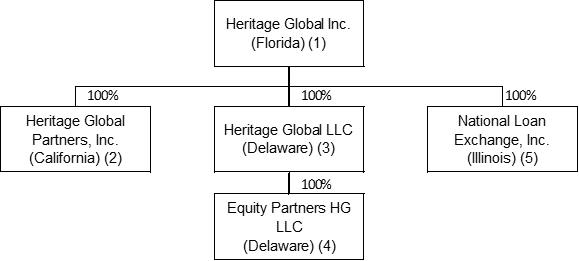
The organization chart below outlines our basic domestic corporate structure as of June 30, 2019.
|
(1) |
Registrant. |
|
(2) |
Full service, global auction, appraisal and asset advisory company. |
|
(3) |
Asset liquidation company which acquires and monetizes distressed and surplus assets. |
16
|
(4) |
Mergers and acquisitions (M&A) advisory firm specializing in financially distressed businesses and properties. |
|
(5) |
Broker of charged-off receivables. |
Asset liquidation
We are a value-driven, innovative leader in corporate and financial asset liquidation transactions, valuations and advisory services. We specialize both in acting as an adviser, as well as in acquiring or brokering turnkey manufacturing facilities, surplus industrial machinery and equipment, industrial inventories, real estate, accounts receivable portfolios, intellectual property, and entire business enterprises.
Our asset liquidation business began operations in 2009 with the establishment of Heritage Global LLC (“HG LLC”). In addition to acquiring turnkey manufacturing facilities and used industrial machinery and equipment, HG LLC arranges traditional asset disposition sales, including liquidation and auction sales. In 2011, HG LLC acquired 100% of the business of EP USA, LLC (“Equity Partners”), thereby expanding our operations. Equity Partners is a boutique M&A advisory firm and provider of financial solutions for businesses and properties in transition.
In 2012, we increased our in-house asset liquidation expertise with our acquisition of 100% of the outstanding equity of HGP, a global full-service auction, appraisal and asset advisory firm, and launched Heritage Global Partners Europe (“HGP Europe”). Through our wholly-owned subsidiary Heritage Global Partners UK Limited, we opened three European-based offices, one each in the United Kingdom, Germany and Spain.
In 2014, we again expanded our asset liquidation operations with the acquisition of 100% of the outstanding equity of NLEX. NLEX is the largest volume broker of charged-off receivables in the United States and Canada, and its offerings include national, state and regional portfolios on behalf of many of the world’s top financial institutions. The NLEX acquisition is consistent with our strategy to expand and diversify the services provided by its asset liquidation business.
As a result of the events and acquisitions outlined above, management believes that our expanded global platform will allow us to achieve our long term industry leadership goals.
Industry and Competition
Our asset liquidation business consists primarily of the auction, appraisal and asset advisory services provided by HGP, mergers and acquisitions advisory services provided by Equity Partners, and the accounts receivable brokerage services provided by NLEX. It also includes the purchase and sale, including at auction, of industrial machinery and equipment, real estate, inventories, accounts receivable and distressed debt. The market for these services and assets is highly fragmented. To acquire auction or appraisal contracts, or assets for resale, the Company competes with other liquidators, auction companies, dealers and brokers. It also competes with them for potential purchasers, as well as with equipment manufacturers, distributors, dealers and equipment rental companies. Some competitors have significantly greater financial and marketing resources and name recognition .
Our business strategy includes the option of partnering with one or more additional purchasers, pursuant to a partnership, joint venture or limited liability company agreement (collectively, “Joint Ventures”). These Joint Ventures give us access to more opportunities, helping to mitigate some of the competition from the market’s larger participants and contribute to our objective to be the leading resource for clients requiring capital and financial asset solutions .
Government Regulation
We are subject to federal, state and local consumer protection laws, including laws protecting the privacy of customer non-public information and regulations prohibiting unfair and deceptive trade practices. Many jurisdictions also regulate “auctions” and “auctioneers” and may regulate online auction services. These consumer protection laws and regulations could result in substantial compliance costs and could interfere with the conduct of our business .
Legislation in the United States, including the Sarbanes-Oxley Act of 2002 and the Dodd-Frank Act of 2010, has increased public companies’ regulatory and compliance costs as well as the scope and cost of work provided by independent registered public accountants and legal advisors. The mandatory adoption of XBRL reporting in 2011 has also increased the Company’s costs paid to third party service providers. As regulatory and compliance guidelines continue to evolve, we expect to continue to incur costs, which may or may not be material, in order to comply with legislative requirements or rules, pronouncements and guidelines by regulatory bodies .
17
Management’s Discussion and Analysis of Financial Condition and Results of Operations references our unaudited condensed consolidated interim financial statements, which have been prepared in accordance with generally accepted accounting principles in the United States of America (“GAAP”). This requires management to make estimates and assumptions that affect the reported amounts of assets and liabilities and the disclosure of contingent assets and liabilities at the date of the financial statements, as well as the reported amounts of revenue and expenses during the reporting period. Management bases its estimates and judgments on historical experience and various other factors that are considered to be reasonable under the circumstances. Actual results could differ from those estimates.
Significant estimates required in the preparation of the unaudited condensed consolidated interim financial statements included in this Report include the assessment of collectability of revenue recognized, and the valuation of accounts receivable, inventory, other assets, right-of-use assets, goodwill, intangible assets, liabilities, contingent consideration, deferred income tax assets and liabilities and stock-based compensation. These estimates are considered significant either because of the significance of the financial statement items to which they relate, or because they require judgment and estimation due to the uncertainty involved in measuring, at a specific point in time, events that are continuous in nature.
We have no off-balance sheet arrangements.
We have not paid any dividends, and do not expect to pay any dividends in the future.
The critical accounting policies used in the preparation of our audited consolidated financial statements are discussed in our Form 10-K. There have been no changes to these policies in the six months ended June 30, 2019, except for the changes to lease accounting standards (see Note 2 - Leases for further detail).
Management’s Discussion of Financial Condition
Liquidity and Capital Resources
Liquidity
At December 31, 2018 and June 30, 2019 we had a working capital deficit of $2.5 million and $4.1 million, respectively.
Our current assets at June 30, 2019 compared to December 31, 2018 remained constant at $7.7 million. Our current liabilities at June 30, 2019 increased to $11.8 million compared to $10.2 million at December 31, 2018. The most significant change was an approximate $2.8 million increase in accounts payable and accrued liabilities primarily the result of timing of certain auction settlement liabilities during the six months ended June 30, 2019.
During the six months ended June 30, 2019, our primary source of cash was the cash on hand plus the cash provided by operations of our asset liquidation business. Cash disbursements other than those related to debt repayment of $1.5 million were primarily related to operating expenses and settlement of auction liabilities.
We believe we can fund our operations, our working capital deficit, and our debt service obligations during 2019 and beyond through a combination of cash flows from our on-going asset liquidation operations and accessing financing from our existing line of credit.
Our indebtedness consists of a promissory note dated January 30, 2018 (the “Note”) issued in the amount of $1,260,000, as well as any amounts borrowed under our Credit Facility. We are required to pay off the Note in 36 equal installments of $35,000, and any remaining outstanding balance thereunder shall be due and payable in full on January 30, 2021. On March 29, 2019 we amended our Credit Facility with First Choice Bank, for a $3.0 million revolving line of credit. The Credit Facility matures on April 5, 2020 and accrues at a variable interest rate, which is equal to the rate of interest last quoted by The Wall Street Journal as the “prime rate,” not to be less than 5.50% per annum, with a minimum monthly interest charge of $100. As of June 30, 2019, the Company had an outstanding balance on the Note of $0.6 million.
18
Ownership Structure and Capital Resources
|
|
• |
At June 30, 2019 the Company had stockholders’ equity of $9.9 million, as compared to $7.6 million at December 31, 2018. |
|
|
• |
In March 2019 we amended our revolving line of credit with our bank to provide for aggregate loans of up to $3.0 million. Refer to Note 9 to the condensed consolidated financial statements for further information. |
|
|
• |
We determine our future capital and operating requirements based upon our current and projected operating performance and the extent of our contractual commitments. We expect to be able to finance our future operations through cash flows from our asset liquidation business and draws on the line of credit, as needed. Capital requirements are generally limited to repayment of our debt obligations and our purchases of surplus and distressed assets. We believe that our current capital resources are sufficient for these requirements. In the event additional capital is needed, we will draw on the line of credit. |
Cash Position and Cash Flows
Cash and cash equivalents at June 30, 2019 were $3.8 million as compared to $4.3 million at December 31, 2018, a decrease of approximately $0.5 million.
Cash provided by operating activities. Cash provided by operating activities was $0.7 million during the six months ended June 30, 2019 as compared to $4.0 million cash provided in the same period in 2018. The approximate $3.3 million decrease was primarily attributable to a net unfavorable change of $1.5 million in the operating assets and liabilities in the six months ended June 30, 2019 compared to the same period in 2018, and an unfavorable change in the net income adjusted for noncash items, which was $1.8 million lower during the six months ended June 30, 2019 as compared to the same period in 2018.
The significant changes in operating assets and liabilities during the six months ended June 30, 2019 as compared to 2018 are primarily due to the nature of our operations. We earn revenue from discrete asset liquidation deals that vary considerably with respect to their magnitude and timing, and that can consist of fees, commissions, asset sale proceeds, or a combination of these. The operating assets and liabilities associated with these deals are therefore subject to the same variability and can be quite different at the end of any given period.
Cash used in investing activities. Cash used in investing activities during the six months ended June 30, 2019 was $0.2 million , as compared to $77,000 used during the six months ended June 30, 2018. The approximate $0.1 million increase was primarily attributable to contributions related to the Company’s investment in the CPFH LLC joint venture, net of distributions from the joint venture.
Cash used in financing activities. Cash used in financing activities was $1.0 million during the six months ended June 30, 2019, as compared to $1.3 million used during the same period in 2018. The 2019 activity consisted of draws on the Line of Credit of $0.5 million and repayments to unrelated third parties of $1.5 million (including $1.3 million on the Line of Credit). The 2018 activity consisted primarily of a contingent consideration payment of $1.0 million and debt repayments of $0.4 million.
19
Our significant contractual obligations are our third party loans, client and partner asset liquidation settlement payments and lease obligations. The loan and lease obligations are fully described in the notes to the financial statements included in our Form 10-K.
Recent Transactions
On June 27, 2019, we entered, with certain partners, into agreements to lease, with a purchase option, a fully functional manufacturing building, including all machinery and equipment held within. The assets under lease relate to our purchase with partners of a pharmaceutical campus in Huntsville, Alabama, which was finalized in the fourth quarter of 2018, as disclosed in the our Form10-K. The lessee is obligated to make monthly lease payments over a ten year period, totaling approximately $13.2 million for the real estate portion, and monthly lease payments over a six year period totaling approximately $9.7 million for the machinery and equipment. The purchase option for both the real estate and machinery and equipment can be exercised at any time on or after December 1, 2019 and before May 31, 2021 for a total purchase price of $20.0 million; of which $12.0 million and $8.0 million are allocated to the real estate and machinery and equipment, respectively. The lessor arrangement is classified as a sales-type lease and therefore the present value of future lease payments has been recognized as revenue and a lease receivable as of the effective date.
The real estate portion of the arrangement is held by CPFH LLC, the joint venture, and is accounted for under the equity method where the Company’s share in earnings from equity method investments is shown in one line item on the income statement. Refer to Note 5 of our unaudited Condensed Consolidated Financial Statements for further information.
The machinery and equipment portion of the arrangement is jointly owned by all the partners of CPFH LLC, apart from the joint venture entity. Therefore we have derecognized the leased asset of approximately $0.9 million and recognized as revenue approximately $1.2 million which represents the present value of future lease payments and a lease receivable included in the accounts receivable line item on the balance sheet, consistent and reflective of our business model for asset sales. We expect to recognize approximately $0.5 million in interest income prior to the exercise of the purchase option, which is the difference between the present value (at a 5.50% discount rate) and the undiscounted lease payments.
Management’s Discussion of Results of Operations
The following table sets out the Company’s condensed consolidated results of operations for the three and six months ended June 30, 2019 and 2018 (dollars in thousands).
|
|
|
Three Months Ended June 30, |
|
|
Change |
|
|
Six Months Ended June 30, |
|
|
Change |
|
||||||||||||||||||||
|
|
|
2019 |
|
|
2018 |
|
|
Dollars |
|
|
Percent |
|
|
2019 |
|
|
2018 |
|
|
Dollars |
|
|
Percent |
|
||||||||
|
Revenues: |
|
|
|
|
|
|
|
|
|
|
|
|
|
|
|
|
|
|
|
|
|
|
|
|
|
|
|
|
|
|
|
|
|
Services revenue |
|
$ |
5,335 |
|
|
$ |
6,471 |
|
|
$ |
(1,136 |
) |
|
|
(18 |
)% |
|
$ |
9,743 |
|
|
$ |
11,510 |
|
|
$ |
(1,767 |
) |
|
|
(15 |
)% |
|
Asset sales |
|
|
2,089 |
|
|
|
345 |
|
|
|
1,744 |
|
|
|
506 |
% |
|
|
4,232 |
|
|
|
1,120 |
|
|
|
3,112 |
|
|
|
278 |
% |
|
Total revenues |
|
|
7,424 |
|
|
|
6,816 |
|
|
|
608 |
|
|
|
9 |
% |
|
|
13,975 |
|
|
|
12,630 |
|
|
|
1,345 |
|
|
|
11 |
% |
|
|
|
|
|
|
|
|
|
|
|
|
|
|
|
|
|
|
|
|
|
|
|
|
|
|
|
|
|
|
|
|
|
|
|
Operating costs and expenses: |
|
|
|
|
|
|
|
|
|
|
|
|
|
|
|
|
|
|
|
|
|
|
|
|
|
|
|
|
|
|
|
|
|
Cost of services revenue |
|
|
1,483 |
|
|
|
732 |
|
|
|
751 |
|
|
|
103 |
% |
|
|
2,214 |
|
|
|
1,291 |
|
|
|
923 |
|
|
|
71 |
% |
|
Cost of asset sales |
|
|
1,866 |
|
|
|
294 |
|
|
|
1,572 |
|
|
|
535 |
% |
|
|
3,026 |
|
|
|
563 |
|
|
|
2,463 |
|
|
|
437 |
% |
|
Selling, general and administrative |
|
|
3,698 |
|
|
|
4,084 |
|
|
|
(386 |
) |
|
|
(9 |
)% |
|
|
7,623 |
|
|
|
7,581 |
|
|
|
42 |
|
|
|
1 |
% |
|
Depreciation and amortization |
|
|
76 |
|
|
|
76 |
|
|
|
— |
|
|
|
0 |
% |
|
|
152 |
|
|
|
160 |
|
|
|
(8 |
) |
|
|
(5 |
)% |
|
Total operating costs and expenses |
|
|
7,123 |
|
|
|
5,186 |
|
|
|
1,937 |
|
|
|
37 |
% |
|
|
13,015 |
|
|
|
9,595 |
|
|
|
3,420 |
|
|
|
36 |
% |
|
Earnings of equity method investments |
|
|
1,269 |
|
|
|
— |
|
|
|
1,269 |
|
|
|
100 |
% |
|
|
1,269 |
|
|
|
— |
|
|
|
1,269 |
|
|
|
100 |
% |
|
Operating income |
|
|
1,570 |
|
|
|
1,630 |
|
|
|
(60 |
) |
|
|
(4 |
)% |
|
|
2,229 |
|
|
|
3,035 |
|
|
|
(806 |
) |
|
|
(27 |
)% |
|
Fair value adjustment of contingent consideration |
|
|
— |
|
|
|
157 |
|
|
|
(157 |
) |
|
|
(100 |
)% |
|
|
— |
|
|
|
157 |
|
|
|
(157 |
) |
|
|
(100 |
)% |
|
Interest and other expense, net |
|
|
(22 |
) |
|
|
(38 |
) |
|
|
16 |
|
|
|
42 |
% |
|
|
(45 |
) |
|
|
(154 |
) |
|
|
109 |
|
|
|
71 |
% |
|
Income before income tax expense |
|
|
1,548 |
|
|
|
1,749 |
|
|
|
(201 |
) |
|
|
(11 |
)% |
|
|
2,184 |
|
|
|
3,038 |
|
|
|
(854 |
) |
|
|
(28 |
)% |
|
Income tax expense |
|
|
54 |
|
|
|
64 |
|
|
|
(10 |
) |
|
|
(16 |
)% |
|
|
78 |
|
|
|
64 |
|
|
|
14 |
|
|
|
22 |
% |
20
Our asset liquidation business model has several components: (1) traditional fee-based asset disposition services, such as commissions from on-line and webcast auctions, liquidations and negotiated sales, and commissions from the NLEX charged-off receivables business, (2) the acquisition and subsequent disposition of distressed and surplus assets, including industrial machinery and equipment and real estate, and (3) fees earned for appraisal and management advisory services.
Three-Month Period Ended June 30, 2019 Compared to Three-Month Period Ended June 30, 2018
Revenues and cost of revenues – Revenues were $7.4 million during the three months ended June 30, 2019 compared to $6.8 million during the same period in 2018. Costs of services revenue and asset sales were $3.4 million during the three months ended June 30, 2019 compared to $1.0 million during the same period in 2018. The gross profit of these items was therefore $4.0 million during the three months ended June 30, 2019 compared to $5.8 million during the same period in 2018, a decrease of approximately $1.8 million, or approximately 31%. The decreased gross profit in the current year reflects the vagaries of the timing and magnitude of asset liquidation transactions.
Selling, general and administrative expense – Selling, general and administrative expense was $3.7 million during the three months ended June 30, 2019 compared to $4.1 million during the same period in 2018.
Significant components of selling, general and administrative expense were as shown below (dollars in thousands):
|
|
|
Three Months Ended June 30, |
|
|
|
|
|
|||||
|
|
|
2019 |
|
|
2018 |
|
|
% change |
|
|||
|
Compensation |
|
|
|
|
|
|
|
|
|
|
|
|
|
HGP |
|
$ |
1,264 |
|
|
$ |
1,135 |
|
|
|
11 |
% |
|
Equity Partners |
|
|
368 |
|
|
|
406 |
|
|
|
(9 |
)% |
|
NLEX |
|
|
854 |
|
|
|
1,106 |
|
|
|
(23 |
)% |
|
HGI |
|
|
129 |
|
|
|
124 |
|
|
|
4 |
% |
|
Stock-based compensation |
|
|
76 |
|
|
|
85 |
|
|
|
(11 |
)% |
|
|
|
|
|
|
|
|
|
|
|
|
|
|
|
Consulting |
|
|
61 |
|
|
|
101 |
|
|
|
(40 |
)% |
|
Board of Directors fees |
|
|
67 |
|
|
|
64 |
|
|
|
5 |
% |
|
Accounting, tax and legal professional fees |
|
|
173 |
|
|
|
162 |
|
|
|
7 |
% |
|
Insurance |
|
|
63 |
|
|
|
97 |
|
|
|
(35 |
)% |
|
Occupancy |
|
|
210 |
|
|
|
205 |
|
|
|
2 |
% |
|
Travel and entertainment |
|
|
188 |
|
|
|
242 |
|
|
|
(22 |
)% |
|
Advertising and promotion |
|
|
122 |
|
|
|
220 |
|
|
|
(45 |
)% |
|
Other |
|
|
123 |
|
|
|
137 |
|
|
|
(10 |
)% |
|
Total selling, general & administrative expense |
|
$ |
3,698 |
|
|
$ |
4,084 |
|
|
|
|
|
The decrease in total selling, general and administrative expenses was largely attributable to a decrease in salaries and commissions, due to a decline in performance for the NLEX division and reduced advertising and promotion as compared to the prior year.
Depreciation and amortization expense – Depreciation and amortization expense was $0.1 million during the three months ended June 30, 2019 and the same period in 2018, and consisted almost entirely of amortization expense related to intangible assets.
Six-Month Period Ended June 30, 2019 Compared to Six-Month Period Ended June 30, 2018
Revenues and cost of revenues – Revenues were $14.0 million during the six months ended June 30, 2019 compared to $12.6 million during the same period in 2018. Costs of services revenue and asset sales were $5.2 million during the six months ended June 30, 2019 compared to $1.9 million during the same period in 2018. The gross profit of these items was therefore $8.7 million during the six months ended June 30, 2019 compared to $10.8 million during the same period in 2018, a decrease of approximately $2.1 million, or approximately 19%. The decreased gross profit in the current year reflects the vagaries of the timing and magnitude of asset liquidation transactions.
21
Selling, general and administrative expense – Selling, general and administrative expense was $7. 6 million during the six months ended June 30, 2019 and the same period in 2018.
|
|
|
Six Months Ended June 30, |
|
|
|
|
|
|||||
|
|
|
2019 |
|
|
2018 |
|
|
% change |
|
|||
|
Compensation |
|
|
|
|
|
|
|
|
|
|
|
|
|
HGP |
|
$ |
2,465 |
|
|
$ |
2,241 |
|
|
|
10 |
% |
|
Equity Partners |
|
|
840 |
|
|
|
781 |
|
|
|
8 |
% |
|
NLEX |
|
|
1,834 |
|
|
|
1,842 |
|
|
|
(0 |
)% |
|
HGI |
|
|
258 |
|
|
|
248 |
|
|
|
4 |
% |
|
Stock-based compensation |
|
|
147 |
|
|
|
146 |
|
|
|
1 |
% |
|
|
|
|
|
|
|
|
|
|
|
|
|
|
|
Consulting |
|
|
118 |
|
|
|
181 |
|
|
|
(35 |
)% |
|
Board of Directors fees |
|
|
131 |
|
|
|
137 |
|
|
|
(4 |
)% |
|
Accounting, tax and legal professional fees |
|
|
358 |
|
|
|
275 |
|
|
|
30 |
% |
|
Insurance |
|
|
120 |
|
|
|
185 |
|
|
|
(35 |
)% |
|
Occupancy |
|
|
421 |
|
|
|
404 |
|
|
|
4 |
% |
|
Travel and entertainment |
|
|
372 |
|
|
|
469 |
|
|
|
(21 |
)% |
|
Advertising and promotion |
|
|
278 |
|
|
|
434 |
|
|
|
(36 |
)% |
|
Other |
|
|
281 |
|
|
|
238 |
|
|
|
18 |
% |
|
Total selling, general & administrative expense |
|
$ |
7,623 |
|
|
$ |
7,581 |
|
|
|
|
|
The increase in total selling, general and administrative expenses was largely attributable to an increase in salaries and commissions, due to improved performance for the HGP division as compared to the prior year, offset by a reduction in advertising and promotion.
Depreciation and amortization expense – Depreciation and amortization expense was $0.2 million during the six months ended June 30, 2019 and the same period in 2018, and consisted almost entirely of amortization expense related to intangible assets.
Non-GAAP Financial Measure — Earnings before Interest, Taxes, Depreciation and Amortization (“EBITDA”) and Adjusted EBITDA
We prepared our unaudited condensed consolidated financial statements in accordance with GAAP. We use the non-GAAP financial measure “Adjusted EBITDA” in assessing the Company’s results. Adjusted EBITDA reflects the standard definition of EBITDA (net income plus depreciation and amortization, interest and other expense, and provision for income taxes), adjusted further to eliminate the effects of fair value adjustments of contingent consideration and stock-based compensation. We believe that Adjusted EBITDA is relevant and useful supplemental information for our investors. Management believes that the presentation of this non-GAAP financial measure, when considered together with our GAAP financial measures and the reconciliation to the most directly comparable GAAP financial measure, provides a more complete understanding of the factors and trends affecting the Company than could be obtained absent these disclosures. Management uses Adjusted EBITDA to make operating and strategic decisions and to evaluate the Company’s performance. We have disclosed this non-GAAP financial measure so that our investors have the same financial data that management uses, with the intention of assisting investors to make comparisons to our historical operating results and analyze our underlying performance. Management believes that Adjusted EBITDA is a useful supplemental tool to evaluate the underlying operating performance of the Company on an ongoing basis. Our use of Adjusted EBITDA is not meant to be, and should not be, considered in isolation or as a substitute for, or superior to, any GAAP financial measure. You should carefully evaluate the financial information, below, which reconciles our GAAP reported net income to Adjusted EBITDA for the periods presented (in thousands).
22
|
|
|
Three Months Ended June 30, |
|
|
Six Months Ended June 30, |
|
||||||||||
|
|
|
2019 |
|
|
2018 |
|
|
2019 |
|
|
2018 |
|
||||
|
Net income |
|
$ |
1,494 |
|
|
$ |
1,685 |
|
|
$ |
2,106 |
|
|
$ |
2,974 |
|
|
Add back: |
|
|
|
|
|
|
|
|
|
|
|
|
|
|
|
|
|
Depreciation and amortization |
|
|
76 |
|
|
|
76 |
|
|
|
152 |
|
|
|
160 |
|
|
Interest and other expense, net |
|
|
22 |
|
|
|
38 |
|
|
|
45 |
|
|
|
154 |
|
|
Income tax expense |
|
|
54 |
|
|
|
64 |
|
|
|
78 |
|
|
|
64 |
|
|
EBITDA |
|
|
1,646 |
|
|
|
1,863 |
|
|
|
2,381 |
|
|
|
3,352 |
|
|
|
|
|
|
|
|
|
|
|
|
|
|
|
|
|
|
|
|
Management add back: |
|
|
|
|
|
|
|
|
|
|
|
|
|
|
|
|
|
Fair value adjustment of contingent consideration |
|
|
— |
|
|
|
(157 |
) |
|
|
— |
|
|
|
(157 |
) |
|
Stock based compensation |
|
|
76 |
|
|
|
85 |
|
|
|
147 |
|
|
|
146 |
|
|
Adjusted EBITDA |
|
$ |
1,722 |
|
|
$ |
1,791 |
|
|
$ |
2,528 |
|
|
$ |
3,341 |
|
Item 3. Quantitative and Qualitative Disclosures about Market Risk.
As a Smaller Reporting Company, we are not required to provide the information required by this item.
Item 4. Controls and Procedures.
As of the end of the period covered by this Report, our Chief Executive Officer and Chief Financial Officer (the “Certifying Officers”) conducted evaluations of our disclosure controls and procedures. As defined in Rules 13a-15(e) and 15d-15(e) of the Securities Exchange Act of 1934, as amended (the “Exchange Act”), the term “disclosure controls and procedures” means controls and other procedures of an issuer that are designed to ensure that information required to be disclosed by the issuer in the reports that it files or submits under the Exchange Act is recorded, processed, summarized and reported, within the time periods specified in the SEC’s rules and forms. Disclosure controls and procedures include, without limitation, controls and procedures designed to ensure that information required to be disclosed by an issuer in the reports that it files or submits under the Exchange Act is accumulated and communicated to the issuer’s management, including the Certifying Officers, to allow timely decisions regarding required disclosure. Based on this evaluation, the Certifying Officers have concluded that our disclosure controls and procedures were effective.
Further, there were no changes in our internal control over financial reporting during the six months ended June 30, 2019 that have materially affected, or are reasonably likely to materially affect, our internal control over financial reporting.
23
There have been no material changes to the legal proceedings discussed in our Form 10-K.
As a Smaller Reporting Company, we are not required to provide the information required by this item.
Item 2. Unregistered Sales of Equity Securities and Use of Proceeds.
None.
Item 3. Defaults Upon Senior Securities.
None.
Item 4. Mine Safety Disclosures.
Not applicable.
None.
24
(a) Exhibits
|
Exhibit No. |
|
Identification of Exhibit |
|
3.1 |
|
|
|
3.2 |
|
|
|
3.3 |
|
|
|
3.4 |
|
|
|
4.1 |
|
|
|
31.1 |
|
|
|
|
|
|
|
31.2 |
|
|
|
|
|
|
|
32.1 |
|
|
|
|
|
|
|
32.2 |
|
|
|
|
|
|
|
101.INS |
|
XBRL Instance Document |
|
|
|
|
|
101.SCH |
|
XBRL Taxonomy Extension Schema Document |
|
|
|
|
|
101.CAL |
|
XBRL Taxonomy Extension Calculation Linkbase Document |
|
|
|
|
|
101.DEF |
|
XBRL Taxonomy Extension Definition Linkbase Document |
|
|
|
|
|
101.LAB |
|
XBRL Taxonomy Extension Labels Linkbase Document |
|
|
|
|
|
101.PRE |
|
XBRL Taxonomy Extension Presentation Linkbase Document |
|
|
|
|
25
Pursuant to the requirements of the Securities Exchange Act of 1934, the Registrant has duly caused this report to be signed on its behalf by the undersigned thereunder duly authorized.
|
|
|
Heritage Global Inc. |
||
|
|
|
|
|
|
|
Date: August 5, 2019 |
|
By: |
|
/s/ Ross Dove |
|
|
|
|
|
Ross Dove |
|
|
|
|
|
Chief Executive Officer |
|
|
|
|
|
(Principal Executive Officer) |
|
|
|
|
|
|
|
|
|
By: |
|
/s/ Scott A. West |
|
|
|
|
|
Scott A. West |
|
|
|
|
|
Chief Financial Officer |
|
|
|
|
|
(Principal Financial Officer and |
|
|
|
|
|
Principal Accounting Officer) |
26