VYOME HOLDINGS, INC
UNITED STATES
SECURITIES AND EXCHANGE COMMISSION
WASHINGTON, D.C. 20549
FORM 10-K
|
☒
|
ANNUAL REPORT PURSUANT TO SECTION 13 OR 15(d) OF THE SECURITIES EXCHANGE ACT OF 1934
|
For the fiscal year ended
December 31, 2018
or
|
☐
|
TRANSITION REPORT PURSUANT TO SECTION 13 OR 15(d) OF THE SECURITIES EXCHANGE ACT OF 1934
|
For the transition period from to .
Commission File Number: 001-37897
OBALON THERAPEUTICS, INC.
(Exact Name of Registrant as Specified in Its Charter)
|
Delaware
|
26-1828101
|
|
(State of Incorporation)
|
(I.R.S. Employer
Identification No.)
|
|
5421 Avenida Encinas, Suite F
|
|
|
Carlsbad, California
|
92008
|
|
(Address of Principal Executive Offices)
|
(Zip Code)
|
(844) 362-2566
(Registrant’s Telephone Number, Including Area Code)
Securities registered pursuant to Section 12(b) of the Act:
|
Title of Each Class
|
Name of Each Exchange on Which Registered
|
|
|
Common Stock, $0.001 par value per share
|
The Nasdaq Stock Market LLC
|
|
Securities registered pursuant to Section 12(g) of the Act: None
Indicate by check mark if the registrant is a well-known seasoned issuer, as defined in Rule 405 of the Securities Act. Yes ☐ No
S
Indicate by check mark if the registrant is not required to file reports pursuant to Section 13 or Section 15(d) of the Act. Yes ☐ No
S
Indicate by check mark whether the registrant: (1) has filed all reports required to be filed by Section 13 or 15(d) of the Securities Exchange Act of 1934 during the preceding 12 months (or such shorter period that the registrant was required to file such reports), and (2) has been subject to such filing requirements for the past 90 days. Yes
S
No ☐
Indicate by check mark whether the registrant has submitted electronically every Interactive Data File required to be submitted and pursuant to Rule 405 of Regulation S-T during the preceding 12 months (or for such shorter period that the registrant was required to submit and post such files). Yes
S
No ☐
Indicate by check mark if disclosure of delinquent filers pursuant to Item 405 of Regulation S-K is not contained herein, and will not be contained, to the best of registrant’s knowledge, in definitive proxy or information statements incorporated by reference in Part III of this Form 10-K or any amendment to this Form 10-K. ☐
Indicate by check mark whether the registrant is a large accelerated filer, an accelerated filer, a non-accelerated filer, a smaller reporting company, or an emerging growth company. See the definitions of “large accelerated filer”, “accelerated filer,” “smaller reporting company,” and "emerging growth company" in Rule 12b-2 of the Securities Exchange Act of 1934.
|
Large accelerated filer
|
☐
|
Accelerated filer
|
☐
|
|
|
Non-accelerated filer
|
S
|
Smaller reporting company
|
S
|
|
|
Emerging growth company
|
S
|
|||
If an emerging growth company, indicate by check mark if the registrant has elected not to use the extended transition period for complying with any new or revised financing accounting standards provided pursuant to Section 13(a) of the Exchange Act.
S
Indicate by check mark whether the registrant is a shell company (as defined in Rule 12b-2 of the Exchange Act). Yes ☐ No
S
The aggregate market value of the voting and non-voting common equity held by non-affiliates was $19.8 million, computed by reference to the last sales price of $2.15 as reported by The NASDAQ Global Market as of June 29, 2018. This calculation does not reflect a determination that certain persons are affiliates of the Registrant for any other purpose. The number of shares of common stock held by non-affiliates excluded 8,653,176 shares of common stock held by directors, officers and affiliates of directors. The number of shares owned by affiliates of directors was determined based upon information supplied by such persons and upon Schedules 13D and 13G, if any, filed with the SEC. Exclusion of shares held by any person should not be construed to indicate that such person possesses the power, direct or indirect, to direct or cause the direction of the management or policies of the Registrant, that such person is controlled by or under common control with the Registrant, or that such persons are affiliates for any other purpose.
Total shares of common stock outstanding as of the close of business on February 8, 2019 was 23,502,824 shares.
DOCUMENTS INCORPORATED BY REFERENCE
Certain information required to be disclosed in Part III of this report is incorporated by reference from the registrant’s definitive Proxy Statement for the 2018 Annual Meeting of Stockholders, which proxy statement will be filed not later than 120 days after the end of the fiscal year covered by this report.
|
Table of Contents
|
||
|
Page
|
||
|
PART I
|
||
|
Item 1.
|
||
|
Item 1A.
|
||
|
Item 1B.
|
||
|
Item 2.
|
||
|
Item 3.
|
||
|
Item 4.
|
||
|
PART II
|
||
|
Item 5.
|
||
|
Item 6.
|
||
|
Item 7.
|
||
|
Item 7A.
|
||
|
Item 8.
|
||
|
Item 9.
|
||
|
Item 9A.
|
||
|
Item 9B.
|
||
|
PART III
|
||
|
Item 10.
|
||
|
Item 11.
|
||
|
Item 12.
|
||
|
Item 13.
|
||
|
Item 14.
|
||
|
PART IV
|
||
|
Item 15.
|
||
|
Item 16.
|
||
1
PART I
Forward-Looking Statements
This Annual Report on Form 10-K, or this Annual Report, including the sections entitled “Business,” “Risk factors,” and “Management’s discussion and analysis of financial condition and results of operations” contains forward-looking statements. The words “believe,” “may,” “will,” “should,” "predict," "goal," "strategy," “potentially,” “estimate,” “continue,” “anticipate,” “intend,” “could,” “would,” “project,” “plan” “expect,” "seek," and similar expressions that convey uncertainty of future events or outcomes, are intended to identify forward-looking statements.
These forward-looking statements are subject to a number of risks, uncertainties and assumptions, including those described in the “Risk factors” and elsewhere in this Annual Report. Moreover, we operate in a very competitive and rapidly changing environment, and new risks emerge from time to time. It is not possible for our management to predict all risks, nor can we assess the impact of all factors on our business or the extent to which any factor, or combination of factors, may cause actual results to differ materially from those contained in any forward-looking statements we may make. In light of these risks, uncertainties and assumptions, the forward-looking events and circumstances discussed in this prospectus may not occur and actual results could differ materially and adversely from those anticipated or implied in the forward-looking statements.
You should not rely upon forward-looking statements as predictions of future events. Although we believe that the expectations reflected in the forward-looking statements are reasonable, we cannot guarantee you that the future results, levels of activity, performance or events and circumstances reflected in the forward-looking statements will be achieved or occur. We undertake no obligation to update publicly any forward-looking statements for any reason after the date of this Annual Report to conform these statements to actual results or to changes in our expectations, except as required by law.
You should read this Annual Report and the documents that we reference in this Annual Report and have filed with the SEC with the understanding that our actual future results, levels of activity, performance and events and circumstances may be materially different from what we expect.
ITEM 1.
Business
BUSINESS
OVERVIEW
We are a vertically integrated medical device company focused on developing and commercializing innovative medical devices to treat people who are obese and overweight. Our initial product offering is the Obalon® Balloon System, the first and only U.S. Food and Drug Administration, or FDA, approved swallowable, gas-filled intragastric balloon designed to provide progressive and sustained weight loss in patients with obesity. We believe the Obalon Balloon System offers patients and physicians benefits over prior weight loss devices including, but not limited to: a favorable safety profile, improved patient tolerability and comfort, progressive weight loss with durable results, simple and convenient placement, and potentially attractive economics for patients and physicians.
The Obalon balloon system is FDA approved for temporary use to facilitate weight loss in adults with obesity having a body mass index, or BMI, of 30 to 40, or approximately 30 to 100 pounds overweight, who have failed to lose weight through diet and exercise. The system is intended to be used as an adjunct to a moderate intensity diet and behavior modification program. All balloons must be removed in six-months after the first balloon is placed. The Obalon Balloon System has the potential to provide patients and physicians with a cost-effective, reversible and repeatable weight loss solution in an outpatient setting, without altering patient anatomy or requiring surgery.
We commenced commercialization of our prior generation Obalon balloon system in January 2017. The prior generation Obalon balloon system consisted of a swallowable capsule that contains a balloon attached to a microcatheter, a hand-held inflation system referred to as EzFill and a pre-filled can of our proprietary mix of gas. Subsequent to our initial commercial launch, we obtained FDA approval for our Obalon Touch Inflation Dispenser and our Obalon Navigation System. The Obalon Navigation System is designed to eliminate the need to use x-ray technology when placing the Obalon balloon. It utilizes magnetic resonance, rather than x-ray radiation, to track the Obalon balloon during placement and displays a dynamic real-time tracking of the balloon on a computer screen. Obalon Touch Inflation Dispenser is our next generation inflation system that will be used in conjunction with balloons place using the Obalon Navigation System. Together, the Obalon Navigation System and Obalon Touch Inflation Dispenser are intended to make balloon placement more reliable, safer, easier and less expensive. We intend to commence initial commercial shipments on the Obalon Navigation System and Touch Inflation Dispenser in the first quarter of 2019. We use the term Obalon Balloon System to refer to both our prior generation Obalon balloon system and the latest generation that uses the Obalon Touch Inflation Dispenser and the Obalon Navigation System.
2
We are selling the Obalon Balloon System in the United States on a self-pay, non-reimbursed basis into existing physician specialty areas with weight loss practices, such as bariatric surgeons and gastroenterologists. In addition, we are selling to plastic surgeons, due to their client base and experience managing self-pay practices. Physicians can market our product as a highly differentiated, non-surgical weight loss procedure. Based on our product design and commercial data, we believe the Obalon Balloon System provides potentially attractive economics for patients and physicians. We expect to continue to focus our sales and marketing efforts primarily on selling our product in the United States through a direct sales force. Historically, we also sold our prior generation Obalon balloon system through a distributor in the Middle East. However, we recently completed final shipments to this distributor in the first quarter of 2019 and we do not expect any additional international revenue in 2019 given our primary focus in the United States. In 2019, we plan to phase out our prior generation Obalon balloon system that uses x-ray technology to place balloons, and eventually we will only sell versions of the Obalon Balloon System that use the Obalon Navigation System to place balloons.
Intragastric balloons represent a relatively new category of treatment for weight loss in the United States and the current market is small and immature. Our strategy is to methodically build the foundation to establish the Obalon Balloon System as an important, growing and sustainable treatment for weight loss. We are currently employing a focused sales and marketing strategy to ensure our initial target accounts achieve clinical and economic success before launching more broadly in the U.S. and international markets. We expect to continue investing in various activities to develop the intragastric balloon market for the foreseeable future.
We intend to drive consumer awareness and interest in part through cost-effective digital, offline, and social marketing. We estimate that there were more than 49 million views of our digital advertisements and more than 6 million views of our digital videos in 2018, up from more than 45 million views of our digital advertisements and more than 5 million views of our digital videos in 2017. We also estimate that visits to our website grew to 1.7 million in 2018 as compared to approximately 1.0 million unique visits to our website in 2017, searches of our website for physicians capable of placing our Obalon Balloon System increased to over 580,000 in 2018 from over 400,000 searches in 2017. We also generated over 71,000 and 46,000 patient leads to our physician partners in the United States during 2018 and 2017, respectively.
THE OBESITY EPIDEMIC
Obesity has been identified by the U.S. Surgeon General as an epidemic and a significant threat to the quality of life in the United States. Based on results from the 2013-2014 National Health and Nutrition Examination Survey, it is estimated that more than 86 million adults in the United States were obese, defined as a BMI of 30 or greater, of which approximately 17.6 million were considered extremely obese with a BMI of 40 or greater, and an additional 75 million adults in the United States were overweight, defined as a BMI between 25 and 29. Research sponsored by the Centers for Disease Control and Prevention, or CDC, suggests that if current obesity rates persist, more than half of the U.S. population will be obese by 2030. Obesity is also a significant health problem outside of the United States. The number of obese adults worldwide has nearly tripled since 1975, and the World Health Organization estimates that more than 650 million adults were obese and more than 1.9 billion were overweight in 2016.
The CDC has identified obesity as a leading cause of preventable death in the United States, and it is one of the leading causes of chronic diseases both worldwide and in the United States. Obesity-related disorders, known as comorbidities, include cardiovascular diseases, diabetes, musculoskeletal disorders and some cancers. The national medical care costs of obesity-related illness in adults, including out-of-pocket expenses, third-party payer expenses and Medicaid, were estimated to be approximately $210 billion in 2008. Furthermore, the annual global economic impact of obesity is estimated to be $2 trillion.
We expect the obesity epidemic among adults to continue to grow worldwide given the excess caloric intake of highly-processed, fatty foods, increasingly sedentary lifestyles and a growing prevalence of obesity among children and adolescents. Despite the growing public interest in the obesity epidemic and the significant medical and economic repercussions associated with the disease, there remains a significant unmet need for more effective treatments.
CURRENT TREATMENTS AND LIMITATIONS
Current treatment alternatives for patients who are obese and overweight begin with lifestyle modification, such as diet and exercise. If this course of treatment fails to produce the desired results, physicians may prescribe pharmaceutical therapies, and in patients with more severe obesity, physicians may pursue aggressive surgical treatments, such as gastric bypass and gastric banding. These approaches are associated with safety concerns, lifestyle impact and ease of use, cost and compliance issues that have limited their adoption. Additionally, some patients may seek to address the symptoms of weight-gain through the use of aesthetic products, certain of which have been approved for individuals with a BMI of 30 or less. We believe such products only treat the symptoms and not the underlying disease. They are also not indicated for obese patients.
3
Lifestyle modification
Lifestyle modification, which includes diet, exercise and behavior modification, is usually prescribed as an initial treatment for a patient who is obese or overweight and is typically prescribed in all obesity management approaches. However, lifestyle modification alone has generally been ineffective in producing sustainable weight loss in patients with obesity due to inability to comply with the modifications over an extended period. Many studies have shown that a significant majority of dieters will regain lost weight and many will gain more than they originally lost.
Pharmaceutical therapy
Several pharmaceutical products have been approved by the FDA for obesity in the United States. Pharmaceutical therapy often represents a first option in the treatment of patients with obesity that have failed to achieve weight loss goals through lifestyle modifications alone. Pharmaceutical therapy can have limited effectiveness due to patient non-compliance. Additionally, pharmaceutical therapy may carry significant safety risks and negative side effects, such as adverse gastrointestinal, cardiovascular and central nervous system issues, some of which are serious or life threatening.
Bariatric surgery
Bariatric surgery is a treatment option generally reserved for cases of severe obesity, or patients with a BMI in excess of 40. The most common forms of bariatric surgery, gastric bypass and sleeve gastrectomy, promote weight loss by surgically restricting the stomach’s capacity and outlet size. Gastric bypass also affects weight loss by restricting the body’s ability to absorb nutrients. While largely effective, these procedures are generally invasive, expensive for the patient and irreversible. Bariatric surgery patients are generally required to make significant postoperative lifestyle changes, including strict dietary changes, vitamin supplementation and long-term medical follow-up programs. Side effects of bariatric surgery include a high rate of re-operation, nausea, vomiting, dumping syndrome, dehydration, dental problems and other issues.
Recently developed treatment alternatives
Given the shortcomings and limitations of the existing treatment alternatives, new medical procedures have been recently introduced in an attempt to address the gap in care between pharmaceutical treatment and invasive surgical procedures. These new procedures include: neuroblocking therapy, aspiration therapy and liquid-filled intragastric balloons. Neuroblocking therapy involves a surgical procedure in which a neuromodulation device is implanted in the body and used to block electrical signals from the stomach to the brain. By blocking those signals, the device attempts to control the patient’s feelings of hunger. Aspiration therapy involves a surgical procedure in which a feeding tube is implanted in the abdomen in order to remove food from the stomach before calories are absorbed into the body. We believe high costs, procedural complications and the risk of SADEs may limit their adoption.
Intragastric balloons are a type of space-occupying device placed in the stomach in order to cause a sensation of fullness. Currently marketed traditional balloons are large, liquid-filled silicone devices that are placed in the stomach endoscopically, under anesthesia, for a treatment period of up to six months. Following treatment, the balloons are removed in a second endoscopic procedure. Approved traditional liquid-filled intragastric balloons in the United States are the ReShape™ Duo Balloon and the ORBERA® Balloon. While generally effective in delivering weight loss, these traditional liquid-filled intragastric balloons have been accompanied by a number of limitations that have impeded their adoption, including: high rate of SADEs, lack of comfort and tolerability, limited ability to provide progressive and sustained weight loss, and inconvenient placement procedure.
OUR SOLUTION
We have developed our Obalon Balloon System to overcome the limitations of prior devices intended to treat weight loss, including traditional liquid-filled intragastric balloons. Based on our clinical data and commercial experiences, we believe the Obalon Balloon System provides the following benefits to our patients and their physicians:
|
▪
|
Favorable safety profile.
In our pivotal SMART trial, only one of 336 (0.3%) patients that received our Obalon balloon experienced a SADE and in data presented at the American Society for Metabolic and Bariatric Surgery Meeting from our first year of commercial experience, only two of 1,343 (0.14%) patients that received our Obalon balloon experienced a SADE. As of December 31, 2018, the reported rate of SADEs reported to us in commercial use is no different than that experienced in either the pivotal SMART trial or the data from our first year of commercial experience.
|
|
▪
|
Improved patient tolerability and comfort.
The Obalon balloon is inflated with a proprietary mix of gas. This creates a light, buoyant balloon that floats at the top of the stomach instead of sinking to the bottom of the stomach like a traditional liquid-filled intragastric balloon. Further, the Obalon Balloon System consists of three separate 250cc balloons placed individually over a three-month period to progressively add volume. We believe these design elements have the potential to improve patient comfort and tolerability of our Obalon balloon.
|
4
|
▪
|
Progressive weight loss with durable results.
In our pivotal SMART trial, patients in the Obalon treatment group lost, on average, approximately twice as much body weight as patients in the sham-control group. In addition, patients in the Obalon treatment group showed, on average, progressive weight loss over the balloon treatment period, which we believe is attributable to the individual placement of three separate Obalon balloons over the treatment period. Subsequent data analysis at 12 months also showed that, on average, 89.5% of the weight loss was maintained six months after balloon removal. Based on 2017 data collected in our commercial registry, the average weight loss per patient appears to be trending favorably in U.S. commercial usage versus the same BMI range studied in the SMART trial with average weight loss of 21.3 lbs., or 10.0% total body loss, or TBL, for those patients that completed the three-balloon therapy. Average weight loss for the top quartile of completers was 38.2 lbs., or 17.2% TBL.
|
|
▪
|
Simple and convenient placement.
The Obalon balloon is placed without anesthesia or an endoscopy through a swallowable capsule that dissolves in the stomach and releases the balloon. These unique features allow patients the flexibility to receive the Obalon balloon discreetly in an outpatient setting. Placement typically occurs in less than ten minutes and can be scheduled in the morning before work, during a lunch break or in the evening. Treated patients can return promptly to their normal daily activities. The balloons are removed endoscopically under light, conscious sedation six months after the first balloon placement. Recently approved new products, the Obalon Navigation System and Obalon Touch Inflation Dispenser, further improves convenience of placement.
|
|
▪
|
Attractive economics for patients and physicians.
By eliminating the need for an endoscopic delivery procedure, anesthesia and use of a special endoscopy suite, we believe our Obalon Balloon System reduces physician costs and allows more time to perform additional procedures. Furthermore, the Obalon balloon’s tolerability profile reduces the need for ongoing patient management. We believe our balloon treatment allows patients to benefit from lower treatment costs, no post-placement recovery period and a quick return to daily activities. Recently approved new products, the Obalon Navigation System and Obalon Touch Inflation Dispenser, may further improve economics for physicians.
|
OUR STRATEGY
Our objective is to be the leading provider of medical devices for the non-surgical treatment of obese and overweight individuals. The key elements of our strategy are to:
|
▪
|
Drive product adoption by focusing on key physicians within three specialties; bariatrics, gastroenterology and plastic surgery.
We are initially focused on direct sales to the leading bariatric surgeons, gastroenterologists, and plastic surgeons in the United States. We estimate that there are approximately 3,500 bariatric surgery centers in the United States, and we believe the leading 700 centers provide an opportunity to effectively access obese patients using an efficiently-sized sales force. In addition, there are over 15,000 gastroenterologists, many of which are expanding their practices to include weight loss treatments, and 1,900 aesthetically focused plastic surgeons. We believe adoption of our technology by key physicians will accelerate broader adoption of the Obalon Balloon System in each physician specialty area.
|
|
▪
|
Partner with physicians to create consumer awareness and drive patients into the channel.
Our strategy is to establish marketing and support programs with physicians to create patient awareness and demand for the Obalon Balloon System. We support these physicians with best practices and tools to treat qualified patients already in the channel and through local outreach to attract new patients to the practice. We also provide physicians with the clinical training to utilize our Obalon Balloon System, as well as the practice development support to manage their practices as self-pay centers. In addition, we believe we can address an even larger patient population by creating a recognizable brand name through a direct-to-patient campaign designed to differentiate the Obalon Balloon System using targeted, cost effective digital and social media platforms, and media outreach through public relations efforts.
|
|
▪
|
Continue to develop innovative products to facilitate market penetration.
We plan to leverage our proprietary product technology and research and development expertise to develop products for weight loss that improve clinical outcomes, increase ease of use and reduce cost. In 2018, we received approvals of PMA-supplements, or PMA-S, for both our Obalon Navigation System and Obalon Touch Inflation Dispenser, which are intended to make balloon placements more reliable, easier, safer and less expensive. Other products currently in our development pipeline include a balloon with a treatment period of longer than six months.
|
|
▪
|
Optimize manufacturing to drive operating leverage.
We have built a highly leverageable manufacturing facility at our headquarters in Carlsbad, California, where we design, develop and manufacture a majority of our products in-house using some components and sub-assemblies provided by third-party suppliers. We believe that controlling the manufacturing and assembly of our products allows us to innovate more quickly and cost-efficiently and produce higher quality products than if we outsourced manufacturing. We believe we have the ability to increase our manufacturing scale for our current products within our current facility in a cost-effective manner.
|
5
|
▪
|
Protect and expand our strong intellectual property portfolio.
We have developed a strong portfolio of issued patents and pending applications that protect our products and technology. We believe we have also developed know-how critical to creating current and future products that we hold and protect as trade secrets. We have an inventive culture and expect to continue innovating to create a proprietary pathway for future product development. We intend to aggressively protect and enforce our intellectual property, both for existing and new products.
|
OUR PRODUCTS AND TECHNOLOGY
The Obalon Balloon System was designed to overcome the historical limitations of traditional liquid-filled intragastric balloons and other nonsurgical treatments for weight loss. We have developed the individual components of the Obalon Balloon System to collectively improve clinical outcomes, increase ease of use and reduce cost.
The Obalon Balloon System
The main components of the Obalon Balloon System are: a swallowable capsule that contains the balloon attached to a microcatheter, a hand-held inflation system and a pre-filled can of our proprietary mix of gas. Our latest generation of the Obalon Balloon System also includes the Obalon Navigation System, which dynamically tracks the balloon during placement.
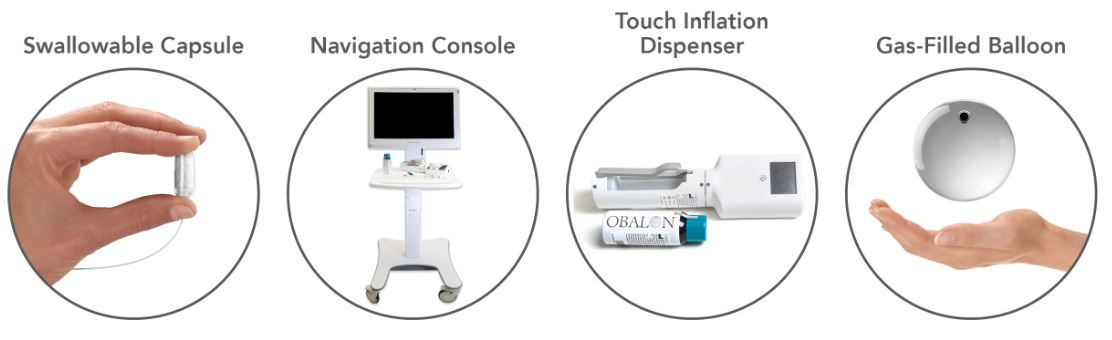
Capsule, balloon and microcatheter technology
Dissolvable capsule
We designed the capsule to be large enough to accommodate the folded balloon, yet small enough to be swallowed. The capsule is titrated to optimize dissolution timing. If the capsule dissolves too quickly, the balloon could be prematurely released before entering the stomach, and if too slowly, the patient and physician are inconvenienced by having to wait longer to inflate the balloon.
Balloon film
Our film is a coextruded, multilayer polymer consisting primarily of nylon and polyethylene. We designed the film to be thin enough to fit into a swallowable capsule, yet stable enough to withstand the chemical and mechanical forces in the stomach. Our film is biocompatible, cost-effective to manufacture, puncture and abrasion resistant, smooth and atraumatic to the stomach’s lining and able to appropriately retain gas.
Balloon valve
Our balloon valve is an innovative combination of materials, including silicone and titanium, designed to be highly reliable. The valve is small enough to fit into a swallowable capsule and radiopaqued for visibility under digital imaging. A key feature of our valve is the ability to effectively reseal after the inflation catheter is removed to prevent leaks.
Microcatheter
Our microcatheter is designed to quickly and reliably inflate the Obalon balloon. It is small, flexible and smooth in order to minimize any potential discomfort to the patient during balloon placement. The catheter utilizes a hydrophilic coating to reduce friction during swallowing.
6
Inflation systems
EzFill Inflation System
Our prior generation hand-held inflation system, the EzFill inflation system, is a reusable device that delivers our proprietary mixture of gas to consistently inflate the Obalon balloon to the standardized volume and pressure. The inflation system is equipped with pre-pulse, a confirmation system that provides pressure feedback measurements to confirm that the Obalon balloon is both properly placed and able to be correctly inflated in the stomach. The EzFill Inflation System is used only with our prior generation Obalon balloon system.
The Obalon Touch Inflation Dispenser
The Obalon Touch Inflation Dispenser is a semi-automated, hand-held inflation device that provides real-time balloon pressure measurements to confirm that the Obalon balloon is both properly placed and correctly inflated in the stomach. The new Obalon Touch Inflation Dispenser automates several steps of the balloon inflation process and eliminates the need for altitude pre-programming. The Obalon Navigation System is intended to be commercially launched exclusively with the Obalon Touch Inflation System.
Proprietary gas
The Obalon balloon is inflated with our proprietary mix of gas, which, in combination with the permeability of the balloon film and the stomach gases, enables the balloon to remain inflated for the full six-month treatment period.
The Obalon Navigation System
The Obalon Navigation System consists of a Navigation console and the Obalon Touch Inflation Dispenser. The Obalon Navigation System console is a portable device consisting of hardware and software that are used to track and display the Navigation balloon during administration. The console has a significantly smaller footprint than most x-ray systems currently used by physicians when placing balloons and does not require any special facilities or licensing. The Obalon Navigation balloon is placed utilizing the Obalon Navigation System console and Obalon Touch Inflation Dispenser. The balloon administered with the Obalon Navigation System is similar to the current balloon but utilize a new catheter, which includes components related to Navigation. The new catheter interfaces with the Obalon Navigation System console to dynamically track the balloon during placement. The Obalon Navigation Balloon is only compatible with the Obalon Navigation Console and Obalon Touch Inflation Dispenser.
The Obalon Balloon treatment
Placement of the Obalon balloon typically occurs in less than ten minutes and can be accomplished in an outpatient setting. To place the Obalon balloon, the patient swallows the capsule, which has the Obalon balloon folded inside, with a glass of water. No sedation or anesthesia is required. Once swallowed, placement of the capsule is confirmed one of two ways, depending on the Obalon balloon being placed. The original Obalon balloon is confirmed in the stomach with radiographic (or x-ray) imaging. An Obalon Navigation balloon is confirmed in the stomach using the Obalon Navigation System. The microcatheter, which is attached to the Obalon balloon, is then connected to either our EzFill inflation system if an original Obalon balloon, or the Obalon Touch Inflation Dispenser if an Obalon Navigation balloon. Both the EzFill and Touch inflation systems provides real-time pressure measurements to confirm that the Obalon balloon is both properly placed and able to be correctly inflated in the stomach. A pre-filled can of gas is inserted into the inflation system and then the gas is discharged to fill the balloon to a volume of 250cc. Once the inflation of the Obalon balloon is confirmed, the microcatheter is detached from the balloon via hydrostatic pressure and is removed through the patient’s mouth. The patient is intended to return two more times over the following eight to 12 weeks to receive a second and third Obalon balloon, expanding total balloon volume within the stomach to approximately 750cc.
All of the balloons are removed in a single procedure six months after the placement of the initial balloon. Removal of the Obalon balloon typically requires approximately 15 minutes on average. The balloons are removed endoscopically under light conscious sedation, using standard commercially-available endoscopy tools.
7
The following pictures depict the treatment steps of the Obalon Balloon System:

Additional Product Under Development
We are developing a balloon intended for a longer duration of treatment, potentially up to one year. In our SMART trial, patients in the Obalon treatment group continued, on average, to lose weight throughout the six months of balloon treatment. We have completed the initial engineering and animal testing on the proprietary materials and systems, which we believe would permit reliable balloon performance over a longer period of up to twelve months. We intend to study if longer balloon treatment is safe and may provide greater weight loss in higher BMI patients or those desiring a longer weight loss treatment.
Research and development
As of
December 31, 2018
, we had 11 employees focused on research and development. In addition to our internal team, we retain third-party contractors from time to time to provide us with assistance on specialized projects. We also work closely with experts in the medical community to supplement our internal research and development resources. Research and development expenses for the years ended December 31,
2018
and
2017
were
$10.7 million
and
$10.6 million
, respectively.
8
CLINICAL TRIALS AND DATA
SMART trial
Based on our clinical data, we believe our Obalon balloon has the potential to offer a compelling combination of efficacy and safety. We have evaluated various versions of our Obalon Balloon System in numerous clinical trials, which included a total of 889 patients as of
December 31, 2018
. Based on the results of our U.S. pivotal trial, the SMART trial, we received FDA approval for our current Obalon Balloon System in September 2016. The data was published in Surgery for Obesity and Related Diseases in September 2018. The SMART trial met its primary weight loss endpoints, demonstrated a strong safety profile, continued weight loss over the full six-month treatment period, showed statistically significant differences in metabolic profiles and demonstrated that patients were able to maintain most of the weight loss for at least six months following the removal of the Obalon balloons.
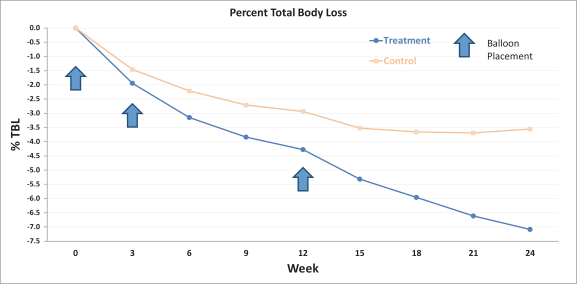
The SMART trial was a prospective, double-blinded, multi-center, randomized (1:1), parallel-group, active sham-controlled trial of 387 patients. The Obalon treatment group received three balloons placed individually at approximately week zero, week three and week 12. Alternatively, the sham-control group received placebo capsules with microcatheters and were led to believe in a mock placement that a balloon was placed and inflated in their stomachs at week zero, week three and week 12. Patients were given minimal diet counseling of 25 minutes every three weeks in order to isolate the impact of the Obalon balloon on weight reduction.
The trial was conducted by both bariatric surgeons and gastroenterologists at 15 U.S. centers. The trial evaluated a co-primary endpoint comprised of (i) a minimum difference in mean percent TBL between the Obalon treatment group and sham-control group of at least 2.1% and (ii) achievement by at least 35% of the Obalon treatment group patients of at least 5% TBL at the end of six-months of treatment. Additional observational measures included metabolic metrics and weight loss maintenance after removal of balloons. The median time for each balloon placement was nine minutes, while the median balloon removal time for three balloons was 14 minutes.
Results from the SMART trial met both the co-primary endpoints. The per protocol analysis included 366 patients (185 in the Obalon treatment group and 181 in the sham-control group) and showed patients in the Obalon treatment group achieved mean TBL of 6.86%, or 15.06 lbs, vs 3.59%, or 7.77 lbs, in the sham-control group, showing a difference of 3.28%, or 7.28 lbs. The following table summarizes average percentage of TBL, percentage of excess weight loss, or EWL, and weight loss (in pounds) for the Obalon treatment group and the sham-control group in the SMART trial. All weight loss metrics below were statistically significant.
|
Weight Loss Metric
Per Protocol Cohort
|
Obalon
Treatment Group
(N = 185)
|
Sham-Control
Group
(N = 181)
|
Difference
|
p-value
|
||||
|
Percent TBL
|
-6.86
|
|
-3.59
|
|
-3.28
|
|
0.0261
|
|
|
Percent EWL
|
-25.05
|
|
-12.95
|
|
-12.09
|
|
< 0.0001
|
|
|
Weight Loss (lbs.)
|
-15.06
|
|
-7.77
|
|
-7.28
|
|
< 0.0001
|
|
In addition, 64.9% of the Obalon treatment group patients met or exceeded the 5% TBL endpoint whereas only 32.0% of the sham-control group met or exceeded 5% TBL. The following table summarizes the 5% TBL responder rates for the Obalon treatment group and the sham-control group in the SMART trial.
|
Main Analysis of -5% TBL Responder Rate
|
Estimate
|
|
Obalon Treatment Group—Per Protocol Cohort*
|
120 / 185 (64.9%)
|
|
Sham-Control Group
|
58 / 181 (32.0%)
|
|
Difference (Treatment less Control)
|
32.8%
|
|
*
|
p-value <0.0001
|
9
The following table summarizes the various responder rate thresholds for the Obalon treatment group and the sham-control group in the SMART trial.
|
Responder Rate Threshold
(-%TBL)
|
Obalon Treatment
Group |
Sham-Control
Group |
|
-6%
|
98 / 185 (53.0%)
|
47 / 181 (26.0%)
|
|
-7%
|
81 / 185 (43.8%)
|
38 / 181 (21.0%)
|
|
-8%
|
68 / 185 (36.8%)
|
35 / 181 (19.3%)
|
|
-9%
|
55 / 185 (29.7%)
|
29 / 181 (16.0%)
|
|
-10%
|
49 / 185 (26.5%)
|
23 / 181 (12.7%)
|
Notably, the Obalon treatment group demonstrated a progressive weight loss profile for the duration of the six-month therapy period. The following chart shows percent TBL by week for the Obalon treatment group and sham-control group. The arrows represent the average week of each balloon placement.
In addition, nearly all patients in the Obalon treatment group, including patients in the bottom 25% of the group, achieved TBL, EWL and weight loss and a reduction in BMI. The table below summarizes the mean, the average of the top 25% of the results, the average of the bottom 25% of the results and the single best changes in TBL, EWL, weight loss and BMI achieved by patients in the Obalon treatment group.
|
Weight Loss Metric
|
Mean
|
Average
Top 25%
|
Average
Worst 25%
|
Single
Best
|
|
Percent TBL
|
-6.9%
|
-10.2%
|
-3.6%
|
-19.3%
|
|
Percent EWL
|
-25.1%
|
-36.3%
|
-12.3%
|
-80.7%
|
|
Weight Loss (lbs.)
|
-15.1
|
-21.8
|
-7.4
|
-49.7
|
|
BMI Change
|
-2.4
|
-3.6
|
-1.3
|
-7.1
|
In an observational analysis at six months, the Obalon treatment group also demonstrated statistically significant improvements in systolic blood pressure, fasting glucose, total cholesterol and triglycerides compared to both their own baseline measures and to the sham-control group.
10
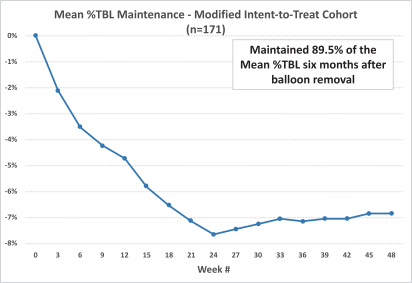
At the conclusion of the six-month treatment period, the Obalon treatment group patients continued with the standardized behavior modification program for six additional months after the Obalon balloon removal. An additional observational data analysis of the subjects who lost weight in the first six months of the study and were evaluated for up to an additional six months, suggests that, on average, 89.5% of the weight loss was maintained six months after balloon removal. The following graph depicts the weight loss maintained for the one-year period in the Obalon treatment group. We did not continue to collect data from patients in the sham-control group who received the Obalon balloons subsequent to balloon removal.
As part of the SMART trial, we actively solicited patients to provide details of any adverse events, or AEs, by contacting all patients 24 hours after each Obalon balloon placement and balloon removal as well as at every office visit. All AEs were first assigned a device-relatedness and a pre-defined severity rating. Mild events did not require intervention, required homeopathic remedies (including chamomile tea, peppermint oil tea and Altoids) or required over the counter remedies to treat and resolve the events. Moderate severity events required a prescription medication to treat and resolve the event. Severe events required medical intervention beyond a prescription medication.
In our SMART trial, only one out of 336 patients (0.3%) receiving Obalon balloons in both phases experienced a SADE. The event was described as peptic ulcer disease, or bleeding. The patient was hospitalized, and after stabilization, the patient was discharged from the hospital without sequelae. During the Obalon balloon therapy period the subject underwent an outpatient total knee replacement surgery. During the surgery and as part of post-operative recovery, the subject was prescribed both a high dose of nonsteroidal anti-inflammatory drugs, or NSAIDs, and aspirin, both of which are contraindicated for use with each other as well as for use in conjunction with the Obalon Balloon System. The SADE event was determined to be “possibly,” but not “probably,” device-related by the investigator since concomitant high dose NSAID and aspirin use is also known to cause peptic ulcer disease. The investigator felt that the NSAID and aspirin use was the primary cause of the event but could not rule out the balloons completely. The patient previously had no ulcers per the upper gastrointestinal screen performed at time of enrollment and was not taking medications prior to surgery.
In our SMART trial, there were no surgical removals or other hospitalizations due to a SADE other than the SADE described above. The most common other adverse device events during balloon placement were abdominal pain (72.6% of patients), nausea (56.0% of patients) and vomiting (17.3% of patients), all of which were classified as mild or moderate.
Commercial-Use Patient Registry
In order to closely monitor the safety, efficacy and quality of the Obalon Balloon System in actual commercial use, we have created an online clinical performance database, or registry. A payment was provided to sites for entering data from new patients starting therapy in the United States from January 2017 through June 2018. We intend to create a new registry for patients treated with the Obalon Navigation Balloon and may provide physicians' payment for data entry in this registry. All physicians and institutions using the Obalon Balloon System have been encouraged to enter their patient data in the registry and compare their performance to national and regional data. The data collected in the registry includes gender, initial height and weight, weights at each subsequent balloon
11
placement, weight at removal, adverse events occurring during the treatment, and product quality and performance.
Data on the first full year of commercialization of the Obalon Balloon System was recently accepted for publication in Surgery for Obesity and Related Diseases. Data on demographics, balloon placement timing, weight loss, adverse events, and product performance were prospectively captured in the registry and retrospectively analyzed on 1,387 consecutive patients who initiated treatment in the first year of commercialization at 108 treating sites. A retrospective analysis of 1,343 (97%) patients entered who met the predefined analyses protocol definitions was approved by an Institutional Review Board. This data is self-reported by the physicians or institutions and we do not perform a formal audit of the data. However, the registry was validated and contains embedded edit checks to ensure data accuracy and completeness.
Demographics
Mean baseline demographics were: age 45.7±10.8 years, BMI 35.4±5.4 kg/m2, height 65.9±3.5 inches, weight 219.5± 42.9 lbs., female 78.6% and white 66.8%.
Safety
There were no deaths or unanticipated adverse events reported. Two serious adverse events were reported, corresponding to 0.15% of patients. There were 308 non-serious adverse events reported in 14.2% of the patients. The most frequent adverse events reported were abdominal pain (5.3%), nausea (4.7%), vomiting (2.3%) and abdominal distension (1.0%). The remaining adverse events were less than 1.0%.
Weight Loss
The weight loss for patients with intended use (BMI 30-40 kg/m2 with 3 balloons for ≥ 20 weeks of therapy) was 21.3 ± 13.5 lbs., 10.0% ± 6.1% of total body weight loss (TBWL), 38.3% ± 25.3% excess weight loss (EWL) and a 3.4 ± 2.1 reduction in BMI. Of note, the top quartile of those patients lost an average of 38.2 pounds, resulting in a 17.2% reduction in total body weight and a 6.1 point decrease in BMI compared to baseline values. Average weight loss across all patients with a BMI>25 was 21.7 lbs resulting in a percent total body loss of 9.9%. The top quartile of all patients with a BMI>25 lost an average of 39.0 lbs., resulting in a 16.8% reduction in total body weight and a 6.2 point decrease in BMI compared to baseline values. We believe the outcome data collected in this registry is the largest known registry of an approved endoscopic bariatric therapy to date, including intragastric balloons, and provides evidence of effective weight loss and safety in a real-world, commercial setting. The data captured in the registry for the first year of commercialization (January 9, 2017 to December 31, 2017) was accepted for publication in the journal Surgery for Obesity and Related Diseases.
Commercial safety experience
As of December 31, 2018, we have had a minimal number of SADEs reported to us in commercial use. Since we began selling in United States in January 2017, we have reported adverse events relating to potential or actual patient injuries associated with use of the Obalon balloon in the FDA's MAUDE database.
Post-approval study - Obalon Balloon System
To help assure the continued safety and effectiveness of the Obalon Balloon System, the FDA has required a post-approval study as a condition of approval under 21 CFR 814.82(a)(2). As part of our PMA approval, we agreed with the FDA to conduct a post-approval study that will evaluate 200 patients who will be enrolled at a maximum of 15 sites in the United States. The study is a prospective, open-label, single-arm, 12-month follow-up study in which patients will be treated during the first six months with placement of up to three Obalon balloons in conjunction with a moderate intensity weight loss and behavioral modification program standardized throughout the sites, followed by observational evaluation for an additional six months after device removal. The primary endpoint is to evaluate the safety of the Obalon Balloon System by assessing the rate of device- or procedure-related serious adverse events. We are required to submit an Interim Post-Approval Study Status Report every six months after the date of PMA approval for the first two years of the study and annually thereafter until 200 patients have completed the study. We are currently enrolling this study.
Post-approval study - Obalon Navigation System with Touch Dispenser
To help assure the continued safety and effectiveness of the Obalon Navigation System, the FDA has required a post-approval study as a condition of approval under 21 CFR 814.82(a)(2). As part of our PMA approval, we agreed with the FDA to conduct a post-approval study that will evaluate a minimum of 1,000 commercial patients and 3,689 balloon administrations across 40 clinical sites in the United States. The study will be a prospective, observational, open-label, multi-center study designed to capture additional information to demonstrate the continued safety of the administration of Obalon balloons with NTS to collect acute safety and efficacy data surrounding balloon placement; no long-term data, such as weight loss at six-months is required. The study will have a single cohort group that includes subjects who commercially purchased the Obalon Balloon System intended to be administered with NTS and have consented to have their data collected to support this study. All activities related to post-administration management and removal of the balloons will be conducted in accordance with the commercial Obalon Balloon System device labeling and will not be collected in this study; this study will focus on balloon administrations only.
12
SALES AND MARKETING
Our primary selling efforts are conducted in the United States, with some sales generated through distributors in select international markets. We sell in the United States through a direct sales organization consisting of regional sales directors, business development managers, and product specialists. Our sales team encompasses three key disciplines that we believe are necessary to create and grow the market for our Obalon Balloon System in the United States: sales conversion, practice development and clinical training and application. In select international markets, we plan to utilize distributors.
Our U.S. marketing efforts have focused on differentiating the benefits of our technology, leveraging the strong clinical outcome from our SMART trial and peer-review published commercial registry data, working with key physicians in bariatrics, gastroenterology, and plastic surgery, and partnering with physicians to create consumer awareness and drive patients into the channel. We also have provided physicians with the clinical training to utilize our Obalon Balloon System, as well as the practice development support to manage their practices as self-pay centers.
We intend to continue to drive consumer awareness and interest in part through multiple efforts that may include digital, offline and social marketing. We estimate that there were more than 49 million views of our digital advertisements and more than 6 million views of our digital videos in 2018, up from more than 45 million views of our digital advertisements and more than 5 million views of our digital videos in 2017. We also estimate that visits to our website grew to 1.7 million in 2018 as compared to approximately 1.0 million unique visits in 2017, searches of our website for physicians capable of placing our Obalon Balloon System increased to over 580,000 in 2018 from over 400,000 searches in 2017. We also generated over 71,000 and 46,000 patient leads to our physician partners in the United States during 2018 and 2017, respectively.
We have limited experience as a company in the sales and marketing of our products. Identifying and recruiting qualified sales personnel and training them in the use of our Obalon Balloon System to achieve the level of clinical competency expected by physicians, and compliance with applicable federal and state laws and regulations and our internal policies and procedures, requires significant time, expense and attention. It can take several months before our sales representatives are fully trained and productive.
COMPETITION
The medical device industry generally, and the market for weight loss devices specifically, are highly competitive, subject to rapid change and significantly affected by new product introductions, results of clinical research, corporate combinations, actions by regulatory bodies, changes by public and private payers and other factors. Because of the market opportunity and the high growth potential of the non-surgical device market for weight loss and obesity, competitors and potential competitors have historically dedicated, and will continue to dedicate, significant resources to aggressively develop and commercialize their products.
In the United States, our product competes with a variety of pharmaceuticals, surgical procedures and devices for the treatment of obese and overweight people. There are several competitors in the pharmaceutical segment including Vivus, Inc., Eisai Co., Ltd, Inc., AstraZeneca plc, and Allergan plc. Large competitors in the surgical segment for weight loss and obesity include Ethicon Inc. (subsidiary of Johnson & Johnson), Medtronic plc (formerly Covidien Ltd.), Apollo EndoSurgery, Inc., and ReShape LifeSciences (which acquired the Lap-Band from Apollo Endosurgery, Inc. and currently sells that device worldwide). In addition, we are aware of at least two FDA approved liquid-filled balloon devices for treating overweight people, including the ReShape Duo Balloon and the ORBERA Balloon, both of which are now owned by Apollo EndoSurgery. Outside of the United States, Allurion Technologies, Inc. has developed a swallowable, passable liquid-filled intragastric balloon that has been approved for sale in Europe and the Middle East and completed enrollment in a U.S. clinical trial; and Spatz Medical has also developed a liquid-filled intragastric balloon that has been approved for sale in Latin America and Europe and is currently engaged in a U.S. clinical trial. We also compete against ReShape LifeSciences’ Maestro device, which is intended to create weight loss by vagal nerve stimulation and Aspire Bariatrics' ApireAssist device. Gelesis is developing a hydrogel technology that is intended to expand in the stomach by absorbing water to create the feeling of satiety and is currently engaged in a U.S. clinical trial. BAROnova is developing a non-surgical, non-pharmacologic device to induce weight loss by slowing gastric emptying. BAROnova completed enrollment of a U.S. clinical trial in January 2017 and submitted a PMA Application in July 2018. Additionally, we are aware of numerous companies around the world working to develop less invasive and less costly alternatives for the treatment of obesity, any of which, if approved, could compete with us in the future.
At any time, these or other competitors may introduce new or alternative products that compete directly or indirectly with our products and services. They may also develop and patent products and processes earlier than we can or obtain regulatory clearance or approvals faster than us, which could impair our ability to develop and commercialize similar products or services. If clinical outcomes of procedures performed with our competitors’ products are, or are perceived to be, superior to treatments performed with our products, sales of our products could be negatively affected and our business, results of operations and financial condition could suffer.
Many of our competitors have significantly greater financial and other resources than we do, as well as:
|
▪
|
well-established reputations and name recognition with key opinion leaders and physician networks;
|
13
|
▪
|
an established base of long-time customers with strong brand loyalty;
|
|
▪
|
products supported by long-term data;
|
|
▪
|
longer operating histories;
|
|
▪
|
significantly larger installed bases of equipment;
|
|
▪
|
greater existing market share in the obesity and weight management market;
|
|
▪
|
broader product offerings and established distribution channels;
|
|
▪
|
greater ability to cross-sell products;
|
|
▪
|
additional lines of products, and the ability to offer rebates or bundle products to offer higher discounts or incentives; and
|
|
▪
|
more experience in conducting research and development, manufacturing, performing clinical trials and obtaining regulatory approvals or clearances.
|
Competition with these companies could result in significant price-cutting, reduced profit margins and loss of market share, any of which would harm our business, financial condition and results of operations. In addition, competitors with greater financial resources than ours could acquire other companies to gain enhanced name recognition and market share, as well as new technologies or products that could effectively compete with our existing and future products, which may cause our revenues to decline and harm our business.
In order to compete effectively, we plan to continue to develop new product offerings and enhancements to our existing Obalon Balloon System, price our product competitively with traditional liquid-filled intragastric balloons and maintain adequate research and development and sales and marketing personnel and resources to meet the demands of the market.
INTELLECTUAL PROPERTY
In order to remain competitive, we must develop and maintain protection of the proprietary aspects of our technologies. We rely on a combination of patents, trademarks, trade secret laws and confidentiality and invention assignment agreements to protect our intellectual property rights.
It is our policy to require our employees, consultants, contractors, outside scientific collaborators and other advisers to execute non-disclosure and assignment of invention agreements on commencement of their employment or engagement. Agreements with our employees also forbid them from using the proprietary rights of third parties in their work for us. We also require third parties that receive our confidential data or material to enter into confidentiality or material transfer agreements.
As of
December 31, 2018
, we held 19 issued U.S. patents and had 28 pending U.S. patent applications, as well as 31 international patents issued in regions including Europe, Mexico, Australia, Canada, Asia, China and Israel and 52 pending international patent applications in regions including Australia, Canada, Europe, Asia, the Middle East and South America. Our issued patents expire between the years 2023 and 2036, and are directed to various features and combinations of features of the Obalon Balloon System technology, including the apparatus for connecting the balloon to an inflation catheter, the structure and composition of the balloon wall, and the composition of the initial fill gas.
Our patent applications may not result in issued patents and our patents may not be sufficiently broad to protect our technology. Any patents issued to us may be challenged by third parties as being invalid or unenforceable, or third parties may independently develop similar or competing technology that does not infringe our patents. The laws of certain foreign countries do not protect our intellectual property rights to the same extent as do the laws of the United States.
As of
December 31, 2018
, we held two registered U.S. trademarks and 30 registered marks throughout Europe, the Middle East, Asia and Mexico. We have five pending U.S. trademark applications and 11 pending marks outside the United States, including in Europe, the Middle East, Asia and Mexico.
MANUFACTURING
All of our products except the Obalon Navigation System console are manufactured or assembled in-house using components and sub-assemblies at our single-site facility in Carlsbad, California. We rely on single suppliers for the extruded film, swallowable capsule, molded silicone valve used to manufacture our Obalon balloons, the hydrophilic coating for our catheters, the Obalon Navigation System console components and the sensors utilized in the Obalon Navigation balloon catheter. There are minimum purchase requirements and delivery requirements with the supplier for the Obalon Navigation System console and sensor utilized in the Obalon Navigation balloon catheter. Our suppliers for all other components of the Obalon balloon have no contractual obligations to supply us with, and we are not contractually obligated to purchase any of our supplies from them. Order quantities and lead times for components purchased from our suppliers are based on our forecasts derived from historical demand and anticipated future demand.
14
Lead times for components may vary significantly depending on the size of the order, time required to fabricate and test the components, specific supplier requirements and current market demand for the components and subassemblies. These components are critical to our products and there are relatively few alternative sources of supply. We do not carry a significant inventory of these components, and identifying and qualifying additional or replacement suppliers for any of the components or sub-assemblies used in our products could involve significant time and cost, and may delay our commercialization efforts.
We have registered with the FDA as a medical device manufacturer and have obtained a manufacturing license from the Center for Devices and Radiological Health. We and our component suppliers are required to manufacture our products in compliance with the FDA’s Quality System Regulation, or QSR, in 21 CFR part 820 of the Federal Food, Drug and Cosmetic Act. The QSR regulates extensively the methods and documentation of the design, testing, control, manufacturing, labeling, quality assurance, packaging, storage and shipping of our products. The FDA enforces the QSR through periodic inspections that may include the manufacturing facilities of our subcontractors. Our quality system has undergone periodic FDA audits, the last of which occurred in November 2017, which resulted in no observations.
Although we expect our third-party suppliers to supply us with components that meet our specifications and comply with regulatory and quality requirements, we do not control our suppliers outside of our agreements, as they operate and oversee their own businesses. There is a risk that our suppliers will not always act consistent with our best interests, and may not always supply components that meet our needs. This risk may be increased as with any new product launch, there is increased risk for supply shortages or product quality issues. Any significant delay or interruption in the supply of components or sub-assemblies, or our inability to obtain substitute components, sub-assemblies or materials from alternate sources at acceptable prices in a timely manner, could impair our ability to meet the demand of our customers and harm our business. We have experienced and may continue to experience production challenges due to shortages of key components from suppliers.
Additionally, we will need to increase our manufacturing capabilities in order to satisfy expected demand for our Obalon Balloon System, and we have no experience manufacturing our Obalon Balloon System in such quantities. If we are unable to keep up with demand for our Obalon Balloon System, our revenue could be impaired, market acceptance for our Obalon Balloon System could be harmed and our customers might instead purchase our competitors’ products.
GEOGRAPHIC REGIONS
Substantially all of our assets, revenues and expenses for 2018 and 2017 were located in or derived from operations in the United States. In addition, we have had sales through Bader in the Middle East. During 2018 and 2017, international revenues accounted for approximately
48.4%
and
16.7%
, respectively, of our total revenues.
SEASONALITY
We have limited experience selling our product in the United States and have realized significant volatility in quarterly balloon sales. As a result, we are unable to discern seasonal variations in demand for our products. In the future, seasonal fluctuations in the number of patients seeking treatment and the availability of our customers may affect our business.
GOVERNMENT REGULATION
Our products and operations are subject to extensive and rigorous regulation by the FDA and other federal, state and local authorities, as well as foreign regulatory authorities. The FDA regulates, among other things, the research, development, testing, design, manufacturing, approval, labeling, storage, recordkeeping, advertising, promotion and marketing, distribution, post approval monitoring and reporting and import and export of medical devices (such as the Obalon Balloon System) in the United States to assure the safety and effectiveness of medical products for their intended use. The Federal Trade Commission also regulates the advertising of our products in the United States. Further, we are subject to laws directed at preventing fraud and abuse, which subject our sales and marketing, training and other practices to government scrutiny.
Regulatory system for medical devices in the United States
Unless an exemption applies, each new or significantly modified medical device we seek to commercially distribute in the United States will require either a premarket notification to the FDA requesting permission for commercial distribution under Section 510(k) of the Federal Food, Drug and Cosmetic Act, or FFDCA, also referred to as a 510(k) clearance, or approval from the FDA of a PMA application. Both the 510(k) clearance and PMA processes can be resource intensive, expensive, and lengthy, and require payment of significant user fees, unless an exemption is available.
15
Device classification
Under the FFDCA, medical devices are classified into one of three classes—Class I, Class II or Class III—depending on the degree of risk associated with each medical device and the extent of control needed to provide reasonable assurances with respect to safety and effectiveness.
Class I includes devices with the lowest risk to the patient and are those for which safety and effectiveness can be reasonably assured by adherence to a set of FDA regulations, referred to as the General Controls for Medical Devices, which require compliance with the applicable portions of the QSR, facility registration and product listing, reporting of adverse events and malfunctions, and appropriate, truthful and non-misleading labeling and promotional materials. Some Class I devices, also called Class I reserved devices, also require premarket clearance by the FDA through the 510(k) premarket notification process described below. Most Class I products are exempt from the premarket notification requirements.
Class II devices are those that are subject to the General Controls, and special controls as deemed necessary by the FDA to ensure the safety and effectiveness of the device. These special controls can include performance standards, patient registries, FDA guidance documents and post-market surveillance. Most Class II devices are subject to premarket review and clearance by the FDA. Premarket review and clearance by the FDA for Class II devices is accomplished through the 510(k) premarket notification process.
Class III devices include devices deemed by the FDA to pose the greatest risk such as life-supporting or life-sustaining devices, or implantable devices, in addition to those deemed novel and not substantially equivalent following the 510(k) process. The safety and effectiveness of Class III devices cannot be reasonably assured solely by the General Controls and Special Controls described above. Therefore, these devices are subject to the PMA application process, which is generally more costly and time consuming than the 510(k) process. Through the PMA application process, the applicant must submit data and information demonstrating reasonable assurance of the safety and effectiveness of the device for its intended use to the FDA’s satisfaction. Accordingly, a PMA application typically includes, but is not limited to, extensive technical information regarding device design and development, pre-clinical and clinical trial data, manufacturing information, labeling and financial disclosure information for the clinical investigators in device studies. The PMA application must provide valid scientific evidence that demonstrates to the FDA’s satisfaction a reasonable assurance of the safety and effectiveness of the device for its intended use.
The investigational device process
In the United States, absent certain limited exceptions, human clinical trials intended to support medical device clearance or approval require an IDE application. Some types of studies deemed to present “non-significant risk” are deemed to have an approved IDE once certain requirements are addressed and IRB approval is obtained. If the device presents a “significant risk” to human health, as defined by the FDA, the sponsor must submit an IDE application to the FDA and obtain IDE approval prior to commencing the human clinical trials. The IDE application must be supported by appropriate data, such as animal and laboratory testing results, showing that it is safe to test the device in humans and that the testing protocol is scientifically sound. The IDE application must be approved in advance by the FDA for a specified number of subjects. Generally, clinical trials for a significant risk device may begin once the IDE application is approved by the FDA and the study protocol and informed consent are approved by appropriate institutional review boards at the clinical trial sites. There can be no assurance that submission of an IDE will result in the ability to commence clinical trials, and although the FDA’s approval of an IDE allows clinical testing to go forward for a specified number of subjects, it does not bind the FDA to accept the results of the trial as sufficient to prove the product’s safety and efficacy, even if the trial meets its intended success criteria.
All clinical trials must be conducted in accordance with the FDA’s IDE regulations that govern investigational device labeling, prohibit promotion and specify an array of recordkeeping, reporting and monitoring responsibilities of study sponsors and study investigators. Clinical trials must further comply with the FDA’s good clinical practice regulations for institutional review board approval and for informed consent and other human subject protections. Required records and reports are subject to inspection by the FDA. The results of clinical testing may be unfavorable, or, even if the intended safety and efficacy success criteria are achieved, may not be considered sufficient for the FDA to grant marketing approval or clearance of a product. The commencement or completion of any clinical trial may be delayed or halted, or be inadequate to support approval of a PMA application, for numerous reasons, including, but not limited to, the following:
|
▪
|
the FDA or other regulatory authorities do not approve a clinical trial protocol or a clinical trial, or place a clinical trial on hold;
|
|
▪
|
patients do not enroll in clinical trials at the rate expected;
|
|
▪
|
patients do not comply with trial protocols;
|
|
▪
|
patient follow-up is not at the rate expected;
|
|
▪
|
patients experience adverse events;
|
|
▪
|
patients die during a clinical trial, even though their death may not be related to the products that are part of the trial;
|
16
|
▪
|
device malfunctions occur with unexpected frequency or potential adverse consequences;
|
|
▪
|
side effects or device malfunctions of similar products already in the market that change the FDA’s view toward approval of new or similar PMAs or result in the imposition of new requirements or testing;
|
|
▪
|
institutional review boards and third-party clinical investigators may delay or reject the trial protocol;
|
|
▪
|
third-party clinical investigators decline to participate in a trial or do not perform a trial on the anticipated schedule or consistent with the clinical trial protocol, investigator agreement, investigational plan, good clinical practices, the IDE regulations, or other FDA or IRB requirements;
|
|
▪
|
third-party investigators are disqualified by the FDA;
|
|
▪
|
we or third-party organizations do not perform data collection, monitoring and analysis in a timely or accurate manner or consistent with the clinical trial protocol or investigational or statistical plans, or otherwise fail to comply with the IDE regulations governing responsibilities, records, and reports of sponsors of clinical investigations;
|
|
▪
|
third-party clinical investigators have significant financial interests related to us or our study such that the FDA deems the study results unreliable, or the company or investigators fail to disclose such interests;
|
|
▪
|
regulatory inspections of our clinical trials or manufacturing facilities, which may, among other things, require us to undertake corrective action or suspend or terminate our clinical trials;
|
|
▪
|
changes in government regulations or administrative actions;
|
|
▪
|
the interim or final results of the clinical trial are inconclusive or unfavorable as to safety or efficacy; or
|
|
▪
|
the FDA concludes that our trial design is unreliable or inadequate to demonstrate safety and efficacy.
|
The 510(k) approval process
Under the 510(k) process, the manufacturer must submit to the FDA a premarket notification, demonstrating that the device is “substantially equivalent,” as defined in the statute, to a legally marketed predicate device.
A predicate device is a legally marketed device that is not subject to premarket approval, i.e., a device that was legally marketed prior to May 28, 1976 (pre-amendments device) and for which a PMA is not required, a device that has been reclassified from Class III to Class II or I, or a device that was previously found substantially equivalent through the 510(k) process. To be “substantially equivalent,” the proposed device must have the same intended use as the predicate device, and either have the same technological characteristics as the predicate device or have different technological characteristics and not raise different questions of safety or effectiveness than the predicate device. Clinical data is sometimes required to support substantial equivalence.
After a 510(k) premarket notification is submitted, the FDA determines whether to accept it for substantive review. If it lacks necessary information for substantive review, the FDA will refuse to accept the 510(k) notification. If it is accepted for filing, the FDA begins a substantive review. By statute, the FDA is required to complete its review of a 510(k) notification within 90 days of receiving the 510(k) notification. As a practical matter, clearance often takes longer, and clearance is never assured. Although many 510(k) premarket notifications are cleared without clinical data, the FDA may require further information, including clinical data, to make a determination regarding substantial equivalence, which may significantly prolong the review process. If the FDA agrees that the device is substantially equivalent, it will grant clearance to commercially market the device.
If the FDA determines that the device is not “substantially equivalent” to a predicate device, or if the device is automatically classified into Class III, the device sponsor must then fulfill the much more rigorous premarketing requirements of the PMA approval process, or seek reclassification of the device through the
de novo
process. A manufacturer can also submit a petition for direct
de novo
review if the manufacturer is unable to identify an appropriate predicate device and the new device or new use of the device presents a moderate or low risk.
After a device receives 510(k) clearance, any modification that could significantly affect its safety or effectiveness, or that would constitute a new or major change in its intended use, will require a new 510(k) clearance or, depending on the modification, could require a PMA application or
de novo
classification. The FDA requires each manufacturer to determine whether the proposed change requires submission of a 510(k) or a PMA in the first instance, but the FDA can review any such decision and disagree with a manufacturer’s determination. Many minor modifications are accomplished by a letter-to-file in which the manufacture documents the change in an internal letter-to-file. The letter-to-file is in lieu of submitting a new 510(k) to obtain clearance for such change. The FDA can always review these letters to file in an inspection. If the FDA disagrees with a manufacturer’s determination regarding whether a new premarket submission is required for the modification of an existing device, the FDA can require the manufacturer to cease marketing and/or recall the modified device until 510(k) clearance or approval of a PMA application is obtained. In addition, in these circumstances, the FDA can impose significant regulatory fines or penalties for failure to submit the requisite PMA application(s).
17
The PMA approval process
Following receipt of a PMA application, the FDA conducts an administrative review to determine whether the application is sufficiently complete to permit a substantive review. If it is not, the agency will refuse to file the PMA. If it is, the FDA will accept the application for filing and begin the review. The FDA, by statute and by regulation, has 180 days to review a filed PMA application, although the review of an application more often occurs over a significantly longer period of time. During this review period, the FDA may request additional information or clarification of information already provided, and the FDA may issue a major deficiency letter to the applicant, requesting the applicant’s response to deficiencies communicated by the FDA. The FDA considers a PMA or PMA supplement to have been voluntarily withdrawn if an applicant fails to respond to an FDA request for information (
e.g.
, major deficiency letter) within a total of 360 days. Before approving or denying a PMA, an FDA advisory committee may review the PMA at a public meeting and provide the FDA with the committee’s recommendation on whether the FDA should approve the submission, approve it with specific conditions, or not approve it. The FDA is not bound by the recommendations of an advisory committee, but it considers such recommendations carefully when making decisions.
Prior to approval of a PMA, the FDA may conduct inspections of the clinical trial data and clinical trial sites, as well as inspections of the manufacturing facility and processes. Overall, the FDA review of a PMA application generally takes between one and three years, but may take significantly longer. The FDA can delay, limit or deny approval of a PMA application for many reasons, including:
|
▪
|
the device may not be shown safe or effective to the FDA’s satisfaction;
|
|
▪
|
the data from pre-clinical studies and/or clinical trials may be found unreliable or insufficient to support approval;
|
|
▪
|
the manufacturing process or facilities may not meet applicable requirements; and
|
|
▪
|
changes in FDA approval policies or adoption of new regulations may require additional data.
|
If the FDA evaluation of a PMA is favorable, the FDA will issue either an approval letter, or an approvable letter, the latter of which usually contains a number of conditions that must be met in order to secure final approval of the PMA. When and if those conditions have been fulfilled to the satisfaction of the FDA, the agency will issue a PMA approval letter authorizing commercial marketing of the device, subject to the conditions of approval and the limitations established in the approval letter. If the FDA’s evaluation of a PMA application or manufacturing facilities is not favorable, the FDA will deny approval of the PMA or issue a not approvable letter. The FDA also may determine that additional tests or clinical trials are necessary, in which case the PMA approval may be delayed for several months or years while the trials are conducted and data is submitted in an amendment to the PMA, or the PMA is withdrawn and resubmitted when the data are available. The PMA process can be expensive, uncertain and lengthy and a number of devices for which the FDA approval has been sought by other companies have never been approved by the FDA for marketing.
New PMA applications or PMA supplements are required for modification to the manufacturing process, equipment or facility, quality control procedures, sterilization, packaging, expiration date, labeling, device specifications, ingredients, materials or design of a device that has been approved through the PMA process. PMA supplements often require submission of the same type of information as an initial PMA application, except that the supplement is limited to information needed to support any changes from the device covered by the approved PMA application and may or may not require as extensive technical or clinical data or the convening of an advisory panel, depending on the nature of the proposed change.
In approving a PMA application, as a condition of approval, the FDA may also require some form of post-approval study or post-market surveillance, whereby the applicant conducts a follow-up study or follows certain patient groups for a number of years and makes periodic reports to the FDA on the clinical status of those patients when necessary to protect the public health or to provide additional or longer term safety and effectiveness data for the device. The FDA may also require post-market surveillance for certain devices cleared under a 510(k) notification, such as implants or life-supporting or life-sustaining devices used outside a device user facility. The FDA may also approve a PMA application with other post-approval conditions intended to ensure the safety and effectiveness of the device, such as, among other things, restrictions on labeling, promotion, sale, distribution and use. Intragastric balloons, including the Obalon Balloon System, are considered Class III medical devices. In order to support a PMA application, the FDA required us to conduct a large, rigorous and expensive, double-blinded, randomized, sham-controlled trial. We will be required to file new PMA applications or PMA supplement applications for modifications to our PMA-approved Obalon Balloon System and Obalon Navigation System or any of its components, including modifications to our manufacturing processes, device labeling and device design, based on the findings of post-approval studies.
Pervasive and continuing FDA regulation
After the FDA permits a device to enter commercial distribution, numerous regulatory requirements continue to apply. These include:
|
▪
|
the FDA’s QSR, which requires manufacturers, including third party manufacturers, to follow stringent design, testing, production, control, supplier/contractor selection, complaint handling, documentation and other quality assurance procedures during all aspects of the manufacturing process;
|
18
|
▪
|
labeling regulations, unique device identification requirements and FDA prohibitions against the promotion of products for uncleared, unapproved or off-label uses;
|
|
▪
|
advertising and promotion requirements;
|
|
▪
|
restrictions on sale, distribution or use of a device;
|
|
▪
|
PMA annual reporting requirements;
|
|
▪
|
PMA approval of product modifications;
|
|
▪
|
medical device reporting, or MDR, regulations, which require that manufacturers report to the FDA if their device may have caused or contributed to a death or serious injury or malfunctioned in a way that would likely cause or contribute to a death or serious injury if the malfunction were to recur;
|
|
▪
|
medical device correction and removal reporting regulations, which require that manufacturers report to the FDA field corrections and product recalls or removals if undertaken to reduce a risk to health posed by the device or to remedy a violation of the FDCA that may present a risk to health;
|
|
▪
|
recall requirements, including a mandatory recall if there is a reasonable probability that the device would cause serious adverse health consequences or death;
|
|
▪
|
an order of repair, replacement or refund;
|
|
▪
|
device tracking requirements; and
|
|
▪
|
post-market surveillance regulations, which apply when necessary to protect the public health or to provide additional safety and effectiveness data for the device.
|
In addition, FDA enforces the Medical Device Reporting, or MDR, regulations, which require that we report to the FDA any incident in which our product may have caused or contributed to a death or serious injury or in which our product malfunctioned and, if the malfunction were to recur, would likely cause or contribute to death or serious injury. Since February 2017, the FDA has issued three separate letters to healthcare providers warning of serious adverse events, including deaths, which are specific to liquid-filled intragastric balloons. We are aware of the filing of additional reports of serious adverse events, including deaths, associated with liquid-filled balloons since the issuance of the FDA letters to healthcare providers. While the advisory letters were specific to liquid-filled intragastric balloons and not the Obalon gas-filled balloons, these letters could create negative perceptions of the entire gastric balloon category which may cause negative consequences for us including requiring additional warnings, precautions and/or contraindications in the labeling than originally required, delaying or denying approval of our future products, or possible review or withdrawal of our current approval. Since we began selling in United States in January 2017, we have reported adverse events relating to patient injuries associated with use of the Obalon balloon in the FDA's MAUDE database.
The FDA has broad post-market and regulatory enforcement powers. Medical device manufacturers are subject to unannounced inspections by the FDA and other state, local and foreign regulatory authorities to assess compliance with the QSR and other applicable regulations, and these inspections may include the manufacturing facilities of any suppliers.
Failure to comply with applicable regulatory requirements can result in enforcement action by the FDA, which may include any of the following sanctions:
|
▪
|
warning letters, fines, injunctions, consent decrees and civil penalties;
|
|
▪
|
unanticipated expenditures, repair, replacement, refunds, recall or seizure of our products;
|
|
▪
|
operating restrictions, partial suspension or total shutdown of production;
|
|
▪
|
the FDA’s refusal of our requests for 510(k) clearance or premarket approval of new products, new intended uses or modifications to existing products;
|
|
▪
|
the FDA’s refusal to issue certificates to foreign governments needed to export products for sale in other countries;
|
|
▪
|
withdrawing 510(k) clearance or premarket approvals that have already been granted; and
|
|
▪
|
criminal prosecution.
|
Regulatory system for medical devices in Europe
The European Union consists of member states residing in the European Union and has a coordinated system for the authorization of medical devices. The European Union Medical Devices Directive, or MDD, sets out the basic regulatory framework for medical devices in the European Union. This directive has been separately enacted in more detail in the national legislation of the individual member states of the European Union.
19
The system of regulating medical devices operates by way of a certification for each medical device. Each certificated device is marked with CE mark which shows that the device has a Certificat de Conformité. There are national bodies known as Competent Authorities in each member state which oversee the implementation of the MDD within their jurisdiction. The means for achieving the requirements for CE mark varies according to the nature of the device. Devices are classified in accordance with their perceived risks, similarly to the U.S. system. The class of a product determines the requirements to be fulfilled before CE mark can be placed on a product, known as a conformity assessment. Conformity assessments for our products are carried out as required by the MDD. Each member state can appoint Notified Bodies within its jurisdiction. If a Notified Body of one member state has issued a Certificat de Conformité, the device can be sold throughout the European Union without further conformance tests being required in other member states.
According to the MDD, the Obalon Balloon System, when delivered with a porcine capsule, is considered a Class III product. We discontinued sales of the Obalon Balloon System with a porcine capsule in 2017. The Obalon Balloon System when delivered with a cellulose-based capsule is considered a Class IIb product. We believe the Obalon Navigation System and the Obalon Touch Inflation Dispenser are Class I products and will follow a similar pathway as the EzFill Dispenser. We have not applied for a CE-mark for the Obalon Navigation System and Obalon Touch Inflation Dispenser at this time.
Regulatory frameworks for medical devices in certain countries in the Middle East
Unlike Europe, while the Gulf Cooperation Council, or GCC, jurisdictions often work together to purchase certain medical products in a coordinated fashion for government hospitals, there is not a coordinated system for the authorization of medical devices. Most GCC jurisdictions require that the official registered distributor of a product be wholly owned by nationals of that particular GCC jurisdiction.
Kingdom of Saudi Arabia, or KSA
The most pertinent regulation is the Interim Regulation for Medical Devices, issued by the Saudi Food & Drug Authority, or SFDA, Board of Directors’ Decree number 1-8-1429 dated approximately December 27, 2008 and the implementing regulations of the same. The SFDA is an independent regulatory body that is responsible for the authorization of medical devices, and current guidelines are generally based on pre-existing approval in one of the five founding member nations of the Global Harmonization Task Force, or GHTF, which are Australia, Canada, United States, European Union and Japan. There are no overt requirements for the provision of safety and effectiveness data in the form of clinical trials or other studies but these would likely come as a part of the approvals described above that are used as a basis to support approval within the KSA. The SFDA reserves its rights to require its own independent clinical trials as it deems necessary or appropriate. Regulatory authorization is required for all medical devices, regardless of device class. A potential exception to this requirement is for medical devices that were designed and constructed by local health care facility and staff for internal use. Similar to the United States, the SFDA requires post market surveillance to ensure safety and quality. This program is meant to be conducted by the Authorized Representative. With respect to the use of medical devices, it is the responsibility of the health care institution to inform the manufacturer and the SFDA of any adverse events associated with this use. We have appointed Al Sultan Saudi Medical Company as our responsible Authorized Representative for the KSA. Our Medical Device Marketing Authorization was renewed on July 26, 2016 and expires on May 14, 2020. In KSA it is possible for a foreign party to establish a Technical & Scientific Office and register the medical device, while working with a locally licensed Authorized Representative to conduct sales of such approved medical devices.
Kuwait
Medical devices in Kuwait are regulated by the Medicines and Medical Supplies, Pharmaceuticals and Herbal Medicines Registration and Control Administration Department in the Ministry of Health.
In order for any company/manufacturer to sell a medical device in Kuwait, the specific medical device must be approved for use and registered in Kuwait with the Ministry of Health. The manufacturer of the device, through its agent/distributor should submit an application to the Ministry of Health for the approval and registration of the device. The documents required to register a medical device with the Ministry of Health in summary include: (i) the original Manufacturing License and Good Manufacturing Practice certificates; (ii) the original Free Sale Certificate which should mention the trade name, scientific name, indications, and detailed composition for active and inactive ingredients and which should be issued by the health authority in the country of origin of the device; (iii) the status of registration of the product in the country of origin; (iv) the original letter of appointment of an exclusive agent/distributor for the device; (v) a list of countries where the product is registered with registration dates and numbers; (vi) a sample of the product with information about the product on the outer and inner packaging in English or Arabic (the information on the packaging should include: the name of the product, its content/composition, uses, batch number, manufacturing date, expiry date, storage conditions, and instructions on use); (vii) a certificate of analysis of the finished product; (viii) safety and efficacy studies from an approved international authority (and/or clinical studies if applicable); and (ix) any other information the Ministry of Health may require. Once all documents are in order and the Ministry of Health does not require any further information, it will register the device under the names of the manufacturer and the relevant agent/distributor.
20
The promotion, distribution and sale of medical devices in Kuwait can only be done by a Kuwaiti entity that is appointed by the manufacturer of the device as its exclusive agent/distributor for Kuwait. Such agent/distributor must be authorized by and registered with the Medicines and Medical Supplies, Pharmaceuticals and Herbal Medicines Registration and Control Administration Department in the Ministry of Health and the Ministry of Commerce and Industry to do so. The device may be sold in licensed pharmacies and other places approved by the Ministry of Health.
We have appointed Bader as our exclusive agent/distributor in Kuwait.
United Arab Emirates, or UAE
The most pertinent regulation is UAE Federal Law No. 4 of 1983 for the Pharmaceutical Profession and Institutions and to Medical Device Regulations. There are many similarities between the SFDA and the Registration and Drug Control Department that is run out of the Ministry of Health & Prevention of the UAE. Applications for registration of medical devices in the UAE are done with the UAE Ministry of Health Registration & Drug Control Department and must include data on effectiveness in addition to safety (a nod to the requirements of the FDA). The UAE body has its own device classification system that is most closely related to that used by the European Union, defined as class 1, low risk; class 2, medium risk but nonimplantable; class 3, medium risk but implantable; and class 4, high risk. The Obalon Balloon System is considered a Class 4 (high risk) device when delivered with a porcine-based gelatin capsule. We have appointed Sohail Faris Medical Equipment Trading as the responsible Authorized Representative for the UAE.
Privacy and security laws
The Administrative Simplification provisions of the Health Insurance Portability and Accountability Act of 1996, as amended, or HIPAA, directed the Secretary of the U.S. Department of Health and Human Services, or HHS, to promulgate regulations establishing protections for the privacy and security of individually identifiable health information, known as “protected health information” and prescribing standard requirements for electronic health care transactions. HIPAA generally requires certain entities, referred to as “covered entities” (including most healthcare providers, healthcare clearing houses and health plans), to comply with established standards, including standards regarding the privacy and security of protected health information, or PHI. HIPAA further requires that covered entities enter into agreements meeting certain regulatory requirements with their “business associates,” as such term is defined by HIPAA, which, among other things, obligate the business associates to safeguard the covered entity’s PHI against improper use and disclosure.
The American Recovery and Economic Reinvestment Act of 2009, or ARRA, signed into law by President Obama on February 17, 2009, contained significant changes to the privacy and security provisions of HIPAA, including major changes to the enforcement provisions. Among other things, ARRA significantly increased the amount of civil monetary penalties that can be imposed for HIPAA violations. ARRA also authorized state attorneys general to bring civil enforcement actions under HIPAA. These enhanced penalties and enforcement provisions went into effect immediately upon enactment of ARRA. ARRA also required that HHS promulgate regulations requiring that certain notifications be made to individuals, to HHS and potentially to the media in the event of certain types of breaches of the privacy of protected health information. These breach notification regulations went into effect on September 23, 2009, and HHS began to enforce violations on February 22, 2010. Violations of the breach notification provisions of HIPAA can trigger the increased civil monetary penalties described above.
The Health Information Technology for Economic and Clinical Health Act, or HITECH, was also enacted in conjunction with ARRA. On January 25, 2013, HHS issued final modifications to the HIPAA Privacy, Security, and Enforcement Rules mandated by HITECH, which had been previously issued as a proposed rule on July 14, 2010. Among other things, these modifications make business associates of covered entities directly liable for compliance with certain HIPAA requirements, strengthen the limitations on the use and disclosure of protected health information without individual authorizations, and adopt the additional HITECH enhancements, including enforcement of noncompliance with HIPAA due to willful neglect. The changes to HIPAA enacted as part of ARRA reflect a Congressional intent that HIPAA’s privacy and security provisions be more strictly enforced. It is likely that these changes will stimulate increased enforcement activity and enhance the potential that health care providers will be subject to financial penalties for violations of HIPAA.
In addition to the federal laws and regulations, there are a number of state laws regarding the privacy and security of health information and personal data. The compliance requirements of these laws, including additional breach reporting requirements, and the penalties for violation, vary widely, and new privacy and security laws in this area are evolving.
We believe we are not a covered entity for purposes of HIPAA, and we believe that we generally do not conduct our business in a manner that would cause us to be a business associate under HIPAA, therefore, we are not currently certified as HIPAA compliant and do not intend to become certified as HIPAA compliant. Although we do not believe the business is subject to HIPAA, we nevertheless are committed to maintaining the security and privacy of patients’ health information.
21
Anti-kickback statutes
The federal Anti-Kickback Statute prohibits persons from (among other things) knowingly and willfully soliciting, offering, receiving or providing remuneration, directly or indirectly, in exchange for or to induce the referral of an individual, or the recommending, furnishing or arranging for a good or service, for which payment may be made under a federal healthcare program such as Medicare or Medicaid.
Courts have interpreted the Anti-Kickback Statute quite broadly, holding that the statute will be violated if even one purpose of a payment – though not its sole or primary purpose – is to induce an act prohibited by the statute with a willful intent to act improperly. The statute prohibits many arrangements and practices that are otherwise lawful in businesses outside of the healthcare industry. Prosecutors may infer intent from the surrounding circumstances and, because courts have interpreted the statute to be violated if even one purpose of a payment is to induce the purchase of items or services paid for by federal healthcare programs, prosecutors have broad discretion in choosing arrangements to prosecute under the statute. There are statutory exceptions and regulatory “safe harbors” available to protect certain appropriately structured arrangements that otherwise would implicate the Anti-Kickback Statute. Those who structure their business arrangements to satisfy all of the criteria of a safe harbor are protected from liability under the statute.
Penalties for violation of the Anti-Kickback Statute are severe and may include, in addition to the fines and jail time described above, penalties imposed under the Civil Monetary Penalties Law, or the CMP Law, including exclusion from participation in Federal healthcare programs, civil monetary penalties of up to $74,792 for each improper act, and damages of up to three times the amount of remuneration at issue (regardless of whether some of the remuneration was for a lawful purpose). Because we do not anticipate that the Obalon Balloon System will be reimbursed by any federal healthcare program, we do not believe that we will be subject to the federal Anti-Kickback Statute.
Many states have adopted laws similar to the Anti-Kickback Statute, however, and some of these state prohibitions apply to arrangements involving healthcare items or services reimbursed by any source, and not only by Medicare, Medicaid or another federal healthcare program. These state laws do not always have the same exceptions or safe harbors of the federal Anti-Kickback Statute. The business may be subject to some of these laws.
Government officials have focused recent enforcement efforts on the marketing of healthcare services and products, among other activities, and have brought cases against companies, and certain individual sales, marketing and executive personnel, for allegedly offering unlawful inducements to potential or existing customers in an attempt to procure their business.
False claims laws
The federal False Claims Act imposes liability on any individual or entity that, among other things, knowingly presents, or causes to be presented, a false or fraudulent claim for payment by a federal healthcare program. The
qui tam
or “whistleblower” provisions of the False Claims Act allow a private individual to bring actions on behalf of the federal government alleging that the defendant has violated the False Claims Act and to share in any monetary recovery. In recent years, the number of lawsuits brought against healthcare industry participants by private individuals has increased dramatically.
When an entity is determined to have violated the False Claims Act, it may be required to pay up to three times the actual damages sustained by the government, plus civil penalties of between $11,181 and $22,363 for each separate instance of false claim. As part of any settlement, the government may ask the entity to enter into a corporate integrity agreement, which imposes certain compliance, certification and reporting obligations. There are many potential bases for liability under the False Claims Act. Liability arises, primarily, when an entity knowingly submits, or causes another to submit, a false claim for reimbursement to the federal government. The federal government has used the False Claims Act to assert liability on the basis of inadequate care, kickbacks and other improper referrals, and the provision of inaccurate reimbursement coding advice, in addition to the more predictable allegations as to misrepresentations with respect to the services rendered. In addition, companies have been sued under the False Claims Act in connection with the off-label promotion of products.
Various states have also enacted false claims laws that are analogous to the federal False Claims Act. Many of these state laws apply to claims submitted to any third-party payor and are not limited to claims submitted to a federal healthcare program.
Because we do not expect the Obalon Balloon System to be reimbursed by federal healthcare programs or any other third-party payor, we do not believe that the business generally will be subject to many of these laws.
22
Transparency laws
The federal Physician Payment Sunshine Act, or the Sunshine Act, which was enacted as part of the Patient Protection and Affordable Care Act, or the PPACA, generally requires certain manufacturers of a drug, device, biologic or other medical supply that is covered by Medicare, Medicaid or the Children’s Health Insurance Program and applicable group purchasing organizations to report on an annual basis: (i) certain payments and other transfers of value given to physicians and teaching hospitals and (ii) any ownership or investment interest that physicians, or their immediate family members, have in their company. The payments required to be reported include the cost of meals provided to a physician, travel reimbursements and other transfers of value, including those provided as part of contracted services such as speaker programs, advisory boards, consultation services and clinical trial services. Under the statute, the federal government makes reported information available to the public. Failure to comply with the reporting requirements can result in significant civil monetary penalties ranging from $1,105 to $11,052 for each payment or other transfer of value that is not reported (up to a maximum per annual report of $165,786) and from $11,052 to $110,524 for each knowing failure to report (up to a maximum per annual report of $1.105 million). Additionally, there are criminal penalties if an entity intentionally makes false statements in the reports. Because we do not expect the Obalon Balloon System to be covered or reimbursed by any federal healthcare program, we do not believe that our business will be subject to the federal Sunshine Act.
There has been a recent trend of separate state regulation of payments and transfers of value by manufacturers of medical devices to healthcare professionals and entities, however, and some state transparency laws apply more broadly than does the federal Sunshine Act. Our business may be subject to some of these state laws.
Foreign Corrupt Practices Act
The Foreign Corrupt Practices Act, or FCPA, prohibits U.S. businesses and their representatives from offering to pay, paying, promising to pay or authorizing the payment of money or anything of value to a foreign official in order to influence any act or decision of the foreign official in his or her official capacity or to secure any other improper advantage in order to obtain or retain business. The FCPA also obligates companies whose securities are listed in the United States to comply with accounting provisions requiring us to maintain books and records, which in reasonable detail, accurately and fairly reflect the transactions and dispositions of the assets of the corporation, including international subsidiaries, if any, and to devise and maintain a system of internal accounting controls sufficient to provide reasonable assurances regarding the reliability of financial reporting and the preparation of financial statements. The scope of the FCPA includes interactions with certain healthcare professionals in many countries.
International laws
In Europe, and throughout the world, other countries have enacted anti-bribery laws and/or regulations similar to the FCPA. Violations of any of these anti-bribery laws, or allegations of such violations, could have a negative impact on our business, results of operations and reputation.
There are also international privacy laws that impose restrictions on the access, use, and disclosure of health information. All of these laws may impact our business. Our failure to comply with these privacy laws or significant changes in the laws restricting our ability to obtain required patient information could significantly impact our business and our future business plans.
U.S. healthcare reform
Changes in healthcare policy could increase our costs and subject us to additional regulatory requirements that may interrupt commercialization of the Obalon Balloon System. By way of example, PPACA substantially changed the way healthcare is financed by both governmental and private insurers, and significantly impacted the medical device industry. PPACA, among other things, imposed a 2.3% excise tax on any entity that manufactures or imports medical devices offered for sale in the United States, with limited exceptions. Although the excise tax was suspended from 2016 through 2019, absent further legislative action, the tax will be reinstated starting January 1, 2020.
There will continue to be proposals by legislators at both the federal and state levels, regulators and third-party payors to reduce costs while expanding individual healthcare benefits. Certain of these changes could impose additional limitations on the prices we will be able to charge and/or patients’ willingness to pay for the Obalon Balloon System. While in general it is too early to predict what effect, if any, PPACA and its implementation, or any future healthcare reform legislation or policies will have on our business, current and future healthcare reform legislation and policies could have a material adverse effect on our business and financial condition.
23
EMPLOYEES
As of
December 31, 2018
, we had 100 full-time employees, and 3 temporary employees. These included 29 in manufacturing and operations, 35 in sales and marketing, 11 in research and development, 14 in clinical affairs, regulatory affairs and quality assurance and 11 in finance, general administrative and executive administration. None of our employees are represented by a labor union or are parties to a collective bargaining agreement, and we believe that our employee relations are good.
FINANCIAL INFORMATION
We manage our operations and allocate resources as a single reporting segment. Financial information regarding our operations, assets and liabilities, including our net loss for the years ended
December 31, 2018
and
2017
and our total assets as of
December 31, 2018
and
2017
, is included in our Consolidated Financial Statements in Item 8 of this Annual Report.
CORPORATE INFORMATION
We were incorporated under the laws of the State of Delaware in January 2008. Our principal executive offices are located at 5421 Avenida Encinas, Suite F, Carlsbad, California 92008, and our telephone number is (760) 795-6558. Our website address is www.obalon.com. The information contained on, or that can be accessed through, our website is not part of, and is not incorporated by reference into, this prospectus. Investors should not rely on any such information in deciding whether to purchase our common stock.
AVAILABLE INFORMATION
We file Annual Reports on Form 10-K, Quarterly Reports on Form 10-Q, Current Reports on Form 8-K and other information with the Securities and Exchange Commission, or SEC. Our filings with the SEC are available free of charge on the SEC’s website at
www.sec.gov
and on the “Investor Information” section of our website as soon as reasonably practicable after we electronically file such material with, or furnish it to, the SEC. You may also read and copy, at SEC prescribed rates, any document we file with the SEC at the SEC’s Public Reference Room located at 100 F Street, N.E., Washington D.C. 20549. You can call the SEC at 1-800-SEC-0330 to obtain information on the operation of the Public Reference Room.
ITEM 1A.
Risk Factors
RISK FACTORS
Investing in our common stock involves a high degree of risk. Before making your decision to invest in shares of our common stock, you should carefully consider the risks described below, together with the other information contained in this Annual Report on Form 10-K, our consolidated financial statements and the related notes and “Management’s Discussion and Analysis of Financial Condition and Results of Operations.” The risks and uncertainties described below are not the only ones we face. Additional risks and uncertainties that we are unaware of, or that we currently believe are not material, may also become important factors that affect us. If any of the following risks actually occurs, our business, financial condition, results of operations and future growth prospects could be materially and adversely affected. The market price of our common stock would likely decline, and you could lose all or part of your investment.
RISKS RELATED TO OUR BUSINESS
We have limited operating experience and a history of net losses, and we may not be able to achieve or sustain profitability.
We have a limited operating history and have focused primarily on research and development, clinical trials, product engineering and building our manufacturing capabilities. Before launching our prior generation Obalon Balloon System in the United States in January 2017, we sold an earlier generation of our product in certain international markets. Our commercial sales experience has been limited. We have incurred significant losses in each period since our inception in 2008, with net losses of
$37.4 million
and
$34.8 million
for the years ended
December 31, 2018
and
2017
, respectively. As of
December 31, 2018
, we had an accumulated deficit of approximately
$148.8 million
and had cash, cash equivalents and short-term investments of
$23.7 million
. These losses and our accumulated deficit reflect the substantial investments we have made to develop, seek and obtain regulatory approval for our current and future generation Obalon Balloon System, sell our Obalon Balloon System in international markets, and commercialize our Obalon Balloon System in the United States. Our consolidated financial statements as of and for the year ended December 31, 2018 have been prepared on the basis that we will continue as a going concern, which contemplates the realization of assets and satisfaction of liabilities in the normal course of business. Based on our cash balances and recurring losses since inception, there is substantial doubt about our ability to continue as a going concern within one year after the date that these financial statements are issued.
We expect our costs and expenses to increase in the future as we continue U.S. commercialization of our product, including the cost of a direct sales force and associated marketing support, investment to develop the immature intragastric balloon market, and the
24
expansion of our manufacturing capacity. We intend to sell the Obalon Navigation System Console at a price that approximates to our cost and will negatively impact future gross profit dollars and gross margin percentage. Furthermore, we have limited experience manufacturing the Obalon Navigation Balloon, and as a result expect lower gross profits. We will also continue to expend substantial amounts on research and development of new products, including conducting clinical trials of our products currently in development. In addition, as a public company, we incur significant legal, accounting, insurance, compliance and other expenses that we would not incur as a private company. As a result, we expect our losses to continue for the foreseeable future. Accordingly, we cannot assure you that we will achieve profitability in the future or that, if we do become profitable, we will sustain profitability. Our failure to achieve and sustain profitability would negatively impact the market price of our common stock.
We are currently a single product company with limited commercial sales experience, which makes it difficult to evaluate our current business, predict our future prospects and forecast our financial performance and growth.
We were incorporated in 2008, and prior to January 2017 our business activities were focused on the development and regulatory approval of our Obalon Balloon System and building the commercial infrastructure to sell our product in the United States. We commenced commercial launch of our prior generation Obalon balloon system in the United States in January 2017 and we intend to commence commercial shipments of our Obalon Navigation System and Obalon Touch Inflation Dispenser in the United States in the first quarter of 2019. All of our revenue to date is, and we expect for the foreseeable future will be, attributable to sales of our Obalon Balloon System including its component parts and accessories. Through 2016, our primary commercial sales experience was limited to sales to distributors in a limited number of countries outside the United States. We expect that sales in the United States will account for a majority of our revenue for the foreseeable future. Our limited operating and commercialization experience in what we expect will be our primary market make it difficult to evaluate our current business and predict our future prospects. In 2019, we plan to phase out our prior generation Obalon balloon system that uses x-ray technology to place balloons, and eventually only sell versions of the Obalon Balloon System that use the Obalon Navigation System to place balloons. Use of the Obalon Navigation System requires the physician to make a capital purchase of the Navigation console. We cannot assure you that our current physician customers will be willing to make that purchase, and if we cannot transition physicians who currently use the prior generation Obalon balloon system to the Obalon Navigation System, we may experience a decline in sales. A number of factors that are outside our control may contribute to fluctuations in our financial results, including:
|
•
|
patient and physician demand for our Obalon Balloon System, including the rate at which physicians recommend our Obalon Balloon System to their patients and the rate at which patients seek treatment from physicians;
|
|
•
|
changes in the composition of our customer base caused by acquisition of private medical practices by large hospitals could extend our selling cycle;
|
|
•
|
positive or negative media coverage, or public, patient and/or physician perception, of our Obalon Balloon System, the procedures or products of our competitors, or our industry;
|
|
•
|
any safety or efficacy concerns that arise through physician and patient experience with our Obalon Balloon System;
|
|
•
|
willingness of physicians to purchase the capital equipment required to place balloons using the Obalon Navigation System;
|
|
•
|
any safety or efficacy concerns for the category of intragastric balloons, including liquid-filled balloons, as the FDA has issued three Health Care Provider warning letters specific to liquid-filled intragastric balloons citing potential risks, including death;
|
|
•
|
our ability to develop, obtain regulatory approval for, and successfully launch our next generation products and the success of our next generation products in the marketplace;
|
|
•
|
our ability to service and maintain equipment like the Obalon Navigation;
|
|
•
|
our ability to maintain our current or obtain further regulatory clearances or approvals;
|
|
•
|
delays in, or failure of, product and component deliveries by our third-party suppliers and single-source suppliers;
|
|
•
|
difficulties in producing a sufficient quantity of our product to meet commercial demand due to shortages of component parts or due to issues in the manufacturing process;
|
|
•
|
introduction of new procedures or products for treating patients who are obese or overweight that compete with our product;
|
|
•
|
adverse changes in the economy that reduce patient demand for elective procedures;
|
|
•
|
performance of our international distributors; and
|
|
•
|
favorable or unfavorable positions developed on intragastric balloons, or the Obalon Balloon System by professional medical associations, such as the American Society for Metabolic and Bariatric Surgery (ASMBS), the American Society for Gastrointestinal Endoscopy (ASGE), or other organizations with influence on physicians.
|
25
It is therefore difficult to predict our future financial performance and growth, and such forecasts are inherently limited and subject to a number of uncertainties. If our assumptions regarding the risks and uncertainties we face, which we use to plan our business, are incorrect or change due to circumstances in our business or our markets, or if we do not address these risks successfully, our operating and financial results could differ materially from our expectations and our business could suffer.
Because we devote substantially all of our resources to our Obalon Balloon System and rely on our Obalon Balloon System as our sole source of revenue, any factors that negatively impact our product, or result in decreasing product sales, would materially and adversely affect our business, financial condition and results of operations.
The report of our independent registered public accounting firm contains a paragraph indicating substantial doubt about our ability to continue as a going concern. If we are unable to secure additional financing on favorable terms, or at all, to meet our future capital needs, we could be forced to delay, reduce or eliminate our commercialization efforts and product development programs.
Our operations have consumed substantial amounts of cash since inception. We expect to continue to invest in the future, including the expansion of our direct sales force, investment in marketing programs, the expansion of our manufacturing facilities and as we continue to spend on research and development, including conducting clinical trials of our products in development and completing development and commercialization of advancements to our existing Obalon Balloon System as well as our additional products under development. Additionally, we will continue to incur additional general and administrative costs as a result of supporting growth and operating as a public company. The audit report of our independent registered public accounting firm covering the December 31, 2018 consolidated financial statements contains an explanatory paragraph that states that our recurring losses from operations and liquidity position raises substantial doubt about our ability to continue as a going concern. This going concern opinion could materially limit our ability to raise additional funds through the issuance of new debt or equity securities or otherwise. Future reports on our financial statements may also include an explanatory paragraph with respect to our ability to continue as a going concern. To date, our operating losses have been funded primarily from outside sources of invested capital and gross profits. We have had, and we will likely continue to have, an ongoing need to raise additional cash from outside sources to fund our future operations.
We plan to seek additional debt or equity financing in order to maintain our current operating plan. However, adequate funding may not be available to us on acceptable terms, or at all. The failure to obtain sufficient funds on acceptable terms or in a timely manner could force us to take actions that could materially and adversely affect our business, including significant reductions in our operations (including reduction of our employee base), possible surrender or other disposition of our rights to some technologies or product opportunities, delaying of our clinical trials or curtailing or ceasing operations. Moreover, if we are unable to raise additional capital and the cash balance in our accounts with the lender under our loan and security agreement falls below the amount of outstanding debt, we would be in default under the loan and security agreement, which could result in acceleration of all outstanding amounts. We also cannot give assurance that we will achieve sufficient revenues in the future to achieve profitability and cash flow positive operations to allow us to continue as a going concern. The perception that we may not be able to continue as a going concern may cause third parties to choose not to deal with us due to concerns about our ability to meet our contractual obligations, which could have a material adverse effect on our business.
Our future capital requirements will depend on many factors, including:
|
•
|
the rate at which the currently small and immature intragastric balloon market develops;
|
|
•
|
our ability to scale manufacturing in a cost-effective manner to meet demand;
|
|
•
|
the costs and expenses of our U.S. sales and marketing infrastructure and our manufacturing operations;
|
|
•
|
the degree of success we experience in commercializing our Obalon Balloon System;
|
|
•
|
the revenue and gross profit generated by sales of our Obalon Balloon System, Obalon Navigation System and any other products that may be approved in the United States;
|
|
•
|
the degree of success we experience in retaining and expanding international sales of our Obalon Balloon System;
|
|
•
|
the costs, timing and outcomes of clinical trials and regulatory reviews associated with our products under development;
|
|
•
|
the costs and timing of developing enhancements of our Obalon Balloon System and Obalon Navigation System and obtaining FDA clearance or approval of such enhancements;
|
|
•
|
the emergence of competing or complementary technological developments;
|
|
•
|
the extent to which our Obalon Balloon System and Obalon Navigation System are adopted by the physician community and patients;
|
|
•
|
the number and types of future generation products we develop and commercialize and their success and adoption in the marketplace;
|
26
|
•
|
the costs of preparing, filing and prosecuting patent applications and maintaining, enforcing and defending intellectual property-related claims;
|
|
•
|
costs of operating as a public company and compliance with existing and future regulations;
|
|
•
|
the extent and scope of our general and administrative expenses; and
|
|
•
|
the legal costs associated with defending against shareholder litigation.
|
Additional financing may not be available on a timely basis on terms acceptable to us, or at all. We may raise funds in equity or debt financings or enter into additional credit facilities in order to access funds for our capital needs. If we raise additional funds through further issuances of equity or convertible debt securities, our existing stockholders could suffer significant dilution in their percentage ownership of our company, and any new equity securities we issue could have rights, preferences and privileges senior to those of holders of our common stock. Any debt financing obtained by us in the future would cause us to incur additional debt service expenses and could include restrictive covenants relating to our capital raising activities and other financial and operational matters, which may make it more difficult for us to obtain additional capital and pursue business opportunities. If we are unable to obtain adequate financing or financing on terms satisfactory to us when we require it, we may terminate or delay the development of one or more of our products, delay clinical trials necessary to market our products, or delay establishment of sales and marketing capabilities or other activities necessary to commercialize our products. If this were to occur, our ability to continue to grow and support our business and to respond to business challenges could be significantly limited.
In January 2018, we issued a press release announcing the termination of a previously announced offering of common stock and the underwriting agreement relating to the offering. The termination was due to a purported whistleblower complaint alleging improper revenue recognition during the fourth fiscal quarter of 2017. Our audit committee led an investigation utilizing outside counsel and a forensic accounting firm and concluded that the allegations in the complaint were without merit. However, the negative publicity, distraction and monetary cost caused by the allegations and the subsequent investigation has had and may continue to have a negative impact on our organization, our revenue, our results of operations and our ability to secure additional financing.
We have implemented alternative financing arrangements that include an "at-the-market" offering program and a purchase agreement, or the Lincoln Park Purchase Agreement, with Lincoln Park Capital Fund, LLC, or Lincoln Park, pursuant to which Lincoln Park has committed to purchase up to $20.0 million of our common stock from time to time over a 36-month period commencing after the satisfaction of certain conditions, including that the SEC has declared effective the registration statement related to the shares. Depending on the prevailing market price of our common stock, we may not be able to sell shares to Lincoln Park for the maximum $20.0 million over the term of the Lincoln Park Purchase Agreement. For example, under the rules of the Nasdaq Capital Market, in no event may we issue more than 19.99% of our shares outstanding (which is approximately 4,654,694 shares based on 23,285,112 shares outstanding prior to the signing of the Lincoln Park Purchase Agreement) under the Lincoln Park Purchase Agreement unless we obtain stockholder approval or an exception pursuant to the rules of the Nasdaq Capital Market is obtained to issue more than 19.99%. This limitation will not apply if, at any time the exchange cap is reached and at all times thereafter, the average price paid for all shares issued and sold under the Lincoln Park Purchase Agreement is equal to or greater than $2.244, which was the average closing price of our common stock for the five trading days ending on the trading day immediately preceding the date, plus an incremental amount of $0.1157 for the commitment shares we issued to Lincoln Park. We are not required or permitted to issue any shares of common stock under the Purchase Agreement if such issuance would breach our obligations under the rules or regulations of the Nasdaq Capital Market. In addition, Lincoln Park will not be required to purchase any shares of our common stock if such sale would result in Lincoln Park’s beneficial ownership exceeding 9.99% of the then outstanding shares of our common stock. Our inability to access a portion or the full amount available under the Lincoln Park Purchase Agreement, in the absence of any other financing sources, could have a material adverse effect on our business.
We have a significant amount of debt, which may affect our ability to operate our business and secure additional financing in the future.
As of February 12, 2019, we had $20.0 million in principal and interest outstanding under our loan and security agreement with Pacific Western Bank (as successor-in-interest to Square 1 Bank) and no additional amounts available for future borrowings. Under the loan and security agreement, we are required to make interest-only monthly payments on the outstanding debt through July 2019, followed by 36 equal monthly installments of principal and interest, which diverts a portion of our resources from other activities. Our debt with Pacific Western Bank is collateralized by substantially all of our assets and contains customary financial and operating covenants limiting our ability to, among other things, incur additional indebtedness, change the name, location, office or executive management of our business, change our business, merge with or acquire other entities, pay dividends or make other distributions to holders of our capital stock, make certain investments, engage in transactions with our affiliates, create liens, sell assets, pay any subordinated debt and store certain inventory and equipment with third parties. The loan and security agreement also requires that our accounts maintained with the bank contain an aggregate balance in an amount equal to or greater than the total amount of outstanding debt under the loan and security agreement. These, and other covenants under the agreement, may make it difficult to operate our
27
business. As of December 31, 2018, we were in compliance with all covenants under the loan and security agreement. However, we do not believe that our current available cash, cash equivalents and short-term investments will be sufficient to fund our planned expenditures and meet our obligations for at least 12 months following our financial statement issuance date. If we are unable to raise additional capital and the cash balance in our accounts with the lender falls below the amount of outstanding debt, we would be in default. If an event of default is triggered, including this minimum cash balance covenant, and we do not obtain a waiver, the lender can, among other things, accelerate the entire outstanding amount of the debt and exercise its remedies on certain of our assets as secured party, which could significantly deplete our cash resources, cause us to raise additional capital at unfavorable terms, require us to sell portions of our business or result in us becoming insolvent. Due to our current cash flow position, the substantial doubt about our ability to continue as a going concern, and the requirement under the loan and security agreement to maintain accounts with the bank at an aggregate balance in an amount equal to or greater than the total outstanding debt under the term loan, we reclassified the long-term portion of the term loan to current. We will continue to evaluate the debt classification on a quarterly basis and evaluate for reclassification in the future should our financial condition improve.
Additionally, the existing collateral pledged under the loan and security agreement, and the covenants to which we are bound may prevent us from being able to secure additional debt or equity financing on favorable terms, or at all, or to pursue business opportunities, including potential acquisitions, heighten our vulnerability to downturns in our business or our industry or the general economy, limit our ability to adjust to changing market conditions and place us at a competitive disadvantage compared to our competitors who have greater capital resources.
Physicians and patients may be slow to adopt and use intragastric balloons, and adverse events or other negative developments involving other companies’ intragastric balloons or other obesity treatments may further slow physician and patient adoption. If any of these events were to occur, our business and prospects would be negatively affected.
Intragastric balloons represent a relatively new category of treatment for obese and overweight patients that is small and immature. Currently, we are aware of only two other intragastric balloons available for sale in the United States, neither of which was available prior to 2015. As a result, physician and patient awareness of intragastric balloons as a treatment option for obesity and weight management, and experience with intragastric balloons, is minimal. To date, we have experienced limited penetration of this market, and our success depends in large part on our ability to further develop the currently small and immature intragastric balloon market, educate physicians and patients, and successfully demonstrate the safety, tolerability, ease of use, efficacy, cost effectiveness and other merits of our Obalon Balloon System. We are currently employing a focused launch strategy in select U.S. geographies to ensure our initial target accounts achieve clinical and economic success before launching more broadly in the U.S. and international markets. We expect to continue investing in the various activities to develop the intragastric balloon market for the foreseeable future. Since we received PMA approval for the Obalon Balloon System in September 2016, we have engaged in an active marketing campaign to raise awareness of our Obalon Balloon System and its benefits among physicians and patients, but we cannot assure you that these efforts will be successful or that they will not prove to be cost-prohibitive.
Physicians play a significant role in determining the course of a patient’s weight management or obesity treatments and as a result, the type of treatment that will be recommended or provided to a patient. We are targeting our sales efforts towards bariatric surgeons, gastroenterologists, and plastic surgeons, because they are either the physicians treating obese and overweight patients, have experience with endoscopic procedures and/or have experience with cash pay medical treatments. However, the initial point of contact for many patients who are obese and overweight may be general practitioners, bariatricians, endocrinologists, obstetricians and gynecologists, each of whom commonly manage and regularly see patients that are obese or overweight. If these physicians are not made aware of our Obalon Balloon System, they may not refer patients to bariatric surgeons, gastroenterologists or plastic surgeons for treatment using our product, and those patients may instead not seek treatment at all or be treated with pharmaceuticals or an alternative device or surgical procedure.
Additionally, because the market for intragastric balloons is new and developing and contains a limited number of market participants, our products could be negatively impacted by unfavorable market reactions to these other devices. If the use of these or future intragastric balloons results in serious adverse device events, or SADEs, or such products are subject to malfunctions or misuse, patients and physicians may attribute such negative events to intragastric balloons generally, which may adversely affect market adoption of our Obalon Balloon System. Since February 2017, the FDA has issued three separate letters to health care providers warning of serious adverse events, including deaths, which are specific to liquid-filled intragastric balloons. We are aware of the filing of additional reports of serious adverse events, including deaths, associated with liquid-filled balloons since the issuance of the FDA letters to health care providers. While the advisory letters were specific to liquid-filled intragastric balloons and not the Obalon gas-filled balloon, these letters could create negative perceptions of the entire category and slow down the acceptance of the Obalon Balloon System. Medical professional associations, such as ASMBS, have or may publish positions to their memberships which may be favorable or unfavorable toward the use of intragastric balloons, or the Obalon Balloon specifically. Additionally, if patients undergoing treatment with our Obalon Balloon System perceive the weight loss inadequate or adverse events too numerous or severe as compared with the treatment rates of alternative balloons or procedures, it will be difficult to demonstrate the value of our Obalon
28
Balloon System to patients and physicians. As a result, demand for our Obalon Balloon System may decline or may not increase at the pace or to the levels we expect.
If we are unable to convince physicians to adopt our Obalon Balloon System and recommend it to their patients, we may be unable to sell our products, grow our business or achieve profitability.
Our ability to sell our Obalon Balloon System depends heavily on the willingness of physicians to adopt our system and recommend it to their patients. Physicians may not adopt our Obalon Balloon System unless they are able to determine, based on experience, long-term clinical data, recommendations from other physicians and published peer-reviewed journal articles, that it provides a safe and effective treatment alternative for obesity. Even if we are able to raise awareness among physicians, physicians tend to be slow in changing their medical treatment practices and may be hesitant to select our Obalon Balloon System for recommendation to patients for a variety of reasons, including:
|
•
|
lack of access or reluctance to acquire access to ancillary equipment such as endoscopy which is necessary to remove the Obalon Balloon System;
|
|
•
|
reluctance to invest in ancillary equipment, such as x-ray imaging or the Obalon Navigation System, one of which is necessary to place an Obalon balloon;
|
|
•
|
long-standing relationships with competitors and distributors that sell other products and their competitive response and negative selling efforts;
|
|
•
|
lack of experience with our products and concerns that we are relatively new to the obesity market, or concerns that our competitors offer greater support or have larger amounts of resources than our company;
|
|
•
|
perceived liability risk generally associated with the use of new products and procedures;
|
|
•
|
lack or perceived lack of sufficient clinical evidence supporting clinical benefits;
|
|
•
|
reluctance to change to or use new products;
|
|
•
|
perceptions that our products are unproven or experimental;
|
|
•
|
time and skill commitment that may be required to gain familiarity with a new system;
|
|
•
|
difficulty convincing physicians of the economic benefit of our product to their practice.
|
We are also aware of certain characteristics and features of our Obalon Balloon System that may prevent widespread market adoption. For example, the necessity for x-ray imaging to place the current generation of the Obalon Balloon System may require substantial financial and licensing requirements. For the Obalon Navigation System, a customer is required to purchase the capital component of the system, which is the console, to treat patients. Furthermore, our Obalon Balloon System is approved as an adjunct to a moderate intensity diet and behavior modification program. As a result, physicians will need to develop the appropriate practice management programs, which include treatment protocols, nutritional counseling and patient management, to treat patients in a manner consistent with our treatment protocol. If physicians are unable or unwilling to make the necessary financial and regulatory commitments and implement the appropriate practice management programs to successfully treat patients with the Obalon balloon, they may not adopt our balloon system. The EzFill inflation system, which is used with our current generation of the Obalon Balloon System, requires certain pre-programming that is dependent upon the altitude of the physician’s practice, which may hinder or make it more difficult for us to market and commercialize our products. The Obalon Touch Inflation Dispenser eliminates the need for altitude pre-programming.
The effectiveness and safety of our Obalon Balloon System depends critically on our ability, and our international distributor's ability, to educate and train physicians on its safe and proper use. If we or our international distributor are unable to do so, we may not achieve our expected growth and may be subject to risks and liabilities.
In addition to educating physicians on the clinical benefits of our Obalon Balloon System, we and our international distributor must also train physicians on its safe and appropriate use. In particular, our FDA approved labeling requires physicians to complete an Obalon training program before they can place the device and for us to provide clinical support as needed. If we, or our international distributor are unable to provide an adequate training program, product misuse can occur and lead to serious injury requiring reporting to the FDA. Many physicians may be unfamiliar with such treatments or find it more complex than competitive products or alternative treatments. As such, there is a learning process involved for physicians to become proficient in the use of our products and it may take several procedures for a physician to be able to use our Obalon Balloon System comfortably and safely. In addition, it is also critical for physicians to be educated and trained on best practices in order to achieve optimal results, including patient selection and eligibility criteria as well as complementary methods of use such as diet or behavioral modification programs. Convincing physicians to dedicate the time and resources necessary for adequate training is challenging, and we cannot assure you that we will be successful in these efforts. This training process may also take longer than we expect. In the event that physicians are not properly trained in the
29
use of our Obalon Balloon System, they may and have misused and ineffectively used our products for the treatment of patients. As a result, patients have experienced adverse events and have not been able to enjoy the benefits of our system or achieve the weight loss outcomes they expected, leading to dissatisfaction and could lead to market rejection of our products. Physicians may not follow our suggested practices when treating patients with our products. A physician's failure to follow our suggested practices or other misuse of our products in any stage of the treatment may result in, among other things, patient injury, adverse side effects, negative publicity or lawsuits against us. Any of these events could have an adverse effect on our business and reputation.
The efficacy of our Obalon Balloon System depends on patient compliance with a moderate intensity diet and behavior modification program. If patients are unwilling to make dietary and behavioral changes, patient outcomes may suffer which could negatively impact perception of our product in the marketplace.
Our Obalon Balloon System is approved as an adjunct to a moderate intensity diet and behavior modification program. As a result, in addition to undergoing the Obalon balloon procedure, patients will also need to modify their existing diet and level of physical activity in order to achieve their desired weight loss. If patients are unwilling to implement the appropriate dietary and behavioral changes, the amount of weight loss may be less than desired, leading to a negative perception of our product in the marketplace.
If patients are unable to successfully swallow the capsule, our device malfunctions during delivery or physicians cannot deploy the Obalon balloon, physicians may be unwilling to continue to recommend our products and perception among patients may be negatively impacted.
Patients may be unable to successfully swallow the capsule that contains the Obalon balloon, potentially creating an economic disincentive for physicians in adopting our technology. In our SMART pivotal trial, 7.6% of the combined treatment and control group patients failed to swallow a capsule with the microcatheter attached despite success swallowing a placebo that did not have a catheter attached. We are experiencing similar rates in U.S. commercial usage. There have also been instances where balloon deployment was negatively impacted due to a leak in the microcatheter caused by the patient biting the catheter during placement and requiring endoscopic removal. There may be other reasons for unsuccessful placements that we are not yet aware. If the balloon is not successfully placed for any reason, the patient may attempt to seek a refund or monetary damages for the treatment. Alternatively, physicians and institutions that have paid us for a balloon, but have not been paid by their patient because of a treatment failure, may seek a refund or monetary damages from us. Either scenario could cause a negative financial impact for us and could also create ill will with patients and physicians.
Patients may experience Serious Injury related to the device or procedures as the result of the misuse or malfunction of, or design flaws in, our products, that could expose us to expensive litigation, divert management’s attention and harm our reputation and business.
Our business is subject to significant risks associated with manufacture, distribution and use of medical devices that are placed inside the human body, including the risk that patients may be severely injured by or even die from the misuse or malfunction of our products caused by design flaws or manufacturing defects. In addition, our business may suffer adverse consequences even in circumstances where a patient injury is caused by the actions of others, such as where a patient is injured due to the improper or negligent use of our products by a physician.
For instance, if the Obalon capsule does not reach a patient’s stomach and is inflated in another portion of the body, such as the esophagus, the patient could experience a serious injury. A patient who experiences an esophageal inflation of the balloon would most likely require surgical intervention, and could die as a result of an esophageal inflation or as a result of complications from the subsequent intervention. Physicians may use the Obalon Navigation System to track the location of the balloon prior to inflation. Failure of the sensor to function or the Obalon Navigation System to dynamically track the capsule could result in serious injury if the Obalon balloon is inflated in another portion of the body, such as the esophagus. Perforation of the esophagus at any time, including during removal, is also possible. Esophageal perforation leading to sepsis and death associated with the sepsis has been reported with use of our product. Serious injury could also occur if one or more of the balloons deflates and migrates into the lower intestine causing an obstruction. This can also lead to surgical removal of the device and associated complications including death. Failure of the Obalon Touch Inflation Dispenser to function could result in need for immediate endoscopic removal or patient injury. Balloon deflation and migration into the lower intestine requiring surgical removal has also been reported with use of our product. Perforation of the stomach is also possible and can lead to surgical removal of the device and associated complications including death. Perforation of the stomach requiring surgical repair has also been reported with use of our product. One or more balloons may get lodged in the pyloric channel which could lead to severe dehydration and be life threatening and/or require surgical procedures to remove. Failure to transit has been reported with use of our product and unscheduled endoscopy has been performed to remove the uninflated balloon. Aspiration during placement or removal is also a risk with intragastric balloons which could lead to pneumonia or other serious injury. While we have designed our products, and established instructions and protocols for physicians, to attempt to mitigate such risks, we cannot guarantee that adverse events will not occur again in the future. For example, physicians and/or patients
30
have in the past failed, and may again in the future fail, to follow our instructions and protocols, and the safety systems we design into our products may not prevent all possible adverse events and injuries and/or our products may fail to function properly.
Our quality assurance testing programs may not be adequate to detect all defects, which may result in patient adverse events, interfere with customer satisfaction, reduce sales opportunities, harm our marketplace reputation, increase warranty repairs and/or harm our revenue and results of operations. Our inability to remedy a product defect could result in a product recall, temporary or permanent withdrawal of a product from a market, product liability suits, damage to our reputation or our brand, inventory replacement costs or product reengineering expenses, any of which could have a material impact on our business, results of operations and financial condition.
If we fail to grow our sales and marketing capabilities and develop widespread brand awareness cost effectively, our financial performance and business may suffer.
We have limited experience as a company in the sales and marketing of our products. Prior to 2017, the majority of our product sales had been to a single international distributor in the Middle East. We first sold our products to physicians and institutions in the United States in 2017, and we intend to commence commercial shipments of our Obalon Navigation System in the first quarter of 2019. We anticipate the United States to be our primary market focus going forward. Training our U.S. sales force in use of our Obalon Balloon System and Obalon Navigation System to achieve the level of clinical competency expected by physicians, and to comply with applicable federal and state laws and regulations and our internal policies and procedures requires significant time, expense and attention. It can take several months to recruit and fully train a sales representative to be productive. Our business may be harmed if there is excessive turnover in our marketing team and sales force, or our efforts to train and retain our sales force do not generate a corresponding increase in revenues. In particular, there is significant competition for qualified and experienced sales and marketing personnel. If we are unable to hire, develop and retain talented sales and marketing personnel or if new personnel are unable to achieve desired productivity levels in a reasonable period of time, we may not be able to realize the expected benefits of this investment or increase our revenues sufficiently to offset the cost incurred.
In addition, factors that may inhibit our efforts to commercialize our Obalon Balloon System, Obalon Navigation System and any other products that may receive FDA approval include:
|
•
|
the inability of our sales and marketing personnel to perform their duties and conduct business in a manner that is compliant with our internal policies and procedures and FDA law and regulations;
|
|
•
|
the inability of sales personnel to obtain access to or persuade adequate numbers of physicians to recommend any current and future products;
|
|
•
|
the lack of complementary products to be offered by sales personnel, which may put us at a competitive disadvantage relative to companies with more extensive product lines;
|
|
•
|
unforeseen costs and expenses associated with creating an independent sales and marketing organization;
|
|
•
|
efforts by our competitors to commercialize products or procedures that address a similar patient population; and
|
|
•
|
the existence of negative publicity about us or our products.
|
Our ability to increase our customer base and achieve broader market acceptance of our Obalon Balloon System will depend to a significant extent on our ability to efficiently expand our marketing programs which create physician and patient demand for our product. We are dedicating significant financial and other resources to our marketing programs. Our business will be harmed if our marketing efforts and expenditures do not generate a sufficient increase in revenue to offset their cost.
In addition, we believe that developing and maintaining widespread awareness of our brand in a cost-effective manner is critical to achieving widespread acceptance of our product and attracting new customers. Brand promotion activities may not generate customer awareness or increase revenue, and even if they do, any increase in revenue may not offset the costs and expenses we incur in building our brand. If we fail to successfully promote, maintain and protect our brand, we may fail to attract or retain the customers necessary to realize a sufficient return on our brand-building efforts, or to achieve the widespread brand awareness that is critical for broad customer adoption of our Obalon Balloon System.
We actively employ social media and call center activities as part of our marketing strategy, which could give rise to regulatory violations, liability, breaches of data security or reputational damage.
Despite our efforts to monitor evolving social media communication guidelines and comply with applicable rules, there is risk that the use of social media by us, our employees or our customers to communicate about our products or business may cause us to be found in violation of applicable requirements, including requirements of regulatory bodies such as the FDA, CMS and Federal Trade Commission. For example, adverse events, product complaints, off-label usage by physicians, unapproved marketing or other
31
unintended messages could require an active response from us, which may not be completed in a timely manner and could result in regulatory action by a governing body. In addition, our employees may knowingly or inadvertently make use of social media in ways that may not comply with our social media policy or other legal or contractual requirements, which may give rise to liability, lead to the loss of trade secrets or other intellectual property, or result in public exposure of personal information of our employees, clinical trial patients, customers and others. Furthermore, negative posts or comments about us or our products in social media could seriously damage our reputation, brand image and goodwill.
We do not expect that physicians or patients will receive third-party reimbursement for treatment with our products. As a result, we expect that our success will depend on the ability and willingness of physicians to adopt self-pay practice management infrastructure and of patients to pay out-of-pocket for treatment with our products.
Certain elective treatments, such as an intragastric balloon, are typically not covered by insurance. Accordingly, we do not expect that any third-party payors will cover or reimburse physicians or patients for the Obalon Balloon System. As a result, we expect that our success will depend on the ability and willingness of physicians that may not have historically operated a self-pay practice to adopt the policies and procedures needed to successfully operate such a practice. Our sales and marketing efforts in the United States are targeted at bariatric surgeons, gastroenterologists and plastic surgeons. Bariatric surgeons and gastroenterologists are accustomed to providing services that are reimbursed by third-party payors. As a result, these physicians may need to augment their administrative staff and billing procedures to address the logistics of a self-pay practice. If physicians are unable or unwilling to make such changes, adoption of our products may be slower than anticipated.
Our success will also depend on the ability and willingness of patients to pay out-of-pocket for treatment with our products. Adverse changes in the economy may cause consumers to reassess their spending choices and reduce the demand for elective treatments and could have an adverse effect on consumer spending. This shift could have an adverse effect on our net sales. Furthermore, consumer preferences and trends may shift due to a variety of factors, including changes in demographic and social trends, public health initiatives and product innovations, which may reduce consumer demand for our products. The decision by a patient to elect to undergo treatment with the Obalon Balloon System may be influenced by a number of additional factors, such as:
|
•
|
the success of any sales and marketing programs, including direct-to-consumer marketing efforts, that we, or any third parties we engage, undertake, and as to which we have limited experience;
|
|
•
|
the extent to which physicians offer the Obalon Balloon System to their patients;
|
|
•
|
the extent to which the Obalon Balloon System satisfies patient expectations;
|
|
•
|
the general perception of the Obalon Balloon System in the consumer market;
|
|
•
|
the cost, safety, comfort, tolerability, ease of use, and effectiveness of the Obalon Balloon System as compared to other treatments; and
|
|
•
|
general consumer confidence, which may be impacted by economic and political conditions.
|
Our financial performance will be materially harmed if we cannot generate significant physician or patient demand for the Obalon Balloon System.
32
We have limited experience manufacturing our Obalon Balloon System and Obalon Navigation System in commercial quantities and may experience production delays or issues in our manufacturing organization and be unable to meet current or future demand.
Prior to 2017, the majority of our product sales had been to a single international distributor in the Middle East. We first sold our products to physicians and institutions in the United States in 2017, and we anticipate the United States to be our primary market focus going forward. We transitioned to production of the current generation of the Obalon Balloon System in November 2016. As a result, we have limited experience in manufacturing the current Obalon Balloon System in commercial quantities, and we will need to increase our manufacturing capabilities in order to satisfy expected demand for our Obalon Balloon System. In addition, our current generation international Obalon balloon, which we began shipping in 2017, utilizes a different catheter and dispenser configuration from our U.S. product, which we have limited experience manufacturing in commercial quantities. We have very limited experience with commercial manufacturing of our next generation Obalon Navigation System console, Obalon Navigation balloon kit and Obalon Touch Inflation Dispenser. We may find that we are unable to successfully manufacture these new products in sufficient quantities and expect manufacturing of the Obalon Navigation Balloon kit to be at a much higher per unit cost initially. We may need to increase our manufacturing capabilities in order to satisfy expected demand for our Obalon Navigation balloon. In addition, the Obalon Navigation balloon with the Obalon Touch Inflation Dispenser utilizes a different catheter and dispenser configuration from our current U.S. product, which we have limited experience manufacturing in commercial quantities. We have and may continue to encounter production delays or shortfalls caused by many factors, including the following:
|
•
|
the timing and process needed to assimilate the changes necessary to enable our production processes to accommodate anticipated demand;
|
|
•
|
shortages that we may experience in any of the key components or sub-assemblies that we obtain from third-party suppliers;
|
|
•
|
production delays or stoppages caused by receiving components or supplies which do not meet our quality specifications;
|
|
•
|
delays that we may experience in completing validation and verification testing for new controlled-environment rooms at our manufacturing facilities;
|
|
•
|
delays that we may experience in seeking FDA review and approval of PMA supplements required for certain changes in manufacturing facilities, methods or quality control procedures;
|
|
•
|
our limited experience in complying with the FDA’s Quality System Regulation, or the QSR, which sets forth good manufacturing practice requirements for medical devices and applies to the manufacture of the components of our Obalon Balloon System;
|
|
•
|
our ability to attract, train, and retain qualified employees, who are in short supply, in order to increase our manufacturing output;
|
|
•
|
our ability to design and validate processes to allow us to manufacture future generations of the Obalon Balloon System that meets or exceeds our quality specifications in an efficient, cost-effective manner;
|
|
•
|
our ability to produce commercial product that meets or exceeds our manufacturing specifications and release criteria;
|
|
•
|
production delays or stoppages caused by malfunction of production equipment and/or malfunction of the electrical, plumbing, ventilation, or cooling systems supporting our manufacturing facility;
|
|
•
|
production stoppages and/or product scrap caused by positive tests for objectionable organisms on our products;
|
As we have scaled manufacturing, we have experienced challenges in our ability to meet commercial demand. While we have taken steps to address these challenges, we cannot assure you those steps will be sufficient or that additional challenges will not arise as we continue with the commercialization of our Obalon Balloon System and the recently commercialized Obalon Navigation System. If we continue to experience these challenges, our revenue could be impaired, our costs could increase, market acceptance for our product could be harmed and our customers might instead purchase our competitors’ products. Our inability to successfully manufacture components of our Obalon Balloon System in quantities sufficient to meet expected demand would materially harm our business.
We depend on third-party suppliers, including single source suppliers, to manufacture some of our components and sub-assemblies, which could make us vulnerable to supply shortages, interruptions in production and price fluctuations that could harm our business.
We currently manufacture our Obalon Balloon System and some of its components and sub-assemblies at our Carlsbad facility and we rely on third-party suppliers for other components and sub-assemblies used in production. In some cases, these suppliers are single source suppliers. For example, we rely on single suppliers for the extruded film, swallowable capsule, molded silicone valve used to manufacture our Obalon balloons and the hydrophilic coating for our catheters. We also rely on additional single source suppliers for components of our Obalon Navigation balloons and console. These components are critical to our current and future products and
33
there are relatively few alternative sources of supply. We do not carry a significant inventory of these components and obtaining additional components may require significant lead-time. We have experienced and may continue to experience production challenges due to shortages of key components from suppliers. Identifying and qualifying additional or replacement suppliers for any of the components or sub-assemblies used in our products could involve significant time and cost and could delay production and adversely affect our ability to fill product orders, service and maintain equipment with customers. For example, given that our Obalon Balloon System is a PMA approved product, any replacement supplier will have to be assessed by us through audits and other verification and assessment tools and found capable of producing quality components that meet our approved specifications, and we may be required to notify or obtain approval from the FDA for a change in a supplier prior to our ability to use the components it provides. If we were unable to find a replacement supplier, it could result in significant delays as we would be unable to produce additional product until such replacement supplier had been identified and qualified. If an existing or replacement supplier proposes to change any component specifications or quality requirements, the change may require FDA approval of a PMA supplement. If a supplier changes a component without notifying us, that change could result in an undetected change being incorporated into the finished product. Once detected and investigated, if the change is found to potentially affect the safety or effectiveness of the product, we would have to take corrective and preventive action, including possibly recalling the product, which could be time-consuming and expensive, and could impair our ability to meet the demand of our customers and harm our business and reputation.
In addition, our reliance on third-party suppliers for current and future products subjects us to a number of risks that could impact our ability to manufacture our products, service and maintain equipment with customers and harm our business, including:
|
•
|
interruption of supply resulting from modifications to, or discontinuation of, a supplier’s operations;
|
|
•
|
damage to suppliers' facilities could interrupt supply;
|
|
•
|
delays in product shipments resulting from uncorrected defects, reliability issues or a supplier’s failure to produce components that consistently meet our quality specifications;
|
|
•
|
price fluctuations due to a lack of long-term supply arrangements with our suppliers for key components;
|
|
•
|
inability to obtain adequate supply in a timely manner or on commercially reasonable terms;
|
|
•
|
difficulty identifying and qualifying alternative suppliers for components in a timely manner;
|
|
•
|
inability of suppliers to comply with applicable provisions of the QSR or other applicable laws or regulations enforced by the FDA and state regulatory authorities;
|
|
•
|
inability to ensure the quality of products manufactured by third parties;
|
|
•
|
production delays related to the evaluation and testing of products from alternative suppliers and corresponding regulatory qualifications;
|
|
•
|
delays in delivery by our suppliers due to changes in demand from us or their other customers;
|
|
•
|
our suppliers could attempt to manufacture products for our competitors using our intellectual property; and
|
|
•
|
decisions by suppliers to exit the medical device business or discontinue supplying us.
|
Although we require our third-party suppliers to supply us with components that meet our specifications and comply with applicable provisions of the QSR and other applicable legal and regulatory requirements in our agreements and contracts, and we perform incoming inspection, testing or other acceptance activities to assure the components meet our requirements, there is a risk that our suppliers will not always act consistent with our best interests, and may not always supply components that meet our requirements, or supply components in a timely manner. Any significant delay or interruption in the supply of components or sub-assemblies, or our inability to obtain substitute components, sub-assemblies or materials from alternate sources at acceptable prices in a timely manner, could impair our ability to meet the demand of our customers and harm our business and financial results.
Historically, all of our international revenue was derived from sales to a single distributor that accounted for a significant amount of our revenue.
Bader Sultan & Bros. Co. W.L.L., or Bader, is currently the sole distributor of our Obalon Balloon System in the Middle East and our sole international customer. Sales to Bader represented
48.4%
and
16.7%
of our total revenue for the years ended
December 31, 2018
and 2017, respectively. In the first quarter of 2019, we completed final shipments of the current generation product to Bader, and going forward we intend to focus our selling efforts on the United States. As a result, we do not anticipate additional international revenue in 2019. The significant reduction in revenue from Bader in 2019 will have a significant impact on our financial performance. The current agreement with Bader expires on December 31, 2019 and does not include the Obalon Navigation System. We are not automatically renewing the contract and, if we continued operations with Bader, we would have to negotiate a new agreement. Currently, we do not have regulatory approval for our Obalon Navigation System and Obalon Touch Inflation Dispenser in the Middle East.
34
We do not currently intend to devote significant additional resources in the near-term to market our Obalon Balloon System internationally, which will limit our potential revenue from our product.
Marketing our Obalon Balloon System outside of the United States would require substantial additional sales and marketing, regulatory and personnel expenses. As part of our longer-term product development and regulatory strategy, we may expand into other select international markets, but we do not currently intend to devote significant additional resources to market our Obalon Balloon System internationally. Our decision to market our product primarily in the United States in the near-term will limit our ability to reach all of our potential markets and will limit our potential sources of revenue. In addition, our competitors will have an opportunity to further penetrate and achieve market share outside of the United States until such time, if ever, that we devote significant additional resources to market our product internationally. We have not submitted to the Competent Authority for CE-marking of the Obalon Navigation System or Obalon Touch Inflation Dispenser.
The medical device industry, and the market for weight loss and obesity in particular, is highly competitive. If our competitors are able to develop and market products that are safer, more effective, easier to use or more readily adopted by patients and physicians, our commercial opportunities will be reduced or eliminated.
The medical device industry generally, and the market for weight loss devices specifically, are highly competitive, subject to rapid change and significantly affected by new product introductions, results of clinical research, corporate combinations, actions by regulatory bodies, changes by public and private payers and other factors. Because of the market opportunity and the high growth potential of the non-surgical device market for weight loss and obesity, competitors and potential competitors have historically dedicated, and will continue to dedicate, significant resources to aggressively develop and commercialize their products.
In the United States, our product competes with a variety of pharmaceuticals, surgical procedures and devices for the treatment of obese and overweight people. There are several competitors in the pharmaceutical segment including Vivus, Inc., Eisai Co., Ltd, Inc., AstraZeneca plc, and Allergan plc. Large competitors in the surgical segment for weight loss and obesity include Ethicon Inc. (subsidiary of Johnson & Johnson), Medtronic plc (formerly Covidien Ltd.), Apollo EndoSurgery, Inc., and ReShape LifeSciences (which acquired the Lap-Band from Apollo Endosurgery, Inc. and currently sells that device worldwide). In addition, we are aware of at least two FDA approved liquid-filled balloon devices for treating overweight people, including both the ReShape Duo Balloon and the ORBERA Balloon, both of which are now owned by Apollo EndoSurgery. Outside of the United States, Allurion Technologies, Inc. has developed a swallowable, passable liquid-filled intragastric balloon that has been approved for sale in Europe and the Middle East and completed enrollment in a U.S. clinical trial; and Spatz Medical has also developed a liquid-filled intragastric balloon that has been approved for sale in Latin America and Europe and is currently engaged in a U.S. clinical trial. We also compete against ReShape LifeSciences' Maestro device, which is intended to create weight loss by vagal nerve stimulation and Aspire Bariatrics' ApireAssist device. Gelesis is developing a hydrogel technology that is intended to expand in the stomach by absorbing water to create the feeling of satiety and is currently engaged in a U.S. clinical trial. BAROnova is developing a non-surgical, non-pharmacologic device to induce weight loss by slowing gastric emptying. BAROnova completed enrollment of a U.S. clinical trial in January 2017 and submitted a PMA Application in July 2018. Additionally, we are aware of numerous companies around the world working to develop less invasive and less costly alternatives for the treatment of obesity, any of which, if approved, could compete with us in the future.
At any time, these or other competitors may introduce new or alternative products that compete directly or indirectly with our products and services. They may also develop and patent products and processes earlier than we can or obtain regulatory clearance or approvals faster than us, which could impair our ability to develop and commercialize similar products or services. If clinical outcomes of procedures performed with our competitors’ products are, or are perceived to be, superior to treatments performed with our products, sales of our products could be negatively affected and our business, results of operations and financial condition could suffer.
Many of our competitors have significantly greater financial and other resources than we do, as well as:
|
•
|
well-established reputations and name recognition with key opinion leaders and physician networks;
|
|
•
|
an established base of long-time customers with strong brand loyalty;
|
|
•
|
products supported by long-term data;
|
|
•
|
longer operating histories;
|
|
•
|
significantly larger installed bases of equipment;
|
|
•
|
greater existing market share in the obesity and weight management market;
|
|
•
|
broader product offerings and established distribution channels;
|
|
•
|
greater ability to cross-sell products;
|
35
|
•
|
additional lines of products, and the ability to offer rebates or bundle products to offer higher discounts or incentives; and
|
|
•
|
more experience in conducting research and development, manufacturing, performing clinical trials and obtaining regulatory approvals or clearances.
|
Competition with these companies could result in significant price-cutting, reduced profit margins and loss of market share, any of which would harm our business, financial condition and results of operations. In addition, competitors with greater financial resources than ours could acquire other companies to gain enhanced name recognition and market share, as well as new technologies or products that could effectively compete with our existing and future products, which may cause our revenues to decline and harm our business.
If our manufacturing facility becomes damaged or inoperable, or we are required to vacate the facility, our ability to manufacture and sell our Obalon Balloon System and to pursue our research and development efforts may be jeopardized.
We currently manufacture and assemble our Obalon Balloon System in our single manufacturing facility in Carlsbad, California. Our products consist of components sourced from a variety of contract manufacturers and suppliers, with final assembly completed at our facility. We recently begun, and have very limited experience, with commercial manufacturing of our next generation Obalon Navigation System console, Obalon Touch Inflation Dispenser and Obalon Navigation balloon, which could result in supply shortages or interruptions. The Obalon Navigation System console is entirely manufactured by a single source supplier and shipped to our single manufacturing facility in Carlsbad, California. Our facility and equipment, or those of our suppliers, could be harmed or rendered inoperable by natural or man-made disasters, including fire, earthquake, hurricane, terrorism, flooding and power outages. Any of these may render it difficult or impossible for us to manufacture products for an extended period of time. If our facility is inoperable for even a short period of time, the inability to manufacture our current products, and the interruption in research and development of any future products, may result in harm to our reputation, increased costs, lower revenues and the loss of customers. Furthermore, it could be costly and time-consuming to repair or replace our facilities and the equipment we use to perform our research and development work and manufacture our products, particularly as the use of a new facility or new manufacturing, quality control, or environmental control equipment or systems would require FDA review and approval of a PMA supplement.
We depend on our senior management team and the loss of one or more key employees or an inability to attract and retain highly skilled employees could harm our business.
Our success largely depends upon the continued services of our executive management team and key employees and the loss of one or more of our executive officers or key employees could harm us and directly impact our financial results. Although we have entered into employment agreements with some of our executive officers and key employees, each of them may terminate their employment with us at any time. Changes in our executive management team resulting from the hiring or departure of executives could disrupt our business. On January 2, 2019, Andrew Rasdal transitioned to the employee role of Executive Chair of the Board of Directors from Chief Executive Officer and Kelly Huang transitioned to the role of President and Chief Executive Officer. We do not currently maintain key personnel life insurance policies on any of our employees.
To execute our business and growth plan, we must attract and retain highly qualified personnel. Competition for skilled personnel is intense, especially for engineers with high levels of experience in designing and developing medical devices and for sales and marketing personnel with experience selling and marketing directly to physicians and institutions and/or patients. We have, from time to time, experienced, and we expect to continue to experience, difficulty in hiring and retaining employees with appropriate qualifications. The loss of the services of our executive officers or other key employees could impede the achievement of our research, development and commercialization objectives and seriously harm our ability to successfully implement our business strategy. In 2018 we accepted the resignation of our Vice President of Sales and Vice President of Marketing. In the fourth quarter of 2018, we hired a new Vice President of Marketing. We have also experienced turnover in our field sales force and marketing team. Replacing these individuals, and other executive officers and key employees that may depart has been difficult and may take an extended period of time because of the limited number of individuals in our industry with the breadth of skills and experience required to successfully develop, gain regulatory approval of and commercialize medical devices.
Many of the companies with which we compete for experienced personnel have greater resources than we have. If we hire employees from competitors or other companies, their former employers may attempt to assert that these employees or we have breached legal obligations, resulting in a diversion of our time and resources and, potentially, damages. In addition, job candidates and existing employees, particularly in the San Diego area, often consider the value of the stock awards they receive in connection with their employment. If the perceived value of our stock awards declines, it may harm our ability to recruit and retain highly skilled employees. In addition, we invest significant time and expense in training our employees, which increases their value to competitors who may seek to recruit them. If we fail to attract new personnel or fail to retain and motivate our current personnel, our business and future growth prospects would be harmed.
36
If we are unable to manage the anticipated growth of our business, our future revenues and results of operations may be harmed.
We have been growing rapidly in recent periods and have a relatively short operating history as a commercial company and a limited history as a commercial company selling in the United States. We intend to continue to grow our business and may experience periods of rapid growth and expansion. Future growth will impose significant additional responsibilities on management, including the need to identify, recruit, train and integrate additional employees and the need to design and implement efficient, scalable processes. In addition, rapid and significant growth will place a strain on our administrative personnel, information technology systems, manufacturing operations, and other operational infrastructure. We must successfully expand our sales force to achieve broad market penetration and geographical coverage within the United States. We must also successfully increase manufacturing output to meet expected customer demand while still producing product that meets or exceeds our quality specifications. We have, and may continue to experience difficulties with yields, excess scrap, process design and validation, quality control, component supply and shortages of qualified personnel, among others. Any failure to manage our expected growth in a cost-effective manner could have an adverse effect on our ability to achieve our development and commercialization goals, which in turn could adversely impact our business and results of operations.
Changes in coverage and reimbursement for obesity treatments and procedures could affect the adoption of our Obalon Balloon System and our future revenues.
Currently, intragastric balloon products are not generally covered or reimbursed by third-party payors. We do not plan on submitting any requests to any third-party payor for coverage or billing codes specific to our products. However, payors may change their coverage and reimbursement policies for intragastric balloon products as a category and/or for other obesity treatments and procedures, and these changes could negatively impact our business. For example, healthcare reform legislation or regulation that may be proposed or enacted in the future that results in a favorable change in coverage and reimbursement for competitive products and procedures in weight loss and obesity could also negatively impact adoption of our products and our future revenues, and our business could be harmed as we would be at an economic disadvantage when competing for customers.
From time to time, we engage outside parties to perform services related to certain of our clinical studies and trials, and any failure of those parties to fulfill their obligations could increase costs and cause delays.
From time to time, we engage consultants to help design, monitor and analyze the results of certain of our clinical studies and trials. The consultants we engage interact with clinical investigators to enroll patients in our clinical trials. We depend on these consultants and clinical investigators to help facilitate the clinical studies and trials and monitor and analyze data from these studies and trials under the investigational plan and protocol for the study or trial and to comply with applicable regulations and standards, commonly referred to as good clinical practices, or GCP, requirements for conducting, monitoring, recording and reporting the results of clinical trials, in order to ensure that the data and results are scientifically credible and accurate and that the trial subjects are adequately informed of the potential risks of participating in clinical trials. We rely on medical institutions, clinical investigators, contract laboratories and other third parties, such as CROs, to conduct GLP-compliant preclinical studies and GCP-compliant clinical trials on our product properly and on time. While we will have agreements governing their activities, we control only certain aspects of their activities and have limited influence over their actual performance. We may face delays in our regulatory approval process if these parties do not perform their obligations in a timely, compliant or competent manner. If these third parties do not successfully carry out their duties or meet expected deadlines, or if the quality, completeness or accuracy of the data they obtain is compromised due to the failure to adhere to our clinical trial protocols or for other reasons, our clinical studies or trials may be extended, delayed or terminated or may otherwise prove to be unsuccessful to support product approval of a commercially viable product, or at all, and we may have to conduct additional studies, which would significantly increase our costs, in order to obtain the regulatory clearances or approvals that we need to commercialize our products and delay commercialization.
Our Obalon Balloon System and the Obalon Navigation System may in the future be subject to product recalls that could harm our reputation.
The FDA and similar governmental authorities in other countries have the authority to require the recall of commercialized products in the event of material regulatory deficiencies or defects in design or manufacture. A government-mandated or voluntary recall by us could occur as a result of component failures, manufacturing errors, design or labeling defects with the Obalon Balloon System and the Obalon Navigation System or deficiencies of other products in the intragastric balloon category. Recalls of our Obalon Balloon System would divert managerial attention, be expensive, harm our reputation with customers and harm our financial condition and results of operations. A recall announcement would negatively affect our stock price.
37
We may face product liability claims that could result in costly litigation and significant liabilities.
Our business exposes us to the risk of product liability claims that are inherent in the manufacturing, marketing and selling of medical devices, including those which may arise from the misuse or malfunction of, or design flaws in, our products. Claims may be made by patients, healthcare providers or others selling our products. We may be subject to product liability claims if our products cause, or merely appear to have caused, an injury. In addition, we may be subject to claims against us even if the apparent injury is due to the actions of others or the pre-existing health of the patient.
We also may be subject to claims against us due to actions of others. We rely on physicians in connection with the placement of our Obalon balloon into patients. If these physicians are not properly trained, are negligent, or willfully decide not to follow the physicians' direction for use, the capabilities of our products may be diminished or the patient may suffer critical injury. We may face negative consequences from misconduct of physicians despite our best effort to remediate situations arising from negligence of the physicians and may also face negative consequences from nonconformity of patient therapy. We may also be subject to claims that are caused by the activities of our suppliers, such as those who provide us with components and raw materials. This risk exists even if a device or product is cleared or approved for commercial sale by the FDA or other foreign regulators and manufactured in facilities registered with and regulated by the FDA or an applicable foreign regulatory authority.
Although we have, and intend to maintain, product liability and clinical trial liability insurance that we believe is appropriate, this insurance is subject to deductibles and coverage limitations. Our current product liability insurance may not continue to be available to us on acceptable terms, or at all, and, if available, the coverages may not be adequate to protect us against any future product liability claims. In addition, we may seek additional insurance coverage; however, if we are unable to obtain insurance at an acceptable cost or on acceptable terms with adequate coverage or otherwise protect against potential product liability claims, we will be exposed to significant liabilities, which may harm our business. A product liability claim, recall or other claim with respect to uninsured liabilities or for amounts in excess of insured liabilities could result in significant costs and significant harm to our business.
For instance, patients could be harmed by the Obalon balloon if it is improperly inflated, inflated in the body other than in the stomach, not removed at the end of the six-month treatment period resulting in deflation, or if it deflates prematurely while in the body. Additionally, we do not sell our product sterilized, and it may be contaminated with forms of microorganisms prior to use. Any failure to follow the physician’s directions for use or the patient information guide, or any other defects, misuse or abuse associated with our product, could result in patient injury or death. The medical device industry has historically been subject to extensive litigation over product liability claims, and we cannot assure you that we will not face product liability suits.
In addition, regardless of merit or eventual outcome, product liability claims may result in:
|
•
|
impairment of our brand and business reputation;
|
|
•
|
costly litigation;
|
|
•
|
distraction of management’s attention from our primary business;
|
|
•
|
loss of revenue;
|
|
•
|
the inability to commercialize our product;
|
|
•
|
decreased demand for our product;
|
|
•
|
product recall or withdrawal from the market;
|
|
•
|
withdrawal of clinical trial participants; and
|
|
•
|
substantial monetary awards to patients or other claimants.
|
While we may attempt to manage our product liability exposure by proactively recalling or withdrawing from the market any defective products, or by refusing to sell to any physician not following the physicians' directions for use, any recall or market withdrawal of, or refusal to sell, our products may delay the supply of those products to our customers and may impact our reputation. We cannot assure you that we will be successful in initiating appropriate recall or market withdrawal efforts that may be required in the future or that these efforts will have the intended effect of preventing product malfunctions and the accompanying product liability that may result. Any such recalls and market withdrawals may also be used by our competitors to harm our reputation for safety or be perceived by patients as a safety risk when considering the use of our products, either of which could have a material adverse effect on our business, results of operations and financial condition.
Since we began selling in the United States in January 2017, we have reported adverse events relating to patient injuries associated with use of the Obalon balloon in the FDA's MAUDE database. To-date, none of these adverse events have resulted in product liability claims against us.
38
If patients using our products experience adverse events or other undesirable side effects, regulatory authorities could withdraw or modify our commercial approvals, which would adversely affect our reputation and commercial prospects and/or result in other significant negative consequences.
Undesirable side effects caused by our Obalon Balloon System could cause us, the FDA or other regulatory authorities to interrupt, delay or halt clinical trials, and could result in more restrictive labeling than originally required, cause the FDA or other regulatory authorities to subsequently withdraw or modify our PMA or other commercial approvals, or result in the delay or denial of regulatory approval by other notified bodies. For example, in the 1980s and early 1990s, the FDA required post-market safety and efficacy data be collected on an earlier version of an intragastric balloon after patients suffered severe side effects and complications with the device, which ultimately resulted in the withdrawal of the PMA approval.
Since February 2017, the FDA has issued three separate letters to health care providers warning of serious adverse events, including deaths, which are specific to liquid-filled intragastric balloons. While the advisory letters were specific to liquid-filled intragastric balloons and not the Obalon Balloon, these adverse events could result in the FDA taking action against the entire gastric balloon category which may cause negative consequences for us including requiring additional warnings, precautions and/or contraindications in the labeling than originally required, delaying or denying approval of our future products, or possible review or withdrawal of our current approval.
If we are unable to demonstrate that any adverse events are not related to our product, the FDA or other regulatory authorities could order us to cease further development of, require more restrictive indications for use and/or additional warnings, precautions and/or contraindications in the labeling than originally required, or delay or deny approval of any of our future products. Even if we are able to do so, such event could affect patient recruitment or the ability of enrolled patients to complete a clinical trial. Moreover, if we elect, or are required, to not initiate, delay, suspend or terminate any future clinical trial of any of our products, the commercial prospects of such product may be harmed and our ability to generate product revenues from our product may be delayed or eliminated. Any of these occurrences may harm our ability to develop other products, and may harm our business, financial condition and prospects significantly.
In addition, we or others may later identify undesirable side effects caused by the product (or any other similar product), resulting in potentially significant consequences, including:
|
•
|
the FDA or European notified bodies may withdraw or limit their approval of the product;
|
|
•
|
the FDA or European notified bodies may require the addition of labeling statements, such as a contraindication;
|
|
•
|
we may be required to change the way the product is distributed or administered, conduct additional clinical trials or change the labeling of the product;
|
|
•
|
we may be required to correct or remove the products from the marketplace or decide to conduct a voluntary recall;
|
|
•
|
we may decide to alert physicians through customer notifications;
|
|
•
|
the FDA may use publicity such as a press release to alert our customers and the public of the issue;
|
|
•
|
physicians and patients may be dissatisfied, seek refunds and refuse to use our products;
|
|
•
|
we could be sued and held liable for injury caused to individuals using our product; and
|
|
•
|
our reputation may suffer.
|
Any of these events could prevent us from achieving or maintaining market acceptance of our Obalon Balloon System and could substantially increase the costs of commercializing our product and significantly impact our ability to successfully commercialize our product and generate product sales.
Our international operations subject us to regulatory and legal risks and certain operating risks, which could adversely impact our business, results of operations and financial condition.
The sale of our Obalon Balloon System across international borders and our international operations subject us to U.S. and foreign governmental trade, import and export and customs regulations and laws. Compliance with these regulations and laws is costly and exposes us to penalties for non-compliance.
Other laws and regulations that can significantly impact us include various anti-bribery laws, including the U.S. Foreign Corrupt Practices Act, as well as export control laws and economic sanctions laws. Any failure to comply with applicable legal and regulatory obligations could impact us in a variety of ways that include, but are not limited to, significant costs and disruption of business associated with an internal and/or government investigation, criminal, civil and administrative penalties, including imprisonment of
39
individuals, fines and penalties, denial of export privileges, seizure of shipments, restrictions on certain business activities and exclusion or debarment from government contracting.
Our international operations expose us and our distributors to risks inherent in operating in foreign jurisdictions. These risks include:
|
•
|
foreign currency exchange rate fluctuations;
|
|
•
|
a shortage of high-quality sales people and distributors;
|
|
•
|
pricing pressure that we may experience internationally;
|
|
•
|
competitive disadvantage to competitors who have more established business and customer relationships;
|
|
•
|
reduced or varied intellectual property rights available in some countries;
|
|
•
|
economic instability of certain countries;
|
|
•
|
the imposition of additional U.S. and foreign governmental controls, regulations and laws;
|
|
•
|
changes in duties and tariffs, license obligations and other non-tariff barriers to trade;
|
|
•
|
scrutiny of foreign tax authorities which could result in significant fines, penalties and additional taxes being imposed on us; and
|
|
•
|
laws and business practices favoring local companies.
|
If we experience any of these events, our business, results of operations and financial condition may be harmed.
If there are significant disruptions in our information technology systems including a cybersecurity breach, our business, financial condition and operating results could be adversely affected.
The efficient operation of our business depends on our information technology systems. We rely on our information technology systems to effectively manage sales and marketing data, accounting and financial functions, inventory, product development tasks, quality assurance, clinical data, and customer service and technical support functions. Our information technology systems are vulnerable to damage or interruption from earthquakes, fires, floods and other natural disasters, terrorist attacks, computer viruses, ransomware or other malware, attacks by computer hackers, failures during the process of upgrading or replacing software, databases or components thereof, power outages, hardware failures, telecommunication failures, user errors or other catastrophic events. In addition, a variety of our software systems are cloud-based data management applications hosted by third-party service providers whose security and information technology systems are subject to similar risks. Numerous and evolving cybersecurity threats pose potential risks to the security of our information technology systems, networks and products, as well as the confidentiality and integrity of our data. A security breach could impact the use of such products and the security of information stored therein.
The failure of our or our service providers’ information technology could disrupt our entire operation or result in decreased sales, increased overhead costs and product shortages. For example, the loss of clinical trial data from completed or ongoing clinical trials could result in delays in our regulatory efforts and significantly increase our costs to recover or reproduce the data. To the extent that any disruption or security breach were to result in a loss of or damage to our data or applications, or inappropriate disclosure of confidential or proprietary information, we could also incur liability. Any of these events could have a material adverse effect on our reputation, business, financial condition and results of operations.
Our costs could substantially increase if we experience a significant number of warranty claims.
We provide limited product warranties against manufacturing defects of our products. Our product warranty requires us to repair defects arising from product design and production processes, and, if necessary, replace defective components. The future costs associated with our warranty claims are uncertain due to our limited commercialization experience with our current generation Obalon Balloon System and lack of commercial experience with our Obalon Navigation System and Obalon Touch Inflation Dispenser. Thus far, we have not accrued a significant liability contingency for potential warranty claims.
We have instituted a swallow guarantee which may provide replacement of product for physicians and institutions when patients are unable to swallow a capsule. To qualify for a replacement of product, the physician must adhere by our policies and procedures. The swallow guarantee is limited to a certain number of swallow attempts per balloon placement, as well as other procedural and technical requirements. As a result of this program, our financial results or gross profit may be impacted.
If we experience warranty claims, including manufacturing defects as well as our swallow guarantee, in excess of our expectations, or if our repair and replacement costs associated with warranty claims increase significantly, we will incur liabilities for potential warranty claims that may be greater than we expect. An increase in the frequency of warranty claims or amount of warranty costs may harm our reputation and could have a material adverse effect on our business, results of operations and financial condition.
40
Our results of operations could be negatively impacted if we are unable to collect our accounts receivable or if we experience a large number of product returns.
We are currently selling our product primarily to physicians and institutions in the United States. In connection with each sale, we typically provide credit to customers on a short-term basis with payment typically due within 30 days of invoicing. In the past we have experienced and may continue to experience the need to write off accounts receivable due to the inability to collect outstanding customer balances. The inability to collect accounts receivable has and may continue to have a negative impact on our results of operations.
We reserve for sales returns as a reduction to revenue based on our historical experience with return rates and the specific circumstances which lead us to believe a customer may return product. If we experience a large number of product returns or an unexpected increase to product return rates, it would have a negative impact on our revenue and results of operations.
If our clinical trials are unsuccessful or significantly delayed, or if we do not complete our clinical trials, our business may be harmed.
Clinical development of Class III medical device systems and accessories such as the Obalon Balloon System is a rigorous, lengthy, expensive and uncertain process. It is also subject to delays and the risk that products may ultimately prove unsafe or ineffective in treating the indications for which they are designed. Completion of clinical trials may take several years or more. We cannot provide any assurance that we will successfully, or in a timely manner, enroll our clinical trials, that our clinical data will be found reliable by the FDA, that our clinical trials will meet their primary endpoints or that such trials or their results will be accepted by the FDA or foreign regulatory authorities and support product approval. Successful results of pre-clinical studies are not necessarily indicative of future clinical trial results, and predecessor clinical trial results may not be replicated in subsequent clinical trials. Additionally, the FDA or foreign regulatory authorities may disagree with our analyses and interpretation of the data from our clinical trial, or may find the clinical trial design, conduct, monitoring, or results unreliable or inadequate to prove safety or efficacy, and may require us to pursue additional pre-clinical studies or clinical trials, which could further delay the clearance or approval of our products. The data we collect from our clinical trials may not be sufficient to support FDA clearance or approval, and if we are unable to demonstrate the safety and efficacy of our future products in our clinical trials, we will be unable to obtain regulatory clearance or approval to market our products.
In addition, we may estimate and publicly announce the anticipated timing of the accomplishment of various clinical, regulatory and other product development goals, which are often referred to as milestones. These milestones could include the obtainment of the right to affix the Certificat de Conformité, or CE, mark in the European Union, the submission to the FDA of an IDE application, PMA application, or PMA supplement, the enrollment of patients in clinical trials, the release of data from clinical trials; and other clinical and regulatory events. The actual timing of these milestones could vary dramatically compared to our estimates, in some cases for reasons beyond our control. We cannot assure you that we will meet our projected milestones and if we do not meet these milestones as publicly announced, the commercialization of our products may be delayed and, as a result, our stock price may decline.
Clinical trials are necessary to support PMA applications for our device and may be necessary to support PMA supplements for modified versions of our marketed device products or to support comparative safety, effectiveness or performance claims. This could require the enrollment of large numbers of suitable subjects, which may be difficult to identify, recruit and maintain as participants in the clinical trial.
We may experience numerous unforeseen events during, or because of, the clinical trial process that could delay or prevent us from receiving regulatory clearance or approval for new products or modifications of existing products, for new or expanded indications for use for existing products, or for comparative safety, effectiveness, or performance claims for existing products, including new indications for existing products, including:
|
•
|
enrollment in our clinical trials may be slower than we anticipate, or we may experience high screen failure rates in our clinical trials, resulting in significant delays;
|
|
•
|
our clinical trials may produce negative or inconclusive results, and we may decide, or regulators may require us, to conduct additional clinical and/or preclinical testing which may be expensive and time consuming;
|
|
•
|
trial results may not meet the level of statistical significance required by the FDA or other regulatory authorities;
|
|
•
|
the FDA or similar foreign regulatory authorities may find the product is not sufficiently safe for investigational use in humans;
|
|
•
|
the FDA or similar foreign regulatory authorities may interpret data from preclinical testing and clinical trials in different ways than we do;
|
|
•
|
there may be delays or failure in obtaining approval of our clinical trial protocols from the FDA or other regulatory authorities;
|
41
|
•
|
there may be delays in obtaining institutional review board approvals or government approvals to conduct clinical trials at prospective sites;
|
|
•
|
the FDA or similar foreign regulatory authorities may find our or our suppliers’ manufacturing processes or facilities unsatisfactory;
|
|
•
|
the FDA or similar foreign regulatory authorities may change their review policies or adopt new regulations that may negatively affect or delay our ability to bring a product to market or receive approvals or clearances to treat new indications;
|
|
•
|
we may have trouble in managing multiple clinical sites or adding a sufficient number of clinical trial sites;
|
|
•
|
we may have trouble addressing any patient safety concerns that arise during the course of a clinical trial;
|
|
•
|
we may experience delays in agreeing on acceptable terms with prospective clinical research organizations, or CROs, and trial sites, the terms of which can be subject to extensive negotiation and may vary significantly among different CROs and trial sites; and
|
|
•
|
we, or regulators, may suspend or terminate our clinical trials because the participating patients are being exposed to unacceptable health risks.
|
Patient enrollment in clinical trials and completion of patient follow-up depend on many factors, including the size of the trial patient population, the nature of the trial protocol, the proximity of patients to clinical sites, the eligibility criteria for the clinical trial, patient compliance, competing clinical trials and clinicians’ and patients’ perceptions as to the potential advantages of the product being studied in relation to other available therapies, including any new treatments that may be approved for the indications we are investigating. For example, patients may be discouraged from enrolling in our clinical trials if the trial protocol requires them to undergo extensive post-treatment procedures or follow-up to assess the safety and efficacy of a product, or they may be persuaded to participate in contemporaneous clinical trials of a competitor’s product. In addition, patients participating in our clinical trials may drop out before completion of the trial or suffer adverse medical events unrelated to our products. Delays in patient enrollment or failure of patients to continue to participate in a clinical trial may delay commencement or completion of the clinical trial, cause an increase in the costs of the clinical trial and delay, or result in the failure of the clinical trial.
We could also encounter delays if the FDA or foreign regulatory authority concluded that our financial relationships with our principal investigators resulted in a perceived or actual conflict of interest that may have affected the interpretation of a study, the integrity of the data generated at the applicable clinical trial site or the utility of the clinical trial itself. Principal investigators for our clinical trials may serve as scientific advisors or consultants to us from time to time and receive cash compensation and/or stock options in connection with such services. If these relationships and any related compensation to or ownership interest by the clinical investigator carrying out the study result in perceived or actual conflicts of interest, or the FDA or foreign regulatory authority concludes that the financial relationship may have affected interpretation of the study, the integrity of the data generated at the applicable clinical trial site may be questioned and the utility of the clinical trial itself may be jeopardized, which could result in the delay or rejection of our application by the FDA. Any such delay or rejection could prevent us from commercializing any of our products currently in development.
If we are unable to implement and maintain effective internal control over financial reporting in the future, investors may lose confidence in the accuracy and completeness of our financial reports and the market price of our common stock may decrease.
As a public company, we are required to maintain internal control over financial reporting and to report any material weaknesses in such internal controls. Section 404 of the Sarbanes-Oxley Act of 2002, or the Sarbanes-Oxley Act, requires that we evaluate and determine the effectiveness of our internal control over financial reporting and provide a management report on our internal control over financial reporting, However, while we remain an emerging growth company we will not be required to include the attestation report issued by our independent registered public accounting firm.
The process of designing and implementing our internal control over financial reporting, has been time consuming, costly and complicated. If we identify material weaknesses in our internal control over financial reporting, are unable to comply with the requirements of Section 404 in a timely manner, are unable to assert that our internal control over financial reporting is effective or, once required, if our independent registered public accounting firm is unable to attest that our internal control over financial reporting is effective, investors may lose confidence in the accuracy and completeness of our financial reports and the market price of our common stock could decrease. We could also become subject to stockholder or other third-party litigation as well as investigations by the stock exchange on which our securities are listed, the SEC or other regulatory authorities, which could require additional financial and management resources and could result in fines, trading suspensions or other remedies.
42
We may acquire other companies or technologies, which could divert our management’s attention, result in additional dilution to our stockholders and otherwise disrupt our operations and harm our results of operations.
We may in the future seek to acquire or invest in businesses, applications or technologies that we believe could complement or expand our Obalon Balloon System, enhance our technical capabilities or otherwise offer growth opportunities. The pursuit of potential acquisitions may divert the attention of management and cause us to incur various costs and expenses in identifying, investigating and pursuing suitable acquisitions, whether or not they are consummated. We may not be able to identify desirable acquisition targets or be successful in entering into an agreement with any particular target or obtain the expected benefits of any acquisition or investment.
To date, the growth in our business has been organic, and we have no experience in acquiring other businesses. In any acquisition, we may not be able to realize the benefits of acquiring such businesses if we are unable to successfully integrate the acquired business with our existing operations, technologies and company culture. We cannot assure you that following any such acquisition we would achieve the expected synergies to justify the transaction.
Our ability to utilize our net operating loss carryovers may be limited.
At December 31, 2018, we had federal and state net operating loss carryforwards, or NOLs, of approximately
$122.2 million
and
$87.9 million
, respectively. The federal and state tax loss carryforwards will begin expiring in 2028, unless previously utilized. The federal net operating loss carryover includes
$34.0 million
of net operating losses generated in 2018. Federal net operating losses generated in 2018 carryover indefinitely and may be generally be used to offset up to 80% of future taxable income. We also had federal and California research and development tax credit carryforwards totaling
$3 million
and
$2.4 million
respectively. The federal research and development tax credit carryforward will begin to expire in 2028 unless previously utilized. The California research tax credits do not expire.
In general, under Sections 382 and 383 of the Internal Revenue Code of 1986, as amended, or IRC, a corporation that undergoes an “ownership change” is subject to limitations on its ability to utilize its pre-change NOLs and certain other tax assets to offset future taxable income, and an ownership change is generally defined as a cumulative change of 50% or more in the ownership positions of certain stockholders during a rolling three-year period. We have not completed a formal study to determine if any ownership changes within the meaning of IRC Section 382 have occurred.
If ownership changes within the meaning of IRC Section 382 have occurred, it could restrict our ability to use NOL carryforwards and research and development tax credits generated since inception. Limitations on our ability to use NOL carryforwards and research and development tax credits to offset future taxable income could require us to pay U.S. federal income taxes earlier than would be required if such limitations were not in effect. Similar rules and limitations may apply for state income tax purposes.
RISKS RELATED TO REGULATORY APPROVAL
Even though we have received FDA approval of our PMA application and PMA supplements to commercially market the Obalon Balloon System and Obalon Navigation System in the United States, we will continue to be subject to extensive FDA regulatory oversight.
Our Obalon Balloon System and Obalon Navigation System are medical devices that are subject to extensive regulation by the FDA in the United States and by regulatory agencies in other countries where we do business. We will be required to timely file various reports with the FDA, including reports required by the medical device reporting regulations, or MDRs, that require that we report to the regulatory authorities if our devices may have caused or contributed to a death or serious injury or malfunctioned in a way that would likely cause or contribute to a death or serious injury if the malfunction were to recur. If these reports are not filed timely, regulators may impose sanctions and sales of our products may suffer, and we may be subject to product liability or regulatory enforcement actions, all of which could harm our business.
We rely on our international distributors for timely reporting of any adverse events or product malfunctions which may have caused or contributed to a death or serious injury or malfunctioned in a way that would likely cause or contribute to a death or serious injury if the malfunction were to recur. Notification by our international distributor on a timely basis or at all of such events could result in product liability or regulatory enforcement actions, both of which could harm our business.
In addition, as a condition of approving a PMA application or PMA supplement, the FDA may also require some form of post-approval study or post-market surveillance, whereby the applicant conducts a follow-up study or follows certain patient groups for a number of years and makes periodic reports to the FDA on the clinical status of those patients when necessary to protect the public health or to provide additional safety and effectiveness data for the device. As a part of our PMA approval, we agreed with the FDA to conduct a post-approval study at up to 15 sites in the United States to evaluate the safety and efficacy of our Obalon Balloon System in 200 subjects over a twelve-month period, consisting of six months of treatment with the Obalon Balloon System followed by six
43
months of observation after balloon removal. We began patient enrollment in the post approval study in the second quarter of 2018. As part of our PMA-S approval of the Obalon Navigation System, we agreed with the FDA to conduct a post-approval study at up to 40 sites in the United States to evaluate the safety and efficacy of our Obalon Navigation System for over 3,600 balloon placements, as it relates to the safety and efficacy of acute balloon placement including deployment, but not long-term results such as weight loss. We anticipate patient enrollment to begin in 2019. The product labeling must be updated and submitted in a PMA supplement as results, including any adverse event data, when post-approval study data become available. Failure to conduct post-approval studies in compliance with applicable regulations or to timely complete required post-approval studies or comply with other post-approval requirements could result in withdrawal of approval of the PMA, which would harm our business.
If we initiate a correction or removal for one of our devices, issue a safety alert, or undertake a field action or recall to reduce a risk to health posed by the device, we would be required to submit a publicly available Correction and Removal report to the FDA and in many cases, similar reports to other regulatory agencies. This report could be classified by the FDA as a device recall, which could lead to increased scrutiny by the FDA, other international regulatory agencies and our customers regarding the quality and safety of our devices and to negative publicity, including FDA alerts, press releases, or administrative or judicial enforcement actions. Furthermore, the submission of these reports has been and could be used by competitors against us in competitive situations and cause customers to delay purchase decisions or cancel orders and would harm our reputation.
Since February 2017, the FDA has issued three separate letters to health care providers warning of serious adverse events, including deaths, which are specific to liquid-filled intragastric balloons. The advisory letters were specific to liquid-filled intragastric balloons and not the Obalon Balloon. However, these adverse events associated with liquid-filled intragastric balloons could result in the FDA taking action against the entire gastric balloon category, which may cause negative consequences for us including requiring additional warnings, precautions and/or contraindications in the labeling than originally required, delaying or denying approval of our future products, or possible review or withdrawal of our current approval.
The FDA and the Federal Trade Commission, or FTC, also regulate the advertising and promotion of our products to ensure that the claims we make are consistent with our regulatory clearances, that there are adequate and reasonable data to substantiate the claims and that our promotional labeling and advertising is neither false nor misleading in any respect. If the FDA or FTC determines that any of our advertising or promotional claims are false, misleading, not substantiated or not permissible, we may be subject to enforcement actions, including Warning Letters, and we may be required to revise our promotional claims and make other corrections or restitutions.
Additionally, the medical device industry’s relationship with physicians is under increasing scrutiny by the Health and Human Services Office of Inspector General, or OIG, the Department of Justice, or DOJ, state attorneys general, and other foreign and domestic government agencies. Our failure to comply with laws, rules and regulations governing our relationships with physicians, or an investigation into our compliance by the OIG, DOJ, state attorneys general and other government agencies, could significantly harm our business.
The FDA and state authorities have broad enforcement powers. Our failure to comply with applicable regulatory requirements could result in enforcement action by the FDA or state agencies, which may include any of the following sanctions:
|
•
|
adverse publicity, warning letters, untitled letters, fines, injunctions, consent decrees and civil penalties;
|
|
•
|
repair, replacement, refunds, recalls, termination of distribution, administrative detention or seizures of our products;
|
|
•
|
operating restrictions, partial suspension or total shutdown of production;
|
|
•
|
customer notifications or repair, replacement or refunds;
|
|
•
|
refusing our requests for 510(k) clearance or PMA approvals or foreign regulatory approvals of new products, new intended uses or modifications to existing products;
|
|
•
|
withdrawals of current 510(k) clearances or PMAs or foreign regulatory approvals, resulting in prohibitions on sales of our products;
|
|
•
|
FDA refusal to issue certificates to foreign governments needed to export products for sale in other countries; and
|
|
•
|
criminal prosecution.
|
Any of these sanctions could also result in higher than anticipated costs or lower than anticipated sales and have a material adverse effect on our reputation, business, results of operations and financial condition.
In addition, the FDA’s and other regulatory authorities’ policies may change and additional government regulations may be enacted that could prevent, limit or delay regulatory approval of our product candidates. For example, in December 2016, the 21st Century Cures Act, or Cures Act, was signed into law. The Cures Act, among other things, is intended to modernize the regulation of medical
44
devices and spur innovation, but its ultimate implementation is unclear. If we are slow or unable to adapt to changes in existing requirements or the adoption of new requirements or policies, or if we are not able to maintain regulatory compliance, we may lose any marketing approval that we may have obtained and we may not achieve or sustain profitability, which would adversely affect our business, prospects, financial condition and results of operations.
We also cannot predict the likelihood, nature or extent of government regulation that may arise from future legislation or administrative or executive action, either in the United States or abroad. For example, certain policies of the current administration may impact our business and industry. The current administration has taken several executive actions, including the issuance of a number of Executive Orders, that could impose significant burdens on, or otherwise materially delay, FDA’s ability to engage in routine regulatory and oversight activities such as implementing statutes through rulemaking, issuance of guidance, and review and approval of marketing applications. It is difficult to predict how these executive actions, including the Executive Orders, will be implemented, and the extent to which they will affect the FDA’s ability to exercise its regulatory authority. If these executive actions impose constraints on FDA’s ability to engage in oversight and implementation activities in the normal course, our business may be negatively impacted.
Material modifications to our Obalon Balloon System and the Obalon Navigation System may require new premarket approvals and may require us to recall or cease marketing our Obalon Balloon System until approvals are obtained.
Once a medical device is approved, a manufacturer must notify the FDA of any modifications to the device. Any modification to a device that has received FDA approval that affects its safety or effectiveness requires approval from the FDA pursuant to a PMA supplement. An applicant may make a change in a device approved through a PMA without submitting a PMA supplement if the change does not affect the safety and effectiveness of the device and the change is reported to FDA in a post-approval periodic report required as a condition of approval. We may not be able to obtain additional premarket approvals for new products or obtain approval of PMA supplements for modifications to, or additional indications for, our Obalon Balloon System in a timely fashion, or at all. Delays in obtaining required future approvals would harm our ability to introduce new or enhanced products in a timely manner, which in turn would harm our future growth. If we make additional modifications in the future that we believe do not or will not require additional approvals and the FDA disagrees and requires new approvals for the modifications, we may be required to recall and to stop selling or marketing our Obalon Balloon System as modified, which could harm our operating results and require us to redesign our Obalon Balloon System and the Obalon Navigation System. In these circumstances, we may be subject to significant enforcement actions.
If we or our suppliers fail to comply with the FDA and international quality system requirements, our manufacturing operations could be delayed or shut down and sales of our Obalon Balloon System could suffer.
Our manufacturing processes and those of our third-party suppliers are required to comply with the FDA’s QSR, which covers the procedures and documentation of the design, testing, production, control, quality assurance, inspection, complaint handling, record keeping, management review, labeling, packaging, sterilization, storage and shipping of our Obalon Balloon System. We are also subject to similar state requirements and licenses. In addition, we must engage in extensive record keeping and reporting and must make available our manufacturing facilities and records for periodic unannounced inspections by governmental agencies, including the FDA, state authorities and comparable agencies in other countries. If we are found to not be in compliance at the conclusion of an FDA QSR inspection, our operations could be disrupted and our manufacturing interrupted. Failure to take adequate corrective action in response to an adverse QSR inspection could result in, among other things, issuance of a Warning Letter, a shut-down of our manufacturing operations, significant fines, suspension of marketing clearances and approvals, seizures or recalls of our device, operating restrictions and criminal prosecutions, any of which would cause our business to suffer. Furthermore, our key component suppliers may not currently be or may not continue to be in compliance with applicable regulatory requirements, which may result in manufacturing delays for our product and cause our revenues to decline.
45
We have registered with the FDA as a medical device manufacturer and have obtained a manufacturing license from the California Department of Public Health, or CDPH. The FDA has broad post-market and regulatory enforcement powers. We are subject to unannounced inspections by the FDA and the Food and Drug Branch of CDPH to determine our compliance with the QSR and other regulations, and these inspections may include the manufacturing facilities of our suppliers. Our current facility has been inspected by the FDA numerous times, the most recent of which occurred in 2017, which resulted in no observations. Although we believe our manufacturing facilities and those of our critical component suppliers are in compliance with the QSR requirements, we can provide no assurance that we will continue to remain in compliance with the QSR. If our manufacturing facilities or those of any of our component suppliers are found to be in violation of applicable laws and regulations, or we or our suppliers have significant noncompliance issues or fail to timely and adequately respond to any adverse inspectional observations or product safety issues, or if any corrective action plan that we or our suppliers propose in response to observed deficiencies is not sufficient, the FDA could take enforcement action, including any of the following sanctions:
|
•
|
untitled letters or warning letters;
|
|
•
|
fines, injunctions, consent decrees and civil penalties;
|
|
•
|
customer notifications or repair, replacement, refunds, recall, detention or seizure of our products;
|
|
•
|
operating restrictions or partial suspension or total shutdown of production;
|
|
•
|
refusing or delaying our requests for clearance or approval of new products or modified products;
|
|
•
|
withdrawing clearances or approvals that have already been granted;
|
|
•
|
refusal to grant export approval for our products; or
|
|
•
|
criminal prosecution.
|
Taking corrective action may be expensive, time consuming and a distraction for management and if we experience a shutdown or delay at our manufacturing facility we may be unable to produce our Obalon Balloon System, which would harm our business.
Outside the United States, our products and operations are also often required to comply with standards set by industrial standards bodies, such as the International Organization for Standardization. Foreign regulatory bodies may evaluate our products or the testing that our products undergo against these standards. The specific standards, types of evaluation and scope of review differ among foreign regulatory bodies. If we fail to adequately comply with any of these standards, a foreign regulatory body may take adverse actions similar to those within the power of the FDA. Any such action may harm our reputation and could have an adverse effect on our business, results of operations and financial condition.
We also have an ISO 13485:2003 Quality System Certificate through British Standards Institution, or BSI, that is required to support our CE mark. We have been audited at least annually and are subject to unannounced audits by BSI which could result in major nonconformances. Major nonconformances could result in the suspension or revocation of our ISO Certificate, which would disrupt distribution in the European Union and other countries that require certificated Quality Systems.
Our success depends on our ability to obtain FDA approval or other regulatory approvals for our future products and product improvements.
The successful commercialization of the Obalon Balloon System is dependent on the successful development and commercialization of future devices intended to improve the safety, efficacy, ease-of-use or cost of the Obalon Balloon System. A product we have under development includes a longer-term duration balloon, intended to remain in the stomach for up to twelve months.
We cannot assure you that this or other devices or improvements we develop will receive regulatory approval in the United States or in other regulatory jurisdictions outside the United States, including the Middle East or CE-Mark. A number of companies in the medical device field have suffered significant setbacks during evaluation due to lack of efficacy or unacceptable safety issues, notwithstanding promising preliminary results. Our failure to receive regulatory approval in jurisdictions outside the United States, in a timely manner or at all, could harm our financial results and ability to become profitable. Even if we obtain regulatory approval for one or more of these new products, the terms of such regulatory approval may limit our ability to successfully market the approved product.
The FDA and other regulatory agencies actively enforce the laws and regulations governing the development, approval and commercialization of medical devices. If we are found to have failed to comply with these laws and regulations, we may become subject to significant liability.
The Obalon Balloon System is classified by the FDA as a Class III medical device. As a result, we are subject to extensive government regulation in the United States by the FDA and state regulatory authorities. We are also subject to foreign regulatory authorities in the countries in which we currently and intend to conduct business. These regulations relate to, among other things, research and
46
development, design, pre-clinical testing, clinical trials, manufacturing, packaging, storage, premarket approval, environmental controls, safety and efficacy, labeling, advertising, promotion, pricing, recordkeeping, reporting, import and export, post-approval studies and the sale and distribution of the Obalon Balloon System.
In the United States, before we can market a new medical device, or label and market a previously cleared or approved device for a new intended use or new indication for use, or make a significant modification to a previously cleared or approved device, we must first receive either FDA clearance under Section 510(k) of the Federal Food, Drug and Cosmetic Act or approval of a PMA application from the FDA, unless an exemption applies. The process of obtaining PMA approval, which was required for the Obalon Balloon System, is much more rigorous, costly, lengthy and uncertain than the 510(k) clearance process. In the 510(k) clearance process, the FDA must determine that a proposed device is “substantially equivalent” to a device legally on the market, known as a “predicate” device, in order to clear the proposed device for marketing. To be “substantially equivalent,” the proposed device must have the same intended use as the predicate device, and either have the same technological characteristics as the predicate device or have different technological characteristics and not raise different questions of safety or effectiveness than the predicate device. Clinical data is sometimes required to support substantial equivalence. In the PMA approval process, the FDA must determine that a proposed device is safe and effective for its intended use based, in part, on extensive data, including, but not limited to, technical, pre-clinical, clinical trial, manufacturing and labeling data. The PMA process is typically required for devices for which the 510(k) process cannot be used and that are deemed to pose the greatest risk.
Modifications to products that are approved through a PMA application generally need FDA approval of a PMA supplement. Similarly, some modifications made to products cleared through a 510(k) may require a new 510(k). The FDA’s 510(k) clearance process usually takes from three to twelve months, but may last longer. The process of obtaining a PMA generally takes from one to three years, or even longer, from the time the PMA is submitted to the FDA until an approval is obtained. Any delay or failure to obtain necessary regulatory approvals would have a material adverse effect on our business, financial condition and prospects.
The FDA can delay, limit or deny clearance or approval of a device for many reasons, including:
|
•
|
our inability to demonstrate to the satisfaction of the FDA or the applicable regulatory entity or notified body that our products are safe or effective for their intended uses;
|
|
•
|
the disagreement of the FDA or the applicable foreign regulatory body with the design, conduct or implementation of our clinical trials or the analyses or interpretation of data from pre-clinical studies or clinical trials;
|
|
•
|
serious and unexpected adverse device effects experienced by participants in our clinical trials;
|
|
•
|
the data from our pre-clinical studies and clinical trials may be insufficient to support clearance or approval, where required;
|
|
•
|
our inability to demonstrate that the clinical and other benefits of the device outweigh the risks;
|
|
•
|
an advisory committee, if convened by the applicable regulatory authority, may recommend against approval of our application or may recommend that the applicable regulatory authority require, as a condition of approval, additional preclinical studies or clinical trials, limitations on approved labeling or distribution and use restrictions, or even if an advisory committee, if convened, makes a favorable recommendation, the respective regulatory authority may still not approve the product;
|
|
•
|
the applicable regulatory authority may identify deficiencies in the chemistry, manufacturing and control sections of our application, our manufacturing processes, facilities or analytical methods or those of our third party contract manufacturers;
|
|
•
|
the potential for approval policies or regulations of the FDA or applicable foreign regulatory bodies to change significantly in a manner rendering our clinical data or regulatory filings insufficient for clearance or approval; and
|
|
•
|
the FDA or foreign regulatory authorities may audit our clinical trial data and conclude that the data is not sufficiently reliable to support a PMA application.
|
Further, the FDA and European regulatory authorities strictly regulate the indications for use and associated promotional safety and effectiveness claims, including comparative and superiority claims vis a vis competitors’ products, that may be made about products, such as the Obalon Balloon System. In particular, a medical device may not be promoted for uses or indications that are not approved by the FDA or other regulatory agencies as reflected in the product’s approved labeling. For example, we will not be able to promote or make claims for the Obalon Balloon System for the treatment of patients outside of the BMI ranges specifically approved by the FDA or other regulatory authorities. In the United States, we received FDA approval of the Obalon Balloon System for temporary use to facilitate weight loss in adults with obesity (BMI of 30 to 40) who have failed to lose weight through diet and exercise. The Obalon Balloon System is intended to be used as an adjunct to a moderate intensity diet and behavior modification program. All balloons must be removed six months after the first balloon is placed. Our pivotal trial inclusion and exclusion criteria included patients with a BMI of 30 to 40; thus, our approved labeling is limited to the same BMI range. We also will not be able to make comparative or superiority claims for the Obalon Balloon System versus other products without scientific data supporting or establishing those claims, including possibly data from head-to-head clinical trials if appropriate. Our CE mark label includes patients with a BMI of 27 or greater.
47
As a part of our PMA approval, we agreed with the FDA to conduct a post-approval study at up to 15 sites in the United States to evaluate the safety and efficacy of our Obalon Balloon System over a twelve-month period, consisting of six months of treatment with the Obalon Balloon System followed by six months of observation after balloon removal. We began patient enrollment in the post-approval study in the second quarter of 2018. As part of our PMA-S approval of the Obalon Navigation System, we agreed with the FDA to conduct a post-approval study at up to 16 sites in the United States to evaluate the safety and efficacy of our Obalon Navigation System as it relates to acute balloon placement including deployment. We anticipate patient enrollment to begin in 2019. Failure to conduct the post-approval study in compliance with applicable regulations or to timely complete required post-approval studies, obtaining results different than our pivotal trial results or failure to comply with other post-approval requirements could result in withdrawal of approval of the PMA, which would harm our business.
Physicians may choose to prescribe such products to their patients in a manner that is inconsistent with the approved label, as the FDA does not restrict or regulate a physician’s choice of treatment within the practice of medicine. However, if the FDA determines that our promotional materials or physician training, including our paid consultants’ educational materials, constitutes promotion of an off-label use, it could request that we modify our training or promotional materials or subject us to enforcement action, including warning letters, untitled letters, fines, penalties, or seizures. If we are found to have promoted such off-label uses, we may become subject to significant liability. The federal government has levied large civil and criminal fines and/or other penalties against companies for alleged improper promotion and has investigated, prosecuted, and/or enjoined several companies from engaging in off-label promotion. The FDA has also requested that companies enter into consent decrees of permanent injunctions under which specified promotional conduct is changed, curtailed or prohibited. If we cannot successfully manage the promotion of and training for our Obalon Balloon System, we could become subject to significant liability, which would materially adversely affect our business and financial condition.
If we fail to obtain and maintain regulatory approval in foreign jurisdictions, our market opportunities will be limited.
In order to market our products in the European Union, the Middle East or other foreign jurisdictions, we must obtain and maintain separate regulatory approvals and comply with numerous and varying regulatory requirements. The approval procedure varies from country to country and can involve additional testing. The time required to obtain approval abroad may be longer than the time required to obtain FDA clearance or approval. Foreign regulatory approval processes include many of the risks associated with obtaining FDA clearance or approval and we may not obtain foreign regulatory approvals on a timely basis, if at all. FDA clearance or approval does not ensure approval by regulatory authorities in other countries, and approval by one foreign regulatory authority does not ensure approval by regulatory authorities in other foreign countries. However, the failure to obtain clearance or approval in one jurisdiction may have a negative impact on our ability to obtain clearance or approval elsewhere. If we do not obtain or maintain necessary approvals to commercialize our products in markets outside the United States, it would negatively affect our overall market penetration. We currently do not have any approvals for the Obalon Navigation System and Obalon Touch Inflation Dispenser outside the U.S., including the Middle East and CE-Mark.
If we fail to comply with healthcare regulations, we could face substantial penalties and our business, operations and financial condition could be adversely affected.
Healthcare providers, physicians and others will play a primary role in the recommendation and ordering of, and treatment using, our Obalon Balloon System. Although intragastric balloon products similar to our Obalon Balloon System are not currently reimbursed by U.S. federal healthcare programs (such as Medicare or Medicaid) or other third-party payors, any future reimbursement by third-party payors could expose our business to broadly applicable fraud and abuse and other healthcare laws and regulations that would regulate the business, including laws that would regulate financial arrangements and relationships through which we market, sell and distribute the Obalon Balloon System. Additionally, as a device manufacturer, we are still subject to certain healthcare fraud and abuse regulation, including those laws that apply to self-pay products, and enforcement by the federal government and the states in which we conduct our business.
Applicable and potentially applicable U.S. federal and state healthcare laws and regulations include, but are not limited to, the following:
|
•
|
Anti-Kickback Laws.
The federal healthcare program Anti-Kickback Statute, which prohibits, among other things, any person from knowingly and willfully offering, soliciting, receiving or providing remuneration, directly or indirectly, in exchange for or to induce either the referral of an individual for, or the purchase, order or recommendation of, any good or service for which payment may be made under federal healthcare programs, such as Medicare and Medicaid, unless the arrangement fits within one of several statutory exceptions or regulatory “safe harbors.” Courts have interpreted the term “remuneration” broadly under the Anti-Kickback Statute to include anything of value, such as, for example, gifts, discounts, payments of cash and waivers of payments. Violations can result in significant penalties, imprisonment and exclusion from Medicare, Medicaid and other federal healthcare programs. Exclusion of a manufacturer would preclude any federal healthcare program from paying for the
|
48
manufacturer’s products. A person does not need to have actual knowledge of the federal Anti-Kickback Statute or specific intent to violate it in order to have committed a violation. In addition, kickback arrangements can provide the basis for an action under the False Claims Act, which is discussed in more detail below.
Government officials have recently increased enforcement efforts with respect to sales and marketing activities of pharmaceutical, medical device, and other healthcare companies, and they have brought cases against individuals and entities that allegedly offered unlawful inducements to potential or existing customers in an attempt to procure business. Settlements of these government cases have involved significant fines and penalties and, in some instances, criminal pleas.
In addition to the federal Anti-Kickback Statute, many states have their own anti-kickback laws. Often, these laws closely follow the language of the federal law, although they do not always have the same exceptions or safe harbors. In some states, the restrictions imposed by anti-kickback laws are not limited to items and services paid for by government programs but, instead, apply with respect to all payors for healthcare items and services, including commercial health insurance companies.
|
•
|
False Claims Laws.
The federal False Claims Act prohibits any person from knowingly presenting, or causing to be presented, a false claim for payment to the federal government or knowingly making, or causing to be made, a false statement to get a false claim paid. A manufacturer can be held liable under false claims laws, even if it does not submit claims to the government, if it is found to have caused submission of false claims. For example, these laws may apply to a manufacturer that provides information regarding coverage, coding or reimbursement of its products to persons who bill third-party payers. In addition, a violation of the federal Anti-Kickback Statute is deemed to be a violation of the federal False Claims Act.
|
The federal False Claims Act also includes whistleblower provisions that allow private citizens to bring suit against an entity or individual on behalf of the United States and to recover a portion of any monetary recovery. Many of the recent, highly publicized settlements in the healthcare industry relating to sales and marketing practices have related to cases brought under the federal False Claims Act.
The majority of states also have adopted statutes or regulations similar to the federal laws, which apply to items and services reimbursed under Medicaid and other state programs. Sanctions under these federal and state laws may include civil monetary penalties, exclusion of a manufacturer’s products from reimbursement under government programs, criminal fines and imprisonment.
|
•
|
Privacy and Security Laws.
The Health Insurance Portability and Accountability Act of 1996, the Health Information Technology for Economic and Clinical Health Act, or HITECH Act, and accompanying regulations, which we collectively refer to as HIPAA, require certain entities, referred to as “covered entities” (including most healthcare providers and health plans), to comply with established standards, including standards regarding the privacy and security of protected health information, or PHI. HIPAA further requires that covered entities enter into agreements meeting certain regulatory requirements with their “Business Associates,” as such term is defined by HIPAA, which, among other things, obligate the Business Associates to safeguard the covered entity’s PHI against improper use and disclosure. In addition, a Business Associate may face significant statutory and contractual liability if the Business Associate breaches the agreement or causes the covered entity to fail to comply with HIPAA. We believe that we generally do not conduct our business in a manner that would cause us to be a Business Associate under HIPAA. We are nevertheless committed to maintaining the security and privacy of patients’ health information. Although we believe the business is not currently subject to HIPAA, there is no guarantee that government enforcement agencies will agree. Violation of HIPAA could result in the imposition of civil or criminal penalties.
|
In addition, many state laws regulate the use and disclosure of health information and require notification in the event the confidentiality of such information is breached. Those state laws that are more protective of individually identifiable health information are not preempted by HIPAA. Violation of applicable state privacy laws also may result in significant fines and other penalties.
|
•
|
Transparency Laws.
There has been a recent trend of increased federal and state regulation of payments and transfers of value provided to healthcare professionals and entities. For example, the Physician Payment Sunshine Act, imposes annual reporting requirements on certain manufacturers of drugs, medical devices, biologics and medical supplies with respect to payments and other transfers of value provided by them, directly or indirectly, to physicians and teaching hospitals, as well as with respect to certain ownership and investment interests held by physicians and their family members. A manufacturer’s failure to submit timely, accurately and completely the required information regarding all payments, transfers of value or ownership or investment interests may result in civil monetary penalties. Certain states also mandate implementation of commercial compliance programs, impose restrictions on medical device manufacturers’ marketing practices, and require the tracking and reporting of gifts, compensation and other remuneration to healthcare professionals and entities under certain circumstances.
|
Efforts to ensure that our business arrangements will comply with applicable healthcare laws may involve substantial costs. In addition, the dynamic healthcare regulatory compliance environment and the need to build and maintain robust systems to comply with different reporting and other legal requirements in multiple jurisdictions, increase the possibility that a healthcare company may fail to comply fully with one or more of these laws or regulations. It is possible that governmental and enforcement authorities will conclude that our business practices do not comply with current or future statutes, regulations, agency guidance or case law
49
interpreting applicable fraud and abuse or other healthcare laws and regulations. If any such actions are instituted against us, defending against any such actions can be costly, time-consuming and may require significant financial and personnel resources. If our operations are found to be in violation of any of the healthcare regulatory laws to which the business is subject, or any other laws that apply to the business, we may be subject to penalties, including potentially significant criminal and civil and administrative penalties, damages, fines, disgorgement, imprisonment, exclusion from participation in government healthcare programs, contractual damages, reputational harm, administrative burdens, diminished profits and future earnings, and the curtailment or restructuring of our operations, any of which could adversely affect our ability to operate our business and our results of operations.
In addition, the clearance or approval and commercialization of any of our products outside the United States will also likely subject us to foreign equivalents of the healthcare laws mentioned above, among other foreign laws.
Compliance with environmental laws and regulations could be expensive. Failure to comply with environmental laws and regulations could subject us to significant liability.
Our research and development and manufacturing operations involve the use of hazardous substances and a greenhouse gas, and are subject to a variety of federal, state, local and foreign environmental laws and regulations relating to the storage, use, discharge, disposal, remediation of, and human exposure to, hazardous substances and the sale, labeling, collection, recycling, treatment and disposal of products containing hazardous substances as well as the control and reduction of greenhouse gas emissions. In addition, our research and development and manufacturing operations produce biological waste materials, such as human and animal tissue, and waste solvents, such as isopropyl alcohol. These operations are permitted by regulatory authorities, and the resultant waste materials are disposed of in material compliance with environmental laws and regulations. Liability under environmental laws and regulations can be joint and several and without regard to fault or negligence. Compliance with environmental laws and regulations may be expensive and non-compliance could result in substantial liabilities, fines and penalties, personal injury and third part property damage claims and substantial investigation and remediation costs. Environmental laws and regulations could become more stringent over time, imposing greater compliance costs and increasing risks and penalties associated with violations. We cannot assure you that violations of these laws and regulations will not occur in the future or have not occurred in the past as a result of human error, accidents, equipment failure or other causes. The expense associated with environmental regulation and remediation could harm our financial condition and results of operations.
RISKS RELATED TO OUR INTELLECTUAL PROPERTY
If we are unable to adequately protect our proprietary technology or maintain issued patents that are sufficient to protect our Obalon Balloon System or our other products, others could compete against us more directly, which would have a material adverse impact on our business, results of operations, financial condition and prospects.
Our commercial success will depend in part on our ability to protect our proprietary rights to the technologies and inventions used in, or embodied by, our products. We rely on a combination of patents, trademarks, trade secret laws and confidentiality and invention assignment agreements to protect our intellectual property rights. If we do not adequately protect our intellectual property rights and proprietary technology, competitors may be able to use our technologies and erode or negate any competitive advantage that we may have, which could harm our business and ability to achieve profitability.
As of
December 31, 2018
, we held 19 issued U.S. patents and had 28 pending U.S. patent applications, as well as 31 international patents issued in regions including Europe, Mexico, Australia, Canada, Asia, China and Israel and 52 pending international patent applications in regions including Australia, Canada, Europe, Asia, the Middle East and South America. Our issued patents expire between the years 2023 and 2036, and are directed to various features and combinations of features of the Obalon Balloon System technology, including the apparatus for connecting the balloon to an inflation catheter, the structure and composition of the balloon wall, and the composition of the initial fill gas.
As of
December 31, 2018
, we held two registered U.S. trademarks and 30 registered marks in Europe, the Middle East, Asia and Mexico. We have five pending U.S. trademark applications and 11 pending marks outside the United States, including in Europe, the Middle East, Asia and Mexico.
Although an issued patent is presumed valid and enforceable, its issuance is not conclusive as to its validity or its enforceability, and it may not provide us with adequate proprietary protection or competitive advantages against competitors with similar products. Competitors may also be able to design around our patents. Other parties may develop and obtain patent protection for more effective technologies, designs or methods.
The degree of future protection for our proprietary rights is uncertain, and we cannot ensure that:
|
•
|
any of our patents, or any of our pending patent applications, if issued, will include claims having a scope sufficient to protect the Obalon Balloon System or any other products;
|
50
|
•
|
any of our pending patent applications will issue as patents;
|
|
•
|
we will be able to successfully commercialize our Obalon Balloon System before our relevant patents expire;
|
|
•
|
we were the first to make the inventions covered by each of our patents and pending patent applications;
|
|
•
|
we were the first to file patent applications for these inventions;
|
|
•
|
others will not develop similar or alternative technologies that do not infringe our patents;
|
|
•
|
any of our patents will be found to ultimately be valid and enforceable;
|
|
•
|
any patents issued to us will provide a basis for an exclusive market for our commercially viable products, will provide us with any competitive advantages or will not be challenged by third parties;
|
|
•
|
we will develop additional proprietary technologies or products that are separately patentable; or
|
|
•
|
that our commercial activities or products will not infringe upon the patents of others.
|
If we are unable to protect the confidentiality of our proprietary information and know-how, the value of our technology and products could be adversely affected.
In addition to patent protection, we also rely on other proprietary rights, including protection of unpatented trade secrets, unpatented know-how and confidential and proprietary information, which we seek to protect, in part, by confidentiality agreements with our employees and our collaborators and consultants. We also have agreements with our employees and selected consultants that obligate them to assign their inventions to us and have non-compete agreements with some, but not all, of our consultants. It is possible that technology relevant to our business will become known or be independently developed by a person that is not a party to such an agreement, including our competitors. We may not be able to prevent the unauthorized disclosure or use of our technical knowledge or trade secrets by consultants, vendors, former employees and current employees. If the employees and consultants who are parties to these agreements breach or violate the terms of these agreements, we may not have adequate remedies for any such breach or violation, and we could lose our trade secrets through such breaches or violations.
We may be subject to claims challenging the inventorship or ownership of our patents and other intellectual property.
We may also be subject to claims that former employees, collaborators or other third parties have an ownership interest in our patents or other intellectual property. For example, each of our patents and patent applications names one or more inventors having past or present affiliations with other institutions, and any of these institutions may assert an ownership claim. Litigation may be necessary to defend against these and other claims challenging inventorship or ownership. If we fail in defending any such claims, in addition to paying monetary damages, we may lose valuable intellectual property rights, such as exclusive ownership of, or right to use, valuable intellectual property. Such an outcome could have a material adverse effect on our business. Even if we are successful in defending against such claims, litigation could result in substantial costs and be a distraction to management and other employees.
We may infringe or be alleged to infringe the intellectual property rights of others, which may result in costly and time-consuming litigation, delay our product development efforts or prevent us from commercializing the Obalon Balloon System.
Our success will depend in part on our ability to operate without infringing the intellectual property and proprietary rights of third parties. The medical device industry is characterized by rapid technological change and extensive litigation regarding patent and other intellectual property rights. Our competitors and other industry participants, many of which have substantially greater resources and have made substantial investments in patent portfolios and competing technologies, may have applied for or obtained, or may in the future apply for and obtain, patents that will prevent, limit or otherwise interfere with our ability to make, use and sell our products. In addition, numerous third-party patents exist in the fields relating to our products. We cannot assure you that our business, products and methods do not or will not infringe the patents or other intellectual property rights of third parties.
From time to time, third parties, including our competitors as well as other industry participants and/or non-practicing entities, may allege that the Obalon Balloon System or the use of our technologies infringes patent claims or other intellectual property rights held by them or that we are employing their proprietary technology without authorization. For example, during 2017, we settled intellectual property infringement claims made by two separate third parties. We believed the claims in both instances were meritless but settled the matters for a nominal cash payment and aggregate stock issuances of 175,000 shares, in exchange for which we received a general release of all claims. Additionally, we have received and may from time to time in the ordinary course of business continue to receive, letters from third parties advising us of third-party patents that may relate to our business. The letters do not explicitly seek any particular action or relief from us. Although these letters do not threaten legal action, these letters may be deemed to put us on notice that continued operation of our business might infringe the patent rights of such third parties. If we decide not to seek a license or do not otherwise obtain a license to such third-party patents, there can be no assurance that we will not become subject to infringement
51
claims or will not be forced to initiate legal proceedings in order to dispose of such actual or potential infringement claims or to seek to invalidate the claims of such third-party patents.
Patent and other types of intellectual property litigation can involve complex factual and legal questions, and can have an uncertain outcome. Any claim relating to intellectual property infringement that is successfully asserted against us may require us to pay substantial damages, including treble damages and attorney’s fees if we are found to be willfully infringing another party’s patents, for past use of the asserted intellectual property and royalties and other consideration going forward if we determine it necessary or are required to take a license. In addition, if any such claim were successfully asserted against us and we could not obtain such a license, an injunction may force us to stop or delay developing, manufacturing, selling or otherwise commercializing the Obalon Balloon System or our other products.
Intellectual property claims or litigation, regardless of merit, may be expensive and time-consuming to resolve, result in negative publicity, and divert our management’s attention from our core business. In addition, if we are subject to intellectual property claims or litigation, we may:
|
•
|
be subject to a protected period of uncertainty while the claims or litigation remain unresolved, which could adversely affect our ability to raise additional capital and otherwise adversely affect our business;
|
|
•
|
lose the opportunity to license our technology to others or to collect royalty payments based upon successful protection and assertion of our intellectual property rights against others; and
|
|
•
|
be required to redesign those products that contain the allegedly infringing intellectual property, which could be costly, disruptive and/or infeasible.
|
Furthermore, we also rely on our trademarks as one means to distinguish our products from the products of our competitors, and have registered or applied to register many of these trademarks. However, our trademark applications may not be approved. Third parties may oppose our trademark applications, or otherwise challenge our use of the trademarks. In the event that our trademarks are successfully challenged, we could be forced to rebrand our products, which could result in loss of brand recognition and could require us to devote resources to advertising and marketing new brands. Our competitors may infringe our trademarks and we may not have adequate resources to enforce our trademarks.
If any of the risks described above come to fruition, our business, results of operations, financial condition and prospects could be harmed.
Obtaining and maintaining our patent protection depends on compliance with various procedural, document submission, fee payment and other requirements imposed by governmental patent agencies, and our patent protection could be reduced or eliminated for non-compliance with these requirements.
The U.S. Patent and Trademark Office, or U.S. PTO, and various international, foreign governmental and foreign regional patent agencies require compliance with a number of procedural, documentary, fee payment and other provisions during the patent application process. In addition, periodic maintenance fees on issued patents often must be paid to the U.S. PTO and foreign patent agencies over the lifetime of the patent. There are situations in which noncompliance with these requirements can result in abandonment or lapse of a patent or patent application, resulting in partial or complete loss of patent rights in the relevant jurisdiction. In such an event, competitors might be able to enter the market earlier than would otherwise have been the case.
We may be involved in legal proceedings to protect or enforce our intellectual property, which could be expensive, time-consuming, and unsuccessful.
Competitors may infringe our patents, trademarks or other intellectual property rights. Our ability to enforce our intellectual property rights depends on our ability to detect infringement. It may be difficult to detect infringers who do not advertise the components of their products. Moreover, it may be difficult or impossible to obtain evidence of infringement in a competitor’s or potential competitor’s product.
To counter infringement of our intellectual property rights, we have in the past been, and may in the future be, required to file infringement claims, which can be expensive and time-consuming. Even if successful, litigation to enforce our intellectual property rights could be costly and time-consuming and would divert the attention of our management and key personnel from our business operations. Moreover, we may not have sufficient resources to bring these actions to a successful conclusion. We may not prevail in any lawsuits that we initiate and the damages or other remedies awarded if we were to prevail may not be commercially meaningful. In addition, in an infringement proceeding, a court may decide that a patent of ours is not infringed and may refuse to stop the other party from using the technology at issue on the grounds that our patents do not cover the technology in question.
52
Interference proceedings instituted by third parties or brought by us may be necessary to determine the priority of inventions with respect to our patents or patent applications. An unfavorable outcome could require us to cease using the related technology or to attempt to obtain a license under such rights from the prevailing party. Our business could be harmed if the prevailing party does not offer us a license on commercially reasonable terms or offer us a license at all. Our defense of interference proceedings may fail and, even if successful, may result in substantial costs and distract our management and other employees.
Furthermore, because of the substantial amount of discovery required in connection with intellectual property litigation, there is a risk that some of our confidential information could be compromised by disclosure during this type of litigation. There could also be public announcements of the results of hearings, motions or other interim proceedings or developments. If securities analysts or investors perceive these results to be negative, it could have a material adverse effect on the price of our common stock.
Issued patents covering our products could be found invalid or unenforceable if challenged in court or before administrative bodies.
If we initiated legal proceedings against a third party to enforce one of our patents, the defendant could counterclaim that the patent is invalid and/or unenforceable. Even if legal proceedings were not initiated, if we threatened a third party with a patent infringement lawsuit, the third party may preemptively sue us in a declaratory judgment action and seek to have our patent declared invalid or not infringed. In patent litigation in the United States, defendant counterclaims alleging invalidity and/or unenforceability are commonplace. Grounds for a validity challenge include alleged failures to meet any of several statutory requirements, including lack of novelty, obviousness or non-enablement. Grounds for unenforceability assertions include allegations that someone connected with prosecution of the patent withheld relevant information from the U.S. PTO, or made a misleading statement during prosecution. Third parties may also raise similar claims before administrative bodies in the United States or abroad, even outside the context of litigation. Such mechanisms include re-examination, post grant review and equivalent proceedings in foreign jurisdictions, e.g., opposition proceedings. Such proceedings could result in revocation or amendment of our patents in such a way that they no longer cover our products or competitive products. The outcome following legal assertions of invalidity and unenforceability is unpredictable. With respect to validity, for example, we cannot be certain that there is no invalidating prior art of which we and the patent examiner were unaware during prosecution. If a third party were to prevail on a legal assertion of invalidity and/or unenforceability, we would lose at least part, and perhaps all, of the patent protection on our products. Such a loss of patent protection would have a material adverse impact on our business. An adverse result in any legal proceeding could put one or more of our patents at risk of being invalidated, found unenforceable or interpreted narrowly and could put our patent applications at risk of not issuing.
We do not seek to protect our intellectual property rights in all jurisdictions throughout the world and we may not be able to adequately enforce our intellectual property rights even in the jurisdictions where we seek protection.
Filing, prosecuting and defending intellectual property rights related to our products in all countries and jurisdictions throughout the world would be prohibitively expensive, and our intellectual property rights in some countries outside the United States could be less extensive than those in the United States. Consequently, we may not be able to prevent third parties from practicing our inventions in all countries outside the United States, or from selling or importing products made using our inventions in and into the United States or other jurisdictions. Competitors may use our technologies in jurisdictions where we have not obtained patent protection to develop their own products and further, may export otherwise infringing products to territories where we have patent protection, but enforcement is not as strong as that in the United States. These products may compete with our products, and our patents or other intellectual property rights may not be effective or sufficient to prevent them from competing.
In addition, the laws of some foreign countries do not protect our proprietary rights to the same extent as the laws of the United States, and we may encounter significant problems in protecting our proprietary rights in these countries. If these problems were to occur, they could have a material adverse effect on our sales. Many companies have encountered significant problems in protecting and defending intellectual property rights in foreign jurisdictions. The legal systems of certain countries, particularly certain developing countries, do not favor the enforcement of patents and other intellectual property protection, particularly those relating to medical devices, which could make it difficult for us to stop the infringement of our patents or marketing of competing products in violation of our proprietary rights generally. Proceedings to enforce our patent rights in foreign jurisdictions could result in substantial costs and divert our efforts and attention from other aspects of our business, could put our patents at risk of being invalidated or interpreted narrowly, could put our patent applications at risk of not issuing and could provoke third parties to assert claims against us. We may not prevail in any lawsuits that we initiate and the damages or other remedies awarded, if any, may not be commercially meaningful. Accordingly, our efforts to enforce our intellectual property rights around the world may not adequately protect our rights or permit us to gain or keep any competitive advantage.
53
Changes in U.S. patent law could diminish the value of patents in general, thereby impairing our ability to protect our products.
The United States has recently enacted and is currently implementing the America Invents Act of 2011, a wide-ranging patent reform legislation. Further, the U.S. Supreme Court has ruled on several patent cases in recent years, either narrowing the scope of patent protection available in certain circumstances or weakening the rights of patent owners in certain situations. In addition to increasing uncertainty with regard to our ability to obtain future patents, this combination of events has created uncertainty with respect to the value of patents, once obtained. Depending on decisions by the U.S. Congress, the federal courts and the U.S. PTO, the laws and regulations governing patents could change in unpredictable ways that would weaken our ability to obtain new patents or to enforce our existing patents or future patents.
We may be subject to damages resulting from claims that we, our employees, consultants or third parties we engage to manufacture our products have wrongfully used, or disclosed, alleged trade secrets of our competitors or are in breach of non-competition or non-solicitation agreements with our competitors.
Many of our employees were previously employed at pharmaceutical companies and other medical device companies, including our potential competitors, in some cases until recently. We may be subject to claims that we, our employees, consultants or third parties have inadvertently or otherwise used or disclosed alleged trade secrets or proprietary information of these former employers or competitors. In addition, we may be subject to claims that we caused an employee to breach the terms of his or her non-competition or non-solicitation agreement. Litigation may be necessary to defend against these claims. Even if we are successful in defending against these claims, litigation could result in substantial costs and could be a distraction for our management. If our defense to those claims fails, in addition to paying monetary damages, we may lose valuable intellectual property rights or personnel. Any litigation or the threat thereof may adversely affect our ability to hire employees or contract with third parties. A loss of key personnel or their work product could have an adverse effect on our business, results of operations and financial condition.
RISKS RELATED TO OWNERSHIP OF OUR COMMON STOCK
Our stock price may be volatile, and you may not be able to resell shares of our common stock at or above the price you paid.
The public trading price for our common stock is affected by a number of factors, including:
|
•
|
a slowdown in the medical device industry, the aesthetics industry or the general economy;
|
|
•
|
quarterly variations in our or our competitors’ results of operations;
|
|
•
|
the results of our clinical trials;
|
|
•
|
unanticipated or serious safety concerns related to the use of any of our products or competitive liquid-filled intragastric balloon products;
|
|
•
|
adverse regulatory decisions, including failure to receive regulatory approval for any of our products;
|
|
•
|
regulatory or legal developments in the United States and other countries;
|
|
•
|
changes in analysts’ estimates, investors’ perceptions, recommendations by securities analysts or our failure to achieve analysts’ estimates;
|
|
•
|
the financial projections we may provide to the public, any changes in these projections or our failure to meet these projections;
|
|
•
|
changes in operating performance and stock market valuations of other technology companies generally, or those in the medical device industry in particular;
|
|
•
|
performance of third parties on whom we rely, including for the manufacture of the components for our product, including their ability to comply with regulatory requirements;
|
|
•
|
inability to obtain adequate supply of the components for any of our products, or inability to do so at acceptable prices;
|
|
•
|
the loss of key personnel, including changes in our board of directors and management;
|
|
•
|
legislation or regulation of our business;
|
|
•
|
changes in the structure of healthcare payment systems;
|
|
•
|
our commencement of, or involvement in, litigation;
|
|
•
|
the announcement of new products or product enhancements by us or our competitors;
|
|
•
|
competition from existing technologies and products or new technologies and products that may emerge;
|
54
|
•
|
negative publicity, such as whistleblower complaints, about us or our products;
|
|
•
|
developments, announcements or disputes related to patents or other proprietary rights issued to us or our competitors and to litigation;
|
|
•
|
ability to meet NASDAQ minimum listing requirements; and
|
|
•
|
developments in our industry.
|
In recent years, the stock markets generally and the stock prices of many companies in the medical device industry have experienced extreme price and volume fluctuations that have often been unrelated or disproportionate to the operating performance of those companies. Broad market and industry factors may significantly affect the market price of our common stock, regardless of our actual operating performance. As a result of this volatility, you may not be able to sell your common stock at or above the price at which you purchased it, and you may lose some or all of your investment.
If securities or industry analysts do not publish research or reports about our business, publish negative reports about our business, or publish financial projections that we are unable to achieve, our share price and trading volume could decline.
The trading market for our common stock depends in part on the research and reports that securities or industry analysts publish about us or our business, our market and our competitors, and their projections of our financial results. We do not have any control over these analysts. If one or more of the analysts who cover us downgrade our shares, change their opinion of our shares, change their financial projections, publish negative information about us or if we are unable to achieve their financial projections for us, our share price would likely decline. If one or more of these analysts cease coverage of our company or fail to regularly publish reports on us, we could lose visibility in the financial markets, which could cause our share price or trading volume to decline. In addition, analysts may publish negative opinions concerning our company, business strategy or accounting policies, which could negatively impact our share price.
Future sales and issuances of our common stock or other securities may result in significant dilution and could cause the price of our common stock to decline.
We will need additional capital in the future to continue our planned operations in addition to the proceeds we received from our initial public offering in October 2016 and private placement in August 2018. Our alternative financing arrangements include an "at-the-market" offering program and the Lincoln Park Purchase Agreement. Upon execution of the Lincoln Park Purchase Agreement, we issued 228,180 commitment shares to Lincoln Park as a fee for its commitment to purchase shares of our common stock. The remaining shares of our common stock that may be issued under the Lincoln Park Purchase Agreement may be sold by us to Lincoln Park at our discretion from time to time over a 36-month period commencing after the satisfaction of certain conditions, including that the SEC has declared effective the registration statement related to the shares. The purchase price for the shares that we may sell to Lincoln Park under the Lincoln Park Purchase Agreement will fluctuate based on the price of our common stock. Depending on market liquidity at the time, sales of such shares may cause the trading price of our common stock to fall. To raise capital, we may utilize our alternative financing arrangements, sell common stock, convertible securities or other equity securities in one or more transactions at prices and in a manner we determine from time to time. These sales, the anticipation of such sales or the perception in the market that the holders of a large number of shares intend to sell shares, could reduce the market price of our common stock. These sales may also result in material dilution to our existing stockholders, and new investors could gain rights superior to our existing stockholders.
In addition, sales of a substantial number of shares of our outstanding common stock in the public market could occur at any time. Persons who were our stockholders prior to our IPO and investors that purchased shares in our private placement continue to hold a substantial number of our common stock that many of them are now able to sell in the public market. Sales of stock by these stockholders could have a material adverse effect on the trading price of our common stock.
Certain holders of shares of our common stock are also entitled to rights, subject to some conditions, to require us to file registration statements covering their shares or to include their shares in registration statements that we may file for ourselves or our stockholders. We also intend to register shares of common stock that we may issue under our equity incentive plans. Once we register these shares, they can be sold freely in the public market upon issuance, subject to volume limitations applicable to affiliates.
We cannot predict what effect, if any, sales of our shares in the public market or the availability of shares for sale will have on the market price of our common stock. However, future sales of substantial amounts of our common stock in the public market, including shares issued upon exercise of outstanding options, or the perception that such sales may occur, could adversely affect the market price of our common stock.
55
We are an emerging growth company, and intend to take advantage of reduced disclosure requirements applicable to emerging growth companies, which could make our common stock less attractive to investors.
We are an emerging growth company, as defined in the Jumpstart Our Business Startups Act of 2012, or the JOBS Act. We will remain an emerging growth company until the earliest of (i) the last day of the fiscal year in which we have total annual gross revenue of $1 billion or more; (ii) the last day of the fiscal year following the fifth anniversary of the date of the completion of our IPO; (iii) the date on which we have issued more than $1 billion in nonconvertible debt during the previous three years; or (iv) the date on which we are deemed to be a large accelerated filer under the rules of the SEC, which means the market value of our common stock that is held by non-affiliates exceeds $700 million as of the last business day of our most recently completed second fiscal quarter. For so long as we remain an emerging growth company, we are permitted and intend to rely on exemptions from certain disclosure requirements that are applicable to other public companies that are not emerging growth companies. These exemptions include:
|
•
|
not being required to comply with the auditor attestation requirements of Section 404 of the Sarbanes-Oxley Act of 2002;
|
|
•
|
not being required to comply with any requirement that may be adopted by the Public Company Accounting Oversight Board regarding mandatory audit firm rotation or a supplement to the auditor’s report providing additional information about the audit and the financial statements;
|
|
•
|
reduced disclosure obligations regarding executive compensation; and
|
|
•
|
exemptions from the requirements of holding a nonbinding advisory vote on executive compensation and shareholder approval of any golden parachute payments not previously approved.
|
We may choose to take advantage of some, but not all, of the available exemptions described above. We cannot predict whether investors will find our common stock less attractive if we rely on these exemptions. If some investors find our common stock less attractive as a result, there may be a less active trading market for our common stock and our stock price may be more volatile.
In addition, the JOBS Act provides that an emerging growth company can take advantage of an extended transition period for complying with new or revised accounting standards. This allows an emerging growth company to delay the adoption of certain accounting standards until those standards would otherwise apply to private companies. We have irrevocably elected not to avail ourselves of this exemption from new or revised accounting standards and, therefore, we are subject to the same new or revised accounting standards as other public companies that are not emerging growth companies.
We will continue to incur increased costs as a result of operating as a public company and our management will be required to devote substantial time to compliance initiatives.
As a public company, and particularly after we are no longer an emerging growth company, we will continue to incur significant legal, accounting and other expenses that we did not incur as a private company. In addition, the Sarbanes-Oxley Act of 2002 and rules subsequently implemented by the SEC and NASDAQ, have imposed various requirements on public companies, including establishment and maintenance of effective disclosure and financial controls and corporate governance practices. Our management and other personnel will continue to devote a substantial amount of time to these compliance initiatives. Moreover, these rules and regulations will increase our legal and financial compliance costs and will make some activities more time-consuming and costly.
Pursuant to Section 404, we will be required to furnish a report by our management on our internal control over financial reporting, including an attestation report on internal control over financial reporting issued by our independent registered public accounting firm. However, while we remain an emerging growth company, we will not be required to include an attestation report on internal control over financial reporting issued by our independent registered public accounting firm. To achieve compliance with Section 404 within the prescribed period, we will be engaged in a process to document and evaluate our internal control over financial reporting, which is both costly and challenging. In this regard, we will need to continue to dedicate internal resources, potentially engage outside consultants and adopt a detailed work plan to assess and document the adequacy of internal control over financial reporting, continue steps to improve control processes as appropriate, validate through testing that controls are functioning as documented and implement a continuous reporting and improvement process for internal control over financial reporting. Despite our efforts, there is a risk that neither we nor our independent registered public accounting firm will be able to conclude within the prescribed timeframe that our internal control over financial reporting is effective as required by Section 404. This could result in an adverse reaction in the financial markets due to a loss of confidence in the reliability of our consolidated financial statements.
In addition, changing laws, regulations and standards relating to corporate governance and public disclosure are creating uncertainty for public companies, increasing legal and financial compliance costs and making some activities more time consuming. These laws, regulations and standards are subject to varying interpretations, in many cases due to their lack of specificity and, as a result, their application in practice may evolve over time as new guidance is provided by regulatory and governing bodies. This could result in continuing uncertainty regarding compliance matters and higher costs necessitated by ongoing revisions to disclosure and governance practices. We intend to invest resources to comply with evolving laws, regulations and standards, and this investment may result in
56
increased general and administrative expenses and a diversion of management’s time and attention from revenue-generating activities to compliance activities. If our efforts to comply with new laws, regulations and standards differ from the activities intended by regulatory or governing bodies due to ambiguities related to their application and practice, regulatory authorities may initiate legal proceedings against us and our business may be harmed.
We also expect that being a public company and compliance with applicable rules and regulations will make it more expensive for us to obtain director and officer liability insurance, and we may be required to incur substantially higher costs to obtain and maintain the same or similar coverage. These factors could also make it more difficult for us to attract and retain qualified executive officers and members of our board of directors.
Our executive officers, directors, principal stockholders and their affiliates have significant influence over our company, which will limit your ability to influence corporate matters and could delay or prevent a change in corporate control.
As of
December 31, 2018
, our executive officers, directors, holders of 5% or more of our capital stock and their respective affiliates beneficially owned a majority of our outstanding capital stock. As a result, this group of stockholders will have the ability to control us through this ownership position. These stockholders may be able to determine all matters requiring stockholder approval. For example, these stockholders may be able to control elections of directors, amendments of our organizational documents or approval of any merger, sale of assets or other major corporate transaction. This may prevent or discourage unsolicited acquisition proposals or offers for our common stock that you may feel are in your best interest as one of our stockholders. The interests of this group of stockholders may not always coincide with your interests or the interests of other stockholders and they may act in a manner that advances their best interests and not necessarily those of other stockholders, including seeking a premium value for their common stock, and might affect the prevailing market price for our common stock.
We are subject to securities class action litigation.
On February 14 and 22, 2018, plaintiff stockholders filed class action lawsuits against us and certain of our executive officers in the United States District Court for the Southern District of California (Hustig v. Obalon Therapeutics, Inc., et al., Case No. 3:18-cv-00352-AJB-WVG, and Cook v. Obalon Therapeutics, Inc. et al., Case No. 3:18-cv-00407-CAB-RBB). On July 24, 2018, the court appointed Inter-Local Pension Fund GCC/IBT as lead plaintiff. On October 5, 2018, plaintiffs filed an amended complaint. The amended complaint alleges that we and certain of our executive officers made false and misleading statements and failed to disclose material adverse facts about our business, operations, and prospects in violation of Sections 10(b) (and Rule 10b-5 promulgated thereunder) and 20(a) of the Exchange Act. The amended complaint also alleges violations of Section 11 of the Exchange Act arising out of the Company’s initial public offering. The plaintiffs seek damages, interest, costs, attorneys' fees, and other unspecified equitable relief. The underwriters from our initial public offering have also been named as defendants in this case and we have certain obligations under the underwriting agreement to indemnify them for their costs and expenses incurred in connection with this litigation. We believe the complaint is without merit, and on December 4, 2018, we moved to dismiss the amended complaint. The court has scheduled a hearing for April 11, 2019 on the motion to dismiss.
Such litigation could subject us to substantial costs, divert resources and the attention of management from our business and harm our business, results of operations, financial condition, reputation and cash flows. These factors may materially and adversely affect the market price of our common stock.
Provisions in our corporate charter documents and under Delaware law could make an acquisition of us, which may be beneficial to our stockholders, more difficult and may prevent attempts by our stockholders to replace or remove our current board directors or management.
Provisions in our restated certificate of incorporation and our restated bylaws discourage, delay or prevent a merger, acquisition or other change in control of our company that stockholders may consider favorable, including transactions in which you might otherwise receive a premium for your shares. These provisions could also limit the price that investors might be willing to pay in the future for shares of our common stock, thereby depressing the market price of our common stock. In addition, because our board of directors is responsible for appointing the members of our management team, these provisions may frustrate or prevent any attempts by our stockholders to replace or remove our current management by making it more difficult for stockholders to replace members of our board of directors. Among other things, these provisions:
|
•
|
establish a classified board of directors so that not all members of our board are elected at one time;
|
|
•
|
permit only the board of directors to establish the number of directors and fill vacancies on the board;
|
|
•
|
provide that directors may only be removed “for cause” and only with the approval of two-thirds of our stockholders;
|
|
•
|
require super-majority voting to amend some provisions in our restated certificate of incorporation and restated bylaws;
|
57
|
•
|
authorize the issuance of “blank check” preferred stock that our board could use to implement a stockholder rights plan, also known as a “poison pill”;
|
|
•
|
eliminate the ability of our stockholders to call special meetings of stockholders;
|
|
•
|
prohibit stockholder action by written consent, which requires all stockholder actions to be taken at a meeting of our stockholders;
|
|
•
|
prohibit cumulative voting; and
|
|
•
|
establish advance notice requirements for nominations for election to our board or for proposing matters that can be acted upon by stockholders at annual stockholder meetings.
|
Moreover, we are governed by the provisions of Section 203 of the Delaware General Corporation Law, or the DGCL, which prohibits a person who owns in excess of 15% of our outstanding voting stock from merging or combining with us for a period of three years after the date of the transaction in which the person acquired in excess of 15% of our outstanding voting stock, unless the merger or combination is approved in a prescribed manner.
Any of these provisions of our charter documents or Delaware law could, under certain circumstances, depress the market price of our common stock.
Our restated certificate of incorporation designates the Court of Chancery of the State of Delaware as the sole and exclusive forum for certain types of actions and proceedings that may be initiated by our stockholders, which could limit our stockholders’ ability to obtain a favorable judicial forum for disputes with us or our directors, officers, employees or agents.
Our restated certificate of incorporation provides that, unless we consent in writing to an alternative forum, the Court of Chancery of the State of Delaware will be the sole and exclusive forum for any derivative action or proceeding brought on our behalf, any action asserting a claim of breach of a fiduciary duty owed by any of our directors, officers, employees or agents to us or our stockholders, any action asserting a claim arising pursuant to any provision of the DGCL, our restated certificate of incorporation or our restated bylaws or any action asserting a claim that is governed by the internal affairs doctrine, in each case subject to the Court of Chancery having personal jurisdiction over the indispensable parties named as defendants therein and the claim not being one which is vested in the exclusive jurisdiction of a court or forum other than the Court of Chancery or for which the Court of Chancery does not have subject matter jurisdiction. Any person purchasing or otherwise acquiring any interest in any shares of our capital stock shall be deemed to have notice of and to have consented to this provision of our restated certificate of incorporation. This choice of forum provision may limit our stockholders’ ability to bring a claim in a judicial forum that it finds favorable for disputes with us or our directors, officers, employees or agents, which may discourage such lawsuits against us and our directors, officers, employees and agents even though an action, if successful, might benefit our stockholders. Stockholders who do bring a claim in the Court of Chancery could face additional litigation costs in pursuing any such claim, particularly if they do not reside in or near Delaware. The Court of Chancery may also reach different judgments or results than would other courts, including courts where a stockholder considering an action may be located or would otherwise choose to bring the action, and such judgments or results may be more favorable to us than to our stockholders. Alternatively, if a court were to find this provision of our restated certificate of incorporation inapplicable to, or unenforceable in respect of, one or more of the specified types of actions or proceedings, we may incur additional costs associated with resolving such matters in other jurisdictions, which could have a material adverse effect on our business, financial condition or results of operations.
Because we do not anticipate paying any cash dividends on our common stock in the foreseeable future, capital appreciation, if any, will be your sole source of gain.
We have never declared or paid any cash dividends on our common stock and do not currently intend to do so for the foreseeable future. We currently anticipate that we will retain future earnings for the development, operation and expansion of our business. In addition, our loan and security agreement with Pacific Western Bank prohibits us from, among other things, paying any dividends or making any other distribution or payment on account of our common stock. Any return to stockholders will be limited to the appreciation of stock. Therefore, the success of an investment in shares of our common stock will depend upon any future appreciation in the value of the stock. We cannot guarantee you that shares of our common stock will appreciate in value or even maintain the price at which our stockholders have purchased their shares.
ITEM 1B.
Unresolved Staff Comments
None.
ITEM 2. Properties
58
Our principal executive offices are located in a 20,200 square foot facility in Carlsbad, California. The term of the lease for our facility extends through March 2022. Our facility houses our research and development, sales, marketing, manufacturing, finance and administrative activities. We believe that our current facilities are adequate for our current needs.
ITEM 3.
Legal Proceedings
From time to time, we are involved in legal proceedings in the ordinary course of business.
On February 14 and 22, 2018, plaintiff stockholders filed class action lawsuits against us and certain of our executive officers in the United States District Court for the Southern District of California (Hustig v. Obalon Therapeutics, Inc., et al., Case No. 3:18-cv-00352-AJB-WVG, and Cook v. Obalon Therapeutics, Inc. et al., Case No. 3:18-cv-00407-CAB-RBB). On July 24, 2018, the court appointed Inter-Local Pension Fund GCC/IBT as lead plaintiff. On October 5, 2018, plaintiffs filed an amended complaint. The amended complaint alleges that we and certain of our executive officers made false and misleading statements and failed to disclose material adverse facts about our business, operations, and prospects in violation of Sections 10(b) (and Rule 10b-5 promulgated thereunder) and 20(a) of the Exchange Act. The amended complaint also alleges violations of Section 11 of the Exchange Act arising out of the Company’s initial public offering. The plaintiffs seek damages, interest, costs, attorneys' fees, and other unspecified equitable relief. The underwriters from our initial public offering have also been named as defendants in this case and we have certain obligations under the underwriting agreement to indemnify them for their costs and expenses incurred in connection with this litigation. We believe the complaint is without merit, and on December 4, 2018, we moved to dismiss the amended complaint. The court has scheduled a hearing for April 11, 2019 on the motion to dismiss.
ITEM 4. Mine Safety Disclosures
None.
59
PART II
ITEM 5. Market for Registrant's Common Equity, Related Stockholder Matters and Issuer Purchases of Equity Securities
Market Information
Our common stock began trading on The NASDAQ Global Market on October 6, 2016 and trades under the symbol “OBLN.” Prior to October 6, 2016, there was no public market for our common stock.
Holders of Record
As
of February 15, 2019, there were approximately 43 st
ockholders of record of our common stock. Certain shares are held in “street” name and accordingly, the number of beneficial owners of such shares is not known or included in the foregoing number.
Dividend Policy
We have never declared or paid any dividends on our common stock. We currently intend to retain all available funds and any future earnings, if any, to fund the development and expansion of our business and we do not anticipate paying any cash dividends in the foreseeable future. Any future determination to pay dividends will be made at the discretion of our board of directors.
Securities Authorized for Issuance under Equity Compensation Plans
The information called for by this item is incorporated by reference to our definitive proxy statement for the 2019 Annual Meeting of Stockholders. See Part III, Item 12 “Security Ownership of Certain Beneficial Owners and Management.”
Recent Sales of Unregistered Securities
None.
Use of Proceeds
On October 5, 2016, our Registration Statement on Form S-1/A (File No. 333-213551) relating to the IPO of our common stock was declared effective by the SEC. Pursuant to the IPO, we sold an aggregate of 5,000,000 shares of our common stock at a price of $15.00 per share which resulted in net proceeds to us of approximately $67.2 million, after deducting underwriting discounts and commissions of approximately $5.2 million, and estimated offering costs of approximately $2.6 million.
Through
December 31, 2018
, all of the net proceeds have been used primarily for the commercialization of our Obalon Balloon System, continued research and development efforts, working capital and other general corporate purposes.
Purchases of Equity Securities by the Issuer and Affiliated Purchasers
None.
ITEM 6. Selected Consolidated Financial Data
We have derived the following selected consolidated statement of operations data for the years ended December 31, 2018 and 2017 and the selected consolidated balance sheet data as of December 31, 2018 and 2017 from our audited consolidated financial statements included elsewhere in this Annual Report on Form 10-K. We have derived the following selected consolidated statement of operations data for the years ended December 31, 2016 and 2015 and the selected consolidated balance sheet data as of December 31, 2016 and 2015 from our audited consolidated financial statements not included in this Annual Report on Form 10-K. Our historical results are not necessarily indicative of the results that may be expected in the future. Please read the following selected financial data in conjunction with "Management's Discussion and Analysis of Financial Condition and Results of Operations" and the Consolidated Financial Statements and related notes included elsewhere in this Annual Report on Form 10-K.
60
|
Year ended December 31,
|
|||||||||||||||
|
2018
|
2017
|
2016
|
2015
|
||||||||||||
|
Consolidated statements of operations data:
|
|||||||||||||||
|
Revenue:
|
|||||||||||||||
|
Revenue
|
$
|
9,101
|
|
$
|
9,914
|
|
$
|
—
|
|
$
|
216
|
|
|||
|
Revenue, related party
|
—
|
|
—
|
|
3,393
|
|
3,823
|
|
|||||||
|
Total revenue
|
9,101
|
|
9,914
|
|
3,393
|
|
4,039
|
|
|||||||
|
Cost of revenue
|
5,423
|
|
4,829
|
|
2,809
|
|
2,503
|
|
|||||||
|
Gross profit
|
3,678
|
|
5,085
|
|
584
|
|
1,536
|
|
|||||||
|
Operating expenses:
|
|
|
|||||||||||||
|
Research and development
|
10,697
|
|
10,647
|
|
9,872
|
|
12,978
|
|
|||||||
|
Selling, general and administrative
|
29,946
|
|
28,829
|
|
10,217
|
|
3,491
|
|
|||||||
|
Total operating expenses
|
40,643
|
|
39,476
|
|
20,089
|
|
16,469
|
|
|||||||
|
Loss from operations
|
(36,965
|
)
|
(34,391
|
)
|
(19,505)
|
|
(14,933)
|
|
|||||||
|
Interest expense, net
|
(226
|
)
|
(135
|
)
|
(477)
|
|
(549)
|
|
|||||||
|
Loss from change in fair value of warrant liability
|
—
|
|
—
|
|
(466)
|
|
(34)
|
|
|||||||
|
Other expense, net
|
(189
|
)
|
(239
|
)
|
(19)
|
|
(41)
|
|
|||||||
|
Net loss
|
(37,380
|
)
|
(34,765
|
)
|
(20,467)
|
|
(15,557)
|
|
|||||||
|
Other comprehensive income (loss)
|
5
|
|
(4
|
)
|
(1
|
)
|
5
|
|
|||||||
|
Net loss and comprehensive loss
|
$
|
(37,375
|
)
|
$
|
(34,769
|
)
|
$
|
(20,468
|
)
|
$
|
(15,552
|
)
|
|||
|
Net loss per share, basic and diluted
(1)
|
$
|
(1.96
|
)
|
$
|
(2.08
|
)
|
$
|
(4.85
|
)
|
$
|
(27.14
|
)
|
|||
|
Weighted-average common shares outstanding, basic and
diluted (1) |
19,036,693
|
|
16,717,106
|
|
4,221,893
|
|
573,181
|
|
|||||||
|
(1)
|
See Note 4 to our audited financial statements appearing elsewhere in this Annual Report for an explanation of the method used to calculate the basic and diluted net loss per common share and the number of shares used in the computation of the per share amounts.
|
|
As of December 31,
|
|||||||||||||||
|
2018
|
2017
|
2016
|
2015
|
||||||||||||
|
Consolidated balance sheet data:
|
|||||||||||||||
|
Cash and cash equivalents and short-term investments
|
$
|
23,735
|
|
$
|
44,400
|
|
$
|
75,475
|
|
$
|
12,531
|
|
|||
|
Working capital
|
11,416
|
|
41,744
|
|
73,469
|
|
8,236
|
|
|||||||
|
Total assets
|
30,386
|
|
53,101
|
|
78,778
|
|
14,221
|
|
|||||||
|
Term loan
|
9,930
|
|
9,922
|
|
9,881
|
|
9,841
|
|
|||||||
|
Warrant liability
|
—
|
|
—
|
|
—
|
|
332
|
|
|||||||
|
Convertible preferred stock
|
—
|
|
—
|
|
—
|
|
54,699
|
|
|||||||
|
Accumulated deficit
|
(148,754
|
)
|
(111,374
|
)
|
(76,609
|
)
|
(56,142
|
)
|
|||||||
|
Total stockholders’ equity (deficit)
|
13,107
|
|
35,113
|
|
64,305
|
|
(55,139
|
)
|
|||||||
61
ITEM 7. Management's Discussion and Analysis of Financial Condition and Results of Operations
You should read the following discussion and analysis of our financial condition and results of operations together with our consolidated financial statements and related notes thereto included elsewhere in this Annual Report on Form 10-K. Some of the information contained in this discussion and analysis or set forth elsewhere in this Annual Report on Form 10-K, including information with respect to our plans and strategy for our business and related financing, includes forward-looking statements that involve risks, uncertainties and assumptions. You should read the “Special note regarding forward-looking statements” and "Risk Factors" section of this Annual Report on Form 10-K for a discussion of important factors that could cause actual results to differ materially from the results described in or implied by the forward-looking statements contained in the following discussion and analysis.
OVERVIEW
We are a vertically integrated medical device company focused on developing and commercializing innovative medical devices to treat people who are obese and overweight. Our initial product offering is the Obalon Balloon System, the first and only U.S. Food and Drug Administration, or FDA, approved swallowable, gas-filled intragastric balloon designed to provide progressive and sustained weight loss in patients with obesity. We believe the Obalon Balloon System offers patients and physicians benefits over prior weight loss devices including, but not limited to: a favorable safety profile, improved patient tolerability and comfort, progressive weight loss with durable results, simple and convenient placement, and potentially attractive economics for patients and physicians.
The Obalon Balloon System is FDA approved for temporary use to facilitate weight loss in adults with obesity having a body mass index, or BMI, of 30 to 40, or approximately 30 to 100 pounds overweight, who have failed to lose weight through diet and exercise. The system is intended to be used as an adjunct to a moderate intensity diet and behavior modification program. All balloons must be removed in six-months after the first balloon is placed. The Obalon Balloon System has the potential to provide patients and physicians with a cost-effective, reversible and repeatable weight loss solution in an outpatient setting, without altering patient anatomy or requiring surgery.
We commenced commercialization of our prior generation Obalon balloon system in January 2017. The prior generation Obalon Balloon System consisted of a swallowable capsule that contains a balloon attached to a microcatheter, a hand-held inflation system referred to as EzFill and a pre-filled can of our proprietary mix of gas. Subsequent to our initial commercial launch, we obtained FDA approval for our Obalon Touch Inflation Dispenser and our Obalon Navigation System. The Obalon Navigation System is designed to eliminate the need to use x-ray technology when placing the Obalon balloon. It utilizes magnetic resonance, rather than x-ray radiation, to track the Obalon balloon during placement and displays a dynamic real-time tracking of the balloon on a computer screen. Obalon Touch Inflation System is our next generation inflation system that will be used in conjunction with balloons place using the Obalon Navigation System. Together, the Obalon Navigation System and Obalon Touch Inflation Dispenser are intended to make balloon placement more reliable, safer, easier and less expensive. We intend to commence initial commercial shipments on the Obalon Navigation System and Obalon Touch Inflation Dispenser in the first quarter of 2019. We use the term Obalon Balloon System to refer to both our prior generation Obalon balloon system, and the latest generation that uses the Obalon Touch Inflation Dispenser and the Obalon Navigation System.
In January 2017, we commenced U.S. commercialization of our Obalon Balloon System through a direct sales force. We are selling the Obalon Balloon System on a self-pay, non-reimbursed basis into existing physician specialty areas with weight loss practices, such as bariatric surgeons and gastroenterologists. In addition, we are selling to plastic surgeons, due to their client base and experience managing self-pay practices. Physicians can market our product as a highly differentiated, non-surgical weight loss procedure. We are also selling to retail medical groups that have experience with cash-pay surgical and non-surgical products and procedures. Based on our product design and commercial data, we believe the Obalon Balloon System provides potentially attractive economics for patients and physicians. We expect to continue to focus our sales and marketing efforts primarily on selling our product in the United States through a direct sales force. Historically, we also sold a prior generation Obalon balloon system through a distributor in the Middle East. However, we recently completed final shipments to this distributor in the first quarter of 2019 and we do not expect any additional international revenue in 2019 given our primary focus on the United States. In 2019, we plan to phase out our prior generation Obalon balloon system that uses x-ray technology to place balloons, and eventually we will only sell versions of the Obalon Balloon System that use the Obalon Navigation System to place balloons. If we cannot transition physicians who currently use the prior generation Obalon balloon system with x-ray technology to the Obalon Navigation System, we may experience a decline in sales.
Intragastric balloons represent a relatively new category of treatment for weight loss in the United States and the current market is small and immature. Our strategy is to methodically build the foundation to establish the Obalon Balloon System as an important, growing and sustainable treatment for weight loss. We are currently employing a focused sales and marketing strategy to ensure our
62
initial target accounts achieve clinical and economic success before launching more broadly in the U.S. and international markets. We expect to continue investing in various activities to develop the intragastric balloon market for the foreseeable future.
We also intend to continue to drive consumer awareness and interest in part through multiple efforts that may include digital, offline and social marketing. We estimate that there were more than 49 million views of our digital advertisements and more than 6 million views of our digital videos in 2018, up from more than 45 million views of our digital advertisements and more than 5 million views of our digital videos in 2017. We also estimate that visits to our website grew to 1.7 million in 2018 as compared to approximately 1.0 million unique visits in 2017, searches of our website for physicians capable of placing our Obalon Balloon System increased to over 580,000 in 2018 from over 400,000 searches in 2017. We also generated over 71,000 and 46,000 patient leads to our physician partners in the United States during 2018 and 2017, respectively.
We generated total revenue of
$9.1 million
and $
9.9 million
for the years ended
December 31, 2018
and
2017
, respectively. For the years ended
December 31, 2018
and
2017
, our net loss was
$37.4 million
and
$34.8 million
, respectively. We have not been profitable since inception, and as of
December 31, 2018
, our accumulated deficit was
$148.8 million
. From inception through
December 31, 2018
, we have financed our operations primarily through private placements of our preferred securities, the sale of common stock in our initial public offering, or IPO, in October 2016, and a subsequent private placement in August 2018, and, to a lesser extent, debt financing arrangements.
We expect to continue to incur net losses for the foreseeable future as we invest to develop the intragastric balloon market and commercialize our product in the United States, including supporting our sales and marketing efforts. We are also continuing our research and development efforts, including conducting clinical trials of products in development, focused on bringing future product improvements to market. We do not believe that our current available cash, cash equivalents and short-term investments will be sufficient to fund our planned expenditures and meet our obligations for at least 12 months following our financial statement issuance date. Therefore, substantial doubt exists at to our ability to continue as a going concern. We will need additional funding to pay expenses relating to our operating activities, including selling, general and administrative expenses and research and development expenses. Adequate funding may not be available to us on acceptable terms, or at all. Our failure to obtain sufficient funds on acceptable terms could have a material adverse effect on our business, results of operations or financial condition.
COMPONENTS OF OUR RESULTS OF OPERATIONS
Revenue
For fiscal years 2018 and 2017, revenue reflects sales of our Obalon Balloon System directly to physicians and institutions in the United States and sales of our Obalon Balloon System to our Middle East distributor.
Prior to December 31, 2016, all of our sales were outside the United States. In January 2017, we shifted our focus to commercialization efforts in the United States and recognized our initial U.S. revenue. We will continue to focus on selling our Obalon Balloon System in the United States, which we anticipate will be our primary market. We expect that, as a result, total revenue will increase as we implement our U.S. sales strategy and our revenue from international sales will significantly decrease as a percentage of total revenue. However, to date we have experienced limited penetration of the U.S. market, and the degree to which our revenue will increase depends on many factors, including our ability to develop the currently small and immature intragastric balloon market, acceptance of our current Obalon Balloon System and future generations by doctors and patients, our ability to scale production in a cost effective manner, the emergence of competing products, actions by regulatory bodies and general economic trends. The amount of and timing of revenue recognition may also be impacted by the customer incentive programs we decide to offer.
In January 2017, we began offering a swallow guarantee program in the United States through which we may provide replacement balloons to physicians and institutions when patients are unsuccessful in swallowing an Obalon balloon, subject to certain requirements and restrictions. We defer revenue relating to this swallow guarantee program based on expected failure rate and then recognize the revenue when replacement balloons are provided. As a result of this program our financial results or gross profit may be adversely impacted.
Cost of revenue and gross margin
Cost of revenue consists primarily of costs related to the direct materials and direct labor that are used to manufacture our products and the overhead costs that directly support manufacturing. Currently, a significant portion of our cost of revenue consists of manufacturing overhead, which is mostly fixed in nature. These overhead costs include the costs of compensation for operations management, engineering support, material procurement and inventory control personnel, outside consultants, production related supplies, allocated quality assurance and facilities costs, and depreciation on production equipment. We expect cost of revenue to increase at a higher rate and the gross margin percentage to decrease with U.S. commercialization of the Obalon Navigation System
63
due to higher costs associated with capital equipment, including the Obalon Navigation System Console and Obalon Touch Inflation Dispenser, and inefficiencies associated with manufacturing scale up for our new Obalon Navigation balloon and related components. Longer term, we expect cost of revenue to increase in absolute dollars to the extent our revenue grows but decrease as a percentage of revenue over time as the fixed portion of our overhead costs is allocated over a greater number of units produced.
We calculate gross margin as gross profit divided by revenue. Our gross margin has been and will continue to be affected by a variety of factors, primarily production volumes, geographic mix, product mix, manufacturing costs, product yields, headcount and cost-reduction strategies. We expect our gross margin to increase over the long term as our production volume increases, changes in the U.S. sales mix as a percentage of total sales and as we allocate the fixed portion of our manufacturing overhead costs over a larger number of units produced, thereby reducing our per unit manufacturing costs. We intend to use our design, engineering and manufacturing capabilities to further advance and improve the efficiency of our manufacturing processes, which we believe will reduce costs per unit and increase our gross margin. While we expect gross margin to increase over the long term, it will likely fluctuate from quarter to quarter as we adopt new manufacturing processes and technologies, continue to introduce new products, expand manufacturing capacity when required, discontinue obsolete products and enter international markets. With the scale up of manufacturing to commercialize the Obalon Navigation System, we have experienced challenges in our ability to produce finished goods and we may not be able to meet commercial demand. While we have taken steps to address these challenges, we cannot assure you those steps will be sufficient or that additional challenges will not arise as we continue with the commercialization of our Obalon Balloon System including the Obalon Navigation System and Obalon Navigation balloon.
Research and development expenses
Research and development, or R&D, expenses consist of the cost of engineering, clinical affairs, regulatory affairs and quality assurance associated with developing our Obalon Balloon System. R&D expenses consist primarily of:
|
•
|
employee-related expenses, including salaries, benefits, travel expense and stock-based compensation expense;
|
|
•
|
cost of outside consultants who assist with technology development, regulatory affairs, clinical affairs and quality assurance;
|
|
•
|
cost of clinical trial activities performed by third-party medical partners; and
|
|
•
|
cost of facilities, depreciation on R&D equipment and supplies used for internal research and development and clinical activities.
|
We expense R&D costs as incurred. In the future, we expect R&D expenses to increase in absolute dollars as we continue to develop new products and enhance existing products and technologies. However, we expect R&D expenses as a percentage of total revenue to vary over time depending on the level and timing of our new product development efforts, as well as our clinical development, clinical trial, FDA required post approval studies and other related activities.
Selling, general and administrative expenses
Selling, general and administrative, or SG&A, expenses consist of employee-related expenses, including salaries, commissions, benefits, travel expense and stock-based compensation expense. Other SG&A expenses include promotional and advertising activities, marketing, conferences and trade shows, professional services fees, including legal fees, accounting fees, insurance costs, general corporate expenses, and allocated facilities-related expenses. We expect SG&A expenses to increase in absolute dollars but to vary as a percentage of total revenue for the foreseeable future as we continue to expand our sales and marketing infrastructure to drive and support anticipated growth in revenue.
CRITICAL ACCOUNTING POLICIES AND ESTIMATES
Management’s discussion and analysis of our financial condition and results of operations is based on our financial statements, which have been prepared in accordance with U.S. generally accepted accounting principles, or GAAP. The preparation of these financial statements requires us to make estimates and assumptions for the reported amounts of assets, liabilities, revenue, expenses and related disclosures. Our estimates are based on our historical experience and on various other factors that we believe are reasonable under the circumstances, the results of which form the basis for making judgments about the carrying value of assets and liabilities that are not readily apparent from other sources. Actual results may differ from these estimates under different assumptions or conditions and any such differences may be material.
While our significant accounting policies are more fully described in the notes to our financial statements appearing elsewhere in this Annual Report on Form 10-K, we believe the following discussion addresses our most critical accounting policies, which are those that are most important to our financial condition and results of operations and require our most difficult, subjective and complex judgments.
64
Revenue recognition
We recognize revenue, in accordance with Accounting Standards Update, or ASU 2014-09,
Revenue from Contracts with Customers
(ASC 606), when control of our product is transferred to our customers in an amount that reflects the consideration we expect to receive in exchange for those products. Our revenue recognition process involves identifying the contract with a customer, determining the performance obligations in the contract, determining the transaction price, allocating the transaction price to the distinct performance obligations in the contract, and recognizing revenue as performance obligations are satisfied. A performance obligation is considered distinct from other obligations in a contract when it provides a benefit to the customer either on its own or together with other resources that are readily available to the customer and is separately identified in the contract. We consider a performance obligation satisfied once we transfer control of a good or service to the customer, meaning the customer has the ability to use and obtain the benefit of the good or service. We recognize revenue for satisfied performance obligations only when we determine there are no uncertainties regarding payment terms or transfer of control.
Revenue is generated from sales of the Obalon Balloon System to physicians and institutions in the United States and to a distributor in the Middle East. We recognize revenue upon shipment of our product as our standard contract terms dictate that control transfers to the customer upon shipment of our product. Invoicing typically occurs upon shipment and the time period between invoicing and when payment is due is not significant. Sales taxes collected are excluded from revenues. Shipping charges billed to customers are included in revenue and related shipping cost is included in cost of revenue. Our revenue contracts do not provide for maintenance. Commissions are considered incremental costs to obtain a contract with a customer and paid to salespeople when contracts are executed. Commissions are recognized as a selling expense when incurred as the amortization period is one year or less.
The components of the Obalon Balloon System and the Obalon Navigation System are typically packaged in a kit and shipped to the customer at the same time, satisfying the majority of performance obligations in the contract. We recognize revenue for any unsatisfied, distinct performance obligations, such as undelivered components or support services, as they are satisfied based on the standalone selling price of each performance obligation. We estimate the standalone selling price of each performance obligation by estimating the expected cost of satisfying that performance obligation plus an appropriate margin. When we enter into contracts with multiple performance obligations, such obligations are generally satisfied within a short time frame of approximately three to six months after the contract execution date. We do not disclose the value of the unsatisfied performance obligations within our contracts.
We offer a swallow guarantee program in the United States where we may provide replacement balloons to customers when their patients are unsuccessful in swallowing an Obalon balloon, subject to certain requirements and restrictions. We consider the replacement balloons provided under this program as an additional performance obligation in the contract and defer revenue relating to the replacement balloons based on an expected swallow failure rate and then recognizes revenue when replacement balloons are provided.
We recognize revenue at the net sales price, which reflects the consideration we believe we are most likely to receive. The net sales price includes estimates of variable consideration for customer incentives and returns. We reserve for product returns as a reduction to revenue in the period when the related revenue is recognized. We estimate our product returns based on historical return rates and specifically known events. Estimated costs of customer incentive programs are recorded at the time the incentives are offered, based on the specific terms and conditions of the program. Customer incentives that provide discounts to the customer on purchases of current or future product are recorded as a reduction of revenue in the period the related product revenue is recognized. Any consideration payable to a customer is presumed as a reduction to revenue unless we can demonstrate that the consideration provided to the customer is in exchange for a distinct good or service. Actual amounts of consideration ultimately received may differ from our estimates. If actual results vary from our estimates, we would adjust these estimates, which would impact net product revenue and results of operations in the period such variances become known.
Research and development expenses
As part of the process of preparing our financial statements, we are required to estimate our accrued R&D expenses as of each balance sheet date. This process involves reviewing open contracts and purchase orders, communicating with our personnel to identify services that have been performed on our behalf and estimating the level of service performed and the associated cost incurred for the service when we have not yet been invoiced or otherwise notified of the actual cost. The majority of our service providers invoice us monthly in arrears for services performed or when contractual milestones are met. We make estimates of our accrued expenses as of each balance sheet date based on facts and circumstances known to us at that time. We periodically confirm the accuracy of our estimates with the service providers and make adjustments if necessary. The significant estimates in our accrued R&D expenses include the costs incurred for services performed by our vendors in connection with R&D activities for which we have not yet been invoiced.
65
We base our expenses related to R&D activities on our estimates of the services received and efforts expended pursuant to quotes and contracts with vendors that conduct R&D on our behalf. The financial terms of these agreements are subject to negotiation, vary from contract to contract and may result in uneven payment flows. There may be instances in which payments made to our vendors will exceed the level of services provided and result in a prepayment of the R&D expense. In accruing service fees, we estimate the time period over which services will be performed and the level of effort to be expended in each period. If the actual timing of the performance of services or the level of effort varies from our estimate, we adjust the accrual or prepaid accordingly. Advance payments for goods and services that will be used in future R&D activities are expensed when the activity has been performed or when the goods have been received rather than when the payment is made.
Although we do not expect our estimates to be materially different from amounts actually incurred, if our estimates of the status and timing of services performed differ from the actual status and timing of services performed, it could result in us reporting amounts that are too high or too low in any particular period. To date, there has been no material differences between our estimates of such expenses and the amounts actually incurred.
RESULTS OF OPERATIONS
|
Year ended December 31,
|
|||||||
|
2018
|
2017
|
||||||
|
Consolidated statements of operations data:
|
|||||||
|
Revenue
|
$
|
9,101
|
|
$
|
9,914
|
|
|
|
Cost of revenue
|
5,423
|
|
4,829
|
|
|||
|
Gross profit
|
3,678
|
|
5,085
|
|
|||
|
Operating expenses:
|
|||||||
|
Research and development
|
10,697
|
|
10,647
|
|
|||
|
Selling, general and administrative
|
29,946
|
|
28,829
|
|
|||
|
Total operating expenses
|
40,643
|
|
39,476
|
|
|||
|
Loss from operations
|
(36,965
|
)
|
(34,391
|
)
|
|||
|
Interest expense, net
|
(226
|
)
|
(135
|
)
|
|||
|
Other expense, net
|
(189
|
)
|
(239
|
)
|
|||
|
Net loss
|
(37,380
|
)
|
(34,765
|
)
|
|||
|
Other comprehensive income (loss)
|
5
|
|
(4
|
)
|
|||
|
Net loss and comprehensive loss
|
$
|
(37,375
|
)
|
$
|
(34,769
|
)
|
|
Comparison of years ended
December 31, 2018
and
2017
Revenue.
Revenue decreased
$0.8 million
to
$9.1 million
during the year ended
December 31, 2018
, compared to
$9.9 million
during the year ended
December 31, 2017
. The revenue decrease was primarily due to a $3.6 million decrease in U.S. revenue, partially offset by a $2.8 million increase in sales to our Middle East distributor. While the total number of balloon units sold increased period over period, a decrease in revenues resulted from lower balloon units sold in the United States, coupled with a lower average world-wide selling price. U.S. sales decreased despite a $1.1 million increase in sales to a single customer, which was our second largest customer for 2018. We do not expect future sales to this customer. This decrease was partially offset by an increase in balloon units sold that was primarily attributable to the initiation of commercialization of the six-month balloon to our Middle East distributor which began in the third quarter of 2017.
Cost of revenue and gross profit.
Cost of revenue increased
$0.6 million
to
$5.4 million
during the year ended
December 31, 2018
, compared to
$4.8 million
during the year ended
December 31, 2017
. This increase was primarily attributable to an increase in overhead costs associated with manufacturing, payroll related expenses, an increase in materials costs associated with higher volumes sold, and an increase in inventory reserve related to the preparation for the Obalon Navigation System and Obalon Touch Inflation Dispenser launch. Gross profit decreased
$1.4 million
to
$3.7 million
during the year ended
December 31, 2018
, compared to
$5.1 million
during the year ended
December 31, 2017
. Gross profit as a percentage of revenue decreased to
40.4%
during the year ended
December 31, 2018
, compared to
51.3%
during the year ended
December 31, 2017
. This was attributable to geographic mix, as sales to our Middle East distributor are sold at a lower average selling transfer price, coupled with the increase in inventory reserve related to the preparation for the Obalon Navigation System launch.
Research and development expenses.
R&D expenses increased
$0.1 million
to
$10.7 million
during the year ended
December 31, 2018
, compared to
$10.6 million
during the year ended
December 31, 2017
. This increase was due primarily to increases in stock
66
compensation expense of $0.7 million and clinical trial expense of $0.3 million for our next generation products, including Obalon Navigation System and Obalon Touch Inflation Dispenser. This was partially offset by decreases in supplies and outside processing expenses of $0.9 million.
Selling, general and administrative expenses.
SG&A expenses increased
$1.1 million
to
$29.9 million
during the year ended
December 31, 2018
, compared to
$28.8 million
during the year ended
December 31, 2017
. This was attributable to a $1.6 million increase in legal, accounting fees and other charges incurred related to the investigation by our audit committee of whistleblower allegations utilizing outside counsel and a forensic accounting firm and securities litigation costs, an increase of $0.7 million in stock compensation expense, and an increase of $0.6 million in bad debt expense. This increase was partially offset by the impact of $1.9 million in charges relating to litigation settlements for alleged patent infringement during the year ended 2017 for which there was no similar expense in 2018. Approximately $1.6 million of the litigation settlement charges was non-cash expense relating to the fair value of shares of our common stock that we issued as consideration for the settlement.
Interest expense, net.
Interest expense, net increased
$0.1 million
to
$0.2 million
during the year ended
December 31, 2018
, compared to
$0.1 million
during the year ended
December 31, 2017
. This increase was attributable to the increase in the prime rate during the year ended
December 31, 2018
compared to the prior year period.
LIQUIDITY AND CAPITAL RESOURCES
As of
December 31, 2018
, we had cash, cash equivalents and short-term investments of
$23.7 million
and an accumulated deficit of
$148.8 million
. Our primary sources of capital have been private placements of preferred stock, the sale of common stock in our IPO, and a subsequent private placement in August 2018, and, to a lesser extent, the incurrence of debt. As of
December 31, 2018
, we had
$10.0 million
in debt outstanding with Pacific Western Bank (as successor in interest to Square 1 Bank), with the ability to borrow an additional $10.0 million until July 9, 2019. During the first quarter of 2019, we subsequently drew down on the remaining $10.0 million tranche for total debt outstanding of $20.0 million. We do not believe that our current available cash, cash equivalents and short-term investments will be sufficient to fund our planned expenditures and meet our obligations for at least 12 months following our financial statement issuance date. Therefore, substantial doubt exists as to our ability to continue as a going concern.
Equity Distribution Agreement
On December 27, 2018, we entered into the Equity Distribution Agreement, with Canaccord, pursuant to which we may, from time to time, sell shares of our common stock, having an aggregate offering price of up to $10 million through Canaccord, as our sales agent. Any shares sold pursuant to the Equity Distribution Agreement will be freely tradeable unless purchased by one of our affiliates.
We will pay Canaccord a commission of 3.0% of the gross proceeds from the sales of common stock sold pursuant to the terms of the Equity Distribution Agreement. The Equity Distribution Agreement also contains, among other things, customary representations, warranties and covenants by us and indemnification obligations of us and Canaccord as well as certain termination rights for both us and Canaccord. We have no obligation to sell any shares under the Equity Distribution Agreement, and may at any time suspend solicitation and offers under the Equity Distribution Agreement. Until the aggregate market value of our common stock held by non-affiliates, or public float, is greater than $75.0 million, the amount we can raise through primary public offerings of securities in any twelve-month period using shelf registration statements, including sales under our ATM program, is limited to an aggregate of one-third of our public float.
Lincoln Park Purchase Agreement
On December 27, 2018, we entered into a Purchase Agreement and Registration Rights Agreement, with Lincoln Park Capital Fund LLC, or Lincoln Park, pursuant to which we have the right, but not the obligation, to sell Lincoln Park, and Lincoln Park is obligated to purchase up to $20.0 million of our common stock, over the 36-month period commencing on effectiveness of the registration statement related to the shares, which we expect to occur on or about the date we file this Annual Report on Form 10-K.
Under purchase agreement, on any business day selected by us on which the closing price of our common stock is not less than $0.50 per share (subject to standard anti-dilution adjustments), we may direct Lincoln Park to purchase up to 50,000 shares of common stock on such business day (each, a “Regular Purchase”), provided, however, that (i) the Regular Purchase may be increased to up to 100,000 shares, provided that the closing sale price of the common stock is not below $2.00 on the purchase date (subject to standard anti-dilution adjustments) (ii) the Regular Purchase may be increased to up to 125,000 shares, provided that the closing sale price of the common stock is not below $3.00 on the purchase date (subject to standard anti-dilution adjustments) and (iii) the Regular Purchase may be increased to up to 150,000 shares, provided that the closing sale price of the common stock is not below $4.00 on the purchase date (subject to standard anti-dilution adjustments). In each case, Lincoln Park’s maximum commitment in any single Regular Purchase may not exceed $1,000,000. The purchase price per share for each such Regular Purchase will be based off of
67
prevailing market prices of our common stock immediately preceding the time of sale without any fixed discount. In addition to Regular Purchases, we may also direct Lincoln Park to purchase other amounts as accelerated purchases or as additional accelerated purchases if the closing sale price of the common stock exceeds certain threshold prices as set forth in the purchase agreement.
Depending on the prevailing market price of our common stock, we may not be able to sell shares to Lincoln Park for the maximum $20.0 million over the term of the Lincoln Park Purchase Agreement. For example, under the rules of the Nasdaq Capital Market, in no event may we issue more than 19.99% of our shares outstanding (which is approximately 4,654,694 shares based on 23,285,112 shares outstanding prior to the signing of the Lincoln Park Purchase Agreement) under the Lincoln Park Purchase Agreement unless we obtain stockholder approval or an exception pursuant to the rules of the Nasdaq Capital Market is obtained to issue more than 19.99%. This limitation will not apply if, at any time the exchange cap is reached and at all times thereafter, the average price paid for all shares issued and sold under the Lincoln Park Purchase Agreement is equal to or greater than $2.244, which was the average closing price of our common stock for the five trading days ending on the trading day immediately preceding the date, plus an incremental amount of $0.1157 for the commitment shares we issued to Lincoln Park. We are not required or permitted to issue any shares of common stock under the Purchase Agreement if such issuance would breach our obligations under the rules or regulations of the Nasdaq Capital Market. In addition, Lincoln Park will not be required to purchase any shares of our common stock if such sale would result in Lincoln Park’s beneficial ownership exceeding 9.99% of the then outstanding shares of our common stock. Our inability to access a portion or the full amount available under the Lincoln Park Purchase Agreement, in the absence of any other financing sources, could have a material adverse effect on our business.
We issued to Lincoln Park 228,180 shares of common stock as commitment shares in consideration for entering into the purchase agreement. As of December 31, 2018, we have not sold any shares under the purchase agreement.
Loan and security agreement
In June 2013, we entered into a $3.0 million loan and security agreement with Square 1 Bank (predecessor in interest to Pacific Western Bank), which we subsequently amended in October 2014, September 2016, December 2016, June 2017 and July 2018.
In July 2018, we executed the fifth amendment to the loan and security agreement (the "Loan Amendment") with Pacific Western Bank, which increased the loan capacity to $20 million from $10 million. The loan capacity of $20 million consists of two tranches as follows: a first tranche consisting of $10.0 million funded on July 10, 2018, of which the full $10.0 million was required to be used to settle the existing debt with Pacific Western Bank on a net settlement basis (pursuant to its original terms); and a second tranche consisting of an additional $10.0 million which may be drawn at any time prior to July 9, 2019. As of
December 31, 2018
, we had
$10.0 million
in outstanding borrowings under the loan and security agreement. During the first quarter of 2019, we subsequently drew down on the remaining $10.0 million tranche. The outstanding debt has a variable annual interest rate equal to the greater of the prime rate plus
1.5%
per annum, or
5.0%
, and matures in July 2022. As the prime rate was
5.5%
as of
December 31, 2018
, the interest rate on the debt was
7.0%
as of
December 31, 2018
.
The Loan Amendment provides for an interest-only period through July 9, 2019, followed by 36 equal monthly installments of principal and interest with the first principal payment due on August 9, 2019. Pursuant to the loan and security agreement, we provided a first priority security interest in all existing and after-acquired assets, excluding intellectual property, owned by us.
The loan and security agreement provides for restrictions on, among other things, our ability to incur additional indebtedness, change the name or location of our business, change our business, merge with or acquire other entities, pay dividends or make other distributions to holders of our capital stock, make certain investments, engage in transactions with our affiliates, create liens, sell assets, pay any subordinated debt, and store certain inventory and equipment with third parties. In addition, the loan and security agreement requires that our accounts maintained with the bank contain an aggregate balance in an amount equal to or greater than the total amount of outstanding debt under the loan and security agreement. These, and other covenants under the agreement, may make it difficult to operate our business. As of December 31, 2018, we were in compliance with all covenants under the loan and security agreement. However, we do not believe that our current cash, cash equivalents and short-term investments will be sufficient to fund our planned expenditures and meet our obligations for at least 12 months following our financial statement issuance date. If we are unable to raise additional capital and the cash balance in our accounts with the lender falls below the amount of outstanding debt, we would be in default. If an event of default is triggered, including this minimum cash balance covenant, and we do not obtain a waiver, the lender can, among other things, accelerate the entire outstanding amount of the debt and exercise its remedies on certain of our assets as secured party, which could significantly deplete our cash resources, cause us to raise additional capital at unfavorable terms, require us to sell portions of our business or result in us becoming insolvent. Due to our current cash flow position, the substantial doubt about our ability to continue as a going concern, and the requirement under the loan and security agreement to maintain accounts with the bank at an aggregate balance in an amount equal to or greater than the total outstanding debt under the term loan, we reclassified the long-term portion of the term loan to current. We will continue to evaluate the debt classification on a quarterly basis and evaluate for reclassification in the future should our financial condition improve.
68
We are also required to deposit into such accounts a portion or all of the net proceeds from our next equity offering, which we satisfied in connection with the completion of the private placement in August 2018. Even if the cash in our accounts maintained with the bank falls below the total amount of outstanding debt under the loan and security agreement, we are not restricted from using the funds in the ordinary course of business; however, we would be in default under the terms of the loan and security agreement.
We expect to incur substantial expenditures in the next twelve months to continue developing the immature intragastric balloon market, support the U.S. commercialization of our product and to support continued research and development. In particular, we expect our costs and expenses to increase in the future as we continue (i) U.S. commercialization of our product, including the costs associated with a direct sales force, the expansion of our manufacturing capacity, and efforts to develop the immature intragastric balloon market and (ii) research and development, including conducting clinical trials of our products in development. Additionally, we expect to continue to incur substantial costs as a result of operating as a public company. We do not believe that our current available cash, cash equivalents and short-term investments and draw on our term loan will be sufficient to fund our planned expenditures and meet our obligations for at least 12 months following our financial statement issuance date. Therefore, substantial doubt exists about our ability to continue as a going concern. The accompanying consolidated financial statements have been prepared assuming we will continue to operate as a going concern, which contemplates the realization of assets and settlement of liabilities in the normal course of business, and do not include any adjustments to reflect the possible future effects on the recoverability and classification of assets or the amounts and classifications of liabilities that may result from uncertainty related to our ability to continue as a going concern.
We plan to seek additional debt or equity financing in order to maintain our current operating plan. Adequate funding may not be available to us on acceptable terms, or at all. The failure to obtain sufficient funds on acceptable terms or in a timely manner could force us to make significant spending reductions in our operating plan, which could delay or stop some of our commercialization and development efforts and would have a material adverse effect on our business, results of operations and financial condition.
Our future capital requirements will depend on many factors, including:
|
•
|
the costs and expenses of maintaining and growing our U.S. sales and marketing infrastructure and our manufacturing operations;
|
|
•
|
the costs and results of our efforts to develop the immature intragastric balloon market;
|
|
•
|
the degree of success we experience in commercializing our Obalon Balloon System;
|
|
•
|
the revenue generated by sales of our Obalon Balloon System and other products that may be approved in the United States or other international markets;
|
|
•
|
the quality of our products in clinical and commercial use;
|
|
•
|
the costs, timing and outcomes of clinical trials and regulatory reviews associated with our products under development;
|
|
•
|
the costs and timing of developing variations of our Obalon Balloon System, and, if necessary, obtaining FDA approval of such variations;
|
|
•
|
the emergence of competing or complementary technological developments;
|
|
•
|
the extent to which our Obalon Balloon System is adopted by the physician community and patients;
|
|
•
|
the number and types of future products we develop and commercialize;
|
|
•
|
our ability to scale our manufacturing operations to meet demand;
|
|
•
|
the costs of preparing, filing and prosecuting patent applications and maintaining, enforcing and defending intellectual property-related claims; and
|
|
•
|
the extent and scope of our general and administrative expenses.
|
Additional financing, if necessary, may not be available on a timely basis on terms acceptable to us, or at all. We may raise funds in equity or debt financings or enter into additional credit facilities in order to access funds for our capital needs. If we raise additional funds through further issuances of equity or convertible debt securities, our existing stockholders could suffer significant dilution in their percentage ownership of our company, and any new equity securities we issue could have rights, preferences and privileges senior to those of holders of our common stock. Any debt financing obtained by us in the future would cause us to incur additional debt service expenses and could include restrictive covenants relating to our capital raising activities and other financial and operational matters, which may make it more difficult for us to obtain additional capital and pursue business opportunities. If we are unable to obtain adequate financing or financing on terms satisfactory to us when we require it, we may terminate or delay the development of one or more of our products, delay clinical trials necessary to market our products, or delay establishment or expansion of sales and marketing capabilities or other activities necessary to commercialize our products.
69
CASH FLOWS
The following table provides a summary of the net cash flow activity for each of the periods set forth below (in thousands):
|
Year ended December 31,
|
|||||||
|
2018
|
2017
|
||||||
|
Net cash (used in) provided by:
|
|||||||
|
Operating activities
|
$
|
(29,432
|
)
|
(30,624
|
)
|
||
|
Investing activities
|
19,517
|
|
(21,856
|
)
|
|||
|
Financing activities
|
9,994
|
|
613
|
|
|||
|
Net increase (decrease) in cash and cash equivalents
|
$
|
79
|
|
$
|
(51,867
|
)
|
|
Net cash used in operating activities
During the year ended
December 31, 2018
, net cash used in operating activities was
$29.4 million
, consisting primarily of a net loss of
$37.4 million
, partially offset by a decrease in net operating assets of
$2.6 million
primarily related to a decrease in accounts receivable, partially offset by a decrease in accrued compensation. These items were further offset by non-cash charges of
$5.4 million
, consisting primarily of stock-based compensation expense and depreciation expense.
During the year ended December 31, 2017, net cash used in operating activities was $30.6 million, consisting primarily of a net loss of $34.8 million and a decrease in net operating assets of $1.1 million primarily related to an increase in accounts receivable offset by an increase in accrued compensation. These items were partially offset by non-cash charges of $5.2 million, consisting primarily of stock-based compensation expense, non-cash expense relating to legal settlements, depreciation and non-cash interest expense related to amortization of investment premium and debt discount.
Net cash provided by (used in) investing activities
During the year ended
December 31, 2018
, net cash provided by investing activities was
$19.5 million
, consisting primarily of maturities of short-term investments, partially offset by purchases of short-term investments and capital expenditures.
During the year ended December 31, 2017, net cash used in investing activities was $21.9 million, consisting primarily of purchases of short-term investments, partially offset by maturities of short term investments.
Net cash provided by financing activities
During the year ended
December 31, 2018
, net cash provided by financing activities was
$10.0 million
, consisting primarily of proceeds from issuance of common stock (net of issuance costs) of $9.8 million and proceeds from purchases of common stock pursuant to our Employee Stock Purchase Plan.
During the year ended December 31, 2017, net cash provided by financing activities was $0.6 million, consisting of $0.4 million in proceeds received from purchases of common stock pursuant to the Company's Employee Stock Purchase Plan and $0.2 million in proceeds received from sale of common stock upon exercise of stock options.
OFF-BALANCE SHEET ARRANGEMENTS
We currently have no off-balance sheet arrangements, such as structured finance, special purpose entities or variable interest entities.
EFFECTS OF INFLATION
We do not believe that inflation and changing prices had a significant impact on our results of operations for any periods presented herein.
RECENT ACCOUNTING PRONOUNCEMENTS
See “Notes to the Consolidated Financial Statements-Note 2-Recent Accounting Pronouncements” of our annual financial statements.
ITEM 7A. Quantitative and Qualitative Disclosures About Market Risk
70
Not applicable.
ITEM 8.
Financial Statements and Supplementary Data
The financial statements and supplemental data required by this item are set forth at the pages indicated in Part IV, Item 15(a)(1) of this Annual Report on Form 10-K.
ITEM 9.
Changes in and Disagreements with Accountants on Accounting and Financial Disclosure
None.
ITEM 9A.
Controls and Procedures
Evaluation of Disclosure Controls and Procedures
Our management, with the participation of our principal executive officer and our principal financial officer, evaluated, as of the end of the period covered by this Annual Report on Form 10-K, the effectiveness of our disclosure controls and procedures (as defined in Rules 13a-15(e) and 15d-15(e) under the Securities Exchange Act of 1934, as amended, or the Exchange Act). Based on that evaluation, our principal executive officer and principal financial officer have concluded that as of
December 31, 2018
, our disclosure controls and procedures were effective at the reasonable assurance level. Management recognizes that any controls and procedures, no matter how well designed and operated, can provide only reasonable assurance of achieving their objectives and our management necessarily applies its judgment in evaluating the cost-benefit relationship of possible controls and procedures.
Management’s Report on Internal Control over Financial Reporting
Our management is responsible for establishing and maintaining adequate internal control over financial reporting as defined in Rules 13a-15(f) and 15d-15(f) under the Securities Exchange Act of 1934, as amended. Our internal control over financial reporting is designed to provide reasonable assurance regarding the reliability of financial reporting and the preparation of financial statements for external purposes in accordance with generally accepted accounting principles in the United States of America. Our internal control over financial reporting includes those policies and procedures that:
(i) Pertain to the maintenance of records that, in reasonable detail, accurately and fairly reflect the transactions and dispositions of our assets;
(ii) Provide reasonable assurance that transactions are recorded as necessary to permit preparation of financial statements in accordance with generally accepted accounting principles, and that our receipts and expenditures are being made only in accordance with authorizations of our management and directors; and
(iii) Provide reasonable assurance regarding prevention or timely detection of unauthorized acquisition, use or disposition of our assets that could have a material effect on the financial statements.
Because of its inherent limitations, internal control over financial reporting may not prevent or detect misstatements. Also, projections of any evaluation of effectiveness to future periods are subject to the risk that controls may become inadequate because of changes in conditions, or that the degree of compliance with the policies or procedures may deteriorate.
Management assessed the effectiveness of our internal control over financial reporting as of
December 31, 2018
. In making this assessment, management used the framework in Internal Control-Integrated Framework (2013) issued by the Committee of Sponsoring Organizations of the Treadway Commission. Management’s assessment included an evaluation of the design of our internal control over financial reporting and testing of the operational effectiveness of its internal control over financial reporting. Management reviewed the results of its assessment with the audit committee of our board of directors.
Based on that assessment under the framework in Internal Control-Integrated Framework (2013), management concluded that the company’s internal control over financial reporting was effective as of
December 31, 2018
.
This annual report on Form 10-K does not include an attestation report of our company’s registered public accounting firm regarding internal control over financial reporting as we are an Emerging Growth Company as of
December 31, 2018
, as defined in JOBS Act.
Changes in Internal Control over Financial Reporting
There were no changes in our internal control over financial reporting identified in connection with the evaluation required by Rule 13a-15(d) and 15d-15(d) of the Exchange Act that occurred during the quarter ended
December 31, 2018
that have materially affected, or are reasonably likely to materially affect, our internal control over financial reporting.
ITEM 9B.
Other Information
71
In December 2018, our Compensation Committee approved the grant of a restricted stock unit award to Mr. Rasdal, effective January 2, 2019, with respect to a number of restricted stock units equal to $200,000, divided by the closing price of our common stock on January 2, 2019. The award will vest in full on January 2, 2020, subject to Mr. Rasdal’s continued service through such date, and was granted pursuant to a form of award agreement providing for a deferral of payment such that the shares subject to the award will be settled on the earliest of: (i) January 2, 2022; (ii) a “change of control event” for purposes of Section 409A of the Internal Revenue Code; and (iii) a “separation from service” within the meaning of Section 409A of the Internal Revenue Code.
72
PART III
ITEM 10.
Directors, Executive Officers and Corporate Governance
The information required by this item is incorporated herein by reference to our Proxy Statement with respect to our 2019 Annual Meeting of Stockholders to be filed with the SEC within 120 days of the end of the fiscal year covered by this Annual Report on Form 10-K.
ITEM 11.
Executive Compensation
The information required by this item is incorporated herein by reference to our Proxy Statement with respect to our 2019 Annual Meeting of Stockholders to be filed with the SEC within 120 days of the end of the fiscal year covered by this Annual Report on Form 10-K.
ITEM 12. Security Ownership of Certain Beneficial Owners and Management and Related Stockholder Matters
The information required by this item is incorporated herein by reference to our Proxy Statement with respect to our 2019 Annual Meeting of Stockholders to be filed with the SEC within 120 days of the end of the fiscal year covered by this Annual Report on Form 10-K.
ITEM 13.
Certain Relationships and Related Transactions, and Director Independence
The information required by this item is incorporated herein by reference to our Proxy Statement with respect to our 2019 Annual Meeting of Stockholders to be filed with the SEC within 120 days of the end of the fiscal year covered by this Annual Report on Form 10-K.
ITEM 14.
Principal Accountant Fees and Services
The information required by this item is incorporated herein by reference to our Proxy Statement with respect to our 2019 Annual Meeting of Stockholders to be filed with the SEC within 120 days of the end of the fiscal year covered by this Annual Report on Form 10-K.
73
PART IV
ITEM 15. Exhibits and Financial Statement Schedules
Financial Statements and Financial Statement Schedules
We have filed the following financial statements and financial statement schedules as part of this Annual Report:
|
Page(s)
|
||
|
Consolidated Financial Statements
|
||
Exhibits
The exhibits listed in the accompanying index to exhibits are filed or incorporated by reference as part of this Annual Report on Form 10-K.
74
Report of Independent Registered Public Accounting Firm
To the Stockholders and Board of Directors
Obalon Therapeutics, Inc.:
Opinion on the Consolidated Financial Statements
We have audited the accompanying consolidated balance sheets of Obalon Therapeutics, Inc. and subsidiaries (the Company) as of December 31, 2018 and 2017, the related consolidated statements of operations and comprehensive loss, convertible preferred stock and stockholders’ equity, and cash flows for each of the years in the two‑year period ended December 31, 2018, and the related notes (collectively, the consolidated financial statements). In our opinion, the consolidated financial statements present fairly, in all material respects, the financial position of the Company as of December 31, 2018 and 2017, and the results of its operations and its cash flows for each of the years in the two‑year period ended December 31, 2018, in conformity with U.S. generally accepted accounting principles.
Going Concern
The accompanying consolidated financial statements have been prepared assuming that the Company will continue as a going concern. As discussed in Note 1 to the consolidated financial statements, the Company has suffered recurring losses from operations and has an accumulated deficit that raise substantial doubt about its ability to continue as a going concern. Management’s plans in regard to these matters are also described in Note 1. The consolidated financial statements do not include any adjustments that might result from the outcome of this uncertainty.
Change in Accounting Principle
As discussed in Note 2 to the consolidated financial statements, the Company changed its method of recognizing revenue in 2018 due to the adoption of ASU No. 2014-09,
Revenue from Contracts with Customers (Topic 606)
, as amended.
Basis for Opinion
These consolidated financial statements are the responsibility of the Company’s management. Our responsibility is to express an opinion on these consolidated financial statements based on our audits. We are a public accounting firm registered with the Public Company Accounting Oversight Board (United States) (PCAOB) and are required to be independent with respect to the Company in accordance with the U.S. federal securities laws and the applicable rules and regulations of the Securities and Exchange Commission and the PCAOB.
We conducted our audits in accordance with the standards of the PCAOB. Those standards require that we plan and perform the audit to obtain reasonable assurance about whether the consolidated financial statements are free of material misstatement, whether due to error or fraud. The Company is not required to have, nor were we engaged to perform, an audit of its internal control over financial reporting. As part of our audits, we are required to obtain an understanding of internal control over financial reporting but not for the purpose of expressing an opinion on the effectiveness of the Company’s internal control over financial reporting. Accordingly, we express no such opinion.
Our audits included performing procedures to assess the risks of material misstatement of the consolidated financial statements, whether due to error or fraud, and performing procedures that respond to those risks. Such procedures included examining, on a test basis, evidence regarding the amounts and disclosures in the consolidated financial statements. Our audits also included evaluating the accounting principles used and significant estimates made by management, as well as evaluating the overall presentation of the consolidated financial statements. We believe that our audits provide a reasonable basis for our opinion.
/s/ KPMG LLP
We have served as the Company’s auditor since 2015.
San Diego, California
February 22, 2019
75
OBALON THERAPEUTICS, INC.
CONSOLIDATED BALANCE SHEETS
(in thousands, except shares and par value data)
|
December 31,
|
|||||||
|
2018
|
2017
|
||||||
|
Assets
|
|||||||
|
Current assets:
|
|||||||
|
Cash and cash equivalents
|
$
|
21,187
|
|
$
|
21,108
|
|
|
|
Short-term investments
|
2,548
|
|
23,292
|
|
|||
|
Accounts receivable, net
|
870
|
|
4,223
|
|
|||
|
Inventory
|
1,580
|
|
1,418
|
|
|||
|
Other current assets
|
2,462
|
|
1,714
|
|
|||
|
Total current assets
|
28,647
|
|
51,755
|
|
|||
|
Property and equipment, net
|
1,739
|
|
1,346
|
|
|||
|
Total assets
|
$
|
30,386
|
|
$
|
53,101
|
|
|
|
Liabilities and Stockholders’ Equity
|
|||||||
|
Current liabilities:
|
|||||||
|
Accounts payable
|
$
|
1,159
|
|
$
|
1,276
|
|
|
|
Accrued compensation
|
3,805
|
|
4,494
|
|
|||
|
Deferred revenue
|
352
|
|
510
|
|
|||
|
Other current liabilities
|
1,985
|
|
1,773
|
|
|||
|
Current portion of long-term loan
|
9,930
|
|
1,958
|
|
|||
|
Total current liabilities
|
17,231
|
|
10,011
|
|
|||
|
Deferred rent
|
48
|
|
13
|
|
|||
|
Long-term loan, excluding current portion
|
—
|
|
7,964
|
|
|||
|
Total long-term liabilities
|
48
|
|
7,977
|
|
|||
|
Total liabilities
|
17,279
|
|
17,988
|
|
|||
|
Commitments and contingencies (See Note 10)
|
|
|
|||||
|
Stockholders’ equity:
|
|||||||
|
Common stock, $0.001 par value; 100,000,000 and 300,000,000 shares authorized at December 31, 2018 and December 31, 2017; 23,513,292 and 17,500,604 shares issued and outstanding at December 31, 2018 and December 31, 2017, respectively
|
23
|
|
18
|
|
|||
|
Additional paid-in capital
|
161,838
|
|
146,474
|
|
|||
|
Accumulated other comprehensive loss
|
—
|
|
(5
|
)
|
|||
|
Accumulated deficit
|
(148,754
|
)
|
(111,374
|
)
|
|||
|
Total stockholders’ equity
|
13,107
|
|
35,113
|
|
|||
|
Total liabilities and stockholders’ equity
|
$
|
30,386
|
|
$
|
53,101
|
|
|
See accompanying notes to consolidated financial statements
76
OBALON THERAPEUTICS, INC.
CONSOLIDATED STATEMENTS OF OPERATIONS AND COMPREHENSIVE LOSS
(in thousands, except shares and per share data)
|
Year ended December 31,
|
|||||||
|
2018
|
2017
|
||||||
|
Revenue:
|
|||||||
|
Revenue
|
$
|
9,101
|
|
$
|
9,914
|
|
|
|
Total revenue
|
9,101
|
|
9,914
|
|
|||
|
Cost of revenue
|
5,423
|
|
4,829
|
|
|||
|
Gross profit
|
3,678
|
|
5,085
|
|
|||
|
Operating expenses:
|
|||||||
|
Research and development
|
10,697
|
|
10,647
|
|
|||
|
Selling, general and administrative
|
29,946
|
|
28,829
|
|
|||
|
Total operating expenses
|
40,643
|
|
39,476
|
|
|||
|
Loss from operations
|
(36,965
|
)
|
(34,391
|
)
|
|||
|
Interest expense, net
|
(226
|
)
|
(135
|
)
|
|||
|
Other expense
|
(189
|
)
|
(239
|
)
|
|||
|
Net loss
|
(37,380
|
)
|
(34,765
|
)
|
|||
|
Other comprehensive income (loss)
|
5
|
|
(4
|
)
|
|||
|
Net loss and comprehensive loss
|
$
|
(37,375
|
)
|
$
|
(34,769
|
)
|
|
|
Net loss per share, basic and diluted
|
$
|
(1.96
|
)
|
$
|
(2.08
|
)
|
|
|
Weighted-average common shares outstanding, basic and diluted
|
19,036,693
|
|
16,717,106
|
|
|||
See accompanying notes to consolidated financial statements.
77
OBALON THERAPEUTICS, INC.
CONSOLIDATED STATEMENTS OF STOCKHOLDERS’ EQUITY
(in thousands, except shares and per share data)
|
Common stock
|
Additional
paid-in capital |
Accumulated
other comprehensive (loss) income |
Accumulated
deficit |
Total
stockholders’ equity |
|||||||||||||||||
|
Shares
|
Amount
|
||||||||||||||||||||
|
Balance at December 31, 2016
|
16,773,205
|
|
$
|
17
|
|
$
|
140,898
|
|
$
|
(1
|
)
|
$
|
(76,609
|
)
|
$
|
64,305
|
|
||||
|
Stock-based compensation
|
—
|
|
—
|
|
3,241
|
|
—
|
|
—
|
|
3,241
|
|
|||||||||
|
Issuance of common stock for cash upon exercise of stock options
|
84,433
|
|
—
|
|
184
|
|
—
|
|
—
|
|
184
|
|
|||||||||
|
Vesting of early exercised stock options
|
—
|
|
—
|
|
116
|
|
—
|
|
—
|
|
116
|
|
|||||||||
|
Issuance of common stock under ESPP
|
53,758
|
|
—
|
|
429
|
|
—
|
|
—
|
|
429
|
|
|||||||||
|
Issuance of common stock pursuant to legal settlements
|
175,000
|
|
—
|
|
1,606
|
|
—
|
|
—
|
|
1,606
|
|
|||||||||
|
Issuance of restricted stock awards
|
414,208
|
|
1
|
|
—
|
|
—
|
|
—
|
|
1
|
|
|||||||||
|
Unrealized loss on short term investments
|
—
|
|
—
|
|
—
|
|
(4
|
)
|
—
|
|
(4
|
)
|
|||||||||
|
Net loss
|
—
|
|
—
|
|
—
|
|
—
|
|
(34,765
|
)
|
(34,765
|
)
|
|||||||||
|
Balance at December 31, 2017
|
17,500,604
|
|
$
|
18
|
|
$
|
146,474
|
|
$
|
(5
|
)
|
$
|
(111,374
|
)
|
$
|
35,113
|
|
||||
|
Stock-based compensation
|
—
|
|
—
|
|
4,693
|
|
—
|
|
—
|
|
4,693
|
|
|||||||||
|
Issuance of common stock for cash upon exercise of stock options
|
45,805
|
|
—
|
|
53
|
|
—
|
|
—
|
|
53
|
|
|||||||||
|
Vesting of early exercised stock options
|
—
|
|
—
|
|
57
|
|
—
|
|
—
|
|
57
|
|
|||||||||
|
Issuance of common stock under ESPP
|
45,255
|
|
—
|
|
148
|
|
—
|
|
—
|
|
148
|
|
|||||||||
|
Issuance of common stock, net of issuance costs
|
5,722,686
|
|
5
|
|
10,413
|
|
—
|
|
—
|
|
10,418
|
|
|||||||||
|
Issuance of restricted stock awards, net of cancellations
|
198,942
|
|
—
|
|
—
|
|
—
|
|
—
|
|
—
|
|
|||||||||
|
Unrealized gain on short term investments
|
—
|
|
—
|
|
—
|
|
5
|
|
—
|
|
5
|
|
|||||||||
|
Net loss
|
—
|
|
—
|
|
—
|
|
—
|
|
(37,380
|
)
|
(37,380
|
)
|
|||||||||
|
Balance at December 31, 2018
|
23,513,292
|
|
$
|
23
|
|
$
|
161,838
|
|
$
|
—
|
|
$
|
(148,754
|
)
|
$
|
13,107
|
|
||||
See accompanying notes to consolidated financial statements.
78
OBALON THERAPEUTICS, INC.
CONSOLIDATED STATEMENTS OF CASH FLOWS
(in thousands)
|
Year ended December 31,
|
|||||||
|
2018
|
2017
|
||||||
|
Operating activities:
|
|||||||
|
Net loss
|
$
|
(37,380
|
)
|
$
|
(34,765
|
)
|
|
|
Adjustments to reconcile net loss to net cash used in operating activities:
|
|||||||
|
Depreciation
|
581
|
|
330
|
|
|||
|
Stock-based compensation
|
4,693
|
|
3,241
|
|
|||
|
Fair value of stock issued for legal settlements
|
—
|
|
1,606
|
|
|||
|
Loss on disposal of fixed assets
|
107
|
|
—
|
|
|||
|
Amortization of investment premium, net
|
(50
|
)
|
18
|
|
|||
|
Amortization of debt discount
|
37
|
|
42
|
|
|||
|
Change in operating assets and liabilities:
|
|||||||
|
Accounts receivable, net
|
3,353
|
|
(4,223
|
)
|
|||
|
Accounts receivable from related party
|
—
|
|
515
|
|
|||
|
Inventory
|
(162
|
)
|
(591
|
)
|
|||
|
Other current assets
|
98
|
|
(470
|
)
|
|||
|
Accounts payable
|
70
|
|
624
|
|
|||
|
Accrued compensation
|
(689
|
)
|
1,997
|
|
|||
|
Deferred revenue
|
(158
|
)
|
389
|
|
|||
|
Other current and long-term liabilities
|
68
|
|
663
|
|
|||
|
Net cash used in operating activities
|
(29,432
|
)
|
(30,624
|
)
|
|||
|
Investing activities:
|
|||||||
|
Purchases of short-term investments
|
(9,102
|
)
|
(94,613
|
)
|
|||
|
Maturities of short-term investments
|
29,901
|
|
73,800
|
|
|||
|
Purchase of property and equipment
|
(1,282
|
)
|
(1,043
|
)
|
|||
|
Net cash provided by (used in) investing activities
|
19,517
|
|
(21,856
|
)
|
|||
|
Financing activities:
|
|||||||
|
Proceeds from issuance of common stock, net of issuance costs
|
9,823
|
|
—
|
|
|||
|
Fees paid in connection with fifth amendment to loan and security agreement
|
(30
|
)
|
—
|
|
|||
|
Proceeds from common stock issued under employee stock purchase plan
|
148
|
|
429
|
|
|||
|
Proceeds from sale of common stock upon exercise of stock options
|
53
|
|
184
|
|
|||
|
Net cash provided by financing activities
|
9,994
|
|
613
|
|
|||
|
Net increase (decrease) in cash and cash equivalents
|
79
|
|
(51,867
|
)
|
|||
|
Cash and cash equivalents at beginning of period
|
21,108
|
|
72,975
|
|
|||
|
Cash and cash equivalents at end of period
|
$
|
21,187
|
|
$
|
21,108
|
|
|
|
Supplemental cash flow information:
|
|||||||
|
Interest paid
|
$
|
642
|
|
$
|
562
|
|
|
|
Income taxes paid
|
$
|
7
|
|
$
|
2
|
|
|
|
Property and equipment in accounts payable
|
$
|
201
|
|
$
|
83
|
|
|
|
Fair value of commitment shares issued
|
$
|
595
|
|
$
|
—
|
|
|
|
Unpaid issuance costs
|
$
|
250
|
|
$
|
—
|
|
|
See accompanying notes to consolidated financial statements.
79
OBALON THERAPEUTICS, INC.
NOTES TO CONSOLIDATED FINANCIAL STATEMENTS
1. Organization and Basis of Presentation
The Company
Obalon Therapeutics, Inc., or the Company, was incorporated in the state of Delaware on January 2, 2008. The Company is a vertically-integrated medical device company focused on developing and commercializing innovative medical devices to treat obese and overweight people. Using its patented technology, the Company has developed the Obalon® balloon system, the first and only U.S. Food and Drug Administration, or FDA, approved swallowable, gas-filled intragastric balloon designed to provide progressive and sustained weight loss in obese patients.
Basis of Presentation
The consolidated financial statements include the accounts of Obalon Therapeutics, Inc., and its wholly owned subsidiary, Obalon Therapeutics, LLC, which was dissolved in 2017 and had no activity during the years ended December 31, 2018 and 2017.
The accompanying consolidated financial statements have been prepared in accordance with U.S. generally accepted accounting principles, or GAAP. The Company’s principal operations are located in Carlsbad, California and it operates in
one
business segment.
Liquidity
As of
December 31, 2018
, the Company has devoted a substantial portion of its efforts to product development, raising capital, and building infrastructure, and, since January 2017, U.S. commercialization. The Company has incurred operating losses and has experienced negative cash flows from operations since its inception. In July 2012, the Company realized initial revenue from its planned principal operations. The Company recognized total revenue of
$9.1 million
and
$9.9 million
for the years ended
December 31, 2018
and
2017
, respectively. However, the Company has not yet established an ongoing source of revenues sufficient to cover its operating costs and has funded its activities to date almost exclusively from debt and equity financings.
As reflected in the accompanying consolidated financial statements, the Company has a limited operating history and the sales and income potential of the Company’s business are unproven. The Company has not been profitable since inception, and as of
December 31, 2018
, its accumulated deficit was
$148.8 million
. Since inception, the Company has financed its operations primarily through private placements of preferred securities, the sale of common stock through its initial public offering (IPO), and a subsequent private placement, and, to a lesser extent, debt financing arrangements. The Company expects to continue to incur net losses for the foreseeable future as it continues to build its sales and marketing organization, and continues research and development efforts. As a result, there is substantial doubt about the Company's ability to continue as a going concern for the twelve months following the issuance date of the consolidated financial statements for the year ended December 31, 2018.
The Company may need additional funding to pay expenses relating to its operating activities, including selling, general and administrative expenses and research and development expenses. Adequate funding, if needed, may not be available to the Company on acceptable terms, or at all. The failure to obtain sufficient funds on acceptable terms could have a material adverse effect on the Company’s business, results of operations or financial condition.
The Company plans to use proceeds from the Equity Distribution Agreement and the Lincoln Park Purchase Agreement to the extent needed to fund operations. If the Company is unable to execute against its strategic plan, the Company may be required to delay the development of one or more of their products, delay clinical trials necessary to market their products, or delay establishment or expansion of sales and marketing capabilities. See Note 8 for further detail regarding the 2018 equity financing transactions.
Private Placement
In August 2018, the Company sold
5,494,506
shares of its common stock pursuant to a securities purchase agreement (the "Purchase Agreement") for aggregate gross proceeds of
$10.0 million
in connection with a private placement financing transaction (the "Private Placement").
Equity Distribution Agreement
In December 2018, the Company entered into an equity distribution agreement (the "Equity Distribution Agreement"), with Canaccord Genuity LLC ("Canaccord"), pursuant to which the Company may, from time to time, sell shares of its common stock, par value
$0.001
per share (the "ATM Shares"), having an aggregate offering price of up to
$10 million
through Canaccord, as its sales agent.
80
Lincoln Park Purchase Agreement
In December 2018, the Company entered into a purchase agreement (the "Lincoln Park Purchase Agreement"), and a registration rights agreement, (the "Registration Rights Agreement"), with Lincoln Park Capital Fund, LLC ("Lincoln Park"), pursuant to which Lincoln Park has committed to purchase up to
$20.0 million
of the Company's common stock,
$0.001
par value per share (the "Common Stock").
Subsequent to December 31, 2018, the Company drew down
$10.0 million
on the second tranche under its loan and security agreement with Pacific Western Bank for a total outstanding amount of
$20.0 million
.
2. Summary of Significant Accounting Policies
Use of Estimates
The preparation of financial statements in conformity with GAAP requires management to make estimates and assumptions that affect the reported amounts of assets and liabilities and the disclosure of assets and liabilities at the date of the financial statements and the reported amounts of expenses during the reporting period.
Reported amounts and note disclosures reflect the overall economic conditions that are most likely to occur and anticipated measures management intends to take. Actual results could differ materially from those estimates. All revisions to accounting estimates are recognized in the period in which the estimates are revised and in any future periods affected.
Cash and Cash Equivalents
The Company considers all highly liquid investments with original maturities of three months or less at the date of purchase to be cash equivalents. Cash and cash equivalents include cash in readily available checking and money market accounts.
Short-Term Investments
The Company classifies its investments as available-for-sale and records such assets at estimated fair value on the balance sheet, with unrealized gains and losses, if any, reported as a component of other comprehensive loss within the consolidated statements of operations and comprehensive loss. All of the Company’s short-term investments are U.S. Treasury notes with maturities of less than one year. For the years ended December 31, 2018 and 2017, unrealized gains and losses were immaterial amounts, respectively. Realized gains and losses would be calculated on the specific-identification method and recorded as interest income. There have been no material realized gains and losses for the years ended December 31, 2018 and 2017. The Company periodically reviews available-for-sale securities for other-than-temporary declines in fair value below the cost basis whenever events or changes in circumstances indicate the carrying amount of an asset may not be recoverable.
Fair Value Measurements
The carrying values of the Company’s financial instruments, including cash and cash equivalents, short-term investments, accounts receivable, accounts payable, and accrued expenses approximate their fair values due to the short maturity of these instruments. The carrying value of the term loan approximates its fair value as the interest rate and other terms are that which are currently available to the Company.
The Company utilizes valuation techniques that maximize the use of observable inputs and minimize the use of unobservable inputs to the extent possible. The Company determines fair value based on assumptions that market participants would use in pricing an asset or liability in the principal or most advantageous market. When considering market participant assumptions in fair value measurements, the following fair value hierarchy distinguishes between observable and unobservable inputs, which are categorized in one of the following levels in accordance with authoritative accounting guidance:
|
▪
|
Level 1 inputs: Observable inputs such as unadjusted, quoted prices in active markets for identical assets or liabilities at the measurement date.
|
|
▪
|
Level 2 inputs: Other than quoted prices included in Level 1 inputs that are observable for the asset or liability, either directly or indirectly, for substantially the full term of the asset or liability.
|
|
▪
|
Level 3 inputs: Unobservable inputs for the asset or liability used to measure fair value to the extent that observable inputs are not available, thereby allowing for situations in which there is little, if any, market activity for the asset or liability at measurement date.
|
81
Accounts Receivable
Receivables are unsecured and are carried at net realizable value including an allowance for estimated uncollectible amounts. Trade credit is generally extended on a short-term basis; thus trade receivables do not bear interest, although a finance charge may be applied to such receivables that are more than 30 days past due. The allowance for doubtful accounts is based on the Company’s assessment of the collectability of customer accounts. The Company regularly reviews the allowance by considering factors such as historical expense, credit quality, the age of the account receivable balances, and current economic conditions that may affect a customer’s ability to pay. Amounts determined to be uncollectible are charged or written off against the reserve. The Company’s allowance for doubtful accounts was
$0.7 million
and
$0.2 million
at December 31, 2018 and 2017, respectively.
Concentrations of Credit Risk
Financial instruments that potentially subject the Company to significant concentrations of credit risk consist primarily of cash equivalents and trade accounts receivable, which are generally not collateralized. The Company limits its exposure to credit loss by placing its cash equivalents with high credit quality financial institutions and investing in high quality short-term debt instruments. The Company’s customers consist of physicians and institutions in the United States and one international distributor. The Company establishes customer credit policies related to its accounts receivable based on historical collection experiences within the various markets in which the Company operates, historical past-due amounts, and any specific information that the Company becomes aware of such as bankruptcy or liquidity issues of customers.
The following table summarizes certain financial data for the customers who accounted for 10.0% or more of sales and accounts receivable.
|
Year ended December 31,
|
|||||
|
2018
|
2017
|
||||
|
Single largest customer:*
|
|||||
|
Revenue
|
48.4
|
%
|
16.7
|
%
|
|
|
Accounts receivable
|
—
|
%
|
17.4
|
%
|
|
|
Second largest customer:
|
|||||
|
Revenue
|
14.1
|
%
|
1.4
|
%
|
|
|
Accounts receivable
|
0.7
|
%
|
—
|
%
|
|
*
The Company's largest customer for the years ended December 31, 2018 and 2017 was its Middle East distributor. There were no other international sales aside from sales to this distributor for the years ended December 31, 2018 and 2017.
Inventory
Inventory is stated at the lower of cost (which approximates actual cost on a first-in, first-out basis) or net realizable value, computed on a standard cost basis. Inventory that is obsolete or is in excess of forecasted usage is written down to its estimated net realizable value based on assumptions about future demand. Inventory write-downs are charged to cost of revenue and establish a new cost basis for the inventory.
Property and Equipment
Property and equipment are stated at cost and depreciated over the estimated useful lives of the assets. Maintenance and repairs are charged to expense as incurred. Assets not yet placed in use are not depreciated.
The useful lives of the property and equipment are as follows:
|
Computer hardware
|
3 years
|
|
Computer software
|
3 years
|
|
Leasehold improvements
|
Shorter of lease term or useful life
|
|
Furniture and fixtures
|
5 years
|
|
Scientific equipment
|
5 years
|
82
Impairment of Long-Lived Assets
The Company evaluates property and equipment for impairment whenever events or changes in circumstances indicate that the carrying amount of an asset may not be recoverable. Recoverability is measured by comparison of the carrying amount of the assets to the future undiscounted net cash flows, which the assets are expected to generate. If such assets are considered to be impaired, the impairment to be recognized is measured as the difference between the carrying amount and the fair value of the impaired asset. The Company did not recognize any material impairment losses for the respective years ended December 31, 2018 and 2017.
Research and Development Costs
All research and development costs are charged to expense as incurred. Research and development expenses primarily include (i) payroll and related costs associated with research and development performed, (ii) costs related to clinical and preclinical testing of our technologies under development and (iii) other research and development expenses.
Clinical Trial Expenses
The Company enters into contracts with third party hospitals and doctors to perform clinical trial activities. The Company accrues expenses for clinical trial activities performed by third parties based on estimates of work performed by each third party as of the balance sheet date. The Company’s clinical trial expense is primarily driven by patient visits to the third party hospitals and doctors. As such, the Company accrues expense for actual patient visits based on third-party reporting and the contractually agreed upon cost for each visit to calculate its clinical accrual.
Stock-Based Compensation
Stock-based awards issued to employees and directors, are recorded at fair value as of the grant date and recognized as expense on a straight-line basis over the employee’s or director’s requisite service period (generally the vesting period). The fair value of incentive stock options is estimated using the Black-Scholes option pricing model. The fair value of restricted stock awards is estimated using the Company's stock price on the grant date. Because non-cash stock compensation expense is based on awards ultimately expected to vest, it is reduced by an estimate for future forfeitures. Forfeitures are estimated at the time of grant and revised, if necessary, in subsequent periods if actual forfeitures differ from estimates.
Income Taxes
Income taxes are accounted for under the asset-and-liability method. Deferred tax assets and liabilities are recognized for the future tax consequences attributable to differences between the financial statement carrying amounts of existing assets and liabilities and their respective tax bases and operating loss and tax carryforwards. Deferred tax assets and liabilities are measured using enacted tax rates expected to apply to taxable income in the years in which those temporary differences are expected to be recovered or settled. The effect on deferred tax assets and liabilities of a change in tax rates is recognized in income in the period that includes the enactment date. The Company recognizes the effect of income tax positions only if those positions are more likely than not of being sustained. Recognized income tax positions are measured at the largest amount that is greater than 50% likely of being realized. Changes in recognition or measurement are reflected in the period in which the change in judgment occurs. Valuation allowances are established, when necessary, to reduce deferred tax assets to the amount expected to be realized.
The Company accounts for interest and penalties related to income tax matters, if any, as a component of income tax expense or benefit.
Revenue recognition
The Company recognizes revenue, in accordance with ASC 606, when control of its products is transferred to its customers in an amount that reflects the consideration it expects to receive in exchange for those products. The Company's revenue recognition process involves identifying the contract with a customer, determining the performance obligations in the contract, determining the transaction price, allocating the transaction price to the distinct performance obligations in the contract, and recognizing revenue as performance obligations are satisfied. A performance obligation is considered distinct from other obligations in a contract when it provides a benefit to the customer either on its own or together with other resources that are readily available to the customer and is separately identified in the contract. The Company considers a performance obligation satisfied once it has transferred control of a good or service to the customer, meaning the customer has the ability to use and obtain the benefit of the good or service. The Company recognizes revenue for satisfied performance obligations only when it determines there are no uncertainties regarding payment terms or transfer of control.
83
Revenue is generated from sales of the Obalon Balloon System to physicians and institutions in the United States and to a distributor in the Middle East. The Company recognizes revenue upon shipment of its product as the Company's standard contract terms dictate that control transfers to the customer upon shipment of its product. Invoicing typically occurs upon shipment and the time period between invoicing and when payment is due is not significant. Sales taxes collected are excluded from revenues. Shipping charges billed to customers are included in revenue and related shipping cost is included in cost of revenue. The Company's revenue contracts do not provide for maintenance. Commissions are considered incremental costs to obtain a contract with a customer and paid to salespeople when contracts are executed. Commissions are recognized as a selling expense when incurred as the amortization period is one year or less.
The components of the Obalon Balloon System are typically packaged in a kit and shipped to the customer at the same time, satisfying the majority of performance obligations in the contract. The Company recognizes revenue for any unsatisfied, distinct performance obligations, such as undelivered components, as they are satisfied based on the standalone selling price of each performance obligation. The Company estimates the standalone selling price of each performance obligation by estimating the expected cost of satisfying that performance obligation plus an appropriate margin. When the Company enters into contracts with multiple performance obligations, such obligations are generally satisfied within a short time frame of approximately three to six months after the contract execution date. The Company does not disclose the value of the unsatisfied performance obligations within its contracts.
The Company offers a swallow guarantee program in the United States where it may provide replacement balloons to customers when their patients are unsuccessful in swallowing an Obalon balloon, subject to certain requirements and restrictions. The Company considers the replacement balloons provided under this program as an additional performance obligation in the contract and defers revenue relating to the replacement balloons based on an expected swallow failure rate and then recognizes revenue when replacement balloons are provided.
The Company recognizes revenue at the net sales price, which reflects the consideration the Company believes it is most likely to receive. The net sales price includes estimates of variable consideration for customer incentives and returns. The Company reserves for product returns as a reduction to revenue in the period when the related revenue is recognized. The Company estimates its product returns based on historical return rates and specifically known events. Estimated costs of customer incentive programs are recorded at the time the incentives are offered, based on the specific terms and conditions of the program. Customer incentives that provide discounts to the customer on purchases of current or future product are recorded as a reduction of revenue in the period the related product revenue is recognized. Any consideration payable to a customer is presumed as a reduction to revenue unless the Company can demonstrate that the consideration provided to the customer is in exchange for a distinct good or service. Actual amounts of consideration ultimately received may differ from the Company’s estimates. If actual results vary from the Company’s estimates, the Company would adjust these estimates, which would impact net product revenue and results of operations in the period such variances become known.
Product Warranty
The Company warranties its products to be of good quality and free from defects in design, materials, or workmanship for approximately one year from the date of purchase. The Company accrues for the estimated future costs of repair or replacement upon shipment. The warranty accrual is recorded to cost of revenue and is based on historical and forecasted trends in the volume of product failures during the warranty period and the cost to repair or replace the equipment.
It is possible that the Company’s underlying assumptions will not reflect the actual experience and in that case, future adjustments will be made to the recorded warranty obligation. The warranty expense as of December 31, 2018 and 2017 was
$0.1 million
and immaterial, respectively.
Advertising Costs
Advertising costs are expensed as incurred and included in selling, general and administrative expense. Advertising costs for the years ended
December 31, 2018
and
2017
were approximately
$3.8 million
and
$2.9 million
, respectively.
Net Loss per Share
Basic net loss per share is calculated by dividing the net loss by the weighted-average number of shares of common stock outstanding during the period without consideration for common stock equivalents. Diluted net loss per share is the same as basic net loss per common share, since the effects of potentially dilutive securities are anti-dilutive due to the net loss position of all periods presented.
Potentially dilutive common stock equivalents are comprised of warrants, if material, unvested restricted stock awards (RSAs), and unexercised stock options outstanding under the Company's equity plan.
84
Recently Issued and Adopted Accounting Pronouncements
From time to time, new accounting pronouncements are issued by the Financial Accounting Standards Board, or FASB, or other standard setting bodies that are adopted by the Company as of the specified effective date. Unless otherwise discussed, the Company believes that the impact of recently issued standards that are not yet effective will not have a material impact on its financial position or results of operations upon adoption.
Recently Adopted Accounting Pronouncements
In August 2015, the FASB issued Accounting Standards Update, or ASU, 2015-14,
Revenue from Contracts with Customers (ASC 606)
, which defers the effective date of ASU 2014-09 by one year. ASC 606 outlines a single comprehensive model for entities to use in accounting for revenue arising from contracts with customers and supersedes most current revenue recognition guidance. ASC 606 is based on the principle that revenue should be recognized in an amount that reflects the consideration to which a company expects to be entitled in exchange for the transfer of promised goods or services. The Company adopted ASC 606 on January 1, 2018 using the modified retrospective implementation method.
The Company noted the following in its assessment of the impact of ASC 606 on its financial statements issued prior to fiscal year 2018:
|
•
|
The majority of the Company's sales contracts fall under its standard sales agreement whereby control transfers to the customer upon delivery of the product to the named common carrier at the Company's location, satisfying the performance obligations of the contract. As such, revenue is recognized upon shipment under ASC 606 in the same way that it was recognized under the previous revenue guidance. The Company's contracts did not meet the criteria under ASC 606 for revenue recognition over time.
|
|
•
|
Customer incentives existing prior to December 31, 2017 related to discounts that were recognized as a reduction to revenue in the same period when the related revenue was recognized or situations where the Company deferred revenue related to undelivered elements of the contract and then recognized the revenue as the undelivered elements were delivered. The Company concluded that the revenue recognition for these customer incentives under ASC 606 was the same as under the previous revenue guidance.
|
|
•
|
Prior to December 31, 2017, the Company presented the reserve for expected sales returns as a decrease to its accounts receivable balance. Under ASC 606, the Company accounts for expected sales returns as a refund liability and presents the reserve for sales returns as a current liability in its consolidated financial statements with a corresponding asset if the returned item is expected to be re-sold. The adoption of ASC 606 resulted in an immaterial transition adjustment related to this reserve. This reclassification did not have an impact on the results of operations. The reserve for sales returns was
$0.2 million
at December 31, 2018.
|
Overall, the cumulative effect of applying the new revenue standard to all incomplete contracts as of January 1, 2018 was not material and, therefore, did not result in an adjustment to retained earnings. Although there was no material impact compared to the previous accounting guidance to the consolidated financial statements for the year ended December 31, 2018 due to the adoption of ASC 606, the adoption of this standard resulted in increased disclosure requirements.
In May 2017, the FASB issued ASU 2017-09, Compensation-Stock Compensation, to provide clarity and reduce both 1) diversity in practice and 2) cost and complexity when applying the guidance in Topic 718 to a change in the terms or conditions of a share-based payment award. ASU 2017-09 provided guidance about which changes to the terms or conditions of a share-based payment award require an entity to apply modification accounting under Topic 718. The amendments in ASU 2017-09 were effective for fiscal and interim reporting periods in fiscal years beginning after December 15, 2017. The amendments in ASU 2017-09 should be applied prospectively to an award modified on or after the adoption date. The Company adopted ASU 2017-09 on January 1, 2018 and the adoption did not have a material impact on the Company's consolidated financial statements or related financial statement disclosure.
In June 2018, the FASB issued ASU 2018-07, Compensation - Stock Compensation (Topic 718), Improvements to Nonemployee Share-Based Payment Accounting. This ASU expands the scope of Topic 718 to include share based payment transactions for acquiring goods and services from nonemployees. An entity should apply the requirements of Topic 718 to nonemployee awards except for specific guidance on inputs to an option pricing model and the attribution of cost. This ASU is effective for the Company on January 1, 2019 with early adoption permitted, although no earlier than the adoption date of Topic 606. The Company elected to early adopt this ASU in the quarter ended June 30, 2018, which did not have a material impact on its consolidated financial statements.
Recently Issued Accounting Pronouncements not yet adopted
In February 2016, the FASB issued ASU 2016-02,
Leases (Topic 842)
. Under this new guidance, at the commencement date, lessees will be required to recognize (i) a lease liability, which is a lessee’s obligation to make lease payments arising from a lease, measured on a discounted basis and (ii) a right-of-use asset, which is an asset that represents the lessee’s right to use, or control the use of, a
85
specified asset for the lease term. This guidance is not applicable for leases with a term of 12 months or less. In July 2018, the FASB issued ASU 2018-10,
Codification Improvements to Topic 842 (Leases)
, which provides narrow amendments to clarify how to apply certain aspects of the new lease standard. The new standard is effective for annual reporting periods, and interim periods within those periods, beginning after December 15, 2018, with early adoption permitted. In July 2018, the FASB issued ASU No. 2018-11,
Leases Topic (842): Targeted Improvements.
This ASU provides companies an option to apply the transition provisions of the new lease standard at its adoption date instead of at the earliest comparative period presented in its financial statements. The Company will elect the optional method to account for the impact of the adoption with a cumulative-effect adjustment in the period of adoption and will not restate prior periods. The Company expects to elect certain practical expedients permitted under the transition guidance. The Company is in the process of completing its evaluation of the effect that the adoption of this ASU will have on its financial statements. The Company currently believes the most significant change will be related to the recognition of a new right-of-use asset and lease liability at January 1, 2019 on the Company's consolidated balance sheet for its real estate operating lease.
In August 2018, the FASB issued ASU 2018-13, Fair Value Measurement (Topic 820); Disclosure Framework - Changes to the Disclosure Requirements for Fair Value Measurement. This guidance removes certain disclosure requirements related to the fair value hierarchy, modifies existing disclosure requirements related to measurement uncertainty and adds new disclosure requirements. The new disclosure requirements include disclosing the changes in unrealized gains and losses for the period included in other comprehensive income for recurring Level 3 fair value measurements held at the end of the reporting period and the range and weighted-average of significant unobservable inputs used to develop Level 3 fair value measurements. Certain disclosures required by this guidance must be applied on a retrospective basis and others on a prospective basis. The guidance will be effective for fiscal years beginning after December 15, 2019, although early adoption is permitted. The Company is currently evaluating this guidance to determine the impact, if any, it may have on its consolidated financial statements.
3. Fair Value Measurements
Instruments Recorded at Fair Value on a Recurring Basis
The Company has segregated all financial assets and liabilities that are measured at fair value on a recurring basis (at least annually) into the most appropriate level within the fair value hierarchy based on the inputs used to determine the fair value at the measurement date in the table below.
Assets and liabilities measured at fair value on a recurring basis at
December 31, 2018
and
2017
are as follows (in thousands):
|
Fair value measurements at reporting date using
|
|||||||||||||||
|
Balance as of December 31, 2018
|
Quoted prices
in active markets for identical assets (Level 1) |
Significant
other observable inputs (Level 2) |
Significant
unobservable inputs (Level 3) |
||||||||||||
|
Assets:
|
|||||||||||||||
|
Cash Equivalents
|
|||||||||||||||
|
Money Market Funds
|
21,187
|
|
21,187
|
|
—
|
|
—
|
|
|||||||
|
Short-term investments:
|
|||||||||||||||
|
U.S. Treasury bonds
|
$
|
2,548
|
|
$
|
2,548
|
|
$
|
—
|
|
$
|
—
|
|
|||
|
Total assets
|
$
|
23,735
|
|
$
|
23,735
|
|
$
|
—
|
|
$
|
—
|
|
|||
86
|
Fair value measurements at reporting date using
|
|||||||||||||||
|
Balance as of December 31, 2017
|
Quoted prices
in active
markets for identical assets (Level 1) |
Significant
other observable inputs
(Level 2)
|
Significant
unobservable inputs
(Level 3)
|
||||||||||||
|
Assets:
|
|||||||||||||||
|
Cash Equivalents
|
|||||||||||||||
|
Money Market Funds
|
$
|
12,115
|
|
$
|
12,115
|
|
—
|
|
—
|
|
|||||
|
U.S. Treasury bonds
|
8,993
|
|
8,993
|
|
—
|
|
—
|
|
|||||||
|
Short-term investments:
|
|||||||||||||||
|
U.S. Treasury bonds
|
$
|
23,292
|
|
|
$
|
23,292
|
|
—
|
|
—
|
|
||||
|
Total assets
|
$
|
44,400
|
|
$
|
44,400
|
|
$
|
—
|
|
$
|
—
|
|
|||
The Company’s investments in Level 1 assets are valued based on publicly available quoted market prices for identical securities as of
December 31, 2018
and
2017
.
Instruments Not Recorded at Fair Value on a Recurring Basis
The estimated fair value of the Company's long-term loan is determined by Level 2 inputs and is based primarily on quoted market prices for the same or similar issues. The recorded value of the Company's long-term loan approximates the current fair value as the interest rate and other terms are that which are currently available to the Company.
4. Net Loss per Share
The following table sets forth the computation of basic and diluted net loss per share of common stock (in thousands, except shares and per share data):
|
Year ended December 31,
|
|||||||
|
2018
|
2017
|
||||||
|
Net loss
|
$
|
(37,380
|
)
|
$
|
(34,765
|
)
|
|
|
Weighted-average common shares outstanding, basic and diluted
|
19,036,693
|
|
16,717,106
|
|
|||
|
Net loss per share, basic and diluted
|
$
|
(1.96
|
)
|
$
|
(2.08
|
)
|
|
The following table sets forth the outstanding potentially dilutive securities determined using the treasury stock method that have been excluded in the calculation of diluted net loss per share because to do so would be anti-dilutive (in common stock equivalent shares):
|
Year ended December 31,
|
|||||
|
2018
|
2017
|
||||
|
Stock options to purchase common stock
|
383,515
|
|
886,526
|
|
|
|
Total
|
383,515
|
|
886,526
|
|
|
87
5. Balance Sheet Details
Short-term investments consist of the following (in thousands):
|
Maturity
(in years) |
Amortized
cost |
Gross
unrealized gains |
Gross
unrealized losses |
Estimated
fair value |
|||||||||||||
|
At December 31, 2018:
|
|||||||||||||||||
|
U.S. Treasury bonds
|
1 year or
less
|
$
|
2,548
|
|
$
|
—
|
|
$
|
—
|
|
$
|
2,548
|
|
||||
|
Maturity
(in years) |
Amortized
cost |
Gross
unrealized gains |
Gross
unrealized losses |
Estimated
fair value |
|||||||||||||
|
At December 31, 2017:
|
|||||||||||||||||
|
U.S. Treasury bonds
|
1 year or
less
|
$
|
23,295
|
|
$
|
—
|
|
$
|
(3
|
)
|
$
|
23,292
|
|
||||
Inventory consists of the following (in thousands):
|
December 31,
|
|||||||
|
2018
|
2017
|
||||||
|
Raw materials
|
$
|
1,090
|
|
$
|
1,046
|
|
|
|
Work in process
|
288
|
|
127
|
|
|||
|
Finished goods
|
202
|
|
245
|
|
|||
|
Total
|
$
|
1,580
|
|
$
|
1,418
|
|
|
Other current assets consist of the following (in thousands):
|
December 31,
|
|||||||
|
2018
|
2017
|
||||||
|
Prepaid expenses
|
$
|
2,329
|
|
$
|
1,514
|
|
|
|
Interest receivable
|
12
|
|
85
|
|
|||
|
Other assets
|
121
|
|
115
|
|
|||
|
Total
|
$
|
2,462
|
|
$
|
1,714
|
|
|
Property and equipment, net consist of the following (in thousands):
|
December 31,
|
|||||||
|
2018
|
2017
|
||||||
|
Computer hardware
|
$
|
410
|
|
$
|
397
|
|
|
|
Computer software
|
274
|
|
392
|
|
|||
|
Leasehold improvements
|
405
|
|
238
|
|
|||
|
Furniture and fixtures
|
178
|
|
160
|
|
|||
|
Scientific equipment
|
1,921
|
|
1,354
|
|
|||
|
Construction in progress, or CIP
|
530
|
|
220
|
|
|||
|
3,718
|
|
2,761
|
|
||||
|
Less: accumulated depreciation
|
(1,979
|
)
|
(1,415
|
)
|
|||
|
Total
|
$
|
1,739
|
|
$
|
1,346
|
|
|
Depreciation expense for the years ended
December 31, 2018
and
2017
was $
0.6
million and
$0.3 million
for each period, respectively.
88
Other current liabilities consist of the following (in thousands):
|
December 31,
|
|||||||
|
2018
|
2017
|
||||||
|
Accrued legal and professional fees
|
624
|
|
289
|
|
|||
|
Accrued customer incentives
|
467
|
|
558
|
|
|||
|
Accrued sales and other taxes
|
132
|
|
167
|
|
|||
|
Accrued marketing expenses
|
—
|
|
60
|
|
|||
|
Other accrued expenses
|
762
|
|
699
|
|
|||
|
Total
|
$
|
1,985
|
|
$
|
1,773
|
|
|
6. Term Loan
In June 2013, the Company entered into a
$3.0 million
loan and security agreement (the "Loan Agreement") with Square 1 Bank (predecessor-in-interest to Pacific Western Bank), which it subsequently amended in October 2014, September 2016, December 2016, June 2017 and July 2018.
In July 2018, the Company executed the Fifth Amendment to the Loan and Security Agreement (the "Loan Amendment") with Pacific Western Bank, which increased the loan capacity to
$20 million
from
$10 million
. The loan capacity of
$20 million
consists of
two
tranches as follows: a first tranche consisting of
$10.0 million
funded on July 10, 2018, of which the full
$10.0 million
was required to settle the existing debt with Pacific Western Bank on a net settlement basis (pursuant to its original terms); and a second tranche consisting of an additional
$10.0 million
which may be drawn at any time prior to July 9, 2019. As of
December 31, 2018
, the Company had
$10.0 million
in outstanding borrowings under the Loan Agreement. During the first quarter of 2019, the Company subsequently drew down on the remaining
$10.0 million
tranche. See Note 12 for further detail. The outstanding debt has a variable annual interest rate equal to the greater of the prime rate plus
1.5%
per annum, or
5.0%
, and matures in July 2022. As the prime rate was
5.5%
as of December 31, 2018, the interest rate on the debt was
7.0%
as of December 31, 2018. The Loan Amendment provides for an interest-only period through July 9, 2019 followed by
36
equal monthly installments of principal and interest with the first principal payment due on August 9, 2019. The Loan Agreement may be prepaid in full at any time with no additional cost.
The present value of the future cash flows under the Loan Amendment terms did not exceed the present value of the future cash flows under the previous Loan Amendment terms by more than
10%
. As such, the Company treated this amendment as a modification and recorded the associated immaterial facility fee as a discount to the Loam Amendment. The loan fees paid and the remaining balance of debt issuance costs and debt discount on the previous loan agreement held with Pacific Western Bank are amortized to interest expense over the remaining term of the Loan Agreement using the effective-interest method.
The Loan Agreement also states that the Company's accounts maintained with the bank contain an aggregate balance in an amount equal to or greater than the total amount of outstanding debt under the Loan Agreement. In addition, the Company is required to deposit into such accounts a portion or all of the net proceeds from its next equity offering, which the Company satisfied in connection with the completion of the private placement in August 2018. These, and other covenants under the Loan Agreement, may make it difficult to operate the Company's business. As of December 31, 2018, the Company was in compliance with all covenants under the loan and security agreement. However, the Company does not believe that its current available cash, cash equivalents and short-term investments will be sufficient to fund its planned expenditures and meet its obligations for at least 12 months following the financial statement issuance date. If the Company is unable to raise additional capital and the cash balance in its accounts with its lender falls below the amount of outstanding debt, the Company would be in default. If any event of default is triggered, including this minimum cash balance covenant, and the Company does not obtain a waiver from the lender, the lender can, among other things, accelerate the entire outstanding amount of the debt, which could significantly deplete its cash resources, cause it to raise additional capital at unfavorable terms, require it to sell portions of the business or result in it becoming insolvent. Due to the Company's current cash flow position, the substantial doubt about its ability to continue as a going concern, and the requirement under the Loan Agreement to maintain accounts with the bank at an aggregate balance in an amount equal to or greater than the total outstanding debt under the Loan Agreement, the Company reclassified the long-term portion of the term loan to current. The Company will continue to evaluate the debt classification on a quarterly basis and evaluate for reclassification in the future should its financial condition improve.
89
Total long-term loan and unamortized debt discount balances are as follows (in thousands):
|
December 31, 2018
|
|||
|
Face value
|
$
|
10,000
|
|
|
Less: unamortized debt issuance costs
|
(70
|
)
|
|
|
Total term loan
|
$
|
9,930
|
|
|
Less: current portion of long-term loan
|
(9,930
|
)
|
|
|
Total long-term loan, excluding current portion
|
$
|
—
|
|
As of
December 31, 2018
, future principal payments due under the Loan Agreement are as follows (in thousands):
|
Year ended:
|
|||
|
December 31, 2019
|
1,389
|
|
|
|
December 31, 2020
|
3,333
|
|
|
|
December 31, 2021
|
3,333
|
|
|
|
December 31, 2022
|
1,945
|
|
|
|
Total future principal payments due under the Loan Agreement
|
$
|
10,000
|
|
7. Stock-Based Compensation
Equity Incentive Plans
On October 4, 2016, the 2016 Equity Incentive Plan, or the 2016 Plan, became effective. The 2016 Plan serves as a successor to the 2008 Plan. The 2016 Plan permits the award of stock options, restricted stock awards, stock appreciation rights, restricted stock units, performance awards, cash awards and stock bonuses. The Company reserved
1,956,562
shares of common stock for issuance under the 2016 Plan. The number of shares reserved for issuance under the 2016 Plan will increase automatically on January 1 of each calendar year continuing through the tenth calendar year during the term of the 2016 Plan by the number of shares equal to
4%
of the total outstanding shares of the Company's common stock and common stock equivalents as of the immediately preceding December 31. At December 31, 2018,
1,089,885
shares remained available for future grant under the 2016 Plan.
The Company determines the fair value of each stock option or award on the grant date and recognizes that fair value as stock-based compensation straight-line over the vesting term of the award. The Company estimates forfeitures at the time of grant based on historical data and records stock-based compensation only for options and awards expected to vest. The Company revises its forfeiture estimates on an annual basis and records any difference as a cumulative adjustment in the period the estimates are revised.
The Company recorded total non-cash compensation, including non-cash compensation to employees and nonemployees in the consolidated statements of operations and comprehensive loss as follows (in thousands):
|
Year ended December 31,
|
|||||||
|
2018
|
2017
|
||||||
|
Cost of revenue
|
$
|
96
|
|
$
|
115
|
|
|
|
Research and development
|
1,141
|
|
406
|
|
|||
|
Selling, general and administrative
|
3,456
|
|
2,720
|
|
|||
|
Total
|
$
|
4,693
|
|
$
|
3,241
|
|
|
Unrecognized stock-based compensation expense at December 31, 2018 was approximately
$5.6 million
, which is expected to be recognized over a weighted-average term of
1.8
years.
Incentive Stock Options
Recipients of incentive stock options can purchase shares of the Company’s common stock at a price equal to the stock's fair market value on the grant date, based on the closing price of the Company's stock on the grant date. Options granted generally expire after
10
years. Options granted generally vest
25%
on the first anniversary of the original vesting date, with the balance vesting monthly over the remaining
three years
, subject to continued employment.
The fair value of each option granted was estimated on the date of grant using the Black-Scholes option pricing model using the following assumptions:
90
|
Year ended December 31,
|
|||
|
2018
|
2017
|
||
|
Assumed risk-free interest rate (1)
|
2.31%- 3.10%
|
1.81%- 2.23%
|
|
|
Assumed volatility (2)
|
53.95%-55.44%
|
55.11%-58.97%
|
|
|
Expected option life (3)
|
5.0-6.1 years
|
6.1 years
|
|
|
Expected dividend yield (4)
|
—%
|
—%
|
|
(1) The risk-free interest rate was determined based on the U.S. Treasury yield in effect at the time of the grant for zero-coupon U.S. Treasury notes with remaining terms similar to the expected term of the options.
(2) The volatility was determined based on analysis of the volatility of a peer group of publicly traded companies as the Company's stock has not traded publicly for a significant time and the Company has limited company specific historical volatility. The peer group was determined considering factors such as stage of development, risk profile, enterprise value and position within the industry.
(3) The expected option life was determined using the “simplified method” for estimating the expected option life, which is the average of the weighted-average vesting period and contractual term of the option.
(4) The expected dividend yield was zero as the Company has not historically issued dividends and does not expect to do so in the foreseeable future.
The following table summarizes stock option transactions for the Plan for the year ended December 31, 2018
(in thousands, except shares and per share data):
|
Number of
shares |
Weighted-
average exercise price |
Weighted-
average remaining contractual life
(in years)
|
Aggregate
intrinsic value (in thousands) |
|||||||||
|
Outstanding at December 31, 2017
|
2,979,285
|
|
$
|
6.49
|
|
|||||||
|
Options granted
|
1,640,589
|
|
4.78
|
|
||||||||
|
Options exercised
|
(45,805
|
)
|
1.16
|
|
||||||||
|
Options canceled
|
(1,214,021
|
)
|
6.22
|
|
||||||||
|
Outstanding at December 31, 2018
|
3,360,048
|
|
5.83
|
|
8.0
|
$
|
535
|
|
||||
|
Vested and expected to vest at December 31, 2018
|
3,174,081
|
|
$
|
5.81
|
|
8.0
|
$
|
531
|
|
|||
|
Vested and exercisable at December 31, 2018
|
1,634,506
|
|
$
|
5.99
|
|
7.2
|
$
|
483
|
|
|||
The weighted-average fair value of options granted during the year ended
December 31, 2018
was
$2.54
. The intrinsic value of options exercised for the years ended December 31, 2018 and 2017 was
$0.1 million
and
$0.6 million
, respectively.
All options outstanding under the previous 2008 Plan are exercisable under the early exercise provisions of the Plan. Options granted under the Plan that are exercised prior to vesting are subject to repurchase by the Company at the original issue price and will vest according to the respective option agreement. There were
no
options early exercised for the years ended
December 31, 2018
and 2017. For prior early exercised options,
67,938
shares remain unvested with a related liability of
$0.1 million
recorded under other current liabilities on the Company’s consolidated balance sheet as of
December 31, 2018
.
Restricted Stock Awards
During fiscal year 2017, the Company began granting restricted stock awards to certain employees. The following table summarizes restricted stock award transactions for the year ended
December 31, 2018
:
91
|
|
Number of
awards
|
Weighted-
average
grant date fair value
|
||||
|
Outstanding at December 31, 2017
|
413,000
|
|
$
|
9.98
|
|
|
|
Awards granted
|
425,942
|
|
4.10
|
|
||
|
Awards vested
|
—
|
|
—
|
|
||
|
Awards canceled
|
(227,000
|
)
|
10.00
|
|
||
|
Outstanding at December 31, 2018
|
611,942
|
|
$
|
5.89
|
|
|
The Company's current restricted stock awards vest
100%
at various terms from the grant date, subject to continued employment. The fair-value of each restricted stock award is determined on the grant date using the closing price of the Company's common stock on the grant date. Stock-based compensation expense related to restricted stock awards was
$1.1 million
and
$0.3 million
for the years ended
December 31, 2018
and 2017, respectively, and is included in total stock-based compensation expense previously disclosed. This expense is expected to be recognized over a weighted-average period of
1.5 years
.
Employee Stock Purchase Plan
On October 5, 2016, the 2016 Employee Stock Purchase Plan, or ESPP, became effective. The 2016 ESPP was adopted in order to enable eligible employees to purchase shares of the Company’s common stock at a discount. Purchases will be accomplished through participation in discrete offering periods. The Company reserved
521,514
shares of common stock for issuance under the 2016 ESPP. The number of shares reserved for issuance under the 2016 ESPP will increase automatically on January 1 of each calendar year beginning after the first offering date and continuing through the first
ten
calendar years by the number of shares equal to
1%
of the total outstanding shares of our common stock and common stock equivalents as of the immediately preceding December 31. During the years ended
December 31, 2018
and 2017, the company issued
45,255
and
53,758
shares of common stock pursuant to the ESPP, respectively, and received proceeds of
$0.1 million
and
$0.4 million
, respectively. Stock compensation expense related to the ESPP was
$0.2 million
for the years ended
December 31, 2018
and 2017, and is included in total stock compensation expense disclosed above.
8. Stockholders’ Equity
In June 2018, the Company amended its certificate of incorporation to reduce the authorized number of shares of common stock from
300,000,000
to
100,000,000
.
Private Placement
In August 2018, the Company sold
5,494,506
shares of its common stock pursuant to a securities purchase agreement (the "Purchase Agreement") for aggregate gross proceeds of
$10.0 million
in connection with a private placement financing transaction (the "Private Placement"). Investors in the private placement included certain unaffiliated investors, members of the Company's management team and the board of directors and certain of their affiliated funds, including Domain Associates and InterWest Partners.
The Company incurred
$0.2 million
of legal, accounting, registration and other professional fees related to the private placement. These amounts were charged against the proceeds upon completion of the private placement.
Equity Distribution Agreement
On December 27, 2018, the Company entered into the Equity Distribution Agreement, with Canaccord, pursuant to which the Company may, from time to time, sell shares of its common stock, having an aggregate offering price of up to
$10.0 million
through Canaccord, as the Company's sales agent.
The Company will pay Canaccord a commission of
3.0%
of the gross proceeds from the sales of common stock sold pursuant to the terms of the Equity Distribution Agreement. The Equity Distribution Agreement also contains, among other things, customary representations, warranties and covenants by the Company and indemnification obligations of the Company and Canaccord as well as certain termination rights for both the Company and Canaccord. The Company has no obligation to sell any ATM Shares under the Equity Distribution Agreement, and may at any time suspend solicitation and offers under the Equity Distribution Agreement. Until the aggregate market value of the Company's common stock held by non-affiliates, or public float, is greater than $75.0 million, the amount the Company can raise through primary public offerings of securities in any twelve-month period using shelf registration statements, including sales under the Company's ATM program, is limited to an aggregate of one-third of its public float.
92
The Company incurred
$0.2 million
of legal, accounting and other professional fees related to the Equity Distribution Agreement. These amounts are included as deferred charges within other current assets on the Company's balance sheet as of December 31, 2018 and will be charged against paid-in capital upon future proceeds from the sale of common stock under the Equity Distribution Agreement. As of December 31, 2018, the Company has not sold any shares under the Equity Distribution Agreement.
Lincoln Park Purchase Agreement
On December 27, 2018, the Company entered into the Lincoln Park Purchase Agreement and a registration rights agreement, or the Registration Rights Agreement, with Lincoln Park, pursuant to which the Company has the right, but not the obligation, to sell to Lincoln Park, and Lincoln Park is obligated to purchase up to
$20.0 million
of the Company's common stock, over the
36
-month period commencing on the effectiveness of the registration statement related to the shares, which the Company expects to occur on or about the filing of its Annual Report on Form 10-K for the year ended December 31, 2018.
Under the Lincoln Park Purchase Agreement, on any business day selected by the Company on which the closing price of its common stock is not less than
$0.50
per share (subject to “standard anti-dilution adjustments”), the Company may direct Lincoln Park to purchase up to
50,000
shares of common stock on such business day (each, a “Regular Purchase”), provided, however, that (i) the Regular Purchase may be increased to up to
100,000
shares, provided that the closing sale price of the common stock is not below
$2.00
on the purchase date (subject to standard anti-dilution adjustments) (ii) the Regular Purchase may be increased to up to
125,000
shares, provided that the closing sale price of the common stock is not below
$3.00
on the purchase date (subject to standard anti-dilution adjustments) and (iii) the Regular Purchase may be increased to up to
150,000
shares, provided that the closing sale price of the common stock is not below
$4.00
on the purchase date (subject to standard anti-dilution adjustments). In each case, Lincoln Park’s maximum commitment in any single Regular Purchase may not exceed
$1,000,000
. The purchase price per share for each such Regular Purchase will be based off of prevailing market prices of the Company's common stock immediately preceding the time of sale without any fixed discount. In addition to Regular Purchases, the Company may also direct Lincoln Park to purchase other amounts as accelerated purchases or as additional accelerated purchases if the closing sale price of the common stock exceeds certain threshold prices as set forth in the Lincoln Park Purchase Agreement.
Depending on the prevailing market price of our common stock, the Company may not be able to sell shares to Lincoln Park for the maximum
$20.0 million
over the term of the Lincoln Park Purchase Agreement. For example, under the rules of the Nasdaq Capital Market, in no event may the Company issue more than 19.99% of its shares outstanding (which is approximately
4,654,694
shares based on
23,285,112
shares outstanding prior to the signing of the Lincoln Park Purchase Agreement) under the Lincoln Park Purchase Agreement unless the Company obtains stockholder approval or an exception pursuant to the rules of the Nasdaq Capital Market is obtained to issue more than 19.99%. This limitation will not apply if, at any time the exchange cap is reached and at all times thereafter, the average price paid for all shares issued and sold under the Lincoln Park Purchase Agreement is equal to or greater than
$2.244
, which was the average closing price of the Company's common stock for the
five
trading days ending on the trading day immediately preceding the date, plus an incremental amount of
$0.1157
for the commitment shares the Company issued to Lincoln Park. The Company is not required or permitted to issue any shares of common stock under the Purchase Agreement if such issuance would breach the its obligations under the rules or regulations of the Nasdaq Capital Market. In addition, Lincoln Park will not be required to purchase any shares of the Company's common stock if such sale would result in Lincoln Park’s beneficial ownership exceeding
9.99%
of the then outstanding shares of the Company's common stock. The Company's inability to access a portion or the full amount available under the Lincoln Park Purchase Agreement, in the absence of any other financing sources, could have a material adverse effect on its business.
The Company incurred
$0.7 million
of commitment shares issued, legal, accounting, registration and other professional fees related to the Lincoln Park Purchase Agreement These amounts are included as deferred charges within other current assets on the Company's balance sheet as of December 31, 2018 and will be charged against paid-in capital upon future proceeds from the sale of common stock under the Lincoln Park Purchase Agreement. As of December 31, 2018, the Company has not sold any shares under the Lincoln Park Purchase Agreement.
Outstanding Warrants
The following equity classified warrants were outstanding as of
December 31, 2018
:
|
Shares
|
Weighted-
average exercise price |
Issuance date
|
Expiration date
|
|||||||
|
Common stock warrants
|
24,224
|
|
$
|
6.1918
|
|
Feb 24, 2012
|
Feb 24, 2019
|
|||
93
Common Stock Reserved for Future Issuance
Common stock reserved for future issuance consists of the following at
December 31, 2018
:
|
Stock options issued and outstanding
|
3,360,048
|
|
|
Authorized for future option and award grants
|
1,089,885
|
|
|
Authorized for future issuance under ESPP
|
476,259
|
|
|
Warrants outstanding
|
24,224
|
|
|
Total
|
4,950,416
|
|
9. Income Taxes
The income tax provision (benefit) consists of the following (in thousands):
|
Year ended December 31,
|
|||||||
|
2018
|
2017
|
||||||
|
Current:
|
|||||||
|
Federal
|
$
|
—
|
|
$
|
—
|
|
|
|
State
|
11
|
|
10
|
|
|||
|
Foreign
|
—
|
|
—
|
|
|||
|
Total current provision
|
11
|
|
10
|
|
|||
|
Deferred:
|
|||||||
|
Federal
|
—
|
|
—
|
|
|||
|
State
|
—
|
|
—
|
|
|||
|
Foreign
|
—
|
|
—
|
|
|||
|
Total deferred provision
|
—
|
|
—
|
|
|||
|
Income tax provision (benefit)
|
$
|
11
|
|
$
|
10
|
|
|
The difference between income tax benefits and income taxes computed using the U.S. federal income tax rate as of December 31, 2018 and 2017 are as follows (in thousands):
|
Year ended December 31,
|
|||||||
|
2018
|
2017
|
||||||
|
Federal provision (benefit)
|
|||||||
|
At statutory rates
|
$
|
(7,848
|
)
|
$
|
(11,820
|
)
|
|
|
State taxes, net of federal
|
—
|
|
—
|
|
|||
|
Change in valuation allowance
|
7,859
|
|
11,830
|
|
|||
|
Foreign operations
|
—
|
|
—
|
|
|||
|
Income tax provision (benefit)
|
$
|
11
|
|
$
|
10
|
|
|
Significant components of the Company’s deferred tax assets are as shown below:
94
|
Year ended December 31,
|
|||||||
|
2018
|
2017
|
||||||
|
Deferred tax assets:
|
|||||||
|
Net operating losses
|
$
|
28,708
|
|
$
|
20,795
|
|
|
|
Tax credits
|
4,898
|
|
3,747
|
|
|||
|
Capitalized research and development costs
|
2,566
|
|
3,720
|
|
|||
|
Other
|
2,458
|
|
1,808
|
|
|||
|
Total gross deferred tax assets
|
38,630
|
|
30,070
|
|
|||
|
Less valuation allowance
|
(38,630
|
)
|
(30,070
|
)
|
|||
|
Total deferred tax assets
|
$
|
—
|
|
$
|
—
|
|
|
A valuation allowance of $
38.6 million
and $
30.1 million
as of
December 31, 2018
and 2017, respectively, has been established to offset the deferred tax assets as realization of such assets are uncertain.
At
December 31, 2018
, the Company had federal and state net operating loss carryforwards of approximately $
122.2 million
and $
87.9 million
, respectively. The federal and state tax loss carryforwards will begin expiring in 2028, unless previously utilized. The federal net operating loss carryover includes
$34.0 million
of net operating losses generated in 2018. Federal net operating losses generated in 2018 carryover indefinitely and may generally be used to offset up to 80% of future taxable income. The Company also has federal and California research and development tax credit carryforwards totaling $
3.0 million
and $
2.4 million
, respectively. The federal research and development tax credit carryforward will begin to expire in 2028 unless previously utilized. The California research tax credits do not expire.
Pursuant to Internal Revenue Code, or IRC, Sections 382 and 383, annual use of the Company’s net operating loss and research and development credit carryforwards may be limited in the event a cumulative change in ownership of more than 50% occurs within a three-year period. The Company has not completed an IRC Section 382 and 383 analysis regarding the limitation of net operating loss and research and development credit carryforwards. Due to the existence of the valuation allowance, future changes in the Company's unrecognized tax benefits will not impact its effective tax rate. Any carryforwards that will expire prior to utilization as a result of such limitations will be removed from deferred tax assets with a corresponding reduction of the valuation allowance.
In accordance with authoritative guidance, the impact of an uncertain income tax position on the income tax return must be recognized at the largest amount that is more-likely-than-not to be sustained upon an audit by the relevant taxing authority. An uncertain income tax position will not be recognized if it has less than a 50% likelihood of being sustained. As of December 31, 2018 and 2017, the Company had unrecognized tax benefits of
$3.6 million
and
$2.1 million
, respectively. There are
no
unrecognized tax benefits included on the consolidated balance sheet that would, if recognized, impact the effective tax rate, given the valuation allowance recorded against the deferred tax assets. The Company does not anticipate there will be a significant change in unrecognized tax benefits within the next 12 months.
A reconciliation of the beginning and ending amount of unrecognized tax benefits is as follows:
|
Year ended December 31,
|
|||||||
|
2018
|
2017
|
||||||
|
Balance at January 1
|
$
|
2,128
|
|
$
|
—
|
|
|
|
Additions based on tax positions related to current year
|
1,513
|
|
449
|
|
|||
|
Additions based on tax positions related to prior years
|
—
|
|
1,679
|
|
|||
|
Reductions for tax positions related to prior years
|
(32
|
)
|
—
|
|
|||
|
Balance at December 31
|
$
|
3,609
|
|
$
|
2,128
|
|
|
The Company is subject to taxation in the United States and various state jurisdictions. Due to the net operating loss carryforwards, the U.S. federal and state returns are open to examination for all years since inception. The Company has not been, nor is it currently, under examination by the federal or any state tax authority.
On December 22, 2017, President Trump signed into law the Tax Cuts and Jobs Act (the "Act"). The Act amends the Internal Revenue Code to reduce tax rates and modify policies, credits, and deductions for individuals and businesses. For businesses, the Act reduces the corporate tax rate from a maximum of 35% to a flat 21% rate. The rate reduction is effective on January 1, 2018. As a result of the rate reduction, the Company has reduced the deferred tax asset balance as of December 31, 2017 by
$13.3 million
. Due to the
95
Company's full valuation allowance position, the Company has also reduced the valuation allowance by the same amount. There were no changes made in 2018 to our 2017 enactment-date provisional amounts.
96
10. Commitments and Contingencies
On June 1, 2018, the Company amended its office lease agreement for the purpose of extending the term of the current lease on its corporate headquarters and leasing an additional
2,700
square feet of space in an adjacent building.
The Company leases facilities under a noncancelable operating lease that expires on March 31, 2022. Under the terms of the facilities lease, the Company is required to pay its proportionate share of property taxes, insurance and normal maintenance costs.
The Company enters into contracts in the normal course of business with clinical trial sites and clinical supply manufacturing organizations and with vendors for preclinical studies, research supplies and other services and products for operating purposes. These contracts generally provide for termination after a notice period, and, therefore, are cancelable contracts and not included in the table below.
Future noncancelable minimum payment obligations under the operating lease were as follows as of
December 31, 2018
(in thousands):
|
Year ended:
|
|||
|
December 31, 2019
|
$
|
474
|
|
|
December 31, 2020
|
487
|
|
|
|
December 31, 2021
|
501
|
|
|
|
December 31, 2022
|
127
|
|
|
|
Total future payments due under building lease
|
$
|
1,589
|
|
Rent expense totaled
$0.4 million
for both the years ended
December 31, 2018
and 2017.
Pursuant to our supplier agreement entered into in December 2018, we are obligated to purchase certain minimum quantities. These costs scale up as our projected manufacturing volume increases. Under the terms of the agreement, we can reduce the forecasted minimum quantities and are required to incur a holding fee for items manufactured by the supplier. This commitment represents the commitment of one year for approximately
$1.1 million
, which is the minimum commitment allowed under the agreement.
Litigation
On June 22, 2017, Polyzen, Inc. initiated a patent infringement action against the Company in the United States District Court for the Southern District of California relating to
three
patents owned by Polyzen. The complaint sought damages related to the alleged infringement. The Company settled this claim in August 2017 by issuing
150,000
shares of common stock to Polyzen in return for a general release of all claims. The Company recognized
$1.4 million
in non-cash expense related to this settlement based on the fair value of the Company's stock on the settlement date.
On October 30, 2017, the Company agreed to issue
25,000
shares of common stock and to make a nominal cash payment to Phagia Technology, Inc. in connection with the settlement of certain contractual claims asserted by Phagia for milestone and royalty payments associated with the approval and commercial launch of the Obalon Balloon System. In return, the Company is receiving a general release of all claims. The Company recognized
$0.2 million
in non-cash expense related to this settlement based on the fair value of the Company's stock on the settlement date.
Termination of Stock Offering
On January 23, 2018, the Company issued a press release announcing the termination of its previously announced offering of common stock due to a purported whistleblower compliant, which was later found to be without merit. As of December 31, 2018, the Company did not record any liability associated with termination of the offering, and management believed that the likelihood is remote that the Company will incur material fees in the future.
Shareholder Lawsuit
On February 14 and 22, 2018, plaintiff stockholders filed class action lawsuits against the Company and certain of its executive officers in the United States District Court for the Southern District of California (Hustig v. Obalon Therapeutics, Inc., et al., Case No. 3:18-cv-00352-AJB-WVG, and Cook v. Obalon Therapeutics, Inc. et al., Case No. 3:18-cv-00407-CAB-RBB). On July 24, 2018, the court appointed Inter-Local Pension Fund GCC/IBT as lead plaintiff. On October 5, 2018, plaintiffs filed an amended complaint. The amended complaint alleges that the Company and certain of its executive officers made false and misleading statements and failed to disclose material adverse facts about its business, operations, and prospects in violation of Sections 10(b) (and Rule 10b-5 promulgated thereunder) and 20(a) of the Exchange Act. The amended complaint also alleges violations of Section 11 of the Exchange
97
Act arising out of the Company’s initial public offering. The plaintiffs seek damages, interest, costs, attorneys' fees, and other unspecified equitable relief. The underwriters from our initial public offering have also been named as defendants in this case and we have certain obligations under the underwriting agreement to indemnify them for their costs and expenses incurred in connection with this litigation. The Company believes the complaint is without merit, and on December 4, 2018, the Company moved to dismiss the amended complaint. The court has scheduled a hearing for April 11, 2019 on the motion to dismiss.
11. Selected Quarterly Financial Data (Unaudited)
The following is a summary of the quarterly results of the Company for the years ended
December 31, 2018
and 2017
(unaudited, in thousands, except for per share data)
:
|
Three Months Ended
|
Year Ended
|
||||||||||||||||||
|
2018:
|
March 31,
|
June 30,
|
September 30,
|
December 31,
|
December 31,
|
||||||||||||||
|
Revenue
|
$
|
1,346
|
|
$
|
2,732
|
|
$
|
2,987
|
|
$
|
2,036
|
|
$
|
9,101
|
|
||||
|
Gross profit
|
577
|
|
1,000
|
|
1,569
|
|
532
|
|
3,678
|
|
|||||||||
|
Loss from operations
|
(12,068
|
)
|
(9,602
|
)
|
(6,635
|
)
|
(8,660
|
)
|
(36,965
|
)
|
|||||||||
|
Net loss
|
$
|
(12,126
|
)
|
$
|
(9,753
|
)
|
$
|
(6,745
|
)
|
$
|
(8,756
|
)
|
$
|
(37,380
|
)
|
||||
|
Per common share:
|
|||||||||||||||||||
|
Net loss per share, basic and diluted
|
$
|
(0.71
|
)
|
$
|
(0.57
|
)
|
$
|
(0.35
|
)
|
$
|
(0.39
|
)
|
$
|
(1.96
|
)
|
||||
|
Three Months Ended
|
Year Ended
|
||||||||||||||||||
|
2017:
|
March 31,
|
June 30,
|
September 30,
|
December 31,
|
December 31,
|
||||||||||||||
|
Revenue
|
$
|
1,472
|
|
$
|
1,963
|
|
$
|
2,787
|
|
$
|
3,692
|
|
$
|
9,914
|
|
||||
|
Gross profit
|
649
|
|
973
|
|
1,473
|
|
1,990
|
|
5,085
|
|
|||||||||
|
Loss from operations
|
(7,691
|
)
|
(7,640
|
)
|
(9,138
|
)
|
(9,922
|
)
|
(34,391
|
)
|
|||||||||
|
Net loss
|
$
|
(7,745
|
)
|
$
|
(7,730
|
)
|
$
|
(9,170
|
)
|
$
|
(10,120
|
)
|
$
|
(34,765
|
)
|
||||
|
Per common share:
|
|||||||||||||||||||
|
Net loss per share, basic and diluted
|
$
|
(0.47
|
)
|
$
|
(0.46
|
)
|
$
|
(0.55
|
)
|
$
|
(0.60
|
)
|
$
|
(2.08
|
)
|
||||
98
12. Subsequent Events
Stock Option Grants
Subsequent to
December 31, 2018
, stock options and awards for
900,572
shares of the Company’s common stock were granted to Company employees.
Term Loan
Subsequent to December 31, 2018, the Company drew down
$10.0 million
on the second tranche under its loan and security agreement with Pacific Western Bank for a total outstanding amount of
$20.0 million
. The outstanding debt has a variable annual interest rate equal to the greater of the prime rate plus
1.5%
per annum, or
5.0%
, and matures in July 2022. The Loan Amendment provides for an interest-only period through July 9, 2019 followed by
36
equal monthly installments of principal and interest with the first principal payment due on August 9, 2019. The Loan Agreement may be prepaid in full at any time with no additional cost.
ITEM 16. Form 10-K Summary
None
SIGNATURES
Pursuant to the requirements of the Securities Exchange Act of 1934, the registrant has duly caused this report to be signed on its behalf by the undersigned hereunto duly authorized.
|
OBALON THERAPEUTICS, INC.
|
||
|
Date: February 22, 2019
|
by:
|
/s/ Kelly Huang
|
|
President and Chief Executive Officer
|
||
|
Date: February 22, 2019
|
by:
|
/s/ William Plovanic
|
|
Chief Financial Officer
|
||
POWER OF ATTORNEY
KNOW ALL PERSONS BY THESE PRESENTS, that each person whose signature appears below constitutes and appoints Kelly Huang and William Plovanic as his or her true and lawful attorneys-in-fact, and each of them, with full power of substitution, for him or her in any and all capacities, to sign any amendments to this Annual Report on Form 10-K and to file the same, with exhibits thereto and other documents in connection therewith, with the Securities and Exchange Commission, granting unto said attorneys-in-fact and agents, and each of them, full power and authority to do and perform each and every act and thing requisite and necessary to be done in and about the premises, as fully to all intents and purposes as he or she might or could do in person, hereby ratifying and confirming all that said attorneys-in-fact, and either of them, or his or their substitute or substitutes may do or cause to be done by virtue hereof.
99
Pursuant to the requirements of the Securities Exchange Act of 1934, this Annual Report on Form 10-K has been signed below by the following persons on behalf of the registrant and in the capacities and on the dates indicated.
|
Signature
|
Title
|
Date
|
||
|
/s/ Kelly Huang
|
President and Chief Executive Officer and Director (Principal Executive Officer)
|
Date: February 22, 2019
|
||
|
Kelly Huang
|
||||
|
/s/ William Plovanic
|
Chief Financial Officer (Principal Financial Officer)
|
Date: February 22, 2019
|
||
|
William Plovanic
|
||||
|
/s/ Nooshin Hussainy
|
Vice President of Finance (Principal Accounting Officer)
|
Date: February 22, 2019
|
||
|
Nooshin Hussainy
|
||||
|
/s/ Andrew Rasdal
|
Chairperson of the Board of Directors
|
Date: February 22, 2019
|
||
|
Andrew Rasdal
|
||||
|
/s/ Kim Kamdar
|
Director
|
Date: February 22, 2019
|
||
|
Kim Kamdar
|
||||
|
/s/ Ray Dittamore
|
Director
|
Date: February 22, 2019
|
||
|
Ray Dittamore
|
||||
|
/s/ Douglas Fisher
|
Director
|
Date: February 22, 2019
|
||
|
Douglas Fisher
|
||||
|
/s/ Les Howe
|
Director
|
Date: February 22, 2019
|
||
|
Les Howe
|
||||
|
/s/ David Moatazedi
|
Director
|
Date: February 22, 2019
|
||
|
David Moatazedi
|
||||
|
/s/ Sharon Stevenson
|
Director
|
Date: February 22, 2019
|
||
|
Sharon Stevenson
|
||||
100
INDEX TO EXHIBITS
|
Exhibit Number
|
Description of Document
|
Form
|
File No.
|
Exhibit Filing Date
|
Exhibit
|
Filed/Furnished Herewith
|
|
1.1
|
8-K
|
001-37897
|
12/27/2018
|
1.1
|
||
|
3.2
|
S-1
|
333-213551
|
9/26/16
|
3.2
|
||
|
3.3
|
8-K
|
001-37897
|
6/14/2018
|
3.1
|
||
|
3.4
|
S-1
|
333-213551
|
9/26/16
|
3.4
|
||
|
4.1
|
S-1
|
333-213551
|
9/9/16
|
4.1
|
||
|
4.2
|
S-1
|
333-213551
|
9/9/16
|
4.2
|
||
|
4.3
|
S-1
|
333-213551
|
9/9/16
|
4.3
|
||
|
4.4
|
S-1
|
333-213551
|
9/9/16
|
4.4
|
||
|
4.5
|
S-1
|
333-213551
|
9/9/16
|
4.5
|
||
|
4.6
|
S-3
|
333-227160
|
8/31/2018
|
4.3
|
||
|
4.7
|
S-3
|
333-227160
|
8/31/2018
|
4.4
|
||
|
10.1‡
|
S-1
|
333-213551
|
9/26/16
|
10.1
|
||
|
10.2‡
|
S-1
|
333-213551
|
9/9/16
|
10.2
|
||
|
10.3‡
|
S-1
|
333-213551
|
9/26/16
|
10.3
|
||
|
10.4‡
|
10-K
|
X
|
||||
|
10.5‡
|
S-1
|
333-213551
|
9/26/16
|
10.4
|
||
|
10.6‡
|
8-K
|
001-37897
|
5/4/2018
|
10.1
|
||
|
10.7‡
|
S-1
|
333-213551
|
9/26/16
|
10.11
|
||
|
10.8‡
|
10-Q
|
001-37897
|
8/2/2017
|
10.2
|
||
|
10.9‡
|
10-Q
|
001-37897
|
11/10/16
|
10.6
|
||
|
10.10‡
|
10-Q
|
001-37897
|
11/10/16
|
10.7
|
||
|
10.11‡
|
10-K
|
001-37897
|
2/23/2017
|
10.8
|
||
|
10.12‡
|
S-1
|
333-213551
|
9/26/16
|
10.5
|
||
101
|
10.13‡
|
S-1
|
333-213551
|
9/26/16
|
10.6
|
||
|
10.14‡
|
S-1
|
333-213551
|
9/26/16
|
10.7
|
||
|
10.15‡
|
10-Q
|
001-37897
|
5/10/2017
|
10.1
|
||
|
10.16‡
|
10-K
|
001-37897
|
3/5/2018
|
10.14
|
||
|
10.17‡
|
10-Q
|
001-37897
|
5/10/2018
|
10.1
|
||
|
10.18
|
S-1
|
333-213551
|
9/9/16
|
10.8
|
||
|
10.19
|
10-K
|
001-37897
|
2/23/2017
|
10.13
|
||
|
10.20
|
8-K
|
001-37897
|
6/5/2018
|
10.1
|
||
|
10.21*
|
S-1
|
333-213551
|
9/9/16
|
10.9
|
||
|
10.22
|
S-1
|
333-213551
|
9/9/16
|
10.10
|
||
|
10.23
|
10-K
|
001-37897
|
2/23/2017
|
10.16
|
||
|
10.24
|
10-Q
|
001-37897
|
8/2/2017
|
10.1
|
||
|
10.25
|
10-Q
|
001-37897
|
8/2/2018
|
10.1
|
||
|
10.26
|
8-K
|
001-37897
|
12/27/2018
|
10.1
|
||
|
10.27
|
8-K
|
001-37897
|
12/27/2018
|
10.2
|
||
|
10.28‡
|
X
|
|||||
|
21.1
|
X
|
|||||
|
23.1
|
X
|
|||||
|
24.1
|
||||||
|
31.1
|
X
|
|||||
102
|
31.2
|
X
|
|||||
|
32.1†
|
X
|
|||||
|
101.INS
|
XBRL Instance Document.
|
X
|
||||
|
101.SCH
|
XBRL Taxonomy Extension Schema Document.
|
X
|
||||
|
101.CAL
|
XBRL Taxonomy Extension Calculation Linkbase Document.
|
X
|
||||
|
101.DEF
|
XBRL Taxonomy Extension Definition Linkbase Document.
|
X
|
||||
|
101.LAB
|
XBRL Taxonomy Extension Labels Linkbase Document.
|
X
|
||||
|
101.PRE
|
XBRL Taxonomy Extension Presentation Linkbase Document.
|
X
|
||||
|
*
|
Registrant has omitted and filed separately with the SEC portions of the exhibit pursuant to confidential treatment request under Rule 406 promulgated under the Securities Act.
|
|
†
|
This certification is deemed not filed for purpose of section 18 of the Exchange Act or otherwise subject to the liability of that section, nor shall it be deemed incorporated by reference into any filing under the Securities Act or the Exchange Act.
|
|
‡
|
Management contract or compensatory plan or arrangement.
|
103
TABLE OF CONTENTS
Part IItem 1. BusinessItem 1A. Risk FactorsItem 1B. Unresolved Staff CommentsItem 2. PropertiesItem 3. Legal ProceedingsItem 4. Mine Safety DisclosuresPart IIItem 5. Market For Registrant's Common Equity, Related Stockholder Matters and Issuer Purchases Of Equity SecuritiesItem 6. Selected Consolidated Financial DataItem 7. Management's Discussion and Analysis Of Financial Condition and Results Of OperationsItem 7A. Quantitative and Qualitative Disclosures About Market RiskItem 8. Financial Statements and Supplementary DataItem 9. Changes in and Disagreements with Accountants on Accounting and Financial DisclosureItem 9A. Controls and ProceduresItem 9B. Other InformationPart IIIItem 10. Directors, Executive Officers and Corporate GovernanceItem 11. Executive CompensationItem 12. Security Ownership Of Certain Beneficial Owners and Management and Related Stockholder MattersItem 13. Certain Relationships and Related Transactions, and Director IndependenceItem 14. Principal Accountant Fees and ServicesPart IVItem 15. Exhibits and Financial Statement SchedulesItem 16. Form 10-k Summary