| o | REGISTRATION STATEMENT PURSUANT TO SECTION 12(b) OR (g) OF THE SECURITIES EXCHANGE ACT OF 1934 |
| þ | ANNUAL REPORT PURSUANT TO SECTION 13 OR 15(d) OF THE SECURITIES EXCHANGE ACT OF 1934 |
| o | TRANSITION REPORT PURSUANT TO SECTION 13 OR 15(d) OF THE SECURITIES EXCHANGE ACT OF 1934 |
| o | SHELL COMPANY REPORT PURSUANT TO SECTION 13 OR 15(d) OF THE SECURITIES EXCHANGE ACT OF 1934 |
RANDFONTEIN, SOUTH AFRICA, 1760
(Name, Telephone, E-mail and/or Facsimile number and Address of Company Contact Person )
(Title of Class)
each representing one ordinary share
(Title of Class)
(Title of Class)
each representing one ordinary share
(Title of Class)
| Large accelerated filer þ | Accelerated filer o |
Non-accelerated filer
o
(Do not check if a smaller reporting company) |
Smaller reporting company o |
| U.S. GAAP o | International Financial Reporting Standards as issued | Other o | ||
| by the International Accounting Standards Board þ |
| * | Not for trading, but only in connection with the registration of American Depositary Shares, pursuant to the requirements of the Securities and Exchange Commission. |
| 4 | ||||||||
| 4 | ||||||||
| 4 | ||||||||
| 4 | ||||||||
| 19 | ||||||||
| 88 | ||||||||
| 88 | ||||||||
| 114 | ||||||||
| 129 | ||||||||
| 131 | ||||||||
| 133 | ||||||||
| 136 | ||||||||
| 152 | ||||||||
| 154 | ||||||||
| 160 | ||||||||
| 160 | ||||||||
| 161 | ||||||||
| 162 | ||||||||
| 163 | ||||||||
| 163 | ||||||||
| 164 | ||||||||
| 164 | ||||||||
| 164 | ||||||||
| 164 | ||||||||
| 165 | ||||||||
| 166 | ||||||||
| 166 | ||||||||
| 167 | ||||||||
| 168 | ||||||||
| 170 | ||||||||
| F-1 | ||||||||
| EX-2.1 | ||||||||
| EX-4.14 | ||||||||
| EX-4.15 | ||||||||
| EX-4.16 | ||||||||
| EX-4.17 | ||||||||
| EX-4.18 | ||||||||
| EX-4.19 | ||||||||
| EX-4.20 | ||||||||
| EX-12.1 | ||||||||
| EX-12.2 | ||||||||
| EX-13.1 | ||||||||
| EX-13.2 | ||||||||
1
2
| • | overall economic and business conditions in South Africa and elsewhere; | ||
| • | the ability to achieve anticipated efficiencies and other cost savings in connection with past and future acquisitions; | ||
| • | fluctuations in the market price of gold; | ||
| • | the occurrence of hazards associated with underground and surface gold mining; | ||
| • | the occurrence of labor disruptions; | ||
| • | availability, terms and deployment of capital; | ||
| • | changes in government regulation, particularly mining rights and environmental regulation; | ||
| • | fluctuations in exchange rates; | ||
| • | currency devaluations/appreciations and other macroeconomic monetary policies; and | ||
| • | socio-economic instability in South Africa and other countries in which we operate. |
3
4
| Fiscal year ended June 30, | ||||||||||||||||||||
| 2010 | 2009 | 2008 | 2007 | 2006 | ||||||||||||||||
| ($ in millions, except per share amounts) | ||||||||||||||||||||
|
Income Statement Data
|
||||||||||||||||||||
|
Revenue
|
1,489 | 1,277 | 1,269 | 1,116 | 937 | |||||||||||||||
|
Operating profit/(loss)
|
22 | 236 | 73 | 154 | (104 | ) | ||||||||||||||
|
Profit/(loss) from associates
|
7 | 1 | (11 | ) | (3 | ) | (17 | ) | ||||||||||||
|
Profit/(loss) from continuing operations before taxation
|
24 | 238 | (39 | ) | 156 | (91 | ) | |||||||||||||
|
Taxation
|
(44 | ) | (22 | ) | (65 | ) | (39 | ) | (22 | ) | ||||||||||
|
(Loss)/profit from continuing operations
|
(20 | ) | 216 | (104 | ) | 117 | (113 | ) | ||||||||||||
|
(Loss)/profit from discontinued operations
|
(4 | ) | 95 | 74 | (66 | ) | 22 | |||||||||||||
|
Net (loss)/profit
|
(24 | ) | 311 | (30 | ) | 51 | (91 | ) | ||||||||||||
|
Basic (loss)/earnings per share from continuing operations ($)
|
(0.05 | ) | 0.52 | (0.26 | ) | 0.29 | (0.29 | ) | ||||||||||||
|
Diluted (loss)/earnings per share from continuing operations ($)
|
(0.05 | ) | 0.51 | (0.26 | ) | 0.29 | (0.29 | ) | ||||||||||||
|
Basic (loss)/earnings per share ($)
|
(0.06 | ) | 0.75 | (0.08 | ) | 0.12 | (0.23 | ) | ||||||||||||
|
Diluted (loss)/earnings per share ($)
|
(0.06 | ) | 0.74 | (0.08 | ) | 0.12 | (0.23 | ) | ||||||||||||
|
Weighted average number of shares used in the computation of basic
(loss)/earnings per share
|
426,381,581 | 414,120,732 | 400,750,167 | 397,910,797 | 393,727,012 | |||||||||||||||
|
Weighted average number of shares used in the computation of diluted
(loss)/earnings per share
|
427,846,547 | 415,962,899 | 402,894,248 | 402,382,011 | 393,727,012 | |||||||||||||||
|
Dividends per share
|
0.06 | — | — | — | — | |||||||||||||||
|
Other Financial Data
|
||||||||||||||||||||
|
Cash cost per ounce of gold from continuing operations ($/oz)
(1)
|
801 | 583 | 600 | 484 | 448 | |||||||||||||||
|
Total cash cost per ounce of gold ($/oz)
(1)
|
801 | 586 | 602 | 489 | 443 | |||||||||||||||
|
Balance Sheet Data
|
||||||||||||||||||||
|
Assets
|
||||||||||||||||||||
|
Property, plant and equipment
|
3,874 | 3,614 | 3,531 | 3,484 | 3,263 | |||||||||||||||
|
Assets of disposal groups classified as held for sale
|
32 | — | 197 | 182 | — | |||||||||||||||
|
Other assets
|
1,235 | 1,311 | 982 | 1,494 | 1,432 | |||||||||||||||
|
Total assets
|
5,141 | 4,925 | 4,710 | 5,160 | 4,695 | |||||||||||||||
|
Equity and liabilities
|
||||||||||||||||||||
|
Total equity
|
3,828 | 3,824 | 3,172 | 3,366 | 3,249 | |||||||||||||||
|
Borrowings (current and non-current)
|
156 | 47 | 525 | 653 | 500 | |||||||||||||||
|
Liabilities of disposal groups held for sale
|
18 | — | 64 | 77 | — | |||||||||||||||
|
Other liabilities
|
1,139 | 1,054 | 949 | 1,064 | 946 | |||||||||||||||
|
Total equity and liabilities
|
5,141 | 4,925 | 4,710 | 5,160 | 4,695 | |||||||||||||||
| (1) | Total cash costs and total cash costs per ounce are non-GAAP measures. Previously, we calculated cash costs per ounce by dividing total cash costs, as determined using the guidance previously provided by the Gold Institute, by gold ounces sold. During fiscal 2009, we changed the calculation, using gold produced as the denominator and therefore excluded the effect of the movement in the gold inventory from the cash cost amount. We believe that this change provides a better indication of the cash generating capabilities of our operations and also allows for a better comparison with other companies. The cash costs and cash cost per ounce have been re-presented for all periods prior to fiscal 2009. The Gold Institute was a non-profit industry association comprised of leading gold producers, refiners, bullion suppliers and manufacturers. This institute has now been incorporated into the National Mining Association. The guidance was first issued in 1996 and was revised in November 1999. Total cash costs, as defined in the guidance previously provided by the Gold Institute, include mine production costs, transport and refinery costs, applicable general and administrative costs, ongoing environmental rehabilitation costs as well as transfers to and from deferred stripping and costs associated with royalties. Ongoing employee termination costs are included, however, employee termination costs associated with major restructuring and shaft closures are excluded. Total cash costs have been calculated on a consistent basis for all periods presented. Changes in cash costs per ounce are affected by operational performance, as well as changes in the currency exchange rate between the Rand and the U.S. dollar. Because total cash costs and total cash costs per ounce are non-GAAP measures, they should therefore not be considered by investors in isolation or as an alternative to production costs, cost of sales, or any other measure of financial performance calculated in accordance with IFRS. While the Gold Institute has provided a definition for the calculation of total cash costs and total cash costs per ounce, the calculation of cash costs per ounce may vary from company to company and may not be comparable to other similarly titled measures of other companies. However, we believe that cash costs per ounce is a useful indicator to investors and management of a mining company’s performance as it provides (1) an indication of the cash generating capacities of the mining operations, (2) the trends in cash costs as the company’s operations mature, (3) a measure of a company’s performance, by comparison of cash costs per ounce to the spot price of gold and (4) an internal benchmark of performance to allow for comparison against other companies. For further information, see Item 5. “Operating and Financial Review and Prospects — Costs — Reconciliation of non-GAAP measures”. |
5
| Fiscal Year Ended | ||||||||
| June 30, | Average | Period End | ||||||
|
2006
|
6.36 | (2) | 7.17 | |||||
|
2007
|
7.20 | (2) | 7.04 | |||||
|
2008
|
7.26 | (2) | 7.80 | |||||
|
2009
|
9.00 | (3) | 7.72 | |||||
|
2010
|
7.58 | (3) | 7.63 | |||||
| Month of | High | Low | ||||||
|
May 2010
|
7.95 | 7.41 | ||||||
|
June 2010
|
7.82 | 7.50 | ||||||
|
July 2010
|
7.75 | 7.29 | ||||||
|
August 2010
|
7.38 | 7.19 | ||||||
|
September 2010
|
7.26 | 6.94 | ||||||
|
October 2009 (through October 18, 2010)
|
7.00 | 6.78 | ||||||
| (1) | Based on the interbank rate as reported by Reuters. | |
| (2) | The average of the noon buying rates on the last day of each full month during the relevant period as certified for customs purposes by the Federal Reserve Bank of New York. | |
| (3) | The daily average of the closing rate during the relevant period as reported by Reuters. |
6
| • | the demand for gold for industrial uses and for use in jewelry; | ||
| • | international or regional political and economic trends; | ||
| • | the strength or weakness of the U.S. dollar (the currency in which gold prices generally are quoted) and of other currencies; | ||
| • | financial market expectations regarding the rate of inflation; | ||
| • | interest rates; | ||
| • | speculative activities; | ||
| • | actual or expected purchases and sales of gold bullion held by central banks or other large gold bullion holders or dealers; | ||
| • | forward sales by other gold producers; and | ||
| • | the production and cost levels for gold in major gold-producing nations, such as South Africa, China, the United States and Australia. |
7
| Price per ounce | ||||||||||||
| Calendar Year | High | Low | Average | |||||||||
| ($) | ($) | ($) | ||||||||||
|
2000
|
313 | 264 | 282 | |||||||||
|
2001
|
293 | 256 | 271 | |||||||||
|
2002
|
332 | 278 | 309 | |||||||||
|
2003
|
412 | 322 | 361 | |||||||||
|
2004
|
427 | 343 | 389 | |||||||||
|
2005
|
476 | 411 | 434 | |||||||||
|
2006
|
725 | 525 | 604 | |||||||||
|
2007
|
841 | 608 | 695 | |||||||||
|
2008
|
1,011 | 713 | 872 | |||||||||
|
2009
|
1,212 | 810 | 972 | |||||||||
|
2010 (through October 18, 2010)
|
1,373 | 1,058 | 1,188 | |||||||||
| • | future cash costs (which in some cases are assumed to decrease significantly); | ||
| • | future gold prices; and | ||
| • | future currency exchange rates. |
8
| • | locating orebodies; | ||
| • | identifying the metallurgical properties of orebodies; | ||
| • | estimating the economic feasibility of mining orebodies; | ||
| • | developing appropriate metallurgical processes; | ||
| • | obtaining necessary governmental permits; and | ||
| • | constructing mining and processing facilities at any site chosen for mining. |
| • | future gold and other metal prices; | ||
| • | anticipated tonnage, grades and metallurgical characteristics of ore to be mined and processed; | ||
| • | anticipated recovery rates of gold and other metals from the ore; and | ||
| • | anticipated total costs of the project, including capital expenditure and cash costs. |
| • | the availability and timing of necessary environmental and governmental permits; | ||
| • | the timing and cost of constructing mining and processing facilities, which can be considerable; | ||
| • | the availability and cost of skilled labor, power, water and other materials; | ||
| • | the accessibility of transportation and other infrastructure, particularly in remote locations; | ||
| • | the availability and cost of smelting and refining arrangements; and | ||
| • | the availability of funds to finance construction and development activities. |
9
| • | our ability to identify appropriate assets for acquisition and/or to negotiate acquisitions on favorable terms; | ||
| • | obtaining the financing necessary to complete future acquisitions; | ||
| • | difficulties in assimilating the operations of the acquired business; | ||
| • | difficulties in maintaining our financial and strategic focus while integrating the acquired business; | ||
| • | problems in implementing uniform standards, controls, procedures and policies; | ||
| • | increasing pressures on existing management to oversee a rapidly expanding company; and | ||
| • | to the extent we acquire mining operations outside South Africa or Australasia, encountering difficulties relating to operating in countries in which we have not previously operated. |
10
| • | rock bursts; | ||
| • | seismic events; | ||
| • | underground fires; | ||
| • | cave-ins or falls of ground; | ||
| • | discharges of gases and toxic chemicals; | ||
| • | release of radioactive hazards; | ||
| • | flooding; | ||
| • | pillar mining; | ||
| • | accidents; and | ||
| • | other conditions resulting from drilling, blasting and the removal and processing of material from a deep-level mine. |
| • | flooding of the open-pit; | ||
| • | collapse of the open-pit walls; | ||
| • | accidents associated with the operation of large open-pits and rock transportation equipment; and | ||
| • | accidents associated with the preparation and ignition of large-scale open-pit blasting operations. | ||
| Hazards associated with waste-rock mining include: | |||
| • | accidents associated with operating a waste dump and rock transportation; and | ||
| • | production disruptions caused by weather. |
11
| • | generally not permitted to export capital from South Africa, to hold foreign currency or incur indebtedness denominated in foreign currencies without the approval of the South African exchange control authorities; | ||
| • | generally not permitted to acquire an interest in a foreign venture without the approval of the South African exchange control authorities and first having complied with the investment criteria of the South African exchange control authorities; | ||
| • | generally required to repatriate to South Africa profits of foreign operations; and |
12
| • | limited in our ability to utilize profits of one foreign business to finance operations of a different foreign business. |
13
| (i) | facilitate local beneficiation of mineral commodities; | |
| (ii) | procure a minimum of 40% of capital goods, 70% of services and 50% of consumer goods from HDSA suppliers (i.e. suppliers of which a minimum of 25% + 1 vote of their share capital must be owned by HDSAs) by 2014. These targets will however be exclusive of non-discretionary procurement expenditure; | |
| (iii) | achieve a minimum of 40% HDSA demographic representation by 2014 at executive management (board) level, senior management (EXCO) level, core and critical skills, middle management level and junior management level; | |
| (iv) | invest up to 5% per cent of annual payroll in essential skills development activities; and | |
| (v) | implement measures to improve the standards of housing and living conditions for mineworkers by converting or upgrading mineworkers’ hostels into family units, attaining an occupancy rate of one person per room and facilitating home ownership options for all mineworkers in consultation with organised labour, all of which must be achieved by 2014. |
14
15
16
| • | the court that pronounced the judgment had jurisdiction to entertain the case according to the principles recognized by South African law with reference to the jurisdiction of foreign courts; | ||
| • | the judgment is final and conclusive; | ||
| • | the judgment has not lapsed; | ||
| • | the recognition and enforcement of the judgment by South African courts would not be contrary to public policy, including observance of the rules of natural justice which require that the documents initiating the United States proceeding were properly served on the defendant and that the defendant was given the right to be heard and represented by counsel in a free and fair trial before an impartial tribunal; | ||
| • | the judgment does not involve the enforcement of a penal or revenue law; and | ||
| • | the enforcement of the judgment is not otherwise precluded by the provisions of the Protection of Business Act 99 of 1978, as amended, of the Republic of South Africa. |
17
18
19
| • | Bambanani (includes Steyn 1 and 2 shafts), Doornkop, Evander, Joel, Kusasalethu (previously known as Elandsrand), Masimong, Phakisa, Target (includes Loraine 3, now known as Target 3), Tshepong and the Virginia operations (the Cooke operations were considered to be a reportable segment in fiscal 2008 and have been disclosed under discontinued operations until the time of its disposal in November 2008); and | ||
| • | All other shafts and surface operations, including those that treat historic sand dumps, rock dumps and tailings dams, are grouped together under “Other — Underground” and “Other — Surface”. |
20
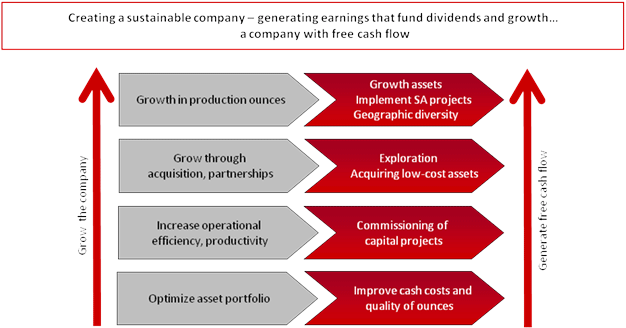
| • | growth in production ounces, by delivering into production the South African growth projects and by fully exploiting growth opportunities in PNG. An important element of this growth objective is the pursuit of geographic diversity; | ||
| • | exploring and expanding into new geographic regions, developing mines, acquiring low-cost assets and entering into joint ventures; | ||
| • | increasing levels of operational efficiency and productivity, to which end capital projects are being commissioned and achievable operational plans have been compiled; and | ||
| • | optimizing our asset portfolio, so as to yield lower-cost, more profitable, high-margin ounces. To this end our portfolio was reviewed and restructured. |
21
| • | We believe that our size and leading market position enables us to undertake exploration and simultaneously develop multiple projects around the world, as well as secure capital on competitive terms. | ||
| • | The global gold industry offers a number of attractive industry fundamentals from which we benefit. This includes the absence of available substitutes, relatively high barriers to entry, and increasing gold producer concentration. | ||
| • | We are developing new mines at a planned lower cost per ounce than our current operations, which we believe will help make them robust enough to survive any margin squeeze and to withstand any reversal in the gold price. We expect the gold price to continue its upward trend in the medium term. |
| • | Our mineral reserves as of June 30, 2010 amounted to 48.1 million ounces of gold spread across our assets in South Africa and PNG. This mineral reserve base is sufficient to support our existing production profile in excess of 10 years at current production levels. There has been a 0.1 million ounces year-on-year negative variance in mineral reserves due to normal depletion of 1.7 million ounces. Mine closures, the exclusion of projects previously included in reserves (Evander South), geology and scope changes resulted in a decrease of 2.6 million ounces. On the positive side, there is a net addition of 4.3 million ounces of mineral reserves from new acquisitions, Rand Uranium (attributable interest of 40%), surface projects and other positive adjustments from the operations. |
22
| • | Of our 48.1 million ounces of reserves, 38.2 million ounces are classified as above infrastructure and 9.9 million ounces re classified as below infrastructure (reserves for which capital expenditure has still to be approved). |
| • | We have a diverse portfolio of gold development projects spread across South Africa and PNG. These projects include Kusasalethu, Doornkop, Tshepong and Phakisa in South Africa, and Hidden Valley in PNG, which, when developed, could deliver up to 1.1 million ounces of production by 2013. | ||
| • | We believe the relatively higher grade of these South African deposits and/or lower cost base will result in these ounces being produced at highly competitive cash costs. This in turn may result in a reduction in our overall cash cost position as these new projects are commissioned. | ||
| • | In addition to these projects, we have a number of additional development prospects that are being considered and progressed, including the processing of sand dumps and tailings dams in our tailings projects, the processing of rock dumps, and developing the Wafi-Golpu copper/gold deposit in PNG, which, when all developed, could increase production. | ||
| • | We have also expanded our exploration skill base, evidenced by our progress in PNG. | ||
| • | We formed Rand Uranium, to which we have transferred our Cooke assets to optimize the value of our uranium deposits. |
| • | In the midst of volatile tumultuous global investment markets, the gold market has demonstrated great resilience and a positive upside. The price performance throughout fiscal 2010 supports our positive outlook for gold and, given our operational imperatives, we will seek to contain costs, increase output and optimize our margins. | ||
| • | The gold price hit a high of US$1,261 per ounce on June 28, 2010 and, subsequent to year-end, an all-time high of US$1,373.25 on October 14, 2010. On October 18, 2010, it was US$1,367.25 per ounce, which is 30% higher than it was for the same time the previous year. | ||
| • | We believe the fundamental drivers behind increased demand and decreased new supply of gold will remain in the future, which will in turn support a higher gold price over this period. As an unhedged gold producer, we will benefit from a rising gold price environment. |
| • | Our aim remains to improve profitability. At an operational level we have put in place an intensive process of business planning, with benchmarks and targets we believe to be realistic. | ||
| • | We are committed to lower our cost base and extensively benchmark our costing parameters both internally among our operations, and externally against other gold producers. Stringent cost cutting and cost control programs have been implemented. | ||
| • | We are confident that the benefits of our restructuring process and ongoing cost focus will be sustained in the long term, and as a result, our ability to withstand any future adverse market conditions has been significantly enhanced. |
| • | We maintain a conservative gearing policy and seek to fund ongoing capital expenditure (excluding growth projects) through cash generated from existing operations. | ||
| • | Our low level of gearing should provide us with the ability to utilize debt to fund capital and development expenditure requirements for our new projects. |
23
| • | Our senior management team consists of experienced mining executives with extensive industry backgrounds combined with geological and metallurgical expertise. | ||
| • | Our senior management team has a proven track record in developing and managing the operations under its control, and has demonstrated an ability to optimize underperforming assets as well as developing new projects around the world. |
| • | We are proud to be a South African company that fully embraces the country’s transformation initiatives. We are approximately 14.6% owned by African Rainbow Minerals Limited (“ ARM Limited ”), a black empowerment company in which our chairman, Patrice Motsepe, owns an interest. Of our total production profile, 36% of our South African ounces are attributed empowerment ounces. | ||
| • | We believe that we have gone beyond the requirements of the Mining Charter by ensuring that our HDSA partners are truly empowered, that we are largely managed by a HDSA Board, and that we continue to engage with black shareholders and/or partners to find more opportunities to invest in BEE transactions and involve HDSA partners. | ||
| • | We will continue to embrace empowerment as part of our growth strategy and we acknowledge that empowerment forms a fundamental part of our business into the future. |
24
25
| • | on-mine exploration, which looks for resources within the economic radius of existing mines, and | ||
| • | new mine exploration, which is the global search for early to advanced stage projects. |
| • | Accessing the orebody. | ||
| In our South African underground mines, access to the orebody is by means of shafts sunk from the surface to the lowest economically and practically mineable level. Horizontal development at various intervals of a shaft (known as levels) extends access to the horizon of the reef to be mined. On-reef development then provides specific mining access. Horizontal development at various intervals of the decline extends access to the horizon of the mineral to be mined. The declines are advanced on a continuous basis to keep ahead of the mining taking place on the levels above. In our open-pit mines, access to the orebody is provided by overburden stripping, which removes the covering layers of topsoil or rock, through a combination of drilling, blasting, loading and hauling, as required. | |||
| • | Mining the orebody. | ||
| The process of ore removal starts with drilling and blasting the accessible ore. The blasted faces are then cleaned, and the ore is transferred to the transport system. In open-pit mines, gold-bearing material may require drilling and blasting, and is usually collected by bulldozers or shovels to transfer it onto trucks, which transport it to the mill. |
| • | Comminution. | ||
| Comminution is the process of breaking up the ore to expose and liberate the gold and make it available for treatment. Conventionally, this process occurs in multi-stage crushing and milling circuits, which include the use of jaw and gyratory crushers and rod and tube and ball mills. Our more modern milling circuits include semi- or fully-autogenous milling where the ore itself is used as the |
26
| grinding medium. Typically, ore must be ground to a minimum size before proceeding to the next stage of treatment. | |||
| • | Treatment. | ||
| In most of our metallurgical plants, gold is extracted into a leach solution from the host ore by leaching in agitated tanks. Gold is then extracted onto activated carbon from the solution using the CIL or CIP processes. Gold in solution at one of our plants is recovered using zinc precipitation. Recovery of the gold from the loaded carbon takes place by elution and electro-winning. Cathode sludge or dore bars produced from electro- winning is now currently sent directly to the Rand Refinery. Most of the South African plants no longer use smelting to produce rough gold bars (dore). Our South African zinc precipitation plants continue to smelt precipitate to produce rough gold bars. These bars are then transported to the Rand Refinery, which is responsible for refining the bars to a minimum of good delivery status. |
27
| • | normal depletion of 1.7 million ounces; | ||
| • | mine closures, the exclusion of projects previously included in reserves (Evander South), geology and scope changes resulted in a decrease of 2.6 million ounces; and | ||
| • | a net addition of 4.3 million ounces of mineral reserves from new acquisitions, Rand Uranium (attributable interest of 40%), surface projects and other positive adjustments from the operations. |
| • | the database of measured and indicated resource blocks (per operation); | ||
| • | an assumed gold price which, for this mineral reserve statement, was taken as R250,000 per kilogram; | ||
| • | planned production rates; | ||
| • | the mine recovery factor which is equivalent to the mine call factor (“ MCF ”) multiplied by the plant recovery factor; and | ||
| • | planned cash costs (cost per tonne). |
28
29
| OPERATIONS | PROVEN RESERVES | PROBABLE RESERVES | TOTAL RESERVES | |||||||||||||||||||||||||||||||||
| GOLD | Tons | Grade | Gold oz (1) | Tons | Grade | Gold oz (1) | Tons | Grade | Gold oz (1) | |||||||||||||||||||||||||||
| (million) | (oz/ton) | (000) | (million) | (oz/ton) | (000) | (million) | (oz/ton) | (000) | ||||||||||||||||||||||||||||
|
South Africa Underground
|
||||||||||||||||||||||||||||||||||||
|
Bambanani
|
4.8 | 0.294 | 1,406 | 0.1 | 0.202 | 25 | 4.9 | 0.292 | 1,431 | |||||||||||||||||||||||||||
|
Joel
|
1.3 | 0.182 | 240 | 1.6 | 0.163 | 264 | 2.9 | 0.172 | 504 | |||||||||||||||||||||||||||
|
Masimong
|
6.0 | 0.149 | 894 | 2.1 | 0.148 | 306 | 8.1 | 0.149 | 1,200 | |||||||||||||||||||||||||||
|
Phakisa
|
0.7 | 0.136 | 94 | 21.3 | 0.237 | 5,065 | 22.0 | 0.234 | 5,159 | |||||||||||||||||||||||||||
|
Target
|
5.5 | 0.173 | 954 | 12.5 | 0.148 | 1,847 | 18.0 | 0.156 | 2,801 | |||||||||||||||||||||||||||
|
Tshepong
|
14.5 | 0.155 | 2,247 | 10.4 | 0.156 | 1,626 | 24.9 | 0.156 | 3,873 | |||||||||||||||||||||||||||
|
Virginia
|
3.0 | 0.134 | 407 | 1.7 | 0.135 | 223 | 4.7 | 0.134 | 630 | |||||||||||||||||||||||||||
|
Doornkop
|
1.7 | 0.092 | 160 | 2.7 | 0.103 | 277 | 4.4 | 0.098 | 437 | |||||||||||||||||||||||||||
|
Kusasalethu
|
13.8 | 0.195 | 2,680 | 25.8 | 0.187 | 4,834 | 39.6 | 0.190 | 7,514 | |||||||||||||||||||||||||||
|
Evander
|
2.5 | 0.210 | 520 | 1.8 | 0.266 | 470 | 4.3 | 0.234 | 990 | |||||||||||||||||||||||||||
|
Evander(below infrastructure)
|
— | — | — | 46.6 | 0.212 | 9,895 | 46.6 | 0.212 | 9,895 | |||||||||||||||||||||||||||
|
Rand Uranium
(2)
|
2.4 | 0.122 | 299 | 4.8 | 0.100 | 484 | 7.2 | 0.108 | 783 | |||||||||||||||||||||||||||
|
Total South Africa Underground
|
56.2 | 0.176 | 9,901 | 131.4 | 0.193 | 25,316 | 187.6 | 0.188 | 35,217 | |||||||||||||||||||||||||||
|
|
||||||||||||||||||||||||||||||||||||
|
South Africa Surface
|
||||||||||||||||||||||||||||||||||||
|
Kalgold
|
24.1 | 0.024 | 575 | 8.3 | 0.031 | 258 | 32.4 | 0.026 | 833 | |||||||||||||||||||||||||||
|
Free State Surface
|
— | — | — | 1,021.3 | 0.007 | 7,212 | 1,021.3 | 0.007 | 7,212 | |||||||||||||||||||||||||||
|
Evander Surface
|
— | — | — | 223.7 | 0.008 | 1,897 | 223.7 | 0.008 | 1,897 | |||||||||||||||||||||||||||
|
Rand Uranium Surface
(2)
|
33.8 | 0.008 | 286 | 9.7 | 0.013 | 127 | 43.5 | 0.010 | 413 | |||||||||||||||||||||||||||
|
Total South Africa Surface
|
57.9 | 0.015 | 861 | 1,263.0 | 0.008 | 9,494 | 1,320.9 | 0.008 | 10,355 | |||||||||||||||||||||||||||
|
Total South Africa
|
114.1 | 10,762 | 1,394.4 | 34,810 | 1,508.5 | 45,572 | ||||||||||||||||||||||||||||||
|
|
||||||||||||||||||||||||||||||||||||
|
Papua New Guinea
(3)
|
||||||||||||||||||||||||||||||||||||
|
Hidden Valley
|
4.2 | 0.062 | 260 | 26.8 | 0.052 | 1,382 | 31.0 | 0.053 | 1,642 | |||||||||||||||||||||||||||
|
Hamata
|
— | — | — | 3.2 | 0.061 | 196 | 3.2 | 0.061 | 196 | |||||||||||||||||||||||||||
|
Golpu
|
— | — | — | 39.0 | 0.018 | 694 | 39.0 | 0.018 | 694 | |||||||||||||||||||||||||||
|
Total Papua New Guinea
|
4.2 | 0.062 | 260 | 69.0 | 0.033 | 2,272 | 73.2 | 0.035 | 2,532 | |||||||||||||||||||||||||||
|
|
||||||||||||||||||||||||||||||||||||
|
GRAND TOTAL
|
118.3 | 11,022 | 1,463.4 | 37,082 | 1,581.7 | 48,104 | ||||||||||||||||||||||||||||||
30
| SILVER | Tons | Grade | Silver oz (1) | Tons | Grade | Silver oz (1) | Tons | Grade | Silver oz (1) | |||||||||||||||||||||||||||
| (million) | (oz/ton) | (000) | (million) | (oz/ton) | (000) | (million) | (oz/ton) | (000) | ||||||||||||||||||||||||||||
|
Papua New Guinea
(3)
|
||||||||||||||||||||||||||||||||||||
|
Hidden Valley
|
4.2 | 1.038 | 4,320 | 26.8 | 1.036 | 27,726 | 31.0 | 1.036 | 32,046 | |||||||||||||||||||||||||||
| COPPER | Tons | Grade | Cu lb (1) | Tons | Grade | Cu lb (1) | Tons | Grade | Cu lb (1) | |||||||||||||||||||||||||||
| (million) | (%) | (million) | (million) | (%) | (million) | (million) | (%) | (million) | ||||||||||||||||||||||||||||
|
Papua New Guinea
(3)
|
||||||||||||||||||||||||||||||||||||
|
Golpu
|
— | — | — | 39.0 | 1.025 | 882 | 39.0 | 1.025 | 882 | |||||||||||||||||||||||||||
| MOLYBDENUM | Tons | Grade | Mo lb (1) | Tons | Grade | Mo lb (1) | Tons | Grade | Mo lb (1) | |||||||||||||||||||||||||||
| (million) | (lb/ton) | (million) | (million) | (lb/ton) | (million) | (million) | (lb/ton) | (million) | ||||||||||||||||||||||||||||
|
Papua New Guinea
(3)
|
||||||||||||||||||||||||||||||||||||
|
Golpu
|
— | — | — | 39.0 | 0.231 | 9 | 39.0 | 0.231 | 9 | |||||||||||||||||||||||||||
| (1) | Metal figures are fully inclusive of all mining dilutions and gold losses, and are reported as mill delivered tons and head grades. Metallurgical recovery factors have not been applied to the reserve figures. | |
| (2) | Represents Harmony’s attributable interest of 40% | |
| (3) | Represents Harmony’s attributable interest of 50% |
31

32
| Hectares | Acres | |||||||
|
Doornkop
|
2,941 | 7,267 | ||||||
|
Kusasalethu
|
5,113 | 12,634 | ||||||
|
Free State (includes Masimong and Virginia operations)
|
22,583 | 55,802 | ||||||
|
Tshepong and Phakisa
|
10,799 | 26,683 | ||||||
|
Bambanani
|
2,356 | 5,821 | ||||||
|
Joel
|
2,162 | 5,342 | ||||||
|
St Helena
|
5,856 | 14,471 | ||||||
|
Kalgold
|
615 | 1,520 | ||||||
|
Evander
|
36,898 | 91,174 | ||||||
|
Target (includes Loraine)
|
7,952 | 19,649 | ||||||
|
Total
|
97,275 | 240,363 | ||||||
| Hectares | Acres | |||||||
|
Mount Magnet (sold in July 2010)
|
39,885 | 98,560 | ||||||
|
PNG
|
344,522 | 851,329 | ||||||
|
Total International Operations
|
384,407 | 949,889 | ||||||
|
TOTAL
|
481,682 | 1,190,252 | ||||||
33
| • | Bambanani (includes Steyn 1 & 2 Shafts from February 2010); | ||
| • | Doornkop; | ||
| • | Evander (consists of Evander 2 & 5, 7 and 8); | ||
| • | Joel; | ||
| • | Kusasalethu (formerly Elandsrand); | ||
| • | Masimong; | ||
| • | Phakisa; | ||
| • | Target (consists of Target 1, and as of February 2010 Loraine 3 (now Target 3) and Freddies 7 & 9 shafts); |
| • | Tshepong; and | ||
| • | Virginia operations (consists of Harmony 2, Merriespruit 1 & 3, Unisel and Brand 3 & 5). |
| • | Evander; | ||
| • | Free State (also known as Phoenix); | ||
| • | Freegold; | ||
| • | Kalgold; | ||
| • | Target. |
| • | Mount Magnet — The site was put on care and maintenance at the end of December 2007. A decision was taken by management during May 2010 to sell the operation and in July 2010 the disposal was finalized — See Item 8 “ Recent Developments” . | ||
| • | South Kalgoorlie — we finalized the sale of this operation with Dioro on November 30, 2007 — See “ Disposals ” above. |
34
| • | an overview of our South African mining operations with a discussion and production analysis of each of our operating segments; and | ||
| • | an overview of our International (Australian and PNG) operations. |

35
| Average Milled for | ||||||||
| Processing | the Fiscal Year | |||||||
| Plant | Capacity | Ended June 30, 2010 | ||||||
|
|
(tons/month) | (tons/month) | ||||||
|
FS 1
|
463,000 | 429,000 | ||||||
| Fiscal Year Ended June 30, | ||||||||||||
| Bambanani | 2010 | 2009 | 2008 | |||||||||
|
Production
|
||||||||||||
|
Tons (‘000)
|
582 | 570 | 912 | |||||||||
|
Recovered grade (ounces/ton)
(1)
|
0.227 | 0.213 | 0.170 | |||||||||
|
Gold produced (ounces)
(1)
|
133,007 | 121,530 | 154,879 | |||||||||
|
Gold sold (ounces)
(1)
|
134,165 | 119,665 | 158,985 | |||||||||
|
Results of operations
($)
|
||||||||||||
|
Product sales (‘000)
|
146,971 | 102,645 | 128,346 | |||||||||
|
Cash cost (‘000)
|
98,289 | 72,343 | 101,962 | |||||||||
|
Cash profit (‘000)
|
48,682 | 30,302 | 26,384 | |||||||||
|
Cash costs
|
||||||||||||
|
Per ounce of gold ($)
(1)
|
723 | 611 | 639 | |||||||||
|
Capex
(‘000) ($)
|
27,300 | 5,779 | 14,737 | |||||||||
| (1) | 1,061 ounces were produced by Steyn 2 and sold. The revenue has been credited against capital expenditure as the shaft is not in production yet. The cost of these ounces has not been included in the cash cost per ounce amount. The calculation of grade also excludes these ounces. |
37
38
| Average Milled for the | ||||||||
| Processing | Fiscal Year Ended | |||||||
| Plant | Capacity | June 30, 2010 | ||||||
|
|
(tons/month) | (tons/month) | ||||||
|
Doornkop
|
242,500 | 146,429 | ||||||
| Fiscal Year Ended June 30, | ||||||||||||
| Doornkop | 2010 | 2009 | 2008 | |||||||||
|
Production
|
||||||||||||
|
Tons (‘000)
|
595 | 605 | 494 | |||||||||
|
Recovered grade (ounces/ton)
|
0.105 | 0.070 | 0.089 | |||||||||
|
Gold produced (ounces)
|
62,694 | 42,150 | 44,038 | |||||||||
|
Gold sold (ounces)
|
62,275 | 43,211 | 44,143 | |||||||||
39
| Fiscal Year Ended June 30, | ||||||||||||
| Doornkop | 2010 | 2009 | 2008 | |||||||||
|
Results of operations
($)
|
||||||||||||
|
Product sales (‘000)
|
68,169 | 38,128 | 35,489 | |||||||||
|
Cash cost (‘000)
|
54,042 | 31,253 | 31,014 | |||||||||
|
Cash profit (‘000)
|
14,127 | 6,875 | 4,475 | |||||||||
|
Cash costs
|
||||||||||||
|
Per ounce of gold ($)
|
822 | 804 | 749 | |||||||||
|
Capex
(‘000) ($)
|
45,097 | 43,918 | 48,039 | |||||||||
40
| • | The exploration drilling program was completed and the pre-feasibility study re-done. | ||
| • | The pre-feasibility study gave a negative net present value and it was decided not to proceed to the feasibility study at this stage. |
| • | Project at exploration stage following the geological study. | ||
| • | Underground development, to be used as an underground drilling platform, advanced 233 meters (or 19%). This is intended for investigation of the 7 Shaft flank of the postulated 2010 payshoot. | ||
| • | Feasibility study to follow, pending confirmation of the mineral resource in this area. | ||
| • | This project is on hold following the closure of the shaft. |
| • | Joint Venture with the African Precious Minerals (“ APM ”) was formed to explore these two target areas. | ||
| • | APM may earn in a 52% equity stake upon completion of the full bankable feasibility study for each area. | ||
| • | A conceptual study was completed and approval given during fiscal 2010 for the project to proceed to pre-feasibility. | ||
| • | Surface drilling will commence in fiscal 2011. | ||
| • | Subsequent to year-end, we entered into an agreement with Taung Gold Mining Limited for the sale of these assets. Refer to Item 8 . “ Recent Developments .” |
41
| • | This is a future mining area on the down-dip extension of the 8 shaft payshoot. | ||
| • | Synergies with the current 8 Shaft deepening are being considered. |
| • | Surface exploration drilling is required to bring this project into the full bankable feasibility study. | ||
| • | Surface drilling was started in fiscal 2010 and is continuing throughout 2011. | ||
| • | Results from the drilling will be used to update the pre-feasibility study. |
| Average Milled for the | ||||||||
| Processing | Fiscal Year Ended | |||||||
| Plant | Capacity | June 30, 2010 | ||||||
|
|
(tons/month) | (tons/month) | ||||||
|
Kinross
|
220,460 | 97,788 | ||||||
| Fiscal Year Ended June 30, | ||||||||||||
| Evander operations | 2010 | 2009 | 2008 | |||||||||
|
Production
|
||||||||||||
|
Tons (‘000)
|
869 | 1,241 | 1,447 | |||||||||
|
Recovered grade (ounces/ton)
|
0.129 | 0.153 | 0.160 | |||||||||
|
Gold produced (ounces)
|
111,724 | 190,075 | 231,799 | |||||||||
|
Gold sold (ounces)
|
111,499 | 195,668 | 240,037 | |||||||||
|
Results of operations
($)
|
||||||||||||
|
Product sales (‘000)
|
120,092 | 168,180 | 192,978 | |||||||||
|
Cash cost (‘000)
|
113,327 | 110,869 | 125,995 | |||||||||
|
Cash profit (‘000)
|
6,765 | 57,311 | 66,983 | |||||||||
|
Cash costs
|
||||||||||||
|
Per ounce of gold ($)
|
1,018 | 572 | 526 | |||||||||
|
Capex
(‘000) ($)
|
23,100 | 23,352 | 33,388 | |||||||||
42
| • | changing the winder from sinking to production mode; | ||
| • | installing larger skips; ensuring that emergency egress is available; raise boring the lift shaft from 121 to 129 level; and | ||
| • | improving cleaning arrangements at the shaft bottom. |
43
| Average Milled for the | ||||||||
| Processing | Fiscal Year Ended | |||||||
| Plant | Capacity | June 30, 2010 | ||||||
| (tons/month) | (tons/month) | |||||||
|
Joel Plant
|
88,185 | 71,378 | ||||||
| Fiscal Year Ended June 30, | ||||||||||||
| Joel | 2010 | 2009 | 2008 | |||||||||
|
Production
|
||||||||||||
|
Tons (‘000)
|
484 | 566 | 449 | |||||||||
|
Recovered grade (ounces/ton)
|
0.133 | 0.116 | 0.133 | |||||||||
|
Gold produced (ounces)
|
64,495 | 65,684 | 59,557 | |||||||||
|
Gold sold (ounces)
|
63,788 | 64,784 | 61,215 | |||||||||
|
Results of operations
($)
|
||||||||||||
|
Product sales (‘000)
|
69,150 | 55,862 | 51,557 | |||||||||
|
Cash cost (‘000)
|
50,017 | 40,649 | 39,131 | |||||||||
|
Cash profit (‘000)
|
19,133 | 15,213 | 12,426 | |||||||||
|
Cash costs
|
||||||||||||
|
Per ounce of gold ($)
|
792 | 636 | 638 | |||||||||
|
Capex
(‘000) ($)
|
11,587 | 6,183 | 5,375 | |||||||||
44
45
| Average Milled for the | ||||||||
| Processing | Fiscal Year | |||||||
| Plant | Capacity | June 30, 2010 | ||||||
| (tons/month) | (tons/month) | |||||||
|
Kusasalethu Plant
|
203,925 | (1) | 102,753 | |||||
| (1) | Processing capacity will reach its optimal capacity upon completion of the Kusasalethu New Mine Project. |
| Fiscal Year Ended June 30, | ||||||||||||
| Kusasalethu | 2010 | 2009 | 2008 | |||||||||
|
Production
|
||||||||||||
|
Tons (‘000)
|
1,141 | 1,061 | 981 | |||||||||
|
Recovered grade (ounces/ton)
|
0.153 | 0.164 | 0.167 | |||||||||
|
Gold produced (ounces)
|
175,029 | 174,321 | 164,215 | |||||||||
|
Gold sold (ounces)
|
168,244 | 183,676 | 158,631 | |||||||||
|
Results of operations
($)
|
||||||||||||
|
Product sales (‘000)
|
183,603 | 157,956 | 132,699 | |||||||||
|
Cash cost (‘000)
|
143,985 | 117,321 | 103,351 | |||||||||
|
Cash profit (‘000)
|
39,618 | 40,635 | 29,348 | |||||||||
|
Cash costs
|
||||||||||||
|
Per ounce of gold ($)
|
857 | 660 | 652 | |||||||||
|
Capex
(‘000) ($)
|
56,687 | 46,915 | 43,830 | |||||||||
46
47
| Fiscal Year Ended June 30, | ||||||||||||
| Masimong Shaft Complex | 2010 | 2009 | 2008 | |||||||||
|
Production
|
||||||||||||
|
Tons (‘000)
|
991 | 981 | 892 | |||||||||
|
Recovered grade (ounces/ton)
|
0.157 | 0.157 | 0.131 | |||||||||
|
Gold produced (ounces)
|
155,609 | 154,034 | 116,424 | |||||||||
|
Gold sold (ounces)
|
153,937 | 154,581 | 117,575 | |||||||||
|
Results of operations
($)
|
||||||||||||
|
Product sales (‘000)
|
168,439 | 135,025 | 96,147 | |||||||||
|
Cash cost (‘000)
|
92,571 | 73,494 | 87,630 | |||||||||
|
Cash profit (‘000)
|
75,868 | 61,531 | 8,517 | |||||||||
|
Cash costs
|
||||||||||||
|
Per ounce of gold ($)
|
602 | 476 | 756 | |||||||||
|
Capex
(‘000) ($)
|
23,407 | 14,479 | 15,686 | |||||||||
48
49
| Fiscal Year Ended June 30, | ||||||||||||
| Phakisa | 2010 | 2009 | 2008 | |||||||||
|
Production
|
||||||||||||
|
Tons (‘000)
|
374 | 204 | 34 | |||||||||
|
Recovered grade (ounces/ton)
|
0.118 | 0.109 | 0.118 | |||||||||
|
Gold produced (ounces)
|
44,079 | 22,216 | 4.024 | |||||||||
|
Gold sold (ounces)
|
44,496 | 21,477 | 4,212 | |||||||||
|
Results of operations ($)
|
||||||||||||
|
Product sales (‘000)
|
49,458 | 19,009 | 3,891 | |||||||||
|
Cash cost (‘000)
|
43,040 | 11,903 | 2,348 | |||||||||
|
Cash profit (‘000)
|
6,418 | 7,106 | 1,543 | |||||||||
|
Cash costs
|
||||||||||||
|
Per ounce of gold ($)
|
953 | 555 | 497 | |||||||||
|
Capex (‘000) ($)
|
64,106 | 51,210 | 40,335 | |||||||||
50
51
| Average Milled For the | ||||||||
| Processing | Fiscal Year Ended | |||||||
| Plant | Capacity | June 30, 2010 | ||||||
| (tons/month) | (tons/month) | |||||||
|
Target Plant
|
105,000 | 101,935 | ||||||
52
| Fiscal Year Ended June 30, | ||||||||||||
| Target (includes Target 1 and 3) | 2010 | 2009 | 2008 | |||||||||
|
Production
|
||||||||||||
|
Tons (‘000)
|
857 | 710 | 686 | |||||||||
|
Recovered grade (ounces/ton)
(1)
|
0.128 | 0.123 | 0.116 | |||||||||
|
Gold produced (ounces)
(1)
|
113,782 | 87,225 | 79,602 | |||||||||
|
Gold sold (ounces)
(1)
|
110,598 | 87,611 | 85,006 | |||||||||
|
Results of operations
($)
|
||||||||||||
|
Product sales (‘000)
|
115,772 | 76,435 | 69,469 | |||||||||
|
Cash cost (‘000)
|
87,563 | 59,599 | 51,463 | |||||||||
|
Cash profit (‘000)
|
28,209 | 16,836 | 18,006 | |||||||||
|
Cash costs
|
||||||||||||
|
Per ounce of gold ($)
(1)
|
783 | 645 | 716 | |||||||||
|
Capex
(‘000) ($)
|
50,446 | 37,994 | 35,307 | |||||||||
| (1) | 3,762 ounces were produced by Target 3 and sold. The revenue has been credited against capital expenditure as the shaft is not in production yet. The costs and ounces were not used in the cash cost per ounce calculation. The ounces were also excluded from the grade calculation. |
| • | infrastructural problems with the belts, fridge plants and other environmental infrastructure, resulting in higher face temperatures and lower efficiencies; | ||
| • | water handling; and | ||
| • | low availability of massive stopes. |
53
54
| Fiscal Year Ended June 30, | ||||||||||||
| Tshepong | 2010 | 2009 | 2008 | |||||||||
|
Production
|
||||||||||||
|
Tons (‘000)
|
1,674 | 1,516 | 1,649 | |||||||||
|
Recovered grade (ounces/ton)
|
0.130 | 0.152 | 0.161 | |||||||||
|
Gold produced (ounces)
|
216,986 | 230,778 | 265,914 | |||||||||
|
Gold sold (ounces)
|
219,332 | 227,113 | 273,119 | |||||||||
|
Results of operations
($)
|
||||||||||||
|
Product sales (‘000)
|
240,473 | 197,726 | 223,185 | |||||||||
|
Cash cost (‘000)
|
151,382 | 108,605 | 124,720 | |||||||||
|
Cash profit (‘000)
|
89,091 | 89,121 | 98,465 | |||||||||
|
Cash costs
|
||||||||||||
|
Per ounce of gold ($)
|
677 | 483 | 455 | |||||||||
|
Capex
(‘000)($)
|
34,402 | 27,711 | 26,834 | |||||||||
55
56
| Average Milled | ||||||||
| for the Fiscal Year | ||||||||
| Processing | Ended | |||||||
| Plant | Capacity | June 30, 2010 | ||||||
| (tons/month) | (tons/month) | |||||||
|
Central
|
185,190 | 152,120 | ||||||
| Fiscal Year Ended June 30, | ||||||||||||
| Virginia operations | 2010 | 2009 | 2008 | |||||||||
|
Production
|
||||||||||||
|
Tons (‘000)
|
1,826 | 2,493 | 2,349 | |||||||||
|
Recovered grade (ounces/ton)
|
0.093 | 0.104 | 0.106 | |||||||||
|
Gold produced (ounces)
|
170,013 | 258,170 | 247,820 | |||||||||
|
Gold sold (ounces)
|
173,035 | 259,070 | 250,324 | |||||||||
|
Results of operations
($)
|
||||||||||||
|
Product sales (‘000)
|
186,649 | 225,897 | 204,807 | |||||||||
|
Cash cost (‘000)
|
176,774 | 165,274 | 180,133 | |||||||||
|
Cash profit (‘000)
|
9,875 | 60,623 | 24,674 | |||||||||
|
Cash costs
|
||||||||||||
|
Per ounce of gold ($)
|
1,036 | 638 | 726 | |||||||||
|
Capex
(‘000) ($)
|
23,744 | 22,133 | 20,868 | |||||||||
57
58
| Average Milled for the | ||||||||
| Processing | Fiscal Year Ended | |||||||
| Plant | Capacity | June 30, 2010 | ||||||
| (tons/month) | (tons/month) | |||||||
|
CIL
|
165,345 | 141,681 | ||||||
|
Heap Leach
(1)
|
— | — | ||||||
| (1) | Active use of heap leaching was discontinued in July 2001. |
| Fiscal Year Ended June 30, | ||||||||||||
| Kalgold | 2010 | 2009 | 2008 | |||||||||
|
Production
|
||||||||||||
|
Tons (‘000)
|
1,873 | 1,700 | 1,687 | |||||||||
|
Recovered grade (ounces/ton)
|
0.026 | 0.038 | 0.055 | |||||||||
|
Gold produced (ounces)
|
49,063 | 64,784 | 92,229 | |||||||||
|
Gold sold (ounces)
|
48,097 | 66,841 | 93,172 | |||||||||
|
Results of operations
($)
|
||||||||||||
|
Product sales ($) (‘000)
|
51,437 | 56,915 | 76,685 | |||||||||
|
Cash cost ($) (‘000)
|
36,162 | 32,390 | 38,272 | |||||||||
|
Cash profit ($) (‘000)
|
15,275 | 24,525 | 38,413 | |||||||||
|
Cash costs
|
||||||||||||
|
Per ounce of gold ($)
|
748 | 506 | 404 | |||||||||
|
Capex
($) (‘000)
|
1,389 | 1,090 | 1,347 | |||||||||
59
| Average Milled | ||||||||
| for the Fiscal Year | ||||||||
| Processing | Ended | |||||||
| Plant | Capacity | June 30, 2010 | ||||||
| (tons/month) | (tons/month) | |||||||
|
Saaiplaas
|
551,155 | 507,063 | ||||||
60
| Fiscal Year Ended June 30, | ||||||||||||
| Free State (Phoenix) | 2010 | 2009 | 2008 | |||||||||
|
Production
|
||||||||||||
|
Tons (‘000)
|
6,083 | 6,578 | 7,033 | |||||||||
|
Recovered grade (ounces/ton)
|
0.003 | 0.003 | 0.005 | |||||||||
|
Gold produced (ounces)
|
20,801 | 22,345 | 32,215 | |||||||||
|
Gold sold (ounces)
|
20,801 | 22,345 | 32,215 | |||||||||
|
Results of operations
($)
|
||||||||||||
|
Product sales (‘000)
|
22,723 | 19,448 | 26,247 | |||||||||
|
Cash cost (‘000)
|
15,856 | 11,924 | 12,286 | |||||||||
|
Cash profit (‘000)
|
6,867 | 7,524 | 13,961 | |||||||||
|
Cash costs
|
||||||||||||
|
Per ounce of gold ($)
|
762 | 534 | 381 | |||||||||
|
Capex
(‘000) ($)
|
0.660 | 0.279 | 0.492 | |||||||||
61
| Fiscal Year Ended June 30, | ||||||||||||
| Cooke operations | 2010 | 2009 (1) | 2008 | |||||||||
|
Production
|
||||||||||||
|
Tons (‘000)
|
— | 1,419 | 3,905 | |||||||||
|
– Underground
|
— | 514 | 1,322 | |||||||||
|
– Surface
|
— | 905 | 2,583 | |||||||||
|
Recovered grade (ounces/ton)
|
— | 0.057 | 0.060 | |||||||||
|
– Underground
|
— | 0.137 | 0.152 | |||||||||
|
– Surface
|
— | 0.011 | 0.013 | |||||||||
|
Gold produced (ounces)
|
— | 80,377 | 236,170 | |||||||||
|
– Underground
|
— | 70,378 | 201,884 | |||||||||
|
– Surface
|
— | 9,999 | 34,286 | |||||||||
|
Gold sold (ounces)
|
— | 85,746 | 236,242 | |||||||||
|
– Underground
|
— | 75,747 | 201,939 | |||||||||
|
– Surface
|
— | 9,999 | 34,305 | |||||||||
|
Results of operations
($)
|
||||||||||||
|
Product sales (‘000)
|
— | 68,204 | 193,613 | |||||||||
|
Cash cost (‘000)
|
— | 49,625 | 121,978 | |||||||||
|
Cash profit (‘000)
|
— | 18,579 | 71,635 | |||||||||
|
Cash costs
|
||||||||||||
|
Per ounce of gold ($)
|
— | 644 | 511 | |||||||||
|
– Underground
|
— | 613 | 545 | |||||||||
|
– Surface
|
— | 868 | 525 | |||||||||
|
Capex (
‘000
)
($)
|
— | 9,655 | 22,357 | |||||||||
| (1) | As the operations were sold on November 21, 2008, the results are for the five months then ended and are not comparable with the prior years. |
62
| Fiscal Year Ended June 30, | ||||||||||||
| Orkney operations | 2010 | 2009 | 2008 (1) | |||||||||
|
Production
|
||||||||||||
|
Tons (‘000)
|
— | — | 571 | |||||||||
|
Recovered grade (ounces/ton)
|
— | — | 0.100 | |||||||||
|
Gold produced (ounces)
|
— | — | 46,655 | |||||||||
|
Gold sold (ounces)
|
— | — | 57,132 | |||||||||
|
Results of operations
($)
|
||||||||||||
|
Product sales (‘000)
|
— | — | 42,810 | |||||||||
|
Cash cost (‘000)
|
— | — | 51,482 | |||||||||
|
Cash (loss)/profit (‘000)
|
— | — | (8,672 | ) | ||||||||
|
Cash costs
|
||||||||||||
|
Per ounce of gold ($)
|
— | — | 1,093 | |||||||||
|
Capex
($)
|
— | — | 3,579 | |||||||||
| (1) | The results are for the eight months ended February 2008. |
63
64
| Fiscal Year Ended June 30, | ||||||||||||
| Mount Magnet | 2010 | 2009 | 2008 | |||||||||
|
Production
|
||||||||||||
|
Tons (‘000)
|
— | — | 966 | |||||||||
|
Recovered grade (ounces/ton)
|
— | — | 0.080 | |||||||||
|
Gold produced (ounces)
|
— | — | 75,297 | |||||||||
|
Gold sold (ounces)
|
— | — | 77,097 | |||||||||
|
Results of operations
($)
|
||||||||||||
|
Product sales (‘000)
|
— | — | 56,215 | |||||||||
|
Cash cost (‘000)
|
— | — | 41,405 | |||||||||
|
Cash profit (‘000)
|
— | — | 14,810 | |||||||||
|
Cash costs
|
||||||||||||
|
Per ounce of gold ($)
|
— | — | 545 | |||||||||
|
Capex
(‘000) ($)
|
— | — | 3,909 | |||||||||
65
| Fiscal Year Ended June 30, | ||||||||||||
| South Kalgoorlie | 2010(1) | 2009(1) | 2008(1) | |||||||||
|
Production
|
||||||||||||
|
Tons (‘000)
|
— | — | 477 | |||||||||
|
Recovered grade (ounces/ton)
|
— | — | 0.058 | |||||||||
|
Gold produced (ounces)
|
— | — | 27,778 | |||||||||
|
Gold sold (ounces)
|
— | — | 27,778 | |||||||||
66
| Fiscal Year Ended June 30, | ||||||||||||
| South Kalgoorlie | 2010(1) | 2009(1) | 2008(1) | |||||||||
|
Results of operations
($)
|
||||||||||||
|
Product sales (‘000)
|
— | — | 18,858 | |||||||||
|
Cash cost (‘000)
|
— | — | 14,453 | |||||||||
|
Cash profit (‘000)
|
— | — | 4,405 | |||||||||
|
Cash costs
|
||||||||||||
|
Per ounce of gold($)
|
— | — | 517 | |||||||||
|
Capex
(‘000) ($)
|
— | — | 12,526 | |||||||||
| (1) | The South Kal Operations sales process was concluded on November 30, 2007. The results for fiscal 2008 are for the five months ended November 2007. |
67

| 1. | the Hidden Valley Operation; | ||
| 2. | the Wafi-Golpu Project; and | ||
| 3. | an Exploration Joint Venture on the surrounding tenement package. |
| 1. | Mount Hagen in the Western Highlands | ||
| 2. | Amanab in the Sandaun Province | ||
| 3. | Two tenement applications in the Central Province | ||
| 4. | Two tenement applications in the Southern Highlands Province |
68
69
70
| (a) | a primary crushing, grinding (with the incorporation of a gravity gold recovery circuit), CIL, Merrill-Crowe zinc precipitation, goldroom and tailings detox plant for the low silver Hamata ores, and | ||
| (b) | will revert to a primary and secondary crushing, grinding, flotation, concentrate regrind, counter-current decantation circuit with Merrill-Crowe zinc precipitation, flotation concentrate and tailing CIL, goldroom and tailings detox for the high silver oxide/transition ores, and | ||
| (c) | then a similar circuit without flotation tail CIL for high silver sulphide ores from Hidden valley/Kaveroi ores. |
71
| 1. | The PFS is completed to industry accepted standards for a PFS (±20-25% accuracy). The outcome of further more detailed studies may affect the reserve. | ||
| 2. | The location for the tailings storage facility has not been finalized, however potential sites proximal to the project have been defined. | ||
| 3. | There are outstanding issues associated with traditional land owners required to be resolved before the project is able to be constructed. | ||
| 4. | The board has not yet committed to completing subsequent phases of study, or to project construction. |
72
| • | Outline the key drivers and major development options; | ||
| • | Define at least one technically and commercially viable business case; and | ||
| • | Establish further value building opportunities and a work plan for Prefeasibility; |
| • | Expansion of the Golpu resources to the north; |
| • | Improved Wafi resource recovery through enhanced resource modeling; | ||
| • | Development of Wafi at depth and the Western zone adjacent to Wafi A zone; | ||
| • | Further refractory process development and enhancement; and | ||
| • | Produce a Molybdenum concentrate from Golpu copper concentrate. |
73
| • | previous work carried out by Harmony (at PFS level) in 2007; | ||
| • | further study work carried out by the MMJV during mid 2009 and early 2010; | ||
| • | mine re-design using a new integrated geological model extrapolated based on new drill results from Golpu deposit extensions in February 2010; | ||
| • | process re-design and thinking to process Wafi refractory ores; and | ||
| • | re-evaluation of hydropower generation. |
74
75
76

77
| • | to recognize the internationally accepted right of the state of South Africa to exercise full and permanent sovereignty over all the mineral and petroleum resources within South Africa; | ||
| • | to give effect to the principle of South Africa’s custodianship of its mineral and petroleum resources; | ||
| • | to promote equitable access to South Africa’s mineral and petroleum resources to all the people of South Africa; | ||
| • | to substantially and meaningfully expand opportunities for HDSAs including women, to enter the mineral and petroleum industry and to benefit from the exploitation of South Africa’s mineral and petroleum resources; | ||
| • | to promote economic growth and mineral and petroleum resources development in South Africa; | ||
| • | to promote employment and advance the social and economic welfare of all South Africans; | ||
| • | to provide security of tenure in respect of prospecting, exploration, mining and production operations; | ||
| • | to give effect to Section 24 of the South African Constitution by ensuring that South Africa’s mineral and petroleum resources are developed in an orderly and ecologically sustainable manner while promoting justifiable social and economic development; and | ||
| • | to ensure that holders of mining and production rights contribute towards socio-economic development of the areas in which they are operating. |
| (i) | facilitate local beneficiation of mineral commodities; |
78
| (ii) | procure a minimum of 40% of capital goods, 70% of services and 50% of consumer goods from HDSA suppliers (i.e. suppliers of which a minimum of 25% + 1 vote of their share capital must be owned by HDSAs) by 2014. These targets will however be exclusive of non-discretionary procurement expenditure; | ||
| (iii) | achieve a minimum of 40% HDSA demographic representation by 2014 at executive management (board) level, senior management (EXCO) level, core and critical skills, middle management level and junior management level; | ||
| (iv) | invest up to 5% per cent of annual payroll in essential skills development activities; and | ||
| (v) | implement measures to improve the standards of housing and living conditions for mineworkers by converting or upgrading mineworkers’ hostels into family units, attaining an occupancy rate of one person per room and facilitating home ownership options for all mineworkers in consultation with organised labour, all of which must be achieved by 2014. |
| • | give effect to the Minister’s stated intention to promote investment in the South African mining industry; | ||
| • | establish objective criteria for compliance with the MPRDA’s socio- economic objectives; | ||
| • | remove the technical deficiencies of the MPRDA; | ||
| • | align the MPRDA with the Promotion of Administrative Justice Act, 2000; and | ||
| • | coordinate the environmental requirements between the MPRDA and the National Environmental Management Act. |
79
| • | managing the business with environment as an integral part of the business processes; | ||
| • | focusing relentlessly on effectiveness of risk controls; | ||
| • | radically reducing the environmental liability in the organisation; | ||
| • | create a sharing, learning, challenging and innovative enviromental culture. |
| • | Compliance | ||
| We will strive to comply with all applicable municipal, provincial and national laws and regulations, as well as the other requirements to which the company subscribes that are relevant to the environmental aspects of our activities. | |||
| • | Continual Improvement | ||
| We will evaluate and continually improve the effectiveness of our Environmental Management System (“ EMS ”) through periodic audits and management reviews, and we will review our environmental policy on an annual basis. | |||
| • | Pollution Prevention | ||
| We will actively design our operations and undertake our mining activities so as to prevent pollution. We will strive towards the continual reduction of adverse environmental effects and support the principle of sustainable development. |
80
| • | Awareness | ||
| We will communicate our environmental policies to our employees, contractors and suppliers, and will provide appropriate training to all employees to ensure their continuing awareness of our environmental responsibilities. |
| • | Compliance | ||
| The Company will reduce the number of significant incidents to zero. | |||
| • | Air Pollution | ||
| All sites with emissions > 100,000 tonnes per year CO2 equivalent is required to have and maintain energy conservation plans by 2012. | |||
| Harmony’s aggregate group target for reduction in energy consumption per ton milled is 10% by 2013 based on a 2005 base year. | |||
| Harmony’s aggregate group target for reduction in GHG per ton milled is 5% by 2013 based on a 2005 base year. | |||
| • | Biodiversity | ||
| All sites will have a biodiversity action plan by 2012. | |||
| • | Water Management | ||
| The aggregate group target for increased affected water consumption per ton milled is a 5% improvement by 2013 based on a 2008 base year. | |||
| The aggregate group target for reducing fresh water consumption per ton milled is a 2% improvement by 2013 based on a 2008 base year. | |||
| • | Recycling | ||
| All steel, plastic and timber waste to be handled through designated areas, to improve levels of recycling, and 50% of all oil and grease to be recycled. | |||
| • | Land Use | ||
| The aggregate group target is a 5% reduction in the land available for rehabilitation. |
| • | Doornkop — shaft achieved certification in fiscal 2010; Doornkop plant is scheduled for certificate in November 2010; | ||
| • | Kusasalethu — Certification audit planned for March 2011; | ||
| • | Evander 8 Shaft — Certification audit planned for October 2010; | ||
| • | Kalgold — Certification audit planned for October 2010; and | ||
| • | Free State Harmony 1 plant — December 2011. |
81
| • | localised sewage spill onto adjacent land (one incident); | ||
| • | localised slimes spillage into the Winkelhaakspruit (two incidents); | ||
| • | overflow of affected water from a water containment facility into a tributary stream as a result of flash floods (one incident); and | ||
| • | overflow of affected water from a water containment facility into the adjoining storm water facility (one incident). |
82
83
| • | to protect the health and safety of employees and other persons at mines; | ||
| • | to promote a culture of health and safety; | ||
| • | to require employers and employees to identify hazards and eliminate, control and minimize the risks relating to health and safety at mines; | ||
| • | to give effect to the public international law obligations of South Africa that concern health and safety at mines; | ||
| • | to provide for employee participation in matters of health and safety through health and safety representatives and health and safety committees at mines; | ||
| • | to provide for the effective monitoring of health and safety conditions at mines; | ||
| • | to provide for the enforcement of health and safety measures at mines; and | ||
| • | to foster and promote co-operation and consultation on health and safety between the DMR, employers, employees and their representatives. |
| • | Training records to be kept | ||
| • | Employer investigations | ||
| • | Permanent committees of the MHSC | ||
| • | Health and Safety Management system | ||
| • | Administrative fines increased from R200,000 to R1million | ||
| • | Offences — applicable to the Employer |
84
85
| • | At a clinical level, the symptoms of the illness are managed by the Group’s health care services. | ||
| • | Company-wide and mine-specific initiatives are conducted. Shaft-based HIV & AIDS committees form an integral part of the Health and Safety Committees, which meet on a monthly basis. | ||
| • | Group policy and practice is overseen by a specialist health care professional. |
| • | Concerted efforts will be made to enhance and sustain the group’s Voluntary Counselling and Testing (“ VCT ”) programs. | ||
| • | Enhanced education and counselling will be provided to employees who are HIV-negative. | ||
| • | Anti-retroviral therapy (“ ART ”) will be introduced at an earlier stage, which is expected to have a significant impact on reducing HIV & AIDS incidence rates. | ||
| • | In addition, efforts will be made to intensify case findings, introduce isoniazid preventative treatment and improve infection control with further infection control measures such as the use of masks, ultra-violet lights, etc. |
86
87
88
89
90
| Fiscal Year Ended | ||||||||||||
| June 30, | ||||||||||||
| 2010 | 2009 | 2008 | ||||||||||
| ($/oz) | ||||||||||||
|
Average
|
1,089 | 874 | 821 | |||||||||
|
High
|
1,261 | 989 | 1,011 | |||||||||
|
Low
|
908 | 713 | 649 | |||||||||
|
Harmony’s average sales price — continuing operations
(1)
|
1,092 | 867 | 818 | |||||||||
| (1) | Our average sales price differs from the average gold price due to the timing of our sales of gold within each year. |
91
| Fiscal year ended June 30, | ||||||||||||
| 2010 | 2009 | 2008 | ||||||||||
| (in $ millions, except per ounce amounts) | ||||||||||||
|
Total cost of sales from continuing operations — under IFRS
|
1,383 | 1,083 | 1,122 | |||||||||
|
Depreciation and amortization expense
|
(181 | ) | (139 | ) | (117 | ) | ||||||
|
Rehabilitation costs
|
(4 | ) | (1 | ) | (1 | ) | ||||||
|
Care and maintenance costs of restructured shafts
|
(8 | ) | (5 | ) | (10 | ) | ||||||
|
Employment termination and restructuring costs
|
(27 | ) | (4 | ) | (29 | ) | ||||||
|
Share-based payments
|
(20 | ) | (13 | ) | (6 | ) | ||||||
|
Impairment of assets
|
(43 | ) | (71 | ) | (40 | ) | ||||||
|
Reversal/(provision) for post retirement benefits
|
3 | — | (1 | ) | ||||||||
|
Gold inventory movement
|
— | 2 | (4 | ) | ||||||||
|
Total cash costs from continuing operations — using Gold Institute guidance
|
1,103 | 852 | 914 | |||||||||
|
Per ounce calculation:
|
||||||||||||
|
Ounces produced
(1)
|
1,377,499 | 1,460,831 | 1.524,557 | |||||||||
|
Total cash cost per ounce from continuing operations — using Gold
Institute guidance
|
801 | 583 | 600 | |||||||||
| (1) | The ounces produced for fiscal 2010 exclude ounces from Hidden Valley, Target 3 and Steyn 2 for the period in which these shafts were not in production. The associated costs have been capitalized. |
92
| Fiscal year ended June 30, | ||||||||||||
| 2010 | 2009 | 2008 | ||||||||||
| (in $ millions, except per ounce amounts) | ||||||||||||
|
Total cost of sales from discontinued operations — under IFRS
|
1 | 71 | 237 | |||||||||
|
Depreciation and amortization expense
|
— | (28 | ) | (7 | ) | |||||||
|
Rehabilitation costs
|
— | (2 | ) | (1 | ) | |||||||
|
Care and maintenance costs of restructured shafts
|
(1 | ) | (1 | ) | — | |||||||
|
Employment termination and restructuring costs
|
— | — | (4 | ) | ||||||||
|
Share-based payments
|
— | — | — | |||||||||
|
Reversal of impairment of assets
|
— | 10 | 5 | |||||||||
|
Gold inventory movement
|
— | 2 | 6 | |||||||||
|
Total cash costs from discontinued operations — using Gold Institute guidance
|
— | 52 | 236 | |||||||||
|
Per ounce calculation:
|
||||||||||||
|
Ounces produced
|
— | 80,377 | 385,900 | |||||||||
|
Total cash cost per ounce from discontinued operations — using Gold
Institute guidance
|
— | 644 | 612 | |||||||||
| Fiscal year ended June 30, | ||||||||||||
| 2010 | 2009 | 2008 | ||||||||||
| (in $ millions, except per ounce amounts) | ||||||||||||
|
Total production costs — under IFRS
|
1,384 | 1,154 | 1,359 | |||||||||
|
Depreciation and amortization expense
|
(181 | ) | (167 | ) | (124 | ) | ||||||
|
Rehabilitation costs
|
(4 | ) | (3 | ) | (2 | ) | ||||||
|
Care and maintenance costs of restructured shafts
|
(9 | ) | (6 | ) | (10 | ) | ||||||
|
Employment termination and restructuring costs
|
(27 | ) | (4 | ) | (33 | ) | ||||||
|
Share-based payments
|
(20 | ) | (13 | ) | (6 | ) | ||||||
|
(Impairment)/reversal of impairment of assets
|
(43 | ) | (61 | ) | (35 | ) | ||||||
|
Reversal/(provision) for post retirement benefits
|
3 | — | (1 | ) | ||||||||
|
Gold inventory movement
|
— | 4 | 2 | |||||||||
|
Total cash costs — using Gold Institute guidance
|
1,103 | 904 | 1,150 | |||||||||
|
Per ounce calculation:
|
||||||||||||
|
Ounces produced
|
1,377,499 | 1,541,208 | 1,910,457 | |||||||||
|
Total cash cost per ounce — using Gold Institute guidance
|
801 | 586 | 602 | |||||||||
93
94
95
96
| Percentage | ||||||||||||||||||||
| Year Ended June 30, | Year Ended June 30, | (Increase)/decrease | ||||||||||||||||||
| 2010 | 2009 | in Cash | ||||||||||||||||||
| (oz) | ($/oz) | (oz) | ($/oz) | Costs per ounce | ||||||||||||||||
|
SOUTH AFRICA
|
||||||||||||||||||||
|
|
||||||||||||||||||||
|
Bambanani
(1)
|
133,007 | 723 | 121,530 | 611 | (18.3 | ) | ||||||||||||||
|
Doornkop
|
62,694 | 822 | 42,150 | 804 | (2.2 | ) | ||||||||||||||
|
Evander
|
111,724 | 1,018 | 190,075 | 572 | (78.0 | ) | ||||||||||||||
|
Joel
|
64,495 | 792 | 65,684 | 636 | (24.3 | ) | ||||||||||||||
|
Kusasalethu
(2)
|
175,029 | 857 | 174,321 | 660 | (29.8 | ) | ||||||||||||||
|
Masimong
|
155,609 | 602 | 154,034 | 476 | (26.5 | ) | ||||||||||||||
|
Phakisa
|
44,079 | 953 | 22,216 | 555 | (71.7 | ) | ||||||||||||||
|
Target
(3)
|
113,782 | 783 | 87,225 | 645 | (21.4 | ) | ||||||||||||||
|
Tshepong
|
216,986 | 677 | 230,778 | 483 | (40.2 | ) | ||||||||||||||
|
Virginia
|
170,013 | 1,036 | 258,170 | 638 | (62.4 | ) | ||||||||||||||
|
Other — surface
|
119,954 | 680 | 114,648 | 521 | (30.5 | ) | ||||||||||||||
|
INTERNATIONAL
|
||||||||||||||||||||
|
PNG
(4)
|
61,173 | 1,003 | — | — | (100 | ) | ||||||||||||||
|
|
||||||||||||||||||||
|
Total continuing operations
|
1,428,544 | 1,460,831 | ||||||||||||||||||
|
Weighted average
|
801 | 583 | (37.4 | ) | ||||||||||||||||
| (1) | Includes 1,061 ounces from President Steyn 2 shaft, which have not been included in the cash cost calculation as the shaft was not in production. | |
| (2) | Previously known as Elandsrand. | |
| (3) | Includes 3,762 ounces from Target 3, which have not been included in the cash cost calculation as the shaft was not in production. | |
| (4) | Includes 46,223 ounces for the period ended April 2010, which have not been included in the cash cost calculation as the operation was not in production during that period. |
97
98
99
| Income and Mining Tax | 2010 | 2009 | ||||||
|
Effective tax rate expense
|
183 | % | 9 | % | ||||
100
101
102
| Percentage | ||||||||||||||||||||
| Year Ended June 30, | Year Ended June 30, | (Increase)/decrease | ||||||||||||||||||
| 2009 | 2008 | in Cash | ||||||||||||||||||
| (oz) | ($/oz) | (oz) | ($/oz) | Costs per ounce | ||||||||||||||||
|
SOUTH AFRICA
|
||||||||||||||||||||
|
|
||||||||||||||||||||
|
Bambanani
|
121,530 | 611 | 154,879 | 639 | 4.4 | |||||||||||||||
|
Doornkop
|
42,150 | 804 | 44,038 | 749 | (7.3 | ) | ||||||||||||||
|
Evander
|
190,075 | 572 | 231,799 | 526 | (8.7 | ) | ||||||||||||||
|
Joel
|
65,684 | 636 | 59,557 | 638 | — | |||||||||||||||
|
Kusasalethu
|
174,321 | 660 | 164,215 | 652 | (1.2 | ) | ||||||||||||||
|
Masimong
|
154,034 | 476 | 116,424 | 756 | 37.0 | |||||||||||||||
|
Phakisa
|
22,216 | 555 | 4,024 | 497 | (11.7 | ) | ||||||||||||||
|
Target
|
87,225 | 645 | 79,602 | 716 | 9.9 | |||||||||||||||
|
Tshepong
|
230,778 | 483 | 265,914 | 455 | (6.2 | ) | ||||||||||||||
|
Virginia
|
258,170 | 638 | 247,820 | 726 | 12.1 | |||||||||||||||
|
Other — underground
|
— | — | 8,305 | 1,565 | (100 | ) | ||||||||||||||
|
Other — surface
|
114,648 | 521 | 147,980 | 378 | (37.8 | ) | ||||||||||||||
|
|
||||||||||||||||||||
|
INTERNATIONAL
|
||||||||||||||||||||
|
PNG
|
— | — | — | — | — | |||||||||||||||
|
Other
|
— | — | — | — | — | |||||||||||||||
|
Total continuing operations
|
1,460,831 | 1,524,557 | ||||||||||||||||||
|
Weighted average
|
583 | 600 | 2.8 | |||||||||||||||||
103
104
105
| Income and Mining Tax | 2009 | 2008 | ||||||
|
Effective tax rate expense
|
9 | % | (167 | %) | ||||
106
107
108
| Fiscal year ended June 30, | ||||||||||||
| 2010 | 2009 | 2008 | ||||||||||
| ($ in millions) | ||||||||||||
|
|
||||||||||||
|
Continuing operations
|
||||||||||||
|
Operating cash flows
|
216 | 246 | 165 | |||||||||
|
Investing cash flows
|
(453 | ) | (108 | ) | (313 | ) | ||||||
|
Financing cash flows
|
85 | (233 | ) | 78 | ||||||||
|
Foreign exchange differences
|
6 | 8 | 5 | |||||||||
|
Total cash flows from continuing operations
|
(146 | ) | (87 | ) | (65 | ) | ||||||
|
Discontinued operation
|
||||||||||||
|
Operating cash flows
|
(6 | ) | 8 | 71 | ||||||||
|
Investing cash flows
|
— | 202 | (16 | ) | ||||||||
|
Financing cash flows
|
— | — | — | |||||||||
|
Foreign exchange differences
|
— | 77 | (7 | ) | ||||||||
|
Total cash flows from discontinued operations
|
(6 | ) | 287 | 48 | ||||||||
109
110
| Payments Due by Period | ||||||||||||||||||||
| Less Than | 12-36 | 36-60 | After 60 | |||||||||||||||||
| 12 Months | Months | Months | Months | |||||||||||||||||
| July 1, 2010 | July 1, 2011 | July 1, 2013 | Subsequent | |||||||||||||||||
| to June 30, | to June 30, | To June 30, | June 30, | |||||||||||||||||
| Total | 2011 | 2013 | 2015 | 2015 | ||||||||||||||||
| ($’million) | ($’million) | ($’million) | ($’million) | ($’million) | ||||||||||||||||
|
|
||||||||||||||||||||
|
Nedbank facility
(1)
|
181 | 37 | 106 | 38 | — | |||||||||||||||
|
Westpac Bank
(1)
|
12 | 4 | 8 | — | — | |||||||||||||||
|
Post retirement health care
(2)
|
20 | — | — | — | 20 | |||||||||||||||
|
Environmental obligations
(3)
|
222 | — | — | — | 222 | |||||||||||||||
|
Total contractual obligations
|
435 | 41 | 114 | 38 | 242 | |||||||||||||||
| (1) | See Item 5. “Operating and Financial Review and Prospects — Liquidity and Capital Resources — Credit Facilities and Other Borrowings — Outstanding Credit Facilities and Other Borrowings” . | |
| (2) | This liability relates to post-retirement medical benefits of former employees who retired prior to December 31, 1996 and is based on actuarial valuations conducted during fiscal 2010. | |
| (3) | We make provision for environmental rehabilitation costs and related liabilities based on management’s interpretations of current environmental and regulatory requirements. See Item 5. “Operating and Financial Review and Prospects — Critical Accounting Policies”. |
111
| $’million | ||||
|
Authorized and contracted for (1)
|
44 | |||
|
Authorized but not yet contracted for
|
132 | |||
|
Total
|
176 | |||
| (1) | Including our share of the PNG joint venture’s capital expenditure of US$27 million. |
| Amount of Commitments Expiring by Period | ||||||||||||||||||||
| Less | ||||||||||||||||||||
| Than 12 | 12-36 | 36-60 | ||||||||||||||||||
| Months | Months | Months | After 60 | |||||||||||||||||
| July 1, | July 1, | July 1, | Months | |||||||||||||||||
| 2010 to | 2011 to | 2013 to | Subsequent | |||||||||||||||||
| June 30, | June 30, | June 30, | to June 30, | |||||||||||||||||
| Total | 2011 | 2013 | 2015 | 2015 | ||||||||||||||||
| ($’million) | ($’million) | ($’million) | ($’million) | ($’million) | ||||||||||||||||
|
Guarantees
(1)
|
70 | — | — | — | 70 | |||||||||||||||
|
Capital commitments
(2)
|
44 | 44 | — | — | — | |||||||||||||||
|
Total commitments expiring by period
|
114 | 44 | — | — | 70 | |||||||||||||||
| (1) | Amount of Commitments Expiring by Period. | |
| (2) | Capital commitments consist only of amounts committed to external suppliers, although a total of US$132 million has been approved by the board for capital expenditures. |
112
113
| Name | Date of appointment | |
|
Patrice Motsepe
(1)
|
September 23, 2003 | |
|
Frank Abbott
(1)(2)
|
October 1, 1994 | |
|
Graham Briggs
|
August 6, 2007 | |
|
Joaquim Chissano
(1)
|
April 20, 2005 | |
|
Fikile De Buck
(1) (3)(4)
|
March 30, 2006 | |
|
Ken Dicks
(1) (3)
|
February 13, 2008 | |
|
Cheick Diarra
(1) (3)
|
March 5, 2008 | |
|
Dr Simo Lushaba
(1) (3)
|
October 18, 2002 | |
|
Cathie Markus
(1) (3)
|
May 31, 2007 | |
|
Harry Ephraim Mashego
|
February 24, 2010 | |
|
Hannes Meyer
|
November 1, 2009 | |
|
Modise Motloba
(1) (3)
|
July 30, 2004 | |
|
Cedric Savage
(1) (3)
|
September 23, 2003 | |
|
André Wilkens
(1)
|
August 7, 2007 |
| (1) | Non-executive directors | |
| (2) | Frank Abbott served as a non-executive director until August 20, 2007 and was appointed interim financial director on August 21, 2007. Frank retired at the end of July 2010, and was appointed as non-executive director on August 1 , 2010 . | |
| (3) | Independent | |
| (4) | Appointed lead independent director after June 30, 2010. |
114
115
116
117
|
Graham Briggs
|
Chief Executive Officer | |
|
Hannes Meyer
|
Financial Director | |
|
Harry Ephraim Mashego
|
Executive Director: Organisational Development and Transformation | |
|
Frank Abbott
|
Executive Director (1) | |
|
Bob Atkinson
|
New Business and Projects | |
|
Jaco Boshoff
|
Reserves and Resources | |
|
Jackie Mathebula
|
Corporate Affairs | |
|
Alwyn Petorius
|
Chief Operating Officer North Operations South Africa | |
|
Tom Smith
|
Chief Operating Officer South Operations South Africa | |
|
Marian van der Walt
|
Corporate and Investor Relations | |
|
Johannes van Heerden
|
Chief Executive Officer: South East Asia | |
|
Abre van Vuuren
|
Services (2) | |
|
Leon le Roux
|
Risk Management and Engineering (2) | |
|
Melanie Naidoo-Vermaak
|
Environment | |
|
Matthews Dikane
|
Legal and Compliance |
| (1) | Frank Abbott retired as executive director on July 31, 2010 and was appointed non-executive director on August 1, 2010. | |
| (2) | In September 2010 Leon le Roux was deployed to the South East Asian operations and Risk and Insurance were added to Abre van Vuuren’s portfolio. |
|
Cedric Savage
|
Chairman; appointed to the committee on January 26, 2004 and chairman as from August 5, 2005 | |
|
Fikile De Buck
|
Appointed to the committee on March 30, 2006 | |
|
Dr. Simo Lushaba
|
Appointed to the committee on January 24, 2003 | |
|
Modise Motloba
|
Appointed to the committee on July 30, 2004 |
118
|
Joaquim Chissano
|
Chairman; appointed as chairman with effect from May 3, 2006 | |
|
Modise Motloba
|
Appointed to the committee on May 3, 2006 | |
|
Cathie Markus
|
Appointed to the committee on October 29, 2007 |
119
|
Dr. Simo Lushaba
|
Chairman; appointed to the committee on January 26, 2004 and as Chairman with effect from August 5, 2005) | |
|
Fikile De Buck
|
Appointed to the committee on May 3, 2006 | |
|
Ken Dicks
|
Appointed to the committee on February 13, 2008 | |
|
Cathie Markus
|
Appointed to the committee on October 29, 2007 | |
|
Cedric Savage
|
Appointed to the committee on January 26, 2004 | |
|
André Wilkens
|
Appointed to the committee on August 7, 2007 |
|
Patrice Motsepe
|
Chairman; appointed to the committee on October 24, 2003 | |
|
Frank Abbott
|
Appointed to the committee August 5, 2005 | |
|
Joaquim Chissano
|
Appointed to the committee on May 3, 2006 |
120
|
Cedric Savage
|
Chairman; appointed to the committee on January 24, 2004, and as chairman from May 3, 2006 | |
|
Simo Lushaba
|
Appointed to the committee on August 5, 2005 | |
|
André Wilkens
|
Appointed to the committee on August 7, 2007 |
121
|
Modise Motloba
|
Chairman; appointed as chairman on August 5, 2005 | |
|
Joaquim Chissano
|
Appointed to the committee on May 3, 2006 | |
|
Fikile De Buck
|
Appointed to the committee on May 3, 2006 |
|
Andre Wilkens
|
Chairman; appointed as chairman on January 22, 2008 | |
|
Fikile De Buck
|
Appointed to the committee on July, 14, 2008 | |
|
Ken Dicks
|
Appointed to the committee on February 13, 2008 | |
|
Modise Motloba
|
Appointed to the committee on January 22, 2008 | |
|
Cedric Savage
|
Appointed to the committee on January 22, 2008 |
122
| Retirement | ||||||||||||||||||||
| Contributions | ||||||||||||||||||||
| Directors’ | Salaries and | during | Bonuses | |||||||||||||||||
| fee | Benefits | the year | Paid | Total | ||||||||||||||||
| ($’000) | ($’000) | ($’000) | ($’000) | ($’000) | ||||||||||||||||
| Name | 2010 | 2010 | 2010 | 2010 | 2010 | |||||||||||||||
|
Non-executive
|
||||||||||||||||||||
|
Patrice Motsepe
|
105 | — | — | — | 105 | |||||||||||||||
|
Joaquim Chissano
|
49 | — | — | — | 49 | |||||||||||||||
|
Fikile De Buck
|
60 | — | — | — | 60 | |||||||||||||||
|
Cheick Diarra
|
20 | — | — | — | 20 | |||||||||||||||
|
Ken Dicks
|
41 | — | — | — | 41 | |||||||||||||||
|
Dr Simo Lushaba
|
49 | — | — | — | 49 | |||||||||||||||
|
Cathie Markus
|
33 | — | — | — | 33 | |||||||||||||||
|
Modise Motloba
|
63 | — | — | — | 63 | |||||||||||||||
|
Cedric Savage
|
85 | — | — | — | 85 | |||||||||||||||
|
Andre Wilkens
|
52 | — | — | — | 52 | |||||||||||||||
|
Executive
|
||||||||||||||||||||
|
Graham Briggs
|
— | 665 | — | 206 | 871 | |||||||||||||||
|
Hannes Meyer
(1)
|
— | 219 | — | 19 | 238 | |||||||||||||||
|
Harry Ephraim Mashego
(2)
|
— | 79 | 7 | 18 | 104 | |||||||||||||||
|
Frank Abbott
|
— | 365 | 18 | 68 | 451 | |||||||||||||||
|
TOTAL
|
557 | 1,328 | 25 | 311 | 2,221 | |||||||||||||||
| 1) | November 2009 - June 2010 (appointed November 1, 2009) | |
| 2) | March 2010 to June 2010 (appointed February 24, 2010) |
123
| Annual Fee | ||
|
Board
|
R 150,000 annually (US$19,800) | |
|
Audit Committee
|
R 75,000 annually (US$9,895) | |
|
Empowerment Committee
|
R 50,000 annually (US$6,596) | |
|
Investment Committee
|
R 50,000 annually (US$6,596) | |
|
Nomination Committee
|
R 50,000 annually (US$6,596) | |
|
Remuneration Committee
|
R 50,000 annually (US$6,596) | |
|
Sustainable Development Committee
|
R 65,000 annually (US$8,575) | |
|
Technical Committee
|
R 65,000 annually (US$8,575) | |
|
Chairman of board
|
R 700,000 annually (US$92,348) | |
|
Chairman of board committees
|
Double the amount that the individual
board committee member received annually |
| Average | ||||||||||||
| Number of | Strike | |||||||||||
| Directors and | Share | Price | Expiration | |||||||||
| Senior Management | Options | (R) | Dates | |||||||||
|
Graham Briggs
|
91,938 | 48.55 | 2014 - 2015 | |||||||||
|
Hannes Meyer
|
— | — | — | |||||||||
|
Harry Ephraim Mashego
|
— | — | — | |||||||||
|
Frank Abbott
|
— | — | — | |||||||||
|
Senior Management (as a group)
|
314,150 | 52.67 | 2013 - 2015 | |||||||||
|
Total
|
406,088 | 51.73 | 2013 - 2015 | |||||||||
| PS | ||||||||||||||||||||
| Directors and | Share Appreciation | Weighted | Performance Shares | Price | Expiration | |||||||||||||||
| Senior Management | Rights (SAR) | SAR Price (R) | (PS) | (R) | Dates | |||||||||||||||
|
Graham Briggs
|
251,774 | 78.09 | 227,424 | — | 2010 - 2015 | |||||||||||||||
|
Hannes Meyer
|
8,557 | 77.28 | 27,902 | — | 2015 | |||||||||||||||
|
Frank Abbott
|
— | — | — | — | — | |||||||||||||||
|
Harry Ephraim Mashego
|
62,310 | 74.81 | 67,912 | — | 2010 - 2015 | |||||||||||||||
|
Senior management (as a group)
|
658,891 | 73.64 | 656,063 | — | 2010 - 2015 | |||||||||||||||
124
| Ordinary | ||||||||||||||||
| Ordinary | Shares | |||||||||||||||
| Shares Number | Number as at | |||||||||||||||
| as at | October | |||||||||||||||
| Holder | June 30, 2010 | Percentage | 18, 2010 | Percentage | ||||||||||||
|
Non-executive chairman
|
||||||||||||||||
|
Patrice Motsepe
(1)
|
— | — | — | — | ||||||||||||
|
Directors Non-executive
|
||||||||||||||||
|
Fikile De Buck
|
— | — | — | — | ||||||||||||
|
Joaqium Chissano
|
— | — | — | — | ||||||||||||
|
Dr Cheick Diarra
|
— | — | — | — | ||||||||||||
|
Ken Dicks
|
— | — | — | — | ||||||||||||
|
Dr. Simo Lushaba
|
— | — | — | — | ||||||||||||
|
Cathie Markus
|
— | — | — | — | ||||||||||||
|
Modise Motloba
|
— | — | — | — | ||||||||||||
|
Cedric Savage
|
— | — | — | — | ||||||||||||
|
André Wilkens
|
101,303 | (2) | 101,303 | (2) | ||||||||||||
|
Executive Directors
|
||||||||||||||||
|
Graham Briggs
|
— | — | — | — | ||||||||||||
|
Hannes Meyer
|
— | — | — | — | ||||||||||||
|
Frank Abbott
|
— | — | — | — | ||||||||||||
|
Harry Ephraim Mashego
|
— | — | — | — | ||||||||||||
|
Total Directors (14 persons)
|
101,303 | — | 101,303 | — | ||||||||||||
| (1) | Patrice Motsepe, our Chairman, has an indirect holding through ARM | |
| (2) | Less than 1%. |
| Harmony Employees at | Outside Contractors at | |||||||||||||||||||||||
| June 30, | June 30, | |||||||||||||||||||||||
| 2010 | 2009 | 2008 | 2010 | 2009 | 2008 | |||||||||||||||||||
|
South Africa
|
35,788 | 37,316 | 40,751 | 4,331 | 4,962 | 6,309 | ||||||||||||||||||
|
International
|
1,105 | 979 | 862 | 1,373 | 2,482 | 846 | ||||||||||||||||||
|
Grand total
|
36,893 | 38,295 | 41,543 | 5,704 | 7,390 | 7,155 | ||||||||||||||||||
| • | minimum conditions of employment (note there is no prescribed basic minimum wage, but laws cover most aspects of employment, from hours of work to prohibitions on child labor); | ||
| • | trade union access and membership; | ||
| • | training and development; | ||
| • | mandatory compensation in the event of termination for operational reasons; |
125
| • | affirmative action policies and programs; | ||
| • | compensation for occupational illness and injury; | ||
| • | mechanisms for collective bargaining; | ||
| • | procedures for the resolution of disputes; and | ||
| • | regulation of strikes and dismissals. |
|
NUM
|
75 | % | ||
|
UASA
|
9 | % | ||
|
Solidarity
|
2 | % | ||
|
Collective Bargaining Fund
|
2 | % | ||
|
Non-union
|
12 | % |
126
127
128
| Number of | ||||||||
| Holder | Shares | Percentage | ||||||
|
1. Bank of New York (1)
|
114,814,698 | 26.8 | ||||||
|
2. ARM Ltd. (2)
|
63,632,922 | 14.6 | ||||||
|
3. Allan Gray
|
56,670,554 | 13.3 | ||||||
|
4. Blackrock Investment Management (UK) Ltd.
|
41,074,797 | 9.6 | ||||||
| ( 1) | Depository with respect to the ADRs held on the U.S. register. | |
| (2) | Patrice Motsepe, our Chairman, has an indirect holding in ARM Limited. |
129
130
131
132
|
JSE Limited
|
HAR | |
|
New York Stock Exchange
|
HMY | |
|
London Stock Exchange
|
HRM | |
|
Euronext Brussels
|
HMY | |
|
Berlin Stock Exchange
|
HAM1 |
| Harmony Ordinary | ||||||||
| Shares | ||||||||
| (Rand per Ordinary | ||||||||
| Share) | ||||||||
| High | Low | |||||||
|
Fiscal year ended June 30, 2008
|
||||||||
|
First Quarter
|
104.05 | 60.00 | ||||||
|
Second Quarter
|
83.05 | 63.00 | ||||||
|
Third Quarter
|
118.50 | 69.00 | ||||||
|
Fourth Quarter
|
104.41 | 82.98 | ||||||
|
Full Year
|
118.52 | 60.00 | ||||||
|
Fiscal year ended June 30, 2009
|
||||||||
|
First Quarter
|
97.00 | 54.99 | ||||||
|
Second Quarter
|
103.75 | 62.50 | ||||||
|
Third Quarter
|
129.50 | 92.50 | ||||||
|
Fourth Quarter
|
104.40 | 75.50 | ||||||
|
Full Year
|
129.50 | 54.99 | ||||||
|
Fiscal year ended June 30, 2010
|
||||||||
|
First Quarter
|
87.51 | 69.05 | ||||||
|
Second Quarter
|
87.00 | 74.00 | ||||||
|
Third Quarter
|
80.77 | 68.80 | ||||||
|
Fourth Quarter
|
81.40 | 68.65 | ||||||
|
Full Year
|
87.51 | 68.65 | ||||||
|
Month of
|
||||||||
|
July 2010
|
81.10 | 71.90 | ||||||
|
August 2010
|
80.50 | 73.00 | ||||||
|
September 2010
|
83.80 | 74.69 | ||||||
|
As of October 18, 2010
|
81.40 | 76.80 | ||||||
133
| NYSE | NASDAQ | |||||||||||||||
| Harmony ADRs | Harmony ADRs | |||||||||||||||
| ($ per ADR) | ($ per ADR) | |||||||||||||||
| High | Low | High | Low | |||||||||||||
|
Fiscal year ended June 30, 2008
|
||||||||||||||||
|
First Quarter
|
15.27 | 8.42 | 15.27 | 8.41 | ||||||||||||
|
Second Quarter
|
11.90 | 9.35 | 11.90 | 9.35 | ||||||||||||
|
Third Quarter
|
14.56 | 9.34 | 14.56 | 9.34 | ||||||||||||
|
Fourth Quarter
|
13.20 | 10.45 | 13.20 | 10.45 | ||||||||||||
|
Full Year
|
15.27 | 8.42 | 15.27 | 8.74 | ||||||||||||
|
Fiscal year ended June 30, 2009
|
||||||||||||||||
|
First Quarter
|
12.51 | 6.39 | 12.47 | 6.40 | ||||||||||||
|
Second Quarter
|
10.97 | 5.58 | 10.97 | 5.54 | ||||||||||||
|
Third Quarter
|
13.06 | 9.12 | 13.07 | 9.13 | ||||||||||||
|
Fourth Quarter
|
12.10 | 8.17 | 12.03 | 8.20 | ||||||||||||
|
Full Year
|
13.06 | 5.58 | 13.07 | 5.54 | ||||||||||||
|
Fiscal year ended June 30, 2010
|
||||||||||||||||
|
First Quarter
|
11.75 | 8.50 | 11.78 | 8.50 | ||||||||||||
|
Second Quarter
|
11.98 | 9.73 | 11.94 | 9.74 | ||||||||||||
|
Third Quarter
|
11.11 | 8.79 | 11.10 | 8.81 | ||||||||||||
|
Fourth Quarter
|
10.57 | 9.04 | 10.54 | 9.03 | ||||||||||||
|
Full Year
|
11.98 | 8.50 | 11.94 | 8.50 | ||||||||||||
|
Month of
|
||||||||||||||||
|
July 2010
|
10.71 | 9.72 | n/a | n/a | ||||||||||||
|
August 2010
|
11.02 | 9.95 | n/a | n/a | ||||||||||||
|
September 2010
|
11.74 | 10.10 | n/a | n/a | ||||||||||||
|
As of October 18, 2010
|
11.87 | 11.20 | n/a | n/a | ||||||||||||
134
135
| • | to acquire by purchase, cession, grant, lease, exchange or otherwise any movable or immovable property, mines, mineral property, claims, mineral rights, mining rights, mining leases, mining titles, mynpachts, lands, farms, buildings, water rights, concessions, grants, rights, powers, privileges, surface rights of every description, servitudes or other limited rights or interests in land and mineral contracts of every description; and any interest therein and rights over the same; and to enter into any contract, option or prospecting contract in respect thereof, and generally to enter into any arrangement that may seem conducive to our objects or any of them; | |
| • | to carry out all forms of exploration work and in particular to search for, prospect, examine, explore and obtain information in regard to mines, mineral properties, claims, mineral rights, mining rights, mining leases, mining titles, mynpachts, mining districts or locations and ground and soil supposed to contain or containing precious stones, minerals or metals of every description; | |
| • | to open, work, develop and maintain gold, silver, diamond, copper, coal, iron and other mines, mineral and other rights, properties and works, and to carry on and conduct the business of raising, crushing, washing, smelting, reducing and amalgamating ores, metals, minerals and precious stones, and to render the same merchantable and fit for use and to carry on all or any of the businesses of miners, mineralogists, metallurgists, amalgamators, geophysicists, smelters, quarry owners, quarrymen and brickmakers; | |
| • | to buy, sell, refine and deal in bullion, specie, coin and precious and base metals, and also precious stones and other products of mining; and | |
| • | to employ and pay mining experts, agents and other persons, partnerships, companies or corporations, and to organize, equip and dispatch expeditions for prospecting, exploring, reporting on, surveying, working and developing lands, farms, districts, territories and properties in any part of the world, whether the same are our property or otherwise. |
| • | any arrangement for giving the director a security or indemnity in respect of money lent, or an obligation undertaken, by such director for our benefit; | |
| • | any arrangement by which we give any security to a third party in respect of our debt or obligation for which the director himself or herself has assumed responsibility, in whole or in part, whether under a guarantee or indemnity or by the deposit of a security; |
136
| • | any contract by the director to subscribe for or underwrite our shares or debentures; | |
| • | any contract or arrangement with a company other than us, in which the director holds or controls, directly or indirectly, no more than 1% of shares representing either (i) any class of the equity share capital of that company or (ii) the overall voting rights of that company; or | |
| • | any retirement scheme or fund which relates to both directors and to employees (or a class of employees) and does not accord to any director, as such, any privilege or advantage not generally accorded to the employees to which such scheme or fund relates. |
137
138
139
| • | pursuant to an employee share incentive scheme the terms of which have been approved by the holders of the relevant class of shares in a general meeting; | |
| • | for the acquisition of an asset, provided that if the issue is more than 30% of the company’s issued share capital, a simple majority of holders of ordinary shares present and voting, must vote in favor of the acquisition; | |
| • | to raise cash by way of a general issue in the discretion of the directors (but not to related parties) of up to 15% of the issued share capital in any one fiscal year at an issue price with a discount not exceeding 10% of the 30-day weighted average trading price prior to the determination date, provided that the holders of ordinary shares, present and voting at a general meeting, must approve the granting of such authority to the directors by a 75% vote; or | |
| • | to raise cash by way of a specific issue of a specified number or a maximum number of shares for cash provided that the holders of ordinary shares, other than controlling shareholders, present and voting, vote in favor of the resolution to issue the shares at a general meeting by a 75% vote. In terms of JSE listings requirements, the circular to be sent to all shareholders informing them of the general meeting must include, inter alia: | |
| • | details of the persons to whom the shares are to be issued if such persons fall into the following categories or other categories identified by the JSE: directors of the company or its subsidiaries or their associates; trustees of employee or directors’ share scheme or pension funds; any person having the right to nominate directors of the company; and certain shareholders holding more than 10% of the issued share capital; | |
| • | if the persons to whom the shares are to be issued are related parties, an independent expert’s opinion that the issue price is fair and reasonable; and | |
| • | should the maximum size of the issue equal or exceed 30% of the company’s issued share capital, full listing particulars, which include, inter alia, a reporting accountant’s report and, in the case of a mining company, a competent person’s report setting out technical details of the company’s operations and assets. |
140
| • | increase our authorized or paid-up share capital; | |
| • | consolidate and divide all or any part of our shares into shares of a larger amount; | |
| • | increase the number of our no par value shares without an increase of our stated capital; | |
| • | sub-divide all or any part of our shares having a par value; | |
| • | convert all of our ordinary or preference share capital consisting of shares having a par value into stated capital constituted by shares of no par value and vice versa; | |
| • | convert our stated capital constituted by ordinary or preference shares of no par value into share capital consisting of shares having a par value; | |
| • | vary the rights attached to any shares whether issued or not yet issued; | |
| • | convert any of our issued or unissued shares into shares of another class; | |
| • | convert any of our paid-up shares into stock, and reconvert any stock into any number of paid-up shares of any denomination; | |
| • | convert any of our issued shares into preference shares which can be redeemed; | |
| • | cancel shares which, at the date of passing of the resolution, have not been taken or agreed to be taken by any person, and diminish the amount of the authorized share capital by the amount of the shares so cancelled; or | |
| • | reduce the authorized share capital. | |
| We may by ordinary resolution: | ||
| • | reduce our issued share capital; | |
| • | reduce our stated capital; or | |
| • | reduce our capital redemption reserve fund and share premium account. |
141
| • | to every member of Harmony except any member who has not supplied to Harmony a registered address for the giving of notices; | |
| • | to every person entitled to a share in consequence of the death or insolvency of a member; | |
| • | to the directors and auditor for the time being of Harmony; and | |
| • | by advertisement to the holders of share warrants to bearer. |
| • | the consideration of the annual financial statements and report of the auditors; | |
| • | the election of directors; | |
| • | the appointment of auditors; and | |
| • | any business arising from the annual financial statements considered at the meeting. |
142
| • | that the registered holder or holders hold such shares upon trust for, or as the nominee of, any other person; or | |
| • | that any person, other than the registered holder or holders, holds any contingent, future or partial interest in such shares or any interest in any fractional part of any of such shares. |
| • | the names and address of the members; |
143
| • | the shares held by each member, distinguishing each share by its denoting number, if any, by its class or kind, and by the amount paid or deemed to be paid thereon; | |
| • | the date on which the name of any person was entered in the register as a member; and | |
| • | the date on which any person ceased to be a member. |
144
145
| • | 80% or more of the market value of the equity shares at the time of disposal thereof is attributable directly or indirectly to immovable property held otherwise than as trading stock; and | ||
| • | The person directly or indirectly holds at least 20% of the equity share capital of that company. |
146
| • | an individual who is a citizen or resident of the United States; | |
| • | a U.S. domestic corporation, or other entity treated as a domestic corporation for U.S. federal income tax purposes; | |
| • | an estate whose income is subject to U.S. federal income tax regardless of its source; or | |
| • | a trust if a U.S. court can exercise primary supervision over the trust’s administration and one or more U.S. persons are authorized to control all substantial decisions of the trust. |
147
148
| • | at least 75% of our gross income for the taxable year is passive income; or | |
| • | at least 50% of the value, determined on the basis of a quarterly average, of our assets is attributable to assets that produce or are held for the production of passive income. |
| • | any gain you realize on the sale or other disposition of your ordinary shares; and | |
| • | any excess distribution that we make to you (generally, any distributions to you during a single taxable year that are greater than 125% of |
149
| the average annual distributions received by you in respect of the ordinary shares during the three preceding taxable years or, if shorter, your holding period for the ordinary shares). | ||
| Under these rules: | ||
| • | the gain or excess distribution will be allocated ratably over your holding period for the ordinary shares; | |
| • | the amount allocated to the taxable year in which you realized the gain or excess distribution will be taxed as ordinary income; | |
| • | the amount allocated to each prior year, with certain exceptions, will be taxed at the highest tax rate in effect for that year; and | |
| • | the interest charge generally applicable to underpayments of tax will be imposed in respect of the tax attributable to each such year. |
150
100 F Street, NW
Room 1580
Washington D.C. 20549
151
| • | in the case of a hedge of an anticipated future transaction, there is a high probability that the transaction will occur. |
152
| June 30, | ||||||||||||
| 2010 | 2009 | 2008 | ||||||||||
| ($ in millions) | ||||||||||||
|
Increase in 100 basis points
|
2 | — | 3 | |||||||||
|
Decrease in 100 basis points
|
(2 | ) | — | (3 | ) | |||||||
153
155
156
| Metric unit | U.S. equivalent | |||
|
|
||||
|
1 tonne
|
= 1 t | = 1.10231 short tons | ||
|
1 gram
|
= 1 g | = 0.03215 ounces | ||
|
1 gram per tonne
|
= 1 g/t | = 0.02917 ounces per short ton | ||
|
1 kilogram per tonne
|
= 1 kg/t | = 29.16642 ounces per short ton | ||
|
1 kilometer
|
= 1 km | = 0.621371 miles | ||
|
1 meter
|
= 1 m | = 3.28084 feet | ||
|
1 centimeter
|
= 1 cm | = 0.3937 inches | ||
|
1 millimeter
|
= 1 mm | = 0.03937 inches | ||
|
1 hectare
|
= 1 ha | = 2.47105 acres |
| • | development of additional reserves; | ||
| • | depletion of existing reserves through production; | ||
| • | actual mining experience; and | ||
| • | price forecasts. |
157
158
159
161
162
163
|
Fiscal year ended June 30, 2009
|
US$1.631 million | |
|
Fiscal year ended June 30, 2010
|
US$2.128 million |
|
Fiscal year ended June 30, 2009
|
US$0.331 million | |
|
Fiscal year ended June 30, 2010
|
US$0.413 million |
|
Fiscal year ended June 30, 2009
|
US$0.038 million | |
|
Fiscal year ended June 30, 2010
|
US$0.107 million |
|
Fiscal year ended June 30, 2009
|
US$0.300 million | |
|
Fiscal year ended June 30, 2010
|
US$0.066 million |
164
165
166
167
|
1.1
|
Memorandum of Association of Harmony, as amended (incorporated by reference to Harmony’s Registration Statement (file no. 333-13516) on Form F-3 filed on June 21, 2001). | |
|
|
||
|
1.2
|
Articles of Association of Harmony, as amended (incorporated by reference to Harmony’s Annual Report on Form 20-F for the fiscal year ended June 30, 2005, filed on November 3, 2005). | |
|
|
||
|
*2.1
|
Notice to shareholders dated October 26, 2009 in respect of the Annual General Meeting held on November 23, 2009. | |
|
|
||
|
2.2
|
Deposit Agreement among Harmony, The Bank of New York, as Depositary, and owners and holders of American Depositary Receipts, dated as of August 12, 1996, as amended and restated as of October 2, 1996, as further amended and restated as of September 15, 1998 (incorporated by reference to Post-Effective Amendment No. 1 to Harmony’s Registration Statement (file no. 333-5410) on Form F-6 filed on May 17, 2001). | |
|
|
||
|
2.3
|
Form of ADR (included in Exhibit 2.2). | |
|
|
||
|
4.1
|
Harmony (2003) Share Option Scheme, as amended (incorporated by reference to Harmony’s Annual Report on Form 20-F for the fiscal year ended June 30, 2005, filed on November 3, 2005). | |
|
|
||
|
4.2
|
Harmony 2006 Share Scheme (incorporated by reference to Harmony’s Annual Report on Form 20-F for the fiscal year ended June 30, 2007, filed on December 7, 2007). | |
|
|
||
|
4.3
|
Draw Down Facility Agreement with Westpac Bank dated June 27, 2007 (incorporated by reference to Harmony’s Annual Report on Form 20-F for the fiscal year ended June 30, 2007, filed on December 7, 2007). | |
|
|
||
|
4.4
|
Sale Agreement with Randfontein Estates Limited, Clidet No. 726 (Proprietary) Limited and Clidet No. 770 (Proprietary) Limited dated December 18, 2007 (incorporated by reference to Harmony’s Annual Report on Form 20-F for the fiscal year ended June 30, 2008, filed on October 29, 2008). | |
|
|
||
|
4.5
|
Shareholders Agreement between ARMGold/Harmony Joint Investment Company (Proprietary) Limited, Clidet No. 770 (Proprietary) Limited and Clidet No. 726 (Proprietary) Limited dated December 18, 2007 (incorporated by reference to Harmony’s Annual Report on Form 20-F for the fiscal year ended June 30, 2008, filed on October 29, 2008). | |
|
|
||
|
4.6
|
Sale of Shares and Claim Agreement with Randfontein Estates Limited, ARMGold/Harmony Joint Investment Company (Proprietary) Limited and Clidet No. 770 (Proprietary) Limited dated December 18, 2007 (incorporated by reference to Harmony’s Annual Report on Form 20-F for the fiscal year ended June 30, 2008, filed on October 29, 2008). | |
|
|
||
|
4.7
|
Deed of Extinguishment of Royalty (Hidden Valley Project) dated May June 11, 2008 (incorporated by reference to Harmony’s Annual Report on Form 20-F for the fiscal year ended June 30, 2008, filed on October 29, 2008). | |
|
|
||
|
4.8
|
Senior Facility Agreement with Nedbank Limited dated September 28, 2007 (incorporated by reference to Harmony’s Annual Report on Form 20-F for the fiscal year ended June 30, 2008, filed on October 29, 2008). | |
|
|
||
|
4.9
|
Master Lease Facility Agreement between Morobe Consolidated Goldfields Limited and Westpac Bank PNG Limited (Hidden Valley Project) dated June 14, 2007 (incorporated by reference to Harmony’s Annual Report on Form 20-F for the fiscal year ended June 30, 2008, filed on October 29, 2008). | |
|
|
||
|
4.10
|
Deed of Extinguishment of Royalty (Wafi-Golpu Project) dated February 16, 2009. | |
|
|
||
|
4.11
|
Master Purchase and Farmin Agrement dated May 22, 2008 between Morobe Consolidated Goldfields Limited, Wafi Mining Limited, Morobe Exploration Limited, Newcrest PNG 1 Limited, Newcrest PNG 2 Limited and Newcrest PNG 1 Limited. | |
|
|
||
|
4.12
|
Hidden Valley Joint Venture Agreement dated May 22, 2008 between Morobe Consolidated Goldfields Limited, Newcrest PNG 1 Limited and Hidden Valley Services Limited. | |
|
|
||
|
4.13
|
Master Co-operation Agreement dated on or about August 5, 2008 between Hidden Valley Services Limited, Wafi- |
168
|
|
Golpu Services Limited, Morobe Exploration Services Limited, Harmony Gold (PNG Services) Pty Limited and Newcrest Mining Limited. | |
|
|
||
|
*4.14
|
Administration Expenses Agreement dated August 11, 2009 between Pamodzi Gold Free State (Proprietary) Limited (in provisional liquidation) and Harmony Gold Mining Company Limited | |
|
|
||
|
*4.15
|
Sale of Assets Agreement (South) dated September 8, 2009 between Pamodzi Gold Free State (Proprietary) Limited (in provisional liquidation) and Harmony Gold Mining Company Limited | |
|
|
||
|
*4.16
|
Sale of Assets Agreement (Waste Rock Dump) dated September 8, 2009 between Pamodzi Gold Free State (Proprietary) Limited (in provisional liquidation) and Avgold Limited | |
|
|
||
|
*4.17
|
Sale of Assets Agreement (North) dated September 8, 2009 between Pamodzi Gold Free State (Proprietary) Limited (in provisional liquidation), Avgold Limited and Harmony Gold Mining Company Limited | |
|
|
||
|
*4.18
|
Sale of Assets Agreement (Plant) dated September 8, 2009 between Pamodzi Gold Free State (Proprietary) Limited (in provisional liquidation) and Harmony Gold Mining Company Limited | |
|
|
||
|
*4.19
|
Facilities Agreement dated December 11, 2009 between Nedbank Limited, Harmony Gold Mining Company Limited and the Guarantors listed in Schedule 2 | |
|
|
||
|
*4.20
|
Amended and Restated Sale Agreement dated March 18, 2010 between Harmony Gold Mining Company Limited, Africa Vanguard Resources (Doornkop) (Proprietary) Limited and Randfontein Estates Limited | |
|
|
||
|
8.1
|
Significant subsidiaries of Harmony Gold Mining Company Limited (incorporated by reference to Harmony’s Annual Report on Form 20-F for the fiscal year ended June 30, 2009, filed on October 26, 2009). | |
|
|
||
|
*12.1
|
Certification of the principal executive officer required by Rule 13a-14(a) or Rule 15(d)-14(a), pursuant to Section 302 of the Sarbanes Oxley Act of 2002. | |
|
|
||
|
*12.2
|
Certification of the principal financial officer required by Rule 13a-14(a) or Rule 15(d)-14(a), pursuant to Section 302 of the Sarbanes Oxley Act of 2002. | |
|
|
||
|
*13.1
|
Certification of the principal executive officer, pursuant to Section 906 of the Sarbanes Oxley Act of 2002. | |
|
|
||
|
*13.2
|
Certification of the principal financial officer, pursuant to Section 906 of the Sarbanes Oxley Act of 2002. |
| * | Filed herewith |
169
|
HARMONY GOLD MINING COMPANY LIMITED
|
||||
| By: | /s/ Graham Briggs | |||
| Graham Briggs | ||||
| Chief Executive Officer | ||||
| Date: October 25, 2010 | ||||
170
| Page | ||||
|
Harmony Gold Mining Company Limited
|
||||
|
|
||||
| F-2 | ||||
|
|
||||
| F-3 | ||||
|
|
||||
| F-4 | ||||
|
|
||||
| F-5 | ||||
|
|
||||
| F-6 | ||||
|
|
||||
| F-7 | ||||
|
|
||||
| F-8 | ||||
F-1
Johannesburg, Republic of South Africa
October 25, 2010
F-2
| US Dollar | ||||||||||||||||
| Figures in million | Note | 2010 | 2009 * | 2008 * | ||||||||||||
|
|
||||||||||||||||
|
Continuing operations
|
||||||||||||||||
|
|
||||||||||||||||
|
Revenue
|
1,489 | 1,277 | 1,269 | |||||||||||||
|
Cost of sales
|
5 | (1,383 | ) | (1,083 | ) | (1,122 | ) | |||||||||
|
Production costs
|
(1,103 | ) | (850 | ) | (918 | ) | ||||||||||
|
Amortization and depreciation
|
(181 | ) | (139 | ) | (117 | ) | ||||||||||
|
Impairment of assets
|
(43 | ) | (71 | ) | (40 | ) | ||||||||||
|
Employment termination and restructuring costs
|
(27 | ) | (4 | ) | (29 | ) | ||||||||||
|
Other items
|
(29 | ) | (19 | ) | (18 | ) | ||||||||||
|
Gross profit
|
106 | 194 | 147 | |||||||||||||
|
Corporate, administration and other expenditure
|
(50 | ) | (36 | ) | (30 | ) | ||||||||||
|
Social investment expenditure
|
(11 | ) | (4 | ) | (1 | ) | ||||||||||
|
Exploration expenditure
|
(29 | ) | (29 | ) | (28 | ) | ||||||||||
|
Profit on sale of property, plant and equipment
|
6 | 14 | 114 | — | ||||||||||||
|
Other expenses — net
|
7 | (8 | ) | (3 | ) | (15 | ) | |||||||||
|
Operating profit
|
8 | 22 | 236 | 73 | ||||||||||||
|
Profit/(loss) from associates
|
21 | 7 | 1 | (11 | ) | |||||||||||
|
Impairment of investment in associate
|
21 | — | (14 | ) | (12 | ) | ||||||||||
|
Loss on sale of investment in subsidiary
|
9 | (3 | ) | — | — | |||||||||||
|
Net gain/(loss) on financial instruments
|
10 | 5 | (10 | ) | (58 | ) | ||||||||||
|
Investment income
|
11 | 25 | 49 | 39 | ||||||||||||
|
Finance cost
|
12 | (32 | ) | (24 | ) | (70 | ) | |||||||||
|
Profit/(loss) before taxation
|
24 | 238 | (39 | ) | ||||||||||||
|
Taxation
|
13 | (44 | ) | (22 | ) | (65 | ) | |||||||||
|
Net (loss)/profit from continuing operations
|
(20 | ) | 216 | (104 | ) | |||||||||||
|
|
||||||||||||||||
|
Discontinued operations
|
||||||||||||||||
|
|
||||||||||||||||
|
(Loss)/profit from discontinued operations
|
14 | (4 | ) | 95 | 74 | |||||||||||
|
Net (loss)/profit
|
(24 | ) | 311 | (30 | ) | |||||||||||
|
|
||||||||||||||||
|
Attributable to:
|
||||||||||||||||
|
Owners of the parent
|
(24 | ) | 311 | (30 | ) | |||||||||||
|
Non-controlling interest
|
— | — | — | |||||||||||||
|
|
||||||||||||||||
|
(Loss)/earnings per ordinary share (cents):
|
15 | |||||||||||||||
|
|
||||||||||||||||
|
(Loss)/earnings from continuing operations
|
(5 | ) | 52 | (26 | ) | |||||||||||
|
(Loss)/earnings from discontinued operations
|
(1 | ) | 23 | 18 | ||||||||||||
|
Total (loss)/earnings for the period
|
(6 | ) | 75 | (8 | ) | |||||||||||
|
|
||||||||||||||||
|
Diluted (loss)/earnings per ordinary share (cents):
|
15 | |||||||||||||||
|
(Loss)/earnings from continuing operations
|
(5 | ) | 51 | (26 | ) | |||||||||||
|
(Loss)/earnings from discontinued operations
|
(1 | ) | 23 | 18 | ||||||||||||
|
Total diluted (loss)/earnings for the period
|
(6 | ) | 74 | (8 | ) | |||||||||||
| * | The comparative periods have been re-presented for a change in discontinued operations. Refer to note 14. |
F-3
| US Dollar | ||||||||||||||||
| Figures in million | Note | 2010 | 2009 | 2008 | ||||||||||||
|
|
||||||||||||||||
|
Net (loss)/profit for the year
|
(24 | ) | 311 | (30 | ) | |||||||||||
|
|
||||||||||||||||
|
Other comprehensive income/(loss) for the year, net
of income tax
|
25 | 111 | (204 | ) | ||||||||||||
|
Foreign exchange translation
|
26 | 25 | 105 | (246 | ) | |||||||||||
|
Fair value movement of available-for-sale investments
|
26 | — | 6 | 42 | ||||||||||||
|
|
||||||||||||||||
|
Total comprehensive income/(loss) for the year
|
1 | 422 | (234 | ) | ||||||||||||
|
Attributable to:
|
||||||||||||||||
|
Owners of the parent
|
1 | 422 | (234 | ) | ||||||||||||
|
Non-controlling interest
|
— | — | — | |||||||||||||
F-4
As at June 30, 2010
| US Dollar | ||||||||||||
| Figures in million | Note | 2010 | 2009 | |||||||||
|
|
||||||||||||
|
Assets
|
||||||||||||
|
|
||||||||||||
|
Non-current assets
|
||||||||||||
|
Property, plant and equipment
|
16 | 3,874 | 3,614 | |||||||||
|
Intangible assets
|
17 | 290 | 288 | |||||||||
|
Restricted cash
|
18 | 19 | 21 | |||||||||
|
Restricted investments
|
19 | 228 | 212 | |||||||||
|
Investment in financial assets
|
20 | 2 | 7 | |||||||||
|
Investment in associates
|
21 | 50 | 43 | |||||||||
|
Deferred tax asset
|
13 | 246 | 222 | |||||||||
|
Inventories
|
23 | 28 | — | |||||||||
|
Trade and other receivables
|
24 | 10 | 10 | |||||||||
|
Total non-current assets
|
4,747 | 4,417 | ||||||||||
|
|
||||||||||||
|
Current assets
|
||||||||||||
|
Inventories
|
23 | 129 | 134 | |||||||||
|
Trade and other receivables
|
24 | 122 | 115 | |||||||||
|
Income and mining taxes
|
10 | 6 | ||||||||||
|
Cash and cash equivalents
|
101 | 253 | ||||||||||
|
|
362 | 508 | ||||||||||
|
Assets of disposal groups classified as held for sale
|
14 | 32 | — | |||||||||
|
Total current assets
|
394 | 508 | ||||||||||
|
Total assets
|
5,141 | 4,925 | ||||||||||
|
|
||||||||||||
|
Equity and liabilities
|
||||||||||||
|
|
||||||||||||
|
Share capital and reserves
|
||||||||||||
|
Share capital
|
25 | 4,027 | 4,004 | |||||||||
|
Other reserves
|
26 | (40 | ) | (72 | ) | |||||||
|
Accumulated loss
|
(159 | ) | (108 | ) | ||||||||
|
Total equity
|
3,828 | 3,824 | ||||||||||
|
|
||||||||||||
|
Non-current liabilities
|
||||||||||||
|
Deferred tax
|
13 | 709 | 643 | |||||||||
|
Provision for environmental rehabilitation
|
27 | 222 | 198 | |||||||||
|
Retirement benefit obligation and other provisions
|
28 | 22 | 22 | |||||||||
|
Borrowings
|
29 | 129 | 14 | |||||||||
|
Total non-current liabilities
|
1,082 | 877 | ||||||||||
|
|
||||||||||||
|
Current liabilities
|
||||||||||||
|
Borrowings
|
29 | 27 | 33 | |||||||||
|
Income and mining taxes
|
1 | 2 | ||||||||||
|
Trade and other payables
|
30 | 185 | 189 | |||||||||
|
|
213 | 224 | ||||||||||
|
Liabilities of disposal groups classified as held for sale
|
14 | 18 | — | |||||||||
|
Total current liabilities
|
231 | 224 | ||||||||||
|
Total equity and liabilities
|
5,141 | 4,925 | ||||||||||
F-5
For the years ended June 30, 2010
| Number of | ||||||||||||||||||||||||
| ordinary | Share | Accumulated | Other | |||||||||||||||||||||
| shares issued | Share capital | premium | loss | reserves | Total | |||||||||||||||||||
| Figures in million (US Dollar) | ||||||||||||||||||||||||
|
Note
|
25 | 26 | ||||||||||||||||||||||
|
Balance — June 30, 2007
|
399,608,384 | 32 | 3,720 | (388 | ) | 2 | 3,366 | |||||||||||||||||
|
Dividends declared
|
— | — | — | (1 | ) | — | (1 | ) | ||||||||||||||||
|
Issue of shares
|
||||||||||||||||||||||||
|
- Exercise of employee share options
|
1,786,213 | — | 12 | — | — | 12 | ||||||||||||||||||
|
- Exchange for PNG Royalty
|
1,859,159 | — | 20 | — | — | 20 | ||||||||||||||||||
|
Share-based payments
|
— | — | 3 | — | 6 | 9 | ||||||||||||||||||
|
Total comprehensive loss for the year
|
— | — | — | (30 | ) | (204 | ) | (234 | ) | |||||||||||||||
|
Balance — June 30, 2008
|
403,253,756 | 32 | 3,755 | (419 | ) | (196 | ) | 3,172 | ||||||||||||||||
|
Issue of shares
|
||||||||||||||||||||||||
|
- Exercise of employee share options
|
1,322,964 | — | 7 | — | — | 7 | ||||||||||||||||||
|
- Exchange for PNG Royalty
|
3,364,675 | — | 23 | — | — | 23 | ||||||||||||||||||
|
- Capital raising
|
18,045,441 | 1 | 186 | — | — | 187 | ||||||||||||||||||
|
Share-based payments
|
— | — | — | — | 13 | 13 | ||||||||||||||||||
|
Total comprehensive income for the year
|
— | — | — | 311 | 111 | 422 | ||||||||||||||||||
|
Balance — June 30, 2009
|
425,986,836 | 33 | 3,971 | (108 | ) | (72 | ) | 3,824 | ||||||||||||||||
|
Issue of shares
|
||||||||||||||||||||||||
|
- Exercise of employee share options
|
505,584 | — | 3 | — | — | 3 | ||||||||||||||||||
|
- Issued for AVRD investment
|
2,162,359 | — | 21 | — | — | 21 | ||||||||||||||||||
|
Share-based payments
|
— | — | (1 | ) | — | 20 | 19 | |||||||||||||||||
|
Repurchase of equity interest (note 26(f))
|
— | — | — | — | (13 | ) | (13 | ) | ||||||||||||||||
|
Total comprehensive income for the year
|
— | — | — | (24 | ) | 25 | 1 | |||||||||||||||||
|
Dividends paid
(1)
|
— | — | — | (27 | ) | — | (27 | ) | ||||||||||||||||
|
Balance — June 30, 2010
|
428,654,779 | 33 | 3,994 | (159 | ) | (40 | ) | 3,828 | ||||||||||||||||
| (1) | Dividend per share is disclosed under the earnings per share note. Refer to note 15 |
F-6
For the years ended June 30, 2010
| US Dollar | ||||||||||||||||
| Figures in million | Notes | 2010 | 2009 | 2008 | ||||||||||||
|
|
||||||||||||||||
|
Cash flow from operating activities
|
||||||||||||||||
|
Cash generated by operations
|
31 | 214 | 319 | 268 | ||||||||||||
|
Interest received
|
25 | 51 | 38 | |||||||||||||
|
Dividends received
|
— | — | 5 | |||||||||||||
|
Interest paid
|
(12 | ) | (31 | ) | (57 | ) | ||||||||||
|
Income and mining taxes paid
|
(17 | ) | (85 | ) | (18 | ) | ||||||||||
|
Cash generated by operating activities
|
210 | 254 | 236 | |||||||||||||
|
|
||||||||||||||||
|
Cash flow from investing activities
|
||||||||||||||||
|
Increase in amounts invested in environmental trusts
|
(1 | ) | — | (11 | ) | |||||||||||
|
Decrease/(increase) in restricted cash
|
2 | (9 | ) | 28 | ||||||||||||
|
Proceeds on disposal of Big Bell operation
|
31 | 3 | — | — | ||||||||||||
|
Acquisition of Steyn 2 and Target 3
|
31 | (36 | ) | — | — | |||||||||||
|
Proceeds on disposals of Papua New Guinea joint venture
|
31 | — | 235 | — | ||||||||||||
|
Proceeds on disposals of Randfontein Cooke assets
|
31 | — | 209 | — | ||||||||||||
|
Proceeds on disposal of South Kal Mine operation
|
31 | — | — | 18 | ||||||||||||
|
Proceeds on disposal of available-for-sale financial assets
|
7 | — | 184 | |||||||||||||
|
Increase in intangible assets
|
(2 | ) | (4 | ) | (3 | ) | ||||||||||
|
Decrease/(increase) in other non-current investments
|
1 | (4 | ) | (11 | ) | |||||||||||
|
Proceeds on disposal of property, plant and equipment
|
16 | 6 | 18 | |||||||||||||
|
Additions to property, plant and equipment
|
(443 | ) | (339 | ) | (552 | ) | ||||||||||
|
Cash (utilised)/generated by investing activities
|
(453 | ) | 94 | (329 | ) | |||||||||||
|
|
||||||||||||||||
|
Cash flow from financing activities
|
||||||||||||||||
|
Borrowings raised
|
168 | — | 323 | |||||||||||||
|
Borrowings paid
|
(57 | ) | (427 | ) | (256 | ) | ||||||||||
|
Ordinary shares issued
|
3 | 194 | 12 | |||||||||||||
|
Dividends paid
|
(29 | ) | — | (1 | ) | |||||||||||
|
Cash generated/(utilised) by financing activities
|
85 | (233 | ) | 78 | ||||||||||||
|
|
||||||||||||||||
|
Foreign currency translation adjustments
|
6 | 85 | (2 | ) | ||||||||||||
|
|
||||||||||||||||
|
Net (decrease)/increase in cash and equivalents
|
(152 | ) | 200 | (17 | ) | |||||||||||
|
Cash and equivalents — beginning of period
|
253 | 53 | 70 | |||||||||||||
|
Cash and equivalents — end of period
|
101 | 253 | 53 | |||||||||||||
F-7
For the years ended June 30, 2010
| 1 | General information |
| Harmony Gold Mining Company Limited (“ the Company ”) and its subsidiaries (collectively “Harmony” or the “group” ) are engaged in gold mining and related activities, including exploration, extraction and processing. Gold bullion, the group’s principal product, is currently produced at its operations in South Africa and Papua New Guinea, where the construction of the Hidden Valley Mine is substantially complete. Hidden Valley Mine reached commercial levels of production during May 2010. | ||
| The Company is a public company, incorporated and domiciled in South Africa. The address of its registered office is Randfontein Office Park, Corner Main Reef Road and Ward Avenue, Randfontein, 1759. | ||
| The consolidated financial statements were authorized for issue by the board of directors on October 11, 2010 |
| 2 | Accounting policies | |
| The principal accounting policies applied in the preparation of the consolidated financial statements are set out below. These policies have been consistently applied in all years presented, unless otherwise stated. |
| 2.1 | Basis of preparation | ||
| The financial statements of the group have been prepared in accordance with International Financial Reporting Standards as issued by the International Accounting Standards Board (“ IFRS ”), IFRIC Interpretations and the Companies Act of South Africa applicable to companies reporting under IFRS. The financial statements have been prepared under the historical cost convention, as modified by the revaluation of available-for-sale financial assets and financial assets and financial liabilities at fair value through profit or loss. | |||
| The preparation of financial statements in conformity with IFRS requires the use of certain critical accounting estimates. It also requires management to exercise its judgement in the process of applying the group’s accounting policies. The areas involving a higher degree of judgement or complexity, or areas where assumptions and estimates are significant to the consolidated financial statements are disclosed in note 3. | |||
| New standards, amendments to standards and interpretations to existing standards adopted by the group: |
| * | The following amendment to a standard has become effective and the effect has been disclosed by the group: |
| IFRS 7 (Amendment) — Financial Instruments disclosures: Improving Disclosures about Financial Instruments (effective from periods beginning January 1, 2009). | |||
| The amendment increases the disclosure requirements about fair value measurement and reinforces existing principles for disclosure about liquidity risk. The amendment introduces a three-level hierarchy for fair value measurement disclosure and requires some specific quantitative disclosures for financial instruments in the lowest level in the hierarchy. In addition, the amendment clarifies and enhances existing requirements for the disclosure of liquidity risk primarily requiring a separate liquidity risk analysis for derivative and non-derivative financial liabilities. The effect of the amendment has been disclosed in note 4, Financial Risk Management. |
| * | The following standards or amendments to standards have become effective but was not relevant to the group: |
| IFRS 1 and IAS 27 (Amendment) — IFRS 1 First-Time Adoption of International Financial Reporting Standards and IAS 27 Consolidated and Separate Financial Statements: Cost of an Investment in a Subsidiary, Jointly Controlled Entity or Associate. | |||
| IAS 39 (Amendment) — IAS 39 Financial Instruments: Recognition and Measurement Exposures Qualifying for Hedge Accounting. | |||
| IFRIC 15 — Agreements for the Construction of Real Estate. |
| * | The following standards or amendments to standards have become effective but had no impact on the results of the group: |
| IFRS 2 (Amendment) — Share-Based Payment: Vesting Conditions and Cancellations (effective from periods beginning January 1, 2009). | |||
| The amendment deals with two matters. It clarifies that vesting conditions are service conditions and performance conditions only. Other features of a share-based payment are not vesting conditions. It also specifies that all cancellations, whether by the entity or by other parties, should receive the same accounting treatment. | |||
| IFRS 3 (Revised) — Business Combinations (effective from periods beginning July 1, 2009). | |||
| The new standard continues to apply the acquisition method to business combinations, with some significant changes. For example, all payments to purchase a business are to be recorded at fair value at the acquisition date, with some contingent payments subsequently re-measured at fair value through income. Goodwill may be calculated based on the parent’s share of net assets or it may include goodwill related to the minority interest. All transaction costs will be expensed. |
F-8
For the years ended June 30, 2010
| IAS 18 (Amendment) — Revenue (no effective date, amendment is made to the appendix which is not part of the standard, effective on date of publication) | |||
| The amendment is part of the International Accounting Standards Board (“ IASB ”) annual improvements project published in April 2009. An additional paragraph has been added to the appendix to IAS 18, providing guidance on whether an entity is acting as principal or agent. | |||
| IAS 27 (Revised) — Consolidated and separate financial statements (effective from periods beginning July 1, 2009) | |||
| The revised standard requires the effects of all transactions with non-controlling interests to be recorded in equity if there is no change in control. They will no longer result in goodwill or gains and losses. The standard also specifies the accounting when control is lost. Any remaining interest in the entity is re-measured to fair value and a gain or loss is recognized in profit or loss. A corresponding amendment to IAS 21 was made as a result of IAS 27 (Revised) that clarifies that upon partial disposal of a subsidiary that includes a foreign operation, the group is required to re-attribute the proportionate share of the cumulative exchange differences recognized in other comprehensive income to the non-controlling interests in that foreign operation (i.e. the transaction is recognized in equity). Only upon loss of control of a subsidiary that includes a foreign operation is the cumulative amount of exchange differences relating to that foreign operation reclassified from other comprehensive income to profit or loss. | |||
| IAS 32 and IAS 1 (Amendment) — IAS 32 Financial Instruments: Presentation and IAS 1 Presentation of financial statements: Puttable Financial Instruments and Obligations Arising on Liquidation (effective from periods beginning January 1, 2009). | |||
| The amendments require entities to classify the following types of financial instruments as equity, provided they have particular features and meet specific conditions: a) puttable financial instruments (for example, some shares issued by co-operative entities); b) instruments, or components of instruments, that impose on the entity an obligation to deliver to another party a pro rata share of the net assets of the entity only on liquidation (for example, some partnership interests and some shares issued by limited life entities). Additional disclosures are required about the instruments affected by the amendments. | |||
| IFRIC 9 and IAS 39 — Embedded Derivatives (effective from periods beginning 1 July 2009) | |||
| The amendment results in a mandatory assessment of an embedded derivative following reclassification of a financial assets out of the fair value through profit or loss category. The assessment will not have taken place at initial recognition, as the entire asset was accounted for at fair value. The amendment is necessary to ensure that, following a reclassification from the fair value category, entities apply the requirements for the separation of an embedded derivative that is not closely related to the host contract. The assessment should be made on the basis of the circumstances that existed when the entity first became a party to the contract. In addition, if the fair value of the embedded derivative that would have to be separated cannot be reliably measured, the hybrid financial asset in its entirety should remain in the fair value through profit or loss category. | |||
| IFRIC 16 — Hedges of a Net Investment in a Foreign Operation (effective from periods beginning October 1, 2008) | |||
| IFRIC 16 provides guidance on identifying the foreign currency risks that qualify as a hedged risk (in the hedge of a net investment in a foreign operation). It secondly provides guidance on where, within a group, hedging instruments that are hedges of a net investment in a foreign operation can be held to qualify for hedge accounting. Thirdly, it provides guidance on how an entity should determine the amounts to be reclassified from equity to profit or loss for both the hedging instrument and the hedged item. | |||
| IFRIC 17 — Distributions of Non-cash Assets to Owners (effective from periods beginning July 1, 2009) | |||
| IFRIC 17 applies to the accounting for distributions of non-cash assets (commonly referred to as dividends in specie) to the owners of the entity. The interpretation clarifies that: a dividend payable should be recognized when the dividend is appropriately authorized and is no longer at the discretion of the entity; an entity should measure the dividend payable at the fair value of the net assets to be distributed; and an entity should recognize the difference between the dividend paid and the carrying amount of the net assets distributed in profit or loss. | |||
| IFRIC 18 — Transfers of assets from customers (effective from periods beginning July 1, 2009) | |||
| The interpretation clarifies the accounting treatment for transfers of property, plant and equipment received from customers. This Interpretation applies to agreements with customers in which the entity receives cash from a customer when that amount of cash must be used only to construct or acquire an item of property, plant and equipment and the entity must then use the item of property, plant and equipment either to connect the customer to a network or to provide the customer with on-going access to a supply of goods and services, or to do both. | |||
| Improvements projects | |||
| These amendments are the result of conclusions the Board reached on proposals made in its annual improvement project. Unless otherwise specified, the amendments are effective for annual accounting periods beginning on or after January 1, 2009, although entities are permitted to adopt them earlier. The group does not expect the new or revised statements and revised interpretations to have a significant effect on the financial statements. |
F-9
For the years ended June 30, 2010
| Standards, amendments to standards and interpretations to existing standards that are not yet effective and have not been early adopted by the group: | |||
| At the date of authorization of these financial statements, the standards, amendments to standards and interpretations listed below were in issue but not yet effective. These new standards and interpretations have not been early adopted by the group and a reliable estimate of the impact of the adoption thereof for the group cannot yet be determined for all of them, as management is still in the process of determining the impact of these standards and interpretations on future financial statements. The group plans on adopting these standards, amendments to standards and interpretations on the dates when they become effective. | |||
| IFRS 1 (Amendment): First-time Adoption of International Financial Reporting Standards — Additional Exemptions for First-time Adopters (effective for periods beginning on or after January 1, 2010) | |||
| The amendment addresses the retrospective application of IFRSs to particular situations including: the use of deemed cost for oil and gas assets; determination of whether an arrangement contains a lease; and decommissioning liabilities included in the cost of property, plant and equipment and is aimed at ensuring that the entities applying IFRSs will not face undue cost or effort in the transition process. This amendment will not have an impact on the group. | |||
| IFRS 1 (Amendment): First-time Adoption of International Financial Reporting Standards — Limited Exemptions from Comparative IFRS 7 Disclosures for First-time Adopters (effective for periods beginning on or after July 1, 2010) | |||
| The additional amendment relieves first-time adopters of IFRSs from presenting comparative information for new three level classification disclosures required by the March 2009 amendments to IFRS 7 “Financial Instruments: Disclosures”. It thereby ensure that first-time adopters benefit from the same transition provisions that amendments to IFRS 7 provides to current IFRS preparers. This amendment will not have an impact on the group. | |||
| IFRS 2 (Amendment) — Group cash-settled and share-based payment transactions (effective from periods beginning January 1, 2010) | |||
| The amendment provide a clear basis to determine the classification of share based payments in consolidated and separate financial statements. In addition to incorporating IFRIC 8, ‘Scope of IFRS 2’, and IFRIC 11, ‘IFRS 2 – group and treasury share transactions’, the amendment also expand on the guidance in IFRIC 11 to address group arrangements that were not considered by that interpretation. The group does not have a cash settled share based payments scheme. | |||
| IFRS 5 (Amendment) — Measurement of non-current assets (or disposal groups) classified as held for sale (effective from periods beginning January 1, 2010) | |||
| The amendment is part of the IASB’s annual improvements project published in April 2009. The amendment provides clarification on disclosures required in respect of non-current assets (or disposal groups) classified as held for sale or discontinued operations. It also clarifies that the general requirement of IAS 1 still apply, particularly paragraph 15 (to achieve a fair presentation) and paragraph 125 (sources of estimation uncertainty). The group is still in process of determining the effect of this amendment on the financial statements. | |||
| IFRS 9 — Financial instruments (effective from periods beginning January 1, 2013) | |||
| IFRS 9 simplifies accounting for financial assets as requested by many constituents and stakeholders. In particular, it replaces multiple measurement categories in IAS 39 with a single principle-based approach to classification. IFRS 9 removes complex rule-driven embedded derivative guidance in IAS 39 and requires financial assets to be classified in their entirety. IFRS 9 eliminates the need for multiple impairment models, such that only one impairment model for financial assets carried at amortized cost will be required. The group is still in the process of determining the effect of this standard on the financial statements. | |||
| IAS 1 (Amendment) — Presentation of financial statements (effective from periods beginning January 1, 2010) | |||
| The amendment is part of the International Accounting Standards Board’s (IASB) annual improvements project published in April 2009. The amendment provides clarification that the potential settlement of a liability by the issue of equity is not relevant to its classification as current or non current. By amending the definition of current liability, the amendment permits a liability to be classified as non-current (provided that the entity has an unconditional right to defer settlement by transfer of cash or other assets for at least 12 months after the accounting period) notwithstanding the fact that the entity could be required by the counterparty to settle in shares at any time. | |||
| IAS 7 (Amendment) — Statement of cash flows (effective from periods beginning January 1, 2010) | |||
| The amendment is part of the IASB’s annual improvements project published in April 2009. The amendment clarifies that only expenditure that results in a recognized asset in the statement of financial position can be classified as a cash flow from investing activities. The group currently does not expect the amendment to impact the financial statements. |
F-10
For the years ended June 30, 2010
| IAS 17 (Amendment) — Leases (effective from periods beginning January 1, 2010) | |||
| The amendment is part of the IASB’s annual improvements project published in April 2009. The amendment deletes relevant guidance regarding classification of leases of land, so as to eliminate inconsistency with the general guidance on lease classification. As a result, leases of land should be classified as either finance or operating, using the general principles of IAS 17. | |||
| IAS 24 (Revised) — Related-party disclosures (effective from periods beginning January 1, 2011) | |||
| The revised standard removes the requirement for government-related entities to disclose details of all transactions with the government and other government-related entities. It also clarifies and simplifies the definition of a related party. | |||
| IAS 32 (Amendment) — Classification of rights issues (effective from periods beginning February 1, 2010) | |||
| The amendment recognizes that the previous requirement to classify foreign-currency denominated rights issued to all existing shareholders on a pro rata basis as derivative liabilities is not consistent with the substance of the transaction, which represents a transaction with owners acting in their capacity as such. The amendment therefore creates an exception to the ‘fixed for fixed’ rule in IAS 32 and requires rights issues within the scope of the amendment to be classified as equity. | |||
| IAS 36 (Amendment) — Impairment of Assets (effective from periods beginning January 1, 2010) | |||
| The amendment is part of the IASB’s annual improvements project published in April 2009. The amendment clarifies that the largest cash generating unit (or group of units) to which goodwill should be allocated for the purposes of impairment testing is an operating segment as defined by paragraph 5 of IFRS 8 — ‘Operating segments’, that is; before the aggregation of segments with similar economic characteristics permitted by paragraph 12 of IFRS 8. | |||
| IAS 38 (Amendment) — Intangible assets (effective from periods beginning January 1, 2010) | |||
| The amendment is part of the IASB’s annual improvements project published in April 2009. The amendment clarifies the description of valuation techniques commonly used by entities when measuring the fair value of intangible assets acquired in a business combination, where there is no active market. The effect of the amendment will be recorded in future periods when such transactions are entered into. | |||
| IAS 39 (Amendment) — Financial instruments: Recognition and measurement (effective from periods beginning January 1, 2010) | |||
| There were 3 amendments made to IAS 39 as part of the IASB’s annual improvements project published in April 2009. |
| (i) | The scope exemption within IAS 39.2(g) was amended to clarify that it only applies to forward contracts that will result in a business combination at a future date, as long as the term of the forward contract does ‘not exceed a reasonable period normally necessary to obtain any required approvals and to complete the transaction’. | ||
| (ii) | Clarification that amounts deferred in equity are only reclassified to profit or loss when the underlying hedged cash flows affect profit or loss. | ||
| (iii) | An additional example of a closely related embedded prepayment option in a debt instrument was added to the adoption guidance in IAS 39 AG 30. Wording with respect to the assessment of put and call features in convertible instruments was clarified. |
| IFRIC 14 (Amendment): The Limit on a Defined Benefit Asset, Minimum Funding Requirements and their Interaction — Prepayment of Minimum Funding Requirements (effective for financial periods beginning on or after January 1, 2011). | |||
| This amendment applies in the limited circumstances when an entity is subject to minimum funding requirements and makes an early payment of contributions to cover those requirements. The amendment permits such an entity to treat the benefit of such an early payment as an asset. The group does not believe the amendment will have an impact on the group. | |||
| IFRIC 19 — Extinguishing financial liabilities with equity instruments (effective from periods beginning July 1, 2010) | |||
| This interpretation addresses the accounting by an entity when the terms of a financial liability are renegotiated and result in the entity issuing equity instruments to a creditor of the entity to extinguish all or part of the financial liability. It does not address the accounting by the creditor, nor does it apply to situations where the liability may be extinguished with equity instruments in accordance with the agreed terms of the instrument (for example, convertible bonds). The group currently does not expect this interpretation to have a material effect on the financial statements. | |||
| Improvements projects | |||
| Certain improvements to IFRS 2009 (periods beginning on or after January 1, 2010) and IFRS 2010 (each has its own effective date, the earliest being periods beginning on or after July 1, 2010). |
F-11
For the years ended June 30, 2010
| 2.2 | Consolidation | ||
| The consolidated financial information includes the financial statements of the Company, its subsidiaries, its proportionate interest in joint ventures, special purpose entities (“ SPEs ”) and its interests in associates. |
| (i) | Subsidiaries, which are those entities in which the group generally has an interest of more than one half of the voting rights or otherwise has power to govern the financial and operating policies, are consolidated. Subsidiaries are consolidated from the date on which control is transferred to the group and are no longer consolidated when control ceases. The purchase method of accounting is used to account for the acquisition of subsidiaries. The cost of an acquisition is measured as the fair value of the assets given, shares issued or liabilities assumed at the date of exchange plus costs directly attributable to the exchange. Identifiable assets acquired and liabilities and contingent liabilities assumed in a business combination are measured initially at their fair values at the acquisition date, irrespective of the extent of any non-controlling interests. Non-controlling interests are carried at a proportion of the net identifiable assets acquired. | ||
| The excess of the cost of acquisition over the fair value of the group’s share of the identifiable net assets acquired is recorded as goodwill. If the cost of acquisition is less than the fair value of the net assets of the subsidiary acquired, the difference is recognized directly in the income statement. | |||
| In situations of successive share purchases when control already existed at the date of further acquisition, no fair value adjustment is made to the identifiable net assets acquired and any excess/deficit purchase price over the carrying value of non-controlling interests acquired is accounted for in equity. | |||
| Intercompany transactions, balances and unrealized gains on transactions between group companies are eliminated on consolidation. Unrealized losses are also eliminated and may provide evidence of an impairment that should be recognized. Where necessary, accounting policies of subsidiaries have been changed to ensure consistency with the policies adopted by the group. | |||
| (ii) | Associates are those entities over in which the group has significant influence, but not control over operational and financial policies, generally accompanying a shareholding of between 20% and 50% of the voting rights. | ||
| Investments in associates are accounted for by using the equity method of accounting, and are initially recognized at cost. The cost of an acquisition is measured as the fair value of the assets given, shares issued or liabilities assumed at the date of exchange plus costs directly attributable to the acquisition. | |||
| The group’s share of the associates’ post-acquisition profits or losses is recognized in the income statement, and its share of post-acquisition movement in reserves is recognized in other reserves. Cumulative post-acquisition movements are adjusted against the carrying amount of the investment. When the group’s shares of losses in an associate equals or exceeds its interest in the associate, including any other unsecured receivables, the group does not recognize further losses, unless it has incurred obligations or made payments on behalf of the associate. | |||
| The group’s investment in associates includes goodwill identified on acquisition, net of any accumulated impairment losses. | |||
| The carrying value of an associate is reviewed on a regular basis and, if an impairment in the carrying value has occurred, it is written off in the period in which such impairment is identified. | |||
| Unrealized gains on transactions between the group and its associates are eliminated to the extent of the group’s interest in the associates. Unrealized losses are also eliminated unless the transaction provide evidence of an impairment that should be recognized. | |||
| Accounting policies of associates have been reviewed to ensure consistency with the policies adopted by the group. | |||
| (iii) | Joint venture entities are those entities in which the group holds an interest and shares joint control over strategic, financial and operating decisions with one or more other ventures under a contractual arrangement. The group’s interest in jointly controlled entities is accounted for by proportionate consolidation. Under this method, the group includes its share of the joint venture’s individual income and expenses, assets and liabilities and cash flows on a line-by-line basis with similar items in the group’s financial statements. | ||
| The group recognizes the portion of gains or losses on the sale of assets by the group to the joint venture that is attributable to the other ventures. The group does not recognize its share of profits or losses from the joint venture that result from the purchase of assets by the group from the joint venture until it resells the assets to an independent party. However, if a loss on the transaction provides evidence of a reduction in the net realizable value of current assets or an impairment loss, the loss is recognized immediately. |
F-12
For the years ended June 30, 2010
| Joint ventures operations and assets: The group and company has contractual arrangements with other participants to engage in joint activities or invest in joint assets other than through a separate entity. The group and company includes its assets, liabilities and share of income and expenditure in such joint venture operations with similar items in its financial statements. | |||
| (iv) | Special purpose entities (SPEs) are those undertakings that are created to satisfy specific business needs of the group, These are consolidated where the group has the right to the majority of the benefits of the SPE and/or is exposed to the majority of the risk thereof. SPEs are consolidated in the same manner as subsidiaries when the substance of the relationship indicates that the SPE is controlled by the group. | ||
| (v) | Transactions with non-controlling interests. The group applies a policy of treating transactions with minority interests as transactions with equity owners of the group. For purchases from non-controlling interests, the difference between any consideration paid and the relevant share acquired of the carrying value of net assets of the subsidiary is recorded in equity. Gains or losses on disposals to non-controlling interests are also recorded in equity. |
| 2.3 | Foreign currency translation |
| (i) | Functional and presentation currency : Items included in the financial statements of each of the group’s entities are measured using the currency of the primary economic environment in which the entity operates (the functional currency). The consolidated financial statements are presented in South African Rand and US dollars for the benefit of local and international users. The Company’s financial statements are presented in its functional currency, being South African Rand. | ||
| For translation of the Rand financial statement items to US dollar, the average of R7.58 (2009 :R9.00) (2008: R7.26) per US$1 was used for income statement items (unless this average was not a reasonable approximation of the cumulative effect of the rates prevailing on the transaction dates, in which case these items were translated at the rate on the date of the transactions) and the closing rate of R7.63 (2009: R7.72) per US$1 for asset and liability items. Equity items were translated at historic rates. | |||
| References to “A$” refers to Australian currency, “R” to South African currency, “$” or “US$” to United States currency and “K” or “Kina” to Papua New Guinean currency. | |||
| (ii) | Transactions and balances: Foreign currency transactions are translated into the functional currency using the exchange rates prevailing at the dates of the transactions. Foreign exchange gains and losses resulting from the settlement of such transactions and from the translation to year-end exchange rates of monetary assets and liabilities denominated in foreign currencies are recognized in the income statement, except where deferred in equity as qualifying cash flow hedges and qualifying investment hedges. Gains and losses recognized in the income statement are included in the determination of “other expenses — net”. | ||
| Changes in the fair value of monetary securities denominated in a foreign currency classified as available for sale are analyzed between translation differences resulting from changes in the amortized cost of the security, and other changes in the carrying amount of the security. Translation differences related to the changes in amortized cost are recognized in profit or loss, and other changes in carrying amount are recognized in other comprehensive income. | |||
| Translation differences on non-monetary financial assets and liabilities such as equities held at fair value through profit or loss are recognized in profit or loss as part of the fair value gain or loss. Translation differences on non-monetary financial assets such as equities classified as available for sale are included in other comprehensive income. | |||
| (iii) | Group companies: The results and financial position of all group entities (none of which has the currency of a hyperinflationary economy) that have a functional currency different from the presentation currency are translated into the presentation currency as follows: |
| a) assets and liabilities for each balance sheet presented are translated at the closing rate at the date of that balance sheet; | |||
| b) income and expenses for each income statement are translated at average exchange rates (unless this average is not a reasonable approximation of the cumulative effect of the rates prevailing on the transaction dates, in which case income and expenses are translated at the rate on the date of the transactions); | |||
| c) all resulting exchange differences are recognized as a separate component of other comprehensive income; | |||
| d) equity items are translated at historic rates. |
F-13
For the years ended June 30, 2010
| On consolidation, exchange differences arising from the translation of the net investment in foreign operations, and of borrowings and other currency instruments designated as hedges of such investments, are taken to other comprehensive income. When a foreign operation is sold or control is otherwise lost, exchange differences that were recorded in other comprehensive income are recognized in profit or loss in the period in which the foreign operation is sold or control is otherwise lost. | |||
| Goodwill and fair value adjustments arising on the acquisition of a foreign operation are treated as assets and liabilities of the foreign entity and translated at the closing rate. |
| 2.4 | Segmental reporting | ||
| Operating segments are reported in a manner consistent with the internal reporting provided to the chief operating decision-maker. The chief operating decision-maker has been identified as the executive committee. Refer to note 38 for detailed guidance on the identification of an operating and reportable segment. | |||
| 2.5 | Property, plant and equipment |
| (i) | Mining assets including mine development costs and mine plant facilities are initially recorded at cost, where after it is measured at cost less accumulated depreciation and impairment. Costs includes expenditure that is directly attributable to the acquisition of the items. Subsequent costs are included in the asset’s carrying amount or recognized as a separate assets as appropriate only when it is probable that future economic benefits associated with the item will flow to the group and the cost of the item can be measured reliably. | ||
| At the group’s surface mines, when it has been determined that a mineral property can be economically developed as a result of establishing proved and probable reserves, costs incurred to develop the property are capitalized as incurred until the mine is considered to have moved into the production phase. These costs include costs to further delineate the ore body and remove overburden to initially expose the ore body. Stripping costs incurred during the production phase to remove waste ore are deferred and charged to production costs on the basis of the average life-of-mine stripping ratio. The average stripping ratio is calculated as the number of tonnes of waste material removed per tonne of ore mined. The average life-of-mine ratio is revised annually in the light of additional knowledge and change in estimates. The cost of “excess stripping” is capitalized as mine development costs when the actual stripping ratio exceeds the average life-of-mine stripping ratio. Where the average life-of-mine stripping ratio exceeds the actual stripping ratio, the cost is charged to the income statement. | |||
| At the group’s underground mines, all costs incurred to develop the property, including costs to access specific ore blocks or other areas of the underground mine, are capitalized to the extent that such costs will provide future economic benefits. These costs include the cost of shaft sinking and access, the costs of building access ways, lateral development, drift development, ramps, box cuts and other infrastructure development. | |||
| During the development stage, the group may enter into arrangements whereby it agrees to transfer a part of its mineral interest in consideration for an agreement by another party (the farmee) to meet certain expenditure which would otherwise have to be undertaken by the group. Such arrangements, referred to as farm-in transactions, are accounted for as executory contracts – particularly when the expenditures to be incurred by the farmee are discretionary in nature, and the mineral interest to be transferred may vary depending upon such discretionary spend. At the date of completion of each party’s obligations under the farm-in arrangement, the group derecognizes the proportion of the mining assets and liabilities associated with the joint venture that it has sold to the farmee, and recognizes its interest in the capital expenditure (consideration received) at fair value within operating assets. The difference between the net disposal proceeds and the carrying amount of the asset disposed of is recognized in profit or loss. | |||
| Borrowing costs are capitalized to the extent that they are directly attributable to the acquisition and construction of qualifying assets. Qualifying assets are assets that take a substantial time to get ready for their intended use. These costs are capitalized until the asset moves into the production phase. Other borrowing costs are expensed. | |||
| The net assets of operations placed on care and maintenance are impaired to their recoverable amount. Expenditure on the care and maintenance of these operations is charged against income, as incurred. | |||
| Where a depreciable asset is used in the construction or extension of a mine, the depreciation is capitalized against the mines cost. | |||
| (ii) | Non-mining assets: Land is shown at cost and not depreciated. Other non-mining fixed assets are shown at cost less accumulated depreciation and accumulated impairment losses. |
F-14
For the years ended June 30, 2010
| (iii) | Undeveloped properties are initially valued at the fair value of resources obtained through acquisitions. The carrying value of these properties are annually tested for impairment. Once development commences, these properties are transferred to mining properties and accounted for in accordance with the related accounting policy. | ||
| (iv) | Mineral and surface use rights represent mineral and surface use rights for parcels of land both owned and not owned by the group. Mineral and surface rights include acquired mineral use rights in production, development and exploration phase properties. The amount capitalized related to a mineral and surface right represents its fair value at the time it was acquired, either as an individual asset purchase or as part of a business combination, and is recorded at cost of acquisition. | ||
| Production phase mineral interests represent interests in operating properties that contain proved and probable reserves. Development phase mineral interests represent interests in properties under development that contain proved and probable reserves. Exploration phase mineral interests represent interests in properties that are believed to potentially contain (i) other mineralized material such as inferred material within pits; measured, indicated and inferred material with insufficient drill spacing to qualify as proved and probable reserves; (ii) around-mine exploration potential such as inferred material not immediately adjacent to existing reserves and mineralization but located within the immediate mine infrastructure; (iii) other mine-related exploration potential that is not part of measured, indicated or inferred material and is comprised mainly of material outside of the immediate mine area; or (iv) greenfield exploration potential that is not associated with any production, development or exploration phase property as described above. | |||
| The group’s mineral use rights are enforceable regardless of whether proved or probable reserves have been established. In certain limited situations, the nature of a use changes from an exploration right to a mining right upon the establishment of proved and probable reserves. the group has the ability and intent to renew mineral use rights where the existing term is not sufficient to recover all identified and valued proved and probable reserves and/or undeveloped mineral interests. | |||
| (v) | Leased assets: The group leases certain property, plant and equipment. Leases of property, plant and equipment where the group has substantially all the risks and rewards of ownership are classified as finance leases. The assets are capitalized at the lease’s commencement at the lower of the fair value of the leased property and the present value of the minimum lease payments. | ||
| Finance lease payments are allocated using the rate implicit in the lease, which is included in finance costs, and the capital repayment, which reduces the liability to the lessor. The corresponding rental obligations, net of finance charges, are included in non current Borrowings, with the current portion included under Current Liabilities. | |||
| Capitalized lease assets are depreciated over the shorter of their estimated useful lives and the lease terms. | |||
| (vi) | Depreciation and amortization of mineral property interests, mineral and surface rights, mine development costs and mine plant facilities are computed principally by the units of production method over the life of mine based on estimated quantities of economically recoverable proved and probable reserves, which can be recovered in future from known mineral deposits. | ||
| In most instances, proved and probable reserves provide the best indication of the useful life of the Group’s mines (and related assets). However, in some instances, proved and probable reserves may not provide a realistic indication of the useful life of the mine (and related assets). This may be the case, for example, where management is confident that further resources will be converted into reserves and are approaching economic decisions affecting the mine on this basis, but has chosen to delay the work required to designate them formally as reserves. Management’s confidence in the economical recovery of such resources may be based on historical experience and available geological information. In instances where management is able to demonstrate the economic recovery of such resources with a high level of confidence, such additional resources, as well as the associated future development costs of accessing those resources, are included in the calculation of depreciation and amortization. | |||
| Changes in management’s estimates of economically recoverable reserves and resources impact depreciation and amortization on a prospective basis. During fiscal 2010, the Group revised its estimate of the useful lives of the Doornkop and Masimong operations to include certain resources in addition to proved and probable reserves. The inclusion of such resources resulted from increased confidence in the economic extraction of resources due to additional surface and underground drilling undertaken in the current year. The effect of including such resources in the useful life of these operations decreased annual depreciation by approximately US$1 million. |
F-15
For the years ended June 30, 2010
| (vii) | Depreciation and amortization of non-mining fixed assets: Other non-mining fixed assets are depreciated on a straight line basis over their estimated useful lives as follows: |
| • | Vehicles at 20% per year; | ||
| • | Computer equipment at 33.3% per year; and | ||
| • | Commercial, off-the-shelf software at 50% per year; and | ||
| • | Furniture and equipment at 16.67% per year. |
| The assets’ residual values and useful lives are reviewed, and adjusted if appropriate, at each balance sheet date. | |||
| Gains and losses on disposals are determined by comparing proceeds with carrying amount and are recognized in the income statement. | |||
| (viii) | Depreciation and amortization of mineral and surface use rights: Mineral rights associated with production phase mineral interests are amortized over the life of mine using the units-of-production method in order to match the amortization with the expected underlying future cash flows. Mineral interests associated with development and exploration phase mineral interests are not amortized until such time as the underlying property is converted to the production stage. |
| For details on the group’s accounting policy on impairments, refer to note 2.8. |
| 2.6 | Exploration costs | ||
| The group expenses all exploration and evaluation expenditures until it is concluded that a future economic benefit is more likely to be realized than not, i.e. ‘probable’. The information used to make that determination depends on the level of exploration as well as the degree of confidence in the ore body. | |||
| Exploration and evaluation expenditure on greenfield sites, being those where the group does not have any mineral deposits which are already being mined or developed, is expensed as incurred until a final feasibility study has been completed, after which the future pre-commercial production expenditure is capitalized within development costs if the final feasibility study demonstrates that future economic benefits are probable. Capitalization of pre-production cost ceases when commercial levels of production are reached. Commercial levels of production is discussed under “production start date” in note 3.12. | |||
| Exploration and evaluation expenditure on brownfield sites, being those adjacent to mineral deposits which are already being mined or developed, is expensed as incurred until the group is able to demonstrate that future economic benefits are probable through the completion of a feasibility study, after which the expenditure is capitalized as mine development cost. A ‘feasibility study’ consists of a comprehensive study of the viability of a mineral project that has advanced to a stage where the mining method, in the case of underground mining, or the pit configuration, in the case of an open pit, has been established, and which, if an effective method of mineral processing has been determined, includes a financial analysis based on reasonable assumptions of technical, engineering, operating economic factors and the evaluation of other relevant factors. The feasibility study, when combined with existing knowledge of the mineral property that is adjacent to mineral deposits that are already being mined or developed, allows the group to conclude that it is more likely than not that it will obtain future economic benefit from the expenditures. | |||
| Exploration and evaluation expenditure relating to extensions of mineral deposits which are already being mined or developed, including expenditure on the definition of mineralization of such mineral deposits, is capitalized as a mine development cost following the completion of an economic evaluation equivalent to a feasibility study. This economic evaluation is distinguished from a feasibility study in that some of the information that would normally be determined in a feasibility study is instead obtained from the existing mine or development. This information when combined with existing knowledge of the mineral property already being mined or developed allow the directors to conclude that more likely than not the group will obtain future economic benefit from the expenditures. | |||
| Exploration properties acquired are recognized in the balance sheet within development cost and are shown at cost less provisions for impairment determined in accordance with the group’s accounting policy on impairment of non-financial assets (note 2.8). | |||
| 2.7 | Intangible assets | ||
| Intangible assets consist of all identifiable non-monetary assets without physical substance. They are stated at cost less accumulated amortization and accumulated impairment losses, if any. The following are the main categories of intangible assets: |
F-16
For the years ended June 30, 2010
| (i) | Intangible assets with an indefinite useful life | ||
| Intangible assets with an indefinite useful life are not amortized but tested for impairment on an annual basis. Goodwill represents the excess of the cost of an acquisition over the fair value of the group’s share of the net identifiable assets of the acquired subsidiary, associate, joint venture or business at the date of acquisition. Goodwill on acquisition of subsidiaries, joint ventures and businesses are included in intangible assets. Goodwill on acquisition of associates is included in investments in associates and tested for impairment as part of the overall balance. | |||
| Goodwill is tested annually for impairment and carried at cost less accumulated impairment losses. Impairment losses on goodwill are recognized immediately in the income statement and are not reversed. The impairment testing is performed annually on June 30 or when events or changes in circumstances indicate that it may be impaired. | |||
| Goodwill is allocated to cash-generating units for the purpose of impairment testing. The allocation is made to those cash-generating units or groups of cash-generating units that are expected to benefit from the business combination in which the goodwill arose. If the composition of one or more cash-generating units to which goodwill has been allocated changes due to a re-organization, the goodwill is re-allocated to the units affected. | |||
| The gain or loss on disposal of an entity includes the carrying amount of goodwill relating to the entity sold. | |||
| (ii) | Intangible assets with a finite useful life | ||
| Acquired computer software licenses that requires further internal development are capitalized on the basis of costs incurred to acquire and bring to use the specific software. Cost to bring to use the specific software, includes software development employee costs and attributable overheads. Development expenditure incurred that will not likely generate probable future economic benefits and cannot be reliability measured are recognized as an expense as incurred. Intangible assets with a finite useful life are amortized on a straight line basis of over their estimated useful lives, which are reviewed annually, as follows: |
| • | Computer software at 20% per year. |
| 2.8 | Impairment of non-financial assets | ||
| Assets that have an indefinite useful life are not subject to amortization and are tested annually for impairment. | |||
| Assets that are subject to amortization are reviewed annually on June 30 for impairment or whenever events or changes in circumstances indicate that the carrying amount may not be recoverable. | |||
| An impairment loss is recognized in the income statement for the amount by which the asset’s carrying amount exceeds its recoverable amount. The recoverable amount is the higher of an asset’s fair value less costs to sell and value in use. For the purposes of assessing impairment, assets are grouped at the lowest levels for which there are separately identifiable cash flows (cash generating units). Each operating shaft, along with allocated common assets such as plants and administrative offices, is considered to be a cash generating unit as each shaft is largely independent from the cash flows of other shafts and assets belonging to the group. | |||
| Fair value less cost to sell is generally determined by using discounted estimated future cash flows. Future cash flows are estimated based on quantities of recoverable minerals, expected gold prices (considering current and historical prices, price trends and related factors), production levels and cash costs of production, all based on life-of-mine plans. Future cash flows are discounted to their present value using a post tax discount rate that reflect current market assessments of the time value of money and risk specific to the asset. | |||
| The term “recoverable minerals” refers to the estimated amount of gold that will be obtained from reserves and resources and all related exploration stage mineral interests (except for other mine-related exploration potential and greenfields exploration potential discussed separately below) after taking into account losses during ore processing and treatment. Estimates of recoverable minerals from such related exploration stage mineral interests will be risk adjusted based on management’s relative confidence in such materials. In estimating future cash flows, assets are grouped at the lowest level for which there are identifiable cash flows that are largely independent of cash flows from other asset groups. With the exception of other mine-related exploration potential and greenfields exploration potential, estimates of future undiscounted cash flows are included on an area of interest basis, which generally represents an individual operating mine, even if the mines are included in a larger mine complex. | |||
| In the case of mineral interests associated with other mine-related exploration potential and greenfields exploration potential, cash flows and fair values are individually evaluated based primarily on recent exploration results and recent transactions involving sales of similar properties, if any. Assumptions underlying future cash flow estimates are subject to significant risks and uncertainties. |
F-17
For the years ended June 30, 2010
| Non-financial assets other than goodwill that suffered an impairment are reviewed annually for possible reversal of the impairment at June 30. Reversal of impairments is also considered when there is objective evidence to indicate that the asset is no longer impaired. Where an impairment subsequently reverses, the carrying amount of the asset or CGU is increased to the revised estimate of its recoverable amount, but not higher than the carrying value that would have been determined had no impairment been recognized in prior years. | |||
| 2.9 | Financial instruments | ||
| Financial instruments are initially measured at fair value when the group becomes a party to their contractual arrangements. Transaction costs are included in the initial measurement of financial instruments, with the exception of financial instruments classified as at fair value through profit or loss. The subsequent measurement of financial instruments is discussed below. | |||
| A financial asset is derecognized when the right to receive cash flows from the asset has expired or the group has transferred its rights to receive cash and either (a) has transferred substantially all the risks and rewards of the asset, or (b) has neither transferred nor retained substantially all the risks and rewards of the asset, but has transferred control of the assets. | |||
| A financial liability is derecognized when the obligation under the liability is discharged, cancelled or expires. | |||
| On derecognition of a financial asset, the difference between the carrying amount and the sum of the consideration received and any cumulative gain or loss recognized in equity is recognized in profit and loss. | |||
| On derecognition of a financial liability, the difference between the carrying amount of the liability extinguished or transferred to another party and the amount paid is recognized in profit or loss. | |||
| Financial assets and liabilities are offset and the net amount reported in the balance sheet when there is a legally enforceable right to offset the recognized amounts and there is an intention to settle on a net basis, or realize the asset and settle the liability simultaneously. | |||
| Financial assets | |||
| The group classifies its financial assets in the following categories: loans and receivables, available-for-sale, held-to-maturity and at fair value through profit or loss. The classification depends on the purpose for which the financial assets were acquired. Management determines the classification of its financial assets at initial recognition. | |||
| Purchases and sales of financial assets are recognized on trade-date, the date on which the group commits to purchase or sell the asset. |
| (i) | Loans and receivables, are non-derivative financial assets with fixed or determinable payments that are not quoted in an active market. They arise when the group provides money, goods or services directly to a debtor with no intention of trading the receivable. Loans and receivables are subsequently measured at amortized cost using the effective interest method. They are included in current assets, except for those with maturities greater than 12 months after the balance sheet date which are classified as non-current assets. Loans and receivables include trade and other receivables (excluding VAT and prepayments), restricted cash and cash and cash equivalents. | ||
| Cash and cash equivalents | |||
| Cash and cash equivalents are defined as cash on hand, deposits held at call with banks and short-term highly liquid investments with original maturities of three months or less. Cash and cash equivalents exclude restricted cash (discussed below). | |||
| Restricted cash | |||
| Restricted cash consists of cash collateral posted for guarantees and performance bonds related to environmental rehabilitation and as security deposits on mining tenements. | |||
| Trade and other receivables | |||
| Trade and other receivables are recognized initially at fair value and subsequently measured at amortized cost using the effective interest method, less provision for impairment. If collection is expected in one year or less, they are classified as current assets. If not, they are presented as non-current assets. A provision for impairment of receivables is established when there is objective evidence that the group will not be able to collect all amounts due according to the original terms of receivables. Significant financial difficulties of the debtor, probability that the debtor will enter bankruptcy or financial reorganization, and default or delinquency in payments are considered indicators that the trade receivable is impaired. The amount of the provision is the difference between the asset’s carrying amount and the present value of estimated future cash flows, discounted at the effective interest rate. The carrying amount of the asset is reduced through the use of a provision for impairment (allowance account) and the amount of the loss is recognized in the income statement. When a trade receivable is uncollectible, it is written off against the allowance account for trade receivables. Subsequent recoveries of amounts previously written off are credited in the income statement. |
F-18
For the years ended June 30, 2010
| (ii) | Available-for-sale financial assets , are non-derivatives that are either designated in this category or not classified in any of the other categories. They are included in non-current assets unless the investment matures or management intends to dispose of the investment within 12 months of the balance sheet date. | ||
| Available-for-sale financial assets are subsequently carried at fair value. Changes in the fair value of monetary securities denominated in a foreign currency and classified as available for sale are analyzed between translation differences resulting from changes in amortized cost of the security and other changes in the carrying amount of the security. The translation differences on monetary securities are recognized in profit or loss, while translation differences on non-monetary securities are recognized in other comprehensive income. Changes in the fair value of monetary and non-monetary securities classified as available for sale are recognized in other comprehensive income. | |||
| When securities classified as available for sale are sold or impaired, the accumulated fair value adjustments recognized in other comprehensive income are reclassified in the income statement as profit or loss from investment securities. Dividends on available-for-sale equity instruments are recognized in the income statement as part of investment income when the group’s right to receive payments is established. Interest on available-for-sale securities calculated using the effective interest method is recognized in the income statement as part of investment income. | |||
| The fair values of quoted investments are based on current bid prices. If the value for a financial instrument cannot be obtained from an active market, the group establishes fair value by using valuation techniques. These include the use of recent arm’s length transactions, reference to other instruments that are substantially the same, discounted cash flow analysis, and option pricing models refined to reflect the issuer’s specific circumstances. The valuation techniques make maximum use of market inputs and rely as little as possible on entity-specific inputs. | |||
| The group assesses at each balance sheet date whether there is objective evidence that a financial asset or a group of financial assets is impaired. In the case of equity securities classified as available for sale, a significant or prolonged decline in the fair value of the security below its cost is considered in determining whether the securities are impaired. If considered impaired, the cumulative loss – measured as the difference between the acquisition cost and the current fair value, less any impairment loss on that financial asset previously recognized in profit or loss – is removed from other reserves and recognized in the income statement. Subsequent increases in the fair value are recognized in equity — impairment losses recognized in the income statement on equity instruments are not reversed through the income statement. | |||
| (iii) | Held-to-maturity investments are non-derivative financial assets with fixed or determinable payments and fixed maturities that the group’s management has the positive intention and ability to hold to maturity. The group’s held-to-maturity investments are subsequently measured at amortized cost using the effective interest method. | ||
| A portion of restricted investments held by the trust funds (refer note 19) are classified as held-to-maturity investments. | |||
| The group assesses at the end of each reporting period whether there is objective evidence that a held-to-maturity investment is impaired as a result of an event. The amount of the loss is measured as the difference between the asset’s carrying amount and the present value of estimated future cash flows (excluding future credit losses that have not been incurred) discounted at the held-to-maturity investment’s original effective interest rate. The asset’s carrying amount of the asset is reduced and the amount of the loss is recognized in the consolidated income statement. If a held-to-maturity investment has a variable interest rate, the discount rate for measuring any impairment loss is the current effective interest rate determined under the contract. | |||
| If, in a subsequent period, the amount of the impairment loss decreases and the decrease can be related objectively to an event occurring after the impairment was recognized, the reversal of the previously recognized impairment loss is recognized in the consolidated income statement. | |||
| (iv) | Financial assets at fair value through profit or loss have two sub-categories: financial assets held for trading, and those designated at fair value through profit or loss at inception. A financial asset is classified in this category if acquired principally for the purpose of selling in the short term or if so designated by management in terms of specified criteria. Derivatives are also categorized as held for trading unless they are designated as hedges. Assets in this category are classified as current assets if they are either held for trading or are expected to be realized within 12 months of the balance sheet date. These assets are subsequently measured at fair value with gains or losses arising from changes in fair value recognized in the income statement in the period in which they arise. Dividend income from these assets is recognized in the income statement as part of investment income when the group’s right to receive payment is established. |
F-19
For the years ended June 30, 2010
| Financial liabilities | |||
| Borrowings | |||
| Borrowings are initially recognized at fair value net of transaction costs incurred and subsequently measured at amortized cost, comprising original debt less principal payments and amortization, using the effective yield method. Any difference between proceeds (net of transaction cost) and the redemption value is recognized in the income statement over the period of the borrowing using the effective interest rate method. | |||
| Fees paid on the establishment of loan facilities are capitalized as a pre-payment and amortized over the period of the facility to which it relates. | |||
| Borrowings are classified as current liabilities unless the group has an unconditional right to defer settlement of the liability for at least 12 months after the balance sheet date. | |||
| Trade and other payables | |||
| Trade and other payables are recognized initially at fair value and subsequently measured at amortized cost using the effective interest method. Payables are classified as current liabilities if payment is due within a year or less. If not, they are presented as non-current liabilities. | |||
| 2.10 | Inventories | ||
| Inventories which include bullion on hand, gold in process, gold in lock-up, ore stockpiles and stores and materials, are measured at the lower of cost and net realizable value after appropriate allowances for redundant and slow moving items. Cost of bullion, gold in process and gold in lock-up is determined by reference to production cost, including amortization and depreciation at the relevant stage of production. Ore stockpiles are valued at average production cost. Stockpiles and gold in lock-up are classified as a non current asset where the stockpile exceeds current processing capacity and where a portion of static gold in lock-up is expected to be recovered more than 12 months after balance sheet date. | |||
| Stores and materials consist of consumable stores and are valued at weighted average cost. | |||
| Net realizable value is the estimated selling price in the ordinary course of business less the estimated cost of completion and the estimated cost necessary to perform the sale. | |||
| Gold in process inventories represent materials that are currently in the process of being converted to a saleable product. Conversion processes vary depending on the nature of the ore and the specific mining operation, but include mill in-circuit, leach in-circuit, flotation and column cells, and carbon in-pulp inventories. In-process material is measured based on assays of the material fed to process and the projected recoveries at the respective plants. In-process inventories are valued at the average cost of the material fed to process attributable to the source material coming from the mine, stockpile or leach pad plus the in-process conversion costs, including the applicable depreciation relating to the process facility, incurred to that point in the process. Gold in process includes gold in lock-up which is generally measured from the plants onwards. Gold in lock-up is estimated as described under the section dealing with critical accounting estimates and judgements (refer to note 3). It is expected to be extracted when plants are demolished at the end of its useful lives, which is largely dependant on the estimated useful life of the operations feeding the plants. Where mechanized mining is used in underground operations, in-progress material is accounted for at the earliest stage of production when reliable estimates of quantities and costs are capable of being made. Given the varying nature of the group’s open pit operations, gold in process represents either production in broken ore form or production from the time of placement on heap leach pads. | |||
| 2.11 | Non-current assets or disposal group held for sale and discontinued operations | ||
| A non-current asset or disposal group (a business grouping of assets and their related liabilities) is designated as held for sale and stated at lower of carrying value and fair value less cost to sell, when its carrying amount will be recovered principally through a sale transaction rather than through continuing use. The classification as held for sale of a non-current asset or disposal group occurs when it is available for immediate sale in its present condition and the sale is highly probable. A sale is considered highly probable if management is committed to a plan to sell the non-current asset or disposal group, an active divestiture programme has been initiated, the non-current assets or disposal group is marketed at a price reasonable to its fair value and the disposal will be completed within one year from classification. | |||
| Upon classification of a non-current asset or disposal group as held for sale, it is reviewed for impairment. The impairment charged to the income statement is the excess of the carrying value of the non-current asset or disposal group over its expected net selling price (fair value less costs to sell). At each subsequent reporting date, the carrying values are remeasured for possible impairment. A reversal of impairment is recognized for any subsequent increase in net selling price but not in excess of the cumulative impairment loss already recognized. | |||
| No depreciation is provided on non-current assets from the date they are classified as held for sale. |
F-20
For the years ended June 30, 2010
| When a disposal group is classified as held for sale it is also necessary to assess whether or not the criteria for discontinued operations are met. If the criteria are met, the results of the disposal group are classified as discontinued operations in the income statement and the comparative amounts restated for all periods presented. No restatement of balance sheet comparative amounts are done. | |||
| If a non-current asset or disposal group is classified as held for sale but the criteria for classification as held for sale are no longer met, the disclosure of such non-current asset or disposal group as held for sale is ceased. | |||
| On ceasing such classification, the non-current assets are reflected at the lower of: |
| • | the carrying amount before classification as held for sale adjusted for any depreciation or amortization that would have been recognized had the assets not been classified as held for sale; or | ||
| • | the recoverable amount at the date the classification as held for sale ceases. The recoverable amount is the amount at which the asset would have been recognized after the allocation of any impairment loss arising on the cash generating unit as determined in accordance with the group’s policy on impairment of non-financial assets. |
| Any adjustment required to be made on reclassification is charged to the income statement on reclassification, and included in income from continuing operations. | |||
| Where the disposal group was also classified as a discontinued operation, the subsequent classification from held for sale also requires that the discontinued operation be included in continuing operations. Comparative information in the income statement and cash flow note disclosures relating to the classification as a discontinued operation is re-presented accordingly. Comparative information in the balance sheet is not re-presented for this change. | |||
| 2.12 | Environmental obligations | ||
| Estimated long-term environmental obligations, comprising pollution control, rehabilitation and mine closure, are based on the group’s environmental management plans in compliance with current technological, environmental and regulatory requirements. | |||
| Based on disturbances to date, the net present value of expected rehabilitation cost estimates are recognized and provided for in full in the financial statements. The estimates are reviewed annually and are discounted using a pre-tax risk-free rate that is adjusted to reflect the current market assessments of the time value of money and the risks specific to the obligation. | |||
| Annual changes in the provision consist of finance costs relating to the change in the present value of the provision and inflationary increases in the provision estimate, as well as changes in estimates. The present value of environmental disturbances created are capitalized to mining assets against an increase in the rehabilitation provision. If a decrease in liability exceed the carrying amount of the asset, the excess is recognized immediately in the income statement. If the asset value is increased and there is an indication that the revised carrying value is not recoverable, an impairment test is performed in accordance with the accounting policy dealing with impairments of non financial assets. Rehabilitation projects undertaken, included in the estimates are charged to the provision as incurred. The cost of on-going current programmes to prevent and control pollution is charged against income as incurred. Over time, the liability is increased to reflect an interest element, and the capitalized cost is depreciated over the life of the related asset. | |||
| 2.13 | Environmental trust funds | ||
| Contributions are made to the group’s trust funds, created in accordance with statutory requirements, to fund the estimated cost of pollution control, rehabilitation and mine closure at the end of the life of the group’s mines. The trusts are consolidated into the group as the group exercises full control of the trust. Income earned on investments classified as held-to-maturity is accounted for as investment income and accrues on a time proportion basis. Fair value movements on investments designated as fair value through profit or loss are reflected in the net gain/(loss) on financial instruments. The funds in the trust funds are included under restricted investments on the balance sheet. | |||
| 2.14 | Provisions | ||
| Provisions are recognized when the group has a present legal or constructive obligation as a result of past events where it is probable that an outflow of resources embodying economic benefits will be required to settle the obligation, and a reliable estimate of the amount of the obligation can be made. | |||
| The amount recognized as a provision is the present value of the best estimate of the expenditure required to settle the present obligation at balance sheet date using a pre-tax rate that reflects current market assessment of the time value of money and the risks specific to the obligation. This estimate takes into account the associated risks and uncertainties. The increase in the provision due to the passage of time is recognized as interest expense. | |||
| Provisions are reviewed at each balance sheet date and adjusted to reflect the current best estimate. If it is no longer probable that an outflow of economic benefits will be required, the provision is reversed. |
F-21
For the years ended June 30, 2010
| 2.15 | Current and deferred taxation | ||
| The current income tax charge is calculated on the basis of the tax laws enacted or substantively enacted at the balance sheet date in the countries where the group operates and generates taxable income. Management periodically evaluates positions taken in tax returns with respect to situations in which applicable tax regulations is subject to interpretation and establishes provisions where appropriate on the basis of amounts expected to be paid to the tax authorities. | |||
| The group follows the comprehensive liability method of accounting for deferred tax using the balance sheet approach. Under this method deferred income taxes are recognized for the tax consequences of temporary differences by applying expected tax rates to the differences between the tax base of all assets or liabilities and its balance sheet carrying amount, except to the extent that deferred tax arises from the initial recognition of an asset or liability in a transaction that is not a business combination and does not affect the accounting or taxable profit or loss at the time of the transaction. Deferred tax is charged to profit or loss, except where the tax relates to items recognized in other comprehensive income or directly in equity in which case the tax is also recognized in other comprehensive income or directly in equity. The effect on deferred tax of any changes in tax rates is recognized in the income statement, except to the extent that it relates to items previously charged or credited directly to equity. | |||
| The principal temporary differences arise from amortization and depreciation on property, plant and equipment, provisions, post retirement benefits, unutilized tax losses and unutilized capital allowances carried forward. Deferred tax assets relating to the carry forward of unutilized tax losses and unutilized capital allowances are recognized to the extent that it is probable that future taxable profit will be available against which the unutilized tax losses and unutilized capital allowances can be utilized. | |||
| Deferred income tax is provided on temporary differences arising from investments in subsidiaries, joint ventures and associates, except where the timing of the reversal of the temporary difference is controlled by the group and it is probable that the temporary difference will not reverse in the foreseeable future. | |||
| Deferred income tax assets and liabilities are offset when there is a legally enforceable right to offset current tax assets against current tax liabilities and when the deferred income taxes assets and liabilities relate to income taxes levied by the same taxation authority on either the taxable entity or different taxable entities where there is an intention to settle the balances on a net basis. | |||
| 2.16 | Employee benefits |
| (i) | Pension and provident plans are funded through annual contributions . The group pays fixed contributions into a separate entity in terms of the defined contribution pension and provident plans which is charged to the income statement in the year to which they relate. The group’s liability is limited to its annually determined contributions and has no further liability, legally or constructive if the fund does not hold sufficient assets to pay all employees the benefits relating to employee service in the current and prior periods. | ||
| (ii) | Medical plans: The group provides medical cover to current employees and certain retirees through certain funds. The medical accounting costs for the defined benefit plan are assessed using the projected unit credit method. The health care obligation is measured as the present value of the estimated future cash outflows using high quality government bond interest rates consistent with the term and risks of the obligation less the fair value of plan assets together with adjustments for unrecognized past service cost. Actuarial gains and losses as a result of these valuations are recognized in the income statement at revaluation date. The future liability for current and retired employees and their dependents is accrued in full based on actuarial valuations obtained annually. | ||
| (iii) | Equity compensation benefits: The group operates an equity-settled, share-based payments plan, where the group grants share options to certain employees in exchange for services received. Equity share-based payments are measured at fair value that includes market performance conditions but excluded the impact of any service and non market performance conditions of the equity instruments at the date of the grant. The share-based payments are expensed over the vesting period, based on the group’s estimate of the shares that are expected to eventually vest. the group used an appropriate option pricing model in determining the fair value of the options granted. Non-market vesting conditions are included in assumptions about the number of options that are expected to vest. At each balance sheet date, the estimates of the number of options that are expected to become exercisable are revised. The impact of the revision of original estimates, if any, are recognized in the income statement, with a corresponding adjustment to equity. The proceeds received net of any directly attributable transaction costs are credited to share capital (nominal value) and share premium when the options are exercised. | ||
| (iv) | Termination benefits are payable when employment is terminated before the normal retirement date, or whenever an employee accepts voluntary redundancy in exchange for these benefits. the group recognizes termination benefits when it is demonstrably committed to either: terminating the employment of current employees according to a detailed formal plan without possibility of withdrawal; or providing termination benefits as a result of an offer made to encourage voluntary redundancy. Benefits falling due more than 12 months after balance sheet date are discounted to present value. |
F-22
For the years ended June 30, 2010
| (v) | Leave pay: The group accrues for the cost of the leave days granted to employees during the period in which the leave days accumulate. |
| 2.17 | Share capital | ||
| Ordinary shares are classified as equity. Incremental costs directly attributable to the issue of new shares or options are shown in equity as a deduction, net of tax, from the proceeds. | |||
| 2.18 | Leases | ||
| Leases in which a significant portion of the risk and rewards of ownership are retained by the lessor are classified as operating leases. Payments made under operating leases (net of any incentives received from the lessor) are charged to the income statement on a straight-line basis over the period of the lease. | |||
| For the group’s policy on finance leases, refer to note 2.5 (v). | |||
| 2.19 | Revenue recognition |
| (i) | Revenue arising from gold sales is recognized when the price is determinable, the product has been delivered in accordance with the terms of the contract, the significant risks and rewards of ownership have been transferred to the customer and collection of the sales price is reasonably assured. These criteria are typically met when the gold arrives at the refinery. | ||
| Revenue further excludes value-added tax. Revenues from silver and other by-products sales are credited to production costs as a by-product credit. | |||
| (ii) | Interest income : Interest is recognized on a time proportion basis, taking into account the principal outstanding and the effective rate over the period to maturity, when it is determined that such income will accrue to the group. | ||
| (iii) | Dividend income is recognized when the shareholder’s right to receive payment is established. This is recognized at the last date of registration. |
| 2.20 | Dividends declared | ||
| Dividends declared are recognized in the period in which they are approved by the Board of directors. Dividends are payable in South African Rand. |
| 3 | Critical accounting estimates and judgements |
| The preparation of the financial statements in conformity with IFRS requires the group’s management to make estimates and assumptions that affect the reported amounts of assets and liabilities and disclosure of contingent assets and liabilities at the date of the financial statements, and the reported amounts of revenues and expenses during the reporting period. Actual results could differ from those estimates. | ||
| Estimates and judgements are continually evaluated and are based on historical experience and other factors, including expectations of future events that are believed to be reasonable under the circumstances. | ||
| The resulting accounting estimates may differ from actual results. The estimates and assumptions that have a significant risk of causing a material adjustment to the carrying amounts of assets and liabilities within the next financial year are discussed below: |
| 3.1 | Impairment of mining assets | ||
| The recoverable amount of mining assets is generally determined utilizing discounted future cash flows. Management also considers such factors as the quality of the individual orebody, market risk, asset specific risks and country risk in determining the fair value. | |||
| Key assumptions for the calculations of the mining assets’ recoverable amounts are the gold price, marketable discount rates (cost-to-sell), exchange rates and the annual life-of-mine plans. In determining the gold price to be used, management assess the long-term views of several reputable institutions on the gold price and based on this, derive the gold price. The life-of-mine plans are based on the proved and probable reserves as included in the Reserve Declaration, which are determined in terms of SAMREC and JORC, as well as resources where management has high confidence in the ore-body and economical recovery of gold, based on historic and similar geological experience. The marketable discount rate was estimated at 2%. |
F-23
For the years ended June 30, 2010
| During the year under review, the group calculated the recoverable amounts (generally fair value less costs to sell) based on updated life of mine plans, a gold price of R275 000 per kilogram (US$1050 per ounce) and a post tax real discount rate, which ranges between 5.92% and 10.72% depending on the asset (2009: R225 000 per kilogram (US$750 per ounce) and a 9.34% discount rate) (2008: R180 000 per kilogram (US$750 per ounce) and a discount rate of 11.36%). Cash flows used in the impairment calculations are based on life-of-mine plans which exceed five years for the majority of the mines. Refer to note 5 for details of impairments recorded. | |||
| Should management’s estimate of the future not reflect actual events, further impairments may be identified. Factors affecting the estimates include: |
| • | changes to proved and probable ore reserves; | ||
| • | economical recovery of resources | ||
| • | the grade of the ore reserves may vary significantly from time to time; | ||
| • | review of strategy; | ||
| • | differences between actual commodity prices and commodity price assumptions; | ||
| • | unforeseen operational issues at the mines; | ||
| • | changes in capital, operating mining, processing and reclamation costs. |
| Sensitivity analysis | |||
| One of the most significant assumptions that influence the life-of-mine plans and therefore impairments is the expected gold price. A 10% decrease in the gold price at June 30, 2010 would have resulted in an additional impairment at Steyn 2 Shaft of US$1.8 million. This analysis assumes that all other variables remain constant. |
| 3.2 | Impairment of investment in associate | ||
| The investments in associates are evaluated annually for impairment by comparing the entire carrying value of the investment to the recoverable amount, which is the higher of value in use or fair value less costs to sell. | |||
| 3.3 | Valuation of available-for-sale financial assets | ||
| If the value of financial instruments cannot be obtained from an active market, the group establishes fair value by using valuation techniques. These include the use of recent arm’s length transactions, reference to other instruments that are substantially the same, discounted cash flow analysis and option pricing models refined to reflect the issuer’s specific circumstances. When considering indications of an impairment, management considers a prolonged decline to be longer than 12 months. The significance of the decline is assessed for each security individually. | |||
| 3.4 | Estimate of exposure and liabilities with regard to rehabilitation costs | ||
| Estimated long-term environmental obligations, comprising pollution control, rehabilitation and mine closure, are based on the group’s environmental management plans in compliance with current technological, environmental and regulatory requirements. | |||
| Significant judgement is applied in estimating ultimate rehabilitation cost that will be required in future to rehabilitate the group’s mines. Ultimate cost may significantly differ from current estimates. | |||
| Management used an inflation rate of 6.23% (2009: 6%) (2008: short-term (two years): 9% and long term: 6%) and the expected life of the mines according to the life-of-mine plans in the calculation of the estimated net present value of the rehabilitation liability. The discount rates used for the calculation are dependant on the shaft’s life of mine and are as follows: for 12 months — 6.75% (2009: 6.75%) (2008: 12.25%); for 1 — 5 years — 8% (2009: 8.25%) (2008: 11.75%); for 6 — 9 years — 8.5% (2009: 8.25%) (2008: 10.5%) and for 10 years or more — 9% (2009: 8.75%) (2008: 10.25%). These estimates were based on recent yields determined on government bonds. | |||
| 3.5 | Estimate of employee benefit liabilities | ||
| An updated actuarial valuation is carried out at the end of each financial year. Assumptions used to determine the liability included a discount rate of 10.3%, no increases in employer subsidies (in terms of the agreement) and mortality rates according to the SA 1956/62 mortality table ( SA “a mf” tables) (60 years) and a medical inflation rate of 8.14% (2009: discount rate of 10%, 60 years and 7.8% inflation rate) (2008: discount rate of 12%, 60 years and 9.8% inflation rate). | |||
| Management determined the discount rate by assessing financial instruments with similar terms to the liability. The changes to the discount rate and medical inflation rate are similar to changes in interest and inflation rates in South Africa. | |||
| 3.6 | Estimate of taxation | ||
| The group is subject to income tax in numerous jurisdictions. Significant judgement is required in determining the worldwide provision for income taxes. There are many transactions and calculations for which the ultimate tax determination is uncertain during the ordinary course of business. The group recognizes liabilities for anticipated tax audit queries based on estimates of whether additional taxes will be due. Where the final tax outcome of these matters are different from the amounts that were initially recorded, such differences will impact the income tax and deferred tax provisions in the period in which such determination is made. |
F-24
For the years ended June 30, 2010
| Management has to exercise judgement with regards to deferred tax assets. Where the possibility exists that no future taxable income may flow against which these assets can be offset, the deferred tax assets are not recognized. | |||
| Deferred tax assets and liabilities are measured at the tax rates that are expected to apply to the period when the asset is realized or the liability is settled. When different tax rates apply to different levels of taxable income, deferred tax assets and liabilities are measured using the average tax rates that are expected to apply to the taxable profit (tax loss) of the periods in which the temporary differences are expected to reverse. At the group’s South African operations, such average tax rates are directly impacted by the profitability of the relevant mine. The deferred tax rate is therefore based on the current estimate of future profitability of an operation when temporary differences will reverse, based in tax rates and tax laws that have been enacted at the balance sheet date. | |||
| The future profitability of each mine, in turn, is determined by reference to the Life-of-Mine (“LoM”) plan for that operation. The LoM plan is influenced by factors as disclosed in note 3.1, which may differ from one year to the next and ultimately result in the deferred tax rate changing from one year to the next. Refer to note 13 for further detail. | |||
| 3.7 | Fair value of share-based payments | ||
| The fair value of options granted are being determined using either a binominal, Black-Scholes or a Monte Carlo valuation model. The significant inputs into the model are: vesting period, risk free interest rate, volatility, price on date of grant and dividend yield. (Refer to note 34 for detail on each of the share option schemes.) | |||
| 3.8 | Impairment of goodwill | ||
| Due to the wasting nature of mining assets and the finite life of a mine’s reserves, the allocation of goodwill to a shaft will eventually result in an impairment charge for the goodwill. The group tests annually whether separately identifiable goodwill has suffered any impairment, in accordance with the accounting policy stated in note 2.8. These calculations require the use of estimates as stated in note 3.1. | |||
| 3.9 | Gold in lock-up | ||
| Gold in lock-up is estimated based on the expected volumes treated and calculated plant call factor. Plant call factor is the efficiency measurement of the percentage of gold extracted from the ore. Management need to exercise judgement with regards to lock-up volumes, life-of-mine plans, gold prices, exchange rates and post tax real discount rates. | |||
| 3.10 | Assessment of contingencies | ||
| Contingencies will only realize when one or more future events occur or fail to occur. The exercise of significant judgement and estimates of the outcome of future events are required during the assessment of the impact of such contingencies. | |||
| 3.11 | Gold mineral reserves and resources | ||
| Gold mineral reserves and resources are estimates of the amount of ounces that can be economically and legally extracted from the group’s properties. In order to calculate the gold mineral reserves and resources, estimates and assumptions are required about a range of geological, technical and economic factors, including quantities, grades, production techniques, recovery rates, production costs, commodity prices and exchange rates. | |||
| Estimating the quantities and/or grade of the reserves and resources requires the size, shape and depth of the ore bodies to be determined by analyzing geological data such as the logging and assaying of drill samples. This process may require complex and difficult geological judgements and calculations to interpret the data. | |||
| Because the economic assumptions used to estimate the gold mineral reserves and resources change from year to year, and because additional geological data is generated during the course of operations, estimates of the mineral reserves and resources may change from year to year. Changes in the reserves and resources may affect the group’s financial results and financial position in a number of ways, including: |
| • | asset carrying values may be affected due to changes in estimated cash flows; | ||
| • | depreciation and amortization charged in the income statement may change as they are calculated on the units-of-production method; and | ||
| • | environmental provisions may change as the timing and/or cost of these activities may be affected by the change in mineral reserves. |
| At the end of each financial year, the estimate of proved and probable gold mineral reserves and resources is updated. Depreciation of mining assets is prospectively adjusted, based on these changes. |
F-25
For the years ended June 30, 2010
| 3.12 | Production start date | ||
| Various relevant criteria are considered in order to assess when the mine is substantially complete and ready for its intended use and moves into the production phase. Some of the criteria would include but are not limited to the following: |
| • | the level of capital expenditure compared to the total project cost estimates; | ||
| • | the ability to produce gold in a saleable form (where more than an insignificant amount of gold has been produced); and | ||
| • | the ability to sustain the on-going production of gold. |
F-26
| 4 | Financial risk management | |
| The group’s financial instruments expose it to a variety of financial risks: market risk (including currency risk, fair value interest rate risk, cash flow interest rate risk and other price risk), credit risk and liquidity risk. The group may use derivative financial instruments to hedge certain risk exposures. | ||
| The group’s financial instruments are set out below: |
| Available- | Financial | |||||||||||||||||||
| for-sale | Held-to- | Fair value | liabilities at | |||||||||||||||||
| Loans and | financial | maturity | through profit | amortized | ||||||||||||||||
| Figures in million (US Dollar) | receivables | assets | investments | or loss | cost | |||||||||||||||
|
At June 30, 2010
|
||||||||||||||||||||
|
Restricted cash
|
19 | — | — | — | — | |||||||||||||||
|
Restricted investments
|
— | — | 53 | 175 | — | |||||||||||||||
|
Investments in financial assets
|
— | 2 | — | — | — | |||||||||||||||
|
Trade and other receivables
|
97 | — | — | — | — | |||||||||||||||
|
Cash and cash equivalents
|
101 | — | — | — | — | |||||||||||||||
|
Borrowings
|
— | — | — | — | 156 | |||||||||||||||
|
Trade and other payables
|
— | — | — | — | 59 | |||||||||||||||
|
|
||||||||||||||||||||
|
At June 30, 2009
|
||||||||||||||||||||
|
Restricted cash
|
21 | — | — | — | — | |||||||||||||||
|
Restricted investments
|
— | — | 212 | — | — | |||||||||||||||
|
Investments in financial assets
|
— | 7 | — | — | — | |||||||||||||||
|
Trade and other receivables
|
90 | — | — | — | — | |||||||||||||||
|
Cash and cash equivalents
|
253 | — | — | — | — | |||||||||||||||
|
Borrowings
|
— | — | — | — | 47 | |||||||||||||||
|
Trade and other payables
|
— | — | — | — | 71 | |||||||||||||||
| The carrying amount of loans and receivables, held-to-maturity investments and financial liabilities at amortized cost approximate their fair value. | ||
| Risk management is carried out by a central treasury department (group treasury) under policies approved by the Board of Directors. Group treasury identifies, evaluates and hedges certain selected financial risks in close co-operation with the group’s operating units. The Board provides written principles for overall risk management, as well as written policies covering specific areas, such as foreign exchange risk, interest rate risk, credit risk, use of derivative financial instruments and non-derivative financial instruments, and the investment of excess liquidity. |
| (a) | Market risk |
| (i) Foreign exchange risk |
| The group operates internationally and is exposed to foreign exchange risk arising from various currency exposures, primarily with respect to the US dollar (US$). Foreign exchange risk arises from future commercial transactions, recognized assets and liabilities and net investments in foreign operations. Foreign exchange risk arises when future commercial transactions or recognized assets or liabilities are denominated in a currency that is not the entity’s functional currency. Harmony’s revenues are sensitive to the R/US$ exchange rate as all revenues are generated by gold sales denominated in US$. Harmony generally does not enter into forward sales, derivatives or other hedging arrangements to establish exchange rates in advance for the sale of its future gold production. | |||
| The group is exposed to foreign exchange risk arising from intercompany loans denominated in a currency other than the functional currency of that entity. Harmony generally does not enter into forward sales, derivatives or other hedging arrangements to manage this risk. |
F-27
| Sensitivity analysis | |||
| The group has reviewed its foreign currency exposure on financial assets and financial liabilities and has identified the following sensitivities for a 10% change in the exchange rate. |
| US Dollar | ||||||||
| Figures in million | 2010 | 2009 | ||||||
|
A$ against US$
|
||||||||
|
Increase by ten percent
|
1 | 1 | ||||||
|
Decrease by ten percent
|
(1 | ) | (1 | ) | ||||
|
Closing rate
|
0.85 | 0.81 | ||||||
|
|
||||||||
|
Kina against A$
|
||||||||
|
Increase by ten percent
|
30 | 17 | ||||||
|
Decrease by ten percent
|
(30 | ) | (17 | ) | ||||
|
Closing rate
|
2.31 | 2.71 | ||||||
| (ii) Other price risk | |||
| The group is exposed to the risk of fluctuations in the fair value of the available-for-sale financial assets as a result of changes in market prices (other than changes in interest rates and foreign currencies). Harmony generally does not use any derivative instruments to manage this risk. | |||
| Sensitivity analysis | |||
| A one percent increase in the share price at the reporting date, with all other variables held constant, would have increased other comprehensive income by US$1.8 million (2009: US$0.1 million); an equal change in the opposite direction would have decreased other comprehensive income by US$1.8 million (2009: US$0.1 million). The analysis is performed on the same basis for 2009. | |||
| Commodity price sensitivity | |||
| The profitability of the group’s operations, and the cash flows generated by those operations, are affected by changes in the market price of gold. Harmony generally does not enter into forward sales, derivatives or other hedging arrangements to establish a price in advance for the sale of future gold production. | |||
| (iii) Cash flow and fair value Interest rate risk | |||
| The group’s interest rate risk arises mainly from long-term borrowings. The group has variable interest rate borrowings. Variable rate borrowings expose the group to cash flow interest rate risk. The group has not entered into interest rate swap agreements. | |||
| Sensitivity analysis | |||
| A change of 100 basis points in interest rates at the reporting date would have increased/(decreased) profit or loss before tax by the amounts shown below. This analysis assumes that all other variables remain constant. The analysis is performed on the same basis for 2009. |
| US Dollar | ||||||||
| Figures in million | 2010 | 2009 | ||||||
|
|
||||||||
|
Increase by 100 basis points
|
2 | — | ||||||
|
Decrease by 100 basis points
|
(2 | ) | — | |||||
| (b) | Credit risk | ||
| Credit risk is the risk that a counterparty may default or not meet its obligations timeously. Financial instruments, which subject the group to concentrations of credit risk, consist predominantly of restricted cash, restricted investments, trade and other receivables (excluding non-financial instruments) and cash and cash equivalents. | |||
| Exposure to credit risk on trade and other receivables is monitored on a regular basis. The credit risk arising from restricted cash, cash and cash equivalents and restricted investments is managed by ensuring amounts are only invested with financial institutions of good credit quality. The group has policies that limit the amount of credit exposure to any one financial institution. |
F-28
| Cash and cash equivalents and restricted cash | |||
| Financial institutions’ credit rating by exposure: |
| US Dollar | ||||||||
| Figures in million | 2010 | 2009 | ||||||
|
|
||||||||
|
Credit rating
|
||||||||
|
|
||||||||
|
South African operations
|
||||||||
|
AAA
|
57 | 92 | ||||||
|
AA
(1)
|
7 | 13 | ||||||
|
AA-
(1)
|
25 | 81 | ||||||
|
A+
|
5 | 47 | ||||||
|
A
|
2 | — | ||||||
|
Total South African operations
|
96 | 233 | ||||||
|
|
||||||||
|
International operations
|
||||||||
|
AA
(1)
|
24 | 40 | ||||||
|
Total International operations
|
24 | 40 | ||||||
|
Total cash and cash equivalents and restricted cash
|
120 | 273 | ||||||
|
|
||||||||
|
(1)
Includes restricted cash
|
||||||||
|
AA
|
7 | 9 | ||||||
|
AA-
|
12 | 12 | ||||||
|
|
||||||||
|
Total restricted cash
|
19 | 21 | ||||||
| It is the policy of the group to renegotiate credit terms with long-standing customers who have a good credit history with the group. These customers are monitored on an ongoing basis to ensure that the customer remains within the renegotiated terms. | |||
| The group’s maximum exposure to credit risk is represented by the carrying amount of all financial assets determined to be exposed to credit risk, amounting to US$445.5 million as at June 30, 2010 (2009: US$575.8 million). | |||
| (c) | Liquidity Risk | ||
| Prudent liquidity risk management implies maintaining sufficient cash and marketable securities, and the availability of funding through an adequate amount of committed credit facilities. | |||
| In the ordinary course of business, the group receives cash from its operations and is required to fund working capital and capital expenditure requirements. The cash is managed to ensure that surplus funds are invested in a manner to achieve market-related returns and to provide sufficient liquidity at the minimum risk. The group is able to actively source financing at competitive rates. |
F-29
| The following are the contractual maturities of financial liabilities (including principle and interest payments): |
| US Dollar | ||||||||
| More than | ||||||||
| Figures in million | Current | 1 year | ||||||
|
2010
|
||||||||
|
Borrowings
(1)(2)(3)
|
41 | 152 | ||||||
|
Trade and other payables (excluding non-financial liabilities)
|
59 | — | ||||||
|
|
100 | 152 | ||||||
|
|
||||||||
|
2009
|
||||||||
|
Borrowings
(1)(2)
|
33 | 15 | ||||||
|
Trade and other payables (excluding non-financial liabilities)
|
71 | — | ||||||
|
|
104 | 15 | ||||||
| (1) | US$21 million is due between 0 to 6 months. (2009: nil). | |
| (2) | US$20 million is due between 6 to 12 months. (2009: US$32.9 million). | |
| (3) | US$40 million is due between 1 to 2 years. (2009: US$4.6 million). |
| (d) | Capital risk management | ||
| The primary objective of managing the group’s capital is to ensure that there is sufficient capital available to support the funding requirements of the group, in a way that optimizes the cost of capital and matches the current strategic business plan. | |||
| The group manages and makes adjustments to the capital structure, which consists of debt and equity as and when borrowings mature or when funding is required. This may take the form of raising equity, market or bank debt or hybrids thereof. The group may also adjust the amount of dividends paid, sell assets to reduce debt or schedule projects to manage the capital structure. | |||
| There were no changes to the group’s approach to capital management during the year. | |||
| (e) | Fair value determination | ||
| Effective July 1, 2009, the group adopted the amendment to IFRS 7 for financial instruments that are measured in the balance sheet at fair value. This requires disclosure of fair value measurements by level of the following fair value measurement hierarchy: |
| 1) Quoted prices (unadjusted) in active markets for identical assets or liabilities (level 1). | |||
| 2) Inputs other than quoted prices included within level 1 that are observable for the asset or liability, either directly (that is, as prices) or indirectly (that is, derived from prices) (level 2). | |||
| 3) Inputs for the asset or liability that are not based on observable market data (that is, unobservable inputs) (level 3). |
| The following table presents the group’s assets and liabilities that are measured at fair value at June 30, 2010. |
| Figures in million | US Dollar | |||||||||||
| Assets | Level 1 | Level 2 | Level 3 | |||||||||
|
Available-for-sale financial assets
|
— | — | 2 | |||||||||
|
Fair value through profit or loss
|
— | 175 | — | |||||||||
| The following table presents the group’s assets and liabilities that are measured at fair value at June 30, 2009. |
| Figures in million | US Dollar | |||||||||||
| Assets | Level 1 | Level 2 | Level 3 | |||||||||
|
Available-for-sale financial assets
|
— | 6 | 1 | |||||||||
|
Fair value through profit or loss
|
— | — | — | |||||||||
F-30
| US Dollar | ||||||||||||
| Figures in million | 2010 | 2009 | 2008 | |||||||||
| 5 | Cost of sales |
|
Production costs (a)
|
1,103 | 850 | 918 | |||||||||
|
Amortization and depreciation of mining properties, mine development costs and mine plant facilities
|
175 | 130 | 107 | |||||||||
|
Amortization and depreciation of assets other than mining and mining related assets (b)
|
6 | 9 | 10 | |||||||||
|
Rehabilitation expenditure (c)
|
4 | 1 | 1 | |||||||||
|
Care and maintenance cost of restructured shafts
|
8 | 5 | 10 | |||||||||
|
Employment termination and restructuring costs (d)
|
27 | 4 | 29 | |||||||||
|
Share-based payments (e)
|
20 | 13 | 6 | |||||||||
|
Impairment of assets (f)
|
43 | 71 | 40 | |||||||||
|
Provision for post retirement benefits (g)
|
(3 | ) | — | 1 | ||||||||
|
Total
cost of sales
|
1,383 | 1,083 | 1,122 | |||||||||
| (a) | Production costs include mine production, transport and refinery costs, applicable general and administrative costs, movement in inventories and ore stockpiles and ongoing environmental rehabilitation costs as well as transfers to and from deferred stripping. Ongoing employee termination costs are included, however employee termination costs associated with major restructuring and shaft closures are excluded. Production costs, analyzed by nature, consist of the following: |
| US Dollar | ||||||||||||
| Figures in million | 2010 | 2009 | 2008 | |||||||||
|
Labor costs, including contractors
|
762 | 540 | 632 | |||||||||
|
Stores and materials
|
302 | 215 | 229 | |||||||||
|
Water and electricity
|
160 | 93 | 90 | |||||||||
|
Insurance
|
24 | 25 | 19 | |||||||||
|
Transportation
|
19 | 15 | 9 | |||||||||
|
Changes in inventory
|
(3 | ) | (2 | ) | 11 | |||||||
|
Capitalization of mine development costs
|
(157 | ) | (106 | ) | (109 | ) | ||||||
|
Deferred stripping
|
1 | — | — | |||||||||
|
By-products sales
|
(5 | ) | (3 | ) | (4 | ) | ||||||
|
Royalty expense
|
4 | — | — | |||||||||
|
Other
|
(4 | ) | 73 | 41 | ||||||||
|
Total production cost
|
1,103 | 850 | 918 | |||||||||
| (b) | Amortization and depreciation of assets other than mining and mining related assets consist of the following: |
| US Dollar | ||||||||||||
| Figures in million | 2010 | 2009 | 2008 | |||||||||
|
Other non-mining assets
|
2 | 1 | 4 | |||||||||
|
Intangible assets
|
4 | 3 | 2 | |||||||||
|
Amortization of issue costs
|
— | 5 | 4 | |||||||||
|
Total amortization and depreciation
|
6 | 9 | 10 | |||||||||
| (c) | For the assumptions used to calculate the rehabilitation costs, refer to note 3.4. | ||
| This expense includes the change in estimate for the rehabilitation provision as well as ongoing rehabilitation cost. |
F-31
| US Dollar | ||||||||||||
| Figures in million | 2010 | 2009 | 2008 | |||||||||
|
|
||||||||||||
| (d) | Employment termination and restructuring costs consist of the following: |
|
Harmony Gold Mining Company Limited (Harmony)
|
9 | 1 | 10 | |||||||||
|
Randfontein Estates Limited (Randfontein)
|
1 | 1 | 5 | |||||||||
|
Evander Gold Mines Limited (Evander)
|
15 | 1 | 3 | |||||||||
|
ARMGold/Harmony Freegold Joint Venture Company (Proprietary) Limited (Freegold)
|
2 | 1 | 10 | |||||||||
|
Avgold Limited (Avgold)
|
— | — | 1 | |||||||||
|
Total employment termination and restructuring cost
|
27 | 4 | 29 | |||||||||
| During fiscal 2010 certain shafts in Virginia (included in Harmony) and Evander were closed and placed on care and maintenance. These closures was due to mining no longer being economically viable as a result of the current economic situation. The group also engaged in a voluntary retrenchment process during the year, resulting in retrenchment costs for various operations. | |||
| (e) | Refer to note 34 for details on the share-based payments schemes operated by the group. | ||
| (f) | Impairment consist of the following: |
| US Dollar | ||||||||||||
| Figures in million | 2010 | 2009 | 2008 | |||||||||
|
Virginia
(1)
|
33 | 7 | — | |||||||||
|
Target
(1)
|
1 | 31 | — | |||||||||
|
Evander
(1)
|
9 | 33 | 16 | |||||||||
|
Kalgold
(1)
|
— | — | 8 | |||||||||
|
Other
underground — assets
(2)
|
— | — | 3 | |||||||||
|
Other
underground — goodwill
(2)
|
— | — | 13 | |||||||||
|
Total impairment of assets
|
43 | 71 | 40 | |||||||||
| (1) | During fiscal 2010 impairments to the value of US$40 million were recognized mainly as a result of the shaft closures discussed under note 5(d) above. The remaining balance for 2010 and the impairment recognized in 2009 resulted from revised business (life-of-mine) plans, which are completed in June of each year and included increases in electricity cost and labor cost. Included in the business plans in 2009 for Evander and Target was additional capital expenditure that was needed to access reserve ounces in areas where geological anomalies have been discovered. | |
| These adjustments impacted negatively on the recoverable amount of property, plant and equipment and contributed to the recognition of the impairments at the shafts. Impairment tests were performed as required by IAS 36, Impairment of Assets , and as a result these impairments were recorded. For assumptions used to calculate the recoverable amount, refer to note 3.1. | ||
| (2) | During 2008 certain underground operations, classified as Other — underground, was also impaired. For further details on the allocation of goodwill, refer to note 17. |
F-32
| (g) | The net credit of US$2.5 million is a result of curtailments in 124 members’ post employment subsidies due to renegotiation of employment contracts. These members were transferred from Freegold employment conditions to Harmony employment conditions. |
| US Dollar | ||||||||||||
| Figures in million | 2010 | 2009 | 2008 | |||||||||
| 6 | Profit on sale of property, plant and equipment |
|
Profit on sale of property, plant and equipment
|
14 | 114 | — | |||||||||
| During fiscal 2010 the group concluded the sale of the Jeanette prospecting rights to Taung Gold Limited for a total consideration and profit of US$10 million. | |||
| During June 2010 the group concluded a sale of royalty rights in Australia to Regis Resources Limited for a total consideration and profit of US$3.5 million. | |||
| Included in the total for 2009 is US$111.9 million profit on sale of 50% of Harmony’s gold and copper assets in Morobe province, PNG, to Newcrest Mining Limited (“ Newcrest ”) in terms of the Master Purchase and Farm-in agreement. The sale was concluded in three stages. Refer to note 22. |
| US Dollar | ||||||||||||
| Figures in million | 2010 | 2009 | 2008 | |||||||||
| 7 | Other expenses — net |
|
Foreign exchange loss/(gain) — net (a)
|
10 | (14 | ) | (13 | ) | |||||||
|
Loss on financial instruments
|
— | — | 1 | |||||||||
|
Bad debts provision (credit)/expense (b)
|
(2 | ) | 11 | 14 | ||||||||
|
Bad debts written off (b)
|
4 | 3 | — | |||||||||
|
Other (income)/expenses — net
|
(4 | ) | 3 | 13 | ||||||||
|
Total other expenses — net
|
8 | 3 | 15 | |||||||||
| (a) | (i) During fiscal 2010, foreign exchange losses relating to the Australasian intercompany loans amounting to US$12.2 million (2009: loss of US$22.3 million) (2008: gain of US$15.3 million) were recognized in the consolidated income statement. | ||
| During fiscal 2008, two intercompany loans, previously designated as forming part of the net investment of the group’s international operations, were de-designated, mainly as a result of the expected repayment of these loans. In accordance with the group’s accounting policies, accumulated exchange gains that arose while the loans were considered to form part of the group’s net investment in its international operations remain in equity and are only reclassified to the consolidated income statements as and when the loans are repaid. The repayment of these loans resulted in an exchange gain of US$53.1 million being recognized in the consolidated income statement in the 2009 financial year. Following the adoption of the amendment to IAS 21, The Effects of Changes in Foreign Exchange Rates, on 1 July 2009, the remaining accumulated exchange reserves relating to these de-designated loans will remain in equity until the Australian and or PNG operations are sold, or control is otherwise lost. |
F-33
| (ii) In fiscal 2010 foreign exchange gains amounting to US$2.9 million were realized on the liquidation of Harmony Gold Peru SA and Harmony Precious Metal Services SAS, wholly owned subsidiaries of Harmony. | |||
| (iii) During fiscal 2009, foreign exchange losses of US$30.0 million were recognised relating to the exchange movements on the US$ denominated Pamodzi Resources Fund 1 LLP (PRF) loan for the Cooke transaction. Refer to note 21 for further detail. | |||
| In anticipation of the receipt of the purchase consideration for the Cooke assets, the group arranged a forward exchange contract, allowing the group to sell the proceeds at R10.27 per US$1 on 21 April 2009. The gain on this arrangement was US$21.1 million. | |||
| (b) | In 2010 financial year, trade debt and loans of US$3.8 million) (2009: US$3.4 million) was written off as the group considered the debts irrecoverable. During 2010 a net credit to the doubtful debt provision of US$2.1 million was made, where debt was no longer considered doubtful. During the 2009 financial year a provision of US$11.2 million was made where the group considered the recoverability of the debts to be doubtful. Refer to note 24. | ||
| The provision amount in 2008 includes a provision for the outstanding balance of US$6.4 million on the sale of Deelkraal to Ogoerion Construction CC. |
| US Dollar | ||||||||||||
| Figures in million | 2010 | 2009 | 2008 | |||||||||
| 8 | Operating profit | |
| The following have been included in operating profit: |
|
Auditors’ remuneration
|
3 | 3 | 4 | |||||||||
|
External
|
||||||||||||
|
Fees — current year
|
2 | 2 | 2 | |||||||||
|
Fees — prior year under provision
|
— | — | — | |||||||||
|
Fees — other services
|
— | — | 1 | |||||||||
|
Internal
|
||||||||||||
|
Fees — current year
|
1 | 1 | 1 | |||||||||
| 9 | Loss on sale of investment in subsidiary |
|
Loss on sale of Big Bell Operations (Proprietary) Limited
|
3 | — | — | |||||||||
| During January 2010 the group concluded the sale of Big Bell Operations (Proprietary) Limited (Big Bell), an operation in Western Australia, for a total consideration of US$3.2 million. The group realized a net loss of US$3.3 million after recycling a foreign currency reserve of US$4 million on disposal date from other comprehensive income to the consolidated income statement. An amount of US$3.0 million was released to the group as a result of the performance bonds being replaced by the purchaser. |
F-34
| US Dollar | ||||||||||||
| Figures in million | 2010 | 2009 | 2008 | |||||||||
| 10 | Net gain/(loss) on financial instruments |
|
Available-for-sale
|
||||||||||||
|
Impairment recognized in profit or loss (a)
|
— | (12 | ) | — | ||||||||
|
Loss on sale of investments (b)
|
— | — | (63 | ) | ||||||||
|
Realized portion of fair value movement (b)
|
1 | 2 | — | |||||||||
|
|
1 | (10 | ) | (63 | ) | |||||||
|
|
||||||||||||
|
Fair value through profit or loss
|
||||||||||||
|
Fair value gain on environmental trust funds
|
4 | — | — | |||||||||
|
Fair value adjustment (c)
|
— | — | 5 | |||||||||
|
|
4 | — | 5 | |||||||||
|
Total net gain/(loss) on financial instruments
|
5 | (10 | ) | (58 | ) | |||||||
| (a) | The impairment in the 2010 and 2009 financial years relates to the portion of fair value losses reclassified from other reserves to the income statement when certain investments were considered to be permanently impaired. The amount in 2010 relates to several small investments, while the amount in 2009 relates to the Dioro Exploration NL (Dioro) investment. | ||
| (b) | The group disposed of its entire shareholding in Avoca Resources Limited (Avoca), Alloy Resources Limited (Alloy) and various other smaller investments during the 2010 financial year for a total consideration of US$6.6 million. Total fair value gains of US$1 million relating to these investment were reclassified from other reserves to the income statement. Refer to note 20 and 26 in this regard. | ||
| The amount in the 2009 financial year relates to the realised portion of the fair value gains reclassified from other reserves to the income statement on the disposal of the Dioro investment. Refer to note 20(b) and 26 for further detail. | |||
| During the 2008 financial year the group disposed of its remaining investment (7 348 079 shares) in Gold Fields Limited for a loss of US$63 million, which was acquired in December 2006 in exchange for its interest in Western Areas Limited. | |||
| (c) | The sale agreement of African Rainbow Minerals Limited (“ ARM ”) shares gave rise to a non-derivative financial instrument that was designated as at “fair value through profit or loss”. The fair value movement recognized is equivalent to the interest paid on the Nedbank loans, which were guaranteed by the group. These guarantees were cancelled in September 2007. |
| US Dollar | ||||||||||||
| Figures in million | 2010 | 2009 | 2008 | |||||||||
| 11 | Investment income |
|
Interest received
|
25 | 49 | 34 | |||||||||
|
Loans and receivables
|
3 | 10 | 5 | |||||||||
|
Held-to-maturity investments
|
10 | 19 | 18 | |||||||||
|
Cash and cash equivalents
|
12 | 20 | 11 | |||||||||
|
|
||||||||||||
|
Dividend income on available-for-sale investments
|
— | — | 5 | |||||||||
|
Total investment income
|
25 | 49 | 39 | |||||||||
F-35
| US Dollar | ||||||||||||
| Figures in million | 2010 | 2009 | 2008 | |||||||||
| 12 | Finance costs | |
|
Financial liabilities
|
||||||||||||
|
Bank and short-term facilities
|
— | 2 | 5 | |||||||||
|
Convertible unsecured fixed rate bonds
|
— | 15 | 22 | |||||||||
|
Nedbank Limited
|
11 | 23 | 38 | |||||||||
|
Westpac Bank
|
— | — | — | |||||||||
|
Rand Merchant Bank
|
— | — | 2 | |||||||||
|
Other creditors
|
— | — | 1 | |||||||||
|
Total finance costs from financial liabilities
|
11 | 40 | 68 | |||||||||
|
|
||||||||||||
|
Non-financial liabilities
|
||||||||||||
|
Post-retirement benefits
|
2 | 2 | 1 | |||||||||
|
Time value of money and inflation component of rehabilitation costs
|
17 | 11 | 15 | |||||||||
|
South African Revenue Services (SARS)
|
2 | 2 | 8 | |||||||||
|
Total finance costs from non-financial liabilities
|
21 | 15 | 24 | |||||||||
|
Total finance cost before interest capitalized
|
32 | 55 | 92 | |||||||||
|
Interest capitalized
|
— | (31) | (22) | |||||||||
|
Total finance costs
|
32 | 24 | 70 | |||||||||
| The capitalization rate used to determine the amount of borrowing costs eligible for capitalization during the year is 10.6% (2009: 12.3% and 2008: 11.7%). |
| US Dollar | ||||||||||||
| Figures in million | 2010 | 2009 | 2008 | |||||||||
| 13 | Taxation |
|
SA normal taxation
|
||||||||||||
|
Mining tax (a)
|
||||||||||||
|
- current year
|
6 | 14 | 5 | |||||||||
|
- prior year
|
— | 5 | 15 | |||||||||
|
Non-mining tax (b)
|
||||||||||||
|
- current year
|
5 | 18 | 1 | |||||||||
|
- prior year
|
— | 1 | 1 | |||||||||
|
Deferred tax (c)
|
||||||||||||
|
- deferred tax
|
48 | 40 | 55 | |||||||||
|
|
||||||||||||
|
Foreign normal taxation
|
||||||||||||
|
- deferred tax (d)
|
(15 | ) | (56 | ) | (12 | ) | ||||||
|
Total normal taxation
|
44 | 22 | 65 | |||||||||
| (a) | Mining tax on gold mining income in South Africa is determined according to a formula, based on the taxable income from mining operations. Gold mining companies within the group that have elected to be exempt from Secondary Tax on Companies (STC) are taxed at higher rates than those that have not made the election. | ||
| All qualifying mining capital expenditure is deducted from taxable mining income to the extent that it does not result in an assessed loss. Accounting depreciation is eliminated when calculating the South African mining tax income. Excess capital expenditure is carried forward as unredeemed capital to be claimed from future mining taxable income. The group has several tax paying entities in South Africa. In terms of the mining ring-fencing application, each ring-fenced mine is treated separately and deductions can normally only be utilized against mining income generated from the relevant ring-fenced mine. |
F-36
| The formulas for determining the South African gold mining tax rates for the 2008, 2009 and 2010 financial years are: | |||
| Y = 43 - 215/X (entities whom elected not to pay STC) | |||
| Y = 34 - 170/X (entities whom did not make the election) | |||
| Where Y is the percentage rate of tax payable and X is the ratio of taxable income, net of any qualifying capital expenditure that bears to mining income so derived, expressed as a percentage. | |||
| (b) | Non-mining income is taxed at 35% (exempt from STC) and 28% (no election made). Non-mining companies are taxed at the statutory corporate rate of 28%. | ||
| (c) | The deferred tax rate used to calculate deferred tax is based on the current estimate of future profitability when temporary differences will reverse, based on tax rates and tax laws that have been enacted at balance sheet date. Depending on the profitability of the operations, the deferred tax rate can consequently be significantly different from year to year. | ||
| (d) | Mining and non-mining income of Australian and PNG operations are taxed at a standard tax rate of 30%. | ||
| Income and mining tax rates | |||
| The tax rates remained unchanged for the 2010 and 2009 financial years. | |||
| Major items causing the group’s income tax provision to differ from the maximum mining statutory tax rate of 43% (2009: 43% and 2008: 43%) were: |
| US Dollar | ||||||||||||
| Figures in million | 2010 | 2009 | 2008 | |||||||||
|
Tax on net profit from continuing operations at the maximum mining statutory
tax rate
|
(10 | ) | (102 | ) | 17 | |||||||
|
Non-allowable deductions
|
(19 | ) | (33 | ) | (93 | ) | ||||||
|
Profit/(loss) from associates
|
3 | 1 | (5 | ) | ||||||||
|
Difference between effective mining tax rate and statutory mining rate on
mining income
|
2 | 14 | 4 | |||||||||
|
Difference between non-mining tax rate and statutory mining rate on
non-mining income
|
3 | 11 | — | |||||||||
|
Effect on temporary differences due to changes in effective tax rates
|
(95 | ) | 53 | (10 | ) | |||||||
|
Prior year adjustment — mining and non-mining tax
|
— | (5 | ) | (16 | ) | |||||||
|
Capital allowance, sale of business and other rate differences
|
72 | 39 | 38 | |||||||||
|
Income and mining taxation
|
(44 | ) | (22 | ) | (65 | ) | ||||||
|
Effective income and mining tax rate
|
183 | % | 9 | % | -167 | % | ||||||
F-37
for the years ended June 30, 2010
| US Dollar | ||||||||
| Figures in million | 2010 | 2009 | ||||||
|
|
||||||||
| Deferred tax | |||
|
Deferred tax liabilities and assets on the balance sheet as
at June 30, 2010 and June 30, 2009 relate
to the following: |
|
Gross deferred tax liability
|
711 | 643 | ||||||
|
Amortization and depreciation
|
709 | 620 | ||||||
|
Product inventory not taxed
|
— | 12 | ||||||
|
Other
|
2 | 11 | ||||||
|
Gross deferred tax asset
|
(248 | ) | (222 | ) | ||||
|
Unredeemed capital expenditure
|
(198 | ) | (183 | ) | ||||
|
Provisions, including non-current provisions
|
(35 | ) | (30 | ) | ||||
|
Tax losses
|
(15 | ) | (9 | ) | ||||
|
Disposal groups classified as held for sale
|
— | — | ||||||
|
Net deferred tax liability
|
463 | 421 | ||||||
| Movement in the net deferred tax liability recognized in the balance sheet is as follows: |
|
Balance at beginning of year
|
421 | 383 | ||||||
|
Total charge per income statement
|
33 | 29 | ||||||
|
Foreign currency translation
|
9 | 9 | ||||||
|
Tax directly charged to equity
|
— | — | ||||||
|
Balance at end of year
|
463 | 421 | ||||||
|
The following amounts that is expected to realize or be
recovered in the next 12 months have been
included in the deferred tax liabilities and assets: |
|
Deferred tax liabilities
|
37 | 15 | ||||||
|
Deferred tax assets
|
(25 | ) | (12 | ) | ||||
|
Net current deferred tax liability
|
12 | 3 | ||||||
| As at June 30, certain subsidiaries in the group had the following tax credits: |
|
Unredeemed capital expenditure available for utilization against future mining taxable income
|
||||||||
|
|
1,783 | 1,586 | ||||||
|
Tax losses carried forward utilizable against taxable income
|
52 | 25 | ||||||
|
Capital Gains Tax (CGT) losses available to be utilized against future CGT gains.
|
61 | 74 | ||||||
|
As at June 30, the group has not recognized the following deferred tax asset amounts
|
||||||||
|
|
386 | 379 | ||||||
| The unrecognized temporary differences are: |
|
Unredeemed capital expenditure
|
1,070 | 926 | ||||||
|
Tax losses
|
15 | 27 | ||||||
|
CGT losses
|
61 | 74 | ||||||
|
Temporary differences relating to investments in associates
|
156 | 154 | ||||||
| Secondary Taxation on Companies | |||
| STC is a tax levied on South African companies at a rate of 10% with effect from October 1, 2007 on dividends distributed. |
F-38
for the years ended June 30, 2010
| Current and deferred tax are measured at the tax rate applicable to undistributed income and therefore only take STC into account to the extent that dividends have been received or paid. | |||
| On declaration of a dividend, the Company includes the STC on this dividend in its computation of the income tax expense in the period of such declaration. |
| US Dollar | ||||||||
| Figures in million | 2010 | 2009 | ||||||
|
Available STC credits at end of year
|
18 | 35 | ||||||
| On August 13, 2010, the Board of Directors approved a final dividend for the 2010 financial year of 50 SA cents per share. The total dividend amounts to US$29.3 million As the dividends declared exceed the STC credits available, STC on the amount of US$9.6 million is payable at a rate of 10%. |
| 14 | Disposal groups classified as held for sale and discontinued operations | |
| i) The assets and liabilities relating to the Mount Magnet operation (operation in Western Australia) have been presented as held for sale following the approval of the group’s management on May 17, 2010, on which date the formal process was started to find a willing buyer. These operations also met the criteria to be classified as discontinued operations. Consequently, the consolidated income statements, earnings per share and related notes for comparative periods have been re-presented to include income and expenses relating to the Mount Magnet operation in discontinued operations. | ||
| The conditions precedent for the sale of Mount Magnet assets were fulfilled and the transaction became effective on July 20, 2010. Refer to note 37. | ||
| ii) The assets and liabilities relating to the Cooke 1, Cooke 2, Cooke 3, Cooke plant and relating surface operations (operations in the Gauteng province) have been presented as held for sale following the approval of the group’s management on October 16, 2007 to sell these assets to Rand Uranium (Proprietary) Limited (Rand Uranium). These operations were also deemed to be discontinued operations. The two part sale was concluded on November 21, 2008 and April 22, 2009. Refer to note 21. | ||
| (iii) During 2008, the assets and liabilities related to South Kal (operation in Australia) and Orkney operations (operations in Northwest province) have been presented as held for sale following approval of the group’s management and Board of Directors on April 20, 2007. The operations met the criteria to be classified as discontinued operations and were reported in the “Discontinued Operations — other” segment in the segment report. | ||
| On December 6, 2007, the sale relating to the South Kal operation (operation in Australia) was concluded at a loss, net of tax, of US$7.6 million and the assets were derecognized. | ||
| On February 27, 2008, the sale relating to the Orkney operations (operations in the Northwest province) was concluded at a profit of US$8.9 million and the assets were derecognized. |
F-39
for the years ended June 30, 2010
| The assets and liabilities for the operations classified as held for sale at the reporting dates are as follows: |
| US Dollar | ||||||||
| Figures in million | 2010 | 2009 | ||||||
|
Balance sheet
|
||||||||
|
Assets of disposal groups classified as held for sale
|
||||||||
|
Property, plant and equipment
|
29 | — | ||||||
|
Deferred income tax
|
2 | — | ||||||
|
Inventories
|
1 | — | ||||||
|
Total assets of disposal groups classified as held for sale
|
32 | — | ||||||
|
Balance sheet
|
||||||||
|
Liabilities of disposal groups classified as held for sale
|
||||||||
|
Deferred income tax
|
2 | — | ||||||
|
Provision for environmental rehabilitation
|
16 | — | ||||||
|
Trade and other payables
|
— | — | ||||||
|
Total liabilities of disposal groups classified as held for sale
|
18 | — | ||||||
| The analysis of the results and cash flows of discontinued operations are disclosed in the tables below: |
| US Dollar | ||||||||||||
| Figures in million | 2010 | 2009 | 2008 | |||||||||
|
Income statement
|
||||||||||||
|
Revenue
|
— | 69 | 312 | |||||||||
|
Reversal of impairment (a)
|
— | 28 | 5 | |||||||||
|
Expenses — net
|
(4 | ) | (103 | ) | (251 | ) | ||||||
|
Profit on sale of shares
|
— | 171 | 9 | |||||||||
|
Profit on sale of property, plant and equipment
|
— | 2 | 4 | |||||||||
|
(Loss)/profit from discontinued operations before tax
|
(4 | ) | 167 | 79 | ||||||||
|
Taxation
|
— | (72 | ) | (5 | ) | |||||||
|
(Loss)/profit for the year from discontinued operations
|
(4 | ) | 95 | 74 | ||||||||
|
Cash flows
|
||||||||||||
|
Operating cash flows
|
(6 | ) | 8 | 71 | ||||||||
|
Investing cash flows
|
— | 202 | (16 | ) | ||||||||
|
Foreign exchange translation adjustment
|
— | 77 | (7 | ) | ||||||||
|
Total cash flows
|
(6 | ) | 287 | 48 | ||||||||
| a) Mount Magnet was previously classified as held for sale for a period until June 2009. On ceasing to be classified as held for sale, the carrying value was re-measured as per IFRS 5 (see note 2.11) and depreciation amounting to US$28 million was recorded in 2009. This also lead to the recording of a reversal of impairment of US$28 million. |
| 15 | (Loss)/earnings per share | |
| Basic (loss)/earnings per share is calculated by dividing the net income attributable to shareholders by the weighted number of ordinary shares in issue during the year. |
| US Dollar | ||||||||||||
| Figures in million | 2010 | 2009 | 2008 | |||||||||
|
Weighted average number of ordinary shares in issue (‘000)
|
426,382 | 414,121 | 400,750 | |||||||||
|
Net (loss)/profit from continuing operations
|
(20 | ) | 216 | (104 | ) | |||||||
|
Net (loss)/profit from discontinued operations
|
(4 | ) | 95 | 74 | ||||||||
|
Total net (loss)/profit attributable to shareholders
|
(24 | ) | 311 | (30 | ) | |||||||
F-40
for the years ended June 30, 2010
| US Dollar | |||||||||||
| Figures in million | 2010 | 2009 | 2008 | ||||||||
|
Basic (loss)/earnings per share from continuing operations (cents)
|
(5 | ) | 52 | (26 | ) | ||||||
|
Basic (loss)/earnings per share from discontinued operations (cents)
|
(1 | ) | 23 | 18 | |||||||
|
Total basic (loss)/earnings per share (cents)
|
(6 | ) | 75 | (8 | ) | ||||||
| Fully diluted (loss)/earnings per share | ||
| For diluted earnings per share, the weighted average number of ordinary shares in issue is adjusted to assume conversion of all potential dilutive ordinary shares as a result of share options granted to employees under the share option schemes in issue. A calculation is performed to determine the number of shares that could have been acquired at fair value, determined as the average annual market share price of the Company’s shares, based on the monetary value of the subscription rights attached to the outstanding share options. The number of shares calculated as above is compared with the number of shares that would have been issued assuming the exercise of the share options. |
| US Dollar | |||||||||||
| Figures in million | 2010 | 2009 | 2008 | ||||||||
|
Weighted average number of ordinary shares in issue (‘000)
|
426,382 | 414,121 | 400,750 | ||||||||
|
Potential ordinary shares (‘000)
|
1,465 | 1,842 | 2,144 | ||||||||
|
Weighted average number of ordinary shares for fully diluted earnings per
share (‘000)
|
427,847 | 415,963 | 402,894 | ||||||||
|
Fully diluted (loss)/earnings per share from continuing operations (cents)
|
(5 | ) | 51 | (26 | ) | ||||||
|
Fully diluted (loss)/earnings per share from discontinued operations (cents)
|
(1 | ) | 23 | 18 | |||||||
|
Total fully diluted (loss)/earnings per share (cents)
|
(6 | ) | 74 | (8 | ) | ||||||
| The inclusion of share options issued to employees, as potential ordinary shares, has a dilutive effect on the earnings per share. | ||
| Dividend per share |
|
Dividend declared in terms
of dividend notice no. 79
to all registered
shareholders on the
recording date of August
13, 2009.
|
6.2 US cents | — | — | ||||||||
| US Dollar | ||||||||
| Figures in million | 2010 | 2009 | ||||||
| 16 | Property, plant and equipment |
|
Mining properties, mine development costs and mine plant facilities
|
2,910 | 1,628 | ||||||
|
Mining assets under construction
|
108 | 725 | ||||||
|
Undeveloped properties
|
839 | 1,253 | ||||||
|
Deferred stripping
|
9 | — | ||||||
|
Other non-mining assets
|
8 | 8 | ||||||
|
Total property, plant and equipment
|
3,874 | 3,614 | ||||||
F-41
for the years ended June 30, 2010
| US Dollar | ||||||||
| Figures in million | 2010 | 2009 | ||||||
|
|
||||||||
| Mining properties, mine development costs and mine plant facilities |
|
Cost
|
||||||||
|
Balance at beginning of year
|
3,236 | 2,521 | ||||||
|
Acquisition — Pamodzi Gold Free State (Proprietary) Limited (Pamodzi FS) assets (a)
|
37 | — | ||||||
|
Additions
|
379 | 219 | ||||||
|
Disposals
|
(52 | ) | (324 | ) | ||||
|
Adjustment to rehabilitation asset
|
24 | 27 | ||||||
|
Transfers and other movements
|
1,060 | 160 | ||||||
|
Translation
|
82 | (113 | ) | |||||
|
Net reclassification (to)/from held for sale
|
(226 | ) | 746 | |||||
|
Balance at end of year
|
4,540 | 3,236 | ||||||
|
|
||||||||
|
Accumulated depreciation and impairments
|
||||||||
|
Balance at beginning of year
|
1,608 | 989 | ||||||
|
Impairment of assets
|
43 | 71 | ||||||
|
Disposals
|
(17 | ) | (141 | ) | ||||
|
Depreciation (b)
|
175 | 153 | ||||||
|
Depreciation capitalized to mining assets under construction
|
6 | 5 | ||||||
|
Translation
|
35 | (89 | ) | |||||
|
Net reclassification (to)/from held for sale
|
(220 | ) | 620 | |||||
|
Balance at end of year
|
1,630 | 1,608 | ||||||
|
Net book value
|
2,910 | 1,628 | ||||||
| Mining assets under construction |
|
Cost
|
||||||||
|
Balance at beginning of year
|
725 | 561 | ||||||
|
Additions (c)
|
51 | 300 | ||||||
|
Finance costs capitalized
|
— | 31 | ||||||
|
Disposals
|
— | (186 | ) | |||||
|
Transfers and other movements
|
(667 | ) | 13 | |||||
|
Translation
|
(1 | ) | 6 | |||||
|
Book value
|
108 | 725 | ||||||
| Undeveloped property |
|
Cost
|
||||||||
|
Balance at beginning of year
|
1,320 | 1,436 | ||||||
|
Additions
|
— | 23 | ||||||
|
Disposals
|
(9 | ) | (39 | ) | ||||
|
Transfers and other movements
|
(393 | ) | (173 | ) | ||||
|
Translation
|
15 | (40 | ) | |||||
|
Net reclassification (to)/from held for sale
|
(28 | ) | 113 | |||||
|
Balance at end of year
|
905 | 1,320 | ||||||
|
|
||||||||
|
Accumulated depreciation and impairment
|
||||||||
|
Balance at beginning of year
|
67 | 2 | ||||||
|
Reversal on impairment of assets (b)
|
— | (10 | ) | |||||
|
Translation
|
3 | (12 | ) | |||||
|
Net reclassification (to)/from held for sale
|
(4 | ) | 87 | |||||
|
Balance at end of year
|
66 | 67 | ||||||
|
Net book value
|
839 | 1,253 | ||||||
F-42
for the years ended June 30, 2010
| US Dollar | ||||||||
| Figures in million | 2010 | 2009 | ||||||
|
|
||||||||
| Deferred stripping |
|
Cost
|
||||||||
|
Balance at beginning of year
|
— | — | ||||||
|
Additions
|
10 | — | ||||||
|
Transferred to production cost
|
(1 | ) | — | |||||
|
Book value
|
9 | — | ||||||
| Other non-mining assets |
|
Cost
|
||||||||
|
Balance at beginning of year
|
49 | 44 | ||||||
|
Additions
|
3 | 4 | ||||||
|
Disposals
|
(1 | ) | — | |||||
|
Translation
|
1 | — | ||||||
|
Net reclassification from held for sale
|
— | 1 | ||||||
|
Balance at end of year
|
52 | 49 | ||||||
|
|
||||||||
|
Accumulated depreciation and impairments
|
||||||||
|
Balance at beginning of year
|
41 | 40 | ||||||
|
Disposals
|
— | — | ||||||
|
Depreciation for the year
|
2 | 1 | ||||||
|
Impairment of fixed assets
|
— | — | ||||||
|
Translation
|
1 | — | ||||||
|
Balance at end of year
|
44 | 41 | ||||||
|
Net book value
|
8 | 8 | ||||||
|
Total net book value
|
3,874 | 3,614 | ||||||
| (a) | During the 2010 financial year the group concluded separate purchase agreements with the liquidators of Pamodzi FS for the purchase of its Free State assets and inventories (refer to note 23). The consideration paid for the mining assets was US$36.6 million and US$16.0 million was paid for the inventories. | ||
| (b) | For 2009 and 2010 the amounts include both continuing and discontinued operations. | ||
| (c) | On 1 December 2008, Harmony issued 3.4 million shares to Rio Tinto Limited to cancel the Rio Tinto royalty rights over Wafi-Golpu in Papua New Guinea. The value of the issued shares were US$23.4 million. | ||
| (d) | Additional disclosures |
| US Dollar | ||||||||
| Figures in million | 2010 | 2009 | ||||||
| Leased assets |
|
Carrying value of capitalized leased assets
(included in mining properties, mine
development costs and mine plant
facilities)
|
14 | 17 | ||||||
|
Cost
|
21 | 21 | ||||||
|
Accumulated depreciation
|
(7 | ) | (4 | ) | ||||
|
|
||||||||
|
Finance lease additions
|
2 | 1 | ||||||
| Except for the leased assets mentioned above, none of the assets listed above have been pledged or otherwise committed as security for any liabilities. |
F-43
for the years ended June 30, 2010
| US Dollar | ||||||||
| Figures in million | 2010 | 2009 | ||||||
|
|
||||||||
| 17 | Intangible assets |
| Goodwill |
|
Cost
|
||||||||
|
Balance at beginning of year
|
307 | 304 | ||||||
|
Acquired through purchase of subsidiaries
|
— | — | ||||||
|
Translation
|
4 | 3 | ||||||
|
Balance at end of year
|
311 | 307 | ||||||
|
|
||||||||
|
Accumulated amortization and impairments
|
||||||||
|
Balance at beginning of year
|
27 | 27 | ||||||
|
Translation
|
1 | — | ||||||
|
Balance at end of year
|
28 | 27 | ||||||
|
|
||||||||
|
Net book value (a)
|
283 | 280 | ||||||
| Computer software (b) |
|
Cost
|
||||||||
|
Balance at beginning of year
|
13 | 8 | ||||||
|
Acquired during the year
|
2 | 4 | ||||||
|
Translation
|
1 | 1 | ||||||
|
Balance at end of year
|
16 | 13 | ||||||
|
|
||||||||
|
Accumulated amortization and impairments
|
||||||||
|
Balance at beginning of year
|
5 | 2 | ||||||
|
Amortization charge for the year
|
4 | 3 | ||||||
|
Balance at end of year
|
9 | 5 | ||||||
|
Net book value
|
7 | 8 | ||||||
|
Total net book value
|
290 | 288 | ||||||
| (a) | The net book value of goodwill has been allocated to the cash generating units: |
|
Bambanani
|
29 | 29 | ||||||
|
Tshepong
|
73 | 72 | ||||||
|
Phakisa
|
174 | 172 | ||||||
|
Joel
|
5 | 5 | ||||||
|
Other
|
2 | 2 | ||||||
|
|
283 | 280 | ||||||
| (b) | The amount relates to the implementation of an Oracle ERP software application. |
| US Dollar | ||||||||
| Figures in million | 2010 | 2009 | ||||||
| 18 | Restricted cash |
|
Environmental guarantees call account (a)
|
15 | 15 | ||||||
|
Security deposits (b)
|
— | — | ||||||
|
Cash management account (c)
|
4 | 6 | ||||||
|
Total restricted cash
|
19 | 21 | ||||||
| (a) | The amount relates to funds set aside for guarantees made to the Department of Mineral Resources in South Africa for environmental and rehabilitation obligations. | ||
| (b) | The amount relates to security deposits on mining tenements. |
F-44
for the years ended June 30, 2010
| (c) | The amount relates to funds set aside by the international operations for guarantee related performance bonds for Australia environmental obligations. Following the sale of Mount Magnet this cash will again be available for general corporate purposes. Refer to note 37. |
| US Dollar | ||||||||
| Figures in million | 2010 | 2009 | ||||||
| 19 | Restricted investments |
|
Investments held by Environmental Trust Funds (a)
|
223 | 207 | ||||||
|
Investments held by Social Trust Fund (b)
|
5 | 5 | ||||||
|
Total restricted investments
|
228 | 212 | ||||||
| (a) | Environmental Trust Funds consist of: |
|
- Held-to-maturity financial assets
|
48 | 207 | ||||||
|
- Fair value through profit or loss financial assets
|
175 | — | ||||||
|
Total Environmental Trust Funds
|
223 | 207 | ||||||
| The environmental trust funds are irrevocable trusts under the group’s control. Contributions to the trusts are invested in interest-bearing short term investments or medium term equity-linked notes issued by commercial banks that provide guaranteed interest and additional interest or growth linked to the growth of the Shareholder Weighted Top 40 index (SWIX 40) of the JSE. The equity-linked notes are designated fair value through profit or loss investments and recorded at fair value whilst the interest-bearing short term investments are classified as held-to-maturity and recorded at amortized cost. These investments provide for the estimated cost of rehabilitation at the end of the life of the group’s mines. Income earned on the investments is retained in the funds and reinvested. | |||
| Reconciliation of the movement in the Environmental Trust Funds: |
| US Dollar | ||||||||
| Figures in million | 2010 | 2009 | ||||||
|
Balance at beginning of year
|
207 | 206 | ||||||
|
Interest income
|
9 | 21 | ||||||
|
Fair value movement
|
4 | — | ||||||
|
Disposal of business
|
— | (20 | ) | |||||
|
Contributions made
|
1 | — | ||||||
|
Translation
|
2 | — | ||||||
|
Balance at end of year
|
223 | 207 | ||||||
| (b) | The social trust fund is an irrevocable trust under the group’s control and is classified as a held to maturity investment. The group has undertaken to donate over a period of 10 years to The Harmony Gold Mining Group Social Plan Trust in terms of an agreement signed on 3 November 2003. An initial donation of R19 million (US$2.7 million) was made during the 2004 year. Thereafter installments of R3.5 million (US$0.45 million) per annum was and will be made with the final installment to be made in 2013. The purpose of the Trust is to fund the social plan to reduce the negative effects of restructuring on the group’s workforce, to put measures in place to ensure that the technical and life skills of the group’s workforce are developed and to develop the group’s workforce in such a manner to avoid or minimize the effect of job losses and a decline in employment through turnaround or redeployment strategies. |
F-45
for the years ended June 30, 2010
| US Dollar | ||||||||
| Figures in million | 2010 | 2009 | ||||||
| Reconciliation of the movement in the Social Trust Fund: |
|
Balance at beginning of year
|
5 | 5 | ||||||
|
Contributions made*
|
1 | — | ||||||
|
Interest accrued*
|
— | — | ||||||
|
Claims paid*
|
(1 | ) | — | |||||
|
Balance at end of year
|
5 | 5 | ||||||
| * | Please note that for the 2009 financial year when these amounts were translated into US dollars, the amounts were less than US$0.5 million and were rounded down, resulting in no movement being shown for the year. |
| US Dollar | ||||||||
| Figures in million | 2010 | 2009 | ||||||
| 20 | Investment in financial assets |
|
Balance at beginning of year
|
7 | 9 | ||||||
|
Additions
|
— | 8 | ||||||
|
Disposals
|
(6 | ) | (4 | ) | ||||
|
Fair value movement of available-for-sale investments
|
— | (3 | ) | |||||
|
Translation
|
1 | (3 | ) | |||||
|
Balance at end of year
|
2 | 7 | ||||||
| The carrying amount consists of the following: |
|
Available-for-sale financial assets
|
||||||||
|
Investment in Alloy (a)
|
— | — | ||||||
|
Investment in Avoca (b)
|
— | 5 | ||||||
|
Investment in other listed and unlisted shares (c)
|
2 | 2 | ||||||
|
Total available-for-sale financial assets
|
2 | 7 | ||||||
| (a) | During 2006, the group received 5 million shares, valued at A$0.20 per share in Alloy as consideration for the sale of mining tenements. During fiscal 2009, the investment was considered permanently impaired, resulting in a cumulative loss of US$0.4 million, net of tax, recognized in other reserves, being reclassified from other reserves to the consolidated income statement. Subsequent to the impairment, a gain of US$0.04 million) was recognized in other comprehensive income. Tax on this revaluation amounted to R0.1 million (US$0.01 million), which has been charged directly to equity. | ||
| During fiscal 2010 these shares were sold resulting in a net loss of US$0.1 million. Refer to note 10. | |||
| (b) | On 17 April 2009, the group received 3 809 524 Avoca shares, valued at A$1.50 per share, as consideration for the disposal of its Dioro shares. During fiscal 2010 a fair value loss of US$0.3 million (2009: US$0.5 million fair value gain) have been recognized in other comprehensive income, net of tax. | ||
| During fiscal 2010 these shares were sold resulting in a net profit of US$0.1 million. Refer to note 10. |
F-46
for the years ended June 30, 2010
| (c) | These investments are evaluated by the directors on an annual basis to ensure that no significant prolonged decline in the value of the investments has occurred. During fiscal 2010 the group disposed of certain listed investments for a net loss of US$0.2 million. Refer to note 10. Fair value gains recognized in other comprehensive income for the year totaled US$0.8 million (2009: Nil). During fiscal 2010 the group did not receive any income from these investments (2009: Nil). |
| 21 | Investment in associates |
| US Dollar | ||||||||
| Figures in million | 2010 | 2009 | ||||||
|
Balance at beginning of year
|
43 | 19 | ||||||
|
Subsidiary becoming associate
|
— | 25 | ||||||
|
Share of profit after tax
|
7 | 1 | ||||||
|
Impairment of share in associate
|
— | (14 | ) | |||||
|
Translation
|
— | 12 | ||||||
|
Balance at end of year
|
50 | 43 | ||||||
| The carrying amount consists of: |
|
Pamodzi Gold Limited (a)
|
— | — | ||||||
|
Rand Uranium (Proprietary) Limited (b)
|
50 | 43 | ||||||
|
Total investment in associates
|
50 | 43 | ||||||
| (a) | On February 27, 2008, Pamodzi Gold Limited (“ Pamodzi” ) bought the Orkney operations from the group for a consideration of 30 million Pamodzi shares. This resulted in Harmony owning 32.4% of Pamodzi valued at US$46.5 million being US$1.54 per share on acquisition date. Pamodzi was listed on the JSE and had interests in operating gold mines in South Africa. | ||
| An impairment of the investment in associate of US$12.3 million was recognized at June 30, 2008, as the market value of the share had decreased to US$0.62 per share. The fair value of the investment was US$18.6 million. For the four months to June 30, 2008, the group recognized US$10.6 million as its share of losses from associates. | |||
| On September 30, 2008, an impairment test was performed and an impairment of US$13.5 million was recorded, bringing the total impairment recorded on the investment to date to US$25.8 million. After taking into account the Group’s share of losses of US$3.7 million, the carrying value at December 31, 2008 was R0. Total share in losses to date was US$14.3 million. Subsequently, the Group has not recognized its share of any further losses. Pamodzi was placed in liquidation and the trading of its shares on the JSE was suspended. | |||
| At the time of this report being finalized no audited financial statements were available for years ending December 31, 2009 and 2008. The extract below represents unaudited information for the nine months ended March 31, 2009. No financial information subsequent to this date is available, and therefore no information has been disclosed for 2010. |
F-47
for the years ended June 30, 2010
| US Dollar | ||||||||
| Figures in million | 2010 | 2009 | ||||||
|
|
||||||||
|
|
100 | % | ||||||
|
Revenue
|
69 | |||||||
|
Production costs
|
(89 | ) | ||||||
|
Operating loss
|
(20 | ) | ||||||
|
Net loss
|
(40 | ) | ||||||
| The financial position as at March 31, 2009 is disclosed below: |
|
Non-current assets
|
260 | |||||||
|
Current assets
|
18 | |||||||
|
Total assets
|
278 | |||||||
|
|
||||||||
|
Current liabilities
|
241 | |||||||
|
Non-current liabilities
|
62 | |||||||
|
Total liabilities
|
303 | |||||||
| (b) | The group owns a 40% share of Rand Uranium, which is an unlisted company registered in South Africa, with gold mining operations in the Gauteng province of South Africa. | ||
| The group’s interest was obtained by the completion of two transactions, discussed below. | |||
| On November 21, 2008, the company’s wholly-owned subsidiary Randfontein Estates Limited disposed of its Randfontein Cooke assets to a newly formed wholly-owned subsidiary Rand Uranium, for a consideration of US$328 million, settled with Rand Uranium shares. In a related transaction on the same date, 60% of these shares were sold to PRF for US$197 million. US$40 million was paid on the effective date and the balance of US$157 million was paid on April 20, 2009. Interest was charged on the outstanding balance at 5% per annum, resulting in US$3.3 million being recognized in the income statement. The interest was also received on April 20, 2009. | |||
| The conditions precedent for the second part of the Rand Uranium transaction relating to the sale of the Old Randfontein assets to Rand Uranium were fulfilled on April 22, 2009. These assets were valued at US$20 million. Additional shares were issued in settlement and 60% of these shares were sold to PRF in terms of the agreement. PRF paid its portion of the purchase price, US$12 million, in cash on April 20, 2009. | |||
| The shareholders’ agreement includes certain restrictions on the group’s ability to dispose of its shares in Rand Uranium for a period of up to four years from the effective date, being November 21, 2008. In addition, PRF has the right, for a period of up to four years after the effective date, to have first claim on the proceeds, up to a specified amount, in the event of a disposal of the operations. Harmony has first right of refusal in such an event. However due to the contingent nature of the provision, the group has made no adjustments to the associate’s carrying amount. | |||
| The group recognised a profit of US$171.1 million (before tax) on these transactions during the 2009 year. This profit is included in the profit from discontinued operations. Refer to note 14. |
F-48
for the years ended June 30, 2010
| The group recognized its share of the post-acquisition profits of US$7 million (7 months ending June 30, 2009: US$5.1 million). | |||
| Rand Uranium has a year end of June 30. The audited financial information of Rand Uranium for the years ended June 30, 2010 and at June 30, 2010 and June 30, 2009 are as follows: |
| US Dollar | ||||||||
| Figures in million | 2010 | 2009 | ||||||
|
|
100 | % | 100 | % | ||||
|
Revenue
|
223 | 101 | ||||||
|
Production costs
|
(172 | ) | (75 | ) | ||||
|
Gross profit
|
51 | 26 | ||||||
|
Net profit
|
18 | 12 | ||||||
|
|
||||||||
|
Non-current assets
|
612 | 577 | ||||||
|
Current assets
|
27 | 29 | ||||||
|
Total assets
|
639 | 606 | ||||||
|
|
||||||||
|
Current liabilities
|
23 | 24 | ||||||
|
Non-current liabilities
|
100 | 91 | ||||||
|
Total liabilities
|
123 | 115 | ||||||
| 22 | Investment in Joint Venture |
| Morobe Mining Joint Venture (MMJV) Partnership agreement (50%) | |||
| The group has a 50% interest in gold and copper assets located in the Morobe province. Newcrest owns the remaining 50% interest in these assets. This partnership was formed during the 2009 financial year through a range of transactions, which are discussed below. | |||
| On April 22, 2008 Morobe Consolidated Goldfields Limited and Wafi Mining Limited, subsidiaries of Harmony Australia, entered into a Master Purchase and Farm-in Agreement with Newcrest. This agreement provided for Newcrest to purchase a 30.01% participating interest (stage 1) and a further farm-in of an additional 19.99% participating interest in Harmony’s Morobe gold and copper assets, giving them a 50% interest. The total value of the transaction was estimated at US$530 million. | |||
| On July 16, 2008, the conditions to the Master Purchase and Farm-in agreement were finalized, which included regulatory and statutory approvals by the PNG Government. Stage 1 completion took place on July 31, 2008, and a total consideration of US$229.8 million was received on August 7, 2008, of which US$50.0 million was placed in a jointly controlled escrow account. This amount was subsequently released to Harmony following confirmation of approval of an exploration license during September 2008 by the PNG Mining authorities. | |||
| Harmony recognized a profit of US$57.9 million on the completion of stage 1, which represented a sale of a 30.01% undivided interest of Harmony’s PNG gold and copper assets and liabilities comprising the joint venture. |
F-49
for the years ended June 30, 2010
| During the farm-in period, Harmony agreed to transfer a further 19.99% interest to Newcrest in consideration for an agreement by Newcrest to meet certain expenditure which would otherwise have to be undertaken by Harmony. The interest to be transferred was conditional on the level of capital expenditures funded by Newcrest at certain milestones, and by the end of February 2009, Newcrest acquired another 10% through the farm-in arrangement. The final 9.99% was acquired by June 30, 2009. | |||
| At the date of completion of each party’s obligations under the farm-in arrangement, Harmony derecognized the proportion of the mining assets and liabilities in the joint venture that it had sold to Newcrest, and recognized its interest in the capital expenditure at fair value. The difference between the net disposal proceeds and the carrying amounts of the asset disposed of during the farm-in arrangement amounted to a gain of US$54 million, which has been included in the consolidated income statement for 2009. | |||
| The following are the group’s effective share of income, expenses, assets and liabilities, which are included in the 2010 consolidated financial statements: |
| US Dollar | ||||||||
| Figures in million | 2010 | 2009 | ||||||
|
|
50 | % | 50 | % | ||||
|
Revenue
|
10 | — | ||||||
|
Production costs
|
(8 | ) | — | |||||
|
Gross profit
|
2 | — | ||||||
|
Other costs
|
(40 | ) | (12 | ) | ||||
|
Net loss
|
(38 | ) | (12 | ) | ||||
|
|
||||||||
|
Non-current assets
|
382 | 185 | ||||||
|
Current assets
|
48 | 44 | ||||||
|
Total assets
|
430 | 229 | ||||||
|
|
||||||||
|
Non-current liabilities
|
22 | 161 | ||||||
|
Current liabilities
|
19 | 36 | ||||||
|
Total liabilities
|
41 | 197 | ||||||
| US Dollar | ||||||||
| Figures in million | 2010 | 2009 | ||||||
| 23 | Inventories |
|
Gold in lock-up
|
27 | 37 | ||||||
|
Gold in process, ore stockpiles and bullion on hand
|
68 | 43 | ||||||
|
Stores and materials at weighted average cost
|
63 | 54 | ||||||
|
Total inventories
|
158 | 134 | ||||||
|
Non-current portion of gold in lock-up and gold in-process
|
(28 | ) | — | |||||
|
|
130 | 134 | ||||||
|
Net reclassification to held for sale
|
(1 | ) | — | |||||
|
Total current portion of inventories
|
129 | 134 | ||||||
| Included in the balance above is: |
|
Inventory valued at net realizable value
|
27 | 30 | ||||||
| During the year the group acquired a waste rock dump valued at US$2.7 million and a gold plant containing gold in lock-up valued at US$13.3 million from Pamodzi FS, which have been included in the cost of inventory. |
F-50
for the years ended June 30, 2010
| During the year, US$3.9 million (2009:US$0.6 million) was provided for slow moving stock. The total provision at June 30, 2010 was US$7.5 million (2009:US$3.6 million). |
| US Dollar | ||||||||
| Figures in million | 2010 | 2009 | ||||||
| 24 | Trade and other receivables |
|
Current
|
||||||||
|
Financial assets:
|
||||||||
|
Trade receivables (gold)
|
44 | 33 | ||||||
|
Other trade receivables (a)
|
30 | 34 | ||||||
|
Provision for impairment
|
(13 | ) | (15 | ) | ||||
|
Trade receivables — net
|
61 | 52 | ||||||
|
Loans to associates and joint ventures (b)
|
5 | 15 | ||||||
|
Interest and other receivables (c)
|
12 | 11 | ||||||
|
Employee receivables
|
2 | 2 | ||||||
|
Insurance claims receivable (d)
|
7 | — | ||||||
|
|
||||||||
|
Non-financial assets:
|
||||||||
|
Prepayments
|
9 | 10 | ||||||
|
Value added tax
|
26 | 25 | ||||||
|
Total current trade and other receivables
|
122 | 115 | ||||||
|
|
||||||||
|
Non-current
|
||||||||
|
Financial assets:
|
||||||||
|
Loans to associates (e)
|
23 | 24 | ||||||
|
Other loans receivable
|
2 | 2 | ||||||
|
Provision for impairment (f)
|
(15 | ) | (16 | ) | ||||
|
Total non-current trade and other receivables
|
10 | 10 | ||||||
| (a) | Included in other trade receivables is an amount of US$0.7 million (2009: US$9.1 million) owed by Rand Uranium. | ||
| (b) | An amount of US$5 million (2009: US$4.8 million) is due from Rand Uranium for services and goods supplied in terms of the service level agreements entered into between the group and Rand Uranium. Also included in 2009 is an amount of US$9.7 million receivable by Harmony’s Australian operations, from Newcrest for their portion of the loan to the MMJV companies. | ||
| (c) | Included in interest and other receivables is an amount of US$2.2 million owing by Pamodzi FS in terms of the asset purchase agreements, for rehabilitation trust funds to be released to the group. | ||
| (d) | The insurance claim receivable of US$7.1 million relates to damage caused by an underground fire at the Bambanani operation. The claim was settled subsequent to the 2010 financial year end. | ||
| (e) | Included in the balance for 2010 is a loan of US$8.3 million (2009: US$8.5 million) to Rand Uranium. The loan bears interest at a 3 month JIBAR plus 250 basis points and is repayable on November 21, 2015. The loan has been subordinated. Also included in this balance is a loan of US$15.2 million, (2009: US$15.0 million) owed by Pamodzi. The loan bore interest at prime rate until March 2009 when Pamodzi was placed into liquidation. Harmony is a concurrent creditor in the Pamodzi Orkney liquidation. |
F-51
for the years ended June 30, 2010
| (f) | Included in this balance is the amount of US$15.2 million, (2009: US$15.0 million) relating to the loan owed by Pamodzi. In 2009 an amount of US$1.1 million relating to the loan owed by Ubuntu, included in other loans receivable, was also provided for and subsequently written off during the 2010 financial year. Interest of US$1.5 million was charged on these loans in fiscal 2009. No interest was charged in fiscal 2010. | ||
| The movement in the provision for impairment of trade receivables during the year was as follows: |
| US Dollar | ||||||||
| Figures in million | 2010 | 2009 | ||||||
|
Balance at beginning of year
|
15 | 17 | ||||||
|
Provision for impairment of receivables
|
2 | 4 | ||||||
|
Unused amounts reversed
|
(4 | ) | (6 | ) | ||||
|
Receivables written off during the year
|
— | — | ||||||
|
Balance at end of year
|
13 | 15 | ||||||
| The movement in the provision for impairment of loans receivables during the year was as follows: |
|
Balance at beginning of year
|
16 | 2 | ||||||
|
Provision for impairments of loans
|
— | 13 | ||||||
|
Loans written off during the year
|
(1 | ) | (1 | ) | ||||
|
Translation
|
— | 2 | ||||||
|
Balance at end of year
|
15 | 16 | ||||||
| The ageing of trade receivables at the reporting date was: |
| Gross | Impairment | |||||||
|
June 30, 2010
|
||||||||
|
Fully performing
|
55 | — | ||||||
|
Past due by 1 to 30 days
|
3 | — | ||||||
|
Past due by 31 to 60 days
|
2 | — | ||||||
|
Past due by 61 to 90 days
|
1 | — | ||||||
|
Past due by more than 90 days
|
4 | 4 | ||||||
|
Past due by more than 361 days
|
9 | 9 | ||||||
|
|
74 | 13 | ||||||
| Gross | Impairment | |||||||
|
June 30, 2009
|
||||||||
|
Fully performing
|
35 | — | ||||||
|
Past due by 1 to 30 days
|
14 | — | ||||||
|
Past due by 31 to 60 days
|
1 | — | ||||||
|
Past due by 61 to 90 days
|
1 | — | ||||||
|
Past due by more than 90 days
|
7 | 6 | ||||||
|
Past due by more than 361 days
|
9 | 9 | ||||||
|
|
67 | 15 | ||||||
| The ageing of loans receivable at the reporting date was: |
| Gross | Impairment | |||||||
|
June 30, 2010
|
||||||||
|
Fully performing
|
10 | — | ||||||
|
Past due by 1 to 30 days
|
— | — | ||||||
|
Past due by 31 to 60 days
|
— | — | ||||||
|
Past due by 61 to 90 days
|
— | — | ||||||
|
Past due by more than 90 days
|
— | — | ||||||
|
Past due by more than 361 days
|
15 | 15 | ||||||
|
|
25 | 15 | ||||||
F-52
for the years ended June 30, 2010
| US Dollar | ||||||||
| Figures in million | 2010 | 2009 | ||||||
|
|
||||||||
| Gross | Impairment | |||||||
|
June 30, 2009
|
||||||||
|
Fully performing
|
10 | — | ||||||
|
Past due by 1 to 30 days
|
— | — | ||||||
|
Past due by 31 to 60 days
|
— | — | ||||||
|
Past due by 61 to 90 days
|
— | — | ||||||
|
Past due by more than 90 days
|
2 | 2 | ||||||
|
Past due by more than 361 days
|
14 | 14 | ||||||
|
|
26 | 16 | ||||||
| Based on past experience, the group believes that no impairment allowance is necessary in respect of fully performing receivables as the amount relates to customers that have a good track record with the group. Similarly, the other loans and receivables noted above, other than those provided for, are fully performing and considered to be a low credit risk. | |||
| During fiscal 2008, the balance of US$6 million due from Ogoerion Construction CC for the purchase of the Deelkraal surface assets was impaired. In fiscal 2009, the deal was renegotiated and the Deelkraal plant was excluded from the transaction. The purchase price was revised and as a result, the balance due and the related provision for impairment of trade receivables was reversed. | |||
| During fiscal 2010 and 2009 there was no renegotiation of the terms of any receivable, other than as discussed above. | |||
| As at June 30, 2010 and June 30, 2009, there was no collateral pledged or held for any of the receivables. |
| 25 | Share capital |
| Authorized |
| 1 200 000 000 (2008: 1 200 000 000) ordinary shares of SA 50 cents each | ||
| 10 958 904 (2009: 10 958 904) redeemable convertible preference shares of SA 50 cents each |
| Issued | ||
| 428 654 779 (2009: 425 986 836) ordinary shares of SA 50 cents each. All issued shares are fully paid. |
| Included in the total of issued shares is an amount of 2 314 shares held by Lydenburg Exploration Limited, a wholly owned subsidiary of the Company. | ||
| 10% of the authorised but unissued shares are under the control of the directors until the forthcoming annual general meeting. Note 34 set out details in respect of the share option scheme and shares held in trust for employees of the group. | ||
| The directors of the Company has a general authority to issue shares for cash up to a maximum of 5% of the issued share capital in any one financial year. This is in terms of the annual general meeting of shareholders on November 23, 2009 and valid until the forthcoming annual general meeting. The general authority is subject to the Listings Requirements of the JSE Securities Exchange South Africa and the Companies Act no 61 of 1973 of South Africa, as amended. |
F-53
for the years ended June 30, 2010
| Share issues | ||
| 2010 Financial year | ||
| On March 19, 2010, Harmony concluded an agreement with Africa Vanguard Resources (Doornkop) (Proprietary) Limited (AVRD) for the purchase of its 26% share of the mining titles on the Doornkop South Reef. Part of the purchase consideration was the issuance of 2 162 359 Harmony shares to AVRD. In terms of the purchase agreement 975 419 Harmony shares are held in escrow until May 1, 2014. Refer to note 26 | ||
| 2009 Financial year | ||
| On December 1, 2008, Harmony issued 3 364 675 shares to Rio Tinto. The Harmony shares were issued to cancel the Rio Tinto royalty rights over Wafi-Golpu in PNG. The value of issued shares was US$23 million at R71.98 per share. | ||
| Harmony engaged in capital raising by issuing two tranches of shares following the resolution passed by shareholders at the Annual General Meeting held on November 24, 2008. The first tranche was issued into the open market between November 25, 2008 and December 19, 2008. In this tranche, 10 504 795 Harmony shares were issued at an average subscription price of R93.20, resulting in US$97.9 million before costs being raised. The cost of the issue was US$1.9 million, or 1.5%, of the value of shares issued. | ||
| A second tranche of shares was issued for cash into the open market between February 10, 2009 and March 6, 2009. This tranche consisted of 7 540 646 Harmony shares at an average subscription price of R124.45, resulting in US$93.5 million before costs being raised. The cost of the issue was US$1.6 million or 1.6% of the value of shares issued. The combined share issue amounts to US$192 million, or 4.5%, of the issued share capital as at September 30, 2008. | ||
| US Dollar | ||||||||
| Figures in million | 2010 | 2009 | ||||||
| 26 | Other reserves |
|
Foreign exchange translation reserve (a)
|
(86 | ) | (111 | ) | ||||
|
Fair value movement of available-for-sale financial assets (b)
|
4 | 4 | ||||||
|
Equity component of convertible bond (c)
|
41 | 41 | ||||||
|
Acquisition of non-controlling interest in subsidiary (d)
|
(57 | ) | (57 | ) | ||||
|
Share-based payments (e)
|
75 | 55 | ||||||
|
Repurchase of equity interest (f)
|
(13 | ) | — | |||||
|
Other
|
(4 | ) | (4 | ) | ||||
|
Total other reserves
|
(40 | ) | (72 | ) | ||||
| The different categories of other reserves are made up as follows: |
|
Foreign exchange translation reserve
|
||||||||
|
Balance at beginning of year
|
(111 | ) | (216 | ) | ||||
|
Realized portion reclassified through profit or loss
|
1 | (53 | ) | |||||
|
Current year’s foreign exchange movement
|
24 | 158 | ||||||
|
Balance at end of year
|
(86 | ) | (111 | ) | ||||
F-54
for the years ended June 30, 2010
| US Dollar | ||||||||
| Figures in million | 2010 | 2009 | ||||||
|
|
||||||||
|
Fair value movement of available-for-sale financial assets
|
||||||||
|
|
||||||||
|
Balance at beginning of year
|
4 | (2 | ) | |||||
|
Impairment recognized in profit or loss
|
— | 12 | ||||||
|
Tax on impairment
|
— | (3 | ) | |||||
|
Realized portion reclassified through profit or loss
|
(1 | ) | (2 | ) | ||||
|
Tax on realized portion
|
— | — | ||||||
|
Fair value movement — unrealized
|
— | (3 | ) | |||||
|
Tax on fair value movement
|
— | 1 | ||||||
|
Translation
|
1 | 1 | ||||||
|
Balance at end of year
|
4 | 4 | ||||||
|
|
||||||||
|
Equity component of convertible bond
|
||||||||
|
Balance at beginning/end of year
|
41 | 41 | ||||||
|
Acquisition of non-controlling interest in subsidiary
|
||||||||
|
Balance at beginning/end of year
|
(57 | ) | (57 | ) | ||||
|
|
||||||||
|
Share-based payments
|
||||||||
|
Balance at beginning of year
|
55 | 42 | ||||||
|
Share-based payments expensed
|
20 | 13 | ||||||
|
Balance at end of year
|
75 | 55 | ||||||
|
|
||||||||
|
Repurchase of equity interest
|
||||||||
|
Acquired equity interest during the year
|
(13 | ) | — | |||||
|
Balance at end of year
|
(13 | ) | — | |||||
|
|
||||||||
|
Other reserves
|
||||||||
|
Balance at beginning/end of year
|
(4 | ) | (4 | ) | ||||
| (a) | The balance of the foreign exchange translation reserve movement represents the cumulative translation effect of the group’s off-shore operations. The US dollar amount includes the translation effect from Rand to US dollar. | ||
| The realized portion reclassified through profit or loss relates to the sale of Big Bell operations in Australia and the liquidation of Harmony Gold Peru SA and Harmony Precious Metal Services SAS. Refer to note 7 for further detail. | |||
| (b) | The balance of the fair value movement reserve represents the movement in the fair value of the available-for-sale financial assets. For details on the movement, refer to note 20. For details regarding the realised portion reclassified to profit or loss refer to note 10(b). | ||
| (c) | On May 24, 2004, the group issued a convertible bond. The amount representing the value of the equity conversion component is included in other reserves, net of deferred income taxes. The equity conversion component is determined on the issue of the bonds and is not changed in subsequent periods. | ||
| (d) | On March 15, 2004 Harmony announced that it had made an off market cash offer to acquire all the ordinary shares, listed and unlisted options of Abelle, held by non-controlling interests. The excess of the purchase price of US$86.5 million over the carrying amount of the non-controlling interest acquired, amounting to US$55 million, has been accounted for under other reserves. |
F-55
for the years ended June 30, 2010
| (e) | The group issues equity-settled instruments to certain qualifying employees under an Employee Share Option Scheme to purchase shares in the Company’s authorised but unissued ordinary shares. Equity share-based payments are measured at the fair value of the equity instruments at the date of the grant. Share-based payments are expensed over the vesting period, based on the group’s estimate of the shares that are expected to eventually vest. During fiscal 2010 a share-based payment expense of US$19.5 million (2009: US$12.6 million) was charged to the income statement. (Refer to note 34 for more detail). | ||
| (f) | On March 19, 2010, Harmony Gold Mining Company Limited concluded an agreement with AVRD, for the purchase of its 26% share of the mining titles of the Doornkop South Reef. From an accounting perspective, the sale of the 26% share in the mining titles was never recognized and accounted for as an in-substance call option by AVRD over the 26% mineral right. This was due to AVRD not being exposed to any losses relating to the Doornkop mineral right, and entitled at any point in time to repay the Nedbank loan guaranteed by Harmony — thereby becoming unconditionally entitled to the ‘upside’ in the mineral right. The agreement to purchase AVRD’s 26% interest during fiscal 2010 is therefore considered to be a repurchase of the option (equity interest). The difference between the value of the shares issued of US$20.5 million (see note 25), the liability to African Vanguard Resources (Proprietary) Limited (see note 29(a)) and transaction costs, have been taken directly to equity. |
| 27 | Provision for environmental rehabilitation |
| The group’s mining and exploration activities are subject to extensive environmental laws and regulations. These laws and regulations are continually changing and are generally becoming more restrictive. The group has made, and expects to make in the future, expenditures to comply with such laws and regulations, but cannot predict the full amount of such future expenditures. Estimated future reclamation costs are based principally on legal and regulatory requirements. The following is a reconciliation of the total liability for environmental rehabilitation: |
| US Dollar | ||||||||
| Figures in million | 2010 | 2009 | ||||||
|
Provision raised for future rehabilitation
|
||||||||
|
Balance at beginning of year
|
198 | 196 | ||||||
|
Disposal of assets
|
(6 | ) | (32 | ) | ||||
|
Change in estimate — Balance sheet
|
7 | 27 | ||||||
|
Change in estimate — Income statement
|
4 | — | ||||||
|
Additions to assets
|
17 | — | ||||||
|
Time value of money and inflation component of rehabilitation costs (a)
|
||||||||
|
|
16 | 13 | ||||||
|
Translation
|
2 | (6 | ) | |||||
|
Balance at end of year
|
238 | 198 | ||||||
|
Disposal groups classified as held for sale
|
(16 | ) | — | |||||
|
Total provision for environmental rehabilitation
|
222 | 198 | ||||||
| (a) | Includes both continuing and discontinued operations. During fiscal 2010 the group recognized time value of money credit adjustments of US$2.2 million relating to both the sale of Big Bell and reclassification of Mount Magnet to held for sale. | ||
| While the ultimate amount of rehabilitation costs to be incurred |
F-56
for the years ended June 30, 2010
| in the future is uncertain, the group has estimated that, based on current environmental and regulatory requirements, the total cost for the mines, in current monetary terms, is approximately US$346.6 million (2009: US$285.4 million). Refer to note 3.4 for the estimations and judgements used in the calculations. | |||
| Included in the charge to the income statement is an amount of US$3 million (2009: US$4 million) relating to the time value of money. |
| US Dollar | ||||||||
| Figures in million | 2010 | 2009 | ||||||
|
Future net obligations
|
||||||||
|
Ultimate estimated rehabilitation cost
|
347 | 285 | ||||||
|
Amounts invested in environmental trust funds (Refer to note 19)
|
(223 | ) | (207 | ) | ||||
|
Total future net obligations
|
124 | 78 | ||||||
| The group intends to finance the ultimate rehabilitation costs from the money invested in environmental trust funds, ongoing contributions, as well as the proceeds on sale of assets and gold from plant clean-up at the time of mine closure. The group has guarantees in place relating to the environmental liabilities. Refer to notes 19 and 36. |
| US Dollar | ||||||||
| Figures in million | 2010 | 2009 | ||||||
| 28 | Retirement benefit obligation and other provisions |
|
Non-current
|
||||||||
|
Retirement benefit obligation (Refer to note 32)
|
20 | 20 | ||||||
|
Other
|
2 | 2 | ||||||
|
Total non-current provisions
|
22 | 22 | ||||||
| 29 | Borrowings |
|
Unsecured borrowings
|
||||||||
|
Africa Vanguard Resources (Proprietary) Limited (a)
|
— | 4 | ||||||
|
Total unsecured non-current borrowings
|
— | 4 | ||||||
|
|
||||||||
|
Secured borrowings
|
||||||||
|
Nedbank Limited (b)
|
— | — | ||||||
|
Liability amount
|
— | 29 | ||||||
|
Less: current portion
|
— | (29 | ) | |||||
|
|
||||||||
|
Westpac Bank (c)
|
8 | 10 | ||||||
|
Liability amount
|
12 | 14 | ||||||
|
Less: current portion
|
(4 | ) | (4 | ) | ||||
|
|
||||||||
|
Nedbank Limited (d)
|
121 | — | ||||||
|
Principal amount
|
146 | — | ||||||
|
Less: unamortized issue costs
|
(2 | ) | — | |||||
|
Less: current portion
|
(23 | ) | — | |||||
|
Total secured non-current borrowings
|
129 | 10 | ||||||
|
|
||||||||
|
Total non-current borrowings
|
129 | 14 | ||||||
|
Total current portion of borrowings
|
27 | 33 | ||||||
|
Total borrowings
|
156 | 47 | ||||||
F-57
for the years ended June 30, 2010
| (a) | The loan to AVRD from its holding company African Vanguard Resources (Proprietary) Limited has been derecognized during the year. Refer to note 26(f). The loan was unsecured and interest free. | ||
| (b) | On July 30, 2003, AVRD partially funded the purchase of an undivided 26% share of the Mining titles relating to the Doornkop South Reef project, with a R140 million (US$19.1 million) Nedbank term loan facility. This facility to AVRD was guaranteed by Harmony and certain of its subsidiaries. As a result of this guarantee and other factors, the company was required to consolidate AVRD into the group. | ||
| On March 31, 2010, the company settled this facility as part of the purchase consideration. Refer to note 26(f). Interest on the loan facility accrued at a variable rate equal to JIBAR plus 2% and was payable on settlement of the loan amount. Interest accrued and capitalized during the year, up to settlement date, amounted to US$2.2 million (2009: US$3.3 million). | |||
| Following the settlement of the loan facility Harmony is no longer required to consolidate AVRD as part of the group. | |||
| (c) | In July 2007, Morobe Consolidated Goldfields (MCG) entered into a finance lease agreement with Westpac Bank for the purchase of mining fleet to be used on the Hidden Valley project. | ||
| During the 2009 financial year, MCG sold 50% of the finance lease liability to Newcrest in terms of the Master Purchase and Farm-In agreement. | |||
| Interest is charged at US — LIBOR plus 1.25% per annum. Interest is accrued monthly and lease installments are repayable quarterly terminating June 30, 2013. The mining fleet financed is used as security for these loans. | |||
| The future minimum lease payments are as follows: |
| US Dollar | ||||||||
| Figures in million | 2010 | 2009 | ||||||
|
Due within one year
|
4 | 4 | ||||||
|
Due between one and two years
|
5 | 5 | ||||||
|
Due between two and five years
|
3 | 6 | ||||||
|
|
12 | 15 | ||||||
|
Future finance charges
|
— | (1 | ) | |||||
|
|
12 | 14 | ||||||
| (d) | On December 11, 2009, the Company entered into a loan facility with Nedbank Limited, comprising a term facility of R900 million (US$119.4 million) and a revolving credit facility of R600 million (US$79.6 million). The facility was utilized to fund the acquisition of the Pamodzi FS assets (refer note 16) as well as the group’s major capital projects and working capital requirements. Interest accrues on a day to day basis over the term of the loan at a variable interest rate, equal to 3 month JIBAR plus 3.5%. Interest is repayable quarterly. | ||
| The term facility is repayable bi-annually in equal installments of R90 million (US$11.8 million) over five years. The revolving credit facility is repayable after three years. The term facility is fully drawn and R300 million (US$40.5 million) was drawn on the revolving credit facility. |
F-58
for the years ended June 30, 2010
| (e) | On November 12, 2009 the Australian operations raised a new loan with BMW Finance of US$3.6 million for insurance premium funding. A deposit of US$0.7 million was paid. The loan bore interest at 6.1% and was repayable monthly in equal installments of US$0.4 million with the last installment paid in June 2010. |
| US Dollar | ||||||||
| Figures in million | 2010 | 2009 | ||||||
| The exposure of the group’s borrowings to changes in interest rates and contractual repricing is as follows: |
|
Variable
|
156 | 10 | ||||||
|
Current
|
— | 33 | ||||||
|
Between 1 to 2 years
|
— | — | ||||||
|
Between 2 to 5 years
|
— | — | ||||||
|
Over 5 years
|
— | 4 | ||||||
|
Total borrowings
|
156 | 47 | ||||||
|
|
||||||||
|
Variable
|
100.0 | % | 21.6 | % | ||||
|
Current
|
0.0 | % | 69.6 | % | ||||
|
Between 1 to 2 years
|
0.0 | % | 0.0 | % | ||||
|
Between 2 to 5 years
|
0.0 | % | 0.0 | % | ||||
|
Over 5 years
|
0.0 | % | 8.8 | % | ||||
|
Total borrowings
|
100.0 | % | 100.0 | % | ||||
| The maturity of borrowings is as follows: |
|
Current
|
27 | 33 | ||||||
|
Between 1 to 2 years
|
28 | 4 | ||||||
|
Between 2 to 5 years
|
101 | 6 | ||||||
|
Over 5 years
|
— | 4 | ||||||
|
Total borrowings
|
156 | 47 | ||||||
| The effective interest rates at the balance sheet date were as follows: |
|
Africa Vanguard Resources (Proprietary) Limited (a) #
|
0.0 | % | 0.0 | % | ||||
|
Nedbank Limited (b)*
|
0.0 | % | 11.9 | % | ||||
|
Westpac Bank (c)
|
2.0 | % | 2.0 | % | ||||
|
Nedbank Limited (d)
|
10.1 | % | 0.0 | % | ||||
|
BMW Financing (e) *
|
0.0 | % | 0.0 | % |
| # | Derecognized as AVRD is no longer a SPE | |
| * | Loan repaid in full |
| Other borrowings | |||
| The level of the Harmony’s borrowing powers, as determined by its Articles of Association, shall not except with the consent of the Harmony’s general meeting, exceed R40 million or the aggregate from time to time of the issued and paid-up share capital of the company, together with the aggregate of the amounts standing to the credit of all distributable and non-distributable reserves (including minority interests in subsidiary companies and provisions for deferred taxation) and any share premium accounts of the group. |
F-59
for the years ended June 30, 2010
| 30 | Trade and other payables |
| US Dollar | ||||||||
| Figures in million | 2010 | 2009 | ||||||
|
Financial liabilities:
|
||||||||
|
Trade payables
|
54 | 63 | ||||||
|
Other liabilities
|
5 | 8 | ||||||
|
Non-financial liabilities:
|
||||||||
|
Payroll accruals
|
44 | 39 | ||||||
|
Leave liabilities
|
34 | 31 | ||||||
|
Shaft related accruals
|
21 | 20 | ||||||
|
Other accruals
|
23 | 27 | ||||||
|
Value added tax
|
4 | 1 | ||||||
|
|
185 | 189 | ||||||
|
Disposal groups classified as held for sale
|
— | — | ||||||
|
Total trade and other payables
|
185 | 189 | ||||||
| Leave liability | ||
| Employee entitlements to annual leave are recognized on an ongoing basis. An accrual is made for the estimated liability for annual leave as a result of services rendered by employees up to the balance sheet date. The movement in the liability recognized in the balance sheet is as follows: |
| US Dollar | ||||||||
| Figures in million | 2010 | 2009 | ||||||
|
Balance at beginning of year
|
31 | 29 | ||||||
|
Benefits paid
|
(35 | ) | (27 | ) | ||||
|
Movement due to sale of business
|
— | (2 | ) | |||||
|
Translation
|
— | (1 | ) | |||||
|
Total expense per income statement
|
38 | 32 | ||||||
|
|
34 | 31 | ||||||
|
|
||||||||
|
Disposal groups classified as held for sale
|
— | — | ||||||
|
Balance at end of year
|
34 | 31 | ||||||
| 31 | Cash generated by operations |
| All amounts disclosed include discontinued operations. | ||
| Reconciliation of profit before taxation to cash generated by operations: |
| US Dollar | ||||||||||||
| Figures in million | 2010 | 2009 | 2008 | |||||||||
|
Profit before taxation
(1)
|
20 | 405 | 33 | |||||||||
|
Adjustments for:
|
||||||||||||
|
Amortization and depreciation
|
181 | 167 | 123 | |||||||||
|
Impairment of assets
|
43 | 61 | 36 | |||||||||
|
Loss on financial instruments
|
— | — | 1 | |||||||||
|
Profit on sale of mining assets
|
(14 | ) | (287 | ) | (15 | ) | ||||||
|
Net (decrease)/increase in provision for post retirement benefits
|
(3 | ) | 1 | 1 | ||||||||
|
Net increase in provision for environmental rehabilitation
|
2 | — | 2 | |||||||||
|
(Profit)/loss from associates
|
(7 | ) | (1 | ) | 11 | |||||||
|
Impairment of investment in associate
|
— | 14 | 12 | |||||||||
|
Share-based payments
|
20 | 13 | 6 | |||||||||
|
Net (gain)/loss on financial instruments
|
(5 | ) | 10 | 59 | ||||||||
|
Loss on sale of investment of subsidiary
|
3 | — | — | |||||||||
|
Dividends received
|
— | — | (5 | ) | ||||||||
|
Interest received
|
(25 | ) | (51 | ) | (38 | ) | ||||||
|
Interest paid
|
30 | 26 | 76 | |||||||||
|
Provision for doubtful debts
|
(2 | ) | 11 | — | ||||||||
|
Bad debts written off
|
4 | 3 | — | |||||||||
|
Other non cash transactions
|
8 | — | — | |||||||||
|
Effect of changes in operating working capital items:
|
||||||||||||
|
Receivables
|
(13 | ) | (15 | ) | 4 | |||||||
|
Inventories
|
(20 | ) | (20 | ) | 7 | |||||||
|
Accounts payable and accrued liabilities
|
(8 | ) | (18 | ) | (45 | ) | ||||||
|
Cash generated by operations
|
214 | 319 | 268 | |||||||||
F-60
| (1) | Includes discontinued operations |
| Additional cash flow information | ||
| The income and mining taxes paid in the statement of cash flow represents actual cash paid less refunds received. | ||
| Acquisitions and disposals of Subsidiaries / Businesses: | ||
| For the financial year ended June 30, 2010 |
| (a) | Disposal of Big Bell Operations | ||
| During January 2010 the group concluded the sale of Big Bell Operations (Proprietary) Limited, a wholly owned subsidiary and operation in Western Australia, for a total consideration of US$3.2 million. | |||
| The aggregate fair values of assets and liabilities sold were: |
| US Dollar | ||||||||||||
| Figures in million | 2010 | 2009 | 2008 | |||||||||
|
Property, plant and equipment
|
8 | — | — | |||||||||
|
Rehabilitation liability
|
(6 | ) | — | — | ||||||||
|
Profit on disposal
|
1 | — | — | |||||||||
|
Proceeds received in cash
|
3 | — | — | |||||||||
| (b) | Acquisition of Pamodzi FS assets | ||
| On February 18, 2010 the group concluded the acquisition of the Pamodzi FS assets for a total consideration of R405 million (US$53 million), of which R280 million (US$36 million) is attributable to property, plant and equipment and R120 million (US$16 million) to inventories. |
| The principal non-cash transactions for the year were the issue of shares for the acquisition of 26% share of the mining titles on Doornkop South Reef from AVRD (refer to note 25) and the share based-payments (refer to note 34). | ||
| For the financial year ended June 30, 2009 |
| (a) | Disposal of Randfontein Cooke Assets | ||
| During the year, the group disposed of its Cooke and Old Randfontein assets to Rand Uranium, a wholly owned subsidiary. In a related transaction, 60% of Rand Uranium shares were disposed of to PRF in two tranches. For detail, refer to note 21(b). | |||
| The aggregate fair value of the assets and liabilities sold were: |
| US Dollar | ||||||||||||
| Figures in million | 2010 | 2009 | 2008 | |||||||||
|
Transaction one
|
||||||||||||
|
Property, plant and equipment
|
— | 42 | — | |||||||||
|
Environmental trust fund
|
— | 3 | — | |||||||||
|
Rehabilitation liability
|
— | (4 | ) | — | ||||||||
|
Other costs
|
— | (2 | ) | — | ||||||||
|
Foreign exchange movements
|
— | 5 | — | |||||||||
|
Profit on disposal
|
— | 153 | — | |||||||||
|
Proceeds received in cash
|
— | 197 | — | |||||||||
F-61
| US Dollar | ||||||||||||
| Figures in million | 2010 | 2009 | 2008 | |||||||||
|
Transaction two
|
||||||||||||
|
Property, plant and equipment
|
— | 1 | — | |||||||||
|
Environmental trust fund
|
— | 8 | — | |||||||||
|
Rehabilitation liability
|
— | (13 | ) | — | ||||||||
|
Foreign exchange movements
|
— | (2 | ) | — | ||||||||
|
Profit on disposal
|
— | 18 | — | |||||||||
|
Proceeds received in cash
|
— | 12 | — | |||||||||
| (b) | MM Joint Venture | ||
| During the year Harmony and Newcrest entered into a joint venture agreement, which provided that Newcrest would purchase a 30.01 participating interest and a further buy-out of an additional 19.99% participating interest in Harmony’s MMJV gold and copper assets. | |||
| The aggregate fair value of the assets and liabilities sold were: |
| US Dollar | ||||||||||||
| Figures in million | 2010 | 2009 | 2008 | |||||||||
|
Stage 1: 30.01% Participating interest
|
||||||||||||
|
Property, plant and equipment
|
— | 185 | — | |||||||||
|
Trade and other receivables
|
— | 6 | — | |||||||||
|
Inventory
|
— | 1 | — | |||||||||
|
Non-current loans
|
— | (10 | ) | — | ||||||||
|
Rehabilitation liability
|
— | — | — | |||||||||
|
Foreign exchange movements
|
— | (11 | ) | — | ||||||||
|
Profit on disposal
|
— | 58 | — | |||||||||
|
Proceeds received in cash
|
— | 229 | — | |||||||||
|
|
||||||||||||
|
Stage 2: 10% Participating interest
|
||||||||||||
|
Property, plant and equipment
|
— | 52 | — | |||||||||
|
Trade and other receivables
|
— | 1 | — | |||||||||
|
Inventory
|
— | 1 | — | |||||||||
|
Non-current loans
|
— | (3 | ) | — | ||||||||
|
Trade and other payables
|
— | (5 | ) | — | ||||||||
|
Rehabilitation liability
|
— | — | — | |||||||||
|
Profit on disposal
|
— | 44 | — | |||||||||
|
Disposal proceeds
|
— | 90 | — | |||||||||
|
Proceeds received in cash
|
— | — | — | |||||||||
|
Proceeds received by way of the farm-in agreement
|
— | 90 | — | |||||||||
|
|
||||||||||||
|
Stage 3: 9.99% Participating interest
|
||||||||||||
|
Property, plant and equipment
|
— | 72 | — | |||||||||
|
Trade and other receivables
|
— | 2 | — | |||||||||
|
Inventory
|
— | 3 | — | |||||||||
|
Non-current loans
|
— | (3 | ) | — | ||||||||
|
Trade and other payables
|
— | (6 | ) | — | ||||||||
|
Rehabilitation liability
|
— | (3 | ) | — | ||||||||
|
Profit on disposal
|
— | 10 | — | |||||||||
|
Disposal proceeds
|
— | 75 | — | |||||||||
|
Proceeds received in cash
|
— | (6 | ) | — | ||||||||
|
Proceeds received by way of the farm-in agreement
|
— | 69 | — | |||||||||
| The principal non-cash transactions for the year were the acquisition of PNG royalty agreement (refer to note 16(c), share-based payments (refer to note 34) and share exchange of Dioro for Avoca (refer to note 20(b)). |
F-62
| For the financial year ended June 30, 2008 |
| (a) | On December 6, 2007, the group disposed of its assets and liabilities in South Kal Mine to Dioro. The aggregate fair value of the assets and liabilities sold were: |
| US Dollar | ||||||||||||
| Figures in million | 2010 | 2009 | 2008 | |||||||||
|
Property, plant and equipment
|
— | — | 50 | |||||||||
|
Consumables
|
— | — | 3 | |||||||||
|
Shares
|
— | — | 3 | |||||||||
|
Rehabilitation liability
|
— | — | (8 | ) | ||||||||
|
Loss on disposal
|
— | — | (12 | ) | ||||||||
|
Disposal proceeds
|
— | — | 36 | |||||||||
|
Proceeds received by way of shares
|
— | — | (18 | ) | ||||||||
|
Proceeds received in cash
|
— | — | 18 | |||||||||
| (b) | On February 27, 2008, the group disposed of its assets and liabilities in its Orkney operations to Pamodzi Gold Limited. The aggregate fair value of assets and liabilities sold were: |
| US Dollar | ||||||||||||
| Figures in million | 2010 | 2009 | 2008 | |||||||||
|
Property, plant and equipment
|
— | — | 38 | |||||||||
|
Environmental trust fund
|
— | — | 4 | |||||||||
|
Leave liability
|
— | — | (2 | ) | ||||||||
|
Rehabilitation liability
|
— | — | (7 | ) | ||||||||
|
Profit on disposal
|
— | — | 13 | |||||||||
|
Disposal proceeds
|
— | — | 46 | |||||||||
|
Proceeds received by way of shares
|
— | — | (46 | ) | ||||||||
|
Cash and cash equivalent at disposal
|
— | — | — | |||||||||
| The principal non-cash transactions for the year were the acquisition of the PNG royalty agreement (refer to note 16(b)), share-based payments (refer to note 34) and the purchase of assets under finance lease (refer to note 27). | ||
| 32 | Retirement benefit obligations |
| (a) | Pension and provident funds: The group contributes to several pension and provident funds governed by the Pension Funds Act, 1956 for the employees of its South African subsidiaries. The pension funds are multi-employer industry plans. The group’s liability is limited to its annually determined contributions. | ||
| The provident funds are funded on the “money accumulative basis” with the member’s and employer’s contributions having been fixed in the constitution of the funds. | |||
| The Australian group companies make contributions to each employee’s Superannuation (pension) funds in accordance with the Superannuation Guarantee Scheme (SGS). The SGS is a Federal Government initiative enforced by law which compels employers to make regular payments to regulated funds providing for each employee on their retirement. The SGS were set at a minimum of 9% of gross salary and wages for the 2010 financial year (2009: 9%). The fund is a defined contribution plan. | |||
| Substantially all the group’s employees are covered by the above mentioned retirement benefit plans. Funds contributed by the group for the 2010 financial year amounted to US$55.2 million (2009: US$39.8 million). |
F-63
| (b) | Post-retirement benefits other than pensions : Most of the supervisory and managerial workers in South Africa participate in the Minemed medical scheme, as well as other medical schemes. The group contributes to these schemes on behalf of current employees and retired employees who retired prior to December 31, 1996 (Minemed scheme). The annual contributions for these retired employees are fixed. The group’s contributions to these schemes on behalf of current employees amounted to US$13.9 million for 2010 and US$8.6 million for 2009. | ||
| Harmony inherited a post-retirement medical benefit obligation, which existed at the time of the Freegold acquisition in 2002. The group’s obligation in this regard is to pay a subsidy of 2% for every completed year of employment up to a maximum of 50% of total medical aid contributions, commencing on date of retirement. Should the employee die, either in service or after retirement, this benefit will transfer to his/her dependents. The medical aid tariffs are based on the Minemed medical scheme options. Except for the pre-mentioned employees, Harmony has no other post-retirement obligation for the other group employees. | |||
| Assumptions used to determine this liability include, a discount rate of 10.3%, a mortality rate according to the SA 1956/62 mortality table and a medical inflation rate of 8.1%. It is also assumed that all members will retire at the age of 60 and will remain on the current benefit option. | |||
| The liability is based on an actuarial valuation conducted during the financial year ended June 30, 2010, using the projected unit credit method. The next actuarial valuation will be performed on June 30, 2011. |
| US Dollar | ||||||||
| Figures in million | 2010 | 2009 | ||||||
|
Present value of unfunded obligations
|
20 | 20 | ||||||
|
|
||||||||
|
Movement in the liability recognized in the balance sheet
|
||||||||
|
Balance at beginning of year
|
20 | 17 | ||||||
|
Contributions paid
|
(1 | ) | — | |||||
|
Other expenses included in staff costs/current service cost
|
1 | 1 | ||||||
|
Interest cost
|
2 | 2 | ||||||
|
Net actuarial loss recognized during the year
(1)
|
1 | — | ||||||
|
Curtailments
(2)
|
(3 | ) | — | |||||
|
Balance at end of year
|
20 | 20 | ||||||
| (1) | The net actuarial loss recognized during the 2008 financial year was US$2 million, in the 2007 financial year a gain of US$2 million and in the 2006 financial year a loss of US$1.3 million. | |
| (2) | The terms of employment of 124 members changed, resulting in a reduction of the liability of US$2.8 million. |
F-64
| The principal actuarial assumptions used for accounting purposes were: |
| US Dollar | ||||||||
| Figures in million | 2010 | 2009 | ||||||
|
Discount rate
|
10.3 | % | 10.0 | % | ||||
|
Healthcare inflation rate
|
8.1 | % | 7.8 | % | ||||
|
Normal retirement age
|
60 | 60 | ||||||
|
The net liability of the defined benefit plan is as follows:
|
||||||||
|
Present value of defined benefit obligation
|
20 | 20 | ||||||
|
Fair value of plan assets
|
— | — | ||||||
|
Net liability
|
20 | 20 | ||||||
| The present value of the defined benefit obligation was US$17 million in the 2008 financial year, US$15.2 million in the 2007 financial year and US$14.9 million in 2006 financial year. | |||
| The effect of a one percentage point increase and decrease in the assumed medical cost trend rates is as follows: |
| 1% | 1% | |||||||
| Increase | Increase | |||||||
|
Effect on:
|
||||||||
|
Aggregate of service cost and interest cost
|
1 | — | ||||||
|
Defined benefit obligation
|
4 | 3 | ||||||
| 1% | 1% | |||||||
| Decrease | Decrease | |||||||
|
Effect on:
|
||||||||
|
Aggregate of service cost and interest cost
|
1 | — | ||||||
|
Defined benefit obligation
|
4 | 3 | ||||||
| The group expects to contribute approximately US$0.6 million to its benefit plan in 2011. |
| US Dollar | ||||||||
| Figures in million | 2010 | 2009 | ||||||
| 33 | Employee benefits |
|
Number of permanent employees as at June 30:
|
||||||||
|
South African operations*
|
36,204 | 37,316 | ||||||
|
International operations**
|
1,105 | 979 | ||||||
|
Total number of permanent employees
|
37,309 | 38,295 | ||||||
|
|
||||||||
|
Aggregated earnings
|
||||||||
|
The aggregate earnings of employees including directors were:
|
||||||||
|
Salaries and wages and other benefits
|
716 | 509 | ||||||
|
Retirement benefit costs
|
55 | 40 | ||||||
|
Medical aid contributions
|
14 | 9 | ||||||
|
Total aggregated earnings
|
785 | 558 | ||||||
| * | There was no employees attributable to the discontinued operations at June 30, 2010 (2009: 0; 2008: 3 618). | |
| ** | The total employees at Australian operations at June 30, 2010 was 56 (2009: 48, 2008: 873). Of this total, 12 employees (2009: 0; 2008: 0) were attributable to the discontinued operations. The total for the international operations includes the MMJV employees. |
| During fiscal 2010, US$5 million (2009: US$2 million; 2008: US$0.7 million) was included in the payroll cost for termination costs. This excludes the cost for voluntary retrenchment process (refer to note 5). |
F-65
| Directors’ remuneration | ||
| During fiscal 2010, the directors received remuneration of US$1.8 million, comprising of US$1.3 million for salaries, US$0.03 million for retirement contributions and US$0.31 million for bonuses. The non-executive directors received US$0.6 million in directors’ fees. The aggregate of remuneration received by senior management was US$3.2 million. | ||
| During fiscal 2009, the directors received remuneration of US$1.1 million, comprising of US$0.74 million for salaries, US$0.03 million for retirement contributions and US$0.33 million for bonuses. The non-executive directors received US$0.4 million in directors’ fees. The aggregate of remuneration received by senior management was US$2.7 million. |
| 34 | Share option scheme | |
| The group currently has the 2001, 2003 schemes and the 2006 share plan that are active. The objective of these schemes is to recognise the contributions of senior staff to the group’s financial position and performance and to retain key employees. | ||
| The options granted under the 2001 and 2003 schemes | ||
| A fifth of the options granted under the 2001 and 2003 schemes are exercisable annually from the grant date with an expiry date of 10 years from the grant date. The offer price of these options equaled the closing market price of the underlying shares on the trading date immediately preceding the granting of the options. | ||
| On resignation and retirement, share options which have not yet vested will lapse and share options which have vested may be taken up at the employee’s election before the last day of service. Payment of shares forfeited will therefore not be required. On death, all options vest immediately and the deceased estate has a period of twelve months to exercise these options. | ||
| Following the introduction of the 2006 share plan, no further options are expected to be allocated under these two schemes. |
| Number of share options relating to the 2001 and 2003 option schemes | 2010 | 2009 | ||||||
|
|
||||||||
|
Share options granted
|
28,442,420 | 28,442,420 | ||||||
|
Exercised
|
19,133,887 | 18,570,971 | ||||||
|
Vested but not exercised
|
2,264,585 | 1,791,215 | ||||||
|
Unvested
|
— | 1,059,343 | ||||||
|
Forfeited and lapsed
|
7,043,948 | 7,020,891 | ||||||
|
|
||||||||
|
Vesting
periods of unvested shares
|
||||||||
|
Within one year
|
— | 1,059,343 | ||||||
|
Total number of shares unvested
|
— | 1,059,343 | ||||||
| No options were granted in fiscal 2010 and 2009 for the 2001 and 2003 option schemes. |
F-66
| Weighted | ||||||||
| average | ||||||||
| option price | ||||||||
| Activity on share options granted but not yet exercised | Shares | (SA Rand) | ||||||
|
For the year ended June 30, 2010
|
||||||||
|
|
||||||||
|
Balance at beginning of year
|
2,850,558 | 47.58 | ||||||
|
Options exercised
|
(562,916 | ) | 44.16 | |||||
|
Options forfeited and lapsed
|
(23,057 | ) | 43.75 | |||||
|
Balance at end of year
|
2,264,585 | 48.47 | ||||||
|
|
||||||||
|
For the year ended June 30, 2009
|
||||||||
|
|
||||||||
|
Balance at beginning of year
|
4,528,239 | 49.14 | ||||||
|
Options exercised
|
(1,321,303 | ) | 51.42 | |||||
|
Options forfeited and lapsed
|
(356,378 | ) | 53.12 | |||||
|
Balance at end of year
|
2,850,558 | 47.58 | ||||||
| At June | Option price | Remaining | ||||||||||
| List of options granted but not yet exercised (listed by grant date) | 30, 2010 | (SA Rand) | life (years) | |||||||||
|
April 24, 2001
|
17,000 | 36.50 | 0.8 | |||||||||
|
November 20, 2001
|
167,901 | 49.60 | 1.4 | |||||||||
|
September 23, 2002
|
— | 66.00 | 2.2 | |||||||||
|
March 27, 2003
|
125,300 | 91.60 | 2.7 | |||||||||
|
August 10, 2004
|
482,967 | 66.15 | 4.1 | |||||||||
|
April 26, 2005
|
1,471,417 | 39.00 | 4.8 | |||||||||
|
Total option granted but not yet exercised
|
2,264,585 | |||||||||||
| List of options granted but not yet vested (listed by grant date) | 2010 | 2009 | ||||||
|
August 10, 2004
|
— | 316 498 | ||||||
|
April 26, 2005
|
— | 742 845 | ||||||
|
Total options granted but not yet vested
|
— | 1,059,343 | ||||||
| US Dollar | ||||||||
| Figures in million | 2010 | 2009 | ||||||
|
Average market price options traded during the year
|
6 | 11 | ||||||
|
Average fair value of share options vested during
the year
|
8 | 14 | ||||||
|
Share based cost recognised
|
— | 1 | ||||||
| The share based cost is calculated using the binominal valuation model based on the following assumptions at grant date: |
| Option allocation | ||||||||
| August 10, | April 26, | |||||||
| 2004 | 2005 | |||||||
|
Price at date of grant (SA Rand per share)
|
66.15 | 39.00 | ||||||
|
Risk-free interest rate:
|
9.9 | % | 8.4 | % | ||||
|
Expected volatility:
|
40.0 | % | 35.0 | % | ||||
|
Expected dividend yield:
|
0.0 | % | 0.0 | % | ||||
|
Vesting period:
|
5 years | 5 years | ||||||
F-67
| • | First the maximum number conditionally awarded is pro-rated for the time period until the termination date; | ||
| • | Then this adjusted number is reduced to a third on the assumption that Harmony’s performance was a median one with one third vesting, after taking into account any portion of shares that have banked already in terms of the 2009 issue; | ||
| • | And then settled in shares sold on the market for cash, and paid to the participant after the deduction of any tax payable. |
| Number of shares relating to the 2006 share plan at June 30, | 2010 | 2009 | ||||||||||
|
|
||||||||||||
|
Shares granted
|
12,353,960 | 9,002,627 | ||||||||||
|
Vested
|
185,473 | — | ||||||||||
|
Performance shares
|
— | — | ||||||||||
|
Share appreciation rights
|
185,473 | — | ||||||||||
|
|
||||||||||||
|
Unvested
|
10,082,512 | 7,854,749 | ||||||||||
|
Performance shares
|
3,492,402 | 3,302,163 | ||||||||||
|
Share appreciation rights
|
6,590,110 | 4,552,586 | ||||||||||
|
Shares forfeited
|
2,085,975 | 1,147,878 | ||||||||||
|
Performance shares
|
869,536 | 415,964 | ||||||||||
|
Share appreciation rights
|
1,216,439 | 731,914 | ||||||||||
|
|
||||||||||||
|
Vesting periods of unvested shares:
|
||||||||||||
|
Within one year
|
1,550,416 | 503,589 | ||||||||||
|
One to two years
|
3,463,496 | 1,651 892 | ||||||||||
|
Two to three years
|
2,728,330 | 3,675 954 | ||||||||||
|
Three to four years
|
1,492,598 | 1,329 960 | ||||||||||
|
Four to five years
|
847,672 | 693,354 | ||||||||||
|
Total number of unvested shares
|
10,082,512 | 7,854,749 | ||||||||||
F-68
| 2010 | 2009 | |||||||||||||||
| Weighted | Weighted | |||||||||||||||
| average | average | |||||||||||||||
| For the year ended June 30, | option price | option price | ||||||||||||||
| Activity on PS and SARs granted but not yet exercised | Shares | (SA Rand) | Shares | (SA Rand) | ||||||||||||
|
|
||||||||||||||||
|
Balance at beginning of year
|
7,854,749 | 4,236,938 | ||||||||||||||
|
Performance shares
|
3,302,164 | n/a | 1,341,444 | n/a | ||||||||||||
|
Share appreciation rights
|
4,552,585 | 79.38 | 2,895,494 | 81.04 | ||||||||||||
|
Options granted
|
3,351,333 | 4,325 907 | ||||||||||||||
|
Performance shares
|
643,810 | n/a | 2,206,026 | n/a | ||||||||||||
|
Share appreciation rights
|
2,707,523 | 77.28 | 2,119,881 | 77.81 | ||||||||||||
|
Options lapsed
|
(938,097 | ) | (708,096 | ) | ||||||||||||
|
Performance shares
|
(453,572 | ) | n/a | (245,306 | ) | n/a | ||||||||||
|
Share appreciation rights
|
(484,525 | ) | 78.54 | (462,790 | ) | 92.79 | ||||||||||
|
Options vested
|
(185,473 | ) | — | |||||||||||||
|
Performance shares
|
— | n/a | — | — | ||||||||||||
|
Share appreciation rights
|
(185,473 | ) | 112.64 | — | — | |||||||||||
|
Balance at end of year
|
10,082,512 | 7,854,749 | ||||||||||||||
|
Performance shares
|
3,492,402 | n/a | 3,302,164 | n/a | ||||||||||||
|
Share appreciation rights
|
6,590,110 | 77.65 | 4,552,585 | 79.38 | ||||||||||||
| At June 30, | Strike price | Remaining | ||||||||||
| List of shares granted but not yet exercised (listed by grant date) | 2010 | (SA Rand) | life (years) | |||||||||
|
Performance shares
|
||||||||||||
|
November 15, 2007
|
777,910 | n/a | 0.40 | |||||||||
|
March 07, 2008
|
12,308 | n/a | 0.70 | |||||||||
|
December 05, 2008
|
2,058,372 | n/a | 1.40 | |||||||||
|
November 15, 2009
|
643,810 | n/a | 2.40 | |||||||||
|
|
||||||||||||
|
Share appreciation rights
|
||||||||||||
|
November 15, 2006
|
336,552 | 112.64 | 2.38 | |||||||||
|
November 15, 2007
|
1,729,611 | 70.54 | 3.38 | |||||||||
|
March 07, 2008
|
46,154 | 102.00 | 3.69 | |||||||||
|
December 05, 2008
|
1,934,780 | 77.81 | 4.44 | |||||||||
|
November 16, 2009
|
2,543,015 | 77.28 | 5.40 | |||||||||
|
Total options granted but not yet exercised
|
10,082,512 | |||||||||||
| US Dollar | ||||||||
| Figures in million | 2010 | 2009 | ||||||
|
Average fair value of share options vested during the year
|
3 | 0 | ||||||
|
Share based cost recognised
|
19 | 12 | ||||||
F-69
| Performance | ||||||||
| shares | SAR’s | |||||||
|
Price at date of grant (SA Rand per share)
|
||||||||
|
- November 15, 2006 share allocation
|
n/a | 112.64 | ||||||
|
- November 15, 2007 share allocation (valuation date December 21, 2007)
|
n/a | 68.44 | ||||||
|
- November 15, 2007 share allocation (valuation date April 21, 2008)
|
n/a | 92.25 | ||||||
|
- March 7, 2008 share allocation
|
n/a | 102.00 | ||||||
|
- December 5, 2008 share allocation (valuation date December 5, 2008)
|
n/a | 77.81 | ||||||
|
- December 5, 2008 share allocation (valuation date February 16, 2009)
|
n/a | 116.90 | ||||||
|
- November 16, 2009 share allocation (valuation date November 27, 2009)
|
n/a | 81.50 | ||||||
|
- November 16, 2009 share allocation (valuation date December 23, 2009)
|
n/a | 75.60 | ||||||
|
- November 16, 2009 share allocation (valuation date May 3, 2010)
|
n/a | 72.14 | ||||||
|
|
||||||||
|
Risk-free interest rate:
|
||||||||
|
- November 15, 2006 share allocation
|
9.58 | % | 8.79 | % | ||||
|
- November 15, 2007 share allocation (valuation date December 21, 2007)
|
10.81 | % | 9.84 | % | ||||
|
- November 15, 2007 share allocation (valuation date April 21, 2008)
|
11.71 | % | 10.68 | % | ||||
|
- March 7, 2008 share allocation
|
11.04 | % | 10.44 | % | ||||
|
- December 5, 2008 share allocation (valuation date December 5, 2008)
|
8.55 | % | 8.43 | % | ||||
|
- December 5, 2008 share allocation (valuation date February 16, 2009)
|
8.18 | % | 8.30 | % | ||||
|
- November 16, 2009 share allocation (valuation date November 27, 2009)
|
0.00 | % | 8.63 | % | ||||
|
- November 16, 2009 share allocation (valuation date December 23, 2009)
|
0.00 | % | 8.57 | % | ||||
|
- November 16, 2009 share allocation (valuation date May 3, 2010)
|
7.29 | % | 0.00 | % | ||||
|
|
||||||||
|
Expected volatility*:
|
||||||||
|
- November 15, 2006 share allocation
|
34.71 | % | 26.37 | % | ||||
|
- November 15, 2007 share allocation (valuation date December 21, 2007)
|
46.32 | % | 35.10 | % | ||||
|
- November 15, 2007 share allocation (valuation date April 21, 2008)
|
49.52 | % | 41.72 | % | ||||
|
- March 7, 2008 share allocation
|
50.49 | % | 54.50 | % | ||||
|
- December 5, 2008 share allocation (valuation date December 5, 2008)
|
56.62 | % | 48.61 | % | ||||
|
- December 5, 2008 share allocation (valuation date February 16, 2009)
|
70.86 | % | 49.03 | % | ||||
|
- November 16, 2009 share allocation (valuation date November 27, 2009)
|
— | 49.29 | % | |||||
|
- November 16, 2009 share allocation (valuation date December 23, 2009)
|
— | 49.21 | % | |||||
|
- November 16, 2009 share allocation (valuation date May 3, 2010)
|
37.34 | % | — | |||||
|
Expected dividend yield:
|
||||||||
|
- for all allocations
|
0.00 | % | 0.00 | % | ||||
|
Vesting period (from grant date):
|
||||||||
|
- for all allocations
|
3 years | 5 years | ||||||
| * | The volatility is measured as an annualised standard deviation of historical share price returns, using an exponentially weighted moving average (EWMA) model, with a lambda of 0.99. The volatility is calculated on the grant date, and takes into account the previous three years of historical data. |
F-70
| Share based costs are measured at the fair value of the equity instruments at the date of the grant as defined in IFRS 2. The grant date is the date of which the entity and counterparty have a shared understanding of the terms and conditions of the share-based payment arrangement. The cost is expensed over the vesting period, based on the group’s estimate of the options that are expected to eventually vest, within the rules of IFRS2. | ||
| For November 15, 2006, November 15, 2007 and March 7, 2008 issue: | ||
| The performance criteria imposed by the board and which must be satisfied before settlement of any PS under these awards are linked to the Company’s TSR in comparison to the Philadelphia XAU index of international gold and precious metal mining companies (50%) and the JSE Gold Mining index (50%). | ||
| The following performance criteria was imposed per the Harmony (2006) Share Plan which must be satisfied before the settlement of any SARs: |
| • | that the Company’s headline earnings per share have grown since the allocation date by a minimum of CPI plus 3%; | ||
| • | that the Company’s performance has since the allocation date been a satisfactory achievement in terms of the Company’s sustainability index. |
| For December 5, 2008 issue: | ||
| The Performance Criteria imposed by the Board and which must be satisfied before the Settlement of any PS under this Award are linked to the Company’s TSR (Total Shareholder Return) in comparison to the SA Gold Index (50%) and the SA Resource Index (50%); | ||
| The following performance criteria was imposed per the Harmony (2006) Share Plan which must be satisfied before the settlement of any SARs: |
| • | that the Company’s headline earnings per share have grown since the allocation date by more than the CPI. |
| For November 16, 2009 issue: | ||
| The Performance Criteria imposed by the Board, and which must be satisfied before the Settlement of any Performance Shares under this Award, are as follows: |
| • | 50% of the number shares awarded are to be linked to the annual gold production of the company in relation to the targets set annually. | ||
| • | 50% of the number shares awarded are linked to the Company’s TSR (Total Shareholder Return) in comparison to the South African Gold peers. |
| The following performance criteria was imposed per the Harmony (2006) Share Plan which must be satisfied before the settlement of any SARs: |
| • | the Company’s headline earnings per share should grow, since the allocation date, by more than the CPI. |
| For options granted during the year, the following fair values were used as a basis to recognise share-based payment cost: |
| • | For options measured on November 27, 2009, the value is R44.52 per share for SARs. | ||
| • | For options measured on December 23, 2009, the value is R39.26 for SARs. | ||
| • | For options measured on May 3, 2010, the value is R38.49 for PS. |
| 35 | Related parties |
| None of the directors or major shareholders of Harmony or, to the knowledge of Harmony, their families, had interest, direct or indirectly, in any transaction since July 1, 2007 or in any proposed transaction that has affected or will materially affect Harmony or its subsidiaries, other than as stated below. | ||
| Key management personnel are those persons having authority and responsibility for planning, directing and controlling the activities of the group, directly or indirectly, including any director (whether executive or otherwise) of the group. | ||
| Directors’ and executive management’s remuneration is disclosed in note 33. | ||
| African Rainbow Minerals Limited (ARM) currently holds 14.6% of Harmony’s shares. Patrice Motsepe, Andre Wilkens, Joaquim Chissano and Frank Abbott are directors of ARM. |
| Harmony currently holds 40% of the shares of Rand Uranium. Graham Briggs, Hannes Meyer and Fikile De Buck are directors of Rand Uranium. Dr Simo Lushaba is a member of the Rand Uranium Investment Committee. | ||
| A list of the group’s subsidiaries, associates and joint ventures has been included in Annexure A. |
F-71
| Material transactions with associates and joint ventures: | ||
| Besides the transactions disclosed below, the group concluded the following transactions with related parties: |
| • | Pamodzi — Refer to note 16. | ||
| • | AVRD — Refer to note 26. | ||
| • | On July 10, 2008, the group disposed of its interest in Village Reef Gold Mining Company to To the Point Growth Specialists Investments 2 (Pty) Ltd (To the Point). Bernard Swanepoel was an executive director of both Harmony and To the Point during 2008. |
| US Dollar | ||||||||
| Figures in million | 2010 | 2009 | ||||||
|
Sales and services rendered to related parties
|
||||||||
|
Associates
|
58 | 24 | ||||||
|
Joint Venture
|
1 | — | ||||||
|
|
59 | 24 | ||||||
|
|
||||||||
|
Purchases and services acquired from related parties
|
||||||||
|
Associates
|
4 | 1 | ||||||
|
|
||||||||
|
Outstanding balances due by related parties
|
||||||||
|
Associates
|
16 | 22 | ||||||
|
Joint Ventures
|
130 | 10 | ||||||
|
|
146 | 32 | ||||||
|
|
||||||||
|
Outstanding balances due to related parties
|
||||||||
|
Associates
|
4 | — | ||||||
| Refer to note 24 for detail on the items relating to the loans to/(from) associates and joint ventures and provisions raised against these loans. |
| US Dollar | ||||||||
| Figures in million | 2010 | 2009 | ||||||
| 36 | Commitments and Contingencies |
|
Capital expenditure commitments
|
||||||||
|
Contracts for capital expenditure
|
17 | 32 | ||||||
|
Share of Joint Venture’s contract for capital expenditure
|
27 | 30 | ||||||
|
Authorised by the directors but not contracted for
|
132 | 95 | ||||||
|
Total capital commitments
|
176 | 157 | ||||||
| This expenditure will be financed from existing resources and where appropriate, borrowings. | ||
| The group is contractually obliged to make the following payments in respect of operating leases, including for land and buildings, and for mineral tenement leases: |
| US Dollar | ||||||||
| Figures in million | 2010 | 2009 | ||||||
|
Within one year
|
4 | 5 | ||||||
|
Between one year and five years
|
1 | 1 | ||||||
|
|
5 | 6 | ||||||
| This includes US$0.9 million for the MMJV. For details on the group’s finance leases, refer to note 29. |
| US Dollar | ||||||||
| Figures in million | 2010 | 2009 | ||||||
|
Contingent liabilities
|
||||||||
|
Guarantees and suretyships
|
3 | 3 | ||||||
|
Environmental guarantees (i)
|
67 | 39 | ||||||
|
|
70 | 42 | ||||||
| (i) | Included in the balance for fiscal 2010 is an amount of US$17.0 million (2009: US$16.8 million) relating to guarantees provided for the Rand Uranium transaction. These guarantees will be cancelled once Rand Uranium puts its own guarantees in place. US$14.6 million has been pledged as collateral for environmental guarantees in favour of certain financial institutions. Refer to note 18. |
F-72
| Contingent liability | ||
| (a) | Class action: On April 18, 2008, Harmony Gold Mining Company Limited was made aware that it has been named or may be named as a defendant in a lawsuit filed in the U.S. District Court in the Southern District of New York on behalf of certain purchasers and sellers of Harmony’s American Depository Receipts (ADRs) and options with regard to certain of its business practices. Harmony has retained legal counsel. | |
| During January 2009, the plaintiff filed an Amended Complaint with the United States District Court (“Court”). Subsequently, the Company filed a Motion to Dismiss all claims asserted in the Class Action Case. On March 19, 2010 the Court denied the Company’s application for dismissal and subsequently the Company filed a Motion for Reconsideration in which it requested the Court to reconsider its judgement. This matter was heard on April 27, 2010 and the Company’s request for reconsideration of judgement was denied. The Company is defending the matter and the legal process is taking its course. It is currently not possible to estimate if there will be a financial effect, or what that effect might be. | ||
| (b) | The group may have a potential exposure to rehabilitate groundwater and radiation that may exist where the group has and/or continues to operate. The group has initiated analytical assessments to identify, quantify and mitigate impacts if and when (or as and where) they arise. Numerous scientific, technical and legal studies are underway to assist in determining the magnitude of the contamination and to find sustainable remediation solutions. The group has instituted processes to reduce future potential seepage and it has been demonstrated that Monitored Natural Attenuation (MNA) by the existing environment will contribute to improvement in some instance. The ultimate outcome of the matter cannot presently be determined and no provision for any liability that may result has been made in the financial statements. Should the Group determine that any part of these contingencies require them being recorded and accounted for as liabilities, i.e. where they become quantifiable and probable, it could have a material impact on the financial status of the Group. | |
| (c) | Due to the interconnected nature of mining operations, any proposed solution for potential flooding and potential rdecant risk posed by deep groundwater needs to be a combined one, supported by all the mines located in these goldfields. As a result, the Department of Mineral Resource and affected mining companies are involved in the development of a Regional Mine Closure Strategy. In view of the limitation of current information for the accurate estimation of a liability, no estimate can be made for the obligation. | |
| (d) | On December 1, 2008, the group issued 3 364 675 to Rio Tinto for the purchase of Rio Tinto’s rights to the royalty agreement entered into prior ro the group’s acquisition of the Wafi deposits in PNG. The shares were valued at US$23 million on the transaction date. An additional US$10 million in cash will be payable when the decision to mine is made. Of this amount, Harmony is responsible for paying the first US$6 million, with the balance of US$4 million being borne equally by the joint venture partners. | |
| (e) | In terms of the sale agreements entered into with Rand Uranium (refer note 14), Harmony retained financial exposure relating to environmental disturbances and degradation caused by the group before the effective date, in excess of US$10 million of potential claims. Rand Uranium is therefore liable of all claims up to US$10 million and retains legal liability. The likelihood of potential claims cannot be determined presently and no provision for any liability has been made in the financial statements. | |
| 37 | Subsequent events | |
| Sale of Mount Magnet | ||
| On July 20, 2010, the group concluded an agreement with Ramelius Resources Limited to sell its 100% share in Mount Magnet Gold NL (Mount Magnet) for a total consideration of US$35 million. The group recognised a profit of US$18.4 million. Refer to note 14 in this regard. |
F-73
| Dividends | ||
| On August 13, 2010, the Board of Directors approved a final dividend for the 2010 financial year of 50 SA cents per share. The total dividend amounts to US$29.3 million. As this dividend was declared after the reporting date, it has not been reflected in the financial statements for the period ended June 30, 2010. The dividend was paid on September 20, 2010. | ||
| Merriespruit South region and Freegold option | ||
| On September 3, 2010, Harmony Gold Mining Company Limited (Harmony) concluded two transactions with Witwatersrand Consolidated Gold Resources Limited (“ Wits Gold ”), in which Wits Gold will obtain a prospecting right over Harmony’s Merriespruit South area and the option held by ARMGold/Harmony Freegold Joint Venture Company (Proprietary) Limited (Freegold), a wholly owned subsidiary of Harmony. The option was to acquire a beneficial interest of up to 40% in any future mines established by Wits Gold on certain properties in the Southern Free State (Freegold option), which will be cancelled. Harmony will abandon a portion of its mining right in respect of the Merriespruit South area to enable Wits Gold to include this area in its prospecting right, which is located immediately south of the Merriespruit South area. | ||
| The total consideration was US$47 million, (US$9 million for the prospecting area and US$38 million for the cancellation of the option agreement), which will be settled in cash or in a combination of cash and shares in Wits Gold, when all remaining conditions precedent to the transaction have been fulfilled. | ||
| Evander 6 and Twistdraai | ||
| On September 10, 2010, Harmony concluded a sale of assets agreement with Taung Gold Limited (“ Taung ”), in which Taung acquired the Evander 6 shaft, the related infrastruture and surface right permits as well as a mining right over the Evander 6 and Twistdraai areas. The total purchase consideration is US$29 million, which will be settled in cash when all remaining conditions precedent to the transaction have been fulfilled. | ||
| Closure of Merriespruit 1 | ||
| On October 4, 2010, the decision was made to finally close Merriespruit 1 shaft, under the Section 189 (of the Labour Relations Act) already in place. The closure was postponed in terms of an agreement reached with organized labour to keep the shaft open while it remained profitable. | ||
| 38 | Segment report | |
| The group has only one product, being gold. In order to determine operating and reportable segments, management reviewed various factors, including geographical location as well as managerial structure. It was determined that an operating segment consists of a shaft or a group of shafts managed by a single general manager and management team. | ||
| After applying the quantitative thresholds from IFRS 8, the reportable segments were determined as: | ||
| Bambanani, Doornkop, Evander, Joel, Kusasalethu, Masimong, Phakisa, Target, Tshepong, Virginia, Papua New Guinea and Mount Magnet (classified as held for sale and discontinued operation). In 2008 and 2009 the Cooke operations were also classified as held for sale and discontinued operations. All other operating segments have been grouped together under All other surface operations , under their classification as either continuing or discontinued. | ||
| When assessing profitability, the chief operating decision maker (“ CODM ”) considers the revenue and production costs of each segment. The net of these amounts is the operating profit or loss. Therefore, operating profit has been disclosed in the segment report as the measure of profit or loss. | ||
| The CODM does not consider depreciation or impairment and therefore these amounts have not been disclosed in the segment report, but does consider capital expenditure which has been disclosed. | ||
| Segment assets consist of mining assets included under property, plant and equipment which can be attributed to the shaft or group of shafts. Current and non-current group assets that are not allocated at a shaft level, form part of the reconciliation to total assets. | ||
| A reconciliation of the segment totals to the group financial statements has been included in note 39. |
F-74
for the years ended June 30, 2010
| Production | Production | Mining | Capital | Ounces | Tons | |||||||||||||||||||||||
| Revenue | cost | profit | assets | expenditure | produced* | milled* | ||||||||||||||||||||||
| US$m | US$m | US$m | US$m | US$m | oz | t’000 | ||||||||||||||||||||||
|
|
||||||||||||||||||||||||||||
|
Continuing operations
|
||||||||||||||||||||||||||||
|
South Africa
|
||||||||||||||||||||||||||||
|
Underground
|
||||||||||||||||||||||||||||
|
Bambanani
|
147 | 98 | 49 | 125 | 28 | 133,007 | 582 | |||||||||||||||||||||
|
Doornkop
|
68 | 54 | 14 | 372 | 45 | 62,694 | 595 | |||||||||||||||||||||
|
Evander operations
|
120 | 113 | 7 | 121 | 23 | 111,724 | 869 | |||||||||||||||||||||
|
Joel
|
69 | 50 | 19 | 23 | 10 | 64,495 | 484 | |||||||||||||||||||||
|
Kusasalethu
|
184 | 144 | 40 | 390 | 57 | 175,029 | 1,141 | |||||||||||||||||||||
|
Masimong
|
168 | 93 | 75 | 105 | 23 | 155,609 | 991 | |||||||||||||||||||||
|
Phakisa
|
50 | 43 | 7 | 533 | 64 | 44,079 | 374 | |||||||||||||||||||||
|
Target
|
116 | 88 | 28 | 333 | 51 | 113,782 | 857 | |||||||||||||||||||||
|
Tshepong
|
241 | 151 | 90 | 478 | 35 | 216,986 | 1,674 | |||||||||||||||||||||
|
Virginia operations
|
187 | 177 | 10 | 89 | 24 | 170,013 | 1,826 | |||||||||||||||||||||
|
Surface
|
||||||||||||||||||||||||||||
|
All other surface operations
|
129 | 84 | 45 | 17 | 11 | 119,954 | 10,077 | |||||||||||||||||||||
|
Total South Africa
|
1,479 | 1,095 | 384 | 2,586 | 371 | 1,367,372 | 19,470 | |||||||||||||||||||||
|
|
||||||||||||||||||||||||||||
|
International
|
||||||||||||||||||||||||||||
|
Papua New Guinea
|
10 | 8 | 2 | 494 | 71 | 61,173 | 335 | |||||||||||||||||||||
|
Total international
|
10 | 8 | 2 | 494 | 71 | 61,173 | 335 | |||||||||||||||||||||
|
Total continuing operations
|
1,489 | 1,103 | 386 | 3,080 | 442 | 1,428,545 | 19,805 | |||||||||||||||||||||
|
|
||||||||||||||||||||||||||||
|
Discontinued operations
|
||||||||||||||||||||||||||||
|
Mount Magnet
|
— | — | — | 29 | — | — | — | |||||||||||||||||||||
|
Total discontinued operations
|
— | — | — | 29 | — | — | — | |||||||||||||||||||||
|
Total operations
|
1,489 | 1,103 | 386 | 3,109 | 442 | 1,428,545 | 19,805 | |||||||||||||||||||||
|
|
||||||||||||||||||||||||||||
|
Reconciliation of the segment information to the
consolidated income statement and balance sheet (refer to
note 39)
|
||||||||||||||||||||||||||||
|
|
— | — | 2,032 | |||||||||||||||||||||||||
|
|
1,489 | 1,103 | 5,141 | |||||||||||||||||||||||||
| * | Production statistics are unaudited. |
F-75
for the years ended June 30, 2010
| Production | Production | Mining | Capital | Ounces | Tons | |||||||||||||||||||||||
| Revenue | cost | profit | assets | expenditure | produced* | milled* | ||||||||||||||||||||||
| US$m | US$m | US$m | US$m | US$m | oz | t’000 | ||||||||||||||||||||||
|
|
||||||||||||||||||||||||||||
|
Continuing operations
|
||||||||||||||||||||||||||||
|
South Africa
|
||||||||||||||||||||||||||||
|
Underground
|
||||||||||||||||||||||||||||
|
Bambanani
|
103 | 72 | 31 | 91 | 6 | 121,530 | 570 | |||||||||||||||||||||
|
Doornkop
|
38 | 31 | 7 | 330 | 44 | 42,150 | 605 | |||||||||||||||||||||
|
Evander operations
|
168 | 111 | 57 | 122 | 24 | 190,075 | 1,241 | |||||||||||||||||||||
|
Joel
|
56 | 41 | 15 | 31 | 6 | 65,684 | 566 | |||||||||||||||||||||
|
Kusasalethu
|
158 | 117 | 41 | 352 | 47 | 174,321 | 1,061 | |||||||||||||||||||||
|
Masimong
|
135 | 73 | 62 | 86 | 14 | 154,034 | 981 | |||||||||||||||||||||
|
Phakisa
|
19 | 12 | 7 | 474 | 51 | 22,216 | 204 | |||||||||||||||||||||
|
Target
|
76 | 60 | 16 | 287 | 38 | 87,225 | 710 | |||||||||||||||||||||
|
Tshepong
|
198 | 109 | 89 | 471 | 28 | 230,778 | 1,516 | |||||||||||||||||||||
|
Virginia operations
|
226 | 165 | 61 | 116 | 22 | 258,170 | 2,493 | |||||||||||||||||||||
|
Surface
|
||||||||||||||||||||||||||||
|
All other surface operations
|
100 | 59 | 41 | 18 | 9 | 114,648 | 9,778 | |||||||||||||||||||||
|
Total South Africa
|
1,277 | 850 | 427 | 2,378 | 289 | 1,460,831 | 19,725 | |||||||||||||||||||||
|
|
||||||||||||||||||||||||||||
|
International
|
||||||||||||||||||||||||||||
|
Papua New Guinea
|
— | — | — | 458 | 198 | — | — | |||||||||||||||||||||
|
Total international
|
— | — | — | 458 | 198 | — | — | |||||||||||||||||||||
|
Total continuing operations
|
1,277 | 850 | 427 | 2,836 | 487 | 1,460,831 | 19,725 | |||||||||||||||||||||
|
|
||||||||||||||||||||||||||||
|
Discontinued operations
|
||||||||||||||||||||||||||||
|
Cooke operations
|
69 | 50 | 19 | — | 10 | 80,377 | 1,419 | |||||||||||||||||||||
|
Mount Magnet
|
— | — | — | 34 | — | — | — | |||||||||||||||||||||
|
Total discontinued operations
|
69 | 50 | 19 | 34 | 10 | 80,377 | 1,419 | |||||||||||||||||||||
|
Total operations
|
1,346 | 900 | 446 | 2,870 | 497 | 1,541,208 | 21,144 | |||||||||||||||||||||
|
|
||||||||||||||||||||||||||||
|
Reconciliation of the segment
information to the consolidated
income statement and balance sheet
(refer to note 39)
|
||||||||||||||||||||||||||||
|
|
(69 | ) | (50 | ) | 2,055 | |||||||||||||||||||||||
|
|
1,277 | 850 | 4,925 | |||||||||||||||||||||||||
| * | Production statistics are unaudited. |
F-76
for the years ended June 30, 2010
| Production | Production | Mining | Capital | Ounces | Tons | |||||||||||||||||||||||
| Revenue | cost | profit | assets | expenditure | produced* | milled* | ||||||||||||||||||||||
| US$m | US$m | US$m | US$m | US$m | oz | t’000 | ||||||||||||||||||||||
|
Continuing operations
|
||||||||||||||||||||||||||||
|
South Africa
|
||||||||||||||||||||||||||||
|
Underground
|
||||||||||||||||||||||||||||
|
Bambanani
|
128 | 102 | 26 | 98 | 15 | 154,879 | 912 | |||||||||||||||||||||
|
Doornkop
|
35 | 31 | 4 | 273 | 48 | 44,038 | 494 | |||||||||||||||||||||
|
Kusasalethu
|
133 | 103 | 30 | 304 | 44 | 164,215 | 981 | |||||||||||||||||||||
|
Evander operations
|
193 | 127 | 66 | 131 | 33 | 231,799 | 1,447 | |||||||||||||||||||||
|
Joel
|
52 | 39 | 13 | 16 | 5 | 59,557 | 449 | |||||||||||||||||||||
|
Masimong
|
96 | 88 | 8 | 94 | 16 | 116,424 | 892 | |||||||||||||||||||||
|
Phakisa
|
4 | 2 | 2 | 312 | 40 | 4,024 | 34 | |||||||||||||||||||||
|
Target
|
69 | 51 | 18 | 275 | 35 | 79,602 | 686 | |||||||||||||||||||||
|
Tshepong
|
223 | 125 | 98 | 404 | 27 | 265,914 | 1,649 | |||||||||||||||||||||
|
Virginia operations
|
204 | 180 | 24 | 107 | 20 | 247,820 | 2,349 | |||||||||||||||||||||
|
Other operations
|
6 | 13 | (7 | ) | 13 | 1 | 8,305 | 86 | ||||||||||||||||||||
|
Surface
|
||||||||||||||||||||||||||||
|
All other surface operations
|
126 | 57 | 69 | 19 | 19 | 147,980 | 9,524 | |||||||||||||||||||||
|
Total South Africa
|
1,269 | 918 | 351 | 2,046 | 303 | 1,524,557 | 19,503 | |||||||||||||||||||||
|
|
||||||||||||||||||||||||||||
|
International
|
||||||||||||||||||||||||||||
|
Papua New Guinea
|
— | — | — | 580 | 197 | — | — | |||||||||||||||||||||
|
Total international
|
— | — | — | 580 | 197 | — | — | |||||||||||||||||||||
|
Total continuing operations
|
1,269 | 918 | 351 | 2,626 | 500 | 1,524,557 | 19,503 | |||||||||||||||||||||
|
|
||||||||||||||||||||||||||||
|
Discontinued operations
|
||||||||||||||||||||||||||||
|
Cooke operations
|
194 | 123 | 71 | 86 | 22 | 236,170 | 3,906 | |||||||||||||||||||||
|
Mount Magnet
|
56 | 41 | 15 | 66 | 4 | 75,297 | 966 | |||||||||||||||||||||
|
Other operations
|
59 | 66 | (7 | ) | — | 16 | 74,433 | 1,048 | ||||||||||||||||||||
|
Total discontinued operations
|
309 | 230 | 79 | 152 | 42 | 385,900 | 5,920 | |||||||||||||||||||||
|
Total operations
|
1,578 | 1,148 | 430 | 2,778 | 542 | 1,910,457 | 25,423 | |||||||||||||||||||||
|
|
||||||||||||||||||||||||||||
|
Reconciliation of the segment
information to the consolidated
income statement and balance sheet
(refer to note 39)
|
||||||||||||||||||||||||||||
|
|
(309 | ) | (230 | ) | 1,932 | |||||||||||||||||||||||
|
|
1,269 | 918 | 4,710 | |||||||||||||||||||||||||
| * | Production statistics are unaudited. |
F-77
for the years ended June 30, 2010
| 39 |
|
|
| The “reconciliation of segment data to consolidated financials” line item in the segment reports is broken down into the following elements, to give a better understanding of the differences between the income statement, balance sheet and the segment report. | ||
| Revenue from: |
| US Dollar | ||||||||||||
| Figures in million | 2010 | 2009 | 2008 | |||||||||
|
Discontinued operations
|
— | 69 | 309 | |||||||||
|
|
||||||||||||
|
Production costs from:
|
||||||||||||
|
Discontinued operations
|
— | 50 | 230 | |||||||||
| Reconciliation of cash operating profit to consolidated profit/(loss) before taxation and discontinued operations: |
|
Total segment revenue
|
1,489 | 1,346 | 1,578 | |||||||||
|
Total segment production costs
|
(1,103 | ) | (900 | ) | (1,148 | ) | ||||||
|
Cash operating profit
|
386 | 446 | 430 | |||||||||
|
Less discontinued operations
|
— | (19 | ) | (79 | ) | |||||||
|
|
386 | 427 | 351 | |||||||||
|
Cost of sales items other than production costs
|
(280 | ) | (233 | ) | (204 | ) | ||||||
|
Amortisation and depreciation of mining properties, mine development cost and mine plant facilities
|
(175 | ) | (130 | ) | (107 | ) | ||||||
|
Amortisation and depreciation of other than mining and mining related assets
|
(6 | ) | (9 | ) | (10 | ) | ||||||
|
Rehabilitation expenditure
|
(4 | ) | (1 | ) | (1 | ) | ||||||
|
Care and maintenance cost of restructured shafts
|
(8 | ) | (5 | ) | (10 | ) | ||||||
|
Employment termination and restructuring costs
|
(27 | ) | (4 | ) | (29 | ) | ||||||
|
Share-based payments
|
(20 | ) | (13 | ) | (6 | ) | ||||||
|
Impairment of assets
|
(43 | ) | (71 | ) | (40 | ) | ||||||
|
Provision for post retirement benefits
|
3 | — | (1 | ) | ||||||||
|
Gross profit
|
106 | 194 | 147 | |||||||||
|
Corporate, administration and other expenditure
|
(50 | ) | (36 | ) | (30 | ) | ||||||
|
Social investment expenditure
|
(11 | ) | (4 | ) | (1 | ) | ||||||
|
Exploration expenditure
|
(29 | ) | (29 | ) | (28 | ) | ||||||
|
Profit on sale of property, plant and equipment
|
14 | 114 | — | |||||||||
|
Other expenses — net
|
(8 | ) | (3 | ) | (15 | ) | ||||||
|
Operating profit
|
22 | 236 | 73 | |||||||||
|
Profit/(loss) from associates
|
7 | 1 | (11 | ) | ||||||||
|
Impairment of investment in associate
|
— | (14 | ) | (12 | ) | |||||||
|
Loss on sale of investment in subsidiary
|
(3 | ) | — | — | ||||||||
|
Net gain/(loss) on financial instruments
|
5 | (10 | ) | (58 | ) | |||||||
|
Investment income
|
25 | 49 | 39 | |||||||||
|
Finance cost
|
(32 | ) | (24 | ) | (70 | ) | ||||||
|
Profit/(loss) before taxation and discontinued operations
|
24 | 238 | (39 | ) | ||||||||
F-78
for the years ended June 30, 2010
| Reconciliation of total segment assets to consolidated assets includes the following: |
| US Dollar | ||||||||||||
| Figures in million | 2010 | 2009 | 2008 | |||||||||
|
Non-current assets
|
||||||||||||
|
Property, plant and equipment
|
794 | 744 | 906 | |||||||||
|
Intangible assets
|
290 | 288 | 283 | |||||||||
|
Restricted cash
|
19 | 21 | 10 | |||||||||
|
Restricted investments
|
228 | 212 | 188 | |||||||||
|
Investment in financial assets
|
2 | 7 | 9 | |||||||||
|
Investment in associates
|
50 | 43 | 19 | |||||||||
|
Deferred tax asset
|
246 | 222 | 190 | |||||||||
|
Inventories
|
28 | — | — | |||||||||
|
Trade and other receivables
|
10 | 10 | 18 | |||||||||
|
|
||||||||||||
|
Current assets
|
||||||||||||
|
Inventories
|
129 | 134 | 89 | |||||||||
|
Trade and other receivables
|
122 | 115 | 112 | |||||||||
|
Income and mining taxes
|
10 | 6 | 11 | |||||||||
|
Cash and cash equivalents
|
101 | 253 | 53 | |||||||||
|
Restricted cash
|
— | — | — | |||||||||
|
Assets of disposal groups classified as held for sale
|
3 | — | 44 | |||||||||
|
|
2,032 | 2,055 | 1,932 | |||||||||
F-79