IFF 10-K Annual Report Dec. 31, 2010 | Alphaminr
INTERNATIONAL FLAVORS & FRAGRANCES INC

IFF 10-K Fiscal year ended Dec. 31, 2010

INTERNATIONAL FLAVORS & FRAGRANCES INC
10-Ks and 10-Qs
10-Q
10-Q
10-Q
10-K
10-Q
10-Q
10-Q
10-K
10-Q
10-Q
10-Q
10-K
10-Q
10-Q
10-Q
10-K
10-Q
10-Q
10-Q
10-K
10-Q
10-Q
10-Q
10-K
10-Q
10-Q
10-Q
10-K
10-Q
10-Q
10-Q
10-K
10-Q
10-Q
10-Q
10-K
10-Q
10-Q
10-Q
10-K
10-Q
10-Q
10-Q
10-K
10-Q
10-Q
10-Q
10-K
10-Q
10-Q
10-Q
10-K
10-Q
10-Q
10-Q
10-K
10-Q
10-Q
10-Q
10-K
10-Q
10-Q
10-Q
10-K
PROXIES
DEF 14A
DEF 14A
DEF 14A
DEF 14A
DEF 14A
DEF 14A
DEF 14A
DEF 14A
DEF 14A
DEF 14A
DEF 14A
DEF 14A
DEF 14A
DEF 14A
DEF 14A
DEF 14A
DEF 14A
DEF 14A
DEF 14A
10-K 1 c11287e10vk.htm FORM 10-K Form 10-K
Table of Contents

UNITED STATES
SECURITIES AND EXCHANGE COMMISSION
Washington, D.C. 20549
FORM 10-K
þ ANNUAL REPORT PURSUANT TO SECTION 13 OR 15(d) OF THE SECURITIES EXCHANGE ACT OF 1934
For the fiscal year ended December 31, 2010
OR
o TRANSITION REPORT PURSUANT TO SECTION 13 OR 15(d) OF THE SECURITIES EXCHANGE ACT OF 1934
For the transition period from to
Commission File Number 1-4858
INTERNATIONAL FLAVORS & FRAGRANCES INC.
(Exact name of registrant as specified in its charter)
NEW YORK
(State or other jurisdiction
of incorporation or organization)
13-1432060
(I.R.S. Employer Identification No.)
521 WEST 57TH STREET, NEW YORK, N.Y.
(Address of principal executive offices)
10019
(Zip Code)
Registrant’s telephone number, including area code (212) 765-5500
SECURITIES REGISTERED PURSUANT TO SECTION 12(b) OF THE ACT:
Title of Each Class Name of Each Exchange on Which Registered
Common Stock, par value
12 1 / 2 ¢ per share
New York Stock Exchange
SECURITIES REGISTERED PURSUANT TO SECTION 12(g) OF THE ACT:
None
Indicate by check mark if the registrant is a well-known seasoned issuer, as defined in Rule 405 of the Securities Act. Yes þ No o
Indicate by check mark if the registrant is not required to file reports pursuant to Section 13 or Section 15(d) of the Act. Yes o No þ
Indicate by check mark whether the registrant (1) has filed all reports required to be filed by Section 13 or 15(d) of the Securities Exchange Act of 1934 during the preceding 12 months (or for such shorter period that the registrant was required to file such reports), and (2) has been subject to such filing requirements for the past 90 days. Yes þ No o
Indicate by check mark whether the registrant has submitted electronically and posted on its corporate Web site, if any, every Interactive Data File required to be submitted and posted pursuant to Rule 405 of Regulation S-T during the preceding 12 months (or for such shorter period that the registrant was required to submit and post such files). Yes þ No o
Indicate by check mark if disclosure of delinquent filers pursuant to Item 405 of Regulation S-K is not contained herein, and will not be contained, to the best of registrant’s knowledge, in definitive proxy or information statements incorporated by reference in Part III of this Form 10-K or any amendments to this Form 10-K. o
Indicate by check mark whether the registrant is a large accelerated filer, an accelerated filer, a non-accelerated filer, or a smaller reporting company. See the definitions of “large accelerated filer,” “accelerated filer” and “smaller reporting company” in Rule 12b-2 of the Exchange Act.
Large accelerated filer þ Accelerated filer o Non-accelerated filer o Smaller reporting company o
Indicate by check mark whether the registrant is a shell company (as defined in Rule 12b-2 of the Exchange Act). Yes o No þ
For the purpose of reporting the following market value of registrant’s outstanding common stock, the term “affiliate” refers to persons, entities or groups which directly or indirectly control, are controlled by, or are under common control with the registrant and does not include individual executive officers, directors or less than 10% shareholders. The aggregate market value of registrant’s common stock not held by affiliates as of June 30, 2010 was $3,387,661,709.
As of February 12, 2011, there were 80,256,110 shares of the registrant’s common stock, par value 12 1 / 2 ¢ per share, outstanding.
DOCUMENTS INCORPORATED BY REFERENCE
Portions of the registrant’s proxy statement for the 2011 Annual Meeting (the “IFF 2011 Proxy Statement”) are incorporated by reference in Part III of this Form 10-K.


INTERNATIONAL FLAVORS & FRAGRANCES INC.
TABLE OF CONTENTS
PAGE
PART I
3
7
10
11
12
14
PART II
14
17
19
37
38
38
38
39
PART III
40
40
40
40
41
PART IV
41
83
Exhibit 10.8
Exhibit 10.29
Exhibit 10.33
Exhibit 21
Exhibit 23
Exhibit 31.1
Exhibit 31.2
Exhibit 32
EX-101 INSTANCE DOCUMENT
EX-101 SCHEMA DOCUMENT
EX-101 CALCULATION LINKBASE DOCUMENT
EX-101 LABELS LINKBASE DOCUMENT
EX-101 PRESENTATION LINKBASE DOCUMENT
EX-101 DEFINITION LINKBASE DOCUMENT

2


Table of Contents

PART I
ITEM 1. BUSINESS.
International Flavors & Fragrances Inc., incorporated in New York in 1909, and its subsidiaries (the “Registrant”, “IFF”, “we”, “us” and “our”), is a leading creator and manufacturer of flavor and fragrance products used by other manufacturers to impart or improve flavor or fragrance in a wide variety of consumer products. Fragrance products are sold principally to manufacturers of perfumes, cosmetics, personal care products, hair care products, deodorants, soaps, detergents, fabric care and air care products; our flavor products are sold principally to manufacturers of prepared foods, beverages, pharmaceuticals, dairy and confectionery products as well as the food service industry.
We currently have 30 manufacturing facilities with the major manufacturing facilities located in the United States, Great Britain, the Netherlands, Spain, Argentina, Brazil, Mexico, Australia, China, India, Indonesia, Japan and Singapore. The remaining manufacturing facilities are located in 8 other countries. We maintain our own sales and distribution facilities in 33 countries and are represented by sales agents and distributors in other countries. Our principal executive offices are located at 521 West 57th Street, New York, New York 10019 (212-765-5500).
MARKETS
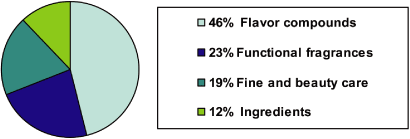
Our flavor products are sold principally to the food and beverage industries for use in consumer products such as soft drinks, non-carbonated drinks, candies, baked goods, desserts, prepared foods, dietary foods, dairy products, drink powders, pharmaceuticals, snack foods and alcoholic beverages. Two of our largest customers for flavor products are major producers of prepared foods and beverages in the United States. In the three years ended December 31, 2010, 2009 and 2008, sales of flavor products accounted for 46% of our total sales.
Our fragrance products are used by customers in the manufacture of various consumer goods in the home and personal care markets. The home market consists of laundry detergents, fabric care, candles, air fresheners and all-purpose cleaners. The personal care market consists of perfumes, colognes, after-shave lotions, skin care, lipsticks, deodorants and hair preparations. Most of the major global and regional manufacturers in each of these categories are our customers. Five of the largest global consumer products companies are among our principal customers. In the three years ended December 31, 2010, 2009 and 2008, sales of fragrance products accounted for 54% of our total sales.
See Note 12, Segment Information, of the Notes to the Consolidated Financial Statements for information concerning the two business segments, Flavors and Fragrances, and our geographic regions.
PRODUCTS
Our principal fragrance and flavor products consist of compounds of large numbers of ingredients blended in proprietary formulas created by our perfumers and flavorists. Most of these compounds contribute the total fragrance or flavor to the consumer products in which they are used. This fragrance or flavor characteristic is often a major factor in the consumer selection and acceptance of the consumer end product. A smaller number of compounds are sold to manufacturers who further blend them to achieve the finished fragrance or flavor in their products. We produce thousands of compounds, and new compounds are constantly being created in order to meet the many and changing characteristics of our customers’ end products. Most of the fragrance and flavor compounds are created and produced for the exclusive use of particular customers. Our products are sold in powder and liquid forms and in amounts ranging from a few pounds to many tons, depending upon the nature of the product.
The ingredients that we use in our compounds are both synthetic and natural. We manufacture a substantial portion of the synthetic ingredients. While a majority of our synthetic ingredients production is used in our compounds, a substantial portion is also sold to others. Natural ingredients are derived from flowers, fruits and other botanical products as well as from animal products. They contain varying numbers of organic chemicals, which are responsible for the fragrance or flavor of the natural product. The natural products are purchased in processed or semi-processed form. Some are used in compounds in the state in which they are purchased and others after further processing. Natural products, together with various chemicals, are also used as raw materials for the manufacture of synthetic ingredients by chemical processes. Our flavor products also include extracts and seasonings derived from various fruits, vegetables, nuts, herbs and spices as well as microbiologically-derived ingredients.

3


Table of Contents

MARKET DEVELOPMENTS
The demand for consumer products utilizing flavors and fragrances has been stimulated and broadened by changing social habits resulting from various factors such as increases in personal income, dual-earner households, teenage population, leisure time, urbanization, health and wellness concerns, including increased demand for nature based products and by the continued growth of emerging markets. In the fragrance field, these developments expanded the market for hair care, candles and air care products and deodorant and personal wash products with finer fragrance quality, as well as the market for colognes, toilet waters, men’s toiletries and other products beyond traditional luxury items such as perfumes. In the flavor field, similar market characteristics stimulated the demand for products such as convenience foods, soft drinks and low-fat and organic food products that must conform to expected tastes. New and improved methods of packaging, applying and dispensing have been developed for many consumer products that utilize some of our flavor or fragrance products. These developments called for the creation of new compounds and ingredients compatible with the newly introduced materials and methods of application.
PRODUCT DEVELOPMENT AND RESEARCH
The development of new flavors and fragrances is a complex technical and artistic process calling upon the combined knowledge and skill of our creative perfumers and flavorists, and our scientists. With extensive experience, the perfumers and flavorists continuously advance their skills for creating fragrances or flavors best suited to the market requirements of the customers’ products.
Scientists from various disciplines work in project teams with the perfumers and flavorists to develop flavor and fragrance products with consumer preferred performance characteristics. Scientific expertise includes: natural products research, plant science, organic chemistry, analytical chemistry, biochemistry, microbiology, process engineering, food science, material science and sensory science. Analytical and sensory science is applied to understand the complex interactions of the many ingredients in a consumer product in order to optimize the flavor or fragrance performance at all points of use. Material science technology is applied to create controlled release and delivery systems to enhance flavor and fragrance performance in consumer products. An important contribution to the creation of new flavor and fragrances is the discovery and development of new ingredients having improved fragrance or flavor value. The ingredients research program discovers molecules found in natural substances and creates new molecules that are subsequently tested for their fragrance or flavor value. The new molecules that meet rigorous requirements for commercial development are subsequently transferred to manufacturing operations for production.
Creative and technical product development is conducted in 33 fragrance and flavor laboratories in 26 countries. We maintain a research and development center at Union Beach, New Jersey. We spent $219 million in 2010, $185 million in 2009 and $197 million in 2008 on our research and development activities or about 8% of our revenues each year. We expect these expenditures to remain at this percentage level for 2011. Of the amount expended in 2010 on such activities, 54% was for fragrances and the balance was for flavors. We employed 1,117 persons in 2010 and 1,091 persons in 2009 in such activities.
Our business is not materially dependent upon any patents, trademarks or licenses.
DISTRIBUTION
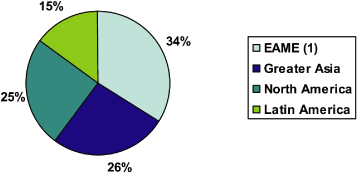
Distribution for our flavors and fragrances business units is similar in that most of our sales are through our own sales force. The flavors business operates from two sales offices in the United States and 38 sales offices in 30 foreign countries, while the fragrances business operates from two sales offices in the United States and 36 sales offices in 29 foreign countries. Sales in additional countries are made through agents and distributors. For the year ended December 31, 2010, 34% of our sales were to customers in Europe, Africa and Middle East (“EAME”), 26% in Greater Asia, 25% in North America and 15% in Latin America.

4


Table of Contents

During 2010, our 25 largest customers accounted for 52% of our sales. Sales to our largest customer accounted for 10% of our sales in 2010 and 11% in 2009 and 2008. These sales were largely in the fragrance business unit.
GOVERNMENTAL REGULATION
The manufacture and sale of our products are subject to regulation in the United States by the Food and Drug Administration, the Department of Agriculture, the Bureau of Alcohol, Tobacco and Firearms, the Environmental Protection Agency, the Occupational Safety and Health Administration, the Drug Enforcement Administration, state authorities and U.S. Customs and Border Protection. Foreign subsidiaries are subject to similar regulation in a number of countries. In particular, the European Union will require extensive chemical registration and testing over the next 7 years. Compliance with existing governmental requirements regulating the discharge of materials into the environment has not materially affected our operations, earnings or competitive position. In 2011, we expect to spend approximately $6 to $7 million on capital projects and approximately $18 million in operating expenses and governmental charges for the purpose of complying with such requirements.
RAW MATERIAL PURCHASES
We purchase roughly 10,000 different raw materials from many sources all over the world. The principal natural raw materials consist of essential oils, extracts and concentrates which are derived from fruits, vegetables, flowers, woods and other botanicals, animal products and raw fruits. The principal synthetic raw material purchases consist of organic chemicals. We believe that alternate materials or alternate sources of materials are available to enable us to maintain our competitive position in the event of any interruption in the supply of raw materials from present sources.
COMPETITION
We have more than 50 competitors in the world markets. IFF is one of the top four companies, which together represent approximately 70% of the flavors and fragrances industry. While no single factor is responsible, our competitive position is based principally on the creative skills of our perfumers and flavorists, the technological advances resulting from our research and development activities, the quality of our customer service, the support provided by our marketing and application groups, and our understanding of consumers. We believe that we are one of the largest companies producing and marketing, on an international basis, a wide range of fragrance and flavor products for sale to manufacturers of consumer products. In particular countries and localities, we face competition from numerous companies specializing in certain product lines, among which are some companies larger than us and some more important in a particular product line or lines. Most of our customers do not buy all of their fragrance or flavor products from the same supplier, and some customers make their own fragrance or flavor compounds with ingredients supplied by us or others.
EMPLOYEE RELATIONS
At December 31, 2010, we employed approximately 5,500 persons, of whom approximately 1,400 were employed in the United States. We have not experienced a work stoppage or strike and consider our employee relations to be satisfactory.

5


Table of Contents

EXECUTIVE OFFICERS OF REGISTRANT
The current executive officers of the Company, as of February 24, 2011, are listed below.
Year
First
Became
Name Office and Other Business Experience (1) Age Officer
Douglas D. Tough
Chairman of the Board and Chief Executive Officer since March 2010; Director since October 2008; Chief Executive Officer and Managing Director of Ansell Limited prior thereto. 61 2010
Kevin C. Berryman
Executive Vice President and Chief Financial Officer since May 2009; Chief Financial Officer, Nestle Professional, Americas, a global foodservice manufacturer, from October 2008 to May 2009; Senior Vice President Group Controller, Nestle S.A., an international food and beverage company, from June 2006 to September 2008; Chief Financial Officer, Nestle Purina Petcare prior thereto. 52 2009
Beth E. Ford
Executive Vice President, Supply Chain since October 2008; Executive Vice President and Chief Operating Officer, Hachette Book Group, a leading US trade publisher, from September 2007 to September 2008; Senior Vice President, Global Operations and Information Technology, Scholastic, Inc., a global publishing, education and media company, prior thereto. 46 2008
Nicolas Mirzayantz
Group President, Fragrances since January 2007; Senior Vice President, Fine Fragrance and Beauty Care and Regional Manager, North America, from April 2005 to December 2006; Senior Vice President, Fine Fragrance and Beauty Care prior thereto. 48 2002
Hernan Vaisman
Group President, Flavors since January 2007; Vice President, Latin America, from October 2004 to December 2006; Regional Finance Director, Latin America Region, prior thereto. 52 2004
Ahmet Baydar
Senior Vice President, Research and Development since September 2010; Vice President, Global Fragrance Research from February 2009 to August 2010; Director of Shave Care and Integrated Shaving Systems, The Procter & Gamble Company, prior thereto. 58 2010
Angelica T. Cantlon
Senior Vice President, Human Resources since August 2009; Senior Vice President-International Chief Administrative Officer, MetLife, Inc., an insurance and financial services company, from June 2005 to August 2009; Senior Vice President-Human Resources Business Leader, prior thereto. 59 2009
Richard A. O’Leary
Vice President and Controller since June 2009; Interim Chief Financial Officer from July 2008 to May 2009; Vice President, Corporate Development from July 2007 to May 2009; Finance Director, International Paper’s, a paper and packaging company, Brazilian affiliate prior thereto. 50 2007
(1) Employed by the Company or an affiliated company for the last five years, except as otherwise indicated.

6


Table of Contents

We make available free of charge on or through the Investor Relations link on our website, www.iff.com , all materials that we file electronically with the SEC, including our annual report on Form 10-K, quarterly reports on Form 10-Q, current reports on Form 8-K, and amendments to those reports, filed or furnished pursuant to Section 13(a) or 15(d) of the Securities Exchange Act of 1934 as soon as reasonably practicable after electronically filing such materials with, or furnishing them to, the SEC. During the period covered by this Form 10-K, we made all such materials available through our website as soon as reasonably practicable after filing such materials with the SEC.
You may also read and copy any materials filed by us with the SEC at the SEC’s Public Reference Room at 100 F Street, N.E., Washington, DC 20549, and you may obtain information on the operation of the Public Reference Room by calling the SEC in the U.S. at 1-800-SEC-0330. In addition, the SEC maintains an Internet website, www.sec.gov , that contains reports, proxy and information statements and other information that we file electronically with the SEC.
A copy of our Corporate Governance Guidelines, Code of Business Conduct and Ethics, and the charters of the Audit Committee, Compensation Committee, and Nominating and Governance Committee of the Board of Directors are posted on the Investor Relations section of our website, www.iff.com.
Item 1A. RISK FACTORS.
The following are some important factors that could cause the Company’s actual results to differ materially from those referred to or implied in any forward-looking statement. These are in addition to the risks and uncertainties discussed elsewhere in this Annual Report of Form 10-K and in the Company’s other filings with the Securities and Exchange Commission.
The current volatility in global economic conditions and the financial markets may adversely affect our industry, business and results of operations.
The volatility and disruption to the capital and credit markets since mid-2008 has rapidly impacted global economic conditions, resulting in significant recessionary pressures and declines in consumer confidence and economic growth. These conditions led to economic contractions in the developed economies and reduced growth rates in the emerging markets. Recent conditions have begun to improve, although potential volatility continues to exist. Despite fiscal and monetary intervention, it is possible that further declines in, or depressed levels of consumer spending and global growth rates may occur in the foreseeable future. Reduced consumer spending may cause changes in customer order patterns including order cancellations, and changes in the level of inventory at our customers, which may adversely affect our industry, business and results of operations. The impact of the credit crisis and economic slowdown will vary by region and country. The diversity of our geographic customer and operating footprint limits our reliance and exposure to any single economy.

7


Table of Contents

These conditions have also resulted in a substantial tightening of the credit markets, including lending by financial institutions and in the commercial paper market, both of which are sources of credit for our borrowing and liquidity. This tightening of the credit markets has increased the cost of capital and reduced the availability of credit. Based on our latest discussions, we believe that the financial institutions syndicated under our revolving credit facility are able to fulfill their commitments as of our filing date. While conditions have improved recently, it is difficult to predict how long the current economic and capital and credit market conditions will continue, whether they will deteriorate and which aspects of our products or business could be adversely affected. However, if current levels of economic and capital and credit market disruption and volatility continue or worsen, there can be no assurance that we will not experience an adverse impact, which may be material, on our business, the cost of and access to capital and credit markets, and our results of operations. In addition, we monitor the financial condition of our customers on a regular basis based on public information or data provided directly to us. If the financial condition of one of our major customers was negatively impacted by market conditions, liquidity, or other adverse events, we could be adversely impacted in terms of sales potential, excess capacity, accounts receivable and/or inventory specifically attributable to them.
Failure to maintain the integrity of our raw materials, supply chain and finished goods may adversely impact sales and our results of operations, IFF’s reputation and litigation costs.
The manufacture and sale of our products are subject to various regulatory requirements in each of the countries in which our products are manufactured and sold. In addition, we are subject to product safety and compliance requirements established by the industry or similar oversight bodies. We use a variety of strategies, methodologies and tools to identify current products standards, assess relative risks in our supply chain that can impact product integrity, monitor internal and external performance and test raw materials and finished goods to minimize the likelihood of product or process non-compliance.
If a non-compliance event went undetected, we could be subject to customer claims, penalties, litigation costs and/or settlements, remediation costs or loss of sales. These consequences would be exacerbated if our customer did not identify the defect and there was a resulting impact at the consumer level. This could lead to potentially large scale adverse publicity and potential consumer litigation.
Competitive factors may negatively impact our sales and marketability.
The market for flavors and fragrances is fragmented and highly competitive. IFF competes with many companies and some of our competitors specialize in one or more of our product segments while others participate in many of the same segments. In addition, some of our competitors may have greater financial and technical resources. The discovery and development of new flavor and fragrance materials, protection of the Company’s intellectual property and development and retention of key employees are important issues in our ability to compete in our businesses. Increased competition by existing or future competitors, including aggressive price competition, could result in the potential loss of substantial sales or create the need for us to reduce prices or increase spending and this could have an impact on sales and profitability.
We are subject to economic and social changes which may impact sales.
Demand for consumer products using flavors and fragrances has been stimulated and broadened by changing social habits resulting from factors such as increases in personal income, dual-earner households, teenage population, leisure time, health concerns and urbanization and by the continued growth in world population. Changes in any number of external economic factors, or changes in social or consumer preferences, could materially adversely impact our results of operations. Nearly 56% of our sales occur in the developed markets of North America, Western Europe and Australasia with the remainder in emerging markets. Accordingly, the impact on our operations will depend upon consumer spending on products for which we supply the flavor or fragrance in these global markets.
Results may be negatively impacted by the price, quality and availability of raw materials.
Raw materials are purchased from many sources from all over the world, including essential oils, extracts and concentrates derived from fruits, vegetables, flowers, woods and other botanicals, animal products, raw fruits and organic chemicals. Disruptions in the supply or quality of ingredients or rising prices for ingredients purchased could adversely impact our results of operations and profitability. Historically, we have experienced the greatest amount of volatility in natural products that represent approximately 50% of raw material purchases. Availability and pricing of these products, such as citrus, can be impacted by crop size and quality, weather, demand balance or alternative land use. To mitigate our sourcing risk, we maintain strategic stock levels covering multiple periods for critical items and/or time purchases to capitalize on favorable market conditions.

8


Table of Contents

Results may be negatively impacted by the inability to implement our business strategy, including the achievement of anticipated cost savings, profitability or growth targets.
We are committed to those particular business strategies and market segments that have been identified as likely to drive profitable future growth and improve operations and customer service. If we are unable to successfully and timely implement these strategies, it would adversely impact our financial condition and results of operations.
Results may be negatively affected by the impact of currency fluctuation or devaluation in principal foreign markets and the effectiveness of hedging and risk management strategies.
Our operations are conducted in many countries, the results of which are reported in the local currency and then translated into U.S. dollars at applicable exchange rates. The exchange rates between these currencies and the U.S. dollar have fluctuated and may continue to do so in the future. We employ a variety of techniques to reduce the impact of exchange rate fluctuations, including sourcing strategies and a limited number of foreign currency hedging activities. However, volatility in currency exchange rates may materially adversely impact our reported results of operations, financial condition or liquidity.
Results may be negatively impacted by the outcome of uncertainties related to litigation.
We are involved in a number of legal claims. While we believe that related insurance coverage is adequate with respect to such claims, we cannot predict the ultimate outcome of such litigation. In addition, we cannot provide assurance that future events will not result in an increase in the number of claims or require an increase in the amount accrued for any such claims, or require accrual for one or more claims that has not been previously accrued.
Results and cash flows may be negatively impacted by future pension funding and other postretirement obligations.
We establish assumptions concerning discount rates and actuarial assumptions regarding pension funding and other postretirement benefit obligations based on current market conditions, plan participants, asset returns, interest rates and other factors. Changes in pension and other postretirement benefits, plan assets, and associated expenses may occur in the future due to changes in capital markets, employee demographics and actuarial assumptions. These changes may adversely impact our financial condition, results of operations or liquidity.
Results may be negatively impacted by the effect of legal and regulatory requirements, as well as restrictions imposed on operations by foreign and domestic governmental entities.
The manufacture and sale of our products are subject to regulation in the United States by the Food and Drug Administration, the Department of Agriculture, the Bureau of Alcohol, Tobacco and Firearms, the Environmental Protection Agency, the Occupational Safety and Health Administration, the Drug Enforcement Administration and state authorities. In addition, we are subject to product safety and compliance requirements established by the industry or similar oversight bodies. Our foreign operations are subject to similar substantial governmental regulation and oversight standards in a number of countries, including extensive requirements within the European Union. Costs or investments necessary to maintain compliance with existing or future governmental regulations may adversely impact our financial condition, results of operations or liquidity.
We may face risks associated with events which may affect the world economy.
World events such as terrorist attacks, or regional conflicts have and may in the future weaken world economies. Any resulting weaknesses in these economies may materially adversely affect our business or the businesses of our customers, with a resultant negative impact on our financial condition, results of operations or liquidity.

9


Table of Contents

Our success depends on attracting and retaining talented people within our business. Any shortfall in recruitment or retention could adversely affect our ability to compete and achieve our strategic goals.
Attracting, developing, and retaining talented employees is essential to the successful delivery of our products and success in the marketplace. The ability to attract and retain talented employees is critical in the development of new products that meet the needs of our customers. However, we cannot be certain that we will be able to attract and retain such employees in the future. Any shortfalls in recruitment or retention could adversely affect our ability to operate successfully, retain our existing customers, grow our business, and effectively compete with our competitors.
Our operations may be affected by greenhouse emissions and climate change and related regulations.
The availability of raw materials and energy supplies fluctuate in markets throughout the world. Climate change may also effect the availability and price of key raw materials, including natural products used in the manufacture of our products. In order to mitigate the risk of price increases and shortages, purchasing has developed various sourcing strategies including multiple suppliers, inventory management systems, various geographic suppliers and long term agreements to mitigate risk.
In addition to market forces there are various regulatory efforts relating to climate change that may increase the cost of raw materials, especially energy used to operate our facilities that could materially impact our financial condition, results of operations and cash flows.
Changes in our tax rates, the adoption of new U.S. or international tax legislation or exposure to additional tax liabilities could affect our future results.
We are subject to taxes in the United States and numerous foreign jurisdictions. Our future effective tax rates could be affected by changes in the mix of earnings in countries with differing statutory tax rates, changes in the valuation of deferred tax assets and liabilities, changes in reserves and contingencies, cost of repatriations or changes in tax laws or their interpretation. In addition, the current administration and Congress have announced proposals for new U.S. tax legislation that, if adopted, could adversely affect our tax rate. Any of these changes could have a material adverse affect on our profitability. We are also subject to the continual examination of our income tax returns by the Internal Revenue Service and other tax authorities. We regularly assess the likelihood of adverse outcomes resulting from these examinations to determine the adequacy of our provision for taxes. There can be no assurance that the outcomes from these examinations will not materially adversely affect our financial condition and operating results.
ITEM 1B. UNRESOLVED STAFF COMMENTS.
None.

10


Table of Contents

ITEM 2. PROPERTIES.
Our principal properties are as follows:
Location Operation
United States
Augusta, GA
Production of fragrance ingredients.
Carrollton, TX(1)
Production of flavor compounds; flavor laboratories.
Hazlet, NJ(1)
Production of fragrance compounds; fragrance laboratories.
Jacksonville, FL
Production of fragrance ingredients.
New York, NY(1)
Fragrance laboratories; corporate headquarters
South Brunswick, NJ(1)
Production of flavor compounds and ingredients; flavor laboratories.
Union Beach, NJ
Research and development center.
France
Neuilly(1)
Fragrance laboratories.
Grasse
Production of flavor and fragrance ingredients; fragrance laboratories.
Great Britain
Haverhill
Production of flavor compounds and ingredients, and fragrance ingredients; flavor laboratories.
Ireland
Drogheda(7)
Production of fragrance compounds.
Netherlands
Hilversum
Flavor and fragrance laboratories.
Tilburg
Production of flavor compounds and ingredients, and fragrance compounds.
Spain
Benicarlo
Production of fragrance ingredients.
Argentina
Garin
Production of flavor compounds and ingredients, and fragrance compounds; flavor laboratories.
Brazil
Rio de Janeiro
Production of fragrance compounds.
São Paulo
Flavor and fragrance laboratories.
Taubate
Production of flavor compounds and ingredients.
Mexico
Tlalnepantla
Production of flavor and fragrance compounds; flavor and fragrance laboratories.
India
Chennai(2)
Production of flavor compounds and ingredients, and fragrance compounds; flavor laboratories.
Australia
Dandenong
Production of flavor compounds and flavor ingredients.
China
Guangzhou(4)
Production of flavor and fragrance compounds.
Shanghai(6)
Flavor and fragrance laboratories.
Xin’anjiang(5)
Production of fragrance ingredients.
Zhejiang(4)
Production of fragrance ingredients.
Indonesia
Jakarta(3)
Production of flavor compounds and ingredients, and fragrance compounds and ingredients; flavor and fragrance laboratories.
Japan
Gotemba
Production of flavor compounds.
Tokyo
Flavor and fragrance laboratories.
Singapore
Jurong (6)
Production of flavor and fragrance compounds.
Science Park(1)
Flavor and fragrance laboratories.
(1) Leased.
(2) We have a 93.4% interest in the subsidiary company that owns this facility.
(3) Land is leased and building is partially leased and partially owned.
(4) Land is leased and building and machinery and equipment are owned.
(5) We have a 90% interest in the subsidiary company that leases the land and owns the buildings and machinery.
(6) Building is leased and machinery and equipment are owned.
(7) Manufacturing operations have ceased effective September 30, 2010.
Our principal executive offices and New York laboratory facilities are located at 521 West 57th Street, New York City.

11


Table of Contents

ITEM 3. LEGAL PROCEEDINGS.
We are subject to various claims and legal actions in the ordinary course of our business. For purpose of reporting these actions, Bush Boake Allen, Inc. (“BBA”), a wholly-owned subsidiary of IFF, and/or IFF are referred to as the “Company.”
Popcorn Flavor Litigation.
In September 2001, the Company was named as a defendant in a purported class action brought against it in the Circuit Court of Jasper County, Missouri, on behalf of employees of a plant owned and operated by Gilster-Mary Lee Corp. in Jasper, Missouri (“ Benavides case”). The plaintiffs alleged that they sustained respiratory injuries in the workplace due to the use by Gilster-Mary Lee of a BBA and/or IFF flavor.
In January 2004, the Court ruled that class action status was not warranted. As a result of this decision, each of the 47 plaintiff cases was to be tried separately. Subsequently, eight cases were tried to a verdict, four verdicts resulted for the plaintiffs and four verdicts resulted for the Company, all of which were appealed by the losing party. Subsequently all plaintiff cases related to the Benavides case, including those on appeal, were settled.
Sixteen actions based on similar claims of alleged respiratory illness due to workplace exposure to flavor ingredients are currently pending against the Company and other flavor suppliers and related companies.
In July 2004, the Company and another flavor supplier were named defendants in a lawsuit by three former workers (and one spouse for loss of consortium) at a Ridgeway, Illinois factory in an action brought in the Circuit Court for the Second Judicial Circuit, Gallatin County, Illinois ( Batteese case). In August 2006, the Company and another flavor supplier were named defendants in a lawsuit by ten current and former employees of the Gilster-Mary Lee facility in Jasper, Missouri in the Missouri Circuit Court of Jasper County ( Arles case) and one former employees in the same Court ( Bowan case). Both these cases were settled in November 2010.
In January 2007, the Company and another flavor supplier were named defendants in a lawsuit in Hamilton County, Ohio Court of Common Pleas by 56 current and former employees (plus 28 spousal loss of consortium claims) of two separate Marion, Ohio factories ( Aldrich case). In June 2007, the Company and another flavor supplier were named defendants in a lawsuit filed in Hamilton County, Ohio Court of Common Pleas by 17 current and former employees (plus six spousal loss of consortium claims) of a Marion, Ohio facility ( Arnold case). In July 2007, the Company and another flavor manufacturer were named defendants in a lawsuit filed in Hamilton County, Ohio Court of Common Pleas by 35 current and former workers (plus 13 spousal loss of consortium claims) of two Marion, Ohio facilities ( Adamson case).
In March 2008, the Company and another flavor supplier were named defendants in two lawsuits in the Hamilton County, Ohio Court of Common Pleas, one by nine current and former employees and the spouses of two such employees of a popcorn plant in Marion, Ohio ( Ferguson case) and the other by ten current and former employees and three spouses of such employees of the same plant ( Brown case). In August 2008, the Company and seven other flavor and material suppliers were named defendants in a lawsuit by nine plaintiffs (plus eight loss of consortium claims) in the Hamilton County Court of Common Pleas ( Auld case).
In September 2009, the Company, another flavor supplier and a former employer were named as defendants in a lawsuit by the child of a worker at a Ridgeway, Illinois factory in an action brought in the Circuit Court of Cook County, Illinois, but which is being transferred to the Gallatin County, Illinois Circuit Court ( Patton case). In December 2009, the Company, five other flavor manufacturers and five microwave popcorn manufacturers and distributors were named defendants in a lawsuit in the U.S. District Court for the Northern District of Iowa (and in an identical suit in case the Iowa suit was found to be an incorrect jurisdiction was filed in May 2010 in Superior Court of California, County of Los Angeles, Central District) by a consumer of microwave popcorn and her husband ( Daughetee case).

12


Table of Contents

In January 2010, the Company was named as a defendant in a lawsuit by four former workers (and their spouses) at a Ridgeway, Illinois factory in an action brought in the U.S. District Court for the Southern district of Illinois ( Barker case). In May 2010, the Company and 22 other companies, many flavor and ingredient suppliers, were named defendants in a lawsuit by an employee (and his spouse) at a Forest Park, Georgia food plant in an action brought in the State Court of Gwinnett County, Georgia ( Anderson case). In September 2010, the Company and 28 other companies, many flavor and flavor ingredient suppliers, were named defendants in a lawsuit by an employee of a series of companies alleged to have purchased products from the defendants in an action brought in the Boone County Circuit Court in Kentucky ( Geyman case). In October 2010, the Company and another flavor supplier were named defendants in a lawsuit by a former employee of a Marion, Ohio facility (and his spouse for loss of consortium) in an action brought in the Hamilton County, Ohio Court of Common Pleas ( Young case). In December 2010, the Company and another flavor supplier were named defendants in a lawsuit by three former employees of a Marion, Ohio facility in an action brought in Hamilton County, Ohio Court of Common Pleas ( Belt case), by nine former employees (plus four spouses) of the same facility in the same Court against the same defendants ( Calloway case) and by 23 former employees (plus 14 spouses) of the same facility in the same Court against the same defendants ( Aldrich II case). The defendants in these three cases are former defendants who were previously dismissed from similar actions in the same Court against the same defendants.
The Company believes that all IFF and BBA flavors at issue in these matters meet the requirements of the U.S. Food and Drug Administration and are safe for handling and use by workers in food manufacturing plants when used according to specified safety procedures. These procedures are detailed in instructions that IFF and BBA provided to all their customers for the safe handling and use of their flavors. It is the responsibility of IFF’s customers to ensure that these instructions, which include the use of appropriate engineering controls, such as adequate ventilation, proper handling procedures and respiratory protection for workers, are followed in the workplace.
On a quarterly basis, or more frequently as conditions warrant, the Company reviews the status of each pending claim, as well as its insurance coverage for such claims with due consideration given to potentially applicable deductibles, retentions and reservation of rights under its insurance policies, and the advice of its outside legal counsel and an independently developed model for assessing insurance deductible amounts with respect to all these matters. While the ultimate outcome of any litigation cannot be predicted, management believes that adequate provision has been made with respect to all known claims. Based on information presently available and in light of the merits of its defenses and the availability of insurance, the Company does not expect the outcome of the above cases, singly or in the aggregate, to have a material adverse effect on the Company’s financial condition, results of operations or liquidity. There can be no assurance that future events will not require the Company to increase the amount it has accrued for any matter or accrue for a matter that has not been previously accrued. See Note 16 of the Notes to the Consolidated Financial Statements.
Patent Claims.
A complaint, captioned V. Mane Fils S.A. v. International Flavors and Fragrances, Inc., was filed in U.S. District Court for the District of New Jersey in May 2006, and alleges that the Company has and continues to infringe U.S. Patent Nos. 5,725,856 and 5,843,466, relating to a flavor ingredient that may provide a cooling effect. The Company answered the complaint by denying liability and asserting that both patents are invalid and various other defenses. In June 2008, plaintiff amended its complaint to add claims for violations of the Lanham Act, tortious interference and unfair competition. The Company answered the amended complaint by denying all liability. In connection with the patent claims, the plaintiff seeks monetary damages, damages for alleged willful infringement, injunctive relief and fees, costs and interest. In connection with the additional claims, plaintiff also seeks monetary damages, punitive damages, fees and costs. In May 2010, following reexamination of the patents in question by the U.S. Patent Office, all of the patent claims, initially rejected in the reexamination proceeding, were reallowed. The Company and the plaintiff have each filed motions for summary judgment with respect to various claims. No trial date has been scheduled. The Company denies the allegations and will defend its position in Court. We analyze our liability on a regular basis and accrue for litigation loss contingencies when they are probable and estimable. During the second quarter 2010, we recorded a provision related to this case which is reflected in Other liabilities. Based on present information, the Company believes that its ultimate liability, if any, arising from this proceeding would not have a material adverse effect on its financial position or liquidity; however, due to the unpredictability regarding the litigation process, such claim, if ultimately resolved against us, could potentially have a material adverse effect on our cash flows or financial results in a particular period. An adverse outcome could also potentially affect our ability to sell one or more flavor products to the extent the Court ultimately issued an injunction related to the patents. The Company disputes the allegations of wrongdoing, believes it has meritorious defenses and is vigorously defending all claims.

13


Table of Contents

Environmental
Over the past 20 years, various federal and state authorities and private parties have claimed that the Company is a Potentially Responsible Party (“PRP”) as a generator of waste materials for alleged pollution at a number of waste sites operated by third parties located principally in New Jersey and have sought to recover costs incurred and to be incurred to clean up the sites.
The Company has been identified as a PRP at ten facilities operated by third parties at which investigation and/or remediation activities may be ongoing. The Company analyzes its liability on a regular basis. The Company accrues for environmental liabilities when they are probable and estimable. The Company estimates its share of the total future cost for these sites to be less than $5 million.
While joint and several liability is authorized under federal and state environmental laws, the Company believes the amounts it has paid and anticipates paying in the future for clean-up costs and damages at all sites are not and will not be material to the Company’s financial condition, results of operations or liquidity. This conclusion is based upon, among other things, the involvement of other PRPs at most sites, the status of proceedings, including various settlement agreements and consent decrees, the extended time period over which payments will likely be made and an agreement reached in July 1994 with three of the Company’s liability insurers pursuant to which defense costs and indemnity amounts payable by the Company in respect of the sites will be shared by the insurers up to an agreed amount.
ITEM 4. (REMOVED AND RESERVED)
PART II
ITEM 5. MARKET FOR REGISTRANT’S COMMON EQUITY, RELATED STOCKHOLDER MATTERS AND ISSUER PURCHASES OF EQUITY SECURITIES.
Market Information.
Our common stock is traded principally on the New York Stock Exchange. The high and low stock prices for each quarter during the last two years were:
2010 2009
Quarter High Low High Low
First
$ 48.83 $ 39.28 $ 32.35 $ 25.30
Second
51.77 42.00 33.51 29.84
Third
49.51 41.59 39.15 31.21
Fourth
56.10 48.31 41.85 36.85
Approximate Number of Equity Security Holders.
(B)
(A) Number of shareholders of record
Title of Class as of February 12, 2011
Common stock, par value 12 1 / 2 ¢ per share
2,740

14


Table of Contents

Dividends.
Cash dividends declared per share for each quarter during the two most recent fiscal years were as follows:
Quarter 2010 2009
First
$ 0.25 $ 0.25
Second
0.25 0.25
Third
0.27 0.25
Fourth
0.27 0.25
Performance Graph.
Total Return To Shareholders (1)
(Includes reinvestment of dividends)
ANNUAL RETURN PERCENTAGE
Years Ending
Company Name / Index 2006 2007 2008 2009 2010
International Flavors & Fragrances
49.64 -0.36 -36.64 42.43 38.06
S&P 500 Index
15.79 5.49 -37.00 26.46 15.06
Peer Group
18.66 22.37 -16.32 18.05 15.44
Base INDEXED RETURNS
Period Years Ending
Company Name / Index 2005 2006 2007 2008 2009 2010
International Flavors & Fragrances
$ 100 $ 149.64 $ 149.10 $ 94.47 $ 134.54 $ 185.75
S&P 500 Index
100 115.79 122.16 76.96 97.33 111.99
Peer Group
100 118.66 145.20 121.51 143.64 165.81
Peer Group Companies (2)
Alberto Culver Company
Hormel Foods Corp. Unilever NV
Avon Products
Kellogg Co. YUM Brands, Inc.
Campbell Soup Co.
Estee Lauder Companies, Inc.
Church & Dwight Inc.
McCormick & Company, Inc.
Clorox Company
McDonald’s Corp.
Coca-Cola Company
Nestle SA
Colgate-Palmolive Co.
Pepsico Inc.
ConAgra Foods, Inc.
Procter & Gamble Co.
General Mills Inc.
Revlon Inc.
H.J. Heinz Co.
Sara Lee Corp.
Hershey Company
Sensient Technologies Corp.

15


Table of Contents

(LINE GRAPH)
(1) The Cumulative Shareholder Return assumes that the value of an investment in our Common Stock and each index was $100 on December 31, 2005, and that all dividends were reinvested.
(2) Due to the international scope and breadth of our business, we believe that a Peer Group comprised of international public companies, which are representative of the customer group to which we sell our products, is the most appropriate group against which to compare shareholder returns. Wm. Wrigley Jr. Company has been eliminated from the Peer Group for all years presented above due to its acquisition by Mars, Incorporated in October 2008.
Issuer Purchases of Equity Securities.
The Company has not purchased any shares during the fourth quarter of 2010.
Total Number of
Total Shares Purchased Maximum Number
Number of Average as Part of Publicly of Shares That May
Shares Price Paid Announced Yet Be Purchased
Purchased per Share Program Under the Program
October 1 – 31, 2010
November 1 – 30, 2010
December 1 – 31, 2010
Total shares purchased

16


Table of Contents

ITEM 6. SELECTED FINANCIAL DATA.
INTERNATIONAL FLAVORS & FRAGRANCES INC.
QUARTERLY FINANCIAL DATA (UNAUDITED)
(DOLLARS IN THOUSANDS EXCEPT PER SHARE AMOUNTS)
The following selected consolidated financial data is derived from our Consolidated Financial Statements. This data should be read in conjunction with the Consolidated Financial Statements and Notes thereto, and with Item 7, Management’s Discussion and Analysis of Financial Condition and Results of Operations.
Net Income Per Share (b)
Net Sales Gross Profit Net Income (a) Basic Diluted
Quarter 2010 2009 2010 2009 2010 2009 2010 2009 2010 2009
First
$ 653,909 $ 559,630 $ 270,207 $ 222,065 $ 63,789 $ 47,197 $ 0.80 $ 0.60 $ 0.80 $ 0.60
Second
665,800 568,261 285,001 227,914 67,152 48,083 0.84 0.61 0.83 0.60
Third
673,283 612,634 285,048 248,854 77,038 52,800 0.96 0.67 0.95 0.66
Fourth
629,870 585,633 252,346 235,412 55,578 47,446 0.69 0.60 0.68 0.59
$ 2,622,862 $ 2,326,158 $ 1,092,602 $ 934,245 $ 263,557 $ 195,526 $ 3.29 $ 2.48 $ 3.26 $ 2.46
(a) Net Income Q1-2010 included $4,408 of restructuring related costs associated with facility rationalizations within our European Fragrance business. Q2-2010 includes $1,594 of restructuring related costs associated with facility rationalizations within our European Fragrance business. Q3-2010 includes $2,049 of restructuring related costs associated with facility rationalizations within our European Fragrance business. Q4-2010 includes $877 of additional costs associated with the ongoing reorganization of our European businesses.
Net Income Q2-2009 included $2,685 related to restructuring costs driven by weak economic conditions impacting our Fragrance business and $680 pertaining to employee separation costs. Q3-2009 includes $9,186 of restructuring related costs associated with facility rationalizations within our European Fragrance business. Q3-2009 also includes $3,348 of costs associated with the change in our Chief Executive Officer. Q4-2009 includes $2,892 of additional costs associated with the ongoing reorganization of our European businesses and $4 million of expense related to out-of-period tax adjustments.
(b) The sum of the 2009 quarters’ Net Income per diluted share does not equal the earnings per diluted share for the full year due to changes in average shares outstanding.

17


Table of Contents

INTERNATIONAL FLAVORS & FRAGRANCES INC.
FIVE-YEAR SUMMARY
(DOLLARS IN THOUSANDS EXCEPT PER SHARE AMOUNTS)
2010 2009 2008 2007 2006
Consolidated Statement of Income Data
Net sales
$ 2,622,862 $ 2,326,158 $ 2,389,372 $ 2,276,638 $ 2,095,390
Cost of goods sold
1,530,260 1,391,913 1,418,441 1,325,226 1,211,453
Research and development expenses
218,772 184,771 196,863 186,271 173,303
Selling and administrative expenses
447,392 390,885 400,723 397,985 376,781
Curtailment loss
5,943
Restructuring and other charges, net (a)
10,077 18,301 18,212 2,680
Interest expense
48,709 61,818 74,008 41,535 25,549
Other expense (income), net
8,059 1,921 (2,797 ) (11,136 ) (9,838 )
2,263,269 2,049,609 2,105,450 1,945,824 1,779,928
Income before taxes
359,593 276,549 283,922 330,814 315,462
Taxes on income
96,036 81,023 54,294 83,686 88,962
Net income
$ 263,557 $ 195,526 $ 229,628 $ 247,128 $ 226,500
Percentage of net sales
10.0 8.4 9.6 10.9 10.8
Percentage of average shareholders’ equity
29.7 28.9 38.0 32.0 24.6
Net income per share — basic
$ 3.29 $ 2.48 $ 2.89 $ 2.84 $ 2.50
Net income per share — diluted
$ 3.26 $ 2.46 $ 2.86 $ 2.81 $ 2.48
Average number of diluted shares (thousands)
80,440 79,094 79,723 87,528 91,639
Consolidated Balance Sheet Data
Cash and cash equivalents
$ 131,322 $ 80,135 $ 178,467 $ 151,471 $ 114,508
Receivables, net
451,804 444,265 400,971 400,527 357,155
Inventories
531,675 444,977 479,567 484,222 446,606
Property, plant and equipment, net
538,118 501,293 496,856 508,820 495,124
Goodwill and intangible assets, net
714,416 720,530 726,683 732,836 745,716
Total assets (c)
2,872,455 2,644,774 2,749,913 2,726,314 2,478,904
Bank borrowings, overdrafts and current portion of long-term debt
133,899 76,780 101,982 152,473 15,897
Long-term debt
787,668 934,749 1,153,672 1,060,168 791,443
Total Shareholders’ equity (b) (c) (e)
1,003,155 771,910 580,642 626,359 916,056
Other Data
Current ratio (d)
2.0 2.3 2.6 2.1 2.4
Gross additions to property, plant and equipment
$ 106,301 $ 66,819 $ 85,395 $ 65,614 $ 58,282
Depreciation and amortization expense
79,242 78,525 75,986 82,788 89,733
Cash dividends declared
83,056 78,962 75,902 76,465 68,956
per share
$ 1.04 $ 1.00 $ 0.96 $ 0.88 $ 0.77
Number of shareholders of record at year-end
2,758 3,004 3,167 3,248 3,393
Number of employees at year-end
5,514 5,377 5,338 5,315 5,087
(a) Restructuring and other charges ($8,928 after tax) in 2010, ($14,763 after tax) in 2009, ($12,583 after tax) in 2008 and ($1,982 after tax) in 2006 were the result of various restructuring and reorganization programs of the Company.
(b) The 2006 amounts reflect adoption of ASC 715 “Compensation — Retirement Benefits”.
(c) The 2007 amounts reflect adoption of ASC 740 “Income Taxes”.
(d) Current ratio is equal to current assets divided by current liabilities.
(e) Includes noncontrolling interests for all periods presented.
(f) The 2006 — 2008 periods have been revised to properly recognize R&D expense, net of R&D credits. Previously, these credits were reflected as a reduction of tax expense.
(g) Certain reclassifications have been made to the prior periods, within cost of goods sold, research and development expenses and selling and administrative expenses, to conform with the 2010 presentation.

18


Table of Contents

ITEM 7. MANAGEMENT’S DISCUSSION AND ANALYSIS OF FINANCIAL CONDITION AND RESULTS OF OPERATIONS.
(UNLESS INDICATED OTHERWISE, DOLLARS IN MILLIONS EXCEPT PER SHARE AMOUNTS)
Organization of Information
Management’s Discussion and Analysis provides a narrative on our operating performance, financial condition and liquidity and should be read in conjunction with the accompanying financial statements. It includes the following sections:
Executive Overview
Sales Commentary
Consolidated Operating Results
Goodwill and Intangible Assets
Restructuring and Other Charges
Income Taxes
Financial Condition
Critical Accounting Policies and Use of Estimates
New Accounting Standards
Non-GAAP Financial Measures
Cautionary Statement Under The Private Securities Litigation Reform Act of 1995
Executive Overview
We are a leading creator and manufacturer of flavor and fragrance compounds used to impart or improve the flavor or fragrance in a wide variety of consumer products. The precise size of the global market for flavors and fragrances is difficult to determine because the industry is highly fragmented, both geographically and along product lines; there are a limited number of publicly traded companies in the industry; certain customers maintain in-house capabilities fulfilling a portion of their flavor or fragrance needs; and the quality and depth of market information in developing regions of the world is limited. Analysts generally estimate the global market to be $15-$16 billion of which IFF represents 16%-17%; the largest competitor in the industry has approximately a 25% market share. IFF is one of the top four companies, which together represent approximately 70% of the flavors and fragrances industry.
IFF is organized into two units that reflect our flavor and fragrance businesses. Approximately 46% of our 2010 net sales were flavor compounds. Flavor compounds are sold to the food and beverage industries for use in consumer products such as prepared foods, beverages, dairy, food and confectionery products. The remaining 54% of sales, representing the fragrance business unit, were in three fragrance categories: functional fragrances, including fragrance compounds for personal care (e.g., soaps) and household products (e.g., detergents and cleaning agents); fine fragrance and beauty care, including perfumes, colognes and toiletries; and ingredients, consisting of natural and synthetic ingredients that can be combined with other materials to create unique functional and fine fragrance compounds. Major fragrance customers include the cosmetics industry, including perfume and toiletries manufacturers, and the household products industry, including manufacturers of soaps, detergents, fabric care, household cleaners and air fresheners. Approximately 55% of our ingredient production is consumed internally; the balance is sold to third party customers.
The under-pinning of structural growth for the flavor and fragrance industry are population growth, an expanding middle class and technology. Changing social habits resulting from such factors as increases in personal income, leisure time, health and wellness and urbanization stimulate demand for consumer products utilizing flavors and fragrances, especially in the emerging markets. These developments also drive the creation and development of new molecules, technologies and/or solutions that facilitate and improve the end-use consumption of flavors and fragrances in consumer products.

19


Table of Contents

Flavors and fragrances are generally:
created for the exclusive use by a specific customer;
sold in powder or liquid form, in amounts ranging from a few pounds to several tons depending on the nature of the end product in which they are used;
a small percentage of the volume and cost of the end product sold to the consumer; and
a major factor in consumer selection and acceptance of the product.
The flavors and fragrances industry is impacted by macroeconomic factors in all product categories and geographic regions. Such factors include the impact of currency on the price of raw materials and operating costs as well as on translation of reported results. In addition, IFF is susceptible to margin pressures due to customers’ cost improvement programs and input cost increases. However, these pressures can often be mitigated through a combination of price realization, product reformulation, sourcing strategies and material substitution plus internal cost containment efforts, and the development of innovative and streamlined solutions and processes.
We produce more than 34,000 unique compounds, of which more than half is flavors. We continually create new compounds to meet the changing characteristics and needs of our customers’ end products. No single compound represents more than 2% of net sales. Development of flavors and fragrances is a complex artistic and technical process calling upon the combined knowledge and talents of creative perfumers and flavorists, and application and research chemists. An important element of creation is the development of new ingredients. We bear essentially all costs incurred in connection with the creation and development of new flavors and fragrances and such formulae are generally protected under trade secrecy. We are not materially dependent on any patents, trademarks or licenses.
IFF’s success in the flavors and fragrances industry is driven by our ability to create unique sensory experiences that meet evolving consumer needs and expectations. These solutions are delivered in a cost-efficient manner in conjunction with world-class customer service.
STRATEGIC DRIVERS
To increase shareholder value, we pursue and develop a value-creation model that encompasses three main elements: investing in research & development to identify and commercialize new, innovative materials and delivery systems; maintaining a deep understanding of both consumer preferences and consumer product brands; and excellence in our creative capabilities. Our goal is to deliver differentiated solutions that enable our customers’ brands to win in the marketplace.
In order to pursue these strategies, our organization is focused on ensuring that we efficiently create, produce, and sell unique, superior, and economically competitive products through our world class integration of research and development, consumer insight, customer intimacy, creativity, and operational excellence. We believe we are well positioned to achieve success by targeting strategically important global and regional customers in both developed and emerging markets; attracting, developing and retaining top talent; investing in research and development; and fostering a culture of innovation, accountability, cost discipline and continuous improvement.
CHANGE IN MANAGEMENT
During the interim period from October 1, 2009 through February 28, 2010, the Company operated using temporary office of the Chief Executive Officer (“CEO”) of the Company, which was comprised of Executive Vice President and Chief Financial Officer, Kevin Berryman; Group President Fragrances, Nicolas Mirzayantz; and Group President, Flavors, Hernan Vaisman. Each of these executives remained in their then current positions while carrying out their Office of the CEO responsibilities. The Office of the CEO reported to the Board of Directors. On March 1, 2010 Douglas D. Tough assumed the position of Chairman of the Board of Directors (“Chairman”) and CEO.

20


Table of Contents

Effective December 31, 2010, Senior Vice President, General Counsel and Secretary, Dennis Meany retired from the Company. Since Mr. Meany’s retirement, our CEO has assumed direct oversight for the legal functions and our Executive Vice President, Head of Supply Chain, has assumed direct oversight for the regulatory functions.
Sales Commentary
A breakdown of sales by principal product category is depicted in the graph below.
2010 Sales by Category
(PIE CHART)
Our five largest customers comprise 32% of consolidated sales and our top 25 customers comprise 52%; these percentages have remained fairly constant for several years. We have one customer that accounts for 10% of our sales. A key factor for commercial success is inclusion on the strategic customers’ core supplier lists, opening opportunities to win new business. We are on the core supplier lists of a large majority of our strategic customers.
Net sales by business unit for 2010, 2009 and 2008 were as follows:
Percent Percent
Net Sales 2010 Change 2009 Change 2008
Fragrances
$ 1,420 14 % $ 1,245 -4 % $ 1,297
Flavors
1,203 11 % 1,081 -1 % 1,092
Total net sales
$ 2,623 13 % $ 2,326 -3 % $ 2,389
2010 Sales by Destination
We manage our operations by global business units but utilize destination sales as a supplemental performance measure and indicator of underlying market trends. Although reported sales and earnings are affected by the weakening or strengthening of the U.S. dollar, this has not had a long-term effect on the underlying competitiveness of our business.
(PIE CHART)

21


Table of Contents

Net sales by destination for 2010, 2009 and 2008 were as follows:
Percent Percent
Sales by Destination 2010 Change 2009 Change 2008
EAME (1)
$ 897 11 % $ 808 -11 % $ 907
Greater Asia
677 18 % 575 5 % 547
North America
651 8 % 600 0 % 601
Latin America
398 16 % 343 3 % 334
Total net sales, as reported
$ 2,623 13 % $ 2,326 -3 % $ 2,389
(1) Europe, Africa and Middle East
2010 in Comparison to 2009
Sales for 2010 totaled $2,623 million, an increase of 13% from $2,326 million in 2009. The significant acceleration of growth (+13% in Local Currency; LC terms) reflects strong commercial performance in both businesses, higher volumes, including the effects of re-stocking in developed markets, most notably in the first half of the year and stronger sales mix for both businesses. Sales from new wins accounted for half of the LC sales gains. In addition, higher volumes were driven by a broad-based recovery in demand and lower base period comparisons in 2009 (primarily in Fine Fragrances, Ingredients, and Home Care). Foreign currency movements had only a minor impact on year-over-year sales growth, although there was volatility from quarter-to-quarter.
Flavors Business Unit
On a reported basis Flavor sales increased 11%; excluding the impact of foreign currency translation, LC sales for the Flavors business increased 10% from the prior year period. Almost 60% of year-over-year gain was driven by higher volume (including some elements of re-stocking) with the remaining due to sales from new business. Solid growth was experienced across all product categories, led by double-digit LC growth in our Beverage and Confectionery categories and near double-digit growth in the others. Our regional growth was driven by EAME and Greater Asia which benefited from result of higher volumes and net new business particularly in the Beverage, Confectionery, and Savory categories. Growth in both regions benefited from continued investments to strengthen our commercial and development capabilities. Sales in North America were up 6% due to higher volume and new business in Beverages and Confectionery. Latin America had solid growth, up 6% in LC as new business wins and volume recovery in Confectionery and Savory more than offset the effects of non-strategic business lost last year. Overall growth was led by solid double-digit growth in emerging markets of 14%, which represent 47% of Flavors overall sales.
Fragrances Business Unit
Fragrance sales increased significantly, up 14% on a reported basis and 16% in LC terms. Approximately 60% of the improvement was driven by sales from new wins with our customers with the balance attributable to increased volume (including the benefit of weaker prior year base sales in Fine Fragrance and Ingredients). The volume gains reflect a bounce back in demand supported by increased customer promotional activities, mainly in Fine Fragrance, lower base period comparisons and re-stocking in the developed markets. Overall, Fine & Beauty Care LC sales increased 26% versus last year, driven by significant gains in new business, a recovery in demand (including effects of re-stocking), and low prior year activity levels. LC Functional Fragrance sales increased 7%, driven by double-digit gains in Home Care resulting from new business and solid growth in our Fabric Care category. Ingredient LC sales increased 18% driven by a recovery in demand, weaker year-ago activity and customer success within certain specialty grades. All regions delivered double-digit LC sales gains, led by Latin America (Fine & Beauty and Ingredients) and EAME (Fine Fragrance and Functional). Greater Asia’s growth was led by strong Functional and Hair Care category sales, whereas North America was mainly driven by higher Fine Fragrance sales. Overall growth was well-balanced, with both emerging and developed markets delivering double-digit LC gains, although emerging market growth was strongest at 18%.

22


Table of Contents

Sales by Region and Category
Regional and product category sales performance for 2010 compared to 2009, in reported dollars and local currency, was as follows:
% Change in Sales — 2010 vs 2009
Fine &
Beauty Care Functional Ingredients Total Frag. Flavors Total
North America
Reported 11 % 2 % 23 % 11 % 6 % 8 %
EAME
Reported 25 % 1 % 12 % 12 % 10 % 11 %
Local Currency 31 % 6 % 17 % 17 % 13 % 15 %
Latin America
Reported 44 % 5 % 14 % 20 % 10 % 16 %
Local Currency 40 % 5 % 14 % 18 % 6 % 14 %
Greater Asia
Reported 22 % 19 % 11 % 18 % 17 % 18 %
Local Currency 20 % 17 % 10 % 17 % 12 % 14 %
Total
Reported 24 % 6 % 15 % 14 % 11 % 13 %
Local Currency 26 % 7 % 18 % 16 % 10 % 13 %
Local Currency Sales Drivers
North America Fine & Beauty sales growth was driven by 16% growth in Fine Fragrance associated with general demand recovery (including some elements of re-stocking) as well as weaker year ago comparison levels (mostly in the first half of the year) combined with good market success for new business launches. The strong performance in Ingredients reflects broad-based volume gains, re-stocking and weak market conditions last year. Functional Fragrance sales increased as strong new business wins across all categories more than offset volume erosion in Fabric Care, with the strongest gain within the Home Care category. Double-digit growth in Beverages (volume) and Confectionery (net new wins) categories led the growth in the Flavors business, with Savory also contributing solid growth.
EAME delivered strong sales gains across all categories (except Personal Wash), led by new business and demand recovery in Fine Fragrance, Ingredients and Fabric Care plus net new wins and higher volume for Flavors, notably within the Beverage category, which grew 27%. The Flavors business also benefited from double-digit growth in Confectionery and Dairy. Re-stocking also supported growth in the developed countries within the region across most categories.
Latin America’s sales performance was led by general recovery in demand and new business in Fine Fragrance, which grew 50%. Double-digit growth in Beauty Care, Confectionery, Dairy and Savory categories more than offset the effect of non-strategic Flavors’ business lost last year. The Functional Fragrance category improvement benefited from both new business and volume recovery in Home Care and Fabric Care.
Greater Asia delivered double-digit LC sales growth in all categories. Fine & Beauty Care gains were driven by demand recovery and new business wins in Hair Care and Toiletries. Fine Fragrance’s growth of 40% also benefited from demand recovery and a weaker prior year base. Within Functional Fragrances, Fabric, Home Care and Personal Wash all achieved double-digit gains reflecting both strong commercial performance and solid demand growth. Flavor sales growth was driven by new product introductions and volume growth mainly in Savory, Beverage and Confectionery, with all major categories producing double-digit gains.
2009 in Comparison to 2008
Sales for 2009 totaled $2,326 million, decreasing 3% from the prior year period of $2,389 million, as Flavor sales declined 1% and Fragrance sales decreased 4%. Foreign exchange had a 3% negative impact on reported sales during 2009 as the U.S. dollar was stronger during the first three-quarters of 2009 versus the comparable year-ago period. Market conditions improved during the second half of 2009, as global economic conditions strengthened and customer inventory levels stabilized. LC sales increased over 2% during both the third and fourth quarters compared to a decline of 3% during the first six months of 2009.

23


Table of Contents

Flavors Business Unit
Flavor sales decreased 1% for 2009 compared to 2008 as the effects of a stronger U.S. dollar, soft demand and inventory corrections in Europe and customer specific losses in Latin America more than offset new wins, solid demand and price increases in North America and Greater Asia. Excluding the impact of currencies, sales for the Flavors business increased over 2% during 2009 compared to 2008.
Fragrances Business Unit
Fragrance sales decreased 4% for 2009 compared to 2008 reflecting double-digit LC sales declines for Fine Fragrances, as consumers reduced discretionary spending and the industry significantly reduced inventories across the supply chain. These headwinds were partially offset by solid growth and new wins in beauty care, toiletries and substantially all functional fragrance categories. Excluding the impact of currencies, sales for the Fragrances business declined 1% during 2009 compared to 2008.
Sales by Region and Category
Regional and product category sales performance for 2009 compared to 2008, in reported dollars and local currency, was as follows:
% Change in Sales — 2009 vs 2008
Fine &
Beauty Care Functional Ingredients Total Frag. Flavors Total
North America
Reported -14 % 1 % 5 % -3 % 3 % 0 %
EAME
Reported -24 % -3 % -11 % -13 % -7 % -11 %
Local Currency -18 % 2 % -6 % -8 % 0 % -5 %
Latin America
Reported 8 % 4 % -2 % 5 % 0 % 3 %
Local Currency 9 % 5 % -1 % 5 % 4 % 5 %
Greater Asia
Reported 17 % 14 % -1 % 12 % 1 % 5 %
Local Currency 20 % 16 % -3 % 13 % 4 % 7 %
Total
Reported -12 % 3 % -4 % -4 % -1 % -3 %
Local Currency -8 % 5 % -2 % -1 % 2 % 0 %
Local Currency Sales Drivers
North America sales were flat as the erosion and volume declines in Fine Fragrance and Flavors compounds offset more than $40 million in new product introductions, plus modest price realization in Flavors and Functional Fragrances. Ingredient sales growth was mainly attributable to cost driven price increases.
EAME sales declines in LC were driven by de-stocking and weak underlying demand for Fine Fragrance and Ingredients that more than offset solid win performance in Functional Fragrances. Flavor sales were effectively flat as new wins in Savory and Confectionary plus pricing were offset by customer inventory reductions across most categories.
Latin America sales growth was 5% in LC led by near double-digit growth in the Fine Fragrances and Beauty Care and solid performance in the Functional Fragrances and Flavors categories. The growth was primarily driven by new product introductions of approximately $15 million combined with price increases across both businesses.
Greater Asia LC sales growth was largely driven by more than $15 million in new product introductions in Fabric and Hair Care, combined with approximately $10 million in new product introductions in Flavors which more than offset the effects of customer inventory reductions in the Ingredients category supply chain.

24


Table of Contents

Consolidated Operating Results
The percentage relationship of cost of goods sold and other operating expenses to reported sales is detailed as follows:
2010 2009 2008
Cost of goods sold
58.3 % 59.8 % 59.4 %
Research and development expenses
8.3 % 7.9 % 8.2 %
Selling and administrative expenses
17.1 % 16.8 % 16.8 %
Cost of goods sold includes the cost of materials and manufacturing expenses; raw materials generally constitute 70% of the total. Research and development expenses are for the development of new and improved products, technical product support, compliance with governmental regulations, and help in maintaining relationships with customers who are often dependent on technological advances. Selling and administrative expenses support our sales and operating levels.
2010 in Comparison to 2009
Cost of goods sold, as a percentage of sales, decreased to 58.3% in 2010 compared to 59.8% during 2009. The improvement in 2010 versus the prior year period reflects favorable input costs, combined with better absorption resulting from higher volumes, continued margin recovery efforts, and a stronger sales mix. This improvement was partially offset by inventory write-offs and transition costs associated with the rationalization of our Fragrance and Ingredients’ operations in Europe.
Research and development (R&D) expenses increased approximately $34 million from the prior year. The increase was due to growth driven incentive compensation accruals of $15 million and lower R&D tax credits of $5 million. The remaining increase was due to higher basic research, targeted investments to support strategic growth initiatives, and lower prior period base comparison resulting from some curtailment in 2009 spend due to the then prevailing economic crisis.
Selling and administrative expenses (S&A), as a percentage of sales, increased slightly to 17.1% of sales compared to 16.8% for 2009. Overall spending increased $57 million versus the prior year, mainly driven by higher provisions for incentive compensation of $36 million. The remaining variance was due to planned investments and volume related activity to support growth, contingency related costs and fees, and lower prior period base spending in 2009 due to the prevailing economic crisis. The 2009 results include approximately $6 million of severance and related costs, primarily associated with the change in CEO.
Interest Expense
During 2010, interest expense totaled $49 million compared to $62 million in 2009. The 2009 amount includes $4 million of interest paid on the close-out of a cross-currency interest rate swap classified as a net investment hedge. The additional reduction versus 2009 reflects certain debt repayments of more than $210 million made during the second half of 2009. Average cost of debt was 5.0% for the 2010 period compared to 5.5% in 2009.
Other Expense (Income), Net
Other expense was $8 million in 2010 versus other income of $2 million in 2009, approximately 50% of which relates to losses on foreign exchange transactions. The remaining change is principally attributable to higher provisions for non-controlling interest in consolidated subsidiaries and miscellaneous non-operating expenses.
Income Taxes
The effective tax rate for the year 2010 was 26.7% compared to 29.3% during 2009. The year-over-year decrease reflects the mix of earnings across the countries in which the Company operates, an adjustment to provisions for tax reserves, and lower repatriation costs. The 2009 results include $6 million of tax expense due to the recognition of out-of-period tax adjustments arising from periods 2006 and prior, and was also impacted by the higher level of restructuring costs which carried lower tax benefits.

25


Table of Contents

Operating Results by Business Unit
We evaluate the performance of business units based on operating profit before interest expense, other expense (income), net and income taxes. See Note 12 to our Consolidated Financial Statements for the reconciliation to Income before taxes.
Flavors Business Unit
In 2010, Flavors operating profit totaled $243 million, or 20.2% as a percentage of sales, compared to $208 million or 19.3% in 2009. The improvement in profitability was mainly driven by a 100 basis point (bps) improvement in gross margin resulting from strong sales growth and better absorption, improving input costs, and the benefits of our margin improvement initiatives, partially offset by higher tolling costs associated with some outsourcing of work. Research, selling and administrative costs (RSA) were down 10 bps as a percentage of sales. Higher overall RSA expenses were due to targeted investments in business development, growth driven incentive compensation costs, and product liability and other contingency claims.
Fragrances Business Unit
Fragrances operating profit for 2010 was $235 million, or 16.5% as a percentage of sales, compared to $171 million or 13.7% reported in 2009. The 2010 period includes $10 million of restructuring related charges related to the rationalization of our European fragrance manufacturing footprint compared to $18 million in the prior year period. Excluding restructuring charges in each period, operating profit increased more than $56 million to $245 million (17.3% of sales) versus $189 million (15.1% of sales) during 2009. The improvement in profit was driven by a 200 bps increase in gross margin resulting from higher volumes and net win performance, favorable input costs, and the benefits of ongoing profit improvement initiatives, which were partially offset by inventory write-offs and transition costs associated with the rationalization of our Fragrances and Ingredients’ operations in Europe. RSA as a percentage of sales improved 150 bps due to positive cost leverage on our higher volume. Higher overall RSA expenses were due to increased incentive compensation expense, lower R&D credits and investments in business development.
Global Expenses
Global expenses represent corporate and headquarters-related expenses which include legal, finance, human resources and other administrative expenses that are not allocated to an individual business unit. In 2010, Global expenses were $61 million compared to $39 million during 2009. The increase in Global expenses is mainly due to higher incentive compensation of $22 million with the balance mainly related to litigation related provisions and costs. In 2009, Global expenses included $6 million of employee separation costs associated with the change in CEO.
2009 in Comparison to 2008
Cost of goods sold, as a percentage of sales, was 59.8% in 2009 compared with 59.4% in 2008. This increase reflects higher input costs, a weaker sales mix principally related to Fine Fragrance and slightly lower absorption that could only be partially offset by cost recovery, and productivity and margin improvement efforts, including pricing.
R&D expenses were down $12.1 million in 2009 compared to the prior year, mainly due to increased foreign R&D credits of $8 million driven by program enhancements and additional qualifying expenditures. The remaining reduction was due to tight cost control on applied research and development and the effects of a stronger U.S. dollar, partially offset by higher incentive compensation. During 2008 and the first nine months of 2009, these credits were previously recognized as a reduction of tax expense.
S&A, as a percentage of sales, was 16.8% during 2009 and 2008. The 2009 results include $6.0 million of employee separation costs and expenses related to the change in CEO whereas the 2008 amount included the benefit of a $2.6 million insurance recovery related to a prior period product liability claim offset by $3.4 million for employee separation costs. Excluding these items, S&A declined $15 million and would have been 16.5% as a percentage of sales in 2009 compared to 16.7% in 2008. The reduction in S&A dollars reflects a stronger U.S. currency and cost reduction efforts, which more than offset higher pension expense, higher incentive compensation expense, and provision for product claims.

26


Table of Contents

Interest Expense
During 2009, interest expense totaled $61.8 million as compared to $74.0 million in 2008. The 2009 decrease reflects a lower average borrowing cost, the elimination of a cross-currency interest rate swap during the second half of 2008 and debt repayments during 2009. The 2009 amount includes $4 million of interest paid on the close-out of a cross-currency interest rate swap classified as a net investment hedge. Average cost of debt was 5.5% for 2009 compared to 6.1% in 2008.
Other Expense (Income), Net
Other expense during 2009 was $1.9 million compared to other income of $2.8 million in 2008. Approximately 50% of the change was mainly due to year-over-year changes in foreign exchange gains/(losses) on trade receivables and payables during the year. During 2008, the Company recognized foreign exchange gains, primarily during the fourth quarter, as a result of the rapid strengthening of the U.S. dollar (USD) during the period of financial turmoil. During 2009, we saw a general weakening trend for the USD that has resulted in a higher level of foreign exchange losses on trade receivables and payables. The remaining change was due to less favorable mark-to-market adjustments on our investments.
Income Taxes
The effective tax rate for the year 2009 was 29.3% compared to 19.1% during 2008. The 2008 period included a $23 million reduction in tax expense related primarily to prior period tax settlements versus $2 million during 2009. The 2009 results include $6 million of tax expense due to the recognition of out-of-period tax adjustments arising from periods 2006 and prior. The Company did not adjust the prior periods as it concluded that such adjustments were not material to the prior periods’ consolidated financial statements or to the current year. Excluding these items from both periods, as well as the previously discussed restructuring charges, the tax rate for 2009 was 27.4% compared to 27.5% for 2008. The change reflects $3 million of higher repatriation costs on foreign earnings offset by a net reduction of valuation allowances on certain deferred assets and the mix of earnings between high and low tax jurisdictions.
Operating Results by Business Unit
We evaluate the performance of business units based on operating profit before interest expense, other expense (income), net and income taxes. See Note 12 to our Consolidated Financial Statements for the reconciliation to Income before taxes.
Flavors Business Unit
In 2009, Flavors operating profit totaled $208 million or 19.3% of sales, compared to $198 million or 18.1% of sales in 2008. The operating profit improvement reflects increased prices, ongoing cost discipline, and cost recovery and margin improvement efforts, which more than offset higher input costs and negative currency impacts. The 2008 amount included $3.5 million of restructuring expenses versus $0.6 million in 2009.
Fragrances Business Unit
In 2009, Fragrances operating profit was $171 million or 13.7% of sales, compared to $202 million or 15.6% of sales in 2008. The 2008 figure has been revised to reflect R&D credits that were previously reflected as a reduction of tax expense. The 2009 amount includes $18 million of restructuring related expenses compared to $4 million in 2008. During 2009, as part of the rationalization of our European fragrance manufacturing footprint, we decided to close our Fragrance compounding facility in Ireland and partially close our ingredients plant in the United Kingdom (UK). In addition, we eliminated 60 positions to improve profitability.
The decline in profit was driven by significantly lower volumes in Fine Fragrances and Ingredients, higher input costs and unfavorable mix, partially offset by improved pricing, margin recovery efforts, lower overhead expenses, and $8 million of additional R&D credits versus the prior year. Excluding the restructuring charges, operating profit margins declined 70 bps over the comparable prior year period.

27


Table of Contents

Global Expenses
Global expenses represent corporate and headquarters-related expenses which include legal, finance, human resources and other administrative expenses that are not allocated to an individual business unit. In 2009, Global expenses were $39 million compared to $45 million during 2008. In 2009, Global expenses included $6 million of employee separation costs associated with the change in CEO. Global expenses in 2008 included approximately $10 million of restructuring charges and $3 million of employee separation costs and $2 million of implementation costs related to our global shared service structure, partially offset by a $3 million insurance recovery related to prior period product liability claim. Excluding these items, global expenses were flat, indicative of strict cost control measures that offset inflationary pressure.
Goodwill and Intangible Assets
At December 31, 2010 and 2009, goodwill and other intangible assets, net of accumulated amortization, totaled $714 million and $721 million, respectively. Additional details are contained in Note 4 to the Consolidated Financial Statements.
Other intangible assets include patents, trademarks and other intellectual property, valued at acquisition, primarily through independent appraisals, which are amortized on a straight-line basis over periods ranging from 6 to 20 years. We review our other intangible assets for impairment when events or changes in business conditions indicate that their full carrying value may not be recovered.
Restructuring and Other Charges
Restructuring and other charges primarily consist of separation costs for employees including severance, outplacement and other benefit costs.
The Company recorded a net pre-tax charge of $4.1 million during the second quarter ended June 30, 2009. This amount included $6.6 million for severance and related costs associated with the elimination of approximately 70 positions globally, less a $2.5 million reduction to previously recorded provisions. The reduction in prior reserves was attributable to lower estimated benefit costs on severance paid as well as fewer position eliminations requiring severance.
During September 2009, as part of the rationalization of our European fragrance manufacturing footprint, the Company announced that it had initiated a collective consultation process with employees regarding the closure of its Fragrances compounding facility in Drogheda, Ireland, as well as the partial closure of its Fragrance Ingredients plant in Haverhill, UK. The Company has completed both consultation processes and has communicated its intent to proceed with the closures. The Company completed the negotiations with the Haverhill employee representatives during the fourth quarter of 2009.
The Company has completed its negotiations with the Drogheda, Ireland employee representatives regarding separation benefits related to the closure of the Company’s compounding facility at that location during the third quarter 2010. Based upon the period-end estimates regarding the separation agreements, the Company increased its provision for severance costs by approximately $4 million in 2010. The balance of the restructuring charges in 2010 was mainly due to accelerated depreciation and other restructuring related costs pertaining to the rationalization of our Fragrances and Ingredients operations in Europe. The Company ceased its operations at the Drogheda plant as of September 30, 2010. The Company is currently working with the Trustees of the pension plan regarding various aspects associated with the funding requirements for the plan, which it expects to conclude in the first quarter of 2011.
We expect to incur total costs related to this restructuring plan of approximately $34 million, consisting primarily of $18 million of employee termination costs, $12 million in plant shutdown and business transition costs and $4 million in accelerated depreciation of related fixed assets. The increase from our prior estimate reflects projected higher inventory write-offs and transition costs associated with a more complex operating environment, due to higher activity levels, and potential incremental pension settlement costs.

28


Table of Contents

Inception to date, we have recorded total expenses of $30.8 million relating to this plan, of which $24.5 million was recorded to restructuring and other charges and $6.3 million recorded to costs of sales and research, selling and administrative expenses.
Positions eliminated and charges, net of reversal, by business segment in 2010, 2009 and 2008 are detailed in the table below:
Restructuring Charges
( In Thousands) Positions Affected
2010 2009 2008 2010 2009 2008
Flavors
$ $ 637 $ 3,538 7 36
Fragrances
10,077 18,046 4,396 (10 ) 200 38
Global
(382 ) 10,278 5 144
Total
$ 10,077 $ 18,301 $ 18,212 (10 ) 212 218
Movements in related accruals during 2008, 2009 and 2010 are as follows:
Asset-
Related
Employee- and
(In Millions) Related Other Total
Balance January 1, 2008
$ 3 $ $ 3
Additional charges, net of reversal
18 18
Payments and other
(6 ) (6 )
Balance December 31, 2008
15 15
Additional charges, net of reversal
17 1 18
Payments and other
(13 ) (13 )
Non-cash charges
(1 ) (1 )
Balance December 31, 2009
19 19
Additional charges, net of reversal
4 6 10
Payments and other
(19 ) (1 ) (20 )
Non-cash charges
(5 ) (5 )
Balance December 31, 2010
$ 4 $ $ 4
The remaining employee-related liabilities are expected to be utilized by 2011 as obligations are satisfied.
Income Taxes
Effective utilization of the cash generated by our international operations is a critical component of our tax strategy. Strategic dividend repatriation from foreign subsidiaries creates U.S. taxable income, which enables us to recognize deferred tax assets.
Pursuant to ASC 740 “Income Taxes”, we establish a valuation allowance for net deferred tax assets if, based on the weight of the available evidence, it is more likely than not that some portion or all of the deferred tax assets will not be realized. Historically, we have provided a full valuation allowance against deferred tax assets resulting from state net operating losses and state credits, as well as selective non-U.S. affiliates’ net operating losses. The changes in the valuation allowances from December 31, 2009 are primarily attributable to the increase in amortizable intangibles in non-U.S. affiliates.

29


Table of Contents

Financial Condition
Cash and cash equivalents totaled $131 million at December 31, 2010 compared to $80 million at December 31, 2009. Working capital totaled $664 million at year-end 2010 compared to $644 million at December 31, 2009. The 2010 increase in working capital reflects sharply higher commercial activity, the build-up of contingency stocks related to the European rationalization plan and higher inventory levels needed to meet customer requirements. Accounts receivable was up slightly due to higher commercial activity, which was partially offset by reductions in past due balances. The increase in our current liabilities was driven by higher trade payables, mainly due to the higher commercial activity and a more disciplined approach in our “purchase to pay” process, and increased accruals for income taxes and incentive compensation. Gross additions to property, plant and equipment were $106 million, $67 million and $85 million in 2010, 2009 and 2008, respectively, and are expected to approximate 4%-5% of sales in 2011. The increase in capital expenditures is mainly attributable to investments needed to support growth in emerging markets and certain capacity expansions in critical process technologies.
Our financial condition continues to be strong, as evidenced by substantial cash flow from operations and substantial drawdown capacity of approximately $818 million on our multi-year revolving credit facility. Operating cash flow provides the primary source of funds for operating and capital needs as well as dividends paid to shareholders. We anticipate that cash flows from operations and availability under our existing credit facilities are sufficient to fund our capital spending and other cash requirements for at least the next eighteen months. We regularly assess our capital structure, including both current and long-term debt instruments, as compared to our cash generation and investment needs in order to provide ample flexibility.
As discussed in Note 16 to the Consolidated Financial Statements, at December 31, 2010, we had entered into various guarantees and had undrawn outstanding letters of credit from financial institutions. These arrangements were entered into in connection with normal business operations and based on the current facts and circumstances they are not reasonably likely to have a material impact on our consolidated financial condition, results of operations, or liquidity.
Operating cash flow in 2010 was $315 million compared to $292 million and $221 million in 2009 and 2008, respectively. The improvement in operating cash flows during 2010 as compared to 2009 reflects higher earnings in the current year period, partially offset by the higher core working capital (receivables plus inventory, minus payables) discussed above. We began to see the benefits of our internal process improvement initiatives for our core working capital efficiency in the second half of 2009. We expect to make additional operational gains in working capital management going forward. The improvement in operating cash flows during 2009 as compared to 2008 was led by the reduction of our inventories, which was driven by our internal process improvement initiatives combined with better operating discipline over receivables and payables. Operating cash flows in 2008 benefited from the receipt of $18 million on termination of an interest rate swap. The decrease in other assets and liabilities was driven by long-term incentive plan payments, lower deferred taxes, and pension and other postretirement payments.
Net investing activities in 2010 utilized $107 million compared to $81 million and $90 million in 2009 and 2008, respectively. The increase in investing activities in 2010 resulted from capital investments to support capacity requirements in emerging markets as well as key technologies, primarily in the Flavors business. The reduction in 2009 funds used compared to 2008 reflects a $20 million decline in capital spending, partially offset by a $14 million payment to terminate a net investment hedge related to our investment in Europe.
Compliance with existing governmental requirements regulating the discharge of materials into the environment has not materially affected our operations, earnings or competitive position. In 2010 and 2009, we spent $6 million and $4 million, respectively, on capital projects and $18 million and $17 million, respectively, in operating expenses and governmental charges for the purpose of complying with such regulations. Expenditures for these purposes will continue for the foreseeable future. In addition, we are party to a number of proceedings brought under the Comprehensive Environmental Response, Compensation and Liability Act or similar state statutes. It is expected that the impact of any judgments in or voluntary settlements of such proceedings will not be material to our financial condition, results of operations or liquidity.

30


Table of Contents

The dividend paid per share in 2010, 2009 and 2008 was $1.04, $1.00 and $0.94, respectively. In January 2010 and April 2010 we paid a quarterly cash dividend of $0.25 per share to shareholders and in July 2010 and October 2010, we paid a quarterly cash dividend of $0.27 per share to shareholders. In January 2009, April 2009, July 2009 and October 2009 we paid a quarterly cash dividend of $0.25 per share to shareholders. In January, April, July and October 2008, we paid a quarterly cash dividend of $0.23 per share to shareholders. We paid dividends totaling $81 million, $79 million and $75 million in 2010, 2009 and 2008, respectively. Our current intention is to pay dividends approximating 30%-35% of yearly earnings; however, the payment of dividends is determined by the Board of Directors (“Board”) at its discretion based on various factors, and no assurance can be provided as to future dividends.
No shares were repurchased during the year ended December 31, 2010. During the year ended December 31, 2009, we repurchased 75,000 shares on the open market at a cost of $2 million or an average of $26.22 per share. For the year ended December 31, 2008, we repurchased 700,000 shares of our common stock at a cost of $30 million on the open market.
In July 2007, our Board authorized us to repurchase up to 15% or $750 million worth of our then outstanding common stock, whichever is less. In September 2007, under the July 2007 Plan, we entered into two agreements to purchase shares of our common stock under a $450 million accelerated share repurchase (“ASR”) program. The ASR concluded in June 2008. Total aggregate shares repurchased under the ASR program were 9.7 million shares at an average purchase price of $46.53. The ASR was primarily funded through the issuance of $500 million of Senior Unsecured Notes in four series under a Note Purchase Agreement. See Note 8, Borrowings, to the Consolidated Financial Statements for additional information regarding these notes.
We supplement short-term liquidity with access to capital markets, mainly through bank credit facilities and issuance of commercial paper. In 2005, IFF, including certain subsidiaries, entered into a revolving credit agreement (the “Facility”) with certain banks. The Facility provides for a U.S. $350 million (“Tranche A”) and Euro 400 million (“Tranche B”) multi-currency revolving credit facility. Tranche A is available to IFF for commercial paper backstop and general corporate purposes; Tranche B is available to both IFF and the European subsidiaries for general corporate purposes. Borrowings under the Facility bear interest at an annual rate of LIBOR (or in relation to any Euro-denominated loans, EURIBOR) plus a margin, currently 25 bps, linked to our credit rating. We pay a commitment fee on the aggregate unused commitments; such fee is not material. The Facility expires on November 23, 2012. During 2008 the maximum amount of outstanding commercial paper was $30 million. We did not issue commercial paper during 2010 and 2009.
As of December 31, 2010 we had total borrowings under the Facility of $61 million. The amount which we are able to draw down on under the Facility is limited by financial covenants as described in more detail below. At December 31, 2010 we had a remaining overall borrowing capacity of $840 million. However, our drawdown capacity on the Facility was limited to $818 million based on existing balances outstanding under the Facility at December 31, 2010.
At December 31, 2010, we had $922 million of debt outstanding compared to $1,012 million outstanding at December 31, 2009. We regularly assess our capital structure, including both current and long-term debt instruments, as compared to our cash generation and investment needs in order to provide ample flexibility. In that connection, in December 2009 we prepaid, without penalty, the remaining outstanding balance (approximately $151 million) of our Japanese Yen loan, which was scheduled to mature in 2011. Total debt repayments during 2010 amounted to $103 million as compared to $238 million in 2009. In 2011 we have principal debt repayments related to our 2006 Series B note of $100 million and Japanese Yen note of $22 million.
In February 2009 we terminated a $300 million USD LIBOR to EURIBOR interest rate swap which required us to make a payment of $16 million. See Note 14 to the Consolidated Financial Statements for additional information regarding these transactions.
The Facility contains the most restrictive covenant requiring us to maintain, at the end of each fiscal quarter, a ratio of net debt for borrowed money to adjusted EBITDA in respect of the previous 12-month period of not more than 3.25 to 1.

31


Table of Contents

At December 31, 2010 and 2009 we were in compliance with all financial and other covenants. At December 31, 2010 our Net Debt/adjusted EBITDA (1) was 1.56 to 1 as defined by the debt agreements, well below the financial covenants of existing outstanding debt. Failure to comply with the financial and other covenants under these agreements would constitute default and would allow the lenders to accelerate the maturity of all indebtedness under the related agreement. If such acceleration were to occur, we would not have sufficient liquidity available to repay the indebtedness. We would likely have to seek amendments under the agreements for relief from the financial covenants or repay the debt with proceeds from the issuance of new debt or equity, and/or asset sales, if necessary. We may be unable to amend the agreements or raise sufficient capital to repay such obligations in the event the maturities are accelerated.
(1) Adjusted EBITDA and Net Debt, which are non-GAAP measures used for these covenants, are calculated in accordance with the definition in the debt agreements. In this context, these measures are used solely to provide information on the extent to which we are in compliance with debt covenants and may not be comparable to adjusted EBITDA and Net Debt used by other companies. Reconciliations of adjusted EBITDA to net income and net debt to total debt are as follows:
12 Months Ended December 31,
(In Millions) 2010 2009
Net income
$ 263.6 $ 195.5
Interest expense
48.7 61.8
Income taxes
96.0 81.0
Depreciation
73.1 72.3
Amortization
6.1 6.2
Specified items (1)
10.1 24.6
Adjusted EBITDA
$ 497.6 $ 441.4
(1) Specified items for the 12 months ended December 31, 2010 of $10.1 million consist of restructuring charges. Specified items for the 12 months ended December 31, 2009 of $24.6 million consist principally of restructuring charges ($18.3 million) and employee separation costs ($6.3 million).
December 31,
(In Millions) 2010 2009
Total Debt
$ 921.6 $ 1,011.5
Adjustments:
Deferred gain on interest rate swaps
(12.9 ) (15.0 )
Cash and cash equivalents
(131.3 ) (80.1 )
Net Debt
$ 777.4 $ 916.4

32


Table of Contents

At December 31, 2010, we had contractual payment obligations due within the time periods as specified in the following table:
Payments Due
Contractual Obligations 2016 and
(In Millions) Total 2011 2012-2013 2014-2015 thereafter
Borrowings (1)
$ 909 $ 134 $ 150 $ $ 625
Interest on borrowings (1)
373 49 88 79 157
Operating leases (2)
270 25 44 37 164
Purchase commitments (3)
15 15
Pension funding obligations (4)
78 26 52
Postretirement obligations (5)
75 6 13 15 41
Total
$ 1,720 $ 255 $ 347 $ 131 $ 987
(1) See Note 8 to the Consolidated Financial Statements for a further discussion of our various borrowing facilities.
(2) Operating leases include facility and other lease commitments executed in the normal course of the business, including sale leaseback obligations included in Note 7 of the Notes to the Consolidated Financial Statements. Further details concerning worldwide aggregate operating leases are contained in Note 16 of the Notes to the Consolidated Financial Statements.
(3) Purchase obligations and capital project commitments are not recorded on our consolidated balance sheet.
(4) See Note 13 to the Consolidated Financial Statements for a further discussion of our retirement plans. Anticipated funding obligations are based on current actuarial assumptions. The projected contributions beyond fiscal year 2013 are not currently determinable.
(5) Amounts represent expected future benefit payments for our postretirement benefit plans.
The table above does not include $64 million of the total unrecognized tax benefits for uncertain tax positions and approximately $11 million of associated accrued interest. Due to the high degree of uncertainty regarding the timing of potential cash flows, the Company is unable to make a reasonable estimate of the amount and period in which these liabilities might be paid.
Critical Accounting Policies and Use of Estimates
Our accounting policies are more fully described in Note 1 to the Consolidated Financial Statements. As disclosed in Note 1, the preparation of financial statements in conformity with U.S. generally accepted accounting principles (“GAAP”) requires management to make estimates and assumptions that affect reported amounts and accompanying disclosures. These estimates are based on management’s best judgment of current events and actions that we may undertake in the future. Actual results may ultimately differ from estimates.
Those areas requiring the greatest degree of management judgment or deemed most critical to our financial reporting involve:
The periodic assessment of potential impairment of intangible assets acquired in business combinations . We currently have net intangible assets, including goodwill, of $714 million. Goodwill is evaluated for impairment annually. In assessing the potential for impairment of goodwill, management uses the most current actual and forecasted operating data available and current market based assumptions in accordance with the criteria in ASC 350 “Intangibles — Goodwill and Other.” We identified two reporting units, the Flavors reporting unit and the Fragrances reporting unit. These reporting units were determined based on the level at which the performance is measured and reviewed. We perform a goodwill impairment test on an annual basis or more frequently in certain circumstances. We utilize the two-step approach, by assessing the fair value of our reporting units based on discounted cash flows. In addition, we utilize external market data of comparable companies to assess the reasonableness of the cash flows’ indicated values. There have been no significant changes to the methodologies used for valuing goodwill since the prior year. We deem goodwill to be impaired if the carrying amount of the reporting unit exceeds the estimated fair value. We completed our annual goodwill impairment test as of November 30, 2010, which indicated no impairment of goodwill, as the estimated fair values substantially exceeded the carrying values of each of our reporting units. In addition, there were no triggering events which required asset impairment reviews and the undiscounted cash flows associated with other long-lived intangible assets.

33


Table of Contents

The analysis and evaluation of income taxes. We account for taxes in accordance with ASC 740 “Income Taxes.” Under ASC 740, deferred tax assets and liabilities are determined based on temporary differences between financial reporting and tax bases of assets and liabilities, based on tax laws as currently enacted. The provision for income taxes is based on statutory income tax rates and planning opportunities available in the various tax jurisdictions where we operate. Significant judgment is required in determining income tax provisions and tax positions. We may be challenged upon review by the applicable taxing authority and positions taken by us may not be sustained. We regularly update these accruals in light of changing facts and circumstances.
The evaluation of potential legal and environmental liabilities, where changing circumstances, rules and regulations require regular reassessment of related practices and anticipated costs. We are subject to certain legal claims regarding products and other matters, as well as environmental-related matters. Significant management judgment is involved in determining when it is probable that a liability has been incurred and the extent to which it can be reasonably estimated.
We regularly assess potential liabilities with respect to all legal claims based on the most recent available information, in consultation with outside counsel handling the defense of such matters. To the extent a liability is deemed to have been incurred and can be reasonably estimated, we recognize a corresponding liability; if the reasonably estimated liability is a range, we recognize that amount considered most likely, or in the absence of such a determination, the minimum reasonably estimated liability. To the extent such claims are covered by various insurance policies, we separately evaluate the likelihood of recovery and account for any related insurance receivable. Management judgments involve determination as to whether a liability has been incurred, the reasonably estimated amount of that liability, and any potential insurance recovery.
We regularly evaluate potential environmental exposure in terms of total estimated cost and the viability of other potentially responsible parties (“PRP’s”) associated with our exposure. Recorded liabilities are adjusted periodically as remediation efforts progress and additional information becomes available. Critical management assumptions relate to expected total costs to remediate and the financial viability of PRP’s to share such costs.
Determination of the various assumptions employed in the valuation of pension and retiree health care expense and associated obligations. Amounts recognized in the Consolidated Financial Statements related to pension and other postretirement benefits are determined from actuarial valuations. Inherent in such valuations are assumptions including expected return on plan assets, discount rates at which the liabilities could be settled, rates of increase in future compensation levels, mortality rates and health care cost trend rates. These assumptions are updated annually and are disclosed in Note 13 to the Consolidated Financial Statements. In accordance with GAAP, actual results that differ from the assumptions are accumulated and amortized over future periods and, therefore, affect expense recognized and obligations recorded in future periods.
We consider a number of factors in determining and selecting assumptions for the overall expected long-term rate of return on plan assets. We consider the historical long-term return experience of our assets, the current and expected allocation of our plan assets, and expected long-term rates of return. We derive these expected long-term rates of return with the assistance of our investment advisors. We base our expected allocation of plan assets on a diversified portfolio consisting of domestic and international equity securities, fixed income, real estate, and alternative asset classes.

34


Table of Contents

We consider a variety of factors in determining and selecting our assumptions for the discount rate at December 31. For the U.S. plans, the discount rate was based on the internal rate of return for a portfolio of Moody’s Aaa, Aa, and Merrill Lynch AAA-AA high quality bonds with maturities that are consistent with the projected future benefit payment obligations of the plan. The rate of compensation increase for all plans and the medical cost trend rate for the applicable U.S. plans are based on plan experience.
With respect to the U.S. plans, the expected return on plan assets was determined based on an asset allocation model using the current target allocation, real rates of return by asset class and an anticipated inflation rate. The target asset allocation consists of approximately: 60%-65% in equity securities and 35%-40% in fixed income securities. The inflation rate assumed in the model was 2.5%. The plan has achieved a compounded annual rate of return of approximately 8% over the previous 20 years. At December 31, 2010, the actual asset allocation was: 64% in equity securities; 35% in fixed income securities; and 1% in cash.
The expected annual rate of return for the non-U.S. plans employs a similar set of criteria adapted for local investments, inflation rates and in certain cases specific government requirements. The target asset allocation, for the non-U.S. plans, consists of approximately: 55%-60% in fixed income securities; 30%- 35% in equity securities; 5%-10% in real estate; and up to 5% in cash. At December 31, 2010, the actual asset allocation was: 55% in fixed income investments; 30% in equity investments; 11% in real estate investments; and 4% in cash.
Management establishes the assumptions concerning discount rates and actuarial assumptions based on current market conditions, including asset returns and other factors applicable under the circumstances. Changes in pension and other post-employment benefits, and associated expenses, may occur in the future due to changes in these assumptions. The impact that a .25% decrease in the discount rate or a 1% change in the medical cost trend rate would have on our pension and other post-employment benefit expense, as applicable, is discussed in Note 13 to the Consolidated Financial Statements.
The ongoing assessment of the valuation of inventory, given the large number of natural ingredients employed, the quality of which may be diminished over time. We maintain approximately 50% of our inventory as raw materials, providing the greatest degree of flexibility in manufacture and use. Materials are evaluated based on shelf life, known uses and anticipated demand based on forecasted customer order activity and changes in product/sales mix. Management policy provides for an ongoing assessment of inventory with adjustments recorded when an item is deemed to be slow moving or obsolete.
Determination of various assumptions employed in the calculation of equity compensation expense. Amounts recognized in the Consolidated Financial Statements related to equity compensation are determined based on the number of awards and type of award as well as specific assumptions regarding expected life, stock price volatility, risk free interest rate, termination rates, exercise multiple and the dividend yield. These assumptions are employed in the Binomial model used to value certain awards. Management establishes the assumptions based on current market conditions and historical trends related to the equity awards.
Developing the assumptions used in the Binomial model requires significant judgment on our part and, generally, may involve analyzing available historical data, considering whether historical data is relevant to predicting future behavior, making appropriate adjustments to historical data for future expectations, supplementing or replacing company-specific historical data with data from other supportable sources and appropriately weighting each of the inputs. These assumptions are evaluated at each grant date. If factors change and we employ different assumptions for estimating share-based compensation expense in future periods or if we decide to use a different valuation model, the future periods may differ significantly from what we have recorded in the current period and could materially affect operating income, net income and net income per share.

35


Table of Contents

We believe that we have considered relevant circumstances that we may be currently subject to, and the financial statements accurately reflect our best estimate of the results of our operations, financial condition and cash flows for the years presented. We have discussed the decision process and selection of these critical accounting policies with the Audit Committee of the Board of Directors.
New Accounting Standards
In January 2010, the Financial Accounting Standards Board (“FASB”) issued authoritative guidance revising certain disclosure requirements concerning fair value measurements. The guidance requires an entity to disclose separately significant transfers into and out of Levels 1 and 2 of the fair value hierarchy and to disclose the reasons for such transfers. It will also require the presentation of purchases, sales, issuances and settlements within Level 3 on a gross basis rather than a net basis. These new disclosure requirements were effective for our first quarter of 2010, except for the additional disclosure of Level 3 activity, which is effective for fiscal years beginning after December 15, 2010. We did not have any such transfers into and out of Levels 1 and 2 during the year ended December 31, 2010.
Non-GAAP Financial Measures
The Company uses non-GAAP financial operating measures which exclude: employee separation costs (including costs associated with the change in the Chief Executive Officer position in 2009) and restructuring charges (including costs associated with the Company’s ongoing restructuring efforts in Europe in 2009 and 2010); benefits of favorable tax rulings and settlements relating to prior years; the benefit of an insurance recovery and costs for the implementation of the global shared services structure in 2008. In addition, in certain instances, we exclude the effects of exchange rate fluctuations when discussing our historical performance. The Company also discloses, from time to time, non-GAAP effective tax rates, which exclude the effect of the benefits of tax rulings relating to prior periods, as additional information in seeking to assess and compare our tax rates without the benefit of those tax rulings. Such information is supplemental to information presented in accordance with GAAP and is not intended to represent a presentation in accordance with GAAP. In discussing our historical and expected future results and financial condition, we believe it is meaningful for investors to be made aware of and to be assisted in a better understanding of, on a period-to-period comparative basis, of financial amounts both including and excluding these identified items, as well as the impact of exchange rate fluctuations on operating results and financial condition. We believe such additional non-GAAP information provides investors with an overall perspective of the period-to-period performance of our core business. In addition, management internally reviews each of these non-GAAP measures to evaluate performance on a comparative period-to-period basis in terms of absolute performance, trends and expected future performance with respect to our core continuing business. A material limitation of these non-GAAP measures is that such measures do not reflect actual GAAP amounts, restructuring charges, employee separation costs and implementation costs include actual cash outlays, an insurance recovery is an actual cash recovery and benefits from favorable tax rulings and settlements reflect actual accounting and cash benefits realized; and we compensate for such limitations by presenting the accompanying reconciliation to the most directly comparable GAAP measure. These non-GAAP measures may not be comparable to similarly titled measures used by other companies.
Cautionary Statement Under the Private Securities Litigation Reform Act of 1995
Statements in this Annual Report, which are not historical facts or information, are “forward-looking statements” within the meaning of The Private Securities Litigation Reform Act of 1995. Such forward-looking statements are based on management’s current assumptions, estimates and expectations. Certain of such forward-looking information may be identified by such terms as “expect”, “anticipate”, “believe”, “outlook”, “guidance”, “may” and similar terms or variations thereof. All information concerning future revenues, tax rates or benefits, interest and other savings, earnings and other future financial results or financial position, constitutes forward-looking information. Such forward-looking statements are based on a series of expectations, assumptions, estimates and projections about the Company, are not guarantees of future results or performance, and involve significant risks, uncertainties and other factors, including assumptions and projections, for all forward periods. Actual results of the Company may differ materially from any future results expressed or implied by such forward-looking statements. Such factors include, among others, the following: general economic and business conditions in the Company’s markets, especially given the current disruption in global economic conditions, including economic and recessionary pressures; energy and commodity prices; decline in consumer confidence and spending; significant fluctuations in the value of the U.S. dollar; population health and political uncertainties, and the difficulty in projecting the short and long-term effects of global economic conditions; movements in interest rates; continued volatility and

36


Table of Contents

deterioration of the capital and credit markets, including continued disruption in the commercial paper market, and any adverse impact on our cost of and access to capital and credit; fluctuations in the price, quality and availability of raw materials; the Company’s ability to implement its business strategy, including the achievement of anticipated cost savings, profitability and growth targets; the impact of currency fluctuation or devaluation in the Company’s principal foreign markets, especially given the current disruptions to such currency markets, and the impact on the availability, effectiveness and cost of the Company’s hedging and risk management strategies; the outcome of uncertainties related to litigation; the impact of possible pension funding obligations and increased pension expense on the Company’s cash flow and results of operations; and the effect of legal and regulatory proceedings, as well as restrictions imposed on the Company, its operations or its representatives by U.S. and foreign governments. The Company intends its forward-looking statements to speak only as of the time of such statements and does not undertake or plan to update or revise them as more information becomes available or to reflect changes in expectations, assumptions or results. The Company can give no assurance that such expectations or forward-looking statements will prove to be correct. An occurrence of, or any material adverse change in, one or more of the risk factors or risks and uncertainties referred to in this report or included in our other periodic reports filed with the Commission could materially and adversely impact our operations and our future financial results.
Any public statements or disclosures by IFF following this report that modify or impact any of the forward-looking statements contained in or accompanying this report will be deemed to modify or supersede such outlook or other forward-looking statements in or accompanying this report.
ITEM 7A. QUANTITATIVE AND QUALITATIVE DISCLOSURES ABOUT MARKET RISK.
We operate on a global basis and are exposed to currency fluctuation related to the manufacture and sale of our products in currencies other than the U.S. dollar. The major foreign currencies involve the markets in the European Union, Great Britain, Mexico, Brazil, China, India, Indonesia, Australia and Japan, although all regions are subject to foreign currency fluctuations versus the U.S. dollar. We actively monitor our foreign currency exposures in all major markets in which we operate, and employ a variety of techniques to mitigate the impact of exchange rate fluctuations, including foreign currency hedging activities.
We enter into foreign currency forward contracts with the objective of reducing exposure to cash flow volatility associated with foreign currency receivables and payables, and with anticipated purchases of certain raw materials used in operations. These contracts, the counterparties to which are major international financial institutions, generally involve the exchange of one currency for a second currency at a future date, and have maturities not exceeding twelve months. The notional amount and maturity dates of such contracts match those of the underlying transactions. The gain or loss on the hedging instrument and services is recorded in earnings at the same time as the transaction being hedged is recorded in earnings.
We have also used non-U.S. dollar borrowings and foreign currency forward contracts, to hedge the foreign currency exposures of our net investment in certain foreign affiliates, primarily in the European Union.
We use derivative instruments as part of our interest rate risk management strategy. The derivative instruments used are comprised principally of fixed to floating rate interest rate swaps.
We have established a centralized reporting system to evaluate the effects of changes in interest rates, currency exchange rates and other relevant market risks. Our risk management procedures include the monitoring of interest rate and foreign exchange exposures and hedge positions utilizing statistical analyses of cash flows, market value and sensitivity analysis. However, the use of these techniques to quantify the market risk of such instruments should not be construed as an endorsement of their accuracy or the accuracy of the related assumptions. Market exposures are evaluated using a sensitivity model that is intended to measure the potential 10% loss in interest rate and foreign currency forward contracts, assuming adverse market conditions occur. Historical interest rates and foreign exchange rates are used to estimate the volatility and correlation of future rates.
The estimated maximum potential one-day loss in fair value of interest rate or foreign currency forward contracts, calculated using the sensitivity model, is not material to our consolidated financial position, results of operations or cash flows in 2010. The estimated maximum yearly loss in earnings due to interest rate or foreign exchange rate instruments, calculated utilizing the sensitivity model, is not material to our results of operations in 2010. Actual results in the future may differ materially from these projected results due to actual developments in the global financial markets.

37


Table of Contents

ITEM 8. FINANCIAL STATEMENTS AND SUPPLEMENTARY DATA.
See index to Consolidated Financial Statements on page 41. See Item 6 on page 17 for supplemental quarterly data.
ITEM 9. CHANGES IN AND DISAGREEMENTS WITH ACCOUNTANTS ON ACCOUNTING AND FINANCIAL DISCLOSURE.
None.
ITEM 9A. CONTROLS AND PROCEDURES.
Evaluation of Disclosure Controls and Procedures and Changes in Internal Control over Financial Reporting.
Our Chief Executive Officer and Chief Financial Officer, with the assistance of other members of our management, have evaluated the effectiveness of our disclosure controls and procedures as of the end of the period covered by this Annual Report on Form 10-K. Based on such evaluation, our Chief Executive Officer and Chief Financial Officer have concluded that our disclosure controls and procedures are effective as of the end of the period covered by this Annual Report on Form 10-K.
We have established controls and procedures designed to ensure that information required to be disclosed in the reports that we file or submit under the Exchange Act is recorded, processed, summarized and reported within the time periods specified in the Commission’s rules and forms and is accumulated and communicated to management, including the principal executive officer and the principal financial officer, to allow timely decisions regarding required disclosure.
Our Chief Executive Officer and Chief Financial Officer have concluded that there have not been any changes in our internal control over financial reporting during the fourth quarter that have materially affected, or are reasonably likely to materially affect, our internal control over financial reporting.
Management’s Report on Internal Control Over Financial Reporting .
Our management is responsible for establishing and maintaining adequate internal control over financial reporting as defined in Rules 13a-15(f) and 15d-15(f) under the Securities Exchange Act of 1934. Our internal control over financial reporting is a process designed to provide reasonable assurance regarding the reliability of financial reporting and the preparation of financial statements for external purposes in accordance with generally accepted accounting principles.
Because of its inherent limitations, internal control over financial reporting may not prevent or detect misstatements. Also, projections of any evaluation of effectiveness to future periods are subject to the risk that controls may become inadequate because of changes in conditions, or that the degree of compliance with the policies or procedures may deteriorate.

38


Table of Contents

Management assessed the effectiveness of our internal control over financial reporting as of December 31, 2010. In making this assessment, management used the criteria set forth by the Committee of Sponsoring Organizations of the Treadway Commission (“COSO”) in Internal Control — Integrated Framework .
Based on this assessment, management determined that, as of December 31, 2010, our internal control over financial reporting was effective.
PricewaterhouseCoopers LLP, our independent registered public accounting firm, has audited the effectiveness of our internal control over financial reporting as of December 31, 2010 as stated in their report which is included herein.
Certifications to NYSE and SEC
Our Chief Executive Officer certification was timely filed with the NYSE as required by NYSE Rule 303A(12). We have filed the required Sarbanes-Oxley Section 302 certifications of the Chief Executive Officer and Chief Financial Officer regarding the quality of our public disclosures as exhibits to our most recently filed Form 10-K.
ITEM 9B. OTHER INFORMATION.
None.

39


Table of Contents

PART III
ITEM 10. DIRECTORS, EXECUTIVE OFFICERS AND CORPORATE GOVERNANCE.
The information relating to directors and nominees of the Company is set forth under the caption “Item 1 — Election of Directors” in the IFF 2011 Proxy Statement and is incorporated by reference herein. The information under the caption “Section 16(a) Beneficial Ownership Reporting Compliance” that appears in the IFF 2011 Proxy Statement is also incorporated by reference herein. See Part I, Item 1 of this Form 10-K for information relating to the Company’s Executive Officers.
The Company has adopted a Code of Business Conduct and Ethics (the “Code of Ethics”) that applies to the persons serving as the Company’s chief executive officer, principal financial officer, principal accounting officer, and to all other Company directors, officers and employees. The Code of Ethics is available at the Investor Relations / Corporate Governance section on the Company’s website www.iff.com . A waiver from any provision of the Code of Ethics in favor of a director or Executive Officer may only be granted by the Board or the Audit Committee of the Board and any such waiver will be publicly disclosed. The Company will disclose substantive amendments to and any waivers from the Code of Ethics provided to the Company’s chief executive officer, principal financial officer or principal accounting officer, as well as any other executive officer or director, at the Investor Relations / Corporate Governance section on the Company’s Internet website: www.iff.com . The Company maintains an anonymous worldwide Hotline to address the serious concerns of employees. The Company contracted with Global Compliance Services to assist our employees in identifying issues that might compromise the health, safety, or reputation of the Company, employees or shareholders.
The information regarding the Company’s Audit Committee and its designated audit committee financial experts is set forth under the captions “Board and Committee Memberships” and “Audit Committee” in the IFF 2011 Proxy Statement and such information is incorporated by reference herein.
The information concerning procedures by which shareholders may recommend director nominees is set forth under “Director Candidates” in the IFF 2011 Proxy Statement and such information is incorporated by reference herein.
ITEM 11. EXECUTIVE COMPENSATION.
The information relating to executive compensation and the Company’s policies and practices as they relate to the Company’s risk management is set forth under the captions “Executive Compensation”, “Directors’ Compensation” and “Compensation Committee — Process and Procedures Regarding Compensation” in the IFF 2011 Proxy Statement and such information is incorporated by reference herein; except that the information under the caption “Compensation Committee Report” shall be deemed “furnished” with this report and shall not be deemed “filed” with this report, not deemed incorporated by reference into any filing under the Securities Act of 1933 except only as may be expressly set forth in any such filing by specific reference.
ITEM 12. SECURITY OWNERSHIP OF CERTAIN BENEFICIAL OWNERS AND MANAGEMENT AND RELATED STOCKHOLDER MATTERS.
The information relating to security ownership of management and certain beneficial owners is set forth under the caption “Beneficial Ownership Table” in the IFF 2011 Proxy Statement and such information is incorporated by reference herein. The information relating to the Company’s equity plans is set forth under the caption “Equity Compensation Plans” in the IFF 2011 Proxy Statement and such information is incorporated by reference herein.
ITEM 13. CERTAIN RELATIONSHIPS AND RELATED TRANSACTIONS, AND DIRECTOR INDEPENDENCE.
The information regarding certain relationships and related party transactions and director independence is set forth under the caption “Independence of Directors and Committee Members and Related Person Matters” in the IFF 2011 Proxy Statement and such information is incorporated by reference herein.

40


Table of Contents

ITEM 14. PRINCIPAL ACCOUNTING FEES AND SERVICES.
The information regarding the independent registered public accounting firm (“independent accountant”) fees and services and the Company’s pre-approval policies and procedures for audit and non-audit services provided by the Company’s independent accountant are set forth under the captions “Principal Accountant Fees and Services” and “Audit Committee Pre-Approval Policies and Procedures” in the IFF 2011 Proxy Statement and such information is incorporated by reference herein.
PART IV
ITEM 15. EXHIBITS AND FINANCIAL STATEMENT SCHEDULES.
(a)(1) FINANCIAL STATEMENTS: The following consolidated financial statements, related notes, and independent registered public accounting firm’s report are included in this report on Form 10-K:
All other schedules are omitted because they are not applicable or the required information is shown in the financial statements or notes thereto.

41


Table of Contents

REPORT OF INDEPENDENT REGISTERED PUBLIC ACCOUNTING FIRM
To the Board of Directors and Shareholders of International Flavors & Fragrances Inc.:
In our opinion, the consolidated financial statements listed in the index appearing under item 15(a)(1) present fairly, in all material respects, the financial position of International Flavors & Fragrances Inc. and its subsidiaries at December 31, 2010 and December 31, 2009, and the results of their operations and their cash flows for each of the three years in the period ended December 31, 2010 in conformity with accounting principles generally accepted in the United States of America. In addition, in our opinion, the financial statement schedule listed in the index appearing under Item 15(a)(2) presents fairly, in all material respects, the information set forth therein when read in conjunction with the related consolidated financial statements. Also in our opinion, the Company maintained, in all material respects, effective internal control over financial reporting as of December 31, 2010, based on criteria established in Internal Control - Integrated Framework issued by the Committee of Sponsoring Organizations of the Treadway Commission (COSO). The Company’s management is responsible for these financial statements and financial statement schedule, for maintaining effective internal control over financial reporting and for its assessment of the effectiveness of internal control over financial reporting, included in Management’s Report on Internal Control Over Financial Reporting, appearing under Item 9A. Our responsibility is to express opinions on these financial statements, on the financial statement schedule, and on the Company’s internal control over financial reporting based on our integrated audits. We conducted our audits in accordance with the standards of the Public Company Accounting Oversight Board (United States). Those standards require that we plan and perform the audits to obtain reasonable assurance about whether the financial statements are free of material misstatement and whether effective internal control over financial reporting was maintained in all material respects. Our audits of the financial statements included examining, on a test basis, evidence supporting the amounts and disclosures in the financial statements, assessing the accounting principles used and significant estimates made by management, and evaluating the overall financial statement presentation. Our audit of internal control over financial reporting included obtaining an understanding of internal control over financial reporting, assessing the risk that a material weakness exists, and testing and evaluating the design and operating effectiveness of internal control based on the assessed risk. Our audits also included performing such other procedures as we considered necessary in the circumstances. We believe that our audits provide a reasonable basis for our opinions.
A company’s internal control over financial reporting is a process designed to provide reasonable assurance regarding the reliability of financial reporting and the preparation of financial statements for external purposes in accordance with generally accepted accounting principles. A company’s internal control over financial reporting includes those policies and procedures that (i) pertain to the maintenance of records that, in reasonable detail, accurately and fairly reflect the transactions and dispositions of the assets of the company; (ii) provide reasonable assurance that transactions are recorded as necessary to permit preparation of financial statements in accordance with generally accepted accounting principles, and that receipts and expenditures of the company are being made only in accordance with authorizations of management and directors of the company; and (iii) provide reasonable assurance regarding prevention or timely detection of unauthorized acquisition, use, or disposition of the company’s assets that could have a material effect on the financial statements.
Because of its inherent limitations, internal control over financial reporting may not prevent or detect misstatements. Also, projections of any evaluation of effectiveness to future periods are subject to the risk that controls may become inadequate because of changes in conditions, or that the degree of compliance with the policies or procedures may deteriorate.
/s/ PricewaterhouseCoopers LLP
PricewaterhouseCoopers LLP
New York, New York
February 24, 2011

42


Table of Contents

International Flavors & Fragrances Inc.
CONSOLIDATED STATEMENT OF INCOME
Year Ended December 31,
(DOLLARS IN THOUSANDS EXCEPT PER SHARE AMOUNTS) 2010 2009 2008
Net sales
$ 2,622,862 $ 2,326,158 $ 2,389,372
Cost of goods sold
1,530,260 1,391,913 1,418,441
Research and development expenses
218,772 184,771 196,863
Selling and administrative expenses
447,392 390,885 400,723
Restructuring and other charges, net
10,077 18,301 18,212
Interest expense
48,709 61,818 74,008
Other expense (income), net
8,059 1,921 (2,797 )
2,263,269 2,049,609 2,105,450
Income before taxes
359,593 276,549 283,922
Taxes on income
96,036 81,023 54,294
Net income
263,557 195,526 229,628
Other comprehensive income:
Foreign currency translation adjustments
(6,220 ) 81,240 (116,856 )
Gains (losses) on derivatives qualifying as hedges
(1,442 ) 1,091 (1,989 )
Pension and postretirement liability adjustment
3,285 (28,200 ) (61,913 )
Comprehensive income
$ 259,180 $ 249,657 $ 48,870
2010 2009 2008
Net income per share — basic
$ 3.29 $ 2.48 $ 2.89
Net income per share — diluted
$ 3.26 $ 2.46 $ 2.86
See Notes to Consolidated Financial Statements

43


Table of Contents

International Flavors & Fragrances Inc.
CONSOLIDATED BALANCE SHEET
(DOLLARS IN THOUSANDS) December 31,
ASSETS 2010 2009
Current Assets:
Cash and cash equivalents
$ 131,332 $ 80,135
Receivables:
Trade
458,128 454,528
Allowance for doubtful accounts
(6,324 ) (10,263 )
Inventories
531,675 444,977
Deferred income taxes
74,160 55,002
Prepaid expenses and other current assets
136,224 103,687
Total Current Assets
1,325,195 1,128,066
Property, plant and equipment, net
538,118 501,293
Goodwill
665,582 665,582
Other intangible assets, net
48,834 54,948
Deferred income taxes
122,800 129,720
Other assets
171,926 165,165
Total Assets
$ 2,872,455 $ 2,644,774
December 31,
LIABILITIES AND SHAREHOLDERS’ EQUITY 2010 2009
Current Liabilities:
Bank borrowings, overdrafts and current portion of long-term debt
$ 133,899 $ 76,780
Accounts payable
200,153 161,027
Dividends payable
21,657 19,786
Restructuring and other charges
3,977 18,914
Other current liabilities
301,265 207,947
Total Current Liabilities
660,951 484,454
Other Liabilities:
Long-term debt
787,668 934,749
Deferred gains
50,917 54,884
Retirement liabilities
221,985 240,950
Other liabilities
147,779 157,827
Total Other Liabilities
1,208,349 1,388,410
Commitments and Contingencies (Note 16)
Shareholders’ Equity:
Common stock 12 1/2¢ par value; authorized 500,000,000 shares; issued 115,761,840 shares as of December 31, 2010 and 2009; and outstanding 80,210,365 and 79,157,393 shares as of December 31, 2010 and 2009
14,470 14,470
Capital in excess of par value
123,809 110,374
Retained earnings
2,519,706 2,339,205
Accumulated other comprehensive (loss) income:
Cumulative translation adjustment
(74,826 ) (68,606 )
Accumulated losses on derivatives qualifying as hedges
(4,183 ) (2,741 )
Pension and postretirement liability adjustment
(196,342 ) (199,627 )
2,382,634 2,193,075
Treasury stock, at cost — 35,551,475 and 36,604,447 shares as of December 31, 2010 and 2009
(1,383,212 ) (1,424,072 )
Total Shareholders’ Equity
999,422 769,003
Noncontrolling interest
3,733 2,907
Total Shareholders’ Equity including noncontrolling interest
1,003,155 771,910
Total Liabilities and Shareholders’ Equity
$ 2,872,455 $ 2,644,774
See Notes to Consolidated Financial Statements

44


Table of Contents

International Flavors & Fragrances Inc.
CONSOLIDATED STATEMENT OF CASH FLOWS
Year Ended December 31,
(DOLLARS IN THOUSANDS) 2010 2009 2008
Cash flows from operating activities:
Net income
$ 263,557 $ 195,526 $ 229,628
Adjustments to reconcile to net cash provided by operating activities
Depreciation and amortization
79,242 78,525 75,986
Deferred income taxes
(13,301 ) (17,354 ) 7,261
Gain on disposal of assets
(3,681 ) (2,324 ) (2,160 )
Equity based compensation
22,001 19,652 17,246
Changes in assets and liabilities:
Current receivables
(12,143 ) (27,380 ) (34,368 )
Inventories
(86,250 ) 47,090 (19,736 )
Current payables
116,817 56,676 (30,585 )
Changes in other assets
(53,917 ) (85,809 ) (25,825 )
Changes in other liabilities
2,811 27,035 3,166
Net cash provided by operations
315,136 291,637 220,613
Cash flows from investing activities:
Additions to property, plant and equipment
(106,301 ) (66,819 ) (85,395 )
Proceeds from disposal of assets
1,657 1,784 2,848
Termination / maturity of net investment hedges
1,719 (13,604 )
Purchase of investments
(3,858 ) (2,249 ) (7,198 )
Net cash used in investing activities
(106,783 ) (80,888 ) (89,745 )
Cash flows from financing activities:
Cash dividends paid to shareholders
(81,181 ) (78,841 ) (74,865 )
Net change in bank borrowings and overdrafts
(103,190 ) (37,292 ) 2,902
Net proceeds from long-term debt
139,167
Repayments of long-term debt
(201,102 ) (139,364 )
Proceeds from issuance of stock under stock plans
26,224 7,010 7,353
Excess tax benefits on share-based payments
1,403 133
Purchase of treasury stock
(1,967 ) (29,995 )
Net cash used in financing activities
(156,744 ) (312,192 ) (94,669 )
Effect of exchange rate changes on cash and cash equivalents
(412 ) 3,111 (9,203 )
Net change in cash and cash equivalents
51,197 (98,332 ) 26,996
Cash and cash equivalents at beginning of year
80,135 178,467 151,471
Cash and cash equivalents at end of year
$ 131,332 $ 80,135 $ 178,467
Cash paid for:
Interest
$ 54,087 $ 70,847 $ 87,340
Taxes
$ 70,807 $ 58,055 $ 50,280
See Notes to Consolidated Financial Statements

45


Table of Contents

International Flavors & Fragrances Inc.
CONSOLIDATED STATEMENT OF SHAREHOLDERS’ EQUITY
Accumu-
Capital in lated other
Common excess of Retained comprehensive Treasury stock Noncontrolling
(DOLLARS IN THOUSANDS) stock par value earnings (loss) income Shares Cost Interest
Balance at December 31, 2007
$ 14,470 $ 54,995 $ 2,078,937 $ (144,347 ) (34,766,612 ) $ (1,386,858 ) $ 9,162
Net income
229,628 (1,631 )
EITF 06-4 adoption adjustment; net of tax: $(5,529)
(10,022 )
Cumulative translation adjustment
(116,856 )
Losses on derivatives qualifying as hedges
(1,989 )
Pension liability and postretirement adjustment; net of tax: $(34,159)
(61,913 )
Cash dividends declared ($0.96 per share)
(75,902 )
Stock options
(299 ) 157,376 6,295
Reacquired shares
45,000 (2,762,058 ) (74,995 )
Vested restricted stock units and awards
(10,003 ) 165,277 6,826
Stock based compensation
16,380 105,239 3,764
Balance at December 31, 2008
$ 14,470 $ 106,073 $ 2,222,641 $ (325,105 ) (37,100,778 ) $ (1,444,968 ) $ 7,531
Net income
195,526 (4,624 )
Cumulative translation adjustment
81,240
Gains on derivatives qualifying as hedges
1,091
Pension liability and postretirement adjustment; net of tax: $(8,876)
(28,200 )
Cash dividends declared ($1.00 per share)
(78,962 )
Stock options
(1,294 ) 207,435 8,098
Reacquired shares
(75,000 ) (1,967 )
Vested restricted stock units and awards
(13,026 ) 236,462 9,190
Stock based compensation
18,621 127,434 5,575
Balance at December 31, 2009
$ 14,470 $ 110,374 $ 2,339,205 $ (270,974 ) (36,604,447 ) $ (1,424,072 ) $ 2,907
Net income
263,557 826
Cumulative translation adjustment
(6,220 )
Losses on derivatives qualifying as hedges
(1,442 )
Pension liability and postretirement adjustment; net of tax: $(2,429)
3,285
Cash dividends declared ($1.04 per share)
(83,056 )
Stock options/SSAR’s
(333 ) 779,317 30,461
Vested restricted stock units and awards
(11,544 ) 111,484 4,337
Stock based compensation
13,844 162,171 6,062
Other
11,468
Balance at December 31, 2010
$ 14,470 $ 123,809 $ 2,519,706 $ (275,351 ) (35,551,475 ) $ (1,383,212 ) $ 3,733
See Notes to Consolidated Financial Statements

46


Table of Contents

INTERNATIONAL FLAVORS & FRAGRANCES INC.
NOTES TO CONSOLIDATED FINANCIAL STATEMENTS
NOTE 1. NATURE OF OPERATIONS AND SUMMARY OF SIGNIFICANT ACCOUNTING POLICIES
Nature of Operations International Flavors & Fragrances Inc., and its subsidiaries (the “Registrant”, “IFF”, “the Company”, “we”, “us” and “our”) is a leading creator and manufacturer of flavor and fragrance compounds used to impart or improve flavor or fragrance in a wide variety of consumer products. Our products are sold principally to manufacturers of perfumes and cosmetics, hair and other personal care products, soaps and detergents, cleaning products, dairy, meat and other processed foods, beverages, snacks and savory foods, confectionery, sweet and baked goods, and pharmaceutical and oral care products.
Fiscal Year End We have historically operated on a 52/53 week fiscal year ending on the Friday closest to the last day of the quarter. For ease of presentation, December 31 is utilized consistently throughout this report and these financial statements and notes to represent the period-end date.
Use of Estimates The preparation of financial statements in conformity with accounting principles generally accepted in the United States requires management to make estimates and assumptions that affect the reported amounts and accompanying disclosures. These estimates are based on management’s best knowledge of current events and actions we may undertake in the future. Actual results may ultimately differ from estimates.
Principles of Consolidation The consolidated financial statements include our accounts and those of our subsidiaries. Significant intercompany balances and transactions have been eliminated. To the extent a subsidiary is not wholly-owned, any related noncontrolling interest is included as a separate component of Shareholders’ Equity. Any applicable expense (income) attributable to the noncontrolling interest is included in Other expense (income), net in the accompanying Consolidated Statement of Income due to its immateriality and, as such, is not included separately in comprehensive income.
Revenue Recognition We recognize revenue when the earnings process is complete. This generally occurs when (i) products are shipped to the customer in accordance with the terms of sale, (ii) title and risk of loss have been transferred and (iii) collection is reasonably assured. Net sales are reduced, at the time revenue is recognized, by accruing for applicable discounts, rebates and sales allowances based on historical experience. Related accruals are included in accrued liabilities.
Foreign Currency Translation We translate the assets and liabilities of non-U.S. subsidiaries into U.S. dollars at year-end exchange rates. Income and expense items are translated at average exchange rates during the year. Cumulative translation adjustments are shown as a separate component of Shareholders’ Equity.
Research and Development All research and development costs are expensed as incurred and are presented net of applicable R&D credits.
Cash Equivalents Cash equivalents include highly liquid investments with maturities of three months or less at date of purchase.
Inventories Inventories are stated at the lower of cost (on weighted average basis) or market. Our inventories consisted of the following:
December 31,
(DOLLARS IN THOUSANDS) 2010 2009
Raw materials
$ 270,191 $ 228,999
Work in process
6,211 9,173
Finished goods
255,273 206,805
Total
$ 531,675 $ 444,977

47


Table of Contents

Property, Plant and Equipment Property, plant and equipment are recorded at cost. Depreciation is calculated on a straight-line basis, principally over the following estimated useful lives: buildings and improvements, 10 to 40 years; machinery and equipment, 3 to 10 years; information technology hardware and software, 3 to 7 years; and leasehold improvements which are included in buildings and improvements, the estimated life of the improvements or the remaining term of the lease, whichever is shorter.
We review our long-lived assets for impairment when events or changes in business conditions indicate that their full carrying value may not be recovered. An estimate of undiscounted future cash flows produced by an asset or group of assets is compared to the carrying value to determine whether impairment exists. If assets are determined to be impaired, the loss is measured based on an estimate of fair value using various valuation techniques, including a discounted estimate of future cash flows.
Goodwill and Other Intangible Assets Goodwill represents the difference between the total purchase price and the fair value of identifiable assets and liabilities acquired in business acquisitions.
In assessing the potential for impairment of goodwill, management uses the most current actual and forecasted operating data available and current market based assumptions in accordance with the criteria in ASC 350. We identified two reporting units, the Flavors reporting unit and the Fragrances reporting unit. These reporting units were determined based on the level at which the performance is measured and reviewed. We perform a goodwill impairment test on an annual basis or more frequently in certain circumstances. We utilize the two-step approach, by assessing the fair value of our reporting units based on discounted cash flows. In addition, we utilize external market data of comparable companies to assess the reasonableness of the cash flows’ indicated values. There have been no significant changes to the methodologies used for valuing goodwill since the prior year. We deem goodwill to be impaired if the carrying amount of the reporting unit exceeds the estimated fair value. We completed our annual goodwill impairment test as of November 30, 2010, which indicated no impairment of goodwill, as the estimated fair values substantially exceeded the carrying values of each of our reporting units. In addition, there were no triggering events which required asset impairment reviews and the undiscounted cash flows associated with our other long-lived intangible assets.
Other intangible assets include patents, trademarks and other intellectual property valued at acquisition, and amortized on a straight-line basis over periods ranging from 6 to 20 years.
Income Taxes Deferred income taxes reflect the impact of temporary differences between the amount of assets and liabilities recognized for financial reporting purposes and such amounts recognized for tax purposes, based on tax laws as currently enacted. Additional taxes which would result from distributions by subsidiary companies to the parent are provided to the extent anticipated. No provision is made for additional taxes on undistributed earnings of subsidiary companies that are intended to be indefinitely invested in such subsidiaries. No income tax benefit is attributed to the currency translation component of Accumulated other comprehensive income (“AOCI”). A valuation allowance is established for net deferred tax assets if, based on the weight of the available evidence, it is more likely than not that some portion or all of the deferred tax assets will not be realized.
We recorded a liability for uncertain tax positions where we believe that a tax position is more likely than not to be sustained based on our best judgment of the amount we would ultimately pay.
Retirement Benefits Current service costs of retirement plans and postretirement health care and life insurance benefits are accrued currently. Prior service costs resulting from plan improvements are amortized over periods ranging from 10 to 20 years.
Financial Instruments We use derivative financial instruments to manage interest and foreign currency exposures. The gain or loss on the hedging instrument is recorded in earnings at the same time as the transaction being hedged is recorded in earnings. The associated asset or liability related to the open hedge instrument is recorded in Current assets or Current liabilities, as applicable.

48


Table of Contents

We record all derivative instruments on the balance sheet at fair value. Changes in a derivative’s fair value are recognized in earnings unless specific hedge criteria are met. If the derivative is designated as a fair value hedge, the changes in the fair value of the derivative and of the hedged item attributable to the hedged risk are recognized in the consolidated statement of income. If the derivative is designated as a cash flow hedge, the effective portions of changes in the fair value of the derivative are recorded in AOCI and are subsequently recognized in the consolidated statement of income when the hedged item affects earnings. Ineffective portions of changes in the fair value of cash flow hedges, if any, are recognized as a charge or credit to earnings.
Software Costs We capitalize direct internal and external development costs for certain significant projects associated with internal-use software and amortize these costs over 7 years. Neither preliminary evaluation costs nor costs associated with the software after implementation are capitalized. Costs related to projects that are not significant are expensed as incurred.
Shipping and Handling Costs Net sales include shipping and handling charges billed to customers. Cost of goods sold includes all costs incurred in connection with shipping and handling.
Net Income Per Share Net income per share is based on the weighted average number of shares outstanding. A reconciliation of shares used in the computations of basic and diluted net income per share is as follows:
Number of Shares
(SHARES IN THOUSANDS) 2010 2009 2008
Basic
79,495 78,403 79,032
Assumed dilution under stock plans
945 691 691
Diluted
80,440 79,094 79,723
Net income used in the computation of net income per share is unaffected by the assumed issuance of stock under our stock plans.
There were no stock options and stock settled appreciation rights (“SSAR’s”) outstanding that were excluded from the computation of diluted net income per share as of December 31, 2010. Stock options and SSAR’s to purchase 283,000 and 798,000 shares were outstanding at December 31, 2009 and 2008, respectively, but not included in the computation of diluted net income per share because the exercise prices were greater than the average market price of the common shares in the respective years.
We have issued shares of Purchased Restricted Stock (“PRS”) which contain nonforfeitable rights to dividends and thus are considered participating securities which are required to be included in the computation of basic and diluted earnings per share pursuant to the two-class method. We did not present the two-class method since the difference between basic and diluted net income per share for both common shareholders and PRS shareholders was approximately $0.01 per share for each year and the number of PRS outstanding as of December 31, 2010, 2009 and 2008 was immaterial (approximately 0.6% of the total number of common shares outstanding). Net income allocated to such PRS during 2010, 2009 and 2008 was approximately $1.7 million, $1.3 million and $1.4 million, respectively. Diluted shares and net income per share for the year ended December 31, 2008 have been adjusted to reflect authoritative guidance adopted in 2009.
Stock-Based Compensation We have stock-based compensation plans which are described more fully in Note 11 to the Consolidated Financial Statements. We follow the provisions under Accounting Standards Codification 718 “Compensation — Stock Compensation” (“ASC 718”) which requires measurement of compensation cost of all share-based awards at fair value on the date of grant and recognition of compensation expense over the service periods for awards expected to vest. All share-based awards granted subsequent to January 1, 2006 are based on the grant date fair value estimated in accordance with the provisions of ASC 718. The cost of such share-based awards is principally recognized on a straight-line attribution basis over their respective vesting periods, net of estimated forfeitures.

49


Table of Contents

New Accounting Standards
In January 2010, the Financial Accounting Standards Board (“FASB”) issued authoritative guidance revising certain disclosure requirements concerning fair value measurements. The guidance requires an entity to disclose separately significant transfers into and out of Levels 1 and 2 of the fair value hierarchy and to disclose the reasons for such transfers. It also requires the presentation of purchases, sales, issuances and settlements within Level 3 on a gross basis rather than a net basis. These new disclosure requirements were effective for our first quarter of 2010, except for the additional disclosure of Level 3 activity, which is effective for fiscal years beginning after December 15, 2010. We did not have any such transfers into and out of Levels 1 and 2 during the year ended December 31, 2010.
Reclassifications and Revisions Certain reclassifications have been made to the prior years’ financial statements to conform to the 2010 presentation. In addition, as a result of the adoption of authoritative guidance in 2009 related to the “noncontrolling interests”, we reclassified Noncontrolling interest of $7.5 million from Other liabilities to a separate component of Shareholders’ Equity in the Consolidated Balance Sheet. The Company also revised its method of reporting R&D credits to be properly reflected as a reduction in R&D expense versus a reduction in income tax expense. The revision impacted the first nine months of 2009 and the year ended December 31, 2008. The revisions had no impact on net income in any period. The associated amount for 2008 was $3.4 million.
Reclassifications, including their impact, on the Consolidated Statement of Income for the years ended December 31, 2009 and December 31, 2008 were as follows: Cost of goods sold increased $0.9 million and decreased $0.3 million, respectively; R&D decreased $9.1 million and $12.4 million, respectively; and Selling and administrative increased $8.2 million and $12.7 million, respectively.
NOTE 2. RESTRUCTURING AND OTHER CHARGES
Restructuring and other charges primarily consist of separation costs for employees including severance, outplacement and other benefit costs.
The Company recorded a net pre-tax charge of $4.1 million during the second quarter ended June 30, 2009. This amount includes $6.6 million for severance and related costs associated with the elimination of approximately 70 positions globally, less a $2.5 million reduction to previously recorded provisions. The reduction in prior reserves was attributable to lower estimated benefit costs on severance paid as well as fewer position eliminations requiring severance.
During September 2009, as part of the rationalization of our European fragrance manufacturing footprint, the Company announced that it had initiated a collective consultation process with employees regarding the closure of its Fragrances compounding facility in Drogheda, Ireland, as well as the partial closure of its Fragrance Ingredients plant in Haverhill, UK. The Company has completed both consultation processes and has communicated its intent to proceed with the closures. The Company completed the negotiations with the Haverhill employee representatives during the fourth quarter of 2009.
The Company has completed its negotiations with the Drogheda, Ireland employee representatives regarding separation benefits related to the closure of the Company’s compounding facility at that location during the third quarter 2010. Based upon the period-end estimates regarding the separation agreements, the Company increased its provision for severance costs by approximately $4 million in 2010. The balance of the restructuring charges in 2010 was mainly due to accelerated depreciation and other restructuring related costs pertaining to the rationalization of our Fragrance and Ingredients operations in Europe. The Company ceased its operations at the Drogheda plant as of September 30, 2010. The Company is currently working with the Trustees of the pension plan regarding various aspects associated with the funding requirements for the plan, which it expects to conclude in the first quarter of 2011.
We expect to incur total costs related to this restructuring plan of approximately $34 million, consisting primarily of $18 million of employee termination costs, $12 million in plant shutdown and business transition costs and $4 million in accelerated depreciation of related fixed assets. The increase from our prior estimate reflects projected higher inventory write-offs and transition costs associated with a more complex operating environment, due to higher activity levels, and potential incremental pension settlement costs.

50


Table of Contents

Including the third quarter of 2009, we have recorded total expenses of $30.8 million relating to this plan, of which $24.5 million was recorded to restructuring and other charges and $6.3 million recorded to costs of sales and research, selling and administrative expenses.
Movements in related accruals during 2008, 2009 and 2010 are as follows:
Asset-
Employee- Related
(In Millions) Related and Other Total
Balance January 1, 2008
$ 3 $ $ 3
Additional charges, net of reversal
18 18
Payments and other
(6 ) (6 )
Balance December 31, 2008
15 15
Additional charges, net of reversal
17 1 18
Payments and other
(13 ) (13 )
Non-cash charges
(1 ) (1 )
Balance December 31, 2009
19 19
Additional charges, net of reversal
4 6 10
Payments and other
(19 ) (1 ) (20 )
Non-cash charges
(5 ) (5 )
Balance December 31, 2010
$ 4 $ $ 4
The remaining employee-related liabilities are expected to be utilized by 2011 as obligations are satisfied.
NOTE 3. PROPERTY, PLANT AND EQUIPMENT, NET
Asset Type December 31,
(DOLLARS IN THOUSANDS) 2010 2009
Land
$ 26,450 $ 28,223
Buildings and Improvements
286,780 271,970
Machinery and Equipment
694,842 688,007
Information Technology
231,934 225,079
CIP
104,877 52,606
1,344,883 1,265,885
Accumulated Depreciation
(806,765 ) (764,592 )
$ 538,118 $ 501,293
NOTE 4. GOODWILL AND OTHER INTANGIBLE ASSETS, NET
Goodwill by operating segment for both 2010 and 2009 is as follows:
DOLLARS IN THOUSANDS Amount
Flavors
$ 319,479
Fragrances
346,103
Total
$ 665,582

51


Table of Contents

Trademark and other intangible assets consist of the following amounts:
December 31,
(DOLLARS IN THOUSANDS) 2010 2009
Gross carrying value (1)
$ 165,406 $ 165,406
Accumulated amortization
116,572 110,458
Total
$ 48,834 $ 54,948
(1) Includes patents, trademarks and other intellectual property, valued at acquisition, primarily through independent appraisals.
Amortization expense for the years ended December 31, 2010, 2009 and 2008 was $6 million. Estimated annual amortization is $6 million from years 2011 through 2013 and $5 million for 2014 and 2015.
NOTE 5. OTHER ASSETS
Other assets consist of the following amounts:
December 31,
(DOLLARS IN THOUSANDS) 2010 2009
Pension assets
$ 66,274 $ 61,881
Other
105,652 103,284
Total
$ 171,926 $ 165,165
NOTE 6. OTHER CURRENT LIABILITIES
Other current liabilities consist of the following amounts:
December 31,
(DOLLARS IN THOUSANDS) 2010 2009
Accrued payrolls and bonuses
$ 95,135 $ 49,022
Workers compensation and general liability
20,061 21,111
Interest payable
17,550 17,993
Other
168,519 119,821
Total
$ 301,265 $ 207,947
NOTE 7. SALE AND LEASEBACK TRANSACTIONS
In connection with the disposition of certain real estate in prior years, we entered into long-term operating leases covering the facilities disposed of. The leases are classified as operating leases in accordance with ASC 840, “Leases” and the gains realized have been deferred and are being credited to income over the initial lease term. Such deferred gains totaled $54 million and $59 million at December 31, 2010 and 2009, respectively, of which $51 million and $55 million, respectively, are reflected in the accompanying Consolidated Balance Sheet under the caption Deferred gains, with the remainder included as a component of Other current liabilities.

52


Table of Contents

NOTE 8. BORROWINGS
Debt consists of the following at December 31:
(DOLLARS IN THOUSANDS) Rate Maturities 2010 2009
Bank borrowings and overdrafts
0.42 % $ 11,625 $ 76,780
Current portion of long-term debt
5.39 % 122,274
Total current debt
133,899 76,780
Senior Notes — 2007
6.40 % 2017-27 500,000 500,000
Senior Notes — 2006
6.10 % 2013-16 225,000 325,000
Bank borrowings
0.38 % 2012 49,771 75,182
Japanese Yen notes
19,614
Deferred realized gains on interest rate swaps
12,897 14,953
Total long-term debt
787,668 934,749
Total debt
$ 921,567 $ 1,011,529
Commercial paper issued by us generally has terms of 30 days or less. However, there were no outstanding commercial paper borrowings at December 31, 2010 or 2009.
In November 2008, we entered into a credit agreement denominated in Japanese Yen in the original principal amount of ¥13.3 billion due on November 21, 2011 (“Japanese Yen Loan — 2008”). We used the proceeds of this loan to repay our then existing 2.400% (Japanese Yen) Guaranteed Senior Notes, Series A, which matured on such date. In December 2009 we prepaid, without penalties, the remaining outstanding balance (approximately $151 million) of our Japanese Yen Loan — 2008.
In 2005, IFF, including certain subsidiaries, entered into a revolving credit agreement (the “Facility”) with certain banks. The Facility provides for a five-year US $350 million (“Tranche A”) and Euro 400 million (“Tranche B”) multi-currency revolving credit facility. Tranche A is available to IFF for commercial paper backstop and general corporate purposes; Tranche B is available to both IFF and the European subsidiaries for general corporate purposes. Borrowings under the Facility bear interest at an annual rate of LIBOR (London InterBank Offer Rate) (or in relation to any Euro-denominated loans, EURIBOR, European InterBank Offer Rate) plus a margin, currently 25 basis points, linked to our credit rating. We pay a commitment fee on the aggregate unused commitments; such fee is not material. As permitted by the Facility, in 2007, the termination dates were extended until November 23, 2012. The Facility contains various affirmative and negative covenants, including the requirement for us to maintain, at the end of each fiscal quarter, a ratio of net debt for borrowed money to adjusted EBITDA (Earnings Before Interest, Taxes, Depreciation and Amortization) in respect of the previous 12-month period of not more than 3.25 to 1. We have complied with this covenant at all times. As the Facility is a multi-year revolving credit agreement, we classify the portion we expect to have outstanding longer than 12 months as long-term debt. At December 31, 2010, approximately $50 million of bank borrowings on the Tranche B was classified as long-term debt, and the remaining $11 million was classified as current portion of long-term debt.

53


Table of Contents

Short-term bank borrowings and overdrafts, primarily consisting of current borrowings under the Facility in addition to bank loans in the form of overdrafts, were outstanding in several countries and averaged $47 million in 2010 and 2009. The highest levels were $81 million in 2010, $116 million in 2009, and $52 million in 2008. The 2010 weighted average interest rate of these bank loans, based on balances outstanding at the end of each month, was 0.5% and the average rate on balances outstanding at December 31, 2010 was 0.4%. These rates compare with 2.7% and 1.4%, respectively, in 2009, and 4.8% and 6.0%, respectively, in 2008.
On September 27, 2007, we issued $500 million of Senior Unsecured Notes (“Senior Notes — 2007”) in four series under the Note Purchase Agreement (“NPA”): (i) $250 million in aggregate principal amount of 6.25% Series A Senior Notes due September 27, 2017, (ii) $100 million in aggregate principal amount of 6.35% Series B Notes due September 27, 2019, (iii) $50 million in aggregate principal amount of 6.50% Series C Notes due September 27, 2022, and (iv) $100 million in aggregate principal amount of 6.79% Series D Notes due September 27, 2027. Proceeds of the offering were used primarily to fund an accelerated repurchase of IFF stock.
In 2006, we issued $375 million of Senior Unsecured Notes (“Senior Notes — 2006”) in four series under another NPA: (i) $50 million in aggregate principal amount of 5.89% Series A Senior Notes due July 12, 2009, (ii) $100 million in aggregate principal amount of 5.96% Series B Notes due July 12, 2011, (iii) $100 million in aggregate principal amount of 6.05% Series C Notes due July 12, 2013, and (iv) $125 million in aggregate principal amount of 6.14% Series D Notes due July 12, 2016. Proceeds of the offering were used primarily to repay commercial paper borrowings used to fund our maturing debt. In July 2009 we repaid $50 million in principal in the first series under the Senior Notes — 2006 that became due. The Series B Note is classified in Current portion of long-term debt in our Consolidated Balance Sheet as of December 31, 2010.
Maturities on debt outstanding at December 31, 2010 are: 2011, $134 million; 2012, $50 million; 2013, $100 million; 2016 and thereafter, $625 million. There is no debt maturing in 2014 and 2015.
The estimated fair value at December 31, 2010 of our Senior Notes — 2007 and Senior Notes - 2006 was approximately $585 million and $357 million, respectively. The fair value of our Senior Notes was calculated using discounted cash flows applying current interest rates and current credit spreads based on our own credit risk. The estimated fair value of the remainder of our long-term debt at December 31, 2010 approximated the carrying value.
In 2002, we entered into certain interest rate swap agreements effectively converting the fixed rate on our long-term Japanese Yen borrowings to a variable short-term rate based on the Japanese Yen TIBOR rate plus a markup. These swaps were designated as qualified fair value hedges. Prior to 2006 we amended the swaps and the counterparty paid us amounts aggregating $4 million, including accrued interest. Such gains have been deferred and are being amortized over the remaining term of the debt. In November 2008, the portion of these swaps related to the ¥13.3 billion Yen notes refinanced expired.
In March 2008, we realized an $18 million gain on the termination of an interest rate swap, which has been deferred and is being amortized as a reduction to interest expense over the remaining term of the related debt. The balance of this deferred gain was $13 million at December 31, 2010.
During the third quarter of 2010, we entered into two new interest rate swap agreements effectively converting the fixed rate on a portion of our long-term borrowings to a variable short-term rate based on the LIBOR plus an interest mark-up.

54


Table of Contents

NOTE 9. INCOME TAXES
Earnings before income taxes consisted of the following:
(DOLLARS IN THOUSANDS) 2010 2009 2008
U.S. loss before taxes
$ (82,112 ) $ (80,345 ) $ (90,819 )
Foreign income before taxes
441,705 356,894 374,741
Total income before taxes
$ 359,593 $ 276,549 $ 283,922
The income tax provision consisted of the following:
(DOLLARS IN THOUSANDS) 2010 2009 2008
Current
Federal
$ 5,379 $ 3,829 $ (8,363 )
State and local
507 413 (94 )
Foreign
103,451 94,135 55,490
109,337 98,377 47,033
Deferred
Federal
(21,865 ) (13,817 ) 1,634
State and local
2,310 6,845 (1,766 )
Foreign
6,254 (10,382 ) 7,393
(13,301 ) (17,354 ) 7,261
Total income taxes
$ 96,036 $ 81,023 $ 54,294
A reconciliation between the U.S. Federal statutory income tax rate to our actual effective tax rate is as follows:
2010 2009 2008
Statutory tax rate
35.0 % 35.0 % 35.0 %
Difference in effective tax rate on foreign earnings and remittances
(8.1 ) (8.0 ) (15.0 )
State and local taxes
0.6 1.7 (0.7 )
Other, net
(0.8 ) 0.6 (1) (0.2 )
Effective tax rate
26.7 % 29.3 % 19.1 %
(1) The 2009 results include $6 million of tax expense due to the recognition of out-of-period tax adjustments arising from periods 2006 and prior. The Company did not adjust the prior periods as it concluded that such adjustments were not material to the prior periods’ consolidated financial statements.
Our effective tax rate reflects the benefit from having significant operations outside the U.S. that are taxed at rates that are lower than the U.S. federal rate of 35%. The 2010 and 2009 effective tax rates were also favorably impacted by the reversals of previously established tax accruals of $6 million and $2 million, respectively.

55


Table of Contents

The components of the deferred tax assets and liabilities included on the balance sheet are as follows:
December 31,
(DOLLARS IN THOUSANDS) 2010 2009
ASSETS
Employee and retiree benefits
$ 126,009 $ 116,471
Credit and net operating loss carryforwards
190,690 209,161
Property, plant and equipment
4,152 2,559
Trademarks and other
96,373 29,508
Amortizable R&D expenses
22,278
Other, net
27,690 16,302
Gross deferred tax assets
467,192 374,001
Valuation allowance
(288,182 ) (212,705 )
Total deferred tax assets
179,010 161,296
LIABILITIES
Trademarks and other
Total net deferred tax assets
$ 179,010 $ 161,296
A reconciliation of the beginning and ending amount of unrecognized tax benefits is as follows:
(DOLLARS IN THOUSANDS) 2010 2009 2008
Balance of unrecognized tax benefits at beginning of year
$ 64,673 $ 57,616 $ 80,645
Gross amount of increases in unrecognized tax benefits as a result of positions taken during a prior year
2 4,265
Gross amount of decreases in unrecognized tax benefits as a result of positions taken during a prior year
(26 ) (2,200 )
Gross amount of increases in unrecognized tax benefits as a result of positions taken during the current year
4,706 8,827 8,394
The amounts of decreases in unrecognized benefits relating to settlements with taxing authorities
(4,945 ) (509 ) (31,877 )
Reduction in unrecognized tax benefits due to the lapse of applicable statute of limitation
(508 ) (1,235 ) (1,611 )
Balance of unrecognized tax benefits at end of year
$ 63,928 $ 64,673 $ 57,616
At December 31, 2010, 2009 and 2008, there are $64 million, $65 million and $57 million, respectively, of unrecognized tax benefits that if recognized, would affect the annual effective tax rate.
We have consistently recognized interest and penalties related to unrecognized tax benefits as a component of income tax expense. For the years ended December 31, 2010, 2009 and 2008 we recognized (reversed) $1 million, $2 million and $(1) million, respectively in interest and penalties. At December 31, 2010, 2009 and 2008, we had accrued $11 million, $10 million and $8 million, respectively, of interest and penalties classified as Other liabilities.
Net operating loss carryforwards were $168 million and $173 million at December 31, 2010 and 2009, respectively. If unused, $4 million will expire between 2011 and 2030. The remainder, totaling $164 million, may be carried forward indefinitely. Tax credit carryforwards were $23 million and $36 million at December 31, 2010 and December 31, 2009, respectively. If unused, the credit carryforwards will expire between 2011 and 2030.

56


Table of Contents

The U.S. consolidated group consistently generates taxable income after the inclusion of foreign dividends. As such, the Company is not in a federal net operating loss position. This tax posture is such that IFF and its U.S. subsidiaries will realize tax benefits from the reversal of temporary differences and the utilization of its federal tax credits before the expiration of the applicable carryforward periods.
The majority of states where IFF and subsidiaries file income tax returns allow a 100% foreign dividend exclusion, effectively converting the domestic companies’ reversing temporary differences into net operating losses. As there is significant doubt with respect to realizability of these net operating losses, we have established a full valuation allowance against these deferred tax assets. There are also states that adopt a different approach with respect to the foreign dividend exclusion, providing limitations on foreign dividend deductibility. In these jurisdictions, IFF realizes tax benefits from reversing temporary differences, and no valuation allowance is necessary.
The Company has not factored any future trends, other than inflation, in its taxable income projections. The corresponding taxable income is sufficient to realize $11 million in deferred tax assets as of December 31, 2010.
Of the $191 million deferred tax asset for net operating loss carryforwards and credits at December 31, 2010, we consider it unlikely that a portion of the tax benefit will be realized. Accordingly, a valuation allowance of $160 million of net operating loss carryforwards and $8 million of tax credits has been established against these deferred tax assets, respectively. In addition, due to realizability concerns, we established a valuation allowance against certain other net deferred tax assets of $120 million.
Tax benefits credited to Shareholders’ equity totaled $3 million and less than $1 million for 2010 and 2009, respectively.
U.S. income taxes and foreign withholding taxes associated with the repatriation of earnings of foreign subsidiaries were not provided on a cumulative total of $799 million of undistributed earnings of foreign subsidiaries. We intend to reinvest these earnings indefinitely in our foreign subsidiaries.
The Company has several tax audits and/or litigation in process and of these, the most significant is related to uncertain tax positions within our European operations. While the Company believes its position in regard to these matters is in accordance with applicable legislation, the local tax authority is challenging the Company’s position. The Company has recorded a liability for unrecognized tax benefits based on management’s best estimate of the potential outcomes of these cases. There could be future events or changes in facts or circumstances that could require us to further increase our liability for unrecognized tax benefits and/or possibly have a material impact on our financial condition, reported results or liquidity.
In addition, we have several other tax audits in process and have open tax years with various taxing jurisdictions that range primarily from 2002 to 2009. Based on currently available information, we do not believe the ultimate outcome of these tax audits and other tax positions related to open tax years, when finalized, will have a material impact on our financial position, reported results or liquidity.
NOTE 10. SHAREHOLDERS’ EQUITY
On March 9, 2000, we adopted a shareholder protection rights agreement (the “Rights Agreement”) and declared a dividend of one right on each share of common stock outstanding on March 24, 2000 or issued thereafter. The Rights Agreement expired in March 2010.
Dividends declared per share were $1.04, $1.00 and $0.96 in 2010, 2009 and 2008, respectively.
NOTE 11. STOCK COMPENSATION PLANS
We have various equity plans under which our officers, senior management, other key employees and directors may be granted options to purchase IFF common stock or other forms of equity-based awards. Beginning in 2004, we granted Restricted Stock Units (“RSU’s”) as the principal element of our equity compensation for all eligible U.S. based employees and a majority of eligible overseas employees. Vesting of the RSU’s is solely time based; the vesting period is primarily three years from date of grant. For a small group of employees, primarily overseas, we granted stock options prior to 2008.

57


Table of Contents

The cost of all employee share based awards are principally recognized on a straight-line attribution basis over their respective vesting periods, net of estimated forfeitures. Total stock-based compensation expense included in our Consolidated Statement of Income for 2010, 2009 and 2008 was $22 million ($14 net of tax), $20 million ($13 net of tax) and $17 million ($11 net of tax), respectively.
The shareholders of the Company approved the Company’s 2010 Stock Award and Incentive Plan (the “2010 Plan”) at the Annual Meeting of Shareholders held on April 27, 2010. The 2010 Plan was approved by the Company’s Board of Directors (the “Board”) on February 2, 2010, subject to shareholder approval. The 2010 Plan replaces the Company’s 2000 Stock Award and Incentive Plan and the 2000 Supplemental Stock Award Plan (the “2000 Plans”) and will provide the source for future deferrals of cash into deferred stock under the Company’s Deferred Compensation Plan (with the Deferred Compensation Plan being deemed a subplan under the 2010 Plan for the sole purpose of funding deferrals under the IFF Share Fund).
Under the 2010 Plan, a total of 2,749,669 shares are authorized for issuance, including 749,669 shares remaining available under a previous plan that were rolled into the 2010 Plan. At December 31, 2010, 2,997,442 shares were subject to outstanding awards and 2,309,171 shares remained available for future awards under all of the Company’s equity award plans, including the 2010 Plan (excluding shares not yet issued under open cycles of the Company’s Long-Term Incentive Plan).
In 2006, our Board approved a Long-Term Incentive Plan (“LTIP”) for senior management under our 2000 SAIP for the years 2006-2008 (“Cycle VI”). Under Cycle VI, each participant has a range of awards that would be paid out 50% in cash and 50% in IFF stock at the end of the three-year cycle. The portion that would be paid in equity would not be determined until the end of the LTIP cycle. Because the number of shares is not fixed at the time of the award we account for these awards as liability based awards and recognize compensation expense on a straight-line basis over the three-year period based on the fair value of our stock at the end of each year and the expected payout based on the percent of performance achieved to date. Cycle VI concluded at the end of 2008 and an aggregate 116,247 shares of common stock were issued in February 2009.
Beginning with the LTIP 2007-2009 cycle and thereafter, the targeted payout is 50% cash and 50% IFF stock at the end of the three-year cycle and provides for segmentation in which one-fourth of the award vests during each twelve-month period, with the final one-fourth segment vesting over the full three-year period. These awards are earned based on the achievement of defined EPS targets and our performance ranking of total shareholder return as a percentile of the S&P 500. When the award is granted, 50% of the target dollar value of the award is converted to a number of “notional” shares based on the closing price at the beginning of the cycle. For those shares whose payout is based on shareholder return as a percentile of the S&P 500, compensation expense is recognized using a graded-vesting attribution method, while compensation expense for the remainder of the performance shares (e.g., EPS targets) is recognized on a straight-line basis over the vesting period based on the probable outcome of the performance condition. The 2007-2009 cycle (Cycle VII) concluded at the end of 2009 and an aggregate 53,378 shares of our common stock were issued in February 2010.
On February 1, 2010, the Compensation Committee of the Company’s Board of Directors approved a one-year supplemental performance metric for the Company’s LTIP 2008-2010 cycle (Cycle VIII) which is based on improvement in operating profit margin measured over the fiscal year 2010 period as compared to 2009. The 2008-2010 cycle concluded at the end of 2010 and an aggregate 81,943 shares of our common stock will be issued in March 2011.
In 2006, our Board approved the Equity Choice Program (the “Program”) for senior management. This program continues under our 2010 SAIP. Eligible employees can choose from among three equity alternatives and will be granted such equity awards up to certain dollar awards depending on the participant’s grade level. A participant may choose among (1) Stock settled appreciation rights (“SSAR’s”), (2) RSU’s or (3) Purchase restricted stock (“PRS”).

58


Table of Contents

Stock Options and SSAR’s
Stock options granted vest in periods ranging from one to three years and have a maximum term of ten years. SSAR’s granted become exercisable on the third anniversary of the grant date and have a maximum term of seven years. We awarded 196,652, 236,986 and 299,307 SSAR’s during 2010, 2009 and 2008, respectively. No stock options were granted in 2010, 2009 and 2008.
We use the Binomial lattice-pricing as our valuation model for estimating the fair value of options granted. In applying the Binomial model, we utilize historical information to estimate expected term and forfeitures within the model. The expected term of an option is based on historical employee exercise behavior, vesting terms and a contractual life of primarily ten years for options and seven years for SSAR’s. The risk-free interest rate for periods within the expected term of the award is based on the U.S. Treasury yield curve in effect at the time of grant. Expected volatility is based on an average of implied and historical volatility of the price of our common stock over the calculated expected term. We anticipate paying cash dividends in the future and therefore use an expected dividend yield in the valuation model; the cash dividend in effect at the time of grant was employed in this calculation.
Principal assumptions used in applying the Binomial model in 2010, 2009 and 2008 were:
2010 2009 2008
Weighted average fair value of SSAR’s granted during the period
$ 10.41 $ 7.08 $ 9.93
Assumptions:
Risk-free interest rate
2.2 % 2.5 % 3.2 %
Expected volatility
29.8 % 30.9 % 25.7 %
Expected dividend yield
2.2 % 3.2 % 2.2 %
Expected life, in years
5 5 5
Termination rate
1.09 % 0.91 % 0.46 %
Exercise multiple
1.38 1.46 1.52
Stock option and SSAR activity was as follows:
Weighted Options/
Shares Subject to Average Exercise SSAR’s
(SHARE AMOUNTS IN THOUSANDS) Options/SSAR’s Price Exercisable
Balance at December 31, 2009
2,228 $ 35.27 1,763
Granted
197 44.92
Exercised
(939 ) 33.82
Cancelled
(46 ) 37.11
Balance at December 31, 2010
1,440 $ 37.46 883
The weighted average exercise price of our options and SSAR’s exercisable at December 31, 2010, 2009 and 2008 were $36.14, $34.20, and $33.48, respectively. The following tables summarize information concerning currently outstanding and exercisable options and SSAR’s.

59


Table of Contents

Stock options and SSAR’s outstanding at December 31, 2010 were as follows:
Weighted Average
Number Remaining Weighted Aggregate
Outstanding Contractual Life (in Average Intrinsic Value
Price Range (in thousands) years) Exercise Price (in thousands)
$26-$30
410 3.7 $ 29.77
$31-$35
344 2.3 33.31
$36-$40
130 4.0 37.01
$41-$45
397 5.4 43.54
$46-$55
159 5.4 51.47
1,440 $ 37.46 $ 26,104
Stock options and SSAR’s exercisable as of December 31, 2010 were as follows:
Weighted Average
Number Remaining Weighted Aggregate
Outstanding Contractual Life (in Average Intrinsic Value
Price Range (in thousands) years) Exercise Price (in thousands)
$26-$30
257 1.8 $ 29.35
$31-$35
344 2.3 33.31
$36-$40
95 3.4 37.36
$41-$45
28 4.1 42.12
$46-$55
159 5.4 51.47
883 $ 36.14 $ 17,162
The total intrinsic value of options exercised during 2010, 2009 and 2008 totaled $14 million, $1 million and $2 million, respectively.
As of December 31, 2010, there was $2.1 million of total unrecognized compensation cost related to non-vested stock options and SSAR awards granted; such cost is expected to be recognized over a weighted average period of 1.8 years.
Restricted Stock Units
We have granted RSU’s to eligible employees and directors. Such RSU’s are subject to forfeiture if certain employment conditions are not met. RSU’s principally vest 100% at the end of three years and contain no performance criteria provisions. An RSU’s fair value is calculated based on the market price of our stock at date of grant, with an adjustment to reflect the fact that such awards do not participate in dividend rights. The aggregate fair value is amortized to expense ratably over the vesting period.
RSU activity was as follows:
Weighted-Average
Number of Grant Date Fair
(SHARE AMOUNTS IN THOUSANDS) Shares Value Per Share
Balance at December 31, 2009
978 $ 37.42
Granted
305 48.09
Vested
(209 ) 48.41
Forfeited
(45 ) 37.44
Balance at December 31, 2010
1,029 $ 40.29

60


Table of Contents

The total fair value of RSU’s which vested during the year ended December 31, 2010 was $9.9 million.
As of December 31, 2010, there was $15.8 million of total unrecognized compensation cost related to non-vested RSU awards granted under the equity incentive plans; such cost is expected to be recognized over a weighted average period of 1.7 years.
Purchased Restricted Stock
PRS provides for eligible employees to purchase restricted shares of IFF stock at 50% of the fair market value on the grant date of the award. The shares generally vest on the third anniversary of the grant date, are subject to employment and other specified conditions and pay dividends if and when paid by us. Holders of PRS have, in most instances, all of the rights of stockholders, except that they may not sell, assign, pledge or otherwise encumber such shares. RSU’s provide no such rights. We issued 213,714 shares of PRS in 2010 for an aggregate purchase price of $4.8 million covering 106,857 purchased shares, 218,134 shares of PRS in 2009 for $3 million covering 109,067 purchased shares and 102,812 shares in 2008 for $2 million covering 51,406 purchased shares.
PRS activity was as follows:
Weighted-Average
Number of Grant Date Fair
(SHARE AMOUNTS IN THOUSANDS) Shares Value Per Share
Balance at December 31, 2009
498 $ 15.44
Granted
214 22.54
Vested
(181 ) 25.89
Forfeited
(6 ) 15.24
Balance at December 31, 2010
525 $ 19.32
The total fair value of PRS’s which vested during the year ended December 31, 2010 was $3.8 million.
As of December 31, 2010, there was $3.7 million of total unrecognized compensation cost related to non-vested PRS awards granted under the equity incentive plans; such cost is expected to be recognized over a weighted average period of 1.7 years.
NOTE 12. SEGMENT INFORMATION
We are organized into two business segments, Flavors and Fragrances; these segments align with the internal structure used to manage these businesses. Flavor compounds are sold to the food and beverage industries for use in consumer products such as prepared foods, beverages, dairy, food and confectionery products. The Fragrance business unit, is comprised of three fragrance categories: functional fragrances, including fragrance compounds for personal care (e.g., soaps) and household products (e.g., detergents and cleaning agents); fine fragrance and beauty care, including perfumes, colognes and toiletries; and ingredients, consisting of synthetic and natural ingredients that can be combined with other materials to create unique functional and fine fragrance compounds. Major fragrance customers include the cosmetics industry, including perfume and toiletries manufacturers, and the household products industry, including manufacturers of soaps, detergents, fabric care, household cleaners and air fresheners.
We evaluate the performance of business units based on operating profit before interest expense, other expense (income), net and income taxes. The Global expense caption represents corporate and headquarters-related expenses which include legal, finance, human resources and other administrative expenses that are not allocated to individual business units. The increase in Global expenses is mainly due to higher incentive compensation of $22 million with the balance mainly related to litigation related provisions and costs. The year ended December 31, 2009 Global expenses included $6.4 million principally of employee separation costs partially offset by $0.4 million net reversal related to restructuring costs. In the year ended December 31, 2008, Global expenses included approximately $2 million of implementation costs related to the global shared service project, $3 million for employee separation costs and $10 million of restructuring costs offset by a $3 million benefit from an insurance recovery related to a prior year product contamination matter. Unallocated assets are principally cash and cash equivalents and other corporate and headquarters-related assets.

61


Table of Contents

Our reportable segment information follows:
Year Ended December 31,
(DOLLARS IN THOUSANDS) 2010 2009 2008
Net sales
Flavors
$ 1,203,274 $ 1,081,488 $ 1,092,544
Fragrances
1,419,588 1,244,670 1,296,828
Consolidated
$ 2,622,862 $ 2,326,158 $ 2,389,372
Year Ended December 31,
(DOLLARS IN THOUSANDS) 2010 2009 2008
Operating income (expense)
Flavors
$ 242,528 $ 208,329 $ 197,838
Fragrances
234,889 170,515 202,081
Global expenses
(61,056 ) (38,556 ) (44,786 )
Consolidated operating income
$ 416,361 $ 340,288 $ 355,133
Interest expense
(48,709 ) (61,818 ) (74,008 )
Miscellaneous other (expense) income, net
(8,059 ) (1,921 ) 2,797
Income before taxes
$ 359,593 $ 276,549 $ 283,922
December 31,
(DOLLARS IN THOUSANDS) 2010 2009
Segment assets
Flavors
$ 1,273,126 $ 1,154,489
Fragrances
1,449,001 1,359,031
Global assets
150,328 131,254
Consolidated
$ 2,872,455 $ 2,644,774
Total long-lived assets consist of net property, plant and equipment and amounted to $538 million and $501 million at December 31, 2010 and 2009, respectively. Of this total $158 million was located in the United States at December 31, 2010 and 2009 and $82 million and $73 million were located in the Netherlands at December 31, 2010 and 2009, respectively.
Capital Expenditures Depreciation and Amortization
(DOLLARS IN THOUSANDS) 2010 2009 2008 2010 2009 2008
Flavors
$ 46,776 $ 23,463 $ 31,858 $ 31,634 $ 29,874 $ 29,816
Fragrances
53,969 40,122 50,523 45,713 46,410 44,203
Unallocated assets
5,556 3,234 3,014 1,895 2,241 1,967
Consolidated
$ 106,301 $ 66,819 $ 85,395 $ 79,242 $ 78,525 $ 75,986

62


Table of Contents

Net Sales
(DOLLARS IN MILLIONS) 2010 2009 2008
Geographic areas
EAME (1)
$ 897 $ 808 $ 907
Greater Asia
677 575 547
North America
651 600 601
Latin America
398 343 334
Total
$ 2,623 $ 2,326 $ 2,389
(1) Europe, Africa and Middle East
Net sales are attributed to individual regions based upon the destination of product delivery. Net sales related to the U.S. for the years ended December 31, 2010, 2009 and 2008 were $618 million, $568 million and $571 million, respectively. Net sales attributed to all foreign countries in total for the years ended December 31, 2010, 2009 and 2008 were $2,005 million, $1,758 million and $1,818 million, respectively. No non-U.S. country had net sales in any period presented greater than 7% of total consolidated net sales.
NOTE 13. POSTRETIREMENT BENEFITS
We have pension and/or other retirement benefit plans covering substantially all employees. Pension benefits are generally based on years of service and on compensation during the final years of employment. Plan assets consist primarily of equity securities and corporate and government fixed income securities. Substantially all pension benefit costs are funded as accrued; such funding is limited, where applicable, to amounts deductible for income tax purposes. Certain other retirement benefits are provided by general corporate assets.
We sponsor a qualified defined contribution plan covering substantially all U.S. employees. Under this plan, we match 100% of participants’ contributions up to 4% of compensation and 75% of participants’ contributions from over 4% to 8%. Employees that are still eligible to accrue benefits under the defined benefit plan are limited to a 50% match up to 6% of the participants’ compensation.
In addition to pension benefits, certain health care and life insurance benefits are provided to qualifying United States employees upon retirement from IFF. Such coverage is provided through insurance plans with premiums based on benefits paid. We do not generally provide health care or life insurance coverage for retired employees of foreign subsidiaries; such benefits are provided in most foreign countries by government-sponsored plans, and the cost of these programs is not significant to us.

63


Table of Contents

The plan assets and benefit obligations of our defined benefit pension plans are measured at December 31 of each year.
U.S. Plans Non-U.S. Plans
(DOLLARS IN THOUSANDS) 2010 2009 2008 2010 2009 2008
Components of net periodic benefit cost
Service cost for benefits earned
$ 3,781 $ 4,080 $ 4,569 $ 9,804 $ 8,678 $ 10,266
Interest cost on projected benefit obligation
24,191 23,685 23,883 32,954 30,978 36,270
Expected return on plan assets
(24,146 ) (24,616 ) (25,101 ) (41,569 ) (40,589 ) (51,256 )
Net amortization and deferrals
7,441 6,413 4,618 5,214 3,004 3,020
Settlement and curtailment
182 440
Special termination benefits
178
Expense
11,267 9,562 7,969 6,763 2,511 (1,700 )
Defined contribution and other retirement plans
7,169 6,255 6,220 4,459 4,135 4,367
Total pension expense
$ 18,436 $ 15,817 $ 14,189 $ 11,222 $ 6,646 $ 2,667
Changes in plan assets and benefit obligations recognized in OCI
Net actuarial (gain) loss
$ 10,891 $ 5,026
Actuarial loss
(6,951 ) (5,254 )
Prior service cost
(490 ) (142 )
Currency translation adjustment
(5,191 )
Total recognized in OCI (before tax effects)
$ 3,450 $ (5,561 )
Postretirement Benefits
(DOLLARS IN THOUSANDS) 2010 2009 2008
Components of net periodic benefit cost
Service cost for benefits earned
$ 1,378 $ 1,644 $ 2,694
Interest cost on projected benefit obligation
6,468 6,166 7,079
Net amortization and deferrals
(2,232 ) (2,012 ) (723 )
Expense
$ 5,614 $ 5,798 $ 9,050
Changes in plan assets and benefit obligations recognized in OCI
Net actuarial (gain) loss
$ (5,426 )
Actuarial loss
(2,487 )
Prior service credit
4,719
Total recognized in OCI (before tax effects)
$ (3,194 )
The amounts expected to be recognized in net periodic cost in 2011 are:
Postretirement
(DOLLARS IN THOUSANDS) U.S. Plans Non-U.S. Plans Benefits
Loss recognition
$ 10,773 $ 5,084 $ 2,032
Prior service cost recognition
515 143 (4,719 )

64


Table of Contents

Weighted-average actuarial U.S. Plans Non-U.S. Plans
assumption used to determine expense 2010 2009 2008 2010 2009 2008
Discount rate
6.10 % 6.00 % 6.10 % 5.66 % 6.11 % 5.78 %
Expected return on plan assets
8.25 % 8.25 % 8.25 % 6.63 % 6.76 % 7.02 %
Rate of compensation increase
3.25 % 3.50 % 4.00 % 3.00 % 2.56 % 2.98 %
Changes in the postretirement benefit obligation and plan assets, as applicable, are detailed in the following table:
U.S. Plans Non-U.S. Plans Postretirement Benefits
(DOLLARS IN THOUSANDS) 2010 2009 2010 2009 2010 2009
Benefit obligation at beginning of year
$ 406,901 $ 404,902 $ 621,259 $ 499,004 $ 110,512 $ 106,166
Service cost for benefits earned
3,781 4,080 9,804 8,678 1,378 1,644
Interest cost on projected benefit obligation
24,191 23,685 32,954 30,978 6,468 6,166
Actuarial (gain) loss
28,018 (4,316 ) 16,432 79,704 (5,426 ) 1,170
Adjustments for expense/tax contained in service cost
(2,153 ) (1,694 )
Plan participants’ contributions
2,256 2,120 944 927
Benefits paid
(22,245 ) (21,450 ) (26,549 ) (24,761 ) (5,166 ) (5,561 )
Curtailments / settlements
(3,325 ) (1,537 )
Special terminaion benefits
178
Translation adjustments
(25,804 ) 28,767
Benefit obligation at end of year
$ 440,646 $ 406,901 $ 625,052 $ 621,259 $ 108,710 $ 110,512
Fair value of plan assets at beginning of year
$ 304,890 $ 248,151 $ 660,176 $ 574,886
Actual return on plan assets
41,273 42,174 48,553 60,992
Employer contributions
23,166 36,015 17,827 15,848
Participants’ contributions
2,256 2,120
Benefits paid
(22,245 ) (21,450 ) (26,549 ) (24,761 )
Settlements
(1,056 ) (1,537 )
Translation adjustments
(29,648 ) 32,628
Fair value of plan assets at end of year
$ 347,084 $ 304,890 $ 671,559 $ 660,176
Funded status at end of year
$ (93,562 ) $ (102,011 ) $ 46,507 $ 38,917
U.S. Plans Non-U.S. Plans
(DOLLARS IN THOUSANDS) 2010 2009 2010 2009
Amounts recognized in the balance sheet:
Non-current assets
$ $ $ 66,274 $ 61,881
Current liabilities
(3,291 ) (3,175 ) (608 ) (636 )
Non-current liabilities
(90,271 ) (98,836 ) (19,159 ) (22,328 )
Net amount recognized
$ (93,562 ) $ (102,011 ) $ 46,507 $ 38,917

65


Table of Contents

U.S. Plans Non-U.S. Plans Postretirement Benefits
(DOLLARS IN THOUSANDS) 2010 2009 2010 2009 2010 2009
Amounts Recognized in AOCI consist of:
Net actuarial loss
$ 129,916 $ 125,975 $ 155,305 $ 160,738 $ 30,217 $ 38,130
Prior service cost (credit)
2,045 2,536 17 145 (29,159 ) (33,878 )
Total AOCI (before tax effects)
$ 131,961 $ 128,511 $ 155,322 $ 160,883 $ 1,058 $ 4,252
U.S. Plans Non-U.S. Plans
(DOLLARS IN THOUSANDS) 2010 2009 2010 2009
Accumulated Benefit Obligation — end of year
$ 435,123 $ 402,130 $ 598,025 $ 589,317
Information for Pension Plans with an ABO in excess of Plan Assets:
Projected benefit obligation
$ 440,646 $ 406,901 $ 23,840 $ 46,943
Accumulated benefit obligation
435,123 402,130 21,852 41,636
Fair value of plan assets
347,084 304,890 4,073 23,979
Weighted-average assumptions used to determine obligations at December 31
Discount rate
5.60 % 6.10 % 5.37 % 5.66 %
Rate of compensation increase
3.25 % 3.25 % 2.66 % 3.00 %
U.S Plans Non-U.S. Plans
Percentage of assets invested in: 2010 2009 2010 2009
Equities
64 % 60 % 31 % 30 %
Fixed income
36 % 40 % 54 % 56 %
Property
n/a n/a 11 % 12 %
Other investments
n/a n/a 4 % 2 %
Postretirement
(DOLLARS IN THOUSANDS) U.S. Plans Non-U.S. Plans Benefits
Estimated Future Benefit Payments
2011
$ 23,460 $ 24,773 $ 5,982
2012
25,086 27,450 6,269
2013
26,153 27,600 6,713
2014
27,407 27,533 7,133
2015
28,484 28,459 7,434
2016-2020
158,946 157,386 41,213
Contributions
Required Company Contributions in the Following Year (2011)
$ 3,381 $ 22,168 $ 5,982

66


Table of Contents

We consider a number of factors in determining and selecting assumptions for the overall expected long-term rate of return on plan assets. We consider the historical long-term return experience of our assets, the current and expected allocation of our plan assets and expected long-term rates of return. We derive these expected long-term rates of return with the assistance of our investment advisors. We base our expected allocation of plan assets on a diversified portfolio consisting of domestic and international equity securities, fixed income, real estate and alternative asset classes. The asset allocation is monitored on an ongoing basis.
We consider a variety of factors in determining and selecting our assumptions for the discount rate at December 31. For the U.S. plans, the discount rate was based on the internal rate of return for a portfolio of Moody’s Aaa, Aa and Merrill Lynch AAA-AA high quality bonds with maturities that are consistent with the projected future benefit payment obligations of the plan. The rate of compensation increase for all plans and the medical cost trend rate for the applicable U.S. plans are based on plan experience.
With respect to the U.S. plans, the expected return on plan assets was determined based on an asset allocation model using the current target allocation, real rates of return by asset class and an anticipated inflation rate. The target asset allocation consists of approximately: 60%-65% in equity securities and 35%-40% in fixed income securities. The inflation rate assumed in the model was 2.5%. The plan has achieved a compounded annual rate of return of approximately 8% over the previous 20 years. At December 31, 2010, the actual asset allocation was: 64% in equity securities; 35% in fixed income securities; and 1% in cash. At December 31, 2009, the actual asset allocation was: 67% in equity securities; 30% in fixed income securities; and 3% in cash.
The expected annual rate of return for the non-U.S. plans employs a similar set of criteria adapted for local investments, inflation rates and in certain cases specific government requirements. The target asset allocation, for the non-U.S. plans, consists of approximately: 55%-60% in fixed income securities; 30%-35% in equity securities; 5%-10% in real estate; and up to 5% in cash. At December 31, 2010, the actual asset allocation was: 55% in fixed income investments; 30% in equity investments; 11% in real estate investments; and 4% in cash. At December 31, 2009, the actual asset allocation was: 57% in fixed income investments; 30% in equity investments; 11% in real estate investments; and 2% in cash.

67


Table of Contents

The following tables present our plan assets for the U.S. and non-U.S. plans using the fair value hierarchy as of December 31, 2010 and 2009. Our plans’ assets were accounted for at fair value and are classified in their entirety based on the lowest level of input that is significant to the fair value measurement. Our assessment of the significance of a particular input to the fair value measurement requires judgment, and may affect the valuation of fair value assets and their placement within the fair value hierarchy levels. For more information on a description of the fair value hierarchy, see Note 14.
U.S. Plans for the year ended
December 31, 2010
(DOLLARS IN THOUSANDS) Level 1 Level 2 Level 3 Total
Cash Equivalents
$ $ 3,642 $ $ 3,642
Equity Securities
U.S. Common Stock
38,890 38,890
Balanced Funds
7,693 7,693
Pooled Funds
175,898 175,898
Fixed Income Securities
Government & Government Agency Bonds
58,814 58,814
Corporate Bonds
52,794 52,794
Municipal Bonds
5,605 5,605
Mortgage Backed Securities
995 995
Asset Backed Securities
987 987
Total
$ 38,890 $ 306,428 $ $ 345,318
Receivables
$ 1,766
Total
$ 347,084
U.S. Plans for the year ended
December 31, 2009
(DOLLARS IN THOUSANDS) Level 1 Level 2 Level 3 Total
Cash Equivalents
$ $ 7,908 $ $ 7,908
Equity Securities
IFF Common Stock
12,095 12,095
U.S. Common Stock
13,850 13,850
Non-U.S. Common Stock
1,160 1,160
Mutual Funds
43,024 43,024
Pooled Funds
136,943 136,943
Fixed Income Securities
Government & Government Agency Bonds
40,032 40,032
Corporate Bonds
46,139 46,139
Municipal Bonds
1,760 1,760
Asset Backed Securities
573 573
Total
$ 70,129 $ 233,355 $ $ 303,484
Receivables
$ 1,406
Total
$ 304,890

68


Table of Contents

Non-U.S. Plans for the year ended
December 31, 2010
(DOLLARS IN THOUSANDS) Level 1 Level 2 Level 3 Total
Cash
$ 24,345 $ $ $ 24,345
Equity Securities
U.S. Large Cap
26,404 26,404
Non-U.S. Large Cap
150,103 150,103
Non-U.S. Mid Cap
6,040 6,040
Non-U.S. Small Cap
2,223 2,223
Emerging Markets
15,182 15,182
Fixed Income Securities
U.S. Treasuries/Government Bonds
104 104
U.S. Corporate Bonds
8,286 8,286
Non-U.S. Treasuries/Government Bonds
170,188 170,188
Non-U.S. Corporate Bonds
72,957 87,731 160,688
Non-U.S. Mortgage-Backed Securities
Non-U.S. Asset-Backed Securities
8,280 8,280
Non-U.S. Other Fixed Income
23,559 23,559
Alternative Types of Investments
Insurance Contracts
316 316
Derivative Financial Instruments
3,086 3,086
Private Equity
1 1
Real Estate
Non-U.S. Real Estate
71,537 1,217 72,754
Total
$ 467,546 $ 202,795 $ 1,218 $ 671,559

69


Table of Contents

Non-U.S. Plans for the year ended
December 31, 2009
(DOLLARS IN THOUSANDS) Level 1 Level 2 Level 3 Total
Cash
$ 13,134 $ $ $ 13,134
Equity Securities
U.S. Large Cap
26,938 26,938
Non-U.S. Large Cap
138,491 138,491
Non-U.S. Mid Cap
7,660 7,660
Non-U.S. Small Cap
1,622 1,622
Emerging Markets
9,786 9,786
Pooled Funds
12,934 12,934
Fixed Income Securities
U.S. Treasuries/Government Bonds
86 86
Non-U.S. Treasuries/Government Bonds
153,892 153,892
Non-U.S. Corporate Bonds
79,659 93,671 173,330
Non-U.S. Mortgage-Backed Securities
8,540 8,540
Non-U.S. Asset-Backed Securities
5,693 8,674 14,367
Non-U.S. Other Fixed Income
4,270 20,569 24,839
Alternative Types of Investments
Insurance Contracts
322 322
Private Equity Funds
2 2
Real Estate
Non-U.S. Real Estate
1,202 72,655 376 74,233
Total
$ 463,907 $ 195,891 $ 378 $ 660,176
Cash and cash equivalents are primarily held in registered money market funds which are valued using a market approach based on the quoted market prices of identical instruments. Other cash and cash equivalents are valued daily by the fund using a market approach with inputs that include quoted market prices for similar instruments.
Equity securities are primarily valued using a market approach based on the quoted market prices of identical instruments. Pooled funds are typically common or collective trusts valued at their net asset values (NAVs) that are calculated by the investment manager of the fund.
Fixed income securities are primarily valued using a market approach with inputs that include broker quotes and benchmark yields.
Derivative instruments are valued by the custodian using closing market swap curves and market derived inputs.
Real estate values are primarily reported by the fund manager and are based on valuation of the underlying investments, which include inputs such as cost, discounted future cash flows, independent appraisals and market comparable data.

70


Table of Contents

The following table presents a reconciliation of Level 3 non-U.S. plan assets held during the year ended December 31, 2010.
Non-U.S. Plans
Real Private
(DOLLARS IN THOUSANDS) Estate Equity Total
Beginning balance as of December 31, 2009
$ 376 $ 2 $ 378
Actual return on plan assets:
Relating to assets still held at the reporting date
841 (1 ) 840
Ending balance as of December 31, 2010
$ 1,217 $ 1 $ 1,218
The following weighted average assumptions were used to determine our postretirement benefit expense and obligation for the years ended December 31:
Expense Liability
2010 2009 2010 2009
Discount rate
6.10 % 6.00 % 5.50 % 6.10 %
Current medical cost trend rate
9.00 % 8.00 % 8.00 % 9.00 %
Ultimate medical cost trend rate
4.75 % 4.75 % 4.75 % 4.75 %
Medical cost trend rate decreases to ultimate rate in year
2016 2014 2016 2016
Sensitivity of Disclosures to Changes in Selected Assumptions
25 BP Decrease in
25 BP Decrease in Discount 25 BP Decrease in Long-Term Rate of
Rate Discount Rate Return
Change in Change in Change in Change in
(DOLLARS IN THOUSANDS) PBO ABO pension expense pension expense
U.S. Pension Plans
$ 10,523 $ 10,302 $ 657 $ 739
Non-U.S. Pension Plans
$ 26,309 $ 22,996 $ 2,077 $ 1,675
Postretirement Benefit Plan
N/A $ 2,938 $ 112 N/A
The effect of a 1% increase in the medical cost trend rate would increase the accumulated postretirement benefit obligation and the annual postretirement expense by approximately $6.4 million and $0.4 million, respectively; a 1% decrease in the rate would decrease the obligation and expense by approximately $6.1 million and $0.4 million, respectively.
We contributed $20 million and $18 million to our qualified U.S. pension plans and non-U.S. pension plans in 2010. We made $3 million in benefit payments with respect to our non-qualified U.S. pension plan. In addition, $5 million of contributions were made with respect to our other postretirement plans.

71


Table of Contents

NOTE 14. FINANCIAL INSTRUMENTS
Fair Value
Accounting guidance on fair value measurements specifies a hierarchy of valuation techniques based on whether the inputs to those valuation techniques are observable or unobservable. Observable inputs reflect market data obtained from independent sources, while unobservable inputs reflect our market assumptions. These two types of inputs create the following fair value hierarchy:
Level 1—Quoted prices for identical instruments in active markets.
Level 2—Quoted prices for similar instruments in active markets; quoted prices for identical or similar instruments in markets that are not active; and model-derived valuations in which all significant inputs and significant value drivers are observable in active markets.
Level 3—Valuations derived from valuation techniques in which one or more significant inputs or significant value drivers are unobservable .
This hierarchy requires us to use observable market data, when available, and to minimize the use of unobservable inputs when determining fair value.
When available, we generally use quoted market prices to determine fair value, and classify such items in Level 1. We determine the fair value of structured liabilities (where performance is linked to structured interest rates, inflation or currency risks) using the London InterBank Offer Rate (“LIBOR”) swap curve and forward interest and exchange rates at period end. Such instruments are classified as Level 2 based on the observability of significant inputs to the model. We do not have any instruments classified as Level 3.
The market valuation adjustments include a bilateral or “own” credit risk adjustment applied to reflect our own credit risk when valuing all liabilities measured at fair value, in accordance with the requirements under the accounting guidance. The methodology is consistent with that applied in generating counterparty credit risk adjustments, but incorporates our own credit risk as observed in the credit default swap market. As for counterparty credit risk, our own credit risk adjustments include the impact of credit risk mitigants. The estimated change in the fair value of these liabilities due to such changes in our own credit risk (or instrument-specific credit risk) was immaterial as of December 31, 2010.
Derivatives
We periodically enter into foreign currency forward contracts with the objective of reducing exposure to cash flow volatility associated with our intercompany loans, foreign currency receivables and payables and anticipated purchases of certain raw materials used in operations. These contracts generally involve the exchange of one currency for a second currency at a future date, have maturities not exceeding twelve months and are with counterparties which are major international financial institutions.
In 2003, we executed a 10-year Yen — U.S. dollar currency swap related to the monthly sale and purchase of products between the U.S. and Japan which has been designated as a cash flow hedge.
In 2005, we entered into an interest rate swap agreement effectively converting the fixed rate on our long-term Japanese Yen borrowings to a variable short-term rate based on the Tokyo InterBank Offering Rate (“TIBOR”) plus an interest markup. This swap was designated as a fair value hedge. Any amounts recognized in interest expense for the periods presented have been immaterial.
In February 2009, we paid $16 million to close out the $300 million U.S. Dollar (“USD”) LIBOR to European InterBank Offer Rate (“EURIBOR”) interest rate swap. As this swap was designated as a net investment hedge, $12 million of the loss was deferred in AOCI where it will remain until the Euro net investment is divested and $4 million was included as a component of interest expense during the year ended December 31, 2009.

72


Table of Contents

In May 2009 we entered into a forward currency contract which qualified as a net investment hedge, in order to protect a portion of our net European investment from foreign currency risk. We recognized a $1.6 million loss during the year ended December 31, 2009, which was deferred as a component of AOCI. The ineffective portion of this net investment hedge was not material. This forward currency contract matured before the end of the second quarter of 2009. Upon its maturity, we entered into an intercompany loan payable in the amount of 40 million Euros in order to protect a portion of our net European investment from foreign currency risk. This intercompany loan was designated as a net investment hedge and experienced no ineffectiveness while outstanding. We recognized a $3.1 million loss during the year ended December 31, 2009, which was deferred as a component of AOCI.
During the year ended December 31, 2010, we entered into multiple forward currency contracts which qualified as net investment hedges, in order to mitigate a portion of our net European investments from foreign currency risk. The effective portions of net investment hedges are recorded in Other comprehensive income (“OCI”) as a component of “Foreign currency translation adjustments” in the accompanying Consolidated Statement of Income. Realized gains/(losses) are deferred in AOCI where they will remain until the net investments in our European subsidiaries are divested. Six of these forward currency contracts matured during the year ended December 31, 2010. The remaining outstanding foreign currency forward contacts have remaining maturities of less than one year. Beginning in December 2010, the Company no longer designates these contracts as net investment hedges. Changes due to differences in the exchange rates for these contracts were recorded in earnings effective December 2010.
Beginning in the second quarter of 2010 and for the duration of the remaining year, we entered into several forward currency contracts which qualified as cash flow hedges. The objective of these hedges is to protect against the currency risk associated with forecasted US Dollar (USD) denominated raw material purchases made by Euro (EUR) functional entities which result from changes in the EUR/USD exchange rate. The effective portions of cash flow hedges are recorded in OCI as a component of “Gains (losses) on derivatives qualifying as hedges” in the accompanying Consolidated Statement of Income. Realized gains/(losses) remain in AOCI until the hedged item is recognized in earnings.
During the third quarter of 2010, we entered into two interest rate swap agreements effectively converting the fixed rate on a portion of our long-term borrowings to a variable short-term rate based on the LIBOR plus an interest mark-up. These swaps are designated as fair value hedges. Any amounts recognized in interest expense have been immaterial for the year ended December 31, 2010.
The following table shows the notional amount of the Company’s derivatives designated as hedging instruments outstanding as of December 31, 2010 and December 31, 2009 (in thousands):
For the years ended December 31,
2010 2009
Forward currency contracts
$ 141,050 $ 50,000
Interest rate swaps
$ 116,209 $ 16,209

73


Table of Contents

The following tables show the Company’s derivative instruments measured at fair value (Level 2 of the fair value hierarchy) as reflected in the Consolidated Balance Sheets as of December 31, 2010 and December 31, 2009 (in thousands):
December 31, 2010
Fair Value of Fair Value of
Derivatives Derivatives Not
Designated as Designated as
Hedging Hedging Total Fair
Instruments Instruments Value
Derivative assets (a)
Foreign currency contracts
$ 2,984 $ 1,491 $ 4,475
Interest rate swaps
112 112
$ 3,096 $ 1,491 $ 4,587
Derivative liabilities (b)
Foreign currency contracts
$ 7,086 $ 9,276 $ 16,362
Interest rate swaps
348 348
$ 7,434 $ 9,276 $ 16,710
.
December 31, 2009
Fair Value of Fair Value of
Derivatives Derivatives Not
Designated as Designated as
Hedging Hedging Total Fair
Instruments Instruments Value
Derivative assets (a)
Foreign currency contracts
$ $ 174 $ 174
Interest rate swap
166 166
$ 166 $ 174 $ 340
Derivative liabilities (b)
Foreign currency contracts
$ 4,467 $ 906 $ 5,373
(a) Derivative assets are recorded to Prepaid expenses and other current assets in the Consolidated Balance Sheet.
(b) All derivative liabilities are recorded as Other current liabilities in the Consolidated Balance Sheet.

74


Table of Contents

The following table shows the effect of the Company’s derivative instruments which were not designated as hedging instruments in the Consolidated Statements of Income for the years ended December 31, 2010 and December 31, 2009 (in thousands):
Amount of Gain or (Loss)
Recognized in Income on Location of Gain
Derivative or (Loss)
Derivatives Not Designated as For the years ended Recognized in
Hedging Instruments under December 31, Income on
ASC 815 2010 2009 Derivative
Foreign currency contract
$ 8,233 $ (1,991 ) Other expense (income), net
Most of these net gains (losses) offset any recognized gains (losses) arising from the revaluation of the related intercompany loans during the same respective periods.

75


Table of Contents

The following table shows the effect of the Company’s derivative instruments designated as cash flow and net investment hedging instruments in the Consolidated Statements of Income for the years ended December 31, 2010 and December 31, 2009 (in thousands):
Location of Gain or Amount of Gain or
Amount of Gain or (Loss) Reclassified (Loss) Reclassified
(Loss) Recognized in from Accumulated from Accumulated
OCI on Derivative OCI into Income OCI into Income
(Effective Portion) (Effective Portion) (Effective Portion)
For the years ended For the years ended
December 31, December 31,
2010 2009 2010 2009
Derivatives in Cash Flow Hedging Relationships:
Cross currency swap (1)
$ (539 ) $ 1,072 Other expense (income), net $ (1,593 ) $ (862 )
Forward currency contract
$ (894 ) $ Cost of goods sold $ (216 ) $
Derivatives in Net Investment Hedging Relationships:
Forward currency contract
$ (3,788 ) $ N/A $ $
Total
$ (5,221 ) $ 1,072 $ (1,809 ) $ (862 )
(1) Ten year swap executed in 2003.
No ineffectiveness was experienced in the above noted cash flow hedges during the year ended December 31, 2010. The ineffective portion of the net investment hedges was not material for the year ended December 31, 2010.
The Company expects approximately $2.0 million (net of tax), of derivative losses included in AOCI at December 31, 2010, based on current market rates, will be reclassified into earnings within the next 12 months. The majority of this amount will vary due to fluctuations in foreign currency exchange rates.
NOTE 15. CONCENTRATIONS OF CREDIT RISK
We have no significant concentrations of risk in financial instruments. Temporary investments are made in a well-diversified portfolio of high-quality, liquid obligations of government, corporate and financial institutions. There are also limited concentrations of credit risk with respect to trade receivables because of the large number of customers spread across many industries and geographic regions.
NOTE 16. COMMITMENTS AND CONTINGENCIES
Minimum rental commitments under non-cancelable operating leases are $25 million in 2011, $23 million in 2012, $21 million in 2013, $19 million in 2014, $18 million in 2015 and from 2016 and thereafter through 2030, the aggregate lease obligations are $164 million. The corresponding rental expense amounted to $29 million, $30 million and $28 million in 2010, 2009 and 2008, respectively. None of our leases contain step rent provisions or escalation clauses and they do not require capital improvement funding.

76


Table of Contents

At December 31, 2010, we had outstanding bank guarantees and undrawn letters of credit from financial institutions. These relate to normal business operations principally as a result of commercial and governmental requirements.
The Company accrues for contingencies related to litigation in accordance with ASC 450-20, “Loss Contingencies”, which requires the Company to assess contingencies to determine the degree of probability and range of possible loss. A loss contingency is accrued in the Company’s consolidated financial statements if it is probable that a liability has been incurred and the amount of the loss can be reasonably estimated. Because litigation is inherently unpredictable and unfavorable resolutions could occur, assessing contingencies is highly sensitive and requires judgments about future events. The Company regularly reviews contingencies to determine the adequacy of accruals. The amount of ultimate loss may differ from these estimates and further events may require the Company to increase the amounts it has accrued on any matter. It is possible that cash flows or results of operations could be materially affected in any particular period by the unfavorable resolution of one or more of these contingencies.
Popcorn Flavor Litigation
We are party to a number of lawsuits and claims related primarily to flavoring supplied by us and by other third party suppliers, in most instances to manufacturers of butter flavored popcorn. A total of 16 actions involving 269 claimants are currently pending against us and other flavor suppliers and related companies based on similar claims of alleged respiratory illness. In certain cases, plaintiffs are unable to demonstrate that they have suffered a compensable loss as a result of such exposure, or that injuries incurred in fact resulted from exposure to our flavor products. In most of the complaints, the damages sought by the plaintiffs are not alleged at the pleading stage and may not be specified until a much later time in the proceeding, if at all. During 2010, there have been seven new actions filed involving 66 claimants and five actions involving 16 claimants have been settled for a net out-of-pocket amount which is not material to us after giving effect to insurance recovery, and three other cases have been consolidated with other pending cases. In addition, 57 claimants were voluntarily dismissed from continuing cases based on a determination that their claims lacked merit.
On a quarterly basis, or more frequently as conditions warrant, we review the status of each pending claim, as well as our insurance coverage for such claims with due consideration given to potentially applicable deductibles, retentions and reservation of rights under insurance policies with respect to all these matters. The liabilities are recorded at management’s best estimate of the outcome of the lawsuits and claims, taking into consideration the facts and circumstances of the individual matters as well as past experience on similar matters. Amounts accrued are also based upon our historical experience with these claims, including claims which have been closed with no liability as well as claims settled to date. Settled claims, since the inception of the flavor-related claims, have not been material to us in any reporting period after giving effect to insurance recovery. At each balance sheet date, the key issues that management assesses are whether it is probable that a loss as to asserted or unasserted claims has been incurred and if so, whether the amount of loss can be reasonably estimated.
While the ultimate outcome of any litigation cannot be predicted, management believes that adequate provision has been made with respect to all known claims. Based on information presently available and in light of the merits of our defenses and the availability of insurance, we do not expect the outcome of the above cases, singly or in the aggregate, to have a material adverse effect on our financial condition, results of operations or liquidity. There can be no assurance that future events will not require us to increase the amount we have accrued for any matter or accrue for a matter that has not been previously accrued.
We periodically assess our insurance coverage for all known claims, taking into account aggregate coverages by occurrence, limits of coverage, self-insured retentions and deductibles, historical claims experience and claims experience with insurers.
We record the expected liability with respect to these claims in Other liabilities and expected recoveries from our insurance carrier group in Other assets. We believe that realization of the insurance receivable is probable due to the terms of the insurance policies and the payment experience to date of the carrier group as it relates to these claims.

77


Table of Contents

Patent Claims
A complaint, captioned V. Mane Fils S.A. v. International Flavors and Fragrances, Inc. was filed in U.S. District Court for the District of New Jersey in May 2006, and alleges that the Company has and continues to infringe U.S. Patent Nos. 5,725,856 and 5,843,466, relating to a flavor ingredient that may provide a cooling effect. The Company answered the complaint by denying liability, asserting that both patents are invalid and various other defenses. In June 2008, plaintiff amended its complaint to add claims for violations of the Lanham Act, tortuous interference and unfair competition. The Company answered the amended complaint by denying all liability. In connection with the patent claims, the plaintiff seeks monetary damages, damages for alleged willful infringement, injunctive relief and fees, costs and interest. In connection with the additional claims, plaintiff also seeks monetary damages, punitive damages and fees and costs. In May 2010, following reexamination of the patents in question by the U.S. Patent Office, all of the patent claims, initially rejected in the reexamination proceeding, were reallowed. The Company and the plaintiff have each filed motions for summary judgment with respect to various claims. No trial date has been scheduled. The Company denies the allegations and will defend its position in Court.
We analyze our liability on a regular basis and accrue for litigation loss contingencies when they are probable and estimable. During the second quarter 2010, we recorded a provision related to this case which is reflected in Other liabilities. Based on present information, the Company believes that its ultimate liability, if any, arising from this proceeding would not have a material adverse effect on its financial position or liquidity; however, due to the unpredictability regarding the litigation process, such claims, if ultimately resolved against us, could potentially have a material adverse effect on our cash flows or results of operations in a particular period. An adverse outcome could also potentially affect our ability to sell one or more flavor products to the extent the Court ultimately issued an injunction related to the patents. The Company disputes the allegations of wrongdoing, believes it has meritorious defenses and is vigorously defending all claims.
Environmental
Over the past approximately 20 years, various federal and state authorities and private parties have claimed that we are a Potentially Responsible Party (“PRP”) as a generator of waste materials for alleged pollution at a number of waste sites operated by third parties located principally in New Jersey and have sought to recover costs incurred and to be incurred to clean up the sites.
We have been identified as a PRP at ten facilities operated by third parties at which investigation and/or remediation activities may be ongoing. We analyze our liability on a regular basis and accrue for environmental liabilities when they are probable and estimable. At December 31, 2010, we estimated our share of the total future costs for these sites to be less than $5 million.
While joint and several liability is authorized under federal and state environmental laws, we believe that the amounts we have paid and anticipate paying in the future for clean-up costs and damages at all sites are not and will not be material to our financial condition, results of operations or liquidity. This conclusion is based upon, among other things, the involvement of other PRP’s at most sites, the status of the proceedings, including various settlement agreements and consent decrees, the extended time period over which payment will likely be made and an agreement reached in July 1994 with three of our liability insurers pursuant to which defense costs and indemnity amounts payable by us in respect of the sites will be shared by the insurers up to an agreed amount.

78


Table of Contents

(a)(3) EXHIBITS
Number
3(i)
Restated Certificate of Incorporation of the Company, incorporated by reference to Exhibit 10(g) to Registrant’s Report on Form 10-Q filed on August 12, 2002 (SEC file number reference 001-04858).
3(ii)
By-laws of the Registrant, incorporated by reference to Exhibit 3.2 to Registrant’s Report on Form 8-K filed on February 7, 2011.
4.1
Shareholder Protection Rights Agreement, dated as of March 21, 2000, between Registrant and The Bank of New York, as Rights Agent, incorporated by reference to Exhibit 4.1 to Registrant’s Report on Form 10-K filed on March 13, 2006.
4.1a
First Amendment dated September 26, 2000, to Shareholder Protection Rights Agreement, incorporated by reference to Exhibit 4.1a to Registrant’s Report on Form 10-K filed on March 13, 2006.
4.1b
Letter Agreement between the Registrant and Wachovia Bank, National Association (“Wachovia”), dated as of October 31, 2002, appointing Wachovia as Successor Rights Agent pursuant to the Shareholder Protection Rights Agreement, dated as of March 21, 2000 and amended as of September 26, 2000, incorporated by reference to Exhibit 4(a) to Registrant’s Report on Form 10-Q filed on November 12, 2002 (SEC file number reference 001-04858).
4.2
Specimen Certificate of Registrant’s Common Stock bearing legend notifying of Shareholder Protection Rights Agreement, incorporated by reference to Exhibit 4(b) to Registrant’s Registration Statement on Form S-3 filed on September 29, 2000. (Reg. No. 333-46932).
4.3
Note Purchase Agreement, dated as of July 12, 2006, by and among International Flavors & Fragrances Inc. and the various purchasers named therein, incorporated by reference to Exhibit 4.7 to Registrant’s Report on Form 8-K filed on July 13, 2006.
4.4
Form of Series A, Series B, Series C and Series D Senior Notes incorporated by reference to Exhibit 4.8 to Registrant’s Report on Form 8-K filed on July 13, 2006.
4.5
Note Purchase Agreement, dated as of September 27, 2007, by and among International Flavors & Fragrances Inc. and the various purchasers named therein, incorporated by reference to Exhibit 4.7 to Registrant’s Report on Form 8-K filed on October 1, 2007.
4.6
Form of Series A, Series B, Series C and Series D Senior Notes incorporated by reference to Exhibit 4.8 of Registrant’s Report on Form 8-K filed on October 1, 2007.
4.7
Credit Agreement dated as of November 18, 2008 among International Flavors & Fragrances (Japan) Ltd., as Borrower, International Flavors & Fragrances Inc., as Guarantor, and The Bank of Tokyo-Mitsubishi UFJ, Ltd., as Lender, incorporated by reference to Exhibit 10.1 to Registrant’s Report on Form 8-K filed on November 21, 2008.

79


Table of Contents

Number
*10.1
Separation Agreement between International Flavors & Fragrances Inc. and Robert M. Amen dated October 14, 2009, incorporated by reference to Registrant’s Report on Form 8-K filed on October 19, 2009.
*10.2
Letter Agreement between International Flavors & Fragrances Inc. and Douglas D. Tough, dated September 8, 2009, incorporated by reference to Exhibit 10.1 to the Registrant’s Report on Form 8-K filed on September 14, 2009.
*10.3
Compensation arrangements of Kevin Berryman, effective as of May 15, 2009, incorporated by reference to the Registrant’s report on Form 8-K filed on April 16, 2009.
*10.4
Compensation arrangements of Richard A. O’Leary, effective as of April 28, 2009, incorporated by reference to the Registrant’s report on Form 8-K filed on May 1, 2009.
*10.5
Compensation arrangements of Nicolas A. Mirzayantz and Beth E. Ford incorporated by reference to Exhibit 10.1 to Registrant’s Report on form 10-Q filed on May 6, 2010.
*10.6
Supplemental Retirement Plan, adopted by the Registrant’s Board of Directors on October 29, 1986 as amended and restated through October 9, 2007, incorporated by reference to Exhibit 10.5 to Registrant’s Report on Form 10-K filed on February 27, 2008.
*10.7
2000 Stock Award and Incentive Plan, adopted by the Registrant’s Board of Directors on March 9, 2000 as amended and restated through October 9, 2007, incorporated by reference to Exhibit 10.6 to Registrant’s Report on Form 10-K filed on February 27, 2008.
*10.8
2010 Stock Award and Incentive Plan as amended.
*10.9
2000 Supplemental Stock Award Plan, adopted by the Registrant’s Board of Directors on November 14, 2000 as amended and restated through October 9, 2007, incorporated by reference to Exhibit 10.7 to Registrant’s Report on Form 10-K filed on February 27, 2008.
*10.10
Registrant’s Executive Death Benefit Plan, effective July 1, 1990, incorporated by reference to Exhibit 10.6 to Registrant’s Report on Form 10-K filed on March 13, 2006.
*10.11
Registrant’s Vision 2001 Compensation Program, adopted by the Registrant’s Board of Directors on December 12, 2000 and amended in 2005, incorporated by reference to Exhibit 10.2 to Registrant’s Report on Form 8-K filed on January 28, 2005 (SEC file number reference 001-04858).
*10.12
Long Term Equity Choice Program Summary, incorporated by reference to Exhibit 10.3 to Registrant’s Report on Form 8-K filed on March 10, 2006.
*10.13
Performance Criteria for the 2008-2010 cycle under the Company’s Long Term Incentive Plan, incorporated by reference to Registrant’s Report on Form 8-K filed on February 1, 2008, as further amended by a one-year supplemental performance metric incorporated by reference to Registrant’s Report on Form 8-K filed on February 5, 2010.
*10.14
Performance Criteria for the 2009-2011 cycle under the Company’s Long Term Incentive Plan, incorporated by reference to Registrant’s Report on Form 10-Q filed on May 6, 2010.
*10.15
Performance Criteria for the 2010-2012 cycle under the Company’s Long Term Incentive Plan, incorporated by reference to Registrant’s Report on Form 10-Q filed on May 6, 2010.
*10.16
Performance Criteria for the 2011-2013 cycle under the Company’s Long Term Incentive Plan, incorporated by reference to Registrant’s Report on Form 10-Q filed on May 6, 2010.
*10.17
Performance Criteria for the Registrant’s Annual Incentive Plan for 2010, incorporated by reference to Exhibit 10.1 to Registrant’s Report on form 10-Q filed on May 6, 2010.

80


Table of Contents

Number
*10.18
Performance Criteria for the Registrant’s Equity Choice Program relating to Senior Executives incorporated by reference to Exhibit 10.1 to Registrant’s Report on form 10-Q filed on May 6, 2010.
*10.19
Form of Non-Employee Director’s Restricted Stock Units Agreement under International Flavors & Fragrances Inc. 2000 Stock Award and Incentive Plan, incorporated by reference to Exhibit 10.7 to Registrant’s Report on Form 10-Q filed on October 31, 2007.
*10.20
Form of U.S. Restricted Stock Units Agreement under International Flavors & Fragrances Inc. 2000 Stock Award and Incentive Plan incorporated by reference to Exhibit 10.5 to Registrant’s Report on Form 10-Q filed on October 31, 2007.
*10.21
Form of U.S. Purchased Restricted Stock Agreement under International Flavors & Fragrances Inc. 2000 Stock Award and Incentive Plan, incorporated by reference to Exhibit 10.4 to Registrant’s Report on Form 10-Q filed on October 31, 2007.
*10.22
Form of U.S. Stock Settled Appreciation Rights Agreement under International Flavors & Fragrances Inc. 2000 Stock Award and Incentive Plan, incorporated by reference to Exhibit 10.6 to Registrant’s Report on Form 10-Q filed on October 31, 2007.
*10.23
Non-Employee Director Compensation Arrangements, adopted by the Company’s Board of Directors on March 6, 2007, incorporated by reference to Registrant’s Report on Form 8-K filed on March 12, 2007.
*10.24
Form of Restricted Stock Units Agreement under International Flavors & Fragrances Inc. 2000 Stock Award and Incentive Plan incorporated by reference to Registrant’s Report on 10-Q filed on August 5, 2009.
*10.25
Form of Purchased Restricted Stock Agreement under International Flavors & Fragrances Inc. 2000 Stock Award and Incentive Plan incorporated by reference to Registrant’s Report on 10-Q filed on August 5, 2009.
*10.26
Form of U.S. Performance-Based Restricted Stock Units Agreement under International Flavors & Fragrances Inc. 2000 Stock Award and Incentive Plan, incorporated by reference to Exhibit 10.8b to Registrant’s Report on Form 8-K filed on October 7, 2004 (SEC file number reference 001-04858).
*10.27
Form of Employee Stock Option Agreement under International Flavors & Fragrances Inc. 2000 Stock Award and Incentive Plan, incorporated by reference to Exhibit 10.1 to Registrant’s Report on Form 10-Q filed on November 9, 2004 (SEC file number reference 001-04858).
*10.28
Form of International Flavors & Fragrances Inc. Stock Option Agreement under 2000 Stock Option Plan for Non-Employee Directors, incorporated by reference to Exhibit 10.2 to Registrant’s Report on Form 10-Q filed on November 9, 2004 (SEC file number reference 001-04858).
*10.29
Restated and Amended Executive Separation Policy as amended through and including December 14, 2010.
*10.30
1997 Employee Stock Option Plan, incorporated by reference to Exhibit 10.18 to Registrant’s Report on Form 10-K filed on March 13, 2006.

81


Table of Contents

Number
*10.31
Amendment to 1997 Employee Stock Option Plan as amended by Registrant’s Board of Directors on February 8, 2000, incorporated by reference to Exhibit 10.19 to Registrant’s Report on Form 10-K filed on March 13, 2006.
*10.32
Resolutions Relating to Equity Awards as approved by the Board of Directors of the Registrant on January 29, 2007 incorporated by reference to Exhibit 10.25 to Registrant’s Report on Form 10-K filed on February 23, 2007.
*10.33
Deferred Compensation Plan adopted by Registrant’s Board of Directors on December 12, 2000 as amended and restated through February 2, 2010.
*10.34
Trust Agreement dated October 4, 2000 among Registrant, First Union National Bank and Buck Consultants Inc. approved by Registrant’s Board of Directors on September 12, 2000, incorporated by reference to Exhibit 10.21 to Registrant’s Report on Form 10-K filed on March 13, 2006.
*10.35
Amendment dated August 2, 2005 to the Trust Agreement dated October 4, 2000 among Registrant, Wachovia Bank, N.A. (formerly First Union National Bank) and Buck Consultants LLC (formerly Buck Consultants Inc.), incorporated by reference to Exhibit 10.1 to Registrant’s Report on Form 10-Q filed on August 5, 2005 (SEC file number reference 001-04858).
*10.36
1990 Stock Option Plan for Non-Employee Directors, incorporated by reference to Exhibit 10.23 to Registrant’s Report on Form 10-K filed on March 13, 2006.
*10.37
2000 Stock Option Plan for Non-Employee Directors as amended and restated as of December 15, 2004, incorporated by reference to Exhibit 10.2 to Registrant’s Report on Form 8-K filed on December 20, 2004 (SEC file number reference 001-04858).
*10.38(a)
Director Charitable Contribution Program, adopted by the Board of Directors on December 8, 2009, incorporated by reference to Exhibit 10.38 to Registrant’s Report on Form 10-K filed on February 25, 2010.
*10.38(b)
Summary of director charitable contribution arrangement between the Registrant and Arthur C. Martinez incorporated by reference to Exhibit 10.33(b) to Registrant’s Report on Form 10-K filed on February 27, 2008.
*10.39
Resolutions approving Non-Employee Directors’ Annual Stock Grant Program, adopted by Registrant’s Board of Directors on September 12, 2000, incorporated by reference to Exhibit 99(c) to Registrant’s Registration Statement on Form S-3 filed on September 29, 2000 (Reg. No. 333-46932).
10.40
Multi-currency Revolving Credit Facility Agreement, dated November 23, 2005, among the Registrant, International Flavors & Fragrances (Luxembourg) S.A.R.L., certain subsidiaries, the banks named therein, including Citigroup Global Markets Limited, Fortis Bank S.A./N.V., Bank of America N.A., Bank of Tokyo-Mitsubishi Trust Company, BNP Paribas, ING Bank N.V., J.P. Morgan Chase and Wachovia Bank, National Association, as mandated lead arrangers, and Citibank International PLC, as Facility Agent, incorporated by reference to Exhibit 4.1 to Registrant’s Report on Form 8-K filed on November 29, 2005 (SEC file number reference 001-04858).
10.41
Amendment Agreement dated September 17, 2007 to the Multicurrency Revolving Credit Facility Agreement dated November 23, 2005 among the Company, certain subsidiaries of the Company, and Citibank International PLC as agent on behalf of itself and others, incorporated by reference to Exhibit 10.1 to Registrant’s Report on Form 10-Q filed on October 31, 2007.

82


Table of Contents

Number
10.42
Amendment dated September 27, 2007 (and confirmed on November 6, 2007) to the Multi-currency Revolving Credit Facility Agreement dated November 23, 2005, extending the Termination Date for an additional period of 365 days until 2012, incorporated by reference to Exhibit 10.40 to Registrant’s Report on Form 10-Q filed on February 27, 2008.
10.43
Confirmation, dated September 14, 2007, between International Flavors & Fragrances Inc. and Morgan Stanley & Co. Incorporated, incorporated by reference to Exhibit 10.1 to Registrant’s Form 8-K filed with the SEC on September 18, 2007.
10.44
Confirmation, dated September 14, 2007, between International Flavors & Fragrances Inc. and Morgan Stanley & Co. Incorporated, incorporated by reference to Exhibit 10.2 to Registrant’s Form 8-K filed with the SEC on September 18, 2007.
21
List of Principal Subsidiaries.
23
Consent of PricewaterhouseCoopers LLP.
31.1
Certification of Douglas D. Tough pursuant to Section 302 of the Sarbanes-Oxley Act of 2002.
31.2
Certification of Kevin C. Berryman pursuant to Section 302 of the Sarbanes-Oxley Act of 2002.
32
Certification of Douglas D. Tough and Kevin C. Berryman pursuant to 18 U.S.C. Section 1350 as adopted pursuant to the Sarbanes-Oxley Act of 2002.
* Management contract or compensatory plan or arrangement
Pursuant to the requirements of Section 13 of the Securities Exchange Act of 1934, the Registrant has duly caused this report to be signed on its behalf by the undersigned hereunto duly authorized.
INTERNATIONAL FLAVORS & FRAGRANCES INC.
(Registrant)
By: /s/ Kevin C. Berryman
Kevin C. Berryman
Executive Vice President and
Chief Financial Officer
Dated: February 24, 2011
Pursuant to the requirements of the Securities Exchange Act of 1934, this report has been signed below on February 24, 2011 by the following persons on behalf of the Registrant and in the capacities and on the date indicated:
Principal Executive Officer:
/s/ Douglas D. Tough
Douglas D. Tough
Chairman of the Board and
Chief Executive Officer
Principal Financial and Accounting Officer:
/s/ Kevin C. Berryman
Kevin C. Berryman
Executive Vice President
and Chief Financial Officer

83


Table of Contents

Directors:
/s/ Margaret Hayes Adame
MARGARET HAYES ADAME
/s/ Marcello V. Bottoli
MARCELLO V. BOTTOLI
/s/ Linda B. Buck
LINDA B. BUCK
/s/ J. Michael Cook
J. MICHAEL COOK
/s/ Roger W. Ferguson, JR.
ROGER W. FERGUSON, JR.
/s/ Peter A. Georgescu
PETER A. GEORGESCU
/s/ Alexandra A. Herzan
ALEXANDRA A. HERZAN
/s/ Henry W. Howell, Jr.
HENRY W. HOWELL, JR.
/s/ Katherine M. Hudson
KATHERINE M. HUDSON
/s/ Arthur C. Martinez
ARTHUR C. MARTINEZ
/s/ Douglas D. Tough
DOUGLAS D. TOUGH

84


Table of Contents

Schedule
INTERNATIONAL FLAVORS & FRAGRANCES INC. AND SUBSIDIARIES
SCHEDULE II—VALUATION AND QUALIFYING ACCOUNTS AND RESERVES
(IN THOUSANDS)
For the Year Ended December 31, 2010
Additions
Balance at charged to Balance at
Beginning costs and Accounts Translation end of
of period expenses written off adjustments period
Allowance for doubtful accounts
$ 10,263 $ (1,352 ) $ 2,716 $ 129 $ 6,324
Valuation allowance on credit and operating loss carryforwards and certain net deferred tax assets
212,705 91,632 (16,155 ) 288,182
$ 222,968 $ 90,280 $ 2,716 $ (16,026 ) $ 294,506
For the Year Ended December 31, 2009
Additions
Balance at charged to Balance at
Beginning costs and Accounts Translation end of
of period expenses written off adjustments period
Allowance for doubtful accounts
$ 11,156 $ 2,928 $ 4,853 $ 1,032 $ 10,263
Valuation allowance on credit and operating loss carryforwards and certain net deferred tax assets
178,921 31,651 2,133 212,705
$ 190,077 $ 34,579 $ 4,853 $ 3,165 $ 222,968
For the Year Ended December 31, 2008
Additions
Balance at charged to Balance at
Beginning costs and Accounts Translation end of
of period expenses written off adjustments period
Allowance for doubtful accounts
$ 11,694 $ 4,630 $ 3,932 $ (1,236 ) $ 11,156
Valuation allowance on credit and operating loss carryforwards
171,600 12,750 (5,429 ) 178,921
$ 183,294 $ 17,380 $ 3,932 $ (6,665 ) $ 190,077

S-1


Table of Contents

INTERNATIONAL FLAVORS & FRAGRANCES INC.
INVESTOR INFORMATION
ANNUAL MEETING
The Annual Meeting of Shareholders will be held at the offices of the Company, 521 West 57 th Street, New York, New York, on May 3, 2011 at 10:00 a.m., EDT.
IFF will be furnishing proxy materials to shareholders on the internet, rather than mailing printed copies of those materials to each shareholder. A Notice of Internet Availability of Proxy Materials will be mailed to each shareholder on or about March 16, 2011, which will provide instructions as to how shareholders may access and review the proxy materials for the 2011 Annual Meeting on the website referred to in the Notice or, alternatively, how to request a printed copy of the proxy materials be sent to them by mail.
TRANSFER AGENT AND REGISTRAR
American Stock Transfer & Trust Company
59 Maiden Lane
New York, New York 10038
800-937-5449
www.amstock.com
LISTED
New York Stock Exchange
INDEPENDENT REGISTERED PUBLIC ACCOUNTING FIRM
PricewaterhouseCoopers LLP
WEB SITE
www.iff.com

TABLE OF CONTENTS
Part IItem 1. BusinessItem 1A. Risk FactorsItem 1B. Unresolved Staff CommentsItem 2. PropertiesItem 3. Legal ProceedingsItem 4. (removed and Reserved)Part IIItem 5. Market For Registrant S Common Equity, Related Stockholder Matters and Issuer Purchases Of Equity SecuritiesItem 6. Selected Financial DataItem 7. Management S Discussion and Analysis Of Financial Condition and Results Of OperationsItem 7A. Quantitative and Qualitative Disclosures About Market RiskItem 8. Financial Statements and Supplementary DataItem 9. Changes in and Disagreements with Accountants on Accounting and Financial DisclosureItem 9A. Controls and ProceduresItem 9B. Other InformationPart IIIItem 10. Directors, Executive Officers and Corporate GovernanceItem 11. Executive CompensationItem 12. Security Ownership Of Certain Beneficial Owners and Management and Related Stockholder MattersItem 13. Certain Relationships and Related Transactions, and Director IndependenceItem 14. Principal Accounting Fees and ServicesPart IVItem 15. Exhibits and Financial Statement SchedulesNote 1. Nature Of Operations and Summary Of Significant Accounting PoliciesNote 2. Restructuring and Other ChargesNote 3. Property, Plant and Equipment, NetNote 4. Goodwill and Other Intangible Assets, NetNote 5. Other AssetsNote 6. Other Current LiabilitiesNote 7. Sale and Leaseback TransactionsNote 8. BorrowingsNote 9. Income TaxesNote 10. Shareholders EquityNote 11. Stock Compensation PlansNote 12. Segment InformationNote 13. Postretirement BenefitsNote 14. Financial InstrumentsNote 15. Concentrations Of Credit RiskNote 16. Commitments and Contingencies

Exhibits

Exhibit 10.8 Exhibit 10.29 Exhibit 10.33 Exhibit 21 Exhibit 23 Exhibit 31.1 Exhibit 31.2 Exhibit 32