Table of Contents
SECURITIES AND EXCHANGE COMMISSION
Washington, D.C. 20549
Form 20-F
(Mark One)
| ☐ |
REGISTRATION STATEMENT PURSUANT TO SECTION 12(b) OR (g) OF THE SECURITIES EXCHANGE ACT OF 1934 |
or
| ☑ |
ANNUAL REPORT PURSUANT TO SECTION 13 OR 15(d) OF THE SECURITIES EXCHANGE ACT OF 1934 |
For the fiscal year ended December 31, 2019
or
| ☐ |
TRANSITION REPORT PURSUANT TO SECTION 13 OR 15(d) OF THE SECURITIES EXCHANGE ACT OF 1934 |
or
| ☐ |
SHELL COMPANY REPORT PURSUANT TO SECTION 13 OR 15(d) OF THE SECURITIES EXCHANGE ACT OF 1934 |
Commission file number: 1-10409
InterContinental Hotels Group PLC
(Exact name of registrant as specified in its charter)
England and Wales
(Jurisdiction of incorporation or organization)
Broadwater Park,
Denham, Buckinghamshire UB9 5HR
(Address of principal executive offices)
Nicolette Henfrey
General Counsel and Company Secretary
+44 (0) 1895 512000
companysecretariat@ihg.com
Securities registered or to be registered pursuant to Section 12(b) of the Act:
|
Title of each class |
Trading Symbol(s) |
Name of each exchange on which registered |
||
|
American Depositary Shares
Ordinary Shares of 20 340 / 399 pence each |
IHG IHG |
New York Stock Exchange New York Stock Exchange* |
* Not for trading, but only in connection with the registration of American Depositary Shares, pursuant to the requirements of the Securities and Exchange Commission.
Securities registered or to be registered pursuant to Section 12(g) of the Act:
None
Securities for which there is a reporting obligation pursuant to Section 15(d) of the Act:
None
Indicate the number of outstanding shares of each of the issuer’s classes of capital or common stock as of the close of the period covered by the annual report:
| Ordinary Shares of 20 340 / 399 pence each | 187,717,720 |
Indicate by check mark if the registrant is a well-known seasoned issuer, as defined in Rule 405 of the Securities Act: Yes ☑ No ☐
If this report is an annual or transition report, indicate by check mark if the registrant is not required to file reports pursuant to Section 13 or 15(d) of the Securities Exchange Act of 1934: Yes ☐ No ☑
Indicate by check mark whether the registrant (1) has filed all reports required to be filed by Section 13 or 15(d) of the Securities Exchange Act of 1934 during the preceding 12 months (or for such shorter period that the Registrant was required to file such reports) and (2) has been subject to such filing requirements for the past 90 days: Yes ☑ No ☐
Indicate by check mark whether the registrant has submitted electronically, every Interactive Data File required to be submitted pursuant to Rule 405 of Regulation S-T (§ 232.405 of this chapter) during the preceding 12 months (or for such shorter period that the registrant was required to submit such files). Yes ☑ No ☐
Indicate by check mark whether the registrant is a large accelerated filer, an accelerated filer, a non-accelerated filer, or an emerging growth company. See definition of “large accelerated filer,” “accelerated filer” and “emerging growth company” in Rule 12b-2 of the Exchange Act.
| Large accelerated filer | ☑ | Accelerated filer | ☐ | |||
| Non-accelerated filer | ☐ | Emerging growth company | ☐ | |||
If an emerging growth company that prepares its financial statements in accordance
with U.S. GAAP, indicate by check mark if the registrant has elected not to use the extended transition period for complying with any new or revised financial accounting standards
provided
pursuant to
Section 13(a) of the Exchange Act. ☐
Indicate by check mark which basis of accounting the registrant has used to prepare the financial statements included in this filing:
|
US GAAP ☐ |
International Financial Reporting Standards as issued by the International Accounting Standards Board ☑ |
Other ☐ |
If “Other” has been checked in response to the previous question, indicate by check mark which financial statement item the registrant has elected to follow.
☐ Item 17 ☐ Item 18
If this is an annual report, indicate by check mark whether the registrant is a shell company (as defined in Rule 12b-2 of the Exchange Act):
Yes ☐ No ☑
(Applicable only to Issuers involved in bankruptcy proceedings during the past five years).
Indicate by check mark whether the registrant has filed all documents and reports required to be filed by Sections 12, 13 or 15(d) of the Securities Exchange Act of 1934 subsequent to the distribution of securities under a plan confirmed by a court.
☐ Yes ☐No
Table of Contents

Table of Contents

Table of Contents

| IHG | Annual Report and Form 20-F 2019 | 1 |
Table of Contents

| a |
Restated to reflect the adoption of IFRS 16 (see pages 146 to 149) in the Group Financial Statements. |
| b |
Use of Non-GAAP measures |
|
In addition to performance measures directly observable in the Group Financial Statements (IFRS measures), additional financial measures (described as Non-GAAP) are presented that are used internally by management as key measures to assess performance. Non-GAAP measures are either not defined under IFRS or are adjusted IFRS figures. Further explanation in relation to these measures can be found on pages 55 to 59 and reconciliations to IFRS figures, where they have been adjusted, are on pages 214 to 218. |
| c |
Adjusted EPS b 303.3¢ (+3%); 2018: 293.2¢ a |
| 2 | IHG | Annual Report and Form 20-F 2019 |
Table of Contents

| IHG | Annual Report and Form 20-F 2019 | Strategic Report | 2019 key highlights | 3 |
Table of Contents


Table of Contents

| IHG | Annual Report and Form 20-F 2019 | Strategic Report | Chair’s statement | 5 |
Table of Contents


Table of Contents

| IHG | Annual Report and Form 20-F 2019 | Strategic Report | Chief Executive Officer’s review | 7 |
Table of Contents




Table of Contents
|
Trends shaping our industry
Sustainability Operating with a social purpose
Employees, consumers, investors, governments and industry bodies are paying closer attention to how committed companies are to caring for communities and the environment. Many businesses, including IHG, have aligned their efforts to the United Nations Sustainable Development Goals, focusing on priorities most relevant to their operations. The goals range from wiping out poverty and delivering decent work and economic growth, to driving gender equality and climate action. All require creativity, commitment and collaboration in order to drive real change at global scale.
See pages 24 to 40 for more information on how IHG is addressing this trend.
|
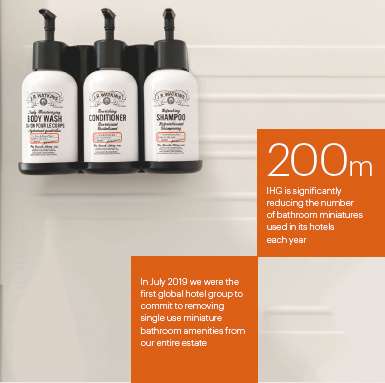
200 m IHG is significantly reducing the 200 million bathroom miniatures used in its hotels annually |
In an industry first, in 2019 IHG committed to replacing all our miniature bathroom amenities with bulk-size products across all brands. The move, which will significantly reduce plastic waste, has been followed by several industry peers.
|
||||
|
5.9 % IHG’s reduction in carbon per occupied room from 2017 baseline |
Working alongside our owners and hotels, one of our 2018-2020 Responsible Business targets is a commitment to reduce our carbon footprint per occupied room by 6-7%, and we are on track to do so.
|
|||||
|
100 + Hotels adopting IHG Studio |
IHG Studio uses either the IHG app or in-room TV connection to offer guests easier ways to manage their stay – from directly casting their own content or ordering room service, to using loyalty points to pay for services. IHG Studio was launched in 2019 following a successful trial and will become a brand standard globally.
|
Technology Enriching the digital guest experience
As technology continues to play an increasingly important role in our lives, the hospitality industry is investing in data, platforms and partnerships capable of integrating digital services and connectivity at the right moments of a stay experience. The overarching ambition is to deliver richer, personalised and frictionless experiences for consumers, and to create more effective, efficient operations and greater revenue opportunities for businesses.
See page 21 for more information on how IHG is addressing this trend.
|
||||
|
$ 5.6 bn IHG’s digital (web and mobile) revenue in 2019, up 7% on 2018
|
As consumers spend increasingly more time online exploring and researching travel options, IHG continues to invest in providing engaging and seamless digital guest experiences. The IHG mobile app is a critical component of our offer, with revenues increasing 18% in 2019 and downloads rising by 11%.
|
|||||
|
Consumer trends Instagrammable experiences
For many guests, the hotel they choose to stay in needs to be as much a part of their travel experience as the destination they are preparing to explore. This requires an abundance of boutique and lifestyle hotels with character, authentic neighbourhood roots, and memorable designs and service style, without compromise on quality.
Large hotel groups have seized on the opportunity to grow these brands at pace, based on their ability to offer consistently rich experiences in multiple locations, alongside those all-important distinctive twists worthy of a snap for social media.
See page 23 for more information on how IHG is addressing this trend.
|
5,290 rooms
2019 was a record year of signings for Hotel Indigo |
Since launching in 2004, IHG’s Hotel Indigo brand has grown to become one of the world’s largest branded boutique chains, with no two properties the same. Demand continues to increase, with its estate set to double in size over the next five years.
|
||||
|
~ 100 hotels
Kimpton Hotels & Restaurants has been adding exciting new international destinations at a rapid rate |
Since acquiring Kimpton in 2015, IHG has focused on taking the brand’s highly personal service and playful design from its US base to top luxury boutique destinations globally. From Bali and Bangkok to London and Shanghai, Kimpton has grown to almost 100 open and pipeline hotels.
|
|||||

|
These pages should be read together with our principal risks on pages 46 to 53 and risk factors on pages 226 to 230. |
| IHG | Annual Report and Form 20-F 2019 | Strategic Report | Industry overview | 9 |
Table of Contents


Table of Contents
IHG revenue from reportable segments a and the System Fund
|
System Fund IHG manages a System Fund on behalf of our third-party hotel owners, who pay contributions into it. This includes a marketing and reservation assessment and a loyalty assessment.
The System Fund also receives proceeds from the sale of IHG Rewards Club points under third-party co-branding arrangements.
The System Fund is managed by IHG for the benefit of hotels within the IHG system and is run at no profit or loss over the long-term. In 2019, IHG recognised $1.4 billion of System Fund revenue.
|

|
|||
|
|
| a |
Excludes System Fund results, hotel cost reimbursements and exceptional items. |
| b |
Definitions for Non-GAAP measures can be found on pages 55 to 59. The reconciliation for fee margin can be found on page 216. |
| c |
The margin for owned, leased and managed lease is calculated from the results related to owned, leased and managed lease included within reportable segments (see page 214 revenue of $573m and operating profit of $52m). |
| IHG | Annual Report and Form 20-F 2019 | Strategic Report | Our business model | 11 |
Table of Contents
Strategic Report
Our business model continued
Disciplined approach to capital allocation


| 12 | IHG | Annual Report and Form 20-F 2019 |
Table of Contents
Disciplined approach to capital expenditure
Capital expenditure incurred by IHG can be summarised as follows.
|
Type
|
What is it?
|
Recent examples
|
||
|
Maintenance capital expenditure, key money and selective investment to access strategic growth. |
Maintenance capital expenditure is devoted to the maintenance of our systems and corporate offices along with our owned, leased and managed lease hotels.
Key money is expenditure used to access strategic opportunities, particularly in high-quality and sought-after locations when returns are financially and/or strategically attractive.
|
Examples of maintenance spend include maintenance of our offices, systems and our owned, leased and managed lease hotels.
Examples of key money include investments to secure representation for our brands in prime city locations. |
||
|
Recyclable investments to drive the growth of our brands and our expansion in priority markets. |
Recyclable investments are capital used to acquire real estate or investment through joint ventures or equity capital. This expenditure is strategic to help build brand presence.
We would look to divest these investments at an appropriate time and reinvest the proceeds across the business.
|
Examples of recyclable investments in prior years include our EVEN Hotels brand, where we used our capital to develop three hotel properties in the US to showcase the brand. Over time, we expect to divest our interest in these hotels. |
||
|
System Fund capital investments for strategic investment to drive growth at hotel level. |
The development of tools and systems that hotels use to drive performance. This is charged back to the System Fund over the life of the asset. |
Recently, we rolled out our new pioneering cloud-based Guest Reservation System (GRS), one of IHG Concerto’s comprehensive set of capabilities, which we developed with Amadeus (see page 224). In addition, during the year we made a strategic investment, alongside other large hotel companies, in Groups360 to create an online sourcing and booking solution for meetings.
|
||
| IHG | Annual Report and Form 20-F 2019 | Strategic Report | Our business model | 13 |
Table of Contents
Table of Contents
| IHG | Annual Report and Form 20-F 2019 | Strategic Report | Our brands | 15 |
Table of Contents
| 16 | IHG | Annual Report and Form 20-F 2019 |
Table of Contents

|
Loyalty
A rich loyalty offer allows IHG to build valuable relationships with members who are often strong advocates for our hotel brands, and seven times more likely to book directly, which helps deliver higher-value revenue to our estate.
|
IHG ® Rewards Club One of the industry’s leading loyalty programmes, IHG Rewards Club is our way of ensuring that travel is experienced the way it should be: personal, seamless and rewarding.
All our members receive free internet worldwide, have access to exclusive rates and can select personal preferences that ensures their stays are just as they like them.
On top of a stay, members can earn points on everyday activities such as shopping, dining or car rentals through our many partners globally, and |
these can be used to redeem Reward Nights or book flights with more than 400 airlines. In addition, our IHG Rewards Club Concierge can be used for access to one-of-a-kind opportunities.
Further enhancing the programme, we added more world-class global and regional partnerships in 2019, and progressed important trials, including an option for members to use loyalty points to pay for amenities and services during their stay. See page 20 for more detail. |

| IHG | Annual Report and Form 20-F 2019 | Strategic Report | Our brands | 17 |
Table of Contents
Strategic Report
Our strategy for high quality growth
Strategic model

|
1 Build and leverage scale
2 Strengthen loyalty programme
3 Enhance revenue delivery
4 Evolve owner proposition
5 Optimise our preferred portfolio of brands for owners and guests |

|
Industry-leading net rooms growth over the medium term |
Whilst committing to responsible business
|
Robust assurance processes, business ethics, values and behaviours
|
Strong, diverse, innovative and inclusive culture | Respect for the environment and the communities we work in | Engagement with our stakeholders and nurturing relationships | |||||||||
| On the following pages we set out some examples of how we implement each element of our strategic model |
|

|
Our strategy should be read together with our culture, responsible business and stakeholders section, pages 24 to 40, and our principal risks and uncertainties, pages 47 to 53. |

|
For further information about our strategy, go to www.ihgplc.com/about-us under Our strategy. |
| 18 | IHG | Annual Report and Form 20-F 2019 |
Table of Contents


| IHG | Annual Report and Form 20-F 2019 | Strategic Report | Our strategy | 19 |
Table of Contents
Strategic Report
Our strategy continued


| 20 | IHG | Annual Report and Form 20-F 2019 |
Table of Contents


| IHG | Annual Report and Form 20-F 2019 | Strategic Report | Our strategy | 21 |
Table of Contents
Strategic Report
Our strategy continued


| 22 | IHG | Annual Report and Form 20-F 2019 |
Table of Contents


| IHG | Annual Report and Form 20-F 2019 | Strategic Report | Our strategy | 23 |
Table of Contents


Table of Contents
|
How we engage
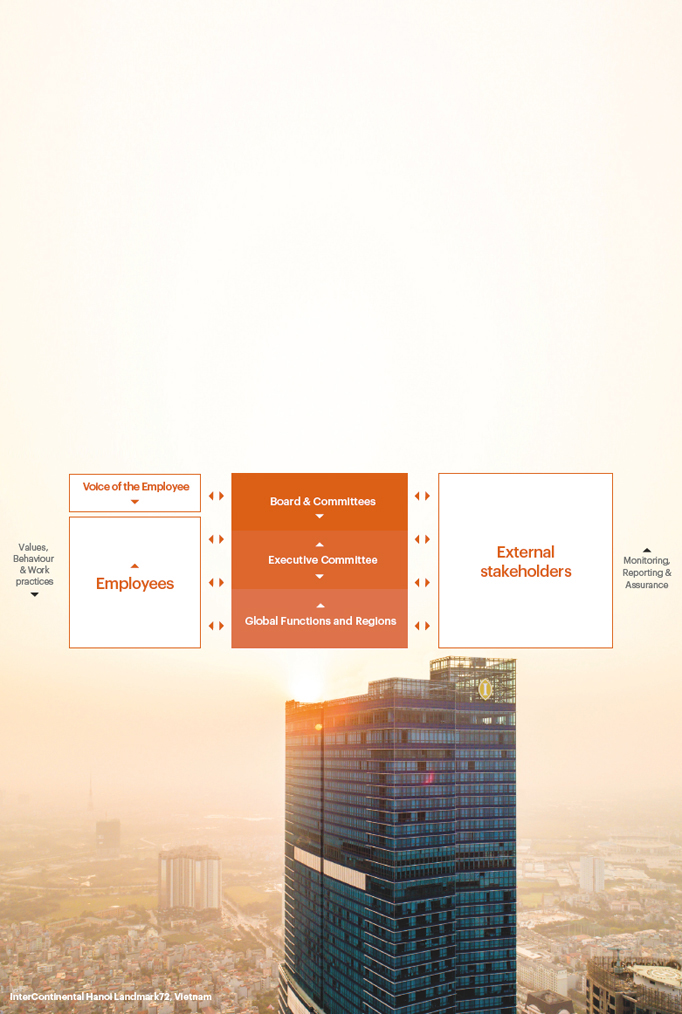
Engagement with our stakeholders and day-to-day management is a multi-layered and delegated process. At all levels of the business, from front line operations, through corporate functions, Senior Leadership, the Executive Committee, the Board and its Committees, we engage both internally and externally.
The Board delegates oversight of day-to-day operations and execution of strategic priorities through the Executive Committee and Senior Leaders, and sets, approves, embeds, reviews and course corrects (where necessary) the Company’s strategy, values, policies, principles, behaviours and responsible business culture in line with our purpose and business model. |
We use a variety of mechanisms to engage with employees and other stakeholders, including face-to-face meetings, conferences, feedback and performance reviews, employee forums and training, and we monitor this through, for example, our employee and investor engagement surveys, reports and presentations to the Board. We have an open, collaborative and inclusive approach. We take the information we glean from those interactions and use it to make informed judgements in our decision making. |
We also take into consideration the views and interests of other stakeholders, such as regulators and industry bodies, when determining our strategy, values and behaviours, as well as awareness of environmental and social concerns. They help provide a framework against which we measure ourselves, protect our reputation and develop our commercial and social awareness.
|
||||
|
|
More information about our culture, approach to responsible business and stakeholders is set out on the following pages. See Board agenda items on pages 84 and 85 for more information on which stakeholders were considered as part of Board decisions.
|
|||||
|
Our engagement model |
||||||
| IHG | Annual Report and Form 20-F 2019 | Strategic Report | Our culture, responsible business and stakeholders | 25 |
Table of Contents
Strategic Report
Our culture, responsible business
and stakeholders continued


| 26 | IHG | Annual Report and Form 20-F 2019 |
Table of Contents


| IHG | Annual Report and Form 20-F 2019 | Strategic Report | Our culture, responsible business and stakeholders | 27 |
Table of Contents
Strategic Report
Our culture, responsible business
and stakeholders continued

| 28 | IHG | Annual Report and Form 20-F 2019 |
Table of Contents
|
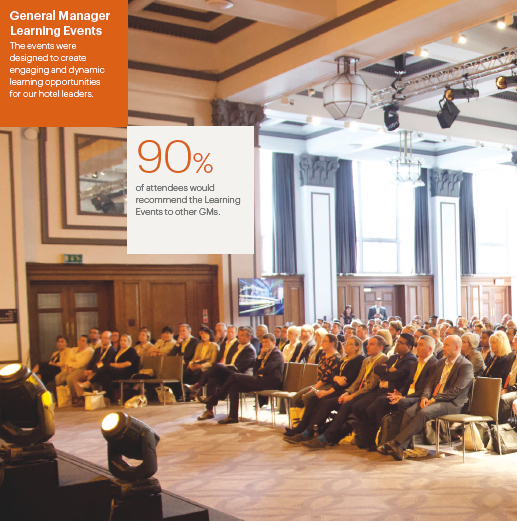
EMEAA General Manager (GM) Learning Events During 2019, IHG held GM Learning Events across EMEAA, welcoming 632 GMs to a number of four-day events. The events were designed to create engaging and dynamic learning opportunities for our hotel leaders. The IHG Learning and Development team designed the agenda to deepen GM knowledge across the region and provide them with the right tools to drive performance at their hotels. All the learning modules were developed in support of IHG’s growth strategy and to maximise each GM’s personal development. |
|
| IHG | Annual Report and Form 20-F 2019 | Strategic Report | Our culture, responsible business and stakeholders | 29 |
Table of Contents
Strategic Report
Our culture, responsible business
and stakeholders continued
|
Diversity
(D&I) |
Our D&I Framework
|
|||
|
IHG is a global business with a global reach and as such D&I is fundamental for us to succeed. Our colleagues and guests represent multiple nationalities, cultures, races, sexual orientation, backgrounds and beliefs. It makes for a diverse and inclusive culture we are proud of, underpins our purpose to provide True Hospitality for everyone and is key to our ‘celebrate difference’ value.
Our special culture is crucial to who we are, how we work together and how we grow our business. We are proud to have been recognised as a Kincentric (formerly a part of Aon) Global Best Employer three years running, Best Place to Work for LGBTQ Equality, by the Human Rights Campaign’s Corporate Equality Index in the US for the past six years, and for our CEO to be awarded third place in the HERoes awards for advocating women in business.
We are committed to a continual review of our practices and policies, such as raising awareness of bias at all levels in our hiring processes and reviewing flexible working processes and policies. We have signed up to the WiHTL’s Diversity in Hospitality, Travel and Leisure Charter, a 10-point action plan that ensures diversity and inclusion not only remains a priority but that we openly track progress towards our goals.
We also support the UN LGBTI Standards for Business, which focus on tackling discrimination against lesbian, gay, bi, trans and intersex people. And at the beginning of 2020, IHG became signatories of the CEO Action for Diversity and Inclusion, and The Valuable 500.
The Nomination Committee was accountable for our global D&I Policy during 2019, but this responsibility will move to the Corporate Responsibility Committee in 2020. The operational D&I Board ensures that we put the D&I policy into practice. For more information see the Governance section on pages 92 and 93. |
||||

| 30 | IHG | Annual Report and Form 20-F 2019 |
Table of Contents
|
1. Strengthening a culture of inclusion At IHG one of the core pillars of our D&I strategy is to foster a culture of inclusion so all employees feel included, valued and respected. Last year our Senior Leaders took part in a conscious inclusion programme to equip them to role model inclusive leadership and champion the flexible working guidelines that we have launched globally. We piloted changes to our recruitment practices which we plan to scale globally in 2020.
We also expanded our existing Employee Resource Groups (ERGs) globally following regional success, and now have more than 1,700 members across groups such as Out and Open, FAVE (field and virtual employees), PATH (pan Asians for true hospitality), BBX (baby boomers and Gen X), and DAWN (disability and well-being network).
For example, Out and Open is a forum for colleagues to get involved with LGBTQ+ focused activities and conversations. The ERG has more than 150 active members, who come together throughout the year to celebrate key dates in the LGBTQ+ calendar.
|
2. Increasing the diversity of our leadership talent As part of our 2018-2020 Responsible Business Targets we made a commitment to increase the diversity of our Senior Leaders, as well as increase the number of females working in General Manager and Operations roles in managed hotels.
Although our overall percentage of female Senior Leaders, currently 37% globally, is the same as our 2017 baseline, we are committed to furthering the opportunities for female leaders. We continue to drive increased representation through initiatives such as the development of our Future Leaders’ programme, which provides graduate-level talent with the opportunity to work across a range of departments and geographies.
We have also extended our Rise mentoring initiative for aspiring female General Managers to China, India, the Middle East, Europe and the Americas, which enabled us to increase the percentage of women in General Manager and Operations roles from 24% to 26%. |
3. Putting the right decision-making around our actions In 2018 we established our Global Diversity & Inclusion Board, (D&I Board), led by our CEO and other Senior Leaders in IHG who are responsible for shaping IHG’s diversity and inclusion priorities. The D&I Board worked with a third-party independent partner to gain a different perspective of our business and help us identify areas for improvement. The key objectives of the partnership were to identify the ‘typical profile’ of individuals deemed to be successful at IHG, understand real and perceived barriers to success for women, and define actions to address those barriers and improve leadership gender balance. As a result of this work we took several actions, such as the launch of our flexible working policy.
As part of our ongoing commitment to diversity and inclusion we also launched Diversity & Inclusion Councils across our regions in 2019, which represent the voice of our regions and markets, making sure we listen to employees and engage on local priorities, as well as collaborating to roll out initiatives. |
||
|
Through collaboration with Hotel Indigo, Out and Open helped launch the #ColorOfPride campaign, which all Hotel Indigo properties in the Americas celebrated. They continued the theme into our Atlanta Pride celebrations, which is the biggest event for IHG Out and Open each year. Annually, around 250 colleagues, friends and family volunteer their time in the IHG booth and walk with the IHG float in the Pride parade.
At the Holiday Inn Singapore Orchard City Centre, approximately 12% of staff are colleagues with disabilities. The hotel, which has been recognised for its work in this area by the UN, invests in providing training for managers to adjust to the different ways of communicating with persons with disabilities. This includes encouraging managers to give more regular feedback, supervision and encouragement to colleagues with disabilities to ensure they always feel a part of the IHG family.
Within India, Nepal and Bangladesh, we have close to 100 colleagues with disabilities working for IHG branded hotels. To cultivate a supportive environment for them, we have partnered with the Sarthak Educational Trust to deliver training sessions for hotel colleagues and developed a toolkit and a series of guidance videos on working with colleagues with disabilities. |
|
|||

| IHG | Annual Report and Form 20-F 2019 | Strategic Report | Our culture, responsible business and stakeholders | 31 |
Table of Contents
Strategic Report
Our culture, responsible business
and stakeholders continued
| 32 | IHG | Annual Report and Form 20-F 2019 |
Table of Contents

| IHG | Annual Report and Form 20-F 2019 | Strategic Report | Our culture, responsible business and stakeholders | 33 |
Table of Contents
Strategic Report
Our culture, responsible business
and stakeholders continued
|
|
Further information about our Responsible Business Targets and our responsible business approach is available on our website www.ihgplc.com/responsible- business
See details of our greenhouse gas (GHG) emissions on page 223.
|
||
|
Task Force on Climate-related Financial Disclosures (TCFD) Building on the work we have done to set science-based targets, we have made a formal commitment to implement the recommendations of the TCFD, and in 2020 we will be developing a disclosure roadmap for the coming years.
|
||||

| 34 | IHG | Annual Report and Form 20-F 2019 |
Table of Contents


|
IHG First Look In 2019 as part of our commitment to helping young people gain skills and experience in hospitality, we partnered with JA (Junior Achievement) Worldwide, one of the world’s largest youth-serving NGOs, which focuses on preparing people for future employment and entrepreneurship.
Through an IHG Foundation legacy grant, we worked to develop a curriculum to run hotel work-experience events called IHG First Look; providing young people with the opportunity to receive hands-on experience working in a hotel. Combining classroom working and a practical hotel takeover, students receive a close-up look at what a career in hospitality involves. Initiated during 2019, this year-long partnership will support more than 750 young people to gain skills and experience in hospitality, in nine major markets.
Building on the relationship, in early 2020 we began running a set of innovation camps, which focus on solving a sustainability-based problem core to the hospitality industry. |
| IHG | Annual Report and Form 20-F 2019 | Strategic Report | Our culture, responsible business and stakeholders | 35 |
Table of Contents
Strategic Report
Our culture, responsible business
and stakeholders continued

| 36 | IHG | Annual Report and Form 20-F 2019 |
Table of Contents


| IHG | Annual Report and Form 20-F 2019 | Strategic Report | Our culture, responsible business and stakeholders | 37 |
Table of Contents
Strategic Report
Our culture, responsible business
and stakeholders continued


| 38 | IHG | Annual Report and Form 20-F 2019 |
Table of Contents


| IHG | Annual Report and Form 20-F 2019 | Strategic Report | Our culture, responsible business and stakeholders | 39 |
Table of Contents
Strategic Report
Our culture, responsible business
and stakeholders continued


| 40 | IHG | Annual Report and Form 20-F 2019 |
Table of Contents
| IHG | Annual Report and Form 20-F 2019 | Strategic Report | Our culture, responsible business and stakeholders | 41 |
Table of Contents
Strategic Report
Key performance indicators (KPIs)


|
|

|
|


|
KPIs |
2019 status and 2020 priorities |
|||
|
Net rooms supply Net total number of rooms in the IHG System.
Increasing our rooms supply provides significant advantages of scale, including increasing the value of our loyalty programme. This measure is a key indicator of achievement of our growth agenda (see page 18).
Signings Gross total number of rooms added to the IHG pipeline.
Continued signings secure the future growth of our System and continued efficiencies of scale. Signings indicate our ability to deliver sustained growth (see page 18). |
|
2019 status Increased net System size growth to 5.6%, our highest growth rate in over 10 years and acceleration from ~3% in 2016, taking total rooms supply to 883,563 rooms.
Signings decreased -1%, with a record performance in Greater China and EMEAA offset by a decline in the Americas where 2018 signings were boosted by the launch of avid hotels. We increased our share of signings in key markets globally, driven by the addition of five new brands in the last two years.
2019 performance was driven by:
• Further growth of our established brands:
– Our highest ever number of openings for the Holiday Inn Brand Family.
– InterContinental Hotels & Resorts reinforcing its position as the largest global luxury hotel brand with nine openings in 2019.
• Record openings and signings in Greater China and record signings in EMEAA.
• The acquisition of Six Senses and signing of a further ten deals post-acquisition.
• Launch of new mainstream brand Atwell Suites with ten signings in 2019.
• Scaling of recently launched brands with:
– avid hotels adding six openings and 54 signings in 2019.
– voco hotels growing to 12 hotels opened by the end of 2019, with a total of 33 signed since launch.
2020 priorities • Continued focus on delivering industry-leading net System size growth.
• Further scale avid hotels in the US and voco hotels globally.
• Grow the footprint of our new luxury brands Regent and Six Senses.
• Expand Kimpton and Hotel Indigo’s international presence.
• Drive Atwell Suites signings and prepare for the first openings in the US. |
||
|
|
|
|||


| 42 | IHG | Annual Report and Form 20-F 2019 |
Table of Contents
| a |
See reorganisation costs on page 72 for further information. |
|
KPIs |
2019 status and 2020 priorities |
|||
|
Growth in underlying fee revenues a, b Group revenue from reportable segments excluding revenue from owned, leased and managed lease hotels, significant liquidated damages and current year acquisitions, stated at constant currency.
Underlying fee revenue growth demonstrates the continued attractiveness to owners and guests of IHG’s franchised and managed business (see page 10).
Total gross revenue from hotels in IHG’s System b Total rooms revenue from franchised hotels and total hotel revenue from managed, owned, leased and managed lease hotels. Other than for owned, leased and managed lease hotels, it is not revenue wholly attributable to IHG, as it is mainly derived from hotels owned by third parties.
The growth in gross revenue from IHG’s System illustrates the value of our overall System to our owners (see page 11).
System contribution to revenue The percentage of room revenue booked through IHG’s direct and indirect systems and channels.
System contribution is an indicator of IHG value-add and the success of our marketing distribution channels (see page 10). |
|
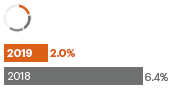
2019 status • Net System size growth of 5.6% supported growth in underlying fee revenue of 2% in a weaker RevPAR environment.
• Grew digital (web and mobile) revenue by 7% to $5.6 billion.
• Revenue Management for hire now adopted in over 3,500 hotels across our estate.
• IHG Connect, our seamless wifi guest login, is now implemented or being installed in over 4,500 hotels globally.
• Continued to innovate through use of technology including initiation of a pilot for attribute pricing through our Guest Reservation System (see page 21).
• Further strengthened loyalty offer with new partnerships including the addition of Mr & Mrs Smith luxury and boutique properties to IHG Rewards Club and sponsorship of the US Open Tennis Championship (see page 20).
• Extended our InterContinental Alliance Resorts and Sands partnership to new hotels in Macau SAR, providing additional opportunities for guests to earn and redeem points in highly desirable locations.
• Conducted pilots of variable points pricing for redemption nights and pay with points for additional services during guest stays.
2020 priorities • Commence roll out of attribute pricing via IHG Concerto.
• Continue to innovate our loyalty offering including in-hotel experiences and brand integrations, to provide greater opportunities for our members to earn and redeem IHG Rewards Club points.
• Maintain our focus on increasing contribution from IHG Rewards Club members and through direct bookings via our website or call centres.
• Continue to develop strategic partnerships to enhance the value of our loyalty programme for members. |
||
|
|
|
|||
|
Global RevPAR growth Revenue per available room: rooms revenue divided by the number of room nights that are available.
RevPAR growth indicates the increased value guests ascribe to our brands in the markets in which we operate and is a key measure widely used in our industry (see page 8).
Guest Love IHG’s guest satisfaction measurement indicator.
Guest satisfaction is fundamental to our continued success and is a key measure to monitor the risk of failing to deliver preferred brands that meet guests’ expectations (see page 49 for details). |
|
2019 status • RevPAR declined slightly in 2019 as industry growth slowed, impacted by macro and geopolitical uncertainties, increased supply growth in some markets, and ongoing unrest in Hong Kong SAR.
• We continued to undertake activities to position our brands for future success:
– Rolled out new prototypes and designs for Holiday Inn and Holiday Inn Express in Americas and Europe.
– Continued Crowne Plaza Accelerate programme, a multi-year programme to transform Crowne Plaza in the Americas region, including flagship hotels showcasing the reinvention of the brand, with the first opening in Atlanta.
– Modernised Staybridge Suites and Candlewood Suites brands with launch of new prototypes.
2020 priorities • Continue to invest in brand innovation, including room design and hotel layout to meet evolving guest needs.
• Ensure that, whilst driving strong rooms supply growth, we maintain a high level of guest satisfaction across our entire portfolio with removals from the System. |
||
|
|
|
|||


| a |
In 2019 the underlying fee revenue calculation was restated for 2017 onwards following a change in the definition of how we calculate constant currency. The 2017 growth figure is not comparable and thus excluded from comparison. |
| b |
Use of Non-GAAP measures: In addition to performance measures directly observable in the Group Financial Statements (IFRS measures), additional financial measures (described as Non-GAAP) are presented that are used internally by management as key measures to assess performance. Non-GAAP measures are either not defined under IFRS or are adjusted IFRS figures. Further explanation in relation to these measures can be found on pages 55 to 59 and reconciliations to IFRS figures, where they have been adjusted, are on pages 214 to 218. A reconciliation of total gross revenue to owned, leased and managed lease revenue as recorded in the Group Financial Statements can be found on page 61. |
| c |
Changes to the method for calculating IHG’s guest satisfaction scores (previously Guest HeartBeat) were introduced in 2016. The comparative for 2015 has been restated. |
| IHG | Annual Report and Form 20-F 2019 | Strategic Report | Key performance indicators | 43 |
Table of Contents
Strategic Report
Key performance indicators (KPIs) continued
|
KPIs |
2019 status and 2020 priorities |
|||
|
Fee margin a,b Operating profit as a percentage of revenue, excluding System Fund, reimbursement of costs, revenue and operating profit from owned, leased and managed lease hotels, significant liquidated damages, the results of the Group’s captive insurance company and exceptional items.
Our fee margin progression indicates the profitability of our fee revenue growth and benefit of our asset-light business model (see page 10). |

|
2019 status • Grew fee margin by 80bps.
• Continued to embed our new operating structures and leverage operational efficiencies.
• Cost efficiency programme to deliver ~$125m in annual savings, including System Fund, by 2020 substantially complete, with savings fully reinvested in growth initiatives.
2020 priorities • Continuation of our strong cost and efficiency focus.
• Leverage our growth and systems infrastructure to drive economies of scale.
• Continue to leverage AI to drive process efficiency, enhance revenue generation, and improve guest experience.
• Provide procurement solutions to help lower owner cost of sale.
• Continue to look for further operational efficiencies through greater application of technology. |
||
|
|
|
|||
|
Free cash flow b,c Cash flow from operating activities excluding payments of contingent purchase consideration, less purchase of shares by employee share trusts, maintenance capital expenditure and lease payments.
Free cash flow provides funds to invest in the business, sustainably grow the dividend and return any surplus to shareholders (see page 12). It is a key component in measuring the ongoing viability of our business (see page 54). |

|
2019 status • Free cash flow of $509m was down $102m year-on-year with higher levels of cash tax and working capital offsetting lower levels of exceptional items.
2020 priorities • Continue to deliver consistent, sustained growth in cash flow.
• Control capital deployment in line with business priorities.
• Continue programme to recycle capital invested in minor equity positions, over time, when conditions are favourable. |
||
|
|
|
|||
| a |
In 2019 the fee margin calculation was restated for 2017 onwards following implementation of IFRS 16 ‘Leases’. The 2016 figure is not comparable and is thus excluded from comparison. |
| b |
Use of Non-GAAP measures: In addition to performance measures directly observable in the Group Financial Statements (IFRS measures), additional financial measures (described as Non-GAAP) are presented that are used internally by management as key measures to assess performance. Non-GAAP measures are either not defined under IFRS or are adjusted IFRS figures. Further explanation in relation to these measures can be found on page 55 to 59 and reconciliations to IFRS figures, where they have been adjusted, are on pages 214 to 218. |
| C |
Cash flow was introduced as a new measure for the 2017/19 LTIP cycle. Cumulative free cash flow over the three-year performance period forms part of the measure, with some adjustments. The target for each successive cycle is determined annually, taking into account IHG’s long-range business plan, market expectations and circumstances at the time. |
| 44 | IHG | Annual Report and Form 20-F 2019 |
Table of Contents
|
KPIs |
2019 status and 2020 priorities |
|||
| Responsible Business | ||||
|
IHG ® Academy Number of people participating in IHG Academy programmes.
Sustained participation in the IHG Academy indicates the strength of our progress in creating career building opportunities and engagement with the communities in which we operate (see page 29). |

|
2019 status • Hosted a range of IHG Academy programmes globally throughout the year, including internships and other experiences.
• Formed a global partnership with Junior Achievement Worldwide offering young people opportunities to gain skills and experience, empowering them to consider career opportunities in the industry.
• Reviewed and refreshed supporting material to drive greater participation and deliver an engaging candidate experience.
2020 priorities • Continue to provide skills and improved employability through IHG Academy, ensuring a positive impact for local communities, our owners and IHG. This will enable IHG to achieve our longer-term target of 30,000 – 40,000 IHG Academy participants in 2020.
• Realign focus of the IHG Academy programme, prioritising an increase in the length of the IHG Academy opportunities and placements to drive conversion of participants to permanent employment.
• Build on the IHG Academy programme offering through launching an internship toolkit in 16 hotel-ready languages.
• Continue to drive quality growth in the programme through enabling our regional teams to measure impact through a robust reporting solution and convert IHG Academy hires into employees for 2021 and beyond.
|
||
|
|
|
|||
|
Carbon footprint per occupied room We work with our hotels to drive reductions in carbon emissions to reduce our overall carbon footprint (see page 34). |

|
2019 status • Achieved 5.9% reduction in our carbon footprint per occupied room from 2017 baseline.
2020 priorities • Continue to reduce our carbon footprint across our entire estate.
• Partner with owners and our hotels to share best practices to help drive greater carbon reductions.
• Work to meet the requirements of Task Force on Climate-related Financial Disclosures (TCFD). |
||
|
|
|
|||
|
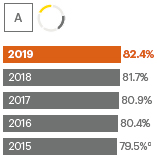
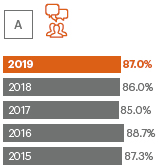
Employee Engagement survey scores Average of our revised b bi-annual Colleague HeartBeat survey, completed by our corporate, customer reservations office and managed hotel employees (excluding our joint ventures).
We measure employee engagement to monitor risks relating to talent (see page 28) and to help us understand the issues that are relevant to our people as we build a diverse and inclusive culture (see page 30). |
|
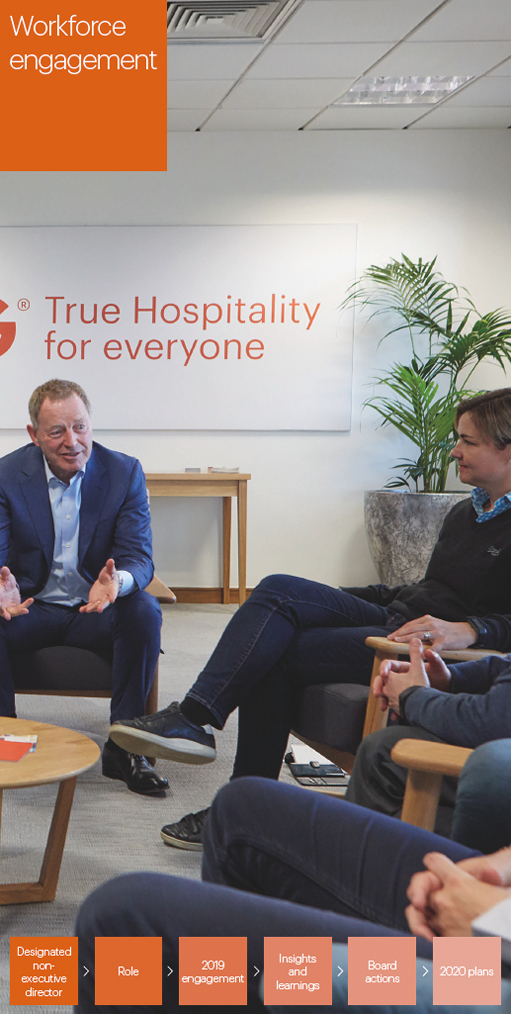
2019 status • Commenced Non-Executive Director-led employee interface sessions across geographies to better understand workforce engagement (Voice of the Employee, see pages 32 and 33 for further information).
• Launched starters and leavers survey with employees (in managed hotels and corporate offices) to understand their feedback on these critical employee life cycle events.
2020 priorities • Improve our talent acquisition systems and services to position IHG as a leading employer and deliver a great hiring experience for candidates.
• Continue to drive a high-performance culture across IHG through embedding performance and reward practices.
• Further drive the adoption of improvement to our human resources systems, to further our ability to attract, develop and retain talent.
• Support the recruitment and development of General Managers for our managed hotels.
• Embed a diverse and inclusive culture across our places of work, through key initiatives such as RISE and ERGs, to further our promise to provide True Hospitality for everyone.
|
||
|
|
|
|||
| a |
In 2018 the carbon reduction measure was restated in line with a new baseline for the 2018-2020 target. The 2018 and 2019 impacts from the 2017 baseline year have been restated, aligned to annual changes to IHG’s System size and increase in number of hotels reporting data to the IHG Green Engage system, to enable comparisons to be made for our 2018-2020 target. The 2016 and 2015 figures could not be restated and are not comparable. |
| b |
In 2017 the employee engagement survey was revised and relaunched as the Colleague HeartBeat survey. The 2016 and 2015 figures relate to previous survey results, which could not be restated and are not comparable. |

|
Please see www.ihgplc.com/responsible-business for our 2018-2020 Responsible Business targets. |
| IHG | Annual Report and Form 20-F 2019 | Strategic Report | Key performance indicators | 45 |
Table of Contents
Strategic Report

|
Risk management supports decision making Our risk management and internal control system is fully integrated with the way we run the business and how we create and protect value in pursuit of our objectives.
Our culture, values and behaviours , see pages 26 and 27, establish authorities, capabilities and appropriate incentives for empowered and agile decision-making across our portfolio of risks by teams across IHG, supported by functional expertise.
Formal and informal monitoring, reporting and assurance arrangements , see page 27, enable the Board and Executive Committee to maintain ongoing oversight of key areas of uncertainty and the effectiveness of our risk management and internal control arrangements. |

|
|||
| 46 | IHG | Annual Report and Form 20-F 2019 |
Table of Contents
| IHG | Annual Report and Form 20-F 2019 | Strategic Report | Risk management | 47 |
Table of Contents
Strategic Report
Risk management continued
|
Risk trend and speed of impact We assess whether the risk area is stable or dynamic in its impact and/or likelihood (inherent risk trend), and the rate at which there could be a material impact on IHG. The trend and speed of impact are summarised in the diagram with further detail on activities to manage each of these risks in the table below.
|
|

Principal risks descriptions
| Inherent risk trend | Risk impact – link to our strategic priorities | |||||||||||||
|
|
Dynamic/Rapid |
|
Build and leverage scale |
|
Strengthen loyalty programme |

|
Enhance revenue delivery | |||||||
|
|
Dynamic/Gradual |
|
Evolve owner proposition |
|
Optimise our preferred portfolio of brands for owners and guests | |||||||||

|
Stable/Rapid | |||||||||||||


|
Risk description |
Trend |
Impact |
Initiatives to manage these risks |
|||
| Inherent threats to cybersecurity and information governance remain significant and dynamic. We are aware of our responsibilities in relation to a range of high-value assets (critical systems & guest, employee and other sensitive data) which may be targeted by various threat ‘actors’ (including organised criminals, third parties and ‘threat actor-employees’), and rapid evolution in societal, regulatory and media scrutiny of privacy arrangements mean that the potential impact of data loss to IHG financially, reputationally or operationally remains a dynamic risk factor. |

|

|
• Effective and appropriate leveraging of data that we have a right to use is a key aspect of the interface between our marketing and our commercial and technology activity. We take account of regulatory and ethical factors as part of the decision-making processes in relation to marketing and technological initiatives, and we also rely on appropriate governance and control arrangements to mitigate risks that the validity of data that we use is undermined by cyber-attacks or operational failures.
• Our 2019 focus has been on progressing a Board-endorsed roadmap of the highest priority and highest-value initiatives to build and maintain core elements of our cybersecurity posture.
• During the year our Chief Information Security Officer has worked with teams across IHG to increase sophistication in how we identify, protect, detect, respond and recover in relation to cyber risks. This has involved developments in our security governance and risk tracking, including discussion and assessment of an approach to high-value assets with the Executive Committee.
• We have continued to drive awareness of cybersecurity risk, including an anti-phishing campaign which tested corporate employees on phishing attacks. We also developed a cybersecurity incident response playbook which is aligned with wider IHG resilience and incident preparation protocols.
• The nature of our operating model means that significant amounts of IHG’s confidential information assets are also held by or shared with third-party suppliers and owners, and we review those risks as part of our broader supply chain risk management arrangements.
• Our information security programme is supported and reviewed by internal and external assurance activities, including our Internal Audit and SOX teams and PCI assessments.
• During 2019 we have reported regularly to the Board and the Executive Committee on the information security roadmap using key risk indicators to track trends in risk and mitigation initiatives. We also continue to work closely with our insurers to review the adequacy of protection for our risks and have assessed potential cyber incident scenarios, including quantification of value at risk, to better aid in risk-based discussions on remediation investment against risk acceptance and available risk transfer opportunities. |
|||
|
|
|
|
|
|||
| 48 | IHG | Annual Report and Form 20-F 2019 |
Table of Contents
|
Risk description |
Trend |
Impact |
Initiatives to manage these risks |
|||
| Failure to deliver preferred brands and loyalty could impact our competitive positioning, our growth ambitions and our reputation with guests and owners. Competitor and intermediation activity creates inherent risks and opportunities for the hospitality industry and is relevant to the longer-term value of IHG’s franchised/managed proposition and our ability to deliver returns to current and potential owners of our various brands. |

|

|
• To enable our growth ambitions, we need to continuously strengthen our portfolio of brands to build an industry-leading offer which delivers leading-edge guest preference, and competitive owner returns. For a description of our brands and brand initiatives see pages 14 to 17, and page 23.
• We are building the underlying capabilities to achieve our vision by: strengthening our new brand development; enhancing our marketing capability; refining our brand portfolio strategy; building improved data analytics capabilities; and scaling the production and efficiency of our global marketing assets.
• During 2019, our Global Marketing team has continued to evolve an operating framework to provide additional clarity and alignment on prioritisation and focus areas. We have also implemented changes to several ways of working between our global functions and regional operations teams to drive commercial performance, supported by learning events and engagement sessions.
• We are also executing a loyalty roadmap that includes tactical improvements to drive short-term performance and foundational levers to enable a longer-term step change to improve member benefits, owner economics and programme technology. See page 20 for more details on our 2019 initiatives. |
|||
|
|
|
|
|
|||
| In a fast growth environment, it is essential that we attract, develop and retain leadership and talent and failure to do this could impact our ability to achieve growth ambitions and execute effectively. Our people are essential to delivering our objectives, and our ability to develop talent is a key way we can deliver value to our existing and potential owners of both managed and franchised hotels. It is also essential that we retain key executive talent, both at the corporate and hotel levels, in the face of attractive roles and competitive rewards available in the global markets where we operate and compete. |

|

|
• Our approach to managing our people is outlined in detail on pages 28 to 31 and our annual business planning process includes a review of workforce risks. We consider workforce risks when designing business initiatives and we regularly review talent and succession across the organisation. Our Human Resources team partners across IHG, and performs regular reviews including in relation to the diversity of our talent and competitiveness of our compensation and benefits plan.
• IHG has the ability to manage the risk directly in relation to IHG employees but relies on owners and third-party suppliers to manage the risk in related activities. Our Procurement, Legal and Risk teams also consider more indirect workforce risks relating to our third-party relationships.
• During 2019, we have continued to refine and streamline our performance management systems and embed a common set of leadership behaviours across IHG through employee participation in various virtual learning summits.
• Several policies supporting our Code of Conduct (for example our Human Rights Policy which is reviewed annually) relate to the management of our people, describing our intolerance for inappropriate behaviours, and appropriate adherence to those helps manage our risk.
• As our business expands through mergers and acquisition, we also undertake due diligence prior to transactions, and as part of integration activities, to evaluate and adapt relevant people practices. |
|||
|
|
|
|
|
|||
| IHG | Annual Report and Form 20-F 2019 | Strategic Report | Risk management | 49 |
Table of Contents
Strategic Report
Risk management continued
|
Risk description |
Trend |
Impact |
Initiatives to manage these risks |
|||
| The global business regulatory and contractual environment and societal expectations continue to evolve. Failure to ensure legal, regulatory and ethical compliance would impact IHG operationally and reputationally. Regulators are moving to impose significant fines for non-compliance, most notably in relation to privacy obligations and data security, and there is increasing attention on environmental, social and governance matters (for example relating to consumer protection, human rights including modern slavery, human trafficking and labour laws, and financial crime) from a range of external stakeholders such as corporate sales clients, investors and NGOs. With trading headwinds in some markets, increased pressure can be placed on compliance programmes, and a heightened risk of liabilities relating to our franchise model both in relation to brand reputation issues as well as litigation. |
|

|
• Our global Ethics and Compliance team (E&C team) are focused on ensuring IHG has a globally coordinated approach to material ethical and compliance risks, taking into account the regulatory environment, stakeholder expectations and IHG’s commitment to a culture of responsible business.
• The overarching framework for Ethics and Compliance is the IHG Code of Conduct (Code), (see pages 26 and 27). In addition to the Code, the E&C team manage the global compliance programmes for Anti-Bribery and Corruption, Antitrust/Competition Law, Sanctions and Human Rights.
• A number of processes and initiatives are used by the E&C team to manage ethical and compliance risks. For example, IHG is a member of Transparency International UK’s Business Integrity Forum and participates in its annual Corporate Anti-Corruption Benchmark. The findings from the Benchmark assessment are utilised predominantly by the E&C team to identify improvements to the design of the IHG Anti-Bribery and Corruption programme.
• The E&C team are also responsible for, and have oversight of, the owner legal due diligence process. This is designed to ensure that risk-based due diligence is carried out on third-parties with whom IHG enters into hotel relationships. This includes sanctions monitoring, third-party screening and internal communications – for example, an annual update is communicated to the Legal, Development and Strategy teams and other relevant colleagues providing a reminder of ‘No Go’ countries and sanctions issues that may restrict IHG.
• The E&C team currently monitor training completions, gifts & entertainment reporting and owner due diligence escalations. These areas help demonstrate whether the design of the Ethics & Compliance framework and core processes of the underlying programmes are operating effectively. The E&C team monitor activity of the Confidential Disclosure Channel and have regular discussions with regional Legal teams to help identify emerging issues. In addition, the E&C team receive informal queries/escalation of issues via an Ethics and Compliance email channel, which is publicised in training and awareness materials, and directly from employees, for example in face-to-face training sessions.
• The Board receives regular reports on the Confidential Reporting Channel and matters directly related to our responsible business agenda. |
|||
|
|
|
|
|
|||
| Failure to capitalise on innovation in booking technology and to maintain and enhance the functionality and resilience of our channel management and technology platforms (including those of third-parties on which we rely directly or indirectly), and to respond to changing guest and owner needs remains a dynamic risk to IHG’s revenues and growth ambitions. The pace of change in the hospitality industry continues to accelerate and IHG must evolve to effectively grow and compete in the marketplace. Technology is crucial to our strategy as we face increasing competition from both existing and new players in the travel space. |

|

|
• Our comprehensive channels strategy is a key driver and enabler of accelerated growth. We continue to seek opportunities to align and innovate our channels and technology platforms (see page 21). Our IHG Concerto ™ platform is operating at all IHG hotels, and we are continuing to add more capabilities to the platform to enhance revenue delivery.
• Our Guest Reservation System (GRS) is hosted by a third-party vendor, Amadeus, in the cloud and supported by infrastructure which serves to decrease the likelihood of downtime. Availability of GRS and other key systems continues to be monitored on a 24/7 basis by the Network Operations Centre. Metrics are regularly reported to Commercial and Technology leaders so they can monitor performance.
• As our industry evolves, and with our acquisition of new brands, we have continued to review the capabilities of our systems in relation to market trends and expectations.
• In 2019, we also introduced regional revenue forums to focus on forecasting future business and determining integrated commercial plans to address challenges. |
|||
|
|
|
|
|
|||
| 50 | IHG | Annual Report and Form 20-F 2019 |
Table of Contents
|
Risk description |
Trend |
Impact |
Initiatives to manage these risks |
|||
| IHG’s continuing agenda to accelerate growth gives rise to inherent risks, for example as we transition systems, operating models and processes. The potential exists to impact commercial performance and financial loss, and undermine stakeholder confidence. As we move towards larger, more strategic outsourcing relationships for business-critical services, inherent risk levels are also raised. |

|

|
• The progress of our Group-wide efficiency programme has been tracked by the Board and Executive Committee, and the majority of our centrally driven transformation activity has now transitioned to Senior Leaders.
• Following the changes to our organisational structure in 2018, in 2019 we conducted corporate-wide virtual learning summits and we maintain a central digital hub for process and learning materials to enable our employees to find details about processes, learning content and key process owners.
• Our focus on accelerating growth has included review of risks relating to offshoring and outsourcing by Senior Leaders and the Board. Our Strategic Supplier Management Office has been established to manage existing critical supplier relationships as well as new outsourcing and/or business-critical relationships driving our strategic objectives. Our legal teams review contracts and provide advice on litigation, where required, and our insurance programme also provides a degree of protection in the event of supplier failure.
• Oversight teams, including our finance experts, have evolved governance and control frameworks and we also regularly review delegated approval authorities and processes to enable decisions on investments to be made quickly and efficiently with consideration of the risks involved. HR Business Partners continue to work with Senior Leaders to identify and retain key individuals across the business, and succession planning practices are in place to ensure continuity of key initiatives and business operations.
• During 2019 we reviewed our financial governance and controls relating to the integration of our acquisitions. For example, the integration of Six Senses into IHG’s financial control environment has been overseen by a dedicated governance committee.
• We have an established approach to System Development Lifecycle, and specific risks to delivery of the Global Reservations System have been managed throughout the programme of implementation (including those relating to technical delivery, business process testing and operation readiness testing). |
|||
|
|
|
|
|
|||
| Macro external f actors such as political and economic disruption, the emerging risk of infectious diseases, actual or threatened acts of terrorism or war, natural or man-made disasters could have an impact on our ability to perform and grow. Heightening of macroeconomic tensions could lead to a downturn impacting our ability to grow. |

|

|
• While these factors are mostly outside our direct control, we track uncertainties which may impact the hospitality industry and which need to be considered in our strategic and financial planning. These types of risks are addressed in strategic review, including our market participation choices, particularly in emerging and key growth markets.
• During 2019, many leadership teams have used formal and informal scenario planning to anticipate the potential impact of these risks. The Board and Executive Committee receive regular updates on these types of factors from both operational and subject matter experts so that possible implications for IHG can be considered.
• Our in-house threat intelligence capability, supplemented by third-party expertise and methodology, supports development, hotel operations and customer-facing sales teams with planning and response to macro factors, for example concerns relating to terrorism, extreme weather events, or infectious diseases such as Covid-19. We are also increasingly able to complement more traditional sources with digital intelligence to anticipate potential impacts on IHG’s interests. |
|||
|
|
|
|
|
|||
| IHG | Annual Report and Form 20-F 2019 | Strategic Report | Risk management | 51 |
Table of Contents
Strategic Report
Risk management continued
|
Risk description |
Trend |
Impact |
Initiatives to manage these risks |
|||
| As a global business, we are conscious of greater focus from a wider range of stakeholders on environmental and social mega-trends . These include regulators and investor groups (such as the Task Force on Climate-related Financial Disclosures (TCFD), and emerging risks presented by climate change which have the potential to impact performance and growth in key markets. |

|
|
• During 2019, our Corporate Responsibility team worked collaboratively with teams across IHG (including Human Resources, Business Reputation and Responsibility and Procurement) to consider the broader environmental and social risks associated with our business. These risks and opportunities are considered as an integral part of Board strategy discussions in relation to our commitment to responsible business. In 2019, this culminated with the approval of a science-based target relating to carbon reduction.
• As part of our responsible business strategy refresh work, we are also working with third-party experts to develop our responsible business targets for post 2020 and have made a formal commitment to implement the recommendations of the TCFD. In 2020 we will be developing a disclosure roadmap for the coming years. More broadly we recognise that continued collaboration across the wider industry is required to collectively combat climate change. We are taking an active role in this via our membership and active participation in several industry bodies, including the International Tourism Partnership (ITP) and the World Travel and Tourism Council (WTTC).
• Our values and behaviours, underpinned by our Code of Conduct, inform our decision-making at all levels. For example, specific elements of our Code of Conduct define expectations for IHG employees in relation to human rights and the environment. Our Supplier Code of Conduct and Human Rights Policy have been updated during 2019 and our Procurement, Legal and Risk teams monitor supply chain and human rights risks, see pages 26 and 27. |
|||
|
|
|
|
|
|||
| Failure to maintain an effective safety and security system and to respond appropriately in the event of disruption or incidents affecting our operations more broadly could result in an adverse impact to IHG, such as reputational and/ or financial damage and undermining confidence from our colleagues, guests, major sales accounts and wider stakeholders. This risk relates both to our direct operations in hotels and other locations where we have management responsibility, and also to outsourced activities and others with whom we collaborate and trade, including the owners of our franchised hotels which operate as independent businesses. |

|

|
• The environment in which IHG develops and operates hotels continues to evolve and impacts the safety and security risks faced by IHG. These risks are assessed as stable overall, but our approach is reviewed continuously to ensure that it remains fit for purpose, and able to anticipate and respond to the risk of an incident damaging the Group’s reputation.
• Our design and engineering, hotel opening and operations teams work together with our risk management experts to evaluate standards and develop capability to respond to an incident via training, intelligence tracking and standard operating procedures, and also deploy crisis management procedures where required for less predictable events.
• For example, the risks of epidemics such as Covid-19, earthquakes and extreme weather events continue to pose a threat to IHG’s operations, and are managed through refresher training, advanced monitoring and warning and standard operating procedures.
• In relation to geopolitical and terrorism risks, we deploy external industry benchmarking to allocate all pipeline and operational hotels a threat category. The category definitions are designed to guide hotels to make their own risk-based decisions on how to mitigate local security threats. Categories are reviewed regularly to adjust to the dynamic threat environment in which IHG develops and operates hotels.
• We continue to monitor UK Government and Local Authority investigations into the Grenfell tragedy. We will review our own fire and safety requirements once any changes and/or recommendations to building regulations and best practice are published, and will work with owners and operators of IHG branded hotels to provide appropriate support and guidance.
• IHG has also created a toolkit and resources for hotels to use to provide guests with menu allergen information, making it easier for them to identify ingredients they need to avoid. |
|||
|
|
|
|
|
|||
| 52 | IHG | Annual Report and Form 20-F 2019 |
Table of Contents
|
Risk description |
Trend |
Impact |
Initiatives to manage these risks |
|||
| A material breakdown in financial management and control systems would lead to increased public scrutiny, regulatory investigation and litigation. This risk includes our ongoing (and stable) operational risks relating to our financial management and control systems; the continuing expectations of IHG’s management decision making and financial judgements, in response to evolving accounting standards, which have added complexity to our control responsibilities; and our own business model and transactions. |

|

|
• We continue to operate an established set of processes across our financial control systems, which is verified through testing relating to our Sarbanes-Oxley compliance responsibilities. See pages 73 and 160 to 163 for details of our approach to taxation, page 73 for details of our approach to internal financial control, and pages 182 to 185 for specific details on financial risk management policies. These processes and our financial planning continue to evolve to reflect the changes in our management structure and business targets.
• To mitigate risks from adoption of the new accounting standard, IFRS 16 ‘Leases’, existing controls were modified and new controls added. Controls are revisited at least once a year for modification or addition.
• As our hotel estate evolves and grows, we also adapt our approach to financial control. Given the differences in the culture and ways of working across our regions, we apply globally and/or regionally consistent policies and procedures to manage the risks, such as fraud and reporting risks, wherever possible.
• Our Group insurance programmes are also maintained to support financial stability. |
|||
|
|
|
|
|
|||
| IHG | Annual Report and Form 20-F 2019 | Strategic Report | Risk management | 53 |
Table of Contents
Strategic Report
Risk management continued
|
Scenarios Modelled |
Link to Principal Risk(s) |
|
|
Widespread cybersecurity breach This scenario models the impact of a specific material incident, which could relate to cybersecurity or an alternative material impact on the cash flow and income statement. |
• Cybersecurity and information governance
• Legal, regulatory and ethical compliance
• Accelerate growth |
|
|
|
|
|
|
Changes in RevPAR This scenario models a prolonged decrease in RevPAR, which may be driven by external or internal factors. |
• Preferred brands and loyalty
• Leadership and talent
• Channel management and technology
• Accelerate growth
• Environmental and social mega-trends
• Safety and security system
• Financial management and control systems |
|
|
|
|
|
|
2008-2009 Financial Crisis This represents the downturn that occurred from 2008 to 2009 (when the Board maintained the dividend despite the severity of the downturn in trading). |
• Macro external factors |
|
|
|
|
|
| 54 | IHG | Annual Report and Form 20-F 2019 |
Table of Contents
Key performance measures (including Non-GAAP measures) used by management
The Annual Report and Form 20-F presents certain financial measures when discussing the Group’s performance which are not measures of financial performance or liquidity under International Financial Reporting Standards (IFRS). In management’s view these measures provide investors and other users with an enhanced understanding of IHG’s operating performance, profitability, financial strength and funding requirements. These measures do not have standardised meanings under IFRS, and companies do not necessarily calculate these in the same way. Accordingly, they should be viewed as complementary to, and not as a substitute for, the measures prescribed by IFRS and as included in the Group Financial Statements (see pages 132 to 138).
| Linkage of performance measures to Directors’ remuneration and KPIs | ||||||||||||||||

|
The Annual Performance Plan |

|
The Long Term Incentive Plan |

|
Key Performance Indicators |
|
See pages 96 to 117 for more information on Directors’ remuneration and pages 42 to 45 for more information on KPIs.
|
|||||||||

|
Measure |
Commentary |
|
|
Global revenue per available room (RevPAR) growth
RevPAR, average daily rate and occupancy statistics are disclosed on pages 219 to 220. |
RevPAR is the primary metric used by management to track hotel performance across regions and brands. RevPAR is also a commonly used performance measure in the hotel industry.
RevPAR comprises IHG’s System (see Glossary, page 249) rooms revenue divided by the number of room nights available and can be derived from occupancy rate multiplied by average daily rate (ADR). ADR is rooms revenue divided by the number of room nights sold.
References to RevPAR, occupancy and ADR are presented on a comparable basis, comprising groupings of hotels that have traded in all months in both the current and prior year. The principal exclusions in deriving this measure are new hotels (including those acquired), hotels closed for major refurbishment and hotels sold in either of the two years.
RevPAR and ADR are quoted at a constant US$ conversion rate, in order to allow a better understanding of the comparable year-on-year trading performance excluding distortions created by fluctuations in exchange rates. |
|
|
|
|
|
|
Total gross revenue in IHG’s System
Owned, leased and managed lease revenue as recorded in the Group Financial Statements is reconciled to total gross revenue on page 61. |
Total gross revenue is revenue not wholly attributable to IHG, however, management believes this measure is meaningful to investors and other users as it provides a measure of System performance, giving an indication of the strength of IHG’s brands and the combined impact of IHG’s growth strategy and RevPAR performance.
Total gross revenue refers to revenue which IHG has a role in driving and from which IHG derives an income stream. IHG’s business model is described on pages 10 to 13. Total gross revenue comprises:
• total rooms revenue from franchised hotels;
• total hotel revenue from managed hotels including food and beverage, meetings and other revenues and reflects the value IHG drives to managed hotel owners by optimising the performance of their hotels; and
• total hotel revenue from owned, leased and managed lease hotels.
Other than total hotel revenue from owned, leased and managed lease hotels, total gross hotel revenue is not revenue attributable to IHG as these managed and franchised hotels are owned by third-parties. |
|
|
|
|
|
|
Revenue and operating profit measures The reconciliation of the most directly comparable line item within the Group Financial Statements (i.e. total revenue and operating profit, accordingly) to the non-IFRS revenue and operating profit measures are included on pages 214 to 216. |
Revenue and operating profit from (1) fee business and (2) owned, leased and managed lease hotels, are described as ‘revenue from reportable segments’ and ‘operating profit from reportable segments’, respectively, within note 2 to the Group’s Financial Statements. These measures are presented for each of the Group’s regions.
Management believes revenue and operating profit from reportable segments is meaningful to investors and other users as it excludes the following elements and reflects how management monitors the business:
• System Fund – the Fund is not managed to generate a profit or loss for IHG over the longer term, but is managed for the benefit of the hotels within the IHG System. As described within the Group’s accounting policies (page 144), the System Fund is operated to collect and administer cash assessments from hotel owners for the specific purpose of use in marketing, the Guest Reservation System and hotel loyalty programme. |
|
|
|
|
|
| IHG | Annual Report and Form 20-F 2019 | Strategic Report | Performance | 55 |
Table of Contents
Strategic Report
Performance continued
|
Measure |
Commentary |
|
| Revenue and operating profit measures continued |
• Revenues related to the reimbursement of costs – as described within the Group’s accounting policies (page 144), there is a cost equal to these revenues so there is no profit impact. Cost reimbursements are not applicable to all hotels and growth in these revenues is not reflective of growth in the performance of the Group. As such, management do not include these revenues in their analysis of results.
• Exceptional items are identified by virtue of either their size or nature and can include, but are not restricted to, gains and losses on the disposal of assets, impairment charges and reversals, and reorganisation costs. As each item is different in nature and scope, there will be little continuity in the detailed composition and size of the reported amounts which affect performance in successive periods. Separate disclosure of these amounts facilitates the understanding of performance including and excluding such items.
In further discussing the Group’s performance in respect of revenue and operating profit, additional non-IFRS measures are used and explained further below:
• Underlying revenue;
• Underlying operating profit;
• Underlying fee revenue; and
• Fee margin.
Operating profit measures are, by their nature, before interest and tax. Management believes such measures are useful for investors and other users when comparing performance across different companies as interest and tax can vary widely across different industries or among companies within the same industry. For example, interest expense can be highly dependent on a company’s capital structure, debt levels and credit ratings. In addition, the tax positions of companies can vary because of their differing abilities to take advantage of tax benefits and because of the tax policies of the various jurisdictions in which they operate.
Although management believe these measures are useful to investors and other users in assessing the Group’s ongoing financial performance and provide improved comparability between periods, there are limitations in their use as compared to measures of financial performance under IFRS. As such, they should not be considered in isolation or viewed as a substitute for IFRS measures. In addition, these measures may not necessarily be comparable to other similarly titled measures of other companies due to potential inconsistencies in the methods of calculation. |
|
|
|
|
|
| Underlying revenue and underlying operating profit |
These measures adjust revenue from reportable segments and operating profit from reportable segments, respectively, to exclude revenue and operating profit generated by owned, leased and managed lease hotels which have been disposed and significant liquidated damages, which are not comparable year-on-year and are not indicative of the Group’s ongoing profitability. The revenue and operating profit of current year acquisitions are also excluded as these obscure underlying business results and trends when comparing to the prior year. In addition, in order to remove the impact of fluctuations in foreign exchange, which would distort the comparability of the Group’s operating performance, prior year measures are restated at constant currency using current year exchange rates.
Management believe these are meaningful to investors and other users to better understand comparable year-on-year trading and enable assessment of the underlying trends in the Group’s financial performance. |
|
|
|
|
|
|
Underlying fee revenue growth
|
Underlying fee revenue is used to calculate underlying fee revenue growth. Underlying fee revenue is calculated on the same basis as underlying revenue as described above but for the fee business only.
Management believes underlying fee revenue is meaningful to investors and other users as an indicator of IHG’s ability to grow the core fee-based business, aligned to IHG’s asset-light strategy. |
|
|
|
|
|

| 56 | IHG | Annual Report and Form 20-F 2019 |
Table of Contents
|
Measure |
Commentary |
|
|
Fee margin
|
Fee margin is presented at actual exchange rates and is a measure of the profit arising from fee revenue. Fee margin is calculated by dividing ‘fee operating profit’ by ‘fee revenue’. Fee revenue and fee operating profit are calculated from the revenue from reportable segments and operating profit from reportable segments, as defined above, adjusted to exclude the revenue and operating profit from the Group’s owned, leased and managed lease hotels and significant liquidated damages.
In addition, fee margin is adjusted for the results of the Group’s captive insurance company, where premiums are intended to match the expected claims (see page 144 to the Group Financial Statements), and as such these amounts are adjusted from the fee margin to better depict the profitability of the fee business.
Management believes fee margin is meaningful to investors and other users as an indicator of the sustainable long-term growth in the profitability of IHG’s core fee-based business, as the scale of IHG’s operations increases with growth in IHG’s System size. |
|
|
|
|
|
|
Adjusted interest Financial income and financial expenses as recorded in the Group Financial Statements is reconciled to adjusted interest on page 218. |
Adjusted interest excludes the following items of interest which are recorded within the System Fund:
• IHG records an interest charge on the outstanding cash balance relating to the IHG Rewards Club programme. These interest payments are recognised as interest income for the Fund and interest expense for IHG.
• The System Fund also benefits from the capitalisation of interest related to the development of the next-generation Guest Reservation System.
As the Fund is included on the Group income statement, these amounts are included in the reported net Group financial expenses, reducing the Group’s effective interest cost. Given results related to the System Fund are excluded from adjusted measures used by management, these are excluded from adjusted interest and adjusted earnings per share (see below).
Management believes adjusted interest is a meaningful measure for investors and other users as it provides an indication of the comparable year-on-year expense associated with financing the business including the interest on any balance held on behalf of the System Fund. |
|
|
|
|
|
|
Tax excluding the impact of exceptional items and System Fund A reconciliation of the tax charge as recorded in the Group Financial Statements to tax excluding the impact of exceptional items and System Fund can be found in note 8 to the Group Financial Statements on page 161. |
As outlined above, exceptional items can vary year-on-year and, where subject to tax at a different rate than the Group as a whole, they can therefore impact the current year’s tax charge. The System Fund is not managed to a profit or loss for IHG over the long term and is, in general, not subject to tax either.
Management believes removing these provides a better view of the Group’s underlying tax rate on ordinary operations and aids comparability year-on-year, thus providing a more meaningful understanding of the Group’s ongoing tax charge. |
|
|
|
|
|
|
Adjusted earnings per ordinary share Basic earnings per ordinary share as recorded in the Group Financial Statements is reconciled to adjusted earnings per ordinary share in note 10 to the Group Financial Statements on page 164. |
Adjusted earnings per ordinary share adjusts the profit available for equity holders used in the calculation of basic earnings per share to remove System Fund revenue and expenses, the items of interest related to the System Fund as excluded in adjusted interest (above), change in fair value of contingent purchase consideration, exceptional items, and the related tax impacts of such adjustments.
Management believes that adjusted earnings per share is a meaningful measure for investors and other users as it provides a more comparable earnings per share measure aligned with how management monitors the business. |
|
|
|
|
|

| IHG | Annual Report and Form 20-F 2019 | Strategic Report | Performance | 57 |
Table of Contents
Strategic Report
Performance continued
|
Measure |
Commentary |
|
|
Net debt Net debt is included in note 23 to the Group Financial Statements. |
Net debt is used in the monitoring of the Group’s liquidity and capital structure and is used by management in the calculation of the key ratios attached to the Group’s bank covenants and in maintaining an investment grade credit rating (see page 12 for further discussion). Net debt is used by investors and other users to evaluate the financial strength of the business.
Net debt comprises loans and other borrowings, lease liabilities, the exchange element of the fair value of derivatives hedging debt values, less cash and cash equivalents. |
|
|
|
|
|
|
Gross capital expenditure, net capital expenditure, free cash flow The reconciliation of the Group’s statement of cash flows (i.e. net cash from investing activities, net cash from operating activities, accordingly) to the non-IFRS capital expenditure and cash flow measures are included on page 217. |
These measures have limitations as they omit certain components of the overall cash flow statement. They are not intended to represent IHG’s residual cash flow available for discretionary expenditures, nor do they reflect the Group’s future capital commitments. These measures are used by many companies, but there can be differences in how each company defines the terms, limiting their usefulness as a comparative measure. Therefore, it is important to view these measures only as a complement to the Group statement of cash flows. | |
|
|
|
|
| Gross capital expenditure |
Gross capital expenditure represents the consolidated capital expenditure of IHG inclusive of System Fund capital investments (see page 13 for a description of System Fund capital investments and recent examples).
Gross capital expenditure is defined as net cash from investing activities, adjusted to include contract acquisition costs (key money). In order to demonstrate the capital outflow of the Group, cash flows arising from any disposals or distributions from associates and joint ventures are excluded. The measure also excludes any material investments made in acquiring businesses, including any subsequent payments of deferred or contingent purchase consideration included within investing activities, which represent ongoing payments for acquisitions.
Gross capital expenditure is reported as either maintenance, recyclable, or System Fund. This disaggregation provides useful information as it enables users to distinguish between:
• System Fund capital investments which are strategic investments to drive growth at hotel level;
• recyclable investments (such as investments in associates and joint ventures), which are intended to be recoverable in the medium term and are to drive the growth of the Group’s brands and expansion in priority markets; and
• maintenance capital expenditure (including contract acquisition costs), which represents a permanent cash outflow.
Management believe gross capital expenditure is a useful measure as it illustrates how the Group continues to invest in the business to drive growth. It also allows for comparison year-on-year. |
|
|
|
|
|
| Net capital expenditure |
Net capital expenditure provides an indicator of the capital intensity of IHG’s business model. Net capital expenditure is derived from net cash from investing activities, adjusted to include contract acquisition costs (net of repayments) and to exclude any material investments made in acquiring businesses, including any subsequent payments of deferred or contingent purchase consideration included within investing activities, which represent ongoing payments for acquisitions. Net capital expenditure includes the inflows arising from any disposal receipts, or distributions from associates and joint ventures.
In addition, System Fund depreciation and amortisation relating to property, plant and equipment and intangible assets, respectively, is added back, reducing the overall cash outflow. This reflects the way in which System Funded capital investments are re-charged to the System Fund, over the life of the asset (see page 13).
Management believes net capital expenditure is a useful measure as it illustrates the net capital investment by IHG, after taking into account capital recycling through asset disposal and the funding of strategic investments by the System Fund. It provides investors and other users with visibility of the cash flows which are allocated to long-term investments to drive the Group’s strategy. |
|
|
|
|
|
| 58 | IHG | Annual Report and Form 20-F 2019 |
Table of Contents
|
Measure |
Commentary |
|
|
Free cash flow
|
Free cash flow is net cash from operating activities adjusted to exclude: (1) the cash outflow arising from the purchase of shares by employee share trusts reflecting the requirement to satisfy incentive schemes which are linked to operating performance; (2) maintenance capital expenditure (excluding contract acquisition costs); (3) the principal element of lease payments; and (4) payments of deferred or contingent purchase consideration included within net cash from operating activities.
In 2016, free cash flow was also adjusted for the cash receipt arising from the renegotiation of a long-term partnership agreement.
Management believe free cash flow is a useful measure for investors and other users, as it represents the cash available to invest back into the business to drive future growth and pay the ordinary dividend, with any surplus being available for additional returns to shareholders. |
|
|
|
|
|


|
The performance review should be read in conjunction with the Non-GAAP reconciliations on pages 214 to 220 and the glossary on pages 248 to 249. |
The following definitions have been amended and the prior year comparatives restated accordingly:
| • |
The adoption of IFRS 16 ‘Leases’ (see pages 146 to 149 for further information) has impacted all but the revenue derived Non-GAAP measures. Prior year measures have therefore been restated to provide year on year comparability. The definitions of free cash flow and net debt have been amended following the adoption of IFRS 16: |
| – |
Free cash flow: has been amended to include the principal element of lease payments, reflecting the non-discretionary nature of these lease payments. |
| – |
Net debt: has been amended to include lease liabilities, providing consistency with metrics used by investors and rating agencies. |
| • |
The application of constant currency which impacts underlying revenue, underlying operating profit and underlying fee revenue has been amended so that prior period results are now restated using current year exchange rates, rather than restating current year results at prior period exchange rates. Management considers this to be a simplified approach and provides consistency between underlying results and the associated revenue and operating profit from reportable segments from which they are derived. |
| • |
Fee margin has been amended to exclude the results of the Group’s captive insurance company. Over the longer term, premiums are intended to match the expected claims, and as such these amounts are adjusted from the fee margin in order to provide a more comparable analysis of IHG’s year-on-year fee margin progression. |
| • |
Adjusted earnings per ordinary share have been amended to exclude the change in fair value of contingent purchase consideration. Since the changes in fair value are prone to volatility and are not necessarily reflective of the performance of the Group, excluding these amounts provides a more comparable year-on-year measure for investors and other users, aligned to how management monitor the business. |
| • |
Gross capital expenditure, net capital expenditure and free cash flow have been amended to adjust for payments of contingent and deferred purchase consideration, as applicable. As payments relate to prior year acquisitions the exclusion of these amounts provides a more representative year-on-year measure for investors and other users, aligned to how management monitor the business. |
| • |
Net capital expenditure has been amended to treat repayment of contract acquisition costs consistently with how this is reported internally. |
The following Non-GAAP measure has been removed:
| • |
Underlying earnings per ordinary share. This measure has been removed in order to rationalise the number of non-IFRS earnings per share measures. |
| IHG | Annual Report and Form 20-F 2019 | Strategic Report | Performance | 59 |
Table of Contents
Strategic Report
Performance continued
Group results
| 12 months ended 31 December | ||||||||||||||||||||||||||||||
|
2019
$m |
2018
$m |
2019 vs 2018
% change |
2017
$m |
2018 vs 2017
% change |
||||||||||||||||||||||||||
| Revenue a | ||||||||||||||||||||||||||||||
| Americas | 1,040 | 1,051 | (1.0 | ) | 999 | 5.2 | ||||||||||||||||||||||||
| EMEAA | 723 | 569 | 27.1 | 457 | 24.5 | |||||||||||||||||||||||||
| Greater China | 135 | 143 | (5.6 | ) | 117 | 22.2 | ||||||||||||||||||||||||
| Central | 185 | 170 | 8.8 | 157 | 8.3 | |||||||||||||||||||||||||
| Revenue from reportable segments | 2,083 | 1,933 | 7.8 | 1,730 | 11.7 | |||||||||||||||||||||||||
| System Fund revenues | 1,373 | 1,233 | 11.4 | 1,242 | (0.7 | ) | ||||||||||||||||||||||||
| Reimbursement of costs | 1,171 | 1,171 | – | 1,103 | 6.2 | |||||||||||||||||||||||||
| Total revenue | 4,627 | 4,337 | 6.7 | 4,075 | 6.4 | |||||||||||||||||||||||||
| Operating profit a | ||||||||||||||||||||||||||||||
| Americas | 700 | 673 | 4.0 | 648 | 3.9 | |||||||||||||||||||||||||
| EMEAA | 217 | 206 | 5.3 | 175 | 17.7 | |||||||||||||||||||||||||
| Greater China | 73 | 70 | 4.3 | 53 | 32.1 | |||||||||||||||||||||||||
| Central | (125 | ) | (117 | ) | 6.8 | (102 | ) | 14.7 | ||||||||||||||||||||||
| Operating profit from reportable segments | 865 | 832 | 4.0 | 774 | 7.5 | |||||||||||||||||||||||||
| System Fund result | (49 | ) | (146 | ) | (66.4 | ) | (34 | ) | 329.4 | |||||||||||||||||||||
| Operating profit before exceptional items | 816 | 686 | 19.0 | 740 | (7.3 | ) | ||||||||||||||||||||||||
| Operating exceptional items | (186 | ) | (104 | ) | 78.8 | 4 | (2700.0 | ) | ||||||||||||||||||||||
| Operating profit | 630 | 582 | 8.2 | 744 | (21.8 | ) | ||||||||||||||||||||||||
| Net financial expenses | (115 | ) | (96 | ) | 19.8 | (91 | ) | 5.5 | ||||||||||||||||||||||
| Fair value gains/(losses) on contingent purchase consideration | 27 | (4 | ) | (775.0 | ) | – | – | |||||||||||||||||||||||
| Profit before tax | 542 | 482 | 12.4 | 653 | (26.2 | ) | ||||||||||||||||||||||||
| Earnings per ordinary share | ||||||||||||||||||||||||||||||
| Basic | 210.4¢ | 183.7¢ | 14.5% | 276.7¢ | (33.6 | ) | ||||||||||||||||||||||||
| Adjusted | 303.3¢ | 293.2¢ | 3.4% | 243.0¢ | 20.7% | |||||||||||||||||||||||||
| Average US dollar to sterling exchange rate | $1: | $1: | $1: | |||||||||||||||||||||||||||
| £0.78 | £0.75 | 4.0 | £0.78 | (3.8 | ) | |||||||||||||||||||||||||
| 60 | IHG | Annual Report and Form 20-F 2019 |
Table of Contents
| IHG | Annual Report and Form 20-F 2019 | Strategic Report | Performance | 61 |
Table of Contents
Strategic Report
Performance continued
Group continued
| 62 | IHG | Annual Report and Form 20-F 2019 |
Table of Contents

|
“2019 was a year of growth for IHG’s largest region as we marked our highest number of new hotel openings in eight years. We also strengthened our established brands, drove continued growth of avid hotels including the first new property in Mexico, and launched the Atwell Suites brand, which now has projects signed across the US.”
Elie Maalouf Chief Executive Officer, Americas
|


| IHG | Annual Report and Form 20-F 2019 | Strategic Report | Performance | 63 |
Table of Contents
Strategic Report
Performance continued
Americas continued
| 64 | IHG | Annual Report and Form 20-F 2019 |
Table of Contents
| IHG | Annual Report and Form 20-F 2019 | Strategic Report | Performance | 65 |
Table of Contents
Strategic Report
Performance continued

|
“2019 was another year of strong growth for EMEAA, setting new records for hotel openings and signings through the expansion of both our established and newer brands in high-potential markets. Our agile business unit model continues to bring our teams closer to market and deliver benefits for guests and owners.”
Kenneth Macpherson Chief Executive Officer, EMEAA
|

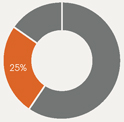
| 66 | IHG | Annual Report and Form 20-F 2019 |
Table of Contents
EMEAA continued
| IHG | Annual Report and Form 20-F 2019 | Strategic Report | Performance | 67 |
Table of Contents
Strategic Report
Performance continued
EMEAA continued
| 68 | IHG | Annual Report and Form 20-F 2019 |
Table of Contents

|
“2019 marked IHG’s 35th anniversary of operating in Greater China with 800 opened and pipeline hotels. We continue our growth strategy focusing on quality and disciplined execution to build an ‘in China for China’ business, leveraging the benefit of IHG’s expertise and global scale.”
Jolyon Bulley Chief Executive Officer, Greater China |


| IHG | Annual Report and Form 20-F 2019 | Strategic Report | Performance | 69 |
Table of Contents
Strategic Report
Performance continued
Greater China continued
| 70 | IHG | Annual Report and Form 20-F 2019 |
Table of Contents
| IHG | Annual Report and Form 20-F 2019 | Strategic Report | Performance | 71 |
Table of Contents
Strategic Report
Performance continued
Central
| Central results | ||||||||||||||||||||||||||||||
| 12 months ended 31 December | ||||||||||||||||||||||||||||||
|
2019
$m |
2018
Restated $m |
2019
vs 2018 % change |
2017
Restated $m |
2018
vs 2017 % change |
||||||||||||||||||||||||||
| Revenue | 185 | 170 | 8.8 | 157 | 8.3 | |||||||||||||||||||||||||
| Gross costs | (310 | ) | (287 | ) | 8.0 | (259 | ) | 10.8 | ||||||||||||||||||||||
| (125 | ) | (117 | ) | 6.8 | (102 | ) | 14.7 | |||||||||||||||||||||||
| Operating exceptional items | (15 | ) | (55 | ) | (72.7 | ) | (29 | ) | 89.7 | |||||||||||||||||||||
| Operating loss | (140 | ) | (172 | ) | (18.6 | ) | (131 | ) | 31.3 | |||||||||||||||||||||
Other financial information
| 72 | IHG | Annual Report and Form 20-F 2019 |
Table of Contents
Performance continued
Other financial information

| IHG | Annual Report and Form 20-F 2019 | Strategic Report | Performance | 73 |
Table of Contents
Strategic Report
Performance continued
Liquidity and capital resources
| 74 | IHG | Annual Report and Form 20-F 2019 |
Table of Contents
Liquidity and capital resources continued
| IHG | Annual Report and Form 20-F 2019 | Strategic Report | Performance | 75 |
Table of Contents

|
Governance
|
||
|
Governance
|
||
|
78 |
Chair’s overview | |
|
79 |
Corporate Governance | |
|
79 |
Our Board and Committee governance structure | |
|
80 |
Our Board of Directors | |
|
82 |
Our Executive Committee | |
|
84 |
Board meetings | |
|
86 |
Director induction, training and development | |
|
86 |
Board effectiveness evaluation | |
|
88 |
Audit Committee Report | |
|
92 |
Corporate Responsibility Committee Report | |
|
93 |
Nomination Committee Report | |
|
94 |
Statement of compliance with the UK Corporate Governance Code | |
|
96 |
Directors’ Remuneration Report | |
|
96 |
Remuneration Committee Chair’s statement | |
|
99 |
At a glance | |
|
100 |
Remuneration at IHG – the wider context | |
|
101 |
Annual Report on Directors’ Remuneration | |
|
110 |
Directors’ Remuneration Policy | |
| Regent Porto Montenegro, Montenegro | ||
| 76 | IHG | Annual Report and Form 20-F 2019 | |
Table of Contents

| IHG | Annual Report and Form 20-F 2019 | Governance | 77 |
Table of Contents


Table of Contents
Our Board and Committee governance structure
Board and Committee membership and attendance in 2019
| Meetings | ||||||||||||||||||||||||||||||||||||||||||
|
Appointment
date |
Committee
appointments |
Board |
Audit
Committee |
Corporate
Responsibility Committee |
Nomination
Committee |
Remuneration
Committee |
||||||||||||||||||||||||||||||||||||
| Total meetings held | 7 | 5 | 3 | 6 | 6 | |||||||||||||||||||||||||||||||||||||
| Chair | ||||||||||||||||||||||||||||||||||||||||||
| Patrick Cescau a | 01/01/13 |

|
7/7 | – | – | 6/6 | – | |||||||||||||||||||||||||||||||||||
| Chief Executive Officer | ||||||||||||||||||||||||||||||||||||||||||
| Keith Barr | 01/07/17 | 7/7 | – | – | – | – | ||||||||||||||||||||||||||||||||||||
| Executive Directors | ||||||||||||||||||||||||||||||||||||||||||
| Paul Edgecliffe-Johnson | 01/01/14 | 7/7 | – | – | – | – | ||||||||||||||||||||||||||||||||||||
| Elie Maalouf | 01/01/18 | 7/7 | – | – | – | – | ||||||||||||||||||||||||||||||||||||
| Senior Independent Non-Executive Director | ||||||||||||||||||||||||||||||||||||||||||
| Dale Morrison | 01/06/11 |

|
7/7 | 5/5 | – | 6/6 | 6/6 | |||||||||||||||||||||||||||||||||||
| Non-Executive Directors | ||||||||||||||||||||||||||||||||||||||||||
| Anne Busquet | 01/03/15 |

|
7/7 | 5/5 | 3/3 | 2/6 | b | – | ||||||||||||||||||||||||||||||||||
| Ian Dyson | 01/09/13 |

|
7/7 | 5/5 | – | 2/6 | b | 6/6 | ||||||||||||||||||||||||||||||||||
| Jo Harlow | 01/09/14 |

|
7/7 | – | – | 6/6 | 6/6 | |||||||||||||||||||||||||||||||||||
| Luke Mayhew | 01/07/11 |

|
7/7 | 5/5 | 2/3 | c | 6/6 | – | ||||||||||||||||||||||||||||||||||
| Jill McDonald | 01/06/13 |

|
7/7 | 5/5 | 3/3 | 6/6 | – | |||||||||||||||||||||||||||||||||||
| Malina Ngai | 01/03/17 |

|
6/7 | d | – | 3/3 | 2/6 | b | 5/6 | d | ||||||||||||||||||||||||||||||||
| a |
In principle the Chair attends all Committee meetings, and the full Board attends the relevant sections of the Audit Committee meetings when results, and risk management processes and controls are discussed and considered. |
| b |
The composition of the Nomination Committee was adjusted during the year to comprise one member of each Board Committee and the Senior Independent Non-Executive Director. Accordingly Anne Busquet, Ian Dyson and Malina Ngai resigned from the Nomination Committee in July 2019. |
| c |
Luke Mayhew was unable to attend a Corporate Responsibility Committee meeting due to prior engagement. |
| d |
Malina Ngai was unable to attend a Board meeting and a Remuneration Committee meeting due to a prior commitment. |
| Board Committee membership key | ||||||||

|
Audit Committee member |

|
Remuneration Committee member | |||||

|
Corporate Responsibility Committee member |

|
Chair of a Board Committee | |||||

|
Nomination Committee member | |||||||
| IHG | Annual Report and Form 20-F 2019 | Governance | Corporate Governance | 79 |
Table of Contents



Table of Contents






| IHG | Annual Report and Form 20-F 2019 | Governance | Corporate Governance | 81 |
Table of Contents



Table of Contents



| Changes to the Board and its Committees, and Executive Committee | ||||
| Arthur de Haast | Arthur was appointed to the Board from 1 January 2020 | |||
| Anne Busquet | Anne stepped down from the Nomination Committee in July 2019 | |||
| Ian Dyson | Ian stepped down from the Nomination Committee in July 2019 | |||
| Malina Ngai | Malina stepped down from the Nomination Committee in July 2019 | |||
| Ranjay Radhakrishnan | Ranjay has resigned as Chief Human Resources Officer with effect from the end of February 2020 | |||
| IHG | Annual Report and Form 20-F 2019 | Governance | Corporate Governance | 83 |
Table of Contents
Governance
Corporate Governance continued
|
|
Area of discussion |
Discussion topic |
||
| Strategic and operational matters | Accelerating our growth | Regular updates were received on progress against key strategic initiatives, including ongoing refinement of IHG’s operating model and key processes, benefit realisation, and risk management. | ||
|
|
|
|||
| Strategic initiatives | Consideration of merger and acquisition activity, including the acquisition of the Six Senses brand and business. In considering the acquisition, the Board had regard to the value proposition for our owners and our guests and for shareholders and reviewed the conclusions of the due diligence across a number of areas, including in relation to employees, human rights and the environment. | |||
|
|
|
|||
| Operating regions | Operating performance, competitive positioning, and outlook and strategy for all regions, including progress against KPIs, were reviewed at each Board meeting. Deep-dive sessions on strategy, performance, risks and opportunities in each region including key market development opportunities were presented during the year. Hotel lifecycle management, with a particular focus on the Group’s owner proposition, was also considered. | |||
|
|
|
|||
| Commercial delivery | Review of long-term channels and sales strategy and the plans for omnichannel revenue delivery, digital experiences, and data enterprise capabilities. | |||
|
|
|
|||
| Brands | Brand performance and initiatives for all brands, including approving the launch of Atwell Suites and monitoring the integration and delivery of the voco, avid, Regent and Six Senses brands. In considering the Atwell Suites brand, the Board took into account the brand proposition for guests and for our owners, including, for example, owner cost to build. | |||
|
|
|
|||
| Our people and culture | The Board reviewed and adopted a ‘Voice of the Employee’ plan designed to strengthen the understanding of employee engagement and the impact of business proposals on employees, where relevant. Following such adoption, the Board reviewed various employee feedback channels, and members of the Board actively engaged with employees at various meetings and forums. Further information is set out on pages 28 and 32 to 33. | |||
|
|
|
|||
| Finance | In addition to approving the budget, review of the Group’s funding and liquidity position. In approving the budget, the Board considered a number of factors, including long-term viability, employee considerations, the need for investment in our business and the expectations of shareholders. | |||
|
|
|
|
| 84 | IHG | Annual Report and Form 20-F 2019 |
Table of Contents
|
|
Area of discussion |
Discussion topic |
||
| Corporate governance | Updates from each of the Board Committees | Details of Committee activities during 2019 can be found on pages 88 to 93 and 96 to 117. | ||
|
|
|
|||
| Confidential Disclosure Channel Reports | Having assumed responsibility for overseeing the Group’s Confidential Disclosure Channel, the Board received reports of confidential matters disclosed. | |||
|
|
|
|||
| Quarterly corporate governance and regulatory updates, including reviews of regulatory developments and any upcoming legislative changes affecting the business, the Board and/or its Committees | Internal quarterly updates are provided to the Board covering key regulatory and corporate governance developments in areas such as audit reform, the role of the Board in cyber risk, remuneration trends, and ESG considerations, and how the Group is responding. | |||
|
|
|
|||
| Year-end matters, including the Annual Report and Form 20-F | Details of the review process of the Annual Report and Form 20-F can be found on page 88. | |||
|
|
|
|||
| Board effectiveness evaluation | Details of the process and outcome of the external Board effectiveness review can be found on page 86. | |||
|
|
|
|
||
| Risk management | Cybersecurity | Presentations and updates were received on cybersecurity, including the overall threat landscape, IHG’s multi-year plan to enhance security capability, and the status of 2019 initiatives. The Board further considered the approach to cybersecurity risk management, key risk areas, and enhanced governance, including approval of an updated information security governance policy. | ||
|
|
|
|||
| Internal controls and risk management systems, our risk appetite and our global insurance programme | Regular updates were received on internal controls, risk management systems, principal and emerging risks, our risk appetite and global insurance programme. Reports on risk topics were delivered by the Chair of each Committee. | |||
|
|
|
|||
| Terms of Reference for each Board Committee | Changes to the composition and Terms of Reference of the Nomination Committee were considered and approved during the year. The Terms of Reference for all Committees and the Matters Reserved for the Board can be found on our website. | |||
|
|
|
|
||
| Investor relations and communications | Updates on investor perceptions and shareholder relations, consideration of analysts’ reports and media updates | The Board receives a regular report outlining share register movement, relative share price performance, Investor Relations activities and engagement with shareholders. The Board also considered feedback from the regular investor and analyst perception survey as well as individual meetings with investors. | ||
|
|
|
|||
| Global communications updates | The Board receives a regular report on global communications covering areas including the changing external landscape, trends on consumption of information, communications priorities, activity across key regions, our brands, people, and owners. | |||
|
|
|
|||
| Review and approval of shareholder returns strategies for 2019 | During the year, the Board considered and, after taking into account stakeholder interests, distributable reserves and long-term success of the Company, recommended two dividends. | |||
|
|
|
|||
| Preparations for the AGM | Details of the 2020 AGM can be found on page 36. | |||
|
|
|
|
||
| IHG | Annual Report and Form 20-F 2019 | Governance | Corporate Governance | 85 |
Table of Contents
Table of Contents
|
Area for focus |
Actions agreed |
|
|
Board processes, dynamics and engagement with management:
• revising the cadence of meetings over the year and re-shaping the meeting agendas to allow (i) for extended discussion of key strategic and operational initiatives and (ii) the CEO to engage more with Non-Executive Directors.
• further enhancing and streamlining the information provided to the Board to include more forward-looking information. |
The number of Board meetings for 2020 will be reduced from seven to six face-to-face meetings (with more time allowed for each meeting), and two CEO Board update calls focusing on operational and performance matters will be added.
The balance between time spent on updating the Board and discussion items will be reviewed to ensure that there is continued appropriate distribution between providing the Board with essential information and allowing time for Board in-depth discussion and debate.
More time will be allocated for the CEO to meet alone with Non-Executive Directors in an informal environment outside the full Board meeting, in addition to the private sessions with the CEO on the agenda.
The information pack provided to the Board in advance of meetings will be reviewed and revised as appropriate to ensure there is sufficient key trend data and balance between performance to date and forward-looking information.
The Directors will continue to suggest agenda items for deeper dive consideration and the Chair and Company Secretary will continue to set the agenda to ensure that sufficient time is dedicated to key strategic and operational projects and priorities and the meeting cadence allows for appropriate discussion. |
|
|
|
|
|
|
Board Committees:
• revising the Terms of Reference of the Committees to avoid the overlap in remit, particularly around Diversity and Inclusion and Voice of the Employee.
• refreshing the approach to agenda items for Audit Committee meetings, given the broad scope of its remit. |
The Terms of Reference of the Nomination and Corporate Responsibility Committees have been amended so that from 1 March 2020, the Nomination Committee will continue to lead the process for Board composition, appointments and succession planning, while the Corporate Responsibility Committee (which is to be renamed the Responsible Business Committee) shall assume responsibility for overseeing the Group’s Diversity and Inclusion agenda and the Board’s engagement with the Group’s workforce.
The Audit Committee agendas will be evaluated to ensure that the pre-read information pack and agenda items allow for an improved balance between areas for discussion and regular routine updates. |
|
|
|
|
| IHG | Annual Report and Form 20-F 2019 | Governance | Corporate Governance | 87 |
Table of Contents


Table of Contents
Significant matters in the 2019 Financial Statements
The Committee discussed with management and the Auditor the key judgements applied in the Financial Statements, the exceptional items arising in the year and the impact of any accounting developments or legislative changes. The main items discussed are outlined below.
|
Area of focus |
Issue/Role of the Committee |
Conclusions/Actions taken |
||
|
Accounting
for IHG Rewards Club |
Accounting for IHG Rewards Club requires significant use of estimation techniques and represents a material deferred revenue balance. Accordingly, the Committee reviews the controls, judgements and estimates related to accounting for the IHG Rewards Club programme. | In forming a conclusion on the appropriateness of the accounting for the IHG Rewards Club programme, the Committee reviewed the deferred revenue balance and questioned the valuation approach, the results of the external actuarial review and procedures completed, to determine the breakage assumption for outstanding IHG Rewards Club points. The Committee concluded that the deferred revenue balance is appropriately stated. | ||
|
|
|
|
||
|
Accounting
for the System Fund |
Given the unique nature of the System Fund, the Committee reviews the controls and processes related to System Fund accounting. | In forming a conclusion on the appropriateness of the System Fund accounting, the Committee met with senior finance management to review and evaluate the risk areas associated with the System Fund. The Committee reviewed a paper from management outlining the financial oversight of the System Fund, the principles determining the allocation of revenues and expenses to the System Fund, and the related internal control environment. The Committee concluded that the accounting treatment of the System Fund, and related disclosures, were appropriate. | ||
|
|
|
|
||
| Impairment testing | Impairment reviews require significant judgement in estimating recoverable values of assets or cash-generating units and the Committee therefore scrutinises the methodologies applied and the inherent sensitivities in determining any potential asset impairment and the adequacy of the related disclosures. | The Committee reviewed a management report outlining the approach taken on impairment testing and key assumptions and sensitivities supporting the conclusion on the various asset categories. The Committee examined the assumptions related to non-current assets, assets previously impaired, and the assets acquired as part of the Kimpton and UK portfolio transactions in 2015 and 2018 respectively. The impairments (see pages 139 and 140, and note 13 on page 168), recorded in the year for the Kimpton management agreements ($50m), the UK portfolio goodwill ($49m) and IFRS 16 right-of-use asset ($32m) and the related fair value adjustment to contingent purchase consideration ($38m) were discussed in detail. The Committee concluded that it agreed with the determinations reached on impairment, and the related change in the fair value of the UK portfolio contingent purchase consideration, the classification of these as exceptional items and that the related disclosures were appropriate. | ||
|
|
|
|
||
|
Litigation and
contingencies |
From time to time, the Group is subject to legal proceedings with the ultimate outcome of each being subject to many uncertainties. The Committee reviews and evaluates the need for any provisioning on a case by case basis and considers the adequacy of the disclosure. | At each meeting during the year, the Committee considered a report detailing all material litigation matters. The Committee discussed and agreed any provisioning requirements for these matters based on the factors set out on page 236. The Committee reviewed the need for, and the amount of, a provision in respect of a lawsuit filed against the Group in the Americas region, and the cost of an arbitration award in the EMEAA region, and the classification of these as exceptional items. | ||
|
|
|
|
||
| Exceptional items | The Group exercises judgement in presenting exceptional items. The Committee reviews and challenges the classification of items as exceptional based on their materiality or nature. | The Committee reviewed papers prepared by management and considered the consistency of treatment and nature of items classified as exceptional. The Committee reviewed and challenged the significance, timing and nature of the exceptional items disclosed in note 6, comprising reorganisation costs, acquisition and integration costs primarily relating to Six Senses, impairment, fair value adjustments to contingent purchase consideration and litigation. The Committee concluded that the disclosures and the treatment of the items shown as exceptional were appropriate. | ||
|
|
|
|
||
|
Acquisition of
Six Senses |
Acquisition accounting involves judgement in establishing the fair values of the assets and liabilities acquired. The Committee reviews the accounting and challenges the appropriateness of the inputs and judgements to these valuations. | The Committee considered the work done to establish the fair value of the assets acquired. The Committee questioned the assumptions underlying the significant assets recognised and took into consideration a report from a third-party valuation expert. The Committee concluded that the fair values recognised were appropriate. | ||
|
|
|
|
||
|
Adoption of
IFRS 16 |
IFRS 16 ‘Leases’ was adopted from 1 January 2019. Accordingly, the Committee reviewed the accounting, considered the adequacy of the disclosure and the related processes and controls. | Having previously reviewed the accounting under IFRS 16 in 2018, the Committee considered the work done to restate the 2018 results, the application of IFRS 16 and related disclosures in the Annual Report and Form 20-F 2019 and the refreshed internal control environment. The Committee concluded that the impact of the adoption of IFRS 16 on the financial statements was appropriate. | ||
|
|
|
|
||
| IHG | Annual Report and Form 20-F 2019 | Governance | Corporate Governance | 89 |
Table of Contents
Governance
Corporate Governance continued
Audit Committee Report continued

| 90 | IHG | Annual Report and Form 20-F 2019 |
Table of Contents
| IHG | Annual Report and Form 20-F 2019 | Governance | Corporate Governance | 91 |
Table of Contents

Table of Contents

Table of Contents
Table of Contents
| IHG | Annual Report and Form 20-F 2019 | Governance | Corporate Governance | 95 |
Table of Contents
Governance
Directors’ Remuneration Report
Remuneration Committee Chair’s statement

|
We have updated our Directors’ Remuneration Policy, taking into account our governance and stewardship responsibilities and the views of our major shareholders, to balance the risks and rewards for all of our stakeholders and to continue to support the Company’s strategy for quality growth and returns
|
a See page 55 for Non-GAAP definitions.
| 96 | IHG | Annual Report and Form 20-F 2019 |
Table of Contents
| IHG | Annual Report and Form 20-F 2019 | Governance | Directors’ Remuneration Report | 97 |
Table of Contents
Governance
Directors’ Remuneration Report continued
Remuneration Committee Chair’s statement continued
Summary of DR Policy and proposed changes
|
Element |
2020 |
2021 |
2022 |
2023 |
2024 |
Framework |
Link to Strategy |
|||||||
| Fixed | ||||||||||||||
| Base salary |

|
Generally in line with the range applying to the corporate population. Reviewed annually and fixed for 12 months from 1 April. | Recognises the value of the role and the individual’s skills, performance and experience. | |||||||||||
|
|
|
|
|
|
|
|
|
|||||||
| Benefit |

|
Relevant benefits are restricted to the typical level for the role/location. | Competitive and consistent with role/ location; helps recruit and retain. | |||||||||||
|
|
|
|
|
|
|
|
|
|||||||
| Pension |

|
Defined Contribution. Employee contributions with matching employer contributions. Salary is the only part of remuneration that is pensionable. | Competitive and consistent with role/ location; helps recruit and retain. | |||||||||||
|
Proposed change
Pension contributions and/or cash allowance for new Executive Directors will be aligned with the maximum employer contribution rate available to all other participants in the UK pension plan. Incumbent UK Executive Directors have agreed to a voluntary reduction in pension provision by the end of 2022 such that the value will align on the same basis with effect from 1 January 2023. |
Rationale for change
Following a full market review of its UK pension benefit, the Company will offer all participants the same rate of pension benefit. Whilst there were very good reasons for having had a tiered contribution structure in the past, following significant change in the UK pension environment since the benefit was last reviewed, this is no longer prevalent in the market. To remain competitive in the UK workspace, a level pension benefit structure will be introduced. This will be kept under review as market practice continues to evolve. |
|||||||||||||
|
|
||||||||||||||
| Variable | ||||||||||||||
| Annual Performance Plan (cash) |
Cash |
Maximum annual opportunity is 200% of salary with 70% an operating profit measure and 30% key strategic measures; 50% of the award is deferred into shares for three years. Awards are subject to a global affordability gate. Full vesting after three years. Malus and clawback apply. |
For 2020, the KPIs that directly link remuneration to our business strategy include:
• Operating profit from reportable segments – a fundamental measure of our financial health and represents the financial outcomes of the KPI goals; and
• Net System Size growth – a KPI and measure of our strategy to build and leverage scale. |
|||||||||||
|
|
|
|
|
|
|
|||||||||
| Annual Performance Plan (deferred shares) |
Deferral |
|||||||||||||
|
|
|
|
|
|
|
|
|
|||||||
| Long Term Incentive Plan (LTIP) |
Performance |
Deferral |
Proposed change
The maximum potential LTIP quantum is to increase from 205% to 350% of salary for the CEO and to 275% of salary for other Executive Directors.
The net System Size growth (NSSG) element will increase to 30% and will measure performance relative to our closest peers, balancing the growth objectives with a Return on Capital Employed (ROCE) underpin to this part of the LTIP. The Total Shareholder Return (TSR) element will reduce from 40% to 30%. The remaining two measures of Cash Flow and Total Gross Revenue will remain at 20%.
Formal adoption of the two-year post-vest holding period which was introduced for the 2019/21 cycle.
Malus and clawback will continue to apply. |
Rationale for change
To incentivise achieving our stretching new growth ambitions; to compete more effectively in the US talent pool and to assist with recruitment and retention in succession planning given pay compression.
A focus on industry-leading NSSG is at the heart of our new strategy, underpinned by ROCE to reflect our commitment to deliver quality growth whilst maintaining returns.
Continued strong alignment between Executive Director remuneration and shareholder interests. |
||||||||||
|
|
||||||||||||||
| Other | ||||||||||||||
| Minimum shareholding requirements |
Proposed change
The guideline shareholding requirements will increase from 300% to 500% of salary for the Chief Executive Officer and from 200% to 300% of salary for other Executive Directors. The post-employment shareholding requirement, introduced in 2018, will continue to apply. |
Rationale for change
To demonstrate a commitment to the Company’s success and strengthen alignment between the executives’ and the shareholders’ interests. |
||||||||||||
|
|
|
|
|
|
|
|
|
|||||||
| Malus and clawback |

|
Proposed change
The range of potential triggers for the recovery of awards made to Executive Directors will be extended. See page 115 for details. |
Rationale for change
In line with guidance from the UK Corporate Governance Code, this is designed to protect shareholder value and disincentivise unwanted behaviours and actions. |
|||||||||||
|
|
||||||||||||||


| 98 | IHG | Annual Report and Form 20-F 2019 |
Table of Contents
|
How to use this report Within the Directors’ Remuneration Report we have used colour coding to denote different elements of remuneration. The colours used and the corresponding remuneration elements are: |
∎ Salary ∎ Benefits ∎ Pension benefit ∎ Annual Performance Plan (APP) 50% cash and 50% deferred shares ∎ Long Term Incentive Plan (LTIP) ∎ Shareholding |
AUDITED |
||||
|
Audited information Content contained within a tinted panel highlighted with an ‘Audited’ tab indicates that all the information within the panel is audited. |
||||||
|
|
|
|||||
|
How we performed in 2019
In 2019, we achieved close to target operating profit from reportable segments, met our goal for savings to reinvest in the business to support future growth, and exceeded our target net System Size growth for the year. Looking back over the three years to 2019, we continued to deliver strong shareholder returns and have surpassed our expectations on the challenging targets we set for growth in Total Gross Revenue, System Size and Cash Flow over the period 2017 to 2019.
|
Executive Director remuneration
2019 remuneration The table below shows the 2019 potential remuneration opportunity and actual achievement compared to 2018 actual achievement.
|
|||
|
Measures used for APP a
Operating profit from reportable segments: ($m)
Net System Size growth b (k rooms)
Savings for reinvestment ($m)
a Further details of APP and LTIP outcomes can be found on pages 102 to 104.
b APP System Size target is based on closing year target; LTIP target is based on three-year growth performance.
c The Total Gross Revenue target represents a target for growth over the LTIP period. |
Measures used for LTIP a
Relative TSR (%)
Total Gross Revenue c ($bn)
Net System Size growth b (k rooms)
Cash Flow ($bn)
|
The relevant figures for each of the elements that make up the single total figure of remuneration, as shown below for the Executive Directors, can be found in the table on page 101.
Keith Barr a , Chief Executive Officer Value (£000)
Paul Edgecliffe-Johnson, Chief Financial Officer Value (£000)
Elie Maalouf, Chief Executive Officer, Americas Value (£000)
Key for potential
∎ Maximum = Fixed pay and maximum award under APP and LTIP ∎ Target = Fixed pay and on-target award for APP (115%) and 50% of maximum LTIP vesting ∎ Minimum = Fixed pay
a The 2018 amount for Keith Barr excludes the localisation payment detailed on page 101. |
||


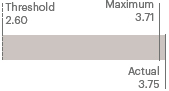


| IHG | Annual Report and Form 20-F 2019 | Governance | Directors’ Remuneration Report | 99 |
Table of Contents
Governance
Directors’ Remuneration Report
Remuneration at IHG – the wider context
How our reward practices align across the organisation
| Elements of Reward |
Executive Directors |
Executive Committee |
Wider Workforce |
Notes | ||||||||
|
|
|
|||||||||||
| Fixed |

|
Salary |
|
|
|
|||||||
|
|
|
|||||||||||

|
Benefits |
|
|
|
||||||||
|
|
|
|||||||||||

|
Pension benefit |
|
|
|
See below in respect of UK pensions. | |||||||
|
|
|
|||||||||||
| Variable |

|
Annual Performance Plan (APP) |
|
|
|
For senior management (generally at Executive Committee level and their direct reports) a proportion of bonus is deferred into shares for a three-year period. | ||||||
|
|
|
|||||||||||

|
Long Term Incentive Plan (LTIP) |
|
|
|
Senior/mid-management and certain specialist roles are eligible for a Long Term Incentive Plan (LTIP). Performance-based LTIP largely applies at the level of Executive Committee and their direct reports. | |||||||
|
|
|
|||||||||||

|
Restricted Stock Units (RSUs) |
|
|
In line with typical market practice, particularly in the US, and due to line-of-sight to performance measures, a gradually greater proportion of the LTIP award is made as RSUs (which are not subject to performance conditions but still align employee interests with those of shareholders) for eligible roles from the Executive Committee down. | ||||||||
|
|
|
|||||||||||

|
Colleague Share Plan (introduced in 2020) |
|
Available to employees below senior/mid-management levels only. | |||||||||
|
|
|
|||||||||||

|
Recognition Scheme |
|
Available to employees below senior/mid-management levels only. | |||||||||
|
|
|
|||||||||||
| Other |

|
Shareholding requirements |
|
|
|
Shareholding requirements are applicable at the level of Executive Committee and their direct reports. | ||||||
|
|
|
|||||||||||
| 100 | IHG | Annual Report and Form 20-F 2019 |
Table of Contents
Annual Report on Directors’ Remuneration
|
AUDITED |
| Single total figure of remuneration – Executive Directors |
|
|||||||||||||||||||||||||||||||||||||||
| Fixed pay | Variable pay | |||||||||||||||||||||||||||||||||||||||
|
Executive Directors |
Year |
|
∎
Salary
£000 |
|
|
∎
Benefits
£000 |
|
|
∎
Pension
benefit £000 |
|
|
Subtotal
£000 |
|
|
∎
APP
£000 |
|
|
∎
LTIP
£000 |
a |
|
Subtotal
£000 |
|
|
Other
£000 |
|
|
∎
Total
£000 |
|
||||||||||||
| Keith Barr | 2019 | 828 | 36 | 207 | 1,071 | 983 | 1,263 | 2,246 | – | 3,317 | ||||||||||||||||||||||||||||||
|
|
|
|
|
|
|
|
|
|
|
|
|
|
|
|
|
|
|
|
|
|
|
|
|
|
|
|
|
|
|
|||||||||||
| 2018 | 792 | 51 | 198 | 1,041 | 1,343 | 609 | 1,952 | 150 | 3,143 | |||||||||||||||||||||||||||||||
|
|
|
|
|
|
|
|
|
|
|
|
|
|
|
|
|
|
|
|
|
|
|
|
|
|
|
|
|
|
|
|
||||||||||
| Paul Edgecliffe-Johnson | 2019 | 602 | 24 | 158 | 784 | 723 | 987 | 1,710 | – | 2,494 | ||||||||||||||||||||||||||||||
|
|
|
|
|
|
|
|
|
|
|
|
|
|
|
|
|
|
|
|
|
|
|
|
|
|
|
|
|
|
|
|||||||||||
| 2018 | 554 | 24 | 166 | 744 | 942 | 764 | 1,706 | – | 2,450 | |||||||||||||||||||||||||||||||
|
|
|
|
|
|
|
|
|
|
|
|
|
|
|
|
|
|
|
|
|
|
|
|
|
|
|
|
|
|
|
|
||||||||||
| Elie Maalouf b | 2019 | 622 | 33 | 121 | 776 | 743 | 963 | 1,706 | – | 2,482 | ||||||||||||||||||||||||||||||
|
|
|
|
|
|
|
|
|
|
|
|
|
|
|
|
|
|
|
|
|
|
|
|
|
|
|
|
|
|
|
|||||||||||
| 2018 | 559 | 34 | 109 | 702 | 947 | 701 | 1,648 | – | 2,350 | |||||||||||||||||||||||||||||||
|
|
|
|
|
|
|
|
|
|
|
|
|
|
|
|
|
|
|
|
|
|
|
|
|
|
|
|
|
|
|
|
||||||||||
| a |
LTIP: Figures for 2018 relate to the value of shares for the 2016/18 LTIP cycle and have been restated using actual share price on date of vesting. Figures for 2019 relate to the value of shares for the 2017/19 LTIP cycle. |
| b |
Elie Maalouf is paid in US dollars and the sterling equivalent is calculated using an exchange rate of $1 = £0.78 in 2019 and $1 = £0.75 in 2018 (page 150). |
| IHG | Annual Report and Form 20-F 2019 | Governance | Directors’ Remuneration Report | 101 |
Table of Contents
Governance
Directors’ Remuneration Report continued
Annual Report on Directors’ Remuneration
|
AUDITED |

 LTIP 2017/19
(shares)
LTIP 2017/19
(shares)

| 102 | IHG | Annual Report and Form 20-F 2019 |
Table of Contents
|
AUDITED |
| Performance Targets | ||||||||||||||||||||||
|
|
||||||||||||||||||||||
| Performance measure and weighting | Target | % Vesting | Result |
Achievement
(% of maximum) |
Weighting |
Weighted
achievement |
||||||||||||||||
|
|
|
|
|
|
|
|||||||||||||||||
|
Total Shareholder Return: |
Maximum | Maximum | Outcome | 47.2% | 40% | 18.9% | ||||||||||||||||
|
Three-year growth relative to average |
84.1% | 100% | 54.9% | |||||||||||||||||||
|
of competitors |
||||||||||||||||||||||
|
|
||||||||||||||||||||||
|
40% |
Threshold | Threshold | ||||||||||||||||||||
| 39.9% | 20% | |||||||||||||||||||||
|
|
|
|
|
|
|
|||||||||||||||||
|
Total Gross Revenue: |
Maximum | Maximum | Outcome | 100% | 20% | 20% | ||||||||||||||||
|
based on IHG’s performance against |
3.71bn | 100% | 3.75bn USD | |||||||||||||||||||
|
an absolute total gross revenue |
USD | |||||||||||||||||||||
|
|
||||||||||||||||||||||
|
target |
Threshold | Threshold | ||||||||||||||||||||
|
20% |
2.60bn | 20% | ||||||||||||||||||||
| USD | ||||||||||||||||||||||
|
|
|
|
|
|
|
|||||||||||||||||
|
Net System Size Growth: |
Maximum | Maximum | Outcome | 100% | 20% | 20% | ||||||||||||||||
|
based on IHG’s performance against |
107.4k | 100% | 116.4k rooms | |||||||||||||||||||
|
an absolute NSSG target |
rooms | |||||||||||||||||||||
|
|
||||||||||||||||||||||
|
20% |
Threshold | Threshold | ||||||||||||||||||||
| 75.1k | 20% | |||||||||||||||||||||
| rooms | ||||||||||||||||||||||
|
|
|
|
|
|
|
|||||||||||||||||
|
Cash Flow: |
Maximum | Maximum | Reported Outcome | 100% | 20% | 20% | ||||||||||||||||
|
based on IHG’s performance against |
1.72bn | 100% | 1.6bn USD | |||||||||||||||||||
|
an absolute cash flow target |
USD | |||||||||||||||||||||
|
|
||||||||||||||||||||||
|
20% |
Threshold | Threshold | Adjusted Outcome | |||||||||||||||||||
| 1.29bn | 20% | 1.85bn USD | ||||||||||||||||||||
|
USD |
||||||||||||||||||||||
|
|
|
|
|
|
|
|||||||||||||||||
|
Total achievement (% of maximum |
78.9% | |||||||||||||||||||||
|
opportunity vested) |
||||||||||||||||||||||
|
|
|
|
|
|
|
|||||||||||||||||
| IHG | Annual Report and Form 20-F 2019 | Governance | Directors’ Remuneration Report | 103 |
Table of Contents
Governance
Directors’ Remuneration Report continued
Annual Report on Directors’ Remuneration continued
|
AUDITED |
LTIP
Achievement against target is measured by reference to the three years ending 31 December 2019. This cycle will vest on 19 February 2020 and the individual outcomes for this cycle are shown below.
The share price of 4,847p used to calculate the 2017/19 LTIP cycle value shown in the single-figure table is the average over the final quarter of 2019.
| % of | ||||||||||||||||||||||||||||
| Maximum | maximum | Outcome | Total value | Value of award | ||||||||||||||||||||||||
| opportunity at grant | opportunity | (number of shares | of award | attributable to share | ||||||||||||||||||||||||
| Executive Director | Award Cycle | (number of shares) | vested | awarded at vest) | £000 | price appreciation | ||||||||||||||||||||||
| Keith Barr a | LTIP 2017/19 | 30,303 | 78.9% | 23,908 | 1,159 | 135 | ||||||||||||||||||||||
| RSU 2017/19 | 2,160 | 100% | 2,160 | 105 | 13 | |||||||||||||||||||||||
| Paul Edgecliffe-Johnson | LTIP 2017/19 | 25,811 | 78.9% | 20,364 | 987 | 120 | ||||||||||||||||||||||
| Elie Maalouf b | LTIP 2017/19 | 21,822 | 78.9% | 17,217 | 835 | 102 | ||||||||||||||||||||||
| RSU 2017/19 | 2,645 | 100% | 2,645 | 128 | 16 | |||||||||||||||||||||||
| a |
Keith Barr received an increased award, pro-rated from 1 July 2017, for the 2017/19 LTIP in accordance with the DR Policy as a result of his appointment to the Board. Prior to this, he was granted 17,822 shares and 2,160 restricted stock units on 22 May 2017 with a market price of 4,257p per share. |
| b |
The award for Elie Maalouf was granted prior to his appointment to the Board. Elie was also granted 2,645 restricted stock units on 22 May 2017 with a market price of 4,257p per share. |
|
AUDITED |
Other outstanding awards
Scheme interests awarded during 2018 and 2019
During 2018 and 2019, awards were granted under the LTIP cycle and made to each Executive Director over shares with a maximum value of 205% of salary using an average of the closing mid-market share price for the five days prior to grant, as in the table below. These are in the form of conditional awards over Company shares and do not carry the right to dividends or dividend equivalents during the vesting period.
The vesting date for the 2018/20 LTIP award is the day after the announcement of our annual 2020 preliminary results in February 2021. These awards will vest, and shares will be transferred to the award-holder, to the extent performance targets are met.
The vesting date for the 2019/21 LTIP award is the day after the announcement of our annual 2021 preliminary results in February 2022. These awards will vest to the extent performance targets are met and will then be restricted for a further two years, transferring to the award-holder in February 2024.
The performance measures are as agreed in the 2017 Remuneration Policy. Total shareholder return, total gross revenue, net System Size growth and cash flow are measured by reference to the three years ending 31 December 2020 for the 2018/20 cycle and 31 December 2021 for the 2019/21 cycle. Minimum performance is equal to 20% of the maximum award.
| Market price | Face value of | Number of shares | ||||||||||||||||||
| Maximum | per share at grant | award at grant | received if minimum | |||||||||||||||||
| Executive Director | Award date | shares awarded | £ | £000 | performance achieved | |||||||||||||||
| 2018/20 cycle | ||||||||||||||||||||
| Keith Barr | 8 May 2018 | 35,381 | 46.25 | 1,636 | 7,076 | |||||||||||||||
| Paul Edgecliffe-Johnson | 8 May 2018 | 24,830 | 46.25 | 1,148 | 4,966 | |||||||||||||||
| Elie Maalouf | 8 May 2018 | 24,426 | 46.25 | 1,130 | 4,885 | |||||||||||||||
| 2019/21 cycle | ||||||||||||||||||||
| Keith Barr | 10 May 2019 | 34,693 | 49.53 | 1,718 | 6,938 | |||||||||||||||
| Paul Edgecliffe-Johnson | 10 May 2019 | 25,509 | 49.53 | 1,263 | 5,101 | |||||||||||||||
| Elie Maalouf | 10 May 2019 | 25,802 | 49.53 | 1,278 | 5,160 | |||||||||||||||
|
AUDITED |
| 104 | IHG | Annual Report and Form 20-F 2019 |
Table of Contents
| AUDITED |
 Guideline Executive Director shareholding requirement

Current Directors’ shareholdings
The APP deferred share awards are not subject to performance conditions. Details on the performance conditions to which the unvested LTIP awards are still subject can be found on page 103.
Shares and awards held by Executive Directors as at 31 December 2019: number of shares
| Total number of | ||||||||||||||||||||||||||||||||||||||||||||||||
| Number of shares held outright | APP deferred share awards | LTIP share awards (unvested) | shares and awards held | |||||||||||||||||||||||||||||||||||||||||||||
| 2019 | 2018 | 2019 | 2018 | 2019 | 2018 | 2019 | 2018 | |||||||||||||||||||||||||||||||||||||||||
| Keith Barr | 52,832 | 42,782 | 32,697 | 28,262 | 102,537 | 97,211 | 188,066 | 168,255 | ||||||||||||||||||||||||||||||||||||||||
| Paul Edgecliffe-Johnson | 38,562 | 25,669 | 25,637 | 26,742 | 76,150 | 87,482 | 140,349 | 139,893 | ||||||||||||||||||||||||||||||||||||||||
| Elie Maalouf a | 43,652 | 24,773 | 32,591 | 42,058 | 74,695 | 82,694 | 150,938 | 149,525 | ||||||||||||||||||||||||||||||||||||||||
| a |
Includes 35,961 shares granted prior to appointment to the Board |
| IHG | Annual Report and Form 20-F 2019 | Governance | Directors’ Remuneration Report | 105 |
Table of Contents
Governance
Directors’ Remuneration Report continued
Annual Report on Directors’ Remuneration continued
Relative performance graph
InterContinental Hotels Group PLC is a member of the FTSE 100 share index, and the graph below shows the Company’s Total Shareholder Return (TSR) performance from 31 December 2008 to 31 December 2019, assuming dividends are reinvested, compared with the TSR performance achieved by the FTSE 100.
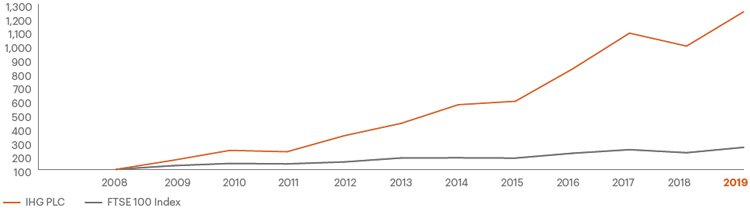
Chief Executive Officer’s remuneration
The table below shows the Chief Executive Officer’s single figure of total remuneration for the 10 years to 31 December 2019.
| Single figure | CEO | 2010 | 2011 | 2012 | 2013 | 2014 | 2015 | 2016 | 2017 | 2018 | 2019 | |||||||||||||||||||||||||||||||||||||||||||||||||||||
| Single figure of remuneration | Keith Barr | 2,161 | a | 3,143 | 3,317 | |||||||||||||||||||||||||||||||||||||||||||||||||||||||||||
| (£000) | Richard Solomons | 4,724 | 4,881 | 3,131 | 6,611 | b | 3,197 | 3,662 | 2,207 | c | ||||||||||||||||||||||||||||||||||||||||||||||||||||||
| Andrew Cosslett | 5,430 | 3,770 | ||||||||||||||||||||||||||||||||||||||||||||||||||||||||||||||
| Annual incentive received | Keith Barr | 69.7 | 84.1 | 58.7 | ||||||||||||||||||||||||||||||||||||||||||||||||||||||||||||
| (% of maximum) | Richard Solomons | 83.0 | 68.0 | 74.0 | 74.0 | 75.0 | 63.9 | 66.8 | ||||||||||||||||||||||||||||||||||||||||||||||||||||||||
| Andrew Cosslett | 100.0 | 43.3 | ||||||||||||||||||||||||||||||||||||||||||||||||||||||||||||||
| Shares received under the LTIP | Keith Barr | 46.1 | 45.4 | 78.9 | ||||||||||||||||||||||||||||||||||||||||||||||||||||||||||||
| (% of maximum) | Richard Solomons | 73.9 | 100.0 | 59.0 | 56.1 | 50.0 | 49.4 | 46.1 | ||||||||||||||||||||||||||||||||||||||||||||||||||||||||
| Andrew Cosslett | 73.8 | 61.6 | ||||||||||||||||||||||||||||||||||||||||||||||||||||||||||||||
| a |
For Keith Barr, the 2018 figure includes a one-off cash payment for relocation costs in lieu of benefits received whilst on international assignment prior to CEO position, fully explained in the 2017 report. |
| b |
For Richard Solomons, the 2014 figure includes a one-off cash payment in respect of pension entitlements which was fully explained in the 2014 report. |
| c |
In respect of period 1 January to 30 June 2017. |
| 106 | IHG | Annual Report and Form 20-F 2019 |
Table of Contents
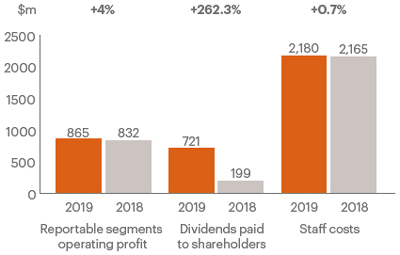
| IHG | Annual Report and Form 20-F 2019 | Governance | Directors’ Remuneration Report | 107 |
Table of Contents
Governance
Directors’ Remuneration Report continued
Annual Report on Director’s Remuneration continued
|
AUDITED |
Single total figure of remuneration: Non-Executive Directors
| Committee |
Date of original |
Fees £000 |
Taxable benefits £000 |
Total £000 |
||||||||||||||||||||||||||||||||||||||||||||||||||
| Non-Executive Director | appointments | appointment | 2019 | 2018 | 2019 | 2018 | 2019 | 2018 | ||||||||||||||||||||||||||||||||||||||||||||||
| Patrick Cescau |

|
01/01/13 | 435 | 422 | 14 | 20 | 449 | 442 | ||||||||||||||||||||||||||||||||||||||||||||||
| Anne Busquet |

|
01/03/15 | 77 | 74 | 5 | 7 | 82 | 81 | ||||||||||||||||||||||||||||||||||||||||||||||
| Ian Dyson |

|
01/09/13 | 102 | 99 | 2 | 3 | 104 | 102 | ||||||||||||||||||||||||||||||||||||||||||||||
| Jo Harlow |

|
01/09/14 | 102 | 99 | 2 | 2 | 104 | 101 | ||||||||||||||||||||||||||||||||||||||||||||||
| Luke Mayhew |

|
01/07/11 | 77 | 74 | 2 | 2 | 79 | 76 | ||||||||||||||||||||||||||||||||||||||||||||||
| Jill McDonald |

|
01/06/13 | 90 | 87 | 2 | 4 | 92 | 91 | ||||||||||||||||||||||||||||||||||||||||||||||
| Dale Morrison |

|
01/06/11 | 110 | 107 | 11 | 66 | 121 | 173 | ||||||||||||||||||||||||||||||||||||||||||||||
| Malina Ngai |

|
01/03/17 | 77 | 74 | 8 | 4 | 85 | 78 | ||||||||||||||||||||||||||||||||||||||||||||||
|
|
See page 79 for Board and Committee membership key and attendance. |
Fees: Fees paid are in line with the DR Policy.
Benefits: For Non-Executive Directors, benefits include taxable travel and accommodation expenses to attend Board meetings away from the designated home location. Under concessionary HM Revenue and Customs rules, non-UK based Non-Executive Directors are not subject to UK tax on travel expenses to/from the UK as long as they remain non-UK resident; this is reflected in the taxable benefits for Anne Busquet, Malina Ngai and Dale Morrison.
Incentive awards: Non-Executive Directors are not eligible for any incentive awards.
Pension benefit: Non-Executive Directors are not eligible for any pension contributions or benefit.
Shares held by Non-Executive Directors as at 31 December 2019:
The Non-Executive Directors who held shares are listed in the table below:
| Non-Executive Director | 2019 b | 2018 | ||||||||||
| Patrick Cescau | 3,605 | 3,795 | ||||||||||
| Jo Harlow a | 950 | 1,000 | ||||||||||
| Luke Mayhew | 1,305 | 1,373 | ||||||||||
| Dale Morrison a | 2,960 | 3,116 | ||||||||||
| a |
Shares held in the form of American Depositary Receipts. |
| b |
2019 shares were subject to a share consolidation on 14 January 2019 on the basis of 19 new ordinary shares for every 20 existing ordinary shares. |
Fees: Non-Executive Directors
The fees for Non-Executive Directors are reviewed and agreed annually in line with the DR Policy. The fee levels for 2020 will be as follows:
| Non-Executive Director | Role |
2020 £000 |
2019 £000 |
|||||||||||||
|
|
|
|
|
|
|
|||||||||||
| Patrick Cescau | Chair of the Board | 444 | 435 | |||||||||||||
|
|
|
|
|
|
|
|||||||||||
| Anne Busquet | Non-Executive Director | 78 | 77 | |||||||||||||
|
|
|
|
|
|
|
|||||||||||
| Arthur de Haast | Non-Executive Director | 78 | – | |||||||||||||
|
|
|
|
|
|
|
|||||||||||
| Ian Dyson | Chair of Audit Committee | 104 | 102 | |||||||||||||
|
|
|
|
|
|
|
|||||||||||
| Jo Harlow | Chair of Remuneration Committee | 104 | 102 | |||||||||||||
|
|
|
|
|
|
|
|||||||||||
| Luke Mayhew | Non-Executive Director | 78 | 77 | |||||||||||||
|
|
|
|
|
|
|
|||||||||||
| Jill McDonald | Chair of Corporate Responsibility Committee | 92 | 90 | |||||||||||||
|
|
|
|
|
|
|
|||||||||||
| Dale Morrison | Senior Independent Non-Executive Director | 112 | 110 | |||||||||||||
|
|
|
|
|
|
|
|||||||||||
| Malina Ngai | Non-Executive Director | 78 | 77 | |||||||||||||
|
|
|
|
|
|
|
|||||||||||
|
Board Committee membership key
|
||||||

|
Audit Committee member |

|
Remuneration Committee member | |||

|
Corporate Responsibility Committee member |

|
Chair of a Board Committee | |||

|
Nomination Committee member | |||||
| 108 | IHG | Annual Report and Form 20-F 2019 |
Table of Contents
| Directors’ Remuneration Policy (binding vote) | Directors’ Remuneration Report (advisory vote) | |||||||||||||||||||||||||||||||
| AGM | Votes for | Votes against | Abstentions | Votes for | Votes against | Abstentions | ||||||||||||||||||||||||||
| 2019 | – | – | – | 120,939,401 | 23,116,948 | 3,867,287 | ||||||||||||||||||||||||||
| (83.95% | ) | (16.05% | ) | |||||||||||||||||||||||||||||
| 2018 | – | – | – | 118,770,985 | 25,486,193 | 2,664,237 | ||||||||||||||||||||||||||
| (82.33% | ) | (17.67% | ) | |||||||||||||||||||||||||||||
| 2017 | 120,328,350 | 5,332,320 | 261,819 | 119,155,451 | 4,426,549 | 2,340,489 | ||||||||||||||||||||||||||
| (95.76% | ) | (4.24% | ) | (96.42% | ) | (3.58% | ) | |||||||||||||||||||||||||
| IHG | Annual Report and Form 20-F 2019 | Governance | Directors’ Remuneration Report | 109 |
Table of Contents
Governance
Directors’ Remuneration Policy
The Committee will consider the Remuneration Policy annually to ensure it remains aligned with strategic objectives. However, subject to approval by shareholders at the 2020 AGM, it is intended that the policy set out below will apply for three years from 2020; if any amendments need to be made to the policy within that timeframe, it will first be presented to be voted upon by shareholders. Where there have been changes to elements from the last policy, these are set out for each element in the table below. The reasons for the changes are described in the Remuneration Committee Chair’s statement on pages 96 to 98.
Future policy table
| Salary | 100% cash | No change in policy | ||
|
|
|
|||
| Link to strategy | To attract and retain the key talent responsible for delivering our strategic objectives. Recognises the value of the role and the individual’s skill, performance and experience. | |||
|
|
|
|||
| Operation | Base salary is reviewed annually and fixed for 12 months from 1 April. In reviewing salaries, the Committee may consider: | |||
|
• business performance; |
||||
|
• personal performance; |
||||
|
• the average salary increases for the wider IHG workforce; and |
||||
|
• current remuneration assessed against comparable opportunities for an individual to ensure competitiveness. |
||||
|
|
|
|||
| Maximum opportunity | Over the policy period, salaries for current Executive Directors will increase, subject to individual performance, in line with the range of increases applying to the corporate UK and US employee population, except where there is a change in role or responsibility, or another need arises to reassess the competitiveness of salary which warrants either a lesser or a more significant increase. Any such change will be fully explained. | |||
| Newly promoted or recruited Executive Directors may, on occasion, have their salaries set below the conventional remuneration level while they become established in role. In such cases, salary increases may be higher than the corporate UK and US employee population until the target positioning is achieved. | ||||
|
|
|
|||
| Performance framework | The results of an individual’s annual performance appraisal are considered when reviewing salary levels. | |||
|
|
|
|||
| Benefits | No change in policy | |||
|
|
|
|||
| Link to strategy | To attract and retain the key talent responsible for delivering our strategic objectives with competitive benefits which are consistent with an individual’s role and location. | |||
|
|
|
|||
| Operation | IHG pays the cost of providing the benefits on a monthly basis or as required for one-off events. | |||
|
|
|
|||
| Maximum opportunity | The value of benefits is dependent on location and market factors. Benefits may include the cost of independent financial advice, car allowance/company car, private healthcare/medical assessments, life insurance, and other benefits provided from time to time. Benefits would be restricted to the typical level for the role and location of an Executive Director. Benefits may also include relocation and expatriate or international assignment costs where appropriate, including for example: | |||
|
• cost of living allowance; |
||||
|
• travel costs; |
||||
|
• housing allowance; |
||||
|
• professional advice; |
||||
|
• education allowances; |
||||
|
• tax equalisation; |
||||
|
• medical expenses; and |
||||
|
• relocation allowance. |
||||
| Relocation and expatriate or international assignment costs would be restricted to the typical level for the role and location of an Executive Director. | ||||
|
|
|
|||
| Performance framework | None. | |||
|
|
|
|||
| Pension | ||||
|
|
|
|||
| Link to strategy | To attract and retain the key talent responsible for delivering our strategic objectives with appropriate contribution rates to provide funding for retirement. | |||
|
|
|
|||
| Operation | UK Executive Directors are eligible to join the IHG UK Defined Contribution Pension Plan (UK Plan). A cash allowance in lieu of pension contributions is offered, for example, where pension contributions would be less efficient than cash. | |||
| Non-UK Executive Directors may be eligible for an alternative local company retirement plan, for example, a DC 401(k) Plan and a DC Deferred Compensation Plan currently operating in the US. | ||||
|
|
|
|||
| Maximum opportunity | Salary is the only element of remuneration that is pensionable and the current maximum employer contribution level for executives in the UK Plan is shown below. Other contribution rates may apply in alternative non-UK local retirement plans and the Committee has the discretion to reduce or increase employer contribution rates for Executive Directors in exceptional circumstances where conditions so warrant. | |||
|
|
|
|||
| New for 2020 Policy: |
• The maximum pension contributions and/or cash allowance for new UK Executive Directors will be aligned with the maximum employer contribution rate available to all other participants in the UK Plan (from April 2020, this will be 12%).
|
|||
|
• Incumbent UK Executive Directors have agreed to a voluntary reduction in pension provision by the end of 2022 such that the value will align on the same basis as above with effect from 1 January 2023. |
||||
|
|
|
|||
| Performance framework | None. | |||
|
|
|
|||

|
The policy will be available to view at
www.ihgplc.com/investors under Corporate governance. |
| 110 | IHG | Annual Report and Form 20-F 2019 |
Table of Contents
|
Annual Performance
Plan (APP) |
50% cash and 50% IHG PLC shares deferred for three years | No change in policy | ||
|
|
|
|||
| Link to strategy |
• Drives and rewards annual performance against both financial and non-financial metrics. |
|||
|
• Aligns individuals and teams with key strategic priorities. |
||||
|
• Aligns short-term annual performance with strategy to generate long-term returns to shareholders. |
||||
|
|
|
|||
| Operation |
• Awards are made annually, 50% in cash after the end of the relevant financial year and 50% in the form of share awards which vest after three years subject to leaver provisions. |
|||
|
• The Committee has discretion to make awards wholly in cash rather than part-cash and part-shares, in exceptional circumstances. |
||||
|
• The share awards are made in the form of conditional awards or forfeitable shares, the latter having the right to receive dividends and vote at general meetings. |
||||
|
• Malus and clawback apply to these awards. See page 115 for details. |
||||
|
• The Committee may exercise reasonable discretion to adjust an award made under the APP upwards or downwards after application of the performance measures to take into account any relevant factors, including but not limited to, performance relative to IHG’s competitors and extent of achievement across all measures, provided that in no case will an award exceed the maximum opportunity stated. |
||||
|
|
|
|||
| Maximum opportunity | The maximum annual award is capped at 200% of salary. | |||
|
|
|
|||
| Performance framework |
• 70% is based on the achievement vs target of an operating profit measure. |
|||
|
• 30% is based on a mixture of strategic and/or personal measures which are reviewed annually and the weighting, measures and targets are determined by the Committee and set in line with key strategic priorities. |
||||
|
• Target award is 115% of salary; threshold is up to 50% of target award for each measure. |
||||
|
|
|
|||
| New for 2020 Policy: | Malus and clawback has been extended. See page 115 for details. | |||
| Measures for 2020 will be operating profit from reportable segments (70%) and Net System Size Growth (30%) – see page 112 for further detail. | ||||
|
|
|
|||
|
Long Term Incentive
Plan (LTIP) |
100% IHG PLC shares | |||
|
|
|
|||
| Link to strategy | Drives and rewards delivery of sustained long-term performance on measures that are aligned with the interests of shareholders. | |||
|
|
|
|||
| Operation |
• Annual grants of conditional awards of shares subject to a performance period of three years or such longer period as the Committee determines, subject to the achievement of corporate performance targets. |
|||
|
• The Committee may also impose such post-vesting holding periods as it may, at its discretion, determine. |
||||
|
• The Committee also has discretion to make awards in cash rather than shares, in exceptional circumstances. |
||||
|
• Malus and clawback applies to awards. See page 115 for details. |
||||
|
|
|
|||
| Maximum opportunity | The maximum annual award is up to 350% of salary for the CEO and up to 275% of salary for other Executive Directors. | |||
|
|
|
|||
| Performance framework |
• The measures are reviewed and may be changed by the Committee annually to ensure alignment with strategic objectives. |
|||
|
• Minimum performance results in 20% vesting and all targets measured over a performance period of at least three years. |
||||
|
• The Committee may make adjustments to targets and/or measures if a significant one-off event occurs that makes one or more of the existing targets and/or measures no longer appropriate. The Committee may also adjust awards if a significant one-off event happens that makes the original performance measures no longer appropriate. Any such adjustments would be disclosed at the first appropriate opportunity. |
||||
|
• The Committee will review the vesting outcomes under the LTIP measures at the end of each three-year cycle against an assessment of Group earnings, the quality of financial performance and growth over the period, including relative growth against the market, and the efficient use of capital. If the Committee determines that the vesting outcomes do not appropriately reflect the performance of the Group, it will consider applying discretion to increase or reduce the number of shares that vest. The performance and vesting outcomes and any use of discretion will be fully disclosed and explained in the relevant Directors’ Remuneration Report. |
||||
|
|
|
|||
| New for 2020 Policy: | The maximum opportunity has been increased from 205% to 350% of salary for the CEO and to 275% of salary for other Executive Directors. See the Chair’s statement on pages 96 to 98 for rationale. | |||
| A post-vest holding period, typically of two years, may apply. See the Chair’s statement on pages 96 to 98 for rationale. | ||||
| Malus and clawback have also been extended. See page 115 for details. | ||||
| Measures for the 2020/22 cycle are Total Shareholder Return (30%); Relative Net System Size Growth (30%) subject to a Return on Capital Employed underpin; Cash Flow (20%) and Total Gross Revenue (20%) – see page 113 for further details. | ||||
|
|
|
|||
|
Shareholding requirements |
||||
|
|
|
|||
| New for 2020 Policy: |
• Subject to maximum LTIP quantum outlined above, the guideline shareholding requirement will increase to 500% for the CEO and 300% for other Executive Directors. |
|||
|
• This shareholding can include the net value of unvested shares that are not subject to any further performance conditions. |
||||
|
• Executive Directors are expected to hold all shares earned (net of any share sales required to meet personal tax liabilities), until the previous guideline shareholding requirement is achieved (300% for the CEO and 200% for other Executive Directors) and 50% of all subsequent shares earned (net of any share sales required to meet personal tax liabilities) until the new guideline shareholding is met. |
||||
|
|
|
|||
| Post-Employment Shareholding |
• The full guideline shareholding requirement will continue for six months, and 50% of the requirement for a further six months, post-cessation of employment. |
|||
|
|
|
|||
| IHG | Annual Report and Form 20-F 2019 | Governance | Directors’ Remuneration Policy | 111 |
Table of Contents
Governance
Directors’ Remuneration Policy continued
Illustrative scenarios
Shown below are illustrations of the value that could be received by each Executive Director under the Directors’ Remuneration Policy in respect of 2020, showing:
| • |
minimum, which includes salary, benefits and employer pension contributions only (total fixed pay); |
| • |
on-target, which includes total fixed pay and assumes an on-target award for the APP (115% of salary) and 50% of maximum LTIP award vesting; and |
| • |
maximum, which includes total fixed pay and a maximum award under the APP and LTIP. |
| • |
maximum plus share price growth, which includes total fixed pay, a maximum award under the APP and a 50% share price increment for LTIP. |
The salaries included are those that will apply from 1 April 2020. The benefit values included are estimates.
| Old Policy (£000) | New Policy (£000) | |
|
Keith Barr
|
Keith Barr
|
|
|
Paul Edgecliffe-Johnson
|
Paul Edgecliffe-Johnson
|
|
|
Elie Maalouf
|
Elie Maalouf
|
|

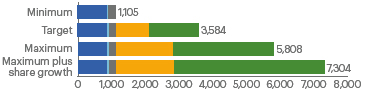
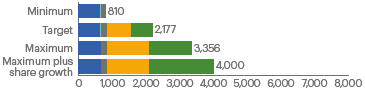
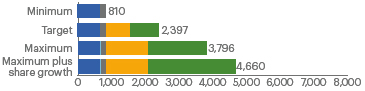


Notes to future policy table
In designing the new Remuneration Policy, the Committee followed a detailed decision-making process which included discussions on the proposals at nine Remuneration Committee meetings. The Committee considered multiple approaches and their possible impact, and sought input from management as well as advice from its independent advisors on market practice and shareholder expectations to inform the discussions. An extensive shareholder consultation exercise was also undertaken. To avoid any conflict of interest, no Executive Directors were present for Committee conversations relating to their own pay.
| 112 | IHG | Annual Report and Form 20-F 2019 |
Table of Contents
Measures for 2020/22 LTIP cycle
|
Measure |
Definition |
Weighting (%) |
Performance objective |
|||
|
Relative Total Shareholder Return (TSR) |
IHG’s performance against a comparator group of global hotel companies. TSR is the aggregate of share price growth and dividends paid, assuming reinvestment of dividends in the Company’s shares during the three-year performance period. |
30 |
Threshold – median of comparator group (20% of TSR element vests);
Maximum – upper quartile of comparator group (100% of TSR element vests); and
Vesting will be on a straight-line basis in between the two points above. |
|||
|
|
|
|
|
|||
|
Relative Net System Size Growth with ROCE underpin |
IHG’s aggregated compound annual growth rate (CAGR) against our six largest competitors with over 500k rooms: Marriott International, Inc., Hilton Worldwide Holdings Inc., Accor S.A., Jin Jiang International Holdings Company Limited, Wyndham Hotels & Resorts Inc., Choice Hotels International Inc. Targets will be set based on increased room count that is consistent with the relevant company’s business plan objectives and practice as at the start of the LTIP cycle. |
30 |
Threshold – Fourth ranked competitor excluding IHG (20% of NSSG element vests);
Maximum – First ranked competitor excluding IHG (100% of NSSG element vests); and
Vesting will be on a straight-line basis in between the two points above.
This measure is subject to the achievement of a Return on Capital Employed underpin. See below for further details. |
|||
|
|
|
|
|
|||
|
Absolute Cash Flow |
Cumulative annual cash generation over three-year performance period. |
20 |
Threshold – US 1.91bn (20% of cash flow element vests);
Maximum – US 2.54bn (100% of cash flow element vests); and
Vesting will be on a straight-line basis in between the two points above. |
|||
|
|
|
|
|
|||
|
Absolute Total Gross Revenue (TGR) |
Cumulative increase over three-year performance period. |
20 |
The targets for this measure are, in the opinion of the Directors, commercially sensitive, and will therefore be disclosed in full retrospectively at the end of the LTIP cycle. Disclosures in advance would give IHG’s major competitors an unfair commercial advantage, providing them with access to key financial and growth targets from IHG’s three-year plan. These competitors would not be subject to the same obligation to make such information available, as they are either unlisted or listed on a stock exchange other than the London Stock Exchange. | |||
|
|
|
|
|
| IHG | Annual Report and Form 20-F 2019 | Governance | Directors’ Remuneration Policy | 113 |
Table of Contents
Governance
Directors’ Remuneration Policy continued
Alignment of remuneration policy with the 2018 Code
|
2018 Code provision: |
How the Remuneration Committee applies the principle |
|||||
|
Clarity
|
||||||
|
|
|
|||||
| Remuneration arrangements should be transparent and promote effective engagement with shareholders and the workforce. |
Through the combination of short and long-term incentive plan measures, the DR Policy is structured to support financial objectives and the strategic priorities of the business which deliver shareholder returns and long-term value creation. Further alignment with shareholder interests is driven by the significant proportion of share-based incentives and Executive Director shareholding requirements.
|
|||||
| As shown on page 100, our reward policies are aligned and include a proportion of performance-related reward throughout the organisation, driving engagement for the whole of the workforce. | ||||||
| We always seek to report our DR Policy and performance-related remuneration measures, targets and outcomes in a clear, transparent and balanced way, with relevant and timely communication with all of our stakeholders, including shareholders. See pages 116 to 117 for further information on how we engage with stakeholders on remuneration matters. | ||||||
| Simplicity | ||||||
|
|
|
|||||
|
Remuneration structures should avoid complexity and their rationale and operation should be easy to understand. |
Our remuneration structure comprises straightforward, conventional and well-understood components:
|
|||||
| • |
Fixed pay: base salary, pension and benefits that are consistent with role and location and are designed to attract and retain talent.
|
|||||
| • |
Short-term incentive: annual performance-related bonus which incentivises and rewards the delivery of financial and non-financial strategic objectives. For senior employees, a proportion of this bonus (50% for Executive Directors) is paid in cash and the remainder deferred in shares for a period of three years.
|
|||||
| • | Long-term incentive: a share-based award which incentivises performance over a three-year period, based on measures which drive long-term sustainable growth and value creation. | |||||
| Risk | ||||||
|
|
|
|||||
|
Remuneration arrangements should ensure reputational and other risks from excessive rewards, and behavioural risks that can arise from target-based incentive plans, are identified and mitigated. |
Our DR Policy contains a number of elements to ensure that it drives the right behaviours to incentivise the Executive Directors to deliver long-term sustainable growth and shareholder returns and to reward them appropriately:
|
|||||
| • |
The maximum short and long-term incentive awards are capped as a % of salary.
|
|||||
| • |
The Committee has clear discretion policies, linked to specific measures where necessary, to override formulaic outcomes.
|
|||||
| • |
Executive Directors agree to clear and comprehensive malus and clawback provisions under which awards may be reduced, rescinded or claimed back.
|
|||||
| • | Significant shareholding requirements apply for Executive Directors, including the deferral of 50% of bonus in shares; a post-vesting holding period for LTIP shares and minimum shareholding requirements for both during and after employment. | |||||
| Predictability | ||||||
|
|
|
|||||
| The range of possible values of rewards to individual directors and any other limits or discretions should be identified and explained at the time of approving the policy. |
The range of possible values of rewards for Executive Directors is clearly disclosed in graphical form both at the time of approving the policy and in the annual implementation report:
|
|||||
| • |
See the charts on page 112 showing the potential future reward opportunity for the Executive Directors split between fixed, target and maximum remuneration scenarios and the effect of future share price increases on the LTIP assuming share price growth of 50% over the period.
|
|||||
| • | See the charts on page 99 showing the minimum, target and maximum potential outcomes for the year. | |||||
| Proportionality | ||||||
|
|
|
|||||
| The link between individual awards, the delivery of strategy and the long-term performance of the Company should be clear and outcomes should not reward poor performance. | As shown on pages 112 and 113, individual rewards are aligned to the delivery of strategic business objectives. The Committee sets robust and stretching targets to ensure that there is a clear link between the performance of the Group and the awards made to the Executive Directors and others; and that poor performance is not rewarded. The powers of discretion set out in the DR Policy on page 111 further strengthen the Committee’s ability to ensure that award outcomes reflect business performance and context in both absolute and relative terms. | |||||
| Alignment to culture | ||||||
|
|
|
|||||
| Incentive schemes should drive behaviours consistent with the Company purpose, values and strategy. | As set out on pages 24 and 26, IHG has a clear purpose and well-established values and behaviours. Our Strategic Model for high-quality growth explained on page 18 and the KPIs which underpin the delivery of our strategy are shown on pages 42 to 45. Page 42 also sets out how our short and long-term incentive plans are aligned to these strategic objectives. We show on page 100 how other elements of reward, such as salary reviews and, across the wider workforce, the short-term incentive plan and our global recognition scheme reward employees for performance and actions which demonstrate our values and behaviours. | |||||
|
|
|
|||||
| 114 | IHG | Annual Report and Form 20-F 2019 |
Table of Contents
|
Remuneration component |
Circumstances and approach taken (including but not limited to): |
|
| Salary and contractual benefits, including pension |
Good leaver: paid up to date of termination or in lieu of notice, if applicable.
|
|
|
Other leaver: paid up to date of termination or in lieu of notice, if applicable.
|
||
| Death: paid up to date of death. | ||
|
|
|
|
| APP award for year of termination | Good leaver: pro-rated award for year up to date of termination, or later date in exceptional circumstances subject to Committee discretion. No accelerated payment, other than in exceptional circumstances and where permitted under the plan rules subject to Committee discretion. Award made 50% cash and 50% in shares deferred for three years from grant, other than in exceptional circumstances and where permitted under the plan rules subject to Committee discretion. | |
| Other leaver: no award for year of termination, other than in case of termination after end of performance period but before award date (in which case cash portion only of award will be paid), and in exceptional circumstances subject to Committee discretion. | ||
| Death: pro-rated award for year up to date of death, paid fully in cash and accelerated, other than in exceptional circumstances subject to Committee discretion. | ||
|
|
|
|
| Unvested APP deferred share awards |
Good leaver: vest on usual vesting date, other than in exceptional circumstances subject to Committee discretion.
|
|
|
Other leaver: forfeited, other than in exceptional circumstances subject to Committee discretion; and in the event of a termination in connection with a takeover or reconstitution (in which case unvested APP deferred share awards will have accelerated vesting on the date of termination, unless the Committee determines otherwise).
|
||
| Death: accelerated vesting unless Committee decides otherwise. | ||
|
|
|
|
| Unvested LTIP awards | Good leaver: vest on usual vesting date to the extent that performance conditions are met, other than in exceptional circumstances subject to Committee discretion. Number of shares vesting is pro-rated to date of termination, or other date subject to Committee discretion. | |
| Other leaver: forfeited, other than in exceptional circumstances subject to Committee discretion. No shares awarded or cash paid under any circumstances in the event of termination due to gross misconduct. | ||
| Death: accelerated vesting: Committee has discretion to determine number of shares vesting, taking into account proportion of performance period elapsed and extent to which performance conditions are satisfied. | ||
|
|
|
|
Good leaver status will be applied in accordance with the rules of the APP and LTIP, where applicable, and will normally include retirement with Company agreement, ill-health, the individual’s employing company or business ceasing to be part of the Group or redundancy. In the case of the LTIP rules, the Committee has discretion to apply good leaver status and, in doing so, will consider factors such as personal performance and conduct, overall Group performance and the specific circumstances of the Executive Director’s departure including, but not restricted to, whether the Executive Director is leaving by mutual agreement. The Committee would only seek to exercise this and its other discretions under the APP and LTIP plan rules in exceptional circumstances and the application of any such discretion would be disclosed in full as required in the relevant announcement and Annual Report on Directors’ Remuneration.
| IHG | Annual Report and Form 20-F 2019 | Governance | Directors’ Remuneration Policy | 115 |
Table of Contents
Governance
Directors’ Remuneration Policy continued
| 116 | IHG | Annual Report and Form 20-F 2019 |
Table of Contents

| IHG | Annual Report and Form 20-F 2019 | Governance | Directors’ Remuneration Policy | 117 |
Table of Contents

| 118 | IHG | Annual Report and Form 20-F 2019 |
Table of Contents

|
Group Financial Statements |
||
|
120 |
Statement of Directors’ Responsibilities | |
|
128 |
Independent Auditor’s US Report | |
|
132 |
Group Financial Statements | |
|
132 |
Group income statement | |
|
133 |
Group statement of comprehensive income | |
|
134 |
Group statement of changes in equity | |
|
137 |
Group statement of financial position | |
|
138 |
Group statement of cash flows | |
|
139 |
Accounting policies | |
|
146 |
||
|
150 |
Notes to the Group Financial Statements | |
| IHG | Annual Report and Form 20-F 2019 | Group Financial Statements | 119 |
Table of Contents


Table of Contents
[THIS PAGE IS INTENTIONALLY LEFT BLANK]
| IHG | Annual Report and Form 20-F 2019 | | 121 |
Table of Contents
[THIS PAGE IS INTENTIONALLY LEFT BLANK]
| 122 | IHG | Annual Report and Form 20-F 2019 |
Table of Contents
[THIS PAGE IS INTENTIONALLY LEFT BLANK]
| IHG | Annual Report and Form 20-F 2019 | | 123 |
Table of Contents
[THIS PAGE IS INTENTIONALLY LEFT BLANK]
| 124 | IHG | Annual Report and Form 20-F 2019 |
Table of Contents
[THIS PAGE IS INTENTIONALLY LEFT BLANK]
| IHG | Annual Report and Form 20-F 2019 | | 125 |
Table of Contents
[THIS PAGE IS INTENTIONALLY LEFT BLANK]
| 126 | IHG | Annual Report and Form 20-F 2019 |
Table of Contents
[THIS PAGE IS INTENTIONALLY LEFT BLANK]
| IHG | Annual Report and Form 20-F 2019 | | 127 |
Table of Contents
Table of Contents
|
Critical Audit Matter |
Description of the Matter |
How We Addressed the Matter in Our Audit |
||||||
|
Accounting for revenue related to the IHG Rewards Club (“IHGRC”) loyalty programme |
As of 31 December 2019, the Group had deferred revenue of $1,233 million and for the year ended 31 December 2019, recognised $337 million of revenue associated with the IHGRC loyalty programme. As more fully described in the accounting policies (critical accounting policies and the use of judgements, estimates and assumptions) and notes 3 and 33 of the Group Financial Statements, the Group recognises deferred revenue in an amount that reflects its unsatisfied performance obligations. The Group has determined the related performance obligation is satisfied, and therefore revenue is recognised, in the period in which the IHGRC member consumes the loyalty points either at a participating hotel or by selecting a reward from a third party. Deferred revenue and revenue recognised in the period are valued at the estimated standalone selling price of the future benefit to the IHGRC members. Consideration for loyalty points earned by IHGRC members, or sold under co-branding arrangements, are received in the period in which the points are issued. The Group engages an external actuary who uses statistical formulae to assist in estimating the future consumption rate of points earned by the members of the IHGRC loyalty programme (the “ultimate consumption rate”), also referred to as “breakage” being the estimation of the number of points that will never be consumed.
Auditing the deferred revenue balance and recognition of revenue associated with the IHGRC loyalty programme was challenging due to: (i) the complexity and high volume of input data in the model used to determine the deferred revenues, (ii) the judgement involved in estimating the ultimate consumption rate, which is the key assumption in determining the deferred revenue balance and the recognition of revenue associated with the IHGRC loyalty programme, and (iii) the sensitivity to changes in the ultimate consumption rate to the deferred revenue balance and the recognition of revenue associated with the IHGRC loyalty programme. Significant estimation uncertainty exists in projecting future IHGRC members’ spending and consumption activity as the estimate is forward looking. |
We obtained an understanding, evaluated the design and tested the operating effectiveness of controls related to the Group’s process for determining the ultimate consumption rate. For example, we tested controls over management’s review and approval of the external actuary’s report.
To test the deferred revenue balance and the recognition of revenue associated with the IHGRC loyalty programme, our audit procedures included, amongst others, testing the clerical accuracy and significant inputs into the model used by management to determine the IHGRC loyalty programme revenues. We tested the data used by management’s external actuary in their modelling to derive the ultimate consumption rate, notably by reconciling the input data with the Group’s underlying systems and records.
We considered the professional qualifications and objectivity of management’s external actuary and inspected their reports to identify corroborating or contradictory evidence to the ultimate consumption rate. We involved actuarial specialists as part of our team to assist in assessing the appropriateness of the methodology, data and assumptions used to determine the ultimate consumption rate applied by management and to calculate an independent estimate of an acceptable range of outcomes, which we compared to management’s estimate. We performed sensitivity analysis on the ultimate consumption rate to evaluate changes in the deferred revenue balance and the recognition of revenue associated with the IHGRC loyalty programme. |
||||||
|
|
|
|
||||||
| Allocation of revenues and expenses to the System Fund |
For the year ended 31 December 2019, the Group recognised $1,373 million of System Fund revenues and $1,422 million of System Fund expenses. As more fully described in the accounting policies (revenue recognition) and note 33 of the Group Financial Statements, the Group operates a System Fund which collects contributions from hotel owners for the specific purpose of the use in marketing, the guest reservation systems and the loyalty programme in accordance with the principles agreed with the IHG Owners Association.
Auditing the allocation of revenues and expenses to the System Fund was complex due to (i) the considerations involved in evaluating that the allocation of revenues and expenses to the System Fund by management was in accordance with the principles agreed with the IHG Owners Association and (ii) the System Fund revenues and expenses being included within IHG’s income statement but eliminated from IHG’s operating profit from reportable segments which is a key performance measure used by management.
|
We obtained an understanding, evaluated the design and tested the operating effectiveness of controls related to the Group’s process for allocating revenues and expenses to the System Fund. For example, we tested controls over management’s review and approval of changes to the allocation methodology.
To test the allocation of revenues and expenses to the System Fund, our audit procedures included, amongst others, assessing management’s allocation methodology, by testing System Fund revenue and expense transactions to evaluate the appropriate classification in accordance with the principles agreed with the IHG Owners Association and forming an independent assessment of the revenues and expenses related to the System Fund. We tested whether any changes made to the allocation methodology were in accordance with the principles agreed with the IHG Owners Association.
We performed analytical procedures over the System Fund revenues and expenses to identify unusual trends in the classification of revenues and expenses. We tested manual journal entries made to System Fund revenues and expenses to evaluate the appropriateness in accordance with the principles agreed with the IHG Owners Association. |
||||||
|
|
|
|
| IHG | Annual Report and Form 20-F 2019 | Group Financial Statements | Independent Auditor’s US Report | 129 |
Table of Contents
Group Financial Statements
Independent Auditor’s US Report continued
|
Critical Audit Matter |
Description of the Matter |
How We Addressed the Matter in Our Audit |
||||||
| Impairment assessments of the Kimpton management contracts and the UK portfolio goodwill and right-of-use asset |
At 31 December 2019, the net book value of the Kimpton management contracts was $10 million and the UK portfolio goodwill and right-of-use asset was $nil and $24 million, respectively. For the year ended 31 December 2019, impairment charges of $50 million, $49 million and $32 million were recorded as exceptional items in the Group income statement in relation to the Kimpton management contracts, the UK portfolio goodwill and right-of-use asset, respectively. As more fully described in the accounting policies (critical accounting policies and the use of judgements, estimates and assumptions) and note 13 of the Group Financial Statements, the Group tests intangible assets for impairment, in accordance with IAS 36 – Impairment of Assets , using valuation techniques involving judgements, estimates and assumptions.
Auditing the impairment assessments performed by management was challenging due to the judgement involved in determining the recoverable amount of the Kimpton management contracts (including key money) and the UK portfolio goodwill and right-of-use asset. The significant assumptions used to estimate the recoverable amounts of the Kimpton management contracts and the UK portfolio goodwill included discount rates and certain assumptions that form the basis of the cash flow forecasts (e.g. revenue growth rates and gross operating profit). These significant assumptions are forward looking and could be affected by future economic and market conditions. |
We obtained an understanding, evaluated the design and tested the operating effectiveness of controls related to management’s assessments of impairment. For example, we tested controls over management’s review of cash flow forecasts, valuation models and approval of impairment assessments.
To test management’s impairment assessments, our audit procedures included, amongst others, evaluating the appropriateness of the methodology, assumptions and estimates used in the impairment assessments. We involved valuation specialists as part of our team to assist in testing the key valuation assumptions, including the discount rates used with reference to external data and to calculate an independent estimate of an acceptable range. We assessed the reasonableness of the cash flow forecasts by comparison to current industry, market and economic trends, where applicable, and the Group’s historical data. In addition, we assessed the accuracy of significant assumptions used by management in previous periods by comparing forecasts with actual results. Specifically, for the Kimpton management contracts we evaluated the rate of assumed hotel exits applied to the cash flow forecasts.
We tested the clerical accuracy of the impairment models used by management in their assessment. In addition, we evaluated the disclosures provided in note 13 of the Group Financial Statements and the classification of the impairment charge as an exceptional item. |
||||||
|
|
|
|
||||||
| Accounting for the acquisition of Six Senses Hotels Resorts Spas (“Six Senses”) |
On 12 February 2019, the Group completed the acquisition of Six Senses for total consideration of $304 million, as disclosed in note 11 to the Group Financial Statements. The transaction was accounted for as a business combination.
Auditing the acquisition of Six Senses was challenging due to the judgement involved in determining the fair value of the acquired intangible assets, being the brand and management contracts of $189 million and $45 million, respectively. The significant assumptions used to estimate the value of the intangible assets included discount rates and certain assumptions that form the basis of the cash flow forecasts (e.g. royalty rate and the long-term growth rate). These significant assumptions are forward looking and could be affected by future economic and market conditions. |
We obtained an understanding, evaluated the design and tested the operating effectiveness of controls related to the Group’s process over the acquisition accounting and the valuation of intangible assets acquired. For example, we tested controls over management’s review and approval of the external valuation report and the underlying assumptions used in the report.
To test the estimated fair value of the intangible assets, our audit procedures included, amongst others, evaluating the Group’s use of the valuation methodology and testing the significant assumptions used in the valuation, including the completeness and accuracy of the underlying data. We involved valuation specialists as part of our team to assist in our evaluation of the valuation methodology and significant assumptions, including the discount rates, royalty rate and long-term growth rate used by management and to calculate an independent estimate of an acceptable range of the Six Senses brand and management contracts valuations. For example, we compared the significant assumptions that form the basis of the cash flow forecasts to current industry, market and economic trends and to the assumptions used to value similar assets in other acquisitions.
We tested the clerical accuracy of the calculation performed by management in determining the fair value of intangible assets. We evaluated the disclosures provided in note 11 to the Group Financial Statements. |
||||||
|
|
|
|
/s/ Ernst & Young LLP
We have served as auditors since the Group’s listing in April 2003 and of
the Group’s predecessor businesses since 1988.
London, England
17 February 2020
| 130 | IHG | Annual Report and Form 20-F 2019 |
Table of Contents
| IHG | Annual Report and Form 20-F 2019 | | 131 |
Table of Contents
Group Financial Statements
| For the year ended 31 December 2019 | Note |
|
2019
$m |
|
|
2018
Restated $m |
a
|
|
2017
Restated $m |
a
|
||||||||||||||
| Revenue from fee business | 3 | 1,510 | 1,486 | 1,379 | ||||||||||||||||||||
| Revenue from owned, leased and managed lease hotels | 3 | 573 | 447 | 351 | ||||||||||||||||||||
| System Fund revenues | 1,373 | 1,233 | 1,242 | |||||||||||||||||||||
| Reimbursement of costs | 1,171 | 1,171 | 1,103 | |||||||||||||||||||||
| Total revenue | 2 | 4,627 | 4,337 | 4,075 | ||||||||||||||||||||
| Cost of sales | (790 | ) | (688 | ) | (554 | ) | ||||||||||||||||||
| System Fund expenses | (1,422 | ) | (1,379 | ) | (1,276 | ) | ||||||||||||||||||
| Reimbursed costs | (1,171 | ) | (1,171 | ) | (1,103 | ) | ||||||||||||||||||
| Administrative expenses | (385 | ) | (415 | ) | (355 | ) | ||||||||||||||||||
| Share of (losses)/gains of associates and joint ventures | 2 | (3 | ) | (1 | ) | 3 | ||||||||||||||||||
| Other operating income | 21 | 14 | 84 | |||||||||||||||||||||
| Depreciation and amortisation | 2 | (116 | ) | (115 | ) | (112 | ) | |||||||||||||||||
| Impairment charges | 6 | (131 | ) | – | (18 | ) | ||||||||||||||||||
| Operating profit | 2 | 630 | 582 | 744 | ||||||||||||||||||||
| Operating profit analysed as: | ||||||||||||||||||||||||
|
Operating profit before System Fund and exceptional items |
865 | 832 | 774 | |||||||||||||||||||||
|
System Fund |
(49 | ) | (146 | ) | (34 | ) | ||||||||||||||||||
|
Operating exceptional items |
6 | (186 | ) | (104 | ) | 4 | ||||||||||||||||||
| 630 | 582 | 744 | ||||||||||||||||||||||
| Financial income | 7 | 6 | 5 | 4 | ||||||||||||||||||||
| Financial expenses | 7 | (121 | ) | (101 | ) | (95 | ) | |||||||||||||||||
| Fair value gains/(losses) on contingent purchase consideration | 25 | 27 | (4 | ) | – | |||||||||||||||||||
| Profit before tax | 542 | 482 | 653 | |||||||||||||||||||||
| Tax | 8 | (156 | ) | (132 | ) | (118 | ) | |||||||||||||||||
| Profit for the year from continuing operations | 386 | 350 | 535 | |||||||||||||||||||||
| Attributable to: | ||||||||||||||||||||||||
| Equity holders of the parent | 385 | 349 | 534 | |||||||||||||||||||||
| Non-controlling interest | 1 | 1 | 1 | |||||||||||||||||||||
| 386 | 350 | 535 | ||||||||||||||||||||||
| Earnings per ordinary share: | 10 | |||||||||||||||||||||||
| Continuing and total operations: | ||||||||||||||||||||||||
| Basic | 210.4¢ | 183.7¢ | 276.7¢ | |||||||||||||||||||||
| Diluted | 209.2¢ | 181.8¢ | 275.3¢ | |||||||||||||||||||||
| a |
Restated for the adoption of IFRS 16 (see pages 146 to 149) and presentational changes (see page 149). |

|
Notes on pages 139 to 201 form an integral part of these Group Financial Statements. |
| 132 | IHG | Annual Report and Form 20-F 2019 |
Table of Contents
Group statement of comprehensive income
| 2018 | 2017 | |||||||||||||
| 2019 | Restated a | Restated a | ||||||||||||
| For the year ended 31 December 2019 | $m | $m | $m | |||||||||||
| Profit for the year | 386 | 350 | 535 | |||||||||||
| Other comprehensive income | ||||||||||||||
| Items that may be subsequently reclassified to profit or loss: | ||||||||||||||
|
Gains on valuation of available-for-sale financial assets b , net of related tax charge of $3m in 2017 |
– | – | 41 | |||||||||||
|
Fair value gains reclassified to profit on disposal of available-for-sale financial assets b |
– | – | (73) | |||||||||||
|
(Losses)/gains on cash flow hedges, net of related tax credit of $nil (2018: including related tax credit of $1m) |
(34) | 5 | – | |||||||||||
|
Costs of hedging |
(6) | (1) | – | |||||||||||
|
Hedging losses/(gains) reclassified to financial expenses |
38 | (8) | – | |||||||||||
|
Exchange (losses)/gains on retranslation of foreign operations, net of related tax credit of $3m |
||||||||||||||
|
(2018: including related tax credit of $2m, 2017: net of related tax credit of $1m) |
(39) | 44 | (90) | |||||||||||
| (41) | 40 | (122) | ||||||||||||
| Items that will not be reclassified to profit or loss: | ||||||||||||||
|
Gains/(losses) on equity instruments classified as fair value through other comprehensive income b , net of related tax charge of $2m (2018: including related tax charge of $2m) |
10 | (14) | – | |||||||||||
|
Re-measurement (losses)/gains on defined benefit plans, net of related tax credit of $1m |
||||||||||||||
|
(2018: net of related tax charge of $4m, 2017: $nil) |
(6) | 8 | (4) | |||||||||||
|
Deferred tax charge on defined benefit plans arising from significant US tax reform |
– | – | (11) | |||||||||||
| 4 | (6) | (15) | ||||||||||||
| Total other comprehensive (loss)/income for the year | (37) | 34 | (137) | |||||||||||
| Total comprehensive income for the year | 349 | 384 | 398 | |||||||||||
| Attributable to: | ||||||||||||||
|
Equity holders of the parent |
348 | 382 | 396 | |||||||||||
|
Non-controlling interest |
1 | 2 | 2 | |||||||||||
| 349 | 384 | 398 | ||||||||||||
| a |
Restated for the adoption of IFRS 16 (see pages 146 to 149). |
| b |
IFRS 9 was applied from 1 January 2018. Under the transition method chosen, comparative information was not restated. |
|
|
Notes on pages 139 to 201 form an integral part of these Group Financial Statements. |
| IHG | Annual Report and Form 20-F 2019 | Group Financial Statements | Group Financial Statements | 133 |
Table of Contents
Group Financial Statements
Group Financial Statements continued
Group statement of changes in equity
|
Equity share
$m |
Capital
$m |
Shares
held by
$m |
Other
reserves $m |
Fair value
reserve $m |
Cash flow
hedging reserve $m |
Currency
$m |
Retained
earnings $m |
IHG share-
$m |
Non-
$m |
Total equity
$m |
||||||||||||||||||||||||||||||||||||
| At 1 January 2019 | ||||||||||||||||||||||||||||||||||||||||||||||
| (restated for IFRS 16) | 146 | 10 | (4 | ) | (2,865 | ) | 47 | (4 | ) | 420 | 1,111 | (1,139 | ) | 8 | (1,131 | ) | ||||||||||||||||||||||||||||||
| Profit for the year | – | – | – | – | – | – | – | 385 | 385 | 1 | 386 | |||||||||||||||||||||||||||||||||||
| Other comprehensive income | ||||||||||||||||||||||||||||||||||||||||||||||
| Items that may be subsequently reclassified to profit or loss: | ||||||||||||||||||||||||||||||||||||||||||||||
|
Losses on cash flow hedges |
– | – | – | – | – | (34 | ) | – | – | (34 | ) | – | (34 | ) | ||||||||||||||||||||||||||||||||
|
Costs of hedging |
– | – | – | – | – | (6 | ) | – | – | (6 | ) | – | (6 | ) | ||||||||||||||||||||||||||||||||
|
Hedging losses reclassified to financial expenses |
– | – | – | – | – | 38 | – | – | 38 | – | 38 | |||||||||||||||||||||||||||||||||||
|
Exchange losses on retranslation of foreign operations |
– | – | – | – | – | – | (39 | ) | – | (39 | ) | – | (39 | ) | ||||||||||||||||||||||||||||||||
| – | – | – | – | – | (2 | ) | (39 | ) | – | (41 | ) | – | (41 | ) | ||||||||||||||||||||||||||||||||
| Items that will not be reclassified to profit or loss: | ||||||||||||||||||||||||||||||||||||||||||||||
|
Gains on equity instruments classified as fair value through other comprehensive income |
– | – | – | – | 10 | – | – | – | 10 | – | 10 | |||||||||||||||||||||||||||||||||||
|
Re-measurement losses on defined benefit plans |
– | – | – | – | – | – | – | (6 | ) | (6 | ) | – | (6 | ) | ||||||||||||||||||||||||||||||||
| – | – | – | – | 10 | – | – | (6 | ) | 4 | – | 4 | |||||||||||||||||||||||||||||||||||
| Total other comprehensive income/ (loss) for the year | – | – | – | – | 10 | (2 | ) | (39 | ) | (6 | ) | (37 | ) | – | (37 | ) | ||||||||||||||||||||||||||||||
| Total comprehensive income for the year | – | – | – | – | 10 | (2 | ) | (39 | ) | 379 | 348 | 1 | 349 | |||||||||||||||||||||||||||||||||
| Transfer of treasury shares to employee share trusts | – | – | (19 | ) | – | – | – | – | 19 | – | – | – | ||||||||||||||||||||||||||||||||||
| Purchase of own shares by employee share trusts | – | – | (5 | ) | – | – | – | – | – | (5 | ) | – | (5 | ) | ||||||||||||||||||||||||||||||||
| Release of own shares by employee share trusts | – | – | 23 | – | – | – | – | (23 | ) | – | – | – | ||||||||||||||||||||||||||||||||||
| Equity-settled share-based cost | – | – | – | – | – | – | – | 41 | 41 | – | 41 | |||||||||||||||||||||||||||||||||||
| Tax related to share schemes | – | – | – | – | – | – | – | 4 | 4 | – | 4 | |||||||||||||||||||||||||||||||||||
| Equity dividends paid | – | – | – | – | – | – | – | (721 | ) | (721 | ) | (1 | ) | (722 | ) | |||||||||||||||||||||||||||||||
| Transaction costs relating to shareholder returns | – | – | – | – | – | – | – | (1 | ) | (1 | ) | – | (1 | ) | ||||||||||||||||||||||||||||||||
|
Exchange adjustments
|
5 | – | – | (5 | ) | – | – | – | – | – | – | – | ||||||||||||||||||||||||||||||||||
| At 31 December 2019 | 151 | 10 | (5 | ) | (2,870 | ) | 57 | (6 | ) | 381 | 809 | (1,473 | ) | 8 | (1,465 | ) | ||||||||||||||||||||||||||||||
All items above are shown net of tax.
|
|
Notes on pages 139 to 201 form an integral part of these Group Financial Statements. |
| 134 | IHG | Annual Report and Form 20-F 2019 |
Table of Contents
|
Equity share
$m |
Capital
$m |
Shares
held by
$m |
Other
reserves $m |
Fair value
reserve $m |
Cash flow
hedging reserve $m |
Currency
$m |
Retained
earnings $m |
IHG share-
$m |
Non-
$m |
Total equity
$m |
||||||||||||||||||||||||||||||||||||
| At 1 January 2018 | ||||||||||||||||||||||||||||||||||||||||||||||
| (restated for IFRS 16) | 154 | 10 | (5 | ) | (2,874 | ) | 79 | – | 377 | 898 | (1,361 | ) | 7 | (1,354 | ) | |||||||||||||||||||||||||||||||
| Impact of adopting IFRS 9 a | – | – | – | – | (18 | ) | – | – | 18 | – | – | – | ||||||||||||||||||||||||||||||||||
| At 1 January 2018 | 154 | 10 | (5 | ) | (2,874 | ) | 61 | – | 377 | 916 | (1,361 | ) | 7 | (1,354 | ) | |||||||||||||||||||||||||||||||
| Profit for the year | – | – | – | – | – | – | – | 349 | 349 | 1 | 350 | |||||||||||||||||||||||||||||||||||
| Other comprehensive income | ||||||||||||||||||||||||||||||||||||||||||||||
| Items that may be subsequently reclassified to profit or loss: | ||||||||||||||||||||||||||||||||||||||||||||||
|
Gains on cash flow hedges |
– | – | – | – | – | 5 | – | – | 5 | – | 5 | |||||||||||||||||||||||||||||||||||
|
Costs of hedging |
– | – | – | – | – | (1 | ) | – | – | (1 | ) | – | (1 | ) | ||||||||||||||||||||||||||||||||
|
Hedging gains reclassified to financial expenses |
– | – | – | – | – | (8 | ) | – | – | (8 | ) | – | (8 | ) | ||||||||||||||||||||||||||||||||
|
Exchange gains on retranslation of foreign operations |
– | – | – | – | – | – | 43 | – | 43 | 1 | 44 | |||||||||||||||||||||||||||||||||||
| – | – | – | – | – | (4 | ) | 43 | – | 39 | 1 | 40 | |||||||||||||||||||||||||||||||||||
| Items that will not be reclassified to profit or loss: | ||||||||||||||||||||||||||||||||||||||||||||||
|
Losses on equity instruments classified as fair value through other comprehensive income |
– | – | – | – | (14 | ) | – | – | – | (14 | ) | – | (14 | ) | ||||||||||||||||||||||||||||||||
|
Re-measurement gains on defined benefit plans |
– | – | – | – | – | – | – | 8 | 8 | – | 8 | |||||||||||||||||||||||||||||||||||
| – | – | – | – | (14 | ) | – | – | 8 | (6 | ) | – | (6 | ) | |||||||||||||||||||||||||||||||||
| Total other comprehensive (loss)/ income for the year | – | – | – | – | (14 | ) | (4 | ) | 43 | 8 | 33 | 1 | 34 | |||||||||||||||||||||||||||||||||
| Total comprehensive income for the year | – | – | – | – | (14 | ) | (4 | ) | 43 | 357 | 382 | 2 | 384 | |||||||||||||||||||||||||||||||||
| Transfer of treasury shares to employee share trusts | – | – | (19 | ) | – | – | – | – | 19 | – | – | – | ||||||||||||||||||||||||||||||||||
| Purchase of own shares by employee share trusts | – | – | (3 | ) | – | – | – | – | – | (3 | ) | – | (3 | ) | ||||||||||||||||||||||||||||||||
| Release of own shares by employee share trusts | – | – | 24 | – | – | – | – | (24 | ) | – | – | – | ||||||||||||||||||||||||||||||||||
| Equity-settled share-based cost | – | – | – | – | – | – | – | 39 | 39 | – | 39 | |||||||||||||||||||||||||||||||||||
| Tax related to share schemes | – | – | – | – | – | – | – | 3 | 3 | – | 3 | |||||||||||||||||||||||||||||||||||
| Equity dividends paid | – | – | – | – | – | – | – | (199 | ) | (199 | ) | (1 | ) | (200 | ) | |||||||||||||||||||||||||||||||
| Exchange adjustments | (8 | ) | – | (1 | ) | 9 | – | – | – | – | – | – | – | |||||||||||||||||||||||||||||||||
| At 31 December 2018 | 146 | 10 | (4 | ) | (2,865 | ) | 47 | (4 | ) | 420 | 1,111 | (1,139 | ) | 8 | (1,131 | ) | ||||||||||||||||||||||||||||||
| a |
IFRS 9 was applied from 1 January 2018. Under the transition method chosen, comparative information was not restated. |
All items above are shown net of tax.
|
|
Notes on pages 139 to 201 form an integral part of these Group Financial Statements. |
| IHG | Annual Report and Form 20-F 2019 | Group Financial Statements | Group Financial Statements | 135 |
Table of Contents
Group Financial Statements
Group Financial Statements continued
Group statement of changes in equity continued
|
Equity share
$m |
Capital
$m |
Shares
held by
$m |
Other
reserves $m |
Fair value
$m |
Currency
$m |
Retained
earnings $m |
IHG share-
$m |
Non-
$m |
Total equity
$m |
|||||||||||||||||||||||||||||||||
| At 1 January 2017 | ||||||||||||||||||||||||||||||||||||||||||
| (as previously reported) | 141 | 9 | (11 | ) | (2,860 | ) | 111 | 466 | 990 | (1,154 | ) | 8 | (1,146 | ) | ||||||||||||||||||||||||||||
|
Impact of adopting IFRS 16 (pages 146 to 149) |
– | – | – | – | – | 2 | (47 | ) | (45 | ) | – | (45 | ) | |||||||||||||||||||||||||||||
| At 1 January 2017 (as restated) | 141 | 9 | (11 | ) | (2,860 | ) | 111 | 468 | 943 | (1,199 | ) | 8 | (1,191 | ) | ||||||||||||||||||||||||||||
| Profit for the year | – | – | – | – | – | – | 534 | 534 | 1 | 535 | ||||||||||||||||||||||||||||||||
| Other comprehensive income | ||||||||||||||||||||||||||||||||||||||||||
| Items that may be subsequently reclassified to profit or loss: | ||||||||||||||||||||||||||||||||||||||||||
|
Gains on valuation of available-for-sale financial assets |
– | – | – | – | 41 | – | – | 41 | – | 41 | ||||||||||||||||||||||||||||||||
|
Fair value gain reclassified to profit on disposal of available-for-sale financial asset |
– | – | – | – | (73 | ) | – | – | (73 | ) | – | (73 | ) | |||||||||||||||||||||||||||||
|
Exchange losses on retranslation of foreign operations |
– | – | – | – | – | (91 | ) | – | (91 | ) | 1 | (90 | ) | |||||||||||||||||||||||||||||
| – | – | – | – | (32 | ) | (91 | ) | – | (123 | ) | 1 | (122 | ) | |||||||||||||||||||||||||||||
| Items that will not be reclassified to profit or loss: | ||||||||||||||||||||||||||||||||||||||||||
|
Re-measurement losses on defined benefit plans |
– | – | – | – | – | – | (4 | ) | (4 | ) | – | (4 | ) | |||||||||||||||||||||||||||||
|
Deferred tax charge on defined benefit plans arising from significant US tax reform |
– | – | – | – | – | – | (11 | ) | (11 | ) | – | (11 | ) | |||||||||||||||||||||||||||||
| – | – | – | – | – | – | (15 | ) | (15 | ) | – | (15 | ) | ||||||||||||||||||||||||||||||
| Total other comprehensive (loss)/income for the year | – | – | – | – | (32 | ) | (91 | ) | (15 | ) | (138 | ) | 1 | (137 | ) | |||||||||||||||||||||||||||
| Total comprehensive income for the year | – | – | – | – | (32 | ) | (91 | ) | 519 | 396 | 2 | 398 | ||||||||||||||||||||||||||||||
| Transfer of treasury shares to employee share trusts | – | – | (20 | ) | – | – | – | 20 | – | – | – | |||||||||||||||||||||||||||||||
| Purchase of own shares by employee share trusts | – | – | (3 | ) | – | – | – | – | (3 | ) | – | (3 | ) | |||||||||||||||||||||||||||||
| Release of own shares by employee share trusts | – | – | 29 | – | – | – | (29 | ) | – | – | – | |||||||||||||||||||||||||||||||
| Equity-settled share-based cost | – | – | – | – | – | – | 29 | 29 | – | 29 | ||||||||||||||||||||||||||||||||
| Tax related to share schemes | – | – | – | – | – | – | 9 | 9 | – | 9 | ||||||||||||||||||||||||||||||||
| Equity dividends paid | – | – | – | – | – | – | (593 | ) | (593 | ) | (3 | ) | (596 | ) | ||||||||||||||||||||||||||||
| Exchange adjustments | 13 | 1 | – | (14 | ) | – | – | – | – | – | – | |||||||||||||||||||||||||||||||
| At 31 December 2017 | 154 | 10 | (5 | ) | (2,874 | ) | 79 | 377 | 898 | (1,361 | ) | 7 | (1,354 | ) | ||||||||||||||||||||||||||||
All items above are shown net of tax.
|
|
Notes on pages 139 to 201 form an integral part of these Group Financial Statements. |
| 136 | IHG | Annual Report and Form 20-F 2019 |
Table of Contents
Group statement of financial position
| 2018 | 2017 | |||||||||||||||||||||||||||||
| 2019 | Restated | a | Restated | a | ||||||||||||||||||||||||||
| 31 December 2019 | Note | $m | $m | $m | ||||||||||||||||||||||||||
| ASSETS | ||||||||||||||||||||||||||||||
| Goodwill and other intangible assets | 13 | 1,376 | 1,143 | 967 | ||||||||||||||||||||||||||
| Property, plant and equipment | 14 | 309 | 273 | 250 | ||||||||||||||||||||||||||
| Right-of-use assets | 15 | 490 | 513 | 486 | ||||||||||||||||||||||||||
| Investment in associates and joint ventures | 16 | 110 | 104 | 141 | ||||||||||||||||||||||||||
| Retirement benefit assets | 27 | – | – | 3 | ||||||||||||||||||||||||||
| Other financial assets | 17 | 284 | 260 | 228 | ||||||||||||||||||||||||||
| Derivative financial instruments | 24 | – | 7 | – | ||||||||||||||||||||||||||
| Non-current tax receivable | 28 | 31 | 16 | |||||||||||||||||||||||||||
| Deferred tax assets | 8 | 66 | 63 | 78 | ||||||||||||||||||||||||||
| Contract costs | 3 | 67 | 55 | 51 | ||||||||||||||||||||||||||
| Contract assets | 3 | 311 | 270 | 241 | ||||||||||||||||||||||||||
| Total non-current assets | 3,041 | 2,719 | 2,461 | |||||||||||||||||||||||||||
| Inventories | 6 | 5 | 3 | |||||||||||||||||||||||||||
| Trade and other receivables | 18 | 666 | 610 | 549 | ||||||||||||||||||||||||||
| Current tax receivable | 16 | 27 | 101 | |||||||||||||||||||||||||||
| Other financial assets | 17 | 4 | 1 | 16 | ||||||||||||||||||||||||||
| Derivative financial instruments | 24 | 1 | 1 | – | ||||||||||||||||||||||||||
| Cash and cash equivalents | 19 | 195 | 704 | 168 | ||||||||||||||||||||||||||
| Contract costs | 3 | 5 | 5 | 7 | ||||||||||||||||||||||||||
| Contract assets | 3 | 23 | 20 | 17 | ||||||||||||||||||||||||||
| Total current assets | 916 | 1,373 | 861 | |||||||||||||||||||||||||||
| Assets classified as held for sale | 12 | 19 | – | – | ||||||||||||||||||||||||||
| Total assets | 2 | 3,976 | 4,092 | 3,322 | ||||||||||||||||||||||||||
| LIABILITIES | ||||||||||||||||||||||||||||||
| Loans and other borrowings | 22 | (87 | ) | (104 | ) | (110 | ) | |||||||||||||||||||||||
| Lease liabilities | 15 | (65 | ) | (55 | ) | (44 | ) | |||||||||||||||||||||||
| Trade and other payables | 20 | (568 | ) | (616 | ) | (595 | ) | |||||||||||||||||||||||
| Deferred revenue | 3 | (555 | ) | (572 | ) | (490 | ) | |||||||||||||||||||||||
| Provisions | 21 | (40 | ) | (10 | ) | (3 | ) | |||||||||||||||||||||||
| Current tax payable | (50 | ) | (50 | ) | (64 | ) | ||||||||||||||||||||||||
| Total current liabilities | (1,365 | ) | (1,407 | ) | (1,306 | ) | ||||||||||||||||||||||||
| Loans and other borrowings | 22 | (2,078 | ) | (1,910 | ) | (1,678 | ) | |||||||||||||||||||||||
| Lease liabilities | 15 | (595 | ) | (615 | ) | (589 | ) | |||||||||||||||||||||||
| Derivative financial instruments | 24 | (20 | ) | – | – | |||||||||||||||||||||||||
| Retirement benefit obligations | 27 | (96 | ) | (91 | ) | (104 | ) | |||||||||||||||||||||||
| Trade and other payables | 20 | (116 | ) | (125 | ) | (7 | ) | |||||||||||||||||||||||
| Deferred revenue | 3 | (1,009 | ) | (934 | ) | (867 | ) | |||||||||||||||||||||||
| Provisions | 21 | (22 | ) | (17 | ) | (5 | ) | |||||||||||||||||||||||
| Non-current tax payable | – | – | (25 | ) | ||||||||||||||||||||||||||
| Deferred tax liabilities | 8 | (118 | ) | (124 | ) | (95 | ) | |||||||||||||||||||||||
| Total non-current liabilities | (4,054 | ) | (3,816 | ) | (3,370 | ) | ||||||||||||||||||||||||
| Liabilities classified as held for sale | 12 | (22 | ) | – | – | |||||||||||||||||||||||||
| Total liabilities | 2 | (5,441 | ) | (5,223 | ) | (4,676 | ) | |||||||||||||||||||||||
| Net liabilities | (1,465 | ) | (1,131 | ) | (1,354 | ) | ||||||||||||||||||||||||
| EQUITY | ||||||||||||||||||||||||||||||
| IHG shareholders’ equity | (1,473 | ) | (1,139 | ) | (1,361 | ) | ||||||||||||||||||||||||
| Non-controlling interest | 8 | 8 | 7 | |||||||||||||||||||||||||||
| Total equity | (1,465 | ) | (1,131 | ) | (1,354 | ) | ||||||||||||||||||||||||
| a |
Restated for the adoption of IFRS 16 (see pages 146 to 149). |
Signed on behalf of the Board,
Paul Edgecliffe-Johnson
17 February 2020
|
|
Notes on pages 139 to 201 form an integral part of these Group Financial Statements. |
| IHG | Annual Report and Form 20-F 2019 | Group Financial Statements | Group Financial Statements | 137 |
Table of Contents
Group Financial Statements
Group Financial Statements continued
| 2018 | 2017 | |||||||||||||||||||||||
| 2019 | Restated | a | Restated | a | ||||||||||||||||||||
| For the year ended 31 December 2019 | Note | $m | $m | $m | ||||||||||||||||||||
| Profit for the year | 386 | 350 | 535 | |||||||||||||||||||||
| Adjustments reconciling profit for the year to cash flow from operations before contract acquisition costs | 26 | 582 | 564 | 371 | ||||||||||||||||||||
| Cash flow from operations before contract acquisition costs | 26 | 968 | 914 | 906 | ||||||||||||||||||||
| Contract acquisition costs, net of repayments | (61 | ) | (54 | ) | (57 | ) | ||||||||||||||||||
| Cash flow from operations | 907 | 860 | 849 | |||||||||||||||||||||
| Interest paid | (110 | ) | (87 | ) | (87 | ) | ||||||||||||||||||
| Interest received | 3 | 2 | 1 | |||||||||||||||||||||
| Contingent purchase consideration paid | 25 | (6 | ) | – | – | |||||||||||||||||||
| Tax paid on operating activities | 8 | (141 | ) | (66 | ) | (147 | ) | |||||||||||||||||
| Net cash from operating activities | 653 | 709 | 616 | |||||||||||||||||||||
| Cash flow from investing activities | ||||||||||||||||||||||||
| Purchase of property, plant and equipment | (75 | ) | (46 | ) | (44 | ) | ||||||||||||||||||
| Purchase of intangible assets | (104 | ) | (112 | ) | (172 | ) | ||||||||||||||||||
| Investment in associates and joint ventures | (10 | ) | (1 | ) | (47 | ) | ||||||||||||||||||
| Investment in other financial assets | (9 | ) | (33 | ) | (30 | ) | ||||||||||||||||||
| Acquisition of businesses, net of cash acquired | 11 | (292 | ) | (34 | ) | – | ||||||||||||||||||
| Contingent purchase consideration paid | 25 | (2 | ) | (4 | ) | – | ||||||||||||||||||
| Capitalised interest paid | 7 | (5 | ) | (5 | ) | (6 | ) | |||||||||||||||||
| Loan repayments by associates and joint ventures | – | – | 9 | |||||||||||||||||||||
| Distributions from associates and joint ventures | – | 32 | – | |||||||||||||||||||||
| Repayments of other financial assets | 4 | 8 | 20 | |||||||||||||||||||||
| Disposal of equity securities | 17 | – | – | 75 | ||||||||||||||||||||
| Tax paid on disposals | 8 | – | (2 | ) | (25 | ) | ||||||||||||||||||
| Net cash from investing activities | (493 | ) | (197 | ) | (220 | ) | ||||||||||||||||||
| Cash flow from financing activities | ||||||||||||||||||||||||
| Purchase of own shares by employee share trusts | (5 | ) | (3 | ) | (3 | ) | ||||||||||||||||||
| Dividends paid to shareholders | 9 | (721 | ) | (199 | ) | (593 | ) | |||||||||||||||||
| Dividend paid to non-controlling interest | (1 | ) | (1 | ) | (3 | ) | ||||||||||||||||||
| Transaction costs relating to shareholder returns | (1 | ) | – | – | ||||||||||||||||||||
| Issue of long-term bonds, including effect of currency swaps | 23 | – | 554 | – | ||||||||||||||||||||
| Principal element of lease payments | 23 | (59 | ) | (35 | ) | (25 | ) | |||||||||||||||||
| Increase/(decrease) in other borrowings | 23 | 127 | (268 | ) | 153 | |||||||||||||||||||
| Proceeds from currency swaps | 23 | – | 3 | – | ||||||||||||||||||||
| Net cash from financing activities | (660 | ) | 51 | (471 | ) | |||||||||||||||||||
| Net movement in cash and cash equivalents in the year | (500 | ) | 563 | (75 | ) | |||||||||||||||||||
| Cash and cash equivalents at beginning of the year | 19 | 600 | 58 | 117 | ||||||||||||||||||||
| Exchange rate effects | 8 | (21 | ) | 16 | ||||||||||||||||||||
| Cash and cash equivalents at end of the year | 19 | 108 | 600 | 58 | ||||||||||||||||||||
| a |
Restated for the adoption of IFRS 16 (see pages 146 to 149). |
|
|
Notes on pages 139 to 201 form an integral part of these Group Financial Statements. |
| 138 | IHG | Annual Report and Form 20-F 2019 |
Table of Contents
Table of Contents
Group Financial Statements
Accounting policies continued
| 140 | IHG | Annual Report and Form 20-F 2019 |
Table of Contents
| IHG | Annual Report and Form 20-F 2019 | Group Financial Statements | Accounting policies | 141 |
Table of Contents
Group Financial Statements
Accounting policies continued
| 142 | IHG | Annual Report and Form 20-F 2019 |
Table of Contents
| IHG | Annual Report and Form 20-F 2019 | Group Financial Statements | Accounting policies | 143 |
Table of Contents
Group Financial Statements
Accounting policies continued
| 144 | IHG | Annual Report and Form 20-F 2019 |
Table of Contents
| IHG | Annual Report and Form 20-F 2019 | Group Financial Statements | Accounting policies | 145 |
Table of Contents
Table of Contents
| Year ended 31 December 2018 | Year ended 31 December 2017 | |||||||||||||||||||||||||||||||
|
As previously reported $m |
IFRS 16 adoption $m |
As restated $m |
As previously reported $m |
IFRS 16 adoption $m |
As restated $m |
|||||||||||||||||||||||||||
| Revenue from fee business | 1,486 | – | 1,486 | 1,379 | – | 1,379 | ||||||||||||||||||||||||||
| Revenue from owned, leased and managed lease hotels | 447 | – | 447 | 351 | – | 351 | ||||||||||||||||||||||||||
| System Fund revenues | 1,233 | – | 1,233 | 1,242 | – | 1,242 | ||||||||||||||||||||||||||
| Reimbursement of costs | 1,171 | – | 1,171 | 1,103 | – | 1,103 | ||||||||||||||||||||||||||
| Total revenue | 4,337 | – | 4,337 | 4,075 | – | 4,075 | ||||||||||||||||||||||||||
| Cost of sales | (706 | ) | 18 | (688 | ) | (571 | ) | 17 | (554 | ) | ||||||||||||||||||||||
| System Fund expenses | (1,379 | ) | – | (1,379 | ) | (1,276 | ) | – | (1,276 | ) | ||||||||||||||||||||||
| Reimbursed costs | (1,171 | ) | – | (1,171 | ) | (1,103 | ) | – | (1,103 | ) | ||||||||||||||||||||||
| Administrative expenses | (448 | ) | 33 | (415 | ) | (388 | ) | 33 | (355 | ) | ||||||||||||||||||||||
| Share of (losses)/gains of associates and joint ventures | (1 | ) | – | (1 | ) | 3 | – | 3 | ||||||||||||||||||||||||
| Other operating income | 14 | – | 14 | 84 | – | 84 | ||||||||||||||||||||||||||
| Depreciation and amortisation | (80 | ) | (35 | ) | (115 | ) | (78 | ) | (34 | ) | (112 | ) | ||||||||||||||||||||
| Impairment charge | – | – | – | (18 | ) | – | (18 | ) | ||||||||||||||||||||||||
| Operating profit | 566 | 16 | 582 | 728 | 16 | 744 | ||||||||||||||||||||||||||
| Financial income | 5 | – | 5 | 4 | – | 4 | ||||||||||||||||||||||||||
| Financial expenses | (82 | ) | (19 | ) | (101 | ) | (76 | ) | (19 | ) | (95 | ) | ||||||||||||||||||||
| Fair value losses on contingent purchase consideration | (4 | ) | – | (4 | ) | – | – | – | ||||||||||||||||||||||||
| Profit before tax | 485 | (3 | ) | 482 | 656 | (3 | ) | 653 | ||||||||||||||||||||||||
| Tax | (133 | ) | 1 | (132 | ) | (115 | ) | (3 | ) | (118 | ) | |||||||||||||||||||||
| Profit for the year from continuing operations | 352 | (2 | ) | 350 | 541 | (6 | ) | 535 | ||||||||||||||||||||||||
|
Impact of IFRS 16 on the Group statement of comprehensive income
|
|
|||||||||||||||||||||||||||||||
| Year ended 31 December 2018 | Year ended 31 December 2017 | |||||||||||||||||||||||||||||||
|
As previously reported $m |
IFRS 16 adoption $m |
As restated $m |
As previously reported $m |
IFRS 16 adoption $m |
As restated $m |
|||||||||||||||||||||||||||
| Profit for the year | 352 | (2 | ) | 350 | 541 | (6 | ) | 535 | ||||||||||||||||||||||||
| Exchange gains/(losses) on retranslation of foreign operations, including related tax credit of $2m (2017: net of related tax credit of $1m) | 43 | 1 | 44 | (88 | ) | (2 | ) | (90 | ) | |||||||||||||||||||||||
| Other items | (10 | ) | – | (10 | ) | (47 | ) | – | (47 | ) | ||||||||||||||||||||||
| Total comprehensive income for the year | 385 | (1 | ) | 384 | 406 | (8 | ) | 398 | ||||||||||||||||||||||||
| IHG | Annual Report and Form 20-F 2019 | Group Financial Statements | New accounting standards and presentational changes | 147 |
Table of Contents
Group Financial Statements
New accounting standards and presentational changes continued
| 31 December 2018 | 31 December 2017 | |||||||||||||||||||||||||||||||
|
As previously
$m |
IFRS 16
adoption $m |
As
restated $m |
As previously reported $m |
IFRS 16 adoption $m |
As
restated $m |
|||||||||||||||||||||||||||
| Property, plant and equipment | 447 | (174 | ) | 273 | 425 | (175 | ) | 250 | ||||||||||||||||||||||||
| Right-of-use assets | – | 513 | 513 | – | 486 | 486 | ||||||||||||||||||||||||||
| Deferred tax assets | 60 | 3 | 63 | 75 | 3 | 78 | ||||||||||||||||||||||||||
| Other non-current assets | 1,870 | – | 1,870 | 1,647 | – | 1,647 | ||||||||||||||||||||||||||
| Total non-current assets | 2,377 | 342 | 2,719 | 2,147 | 314 | 2,461 | ||||||||||||||||||||||||||
| Trade and other receivables | 613 | (3 | ) | 610 | 551 | (2 | ) | 549 | ||||||||||||||||||||||||
| Other current assets | 763 | – | 763 | 312 | – | 312 | ||||||||||||||||||||||||||
| Total current assets | 1,376 | (3 | ) | 1,373 | 863 | (2 | ) | 861 | ||||||||||||||||||||||||
| Total assets | 3,753 | 339 | 4,092 | 3,010 | 312 | 3,322 | ||||||||||||||||||||||||||
| Loans and other borrowings | (120 | ) | 16 | (104 | ) | (126 | ) | 16 | (110 | ) | ||||||||||||||||||||||
| Lease liabilities | – | (55 | ) | (55 | ) | – | (44 | ) | (44 | ) | ||||||||||||||||||||||
| Trade and other payables | (618 | ) | 2 | (616 | ) | (597 | ) | 2 | (595 | ) | ||||||||||||||||||||||
| Other current liabilities | (632 | ) | – | (632 | ) | (557 | ) | – | (557 | ) | ||||||||||||||||||||||
| Total current liabilities | (1,370 | ) | (37 | ) | (1,407 | ) | (1,280 | ) | (26 | ) | (1,306 | ) | ||||||||||||||||||||
| Loans and other borrowings | (2,129 | ) | 219 | (1,910 | ) | (1,893 | ) | 215 | (1,678 | ) | ||||||||||||||||||||||
| Lease liabilities | – | (615 | ) | (615 | ) | – | (589 | ) | (589 | ) | ||||||||||||||||||||||
| Trade and other payables | (158 | ) | 33 | (125 | ) | (36 | ) | 29 | (7 | ) | ||||||||||||||||||||||
| Deferred tax liabilities | (131 | ) | 7 | (124 | ) | (101 | ) | 6 | (95 | ) | ||||||||||||||||||||||
| Other non-current liabilities | (1,042 | ) | – | (1,042 | ) | (1,001 | ) | – | (1,001 | ) | ||||||||||||||||||||||
| Total non-current liabilities | (3,460 | ) | (356 | ) | (3,816 | ) | (3,031 | ) | (339 | ) | (3,370 | ) | ||||||||||||||||||||
| Total liabilities | (4,830 | ) | (393 | ) | (5,223 | ) | (4,311 | ) | (365 | ) | (4,676 | ) | ||||||||||||||||||||
| Net liabilities | (1,077 | ) | (54 | ) | (1,131 | ) | (1,301 | ) | (53 | ) | (1,354 | ) | ||||||||||||||||||||
| Currency translation reserve | 419 | 1 | 420 | 377 | – | 377 | ||||||||||||||||||||||||||
| Retained earnings | 1,166 | (55 | ) | 1,111 | 951 | (53 | ) | 898 | ||||||||||||||||||||||||
| Other equity | (2,670 | ) | – | (2,670 | ) | (2,636 | ) | – | (2,636 | ) | ||||||||||||||||||||||
| IHG shareholders’ equity | (1,085 | ) | (54 | ) | (1,139 | ) | (1,308 | ) | (53 | ) | (1,361 | ) | ||||||||||||||||||||
| Non-controlling interest | 8 | – | 8 | 7 | – | 7 | ||||||||||||||||||||||||||
| Total equity | (1,077 | ) | (54 | ) | (1,131 | ) | (1,301 | ) | (53 | ) | (1,354 | ) | ||||||||||||||||||||
| 148 | IHG | Annual Report and Form 20-F 2019 |
Table of Contents
| Year ended 31 December 2018 | Year ended 31 December 2017 | |||||||||||||||||||||||||||||||
|
As previously reported $m |
IFRS 16 adoption $m |
As restated $m |
As previously reported $m |
IFRS 16 adoption $m |
As restated $m |
|||||||||||||||||||||||||||
| Profit for the year | 352 | (2 | ) | 350 | 541 | (6 | ) | 535 | ||||||||||||||||||||||||
| Adjustments reconciling profit for the year to cash flow from operations before contract acquisition costs | 502 | 62 | 564 | 308 | 63 | 371 | ||||||||||||||||||||||||||
| Cash flow from operations before contract acquisition costs | 854 | 60 | 914 | 849 | 57 | 906 | ||||||||||||||||||||||||||
| Contract acquisition costs, net of repayments | (54 | ) | – | (54 | ) | (57 | ) | – | (57 | ) | ||||||||||||||||||||||
| Cash flow from operations | 800 | 60 | 860 | 792 | 57 | 849 | ||||||||||||||||||||||||||
| Interest paid | (70 | ) | (17 | ) | (87 | ) | (69 | ) | (18 | ) | (87 | ) | ||||||||||||||||||||
| Interest received | 2 | – | 2 | 1 | – | 1 | ||||||||||||||||||||||||||
| Tax paid on operating activities | (66 | ) | – | (66 | ) | (147 | ) | – | (147 | ) | ||||||||||||||||||||||
| Net cash from operating activities | 666 | 43 | 709 | 577 | 39 | 616 | ||||||||||||||||||||||||||
| Landlord contribution to property, plant and equipment | 8 | (8 | ) | – | 14 | (14 | ) | – | ||||||||||||||||||||||||
| Other cash flows from investing activities | (197 | ) | – | (197 | ) | (220 | ) | – | (220 | ) | ||||||||||||||||||||||
| Net cash from investing activities | (189 | ) | (8 | ) | (197 | ) | (206 | ) | (14 | ) | (220 | ) | ||||||||||||||||||||
| Principal element of lease payments | – | (35 | ) | (35 | ) | – | (25 | ) | (25 | ) | ||||||||||||||||||||||
| Other cash flows from financing activities | 86 | – | 86 | (446 | ) | – | (446 | ) | ||||||||||||||||||||||||
| Net cash from financing activities | 86 | (35 | ) | 51 | (446 | ) | (25 | ) | (471 | ) | ||||||||||||||||||||||
| Net movement in cash and cash equivalents in the year | 563 | – | 563 | (75 | ) | – | (75 | ) | ||||||||||||||||||||||||
| Cash and cash equivalents at beginning of the year | 58 | – | 58 | 117 | – | 117 | ||||||||||||||||||||||||||
| Exchange rate effects | (21 | ) | – | (21 | ) | 16 | – | 16 | ||||||||||||||||||||||||
| Cash and cash equivalents at end of the year | 600 | – | 600 | 58 | – | 58 | ||||||||||||||||||||||||||
|
Impact of IFRS 16 on basic and diluted earnings per ordinary share
|
|
|||||||||||||||||||||||||||||||
| Year ended 31 December 2018 | Year ended 31 December 2017 | |||||||||||||||||||||||||||||||
|
As previously reported cents |
IFRS 16 adoption cents |
As restated cents |
As previously reported cents |
IFRS 16 adoption cents |
As restated cents |
|||||||||||||||||||||||||||
| Basic earnings per ordinary share | 184.7 | (1.0 | ) | 183.7 | 279.8 | (3.1 | ) | 276.7 | ||||||||||||||||||||||||
| Diluted earnings per ordinary share | 182.8 | (1.0 | ) | 181.8 | 278.4 | (3.1 | ) | 275.3 | ||||||||||||||||||||||||
Presentational changes
The presentation of the Group income statement has been amended to include exceptional items within the line item to which they relate, with a separate analysis of operating profit before System Fund and exceptional items.
Fair value gains and losses on contingent purchase consideration reported within financial expenses in 2018 are now presented as a separate line item on the face of the Group income statement.
Other standards adopted
From 1 January 2019, the Group has applied the amendments to:
• IAS 28 ‘Investments in Associates and Joint Ventures’ relating to long-term interests to which the equity method is not applied;
• IFRS 9 ‘Financial Instruments’ relating to prepayment features with negative compensation;
• IFRIC 23 ‘Uncertainty over Income Tax Treatments’;
• IAS 19 ‘Plan Amendment, Curtailment or Settlement’; and
• Other existing standards arising from the Annual Improvements to IFRSs 2015–2017 cycle.
None of these amendments have had a material impact on the Group’s reported financial performance or position.
New standards issued but not yet effective
In 2019, the IASB published ‘Interest Rate Benchmark Reform, Amendments to IFRS 9, IAS 39 and IFRS 7’. There is no anticipated material impact from these amendments on the Group’s reported financial performance or position.
The effective date for IFRS 17 ‘Insurance Contracts’ is 1 January 2021. The Group has not yet determined the impact of this standard on the Group’s reported financial performance or position.
| IHG | Annual Report and Form 20-F 2019 | Group Financial Statements | New accounting standards and presentational changes | 149 |
Table of Contents
Group Financial Statements
Notes to the Group Financial Statements
1. Exchange rates
The results of operations have been translated into US dollars at the average rates of exchange for the year. In the case of sterling, the translation rate is $1=£0.78 (2018: $1=£0.75, 2017: $1=£0.78). In the case of the euro, the translation rate is $1= € 0.89 (2018: $1= € 0.85, 2017: $1= € 0.89).
Assets and liabilities have been translated into US dollars at the rates of exchange on the last day of the year. In the case of sterling, the translation rate is $1=£0.76 (2018: $1=£0.78, 2017: $1=£0.74). In the case of the euro, the translation rate is $1= € 0.89 (2018: $1= € 0.87, 2017: $1= € 0.83).
2. Segmental information
The Group has four reportable segments reflecting its geographical regions and its Central functions:
• Americas;
• EMEAA;
• Greater China; and
• Central.
Central functions include technology, sales and marketing, finance, human resources and corporate services; Central revenue arises principally from technology fee income.
No operating segments have been aggregated to form these reportable segments.
Management monitors the operating results of these reportable segments for the purpose of making decisions about resource allocation and performance assessment. Each of the geographical regions is led by its own Chief Executive Officer who reports to the Group Chief Executive Officer.
The System Fund is not viewed as being part of the Group’s core operations as it is not managed to generate a profit or loss for IHG over the longer term. As such, its results are not regularly reviewed by the Chief Operating Decision Maker (CODM) and it does not constitute an operating segment under IFRS 8. Similarly, reimbursements of costs are not reported to the CODM and so are not included within the reportable segments.
Segmental performance is evaluated based on operating profit or loss and is measured consistently with operating profit or loss in the Group Financial Statements, excluding System Fund and exceptional items. Group financing activities, fair value gains/(losses) on contingent purchase consideration and income taxes are managed on a Group basis and are not allocated to reportable segments.
Revenue
| Year ended 31 December |
2019 $m |
2018 $m |
2017 $m |
|||||||||||||||
| Americas | 1,040 | 1,051 | 999 | |||||||||||||||
| EMEAA | 723 | 569 | 457 | |||||||||||||||
| Greater China | 135 | 143 | 117 | |||||||||||||||
| Central | 185 | 170 | 157 | |||||||||||||||
| Revenue from reportable segments | 2,083 | 1,933 | 1,730 | |||||||||||||||
| System Fund revenues | 1,373 | 1,233 | 1,242 | |||||||||||||||
| Reimbursement of costs | 1,171 | 1,171 | 1,103 | |||||||||||||||
| Total revenue | 4,627 | 4,337 | 4,075 | |||||||||||||||
Profit
| Year ended 31 December |
2019
$m |
2018
Restated $m |
2017
Restated $m |
|||||||||||||||
| Americas (see below) | 700 | 673 | 648 | |||||||||||||||
| EMEAA | 217 | 206 | 175 | |||||||||||||||
| Greater China | 73 | 70 | 53 | |||||||||||||||
| Central | (125 | ) | (117 | ) | (102 | ) | ||||||||||||
| Operating profit from reportable segments | 865 | 832 | 774 | |||||||||||||||
| System Fund | (49 | ) | (146 | ) | (34 | ) | ||||||||||||
| Operating exceptional items (note 6) | (186 | ) | (104 | ) | 4 | |||||||||||||
| Operating profit | 630 | 582 | 744 | |||||||||||||||
| Net finance costs | (115 | ) | (96 | ) | (91 | ) | ||||||||||||
| Fair value gains/(losses) on contingent purchase consideration | 27 | (4 | ) | – | ||||||||||||||
| Profit before tax | 542 | 482 | 653 | |||||||||||||||
| Tax | (156 | ) | (132 | ) | (118 | ) | ||||||||||||
| Profit for the year | 386 | 350 | 535 | |||||||||||||||
All items above relate to continuing operations.
Operating profit from reportable segments includes business interruption insurance proceeds of $10m in 2019, relating to the Americas region, which is included in ‘other operating income’ in the Group income statement.
| 150 | IHG | Annual Report and Form 20-F 2019 |
Table of Contents
2. Segmental information continued
Assets
| 31 December |
2019 $m |
2018 Restated $m |
||||||||||
| Americas | 1,784 | 1,656 | ||||||||||
| EMEAA a | 978 | 738 | ||||||||||
| Greater China | 136 | 110 | ||||||||||
| Central | 772 | 755 | ||||||||||
| Segment assets | 3,670 | 3,259 | ||||||||||
| Unallocated assets: | ||||||||||||
| Derivative financial instruments | 1 | 8 | ||||||||||
| Tax receivable | 44 | 58 | ||||||||||
| Deferred tax assets | 66 | 63 | ||||||||||
| Cash and cash equivalents | 195 | 704 | ||||||||||
| Total assets | 3,976 | 4,092 | ||||||||||
|
a Includes assets classified as held for sale of $19m (2018: $nil). |
||||||||||||
| Liabilities | ||||||||||||
| 31 December |
2019 $m |
2018 Restated $m |
||||||||||
| Americas | (971 | ) | (995 | ) | ||||||||
| EMEAA a | (398 | ) | (386 | ) | ||||||||
| Greater China | (80 | ) | (61 | ) | ||||||||
| Central | (206 | ) | (225 | ) | ||||||||
| Segment liabilities | (1,655 | ) | (1,667 | ) | ||||||||
| Unallocated liabilities: | ||||||||||||
| Loyalty and co-brand deferred revenue and other payables | (1,339 | ) | (1,291 | ) | ||||||||
| Loans and other borrowings | (2,165 | ) | (2,014 | ) | ||||||||
| Derivative financial instruments | (20 | ) | – | |||||||||
| Tax payable | (50 | ) | (50 | ) | ||||||||
| Deferred tax liabilities | (118 | ) | (124 | ) | ||||||||
| Deferred and contingent purchase consideration b | (94 | ) | (77 | ) | ||||||||
| Total liabilities | (5,441 | ) | (5,223 | ) | ||||||||
| a |
Includes liabilities classified as held for sale of $22m (2018: $nil). |
| b |
Excludes UK portfolio which is included in EMEAA. 2018 has been restated accordingly. |
| IHG | Annual Report and Form 20-F 2019 | Group Financial Statements | Notes | 151 |
Table of Contents
Group Financial Statements
Notes to the Group Financial Statements continued
2. Segmental information continued
Other segmental information
| Year ended 31 December 2019 |
Americas $m |
EMEAA $m |
Greater China $m |
Central $m |
Group $m |
|||||||||||||||||||
| Capital expenditure (page 153) | 57 | 71 | – | 137 | 265 | |||||||||||||||||||
| Non-cash items: | ||||||||||||||||||||||||
|
Depreciation and amortisation a |
44 | 25 | 5 | 42 | 116 | |||||||||||||||||||
|
Share-based payments cost |
9 | 4 | 2 | 13 | 28 | |||||||||||||||||||
|
Share of losses/(gains) of associates and joint ventures |
9 | (6 | ) | – | – | 3 | ||||||||||||||||||
|
Impairment charges |
50 | 81 | – | – | 131 | |||||||||||||||||||
| Year ended 31 December 2018 |
Americas Restated $m |
EMEAA Restated $m |
Greater China Restated $m |
Central Restated $m |
Group Restated $m |
|||||||||||||||||||
| Capital expenditure (page 153) | 74 | 33 | 2 | 142 | 251 | |||||||||||||||||||
| Non-cash items: | ||||||||||||||||||||||||
|
Depreciation and amortisation a |
46 | 17 | 7 | 45 | 115 | |||||||||||||||||||
|
Share-based payments cost |
8 | 4 | 3 | 12 | 27 | |||||||||||||||||||
|
Share of losses/(gains) of associates and joint ventures |
6 | (5 | ) | – | – | 1 | ||||||||||||||||||
| Year ended 31 December 2017 |
Americas Restated $m |
EMEAA Restated $m |
Greater China Restated $m |
Central Restated $m |
Group Restated $m |
|||||||||||||||||||
| Capital expenditure | 120 | 26 | 2 | 202 | 350 | |||||||||||||||||||
| Non-cash items: | ||||||||||||||||||||||||
|
Depreciation and amortisation a |
42 | 15 | 5 | 50 | 112 | |||||||||||||||||||
|
Share-based payments cost |
6 | 4 | 3 | 8 | 21 | |||||||||||||||||||
|
Share of losses/(gains) of associates and joint ventures |
1 | (4 | ) | – | – | (3 | ) | |||||||||||||||||
|
Impairment charge |
18 | – | – | – | 18 | |||||||||||||||||||
| a |
Included in the $116m (2018: $115m, 2017: $112m) of depreciation and amortisation is $82m (2018: $86m, 2017: $78m) relating to administrative expenses and $34m (2018: $29m, 2017: $34m) relating to cost of sales. A further $54m (2018: $49m, 2017: $41m) of depreciation and amortisation was recorded within System Fund expenses. |
| 152 | IHG | Annual Report and Form 20-F 2019 |
Table of Contents
2. Segmental information continued
Reconciliation of capital expenditure
| Year ended 31 December 2019 |
Americas $m |
EMEAA $m |
Greater China $m |
Central $m |
Group $m |
|||||||||||||||||||||||||||||||
| Capital expenditure per management reporting | 57 | 71 | – | 137 | 265 | |||||||||||||||||||||||||||||||
| Goodwill | – | 4 | – | – | 4 | |||||||||||||||||||||||||||||||
| Contract acquisition costs | (27 | ) | (35 | ) | – | – | (62 | ) | ||||||||||||||||||||||||||||
| Timing differences and other adjustments | 4 | 1 | – | (4 | ) | 1 | ||||||||||||||||||||||||||||||
| Additions per the Group Financial Statements | 34 | 41 | – | 133 | 208 | |||||||||||||||||||||||||||||||
| Comprising additions to: | ||||||||||||||||||||||||||||||||||||
|
Goodwill and other intangible assets |
– | 4 | – | 104 | 108 | |||||||||||||||||||||||||||||||
|
Property, plant and equipment |
19 | 29 | – | 29 | 77 | |||||||||||||||||||||||||||||||
|
Investment in associates and joint ventures |
14 | – | – | – | 14 | |||||||||||||||||||||||||||||||
|
Other financial assets |
1 | 8 | – | – | 9 | |||||||||||||||||||||||||||||||
| 34 | 41 | – | 133 | 208 | ||||||||||||||||||||||||||||||||
| Year ended 31 December 2018 |
Americas Restated $m |
EMEAA Restated $m |
Greater China Restated $m |
Central Restated $m |
Group Restated $m |
|||||||||||||||||||||||||||||||
| Capital expenditure per management reporting | 74 | 33 | 2 | 142 | 251 | |||||||||||||||||||||||||||||||
| Contract acquisition costs | (32 | ) | (26 | ) | – | – | (58 | ) | ||||||||||||||||||||||||||||
| Timing differences and other adjustments | 1 | – | – | – | 1 | |||||||||||||||||||||||||||||||
| Additions per the Group Financial Statements | 43 | 7 | 2 | 142 | 194 | |||||||||||||||||||||||||||||||
| Comprising additions to: | ||||||||||||||||||||||||||||||||||||
|
Intangible assets |
– | – | – | 112 | 112 | |||||||||||||||||||||||||||||||
|
Property, plant and equipment |
13 | 2 | 2 | 30 | 47 | |||||||||||||||||||||||||||||||
|
Investment in associates and joint ventures |
3 | – | – | – | 3 | |||||||||||||||||||||||||||||||
|
Other financial assets |
27 | 5 | – | – | 32 | |||||||||||||||||||||||||||||||
| 43 | 7 | 2 | 142 | 194 | ||||||||||||||||||||||||||||||||
| Geographical information | ||||||||||||||||||||||||||||||||||||
| Year ended 31 December |
2019 $m |
2018 $m |
2017 $m |
|||||||||||||||||||||||||||||||||
| Revenue |
|
|||||||||||||||||||||||||||||||||||
| United Kingdom |
|
265 | 151 | 74 | ||||||||||||||||||||||||||||||||
| United States |
|
1,957 | 1,950 | 1,845 | ||||||||||||||||||||||||||||||||
| China |
|
214 | 222 | 201 | ||||||||||||||||||||||||||||||||
| Rest of World |
|
818 | 781 | 713 | ||||||||||||||||||||||||||||||||
| 3,254 | 3,104 | 2,833 | ||||||||||||||||||||||||||||||||||
| System Fund (note 33) |
|
1,373 | 1,233 | 1,242 | ||||||||||||||||||||||||||||||||
| 4,627 | 4,337 | 4,075 | ||||||||||||||||||||||||||||||||||
For the purposes of the above table, hotel and reimbursable revenues are determined according to the location of the hotel and other revenue is attributed to the country of origin. In addition to the United Kingdom, revenue relating to an individual country is separately disclosed when it represents 10% or more of total revenue. System Fund revenues are not included in the geographical analysis as the Group does not monitor the Fund’s revenue by location of the hotel, or in the case of the loyalty programme, according to the location where members consume their rewards.
| IHG | Annual Report and Form 20-F 2019 | Group Financial Statements | Notes | 153 |
Table of Contents
Group Financial Statements
Notes to the Group Financial Statements continued
2. Segmental information continued
| 31 December |
2019 $m |
2018 Restated $m |
||||||||||
| Non-current assets | ||||||||||||
| United Kingdom | 184 | 205 | ||||||||||
| United States | 1,632 | 1,643 | ||||||||||
| Rest of World | 847 | 510 | ||||||||||
| 2,663 | 2,358 | |||||||||||
For the purposes of the above table, non-current assets comprise goodwill and other intangible assets, property, plant and equipment, right-of-use assets, investments in associates and joint ventures, non-current contract costs and non-current contract assets. In addition to the United Kingdom, non-current assets relating to an individual country are separately disclosed when they represent 10% or more of total non-current assets, as defined above.
3. Revenue
Disaggregation of revenue
The following table presents Group revenue disaggregated by type of revenue stream and by reportable segment:
| Year ended 31 December 2019 |
Americas $m |
EMEAA $m |
Greater
$m |
Central $m |
Group $m |
|||||||||||||||||||
| Franchise and base management fees | 840 | 247 | 87 | – | 1,174 | |||||||||||||||||||
| Incentive management fees | 13 | 90 | 48 | – | 151 | |||||||||||||||||||
| Central revenue | – | – | – | 185 | 185 | |||||||||||||||||||
| Revenue from fee business | 853 | 337 | 135 | 185 | 1,510 | |||||||||||||||||||
| Revenue from owned, leased and managed lease hotels | 187 | 386 | – | – | 573 | |||||||||||||||||||
| 1,040 | 723 | 135 | 185 | 2,083 | ||||||||||||||||||||
| System Fund revenues (note 33) | 1,373 | |||||||||||||||||||||||
| Reimbursement of costs | 1,171 | |||||||||||||||||||||||
| Total revenue | 4,627 | |||||||||||||||||||||||
| Year ended 31 December 2018 |
Americas
$m |
EMEAA
$m |
Greater
$m |
Central
$m |
Group $m |
|||||||||||||||||||
| Franchise and base management fees | 835 | 227 | 94 | – | 1,156 | |||||||||||||||||||
| Incentive management fees | 18 | 93 | 49 | – | 160 | |||||||||||||||||||
| Central revenue | – | – | – | 170 | 170 | |||||||||||||||||||
| Revenue from fee business | 853 | 320 | 143 | 170 | 1,486 | |||||||||||||||||||
| Revenue from owned, leased and managed lease hotels | 198 | 249 | – | – | 447 | |||||||||||||||||||
| 1,051 | 569 | 143 | 170 | 1,933 | ||||||||||||||||||||
| System Fund revenues (note 33) | 1,233 | |||||||||||||||||||||||
| Reimbursement of costs | 1,171 | |||||||||||||||||||||||
| Total revenue | 4,337 | |||||||||||||||||||||||
| Year ended 31 December 2017 |
Americas
$m |
EMEAA
$m |
Greater
$m |
Central
$m |
Group $m |
|||||||||||||||||||
| Franchise and base management fees | 795 | 204 | 73 | – | 1,072 | |||||||||||||||||||
| Incentive management fees | 16 | 90 | 44 | – | 150 | |||||||||||||||||||
| Central revenue | – | – | – | 157 | 157 | |||||||||||||||||||
| Revenue from fee business | 811 | 294 | 117 | 157 | 1,379 | |||||||||||||||||||
| Revenue from owned, leased and managed lease hotels | 188 | 163 | – | – | 351 | |||||||||||||||||||
| 999 | 457 | 117 | 157 | 1,730 | ||||||||||||||||||||
| System Fund revenues (note 33) | 1,242 | |||||||||||||||||||||||
| Reimbursement of costs | 1,103 | |||||||||||||||||||||||
| Total revenue | 4,075 | |||||||||||||||||||||||
| 154 | IHG | Annual Report and Form 20-F 2019 |
Table of Contents
3. Revenue continued
Contract balances
|
2019 $m |
2018 $m |
|||||||||||
| Trade receivables (note 18) | 514 | 474 | ||||||||||
| Contract assets | 334 | 290 | ||||||||||
| Deferred revenue | (1,564 | ) | (1,506 | ) | ||||||||
A trade receivable is recorded when the Group has issued an invoice and has an unconditional right to receive payment. In respect of franchise fees, base and incentive management fees, Central revenue and revenues from owned, leased and managed lease hotels, the invoice is typically issued as the related performance obligations are satisfied, as described on page 144.
Contract assets (including performance guarantees)
Contract assets are recorded in respect of key money payments; the difference, if any, between the face and market value of loans made to owners; and the value of payments under performance guarantees.
|
2019 $m |
2018 $m |
|||||||||||
| At 1 January | 290 | 258 | ||||||||||
| Costs paid | 64 | 58 | ||||||||||
| Recognised as a deduction to revenue | (22 | ) | (19 | ) | ||||||||
| Repayments | (1 | ) | (2 | ) | ||||||||
| Exchange and other adjustments | 3 | (5 | ) | |||||||||
| At 31 December | 334 | 290 | ||||||||||
| Analysed as: | ||||||||||||
|
Current |
23 | 20 | ||||||||||
|
Non-current |
311 | 270 | ||||||||||
| 334 | 290 | |||||||||||
At 31 December 2019, the amount of performance guarantees included within trade and other payables was $2m (2018: $3m) and the maximum payout remaining under such guarantees was $85m (2018: $42m).
Deferred revenue
Deferred revenue is recognised when payment is received before the related performance obligation is satisfied. The main categories of deferred revenue relate to the Loyalty programme, co-branding agreements, and franchise application and re-licensing fees.
|
Loyalty programme $m |
Other co-brand fees $m |
Application & re-licensing fees $m |
Other $m |
Total $m |
||||||||||||||||||||
| At 1 January 2018 | 1,057 | 88 | 163 | 49 | 1,357 | |||||||||||||||||||
| Acquisition of businesses | – | – | – | 8 | 8 | |||||||||||||||||||
| Increase in deferred revenue | 540 | – | 36 | 67 | 643 | |||||||||||||||||||
| Recognised as revenue | (416 | ) | (11 | ) | (23 | ) | (47 | ) | (497 | ) | ||||||||||||||
| Exchange and other adjustments | – | – | (1 | ) | (4 | ) | (5 | ) | ||||||||||||||||
| At 31 December 2018 | 1,181 | 77 | 175 | 73 | 1,506 | |||||||||||||||||||
| Acquisition of businesses | – | – | – | 2 | 2 | |||||||||||||||||||
| Increase in deferred revenue | 533 | – | 26 | 64 | 623 | |||||||||||||||||||
| Recognised as revenue | (481 | ) | (11 | ) | (25 | ) | (49 | ) | (566 | ) | ||||||||||||||
| Exchange and other adjustments | – | – | (4 | ) | 3 | (1 | ) | |||||||||||||||||
| At 31 December 2019 | 1,233 | 66 | 172 | 93 | 1,564 | |||||||||||||||||||
| At 31 December 2019 | ||||||||||||||||||||||||
| Analysed as: | ||||||||||||||||||||||||
|
Current |
476 | 11 | 25 | 43 | 555 | |||||||||||||||||||
|
Non-current |
757 | 55 | 147 | 50 | 1,009 | |||||||||||||||||||
| 1,233 | 66 | 172 | 93 | 1,564 | ||||||||||||||||||||
| At 31 December 2018 | ||||||||||||||||||||||||
| Analysed as: | ||||||||||||||||||||||||
|
Current |
491 | 11 | 23 | 47 | 572 | |||||||||||||||||||
|
Non-current |
690 | 66 | 152 | 26 | 934 | |||||||||||||||||||
| 1,181 | 77 | 175 | 73 | 1,506 | ||||||||||||||||||||
| IHG | Annual Report and Form 20-F 2019 | Group Financial Statements | Notes | 155 |
Table of Contents
Group Financial Statements
Notes to the Group Financial Statements continued
3. Revenue continued
The table on the previous page does not include amounts which were received and recognised as revenue in the same year. Amounts recognised as revenue were included in deferred revenue at the beginning of the year.
Loyalty programme revenues, shown gross in the table on the previous page, are presented net of the corresponding redemption cost in the Group income statement.
Other deferred revenue includes guest deposits received by owned, leased and managed lease hotels.
Transaction price allocated to remaining performance obligations
The Group has applied the practical expedient in IFRS 15 not to disclose the aggregate amount of the transaction price allocated to the performance obligations that are unsatisfied or partially unsatisfied as at the end of the reporting period for all amounts where the Group has a right to consideration in an amount that corresponds directly with the value to the customer of the Group’s performance completed to date (including franchise and management fees).
Amounts received and not yet recognised related to performance obligations that were unsatisfied at 31 December 2019 are as follows:
| 2019 | 2018 | |||||||||||||||||||||||||||||
| Expected to be recognised in: |
Loyalty and co-brand $m |
Other $m |
Total $m |
Loyalty and co-brand $m |
Other $m |
Total $m |
||||||||||||||||||||||||
| Less than one year | 487 | 68 | 555 | 502 | 70 | 572 | ||||||||||||||||||||||||
| Between one and two years | 292 | 34 | 326 | 257 | 31 | 288 | ||||||||||||||||||||||||
| Between two and three years | 176 | 30 | 206 | 158 | 26 | 184 | ||||||||||||||||||||||||
| Between three and four years | 115 | 27 | 142 | 106 | 22 | 128 | ||||||||||||||||||||||||
| Between four and five years | 79 | 27 | 106 | 75 | 20 | 95 | ||||||||||||||||||||||||
| More than five years | 150 | 79 | 229 | 160 | 79 | 239 | ||||||||||||||||||||||||
| 1,299 | 265 | 1,564 | 1,258 | 248 | 1,506 | |||||||||||||||||||||||||
Contract costs
Movements in contract costs, typically developer commissions, are as follows:
|
2019 $m |
2018 $m |
|||||||||||||||
| At 1 January | 60 | 58 | ||||||||||||||
| Costs incurred | 19 | 9 | ||||||||||||||
| Amortisation | (7 | ) | (7 | ) | ||||||||||||
| At 31 December | 72 | 60 | ||||||||||||||
| Analysed as: | ||||||||||||||||
|
Current |
5 | 5 | ||||||||||||||
|
Non-current |
67 | 55 | ||||||||||||||
| 72 | 60 | |||||||||||||||
| 156 | IHG | Annual Report and Form 20-F 2019 |
Table of Contents
4. Staff costs and Directors’ emoluments
|
2019 $m |
2018 $m |
2017 $m |
||||||||||||||||
| Staff costs | ||||||||||||||||||
| Wages and salaries | 1,982 | 1,956 | 1,868 | |||||||||||||||
| Social security costs | 131 | 127 | 106 | |||||||||||||||
| Pension and other post-retirement benefits: | ||||||||||||||||||
| Defined benefit plans (note 27) | 3 | 19 | 5 | |||||||||||||||
| Defined contribution plans | 64 | 63 | 61 | |||||||||||||||
| 2,180 | 2,165 | 2,040 | ||||||||||||||||
| Analysed as: | ||||||||||||||||||
| Costs borne by IHG a | 735 | 708 | 645 | |||||||||||||||
| Costs borne by the System Fund b | 313 | 347 | 339 | |||||||||||||||
| Costs reimbursed | 1,132 | 1,110 | 1,056 | |||||||||||||||
| 2,180 | 2,165 | 2,040 | ||||||||||||||||
| a |
Includes $9m (2018: $21m, 2017: $13m) classified as exceptional relating to the comprehensive efficiency programme. In 2018, included $15m classified as exceptional relating to termination of the US funded Inter-Continental Hotels Pension Plan. |
| b |
Includes $8m (2018: $21m, 2017: $9m) relating to the comprehensive efficiency programme. |
| 2019 | 2018 | 2017 | ||||||||||||||||||||||
| Average number of employees, including part-time employees | ||||||||||||||||||||||||
| Employees whose costs are borne by IHG: | ||||||||||||||||||||||||
| Americas | 2,170 | 2,225 | 2,149 | |||||||||||||||||||||
| EMEAA | 5,227 | 3,255 | 2,267 | |||||||||||||||||||||
| Greater China | 339 | 324 | 294 | |||||||||||||||||||||
| Central | 1,900 | 1,794 | 1,948 | |||||||||||||||||||||
| 9,636 | 7,598 | 6,658 | ||||||||||||||||||||||
| Employees whose costs are borne by the System Fund | 4,800 | 5,214 | 5,555 | |||||||||||||||||||||
| Employees whose costs are reimbursed | 22,207 | 22,518 | 22,577 | |||||||||||||||||||||
| 36,643 | 35,330 | 34,790 | ||||||||||||||||||||||
|
2019 $m |
2018 $m |
2017 $m |
||||||||||||||||||||||
| Directors’ emoluments | ||||||||||||||||||||||||
| Base salaries, fees, performance payments and benefits | 6.4 | 7.1 | 4.9 | |||||||||||||||||||||
|
|
More detailed information on the emoluments, pensions, share awards and shareholdings for each Director is shown in the Directors’ Remuneration Report on pages 96 to 109. |
5. Auditor’s remuneration paid to Ernst & Young LLP
|
2019 $m |
2018 $m |
2017 $m |
||||||||||||||||
| Audit of the Financial Statements a | 3.0 | 3.3 | 3.0 | |||||||||||||||
| Audit of subsidiaries | 3.2 | 2.9 | 2.2 | |||||||||||||||
| Audit-related assurance services | 0.2 | 0.2 | 0.2 | |||||||||||||||
| Other assurance services | 1.3 | 1.3 | 1.0 | |||||||||||||||
| Tax compliance | – | – | 0.1 | |||||||||||||||
| Other non-audit services not covered by the above | 0.1 | 0.1 | 0.2 | |||||||||||||||
| 7.8 | 7.8 | 6.7 | ||||||||||||||||
| a |
Includes $nil (2018: $0.4m, 2017: $0.5m) of additional fees for specific procedures performed in relation to the implementation of new accounting standards. |
Audit fees in respect of the pension scheme were not material.
| IHG | Annual Report and Form 20-F 2019 | Group Financial Statements | Notes | 157 |
Table of Contents
Group Financial Statements
Notes to the Group Financial Statements continued
6. Exceptional items
|
2019 $m |
2018 $m |
2017 Restated $m |
||||||||||||||||
| Operating exceptional items: | ||||||||||||||||||
| Administrative expenses: | ||||||||||||||||||
|
Acquisition and integration costs |
(7 | ) | (15 | ) | (15 | ) | ||||||||||||
|
Litigation |
(28 | ) | (18 | ) | – | |||||||||||||
|
Reorganisation costs |
(20 | ) | (56 | ) | (36 | ) | ||||||||||||
|
Pension settlement cost |
– | (15 | ) | – | ||||||||||||||
| (55 | ) | (104 | ) | (51 | ) | |||||||||||||
| Other operating income and expenses: | ||||||||||||||||||
|
Gain on disposal of equity securities measured at fair value (note 17) |
– | – | 73 | |||||||||||||||
| – | – | 73 | ||||||||||||||||
| Impairment charges: | ||||||||||||||||||
|
Goodwill (note 13) |
(49 | ) | – | – | ||||||||||||||
|
Management agreements (note 13) |
(50 | ) | – | – | ||||||||||||||
|
Right-of-use assets (note 15) |
(32 | ) | – | – | ||||||||||||||
|
Associates (note 16) |
– | – | (18 | ) | ||||||||||||||
| (131 | ) | – | (18 | ) | ||||||||||||||
| Total operating exceptional items | (186 | ) | (104 | ) | 4 | |||||||||||||
| Fair value gains on contingent purchase consideration (note 25) | 38 | – | – | |||||||||||||||
| Exceptional items before tax | (148 | ) | (104 | ) | 4 | |||||||||||||
| Tax: | ||||||||||||||||||
| Tax on exceptional items | 20 | 22 | (2 | ) | ||||||||||||||
| Exceptional tax | – | 5 | 87 | |||||||||||||||
| Total tax (note 8) | 20 | 27 | 85 | |||||||||||||||
| Operating exceptional items analysed as: | ||||||||||||||||||
|
Americas |
(62 | ) | (36 | ) | 37 | |||||||||||||
|
EMEAA |
(109 | ) | (12 | ) | (4 | ) | ||||||||||||
|
Greater China |
– | (1 | ) | – | ||||||||||||||
|
Central |
(15 | ) | (55 | ) | (29 | ) | ||||||||||||
| (186 | ) | (104 | ) | 4 | ||||||||||||||
Acquisition and integration costs
Relates to the acquisitions of Six Senses, Regent and the UK portfolio (see note 11) and, in 2017, related to the cost of integrating Kimpton which was acquired on 16 January 2015.
Litigation
In 2019, primarily represents management’s best estimate of a settlement in respect of a lawsuit filed against the Group in the Americas region, together with the cost of an arbitration award made against the Group in the EMEAA region.
In 2018, primarily related to a material settlement agreed in respect of a lawsuit filed against the Group in the Americas region, together with associated legal fees.
Reorganisation costs
In September 2017, the Group launched a comprehensive efficiency programme to fund a series of new strategic initiatives to drive an acceleration in IHG’s future growth. The programme is centred around strengthening the Group’s organisational structure to redeploy resources to leverage scale in the highest opportunity markets and segments. The programme was completed in 2019. The cost includes consultancy fees of $6m (2018: $25m, 2017: $24m) and severance costs of $8m (2018: $18m, 2017: $8m). An additional $28m (2018: $47m, 2017: $9m) has been charged to the System Fund.
| 158 | IHG | Annual Report and Form 20-F 2019 |
Table of Contents
6. Exceptional items continued
Pension settlement cost
Arose from the termination of the US funded Inter-Continental Hotels Pension Plan (see note 27).
Tax on exceptional items
In 2019, comprises a current tax credit of $4m on reorganisation costs (2018: $11m, 2017: $13m), a $6m deferred tax credit in respect of litigation costs (2018: $5m current tax credit), a $1m deferred tax charge representing the net tax impact of the right-of-use asset impairment and the fair value gain on contingent purchase consideration, a $13m deferred tax credit in relation to the management agreement impairment and a $2m prior year deferred tax charge relating to a 2014 disposal. Additionally, in 2018 there was a $6m tax credit ($5m current tax and $1m deferred tax) arising from the US pension settlement, a $2m current tax credit in respect of acquisition and integration costs (2017: deferred tax credit $6m) and a $2m prior year current tax charge on the 2017 sale of a minority investment (2017: $28m). Additionally in 2017 there was a $7m deferred tax credit in respect of the impairment charge relating to the InterContinental Barclay associate.
Exceptional tax
In 2018, related to a $5m tax credit in regard to US tax reform impacts. 2017 has been restated to reflect the re-measurement arising from the significant US tax reform on the deferred taxes created by IFRS 16. The 2017 restated amounts include $32m current tax charge and $109m deferred tax credit as a result of the US tax reform and a $10m deferred tax credit representing a reduction in the Group’s unremitted earnings provision.
All items above relate to continuing operations.
|
|
The above items are treated as exceptional by reason of their size or nature, as further described on page 145. |
7. Finance costs
|
2019 $m |
2018 Restated $m |
2017 Restated $m |
||||||||||||||||
| Financial income | ||||||||||||||||||
| Financial income on deposits and money market funds | 3 | 2 | 1 | |||||||||||||||
| Interest income on loans and other assets | 3 | 3 | 3 | |||||||||||||||
| 6 | 5 | 4 | ||||||||||||||||
| Financial expenses | ||||||||||||||||||
| Interest expense on bonds and syndicated facility | 78 | 61 | 58 | |||||||||||||||
| Interest expense on lease liabilities | 41 | 39 | 39 | |||||||||||||||
| Capitalised interest | (5 | ) | (5 | ) | (6 | ) | ||||||||||||
| Unwind of discount on deferred purchase consideration a | 1 | 1 | – | |||||||||||||||
| Other charges b | 6 | 5 | 4 | |||||||||||||||
| 121 | 101 | 95 | ||||||||||||||||
| a |
Fair value gains/(losses) on contingent purchase consideration have been disclosed on the face of the Group income statement. The 2018 comparatives have been restated accordingly. |
| b |
Other charges comprise bank charges and non-bank interest expense. |
During the year, $13m (2018: $14m, 2017: $7m) was payable to the IHG Rewards Club loyalty programme relating to interest on the accumulated balance of cash received in advance of the consumption of points awarded. The expense and corresponding System Fund interest income are eliminated within financial expenses.
Capitalised interest relates to the System Fund. The rate used for capitalisation of interest was 3.1% (2018: 3.0%, 2017: 3.0%).
The deferred purchase consideration relates to the Regent acquisition (see note 25).
| IHG | Annual Report and Form 20-F 2019 | Group Financial Statements | Notes | 159 |
Table of Contents
Group Financial Statements
Notes to the Group Financial Statements continued
8. Tax
Tax on profit
|
2019
$m |
2018
Restated $m |
2017
Restated $m |
||||||||||||||||
| Income tax | ||||||||||||||||||
| UK corporation tax at 19.00% (2018: 19.00%, 2017: 19.25%): | ||||||||||||||||||
|
Current period |
5 | 10 | 10 | |||||||||||||||
|
Adjustments in respect of prior periods |
13 | 4 | (2 | ) | ||||||||||||||
| 18 | 14 | 8 | ||||||||||||||||
| Foreign tax: | ||||||||||||||||||
|
Current period |
154 | 95 | 210 | |||||||||||||||
|
Benefit of tax reliefs on which no deferred tax previously recognised |
(2 | ) | (1 | ) | (13 | ) | ||||||||||||
|
Adjustments in respect of prior periods |
(11 | ) | (13 | ) | 2 | |||||||||||||
| 141 | 81 | 199 | ||||||||||||||||
| Total current tax | 159 | 95 | 207 | |||||||||||||||
| Deferred tax: | ||||||||||||||||||
|
Origination and reversal of temporary differences |
11 | 39 | (8 | ) | ||||||||||||||
|
Changes in tax rates and tax laws a |
2 | 1 | (56 | ) | ||||||||||||||
|
Adjustments to estimated recoverable deferred tax assets b |
(2 | ) | (2 | ) | (9 | ) | ||||||||||||
|
Adjustments in respect of prior periods |
(14 | ) | (1 | ) | (16 | ) | ||||||||||||
| Total deferred tax | (3 | ) | 37 | (89 | ) | |||||||||||||
| Total income tax charge for the year | 156 | 132 | 118 | |||||||||||||||
| Further analysed as tax relating to: | ||||||||||||||||||
|
Profit before exceptional items c |
176 | 159 | 203 | |||||||||||||||
|
Exceptional items: |
||||||||||||||||||
|
Tax on exceptional items (note 6) |
(20 | ) | (22 | ) | 2 | |||||||||||||
|
Exceptional tax (note 6) |
– | (5 | ) | (87 | ) | |||||||||||||
| 156 | 132 | 118 | ||||||||||||||||
| a |
In 2017, predominantly reflects a change in US tax rates following significant US tax reforms. |
| b |
Represents a reassessment of the recovery of recognised and off-balance sheet deferred tax assets in line with the Group’s profit forecasts. |
| c |
Includes $113m (2018: $93m, 2017: $157m) in respect of US taxes. |
All items above relate to continuing operations.
| 160 | IHG | Annual Report and Form 20-F 2019 |
Table of Contents
8. Tax continued
| Total a |
|
Before exceptional items
and System Fund b |
|
|||||||||||||||||||||||||||||||||
|
2019
% |
2018
Restated % |
2017
Restated % |
2019
% |
2018
Restated % |
2017
Restated % |
|||||||||||||||||||||||||||||||
| Reconciliation of tax charge | ||||||||||||||||||||||||||||||||||||
| UK corporation tax at standard rate | 19.0 | 19.0 | 19.3 | 19.0 | 19.0 | 19.3 | ||||||||||||||||||||||||||||||
| Tax credits | (0.8 | ) | (0.5 | ) | (0.5 | ) | (0.6 | ) | (0.3 | ) | (0.5 | ) | ||||||||||||||||||||||||
| System Fund c | 1.1 | 5.0 | 0.9 | (0.5 | ) | (0.5 | ) | (0.4 | ) | |||||||||||||||||||||||||||
| Impairment charges | 1.7 | – | – | – | – | – | ||||||||||||||||||||||||||||||
| Other permanent differences | 1.3 | 0.6 | 0.8 | 0.8 | 0.3 | 0.6 | ||||||||||||||||||||||||||||||
| Non-recoverable foreign taxes d | 3.2 | 0.7 | 0.3 | 2.4 | 0.5 | 0.3 | ||||||||||||||||||||||||||||||
| Net effect of different rates of tax in overseas businesses e | 6.7 | 4.6 | 14.6 | 5.5 | 3.7 | 13.9 | ||||||||||||||||||||||||||||||
| Effects of changes in tax rates resulting from significant US tax reform | – | – | (8.7 | ) | – | – | – | |||||||||||||||||||||||||||||
| Release of provision for taxation on unremitted earnings following significant US tax reform | – | – | (7.8 | ) | – | – | – | |||||||||||||||||||||||||||||
| Transition tax liability arising from significant US tax reform | – | – | 4.8 | – | – | – | ||||||||||||||||||||||||||||||
| Effect of other changes in tax rates and tax laws | (0.4 | ) | 0.3 | 0.3 | (0.3 | ) | 0.2 | 0.3 | ||||||||||||||||||||||||||||
| Benefit of tax reliefs on which no deferred tax previously recognised | (0.4 | ) | (0.4 | ) | (1.9 | ) | (0.3 | ) | (0.3 | ) | (1.8 | ) | ||||||||||||||||||||||||
| Effect of adjustments to estimated recoverable deferred tax assets | (0.4 | ) | 0.1 | (1.4 | ) | (0.3 | ) | 0.1 | (1.3 | ) | ||||||||||||||||||||||||||
| Adjustment to tax charge in respect of prior periods | (2.2 | ) | (2.0 | ) | (2.6 | ) | (1.9 | ) | (1.0 | ) | (1.1 | ) | ||||||||||||||||||||||||
| 28.8 | 27.4 | 18.1 | 23.8 | 21.7 | 29.3 | |||||||||||||||||||||||||||||||
| a |
Calculated in relation to total profits including exceptional items and System Fund. |
| b |
Calculated in relation to profits excluding exceptional items and System Fund earnings. |
| c |
The System Fund is, in general, not subject to taxation. |
| d |
In 2018, IHG recognised a benefit in respect of foreign tax credits in the US that were carried back against 2017 tax. In 2019, this carry back benefit is not available which has led to an increase in irrecoverable tax by 1.8 percentage points on the underlying rate before exceptional items and System Fund. These credits are disclosed within unrecognised deferred tax. |
| e |
Before exceptional items and System Fund includes 4.9 percentage points (2018: 4.2 percentage points, 2017: 13.3 percentage points) driven by the relatively high US federal tax rate. |
A reconciliation between total tax rate and tax rate before exceptional items and System Fund is shown below:
| 2019 |
2018
Restated |
2017
Restated |
||||||||||||||||||||||||||||||||||||||||||||||||||||
|
Profit
before tax $m |
Tax
$m |
Rate
% |
Profit
$m |
Tax
$m |
Rate % |
Profit
before tax $m |
Tax
$m |
Rate % |
||||||||||||||||||||||||||||||||||||||||||||||
| Group income statement | 542 | 156 | 28.8 | 482 | 132 | 27.4 | 653 | 118 | 18.1 | |||||||||||||||||||||||||||||||||||||||||||||
| Adjust for: | ||||||||||||||||||||||||||||||||||||||||||||||||||||||
|
Exceptional items (note 6) |
148 | 20 | 104 | 27 | (4 | ) | 85 | |||||||||||||||||||||||||||||||||||||||||||||||
|
System Fund |
49 | – | 146 | – | 34 | – | ||||||||||||||||||||||||||||||||||||||||||||||||
|
Other |
– | – | – | – | – | (3 | ) | |||||||||||||||||||||||||||||||||||||||||||||||
| 739 | 176 | 23.8 | 732 | 159 | 21.7 | 683 | 200 | 29.3 | ||||||||||||||||||||||||||||||||||||||||||||||
|
|
Information concerning Non-GAAP measures can be found in the Strategic Report on pages 55 to 59. |

Tax paid
Total net tax paid during the year of $141m (2018: $68m, 2017: $172m) comprises $141m (2018: $66m, 2017: $147m) paid in respect of operating activities and $nil (2018: $2m, 2017: $25m) paid in respect of investing activities. A reconciliation of tax paid to the total tax charge in the Group income statement is as follows:
|
2019
$m |
2018
$m |
2017
$m |
||||||||||||||||
| Current tax charge in the Group income statement | (159 | ) | (95 | ) | (207 | ) | ||||||||||||
| Current tax credit in the Group statement of comprehensive income | 2 | 1 | – | |||||||||||||||
| Current tax credit taken directly to equity | 4 | 8 | 12 | |||||||||||||||
| Total current tax charge | (153 | ) | (86 | ) | (195 | ) | ||||||||||||
| Movements to tax contingencies within the Group income statement a | 3 | (4 | ) | (3 | ) | |||||||||||||
| Timing differences of cash tax paid and foreign exchange differences | 9 | 22 | 26 | |||||||||||||||
| Tax paid per cash flow | (141 | ) | (68 | ) | (172 | ) | ||||||||||||
| a |
Tax contingency movements are included within the current tax charge but do not impact cash tax paid in the year. |
| IHG | Annual Report and Form 20-F 2019 | Group Financial Statements | Notes | 161 |
Table of Contents
Group Financial Statements
Notes to the Group Financial Statements continued
8. Tax continued
Current tax
Within current tax payable is $33m (2018: $29m) in respect of uncertain tax positions.
The calculation of the Group’s total tax charge involves consideration of applicable tax laws and regulations in many jurisdictions throughout the world. From time to time, the Group is subject to tax audits and uncertainties in these jurisdictions. The issues involved can be complex and disputes may take a number of years to resolve.
Where the interpretation of local tax law is not clear, management relies on judgement and accounting estimates to ensure all uncertain tax positions are adequately provided for in the Group Financial Statements. This may involve consideration of some or all of the following factors:
| • |
strength of technical argument, impact of case law and clarity of legislation; |
| • |
professional advice; |
| • |
experience of interactions, and precedents set, with the particular taxing authority; and |
| • |
agreements previously reached in other jurisdictions on comparable issues. |
The largest single contingency item within the current tax payable balance does not exceed $9m (2018: $8m).
Deferred tax
|
Property,
plant, equipment and |
Other intangible
assets and
|
Application
fees and contract |
Deferred
gains on |
Deferred
gains on |
Employee |
Undistributed
earnings of |
Other
short-term
|
Total | ||||||||||||||||||||||||||||||||
| software | Restated | costs | loan notes | investments | Losses | benefits | subsidiaries | Restated | Restated | |||||||||||||||||||||||||||||||
| $m | $m | $m | $m | $m | $m | $m | $m | $m | $m | |||||||||||||||||||||||||||||||
| At 1 January 2018 | (98 | ) | (2 | ) | 25 | (34 | ) | (54 | ) | 40 | 20 | – | 86 | (17 | ) | |||||||||||||||||||||||||
| Group income statement | (26 | ) | (8 | ) | 4 | (1 | ) | (2 | ) | (4) | – | (2 | ) | 2 | (37 | ) | ||||||||||||||||||||||||
| Assets of businesses acquired | 4 | (11 | ) | – | – | – | – | – | – | 10 | 3 | |||||||||||||||||||||||||||||
| Group statement of comprehensive income | – | – | – | – | – | – | (2 | ) | – | (2 | ) | (4 | ) | |||||||||||||||||||||||||||
| Group statement of changes in equity | – | – | – | – | – | – | – | – | (5 | ) | (5 | ) | ||||||||||||||||||||||||||||
| Exchange and other adjustments | – | – | – | – | – | (1) | – | – | – | (1 | ) | |||||||||||||||||||||||||||||
| At 31 December 2018 | (120 | ) | (21 | ) | 29 | (35 | ) | (56 | ) | 35 | 18 | (2 | ) | 91 | (61 | ) | ||||||||||||||||||||||||
| Group income statement | – | 1 | (2 | ) | 1 | (2 | ) | (9) | – | 2 | 12 | 3 | ||||||||||||||||||||||||||||
| Assets of businesses acquired | – | – | – | – | – | – | – | – | 2 | 2 | ||||||||||||||||||||||||||||||
| Group statement of comprehensive income | – | – | – | – | – | – | 1 | – | (1 | ) | – | |||||||||||||||||||||||||||||
| Exchange and other adjustments | 1 | 1 | – | – | – | 1 | 1 | – | – | 4 | ||||||||||||||||||||||||||||||
| At 31 December 2019 | (119 | ) | (19 | ) | 27 | (34 | ) | (58 | ) | 27 | 20 | – | 104 | (52 | ) | |||||||||||||||||||||||||
| a |
Primarily relates to provisions, accruals, share-based payments, right-of-use assets, lease liabilities and contingent purchase consideration. |
Deferred gains on investments represent tax which would crystallise upon a sale of a related joint venture, associate or other equity investment. Deferred gains on loan notes represent tax which is expected to fall due for payment in 2025 (2018: 2025). The deferred tax asset recognised in respect of losses of $27m (2018: $35m) is wholly in respect of revenue losses. A deferred tax asset of $4m (2018: $nil) is recognised in a legal entity which suffered a tax loss in the current or preceding period. This deferred tax asset has been recognised on the basis of the future expected performance of the entity in question. Offset against deferred tax assets is $nil (2018: $nil) in respect of uncertain tax positions.
The closing balance is further analysed by key territory as follows:
|
Property,
plant, equipment and software $m |
Other
intangible
contract
$m |
Application
$m |
Deferred
gains on loan notes $m |
Deferred
gains on investments $m |
Losses
$m |
Employee
benefits $m |
Undistributed
earnings of subsidiaries $m |
Other
short-term temporary differences $m |
Total
$m |
|||||||||||||||||||||||||||||||||
| UK | 6 | 5 | (1 | ) | – | – | 21 | 4 | – | 20 | 55 | |||||||||||||||||||||||||||||||
| US | (125 | ) | (18 | ) | 33 | (34 | ) | (58 | ) | 1 | 16 | – | 74 | (111 | ) | |||||||||||||||||||||||||||
| Other | – | (6 | ) | (5 | ) | – | – | 5 | – | – | 10 | 4 | ||||||||||||||||||||||||||||||
| (119 | ) | (19 | ) | 27 | (34 | ) | (58 | ) | 27 | 20 | – | 104 | (52 | ) | ||||||||||||||||||||||||||||
| 162 | IHG | Annual Report and Form 20-F 2019 |
Table of Contents
8. Tax continued
The analysis of the deferred tax balance after considering the offset of assets and liabilities within entities where there is a legal right to do so is as follows:
|
2019 $m |
2018 Restated $m |
|||||||||||||||
| Analysed as: | ||||||||||||||||
|
Deferred tax assets |
66 | 63 | ||||||||||||||
|
Deferred tax liabilities |
(118 | ) | (124 | ) | ||||||||||||
| (52 | ) | (61 | ) | |||||||||||||
The Group does not recognise deferred tax assets if it cannot anticipate being able to offset them against future profits or gains.
The total unrecognised deferred tax position is as follows:
| Gross | Unrecognised deferred tax | |||||||||||||||||||||
|
2019 $m |
2018 Restated $m |
2019 $m |
2018 Restated $m |
|||||||||||||||||||
| Revenue losses | 413 | 448 | 65 | 67 | ||||||||||||||||||
| Capital losses | 541 | 516 | 95 | 90 | ||||||||||||||||||
| Total losses | 954 | 964 | 160 | 157 | ||||||||||||||||||
| Foreign tax credits | 13 | – | 13 | – | ||||||||||||||||||
| Leases | 25 | 25 | 7 | 7 | ||||||||||||||||||
| Other a | 2 | 24 | 1 | 7 | ||||||||||||||||||
| 994 | 1,013 | 181 | 171 | |||||||||||||||||||
|
a Primarily relates to costs incurred in prior years for which relief has not been obtained.
There is no expiry date to any of the above unrecognised assets other than for the losses and foreign tax credits as shown in the table below:
|
||||||||||||||||
| Gross | Unrecognised deferred tax | |||||||||||||||||||||||
|
2019 $m |
2018 $m |
2019 $m |
2018 $m |
|||||||||||||||||||||
| Expiry date: | ||||||||||||||||||||||||
|
2020 |
2 | – | – | – | ||||||||||||||||||||
|
2021 |
31 | 28 | 6 | 6 | ||||||||||||||||||||
|
2022 |
10 | 10 | 2 | 2 | ||||||||||||||||||||
|
2023 |
2 | 1 | – | – | ||||||||||||||||||||
|
2024 |
4 | 4 | 1 | – | ||||||||||||||||||||
|
2025 |
91 | 92 | 20 | 21 | ||||||||||||||||||||
|
After 2025 |
24 | 46 | 17 | 3 | ||||||||||||||||||||
No deferred tax liability has been recognised in respect of $0.9bn (2018: $0.8bn) of taxable temporary differences relating to subsidiaries (comprising undistributed earnings and net inherent gains) because the Group is in a position to control the timing of the reversal of these temporary differences and it is probable that such differences will not reverse in the foreseeable future.
Tax risks, policies and governance
|
|
Information concerning the Group’s tax governance can be found in the Taxation section of the Strategic Report on page 73. |
Factors that may affect the future tax charge
Many factors will affect the Group’s future tax rate, the key ones being future legislative developments, future profitability of underlying subsidiaries and tax uncertainties.
There are many potential future changes to worldwide taxation systems as a result of the potential adoption by individual territories of recommendations of the OECD’s Base Erosion and Profit Shifting project, and other similar initiatives being driven by the OECD, governments and tax authorities. The Group continues to monitor activity in this area.
At the current time, the exact detail of the United Kingdom’s exit from the European Union remains unknown. Based upon the Group’s profile and areas that have been publicly discussed, the Group does not anticipate the exit to cause a material impact on its future underlying effective tax rate.
| IHG | Annual Report and Form 20-F 2019 | Group Financial Statements | Notes | 163 |
Table of Contents
Group Financial Statements
Notes to the Group Financial Statements continued
9. Dividends
|
2019
per share |
2018
cents per share |
2017
cents per share |
2019 $m |
2018 $m |
2017 $m |
|||||||||||||||||||||||||||||||
| Paid during the year: | ||||||||||||||||||||||||||||||||||||
|
Final (declared for previous year) |
78.1 | 71.0 | 64.0 | 139 | 130 | 127 | ||||||||||||||||||||||||||||||
|
Interim |
39.9 | 36.3 | 33.0 | 72 | 69 | 62 | ||||||||||||||||||||||||||||||
|
Special (note 29) |
262.1 | – | 202.5 | 510 | – | 404 | ||||||||||||||||||||||||||||||
| 380.1 | 107.3 | 299.5 | 721 | 199 | 593 | |||||||||||||||||||||||||||||||
| Proposed (not recognised as a liability at 31 December): | ||||||||||||||||||||||||||||||||||||
|
Final |
85.9 | 78.1 | 71.0 | 156 | 141 | 135 | ||||||||||||||||||||||||||||||
The final dividend of 85.9¢ per ordinary share is proposed for approval at the Annual General Meeting (AGM) on 7 May 2020 and is payable on the shares in issue at 3 April 2020.
10. Earnings per ordinary share
Basic earnings per ordinary share is calculated by dividing the profit for the year available for IHG equity holders by the weighted average number of ordinary shares, excluding investment in own shares, in issue during the year.
Diluted earnings per ordinary share is calculated by adjusting basic earnings per ordinary share to reflect the notional exercise of the weighted average number of dilutive ordinary share awards outstanding during the year.
Adjusted earnings per ordinary share is disclosed in order to show performance undistorted by exceptional items and changes in the fair value of contingent purchase consideration, to give a more meaningful comparison of the Group’s performance.
Additionally, earnings attributable to the System Fund are excluded from the calculation of adjusted earnings per ordinary share, as IHG has an agreement with the IHG Owners Association to spend Fund income for the benefit of hotels in the IHG System such that the Group does not make a gain or loss from operating the Fund over the longer term.
IHG also records an interest charge on the outstanding cash balance relating to the IHG Rewards Club programme. These interest payments are recognised as interest income for the Fund and interest expense for IHG. The Fund also benefits from the capitalisation of interest related to the development of the next-generation Guest Reservation System. As the Fund is included in the Group income statement, these amounts are included in reported Group net financial expenses. Given that all results related to the Fund are excluded from the calculation of adjusted earnings per ordinary share, these interest amounts are deducted from profit available for equity holders.
| Continuing and total operations | 2019 |
2018 Restated |
2017 Restated |
|||||||||||||||||||||
| Basic earnings per ordinary share | ||||||||||||||||||||||||
| Profit available for equity holders ($m) | 385 | 349 | 534 | |||||||||||||||||||||
| Basic weighted average number of ordinary shares (millions) | 183 | 190 | 193 | |||||||||||||||||||||
| Basic earnings per ordinary share (cents) | 210.4 | 183.7 | 276.7 | |||||||||||||||||||||
| Diluted earnings per ordinary share | ||||||||||||||||||||||||
| Profit available for equity holders ($m) | 385 | 349 | 534 | |||||||||||||||||||||
| Diluted weighted average number of ordinary shares (millions) | 184 | 192 | 194 | |||||||||||||||||||||
| Diluted earnings per ordinary share (cents) | 209.2 | 181.8 | 275.3 | |||||||||||||||||||||
| Adjusted earnings per ordinary share | ||||||||||||||||||||||||
| Profit available for equity holders ($m) | 385 | 349 | 534 | |||||||||||||||||||||
| Adjusting items: | ||||||||||||||||||||||||
|
System Fund revenues and expenses ($m) |
49 | 146 | 34 | |||||||||||||||||||||
|
Interest attributable to the System Fund ($m) |
(18 | ) | (19 | ) | (13 | ) | ||||||||||||||||||
|
Tax attributable to the System Fund ($m) |
– | – | 3 | |||||||||||||||||||||
|
Operating exceptional items ($m) (note 6) |
186 | 104 | (4 | ) | ||||||||||||||||||||
|
Change in fair value of contingent purchase consideration ($m) (note 25) a |
(27 | ) | 4 | – | ||||||||||||||||||||
|
Tax on exceptional items ($m) (note 6) |
(20 | ) | (22 | ) | 2 | |||||||||||||||||||
|
Exceptional tax ($m) (note 6) |
– | (5 | ) | (87 | ) | |||||||||||||||||||
| Adjusted earnings ($m) | 555 | 557 | 469 | |||||||||||||||||||||
| Basic weighted average number of ordinary shares (millions) | 183 | 190 | 193 | |||||||||||||||||||||
| Adjusted earnings per ordinary share (cents) | 303.3 | 293.2 | 243.0 | |||||||||||||||||||||
| Adjusted diluted earnings per ordinary share | ||||||||||||||||||||||||
| Adjusted earnings ($m) | 555 | 557 | 469 | |||||||||||||||||||||
| Diluted weighted average number of ordinary shares (millions) | 184 | 192 | 194 | |||||||||||||||||||||
| Adjusted diluted earnings per ordinary share (cents) | 301.6 | 290.1 | 241.8 | |||||||||||||||||||||
| a |
Adjusted earnings per ordinary share for 2018 has been restated to exclude the change in fair value of contingent purchase consideration. |
| 164 | IHG | Annual Report and Form 20-F 2019 |
Table of Contents
10. Earnings per ordinary share continued
|
|
2019
millions |
|
|
2018
millions |
|
|
2017
millions |
|
||||||||||||||||
| Diluted weighted average number of ordinary shares is calculated as: | ||||||||||||||||||||||||
|
Basic weighted average number of ordinary shares |
183 | 190 | 193 | |||||||||||||||||||||
|
Dilutive potential ordinary shares |
1 | 2 | 1 | |||||||||||||||||||||
| 184 | 192 | 194 | ||||||||||||||||||||||
|
|
Information concerning Non-GAAP measures can be found in the Strategic Report on pages 55 to 59. |
11. Acquisition of businesses
Six Senses
On 12 February 2019, the Group acquired a 100% ownership interest in Six Senses Hotels Resorts Spas (Six Senses). Six Senses is a leading operator of top-tier luxury hotels, resorts and spas with a world-renowned reputation for wellness and sustainability. Six Senses will sit at the top of IHG’s luxury portfolio.
Six Senses contributed revenue of $38m and an operating loss of $7m for the period between the date of acquisition and the balance sheet date. The results of Six Senses are included in the EMEAA and Greater China reportable segments. If the acquisition had taken place at 1 January 2019, there would have been no material difference to reported Group revenue and operating profit for the year ended 31 December 2019.
The fair values of the identifiable assets acquired and liabilities assumed, and the purchase consideration, have been finalised and reflect facts and circumstances that existed at the date of acquisition:
| $m | ||||||||
| Identifiable intangible assets: | ||||||||
|
Brands |
189 | |||||||
|
Management agreements |
45 | |||||||
| Right-of-use assets | 19 | |||||||
| Other non-current assets | 8 | |||||||
| Trade and other receivables | 12 | |||||||
| Cash and cash equivalents | 7 | |||||||
| Other current assets | 1 | |||||||
| Trade and other payables | (14 | ) | ||||||
| Lease liabilities | (19 | ) | ||||||
| Other liabilities | (2 | ) | ||||||
| Net identifiable assets acquired | 246 | |||||||
| Goodwill | 58 | |||||||
| Total purchase consideration | 304 | |||||||
| Comprising: | ||||||||
|
Cash paid on acquisition, including working capital settlement |
299 | |||||||
|
Contingent purchase consideration a |
5 | |||||||
| 304 | ||||||||
| a |
Payable upon certain conditions being met relating to a pipeline property. The range of possible outcomes is $nil to $5m. |
The goodwill is attributable to the global growth opportunities identified for the acquired business. The full amount of goodwill is expected to be deductible for income tax purposes.
At the date of acquisition, the fair value of trade receivables was $8m, with a corresponding carrying value of $10m. The difference between the fair value and the carrying amount reflects the expected credit loss.
No contingent liabilities were recognised as a result of the acquisition.
| IHG | Annual Report and Form 20-F 2019 | Group Financial Statements | Notes | 165 |
Table of Contents
Group Financial Statements
Notes to the Group Financial Statements continued
11. Acquisition of businesses continued
UK portfolio – acquisition of additional hotels
On 14 February 2019, following on from the UK portfolio deal completed in 2018 to operate 10 UK hotels under long-term leases from Covivio (see below), the Group added a further two hotels to the portfolio bringing the total hotels in the UK portfolio to 12.
The total purchase consideration for the two hotels was $11m, comprising purchase consideration of $1m and contingent purchase consideration of $10m. The contingent purchase consideration has been revalued as at 31 December 2019, (see note 25).
The two additional hotels contributed revenue of $15m and an operating profit of $1m for the period between the date of acquisition and the balance sheet date. The results of the hotels are included in the EMEAA business segment. If the acquisition had taken place at 1 January 2019, there would have been no material difference to reported Group revenue and operating profit for the year ended 31 December 2019.
Assets acquired and liabilities assumed primarily comprise goodwill of $12m, of which $nil is expected to be deductible for income tax purposes, and a right-of-use asset of $6m offset by an equal lease liability. The goodwill was attributable to the trading potential of the acquired hotel operations and growth opportunities.
Acquisitions completed in 2018
Regent
On 1 July 2018, the Group completed the acquisition of a 51% controlling interest in an agreement with Formosa International Hotels Corporation (FIH) to acquire the Regent Hotels and Resorts brand and associated management agreements (Regent). The Group acquired 51% of the issued share capital of Regent Hospitality Worldwide, Inc (RHW), 100% of the issued share capital of Regent International Hotels Limited and 100% of the issued share capital of Regent Berlin GmbH.
Put and call options exist over the remaining 49% shareholding in RHW which are exercisable in a phased manner from 2026. As the decision-making powers related to the remaining shares are not substantive in driving RHW’s returns and FIH do not share in any costs associated with the future development of the Regent brand, it has been determined that the Group has a present ownership interest in the remaining shares. As such, RHW has been accounted for as 100% owned with no non-controlling interest recognised.
The total purchase consideration was $88m, comprising $13m paid on acquisition, $22m of deferred purchase consideration and $53m of contingent purchase consideration. The contingent purchase consideration has been revalued as at 31 December 2019, (see note 25).
The fair value of the net assets acquired was $53m, including brands of $57m and management agreements of $6m. Goodwill recognised was $35m.
UK portfolio
On 25 July 2018, the Group completed a deal to operate nine hotels under long-term leases from Covivio (formerly Foncière des Régions) which operated under the Principal and De Vere Hotels brands. An additional leased hotel was added to the portfolio on 13 November 2018 bringing the total to 10 at 31 December 2018.
The total purchase consideration was $62m, comprising $9m paid on acquisition, a working capital refund of $3m and $56m of contingent purchase consideration. The contingent purchase consideration has been revalued as at 31 December 2019, (see note 25).
The fair value of the net assets acquired was $14m, including property, plant and equipment of $25m and a deferred tax asset of $14m, less deferred revenue of $8m, a stamp duty liability of $14m and net working capital of $6m. Following adoption of IFRS 16, a right-of-use asset of $51m was recognised, offset by an equal lease liability. Goodwill, initially recognised as $48m, was increased by $4m in the current year due to the finalisation of the provisional fair values assigned to working capital balances. Goodwill and the right-of-use asset were subsequently impaired during 2019, (see note 13).
Cash flows relating to acquisitions
|
2019 $m |
2018 $m |
|||||||||||
| Cash paid on acquisition, including working capital settlement | 299 | 22 | ||||||||||
| Settlement of stamp duty liability | 3 | 14 | ||||||||||
| Less: cash and cash equivalents acquired | (7 | ) | (2 | ) | ||||||||
| Less: working capital settlement received in year following acquisition | (3 | ) | – | |||||||||
| Net cash outflow arising on acquisitions | 292 | 34 | ||||||||||
| 166 | IHG | Annual Report and Form 20-F 2019 |
Table of Contents
12. Assets and liabilities classified as held for sale
One hotel, the Holiday Inn Melbourne Airport, which is included in the EMEAA business segment, is classified as held for sale at 31 December 2019. During the year, the Group entered into an agreement to sell its interest in the hotel for $2m. The sale and assignment of the lease is expected to complete in early 2020.
On reclassification as held for sale there was no change to the carrying value.
|
2019 $m |
||||||
| Assets and liabilities classified as held for sale | ||||||
| Assets classified as held for sale: | ||||||
|
Property, plant and equipment |
3 | |||||
|
Right-of-use assets |
15 | |||||
|
Trade and other receivables |
1 | |||||
| 19 | ||||||
| Liabilities classified as held for sale: | ||||||
|
Trade and other payables |
(2 | ) | ||||
|
Lease liabilities |
(20 | ) | ||||
| (22 | ) | |||||
| IHG | Annual Report and Form 20-F 2019 | Group Financial Statements | Notes | 167 |
Table of Contents
Group Financial Statements
Notes to the Group Financial Statements continued
13. Goodwill and other intangible assets
|
Goodwill $m |
Brands $m |
Software $m |
Management agreements $m |
Other intangibles $m |
Total $m |
|||||||||||||||||||||||
| Cost | ||||||||||||||||||||||||||||
| At 1 January 2018 | 377 | 193 | 745 | 71 | 13 | 1,399 | ||||||||||||||||||||||
| Acquisition of businesses (note 11) | 83 | 58 | – | 6 | – | 147 | ||||||||||||||||||||||
| Additions | – | – | 107 | – | 5 | 112 | ||||||||||||||||||||||
| Capitalised interest | – | – | 5 | – | – | 5 | ||||||||||||||||||||||
| Disposals | – | – | (72 | ) | – | – | (72 | ) | ||||||||||||||||||||
| Exchange and other adjustments | (5 | ) | (1 | ) | (4 | ) | – | – | (10 | ) | ||||||||||||||||||
| At 31 December 2018 | 455 | 250 | 781 | 77 | 18 | 1,581 | ||||||||||||||||||||||
| Acquisition of businesses (note 11) | 70 | 189 | – | 45 | – | 304 | ||||||||||||||||||||||
| Additions | 4 | – | 98 | – | 6 | 108 | ||||||||||||||||||||||
| Capitalised interest | – | – | 5 | – | – | 5 | ||||||||||||||||||||||
| Disposals | – | – | (22 | ) | – | – | (22 | ) | ||||||||||||||||||||
| Exchange and other adjustments | – | – | 2 | – | (1 | ) | 1 | |||||||||||||||||||||
| At 31 December 2019 | 529 | 439 | 864 | 122 | 23 | 1,977 | ||||||||||||||||||||||
| Amortisation and impairment | ||||||||||||||||||||||||||||
| At 1 January 2018 | (140 | ) | – | (281 | ) | (7 | ) | (4 | ) | (432 | ) | |||||||||||||||||
| Provided | – | – | (36 | ) | (3 | ) | (1 | ) | (40 | ) | ||||||||||||||||||
| System Fund expense | – | – | (37 | ) | – | – | (37 | ) | ||||||||||||||||||||
| Disposals | – | – | 67 | – | – | 67 | ||||||||||||||||||||||
| Exchange and other adjustments | (2 | ) | – | 6 | – | – | 4 | |||||||||||||||||||||
| At 31 December 2018 | (142 | ) | – | (281 | ) | (10 | ) | (5 | ) | (438 | ) | |||||||||||||||||
| Provided | – | – | (35 | ) | (3 | ) | (2 | ) | (40 | ) | ||||||||||||||||||
| System Fund expense | – | – | (46 | ) | – | (1 | ) | (47 | ) | |||||||||||||||||||
| Impairment charges | (49 | ) | – | – | (50 | ) | – | (99 | ) | |||||||||||||||||||
| Disposals | – | – | 22 | – | – | 22 | ||||||||||||||||||||||
| Exchange and other adjustments | 1 | – | – | – | – | 1 | ||||||||||||||||||||||
| At 31 December 2019 | (190 | ) | – | (340 | ) | (63 | ) | (8 | ) | (601 | ) | |||||||||||||||||
| Net book value | ||||||||||||||||||||||||||||
| At 31 December 2019 | 339 | 439 | 524 | 59 | 15 | 1,376 | ||||||||||||||||||||||
| At 31 December 2018 | 313 | 250 | 500 | 67 | 13 | 1,143 | ||||||||||||||||||||||
| At 1 January 2018 | 237 | 193 | 464 | 64 | 9 | 967 | ||||||||||||||||||||||
Goodwill and brands
Brands
Brands relate to the acquisitions of Kimpton ($193m), Regent ($57m) and Six Senses ($189m). They are each considered to have an indefinite life given their strong brand awareness and reputation, and management’s commitment to continued investment in their growth. The brands are protected by trademarks and there are not believed to be any legal, regulatory or contractual provisions that limit the useful lives of the brands. In the hotel industry there are a number of brands that have existed for many years and IHG has brands that are over 60 years old.
| 168 | IHG | Annual Report and Form 20-F 2019 |
Table of Contents
13. Goodwill and other intangible assets continued
Allocation of goodwill and brands to CGUs
The Group’s cash-generating units (CGUs) reflect the Group’s geographical regions, differentiated where material between franchised and managed operations, together with the UK portfolio.
The carrying value of goodwill and indefinite life brands were allocated to CGUs for year-end impairment testing purposes as follows:
| 2019 | 2018 | |||||||||||||||||||||||
|
Goodwill $m |
Brands $m |
Goodwill $m |
Brands $m |
|||||||||||||||||||||
| CGU | ||||||||||||||||||||||||
| Americas Managed | 95 | 289 | 69 | 203 | ||||||||||||||||||||
| Americas Franchised | 37 | – | 37 | – | ||||||||||||||||||||
| EMEAA – Europe Managed | 48 | 46 | 29 | 13 | ||||||||||||||||||||
| EMEAA – Europe Franchised | 10 | – | 10 | – | ||||||||||||||||||||
| EMEAA – rest of region | 140 | 88 | 113 | 23 | ||||||||||||||||||||
| Greater China | 9 | 16 | 7 | 11 | ||||||||||||||||||||
| UK portfolio | 49 | – | – | – | ||||||||||||||||||||
| Allocated to CGUs | 388 | 439 | 265 | 250 | ||||||||||||||||||||
| Unallocated a | – | – | 48 | – | ||||||||||||||||||||
| 388 | 439 | 313 | 250 | |||||||||||||||||||||
| Less: UK portfolio impairment | (49 | ) | – | – | – | |||||||||||||||||||
| Net book value at 31 December | 339 | 439 | 313 | 250 | ||||||||||||||||||||
| a |
The UK portfolio goodwill remained unallocated at 31 December 2018 pending completion of the portfolio acquisition in early 2019. |
Impairment testing other than the UK portfolio
The recoverable amounts of the CGUs have been determined from value in use calculations. These calculations include a three-year period using pre-tax cash flow forecasts derived from the most recent financial budgets approved by management, incorporating growth rates based on management’s past experience and industry growth forecasts. The key assumptions that underpin the financial budgets are RevPAR growth and net System size growth. RevPAR is based on market forecasts provided by Oxford Economics adjusted for historical experience of how the Group has performed compared to these expectations. Cash flows beyond the three-year period are extrapolated using terminal growth rates that do not exceed the average long-term growth rates for the relevant markets. A 10% contingency factor is applied to reduce all cash flow projections before being discounted using pre-tax rates that are based on the Group’s weighted average cost of capital adjusted to reflect the risks specific to the business model and territory of the CGU being tested.
The terminal growth rates and discount rates used, which are considered to be key assumptions, are as follows:
| 2019 | 2018 | |||||||||||||||||||||||
|
Terminal growth rate % |
Pre-tax discount rate % |
Terminal growth rate % |
Pre-tax discount rate % |
|||||||||||||||||||||
| Americas Managed | 1.9 | 9.6 | 2.0 | 10.5 | ||||||||||||||||||||
| Americas Franchised | 1.9 | 8.6 | 2.0 | 9.6 | ||||||||||||||||||||
| EMEAA – Europe Managed | 1.5 | 8.9 | 2.0 | 11.4 | ||||||||||||||||||||
| EMEAA – Europe Franchised | 1.5 | 7.9 | 2.0 | 10.5 | ||||||||||||||||||||
| EMEAA – rest of region | 3.3 | 11.6 | 3.5 | 13.4 | ||||||||||||||||||||
| Greater China | 2.5 | 10.8 | 2.5 | 12.3 | ||||||||||||||||||||
Impairment was not required at either 31 December 2019 or 31 December 2018.
Given the contingency factor applied to the cash flow projections and the significant amounts by which the recoverable amounts of the CGUs exceed their carrying amounts, management have determined that impairment charges would not arise from reasonably possible changes in the key assumptions.
| IHG | Annual Report and Form 20-F 2019 | Group Financial Statements | Notes | 169 |
Table of Contents
Group Financial Statements
Notes to the Group Financial Statements continued
13. Goodwill and other intangible assets continued
UK portfolio
For impairment testing of the UK portfolio, which is reported within the EMEAA reportable segment, each hotel is deemed to be a CGU. The 12 individual hotels are treated as a group for impairment testing of goodwill and the IFRS 16 right-of-use asset, as neither of these assets can be allocated to individual hotels other than on an arbitrary basis. The right-of-use asset cannot be allocated as there is one framework lease which covers all of the hotels, and the ‘in-substance fixed’ payments recognised as a lease liability arise from the rent guarantee which relates to the whole portfolio.
The UK portfolio has experienced trading disruption in the year as a result of renovations and re-branding of these hotels and increasingly challenging trading conditions in 2019. Management has reassessed its short and medium-term forecasts which assume that some disruption continues into 2020, and that hotels see progressive trading improvements when the renovation and re-branding projects complete. The recoverable amount of the UK portfolio as at 31 December 2019 has been determined based on a value in use calculation using cash flow projections for a five-year period. These cash flow projections use pre-tax cash flow forecasts derived from the most recent financial budgets approved by management, incorporating growth rates from industry forecasts and management’s expectation of growth in the hotels following completion of the renovation and re-branding projects. Cash flows from 2025 to the end of the lease term are extrapolated using a 1.5% growth rate that is in line with the long-term average growth rate for the UK hotel industry. The pre-tax discount rate applied to the cash flow projections is 9.7%. As a result of this analysis, management has recognised an impairment charge of $81m in the current year; $49m against the carrying value of the goodwill, which is now written down to $nil, and $32m against the right-of-use asset. The impairment charge is recorded as a separate line in the Group income statement. The sensitivity of the value in use calculation to changes in key assumptions is disclosed on page 140. No impairment of the hotels’ property, plant and equipment was required, based on the fair value less costs to sell of these assets. A replacement cost methodology was used to value these assets, which were either initially recognised at fair value on acquisition or acquired during 2019.
The same underlying cash flows are used to measure the fair value of the contingent purchase consideration liability, which was reduced by $38m in the year (see note 25) resulting in a corresponding gain in the Group income statement. The net impact before tax therefore resulting from the reassessment of the hotel cash flows was a $43m charge to the Group income statement, being impairment of $81m less the fair value gain of $38m, and an equivalent reduction in net assets.
The IFRS 16 lease accounting for the UK portfolio is set out in note 15.
Software
Software includes $288m relating to the development of the next-generation Guest Reservation System with Amadeus. Of this amount, $135m relating to Phase 2 of the project is not yet being amortised as Phase 2 has not been completed and rolled out to hotels. Phase 1 is being amortised over 10 years, with nine years remaining at 31 December 2019, reflecting the Group’s experience of the long life of guest reservation systems and the initial term over which the Group is party to a technology agreement with Amadeus.
Substantially all software additions are internally developed.
Management agreements
Management agreements relate to contracts recognised at fair value on acquisition.
The impairment charge of $50m relates to the Kimpton management contract portfolio acquired in 2015 and results from revised expectations regarding future trading, the rate of hotel exits (‘attrition’) and the cost of retaining hotels in the portfolio. The net book value tested for impairment includes related contract assets. The recoverable amount is based on value in use calculations using management fee projections based on near-term industry projected growth rates for the US upper upscale sector and a long-term stabilised growth rate of 2.0%. The projected income flows have been discounted at a rate of 8.0% (2018: 9.0%). The sensitivity of the value in use calculations to changes in key assumptions is disclosed on page 140.
At 31 December 2019, the net book value and remaining amortisation period of the most significant acquired management agreements were:
|
Net book value $m |
Remaining amortisation period Years |
|||||||||||
| Kimpton | 10 | 20 | ||||||||||
| Six Senses (note 11) | 44 | 30 | ||||||||||
The weighted average remaining amortisation period for all management agreements is 26 years (2018: 25 years).
| 170 | IHG | Annual Report and Form 20-F 2019 |
Table of Contents
14. Property, plant and equipment
|
Land and buildings Restated $m |
Fixtures, fittings and equipment $m |
Total $m |
||||||||||||
| Cost | ||||||||||||||
| At 1 January 2018 | 205 | 449 | 654 | |||||||||||
| Acquisition of businesses (note 11) | – | 26 | 26 | |||||||||||
| Additions | 8 | 39 | 47 | |||||||||||
| Fully depreciated assets written off | (11 | ) | (167 | ) | (178 | ) | ||||||||
| Disposals | – | (29 | ) | (29 | ) | |||||||||
| Exchange and other adjustments | (3 | ) | (4 | ) | (7 | ) | ||||||||
| At 31 December 2018 | 199 | 314 | 513 | |||||||||||
| Acquisition of businesses (note 11) | 1 | 1 | 2 | |||||||||||
| Additions | 9 | 68 | 77 | |||||||||||
| Transfers to assets classified as held for sale (note 12) | – | (12 | ) | (12 | ) | |||||||||
| Fully depreciated assets written off | (2 | ) | (60 | ) | (62 | ) | ||||||||
| Disposals | – | (6 | ) | (6 | ) | |||||||||
| Exchange and other adjustments | – | 2 | 2 | |||||||||||
| At 31 December 2019 | 207 | 307 | 514 | |||||||||||
| Depreciation and impairment | ||||||||||||||
| At 1 January 2018 | (78 | ) | (326 | ) | (404 | ) | ||||||||
| Provided | (6 | ) | (34 | ) | (40 | ) | ||||||||
| System Fund expense | – | (8 | ) | (8 | ) | |||||||||
| Fully depreciated assets written off | 11 | 167 | 178 | |||||||||||
| Disposals | – | 25 | 25 | |||||||||||
| Exchange and other adjustments | 1 | 8 | 9 | |||||||||||
| At 31 December 2018 | (72 | ) | (168 | ) | (240 | ) | ||||||||
| Provided | (3 | ) | (35 | ) | (38 | ) | ||||||||
| System Fund expense | – | (2 | ) | (2 | ) | |||||||||
| Transfers to assets classified as held for sale (note 12) | – | 9 | 9 | |||||||||||
| Fully depreciated assets written off | 2 | 60 | 62 | |||||||||||
| Disposals | – | 4 | 4 | |||||||||||
| At 31 December 2019 | (73 | ) | (132 | ) | (205 | ) | ||||||||
| Net book value | ||||||||||||||
| At 31 December 2019 | 134 | 175 | 309 | |||||||||||
| At 31 December 2018 | 127 | 146 | 273 | |||||||||||
| At 1 January 2018 | 127 | 123 | 250 | |||||||||||
The Group’s property, plant and equipment mainly comprises buildings and leasehold improvements on 26 open hotels (2018: 23 open hotels), but also offices and computer hardware, throughout the world.
The table below analyses the net book value of the Group’s property, plant and equipment by operating segment at 31 December 2019:
|
Americas $m |
EMEAA $m |
Greater China $m |
Central $m |
Total $m |
||||||||||||||||||
| Land and buildings | 120 | 1 | – | 13 | 134 | |||||||||||||||||
| Fixtures, fittings and equipment | 43 | 55 | – | 77 | 175 | |||||||||||||||||
| 163 | 56 | – | 90 | 309 | ||||||||||||||||||
| IHG | Annual Report and Form 20-F 2019 | Group Financial Statements | Notes | 171 |
Table of Contents
Group Financial Statements
Notes to the Group Financial Statements continued
15. Leases
Right-of-use assets
|
Property $m |
Other $m |
Total $m |
||||||||||||
| Cost | ||||||||||||||
| At 1 January 2018 | 740 | 10 | 750 | |||||||||||
| Additions and other re-measurements | 19 | 1 | 20 | |||||||||||
| Acquisition of businesses (note 11) | 51 | – | 51 | |||||||||||
| Terminations | (8 | ) | (6 | ) | (14 | ) | ||||||||
| Exchange and other adjustments | (10 | ) | – | (10 | ) | |||||||||
| At 31 December 2018 | 792 | 5 | 797 | |||||||||||
| Additions and other re-measurements | 39 | 1 | 40 | |||||||||||
| Acquisition of businesses (note 11) | 25 | – | 25 | |||||||||||
| Transfers to assets classified as held for sale (note 12) | (23 | ) | – | (23 | ) | |||||||||
| Terminations | (15 | ) | (1 | ) | (16 | ) | ||||||||
| Exchange and other adjustments | 4 | – | 4 | |||||||||||
| At 31 December 2019 | 822 | 5 | 827 | |||||||||||
| Depreciation and impairment | ||||||||||||||
| At 1 January 2018 | (257 | ) | (7 | ) | (264 | ) | ||||||||
| Provided | (34 | ) | (1 | ) | (35 | ) | ||||||||
| System Fund expense | (4 | ) | – | (4 | ) | |||||||||
| Terminations | 8 | 6 | 14 | |||||||||||
| Exchange and other adjustments | 5 | – | 5 | |||||||||||
| At 31 December 2018 | (282 | ) | (2 | ) | (284 | ) | ||||||||
| Provided | (37 | ) | (1 | ) | (38 | ) | ||||||||
| System Fund expense | (5 | ) | – | (5 | ) | |||||||||
| Impairment charge | (32 | ) | – | (32 | ) | |||||||||
| Transfers to assets classified as held for sale (note 12) | 8 | – | 8 | |||||||||||
| Terminations | 14 | 1 | 15 | |||||||||||
| Exchange and other adjustments | (1 | ) | – | (1 | ) | |||||||||
| At 31 December 2019 | (335 | ) | (2 | ) | (337 | ) | ||||||||
| Net book value | ||||||||||||||
| At 31 December 2019 | 487 | 3 | 490 | |||||||||||
| At 31 December 2018 | 510 | 3 | 513 | |||||||||||
| At 1 January 2018 | 483 | 3 | 486 | |||||||||||
The Group’s leased assets mainly comprise hotels and offices. Leases contain a wide range of different terms and conditions. The term of property leases ranges from 1-99 years. The weighted average lease term remaining on the Group’s top ten leases (which comprise 91% of the right-of-use asset net book value) is 42 years.
Many of the Group’s property leases contain extension or early termination options, which are used for operational flexibility. Two of the Group’s top ten leases contain material extension options which are not included in the calculation of the lease asset and liability as neither of these extensions would take effect before 2031. The value of the undiscounted rental payments relating to these two leases and not included in the value of the lease asset and liability is $525m.
| 172 | IHG | Annual Report and Form 20-F 2019 |
Table of Contents
15. Leases continued
Lease liabilities
Total lease liabilities are analysed as follows:
|
Denominated in the following currencies: |
2019 $m |
2018 $m |
||||||||||
|
US dollars |
514 | 528 | ||||||||||
|
Sterling |
52 | 61 | ||||||||||
|
Euros |
43 | 29 | ||||||||||
|
Other |
51 | 52 | ||||||||||
| 660 | 670 | |||||||||||
| Analysed as: | ||||||||||||
|
Current |
65 | 55 | ||||||||||
|
Non-current |
595 | 615 | ||||||||||
| 660 | 670 | |||||||||||
Amounts recognised in profit or loss
The following amounts were recognised as expense/(income) in the year:
|
2019 $m |
2018 $m |
2017 $m |
||||||||||||||||
| Depreciation of right-of-use assets | 38 | 35 | 34 | |||||||||||||||
| System Fund depreciation of right-of-use assets | 5 | 4 | 5 | |||||||||||||||
| Expense relating to variable lease payments | 58 | 48 | 30 | |||||||||||||||
| Expense relating to short-term leases and low-value assets | 3 | 3 | 2 | |||||||||||||||
| Income from sub-leasing right-of-use assets | (2 | ) | (2 | ) | (2 | ) | ||||||||||||
| Impairment charge | 32 | – | – | |||||||||||||||
| Recognised in operating profit | 134 | 88 | 69 | |||||||||||||||
| Interest on lease liabilities | 41 | 39 | 39 | |||||||||||||||
| Total recognised in the Group income statement | 175 | 127 | 108 | |||||||||||||||
Amounts recognised in the Group statement of cash flows
As restated for IFRS 16, total cash paid during the year relating to leases of $159m (2018: $132m, 2017: $87m) comprises $100m (2018: $97m, 2017: $62m) paid in respect of operating activities and $59m (2018: $35m, 2017: $25m) paid in respect of financing activities.
Variable lease payments
Variable lease payments are payable under certain of the Group’s hotel leases and arise where the Group is committed to making additional lease payments that are contingent on the performance of the hotels.
The UK portfolio and two German hotel leases include variable lease payments where rentals are linked to the performance of the hotels by way of reductions in rentals in the event that lower than target cash flows are generated by the hotels. In the event that rent reductions are not applicable, the Group’s exposure to this type of rental payment in excess of amounts reflected in the measurement of lease liabilities is as follows:
• UK portfolio: £46m per annum over the remaining lease term of 24 years,
• German hotels: € 16m per annum over the next six years and € 10m per annum for the next 24 years thereafter.
Additional rentals, which are uncapped, are also payable in respect of these hotels and are calculated as a percentage of the profit earned by the hotels.
The UK and German leases also contain guarantees that the Group will fund any shortfalls in lease payments up to annual and cumulative caps. There are a limited number of options for the Group to top up the guaranteed amount in the event the guarantee is utilised beyond a certain level. Although there are scenarios in which rent reductions would apply such that no rent would be payable, management consider the likelihood of these occurring to be remote. As such, the cumulative guaranteed amount is judged to be an ‘in-substance fixed’ lease payment and therefore recognised as a right-of-use asset and corresponding lease liability. The right-of-use asset is depreciated over the lease term and the lease liability is reduced by the amount of rental payments under the guarantee. During the year, total depreciation of $3m (2018: $2m, 2017: $1m) was charged to the income statement and total lease payments of $26m (2018: $3m) were charged against the lease liability.
The right-of-use asset relating to the UK portfolio was impaired by $32m during the year (see note 13) and rental payments of $17m (2018: $3m) were charged against the lease liability in respect of this portfolio.
| IHG | Annual Report and Form 20-F 2019 | Group Financial Statements | Notes | 173 |
Table of Contents
Group Financial Statements
Notes to the Group Financial Statements continued
15. Leases continued
Exposure to future cash outflows
At 31 December 2019, the Group was committed to future cash outflows of $3m (2018: $1m) relating to leases that have not yet commenced. These will be recorded as a lease liability when the leased assets are available for use by the Group.
The maturity analysis of lease liabilities is disclosed in note 24.
The undiscounted future cash flows receivable from sub-leased properties amount to $3m (2018: $3m, 2017: $4m).
16. Investment in associates and joint ventures
|
Associates $m |
Joint ventures $m |
Total $m |
||||||||||||
| Cost | ||||||||||||||
| At 1 January 2018 | 151 | 27 | 178 | |||||||||||
| Additions | 3 | – | 3 | |||||||||||
| Share of (losses)/gains | (6 | ) | 5 | (1 | ) | |||||||||
| Dividends and distributions | (5 | ) | (32 | ) | (37 | ) | ||||||||
| Exchange | (3 | ) | – | (3 | ) | |||||||||
| At 31 December 2018 | 140 | – | 140 | |||||||||||
| Additions | 14 | – | 14 | |||||||||||
| Share of (losses)/gains | (3 | ) | – | (3 | ) | |||||||||
| Dividends | (7 | ) | – | (7 | ) | |||||||||
| Exchange | 1 | – | 1 | |||||||||||
| At 31 December 2019 | 145 | – | 145 | |||||||||||
| Impairment | ||||||||||||||
| At 1 January 2018 | (37 | ) | – | (37 | ) | |||||||||
| Exchange | 1 | – | 1 | |||||||||||
| At 31 December 2018 | (36 | ) | – | (36 | ) | |||||||||
| Exchange | 1 | – | 1 | |||||||||||
| At 31 December 2019 | (35 | ) | – | (35 | ) | |||||||||
| Net book value | ||||||||||||||
| At 31 December 2019 | 110 | – | 110 | |||||||||||
| At 31 December 2018 | 104 | – | 104 | |||||||||||
| At 1 January 2018 | 114 | 27 | 141 | |||||||||||
Barclay associate
The Group held one material associate investment at 31 December 2019, a 19.9% interest in 111 East 48th Street Holdings, LLC (the ‘Barclay associate’) which owns InterContinental New York Barclay (the hotel), a hotel managed by the Group. The hotel reopened for trading in April 2016 following a major renovation. The investment is classified as an associate and equity accounted. Whilst the Group has the ability to exercise significant influence through certain decision rights, approval rights relating to the hotel’s operating and capital budgets rest solely with the 80.1% majority member. The Group’s ability to receive cash dividends is dependent on the hotel generating sufficient income to satisfy specified owner returns.
In March 2017, the Group invested $43m in the Barclay associate in conjunction with a refinancing of the hotel. The cash was used to repay a $43m supplemental bank loan for which the Group had previously provided an indemnity for 100% of the related obligations. As a consequence, the indemnity was extinguished.
Impairment charges of $18m in 2017, related to the Barclay associate, resulted from the depressed trading outlook for the New York hotel market and the high costs of renovating the hotel. The recoverable amount of the investment was measured at its fair value less costs of disposal, based on the Group’s share of the market value of the hotel less debt in the associate. The hotel was appraised by a professional external valuer using an income capitalisation approach which is a discounted cash flow technique that measures the present value of projected income flows (over a 10-year period) and the reversion of the property sale. Within the fair value hierarchy, this is categorised as a Level 3 fair value measurement. In addition to the projected income flows, the key assumptions used were a discount rate of 7.3% and a terminal capitalisation rate of 6.3%.
| 174 | IHG | Annual Report and Form 20-F 2019 |
Table of Contents
16. Investment in associates and joint ventures continued
Summarised financial information in respect of the Barclay associate is set out below:
|
31 December 2019 $m |
31 December 2018 $m |
|||||||||||
| Non-current assets | 515 | 529 | ||||||||||
| Current assets | 75 | 70 | ||||||||||
| Current liabilities | (22 | ) | (17 | ) | ||||||||
| Non-current liabilities | (323 | ) | (319 | ) | ||||||||
| Net assets | 245 | 263 | ||||||||||
| Group share of reported net assets at 19.9% | 49 | 52 | ||||||||||
| Adjustments to reflect capitalised costs, and additional rights and obligations under the shareholder agreement | 4 | 7 | ||||||||||
| Carrying amount | 53 | 59 | ||||||||||
|
12 months to 31 December 2019 $m |
12 months to 31 December 2018 $m |
|||||||||||||
| Revenue | 108 | 103 | ||||||||||||
| Loss from continuing operations and total comprehensive loss for the period | (17 | ) | (13 | ) | ||||||||||
| Group’s share of loss for the period, including the cost of funding owner returns | (10 | ) | (8 | ) | ||||||||||
Other associates and joint ventures
The summarised aggregated financial information for individually immaterial associates and joint ventures is set out below. These are mainly investments in entities that own hotels which the Group manages.
|
Associates |
Joint ventures |
Total |
||||||||||||||||||||||||||||||||||||||||||||||||||||||||||||||||||||||
|
2019 $m |
2018 $m |
2017 $m |
2019 $m |
2018 $m |
2017 $m |
2019 $m |
2018 $m |
2017 $m |
||||||||||||||||||||||||||||||||||||||||||||||||||||||||||||||||
| Share of gains/(losses) | ||||||||||||||||||||||||||||||||||||||||||||||||||||||||||||||||||||||||
| Operating profits before exceptional items | 7 | 2 | 6 | – | 5 | 1 | 7 | 7 | 7 | |||||||||||||||||||||||||||||||||||||||||||||||||||||||||||||||
During 2018, the Group received a distribution of $32m from a joint venture following the sale of the hotel owned by the joint venture.
17. Other financial assets
|
2019 $m |
2018 $m |
|||||||||||||
| Equity securities: | ||||||||||||||
|
Quoted equity shares |
8 | 8 | ||||||||||||
|
Unquoted equity shares |
125 | 108 | ||||||||||||
| 133 | 116 | |||||||||||||
| Restricted funds: | ||||||||||||||
|
Shortfall reserve deposit |
25 | 25 | ||||||||||||
|
Ring-fenced amounts to satisfy insurance claims: |
||||||||||||||
|
Cash |
11 | 12 | ||||||||||||
|
Money market funds |
16 | 16 | ||||||||||||
|
Bank accounts pledged as security |
41 | 40 | ||||||||||||
|
Other |
5 | 2 | ||||||||||||
| 98 | 95 | |||||||||||||
| Trade deposits and loans a | 57 | 50 | ||||||||||||
| 288 | 261 | |||||||||||||
| Analysed as: | ||||||||||||||
|
Current |
4 | 1 | ||||||||||||
|
Non-current |
284 | 260 | ||||||||||||
| 288 | 261 | |||||||||||||
| a |
Includes $3m (2018: $nil) measured at fair value through profit or loss. |
| IHG | Annual Report and Form 20-F 2019 | Group Financial Statements | Notes | 175 |
Table of Contents
Group Financial Statements
Notes to the Group Financial Statements continued
17. Other financial assets continued
Equity securities
Equity securities are measured at fair value through other comprehensive income and mainly comprise strategic investments in entities that own hotels which the Group manages. The fair value of the most significant investments at 31 December 2019 together with the dividend income received in 2019 is as follows:
|
2019 |
||||||||||||
|
Fair value $m |
Dividend income a $m |
|||||||||||
| Investment in entity which owns: | ||||||||||||
|
InterContinental The Willard Washington DC |
36 | 1 | ||||||||||
|
InterContinental San Francisco |
31 | 2 | ||||||||||
|
InterContinental Grand Stanford Hong Kong |
23 | 1 | ||||||||||
| a |
Reported within ‘other operating income’ in the Group income statement. |
On 13 December 2017, the sale of Avendra, LLC (Avendra) to Aramark Services, Inc., resulted in the Group receiving cash proceeds of $75m from its 6.29% interest in Avendra and the recording of a $73m exceptional gain in the Group income statement (see note 6). Prior to the sale, the Group’s investment in Avendra was included in unquoted equity shares. Avendra is a North American hospitality procurement services provider.
Restricted funds
The shortfall reserve deposit is held for the specific purpose of funding shortfalls in owner returns relating to the Barclay associate. No amounts required release from the deposit during the current or prior year. Any shortfalls funded are subject to potential clawback in future years. The maximum length of time for which the restricted funds will be held is the life of the hotel management agreement.
Amounts ring-fenced to satisfy insurance claims are principally held in the Group’s Captive, which is a regulated entity. Further disclosures are included in note 21.
The bank accounts pledged as security (£31m) are subject to a charge in favour of the members of the UK unfunded pension arrangement (see note 27). The amounts pledged as security may change in future years subject to the trustees’ agreement and updated actuarial valuations. The bank accounts will continue to be pledged as security until the date at which the UK unfunded pension liabilities have been fully discharged, unless otherwise agreed with the trustees.
Trade deposits and loans
Trade deposits and loans include deposits of $66m (2018: $66m) made to a hotel owner in connection with a portfolio of management agreements. The deposits are non-interest-bearing and repayable at the end of the management agreement terms, and are therefore held at a discounted value of $32m (2018: $30m); the discount unwinds to the Group income statement within ‘financial income’ over the period to repayment.
Credit risk
Restricted funds are held with bank counterparties which are rated at least A+ based on Standard and Poor’s ratings. Trade deposits and loans are not past due.
The maximum exposure to credit risk of other financial assets at the end of the reporting period by geographic region is as follows:
|
2019 $m |
2018 $m |
|||||||||||
| Americas | 169 | 162 | ||||||||||
| EMEAA | 81 | 68 | ||||||||||
| Greater China | 38 | 31 | ||||||||||
| 288 | 261 | |||||||||||
| 176 | IHG | Annual Report and Form 20-F 2019 |
Table of Contents
18. Trade and other receivables
|
2019 $m |
2018 Restated $m |
|||||||||||
| Current | ||||||||||||
| Trade receivables | 514 | 474 | ||||||||||
| Other receivables | 37 | 27 | ||||||||||
| Prepayments | 114 | 108 | ||||||||||
| Receivables from associates | 1 | 1 | ||||||||||
| 666 | 610 | |||||||||||
Trade and other receivables are held at amortised cost.
Trade receivables are non-interest-bearing and are generally on payment terms of up to 30 days. The fair value of trade and other receivables approximates their carrying value.
Expected credit losses
The ageing of trade and other receivables, excluding prepayments, at the end of the reporting period is:
|
2019 |
2018 |
|||||||||||||||||||||||||||
|
Gross $m |
Credit loss allowance $m |
Net $m |
Gross $m |
Credit loss allowance $m |
Net $m |
|||||||||||||||||||||||
| Not past due | 400 | (3 | ) | 397 | 356 | (1 | ) | 355 | ||||||||||||||||||||
| Past due 1 to 30 days | 74 | (3 | ) | 71 | 71 | (1 | ) | 70 | ||||||||||||||||||||
| Past due 31 to 90 days | 56 | (5 | ) | 51 | 52 | (2 | ) | 50 | ||||||||||||||||||||
| Past due more than 90 days | 40 | (7 | ) | 33 | 34 | (7 | ) | 27 | ||||||||||||||||||||
| 570 | (18 | ) | 552 | 513 | (11 | ) | 502 | |||||||||||||||||||||
Trade and other receivables over 180 days past due are written off, but continue to be actively pursued. The credit risk relating to balances not past due is not deemed to be significant.
The movement in the allowance for expected lifetime credit losses of trade and other receivables during the year is as follows:
|
2019 $m |
2018 $m |
2017 $m |
||||||||||||||||
| At 1 January | (11 | ) | (77 | ) | (69 | ) | ||||||||||||
| Adjustment arising on adoption of IFRS 9 a | – | 67 | – | |||||||||||||||
| Provided | (20 | ) | (28 | ) | (15 | ) | ||||||||||||
| Amounts written back | – | – | 2 | |||||||||||||||
| Amounts written off | 14 | 26 | 6 | |||||||||||||||
| Exchange adjustments | (1 | ) | 1 | (1 | ) | |||||||||||||
| At 31 December | (18 | ) | (11 | ) | (77 | ) | ||||||||||||
| a |
IFRS 9 was applied from 1 January 2018. Under the transition method chosen, comparative information was not restated. |
Credit risk
The Group trades only with recognised, creditworthy third parties. It is the Group’s policy that all customers who wish to trade on credit terms are subject to credit verification procedures.
The maximum exposure to credit risk for trade and other receivables, excluding prepayments, at the end of the reporting period by geographic region is as follows:
|
2019 $m |
2018 $m |
|||||||||||||
| Americas | 359 | 325 | ||||||||||||
| EMEAA | 141 | 125 | ||||||||||||
| Greater China | 52 | 52 | ||||||||||||
| 552 | 502 | |||||||||||||
| IHG | Annual Report and Form 20-F 2019 | Group Financial Statements | Notes | 177 |
Table of Contents
Group Financial Statements
Notes to the Group Financial Statements continued
19. Cash and cash equivalents
|
2019 $m |
2018 $m |
|||||||||||
| Cash at bank and in hand | 160 | 202 | ||||||||||
| Short-term deposits | – | 158 | ||||||||||
| Money market funds | 35 | 76 | ||||||||||
| Repurchase agreements | – | 268 | ||||||||||
| Cash and cash equivalents as recorded in the Group statement of financial position | 195 | 704 | ||||||||||
| Bank overdrafts (note 22) | (87 | ) | (104 | ) | ||||||||
| Cash and cash equivalents as recorded in the Group statement of cash flows | 108 | 600 | ||||||||||
Cash at bank and in hand includes bank balances of $95m (2018: $106m) which are matched by bank overdrafts of $87m (2018: $104m) under the Group’s cash pooling arrangements. Under these arrangements, each pool contains a number of bank accounts with the same financial institution and the Group pays interest on net overdraft balances within each pool. The cash pools are used for day-to-day cash management purposes and are managed as closely as possible to a zero balance on a net basis for each pool. Overseas subsidiaries are typically in a cash-positive position with the matching overdrafts held by the Group’s central treasury company in the UK.
Short-term deposits, money market funds and repurchase agreements are highly liquid investments with an original maturity of three months or less.
At 31 December 2019, $6m (2018: $nil) is restricted for use on capital expenditure in the UK portfolio and therefore not available for wider use by the Group. An additional $16m (2018: $2m) is held within countries from which funds are not currently able to be repatriated to the Group’s central treasury company.
Details of the credit risk on cash and cash equivalents is included in note 24.
20. Trade and other payables
|
2019 $m |
2018 Restated $m |
|||||||||||
| Current | ||||||||||||
| Trade payables | 90 | 132 | ||||||||||
| Other tax and social security payable | 42 | 44 | ||||||||||
| Other payables | 97 | 94 | ||||||||||
| Contingent purchase consideration | 1 | 7 | ||||||||||
| Accruals | 338 | 339 | ||||||||||
| 568 | 616 | |||||||||||
| Non-current | ||||||||||||
| Other payables | 3 | 1 | ||||||||||
| Deferred purchase consideration | 23 | 22 | ||||||||||
| Contingent purchase consideration | 90 | 102 | ||||||||||
| 116 | 125 | |||||||||||
Deferred purchase consideration relates to the acquisition of Regent and contingent purchase consideration relates to the acquisitions of Regent, the UK portfolio and Six Senses (see note 25).
| 178 | IHG | Annual Report and Form 20-F 2019 |
Table of Contents
21. Provisions
|
Security incidents $m |
Litigation $m |
Insurance reserves $m |
Total $m |
|||||||||||||||||
| At 1 January 2018 | 5 | 3 | – | 8 | ||||||||||||||||
| Reclassification from other trade and other payables | – | – | 25 | 25 | ||||||||||||||||
| (Released)/provided | (2 | ) | (1 | ) | 7 | 4 | ||||||||||||||
| Utilised | (3 | ) | – | (7 | ) | (10 | ) | |||||||||||||
| At 31 December 2018 | – | 2 | 25 | 27 | ||||||||||||||||
| Provided | – | 30 | 13 | 43 | ||||||||||||||||
| Utilised | – | – | (8 | ) | (8 | ) | ||||||||||||||
| At 31 December 2019 | – | 32 | 30 | 62 | ||||||||||||||||
|
2019 $m |
2018 $m |
|||||||||||||||
| Analysed as: | ||||||||||||||||
| Current | 40 | 10 | ||||||||||||||
| Non-current | 22 | 17 | ||||||||||||||
| 62 | 27 | |||||||||||||||
Litigation
The litigation provision, which mainly relates to amounts charged during the year as described in note 6, is expected to be utilised within 12 months.
There are certain indemnities and claims that the Group will be able to pursue in relation to these matters, although it is not practicable to quantify the amounts at this point in time.
Insurance reserves
The Group self-insures certain risks relating to its corporate operations and owned and leased properties, and also acts as third-party insurer for certain risks of its managed hotels. The insurance reserves held mainly relate to general liability, workers compensation, US medical and employment practices liability insurances. The amounts are based on reserves held principally in the Group’s captive insurance company, SCH Insurance Company (SCHIC), and are established using independent actuarial assessments wherever possible, or a reasonable assessment based on past claims experience.
Over and above the actuarially determined reserves, the Group is potentially exposed to claims with individual caps which do not exceed $4m for periods prior to 2011 and up to $25m in aggregate for periods since 2011, noting that actual claims did not differ significantly to estimates in 2019 or 2018.
Amounts utilised within the reserves are paid to a third-party insurer for subsequent settlement with the claimant. In order to protect the third-party insurer against the solvency risk of SCHIC, the Group has outstanding letters of credit (see note 31).
In respect of the managed hotels, the Group received insurance premiums of $19m (2018: $11m, 2017: $9m) and incurred claims expense of $18m (2018: $10m, 2017: $9m). Insurance premiums earned are included in Central revenue.
| IHG | Annual Report and Form 20-F 2019 | Group Financial Statements | Notes | 179 |
Table of Contents
Group Financial Statements
Notes to the Group Financial Statements continued
22. Loans and other borrowings
|
2019 |
2018 Restated |
|||||||||||||||||||||||||||||||
|
Current
$m |
Non-current
$m |
Total $m |
Current
$m |
Non-current
$m |
Total $m |
|||||||||||||||||||||||||||
| Unsecured bank loans | – | 125 | 125 | – | – | – | ||||||||||||||||||||||||||
| £400m 3.875% bonds 2022 | – | 528 | 528 | – | 509 | 509 | ||||||||||||||||||||||||||
| £300m 3.75% bonds 2025 | – | 399 | 399 | – | 385 | 385 | ||||||||||||||||||||||||||
| £350m 2.125% bonds 2026 | – | 462 | 462 | – | 447 | 447 | ||||||||||||||||||||||||||
| € 500m 2.125% bonds 2027 | – | 564 | 564 | – | 569 | 569 | ||||||||||||||||||||||||||
| – | 2,078 | 2,078 | – | 1,910 | 1,910 | |||||||||||||||||||||||||||
| Bank overdrafts | 87 | – | 87 | 104 | – | 104 | ||||||||||||||||||||||||||
| Total loans and other borrowings | 87 | 2,078 | 2,165 | 104 | 1,910 | 2,014 | ||||||||||||||||||||||||||
| Denominated in the following currencies: | ||||||||||||||||||||||||||||||||
| Sterling | 2 | 1,389 | 1,391 | – | 1,341 | 1,341 | ||||||||||||||||||||||||||
| US dollars | 82 | 125 | 207 | 94 | – | 94 | ||||||||||||||||||||||||||
| Euros | 1 | 564 | 565 | 8 | 569 | 577 | ||||||||||||||||||||||||||
| Other | 2 | – | 2 | 2 | – | 2 | ||||||||||||||||||||||||||
| 87 | 2,078 | 2,165 | 104 | 1,910 | 2,014 | |||||||||||||||||||||||||||
Unsecured bank loans
Unsecured bank loans are borrowings under the Group’s Syndicated and Bilateral Facilities. Amounts are classified as non-current when the facilities have more than 12 months to expiry.
The Syndicated Facility comprises a $1,275m five-year revolving credit facility maturing in March 2022.
The Bilateral Facility comprises a $75m revolving credit facility maturing in March 2022. The Bilateral Facility contains the same terms and covenants as the Syndicated Facility (see note 24).
A variable rate of interest is payable on amounts drawn under both facilities, which was 2.42% at 31 December 2019.
£400m 3.875% bonds 2022
The 3.875% fixed interest sterling bonds were issued on 28 November 2012 and are repayable in full on 28 November 2022. Interest is payable annually on 28 November. The bonds were initially priced at 98.787% of face value and are unsecured.
£300m 3.75% bonds 2025
The 3.75% fixed interest sterling bonds were issued on 14 August 2015 and are repayable in full on 14 August 2025. Interest is payable annually on 14 August. The bonds were initially priced at 99.014% of face value and are unsecured.
£350m 2.125% bonds 2026
The 2.125% fixed interest sterling bonds were issued on 24 August 2016 and are repayable in full on 24 August 2026. Interest is payable annually on 24 August. The bonds were initially priced at 99.45% of face value and are unsecured.
€500m 2.125% bonds 2027
The 2.125% fixed interest euro bonds were issued on 15 November 2018 and are repayable in full on 15 May 2027. Interest is payable annually on 15 May. The bonds were initially priced at 99.53% of face value and are unsecured. Currency swaps were transacted at the same time the bonds were issued in order to swap the proceeds and interest flows into sterling (see note 24).
Bank overdrafts
Bank overdrafts are matched by equivalent amounts of cash and cash equivalents under the Group’s cash pooling arrangements (see note 19).
Facilities provided by banks
| 2019 | 2018 | |||||||||||||||||||||||||||||||
|
Utilised $m |
Unutilised $m |
Total $m |
Utilised
$m |
Unutilised $m |
Total $m |
|||||||||||||||||||||||||||
| Committed | 125 | 1,225 | 1,350 | – | 1,350 | 1,350 | ||||||||||||||||||||||||||
| Uncommitted | – | 54 | 54 | – | 53 | 53 | ||||||||||||||||||||||||||
| 125 | 1,279 | 1,404 | – | 1,403 | 1,403 | |||||||||||||||||||||||||||
|
2019
$m |
2018 $m | |||||||||||||
| Unutilised facilities expire: | ||||||||||||||
| Within one year | 54 | 53 | ||||||||||||
| After two but before five years | 1,350 | 1,350 | ||||||||||||
| 1,404 | 1,403 | |||||||||||||
Utilised facilities are calculated based on actual drawings and may not agree to the carrying value of loans held at amortised cost.
| 180 | IHG | Annual Report and Form 20-F 2019 |
Table of Contents
|
2019 $m |
2018
Restated $m |
|||||||||||
| Cash and cash equivalents | 195 | 704 | ||||||||||
| Loans and other borrowings – current | (87 | ) | (104 | ) | ||||||||
|
– non-current |
(2,078 | ) | (1,910 | ) | ||||||||
| Lease liabilities – current | (65 | ) | (55 | ) | ||||||||
| – non-current | (595 | ) | (615 | ) | ||||||||
| – classified as held for sale (note 12) | (20 | ) | – | |||||||||
| Derivative financial instruments hedging debt values (note 24) | (15 | ) | 15 | |||||||||
| Net debt | (2,665 | ) | (1,965 | ) | ||||||||
| Movement in net debt | ||||||||||||
| Net (decrease)/increase in cash and cash equivalents, net of overdrafts | (500 | ) | 563 | |||||||||
| Add back cash flows in respect of other components of net debt: | ||||||||||||
|
Principal element of lease payments |
59 | 35 | ||||||||||
|
Issue of long-term bonds, including effect of currency swaps |
– | (554 | ) | |||||||||
|
(Increase)/decrease in other borrowings |
(127 | ) | 268 | |||||||||
| (Increase)/decrease in net debt arising from cash flows | (568 | ) | 312 | |||||||||
| Non-cash movements: | ||||||||||||
|
Lease obligations |
(43 | ) | (27 | ) | ||||||||
|
Increase in accrued interest |
(7 | ) | (3 | ) | ||||||||
|
Acquisition of businesses (note 11) |
(25 | ) | (51 | ) | ||||||||
|
Exchange and other adjustments |
(57 | ) | 57 | |||||||||
| (Increase)/decrease in net debt | (700 | ) | 288 | |||||||||
| Net debt at beginning of the year | (1,965 | ) | (2,253 | ) | ||||||||
| Net debt at end of the year | (2,665 | ) | (1,965 | ) | ||||||||
|
|
Information concerning Non-GAAP measures can be found in the Strategic Report on pages 55 to 59. |
|
Loans and other borrowings (excluding bank overdrafts), lease liabilities, and currency swaps comprise the liabilities included in the financing activities section of the Group statement of cash flows and their movements are analysed as follows:
|
At 1 January
$m |
Financing
$m |
Exchange
adjustments $m |
Acquisition
of businesses
|
Other
$m |
At 31 December
$m |
|||||||||||||||||||
| Unsecured bank loans | – | 127 | (2 | ) | – | – | 125 | |||||||||||||||||
| Lease liabilities | 670 | (59 | ) | 1 | 25 | 43 | 680 | |||||||||||||||||
| £400m 3.875% bonds 2022 | 509 | – | 18 | – | 1 | 528 | ||||||||||||||||||
| £300m 3.75% bonds 2025 | 385 | – | 13 | – | 1 | 399 | ||||||||||||||||||
| £350m 2.125% bonds 2026 | 447 | – | 15 | – | – | 462 | ||||||||||||||||||
| € 500m 2.125% bonds 2027 | 569 | – | (12 | ) | – | 7 | 564 | |||||||||||||||||
| 2,580 | 68 | 33 | 25 | 52 | 2,758 | |||||||||||||||||||
| Currency swaps | (7 | ) | – | – | – | 27 | 20 | |||||||||||||||||
| 2,573 | 68 | 33 | 25 | 79 | 2,778 | |||||||||||||||||||
| IHG | Annual Report and Form 20-F 2019 | Group Financial Statements | Notes | 181 |
Table of Contents
Group Financial Statements
Notes to the Group Financial Statements continued
23. Net debt continued
|
At 1 January
$m |
Financing
cash flows
|
Exchange
adjustments Restated $m |
Acquisition
of businesses
$m |
Other
Restated $m |
At 31 December
Restated $m |
|||||||||||||||||||||||
| Unsecured bank loans | 262 | (268 | ) | 3 | – | 3 | – | |||||||||||||||||||||
| Lease liabilities | 633 | (35 | ) | (6 | ) | 51 | 27 | 670 | ||||||||||||||||||||
| £400m 3.875% bonds 2022 | 538 | – | (30 | ) | – | 1 | 509 | |||||||||||||||||||||
| £300m 3.75% bonds 2025 | 406 | – | (23 | ) | – | 2 | 385 | |||||||||||||||||||||
| £350m 2.125% bonds 2026 | 472 | – | (26 | ) | – | 1 | 447 | |||||||||||||||||||||
| € 500m 2.125% bonds 2027 | – | 559 | 9 | – | 1 | 569 | ||||||||||||||||||||||
| 2,311 | 256 | (73 | ) | 51 | 35 | 2,580 | ||||||||||||||||||||||
| Currency swaps: | ||||||||||||||||||||||||||||
|
Exchange of principal |
– | (5 | ) | – | – | (2 | ) | (7 | ) | |||||||||||||||||||
|
Initial fee received |
– | 3 | – | – | (3 | ) | – | |||||||||||||||||||||
| – | (2 | ) | – | – | (5 | ) | (7 | ) | ||||||||||||||||||||
| 2,311 | 254 | (73 | ) | 51 | 30 | 2,573 | ||||||||||||||||||||||
24. Financial risk management and derivative financial instruments
Overview
The Group is exposed to financial risks that arise in relation to underlying business activities. These risks include: market risk, liquidity risk, credit risk and capital risk. There are Board approved policies in place to manage these risks. Treasury activities to manage these risks may include money market investments, repurchase agreements, spot and forward foreign exchange instruments, currency swaps, interest rate swaps and forward rate agreements.
Market risk
Market risk is the risk that the fair value or future cash flows of a financial instrument will fluctuate because of changes in market prices. Market risk comprises: foreign exchange risk and interest rate risk. Financial instruments affected by market risk include loans and other borrowings, cash and cash equivalents, debt and equity investments and derivatives.
Foreign exchange risk
The US dollar is the predominant currency of the Group’s revenue and cash flows. Movements in foreign exchange rates can affect the Group’s reported profit, net liabilities and its interest cover. The most significant exposures of the Group are in currencies that are freely convertible. The Group’s reported debt has an exposure to borrowings held in sterling and euros. The Group holds its bond debt in sterling which is the primary currency of shareholder returns and to minimise exchange risk in its holding companies. US dollars are also borrowed to reflect the predominant trading currency and to act as a net investment hedge of US dollar denominated assets.
The Group transacted currency swaps in 2018 at the same time as the € 500m 2.125% bonds were issued in November 2018 in order to swap the bonds’ proceeds and interest flows into sterling (see page 183).
From time to time, the Group hedges a portion of forecast foreign currency income by taking out forward exchange contracts. There were no such contracts in place at either 31 December 2019 or 31 December 2018.
Interest rate risk
The Group is exposed to interest rate risk in relation to its fixed and floating rate borrowings. The Group’s policy requires a minimum of 50% fixed rate debt over the next 12 months. With the exception of overdrafts, 94% of borrowings were fixed rate debt at 31 December 2019 (2018: 100%).
If required, the Group uses interest rate swaps to manage interest rate risk. The Group designates interest rate swaps as cash flow hedges. No interest rate swaps were used to manage interest rate exposure during 2019, 2018, or 2017.
Derivative financial instruments
Derivatives are recorded in the Group statement of financial position at fair value (see note 25) as follows:
| Hedging instrument | Hedged risk | Hedge classification |
2019 $m |
2018
$m |
||||||||||||||||
| Currency swaps | Foreign exchange | Cash flow hedge | (20 | ) | 7 | |||||||||||||||
| Short-dated foreign exchange swaps | Foreign exchange | Net investment hedge | 1 | 1 | ||||||||||||||||
| (19 | ) | 8 | ||||||||||||||||||
| Analysed as: | ||||||||||||||||||||
| Non-current assets | – | 7 | ||||||||||||||||||
| Current assets | 1 | 1 | ||||||||||||||||||
| Non-current liabilities | (20 | ) | – | |||||||||||||||||
| (19 | ) | 8 | ||||||||||||||||||
The carrying amount of currency swaps of $(20)m (2018: $7m) comprises $15m loss (2018: $15m gain) relating to exchange movements on the underlying principal, included within net debt (see note 23), and $5m loss (2018: $8m loss) related to other fair value movements.
Details of the credit risk on derivative financial instruments are included on page 185.
| 182 | IHG | Annual Report and Form 20-F 2019 |
Table of Contents
24. Financial risk management and derivative financial instruments continued
Cash flow hedges
The currency swaps were transacted at the same time as the € 500m 2.125% bonds were issued in November 2018. Under the terms of the swaps, £436m was borrowed and € 500m deposited for eight and a half years with a fixed interest rate of 3.5% payable on the sterling leg. The currency swaps are designated as hedging instruments of the foreign exchange risk inherent in the bonds’ cash flows. Hedge ineffectiveness arises where the cumulative changes in the fair value of the swaps exceed the change in the fair value of the bonds.
The change in the fair value of hedging instruments used to measure hedge ineffectiveness in the period mirrors that of the hypothetical derivative (hedged item) and was $30m (2018: $9m).
Hedge ineffectiveness may occur due to any opening fair value of the hedging instrument, or a change in the credit risk of the Group or counterparty. There was no ineffectiveness in 2019 or 2018.
Amounts recognised in the cash flow hedging reserve are analysed in note 29.
Net investment hedges
The Group designates the following as net investment hedges of its foreign operations, being the net assets of certain Group subsidiaries with a US dollar functional currency:
• Borrowings under the Syndicated and Bilateral Facilities; and
• Short-dated foreign exchange swaps.
The designated risk is the spot foreign exchange risk and interest on these financial instruments is taken through financial income or expense.
Short-dated foreign exchange swaps are used to manage sterling surplus cash and reduce US dollar borrowings whilst maintaining operational flexibility. The maximum amount held during the year as net investment hedges and tested for effectiveness at calendar quarter ends were short-dated foreign exchange swaps with principals of $100m (2018: $100m).
There is an economic relationship between the hedged item and the hedging instrument as the net investment creates a translation risk that will match the foreign exchange risk on the USD borrowing. The Group has established a hedge ratio of 1:1 as the underlying risk of the hedging instrument is identical to the hedged risk component.
The change in value of hedging instruments recognised in the currency translation reserve through other comprehensive income was $2m loss (2018: $21m loss). There was no ineffectiveness recognised in the Group income statement during the current or prior year.
Interest and foreign exchange risk sensitivities
The following table shows the impact of a general strengthening in the US dollar against sterling and euro on the Group’s profit before tax and net liabilities, and the impact of a rise in US dollar, euro and sterling interest rates on the Group’s profit before tax. The impact of the strengthening in the euro against sterling on net liabilities is also shown, as this impacts the fair value of the currency swaps.
|
2019
$m |
2018
Restated $m |
2017
a
$m |
||||||||||||||||
| Increase/(decrease) in profit before tax | ||||||||||||||||||
| Sterling: US dollar exchange rate | 5¢ fall | 4.0 | 4.1 | 4.0 | ||||||||||||||
| Euro: US dollar exchange rate | 5¢ fall | (2.6) | (2.4) | (2.1) | ||||||||||||||
| US dollar interest rates | 1% increase | (1.6) | (0.9) | (2.9) | ||||||||||||||
| Sterling interest rates | 1% increase | 0.6 | 5.5 | 0.3 | ||||||||||||||
| Decrease/(increase) in net liabilities | ||||||||||||||||||
| Sterling: US dollar exchange rate | 5¢ fall | 39.9 | 25.9 | 44.1 | ||||||||||||||
| Euro: US dollar exchange rate | 5¢ fall | 24.1 | 23.8 | (4.1) | ||||||||||||||
| Sterling: euro exchange rate | 5¢ fall | 33.0 | 31.9 | – | ||||||||||||||
| a |
As the change in sensitivities due to adoption of IFRS 16 is insignificant, 2017 has not been restated. |
The impact of a weakening in the US dollar or a fall in interest rates would be the reverse of the above values.
Interest rate sensitivities include the impact of hedging and are calculated based on the year-end net debt position.
| IHG | Annual Report and Form 20-F 2019 | Group Financial Statements | Notes | 183 |
Table of Contents
Group Financial Statements
Notes to the Group Financial Statements continued
24. Financial risk management and derivative financial instruments continued
Liquidity risk
Group policy ensures sufficient liquidity is maintained to meet all foreseeable medium-term cash requirements and provide headroom against unforeseen obligations.
Cash and cash equivalents are held in short-term deposits, repurchase agreements, and cash funds which allow daily withdrawals of cash. Most of the Group’s funds are held in the UK or US, although $16m (2018: $2m) is held in countries where repatriation is restricted (see note 19).
Medium and long-term borrowing requirements are met through committed bank facilities and bonds as detailed in note 22. Short-term borrowing requirements may be met from drawings under uncommitted overdrafts and facilities.
The Syndicated and Bilateral Facilities contain two financial covenants: interest cover and net debt divided by operating profit before exceptional items, depreciation and amortisation and System Fund revenues and expenses. Covenants are monitored on a ‘frozen GAAP’ basis excluding the impact of IFRS 16. The Group has been in compliance with all of the financial covenants in its loan documents throughout the year and expects to continue to have significant headroom for the foreseeable future.
The following are the undiscounted contractual cash flows of financial liabilities, including interest payments. The payment profile of contingent purchase consideration has been based on management’s forecasts and could in reality be different from expectations.
|
Less than
$m |
Between
1 and 2 years $m |
Between
2 and 5 years $m |
More than
5 years $m |
Total
$m |
||||||||||||||||||||
| 31 December 2019 | ||||||||||||||||||||||||
| Non-derivative financial liabilities: | ||||||||||||||||||||||||
|
Bank overdrafts |
87 | – | – | – | 87 | |||||||||||||||||||
|
Unsecured bank loans |
125 | – | – | – | 125 | |||||||||||||||||||
|
£400m 3.875% bonds 2022 |
21 | 21 | 548 | – | 590 | |||||||||||||||||||
|
£300m 3.75% bonds 2025 |
15 | 15 | 45 | 411 | 486 | |||||||||||||||||||
|
£350m 2.125% bonds 2026 |
10 | 10 | 29 | 482 | 531 | |||||||||||||||||||
|
€ 500m 2.125% bonds 2027 |
12 | 12 | 36 | 597 | 657 | |||||||||||||||||||
|
Lease liabilities |
97 | 116 | 193 | 3,451 | 3,857 | |||||||||||||||||||
|
Trade and other payables (excluding deferred and contingent purchase consideration) |
567 | 1 | 1 | 1 | 570 | |||||||||||||||||||
|
Deferred and contingent purchase consideration |
3 | 20 | 19 | 120 | 162 | |||||||||||||||||||
| Derivative financial liabilities: | ||||||||||||||||||||||||
|
Forward foreign exchange contracts |
(1 | ) | – | – | – | (1 | ) | |||||||||||||||||
|
Currency swaps hedging € 500m 2.125% bonds 2027 outflows |
20 | 20 | 61 | 627 | 728 | |||||||||||||||||||
|
Currency swaps hedging € 500m 2.125% bonds 2027 inflows |
(12 | ) | (12 | ) | (36 | ) | (597 | ) | (657 | ) | ||||||||||||||
|
Less than
1 year Restated $m |
Between
1 and 2 years Restated $m |
Between
2 and 5 years Restated $m |
More than
5 years Restated $m |
Total
Restated $m |
||||||||||||||||||||
| 31 December 2018 | ||||||||||||||||||||||||
| Non-derivative financial liabilities: | ||||||||||||||||||||||||
|
Bank overdrafts |
104 | – | – | – | 104 | |||||||||||||||||||
|
£400m 3.875% bonds 2022 |
20 | 20 | 550 | – | 590 | |||||||||||||||||||
|
£300m 3.75% bonds 2025 |
14 | 14 | 43 | 412 | 483 | |||||||||||||||||||
|
£350m 2.125% bonds 2026 |
10 | 10 | 28 | 475 | 523 | |||||||||||||||||||
|
€ 500m 2.125% bonds 2027 |
6 | 12 | 37 | 621 | 676 | |||||||||||||||||||
|
Lease liabilities |
93 | 93 | 226 | 3,479 | 3,891 | |||||||||||||||||||
|
Trade and other payables (excluding deferred and contingent purchase consideration) |
609 | – | 1 | – | 610 | |||||||||||||||||||
|
Deferred and contingent purchase consideration |
7 | 8 | 37 | 262 | 314 | |||||||||||||||||||
| Derivative financial liabilities: | ||||||||||||||||||||||||
|
Forward foreign exchange contracts |
(1 | ) | – | – | – | (1 | ) | |||||||||||||||||
|
Currency swaps hedging € 500m 2.125% bonds 2027 outflows |
20 | 20 | 58 | 625 | 723 | |||||||||||||||||||
|
Currency swaps hedging € 500m 2.125% bonds 2027 inflows |
(6 | ) | (12 | ) | (37 | ) | (621 | ) | (676 | ) | ||||||||||||||
| 184 | IHG | Annual Report and Form 20-F 2019 |
Table of Contents
24. Financial risk management and derivative financial instruments continued
Credit risk
Cash and cash equivalents and derivatives
Credit risk on cash and cash equivalents is minimised by operating a policy on the investment of surplus cash that generally restricts counterparties to those with a BBB credit rating or better or those providing adequate security. The Group uses long-term credit ratings from Standard and Poor’s, Moody’s and Fitch Ratings as a basis for setting its counterparty limits.
In order to manage the Group’s credit risk exposure, the treasury function sets counterparty exposure limits using metrics including credit ratings, the relative placing of credit default swap pricings, tier 1 capital and share price volatility of the relevant counterparty.
The Group’s cash and cash equivalents held in money market funds was invested in funds with a AAA credit rating at 31 December 2019.
Exposure to credit risk
The Group’s exposure to credit risk arises from default of the counterparty, with the maximum exposure equal to the carrying amount of each financial asset, including derivative financial instruments.
Expected credit losses
Cash at bank and in hand, short-term deposits, trade and other receivables and those other financial assets which are classified and measured at amortised cost are subject to the expected credit loss model requirements of IFRS 9. With the exception of trade and other receivables (see note 18) the expected credit loss is considered to be immaterial.
Capital risk management
The Group manages its capital to ensure that it will be able to continue as a going concern. The capital structure consists of net debt, issued share capital and reserves totalling $1,192m at 31 December 2019 (2018: $826m restated). The structure is managed to maintain an investment grade credit rating, to provide ongoing returns to shareholders and to service debt obligations, whilst maintaining maximum operational flexibility. A key characteristic of IHG’s managed and franchised business model is that it is highly cash generative, with a high return on capital employed. Surplus cash is either reinvested in the business, used to repay debt or returned to shareholders. The Group’s debt is monitored on the basis of a cash flow leverage ratio, being net debt divided by EBITDA, with the objective of maintaining an investment grade credit rating.
| IHG | Annual Report and Form 20-F 2019 | Group Financial Statements | Notes | 185 |
Table of Contents
Group Financial Statements
Notes to the Group Financial Statements continued
25. Classification and measurement of financial instruments
Accounting classification
|
2019 $m |
2018
Restated $m |
|||||||||||||||
| Financial assets | ||||||||||||||||
| Financial assets measured at fair value through other comprehensive income: | ||||||||||||||||
|
Equity securities (note 17) |
133 | 116 | ||||||||||||||
| Financial assets measured at fair value through profit or loss: | ||||||||||||||||
|
Money market funds: |
||||||||||||||||
|
Cash and cash equivalents (note 19) |
35 | 76 | ||||||||||||||
|
Other financial assets (note 17) |
16 | 16 | ||||||||||||||
|
Other financial assets (note 17) |
3 | – | ||||||||||||||
|
Derivative financial instruments (note 24) |
1 | 8 | ||||||||||||||
| 55 | 100 | |||||||||||||||
| Financial assets measured at amortised cost: | ||||||||||||||||
|
Cash and cash equivalents (note 19) |
160 | 628 | ||||||||||||||
|
Other financial assets (note 17) |
136 | 129 | ||||||||||||||
|
Trade and other receivables, excluding prepayments (note 18) |
552 | 502 | ||||||||||||||
| 848 | 1,259 | |||||||||||||||
| Financial liabilities | ||||||||||||||||
| Financial liabilities measured at fair value through profit or loss: | ||||||||||||||||
|
Contingent purchase consideration (note 20) |
(91 | ) | (109 | ) | ||||||||||||
|
Derivative financial instruments (note 24) |
(20 | ) | – | |||||||||||||
| (111 | ) | (109 | ) | |||||||||||||
| Financial liabilities measured at amortised cost: | ||||||||||||||||
|
Loans and other borrowings (note 22) |
(2,165 | ) | (2,014 | ) | ||||||||||||
|
Trade and other payables, excluding deferred and contingent purchase consideration (note 20) |
(570 | ) | (610 | ) | ||||||||||||
|
Deferred purchase consideration (note 20) |
(23 | ) | (22 | ) | ||||||||||||
| (2,758 | ) | (2,646 | ) | |||||||||||||
Right of offset
Other than in relation to cash pooling arrangements (see note 19), there are no financial instruments with a significant fair value subject to enforceable master netting arrangements and other similar agreements that are not offset in the Group statement of financial position.
| 186 | IHG | Annual Report and Form 20-F 2019 |
Table of Contents
25. Classification and measurement of financial instruments continued
Fair values – hierarchy and valuation techniques
Fair value hierarchy
The following table provides the carrying value, fair value and position in the fair value measurement hierarchy of the Group’s financial assets and liabilities. Financial assets and financial liabilities measured at amortised cost are only included if their carrying amount is not a reasonable approximation of fair value.
|
2019 |
2018 Restated |
|||||||||||||||||||||||||||||||||||||||||||||||
| Fair value | Fair value | |||||||||||||||||||||||||||||||||||||||||||||||
|
Carrying
value |
Level 1
$m |
Level 2
$m |
Level 3
$m |
Total
$m |
Carrying
value |
Level 1
$m |
Level 2
$m |
Level 3
$m |
Total
$m |
|||||||||||||||||||||||||||||||||||||||
| Assets | ||||||||||||||||||||||||||||||||||||||||||||||||
| Equity securities | 133 | 8 | – | 125 | 133 | 116 | 8 | – | 108 | 116 | ||||||||||||||||||||||||||||||||||||||
| Derivative financial instruments | 1 | – | 1 | – | 1 | 8 | – | 8 | – | 8 | ||||||||||||||||||||||||||||||||||||||
| Money market funds | 51 | 51 | – | – | 51 | 92 | 92 | – | – | 92 | ||||||||||||||||||||||||||||||||||||||
| Trade deposits and loans | 3 | – | – | 3 | 3 | – | – | – | – | – | ||||||||||||||||||||||||||||||||||||||
| Liabilities | ||||||||||||||||||||||||||||||||||||||||||||||||
| Derivative financial instruments | (20 | ) | – | (20 | ) | – | (20 | ) | – | – | – | – | – | |||||||||||||||||||||||||||||||||||
| Contingent purchase consideration | (91 | ) | – | – | (91 | ) | (91 | ) | (109 | ) | – | – | (109 | ) | (109 | ) | ||||||||||||||||||||||||||||||||
| Deferred purchase consideration | (23 | ) | (24 | ) | – | – | (24 | ) | (22 | ) | (22 | ) | – | – | (22 | ) | ||||||||||||||||||||||||||||||||
| £400m 3.875% bonds 2022 | (528 | ) | (567 | ) | – | – | (567 | ) | (509 | ) | (543 | ) | – | – | (543 | ) | ||||||||||||||||||||||||||||||||
| £300m 3.75% bonds 2025 | (399 | ) | (435 | ) | – | – | (435 | ) | (385 | ) | (399 | ) | – | – | (399 | ) | ||||||||||||||||||||||||||||||||
| £350m 2.125% bonds 2026 | (462 | ) | (465 | ) | – | – | (465 | ) | (447 | ) | (417 | ) | – | – | (417 | ) | ||||||||||||||||||||||||||||||||
| € 500m 2.125% bonds 2027 | (564 | ) | (601 | ) | – | – | (601 | ) | (569 | ) | (566 | ) | – | – | (566 | ) | ||||||||||||||||||||||||||||||||
There were no transfers between Level 1 and Level 2 fair value measurements during the year and no transfers into and out of Level 3.
Valuation techniques
Quoted equity securities, money market funds and bonds
The fair value of quoted equity shares, money market funds and the bonds is based on their quoted market price.
Unquoted equity shares
Unquoted equity securities are fair valued using the International Private Equity and Venture Capital Valuation Guidelines either by applying an average price-earnings (P/E) ratio for a competitor group to the earnings generated by the investment or by reference to share of net assets if the investment is currently loss-making or a recent property valuation is available. The average P/E ratio for the year was 23.2 (2018: 19.9) and a non-marketability factor of 30% (2018: 30%) was applied.
The significant unobservable inputs used to determine the fair value of the shares are the P/E ratio, non-marketability factor and share of net assets. A 10% increase/(decrease) in the average P/E ratio would result in a $2m (2018: $2m) increase/(decrease) in the fair value of the shares. A five percentage point increase/(decrease) in the non-marketability factor would result in a $2m (2018: $1m) increase/(decrease) in the fair value of the shares. A 10% increase/(decrease) in share of net assets would result in a $9m (2018: $8m) increase/(decrease) in the fair value of the shares.
Derivative financial instruments
Derivatives are fair valued using discounted future cash flows, taking into consideration exchange rates prevailing on the last day of the reporting period and interest rates from observable swap curves. Currency swaps are measured at the present value of future cash flows estimated and discounted back based on quoted forward exchange rates and the applicable yield curves derived from quoted interest rates. Adjustments for credit risk use observable credit default swap spreads.
Deferred purchase consideration
Deferred purchase consideration arose in respect of the acquisition of Regent, and comprises the present value of $13m payable in 2021 and $13m payable in 2024. The discount rate applied is based on observable US corporate bond rates of similar term to the expected payment dates.
| IHG | Annual Report and Form 20-F 2019 | Group Financial Statements | Notes | 187 |
Table of Contents
Group Financial Statements
Notes to the Group Financial Statements continued
25. Classification and measurement of financial instruments continued
Contingent purchase consideration
Regent $66m (2018: $55m)
Comprises the present value of the expected amounts payable on exercise of the put and call options to acquire the remaining 49% shareholding in Regent (see note 11). The amount payable on exercise of the options is based on the annual trailing revenue of RHW (see page 136) in the year preceding exercise, with a floor applied. The options are exercisable in a phased manner from 2026 to 2033. The value of the contingent purchase consideration is subject to periodic reassessment as interest rates and RHW revenue expectations change. The range of possible outcomes remains unchanged from the date of acquisition at $81m to $261m (undiscounted).
At 31 December 2019, it is assumed that $39m will be paid in 2026 to acquire an additional 25% of RHW with the remaining 24% acquired in 2028 for $42m. This assumes that the options will be exercised at the earliest permissible date which is consistent with the assumption made on acquisition. The amount recognised in the financial statements is the discounted value of the total expected amount payable of $81m. The discount rate applied is based on observable US corporate bond rates of similar term to the expected payment dates.
The significant unobservable inputs used to determine the fair value of the contingent purchase consideration are the projected trailing revenues of RHW and the date of exercising the options. If the annual trailing revenue of RHW were to exceed the floor by 10%, the amount of the contingent purchase consideration recognised in the Group Financial Statements would increase by $7m (2018: $5m). If the date for exercising the options is assumed to be 2033, the amount of the undiscounted contingent purchase consideration would be $86m (2018: $86m).
UK portfolio $20m (2018: $54m)
Comprises the present value of the above-market element of the expected lease payments to Covivio (see note 11). The above-market assessment is determined by comparing the expected lease payments as a percentage of forecast hotel operating profit (before depreciation and rent) with market metrics, on a hotel by hotel basis. There is no floor to the amount payable and no maximum amount. Market rents were initially determined with assistance of professional third-party advisors. The fair value is subject to periodic reassessment as interest rates and expected lease payments change.
A fair value adjustment of $38m was recognised in the year, resulting in a reduction to the value of the liability arising mainly from a reduction in expected future rentals payable.
Forecast base rentals have been discounted at 9.25% based on the CBRE prime freehold regional yield benchmark, adjusted to reflect rental growth, the leasehold nature of the assets and variable rental structure. Forecast profit share rentals have been discounted at 9.7% based on the Group’s cost of capital, adjusted upwards to reflect the higher degree of variability inherent in the profit share rentals.
The significant unobservable inputs used to determine the fair value of the contingent purchase consideration are the projected lease payments and the discount rates used. The impact of changes in these assumptions is detailed on page 140.
Six Senses $5m (2018: $nil)
It is expected that $5m will be payable upon certain conditions being met relating to a project to open a pipeline property, currently expected to be paid in 2021. If the conditions are not met, no amounts will be paid. The impact of discounting is not material.
Level 3 reconciliation
The following table reconciles the movements in the fair values of financial instruments classified as Level 3 during the year:
|
Other financial
$m |
Contingent purchase
$m |
|||||||||
| At 1 January 2018 | 117 | – | ||||||||
| Additions | 4 | – | ||||||||
| Acquisition of businesses (note 11) | – | (109 | ) | |||||||
| Disposals | (1 | ) | – | |||||||
| Valuation losses recognised in other comprehensive income | (10 | ) | – | |||||||
| Contingent purchase consideration paid, included in net cash from investing activities | – | 4 | ||||||||
| Change in fair value | – | (4 | ) | |||||||
| Exchange and other adjustments | (2 | ) | – | |||||||
| At 31 December 2018 | 108 | (109 | ) | |||||||
| Additions | 8 | – | ||||||||
| Acquisition of businesses (note 11) | 1 | (15 | ) | |||||||
| Disposals | (1 | ) | – | |||||||
| Valuation gains recognised in other comprehensive income | 12 | – | ||||||||
| Contingent purchase consideration paid: | ||||||||||
| Included in net cash from operating activities | – | 6 | ||||||||
| Included in net cash from investing activities | – | 2 | ||||||||
| Change in fair value (of which $38m is recorded within exceptional items) | – | 27 | ||||||||
| Exchange and other adjustments | – | (2 | ) | |||||||
| At 31 December 2019 | 128 | (91 | ) | |||||||
| 188 | IHG | Annual Report and Form 20-F 2019 |
Table of Contents
26. Reconciliation of profit for the year to cash flow from operations before contract acquisition costs
|
2019 $m |
2018 Restated $m |
2017 Restated $m |
||||||||||||||||||||||
| Profit for the year | 386 | 350 | 535 | |||||||||||||||||||||
| Adjustments for: | ||||||||||||||||||||||||
|
Net financial expenses |
115 | 96 | 91 | |||||||||||||||||||||
|
Fair value (gains)/losses on contingent purchase consideration |
(27 | ) | 4 | – | ||||||||||||||||||||
|
Income tax charge (note 8) |
156 | 132 | 118 | |||||||||||||||||||||
|
Depreciation and amortisation |
116 | 115 | 112 | |||||||||||||||||||||
|
System Fund depreciation and amortisation |
54 | 49 | 41 | |||||||||||||||||||||
|
Impairment charges (note 6) |
131 | – | 18 | |||||||||||||||||||||
|
Other operating exceptional items (including System Fund) (note 6) |
83 | 151 | (13 | ) | ||||||||||||||||||||
|
Share-based payments cost |
42 | 38 | 27 | |||||||||||||||||||||
|
Dividends from associates and joint ventures (note 16) |
7 | 5 | 4 | |||||||||||||||||||||
|
Increase in trade and other receivables |
(50 | ) | (43 | ) | (71 | ) | ||||||||||||||||||
|
Increase in contract costs |
(11 | ) | (3 | ) | (5 | ) | ||||||||||||||||||
|
Increase in deferred revenue |
57 | 141 | 43 | |||||||||||||||||||||
|
(Decrease)/increase in trade and other payables |
(63 | ) | 11 | 38 | ||||||||||||||||||||
|
Utilisation of provisions, net of charge (note 21) |
7 | (6 | ) | – | ||||||||||||||||||||
|
Retirement benefit contributions, net of costs |
(3 | ) | (12 | ) | (1 | ) | ||||||||||||||||||
|
Cash flows relating to exceptional items |
(55 | ) | (137 | ) | (44 | ) | ||||||||||||||||||
|
Contract assets deduction in revenue |
21 | 19 | 17 | |||||||||||||||||||||
|
Other items |
2 | 4 | (4 | ) | ||||||||||||||||||||
| Total adjustments | 582 | 564 | 371 | |||||||||||||||||||||
| Cash flow from operations before contract acquisition costs | 968 | 914 | 906 | |||||||||||||||||||||
| IHG | Annual Report and Form 20-F 2019 | Group Financial Statements | Notes | 189 |
Table of Contents
Group Financial Statements
Notes to the Group Financial Statements continued
27. Retirement benefits
UK
Since 6 August 2014, UK retirement and death in service benefits are provided for eligible employees by the IHG UK Defined Contribution Pension Plan. Members, including those who have been auto-enrolled since 1 September 2013, are provided with defined contribution arrangements under this plan; benefits are based on each individual member’s personal account. The plan is HM Revenue and Customs registered and governed by an independent trustee, assisted by professional advisers as and when required. The overall operation of the plan is subject to the oversight of The Pensions Regulator.
The former defined benefit plan, the InterContinental Hotels UK Pension Plan, was wound up on 21 July 2015 following the completion of the buy-out and transfer of the defined benefit obligations to Rothesay Life on 31 October 2014.
Residual defined benefit obligations remain in respect of additional benefits provided to members of an unfunded pension arrangement (UK plan) who were affected by lifetime or annual allowances under the former defined benefit arrangements. Accrual under this arrangement ceased with effect from 1 July 2013 and a cash-out offer in 2014 resulted in the extinguishment of approximately 70% of the unfunded pension obligations. The Company meets the benefit payment obligations of the remaining members as they fall due. A charge over certain ring-fenced bank accounts totalling $41m at 31 December 2019 (see note 17) is currently held as security on behalf of the remaining members.
US
During 2018, the Group completed a termination of the US funded Inter-Continental Hotels Pension Plan (the Plan), which involved certain qualifying members receiving lump-sum cash-out payments of $20m with the remaining pension obligations subject to a buy-out by Banner Life Insurance Company (Banner), a subsidiary of Legal & General America, through the purchase of a group annuity contract for $124m. Banner assumed responsibility for the payment of the Plan’s pension obligations on 12 June 2018. A further amount of $6m was transferred to the Pension Benefit Guaranty Corporation in respect of members who it had not been possible to trace. The transactions were funded using the assets of the Plan and a final Company contribution of $12m, $1.5m of which was subsequently returned to the Company as a ‘mistake-in-fact’ contribution refund.
The Group continues to maintain the unfunded Inter-Continental Hotels Non-qualified Pension Plans (US plans) and unfunded
Inter-Continental Hotels Corporation Postretirement Medical, Dental, Vision and Death Benefit Plan (US post-retirement plan), both of which are defined benefit plans. Both plans are closed to new members. A Retirement Committee, comprising senior Company employees and assisted by professional advisors as and when required, has responsibility for oversight of the plans.
Other
The Group also operates a number of smaller pension schemes outside the UK, the most significant of which is a defined contribution scheme in the US; there is no material difference between the pension costs of, and contributions to, these schemes.
| 190 | IHG | Annual Report and Form 20-F 2019 |
Table of Contents
27. Retirement benefits continued
| Defined benefit obligation | Fair value of plan assets | Net defined benefit liability/(asset) | ||||||||||||||||||||||||||||||||||||||||||||||||||||
| 2019 | 2018 | 2017 | 2019 | 2018 | 2017 | 2019 | 2018 | 2017 | ||||||||||||||||||||||||||||||||||||||||||||||
| $m | $m | $m | $m | $m | $m | $m | $m | $m | ||||||||||||||||||||||||||||||||||||||||||||||
| At 1 January | 91 | 250 | 244 | – | (152 | ) | (148 | ) | 91 | 98 | 96 | |||||||||||||||||||||||||||||||||||||||||||
| Recognised in profit or loss | ||||||||||||||||||||||||||||||||||||||||||||||||||||||
| Interest expense/(income) | 3 | 6 | 9 | – | (2 | ) | (5 | ) | 3 | 4 | 4 | |||||||||||||||||||||||||||||||||||||||||||
| Administration costs | – | – | – | – | – | 1 | – | – | 1 | |||||||||||||||||||||||||||||||||||||||||||||
| Exceptional item: settlement loss | – | 14 | – | – | 1 | – | – | 15 | – | |||||||||||||||||||||||||||||||||||||||||||||
| 3 | 20 | 9 | – | (1 | ) | (4 | ) | 3 | 19 | 5 | ||||||||||||||||||||||||||||||||||||||||||||
| Recognised in other comprehensive income | ||||||||||||||||||||||||||||||||||||||||||||||||||||||
| Actuarial loss/(gain) arising from changes in: | ||||||||||||||||||||||||||||||||||||||||||||||||||||||
| Demographic assumptions | (1 | ) | – | (1 | ) | – | – | – | (1 | ) | – | (1 | ) | |||||||||||||||||||||||||||||||||||||||||
| Financial assumptions | 9 | (14 | ) | 9 | – | – | – | 9 | (14 | ) | 9 | |||||||||||||||||||||||||||||||||||||||||||
| Experience adjustments | (1 | ) | (3 | ) | 2 | – | – | – | (1 | ) | (3 | ) | 2 | |||||||||||||||||||||||||||||||||||||||||
| Return on plan assets | – | – | – | – | 8 | (9 | ) | – | 8 | (9 | ) | |||||||||||||||||||||||||||||||||||||||||||
| Re-measurement loss/(gain) | 7 | (17 | ) | 10 | – | 8 | (9 | ) | 7 | (9 | ) | 1 | ||||||||||||||||||||||||||||||||||||||||||
| Exchange adjustments | 1 | (1 | ) | 2 | – | – | – | 1 | (1 | ) | 2 | |||||||||||||||||||||||||||||||||||||||||||
| 8 | (18 | ) | 12 | – | 8 | (9 | ) | 8 | (10 | ) | 3 | |||||||||||||||||||||||||||||||||||||||||||
| Other | ||||||||||||||||||||||||||||||||||||||||||||||||||||||
| Company contributions | – | – | – | (6 | ) | (16 | ) | (6 | ) | (6 | ) | (16 | ) | (6 | ) | |||||||||||||||||||||||||||||||||||||||
| Benefits paid | (6 | ) | (11 | ) | (15 | ) | 6 | 11 | 15 | – | – | – | ||||||||||||||||||||||||||||||||||||||||||
| Settlement payments | – | (150 | ) | – | – | 150 | – | – | – | – | ||||||||||||||||||||||||||||||||||||||||||||
| (6 | ) | (161 | ) | (15 | ) | – | 145 | 9 | (6 | ) | (16 | ) | (6 | ) | ||||||||||||||||||||||||||||||||||||||||
| At 31 December | 96 | 91 | 250 | – | – | (152 | ) | 96 | 91 | 98 | ||||||||||||||||||||||||||||||||||||||||||||
| Comprising: | ||||||||||||||||||||||||||||||||||||||||||||||||||||||
| UK unfunded plan | 26 | 24 | 29 | – | – | – | 26 | 24 | 29 | |||||||||||||||||||||||||||||||||||||||||||||
| US unfunded plans | 48 | 45 | 51 | – | – | – | 48 | 45 | 51 | |||||||||||||||||||||||||||||||||||||||||||||
| US funded plan | – | – | 146 | – | – | (152 | ) | – | – | (6 | ) | |||||||||||||||||||||||||||||||||||||||||||
| US unfunded post-retirement plans | 22 | 22 | 24 | – | – | – | 22 | 22 | 24 | |||||||||||||||||||||||||||||||||||||||||||||
| 96 | 91 | 250 | – | – | (152 | ) | 96 | 91 | 98 | |||||||||||||||||||||||||||||||||||||||||||||
| Defined benefit obligation | Fair value of plan assets | Net defined benefit liability/(asset) | ||||||||||||||||||||||||||||||||||||||||||||||||||||
|
2019
$m |
2018
$m |
2017
$m |
2019
$m |
2018 $m |
2017 $m |
2019
$m |
2018
$m |
2017
$m |
||||||||||||||||||||||||||||||||||||||||||||||
| Movement in asset restriction | ||||||||||||||||||||||||||||||||||||||||||||||||||||||
| At 1 January | – | – | – | – | 3 | – | – | 3 | – | |||||||||||||||||||||||||||||||||||||||||||||
| Recognised in other comprehensive income | – | – | – | – | (3 | ) | 3 | – | (3 | ) | 3 | |||||||||||||||||||||||||||||||||||||||||||
| At 31 December | – | – | – | – | – | 3 | – | – | 3 | |||||||||||||||||||||||||||||||||||||||||||||
At 31 December 2017, there was a net defined benefit liability of $101m comprised of a net retirement benefit asset of $3m (after the asset restriction of $3m) and a retirement benefit obligation of $104m.
For the years ended 31 December 2018 and 31 December 2017, the total amount of re-measurement gains and losses recorded in other comprehensive income, including the movement in the asset restriction, were a gain of $12m and a loss of $4m respectively.
| IHG | Annual Report and Form 20-F 2019 | Group Financial Statements | Notes | 191 |
Table of Contents
Group Financial Statements
Notes to the Group Financial Statements continued
27. Retirement benefits continued
Assumptions
The principal financial assumptions used by the actuaries to determine the defined benefit obligations are:
| 2019 | 2018 | 2017 | ||||||||||||||||
| % | % | % | ||||||||||||||||
| UK plan only: | ||||||||||||||||||
| Pension increases | 2.7 | 3.2 | 3.2 | |||||||||||||||
| Inflation rate | 2.7 | 3.2 | 3.2 | |||||||||||||||
| Discount rate: | ||||||||||||||||||
| UK plan | 2.1 | 3.0 | 2.6 | |||||||||||||||
| US plans | 2.9 | 3.9 | 3.3 | |||||||||||||||
| US post-retirement plan | 2.9 | 4.0 | 3.3 | |||||||||||||||
| US Healthcare cost trend rate assumed for the next year: | ||||||||||||||||||
| Pre-65 (ultimate rate reached in 2028) | 6.7 | 7.1 | 7.7 | |||||||||||||||
| Post-65 (ultimate rate reached in 2028) | 7.1 | 7.6 | 8.7 | |||||||||||||||
| Ultimate rate that the cost rate trends to | 4.5 | 4.5 | 4.5 | |||||||||||||||
Mortality is the most significant demographic assumption. The current assumptions for the UK are based on the S2PA ‘light’ year of birth tables with projected mortality improvements using the CMI_2018 model and a 1.25% per annum long-term trend and a smoothing parameter (‘s-kappa’) with age rated down by 0.7 and 2.3 years for pensioners and 0.5 and 2.6 years for non-pensioners, male and female respectively. In the US, the current assumptions use rates from the Pri-2012 Mortality Study and Generationally Projected with Scale MP-2019 mortality tables.
The assumptions used for life expectancy at retirement age are as follows:
| UK | US | |||||||||||||||||||||||||||||||||||||||||
| 2019 | 2018 | 2017 | 2019 | 2018 | 2017 | |||||||||||||||||||||||||||||||||||||
| Years | Years | Years | Years | Years | Years | |||||||||||||||||||||||||||||||||||||
| Current pensioners at 65 a – male | 24 | 24 | 24 | 21 | 21 | 21 | ||||||||||||||||||||||||||||||||||||
| – female | 26 | 26 | 26 | 23 | 23 | 23 | ||||||||||||||||||||||||||||||||||||
| Future pensioners at 65 b – male | 25 | 25 | 25 | 22 | 22 | 22 | ||||||||||||||||||||||||||||||||||||
| – female | 28 | 28 | 28 | 24 | 24 | 24 | ||||||||||||||||||||||||||||||||||||
a Relates to assumptions based on longevity (in years) following retirement at the end of the reporting period.
b Relates to assumptions based on longevity (in years) relating to an employee retiring in 2037.
The assumptions allow for expected increases in longevity.
Sensitivities
A one-year increase in mortality rates would increase the defined benefit obligation by $4.2m (2018: $3.9m, 2017: $10.5m).
A one percentage point increase in assumed healthcare costs trend rate would increase the accumulated post-employment benefit obligations at 31 December 2019 by $1.7m (2018: $1.7m, 2017: $1.9m) and a one percentage point decrease would decrease the obligations by $1.6m (2018: $1.6m, 2017: $1.8m)
Future payments
Company payments are expected to be $6m in 2020.
The estimated future benefit payments are:
| 2019 | 2018 | |||||||||||
| $m | $m | |||||||||||
| Within one year | 6 | 5 | ||||||||||
| Between one and five years | 22 | 23 | ||||||||||
| More than five years | 36 | 38 | ||||||||||
| 64 | 66 | |||||||||||
|
Average duration The average duration of the pensions obligations is: |
||||||||||||
|
|
2019
Years |
|
|
2018
Years |
|
|||||||
| UK plan | 18.0 | 19.5 | ||||||||||
| US plans | 9.3 | 9.2 | ||||||||||
| US post-retirement plan | 9.8 | 9.6 | ||||||||||
| 192 | IHG | Annual Report and Form 20-F 2019 |
Table of Contents
28. Share-based payments
Annual Performance Plan
Under the IHG Annual Performance Plan (APP), eligible employees (including Executive Directors) can receive all or part of their bonus in the form of deferred shares and/or receive one-off awards of shares. Deferred shares are released on the third anniversary of the award date. Under the terms of awards that are referred to in this note, a fixed percentage of the award is made in the form of shares. Awards under the APP are conditional on the participants remaining in the employment of a participating company or leaving for a qualifying reason as per the plan rules. The award of deferred shares under the APP is at the discretion of the Remuneration Committee.
The number of shares is calculated by dividing a specific percentage of the participant’s annual performance-related award by the middle market quoted prices on the three consecutive dealing days immediately preceding the date of grant. A number of executives participated in the APP during the year and conditional rights over 217,122 (2018: 175,944, 2017: 234,918) shares were awarded to participants. In 2019 this number included 86,126 (2018: 48,771, 2017: 79,471) shares awarded as part of recruitment terms or for one-off individual awards.
The plan rules for the APP were approved by shareholders at the AGM on 2 May 2014, and apply to awards made in respect of the 2015 and subsequent financial years. The plan rules contain substantially the same terms as the superseded plan rules.
Long Term Incentive Plan
The Long Term Incentive Plan (LTIP) allows Executive Directors and eligible employees to receive conditional share awards, which normally have a vesting period of three years.
Performance-related awards: Awards to the Executive Directors, and some awards to other eligible employees, are granted subject to the achievement of performance conditions set by the Remuneration Committee, which are normally measured over the vesting period.
Restricted stock units: Awards to eligible employees are granted subject to continued employment.
Awards are normally made annually and, except in exceptional circumstances, will not exceed three times salary for eligible employees. The plan provides for the grant of ‘nil cost options’ to participants as an alternative to conditional share awards. During the year, conditional rights over 826,313 (2018: 784,119, 2017: 805,045) shares were awarded to employees under the plan, comprising 286,746 (2018: 257,240, 2017: 280,458) performance-related awards and 539,567 (2018: 526,879, 2017: 524,587) restricted stock units.
The plan rules for the LTIP were approved by shareholders at the AGM on 2 May 2014, and apply to awards made in respect of the 2015-17 and subsequent LTIP cycles. The plan rules contain substantially the same terms as the superseded plan rules.

|
More detailed information on the performance measures for awards to Executive Directors is shown in the Directors’ Remuneration Report on pages 96 to 109. |
The Group recognised a cost of $28m (2018: $27m, 2017: $21m) in operating profit and $1m (2018: $1m, 2017: $2m) within exceptional administrative expenses related to equity-settled share-based payment transactions during the year, net of $12m (2018: $11m, 2017: $6m) borne by the System Fund. The Group also recognised a cost of $2m (2018: $nil, 2017: $nil) in operating profit related to cash-settled share-based payment transactions.
No consideration was received in respect of ordinary shares issued under option schemes during 2019, 2018 or 2017.
| IHG | Annual Report and Form 20-F 2019 | Group Financial Statements | Notes | 193 |
Table of Contents
Group Financial Statements
Notes to the Group Financial Statements continued
28. Share-based payments continued
The Group uses separate option pricing models and assumptions depending on the plan. The following table sets out information about awards granted in 2019, 2018 and 2017:
| APP | LTIP | |||||||||||||||||||||||||||||||||||
| Monte Carlo Simulation and | ||||||||||||||||||||||||||||||||||||
| Binomial valuation model | Binomial valuation model | |||||||||||||||||||||||||||||||||||
| 2019 | 2018 | 2017 | 2019 | 2018 | 2017 | |||||||||||||||||||||||||||||||
| Weighted average share price | 4,597.0p | 4,645.0p | 3,781.0p | 4,850.0p | 4,774.0p | 4,300.0p | ||||||||||||||||||||||||||||||
| Expected dividend yield | n/a | n/a | n/a | 2.16% | 2.27% | 2.05% | ||||||||||||||||||||||||||||||
| Risk-free interest rate | 0.72% | 0.84% | 0.10% | |||||||||||||||||||||||||||||||||
| Volatility a | 19% | 25% | 24% | |||||||||||||||||||||||||||||||||
| Term (years) | 3.0 | 3.0 | 3.0 | 3.0 | 3.0 | 3.0 | ||||||||||||||||||||||||||||||
| a |
The expected volatility was determined by calculating the historical volatility of the Company’s share price corresponding to the expected life of the share award. |
Movements in the awards outstanding under the schemes are as follows:
| APP | LTIP | |||||||||||||||||
|
Number of shares thousands |
Performance-related awards
Number of shares
|
Restricted
stock units
|
||||||||||||||||
| Outstanding at 1 January 2017 | 685 | 4,201 | 449 | |||||||||||||||
| Granted | 235 | 280 | 525 | |||||||||||||||
| Vested | (263 | ) | (928 | ) | – | |||||||||||||
| Share capital consolidation | (21 | ) | – | – | ||||||||||||||
| Lapsed or cancelled | (20 | ) | (1,160 | ) | (58 | ) | ||||||||||||
| Outstanding at 31 December 2017 | 616 | 2,393 | 916 | |||||||||||||||
| Granted | 176 | 257 | 527 | |||||||||||||||
| Vested | (199 | ) | (702 | ) | – | |||||||||||||
| Lapsed or cancelled | (2 | ) | (860 | ) | (142 | ) | ||||||||||||
| Outstanding at 31 December 2018 | 591 | 1,088 | 1,301 | |||||||||||||||
| Granted | 217 | 287 | 540 | |||||||||||||||
| Vested | (276 | ) | (293 | ) | (422 | ) | ||||||||||||
| Share capital consolidation | (21 | ) | – | – | ||||||||||||||
| Lapsed or cancelled | (15 | ) | (387 | ) | (144 | ) | ||||||||||||
| Outstanding at 31 December 2019 | 496 | 695 | 1,275 | |||||||||||||||
| Fair value of awards granted during the year (cents) | ||||||||||||||||||
| 2019 | 5,888.7 | 4,985.6 | 5,862.1 | |||||||||||||||
| 2018 | 6,066.2 | 4,748.7 | 5,966.0 | |||||||||||||||
| 2017 | 4,959.3 | 4,133.2 | 5,251.0 | |||||||||||||||
| Weighted average remaining contract life (years) | ||||||||||||||||||
| At 31 December 2019 | 1.1 | 1.3 | 1.2 | |||||||||||||||
| At 31 December 2018 | 1.0 | 0.8 | 1.2 | |||||||||||||||
| At 31 December 2017 | 1.2 | 0.6 | 1.7 | |||||||||||||||
The above awards do not vest until the performance and service conditions have been met.
The weighted average share price at the date of exercise for share awards vested during the year was 4,584.8p (2018: 4,583.8p). The closing share price on 31 December 2019 was 5,208.0p and the range during the year was 4,092.0p to 5,738.0p.
| 194 | IHG | Annual Report and Form 20-F 2019 |
Table of Contents
29. Equity
Equity share capital
|
Number
of shares
|
Nominal
value $m |
Share
premium $m |
Equity
share
|
|||||||||||||||||||||||
| Allotted, called up and fully paid | ||||||||||||||||||||||||||
| At 1 January 2017 (ordinary shares of 18 318 / 329 p each) | 206 | 48 | 93 | 141 | ||||||||||||||||||||||
| Share capital consolidation | (9 | ) | – | – | – | |||||||||||||||||||||
| Exchange adjustments | – | 5 | 8 | 13 | ||||||||||||||||||||||
| At 31 December 2017 (ordinary shares of 19 17 / 21 p each) | 197 | 53 | 101 | 154 | ||||||||||||||||||||||
| Exchange adjustments | – | (3 | ) | (5) | (8 | ) | ||||||||||||||||||||
| At 31 December 2018 (ordinary shares of 19 17 / 21 p each) | 197 | 50 | 96 | 146 | ||||||||||||||||||||||
| Share capital consolidation | (10 | ) | – | – | – | |||||||||||||||||||||
| Exchange adjustments | – | 2 | 3 | 5 | ||||||||||||||||||||||
| At 31 December 2019 (ordinary shares of 20 340 / 399 p each) | 187 | 52 | 99 | 151 | ||||||||||||||||||||||
The authority given to the Company at the AGM held on 3 May 2019 to purchase its own shares was still valid at 31 December 2019. A resolution to renew the authority will be put to shareholders at the AGM on 7 May 2020.
The Company no longer has an authorised share capital.
On 21 February 2017, the Group announced a $400m return of funds to shareholders by way of a special dividend and share consolidation. On 5 May 2017, shareholders approved the share consolidation on the basis of 45 new ordinary shares of 19 17 / 21 p per share for every 47 existing ordinary shares of 18 318 / 329 p, which became effective on 8 May 2017. The special dividend was paid to shareholders on 22 May 2017. The dividend and share consolidation had the same economic effect as a share repurchase at fair value, therefore previously reported earnings per share had not been restated.
In October 2018, the Group announced a $500m return of funds to shareholders by way of a special dividend and share consolidation. On 11 January 2019, shareholders approved the share consolidation on the basis of 19 new ordinary shares of 20 340 / 399 p per share for every 20 existing ordinary shares of 19 17 / 21 p, which became effective on 14 January 2019 and resulted in the consolidation of 10m shares. The special dividend was paid on 29 January 2019 at a cost of $510m. The dividend and share consolidation had the same economic effect as a share repurchase at fair value, therefore previously reported earnings per share has not been restated.
At 31 December 2019, the balance classified as equity share capital includes the total net proceeds (both nominal value and share premium) on issue of the Company’s equity share capital, comprising 20 340 / 399 p shares. The share premium reserve represents the amount of proceeds received for shares in excess of their nominal value.
The nature and purpose of the other reserves shown in the Group statement of changes in equity on pages 134 to 136 of the Group Financial Statements is as follows:
Capital redemption reserve
This reserve maintains the nominal value of the equity share capital of the Company when shares are repurchased or cancelled.
Shares held by employee share trusts
Comprises $4.9m (2018: $3.6m, 2017: $5.4m) in respect of 0.1m (2018: 0.2m, 2017: 0.2m) InterContinental Hotels Group PLC ordinary shares held by employee share trusts, with a market value at 31 December 2019 of $9.6m (2018: $8.3m, 2017: $12.1m).
Other reserves
Comprises the merger and revaluation reserves previously recognised under UK GAAP, together with the reserve arising as a consequence of the Group’s capital reorganisation in June 2005. The revaluation reserve relates to the previous revaluations of property, plant and equipment which were included at deemed cost on adoption of IFRS. Following the change in presentational currency to the US dollar in 2008, this reserve also includes exchange differences arising on retranslation to period-end exchange rates of equity share capital, the capital redemption reserve and shares held by employee share trusts.
Fair value reserve
This reserve records movements in the value of financial assets measured at fair value through other comprehensive income.
| IHG | Annual Report and Form 20-F 2019 | Group Financial Statements | Notes | 195 |
Table of Contents
Group Financial Statements
Notes to the Group Financial Statements continued
29. Equity continued
Cash flow hedging reserve
The cash flow hedging reserve is analysed as follows:
| Cash flow hedging reserve | ||||||||||||||
|
Value of currency
swaps
|
Costs of
$m |
Total $m |
||||||||||||
| At 1 January 2018 | – | – | – | |||||||||||
| Costs of hedging deferred and recognised in other comprehensive income | – | (1 | ) | (1 | ) | |||||||||
| Change in fair value of currency swaps recognised in other comprehensive income | 4 | – | 4 | |||||||||||
| Reclassified from other comprehensive income to profit or loss – included in financial expenses | (8 | ) | – | (8 | ) | |||||||||
| Deferred tax | 1 | – | 1 | |||||||||||
| At 31 December 2018 | (3 | ) | (1 | ) | (4 | ) | ||||||||
| Costs of hedging deferred and recognised in other comprehensive income | – | (6 | ) | (6 | ) | |||||||||
| Change in fair value of currency swaps recognised in other comprehensive income | (34 | ) | – | (34 | ) | |||||||||
| Reclassified from other comprehensive income to profit or loss – included in financial expenses | 38 | – | 38 | |||||||||||
| At 31 December 2019 | 1 | (7 | ) | (6 | ) | |||||||||
Value of currency swaps comprises the effective portion of the cumulative net change in the fair value of hedging instruments used in cash flow hedges pending subsequent recognition in profit or loss.
Costs of hedging reflects the gain or loss which is excluded from the designated hedging instrument relating to the foreign currency basis spread of currency swaps. It is initially recognised in other comprehensive income and accounted for similarly to changes in value of currency swaps.
Amounts reclassified from other comprehensive income to financial expenses comprise $8m (2018: $1m) net interest payable on the currency swaps and an exchange loss of $30m (2018: $9m gain) which offsets a corresponding gain/loss on the € 500m 2.125% bonds.
Currency translation reserve
This reserve records the movement in exchange differences arising from the translation of foreign operations and exchange differences on foreign currency borrowings and derivative financial instruments that provide a hedge against net investments in foreign operations. On adoption of IFRS, cumulative exchange differences were deemed to be $nil as permitted by IFRS 1.
The fair value of derivative financial instruments designated as hedges of net investments in foreign operations outstanding at 31 December 2019 was $1m asset (2018: $1m asset, 2017: $nil).
Treasury shares
During 2019, 0.8m (2018: 0.8m, 2017: 0.9m) treasury shares were transferred to the employee share trusts. As a result of the 2019 share consolidation, the number of shares held in treasury reduced by 0.3m during 2019 (2017: reduced by 0.4m). At 31 December 2019, 5.7m shares (2018: 6.8m, 2017: 7.6m) with a nominal value of $1.6m (2018: $1.7m, 2017: $2.0m) were held as treasury shares at cost and deducted from retained earnings.
Non-controlling interest
A non-controlling interest is equity in a subsidiary of the Group not attributable, directly or indirectly, to the Group. Non-controlling interests are not material to the Group.
30. Capital and other commitments
|
2019
$m |
2018
$m |
|||||||||||
| Contracts placed for expenditure not provided for in the Group Financial Statements: | ||||||||||||
| Property, plant and equipment a | 52 | 46 | ||||||||||
| Intangible assets | 7 | 7 | ||||||||||
| Key money | 135 | 83 | ||||||||||
| 194 | 136 | |||||||||||
a 2018 included a commitment to spend $33m on the acquired UK portfolio (see note 11) within two and a half years of the acquisition date.
A loan facility of $5m (2018: $5m) has also been made available to a hotel owner; this was undrawn at 31 December 2019.
The Group has also committed to invest a further $6m (2018: $nil) in one of its associates.
| 196 | IHG | Annual Report and Form 20-F 2019 |
Table of Contents
31. Contingencies and guarantees
Security incidents
In 2016, the Group was notified of (a) a security incident at a number of Kimpton hotels that resulted in unauthorised access to guest payment card data, and (b) security incidents at a number of IHG branded hotels including the installation of malware on servers that processed payment cards used at restaurants and bars of 12 IHG managed properties, together the Security Incidents. The Group has now reached agreement with the impacted card networks on the amount of assessments payable and the total amount of $3m has now been settled under the Group’s insurance programmes.
The Group may also be exposed to investigations regarding compliance with applicable State and Federal data security standards, and legal action from individuals and organisations impacted by the Security Incidents. Due to the general nature of the regulatory inquiries received and class action filings to date, other than described below, it is not practicable to make a reliable estimate of the possible financial effects of any such claims on the Group at this time. These contingent liabilities are potentially recoverable under the Group’s insurance programmes, although specific agreement will need to be reached with the relevant insurance providers at the time any claim is made.
To date, four lawsuits have been filed against IHG entities relating to the Security Incidents. One of these has been withdrawn and a settlement has been agreed in respect of another with an expected total payment of less than $2m, all of which is expected to be paid under the Group’s insurance programmes.
Litigation
From time to time, the Group is subject to legal proceedings the ultimate outcome of each being always subject to many uncertainties inherent in litigation. In particular, the Group is currently subject to the claims listed under ‘Legal proceedings’ on page 236. The Group has also given warranties in respect of the disposal of certain of its former subsidiaries. It is the view of the Directors that, other than to the extent that liabilities have been provided for in these Group Financial Statements (see note 21), it is not possible to quantify any loss to which these proceedings or claims under these warranties may give rise, however, as at the date of reporting, the Group does not believe that the outcome of these matters will have a material effect on the Group’s financial position.
Other
At 31 December 2019, the Group had outstanding letters of credit of $33m (2018: $29m) mainly relating to the Group’s Captive. The letters of credit do not have set expiry dates, but are reviewed and amended as required.
In limited cases, the Group may guarantee bank loans made to facilitate third-party ownership of hotels under IHG management or franchise agreements. These contracts are treated as insurance contracts as IHG is insuring the bank against default by the hotel, with a liability only being recognised in the event that a payout becomes probable (see note 21). At 31 December 2019, there were guarantees of $55m in place (2018: $43m).
At 31 December 2019, the Group had no other contingent liabilities (2018: $nil).
32. Related party disclosures
|
2019 $m |
2018
$m |
2017
$m |
||||||||||||||||||
|
Total compensation of key management personnel |
||||||||||||||||||||
| Short-term employment benefits | 15.8 | 18.2 | 21.3 | |||||||||||||||||
| Contributions to defined contribution pension plans | 0.5 | 0.5 | 0.6 | |||||||||||||||||
| Equity compensation benefits | 12.1 | 13.0 | 10.2 | |||||||||||||||||
| Termination benefits | – | – | 1.9 | |||||||||||||||||
| 28.4 | 31.7 | 34.0 | ||||||||||||||||||
There were no other transactions with key management personnel during the years ended 31 December 2019, 2018 or 2017.
Key management personnel comprises the Board and Executive Committee.
| IHG | Annual Report and Form 20-F 2019 | Group Financial Statements | Notes | 197 |
Table of Contents
Group Financial Statements
Notes to the Group Financial Statements continued
32. Related party disclosures continued
Related party disclosures for associates and joint ventures are as follows:
|
Associates |
Joint ventures |
Total |
||||||||||||||||||||||||||||||||||||||||||||||||||||
|
2019
$m |
2018
$m |
2017
$m |
2019
$m |
2018
$m |
2017
$m |
2019
$m |
2018
$m |
2017
$m |
||||||||||||||||||||||||||||||||||||||||||||||
| Revenue from associates and joint ventures | 10 | 9 | 8 | – | 1 | 1 | 10 | 10 | 9 | |||||||||||||||||||||||||||||||||||||||||||||
| Other amounts owed by associates and joint ventures | 3 | 1 | 2 | – | – | – | 3 | 1 | 2 | |||||||||||||||||||||||||||||||||||||||||||||
| Amounts owed to associates and joint ventures | (4 | ) | (2 | ) | – | – | – | – | (4 | ) | (2 | ) | – | |||||||||||||||||||||||||||||||||||||||||
In addition, loans both to and from the Barclay associate of $237m (2018: $237m) are offset in accordance with the provisions of IAS 32 and presented net in the Group statement of financial position. Interest payable and receivable under the loans is equivalent (average interest rate of 2.1% in 2019 (2018: 2.7%)) and presented net in the Group income statement.
33. System Fund
System Fund revenues comprise:
|
2019 $m |
2018 $m |
2017 $m |
||||||||||||||||||
| Assessment fees and contributions received from hotels | 1,036 | 979 | 934 | |||||||||||||||||
| Loyalty programme revenues a | 337 | 254 | 308 | |||||||||||||||||
| 1,373 | 1,233 | 1,242 | ||||||||||||||||||
a Loyalty programme revenue is shown net of the cost of point redemptions.
System Fund expenses include:
|
2019 $m |
2018
$m |
2017
$m |
||||||||||||||||||
| Marketing | 461 | 427 | 405 | |||||||||||||||||
| Payroll costs (note 4) | 313 | 347 | 339 | |||||||||||||||||
| Depreciation and amortisation | 54 | 49 | 41 | |||||||||||||||||
| 198 | IHG | Annual Report and Form 20-F 2019 |
Table of Contents
34. Group companies
In accordance with Section 409 of the Companies Act 2006, a full list of entities in which the Group has an interest of greater than or equal to 20%, the registered office and effective percentage of equity owned as at 31 December 2019 are disclosed below. Unless otherwise stated the share capital disclosed comprises ordinary shares which are indirectly held by InterContinental Hotels Group PLC.
| IHG | Annual Report and Form 20-F 2019 | Group Financial Statements | Notes | 199 |
Table of Contents
Group Financial Statements
Notes to the Group Financial Statements continued
34. Group companies continued
| 200 | IHG | Annual Report and Form 20-F 2019 |
Table of Contents
| IHG | Annual Report and Form 20-F 2019 | Group Financial Statements | Notes | 201 |
Table of Contents
[THIS PAGE IS INTENTIONALLY LEFT BLANK]
| 202 | IHG | Annual Report and Form 20-F 2019 |
Table of Contents
[THIS PAGE IS INTENTIONALLY LEFT BLANK]
| IHG | Annual Report and Form 20-F 2019 | | 203 |
Table of Contents
[THIS PAGE IS INTENTIONALLY LEFT BLANK]
| 204 | IHG | Annual Report and Form 20-F 2019 |
Table of Contents
[THIS PAGE IS INTENTIONALLY LEFT BLANK]
| IHG | Annual Report and Form 20-F 2019 | | 205 |
Table of Contents
[THIS PAGE IS INTENTIONALLY LEFT BLANK]
| 206 | IHG | Annual Report and Form 20-F 2019 |
Table of Contents
[THIS PAGE IS INTENTIONALLY LEFT BLANK]
| IHG | Annual Report and Form 20-F 2019 | | 207 |
Table of Contents
[THIS PAGE IS INTENTIONALLY LEFT BLANK]
| 208 | IHG | Annual Report and Form 20-F 2019 |
Table of Contents
[THIS PAGE IS INTENTIONALLY LEFT BLANK]
| IHG | Annual Report and Form 20-F 2019 | | 209 |
Table of Contents
[THIS PAGE IS INTENTIONALLY LEFT BLANK]
| 210 | IHG | Annual Report and Form 20-F 2019 |
Table of Contents
[THIS PAGE IS INTENTIONALLY LEFT BLANK]
| IHG | Annual Report and Form 20-F 2019 | | 211 |
Table of Contents

| Additional Information | ||
|
Additional Information |
||
| 214 | Other financial information | |
| 221 | Directors’ Report | |
| 225 | Group information | |
| 225 | History and developments | |
| 226 | Risk factors | |
| 231 | ||
| 231 | ||
| 232 | ||
| 233 | Articles of Association | |
| 234 | Working Time Regulations 1998 | |
| 235 | Material contracts | |
| 236 | Legal proceedings | |
| 236 | ||
| 237 | Shareholder information | |
| 237 | Taxation | |
| 239 | Disclosure controls and procedures | |
| 240 | ||
| 241 | ||
| 242 | Return of funds | |
| 243 | ||
| 243 | Dividend history | |
| 244 | Shareholder profiles | |
| 245 | Exhibits | |
| 246 | Form 20-F cross-reference guide | |
| 248 | Glossary | |
| 250 | Useful information | |
| 250 | Investor information | |
| 251 | Financial calendars | |
| 251 | Contacts | |
| 252 | Forward-looking statements | |
| Hotel Indigo Milan – Corse Monforte, Italy | ||
| 212 | IHG | Annual Report and Form 20-F 2019 | |
Table of Contents

| IHG | Annual Report and Form 20-F 2019 | Additional Information | 213 |
Table of Contents
Use of Non-GAAP measures
In addition to performance measures directly observable in the Group Financial Statements (IFRS measures), additional measures (described as Non-GAAP) are presented that are used internally by management as key measures to assess performance. Non-GAAP measures are either not defined under IFRS or are adjusted IFRS figures.

|
Further explanation in relation to these measures and their definitions can be found on pages 55 to 59. Prior year comparables have been restated as explained on page 59. |
Underlying revenue and underlying operating profit Non-GAAP reconciliations
Highlights for the year ended 31 December 2019
Reportable segments
|
Revenue |
Operating profit |
|||||||||||||||||||||||||||||||||||||||||||||||||||||
|
2019
$m |
2018 $m |
Change
$m |
Change % |
2019
$m |
2018
Restated $m |
Change
$m |
Change % |
|||||||||||||||||||||||||||||||||||||||||||||||
| Per Group income statement | 4,627 | 4,337 | 290 | 6.7 | 630 | 582 | 48 | 8.2 | ||||||||||||||||||||||||||||||||||||||||||||||
| System Fund | (1,373 | ) | (1,233 | ) | (140 | ) | 11.4 | 49 | 146 | (97 | ) | (66.4 | ) | |||||||||||||||||||||||||||||||||||||||||
| Reimbursement of costs | (1,171 | ) | (1,171 | ) | – | – | – | – | – | – | ||||||||||||||||||||||||||||||||||||||||||||
| Operating exceptional items | – | – | – | – | 186 | 104 | 82 | 78.8 | ||||||||||||||||||||||||||||||||||||||||||||||
| Reportable segments | 2,083 | 1,933 | 150 | 7.8 | 865 | 832 | 33 | 4.0 | ||||||||||||||||||||||||||||||||||||||||||||||
| Reportable segments analysed as: | ||||||||||||||||||||||||||||||||||||||||||||||||||||||
|
Fee business |
1,510 | 1,486 | 24 | 1.6 | 813 | 793 | 20 | 2.5 | ||||||||||||||||||||||||||||||||||||||||||||||
|
Owned, leased and managed lease |
573 | 447 | 126 | 28.2 | 52 | 39 | 13 | 33.3 | ||||||||||||||||||||||||||||||||||||||||||||||
| 2,083 | 1,933 | 150 | 7.8 | 865 | 832 | 33 | 4.0 | |||||||||||||||||||||||||||||||||||||||||||||||
|
Underlying revenue and underlying operating profit |
||||||||||||||||||||||||||||||||||||||||||||||||||||||
|
Revenue |
Operating profit |
|||||||||||||||||||||||||||||||||||||||||||||||||||||
|
2019 $m |
2018
Restated $m |
Change $m |
Change % |
2019 $m |
2018
Restated $m |
Change $m |
Change % |
|||||||||||||||||||||||||||||||||||||||||||||||
| Reportable segments (see above) | 2,083 | 1,933 | 150 | 7.8 | 865 | 832 | 33 | 4.0 | ||||||||||||||||||||||||||||||||||||||||||||||
| Significant liquidated damages | (11 | ) | (13 | ) | 2 | (15.4 | ) | (11 | ) | (13 | ) | 2 | (15.4 | ) | ||||||||||||||||||||||||||||||||||||||||
| Current year acquisitions a | (53 | ) | – | (53 | ) | – | 6 | – | 6 | – | ||||||||||||||||||||||||||||||||||||||||||||
| Currency impact b | – | (24 | ) | 24 | – | – | (6 | ) | 6 | – | ||||||||||||||||||||||||||||||||||||||||||||
| Underlying revenue and underlying operating profit | 2,019 | 1,896 | 123 | 6.5 | 860 | 813 | 47 | 5.8 | ||||||||||||||||||||||||||||||||||||||||||||||
| a |
The results of acquired businesses (Six Senses and two UK portfolio hotels) are removed only in the year of acquisition when determining underlying growth compared to the prior year, see note 11 to the Group Financial Statements. |
| b |
Excludes $1m of adverse currency impact to both revenue and operating profit related to significant liquidated damages in the Greater China region. |
Underlying fee revenue
|
Revenue |
||||||||||||||||||||||||||||
|
2019
$m |
2018
Restated $m |
Change
$m |
Change % |
|||||||||||||||||||||||||
| Reportable segments fee business (see above) | 1,510 | 1,486 | 24 | 1.6 | ||||||||||||||||||||||||
| Significant liquidated damages | (11 | ) | (13 | ) | 2 | (15.4 | ) | |||||||||||||||||||||
| Current year acquisitions | (14 | ) | – | (14 | ) | – | ||||||||||||||||||||||
| Currency impact a | – | (17 | ) | 17 | – | |||||||||||||||||||||||
| Underlying fee revenue | 1,485 | 1,456 | 29 | 2.0 | b | |||||||||||||||||||||||
| a |
Excludes $1m of adverse currency impact to both revenue and operating profit related to significant liquidated damages in the Greater China region. |
| b |
Reported as a KPI on page 43. |
| 214 | IHG | Annual Report and Form 20-F 2019 |
Table of Contents
Highlights by region for the year ended 31 December 2019 (continued)
Americas
| Revenue |
Operating profit b |
|||||||||||||||||||||||||||||||||||||||||||||||||||||
|
2019
$m |
2018
Restated $m |
Change
$m |
Change % |
2019
$m |
2018
Restated $m |
Change
$m |
Change % |
|||||||||||||||||||||||||||||||||||||||||||||||
| Per Group financial statements, note 2 | 1,040 | 1,051 | (11 | ) | (1.0 | ) | 700 | 673 | 27 | 4.0 | ||||||||||||||||||||||||||||||||||||||||||||
| Reportable segments analysed asª: | ||||||||||||||||||||||||||||||||||||||||||||||||||||||
|
Fee business |
853 | 853 | – | – | 663 | 638 | 25 | 3.9 | ||||||||||||||||||||||||||||||||||||||||||||||
|
Owned, leased and managed lease |
187 | 198 | (11 | ) | (5.6 | ) | 37 | 35 | 2 | 5.7 | ||||||||||||||||||||||||||||||||||||||||||||
| 1,040 | 1,051 | (11 | ) | (1.0 | ) | 700 | 673 | 27 | 4.0 | |||||||||||||||||||||||||||||||||||||||||||||
| Reportable segments (see above) | 1,040 | 1,051 | (11 | ) | (1.0 | ) | 700 | 673 | 27 | 4.0 | ||||||||||||||||||||||||||||||||||||||||||||
| Currency impact | – | (2 | ) | 2 | – | – | (2 | ) | 2 | – | ||||||||||||||||||||||||||||||||||||||||||||
| Underlying revenue and underlying operating profit | 1,040 | 1,049 | (9 | ) | (0.9 | ) | 700 | 671 | 29 | 4.3 | ||||||||||||||||||||||||||||||||||||||||||||
a Revenues as included in the Group Financial Statements, note 3.
b Before exceptional items.
EMEAA
|
Revenue |
Operating profit b |
|||||||||||||||||||||||||||||||||||||||||||||||||||||||
|
2019
$m |
2018
Restated $m |
Change
$m |
Change % |
2019
$m |
2018
Restated $m |
Change
$m |
Change % |
|||||||||||||||||||||||||||||||||||||||||||||||||
| Per Group financial statements, note 2 | 723 | 569 | 154 | 27.1 | 217 | 206 | 11 | 5.3 | ||||||||||||||||||||||||||||||||||||||||||||||||
| Reportable segments analysed asª: | ||||||||||||||||||||||||||||||||||||||||||||||||||||||||
|
Fee business |
337 | 320 | 17 | 5.3 | 202 | 202 | – | – | ||||||||||||||||||||||||||||||||||||||||||||||||
|
Owned, leased and managed lease |
386 | 249 | 137 | 55.0 | 15 | 4 | 11 | 275.0 | ||||||||||||||||||||||||||||||||||||||||||||||||
| 723 | 569 | 154 | 27.1 | 217 | 206 | 11 | 5.3 | |||||||||||||||||||||||||||||||||||||||||||||||||
| Reportable segments (see above) | 723 | 569 | 154 | 27.1 | 217 | 206 | 11 | 5.3 | ||||||||||||||||||||||||||||||||||||||||||||||||
| Significant liquidated damages | (11 | ) | (7 | ) | (4 | ) | 57.1 | (11 | ) | (7 | ) | (4 | ) | 57.1 | ||||||||||||||||||||||||||||||||||||||||||
| Current year acquisitions | (53 | ) | – | (53 | ) | – | 6 | – | 6 | – | ||||||||||||||||||||||||||||||||||||||||||||||
| Currency impact | – | (15 | ) | 15 | – | – | (6 | ) | 6 | – | ||||||||||||||||||||||||||||||||||||||||||||||
| Underlying revenue and underlying operating profit | 659 | 547 | 112 | 20.5 | 212 | 193 | 19 | 9.8 | ||||||||||||||||||||||||||||||||||||||||||||||||
| a |
Revenues as included in the Group Financial Statements, note 3. |
| b |
Before exceptional items. |
Greater China
| Revenue | Operating profit b | |||||||||||||||||||||||||||||||||||||||||||||||||||||
|
2019
$m |
2018
Restated $m |
Change
$m |
Change % |
2019
$m |
2018
Restated $m |
Change
$m |
Change % |
|||||||||||||||||||||||||||||||||||||||||||||||
| Per Group financial statements, note 2 | 135 | 143 | (8 | ) | (5.6 | ) | 73 | 70 | 3 | 4.3 | ||||||||||||||||||||||||||||||||||||||||||||
| Reportable segments analysed asª: | ||||||||||||||||||||||||||||||||||||||||||||||||||||||
|
Fee business |
135 | 143 | (8 | ) | (5.6 | ) | 73 | 70 | 3 | 4.3 | ||||||||||||||||||||||||||||||||||||||||||||
| Reportable segments (see above) | 135 | 143 | (8 | ) | (5.6 | ) | 73 | 70 | 3 | 4.3 | ||||||||||||||||||||||||||||||||||||||||||||
| Significant liquidated damages | – | (6 | ) | 6 | – | – | (6 | ) | 6 | – | ||||||||||||||||||||||||||||||||||||||||||||
| Currency impact c | – | (5 | ) | 5 | – | – | (1 | ) | 1 | – | ||||||||||||||||||||||||||||||||||||||||||||
| Underlying revenue and underlying operating profit | 135 | 132 | 3 | 2.3 | 73 | 63 | 10 | 15.9 | ||||||||||||||||||||||||||||||||||||||||||||||
| a |
Revenues as included in the Group Financial Statements, note 3. |
| b |
Before exceptional items. |
|
c Excludes $1m of adverse currency impact to both revenue and operating profit related to significant liquidated damages. |
| IHG | Annual Report and Form 20-F 2019 | Additional Information | Other financial information | 215 |
Table of Contents
Additional Information
Other financial information continued
Highlights for the year ended 31 December 2018
Reportable segments
|
Revenue |
Operating profit |
|||||||||||||||||||||||||||||||||||||||||||||||
|
2018
$m |
2017
$m |
Change
$m |
Change % |
2018
Restated $m |
2017
Restated $m |
Change
$m |
Change % |
|||||||||||||||||||||||||||||||||||||||||
| Per Group income statement | 4,337 | 4,075 | 262 | 6.4 | 582 | 744 | (162 | ) | (21.8 | ) | ||||||||||||||||||||||||||||||||||||||
| System Fund | (1,233 | ) | (1,242 | ) | 9 | (0.7 | ) | 146 | 34 | 112 | 329.4 | |||||||||||||||||||||||||||||||||||||
| Reimbursement of costs | (1,171 | ) | (1,103 | ) | (68 | ) | 6.2 | – | – | – | – | |||||||||||||||||||||||||||||||||||||
| Operating exceptional items | – | – | – | – | 104 | (4 | ) | 108 | (2,700.0 | ) | ||||||||||||||||||||||||||||||||||||||
| Reportable segments | 1,933 | 1,730 | 203 | 11.7 | 832 | 774 | 58 | 7.5 | ||||||||||||||||||||||||||||||||||||||||
| Reportable segments analysed as: | ||||||||||||||||||||||||||||||||||||||||||||||||
|
Fee business |
1,486 | 1,379 | 107 | 7.8 | 793 | 731 | 62 | 8.5 | ||||||||||||||||||||||||||||||||||||||||
|
Owned, leased and managed lease |
447 | 351 | 96 | 27.4 | 39 | 43 | (4 | ) | (9.3 | ) | ||||||||||||||||||||||||||||||||||||||
| 1,933 | 1,730 | 203 | 11.7 | 832 | 774 | 58 | 7.5 | |||||||||||||||||||||||||||||||||||||||||
Underlying fee revenue
|
Revenue |
||||||||||||||||||||||||||||||||
|
2018
$m |
2017
Restated $m |
Change
$m |
Change % |
|||||||||||||||||||||||||||||
| Reportable segments fee business (see above) | 1,486 | 1,379 | 107 | 7.8 | ||||||||||||||||||||||||||||
| Significant liquidated damages | (13 | ) | – | (13 | ) | – | ||||||||||||||||||||||||||
| Current year acquisitions a | (1 | ) | – | (1 | ) | – | ||||||||||||||||||||||||||
| Currency impact | – | 4 | (4 | ) | – | |||||||||||||||||||||||||||
| Underlying fee revenue | 1,472 | 1,383 | 89 | 6.4 | b | |||||||||||||||||||||||||||
| a |
The results of acquired businesses (Regent and the UK portfolio) are removed only in the year of acquisition when determining underlying growth compared to the prior year. |
| b |
Reported as a KPI on page 43. |
Fee margin reconciliation
|
2019
$m |
2018
Restated $m |
2017
Restated $m |
||||||||||||||||||||||
| Revenue | ||||||||||||||||||||||||
| Reportable segments analysed as fee business (page 154) | 1,510 | 1,486 | 1,379 | |||||||||||||||||||||
| Significant liquidated damages | (11 | ) | (13 | ) | – | |||||||||||||||||||
| Captive insurance company (note 21) | (19 | ) | (11 | ) | (9 | ) | ||||||||||||||||||
| 1,480 | 1,462 | 1,370 | ||||||||||||||||||||||
| Operating profit | ||||||||||||||||||||||||
| Reportable segments analysed as fee business (page 214 and above) | 813 | 793 | 731 | |||||||||||||||||||||
| Significant liquidated damages | (11 | ) | (13 | ) | – | |||||||||||||||||||
| Captive insurance company (note 21) | (1 | ) | (1 | ) | – | |||||||||||||||||||
| 801 | 779 | 731 | ||||||||||||||||||||||
| Fee margin a | 54.1% | 53.3% | 53.4% | |||||||||||||||||||||
| a |
Reported as a KPI on page 44. |
| 216 | IHG | Annual Report and Form 20-F 2019 |
Table of Contents
Gross and net capital expenditure reconciliation
|
12 months ended
31 December |
||||||||||||||
| $m |
2019
$m |
2018
Restated $m |
||||||||||||
| Net cash from investing activities | (493 | ) | (197 | ) | ||||||||||
| Adjusted for: | ||||||||||||||
|
Contract acquisition costs net of repayments |
(61 | ) | (54 | ) | ||||||||||
|
Tax paid on disposals |
– | 2 | ||||||||||||
|
System Fund depreciation and amortisation a |
49 | 45 | ||||||||||||
|
Acquisition of businesses, net of cash acquired |
292 | 34 | ||||||||||||
|
Payment of contingent purchase consideration |
2 | 4 | ||||||||||||
| Net capital expenditure | (211 | ) | (166 | ) | ||||||||||
| Add back: | ||||||||||||||
|
Disposal receipts |
(4 | ) | (8 | ) | ||||||||||
|
Repayments of contract acquisition costs |
(1 | ) | (2 | ) | ||||||||||
|
Distributions from associates and joint ventures |
– | (32 | ) | |||||||||||
|
System Fund depreciation and amortisation a |
(49 | ) | (45 | ) | ||||||||||
| Gross capital expenditure | (265 | ) | (253 | ) | ||||||||||
| Analysed as: | ||||||||||||||
|
Capital expenditure: maintenance (including gross contract acquisition costs of $62m (2018: $56m)) |
(148 | ) | (116 | ) | ||||||||||
|
Capital expenditure: recyclable investments |
(19 | ) | (38 | ) | ||||||||||
|
Capital expenditure: System Fund investments |
(98 | ) | (99 | ) | ||||||||||
| Gross capital expenditure | (265 | ) | (253 | ) | ||||||||||
| a |
Excludes depreciation on right-of-use assets. |
Free cash flow reconciliation
|
12 months ended 31 December |
||||||||||||||||||||||||||||||||||||||||
|
2019
$m |
2018
Restated $m |
2017
Restated $m |
2016ª
$m |
2015ª
$m |
||||||||||||||||||||||||||||||||||||
| Net cash from operating activities | 653 | 709 | 616 | 710 | 569 | |||||||||||||||||||||||||||||||||||
| Less: | ||||||||||||||||||||||||||||||||||||||||
|
Payment of contingent purchase consideration |
6 | – | – | – | – | |||||||||||||||||||||||||||||||||||
|
Principal element of lease payments |
(59 | ) | (35 | ) | (25 | ) | – | – | ||||||||||||||||||||||||||||||||
|
Purchase of shares by employee share trusts |
(5 | ) | (3 | ) | (3 | ) | (10 | ) | (47 | ) | ||||||||||||||||||||||||||||||
|
Capital expenditure: maintenance (excluding contract acquisition costs) |
(86 | ) | (60 | ) | (72 | ) | (54 | ) | (56 | ) | ||||||||||||||||||||||||||||||
|
Cash receipt from renegotiation of long-term partnership agreement |
– | – | – | (95 | ) | – | ||||||||||||||||||||||||||||||||||
| Free cash flow b | 509 | 611 | 516 | 551 | 466 | |||||||||||||||||||||||||||||||||||
| a |
Not restated for the impact of IFRS 15 or IFRS 16. |
| b |
Reported as a KPI on page 44. |
| IHG | Annual Report and Form 20-F 2019 | Additional Information | Other financial information | 217 |
Table of Contents
Additional Information
Other financial information continued
Adjusted interest reconciliation
|
12 months ended
31 December |
||||||||||||||||
|
2019
$m |
2018
Restated $m |
|||||||||||||||
| Net financial expenses | ||||||||||||||||
| Financial income | 6 | 5 | ||||||||||||||
| Financial expenses | (121 | ) | (101 | ) | ||||||||||||
| (115 | ) | (96 | ) | |||||||||||||
| Adjusted for: | ||||||||||||||||
|
Interest payable on balances with the System Fund |
(13 | ) | (14 | ) | ||||||||||||
|
Capitalised interest relating to System Fund assets |
(5 | ) | (5 | ) | ||||||||||||
| (18 | ) | (19 | ) | |||||||||||||
| Adjusted interest | (133 | ) | (115 | ) | ||||||||||||
| 218 | IHG | Annual Report and Form 20-F 2019 |
Table of Contents
Revenue per available room (RevPAR), average daily rate and occupancy
RevPAR is the primary metric used by management to track hotel performance across regions and brands. RevPAR is also a commonly used performance measure in the hotel industry. RevPAR comprises IHG System rooms revenue divided by the number of room nights available and can be mathematically derived from occupancy rate multiplied by average daily rate (ADR). Occupancy rate is rooms occupied by hotel guests expressed as a percentage of rooms that are available. ADR is rooms revenue divided by the number of room nights sold.
References to RevPAR, occupancy and average daily rate are presented on a comparable basis comprising groupings of hotels that have traded in all months in both the current and prior year. The principal exclusions in deriving this measure are new hotels, hotels closed for major refurbishment and hotels sold in either of the two years. RevPAR and ADR are quoted at a constant US$ conversion rate, in order to allow a better understanding of the comparable year-on-year trading performance excluding distortions created by fluctuations in exchange rates.
The following tables present RevPAR statistics for the year ended 31 December 2019 and a comparison to 2018. Fee business and owned, leased and managed lease statistics are for comparable hotels and include only those hotels in the Group’s System at 31 December 2019 and franchised, managed, owned, leased or managed lease by the Group since 1 January 2018. The comparison with 2018 is at constant US$ exchange rates.
|
Fee business |
Owned, leased and
managed lease |
|||||||||||||||||||||||||||||||
| 2019 |
Change vs
2018 |
2019 |
Change vs
2018 |
|||||||||||||||||||||||||||||
| Americas | ||||||||||||||||||||||||||||||||
| InterContinental | ||||||||||||||||||||||||||||||||
| Occupancy | 72.4% | (1.7)ppt | 84.4% | 1.5ppt | ||||||||||||||||||||||||||||
| Average daily rate | $212.82 | 3.0% | $334.81 | 1.1% | ||||||||||||||||||||||||||||
| RevPAR | $154.00 | 0.7% | $282.72 | 3.0% | ||||||||||||||||||||||||||||
| Kimpton | ||||||||||||||||||||||||||||||||
| Occupancy | 79.8% | 1.1ppt | – | – | ||||||||||||||||||||||||||||
| Average daily rate | $243.92 | 0.7% | – | – | ||||||||||||||||||||||||||||
| RevPAR | $194.62 | 2.2% | – | – | ||||||||||||||||||||||||||||
| Crowne Plaza | ||||||||||||||||||||||||||||||||
| Occupancy | 66.6% | (1.3)ppt | – | – | ||||||||||||||||||||||||||||
| Average daily rate | $129.08 | 0.3% | – | – | ||||||||||||||||||||||||||||
| RevPAR | $86.00 | (1.6%) | – | – | ||||||||||||||||||||||||||||
| Hotel Indigo | ||||||||||||||||||||||||||||||||
| Occupancy | 74.7% | 0.7ppt | – | – | ||||||||||||||||||||||||||||
| Average daily rate | $164.99 | (0.7%) | – | – | ||||||||||||||||||||||||||||
| RevPAR | $123.20 | 0.2% | – | – | ||||||||||||||||||||||||||||
| EVEN Hotels | ||||||||||||||||||||||||||||||||
| Occupancy | 81.7% | 2.6ppt | 81.9% | 6.0ppt | ||||||||||||||||||||||||||||
| Average daily rate | $174.86 | (8.3%) | $158.03 | (6.5%) | ||||||||||||||||||||||||||||
| RevPAR | $142.91 | (5.3%) | $129.50 | 0.9% | ||||||||||||||||||||||||||||
| Holiday Inn | ||||||||||||||||||||||||||||||||
| Occupancy | 66.5% | (0.5)ppt | 83.3% | 0.9ppt | ||||||||||||||||||||||||||||
| Average daily rate | $113.65 | 0.1% | $182.50 | 5.0% | ||||||||||||||||||||||||||||
| RevPAR | $75.54 | (0.7%) | $152.10 | 6.2% | ||||||||||||||||||||||||||||
| Holiday Inn Express | ||||||||||||||||||||||||||||||||
| Occupancy | 69.3% | 0.2ppt | – | – | ||||||||||||||||||||||||||||
| Average daily rate | $114.01 | (0.2%) | – | – | ||||||||||||||||||||||||||||
| RevPAR | $79.00 | 0.1% | – | – | ||||||||||||||||||||||||||||
| Staybridge Suites | ||||||||||||||||||||||||||||||||
| Occupancy | 76.5% | 0.1ppt | – | – | ||||||||||||||||||||||||||||
| Average daily rate | $119.50 | (0.1%) | – | – | ||||||||||||||||||||||||||||
| RevPAR | $91.47 | 0.1% | – | – | ||||||||||||||||||||||||||||
| Candlewood Suites | ||||||||||||||||||||||||||||||||
| Occupancy | 73.5% | (0.5)ppt | – | – | ||||||||||||||||||||||||||||
| Average daily rate | $86.04 | (0.4%) | – | – | ||||||||||||||||||||||||||||
| RevPAR | $63.22 | (1.1%) | – | – | ||||||||||||||||||||||||||||
| IHG | Annual Report and Form 20-F 2019 | Additional Information | Other financial information | 219 |
Table of Contents
Additional Information
RevPAR, average daily rate and occupancy continued
|
Fee business |
Owned, leased and
managed lease |
|||||||||||||||||||||||||||||||
| 2019 |
Change vs
2018 |
2019 |
Change vs
2018 |
|||||||||||||||||||||||||||||
| EMEAA | ||||||||||||||||||||||||||||||||
| InterContinental | ||||||||||||||||||||||||||||||||
| Occupancy | 73.5% | 0.9ppt | 66.0% | (1.2)ppt | ||||||||||||||||||||||||||||
| Average daily rate | $202.75 | 0.2% | $215.99 | 3.4% | ||||||||||||||||||||||||||||
| RevPAR | $149.06 | 1.5% | $142.51 | 1.5% | ||||||||||||||||||||||||||||
| Crowne Plaza | ||||||||||||||||||||||||||||||||
| Occupancy | 74.2% | 0.5ppt | – | – | ||||||||||||||||||||||||||||
| Average daily rate | $118.81 | (1.2%) | – | – | ||||||||||||||||||||||||||||
| RevPAR | $88.13 | (0.6%) | – | – | ||||||||||||||||||||||||||||
| Hotel Indigo | ||||||||||||||||||||||||||||||||
| Occupancy | 81.0% | 1.2ppt | – | – | ||||||||||||||||||||||||||||
| Average daily rate | $143.62 | 0.0% | – | – | ||||||||||||||||||||||||||||
| RevPAR | $116.40 | 1.5% | – | – | ||||||||||||||||||||||||||||
| Holiday Inn | ||||||||||||||||||||||||||||||||
| Occupancy | 73.5% | 0.3ppt | 94.1% | (1.2)ppt | ||||||||||||||||||||||||||||
| Average daily rate | $98.11 | (1.0%) | $138.36 | 3.9% | ||||||||||||||||||||||||||||
| RevPAR | $72.14 | (0.5%) | $130.22 | 2.6% | ||||||||||||||||||||||||||||
| Holiday Inn Express | ||||||||||||||||||||||||||||||||
| Occupancy | 79.0% | 1.6ppt | – | – | ||||||||||||||||||||||||||||
| Average daily rate | $88.66 | (0.9%) | – | – | ||||||||||||||||||||||||||||
| RevPAR | $70.04 | 1.2% | – | – | ||||||||||||||||||||||||||||
| Staybridge Suites | ||||||||||||||||||||||||||||||||
| Occupancy | 74.7% | (1.1)ppt | – | – | ||||||||||||||||||||||||||||
| Average daily rate | $122.47 | (2.5%) | – | – | ||||||||||||||||||||||||||||
| RevPAR | $91.48 | (3.9%) | – | – | ||||||||||||||||||||||||||||
| Greater China | ||||||||||||||||||||||||||||||||
| InterContinental | ||||||||||||||||||||||||||||||||
| Occupancy | 66.9% | 1.1ppt | – | – | ||||||||||||||||||||||||||||
| Average daily rate | $123.39 | (6.1%) | – | – | ||||||||||||||||||||||||||||
| RevPAR | $82.52 | (4.6%) | – | – | ||||||||||||||||||||||||||||
| HUALUXE | ||||||||||||||||||||||||||||||||
| Occupancy | 51.7% | 3.3ppt | – | – | ||||||||||||||||||||||||||||
| Average daily rate | $66.53 | (0.3%) | – | – | ||||||||||||||||||||||||||||
| RevPAR | $34.39 | 6.6% | – | – | ||||||||||||||||||||||||||||
| Crowne Plaza | ||||||||||||||||||||||||||||||||
| Occupancy | 61.2% | (0.3)ppt | – | – | ||||||||||||||||||||||||||||
| Average daily rate | $76.04 | (4.5%) | – | – | ||||||||||||||||||||||||||||
| RevPAR | $46.52 | (4.9%) | – | – | ||||||||||||||||||||||||||||
| Hotel Indigo | ||||||||||||||||||||||||||||||||
| Occupancy | 66.6% | 0.0ppt | – | – | ||||||||||||||||||||||||||||
| Average daily rate | $140.06 | (8.0%) | – | – | ||||||||||||||||||||||||||||
| RevPAR | $93.23 | (8.1%) | – | – | ||||||||||||||||||||||||||||
| Holiday Inn | ||||||||||||||||||||||||||||||||
| Occupancy | 65.8% | (0.1)ppt | – | – | ||||||||||||||||||||||||||||
| Average daily rate | $66.16 | (3.8%) | – | – | ||||||||||||||||||||||||||||
| RevPAR | $43.52 | (4.0%) | – | – | ||||||||||||||||||||||||||||
| Holiday Inn Express | ||||||||||||||||||||||||||||||||
| Occupancy | 62.8% | 0.1ppt | – | – | ||||||||||||||||||||||||||||
| Average daily rate | $47.20 | (4.9%) | – | – | ||||||||||||||||||||||||||||
| RevPAR | $29.66 | (4.7%) | – | – | ||||||||||||||||||||||||||||
| 220 | IHG | Annual Report and Form 20-F 2019 |
Table of Contents
Dividends
| Dividend | Ordinary shares | ADRs | ||||||||
| Special dividend | ||||||||||
| A special dividend was paid on 29 January 2019 to shareholders on the register at the close of business on 11 January 2019 | 203.8p | 262.1¢ | ||||||||
| Interim dividend | ||||||||||
| An interim dividend was paid on 3 October 2019 to shareholders on the register at the close of business on 30 August 2019 | 32.0p | 39.9¢ | ||||||||
| Final dividend | ||||||||||
| Subject to shareholder approval, payable on 14 May 2020 to shareholders on the register at the close of business on 3 April 2020 | N/A a | 85.9¢ | ||||||||
| a |
The sterling amount of the final dividend will be announced on 24 April 2020 using the average of the daily exchange rates from 21 April 2020 to 23 April 2020 inclusive. |
Major institutional shareholders
As at 17 February 2020, the Company had been notified of the following significant holdings in its ordinary shares under the UK Disclosure Guidance and Transparency Rules (DTRs):
| As at 17 February 2020 | As at 18 February 2019 | As at 19 February 2018 | ||||||||||||||||||||||||||||||||||
| Ordinary | Ordinary | Ordinary | ||||||||||||||||||||||||||||||||||
| Shareholder | shares/ADSs | a | % | a | shares/ADSs | a | % | a | shares/ADSs | a | % | a | ||||||||||||||||||||||||
| BlackRock, Inc. | 9,939,317 | b | 5.46 | 10,165,234 | 5.60 | 11,280,241 | 5.92 | |||||||||||||||||||||||||||||
| Boron Investments B.V. | 11,450,000 | 6.01 | 11,450,000 | 6.01 | 11,850,000 | 5.02 | ||||||||||||||||||||||||||||||
| Cedar Rock Capital Limited | 14,923,417 | 5.07 | 14,923,417 | 5.07 | 14,923,417 | 5.07 | ||||||||||||||||||||||||||||||
| Fiera Capital Corporation | 11,037,891 | 6.06 | 9,662,767 | 5.07 | 7,707,008 | 4.06 | ||||||||||||||||||||||||||||||
| Fundsmith LLP | 10,222,246 | 5.18 | 10,222,246 | 5.18 | 10,222,246 | 5.18 | ||||||||||||||||||||||||||||||
| a |
The number of shares and percentage of voting rights was determined at the time of the relevant disclosures made in accordance with Rule 5 of the DTRs and doesn’t necessarily reflect the impact of any share consolidation or any changes in shareholding subsequent to the date of notification that are not required to be notified to us under the DTRs. |
| b |
Total shown includes 772,402 qualifying financial instruments to which voting rights are attached. |
In addition to the above notifications, the Company had been notified of the following holdings in its ordinary shares:
The Capital Group Companies, Inc. notified the Company on 6 September 2019 that it held less than 5% of voting rights.
FMR LLC notified the Company on 22 January 2020 that it held less than 5% of voting rights.
As at 17 February 2020, the Company had not received any further notifications in relation to the holdings referred to above.
| IHG | Annual Report and Form 20-F 2019 | Additional Information | Directors’ report | 221 |
Table of Contents
Additional Information
Directors’ Report continued

| 222 | IHG | Annual Report and Form 20-F 2019 |
Table of Contents
Greenhouse gas (GHG) emissions
By delivering more environmentally sustainable hotels, we can drive cost efficiencies for owners and meet the expectations of all our stakeholders. We recognise the importance of reducing our global GHG emissions for corporate offices and hotels – our target is to reduce our carbon footprint per occupied room by 6-7% across our entire estate by 31 December 2020 (against a 2017 baseline). See page 45 for progress.
| Reporting boundary | Measure | 2019ª |
2018 a Restated |
2017 a Restated |
||||||||||||||||||||
|
|
|
|
|
|
|
|
|
|||||||||||||||||
| Global – corporate offices and franchised, managed, owned, leased and managed lease hotels b (a KPI and part of our five-year targets) | Scope 1 Direct emissions (tCO 2 e) | 529,092.83 | 508,617.42 | 479,280.40 | ||||||||||||||||||||
|
|
|
|
|
|
|
|
||||||||||||||||||
| Scope 2 Indirect emissions (tCO 2 e) | 2,008,036.70 | 1,949,693.52 | 1,863,265.75 | |||||||||||||||||||||
|
|
|
|
|
|
|
|
||||||||||||||||||
| Scope 3 Indirect (tCO 2 e) | 2,758,518.28 | 2,734,979.92 | 2,729,418.21 | |||||||||||||||||||||
|
|
|
|
|
|
|
|
||||||||||||||||||
| Total GHG emissions (tCO 2 e) | 5,295,647.82 | 5,193,290.86 | 5,071,964.36 | |||||||||||||||||||||
|
|
|
|
|
|
|
|
||||||||||||||||||
| IHG’s chosen intensity measurement GHG emissions per occupied room (kgCO 2 e per occupied room) | 26.80 | 27.80 | 28.50 | |||||||||||||||||||||
|
|
|
|
|
|
|
|
|
|||||||||||||||||
| Global – corporate offices and managed, owned, leased and managed lease hotels b (as required under the Companies Act 2006) | Scope 1 Direct emissions (tCO 2 e) | 529,092.83 | 508,617.42 | 479,280.40 | ||||||||||||||||||||
|
|
|
|
|
|
|
|
||||||||||||||||||
| Scope 2 Indirect emissions (tCO 2 e) | 2,008,036.70 | 1,949,693.52 | 1,863,265.75 | |||||||||||||||||||||
|
|
|
|
|
|
|
|
||||||||||||||||||
| Total GHG emissions (tCO 2 e) | 2,537,129.54 | 2,458,310.94 | 2,342,546.15 | |||||||||||||||||||||
|
|
|
|
|
|
|
|
||||||||||||||||||
| IHG’s chosen intensity measurement GHG emissions per occupied room (kgCO 2 e per occupied room) | 44.70 | 46.10 | 45.50 | |||||||||||||||||||||
|
|
|
|
|
|
|
|
|
|||||||||||||||||
| a |
Reporting period commencing on 1 October and ending on 30 September – due to the delay in hotels receiving their energy bills it is not possible to report accurately GHG emissions from 1 January to 31 December. |
| b |
Includes all of our branded hotels but does not include emissions from 440 hotels. We do not have sufficient data to estimate their emissions and believe them to be immaterial. |
Scope
We report Scope 1, Scope 2 and Scope 3 emissions as defined by the GHG protocol as follows:
| • |
Scope 1 emissions are direct emissions produced by the burning of fuels of the emitter. |
| • |
Scope 2 emissions are indirect emissions (generated by the electricity consumed and purchased by the emitter). |
| • |
Scope 3 emissions are indirect emissions produced by the emitter activity, but owned and controlled by a different emitter from the one who reports on the emissions (e.g. our franchise estate). |
Methodology
We have worked with external consultants to give us an up-to-date picture of IHG’s carbon footprint and to assess our performance over the past few years. The external consultants use a sampling and extrapolation methodology to estimate our GHG emissions. For 2019, in line with the methodology set out in the GHG Protocol Corporate Standard, the sample covered 5,193 (92%) of our 5,663 hotels. As IHG’s System size is continually changing and the number of hotels reporting data to the IHG Green Engage ™ system increases annually, we have restated 2017 and 2018 data.
| IHG | Annual Report and Form 20-F 2019 | Additional Information | Directors’ report | 223 |
Table of Contents
Additional Information
Directors’ Report continued
Listing Rules – compliance with LR 9.8.4C
| Section | Applicable sub-paragraph within LR 9.8.4C | Location | ||||||
|
|
|
|
||||||
| 1 | Interest capitalised | Group Financial Statements, note 7, page 159 | ||||||
|
|
|
|
||||||
| 4 | Details of long-term incentive schemes | Directors’ Remuneration Report, pages 96 to 109 | ||||||
|
|
|
|
The above table sets out only those sections of LR 9.8.4C which are relevant. The remaining sections of LR 9.8.4 are not applicable.
| 224 | IHG | Annual Report and Form 20-F 2019 |
Table of Contents
Table of Contents
Table of Contents
| IHG | Annual Report and Form 20-F 2019 | Additional Information | Group information | 227 |
Table of Contents
Additional Information
Group information continued
Risk factors continued
| 228 | IHG | Annual Report and Form 20-F 2019 |
Table of Contents
| IHG | Annual Report and Form 20-F 2019 | Additional Information | Group information | 229 |
Table of Contents
Additional Information
Group information continued
Risk factors continued
| 230 | IHG | Annual Report and Form 20-F 2019 |
Table of Contents
Directors’ and Executive Committee members’ shareholdings
As at 17 February 2020: (i) Executive Directors had the number of beneficial interests in shares (including Directors’ share awards under IHG’s share plans) set out in the table on page 105; (ii) Non-Executive Directors had the number of beneficial interests in shares set out in the table on page 108; and (iii) Executive Committee members had the number of beneficial interests in shares (including members’ share awards under IHG’s share plans) set out in the table below. These shareholdings indicate all Directors’ or Executive Committee members’ beneficial interests and those held by their spouses and other connected persons. As at 17 February 2020, no Director or Executive Committee member held more than 1.0% of the total issued share capital. None of the Directors have a beneficial interest in the shares of any subsidiary.
| Number of shares held outright | APP deferred share awards | LTIP share awards (unvested) | Total number of shares held | |||||||||||||||||||||||||||||||||||||||||||||||||||||||||||||||||||||
|
Executive Committee member |
17 Feb
2020 |
31 Dec
2019 |
31 Dec
2018 |
17 Feb
2020 |
31 Dec
2019 |
31 Dec
2018 |
17 Feb
2020 |
31 Dec
2019 |
31 Dec
2018 |
17 Feb
2020 |
31 Dec
2019 |
31 Dec
2018 |
||||||||||||||||||||||||||||||||||||||||||||||||||||||||||||
| Keith Barr | 52,832 | 52,832 | 42,782 | 32,697 | 32,697 | 28,262 | 102,537 | 102,537 | 97,211 | 188,066 | 188,066 | 168,255 | ||||||||||||||||||||||||||||||||||||||||||||||||||||||||||||
| Paul Edgecliffe-Johnson | 38,562 | 38,562 | 25,669 | 25,637 | 25,637 | 26,742 | 76,150 | 76,150 | 87,482 | 140,349 | 140,349 | 139,893 | ||||||||||||||||||||||||||||||||||||||||||||||||||||||||||||
| Elie Maalouf | 43,652 | 43,652 | 24,773 | 32,591 | 32,591 | 42,058 | 74,695 | 74,695 | 82,694 | 150,938 | 150,938 | 149,525 | ||||||||||||||||||||||||||||||||||||||||||||||||||||||||||||
| Claire Bennett | 9,152 | 9,152 | – | 8,494 | 8,494 | 14,406 | 44,675 | 44,675 | 28,788 | 62,321 | 62,321 | 43,194 | ||||||||||||||||||||||||||||||||||||||||||||||||||||||||||||
| Jolyon Bulley | 52,164 | 52,164 | 54,910 | 7,891 | 7,891 | 6,341 | 38,216 | 38,216 | 38,087 | 98,271 | 98,271 | 99,338 | ||||||||||||||||||||||||||||||||||||||||||||||||||||||||||||
| Yasmin Diamond | 2,354 | 2,354 | 1,423 | 9,491 | 9,491 | 7,239 | 30,331 | 30,331 | 33,521 | 42,176 | 42,176 | 42,183 | ||||||||||||||||||||||||||||||||||||||||||||||||||||||||||||
| Nicolette Henfrey | 1,528 | 1,528 | – | 5,077 | 5,077 | – | 21,239 | 21,239 | – | 27,844 | 27,844 | – | ||||||||||||||||||||||||||||||||||||||||||||||||||||||||||||
| Kenneth Macpherson | 14,145 | 14,145 | 7,681 | 31,186 | 31,186 | 33,468 | 46,670 | 46,670 | 53,121 | 92,001 | 92,001 | 92,270 | ||||||||||||||||||||||||||||||||||||||||||||||||||||||||||||
| Ranjay Radhakrishnan | 22,128 | 22,128 | 8,318 | 16,874 | 16,874 | 25,258 | 48,498 | 48,498 | 49,101 | 87,500 | 87,500 | 82,677 | ||||||||||||||||||||||||||||||||||||||||||||||||||||||||||||
| George Turner | 17,983 | 17,983 | 19,806 | 17,288 | 17,288 | 17,768 | 46,691 | 46,691 | 54,341 | 81,962 | 81,962 | 91,915 | ||||||||||||||||||||||||||||||||||||||||||||||||||||||||||||
Executive Directors’ benefits upon termination of office
All current Executive Directors have a rolling service contract with a notice period from the Group of 12 months. As an alternative, the Group may, at its discretion, pay in lieu of that notice. Neither notice nor a payment in lieu of notice will be given in the event of gross misconduct.
Payment in lieu of notice could potentially include up to 12 months’ salary and the cash equivalent of 12 months’ pension contributions, and other contractual benefits. Where possible, the Group will seek to ensure that, where a leaver mitigates their losses by, for example, finding new employment, there will accordingly be a corresponding reduction in compensation payable for loss of office.
|
|
Further details on the policy for determination of termination payments are included in the Directors’ Remuneration Policy, which is
available on IHG’s website at www.ihgplc.com/investors under Corporate governance in the Directors’ Remuneration Policy section. |
| IHG | Annual Report and Form 20-F 2019 | Additional Information | Group information | 231 |
Table of Contents
Additional Information
Group information continued
Description of securities other than equity securities
Fees and charges payable to a depositary
|
Category (as defined by SEC) |
Depositary actions | Associated fee | ||||||||
|
|
|
|
||||||||
| Depositing or substituting the underlying shares |
Each person to whom ADRs are issued against deposits of shares, including deposits and issuances in respect of:
• Share distributions, stock splits, rights, mergers
• Exchange of securities or any other transactions or event or other distribution affecting the ADSs or the deposited securities
|
$5 for each 100 ADSs (or portion thereof) | ||||||||
|
|
|
|
||||||||
| Receiving or distributing dividends | Distribution of stock dividends | $5 for each 100 ADSs (or portion thereof) | ||||||||
|
|
|
|||||||||
| Distribution of cash | $0.02 or less per ADS (or portion thereof) | |||||||||
|
|
|
|
||||||||
| Selling or exercising rights | Distribution or sale of securities, the fee being in an amount equal to the fee for the execution and delivery of ADSs which would have been charged as a result of the deposit of such securities | $5 for each 100 ADSs (or portion thereof) | ||||||||
|
|
|
|
||||||||
| Withdrawing an underlying security | Acceptance of ADRs surrendered for withdrawal of deposited securities | $5 for each 100 ADSs (or portion thereof) | ||||||||
|
|
|
|
||||||||
| Transferring, splitting or grouping receipts | Transfers, combining or grouping of depositary receipts | $1.50 per ADS | ||||||||
|
|
|
|
||||||||
| General depositary services, particularly those charged on an annual basis | Other services performed by the depositary in administering the ADRs | $0.02 per ADS (or portion thereof) not more than once each calendar year and payable at the sole discretion of the ADR Depositary by billing ADR holders or by deducting such charge from one or more cash dividends or other cash distributions a | ||||||||
|
|
|
|
||||||||
| Expenses of the depositary |
Expenses incurred on behalf of ADR holders in connection with:
• Compliance with foreign exchange control regulations or any law or regulation relating to foreign investment
• The ADR Depositary’s or its custodian’s compliance with applicable laws, rules or regulations
• Stock transfer or other taxes and other governmental charges
• Cable, telex, facsimile transmission/delivery
• Transfer or registration fees in connection with the deposit and withdrawal of deposited securities
• Expenses of the ADR Depositary in connection with the conversion of foreign currency into US dollars (which are paid out of such foreign currency)
• Any other charge payable by the ADR Depositary or its agents
|
Expenses payable at the sole discretion of the ADR Depositary by billing ADR holders or by deducting charges from one or more cash dividends or other cash distributions are $20 per transaction | ||||||||
|
|
|
|
| a |
These fees are not currently being charged by the ADR Depositary. |
| 232 | IHG | Annual Report and Form 20-F 2019 |
Table of Contents
Table of Contents
Table of Contents
Table of Contents
Table of Contents
Table of Contents
Additional Information
Shareholder information continued
Taxation continued
| 238 | IHG | Annual Report and Form 20-F 2019 |
Table of Contents
Table of Contents
Table of Contents
Selected five-year consolidated financial information
Group income statement data
| $m, except earnings per ordinary share | ||||||||||||||||||||||||
| 2018 | 2017 | |||||||||||||||||||||||
| For the year ended 31 December | 2019 | Restated a | Restated a | 2016 | 2015 | |||||||||||||||||||
| Total revenue | 4,627 | 4,337 | 4,075 | 3,912 | 1,803 | |||||||||||||||||||
| Operating profit before System Fund and exceptional items | 865 | 832 | 774 | 706 | 680 | |||||||||||||||||||
| System Fund | (49) | (146) | (34) | 35 | – | |||||||||||||||||||
| Operating exceptional items | (186) | (104) | 4 | (29) | 819 | |||||||||||||||||||
| Operating profit | 630 | 582 | 744 | 712 | 1,499 | |||||||||||||||||||
| Financial income | 6 | 5 | 4 | 6 | 5 | |||||||||||||||||||
| Financial expenses | (121) | (101) | (95) | (86) | (92) | |||||||||||||||||||
| Fair value gains/(losses) on contingent purchase consideration | 27 | (4) | – | – | – | |||||||||||||||||||
| Profit before tax | 542 | 482 | 653 | 632 | 1,412 | |||||||||||||||||||
| Tax: | ||||||||||||||||||||||||
|
On profit before exceptional items |
(176) | (159) | (203) | (185) | (180) | |||||||||||||||||||
|
On exceptional items |
20 | 22 | (2) | 12 | (8) | |||||||||||||||||||
|
Exceptional tax |
– | 5 | 87 | – | – | |||||||||||||||||||
| (156) | (132) | (118) | (173) | (188) | ||||||||||||||||||||
| Profit for the year from continuing operations: | 386 | 350 | 535 | 459 | 1,224 | |||||||||||||||||||
|
Attributable to: |
||||||||||||||||||||||||
|
Equity holders of the parent |
385 | 349 | 534 | 456 | 1,222 | |||||||||||||||||||
|
Non-controlling interest |
1 | 1 | 1 | 3 | 2 | |||||||||||||||||||
| Earnings per ordinary share (continuing and total operations): | ||||||||||||||||||||||||
|
Basic |
210.4¢ | 183.7¢ | 276.7¢ | 215.1¢ | 520.0¢ | |||||||||||||||||||
|
Diluted |
209.2¢ | 181.8¢ | 275.3¢ | 213.1¢ | 513.4¢ | |||||||||||||||||||
|
Group statement of financial position data
|
||||||||||||||||||||||||
| $m, except number of shares | ||||||||||||||||||||||||
| 2018 | 2017 | |||||||||||||||||||||||
| For the year ended 31 December | 2019 | Restated a | Restated a | 2016 | 2015 | |||||||||||||||||||
| Goodwill and other intangible assets | 1,376 | 1,143 | 967 | 858 | 1,226 | |||||||||||||||||||
| Property, plant and equipment and right-of-use assets | 799 | 786 | 736 | 419 | 428 | |||||||||||||||||||
| Investments and other financial assets | 394 | 364 | 369 | 359 | 420 | |||||||||||||||||||
| Non-current trade and other receivables | – | – | – | 8 | 3 | |||||||||||||||||||
| Retirement benefit assets | – | – | 3 | – | – | |||||||||||||||||||
| Non-current derivative financial instruments | – | 7 | – | – | – | |||||||||||||||||||
| Non-current tax receivable | 28 | 31 | 16 | 23 | 37 | |||||||||||||||||||
| Deferred tax assets | 66 | 63 | 78 | 69 | 49 | |||||||||||||||||||
| Non-current contract costs | 67 | 55 | 51 | 45 | – | |||||||||||||||||||
| Non-current contract assets | 311 | 270 | 241 | 185 | – | |||||||||||||||||||
| Current assets | 916 | 1,373 | 861 | 796 | 1,606 | |||||||||||||||||||
| Assets classified as held for sale | 19 | – | – | – | – | |||||||||||||||||||
| Total assets | 3,976 | 4,092 | 3,322 | 2,762 | 3,769 | |||||||||||||||||||
| Current liabilities | 1,365 | 1,407 | 1,306 | 1,150 | 1,369 | |||||||||||||||||||
| Long-term debt including lease liabilities | 2,673 | 2,525 | 2,267 | 1,606 | 1,239 | |||||||||||||||||||
| Liabilities classified as held for sale | 22 | – | – | – | – | |||||||||||||||||||
| Net (liabilities)/assets | (1,465) | (1,131) | (1,354) | (1,146) | 319 | |||||||||||||||||||
| Equity share capital | 151 | 146 | 154 | 141 | 169 | |||||||||||||||||||
| IHG shareholders’ equity | (1,473) | (1,139) | (1,361) | (1,154) | 309 | |||||||||||||||||||
| Number of shares in issue at end of the year (millions) | 187 | 197 | 197 | 206 | 248 | |||||||||||||||||||
| a |
Restated for the adoption of IFRS 16 and other presentational changes (see pages 146 to 149 of the Group Financial Statements for further details) |
| IHG | Annual Report and Form 20-F 2019 | Additional Information | Shareholder information | 241 |
Table of Contents
Additional Information
Shareholder information continued
Since March 2003, the Group has returned over £6.6 billion of funds to shareholders by way of special dividends, capital returns and share repurchase programmes. On 19 October 2018, the Company announced a $500 million return of funds to shareholders via special dividend with share consolidation. The special dividend was paid in January 2019.
| Return of funds programme | Timing | Total return | Returned to date | |||||||||||
| £501m special dividend a | Paid in December 2004 | £501m | £501m | |||||||||||
| £250m share buyback | Completed in 2004 | £250m | £250m | |||||||||||
| £996m capital return a | Paid in July 2005 | £996m | £996m | |||||||||||
| £250m share buyback | Completed in 2006 | £250m | £250m | |||||||||||
| £497m special dividend a | Paid in June 2006 | £497m | £497m | |||||||||||
| £250m share buyback | Completed in 2007 | £250m | £250m | |||||||||||
| £709m special dividend a | Paid in June 2007 | £709m | £709m | |||||||||||
| £150m share buyback | N/A | b | £150m | £120m | ||||||||||
| $500m special dividend a, c | Paid in October 2012 | £315m d | £315m e | |||||||||||
| ($500m) | ($505m) | |||||||||||||
| $500m share buyback | Completed in 2014 | £315m d | £315m | |||||||||||
| ($500m) | ($500m) f | |||||||||||||
| $350m special dividend | Paid in October 2013 | £229m g | £228m | |||||||||||
| ($350m) | ($355m) h | |||||||||||||
| $750m special dividend a | Paid in July 2014 | £447m i | £446m | |||||||||||
| ($750m) | ($763m) j | |||||||||||||
| $1,500m special dividend a | Paid in May 2016 | £1,038m k | £1,038m | |||||||||||
| ($1,500m) | ($1,500m) | |||||||||||||
| $400m special dividend a | Paid in May 2017 | £309m l | £310m | |||||||||||
| ($400m) | ($404m) | |||||||||||||
| $500m special dividend a | Paid in January 2019 | £389m m | £388m | |||||||||||
| ($500m) | ($510m) | |||||||||||||
| Total | £6,645m | £6,613m | ||||||||||||
| a |
Accompanied by a share consolidation. |
| b |
This programme was superseded by the share buyback programme announced on 7 August 2012. |
| c |
IHG changed the reporting currency of its Consolidated Financial Statements from sterling to US dollars effective from the Half-Year Results as at 30 June 2008. |
| d |
The dividend was first determined in US dollars and converted to sterling immediately before announcement at the rate of $1=£0.63, as set out in the circular detailing the special dividend and share buyback programme published on 14 September 2012. |
| e |
Sterling dividend translated at $1=£0.624. |
| f |
Translated into US dollars at the average rates of exchange for the relevant years (2014 $1=£0.61; 2013 $1=£0.64; 2012 $1 = £0.63). |
| g |
The dividend was first determined in US dollars and converted to sterling immediately before announcement at the rate of $1=£0.65, as announced in the Half-Year Results to 30 June 2013. |
| h |
Sterling dividend translated at $1=£0.644. |
| I |
The dividend was first determined in US dollars and converted to sterling immediately before announcement at the rate translated at $1=£0.597. |
| j |
Sterling dividend translated at $1=£0.5845. |
| k |
The dividend was first determined in US dollars and converted to sterling at the rate of $1 = £0.6923, as announced on 12 May 2016. |
| l |
The dividend was first determined in US dollars and converted to sterling at the rate of $1 = £0.7724, as announced on 11 May 2017. |
| m |
The dividend was first determined in US dollars and converted to sterling at the rate of £1 = $1.2860, as announced on 17 January 2019. |
| 242 | IHG | Annual Report and Form 20-F 2019 |
Table of Contents
Purchases of equity securities by the Company and affiliated purchasers
During the financial year ended 31 December 2019, no ordinary shares were purchased by the Company. 35,000 ordinary shares were purchased by the Company’s employee share ownership trust at an average price of £50.76 per share, for the purpose of satisfying future awards to employees.
|
Total number of shares
(or units) purchased |
Average price paid
per share (or unit) (£) |
Total number of shares
(or units) purchased as part of publicly announced plans or programmes |
Maximum number
of shares (or units) that may be purchased under the plans or programmes |
|||||||||||||||||||||
| Month 1 (no purchases this month) | nil | nil | nil | 18,999,018 | a | |||||||||||||||||||
| Month 2 (no purchases this month) | nil | nil | nil | 18,999,018 | a | |||||||||||||||||||
| Month 3 (no purchases this month) | nil | nil | nil | 18,999,018 | a | |||||||||||||||||||
| Month 4 (no purchases this month) | nil | nil | nil | 18,999,018 | a | |||||||||||||||||||
| Month 5 (no purchases this month) | nil | nil | nil | 18,123,205 | b | |||||||||||||||||||
| Month 6 (no purchases this month) | nil | nil | nil | 18,123,205 | b | |||||||||||||||||||
| Month 7 (no purchases this month) | nil | nil | nil | 18,123,205 | b | |||||||||||||||||||
| Month 8 (no purchases this month) | nil | nil | nil | 18,123,205 | b | |||||||||||||||||||
| Month 9 (no purchases this month) | nil | nil | nil | 18,123,205 | b | |||||||||||||||||||
| Month 10 (no purchases this month) | nil | nil | nil | 18,123,205 | b | |||||||||||||||||||
| Month 11 (no purchases this month) | nil | nil | nil | 18,123,205 | b | |||||||||||||||||||
| Month 12 | 35,000 | 50.76 | nil | 18,123,205 | b | |||||||||||||||||||
| a |
Reflects the resolution passed at the Company’s AGM held on 4 May 2018. |
| b |
Reflects the resolution passed at the Company’s AGM held on 3 May 2019. |
The table below sets forth the amounts of ordinary dividends on each ordinary share and special dividends, in respect of each financial year indicated.
| Interim dividend | Final dividend | Total dividend | Special dividend | |||||||||||||||||||||||||||||||||||||||||||||||||||||||||||||
| pence | cents | pence | cents | pence | cents | pence | cents | |||||||||||||||||||||||||||||||||||||||||||||||||||||||||
| 2019 | 32.0 | 39.9 | N/A | a | 85.9 | N/A | a | 125.8 | – | – | ||||||||||||||||||||||||||||||||||||||||||||||||||||||
| 2018 | 27.7 | 36.3 | 60.4 | 78.1 | 88.1 | 114.4 | 203.8 | b,d | 262.1 | b,d | ||||||||||||||||||||||||||||||||||||||||||||||||||||||
| 2017 | 24.4 | 33.0 | 50.2 | 71.0 | 74.6 | 104.0 | 156.4 | b | 202.5 | b | ||||||||||||||||||||||||||||||||||||||||||||||||||||||
| 2016 | 22.6 | 30.0 | 49.4 | 64.0 | 72.0 | 94.0 | 438.2 | b | 632.9 | b | ||||||||||||||||||||||||||||||||||||||||||||||||||||||
| 2015 | 17.7 | 27.5 | 40.3 | 57.5 | 58.0 | 85.0 | – | – | ||||||||||||||||||||||||||||||||||||||||||||||||||||||||
| 2014 | 14.8 | 25.0 | 33.8 | 52.0 | 48.6 | 77.0 | 174.9 | b | 293.0 | b | ||||||||||||||||||||||||||||||||||||||||||||||||||||||
| 2013 | 15.1 | 23.0 | 28.1 | 47.0 | 43.2 | 70.0 | 87.1 | 133.0 | ||||||||||||||||||||||||||||||||||||||||||||||||||||||||
| 2012 | 13.5 | 21.0 | 27.7 | 43.0 | 41.2 | 64.0 | 108.4 | b | 172.0 | b | ||||||||||||||||||||||||||||||||||||||||||||||||||||||
| 2011 | 9.8 | 16.0 | 24.7 | 39.0 | 34.5 | 55.0 | – | – | ||||||||||||||||||||||||||||||||||||||||||||||||||||||||
| 2010 | 8.0 | 12.8 | 22.0 | 35.2 | 30.0 | 48.0 | – | – | ||||||||||||||||||||||||||||||||||||||||||||||||||||||||
| 2009 | 7.3 | 12.2 | 18.7 | 29.2 | 26.0 | 41.4 | – | – | ||||||||||||||||||||||||||||||||||||||||||||||||||||||||
| 2008 c | 6.4 | 12.2 | 20.2 | 29.2 | 26.6 | 41.4 | – | – | ||||||||||||||||||||||||||||||||||||||||||||||||||||||||
| 2007 | 5.7 | 11.5 | 14.9 | 29.2 | 20.6 | 40.7 | 200 | b | – | |||||||||||||||||||||||||||||||||||||||||||||||||||||||
| 2006 | 5.1 | 9.6 | 13.3 | 25.9 | 18.4 | 35.5 | 118 | b | – | |||||||||||||||||||||||||||||||||||||||||||||||||||||||
| a |
The sterling amount of the final dividend will be announced on 24 April 2020 using the average of the daily exchange rates from 21 April 2020 to 23 April 2020 inclusive. |
| b |
Accompanied by a share consolidation. |
| c |
IHG changed the reporting currency of its Consolidated Financial Statements from sterling to US dollars effective from the Half-Year Results as at 30 June 2008. Starting with the interim dividend for 2008, all dividends have first been determined in US dollars and converted into sterling prior to payment. |
| d |
This special dividend was announced on 19 October 2018 and paid on 29 January 2019 |
| IHG | Annual Report and Form 20-F 2019 | Additional Information | Shareholder information | 243 |
Table of Contents
Additional Information
Shareholder information continued
Shareholder profile by type as at 31 December 2019
| Category of shareholder |
Number
of
shareholders |
Percentage of
total shareholders |
Number of
ordinary shares |
Percentage of
issued share capital |
||||||||||||||||||||
| Private individuals | 31,569 | 93.82 | 8,392,633 | 4.47 | ||||||||||||||||||||
| Nominee companies | 1,236 | 3.67 | 154,234,251 | 82.16 | ||||||||||||||||||||
| Limited and public limited companies | 742 | 2.21 | 13,902,927 | 7.41 | ||||||||||||||||||||
| Other corporate bodies | 91 | 0.27 | 11,135,732 | 5.93 | ||||||||||||||||||||
| Pension funds, insurance companies and banks | 10 | 0.03 | 52,177 | 0.03 | ||||||||||||||||||||
| Total | 33,648 | 100 | 187,717,720 | 100 | ||||||||||||||||||||
| Shareholder profile by size as at 31 December 2019 |
|
|||||||||||||||||||||||
| Range of shareholdings |
Number
of
shareholders |
Percentage of
total shareholders |
Number of
ordinary shares |
Percentage of
issued share capital |
||||||||||||||||||||
| 1–199 | 22,839 | 67.88 | 1,383,881 | 0.74 | ||||||||||||||||||||
| 200–499 | 5,992 | 17.81 | 1,879,223 | 1.00 | ||||||||||||||||||||
| 500–999 | 2,447 | 7.27 | 1,701,155 | 0.91 | ||||||||||||||||||||
| 1,000–4,999 | 1,654 | 4.92 | 3,230,695 | 1.72 | ||||||||||||||||||||
| 5,000–9,999 | 190 | 0.56 | 1,350,400 | 0.72 | ||||||||||||||||||||
| 10,000–49,999 | 296 | 0.88 | 6,790,906 | 3.62 | ||||||||||||||||||||
| 50, 000–99,999 | 63 | 0.19 | 4,620,167 | 2.46 | ||||||||||||||||||||
| 100,000–499,999 | 119 | 0.35 | 27,107,353 | 14.44 | ||||||||||||||||||||
| 500,000–999,999 | 18 | 0.05 | 12,295,613 | 6.55 | ||||||||||||||||||||
| 1,000,000 and above | 30 | 0.09 | 127,358,327 | 67.84 | ||||||||||||||||||||
| Total | 33,648 | 100 | 187,717,720 | 100 | ||||||||||||||||||||
| Shareholder profile by geographical location as at 31 December 2019 |
|
|||||||||||||||||||||||
| Country/Jurisdiction |
Percentage of
issued share capital |
|||||||||||||||||||||||
| UK | 47.3 | |||||||||||||||||||||||
| Rest of Europe | 19.8 | |||||||||||||||||||||||
| US (including ADRs) | 31.1 | |||||||||||||||||||||||
| Rest of world | 1.8 | |||||||||||||||||||||||
| Total | 100 | |||||||||||||||||||||||
The geographical profile presented is based on an analysis of shareholders (by manager) of 38,000 shares or above where geographical ownership is known. This analysis only captures 90.9% of total issued share capital. Therefore, the known percentage distributions have been multiplied by 100/90.9 (1.100) to achieve the figures shown in the table above.
As of 17 February 2020, 13,203,660 ADSs equivalent to 13,203,660 ordinary shares, or approximately 7.25% of the total issued share capital, were outstanding and were held by 419 holders. Since certain ordinary shares are registered in the names of nominees, the number of shareholders on record may not be representative of the number of beneficial owners.
As of 17 February 2020, there were a total of 33,523 recorded holders of ordinary shares, of whom 258 had registered addresses in the US and held a total of 387,285 ordinary shares (0.21% of the total issued share capital).
| 244 | IHG | Annual Report and Form 20-F 2019 |
Table of Contents
The following exhibits are filed as part of this Annual Report on Form 20-F with the SEC, and are publicly available through the SEC’s website at www.sec.gov , search InterContinental Hotels Group, under Company Filings.
|
|
|
|||
| Exhibit 1 a | Articles of Association of the Company (incorporated by reference to Exhibit 1 of the InterContinental Hotels Group PLC Annual Report on Form 20-F (File No. 1-10409) dated 28 February 2019) | |||
|
|
|
|||
| Exhibit 2(d) | Description of Securities Registered Under Section 12 of the Exchange Act | |||
|
|
|
|||
| Exhibit 4(a)(i) a | Amended and restated trust deed dated 11 August 2016 relating to a £2 billion Euro Medium Term Note Programme, among InterContinental Hotels Group PLC, Six Continents Limited, InterContinental Hotels Limited and HSBC Corporate Trustee Company (UK) Limited (incorporated by reference to Exhibit 4(a)(i) of the InterContinental Hotels Group PLC Annual Report on Form 20-F (File No. 1 – 10409) dated 2 March 2017) | |||
|
|
|
|||
| Exhibit 4(a)(ii) a | Five-year $1.275 billion bank facility agreement dated 30 March 2015, among InterContinental Hotels Group PLC and certain of its subsidiaries, and Bank of America Merrill Lynch International Limited, Barclays Bank PLC, Citibank, N.A. London Branch, Commerzbank Aktiengesellschaft, London Branch, DBS Bank Ltd., London Branch, HSBC Bank plc, SunTrust Bank, The Bank of Tokyo-Mitsubishi UFJ, Ltd., The Royal Bank Of Scotland plc, U.S. Bank National Association and Wells Fargo Bank N.A., London Branch (incorporated by reference to Exhibit 4(a)(iii) of the InterContinental Hotels Group PLC Annual Report on Form 20-F (File No. 1 – 10409) dated 3 March 2016) | |||
|
|
|
|||
| Exhibit 4(a)(iii) a | Share purchase agreement between Sustainable Luxury (BVI) Limited Partnership (acting by its General Partner, Sustainable Luxury (BVI) Limited), Sustainable Luxury Holdings (BVI) Limited and Inter-Continental Hotels Corporation (incorporated by reference to Exhibit 4(a)(iii) of the InterContinental Hotels Group PLC Annual Report on Form 20-F (File No. 1-10409) dated 28 February 2019) | |||
|
|
|
|||
| Exhibit 4(c)(i) a | Paul Edgecliffe-Johnson’s service contract dated 6 December 2013, commencing on 1 January 2014 (incorporated by reference to Exhibit 4(c)(i) of the InterContinental Hotels Group PLC Annual Report on Form 20-F (File No. 1-10409) dated 26 February 2014) | |||
|
|
|
|||
| Exhibit 4(c)(ii) | Rules of the InterContinental Hotels Group Long Term Incentive Plan as approved by shareholders on 2 May 2014 and as amended on 14 February 2019 and 4 December 2019 | |||
|
|
|
|||
| Exhibit 4(c)(iii) a | Rules of the InterContinental Hotels Group Annual Performance Plan as amended on 2 May 2014 (incorporated by reference to Exhibit 4(c)(x) of the InterContinental Hotels Group PLC Annual Report on Form 20-F (File No. 1-10409) dated 26 February 2015) | |||
|
|
|
|||
| Exhibit 4(c)(iv) a | Keith Barr’s service contract dated 5 May 2017, commencing on 1 July 2017 (incorporated by reference to Exhibit 4(c)(v) of the InterContinental Hotels Group Annual Report on Form 20-F (File No. 1-10409) dated 1 March 2018) | |||
|
|
|
|||
| Exhibit 4(c)(v) a | Elie Maalouf’s service contract dated 19 October 2017, commencing on 1 January 2018 (incorporated by reference to Exhibit 4(c)(vi) of the InterContinental Hotels Group Annual Report on Form 20-F (File No. 1-10409) dated 1 March 2018) | |||
|
|
|
|||
| Exhibit 8 | List of subsidiaries as at December (can be found on pages 199 to 201) | |||
|
|
|
|||
| Exhibit 12(a) | Certification of Keith Barr filed pursuant to 17 CFR 240.13a–14(a) | |||
|
|
|
|||
| Exhibit 12(b) | Certification of Paul Edgecliffe-Johnson filed pursuant to 17 CFR 240.13a–14(a) | |||
|
|
|
|||
| Exhibit 13(a) | Certification of Keith Barr and Paul Edgecliffe-Johnson furnished pursuant to 17 CFR 240.13a–14(b) and 18 U.S.C.1350 | |||
|
|
|
|||
| Exhibit 15(a)(i) | Consent of independent registered public accounting firm, Ernst & Young LLP | |||
|
|
|
|||
| Exhibit 15(a)(ii) | Letter from Ernst & Young LLP to the SEC | |||
|
|
|
|||
| Exhibit 101 | XBRL Instance Document and related items | |||
|
|
|
| a |
Incorporated by reference. |
| IHG | Annual Report and Form 20-F 2019 | Additional Information | Exhibits | 245 |
Table of Contents
Additional Information
Form 20-F cross-reference guide
| Item | Form 20-F caption | Location in this document | Page | |||||||||
|
|
|
|
|
|||||||||
| 1 | Identity of Directors, senior management and advisers | Not applicable | – | |||||||||
|
|
|
|
|
|||||||||
| 2 | Offer statistics and expected timetable | Not applicable | – | |||||||||
|
|
|
|
|
|||||||||
| 3 | Key information | |||||||||||
|
|
|
|
||||||||||
| 3A – Selected financial data | Shareholder information: Selected five-year consolidated financial information | 241 | ||||||||||
|
|
|
|||||||||||
| Shareholder information: Dividend history | 243 | |||||||||||
|
|
|
|
||||||||||
| 3B – Capitalisation and indebtedness | Not applicable | – | ||||||||||
|
|
|
|
||||||||||
| 3C – Reason for the offer and use of proceeds | Not applicable | – | ||||||||||
|
|
|
|
||||||||||
| 3D – Risk factors | Group information: Risk factors | 226-230 | ||||||||||
|
|
|
|
|
|||||||||
| 4 | Information on the Company | |||||||||||
|
|
|
|
||||||||||
| 4A – History and development of the Company | Group information: History and developments | 225 | ||||||||||
|
|
|
|||||||||||
| Shareholder information: Return of funds | 242 | |||||||||||
|
|
|
|||||||||||
| Useful information: Contacts | 251 | |||||||||||
|
|
|
|
||||||||||
| 4B – Business overview | Strategic Report | 2-75 | ||||||||||
|
|
|
|||||||||||
| Group information: Working Time Regulations 1998 | 234 | |||||||||||
|
|
|
|||||||||||
| Group Information: Risk factors | 226-230 | |||||||||||
|
|
|
|
||||||||||
| 4C – Organisational structure | Group Financial Statements: Note 34 – Group companies | 199-201 | ||||||||||
|
|
|
|||||||||||
| Group Information: History and developments | 225 | |||||||||||
|
|
|
|
||||||||||
| 4D – Property, plants and equipment | Strategic Report: Key performance indicators | 42-45 | ||||||||||
|
|
|
|||||||||||
| Directors’ Report: Greenhouse gas (GHG) emissions | 223 | |||||||||||
|
|
|
|||||||||||
| Group Financial Statements: Note 14 – Property, plant and equipment | 171 | |||||||||||
|
|
|
|
|
|||||||||
| 4A | Unresolved staff comments | None | – | |||||||||
|
|
|
|
|
|||||||||
| 5 | Operating and financial review and prospects | |||||||||||
|
|
|
|
||||||||||
| 5A – Operating results | Strategic Report: Key performance indicators | 42-45 | ||||||||||
|
|
|
|||||||||||
| Strategic Report: Performance | 55-75 | |||||||||||
|
|
|
|||||||||||
| Group Financial Statements: Accounting policies | 139-145 | |||||||||||
|
|
|
|||||||||||
|
Group Financial Statements: New accounting standards and presentational changes |
146-149 |
|||||||||||
|
|
|
|||||||||||
| Viability statement | 54 | |||||||||||
|
|
|
|
||||||||||
| 5B – Liquidity and capital resources | Strategic Report: Performance – Liquidity and capital resources | 74-75 | ||||||||||
|
|
|
|||||||||||
| Group Financial Statements: Note 19 – Cash and cash equivalents | 178 | |||||||||||
|
|
|
|||||||||||
| Group Financial Statements: Note 22 – Loans and other borrowings | 180 | |||||||||||
|
|
|
|||||||||||
| Group Financial Statements: Note 24 – Financial risk management and derivative financial instruments | 182-185 | |||||||||||
|
|
|
|||||||||||
| Group Financial Statements: Note 25 – Classification and measurement of financial instruments | 186-188 | |||||||||||
|
|
|
|||||||||||
| Group Financial Statements: Note 26 – Reconciliation of profit for the year to | 189 | |||||||||||
| cash flow from operations before contract acquisition costs | ||||||||||||
|
|
|
|
||||||||||
| 5C – Research and development; intellectual property | Not applicable | – | ||||||||||
|
|
|
|
||||||||||
| 5D – Trend information | Strategic Report: Performance | 55-75 | ||||||||||
|
|
|
|
||||||||||
| 5E – Off-balance sheet arrangements | Strategic Report: Performance – Liquidity and capital resources | 75 | ||||||||||
| – Off-balance sheet arrangements | ||||||||||||
|
|
|
|
||||||||||
| 5F – Tabular disclosure of contractual obligations | Strategic Report: Performance – Liquidity and capital resources | 74-75 | ||||||||||
|
|
|
|
||||||||||
| 5G – Safe harbour | Additional Information: Forward-looking statements | 252 | ||||||||||
|
|
|
|
||||||||||
| 5H – Non-GAAP financial measures | Strategic Report: Performance | 55-75 | ||||||||||
|
|
|
|||||||||||
| Other financial information | 214-220 | |||||||||||
|
|
|
|||||||||||
| Group Financial Statements: Note 6 – Exceptional items | 158-159 | |||||||||||
|
|
|
|||||||||||
| Group Financial Statements: Note 10 – Earnings per ordinary share | 164-165 | |||||||||||
|
|
|
|||||||||||
| Group Financial Statements: Note 23 – Net debt | 181-182 | |||||||||||
|
|
|
|
|
|||||||||
| 6 | Directors, senior management and employees | |||||||||||
|
|
|
|
||||||||||
| 6A – Directors and senior management | Corporate Governance: Our Board of Directors and Our Executive Committee | 80-83 | ||||||||||
|
|
|
|
||||||||||
| 6B – Compensation | Directors’ Remuneration Report | 96-109 | ||||||||||
|
|
|
|||||||||||
| Group Financial Statements: Note 27 – Retirement benefits | 190-192 | |||||||||||
|
|
|
|||||||||||
| Group Financial Statements: Note 32 – Related party disclosures | 197-198 | |||||||||||
|
|
|
|||||||||||
| Group Financial Statements: Note 28 – Share-based payments | 193-194 | |||||||||||
|
|
|
|
||||||||||
| 6C – Board practices | Corporate Governance | 79-95 | ||||||||||
|
|
|
|||||||||||
| Service contracts and notice periods | 231 | |||||||||||
|
|
|
|
||||||||||
| 6D – Employees | Group Financial Statements: Note 4 – Staff costs and Directors’ emoluments | 157 | ||||||||||
|
|
|
|||||||||||
| Group information: Working Time Regulations 1998 | 234 | |||||||||||
|
|
|
|||||||||||
| Directors’ Report: Employees and Code of Conduct | 222 | |||||||||||
|
|
|
|
||||||||||
| 6E – Share ownership | Directors’ Remuneration Report: Annual Report on Directors’ Remuneration | 104 | ||||||||||
| – Scheme interests awarded during 2018 and 2019 | ||||||||||||
|
|
|
|||||||||||
| Directors’ Remuneration Report: Annual Report on Directors’ Remuneration | 105, 108 | |||||||||||
| – Statement of Directors’ shareholdings and share interests | ||||||||||||
|
|
|
|||||||||||
| Group Financial Statements: Note 28 – Share-based payments | 193-194 | |||||||||||
|
|
|
|||||||||||
| Group information: Directors and Executive Committee members’ shareholdings | 231 | |||||||||||
|
|
|
|
|
| 246 | IHG | Annual Report and Form 20-F 2019 |
Table of Contents
| Item | Form 20-F caption | Location in this document | Page | |||||||||
|
|
|
|
|
|||||||||
| 7 | Major shareholders and related party transactions | |||||||||||
|
|
|
|
||||||||||
| 7A – Major shareholders | Directors’ Report: Major institutional shareholders | 221 | ||||||||||
|
|
|
|||||||||||
| Shareholder information: Shareholder profiles | 244 | |||||||||||
|
|
|
|
||||||||||
| 7B – Related party transactions | Group Financial Statements: Note 16 – Investment in associates and joint ventures | 174-175 | ||||||||||
|
|
|
|||||||||||
| Group Financial Statements: Note 32 – Related party disclosures | 197-198 | |||||||||||
|
|
|
|
||||||||||
| 7C – Interests of experts and counsel | Not applicable | – | ||||||||||
|
|
|
|
|
|||||||||
| 8 | Financial Information | |||||||||||
|
|
|
|
||||||||||
| 8A – Consolidated statements and | Directors’ Report: Dividends | 221 | ||||||||||
|
|
|
|||||||||||
| other financial information | Group Financial Statements | 132-201 | ||||||||||
|
|
|
|||||||||||
| Group Information: Legal proceedings | 236 | |||||||||||
|
|
|
|||||||||||
| Strategic Report: Performance – Other financial information | 72-73 | |||||||||||
|
|
|
|
||||||||||
| 8B – Significant changes | None | – | ||||||||||
|
|
|
|
|
|||||||||
| 9 | The offer and listing | |||||||||||
|
|
|
|
||||||||||
| 9A – Offer and listing details | Useful information: Trading markets | 250 | ||||||||||
|
|
|
|
||||||||||
| 9B – Plan of distribution | Not applicable | – | ||||||||||
|
|
|
|
||||||||||
| 9C – Markets | Useful information: Trading markets | 250 | ||||||||||
|
|
|
|
||||||||||
| 9D – Selling shareholders | Not applicable | – | ||||||||||
|
|
|
|
||||||||||
| 9E – Dilution | Not applicable | – | ||||||||||
|
|
|
|
||||||||||
| 9F – Expenses of the issue | Not applicable | – | ||||||||||
|
|
|
|
|
|||||||||
| 10 | Additional information | |||||||||||
|
|
|
|
||||||||||
| 10A – Share capital | Not applicable | – | ||||||||||
|
|
|
|
||||||||||
| 10B – Memorandum and articles of association | Group information: Articles of Association | 233-234 | ||||||||||
|
|
|
|||||||||||
| Group information: Rights attaching to shares | 233-234 | |||||||||||
|
|
|
|
||||||||||
| 10C – Material contracts | Group information: Material contracts | 235 | ||||||||||
|
|
|
|
||||||||||
| 10D – Exchange controls | Group information: Exchange controls and restrictions on payment | 236 | ||||||||||
| of dividends | ||||||||||||
|
|
|
|
||||||||||
| 10E – Taxation | Shareholder information: Taxation | 237-239 | ||||||||||
|
|
|
|
||||||||||
| 10F – Dividends and paying agents | Not applicable | – | ||||||||||
|
|
|
|
||||||||||
| 10G – Statement by experts | Not applicable | – | ||||||||||
|
|
|
|
||||||||||
| 10H – Documents on display | Useful information: Investor information – Documents on display | 250 | ||||||||||
|
|
|
|
||||||||||
| 10I – Subsidiary information | Not applicable | – | ||||||||||
|
|
|
|
|
|||||||||
| 11 | Quantitative and qualitative disclosures | Group Financial Statements: Note 24 – Financial risk management | 182-185 | |||||||||
| about market risk | and derivative financial instruments | |||||||||||
|
|
|
|
|
|||||||||
| 12 | Description of securities other than equity securities | |||||||||||
|
|
|
|
||||||||||
| 12A – Debt securities | Not applicable | – | ||||||||||
|
|
|
|
||||||||||
| 12B – Warrants and rights | Not applicable | – | ||||||||||
|
|
|
|
||||||||||
| 12C – Other securities | Not applicable | – | ||||||||||
|
|
|
|
||||||||||
| 12D – American depositary shares | Group information: Description of securities other than equity securities | 232 | ||||||||||
|
|
|
|
|
|||||||||
| 13 | Defaults, dividend arrearages and delinquencies | Not applicable | – | |||||||||
|
|
|
|
|
|||||||||
| 14 | Material modifications to the rights of security | Not applicable | – | |||||||||
| holders and use of proceeds | ||||||||||||
|
|
|
|
|
|||||||||
| 15 | Controls and Procedures | |||||||||||
|
|
|
|||||||||||
| Shareholder information: Disclosure controls and procedures | 239 | |||||||||||
|
|
|
|||||||||||
| Statement of Directors’ Responsibilities: | 120 | |||||||||||
| Management’s report on internal control over financial reporting | ||||||||||||
|
|
|
|||||||||||
| Independent Auditor’s US Report | 128-131 | |||||||||||
|
|
|
|
|
|||||||||
| 16 | 16A – Audit committee financial expert | Corporate Governance: Audit Committee Report | 88-91 | |||||||||
|
|
|
|||||||||||
| Shareholder information: Summary of significant corporate governance | 240 | |||||||||||
| differences from NYSE listing standards – Committees | ||||||||||||
|
|
|
|
||||||||||
| 16B – Code of ethics | Directors’ Report: Employees and Code of Conduct | 222 | ||||||||||
|
|
|
|||||||||||
| Strategic Report: Our culture, responsible business and stakeholders | 24-27 | |||||||||||
|
|
|
|||||||||||
| Shareholder information: Summary of significant corporate governance | 240 | |||||||||||
| differences from NYSE listing standards | ||||||||||||
|
|
|
|
||||||||||
| 16C – Principal accountant fees and services | Corporate Governance: Audit Committee Report – External auditor | 91 | ||||||||||
|
|
|
|||||||||||
| Corporate Governance: Audit Committee Report – Non-audit services | 90 | |||||||||||
|
|
|
|||||||||||
| Group Financial Statements: Note 5 – Auditor’s remuneration paid | 157 | |||||||||||
| to Ernst & Young LLP | ||||||||||||
|
|
|
|
||||||||||
| 16D – Exemptions from the listing standards | Not applicable | – | ||||||||||
| for audit committees | ||||||||||||
|
|
|
|
||||||||||
| 16E – Purchase of equity securities by the issuer | Shareholder information: Purchases of equity securities by the Company and | 243 | ||||||||||
| and affiliated purchasers | affiliated purchasers | |||||||||||
|
|
|
|
||||||||||
| 16F – Change in registrant’s certifying accountant |
Additional information: Change in certifying accountant |
232 | ||||||||||
|
|
|
|
||||||||||
| 16G – Corporate Governance | Shareholder information: Summary of significant corporate governance | 240 | ||||||||||
| differences from NYSE listing standards | ||||||||||||
|
|
|
|
||||||||||
| 16H – Mine safety disclosure | Not applicable | – | ||||||||||
|
|
|
|
|
|||||||||
| 17 | Financial statements | Not applicable | – | |||||||||
|
|
|
|
|
|||||||||
| 18 | Financial statements | Group Financial Statements | 132-201 | |||||||||
|
|
|
|
|
|||||||||
| 19 | Exhibits | Additional Information: Exhibits | 245 | |||||||||
|
|
|
|
|
| IHG | Annual Report and Form 20-F 2019 | Additional Information | Form 20-F cross-reference guide | 247 |
Table of Contents
Table of Contents
| IHG | Annual Report and Form 20-F 2019 | Additional Information | Glossary | 249 |
Table of Contents

Table of Contents
| Dividends | Other dates | |||||||||||
| 2019 | 2019 | |||||||||||
|
|
|
|
|
|||||||||
| 2019 Interim dividend of 32.0p per share | Financial year end | 31 December | ||||||||||
|
|
|
|||||||||||
| (39.9¢ per ADR) | ||||||||||||
|
|
|
|||||||||||
|
Payment date |
3 October | 2020 | ||||||||||
|
|
|
|
|
|||||||||
| Announcement of Preliminary Results for 2019 | 18 February | |||||||||||
|
|
|
|||||||||||
| 2020 |
Announcement of 2020 First Quarter Interim Management Statement |
7 May | ||||||||||
|
|
|
|||||||||||
| 2019 Final dividend of 85.9¢ per ordinary share | ||||||||||||
|
|
|
|
|
|||||||||
| Ex-dividend date | 2 April | Annual General Meeting | 7 May | |||||||||
|
|
|
|
|
|||||||||
| Record date | 3 April | Announcement of Half-Year Results for 2020 | 11 August | |||||||||
|
|
|
|
|
|||||||||
| Payment date | 14 May |
Announcement of 2020 Third Quarter Interim Management Statement |
23 October | |||||||||
|
|
|
|||||||||||
|
|
|
|||||||||||
| Financial year end | 31 December | |||||||||||
|
|
|
|||||||||||
| 2021 | ||||||||||||
|
|
|
|||||||||||
| Announcement of Preliminary Results for 2020 | February | |||||||||||
|
|
|
|||||||||||
| a |
The sterling amount of the final dividend will be announced on 24 April 2020 using the average of the daily exchange rates from 21 April 2020 to 23 April 2020 inclusive. |
| IHG | Annual Report and Form 20-F 2019 | Additional Information | Useful information | 251 |
Table of Contents
Table of Contents
|
Designed and produced by Superunion , London.
|
|
|
|
www.superunion.com
|
||
|
Managed by Donnelley Financial Solutions
|
||
|
InterContinental Hotels Group PLC’s commitment to environmental issues is reflected in this Annual Report.
|
||
|
This report has been printed on Symbol Matt Plus. Environmental friendly ECF (Elemental Chlorine Free Guaranteed) paper, certified by the FSC ® (Forest Stewardship Council Containing a high content of selected recycled materials (minimum 25% guaranteed).
|
||
|
The FSC ® (Forest Stewardship Council) is a worldwide label which identifies products obtained from sustainable and responsible forest management.
|
||
|
Printed by CPI Colour in the UK, using the latest environmental printing technology and vegetable-based inks.
|
||
|
CPI Colour is a CarbonNeutral ® company. Registered with the Environmental Management System ISO14001 and are Forest Stewardship Council (FSC ® ) chain-of-custody certified.
|
||
| The unavoidable carbon emissions generated during the manufacturing and delivery of this document have been reduced to net zero through a verified carbon offsetting project. |


Table of Contents
InterContinental Hotels Group PLC
Broadwater Park, Denham
Buckinghamshire UB9 5HR
United Kingdom
Tel +44 (0) 1895 512 000
Web www.ihgplc.com
Make a booking at www.ihg.com
IHG is proud of its brand-loyal guests and pleased to
give credit to the number of guests who have shared
photos with us, which are proudly featured (with
permission) on the cover and throughout this
Annual Report and Form 20-F.

Table of Contents
SIGNATURE
The registrant hereby certifies that it meets all of the requirements for filing on Form 20-F and that it has duly caused and authorized the undersigned to sign this Annual Report on Form 20-F on its behalf.
| INTERCONTINENTAL HOTELS GROUP PLC | ||
| (Registrant) | ||
| By: |
/s/ Paul Edgecliffe-Johnson |
|
| Name: | Paul Edgecliffe-Johnson | |
| Title: | Chief Financial Officer | |
| Date: | February 27, 2020 | |