Table of Contents
As filed with the Securities and Exchange Commission on April 24, 2020
UNITED STATES
SECURITIES AND EXCHANGE COMMISSION
WASHINGTON, D.C. 20549
FORM 20-F
(Mark One)
| ☐ |
REGISTRATION STATEMENT PURSUANT TO SECTION 12(b) OR (g) OF THE SECURITIES EXCHANGE ACT OF 1934 |
OR
| ☒ |
ANNUAL REPORT PURSUANT TO SECTION 13 OR 15(d) OF THE SECURITIES EXCHANGE ACT OF 1934 |
For the fiscal year ended December 31, 2019
OR
| ☐ |
TRANSITION REPORT PURSUANT TO SECTION 13 OR 15(d) OF THE SECURITIES EXCHANGE ACT OF 1934 |
For the transition period from to .
OR
| ☐ |
SHELL COMPANY REPORT PURSUANT TO SECTION 13 OR 15(d) OF THE SECURITIES EXCHANGE ACT OF 1934 |
Date of event requiring this shell company report .
Commission file number 000-53445
KB Financial Group Inc.
(Exact name of Registrant as specified in its charter)
KB Financial Group Inc.
(Translation of Registrant’s name into English)
The Republic of Korea
(Jurisdiction of incorporation or organization)
26, Gukjegeumyung-ro 8-gil, Yeongdeungpo-gu, Seoul 07331, Korea
(Address of principal executive offices)
Peter BongJoong Kwon
11F, Kookmin Bank, 26, Gukjegeumyung-ro 8-gil, Yeongdeungpo-gu, Seoul 07331, Korea
Telephone No.: +82-2-2073-7807
Facsimile No.: +82-2-2073-2848
(Name, telephone, e-mail and/or facsimile number and address of company contact person)
Securities registered or to be registered pursuant to Section 12(b) of the Act.
|
Title of each class |
Trading Symbol(s) |
Name of each exchange on which registered |
||
| American Depositary Shares, each representing one share of Common Stock | KB | New York Stock Exchange | ||
| Common Stock, par value ₩5,000 per share | KB | New York Stock Exchange* |
Securities registered or to be registered pursuant to Section 12(g) of the Act.
None
Securities for which there is a reporting obligation pursuant to Section 15(d) of the Act.
None
Indicate the number of outstanding shares of each of the issuer’s classes of capital or common stock as of the close of the period covered by the annual report.
389,634,335 shares of Common Stock, par value ₩ 5,000 per share
Indicate by check mark if the registrant is a well-known seasoned issuer, as defined in Rule 405 of the Securities Act. ☒ Yes ☐ No
If this report is an annual or transition report, indicate by check mark if the registrant is not required to file reports pursuant to Section 13 or 15(d) of the Securities Exchange Act of 1934. ☐ Yes ☒ No
Indicate by check mark whether the registrant (1) has filed all reports required to be filed by Section 13 or 15(d) of the Securities Exchange Act of 1934 during the preceding 12 months (or for such shorter period that the registrant was required to file such reports), and (2) has been subject to such filing requirements for the past 90 days. ☒ Yes ☐ No
Indicate by check mark whether the registrant has submitted electronically every Interactive Data File required to be submitted pursuant to Rule 405 of Regulation S-T (§232.405 of this chapter) during the preceding 12 months (or for such shorter period that the registrant was required to submit such files). ☒ Yes ☐ No
Indicate by check mark whether the registrant is a large accelerated filer, an accelerated filer, a non-accelerated filer or an emerging growth company. See the definitions of “large accelerated filer,” “accelerated filer” and “emerging growth company” in Rule 12b-2 of the Exchange Act:
☒ Large accelerated filer ☐ Accelerated filer ☐ Non-accelerated filer ☐ Emerging growth company
If an emerging growth company that prepares its financial statements in accordance with U.S. GAAP, indicate by check mark if the registrant has elected not to use the extended transition period for complying with any new or revised financial accounting standards provided pursuant to Section 13(a) of the Exchange Act: ☐ Yes ☐ No
Indicate by check mark which basis of accounting the registrant has used to prepare the financial statements included in this filing:
|
☐ U.S. GAAP |
☒ International Financial Reporting Standards as issued by the International Accounting Standards Board | ☐ | Other |
If “Other” has been checked in response to the previous question, indicate by check mark which financial statement item the registrant has elected to follow. ☐ Item 17 ☐ Item 18
If this is an annual report, indicate by check mark whether the registrant is a shell company (as defined in Rule 12b-2 of the Exchange Act). ☐ Yes ☒ No
Indicate by check mark whether the registrant has filed a report on and attestation to its management’s assessment of the effectiveness of its internal control over financial reporting under Section 404(b) of the Sarbanes-Oxley Act (§ 15 U.S.C. 7262(b)) by the registered public accounting firm that prepared or issued its audit report. ☒ Yes ☐ No
* Not for trading, but only in connection with the registration of the American Depositary Shares.
Table of Contents
| PRESENTATION OF FINANCIAL AND OTHER INFORMATION | 1 | |||||||
| FORWARD-LOOKING STATEMENTS | 2 | |||||||
|
Item 1. |
3 | |||||||
|
Item 2. |
3 | |||||||
|
Item 3. |
3 | |||||||
|
Item 3.A. |
3 | |||||||
|
Item 3.B. |
12 | |||||||
|
Item 3.C. |
12 | |||||||
|
Item 3.D. |
12 | |||||||
|
Item 4. |
39 | |||||||
|
Item 4.A. |
39 | |||||||
|
Item 4.B. |
40 | |||||||
|
Item 4.C. |
121 | |||||||
|
Item 4.D. |
123 | |||||||
|
Item 4A. |
124 | |||||||
|
Item 5. |
124 | |||||||
|
Item 5.A. |
124 | |||||||
|
Item 5.B. |
165 | |||||||
|
Item 5.C. |
171 | |||||||
|
Item 5.D. |
171 | |||||||
|
Item 5.E. |
171 | |||||||
|
Item 5.F. |
171 | |||||||
|
Item 5.G. |
171 | |||||||
|
Item 6. |
171 | |||||||
|
Item 6.A. |
171 | |||||||
|
Item 6.B. |
177 | |||||||
|
Item 6.C. |
177 | |||||||
|
Item 6.D. |
179 | |||||||
|
Item 6.E. |
182 | |||||||
|
Item 7. |
183 | |||||||
|
Item 7.A. |
183 | |||||||
|
Item 7.B. |
183 | |||||||
|
Item 7.C. |
183 | |||||||
|
Item 8. |
184 | |||||||
|
Item 8.A. |
184 | |||||||
|
Item 8.B. |
186 | |||||||
i
Table of Contents
ii
Table of Contents
PRESENTATION OF FINANCIAL AND OTHER INFORMATION
The financial statements included in this annual report are prepared in accordance with International Financial Reporting Standards, or IFRS, as issued by the International Accounting Standards Board, or IASB. As such, we make an explicit and unreserved statement of compliance with IFRS as issued by the IASB with respect to our consolidated financial statements as of December 31, 2018 and 2019 and for the years ended December 31, 2017, 2018 and 2019 included in this annual report. Unless indicated otherwise, the financial information in this annual report as of and for the years ended December 31, 2015, 2016, 2017, 2018 and 2019 has been prepared in accordance with IFRS as issued by the IASB, which is not comparable to information prepared in accordance with generally accepted accounting principles in the United States, or U.S. GAAP.
In accordance with rule amendments adopted by the U.S. Securities and Exchange Commission which became effective on March 4, 2008, we are not required to provide a reconciliation to U.S. GAAP.
Unless expressly stated otherwise, all financial data included in this annual report are presented on a consolidated basis.
In this annual report:
| • |
references to “we,” “us” or “KB Financial Group” are to KB Financial Group Inc. and, unless the context otherwise requires, its subsidiaries; |
| • |
references to “Korea” are to the Republic of Korea; |
| • |
references to the “government” are to the government of the Republic of Korea; |
| • |
references to “Won” or “₩” are to the currency of Korea; and |
| • |
references to “U.S. dollars,” “$” or “US$” are to United States dollars. |
Discrepancies between totals and the sums of the amounts contained in any table may be a result of rounding.
For your convenience, this annual report contains translations of Won amounts into U.S. dollars at the noon buying rate of the Federal Reserve Bank of New York for Won in effect on December 31, 2019, which was ₩1,155.46 = US$1.00.
1
Table of Contents
The U.S. Securities and Exchange Commission encourages companies to disclose forward-looking information so that investors can better understand a company’s future prospects and make informed investment decisions. This annual report contains forward-looking statements.
Words and phrases such as “aim,” “anticipate,” “assume,” “believe,” “contemplate,” “continue,” “estimate,” “expect,” “future,” “goal,” “intend,” “may,” “objective,” “plan,” “positioned,” “predict,” “project,” “risk,” “seek to,” “shall,” “should,” “will likely result,” “will pursue,” “plan” and words and terms of similar substance used in connection with any discussion of future operating or financial performance or our expectations, plans, projections or business prospects identify forward-looking statements. In particular, the statements under the headings “Item 3.D. Risk Factors,” “Item 5. Operating and Financial Review and Prospects” and “Item 4.B. Business Overview” regarding our financial condition and other future events or prospects are forward-looking statements. All forward-looking statements are management’s present expectations of future events and are subject to a number of factors and uncertainties that could cause actual results to differ materially from those described in the forward-looking statements.
In addition to the risks related to our business discussed under “Item 3.D. Risk Factors,” other factors could cause actual results to differ materially from those described in the forward-looking statements. These factors include, but are not limited to:
| • |
our ability to successfully implement our strategy; |
| • |
future levels of non-performing loans; |
| • |
our growth and expansion; |
| • |
the adequacy of allowances for credit and investment losses; |
| • |
technological changes; |
| • |
interest rates; |
| • |
investment income; |
| • |
availability of funding and liquidity; |
| • |
cash flow projections; |
| • |
our exposure to market risks; and |
| • |
adverse market and regulatory conditions. |
By their nature, certain disclosures relating to these and other risks are only estimates and could be materially different from what actually occurs in the future. As a result, actual future gains, losses or impact on our income or results of operations could materially differ from those that have been estimated. For example, revenues could decrease, costs could increase, capital costs could increase, capital investment could be delayed and anticipated improvements in performance might not be fully realized.
In addition, other factors that could cause actual results to differ materially from those estimated by the forward-looking statements contained in this annual report could include, but are not limited to:
| • |
the occurrence of severe health epidemics (including the ongoing outbreak of the COVID-19 pandemic), in Korea or other parts of the world; |
| • |
general economic and political conditions in Korea or other countries that have an impact on our business activities or investments; |
| • |
the monetary and interest rate policies of Korea; |
2
Table of Contents
| • |
inflation or deflation; |
| • |
unanticipated volatility in interest rates; |
| • |
foreign exchange rates; |
| • |
prices and yields of equity and debt securities; |
| • |
the performance of the financial markets in Korea and globally; |
| • |
changes in domestic and foreign laws, regulations and taxes; |
| • |
changes in competition and the pricing environments in Korea; and |
| • |
regional or general changes in asset valuations. |
For further discussion of the factors that could cause actual results to differ, see the discussion under “Item 3.D. Risk Factors” contained in this annual report. We caution you not to place undue reliance on the forward-looking statements, which speak only as of the date of this annual report. Except as required by law, we are not under any obligation, and expressly disclaim any obligation, to update or alter any forward-looking statements, whether as a result of new information, future events or otherwise.
All subsequent forward-looking statements attributable to us or any person acting on our behalf are expressly qualified in their entirety by the cautionary statements contained or referred to in this annual report.
| Item 1. |
IDENTITY OF DIRECTORS, SENIOR MANAGEMENT AND ADVISERS |
Not applicable.
| Item 2. |
OFFER STATISTICS AND EXPECTED TIMETABLE |
Not applicable.
| Item 3. |
KEY INFORMATION |
| Item 3.A. |
Selected Financial Data |
The selected consolidated financial and operating data as of and for the years ended December 31, 2015, 2016, 2017, 2018 and 2019 set forth below have been derived from our audited consolidated financial statements, which have been prepared in accordance with IFRS as issued by the IASB. Our consolidated financial statements as of and for the years ended December 31, 2015, 2016, 2017, 2018 and 2019 have been audited by independent registered public accounting firm Samil PricewaterhouseCoopers.
IFRS 9 Financial Instruments , or IFRS 9, is effective for annual periods beginning on or after January 1, 2018 and replaces International Accounting Standard 39 Financial Instruments: Recognition and Measurement , or IAS 39. We have applied IFRS 9 in our consolidated financial statements as of and for the years ended December 31, 2018 and 2019 included elsewhere in this annual report. As permitted by the transition rules of IFRS 9, our consolidated financial statements as of and for the year ended December 31, 2017 included elsewhere in this annual report have not been restated to retroactively apply IFRS 9.
You should read the following data together with the more detailed information contained in “Item 5. Operating and Financial Review and Prospects” and our consolidated financial statements included elsewhere in this annual report. Historical results do not necessarily predict future results.
3
Table of Contents
| Year Ended December 31, | ||||||||||||||||||||||||
| 2015 | 2016 | 2017 | 2018 (1) | 2019 (1) | 2019 (1)(2) | |||||||||||||||||||
| (in billions of Won, except common share data) |
(in millions of US$,
except common share data) |
|||||||||||||||||||||||
|
Interest income |
₩ | 10,617 | ₩ | 10,335 | ₩ | 11,919 | ₩ | 13,735 | ₩ | 14,639 | US$ | 12,669 | ||||||||||||
|
Interest expense |
(4,173 | ) | (3,619 | ) | (3,672 | ) | (4,830 | ) | (5,442 | ) | (4,710 | ) | ||||||||||||
|
|
|
|
|
|
|
|
|
|
|
|
|
|||||||||||||
|
Net interest income |
6,444 | 6,716 | 8,247 | 8,905 | 9,197 | 7,959 | ||||||||||||||||||
|
|
|
|
|
|
|
|
|
|
|
|
|
|||||||||||||
|
Fee and commission income |
2,971 | 3,151 | 3,988 | 3,718 | 3,879 | 3,357 | ||||||||||||||||||
|
Fee and commission expense |
(1,436 | ) | (1,566 | ) | (1,938 | ) | (1,474 | ) | (1,524 | ) | (1,319 | ) | ||||||||||||
|
|
|
|
|
|
|
|
|
|
|
|
|
|||||||||||||
|
Net fee and commission income |
1,535 | 1,585 | 2,050 | 2,243 | 2,355 | 2,038 | ||||||||||||||||||
|
|
|
|
|
|
|
|
|
|
|
|
|
|||||||||||||
|
Insurance income |
1,373 | 1,201 | 8,971 | 11,975 | 12,317 | 10,660 | ||||||||||||||||||
|
Insurance expense |
(1,479 | ) | (1,319 | ) | (8,377 | ) | (11,485 | ) | (12,018 | ) | (10,401 | ) | ||||||||||||
|
|
|
|
|
|
|
|
|
|
|
|
|
|||||||||||||
|
Net insurance income (expenses) |
(106 | ) | (118 | ) | 594 | 490 | 300 | 259 | ||||||||||||||||
|
|
|
|
|
|
|
|
|
|
|
|
|
|||||||||||||
|
Net gains on financial assets and liabilities at fair value through profit or loss |
— | — | — | 352 | 644 | 557 | ||||||||||||||||||
|
|
|
|
|
|
|
|
|
|
|
|
|
|||||||||||||
|
Net gains (losses) on financial assets and liabilities at fair value through profit or loss (under IAS 39) |
119 | (322 | ) | 203 | — | — | — | |||||||||||||||||
|
|
|
|
|
|
|
|
|
|
|
|
|
|||||||||||||
|
Net other operating income (expenses) |
(610 | ) | (416 | ) | (902 | ) | (1,130 | ) | (1,063 | ) | (920 | ) | ||||||||||||
|
|
|
|
|
|
|
|
|
|
|
|
|
|||||||||||||
|
General and administrative expenses |
(4,524 | ) | (5,229 | ) | (5,629 | ) | (5,919 | ) | (6,271 | ) | (5,427 | ) | ||||||||||||
|
|
|
|
|
|
|
|
|
|
|
|
|
|||||||||||||
|
Operating profit before provision for credit losses |
2,858 | 2,216 | 4,563 | 4,941 | 5,161 | 4,466 | ||||||||||||||||||
|
|
|
|
|
|
|
|
|
|
|
|
|
|||||||||||||
|
Provision for credit losses |
(1,037 | ) | (539 | ) | (548 | ) | (674 | ) | (670 | ) | (580 | ) | ||||||||||||
|
|
|
|
|
|
|
|
|
|
|
|
|
|||||||||||||
|
Net operating profit |
1,821 | 1,677 | 4,015 | 4,267 | 4,491 | 3,886 | ||||||||||||||||||
|
|
|
|
|
|
|
|
|
|
|
|
|
|||||||||||||
|
Share of profit of associates and joint ventures |
203 | 281 | 84 | 24 | 16 | 14 | ||||||||||||||||||
|
|
|
|
|
|
|
|
|
|
|
|
|
|||||||||||||
|
Net other non-operating income |
140 | 671 | 39 | 10 | 27 | 24 | ||||||||||||||||||
|
|
|
|
|
|
|
|
|
|
|
|
|
|||||||||||||
|
Net non-operating profit |
343 | 952 | 123 | 34 | 43 | 38 | ||||||||||||||||||
|
|
|
|
|
|
|
|
|
|
|
|
|
|||||||||||||
|
Profit before income tax |
2,164 | 2,629 | 4,138 | 4,302 | 4,534 | 3,924 | ||||||||||||||||||
|
|
|
|
|
|
|
|
|
|
|
|
|
|||||||||||||
|
Tax expenses |
(437 | ) | (439 | ) | (795 | ) | (1,240 | ) | (1,221 | ) | (1,057 | ) | ||||||||||||
|
|
|
|
|
|
|
|
|
|
|
|
|
|||||||||||||
|
Profit for the year |
₩ | 1,727 | ₩ | 2,190 | ₩ | 3,343 | ₩ | 3,062 | ₩ | 3,313 | US$ | 2,867 | ||||||||||||
|
|
|
|
|
|
|
|
|
|
|
|
|
|||||||||||||
|
Items that will not be reclassified to profit or loss: |
||||||||||||||||||||||||
|
Remeasurements of net defined benefit |
(23 | ) | 13 | 23 | (138 | ) | (56 | ) | (48 | ) | ||||||||||||||
|
Shares of other comprehensive income (loss) of associates and joint ventures |
— | 4 | — | (0 | ) | (0 | ) | (0 | ) | |||||||||||||||
|
Revaluation losses on equity instruments at fair value through other comprehensive income |
— | — | — | (31 | ) | (17 | ) | (15 | ) | |||||||||||||||
|
Fair value changes on financial liabilities designated at fair value due to own credit risk |
— | — | — | 1 | (11 | ) | (10 | ) | ||||||||||||||||
|
Items that may be reclassified subsequently to profit or loss: |
||||||||||||||||||||||||
|
Exchange differences on translating foreign operations |
45 | 20 | (110 | ) | 49 | 38 | 33 | |||||||||||||||||
|
Net gains on financial instruments at fair value through other comprehensive income |
— | — | — | 119 | 35 | 31 | ||||||||||||||||||
|
Valuation gains (losses) on financial investments |
(29 | ) | (48 | ) | 89 | — | — | — | ||||||||||||||||
|
Shares of other comprehensive income (loss) of associates and joint ventures |
— | (11 | ) | 101 | (4 | ) | 8 | 7 | ||||||||||||||||
|
Cash flow hedges |
1 | 4 | 21 | (9 | ) | (33 | ) | (29 | ) | |||||||||||||||
|
Gains (losses) on hedges of a net investment in a foreign operation |
(25 | ) | (7 | ) | 27 | (27 | ) | (9 | ) | (8 | ) | |||||||||||||
|
Other comprehensive income (loss) of separate account |
— | — | (14 | ) | 30 | 3 | 3 | |||||||||||||||||
|
Net gains on overlay adjustment |
— | — | — | 0 | 194 | 168 | ||||||||||||||||||
|
|
|
|
|
|
|
|
|
|
|
|
|
|||||||||||||
|
Other comprehensive income (loss) for the year, net of tax |
(31 | ) | (25 | ) | 136 | (10 | ) | 152 | 132 | |||||||||||||||
|
|
|
|
|
|
|
|
|
|
|
|
|
|||||||||||||
|
Total comprehensive income for the year |
₩ | 1,696 | ₩ | 2,165 | ₩ | 3,480 | ₩ | 3,052 | ₩ | 3,465 | US$ | 2,999 | ||||||||||||
|
|
|
|
|
|
|
|
|
|
|
|
|
|||||||||||||
|
Profit attributable to: |
||||||||||||||||||||||||
|
Shareholders of the parent company |
₩ | 1,698 | ₩ | 2,144 | ₩ | 3,311 | ₩ | 3,061 | ₩ | 3,312 | US$ | 2,866 | ||||||||||||
|
Non-controlling interests |
29 | 46 | 32 | 1 | 1 | 1 | ||||||||||||||||||
|
|
|
|
|
|
|
|
|
|
|
|
|
|||||||||||||
| ₩ | 1,727 | ₩ | 2,190 | ₩ | 3,343 | ₩ | 3,062 | ₩ | 3,313 | US$ | 2,867 | |||||||||||||
|
|
|
|
|
|
|
|
|
|
|
|
|
|||||||||||||
|
Total comprehensive income attributable to: |
||||||||||||||||||||||||
|
Shareholders of the parent company |
₩ | 1,667 | ₩ | 2,119 | ₩ | 3,446 | ₩ | 3,051 | ₩ | 3,464 | US$ | 2,998 | ||||||||||||
|
Non-controlling interests |
29 | 46 | 34 | 1 | 2 | 1 | ||||||||||||||||||
|
|
|
|
|
|
|
|
|
|
|
|
|
|||||||||||||
| ₩ | 1,696 | ₩ | 2,165 | ₩ | 3,480 | ₩ | 3,052 | ₩ | 3,465 | US$ | 2,999 | |||||||||||||
|
|
|
|
|
|
|
|
|
|
|
|
|
|||||||||||||
|
Earnings per share |
||||||||||||||||||||||||
|
Basic earnings per share |
₩ | 4,396 | ₩ | 5,588 | ₩ | 8,305 | ₩ | 7,721 | ₩ | 8,451 | US$ | 7.31 | ||||||||||||
|
Diluted earnings per share |
4,376 | 5,559 | 8,257 | 7,676 | 8,389 | 7.26 | ||||||||||||||||||
4
Table of Contents
| (1) |
Figures for 2018 and 2019 reflect the application of IFRS 9 and therefore may not be directly comparable to corresponding figures for prior years. |
| (2) |
Won amounts are expressed in U.S. dollars at the rate of ₩1,155.46 to US$1.00, the noon buying rate in effect on December 31, 2019 as quoted by the Federal Reserve Bank of New York in the United States. |
5
Table of Contents
Consolidated statements of financial position data
| Year Ended December 31, | ||||||||||||||||||||||||
| 2015 | 2016 | 2017 | 2018 (1) | 2019 (1) | 2019 (1)(2) | |||||||||||||||||||
| (in billions of Won) |
(in millions
of US$) |
|||||||||||||||||||||||
|
Assets |
||||||||||||||||||||||||
|
Cash and due from financial institutions |
₩ | 16,316 | ₩ | 17,885 | ₩ | 19,818 | ₩ | 20,274 | ₩ | 20,838 | US$ | 18,034 | ||||||||||||
|
Financial assets at fair value through profit or loss |
— | — | — | 50,988 | 53,549 | 46,344 | ||||||||||||||||||
|
Financial assets at fair value through profit or loss (IAS 39) |
11,174 | 27,858 | 32,227 | — | — | — | ||||||||||||||||||
|
Derivative financial assets |
2,278 | 3,382 | 3,310 | 2,026 | 3,191 | 2,761 | ||||||||||||||||||
|
Loans |
245,005 | 265,486 | 290,123 | 319,202 | 339,684 | 293,982 | ||||||||||||||||||
|
Financial investments |
39,137 | 45,148 | 66,608 | 61,665 | 71,783 | 62,125 | ||||||||||||||||||
|
Investments in associates and joint ventures |
1,738 | 1,771 | 335 | 505 | 598 | 518 | ||||||||||||||||||
|
Property and equipment |
3,287 | 3,627 | 4,202 | 4,272 | 5,067 | 4,386 | ||||||||||||||||||
|
Investment property |
212 | 755 | 849 | 2,120 | 2,828 | 2,447 | ||||||||||||||||||
|
Intangible assets |
467 | 652 | 2,943 | 2,756 | 2,738 | 2,369 | ||||||||||||||||||
|
Net defined benefit assets |
— | — | 1 | — | 1 | 1 | ||||||||||||||||||
|
Current income tax assets |
19 | 66 | 6 | 10 | 19 | 17 | ||||||||||||||||||
|
Deferred income tax assets |
8 | 134 | 4 | 4 | 4 | 3 | ||||||||||||||||||
|
Assets held for sale |
49 | 52 | 156 | 17 | 23 | 20 | ||||||||||||||||||
|
Other assets |
9,375 | 8,858 | 16,204 | 15,749 | 18,216 | 15,765 | ||||||||||||||||||
|
|
|
|
|
|
|
|
|
|
|
|
|
|||||||||||||
|
Total assets |
₩ | 329,065 | ₩ | 375,674 | ₩ | 436,786 | ₩ | 479,588 | ₩ | 518,538 | US$ | 448,772 | ||||||||||||
|
|
|
|
|
|
|
|
|
|
|
|
|
|||||||||||||
|
Liabilities |
||||||||||||||||||||||||
|
Financial liabilities at fair value through profit or loss |
₩ | — | ₩ | — | ₩ | — | ₩ | 15,327 | ₩ | 15,368 | US$ | 13,300 | ||||||||||||
|
Financial liabilities at fair value through profit or loss (IAS 39) |
2,975 | 12,123 | 12,023 | — | — | — | ||||||||||||||||||
|
Derivative financial liabilities |
2,326 | 3,807 | 3,143 | 2,901 | 3,007 | 2,603 | ||||||||||||||||||
|
Deposits |
224,268 | 239,731 | 255,800 | 276,770 | 305,593 | 264,477 | ||||||||||||||||||
|
Debts |
16,241 | 26,251 | 28,821 | 33,005 | 37,819 | 32,731 | ||||||||||||||||||
|
Debentures |
32,601 | 34,992 | 44,993 | 53,279 | 50,936 | 44,083 | ||||||||||||||||||
|
Provisions |
607 | 538 | 568 | 526 | 528 | 457 | ||||||||||||||||||
|
Net defined benefit liabilities |
73 | 96 | 155 | 262 | 254 | 220 | ||||||||||||||||||
|
Current income tax liabilities |
31 | 442 | 434 | 699 | 432 | 374 | ||||||||||||||||||
|
Deferred income tax liabilities |
179 | 103 | 533 | 493 | 778 | 673 | ||||||||||||||||||
|
Insurance contract liabilities |
6,925 | 7,291 | 31,801 | 33,413 | 34,967 | 30,262 | ||||||||||||||||||
|
Other liabilities |
13,937 | 19,039 | 24,470 | 27,200 | 29,737 | 25,736 | ||||||||||||||||||
|
|
|
|
|
|
|
|
|
|
|
|
|
|||||||||||||
|
Total liabilities |
₩ | 300,163 | ₩ | 344,413 | ₩ | 402,741 | ₩ | 443,875 | ₩ | 479,419 | US$ | 414,916 | ||||||||||||
|
|
|
|
|
|
|
|
|
|
|
|
|
|||||||||||||
|
Total Equity |
||||||||||||||||||||||||
|
Capital stock |
₩ | 1,932 | ₩ | 2,091 | ₩ | 2,091 | ₩ | 2,091 | ₩ | 2,091 | US$ | 1,809 | ||||||||||||
|
Hybrid securities |
— | — | — | — | 399 | 345 | ||||||||||||||||||
|
Capital surplus |
15,855 | 16,995 | 17,122 | 17,122 | 17,123 | 14,819 | ||||||||||||||||||
|
Accumulated other comprehensive income |
429 | 405 | 538 | 178 | 348 | 301 | ||||||||||||||||||
|
Retained earnings |
10,464 | 12,229 | 15,044 | 17,282 | 19,710 | 17,058 | ||||||||||||||||||
|
|
|
|
|
|
|
|
|
|
|
|
|
|||||||||||||
|
Treasury shares |
— | (722 | ) | (756 | ) | (969 | ) | (1,136 | ) | (983 | ) | |||||||||||||
|
|
|
|
|
|
|
|
|
|
|
|
|
|||||||||||||
|
Equity attributable to shareholders of the parent company |
28,680 | 30,998 | 34,039 | 35,704 | 38,534 | 33,349 | ||||||||||||||||||
|
Non-controlling interests |
222 | 263 | 6 | 9 | 585 | 507 | ||||||||||||||||||
|
|
|
|
|
|
|
|
|
|
|
|
|
|||||||||||||
|
Total equity |
₩ | 28,902 | ₩ | 31,261 | ₩ | 34,045 | ₩ | 35,713 | ₩ | 39,119 | US$ | 33,856 | ||||||||||||
|
|
|
|
|
|
|
|
|
|
|
|
|
|||||||||||||
|
Total liabilities and equity |
₩ | 329,065 | ₩ | 375,674 | ₩ | 436,786 | ₩ | 479,588 | ₩ | 518,538 | US$ | 448,772 | ||||||||||||
|
|
|
|
|
|
|
|
|
|
|
|
|
|||||||||||||
6
Table of Contents
| (1) |
Figures as of December 31, 2018 and 2019 reflect the application of IFRS 9 and therefore may not be directly comparable to corresponding figures as of prior dates. |
| (2) |
Won amounts are expressed in U.S. dollars at the rate of ₩1,155.46 to US$1.00, the noon buying rate in effect on December 31, 2019 as quoted by the Federal Reserve Bank of New York in the United States. |
Profitability ratios and other data
| As of or for the year Ended December 31, | ||||||||||||||||||||
| 2015 | 2016 | 2017 | 2018 | 2019 | ||||||||||||||||
| (Percentages) | ||||||||||||||||||||
|
Profit (loss) attributable to stockholders as a percentage of: |
||||||||||||||||||||
|
Average total assets (1) |
0.54 | % | 0.62 | % | 0.80 | % | 0.67 | % | 0.66 | % | ||||||||||
|
Average stockholders’ equity (1) |
6.05 | 7.13 | 9.56 | 8.58 | 8.66 | |||||||||||||||
|
Dividend payout ratio (2) |
22.32 | 23.23 | 23.17 | 24.83 | 26.00 | |||||||||||||||
|
Net interest spread (3) |
2.05 | 2.01 | 2.11 | 2.05 | 1.96 | |||||||||||||||
|
Net interest margin (4) |
2.21 | 2.13 | 2.27 | 2.23 | 2.14 | |||||||||||||||
|
Efficiency ratio (5) |
61.28 | 69.14 | 58.65 | 57.08 | 56.33 | |||||||||||||||
|
Cost-to-average assets ratio (6) |
1.43 | 1.50 | 1.36 | 1.29 | 1.25 | |||||||||||||||
|
Won loans (gross) as a percentage of Won deposits |
107.88 | 110.77 | 114.02 | 115.98 | 111.83 | |||||||||||||||
|
Total loans (gross) as a percentage of total deposits |
110.40 | 111.69 | 114.24 | 116.27 | 111.94 | |||||||||||||||
| (1) |
Average balances are based on daily balances for our banking, credit card and investment and securities operations and monthly or quarterly balances for our other operations. |
| (2) |
Represents the ratio of total dividends declared on common stock as a percentage of profit attributable to stockholders. |
| (3) |
Represents the difference between the yield on average interest-earning assets and cost of average interest-bearing liabilities. |
| (4) |
Represents the ratio of net interest income to average interest-earning assets, and reflects the application of the 2018 Accounting Policy Change. |
| (5) |
Represents the ratio of general and administrative expenses to the sum of net interest income, net fee and commission income, net gain on financial assets and liabilities at fair value through profit or loss and net other operating income. |
| (6) |
Represents the ratio of general and administrative expenses to average total assets. |
Capital ratios
| As of or for the year Ended December 31, | ||||||||||||
| 2017 | 2018 | 2019 | ||||||||||
| (Percentages) | ||||||||||||
|
Consolidated capital adequacy ratio of KB Financial Group (1) |
15.23 | % | 14.60 | % | 14.48 | % | ||||||
|
Capital adequacy ratios of Kookmin Bank |
||||||||||||
|
Tier I capital adequacy ratio (2) |
14.86 | 14.33 | 14.68 | |||||||||
|
Common equity Tier I capital adequacy ratio (2) |
14.86 | 14.33 | 14.37 | |||||||||
|
Tier II capital adequacy ratio (2) |
1.16 | 1.19 | 1.17 | |||||||||
|
Average stockholders’ equity as a percentage of average total assets |
8.37 | 7.75 | 7.65 | |||||||||
| (1) |
Under applicable guidelines of the Financial Services Commission, we, as a bank holding company, were required to maintain a total minimum consolidated capital adequacy ratio of 11.5% (including applicable additional capital buffers and requirements) as of December 31, 2019. See “Item 4.B. Business Overview—Supervision and Regulation—Principal Regulations Applicable to Financial Holding Companies—Capital Adequacy.” |
| (2) |
Kookmin Bank’s capital adequacy ratios are computed in accordance with the guidelines issued by the Financial Services Commission. See “Item 4.B. Business Overview—Supervision and Regulation—Principal Regulations Applicable to Banks—Capital Adequacy.” |
7
Table of Contents
Credit portfolio ratios and other data
| As of December 31, | ||||||||||||||||||||
| 2015 | 2016 | 2017 | 2018 | 2019 | ||||||||||||||||
| (in billions of Won, except percentages) | ||||||||||||||||||||
|
Total loans (1) |
₩ | 247,587 | ₩ | 267,764 | ₩ | 292,233 | ₩ | 321,811 | ₩ | 342,092 | ||||||||||
|
Total non-performing loans (2) |
922 | 923 | 758 | 725 | 756 | |||||||||||||||
|
Other impaired loans not included in non-performing loans |
2,075 | 1,613 | 1,509 | 1,377 | 1,151 | |||||||||||||||
|
Total of non-performing loans and other impaired loans |
2,997 | 2,536 | 2,267 | 2,102 | 1,907 | |||||||||||||||
|
Total allowances for loan losses |
2,582 | 2,278 | 2,110 | 2,609 | 2,408 | |||||||||||||||
|
Non-performing loans as a percentage of total loans |
0.37 | % | 0.34 | % | 0.26 | % | 0.23 | % | 0.22 | % | ||||||||||
|
Non-performing loans as a percentage of total assets |
0.28 | % | 0.25 | % | 0.17 | % | 0.15 | % | 0.15 | % | ||||||||||
|
Total of non-performing loans and other impaired loans as a percentage of total loans |
1.21 | % | 0.95 | % | 0.78 | % | 0.65 | % | 0.56 | % | ||||||||||
|
Allowances for loan losses as a percentage of total loans |
1.04 | % | 0.85 | % | 0.72 | % | 0.81 | % | 0.70 | % | ||||||||||
| (1) |
Before deduction of allowances for loan losses. |
| (2) |
Non-performing loans are defined as those loans, including corporate, retail and other loans, which are past due by 90 days or more. |
8
Table of Contents
Selected Statistical Information
The following table shows our average balances and interest rates for the past three years:
| Year Ended December 31, | ||||||||||||||||||||||||||||||||||||
| 2017 | 2018 | 2019 | ||||||||||||||||||||||||||||||||||
|
Average
Balance (1) |
Interest
Income (2) |
Average
Yield |
Average
Balance (1) |
Interest
Income (2) |
Average
Yield |
Average
Balance (1) |
Interest
Income (2) |
Average
Yield |
||||||||||||||||||||||||||||
| (in billions of Won, except percentages) | ||||||||||||||||||||||||||||||||||||
|
Assets |
||||||||||||||||||||||||||||||||||||
|
Cash and interest earning deposits in other banks |
₩ | 9,620 | ₩ | 126 | 1.31 | % | ₩ | 8,162 | ₩ | 109 | 1.34 | % | ₩ | 10,436 | ₩ | 151 | 1.45 | % | ||||||||||||||||||
|
Financial assets at fair value through profit or loss (debt securities) (3) |
22,908 | 537 | 2.34 | 27,911 | 749 | 2.68 | 27,164 | 704 | 2.59 | |||||||||||||||||||||||||||
|
Financial investments (debt securities) (4) |
49,137 | 1,160 | 2.36 | 56,585 | 1,325 | 2.34 | 63,699 | 1,389 | 2.18 | |||||||||||||||||||||||||||
|
Loans: |
||||||||||||||||||||||||||||||||||||
|
Corporate |
123,004 | 3,962 | 3.22 | 134,938 | 4,471 | 3.31 | 141,600 | 4,788 | 3.38 | |||||||||||||||||||||||||||
|
Mortgage |
60,944 | 1,683 | 2.76 | 65,799 | 1,994 | 3.03 | 72,897 | 2,233 | 3.06 | |||||||||||||||||||||||||||
|
Home equity |
32,777 | 953 | 2.91 | 32,661 | 1,020 | 3.12 | 30,188 | 964 | 3.19 | |||||||||||||||||||||||||||
|
Other consumer (5) |
46,325 | 2,115 | 4.57 | 52,333 | 2,491 | 4.76 | 58,514 | 2,680 | 4.58 | |||||||||||||||||||||||||||
|
Credit cards (6) |
14,881 | 1,258 | 8.45 | 16,725 | 1,386 | 8.29 | 17,949 | 1,451 | 8.08 | |||||||||||||||||||||||||||
|
Foreign (7) |
3,607 | 125 | 3.47 | 4,254 | 190 | 4.47 | 6,599 | 279 | 4.23 | |||||||||||||||||||||||||||
|
|
|
|
|
|
|
|
|
|
|
|
|
|||||||||||||||||||||||||
|
Loans (total) |
281,538 | 10,096 | 3.59 | 306,710 | 11,552 | 3.77 | 327,747 | 12,395 | 3.78 | |||||||||||||||||||||||||||
|
|
|
|
|
|
|
|
|
|
|
|
|
|||||||||||||||||||||||||
|
Total average interest-earning assets |
₩ | 363,203 | ₩ | 11,919 | 3.28 | % | ₩ | 399,368 | ₩ | 13,735 | 3.44 | % | ₩ | 429,046 | ₩ | 14,639 | 3.41 | % | ||||||||||||||||||
|
|
|
|
|
|
|
|
|
|
|
|
|
|||||||||||||||||||||||||
|
Cash and due from banks |
10,494 | — | — | 11,072 | — | — | 11,681 | — | — | |||||||||||||||||||||||||||
|
Financial assets at fair value through profit or loss (excluding debt securities): |
||||||||||||||||||||||||||||||||||||
|
Equity securities |
3,849 | — | — | 4,646 | — | — | 5,576 | — | — | |||||||||||||||||||||||||||
|
Other |
4,499 | — | — | 17,051 | — | — | 18,410 | — | — | |||||||||||||||||||||||||||
|
|
|
|
|
|
|
|
|
|
|
|
|
|||||||||||||||||||||||||
|
Financial assets at fair value through profit or loss (excluding debt securities) (total) |
8,348 | — | — | 21,697 | — | — | 23,986 | — | — | |||||||||||||||||||||||||||
|
Financial investment (equity securities) |
9,135 | — | — | 2,628 | — | — | 2,598 | — | — | |||||||||||||||||||||||||||
|
Investment in associates |
968 | — | — | 432 | — | — | 575 | — | — | |||||||||||||||||||||||||||
|
Derivative financial assets |
2,372 | — | — | 2,470 | — | — | 2,989 | — | — | |||||||||||||||||||||||||||
|
Premises and equipment |
5,826 | — | — | 5,639 | — | — | 7,398 | — | — | |||||||||||||||||||||||||||
|
Intangible assets |
2,409 | — | — | 2,839 | — | — | 2,720 | — | — | |||||||||||||||||||||||||||
|
Allowances for loan losses |
(2,428 | ) | — | — | (2,827 | ) | — | — | (2,714 | ) | — | — | ||||||||||||||||||||||||
|
Other non-interest-earning assets |
13,405 | — | — | 16,963 | — | — | 21,623 | — | — | |||||||||||||||||||||||||||
|
|
|
|
|
|
|
|
|
|
|
|
|
|||||||||||||||||||||||||
|
Total average non-interest earning assets |
50,529 | — | — | 60,913 | — | — | 70,856 | — | — | |||||||||||||||||||||||||||
|
|
|
|
|
|
|
|
|
|
|
|
|
|||||||||||||||||||||||||
|
Total average assets |
₩ | 413,732 | ₩ | 11,919 | 2.88 | % | ₩ | 460,281 | ₩ | 13,735 | 2.98 | % | ₩ | 499,902 | ₩ | 14,639 | 2.93 | % | ||||||||||||||||||
|
|
|
|
|
|
|
|
|
|
|
|
|
|||||||||||||||||||||||||
9
Table of Contents
| Year Ended December 31, | ||||||||||||||||||||||||||||||||||||
| 2017 | 2018 | 2019 | ||||||||||||||||||||||||||||||||||
|
Average
Balance (1) |
Interest
Expense |
Average
Cost |
Average
Balance (1) |
Interest
Expense |
Average
Cost |
Average
Balance (1) |
Interest
Expense |
Average
Cost |
||||||||||||||||||||||||||||
| (in billions of Won, except percentages) | ||||||||||||||||||||||||||||||||||||
|
Liabilities |
||||||||||||||||||||||||||||||||||||
|
Deposits: |
||||||||||||||||||||||||||||||||||||
|
Demand deposits |
₩ | 110,945 | ₩ | 290 | 0.26 | % | ₩ | 117,267 | ₩ | 347 | 0.30 | % | ₩ | 122,519 | ₩ | 370 | 0.30 | % | ||||||||||||||||||
|
Time deposits |
127,478 | 2,010 | 1.58 | 141,021 | 2,637 | 1.87 | 155,762 | 3,018 | 1.94 | |||||||||||||||||||||||||||
|
Certificates of deposit |
2,863 | 45 | 1.57 | 3,045 | 58 | 1.90 | 4,781 | 93 | 1.95 | |||||||||||||||||||||||||||
|
|
|
|
|
|
|
|
|
|
|
|
|
|||||||||||||||||||||||||
|
Deposits (total) |
241,286 | 2,345 | 0.97 | 261,333 | 3,042 | 1.16 | 283,062 | 3,481 | 1.23 | |||||||||||||||||||||||||||
|
Debts (8) |
33,065 | 446 | 1.35 | 37,565 | 639 | 1.70 | 38,478 | 720 | 1.87 | |||||||||||||||||||||||||||
|
Debentures |
39,767 | 880 | 2.22 | 48,147 | 1,149 | 2.39 | 52,574 | 1,241 | 2.36 | |||||||||||||||||||||||||||
|
|
|
|
|
|
|
|
|
|
|
|
|
|||||||||||||||||||||||||
|
Total average interest-bearing liabilities |
₩ | 314,118 | ₩ | 3,672 | 1.17 | % | ₩ | 347,045 | ₩ | 4,830 | 1.39 | % | ₩ | 374,114 | ₩ | 5,442 | 1.45 | % | ||||||||||||||||||
|
|
|
|
|
|
|
|
|
|
|
|
|
|||||||||||||||||||||||||
|
Non-interest bearing demand deposits |
4,114 | — | — | 4,059 | — | — | 3,942 | — | — | |||||||||||||||||||||||||||
|
Derivative financial liabilities |
2,422 | — | — | 2,932 | — | — | 3,334 | — | — | |||||||||||||||||||||||||||
|
Financial liabilities at fair value through profit or loss |
12,674 | — | — | 14,280 | — | — | 16,861 | — | — | |||||||||||||||||||||||||||
|
Other non-interest-bearing liabilities |
45,618 | — | — | 56,275 | — | — | 63,186 | — | — | |||||||||||||||||||||||||||
|
|
|
|
|
|
|
|
|
|
|
|
|
|||||||||||||||||||||||||
|
Total average non-interest bearing liabilities |
64,828 | — | — | 77,546 | — | — | 87,323 | — | — | |||||||||||||||||||||||||||
|
|
|
|
|
|
|
|
|
|
|
|
|
|||||||||||||||||||||||||
|
Total average liabilities |
378,946 | 3,672 | 0.95 | 424,591 | 4,830 | 1.14 | 461,437 | 5,442 | 1.18 | |||||||||||||||||||||||||||
|
|
|
|
|
|
|
|
|
|
|
|
|
|||||||||||||||||||||||||
|
Total equity |
34,786 | — | — | 35,690 | — | — | 38,465 | — | — | |||||||||||||||||||||||||||
|
|
|
|
|
|
|
|
|
|
|
|
|
|||||||||||||||||||||||||
|
Total average liabilities and equity |
₩ | 413,732 | ₩ | 3,672 | 0.87 | % | ₩ | 460,281 | ₩ | 4,830 | 1.05 | % | ₩ | 499,902 | ₩ | 5,442 | 1.09 | % | ||||||||||||||||||
|
|
|
|
|
|
|
|
|
|
|
|
|
|||||||||||||||||||||||||
| (1) |
Average balances are based on daily balances for our banking, credit card and investment and securities operations and monthly or quarterly balances for our other operations. |
| (2) |
We do not invest in any tax-exempt securities. |
| (3) |
For 2018 and 2019, includes deposits and loans at fair value through profit or loss. For information on interest income arising from such financial instruments, see Note 27 of the notes to our consolidated financial statements included elsewhere in this annual report. |
| (4) |
Comprises financial assets at fair value through other comprehensive income and at amortized cost (formerly referred to as available-for-sale and held-to-maturity financial assets, respectively). For 2018 and 2019, also includes loans at fair value through other comprehensive income. For information on interest income arising from such financial instruments, see Note 27 of the notes to our consolidated financial statements included elsewhere in this annual report. Information related to investment securities classified as financial assets at fair value through other comprehensive income (or available-for-sale financial assets) has been computed using amortized cost, and therefore does not give effect to changes in fair value that are reflected as a component of total equity. |
| (5) |
Includes other interest income. |
| (6) |
Interest income from credit cards includes principally cash advance fees of ₩216 billion, ₩223 billion and ₩217 billion and interest on credit card loans of ₩629 billion, ₩704 billion and ₩716 billion for the years ended December 31, 2017, 2018 and 2019, respectively, but does not include interchange fees. |
| (7) |
Consists primarily of loans from the overseas branches of our subsidiaries to affiliates of large Korean manufacturing companies for trade financing and working capital. |
| (8) |
Includes (i) lease-related interest expense pursuant to our adoption of IFRS 16 Leases (for 2019 only) and (ii) other interest expense. |
The following table presents our net interest spread, net interest margin, and asset liability ratio for the past three years:
| Year Ended December 31, | ||||||||||||
| 2017 | 2018 | 2019 | ||||||||||
| (percentages) | ||||||||||||
|
Net interest spread (1) |
2.11 | % | 2.05 | % | 1.96 | % | ||||||
|
Net interest margin (2) |
2.27 | 2.23 | 2.14 | |||||||||
|
Average asset liability ratio (3) |
115.63 | 115.08 | 114.68 | |||||||||
| (1) |
The difference between the average rate of interest earned on interest-earning assets and the average rate of interest paid on interest-bearing liabilities. |
10
Table of Contents
| (2) |
The ratio of net interest income to average interest-earning assets, and reflects the application of the 2018 Accounting Policy Change. |
| (3) |
The ratio of average interest-earning assets to average interest-bearing liabilities. |
Analysis of Changes in Net Interest Income—Volume and Rate Analysis
The following table provides an analysis of changes in interest income, interest expense and net interest income based on changes in volume and changes in rate for 2017 compared to 2018 and 2018 compared to 2019. Information is provided with respect to: (1) effects attributable to changes in volume (changes in volume multiplied by prior rate) and (2) effects attributable to changes in rate (changes in rate multiplied by prior volume). Changes attributable to the combined impact of changes in rate and volume have been allocated proportionately to the changes due to volume changes and changes due to rate changes.
|
2018 vs. 2017
Increase/(Decrease) Due to Change in |
2019 vs. 2018
Increase/(Decrease) Due to Change in |
|||||||||||||||||||||||
| Volume | Rate | Total | Volume | Rate | Total | |||||||||||||||||||
| (in billions of Won) | ||||||||||||||||||||||||
|
Interest-earning assets |
||||||||||||||||||||||||
|
Cash and interest earning deposits in other banks |
₩ | (20 | ) | ₩ | 3 | ₩ | (17 | ) | ₩ | 32 | ₩ | 10 | ₩ | 42 | ||||||||||
|
Financial assets at fair value through profit or loss (debt securities) (1) |
127 | 84 | 211 | (20 | ) | (24 | ) | (44 | ) | |||||||||||||||
|
Financial investments (debt securities) (2) |
176 | (10 | ) | 166 | 158 | (95 | ) | 63 | ||||||||||||||||
|
Loans: |
||||||||||||||||||||||||
|
Corporate |
395 | 114 | 509 | 222 | 95 | 317 | ||||||||||||||||||
|
Mortgage |
140 | 171 | 311 | 219 | 20 | 239 | ||||||||||||||||||
|
Home equity |
(3 | ) | 70 | 67 | (78 | ) | 22 | (56 | ) | |||||||||||||||
|
Other consumer |
285 | 91 | 376 | 286 | (97 | ) | 189 | |||||||||||||||||
|
Credit cards |
152 | (24 | ) | 128 | 100 | (35 | ) | 65 | ||||||||||||||||
|
Foreign |
25 | 40 | 65 | 100 | (11 | ) | 89 | |||||||||||||||||
|
|
|
|
|
|
|
|
|
|
|
|
|
|||||||||||||
|
Total interest income |
₩ | 1,277 | ₩ | 539 | ₩ | 1,816 | ₩ | 1,019 | ₩ | (115 | ) | ₩ | 904 | |||||||||||
|
|
|
|
|
|
|
|
|
|
|
|
|
|||||||||||||
|
2018 vs. 2017
Increase/(Decrease) Due to Change in |
2019 vs. 2018
Increase/(Decrease) Due to Change in |
|||||||||||||||||||||||
| Volume | Rate | Total | Volume | Rate | Total | |||||||||||||||||||
| (in billions of Won) | ||||||||||||||||||||||||
|
Interest-bearing liabilities |
||||||||||||||||||||||||
|
Deposits: |
||||||||||||||||||||||||
|
Demand deposits |
₩ | 15 | ₩ | 42 | ₩ | 57 | ₩ | 23 | ₩ | 0 | ₩ | 23 | ||||||||||||
|
Time deposits |
230 | 397 | 627 | 281 | 100 | 381 | ||||||||||||||||||
|
Certificates of deposit |
3 | 10 | 13 | 33 | 2 | 35 | ||||||||||||||||||
|
Debts |
66 | 127 | 193 | 16 | 65 | 81 | ||||||||||||||||||
|
Debentures |
197 | 71 | 268 | 106 | (14 | ) | 92 | |||||||||||||||||
|
|
|
|
|
|
|
|
|
|
|
|
|
|||||||||||||
|
Total interest expense |
511 | 647 | 1,158 | 459 | 153 | 612 | ||||||||||||||||||
|
|
|
|
|
|
|
|
|
|
|
|
|
|||||||||||||
|
Total net interest income |
₩ | 766 | ₩ | (108 | ) | ₩ | 658 | ₩ | 560 | ₩ | (268 | ) | ₩ | 292 | ||||||||||
|
|
|
|
|
|
|
|
|
|
|
|
|
|||||||||||||
| (1) |
For 2018 and 2019, includes deposits and loans at fair value through profit or loss. For information on interest income arising from such financial instruments, see Note 27 of the notes to our consolidated financial statements included elsewhere in this annual report. |
| (2) |
Comprises financial assets at fair value through other comprehensive income and at amortized cost (formerly referred to as available-for-sale and held-to-maturity financial assets, respectively). For 2018 and 2019, also includes loans at fair value through other comprehensive income. For information on interest income arising from such financial instruments, see Note 27 of the notes to our consolidated financial statements included elsewhere in this annual report. Information related to investment securities classified as financial assets at fair value through other comprehensive income (or available-for-sale financial assets) has been computed using amortized cost, and therefore does not give effect to changes in fair value that are reflected as a component of total equity. |
11
Table of Contents
| Item 3.B. |
|
Not applicable.
| Item 3.C. |
Reasons for the Offer and Use of Proceeds |
Not applicable.
| Item 3.D. |
Risk Factors |
Risks relating to our retail credit portfolio
Future changes in market conditions as well as other factors may lead to increases in delinquency levels of our retail loan portfolio.
In recent years, consumer debt has increased significantly in Korea. Our portfolio of retail loans, including mortgage and home equity loans, increased from ₩134,956 billion as of December 31, 2016 to ₩146,150 billion as of December 31, 2017, ₩158,807 billion as of December 31, 2018 and ₩166,307 billion as of December 31, 2019. As of December 31, 2019, our domestic retail loans represented 48.6% of our total lending. Within our retail loan portfolio, the outstanding balance of other consumer loans, which unlike mortgage or home equity loans are often unsecured and therefore tend to carry a higher credit risk, increased from ₩41,629 billion as of December 31, 2016 to ₩59,596 billion as of December 31, 2019; as a percentage of total outstanding retail loans, such balance increased from 30.8% as of December 31, 2016 to 35.8% as of December 31, 2019. The growth of our retail lending business, which generally offers higher margins than other lending activities, has contributed significantly to our interest income and profitability in recent years.
The growth of our retail loan portfolio, together with fluctuating economic conditions in Korea and globally in recent years, may lead to increases in delinquency levels and a deterioration in asset quality. The amount of our non-performing retail loans (defined as those loans that are past due by 90 days or more) decreased from ₩272 billion as of December 31, 2016 to ₩252 billion as of December 31, 2017, but increased to ₩304 billion as of December 31, 2018 and ₩376 billion as of December 31, 2019. Higher delinquencies in our retail loan portfolio in the future will require us to increase our loan loss provisions and charge-offs, which in turn will adversely affect our financial condition and results of operations.
Our large exposure to consumer debt means that we are exposed to changes in economic conditions affecting Korean consumers. Accordingly, economic difficulties in Korea that hurt consumers could result in a deterioration in the credit quality of our retail loan portfolio. For example, the severe impact of the ongoing outbreak of a global pandemic caused by a new strain of coronavirus, or COVID-19, on Korea’s economy has disrupted the business, activities and operations of consumers, which in turn could result in a significant decrease in the number of financial transactions or the inability of our customers to meet existing payment or other obligations to us. See “Other risks relating to our business—The ongoing global pandemic of COVID-19 and any possible recurrence of other types of widespread infectious diseases may adversely affect our business, financial condition or results of operations.” In addition, a rise in unemployment, an increase in interest rates or a decline in real estate prices in Korea could adversely affect the ability of consumers to make payments and increase the likelihood of potential defaults. See “Risks relating to Korea—Unfavorable financial and economic developments in Korea may have an adverse effect on us.” Despite our efforts to minimize our risk as a result of such exposure, there is no assurance that we will be able to prevent significant credit quality deterioration in our retail loan portfolio.
In addition, we are exposed to changes in regulations and policies on retail lending by the Korean government, which may adopt measures to restrict retail lending or encourage financial institutions to provide financial support to certain types of retail borrowers. From the second half of 2016 to 2019, the Korean
12
Table of Contents
government introduced various measures to tighten regulations on mortgage lending and housing subscription in response to the rapid growth in consumer debt and concerns over speculative investments in real estate in certain areas. A decrease in housing prices as a result of the implementation of such measures, together with the high level of consumer debt and rising interest rate levels, could result in declines in consumer spending and reduced economic growth, which may lead to increases in delinquency levels of our retail loan portfolio.
In light of adverse conditions in the Korean economy affecting consumers, in March 2009, the Financial Services Commission requested Korean banks, including us, to establish a “pre-workout program,” including a credit counseling and recovery service, for retail borrowers with outstanding short-term debt defaults. Under the pre-workout program, which has been in operation since April 2009, maturity extensions and/or interest reductions are provided for retail borrowers with total loans of ₩1.5 billion or less (consisting of no more than ₩500 million of unsecured loans and ₩1 billion of secured loans) who are in arrears on their payments for more than 30 days but less than 90 days, and who either have an income in excess of the minimum cost of living or are deemed by the Credit Counseling and Recovery Service, a public service organization that provides debt adjustment services to low-income families in Korea, to have the ability to repay their loans. In addition, in March 2015, in response to increasing levels of consumer debt and amid concerns over the debt-servicing capacity of retail borrowers if interest rates were to rise, the Korean government launched, and requested Korean banks to participate in, a mortgage loan refinancing program aimed at reducing the payment burden on and improving the asset quality of outstanding mortgage loans. Under such refinancing program, over 340,000 qualified retail borrowers converted their outstanding non-amortizing floating-rate mortgage loans from Korean commercial banks (including us) into amortizing fixed-rate mortgage loans with lower interest rates, amounting to an aggregate principal amount of ₩34 trillion for all commercial banks in 2015. In September 2019, the Korean government announced another similar mortgage loan refinancing program, the details of which will be finalized during the first half of 2020. Our participation in such refinancing program may lead to a decrease in our interest income on our outstanding mortgage loans, as well as in our overall net interest margin. Moreover, our participation in such initiatives led by the Korean government to provide financial support to retail borrowers may lead us to offer credit terms for such borrowers that we would not generally offer, which may have an adverse effect on our results of operations and financial condition.
Our credit card operations may generate losses in the future, which could hurt our financial condition and results of operations.
With respect to our credit card portfolio, our delinquency ratio (which represents the ratio of amounts that are overdue by 30 days or more to total outstanding balances) was 1.29% as of December 31, 2017, which increased to 1.31% as of December 31, 2018 but decreased to 1.25% as of December 31, 2019. In line with industry practice, we have restructured a portion of delinquent credit card account balances (defined as balances overdue by 30 days or more) as loans. As of December 31, 2019, these restructured loans outstanding amounted to ₩116 billion. Because these loans are not treated as being delinquent at the time of conversion or for a period of time thereafter, our delinquency ratios may not fully reflect all delinquent amounts relating to our outstanding loans. Including all restructured loans, outstanding balances overdue by 30 days or more accounted for 1.9% of our credit card receivables (including credit card loans) as of December 31, 2019. Delinquencies may increase in 2020 and in the future as a result of, among other things, adverse economic conditions in Korea, additional government regulations or the inability of Korean consumers to manage increased household debt.
Despite our continuing efforts to sustain and improve our credit card asset quality and performance, we may experience increased delinquencies or deterioration of the asset quality of our credit card portfolio, which would require us to increase our loan loss provisions and charge-offs and adversely affect our overall financial condition and results of operations.
13
Table of Contents
Risks relating to our small- and medium-sized enterprise loan portfolio
We have significant exposure to small- and medium-sized enterprises, and any financial difficulties experienced by these customers may result in a deterioration of our asset quality and have an adverse impact on us.
One of our core businesses is lending to small- and medium-sized enterprises (as defined under “Item 4.B. Business Overview—Corporate Banking—Small- and Medium-sized Enterprise Banking”). Our loans to small- and medium-sized enterprises increased from ₩86,065 billion as of December 31, 2016 to ₩112,487 billion as of December 31, 2019. During that period, non-performing loans (defined as those loans that are past due by 90 days or more) to small- and medium-sized enterprises decreased from ₩302 billion as of December 31, 2016 to ₩204 billion as of December 31, 2019, and the non-performing loan ratio for such loans decreased from 0.4% as of December 31, 2016 to 0.2% as of December 31, 2019. However, our non-performing loans and non-performing loan ratio may increase in 2020. According to data compiled by the Financial Supervisory Service, the delinquency ratio for Won-currency loans by Korean commercial banks to small- and medium-sized enterprises was 0.4% as of December 31, 2019. The delinquency ratio for Won-currency loans to small- and medium-sized enterprise is calculated as the ratio of (1) the outstanding balance of such loans in respect of which either principal or interest payments are overdue by one month or more to (2) the aggregate outstanding balance of such loans. Our delinquency ratio for such Won currency loans decreased from 0.4% as of December 31, 2016 to 0.2% as of December 31, 2019. However, our delinquency ratio for such Won currency loans may increase in 2020.
The Korean government has historically introduced policies and initiatives intended to encourage Korean banks to provide financial support to small- and medium-sized enterprise borrowers. For example, the Korean government requested Korean banks, including us, to establish a “fast track” program to provide liquidity assistance to small- and medium-sized enterprises on an expedited basis. Under the “fast track” program we established, we provide liquidity assistance to qualified small- and medium-sized enterprise borrowers applying for such assistance, in the form of new loans or maturity extensions or interest rate adjustments with respect to existing loans, after expedited credit review and approval by us. The overall prospects for the Korean economy in 2020 and beyond remain uncertain, and the Korean government may extend or renew existing or past policies and initiatives or introduce new policies or initiatives to encourage Korean banks to provide financial support to small- and medium-sized enterprises. In particular, the ongoing global outbreak of the COVID-19 pandemic affecting many countries worldwide, including Korea, has prompted the Korean government in recent months to implement various emergency aid initiatives involving Korean banks, including Kookmin Bank, to provide liquidity assistance to small- and medium-sized enterprise borrowers. Such initiatives include the provision of new loans to borrowers with low credit ratings, extension of maturity dates for existing loans and suspension of interest payment obligations for an extended period of time. Our participation in such government-led initiatives may lead us to extend credit to small- and medium-sized enterprise borrowers that we would not otherwise extend, or offer terms for such credit that we would not otherwise offer, in the absence of such initiatives. Furthermore, there is no guarantee that the financial condition and liquidity position of our small- and medium-sized enterprise borrowers benefiting from such initiatives will improve sufficiently for them to service their debt on a timely basis, or at all. Accordingly, increases in our exposure to small- and medium-sized enterprise borrowers resulting from such government-led initiatives may have a material adverse effect on our financial condition and results of operations.
A substantial part of our small- and medium-sized enterprise lending comprises loans to “small office/home office” customers, or SOHOs. SOHOs, which we currently define to include sole proprietorships and individual business interests, are usually dependent on a limited number of suppliers or customers. SOHOs tend to be affected to a greater extent than larger corporate borrowers by fluctuations in the Korean economy. In addition, SOHOs often maintain less sophisticated financial records than other corporate borrowers. Although we continue to make efforts to improve our internally developed credit rating systems to rate potential borrowers, particularly with respect to SOHOs, and intend to manage our exposure to these borrowers closely in order to prevent any deterioration in the asset quality of our loans to this segment, we may not be able to do so as intended.
14
Table of Contents
In addition, many small- and medium-sized enterprises have close business relationships with the largest Korean commercial conglomerates, known as “ chaebols ”, primarily as suppliers. Any difficulties encountered by those chaebols would likely hurt the liquidity and financial condition of related small- and medium-sized enterprises, including those to which we have exposure, also resulting in an impairment of their ability to repay loans.
In recent years, we have taken measures which sought to stem rising delinquencies in our loans to small- and medium-sized enterprises, including through strengthening the review of loan applications and closer monitoring of the post-loan performance of small- and medium-sized enterprise borrowers in industry sectors that are relatively more sensitive to downturns in the economy and have shown higher delinquency ratios, such as shipping, construction, lodging, retail and wholesale, restaurants and real estate. Despite such efforts, however, there is no assurance that delinquency levels for our loans to small- and medium-sized enterprises will not rise in the future. In particular, financial difficulties experienced by small- and medium-sized enterprises as a result of, among other things, adverse economic conditions in Korea and globally, could have an adverse impact on the ability of small- and medium-sized enterprises to make payments on our loans. For example, the ongoing global outbreak of the COVID-19 pandemic has had a significant adverse impact on the Korean and global economy, which in turn could subject small- and medium-sized enterprises to disruptions in supply chains, a decline in sales and/or deterioration in financial conditions. In addition, aggressive marketing and competition among banks to lend to this segment, may lead to a deterioration in the asset quality of our loans to this segment in the future. Any such deterioration would result in increased charge-offs and higher provisioning and reduced interest and fee income from this segment, which would have an adverse impact on our financial condition and results of operations.
We have exposure to Korean construction, shipbuilding and shipping companies, and financial difficulties of these companies may have an adverse impact on us.
As of December 31, 2019, we had loans outstanding to construction, shipbuilding and shipping companies (many of which are small- and medium-sized enterprises) in the amount of ₩3,610 billion, ₩523 billion and ₩228 billion, or 1.06%, 0.15% and 0.07% of our total loans, respectively. We also have other exposures to Korean construction, shipbuilding and shipping companies, including in the form of guarantees extended on behalf of such companies (which included confirmed guarantees of ₩471 billion for construction companies, ₩983 billion for shipbuilding companies and less than ₩1 billion for shipping companies as of December 31, 2019) and debt and equity securities of such companies held by us. In the case of construction companies, such exposures include guarantees provided to us by general contractors with respect to financing extended by us for residential and commercial real estate development projects. In the case of shipbuilding companies, such exposures include refund guarantees extended by us on behalf of shipbuilding companies to cover their obligation to return a portion of the ship order contract amount to customers in the event of performance delays or defaults under shipbuilding contracts.
Although the construction industry in Korea has shown signs of recovery since 2015, excessive investment in residential property development projects, the recent strengthening of mortgage lending regulations by the Korean government, stagnation of real property prices and reduced demand for residential property in areas outside of Seoul are expected to continue to negatively impact the construction industry. The shipbuilding industry in Korea has experienced a severe downturn in recent years reflecting a significant decrease in ship orders, primarily due to oversupply. Although ship orders have started to increase again, the shipbuilding industry has yet to recover fully. In the case of shipping companies in Korea, reduced shipping rates and high chartering costs, together with the slowdown in global trade, have contributed to the deterioration of their financial condition, requiring some of them to file for bankruptcy or pursue voluntary restructuring of their debt.
In response to the deteriorating financial condition and liquidity position of borrowers in the construction, shipbuilding and shipping industries, which were disproportionately impacted by adverse economic developments in Korea and globally, the Korean government implemented a program in 2009 to promote
15
Table of Contents
expedited restructuring of such borrowers by their Korean creditor financial institutions, under the supervision of major commercial banks. In accordance with such program, 24 construction companies and five shipbuilding companies became subject to workout in 2009, following review by their creditor financial institutions (including us) and the Korean government. Each year since 2009, the Financial Services Commission and the Financial Supervisory Service have announced the results of subsequent credit risk evaluations conducted by creditor financial institutions (including us) of large corporations in Korea with outstanding credit exposures of ₩50 billion or more and small- and medium-sized enterprises in Korea with outstanding credit exposures of less than ₩50 billion, pursuant to which a number of companies were selected by such financial institutions for restructuring in the form of workout, liquidation or court receivership. However, there is no assurance that these measures will be successful in stabilizing the Korean construction, shipbuilding and shipping industries.
The allowances that we have established against our credit exposures to Korean construction, shipbuilding and shipping companies may not be sufficient to cover all future losses arising from these and other exposures. If the credit quality of our exposures to such companies declines further, we may incur substantial additional provisions (including in connection with restructurings of such companies) and charge-offs, which could adversely impact our results of operations and financial condition. See “—Risks relating to our large corporate loan portfolio—We have exposure to companies that are currently or may in the future be put in restructuring, and we may suffer losses as a result of additional loan loss provisions required and/or the adoption of restructuring plans with which we do not agree.” Furthermore, although a portion of our credit exposures to construction, shipbuilding and shipping companies are secured by collateral, such collateral may not be sufficient to cover uncollectible amounts in respect of such credit exposures. See “—Other risks relating to our business—A decline in the value of the collateral securing our loans and our inability to realize full collateral value may adversely affect our credit portfolio.”
Risks relating to our financial holding company structure and strategy
We may not succeed in implementing our strategy to take advantage of, or fail to realize the anticipated benefits of, our financial holding company structure.
One of our principal strategies is to take advantage of our financial holding company structure to become a comprehensive financial services provider capable of offering a full range of products and services to our large existing base of retail and corporate banking customers. The continued implementation of these plans may require additional investments of capital, infrastructure, human resources and management attention. This strategy entails certain risks, including the possibility that we may face significant competition from other financial holding companies and more specialized financial institutions in particular segments. If our strategy does not succeed, we may incur losses on our investments and our results of operations and financial condition may suffer.
Furthermore, our success under a financial holding company structure depends on our ability to realize the anticipated synergies, growth opportunities and cost savings from coordinating the businesses of our various subsidiaries. Although we have been integrating certain aspects of our subsidiaries’ operations into our financial holding company structure, our subsidiaries will generally continue to operate as independent entities with separate management and staff and our ability to direct our subsidiaries’ day-to-day operations may be limited. Some of our major acquisitions include the following:
| • |
In March 2014, we acquired 52.02% of the outstanding shares of KB Capital Co., Ltd. (formerly named Woori Financial Co., Ltd.), a publicly listed Korean consumer finance company, from Woori Finance Holdings Co., Ltd. for ₩280 billion. We conducted a tender offer in May 2017, through which we acquired 5,949,300 shares of KB Capital at ₩27,500 per share, increasing our shareholding in KB Capital to 79.70%. We subsequently acquired the remaining outstanding shares of KB Capital in exchange for 2,269,057 shares of common stock of our company through a comprehensive stock swap effected in July 2017, as a result of which KB Capital became a wholly-owned subsidiary. |
16
Table of Contents
| • |
In June 2015, we acquired 19.47% of the outstanding shares of KB Insurance Co., Ltd. (formerly named LIG Insurance Co., Ltd.), a publicly listed Korean non-life insurance company, from a group of individual shareholders for ₩651 billion. In November 2015, we increased our shareholding in KB Insurance to 33.29% by acquiring its treasury shares for ₩231 billion, and in December 2016, we further increased our shareholding in KB Insurance to 39.81% by purchasing new shares of KB Insurance for ₩171 billion in a rights offering. Through a tender offer conducted in May 2017, we acquired 36,237,649 shares of KB Insurance at ₩33,000 per share, increasing our shareholding to 94.30%. We subsequently effected a comprehensive stock swap in July 2017 to acquire the remaining outstanding shares of KB Insurance in exchange for 2,170,943 shares of common stock of our company, as a result of which KB Insurance became a wholly-owned subsidiary. |
| • |
In May 2016, we acquired 22.56% of the outstanding shares of Hyundai Securities Co., Ltd., a publicly listed Korean securities firm, from Hyundai Merchant Marine Co., Ltd. and other shareholders for ₩1,242 billion, and further increased our shareholding in Hyundai Securities to 29.62% in June 2016 by acquiring treasury shares of Hyundai Securities for ₩107 billion. In October 2016, we effected a comprehensive stock swap of the outstanding shares of Hyundai Securities for 31,759,844 newly issued shares of common stock of our company, as a result of which Hyundai Securities became a wholly-owned subsidiary. Following such transaction, we merged an existing subsidiary, KB Investment & Securities, with and into Hyundai Securities in December 2016 and changed the name of the surviving entity to KB Securities Co., Ltd. |
| • |
Most recently, in April 2020, we entered into a share purchase agreement to acquire all of the outstanding shares of The Prudential Life Insurance Company of Korea, Ltd., or Prudential Life Insurance, a provider of life insurance services in Korea, from Prudential Financial, Inc. for ₩2,265 billion, which amount is subject to change pending closing. The completion of such acquisition is subject to regulatory approvals and other closing conditions. |
See “Item 5.A. Operating Results—Overview—Acquisitions.”
We may continue to increase our equity interest in our subsidiaries or investees and may also consider acquiring or merging with other financial institutions to achieve more balanced growth and further diversify our revenue base. For example, as part of our continued efforts to expand our businesses abroad, in particular in Southeast Asia, we acquired a 70% stake in PRASAC Microfinance Institution Limited, a provider of microfinance and deposit-taking services in Cambodia, through Kookmin Bank, in April 2020. We are also currently in the process of acquiring a substantial stake in providers of financing services in Indonesia through our subsidiaries. The integration of our new subsidiaries’ or investees’ separate businesses and operations, as well as those of any companies we may acquire or merge with in the future, under our financial holding company structure could require a significant amount of time, financial resources and management attention. Moreover, that process could disrupt our operations (including our risk management operations) or information technology systems, reduce employee morale, produce unintended inconsistencies in our standards, controls, procedures or policies, and affect our relationships with customers and our ability to retain key personnel. The realization of the anticipated benefits of our financial holding company structure and any mergers or acquisitions we decide to pursue may be blocked, delayed or reduced as a result of many factors, some of which may be outside our control. These factors include:
| • |
difficulties in integrating the diverse activities and operations of our subsidiaries or investees or any companies we may merge with or acquire, including risk management operations and information technology systems, personnel, policies and procedures; |
| • |
difficulties in reorganizing or reducing overlapping personnel, branches, networks and administrative functions; |
| • |
restrictions under the Financial Holding Company Act and other regulations on transactions between a financial holding company and, or among, its subsidiaries; |
17
Table of Contents
| • |
unforeseen contingent risks, including lack of required capital resources, increased tax liabilities or restrictions in our overseas operations, relating to our financial holding company structure; |
| • |
unexpected business disruptions; |
| • |
failure to attract, develop and retain personnel with necessary expertise; |
| • |
loss of customers; and |
| • |
labor unrest. |
Accordingly, we may not be able to realize the anticipated benefits of our financial holding company structure, and our business, results of operations and financial condition may suffer as a result.
We depend on limited forms of funding to fund our operations at the holding company level.
We are a financial holding company with no significant assets other than the shares of our subsidiaries. Our primary sources of funding and liquidity are dividends from our subsidiaries, direct borrowings and issuances of equity or debt securities at the holding company level. In addition, as a financial holding company, we are required to meet certain minimum financial ratios under Korean law, including with respect to liquidity, leverage and capital adequacy. Our ability to meet our obligations to our direct creditors and employees and our other liquidity needs and regulatory requirements at the holding company level depends on timely and adequate distributions from our subsidiaries and our ability to sell our securities or obtain credit from our lenders.
The ability of our subsidiaries to pay dividends to us depends on their financial condition and operating results. In the future, our subsidiaries may enter into agreements, such as credit agreements with lenders or indentures relating to high-yield or subordinated debt instruments, that impose restrictions on their ability to make distributions to us, and the terms of future obligations and the operation of Korean law could prevent our subsidiaries from making sufficient distributions to us to allow us to make payments on our outstanding obligations. See “—As a financial holding company, we depend on receiving dividends from our subsidiaries to pay dividends on our common stock.” Any delay in receipt of or shortfall in payments to us from our subsidiaries could result in our inability to meet our liquidity needs and regulatory requirements, including minimum liquidity and capital adequacy ratios, and may disrupt our operations at the holding company level.
In addition, creditors of our subsidiaries will generally have claims that are prior to any claims of our creditors with respect to their assets. Furthermore, our inability to sell our securities or obtain funds from our lenders on favorable terms, or at all, could also result in our inability to meet our liquidity needs and regulatory requirements and may disrupt our operations at the holding company level.
As a financial holding company, we depend on receiving dividends from our subsidiaries to pay dividends on our common stock.
Since our principal assets at the holding company level are the shares of our subsidiaries, our ability to pay dividends on our common stock largely depends on dividend payments from those subsidiaries. Those dividend payments are subject to the Korean Commercial Code, the Bank Act and regulatory limitations, generally based on capital levels and retained earnings, imposed by the various regulatory agencies with authority over those entities. For example:
| • |
under the Korean Commercial Code, dividends may only be paid out of distributable income, an amount which is calculated by subtracting the aggregate amount of a company’s paid-in capital and certain mandatory legal reserves as well as certain unrealized profits from its net assets, in each case as of the end of the prior fiscal period; |
| • |
under the Bank Act, a bank also must credit at least 10% of its net profit to a legal reserve each time it pays dividends on distributable income until that reserve equals the amount of its total paid-in capital; and |
18
Table of Contents
| • |
under the Bank Act and the requirements of the Financial Services Commission, if a bank fails to meet its required capital adequacy ratio or otherwise becomes subject to management improvement measures imposed by the Financial Services Commission, then the Financial Services Commission may restrict the declaration and payment of dividends by that bank. |
Our subsidiaries may not continue to meet the applicable legal and regulatory requirements for the payment of dividends in the future. If they fail to do so, they may stop paying or reduce the amount of the dividends they pay to us, which would have an adverse effect on our ability to pay dividends on our common stock.
Although increasing our fee income is an important part of our strategy, we may not be able to do so.
We have historically relied on interest income as our primary revenue source. While we have developed new sources of fee income as part of our business strategy, our ability to increase our fee income and thereby reduce our dependence on interest income will be affected by the extent to which our customers generally accept the concept of fee-based services. Historically, customers in Korea have generally been reluctant to pay fees in return for value-added financial services, and their continued reluctance to do so will adversely affect the implementation of our strategy to increase our fee income. Furthermore, the fees that we charge to customers are subject to regulation by Korean financial regulatory authorities, which may seek to implement regulations or measures that may also have an adverse impact on our ability to achieve this aspect of our strategy.
We may suffer customer attrition or our net interest margin may decrease as a result of our competition strategy.
We have been pursuing, and intend to continue to pursue, a strategy of maintaining or enhancing our margins where possible and avoid, to the extent possible, entering into price competition. In order to execute this strategy, we will need to maintain relatively low interest rates on our deposit products while charging relatively higher rates on loans. If other banks and financial institutions adopt a strategy of expanding market share through interest rate competition, we may suffer customer attrition due to rate sensitivity. In addition, we may in the future decide to compete to a greater extent based on interest rates, which could lead to a decrease in our net interest margins. Any future decline in our customer base or our net interest margins as a result of our future competition strategy could have an adverse effect on our results of operations and financial condition.
Risks relating to competition
Competition in the Korean financial industry is intense, and we may lose market share and experience declining margins as a result.
Competition in the Korean financial industry has been and is likely to remain intense. Some of the financial institutions that we compete with have longer operating histories as financial holding companies, greater financial resources or more specialized capabilities than us and our subsidiaries. In the retail and small- and medium-sized enterprise lending business, which has been our traditional core business, competition has increased significantly and is expected to increase further. Most Korean banks have been focusing on retail customers and small- and medium-sized enterprises in recent years, although they have begun to generally increase their exposure to large corporate borrowers. In addition, the profitability of our retail lending and credit card operations may decline as a result of growing market saturation in the retail lending and credit card segments, increased interest rate competition, pressure to lower the fee rates applicable to our credit cards (particularly merchant fee rates) and higher marketing expenses. Intense and increasing competition has made and continues to make it more difficult for us to secure retail, credit card and small- and medium-sized customers with the credit quality and on credit terms necessary to achieve our business objectives in a commercially acceptable manner.
Furthermore, the introduction of Internet-only banks in Korea is expected to increase competition in the Korean banking industry. Internet-only banks operate without branches and conduct most of their operations
19
Table of Contents
through electronic means, which enables them to minimize costs and offer customers higher interest rates on deposits or lower lending rates. In April 2017, K Bank, the first Internet-only bank in Korea, commenced operations. Kakao Bank, another Internet-only bank, in which Kookmin Bank holds a 9.9% equity interest, commenced operations in July 2017. In December 2019, Toss Bank was granted a preliminary license by the Financial Services Commission to operate as an Internet-only bank and is expected to begin operations in July 2021 upon receiving final approval from the Financial Services Commission.
In the Korean insurance industry, there has been downward pressure in recent years on margins of insurance products as some of our competitors have sought to obtain or maintain market share by reducing margins and increasing marketing efforts. As the Korean non-life insurance and life insurance sectors continue to mature, they may experience a slowdown in growth as well as a stagnation in market penetration. Due to these and other factors, we believe that competition in the Korean insurance industry will likely remain intense in the future. Sustained or increased competition may lead to decreases in the market share and profitability of our non-life insurance and life insurance businesses.
In addition, we believe that regulatory reforms and the general modernization of business practices in Korea will lead to increased competition among financial institutions in Korea. In the second half of 2015, the Korean government implemented measures to facilitate bank account portability of retail customers by requiring commercial banks to establish systems that allow retail customers to easily switch their bank accounts at one commercial bank to another and automatically transfer the automatic payment settings of their former accounts to the new ones. Such measures have further intensified competition among financial institutions in Korea. Moreover, in March 2016, the Financial Services Commission introduced an individual savings account scheme in Korea, which enables individuals to efficiently manage a wide range of retail investment vehicles, including cash deposits, funds and securities investment products, from a single integrated account with one financial institution and offers tax benefits on investment returns. Since the scheme backed by the Korean government allows only one individual savings account per person, financial institutions have been competing to retain existing customers and attract new customers since the launch of the individual savings account scheme. Over 30 financial institutions, including banks, securities companies and insurance companies, have registered with the Financial Services Commission to sell their individual savings account products and competition among these financial institutions is expected to remain intense.
Moreover, a number of significant mergers and acquisitions in the financial industry have taken place in Korea in recent years, including Hana Financial Group’s acquisition of a controlling interest in Korea Exchange Bank in 2012 and the subsequent merger of Hana Bank into Korea Exchange Bank in 2015. In addition, as part of the Korean government’s plans to privatize Woori Finance Holdings Co., Ltd. (the former financial holding company of Woori Bank), certain subsidiaries of Woori Finance Holdings were sold to other financial institutions and Woori Finance Holdings itself was merged into Woori Bank in 2014, which established a new financial holding company, Woori Financial Group Inc., in January 2019. In the insurance sector, China’s Anbang Insurance Group acquired controlling interests in Tong Yang Life Insurance Co., Ltd. and Allianz Life Insurance Korea Co., Ltd. in 2015 and 2016, respectively, while Mirae Asset Life Insurance Co., Ltd. acquired PCA Life Insurance Co., Ltd. in 2017. Furthermore, Orange Life Insurance, Ltd. (formerly known as ING Life Insurance Korea, Ltd.) became a wholly-owned subsidiary of Shinhan Financial Group following the acquisition of equity interests by Shinhan Financial Group in February 2019 and January 2020. In the securities sector, in 2016, Mirae Asset Securities Co., Ltd. acquired a 43% interest in KDB Daewoo Securities Co., Ltd., which subsequently merged with and into Mirae Asset Securities to create Mirae Asset Daewoo Securities Co., Ltd., the largest securities company in Korea in terms of capital.
We expect that consolidation in the Korean financial industry will continue. The financial institutions resulting from such consolidation may, by virtue of their increased size and business scope, provide significantly greater competition for us. We also believe that foreign financial institutions, many of which have greater experience and resources than we do, may seek to compete with us in providing financial products and services either by themselves or in partnership with existing Korean financial institutions. Increased competition and
20
Table of Contents
continuing consolidation may lead to decreased margins, resulting in a material adverse impact on our future profitability. Accordingly, our results of operations and financial condition may suffer as a result of increasing competition in the Korean financial industry.
Risks relating to our large corporate loan portfolio
We have exposure to chaebols, and, as a result, financial difficulties of chaebols may have an adverse impact on us.
Of our 20 largest corporate exposures (including loans, debt and equity securities and guarantees and acceptances) as of December 31, 2019, 12 were to companies that were members of the 30 largest highly-indebted business groups among chaebols in Korea designated as such by the Financial Supervisory Service based on their outstanding exposures. As of that date, the total amount of our exposures to 30 of such largest highly-indebted business groups among chaebols was ₩24,897 billion, or 5.2% of our total exposures. If the credit quality of our exposures to chaebols declines as a result of financial difficulties they experience or for other reasons, we could require substantial additional loan loss provisions, which would hurt our results of operations and financial condition. See “Item 4.B. Business Overview—Assets and Liabilities—Loan Portfolio—Exposure to Chaebols.”
We cannot assure you that the allowances we have established against these exposures will be sufficient to cover all future losses arising from these exposures. In addition, with respect to those companies that are in or in the future enter into workout or liquidation proceedings, we may not be able to make any recoveries against such companies. We may, therefore, experience future losses with respect to those loans.
We have exposure to companies that are currently or may in the future be put in restructuring, and we may suffer losses as a result of additional loan loss provisions required and/or the adoption of restructuring plans with which we do not agree.
As of December 31, 2019, our loans and guarantees to companies that were in workout, restructuring or rehabilitation amounted to ₩401 billion or 0.1% of our total loans and guarantees, most of which was classified as impaired. As of the same date, our allowances for credit losses on these loans and guarantees amounted to ₩180 billion, or 44.9% of these loans and guarantees. These allowances may not be sufficient to cover all future losses arising from our exposure to these companies. Furthermore, we have other exposure to such companies, in the form of debt and equity securities of such companies held by us (including equity securities we acquired as a result of debt-to-equity conversions). Our exposures as of December 31, 2019 with respect to such securities of companies in workout, restructuring or rehabilitation amounted to less than ₩1 billion, or less than 0.01% of our total debt securities and equity securities, but may increase in the future. In addition, in the case of borrowers that are or become subject to workout or restructuring, we may be forced to restructure our credits pursuant to restructuring plans approved by other creditor financial institutions of the borrower, or to dispose of our credits to other creditors on unfavorable terms.
In particular, as of December 31, 2019, we had ₩330 billion of outstanding exposures, comprising ₩85 billion of loans, ₩30 billion of equity securities and ₩215 billion of guarantees (mainly in the form of refund guarantees relating to shipbuilding contracts), to Daewoo Shipbuilding & Marine Engineering Co., Ltd., or DSME, which has been pursuing a voluntary restructuring program. In April 2017, the creditors of DSME agreed on a plan to provide additional financial support to DSME in connection with its voluntary restructuring program, under which the Korea Development Bank and the Export-Import Bank of Korea would provide ₩2.9 trillion of new loans to DSME, on the condition that DSME’s other creditors and bondholders agree to a ₩2.9 trillion debt-to-equity swap. The financial support plan required the Korean commercial bank creditors of DSME (including us) to swap 80% of our outstanding unsecured loans into equity of DSME and extend the maturity of the remaining loans for a period of three years. The financial support plan also requires DSME’s creditors (including us) to provide additional refund guarantees in connection with future shipbuilding contracts
21
Table of Contents
of DSME. The implementation of the financial support plan for DSME has required and may continue to require us to increase our loan loss provisions and recognize write-offs and impairment losses with respect to our exposures to DSME and may therefore have a material adverse impact on our results of operations and financial condition. Furthermore, there is no guarantee that the plan will be successful in ensuring the financial viability of DSME.
A large portion of our credit exposure is concentrated in a relatively small number of large corporate borrowers, which increases the risk of our corporate credit portfolio.
As of December 31, 2019, our loans and guarantees to our 20 largest borrowers totaled ₩11,995 billion and accounted for 3.4% of our total loans and guarantees. As of that date, our single largest corporate credit exposure was to Samsung Securities Co., Ltd., to which we had outstanding loans of ₩1,500 billion, as well as additional credit exposure of ₩26 billion in the form of debt securities. Any deterioration in the financial condition of Samsung Securities Co., Ltd. or our other large corporate borrowers, including those in industries particularly affected by the COVID-19 pandemic to which we have exposures such as the hotel, leisure and transportation industries, the retail and wholesale industries and the manufacturing industry, may require us to record substantial additional provisions and charge-offs and may have a material adverse impact on our results of operations and financial condition.
Risks relating to our insurance operations
Our profitability may be adversely affected if actual benefits and claims amounts on our in-force insurance policies exceed the amounts that we have reserved, or we increase the amount of reserves due to a change in our underlying assumptions.
We operate our insurance business through KB Insurance Co., Ltd., our non-life insurance subsidiary which became a consolidated subsidiary in May 2017, as well as KB Life Insurance Co., Ltd., our life insurance subsidiary. With respect to our insurance operations, we establish and carry, as a liability, policy reserves based on the greater of statutory reserves and actuarial estimates of how much we will need to pay for future benefits and claims on our in-force non-life insurance and life insurance policies. The profitability of our insurance operations depends significantly upon the extent to which our actual claims results are consistent with the assumptions used in setting the prices for our insurance products and establishing the liabilities in our financial statements for our obligations for future insurance policy benefits and claims. We establish the liabilities for obligations for future insurance policy benefits and claims based on the expected payout of benefits, calculated through the use of assumptions for investment returns, mortality, morbidity, expenses and persistency, as well as certain macroeconomic factors such as inflation. We also use methods to analyze loss trends with respect to certain risk assumptions relating to natural disasters. These assumptions are based on our previous experience and published data from third party industry sources, as well as judgments made by our management. These assumptions and estimates may deviate from our actual experience due to various factors that are beyond our control, including as a result of unexpected changes in the scope of coverage by the Korean national health insurance program and advancements in health care that result in increased life expectancy and early detection of diseases, as well as re-interpretations of our insurance policy terms by Korean regulators or courts. In addition, the occurrence of unexpected catastrophic events in Korea, including pandemics or natural or man-made disasters, may result in claims that significantly exceed our expectations. As a result, we cannot determine with precision the ultimate amounts that we will pay for, or the timing of payment of, actual benefits and claims or whether the assets supporting the insurance policy liabilities will grow to the level we assume prior to payment of benefits or claims. These amounts may vary from the estimated amounts, particularly when those payments may not occur until well into the future.
We evaluate the adequacy of our insurance policy liabilities periodically based on changes in the assumptions used to determine our best estimates of claims, expenses, persistency rates and interest rates, as well as based on our actual policy benefits and claims results. To the extent that trends in actual claims results are less favorable than our underlying assumptions used in establishing these liabilities, and our total insurance policy liabilities are considered to be inadequate to meet our future contractual obligations as and when they arise, we
22
Table of Contents
could be required to increase our liabilities. We record increases in our insurance policy liabilities as expenses in the period in which the liabilities are established or re-evaluated. If actual benefits and claims amounts exceed the amounts that we have reserved, or we increase the amount of insurance policy liabilities due to a change in our underlying assumptions, it could have a material adverse effect on our results of operations and financial condition.
Our insurance subsidiaries may be required to raise additional capital or reduce their growth or business scale if their risk-based capital adequacy ratio deteriorates or the applicable capital requirements change in the future.
Pursuant to the risk-based capital adequacy requirements implemented by the Financial Services Commission, insurance companies in Korea are required to maintain a statutory ratio of available regulatory capital to risk-weighted assets of not less than 100% on a consolidated basis. Furthermore, the Financial Supervisory Service had previously recommended that insurance companies maintain a risk-based capital adequacy ratio of not less than 150%, and its former administrative guidelines had required insurance companies failing to maintain such recommended 150% ratio to submit a capital increase plan. Although the Financial Supervisory Service has since withdrawn such administrative guidelines, we believe that a risk-based capital adequacy ratio of not less than 150% is still considered standard in the Korean insurance industry. Risk-based capital adequacy requirements require insurance companies to hold adequate capital to cover their exposures to interest rate risk, market risk, credit risk and operational risk as well as insurance risk by reflecting such risks in their calculation of risk-weighted assets. As of December 31, 2019, KB Insurance had a risk-based capital adequacy ratio of 188.46%, while KB Life Insurance had a risk-based capital adequacy ratio of 214.43%.
The Financial Supervisory Service has announced that it plans to introduce a new regulatory solvency regime for insurance companies by 2022 based on the International Capital Standard developed by the International Association of Insurance Supervisors, which would be similar in substance to the Solvency II Directive of the European Union. The Solvency II Directive, which has been in effect in the European Union since January 1, 2016, is a comprehensive program of regulatory requirements for insurance companies, covering authorization, corporate governance, supervisory reporting, public disclosure and risk assessment and management, as well as solvency. Under the Financial Supervisory Service’s planned new solvency regime in Korea, among other things, insurance contract liabilities are expected to be measured based on market value, rather than book value, which would require a number of insurance companies in Korea with a large portfolio of high guaranteed rate of return products to obtain additional capital to meet their capital adequacy requirements. The Financial Supervisory Service has also announced its plans to implement a series of incremental changes to the calculation methodology for the risk-based capital adequacy ratio of insurance companies, as interim measures. Such changes implemented in 2017 included increasing the maximum statutory duration of insurance liabilities recognized for purposes of such calculation, as well as reducing the coefficient applied in calculating interest rate risk and adjusting the methods used to assess the risk of guaranteed benefits of variable insurance policies. See “Item 4.B. Business Overview—Supervision and Regulation—Principal Regulations Applicable to Insurance Companies—Capital Adequacy.”
The details of the new solvency regime in Korea have not yet been finalized and may be further amended in the future. Accordingly, there is no guarantee that our insurance subsidiaries will not be required to raise additional capital to sustain their risk-based capital adequacy ratio above the required level in connection with the future implementation of the new solvency regime. Any material deterioration in the risk-based capital adequacy ratio of our insurance subsidiaries, as a result of the implementation of the new solvency regime or otherwise, could change their customers’ or business counterparties’ perception of their financial health, which in turn could adversely affect their business and profitability. Furthermore, if they grow rapidly or if their asset quality deteriorates in the future, our insurance subsidiaries may be required to raise additional capital, which we may need to provide in whole or in part, to meet their capital adequacy requirements. If we or our insurance subsidiaries are not able to raise any required additional capital, we may be forced to reduce the growth or scale of our insurance operations.
23
Table of Contents
Changes in accounting standards for insurance contracts could adversely impact our reported results of operations and financial condition.
In response to a lack of comparability in the global insurance industry stemming from variations in accounting policies being applied, the IASB issued IFRS 17 (previously referred to as IFRS 4 Phase II), a new IFRS accounting standard for insurance contracts, in May 2017 with an effective date of January 1, 2021, which was subsequently deferred to January 1, 2022 and again to January 1, 2023. Compliance with such revised accounting standards could significantly affect the way in which we and other operators of insurance businesses in Korea account for insurance policies, annuity contracts and financial instruments and how our financial statements are presented.
IFRS 17 will introduce a fundamentally different approach to current accounting policies in terms of both liability measurement and profit recognition. Under IFRS 17, insurance contract liabilities will no longer be calculated based on historical or past assumptions but based on the present value of future insurance cash flows using a discount rate reflecting current interest rates and the characteristics of the insurance contracts, with a risk adjustment and deferral of up-front profits. Among other effects, this may result in an increase in the level of the liabilities of our insurance subsidiaries, which would lead to a decrease in the balance of their available capital, which in turn may lower their risk-based capital adequacy ratio, depending on the solvency regime applicable at the time. In addition, under IFRS 17, certain parts of premium income from insurance contracts will be allocated over the coverage period in proportion to the value of expected coverage and other services that the insurer will provide over such period, rather than recognized at the time of receipt of premium payments, and the investment component of an insurance contract (which refers to amounts to be repaid to policyholders even if the insured event does not occur) will be disaggregated and excluded from premium income. Such changes to revenue recognition methodology will likely change the presentation of our reported revenue from our insurance operations in our financial statements. The IASB, in order to ease implementation, has proposed certain amendments to IFRS 17 in June 2019 and is expected to finalize such amendments by mid-2020.
Given the complexity of IFRS 17 and the significant amount of time and resources that will be required to adopt IFRS 17 accounting, we have established and are in the process of executing an implementation plan, including investments in information technology systems and processes, in order to enhance our financial analysis and impact assessment with respect to our insurance operations. We are also taking other measures to reduce the amount of our statutorily required capital under IFRS 17, including developing new products with improved capital efficiency and strengthening our asset-liability management and our monitoring of interest rate risk. Potential challenges that we may face in terms of implementation of IFRS 17 include:
| • |
interpretation of the requirements and potential operational difficulties when applying such requirements; |
| • |
data collection, storage and analysis; |
| • |
integration of existing systems and processes with new actuarial systems; |
| • |
increased finance, actuarial and risk management coordination; |
| • |
implementation of new business strategies in preparation for IFRS 17, including adjusting the duration of interest-earning assets and interest-bearing liabilities and our asset-liability management policies within our insurance operations; |
| • |
impact of the transition to a new Korean regulatory solvency regime, which is expected to be implemented around the time of the effective date of IFRS 17; and |
| • |
changes to other aspects of our insurance business, such as product design, remuneration policies and business planning. |
Accordingly, the implementation of IFRS 17, as well as any other new or revised insurance accounting standards we are required to adopt in the future, could result in significant costs and may have a material adverse effect on our business and our reported results of operations and financial condition.
24
Table of Contents
Other risks relating to our business
The ongoing global pandemic of COVID-19 and any possible recurrence of other types of widespread infectious diseases may adversely affect our business, financial condition or results of operations.
COVID-19, an infectious disease caused by severe acute respiratory syndrome coronavirus 2 that was first reported to have been transmitted to humans in late 2019 and has since spread globally over the course of 2020 to date, has materially and adversely affected the global economy and financial markets in recent months as well as disrupted our business operations. The World Health Organization declared the COVID-19 as a pandemic in March 2020.
Risks associated with a prolonged outbreak of COVID-19 or other types of widespread infectious diseases include:
| • |
an increase in defaults on loan payments from our customers that are particularly affected by the ongoing outbreak of the COVID-19 pandemic (such as those in the hotel, leisure and transportation industries, the retail and wholesale industries and the manufacturing industry), who may not be able to meet payment obligations, which may lead to an increase in delinquency ratios and a deterioration in asset quality; |
| • |
depreciation of the Won against major foreign currencies, which in turn may increase our cost in servicing our foreign currency denominated debt and result in foreign exchange losses; |
| • |
disruption in the normal operations of our business resulting from contraction of infectious diseases by our employees, which may necessitate our employees to be quarantined and/or our offices to be temporarily shut down; |
| • |
disruption resulting from the necessity for social distancing, including, for example, temporary arrangements for employees to work remotely, which may lead to a reduction in labor productivity; and |
| • |
impairments in the fair value of our investments in companies that may be adversely affected by the pandemic. |
While the exact nature and magnitude of the impact of the COVID-19 pandemic on our business, financial condition and results of operations are continuing to be assessed by our management, we believe that the COVID-19 pandemic has had a negative impact on our results of operations, in particular with respect to our investment and securities business segment, for the three months ended March 31, 2020.
It is not possible to predict the duration or the full magnitude of the overall harm that may result from COVID-19 in the long term. In the event that COVID-19 or other types of widespread infectious diseases cannot be effectively and timely contained, our business, financial condition and results of operations will likely suffer.
Unfavorable changes in the global financial markets could adversely affect our results of operations and financial condition.
The overall prospects for the Korean and global economy remain uncertain. In recent years and in 2020, the global financial markets have experienced significant volatility as a result of, among other things:
| • |
the occurrence of severe health epidemics, such as the ongoing COVID-19 pandemic; |
| • |
a deterioration in economic and trade relations between the United States and its major trading partners, including China; |
| • |
increased uncertainties resulting from the United Kingdom’s exit from the European Union; |
| • |
financial and social difficulties affecting many countries worldwide, in particular in Latin America and Europe; |
| • |
escalations in trade protectionism globally and geopolitical tensions in East Asia and the Middle East; |
| • |
the slowdown of economic growth in China and other major emerging market economies; |
25
Table of Contents
| • |
interest rate fluctuations as well as changes in policy rates by the U.S. Federal Reserve and other central banks; and |
| • |
political and social instability in various countries in the Middle East, including Syria, Iraq and Yemen. |
In light of the high level of interdependence of the global economy, unfavorable changes in the global financial markets, including as a result of any of the foregoing developments, could have a material adverse effect on the Korean economy and financial markets, and in turn on our business, financial condition and results of operations.
We are also exposed to adverse changes and volatility in the global and Korean financial markets as a result of our liabilities and assets denominated in foreign currencies and our holdings of trading and investment securities, including structured products. The value of the Won relative to major foreign currencies in general and the U.S. dollar in particular has fluctuated widely in recent years. A depreciation of the Won will increase our cost in Won of servicing our foreign currency-denominated debt, while continued exchange rate volatility may also result in foreign exchange losses for us. Furthermore, as a result of changes in global and Korean economic conditions, there has been volatility in securities prices, including the stock prices of Korean and foreign companies in which we hold an interest. Such volatility has resulted in and may lead to further trading and valuation losses on our trading and investment securities portfolio as well as impairment losses on our investments accounted for under the equity method.
Our business may be materially and adversely affected by legal claims and regulatory actions against us.
We are subject to the risk of legal claims and regulatory actions in the ordinary course of our business, which may expose us to substantial monetary damages and legal costs, injunctive relief, criminal and civil penalties, sanctions against our management and employees and regulatory restrictions on our operations, as well as significant reputational harm. See “Item 8A. Consolidated Statements and Other Financial Information—Legal Proceedings.”
We are unable to predict the outcome of the legal claims and regulatory actions in which we are involved, and the scope of the claims or actions or the total amount in dispute in such matters may increase. Furthermore, adverse final determinations, decisions or resolutions in such matters could encourage other parties to bring related claims and actions against us. Accordingly, the outcome of current and future legal claims and regulatory actions, particularly those for which it is difficult to assess the maximum potential exposure or the ultimate adverse impact with any degree of certainty, may materially and adversely impact our business, reputation, results of operations and financial condition.
Our risk management system may not be effective in mitigating risk and loss.
We seek to monitor and manage our risk exposure through a group-wide risk management platform, encompassing a multi-layered risk management governance structure, reporting and monitoring systems, early warning systems, credit risk management systems for our banking operations and other risk management infrastructure, using a variety of risk management strategies and techniques. See “Item 11. Quantitative and Qualitative Disclosures about Market Risk.” However, such risk management strategies and techniques employed by us and the judgments that accompany their application cannot anticipate the economic and financial outcome in all market environments, and many of our risk management strategies and techniques have a basis in historical market behavior that may limit the effectiveness of such strategies and techniques in times of significant market stress or other unforeseen circumstances. Furthermore, our risk management strategies may not be effective in a difficult or less liquid market environment, as other market participants may be attempting to use the same or similar strategies as us to deal with such market conditions. In such circumstances, it may be difficult for us to reduce our risk positions due to the activity of such other market participants.
26
Table of Contents
Uncertainties regarding the possible discontinuation of the London Interbank Offered Rate, or LIBOR, or any other interest rate benchmark could have adverse consequences for market participants, including us.
In July 2017, the U.K. Financial Conduct Authority, or the FCA, which has regulatory authority with respect to LIBOR, announced that it does not intend to continue to encourage, or use its power to compel, panel banks to provide rate submissions for the determination of LIBOR beyond the end of 2021. It is possible that panel banks will continue to provide rate submissions, and that the ICE Benchmark Administration, the administrator of LIBOR, will continue to determine and announce LIBOR, on the current basis after 2021, if they are willing and able to do so. However, there is no guarantee that LIBOR will be determined and announced after 2021 on the current basis or at all.
Given the extensive use of LIBOR across financial markets, the transition away from LIBOR presents various risks and challenges to financial markets and institutions, including us, and in particular, Kookmin Bank, our banking subsidiary. As a commercial bank, Kookmin Bank uses various financial products that reference LIBOR, including, among others, commercial loans, deposits, debts and debentures, that mature after 2021. Kookmin Bank also enters into derivatives contracts in order to address the needs of its corporate clients to hedge their risk exposure as well as the need to hedge its own risk exposure that results from such client contracts. In February 2020, Kookmin Bank assembled a task force team in order to assess, identify, monitor and manage risks that may arise from the potential discontinuation of LIBOR.
If not sufficiently planned for, the discontinuation of LIBOR or any other interest rate benchmark could result in increased financial, operational, legal, reputational and/or compliance risks. For example, a significant challenge will be managing the impact of the LIBOR transition on the contractual mechanics of LIBOR-based financial instruments and contracts that mature after 2021. Certain of these instruments and contracts may not provide for alternative reference rates, and even if such instruments and contracts provide for alternative reference rates, such alternative reference rates are likely to differ from the prior benchmark rates and may require us to pay interest at higher rates on the related obligations, which could adversely impact our interest expense, results of operations and cash flows. While there are a number of international working groups focused on transition plans and the provision of fallback contract language that seek to minimize market disruption, replacement of LIBOR or any other benchmark with a new benchmark rate could adversely impact the value of and return on existing instruments and contracts. Moreover, replacement of LIBOR or other benchmark rates could result in market dislocations and have other adverse consequences for market participants, including the potential for increased costs, and litigation risks stemming from potential disputes with customers and counterparties regarding the interpretation and enforceability of fallback contract language in the LIBOR-based financial instruments and contracts.
We are generally subject to Korean corporate governance and disclosure standards, which may differ from those in other countries.
Companies in Korea, including us, are subject to corporate governance standards applicable to Korean public companies which may differ in some respects from standards applicable in other countries, including the United States. As a reporting company registered with the U.S. Securities and Exchange Commission and listed on the New York Stock Exchange, we are subject to certain corporate governance standards as mandated by the Sarbanes-Oxley Act of 2002. However, foreign private issuers, including us, are exempt from certain corporate governance requirements under the Sarbanes-Oxley Act or under the rules of the New York Stock Exchange. There may also be less publicly available information about Korean companies, such as us, than is regularly made available by public or non-public companies in other countries. Such differences in corporate governance standards and less public information could result in corporate governance practices or disclosures that are perceived as less than satisfactory by investors in certain countries.
27
Table of Contents
A decline in the value of the collateral securing our loans and our inability to realize full collateral value may adversely affect our credit portfolio.
A substantial portion of our loans is secured by real estate, the values of which have fluctuated significantly in recent years. Although it is our general policy to lend up to 39% to 85% of the appraised value of collateral (except in areas of high speculation designated by the government where we generally limit our lending to between 10% to 60% of the appraised value of collateral) and to periodically re-appraise our collateral, a downturn in the real estate market in Korea may result in declines in the value of the collateral securing our mortgage and home equity loans. If collateral values decline in the future, they may not be sufficient to cover uncollectible amounts in respect of our secured loans. Any future declines in the value of the real estate or other collateral securing our loans, or our inability to obtain additional collateral in the event of such declines, could result in a deterioration in our asset quality and may require us to take additional loan loss provisions.
In Korea, foreclosure on collateral generally requires a written petition to a court. An application, when made, may be subject to delays and administrative requirements that may result in a decrease in the value realized with respect to such collateral. We cannot guarantee that we will be able to realize the full value on our collateral as a result of, among other factors, delays in foreclosure proceedings and defects in the perfection of our security interest in collateral. Our failure to recover the expected value of collateral could expose us to losses.
The secondary market for corporate bonds in Korea is not fully developed, and, as a result, we may not be able to realize the full book value of debt securities we hold at the time of any sale of such securities.
As of December 31, 2019, we held debt securities issued by Korean companies and financial institutions (other than those issued by the Bank of Korea, the Korea Development Bank, Korea Housing Finance Corporation, Industrial Bank of Korea, the Export-Import Bank of Korea, the Korea Deposit Insurance Corporation, Korea Land & Housing Corporation and the Korea SMEs and Startups Agency, which are government-owned or -controlled enterprises or financial institutions) with a total carrying amount of ₩41,910 billion in our trading and investment securities portfolio. The market value of these securities could decline significantly due to various factors, including future increases in interest rates or a deterioration in the financial and economic condition of any particular issuer or of Korea in general. Any of these factors individually or a combination of these factors would require us to write down the fair value of these debt securities, resulting in impairment losses. Because the secondary market for corporate bonds in Korea is not fully developed, the market value of many of these securities as reflected on our statements of financial position is determined by references to suggested prices posted by Korean rating agencies or the Korea Financial Investment Association. These valuations, however, may differ significantly from the actual value that we could realize in the event we elect to sell these securities. As a result, we may not be able to realize the full book value at the time of any such sale of these securities and thus may incur losses.
We may be required to make transfers from our general banking operations to cover shortfalls in our guaranteed trust accounts, which could have an adverse effect on our results of operations.
We manage a number of money trust accounts through Kookmin Bank, our banking subsidiary. Under Korean law, trust account assets of a bank are required to be segregated from the assets of that bank’s general banking operations. Those assets are not available to satisfy the claims of a bank’s depositors or other creditors of its general banking operations. For some of the trust accounts we manage, we have guaranteed either the principal amount of the investor’s investment or the principal and a fixed rate of interest.
If, at any time, the income from our guaranteed trust accounts is not sufficient to pay any guaranteed amount, we will have to cover the shortfall first from the special reserves maintained in these trust accounts, then from our fees from such trust accounts and finally from funds transferred from our general banking operations. As of December 31, 2019, we had ₩114 billion of special reserves in respect of trust accounts for which we provided guarantees of principal. There was no transfer from general banking operations to cover deficiencies in guaranteed trust accounts in 2017, 2018 and 2019. However, we may be required to make transfers from our general banking operations to cover shortfalls, if any, in our guaranteed trust accounts in the future. Such transfers may adversely impact our results of operations.
28
Table of Contents
Our operations have been, and will continue to be, subject to increasing and continually evolving cyber security and other technological risks.
With the proliferation of new technologies and the increasing use of the Internet and mobile devices to conduct financial transactions, our operations as a large financial institution have been, and will continue to be, subject to an increasing risk of cyber incidents relating to these activities, the nature of which is continually evolving. Our computer systems, software and networks are subject to cyber incidents, such as disruptions, delays or other difficulties from our information technology system, computer viruses or other malicious codes, loss or destruction of data (including confidential client information), unauthorized access, account takeover attempts and cyber attacks. A significant portion of our daily operations relies on our information technology systems, including customer service, billing, the secure processing, storage and transmission of confidential and other information as well as the timely monitoring of a large number of complex transactions. Although we have made substantial and continuous investments to build systems and defenses to address cyber security and other technological risks, there is no guarantee that such measures or any other measures can provide adequate security. In addition, because methods used to cause cyber attacks change frequently or, in some cases, are not recognized until launched, we may be unable to implement effective preventive measures or proactively address these methods. Furthermore, these cyber threats may arise from human error, accidental technological failure and third parties with whom we do business. Although we maintain insurance coverage that may cover certain aspects of cyber risks, such insurance coverage may be insufficient to cover all losses. If we were to be subject to a cyber incident, it could result in the disclosure of confidential client information, damage to our reputation with our customers and in the market, customer dissatisfaction, additional costs to us, regulatory penalties, exposure to litigation and other financial losses to both us and our customers, which could have an adverse effect on our business and results of operations.
Risks relating to liquidity and capital management
Our funding is highly dependent on short-term deposits, which dependence may adversely affect our operations.
We meet a significant amount of our funding requirements through short-term funding sources, which consist primarily of customer deposits. As of December 31, 2019, approximately 96.0% of our deposits had maturities of one year or less or were payable on demand. In the past, a substantial proportion of our customer deposits have been rolled over upon maturity. We cannot guarantee, however, that depositors will continue to roll over their deposits in the future. In the event that a substantial number of our short-term deposit customers withdraw their funds or fail to roll over their deposits as higher-yielding investment opportunities emerge, our liquidity position could be adversely affected. We may also be required to seek more expensive sources of short-term and long-term funding to finance our operations. See “Item 5.B. Liquidity and Capital Resources—Financial Condition—Liquidity.”
We may be required to raise additional capital if our capital adequacy ratio deteriorates or the applicable capital requirements change in the future, but we may not be able to do so on favorable terms or at all.
Under the capital adequacy requirements of the Financial Services Commission, as of December 31, 2019, both we and Kookmin Bank, our banking subsidiary, were required to maintain a total minimum common equity Tier I capital adequacy ratio of 8.0%, Tier I capital adequacy ratio of 9.5% and combined Tier I and Tier II capital adequacy ratio of 11.5%, on a consolidated basis (including applicable additional capital buffers and requirements as described below). As of December 31, 2019, our common equity Tier I capital, Tier I capital and combined Tier I and Tier II capital adequacy ratios were 13.58%, 13.86% and 14.48%, respectively, and Kookmin Bank’s common equity Tier I capital, Tier I capital and combined Tier I and Tier II capital adequacy ratios were 14.37%, 14.68% and 15.85%, respectively, all of which exceeded the minimum levels required by the Financial Services Commission. However, our capital base and capital adequacy ratios may deteriorate in the future if our results of operations or financial condition deteriorates for any reason, including as a result of a
29
Table of Contents
deterioration in the asset quality of our retail loans (including credit card balances) and loans to small- and medium-sized enterprises, or if we are not able to deploy our funding into suitably low-risk assets.
The current capital adequacy requirements of the Financial Services Commission are derived from a new set of bank capital measures, referred to as Basel III, which the Basel Committee on Banking Supervision initially introduced in 2009 and began phasing in starting from 2013. Commencing in July 2013, the Financial Services Commission promulgated a series of amended regulations implementing Basel III, pursuant to which Korean banks and bank holding companies were required to maintain a minimum ratio of common equity Tier I capital (which principally includes equity capital, capital surplus and retained earnings) to risk-weighted assets of 3.5% and Tier I capital to risk-weighted assets of 4.5% from December 1, 2013, which minimum ratios were increased to 4.0% and 5.5%, respectively, from January 1, 2014 and increased further to 4.5% and 6.0%, respectively, from January 1, 2015. Such requirements are in addition to the pre-existing requirement for a minimum ratio of Tier I and Tier II capital (less any capital deductions) to risk-weighted assets of 8.0%, which remains unchanged. The amended regulations also require an additional capital conservation buffer of 2.5% in 2019 and 2020, as well as a potential counter-cyclical capital buffer of up to 2.5%, which is determined on a quarterly basis by the Financial Services Commission. Furthermore, we and Kookmin Bank were each designated as a domestic systemically important bank holding company and a domestic systemically important bank, respectively, for 2019 by the Financial Services Commission and were subject to an additional capital requirement of 1.0% in 2019. In June 2019, we and Kookmin Bank were each again designated as a domestic systemically important bank holding company and a domestic systemically important bank, respectively, for 2020, which would again subject us to an additional capital requirement of 1.0% in 2020. The implementation of Basel III in Korea may have a significant effect on the capital requirements of Korean financial institutions, including us. See “Item 4.B. Business Overview—Supervision and Regulation—Principal Regulations Applicable to Financial Holding Companies—Capital Adequacy” and “—Principal Regulations Applicable to Banks—Capital Adequacy.”
We may be required to obtain additional capital in the future in order to remain in compliance with more stringent capital adequacy and other regulatory requirements. However, we may not be able to obtain additional capital on favorable terms, or at all. Our ability to obtain additional capital at any time may be constrained to the extent that banks or other financial institutions in Korea or from other countries are seeking to raise capital at the same time. To the extent that we fail to comply with applicable capital adequacy ratio or other regulatory requirements in the future, Korean regulatory authorities may impose penalties on us ranging from a warning to suspension or revocation of our banking license.
A considerable increase in interest rates could decrease the value of our debt securities portfolio and raise our funding costs while reducing loan demand and the repayment ability of our borrowers, which, as a result, could adversely affect us.
Interest rates in Korea have been subject to significant fluctuations in recent years. After the Bank of Korea reduced its policy rate to 1.50% in 2015 and again to 1.25% in June 2016 amid deflationary concerns and interest rate cuts by central banks around the world, it increased its policy rate to 1.50% in November 2017 and 1.75% in November 2018 in light of improved growth prospects in Korea and rising interest rate levels globally. However, the Bank of Korea again lowered its policy rate to 1.50% in July 2019 and to 1.25% in October 2019 in order to address the sluggishness of the global and domestic economy. Subsequently, in March 2020, the Bank of Korea further lowered its policy rate to 0.75% in response to deteriorating economic conditions resulting from the ongoing global outbreak of the COVID-19 pandemic. All else being equal, an increase in interest rates in the future could lead to a decline in the value of our portfolio of debt securities, which generally pay interest based on a fixed rate. A sustained increase in interest rates will also raise our funding costs, while reducing loan demand, especially among retail borrowers. Rising interest rates may therefore require us to re-balance our asset portfolio and our liabilities in order to minimize the risk of potential mismatches and maintain our profitability.
In addition, rising interest rate levels may adversely affect the Korean economy and the financial condition of our corporate and retail borrowers, including holders of our credit cards, which in turn may lead to a
30
Table of Contents
deterioration in our credit portfolio. In particular, since most of our retail and corporate loans bear interest at rates that adjust periodically based on prevailing market rates, a sustained increase in interest rate levels will increase the interest costs of our retail and corporate borrowers and could adversely affect their ability to make payments on their outstanding loans.
Furthermore, in periods of increasing interest rates, the yields on the general account assets of our insurance subsidiaries may not be sufficient to fund the higher floating interest credit rates necessary to keep their interest-sensitive insurance products competitive. They may therefore have to accept a lower spread and thus lower profitability or face a decline in sales and greater attrition among their existing policyholders. In addition, in periods of increasing interest rates, the value of the debt securities and other general account assets of our insurance subsidiaries may decline, resulting in lower unrealized gains within other comprehensive income in their total equity, which in turn would lower their available capital and their risk-based capital adequacy ratio. Moreover, surrenders and withdrawals of insurance policies may increase as policyholders seek to buy products with perceived higher returns. This process may lead to a cash outflow from our insurance subsidiaries. Such cash outflows may require them to sell their investment assets at a time when the prices of those assets are lower because of the increase in market interest rates, which may result in investment losses.
Risks relating to government regulation and policy
Our income tax expenses may increase as a result of changes to Korean corporate income tax laws.
Pursuant to an amendment to the Corporate Income Tax Law of Korea which became effective in January 2018, the corporate income tax rate applicable to the portion of the tax base of companies that exceeds ₩300 billion has been raised from 24.2% to 27.5%, inclusive of local income surtax in each case. In addition, pursuant to an amendment to the Special Tax Treatment Control Law of Korea, or the STTCL, which became effective in January 2018, large corporations with net equity in excess of ₩50 billion, including us and certain of our subsidiaries, are subject to a 20% additional levy on the unused amount if a certain portion (i.e., 65% or 15%, depending on the taxation method) of their taxable income is not used for investments, wage increases or other certain expenditures as prescribed by the STTCL. Such changes in Korean income tax laws may result in an increase in our and our subsidiaries’ income tax expenses, which, depending on the magnitude of such increase, may have a material adverse effect on our results of operations.
Strengthening of consumer protection laws applicable to financial institutions could adversely affect our operations.
As a financial service provider, we are subject to a variety of regulations in Korea that are designed to protect financial consumers. In recent years, in light of heightened public concern regarding privacy issues, the Korean government has placed greater emphasis on protection of personal information by financial institutions and has implemented a number of measures to enhance consumer protection, including considerably restricting a financial institution’s ability to transfer or provide personal information to its affiliates or holding company. Under the Personal Information Protection Act, financial institutions, as personal information managers, may not collect, store, maintain, utilize or provide resident registration numbers of their customers, unless other laws or regulations specifically require or permit the management of resident registration numbers. In addition, under the Use and Protection of Credit Information Act, a financial institution has a higher duty to protect all information that it collects from its customers and is required to treat such information as credit information. A financial institution’s ability to transfer or provide the information to its affiliates or holding company is considerably restricted. Treble damages may be imposed on a financial institution for leakage of such information. Furthermore, under the Electronic Financial Transaction Act, a financial institution is primarily responsible for compensating its customers harmed by a cyber security breach affecting the financial institution even if the breach is not directly attributable to the financial institution.
Under the newly enacted Financial Consumer Protection Act, we, as a financial instrument distributor, will be subject to heightened investor protection measures, including stricter distribution guidelines, improved
31
Table of Contents
financial dispute resolution procedures, increased liability for customer losses and newly imposed penalty surcharges starting in March 2021.
These and other measures that may be implemented by the Korean government to strengthen consumer protection laws applicable to financial institutions may limit our operational flexibility and cause us to incur significant additional compliance costs, as well as subject us to increased potential liability to our customers, which could adversely affect our business and performance.
The Korean government may promote lending and financial support by the Korean financial industry to certain types of borrowers as a matter of policy, which financial institutions, including us, may decide to follow.
Through its policies and recommendations, the Korean government has promoted and, as a matter of policy, may continue to attempt to promote lending by the Korean financial industry to particular types of borrowers. For example, the Korean government has in the past provided and may continue to provide policy loans, which encourage lending to particular types of borrowers. It has generally done this by identifying sectors of the economy it wishes to promote and making low interest funding available to financial institutions that may voluntarily choose to lend to these sectors. The government has in this manner provided policy loans intended to promote mortgage lending to low-income individuals and lending to small- and medium-sized enterprises. All loans or credits we choose to make pursuant to these policy loans would be subject to review in accordance with our credit approval procedures. However, the availability of policy loans may influence us to lend to certain sectors or in a manner in which we otherwise would not in the absence of such loans from the government.
In the past, the Korean government has also announced policies under which financial institutions in Korea are encouraged to provide financial support to particular sectors. For example, in light of the deteriorating financial condition and liquidity position of small- and medium-sized enterprises in Korea and adverse conditions in the Korean economy affecting such enterprises, the Korean government introduced measures intended to encourage Korean banks to provide financial support to small- and medium-sized enterprise and retail borrowers. See “—Risks relating to our small- and medium-sized enterprise loan portfolio—We have significant exposure to small- and medium-sized enterprises, and any financial difficulties experienced by these customers may result in a deterioration of our asset quality and have an adverse impact on us.” and “—Risks relating to our retail credit portfolio—Future changes in market conditions as well as other factors may lead to increases in delinquency levels of our retail loan portfolio.” The Korean government may in the future request financial institutions in Korea, including us, to make investments in or provide other forms of financial support to particular sectors of the Korean economy as a matter of policy, which financial institutions, including us, may decide to accept. We may incur costs or losses as a result of providing such financial support.
The Financial Services Commission may impose burdensome measures on us if it deems us or one of our subsidiaries to be financially unsound.
If the Financial Services Commission deems our financial condition or the financial condition of our subsidiaries to be unsound, or if we or our subsidiaries fail to meet applicable regulatory standards, such as minimum capital adequacy and liquidity ratios, the Financial Services Commission may order or recommend, among other things:
| • |
capital increases or reductions; |
| • |
stock cancellations or consolidations; |
| • |
transfers of businesses; |
| • |
sale of assets; |
| • |
closures of subsidiaries or branch offices; |
32
Table of Contents
| • |
mergers with other financial institutions; and |
| • |
suspensions of a part of our business operations. |
If any of these measures is imposed on us by the Financial Services Commission, they could hurt our business, results of operations and financial condition. In addition, if the Financial Services Commission orders us to partially or completely reduce our capital, you may lose part or all of your investment.
Risks relating to Korea
Escalations in tensions with North Korea could have an adverse effect on us and the market value of our ADSs.
Relations between Korea and North Korea have been tense throughout Korea’s modern history. The level of tension between the two Koreas has fluctuated and may increase abruptly as a result of current and future events. In particular, there have been heightened security concerns in recent years stemming from North Korea’s nuclear weapon and ballistic missile programs as well as its hostile military actions against Korea. Some of the significant incidents in recent years include the following:
| • |
North Korea renounced its obligations under the Nuclear Non-Proliferation Treaty in January 2003 and conducted six rounds of nuclear tests since October 2006, including claimed detonations of hydrogen bombs, which are more powerful than plutonium bombs, and warheads that can be mounted on ballistic missiles. Over the years, North Korea has also conducted a series of ballistic missile tests, including missiles launched from submarines and intercontinental ballistic missiles that it claims can reach the United States mainland. In response, the Korean government has repeatedly condemned the provocations and flagrant violations of relevant United Nations Security Council resolutions. In February 2016, the government also closed the inter-Korea Gaesong Industrial Complex in response to North Korea’s fourth nuclear test in January 2016. Internationally, the United Nations Security Council has passed a series of resolutions condemning North Korea’s actions and significantly expanding the scope of sanctions applicable to North Korea, most recently in December 2017 in response to North Korea’s intercontinental ballistic missile test in November 2017. Over the years, the United States and the European Union have also expanded their sanctions applicable to North Korea. |
| • |
In March 2010, a Korean naval vessel was destroyed by an underwater explosion, killing many of the crewmen on board. The Korean government formally accused North Korea of causing the sinking, while North Korea denied responsibility. Moreover, in November 2010, North Korea fired more than one hundred artillery shells that hit Korea’s Yeonpyeong Island near the Northern Limit Line, which acts as the de facto maritime boundary between Korea and North Korea on the west coast of the Korean peninsula, causing casualties and significant property damage. The Korean government condemned North Korea for the attack and vowed stern retaliation should there be further provocation. |
North Korea’s economy also faces severe challenges, which may further aggravate social and political pressures within North Korea. Although bilateral summit meetings were held between Korea and North Korea in April, May and September 2018 and between North Korea and the United States in June 2018, February 2019 and June 2019, there can be no assurance that the level of tensions affecting the Korean peninsula will not escalate in the future. Any increase in tensions, which may occur, for example, if North Korea experiences a leadership crisis, high-level contacts between Korea and North Korea or between the United States and North Korea break down or military hostilities occur, could have a material adverse effect on the Korean economy and on our business, financial condition and results of operations and the market value of our common stock and American depositary shares, or ADSs.
Unfavorable financial and economic developments in Korea may have an adverse effect on us.
We are incorporated in Korea, and substantially all of our operations are located in Korea. As a result, we are subject to political, economic, legal and regulatory risks specific to Korea, and our performance and
33
Table of Contents
successful fulfillment of our operational strategies are dependent to a large extent on the overall Korean economy. The economic indicators in Korea in recent years have shown mixed signs, and in early 2020, the overall Korean economy has shown signs of deterioration due to the debilitating effects of the ongoing global outbreak of the COVID-19 pandemic on the Korean economy as well as on the economies of Korea’s major trading partners. See “Other risks relating to our business—The ongoing global pandemic of COVID-19 and any possible recurrence of other types of widespread infectious diseases may adversely affect our business, financial condition or results of operations.” As a result, future growth of the Korean economy is subject to many factors beyond our control, including developments in the global economy.
In recent years and in 2020, adverse conditions and volatility in the worldwide financial markets, fluctuations in oil and commodity prices and the increasing weakness of the global economy have contributed to the uncertainty of global economic prospects in general and have adversely affected, and may continue to adversely affect, the Korean economy. See “Other risks relating to our business—Unfavorable changes in the global financial markets could adversely affect our results of operations and financial condition.” The value of the Won relative to major foreign currencies has also fluctuated significantly and, as a result of deteriorating global and Korean economic conditions, there recently has been significant volatility in the stock prices of Korean companies. Further declines in the Korea Composite Stock Price Index, or the KOSPI, and large amounts of sales of Korean securities by foreign investors and subsequent repatriation of the proceeds of such sales may adversely affect the value of the Won, the foreign currency reserves held by financial institutions in Korea, and the ability of Korean companies to raise capital. Any future deterioration of the Korean or global economy could adversely affect our business, financial condition and results of operations.
Developments that could have an adverse impact on Korea’s economy include:
| • |
declines in consumer confidence and a slowdown in consumer spending in the Korean or global economy; |
| • |
the occurrence of severe health pandemics, such as the ongoing global outbreak of the COVID-19 pandemic, or other severe health epidemics in Korea or other parts of the world, such as the Middle East Respiratory Syndrome outbreak in Korea in 2015; |
| • |
deterioration in economic or diplomatic relations between Korea and its trading partners or allies, including deterioration resulting from territorial or trade disputes or disagreements in foreign policy, in particular the ongoing trade disputes with Japan; |
| • |
adverse conditions or developments in the economies of countries and regions that are important export markets for Korea, such as the United States, Europe, Japan and China, or in emerging market economies in Asia or elsewhere, including as a result of deteriorating economic and trade relations between the United States and China and increased uncertainties resulting from the United Kingdom’s exit from the European Union; |
| • |
adverse changes or volatility in foreign currency reserve levels, commodity prices (including oil prices), exchange rates (including fluctuation of the U.S. dollar, Euro or Japanese Yen exchange rates or revaluation of the Chinese Renminbi), interest rates, inflation rates or stock markets; |
| • |
increased sovereign default risks in select countries and the resulting adverse effects on the global financial markets; |
| • |
a continuing rise in the level of household debt and increasing delinquencies and credit defaults by retail and small- and medium-sized enterprise borrowers in Korea; |
| • |
a deterioration in the financial condition or performance of small- and medium-sized enterprises and other companies in Korea due to the Korean government’s policies to increase minimum wages and limit working hours of employees; |
| • |
investigations of large Korean business groups and their senior management for possible misconduct; |
34
Table of Contents
| • |
social and labor unrest; |
| • |
substantial decreases in the market prices of Korean real estate; |
| • |
a decrease in tax revenues or a substantial increase in the Korean government’s expenditures for fiscal stimulus measures, unemployment compensation and other economic and social programs that, together, would lead to an increased government budget deficit; |
| • |
financial problems or lack of progress in the restructuring of chaebols , other large troubled companies, their suppliers or the financial sector; |
| • |
loss of investor confidence arising from corporate accounting irregularities or corporate governance issues at certain chaebols ; |
| • |
increases in social expenditures to support an aging population in Korea or decreases in economic productivity due to the declining population size in Korea; |
| • |
the economic impact of any pending or future free trade agreements or of any changes to existing free trade agreements; |
| • |
geo-political uncertainty and the risk of further attacks by terrorist groups around the world; |
| • |
natural or man-made disasters that have a significant adverse economic or other impact on Korea or its major trading partners; |
| • |
political uncertainty or increasing strife among or within political parties in Korea; |
| • |
hostilities or political or social tensions involving oil-producing countries in the Middle East (including a potential escalation of hostilities between the United States and Iran) and Northern Africa and any material disruption in the supply of oil or sudden increase in the price of oil; |
| • |
increased reliance on exports to service foreign currency debts, which could cause friction with Korea’s trading partners; |
| • |
political or social tensions involving Russia and any resulting adverse effects on the supply of oil or the global financial markets; |
| • |
an increase in the level of tensions or an outbreak of hostilities between North Korea and Korea or the United States; and |
| • |
changes in financial regulations in Korea. |
Labor unrest in Korea may adversely affect our operations.
Economic difficulties in Korea or increases in corporate reorganizations and bankruptcies could result in layoffs and higher unemployment. Such developments could lead to social unrest and substantially increase government expenditures for unemployment compensation and other costs for social programs. According to statistics from the Korea National Statistical Office, the unemployment rate increased from 3.7% in 2017 to 3.8% in 2018 and remained at 3.8% in 2019. Further increases in unemployment and any resulting labor unrest in the future could adversely affect our operations, as well as the operations of many of our customers and their ability to repay their loans, and could adversely affect the financial condition of Korean companies in general, depressing the price of their securities. These developments would likely have an adverse effect on our financial condition and results of operations.
35
Table of Contents
Risks relating to our common stock and ADSs
We or our major stockholders may sell shares of our common stock or ADSs in the future, and these and other sales may adversely affect the market price of our common stock and ADSs and may dilute your investment and relative ownership in us.
We have no current plans for any public offerings of our common stock, ADSs or securities exchangeable for or convertible into such securities. However, it is possible that we may decide to offer or sell such securities in the future. In addition, our major stockholder, the Korean National Pension Service, held approximately 9.97% of our total issued common stock as of December 31, 2019, which it may sell at any time.
Any future offerings or sales by us of our common stock or ADSs or securities exchangeable for or convertible into such securities, significant sales of our common stock by a major stockholder, or the public perception that an offering or sales may occur, could have an adverse effect on the market price of our common stock and ADSs. Furthermore, any offerings by us in the future of any such securities could have a dilutive impact on your investment and relative ownership interest in us.
Ownership of our common stock is restricted under Korean law.
Under the Financial Holding Company Act, a single stockholder, together with its affiliates, is generally prohibited from owning more than 10.0% of the issued and outstanding shares of voting stock of a bank holding company such as us that controls a nationwide bank, with the exception of certain stockholders that are non-financial business group companies, whose applicable limit has been reduced from 9.0% to 4.0% pursuant to an amendment of the Financial Holding Company Act which became effective from February 14, 2014. To the extent that the total number of shares of our common stock (including those represented by ADSs) that a holder and its affiliates own exceeds the applicable limits, that holder will not be entitled to exercise the voting rights for the excess shares, and the Financial Services Commission may order that holder to dispose of the excess shares within a period of up to six months. Failure to comply with such an order would result in an administrative fine of up to 0.03% of the book value of such shares per day until the date of disposal. Non-financial business group companies can no longer acquire more than 4.0% of the issued and outstanding shares of voting stock of a bank holding company pursuant to the amended Financial Holding Company Act, which grants an exception for non-financial business group companies which, at the time of the enactment of the amended provisions, held more than 4.0% of the shares thereof with the approval of the Financial Services Commission before the amendment. See “Item 4.B. Business Overview—Supervision and Regulation—Principal Regulations Applicable to Financial Holding Companies—Restrictions on Ownership of a Financial Holding Company.”
A holder of our ADSs may not be able to exercise dissent and appraisal rights unless it has withdrawn the underlying shares of our common stock and become our direct stockholder.
In some limited circumstances, including the transfer of the whole or any significant part of our business and the merger or consolidation of us with another company, dissenting stockholders have the right to require us to purchase their shares under Korean law. However, holders of our ADSs will not be able to exercise such dissent and appraisal rights if the depositary refuses to do so on their behalf. Our deposit agreement does not require the depositary to take any action in respect of exercising dissent and appraisal rights. In such a situation, holders of our ADSs must withdraw the underlying common stock from the ADS facility (and incur charges relating to that withdrawal) and become our direct stockholder prior to the record date of the stockholders’ meeting at which the relevant transaction is to be approved, in order to exercise dissent and appraisal rights.
A holder of our ADSs may be limited in its ability to deposit or withdraw common stock.
Under the terms of our deposit agreement, holders of common stock may deposit such stock with the depositary’s custodian in Korea and obtain ADSs, and holders of ADSs may surrender ADSs to the depositary
36
Table of Contents
and receive common stock. However, to the extent that a deposit of common stock exceeds the difference between:
| (1) |
the aggregate number of common shares we have deposited or we have consented to allow to be deposited for the issuance of ADSs (including deposits in connection with offerings of ADSs and stock dividends or other distributions relating to ADSs); and |
| (2) |
the number of shares of common stock on deposit with the custodian for the benefit of the depositary at the time of such proposed deposit, |
such common stock will not be accepted for deposit unless
| (A) |
our consent with respect to such deposit has been obtained; or |
| (B) |
such consent is no longer required under Korean laws and regulations. |
Under the terms of the deposit agreement, no consent is required if the shares of common stock are obtained through a dividend, free distribution, rights offering or reclassification of such stock. We have consented, under the terms of the deposit agreement, to any deposit to the extent that, after the deposit, the number of deposited shares does not exceed such number of shares as we determine from time to time (which number shall at no time be less than 100,000,000 shares), unless the deposit would be prohibited by applicable laws or ownership restrictions or violate our articles of incorporation. We might not consent to the deposit of any additional common stock. As a result, if a holder surrenders ADSs and withdraws common stock, it may not be able to deposit the stock again to obtain ADSs.
A holder of our ADSs will not have preemptive rights in some circumstances.
The Korean Commercial Code and our articles of incorporation require us, with some exceptions, to offer stockholders the right to subscribe for new shares of our common stock in proportion to their existing shareholding ratio whenever new shares are issued. If we offer any rights to subscribe for additional shares of our common stock or any rights of any other nature, to the extent practicable, the depositary may make the rights available to holders of our ADSs or dispose of the rights on behalf of such holders and make the net proceeds available to such holders. The depositary, however, is not required to make available to holders any rights to purchase any additional shares of our common stock unless it timely receives evidence satisfactory to it from us that it may lawfully do so and:
| • |
a registration statement filed by us under the U.S. Securities Act of 1933, as amended, is in effect with respect to those shares; or |
| • |
the offering and sale of those shares is exempt from or is not subject to the registration requirements of the Securities Act. |
Similarly, holders of our common stock located in the United States may not exercise any such rights they receive absent registration or an exemption from the registration requirements under the Securities Act.
We are under no obligation to file any registration statement with the U.S. Securities and Exchange Commission or to endeavor to cause such a registration statement to be declared effective. Moreover, we may not be able to establish an exemption from registration under the Securities Act. Accordingly, a holder of our ADSs may be unable to participate in our rights offerings and may experience dilution in its holdings. If a registration statement is required for a holder of our ADSs to exercise preemptive rights but is not filed by us or is not declared effective, the holder will not be able to exercise its preemptive rights for additional ADSs and it will suffer dilution of its equity interest in us. If the depositary is unable to sell rights that are not exercised or not distributed or if the sale is not lawful or practicable, it will allow the rights to lapse, in which case the holder will receive no value for these rights.
37
Table of Contents
Dividend payments and the amount a holder of our ADSs may realize upon a sale of its ADSs will be affected by fluctuations in the exchange rate between the U.S. dollar and the Won.
Our common stock is listed on the KRX KOSPI Market of the Korea Exchange and quoted and traded in Won. Cash dividends, if any, in respect of the shares represented by the ADSs will be paid to the depositary in Won and then converted by the depositary into U.S. dollars, subject to certain conditions. Accordingly, fluctuations in the exchange rate between the Won and the U.S. dollar will affect, among other things, the amounts a holder of our ADSs will receive from the depositary in respect of dividends, the U.S. dollar value of the proceeds that it would receive upon sale in Korea of the shares of our common stock obtained upon surrender of ADSs and the secondary market price of ADSs. Such fluctuations will also affect the U.S. dollar value of dividends and sales proceeds received by holders of our common stock.
The market value of an investment in our ADSs may fluctuate due to the volatility of the Korean securities market.
Our common stock is listed on the KRX KOSPI Market, which has a smaller market capitalization and is more volatile than the securities markets in the United States and many European countries. The market value of ADSs may fluctuate in response to the fluctuation of the trading price of shares of our common stock on the KRX KOSPI Market. The KRX KOSPI Market has experienced substantial fluctuations in the prices and volumes of sales of listed securities and the KRX KOSPI Market has prescribed a fixed range in which share prices are permitted to move on a daily basis. The KOSPI declined from 1,897.1 on December 31, 2007 to 938.8 on October 24, 2008. Due to the global outbreak of the COVID-19 pandemic, the KOSPI declined from 2,267.3 on January 22, 2020 to 1,457.6 on March 19, 2020, and on April 23, 2020, the KOSPI was 1,914.7. There is no guarantee that the stock prices of Korean companies will not decline again in the future. Like other securities markets, including those in developed markets, the Korean securities market has experienced problems including market manipulation, insider trading and settlement failures. The recurrence of these or similar problems could have a material adverse effect on the market price and liquidity of the securities of Korean companies, including our common stock and ADSs, in both the domestic and the international markets.
The Korean government has the potential ability to exert substantial influence over many aspects of the private sector business community, and in the past has exerted that influence from time to time. For example, the Korean government has promoted mergers to reduce what it considers excess capacity in a particular industry and has also encouraged private companies to publicly offer their securities. Similar actions in the future could have the effect of depressing or boosting the Korean securities market, whether or not intended to do so. Accordingly, actions by the government, or the perception that such actions are taking place, may take place or has ceased, may cause sudden movements in the market prices of the securities of Korean companies in the future, which may affect the market price and liquidity of our common stock and ADSs.
If the Korean government deems that emergency circumstances are likely to occur, it may restrict holders of our ADSs and the depositary from converting and remitting dividends and other amounts in U.S. dollars.
If the Korean government deems that certain emergency circumstances, including, but not limited to, severe and sudden changes in domestic or overseas economic circumstances, extreme difficulty in stabilizing the balance of payments or implementing currency exchange rate and other macroeconomic policies, have occurred or are likely to occur, it may impose certain restrictions provided for under the Foreign Exchange Transaction Act, including the suspension of payments or requiring prior approval from governmental authorities for any transaction. See “Item 10.D. Exchange Controls—General.”
A holder of our ADSs may not be able to enforce a judgment of a foreign court against us.
We are a corporation with limited liability organized under the laws of Korea. Substantially all of our directors and officers and other persons named in this document reside in Korea, and all or a significant portion
38
Table of Contents
of the assets of our directors and officers and other persons named in this document and substantially all of our assets are located in Korea. As a result, it may not be possible for holders of our ADSs to effect service of process within the United States, or to enforce against them or us in the United States judgments obtained in United States courts based on the civil liability provisions of the federal securities laws of the United States. There is doubt as to the enforceability in Korea, either in original actions or in actions for enforcement of judgments of United States courts, of civil liabilities predicated on the United States federal securities laws.
| Item 4. |
INFORMATION ON THE COMPANY |
| Item 4.A. |
History and Development of the Company |
Overview
We were established as a new financial holding company on September 29, 2008 pursuant to a “comprehensive stock transfer” under Korean law, whereby holders of the common stock of Kookmin Bank and certain of its subsidiaries transferred all of their shares to us in return for shares of our common stock. We were established pursuant to the Financial Holding Company Act, which was enacted in October 2000 and which, together with associated regulations and a related Enforcement Decree, has enabled banks and other financial institutions, including insurance companies, investment trust companies, credit card companies and securities companies, to be organized and managed under the auspices of a single financial holding company.
Our legal and commercial name is KB Financial Group Inc. Our registered office and principal executive offices are located at 26, Gukjegeumyung-ro 8-gil, Yeongdeungpo-gu, Seoul 07331, Korea. Our telephone number is +82-2-2073-7114. Our agent in the United States, Kookmin Bank, New York Branch, is located at 565 Fifth Avenue, 24th Floor, New York, NY 10017. Its telephone number is (212) 697-6100. The address of our English website is https://www.kbfg.com/Eng/index.jsp .
The U.S. Securities and Exchange Commission maintains a website (http://www.sec.gov), which contains reports, proxy and information statements and other information regarding issuers that file electronically with the U.S. Securities and Exchange Commission.
History of the Former Kookmin Bank
The former Kookmin Bank was established by the Korean government in 1963 under its original name of Citizens National Bank under the Citizens National Bank Act of Korea with majority government ownership. Under this Act, we were limited to providing banking services to the general public and to small- and medium-sized enterprises. In September 1994, we completed our initial public offering in Korea and listed our shares on the KRX KOSPI Market.
In January 1995, the Citizens National Bank Act of Korea was repealed and replaced by the Repeal Act of the Citizens National Bank Act. Our status was changed from a specialized bank to a nationwide commercial bank and in February 1995, we changed our name to Kookmin Bank. The Repeal Act allowed us to engage in lending to large businesses.
History of H&CB
H&CB was established by the Korean government in 1967 under the name Korea Housing Finance Corporation. In 1969, Korea Housing Finance Corporation became the Korea Housing Bank pursuant to the Korea Housing Bank Act. H&CB was originally established to provide low and middle income households with long-term, low-interest mortgages in order to help them purchase their own homes, and to promote the increase of housing supply in Korea by providing low-interest housing loans to construction companies. Until 1997 when the Korea Housing Bank Act was repealed, H&CB was the only entity in Korea allowed to provide mortgage loans with a term of longer than ten years. H&CB also had the exclusive ability to offer housing-related deposit accounts offering preferential rights to subscribe for newly-built apartments.
39
Table of Contents
Merger of the Former Kookmin Bank and H&CB
Effective November 1, 2001, the former Kookmin Bank and H&CB merged into a new entity named Kookmin Bank. This merger resulted in Kookmin Bank becoming the largest commercial bank in Korea. Kookmin Bank’s ADSs were listed on the New York Stock Exchange on November 1, 2001 and its common shares were listed on the KRX KOSPI Market on November 9, 2001.
Establishment of KB Financial Group
We were established on September 29, 2008 pursuant to a “comprehensive stock transfer” under Article 360-15 of the Korean Commercial Code, whereby holders of the common stock of Kookmin Bank and certain of its subsidiaries transferred all of their shares to us, a new financial holding company, and in return received shares of our common stock. In the stock transfer, each holder of one share of Kookmin Bank common stock received one share of our common stock, par value ₩5,000 per share. Holders of Kookmin Bank ADSs and global depositary shares, each of which represented one share of Kookmin Bank common stock, received one of our ADSs for every ADS or global depositary share they owned. In addition, holders of the common stock of KB Investment & Securities Co., Ltd., KB Asset Management Co., Ltd., KB Real Estate Trust Co., Ltd., KB Investment Co., Ltd., KB Futures Co., Ltd., KB Credit Information Co., Ltd., and KB Data Systems Co., Ltd., all of which were Kookmin Bank’s subsidiaries, transferred all of their shares to us and, as consideration for such transferred shares, received shares of our common stock in accordance with the specified stock transfer ratio applicable to each such subsidiary. Following the completion of the stock transfer, Kookmin Bank, KB Investment & Securities Co., Ltd., KB Asset Management Co., Ltd., KB Real Estate Trust Co., Ltd., KB Investment Co., Ltd., KB Futures Co., Ltd., KB Credit Information Co., Ltd., and KB Data Systems Co., Ltd. became our wholly-owned subsidiaries.
The purpose of the stock transfer and our establishment as a financial holding company was to reorganize the different businesses of Kookmin Bank and its subsidiaries under a holding company structure, the adoption of which we believed would:
| • |
assist us in creating an integrated system that facilitates the sharing of customer information and the development of integrated products and services by the different businesses within our subsidiaries; |
| • |
assist us in expanding our business scope to include new types of business with higher profit margins; |
| • |
enhance our ability to pursue strategic investments or reorganizations by way of mergers, acquisitions, spin-offs or other means; |
| • |
maximize our management efficiency; and |
| • |
further enhance our capacity to expand our overseas operations. |
Following the stock transfer, our common stock was listed on the KRX KOSPI Market on October 10, 2008 and our ADSs were listed on the New York Stock Exchange on September 29, 2008.
| Item 4.B. |
Business Overview |
Business
We are one of the largest financial holding companies in Korea, in terms of consolidated total assets, and our operations include Kookmin Bank, one of the leading commercial banks in Korea. Our subsidiaries collectively engage in a broad range of businesses, including commercial banking, credit cards, asset management, non-life and life insurance, capital markets activities and international banking and finance. As of December 31, 2019, we had consolidated total assets of ₩519 trillion, consolidated total deposits of ₩306 trillion and consolidated total equity of ₩39 trillion.
40
Table of Contents
As part of our commercial banking activities, we provide credit and related financial services to individuals and small- and medium-sized enterprises and, to a lesser extent, to large corporate customers. We also provide a full range of deposit products and related services to both individuals and enterprises of all sizes. We provide these services predominantly through Kookmin Bank.
By their nature, our core consumer and small- and medium-sized enterprise operations place a high premium on customer access and convenience. Our combined banking network of 1,051 branches as of December 31, 2019, one of the most extensive in Korea, provides a solid foundation for our business and is a major source of our competitive strength. This network provides us with a large, stable and cost effective funding source, enables us to provide our customers convenient access and gives us the ability to provide the customer attention and service essential to conducting our business, particularly in an increasingly competitive environment. Our branch network is further enhanced by automated banking machines and fixed-line, smartphone and Internet banking. As of December 31, 2019, we had a customer base of approximately 34.8 million retail customers, which represented over one-half of the Korean population.
The following table sets forth the principal components of our lending business as of the dates indicated. As of December 31, 2019, retail loans and credit card loans and receivables accounted for 54.1% of our total loan portfolio:
| As of December 31, | ||||||||||||||||||||||||
| 2017 | 2018 | 2019 | ||||||||||||||||||||||
| (in billions of Won, except percentages) | ||||||||||||||||||||||||
|
Retail |
||||||||||||||||||||||||
|
Mortgage and home equity (1) |
₩ | 97,253 | 33.3 | % | ₩ | 102,607 | 31.9 | % | ₩ | 106,711 | 31.2 | % | ||||||||||||
|
Other consumer (2) |
48,897 | 16.7 | 56,200 | 17.5 | 59,596 | 17.4 | ||||||||||||||||||
|
|
|
|
|
|
|
|
|
|
|
|
|
|||||||||||||
|
Total retail |
146,150 | 50.0 | 158,807 | 49.4 | 166,307 | 48.6 | ||||||||||||||||||
|
|
|
|
|
|
|
|
|
|
|
|
|
|||||||||||||
|
Credit card |
15,205 | 5.2 | 17,354 | 5.4 | 18,648 | 5.5 | ||||||||||||||||||
|
Corporate |
127,381 | 43.6 | 140,701 | 43.7 | 149,152 | 43.6 | ||||||||||||||||||
|
Foreign |
3,497 | 1.2 | 4,949 | 1.5 | 7,985 | 2.3 | ||||||||||||||||||
|
|
|
|
|
|
|
|
|
|
|
|
|
|||||||||||||
|
Total loans |
₩ | 292,233 | 100.0 | % | ₩ | 321,811 | 100.0 | % | ₩ | 342,092 | 100.0 | % | ||||||||||||
|
|
|
|
|
|
|
|
|
|
|
|
|
|||||||||||||
| (1) |
Includes ₩699 billion, ₩6,072 billion and ₩6,266 billion of overdraft loans secured by real estate in connection with home equity loans as of December 31, 2017, 2018 and 2019, respectively. |
| (2) |
Includes ₩7,791 billion, ₩9,361 billion and ₩9,472 billion of overdraft loans as of December 31, 2017, 2018 and 2019, respectively. |
We provide a full range of personal lending products and retail banking services to individual customers, including mortgage loans. We are the largest private sector mortgage lender in Korea.
Lending to small- and medium-sized enterprises is the single largest component of our non-retail credit portfolio and represents a widely diversified exposure to a broad spectrum of the Korean corporate community, both by type of lending and type of customer, with one of the categories being collateralized loans to SOHO customers that are among the smallest of the small- and medium-sized enterprises. The volume of our loans to small- and medium-sized enterprises requires a customer-oriented approach that is facilitated by our large and geographically diverse branch network.
With respect to large corporate customers, we continue to seek to maintain and expand quality relationships by providing them with an increasing range of fee-related services.
Strategy
Our strategic focus is to become a world-class financial group that ranks among the leaders of the financial industry in Asia and globally. We plan to continue to solidify our market position as Korea’s leading financial
41
Table of Contents
group, enhance our ability to provide comprehensive financial services to our retail and corporate customers and strengthen our overseas operating platform and network. We believe our strong market position in the commercial banking area in Korea is an important competitive advantage, which will enable us to compete more effectively based on convenient delivery, product breadth and differentiation, and service quality while focusing on our profitability.
The key elements of our strategy are as follows:
Providing comprehensive financial services and maximizing synergies among our subsidiaries through our financial holding company structure
We believe the Korean financial services market has been undergoing and will continue to undergo significant change, resulting from, among other things, fluctuations in the Korean and global economy and the evolving social landscape in Korea, including the acceleration of population aging in Korea, the prevalence of smartphone usage, developments in digital and mobile technologies and the ensuing trend toward high-tech “smart banking” in the banking sector. In the context of such changes, we plan to become a comprehensive financial services provider capable of offering a full range of products and services to our large existing base of retail and corporate customers, as well as a global firm that can effectively compete with leading international financial institutions. To that end, we are continuing to implement specific initiatives including the enhancement of our group-wide integrated customer relationship management system to facilitate the sharing of customer information in accordance with applicable laws and the integration of various customer loyalty programs among our subsidiaries.
We believe our financial holding company structure gives us a competitive advantage over commercial banks and unaffiliated financial services providers by:
| • |
allowing us to offer a more extensive range of financial products and services; |
| • |
enabling us to share customer information, which is not permitted outside a financial holding company structure, thereby enhancing our risk management capabilities; |
| • |
enhancing our ability to reduce costs in areas such as back-office processing and procurement; and |
| • |
enabling us to raise and manage capital on a centralized basis. |
Identifying, targeting and marketing to attractive customer segments and providing superior customer value and service to such segments
In recent years, rather than focusing on developing products and services to satisfy the overall needs of the general population, we have increasingly targeted specific market segments in Korea that we expect to generate superior growth and profitability. We will continue to implement a targeted marketing approach that seeks to identify the most attractive customer segments and to develop strategies to build market share in those segments. In particular, we intend to increase our “wallet share” of superior existing customers by using our advanced customer relationship management technology to better identify and meet the needs of our most creditworthy and high net worth customers, on whom we intend to concentrate our marketing efforts. For example, as part of this strategy, we operate a “priority customer” program called KB Star Club through five of our subsidiaries, Kookmin Bank, KB Securities, KB Insurance, KB Kookmin Card and KB Life Insurance. We select and classify KB Star Club customers based on their transaction history with the five entities and provide such customers with preferential treatment in various areas, including interest rates and transaction fees, depending upon how they are classified. We also provide private banking services, including personal wealth management services through our exclusive brand “Gold & Wise,” to increase our share of the priority customer market and in turn increase our profitability and strengthen our position in retail banking.
We are also focusing on attracting and retaining creditworthy customers by offering more differentiated fee-based products and services that are tailored to meet their specific needs. The development and marketing of
42
Table of Contents
our products and services are, in part, driven by customer segmentation to ensure that we meet the needs of each customer segment. For instance, we continue to develop hybrid financial products with enhanced features, including various deposit products and investment products, for which consumer demand has increased in recent years. We are also focusing on addressing the needs of our customers by providing the highest-quality products and services and developing an open-architecture strategy, which allows us to sell such products through one of the largest branch networks in Korea. In short, we aim to offer our customers a convenient one-stop financial services destination where they can meet their traditional retail and corporate banking requirements, as well as find a broad array of fee-based products and services tailored to address more specific financial needs, including in investment banking, securities brokerage, insurance and wealth management. We believe such differentiated, comprehensive services and cross-selling will not only enhance customer loyalty but also increase profitability.
One of our key customer-related strategies continues to be creating greater value and better service for our customers. We intend to continue improving our customer service, including through:
| • |
Improved customer relationship management technology . Management has devoted substantial resources toward development of our customer relationship management system, which is designed to provide our employees with the information needed to continually improve the level of service and incentives offered to our preferred customers. Our integrated customer relationship system allows for better customer management and streamlines our customer reward system. We have also developed state-of-the-art call centers, smartphone applications and online Internet capabilities to provide shorter response times to customers seeking information or to execute transactions. Our goals are to continually focus on improving customer service to satisfy our customers’ needs through continuing efforts to deliver new and improved services and to upgrade our customer relationship management system to provide the best possible service to our customers in the future. |
| • |
Enhanced distribution channels . We also believe we can improve customer retention and usage rates by increasing the range of products and services we offer and by developing a differentiated, multi-channel distribution network, including branches, ATMs, call centers, smartphone banking and Internet banking. We believe that our leading market position in the commercial banking area in Korea gives us a competitive advantage in developing and enhancing our distribution capabilities. |
Focusing on expanding and improving credit quality in our corporate lending business and increasing market share in the corporate financial services market
We plan to focus on corporate lending as one of our core businesses through attracting top-tier corporate customers and providing customized and distinctive products and services to build our position as a leading service provider in the Korean corporate financial market. To increase our market share in providing financial services to the corporate market, we intend to:
| • |
promote a more balanced and strengthened portfolio with respect to our corporate business by developing our large corporate customer base and utilizing our improved credit management operations to better evaluate new large corporate and small- and medium-sized enterprise customers; |
| • |
develop and sell more varied corporate financial products, consisting of transactional banking products which provide higher margin and less risk; |
| • |
generate more fee income from large corporate customers through business-to-business transactions, foreign exchange transactions and derivative and other investment products, as well as investment banking services; |
| • |
strengthen our marketing system based on our accumulated expertise in order to attract top-tier corporate customers; |
43
Table of Contents
| • |
focus on enhancing our channel network in order to provide the best service by strengthening our corporate customer management; and |
| • |
further develop and train our core professionals with respect to this market, including through programs such as the “Career Development Path.” |
Strengthening internal risk management capabilities
We believe that ensuring strong asset quality through effective credit risk management is critical to maintaining stable growth and profitability and risk management will continue to be one of our key focus areas. One of our highest priorities is to improve our asset quality and more effectively price our lending products to take into account inherent credit risk in our portfolio. Our goal is to maintain the soundness of our credit portfolio, profitability and capital base. To this end, we intend to continue to strengthen our internal risk management capabilities by tightening our underwriting and management policies and improving our internal compliance policies. To accomplish this objective, we have undertaken the following initiatives:
| • |
Strengthening underwriting procedures with advanced credit scoring techniques. We have centralized our credit management operations into our Credit Management and Analysis Group. Through such centralization, we aim to enhance our credit management expertise and improve our system of checks-and-balances with respect to our credit portfolio. We have also improved our ability to evaluate the credit of our small- and medium-sized enterprise customers through assigning experienced credit officers to our regional credit offices. We also require the same officer to evaluate, review and monitor the outstanding loans and other credits with respect to a customer, which we believe enhances the expertise and improves the efficiency and accountability of such officer, while enabling us to maintain a consistent credit policy. We have also, as a general matter, implemented enhanced credit analysis and scoring techniques, which we believe will enable us to make better-informed decisions about the credit we extend and improve our ability to respond more quickly to incipient credit problems. We are also focusing on enhancing our asset quality through improvement of our early monitoring systems and collection procedures. |
| • |
Improving our internal compliance policy and ensuring strict application in our daily operations. We have improved our monitoring capabilities with respect to our internal compliance by providing training and educational programs to our management and employees. We have also implemented strict compliance policies to maintain the integrity of our risk management system. |
Cultivating a performance-based, customer-oriented culture that emphasizes market best practices
We believe a strong and dedicated workforce is critical to our ability to offer our customers the highest quality financial services and is integral to our goal of maintaining our position as one of Korea’s leading financial services providers. In the past, we have dedicated significant resources to develop and train our core professionals, and we intend to continue to enhance the productivity of our employees, including by regularly sponsoring in-house training and educational programs. We have also been seeking to cultivate a performance-based culture to create a work environment where members of our staff are incentivized to maximize their potential and in which our employees are directly rewarded for superior performance. We intend to maintain a professional workforce whose high quality of customer service reflects our goal to achieve and maintain global best practice standards in all areas of operations.
Retail Banking
Due to Kookmin Bank’s history and development as a retail bank and the know-how and expertise we have acquired from our activities in that market, retail banking has been and will continue to remain one of our core businesses. Our retail banking activities consist primarily of lending and deposit-taking.
44
Table of Contents
Lending Activities
We offer various loan products that target different segments of the population, with features tailored to each segment’s financial profile and other characteristics. The following table sets forth the balances and the percentage of our total retail lending represented by the categories of our retail loans as of the dates indicated:
| As of December 31, | ||||||||||||||||||||||||
| 2017 | 2018 | 2019 | ||||||||||||||||||||||
| (in billions of Won, except percentages) | ||||||||||||||||||||||||
|
Retail: |
||||||||||||||||||||||||
|
Mortgage and home equity loans |
₩ | 97,253 | 66.5 | % | ₩ | 102,607 | 64.6 | % | ₩ | 106,711 | 64.2 | % | ||||||||||||
|
Other consumer loans (1) |
48,897 | 33.5 | 56,200 | 35.4 | 59,596 | 35.8 | ||||||||||||||||||
|
|
|
|
|
|
|
|
|
|
|
|
|
|||||||||||||
|
Total |
₩ | 146,150 | 100.0 | % | ₩ | 158,807 | 100.0 | % | ₩ | 166,307 | 100.0 | % | ||||||||||||
|
|
|
|
|
|
|
|
|
|
|
|
|
|||||||||||||
| (1) |
Excludes credit card loans, but includes overdraft loans. |
Our retail loans consist of:
| • |
Mortgage loans , which are loans made to customers to finance home purchases, construction, improvements or rentals; and home equity loans , which are loans made to our customers secured by their homes to ensure loan repayment. We also provide overdraft loans in connection with our home equity loans. |
| • |
Other consumer loans , which are loans made to customers for any purpose (other than mortgage and home equity loans). These include overdraft loans, which are loans extended to customers to cover insufficient funds when they withdraw funds from their demand deposit accounts with us in excess of the amount in such accounts up to a limit established by us. |
For secured loans, including mortgage and home equity loans, our policy is to lend up to 100% of the adjusted collateral value (except in areas of high speculation designated by the government where we generally limit our lending to between 10% to 60% of the appraised value of collateral) minus the value of any lien or other security interests that are prior to our security interest. In calculating the adjusted collateral value for real estate, we use the appraisal value of the collateral multiplied by a factor, generally between 39% to 85% (10% to 70% in the case of mortgage and home equity loans). This factor varies depending upon the location and use of the real estate and is established in part by taking into account court-supervised auction prices for nearby properties.
A borrower’s eligibility for our mortgage loans depends on the value of the mortgage property, the appropriateness of the use of proceeds and the borrower’s creditworthiness. A borrower’s eligibility for home equity loans is determined by the borrower’s credit and the value of the property, while the borrower’s eligibility for other consumer loans is primarily determined by the borrower’s credit. If the borrower’s credit deteriorates, it may be difficult for us to recover the loan. As a result, we review the borrower’s creditworthiness, collateral value, credit scoring and third party guarantees when evaluating a borrower. In addition, to reduce the interest rate of a loan or to qualify for a loan, a borrower may provide collateral, deposits or guarantees from third parties.
Mortgage and Home Equity Lending
The housing finance market in Korea is divided into public sector and private sector lending. In the public sector, two government entities, the National Housing and Urban Fund and the National Agricultural Cooperative Federation, are responsible for most of the mortgage lending.
Private sector mortgage and home equity lending in Korea has expanded substantially in recent years. We provide customers with a number of mortgage and home equity loan products that have flexible features, including terms, repayment schedules, amounts and eligibility for loans, and we offer interest rates on a
45
Table of Contents
commercial basis. The maximum term of mortgage loans is 35 years and the majority of our mortgage loans have long-term maturities, which may be renewed. Non-amortizing home equity loans have a maturity of one to five years and home equity loans subject to amortization of principal may have a maximum term of up to 35 years. As of December 31, 2019, we had ₩26,673 billion of amortizing home equity loans, representing 93.2% of our total home equity loans, and ₩1,938 billion of non-amortizing home equity loans, representing 6.8% of our total home equity loans. Any customer is eligible for a mortgage or an individual home equity loan regardless of whether it participates in one of our housing related savings programs and so long as that customer is not barred by regulation from obtaining a loan because of bad credit history. However, customers with whom we frequently transact business and provide us with significant revenue receive preferential interest rates on loans.
As of December 31, 2019, 57.8% of our mortgage loans were secured by residential property which is the subject of the loan, 23.9% of our mortgage loans were guaranteed by the Housing Finance Credit Guarantee Fund, a government housing-related entity, and the remaining 18.3% of our mortgage loans, contrary to general practices in the United States, were unsecured (although the use of proceeds from these loans is restricted to financing of home purchases and some of these loans are guaranteed by a third party). One reason that a relatively high percentage of our mortgage loans are unsecured is that we, along with other Korean banks, provide advance loans to borrowers for the down payment of new housing (particularly apartments) that is in the process of being built. Once construction is completed, which may take several years, these mortgage loans become secured by the new housing purchased by these borrowers. For the year ended December 31, 2019, the average initial loan-to-value ratio of our mortgage loans, which is a measure of the amount of loan exposure to the appraised value of the security collateralizing the loan, was approximately 50.0%. There are three reasons that our loan-to-value ratio is relatively lower (as is the case with other Korean banks) compared to similar ratios in other countries, such as the United States. The first reason is that housing prices are high in Korea relative to average income, so most people cannot afford to borrow an amount equal to the entire value of their collateral and make interest payments on such an amount. The second reason relates to the “ jeonsae ” system, through which people provide a key money deposit while residing in the property prior to its purchase. At the time of purchase, most people use the key money deposit as part of their payment and borrow the remaining amount from Korean banks, which results in a loan that will be for an amount smaller than the appraised value of the property for collateral and assessment purposes. The third reason is that Korean banks discount the appraised value of the borrower’s property for collateral and assessment purposes so that a portion of the appraised value is reserved in order to provide recourse to a renter who lives at the borrower’s property. This is in the event that the borrower’s property is seized by a creditor, and the renter is no longer able to reside at that property. See “Item 3.D. Risk Factors—Other risks relating to our business—A decline in the value of the collateral securing our loans and our inability to realize full collateral value may adversely affect our credit portfolio.”
46
Table of Contents
The following table sets forth our unsecured and secured mortgage loans and home equity loans as of December 31, 2017, 2018 and 2019, based on their loan classification categories under IFRS and our internal credit ratings for loans (which are described in Note 4.2.4 of the notes to our consolidated financial statements):
| As of December 31, 2017 | ||||||||||||||||||||||||||||||||||||||||
| Non-impaired | Impaired | Total | ||||||||||||||||||||||||||||||||||||||
| Not Past Due | Past Due | |||||||||||||||||||||||||||||||||||||||
| Grade 1 | Grade 2 | Grade 3 | Grade 4 | Grade 5 |
Past Due Up to
89 Days |
Past Due 90 Days
to 179 Days |
Past Due
180 Days or More |
|||||||||||||||||||||||||||||||||
| (in billions of Won) | ||||||||||||||||||||||||||||||||||||||||
|
Mortgage: |
||||||||||||||||||||||||||||||||||||||||
|
Secured (1) |
₩ | 54,547 | ₩ | 6,645 | ₩ | 336 | ₩ | 76 | ₩ | 75 | ₩ | 426 | ₩ | 67 | ₩ | 23 | ₩ | 42 | ₩ | 62,237 | ||||||||||||||||||||
|
Unsecured |
1,800 | 88 | 2 | 2 | 1 | 5 | 1 | 1 | 3 | 1,903 | ||||||||||||||||||||||||||||||
|
Home Equity: |
||||||||||||||||||||||||||||||||||||||||
|
Secured |
30,039 | 2,358 | 259 | 56 | 57 | 260 | 44 | 15 | 25 | 33,113 | ||||||||||||||||||||||||||||||
|
Unsecured |
— | — | — | — | — | — | — | — | — | — | ||||||||||||||||||||||||||||||
|
|
|
|
|
|
|
|
|
|
|
|
|
|
|
|
|
|
|
|
|
|||||||||||||||||||||
|
Total |
₩ | 86,386 | ₩ | 9,091 | ₩ | 597 | ₩ | 134 | ₩ | 133 | ₩ | 691 | ₩ | 112 | ₩ | 39 | ₩ | 70 | ₩ | 97,253 | ||||||||||||||||||||
|
|
|
|
|
|
|
|
|
|
|
|
|
|
|
|
|
|
|
|
|
|||||||||||||||||||||
| As of December 31, 2018 (2) | ||||||||||||||||||||||||||||||||
| Stage 1 | Stage 2 | Stage 3 | Total | |||||||||||||||||||||||||||||
| Grade 1 | Grade 2 | Grade 3 | Grade 4 | Grade 5 | ||||||||||||||||||||||||||||
| (in billions of Won) | ||||||||||||||||||||||||||||||||
|
Mortgage: |
||||||||||||||||||||||||||||||||
|
Secured (1) |
₩ | 59,162 | ₩ | 1,206 | ₩ | 32 | ₩ | 141 | ₩ | 1 | ₩ | 6,969 | ₩ | 138 | ₩ | 67,649 | ||||||||||||||||
|
Unsecured |
3,088 | 41 | 1 | — | — | 117 | 4 | 3,251 | ||||||||||||||||||||||||
|
Home Equity: |
||||||||||||||||||||||||||||||||
|
Secured |
27,708 | 711 | 76 | 5 | 2 | 3,020 | 98 | 31,620 | ||||||||||||||||||||||||
|
Unsecured |
60 | 22 | 5 | — | — | — | — | 87 | ||||||||||||||||||||||||
|
|
|
|
|
|
|
|
|
|
|
|
|
|
|
|
|
|||||||||||||||||
|
Total |
₩ | 90,018 | ₩ | 1,980 | ₩ | 114 | ₩ | 146 | ₩ | 3 | ₩ | 10,106 | ₩ | 240 | ₩ | 102,607 | ||||||||||||||||
|
|
|
|
|
|
|
|
|
|
|
|
|
|
|
|
|
|||||||||||||||||
| As of December 31, 2019 (2) | ||||||||||||||||||||||||||||||||
| Stage 1 | Stage 2 | Stage 3 | Total | |||||||||||||||||||||||||||||
| Grade 1 | Grade 2 | Grade 3 | Grade 4 | Grade 5 | ||||||||||||||||||||||||||||
| (in billions of Won) | ||||||||||||||||||||||||||||||||
|
Mortgage: |
||||||||||||||||||||||||||||||||
|
Secured (1) |
₩ | 69,797 | ₩ | 930 | ₩ | 31 | ₩ | 2 | ₩ | 1 | ₩ | 5,180 | ₩ | 169 | ₩ | 76,110 | ||||||||||||||||
|
Unsecured |
1,930 | 19 | 1 | — | — | 36 | 4 | 1,990 | ||||||||||||||||||||||||
|
Home Equity: |
||||||||||||||||||||||||||||||||
|
Secured |
25,655 | 493 | 126 | 7 | 2 | 2,203 | 114 | 28,600 | ||||||||||||||||||||||||
|
Unsecured |
6 | 4 | 1 | — | — | — | — | 11 | ||||||||||||||||||||||||
|
|
|
|
|
|
|
|
|
|
|
|
|
|
|
|
|
|||||||||||||||||
|
Total |
₩ | 97,388 | ₩ | 1,446 | ₩ | 159 | ₩ | 9 | ₩ | 3 | ₩ | 7,419 | ₩ | 287 | ₩ | 106,711 | ||||||||||||||||
|
|
|
|
|
|
|
|
|
|
|
|
|
|
|
|
|
|||||||||||||||||
| (1) |
Includes advance loans guaranteed by the Housing Finance Credit Guarantee Fund to borrowers for the down payment of new housing that is in the process of being built. |
| (2) |
See “Item 5.A. Operating Results—Critical Accounting Policies—Impairment of Loans and Allowance for Loan Losses.” |
Our home equity loan portfolio includes loans that are in a second lien position. In addition to the underwriting procedures we perform when we issue home equity loans in general, we perform additional underwriting procedures with respect to home equity loans secured by a second lien to assess and confirm the value and status of any loans secured by security interests on the collateral which would be prior to our security interest under the second lien home equity loan. Under regulations implemented by the Financial Supervisory Service, our home equity loans are subject to maximum loan-to-value ratios (i.e., the ratio of the aggregate principal amount of loans, including first and second lien loans, secured by a particular item of collateral to the appraised value of such collateral) of between 10% and 70%. As such, for home equity loans, we do not lend more than an amount equal to the adjusted collateral value (i.e., the collateral value as discounted by the required loan-to-value ratio) minus the value of any loans secured by security interests on the collateral that are prior to our security interest. Accordingly, in order to ascertain the value of loans secured by security interests on the
47
Table of Contents
collateral which would be prior to our security interest and to confirm the status of such loans, we perform additional underwriting procedures including a review of the relevant title and security interest registration documents and bank documents and certificates regarding such loans. In addition, for purposes of calculating debt-to-income ratios applicable to loans secured by certain types of housing under regulations implemented by the Financial Supervisory Service (see “—Supervision and Regulation—Principal Regulations Applicable to Banks—Regulations Relating to Retail Household Loans”), which we apply on a nationwide basis for our home equity loans, we perform additional adjustments in our debt-to-income ratio calculations with respect to second lien home equity loans to account for the value of loans secured by security interests on the collateral that are prior to our security interest.
Following the issuance of a home equity loan, we make use of the Korea Credit Information Services’ database of delinquent borrowers to generally monitor the compliance of our borrowers with their other loan obligations, including the compliance of our second lien borrowers with their first lien loans. If a borrower in Korea is past due on payments of interest or principal for more than three months on any of its outstanding loans to Korean financial institutions (including mortgage, home equity, other consumer and credit card loans), such borrower is registered on the Korea Credit Information Services’ database of delinquent borrowers, which we monitor on a daily basis. The information disclosed by such database, which includes the outstanding loan amount which is past due, the identity of the delinquent borrower and the name of the applicable lending institution for such loan, provides an early warning about such borrower to our loan officers at the branch level, who then closely monitor our outstanding loans to such delinquent borrower and take appropriate preventive and remedial measures (including requiring such borrower to provide additional collateral) as necessary. Upon the occurrence of a default in the first lien position, we treat the second lien home equity loan as part of our potential problem loans or non-performing loans. More specifically, upon learning of the occurrence of a default in the first lien position, we examine our second lien home equity loan to determine whether the loan should be re-classified as “precautionary,” “substandard” or “doubtful” according to the asset classification guidelines of the Financial Services Commission. Assuming that such second lien home equity loan is not delinquent, if the outstanding principal amount of the relevant first lien loan is less than ₩15 million, we classify the entire amount of the second lien home equity loan as “precautionary” and closely monitor it as a loan that may potentially become problematic. If the outstanding principal amount of the relevant first lien loan is ₩15 million or more or the borrower is undergoing, or preparing to undergo, foreclosure proceedings with respect to the underlying collateral, we classify the estimated recoverable amount of the second lien home equity loan as “substandard” and the rest of such loan amount as “doubtful.”
Pricing . The interest rates on our retail mortgage loans are generally based on a periodic floating rate (which is based on a base rate determined for three-month, six-month or twelve-month periods using our Market Opportunity Rate system, which reflects our internal cost of funding, further adjusted to account for our expenses related to lending). Our interest rates also incorporate a margin based among other things on the type of security, the credit score of the borrower and the estimated loss on the security. We can adjust the price to reflect the borrower’s current and/or expected future contribution to us. The applicable interest rate is determined at the time of the loan. If a loan is terminated prior to its maturity, the borrower is obligated to pay us an early termination fee of approximately 1.2% to 1.4% of the loan amount in addition to the accrued interest.
The interest rates on our home equity loans are determined on the same basis as our retail mortgage loans.
As of December 31, 2019, the Market Opportunity Rate was 1.53% for a three-month period, 1.52% for a six-month period and 1.51% for a twelve-month period.
As of December 31, 2019, 89.2% of our outstanding mortgage and home equity loans were priced based on a floating rate.
48
Table of Contents
Other Consumer Loans
Other consumer loans are primarily unsecured. However, such loans may be secured by real estate, deposits or securities. As of December 31, 2019, approximately ₩33,527 billion, or 56.3% of our consumer loans (other than mortgage and home equity loans) were unsecured loans (although some of these loans were guaranteed by a third party). Overdraft loans are also classified as other consumer loans, are primarily unsecured and generally have an initial maturity of one year, which is typically extended automatically on an annual basis and may be extended up to a maximum of five years. The amount of overdraft loans as of December 31, 2019 was approximately ₩9,472 billion.
Pricing . The interest rates on our other consumer loans (including overdraft loans) are determined on the same basis as on our mortgage and home equity loans, except that, for unsecured loans, the borrower’s credit score as determined during our loan approval process is also taken into account. See “Item 11. Quantitative and Qualitative Disclosures about Market Risk—Credit Risk Management.”
As of December 31, 2019, 56.3% of our other consumer loans had interest rates that were not fixed but were variable in reference to our base rate, which is based on the Market Opportunity Rate.
Deposit-taking Activities
Due to our extensive nationwide network of branches, together with our long history of development and our resulting know-how and expertise, as of December 31, 2019, we had the largest number of retail customers and retail deposits among Korean commercial banks. The balance of our deposits from retail customers was ₩169,246 billion, ₩174,851 billion and ₩185,666 billion as of December 31, 2017, 2018 and 2019, respectively, which constituted 66.2%, 63.2% and 60.8%, respectively, of the balance of our total deposits.
We offer many deposit products that target different segments of our retail customer base, with features tailored to each segment’s financial profile, characteristics and needs, including:
| • |
Demand deposits , which either do not accrue interest or accrue interest at a lower rate than time deposits. Demand deposits allow the customer to deposit and withdraw funds at any time and, if they are interest bearing, accrue interest at a variable rate depending on the amount of deposit. Retail and corporate demand deposits constituted 41.2% of our total deposits as of December 31, 2019 and paid average interest of 0.30% for 2019. |
| • |
Time deposits , which generally require the customer to maintain a deposit for a fixed term, during which the deposit accrues interest at a fixed rate or a variable rate based on the KOSPI, or to deposit specified amounts on an installment basis. If the amount of the deposit is withdrawn prior to the end of the fixed term, the customer will be paid a lower interest rate than that originally offered. The term for time deposits typically ranges from one month to three years, and the term for installment savings deposits ranges from six months to five years. Retail and corporate time deposits constituted 50.3% of our total deposits as of December 31, 2019 and paid average interest of 1.94% for 2019. Most installment savings deposits offer fixed interest rates. |
| • |
Certificates of deposit , the maturities of which typically range from 30 days to 730 days with a required minimum deposit of ₩10 million. Interest rates on certificates of deposit are determined based on the length of the deposit and prevailing market rates. Our certificates of deposit are sold at a discount to their face value, reflecting the interest payable on the certificates of deposit. |
| • |
Foreign currency deposits , which are available to Korean and foreign residents, non-residents and overseas immigrants. We offer foreign currency demand deposits and time deposits as well as checking accounts in 11 currencies. Foreign currency demand deposits , which accrue interest at a variable rate, allow customers to deposit and withdraw funds at any time. Foreign currency time deposits generally require customers to maintain the deposit for a fixed term, during which the deposit accrues interest at a fixed rate. If the funds in a foreign currency time deposit are withdrawn prior to the end of the fixed term, the customer will be paid a lower interest rate than that originally offered. |
49
Table of Contents
We offer varying interest rates on our deposit products depending upon average funding costs, the rate of return on our interest-earning assets and the interest rates offered by other commercial banks.
We also offer comprehensive savings deposits for housing subscription, which are monthly installment savings deposits that provide the holder with preferential rights to subscribe for both public and private housing under the Housing Act. This law is the basic law setting forth various measures supporting the purchase of houses and the supply of such houses by construction companies. These deposits require monthly installments of ₩20,000 to ₩500,000 and accrue interest at variable rates depending on the term. An eligible account holder with ₩70 million or less in annual salary income may also claim a tax deduction for 40% of its annual installment amounts, subject to a maximum deductible amount, in its income tax return for the year under the Special Tax Treatment Control Law.
In 2002, after significant research and planning, we launched private banking operations at Kookmin Bank’s headquarters. Shortly thereafter, we launched a comprehensive strategy with respect to customers with higher net worth, which included staffing appropriate representatives, marketing aggressively, establishing IT systems, selecting appropriate branch locations and readying such branches with the necessary facilities to service such customers. As of December 31, 2019, we operated 21 private banking centers through Kookmin Bank.
The Monetary Policy Board of the Bank of Korea, or the Monetary Policy Board, imposes a reserve requirement on Won currency deposits of commercial banks based generally on the type of deposit instrument. The reserve requirement is currently up to 7%. See “—Supervision and Regulation—Principal Regulations Applicable to Banks—Liquidity.”
The Depositor Protection Act provides for a deposit insurance system where the Korea Deposit Insurance Corporation guarantees to depositors the repayment of their eligible bank deposits. The deposit insurance system insures up to a total of ₩50 million per depositor per bank. See “—Supervision and Regulation—Principal Regulations Applicable to Banks—Deposit Insurance System.” We paid ₩401 billion of premium for 2019.
Credit Cards
Credit cards are another of our core retail products. We issue most of our credit cards under the “KB Kookmin Card” brand. Our credit card business is operated by our subsidiary, KB Kookmin Card Co., Ltd.
50
Table of Contents
The following table sets forth certain data relating to our credit card operations, on a non-consolidated basis, as of the dates and for the periods indicated:
| As of and for the Year Ended December 31, | ||||||||||||
| 2017 | 2018 | 2019 | ||||||||||
|
(in billions of Won, except number of
holders, accounts and percentages) |
||||||||||||
|
Number of credit cardholders (at year end) (thousands) |
||||||||||||
|
General accounts |
9,217 | 9,772 | 10,265 | |||||||||
|
Corporate accounts |
502 | 564 | 615 | |||||||||
|
|
|
|
|
|
|
|||||||
|
Total |
9,719 | 10,336 | 10,880 | |||||||||
|
|
|
|
|
|
|
|||||||
|
Number of merchants (at year end) (thousands) |
2,499 | 2,575 | 2,659 | |||||||||
|
Active ratio (at year end) (1) |
90.0 | % | 89.2 | % | 91.0 | % | ||||||
|
Credit card fees (2) |
||||||||||||
|
Merchant fees (3) |
₩ | 1,816 | ₩ | 1,327 | ₩ | 1,239 | ||||||
|
Installment and cash advance fees |
406 | 450 | 492 | |||||||||
|
Annual membership fees |
127 | 114 | 138 | |||||||||
|
Other fees |
807 | 922 | 987 | |||||||||
|
|
|
|
|
|
|
|||||||
|
Total |
₩ | 3,156 | ₩ | 2,813 | ₩ | 2,856 | ||||||
|
|
|
|
|
|
|
|||||||
|
Charge volume (4) |
||||||||||||
|
General purchase |
₩ | 60,657 | ₩ | 70,622 | ₩ | 77,413 | ||||||
|
Installment purchase |
15,553 | 17,493 | 19,222 | |||||||||
|
Cash advance |
8,885 | 9,331 | 9,265 | |||||||||
|
Card loan (5) |
5,736 | 6,098 | 6,654 | |||||||||
|
|
|
|
|
|
|
|||||||
|
Total |
₩ | 90,831 | ₩ | 103,544 | ₩ | 112,554 | ||||||
|
|
|
|
|
|
|
|||||||
|
Outstanding balance (at year end) |
||||||||||||
|
General purchase |
₩ | 5,356 | ₩ | 6,417 | ₩ | 7,028 | ||||||
|
Installment purchase |
4,090 | 4,772 | 5,107 | |||||||||
|
Cash advance |
1,240 | 1,257 | 1,208 | |||||||||
|
Card loan (5) |
4,552 | 4,942 | 5,345 | |||||||||
|
|
|
|
|
|
|
|||||||
|
Total |
₩ | 15,238 | ₩ | 17,388 | ₩ | 18,688 | ||||||
|
|
|
|
|
|
|
|||||||
|
Average outstanding balances |
||||||||||||
|
General purchase |
₩ | 5,373 | ₩ | 6,145 | ₩ | 6,748 | ||||||
|
Installment purchase |
3,777 | 4,449 | 4,905 | |||||||||
|
Cash advance |
1,186 | 1,230 | 1,210 | |||||||||
|
Card loan (5) |
4,560 | 4,917 | 5,107 | |||||||||
|
|
|
|
|
|
|
|||||||
|
Total |
₩ | 14,896 | ₩ | 16,741 | ₩ | 17,970 | ||||||
|
|
|
|
|
|
|
|||||||
|
Delinquency ratios (at year end) (6) |
||||||||||||
|
From 1 month to 3 months |
0.62 | % | 0.63 | % | 0.56 | % | ||||||
|
From 3 months to 6 months |
0.63 | 0.63 | 0.55 | |||||||||
|
Over 6 months |
0.04 | 0.05 | 0.14 | |||||||||
|
|
|
|
|
|
|
|||||||
|
Total |
1.29 | % | 1.31 | % | 1.25 | % | ||||||
|
|
|
|
|
|
|
|||||||
|
Non-performing loan ratio |
0.66 | % | 0.66 | % | 0.66 | % | ||||||
|
Write-offs (gross) |
₩ | 401 | ₩ | 465 | ₩ | 506 | ||||||
|
Recoveries (7) |
133 | 135 | 138 | |||||||||
|
|
|
|
|
|
|
|||||||
|
Net write-offs |
₩ | 268 | ₩ | 330 | ₩ | 368 | ||||||
|
|
|
|
|
|
|
|||||||
|
Gross write-off ratio (8) |
2.69 | % | 2.78 | % | 2.82 | % | ||||||
|
Net write-off ratio (9) |
1.80 | % | 1.97 | % | 2.05 | % | ||||||
| (1) |
The active ratio represents the ratio of accounts used at least once within the last six months to total accounts as of year-end. |
51
Table of Contents
| (2) |
Due to our adoption of IFRS 15 Revenue from Contracts with Customers , effective as of January 1, 2018, credit card fees for 2018 and 2019 exclude certain fees related to our services provided to cardholders. Figures for 2017 have not been restated to reflect such changes and may not be directly comparable. |
| (3) |
Merchant fees consist of maintenance fees and costs associated with prepayment by us (on behalf of customers) of sales proceeds to merchants, processing fees relating to sales and membership applications, costs relating to the management of delinquencies and recoveries, provision for loan losses, general variable expenses and other fixed costs that are charged to our member merchants. We typically charge our member merchants fees that range from 0.8% to 2.3%. We offer discounts for member merchants that are small- and medium-sized enterprises pursuant to applicable laws. |
| (4) |
Represents the aggregate cumulative amount charged during the year. |
| (5) |
Card loans consist of loans that are provided on an unsecured basis to cardholders upon prior agreement. Payment on such a loan can be due either in one payment or in installments after a fixed period, in the case of principal payments, and will be due in installments, in the case of interest payments. |
| (6) |
Represents ratio of credit card balances overdue by one month or more to outstanding balance. In line with industry practice, we have restructured a portion of delinquent credit card account balances as loans. As of December 31, 2017, 2018 and 2019, these restructured loans amounted to ₩55 billion, ₩97 billion and ₩116 billion, respectively. Because these restructured loans are not treated as being delinquent at the time of conversion or for a period of time thereafter, our delinquency ratios may not fully reflect all delinquent amounts relating to our outstanding balances. |
| (7) |
Does not include proceeds that we received from sales of our non-performing loans that were written off. |
| (8) |
Represents the ratio of gross write-offs for the year to average outstanding balance for the year. Our charge-off policy is generally to write off balances which have been overdue for four payment cycles or more or which have been classified as expected loss. |
| (9) |
Represents the ratio of net write-offs for the year to average outstanding balances for the year. Our charge-off policy is generally to write off balances which have been overdue for four payment cycles or more or which have been classified as expected loss. |
In contrast to the system in the United States and many other countries, where most credit cards are revolving cards that allow outstanding amounts to be rolled over from month to month so long as a required minimum percentage is repaid, credit cardholders in Korea are generally required to pay for their purchases within approximately 14 to 44 days of purchase depending on their payment cycle. However, we also offer revolving payment plans to individuals that allow outstanding amounts to be rolled over to subsequent payment periods. Delinquent accounts (defined as amounts overdue for one day or more) are charged penalty interest and closely monitored. For installment purchases, we charge interest on unpaid installments at rates that vary according to the individual cardholder’s membership level, which is based on, among others, transaction history, the length of the cardholder’s relationship with us and contribution to our profitability.
We are committed to continuing to enhance our credit card business by strengthening our risk management and maximizing our operational efficiency. In addition, we believe that our extensive branch network, brand recognition and overall size will enable us to cross-sell products such as credit cards to our existing and new customers.
To promote our credit card business, we offer services targeted to various financial profiles and customer requirements and are concentrating on :
| • |
strengthening cross-sales to existing customers and offering integrated financial services; |
| • |
offering cards that provide additional benefits such as frequent flyer miles and reward program points that can be redeemed by the customer for complementary services, prizes and cash; |
| • |
offering platinum cards, VVIP cards and other prime members’ cards, which have a higher credit limit and provide additional services in return for a higher fee; |
| • |
acquiring new customers through strategic alliances and cross-marketing with retailers; |
| • |
encouraging increased use of credit cards by existing customers through special offers for frequent users; |
| • |
introducing new features such as travel services and insurance through alliance partners; and |
| • |
developing fraud detection and security systems to prevent the misuse of credit cards. |
52
Table of Contents
As of December 31, 2019, we had approximately 10.9 million credit cardholders. Of the credit cards outstanding, approximately 91.0% were active, meaning that they had been used at least once during the previous six months.
Our card revenues consist principally of cash advance fees, merchant fees, credit card installment fees, interest income from credit card loans, annual fees paid by cardholders, interest and fees on late payments and, with respect to revolving payment plans we offer, interest and fees relating to revolving balances.
Under non-exclusive license agreements with overseas financial services corporations, we also issue MasterCard, Visa, American Express, JCB and China UnionPay credit cards.
We issue debit cards and charge merchants commissions in the amount of approximately 1.0% of the amounts purchased using a debit card. We also issue “check cards,” which are similar to debit cards except that “check cards” are accepted by all merchants that accept credit cards, and charge merchants commissions that typically range from 0.5% to 1.5%. Much like debit cards, check card purchases are also debited directly from customers’ accounts with us.
Corporate Banking
We lend to and take deposits from small- and medium-sized enterprises and, to a lesser extent, large corporate customers. We had 311,465 small- and medium-sized enterprise borrowers and 1,875 large corporate borrowers for Won-currency loans as of December 31, 2019. For 2019, we received fee revenue from cash management services offered to corporate customers, which include “firm-banking” services such as inter-account transfers, transfers of funds from various branches and agencies of a company (such as insurance premium payments) to the account of the headquarters of such company and transfers of funds from various customers of a company to the main account of such company, in the amount of ₩138 billion. Of our branch network as of December 31, 2019, we had three branches that primarily handled large corporate banking.
The following table sets forth the balances and the percentage of our total corporate lending represented by our small- and medium-sized enterprise business loans and our large corporate business loans as of the dates indicated, estimated based on our internal classifications of corporate borrowers:
| As of December 31, | ||||||||||||||||||||||||
| 2017 | 2018 | 2019 | ||||||||||||||||||||||
| (in billions of Won, except percentages) | ||||||||||||||||||||||||
|
Corporate: |
||||||||||||||||||||||||
|
Small- and medium-sized enterprise loans |
₩ | 97,379 | 76.4 | % | ₩ | 106,015 | 75.3 | % | ₩ | 112,487 | 75.4 | % | ||||||||||||
|
Large corporate loans |
30,002 | 23.6 | 34,686 | 24.7 | 36,665 | 24.6 | ||||||||||||||||||
|
|
|
|
|
|
|
|
|
|
|
|
|
|||||||||||||
|
Total |
₩ | 127,381 | 100.0 | % | ₩ | 140,701 | 100.0 | % | ₩ | 149,152 | 100.0 | % | ||||||||||||
|
|
|
|
|
|
|
|
|
|
|
|
|
|||||||||||||
On the deposit-taking side, we currently offer our corporate customers several types of corporate deposits. Our corporate deposit products can be divided into two general categories: (1) demand deposits that have no restrictions on deposits or withdrawals, but which offer a relatively low interest rate; and (2) deposits from which withdrawals are restricted for a period of time, but offer higher interest rates. We also offer installment savings deposits, certificates of deposit and repurchase instruments. We offer varying interest rates on deposit products depending upon the rate of return on our income-earning assets, average funding costs and interest rates offered by other nationwide commercial banks.
The total amount of deposits from our corporate customers amounted to ₩113,817 billion as of December 31, 2019, or 37.2% of our total deposits.
53
Table of Contents
Small- and Medium-sized Enterprise Banking
Our small- and medium-sized enterprise banking business has traditionally been and will remain one of our core businesses because of both our historical development and our accumulated expertise. We believe that we possess the necessary elements to succeed in the small- and medium-sized enterprise market, including our extensive branch network, our credit rating system for credit approval, our marketing capabilities (which we believe have provided us with significant brand loyalty) and our ability to take advantage of economies of scale.
We use the term “small- and medium-sized enterprises” as defined in the Framework Act on Small and Medium Enterprises and related regulations. Under the Framework Act on Small and Medium Enterprises and related regulations, an enterprise must meet each of the following criteria in order to meet the definition of a small- and medium-sized enterprise: (i) total assets at the end of the immediately preceding fiscal year must be less than ₩500 billion, (ii) the average or annual sales revenue standards as prescribed by the Enforcement Decree of the Framework Act on Small and Medium Enterprises that are applicable to the enterprise’s primary business must be met and (iii) the standards of management independence as prescribed by the Enforcement Decree of the Framework Act on Small and Medium Enterprises must be met. However, pursuant to an amendment to the Framework Act on Small and Medium Enterprises, which will become effective in June 2020, an enterprise that qualifies as a small- and medium-sized enterprise pursuant to the above definition shall no longer be considered a small- and medium-sized enterprise if it is incorporated into, or is deemed to be incorporated into, a business group subject to certain disclosure requirements under the Monopoly Regulation and Fair Trade Act. Moreover, certified social enterprises (as defined in the Social Enterprise Promotion Act) and cooperatives and federations of cooperatives (each as defined in the Framework Act on Cooperatives and the Consumer Cooperatives Act) that satisfy the requirements prescribed by the Framework Act on Small and Medium Enterprises may also qualify as small- and medium-sized enterprises.
Lending Activities
Our principal loan products for our small- and medium-sized enterprise customers are working capital loans and facilities loans. Working capital loans are provided to finance working capital requirements and include notes discounted and trade financing. Facilities loans are provided to finance the purchase of equipment and the establishment of manufacturing assembly plants. As of December 31, 2019, working capital loans and facilities loans accounted for 47.5% and 52.5%, respectively, of our total small- and medium-sized enterprise loans. As of December 31, 2019, we had 311,465 small- and medium-sized enterprise customers on the lending side.
Loans to small- and medium-sized enterprises may be secured by real estate or deposits or may be unsecured. As of December 31, 2019, secured loans and guaranteed loans accounted for, in the aggregate, 86.3% of our small- and medium-sized enterprise loans. Among the secured loans, 96.0% were secured by real estate and 4.0% were secured by deposits or securities. Working capital loans generally have a maturity of one year, but may be extended for additional terms of up to one year in length for an aggregate term of five years. Facilities loans have a maximum maturity of 15 years.
When evaluating the extension of working capital loans, we review the corporate customer’s creditworthiness and capability to generate cash. Furthermore, we take credit guaranty letters from other financial institutions and use time deposits that the borrower has with us as collateral, and may require additional collateral.
The value of any collateral is defined using a formula that takes into account the appraised value of the property, any prior liens or other claims against the property and an adjustment factor based on a number of considerations including, with respect to property, the value of any nearby property sold in a court-supervised auction during the previous five years. We revalue any collateral on a periodic basis (generally every year) or if a trigger event occurs with respect to the loan in question.
54
Table of Contents
We also offer mortgage loans to home builders or developers who build or sell single- or multi-family housing units, principally apartment buildings. Many of these builders and developers are categorized as small- and medium-sized enterprises. We offer a variety of such mortgage loans, including loans to purchase property or finance the construction of housing units and loans to contractors used for working capital purposes. Such mortgage loans subject us to the risk that the housing units will not be sold. As a result, we review the probability of the sale of the housing unit when evaluating the extension of a loan. We also review the borrower’s creditworthiness and the adequacy of the intended use of proceeds. Furthermore, we take a lien on the land on which the housing unit is to be constructed as collateral. If the collateral is not sufficient to cover the loan, we also take a guarantee from the Housing Finance Credit Guarantee Fund as security.
A substantial number of our small- and medium-sized enterprise customers are SOHOs, which we currently define to include sole proprietorships and individual business interests. With respect to SOHOs, we apply credit risk evaluation models, which not only use quantitative analysis related to a customer’s accounts, personal credit and financial information and due amounts but also require our credit officers to perform a qualitative analysis of each potential SOHO customer. With respect to SOHO loans in excess of ₩1 billion, our credit risk evaluation model also includes a quantitative analysis of the financial statements of the underlying business. We generally lend to SOHOs on a secured basis, although a small portion of our SOHO exposures are unsecured.
Pricing
We establish the price for our corporate loan products based principally on transaction risk, our cost of funding and market considerations. Transaction risk is measured by such factors as the credit rating assigned to a particular borrower, the size of the borrower and the value and type of collateral. Our loans are priced based on the Market Opportunity Rate system, which is a periodic floating rate system that takes into account the current market interest rate. For the Market Opportunity Rate as of December 31, 2019, see “—Retail Banking—Lending Activities—Mortgage and Home Equity Lending—Pricing.”
While we generally utilize the Market Opportunity Rate system, depending on the price and other terms set by competing banks for similar borrowers, we may adjust the interest rate we charge to compete more effectively with other banks.
Large Corporate Banking
Large corporate customers include all companies that are not small- and medium-sized enterprise customers. Kookmin Bank’s articles of incorporation provide that financial services to large corporate customers must be no more than 40% of the total amount of our Won-denominated loans. Our business focus with respect to large corporate banking is to selectively increase the proportion of high quality large corporate customers. Specifically, we are carrying out various initiatives to improve our customer relationship with large corporate customers and have been seeking to expand our service offerings to this segment.
Lending Activities
Our principal loan products for our large corporate customers are working capital loans and facilities loans. As of December 31, 2019, working capital loans and facilities loans accounted for 77.7% and 22.3%, respectively, of our total large corporate loans. We also offer mortgage loans to large corporate clients who build or sell single- or multi-family housing units, as described above under “—Small- and Medium-sized Enterprise Banking—Lending Activities.”
As of December 31, 2019, secured loans and guaranteed loans accounted for, in the aggregate, 29.8% of our large corporate loans. Among the secured loans, 71.7% were secured by real estate and 28.3% were secured by deposits or securities. Working capital loans generally have a maturity of one year, but may be extended for additional terms ranging from three months to one year in length for an aggregate term of five years. Facilities loans have a maximum maturity of 15 years.
55
Table of Contents
In our unsecured lending to large corporate customers, a critical consideration in our policy regarding the extension of such unsecured loans is the borrower’s creditworthiness. We assign each borrower a credit rating based on the judgment of our experts or scores calculated using the appropriate credit rating system, taking into account both financial factors and non-financial factors (such as our perception of a borrower’s reliability, management and operational risk and risk relating to the borrower’s industry). The credit ratings, along with such factors, are key determinants in our lending to large corporate customers. Large corporate customers generally have higher credit ratings due to their higher repayment capability compared to other types of borrowers, such as small- and medium-sized enterprise borrowers. In addition, large corporate borrowers generally are affected to a lesser extent than small- and medium-sized enterprise borrowers by fluctuations in the Korean economy and also maintain more sophisticated financial records. As of December 31, 2019, 87.1% of our large corporate customers had credit ratings or BBB- or above according to the internal credit rating system of Kookmin Bank, compared to 77.1% of our small- and medium-sized enterprise customers. A credit rating of BBB- is assigned to customers whose ability to repay the principal and interest on their outstanding loans is determined by us to be generally satisfactory but nonetheless subject to adverse effects under unfavorable economic conditions or during downturns in the business environment. Based on our internal analysis of historical data, we believe that the probability of default for loans extended to large corporate customers with a credit rating of BBB- or above is between 0.00% and 2.26%.
We monitor the credit status of large corporate borrowers and collect information to adjust our ratings appropriately. We also manage and monitor our large corporate customers through a dedicated Corporate Banking Branch and Kookmin Bank’s Large Corporate Business Department. In addition, Kookmin Bank’s Credit Risk Department manages the exposures to each large corporate customer and conducts in-depth analysis of various economic and industry-related risks that are relevant to large corporate customers.
As of December 31, 2019, in terms of our outstanding loan balance, 33.8% was extended to borrowers in the financial industry, 28.0% of our large corporate loans was extended to borrowers in the manufacturing industry, and 20.3% was extended to borrowers in the service industry.
Pricing
We determine pricing of our large corporate loans in the same way as we determine the pricing of our small- and medium-sized enterprise loans. See “—Small- and Medium-sized Enterprise Banking—Pricing” above. As of December 31, 2019, the Market Opportunity Rate, which is utilized in pricing loans offered by us, was the same for our large corporate loans as for our small- and medium-sized enterprise loans.
Capital Markets Activities and International Banking/Finance
Through our capital markets operations, we invest and trade in debt and equity securities and, to a lesser extent, engage in derivatives and asset securitization transactions and make call loans. We also provide investment banking and securities brokerage services.
Securities Investment and Trading
We invest in and trade securities for our own account in order to maintain adequate sources of liquidity and to generate interest and dividend income and capital gains. As of December 31, 2017, 2018 and 2019, our investment portfolio, which consists primarily of financial assets at amortized cost and financial assets at fair value through other comprehensive income (formerly referred to as held-to-maturity financial assets and available-for-sale financial assets, respectively) and our trading portfolio had a combined total carrying amount of ₩99,171 billion, ₩111,434 billion and ₩124,913 billion (including the investment and trading portfolios of our insurance operations) and represented 22.7%, 23.2% and 24.1% of our total assets, respectively.
56
Table of Contents
Our trading and investment portfolios consist primarily of Korean treasury securities and debt securities issued by Korean government agencies, local governments or certain government-invested enterprises and debt securities issued by financial institutions. As of December 31, 2017, 2018 and 2019, we held debt securities with a total carrying amount of ₩82,989 billion, ₩107,192 billion and ₩119,627 billion, respectively, of which:
| • |
financial assets at amortized cost (or held-to-maturity debt securities) accounted for ₩18,492 billion, ₩23,663 billion and ₩25,348 billion, or 22.3%, 22.1% and 21.2%, respectively; |
| • |
debt securities at fair value through other comprehensive income (or available-for-sale debt securities) accounted for ₩38,959 billion, ₩35,244 billion and ₩43,557 billion, or 46.9%, 32.9% and 36.4%, respectively; and |
| • |
debt securities at fair value through profit or loss accounted for ₩25,538 billion, ₩48,285 billion and ₩50,722 billion, or 30.8%, 45.0% and 42.4%, respectively. |
Of these amounts, debt securities issued by the Korean government and government agencies as of December 31, 2017, 2018 and 2019 amounted to:
| • |
₩5,448 billion, ₩5,090 billion and ₩5,396 billion, or 29.5%, 21.5% and 21.3%, respectively, of our financial assets at amortized cost (or held-to-maturity debt securities); |
| • |
₩3,629 billion, ₩3,475 billion and ₩9,502 billion, or 9.3%, 9.9% and 21.8%, respectively, of our financial assets at fair value through other comprehensive income (or available-for-sale debt securities); and |
| • |
₩6,233 billion, ₩7,923 billion and ₩6,569 billion, or 24.4%, 16.4% and 13.0%, respectively, of our debt securities at fair value through profit or loss. |
From time to time we also purchase equity securities for our securities portfolios. Our equity securities consist primarily of marketable beneficiary certificates and equities listed on the KRX KOSPI Market, the KRX KOSDAQ Market or the KRX KONEX Market. As of December 31, 2017, 2018 and 2019:
| • |
equity securities at fair value through other comprehensive income (or available-for-sale equity securities) had a carrying amount of ₩9,157 billion, ₩2,370 billion and ₩2,504 billion, or 19.0%, 6.3% and 5.4%, respectively, of our securities at fair value through other comprehensive income (or available-for-sale securities) portfolio; and |
| • |
equity securities at fair value through profit or loss had a carrying amount of ₩5,003 billion, ₩1,288 billion and ₩2,104 billion, or 15.5%, 2.6% and 4.0%, respectively, of our securities at fair value through profit or loss portfolio. |
Our trading portfolio also includes derivative-linked securities, the underlying assets of which were linked to, among other things, interest rates, exchange rates, stock price indices or credit risks. As of December 31, 2017, 2018 and 2019, derivative-linked securities in our trading portfolio had a carrying amount of ₩1,613 billion, ₩3,517 billion and ₩3,624 billion, or 5.0%, 7.1% and 6.8% of our trading portfolio, respectively. See “—Derivatives Trading.”
57
Table of Contents
The following tables show, as of the dates indicated, the unrealized gains and losses on financial assets at fair value through other comprehensive income (or available-for-sale financial assets) and financial assets at amortized cost (or held-to-maturity financial assets) within our investment portfolio, and the amortized cost and fair value of the portfolio by type of financial asset:
| As of December 31, 2017 | ||||||||||||||||
|
Amortized
Cost |
Gross
Unrealized Gain |
Gross
Unrealized Loss |
Fair Value | |||||||||||||
| (in billions of Won) | ||||||||||||||||
|
Available-for-sale financial assets: |
||||||||||||||||
|
Debt securities |
||||||||||||||||
|
Korean treasury securities and government agencies |
₩ | 3,640 | ₩ | 7 | ₩ | 18 | ₩ | 3,629 | ||||||||
|
Financial institutions (1) |
21,001 | 13 | 68 | 20,946 | ||||||||||||
|
Corporate (2) |
10,593 | 36 | 58 | 10,571 | ||||||||||||
|
Asset-backed securities (3) |
2,408 | 2 | 8 | 2,402 | ||||||||||||
|
Others |
1,446 | 2 | 37 | 1,411 | ||||||||||||
|
|
|
|
|
|
|
|
|
|||||||||
|
Subtotal |
39,088 | 60 | 189 | 38,959 | ||||||||||||
|
Equity securities |
7,775 | 1,477 | 95 | 9,157 | ||||||||||||
|
|
|
|
|
|
|
|
|
|||||||||
|
Total available-for-sale financial assets |
₩ | 46,863 | ₩ | 1,537 | ₩ | 284 | ₩ | 48,116 | ||||||||
|
|
|
|
|
|
|
|
|
|||||||||
|
Held-to-maturity financial assets: |
||||||||||||||||
|
Korean treasury securities and government agencies |
₩ | 5,448 | ₩ | — | ₩ | 16 | ₩ | 5,432 | ||||||||
|
Financial institutions (4) |
2,475 | 15 | — | 2,490 | ||||||||||||
|
Corporate (5) |
6,219 | — | 4 | 6,215 | ||||||||||||
|
Asset-backed securities (6) |
4,306 | — | 3 | 4,303 | ||||||||||||
|
Others |
44 | — | 1 | 43 | ||||||||||||
|
|
|
|
|
|
|
|
|
|||||||||
|
Total held-to-maturity financial assets |
₩ | 18,492 | ₩ | 15 | ₩ | 24 | ₩ | 18,483 | ||||||||
|
|
|
|
|
|
|
|
|
|||||||||
| As of December 31, 2018 | ||||||||||||||||
|
Amortized
Cost (7) |
Net Unrealized
Gain and Loss (8) |
Loss Allowance
for Expected Credit Losses (9) |
Fair Value | |||||||||||||
| (in billions of Won) | ||||||||||||||||
|
Financial assets at fair value through other comprehensive income: |
||||||||||||||||
|
Debt securities |
||||||||||||||||
|
Korean treasury securities and government agencies |
₩ | 3,471 | ₩ | 4 | ₩ | — | ₩ | 3,475 | ||||||||
|
Financial institutions (1) |
20,102 | 7 | 1 | 20,108 | ||||||||||||
|
Corporate (2) |
10,488 | 56 | 3 | 10,541 | ||||||||||||
|
Asset-backed securities (3) |
1,096 | 4 | — | 1,100 | ||||||||||||
|
Others |
20 | — | — | 20 | ||||||||||||
|
|
|
|
|
|
|
|
|
|||||||||
|
Subtotal |
35,177 | 71 | 4 | 35,244 | ||||||||||||
|
Equity securities |
1,763 | 607 | — | 2,370 | ||||||||||||
|
|
|
|
|
|
|
|
|
|||||||||
|
Total financial assets at fair value through other comprehensive income |
₩ | 36,940 | ₩ | 678 | ₩ | 4 | ₩ | 37,614 | ||||||||
|
|
|
|
|
|
|
|
|
|||||||||
|
Financial assets at amortized cost: |
||||||||||||||||
|
Korean treasury securities and government agencies |
₩ | 5,090 | ₩ | 362 | ₩ | — | ₩ | 5,452 | ||||||||
|
Financial institutions (4) |
6,847 | (50 | ) | — | 6,797 | |||||||||||
|
Corporate (5) |
6,943 | 150 | — | 7,093 | ||||||||||||
|
Asset-backed securities (6) |
4,783 | 35 | 1 | 4,817 | ||||||||||||
|
Total financial assets at amortized cost |
₩ | 23,663 | ₩ | 497 | ₩ | 1 | ₩ | 24,159 | ||||||||
|
|
|
|
|
|
|
|
|
|||||||||
58
Table of Contents
| As of December 31, 2019 | ||||||||||||||||
|
Amortized
Cost (7) |
Net Unrealized
Gain and Loss (8) |
Loss Allowance
for Expected Credit Losses (9) |
Fair Value | |||||||||||||
| (in billions of Won) | ||||||||||||||||
|
Financial assets at fair value through other comprehensive income: |
||||||||||||||||
|
Debt securities |
||||||||||||||||
|
Korean treasury securities and government agencies |
₩ | 9,538 | ₩ | (35 | ) | ₩ | 1 | ₩ | 9,502 | |||||||
|
Financial institutions (1) |
20,870 | 44 | 1 | 20,913 | ||||||||||||
|
Corporate (2) |
12,205 | 87 | 2 | 12,290 | ||||||||||||
|
Asset-backed securities (3) |
826 | 6 | — | 832 | ||||||||||||
|
Others |
20 | — | — | 20 | ||||||||||||
|
|
|
|
|
|
|
|
|
|||||||||
|
Subtotal |
43,459 | 102 | 4 | 43,557 | ||||||||||||
|
Equity securities |
1,991 | 513 | — | 2,504 | ||||||||||||
|
|
|
|
|
|
|
|
|
|||||||||
|
Total financial assets at fair value through other comprehensive income |
₩ | 45,450 | ₩ | 615 | ₩ | 4 | ₩ | 46,061 | ||||||||
|
|
|
|
|
|
|
|
|
|||||||||
|
Financial assets at amortized cost: |
||||||||||||||||
|
Korean treasury securities and government agencies |
₩ | 5,396 | ₩ | 650 | ₩ | — | ₩ | 6,046 | ||||||||
|
Financial institutions (4) |
8,157 | 26 | — | 8,183 | ||||||||||||
|
Corporate (5) |
7,537 | 504 | — | 8,041 | ||||||||||||
|
Asset-backed securities (6) |
4,258 | 46 | 1 | 4,303 | ||||||||||||
|
Total financial assets at amortized cost |
₩ | 25,348 | ₩ | 1,226 | ₩ | 1 | ₩ | 26,573 | ||||||||
|
|
|
|
|
|
|
|
|
|||||||||
| (1) |
Includes debt securities issued by the Bank of Korea, the Korea Development Bank, Korea Housing Finance Corporation, Industrial Bank of Korea and the Export-Import Bank of Korea in the aggregate amount of ₩15,834 billion as of December 31, 2017, ₩15,795 billion as of December 31, 2018 and ₩16,040 billion as of December 31, 2019. These financial institutions are owned or controlled by the Korean government. |
| (2) |
Includes debt securities issued by Korea Housing Finance Corporation, the Korea Deposit Insurance Corporation, Korea Land & Housing Corporation and the Korea SMEs and Startups Agency in the aggregate amount of ₩2,254 billion as of December 31, 2017, ₩1,857 billion as of December 31, 2018 and ₩2,536 billion as of December 31, 2019. These entities are owned or controlled by the Korean government. |
| (3) |
Includes mortgage-backed securities issued by Korea Housing Finance Corporation, which have residential mortgage loans as underlying assets, in the amount of ₩2,277 billion as of December 31, 2017, ₩1,016 billion as of December 31, 2018 and ₩750 billion as of December 31, 2019. Korea Housing Finance Corporation is controlled by the Korean government. |
| (4) |
Includes debt securities issued by the Bank of Korea, the Korea Development Bank, Industrial Bank of Korea and the Export-Import Bank of Korea in the aggregate amount of ₩1,055 billion as of December 31, 2017, ₩5,512 billion as of December 31, 2018 and ₩6,736 billion as of December 31, 2019. These financial institutions are owned or controlled by the Korean government. |
| (5) |
Includes debt securities issued by Korea Housing Finance Corporation, the Korea Deposit Insurance Corporation, Korea Land & Housing Corporation and the Korea SMEs and Startups Agency in the aggregate amount of ₩1,616 billion as of December 31, 2017, ₩1,815 billion as of December 31, 2018 and ₩2,271 billion as of December 31, 2019. These entities are owned or controlled by the Korean government. |
| (6) |
Includes mortgage-backed securities issued by Korea Housing Finance Corporation, which have residential mortgage loans as underlying assets, in the amount of ₩4,205 billion as of December 31, 2017, ₩4,681 billion as of December 31, 2018 and ₩4,156 billion as of December 31, 2019. Korea Housing Finance Corporation is controlled by the Korean government. |
| (7) |
Gross carrying amount before adjusting for loss allowance for expected credit losses in accordance with IFRS 9. |
| (8) |
Net unrealized gain and loss after adjusting for loss allowance for expected credit losses in accordance with IFRS 9. |
| (9) |
Loss allowance for expected credit losses in accordance with IFRS 9. |
Derivatives Trading
We engage in derivatives trading, including on behalf of our customers. Our trading volume increased from ₩324,786 billion in 2017 to ₩376,249 billion in 2018 and ₩449,590 billion in 2019. Our net trading revenue (expense) from derivatives for the year ended December 31, 2017, 2018 and 2019 was ₩906 billion, ₩(284) billion and ₩1,116 billion, respectively.
59
Table of Contents
We provide and trade a range of derivatives products, including:
| • |
interest rate swaps and options, relating to interest rate risks; |
| • |
cross-currency swaps, forwards and options relating to foreign exchange risks; and |
| • |
stock price index options linked to the KOSPI index. |
Our derivatives operations focus on addressing the needs of our corporate clients to hedge their risk exposure and the need to hedge our risk exposure that results from such client contracts. We also engage in derivatives trading activities to hedge the interest rate and foreign currency risk exposures that arise from our own assets and liabilities. In addition, we engage in proprietary trading of derivatives within our regulated open position limits.
The following shows the estimated fair value of our derivatives as of December 31, 2017, 2018 and 2019:
| As of December 31, | ||||||||||||||||||||||||
| 2017 | 2018 | 2019 | ||||||||||||||||||||||
|
Estimated
Fair Value Assets |
Estimated
Fair Value Liabilities |
Estimated
Fair Value Assets |
Estimated
Fair Value Liabilities |
Estimated
Fair Value Assets |
Estimated
Fair Value Liabilities |
|||||||||||||||||||
| (in billions of Won) | ||||||||||||||||||||||||
|
Foreign exchange derivatives (1) |
₩ | 2,361 | ₩ | 2,036 | ₩ | 1,133 | ₩ | 1,090 | ₩ | 1,604 | ₩ | 1,482 | ||||||||||||
|
Interest rate derivatives (1) |
641 | 689 | 659 | 908 | 914 | 1,079 | ||||||||||||||||||
|
Equity derivatives |
233 | 373 | 158 | 796 | 570 | 283 | ||||||||||||||||||
|
Credit derivatives |
42 | 37 | 33 | 25 | 19 | 14 | ||||||||||||||||||
|
Commodity derivatives |
4 | — | 2 | 3 | 3 | — | ||||||||||||||||||
|
Others (1) |
29 | 8 | 41 | 79 | 81 | 149 | ||||||||||||||||||
|
|
|
|
|
|
|
|
|
|
|
|
|
|||||||||||||
|
Total |
₩ | 3,310 | ₩ | 3,143 | ₩ | 2,026 | ₩ | 2,901 | ₩ | 3,191 | ₩ | 3,007 | ||||||||||||
|
|
|
|
|
|
|
|
|
|
|
|
|
|||||||||||||
| (1) |
Includes those for trading purposes and hedging purposes. |
The following table shows certain information related to our derivatives designated as fair value hedges for the years ended December 31, 2017, 2018 and 2019:
| Year Ended December 31, | ||||||||||||||||||||||||||||||||||||
| 2017 | 2018 | 2019 | ||||||||||||||||||||||||||||||||||
| Derivatives |
Effective
Portion |
Ineffective
Portion |
Derivatives |
Effective
Portion |
Ineffective
Portion |
Derivatives |
Effective
Portion |
Ineffective
Portion |
||||||||||||||||||||||||||||
| (in billions of Won) | ||||||||||||||||||||||||||||||||||||
|
Foreign exchange derivatives (1) |
₩ | 78 | ₩ | (41 | ) | ₩ | 37 | ₩ | (119 | ) | ₩ | 98 | ₩ | (21 | ) | ₩ | (74 | ) | ₩ | 61 | ₩ | (13 | ) | |||||||||||||
|
Interest rate derivatives |
15 | (15 | ) | — | (41 | ) | 37 | (4 | ) | 108 | (105 | ) | 3 | |||||||||||||||||||||||
|
Other derivatives |
— | — | — | — | — | — | — | — | — | |||||||||||||||||||||||||||
|
|
|
|
|
|
|
|
|
|
|
|
|
|
|
|
|
|
|
|||||||||||||||||||
|
Total |
₩ | 93 | ₩ | (56 | ) | ₩ | 37 | ₩ | (160 | ) | ₩ | 135 | ₩ | (25 | ) | ₩ | 34 | ₩ | (44 | ) | ₩ | (10 | ) | |||||||||||||
|
|
|
|
|
|
|
|
|
|
|
|
|
|
|
|
|
|
|
|||||||||||||||||||
60
Table of Contents
The following table shows certain information related to our derivatives designated as cash flow hedges for the years ended December 31, 2017, 2018 and 2019:
| Year Ended December 31, | ||||||||||||||||||||||||||||||||||||
| 2017 | 2018 | 2019 | ||||||||||||||||||||||||||||||||||
| Derivatives |
Effective
Portion |
Ineffective
Portion |
Derivatives |
Effective
Portion |
Ineffective
Portion |
Derivatives |
Effective
Portion |
Ineffective
Portion |
||||||||||||||||||||||||||||
| (in billions of Won) | ||||||||||||||||||||||||||||||||||||
|
Foreign exchange derivatives |
₩ | (133 | ) | ₩ | (121 | ) | ₩ | (12 | ) | ₩ | (17 | ) | ₩ | (19 | ) | ₩ | 2 | ₩ | (39 | ) | ₩ | (40 | ) | ₩ | 1 | |||||||||||
|
Interest rate derivatives |
20 | 20 | — | (6 | ) | (6 | ) | — | (26 | ) | (25 | ) | (1 | ) | ||||||||||||||||||||||
|
|
|
|
|
|
|
|
|
|
|
|
|
|
|
|
|
|
|
|||||||||||||||||||
|
Total |
₩ | (113 | ) | ₩ | (101 | ) | ₩ | (12 | ) | ₩ | (23 | ) | ₩ | (25 | ) | ₩ | 2 | ₩ | (65 | ) | ₩ | (65 | ) | ₩ | — | |||||||||||
|
|
|
|
|
|
|
|
|
|
|
|
|
|
|
|
|
|
|
|||||||||||||||||||
Asset Securitization Transactions
We are active in the Korean asset-backed securities market. Based on our diverse experience with respect to product development and management capabilities relating to asset securitization, we offer customers a wide range of financial products and participate in various asset securitization transactions, including through our subsidiary KB Securities, to reinforce our position as a leading financial services provider with respect to the asset securitization market. We were involved in asset securitization transactions with an initial aggregate issue amount of ₩9,724 billion in 2017, ₩7,791 billion in 2018 and ₩8,092 billion in 2019, a significant portion of which were public offerings of asset-backed securities.
Call Loans
We make call loans and borrow call money in the short-term money market. Call loans are defined as short-term lending among banks and financial institutions either in Won or in foreign currencies with maturities of 90 days or less. Typically, call loans have maturities of one day. As of December 31, 2019, we had made call loans of ₩3,118 billion and borrowed call money of ₩433 billion, compared to ₩4,064 billion and ₩1,081 billion, respectively, as of December 31, 2018 and ₩3,579 billion and ₩1,299 billion, respectively, as of December 31, 2017.
Investment Banking
We have focused on selectively expanding our investment banking activities in order to increase our fee income and diversify our revenue base. We provide investment banking services primarily through KB Securities and Kookmin Bank. Our principal investment banking services include:
| • |
securities underwriting; |
| • |
financing and financial advisory services for mergers and acquisitions; |
| • |
project finance and financial advisory services for social overhead capital projects such as highway, port, power, water and sewage projects; |
| • |
financing and financial advisory services for real estate development projects; and |
| • |
structured finance. |
In May 2016, we acquired 22.56% of the outstanding shares of Hyundai Securities Co., Ltd., a publicly listed Korean securities firm, and further increased our shareholding in Hyundai Securities to 29.62% in June 2016 by acquiring treasury shares of Hyundai Securities. In October 2016, we effected a comprehensive stock swap of the outstanding shares of Hyundai Securities for newly issued shares of our company, as a result of which Hyundai Securities became a wholly-owned subsidiary. Following such transaction, we merged our existing subsidiary, KB Investment & Securities, with and into Hyundai Securities in December 2016 and
61
Table of Contents
changed the name of the surviving entity to KB Securities. Through the acquisition of Hyundai Securities and the creation of an integrated securities firm, we sought to strengthen our investment banking and securities brokerage capabilities, as well as to achieve economies of scale.
In 2019, we generated investment banking revenues of ₩620 billion, consisting of ₩99 billion of interest income, ₩460 billion of fee income and ₩61 billion of other income.
Securities Brokerage
We provide securities brokerage services through KB Securities. Our activities include provision of brokerage services to our retail and corporate customers relating to a wide range of investment products, including stocks, futures, options, equity- and derivative-linked securities and debt instruments, as well as provision of prime brokerage services to hedge funds. In addition, we offer self-directed brokerage services through KB Securities’ online and smartphone brokerage platforms.
As of December 31, 2019, KB Securities operated a brokerage network consisting of 112 branches and sub-branches in Korea. In 2019, KB Securities generated commission income of ₩255 billion through its securities brokerage activities.
International Banking and Finance
We engage in various international banking and finance activities, including foreign exchange services and derivatives dealing, import and export-related services, offshore lending, syndicated loans, foreign currency securities investment and non-life insurance. These services are provided primarily to our domestic customers and overseas subsidiaries and affiliates of Korean corporations and, to a limited extent, to local companies and individuals. We also raise foreign currency funds through our international banking and finance operations.
The table below sets forth certain information regarding our foreign currency assets and borrowings:
| As of December 31, | ||||||||||||
| 2017 | 2018 | 2019 | ||||||||||
| (in millions of US$) | ||||||||||||
|
Total foreign currency assets |
US$ | 31,847 | US$ | 33,213 | US$ | 36,927 | ||||||
|
Foreign currency borrowings: |
||||||||||||
|
Debts |
7,254 | 9,077 | 9,188 | |||||||||
|
Debentures |
3,459 | 4,228 | 4,626 | |||||||||
|
|
|
|
|
|
|
|||||||
|
Total borrowings |
US$ | 10,713 | US$ | 13,305 | US$ | 13,814 | ||||||
|
|
|
|
|
|
|
|||||||
The table below sets forth our overseas subsidiaries, branches and representative and liaison offices in operation as of December 31, 2019:
|
Business Unit (1) |
Location | |||
|
Subsidiaries |
||||
|
Kookmin Bank Cambodia PLC |
Cambodia | |||
|
Kookmin Bank (China) Ltd. |
China | |||
|
KBFG Securities America Inc. |
United States | |||
|
KB Securities Hong Kong Ltd. |
Hong Kong | |||
|
KB Securities Vietnam Joint Stock Company |
Vietnam | |||
|
KB Asset Management Singapore Pte. Ltd. |
Singapore | |||
|
KB Microfinance Myanmar Co., Ltd. |
Myanmar | |||
|
Leading Insurance Services, Inc. |
United States | |||
|
LIG Insurance (China) Co., Ltd. |
China | |||
|
PT. KB Insurance Indonesia |
Indonesia | |||
|
KB Daehan Specialized Bank Plc. |
Cambodia | |||
62
Table of Contents
|
KB KOLAO Leasing Co., Ltd. |
Laos | |||
|
KBAM Shanghai Advisory Services Co., Ltd. |
China | |||
|
Branches |
||||
|
Kookmin Bank (China) Ltd., Beijing Branch |
China | |||
|
Kookmin Bank (China) Ltd., Guangzhou Branch |
China | |||
|
Kookmin Bank (China) Ltd., Harbin Branch |
China | |||
|
Kookmin Bank (China) Ltd., Shanghai Branch |
China | |||
|
Kookmin Bank (China) Ltd., Suzhou Branch |
China | |||
|
Kookmin Bank, Tokyo Branch |
Japan | |||
|
Kookmin Bank, Auckland Branch |
New Zealand | |||
|
Kookmin Bank, New York Branch |
United States | |||
|
Kookmin Bank, London Branch |
United Kingdom | |||
|
Kookmin Bank, Ho Chi Minh City Branch |
Vietnam | |||
|
Kookmin Bank, Hanoi Branch |
Vietnam | |||
|
Kookmin Bank, Hong Kong Branch |
Hong Kong | |||
|
Kookmin Bank, Gurugram Branch |
India | |||
|
Kookmin Bank Cambodia PLC, Toul Kork Branch |
Cambodia | |||
|
Kookmin Bank Cambodia PLC, Toul Tompong Branch |
Cambodia | |||
|
Kookmin Bank Cambodia PLC, Tuek Thla Branch |
Cambodia | |||
|
Kookmin Bank Cambodia PLC, Stueng Meanchey Branch |
Cambodia | |||
|
Kookmin Bank Cambodia PLC, Chbar Ampov Branch |
Cambodia | |||
|
KB Microfinance Myanmar Co., Ltd., Hlaingtharya Branch |
Myanmar | |||
|
KB Microfinance Myanmar Co., Ltd., Shwepyithar Branch |
Myanmar | |||
|
KB Microfinance Myanmar Co., Ltd., Thanlyin Branch |
Myanmar | |||
|
KB Microfinance Myanmar Co., Ltd., Pyinmana Branch |
Myanmar | |||
|
KB Microfinance Myanmar Co., Ltd., Twantay Branch |
Myanmar | |||
|
KB Microfinance Myanmar Co., Ltd., Magway Branch |
Myanmar | |||
|
KB Microfinance Myanmar Co., Ltd., Thaketa Branch |
Myanmar | |||
|
KB Microfinance Myanmar Co., Ltd., Chanmyatharzi Branch |
Myanmar | |||
|
KB Microfinance Myanmar Co., Ltd., Pakkokku Branch |
Myanmar | |||
|
KB Microfinance Myanmar Co., Ltd., Lewe Branch |
Myanmar | |||
|
KB Microfinance Myanmar Co., Ltd., Kyaukse Branch |
Myanmar | |||
|
KB Microfinance Myanmar Co., Ltd., Tatkon Branch |
Myanmar | |||
|
KB Microfinance Myanmar Co., Ltd., Salin Branch |
Myanmar | |||
|
KB Microfinance Myanmar Co., Ltd., Singu Branch |
Myanmar | |||
|
KB Microfinance Myanmar Co., Ltd., Monywa Branch |
Myanmar | |||
|
KB Microfinance Myanmar Co., Ltd., Shwebo Branch |
Myanmar | |||
|
KB Securities Vietnam Joint Stock Company, Hanoi Branch |
Vietnam | |||
|
KB Securities Vietnam Joint Stock Company, Ho Chi Minh City Branch |
Vietnam | |||
|
KB Securities Vietnam Joint Stock Company, Saigon Branch |
Vietnam | |||
|
Kookmin Best Insurance Co., Ltd. U.S. Branch |
United States | |||
|
LIG Insurance (China) Co., Ltd., Guangzhou Branch |
China | |||
|
PT. KB Insurance Indonesia Kebon Jeruk Branch |
Indonesia | |||
|
PT. KB Insurance Indonesia Jayakarta Branch |
Indonesia | |||
|
Representative and Liaison Offices |
||||
|
Kookmin Bank, Yangon Representative Office |
Myanmar | |||
|
KB Securities Shanghai Representative Office |
China | |||
|
KB Kookmin Card, Yangon Representative Office |
Myanmar | |||
|
KB Insurance, Los Angeles Liaison Office |
United States | |||
|
KB Insurance, Hanoi Liaison Office |
Vietnam | |||
|
KB Insurance, Ho Chi Minh City Liaison Office |
Vietnam | |||
|
KB Asset Management, Ho Chi Minh City Representative Office |
Vietnam |
| (1) |
Does not include subsidiaries and branches in liquidation or dissolution. |
63
Table of Contents
Trustee and Custodian Services Relating to Investment Trusts and Other Functions
We act as a trustee for 105 financial investment companies with a collective investment license, which invest in investment assets using funds raised by the sale of beneficiary certificates of investment trusts to investors. We also act as custodian for 185 financial institutions and as fund administrator for 112 financial institutions with respect to various investments, as well as acting as settlement agent in connection with such services. We receive a fee for acting in these capacities and generally perform the following functions:
| • |
holding assets for the benefit of the investment trusts or institutional investors; |
| • |
receiving and making payments in respect of such investments; |
| • |
acting as settlement agent in respect of such investments on behalf of the investment trust or institutional investors, in the domestic and overseas markets; |
| • |
providing reports on assets held in custody; |
| • |
providing certain foreign exchange services for overseas investment and foreign investors; and |
| • |
providing fund-related administration and accounting services. |
For the year ended December 31, 2019, our fee income from our trustee and custodian services was ₩32 billion and revenue collected as a result of administration of the underlying investments was ₩11 billion.
Other Businesses
Trust Account Management Services
Money Trust Management Services
We provide trust account management services for both specified money trusts and unspecified money trusts. We receive fees for our trust account management services consisting of basic fees that are based upon a percentage of either the net asset value of the assets or the principal under management and, for certain types of trust account operations, performance fees that are based upon the performance of the trust account operations. In 2019, our basic money trust fees ranged from 0.1% to 2.0% of total assets under management depending on the type of trust account. We also charge performance fees with respect to certain types of trust account products. We receive penalty payments when customers terminate their trust accounts prior to the original contract maturity.
We currently provide trust account management services for 20 types of money trusts. The maturities of the money trusts we manage vary by the type of the trust. Approximately 3.9% of our money trusts also provide periodic payments of dividends which are added to the assets held in such trusts and not distributed.
Under Korean law, the assets of our trust accounts are segregated from our banking account assets and are not available to satisfy the claims of any of our potential creditors. We are, however, permitted to deposit surplus funds generated by trust assets into our banking accounts in certain circumstances as set forth under the Financial Investment Services and Capital Markets Act and the regulations thereunder.
As of December 31, 2019, the total balance of our money trusts was ₩49,065 billion (as calculated in accordance with Statement of Korea Accounting Standard No. 5004, Trust Accounts , and the Enforcement Regulations of Financial Investment Services under the Financial Investment Services and Capital Markets Act, which we refer to as an “SKAS basis”). As for unspecified money trust accounts, we have investment discretion over all money trusts, which are pooled and managed jointly for each type of trust account. Specified money trust accounts are established on behalf of individual customers who direct our investment of trust assets.
64
Table of Contents
The following table shows the balances of our money trusts by type as of the dates indicated. Under IFRS, we consolidate trust accounts for which we guarantee both the repayment of the principal amount and a fixed rate of interest as well as trust accounts for which we guarantee only the repayment of the principal amount.
| As of December 31, | ||||||||||||
| 2017 | 2018 | 2019 | ||||||||||
| (in billions of Won) | ||||||||||||
|
Principal and interest guaranteed trusts (1) |
₩ | 0.1 | ₩ | 0.1 | ₩ | 0.1 | ||||||
|
Principal guaranteed trusts (1) |
3,694 | 3,783 | 3,875 | |||||||||
|
Performance trusts (1)(2) |
35,060 | 43,629 | 45,190 | |||||||||
|
|
|
|
|
|
|
|||||||
|
Total |
₩ | 38,754 | ₩ | 47,412 | ₩ | 49,065 | ||||||
|
|
|
|
|
|
|
|||||||
| (1) |
Calculated on an SKAS basis. |
| (2) |
Trusts which are primarily non-guaranteed. |
The balance of our money trusts increased 26.6% between December 31, 2017 and December 31, 2019. As of December 31, 2019, the trust assets we managed consisted principally of securities investments and loans from the trust accounts. As of December 31, 2019, on an SKAS basis, our trust accounts had invested in securities in the aggregate amount of ₩24,171 billion, of which ₩19,129 billion was debt securities and derivative-linked securities. Securities investments consist of government-related debt securities, corporate debt securities, including bonds and commercial paper, equity securities, derivative-linked securities and other securities. Loans made by our trust account operations are similar in type to the loans made by our bank account operations. As of December 31, 2019, on an SKAS basis, our trust accounts had made loans in the principal amount of ₩203 billion (excluding loans from the trust accounts to our banking accounts of ₩1,364 billion), which accounted for 0.4% of our money trust assets. Loans by our money trusts are subject to the same credit approval process as loans from our banking accounts. As of December 31, 2019, substantially all loans from our money trust accounts were collateralized or guaranteed.
Our money trust accounts also invest, to a lesser extent, in equity securities, including beneficiary certificates issued by financial investment companies with a collective investment license. On an SKAS basis, as of December 31, 2019, equity securities in our money trust accounts amounted to ₩5,042 billion, which accounted for 10.0% of our total money trust assets. Of this amount, ₩4,904 billion was from specified money trusts and ₩138 billion was from unspecified money trusts.
We continue to offer pension-type money trusts that provide a guarantee of the principal amount of the investment. On an SKAS basis, as of December 31, 2019, the balance of the money trusts for which we guaranteed the principal was ₩3,865 billion.
If the income from a money trust for which we provide a guarantee is less than the amount of the payments we have guaranteed, we will need to pay the amount of the shortfall with funds from special reserves maintained with respect to trust accounts followed by basic fees from that money trust and funds from our general banking operations. In 2017, 2018 and 2019, we made no payment from our banking accounts to cover shortfalls in our guaranteed trusts. On an SKAS basis, we derived trust fees with regard to trust account management services (including those fees related to property trust management services) of ₩293 billion in 2017, ₩278 billion in 2018 and ₩294 billion in 2019.
Property Trust Management Services
We also offer property trust management services, where we manage non-monetary assets in return for a fee. Non-monetary assets include mostly securities, but can also include other liquid receivables and real estate. Under these arrangements, we render custodial services for the property in question and collect fee income in return.
65
Table of Contents
In 2019, our basic property trust fees ranged from 0.001% to 0.3% of total assets under management depending on the type of trust accounts. On an SKAS basis, as of December 31, 2019, the aggregate balance of our property trusts was ₩5,846 billion, compared to ₩3,506 billion as of December 31, 2018 and ₩7,769 billion as of December 31, 2017.
Under IFRS, the property trusts are not consolidated within our financial statements.
Investment Trust Management
Through KB Asset Management and KB Securities, we offer investment trust products to customers and manage the funds invested by them in investment trusts. As of December 31, 2019, KB Asset Management and KB Securities had an aggregate of ₩52,275 billion of investment trust assets under management.
Insurance
Non-Life Insurance
In June 2015, we acquired a 19.47% stake in KB Insurance Co., Ltd. (formerly named LIG Insurance Co., Ltd.), a publicly listed Korean non-life insurance company. In November 2015 and December 2016, we increased our shareholding in KB Insurance to 33.29% and 39.81%, respectively. Through a tender offer conducted in May 2017, we acquired 36,237,649 shares of KB Insurance at ₩33,000 per share, increasing our shareholding to 94.30%. We subsequently effected a comprehensive stock swap in July 2017 to acquire the remaining shares of KB Insurance in exchange for 2,170,943 shares of common stock of our company, as a result of which KB Insurance became a wholly-owned subsidiary. KB Insurance offers a variety of non-life insurance products, including principally the following:
| • |
Long-term insurance products . Long-term insurance products are sold to retail customers and provide protection against various types of losses, with specified coverage periods of at least three years and ranging up to 30 years or ending at specified ages. Unlike general property and casualty insurance products, which usually have a coverage period of one year or less and only have pure protection features, substantially all long-term insurance policies in Korea also have an integrated savings feature. KB Insurance offers a broad range of long-term insurance products covering the policyholder’s injuries, illnesses, long-term care, disabilities, accidents, property losses or other events. |
| • |
Automobile insurance products . Automobile insurance products are sold to both retail and institutional customers and generally provide coverage for the following types of losses resulting from the policyholder’s ownership or use of an insured automobile: (i) liability to third parties for bodily injuries or death as well as damage to automobiles or other personal property; and (ii) the policyholder’s own bodily injuries and automobile damage or theft. KB Insurance’s automobile insurance policies typically have a coverage period of one year or less. |
| • |
General property and casualty insurance products. General property and casualty insurance products are sold to institutional customers and include the following: (i) fire and allied lines insurance policies, providing protective coverage for damage to buildings and facilities and their contents against fire, flood, storm, lightening, explosion, theft and other risks; (ii) marine insurance policies, providing protective coverage for damage to marine vessels and their cargo; and (iii) specialty insurance policies, which cover various other types of specified risks faced by businesses, including liabilities and business interruption. |
66
Table of Contents
The following table sets forth certain information regarding the operations of KB Insurance, on a standalone basis, as of the dates or for the periods indicated:
| As of or for the Year Ended December 31, | ||||||||||||
| 2017 | 2018 | 2019 | ||||||||||
| (in billions of Won, except as otherwise indicated) | ||||||||||||
|
Total policies in force (in thousands) |
14,427 | 15,191 | 16,110 | |||||||||
|
Number of new policies sold (in thousands) |
8,965 | 9,373 | 9,881 | |||||||||
|
Gross direct written premiums (1) |
₩ | 9,724 | ₩ | 9,850 | ₩ | 10,273 | ||||||
|
Long-term insurance |
6,298 | 6,509 | 6,750 | |||||||||
|
Automobile insurance |
2,098 | 2,035 | 2,207 | |||||||||
|
General property and casualty insurance |
917 | 932 | 983 | |||||||||
|
Other |
411 | 375 | 333 | |||||||||
|
Net earned premiums (2) |
₩ | 8,795 | ₩ | 8,944 | ₩ | 9,191 | ||||||
|
Loss ratio (3) |
82.15 | % | 84.06 | % | 85.98 | % | ||||||
|
Risk-based capital adequacy ratio (4) |
190.31 | % | 187.09 | % | 188.46 | % | ||||||
| (1) |
The amount of direct written premiums recognized in a specified period in respect of policies in force during such period, on a standalone basis. |
| (2) |
The sum of (i) gross direct written premiums for the specified period, (ii) reinsurance premium income for such period, (iii) return of surrender refunds for such period and (iv) total unearned premiums deferred from the previous period, less the sum of (x) reinsurance expenses for the specified period, (y) surrender refunds for such period and (z) total unearned premiums deferred to the next period, on a standalone basis. |
| (3) |
The ratio of (i) total claims paid for the specified period to (ii) net earned premiums for such period, on a standalone basis . |
| (4) |
Calculated in accordance with the applicable requirements of the Financial Supervisory Service. See “—Regulation and Supervision—Principal Regulations Applicable to Insurance Companies—Capital Adequacy.” |
KB Insurance operates a multi-channel distribution platform in Korea, comprising agencies (which are independent insurance brokerage companies), a network of financial consultants, bancassurance arrangements with commercial banks and other financial institutions, direct marketing channels (including home shopping television networks and the Internet) and a corporate sales force.
As of December 31, 2019, KB Insurance had ₩28,984 billion of general account investment assets on a standalone basis, of which domestic debt securities, loans, beneficiary certificates, domestic equity securities and overseas securities accounted for 36.9%, 23.8%, 15.8%, 0.6% and 14.6%, respectively.
Life Insurance
Through KB Life Insurance Co., Ltd., we offer a variety of individual and group life insurance products, including annuities, savings insurance, variable life insurance, whole life insurance and term life insurance as well as health insurance. KB Life Insurance utilizes its multi-channel distribution platform to market these products, which includes sales through agencies, financial consultants, telemarketers and bancassurance arrangements with commercial banks and other financial institutions.
KB Life Insurance generated gross premiums (not including separate account premiums) of ₩971 billion in 2017, ₩877 billion in 2018 and ₩887 billion in 2019 on a standalone basis. As of December 31, 2019, KB Life Insurance had ₩7,723 billion of general account investment assets on a standalone basis, of which domestic debt securities, beneficiary certificates, loans, domestic equity securities and overseas securities accounted for 56.2%, 18.5%, 12.5%, 1.2% and 8.1%, respectively. As of such date, KB Life Insurance’s risk-based capital adequacy ratio was 214.43%.
For further information regarding our insurance-related assets and liabilities, see Note 37 of the notes to our consolidated financial statements included elsewhere in this annual report.
67
Table of Contents
Most recently, in April 2020, we entered into a share purchase agreement to acquire all of the outstanding shares of The Prudential Life Insurance Company of Korea, Ltd., or Prudential Life Insurance, a provider of life insurance services in Korea, from Prudential Financial, Inc. for ₩2,265 billion, which amount is subject to change pending closing. The completion of such acquisition is subject to regulatory approvals and other closing conditions. We expect to strengthen our life insurance operations through the acquisition of Prudential Life Insurance, which we believe will enable us to become one of the leading life insurance providers in Korea.
Bancassurance
Through the bancassurance operations of Kookmin Bank, we offer insurance products of other institutions to retail customers in Korea. We currently market a wide range of bancassurance products and seek to generate additional fee-based revenues by expanding our offering of these products.
Currently, our bancassurance business has alliances with 22 life insurance companies (including our subsidiary, KB Life Insurance) and ten non-life insurance companies (including our subsidiary, KB Insurance) and offers 107 different products through our branch network. These products are composed of 73 types of life insurance policies, such as annuities, savings insurance and variable life insurance, and 34 types of non-life insurance products. In 2019, our commission income from our bancassurance business amounted to ₩66.3 billion.
Consumer Finance
We provide consumer finance services through KB Capital Co., Ltd. We acquired 52.02% of the outstanding shares of KB Capital (formerly known as Woori Financial Co., Ltd.) in March 2014 for ₩280 billion. We conducted a tender offer in May 2017, through which we acquired 5,949,300 shares of KB Capital at ₩27,500 per share, increasing our shareholding in KB Capital to 79.70%. We subsequently acquired the remaining outstanding shares of KB Capital in exchange for 2,269,057 shares of common stock of our company through a comprehensive stock swap effected in July 2017, as a result of which KB Capital became a wholly-owned subsidiary. KB Capital provides leasing services and installment finance services for various products, including automobiles, heavy machineries and medical equipment, as well as microlending services. We expect KB Capital to continue to expand our customer base by providing a variety of non-banking financial services to retail customers, as well as synergies through coordinated business operations with our other subsidiaries, including Kookmin Bank.
Management of the National Housing and Urban Fund
The National Housing and Urban Fund is a government fund that provides financial support to low-income households in Korea by providing mortgage financing and construction loans for projects to build small-sized housing. The operations of the National Housing and Urban Fund include providing and managing National Housing and Urban Fund loans, issuing National Housing and Urban Fund bonds and collecting subscription savings deposits.
In February 2013, the Ministry of Land, Infrastructure and Transport (formerly the Ministry of Land, Transport and Maritime Affairs) designated us as one of the managers of the National Housing and Urban Fund. In 2019, we received total fees of ₩32 billion for managing the National Housing and Urban Fund, compared to ₩33 billion in 2018 and ₩32 billion in 2017.
The financial accounting for the National Housing and Urban Fund is entirely separate from our financial accounting, and the non-performing loans and loan losses of the National Housing and Urban Fund, in general, do not impact our financial condition. Regulations and guidelines for managing the National Housing and Urban Fund are issued by the Minister of Land, Infrastructure and Transport pursuant to the Housing Act.
68
Table of Contents
Distribution Channels
Banking Branch Network
As of December 31, 2019, Kookmin Bank operated a network of 1,051 branches and sub-branches in Korea, which was one of the largest branch networks among Korean commercial banks. An extensive branch network is important to attracting and maintaining retail customers, who use branches extensively and value convenience. We believe that our extensive branch network in Korea and retail customer base provide us with a source of stable and relatively low cost funding. Approximately 35.8% of our branches and sub-branches are located in Seoul, and approximately 23.4% of our branches are located in the six next largest cities. The following table presents the geographical distribution of our branch network in Korea as of December 31, 2019:
|
Area |
Number of
Branches |
Percentage | ||||||
|
Seoul |
376 | 35.8 | % | |||||
|
Six largest cities (other than Seoul) |
246 | 23.4 | ||||||
|
Other |
429 | 40.8 | ||||||
|
|
|
|
|
|||||
|
Total |
1,051 | 100.0 | % | |||||
|
|
|
|
|
|||||
In addition, we have continued to implement the specialization of our branch functions. Of our branch network as of December 31, 2019, we had three branches that primarily handled large corporate banking.
In order to support our branch network, we have established an extensive network of ATMs, which are located in branches and in unmanned outlets known as “autobanks.” As of December 31, 2019, we had 6,777 ATMs.
We have actively promoted the use of these distribution outlets in order to provide convenient service to customers, as well as to maximize the marketing and sales functions at the branch level, reduce employee costs and improve profitability. The aggregate number of transactions conducted using our ATMs amounted to approximately 460 million in 2017, 417 million in 2018 and 372 million in 2019.
Other Banking Channels
The following table sets forth information, for the periods indicated, on the number of users and transactions of the other banking channels for our retail and corporate banking customers, which are discussed below:
| For the Year Ended December 31, | ||||||||||||
| 2017 | 2018 | 2019 | ||||||||||
|
Internet banking: |
||||||||||||
|
Number of users (1) |
22,288,850 | 23,281,390 | 24,165,164 | |||||||||
|
Number of transactions (thousands) (2) |
5,427,142 | 5,471,484 | 8,426,630 | |||||||||
|
Phone banking: |
||||||||||||
|
Number of users (3) |
5,020,272 | 5,046,634 | 5,063,703 | |||||||||
|
Number of transactions (thousands) (2) |
119,059 | 104,163 | 93,112 | |||||||||
|
Smartphone banking: |
||||||||||||
|
Number of users (4) |
13,533,359 | 14,645,787 | 15,501,894 | |||||||||
|
Number of transactions (thousands) (2) |
6,192,633 | 7,142,958 | 9,009,727 | |||||||||
| (1) |
Number of users is defined as the total cumulative number of retail and corporate customers who have registered through our branch offices to use our Internet banking services. |
| (2) |
Number of transactions includes balance and transaction inquiries, fund transfers and other transactions. |
| (3) |
Number of users is defined as the total cumulative number of retail and corporate customers who have registered through our branch offices to use our phone banking services. |
| (4) |
Number of users is defined as the total cumulative number of retail customers who have registered through our branch offices, or the customers’ smartphones, to use our smartphone banking services. |
69
Table of Contents
Internet Banking
Our goal is to consolidate our position as a market leader in online banking. Our Internet banking services currently include:
| • |
basic banking services, including fund transfers, balance and transaction inquiries, pre-set automatic transfers, product inquiries, online bill and tax payments and foreign exchange services; |
| • |
investment services, including opening deposit accounts and investing in funds; |
| • |
processing of loan applications; |
| • |
electronic certification services, which permit our Internet banking service users to authenticate transactions on a confidential basis through digital signatures; and |
| • |
wealth management and advisory services, including financial planning and real estate information services. |
Phone Banking
We offer a variety of phone banking services, including inter-account fund transfers, balance and transaction inquiries, customer service inquiries and bill payments. We also have call centers, which we primarily use to:
| • |
advise clients with respect to deposits, loans and credit cards and to provide our customers a way to report any emergencies with respect to their accounts; |
| • |
allow our customers to conduct transactions with respect to their accounts, such as balance and transfer inquiries, transfers or payments and opening accounts; and |
| • |
conduct telemarketing to our customers or potential customers to advertise products or services. |
Smartphone Banking
“KB Star Banking,” our mobile banking application for smartphones, allows our customers the flexibility to conduct a variety of financial transactions, including balance and transaction inquiries, fund transfers and asset management, anywhere at any time. Our smartphone banking services currently include:
| • |
basic banking services, including fund transfers, balance and transaction inquiries, bill payments and foreign exchange services; |
| • |
investment services, including investing in savings deposits that are designed specifically for and offered to smartphone banking customers; and |
| • |
processing of loan applications and bancassurance services. |
We also continue to develop innovative mobile applications that cater to specific customer needs and lifestyles. For example, we offer “Liiv,” a mobile banking platform designed to make routine transactions easier for our customers, including providing easy access to banking services without the additional electronic certification process, foreign currency exchange services with lower fees and functions that allow customers to easily split bills and transfer money. Through “Liiv Talk Talk,” our mobile peer-to-peer payment and messaging application, we also allow our customers to perform routine banking tasks with voice commands and interactive messaging. More recently, we launched “Liiv M,” a budget phone service that offers a hybrid of mobile banking and phone services, and “Liiv Pay,” an overseas mobile payment service. We provide our customers with a number of other useful tools, such as “KB Star Alerts,” which are free text messages that contain real-time account activity information as well as security alerts, and “KB My Money,” a mobile application that allows customers to manage a wide range of assets deposited with various financial institutions.
70
Table of Contents
Other Channels
We provide cash management services, which include automatic transfers, connection services to other financial institutions, real-time firm banking, automatic fund concentration and transmittal of trading information.
Distribution Channels for Other Services
Through our non-banking subsidiaries, we operate a network of dedicated branches and other distribution channels through which our customers can access credit card, securities brokerage, insurance and consumer finance products and services. The following table sets forth information regarding the number and geographical distribution of the branches in Korea operated by KB Kookmin Card, KB Securities and KB Insurance as of December 31, 2019:
|
Area |
KB Kookmin Card | KB Securities | KB Insurance | |||||||||
|
Seoul |
7 | 43 | 55 | |||||||||
|
Six largest cities (other than Seoul) |
8 | 23 | 69 | |||||||||
|
Other |
11 | 46 | 133 | |||||||||
|
|
|
|
|
|
|
|||||||
|
Total |
26 | 112 | 257 | |||||||||
|
|
|
|
|
|
|
|||||||
KB Life Insurance and KB Capital also operate a number of branches in the Seoul area.
We also provide credit card, securities brokerage, insurance and consumer finance services through dedicated call centers, smartphone applications and Internet websites operated by KB Kookmin Card, KB Securities, KB Insurance, KB Life Insurance and KB Capital.
Competition
We compete principally with other financial holding companies and nationwide commercial banks, as well as regional banks, development banks, specialized banks and branches of foreign banks operating in Korea. We also compete with other types of financial institutions in Korea, including savings institutions (such as mutual savings and finance companies and credit unions and credit cooperatives), investment institutions (such as merchant banking corporations), life insurance companies, non-life insurance companies, securities companies and other financial investment companies.
Competition in the domestic banking industry is generally based on the types and quality of the products and services offered, including the size and location of retail networks, the level of automation and interest rates charged and paid. Competition has increased significantly in our traditional core businesses, retail banking, small- and medium-sized enterprise banking and credit card lending, contributing to some extent to the asset quality deterioration in retail and small- and medium-sized loans. As a result, our margins on lending activities may decrease in the future.
Furthermore, the introduction of Internet-only banks in Korea is expected to increase competition in the Korean banking industry. Internet-only banks operate without branches and conduct most of their operations through electronic means, which enables them to minimize cost and offer customers higher interest rates on deposits or lower lending rates. In April 2017, K Bank, the first Internet-only bank in Korea, commenced operations. Kakao Bank, another Internet-only bank, in which Kookmin Bank holds a 9.9% equity interest, commenced operations in July 2017. In December 2019, Toss Bank was granted a preliminary license by the Financial Services Commission to operate as an Internet-only bank and is expected to begin operations in July 2021 upon receiving final approval from the Financial Services Commission.
In the Korean insurance industry, competition is based on a number of factors, including brand recognition, service, product features and pricing, investment performance and perceived financial strength. There has been
71
Table of Contents
downward pressure in recent years on margins of insurance products as some of our competitors have sought to obtain or maintain market share by reducing margins and increasing marketing efforts. As the Korean non-life insurance and life insurance sectors continue to mature, they may experience a slowdown in growth as well as a stagnation in market penetration. Due to these and other factors, we believe that competition in the Korean insurance industry will likely remain intense in the future.
In addition, general regulatory reforms in the Korean financial industry have increased competition among banks and other financial institutions in Korea. As the reform of the financial sector continues, foreign financial institutions, some with greater resources than us, have entered, and may continue to enter, the Korean market either by themselves or in partnership with existing Korean financial institutions and compete with us in providing financial and related services.
Moreover, the Korean financial industry is undergoing significant consolidation. The number of nationwide commercial banks in Korea has decreased from 16 as of December 31, 1997, to six as of December 31, 2019. A number of significant mergers and acquisitions in the financial industry have taken place in Korea in recent years, including Hana Financial Group’s acquisition of a controlling interest in Korea Exchange Bank in 2012 and the subsequent merger of Hana Bank into Korea Exchange Bank in 2015. In addition, as part of the Korean government’s plans to privatize Woori Finance Holdings Co., Ltd. (the former financial holding company of Woori Bank), certain subsidiaries of Woori Finance Holdings were sold to other financial institutions and Woori Finance Holdings itself was merged into Woori Bank in 2014, which established a new financial holding company, Woori Financial Group Inc., in January 2019. In the insurance sector, China’s Anbang Insurance Group acquired controlling interests in Tong Yang Life Insurance Co., Ltd. and Allianz Life Insurance Korea Co., Ltd. in 2015 and 2016, respectively, while Mirae Asset Life Insurance Co., Ltd. acquired PCA Life Insurance Co., Ltd. in 2017. Furthermore, Orange Life Insurance, Ltd. (formerly known as ING Life Insurance Korea, Ltd.) became a wholly-owned subsidiary of Shinhan Financial Group following the acquisition of equity interests by Shinhan Financial Group in February 2019 and January 2020. In the securities sector, in 2016, Mirae Asset Securities Co., Ltd. acquired a 43% interest in KDB Daewoo Securities Co., Ltd., which subsequently merged with and into Mirae Asset Securities to create Mirae Asset Daewoo Securities Co., Ltd., the largest securities company in Korea in terms of capital. We expect that consolidation in the Korean financial industry will continue. The financial institutions resulting from such consolidation may, by virtue of their increased size and business scope, provide significantly greater competition for us. We intend to review potential acquisition opportunities as they arise. We cannot guarantee that we will not be involved in any future mergers or acquisitions.
Information Technology
We regularly implement various IT system-related initiatives and upgrades at the group and subsidiary level. We believe that continuous improvement of our IT systems is crucial in supporting our operations and management and providing high-quality customer service. Accordingly, we continue to upgrade and improve our systems through various activities, including projects to develop next generation banking systems for Kookmin Bank, further strengthen system security and timely develop and implement various new IT systems and services (including group-wide software) that support our business operations and risk management activities.
Our mainframe-based banking and credit card IT systems are designed to ensure continuity of services even where there is a failure of the host data center due to a natural disaster or other accidents by utilizing backup systems in disaster recovery data centers. In addition, through the implementation of Parallel Sysplex, a “multi-CPU system,” our bank and credit card systems are designed and operated to be able to process transactions without material interruption in the event of CPU failure. In 2010, we launched a next-generation banking and credit card IT system that is designed to ensure greater reliability in financial transactions and allow more efficient development of new financial products. We also launched a new disaster recovery system to ensure continuity of operations. In addition, we implemented new technologies, including Multi Channel Integration and Enterprise Application Integration systems, to standardize our IT system and better manage IT system operational risk.
72
Table of Contents
The integrity of our IT systems, and their ability to withstand potential catastrophic events (such as natural calamities and internal system failures), are crucial to our continuing operations. We currently test our disaster recovery systems on a quarterly basis. For additional information, see “Item 11. Quantitative and Qualitative Disclosures about Market Risk—Operational Risk Management.”
In 2019, we spent approximately ₩837 billion for our IT system implementation and operations, including expenses related to the construction of new IT systems, implementation of hardware and software technologies and other new systems, as well as related labor costs.
As of December 31, 2019, we employed a total of 1,638 full-time employees in our IT operations.
Assets and Liabilities
The tables below set out selected financial highlights regarding our operations and our assets and liabilities. Except as otherwise indicated, amounts as of and for the years ended December 31, 2015, 2016, 2017, 2018 and 2019 are presented on a consolidated basis under IFRS.
Loan Portfolio
As of December 31, 2019, our total loan portfolio was ₩342,092 billion compared to ₩321,811 billion as of December 31, 2018 and ₩292,233 billion as of December 31, 2017. As of December 31, 2019, 94.7% of our total loans were Won-denominated loans compared to 95.3% as of December 31, 2018 and 95.6% as of December 31, 2017.
Loan Types
The following table presents loans by type as of the dates indicated. Except where we specify otherwise, all loan amounts stated below are before deduction of allowances for loan losses. Total loans reflect our loan portfolio, including past due amounts.
| As of December 31, | ||||||||||||||||||||
| 2015 | 2016 | 2017 | 2018 | 2019 | ||||||||||||||||
| (in billions of Won) | ||||||||||||||||||||
|
Domestic: |
||||||||||||||||||||
|
Corporate |
||||||||||||||||||||
|
Small- and medium-sized enterprise |
₩ | 78,665 | ₩ | 86,065 | ₩ | 97,379 | ₩ | 106,015 | ₩ | 112,487 | ||||||||||
|
Large corporate (1) |
30,182 | 30,206 | 30,002 | 34,686 | 36,665 | |||||||||||||||
|
Retail |
||||||||||||||||||||
|
Mortgage and home equity |
87,882 | 93,327 | 97,253 | 102,607 | 106,711 | |||||||||||||||
|
Other consumer |
36,312 | 41,629 | 48,897 | 56,200 | 59,596 | |||||||||||||||
|
Credit cards |
12,136 | 13,530 | 15,205 | 17,354 | 18,648 | |||||||||||||||
|
|
|
|
|
|
|
|
|
|
|
|||||||||||
|
Total domestic |
245,177 | 264,757 | 288,736 | 316,862 | 334,107 | |||||||||||||||
|
Foreign |
2,410 | 3,007 | 3,497 | 4,949 | 7,985 | |||||||||||||||
|
|
|
|
|
|
|
|
|
|
|
|||||||||||
|
Total gross loans |
₩ | 247,587 | ₩ | 267,764 | ₩ | 292,233 | ₩ | 321,811 | ₩ | 342,092 | ||||||||||
|
|
|
|
|
|
|
|
|
|
|
|||||||||||
| (1) |
Large corporate loans include ₩248 billion, ₩285 billion, ₩222 billion, ₩199 billion and ₩219 billion of loans to the Korean government and government related agencies (including the Korea Deposit Insurance Corporation) as of December 31, 2015, 2016, 2017, 2018 and 2019, respectively. |
Loan Concentrations
On a consolidated basis, our exposure to any single borrower or any single chaebol is limited by law to 20% and 25%, respectively, of our “net aggregate equity capital,” as defined under the Enforcement Decree of the
73
Table of Contents
Financial Holding Company Act. See “—Supervision and Regulation—Principal Regulations Applicable to Financial Holding Companies—Financial Exposure to Any Individual Customer and Major Investor.” In addition, Kookmin Bank’s exposure to any single borrower or any single chaebol is limited by the Bank Act to 20% and 25%, respectively, of its total Tier I and Tier II capital.
20 Largest Exposures by Borrower
As of December 31, 2019, our 20 largest exposures totaled ₩16,121 billion and accounted for 3.4% of our total exposures. The following table sets forth, as of December 31, 2019, our total exposures to these top 20 borrowers or issuers:
| Loans |
Guarantees
and Acceptances |
Amounts
Classified as Impaired Loans |
||||||||||||||||||||||||||
|
Company (1) |
Won
Currency |
Foreign
Currency |
Equity
Securities |
Debt
Securities |
Total
Exposures |
|||||||||||||||||||||||
| (in billions of Won) | ||||||||||||||||||||||||||||
|
Samsung Securities Co., Ltd. |
₩ | 1,500 | ₩ | — | ₩ | — | ₩ | 26 | ₩ | — | ₩ | 1,526 | ₩ | — | ||||||||||||||
|
Shinhan Investment Corp. |
1,261 | — | — | 235 | — | 1,496 | — | |||||||||||||||||||||
|
KEB Hana Bank |
465 | 391 | 259 | 367 | — | 1,482 | — | |||||||||||||||||||||
|
LG Display Co., Ltd. |
— | 232 | — | 4 | 810 | 1,046 | — | |||||||||||||||||||||
|
Hyundai Motor Company |
— | 947 | — | — | 37 | 984 | — | |||||||||||||||||||||
|
Hyundai Steel Co., Ltd. |
263 | 402 | — | 235 | 12 | 912 | — | |||||||||||||||||||||
|
SK Corp. |
250 | 104 | 459 | 71 | 10 | 894 | — | |||||||||||||||||||||
|
Mirae Asset Daewoo Co., Ltd. |
523 | — | — | 320 | — | 843 | — | |||||||||||||||||||||
|
Hyundai Heavy Industries Co., Ltd. |
— | 104 | — | — | 702 | 806 | — | |||||||||||||||||||||
|
Hyundai Capital Services Inc. |
510 | 17 | — | 271 | — | 798 | — | |||||||||||||||||||||
|
LG Electronics Inc. |
400 | — | — | 189 | 44 | 633 | — | |||||||||||||||||||||
|
NH Investment & Securities Co., Ltd |
397 | 31 | — | 179 | — | 607 | — | |||||||||||||||||||||
|
POSCO |
4 | 1 | 373 | 201 | — | 579 | — | |||||||||||||||||||||
|
Lotte Property and Development Co., Ltd. |
— | — | — | — | 579 | 579 | — | |||||||||||||||||||||
|
Meritz Investment & Securities |
454 | 69 | — | 10 | — | 533 | — | |||||||||||||||||||||
|
Hanwha Asset Management Co., Ltd. |
— | — | — | 507 | — | 507 | — | |||||||||||||||||||||
|
ICBC |
— | 402 | — | 84 | — | 486 | — | |||||||||||||||||||||
|
Shin Young Securities Co., Ltd. |
438 | — | — | 34 | — | 472 | — | |||||||||||||||||||||
|
Samsung Heavy Industries Co., Ltd. |
— | 54 | — | — | 418 | 472 | — | |||||||||||||||||||||
|
NH Bank |
164 | — | 27 | 275 | — | 466 | — | |||||||||||||||||||||
|
|
|
|
|
|
|
|
|
|
|
|
|
|
|
|||||||||||||||
|
Total |
₩ | 6,629 | ₩ | 2,754 | ₩ | 1,118 | ₩ | 3,008 | ₩ | 2,612 | ₩ | 16,121 | ₩ | — | ||||||||||||||
|
|
|
|
|
|
|
|
|
|
|
|
|
|
|
|||||||||||||||
| (1) |
Excludes exposures to government-owned or -controlled enterprises or financial institutions, including Bank of Korea, Korea Housing Finance Corporation, Korea Land & Housing Corporation, the Korea Deposit Insurance Corporation and the Korea Development Bank. |
As of December 31, 2019, 12 of these top 20 borrowers or issuers were companies belonging to the 30 largest highly-indebted business groups among chaebols in Korea designated as such by the Financial Supervisory Service based on their outstanding exposures.
74
Table of Contents
Exposure to Chaebols
As of December 31, 2019, 5.2% of our total exposure was to the 30 largest highly-indebted business groups among chaebols in Korea designated as such by the Financial Supervisory Service based on their outstanding exposures. The following table shows, as of December 31, 2019, our total exposures to the ten chaebol groups to which we have the largest exposure:
| Loans |
Guarantees
and Acceptances |
Amounts
Classified as Impaired Loans |
||||||||||||||||||||||||||
|
Chaebol |
Won
Currency |
Foreign
Currency |
Equity
Securities |
Debt
Securities |
Total
Exposures |
|||||||||||||||||||||||
| (in billions of Won) | ||||||||||||||||||||||||||||
|
Hyundai Motor (1) |
₩ | 1,191 | ₩ | 1,780 | ₩ | 26 | ₩ | 647 | ₩ | 511 | ₩ | 4,155 | ₩ | — | ||||||||||||||
|
Samsung (2) |
1,707 | 625 | 108 | 220 | 669 | 3,329 | — | |||||||||||||||||||||
|
SK (3) |
954 | 672 | 459 | 847 | 184 | 3,116 | — | |||||||||||||||||||||
|
LG (4) |
433 | 253 | 1 | 433 | 970 | 2,090 | — | |||||||||||||||||||||
|
Hanwha (5) |
907 | 272 | 4 | 260 | 160 | 1,603 | — | |||||||||||||||||||||
|
Lotte (6) |
407 | 264 | — | 285 | 630 | 1,586 | — | |||||||||||||||||||||
|
Hyundai Heavy Industries (7) |
125 | 258 | 1 | 60 | 1,081 | 1,525 | — | |||||||||||||||||||||
|
POSCO (8) |
118 | 40 | 408 | 299 | 109 | 974 | — | |||||||||||||||||||||
|
GS (9) |
281 | 68 | — | 349 | 209 | 907 | — | |||||||||||||||||||||
|
CJ (10) |
102 | 270 | 12 | 204 | 185 | 773 | — | |||||||||||||||||||||
|
|
|
|
|
|
|
|
|
|
|
|
|
|
|
|||||||||||||||
|
Total |
₩ | 6,225 | ₩ | 4,502 | ₩ | 1,019 | ₩ | 3,604 | ₩ | 4,708 | ₩ | 20,058 | ₩ | — | ||||||||||||||
|
|
|
|
|
|
|
|
|
|
|
|
|
|
|
|||||||||||||||
| (1) |
Includes principally Hyundai Motor, Hyundai Steel Company and Hyundai Capital Services Inc. |
| (2) |
Includes principally Samsung Securities Co., Ltd., Samsung Heavy Industries Co., Ltd. and Samsung Electronics Co., Ltd. |
| (3) |
Includes principally SK Holdings Co., Ltd., SK Networks Co., Ltd. and SK Hynix Inc. |
| (4) |
Includes principally LG Display Co., Ltd., LG Electronics Inc. and LG Chem Ltd. |
| (5) |
Includes principally Hanwha Asset Management Co., Ltd., Hanwha Solution Corporation and Hanwha Aerospace Co., Ltd. |
| (6) |
Includes principally Lotte Property & Development Co., Ltd., Lotte Rental Co., Ltd. and Lotte Corporation. |
| (7) |
Includes principally Hyundai Heavy Industries Co., Ltd., Hyundai Samho Heavy Industries Co., Ltd. and Hyundai Mipo Dockyard Co., Ltd. |
| (8) |
Includes principally POSCO, POSCO International Corporation and POSCO Energy Co., Ltd. |
| (9) |
Includes principally GS Caltex Corporation, GS Donghae Electric Power Co., Ltd. and GS Pocheon Green Energy Corporation. |
| (10) |
Includes principally CJ Cheiljedang Corporation, CJ CGV Co., Ltd. and Korea Integrated Freight Terminal Co., Ltd. |
Loan Concentration by Industry
The following table presents the aggregate balance of our domestic and foreign corporate loans, by industry concentration, as of December 31, 2017, 2018 and 2019:
| As of December 31, | ||||||||||||||||||||||||
| 2017 | 2018 | 2019 | ||||||||||||||||||||||
|
Industry |
Amount | % | Amount | % | Amount | % | ||||||||||||||||||
| (in billions of Won, except percentages) | ||||||||||||||||||||||||
|
Services |
₩ | 54,268 | 41.5 | % | ₩ | 61,303 | 42.2 | % | ₩ | 65,192 | 41.6 | % | ||||||||||||
|
Manufacturing |
40,201 | 30.7 | 42,267 | 29.1 | 42,901 | 27.4 | ||||||||||||||||||
|
Wholesale and retail |
15,061 | 11.5 | 16,683 | 11.5 | 18,539 | 11.8 | ||||||||||||||||||
|
Financial institutions |
11,094 | 8.5 | 13,494 | 9.3 | 16,148 | 10.3 | ||||||||||||||||||
|
Construction |
3,022 | 2.4 | 3,277 | 2.2 | 3,645 | 2.4 | ||||||||||||||||||
|
Public sector |
1,057 | 0.8 | 864 | 0.6 | 1,251 | 0.8 | ||||||||||||||||||
|
Others |
6,054 | 4.6 | 7,491 | 5.1 | 8,978 | 5.7 | ||||||||||||||||||
|
|
|
|
|
|
|
|
|
|
|
|
|
|||||||||||||
|
Total |
₩ | 130,757 | 100.0 | % | ₩ | 145,379 | 100.0 | % | ₩ | 156,654 | 100.0 | % | ||||||||||||
|
|
|
|
|
|
|
|
|
|
|
|
|
|||||||||||||
75
Table of Contents
Maturity Analysis
We typically roll over our working capital loans and unsecured consumer loans (other than those payable in installments) after we conduct our normal loan review in accordance with our loan review procedures. Working capital loans may generally be extended on an annual basis for an aggregate term of five years and unsecured consumer loans may generally be extended for another term of up to 12 months for an aggregate term of 10 years.
The following table sets out the scheduled maturities (time remaining until maturity) of our loan portfolio as of December 31, 2019. The amounts disclosed are before deduction of allowances for loan losses:
|
1 Year or
Less |
Over 1 Year
But Not More Than 5 Years |
Over 5 Years | Total | |||||||||||||
| (in billions of Won) | ||||||||||||||||
|
Domestic: |
||||||||||||||||
|
Corporate |
||||||||||||||||
|
Small- and medium-sized enterprises |
₩ | 80,429 | ₩ | 26,027 | ₩ | 6,031 | ₩ | 112,487 | ||||||||
|
Large corporate |
23,742 | 9,143 | 3,780 | 36,665 | ||||||||||||
|
|
|
|
|
|
|
|
|
|||||||||
|
Total corporate |
104,171 | 35,170 | 9,811 | 149,152 | ||||||||||||
|
Retail |
||||||||||||||||
|
Mortgage and home equity |
13,174 | 14,572 | 78,965 | 106,711 | ||||||||||||
|
Other consumer |
34,363 | 17,462 | 7,771 | 59,596 | ||||||||||||
|
|
|
|
|
|
|
|
|
|||||||||
|
Total retail |
47,537 | 32,034 | 86,736 | 166,307 | ||||||||||||
|
Credit cards |
15,750 | 2,469 | 429 | 18,648 | ||||||||||||
|
|
|
|
|
|
|
|
|
|||||||||
|
Total domestic |
167,458 | 69,673 | 96,976 | 334,107 | ||||||||||||
|
Foreign: |
4,198 | 2,483 | 1,304 | 7,985 | ||||||||||||
|
|
|
|
|
|
|
|
|
|||||||||
|
Total gross loans |
₩ | 171,656 | ₩ | 72,156 | ₩ | 98,280 | ₩ | 342,092 | ||||||||
|
|
|
|
|
|
|
|
|
|||||||||
Interest Rate Sensitivity
The following table shows, as of December 31, 2019, the total amount of loans due after one year, which have fixed interest rates and variable or adjustable interest rates:
|
As of
December 31, 2019 |
||||
| (in billions of Won) | ||||
|
Fixed rate (1) |
₩ | 49,156 | ||
|
Variable or adjustable rates (2) |
121,280 | |||
|
|
|
|||
|
Total gross loans |
₩ | 170,436 | ||
|
|
|
|||
| (1) |
Fixed rate loans are loans for which the interest rate is fixed for the entire term. |
| (2) |
Variable or adjustable rate loans are loans for which the interest rate is not fixed for the entire term. |
For additional information regarding our management of interest rate risk, see “Item 11. Quantitative and Qualitative Disclosures about Market Risk—Market Risk Management—Market Risk Management for Non-Trading Activities.”
Credit Exposures to Companies in Workout, Restructuring or Rehabilitation
Workout is a voluntary procedure through which we, together with the borrower and other creditors, seek to restore the borrower’s financial stability and viability. Previously, workouts were regulated under a series of
76
Table of Contents
Corporate Restructuring Promotion Acts, which last expired on June 30, 2018. In September 2018, the National Assembly of Korea adopted a new Corporate Restructuring Promotion Act, which became effective in October 2018 and is scheduled to expire in October 2023. Under the new Corporate Restructuring Promotion Act, creditors of a financially troubled borrower may participate in a creditors’ committee, which is authorized to prohibit such creditors from exercising their rights against the borrower, commence workout procedures and approve or make revisions to a reorganization plan prepared by the lead creditor bank, the borrower and external experts. The composition of the creditors’ committee is determined at the initial meeting of the committee by the approval of creditors holding not less than 75% of the borrower’s total outstanding debt held by creditors who were notified of the initial meeting of the committee. Although creditors that are not financial institutions or hold less than 1% of the total outstanding debt of the borrower need not be notified of the initial meeting of the creditors’ committee, if such creditors wish to participate, they may not be excluded. Any decision of the creditors’ committee requires the approval of creditors holding not less than 75% of the total outstanding debt of the borrower. However, if a single creditor holds 75% or more of the borrower’s total outstanding debt held by the creditors comprising the creditors’ committee, any decision of the creditors’ committee requires the approval of not less than 40% of the total number of creditors (including such single creditor) comprising the committee. An additional approval of creditors holding not less than 75% of the secured debt is required with respect to the borrower’s debt restructuring. Once approved, any decision made by the creditors’ committee is binding on all creditors of the borrower, with the exception of those creditors that were excluded by a resolution of the committee at its initial meeting and those who exercised their right to request that their claims be purchased. Creditors that voted against commencement of workout, approval or revision of the reorganization plan, debt restructuring, granting of new credit, extension of the joint management process or other resolutions of the committee have the right to request the creditors that voted in favor of such matters to purchase their claims at a mutually agreed price. In the event that the parties are not able to agree on the terms of purchase, a coordination committee consisting of experts would determine the terms. The creditors that oppose a decision made by the coordination committee may request a court to change such decision.
Upon approval of the workout plan, a credit exposure is initially classified as precautionary or lower and thereafter cannot be classified higher than precautionary with limited exceptions. If a corporate borrower is in workout, restructuring or rehabilitation, we take the status of the borrower into account in valuing our loans to and collateral from that borrower for purposes of establishing our allowances for credit losses.
Korean law also provides for corporate rehabilitation proceedings, which are court-supervised procedures to rehabilitate an insolvent company. Under these procedures, a restructuring plan is adopted at a meeting of interested parties, including creditors of the company. Such restructuring plan is subject to court approval.
A portion of our loans to and debt securities of corporate customers are currently in workout, restructuring or rehabilitation. As of December 31, 2019, ₩379 billion or 0.1% of our total loans were in workout, restructuring or rehabilitation. This included ₩64 billion of loans to large corporate borrowers and ₩315 billion of loans to small- and medium-sized enterprises.
77
Table of Contents
The following table shows, as of December 31, 2019, our ten largest credit exposures that were in workout, restructuring or rehabilitation:
|
Loans |
Guarantees
and Acceptances |
Amounts
Classified as Impaired Loans |
||||||||||||||||||||||
|
Company |
Won
Currency |
Foreign
Currency |
Equity
Securities |
Total
Exposures |
||||||||||||||||||||
| (in billions of Won) | ||||||||||||||||||||||||
|
Orient Shipyard Co., Ltd. |
₩ | 49 | ₩ | 2 | ₩ | 0 | ₩ | — | ₩ | 51 | ₩ | 51 | ||||||||||||
|
Dong Il Construction Co., Ltd. |
40 | — | — | — | 40 | 40 | ||||||||||||||||||
|
Dreample Co., Ltd. |
— | 16 | — | — | 16 | 16 | ||||||||||||||||||
|
Ubcell Co., Ltd. |
13 | — | — | 1 | 14 | 13 | ||||||||||||||||||
|
Trans-Pacific Resources Co., Ltd. |
— | 10 | — | 3 | 13 | 10 | ||||||||||||||||||
|
Shinsegae Tomboy Inc. |
— | — | 0 | 12 | 12 | — | ||||||||||||||||||
|
Donghwa IND Co., Ltd. |
10 | — | — | 0 | 10 | 10 | ||||||||||||||||||
|
Woojeon Co., Ltd. |
— | 10 | — | — | 10 | 10 | ||||||||||||||||||
|
Grand Hotel Pyeongtaek Lake |
9 | — | — | — | 9 | — | ||||||||||||||||||
|
Goli Co., Ltd. |
9 | — | — | — | 9 | — | ||||||||||||||||||
|
|
|
|
|
|
|
|
|
|
|
|
|
|||||||||||||
|
Total |
₩ | 130 | ₩ | 38 | ₩ | — | ₩ | 16 | ₩ | 184 | ₩ | 150 | ||||||||||||
|
|
|
|
|
|
|
|
|
|
|
|
|
|||||||||||||
Provisioning Policy
Under IFRS 9 Financial Instruments , which replaced IAS 39, for annual periods commencing on or after January 1, 2018, we establish allowances for credit losses based on expected credit losses instead of incurred losses (as was the case under IAS 39) by assessing changes in expected credit losses and recognizing such changes as impairment loss (or reversal of impairment loss) in profit or loss. According to three stages of credit risk deterioration since initial recognition under IFRS 9, the allowance required to be established with respect to a loan or receivable is (i) the amount of the expected 12-month credit loss for stage 1 loans or receivables and (ii) the expected lifetime credit loss for stages 2 and 3 loans or receivables.
We establish allowances for loan losses with respect to loans to absorb such losses. For financial reporting periods starting prior to January 1, 2018, under IAS 39 Financial Instruments: Recognition and Measurement , we assessed individually significant loans on a case-by-case basis and other loans on a collective basis. In addition, if we determined that no objective evidence of impairment existed for a loan, we included such loan in a group of loans with similar credit risk characteristics and assessed them collectively for impairment regardless of whether such loan was significant. For individually significant loans, allowances for loan losses were recorded if objective evidence of impairment existed as a result of one or more events that occurred after initial recognition. For collectively assessed loans, we based the level of allowances for loan losses on our evaluation of the risk characteristics of such loans, taking into account such factors as historical loss experience, the financial condition of the borrowers and current economic conditions.
If additions or changes to the allowances for loan losses are required, then we record a provision for loan losses, which is included in impairment losses on credit loss and treated as a charge against current income. Credit exposures that we deem to be uncollectible, including actual loan losses, net of recoveries of previously charged-off amounts, are charged directly against the allowances for loan losses. See “Item 5.A. Operating Results—Critical Accounting Policies—Impairment of Loans and Allowances for Loan Losses.”
We generally consider the following loans to be impaired loans:
| • |
loans that are past due by 90 days or more; |
| • |
loans that are subject to legal proceedings related to collection; |
| • |
loans to a borrower that has received a warning from the Korea Federation of Banks indicating that such borrower has exhibited difficulties in making timely payments of principal and interest; |
78
Table of Contents
| • |
loans to corporate borrowers that are rated C or D according to Kookmin Bank’s internal credit ratings for large companies or small-and medium-sized enterprises; |
| • |
loans related to refinancing for a borrower that exhibited difficulties making timely payments of principal and interest on an existing loan; and |
| • |
loans related to debt restructuring. |
We regularly evaluate the adequacy of the overall allowances for loan losses and we believe that the allowances for loan losses reflect our best estimate of probable loan losses as of each balance sheet date.
Loan Aging Schedule
The following table shows our loan aging schedule (excluding accrued interest) as of the dates indicated:
|
As of December 31, |
Normal
Amount |
% |
Amount
Past Due 1-3 Months |
% |
Amount
Past Due 3-6 Months |
% |
Amount
Past Due 6 Months or More |
% |
Total
Amount |
|||||||||||||||||||||||||||
| (in billions of Won, except percentages) | ||||||||||||||||||||||||||||||||||||
|
2015 |
₩ | 246,116 | 99.4 | % | ₩ | 549 | 0.2 | % | ₩ | 359 | 0.2 | % | ₩ | 563 | 0.2 | % | ₩ | 247,587 | ||||||||||||||||||
|
2016 |
266,381 | 99.5 | 460 | 0.2 | 295 | 0.1 | 628 | 0.2 | 267,764 | |||||||||||||||||||||||||||
|
2017 |
291,074 | 99.6 | 401 | 0.1 | 267 | 0.1 | 491 | 0.2 | 292,233 | |||||||||||||||||||||||||||
|
2018 |
320,628 | 99.7 | 458 | 0.1 | 366 | 0.1 | 359 | 0.1 | 321,811 | |||||||||||||||||||||||||||
|
2019 |
340,894 | 99.7 | 442 | 0.1 | 369 | 0.1 | 387 | 0.1 | 342,092 | |||||||||||||||||||||||||||
Non-Accrual Loans and Past Due Accruing Loans
We generally consider impaired loans to be non-accrual loans. However, we exclude from non-accrual status and continue to accrue interest on loans that are fully secured by cash on deposit or on which there are financial guarantees from the government, the Korea Deposit Insurance Corporation or certain financial institutions.
We generally recognize interest income on non-accrual loans using the interest rate used to discount the future cash flows of such loans for purposes of measuring impairment loss, as well as upon receipt of cash interest payments. We reclassify loans as accruing when interest and principal payments are up-to-date and future payments of principal and interest are reasonably assured.
Interest foregone is the interest due on non-accrual loans that has not been accrued in our books of account. The table below shows, for the years indicated, the amount of gross interest income that we would have recorded on loans accounted for on a non-accrual basis throughout the year, or since origination for loans held for part of the year, had we not foregone interest on those loans, as well as the amount of interest income on those loans that was included in our profit for the year.
| Year Ended December 31, | ||||||||||||||||||||
| 2015 | 2016 | 2017 | 2018 | 2019 | ||||||||||||||||
| (in billions of Won) | ||||||||||||||||||||
|
Gross interest income that would have been recorded |
₩ | 220 | ₩ | 195 | ₩ | 198 | ₩ | 154 | ₩ | 152 | ||||||||||
|
Interest income included in profit for the year |
₩ | 151 | ₩ | 129 | ₩ | 135 | ₩ | 82 | ₩ | 75 | ||||||||||
79
Table of Contents
The following table shows, as of the dates indicated, the amount of loans that were placed on a non-accrual basis and accruing loans which were past due 90 days or more. The category “accruing but past due 90 days” includes loans which are still accruing interest but on which principal or interest payments are contractually past due 90 days or more.
| As of December 31, | ||||||||||||||||||||
| 2015 | 2016 | 2017 | 2018 | 2019 | ||||||||||||||||
| (in billions of Won) | ||||||||||||||||||||
|
Loans accounted for on a non-accrual basis |
||||||||||||||||||||
|
Corporate |
₩ | 1,607 | ₩ | 1,403 | ₩ | 1,108 | ₩ | 906 | ₩ | 640 | ||||||||||
|
Retail and credit cards |
763 | 766 | 759 | 873 | 976 | |||||||||||||||
|
|
|
|
|
|
|
|
|
|
|
|||||||||||
|
Sub-total |
2,370 | 2,169 | 1,867 | 1,779 | 1,616 | |||||||||||||||
|
|
|
|
|
|
|
|
|
|
|
|||||||||||
|
Accruing loans which are contractually past due 90 days or more as to principal or interest |
||||||||||||||||||||
|
Corporate |
47 | 27 | 66 | 84 | 47 | |||||||||||||||
|
Retail and credit cards |
88 | 79 | 33 | 64 | 34 | |||||||||||||||
|
|
|
|
|
|
|
|
|
|
|
|||||||||||
|
Sub-total |
135 | 106 | 99 | 148 | 81 | |||||||||||||||
|
|
|
|
|
|
|
|
|
|
|
|||||||||||
|
Total |
₩ | 2,505 | ₩ | 2,275 | ₩ | 1,966 | ₩ | 1,927 | ₩ | 1,697 | ||||||||||
|
|
|
|
|
|
|
|
|
|
|
|||||||||||
Troubled Debt Restructurings
The following table presents, as of the dates indicated, our loans that are “troubled debt restructurings” for which we, for economic or legal reasons relating to the debtor’s financial difficulties, grant a concession to the debtor that we would not otherwise consider. These loans consist principally of corporate loans that have been restructured (through the process of workout, court receivership or composition) and which are accruing interest at rates lower than the original contractual terms as a result of a variation of terms upon restructuring.
| As of December 31, | ||||||||||||||||||||
| 2015 | 2016 | 2017 | 2018 | 2019 | ||||||||||||||||
| (in billions of Won) | ||||||||||||||||||||
|
Loans classified as “troubled debt restructurings” |
₩ | 228 | ₩ | 168 | ₩ | 170 | ₩ | 133 | ₩ | 154 | ||||||||||
For 2019, interest income that would have been recorded under the original contract terms of restructured loans amounted to ₩17 billion, out of which ₩12 billion was reflected as interest income during 2019.
Potential Problem Loans
We classify potential problem loans as loans that are designated as “early warning loans” and reported to the Financial Services Commission. “Early warning loans” are loans extended to borrowers that have been (i) identified by our early warning system as exhibiting signs of credit risk based on the relevant borrower’s financial data, credit information and/or transactions with banks and, following such identification and (ii) designated by our loan officers as potential problem borrowers based on their evaluation of known information about such borrowers’ possible credit problems. Such loans are required to be reported on a quarterly basis to the Financial Services Commission. If a borrower’s loans are designated as “early warning loans” pursuant to the process described above and included in our quarterly report to the Financial Services Commission, we consider such borrowers to have serious doubt as to their ability to comply with repayment terms in the near future.
As of December 31, 2019, we had ₩1,021 billion of potential problem loans.
80
Table of Contents
Other Problematic Interest-Earning Assets
We have certain other interest-earning assets received in connection with troubled debt restructurings that, if they were loans, would be required to be disclosed as part of the non-accrual, past due or restructuring or potential problem loan disclosures provided above. As of December 31, 2015, 2016, 2017, 2018 and 2019, we did not have any debt securities received in connection with troubled debt restructurings on which interest was past due.
Non-Performing Loans
Non-performing loans are defined as loans that are past due by 90 days or more. These loans are generally classified as “substandard” or below. For further information on the classification of non-performing loans under Korean regulatory requirements, see “—Regulatory Reserve for Credit Losses” below.
The following table shows, as of the dates indicated, certain details of our total non-performing loan portfolio:
| As of December 31, | ||||||||||||||||||||
| 2015 | 2016 | 2017 | 2018 | 2019 | ||||||||||||||||
| (in billions of Won, except percentages) | ||||||||||||||||||||
|
Total non-performing loans |
₩ | 922 | ₩ | 923 | ₩ | 758 | ₩ | 725 | ₩ | 756 | ||||||||||
|
As a percentage of total loans |
0.4 | % | 0.3 | % | 0.3 | % | 0.2 | % | 0.2 | % | ||||||||||
Analysis of Non-Performing Loans
The following table sets forth, as of the dates indicated, our total non-performing loans by type of borrower:
| As of December 31, | ||||||||||||||||||||||||||||||||||||||||
| 2015 | 2016 | 2017 | 2018 | 2019 | ||||||||||||||||||||||||||||||||||||
| Amount | % | Amount | % | Amount | % | Amount | % | Amount | % | |||||||||||||||||||||||||||||||
| (in billions of Won, except percentages) | ||||||||||||||||||||||||||||||||||||||||
|
Domestic: |
||||||||||||||||||||||||||||||||||||||||
|
Corporate |
||||||||||||||||||||||||||||||||||||||||
|
Small- and medium sized enterprise |
₩ | 309 | 33.5 | % | ₩ | 302 | 32.7 | % | ₩ | 178 | 23.5 | % | ₩ | 267 | 36.8 | % | ₩ | 204 | 27.0 | % | ||||||||||||||||||||
|
Large corporate |
187 | 20.3 | 247 | 26.8 | 209 | 27.6 | 17 | 2.3 | 37 | 4.9 | ||||||||||||||||||||||||||||||
|
|
|
|
|
|
|
|
|
|
|
|
|
|
|
|
|
|
|
|
|
|||||||||||||||||||||
|
Total corporate |
496 | 53.8 | 549 | 59.5 | 387 | 51.1 | 284 | 39.1 | 241 | 31.9 | ||||||||||||||||||||||||||||||
|
Retail |
||||||||||||||||||||||||||||||||||||||||
|
Mortgage and home equity |
172 | 18.7 | 124 | 13.4 | 110 | 14.5 | 134 | 18.5 | 183 | 24.2 | ||||||||||||||||||||||||||||||
|
Other consumer |
157 | 17.0 | 148 | 16.0 | 142 | 18.7 | 170 | 23.5 | 193 | 25.5 | ||||||||||||||||||||||||||||||
|
|
|
|
|
|
|
|
|
|
|
|
|
|
|
|
|
|
|
|
|
|||||||||||||||||||||
|
Total retail |
329 | 35.7 | 272 | 29.4 | 252 | 33.2 | 304 | 42.0 | 376 | 49.7 | ||||||||||||||||||||||||||||||
|
Credit cards |
70 | 7.6 | 81 | 8.8 | 100 | 13.2 | 119 | 16.4 | 123 | 16.3 | ||||||||||||||||||||||||||||||
|
|
|
|
|
|
|
|
|
|
|
|
|
|
|
|
|
|
|
|
|
|||||||||||||||||||||
|
Total domestic |
895 | 97.1 | 902 | 97.7 | 739 | 97.5 | 707 | 97.5 | 740 | 97.9 | ||||||||||||||||||||||||||||||
|
Foreign: |
27 | 2.9 | 21 | 2.3 | 19 | 2.5 | 18 | 2.5 | 16 | 2.1 | ||||||||||||||||||||||||||||||
|
|
|
|
|
|
|
|
|
|
|
|
|
|
|
|
|
|
|
|
|
|||||||||||||||||||||
|
Total non-performing loans |
₩ | 922 | 100.0 | % | ₩ | 923 | 100.0 | % | ₩ | 758 | 100.0 | % | ₩ | 725 | 100.0 | % | ₩ | 756 | 100.0 | % | ||||||||||||||||||||
|
|
|
|
|
|
|
|
|
|
|
|
|
|
|
|
|
|
|
|
|
|||||||||||||||||||||
81
Table of Contents
Top 20 Non-Performing Loans
As of December 31, 2019, our 20 largest non-performing loans accounted for 15.7% of our total non-performing loan portfolio. The following table shows, as of December 31, 2019, certain information regarding our 20 largest non-performing loans:
|
Industry |
Gross Principal
Outstanding |
Allowances
for Loan Losses (1) |
||||||||
| (in billions of Won) | ||||||||||
|
Borrower A |
Construction | ₩ | 26 | ₩ | 24 | |||||
|
Borrower B |
Manufacturing | 17 | 6 | |||||||
|
Borrower C |
Manufacturing | 10 | 10 | |||||||
|
Borrower D |
Construction | 5 | 5 | |||||||
|
Borrower E |
Services | 5 | 5 | |||||||
|
Borrower F |
Services | 5 | 1 | |||||||
|
Borrower G |
Manufacturing | 5 | 4 | |||||||
|
Borrower H |
Manufacturing |
5 | 2 | |||||||
|
Borrower I |
Services | 5 | — | |||||||
|
Borrower J |
Manufacturing | 4 | 4 | |||||||
|
Borrower K |
Manufacturing | 4 | 4 | |||||||
|
Borrower L |
Services |
4 | — | |||||||
|
Borrower M |
Manufacturing | 3 | 1 | |||||||
|
Borrower N |
Services | 3 | — | |||||||
|
Borrower O |
Services | 3 | — | |||||||
|
Borrower P |
Services | 3 | — | |||||||
|
Borrower Q |
Services | 3 | 1 | |||||||
|
Borrower R |
Construction | 3 | 3 | |||||||
|
Borrower S |
Manufacturing | 3 | 1 | |||||||
|
Borrower T |
Manufacturing | 3 | 1 | |||||||
|
|
|
|
|
|||||||
|
Total |
₩ | 119 | ₩ | 72 | ||||||
|
|
|
|
|
|||||||
| (1) |
If the estimated recovery value of collateral for a non-performing loan is sufficient compared to the outstanding loan balance, we record no allowances for loan losses for such non-performing loan. |
Non-Performing Loan Strategy
One of our primary objectives is to prevent our loans from becoming non-performing. Through our corporate credit rating systems, we believe that we have reduced our risks relating to future non-performing loans. Our credit rating systems are designed to prevent our loan officers from extending new loans to borrowers with high credit risks based on the borrower’s credit rating. Our early warning system is designed to bring any sudden increase in a borrower’s credit risk to the attention of our loan officers, who then closely monitor such loans. See “Item 11. Quantitative and Qualitative Disclosures about Market Risk—Credit Risk Management—Credit Review and Monitoring.”
Notwithstanding the above, if a loan becomes non-performing, an officer at the branch level responsible for monitoring non-performing loans will commence a due diligence review of the borrower’s assets, send a notice either demanding payment or stating that we will take legal action and prepare for legal action.
At the same time, we also initiate our non-performing loan management process, which begins with:
| • |
identifying loans subject to a proposed sale by assessing the estimated losses from such sale based on the estimated recovery value of collateral, if any, for such non-performing loans; |
82
Table of Contents
| • |
identifying loans subject to charge-off based on the estimated recovery value of collateral, if any, for such non-performing loans and the estimated rate of recovery of unsecured loans; and |
| • |
on a limited basis, identifying corporate loans subject to normalization efforts based on the cash-flow situation of the borrower. |
Once the details of a non-performing loan are identified, we pursue early solutions for recovery. While the overall process is the responsibility of Kookmin Bank’s Credit Division, actual recovery efforts on non-performing loans are handled at the operating branch level.
In addition, we use the services of our wholly-owned loan collection subsidiary, KB Credit Information Co., Ltd., which receives payments from recoveries made on charged-off loans and certain loans that are overdue for over three months (28 days on average in the case of credit card loans). KB Credit Information has approximately 140 employees, including legal experts and management employees. The fees that it receives are based on the amounts of non-performing and charged-off loans that are recovered. In 2017, 2018 and 2019, the amount recovered was ₩313 billion, ₩324 billion and ₩325 billion, respectively.
Methods for resolving non-performing loans include the following:
| • |
non-performing loans are managed by the operating branches of Kookmin Bank until such loans are charged off; |
| • |
a demand note is dispatched by mail if payment is generally one month past due; |
| • |
calls and visits are made by Kookmin Bank’s operating branches to customers encouraging them to make payments; |
| • |
borrowers who are past due on payments of interest and principal are registered on the Korea Credit Information Services’ database of non-performing loans; |
| • |
for unsecured loans other than credit card loans, the loans are transferred to KB Credit Information for collection on a case-by-case basis; |
| • |
for secured loans, actions to enforce or protect the security interests (including foreclosure and auction of the collateral) are commenced within five months of such loans becoming past due; and |
| • |
charged-off loans are given to KB Credit Information for collection, except for loans where the cost of collection exceeds the possible recovery or where the statute of limitations for collection has expired. |
In addition, credit card loans that are in arrears for over 28 days on average are transferred to KB Credit Information for collection.
If a loan becomes non-performing, it is managed by an operating branch of Kookmin Bank until such loan is charged off. However, in order to promote speedy recovery on loans subject to foreclosures and litigation, our policy is to permit the branch responsible for handling these loans to request one of Kookmin Bank’s regional head offices for assistance with litigation proceedings and proceedings related to foreclosure and auction of the collateral.
In addition to making efforts to collect on these non-performing loans, we also undertake measures to reduce the level of our non-performing loans, which include:
| • |
selling our non-performing loans to third parties, including the Korea Asset Management Corporation; and |
| • |
entering into asset securitization transactions with respect to our non-performing loans. |
We generally expect to suffer a partial loss on loans that we sell or securitize, to the extent such sales and securitizations are recognized under IFRS as sale transactions.
83
Table of Contents
Allocation and Analysis of Allowances for Loan Losses
The following table presents, as of the dates indicated, the allocation of our allowances for loan losses by loan type. The ratio represents the percentage of allowances for loan losses in each category to total allowances for loan losses.
| As of December 31, | ||||||||||||||||||||||||||||||||||||||||
| 2015 | 2016 | 2017 | 2018 (1) | 2019 (1) | ||||||||||||||||||||||||||||||||||||
| Amount | % | Amount | % | Amount | % | Amount | % | Amount | % | |||||||||||||||||||||||||||||||
| (in billions of Won, except percentages) | ||||||||||||||||||||||||||||||||||||||||
|
Domestic: |
||||||||||||||||||||||||||||||||||||||||
|
Corporate |
||||||||||||||||||||||||||||||||||||||||
|
Small- and medium sized enterprise |
₩ | 775 | 30.0 | % | ₩ | 644 | 28.3 | % | ₩ | 522 | 24.7 | % | ₩ | 618 | 23.7 | % | ₩ | 546 | 22.7 | % | ||||||||||||||||||||
|
Large corporate |
875 | 33.9 | 696 | 30.6 | 666 | 31.6 | 608 | 23.3 | 378 | 15.7 | ||||||||||||||||||||||||||||||
|
|
|
|
|
|
|
|
|
|
|
|
|
|
|
|
|
|
|
|
|
|||||||||||||||||||||
|
Total corporate |
1,650 | 63.9 | 1,340 | 58.9 | 1,188 | 56.3 | 1,226 | 47.0 | 924 | 38.4 | ||||||||||||||||||||||||||||||
|
Retail |
||||||||||||||||||||||||||||||||||||||||
|
Mortgage and home equity |
37 | 1.4 | 29 | 1.3 | 24 | 1.2 | 39 | 1.5 | 46 | 1.9 | ||||||||||||||||||||||||||||||
|
Other consumer |
454 | 17.6 | 452 | 19.8 | 404 | 19.2 | 602 | 23.1 | 663 | 27.5 | ||||||||||||||||||||||||||||||
|
|
|
|
|
|
|
|
|
|
|
|
|
|
|
|
|
|
|
|
|
|||||||||||||||||||||
|
Total retail |
491 | 19.0 | 481 | 21.1 | 428 | 20.4 | 641 | 24.6 | 709 | 29.4 | ||||||||||||||||||||||||||||||
|
Credit cards |
398 | 15.4 | 414 | 18.1 | 449 | 21.2 | 711 | 27.2 | 740 | 30.7 | ||||||||||||||||||||||||||||||
|
|
|
|
|
|
|
|
|
|
|
|
|
|
|
|
|
|
|
|
|
|||||||||||||||||||||
|
Total domestic |
2,539 | 98.3 | 2,235 | 98.1 | 2,065 | 97.9 | 2,578 | 98.8 | 2,373 | 98.5 | ||||||||||||||||||||||||||||||
|
Foreign: (2) |
43 | 1.7 | 43 | 1.9 | 45 | 2.1 | 31 | 1.2 | 35 | 1.5 | ||||||||||||||||||||||||||||||
|
|
|
|
|
|
|
|
|
|
|
|
|
|
|
|
|
|
|
|
|
|||||||||||||||||||||
|
Total allowances for loan losses |
₩ | 2,582 | 100.0 | % | ₩ | 2,278 | 100.0 | % | ₩ | 2,110 | 100.0 | % | ₩ | 2,609 | 100.0 | % | ₩ | 2,408 | 100.0 | % | ||||||||||||||||||||
|
|
|
|
|
|
|
|
|
|
|
|
|
|
|
|
|
|
|
|
|
|||||||||||||||||||||
| (1) |
Figures as of December 31, 2018 and 2019 reflect the application of IFRS 9 and therefore may not be directly comparable to corresponding figures for prior years. |
| (2) |
Consists primarily of loans to corporations. |
84
Table of Contents
The following tables analyze our allowances for loan losses and loan loss experience for each of the years indicated:
| Year Ended December 31, | ||||||||||||
| 2015 | 2016 | 2017 | ||||||||||
|
(in billions of Won, except
percentages) |
||||||||||||
|
Balance at the beginning of the period |
₩ | 2,452 | ₩ | 2,582 | ₩ | 2,278 | ||||||
|
Amounts charged against income |
1,100 | 579 | 583 | |||||||||
|
Sale |
(50 | ) | (78 | ) | (66 | ) | ||||||
|
Gross charge-offs: |
||||||||||||
|
Domestic: |
||||||||||||
|
Corporate |
||||||||||||
|
Small- and medium-sized enterprise |
412 | 467 | 308 | |||||||||
|
Large corporate |
275 | 278 | 87 | |||||||||
|
Retail |
||||||||||||
|
Mortgage and home equity |
16 | 7 | 7 | |||||||||
|
Other consumer |
338 | 288 | 335 | |||||||||
|
Credit cards |
377 | 357 | 400 | |||||||||
|
Foreign: |
1 | 2 | — | |||||||||
|
|
|
|
|
|
|
|||||||
|
Total gross charge-offs |
(1,419 | ) | (1,399 | ) | (1,137 | ) | ||||||
|
|
|
|
|
|
|
|||||||
|
Recoveries: |
||||||||||||
|
Domestic: |
||||||||||||
|
Corporate |
||||||||||||
|
Small-and medium-sized enterprise |
156 | 214 | 280 | |||||||||
|
Large corporate |
— | 1 | — | |||||||||
|
Retail |
||||||||||||
|
Mortgage and home equity |
63 | 43 | 30 | |||||||||
|
Other consumer |
132 | 124 | 116 | |||||||||
|
Credit cards |
138 | 133 | 133 | |||||||||
|
Foreign: |
4 | — | — | |||||||||
|
|
|
|
|
|
|
|||||||
|
Total recoveries |
493 | 515 | 559 | |||||||||
|
|
|
|
|
|
|
|||||||
|
Net charge-offs |
(926 | ) | (884 | ) | (578 | ) | ||||||
|
Other charges (1) |
6 | 79 | (107 | ) | ||||||||
|
|
|
|
|
|
|
|||||||
|
Balance at the end of the period |
₩ | 2,582 | ₩ | 2,278 | ₩ | 2,110 | ||||||
|
|
|
|
|
|
|
|||||||
|
Ratio of net charge-offs during the period to average loans outstanding during the period |
0.4 | % | 0.3 | % | 0.2 | % | ||||||
85
Table of Contents
| As of December 31, 2018 | As of December 31, 2019 | |||||||||||||||||||||||||||||||
|
Financial
instruments applying 12-month expected credit losses |
Financial instruments
applying lifetime expected credit losses |
Total |
Financial
instruments applying 12-month expected credit losses |
Financial instruments
applying lifetime expected credit losses |
Total | |||||||||||||||||||||||||||
| Non-impaired | Impaired | Non-impaired | Impaired | |||||||||||||||||||||||||||||
| (in billions of Won, except percentages) | ||||||||||||||||||||||||||||||||
|
Balance at the beginning of the period (2) |
₩ | 612 | ₩ | 732 | ₩ | 1,265 | ₩ | 2,609 | ₩ | 632 | ₩ | 824 | ₩ | 1,153 | ₩ | 2,609 | ||||||||||||||||
|
Amounts charged against income |
(2 | ) | 185 | 469 | 652 | 19 | (1 | ) | 640 | 658 | ||||||||||||||||||||||
|
Sale |
(2 | ) | (2 | ) | (16 | ) | (20 | ) | — | — | (10 | ) | (10 | ) | ||||||||||||||||||
|
Stage transference: |
||||||||||||||||||||||||||||||||
|
Transfer to 12-month expected credit losses |
190 | (187 | ) | (3 | ) | — | 280 | (265 | ) | (15 | ) | — | ||||||||||||||||||||
|
Transfer to lifetime expected credit losses (non-impaired) |
(159 | ) | 187 | (28 | ) | — | (222 | ) | 326 | (105 | ) | (1 | ) | |||||||||||||||||||
|
Transfer to lifetime expected credit losses (impaired) |
(7 | ) | (92 | ) | 99 | — | (6 | ) | (106 | ) | 112 | — | ||||||||||||||||||||
|
Gross charge-offs: |
||||||||||||||||||||||||||||||||
|
Domestic: |
||||||||||||||||||||||||||||||||
|
Corporate |
||||||||||||||||||||||||||||||||
|
Small- and medium-sized enterprise |
— | — | 35 | 35 | — | — | 18 | 18 | ||||||||||||||||||||||||
|
Large corporate |
— | — | 198 | 198 | — | — | 221 | 221 | ||||||||||||||||||||||||
|
Retail |
||||||||||||||||||||||||||||||||
|
Mortgage and home equity |
— | — | 5 | 5 | — | — | 4 | 4 | ||||||||||||||||||||||||
|
Other consumer |
— | — | 376 | 376 | — | — | 439 | 439 | ||||||||||||||||||||||||
|
Credit cards |
— | — | 465 | 465 | — | — | 506 | 506 | ||||||||||||||||||||||||
|
Foreign: |
— | — | — | — | — | — | 1 | 1 | ||||||||||||||||||||||||
|
|
|
|
|
|
|
|
|
|
|
|
|
|
|
|
|
|||||||||||||||||
|
Total gross charge-offs |
— | — | (1,079 | ) | (1,079 | ) | — | — | (1,189 | ) | (1,189 | ) | ||||||||||||||||||||
|
|
|
|
|
|
|
|
|
|
|
|
|
|
|
|
|
|||||||||||||||||
|
Recoveries: |
||||||||||||||||||||||||||||||||
|
Domestic: |
||||||||||||||||||||||||||||||||
|
Corporate |
||||||||||||||||||||||||||||||||
|
Small-and medium-sized enterprise |
— | — | 36 | 36 | — | — | 59 | 59 | ||||||||||||||||||||||||
|
Large corporate |
— | — | 135 | 135 | — | — | 73 | 73 | ||||||||||||||||||||||||
|
Retail |
||||||||||||||||||||||||||||||||
|
Mortgage and home equity |
— | — | 10 | 10 | — | — | 2 | 2 | ||||||||||||||||||||||||
|
Other consumer |
— | — | 115 | 115 | — | — | 120 | 120 | ||||||||||||||||||||||||
|
Credit cards |
— | — | 133 | 133 | — | — | 136 | 136 | ||||||||||||||||||||||||
|
Foreign: |
— | — | — | — | — | — | — | — | ||||||||||||||||||||||||
|
|
|
|
|
|
|
|
|
|
|
|
|
|
|
|
|
|||||||||||||||||
|
Total recoveries |
— | — | 429 | 429 | — | — | 390 | 390 | ||||||||||||||||||||||||
|
|
|
|
|
|
|
|
|
|
|
|
|
|
|
|
|
|||||||||||||||||
|
Net charge-offs |
— | — | (650 | ) | (650 | ) | — | — | (799 | ) | (799 | ) | ||||||||||||||||||||
|
Other charges |
— | 1 | 17 | 18 | — | 3 | (52 | ) | (49 | ) | ||||||||||||||||||||||
|
|
|
|
|
|
|
|
|
|
|
|
|
|
|
|
|
|||||||||||||||||
|
Balance at the end of the period |
₩ | 632 | ₩ | 824 | ₩ | 1,153 | ₩ | 2,609 | ₩ | 703 | ₩ | 781 | ₩ | 924 | ₩ | 2,408 | ||||||||||||||||
|
|
|
|
|
|
|
|
|
|
|
|
|
|
|
|
|
|||||||||||||||||
|
Ratio of net charge-offs during the period to average loans outstanding during the period |
0.2 | % | 0.2 | % | ||||||||||||||||||||||||||||
| (1) |
The amount for 2016 reflects an increase in allowances for loan losses of ₩136 billion attributable to the addition of KB Securities as a consolidated subsidiary in October 2016. The amount for 2017 reflects an increase in allowance for loan losses of ₩60 billion attributable to the addition of KB Insurance as a consolidated subsidiary in May 2017. |
| (2) |
The balance at the beginning of the year ended December 31, 2018 reflects the transition impact of ₩(543) billion for our allowance for loan losses resulting from the application of IFRS 9. |
86
Table of Contents
Regulatory Reserve for Credit Losses
If our allowances for credit losses are deemed insufficient for regulatory purposes, we are required to compensate for the difference by recording a regulatory reserve for credit losses, which is segregated within our retained earnings. Regulatory reserve for credit losses are not available for distribution to shareholders as dividends. The level of regulatory reserve for credit losses required to be recorded is equal to the amount by which our allowances for credit losses under IFRS are less than the greater of (x) the amount of expected loss calculated using the internal ratings-based approach under Basel III and as approved by the Financial Supervisory Service and (y) the required amount of credit loss reserve calculated based on standards prescribed by the Financial Services Commission. As of December 31, 2019, our regulatory reserve for credit losses was ₩3,418 billion.
The following tables set forth the Financial Services Commission’s guidelines for the classification of loans and the minimum percentages of the outstanding principal amount of the relevant loans or balances that the credit loss reserve must cover:
|
Loan Classification |
Loan Characteristics |
|
|
Normal |
Loans extended to customers that, based on our consideration of their business, financial position and future cash flows, do not raise concerns regarding their ability to repay the loans. | |
|
Precautionary |
Loans extended to customers that (i) based on our consideration of their business, financial position and future cash flows, show potential risks with respect to their ability to repay the loans, although showing no immediate default risk or (ii) are in arrears for one month or more but less than three months. | |
|
Substandard |
(i) Loans extended to customers that, based on our consideration of their business, financial position and future cash flows, are judged to have incurred considerable default risks as their ability to repay has deteriorated; or
(ii) the portion that we expect to collect of total loans (a) extended to customers that have been in arrears for three months or more, (b) extended to customers that have incurred serious default risks due to the occurrence of, among other things, final refusal to pay their debt instruments, entry into liquidation or bankruptcy proceedings or closure of their businesses, or (c) extended to customers who have outstanding loans that are classified as “doubtful” or “estimated loss.” |
|
|
Doubtful |
Loans exceeding the amount that we expect to collect of total loans to customers that:
(i) based on our consideration of their business, financial position and future cash flows, have incurred serious default risks due to noticeable deterioration in their ability to repay; or
(ii) have been in arrears for three months or more but less than 12 months. |
|
|
Estimated loss |
Loans exceeding the amount that we expect to collect of total loans to customers that:
(i) based on our consideration of their business, financial position and future cash flows, are judged to be accounted as a loss because the inability to repay became certain due to serious deterioration in their ability to repay;
(ii) have been in arrears for 12 months or more; or
(iii) have incurred serious risks of default in repayment due to the occurrence of, among other things, final refusal to pay their debt instruments, liquidation or bankruptcy proceedings or closure of their business. |
|
87
Table of Contents
|
Loan Classifications |
Corporate (1) | Consumer |
Credit Card
Balances (2) |
Credit Card Loans (3) | ||||||||||||
|
Normal |
0.85% or above | 1% or above | 1.1% or above | 2.5% or above | ||||||||||||
|
Precautionary |
7% or above | 10% or above | 40% or above | 50% or above | ||||||||||||
|
Substandard |
20% or above | 20% or above | 60% or above | 65% or above | ||||||||||||
|
Doubtful |
50% or above | 55% or above | 75% or above | 75% or above | ||||||||||||
|
Estimated loss |
100% | 100% | 100% | 100% | ||||||||||||
| (1) |
Subject to certain exceptions pursuant to the Banking Industry Supervision Regulations of Korea. |
| (2) |
Applicable for credit card balances from general purchases. |
| (3) |
Applicable for cash advances, card loans and revolving credit card assets. |
Loan Charge-Offs
Basic Principles
We attempt to minimize loans to be charged off by adhering to a sound credit approval process based on credit risk analysis prior to extending loans and a systematic management of outstanding loans. However, if charge-offs are necessary, we charge off loans subject to our charge-off policy at an early stage in order to maximize accounting transparency, to minimize any waste of resources in managing loans which have a low probability of being collected and to reduce our non-performing loan ratio.
Loans To Be Charged Off
Loans are charged off if they are deemed to be uncollectible by falling under any of the following categories:
| • |
loans for which collection is not foreseeable due to insolvency, bankruptcy, compulsory execution, disorganization, dissolution or the shutting down of the business of the debtor; |
| • |
loans for which collection is not foreseeable due to the death or disappearance of the debtor; |
| • |
loans for which expenses of collection exceed the collectable amount; |
| • |
loans on which collection is not possible through legal or any other means; |
| • |
payments in arrears in respect of credit cards that have been overdue for a period of six months or more and have been classified as expected loss (excluding instances where there has been partial payment of the overdue balance, where a related balance is not overdue or where a charge off is not possible due to Korean regulations); and |
| • |
the portion of loans classified as “estimated loss,” net of any recovery from collateral, which is deemed to be uncollectible. |
Procedure for Charge-off Approval
In order to charge off corporate loans, an application for a charge-off must be submitted to Kookmin Bank’s Credit Management Department promptly after the corporate loan is classified as estimated loss or deemed uncollectible. The Credit Management Department refers the charge-off application to Kookmin Bank’s Branch Audit Department for their review to ensure compliance with our internal procedures for charge-offs. Then, the Credit Management Department, after reviewing the application to confirm that it meets relevant requirements, seeks an approval from the Financial Supervisory Service for our charge-offs, which is typically granted. Once we receive approval from the Financial Supervisory Service, we must also obtain approval from our senior management to charge off those loans.
With respect to credit card balances and unsecured retail loans, we follow a different process to determine which credit card balances and unsecured retail loans should be charged off, based on the length of time those
88
Table of Contents
loans or balances are past due. We charge off unsecured retail loans deemed to be uncollectible and credit card balances which have been overdue for a period of six months or more or which have been deemed to be uncollectible under IFRS.
Treatment of Loans Charged Off
Once loans are charged off, we classify them as charged-off loans and remove them from our balance sheet. These loans are managed based on a different set of procedures. We continue our collection efforts in respect of these loans, including through our subsidiary, KB Credit Information, although loans may be charged off before we begin collection efforts in some circumstances.
If a collateralized loan is overdue, we will, typically within one year from the time that such loan became overdue (or after a longer period in certain circumstances), petition a court to foreclose and sell the collateral through a court-supervised auction. If a debtor ultimately fails to repay and the court grants its approval for foreclosure, we will sell the collateral, net of expenses incurred from the auction.
Investment Portfolio
Investment Policy
We invest in and trade Won-denominated and, to a lesser extent, foreign currency-denominated securities for our own account to:
| • |
maintain the stability and diversification of our assets; |
| • |
maintain adequate sources of back-up liquidity to match our funding requirements; and |
| • |
supplement income from our core lending activities. |
We also invest in and trade such securities as part of the general account investments of our insurance subsidiaries that support their insurance policy liabilities. In making securities investments, we take into account a number of factors, including macroeconomic trends, industry analysis, credit evaluation and maturity in determining whether to make particular investments in securities.
Our investments in securities are also subject to a number of guidelines, including limitations prescribed under the Financial Holding Company Act and the Bank Act. Under these regulations, a bank holding company may not own (i) more than 5% of the total issued and outstanding shares of another finance-related company, (ii) any shares of its affiliates, other than its direct or indirect subsidiaries or (iii) any shares of a non-finance-related company. In addition, Kookmin Bank must limit its investments in equity securities and bonds with a maturity in excess of three years (other than monetary stabilization bonds issued by the Bank of Korea and national government bonds) to 100.0% of its total Tier I and Tier II capital amount (less any capital deductions). Generally, Kookmin Bank is also prohibited from acquiring more than 15.0% of the shares with voting rights issued by any other corporation subject to certain exceptions. Pursuant to the Bank Act, a bank and its trust accounts are prohibited from acquiring the shares of a major shareholder (for the definition of “major shareholder,” see “—Supervision and Regulation—Principal Regulations Applicable to Banks—Financial Exposure to Any Individual Customer and Major Shareholder”) of that bank in excess of an amount equal to 1% of the sum of the bank’s Tier I and Tier II capital (less any capital deductions). Further information on the regulatory environment governing our investment activities is set out in “—Supervision and Regulation—Principal Regulations Applicable to Financial Holding Companies—Liquidity,” “—Supervision and Regulation—Principal Regulations Applicable to Financial Holding Companies—Restrictions on Shareholdings in Other Companies,” “—Supervision and Regulation—Principal Regulations Applicable to Banks—Liquidity” and “—Supervision and Regulation—Principal Regulations Applicable to Banks—Restrictions on Shareholdings in Other Companies.”
89
Table of Contents
The following table sets out the definitions of the three categories of securities we hold:
|
Category |
Classification |
|
|
Financial assets at fair value through profit or loss |
Financial assets that are either classified as held for trading, designated by us at fair value through profit or loss upon initial recognition or required to be mandatorily measured at fair value through profit or loss. | |
|
Financial assets at fair value through other comprehensive income |
Debt instruments held with a business model whose objective is achieved by both collecting contractual cash flows and selling financial assets, and are consistent with representing solely payments of principal and interest on the principal amount outstanding; or
Equity instruments not held for trading with the objective of generating a profit from short-term fluctuations in price or dealers’ margin, designated as financial assets at fair value through other comprehensive income. |
|
|
Financial assets at amortized cost |
Financial assets held with a business model whose objective is to hold assets in order to collect contractual cash flows, and are consistent with representing solely payments of principal and interest on the principal amount outstanding. | |
See “Item 5.A. Operating Results—Critical Accounting Policies—Valuation of Securities and Financial Instruments.”
We also hold limited balances of venture capital securities, non-marketable and restricted equity securities and derivative instruments.
90
Table of Contents
Carrying Amount and Market Value
The following tables set out the carrying amount and market value of securities in our securities portfolio as of the dates indicated:
| As of December 31, 2017 | ||||||||
| Carrying Amount | Market Value | |||||||
| (in billions of Won) | ||||||||
|
Available-for-sale financial assets: |
||||||||
|
Equity securities |
₩ | 9,157 | ₩ | 9,157 | ||||
|
Debt securities |
||||||||
|
Korean treasury securities and government agency securities |
3,629 | 3,629 | ||||||
|
Debt securities issued by financial institutions |
20,946 | 20,946 | ||||||
|
Corporate debt securities |
10,571 | 10,571 | ||||||
|
Asset-backed securities |
2,402 | 2,402 | ||||||
|
Others |
1,411 | 1,411 | ||||||
|
|
|
|
|
|||||
|
Total available-for-sale financial assets |
48,116 | 48,116 | ||||||
|
|
|
|
|
|||||
|
Held-to-maturity financial assets: |
||||||||
|
Debt securities |
||||||||
|
Korean treasury securities and government agency securities |
5,448 | 5,432 | ||||||
|
Debt securities issued by financial institutions |
2,475 | 2,490 | ||||||
|
Corporate debt securities |
6,219 | 6,215 | ||||||
|
Asset-backed securities |
4,306 | 4,303 | ||||||
|
Others |
44 | 43 | ||||||
|
|
|
|
|
|||||
|
Total held-to-maturity financial assets |
18,492 | 18,483 | ||||||
|
|
|
|
|
|||||
|
Financial assets at fair value through profit or loss: |
||||||||
|
Equity securities |
4,935 | 4,935 | ||||||
|
Debt securities |
||||||||
|
Korean treasury securities and government agency securities |
6,233 | 6,233 | ||||||
|
Debt securities issued by financial institutions |
11,324 | 11,324 | ||||||
|
Corporate debt securities |
5,133 | 5,133 | ||||||
|
Asset-backed securities |
162 | 162 | ||||||
|
Others |
2,317 | 2,317 | ||||||
|
Others |
74 | 74 | ||||||
|
|
|
|
|
|||||
|
Sub-total |
30,178 | 30,178 | ||||||
|
|
|
|
|
|||||
|
Financial assets designated at fair value through profit or loss (1) |
||||||||
|
Equity securities |
67 | 67 | ||||||
|
Debt securities |
369 | 369 | ||||||
|
Derivative-linked securities |
1,613 | 1,613 | ||||||
|
|
|
|
|
|||||
|
Sub-total |
2,050 | 2,050 | ||||||
|
|
|
|
|
|||||
|
Total financial assets at fair value through profit or loss |
32,228 | 32,228 | ||||||
|
|
|
|
|
|||||
|
Total securities |
₩ | 98,836 | ₩ | 98,827 | ||||
|
|
|
|
|
|||||
91
Table of Contents
| As of December 31, | ||||||||||||||||
| 2018 | 2019 | |||||||||||||||
|
Carrying
Amount |
Market
Value |
Carrying
Amount |
Market
Value |
|||||||||||||
| (in billions of Won) | ||||||||||||||||
|
Financial assets at fair value through other comprehensive income: |
||||||||||||||||
|
Equity securities |
||||||||||||||||
|
Stocks |
₩ | 2,262 | ₩ | 2,262 | ₩ | 2,378 | ₩ | 2,378 | ||||||||
|
Equity investments |
39 | 39 | 41 | 41 | ||||||||||||
|
Other equity securities |
69 | 69 | 85 | 85 | ||||||||||||
|
Debt securities |
||||||||||||||||
|
Korean treasury securities and government agency securities |
3,475 | 3,475 | 9,502 | 9,502 | ||||||||||||
|
Debt securities issued by financial institutions |
20,108 | 20,108 | 20,913 | 20,913 | ||||||||||||
|
Corporate debt securities |
10,541 | 10,541 | 12,290 | 12,290 | ||||||||||||
|
Asset-backed securities |
1,100 | 1,100 | 832 | 832 | ||||||||||||
|
Others |
20 | 20 | 20 | 20 | ||||||||||||
|
|
|
|
|
|
|
|
|
|||||||||
|
Total financial assets at fair value through other comprehensive income |
37,614 | 37,614 | 46,061 | 46,061 | ||||||||||||
|
|
|
|
|
|
|
|
|
|||||||||
|
Financial assets at amortized cost: |
||||||||||||||||
|
Debt securities |
||||||||||||||||
|
Korean treasury securities and government agency securities |
5,090 | 5,452 | 5,396 | 6,046 | ||||||||||||
|
Debt securities issued by financial institutions |
6,847 | 6,797 | 8,157 | 8,183 | ||||||||||||
|
Corporate debt securities |
6,943 | 7,093 | 7,537 | 8,041 | ||||||||||||
|
Asset-backed securities |
4,783 | 4,817 | 4,258 | 4,303 | ||||||||||||
|
|
|
|
|
|
|
|
|
|||||||||
|
Total financial assets at amortized cost |
23,663 | 24,159 | 25,348 | 26,573 | ||||||||||||
|
|
|
|
|
|
|
|
|
|||||||||
|
Financial assets at fair value through profit or loss |
||||||||||||||||
|
Equity securities |
||||||||||||||||
|
Stocks |
1,094 | 1,094 | 1,716 | 1,716 | ||||||||||||
|
Other equity securities |
193 | 193 | 388 | 388 | ||||||||||||
|
Debt securities |
||||||||||||||||
|
Korean treasury securities and government agency securities |
7,923 | 7,923 | 6,569 | 6,569 | ||||||||||||
|
Debt securities issued by financial institutions |
14,978 | 14,978 | 16,360 | 16,360 | ||||||||||||
|
Corporate debt securities |
4,101 | 4,101 | 3,218 | 3,218 | ||||||||||||
|
Asset-backed securities |
84 | 84 | 125 | 125 | ||||||||||||
|
Puttable instruments (investment funds, etc.) |
10,252 | 10,252 | 12,375 | 12,375 | ||||||||||||
|
Derivative linked securities |
3,517 | 3,517 | 3,624 | 3,624 | ||||||||||||
|
Others |
7,430 | 7,430 | 8,449 | 8,449 | ||||||||||||
|
Others |
79 | 79 | 80 | 80 | ||||||||||||
|
|
|
|
|
|
|
|
|
|||||||||
|
Total financial assets at fair value through profit or loss |
49,651 | 49,651 | 52,904 | 52,904 | ||||||||||||
|
|
|
|
|
|
|
|
|
|||||||||
|
Total securities |
₩ | 110,928 | ₩ | 111,424 | ₩ | 124,313 | ₩ | 125,538 | ||||||||
|
|
|
|
|
|
|
|
|
|||||||||
| (1) |
Effective as of January 1, 2018, financial assets designated at fair value through profit or loss have been reclassified as financial assets at fair value through profit or loss, without the option for designation of fair value, pursuant to the application of IFRS 9. |
92
Table of Contents
Maturity Analysis
The following table categorizes our debt securities by maturity and weighted average yield as of December 31, 2019:
|
Within 1
Year |
Weighted
Average Yield (1) |
Over 1 But
within 5 Years |
Weighted
Average Yield (1) |
Over 5 But
within 10 Years |
Weighted
Average Yield (1) |
Over 10
Years |
Weighted
Average Yield (1) |
Total |
Weighted
Average Yield (1) |
|||||||||||||||||||||||||||||||
| (in billions of Won, except percentages) | ||||||||||||||||||||||||||||||||||||||||
|
Financial assets at fair value through other comprehensive income: |
||||||||||||||||||||||||||||||||||||||||
|
Korean treasury securities and government agencies |
₩ | 425 | 0.19 | % | ₩ | 7,978 | 1.96 | % | ₩ | 400 | 1.85 | % | ₩ | 699 | 1.54 | % | ₩ | 9,502 | 1.84 | % | ||||||||||||||||||||
|
Debt securities issued by financial institutions |
5,093 | 1.90 | 15,524 | 1.78 | 263 | 3.04 | 33 | 1.48 | 20,913 | 1.82 | ||||||||||||||||||||||||||||||
|
Corporate debt securities |
1,979 | 2.42 | 8,530 | 2.38 | 942 | 2.75 | 839 | 1.02 | 12,290 | 2.32 | ||||||||||||||||||||||||||||||
|
Asset-backed securities |
260 | 1.86 | 409 | 1.82 | 130 | 3.04 | 33 | 2.58 | 832 | 2.05 | ||||||||||||||||||||||||||||||
|
Others |
20 | 1.83 | — | 0.00 | — | 0.00 | — | 0.00 | 20 | 1.83 | ||||||||||||||||||||||||||||||
|
|
|
|
|
|
|
|
|
|
|
|||||||||||||||||||||||||||||||
|
Total |
₩ | 7,777 | 1.93 | % | ₩ | 32,441 | 1.98 | % | ₩ | 1,735 | 2.61 | % | ₩ | 1,604 | 1.29 | % | ₩ | 43,557 | 1.97 | % | ||||||||||||||||||||
|
|
|
|
|
|
|
|
|
|
|
|||||||||||||||||||||||||||||||
|
Financial assets at amortized cost: |
||||||||||||||||||||||||||||||||||||||||
|
Korean treasury securities and government agencies |
₩ | 208 | 3.81 | % | ₩ | 1,090 | 2.73 | % | ₩ | 189 | 3.35 | % | ₩ | 3,909 | 2.05 | % | ₩ | 5,396 | 2.30 | % | ||||||||||||||||||||
|
Debt securities issued by financial institutions |
5,361 | 1.76 | 1,571 | 2.35 | 30 | 3.07 | 1,195 | 4.71 | 8,157 | 2.31 | ||||||||||||||||||||||||||||||
|
Corporate debt securities |
1,029 | 3.33 | 1,823 | 2.63 | 652 | 2.59 | 4,033 | 2.96 | 7,537 | 2.90 | ||||||||||||||||||||||||||||||
|
Asset-backed securities |
1,664 | 2.18 | 1,845 | 2.26 | 460 | 2.42 | 289 | 2.79 | 4,258 | 2.28 | ||||||||||||||||||||||||||||||
|
Total |
₩ | 8,262 | 2.09 | % | ₩ | 6,329 | 2.47 | % | ₩ | 1,331 | 2.65 | % | ₩ | 9,426 | 2.80 | % | ₩ | 25,348 | 2.48 | % | ||||||||||||||||||||
|
|
|
|
|
|
|
|
|
|
|
|||||||||||||||||||||||||||||||
|
Financial assets at fair value through profit or loss: (2) |
||||||||||||||||||||||||||||||||||||||||
|
Korean treasury securities and government agency securities |
₩ | 4,947 | 1.68 | % | ₩ | 1,210 | 2.16 | % | ₩ | 296 | 1.84 | % | ₩ | 116 | 5.29 | % | ₩ | 6,569 | 1.84 | % | ||||||||||||||||||||
|
Debt securities issued by financial institutions |
13,154 | 1.67 | 2,842 | 2.24 | 201 | 2.79 | 163 | 3.92 | 16,360 | 1.81 | ||||||||||||||||||||||||||||||
|
Corporate debt securities |
1,708 | 2.83 | 1,275 | 2.65 | 181 | 2.80 | 54 | 2.68 | 3,218 | 2.75 | ||||||||||||||||||||||||||||||
|
Asset-backed securities |
30 | 1.96 | 70 | 1.72 | — | 0.00 | 25 | 2.18 | 125 | 1.87 | ||||||||||||||||||||||||||||||
|
Others |
7,024 | 2.72 | 269 | 1.15 | 281 | 2.82 | 85 | 2.34 | 7,659 | 2.66 | ||||||||||||||||||||||||||||||
|
|
|
|
|
|
|
|
|
|
|
|||||||||||||||||||||||||||||||
|
Total |
₩ | 26,863 | 2.02 | % | ₩ | 5,666 | 2.25 | % | ₩ | 959 | 2.51 | % | ₩ | 443 | 3.73 | % | ₩ | 33,931 | 2.10 | % | ||||||||||||||||||||
|
|
|
|
|
|
|
|
|
|
|
|||||||||||||||||||||||||||||||
| (1) |
The weighted average yield for the portfolio represents the yield to maturity for each individual security, weighted using its carrying amount (which is the amortized cost in the case of financial assets at amortized cost and the fair value in the case of financial assets at fair value through other comprehensive income and financial assets at fair value through profit or loss). |
| (2) |
Excludes securities with no maturities, such as puttable instruments or derivative linked securities. |
93
Table of Contents
Concentrations of Risk
As of December 31, 2019, we held the following securities of individual issuers where the aggregate carrying amount of those securities exceeded 10% of our stockholders’ equity at such date. As of December 31, 2019, our stockholders’ equity was ₩38,534 billion.
|
Carrying
Amount |
Market Value | |||||||
| (in billions of Won) | ||||||||
|
Name of Issuer: |
||||||||
|
The Korean government |
₩ | 19,983 | ₩ | 20,603 | ||||
|
The Bank of Korea |
11,098 | 11,100 | ||||||
|
The Korea Development Bank |
9,141 | 9,146 | ||||||
|
Korea Housing Finance Corporation |
6,604 | 6,655 | ||||||
|
Industrial Bank of Korea |
6,196 | 6,200 | ||||||
|
|
|
|
|
|||||
|
Total |
₩ | 53,022 | ₩ | 53,704 | ||||
|
|
|
|
|
|||||
Korea Housing Finance Corporation is owned by the Korean government and the Bank of Korea. The Bank of Korea and Industrial Bank of Korea are controlled by the Korean government, whereas the Korea Development Bank is wholly-owned by the Korean government.
Funding
We obtain funding for our lending activities from a variety of sources, both domestic and foreign. Our principal source of funding is customer deposits. In addition, we acquire funding through long-term borrowings (comprising debentures and debts), short-term borrowings, including borrowings from the Bank of Korea, and call money.
Our primary funding strategy has been to achieve low-cost funding by increasing the average balances of low-cost retail deposits, in particular demand deposits and time deposits. We also have focused our marketing efforts on higher net worth individuals, who account for a significant portion of the assets in our retail deposit base. Customer deposits accounted for 77.6% of total funding as of December 31, 2017, 76.2% of total funding as of December 31, 2018 and 77.5% of total funding as of December 31, 2019.
Our borrowings consist of issuances of debentures and debt from financial institutions, the Korean government and government-affiliated funds. The majority of our debt is long-term, with maturities ranging from one year to 30 years.
Deposits
Although the majority of our deposits are short-term, it has been our experience that the majority of our depositors generally roll over their deposits at maturity, providing us with a stable source of funding.
94
Table of Contents
The following table shows the average balances of our deposits and the average rates paid on our deposits for the periods indicated:
| 2017 | 2018 | 2019 | ||||||||||||||||||||||
|
Average
Balance (1) |
Average
Rate Paid |
Average
Balance (1) |
Average
Rate Paid |
Average
Balance (1) |
Average
Rate Paid |
|||||||||||||||||||
| (in billions of Won, except percentages) | ||||||||||||||||||||||||
|
Demand deposits: |
||||||||||||||||||||||||
|
Non-interest bearing |
₩ | 4,114 | — | ₩ | 4,059 | — | ₩ | 3,942 | — | |||||||||||||||
|
Interest bearing |
110,945 | 0.26 | % | 117,267 | 0.30 | % | 122,519 | 0.30 | % | |||||||||||||||
|
Time deposits |
127,478 | 1.58 | 141,021 | 1.87 | 155,762 | 1.94 | ||||||||||||||||||
|
Certificates of deposit |
2,863 | 1.57 | 3,045 | 1.90 | 4,781 | 1.95 | ||||||||||||||||||
|
|
|
|
|
|
|
|
|
|
|
|
|
|||||||||||||
|
Average total deposits |
₩ | 245,400 | 0.97 | % | ₩ | 265,392 | 1.16 | % | ₩ | 287,004 | 1.23 | % | ||||||||||||
|
|
|
|
|
|
|
|
|
|
|
|
|
|||||||||||||
| (1) |
Average balances are based on daily balances for our banking, credit card and investment and securities operations and monthly or quarterly balances for our other operations. |
For a description of our retail deposit products, see “—Business—Retail Banking—Deposit-Taking Activities.”
Time Deposits and Certificates of Deposit
The following table presents the remaining maturities of our time deposits and certificates of deposit which had a fixed maturity in excess of ₩100 million as of December 31, 2019:
|
Time
Deposits |
Certificates
of Deposit |
Total | ||||||||||
| (in billions of Won) | ||||||||||||
|
Maturing within three months |
₩ | 25,536 | ₩ | 1,053 | ₩ | 26,589 | ||||||
|
After three but within six months |
20,498 | 736 | 21,234 | |||||||||
|
After six but within 12 months |
47,317 | 2,408 | 49,725 | |||||||||
|
After 12 months |
3,751 | — | 3,751 | |||||||||
|
|
|
|
|
|
|
|||||||
|
Total |
₩ | 97,102 | ₩ | 4,197 | ₩ | 101,299 | ||||||
|
|
|
|
|
|
|
|||||||
Long-term borrowings
The aggregate amount of contractual maturities of all long-term borrowings (comprising debentures and debt) as of December 31, 2019 was as follows:
| As of December 31, 2019 | ||||
| (in billions of Won) | ||||
|
Due in 2020 |
₩ | 17,835 | ||
|
Due in 2021 |
13,201 | |||
|
Due in 2022 |
10,939 | |||
|
Due in 2023 |
5,735 | |||
|
Due in 2024 |
5,885 | |||
|
Thereafter |
4,595 | |||
|
|
|
|||
|
Gross long-term borrowings |
58,190 | |||
|
Fair value adjustments |
62 | |||
|
Deferred financing costs |
— | |||
|
Discount |
(42 | ) | ||
|
|
|
|||
|
Total long-term borrowings, net |
₩ | 58,210 | ||
|
|
|
|||
95
Table of Contents
Short-term borrowings
The following table presents information regarding our short-term borrowings (borrowings with an original maturity of one year or less) for the periods indicated:
| As of and for the Year Ended December 31, | ||||||||||||
| 2017 | 2018 | 2019 | ||||||||||
| (in billions of Won, except percentages) | ||||||||||||
|
Call money: |
||||||||||||
|
Year-end balance |
₩ | 1,299 | ₩ | 1,081 | ₩ | 433 | ||||||
|
Average balance (1) |
3,405 | 2,189 | 1,419 | |||||||||
|
Maximum balance (2) |
3,997 | 3,421 | 3,541 | |||||||||
|
Average interest rate (3) |
1.31 | % | 1.81 | % | 1.84 | % | ||||||
|
Year-end interest rate |
1.20-2.20 | % | 1.20-2.20 | % | 1.41-4.30 | % | ||||||
|
Borrowings from the Bank of Korea: (4) |
||||||||||||
|
Year-end balance |
₩ | 1,889 | ₩ | 1,673 | ₩ | 2,650 | ||||||
|
Average balance (1) |
1,805 | 1,766 | 2,002 | |||||||||
|
Maximum balance (2) |
1,935 | 1,868 | 2,650 | |||||||||
|
Average interest rate (3) |
0.69 | % | 0.70 | % | 0.66 | % | ||||||
|
Year-end interest rate |
0.50-0.75 | % | 0.50-0.75 | % | 0.50-0.75 | % | ||||||
|
Other short-term borrowings: (5) |
||||||||||||
|
Year-end balance |
₩ | 22,632 | ₩ | 28,585 | ₩ | 27,461 | ||||||
|
Average balance (1) |
20,601 | 25,991 | 25,962 | |||||||||
|
Maximum balance (2) |
23,436 | 30,195 | 29,133 | |||||||||
|
Average interest rate (3) |
1.26 | % | 1.65 | % | 1.80 | % | ||||||
|
Year-end interest rate |
0.00-7.00 | % | 0.00-5.55 | % | 0.00-3.53 | % | ||||||
| (1) |
Average balances are based on daily balances for our banking, credit card and investment and securities operations and monthly or quarterly balances for our other operations. |
| (2) |
Maximum balances are based on month-end balances. |
| (3) |
Average interest rates for the year are calculated by dividing the total interest expense by the average amount borrowed. |
| (4) |
Borrowings from the Bank of Korea generally mature within one month for borrowings in Won and six months for borrowings in foreign currencies. These short-term borrowings were secured by securities totaling ₩2,980 billion as of December 31, 2019. |
| (5) |
Other short-term borrowings include securities sold under repurchase agreement, bills sold, borrowings and debentures. Other short-term borrowings have maturities of one year or less. Securities sold under repurchase agreements were secured by securities totaling ₩9,282 billion as of December 31, 2019. |
Supervision and Regulation
Principal Regulations Applicable to Financial Holding Companies
General
The Financial Holding Company Act, last amended on December 31, 2018, regulates Korean financial holding companies and their subsidiaries. The entities that regulate and supervise Korean financial holding companies and their subsidiaries are the Financial Services Commission and the Financial Supervisory Service.
The Financial Services Commission exerts direct control over financial holding companies pursuant to the Financial Holding Company Act. Among other things, the Financial Services Commission approves the establishment of financial holding companies, issues regulations on the capital adequacy of financial holding companies and their subsidiaries, and drafts regulations relating to the supervision of financial holding companies.
Following the instructions and directives of the Financial Services Commission, the Financial Supervisory Service supervises and examines financial holding companies and their subsidiaries. In particular, the Financial Supervisory Service sets requirements relating to Korean financial holding companies’ liquidity and capital
96
Table of Contents
adequacy ratios and establishes reporting requirements within the authority delegated under the Financial Services Commission regulations. Financial holding companies must submit quarterly reports to the Financial Supervisory Service discussing business performance, financial status and other matters identified in the Enforcement Decree of the Financial Holding Company Act.
Under the Financial Holding Company Act, a financial holding company is a company which primarily engages in controlling its subsidiaries by holding equity stakes in them equal in aggregate to at least 50% of the financial holding company’s aggregate assets based on its balance sheet as of the end of the immediately preceding fiscal year. A company is required to obtain approval from the Financial Services Commission to become a financial holding company.
A financial holding company may engage only in controlling the management of its subsidiaries, as well as certain ancillary activities including:
| • |
financially supporting its direct and indirect subsidiaries; |
| • |
raising capital necessary for investment in its subsidiaries or providing financial support to its direct and indirect subsidiaries; |
| • |
supporting the business of its direct and indirect subsidiaries, including the development and marketing of financial products; |
| • |
providing data processing, legal, accounting and other resources and services that have been commissioned by its direct and indirect subsidiaries so as to support their operations; and |
| • |
any other businesses exempted from authorization, permission or approval under the applicable laws and regulations. |
The Financial Holding Company Act requires every financial holding company (other than a financial holding company that is controlled by another financial holding company) and its subsidiaries to obtain prior approval from the Financial Services Commission before acquiring control of another company or to file a report with the Financial Services Commission within 30 days thereafter in certain cases (including acquiring control of another company whose assets are less than ₩100 billion as of the end of the immediately preceding fiscal year). In addition, the Financial Services Commission must grant permission to liquidate or to merge with any other company before the liquidation or merger. A financial holding company must report to the Financial Services Commission when certain events, including the following, occur:
| • |
when the largest shareholder changes; |
| • |
in the case of a bank holding company, when a major investor changes; |
| • |
when the shareholding of the controlling shareholder (i.e., the “largest shareholder” or a “principal shareholder,” each as defined in the Financial Holding Company Act) or a person who has a “special relationship” with such controlling shareholder (as defined in the Enforcement Decree of the Financial Holding Company Act) changes by 1% or more of the total issued and outstanding voting shares of the financial holding company; |
| • |
when it changes its corporate name; |
| • |
when there is a cause for its dissolution; and |
| • |
when it or its subsidiaries cease to control any of their respective direct or indirect subsidiaries by disposing of their shares of such direct or indirect subsidiary. |
Capital Adequacy
The Financial Holding Company Act does not provide for a minimum paid-in capital requirement related to financial holding companies. However, all financial holding companies are required to maintain a specified level
97
Table of Contents
of solvency. In addition, with respect to the allocation of net profit earned in a fiscal term, a financial holding company must set aside in its legal reserve an amount equal to at least 10% of its net income after tax each time it pays dividends on its net profits earned until its legal reserve reaches at least the aggregate amount of its paid-in capital.
A bank holding company, which is a financial holding company controlling banks or other financial institutions conducting banking business as prescribed in the Financial Holding Company Act, is required to maintain a total minimum consolidated capital adequacy ratio of 11.5% (including applicable additional capital buffers and requirements as described below) as of January 1, 2019. “Consolidated capital adequacy ratio” is defined as the ratio of equity capital as a percentage of risk-weighted assets on a consolidated basis, determined in accordance with the Financial Services Commission requirements that have been formulated based on Bank of International Settlements (or BIS) standards. “Equity capital,” as applicable to bank holding companies, is defined as the sum of common equity Tier I capital, additional Tier I capital and Tier II capital less any deductible items, each as defined under the Regulation on the Supervision of Financial Holding Companies. “Risk-weighted assets” is defined as the sum of credit risk-weighted assets and market risk-weighted assets.
Pursuant to amended regulations promulgated by the Financial Services Commission commencing in 2013 to implement Basel III, Korean bank holding companies were required to maintain a minimum ratio of common equity Tier I capital to risk-weighted assets of 3.5% and Tier I capital to risk-weighted assets of 4.5% from December 1, 2013, which minimum ratios were increased to 4.0% and 5.5%, respectively, from January 1, 2014 and increased further to 4.5% and 6.0%, respectively, from January 1, 2015. Such requirements are in addition to the pre-existing requirement for a minimum ratio of Tier I and Tier II capital (less any capital deductions) to risk-weighted assets of 8.0%, which remains unchanged. The amended regulations also require an additional capital conservation buffer of 2.5% in 2019 and 2020, as well as a potential counter-cyclical capital buffer of up to 2.5%, which is determined on a quarterly basis by the Financial Services Commission. Furthermore, we and Kookmin Bank were each designated as a domestic systemically important bank holding company and a domestic systemically important bank, respectively, for 2019 by the Financial Services Commission and were subject to an additional capital requirement of 1.0% in 2019. In June 2019, we and Kookmin Bank were each again designated as a domestic systemically important bank holding company and a domestic systemically important bank, respectively, for 2020, which would again subject us to an additional capital requirement of 1.0% in 2020.
Liquidity
All financial holding companies are required to match the maturities of their assets and liabilities on a non-consolidated basis in accordance with the Financial Holding Company Act in order to ensure liquidity. Financial holding companies must:
| • |
maintain a Won liquidity ratio (defined as Won assets due within one month, including marketable securities, divided by Won liabilities due within one month) of not less than 100% on a non-consolidated basis; |
| • |
maintain a foreign currency liquidity ratio (defined as foreign currency liquid assets due within three months divided by foreign currency liabilities due within three months) of not less than 80% on a non-consolidated basis (except that such requirement is not applicable to a financial holding company whose foreign currency liabilities constitute less than 1% of its total assets); |
| • |
maintain a ratio of foreign currency liquid assets due within seven days less foreign currency liabilities due within seven days as a percentage of total foreign currency assets of not less than 0% on a non-consolidated basis (except that such requirement is not applicable to a financial holding company whose foreign currency liabilities constitute less than 1% of its total assets); |
| • |
maintain a ratio of foreign currency liquid assets due within a month less foreign currency liabilities due within a month as a percentage of total foreign currency assets of not less than negative 10% on a |
98
Table of Contents
|
non-consolidated basis (except that such requirement is not applicable to a financial holding company whose foreign currency liabilities constitute less than 1% of its total assets); and |
| • |
make quarterly reports regarding their Won liquidity and foreign currency liquidity to the Financial Supervisory Service. |
Financial Exposure to Any Individual Customer and Major Investor
Subject to certain exceptions, the aggregate credit (as defined in the Financial Holding Company Act, the Bank Act, the Financial Investment Services and Capital Markets Act, the Insurance Business Act, the Mutual Savings Bank Act and the Specialized Credit Financial Business Act, respectively) of a financial holding company and its direct and indirect subsidiaries that are banks, merchant banks, financial investment companies, insurance companies, savings banks or specialized credit financial business companies (which we refer to as “Financial Holding Company Total Credit”) to a single group of companies that belong to the same conglomerate as defined in the Monopoly Regulations and Fair Trade Act will not be permitted to exceed 25% of net aggregate equity capital (as defined below).
“Net aggregate equity capital” is defined under the Enforcement Decree of the Financial Holding Company Act as the sum of:
| (1) |
in case of a financial holding company, the capital amount as defined in Article 24-3(7), Item 2 of the Enforcement Decree of the Financial Holding Company Act; |
| (2) |
in case of a bank, the capital amount as defined in Article 2(1), Item 5 of the Bank Act; |
| (3) |
in case of a merchant bank, the capital amount as defined in Article 342(1) of the Financial Investment Services and Capital Markets Act; and |
| (4) |
in case of a financial investment company, the capital amount as defined in Article 37(3) of the Enforcement Decree of the Financial Investment Services and Capital Markets Act; |
| (5) |
in case of an insurance company, the capital amount as defined in Article 2, Item 15 of the Insurance Business Act; |
| (6) |
in case of a savings bank, the capital amount as defined in Article 2, Item 4 of the Mutual Savings Bank Act; and |
| (7) |
in case of a specialized credit financial business company, the capital amount as defined in Article 2, Item 19 of the Specialized Credit Financial Business Act; |
less the sum of:
| (1) |
the amount of shares of direct and indirect subsidiaries held by the financial holding company; |
| (2) |
the amount of shares that are cross-held by each direct and indirect subsidiary that is a bank, merchant bank, financial investment company, insurance company, savings bank or specialized credit financial business company; and |
| (3) |
the amount of shares of a financial holding company held by such direct and indirect subsidiaries that are banks, merchant banks, financial investment companies, insurance companies, savings banks or specialized credit financial business companies. |
The Financial Holding Company Total Credit to a single individual or judicial person may not exceed 20% of the net aggregate equity capital. In addition, the Financial Holding Company Total Credit to a shareholder holding (together with the persons who have a “special relationship” with the shareholder, as defined in the Enforcement Decree of the Financial Holding Company Act) in aggregate more than 10% of the total issued and outstanding voting shares of a financial holding company generally may not exceed the lesser of (x) 25% of the
99
Table of Contents
net aggregate equity capital and (y) the amount of the equity capital of the financial holding company multiplied by the shareholding ratio of the shareholder (together with the persons who have a special relationship with the shareholder).
Further, the total sum of credits (as defined in the Financial Holding Company Act, the Bank Act, the Financial Investment Services and Capital Markets Act, the Insurance Business Act, the Mutual Savings Bank Act and the Specialized Credit Financial Business Act, respectively) of a bank holding company and its direct and indirect subsidiaries that are banks, merchant banks, financial investment companies, insurance companies, savings banks or specialized credit financial business companies as applicable (“Bank Holding Company Total Credit”) extended to a “major investor” (as defined below) (together with the persons who have a special relationship with that major investor) will not be permitted to exceed the lesser of (x) 25% of the net aggregate equity capital and (y) the amount of the equity capital of the bank holding company multiplied by the shareholding ratio of the major investor, except for certain cases.
“Major investor” is defined as:
| • |
a shareholder holding (together with persons who have a special relationship with that shareholder), in excess of 10% (or in the case of a bank holding company controlling regional banks only, 15%) in the aggregate of the bank holding company’s total issued and outstanding voting shares; or |
| • |
a shareholder holding (together with persons who have a special relationship with that shareholder), more than 4% in the aggregate of the total issued and outstanding voting shares of the bank holding company controlling nationwide banks, where the shareholder is the largest shareholder or has actual control over the major business affairs of the bank holding company through, for example, appointment and dismissal of the officers pursuant to the Enforcement Decree of the Financial Holding Company Act. |
In addition, the total sum of the Bank Holding Company Total Credit granted to all of a bank holding company’s major investor must not exceed 25% of the bank holding company’s net aggregate equity capital. Furthermore, any bank holding company that, together with its direct and indirect subsidiaries, intends to extend credit to the bank holding company’s major investor in an amount equal to or exceeding the lesser of (x) the amount equivalent to 0.1% of the net aggregate equity capital and (y) ₩5 billion, in any single transaction, must obtain prior unanimous board resolutions and then, immediately after providing the credit, must file a report to the Financial Services Commission and publicly disclose the filing of the report.
Restrictions on Transactions Among Direct and Indirect Subsidiaries and Financial Holding Company
Generally, a direct or indirect subsidiary of a financial holding company may not extend credits (excluding the amount of corporate credit card payments issued by a direct or indirect subsidiary of a financial holding company that is engaged in the banking business) to that financial holding company. In addition, a direct or indirect subsidiary of a financial holding company may not extend credits (excluding the amount of corporate credit card payments issued by a direct or indirect subsidiary of a financial holding company that is engaged in the banking business) to other direct or indirect subsidiaries of the financial holding company in excess of 10% of its capital amount on an individual basis or to those subsidiaries in excess of 20% of its capital amount on an aggregate basis. The subsidiary extending the credit must also obtain an adequate level of collateral depending on the type of such collateral from the other subsidiaries unless the credit is otherwise approved by the Financial Services Commission. The adequate level of collateral for each type of collateral is as follows:
| (1) |
for deposits and installment savings, obligations of the Korean government or the Bank of Korea, obligations guaranteed by the Korean government or the Bank of Korea, obligations secured by securities issued or guaranteed by the Korean government or the Bank of Korea, 100% of the credit extended; |
| (2) |
for obligations of municipal governments under the Local Autonomy Act, local public enterprise under the Local Public Enterprises Act and investment institutions and other quasi-investment institutions |
100
Table of Contents
| under the Basic Act on the Management of Government-Invested Institution or for obligations guaranteed by, or secured by the securities issued or guaranteed by, the aforementioned entities pursuant to the relevant regulations, 110% of the credit extended; and |
| (3) |
for any property other than those set forth in paragraphs (1) and (2) above, 130% of the credit extended. |
Subject to certain exceptions, a direct or indirect subsidiary of a financial holding company is prohibited from owning the shares of any other direct or indirect subsidiaries (other than those directly controlled by that direct or indirect subsidiary) under the common control of the financial holding company.
Subject to certain exceptions, a direct or indirect subsidiary of a financial holding company is also prohibited from owning the shares of the financial holding company controlling that direct or indirect subsidiary. The transfer of certain assets classified as precautionary or below between a financial holding company and its direct or indirect subsidiary or between the direct and indirect subsidiaries of a financial holding company is prohibited except for:
| (1) |
transfers to a special purpose company, or entrustment with a trust company, for an asset-backed securitization transaction under the Asset-Backed Securitization Act; |
| (2) |
transfers to a mortgage-backed securities issuance company for a mortgage securitization transaction; |
| (3) |
transfers or in-kind contributions to a corporate restructuring vehicle under the Corporate Restructuring Investment Companies Act; and |
| (4) |
transfers to a corporate restructuring company under the Industry Promotion Act. |
Disclosure of Management Performance
For the purpose of protecting the depositors and investors in the subsidiaries of financial holding companies, the Financial Services Commission requires financial holding companies to disclose certain material matters including:
| (1) |
financial condition and profit and loss of the financial holding company and its direct and indirect subsidiaries; |
| (2) |
fund-raising by the financial holding company and its direct and indirect subsidiaries and the appropriation of such funds; |
| (3) |
any sanctions levied on the financial holding company and its direct and indirect subsidiaries under the Financial Holding Company Act or any corrective measures or sanctions under the Law on Improvement of Structure of Financial Industry; and |
| (4) |
occurrence of any non-performing assets or financial incident that may have a material adverse effect, or any other event as prescribed in the applicable regulations. |
Restrictions on Shareholdings in Other Companies
Generally, a financial holding company may not own (i) more than 5% of the total issued and outstanding shares of another finance-related company, (ii) any shares of its affiliates, other than its direct or indirect subsidiaries or (iii) any shares of a non-finance-related company.
Restrictions on Shareholdings by Direct and Indirect Subsidiaries
Generally, a direct subsidiary of a financial holding company may not control any other company other than, as an indirect subsidiary of the financial holding company:
| • |
financial institutions established in foreign jurisdictions; |
101
Table of Contents
| • |
certain financial institutions which are engaged in any business that the direct subsidiary may conduct without any licenses or permits; |
| • |
certain financial institutions whose business is related to the business of the direct subsidiary as described by the Enforcement Decree of the Financial Holding Company Act (for example, a bank subsidiary may control only credit information companies, credit card companies and financial investment companies with a dealing, brokerage, collective investment, investment advice, discretionary investment management and/or trust license); |
| • |
certain financial institutions whose business is related to the financial business as prescribed by the regulations of the Ministry of Economy and Finance; and |
| • |
certain companies which are not financial institutions but whose business is related to the financial business of the financial holding company as prescribed by the Enforcement Decree of the Financial Holding Company Act (for example, a finance-related research company or a finance-related information technology company). |
Acquisition of such indirect subsidiaries by direct subsidiaries of a financial holding company requires prior permission from the Financial Services Commission or the submission of a report to the Financial Services Commission, depending on the types of the indirect subsidiaries and the amount of total assets of the indirect subsidiaries.
Subject to certain exceptions, an indirect subsidiary of a financial holding company may not control any other company. If an indirect subsidiary of a financial holding company had control over another company at the time it became such an indirect subsidiary, the indirect subsidiary is required to dispose of its interest in the other company within two years from such time.
Restrictions on Transactions between a Bank Holding Company and its Major Investor
A bank holding company and its direct and indirect subsidiaries may not acquire (including through their respective trust accounts) shares issued by the bank holding company’s major investor in excess of 1% of the net aggregate equity capital (as defined above). In addition, if those entities intend to acquire shares issued by that major investor in any single transaction equal to or exceeding the lesser of (x) the amount equivalent to 0.1% of the net aggregate equity capital and (y) ₩5 billion, that entity must obtain prior unanimous board resolutions and then, immediately after the acquisition, file a report to the Financial Services Commission and publicly disclose the filing of the report.
Restrictions on Ownership of a Financial Holding Company
Under the Financial Holding Company Act, a financial institution generally may not control a financial holding company. In addition, any single shareholder and persons who have a special relationship with that shareholder may acquire beneficial ownership of up to 10% of the total issued and outstanding shares with voting rights of a bank holding company that controls nationwide banks or 15% of the total issued and outstanding shares with voting rights of a bank holding company that controls only regional banks, subject to certain exceptions. Among others, the Korean government and the Korea Deposit Insurance Corporation are not subject to this limit. “Non-financial business group companies” (as defined below), however, may not acquire the beneficial ownership of shares of a bank holding company controlling nationwide banks in excess of 4% of that bank holding company’s outstanding voting shares unless they obtain the approval of the Financial Services Commission and agree not to exercise voting rights in respect of shares in excess of the 4% limit, in which case they may acquire beneficial ownership of up to 10%. Any other person (whether a Korean national or a foreign investor) may acquire no more than 10% of total voting shares issued and outstanding of a bank holding company controlling nationwide banks unless they obtain approval from the Financial Services Commission in each instance where the total holding will exceed 10% (or 15% in the case of a bank holding company controlling only regional banks), 25% or 33% of the total voting shares issued and outstanding of that bank holding company controlling nationwide banks.
102
Table of Contents
Furthermore, in the case where a person (including Korean and foreign investors, but excluding certain persons prescribed under the Enforcement Decree of the Financial Holding Company Act) (i) acquires in excess of 4% of the total issued and outstanding voting shares of any bank holding company (other than a bank holding company controlling only regional banks), (ii) becomes the largest shareholder of such bank holding company in which such person has acquired in excess of 4% of the total issued and outstanding voting shares, (iii) changes its shareholding in such bank holding company, in which it has acquired in excess of 4% of the total issued and outstanding voting shares, by 1% or more of the total issued and outstanding voting shares of such bank holding company or (iv) is a private equity fund or an investment purpose company holding in excess of 4% of the total outstanding voting shares of a bank holding company and changes its members or shareholders, such person must file a report on such change with the Financial Services Commission (x) in case of (i) and (iii), by the last day of the month immediately following the month in which such change occurred, or (y) in case of (ii) and (iv), within ten days after the end of the month in which such change occurred.
“Non-financial business group companies” as defined under the Financial Holding Company Act include:
| (1) |
any same shareholder group where the aggregate net assets of all non-financial business companies belonging to that group equals or exceeds 25% of the aggregate net assets of all members of that group; |
| (2) |
any same shareholder group where the aggregate assets of all non-financial business companies belonging to that group equals or exceeds ₩2 trillion; |
| (3) |
any mutual fund where a same shareholder group identified in (1) or (2) above beneficially owns and/or exercises the voting rights of more than 4% of the total issued and outstanding voting shares of that mutual fund; |
| (4) |
any private equity fund (a) where a person falling under any of items (1) through (3) above is a limited partner holding not less than 10% of the total amount of contributions to the private equity fund, or (b) where a person falling under any of items (1) through (3) above is a general partner, or (c) where the total equity of the private equity fund acquired by each affiliate belonging to several enterprise groups subject to the limitation on mutual investment is 30% or more of the total amount of contributions to the private equity fund; or |
| (5) |
the investment purpose company concerned, where a private equity fund falling under item (4) above acquires or holds stocks in excess of 4% of the stock or equity of such company or exercises de facto control over significant managerial matters of such company through appointment or dismissal of executives or in any other manner. |
Sharing of Customer Information among Financial Holding Company and its Subsidiaries
Under the Act on Use and Protection of Credit Information, any individual customer’s credit information must be disclosed or otherwise used by financial institutions only to determine, establish or maintain existing commercial transactions with them and only after obtaining written consent to use that information. In addition, under the Act on Real Name Financial Transactions and Confidentiality, an individual working at a financial institution may not provide or reveal information or data concerning the contents of financial transactions to other persons unless such individual receives a request or consent in writing from the holder of a title deed, except under certain exceptions stipulated in the Act. Under the Financial Holding Company Act, a financial holding company and its direct and indirect subsidiaries, however, may share certain credit information of individual customers among themselves for internal management purposes outlined in the Enforcement Decree of the Financial Holding Company Act (such as credit risk management, internal control and customer analysis), without the customers’ written consent, subject to the methods and procedures for provision of such information set forth therein. A subsidiary financial investment company with a dealing and/or brokerage license of a financial holding company may provide that financial holding company and its other direct and indirect subsidiaries information relating to the aggregate amount of cash or securities that a customer of the financial investment company with a dealing and/or brokerage license has deposited, for internal management purposes
103
Table of Contents
outlined in the Enforcement Decree of the Financial Holding Company Act, subject to the methods and procedures for provision of such information set forth therein. Certain amendments to the Financial Holding Company Act, which became effective on November 29, 2014, limit the scope of credit information that may be shared without the customers’ prior consent and require certain procedures for provision of customer information as prescribed by the Financial Services Commission. Beginning on November 29, 2014, notice must be given to customers at least once a year regarding (i) the provider of customer information, (ii) the recipient of customer information, (iii) the purpose of providing the information and (iv) the categories of the information provided.
Principal Regulations Applicable to Banks
The banking system in Korea is governed by the Bank Act and the Bank of Korea Act of 1950, as amended (the “Bank of Korea Act”). In addition, Korean banks are subject to the regulations and supervision of the Bank of Korea, the Monetary Policy Board of the Bank of Korea, the Financial Services Commission and its executive body, the Financial Supervisory Service.
The Bank of Korea, established in June 1950 under the Bank of Korea Act, performs the customary functions of a central bank. It seeks to contribute to the sound development of the national economy by price stabilization through establishing and implementing efficient monetary and credit policies with a focus on financial stability. The Bank of Korea acts under instructions of the Monetary Policy Board, the supreme policy-making body of the Bank of Korea.
Under the Bank of Korea Act, the Monetary Policy Board’s primary responsibilities are to formulate monetary and credit policies and to determine the operations, management and administration of the Bank of Korea.
The Financial Services Commission, established in April 1998, regulates commercial banks pursuant to the Bank Act, including establishing guidelines on capital adequacy of commercial banks, and promulgates regulations relating to supervision of banks. Furthermore, the Financial Services Commission regulates market entry into the banking business.
The Financial Supervisory Service, established in January 1999, is subject to the instructions and directives of the Financial Services Commission and carries out supervision and examination of commercial banks. In particular, the Financial Supervisory Service sets requirements both for the prudent control of liquidity and for capital adequacy and establishes reporting requirements pursuant to the authority delegated to it under the Financial Services Commission regulations, pursuant to which banks are required to submit annual reports on financial performance and shareholdings, regular reports on management strategy and non-performing loans, including write-offs, and management of problem companies and plans for the settlement of bad loans.
Under the Bank Act, approval to commence a commercial banking business or a long-term financing business must be obtained from the Financial Services Commission. Commercial banking business is defined as the lending of funds acquired predominantly from the acceptance of demand deposits for a period not exceeding one year or subject to the limitation established by the Financial Services Commission, for a period between one year and three years. Long-term financing business is defined as the lending, for periods in excess of one year, of funds acquired predominantly from paid-in capital, reserves or other retained earnings, the acceptance of time deposits with maturities of at least one year, or the issuance of debentures or other bonds. A bank wishing to enter into any business other than commercial banking and long-term financing businesses must file a report to the Financial Services Commission. For businesses that are subject to a license or approval requirement under applicable laws, such as approval to commence a trust business under the Financial Investment Services and Capital Markets Act, such report must be filed concurrently with a relevant license or approval application to the Financial Services Commission. In addition, approval to merge with any other banking institution, to liquidate, spin off or close a banking business or to transfer all or a part of a business must be obtained from the Financial Services Commission.
104
Table of Contents
If the Financial Services Commission deems a bank’s financial condition to be unsound or if a bank fails to meet the applicable capital adequacy ratio set forth under Korean law, the Financial Services Commission may order:
| • |
admonitions or warnings with respect to the bank or its officers; |
| • |
capital increases or reductions; |
| • |
assignments of contractual rights and obligations relating to financial transactions; |
| • |
a suspension of performance by its officers of their duties and the appointment of receivers; |
| • |
disposals of property holdings or closures of subsidiaries or branch offices or downsizing; |
| • |
stock cancelations or consolidations; |
| • |
mergers with other financial institutions; |
| • |
acquisition of such bank by a third party; and |
| • |
suspensions of a part or all of its business operations for not more than six months. |
Capital Adequacy
The Bank Act requires nationwide banks, such as us, to maintain a minimum paid-in capital of ₩100 billion and regional banks to maintain a minimum paid-in capital of ₩25 billion. All banks, including foreign bank branches in Korea, are also required to maintain a prescribed solvency position. A bank must also set aside in its legal reserve an amount equal to at least 10% of the net income after tax each time it pays dividends on net profits earned until its legal reserve reaches at least the aggregate amount of its paid-in capital.
Under the Detailed Regulation on the Supervision of the Banking Business, the capital of a bank is divided into two categories, Tier I and Tier II capital. Tier I capital (core capital) consists of (i) common equity Tier I capital, including paid-in capital, capital surplus and retained earnings related to common equity and accumulated other comprehensive gains and losses, and (ii) additional Tier I capital, including paid-in capital and capital surplus related to hybrid Tier I capital instruments that, among other things, qualify as contingent capital and are subordinated to subordinated debt. Tier II capital (supplementary capital) consists of, among other things, capital and capital surplus from the issuance of Tier II capital, allowances for loan losses on loans classified as “normal” or “precautionary,” subordinated debt and other capital securities which meet the standards prescribed by the governor of the Financial Supervisory Service under Article 26(2) of the Regulation on the Supervision of the Banking Business.
All banks must meet minimum ratios of Tier I and Tier II capital (less any capital deductions) to risk-weighted assets, determined in accordance with Financial Services Commission requirements that have been formulated based on BIS standards. These requirements were adopted and became effective in 1996, and were amended effective January 1, 2008 upon the implementation by the Financial Supervisory Service of Basel II. Under such requirements, all domestic banks and foreign bank branches are required to meet a minimum ratio of Tier I and Tier II capital (less any capital deductions) to risk-weighted assets of 8.0%. Commencing in July 2013, the Financial Services Commission promulgated a series of amended regulations implementing Basel III, pursuant to which Korean banks and bank holding companies were required to maintain a minimum ratio of common equity Tier I capital to risk-weighted assets of 3.5% and Tier I capital to risk-weighted assets of 4.5% from December 1, 2013, which minimum ratios were increased to 4.0% and 5.5%, respectively, from January 1, 2014 and increased further to 4.5% and 6.0%, respectively, from January 1, 2015. Such requirements are in addition to the pre-existing requirement for a minimum ratio of Tier I and Tier II capital (less any capital deductions) to risk-weighted assets of 8.0%, which remains unchanged. The amended regulations also require an additional capital conservation buffer of 2.5% in 2019 and 2020, as well as a potential counter-cyclical capital buffer of up to 2.5%, which is determined on a quarterly basis by the Financial Services Commission.
105
Table of Contents
Furthermore, we and Kookmin Bank were each designated as a domestic systemically important bank holding company and a domestic systemically important bank, respectively, for 2019 by the Financial Services Commission and were subject to an additional capital requirement of 1.0% in 2019. In June 2019, we and Kookmin Bank were each again designated as a domestic systemically important bank holding company and a domestic systemically important bank, respectively, for 2020, which would again subject us to an additional capital requirement of 1.0% in 2020.
Under the Detailed Regulation on the Supervision of the Banking Business, the following risk-weight ratios must be applied by Korean banks in respect of home mortgage loans:
| (1) |
for those banks which adopted a standardized approach for calculating credit risk capital requirements, a risk-weight ratio of 35% (only in the case where the loan is fully secured by a first ranking mortgage) and, with respect to high-risk home mortgage loans, 50% or 70%; and |
| (2) |
for those banks which adopted an internal ratings-based approach for calculating credit risk capital requirements, a risk-weight ratio calculated with reference to the probability of default, loss given default and exposure at default, each as defined under the Detailed Regulation on the Supervision of the Banking Business. |
Liquidity
All banks are required to ensure adequate liquidity by matching the maturities of their assets and liabilities in accordance with the Regulation on the Supervision of the Banking Business. Banks may not invest an amount exceeding 100% of their Tier I and Tier II capital (less any capital deductions) in equity securities and certain other securities with a redemption period of over three years. This stipulation does not apply to Korean government bonds, Monetary Stabilization Bonds issued by the Bank of Korea or debentures and stocks referred to in items 1 and 2, respectively, of paragraph (6) of Article 11 of the Act on the Structural Improvement of the Financial Industry. The Financial Services Commission uses the liquidity coverage ratio (described below) as the principal liquidity risk management measure, and currently requires each Korean bank to:
| • |
maintain a liquidity coverage ratio (defined as the ratio of highly liquid assets to total net cash outflows over a 30-day period) of not less than 100%; |
| • |
maintain a foreign currency liquidity coverage ratio of not less than 80%; and |
| • |
submit monthly reports with respect to the maintenance of these ratios. |
The Monetary Policy Board of the Bank of Korea is empowered to fix and alter minimum reserve requirements that banks must maintain against their deposit liabilities. The current minimum reserve ratios are:
| • |
7% of average balances for Won currency demand deposits outstanding; |
| • |
0% of average balances for Won currency employee asset establishment savings deposits, employee long-term savings deposits, employee house purchase savings deposits, long-term house purchase savings deposits, household long-term savings deposits and employee preferential savings deposits outstanding (with respect to employee-related deposits and household long-term savings deposits, only if such deposits were made prior to February 28, 2013); and |
| • |
2% of average balances for Won currency time deposits, installment savings deposits, mutual installments, housing installments and certificates of deposit outstanding. |
For foreign currency deposit liabilities, a 2% minimum reserve ratio is applied to time deposits with a maturity of one month or longer, certificates of deposit with a maturity of 30 days or longer and savings deposits with a maturity of six months or longer and a 7% minimum reserve ratio is applied to other deposits. A 1% minimum reserve ratio applies to deposits in offshore accounts, immigrant accounts and resident accounts opened by foreign exchange banks as well as foreign currency certificates of deposit held by account holders of such offshore accounts, immigrant accounts and resident accounts opened by foreign exchange banks.
106
Table of Contents
Furthermore, under the Regulation on the Supervision of the Banking Business, Kookmin Bank is required to maintain a minimum “mid- to long-term foreign exchange funding ratio” of 100%. “Mid-to long term foreign exchange funding ratio” refers to the ratio of (1) the total outstanding amount of foreign exchange borrowing with a maturity of more than one year to (2) the total outstanding amount of foreign exchange lending with a maturity of one year or more.
Amendments Relating to Net Stable Funding Ratio and Leverage Ratio Requirements
Effective January 31, 2018, the Financial Services Commission implemented amendments to the Regulation on Supervision of the Banking Business that impose certain liquidity- and leverage-related ratio requirements on banks in Korea, in accordance with Basel III. Pursuant to these amendments, each Korean bank is required to:
| • |
maintain a net stable funding ratio (defined as the ratio of the available amount of stable funding to the required amount of stable funding) of not less than 100%, where (i) the available amount of stable funding generally refers to the portion of liabilities and capital expected to be reliable over a one-year time horizon and (ii) the required amount of stable funding generally refers to the amount of stable funding that is required to be maintained based on the liquidity characteristics, residual maturities and off-balance sheet exposures of the bank’s assets, each as calculated in accordance with the Detailed Regulation on the Supervision of the Banking Business; |
| • |
maintain a leverage ratio (defined as the ratio of core capital to total exposures) of not less than 3%, where (i) the core capital includes paid-in capital, capital surplus, retained earnings and hybrid Tier I capital instruments and (ii) total exposures include on-balance sheet exposures, derivative exposures, securities financing transaction exposures and off-balance sheet exposures, each as calculated in accordance with the Detailed Regulation on the Supervision of the Banking Business; and |
| • |
submit monthly reports with respect to the maintenance of these ratios. |
Financial Exposure to Any Individual Customer or Major Shareholder
Under the Bank Act, subject to certain exceptions, the sum of large exposures by a bank—in other words, the total sum of its credits to single individuals, juridical persons or business groups that exceed 10% of the sum of Tier I and Tier II capital (less any capital deductions)—generally must not exceed five times the sum of Tier I and Tier II capital (less any capital deductions). In addition, subject to certain exceptions, banks generally may not extend credit (including loans, guarantees, purchases of securities (extended for financial support) and any other transactions that directly or indirectly create credit risk) in excess of 20% of the sum of Tier I and Tier II capital (less any capital deductions) to a single individual or juridical person, or grant credit in excess of 25% of the sum of Tier I and Tier II capital (less any capital deductions) to a single group of companies as defined in the Monopoly Regulations and Fair Trade Act.
The Bank Act also provides for certain restrictions on extending credits to a major shareholder. A “major shareholder” is defined as:
| • |
a shareholder holding (together with persons who have a special relationship with that shareholder) in excess of 10%; (or 15% in the case of regional banks) in the aggregate of the bank’s total issued and outstanding voting shares; or |
| • |
a shareholder holding (together with persons who have a special relationship with such shareholder) in excess of 4% in the aggregate of the bank’s (excluding regional banks) total issued and outstanding voting shares of a bank (excluding shares subject to the shareholding restrictions on “non-financial business group companies” as described below), where such shareholder is the largest shareholder or has actual control over the major business affairs of the bank through, for example, appointment and dismissal of the officers as prescribed by the Enforcement Decree of the Bank Act. Non-financial business group companies primarily consist of: (i) any single shareholding group whose non-financial |
107
Table of Contents
|
company assets comprise no less than 25% of its aggregate net assets; (ii) any single shareholding group whose non-financial company assets comprise no less than ₩2 trillion in aggregate; or (iii) any investment company under the Financial Investment Services and Capital Markets Act of which any single shareholding group identified in (i) or (ii) above, owns more than 4% of the total issued and outstanding shares. |
Under these restrictions, banks may not extend credits to a major shareholder (together with persons who have a special relationship with that shareholder) in an amount greater than the lesser of (x) 25% of the sum of the bank’s Tier I and Tier II capital (less any capital deductions) and (y) the relevant major shareholder’s shareholding ratio multiplied by the sum of the bank’s Tier I and Tier II capital (less any capital deductions). In addition, the total sum of credits granted to all major shareholders must not exceed 25% of the bank’s Tier I and Tier II capital (less any capital deductions).
Interest Rates
Korean banks generally depend on deposits as their primary funding source. Under the Act on Registration of Credit Business, Etc. and Protection of Finance Users and the regulations thereunder, interest rates on loans made by registered banks in Korea may not exceed 24% per annum. Historically, interest rates on deposits and lending were regulated by the Monetary Policy Board. There are no controls on deposit interest rates in Korea, except for the prohibition on interest payments on current account deposits.
Lending to Small- and Medium-sized Enterprises
In order to obtain funding from the Bank of Korea at concessionary rates for their small- and medium-sized enterprise loans, banks are required to allocate a certain minimum percentage of any quarterly increase in their Won currency lending to small- and medium-sized enterprises. Currently, this minimum percentage is 45% in the case of nationwide banks and 60% in the case of regional banks. If a bank does not comply with this requirement, the Bank of Korea may:
| • |
require the bank to prepay all or a portion of funds provided to that bank in support of loans to small- and medium-sized enterprises; or |
| • |
lower the bank’s credit limit. |
Disclosure of Management Performance
For the purpose of protecting depositors and investors in commercial banks, the Financial Services Commission requires commercial banks to publicly disclose certain material matters, including:
| • |
the financial condition and profit and loss of the bank and its subsidiaries; |
| • |
fundraising by the bank and the appropriation of such funds; |
| • |
any sanctions levied on the bank under the Bank Act or any corrective measures or sanctions under the Act on the Structural Improvement of the Financial Industry; and |
| • |
the occurrence of any of the following events or any other event as prescribed by the applicable regulations, that have damaged or are likely to damage the soundness of the bank’s management, except as may otherwise have been disclosed by a bank or its financial holding company listed on the KRX KOSPI Market in accordance with the Financial Investment Services and Capital Markets Act,: |
| (i) |
loans bearing no profit made to a single business group in an amount exceeding 10% of the sum of the bank’s Tier I and Tier II capital (less any capital deductions) as of the end of the previous month (where the loan exposure to that borrower is calculated pursuant to the criteria under the Detailed Regulation on the Supervision of the Banking Business), unless the loan exposure to that group is not more than ₩4 billion; and |
108
Table of Contents
| (ii) |
any loss due to court judgments or similar decisions in civil proceedings in an amount exceeding 1% of the sum of the bank’s Tier I and Tier II capital (less any capital deductions) as of the end of the previous month, unless the loss is not more than ₩1 billion. |
Restrictions on Lending
Pursuant to the Bank Act and its sub-regulations, a commercial bank may not provide:
| • |
loans secured by a pledge of the bank’s own shares, whether direct or indirect; |
| • |
loans to enable a natural or juridical person to buy the shares issued by the bank, whether direct or indirect; |
| • |
loans to any of the bank’s officers or employees, other than de minimis loans of up to (i) ₩20 million in the case of a general loan, (ii) ₩50 million in the case of a general loan plus a housing loan or (iii) ₩60 million in the aggregate for general loans, housing loans and loans to pay damages arising from wrongful acts of employees in financial transactions; |
| • |
credit (including loans) secured by a pledge of the equity securities of its subsidiary corporation or to enable a natural or juridical person to buy shares of the bank’s subsidiary corporation; or |
| • |
loans to any officers or employees of the bank’s subsidiary corporation, other than general loans of up to ₩20 million or general and housing loans of up to ₩50 million in the aggregate. |
Regulations Relating to Retail Household Loans
The Financial Services Commission has implemented a number of changes in recent years to the regulations relating to retail household lending by banks. Under the currently applicable regulations:
| • |
as to loans secured by housing (including apartments) located nationwide, the loan-to-value ratio (the aggregate principal amount of loans secured by such collateral over the appraised value of the collateral) should not exceed 70%; |
| • |
as to loans secured by housing (including apartments) located in areas of excessive investment or high speculation, in each case, as designated by the government, the loan-to-value ratio should not exceed 40%, except that such maximum loan-to-value ratio is 50% for low-income households that (i) have an annual income of less than ₩70 million (or ₩80 million for first-home buyers), (ii) do not currently own any housing and (iii) are using the loan to purchase low-price housing valued at less than ₩600 million; |
| • |
as to any new loans secured by housing (including apartments) located nationwide to be extended to a household that already owns one or more houses, the maximum loan-to-value ratio may be adjusted to 10% lower than the applicable loan-to-value ratio described above; |
| • |
as to any new loans secured by housing (including apartments) located in areas of excessive investment or high speculation to a household that already owns one or more houses, the extension of such loans is not permitted unless otherwise specified by the applicable regulations; |
| • |
any new loans secured by high-priced housing (including apartments) located in areas of excessive investment or high speculation, for which a price exceeding ₩900 million has been officially announced pursuant to the Act on the Public Announcement of Real Estate Values, are generally prohibited; |
| • |
as to loans secured by housing (including apartments) located in areas of excessive investment or high speculation, in each case, as designated by the government, the borrower’s debt-to-income ratio (calculated as (1) the aggregate annual total payment amount of (x) the principal of and interest on loans secured by such housing and (y) the interest on other debts of the borrower over (2) the |
109
Table of Contents
|
borrower’s annual income) should not exceed 40%, except that such maximum debt-to-income ratio is 50% for low-income households that (i) have an annual income of less than ₩70 million (or ₩80 million for first-home buyers), (ii) do not currently own any housing and (iii) are using the loan to purchase low-price housing valued at less than ₩600 million; and |
| • |
as to any new loans secured by apartments located in an unregulated Seoul metropolitan area to be extended to a household that already owns one or more houses, the maximum debt-to-income ratio may be adjusted to 10% lower than the applicable debt-to-income ratio described above. |
Restrictions on Investments in Property
A bank may not invest in the following securities in excess of 100% of the sum of the bank’s Tier I and Tier II capital (less any capital deductions):
| • |
debt securities (within the meaning of paragraph (3) of Article 4 of the Financial Investment Services and Capital Markets Act) the maturity of which exceeds three years, but excluding government bonds, monetary stabilization bonds issued by the Bank of Korea and bonds within the meaning of item 2, paragraph (6) of Article 11 of the Act on the Structural Improvement of the Financial Industry; |
| • |
equity securities, but excluding securities within the meaning of item 1, paragraph (6) of Article 11 of the Act on the Structural Improvement of the Financial Industry; |
| • |
derivatives-linked securities (within the meaning of paragraph (7) of Article 4 of the Financial Investment Services and Capital Markets Act) the maturity of which exceeds three years; and |
| • |
beneficiary certificates, investment contracts and depositary receipts (within the meaning of paragraph (2) of Article 4 of the Financial Investment Services and Capital Markets Act) the maturity of which exceeds three years. |
A bank may possess real estate property only to the extent necessary to conduct its business. The aggregate value of such property may not exceed 60% of the sum of the bank’s Tier I and Tier II capital (less any capital deductions). Any property that a bank acquires by exercising its rights as a secured party, or which a bank is prohibited from acquiring under the Bank Act, must be disposed of within three years, unless otherwise specified by the regulations thereunder.
Restrictions on Shareholdings in Other Companies
Under the Bank Act, a bank may not own more than 15% of the shares outstanding with voting rights of another corporation, except where, among other reasons:
| • |
that corporation engages in a category of financial businesses set forth by the Financial Services Commission; or |
| • |
the acquisition of such shares by the bank is necessary for the corporate restructuring of such corporation and is approved by the Financial Services Commission. |
In the above exceptional cases, the total investment in corporations in which the bank owns more than 15% of the outstanding shares with voting rights may not exceed (i) 20% of the sum of Tier I and Tier II capital (less any capital deductions) or (ii) 30% of the sum of Tier I and Tier II capital (less any capital deductions) where the acquisition satisfies the requirements determined by the Financial Services Commission.
The Bank Act provides that a bank using its bank accounts and its trust accounts is not permitted to acquire the equity securities issued by the major shareholder of such bank in excess of an amount equal to 1% of the sum of Tier I and Tier II capital (less any capital deductions).
110
Table of Contents
Restrictions on Bank Ownership
Under the Bank Act, a single shareholder and persons who have a special relationship with that shareholder generally may acquire beneficial ownership of no more than 10% of a nationwide bank’s total issued and outstanding shares with voting rights and no more than 15% of a regional bank’s total issued and outstanding shares with voting rights. The Korean government, the Korea Deposit Insurance Corporation and bank holding companies qualifying under the Financial Holding Company Act are not subject to this limit. However, pursuant to an amendment to the Bank Act which became effective on February 14, 2014, non-financial business group companies may not acquire beneficial ownership of shares of a nationwide bank in excess of 4% (or 15% in the case of a regional bank) of that bank’s outstanding voting shares, unless they satisfy certain requirements set forth by the Enforcement Decree of the Bank Act, obtain the approval of the Financial Services Commission and agree not to exercise voting rights in respect of shares in excess of the 4% limit (or the 15% limit in the case of a regional bank), in which case they may acquire beneficial ownership of up to 10% of a nationwide bank’s outstanding voting shares. Such amendment grants an exception for non-financial business group companies which, at the time of the enactment of the amended provisions, held more than 4% of the shares of a bank.
In addition, if a foreign investor, as defined in the Foreign Investment Promotion Act, owns in excess of 4% of a nationwide bank’s outstanding voting shares, non-financial business group companies may acquire beneficial ownership of up to 10% (or 15% in the case of a regional bank) of that bank’s outstanding voting shares, and in excess of 10% (or 15% in the case of a regional bank), 25% or 33% of that bank’s outstanding voting shares with the approval of the Financial Services Commission in each instance, up to the number of shares owned by the foreign investor. Any other person (whether a Korean national or a foreign investor), with the exception of non-financial business group companies described above, may acquire no more than 10% of a nationwide bank’s total voting shares issued and outstanding, unless they obtain approval from the Financial Services Commission in each instance where the total holding will exceed 10% (or 15% in the case of regional banks), 25% or 33% of the bank’s total voting shares issued and outstanding provided that, in addition to the foregoing threshold shareholding ratios, the Financial Services Commission may, at its discretion, designate a separate and additional threshold shareholding ratio.
Deposit Insurance System
The Depositor Protection Act provides insurance for certain deposits of banks in Korea through a deposit insurance system. Under the Depositor Protection Act, all banks governed by the Bank Act are required to pay an insurance premium to the Korea Deposit Insurance Corporation on a quarterly basis and the rate is determined under the Enforcement Decree to the Depositor Protection Act. If the Korea Deposit Insurance Corporation makes a payment on an insured amount, it will acquire the depositors’ claims with respect to that payment amount. The Korea Deposit Insurance Corporation insures a maximum of ₩50 million per individual for deposits and interest in a single financial institution, regardless of when the deposits were made and the size of the deposits.
Restrictions on Foreign Exchange Position
Under the Foreign Exchange Transaction Act of Korea, each of a bank’s net overpurchased and oversold positions may not exceed 50% of its shareholder’s equity as of the end of the prior month.
Laws and Regulations Governing Other Business Activities
A bank must register with the Ministry of Economy and Finance to enter the foreign exchange business, which is governed by the Foreign Exchange Transaction Act of Korea. A bank must obtain the permission of the Financial Services Commission to enter the securities business, which is governed by regulations under the Financial Investment Services and Capital Markets Act. Under these laws, a bank may engage in the foreign exchange business, securities repurchase business, governmental/public bond underwriting business and governmental bond dealing business, among others.
111
Table of Contents
Trust Business
A bank must obtain approval from the Financial Services Commission to engage in trust businesses. The Trust Act and the Financial Investment Services and Capital Markets Act govern the trust activities of banks, and they are subject to various legal and accounting procedures and requirements, including the following:
| • |
under the Trust Act, assets accepted in trust by a bank in Korea must be segregated from other assets in the accounts of that bank; and |
| • |
depositors and other general creditors cannot obtain or assert claims against the assets comprising the trust accounts in the event the bank is liquidated or wound-up. |
The bank must make a special reserve of 25% or more of fees from each unspecified money trust account for which a bank guarantees the principal amount and a fixed rate of interest until the total reserve for that account equals 5% of the trust amount.
Under the Financial Investment Services and Capital Markets Act, a bank with a trust business license (such as Kookmin Bank) is permitted to offer both specified money trust account products and unspecified money trust account products. However, pursuant to guidelines from regulatory authorities that discourage the sale of unspecified money trust account products, sales of such products have generally been suspended.
Credit Card Business
General
In order to enter the credit card business, a company must obtain a license from the Financial Services Commission. Credit card businesses are governed by the Specialized Credit Financial Business Act, which sets forth specific requirements with respect to the credit card business as well as generally prohibiting unsound business practices relating to the credit card business which may infringe on the rights of credit card holders or negatively affect the soundness of the credit card industry. Credit card companies, including our wholly-owned subsidiary, KB Kookmin Card Co., Ltd., are regulated by the Financial Services Commission and the Financial Supervisory Service.
Disclosure and Reports
Under the Specialized Credit Financial Business Act and the regulations thereunder, a credit card company is required to disclose on a periodic and on-going basis certain material matters and events. In addition, a credit card company must submit periodic reports with respect to its results of operations to the Governor of the Financial Supervisory Service, in accordance with the guidelines of the Financial Supervisory Service.
Restrictions on Funding
Under the Specialized Credit Financial Business Act and the regulations thereunder, a credit card company must ensure that its total assets do not exceed an amount equal to six times its equity capital and that the ratio of its adjusted equity capital to its adjusted total assets is not less than 8.0%. However, if a credit card company is unable to comply with such limit upon the occurrence of unavoidable events, such as drastic changes in the domestic and global financial markets, such limit may be adjusted through a resolution of the Financial Services Commission.
Risk of Loss Due to Lost, Stolen, Forged or Altered Credit Cards
Under the Specialized Credit Financial Business Act, a credit card company is liable for any loss arising from the unauthorized use of credit cards or debit cards after it has received notice from the holder of the loss or theft of the card. A credit card company is also responsible for any losses resulting from the use of forged or
112
Table of Contents
altered credit cards, debit cards and pre-paid cards. A credit card company may, however, transfer all or part of this latter risk of loss to holders of credit card in the event of willful misconduct or gross negligence by holders of credit card if the terms and conditions of the agreement entered between the credit card company and members of such cards specifically provide for that transfer.
For these purposes, disclosure of a customer’s password that is made intentionally or through gross negligence, or the transfer of or giving as collateral of the credit card or debit card, is considered willful misconduct or gross negligence. However, a disclosure of a cardholder’s password that is made under irresistible force or threat to cardholder or his/her relatives’ life or health will not be deemed as willful misconduct or negligence of the cardholder.
Each credit card company must institute appropriate measures to fulfill these obligations, such as establishing provisions, purchasing insurance or joining a cooperative association.
Pursuant to the Enforcement Decree to Specialized Credit Financial Business Act, a credit card company will be liable for any losses arising from loss or theft of a credit card (which was not from the holder’s willful misconduct or negligence) during the period beginning 60 days before the notice by the holder to the credit card company.
Pursuant to the Specialized Credit Financial Business Act, the Financial Services Commission may either restrict the limit or take other necessary measures against the credit card company with respect to such matters as the maximum limits on the amount per credit card, details of credit card terms and conditions, management of credit card merchants and collection of claims, including the following:
| • |
maximum limits for cash advances on credit cards; |
| • |
use restrictions on debit cards with respect to per day or per transaction usage; |
| • |
aggregate issuance limits and maximum limits on the amount per card on pre-paid cards; and |
| • |
other matters prescribed by the Enforcement Decree to the Specialized Credit Financial Business Act. |
Lending Ratio in Ancillary Business
Pursuant to the Enforcement Decree to the Specialized Credit Financial Business Act, a credit card company must maintain an aggregate quarterly average outstanding lending balance to credit cardholders (including cash advances and credit card loans, but excluding restructured loans) no greater than the sum of (i) its aggregate quarterly average outstanding credit card balance arising from the purchase of goods and services and (ii) the aggregate quarterly debit card transaction volume.
Issuance of New Cards and Solicitation of New Cardholders
The Enforcement Decree to the Specialized Credit Financial Business Act establishes the conditions under which a credit card company may issue new cards and solicit new members. New credit cards may be issued only to the following persons:
| • |
persons who are at least 19 years old when they apply for a credit card; |
| • |
persons whose capability to pay bills as they come due has been verified using standards established by the credit card company; and |
| • |
in the case of minors who are 18 years old, persons who submit documents evidencing employment as of the date of the credit card application, such as an employment certificate, or persons for whom the issuance of a credit card is necessitated by governmental policies, such as financial aid. |
113
Table of Contents
In addition, a credit card company may not solicit credit card members by:
| • |
providing economic benefits or promising to provide economic benefits in excess of 10% of the annual credit card fee (in the case of credit cards with annual fees that are less than the average of the annual fees charged by major credit cards in Korea, the annual fee will be deemed to be equal to such average annual fee) in connection with issuing a credit card; provided, however, that providing economic benefits or promising to provide economic benefits not exceeding the amount of the annual credit card fee to an applicant that becomes a credit card member through an online platform is permissible; |
| • |
soliciting applicants on roads, public places or along corridors used by the general public; |
| • |
soliciting applicants through visits, except those visits made upon prior consent and visits to a business area; |
| • |
soliciting applicants through the Internet without verifying whether the applicant is who he or she purports to be, by means of a certified digital signature under the Digital Signature Act; and |
| • |
soliciting applicants through pyramid sales methods. |
Compliance Rules on Collection of Receivable Claims
Pursuant to Supervisory Regulation on the Specialized Credit Financial Business, a credit card company may not:
| • |
exert violence or threaten violence; |
| • |
inform a related party (a guarantor of the debtor, blood relative or fiancé(e) of the debtor, a person living in the same household as the debtor or a person working in the same workplace as the debtor) of the debtor’s obligations without just cause; |
| • |
provide false information relating to the debtor’s obligation to the debtor or his or her related parties; |
| • |
threaten to sue or sue the debtor for fraud despite lack of affirmative evidence to establish that the debtor has submitted forged or false documentation with respect to his or her ability to make payment; |
| • |
visit or telephone the debtor during late evening hours (between the hours of 9:00 p.m. and 8:00 a.m.); and |
| • |
utilize other uncustomary methods to collect the receivables that interfere with the privacy or the peace in the workplace of the debtor or his or her related parties. |
Principal Regulations Applicable to Insurance Companies
General
Under the Insurance Business Act, a company seeking to engage in the insurance business in Korea is required to obtain business authorizations and licenses from the Financial Services Commission, and such company is required to comply with the Insurance Business Act and the regulations thereunder. These rules and regulations cover, among other things: (i) the requirements for obtaining business authorizations and licenses to operate an insurance company; (ii) the scope of business an insurance company may undertake; (iii) the operations of an insurance company, including its asset management activities; (iv) the methods of insurance solicitation; (v) the supervision of the insurance business; and (vi) the disciplinary actions for violation of the Insurance Business Act, which may include revocation of a license, imprisonment, suspension of operations, fines, surcharges and penalties.
The Financial Services Commission has the authority to oversee matters involving licenses necessary for, and supervision of, the operation of an insurance business. Pursuant to the Regulation on Supervision of Insurance Business and the Regulation on Corporate Governance of Financial Companies, the Financial Services
114
Table of Contents
Commission sets forth detailed criteria for obtaining the authorization necessary to engage in the insurance business, as well as various comprehensive standards required to be met by an insurance company. The Financial Services Commission entrusts the Financial Supervisory Service with certain matters pursuant to the Regulation on Supervision of Insurance Business, as specified under the Detailed Enforcement Regulations on Insurance Supervision.
Since an insurance company falls within the scope of a financial institution under the Act on the Structural Improvement of the Financial Industry, special provisions thereunder apply to an insurance company in the event (i) it merges with, or converts into, another financial institution, (ii) it becomes bankrupt or insolvent or is dissolved or (iii) members of its business group acquire shares of another company in excess of a certain percentage. In addition, an insurance company that offers and sells investment-type insurance products, such as variable insurance products, and manages assets under special accounts for variable insurance policies is deemed a financial investment company under the Financial Investment Services and Capital Markets Act. Such insurance company is subject to certain provisions under the Financial Investment Services and Capital Markets Act, such as regulations on the control of conflicts of interest as well as the establishment and maintenance of firewalls for asset management of special accounts related to variable insurance policies. In addition, pursuant to the Foreign Exchange Transactions Act, an insurance company is required to obtain prior approval from the Ministry of Economy and Finance, the Bank of Korea, the Financial Supervisory Service or a foreign exchange bank and may be required to file periodic reports if the company engages in any of the following: (a) a transaction involving a foreign currency; (b) a transaction with a non-resident involving either the Won or a foreign currency; (c) a transaction that requires an outgoing overseas payment; (d) a transaction that requires receipt of an overseas payment; and (e) any other transaction prescribed under the Foreign Exchange Transactions Act. Furthermore, an insurance company is required to comply with the Act on the Corporate Governance of Financial Companies.
Scope of Business of Insurance Companies
Under the Insurance Business Act, an insurance company is prohibited from concurrently operating a life insurance business and a non-life insurance business (including property, marine and cargo and liability insurance), provided that an insurance company may concurrently operate a “type three” insurance business (including casualty, disease and health care insurance) and provide reinsurance to other insurance companies. However, limited cross-selling of life insurance and non-life insurance products by insurance sales agents working for life insurance or non-life insurance companies in Korea is permitted by the Financial Services Commission.
Upon approval by the Financial Services Commission, a life insurance company may operate (i) a life insurance business, (ii) a pension insurance (including retirement insurance) business and (iii) type three insurance businesses, while a non-life insurance company may operate (i) various types of non-life insurance businesses (including property, marine and cargo, automobile, guarantee, reinsurance and certain other enumerated non-life insurance as designated under the Enforcement Decree of the Insurance Business Act as well as liability insurance) and (ii) type three insurance businesses.
Both life insurance and non-life insurance companies may also operate certain financial businesses and incidental businesses designated under the Enforcement Decree of the Insurance Business Act.
Requirements Relating to Insurance Solicitation
The Insurance Business Act limits entities that may engage in insurance solicitation to insurance sales agents, insurance agencies (including those of financial institutions), insurance brokers and officers and employees of an insurance company. Any person or entity wishing to act as an insurance sales agent, insurance agency (including those of financial institutions) or insurance broker must register with the Financial Services Commission and report promptly to the Financial Services Commission the occurrence of certain changes prescribed under the Insurance Business Act.
115
Table of Contents
Insurance brochures used for insurance solicitation must clearly specify the terms required under the Insurance Business Act in an easy-to-understand manner. Where an insurance company or any person engaging in insurance solicitation persuades an ordinary policyholder to enter into an insurance contract, it must explain to such ordinary policyholder about certain critical matters of the insurance contract prescribed by the Enforcement Decree of the Insurance Business Act, including insurance premiums, coverage scope and restrictions on the payment of insurance proceeds, in a manner the policyholder can easily understand.
Where an insurance company or any person engaging in insurance solicitation advertises an insurance product, it must include the details of such insurance product in such advertisement as prescribed under the Insurance Business Act and must not engage in any act which, among other things, may lead to a misunderstanding that such insurance product would provide a large amount of insurance proceeds by emphasizing selective terms and conditions of such product or introducing cases where a large amount of insurance proceeds were paid.
In connection with the execution or solicitation of an insurance contract, any person engaging in insurance solicitation must not engage in any act prohibited under the Insurance Business Act, including acts of providing a policyholder with false information regarding an insurance product and acts intended to interrupt or prevent a policyholder from notifying an insurance company of an important matter relevant to an insurance policy.
Any person engaging in insurance solicitation is prohibited from providing special benefits (including, but not limited to, cash over a certain amount and discounts on insurance premiums) in connection with the execution of an insurance contract unless such special benefits are stipulated in the underlying documents for such insurance product. In addition, an insurance company is prohibited from entrusting any person other than those who are eligible under the Insurance Business Act to engage in insurance solicitation or paying any compensation to any ineligible persons for his or her insurance solicitation. The Insurance Business Act and the Enforcement Decree of the Insurance Business Act also prescribe in detail certain practices that insurance agencies of financial institutions are restricted from engaging in, including, but not limited to:
| • |
offering additional services, such as providing a loan, on condition that the individual purchase a life insurance policy; and |
| • |
including insurance premiums in loan transactions without the prior consent of the borrower. |
The Insurance Business Act permits insurance sales agents working for life insurance companies to cross-sell non-life insurance products of one non-life insurance company, and insurance sales agents working for non-life insurance companies are correspondingly permitted to cross-sell the life insurance products of one life insurance company.
Capital Adequacy
Pursuant to the risk-based capital adequacy requirements implemented by the Financial Services Commission, insurance companies in Korea are required to maintain a statutory ratio of available regulatory capital to risk-weighted assets of not less than 100% on a consolidated basis (although a risk-based capital adequacy ratio of not less than 150% is still considered standard in the Korean insurance industry). Risk based capital adequacy requirements require insurance companies to hold adequate capital to cover their exposures to interest rate risk, market risk, credit risk and operational risk as well as insurance risk by reflecting such risks in their calculation of risk-weighted assets. The statutory risk-based capital adequacy ratio for insurance companies is computed by dividing available capital by required capital. Available capital of an insurance company is computed as the sum of, among other things, capital stock, reserve for policyholder dividends and bad debt allowance after deducting, among other things, deferred acquisition costs, goodwill, and prepaid expenses. Required capital is computed based on the sum of (i) the square root of the sum of the squares of (w) insurance risk amounts, (x) interest rate risk amounts, (y) credit risk amounts and (z) market risk amounts, and (ii) the operating risk amounts, with each risk amount being calculated in accordance with the detailed criteria set forth
116
Table of Contents
under the Regulation on Supervision of Insurance Business and the Detailed Enforcement Regulations on Insurance Supervision.
The Financial Supervisory Service has announced that it plans to introduce a new regulatory solvency regime for insurance companies by 2022 based on the International Capital Standard developed by the International Association of Insurance Supervisors, which would be similar in substance to the Solvency II Directive of the European Union. The Solvency II Directive, which has been in effect in the European Union since January 1, 2016, is a comprehensive program of regulatory requirements for insurance companies, covering authorization, corporate governance, supervisory reporting, public disclosure and risk assessment and management, as well as solvency. Under the Financial Supervisory Service’s planned new solvency regime in Korea, among other things, insurance contract liabilities are expected to be measured based on market value, rather than book value, which would require a number of insurance companies in Korea with a large portfolio of high guaranteed rate of return products to obtain additional capital to meet their capital adequacy requirements. The Financial Supervisory Service has also announced its plans to implement a series of incremental changes to the calculation methodology for the risk-based capital adequacy ratio of insurance companies, as interim measures. Such changes implemented in 2017 included increasing the maximum statutory duration of insurance liabilities recognized for purposes of such calculation, as well as reducing the coefficient applied in calculating interest rate risk and adjusting the methods used to assess the risk of guaranteed benefits of variable insurance policies. The details of the new solvency regime in Korea have not yet been finalized and are likely to be further amended in the future.
Regulations on Class Actions Regarding Securities
The Law on Class Actions Regarding Securities was enacted as of January 20, 2004 and last amended on May 28, 2013. The Law on Class Actions Regarding Securities governs class actions suits instituted by one or more representative plaintiff(s) on behalf of 50 or more persons who claim to have been damaged in a capital markets transaction involving securities issued by a listed company in Korea.
Applicable causes of action with respect to such suits include:
| • |
claims for damages caused by misleading information contained in a securities statement; |
| • |
claims for damages caused by the filing of a misleading business report, semi-annual report, or quarterly report; |
| • |
claims for damages caused by insider trading or market manipulation; and |
| • |
claims instituted against auditors for damages caused by accounting irregularities. |
Any such class action may be instituted upon approval from the presiding court and the outcome of such class action will have a binding effect on all potential plaintiffs who have not joined the action, with the exception of those who have filed an opt out notice with such court.
Financial Investment Services and Capital Markets Act
The Financial Investment Services and Capital Markets Act, which became effective in February 2009, regulates and governs the financial investment business in Korea. The entities that regulate and supervise financial investment companies are the Financial Services Commission, the Financial Supervisory Service and the Securities and Futures Commission.
Under the Financial Investment Services and Capital Markets Act, a company must obtain a license from the Financial Services Commission to commence a financial investment business such as a brokerage business, a dealing business or an underwriting business, or register with the Financial Services Commission to commence a financial investment business such as an investment advisory business or a discretionary investment management
117
Table of Contents
business. A bank is permitted to engage in certain types of financial investment business as specified under the Enforcement Decree of the Bank Act. Prior to commencing a financial investment business, a bank must file a report with the Financial Services Commission and apply for a license pursuant to the Financial Investment Services and Capital Markets Act.
Consolidation of Capital Markets-Related Laws
Prior to the effectiveness of the Financial Investment Services and Capital Markets Act, there were separate laws regulating various types of financial institutions depending on the type of financial institution (for example, securities companies, futures companies, trust business companies and asset management companies) and subjecting financial institutions to different licensing and ongoing regulatory requirements (for example, the Korean Securities Exchange Act, the Futures Business Act and the Indirect Investment Asset Management Business Act). By applying one uniform set of rules to the same financial business having the same economic function, the Financial Investment Services and Capital Markets Act attempts to improve and address issues caused by the previous regulatory system under which the same economic function relating to capital markets-related businesses are governed by multiple regulations. To this end, the Financial Investment Services and Capital Markets Act categorizes capital markets-related businesses into six different functions, as follows:
| • |
dealing, trading and underwriting of “financial investment products” (as defined below); |
| • |
brokerage of financial investment products; |
| • |
establishment of collective investment schemes and the management thereof; |
| • |
investment advice; |
| • |
discretionary investment management; and |
| • |
trusts (together with the five businesses set forth above, the “Financial Investment Businesses”). |
Accordingly, all financial businesses relating to financial investment products have been reclassified as one or more of the Financial Investment Businesses described above, and financial institutions are subject to the regulations applicable to their relevant Financial Investment Businesses, regardless of the type of the financial institution. For example, under the Financial Investment Services and Capital Markets Act, derivative businesses conducted by former securities companies and future companies will be subject to the same regulations.
Banking and insurance businesses are not subject to the Financial Investment Services and Capital Markets Act and will continue to be regulated under separate laws. However, they may become subject to the Financial Investment Services and Capital Markets Act if their activities involve any financial investment businesses requiring a license pursuant to the Financial Investment Services and Capital Markets Act.
Comprehensive Definition of Financial Investment Products
In an effort to encompass the various types of securities and derivative products available in the capital markets, the Financial Investment Services and Capital Markets Act sets forth a comprehensive term “financial investment products,” defined to mean all financial products with a risk of loss in the invested amount (in contrast to “deposits,” which are financial products for which the invested amount is protected or preserved). Financial investment products are classified into two major categories: (i) “securities” (financial investment products in which the risk of loss is limited to the invested amount) and (ii) “derivatives” (financial investment products in which the risk of loss may exceed the invested amount). As a result of the general and broad definition of financial investment products, a variety of financial products may be defined as a financial investment product, which would enable Financial Investment Companies (defined below) to handle a broader range of financial products. Under the Financial Investment Services and Capital Markets Act, entities formerly licensed as securities companies, asset management companies, futures companies and other entities engaging in any Financial Investment Business are classified as “Financial Investment Companies.”
118
Table of Contents
New License System and the Conversion of Existing Licenses
Under the Financial Investment Services and Capital Markets Act, Financial Investment Companies are able to choose the type of Financial Investment Business in which to engage (through a “check the box” method set forth in the relevant license application), by specifying the desired (i) Financial Investment Business, (ii) financial investment product and (iii) target customers to which financial investment products may be sold or distributed (that is, general investors or professional investors). Licenses will be issued under the specific business sub-categories described in the foregoing sentence. For example, it would be possible for a Financial Investment Company to obtain a license to engage in the Financial Investment Business of (i) dealing (ii) over the counter derivatives products (iii) only with sophisticated investors.
Financial institutions that engage in business activities constituting a Financial Investment Business are required to take certain steps, such as renewal of their license or registration, in order to continue engaging in such business activities. Financial institutions that are not licensed Financial Investment Companies are not permitted to engage in any Financial Investment Business, subject to the following exceptions: (i) banks and insurance companies are permitted to engage in certain categories of Financial Investment Business for a period not exceeding six months commencing on the effective date of the Financial Investment Services and Capital Markets Act; and (ii) other financial institutions that engaged in any Financial Investment Business prior to the effective date of the Financial Investment Services and Capital Markets Act (whether in the form of a concurrent business or an incidental business) are permitted to continue such Financial Investment Business for a period not exceeding six months commencing on the effective date of the Financial Investment Services and Capital Markets Act.
Expanded Business Scope of Financial Investment Companies
Under the previous regulatory regime in Korea, it was difficult for a financial institution to explore a new line of business or expand upon its existing line of business. For example, previously a financial institution licensed as a securities company generally was not permitted to engage in the asset management business. In contrast, under the Financial Investment Services and Capital Markets Act, pursuant to the integration of its current businesses involving financial investment products into a single Financial Investment Business, a licensed Financial Investment Company is permitted to engage in all types of Financial Investment Businesses, subject to satisfying relevant regulations (for example, maintaining an adequate “Chinese Wall,” to the extent required). As to incidental businesses (that is, a financial related business which is not a Financial Investment Business), the Financial Investment Services and Capital Markets Act generally allows a Financial Investment Company to freely engage in such incidental businesses by shifting away from the previous positive-list system towards a more comprehensive system. In addition, a Financial Investment Company is permitted to (i) outsource marketing activities by contracting “introducing brokers” that are individuals but not employees of the Financial Investment Company, (ii) engage in foreign exchange businesses related to their Financial Investment Business and (iii) participate in the settlement network, pursuant to an agreement among the settlement network participants.
Improvement in Investor Protection Mechanism
While the Financial Investment Services and Capital Markets Act widens the scope of financial businesses in which financial institutions are permitted to engage, a more rigorous investor-protection mechanism is also imposed upon Financial Investment Companies dealing in financial investment products. The Financial Investment Services and Capital Markets Act distinguishes general investors from sophisticated investors and provides new or enhanced protections to general investors. For instance, the Financial Investment Services and Capital Markets Act expressly provides for a strict know-your-customer rule for general investors and imposes an obligation that Financial Investment Companies should market financial investment products suitable to each general investor, using written explanatory materials. Under the Financial Investment Services and Capital Markets Act, a Financial Investment Company could be liable if a general investor proves (i) damage or losses
119
Table of Contents
relating to such general investor’s investment in financial investment products solicited by such Financial Investment Company and (ii) the absence of the requisite written explanatory materials, without having to prove fault or causation. With respect to conflicts of interest between Financial Investment Companies and investors, the Financial Investment Services and Capital Markets Act expressly requires (i) disclosure of any conflict of interest to investors and (ii) mitigation of conflicts of interest to a comfortable level or abstention from the relevant transaction.
Other Changes to Securities / Fund Regulations
The Financial Investment Services and Capital Markets Act changed various securities regulations including those relating to public disclosure, insider trading and proxy contests, which were previously governed by the Korean Securities Exchange Act. For example, the 5% and 10% reporting obligations under the Korean Securities Exchange Act have become more stringent. The Indirect Investment and Asset Management Business Act strictly limited the kind of vehicles that could be utilized under a collective investment scheme, restricting the range of potential vehicles to trusts and corporations, and the type of funds that can be used for investments. However, under the Financial Investment Services and Capital Markets Act, these restrictions have been significantly liberalized, permitting all vehicles that may be created under Korean law, such as limited liability companies or partnerships, to be used for the purpose of collective investments and allowing investment funds to be more flexible as to their investments.
Act on the Corporate Governance of Financial Companies
The Act on the Corporate Governance of Financial Companies, which became effective on August 1, 2016, was enacted to address the need for strengthened regulations on corporate governance of financial institutions and to serve as a uniform set of regulations on corporate governance matters applicable to financial institutions across a variety of industry sectors. It contains several key measures, including (i) eligibility requirements for officers of financial institutions and standards for determining whether officers of financial institutions may hold concurrent positions in other companies, (ii) standards for composition and operation of the board of directors of financial institutions, (iii) standards for establishment, composition and operation of various committees of the board of directors of financial institutions, (iv) regulations on internal control and risk management, (v) requirements and procedures for the approval of a change of major shareholders and (vi) special regulations to protect the rights of minority shareholders of financial institutions.
Environment
In 2015, our operations became subject to the Framework Act on Low Carbon, Green Growth, which was enacted in April 2010, and the Greenhouse Gas Emissions Trading System Act, which was enacted in May 2012. The Framework Act on Low Carbon, Green Growth and the regulations thereunder establish the greenhouse gas and energy target management system, which requires companies to establish and achieve greenhouse gas emissions and energy consumption targets on an annual basis. The Greenhouse Gas Emissions Trading System Act and the regulations thereunder establish the Korean emissions trading scheme, under which companies are allocated a limited volume of emission allowances and are allowed to trade excess emission allowances.
We actively seek to engage in environmentally responsible management of our operations. We have developed a program for our operations to achieve energy efficiency objectives and reduce our greenhouse gas emissions to lessen our impact on the environment.
120
Table of Contents
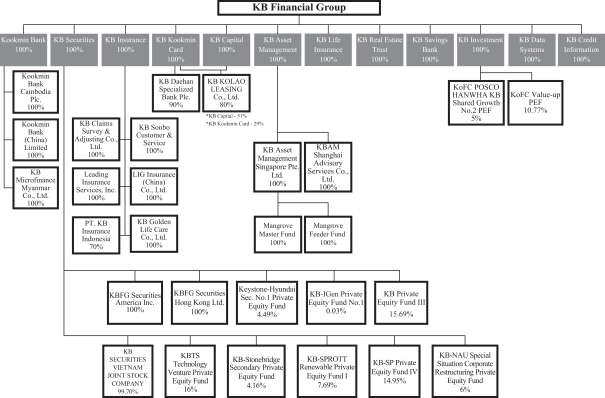
Table of Contents
Our largest subsidiary is Kookmin Bank, the assets of which represented approximately 74.7% of our total assets as of December 31, 2019. The following table provides summary information for our operating subsidiaries that are consolidated in our consolidated financial statements as of and for the year ended December 31, 2019, including their consolidated total assets, operating revenue, profit (loss) and total equity:
|
Subsidiaries |
Total Assets | Operating Revenue | Profit (Loss) | Total Equity | ||||||||||||
| (in millions of Won) | ||||||||||||||||
|
Kookmin Bank |
₩ | 387,425,038 | ₩ | 20,817,431 | ₩ | 2,439,079 | ₩ | 29,004,233 | ||||||||
|
KB Securities Co., Ltd. |
47,816,512 | 8,053,363 | 257,893 | 4,684,654 | ||||||||||||
|
KB Insurance Co., Ltd. |
36,552,368 | 12,661,927 | 234,327 | 3,862,908 | ||||||||||||
|
KB Kookmin Card Co., Ltd. |
22,990,114 | 3,102,186 | 316,546 | 4,064,919 | ||||||||||||
|
KB Life Insurance Co., Ltd. |
9,801,905 | 1,506,417 | 15,963 | 615,338 | ||||||||||||
|
KB Asset Management Co., Ltd. |
310,018 | 148,780 | 48,899 | 195,242 | ||||||||||||
|
KB Capital Co., Ltd. |
11,190,568 | 931,694 | 117,028 | 1,154,491 | ||||||||||||
|
KB Savings Bank Co., Ltd. |
1,361,032 | 92,435 | 16,301 | 212,407 | ||||||||||||
|
KB Real Estate Trust Co., Ltd. |
377,938 | 119,899 | 61,713 | 292,806 | ||||||||||||
|
KB Investment Co., Ltd. |
756,972 | 99,822 | 11,311 | 214,751 | ||||||||||||
|
KB Credit Information Co., Ltd. |
27,834 | 38,278 | (256 | ) | 14,898 | |||||||||||
|
KB Data Systems Co., Ltd. |
41,690 | 158,067 | 4,664 | 20,691 | ||||||||||||
Further information regarding our subsidiaries is provided below:
| • |
Kookmin Bank was established in Korea in 2001 as a result of the merger of the former Kookmin Bank (established in 1963) and H&CB (established in 1967). Kookmin Bank provides a wide range of banking and other financial services to individuals, small- and medium-sized enterprises and large corporations in Korea. As of December 31, 2019, Kookmin Bank was one of the largest commercial banks in Korea based upon total assets (including loans) and deposits. As of December 31, 2019, Kookmin Bank had approximately 31.5 million customers, with 1,051 branches nationwide. |
| • |
KB Securities Co., Ltd. , formerly known as Hyundai Securities Co., Ltd., was established in Korea in 1962 to provide various securities brokerage and investment banking services. In 2016, we acquired 100% of the outstanding shares of Hyundai Securities, merged another subsidiary, KB Investment & Securities Co., Ltd., with and into Hyundai Securities and changed the name of the surviving entity to KB Securities Co., Ltd. |
| • |
KB Insurance Co., Ltd. , formerly known as LIG Insurance Co., Ltd., was established in Korea in January 1959 to provide non-life insurance products. KB Insurance became our wholly-owned subsidiary in July 2017 after a series of stock purchases, a tender offer and a comprehensive stock swap. |
| • |
KB Kookmin Card Co., Ltd. was established in March 2011 as a separate entity upon the completion of a horizontal spin-off of Kookmin Bank’s credit card business, to provide credit card services. |
| • |
KB Life Insurance Co., Ltd. was established in Korea in April 2004 to provide life insurance and wealth management products primarily through our branch network. |
| • |
KB Asset Management Co., Ltd. was established in Korea in April 1988 as a subsidiary of Citizens Investment Trust Company to provide investment advisory services. |
| • |
KB Capital Co., Ltd. , which provides leasing services and installment finance services, was formerly known as Woori Financial Co., Ltd. and was acquired by us in March 2014. KB Capital became our wholly-owned subsidiary in July 2017 after a tender offer followed by a comprehensive stock swap. |
| • |
KB Savings Bank Co., Ltd. was established in Korea in January 2012 to provide small-loan finance services. KB Savings Bank was established in connection with our purchase of assets and assumption of liabilities of Jeil Savings Bank in January 2012. We acquired Yehansoul Savings Bank, which |
122
Table of Contents
|
provided small-loan finance services, in September 2013 and merged it with KB Savings Bank in January 2014, with KB Savings Bank as the surviving entity. |
| • |
KB Real Estate Trust Co., Ltd. was established in Korea in December 1996 to provide real estate development and brokerage services by managing trusts related to the real estate industry. |
| • |
KB Investment Co., Ltd. was established in Korea in March 1990 to invest in and finance small- and medium-sized enterprises. |
| • |
KB Credit Information Co., Ltd. was established in Korea in October 1999 to collect delinquent loans and to check credit history. |
| • |
KB Data Systems Co., Ltd. was established in Korea in September 1991 to provide software services to us and other financial institutions. |
| Item 4.D. |
Property, Plants and Equipment |
Our registered office and corporate headquarters are located at 26, Gukjegeumyung-ro 8-gil, Yeongdeungpo-gu, Seoul 07331, Korea. The following table presents information regarding certain of our properties in Korea:
|
Type of facility/building |
Location |
Area
(square meters) |
||||
|
Registered office and corporate headquarters and Kookmin Bank headquarters |
26, Gukjegeumyung-ro 8-gil, Yeongdeungpo-gu, Seoul 07331 | 5,354 | ||||
|
KB Kookmin Card headquarters building |
Jongno-gu, Seoul | 3,923 | ||||
|
Kookmin Bank training institute |
Ilsan | 207,560 | ||||
|
Kookmin Bank training institute |
Daecheon | 4,158 | ||||
|
Kookmin Bank training institute |
Sokcho | 15,559 | ||||
|
Kookmin Bank training institute |
Cheonan | 196,649 | ||||
|
Kookmin Bank IT center |
Gangseo-gu, Seoul | 13,116 | ||||
|
Kookmin Bank IT center |
Yeouido, Seoul | 5,928 | ||||
|
Kookmin Bank IT center |
Yeouido, Seoul | 2,006 | ||||
|
Kookmin Bank IT center |
Gimpo | 13,144 | ||||
|
Kookmin Bank support center |
Seongbuk-gu, Seoul | 9,939 | ||||
|
KB Securities training institute |
Kiheung-gu, Yongin | 64,600 | ||||
In addition, we entered into a land purchase agreement in March 2016 to purchase a site of approximately 4,727 square meters located in Yeouido, Seoul, on which we plan to construct a new headquarters building for Kookmin Bank (with a floor space of approximately 67,683 square meters). We anticipate that our total capital expenditures for the construction of the building, which is scheduled to be completed in August 2020, will amount to approximately W425 billion, of which an aggregate amount of W207 billion was incurred as of December 31, 2019.
As of December 31, 2019, we had a countrywide network of 1,051 banking branches and sub-branches, as well as 475 branches and sub-branches and 201 representative offices for our other operations including our credit card, securities brokerage, insurance and consumer finance businesses. Approximately one-fifth of these facilities are housed in buildings owned by us, while the remaining branches are leased properties. See “Item 4.B. Business Overview—Capital Markets Activities and International Banking/Finance—International Banking/Finance” for a list of our overseas subsidiaries, branches and representative and liaison offices in operation as of December 31, 2019. Kookmin Bank, Gurgaon Representative Office in India converted to Kookmin Bank, Gurugram Branch in February 2019. Kookmin Bank, Hanoi Representative Office is currently being liquidated. Lease terms are generally from two to three years and seldom exceed five years. Kookmin Bank International Ltd., previously one of our operating subsidiaries, was converted to a branch in London in May 2018. We do not own any material properties outside of Korea.
123
Table of Contents
The net carrying amount of all the properties owned by us at December 31, 2019 was ₩3,934 billion.
| Item 4A. |
UNRESOLVED STAFF COMMENTS |
We do not have any unresolved comments from the U.S. Securities and Exchange Commission staff regarding our periodic reports under the Securities Exchange Act of 1934, as amended, or the Exchange Act.
| Item 5. |
OPERATING AND FINANCIAL REVIEW AND PROSPECTS |
| Item 5.A. |
Operating Results |
Overview
The following discussion is based on our consolidated financial statements, which have been prepared in accordance with IFRS as issued by the IASB. The consolidated financial statements include the accounts of subsidiaries over which substantive control is exercised through majority ownership of voting stock and/or other means. Investments in jointly controlled entities and associates (which are companies over which we have the ability to exercise significant influence) are accounted for by the equity method of accounting.
Trends in the Korean Economy
Our financial position and results of operations have been and will continue to be significantly affected by financial and economic conditions in Korea. In recent years, commercial banks, consumer finance companies and other financial institutions in Korea have made significant investments and engaged in aggressive marketing in retail lending (including mortgage and home equity loans), leading to substantially increased competition in this segment. From the second half of 2016 to 2019, the Korean government introduced various measures to tighten regulations on mortgage lending and housing subscription in response to the rapid growth in consumer debt and concerns over speculative investments in real estate in certain areas. Notwithstanding such measures, demand for residential property in certain areas, including Seoul, continued to increase through the end of 2019, and accompanied by an increase in the prices of such residential property, our portfolio of retail loans increased from ₩146,150 billion as of December 31, 2017 to ₩158,807 billion as of December 31, 2018 and ₩166,307 billion as of December 31, 2019. Nevertheless, a decrease in housing prices as a result of the implementation of such measures, together with the high level of consumer debt and deteriorating domestic and global economic conditions, could result in declines in consumer spending and reduced economic growth, which may lead to increases in delinquency levels of our portfolio of retail loans. In 2019, we recorded charge-offs of ₩443 billion and provisions for loan losses of ₩515 billion in respect of our retail loan portfolio, compared to charge-offs of ₩381 billion and provision for loan losses of ₩270 billion in 2018 and charge-offs of ₩342 billion and provision for loan losses of ₩233 billion in 2017. See “Item 3.D. Risk Factors—Risks relating to our retail credit portfolio.”
Our loans to small- and medium-sized enterprises increased from ₩97,379 billion as of December 31, 2017 to ₩112,487 billion as of December 31, 2019. Substantial growth in lending in Korea to small- and medium-sized enterprises in recent years, and financial difficulties experienced by such enterprises as a result of, among other things, adverse changes in economic conditions in Korea and globally (such as the ongoing COVID-19 pandemic affecting many countries worldwide, including Korea), may lead to increasing delinquencies and a deterioration in overall asset quality in the credit exposures of Korean banks to small- and medium-sized enterprises. In 2019, we recorded charge-offs of ₩18 billion in respect of our loans to small- and medium-sized enterprises, compared to charge-offs of ₩35 billion in 2018 and ₩308 billion in 2017. See “Item 3.D. Risk Factors—Risks relating to our small- and medium-sized enterprise loan portfolio—We have significant exposure to small- and medium-sized enterprises, and any financial difficulties experienced by these customers may result in a deterioration of our asset quality and have an adverse impact on us.”
124
Table of Contents
The Korean economy is closely tied to, and is affected by developments in, the global economy. The overall prospects for the Korean and global economy remain uncertain. In recent years and in 2020, the global financial markets have experienced significant volatility as a result of, among other things:
| • |
the occurrence of severe health pandemics, such as the ongoing global outbreak of the COVID-19 pandemic, or other severe health epidemics in Korea or other parts of the world, such as the Middle East Respiratory Syndrome outbreak in Korea in 2015; |
| • |
interest rate fluctuations as well as changes in policy rates by the U.S. Federal Reserve and other central banks; |
| • |
financial and social difficulties affecting many countries worldwide, in particular in Latin America and Europe; |
| • |
a deterioration in economic and trade relations between the United States and its major trading partners, including China; |
| • |
escalations in trade protectionism globally and geopolitical tensions in East Asia and the Middle East; |
| • |
the slowdown of economic growth in China and other major emerging market economies; |
| • |
increased uncertainties resulting from the United Kingdom’s exit from the European Union; and |
| • |
political and social instability in various countries in the Middle East, including Syria, Iraq and Yemen. |
In light of the high level of interdependence of the global economy, unfavorable changes in the global financial markets, including as a result of any of the foregoing developments, could have a material adverse effect on the Korean economy and financial markets, and in turn on our business, financial condition and results of operations. In particular, the recent global outbreak of COVID-19, which was declared a “pandemic” by The World Health Organization on March 11, 2020, has led to significant global economic and financial disruptions, including an adverse impact on international trade and business activities, sharp declines and significant volatility in the financial markets as well as decreases in interest rates worldwide.
We are also exposed to adverse changes and volatility in the global and Korean financial markets as a result of our liabilities and assets denominated in foreign currencies and our holdings of trading and investment securities, including structured products. The value of the Won relative to major foreign currencies in general and the U.S. dollar in particular has fluctuated widely in recent years, in particular as a result of the ongoing COVID-19 pandemic. A depreciation of the Won will increase our cost in Won of servicing our foreign currency-denominated debt, while continued exchange rate volatility may also result in foreign exchange losses for us. Furthermore, as a result of the deterioration in global and Korean economic conditions, there has been downward pressures on securities prices, including the stock prices of Korean and foreign companies in which we hold an interest. Such developments have resulted in and may lead to further trading and valuation losses on our trading and investment securities portfolio as well as impairment losses on our investments accounted for under the equity method.
As a result of the ongoing impact of the COVID-19 pandemic on the Korean and global economies and financial markets, as well as factors such as fluctuations in oil and commodity prices, interest and exchange rate fluctuations, higher unemployment, lower consumer confidence, stock market volatility, changes in fiscal and monetary policies and continued tensions with North Korea, the economic outlook for the financial services sector in Korea in 2020 and for the foreseeable future remains highly uncertain.
Acquisitions
In recent years, we have engaged in a number of acquisitions, which have affected, and may continue to affect, our results of operations and their comparability from period to period.
125
Table of Contents
In March 2014, we acquired 52.02% of the outstanding shares of Woori Financial Co., Ltd., a publicly listed Korean consumer finance company, from Woori Finance Holdings Co., Ltd. for ₩280 billion, and subsequently renamed the entity KB Capital Co., Ltd. As a result, KB Capital became a consolidated subsidiary. We conducted a tender offer in May 2017, through which we acquired 5,949,300 shares of KB Capital at ₩27,500 per share, increasing our shareholding in KB Capital to 79.70%. We subsequently acquired the remaining outstanding shares of KB Capital in exchange for 2,269,057 shares of common stock of our company through a comprehensive stock swap effected in July 2017, as a result of which KB Capital became a wholly-owned subsidiary. As of December 31, 2019, KB Capital had total assets of ₩11,191 billion and total equity of ₩1,154 billion, and in 2019, its total operating income amounted to ₩932 billion and its profit for the year amounted to ₩117 billion.
In June 2015, we acquired 19.47% of the outstanding shares of LIG Insurance Co., Ltd., a publicly listed Korean non-life insurance company, from a group of individual shareholders for ₩651 billion, and subsequently renamed the entity KB Insurance Co., Ltd. In November 2015, we increased our shareholding in KB Insurance to 33.29% by acquiring its treasury shares for ₩231 billion, and in December 2016, we further increased our shareholding to 39.81% by purchasing new shares of KB Insurance for ₩171 billion in a rights offering. Subsequently, through a tender offer conducted in May 2017, we acquired 36,237,649 shares of KB Insurance at ₩33,000 per share, increasing our shareholding to 94.30%, as a result of which KB Insurance became a consolidated subsidiary. In July 2017, we effected a comprehensive stock swap to acquire the remaining outstanding shares of KB Insurance in exchange for 2,170,943 shares of common stock of our company, as a result of which KB Insurance became a wholly-owned subsidiary. In connection with our acquisition of additional shares of KB Insurance in May 2017, we recognized ₩2,434 billion of intangible assets, consisting mainly of the value of business acquired, which represents the difference between the fair value of KB Insurance’s insurance contract liabilities acquired and their book value as of the acquisition date. The value of business acquired is amortized over an estimated useful life of 60 years using the declining balance method, and the related amortization expense is recorded as part of our insurance expense. See Notes 3.8 and 15 of the notes to our consolidated financial statements included elsewhere in this annual report. As of December 31, 2019, KB Insurance had total assets of ₩36,552 billion and total equity of ₩3,863 billion, and in 2019, its total operating income amounted to ₩12,662 billion and its profit for the year amounted to ₩234 billion.
In addition, in May 2016, we acquired 22.56% of the outstanding shares of Hyundai Securities Co., Ltd., a publicly listed Korean securities firm, from Hyundai Merchant Marine Co., Ltd. and other shareholders for ₩1,242 billion, and further increased our shareholding in Hyundai Securities to 29.62% in June 2016 by acquiring treasury shares of Hyundai Securities for ₩107 billion. In October 2016, we increased our shareholding in Hyundai Securities to 100% by effecting a comprehensive stock swap of the outstanding shares of Hyundai Securities for 31,759,844 newly issued shares of common stock of our company, as a result of which Hyundai Securities became a consolidated subsidiary. In connection with such comprehensive stock swap, we recognized gains on bargain purchase of ₩629 billion, representing the excess of the total identifiable net assets of Hyundai Securities over the total consideration transferred (consisting of the sum of the fair value of our holdings of Hyundai Securities shares at the time of the comprehensive stock swap and the value of our common shares issued in the comprehensive stock swap), which was recorded as part of our non-operating income for 2016. Following such transaction, we merged an existing subsidiary, KB Investment & Securities, with and into Hyundai Securities in December 2016 and changed the name of the surviving entity to KB Securities Co., Ltd. As of December 31, 2019, KB Securities had total assets of ₩47,817 billion and total equity of ₩4,685 billion, and in 2019, its total operating income amounted to ₩8,053 billion and its profit for the year amounted to ₩258 billion.
Most recently, in April 2020, we entered into a share purchase agreement to acquire all of the outstanding shares of The Prudential Life Insurance Company of Korea, Ltd., or Prudential Life Insurance, a provider of life insurance services in Korea, from Prudential Financial, Inc. for ₩2,265 billion, which amount is subject to change pending closing. The completion of such acquisition is subject to regulatory approvals and other closing conditions. As of December 31, 2019, Prudential Life Insurance had total assets of ₩21,079 billion and total
126
Table of Contents
equity of ₩2,914 billion, and in 2019, its total operating revenue amounted to ₩2,260 billion and its profit for the year amounted to ₩141 billion.
Changes in Securities Values, Exchange Rates and Interest Rates
Fluctuations of exchange rates, interest rates and stock prices affect, among other things, the demand for our products and services, the value of and rate of return on our assets, the availability and cost of funding and the financial condition of our customers. The following table shows, for the dates indicated, the stock price index of all equities listed on the KRX KOSPI Market as published in the KOSPI, the Won to U.S. dollar exchange rates and benchmark Won borrowing interest rates.
|
June 30,
2015 |
Dec. 31,
2015 |
June 30,
2016 |
Dec. 30,
2016 |
June 30,
2017 |
Dec. 28,
2017 |
June 29,
2018 |
Dec. 31,
2018 |
June 28,
2019 |
Dec. 31,
2019 |
|||||||||||||||||||||||||||||||
|
KOSPI |
2,074.20 | 1,961.31 | (4) | 1,970.35 | 2,026.46 | (5) | 2,391.79 | 2,467.49 | (6) | 2,326.13 | 2,041.04 | (7) | 2,130.62 | 2,197.67 | (8) | |||||||||||||||||||||||||
|
|
₩ | 1,117.3 | ₩ | 1,169.3 | ₩ | 1,154.2 | ₩ | 1,203.7 | ₩ | 1,143.8 | ₩ | 1,067.4 |
|
|
|
|
|
|
|
|
||||||||||||||||||||
|
Corporate bond rates (2) |
2.51 | % | 2.64 | % | 2.26 | % | 2.79 | % | 2.84 | % | 3.08 | % | 2.93 | % | 2.58 | % | 1.98 | % | 1.99 | % | ||||||||||||||||||||
|
Treasury bond rates (3) |
1.79 | % | 1.66 | % | 1.25 | % | 1.64 | % | 1.70 | % | 2.10 | % | 2.12 | % | 1.82 | % | 1.47 | % | 1.36 | % | ||||||||||||||||||||
| (1) |
Represents the noon buying rate on the dates indicated. |
| (2) |
Measured by the yield on three-year Korean corporate bonds rated as A+ by the Korean credit rating agencies. |
| (3) |
Measured by the yield on three-year treasury bonds issued by the Ministry of Economy and Finance of Korea. |
| (4) |
As of December 30, 2015, the last day of trading for the KRX KOSPI Market in 2015. |
| (5) |
As of December 29, 2016, the last day of trading for the KRX KOSPI Market in 2016. |
| (6) |
As of December 28, 2017, the last day of trading for the KRX KOSPI Market in 2017. |
| (7) |
As of December 31, 2018, the last day of trading for the KRX KOSPI Market in 2018. |
| (8) |
As of December 30, 2019, the last day of trading for the KRX KOSPI Market in 2019. |
Changes in Accounting Policies
Adoption of IFRS 16
IFRS 16 Leases , or IFRS 16, issued by the IASB in January 2016, is a new IFRS accounting standard aimed at facilitating a more faithful representation of, and improving the transparency of information relating to, lease-related assets and liabilities, and is effective for annual periods beginning on or after January 1, 2019. IFRS 16, which replaces IAS 17, introduces a single, on-balance sheet lease accounting model for lessees and requires a lessee to recognize a right-of-use asset representing the lessee’s right to use the underlying leased asset and a lease liability representing the present value of the lessee’s obligation to make future lease payments. We initially adopted IFRS 16 from January 1, 2019, applying the modified retrospective approach, which allows us to recognize the cumulative impact of applying IFRS 16 as an adjustment to the opening balance of our retained earnings as of January 1, 2019 with no comparative information for prior periods.
We have applied IFRS 16 in our consolidated financial statements as of and for the year ended December 31, 2019 included elsewhere in this annual report. As permitted by the transition rules of IFRS 16, our consolidated financial statements as of and for the years ended December 31, 2017 and 2018 included elsewhere in this annual report have not been restated to retroactively apply IFRS 16.
For additional information regarding IFRS 16 and the impact of its application to our consolidated financial statements, see Notes 2.1 and 44 of the notes to our consolidated financial statements.
Critical Accounting Policies
The notes to our consolidated financial statements contain a summary of our significant accounting policies, including a discussion of recently issued accounting pronouncements. Certain of these policies are critical to the portrayal of our financial condition, since they require management to make difficult, complex or subjective judgments, some of which may relate to matters that are inherently uncertain. We discuss these critical accounting policies below.
127
Table of Contents
Impairment of Loans and Allowances for Loan Losses
We evaluate our loan portfolio for impairment on an ongoing basis. We have established allowances for loan losses, which are available to absorb losses in our loan portfolio. If we believe that additions or changes to the allowances for loan losses are required, we record a provision for loan losses (as part of our provision for credit losses), which is treated as a charge against current income. Loan exposures that we deem to be uncollectible, including actual loan losses, net of recoveries of previously written-off amounts, are charged directly against the allowances for loan losses.
We have established our allowance for loan losses as of December 31, 2018 and 2019 in accordance with IFRS 9 and as of December 31, 2017 in accordance with IAS 39.
Our accounting policies under IFRS 9 for losses arising from the impairment of loans and allowances for loan losses are described in Note 3.6 of the notes to our consolidated financial statements. The impairment model under IFRS 9 requires recording of allowance for credit losses based on expected losses instead of incurred losses (as was the case under IAS 39), and recognition of any subsequent changes in expected credit losses in profit or loss. Under IFRS 9, the allowance required to be established with respect to a loan or receivable is the amount of the 12-month expected credit loss or the lifetime expected credit loss for the applicable loan or receivable, according to the three stages of credit risk deterioration since initial recognition, as follows:
| • |
Stage 1 (loans and receivables for which credit risk has not significantly increased since initial recognition): the allowance for credit losses must cover expected credit losses due to possible defaults on the relevant loan or receivable within a 12-month period from the reporting date. |
| • |
Stage 2 (loans and receivables for which credit risk has significantly increased since initial recognition): the allowance for credit losses must cover expected credit losses from all possible defaults during the expected lifetime of the relevant loan or receivable. |
| • |
Stage 3 (credit-impaired loans and receivables): the allowance for credit losses must cover expected credit losses from all possible defaults during the expected lifetime of the relevant loan or receivable. |
At the end of every reporting period, we evaluate whether the credit risk with respect to our loans and receivables, after taking into account forward-looking information, has significantly increased since the date of their initial recognition. We distinguish between loans and receivables that are individually significant (which we assess on an individual basis) and those that are not (which we assess collectively based on homogeneous credit risk profiles) in performing such evaluation, and consider factors such as the following as indicators of a significant increase in credit risk:
| • |
payment obligations that are more than 30 days past due; |
| • |
a decline in the borrower’s credit rating in excess of certain levels as compared to that at initial recognition; |
| • |
a decline in ratings below certain levels in our early warning system; |
| • |
the occurrence of a debt restructuring (except for impaired financial assets); and |
| • |
publication of credit delinquency information regarding the borrower by the Korea Federation of Banks or certain other sources. |
Expected credit losses are a probability-weighted estimate of credit losses (i.e., the present value of all cash shortfalls) within 12 months of stage 1 loans or receivables and over the expected life of stages 2 and 3 loans or receivables. We measure expected credit losses by reflecting supportable information that is reasonably available at the reporting date without undue cost or effort, including information about past events, current conditions and forecasts of future economic conditions.
128
Table of Contents
Our consolidated financial statements for the year ended December 31, 2019 included a total allowance for credit losses of ₩2,408 billion as of that date. Our total loan charge-offs, net of recoveries, amounted to ₩799 billion, and we recorded provisions for credit losses of ₩657 billion in 2019.
We believe that the accounting estimates related to impairment of loans and receivables and our allowance for credit losses are a “critical accounting policy” because: (1) they are highly susceptible to change from period to period based on our estimates of expected credit losses relating to our loan portfolio; and (2) any significant difference between expected credit losses on loans and receivables (as reflected in our allowance for credit losses) and actual losses on loans and receivables could require us to record additional provisions for credit losses or charge-offs which, if significant, could have a material impact on our profit. Our estimates of expected credit losses require significant management judgment regarding matters such as the significance of changes in credit risk and probability of default since initial recognition. Actual losses have fluctuated in the past and are expected to continue to do so, based on a variety of factors.
Valuation of Financial Instruments
Our accounting policy for determining the fair value of financial instruments is described in Notes 3.3 and 6 of the notes to our consolidated financial statements.
The best evidence of fair value is a quoted price in an actively traded market. In the event that the market for a financial instrument is not active, a valuation technique is used. The majority of valuation techniques employ only observable market data and, as such, the reliability of the fair value measurement is high. However, certain financial instruments are valued on the basis of valuation techniques that feature one or more significant market inputs that are unobservable. Valuation techniques that rely to a greater extent on unobservable inputs require a higher level of management judgment to calculate a fair value than those based wholly on observable inputs.
Valuation techniques used to calculate fair values are discussed in Note 6.1 of the notes to our consolidated financial statements. The main assumptions and estimates which our management considers when applying a model with valuation techniques are:
| • |
The likelihood and expected timing of future cash flows on the instrument. These cash flows are usually governed by the terms of the instrument, although judgment may be required when the ability of the counterparty to service the instrument in accordance with the contractual terms is in doubt. Future cash flows may be sensitive to changes in market rates. |
| • |
Selecting an appropriate discount rate for the instrument. The determination of this rate is based on an assessment of what a market participant would regard as the appropriate spread of the rate for the instrument over the appropriate risk-free rate. |
| • |
Judgment to determine what model to use to calculate fair value in areas where the choice of valuation model is particularly subjective (for example, valuation of complex derivative products). |
The financial instruments carried at fair value have been categorized under the three levels of the IFRS fair value hierarchy as follows:
| • |
Level 1: Quoted prices in active markets for identical assets or liabilities. |
| • |
Level 2: Observable inputs other than Level 1 prices, such as quoted prices for similar assets or liabilities. |
| • |
Level 3: Unobservable inputs that are supported by little or no market activity and that are significant to the fair value of the assets or liabilities. |
The fair value hierarchy requires an entity to maximize the use of observable inputs and minimize the use of unobservable inputs when measuring fair value. Fair value is a market-based measure considered from the
129
Table of Contents
perspective of a market participant. As such, even when market assumptions are not readily available, our own assumptions are intended to reflect those that market participants would use in pricing the asset or liability at the measurement date.
For financial instruments traded in the over-the-counter market, we measure the fair value of such instruments as the arithmetic mean of prices obtained from Korea Asset Pricing (an affiliate of Fitch Ratings), KIS Pricing (an affiliate of Moody’s Investors Service), NICE Pricing and Information and FN Pricing, all four of which are recognized as major qualified independent pricing services in Korea. There are extremely rare cases where we do not receive price quotes from all four of the pricing services described above. In such cases, we contact the pricing service which did not submit a price quote to discuss the reason why it cannot provide a price and, following such discussion, we use the arithmetic mean of only the prices obtained from the other pricing services so long as there is no reason to believe that the prices that have been submitted are inadequate. We generally do not adjust the prices we obtain from these independent pricing services, as the variance among such prices is insignificant in most cases (primarily because most of the financial instruments we hold consist of government bonds and highly-rated corporate bonds, there is a high volume of transactions in the over-the-counter market and actual transaction prices are monitored and referenced by the pricing services).
Our consolidated financial statements for the year ended December 31, 2019 included financial assets measured at fair value using a valuation technique of ₩76,736 billion, representing 74.4% of total financial assets measured at fair value, and financial liabilities measured at fair value using a valuation technique of ₩15,554 billion, representing 84.7% of total financial liabilities measured at fair value. As used herein, the fair value using a valuation technique means the fair value at Level 2 and Level 3 in the fair value hierarchy.
We believe that the accounting estimates related to the determination of the fair value of financial instruments are a “critical accounting policy” because: (1) they may be highly susceptible to change from period to period based on factors beyond our control; and (2) any significant difference between our estimate of the fair value of these financial instruments on any particular date and either their estimated fair value on a different date or the actual proceeds that we receive upon sale of these financial instruments could result in valuation losses or losses on disposal which may have a material impact on our profit. Our assumptions about the fair value of financial instruments we hold require significant judgment because actual valuations have fluctuated in the past and are expected to continue to do so, based on a variety of factors.
Deferred Income Tax Assets
Our accounting policy for the recognition of deferred income tax assets is described in Notes 3.20 and 16 of the notes to our consolidated financial statements. The recognition of deferred income tax assets relies on an assessment of the probability and sufficiency of future taxable profits, future reversals of existing taxable temporary differences and ongoing tax planning strategies.
We recognize deferred income tax assets and liabilities for the future tax consequences attributable to temporary differences between the financial statement carrying amounts of existing assets and liabilities and their respective tax bases, unused tax losses and unused tax credits. Deferred income tax assets are recognized only to the extent it is probable that sufficient taxable profit will be available against which those deductible temporary differences, unused tax losses or unused tax credits can be utilized. This assessment requires significant management judgment and assumptions. In determining the amount of deferred income tax assets, we use historical tax capacity and profitability information and, if relevant, forecasted operating results, based upon approved business plans, including a review of the eligible carry-forward periods, available tax planning opportunities and other relevant considerations.
Our consolidated financial statements for the year ended December 31, 2019 included deferred income tax assets and liabilities of ₩4 billion and ₩778 billion, respectively, as of that date, after offsetting of ₩1,712 billion of deferred income tax liabilities and assets.
130
Table of Contents
We believe that the estimates related to our recognition and measurement of deferred income tax assets are a “critical accounting policy” because: (1) they may be highly susceptible to change from period to period based on our assumptions regarding our future profitability; and (2) any significant difference between our estimates of future profits on any particular date and estimates of such future profits on a different date could result in an income tax expense or benefit which may have a material impact on our profit from period to period. Our assumptions about our future profitability require significant judgment and are inherently subjective.
Uncertain Tax Positions
Our accounting policy for the recognition of uncertain tax positions is described in Note 3.20 of the notes to our consolidated financial statements.
We recognize our uncertain tax positions in our financial statements based on the guidance in International Accounting Standard 12, Income Taxes , which allows recognition of tax payments as current income tax assets to the extent it is probable that they will be recovered from the tax authorities.
We believe that the estimates related to our recognition and measurement of uncertain tax positions are a “critical accounting policy” because they are measured upon the facts and circumstances that exist as of each reporting period and involve significant management judgment. Subsequent changes in judgment based upon new information may lead to changes in recognition, derecognition and measurement of uncertain tax positions.
Results of Operations
Net Interest Income
The following table shows, for the periods indicated, the principal components of our net interest income:
| Year Ended December 31, | Percentage Change | |||||||||||||||||||
| 2017 | 2018 | 2019 | 2018/2017 | 2019/2018 | ||||||||||||||||
| (in billions of Won, except percentages) | (%) | |||||||||||||||||||
|
Interest income |
||||||||||||||||||||
|
Deposits at amortized cost (1) |
₩ | — | ₩ | 109 | ₩ | 151 | N/A | (5) | 38.5 | |||||||||||
|
Due from financial institutions (IAS 39) (1) |
126 | — | — | N/A | (5) | N/A | (5) | |||||||||||||
|
Financial assets at fair value through profit or loss (2) |
— | 749 | 704 | N/A | (5) | (6.0 | ) | |||||||||||||
|
Financial assets at fair value through profit or loss (IAS 39) |
537 | — | — | N/A | (5) | N/A | (5) | |||||||||||||
|
Loans |
— | 11,552 | 12,395 | N/A | (5) | 7.3 | ||||||||||||||
|
Loans (IAS 39) |
10,096 | — | — | N/A | (5) | N/A | (5) | |||||||||||||
|
Financial investments (debt securities) (3) |
— | 1,325 | 1,390 | N/A | (5) | 4.9 | ||||||||||||||
|
Financial investments (debt securities) (IAS 39) (3) |
1,160 | — | — | N/A | (5) | N/A | (5) | |||||||||||||
|
|
|
|
|
|
|
|||||||||||||||
|
Total interest income |
11,919 | 13,735 | 14,639 | 15.2 | 6.6 | |||||||||||||||
|
|
|
|
|
|
|
|||||||||||||||
|
Interest expense |
||||||||||||||||||||
|
Deposits |
2,345 | 3,042 | 3,481 | 29.7 | 14.4 | |||||||||||||||
|
Debts |
446 | 639 | 720 | 43.3 | 12.7 | |||||||||||||||
|
Debentures |
880 | 1,149 | 1,241 | 30.6 | 8.0 | |||||||||||||||
|
|
|
|
|
|
|
|||||||||||||||
|
Total interest expense |
3,672 | 4,830 | 5,442 | 31.5 | 12.7 | |||||||||||||||
|
|
|
|
|
|
|
|||||||||||||||
|
Net interest income |
₩ | 8,247 | ₩ | 8,905 | ₩ | 9,197 | 8.0 | 3.3 | ||||||||||||
|
|
|
|
|
|
|
|||||||||||||||
|
Net interest margin (4) |
2.27 | % | 2.23 | % | 2.14 | % | ||||||||||||||
| (1) |
Consists of cash and interest-earning deposits in other banks. |
| (2) |
Includes deposits, loans and securities at fair value through profit or loss. For information on interest income arising from such financial instruments, see Note 27 of the notes to our consolidated financial statements included elsewhere in this annual report. |
131
Table of Contents
| (3) |
Consists of our financial assets at fair value through other comprehensive income and at amortized cost (or our available-for-sale and held to maturity financial asset) portfolios. For 2018 and 2019, includes loans at fair value through other comprehensive income. For information on interest income arising from such financial instruments, see Note 27 of the notes to our consolidated financial statements included elsewhere in this annual report. |
| (4) |
The ratio of net interest income to average interest-earning assets. See “Item 3.A. Selected Financial Data—Profitability ratios and other data.” |
| (5) |
“N/A” means not applicable. |
Comparison of 2019 to 2018
Interest income. Interest income increased 6.6% from ₩13,735 billion in 2018 to ₩14,639 billion in 2019, primarily as a result of a 7.3% increase in interest on loans, which was enhanced by a 4.9% increase in interest on financial investments. Such increase was partially offset by a 6.0% decrease in interest on financial assets at fair value through profit or loss. The average volume of our interest-earning assets increased 7.4% from ₩399,368 billion in 2018 to ₩429,046 billion in 2019, principally due to growth in our loan and financial investments portfolios. The effect of such increase was partially offset by a 3 basis point decrease in the average yields on our interest-earning assets from 3.44% in 2018 to 3.41% in 2019, which mainly reflected a decrease in the general level of interest rates in Korea commencing in the second half of 2019, despite an increase in the general level of interest rates in Korea in 2019 compared to 2018.
A substantial majority of loans that were previously classified as “loans” under IAS 39 are classified since 2018 as “loans at amortized cost” under IFRS 9, while a small portion of loans that were previously classified as “loans” under IAS 39 are classified since 2018 as “financial assets at fair value through profit or loss” or “financial investments (debt securities).” The 7.3% increase in interest on loans from ₩11,552 billion in 2018 to ₩12,395 billion in 2019 was primarily the result of:
| • |
a 4.9% increase in the average volume of corporate loans from ₩134,938 billion in 2018 to ₩141,600 billion in 2019, which was enhanced by a 7 basis point increase in the average yields on such loans from 3.31% in 2018 to 3.38% in 2019; |
| • |
a 10.8% increase in the average volume of mortgage loans from ₩65,799 billion in 2018 to ₩72,897 billion in 2019, which was enhanced by a 3 basis point increase in the average yields on such loans from 3.03% in 2018 to 3.06% in 2019; and |
| • |
an 11.8% increase in the average volume of other consumer loans from ₩52,333 billion in 2018 to ₩58,514 billion in 2019, which was partially offset by an 18 basis point decrease in the average yields on such loans from 4.76% in 2018 to 4.58% in 2019. |
The increase in the average volumes of corporate loans mainly reflected our increased marketing efforts and increased demand for such loans from corporate borrowers in Korea. The increase in the average volume of mortgage loans and other consumer loans was attributable primarily to higher demand for such loans among consumers in Korea. The increase in average yields on corporate loans and mortgage loans mainly reflected an increase in the general level of interest rates in Korea in 2019 compared to 2018. The average yields on other consumer loans decreased mainly as a result of a decrease in interest rates applicable to such loans commencing in the second half of 2019, which was reflected in such loans earlier than in other types of loans.
Overall, the average volume of our loans increased 6.9% from ₩306,710 billion in 2018 to ₩327,747 billion in 2019, while the average yields on our loans increased by 1 basis point from 3.77% in 2018 to 3.78% in 2019.
Our financial investments portfolio consists of financial assets at fair value through other comprehensive income (or available-for-sale financial assets) and financial assets at amortized cost (or held-to-maturity financial assets), including debt securities issued by government-owned or -controlled enterprises or financial institutions and debt securities issued by Korean banks and other financial institutions. A substantial majority of financial investments that were previously classified as “available-for-sale financial assets” under IAS 39 are classified
132
Table of Contents
since 2018 as “financial assets at fair value through other comprehensive income” under IFRS 9, while a small portion of financial investments that were previously classified as “available-for-sale financial assets” under IAS 39 are classified since 2018 as “financial assets at fair value through profit or loss” or “financial assets at amortized cost” under IFRS 9. A substantial majority of financial investments that were previously classified as “held-to-maturity financial assets” under IAS 39 are classified since 2018 as “financial assets at amortized cost” under IFRS 9, while a small portion of financial investments that were previously classified as “held-to-maturity financial assets” under IAS 39 are classified since 2018 as “financial assets at fair value through profit or loss” under IFRS 9. The 4.9% increase in interest on financial investments from ₩1,325 billion in 2018 to ₩1,390 billion in 2019 was primarily the result of a 12.6% increase in the average volume of financial investments from ₩56,585 billion in 2018 to ₩63,699 billion in 2019, which was partially offset by a 16 basis point decrease in average yields on financial investments from 2.34% in 2018 to 2.18% in 2019. The increase in the average volume of financial investments was primarily due to an increase in our purchases of debt securities issued by Korean banks and other financial institutions. The decrease in average yields on financial investments mainly reflected a decrease in the general level of interest rates in Korea commencing in the second half of 2019, which was reflected in financial investments earlier than in other types of interest-earning assets.
The 6.0% decrease in interest on financial assets at fair value through profit or loss from ₩749 billion in 2018 to ₩704 billion in 2019 was primarily due to a 9 basis point decrease in average yields on such financial assets from 2.68% in 2018 to 2.59% in 2019, which was enhanced by a 2.7% decrease in the average volume of such financial assets from ₩27,911 billion in 2018 to ₩27,164 billion in 2019. The decrease in average yields on such financial assets mainly reflected a decrease in the general level of interest rates in Korea commencing in the second half of 2019, which was reflected in financial assets at fair value through profit or loss earlier than in other types of interest-earning assets. The decrease in the average volume of such financial assets mainly reflected our decreased purchases of such financial assets due to the lower interest rate environment in Korea commencing in the second half of 2019.
Interest expense. Interest expense increased 12.7% from ₩4,830 billion in 2018 to ₩5,442 billion in 2019 primarily due to a 14.4% increase in interest expense on deposits, which was enhanced by an 8.0% increase in interest expense on debentures and a 12.7% increase in interest expense on debts. The average volume of our interest-bearing liabilities increased 7.8% from ₩347,045 billion in 2018 to ₩374,114 billion in 2019, which principally reflected increases in the average volumes of deposits. The effect of this increase was enhanced by a 6 basis point increase in the average cost of interest-bearing liabilities from 1.39% in 2018 to 1.45% in 2019, which was driven mainly by an increase in the general level of interest rates in Korea in 2019 compared to 2018.
The 14.4% increase in interest expense on deposits from ₩3,042 billion in 2018 to ₩3,481 billion in 2019 was primarily due to a 10.5% increase in the average volume of time deposits from ₩141,021 billion in 2018 to ₩155,762 billion in 2019, which was enhanced by a 7 basis point increase in the average cost of such deposits from 1.87% in 2018 to 1.94% in 2019. The increase in the average volume of time deposits was principally due to customers’ continuing preference for low-risk products and institutions in Korea in light of increased uncertainties in domestic and global financial markets in 2019. The increase in the average cost of time deposits mainly reflected an increase in the general level of interest rates in Korea in 2019 compared to 2018. Overall, the average volume of our deposits increased 8.3% from ₩261,333 billion in 2018 to ₩283,062 billion in 2019, while the average cost of our deposits increased by 7 basis points from 1.16% in 2018 to 1.23% in 2019.
The 8.0% increase in interest expense on debentures from ₩1,149 billion in 2018 to ₩1,241 billion in 2019 was primarily due to a 9.2% increase in the average volume of debentures from ₩48,147 billion in 2018 to ₩52,574 billion in 2019, which was partially offset by a 3 basis point decrease in the average cost of debentures from 2.39% in 2018 to 2.36% in 2019. The increase in the average volume of debentures was principally due to our increased use of debentures to meet our funding needs. The decrease in the average cost of debentures mainly reflected a decrease in interest rates applicable to debentures commencing in the second half of 2019, which was reflected in debentures earlier than in other types of interest-bearing liabilities.
133
Table of Contents
The 12.7% increase in interest expense on debts from ₩639 billion in 2018 to ₩720 billion in 2019 was principally attributable to a 17 basis point increase in the average cost of debts from 1.70% in 2018 to 1.87% in 2019, which was enhanced by a 2.4% increase in the average volume of debts from ₩37,565 billion in 2018 to ₩38,478 billion in 2019. The increase in the average cost of debts mainly reflected an increase in the general level of interest rates in Korea in 2019 compared to 2018, while the increase in the average volume of debts was primarily due to our increased use of debts to meet our funding needs.
Net interest margin. Net interest margin represents the ratio of net interest income to average interest-earning assets. Our overall net interest margin decreased from 2.23% in 2018 to 2.14% in 2019, as a 3.3% increase in our net interest income from ₩8,905 billion in 2018 to ₩9,197 billion in 2019 was outpaced by a 7.4% increase in the average volume of our interest-earnings assets from ₩399,368 billion in 2018 to ₩429,046 billion in 2019. The growth in average interest-earning assets outpaced a 7.8% increase in average interest-bearing liabilities from ₩347,045 billion in 2018 to ₩374,114 billion in 2019, while the increase in interest income outpaced an increase in interest expense, resulting in an increase in net interest income. However, our net interest spread, which represents the difference between the average yield on our interest-earning assets and the average cost of our interest-bearing liabilities, decreased from 2.05% in 2018 to 1.96% in 2019. The decrease in our net interest spread reflected an increase in the average cost of our interest-bearing liabilities, compared to a decrease in the average yield of our interest-earning assets, primarily due to the earlier adjustment of interest rates on interest-earning assets compared to interest rates on interest-bearing liabilities in the context of a lower interest rate environment in the second half of 2019.
Comparison of 2018 to 2017
Interest income. Interest income increased 15.2% from ₩11,919 billion in 2017 to ₩13,735 billion in 2018, primarily as a result of a 14.4% increase in interest on loans, which was enhanced by a 39.3% increase in interest on financial assets at fair value through profit or loss and a 14.3% increase in interest on financial investments. The average volume of our interest-earning assets increased 10.0% from ₩363,203 billion in 2017 to ₩399,368 billion in 2018, principally due to growth in our loan and financial investments portfolios. The effect of this increase was enhanced by a 16 basis point increase in the average yields on our interest-earning assets from 3.28% in 2017 to 3.44% in 2018, which mainly reflected an increase in the general level of interest rates in Korea in 2018 compared to 2017.
The 14.4% increase in interest on loans from ₩10,096 billion in 2017 to ₩11,552 billion in 2018 was primarily the result of:
| • |
a 9.7% increase in the average volume of corporate loans from ₩123,004 billion in 2017 to ₩134,938 billion in 2018, which was enhanced by a 9 basis point increase in the average yields on such loans from 3.22% in 2017 to 3.31% in 2018; |
| • |
a 13.0% increase in the average volume of other consumer loans from ₩46,325 billion in 2017 to ₩52,333 billion in 2018, which was enhanced by a 19 basis point increase in the average yields on such loans from 4.57% in 2017 to 4.76% in 2018; |
| • |
a 27 basis point increase in the average yields on mortgage loans from 2.76% in 2017 to 3.03% in 2018, which was enhanced by an 8.0% increase in the average volume of such loans from ₩60,944 billion in 2017 to ₩65,799 billion in 2018; and |
| • |
a 12.4% increase in the average volume of credit card receivables from ₩14,881 billion in 2017 to ₩16,725 billion in 2018, which was partially offset by a 16 basis point decrease in the average yields on such receivables from 8.45% in 2017 to 8.29% in 2018. |
The increase in the average volumes of corporate loans, other consumer loans and mortgage loans was mainly due to increased demand from borrowers in anticipation of further increases in the general level of interest rates in Korea, as well as the full-year effect of the addition of such loans of KB Insurance (which
134
Table of Contents
became a consolidated subsidiary in May 2017) to our loan portfolio. The increase in the average volume of credit card receivables was attributable primarily to an increase in the number of credit cards issued, as well as in the use of credit cards by our customers. The average yields on corporate loans, other consumer loans and mortgage loans increased mainly as a result of the increase in the general level of interest rates in Korea in 2018 compared to 2017, while the average yields on credit card receivables decreased primarily due to a decrease in the maximum interest rates allowed by the Korean government to be charged by credit card issuers on their credit card receivables, as well as our launch of lower interest rate credit card loan products in the second half of 2018.
Overall, the average volume of our loans increased 8.9% from ₩281,538 billion in 2017 to ₩306,710 billion in 2018, while the average yields on our loans increased by 18 basis points from 3.59% in 2017 to 3.77% in 2018.
Interest on financial assets at fair value through profit or loss under IFRS 9, compared to interest on financial assets at fair value through profit or loss under IAS 39, increased 39.3% from ₩537 billion in 2017 to ₩748 billion in 2018, primarily due to a 21.8% increase in the average volume of such financial assets from ₩22,908 billion in 2017 to ₩27,911 billion in 2018, which was enhanced by a 34 basis point increase in the average yields on such financial assets from 2.34% in 2017 to 2.68% in 2018. The increase in the average volume of such financial assets was principally due to an increase in the volume of such financial assets held by KB Securities and, to a lesser extent, the full-year effect of the addition of such financial assets of KB Insurance commencing in May 2017 to our financial assets at fair value through profit or loss portfolio. The increase in the average yields on such financial assets mainly reflected the higher interest rate environment in Korea in 2018 compared to 2017.
Interest on financial investments under IFRS 9, compared to interest on financial investments under IAS 39, increased 14.2% from ₩1,160 billion in 2017 to ₩1,325 billion in 2018, primarily due to a 15.2% increase in the average volume of such financial investments from ₩49,137 billion in 2017 to ₩56,585 billion in 2018, which was offset in part by a 2 basis point decrease in the average yields on such financial investments from 2.36% in 2017 to 2.34% in 2018. The increase in the average volume of such financial investments was principally due to the full-year effect of the addition of such financial investments of KB Insurance commencing in May 2017 to our financial investments portfolio. The decrease in the average yields on such financial investments mainly reflected a general decrease in the interest rates applicable to such financial investments in Korea commencing in the second half of 2018.
Interest expense. Interest expense increased 31.5% from ₩3,672 billion in 2017 to ₩4,830 billion in 2018 primarily due to a 29.7% increase in interest expense on deposits, which was enhanced by a 30.6% increase in interest expense on debentures and a 43.3% increase in the interest on debts. The average cost of interest-bearing liabilities increased by 22 basis points from 1.17% in 2017 to 1.39% in 2018, which was driven mainly by an increase in the general level of interest rates in Korea in 2018 compared to 2017. The effect of this increase was enhanced by a 10.5% increase in the average volume of interest-bearing liabilities from ₩314,118 billion in 2017 to ₩347,045 billion in 2018, which principally reflected increases in the average volumes of deposits and debentures.
The 29.7% increase in interest expense on deposits from ₩2,345 billion in 2017 to ₩3,042 billion in 2018 was primarily due to a 29 basis point increase in the average cost of time deposits from 1.58% in 2017 to 1.87% in 2018, which was enhanced by a 10.6% increase in the average volume of such deposits from ₩127,478 billion in 2017 to ₩141,021 billion in 2018. The increase in the average cost of time deposits mainly reflected the higher interest rate environment in Korea in 2018 compared to 2017. The increase in the average volume of time deposits was principally due to customers’ continuing preference for low-risk products and institutions in Korea in light of the continuing uncertainty in financial markets in 2018. Overall, the average cost of our deposits increased by 19 basis points from 0.97% in 2017 to 1.16% in 2018, while the average volume of our deposits increased 8.3% from ₩241,286 billion in 2017 to ₩261,333 billion in 2018.
135
Table of Contents
The 30.6% increase in interest expense on debentures from ₩880 billion in 2017 to ₩1,149 billion in 2018 was primarily due to a 21.1% increase in the average volume of debentures from ₩39,767 billion in 2017 to ₩48,147 billion in 2018, which was enhanced by a 17 basis point increase in the average cost of debentures from 2.22% in 2017 to 2.39% in 2018. The increase in the average volume of debentures was principally due to our increased use of debentures to meet our funding needs. The increase in the average cost of debentures mainly reflected the higher interest rate environment in Korea in 2018 compared to 2017.
The 43.3% increase in interest expense on debts from ₩446 billion in 2017 to ₩639 billion in 2018 was principally attributable to a 35 basis point increase in the average cost of debts from 1.35% in 2017 to 1.70% in 2018, which was enhanced by a 13.6% increase in the average volume of debts from ₩33,065 billion in 2017 to ₩37,565 billion in 2018. The increase in the average cost of debts mainly reflected the higher interest rate environment in Korea in 2018 compared to 2017, while the increase in the average volume of debts was primarily due to our increased use of debts to meet our funding needs.
Net interest margin. Our overall net interest margin decreased from 2.27% in 2017 to 2.23% in 2018, as an 8.0% increase in our net interest income from ₩8,247 billion in 2017 to ₩8,905 billion in 2018 was outpaced by a 10.0% increase in the average volume of our interest-earnings assets from ₩363,203 billion in 2017 to ₩399,368 billion in 2018. The growth in average interest-earning assets outpaced a 10.5% increase in average interest-bearing liabilities from ₩314,118 billion in 2017 to ₩347,045 billion in 2018, while the increase in interest income outpaced an increase in interest expense, resulting in an increase in net interest income. However, our net interest spread decreased from 2.11% in 2017 to 2.05% in 2018. The decrease in our net interest spread reflected a larger increase in the average cost of our interest-bearing liabilities, relative to the increase in the average yield of our interest-earning assets, primarily due to the earlier adjustment of interest rates on interest-earning assets compared to interest rates on interest-bearing liabilities in the context of general interest rate levels in Korea which increased commencing in the second half of 2017 but started to decrease in the second half of 2018.
Provision for Credit Losses
Provision for credit losses includes provision for loan losses, provision for unused loan commitments, provision for payment guarantees, provision for financial guarantee contracts and provision for other financial assets, in each case net of reversal of provisions. For a discussion of our loan loss provisioning policy, see “Item 4.B. Business Overview—Assets and Liabilities—Loan Portfolio—Provisioning Policy.”
In accordance with the guidelines of the Financial Supervisory Service, if our provision for loan losses is deemed insufficient for regulatory purposes, we compensate for the difference by recording a regulatory reserve for credit losses, which is segregated within retained earnings. See “Item 4.B. Business Overview—Assets and Liabilities—Loan Portfolio—Regulatory Reserve for Credit Losses” and Note 26.5 of the notes to our consolidated financial statements included elsewhere in this annual report.
Comparison of 2019 to 2018
Our provision for credit losses decreased slightly from ₩674 billion in 2018 to ₩670 billion in 2019, primarily due to decreases in provisions for loan losses in respect of our corporate loans and, to a lesser extent, our credit card receivables. Such decreases resulted mainly from an improvement in the overall asset quality of our corporate loan portfolio and credit card receivables. Such decreases were offset in part by an increase in provision for loan losses in respect of our retail loans, which resulted primarily from a deterioration in the overall asset quality of our retail loan portfolio, as well as an increase in the volume of such loans.
Our write-offs increased 10.1% from ₩1,079 billion in 2018 to ₩1,188 billion in 2019, primarily due to increases in write-offs of retail loans and credit card receivables.
136
Table of Contents
Our reversal of provision for payment guarantees and unused loan commitments decreased 90.9% from ₩11 billion in 2018 to ₩1 billion in 2019, due mainly to a change in provision for payment guarantees from a reversal of provision of ₩26 billion in 2018 to a provision of ₩2 billion in 2019.
Comparison of 2018 to 2017
Our provision for credit losses increased 23.0% from ₩548 billion in 2017 to ₩674 billion in 2018, primarily due to increases in provisions for loan losses in respect of our credit card receivables and, to a lesser extent, our retail loans. Such increases resulted mainly from an overall deterioration in the asset quality of our credit card receivables and retail loans, as well as increases in the outstanding volumes of such receivables and loans. Such increases were offset in part by a decrease in provision for loan losses in respect of our corporate loans, which resulted primarily from an improvement in the overall asset quality of our corporate loan portfolio.
Our write-offs decreased 5.1% from ₩1,137 billion in 2017 to ₩1,079 billion in 2018, primarily due to a decrease in write-offs of corporate loans.
Our reversal of provision for payment guarantees and unused loan commitments decreased 74.9% from ₩44 billion in 2017 to ₩11 billion in 2018, due mainly to a change in provision for unused loan commitments from a reversal of provision of ₩10 billion in 2017 to a provision of ₩15 billion in 2018.
Allowances for Loan Losses
We establish allowances for loan losses with respect to loans to absorb such losses. We assess individually significant loans on a case-by-case basis and other loans on a collective basis. For further information on allowances for loan losses, see “—Critical Accounting Policies—Impairment of Loans and Allowances for Loan Losses” and “Item 4.B. Business Overview—Assets and Liabilities—Loan Portfolio—Allocation and Analysis of Allowances for Loan Losses.”
Corporate Loans. The following table shows, for the periods indicated, certain information regarding our impaired corporate loans:
| As of December 31, | ||||||||||||
| 2017 | 2018 | 2019 | ||||||||||
|
Impaired corporate loans as a percentage of total corporate loans |
1.1 | % | 0.8 | % | 0.5 | % | ||||||
|
Allowances for loan losses for corporate loans as a percentage of total corporate loans |
0.9 | 0.9 | 0.6 | |||||||||
|
Allowances for loan losses for corporate loans as a percentage of impaired corporate loans |
86.7 | 110.0 | 116.3 | |||||||||
|
Net charge-offs of corporate loans as a percentage of total corporate loans |
0.1 | 0.0 | 0.1 | |||||||||
During 2019, both impaired corporate loans and allowances for loan losses for corporate loans, as a percentage of total corporate loans, decreased primarily due to a decrease in our impaired corporate loans, which mainly reflected our efforts to improve the asset quality of our corporate loan portfolio, as well as an increase in our total corporate loans. Such decrease in our impaired corporate loans outpaced a decrease in allowances for loan losses for corporate loans, which caused the level of allowances for loan losses for corporate loans as a percentage of impaired corporate loans to increase during 2019.
During 2018, impaired corporate loans as a percentage of total corporate loans decreased primarily due to a decrease in our impaired corporate loans, which mainly reflected our efforts to improve the asset quality of our corporate loan portfolio, as well as an increase in our total corporate loans. Allowances for loan losses for corporate loans as a percentage of total corporate loans remained constant, while allowances for loan losses for corporate loans as a percentage of impaired corporate loans increased during 2018, reflecting an increase in allowances for loan losses principally as a result of the application of the expected loss methodology in establishing such allowances under IFRS 9.
137
Table of Contents
During 2017, both impaired corporate loans and allowances for loan losses for corporate loans, as a percentage of total corporate loans, decreased primarily due to a decrease in our impaired corporate loans, which mainly reflected our efforts to improve the asset quality of our corporate loan portfolio, as well as an increase in our total corporate loans. Such decrease in our impaired corporate loans outpaced a decrease in allowances for loan losses for corporate loans, which caused the level of allowances for loan losses for corporate loans as a percentage of impaired corporate loans to increase during 2017.
Retail Loans. The following table shows, for the periods indicated, certain information regarding our impaired retail loans:
| As of December 31, | ||||||||||||
| 2017 | 2018 | 2019 | ||||||||||
|
Impaired retail loans as a percentage of total retail loans |
0.3 | % | 0.3 | % | 0.4 | % | ||||||
|
Allowances for loan losses for retail loans as a percentage of total retail loans |
0.3 | 0.4 | 0.4 | |||||||||
|
Allowances for loan losses for retail loans as a percentage of impaired retail loans |
86.6 | 119.9 | 117.8 | |||||||||
|
Net charge-offs of retail loans as a percentage of total retail loans |
0.1 | 0.2 | 0.2 | |||||||||
During 2019, impaired retail loans as a percentage of total retail loans increased as the rate of increase in our impaired retail loans, which reflected a deterioration in the overall asset quality of our retail loan portfolio, outpaced the rate of increase in the amount of our total retail loans. Allowances for loan losses for retail loans as a percentage of total retail loans remained constant, while allowances for loan losses for retail loans as a percentage of impaired retail loans decreased during 2019, reflecting a rate of increase in impaired retail loans that outpaced the rate of increase in allowances for loan losses for retail loans.
During 2018, impaired retail loans as a percentage of total retail loans remained constant, as an increase in our impaired retail loans, which reflected a deterioration in the overall asset quality of our retail loan portfolio, was matched by an increase in the amount of our total retail loans. Allowances for loan losses for retail loans as a percentage of both total retail loans and impaired retail loans increased during 2018, as an increase in such allowances outpaced the increases in our total retail loans and our impaired retail loans, primarily due to the application of the expected loss methodology in establishing such allowances under IFRS 9.
During 2017, both impaired retail loans and allowances for loan losses for retail loans, as a percentage of total retail loans, decreased primarily due to a decrease in our impaired retail loans, which mainly reflected higher write-offs of such loans, as well as an increase in the amount of our total retail loans. Allowances for loan losses for retail loans as a percentage of impaired retail loans increased during 2017, as the decrease in our impaired retail loans outpaced a decrease in allowances for loan losses for retail loans.
Credit Card Balances. The following table shows, for the periods indicated, certain information regarding our impaired credit card balances:
| As of December 31, | ||||||||||||
| 2017 | 2018 | 2019 | ||||||||||
|
Impaired credit card balances as a percentage of total credit card balances |
2.3 | % | 2.4 | % | 2.5 | % | ||||||
|
Allowances for loan losses for credit card balances as a percentage of total credit card balances |
3.0 | 4.1 | 4.0 | |||||||||
|
Allowances for loan losses for credit card balances as a percentage of impaired credit card balances |
128.6 | 169.5 | 155.9 | |||||||||
|
Net charge-offs as a percentage of total credit card balances |
1.8 | 1.9 | 2.0 | |||||||||
During 2019, impaired credit card balances as a percentage of total credit card balances increased as the rate of increase in our impaired credit card balances outpaced the rate of increase in the amount of our total credit
138
Table of Contents
card balances. Allowances for loan losses for credit card balances as a percentage of both total credit card balances and impaired credit card balances decreased during 2019, primarily as a result of an improvement in the asset quality of our existing impaired credit card balances.
During 2018, impaired credit card balances as a percentage of total credit card balances increased as the rate of increase in our impaired credit card balances outpaced the rate of increase in the amount of our total credit card balances. Allowances for loan losses for credit card balances as a percentage of both total credit card balances and impaired credit card balances increased in 2018, primarily as a result of a deterioration in the asset quality of our credit card balances, including existing impaired credit card balances. Such increases also reflected the application of the expected loss methodology in establishing allowances for loan losses under IFRS 9.
During 2017, impaired credit card balances as a percentage of total credit card balances increased as the rate of increase in our impaired credit card balances outpaced the rate of increase in the amount of our total credit card balances. Allowances for loan losses for credit card balances as a percentage of both total credit card balances and impaired credit card balances decreased during 2017, primarily as a result of an improvement in the asset quality of our credit card balances that were neither past due nor impaired.
Net Fee and Commission Income
The following table shows, for the periods indicated, the components of our net fee and commission income:
| Year Ended December 31, | Percentage Change | |||||||||||||||||||
| 2017 | 2018 | 2019 | 2018/2017 | 2019/2018 | ||||||||||||||||
| (in billions of Won) | (%) | |||||||||||||||||||
|
Fee and commission income |
₩ | 3,988 | ₩ | 3,718 | ₩ | 3,879 | (6.8 | )% | 4.3 | % | ||||||||||
|
Fee and commission expense |
(1,938 | ) | (1,474 | ) | (1,524 | ) | (23.9 | ) | 3.4 | |||||||||||
|
|
|
|
|
|
|
|||||||||||||||
|
Net fee and commission income |
₩ | 2,050 | ₩ | 2,243 | ₩ | 2,355 | 9.4 | 5.0 | ||||||||||||
|
|
|
|
|
|
|
|||||||||||||||
Comparison of 2019 to 2018
Our net fee and commission income increased 5.0% from ₩2,243 billion in 2018 to ₩2,355 billion in 2019, primarily due to a 4.3% increase in fee and commission income from ₩3,718 billion in 2018 to ₩3,879 billion in 2019, which was offset in part by a 3.4% increase in fee and commission expense from ₩1,474 billion in 2018 to ₩1,524 billion in 2019.
The 4.3% increase in fee and commission income was primarily due to a 73.3% increase in lease fees received from ₩247 billion in 2018 to ₩428 billion in 2019. The increase in lease fees received mainly reflected an increase in automobile rental fees received by KB Capital. Such increase in lease fees received was partially offset by a 13.9% decrease in commissions received on securities business from ₩518 billion in 2018 to ₩446 billion in 2019, principally as a result of a decrease in the volume of commission-generating securities instruments sold by KB Securities.
The 3.4% increase in fee and commission expense was principally attributable to a 15.2% increase in outsourcing related fees paid from ₩165 billion in 2018 to ₩190 billion in 2019. The increase in outsourcing related fees paid mainly reflected consulting and other miscellaneous fees paid by Kookmin Bank and KB Capital. Such increase in outsourcing related fees paid was partially offset by a 1.8% decrease in credit and debit card related fees and commissions paid from ₩908 billion in 2018 to ₩892 billion in 2019, principally as a result of a decrease in fees paid to value-added network providers, reflecting the decreased use of debit cards.
Comparison of 2018 to 2017
Our net fee and commission income increased 9.4% from ₩2,050 billion in 2017 to ₩2,243 billion in 2018, primarily due to a 23.9% decrease in fee and commission expense from ₩1,938 billion in 2017 to
139
Table of Contents
₩1,474 billion in 2018, which outpaced a 6.8% decrease in fee and commission income from ₩3,988 billion in 2017 to ₩3,718 billion in 2018.
The 23.9% decrease in fee and commission expense was principally attributable to a 38.7% decrease in credit and debit card related fees and commissions paid from ₩1,482 billion in 2017 to ₩908 billion in 2018. The decrease in credit and debit card related fees and commissions paid mainly reflected the impact of our adoption of IFRS 15 in 2018, pursuant to which expenses related to fixed benefits provided to cardholders are deducted from both expenses and revenue as they are considered as consideration provided to customers. See Notes 2.1 and 28 of the notes to our consolidated financial statements included elsewhere in this annual report.
The 6.8% decrease in fee and commission income was primarily due to a 26.4% decrease in credit and debit card related fees and commissions received from ₩1,848 billion in 2017 to ₩1,361 billion in 2018. The decrease in credit and debit card related fees and commissions received mainly reflected the impact of our adoption of IFRS 15, as discussed above. Such decrease in credit and debit card related fees and commissions received was partially offset by a 71.5% increase in lease fees received from ₩144 billion in 2017 to ₩247 billion in 2018, principally as a result of an increase in automobile rental and lease fees received by KB Capital.
For further information regarding our net fee and commission income, see Note 28 of the notes to our consolidated financial statements included elsewhere in this annual report.
Net Insurance Income
The following table shows, for the periods indicated, the components of our net insurance income:
| Year Ended December 31, | Percentage Change | |||||||||||||||||||
| 2017 | 2018 | 2019 | 2018/2017 | 2019/2018 | ||||||||||||||||
| (in billions of Won) | (%) | |||||||||||||||||||
|
Insurance income |
₩ | 8,971 | ₩ | 11,975 | ₩ | 12,317 | 33.5 | % | 2.9 | % | ||||||||||
|
Insurance expense |
(8,377 | ) | (11,485 | ) | (12,018 | ) | 37.1 | 4.6 | ||||||||||||
|
|
|
|
|
|
|
|||||||||||||||
|
Net insurance income |
₩ | 594 | ₩ | 490 | ₩ | 300 | (17.5 | ) | (38.8 | ) | ||||||||||
|
|
|
|
|
|
|
|||||||||||||||
Comparison of 2019 to 2018
Our net insurance income decreased 38.8% from ₩490 billion in 2018 to ₩300 billion in 2019, primarily due to a 4.6% increase in insurance expense from ₩11,485 billion in 2018 to ₩12,018 billion in 2019, which outpaced a 2.9% increase in insurance income from ₩11,975 billion in 2018 to ₩12,317 billion in 2019.
The increase in insurance expense was principally attributable to a 14.3% increase in insurance claims paid from ₩4,416 billion in 2018 to ₩5,047 billion in 2019, primarily due to an increase in the number of life insurance products sold by KB Life Insurance, as well as an increase in payments on surrenders and withdrawals made by KB Life Insurance. Such increase in insurance claims paid was offset in part by a 49.3% decrease in separate account expenses from ₩276 billion in 2018 to ₩140 billion in 2019, mainly due to decreases in separate account management fees and other expenses on products that provide fixed-level benefits paid by KB Life Insurance.
The increase in insurance income was mainly due to a 4.1% increase in premium income from ₩10,730 billion in 2018 to ₩11,173 billion in 2019, principally as a result of an increase in the number of life insurance products sold by KB Life Insurance in 2019. Such increase in premium income was partially offset by a decrease in separate account income from ₩361 billion in 2018 to ₩216 billion in 2019, primarily due to decreases in interest income, investment income and other income on retirement pension products that provide fixed-level benefits received by KB Life Insurance.
140
Table of Contents
Comparison of 2018 to 2017
Our net insurance income decreased 17.5% from ₩594 billion in 2017 to ₩490 billion in 2018, primarily due to a 37.1% increase in insurance expense from ₩8,377 billion in 2017 to ₩11,485 billion in 2018, which outpaced a 33.5% increase in insurance income from ₩8,971 billion in 2017 to ₩11,975 billion in 2018.
The increase in insurance expense was principally attributable to increases in insurance claims paid and refunds of surrender value of our insurance policies. Insurance claims paid increased 49.9% from ₩2,945 billion in 2017 to ₩4,416 billion in 2018, and refunds of surrender value of our insurance policies increased 30.2% from ₩2,194 billion in 2017 to ₩2,856 billion in 2018, primarily due to the full-year effect of the addition of such claims paid and refunds of KB Insurance commencing in May 2017 to our insurance expense.
The increase in insurance income was mainly due to an increase in premium income. Premium income increased 30.3% from ₩8,235 billion in 2017 to ₩10,730 billion in 2018, principally as a result of the full-year effect of the addition of the premium income of KB Insurance commencing in May 2017 to our insurance income.
Net Gain on Financial Assets and Liabilities at Fair Value through Profit or Loss
The following table shows, for the periods indicated, the components of our net gain on financial assets and liabilities at fair value through profit or loss:
| Year Ended December 31, | Percentage Change | |||||||||||||||||||
| 2017 | 2018 | 2019 | 2018/2017 | 2019/2018 | ||||||||||||||||
| (in billions of Won) | (%) | |||||||||||||||||||
|
Net gain on financial assets at fair value through profit or loss |
₩ | — | ₩ | 790 | ₩ | 974 | N/A | (1) | 23.3 | % | ||||||||||
|
Net gain on financial assets held-for-trading |
67 | — | — | N/A | (1) | N/A | (1) | |||||||||||||
|
Net gain (loss) on derivatives held-for-trading |
906 | (283 | ) | 1,116 | N/M | (2) | N/M | (2) | ||||||||||||
|
Net loss on financial liabilities at fair value through profit or loss |
— | (62 | ) | (48 | ) | N/A | (1) | (22.6 | ) | |||||||||||
|
Net loss on financial liabilities held-for-trading |
(29 | ) | — | — | N/A | (1) | N/A | (1) | ||||||||||||
|
Net loss on financial instruments designated at fair value through profit or loss (IFRS 9) |
— | (93 | ) | (1,398 | ) | N/A | (1) | N/M | (2) | |||||||||||
|
Net loss on financial instruments designated at fair value through profit or loss (IAS 39) |
(741 | ) | — | — | N/A | (1) | N/A | (1) | ||||||||||||
|
|
|
|
|
|
|
|||||||||||||||
|
Net gain on financial assets and liabilities at fair value through profit or loss |
₩ 203 | ₩ | 352 | ₩ | 644 | 73.4 | % | 83.0 | ||||||||||||
|
|
|
|
|
|
|
|||||||||||||||
| (1) |
“N/A” means not applicable. |
| (2) |
“N/M” means not meaningful. |
Comparison of 2019 to 2018
Our net gain on financial assets and liabilities at fair value through profit or loss increased 83.0% from ₩352 billion in 2018 to ₩644 billion in 2019. Such increase was attributable to a change in net gain (loss) on derivatives held-for-trading from a net loss to a net gain and an increase in net gain on financial assets at fair value through profit or loss, the effects of which were partially offset by a more than fourteen-fold increase in net loss on financial instruments designated at fair value through profit or loss.
| • |
Our net gain (loss) on derivatives held-for-trading changed from a net loss of ₩283 billion in 2018 to a net gain of ₩1,116 billion in 2019, mainly as a result of a change in net gain (loss) on stock or stock index derivatives held-for-trading from a net loss of ₩243 billion in 2018 to a net gain of ₩1,027 billion in 2019. |
141
Table of Contents
| • |
Our net gain on financial assets at fair value through profit or loss increased 23.3% from ₩790 billion in 2018 to ₩974 billion in 2019, principally due to a 23.9% increase in net gain on debt securities held for trading from ₩695 billion in 2018 to ₩861 billion in 2019. |
| • |
Our net loss on financial instruments designated at fair value through profit or loss increased more than fourteen-fold from ₩93 billion in 2018 to ₩1,398 billion in 2019, mainly as a result of a 156.8% increase in net loss on financial liabilities designated at fair value through profit or loss from ₩761 billion in 2018 to ₩1,954 billion in 2019. |
Comparison of 2018 to 2017
Our net gain on financial assets and liabilities at fair value through profit or loss increased 73.4% from ₩203 billion in 2017 to ₩352 billion in 2018. Such increase was attributable to an increase in net gain on financial assets at fair value through profit or loss in 2018, compared to net gain on financial assets held-for-trading in 2017, as well as a decrease in net loss on financial instruments designated at fair value through profit or loss under IFRS 9 in 2018, compared to net loss on financial instruments designated at fair value through profit or loss under IAS 39 in 2017, the effects of which were partially offset by a change in net gain (loss) on derivatives held-for-trading from a net gain in 2017 to a net loss in 2018.
| • |
Financial assets at fair value through profit or loss under IFRS 9 include all financial assets that were classified as financial assets held-for-trading under IAS 39 in 2017, as well as certain other financial assets that were classified as available-for-sale financial assets, cash and due from financial institutions, loans and held-to-maturity financial assets under IAS 39 in 2017. See “—Overview—Changes in Accounting Standards—Adoption of IFRS 9.” Our net gain on financial assets at fair value through profit or loss increased significantly to ₩790 billion in 2018, compared to net gain on financial assets held-for-trading of ₩67 billion in 2017, mainly due to a change in net gain (loss) on debt securities from a net loss of ₩125 billion in 2017 to a net gain of ₩695 billion in 2018, which was partially offset by a 50.5% decrease in net gain on equity securities from ₩192 billion in 2017 to ₩95 billion in 2018. |
| • |
Our net loss on financial instruments designated at fair value through profit or loss under IFRS 9 decreased 87.9% to ₩93 billion in 2018, compared to net loss on financial instruments designated at fair value through profit or loss under IAS 39 of ₩741 billion in 2017, principally as a result of an 88.3% decrease in net loss on financial liabilities designated at fair value through profit or loss from ₩792 billion in 2017 to ₩93 billion in 2018. |
| • |
Our net gain (loss) on derivatives held-for-trading changed from a net gain of ₩906 billion in 2017 to a net loss of ₩283 billion in 2018, primarily due to a change in net gain (loss) on stock or stock index derivatives held-for-trading from a net gain of ₩649 billion in 2017 to a net loss of ₩243 billion in 2018, which was enhanced by a change in net gain (loss) on interest rate derivatives held-for-trading from a net gain of ₩127 billion in 2017 to a net loss of ₩281 billion in 2018. |
For further information regarding our net gain on financial assets and liabilities at fair value through profit or loss, see Note 29 of the notes to our consolidated financial statements included elsewhere in this annual report.
142
Table of Contents
General and Administrative Expenses
The following table shows, for the periods indicated, the components of our general and administrative expenses:
| Year Ended December 31, | Percentage Change | |||||||||||||||||||
| 2017 | 2018 | 2019 | 2018/2017 | 2019/2018 | ||||||||||||||||
| (in billions of Won) | (%) | |||||||||||||||||||
|
Employee compensation and benefits |
₩ | 3,769 | ₩ | 3,874 | ₩ | 3,955 | 2.8 | % | 2.1 | % | ||||||||||
|
Depreciation and amortization |
370 | 409 | 784 | 10.5 | 91.7 | |||||||||||||||
|
Other general and administrative expenses |
1,490 | 1,635 | 1,531 | 9.7 | (6.4 | ) | ||||||||||||||
|
|
|
|
|
|
|
|||||||||||||||
|
General and administrative expenses |
₩ | 5,629 | ₩ | 5,919 | ₩ | 6,271 | 5.2 | 5.9 | ||||||||||||
|
|
|
|
|
|
|
|||||||||||||||
Comparison of 2019 to 2018
Our general and administrative expenses increased 5.9% from ₩5,919 billion in 2018 to ₩6,271 billion in 2019, primarily as a result of a 91.7% increase in depreciation and amortization expenses from ₩409 billion in 2018 to ₩784 billion in 2019, which was offset in part by a 6.4% decrease in other general and administrative expenses from ₩1,635 billion in 2018 to ₩1,531 billion in 2019.
The increase in depreciation and amortization expenses was attributable mainly to an increase in depreciation and amortization expenses related to our right-of-use assets pursuant to our adoption of IFRS 16. For additional information regarding IFRS 16 and the impact of its application to our consolidated financial statements, see Notes 2.1 and 44 of the notes to our consolidated financial statements.
The decrease in other general and administrative expenses was attributable mainly to a 69.5% decrease in rental expenses from ₩361 billion in 2018 to ₩110 billion in 2019, which was primarily due to our adoption of IFRS 16, as discussed above.
Comparison of 2018 to 2017
Our general and administrative expenses increased 5.2% from ₩5,629 billion in 2017 to ₩5,919 billion in 2018, primarily as a result of a 9.7% increase in other general and administrative expenses from ₩1,490 billion in 2017 to ₩1,635 billion in 2018, as well as a 2.8% increase in employee compensation and benefits from ₩3,769 billion in 2017 to ₩3,874 billion in 2018.
The increase in other general and administrative expenses was attributable mainly to a 12.5% increase in rental expenses from ₩321 billion in 2017 to ₩361 billion in 2018, and a 17.3% increase in service fees from ₩179 billion in 2017 to ₩210 billion in 2018, which were primarily due to an increase in such expense and fees of KB Securities, as well as the full-year effect of the addition of such expense and fees of KB Insurance commencing in May 2017 to our other general and administrative expenses.
The increase in employee compensation and benefits was attributable mainly to a 50.3% increase in termination benefits from ₩161 billion in 2017 to ₩242 billion in 2018, mainly due to an increase in the number of employees participating in the voluntary early retirement program implemented by Kookmin Bank. Such increase was offset in part by an 84.9% decrease in share-based payments from ₩73 billion in 2017 to ₩11 billion in 2018, which resulted mainly from a decrease in stock grants provided to employees of Kookmin Bank.
143
Table of Contents
Net Other Operating Expenses
The following table shows, for the periods indicated, the components of our net other operating expenses:
| Year Ended December 31, | Percentage Change | |||||||||||||||||||
| 2017 | 2018 | 2019 | 2018/2017 | 2019/2018 | ||||||||||||||||
| (in billions of Won) | (%) | |||||||||||||||||||
|
Other operating income |
₩ | 3,237 | ₩ | 2,127 | ₩ | 2,864 | (34.3 | )% | 34.6 | % | ||||||||||
|
Other operating expenses |
(4,139 | ) | (3,257 | ) | (3,927 | ) | (21.3 | ) | 20.6 | |||||||||||
|
|
|
|
|
|
|
|||||||||||||||
|
Net other operating expenses |
₩ | (902 | ) | ₩ | (1,130 | ) | ₩ | (1,063 | ) | 25.3 | (5.9 | ) | ||||||||
|
|
|
|
|
|
|
|||||||||||||||
Comparison of 2019 to 2018
Our net other operating expenses decreased 5.9% from ₩1,130 billion in 2018 to ₩1,063 billion in 2019 as a 34.6% increase in other operating income from ₩2,127 billion in 2018 to ₩2,864 billion in 2019 outpaced a 20.6% increase in other operating expenses from ₩3,257 billion in 2018 to ₩3,927 billion in 2019.
Other operating income includes principally gain on foreign exchange transactions, gain on sale of financial assets at fair value through other comprehensive income and other income. The 34.6% increase in other operating income was primarily attributable to a 36.5% increase in gain on foreign exchange transactions from ₩1,600 billion in 2018 to ₩2,184 billion in 2019. The increase in gain on foreign exchange transactions, which was mainly the result of increased exchange rate volatility, was partially offset by an increase in loss on foreign exchange transactions, which is recorded as part of other operating expenses. On a net basis, our net gain on foreign exchange transactions increased 256.7% from ₩60 billion in 2018 to ₩214 billion in 2019.
Other operating expenses include principally loss on foreign exchange transactions, loss on sale of loans at amortized cost, loss on sale of financial instruments measured at fair value through other comprehensive income and other expenses. The 20.6% increase in other operating expense was mainly the result of a 27.9% increase in loss on foreign exchange transactions from ₩1,540 billion in 2018 to ₩1,970 billion in 2019. The increase in loss on foreign exchange transactions, which was primarily due to an increase in the volume of our foreign currency transactions, was more than offset by an increase in gain on foreign exchange transactions, which is recorded as part of other operating income as discussed above.
Comparison of 2018 to 2017
Our net other operating expenses increased 25.3% from ₩902 billion in 2017 to ₩1,130 billion in 2018 as a 34.3% decrease in other operating income from ₩3,237 billion in 2017 to ₩2,127 billion in 2018 outpaced a 21.3% decrease in other operating expenses from ₩4,139 billion in 2017 to ₩3,257 billion in 2018.
Other operating income includes principally gain on foreign exchange transactions, gain on sale of financial assets at fair value through other comprehensive income and other income. The 34.3% decrease in other operating income was primarily attributable to a 36.5% decrease in gain on foreign exchange transactions from ₩2,520 billion in 2017 to ₩1,600 billion in 2018. The decrease in gain on foreign exchange transactions, which was mainly the result of lower exchange rate volatility, was more than offset by a decrease in loss on foreign exchange transactions, which is recorded as part of other operating expenses. On a net basis, our net gain on foreign exchange transactions increased 27.7% from ₩47 billion in 2017 to ₩60 billion in 2018.
Other operating expenses include principally loss on foreign exchange transactions, impairment on financial assets at fair value through other comprehensive income, loss on sale of financial assets at fair value through other comprehensive income and other expenses. The 21.3% decrease in other operating expense was mainly the result of a 37.7% decrease in loss on foreign exchange transactions from ₩2,473 billion in 2017 to ₩1,540 billion in 2018. The decrease in loss on foreign exchange transactions, which was primarily due to lower exchange rate volatility, was partially offset by a decrease in gain on foreign exchange transactions, which is recorded as part of other operating income as discussed above.
144
Table of Contents
For further information regarding our net other operating expenses, see Note 30 of the notes to our consolidated financial statements included elsewhere in this annual report.
Net Non-operating Profit
The following table shows, for the periods indicated, the components of our net non-operating profit:
| Year Ended December 31, | Percentage Change | |||||||||||||||||||
| 2017 | 2018 | 2019 | 2018/2017 | 2019/2018 | ||||||||||||||||
| (in billions of Won) | (%) | |||||||||||||||||||
|
Share of profit of associates |
₩ | 84 | ₩ | 24 | ₩ | 16 | (71.4 | )% | (33.3 | )% | ||||||||||
|
Net other non-operating income |
39 | 10 | 27 | (74.4 | ) | 170.0 | ||||||||||||||
|
|
|
|
|
|
|
|||||||||||||||
|
Net non-operating profit |
₩ | 123 | ₩ | 34 | ₩ | 43 | (72.4 | ) | 26.5 | |||||||||||
|
|
|
|
|
|
|
|||||||||||||||
Comparison of 2019 to 2018
Our net non-operating profit increased 26.5% from ₩34 billion in 2018 to ₩43 billion in 2019, primarily as a result of a 170.0% increase in net other non-operating income from ₩10 billion in 2018 to ₩27 billion in 2019, which was partially offset by a 33.3% decrease in share of profit of associates from ₩24 billion in 2018 to ₩16 billion in 2019.
The 170.0% increase in net other non-operating income was attributable mainly to a 22.9% decrease in other non-operating expenses from ₩236 billion in 2018 to ₩182 billion in 2019, which was partially offset by a 14.7% decrease in other non-operating income from ₩245 billion in 2018 to ₩209 billion in 2019. The decrease in other non-operating expenses primarily reflected a 20.8% decrease in donations from ₩130 billion in 2018 to ₩103 billion in 2019. The decrease in other non-operating income primarily reflected a 97.5% decrease in profit on disposal of non-current assets held for sale, which was mainly attributable to the recognition of a gain on disposal of Kookmin Bank’s former headquarters building in Seoul in 2018, which was not repeated in 2019.
The 33.3% decrease in share of profit of associates was primarily due to a decrease in profits of equity-method investees of Kookmin Bank.
Comparison of 2018 to 2017
Our net non-operating profit decreased 72.4% from ₩123 billion in 2017 to ₩34 billion in 2018, primarily as a result of a 71.4% decrease in share of profit of associates from ₩84 billion in 2017 to ₩24 billion in 2018 and, to a lesser extent, a 74.4% decrease in net other non-operating income from ₩39 billion in 2017 to ₩10 billion in 2018.
The 71.4% decrease in share of profit of associates was primarily due to the conversion of KB Insurance from an associate accounted for under the equity method to a consolidated subsidiary in May 2017, as well as a decrease in gains on disposal of investments in associates and joint ventures from 2017 to 2018.
The 74.4% decrease in net other non-operating income was attributable mainly to a 6.1% decrease in other non-operating income from ₩261 billion in 2017 to ₩245 billion in 2018, which was enhanced by a 6.3% increase in other non-operating expenses from ₩222 billion in 2017 to ₩236 billion in 2018. The decrease in other non-operating income was principally due to gains on bargain purchase of ₩123 billion recognized in connection with a tender offer we conducted in May 2017 to increase our shareholding in KB Insurance, compared to no such gains in 2018. See “—Overview—Acquisitions.” The increase in other non-operating expenses primarily reflected a 140.7% increase in donations from ₩54 billion in 2017 to ₩130 billion in 2018.
145
Table of Contents
Income Tax Expense (Benefit)
Our income tax expense is calculated by adding or subtracting changes in deferred income tax liabilities and assets to income tax amounts payable for the period. Deferred income tax assets are recognized for deductible temporary differences, unused tax losses and unused tax credits, while deferred income tax liabilities are recognized for taxable temporary differences. Temporary differences are those between the carrying values of assets and liabilities for financial reporting purposes and their respective tax bases. Deferred income tax assets, including unused tax losses and credits, are recognized only to the extent it is probable that sufficient taxable profit will be available against which such deferred income tax assets can be utilized. See “—Critical Accounting Policies—Deferred Income Tax Assets.”
Comparison of 2019 to 2018
Income tax expense decreased 1.5% from ₩1,240 billion in 2018 to ₩1,221 billion in 2019, primarily due to the effect of a change in adjustments recognized in 2019 for current tax of prior years from an expense of ₩23 billion in 2018 to a benefit of ₩51 billion in 2019 and an increase in income tax expense recognized directly in equity relating to net overlay adjustments from ₩1 billion in 2018 to ₩73 billion in 2019, which were partially offset by a 5.4% increase in our profit before income tax from 2018 to 2019 and a 150.9% increase in expenses relating to the effect of changes in deferred income tax assets and liabilities from ₩114 billion in 2018 to ₩286 billion in 2019. Our effective tax rate was 26.9% in 2019 compared to 28.8% in 2018.
Comparison of 2018 to 2017
Income tax expense increased 56.0% from ₩795 billion in 2017 to ₩1,240 billion in 2018, primarily due to a significant decrease in tax benefits from non-taxable income from ₩208 billion in 2017 to ₩12 billion in 2018 and a 4.0% increase in our profit before income tax from 2017 to 2018. The effect of such changes was enhanced by an increase in the statutory tax rate applicable to us from 24.2% in 2017 to 27.5% in 2018 as a result of changes in Korean corporate income tax laws that became effective in January 2018. The effect of such changes was partially offset by a 46.2% decrease in expenses relating to the effect of changes in deferred income tax assets and liabilities from ₩212 billion in 2017 to ₩114 billion in 2018. Our effective tax rate was 28.8% in 2018 compared to 19.2% in 2017.
See Note 33 of the notes to our consolidated financial statements included elsewhere in this annual report.
Profit for the Year
As a result of the factors described above, our profit for the year was ₩3,313 billion in 2019, compared to ₩3,062 billion in 2018 and ₩3,343 billion in 2017.
Results by Principal Business Segment
We compile and analyze financial information for our business segments based upon segment information used by our management for the purposes of resource allocation and performance evaluation. We are organized into seven major business segments: retail banking operations, corporate banking operations, other banking operations, credit card operations, investment and securities operations, life insurance operations and non-life insurance operations.
146
Table of Contents
The following table shows, for the periods indicated, our results of operations by segment:
|
Profit
(1)
for the Year Ended December 31, |
Total Operating Revenue
(2)
for the Year Ended December 31, |
|||||||||||||||||||||||
| 2017 | 2018 | 2019 | 2017 | 2018 | 2019 | |||||||||||||||||||
| (in billions of Won) | ||||||||||||||||||||||||
|
Retail banking operations |
₩ | 540 | ₩ | 609 | ₩ | 552 | ₩ | 2,711 | ₩ | 2,989 | ₩ | 2,980 | ||||||||||||
|
Corporate banking operations |
964 | 1,012 | 1,060 | 2,129 | 2,319 | 2,376 | ||||||||||||||||||
|
Other banking operations |
671 | 638 | 827 | 1,405 | 1,271 | 1,591 | ||||||||||||||||||
|
Credit card operations |
297 | 287 | 317 | 1,277 | 1,525 | 1,471 | ||||||||||||||||||
|
Investment and securities operations |
272 | 179 | 258 | 1,074 | 998 | 1,113 | ||||||||||||||||||
|
Life insurance operations |
21 | 15 | 16 | 130 | 113 | 107 | ||||||||||||||||||
|
Non-life insurance operations |
330 | 262 | 235 | 1,121 | 1,183 | 1,186 | ||||||||||||||||||
|
Other |
113 | 128 | 182 | 345 | 461 | 608 | ||||||||||||||||||
|
|
|
|
|
|
|
|
|
|
|
|
|
|||||||||||||
|
Total (3) |
₩ | 3,208 | ₩ | 3,130 | ₩ | 3,447 | ₩ | 10,192 | ₩ | 10,859 | ₩ | 11,432 | ||||||||||||
|
|
|
|
|
|
|
|
|
|
|
|
|
|||||||||||||
| (1) |
After deduction of income tax allocated to each segment. See Note 5 of the notes to our consolidated financial statements. |
| (2) |
Represents operating revenue from external customers. See Note 5 of the notes to our consolidated financial statements. |
| (3) |
Prior to adjustments for consolidation, inter-segment transactions and certain differences in classification under our management reporting system. |
Our other banking operations, which include treasury activities, provide funding to our retail banking operations and corporate banking operations and receive funds procured through the financing activities of such segments, such as deposit-taking activities. When our retail banking operations or corporate banking operations engage in an investing activity, such as lending, the relevant amount is recognized as an inter-segment borrowing from the other banking operations. When our retail banking operations or corporate banking operations engage in a financing activity, such as deposit-taking, the relevant amount is recognized as an inter-segment lending to the other banking operations (or as a reduction in inter-segment borrowings from the other banking operations). Generally, for our retail banking operations, the amounts procured from financing activities are greater than the amounts used in investing activities, whereas for our corporate banking operations, the amounts used in investing activities are greater than the amounts procured from financing activities. The cost of borrowing from the other banking operations is calculated by multiplying the average balance of the amounts used in investing activities by the applicable internal funding rate on such inter-segment borrowings, whereas the income from lending to the other banking operations is calculated by multiplying the average balance of the amounts procured from financing activities by the applicable internal funding rate on such inter-segment lendings. The applicable internal funding rates on inter-segment borrowings tend to be generally higher than the applicable internal funding rates on inter-segment lendings, primarily due to the difference in the maturity structure of interest rates on the amounts used in investing activities and the amounts procured from financing activities. The cost of borrowing from the other banking operations is offset by the income from lending to the other banking operations, and the difference is recorded as expenses related to inter-segment borrowings, within net other operating expenses, for our retail banking operations and corporate banking operations, while a corresponding amount is recorded as income from inter-segment lending, within net other operating income, for our other banking operations.
147
Table of Contents
Retail Banking Operations
This segment consists of retail banking services provided by Kookmin Bank. The following table shows, for the periods indicated, our income statement data for this segment:
| Year Ended December 31, | Percentage Change | |||||||||||||||||||
| 2017 | 2018 | 2019 | 2018/2017 | 2019/2018 | ||||||||||||||||
| (in billions of Won) | (%) | |||||||||||||||||||
|
Income statement data |
||||||||||||||||||||
|
Interest income |
₩ | 3,936 | ₩ | 4,548 | ₩ | 4,873 | 15.5 | % | 7.1 | % | ||||||||||
|
Interest expense |
(1,288 | ) | (1,587 | ) | (1,725 | ) | 23.2 | 8.7 | ||||||||||||
|
Net fee and commission income |
595 | 490 | 472 | (17.6 | ) | (3.7 | ) | |||||||||||||
|
Net other operating expense |
(532 | ) | (462 | ) | (640 | ) | (13.2 | ) | 38.5 | |||||||||||
|
General and administrative expenses |
(1,947 | ) | (1,970 | ) | (1,982 | ) | 1.2 | 0.6 | ||||||||||||
|
Provision for credit losses |
(122 | ) | (179 | ) | (236 | ) | 46.7 | 31.8 | ||||||||||||
|
|
|
|
|
|
|
|||||||||||||||
|
Profit before income tax |
642 | 840 | 761 | 30.8 | (9.4 | ) | ||||||||||||||
|
Tax expense |
(102 | ) | (231 | ) | (209 | ) | 126.5 | (9.5 | ) | |||||||||||
|
|
|
|
|
|
|
|||||||||||||||
|
Profit for the year |
₩ | 540 | ₩ | 609 | ₩ | 552 | 12.8 | (9.4 | ) | |||||||||||
|
|
|
|
|
|
|
|||||||||||||||
Comparison of 2019 to 2018
Our profit before income tax for this segment decreased 9.4% from ₩840 billion in 2018 to ₩761 billion in 2019.
Interest income from our retail banking operations increased 7.1% from ₩4,548 billion in 2018 to ₩4,873 billion in 2019. This increase was principally due to increases in the average volume of mortgage loans and other consumer loans, mainly reflecting higher demand for such loans, the effect of which was enhanced by an increase in the average yields on mortgage loans and partially offset by a decrease in the average yields on other consumer loans from 2018 to 2019.
Our largest and most important funding source is deposits from retail customers, which represent more than half of our total deposits. Interest expense for this segment increased 8.7% from ₩1,587 billion in 2018 to ₩1,725 billion in 2019. This increase was mainly due to an increase in the average volume of time deposits held by retail customers, mainly reflecting higher demands for such deposits, which was enhanced by an increase in the average cost of such deposits.
Net fee and commission income attributable to this segment decreased 3.7% from ₩490 billion in 2018 to ₩472 billion in 2019, mainly due to a decrease in beneficiary certificate sales commission fees received and an increase in ATM-related fees paid.
Net other operating expense attributable to this segment increased 38.5% from ₩462 billion in 2018 to ₩640 billion in 2019, mainly as a result of an increase in expenses related to inter-segment borrowings. While the higher interest rate environment in Korea in 2019 led to increases in the internal funding rates applicable to both inter-segment borrowings and lendings from 2018 to 2019, the increase in the cost of inter-segment borrowings was higher than the increase in the yield of inter-segment lendings, leading to an increase in expenses related to inter-segment borrowings.
General and administrative expenses attributable to this segment increased 0.6% from ₩1,970 billion in 2018 to ₩1,982 billion in 2019, primarily due to increases in expenses related to right-of-use assets pursuant to our adoption of IFRS 16 and common administrative expenses shared among the banking-related segments, the effects of which were offset in part by a decrease in rental expenses pursuant to our adoption of IFRS 16.
148
Table of Contents
Provision for credit losses increased 31.8% from ₩179 billion in 2018 to ₩236 billion in 2019, mainly due to an increase in the outstanding volume of our retail loans, as well as an overall deterioration in the asset quality of such loans.
Comparison of 2018 to 2017
Our profit before income tax for this segment increased 30.8% from ₩642 billion in 2017 to ₩840 billion in 2018.
Interest income from our retail banking operations increased 15.5% from ₩3,936 billion in 2017 to ₩4,548 billion in 2018. This increase was principally due to increases in the average volume of other consumer and mortgage loans, mainly reflecting higher demand for such loans, the effect of which was enhanced by increases in the average yields on other consumer loans and mortgage loans from 2017 to 2018.
Interest expense for this segment increased 23.2% from ₩1,288 billion in 2017 to ₩1,587 billion in 2018. This increase was mainly due to an increase in the average cost of time deposits held by retail customers, primarily reflecting an increase in the general level of interest rates in Korea in 2018 compared to 2017, which was enhanced by an increase in the average volume of such deposits.
Net fee and commission income attributable to this segment decreased 17.6% from ₩595 billion in 2017 to ₩490 billion in 2018, mainly due to decreases in beneficiary certificate sales commission fees and trust fees received.
Net other operating expense attributable to this segment decreased 13.2% from ₩532 billion in 2017 to ₩462 billion in 2018, mainly as a result of a decrease in expenses related to inter-segment borrowings. While the higher interest rate environment in Korea in 2018 compared to 2017 led to increases in the internal funding rates applicable to both inter-segment borrowings and lendings from 2017 to 2018, the increase in the yield on inter-segment lendings was higher compared to the increase in the cost of inter-segment borrowings, leading to a decrease in expenses related to inter-segment borrowings.
General and administrative expenses attributable to this segment increased 1.2% from ₩1,947 billion in 2017 to ₩1,970 billion in 2018, primarily due to an increase in compensation and other common administrative expenses shared among the banking-related segments.
Provision for credit losses increased 46.7% from ₩122 billion in 2017 to ₩179 billion in 2018, mainly due to an overall deterioration in the asset quality of our retail loans, as well as an increase in the outstanding volume of such loans.
149
Table of Contents
Corporate Banking Operations
This segment consists of corporate banking services provided by Kookmin Bank. The following table shows, for the periods indicated, our income statement data for this segment:
| Year Ended December 31, | Percentage Change | |||||||||||||||||||
| 2017 | 2018 | 2019 | 2018/2017 | 2019/2018 | ||||||||||||||||
| (in billions of Won) | (%) | |||||||||||||||||||
|
Income statement data |
||||||||||||||||||||
|
Interest income |
₩ | 3,584 | ₩ | 4,268 | ₩ | 4,643 | 19.1 | % | 8.8 | % | ||||||||||
|
Interest expense |
(1,028 | ) | (1,514 | ) | (1,798 | ) | 47.3 | 18.8 | ||||||||||||
|
Net fee and commission income |
236 | 288 | 349 | 22.0 | 21.2 | |||||||||||||||
|
Net gain (loss) from financial assets and liabilities at fair value through profit or loss |
— | 14 | (3 | ) | N/A | (1) | N/M | (2) | ||||||||||||
|
Net loss from financial assets and liabilities at fair value through profit or loss (under IAS 39) |
(2 | ) | — | — | N/A | (1) | N/A | (1) | ||||||||||||
|
Net other operating expense |
(679 | ) | (642 | ) | (611 | ) | (5.4 | ) | (4.8 | ) | ||||||||||
|
General and administrative expenses |
(974 | ) | (1,092 | ) | (1,242 | ) | 12.1 | 13.7 | ||||||||||||
|
Reversal of provision for credit losses |
7 | 77 | 126 | N/M | (2) | 63.6 | ||||||||||||||
|
Net other non-operating revenue |
2 | — | — | N/A | (1) | N/A | (1) | |||||||||||||
|
|
|
|
|
|
|
|||||||||||||||
|
Profit before income tax |
1,146 | 1,399 | 1,464 | 22.1 | 4.6 | |||||||||||||||
|
Tax expense |
(182 | ) | (387 | ) | (404 | ) | 112.6 | 4.4 | ||||||||||||
|
|
|
|
|
|
|
|||||||||||||||
|
Profit for the year |
₩ | 964 | ₩ | 1,012 | ₩ | 1,060 | 5.0 | 4.7 | ||||||||||||
|
|
|
|
|
|
|
|||||||||||||||
| (1) |
“N/A” means not applicable. |
| (2) |
“N/M” means not meaningful. |
Comparison of 2019 to 2018
Our profit before income tax for this segment increased 4.6% from ₩1,399 billion in 2018 to ₩1,464 billion in 2019.
Interest income from our corporate banking operations increased 8.8% from ₩4,268 billion in 2018 to ₩4,643 billion in 2019. This increase was principally due to an increase in the average volume of corporate loans, mainly reflecting increased demand for such loans, which was enhanced by an increase in the average yields on such loans.
Interest expense for this segment increased 18.8% from ₩1,514 billion in 2018 to ₩1,798 billion in 2019. This increase was principally due to an increase in the average volume of time deposits held by corporate customers, primarily reflecting higher demand for such deposits, which was enhanced by an increase in the average cost of such deposits.
Net fee and commission income attributable to this segment increased 21.2% from ₩288 billion in 2018 to ₩349 billion in 2019, primarily due to an increase in fund transfer fees.
Net gain (loss) from financial assets and liabilities at fair value through profit or loss attributable to this segment changed from a net gain of ₩14 billion in 2018 to a net loss of ₩3 billion in 2019, principally as a result of a change in net gain (loss) on derivatives held-for-trading from a net gain in 2018 to a net loss in 2019.
Net other operating expense attributable to this segment decreased 4.8% from ₩642 billion in 2018 to ₩611 billion in 2019, mainly as a result of a decrease in expenses related to inter-segment borrowings. While the average volumes increased for both inter-segment borrowings and lendings from 2018 to 2019, which was further enhanced by increases in the internal funding rates applicable to both inter-segment borrowings and
150
Table of Contents
lendings from 2018 to 2019, the increase in the average volume of inter-segment lendings was higher than the increase in the average volume of inter-segment borrowings, leading to a decrease in expenses related to inter-segment borrowings.
General and administrative expenses attributable to this segment increased 13.7% from ₩1,092 billion in 2018 to ₩1,242 billion in 2019, principally due to increases in common administrative expenses shared among the banking-related segments, depreciation and amortization expenses and salary expenses.
Reversal of provision for credit losses increased 63.6% from ₩77 billion in 2018 to ₩126 billion in 2019, due mainly to an improvement in the asset quality of corporate loans, reflecting a decrease in impaired corporate loans, as well as lower net write-offs of such loans.
Net other non-operating revenue attributable to this segment remained constant at less than ₩1 billion in 2018 and 2019.
Comparison of 2018 to 2017
Our profit before income tax for this segment increased 22.1% from ₩1,146 billion in 2017 to ₩1,399 billion in 2018.
Interest income from our corporate banking operations increased 19.1% from ₩3,584 billion in 2017 to ₩4,268 billion in 2018. This increase was principally due to an increase in the average volume of corporate loans, mainly reflecting increased demand for such loans, which was enhanced by an increase in the average yields on such loans.
Interest expense for this segment increased 47.3% from ₩1,028 billion in 2017 to ₩1,514 billion in 2018. This increase was principally due to an increase in the average cost of time deposits held by corporate customers, primarily reflecting an increase in the general level of interest rates in Korea in 2018 compared to 2017, which was enhanced by an increase in the average volume of such deposits.
Net fee and commission income attributable to this segment increased 22.0% from ₩236 billion in 2017 to ₩288 billion in 2018, primarily due to increases in fund transfer fees, agent activity fees and trust fees received.
Net gain (loss) from financial assets and liabilities at fair value through profit or loss attributable to this segment changed from a net loss under IAS 39 of ₩2 billion in 2017 to a net gain of ₩14 billion in 2018, principally as a result of an increase in net gain on derivatives held-for-trading.
Net other operating expense attributable to this segment decreased 5.4% from ₩679 billion in 2017 to ₩642 billion in 2018, mainly as a result of a decrease in expenses related to inter-segment borrowings. While the higher interest rate environment in Korea in 2018 compared to 2017 led to increases in the internal funding rates applicable to both inter-segment borrowings and lendings from 2017 to 2018, the resulting effect on the yield on inter-segment lendings was greater than the effect on the cost of inter-segment borrowings, leading to a decrease in expenses related to inter-segment borrowings.
General and administrative expenses attributable to this segment increased 12.1% from ₩974 billion in 2017 to ₩1,092 billion in 2018, principally due to an increase in compensation and other common administrative expenses shared among the banking-related segments.
Reversal of provision for credit losses increased significantly from ₩7 billion in 2017 to ₩77 billion in 2018, due mainly to an improvement in the asset quality of corporate loans, reflecting a decrease in impaired corporate loans, as well as lower net write-offs of such loans.
151
Table of Contents
Net other non-operating revenue (expense) attributable to this segment changed from a revenue of ₩2 billion in 2017 to an expense of less than ₩1 billion in 2018.
Other Banking Operations
This segment primarily consists of Kookmin Bank’s banking operations other than retail and corporate banking operations, including treasury activities and Kookmin Bank’s “back office” administrative operations. The following table shows, for the periods indicated, our income statement data for this segment:
| Year Ended December 31, | Percentage Change | |||||||||||||||||||
| 2017 | 2018 | 2019 | 2018/2017 | 2019/2018 | ||||||||||||||||
| (in billions of Won) | (%) | |||||||||||||||||||
|
Income statement data |
||||||||||||||||||||
|
Interest income |
₩ | 989 | ₩ | 1,205 | ₩ | 1,264 | 21.8 | % | 4.9 | % | ||||||||||
|
Interest expense |
(628 | ) | (818 | ) | (894 | ) | 30.3 | 9.3 | ||||||||||||
|
Net fee and commission income |
394 | 344 | 312 | (12.7 | ) | (9.3 | ) | |||||||||||||
|
Net gain from financial assets and liabilities at fair value through profit or loss |
— | 312 | 425 | N/A | (1) | 36.2 | ||||||||||||||
|
Net loss from financial assets and liabilities at fair value through profit or loss (under IAS 39) |
(70 | ) | — | — | N/A | (1) | N/A | (1) | ||||||||||||
|
Net other operating income |
923 | 407 | 651 | (55.9 | ) | 60.0 | ||||||||||||||
|
General and administrative expenses |
(745 | ) | (705 | ) | (663 | ) | (5.4 | ) | (6.0 | ) | ||||||||||
|
Reversal of provision for credit losses |
— | 8 | 7 | N/A | (1) | (12.5 | ) | |||||||||||||
|
Share of profit of associates |
38 | 50 | 29 | 31.6 | (42.0 | ) | ||||||||||||||
|
Net other non-operating revenue (expense) |
(75 | ) | 45 | (39 | ) | N/M | (2) | N/M | (2) | |||||||||||
|
|
|
|
|
|
|
|||||||||||||||
|
Profit before income tax |
826 | 847 | 1,093 | 2.5 | 29.0 | |||||||||||||||
|
Tax expense |
(155 | ) | (209 | ) | (266 | ) | 34.8 | 27.3 | ||||||||||||
|
|
|
|
|
|
|
|||||||||||||||
|
Profit for the year |
₩ | 671 | ₩ | 638 | ₩ | 827 | (4.9 | ) | 29.6 | |||||||||||
|
|
|
|
|
|
|
|||||||||||||||
| (1) |
“N/A” means not applicable. |
| (2) |
“N/M” means not meaningful. |
Comparison of 2019 to 2018
Our profit before income tax for this segment increased 29.0% from ₩847 billion in 2018 to ₩1,093 billion in 2019.
Interest income from our other banking operations increased 4.9% from ₩1,205 billion in 2018 to ₩1,264 billion in 2019. This increase was attributable primarily to an increase in the average volume of Kookmin Bank’s financial investments portfolio, mainly reflecting higher investments in debt securities issued by Korean financial institutions and corporations, which was offset in part by a decrease in the average yields on such investments.
Interest expense for this segment increased 9.3% from ₩818 billion in 2018 to ₩894 billion in 2019. This increase was principally due to an increase in the average volume of Kookmin Bank’s certificates of deposits, which are classified under this segment, mainly reflecting an amendment to the Regulation on the Supervision of the Banking Business in July 2018 that allows up to 1% of deposits at Korean banks to be comprised of certificates of deposits, which in turn led to increased use of certificates of deposits by Kookmin Bank, which was enhanced by an increase in the average cost of such certificates of deposits.
Net fee and commission income attributable to this segment decreased 9.3% from ₩344 billion in 2018 to ₩312 billion in 2019, mainly due to an increase in credit and debit card related fees paid.
152
Table of Contents
Net gain from financial assets and liabilities at fair value through profit or loss attributable to this segment increased 36.2% from ₩312 billion in 2018 to ₩425 billion in 2019, principally as a result of a decrease in net loss on financial instruments held-for-trading.
Net other operating income attributable to this segment increased 60.0% from ₩407 billion in 2018 to ₩651 billion in 2019, mainly as a result of increases in net gain on beneficiary certificates and income related to inter-segment lendings, as well as a decrease in net loss on foreign exchange translation.
General and administrative expenses attributable to this segment decreased 6.0% from ₩705 billion in 2018 to ₩663 billion in 2019, primarily due to a decrease in salary and employee benefit expenses.
Reversal of provision for credit losses attributable to this segment decreased slightly from ₩8 billion in 2018 to ₩7 billion in 2019.
Share of profit of associates attributable to this segment decreased 42.0% from ₩50 billion in 2018 to ₩29 billion in 2019, principally as a result of a decrease in profits of equity-method investees of Kookmin Bank.
Net other non-operating revenue (expense) attributable to this segment changed from a revenue of ₩45 billion in 2018 to an expense of ₩39 billion in 2019, primarily due to the recognition of a gain on disposal of Kookmin Bank’s former headquarters building in Seoul in 2018, which was not repeated in 2019.
Comparison of 2018 to 2017
Our profit before income tax for this segment increased 2.5% from ₩826 billion in 2017 to ₩847 billion in 2018.
Interest income from our other banking operations increased 21.8% from ₩989 billion in 2017 to ₩1,205 billion in 2018. This increase was attributable primarily to an increase in the average volume of Kookmin Bank’s financial investments portfolio, mainly reflecting higher investments in debt securities issued by Korean financial institutions and corporations, which was enhanced by an increase in the average yields on such investments.
Interest expense for this segment increased by 30.3% from ₩628 billion in 2017 to ₩818 billion in 2018. This increase was principally due to an increase in the average volume of long-term debentures issued by Kookmin Bank, mainly reflecting greater use of debentures by Kookmin Bank to meet its funding needs, which was enhanced by an increase in the average cost of such debentures.
Net fee and commission income attributable to this segment decreased 12.7% from ₩394 billion in 2017 to ₩344 billion in 2018, mainly due to a decrease in agent activity fees received from affiliates.
Net gain (loss) from financial assets and liabilities at fair value through profit or loss attributable to this segment changed from a net loss under IAS 39 of ₩70 billion in 2017 to a net gain of ₩312 billion in 2018, principally as a result of an increase in net gain on currency derivatives held-for-trading.
Net other operating income attributable to this segment decreased 55.9% from ₩923 billion in 2017 to ₩407 billion in 2018, mainly as a result of decreases in net gain on foreign currency translation and income related to inter-segment lending, which were offset in part by an increase in net gain on sale of debt securities.
General and administrative expenses attributable to this segment decreased 5.4% from ₩745 billion in 2017 to ₩705 billion in 2018, primarily due to a decrease in share-based payments provided to employees of Kookmin Bank from 2017 to 2018.
153
Table of Contents
Reversal of provision for credit losses attributable to this segment increased from less than ₩1 billion in 2017 to ₩8 billion in 2018, principally due to certain consolidation adjustments relating to provisions.
Share of profit of associates attributable to this segment increased 31.6% from ₩38 billion in 2017 to ₩50 billion in 2018, principally as a result of an increase in profits of equity-method investees of Kookmin Bank, which was partially offset by a decrease in gains on disposal of investments in associates and joint ventures.
Net other non-operating revenue (expense) attributable to this segment changed from an expense of ₩75 billion in 2017 to a revenue of ₩45 billion in 2018, primarily due to the recognition of a gain on disposal of Kookmin Bank’s former headquarters building in Seoul in 2018, as well as a one-time contribution to the Korea Inclusive Finance Agency made by Kookmin Bank (together with other Korean banks) in 2017 relating to income from unclaimed cashiers’ checks, which was not repeated in 2018.
Credit Card Operations
This segment consists of credit card activities conducted by KB Kookmin Card. The following table shows, for the periods indicated, our income statement data for this segment:
| Year Ended December 31, | Percentage Change | |||||||||||||||||||
| 2017 | 2018 | 2019 | 2018/2017 | 2019/2018 | ||||||||||||||||
| (in billions of Won) | (%) | |||||||||||||||||||
|
Income statement data |
||||||||||||||||||||
|
Interest income |
₩ | 1,341 | ₩ | 1,474 | ₩ | 1,581 | 9.9 | % | 7.3 | % | ||||||||||
|
Interest expense |
(257 | ) | (306 | ) | (351 | ) | 19.1 | 14.7 | ||||||||||||
|
Net fee and commission income |
133 | 265 | 262 | 99.2 | (1.1 | ) | ||||||||||||||
|
Net insurance income |
20 | 18 | 16 | (10.0 | ) | (11.1 | ) | |||||||||||||
|
Net gain from financial assets and liabilities at fair value through profit or loss |
— | 4 | — | N/A | (1) | N/A | (1) | |||||||||||||
|
Net other operating expense |
(154 | ) | (150 | ) | (247 | ) | (2.6 | ) | 64.7 | |||||||||||
|
General and administrative expenses |
(371 | ) | (405 | ) | (442 | ) | 9.2 | 9.1 | ||||||||||||
|
Provision for credit losses |
(337 | ) | (431 | ) | (440 | ) | 27.9 | 2.1 | ||||||||||||
|
Share of profit of associates and joint ventures |
— | — | 1 | N/A | (1) | N/A | (1) | |||||||||||||
|
Net other non-operating revenue (expense) |
(7 | ) | (32 | ) | 3 | 357.1 | N/M | (2) | ||||||||||||
|
|
|
|
|
|
|
|||||||||||||||
|
Profit before income tax |
368 | 437 | 384 | 18.8 | (12.1 | ) | ||||||||||||||
|
Tax expense |
(71 | ) | (150 | ) | (67 | ) | 111.3 | (55.3 | ) | |||||||||||
|
|
|
|
|
|
|
|||||||||||||||
|
Profit for the year |
₩ | 297 | ₩ | 287 | ₩ | 317 | (3.4 | ) | 10.5 | |||||||||||
|
|
|
|
|
|
|
|||||||||||||||
| (1) |
“N/A” means not applicable. |
| (2) |
“N/M” means not meaningful. |
Comparison of 2019 to 2018
Our profit before income tax for this segment decreased 12.1% from ₩437 billion in 2018 to ₩384 billion in 2019.
Interest income from our credit card operations increased 7.3% from ₩1,474 billion in 2018 to ₩1,581 billion in 2019. This increase was primarily due to an increase in the average volume of credit card receivables, mainly reflecting increases in the number of credit cards issued and in the use of credit cards by customers, which was offset in part by a decrease in the average yields on such receivables.
154
Table of Contents
Interest expense for this segment increased 14.7% from ₩306 billion in 2018 to ₩351 billion in 2019. This increase was primarily due to an increase in the average volume of debentures issued by KB Kookmin Card, which was partially offset by a decrease in the average cost of such debentures.
Net fee and commission income attributable to this segment decreased slightly from ₩265 billion in 2018 to ₩262 billion in 2019.
Net insurance income attributable to this segment decreased slightly from ₩18 billion in 2018 to ₩16 billion in 2019.
Net other operating expense attributable to this segment increased 64.7% from ₩150 billion in 2018 to ₩247 billion in 2019, primarily due to an increase in membership reward program-related costs mainly as a result of an increase in the number and use of credit cards, which was enhanced by a decrease in net gains on sales of receivables.
General and administrative expenses attributable to this segment increased 9.1% from ₩405 billion in 2018 to ₩442 billion in 2019, mainly due to increases in depreciation and amortization expenses.
Provision for credit losses increased 2.1% from ₩431 billion in 2018 to ₩440 billion in 2019, mainly due to an increase in the balance of credit card receivables.
Share of profit of associates and joint ventures attributable to this segment increased slightly from nil in 2018 to ₩1 billion in 2019.
Net other non-operating revenue (expense) attributable to this segment changed from an expense of ₩32 billion in 2018 to a revenue of ₩3 billion in 2019, primarily due to an increase in tax refund received.
Comparison of 2018 to 2017
Our profit before income tax for this segment increased 18.8% from ₩368 billion in 2017 to ₩437 billion in 2018.
Interest income from our credit card operations increased 9.9% from ₩1,341 billion in 2017 to ₩1,474 billion in 2018. This increase was primarily due to an increase in the average volume of credit card receivables, mainly reflecting increases in the number of credit cards issued and in the use of credit cards by customers, which was offset in part by a decrease in the average yields on such receivables.
Interest expense for this segment increased 19.1% from ₩257 billion in 2017 to ₩306 billion in 2018. This increase was primarily due to increased funding costs for this segment in light of the higher interest rate environment in Korea in 2018 compared to 2017, as well as an increase in the average volume of debentures issued by KB Kookmin Card.
Net fee and commission income attributable to this segment increased 99.2% from ₩133 billion in 2017 to ₩265 billion in 2018, which resulted mainly from an increase in credit card related fees and commissions received, principally due to increases in the number and use of credit cards.
Net insurance income attributable to this segment decreased slightly from ₩20 billion in 2017 to ₩18 billion in 2018.
Net other operating expense attributable to this segment decreased 2.6% from ₩154 billion in 2017 to ₩150 billion in 2018, primarily due to increases in dividend income from equity investments and net gains on sales of receivables, which were offset in part by an increase in membership reward program-related costs mainly as a result of increases in the number and use of credit cards.
155
Table of Contents
General and administrative expenses attributable to this segment increased 9.2% from ₩371 billion in 2017 to ₩405 billion in 2018, mainly due to increases in salary and employee benefit expenses.
Provision for credit losses increased 27.9% from ₩337 billion in 2017 to ₩431 billion in 2018, mainly due to an overall deterioration in the asset quality of our credit card receivables, including existing impaired credit card receivables, as well as an increase in the outstanding volume of such receivables.
Net other non-operating expense attributable to this segment increased 357.1% from ₩7 billion in 2017 to ₩32 billion in 2018, primarily due to an increase in donations.
Investment and Securities Operations
This segment consists primarily of securities brokerage, investment banking, securities investment and trading and other capital markets activities conducted by KB Securities, including its predecessor entities. KB Securities was the surviving entity in the merger in December 2016 of our former subsidiary, KB Investment & Securities, with and into Hyundai Securities, which had become our consolidated subsidiary in October 2016. See “—Overview—Acquisitions.” The following table shows, for the periods indicated, our income statement data for this segment:
| Year Ended December 31, | Percentage Change | |||||||||||||||||||
| 2017 | 2018 | 2019 | 2018/2017 | 2019/2018 | ||||||||||||||||
| (in billions of Won) | (%) | |||||||||||||||||||
|
Income statement data |
||||||||||||||||||||
|
Interest income |
₩ | 800 | ₩ | 819 | ₩ | 852 | 2.4 | % | 4.0 | % | ||||||||||
|
Interest expense |
(201 | ) | (277 | ) | (322 | ) | 37.8 | 16.2 | ||||||||||||
|
Net fee and commission income |
551 | 626 | 580 | 13.6 | (7.3 | ) | ||||||||||||||
|
Net loss from financial assets and liabilities at fair value through profit or loss |
— | (222 | ) | (104 | ) | N/A | (1) | (53.2 | ) | |||||||||||
|
Net gain from financial assets and liabilities at fair value through profit or loss (under IAS 39) |
179 | — | — | N/A | (1) | N/A | (1) | |||||||||||||
|
Net other operating income (expense) |
(256 | ) | 34 | 88 | N/M | (2) | 158.8 | |||||||||||||
|
General and administrative expenses |
(734 | ) | (735 | ) | (757 | ) | 0.1 | 3.0 | ||||||||||||
|
Provision for credit losses |
(23 | ) | (10 | ) | (14 | ) | (56.5 | ) | 40.0 | |||||||||||
|
Share of profit of associates and joint ventures |
1 | — | — | N/A | (1) | N/A | (1) | |||||||||||||
|
Net other non-operating revenue |
2 | 14 | 31 | 600.0 | 121.4 | |||||||||||||||
|
|
|
|
|
|
|
|||||||||||||||
|
Profit before income tax |
319 | 249 | 353 | (21.9 | ) | 41.8 | ||||||||||||||
|
Tax expense |
(47 | ) | (70 | ) | (95 | ) | 48.9 | 35.7 | ||||||||||||
|
|
|
|
|
|
|
|||||||||||||||
|
Profit for the year |
₩ | 272 | ₩ | 179 | ₩ | 258 | (34.2 | ) | 44.1 | |||||||||||
|
|
|
|
|
|
|
|||||||||||||||
| (1) |
“N/A” means not applicable. |
| (2) |
“N/M” means not meaningful. |
Comparison of 2019 to 2018
Our profit before income tax for this segment increased 41.8% from ₩249 billion in 2018 to ₩353 billion in 2019.
Interest income from our investment and securities operations increased 4.0% from ₩819 billion in 2018 to ₩852 billion in 2019. This increase was primarily due to an increase in the volume of interest-earning financial assets at fair value through profit or loss held by KB Securities, which was enhanced by a slight increase in the average yields on such financial assets.
156
Table of Contents
Interest expense for this segment increased 16.2% from ₩277 billion in 2018 to ₩322 billion in 2019, principally as a result of an increase in the average cost of debts issued by KB Securities, mainly reflecting the higher interest rate environment in Korea in 2019 compared to 2018, which was enhanced by an increase in the volume of such debts.
Net fee and commission income attributable to this segment decreased 7.3% from ₩626 billion in 2018 to ₩580 billion in 2019, primarily due to a decrease in securities brokerage commissions received.
Net loss from financial assets and liabilities at fair value through profit or loss attributable to this segment decreased 53.2% from ₩222 billion in 2018 to ₩104 billion in 2019, principally due to an increase in net gain on derivative-linked securities, which was offset in part by an increase in loss on financial instruments held for trading.
Net other operating income attributable to this segment increased 158.8% from ₩34 billion in 2018 to ₩88 billion in 2019, primarily due to an increase in net gain on foreign currency translation with respect to foreign currency assets, mainly as a result of the depreciation of the Won against the U.S. dollar during 2019.
General and administrative expenses attributable to this segment increased 3.0% from ₩735 billion in 2018 to ₩757 billion in 2019, primarily due to increases in depreciation and amortization expenses and rent management fees paid, which were largely offset by a decrease in rental expenses.
Provision for credit losses increased 40.0% from ₩10 billion in 2018 to ₩14 billion in 2019, primarily due to a deterioration in the overall asset quality of the loan portfolio of KB Securities.
Share of profit of associates and joint ventures attributable to this segment remained constant at less than ₩1 billion in 2018 and 2019.
Net other non-operating revenue attributable to this segment increased 121.4% from ₩14 billion in 2018 to ₩31 billion in 2019, mainly due to an increase in income from sale of investment properties.
Comparison of 2018 to 2017
Our profit before income tax for this segment decreased 21.9% from ₩319 billion in 2017 to ₩249 billion in 2018.
Interest income from our investment and securities operations increased 2.4% from ₩800 billion in 2017 to ₩819 billion in 2018. This increase was primarily due to an increase in the volume of interest-earning financial assets at fair value through profit or loss held by KB Securities, which was enhanced by an increase in the average yields on such financial assets.
Interest expense for this segment increased 37.8% from ₩201 billion in 2017 to ₩277 billion in 2018, principally as a result of an increase in the average cost of debts, mainly reflecting the higher interest rate environment in Korea in 2018 compared to 2017, which was enhanced by an increase in the volume of debts of KB Securities.
Net fee and commission income attributable to this segment increased 13.6% from ₩551 billion in 2017 to ₩626 billion in 2018, primarily due to increases in securities brokerage commissions as well as investment banking and advisory fees received.
Net gain (loss) from financial assets and liabilities at fair value through profit or loss attributable to this segment changed from a net gain under IAS 39 of ₩179 billion in 2017 to a net loss of ₩222 billion in 2018, principally due to a change in net gain (loss) on derivatives held-for-trading from a net gain in 2017 to a net loss in 2018, which was offset in part by an increase in gains on derivative-linked securities.
157
Table of Contents
Net other operating income (expense) attributable to this segment changed from an expense of ₩256 billion in 2017 to an income of ₩34 billion in 2018, primarily due to an increase in net gain on foreign currency translation with respect to foreign currency assets, mainly as a result of the depreciation of the Won against the U.S. dollar during 2018.
General and administrative expenses attributable to this segment remained relatively stable at ₩735 billion in 2018 compared to ₩734 billion in 2017.
Provision for credit losses decreased 56.5% from ₩23 billion in 2017 to ₩10 billion in 2018, primarily due to an improvement in the overall asset quality of the loan portfolio of KB Securities.
Share of profit of associates and joint ventures attributable to this segment decreased slightly from ₩1 billion in 2017 to less than ₩1 billion in 2018.
Net other non-operating revenue attributable to this segment increased 600.0% from ₩2 billion in 2017 to ₩14 billion in 2018, mainly due to the recognition of a loss on the disposal of Hyundai Savings Bank (a former subsidiary of KB Securities) in 2017, which did not recur in 2018.
Life Insurance Operations
This segment consists of the life insurance operations of KB Life Insurance. The following table shows, for the periods indicated, our income statement data for this segment:
| Year Ended December 31, | Percentage Change | |||||||||||||||||||
| 2017 | 2018 | 2019 | 2018/2017 | 2019/2018 | ||||||||||||||||
| (in billions of Won) | (%) | |||||||||||||||||||
|
Income statement data |
||||||||||||||||||||
|
Interest income |
₩ | 216 | ₩ | 185 | ₩ | 159 | (14.4 | )% | (14.1 | )% | ||||||||||
|
Net fee and commission expense |
(4 | ) | (13 | ) | (17 | ) | 225.0 | 30.8 | ||||||||||||
|
Net insurance expense |
(141 | ) | (140 | ) | (122 | ) | (0.7 | ) | (12.9 | ) | ||||||||||
|
Net gain from financial assets and liabilities at fair value through profit or loss |
— | 63 | 67 | N/A | (1) | 6.3 | ||||||||||||||
|
Net gain from financial assets and liabilities at fair value through profit or loss (under IAS 39) |
8 | — | — | N/A | (1) | N/A | (1) | |||||||||||||
|
Net other operating income (expense) |
30 | (10 | ) | (2 | ) | N/M | (2) | (80.0 | ) | |||||||||||
|
General and administrative expenses |
(72 | ) | (63 | ) | (67 | ) | (12.5 | ) | 6.3 | |||||||||||
|
Provision (reversal of provision) for credit losses |
(2 | ) | — | 3 | N/A | (1) | N/A | (1) | ||||||||||||
|
|
|
|
|
|
|
|||||||||||||||
|
Profit before income tax |
35 | 21 | 21 | (40.0 | ) | — | ||||||||||||||
|
Tax expense (3) |
(14 | ) | (6 | ) | (5 | ) | (57.1 | ) | (16.7 | ) | ||||||||||
|
|
|
|
|
|
|
|||||||||||||||
|
Profit for the year |
₩ | 21 | ₩ | 15 | ₩ | 16 | (28.6 | ) | 6.7 | |||||||||||
|
|
|
|
|
|
|
|||||||||||||||
| (1) |
“N/A” means not applicable. |
| (2) |
“N/M” means not meaningful. |
| (3) |
Represents income tax attributable to KB Life Insurance. |
Comparison of 2019 to 2018
Our profit before income tax for this segment remained constant at ₩21 billion in 2018 and 2019.
Interest income from our life insurance operations decreased 14.1% from ₩185 billion in 2018 to ₩159 billion in 2019, primarily due to a decrease in the average volume of the financial investments and loan portfolios of KB Life Insurance, which was enhanced by a decrease in the average yields on such portfolios.
158
Table of Contents
Net fee and commission expense attributable to this segment increased 30.8% from ₩13 billion in 2018 to ₩17 billion in 2019, primarily due to an increase in outsourcing-related fees and commissions paid.
Net insurance expense attributable to this segment decreased 12.9% from ₩140 billion in 2018 to ₩122 billion in 2019, mainly due to an increase in reversal of provision of policy reserves as well as a decrease in expenses related to refunds for insurance contracts that matured or were terminated prematurely, which were offset in part by an increase in insurance claims paid.
Net gain from financial assets and liabilities at fair value through profit or loss attributable to this segment increased 6.3% from ₩63 billion in 2018 to ₩67 billion in 2019, primarily due to an increase in cash and due from financial institutions at fair value through profit or loss.
Net other operating expense attributable to this segment decreased 80.0% from ₩10 billion in 2018 to ₩2 billion in 2019, principally due to an increase in net gain on foreign currency translation with respect to foreign currency assets, mainly as a result of the depreciation of the Won against the U.S. dollar during 2019.
General and administrative expenses attributable to this segment increased 6.3% from ₩63 billion in 2018 to ₩67 billion in 2019, primarily due to increases in depreciation and amortization expenses incurred in connection with our right-of-use assets pursuant to our adoption of IFRS 16 as well as salary expenses, the effects of which were offset in part by a decrease in rental expenses pursuant to our adoption of IFRS 16.
Reversal of provision for credit losses increased from less than ₩1 billion in 2018 to ₩3 billion in 2019.
Comparison of 2018 to 2017
Our profit before income tax for this segment decreased 40.0% from ₩35 billion in 2017 to ₩21 billion in 2018.
Interest income from our life insurance operations decreased 14.4% from ₩216 billion in 2017 to ₩185 billion in 2018, primarily due to a decrease in the average volume of the financial investments and loan portfolios of KB Life Insurance, which was offset in part by an increase in the average yields on such portfolios.
Net fee and commission expense attributable to this segment increased 225.0% from ₩4 billion in 2017 to ₩13 billion in 2018, primarily due to an increase in outsourcing-related fees and commissions paid.
Net insurance expense attributable to this segment remained relatively stable at ₩140 billion in 2018 compared to ₩141 billion in 2017.
Net gain from financial assets and liabilities at fair value through profit or loss attributable to this segment increased significantly from a net gain under IAS 39 of ₩8 billion in 2017 to a net gain of ₩63 billion in 2018, primarily due to an increase in dividend income from beneficiary certificates, which reflected the reclassification of such beneficiary certificates from available-for-sale financial assets in 2017 under IAS 39 to financial assets at fair value through profit or loss in 2018 under IFRS 9.
Net other operating income (expense) attributable to this segment changed from income of ₩30 billion in 2017 to an expense of ₩10 billion in 2018, principally due to a decrease in dividend income from beneficiary certificates, which reflected the reclassification of such beneficiary certificates under IFRS 9, as discussed above.
General and administrative expenses attributable to this segment decreased 12.5% from ₩72 billion in 2017 to ₩63 billion in 2018, primarily due to decreases in share-based payments, rental expenses and depreciation and amortization expenses.
Provision for credit losses decreased from ₩2 billion in 2017 to less than ₩1 billion in 2018.
159
Table of Contents
Non-Life Insurance Operations
This segment consists of the non-life insurance operations of KB Insurance. KB Insurance became a consolidated subsidiary in May 2017 and subsequently became a wholly-owned subsidiary in July 2017. See “—Overview—Acquisitions.” The following table shows, for the periods indicated, our income statement data for this segment:
| Year Ended December 31, | Percentage Change | |||||||||||||||||||
| 2017 (1) | 2018 | 2019 | 2018/2017 | 2019/2018 | ||||||||||||||||
| (in billions of Won) | (%) | |||||||||||||||||||
|
Income statement data |
||||||||||||||||||||
|
Interest income |
₩ | 465 | ₩ | 616 | ₩ | 618 | 32.5 | % | 0.3 | % | ||||||||||
|
Net fee and commission expense |
(98 | ) | (147 | ) | (153 | ) | 50.0 | 4.1 | ||||||||||||
|
Net insurance income |
700 | 611 | 415 | (12.7 | ) | (32.1 | ) | |||||||||||||
|
Net gain from financial assets and liabilities at fair value through profit or loss |
— | 181 | 265 | N/A | (2) | 46.4 | ||||||||||||||
|
Net gain from financial assets and liabilities at fair value through profit or loss (under IAS 39) |
41 | — | — | N/A | (2) | N/A | (2) | |||||||||||||
|
Net other operating income (expense) |
31 | (98 | ) | (13 | ) | N/M | (3) | (86.7 | ) | |||||||||||
|
General and administrative expenses |
(629 | ) | (789 | ) | (844 | ) | 25.4 | 7.0 | ||||||||||||
|
Provision (reversal of provision) for credit losses |
(9 | ) | (14 | ) | 13 | 55.6 | N/M | (3) | ||||||||||||
|
Net other non-operating revenue |
11 | 7 | 26 | (36.4 | ) | 271.4 | ||||||||||||||
|
|
|
|
|
|
|
|||||||||||||||
|
Profit before income tax |
512 | 367 | 327 | (28.3 | ) | (10.9 | ) | |||||||||||||
|
Tax expense |
(181 | ) | (105 | ) | (92 | ) | (42.0 | ) | (12.4 | ) | ||||||||||
|
|
|
|
|
|
|
|||||||||||||||
|
Profit for the year |
₩ | 330 | ₩ | 262 | ₩ | 235 | (20.8 | ) | (10.3 | ) | ||||||||||
|
|
|
|
|
|
|
|||||||||||||||
| (1) |
Income statement data for 2017 represents such data for KB Insurance for the period after it became our consolidated subsidiary in May 2017. |
| (2) |
“N/A” means not applicable. |
| (3) |
“N/M” means not meaningful. |
Comparison of 2019 to 2018
Our profit before income tax for this segment decreased 10.9% from ₩367 billion in 2018 to ₩327 billion in 2019.
Interest income attributable to this segment increased slightly from ₩616 billion in 2018 to ₩618 billion in 2019.
Net fee and commission expense attributable to this segment increased 4.1% from ₩147 billion in 2018 to ₩153 billion in 2019, mainly due to an increase in payment and outsourcing-related fees paid.
Net insurance income attributable to this segment decreased 32.1% from ₩611 billion in 2018 to ₩415 billion in 2019, primarily due to an increase in insurance expenses, mainly reflecting an increase in insurance claims paid, which outpaced an increase in insurance income.
Net gain from financial assets and liabilities at fair value through profit or loss attributable to this segment increased 46.4% from ₩181 billion in 2018 to ₩265 billion in 2019, primarily as a result of an increase in gains on other foreign currency-denominated security investments, which was enhanced by a decrease in losses on foreign and local currency-denominated security investments.
Net other operating expense attributable to this segment decreased 86.7% from ₩98 billion in 2018 to ₩13 billion in 2019, due mainly to an increase in net gain on disposal of financial assets at fair value through other comprehensive income.
160
Table of Contents
General and administrative expenses attributable to this segment increased 7.0% from ₩789 billion in 2018 to ₩844 billion in 2019, principally due to an increase in employee compensation and benefits, which was partially offset by a decrease in rental expenses.
Provision (reversal of provision) for credit losses changed from a provision of ₩14 billion in 2018 to a reversal of provision of ₩13 billion in 2019, primarily due to an increase in the reversal of provision for loans in Won.
Net other non-operating revenue attributable to this segment increased 271.4% from ₩7 billion in 2018 to ₩26 billion in 2019, principally due to a decrease in donations.
Comparison of 2018 to 2017
Our profit before income tax for this segment decreased 28.3% from ₩512 billion in 2017 to ₩367 billion in 2018.
Interest income attributable to this segment increased 32.5% from ₩465 billion in 2017 to ₩616 billion in 2018, primarily due to an increase in the average volume of financial investments and loans, mainly reflecting the full-year effect of the addition of KB Insurance as a consolidated subsidiary in May 2017.
Net insurance income attributable to this segment decreased 12.7% from ₩700 billion in 2017 to ₩611 billion in 2018, primarily due to an increase in insurance expenses, mainly reflecting an increase in insurance claims paid on long-term and automobile insurance policies, which outpaced an increase in insurance income.
Net fee and commission expense attributable to this segment increased 50.0% from ₩98 billion in 2017 to ₩147 billion in 2018, due mainly to an increase in the commissions paid to insurance agents, primarily reflecting the full-year effect of the addition of KB Insurance as a consolidated subsidiary in May 2017.
Net gain from financial assets and liabilities at fair value through profit or loss attributable to this segment increased from a net gain under IAS 39 of ₩41 billion in 2017 to a net gain of ₩181 billion in 2018, primarily as a result of an increase in dividend income from beneficiary certificates, which reflected the reclassification of such beneficiary certificates from available-for-sale financial assets in 2017 under IAS 39 to financial assets at fair value through profit or loss in 2018 under IFRS 9.
Net other operating income (expense) attributable to this segment changed from an income of ₩31 billion in 2017 to an expense of ₩98 billion in 2018, due mainly to a decrease in net gain on derivatives held for fair value hedging and a decrease in dividend income from beneficiary certificates, which reflected the reclassification of such beneficiary certificates under IFRS 9, as discussed above. Such decreases were offset in part by an increase in net gain on foreign exchange transactions.
General and administrative expenses attributable to this segment increased 25.4% from ₩629 billion in 2017 to ₩789 billion in 2018, principally due to an increase in salary expenses, mainly reflecting the full-year effect of the addition of KB Insurance as a consolidated subsidiary in May 2017.
Provision for credit losses increased 55.6% from ₩9 billion in 2017 to ₩14 billion in 2018, primarily due to an increase in provisions relating to insurance premium receivables, mainly as a result of an increase in the volume of such receivables.
Net other non-operating revenue attributable to this segment decreased 36.4% from ₩11 billion in 2017 to ₩7 billion in 2018, principally due to an increase in donations.
161
Table of Contents
Other
“Other” includes the operations of our holding company and all of our subsidiaries that were consolidated under IFRS as issued by the IASB as of December 31, 2019 except Kookmin Bank, KB Kookmin Card, KB Securities (including its predecessor entities), KB Life Insurance and KB Insurance, including principally KB Asset Management, KB Real Estate Trust, KB Investment, KB Credit Information, KB Data System, KB Savings Bank and KB Capital. See “—Overview—Acquisitions.” The following table shows, for the periods indicated, our income statement data for this segment:
| Year Ended December 31, | Percentage Change | |||||||||||||||||||
| 2017 | 2018 | 2019 | 2018/2017 | 2019/2018 | ||||||||||||||||
| (in billions of Won) | (%) | |||||||||||||||||||
|
Income statement data |
||||||||||||||||||||
|
Interest income |
₩ | 602 | ₩ | 645 | ₩ | 688 | 7.1 | % | 6.7 | % | ||||||||||
|
Interest expense |
(286 | ) | (354 | ) | (391 | ) | 23.8 | 10.5 | ||||||||||||
|
Net fee and commission income |
253 | 386 | 541 | 52.6 | 40.2 | |||||||||||||||
|
Net gain from financial assets and liabilities at fair value through profit or loss |
— | 89 | 138 | N/A | (1) | 55.1 | ||||||||||||||
|
Net gain from financial assets and liabilities at fair value through profit or loss (under IAS 39) |
1 | — | — | N/A | (1) | N/A | (1) | |||||||||||||
|
Net other operating expense |
(53 | ) | (137 | ) | (243 | ) | 158.5 | 77.4 | ||||||||||||
|
General and administrative expenses |
(292 | ) | (309 | ) | (374 | ) | 5.8 | 21.0 | ||||||||||||
|
Provision for credit losses |
(63 | ) | (124 | ) | (128 | ) | 96.8 | 3.2 | ||||||||||||
|
Share of profit of associates |
6 | 3 | 7 | (50.0 | ) | 133.3 | ||||||||||||||
|
Net other non-operating revenue |
7 | 17 | 35 | 142.9 | 105.9 | |||||||||||||||
|
|
|
|
|
|
|
|||||||||||||||
|
Profit before income tax |
175 | 216 | 273 | 23.4 | 26.4 | |||||||||||||||
|
Tax expense (3) |
(62 | ) | (88 | ) | (90 | ) | 41.9 | 2.3 | ||||||||||||
|
|
|
|
|
|
|
|||||||||||||||
|
Profit for the year |
₩ | 113 | ₩ | 128 | ₩ | 182 | 13.3 | 42.2 | ||||||||||||
|
|
|
|
|
|
|
|||||||||||||||
| (1) |
“N/A” means not applicable. |
| (2) |
“N/M” means not meaningful. |
| (3) |
Represents income tax attributable to our holding company and all of our subsidiaries that were consolidated under IFRS as issued by the IASB except Kookmin Bank, KB Kookmin Card, KB Securities (including its predecessor entities), KB Life Insurance and KB Insurance. |
Comparison of 2019 to 2018
Our profit before income tax for this segment increased 26.4% from ₩216 billion in 2018 to ₩273 billion in 2019.
Interest income attributable to this segment increased 6.7% from ₩645 billion in 2018 to ₩688 billion in 2019. This increase was primarily due to an increase in interest income on loans at amortized cost of KB Capital.
Interest expense attributable to this segment increased 10.5% from ₩354 billion in 2018 to ₩391 billion in 2019, mainly due to an increase in interest expense on debentures of KB Capital and our holding company.
Net fee and commission income attributable to this segment increased 40.2% from ₩386 billion in 2018 to ₩541 billion in 2019, principally reflecting an increase in lease and rental fees received by KB Capital.
Net gain from financial assets and liabilities at fair value through profit or loss attributable to this segment increased 55.1% from ₩89 billion in 2018 to ₩138 billion in 2019, primarily as a result of a decrease in net loss on derivatives held-for-trading by a consolidated fund owned by our holding company.
162
Table of Contents
Net other operating expense attributable to this segment increased 77.4% from ₩137 billion in 2018 to ₩243 billion in 2019, which mainly reflected an increase in depreciation and amortization expenses with respect to leased assets of KB Capital.
General and administrative expenses attributable to this segment increased 21.0% from ₩309 billion in 2018 to ₩374 billion in 2019, principally due to an increase in depreciation and amortization expenses related to our right-of-use assets, which was partially offset by a decrease in rental expenses, both pursuant to our adoption of IFRS 16.
Provision for credit losses increased 3.2% from ₩124 billion in 2018 to ₩128 billion in 2019, primarily due to an increase in provision for loan losses for KB Capital, which was offset in part by a decrease in provision for loan losses for KB Real Estate Trust.
Share of profit of associates attributable to this segment increased 133.3% from ₩3 billion in 2018 to ₩7 billion in 2019, mainly reflecting an increase in profits of equity-method investees of KB Investment.
Net other non-operating revenue attributable to this segment increased 105.9% from ₩17 billion in 2018 to ₩35 billion in 2019, principally reflecting an increase in rental income of real estate funds included in this segment.
Comparison of 2018 to 2017
Our profit before income tax for this segment increased 23.4% from ₩175 billion in 2017 to ₩216 billion in 2018.
Interest income attributable to this segment increased 7.1% from ₩602 billion in 2017 to ₩645 billion in 2018. This increase was primarily due to an increase in interest income on loans of KB Capital.
Interest expense attributable to this segment increased 23.8% from ₩286 billion in 2017 to ₩354 billion in 2018, mainly due to an increase in interest expense on debentures of KB Capital and our holding company.
Net fee and commission income attributable to this segment increased 52.6% from ₩253 billion in 2017 to ₩386 billion in 2018, principally reflecting an increase in automobile rental and lease fees received by KB Capital, as well as increases in trust and other fiduciary fees received by KB Real Estate Trust.
Net gain from financial assets and liabilities at fair value through profit or loss attributable to this segment increased from a net gain under IAS 39 of ₩1 billion in 2017 to a net gain of ₩89 billion in 2018, primarily as a result of an increase in net gain on valuation of equity securities held by KB Investment, which reflected the reclassification of such securities from available-for-sale financial assets in 2017 under IAS 39 to financial assets at fair value through profit or loss in 2018 under IFRS 9.
Net other operating expense attributable to this segment increased 158.5% from ₩53 billion in 2017 to ₩137 billion in 2018, which mainly reflected an increase in depreciation and amortization expenses with respect to leased assets of KB Capital.
General and administrative expenses attributable to this segment increased 5.8% from ₩292 billion in 2017 to ₩309 billion in 2018, principally due to increases in depreciation and amortization expenses of real estate funds included in this segment and service fees paid by our holding company.
Provision for credit losses increased 96.8% from ₩63 billion in 2017 to ₩124 billion in 2018, primarily due to an increase in provision for loan losses for KB Capital and KB Real Estate Trust.
163
Table of Contents
Share of profit of associates attributable to this segment decreased 50.0% from ₩6 billion in 2017 to ₩3 billion in 2018, mainly reflecting a decrease in profits of equity-method investees of KB Investment.
Net other non-operating revenue attributable to this segment increased 142.9% from ₩7 billion in 2017 to ₩17 billion in 2018, principally reflecting an increase in rental income of real estate funds included in this segment.
164
Table of Contents
| Item 5.B. |
Liquidity and Capital Resources |
Financial Condition
Assets
The following table sets forth, as of the dates indicated, the principal components of our assets:
| As of December 31, | Percentage Change | |||||||||||||||||||
| 2017 | 2018 | 2019 | 2018/2017 | 2019/2018 | ||||||||||||||||
| (in billions of Won) | (%) | |||||||||||||||||||
|
Cash and due from financial institutions |
₩ | 19,818 | ₩ | 20,274 | ₩ | 20,838 | 2.3 | % | 2.8 | % | ||||||||||
|
Financial assets at fair value through profit or loss |
— | 50,988 | 53,549 | N/A | (1) | 5.0 | ||||||||||||||
|
Financial assets at fair value through profit or loss (under IAS 39) |
32,227 | — | — | N/A | (1) | N/A | (1) | |||||||||||||
|
Derivative financial assets |
3,310 | 2,026 | 3,191 | (38.8 | ) | 57.5 | ||||||||||||||
|
Financial investments |
66,608 | 61,665 | 71,783 | (7.4 | ) | 16.4 | ||||||||||||||
|
Loans: |
||||||||||||||||||||
|
Loans to banks |
5,315 | 3,484 | 4,011 | (34.4 | ) | 15.1 | ||||||||||||||
|
|
|
|
|
|
|
|||||||||||||||
|
Loans to customers other than banks: |
||||||||||||||||||||
|
Loans in Won |
252,645 | 276,859 | 289,616 | 9.6 | 4.6 | |||||||||||||||
|
Loans in foreign currencies |
3,200 | 4,970 | 8,558 | 55.3 | 72.2 | |||||||||||||||
|
Domestic import usance bills |
2,129 | 2,817 | 2,618 | 32.3 | (7.1 | ) | ||||||||||||||
|
Off-shore funding loans |
731 | 845 | 1,388 | 15.6 | 64.3 | |||||||||||||||
|
Call loans |
335 | 1,474 | 610 | 340.0 | (58.6 | ) | ||||||||||||||
|
Bills bought in Won |
4 | 3 | 3 | (25.0 | ) | — | ||||||||||||||
|
Bills bought in foreign currencies |
3,876 | 3,427 | 2,159 | (11.6 | ) | (37.0 | ) | |||||||||||||
|
Guarantee payments under payment guarantee |
6 | 4 | 3 | (33.3 | ) | (25.0 | ) | |||||||||||||
|
Credit card receivables in Won |
15,201 | 17,346 | 18,642 | 14.1 | 7.5 | |||||||||||||||
|
Credit card receivables in foreign currencies |
4 | 8 | 6 | 100.0 | (25.0 | ) | ||||||||||||||
|
Bonds purchased under repurchase agreements |
1,198 | 3,342 | 6,149 | 179.0 | 84.0 | |||||||||||||||
|
Privately placed bonds |
1,995 | 823 | 971 | (58.7 | ) | 18.0 | ||||||||||||||
|
Factored receivables |
53 | 6 | — | (88.7 | ) | N/A | (1) | |||||||||||||
|
Lease receivables |
1,834 | 1,795 | 1,580 | (2.1 | ) | (12.0 | ) | |||||||||||||
|
Loans for installment credit |
3,707 | 4,608 | 5,776 | 24.3 | 25.3 | |||||||||||||||
|
|
|
|
|
|
|
|||||||||||||||
|
Total loans to customers other than banks |
286,918 | 318,327 | 338,081 | 10.9 | 6.2 | |||||||||||||||
|
Less: |
||||||||||||||||||||
|
Allowances for loan losses |
(2,110 | ) | (2,609 | ) | (2,408 | ) | 23.6 | (7.7 | ) | |||||||||||
|
|
|
|
|
|
|
|||||||||||||||
|
Total loans, net |
290,123 | 319,202 | 339,684 | 10.0 | 6.4 | |||||||||||||||
|
Property and equipment |
4,202 | 4,271 | 5,067 | 1.6 | 18.6 | |||||||||||||||
|
Other assets (2) |
20,498 | 21,161 | 24,427 | 3.2 | 15.4 | |||||||||||||||
|
|
|
|
|
|
|
|||||||||||||||
|
Total assets |
₩ | 436,786 | ₩ | 479,588 | ₩ | 518,538 | 9.8 | 8.1 | ||||||||||||
|
|
|
|
|
|
|
|||||||||||||||
| (1) |
“N/A” means not applicable. |
| (2) |
Includes investments in associates and joint ventures, investment properties, intangible assets, net defined benefit assets, current income tax assets, deferred income tax assets, assets held for sale and other assets. |
For further information on our assets, see “Item 4.B. Business Overview—Assets and Liabilities.”
165
Table of Contents
Comparison of 2019 to 2018
Our total assets increased 8.1% from ₩479,588 billion as of December 31, 2018 to ₩518,538 billion as of December 31, 2019, principally due to a 4.6% increase in loans in Won from ₩276,859 billion as of December 31, 2018 to ₩289,616 billion as of December 31, 2019, as well as an increase in financial investments from ₩61,665 billion as of December 31, 2018 to ₩71,783 billion as of December 31, 2019.
Comparison of 2018 to 2017
Our total assets increased 9.8% from ₩436,786 billion as of December 31, 2017 to ₩479,588 billion as of December 31, 2018, principally due to a 9.6% increase in loans in Won from ₩252,645 billion as of December 31, 2017 to ₩276,859 billion as of December 31, 2018, as well as an increase in financial assets at fair value through profit or loss from ₩32,227 billion under IAS 39 as of December 31, 2017 to ₩50,988 billion as of December 31, 2018.
Liabilities and Equity
The following table sets forth, as of the dates indicated, the principal components of our liabilities and our equity:
| As of December 31, | Percentage Change | |||||||||||||||||||
| 2017 | 2018 | 2019 | 2018/2017 | 2019/2018 | ||||||||||||||||
| (in billions of Won) | (%) | |||||||||||||||||||
|
Liabilities: |
||||||||||||||||||||
|
Financial liabilities at fair value through profit or loss |
₩ | — | ₩ | 15,327 | ₩ | 15,368 | N/A | (1) | 0.3 | % | ||||||||||
|
Financial liabilities at fair value through profit or loss (under IAS 39) |
12,023 | — | — | N/A | (1) | N/A | (1) | |||||||||||||
|
Deposits |
255,800 | 276,770 | 305,593 | 8.2 | % | 10.4 | ||||||||||||||
|
Debts |
28,821 | 33,005 | 37,819 | 14.5 | 14.6 | |||||||||||||||
|
Debentures |
44,993 | 53,279 | 50,936 | 18.4 | (4.4 | ) | ||||||||||||||
|
Provisions |
568 | 526 | 528 | (7.4 | ) | 0.4 | ||||||||||||||
|
Insurance contract liabilities |
31,801 | 33,413 | 34,967 | 5.1 | 4.7 | |||||||||||||||
|
Other liabilities (2) |
28,735 | 31,556 | 34,208 | 9.8 | 8.4 | |||||||||||||||
|
|
|
|
|
|
|
|||||||||||||||
|
Total liabilities |
402,741 | 443,875 | 479,419 | 10.2 | 8.0 | |||||||||||||||
|
|
|
|
|
|
|
|||||||||||||||
|
Equity: |
||||||||||||||||||||
|
Capital stock |
2,091 | 2,091 | 2,091 | — | — | |||||||||||||||
|
Hybrid securities |
— | — | 399 | N/A | (1) | N/A | (1) | |||||||||||||
|
Capital surplus |
17,122 | 17,122 | 17,123 | — | — | |||||||||||||||
|
Accumulated other comprehensive income |
538 | 178 | 348 | (66.9 | ) | 95.5 | ||||||||||||||
|
Retained earnings |
15,044 | 17,282 | 19,710 | 14.9 | 14.0 | |||||||||||||||
|
Treasury shares |
(756 | ) | (969 | ) | (1,136 | ) | 28.2 | 17.2 | ||||||||||||
|
|
|
|
|
|
|
|||||||||||||||
|
Equity attributable to stockholders |
34,039 | 35,704 | 38,534 | 4.9 | 7.9 | |||||||||||||||
|
Non-controlling interests |
6 | 9 | 585 | 50.0 | N/M | (3) | ||||||||||||||
|
|
|
|
|
|
|
|||||||||||||||
|
Total equity |
34,045 | 35,713 | 39,119 | 4.9 | 9.5 | |||||||||||||||
|
|
|
|
|
|
|
|||||||||||||||
|
Total liabilities and equity |
₩ | 436,786 | ₩ | 479,588 | ₩ | 518,538 | 9.8 | 8.1 | ||||||||||||
|
|
|
|
|
|
|
|||||||||||||||
| (1) |
“N/A” means not applicable. |
| (2) |
Includes derivative financial liabilities, current income tax liabilities, deferred income tax liabilities, net defined benefit liabilities and other liabilities. |
| (3) |
“N/M” means not meaningful. |
166
Table of Contents
Comparison of 2019 to 2018
Our total liabilities increased 8.0% from ₩443,875 billion as of December 31, 2018 to ₩479,419 billion as of December 31, 2019. The increase was primarily due to a 10.4% increase in deposits from ₩276,770 billion as of December 31, 2018 to ₩305,593 billion as of December 31, 2019, as well as a 14.6% increase in debts from ₩33,005 billion as of December 31, 2018 to ₩37,819 billion as of December 31, 2019. Our deposits increased mainly as a result of an increase in time deposits and demand deposits.
Our total equity increased 9.5% from ₩35,713 billion as of December 31, 2018 to ₩39,119 billion as of December 31, 2019. This increase resulted principally from an increase in our retained earnings, which was attributable mainly to the profit we generated in 2019, as well as our issuance of hybrid securities in 2019, compared to no such issuance in 2018.
Comparison of 2018 to 2017
Our total liabilities increased 10.2% from ₩402,741 billion as of December 31, 2017 to ₩443,875 billion as of December 31, 2018. The increase was primarily due to an 8.2% increase in deposits from ₩255,800 billion as of December 31, 2017 to ₩276,770 billion as of December 31, 2018, as well as a 18.4% increase in debentures from ₩44,993 billion as of December 31, 2017 to ₩53,279 billion as of December 31, 2018. Our deposits increased mainly as a result of an increase in time deposits.
Our total equity increased 4.9% from ₩34,045 billion as of December 31, 2017 to ₩35,713 billion as of December 31, 2018. This increase resulted principally from an increase in our retained earnings, which was attributable mainly to the profit we generated in 2018.
Liquidity
Our primary source of funding has historically been and continues to be deposits. Deposits amounted to ₩255,800 billion, ₩276,770 billion and ₩305,593 billion as of December 31, 2017, 2018 and 2019, which represented approximately 77.6%, 76.2% and 77.5% of our total funding, respectively. We have been able to use customer deposits to finance our operations generally, including meeting a portion of our liquidity requirements. Although the majority of deposits are short-term, it has been our experience that the majority of our depositors generally roll over their deposits at maturity, thus providing us with a stable source of funding. However, in the event that a substantial number of our depositors do not roll over their deposits or otherwise decide to withdraw their deposited funds, we would need to place increased reliance on alternative sources of funding, some of which may be more expensive than customer deposits, in order to finance our operations. See “Item 3.D. Risk Factors—Risks relating to liquidity and capital management—Our funding is highly dependent on short-term deposits, which dependence may adversely affect our operations.” In particular, we may increase our utilization of alternative funding sources such as short-term borrowings and cash and cash equivalents (including funds from maturing loans), as well as liquidating our positions in financial assets and using the proceeds to fund parts of our operations, as necessary.
We also obtain funding through debentures and debts to meet our liquidity needs. Debentures represented 13.7%, 14.7% and 12.9% of our total funding as of December 31, 2017, 2018 and 2019, respectively. Debts represented 8.7%, 9.1% and 9.6% of our total funding as of December 31, 2017, 2018 and 2019, respectively. For further information on our sources of funding, see “Item 4.B. Business Overview—Assets and Liabilities—Funding.”
The Financial Services Commission of Korea requires each financial holding company in Korea to maintain specific Won and foreign currency liquidity ratios and each bank in Korea to maintain a liquidity coverage ratio and a foreign currency liquidity coverage ratio. These ratios require us and Kookmin Bank to keep the ratio of liquid assets to liquid liabilities above certain minimum levels. For a description of these requirements, see
167
Table of Contents
“Item 4.B. Business Overview—Supervision and Regulation—Principal Regulations Applicable to Financial Holding Companies—Liquidity” and “Item 4.B. Business Overview—Supervision and Regulation—Principal Regulations Applicable to Banks—Liquidity.”
We are exposed to liquidity risk arising from withdrawals of deposits, payments of insurance contract claims and refunds, and maturities of our debentures and debts, as well as the need to fund our lending, trading and investment activities (including our capital expenditures) and the management of our trading positions. The goal of liquidity management is for us to be able, even under adverse conditions, to meet all of our liability repayments on time and fund all investment opportunities. For an explanation of how we manage our liquidity risk, see “Item 11. Quantitative and Qualitative Disclosures about Market Risk—Liquidity Risk Management.” In March 2016, we entered into a land purchase agreement for the purchase of a site located in Yeouido, Seoul, on which we plan to construct a new headquarters building for Kookmin Bank. We anticipate that our total capital expenditures for the construction of the building, which is scheduled to be completed in August 2020, will amount to approximately ₩425 billion, of which an aggregate amount of ₩207 billion was incurred as of December 31, 2019.
We are a financial holding company, and substantially all of our operations are in our subsidiaries. Accordingly, we rely on distributions from our subsidiaries (as well as associates), direct borrowings and issuances of debt and equity securities to fund our liquidity obligations at the holding company level. We received aggregate dividends of ₩710 billion, ₩1,090 billion and ₩927 billion from our subsidiaries and associates in 2017, 2018 and 2019, respectively. See “Item 3.D. Risk Factors—Risks relating to our financial holding company structure and strategy.”
Asset Encumbrance
Part of our future funding and collateral needs are supported by assets readily available and unrestricted. The following table sets forth our assets that are available and those that are encumbered and not available to support our future funding and collateral needs as of December 31, 2019.
| December 31, 2019 | ||||||||||||||||
| Unencumbered Assets | ||||||||||||||||
| Assets |
Encumbered
Asset (1) |
Readily
Available (2) |
Other | |||||||||||||
| (in billions of Won) | ||||||||||||||||
|
On-balance sheet |
||||||||||||||||
|
Cash and due from financial institutions |
₩ | 20,838 | ₩ | 4,555 | ₩ | 15,552 | ₩ | 731 | ||||||||
|
Financial assets at fair value through profit or loss |
53,549 | 8,441 | 12,941 | 32,167 | ||||||||||||
|
Derivative financial assets |
3,191 | — | — | 3,191 | ||||||||||||
|
Loans |
339,684 | 8,988 | — | 330,696 | ||||||||||||
|
Financial investments |
71,783 | 8,961 | 41,323 | 21,499 | ||||||||||||
|
Investments in associates and joint ventures |
598 | — | — | 598 | ||||||||||||
|
Property and equipment |
5,067 | — | — | 5,067 | ||||||||||||
|
Investment property |
2,828 | 1,670 | — | 1,158 | ||||||||||||
|
Intangible assets |
2,738 | — | — | 2,738 | ||||||||||||
|
Net defined benefit assets |
1 | — | — | 1 | ||||||||||||
|
Current income tax assets |
19 | — | — | 19 | ||||||||||||
|
Deferred income tax assets |
4 | — | — | 4 | ||||||||||||
|
Assets held for sale |
23 | — | — | 23 | ||||||||||||
|
Other assets |
18,215 | 4 | — | 18,211 | ||||||||||||
|
|
|
|
|
|
|
|
|
|||||||||
|
Total on-balance sheet |
₩ | 518,538 | ₩ | 32,619 | ₩ | 69,816 | ₩ | 416,103 | ||||||||
|
|
|
|
|
|
|
|
|
|||||||||
|
Off-balance sheet |
||||||||||||||||
|
Fair value of securities accepted as collateral |
₩ | 6,727 | ₩ | — | ₩ | 6,727 | ₩ | — | ||||||||
|
|
|
|
|
|
|
|
|
|||||||||
|
Total off-balance sheet |
₩ | 6,727 | ₩ | — | ₩ | 6,727 | ₩ | — | ||||||||
|
|
|
|
|
|
|
|
|
|||||||||
168
Table of Contents
| (1) |
Represent assets that have been pledged as collateral against an existing liability or are otherwise restricted in their use to secure funding. |
| (2) |
Represent those on- and off-balance sheet assets that are not otherwise encumbered, and which are in freely transferable form. |
Contractual Cash Obligations
The following table sets forth our contractual cash obligations (excluding short-term borrowings) as of December 31, 2019.
| Payments Due by Period | ||||||||||||||||||||
| Total | 1 Year or Less | 1-3 Years | 3-5 Years |
More Than
5 Years |
||||||||||||||||
| (in billions of Won) | ||||||||||||||||||||
|
Long-term borrowing obligations (1)(2) |
₩ | 61,152 | ₩ | 19,371 | ₩ | 25,183 | ₩ | 12,026 | ₩ | 4,572 | ||||||||||
|
Lease liabilities (3) |
578 | 193 | 234 | 85 | 66 | |||||||||||||||
|
Pension obligations |
215 | 215 | — | — | — | |||||||||||||||
|
Deposits (2)(4) |
173,533 | 160,303 | 10,411 | 398 | 2,421 | |||||||||||||||
|
|
|
|
|
|
|
|
|
|
|
|||||||||||
|
Total |
₩ | 235,478 | ₩ | 180,082 | ₩ | 35,828 | ₩ | 12,509 | ₩ | 7,059 | ||||||||||
|
|
|
|
|
|
|
|
|
|
|
|||||||||||
| (1) |
Includes debt and debentures with original maturities of one year or more. |
| (2) |
Includes estimated future interest payments, which have been estimated using contractual interest rates and scheduled contractual maturities of the outstanding debt obligations and borrowings as of December 31, 2019. In order to calculate future interest payments on debt with floating rates, we used contractual interest rates as of December 31, 2019. |
| (3) |
Reflects our adoption of IFRS 16, pursuant to which we now combine operating lease obligations and capital lease operations into a single line item. See “—Overview—Changes in Accounting Standards—Adoption of IFRS 16.” |
| (4) |
Excluding demand deposits. |
Commitments and Guarantees
The following table sets forth our commitments and guarantees as of December 31, 2019. These commitments and guarantees are not included within our consolidated statements of financial position.
| Payments Due by Period | ||||||||||||||||||||
| Total | 1 Year or Less | 1-3 Years | 3-5 Years |
More Than
5 Years |
||||||||||||||||
| (in billions of Won) | ||||||||||||||||||||
|
Financial guarantees (1) |
₩ | 3,847 | ₩ | 1,174 | ₩ | 2,255 | ₩ | 369 | ₩ | 49 | ||||||||||
|
Confirmed acceptances and guarantees |
5,827 | 3,849 | 1,756 | 195 | 27 | |||||||||||||||
|
Commitments |
151,805 | 119,314 | 5,260 | 1,293 | 25,938 | |||||||||||||||
|
|
|
|
|
|
|
|
|
|
|
|||||||||||
|
Total |
₩ | 161,479 | ₩ | 124,337 | ₩ | 9,271 | ₩ | 1,857 | ₩ | 26,014 | ||||||||||
|
|
|
|
|
|
|
|
|
|
|
|||||||||||
| (1) |
Includes ₩2,932 billion of irrevocable commitments to provide contingent liquidity credit lines to special purpose entities for which we serve as the administrator. See Note 39 of the notes to our consolidated financial statements. |
Capital Adequacy
Kookmin Bank is subject to capital adequacy requirements of the Financial Services Commission applicable to Korean banks. The requirements applicable commencing in December 2013 pursuant to amended Financial Services Commission regulations promulgated in July 2013 were formulated based on Basel III, which was first introduced by the Basel Committee on Banking Supervision, Bank for International Settlements in December 2009. Under the amended Financial Services Commission regulations, all banks in Korea are required to maintain certain minimum ratios of common equity Tier I capital, total Tier I capital and total Tier I and Tier II capital to risk-weighted assets. See “Item 4.B. Business Overview—Supervision and Regulation—Principal Regulations Applicable to Banks—Capital Adequacy.”
169
Table of Contents
As of December 31, 2019, Kookmin Bank’s total Tier I and Tier II capital adequacy ratio was 15.85%.
The following table sets forth a summary of Kookmin Bank’s capital and capital adequacy ratios as of December 31, 2017, 2018 and 2019, based on applicable regulatory reporting standards.
| As of December 31, | ||||||||||||
| 2017 | 2018 | 2019 | ||||||||||
| (in billions of Won, except percentages) | ||||||||||||
|
Tier I capital: |
₩ | 24,040 | ₩ | 25,568 | ₩ | 27,610 | ||||||
|
Common equity Tier I capital |
24,040 | 25,568 | 27,035 | |||||||||
|
Paid-in capital |
2,022 | 2,022 | 2,022 | |||||||||
|
Capital reserves |
5,220 | 5,219 | 5,219 | |||||||||
|
Retained earnings |
17,404 | 19,311 | 21,065 | |||||||||
|
Non-controlling interests in consolidated subsidiaries |
— | — | — | |||||||||
|
Others |
(606 | ) | (984 | ) | (1,271 | ) | ||||||
|
Additional Tier I capital |
— | — | 575 | |||||||||
|
Tier II capital: |
1,873 | 2,126 | 2,200 | |||||||||
|
Revaluation reserves |
— | — | — | |||||||||
|
Allowances for credit losses (1) |
51 | 69 | 59 | |||||||||
|
Hybrid debt |
— | — | — | |||||||||
|
Subordinated debt |
1,822 | 2,057 | 2,141 | |||||||||
|
Valuation gain on financial investments |
— | — | — | |||||||||
|
Others |
— | — | — | |||||||||
|
|
|
|
|
|
|
|||||||
|
Total core and supplementary capital |
25,913 | 27,694 | 29,810 | |||||||||
|
Risk-weighted assets |
161,825 | 178,433 | 188,075 | |||||||||
|
Credit risk: |
||||||||||||
|
On-balance sheet |
139,448 | 154,189 | 158,488 | |||||||||
|
Off-balance sheet |
6,511 | 9,504 | 14,497 | |||||||||
|
Market risk |
5,747 | 4,748 | 5,151 | |||||||||
|
Operational risk |
10,119 | 9,992 | 9,939 | |||||||||
|
Total Tier I and Tier II capital adequacy ratio |
16.01 | % | 15.52 | % | 15.85 | % | ||||||
|
Tier I capital adequacy ratio |
14.86 | % | 14.33 | % | 14.68 | % | ||||||
|
Common equity Tier I capital adequacy ratio |
14.86 | % | 14.33 | % | 14.37 | % | ||||||
|
Tier II capital adequacy ratio |
1.16 | % | 1.19 | % | 1.17 | % | ||||||
| (1) |
Under the standardized approach, allowances for credit losses in respect of credits classified as normal or precautionary are used to calculate Tier II capital only to the extent they represent up to 1.25% of credit risk-weighted assets. Under the internal ratings-based approach, allowances for credit losses, less estimated losses, are used to calculate Tier II capital only to the extent they represent up to 0.6% of credit risk-weighted assets. |
In addition, we, as a bank holding company, are required to maintain certain minimum capital adequacy ratios pursuant to applicable regulations of the Financial Services Commission. See “Item 4.B. Business Overview—Supervision and Regulation—Principal Regulations Applicable to Financial Holding Companies—Capital Adequacy.”
170
Table of Contents
The following table sets forth a summary of our consolidated capital adequacy ratio as of December 31, 2017, 2018 and 2019, based on applicable regulatory reporting standards.
| As of December 31, | ||||||||||||
| 2017 | 2018 | 2019 | ||||||||||
| (in billions of Won) | ||||||||||||
|
Tier I capital |
||||||||||||
|
Common equity Tier I capital |
₩ | 31,059 | ₩ | 32,994 | ₩ | 34,710 | ||||||
|
Additional Tier I capital |
— | — | 716 | |||||||||
|
|
|
|
|
|
|
|||||||
|
Total Tier I capital |
₩ | 31,059 | ₩ | 32,994 | ₩ | 35,426 | ||||||
|
Tier II capital |
1,342 | 1,482 | 1,569 | |||||||||
|
|
|
|
|
|
|
|||||||
|
Risk-weighted assets |
₩ | 212,777 | ₩ | 236,099 | ₩ | 255,549 | ||||||
|
|
|
|
|
|
|
|||||||
|
Total Tier I and Tier II capital adequacy ratio |
15.23 | % | 14.60 | % | 14.48 | % | ||||||
|
Tier I capital adequacy ratio |
14.60 | % | 13.97 | % | 13.86 | % | ||||||
|
Common equity Tier I capital adequacy ratio |
14.60 | % | 14.60 | % | 13.58 | % | ||||||
|
Tier II capital adequacy ratio |
0.63 | % | 0.63 | % | 0.62 | % | ||||||
Recent Accounting Pronouncements
See Note 2.1 of the notes to our consolidated financial statements for a description of other recent accounting pronouncements under IFRS as issued by the IASB that have been issued but are not yet effective.
| Item 5.C. |
Research and Development, Patents and Licenses, etc. |
Not applicable.
| Item 5.D. |
Trend Information |
These matters are discussed under Item 5.A. and Item 5.B. above where relevant.
| Item 5.E. |
Off -Balance Sheet Arrangements |
See “Item 5B. Liquidity and Capital Resources—Financial Condition—Contractual Cash Obligations” and “Item 5B. Liquidity and Capital Resources—Financial Condition—Commitments and Guarantees.”
| Item 5.F. |
Tabular Disclosure of Contractual Obligations |
See “Item 5B. Liquidity and Capital Resources—Financial Condition—Contractual Cash Obligations.”
| Item 5.G. |
Safe Harbor |
See “Forward-Looking Statements.”
| Item 6. |
DIRECTORS, SENIOR MANAGEMENT AND EMPLOYEES |
| Item 6.A. |
Directors and Senior Management |
Board of Directors
Our board of directors, currently consisting of one executive director, one non-standing director and seven non-executive directors, has the ultimate responsibility for the management of our affairs.
171
Table of Contents
Our articles of incorporation provide that:
| • |
we may have no more than 30 directors; |
| • |
the number of executive directors must be less than 50% of the total number of directors; and |
| • |
we have five or more non-executive directors. |
The term of office for each director is renewable and is subject to the Korean Commercial Code, the Act on the Corporate Governance of Financial Companies and related regulations.
Our board of directors meets on a regular basis to discuss and resolve material corporate matters. Additional extraordinary meetings may also be convened at the request of any director or any committee that serves under the board of directors.
The names and positions of our directors are set forth below. The business address of all of the directors is our registered office at 26, Gukjegeumyung-ro 8-gil, Yeongdeungpo-gu, Seoul 07331, Korea.
Executive Director
The table below identifies our executive director as of the date of this annual report:
|
Name |
Date of Birth |
Position |
Director Since |
End of Term |
||||
|
Jong Kyoo Yoon |
October 13, 1955 | Chairman and Chief Executive Officer | November 21, 2014 | November 20, 2020 |
Our executive director does not have any significant activities outside KB Financial Group.
Jong Kyoo Yoon is our chairman and chief executive officer. He has been an executive director since November 2014. He previously served as the president and chief executive officer of Kookmin Bank, our deputy president, chief financial officer and chief risk management officer, a senior advisor of Kim & Chang, a senior executive vice president, chief financial officer and chief strategic officer of Kookmin Bank and a senior partner of Samil PricewaterhouseCoopers. Mr. Yoon received a B.A. in business administration from Sungkyunkwan University, an M.B.A. from Seoul National University and a Ph.D. in business administration from Sungkyunkwan University.
Non-standing Director
The table below identifies our non-standing director as of the date of this annual report:
|
Name |
Date of Birth |
Position |
Director Since |
End of Term |
||||
|
Yin Hur |
December 19, 1961 | Non-standing director; President and Chief Executive Officer of Kookmin Bank | November 21, 2017 | November 20, 2020 |
Yin Hur has been a non-standing director since November 2017. He currently serves as the president and chief executive officer of Kookmin Bank. Mr. Hur previously served as a senior executive vice president of the sales group, a senior managing director of the strategy and finance planning group, and a managing director of the credit analysis division, at Kookmin Bank. Mr. Hur received a B.A. in law and an M.A. in law from Seoul National University.
Non-executive Directors
Our non-executive directors are selected based on the candidates’ knowledge and experience in diverse areas, such as financial business, accounting, finance, law and regulation, risk management and consumer protection. All seven non-executive directors below were nominated by our Non-executive Director Nominating Committee and approved by our shareholders.
172
Table of Contents
The table below identifies our non-executive directors as of the date of this annual report:
|
Name |
Date of Birth |
Position |
Director Since |
Date Term
Ends (1) |
||||
|
Suk Ho Sonu |
September 16, 1951 | Chairman of the Board and Non-executive Director | March 23, 2018 | March 19, 2021 | ||||
|
Stuart B. Solomon |
July 17, 1949 | Non-executive Director | March 24, 2017 | March 19, 2021 | ||||
|
Myung Hee Choi |
February 22, 1952 | Non-executive Director | March 23, 2018 | March 19, 2021 | ||||
|
Kouwhan Jeong |
September 30, 1953 | Non-executive Director | March 23, 2018 | March 19, 2021 | ||||
|
Kyung Ho Kim |
December 21, 1954 | Non-executive Director | March 27, 2019 | March 26, 2021 | ||||
|
Seon-joo Kwon |
November 12, 1956 | Non-executive Director | March 20, 2020 | March 19, 2022 | ||||
|
Gyutaeg Oh |
February 20, 1959 | Non-executive Director | March 20, 2020 | March 19, 2022 |
| (1) |
The date on which each term will end will be the date of the general stockholders’ meeting in the relevant year unless otherwise specified. |
Suk Ho Sonu has been a non-executive director since March 2018. He is currently a vising professor at Hongik University School of Business Administration. He previously served as a visiting professor at Seoul National University Business School, the dean of Hongik University Graduate School of Business Administration, president of the Korea Money and Finance Association and president of the Korea Finance Association. Mr. Sonu received a B.A. in applied mathematics from Seoul National University, an M.B.A. from the Kellogg School of Management of Northwestern University and a Ph.D. in finance from the Wharton School of the University of Pennsylvania.
Stuart B. Solomon has been a non-executive director since March 2017. He previously served as the chairman, president and chief executive officer of MetLife Korea. Mr. Solomon received an undergraduate degree from Syracuse University.
Myung Hee Choi has been a non-executive director since March 2018. She is currently a vice president at the Korea Internal Control Assessment Institute. She previously served as an auditor at the Korea Exchange Bank, a director of the Financial Supervisory Service and senior operations officer of Citibank Korea Inc. Ms. Choi received a B.A. in English from Yonsei University.
Kouwhan Jeong has been a non-executive director since March 2018. He is currently the co-president attorney-at-law of Nambujeil Law and Notary Office Inc. He previously served as the chairperson of the Consumer Dispute Settlement Commission of the Korea Consumer Agency, a standing mediator at Korea Medical Dispute Mediation and Arbitration Agency and the branch chief prosecutor at the Bucheon Branch Office of the Incheon District Prosecutor’s Office. Mr. Jeong received a B.A. in law from Seoul National University.
Kyung Ho Kim has been a non-executive director since March 2019. He previously served as a professor at Hongik University School of Business Administration, the vice president of Hongik University, a non-executive director of Shinhan Investment Corp., a non-executive director of Citibank Korea Inc., a vice chairman of the Korea Accounting Institute and president of the Korea Association for Government Accounting. Mr. Kim received a B.A. in business administration from Seoul National University and an M.S. and a Ph.D. in management from Purdue University.
Seon-joo Kwon has been a non-executive director since March 2020. She previously served a number of roles at Industrial Bank of Korea, including the chairman and chief executive officer, the head of the risk management division, the head of the credit card business division and the head of the central regional headquarters. She also previously served as a visiting scholar at the Korea Institute of Finance. Ms. Kwon received a B.A. in English from Yonsei University.
173
Table of Contents
Gyutaeg Oh has been a non-executive director since March 2020. He is currently a professor at Chung-Ang University School of Business Administration. He previously served as a member of the Public Funds Oversight Committee of the Financial Services Commission, an assistant professor at the University of Iowa, a non-executive director at Kiwoom Securities Co., Ltd. and a non-executive director at Moa Savings Bank. Mr. Oh received a B.A. in economics from Seoul National University, an M.S. in management science from the Korea Advanced Institute of Science and Technology and an M.A. and a Ph.D. in economics from Yale University.
Any director having an interest in a transaction that is subject to approval by the board of directors may not vote at the meeting during which the board approves the transaction.
Executive Officers
The table below identifies our executive officers who are not executive directors as of the date of this annual report:
|
Name |
Date of Birth |
Position |
||
|
Chang Kwon Lee |
November 15, 1965 | Deputy President, Chief Strategy Officer and Head of Global Business Unit | ||
|
Ki-Hwan Kim |
March 20, 1963 | Deputy President and Chief Finance Officer | ||
|
Nam Jong Seo |
June 10, 1963 | Deputy President and Chief Risk Management Officer | ||
|
Pil Kyu Im |
March 20, 1964 | Deputy President and Chief Human Resources Officer | ||
|
Kyung Yup Cho |
September 9, 1961 | Deputy President; KB Research | ||
|
Young Hyuk Jo |
April 22, 1963 | Deputy President; Audit Department | ||
|
Nam Hoon Cho |
June 28, 1968 | Senior Managing Director and Chief Global Strategy Officer | ||
|
Chan Il Park |
March 19, 1963 | Managing Director and Chief Compliance Officer | ||
|
Seok Mun Choi |
August 9, 1968 | Managing Director and the Head of the Office of Board of Directors | ||
|
Soon Bum Kwon |
October 20, 1966 | Managing Director | ||
|
Jeong Rim Park |
November 27, 1963 | Head of Capital Market Business Unit | ||
|
Sung Hyun Kim |
August 5, 1963 | Head of Corporate and Investment Banking Business Unit | ||
|
Jong Hee Yang |
June 10, 1961 | Head of Insurance Business Unit | ||
|
Dong Cheol Lee |
October 4, 1961 | Head of Retail Customer Business Unit | ||
|
Young Gil Kim |
January 3, 1963 | Head of Wealth Management Business Unit | ||
|
Woon Tae Kim |
May 17, 1963 | Head of Small and Medium Enterprise Business Unit | ||
|
Mun-Cheol Jeong |
August 3, 1968 | Chief Public Relation Officer | ||
|
Dong Whan Han |
January 30, 1965 | Chief Digital Innovation Officer | ||
|
Woo Yeul Lee |
November 21, 1964 | Chief Information Technology Officer | ||
|
Jin Soo Yoon |
February 29, 1964 | Chief Data Officer | ||
|
Sang-Hyeon Woo |
February 3, 1964 | Senior Managing Director; Corporate and Investment Banking Business Unit | ||
|
Jeong Ha |
January 31, 1967 | Senior Managing Director; Capital Market Business Unit | ||
|
Chai Hyun Sung |
September 12, 1965 | Senior Executive Vice President; Retail Customer Business Unit | ||
|
Yun Sang Song |
July 14, 1964 | Senior Managing Director; Insurance Business Unit | ||
|
Jae Young Choi |
June 7, 1967 | Head of Pension Business Division | ||
|
Jin Gyu Maeng |
January 15, 1966 | Head of Office of Planning and Coordination |
None of the executive officers has any significant activities outside KB Financial Group.
Chang Kwon Lee is a deputy president and our chief strategy officer and heads the global business unit. He previously served as a general manager of KB Kookmin Card’s strategic planning department. Mr. Lee received a B.A. in applied statistics from Korea University.
174
Table of Contents
Ki-Hwan Kim is a deputy president and our chief finance officer. He previously served as our chief risk management officer and as a managing director of Kookmin Bank’s consumer protection group. Mr. Kim received a B.A. in economics from Seoul National University.
Nam Jong Seo is a deputy president and our chief risk management officer. He previously served as a senior executive vice president of Kookmin Bank’s risk management group. Mr. Seo received an M.A. in economics from Korea University.
Pil Kyu Im is a deputy president and our chief human resources officer. He previously served as our chief compliance officer and as the branch manager of Kookmin Bank’s Gwanghwamoon branch and Star Tower branch. Mr. Im received an M.A. in economics from Korea University.
Kyung Yup Cho is a deputy president and heads KB Research. He previously served as a senior editor at MaeKyung Media Group and the head of financial news, political news, social affairs and international news at Maeil Business Newspaper. Mr. Cho received a B.A. and a Ph.D. in business administration from Yonsei University.
Young Hyuk Jo is a deputy president and heads the audit department. He previously served as the head of Kookmin Bank’s Ansan financial center branch. Mr. Jo received a B.A. in economics from Dong-A University.
Nam Hoon Cho is a senior managing director and our chief global strategy officer. He previously served as a managing director of KB Securities’ global business division and management supporting division. Mr. Cho received a B.A. in economics from Sungkyunkwan University.
Chan Il Park is a managing director and our chief compliance officer. He previously served as the head of Kookmin Bank’s Guro-dong financial center branch and Seoyeouido branch.
Seok Mun Choi is a managing director and the head of the office of board of directors. He previously served as a general manager of Kookmin Bank’s general affairs department. Mr. Choi received a B.A. in public administration from Chosun University.
Soon Bum Kwon is a managing director. He previously served as an executive secretary for our company and Kookmin Bank, as well as a general manager of Kookmin Bank’s human resources department. Mr. Kwon received a B.A. in science of public administration from Korea University.
Jeong Rim Park is the head of our capital market business unit and also serves as the chief executive officer of KB Securities. She previously served as a senior executive vice president of Kookmin Bank and the head of its wealth management group, as well as a deputy president of KB Securities in charge of its wealth management division. Ms. Park received a B.A. in business administration and an M.B.A. from Seoul National University.
Sung Hyun Kim is the head of our corporate and investment banking business unit and also serves as the chief executive officer of KB Securities. He previously served as a deputy president of the investment banking division of KB Securities. Mr. Kim received a B.A. in economics from Yonsei University.
Jong Hee Yang is the head of our insurance business unit and also serves as the chief executive officer of KB Insurance. He previously served as a deputy president in charge of our finance, human resources and investor relations divisions. Mr. Yang received a B.A. in history from Seoul National University.
Dong Cheol Lee is the head of our retail customer business unit and also serves as the chief executive officer of KB Kookmin Card. He previously served as a deputy president in charge of our strategy planning department. Mr. Lee received a B.A. in law from Korea University.
175
Table of Contents
Young Gil Kim is the head of our wealth management business unit. He also serves as a senior executive vice president of Kookmin Bank’s wealth management customer group and as a deputy president of KB Securities’ wealth management business unit. He previously served as the head of Kookmin Bank’s investment product & service division. Mr. Kim received a B.S. in statistical computation from Chungnam National University.
Woon Tae Kim is the head of our small and medium enterprise business unit. He also serves as a senior managing director of Kookmin Bank’s SME & SOHO customer group. He previously served as the head of Daejeon & Chungnam regional sales group of Kookmin Bank. He received a B.A. in agricultural economics from Dongguk University.
Mun-Cheol Jeong is our chief public relation officer. He also serves as a managing director of Kookmin Bank’s brand & ESG group. He previously served as the head of Kookmin Bank’s strategy division. Mr. Jeong received an M.B.A. from the Korea Advanced Institute of Science and Technology.
Dong Whan Han is our chief digital innovation officer. He also serves as a senior executive vice president of Kookmin Bank’s digital financial group. He previously served as the head of our office of the board of directors and a general manager of Kookmin Bank’s strategic planning department. Mr. Han received an M.S. in geography from Seoul National University and an M.B.A. from the University of Washington.
Woo Yeul Lee is our chief information technology officer. He also serves as a senior executive vice president of Kookmin Bank’s information technology group. He previously served as the head of Kookmin Bank’s Bukbu regional sales group. Mr. Lee received an M.A. in economics from Korea University.
Jin Soo Yoon is our chief data officer. He also serves as a senior managing director of the data strategy group at Kookmin Bank and data strategic division at KB Kookmin Card. He previously served as the head of N division of Hyundai Card Co., Ltd. and Hyundai Capital Services, Inc. Mr. Yoon received a B.S. in computer science from Seoul National University and an M.S. and a Ph.D. from the Korea Advanced Institute of Science and Technology.
Sang-Hyeon Woo is a senior managing director and directs our corporate and investment banking business unit. He also serves as a senior managing director of Kookmin Bank’s corporate investment banking customer group and as a deputy president of KB Securities’ investment banking business unit. He previously served as the head of Kookmin Bank’s investment banking business division. Mr. Woo received an M.B.A. from Korea University.
Jeong Ha is a senior managing director and directs our capital market business unit. He also serves as a senior managing director of Kookmin Bank’s capital markets group. He previously served as the head of Kookmin Bank’s capital markets division. Mr. Ha received an M.B.A. from the Korea Advanced Institute of Science and Technology.
Chai Hyun Sung is a senior executive vice president and directs our retail customer business unit. He also serves as a senior executive vice president of Kookmin Bank and heads its retail customer group. He previously served as our chief human resources officer, as our chief public relation officer and as an executive secretary for our company and Kookmin Bank. Mr. Sung received a B.A. in accounting from Jeonbuk National University.
Yun Sang Song is a senior managing director and directs our insurance business unit. He also serves as a senior managing director of KB Life Insurance and heads its strategy & finance planning division. He previously served as a senior actuary of KB Life Insurance. Mr. Song received an M.S. in mathematics from Seoul National University.
Jae Young Choi is the head of our pension business division. He also serves as the head of the pension business divisions at Kookmin Bank, KB Securities and KB Insurance. He previously served as the head of Kookmin Bank’s pension business department. Mr. Choi received an M.B.A. from Yonsei University.
176
Table of Contents
Jin Gyu Maeng is the head of our office of planning and coordination. He also serves as a general manager of Kookmin Bank’s planning and coordination office. He previously served as the head of Kookmin Bank’s Yeouido financial center branch. Mr. Maeng received a B.A. in economics from Dongguk University.
| Item 6.B. |
Compensation |
The aggregate remuneration paid and benefits-in-kind granted, excluding stock grants, by us and our subsidiaries to our chairman and chief executive officer, our other executive and non-standing directors, our non-executive directors and our executive officers for the year ended December 31, 2019 was ₩14,468 million. For the year ended December 31, 2019, we set aside ₩642 million for allowances for severance and retirement benefits for our chairman and chief executive officer, the other executive directors and our executive officers.
The compensation of our directors and executive officers who received total annual compensation exceeding ₩500 million in 2019 was as follows:
|
Name |
Position |
Total Compensation in 2019
|
Incentive Compensation for Payment
|
|||
|
Jong Kyoo Yoon |
Chairman and Chief Executive Officer | ₩2,057 | 26,301 | |||
|
Yin Hur |
Non-standing director; President and Chief Executive Officer of Kookmin Bank | 1,074 | 6,345 | |||
|
Dong Cheol Lee |
Head of Retail Customer Business Unit | 720 | 5,287 | |||
|
Chang Kwon Lee |
Deputy President and Chief Strategy Officer, Head of Global Business Unit | 576 | 3,895 | |||
|
Kyung Yup Cho |
Deputy President; KB Research | 557 | 11,770 | |||
|
Young Hyuk Cho |
Deputy President; Audit Department | 504 | 3,268 |
| (1) |
Includes annual salary and performance-based incentive payments paid by us and our subsidiaries. |
| (2) |
Consists of performance-based shares expected to be granted by us and our subsidiaries in the future. The actual payment amount will be determined at the time of payment based on the then-current market price of our common shares. |
We do not have service contracts with any of our directors or executive officers providing for benefits upon termination of their employment with us.
In 2008, we established a stock grant plan. Pursuant to this plan, we have entered into performance share agreements with certain of our and our subsidiaries’ directors and executive officers, whereby we may grant shares of our common stock (or the equivalent monetary amount based on the market value of such shares) within specified periods as long-term incentive performance shares in accordance with pre-determined performance targets. See “Item 6.E. Share Ownership—Performance Share Agreements.” In 2019, we incurred ₩49,418 million of compensation costs relating to stock grants under such agreements. See Note 31.2 of the notes to our consolidated financial statements included elsewhere in this annual report.
| Item 6.C. |
Board Practices |
See “Item 6.A. Directors and Senior Management” above for information concerning the terms of office and contractual employment arrangements with our directors and executive officers.
177
Table of Contents
Committees of the Board of Directors
We currently have the following committees that serve under the board:
| • |
the Audit Committee; |
| • |
the Risk Management Committee; |
| • |
the Evaluation & Compensation Committee; |
| • |
the Non-Executive Director Nominating Committee; |
| • |
the Audit Committee Member Nominating Committee; |
| • |
the CEO Nominating Committee; |
| • |
the Subsidiaries’ CEO Director Nominating Committee; and |
| • |
the Environmental, Social and Governance, or ESG, Committee. |
Each committee member is appointed by the board of directors, except for members of the Audit Committee, who are elected at the general meeting of stockholders.
Audit Committee
The committee currently consists of four non-executive directors, Myung Hee Choi, Kouwhan Jeong, Gyutaeg Oh and Kyung Ho Kim. The chairperson of the Audit Committee is Kyung Ho Kim. The committee oversees our financial reporting and approves the appointment of our independent registered public accounting firm. The committee also reviews our financial information, auditor’s examinations, key financial statement issues, the plans and evaluation of internal control and the administration of our financial affairs by the board of directors. In connection with the general meetings of stockholders, the committee examines the agenda for, and financial statements and other reports to be submitted by, the board of directors to each general meeting of stockholders. The committee holds regular meetings every quarter.
Risk Management Committee
The committee currently consists of four non-executive directors, Stuart B. Solomon, Kyung Ho Kim, Seon-joo Kwon and Gyutaeg Oh. The chairperson of the committee is Seon-joo Kwon. The Risk Management Committee oversees and makes determinations on all issues relating to our comprehensive risk management function. In order to ensure our stable financial condition and to maximize our profits, the committee monitors our overall risk exposure and reviews our compliance with risk policies and risk limits. In addition, the committee reviews risk and control strategies and policies, evaluates whether each risk is at an adequate level, establishes or abolishes risk management divisions and reviews risk-based capital allocations. The committee holds regular meetings every quarter.
Evaluation & Compensation Committee
The committee currently consists of four non-executive directors, Suk Ho Sonu, Myung Hee Choi, Kouwhan Jeong and Seon-joo Kwon. The chairperson of the committee is Kouwhan Jeong. The Evaluation and Compensation Committee reviews compensation schemes and compensation levels of us and our subsidiaries. The committee is also responsible for deliberating and deciding the compensation of directors, evaluating management’s performance and implementing management training programs, as well as deciding and supervising the performance-based annual salary of the president and the executive officers of us and our subsidiaries. The committee holds regular meetings semi-annually.
178
Table of Contents
Non-executive Director Nominating Committee
The committee currently consists of four non-executive directors, Suk Ho Sonu, Stuart B. Solomon, Myung Hee Choi and Kouwhan Jeong. The chairperson of the committee is Myung Hee Choi. The committee is responsible for the management and evaluation of a pool of non-executive director candidates and recommendation of the non-executive director candidates to be nominated at the annual general meeting of shareholders.
Audit Committee Member Nominating Committee
The committee currently consists of all seven of our non-executive directors. The chairperson of the committee is Suk Ho Sonu. The committee oversees the selection of Audit Committee member candidates and recommends them annually sometime prior to the general stockholders meeting. The term of office of its members is from the first meeting of the committee held to nominate the Audit Committee members until the Audit Committee members are appointed.
CEO Nominating Committee
The committee currently consists of all seven of our non-executive directors. The chairperson of the CEO Nominating Committee is Suk Ho Sonu. The committee is responsible for establishing and monitoring procedures for our CEO candidate cultivation and succession program pursuant to our “CEO Succession Regulations,” which cover, among other things, the qualifications of CEO candidates, continued maintenance of the candidate pool and the CEO candidate nomination process. The committee holds regular meetings semi-annually.
Subsidiaries’ CEO Director Nominating Committee
The committee currently consists of one non-standing director, Yin Hur, and three non-executive directors, Suk Ho Sonu, Kyung Ho Kim and Seon-joo Kwon, together with our chairman and chief executive officer, Jong Kyoo Yoon. The chairperson of the Subsidiaries’ CEO Director Nominating Committee is Jong Kyoo Yoon. The committee is responsible for candidate cultivation and succession programs for chief executive officers of our subsidiaries. The committee holds regular meetings semi-annually.
ESG Committee
The Committee currently consists of all seven of our non-executive directors, one non-standing director, Yin Hur, and our chairman and chief executive officer, Jong Kyoo Yoon. The chairperson of the ESG Committee is Gyutaeg Oh. The committee is responsible for establishing and enforcing strategies and policies relating to non-financial aspects of our business, which consist of the environment, social responsibility and corporate governance, in order to promote sustainable development and enhance our corporate value. The committee also manages ESG-related products and investments and monitors ESG-related global initiatives and community outreach efforts. The committee holds regular meetings semi-annually.
| Item 6.D. |
Employees |
As of December 31, 2019, we had a total of 153 full-time employees, excluding 21 executive officers, at our financial holding company.
179
Table of Contents
The following table sets forth information regarding our employees at both our financial holding company and our subsidiaries as of the dates indicated:
| As of December 31, | ||||||||||||||
| 2017 | 2018 | 2019 | ||||||||||||
|
KB Financial Group |
Full-time employees (1) | 164 | 170 | 153 | ||||||||||
| Contractual employees | — | — | — | |||||||||||
| Managerial employees | 147 | 151 | 135 | |||||||||||
| Members of Korea Financial Industry Union | — | — | — | |||||||||||
|
Kookmin Bank |
Full-time employees (1) | 16,925 | 16,802 | 16,413 | ||||||||||
| Contractual employees | 1,422 | 1,309 | 1,545 | |||||||||||
| Managerial employees | 9,799 | 9,615 | 9,276 | |||||||||||
| Members of Korea Financial Industry Union | 14,501 | 14,697 | 14,642 | |||||||||||
|
Other subsidiaries |
Full-time employees (1) | 8,231 | 8,753 | 8,777 | ||||||||||
| Contractual employees | 1,600 | 1,290 | 1,131 | |||||||||||
| Managerial employees | 4,554 | 4,675 | 4,840 | |||||||||||
| Members of Korea Financial Industry Union | 6,043 | 6,005 | 5,958 | |||||||||||
| (1) |
Excluding executive officers. |
We consider our relations with our employees to be satisfactory. We and our subsidiaries each have a joint labor-management council which serves as a forum for ongoing discussions between our management and employees. At eight of our subsidiaries, Kookmin Bank, KB Securities, KB Insurance, KB Kookmin Card, KB Capital, KB Real Estate Trust, KB Data Systems and KB Credit Information, our employees have a labor union. Every year, the unions at Kookmin Bank, KB Securities, KB Insurance, KB Kookmin Card, KB Capital, KB Real Estate Trust, KB Data Systems and KB Credit Information and their respective managements negotiate and enter into new collective bargaining agreements and negotiate annual wage adjustments.
Our compensation packages consist of base salary and base bonuses. We also provide performance-based compensation to employees and management officers, including those of our subsidiaries, depending on the level of responsibility of the employee or officer and business of the relevant subsidiary. Typically, executive officers, heads of regional headquarters and employees in positions that require professional skills, such as fund managers and dealers, are compensated depending on their individual annual performance evaluation. Also, Kookmin Bank has implemented a profit-sharing system in order to enhance the performance of Kookmin Bank’s employees. Under this system, Kookmin Bank pays bonuses to its employees, in addition to the base salary and depending on Kookmin Bank’s annual performance.
In January 2016, we implemented a “mileage stock” program, pursuant to which we may grant to our and our subsidiaries’ employees performance-based cash payments that correspond to the market value of our common shares. The accumulated “miles” of common shares can be exercised for cash during a two-year period commencing on the one-year anniversary of the grant date.
We provide a wide range of benefits to our employees, including our executive directors. Specific benefits provided may vary for each of our subsidiaries but generally include medical insurance, employment insurance, workers compensation, employee and spouse life insurance, free medical examinations, child tuition and fee reimbursement, disabled child financial assistance and reimbursement for medical expenses, and other benefits may be provided depending on the subsidiary.
In accordance with the National Pension Act, we contribute an amount equal to 4.5% of employee wages, and each employee contributes 4.5% of his or her wages, into each employee’s personal pension account. In addition, in accordance with the Guarantee of Worker’s Retirement Benefits Act, we have adopted a retirement pension plan for our employees. Contributions under the retirement pension plan are deposited annually into a financial institution, and an employee may elect to receive a monthly pension or a lump-sum amount upon
180
Table of Contents
retirement. Our retirement pension plans are provided in the form of a defined benefit plan and a defined contribution plan. The defined benefit plan guarantees a certain payout at retirement, according to a fixed formula based on the employee’s average salary and the number of years for which the employee has been a plan member. The defined contribution plan, in which the employer’s contribution is determined in advance based on one twelfth of an employee’s total annual pay, is managed directly by the employees. Under Korean law, we may not terminate the employment of full-time employees except under certain limited circumstances. However, from time to time, we invite our employees to apply for our early retirement programs, which provide for varying amounts of severance pay based on the duration of time an employee has worked for us, along with several other key features. We believe that such programs enhance our productivity and efficiency by improving our labor structure.
In June 2009, we established an employee stock ownership association. All of our employees are eligible to participate in this association. We are not required to, and do not, make cash contributions to this plan. Members of our employee stock ownership association have pre-emptive rights to acquire up to 20% of our shares issued in public offerings by us pursuant to the Financial Investment Services and Capital Markets Act. In August 2009, we offered to members of our employee stock ownership association 6,000,000 of the 30,000,000 new shares of common stock to be issued in our rights offering to our existing shareholders, and the entire amount was subscribed by members of our employee stock ownership association. The employee stock ownership association held 4,588,656 shares of our common stock as of December 31, 2019.
Employees of Kookmin Bank have been eligible to participate in its employee stock ownership association, which will be terminated once all of our common stock held by the association (which the association received following the transfer of Kookmin Bank shares held by it as a result of the comprehensive stock transfer pursuant to which we were established) have been distributed to the relevant Kookmin Bank employees at the requests of such employees following the expiration of the required holding periods. As of December 31, 2019, such employee stock ownership association held 306,615 shares of our common stock.
In order to develop our next generation of leaders and enhance the operational capability of our employees at each of our subsidiaries, we operate various employee training programs. These programs, which are aimed at cultivating financial specialists with higher levels of management and business skills, developing regional experts for increased global capabilities and enhancing employee loyalty, comprise a number of customized programs such as training courses for employees of different positions, domestic and foreign M.B.A. courses and intensive human resources development programs for high performers to cultivate future leaders. For example, Kookmin Bank offers training programs at its employees’ worksites to facilitate access to training, as well as a foreign regional expert training program and a global language training course. We also provide financial and other support for our employees to develop their finance-related knowledge and skills by enrolling in training courses or engaging in self-study programs. The broad spectrum of training programs, combined with the state-of-the-art technologies such as cyber training, satellite broadcasting and mobile-learning, maximizes the level of exposure of the trainees to the contents of the programs. We also believe that our training scheme based on classified training courses and a development evaluation system has facilitated systemic development of employee skills and a spontaneous learning environment.
181
Table of Contents
| Item 6.E. |
Share Ownership |
Common Stock
As of March 31, 2020, the persons who are currently our directors or executive officers, as a group, held an aggregate of 78,617 shares of our common stock, representing approximately 0.02% of the issued shares of our common stock as of such date. None of these persons individually held more than 1% of the outstanding shares of our common stock as of such date. The following table presents information regarding our directors and executive officers who beneficially owned our shares as of March 31, 2020:
|
Name of Executive Officer or Director |
Number of Shares
of Common Stock |
|||
|
Jong Kyoo Yoon |
21,000 | |||
|
Yin Hur |
13,500 | |||
|
Suk Ho Sonu |
1,300 | |||
|
Chang Kwon Lee |
2,010 | |||
|
Ki-Hwan Kim |
2,576 | |||
|
Nam Jong Seo |
119 | |||
|
Pil Kyu Im |
1,005 | |||
|
Kyung Yup Cho |
1,500 | |||
|
Young Hyuk Jo |
961 | |||
|
Nam Hoon Cho |
1,000 | |||
|
Chan Il Park |
1,200 | |||
|
Seok Mun Choi |
690 | |||
|
Soon Bum Kwon |
1,500 | |||
|
Jeong Rim Park |
3,150 | |||
|
Sung Hyun Kim |
15,468 | |||
|
Jong Hee Yang |
914 | |||
|
Dong Cheol Lee |
3,325 | |||
|
Young Gil Kim |
152 | |||
|
Woon Tae Kim |
— | |||
|
Mun-Cheol Jeong |
539 | |||
|
Dong Whan Han |
1,100 | |||
|
Woo Yeul Lee |
1,248 | |||
|
Jin Soo Yoon |
100 | |||
|
Sang-Hyeon Woo |
348 | |||
|
Jeong Ha |
— | |||
|
Chai Hyun Sung |
2,536 | |||
|
Yun Sang Song |
— | |||
|
Jae Young Choi |
652 | |||
|
Jin Gyu Maeng |
724 | |||
|
|
|
|||
|
Total |
78,617 | |||
|
|
|
|||
Performance Share Agreements
Pursuant to a stock grant plan we established in 2008, we have entered into performance share agreements with certain of our and our subsidiaries’ directors and executive officers, pursuant to which we may grant shares of our common stock (or the equivalent monetary amount based on the market value of such shares) within specified periods as long-term incentive performance shares in accordance with pre-determined performance targets. Since January 2010, in accordance with the best practice guidelines for outside directors of banking institutions announced by the Korea Federation of Banks, which have been replaced with the Financial Corporate Governance Code issued by the Financial Services Commission in December 2014, we have not entered into any performance share agreements with our non-executive directors.
182
Table of Contents
Actual disbursements under the performance share agreements with our and our subsidiaries’ directors and executive officers have generally been in the form of cash disbursements of equivalent monetary amounts based on the market value of our shares.
| Item 7. |
MAJOR SHAREHOLDERS AND RELATED PARTY TRANSACTIONS |
| Item 7.A. |
Major Shareholders |
The following table presents information regarding the beneficial ownership of our shares at December 31, 2019 by each person or entity known to us to own beneficially more than 5% of our issued and outstanding shares.
Except as otherwise indicated, each stockholder identified by name has:
| • |
sole voting and investment power with respect to its shares; and |
| • |
record and beneficial ownership with respect to its shares. |
|
Beneficial Owner |
Number of Shares
of Common Stock |
Percentage of
Total Outstanding Shares of Common Stock (%) (1) |
||||||
|
Korean National Pension Service |
41,468,003 | 9.97 | % | |||||
|
JP Morgan Chase Bank, N.A. (2) |
26,622,633 | 6.40 | % | |||||
| (1) |
Calculated based on 415,807,920 shares of our common stock issued as of December 31, 2019. |
| (2) |
As depositary bank. |
Other than as set forth above, no other person or entity known by us to be acting in concert, directly or indirectly, jointly or separately, owned 5.0% or more of the issued shares of our common stock or exercised control or could exercise control over us as of December 31, 2019. None of our major stockholders has different voting rights from our other stockholders.
As of December 31, 2019, there were 389,634,335 shares of common stock outstanding. Of the total outstanding shares, 26,622,633 shares were held in the form of ADSs and 96,593,126 shares were held of record in the form of common stock by residents in the United States. As of December 31, 2019, the number of registered holders of our ADSs was 20 and the number of holders of our common stock in the United States was 611.
| Item 7.B. |
Related Party Transactions |
As of December 31, 2019, we had an aggregate of ₩3,541 million in loans outstanding to our executive officers and directors, executive officers and directors of Kookmin Bank and chief executive officers of our other subsidiaries, including family members of such individuals. In addition, as of such date, we had loans outstanding to various companies whose directors or executive officers were serving concurrently as our directors or executive officers. See Note 43 of the notes to our consolidated financial statements included elsewhere in this annual report. All of these loans were made in the ordinary course of business, on substantially the same terms, including interest rate and collateral, as those prevailing at the time for comparable transactions with other persons and did not involve more than the normal risk of collectability or present other unfavorable features.
None of our directors or officers have or had any interest in any transactions effected by us that are or were unusual in their nature or conditions or significant to our business which were effected during the current or immediately preceding year or were effected during an earlier year and remain in any respect outstanding or unperformed.
| Item 7.C. |
Interests of Experts and Counsel |
Not applicable.
183
Table of Contents
| Item 8. |
FINANCIAL INFORMATION |
| Item 8.A. |
Consolidated Statements and Other Financial Information |
See “Item 18. Financial Statements” and pages F-1 through F-250.
Legal Proceedings
Excluding the legal proceedings discussed below, we and our subsidiaries are not a party to any legal or administrative proceedings and no proceedings are known by any of us or our subsidiaries to be contemplated by governmental authorities or third parties, which, if adversely determined, may have a material adverse effect on our consolidated financial condition or results of operations.
In June 2010, Fairfield Sentry Limited, or Fairfield, which is currently in liquidation and whose assets were directly or indirectly invested with Bernard L. Madoff Investment Securities LLC, or BLMIS, filed a lawsuit in the Supreme Court of the State of New York against Kookmin Bank, which acted as a trustee bank for its clients who invested in Fairfield. Fairfield seeks recovery of approximately US$42 million paid to Kookmin Bank by its clients in connection with share redemptions on the ground that such payments were made by mistake, based on inflated values resulting from BLMIS’ fraud. In September 2010, the case was transferred to the United States Bankruptcy Court for the Southern District of New York, or the Bankruptcy Court, which in turn ordered that the case be returned to a state court in September 2011 but then stayed the lawsuit before it was sent to state court. While the case was stayed, the Bankruptcy Court issued an opinion in December 2018 holding that the claims against Kookmin Bank were deficiently pleaded and thus should be dismissed. In July 2019, the Bankruptcy Court issued an order to the effect that the case would proceed in a federal court, instead of returning to a state court. Fairfield has appealed the Bankruptcy Court’s dismissal to the United States District Court for the Southern District of New York, or the District Court. Legal arguments are currently being filed and the District Court is expected to rule on the appeal during 2020. Fairfield has filed similar actions against numerous other fund investors to seek recovery of redemption payments.
In May 2012, the trustee appointed for the liquidation of BLMIS filed a lawsuit against Kookmin Bank in the Bankruptcy Court. The trustee seeks recovery of approximately US$42 million, the amount of funds that were allegedly redeemed by Kookmin Bank from Fairfield between June 2004 and January 2006. The trustee alleges that Fairfield was a “feeder fund” that invested in BLMIS and that redemptions from such BLMIS feeder fund are avoidable and recoverable under the U.S. Bankruptcy Code and New York law. The Bankruptcy Court issued an order to dismiss the case during the pleading stage of the litigation in March 2017, and the trustee appealed such decision to the United States Court of Appeals for the Second Circuit, or the Second Circuit, which reversed the dismissal and vacated the judgment in February 2019. Kookmin Bank, along with other defendants, filed a motion asking the Second Circuit to reconsider its ruling and, after such motion was denied, filed a petition asking the United States Supreme Court to accept an appeal of the Second Circuit’s ruling, which petition is currently pending. The trustee has filed similar claw back actions against numerous other institutions.
In November 2012, Kookmin Bank filed a lawsuit against the Export-Import Bank of Korea and other creditor financial institutions comprising the creditors’ committee of a Korean shipbuilding company which was a borrower of Kookmin Bank and was in workout. Kookmin Bank voted against extending new credit to such borrower and exercised its appraisal rights. Kookmin Bank sought ₩103 billion as compensation for damages and payment of the purchase price of debt held by Kookmin Bank. In November 2012, the Export-Import Bank of Korea and other creditor financial institutions of the borrower filed a counter lawsuit against Kookmin Bank seeking ₩46 billion in damages in connection with the borrower’s debt restructuring plan. In August 2014, the Seoul Central District Court ruled partially in favor of Kookmin Bank in its lawsuit against the Export-Import Bank of Korea and other creditor financial institutions of the borrower, but ruled against Kookmin Bank in the counter lawsuit brought against Kookmin Bank. Both cases were appealed to the Seoul High Court, which dismissed the appeals in February 2016. Both cases were further appealed to the Supreme Court of Korea, which dismissed the appeals in February 2019.
184
Table of Contents
In February 2014, the Financial Services Commission suspended the new credit card issuance and other related activities of KB Kookmin Card for three months from February to May 2014, in response to an incident involving the misappropriation of the personal information of a large number of its customers by an employee of the Korea Credit Bureau in the first half of 2013. Specifically, during such suspension period, KB Kookmin Card was prohibited from engaging in the following activities:
| • |
adding new subscribers for credit cards, prepaid cards and debit cards or issuing such types of cards (except as permitted by the chairman of the Financial Services Commission for public policy purposes); |
| • |
providing new or additional credit lines to credit card customers; and |
| • |
providing new services through mail order or telemarketing channels or related to travel or insurance products. |
In connection with the misappropriation incident, as of December 31, 2019, certain of KB Kookmin Card’s customers had filed a total of 11 lawsuits against KB Kookmin Card (compared to 113 lawsuits as of December 31, 2018) with the aggregate amount of claimed damages amounting to approximately ₩0.4 billion (compared to approximately ₩6.9 billion as of December 31, 2018). The final outcome of such lawsuits remains uncertain. In addition, KB Kookmin Card could become subject to additional litigation and may incur significant costs relating to the compensation of customers for losses incurred as a result of the fraudulent use of the misappropriated personal information.
In February 2018, pursuant to a request by the Financial Supervisory Service, the Supreme Prosecutors’ Office of Korea commenced an investigation into alleged irregularities in hiring practices at certain Korean banks, including Kookmin Bank. In May 2018, the prosecutors charged four current and former executive officers and employees of Kookmin Bank with obstruction of business and violation of the Act on the Equal Employment for Both Sexes, for violating certain regulations relating to the evaluation and hiring of certain individuals in 2015 and 2016. In October 2018, the Seoul Southern District Court sentenced such executive officers and employees to probation and ordered Kookmin Bank to pay a fine in the amount of ₩5 million. The individuals and Kookmin Bank have since appealed such ruling.
In May 2008, Kookmin Bank, in its capacity as a trustee for, and pursuant to instructions from, an asset management company, facilitated the investment of ₩53.9 billion (in the form of a loan) by a real estate fund managed by such asset management company to a real estate developer in Cambodia. Upon the failure of such real estate developer to repay such loan in 2012, Kookmin Bank obtained four orders of provisional attachment from 2014 to 2017 with respect to properties in Cambodia owned by the real estate developer, in accordance with instructions from the asset management company. The property that had been subject to the first provisional attachment was changed in February 2014, and the second to fourth provisional attachments were canceled in February 2017. Subsequently, the real estate developer filed two lawsuits against Kookmin Bank in Cambodian courts for damages in the amount of US$12.1 million and US$44.4 million, respectively, on the ground that the provisional attachments were excessive. The real estate developer has since withdrawn both lawsuits upon receipt of a partial payment from Kookmin Bank, the amount of which is considered immaterial.
Dividends
Dividends must be approved by the stockholders at the annual general meeting of stockholders. Cash dividends may be paid out of retained earnings that have not been appropriated to statutory reserves. See “Item 10.B. Memorandum and Articles of Association—Description of Capital Stock—Dividends and Other Distributions.”
185
Table of Contents
The table below sets forth, for the periods indicated, the dividend per share of common stock and the total amount of dividends declared and paid by us in respect of the years ended December 31, 2017, 2018 and 2019. The dividends set out for each of the years below were paid within 30 days after our annual stockholders meeting, which was held no later than March of the following year.
|
Fiscal Year |
Dividends per
Common Share (1) |
Dividends per
Preferred Share |
Total Amount of Cash
Dividends Paid |
|||||||||||||||||
| (in millions of Won) | ||||||||||||||||||||
|
2017 (2) |
₩ | 1,920 | US$ | 1.80 | — | — | ₩ | 766,728 | ||||||||||||
|
2018 (3) |
1,920 | 1.73 | — | — | 759,736 | |||||||||||||||
|
2019 (4) |
2,210 | 1.91 | — | — | 861,092 | |||||||||||||||
| (1) |
Won amounts are expressed in U.S. dollars at the noon buying rate in effect at the end of the relevant periods as quoted by the Federal Reserve Bank of New York in the United States. |
| (2) |
On February 8, 2018, our board of directors passed a board resolution recommending a cash dividend of ₩1,920 per common share (before dividend tax), representing 38.4% of the par value of each share, for the fiscal year ended December 31, 2017. This resolution was approved and ratified by our stockholders on March 23, 2018. |
| (3) |
On February 8, 2019, our board of directors passed a board resolution recommending a cash dividend of ₩1,920 per common share (before dividend tax), representing 38.4% of the par value of each share, for the fiscal year ended December 31, 2018. This resolution was approved and ratified by our stockholders on March 27, 2019. |
| (4) |
On February 6, 2020, our board of directors passed a board resolution recommending a cash dividend of ₩2,210 per common share (before dividend tax), representing 44.2% of the par value of each share, for the fiscal year ended December 31, 2019. This resolution was approved and ratified by our stockholders on March 20, 2020. |
Future dividends will depend upon our revenues, cash flow, financial condition and other factors. As an owner of ADSs, you will be entitled to receive dividends payable in respect of the shares of common stock represented by such ADSs.
For a description of the tax consequences of dividends paid to our stockholders, see “Item 10.E. Taxation—United States Taxation” and “—Korean Taxation—Taxation of Dividends on Common Shares or ADSs.”
| Item 8.B. |
Significant Changes |
Except as disclosed elsewhere in this annual report, there have been no significant changes since the date of our audited financial statements included in this annual report.
| Item 9. |
THE OFFER AND LISTING |
| Item 9.A. |
Offering and Listing Details |
Principal Trading Market
The principal trading market for our common stock is the KRX KOSPI Market. Our common stock has been listed on the KRX KOSPI Market since October 10, 2008 under the identifying code 105560, and the ADSs have been listed on the New York Stock Exchange under the symbol “KB” since September 29, 2008. The ADSs are identified by the CUSIP number 48241A105.
Restrictions Applicable to ADSs
No Korean governmental approval is necessary for the sale and purchase of our ADSs in the secondary market outside Korea or for the withdrawal of shares of our common stock underlying the ADSs and the delivery inside Korea of shares in connection with the withdrawal, provided that a foreigner who intends to acquire the shares must obtain an investment registration card from the Financial Supervisory Service as described below. The acquisition of the shares by a foreigner must be immediately reported to the governor of the Financial Supervisory Service, either by the foreigner or by his standing proxy in Korea.
186
Table of Contents
Persons who have acquired shares of our common stock as a result of the withdrawal of shares underlying our ADSs may exercise their preemptive rights for new shares, participate in free distributions and receive dividends on shares without any further Korean governmental approval.
Under current Korean laws and regulations, the depositary is required to obtain our prior consent for the number of shares of our common stock to be deposited in any given proposed deposit that exceeds the difference between:
| (1) |
the aggregate number of shares of our common stock deposited by us for the issuance of our ADSs (including deposits in connection with the initial issuance and all subsequent offerings of our ADSs and stock dividends or other distributions related to these ADSs); and |
| (2) |
the number of shares of our common stock on deposit with the depositary at the time of such proposed deposit. |
We have agreed to grant such consent to the extent that the total number of shares on deposit with the depositary would not exceed 116,583,985 at any time.
Restrictions Applicable to Shares
As a result of amendments to the Foreign Exchange Transaction Act of Korea, the regulations thereunder and Financial Services Commission regulations (which we refer to collectively as the “Investment Rules”), foreigners may invest, with limited exceptions and subject to procedural requirements, in all shares of Korean companies, whether listed on the KRX KOSPI Market or on the KRX KOSDAQ Market, unless prohibited by specific laws. Foreign investors may trade shares listed on the KRX KOSPI Market or on the KRX KOSDAQ Market only through the KRX KOSPI Market or the KRX KOSDAQ Market, except in limited circumstances, including:
| • |
odd-lot trading of shares; |
| • |
acquisition of shares (which we refer to as “Converted Shares”) by exercise of warrants, conversion rights or exchange rights under bonds with warrants, convertible bonds or exchangeable bonds or withdrawal rights under depositary receipts issued outside of Korea by a Korean company; |
| • |
acquisition of shares as a result of inheritance, donation, bequest or exercise of stockholders’ rights, including preemptive rights or rights to participate in free distributions and receive dividends; |
| • |
over-the-counter transactions between foreigners of a class of shares for which the ceiling on aggregate acquisition by foreigners has been reached or exceeded subject to certain exceptions; and |
| • |
sale and purchase of shares at fair value between foreigners who are part of an investor group comprised of foreign companies investing under the control of a common investment manager pursuant to applicable laws or contract. |
The Investment Rules require a foreign investor who wishes to invest in shares on the KRX KOSPI Market or the KRX KOSDAQ Market (including Converted Shares) to register its identity with the Financial Supervisory Service prior to making any such investment. The registration requirement does not, however, apply to foreign investors who acquire Converted Shares with the intention of selling such Converted Shares within three months from the date of acquisition. Upon registration, the Financial Supervisory Service will issue to the foreign investor an investment registration card, which must be presented each time the foreign investor opens a brokerage account with a financial investment company with a brokerage license. Foreigners eligible to obtain an investment registration card include foreign nationals who have not been residing in Korea for a consecutive period of six months or more, foreign governments, foreign municipal authorities, foreign public institutions, international financial institutions or similar international organizations, corporations incorporated under foreign laws and any person in any additional category designated by the Enforcement Decree of the Financial Investment Services and Capital Markets Act. All Korean offices of a foreign corporation as a group are treated
187
Table of Contents
as a separate foreigner from the offices of the corporation outside Korea for the purpose of investment registration. However, a foreign corporation or depositary issuing depositary receipts may obtain one or more investment registration cards in its name in certain circumstances as described in the relevant regulations.
Upon a foreign investor’s purchase of shares through the KRX KOSPI Market or the KRX KOSDAQ Market, no separate report by the investor is required because the investment registration card system is designed to control and oversee foreign investment through a computer system. However, a foreign investor’s acquisition or sale of shares outside the KRX KOSPI Market or the KRX KOSDAQ Market (as discussed above) must be reported by the foreign investor or his standing proxy to the governor of the Financial Supervisory Service at the time of each such acquisition or sale. In particular, if a foreign investor acquires or sells his shares in connection with a tender offer or odd-lot trading of shares, such foreign investor or his standing proxy must ensure that the financial investment company that was engaged to facilitate the transaction reports such transaction to the governor of the Financial Supervisory Service. A foreign investor may appoint a standing proxy from among the Korea Securities Depository, foreign exchange banks (including domestic branches of foreign banks), financial investment companies with a dealing and/or brokerage license (including domestic branches of foreign financial investment companies with such license), financial investment companies with a collective investment license (including domestic branches of foreign financial investment companies with such license) and internationally recognized custodians which will act as a standing proxy to exercise stockholders’ rights or perform any matters related to the foregoing activities if the foreign investor does not perform these activities himself. Generally, a foreign investor may not permit any person, other than its standing proxy, to exercise rights relating to his shares or perform any tasks related thereto on his behalf. However, a foreign investor may be exempted from complying with these standing proxy rules with the approval of the governor of the Financial Supervisory Service in cases deemed inevitable, including by reason of conflict between laws of Korea and the home country of the foreign investor.
Certificates evidencing shares of Korean companies must be kept in the custody of an eligible custodian in Korea. The same entities eligible to act as a standing proxy are eligible to act as a custodian of shares for a non-resident or foreign investor. A foreign investor must ensure that its custodian deposits its shares with the Korea Securities Depository. A foreign investor may be exempted from complying with this deposit requirement with the approval of the governor of the Financial Supervisory Service in circumstances where compliance with that requirement is made impracticable, including cases where compliance would contravene the laws of the foreign investors’ home country.
An investment by a foreign investor in 10% or more of the issued and outstanding shares with voting rights of a Korean company is defined as a foreign direct investment under the Foreign Investment Promotion Act of Korea. Generally, a foreign direct investment must be reported to the Ministry of Trade, Industry and Energy of Korea. The acquisition of shares of a Korean company by a foreign investor may also be subject to certain foreign or other shareholding restrictions in the event that the restrictions are prescribed in a specific law that regulates the business of the Korean company. For a description of such restrictions applicable to Korean banks and bank holding companies (such as us), see “Item 4.B. Business Overview—Supervision and Regulation.”
| Item 9.B. |
Plan of Distribution |
Not applicable.
| Item 9.C. |
Markets |
See “Item 9.A. Offering and Listing Details.”
| Item 9.D. |
Selling Shareholders |
Not applicable.
188
Table of Contents
| Item 9.E. |
Dilution |
Not applicable.
| Item 9.F. |
Expenses of the Issue |
Not applicable.
| Item 10. |
ADDITIONAL INFORMATION |
|
|
Share Capital |
Not applicable.
|
|
Memorandum and Articles of Association |
Description of Capital Stock
Set forth below is information relating to our capital stock, including brief summaries of certain provisions of our articles of incorporation, the Korean Commercial Code, Financial Investment Services and Capital Markets Act and certain related laws of Korea, all as currently in effect. The following summaries do not purport to be complete and are subject to the articles of incorporation and the applicable provisions of the Financial Investment Services and Capital Markets Act, the Korean Commercial Code, and certain other related laws of Korea.
As of December 31, 2019, our authorized share capital is 1,000,000,000 shares. Pursuant to our articles of incorporation, we are authorized to issue shares with preferred dividend, non-voting shares, class shares with conversion rights, class shares with redemption rights and shares with a combination of all or any of the foregoing characteristics (which we refer to collectively as “Class Shares”), as well as common shares. Subject to applicable laws and regulations, we are authorized to issue Class Shares up to one-half of all of our issued and outstanding shares.
Under our articles of incorporation, dividends on non-voting shares with preferred dividend are required to be at least 1% per annum of the par value and the board of directors must determine at the time of issuance of such shares the dividend rate, type of distributable properties, method of determining the value of distributable properties and conditions on payment of dividends. Also, we may, pursuant to a resolution of the board of directors, issue such non-voting shares with preferred dividend as redeemable shares that may be redeemed with profits at the relevant shareholder’s or our discretion, up to one-half of all of our issued and outstanding shares.
In addition, pursuant to a resolution of the board of directors, we may issue shares that are convertible into common shares or Class Shares at the request of the relevant shareholders, up to 20% of all of our issued and outstanding shares. The period during which a relevant shareholder may make a request for conversion may be determined by a resolution of the board of directors and must be a period between one and ten years from the issue date.
Furthermore, through an amendment of the articles of incorporation, we may create new classes of shares, which may be common shares or Class Shares having additional features as prescribed under the Korean Commercial Code. See “—Voting Rights.”
As of the date of this annual report, 415,807,920 shares of common stock were issued and 389,634,335 shares of common stock were outstanding. No Class Shares are currently outstanding. All of the issued and outstanding shares are fully-paid and non-assessable, and are in registered form. Our authorized but unissued share capital consists of 584,192,080 shares. We may issue the unissued shares without further stockholder approval, subject to a board resolution as provided in the articles of incorporation. See “—Preemptive Rights and Issuances of Additional Shares” and “—Dividends and Other Distributions—Distribution of Free Shares.”
189
Table of Contents
Our articles of incorporation provide that our stockholders may, by special resolution, grant to our and our subsidiaries’ officers and employees stock options exercisable for up to 15% of the total number of our issued and outstanding shares. Our board of directors may also grant stock options to officers and employees other than directors exercisable for up to 1% of our issued and outstanding shares, provided that such grant must be approved by a resolution of the subsequent general meeting of stockholders. As of March 31, 2020, none of our officers, directors and employees held options to purchase shares of our common stock.
Share certificates are issued in denominations of one, five, ten, 50, 100, 500, 1,000 and 10,000 shares.
Organization and Register
We are a financial holding company established under the Financial Holding Company Act. We are registered with the commercial registry office of Seoul Central District Court.
Dividends and Other Distributions
Dividends
Dividends are distributed to stockholders in proportion to the number of shares of the relevant class of capital stock owned by each stockholder following approval by the stockholders at an annual general meeting of stockholders. Subject to the requirements of the Korean Commercial Code and other applicable laws and regulations, we expect to pay full annual dividends on newly issued shares for the year in which the new shares are issued.
We declare our dividend annually at the annual general meeting of stockholders, which are held within three months after the end of each fiscal year. Once declared, the annual dividend must be paid to the stockholders of record as of the end of the preceding fiscal year within one month after the annual general meeting unless otherwise resolved thereby. Annual dividends may be distributed either in cash or in shares provided that shares must be distributed at par value and, if the market price of the shares is less than their par value, dividends in shares may not exceed one-half of the total annual dividend (including dividends in shares).
Under the Korean Commercial Code and our articles of incorporation, we do not have an obligation to pay any annual dividend unclaimed for five years from the payment date.
The Financial Holding Company Act and related regulations require that each time a Korean financial holding company pays an annual dividend, it must set aside in its legal reserve to stated capital an amount equal to at least one-tenth of its net income after tax until the amount set aside reaches at least the aggregate amount of its stated capital. Unless it sets aside this amount, a Korean financial holding company may not pay an annual dividend. We intend to set aside allowances for loan losses and reserves for severance pay in addition to this legal reserve.
For information regarding Korean taxes on dividends, see “Item 10.E. Taxation—Korean Taxation.”
Distribution of Free Shares
In addition to permitting dividends in the form of shares to be paid out of retained or current earnings, the Korean Commercial Code permits a company to distribute to its stockholders, in the form of free shares, an amount transferred from the capital surplus or legal reserve to stated capital. These free shares must be distributed pro rata to all stockholders. Our articles of incorporation provide that the types of shares to be distributed to the holders of non-voting shares with preferred dividend will be the same type of non-voting shares with preferred dividend held by such holders.
190
Table of Contents
Preemptive Rights and Issuances of Additional Shares
Unless otherwise provided in the Korean Commercial Code, a company may issue authorized but unissued shares at such times and upon such terms as the board of directors of the company may determine. The company must offer the new shares on uniform terms to all stockholders who have preemptive rights and who are listed on the stockholders’ register as of the applicable record date. Our stockholders will be entitled to subscribe for any newly issued shares in proportion to their existing shareholdings. However, as provided in our articles of incorporation, new shares may be issued to persons other than existing stockholders if such shares are:
(1) publicly offered pursuant to the Financial Investment Services and Capital Markets Act, (2) issued to an employee stock ownership association, (3) issued upon exercise of stock options pursuant to the Financial Investment Services and Capital Markets Act, (4) issued for the issuance of our depositary receipts, (5) issued to certain foreign or domestic financial institutions or institutional investors to raise funds to meet urgent needs for our management or operations or (6) issued primarily to a third party who has contributed to the management of our business, including by providing financing, credit, advanced financing technique, know-how or entering into close business alliances, except that, in the case of issuances of new shares under (1), (4), (5) and (6) above, the number of new shares issued to persons other than existing stockholders may not exceed 50% of our total issued and outstanding capital stock.
Public notice of the preemptive rights to new shares and the transferability thereof must be given not less than two weeks (excluding the period during which the stockholders’ register is closed) prior to the record date. We will notify the stockholders or persons other than existing stockholders, who are entitled to subscribe for newly issued shares of the deadline for subscription at least two weeks prior to the deadline. If such stockholders or persons fail to subscribe on or before such deadline, their preemptive rights will lapse. Our board of directors may determine how to distribute shares in respect of which preemptive rights have not been exercised or where fractions of shares occur.
Under the Financial Investment Services and Capital Markets Act, members of a company’s employee stock ownership association, whether or not they are stockholders, will have a preemptive right, subject to certain exceptions, to subscribe for up to 20% of the shares publicly offered pursuant to the Financial Investment Services and Capital Markets Act. This right is exercisable only to the extent that the total number of shares so acquired and held by such members does not exceed 20% of the total number of shares then issued and outstanding.
Voting Rights
Each outstanding share of our common stock is entitled to one vote per share. However, voting rights with respect to shares of common stock that we hold or any of our subsidiaries holds may not be exercised. Unless stated otherwise in a company’s articles of incorporation, the Korean Commercial Code permits holders of an aggregate of 1% or more of the issued and outstanding shares with voting rights to request cumulative voting when electing two or more directors. Our articles of incorporation do not prohibit cumulative voting. The Korean Commercial Code and our articles of incorporation provide that an ordinary resolution may be adopted if approval is obtained from the holders of at least a majority of those shares of common stock present or represented at such meeting and such majority also represents at least one-fourth of the total of our issued and outstanding voting shares. Holders of non-voting shares (other than enfranchised non-voting shares) will not be entitled to vote on any resolution or to receive notice of any general meeting of stockholders unless the agenda of the meeting includes consideration of a resolution on which such holders are entitled to vote. The Korean Commercial Code provides that a company’s articles of incorporation may prescribe conditions for the enfranchisement of non-voting shares. For example, if our annual general stockholders’ meeting resolves not to pay to holders of non-voting shares with preferred dividend the annual dividend as determined by the board of directors at the time of issuance of such shares, the holders of non-voting shares with preferred dividend will be entitled to exercise voting rights from the general stockholders’ meeting following the meeting adopting such resolution to the end of a meeting to declare to pay such dividend with respect to the non-voting shares with
191
Table of Contents
preferred dividend. Holders of such enfranchised non-voting shares with preferred dividend will have the same rights as holders of common stock to request, receive notice of, attend and vote at a general meeting of stockholders.
The Korean Commercial Code provides that to amend the articles of incorporation, which is also required for any change to the authorized share capital of the company, and in certain other instances, including removal of a director of a company, dissolution, merger or consolidation of a company, transfer of the whole or a significant part of the business of a company, acquisition of all of the business of any other company, acquisition of a part of the business of any other company having a material effect on the business of the company or issuance of new shares at a price lower than their par value, a special resolution must be adopted by the approval of the holders of at least two-thirds of those shares present or represented at such meeting and such special majority also represents at least one-third of the total issued and outstanding shares with voting rights of the company.
In addition, in the case of amendments to the articles of incorporation or any merger or consolidation of a company or in certain other cases, where the rights or interest of the holders of Class Shares are adversely affected, a resolution must be adopted by a separate meeting of holders of Class Shares. Such a resolution may be adopted if the approval is obtained from stockholders of at least two-thirds of the Class Shares present or represented at such meeting and such shares also represent at least one-third of the total issued and outstanding Class Shares of the company.
A stockholder may exercise his voting rights by proxy given to another stockholder. The proxy must present the power of attorney prior to the start of a meeting of stockholders.
Liquidation Rights
In the event we are liquidated, the assets remaining after the payment of all debts, liquidation expenses and taxes will first be distributed to holders of Class Shares which have a preference right in respect of the distribution of residual properties as determined by our board of directors at the time of their issuance, and the residue thereafter will be distributed to the other stockholders in proportion to the number of shares held by them.
General Meetings of Stockholders
There are two types of general meetings of stockholders: annual general meetings and extraordinary general meetings. We are required to convene our annual general meeting within three months after the end of each fiscal year. Subject to a board resolution or court approval, an extraordinary general meeting of stockholders may be held when necessary or at the request of the holders of an aggregate of 3% or more of our issued and outstanding shares, or the holders of an aggregate of 0.75% or more of our issued and outstanding stock with voting rights, who have held those shares at least for six months, under the Act on the Corporate Governance of Financial Companies and its sub-regulations. Under the Korean Commercial Code, an extraordinary general meeting of stockholders may also be convened at the request of our Audit Committee, subject to a board resolution or court approval. Holders of non-voting shares may be entitled to request a general meeting of stockholders only to the extent the non-voting shares have become enfranchised as described under the section entitled “—Voting Rights” above, hereinafter referred to as “enfranchised non-voting shares.” Meeting agendas will be determined by the board of directors or proposed by holders of an aggregate of 3% or more of the issued and outstanding shares with voting rights, or by holders of an aggregate of 0.1% or more of our issued and outstanding shares with voting rights, who have held those shares for at least six months, by way of a written proposal to the board of directors at least six weeks prior to the meeting, under the Act on the Corporate Governance of Financial Companies and its sub-regulations. Written notices or e-mail notices stating the date, place and agenda of the meeting must be given to the stockholders at least two weeks prior to the date of the general meeting of stockholders. Notice may, however, be given to holders of 1% or less of the total number of issued and outstanding shares which are entitled to vote, either by placing at least two public notices at least two weeks in
192
Table of Contents
advance of the meeting in at least two daily newspapers or by placing a notice through the electronic disclosure system operated by the Financial Supervisory Service or the Korea Exchange. Stockholders who are not on the stockholders’ register as of the record date will not be entitled to receive notice of the general meeting of stockholders, and they will not be entitled to attend or vote at such meeting. Holders of enfranchised non-voting shares who are on the stockholders’ register as of the record date will be entitled to receive notice of the general meeting of stockholders and they will be entitled to attend and vote at such meeting. Otherwise, holders of non-voting shares will not be entitled to receive notice of or vote at general meetings of stockholders.
The general meeting of stockholders will be held at our head office, which is our registered head office, or, if necessary, may be held anywhere in the vicinity of our head office.
Rights of Dissenting Stockholders
Pursuant to the Financial Investment Services and Capital Markets Act and the Act on the Improvement of the Structure of the Financial Industry, in certain limited circumstances (including, without limitation, if we transfer all or any significant part of our business, if we acquire a part of the business of any other company and such acquisition has a material effect on our business or if we merge or consolidate with another company), dissenting holders of shares of our common stock and our stock with preferred dividends will have the right to require us to purchase their shares. To exercise such a right, stockholders must submit to us a written notice of their intention to dissent prior to the general meeting of stockholders. Within 20 days (10 days in the case of a stock transfer or exchange for the purposes of establishing a financial holding company or acquiring all issued shares of an existing subsidiary under the Financial Holding Company Act) after the date on which the relevant resolution is passed at such meeting, such dissenting stockholders must request in writing that we purchase their shares. We are obligated to purchase the shares from dissenting stockholders within one month after the end of such request period at a price to be determined by negotiation between the stockholder and us. If we cannot agree on a price with the stockholder through such negotiations, the purchase price will be the arithmetic mean of:
| • |
the weighted average of the closing stock prices on the KRX KOSPI Market for the two-month period prior to the date of the adoption of the relevant board of directors’ resolution; |
| • |
the weighted average of the closing stock prices on the KRX KOSPI Market for the one-month period prior to the date of the adoption of the relevant board of directors’ resolution; and |
| • |
the weighted average of the closing stock prices on the KRX KOSPI Market for the one-week period prior to the date of the adoption of the relevant board of directors’ resolution. |
However, any dissenting stockholder who wishes to contest the purchase price may bring a claim in court.
Required Disclosure of Ownership
Any person whose direct or beneficial ownership of our common stock with voting rights, whether in the form of shares of common stock or ADSs, certificates representing the rights to subscribe for shares or equity-related debt securities including convertible bonds and bonds with warrants (which we refer to collectively as “Equity Securities”), together with the Equity Securities beneficially owned by certain related persons or by any person acting in concert with the person, accounts for 5% or more of the total issued and outstanding shares (Equity Securities of us held by such persons and treasury stock) is required to report the status and purpose (in terms of whether the purpose of the shareholding is to exercise control over our management) of the holdings to the Financial Services Commission and the KRX KOSPI Market within five business days after reaching the 5% ownership interest. In addition, any change in (i) the ownership interest subsequent to the report that equals or exceeds 1% of the total issued and outstanding Equity Securities of us or (ii) the purpose of the shareholding is required to be reported to the Financial Services Commission and the KRX KOSPI Market within five business days from the date of the change.
193
Table of Contents
Violation of these reporting requirements may subject a person to criminal sanctions such as fines or imprisonment, an administrative fine of up to 0.001% of the aggregate market value of the total issued and outstanding stock or ₩500 million, whichever is lower, and/or a loss of voting rights with respect to the ownership of Equity Securities exceeding 5% of the total issued and outstanding Equity Securities with respect to which the reporting requirements were violated. Furthermore, the Financial Services Commission may order the disposal of the unreported Equity Securities.
In addition to the reporting requirements described above, any person whose direct or beneficial ownership of our stock accounts for 10% or more of the total issued and outstanding stock (which we refer to as a “major stockholder”) must report the status of his/her shareholding to the Korea Securities and Futures Commission and the KRX KOSPI Market within five days after becoming a major stockholder. In addition, any change in the ownership interest subsequent to the report must be reported to the Korea Securities and Futures Commission and the KRX KOSPI Market within five days of the occurrence of the change, provided that such reporting obligation would not apply if the change in the ownership interest consists of less than 1,000 shares and the amount of such change is less than ₩10 million. Violation of these reporting requirements may subject a person to criminal sanctions such as fines or imprisonment.
Other Provisions
Register of Stockholders and Record Dates
We maintain the register of our stockholders at our principal office in Seoul, Korea. We register transfers of shares on the register of stockholders upon presentation of the share certificates.
The record date for annual dividends is December 31. For the purpose of determining the holders of shares entitled to annual dividends, the register of stockholders will be closed for the period beginning from January 1 and ending on January 31. Further, the Korean Commercial Code and our articles of incorporation permit us upon at least two weeks’ public notice to set a record date and/or close the register of stockholders for not more than three months for the purpose of determining the stockholders entitled to certain rights pertaining to the shares. However, in the event that the register of stockholders is closed for the period beginning from January 1 and ending on January 31 for the purpose of determining the holders of shares entitled to attend the annual general meeting of stockholders, the Korean Commercial Code and our articles of incorporation waive the requirement to provide at least two weeks’ public notice. The trading of shares and the delivery of certificates in respect thereof may continue while the register of stockholders is closed. Also, we may distribute dividends to stockholders on a quarterly basis, and the record dates for these quarterly dividends are the end of March, June and September of each year.
Annual Reports
At least one week before the annual general meeting of stockholders, we must make our management report to shareholders and audited financial statements available for inspection at our head office and at all of our branch offices. Copies of this report, the audited financial statements and any resolutions adopted at the general meeting of stockholders are available to our stockholders.
Under the Financial Investment Services and Capital Markets Act, we must file with the Financial Services Commission and the KRX KOSPI Market an annual business report within 90 days after the end of each fiscal year, a half-year business report within 45 days after the end of the first six months of each fiscal year and quarterly business reports within 45 days after the end of the first three months and nine months of each fiscal year, respectively. Copies of such business reports will be available for public inspection at the Financial Services Commission and the KRX KOSPI Market.
194
Table of Contents
Transfer of Shares
Under the Korean Commercial Code, the transfer of shares is effected by the delivery of share certificates. The Financial Investment Services and Capital Markets Act provides, however, that in case of a company listed on the KRX KOSPI Market such as us, share transfers can be effected by the book-entry method. In order to assert stockholders’ rights against us, the transferee must have his name and address registered on the register of stockholders. For this purpose, stockholders are required to file with us their name, address and seal. Non-resident stockholders must notify us of the name of their proxy in Korea to which our notice can be sent.
Under current Korean regulations, the following entities may act as agents and provide related services for foreign stockholders:
| • |
the Korea Securities Depository; |
| • |
internationally recognized foreign custodians; |
| • |
financial investment companies with a dealing license (including domestic branches of foreign financial investment companies with such license); |
| • |
financial investment companies with a brokerage license (including domestic branches of foreign financial investment companies with such license); |
| • |
foreign exchange banks (including domestic branches of foreign banks); and |
| • |
financial investment companies with a collective investment license (including domestic branches of foreign financial investment companies with such license). |
In addition, foreign stockholders may appoint a standing proxy among the foregoing and generally may not allow any person other than the standing proxy to exercise rights to the acquired shares or perform any tasks related thereto on their behalf. Certain foreign exchange controls and securities regulations apply to the transfer of shares by non-residents or non-Koreans. See “Item 9.A. Offering and Listing Details” and “Item 10.D. Exchange Controls.” Except as provided in the Financial Holding Company Act, the ceiling on the aggregate shareholdings of a single stockholder and persons who stand in a special relationship with such stockholder is 10% of our issued and outstanding voting shares. See “Item 4.B. Business Overview—Supervision and Regulation—Principal Regulations Applicable to Financial Holding Companies—Restrictions on Ownership of a Financial Holding Company.”
Acquisition of Our Shares
Under the Korean Commercial Code, we may acquire our own shares upon a resolution of a general meeting of shareholders by either (i) purchasing them on a stock exchange or (ii) purchasing a number of shares, other than redeemable shares as set forth in Article 345, Paragraph (1) of the Korean Commercial Code, from each shareholder in proportion to their existing shareholding ratio through the methods set forth in the Presidential Decree, provided that the total purchase price does not exceed the amount of our profit that may be distributed as dividends in respect of the immediately preceding fiscal year.
Additionally, pursuant to the Financial Investment Services and Capital Markets Act and regulations under the Financial Holding Company Act and after submission of certain reports to the Financial Services Commission, we may purchase our own shares on the KRX KOSPI Market or through a tender offer, subject to the restrictions that:
| • |
the aggregate purchase price of such shares may not exceed the total amount available for distribution of dividends at the end of the preceding fiscal year; and |
| • |
the purchase of such shares shall meet the risk-weighted capital adequacy ratio requirements prescribed in the regulations under the Financial Holding Company Act based on Bank for International Settlements standards. |
195
Table of Contents
Subject to certain limited exceptions, our subsidiaries will not be permitted to acquire our shares pursuant to the Financial Holding Company Act.
|
|
Material Contracts |
None.
|
|
Exchange Controls |
General
The Foreign Exchange Transaction Act of Korea and the Enforcement Decree and regulations under that Act and Decree, which we refer to collectively as the “Foreign Exchange Transaction Laws,” regulate investment in Korean securities by non-residents and issuance of securities outside Korea by Korean companies. Non-residents may invest in Korean securities pursuant to the Foreign Exchange Transaction Laws. The Financial Services Commission has also adopted, pursuant to its authority under the Financial Investment Services and Capital Markets Act, regulations that restrict investment by foreigners in Korean securities and regulate issuance of securities outside Korea by Korean companies.
Under the Foreign Exchange Transaction Laws, (1) if the Korean government deems that it is inevitable due to the outbreak of natural calamities, wars, conflict of arms or grave and sudden changes in domestic or foreign economic circumstances or other situations equivalent thereto, the Ministry of Economy and Finance may temporarily suspend payment, receipt or the whole or part of transactions to which the Foreign Exchange Transaction Laws apply, or impose an obligation to safe-keep, deposit or sell means of payment in or to certain Korean governmental agencies or financial institutions; and (2) if the Korean government deems that international balance of payments and international finance are confronted or are likely to be confronted with serious difficulty or the movement of capital between Korea and abroad brings or is likely to bring about serious obstacles in carrying out its currency policies, exchange rate policies and other macroeconomic policies, the Ministry of Economy and Finance may take measures to require any person who intends to perform capital transactions to obtain permission or to require any person who performs capital transactions to deposit part of the payments received in such transactions at certain Korean governmental agencies or financial institutions, in each case subject to certain limitations.
Restrictions Applicable to Shares
Under the Foreign Exchange Transaction Laws, a foreign investor who intends to acquire shares must designate a foreign exchange bank at which he must open a foreign currency account and a Won account exclusively for stock investments. No approval is required for remittance into Korea and deposit of foreign currency funds in the foreign currency account. Foreign currency funds may be transferred from the foreign currency account at the time required to place a deposit for, or settle the purchase price of, a stock purchase transaction to a Won account opened at a financial investment company with a dealing and/or brokerage license. Funds in the foreign currency account may be remitted abroad without any Korean governmental approval.
Dividends on shares of Korean companies are paid in Won. No Korean governmental approval is required for foreign investors to receive dividends on, or the Won proceeds of the sale of, any shares to be paid, received and retained in Korea. Dividends paid on, and the Won proceeds of the sale of, any shares held by a non-resident of Korea must be deposited either in a Won account with the investor’s financial investment company with a dealing and/or brokerage license or in his Won account. Funds in the investor’s Won account may be transferred to his foreign currency account or withdrawn for local living expenses up to certain limitations. Funds in the Won account may also be used for future investment in shares or for payment of the subscription price of new shares obtained through the exercise of preemptive rights.
196
Table of Contents
Financial investment companies with dealing and/or brokerage licenses are allowed to open foreign currency accounts with foreign exchange banks exclusively for accommodating foreign investors’ stock investments in Korea. Through these accounts, such financial investment companies may enter into foreign exchange transactions on a limited basis, such as conversion of foreign currency funds and Won funds, either as a counterparty to or on behalf of foreign investors, without the investors having to open their own accounts with foreign exchange banks.
|
|
Taxation |
United States Taxation
This summary describes certain U.S. federal income tax consequences for a U.S. holder (as defined below) of acquiring, owning, and disposing of common shares or ADSs. This summary applies to you only if you hold the common shares or ADSs as capital assets for tax purposes. This summary does not apply to you if you are a member of a class of holders subject to special rules, such as:
| • |
a dealer in securities or currencies; |
| • |
a trader in securities that elects to use a mark-to-market method of accounting for securities holdings; |
| • |
a bank; |
| • |
a life insurance company; |
| • |
a tax-exempt organization; |
| • |
an entity treated as a partnership for U.S. federal income tax purposes or a partner in such partnership; |
| • |
a person that holds common shares or ADSs that are a hedge or that are hedged against interest rate or currency risks; |
| • |
a person that holds common shares or ADSs as part of a straddle or conversion transaction for tax purposes; |
| • |
a person whose functional currency for tax purposes is not the U.S. dollar; or |
| • |
a person that owns or is deemed to own 10% or more of our stock, measured by voting power or value. |
This summary is based on the Internal Revenue Code of 1986, as amended, its legislative history, existing and proposed regulations promulgated thereunder, and published rulings and court decisions, all as currently in effect. These laws are subject to change, possibly on a retroactive basis.
This summary does not discuss the application of the U.S. federal estate and gift taxes, the Medicare net investment income tax or the alternative minimum tax.
Please consult your own tax advisers concerning the U.S. federal, state, local, and other tax consequences of purchasing, owning, and disposing of common shares or ADSs in your particular circumstances.
For purposes of this summary, you are a “U.S. holder” if you are the beneficial owner of a common share or an ADS and are:
| • |
a citizen or resident of the United States; |
| • |
a U.S. domestic corporation; or |
| • |
otherwise subject to U.S. federal income tax on a net income basis with respect to income from the common share or ADS. |
In general, if you are the beneficial owner of ADSs, you will be treated as the beneficial owner of the common shares represented by those ADSs for U.S. federal income tax purposes, and no gain or loss will be recognized if you exchange an ADS for the common share represented by that ADS.
197
Table of Contents
Dividends
The gross amount of cash dividends that you receive (prior to deduction of Korean taxes) generally will be subject to U.S. federal income taxation as foreign source “passive category” dividend income and will not be eligible for the dividends received deduction. Dividends paid in Won will be included in your income in a U.S. dollar amount calculated by reference to the exchange rate in effect on the date of your receipt of the dividend, in the case of common shares, or the depositary’s receipt, in the case of ADSs, regardless of whether the payment is in fact converted into U.S. dollars. If such a dividend is converted into U.S. dollars on the date of receipt, you generally should not be required to recognize foreign currency gain or loss in respect of the dividend income.
Subject to certain exceptions for short-term and hedged positions, the U.S. dollar amount of dividends received by an individual with respect to the ADSs will be subject to taxation at reduced rates if the dividends are “qualified dividends.” Dividends paid on the common shares or ADSs will be treated as qualified dividends if (i) the common shares or ADSs are readily tradable on an established securities market in the United States or we are eligible for the benefits of a comprehensive tax treaty with the United States that the U.S. Treasury determines is satisfactory for purposes of this provision and that includes an exchange of information program; and (ii) we were not, in the year prior to the year in which the dividend was paid, and are not, in the year in which the dividend is paid, a passive foreign investment company as defined for U.S. federal income tax purposes (“PFIC”). The ADSs are listed on the New York Stock Exchange, and will qualify as readily tradable on an established securities market in the United States so long as they are so listed. In addition, the U.S. Treasury has determined that the Korea-United States income tax treaty meets the requirements for reduced rates of taxation, and we believe we are eligible for the benefits of that treaty. Based on our audited financial statements, we believe that we were not a PFIC in our 2018 or 2019 taxable year. In addition, based on our audited financial statements and current expectations regarding our income, assets and activities, we do not anticipate becoming a PFIC for our 2020 taxable year. Therefore, we believe that dividends received by U.S. holders with respect to either common shares or ADSs will be “qualified dividends.” Holders should consult their own tax advisers regarding the availability of the reduced dividend tax rate in light of their own particular circumstances.
Distributions of additional shares in respect of common shares or ADSs that are made as part of a pro-rata distribution to all of our stockholders generally will not be subject to U.S. federal income tax.
Sale or Other Disposition
For U.S. federal income tax purposes, gain or loss you realize on a sale or other disposition of common shares or ADSs generally will be treated as U.S. source capital gain or loss, and will be long-term capital gain or loss if the common shares or ADSs were held for more than one year. Your ability to offset capital losses against ordinary income is limited. Long-term capital gain recognized by an individual U.S. holder generally is subject to taxation at reduced rates.
If a U.S. holder sells or otherwise disposes of our common shares or ADSs in exchange for currency other than U.S. dollars, the amount realized generally will be the U.S. dollar value of the currency received at the spot rate on the date of sale or other disposition (or, if the shares are traded on an established securities market at such time, in the case of cash basis and electing accrual basis U.S. holders, the settlement date). An accrual basis U.S. holder that does not elect to determine the amount realized using the spot exchange rate on the settlement date will recognize foreign currency gain or loss equal to the difference between the U.S. dollar value of the amount received based on the spot exchange rates in effect on the date of the sale or other disposition and the settlement date. If an accrual basis U.S. holder makes the election described in the first sentence of this paragraph, it must be applied consistently from year to year and cannot be revoked without the consent of the Internal Revenue Service. A U.S. holder should consult its own tax advisors regarding the treatment of any foreign currency gain or loss realized with respect to any currency received in a sale or other disposition of the common shares or ADSs.
198
Table of Contents
Foreign Tax Credit Considerations
You should consult your own tax advisers to determine whether you are subject to any special rules that limit your ability to make effective use of foreign tax credits, including the possible adverse impact of failing to take advantage of benefits under the income tax treaty between the United States and Korea. If no such rules apply, you may claim a credit against your U.S. federal income tax liability for Korean taxes withheld from dividends on the common shares or ADSs, so long as you have owned the common shares or ADSs (and not entered into specified kinds of hedging transactions) for at least a 16-day period that includes the ex-dividend date. Instead of claiming a credit, you may, if you so elect, deduct such Korean taxes in computing your taxable income, subject to generally applicable limitations under U.S. tax law. Korean taxes withheld from a distribution of additional shares that is not subject to U.S. tax may be treated for U.S. federal income tax purposes as imposed on “foreign branch” income. Such treatment could affect your ability to utilize any available foreign tax credit in respect of such taxes.
Any Korean securities transaction tax or agriculture and fishery special surtax that you pay will not be creditable for foreign tax credit purposes.
Similarly, a U.S. holder will not be able to claim a foreign tax credit against its U.S. federal income tax liability for any Korean inheritance or gift tax imposed in respect of the common shares or ADSs.
Foreign tax credits will not be allowed for withholding taxes imposed in respect of certain short-term or hedged positions in securities and may not be allowed in respect of arrangements in which a U.S. holder’s expected economic profit is insubstantial.
The calculation of foreign tax credits and, in the case of a U.S. holder that elects to deduct foreign taxes, the availability of deductions involve the application of complex rules that depend on a U.S. holder’s particular circumstances. You should consult your own tax advisers regarding the creditability or deductibility of such taxes.
Specified Foreign Financial Assets
Certain U.S. holders that own “specified foreign financial assets” with an aggregate value in excess of US$50,000 on the last day of the taxable year or US$75,000 at any time during the taxable year are generally required to file an information statement along with their tax returns, currently on Form 8938, with respect to such assets. “Specified foreign financial assets” include any financial accounts held at a non-U.S. financial institution, as well as securities issued by a non-U.S. issuer (which would include the common shares or ADSs) that are not held in accounts maintained by financial institutions. Higher reporting thresholds apply to certain individuals living abroad and to certain married individuals. Regulations extend this reporting requirement to certain entities that are treated as formed or availed of to hold direct or indirect interests in specified foreign financial assets based on certain objective criteria. U.S. holders who fail to report the required information could be subject to substantial penalties. Prospective investors should consult their own tax advisers concerning the application of these rules to their investment in the common shares or ADSs, including the application of the rules to their particular circumstances.
U.S. Information Reporting and Backup Withholding Rules
Payments of dividends and sales proceeds that are made within the United States or through certain U.S.-related financial intermediaries are subject to information reporting and may be subject to backup withholding unless the holder (i) is a corporation or other exempt recipient and demonstrates this when required or (ii) provides a taxpayer identification number and certifies that no loss of exemption from backup withholding has occurred. Holders that are not U.S. persons generally are not subject to information reporting or backup withholding. However, such a holder may be required to provide a certification of its non-U.S. status in connection with payments received within the United States or through a U.S.-related financial intermediary.
199
Table of Contents
Korean Taxation
The following summary of Korean tax considerations applies to you so long as you are not:
| • |
a resident of Korea; |
| • |
a corporation with its head office, principal place of business or place of effective management in Korea; or |
| • |
engaged in a trade or business in Korea through a permanent establishment or a fixed base to which the relevant income is attributable or with which the relevant income is effectively connected. |
Taxation of Dividends on Common Shares or ADSs
We will deduct Korean withholding tax from dividends paid to you (whether payable in cash or in shares) at a rate of 22.0% (inclusive of local income surtax). If you are a qualified resident and a beneficial owner of the dividends in a country that has entered into a tax treaty with Korea, you may qualify for a reduced rate of Korean withholding tax. See “—Tax Treaties” below for a discussion on treaty benefits. If we distribute to you free shares representing a transfer of earning surplus or certain capital reserves into paid-in capital, that distribution may be subject to Korean withholding tax.
Taxation of Capital Gains from Transfer of Common Shares or ADSs
As a general rule, capital gains earned by non-residents upon transfer of our common shares or ADSs are subject to Korean withholding tax at the lower of (1) 11.0% (inclusive of local income surtax) of the gross proceeds realized or (2) subject to the production of satisfactory evidence of acquisition costs and certain direct transaction costs of the common shares or ADSs, 22.0% (inclusive of local income surtax) of the net realized gain, unless exempt from Korean income taxation under the applicable Korean tax treaty with the non-resident’s country of tax residence. See “—Tax Treaties” below for a discussion on treaty benefits. Even if you do not qualify for an exemption under a tax treaty, you will not be subject to the foregoing withholding tax on capital gains if you qualify under the relevant Korean domestic tax law exemptions discussed in the following paragraphs.
In regards to the transfer of our common shares through the Korea Exchange, you will not be subject to the withholding tax on capital gains (as described in the preceding paragraph) if you (1) have no permanent establishment in Korea and (2) did not own or have not owned (together with any shares owned by any person with which you have a certain special relationship) 25% or more of the total issued and outstanding shares, which may include the common shares represented by the ADSs, at any time during the calendar year in which the sale occurs and during the five consecutive calendar years prior to the calendar year in which the sale occurs.
Under Korean tax law, ADSs are viewed as shares of common stock for capital gains tax purposes. Accordingly, capital gains from the sale or disposition of ADSs are taxed (if such sale or disposition constitutes a taxable event) as if such gains are from the sale or disposition of the underlying common shares. Capital gains that you earn (regardless of whether you have a permanent establishment in Korea) from a transfer of ADSs outside of Korea will generally be exempt from Korean income taxation by virtue of the STTCL, provided that the issuance of the ADSs is deemed to be an overseas issuance under the STTCL. However, if you transfer ADSs after having converted the underlying common shares, such exemption under the STTCL will not apply and you will be required to file a corporate income tax return and pay tax in Korea with respect to any capital gains derived from such transfer unless the purchaser or a financial investment company with a brokerage license, as applicable, withholds and pays such tax.
If you are subject to tax on capital gains with respect to the sale of ADSs, or of our common shares you acquired as a result of a withdrawal, the purchaser or, in the case of the sale of the common shares on the Korea Exchange or through a financial investment company with a brokerage license in Korea, such financial investment company is required to withhold Korean tax on capital gains from the sales price in an amount equal
200
Table of Contents
to the lower of (1) 11.0% (inclusive of local income surtax) of the gross realization proceeds or (2) subject to the production of satisfactory evidence of acquisition costs and certain direct transaction costs of the common shares or ADSs, 22.0% (inclusive of local income surtax) of the net realized gain, and to make payment of these amounts to the Korean tax authority, unless you establish your entitlement to an exemption under an applicable tax treaty or domestic tax law. See the discussion under “—Tax Treaties” below for an additional explanation on claiming treaty benefits.
Tax Treaties
Korea has entered into a number of income tax treaties with other countries (including the United States), which would reduce or exempt Korean withholding tax on dividends on, and capital gains on transfer of, the common shares or ADSs. For example, under the Korea-United States income tax treaty, reduced rates of Korean withholding tax of 16.5% or 11.0% (depending on your shareholding ratio and inclusive of local income surtax) on dividends and an exemption from Korean withholding tax on capital gains are available to residents of the United States that are beneficial owners of the relevant dividend income or capital gains, subject to certain exceptions. However, under Article 17 (Investment or Holding Companies) of the Korea-United States income tax treaty, such reduced rates and exemption do not apply if (i) you are a United States corporation, (ii) by reason of any special measures, the tax imposed on you by the United States with respect to such dividend income or capital gains is substantially less than the tax generally imposed by the United States on corporate profits and (iii) 25% or more of your capital is held of record or is otherwise determined, after consultation between competent authorities of the United States and Korea, to be owned directly or indirectly by one or more persons who are not individual residents of the United States. Also, under Article 16 (Capital Gains) of the Korea-United States income tax treaty, the exemption on capital gains does not apply if (a) you have a permanent establishment in Korea and any shares of common stock in which you hold an interest and which gives rise to capital gains are effectively connected with such permanent establishment, (b) you are an individual and you maintain a fixed base in Korea for an aggregate of 183 days or more during a given taxable year and your ADSs or common shares giving rise to capital gains are effectively connected with such fixed base or (c) you are an individual and you are present in Korea for an aggregate of 183 days or more during a given taxable year.
You should inquire for yourself whether you are entitled to the benefit of a tax treaty between Korea and the country where you are a resident. It is the responsibility of the party claiming the benefits of an income tax treaty in respect of dividend payments or capital gains to submit to us, the purchaser or the financial investment company, as applicable, a certificate as to his tax residence. In the absence of sufficient proof, we, the purchaser or the financial investment company, as applicable, must withhold tax at the normal rates. Furthermore, in order for you to claim the benefit of a tax rate reduction or tax exemption on certain Korean source income (such as dividends or capital gains) under an applicable tax treaty, Korean tax law requires you (or your agent) to submit an application (for reduced withholding tax rate, “application for entitlement to reduced tax rate,” and in the case of exemptions from withholding tax, “application for tax exemption,” along with a certificate of your tax residency issued by a competent authority of your country of tax residence, subject to certain exceptions) as the beneficial owner of such Korean source income (“BO application”). For example, a U.S. resident would be required to provide Form 6166 as a certificate of tax residency together with the application for entitlement to reduced tax rate or the application for tax exemption. Such application should be submitted to the withholding agent prior to the payment date of the relevant income. Subject to certain exceptions, where the relevant income is paid to an overseas investment vehicle (which is not the beneficial owner of such income) (“OIV”), a beneficial owner claiming the benefit of an applicable tax treaty with respect to such income must submit its BO application to such OIV, which must submit an OIV report and a schedule of beneficial owners (and the BO applications collected from each beneficial owner, if such beneficial owner is applying for tax exemption) to the withholding agent prior to the payment date of such income. Effective from January 1, 2020, an OIV that was not established for the purpose of unjustifiably reducing income tax liabilities in Korea and bears tax liabilities in the country of its residence is deemed to be a beneficial owner of Korean source income for income tax purposes. The benefits under a tax treaty between Korea and the country of such OIV’s residence will apply with respect to the relevant income paid to such OIV, subject to certain application requirements as prescribed by the Corporate
201
Table of Contents
Income Tax or Individual Income Tax Law. In the case of a tax exemption application, the withholding agent is required to submit such applications (together with the applicable OIV report in the case of income paid to an OIV) to the relevant district tax office by the ninth day of the month following the date of the payment of such income.
Inheritance Tax and Gift Tax
If you die while holding an ADS or donate an ADS, it is unclear whether, for Korean inheritance tax and gift tax purposes, you will be treated as the owner of the common shares underlying the ADSs. If the tax authority interprets depositary receipts as the underlying share certificates, you may be treated as the owner of the common shares and your heir or the donee (or in certain circumstances, you as the donor) will be subject to Korean inheritance tax or gift tax presently at the rate of 10% to 50%, provided that the value of the ADSs or the common shares is greater than a specified amount.
If you die while holding a common share or donate a common share, your heir or donee (or in certain circumstances, you as the donor) will be subject to Korean inheritance tax or gift tax at the same rate as indicated above.
At present, Korea has not entered into any tax treaty relating to inheritance tax or gift tax.
Securities Transaction Tax
If you transfer our common shares on the Korea Exchange, you will be subject to securities transaction tax at the rate of 0.1% and an agriculture and fishery special surtax at the rate of 0.15% of the sale price of the common shares. If your transfer of the common shares is not made on the Korea Exchange, subject to certain exceptions, you will be subject to securities transaction tax at the rate of 0.45% and will not be subject to an agriculture and fishery special surtax.
Under the Securities Transaction Tax Law, depositary receipts (such as American depositary receipts) constitute share certificates subject to the securities transaction tax. However, the transfer of depositary receipts listed on the New York Stock Exchange, the Nasdaq Global Market, or other qualified foreign exchanges is exempt from the securities transaction tax.
In principle, the securities transaction tax, if applicable, must be paid by the transferor of the common shares or ADSs. When the transfer is effected through a securities settlement company in Korea, such settlement company is generally required to withhold and pay the tax to the tax authorities. When such transfer is made through a financial investment company only, such financial investment company is required to withhold and pay the tax. Where the transfer is effected by a non-resident without a permanent establishment in Korea, other than through a securities settlement company or a financial investment company, the transferee is required to withhold the securities transaction tax.
Non-reporting or under-reporting of securities transaction tax will generally result in penalties equal to 20% to 60% of the non-reported tax amount or 10% to 60% of under-reported tax amount. Also, a failure to timely pay securities transaction tax will result in a penalty equal to 9.125% per annum of the due but unpaid tax amount. The penalties are imposed on the party responsible for paying the securities transaction tax or, if such tax is required to be withheld, on the party that has the obligation to withhold.
|
|
Dividends and Paying Agents |
Not applicable.
|
|
Statement by Experts |
Not applicable.
202
Table of Contents
|
|
Documents on Display |
We are subject to the information requirements of the Exchange Act, and, in accordance therewith, are required to file reports, including annual reports on Form 20-F, and other information with the U.S. Securities and Exchange Commission. These materials, including this annual report and the exhibits thereto, may be inspected and copied at the Commission’s public reference rooms in Washington, D.C., New York, New York and Chicago, Illinois. Please call the Commission at 1-800-SEC-0330 for further information on the public reference rooms. As a foreign private issuer, we are also required to make filings with the Commission by electronic means. Any filings we make electronically will be available to the public over the Internet at the Commission’s web site at http://www.sec.gov.
|
|
Subsidiary Information |
Not applicable.
| Item 11. |
QUANTITATIVE AND QUALITATIVE DISCLOSURES ABOUT MARKET RISK |
Overview
As a financial services provider, we are exposed to various risks related to our lending and trading businesses, our funding activities and our operating environment, principally through Kookmin Bank, our banking subsidiary. Our goal in risk management is to ensure that we identify, measure, monitor and control the various risks that arise, and that our organization adheres strictly to the policies and procedures which we establish to address these risks. Under our internal regulations pertaining to our consolidated capital adequacy ratio and internal standards for risk appetite and internal capital under Basel III, we identify the following eight separate categories of risk inherent in our business activities: credit risk, market risk, operational risk, interest rate risk, liquidity risk, credit concentration risk, reputation risk and strategic risk. Of these, the principal risks to which we are exposed are credit risk, market risk, liquidity risk and operational risk, and we strive to manage these and other risks within acceptable limits.
Organization
We have a multi-tiered risk management governance structure. Our Risk Management Committee is ultimately responsible for group-wide risk management, and directs our various subordinate risk management entities. The Risk Management Council coordinates the implementation of policies set forth by the Risk Management Committee with the relevant risk management units of our subsidiaries. The Subsidiary Risk Management Committee of each of our subsidiaries, based on the Risk Management Committee’s policies, determines risk management strategies and implements risk management policies and guidelines for such subsidiary and directs the activities of the subsidiary’s risk management units within the risk guidelines set at the group level. Each Subsidiary Risk Management Committee generally receives inputs from the respective risk management units of such subsidiary, which report to the Risk Management Committee.
203
Table of Contents
The following chart sets out our risk management governance structure as of the date of this annual report:
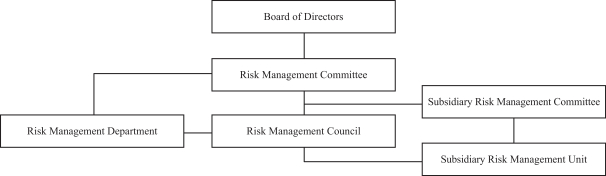
Risk Management Committee
Our Risk Management Committee is a board-level committee that is responsible for overseeing all risks and advising the board of directors with respect to risk management-related issues. The committee consists of four non-executive directors (one of whom serves as the chairman of the committee), and convenes on a quarterly basis. Its major roles include:
| • |
establishing risk management strategies in accordance with the directives of the board of directors; |
| • |
determining our target risk appetite; |
| • |
allocating risk capital to each subsidiary and approving our subsidiaries’ risk limits; and |
| • |
reviewing the level of risks we are exposed to and the appropriateness of our risk management policies, systems and operations. |
Risk Management Council
Our Risk Management Council is responsible for coordinating with the risk management units of our subsidiaries to ensure that they implement the policies, guidelines and limits established by the Risk Management Committee. The Risk Management Council is comprised of our chief risk management officer and the chief risk management officers of all of our subsidiaries. It operates independently from all business units and convenes on a quarterly basis. Its responsibilities include:
| • |
analyzing our risk status by using information provided by our subsidiary-level risk management units; |
| • |
deliberating adjustments to the integrated risk capital allocation plan and risk limits for each of our subsidiaries; and |
| • |
coordinating issues relating to the group-wide integration of our risk management functions. |
Subsidiary Risk Management Committees
Each of our subsidiaries has delegated risk management authority to its Subsidiary Risk Management Committee. Each Subsidiary Risk Management Committee measures and monitors the various risks faced by the relevant subsidiary and reports to that subsidiary’s board of directors regarding decisions that it makes on risk management issues. It also makes certain strategic risk-related decisions regarding the operations of the relevant subsidiary, such as setting total exposure limits, allocating credit risk limits and market risk-related limits and determining which market risk derivatives instruments the subsidiary can trade. The major activities of each Subsidiary Risk Management Committee include:
| • |
determining and monitoring risk policies, guidelines, limits and tolerance levels and the level of subsidiary risk in accordance with group policy; |
204
Table of Contents
| • |
reviewing and analyzing the subsidiary’s risk profile; |
| • |
setting limits for and adjusting the risk capital allocation plan and risk levels for each business unit within the subsidiary; and |
| • |
monitoring compliance with our group-wide risk management policies and practices at the business unit and subsidiary level. |
Each Subsidiary Risk Management Committee is comprised of the subsidiary’s non-executive directors on its board of directors.
Credit Risk Management
Credit risk is the risk of expected and unexpected losses in the event of borrower or counterparty defaults. Credit risk management aims to improve asset quality and generate stable profits while reducing risk through diversified and balanced loan portfolios. We determine the creditworthiness of each type of borrower or counterparty through reviews conducted by our credit experts and through our credit rating systems, and we set a credit limit for each borrower or counterparty.
We assess and manage all credit exposures. We measure expected losses and internal capital on assets (whether on- or off-balance sheet) that are subject to credit risk management and use expected losses and internal capital as management indicators. We manage credit risk by allocating credit risk internal capital limits. In addition, we control credit concentration risk exposure by applying and managing total exposure limits to prevent excessive risk concentration to particular industries or borrowers. Credit exposures that we assess and manage include loans to borrowers and counterparties, investments in securities, letters of credit, bankers’ acceptances, derivatives and commitments. Our risk appetite, which is the ratio of our required internal capital to our estimated available book capital, is approved by the Risk Management Committee once a year. Thereafter, we calculate internal capital every month for all of our subsidiaries and on a holding company level based on attributed internal capital in accordance with the risk appetite as approved by the Risk Management Committee, and measure and report profiles of credit risk on a holding company level and by subsidiary regularly to our senior management, including our Risk Management Committee.
We use expected default rates and recovery rates to determine the expected loss rate of a borrower or counterparty. We use the expected loss rate to make credit related decisions, including pricing, loan approval and establishment of standards to be followed at each level of decision making. These rates are calculated using information gathered from our internal database. With respect to large corporate borrowers, we also use information provided by external credit rating services to calculate default rates and recovery rates.
Our credit risk management processes include:
| • |
establishing credit policy; |
| • |
credit evaluation and approval; |
| • |
industry assessment; |
| • |
total exposure management; |
| • |
collateral evaluation and monitoring; |
| • |
credit risk assessment; |
| • |
early warning and credit review; and |
| • |
post-credit extension monitoring. |
205
Table of Contents
Credit Evaluation
Kookmin Bank evaluates the ability of all loan applicants to repay their debts before it approves any loans, except for loans fully guaranteed by letters of guarantee issued by the Credit Guarantee Fund and the Korea Technology Credit Guarantee Fund, for loans fully secured by deposits and for other loans similarly guaranteed or secured. Kookmin Bank assigns each borrower or guarantor a credit rating based on the judgment of its experts or scores calculated using the appropriate credit rating system. Factors that Kookmin Bank considers in assigning credit ratings include both financial factors and non-financial factors, such as its perception of a borrower’s reliability, management and operational risk and risk relating to the borrower’s industry. The credit rating process differs according to the type, size and characteristics of a borrower.
Kookmin Bank uses its internally developed credit rating systems to rate potential borrowers. As the characteristics of each customer segment differ, Kookmin Bank uses several credit rating systems for its customers. The nature of the credit rating system used for a particular borrower depends on whether the borrower is an individual, a SOHO customer, a small- and medium-sized enterprise or a large company. For large companies and small- and medium-sized enterprises, Kookmin Bank has 17 credit ratings ranging from AAA to D for risk management purposes. For retail customers, it has 13 credit ratings ranging from grade 1 to grade 13.
Based on the credit rating of a borrower, Kookmin Bank applies different credit policies, which affect factors such as credit limit, loan period, loan pricing, loan classification and provisioning. Kookmin Bank also uses these credit ratings in evaluating its bank-wide risk management strategy. Factors Kookmin Bank considers in making this evaluation include the profitability of each company or transaction, performance of each business unit and portfolio management. Kookmin Bank monitors the credit status of borrowers and collect information to adjust its ratings appropriately. If Kookmin Bank changes a borrower’s credit rating, it will also change the credit policies relating to that borrower and may also change the policies underlying its loan portfolio.
Retail Loan Approval Process
Mortgage Loans and Secured Retail Loans . Branch staff employees of Kookmin Bank forward loan applications to processing centers and Kookmin Bank’s processing center staff reviews mortgage loans and retail loans secured by real estate or guarantees. However, in the case of loans secured by deposits with Kookmin Bank, its branch staff approves such loans. Kookmin Bank makes lending decisions based on its assessment of the value of the collateral, debt service capability and the borrower’s score generated from its credit scoring systems.
For mortgage loans and loans secured by real estate, Kookmin Bank evaluates the value of the real estate offered as collateral using a database it has developed that contains information about real estate values throughout Korea. Kookmin Bank also uses information from a third party provider about the real estate market in Korea, which gives it up-to-date market value information for Korean real estate. In addition, Kookmin Bank’s processing center staff employees review the value of real estate provided by the evaluation system to ensure there are no significant discrepancies. Kookmin Bank bases decisions regarding the approval of such loans primarily on the results of its credit scoring systems.
For loans secured by deposits, Kookmin Bank will generally grant loans up to 95% of the deposit amount if it holds the deposit.
With respect to mortgage loans and secured retail loans, Kookmin Bank screens customers based on various criteria that indicate whether the customer may have deteriorating credit using internal information and rating information from credit bureaus. Kookmin Bank also evaluates debt service capability for eligible customers pursuant to certain checklist items, such as profession, annual income, credit card overdue information, transaction history (with both it and other financial institutions) and other relevant credit information.
Kookmin Bank generally decides whether to evaluate a loan application within three to five days after recording the relevant information in its credit scoring systems.
206
Table of Contents
Unsecured Retail Loans . Kookmin Bank reviews applications for unsecured retail loans in accordance with its credit scoring systems. These automated systems evaluate loan applications and determine an appropriate pricing for the loan. The major benefits of using a credit scoring system are that it yields uniform results regardless of the user and that it can be used effectively by employees who do not necessarily have extensive experience in credit evaluation. The staff of Kookmin Bank’s processing centers reviews the results of the credit scoring system based on information input by its branch staff and, if approved, issues the loan.
Kookmin Bank’s credit scoring systems take into account factors including borrower’s income, assets, profession, transaction history (with both it and other financial institutions) and other relevant credit information. The systems rank each borrower in an appropriate grade, and that grade is used as a factor in deciding whether to approve loans as well as to determine loan amounts. Kookmin Bank generally bases its decisions on the results of its credit scoring systems to evaluate applications.
Corporate Loan Approval Process
We approve corporate loans at different levels of our organization depending on the size and type of the loan, the credit risk level assessed by the credit rating system, whether the loan is secured by collateral and, if secured, the value of the collateral. The lowest level of authority is the branch staff employee of Kookmin Bank, who can approve small loans and loans that have the lowest range of credit risk. Larger loans and loans with higher credit risk are approved by higher levels of authority depending on where they fall in a matrix of loan size and credit risk. Depending on the size and terms of any particular loan or the credit risk relating to a particular borrower, more than one entity may review the application, although generally loan applications are reviewed only by the entity having corresponding authority to approve the loan.
Kookmin Bank evaluates all of its corporate borrowers by using credit rating systems, except for applicants whose borrowings are fully secured by deposits or applicants who have obtained third-party guarantees from the government or certain other very highly rated guarantors. See “—Credit Evaluation.”
For owner-operated enterprises (which we refer to as SOHOs), Kookmin Bank has put in place a credit rating system known as Small Office Home Office Corporate Rating System, or SOHO CRS. For other small- and medium-sized enterprises, Kookmin Bank has put in place a similar credit rating system known as Corporate Rating System, or CRS. For large corporations, Kookmin Bank has put in place a similar credit rating system known as Large Corporate Rating System, or LCRS. For financial institutions, certain non-profit organizations and public institutions, Kookmin Bank has put in place a credit rating system known as Financial Institute, Non-profit, Public Corporate Rating System, or FNP CRS. The SOHO CRS, the CRS, the LCRS and the FNP CRS models consist of the following four parts:
| • |
Financial Model. The financial model uses financial ratios such as stability ratio, profitability ratio and cash flow ratio to make credit determinations. |
| • |
Non -financial Model. The non-financial model uses various qualitative and quantitative factors, such as future repayment capability, industry-related risks, management-related risks and operation-related risks, to evaluate borrowers. |
| • |
CEO Evaluation Model . The CEO evolution model is relevant for the SOHO CRS in particular, and evaluates the credit information of the individual owner of SOHOs by reviewing such owner’s personal information, bank transaction records and external credit ratings. |
| • |
Default Signal Check Model. The default signal check model checks factors that have low frequency of occurrence but are highly likely to lead to a default in the event of an occurrence. The results of the default signal check model may be used to cap a borrower’s credit grade. |
207
Table of Contents
Credit Card Approval Process
We make decisions on all credit card approvals based on the Financial Supervisory Service standard of review for payment ability (such as the occupation and income of the applicant), as well as a combination of KB Kookmin Card’s internal application scoring system and a credit scoring system developed by independent credit bureaus.
KB Kookmin Card’s application scoring system reflects various credit information, including basic customer information (such as credit history), transaction history with it, if any, delinquency and transaction history with other card companies and financial institutions and credit information provided by Korea Credit Information Services and other credit bureaus. KB Kookmin Card also considers repayment ability, total assets, total outstanding debts and the length of the applicant’s relationship, if any, and past contribution to our profitability, if any.
The credit scoring system developed by credit bureaus, reflects various sources of information regarding the credit risk of customers, including delinquency and transaction history with other credit card companies and financial institutions.
On the basis of the standard of review for payment ability and the combination of the scores from our application scoring system and the credit scoring system developed by independent credit bureaus, KB Kookmin Card establishes, among other things, the term of any new approvals, initial limits and differentiation of fee rates with respect to its credit cards. KB Kookmin Card’s systems allow it to differentiate applicants into groups that receive immediate credit card approval or rejection, or that may require it to further investigate that applicant’s credit qualifications. The initial limits of new applicants are based on their estimated disposable income, which is based on their occupation and the value of their personal assets. KB Kookmin Card applies its fee rates to applicants differently according to risk premium and profitability.
Total Exposure Management
We establish and manage total exposure limits for industries, chaebols and corporations, as well as certain small- and medium-sized enterprises, in order to efficiently manage financial assets and to optimize our credit portfolio. Kookmin Bank establishes total exposure limits for (i) main debtor groups designated by the Financial Supervisory Service, (ii) groups to which Kookmin Bank has total exposure of ₩50 billion or more, (iii) enterprises that belong to a main debtor group or large enterprises, in both cases to which Kookmin Bank has total exposure of ₩40 billion or more, (iv) small- and medium-sized enterprises to which Kookmin Bank has total exposure of ₩30 billion or more and (v) other groups or individual enterprises designated by the head of Kookmin Bank’s Risk Management Group as necessary. Kookmin Bank establishes total exposure limit by reviewing factors such as industry, size, cash flows, financial ratios and credit ratings, while establishing exposure limits for industries by reviewing the sales growth rate and risk concentration for each industry. These total exposure limits are set following approval by Kookmin Bank’s Risk Management Council after review by the Credit Risk Management Subcommittee.
Kookmin Bank’s maximum exposure limit is within 25% of its Tier I and Tier II capital for a single chaebol , and within 10% of its Tier I and Tier II capital for an individual large corporation.
We manage and control exposure limits on a daily basis. The principal system that we use for this purpose is the Total Exposure Management System. This system allows us to monitor and control our total exposure to large corporations, chaebols and industries. Kookmin Bank monitors its exposure to large corporations to which it has an exposure of ₩40 billion or more, individual corporations to which it has an exposure of ₩30 billion or more, and also its exposure to 128 business groups, which comprise the 30 largest highly-indebted business groups among chaebols in Korea designated as such by the Financial Supervisory Service based on their outstanding exposures as well as 98 business groups to which it has exposures (in the form of securities or loans)
208
Table of Contents
of ₩50 billion or more. We also monitor our exposure to 37 industries. Our Total Exposure Management System integrates all of our credit-related risk including credit extended by our overseas branches and affiliates. The assets subject to the system include all Won-denominated and foreign currency-denominated loans, all assets in trust accounts except specified money trusts, guarantees, trade-related credits, commercial paper, corporate bonds and other securities and derivatives.
Collateral Evaluation and Monitoring System
Kookmin Bank uses the Collateral Evaluation and Monitoring System to manage the liquidation value of collateral it holds. The Collateral Evaluation and Monitoring System is a computerized collateral management system that can be accessed from Kookmin Bank’s headquarters and its branches. Using this system, Kookmin Bank can more accurately assess the actual liquidation value of collateral, determine the recovery rate on its loans and use this information in setting its credit risk management and loan policies. Kookmin Bank can monitor the value of all the collateral a borrower provides and the value of that collateral based on its liquidation value. When appraising the value of real estate collateral, which makes up the largest part of Kookmin Bank’s collateral, Kookmin Bank consults a regularly updated database provided by a third party that tracks the prices at which various types of real estate in various regions of Korea are sold. Kookmin Bank appraises the value of collateral when it makes a loan, when the loan is due for renewal and when events occur that may change the value of the collateral.
Credit Risk Management and Monitoring
Kookmin Bank’s Credit Risk Department manages and regulates our loan portfolio policies. It also analyzes and monitors our loan portfolios and monitors our compliance with the applicable limits for credit risk. Moreover, it separately manages high-risk products, such as real estate project financing loans and over-the-counter derivative products, by setting appropriate limits.
Credit Review
Kookmin Bank’s credit review function is independent of the business groups which manage our assets. Its Credit Review Department:
| • |
reviews internal credit regulations, policies and systems; |
| • |
analyzes the credit status of selected loan assets and verifies the appropriateness of the credit evaluations/approvals made by branches and headquarters; and |
| • |
evaluates the corporate credit risk of potentially insolvent companies. |
More specifically, Kookmin Bank’s Credit Review Department continuously reviews the financial condition of selected borrowers with respect to their current debt, collateral, business, transactions with related parties and debt service capability. Based on such review, Kookmin Bank may adjust the borrower’s credit rating, lending policy or asset quality classification of the loan provided to the borrower, depending on the applicable circumstances. Kookmin Bank also regularly reviews other aspects of the lending process, including industries and regions in which its borrowers operate and the quality of its domestic and overseas assets. Kookmin Bank’s industry reviews focus on growth, stability, competition and ability to adapt to a changing environment. Based on the results of a particular industry review, Kookmin Bank may revise the total exposure limit assigned to that industry and lending policy for each company within that industry. When a review takes place, Kookmin Bank may adjust not only credit ratings of its borrowers based on a variety of factors, but also asset quality classification, credit limits and applied interest rates or its credit policies. Credit review results are reported to Kookmin Bank’s chief risk management officer and its Risk Management Committee on a quarterly basis.
Kookmin Bank’s Credit Review Department also conducts on-site reviews of selected branches that are experiencing increasing delinquency ratios and bad debts. During these visits Kookmin Bank examines the loan processes and recommends improvement plans and appropriate follow-up measures.
209
Table of Contents
Also, based on guidelines provided by the Financial Supervisory Service to all Korean banks, Kookmin Bank operates a corporate credit risk assessment program to facilitate the identification of weak companies and possible commencement of corporate restructuring. Through this program, Kookmin Bank, together with other banks, is able to detect symptoms of financially troubled companies at an early stage, assess related credit risk and support the normalization of companies that are likely to turnaround through a workout process, or seek to liquidate those companies that are not likely to recover.
Kookmin Bank’s Credit Review Department also analyzes issues related to credit risk and provides information necessary for the formulation of effective credit policies and strategies and for effective credit risk management.
Market Risk Management
The major risk to which we are exposed is interest rate risk on debt instruments and interest bearing securities and, to a lesser extent, stock price risk and foreign exchange risk. The financial instruments that expose us to these risks are securities and financial derivatives. We are also exposed to interest rate risk and liquidity risk in Kookmin Bank’s banking book. We divide market risk into risks arising from trading activities and risks arising from non-trading activities.
Kookmin Bank’s Risk Management Council establishes overall market risk management principles. It has delegated the responsibility for the market risk management for trading activities to the Market Risk Management Subcommittee of Kookmin Bank, which is chaired by Kookmin Bank’s chief risk management officer. This subcommittee meets on a regular basis each month and as required to respond to developments in the market and the economy. Based on the policies approved by Kookmin Bank’s Risk Management Council, the Market Risk Management Subcommittee reviews and approves reports as required that include trading profits and losses, position reports, limit utilization, sensitivity analysis and VaR results for our trading activities.
Kookmin Bank’s Risk Management Council is responsible for interest rate and liquidity risk management for its non-trading activities. The council meets on a regular basis and as required to respond to developments in the market and the economy. Members of the Risk Management Council, acting through Kookmin Bank’s Risk Management Department, review Kookmin Bank’s interest rate and liquidity gap position monthly, as well as the business profile and its impact on asset and liability management.
To ensure adequate interest rate and liquidity risk management, we have assigned the responsibilities for our asset and liability risk management to Kookmin Bank’s Risk Management Department in Kookmin Bank’s Risk Management Group, which monitors and reviews the asset and liability operating procedures and activities of Kookmin Bank’s Financial Planning Department and Asset and Liability Risk Management Department, and independently reports to the management on the related issues.
Market Risk Management for Trading Activities
Our trading activities consist of:
| • |
trading activities for our own account to realize short-term trading profits in Won-denominated debt and equities markets and foreign exchange markets based on our short-term forecast of changes in the market situation; and |
| • |
trading activities involving derivatives, such as swaps, forwards, futures and option transactions, to realize profits primarily from selling derivative products to our customers and to hedge market risk incurred from those activities. In addition, certain derivative products that we use to hedge our own market risk are classified as trading activities as they do not qualify for hedge accounting treatment under IFRS. We believe, however, that certain of these products are effective as economic hedges. |
210
Table of Contents
We use derivative instruments to hedge our market risk and, to a limited extent, to make profits by trading derivative products within acceptable risk limits. The principal objective of our hedging strategy is to manage our market risk within established limits. We use the following hedging instruments to manage relevant risks:
| • |
to hedge interest rate risk arising from its trading activities, the Trading/Capital Markets Department of Kookmin Bank occasionally uses interest rate futures (Korea Treasury Bond Futures) and interest rate swaps; |
| • |
to hedge stock price risk arising from its trading activities, the Trading/Capital Markets Department of Kookmin Bank selectively uses stock index futures; |
| • |
to hedge interest rate risk and foreign exchange risk arising from our foreign currency-denominated asset and liability positions as well as our trading activities, the Treasury Unit within the Capital Markets Department of Kookmin Bank uses interest rate swaps, cross-currency interest rate swaps, foreign exchange forwards and futures, Euro-dollar futures and currency options; and |
| • |
to change the interest rate characteristics of certain assets and liabilities after the original investment or funding, we use swaps. For example, depending on the market situation, we may choose to obtain fixed rate funding instead of floating rate funding if we believe that the terms are more favorable, which we can achieve by entering into interest rate swaps. |
We generally manage our market risk at the portfolio level. To control our exposure to market risk, we use internal capital limits set by Kookmin Bank’s Risk Management Committee for Kookmin Bank and at the group level within Kookmin Bank, VaR, position and stop loss limits set by Kookmin Bank’s Risk Management Council for Kookmin Bank and at the group level within Kookmin Bank, and VaR, position, stop loss and sensitivity limits (PVBP, Delta, Gamma, Vega) set by Kookmin Bank’s Market Risk Management Subcommittee at the department level within Kookmin Bank. We prepared our risk control and management guidelines for derivative trading based on the regulations and guidelines promulgated by the Financial Supervisory Service.
In addition, we have implemented internal processes which include a number of key controls designed to ensure that fair value is measured appropriately, particularly where a fair value model is internally developed and used to price a significant product. See “Item 5.A. Operating Results—Critical Accounting Policies—Valuation of Financial Instruments” and Notes 4.4 and 6 of the notes to our consolidated financial statements. For example, each year, Kookmin Bank’s Risk Management Department reviews the existing pricing and valuation models, with a focus on their underlying modeling assumptions and restrictions, to assess the appropriateness of their continued use. In consultation with Kookmin Bank’s Trading Department, the Risk Management Department recommends potential valuation models to Kookmin Bank’s Fair Value Evaluation Committee. Upon approval by Kookmin Bank’s Fair Value Evaluation Committee, the selected valuation models are reported to its Market Risk Management Subcommittee.
We monitor market risk arising from trading activities of our business groups and departments. The market risk measurement model we use for both our Won-denominated trading operations and foreign currency-denominated trading operations is implemented through our integrated market risk management system called Adaptiv, which enables us to generate consistent VaR numbers for all trading activities.
Value at Risk analysis. We use VaR to measure market risk. VaR is a statistically estimated maximum amount of loss that could occur over a given period of time at a given level of confidence. VaR is a commonly used market risk management technique. However, this approach does have some shortcomings. VaR estimates possible losses over a certain period at a particular confidence level using past market movement data. Past market movement, however, is not necessarily a good indicator of future events, as there may be conditions and circumstances in the future that the model does not anticipate. As a result, the timing and magnitude of the actual losses can be different depending on the assumptions made at the time of calculation. In addition, the time periods used for the model, generally one or ten days, are assumed to be a sufficient holding period before liquidating the relevant underlying positions. If these holding periods are not sufficient, or too long, the VaR
211
Table of Contents
results may understate or overstate the potential loss. Different VaR methodologies and distributional assumptions could produce a materially different VaR. VaR is most appropriate as a risk measure for trading positions in liquid capital markets and will understate the risk associated with severe events, such as a period of extreme illiquidity.
We use a 99% single tail confidence level to measure VaR, which means the actual amount of loss may exceed the VaR, on average, once out of 100 business days. Until 2011, we used the “variance-covariance method” or parametric VaR (“PVaR”) methodology to measure our daily VaR, which took into account the diversification effects among different risk categories as well as within the same risk category. In 2012, we received authorization from the Financial Services Commission to use a historical simulation VaR (“HSVaR”) methodology, which we believe to be more accurate and responsive in reflecting market volatilities, to measure market risk. Our ten-day HSVaR method, which is computed using a full valuation and is computationally intensive, uses an archive of historic price data and the VaR for a portfolio is estimated by creating a hypothetical time series of returns on that portfolio, obtained by running the portfolio through actual ten-day historical data and computing the changes that would have occurred in each ten-day period.
The following table shows the volume and types of positions held by Kookmin Bank for which the VaR method is used to measure market risk as of December 31, 2017, 2018 and 2019.
| As of December 31, | ||||||||||||
| 2017 | 2018 | 2019 | ||||||||||
| (in millions of Won) | ||||||||||||
|
Securities—Bond (1) |
₩ | 8,179,481 | ₩ | 9,167,080 | ₩ | 10,615,199 | ||||||
|
Securities—Equity (1) |
43,214 | 42,943 | 106,321 | |||||||||
|
Spot exchanges (2) |
4,029,675 | 3,496,671 | 3,963,814 | |||||||||
|
Derivatives (3) |
5,438,917 | 3,364,318 | 4,564,306 | |||||||||
|
|
|
|
|
|
|
|||||||
|
Total |
₩ | 17,691,288 | ₩ | 16,071,012 | ₩ | 19,249,640 | ||||||
|
|
|
|
|
|
|
|||||||
| (1) |
Represents amounts marked to market and as shown on the balance sheet information that is prepared and submitted to the Financial Supervisory Service for risk management purposes. |
| (2) |
Represents the overall net open currency position in each currency, which is the greater of (i) the sum of the absolute value of all short positions and (ii) the sum of the absolute value of all long positions. |
| (3) |
For over-the-counter derivatives, represents the absolute value of over-the-counter derivatives measured at fair value at year end. For exchange-traded derivatives, includes the amount of deposits and the collateral posted for such derivatives. |
The following table shows Kookmin Bank’s ten-day HSVaRs (at a 99% confidence level for a ten-day holding period) as of December 31, 2017, 2018 and 2019 for interest risk, stock price risk and foreign exchange risk relating to its trading activities. The following figures were calculated on a consolidated basis.
| As of December 31, | ||||||||||||
| 2017 | 2018 | 2019 | ||||||||||
| (in billions of Won) | ||||||||||||
|
Risk categories: |
||||||||||||
|
Interest risk |
₩ | 23.8 | ₩ | 7.1 | ₩ | 16.6 | ||||||
|
Stock price risk |
1.3 | 3.3 | 3.9 | |||||||||
|
Foreign exchange risk |
24.3 | 16.5 | 13.1 | |||||||||
|
Less: diversification |
(29.7 | ) | (11.9 | ) | (13.2 | ) | ||||||
|
|
|
|
|
|
|
|||||||
|
Diversified VaR for overall trading activities |
₩ | 19.6 | ₩ | 14.9 | ₩ | 20.4 | ||||||
|
|
|
|
|
|
|
|||||||
212
Table of Contents
In 2019, the average, high, low and ending amounts of ten-day HSVaR (at a 99% confidence level for a ten-day holding period) for Kookmin Bank relating to its trading activities were as follows.
| Trading activities VaR for 2019 | ||||||||||||||||
| Average | Minimum | Maximum |
As of
December 31, 2019 |
|||||||||||||
| (in billions of Won) | ||||||||||||||||
|
Interest risk |
₩ | 11.2 | ₩ | 1.7 | ₩ | 20.5 | ₩ | 16.6 | ||||||||
|
Stock price risk |
3.4 | 2.4 | 4.3 | 3.9 | ||||||||||||
|
Foreign exchange risk |
15.8 | 11.4 | 20.7 | 13.1 | ||||||||||||
|
Less: diversification |
(13.2 | ) | ||||||||||||||
|
|
|
|
|
|
|
|
|
|||||||||
|
Diversified VaR for overall trading activities |
₩ | 17.5 | ₩ | 13.6 | ₩ | 24.8 | ₩ | 20.4 | ||||||||
|
|
|
|
|
|
|
|
|
|||||||||
In 2018, the average, high, low and ending amounts of ten-day HSVaR (at a 99% confidence level for a ten-day holding period) for Kookmin Bank relating to its trading activities were as follows.
| Trading activities VaR for 2018 | ||||||||||||||||
| Average | Minimum | Maximum |
As of
December 31, 2018 |
|||||||||||||
| (in billions of Won) | ||||||||||||||||
|
Interest risk |
₩ | 12.5 | ₩ | 6.0 | ₩ | 18.7 | ₩ | 7.1 | ||||||||
|
Stock price risk |
3.0 | 1.3 | 4.8 | 3.3 | ||||||||||||
|
Foreign exchange risk |
9.4 | 5.0 | 16.5 | 16.5 | ||||||||||||
|
Less: diversification |
(11.9 | ) | ||||||||||||||
|
|
|
|
|
|
|
|
|
|||||||||
|
Diversified VaR for overall trading activities |
₩ | 16.2 | ₩ | 11.7 | ₩ | 23.1 | ₩ | 14.9 | ||||||||
|
|
|
|
|
|
|
|
|
|||||||||
In 2017, the average, high, low and ending amounts of ten-day HSVaR (at a 99% confidence level for a ten-day holding period) for Kookmin Bank relating to its trading activities were as follows.
| Trading activities VaR for 2017 | ||||||||||||||||
| Average | Minimum | Maximum |
As of
December 31, 2017 |
|||||||||||||
| (in billions of Won) | ||||||||||||||||
|
Interest risk |
₩ | 22.7 | ₩ | 14.3 | ₩ | 42.2 | ₩ | 23.8 | ||||||||
|
Stock price risk |
1.0 | 0.8 | 1.3 | 1.3 | ||||||||||||
|
Foreign exchange risk |
32.7 | 12.4 | 44.3 | 24.3 | ||||||||||||
|
Less: diversification |
(29.8 | ) | ||||||||||||||
|
|
|
|
|
|
|
|
|
|||||||||
|
Diversified VaR for overall trading activities |
₩ | 23.3 | ₩ | 16.5 | ₩ | 30.2 | ₩ | 19.6 | ||||||||
|
|
|
|
|
|
|
|
|
|||||||||
Standardized Method . Market risk for positions not measured by VaR are measured using the standardized method for measuring market risk-based required equity capital specified by the Financial Supervisory Service, which takes into account certain risk factors. Under the standardized method, the required equity capital is measured using the risk-weighted values for each risk factor. The method used to measure the market risk-based required equity capital for each risk factor is as follows:
| • |
Interest rate risk: |
| • |
General market risk: General market risk relates to the risk of losses from macroscopic events which could have an impact on interest rates, stock prices, exchange rates, and market prices of general commodities. General market interest rate risk of a debt security is calculated on its net position, taking into consideration the remaining maturity and coupon rate. |
213
Table of Contents
| • |
Specific risk: Specific risk relates to the risk of loss from changes in credit risk of issuers of debt securities or equities, excluding changes in general market prices. Specific interest rate risk of a debt security is measured by multiplying the interest rate position appraised based on the market price of such security by the risk-weighted value applicable to the type of debt security, credit rating and the remaining maturity. |
| • |
Equity risk: General and specific equity risk are calculated by multiplying the bought or sold position by the relevant risk-weighted values. |
| • |
Foreign exchange risk: Foreign exchange risk is measured by multiplying the larger of the absolute values among the net bought or sold positions of each currency by the relevant risk-weighted values. |
| • |
Option risk: Option risk is measured using the delta, gamma and vega of the option. |
The standardized method is used to measure the market risk of the positions for which the Financial Supervisory Service has not approved the use of the VaR method. In addition, we use the standardized method for positions which are held by certain subsidiaries or for which measuring VaR is difficult due to the lack of daily position data. See Note 4.4.3 of the notes to our consolidated financial statements included elsewhere in this annual report.
The following table shows the volume and types of instruments held by Kookmin Bank for which the standardized method is used to measure its required equity capital as of December 31, 2017, 2018 and 2019.
| As of December 31, | ||||||||||||
| 2017 | 2018 | 2019 | ||||||||||
| (in millions of Won) | ||||||||||||
|
Swaps and foreign exchange positions (1) |
₩ | 14,742 | ₩ | 24,366 | ₩ | 30,864 | ||||||
|
Derivative-linked securities (2) |
95,357 | 126,416 | 160,576 | |||||||||
|
Options embedded in convertible bonds (3) |
17,303 | — | — | |||||||||
|
|
|
|
|
|
|
|||||||
|
Total |
₩ | 127,402 | ₩ | 150,783 | ₩ | 191,440 | ||||||
|
|
|
|
|
|
|
|||||||
| (1) |
The overall net open currency position is the greater of (i) the sum of the absolute value of all short positions and (ii) the sum of the absolute value of all long positions. In the first half of 2015, Kookmin Bank received approval from the Financial Supervisory Service to use its internal VaR model, in lieu of the standardized method, to measure the market risk of positions held by Kookmin Bank (China) Ltd. The amounts represent the value of interest rate swaps held by a special purpose vehicle of Kookmin Bank and the foreign exchange positions held by KB Microfinance Myanmar Co., Ltd., for which the standardized method is used to measure Kookmin Bank’s required equity capital. |
| (2) |
Amounts as of December 31, 2017, 2018 and 2019 represent the value of derivative-linked securities held by the trust accounts of Kookmin Bank subject to consolidation, for which the standardized method is used to measure Kookmin Bank’s required equity capital. |
| (3) |
Represents the absolute value of over-the-counter derivatives measured at fair value at year end for monitoring purposes. |
The following table shows Kookmin Bank’s required equity capital measured using the standardized method as of December 31, 2017, 2018 and 2019.
| As of December 31, | ||||||||||||
| 2017 (1) | 2018 (1) | 2019 (1) | ||||||||||
| (in millions of Won) | ||||||||||||
|
Risk categories: |
||||||||||||
|
Interest risk |
₩ | 98,236 | ₩ | 112,153 | ₩ | 83,731 | ||||||
|
Stock price risk |
1,646 | 19,756 | 1,953 | |||||||||
|
Foreign exchange risk |
810 | 1,338 | 1,850 | |||||||||
|
|
|
|
|
|
|
|||||||
|
Total |
₩ | 100,691 | ₩ | 133,248 | ₩ | 87,534 | ||||||
|
|
|
|
|
|
|
|||||||
| (1) |
In the first half of 2015, Kookmin Bank received approval from the Financial Supervisory Service to use its internal VaR model, in lieu of the standardized method, to measure the market risk of certain instruments held by Kookmin Bank, including 30-year government bonds held by Kookmin Bank, as well as positions held by certain subsidiaries of Kookmin Bank, including Kookmin Bank (China) Ltd. |
214
Table of Contents
Back -Testing . We conduct back testing on a daily basis to validate the adequacy of our market risk model. In back testing, we compare both the actual and hypothetical profit and loss with the VaR calculations and analyze any results that fall outside our predetermined confidence interval of 99%. The number of times the actual changes in fair values, earnings or cash flows from the market risk sensitive instruments exceeded the VaR amounts in 2017, 2018 and 2019 was 0, 2 and 5, respectively.
Stress testing . In addition to VaR, which assumes normal market situations, we use stress testing to assess our market risk exposure to abnormal market fluctuations. Abnormal market fluctuations include significant declines in the stock market and significant increases in the general level of interest rates. This is an important way to supplement VaR, as VaR is a statistical expression of possible loss under a given confidence level and holding period. It does not cover potential loss if the market moves in a manner that is outside our normal expectations. Stress testing projects the anticipated change in value of holding positions under certain scenarios assuming that no action is taken during a stress event to change the risk profile of a portfolio. According to Kookmin Bank’s stress testing, we estimate that as of December 31, 2019, Kookmin Bank’s trading portfolio could have lost ₩327 billion for an assumed short-term extreme decline of approximately 33% in the equity market and an approximate 54 basis point increase in the Korean treasury bond rates under an abnormal stress environment.
We monitor the impact of market turmoil or any abnormality by conducting stress tests and confirming that the results are within our market risk limits. If the impact is large, Kookmin Bank’s chief risk management officer may request that our portfolio be restructured or other appropriate action be taken.
Interest Risk
Interest risk from trading activities arises mainly from our trading of Won-denominated debt securities. Our trading strategy is to benefit from short-term movements in the prices of debt securities arising from changes in interest rates. As our trading accounts are marked-to-market daily, we manage the interest risk related to our trading accounts using market value-based tools such as VaR and sensitivity analysis. As of December 31, 2019, the VaR of Kookmin Bank’s interest risk from trading was ₩16.6 billion and the weighted average duration, or weighted average maturity, of its Won-denominated debt securities at fair value through profit or loss was approximately 1.9 years.
Foreign Exchange Risk
Foreign exchange risk arises because we have assets and liabilities that are denominated in currencies other than Won, as well as off-balance sheet items such as foreign exchange forwards and currency swaps. Our assets and liabilities denominated in U.S. dollars, Japanese Yen, Euro and Chinese Renminbi have typically accounted for the majority of our foreign currency assets and liabilities.
The difference between our foreign currency assets and liabilities is offset against forward foreign exchange positions, currency options and currency swaps to obtain our net foreign currency open position. Kookmin Bank’s Risk Management Council and Market Risk Management Subcommittee oversee Kookmin Bank’s foreign exchange exposure for both trading and non-trading purposes by establishing a limit for this net foreign currency open position, together with stop loss limits. VaR limits are established on a combined basis for our domestic operations and foreign branches.
215
Table of Contents
The following table shows Kookmin Bank’s non-consolidated net open positions at the end of 2017, 2018 and 2019. Positive amounts represent long positions and negative amounts represent short positions. The net open positions held by subsidiaries other than Kookmin Bank are not significant.
| As of December 31, (1) | ||||||||||||
| 2017 | 2018 | 2019 | ||||||||||
| (in millions of US$) | ||||||||||||
|
Currency: |
||||||||||||
|
U.S. dollars |
US$ | (714.4 | ) | US$ | (495.2 | ) | US$ | (592.9 | ) | |||
|
Japanese Yen |
(0.7 | ) | (1.6 | ) | (0.2 | ) | ||||||
|
Euro |
(1.3 | ) | (0.2 | ) | (1.9 | ) | ||||||
|
Kazakhstan Tenge |
— | — | — | |||||||||
|
Chinese Renminbi |
47.2 | 21.9 | 12.8 | |||||||||
|
Others |
7.4 | 146.9 | 189.2 | |||||||||
|
|
|
|
|
|
|
|||||||
|
Total |
US$ | (661.8 | ) | US$ | (328.2 | ) | US$ | (393.0 | ) | |||
|
|
|
|
|
|
|
|||||||
| (1) |
Amounts prepared on a non-consolidated basis. |
Equity Price Risk
Equity price risk results from our equity derivatives trading portfolio in Won since we do not have any trading exposure to shares denominated in foreign currencies other than foreign equity index futures.
The equity derivatives trading portfolio in Won consists of exchange-traded stocks and equity derivatives under strict limits on diversification as well as position limits and stop loss limits.
Kookmin Bank’s Risk Management Council and Market Risk Management Subcommittee set annual and monthly stop loss limits that are monitored by Kookmin Bank’s Risk Management Department. In order to ensure timely action, the stop loss limit of individual securities is monitored by the relevant middle office.
As of December 31, 2019, Kookmin Bank’s equity trading position was ₩34.8 billion.
Derivative Market Risk
Our derivative trading includes interest rate and cross-currency swaps, foreign exchange forwards, stock index and interest rate futures and currency options. These activities consist primarily of the following:
| • |
sales of tailor-made derivative products that meet various needs of our corporate customers and related transactions to reduce our exposure resulting from those sales; |
| • |
taking positions in limited cases when we expect short-swing profits based on our market forecasts; and |
| • |
trading to hedge our interest rate and foreign currency risk exposure as described above. |
Market risk from trading derivatives is not significant since our derivative trading activities are primarily driven by customer deals with very limited open trading positions.
Market Risk Management for Non-Trading Activities
Interest Rate Risk
Our principal market risk from non-trading activities is interest rate risk. Interest rate risk arises due to mismatches in the maturities or re-pricing periods of these rate-sensitive assets and liabilities. We measure interest rate risk for Won and foreign currency assets and liabilities in our bank accounts (including derivatives)
216
Table of Contents
and our principal guaranteed trust accounts. Most of our interest-earning assets and interest-bearing liabilities are denominated in Won and our foreign currency-denominated assets and liabilities are mostly denominated in U.S. dollars.
Our principal interest rate risk management objectives are to generate stable net interest revenues and to protect our asset value against interest rate fluctuations. We principally manage this risk for our non-trading activities by analyzing and managing maturity and duration gaps between our interest-earning assets and interest-bearing liabilities. In addition, we use hedging instruments for interest rate risk management for our non-trading assets and liabilities.
Interest rate gap analysis measures expected changes in net interest revenues by calculating the difference in the amounts of interest-earning assets and interest-bearing liabilities at each maturity and interest resetting date. We perform interest rate gap analysis for Won-denominated and foreign currency-denominated assets and trust assets on a monthly basis or more frequently when deemed necessary.
Interest Rate Gap Analysis. We perform interest rate gap analysis based on interest rate repricing maturities of assets and liabilities. However, for some of our assets and liabilities with either no maturities or unique characteristics, we use or assume certain maturities, including the following examples:
| • |
With respect to asset maturities, we assume remaining maturities of prime rate-linked loans with remaining maturities of over one year to be one year and use the actual maturities for prime rate-linked loans with remaining maturities of less than one year. |
| • |
With respect to liability maturities, we use last 36 months’ average balance to segregate “non-core” and “core” demand deposits. We assume “non-core” demand deposits to have remaining maturities of one month or less, and we assume “core” demand deposits to have remaining maturities between one month and five years. |
217
Table of Contents
The following table shows Kookmin Bank’s interest rate gap for Won-denominated accounts and foreign currency-denominated accounts as of December 31, 2019.
| As of December 31, 2019 | ||||||||||||||||||||||||
| 0-3 Months | 3-6 Months | 6-12 Months | 1-3 Years | Over 3 Years | Total | |||||||||||||||||||
| (in billions of Won, except percentages) | ||||||||||||||||||||||||
|
Won-denominated
|
||||||||||||||||||||||||
|
Loans |
₩ | 89,554 | ₩ | 68,300 | ₩ | 57,621 | ₩ | 30,835 | ₩ | 22,437 | ₩ | 268,747 | ||||||||||||
|
Securities |
4,281 | 3,796 | 5,564 | 25,537 | 7,463 | 46,641 | ||||||||||||||||||
|
Others |
6,871 | 175 | 80 | 127 | 9 | 7,262 | ||||||||||||||||||
|
|
|
|
|
|
|
|
|
|
|
|
|
|||||||||||||
|
Total |
₩ | 100,706 | ₩ | 72,271 | ₩ | 63,265 | ₩ | 56,499 | ₩ | 29,909 | ₩ | 322,650 | ||||||||||||
|
|
|
|
|
|
|
|
|
|
|
|
|
|||||||||||||
|
Interest-bearing liabilities: |
||||||||||||||||||||||||
|
Deposits |
₩ | 100,410 | ₩ | 44,557 | ₩ | 77,652 | ₩ | 33,633 | ₩ | 25,851 | ₩ | 282,103 | ||||||||||||
|
Borrowings |
8,790 | 0 | 0 | 120 | 152 | 9,062 | ||||||||||||||||||
|
Others |
7,658 | 1,380 | 3,060 | 3,960 | 3,710 | 19,768 | ||||||||||||||||||
|
|
|
|
|
|
|
|
|
|
|
|
|
|||||||||||||
|
Total |
₩ | 116,858 | ₩ | 45,937 | ₩ | 80,712 | ₩ | 37,713 | ₩ | 29,713 | ₩ | 310,933 | ||||||||||||
|
|
|
|
|
|
|
|
|
|
|
|
|
|||||||||||||
|
Sensitivity gap |
(16,152 | ) | 26,334 | (17,447 | ) | 18,786 | 196 | 11,717 | ||||||||||||||||
|
Cumulative gap |
(16,152 | ) | 10,182 | (7,265 | ) | 11,521 | 11,171 | |||||||||||||||||
|
% of total assets |
(5.0 | )% | 3.2 | % | (2.3 | )% | 3.6 | % | 3.6 | % | ||||||||||||||
|
Foreign
currency-denominated
|
||||||||||||||||||||||||
|
Due from banks |
₩ | 3,316 | ₩ | 260 | ₩ | 128 | ₩ | 0 | ₩ | 0 | ₩ | 3,704 | ||||||||||||
|
Loans |
13,165 | 2,066 | 889 | 260 | 433 | 16,813 | ||||||||||||||||||
|
Securities |
1,283 | 261 | 329 | 2,172 | 1,611 | 5,656 | ||||||||||||||||||
|
|
|
|
|
|
|
|
|
|
|
|
|
|||||||||||||
|
Total |
₩ | 17,763 | ₩ | 2,588 | ₩ | 1,346 | ₩ | 2,432 | ₩ | 2,044 | ₩ | 26,173 | ||||||||||||
|
|
|
|
|
|
|
|
|
|
|
|
|
|||||||||||||
|
Interest-bearing liabilities: |
||||||||||||||||||||||||
|
Deposits |
₩ | 7,498 | ₩ | 6,513 | ₩ | 1,403 | ₩ | 84 | ₩ | 0 | ₩ | 15,499 | ||||||||||||
|
Borrowings |
6,738 | 1,893 | 428 | 3 | 2 | 9,063 | ||||||||||||||||||
|
Others |
380 | 238 | 804 | 1,511 | 1,993 | 4,925 | ||||||||||||||||||
|
|
|
|
|
|
|
|
|
|
|
|
|
|||||||||||||
|
Total |
₩ | 14,615 | ₩ | 8,645 | ₩ | 2,634 | ₩ | 1,598 | ₩ | 1,995 | ₩ | 29,487 | ||||||||||||
|
|
|
|
|
|
|
|
|
|
|
|
|
|||||||||||||
|
Sensitivity gap |
3,147 | (6,057 | ) | (1,288 | ) | 834 | 49 | (3,314 | ) | |||||||||||||||
|
Cumulative gap |
3,147 | (2,909 | ) | (4,197 | ) | (3,363 | ) | (3,314 | ) | |||||||||||||||
|
% of total assets |
12.0 | % | (11.1 | )% | (16.0 | )% | (12.8 | )% | (12.7 | )% | ||||||||||||||
Duration Gap Analysis . We also perform duration gap analysis to measure and manage interest rate risk. Duration gap analysis is a more long-term risk indicator than interest rate gap analysis, as interest rate gap analysis focuses more on accounting income as opposed to the market value of the assets and liabilities. We emphasize duration gap analysis because, in the long run, our principal concern with respect to interest rate fluctuations is the net asset value rather than net interest revenue changes. In 2019, our Won-denominated asset and liability duration gap was positive and it moved between (+)0.113 years and (+)0.273 years. Accordingly, our net asset value would have declined (or increased) between ₩352 billion and ₩890 billion if interest rates had decreased (or increased) by one percentage point.
For duration gap analysis we use or assume the same maturities for different assets and liabilities that we use or assume for our interest rate gap analysis.
218
Table of Contents
The following table shows Kookmin Bank’s duration gaps and net asset value changes when interest rates decrease by one percentage point as of the specified dates, on a non-consolidated basis.
| Won-denominated |
Asset
Duration |
Liability
Duration |
Duration
Gap |
Net Asset
Value Change |
||||||||||||
| Date | (in years) | (in years) | (in years) |
(in billions of
Won) |
||||||||||||
|
June 30, 2019 |
0.924 | 0.858 | 0.113 | ₩ | 352 | |||||||||||
|
December 31, 2019 |
1.126 | 0.907 | 0.273 | 890 | ||||||||||||
| Foreign currency-denominated |
Asset
Duration |
Liability
Duration |
Duration
Gap |
Net Asset
Value Change |
||||||||||||
| Date | (in years) | (in years) |
(in
years) |
(in billions of
Won) |
||||||||||||
|
June 30, 2019 |
0.507 | 0.425 | 0.032 | ₩ | 8 | |||||||||||
|
December 31, 2019 |
0.547 | 0.474 | 0.020 | 5 | ||||||||||||
We set interest rate risk limits using historical interest rate volatility of financial bonds and duration gaps with respect to expected asset and liability positions based on our annual business plans. The Risk Management Department in Kookmin Bank’s Risk Management Group submits interest rate gap analysis reports, duration gap analysis reports and interest rate risk limit compliance reports monthly to Kookmin Bank’s Risk Management Council and quarterly to Kookmin Bank’s Risk Management Committee.
The following table summarizes Kookmin Bank’s interest rate risk, taking into account asset and liability durations as of December 31, 2019.
| As of December 31, 2019 | ||||||||||||||||||||||||
|
3 Months
or Less |
3-6
Months |
6-12
Months |
1-3
Years |
Over
3 Years |
Total | |||||||||||||||||||
| (in billions of Won, except percentages and maturities in years) | ||||||||||||||||||||||||
|
Won-denominated: |
||||||||||||||||||||||||
|
Asset position |
₩ | 100,706 | ₩ | 72,271 | ₩ | 63,265 | ₩ | 56,499 | ₩ | 29,909 | ₩ | 322,650 | ||||||||||||
|
Liability position |
116,858 | 45,937 | 80,712 | 37,713 | 29,713 | 310,933 | ||||||||||||||||||
|
Gap |
(16,152 | ) | 26,334 | (17,447 | ) | 18,786 | 196 | 11,717 | ||||||||||||||||
|
Average maturity |
0.245 | 0.488 | 0.965 | 2.773 | 5.156 | |||||||||||||||||||
|
Interest rate volatility |
0.03 | % | 0.18 | % | 0.43 | % | 0.73 | % | 1.02 | % | ||||||||||||||
|
Amount at risk |
1 | 21 | (73 | ) | 246 | 98 | 293 | |||||||||||||||||
|
Foreign currency-denominated: |
||||||||||||||||||||||||
|
Asset position |
₩ | 17,763 | ₩ | 2,588 | ₩ | 1,346 | ₩ | 2,432 | ₩ | 2,044 | ₩ | 26,173 | ||||||||||||
|
Liability position |
14,615 | 8,645 | 2,634 | 1,598 | 1,995 | 29,487 | ||||||||||||||||||
|
Gap |
3,148 | (6,057 | ) | (1,288 | ) | 834 | 49 | (3,314 | ) | |||||||||||||||
|
Average maturity |
0.246 | 0.489 | 0.966 | 2.761 | 5.107 | |||||||||||||||||||
|
Interest rate volatility |
(1.37 | )% | (1.30 | )% | (0.98 | )% | (0.64 | )% | (0.47 | )% | ||||||||||||||
|
Amount at risk |
(6 | ) | 37 | 10 | (9 | ) | (4 | ) | 28 | |||||||||||||||
IRRBB Analysis . Prior to January 2020, we estimated the maximum possible loss on net non-trading assets due to unfavorable changes in interest rates by calculating interest rate VaR using a historical simulation method with actual historical price, volatility and yield changes in comparison with the current position to generate hypothetical portfolios and calculate a distribution of position and portfolio market value changes. Using this method, Kookmin Bank’s interest rate VaR was ₩350 billion as of December 31, 2017, ₩167 billion as of December 31, 2018 and ₩320 billion as of December 31, 2019.
Recent amendments to the Detailed Regulation on the Supervision of the Banking Business, which became effective in November 2019, require banks, including Kookmin Bank, to adopt the standards of the Interest Rate
219
Table of Contents
Risk in the Banking Book, or IRRBB, issued by the Basel Committee on Banking Supervision for calculating interest rate risk exposure. Such amendments were adopted in order to promote more financial stability for banks by requiring them to maintain a sufficient level of capital through a more robust risk management system. Under the new IRRBB analysis standards, Kookmin Bank estimates its interest rate risk by calculating the changes in economic value of equity and the changes in net interest income based on various interest rate risk scenarios. Under this method, Kookmin Bank’s interest risk exposure was ₩492 billion as of December 31, 2019.
For additional information, see Note 4.4 of the notes to our consolidated financial statements included elsewhere in this annual report.
Foreign Exchange Risk
We manage foreign exchange rate risk arising from our non-trading operations together with such risks arising from our trading operations. See “—Market Risk Management for Trading Activities—Foreign Exchange Risk” above.
Liquidity Risk Management
Liquidity risk is the risk of insolvency or loss due to a disparity between the inflow and outflow of funds resulting from, for example, maturity mismatches, obtaining funds at a high price or disposing of securities at an unfavorable price due to lack of available funds. We manage our liquidity in order to meet our financial liabilities from withdrawals of deposits, redemption of matured debentures and repayments at maturity of borrowed funds. We also require sufficient liquidity to fund loans, to extend other credits and to invest in securities. Our liquidity management goal is to meet all our liability repayments on time and fund all investment opportunities even under adverse conditions. To date, we have not experienced significant liquidity risk.
We maintain liquidity by holding sufficient quantities of assets that can be liquidated to meet actual or potential demands for funds from depositors and others. We also manage liquidity by ensuring that the excess of maturing liabilities over maturing assets in any period is kept to manageable levels relative to the amount of funds we believe we could raise by issuing securities. We seek to minimize our liquidity costs by managing our liquidity position on a daily basis and by limiting the amount of cash at any time that is not invested in interest-earning assets or securities.
We maintain diverse sources of liquidity to facilitate flexibility in meeting our funding requirements. We fund our operations principally by accepting deposits from retail and corporate depositors, accessing the call loan market (a short-term market for loans with maturities of less than 90 days), issuing debentures and borrowing from the Bank of Korea. We use the majority of funds we raise to extend loans or purchase securities. Generally, deposits are of shorter average maturity than loans or investments.
For Won-denominated assets and liabilities, we manage liquidity using a cash flow structure based on holding short-term liabilities and long-term assets. Generally, the average initial contract maturity of our new Won-denominated time deposits was less than one year, while during the same period most of our new loans and securities had maturities over one year.
We manage liquidity risk within the limits set on Won and foreign currency accounts in accordance with the regulations of the Financial Services Commission. The Financial Services Commission requires Korean banks, including Kookmin Bank, to maintain a liquidity coverage ratio of not less than 100%. The Financial Services Commission defines the liquidity coverage ratio as the ratio of highly liquid assets to total net cash outflows over a 30-day period. The highly liquid assets and total net cash outflows included in the calculation of the liquid coverage ratio are determined in accordance with the “Standards for Calculation of Liquidity Coverage Ratio” under the Detailed Regulation on the Supervision of the Banking Business. In addition, the Financial Services Commission requires Korean banks, including Kookmin Bank, to maintain a foreign currency liquidity coverage ratio of not less than 80%.
220
Table of Contents
Kookmin Bank’s Asset Liability Management Department is responsible for daily liquidity management with respect to its Won and foreign currency exposure. It reports monthly plans for funding and operations to the Asset Liability Management Committee of Kookmin Bank, which discusses factors such as interest rate movements and maturity structures of its deposits, loans and securities and establishes strategies with respect to deposit and lending rates.
The following table shows Kookmin Bank’s liquidity coverage ratio and foreign currency liquidity coverage ratio on an average balance basis for the month of December 2019 in accordance with Financial Services Commission regulations:
|
Liquidity coverage ratio: |
30 Days
or Less |
|||
|
(in billions of Won,
except percentages) |
||||
|
Highly liquid assets (A) |
₩ | 57,587 | ||
|
Cash outflows (B) |
68,155 | |||
|
Cash inflows (C) |
13,731 | |||
|
Total net cash outflows (D = B-C) |
54,424 | |||
|
Liquidity coverage ratio (A/D) |
105.81 | % | ||
|
Minimum limit |
100 | % | ||
|
Foreign currency liquidity coverage ratio: |
30 Days
or Less |
|||
|
(in millions of US$,
except percentages) |
||||
|
Highly liquid assets (A) |
US$ | 2,702 | ||
|
Cash outflows (B) |
7,617 | |||
|
Cash inflows (C) |
5,118 | |||
|
Total net cash outflows (D = B-C) |
2,499 | |||
|
Liquidity coverage ratio (A/D) |
108.15 | % | ||
|
Minimum limit |
80 | % | ||
The Risk Management Department in Kookmin Bank’s Risk Management Group reports whether it is complying with these limits monthly to Kookmin Bank’s Risk Management Council and quarterly to Kookmin Bank’s Risk Management Committee.
Operational Risk Management
Overall Status
There is no complete consensus on the definition of operational risk in the banking industry. We define operational risk broadly to include all financial and non-financial risks, other than credit risk, market risk, interest rate risk and liquidity risk, that may arise from our operations that could negatively impact our capital, including the risk of loss resulting from inadequate or failed internal processes, people and systems or from external events as defined under Basel II. Our operational risk management objectives include not only satisfying regulatory requirements, but also providing internal support through the growth of a strong risk management culture, reinforcement of internal controls, improvement of work processes and provision of timely feedback to management members and staff throughout the group.
Each of our subsidiaries manages operational risks related to its own business, and we regularly monitor them. Kookmin Bank, our banking subsidiary, uses an operational risk management framework meeting the Basel II Advanced Measurement Approach, or AMA, under which Kookmin Bank:
| • |
calculates its operational risk VaR on a quarterly basis using the “loss distribution approach VaR” and “scenario based VaR” methodology; |
221
Table of Contents
| • |
monitors operational risk in terms of Key Risk Indicators, or KRIs, using tolerance levels for each indicator; |
| • |
executes integrated compliance and operational risk Control Self Assessments, or CSAs, that enhance the effect on internal controls, which Kookmin Bank employees are able to access and use for process improvement; |
| • |
collects and analyzes internal and external loss data; |
| • |
conducts scenario analyses to evaluate exposure to high-severity events; |
| • |
manages certain insurance-related activities relating to insurance strategies established to mitigate operational risk; |
| • |
examines operational risks arising in connection with the development of, changes in or discontinuance of products, policies or systems; |
| • |
uses a detailed business continuity plan covering all of its operations and locations to prepare against unexpected events, including an alternate back-up site for use in disaster events as well as annual full-scale testing of such site; |
| • |
refines bank-wide operational risk policies and procedures; |
| • |
provides appropriate training and support to business line operational risk managers; and |
| • |
reports overall operational risk status to our senior management. |
While Kookmin Bank’s Risk Management Department advises relevant business units with respect to the review of and suggested improvements on related operational processes and procedures, each of Kookmin Bank’s relevant business units has primary responsibility for the management of its own operational risk. In addition, the Operational Risk Unit, which is part of Kookmin Bank’s Risk Management Department, monitors bank-wide operational risk. Kookmin Bank also has business line operational risk managers in all of its subsidiaries, departments and branches who periodically conduct CSAs and monitor KRIs. For example, Kookmin Bank has developed KRIs relating to customer data protection, which are applied and monitored at all domestic branches and offices. In addition, in order to strengthen risk management of its overseas operations, Kookmin Bank designates expert auditors for overseas branches and conducts internal audits designed especially to check key risks identified for each overseas branch. Kookmin Bank has also established a risk CSA system for overseas branches, pursuant to which all employees (including locally hired staff) of such branches are required to perform a risk CSA on a quarterly basis. Furthermore, Kookmin Bank regularly monitors operational risks related to new businesses as well as existing operating processes and seeks to develop appropriate new KRIs and risk CSA measures on an ongoing basis. Through such methods, Kookmin Bank is able to ensure proper monitoring and measurement of operational risk in each of its business groups and overseas operations.
Internal Control
To monitor and control operational risks, we maintain a system of comprehensive policies and have put in place a control framework designed to provide a stable and well-managed operational environment throughout our organization. We have in place a prescribed leave policy for employees in certain high-risk categories to safeguard against fraud and to check for weaknesses in internal controls. In addition, we maintain an external whistleblower “ombudsman” channel to encourage whistleblowing and voluntary reporting of fraudulent behavior.
Each of our subsidiaries establishes its own internal control system in accordance with the group-level internal control principles. Our Compliance Supporting Department is responsible for monitoring and advising our subsidiaries regarding their internal control systems. Our Audit Committee, which consists of four non-executive directors, is an independent authority that evaluates the effectiveness and efficiency of our group-wide internal control systems and business processes and monitors our subsidiaries’ compliance with such
222
Table of Contents
systems and processes, as well as reviews the reliability of our financial statements to secure the transparency and stability of our management (including through the activities of our independent auditors). In particular, we have established group-wide internal guidelines with respect to our subsidiaries’ reporting requirements. Our subsidiaries review their operations and their level of compliance with internal control systems and business processes on a periodic basis and, as part of this process, they are required to report any problems discovered and any remedial actions taken to our chief compliance officer, who is responsible for reporting to our Audit Committee. Based on the results of these reports, or on an ad hoc basis in response to any problem or potential problem that it identifies, the Audit Committee may direct a subsidiary to conduct an audit of its operations or, if it chooses to do so, conduct its own audit of those operations. The Audit Committee interacts on a regular basis with our Audit Department, Compliance Supporting Department and our independent auditors. In carrying out these duties, the Audit Committee ultimately protects our property for the benefit of our shareholders, investors and customers by independently monitoring our management.
Our Audit Department supports our Audit Committee in monitoring our accounting and business operations and overseeing the management of our subsidiaries’ internal control systems by performing the following activities:
| • |
general audits, which include full-scale audits of the overall operations performed according to an annual audit plan, and sectional audits of selected operations; and |
| • |
special audits of troubled or weak operations, which are performed when our Audit Committee or executive officer responsible for audits deems it necessary or pursuant to requests by our board, executive officers or supervisory authorities, such as the Financial Supervisory Service. |
The Financial Supervisory Service periodically conducts a general examination of our operations. It also performs specific audits on particular aspects of our operations, such as risk management, credit monitoring and liquidity, as the need arises. In June 2019, the Financial Supervisory Service conducted a comprehensive annual inspection of overall operations at our company, Kookmin Bank and KB Securities, the results of which are currently pending.
Kookmin Bank’s Audit Department is the execution body for its audit committee and supports Kookmin Bank’s management objectives by auditing the operations of its branches using a risk analysis system and reviewing the operations of its headquarters and subsidiaries through the use of “risk-based audit” in accordance with the “business measurement process” audit methodology, which requires that the Audit Department evaluate the risk and process of its business units and concentrate its audit capacity with respect to high risk areas.
As a result of recent regulatory trends, Kookmin Bank’s Audit Department is continuing its efforts to establish an advanced audit system and value-added internal audit by introducing risk-based audit techniques.
Our Compliance Supporting Department operates a compliance system to ensure that all of our employees comply with the relevant laws and regulations. This system’s main function is to establish and manage our compliance program, educate employees and management and improve our internal control process.
Legal Risk
We consider legal risk as a part of our operational risk. The uncertainty of the enforceability of the obligations of our customers and counterparties creates legal risk. Changes in laws and regulations could also adversely affect us. Legal risk is higher in new areas of business where the law is often untested in the courts, although legal risk can also increase in our traditional business to the extent that the legal and regulatory landscape in Korea is changing and many new laws and regulations governing the financial industry remain untested. Our Compliance Supporting Department seeks to minimize legal risk by using stringent legal documentation, employing procedures designed to ensure that transactions are properly authorized and consulting legal advisers.
223
Table of Contents
IT System Operational Risk
The integrity of our IT systems, and their ability to withstand potential catastrophic events, are crucial to our continuing operations. Accordingly, we are continuing to strengthen our disaster recovery capabilities. In order to minimize operational risks relating to our IT systems, we have implemented a multi-CPU system that runs multiple CPUs simultaneously on-site and ensures system continuity in case any of the CPUs fails. This system backs up our data systems at an off-site location on a real-time basis to ensure that our operations can be carried out normally and without material interruption in the event of CPU failure. Also, in order to protect our Internet banking services from system failures and cyber attacks, we process our Internet transactions through three separate data processing centers.
We currently test our disaster recovery systems on a quarterly basis, with the comprehensive testing including our branches and the main IT center’s disaster recovery system. Our disaster recovery capabilities involve a number of operations other than our core banking operations, including credit card and call center transactions. Internally, our System Operations Department monitors all of our computerized network processes and IT systems. This department monitors and reports on any unusual delays or irregularities reported by our branches. In addition, Kookmin Bank’s Information Security Department is responsible for the daily monitoring of its information security system. Our business operations regularly conduct IT security inspections with respect to such operations and have implemented measures to identify and respond collectively to security breach attempts, such as hacking attempts.
In particular, at Kookmin Bank, we have taken steps to establish a comprehensive security system aimed at detecting and responding to internal and external threats to its IT system and have implemented network segregation on the computers of all employees so that Intranet and Extranet functions are segregated. We have endeavored to enhance protection of customer data by using personal identification numbers internally generated and managed by Kookmin Bank in all customer financial transaction, in lieu of the resident registration numbers of its customers, and by amending forms and templates to minimize collection of potentially sensitive customer data. Kookmin Bank’s chief information security officer is responsible for ensuring protection of information assets and technologies and reducing IT risks.
At KB Kookmin Card, we have taken steps to strengthen its information security infrastructure by implementing a solution to prevent attacks on its website and a security system to prevent unauthorized access to local networks and information, as well as an anti-photography system to prevent information leaks via photographs taken with smartphones. As part of strengthening its operational processes and procedures for customer information protection, KB Kookmin Card prohibits use of portable devices within the premises, requires managerial approval for all documents sent externally, including via email, and continuously monitors compliance with data protection policies, including through spot inspection of each department.
In 2009, Kookmin Bank obtained ISO 27001 certification, which relates to information security. In 2011, Kookmin Bank also obtained ISO 20000 certification, which relates to IT service management, and BS 25999 certification, which relates to business continuity management. Kookmin Bank is the first Korean bank to have obtained all three such international certifications. In addition, between 2013 and 2019, we, Kookmin Bank, KB Securities, KB Insurance, KB Kookmin Card and KB Life Insurance obtained ISMS certification, which relates to information security management. In 2017, KB Kookmin Card obtained PCI DSS certification, which relates to protection of credit card data.
We implement various year-round education programs and training sessions designed to raise the information security awareness of both management and employees.
224
Table of Contents
| Item 12. |
DESCRIPTION OF SECURITIES OTHER THAN EQUITY SECURITIES |
Fees and Charges
Under the terms of the deposit agreement, as a holder of our ADSs, you are required to pay the following service fees to the depositary:
|
Services |
Fees |
|
|
Issuance of ADSs |
Up to $5.00 per 100 ADSs (or portion thereof) issued | |
|
Delivery of deposited shares against surrender of ADSs |
Up to $5.00 per 100 ADSs (or portion thereof) surrendered | |
|
Distribution of cash dividends or other cash distributions |
Up to $0.02 per ADS held | |
|
Transfer of ADSs, combination and split-up of American depositary receipts or interchange of certificated and uncertificated ADSs |
Up to $1.50 per American depositary receipt transferred | |
|
Distribution or sale of securities pursuant to stock dividends, free stock distributions, exercise of rights or any other non-cash distributions |
A fee equivalent to the fee that would be payable if securities distributed or sold, as the case may be, had been shares and such shares had been deposited for issuance of ADSs | |
|
Depositary Services |
Up to $0.02 per ADS (or portion thereof) held on the applicable record date(s) established by the depositary | |
As a holder of our ADSs, you are also responsible for paying certain fees and expenses incurred by the depositary and certain taxes and governmental charges such as:
| • |
Fees for the transfer and registration of shares charged by the registrar and transfer agent for the shares in Korea ( i.e. , upon deposit and withdrawal of shares). |
| • |
Expenses incurred for converting foreign currency into U.S. dollars. |
| • |
Expenses for cable, telex and fax transmissions and for delivery of securities. |
| • |
Taxes and duties upon the transfer of securities ( i.e. , when shares are deposited or withdrawn from deposit). |
| • |
Fees and expenses incurred in connection with the delivery or servicing of shares on deposit or other deposited securities. |
Depositary fees payable upon the issuance and surrender of ADSs are typically paid to the depositary by the brokers (on behalf of their clients) receiving the newly issued ADSs from the depositary and by the brokers (on behalf of their clients) delivering the ADSs to the depositary for surrender. The brokers in turn charge these fees to their clients. Depositary fees payable in connection with distributions of cash or securities to ADS holders and the depositary services fee are charged by the depositary to the holders of record of ADSs as of the applicable ADS record date.
The depositary fees payable for cash distributions are generally deducted from the cash being distributed. In the case of distributions other than cash (i.e., stock dividend, rights), the depositary charges the applicable fee to the ADS record date holders concurrent with the distribution. In the case of ADSs registered in the name of the investor (whether certificated or uncertificated in direct registration), the depositary sends invoices to the applicable record date ADS holders. In the case of ADSs held in brokerage and custodian accounts (via the Depository Trust Company, or DTC), the depositary generally collects its fees through the systems provided by
225
Table of Contents
DTC (whose nominee is the registered holder of the ADSs held in DTC) from the brokers and custodians holding ADSs in their DTC accounts. The brokers and custodians who hold their clients’ ADSs in DTC accounts in turn charge their clients’ accounts the amount of the fees paid to the depositary.
In the event of refusal to pay the depositary fees, the depositary may, under the terms of the deposit agreement, refuse the requested service until payment is received or may set off the amount of the depositary fees from any distribution to be made to such holder of ADSs.
Note that the fees and charges you may be required to pay may vary over time and may be changed by us and by the depositary. You will receive prior notice of such changes.
Fees and Payments from the Depositary to Us
In 2019, we received the following payments from the depositary:
|
Reimbursement of listing fees: |
$ | 68,000 | ||
|
Reimbursement of SEC filing fees: |
$ | 27,801 | ||
|
Reimbursement of expenses related to our investor relations activities (investor conferences and investor relations agency fees, etc.) and legal fees (expenses related to the preparation of our Form 20-F for fiscal year 2018): |
$ | 420,485 |
In addition, as part of its service to us, the depositary waives its fees for the standard costs and operating expenses associated with the administration of the ADS facility.
| Item 13. |
DEFAULTS, DIVIDEND ARREARAGES AND DELINQUENCIES |
Not applicable.
| Item 14. |
MATERIAL MODIFICATIONS TO THE RIGHTS OF SECURITY HOLDERS AND USE OF PROCEEDS |
Not applicable.
| Item 15. |
CONTROLS AND PROCEDURES |
Disclosure Controls and Procedures
We have evaluated, with the participation of our chief executive officer and chief finance officer, the effectiveness of our disclosure controls and procedures as of December 31, 2019. There are inherent limitations to the effectiveness of any system of disclosure controls and procedures, including the possibility of human error and the circumvention or overriding of the controls and procedures. Accordingly, even effective disclosure controls and procedures can only provide reasonable assurance of achieving their control objectives. Based upon our evaluation, our chief executive officer and chief finance officer concluded that our disclosure controls and procedures as of December 31, 2019 were effective to provide reasonable assurance that information required to be disclosed by us in the reports that we file or submit under the Exchange Act is recorded, processed, summarized and reported, within the time periods specified in the applicable rules and forms, and that it is accumulated and communicated to our management, including our chief executive officer and chief finance officer, as appropriate to allow timely decisions regarding required disclosure.
Management’s Annual Report on Internal Control Over Financial Reporting
Our management is responsible for establishing and maintaining adequate internal control over financial reporting, as such term is defined in Rules 13a-15(f) and 15d-15(f) under the Exchange Act. Under the
226
Table of Contents
supervision and with the participation of our management, including our chief executive officer and chief finance officer, we conducted an evaluation of the effectiveness of our internal control over financial reporting based on the framework in Internal Control—Integrated Framework 2013 issued by the Committee of Sponsoring Organizations of the Treadway Commission. Our internal control over financial reporting is a process designed to provide reasonable assurance regarding the reliability of financial reporting and the preparation of financial statements for external purposes in accordance with IFRS as issued by the IASB. Our internal control over financial reporting includes those policies and procedures that (1) pertain to the maintenance of records that, in reasonable detail, accurately and fairly reflect the transactions and dispositions of our assets; (2) provide reasonable assurance that transactions are recorded as necessary to permit preparation of financial statements in accordance with IFRS as issued by the IASB, and that our receipts and expenditures are being made only in accordance with authorizations of our management and directors; and (3) provide reasonable assurance regarding prevention or timely detection of unauthorized acquisition, use or disposition of our assets that could have a material effect on the financial statements.
Because of its inherent limitations, internal control over financial reporting is not intended to provide absolute assurance that a misstatement of our financial statements would be prevented or detected. Also, projections of any evaluation of effectiveness to future periods are subject to the risk that controls may become inadequate because of changes in conditions, or that the degree of compliance with the policies or procedures may deteriorate.
Based on our evaluation, our management concluded that our internal control over financial reporting was effective as of December 31, 2019.
The effectiveness of our internal control over financial reporting as of December 31, 2019 has been audited by Samil PricewaterhouseCoopers, an independent registered public accounting firm, as stated in its report included herein which expressed an unqualified opinion on the effectiveness of our internal control over financial reporting as of December 31, 2019.
Attestation Report of the Registered Public Accounting Firm
The attestation report of our independent registered public accounting firm is included in Item 18 of this Form 20-F.
Changes in Internal Control Over Financial Reporting
There has been no change in our internal control over financial reporting during 2019 that has materially affected, or is reasonably likely to materially affect, our internal control over financial reporting.
| Item 16. |
[RESERVED] |
| Item 16A. |
AUDIT COMMITTEE FINANCIAL EXPERT |
Our board of directors has determined that Kyung Ho Kim and Gyutaeg Oh, our non-executive directors and members of our Audit Committee, qualify as “audit committee financial experts” and are independent within the meaning of this Item 16A.
| Item 16B. |
CODE OF ETHICS |
We have adopted a code of ethics, as defined in Item 16B of Form 20-F under the Exchange Act. Our code of ethics applies to our chief executive officer and chief finance officer, as well as to our non-executive directors, non-standing directors and other officers and employees. Our code of ethics is available on our website at https://www.kbfg.com/Eng/about/ethics.htm . If we amend the provisions of our code of ethics that apply to our chief executive officer and chief finance officer and persons performing similar functions, or if we grant any waiver of such provisions, we will disclose such amendment or waiver on our website at the same address.
227
Table of Contents
| Item 16C. |
PRINCIPAL ACCOUNTANT FEES AND SERVICES |
Audit and Non-audit Fees
The following table sets forth the fees billed to us by independent registered public accounting firm Samil PricewaterhouseCoopers during the fiscal years ended December 31, 2018 and 2019:
| Year Ended December 31, | ||||||||
| 2018 | 2019 | |||||||
| (in millions of Won) | ||||||||
|
Audit fees |
₩ | 8,298 | ₩ | 9,787 | ||||
|
Audit-related fees |
62 | — | ||||||
|
Tax fees |
86 | 7 | ||||||
|
|
|
|
|
|||||
|
Total fees |
₩ | 8,446 | ₩ | 9,794 | ||||
|
|
|
|
|
|||||
Audit fees in the above table are the aggregate fees billed by Samil PricewaterhouseCoopers in connection with:
| • |
the audits of our annual financial statements and the review of our interim financial statements; |
| • |
the audits of our special purpose entities in connection with the Financial Investment Services and Capital Markets Act; and |
| • |
our financial debenture offering services. |
Audit-related fees in the above table are fees billed by Samil PricewaterhouseCoopers in connection with due diligence services rendered in the ordinary course of our business.
Tax fees in the above table are fees billed by Samil PricewaterhouseCoopers in connection with tax filing services for funds operated by KB Asset Management Co., Ltd.
Audit Committee Pre-Approval Policies and Procedures
Our Audit Committee pre-approves the engagement of our independent auditors for audit services with respect to our financial statements. Our Audit Committee has implemented a policy regarding pre-approval of certain other services provided by our independent auditors to our subsidiaries that the Audit Committee has deemed as not affecting their independence. Under this policy, pre-approvals for the following services to our subsidiaries have been granted by our Audit Committee to each of our subsidiaries’ audit committees: (i) services related to the audit of financial statements prepared in accordance with IFRS as adopted by Korea and internal controls under Korean laws and regulations; (ii) general tax advisory services; (iii) issuance of comfort letters in connection with offering of securities; and (iv) educational services provided to employees.
Any other audit or permitted non-audit service must be pre-approved by the Audit Committee on a case-by-case basis. Our Audit Committee did not pre-approve any non-audit services under the de minimis exception of Rule 2.01(c)(7)(i)(C) of Regulation S-X as promulgated by the Securities and Exchange Commission.
| Item 16D. |
EXEMPTIONS FROM THE LISTING STANDARDS FOR AUDIT COMMITTEES |
Not applicable.
228
Table of Contents
| Item 16E. |
PURCHASE OF EQUITY SECURITIES BY THE ISSUER AND AFFILIATED PURCHASERS |
The following table sets forth information regarding purchases by us of our common shares during the period covered by this annual report.
|
Period |
Total Number
of Shares Purchased (1) |
Average
Price Paid per Share |
Total Number of
Shares Purchased as Part of Publicly Announced Plans or Programs |
Approximate Dollar
Value of Shares that May Yet Be Purchased Under the Plans or Programs (as of end of period) |
||||||||||||
|
January 1 to January 31, 2019 |
955,362 | ₩ | 46,120 | 955,362 | $ | 193,501,288 | ||||||||||
|
February 1 to February 28, 2019 |
850,000 | 46,222 | 850,000 | 159,498,636 | ||||||||||||
|
March 1 to March 31, 2019 |
1,000,000 | 42,783 | 1,000,000 | 122,471,605 | ||||||||||||
|
April 1 to April 30, 2019 |
1,100,000 | 45,391 | 1,100,000 | 79,259,722 | ||||||||||||
|
May 1 to May 31, 2019 |
1,050,000 | 46,088 | 1,050,000 | 37,377,803 | ||||||||||||
|
June 1 to June 30, 2019 |
961,600 | 44,907 | 961,600 | 4,909 | ||||||||||||
|
July 1 to July 31, 2019 |
— | — | — | — | ||||||||||||
|
August 1 to August 31, 2019 |
— | — | — | — | ||||||||||||
|
September 1 to September 30, 2019 |
— | — | — | — | ||||||||||||
|
October 1 to October 31, 2019 |
— | — | — | — | ||||||||||||
|
November 1 to November 30, 2019 |
— | — | — | — | ||||||||||||
|
December 1 to December 31, 2019 |
— | — | — | — | ||||||||||||
|
|
|
|
|
|
|
|
|
|||||||||
|
Total |
5,916,962 | ₩ | 45,232 | 5,916,962 | $ | 0 | (2) | |||||||||
|
|
|
|
|
|
|
|
|
|||||||||
| (1) |
Comprises common shares that were purchased through a broker in a series of open-market transactions in Korea in the periods indicated above, pursuant to a trust agreement for the acquisition of treasury shares dated December 5, 2018, which expired on December 4, 2019. |
| (2) |
We do not intend to make further purchases of common shares under the trust agreement, which expired as described above. |
Other than as described above, neither we nor any “affiliated purchaser,” as defined in Rule 10b-18(a)(3) of the Exchange Act, purchased any of our equity securities during the period covered by this annual report.
| Item 16F. |
CHANGE IN REGISTRANT’S CERTIFYING ACCOUNTANT |
On December 7, 2019, our Audit Committee approved the appointment of KPMG Samjong Accounting Corp., or KPMG, as our principal accountant to audit our financial statements prepared in accordance with IFRS as issued by the IASB for the fiscal years ending December 31, 2020, 2021 and 2022 and the dismissal of Samil PricewaterhouseCoopers, our independent registered public accountants. KPMG was appointed on December 13, 2019, with such appointment to be effective from January 1, 2020, and Samil PricewaterhouseCoopers will be dismissed effective upon completion of its audit of our financial statements as of and for the year ended December 31, 2019, and the issuance of its report thereon.
The decision of our Audit Committee to dismiss Samil PricewaterhouseCoopers, and to appoint KPMG, as our principal accountant to audit our financial statements prepared in accordance with IFRS as issued by the IASB, was largely driven by the Securities and Futures Commission’s designation of KPMG as our external auditor in November 2019 pursuant to the requirement of the amended Act on External Audit of Stock Companies for the Securities and Futures Commission for all publicly listed Korean companies to appoint an external auditor designated by the Securities and Futures Commission, which became effective in November 2018. The Act on External Audit of Stock Companies, as amended, requires that a corporation that was audited by an external auditor of its choice for six consecutive years change its external auditor to one designated by the Securities and Futures Commission for a period of three consecutive years.
Samil PricewaterhouseCoopers’ reports on our consolidated financial statements prepared in accordance with IFRS as issued by the IASB for each of the fiscal years ended December 31, 2019 and 2018 did not contain
229
Table of Contents
an adverse opinion or a disclaimer of opinion and were not qualified or modified as to uncertainty, audit scope or accounting principles. Furthermore, during the fiscal years ended December 31, 2019 and 2018 and in the subsequent interim period preceding Samil PricewaterhouseCoopers’ dismissal or the Pre-Engagement Period, there were no disagreements with Samil PricewaterhouseCoopers on any matter of accounting principles or practice, financial statement disclosure or auditing scope or procedure that if not resolved to the satisfaction of Samil PricewaterhouseCoopers, would have caused Samil PricewaterhouseCoopers to make reference to the subject matter of the disagreement in its reports. In addition, during the Pre-Engagement Period, there were no “reportable events” requiring disclosure pursuant to Item 16F(a)(1)(v) of Form 20-F.
We provided a copy of the disclosure in this Item 16F to Samil PricewaterhouseCoopers and requested that Samil PricewaterhouseCoopers furnish us with a letter addressed to the Commission stating whether it agrees with such disclosure, and if it does not agree, stating the respects in which it does not agree. A copy of Samil PricewaterhouseCoopers’ letter dated April 24, 2020 is filed as Exhibit 15.1 to this annual report on Form 20-F for the fiscal year ended December 31, 2019.
During the Pre-Engagement Period, we consulted KPMG on the application of IFRS 16 Leases on our financial statements. The results of such consultations are reflected in Notes 2, 3 and 44 of the notes to our consolidated financial statements included in this annual report. We did not consult Samil PricewaterhouseCoopers on this subject. During the Pre-Engagement Period, neither we nor anyone acting on our behalf consulted with KPMG regarding any matter that was either the subject of a disagreement, as that term is defined in Item 16F(a)(1)(iv) of Form 20-F (and the related instructions thereto), or a reportable event as described in Item 16F(a)(1)(v) of Form 20-F.
| Item 16G. |
CORPORATE GOVERNANCE |
Differences in Corporate Governance Practices
Pursuant to the rules of the New York Stock Exchange applicable to foreign private issuers like us that are listed on the New York Stock Exchange, we are required to disclose significant differences between the New York Stock Exchange’s corporate governance standards and those that we follow under Korean law and in accordance with our own internal procedures. The following is a summary of such significant differences:
|
NYSE Corporate Governance Standards |
KB Financial Group |
|
| Director Independence | ||
| Listed companies must have a majority of independent directors. | The majority of our board of directors is independent (as defined in accordance with the New York Stock Exchange’s standards), as seven out of nine directors are non-executive directors. | |
|
Executive Session |
||
| Non-management directors must meet in regularly scheduled executive sessions without management. Independent directors should meet alone in an executive session at least once a year. | Our non-executive directors hold executive sessions as needed in accordance with the Regulation of the Board of Directors. | |
|
Nomination/Corporate Governance Committee |
||
| A nomination/corporate governance committee of independent directors is required. The committee must have a charter that addresses the purpose, responsibilities (including development of corporate governance guidelines) and annual performance evaluation of the committee. |
We maintain a Non-executive Director Nominating Committee composed of four non-executive directors.
We maintain a CEO Nominating Committee composed of all seven of our non-executive directors. |
|
230
Table of Contents
|
Compensation Committee |
||
|
A compensation committee of independent directors is required. The committee must have a charter that addresses the purpose, responsibilities and annual performance evaluation of the committee. The charter must be made available on the company’s website. In addition, in accordance with the U.S. Securities and Exchange Commission rules adopted pursuant to Section 952 of the Dodd-Frank Act, the New York Stock Exchange listing standards were amended to expand the factors relevant in determining whether a committee member has a relationship with the company that will materially affect that member’s duties to the compensation committee.
Additionally, the committee may obtain or retain the advice of a compensation adviser only after taking into consideration all factors relevant to determining that adviser’s independence from management. |
We maintain an Evaluation and Compensation Committee composed of four non-executive directors. | |
|
Audit Committee |
||
| Listed companies must have an audit committee that satisfies the independence and other requirements of Rule 10A-3 under the Exchange Act. All members must be independent. The committee must have a charter addressing the committee’s purpose, an annual performance evaluation of the committee, and the duties and responsibilities of the committee. The charter must be made available on the company’s website. | We maintain an Audit Committee composed of four non-executive directors. Accordingly, we are in compliance with Rule 10A-3 under the Exchange Act. | |
|
Audit Committee Additional Requirements |
||
| Listed companies must have an audit committee that is composed of at least three directors. | Our Audit Committee has four members, as described above. | |
|
Shareholder Approval of Equity Compensation Plan |
||
| Listed companies must allow its shareholders to exercise their voting rights with respect to any material revision to the company’s equity compensation plan. |
We currently have two equity compensation plans: (i) performance share agreements with certain of our directors and executive officers and (ii) an employee stock ownership plan, or ESOP. Matters related to the performance share agreements or ESOP are not subject to shareholders’ approval under Korean law.
Our Articles of Incorporation provide that our stockholders may, by special resolution, grant stock options to officers, directors and employees. All material matters related to stock options are provided in our Articles of Incorporation, and any amendments to the Articles of Incorporation are subject to shareholders’ approval. |
|
|
Corporate Governance Guidelines |
||
| Listed companies must adopt and disclose corporate governance guidelines. | We have adopted corporate governance standards, the Korean-language version of which is available on our website. | |
231
Table of Contents
| Item 16H. |
MINE SAFETY DISCLOSURE |
Not applicable.
| Item 17. |
FINANCIAL STATEMENTS |
Not Applicable.
| Item 18. |
FINANCIAL STATEMENTS |
Reference is made to Item 19(a) for a list of all financial statements filed as part of this annual report.
| Item 19. |
EXHIBITS |
| (a) |
List of Financial Statements: |
| Page | ||||
|
Audited consolidated financial statements of KB Financial Group Inc. and subsidiaries, prepared in accordance with IFRS as issued by the IASB |
||||
| F-1 | ||||
|
Consolidated statements of financial position as of December 31, 2018 and 2019 |
F-4 | |||
|
Consolidated statements of comprehensive income for the years ended December 31, 2017, 2018 and 2019 |
F-5 | |||
|
Consolidated statements of changes in equity for the years ended December 31, 2017, 2018 and 2019 |
F-8 | |||
|
Consolidated statements of cash flows for the years ended December 31, 2017, 2018 and 2019 |
F-12 | |||
| F-14 | ||||
232
Table of Contents
| (b) |
Exhibits |
Pursuant to the rules and regulations of the U.S. Securities and Exchange Commission, KB Financial Group has filed certain agreements as exhibits to this Annual Report on Form 20-F. These agreements may contain representations and warranties made by the parties. These representations and warranties have been made solely for the benefit of the other party or parties to such agreements and (i) may be intended not as statements of fact, but rather as a way of allocating the risk to one of the parties to such agreements if those statements turn out to be inaccurate, (ii) may have been qualified by disclosures that were made to such other party or parties and that either have been reflected in the company’s filings or are not required to be disclosed in those filings, (iii) may apply materiality standards different from what may be viewed as material to investors and (iv) were made only as of the date of such agreements or such other date(s) as may be specified in such agreements and are subject to more recent developments. Accordingly, these representations and warranties may not describe KB Financial Group’s actual state of affairs at the date of this annual report.
| * |
Incorporated by reference to the registrant’s filing on Form 20-F (No. 000-53445), filed on June 15, 2009 (https://www.sec.gov/Archives/edgar/data/1445930/000095012309013901/h03411exv2w1.htm). |
| ** |
Incorporated by reference to the registrant’s filing on Form F-6 (No. 333—208008), filed on November 13, 2015 (https://www.sec.gov/Archives/edgar/data/1445930/000119380515001876/e614274_ex99-a.htm). |
| *** |
Incorporated by reference to “Item 10.B. Memorandum and Articles of Association—Description of Capital Stock” of this annual report. |
| **** |
Incorporated by reference to Note 40 of the consolidated financial statements of the registrant included in this annual report. |
| ***** |
Incorporated by reference to the registrant’s filing on Form 20-F (No. 000-53445), filed on April 28, 2016 (https://www.sec.gov/Archives/edgar/data/1445930/000119312516561071/d181570dex111.htm). |
233
Table of Contents
SIGNATURES
The registrant hereby certifies that it meets all of the requirements for filing on Form 20-F and that it has duly caused and authorized the undersigned to sign this annual report on its behalf.
| KB FINANCIAL GROUP INC. |
| (Registrant) |
| /s/ Jong Kyoo Yoon |
| (Signature) |
| Jong Kyoo Yoon |
| Chairman and Chief Executive Officer |
| (Name and Title) |
Date: April 24, 2020
234
Table of Contents
Report of Independent Registered Public Accounting Firm
To the Board of Directors and Shareholders of
KB Financial Group Inc.:
Opinions on the Financial Statements and Internal Control over Financial Reporting
We have audited the accompanying consolidated statements of financial position of KB Financial Group Inc. and its subsidiaries (the “Company”) as of December 31, 2019 and 2018, and the related consolidated statements of comprehensive income, of changes in equity and of cash flows for each of the three years in the period ended December 31, 2019, including the related notes (collectively referred to as the “consolidated financial statements”). We also have audited the Company’s internal control over financial reporting as of December 31, 2019, based on criteria established in Internal Control—Integrated Framework (2013) issued by the Committee of Sponsoring Organizations of the Treadway Commission (COSO).
In our opinion, the consolidated financial statements referred to above present fairly, in all material respects, the financial position of the Company as of December 31, 2019 and 2018, and the results of its operations and its cash flows for each of the three years in the period ended December 31, 2019 in conformity with International Financial Reporting Standards as issued by the International Accounting Standards Board. Also in our opinion, the Company maintained, in all material respects, effective internal control over financial reporting as of December 31, 2019, based on criteria established in Internal Control—Integrated Framework (2013) issued by the COSO.
Basis for Opinions
The Company’s management is responsible for these consolidated financial statements, for maintaining effective internal control over financial reporting, and for its assessment of the effectiveness of internal control over financial reporting, included in the accompanying Management’s Annual Report on Internal Control over Financial Reporting. Our responsibility is to express opinions on the Company’s consolidated financial statements and on the Company’s internal control over financial reporting based on our audits. We are a public accounting firm registered with the Public Company Accounting Oversight Board (United States) (“PCAOB”) and are required to be independent with respect to the Company in accordance with the U.S. federal securities laws and the applicable rules and regulations of the Securities and Exchange Commission and the PCAOB.
We conducted our audits in accordance with the standards of the PCAOB. Those standards require that we plan and perform the audits to obtain reasonable assurance about whether the consolidated financial statements are free of material misstatement, whether due to error or fraud, and whether effective internal control over financial reporting was maintained in all material respects.
Our audits of the consolidated financial statements included performing procedures to assess the risks of material misstatement of the consolidated financial statements, whether due to error or fraud, and performing procedures that respond to those risks. Such procedures included examining, on a test basis, evidence regarding the amounts and disclosures in the consolidated financial statements. Our audits also included evaluating the accounting principles used and significant estimates made by management, as well as evaluating the overall presentation of the consolidated financial statements. Our audit of internal control over financial reporting included obtaining an understanding of internal control over financial reporting, assessing the risk that a material weakness exists, and testing and evaluating the design and operating effectiveness of internal control based on the assessed risk. Our audits also included performing such other procedures as we considered necessary in the circumstances. We believe that our audits provide a reasonable basis for our opinions.
F-1
Table of Contents
Definition and Limitations of Internal Control over Financial Reporting
A company’s internal control over financial reporting is a process designed to provide reasonable assurance regarding the reliability of financial reporting and the preparation of financial statements for external purposes in accordance with generally accepted accounting principles. A company’s internal control over financial reporting includes those policies and procedures that (i) pertain to the maintenance of records that, in reasonable detail, accurately and fairly reflect the transactions and dispositions of the assets of the company; (ii) provide reasonable assurance that transactions are recorded as necessary to permit preparation of financial statements in accordance with generally accepted accounting principles, and that receipts and expenditures of the company are being made only in accordance with authorizations of management and directors of the company; and (iii) provide reasonable assurance regarding prevention or timely detection of unauthorized acquisition, use, or disposition of the company’s assets that could have a material effect on the financial statements.
Because of its inherent limitations, internal control over financial reporting may not prevent or detect misstatements. Also, projections of any evaluation of effectiveness to future periods are subject to the risk that controls may become inadequate because of changes in conditions, or that the degree of compliance with the policies or procedures may deteriorate.
Critical Audit Matters
The critical audit matters communicated below are matters arising from the current period audit of the consolidated financial statements that were communicated or required to be communicated to the audit committee and that (i) relate to accounts or disclosures that are material to the consolidated financial statements and (ii) involved our especially challenging, subjective, or complex judgments. The communication of critical audit matters does not alter in any way our opinion on the consolidated financial statements, taken as a whole, and we are not, by communicating the critical audit matters below, providing separate opinions on the critical audit matters or on the accounts or disclosures to which they relate.
Provisions for Credit Losses
As described in Notes 4.2, 10, and 11 to the consolidated financial statements, loans measured at amortized cost subject to individual or collective assessments were ₩342,092,076 million, with allowances for loan losses of ₩2,408,016 million as of December 31, 2019. In addition, as described in Notes 4.2, 23 and 39 to the consolidated financial statements, off-balance sheet items exposed to credit risk were ₩163,972,499 million, with provision for unused commitments and guarantees of ₩291,970 million as of December 31, 2019. Provisions for credit losses for individually assessed loans are dependent upon cash flow projection. For collectively assessed loans, allowances are driven by various assumptions and methodologies. Significant uncertainty exists in differences between expected credit losses and actual losses. Expected credit losses are also driven by management’s judgment on determination of significant changes in credit risk since initial recognition, probability of default, loss given default, and forward-looking information.
The principal considerations for our determination that performing procedures relating to provisions for credit losses is a critical audit matter are (i) significant judgment and estimation by management in cash flow projection for individually assessed portfolio and (ii) measurement uncertainties arising from various assumptions and methodologies applicable to collectively assessed items including determination of significant increase in credit risk, probability of default, loss given default, and forward-looking information. These in turn led to a high degree of auditor judgment, subjectivity and effort in performing procedures and evaluating audit evidence related to management’s measurement models. In addition, the audit effort involved the use of professionals with specialized skill and knowledge to assist in performing these procedures and evaluating the audit evidence obtained from these procedures.
F-2
Table of Contents
Addressing the matter involved performing the following procedures and evaluating audit evidence in connection with forming our overall opinion on the consolidated financial statements. These procedures included evaluation of management’s processes and controls relating to the assessment of expected credit losses based on estimating future cash flows to assess reasonableness of key assumptions in the projection. These procedures also included testing management’s processes and controls relating to the assessment of expected credit losses on a collective basis. We also evaluated management’s methods and models regarding determination of significant increase in credit risk, tested completeness, accuracy and relevance of the data to evaluate reasonableness of significant management assumptions such as probability of default, loss given default, and forward-looking information with the assistance by professionals with specialized skill and knowledge.
Valuation of Over-The-Counter Derivatives
As described in Notes 6, 12 and 19 to the consolidated financial statements, over-the-counter derivatives of KB Securities Co., Ltd. subject to fair value measurement were ₩14,444,557 million as of December 31, 2019, including financial liabilities designated as at fair value through profit or loss related to structured securities and financial assets at fair value through profit or loss. Valuation of such financial instruments requires broad judgment on liquidity, concentration, uncertainty in market factors and assumptions in price determination and other risks. Diverse valuation techniques are used from generally accepted market valuation models to internally developed valuation models that incorporate various types of assumptions and variables.
The principal considerations for our determination that performing procedures relating to valuation of over-the-counter derivatives is a critical audit matter are (i) there was a significant management judgment in determining valuation models, assumptions and inputs to estimate fair value, which in turn led to a high degree of auditor judgment, subjectivity and effort in performing procedures and in evaluating audit evidence obtained related to the valuation of these derivatives, and (ii) the audit effort involved the use of professionals with specialized skill and knowledge to assist in performing these procedures and evaluating the audit evidence obtained from these procedures.
Addressing the matter involved performing the following procedures and evaluating audit evidence in connection with forming our overall opinion on the consolidated financial statements. These procedures included testing effectiveness of management’s controls relating to (i) accuracy and completeness of key inputs such as underlying transaction data including notional amount, interest rate, and maturity date used in management’s determination of estimated fair value; and (ii) management’s periodic evaluation of the internally developed valuation models. These procedures also included, among others; (i) testing transaction data used in the valuation by examining supporting evidence including contracts and trade confirmations; and (ii) the involvement of professionals with specialized skills and knowledge to assist in developing an independent estimate of fair value.
/s/ Samil PricewaterhouseCoopers
Seoul, Korea
April 24, 2020
We have served as the Company’s auditor since 2008.
F-3
Table of Contents
KB FINANCIAL GROUP INC. AND SUBSIDIARIES
CONSOLIDATED STATEMENTS OF FINANCIAL POSITION
AS OF DECEMBER 31, 2018 AND 2019
| Dec. 31 2018 | Dec. 31 2019 1 | 2019 1 | ||||||||||
|
Translation into
U.S. dollars (Note 3) |
||||||||||||
| (In millions of Korean won) | (In thousands) | |||||||||||
|
ASSETS |
||||||||||||
|
Cash and due from financial institutions |
₩ | 20,274,490 | ₩ | 20,837,878 | US$ | 18,034,270 | ||||||
|
Financial assets at fair value through profit or loss |
50,987,847 | 53,549,086 | 46,344,387 | |||||||||
|
Derivative financial assets |
2,025,962 | 3,190,673 | 2,761,388 | |||||||||
|
Loans at amortized cost |
319,201,603 | 339,684,059 | 293,981,669 | |||||||||
|
Financial investments |
61,665,094 | 71,782,606 | 62,124,700 | |||||||||
|
Investments in associates and joint ventures |
504,932 | 598,240 | 517,751 | |||||||||
|
Property and equipment |
4,272,127 | 5,067,377 | 4,385,593 | |||||||||
|
Investment property |
2,119,811 | 2,827,988 | 2,447,500 | |||||||||
|
Intangible assets |
2,755,783 | 2,737,813 | 2,369,457 | |||||||||
|
Net defined benefit assets |
— | 946 | 819 | |||||||||
|
Current income tax assets |
10,004 | 19,095 | 16,526 | |||||||||
|
Deferred income tax assets |
4,158 | 3,597 | 3,113 | |||||||||
|
Assets held for sale |
16,952 | 23,151 | 20,036 | |||||||||
|
Other assets |
15,749,535 | 18,215,608 | 15,764,811 | |||||||||
|
|
|
|
|
|
|
|||||||
|
Total assets |
479,588,298 | 518,538,117 | 448,772,020 | |||||||||
|
|
|
|
|
|
|
|||||||
|
LIABILITIES |
||||||||||||
|
Financial liabilities at fair value through profit and loss |
15,326,859 | 15,368,153 | 13,300,463 | |||||||||
|
Derivative financial liabilities |
2,901,247 | 3,007,341 | 2,602,722 | |||||||||
|
Deposits |
276,770,449 | 305,592,771 | 264,477,153 | |||||||||
|
Debts |
33,004,834 | 37,818,860 | 32,730,566 | |||||||||
|
Debentures |
53,278,697 | 50,935,583 | 44,082,515 | |||||||||
|
Provisions |
525,859 | 527,929 | 456,899 | |||||||||
|
Net defined benefit liabilities |
262,213 | 253,989 | 219,816 | |||||||||
|
Current income tax liabilities |
698,634 | 432,431 | 374,250 | |||||||||
|
Deferred income tax liabilities |
492,534 | 777,793 | 673,146 | |||||||||
|
Insurance contract liabilities |
33,412,949 | 34,966,683 | 30,262,132 | |||||||||
|
Other liabilities |
27,200,996 | 29,737,259 | 25,736,295 | |||||||||
|
|
|
|
|
|
|
|||||||
|
Total liabilities |
443,875,271 | 479,418,792 | 414,915,957 | |||||||||
|
|
|
|
|
|
|
|||||||
|
TOTAL EQUITY |
||||||||||||
|
Share capital |
2,090,558 | 2,090,558 | 1,809,286 | |||||||||
|
Hybrid securities |
— | 399,205 | 345,495 | |||||||||
|
Capital surplus |
17,121,660 | 17,122,777 | 14,819,013 | |||||||||
|
Accumulated other comprehensive income |
177,806 | 348,021 | 301,197 | |||||||||
|
Retained earnings |
17,282,441 | 19,709,545 | 17,057,748 | |||||||||
|
Treasury shares |
(968,549 | ) | (1,136,188 | ) | (983,321 | ) | ||||||
|
|
|
|
|
|
|
|||||||
|
Equity attributable to shareholders of the parent company |
35,703,916 | 38,533,918 | 33,349,418 | |||||||||
|
Non-controlling interests |
9,111 | 585,407 | 506,644 | |||||||||
|
|
|
|
|
|
|
|||||||
|
Total equity |
35,713,027 | 39,119,325 | 33,856,062 | |||||||||
|
|
|
|
|
|
|
|||||||
|
Total liabilities and equity |
₩ | 479,588,298 | ₩ | 518,538,117 | US$ | 448,772,019 | ||||||
|
|
|
|
|
|
|
|||||||
| 1 |
The consolidated statement of financial position as of December 31, 2019 is prepared in accordance with IFRS 16, and the comparatives as of December 31, 2018 has not been restated. |
The above consolidated statements of financial position should be read in conjunction with the accompanying notes.
F-4
Table of Contents
KB FINANCIAL GROUP INC. AND SUBSIDIARIES
CONSOLIDATED STATEMENTS OF COMPREHENSIVE INCOME
FOR THE YEARS ENDED DECEMBER 31, 2017, 2018 and 2019
| 2017 | 2018 1 | 2019 1,2 | 2019 1,2 | |||||||||||||
|
Translation into
(Note 3) |
||||||||||||||||
|
(In millions of Korean won, except per share amounts) |
(In thousands,
except per share amounts) |
|||||||||||||||
|
Interest income |
₩ | 11,919,057 | ₩ | 13,734,569 | ₩ | 14,639,187 | US$ | 12,669,575 | ||||||||
|
Interest income from financial instruments at fair value through other comprehensive income and amortized cost |
— | 12,986,209 | 13,935,124 | 12,060,239 | ||||||||||||
|
Interest income from financial instruments at fair value through profit or loss |
— | 748,360 | 704,063 | 609,336 | ||||||||||||
|
Interest income from loans and receivables and investments |
11,382,452 | — | — | — | ||||||||||||
|
Interest income from financial instruments at fair value through profit or loss (under IAS 39) |
536,605 | — | — | — | ||||||||||||
|
Interest expense |
(3,672,443 | ) | (4,829,641 | ) | (5,442,400 | ) | (4,710,159 | ) | ||||||||
|
|
|
|
|
|
|
|
|
|||||||||
|
Net interest income |
8,246,614 | 8,904,928 | 9,196,787 | 7,959,416 | ||||||||||||
|
|
|
|
|
|
|
|
|
|||||||||
|
Fee and commission income |
3,988,250 | 3,717,720 | 3,879,247 | 3,357,319 | ||||||||||||
|
Fee and commission expense |
(1,938,226 | ) | (1,474,344 | ) | (1,524,243 | ) | (1,319,166 | ) | ||||||||
|
|
|
|
|
|
|
|
|
|||||||||
|
Net fee and commission income |
2,050,024 | 2,243,376 | 2,355,004 | 2,038,153 | ||||||||||||
|
|
|
|
|
|
|
|
|
|||||||||
|
Insurance income |
8,970,992 | 11,975,070 | 12,317,182 | 10,659,981 | ||||||||||||
|
Insurance expense |
(8,377,282 | ) | (11,484,954 | ) | (12,017,670 | ) | (10,400,767 | ) | ||||||||
|
|
|
|
|
|
|
|
|
|||||||||
|
Net insurance income |
593,710 | 490,116 | 299,512 | 259,214 | ||||||||||||
|
|
|
|
|
|
|
|
|
|||||||||
|
Net gains on financial assets/liabilities at fair value through profit or loss before applying overlay approach |
— | 350,490 | 912,187 | 789,458 | ||||||||||||
|
Net gains(losses) on overlay adjustment |
— | 813 | (268,315 | ) | (232,215 | ) | ||||||||||
|
|
|
|
|
|
|
|
|
|||||||||
|
Net gains on financial assets/liabilities at fair value through profit or loss |
— | 351,303 | 643,872 | 557,243 | ||||||||||||
|
|
|
|
|
|
|
|
|
|||||||||
|
Net gains on financial assets/liabilities at fair value through profit or loss (under IAS 39) |
203,724 | — | — | — | ||||||||||||
|
|
|
|
|
|
|
|
|
|||||||||
|
Net other operating expenses |
(901,890 | ) | (1,130,036 | ) | (1,063,324 | ) | (920,260 | ) | ||||||||
|
|
|
|
|
|
|
|
|
|||||||||
|
General and administrative expenses |
(5,628,664 | ) | (5,918,512 | ) | (6,271,017 | ) | (5,427,290 | ) | ||||||||
|
|
|
|
|
|
|
|
|
|||||||||
|
Operating profit before provision for credit losses |
4,563,518 | 4,941,175 | 5,160,834 | 4,466,476 | ||||||||||||
|
|
|
|
|
|
|
|
|
|||||||||
|
Provision for credit losses |
(548,244 | ) | (673,694 | ) | (670,185 | ) | (580,016 | ) | ||||||||
|
|
|
|
|
|
|
|
|
|||||||||
|
Net operating income |
4,015,274 | 4,267,481 | 4,490,649 | 3,886,460 | ||||||||||||
|
|
|
|
|
|
|
|
|
|||||||||
(Continued)
F-5
Table of Contents
KB FINANCIAL GROUP INC. AND SUBSIDIARIES
CONSOLIDATED STATEMENTS OF COMPREHENSIVE INCOME (CONTINUED)
FOR THE YEARS ENDED DECEMBER 31, 2017, 2018 and 2019
| 2017 | 2018 1 | 2019 1,2 | 2019 1,2 | |||||||||||||
|
Translation into
(Note 3) |
||||||||||||||||
|
(In millions of Korean won, except per share amounts) |
(In thousands,
except per share amounts) |
|||||||||||||||
|
Share of profit of associates and joint ventures |
84,274 | 24,260 | 16,451 | 14,238 | ||||||||||||
|
Net other non-operating income |
38,876 | 9,791 | 26,886 | 23,268 | ||||||||||||
|
|
|
|
|
|
|
|
|
|||||||||
|
Net non-operating income |
123,150 | 34,051 | 43,337 | 37,506 | ||||||||||||
|
|
|
|
|
|
|
|
|
|||||||||
|
Profit before income tax |
4,138,424 | 4,301,532 | 4,533,986 | 3,923,966 | ||||||||||||
|
|
|
|
|
|
|
|
|
|||||||||
|
Income tax expense |
(794,963 | ) | (1,239,586 | ) | (1,220,787 | ) | (1,056,537 | ) | ||||||||
|
|
|
|
|
|
|
|
|
|||||||||
|
Profit for the year |
₩ | 3,343,461 | ₩ | 3,061,946 | ₩ | 3,313,199 | US$ | 2,867,429 | ||||||||
|
|
|
|
|
|
|
|
|
|||||||||
|
Items that will not be reclassified to profit or loss |
||||||||||||||||
|
Remeasurements of net defined benefit liabilities |
₩ | 22,605 | ₩ | (138,016 | ) | ₩ | (55,827 | ) | US$ | (48,316 | ) | |||||
|
Share of other comprehensive income of associates and joint ventures |
(145 | ) | (74 | ) | (105 | ) | (91 | ) | ||||||||
|
Revaluation losses on equity instruments at fair value through other comprehensive income |
— | (31,169 | ) | (17,329 | ) | (14,997 | ) | |||||||||
|
Fair value changes on financial liabilities designated at fair value due to own credit risk |
— | 1,484 | (11,372 | ) | (9,842 | ) | ||||||||||
|
|
|
|
|
|
|
|
|
|||||||||
| 22,460 | (167,775 | ) | (84,633 | ) | (73,246 | ) | ||||||||||
|
|
|
|
|
|
|
|
|
|||||||||
|
Items that may be reclassified subsequently to profit or loss |
||||||||||||||||
|
Exchange differences on translating foreign operations |
(110,037 | ) | 48,820 | 37,861 | 32,767 | |||||||||||
|
Net gains on debt instruments at fair value through other comprehensive income |
— | 119,182 | 35,490 | 30,715 | ||||||||||||
|
Valuation gains on financial investments |
89,117 | — | — | — | ||||||||||||
|
Shares of other comprehensive income of associates and joint ventures |
100,880 | (3,659 | ) | 7,800 | 6,751 | |||||||||||
|
Cash flow hedges |
20,959 | (9,038 | ) | (33,182 | ) | (28,718 | ) | |||||||||
|
Gain(losses) on hedges of a net investment in a foreign operation |
26,614 | (27,134 | ) | (8,900 | ) | (7,703 | ) | |||||||||
|
Other comprehensive income of separate account |
(13,767 | ) | 28,709 | 3,364 | 2,911 | |||||||||||
|
Net gains on overlay adjustment |
— | 413 | 194,223 | 168,092 | ||||||||||||
|
|
|
|
|
|
|
|
|
|||||||||
| 113,766 | 157,293 | 236,656 | 204,815 | |||||||||||||
|
|
|
|
|
|
|
|
|
|||||||||
(Continued)
F-6
Table of Contents
KB FINANCIAL GROUP INC. AND SUBSIDIARIES
CONSOLIDATED STATEMENTS OF COMPREHENSIVE INCOME (CONTINUED)
FOR THE YEARS ENDED DECEMBER 31, 2017, 2018 and 2019
| 2017 | 2018 1 | 2019 1, 2 | 2019 1, 2 | |||||||||||||
|
Translation into
(Note 3) |
||||||||||||||||
|
(In millions of Korean won, except per share amounts) |
(In thousands,
except per share amounts) |
|||||||||||||||
|
Other comprehensive income(loss) for the year, net of tax |
136,226 | (10,482 | ) | 152,023 | 131,569 | |||||||||||
|
|
|
|
|
|
|
|
|
|||||||||
|
Total comprehensive income for the year |
3,479,687 | 3,051,464 | 3,465,222 | 2,998,998 | ||||||||||||
|
|
|
|
|
|
|
|
|
|||||||||
|
Profit attributable to: |
||||||||||||||||
|
Shareholders of the parent company |
3,311,438 | 3,061,191 | 3,311,828 | 2,866,242 | ||||||||||||
|
Non-controlling interests |
32,023 | 755 | 1,371 | 1,187 | ||||||||||||
|
|
|
|
|
|
|
|
|
|||||||||
| 3,343,461 | 3,061,946 | 3,313,199 | 2,867,429 | |||||||||||||
|
|
|
|
|
|
|
|
|
|||||||||
|
Total comprehensive income for the year attributable to: |
||||||||||||||||
|
Shareholders of the parent company |
3,445,285 | 3,050,805 | 3,463,567 | 2,997,565 | ||||||||||||
|
Non-controlling interests |
34,402 | 659 | 1,655 | 1,433 | ||||||||||||
|
|
|
|
|
|
|
|
|
|||||||||
| ₩ | 3,479,687 | ₩ | 3,051,464 | ₩ | 3,465,222 | US$ | 2,998,998 | |||||||||
|
|
|
|
|
|
|
|
|
|||||||||
|
Earnings per share |
||||||||||||||||
|
Basic earnings per share |
₩ | 8,305 | ₩ | 7,721 | ₩ | 8,451 | US$ | 7.31 | ||||||||
|
Diluted earnings per share |
8,257 | 7,676 | 8,389 | 7.26 | ||||||||||||
| 1 |
The consolidated statements of comprehensive income for the years ended December 31, 2018 and 2019 are prepared in accordance with IFRS 9 and IFRS 15, and the comparatives for the year ended December 31, 2017 has not been restated. |
| 2 |
The consolidated statement of comprehensive income for the year ended December 31, 2019 is prepared in accordance with IFRS 16, and the comparatives for the years ended December 31, 2017 and 2018 has not been restated. |
The above consolidated statements of comprehensive income should be read in conjunction with the accompanying notes.
F-7
Table of Contents
KB FINANCIAL GROUP INC. AND SUBSIDIARIES
CONSOLIDATED STATEMENTS OF CHANGES IN EQUITY
FOR THE YEARS ENDED DECEMBER 31, 2017, 2018 and 2019
| Equity attributable to shareholders of the parent company | ||||||||||||||||||||||||||||
|
Share
Capital |
Capital
surplus |
Accumulated
other comprehensive income |
Retained
earnings |
Treasury
shares |
Non-controlling
interests |
Total equity | ||||||||||||||||||||||
| (In millions of Korean won) | ||||||||||||||||||||||||||||
|
Balance at January 1, 2017 |
₩ | 2,090,558 | ₩ | 16,994,902 | ₩ | 405,329 | ₩ | 12,229,228 | ₩ | (721,973 | ) | ₩ | 263,359 | ₩ | 31,261,403 | |||||||||||||
|
|
|
|
|
|
|
|
|
|
|
|
|
|
|
|||||||||||||||
|
Comprehensive income |
||||||||||||||||||||||||||||
|
Profit for the year |
— | — | — | 3,311,438 | — | 32,023 | 3,343,461 | |||||||||||||||||||||
|
Remeasurements of net defined benefit liabilities |
— | — | 22,685 | — | — | (80 | ) | 22,605 | ||||||||||||||||||||
|
Exchange differences on translating foreign operations |
— | — | (109,727 | ) | — | — | (310 | ) | (110,037 | ) | ||||||||||||||||||
|
Valuation gains on financial investments |
— | — | 86,176 | — | — | 2,941 | 89,117 | |||||||||||||||||||||
|
Shares of other comprehensive income of associates and joint ventures |
— | — | 100,735 | — | — | — | 100,735 | |||||||||||||||||||||
|
Cash flow hedges |
— | — | 21,055 | — | — | (96 | ) | 20,959 | ||||||||||||||||||||
|
Losses on hedges of a net investment in a foreign operation |
— | — | 26,614 | — | — | — | 26,614 | |||||||||||||||||||||
|
Other comprehensive income of separate account |
— | — | (13,692 | ) | — | — | (75 | ) | (13,767 | ) | ||||||||||||||||||
|
Transfer to other accounts |
— | — | (1,507 | ) | 1,507 | — | — | — | ||||||||||||||||||||
|
|
|
|
|
|
|
|
|
|
|
|
|
|
|
|||||||||||||||
|
Total comprehensive income |
— | — | 132,339 | 3,312,945 | — | 34,403 | 3,479,687 | |||||||||||||||||||||
|
Transactions with shareholders |
||||||||||||||||||||||||||||
|
Dividends paid to shareholders of the parent company |
— | — | — | (497,969 | ) | — | (5,156 | ) | (503,125 | ) | ||||||||||||||||||
|
Acquisition of treasury shares |
— | — | — | — | (202,051 | ) | — | (202,051 | ) | |||||||||||||||||||
|
Disposal of treasury shares |
— | 87,212 | — | — | 168,051 | — | 255,263 | |||||||||||||||||||||
|
Changes in interest in subsidiaries |
— | 41,352 | — | — | — | (288,802 | ) | (247,450 | ) | |||||||||||||||||||
|
Others |
— | (1,238 | ) | — | — | — | 2,340 | 1,102 | ||||||||||||||||||||
|
|
|
|
|
|
|
|
|
|
|
|
|
|
|
|||||||||||||||
|
Total transactions with shareholders |
— | 127,326 | — | (497,969 | ) | (34,000 | ) | (291,618 | ) | (696,261 | ) | |||||||||||||||||
|
Balance at December 31, 2017 |
₩ | 2,090,558 | ₩ | 17,122,228 | ₩ | 537,668 | ₩ | 15,044,204 | ₩ | (755,973 | ) | ₩ | 6,144 | ₩ | 34,044,829 | |||||||||||||
|
|
|
|
|
|
|
|
|
|
|
|
|
|
|
|||||||||||||||
(Continued)
F-8
Table of Contents
KB FINANCIAL GROUP INC. AND SUBSIDIARIES
CONSOLIDATED STATEMENTS OF CHANGES IN EQUITY (CONTINUED)
FOR THE YEARS ENDED DECEMBER 31, 2017, 2018 and 2019
| Equity attributable to shareholders of the parent company | ||||||||||||||||||||||||||||
|
Share
Capital |
Capital
surplus |
Accumulated
other comprehensive income |
Retained
earnings |
Treasury
shares |
Non-controlling
interests |
Total equity | ||||||||||||||||||||||
| (In millions of Korean won) | ||||||||||||||||||||||||||||
|
Balance at January 1, 2018 |
₩ | 2,090,558 | ₩ | 17,122,228 | ₩ | 537,668 | ₩ | 15,044,204 | ₩ | (755,973 | ) | ₩ | 6,144 | ₩ | 34,044,829 | |||||||||||||
|
|
|
|
|
|
|
|
|
|
|
|
|
|
|
|||||||||||||||
|
The effect of changing of accounting policy |
— | — | (349,476 | ) | (71,724 | ) | — | — | (421,200 | ) | ||||||||||||||||||
|
Balance after reflecting the effect of accounting policy |
2,090,558 | 17,122,228 | 188,192 | 14,972,480 | (755,973 | ) | 6,144 | 33,623,629 | ||||||||||||||||||||
|
|
|
|
|
|
|
|
|
|
|
|
|
|
|
|||||||||||||||
|
Comprehensive income |
||||||||||||||||||||||||||||
|
Profit for the year |
— | — | — | 3,061,191 | — | 755 | 3,061,946 | |||||||||||||||||||||
|
Remeasurements of net defined benefit liabilities |
— | — | (138,016 | ) | — | — | — | (138,016 | ) | |||||||||||||||||||
|
Exchange differences on translating foreign operations |
— | — | 48,916 | — | — | (96 | ) | 48,820 | ||||||||||||||||||||
|
Net gains on financial instruments at fair value through other comprehensive income |
— | — | 88,013 | 15,498 | — | — | 103,511 | |||||||||||||||||||||
|
Shares of other comprehensive income of associates and joint ventures |
— | — | (3,733 | ) | — | — | — | (3,733 | ) | |||||||||||||||||||
|
Cash flow hedges |
— | — | (9,038 | ) | — | — | — | (9,038 | ) | |||||||||||||||||||
|
Losses on hedges of a net investment in a foreign operation |
— | — | (27,134 | ) | — | — | — | (27,134 | ) | |||||||||||||||||||
|
Other comprehensive income of separate account |
— | — | 28,709 | — | — | — | 28,709 | |||||||||||||||||||||
|
Fair value changes on financial liabilities designated at fair value due to own credit risk |
— | — | 1,484 | — | — | — | 1,484 | |||||||||||||||||||||
|
Net gains on overlay adjustment |
— | — | 413 | — | — | — | 413 | |||||||||||||||||||||
|
|
|
|
|
|
|
|
|
|
|
|
|
|
|
|||||||||||||||
|
Total comprehensive income(loss) |
— | — | (10,386 | ) | 3,076,689 | — | 659 | 3,066,962 | ||||||||||||||||||||
|
Transactions with shareholders |
||||||||||||||||||||||||||||
|
Dividends paid to shareholders of the parent company |
— | — | — | (766,728 | ) | — | — | (766,728 | ) | |||||||||||||||||||
|
Acquisition of treasury shares |
— | — | — | — | (212,576 | ) | — | (212,576 | ) | |||||||||||||||||||
|
Non-controlling interests changes in business combination |
— | — | — | — | — | 2,238 | 2,238 | |||||||||||||||||||||
|
Others |
— | (568 | ) | — | — | — | 70 | (498 | ) | |||||||||||||||||||
|
|
|
|
|
|
|
|
|
|
|
|
|
|
|
|||||||||||||||
|
Total transactions with shareholders |
— | (568 | ) | — | (766,728 | ) | (212,576 | ) | 2,308 | (977,564 | ) | |||||||||||||||||
|
Balance at December 31, 2018 1 |
₩ | 2,090,558 | ₩ | 17,121,660 | ₩ | 177,806 | ₩ | 17,282,441 | ₩ | (968,549 | ) | ₩ | 9,111 | ₩ | 35,713,027 | |||||||||||||
|
|
|
|
|
|
|
|
|
|
|
|
|
|
|
|||||||||||||||
(Continued)
F-9
Table of Contents
KB FINANCIAL GROUP INC. AND SUBSIDIARIES
CONSOLIDATED STATEMENTS OF CHANGES IN EQUITY (CONTINUED)
FOR THE YEARS ENDED DECEMBER 31, 2017, 2018 and 2019
| Equity attributable to shareholders of the parent company | ||||||||||||||||||||||||||||||||
|
Share
Capital |
Hybrid
securities |
Capital
surplus |
Accumulated
other comprehensive income |
Retained
earnings |
Treasury
shares |
Non-controlling
interests |
Total equity | |||||||||||||||||||||||||
| (In millions of Korean won) | ||||||||||||||||||||||||||||||||
|
Balance at January 1, 2019 |
₩ | 2,090,558 | ₩ | — | ₩ | 17,121,660 | ₩ | 177,806 | ₩ | 17,282,441 | ₩ | (968,549 | ) | ₩ | 9,111 | ₩ | 35,713,027 | |||||||||||||||
|
|
|
|
|
|
|
|
|
|
|
|
|
|
|
|
|
|||||||||||||||||
|
Comprehensive income |
||||||||||||||||||||||||||||||||
|
Profit for the year |
— | — | — | — | 3,311,828 | — | 1,371 | 3,313,199 | ||||||||||||||||||||||||
|
Remeasurements of net defined benefit liabilities |
— | — | — | (55,827 | ) | — | — | — | (55,827 | ) | ||||||||||||||||||||||
|
Exchange differences on translating foreign operations |
— | — | — | 37,577 | — | — | 284 | 37,861 | ||||||||||||||||||||||||
|
Net gains on financial instruments at fair value through other comprehensive income |
— | — | — | 36,637 | (18,475 | ) | — | — | 18,162 | |||||||||||||||||||||||
|
Shares of other comprehensive income of associates and joint ventures |
— | — | — | 7,695 | — | — | — | 7,695 | ||||||||||||||||||||||||
|
Cash flow hedges |
— | — | — | (33,182 | ) | — | — | — | (33,182 | ) | ||||||||||||||||||||||
|
Losses on hedges of a net investment in a foreign operation |
— | — | — | (8,900 | ) | — | — | — | (8,900 | ) | ||||||||||||||||||||||
|
Other comprehensive income of separate account |
— | — | — | 3,364 | — | — | — | 3,364 | ||||||||||||||||||||||||
|
Fair value changes on financial liabilities designated at fair value due to own credit risk |
— | — | — | (11,372 | ) | — | — | — | (11,372 | ) | ||||||||||||||||||||||
|
Net gains on overlay adjustment |
— | — | — | 194,223 | — | — | — | 194,223 | ||||||||||||||||||||||||
|
|
|
|
|
|
|
|
|
|
|
|
|
|
|
|
|
|||||||||||||||||
|
Total comprehensive income |
— | — | — | 170,215 | 3,293,353 | — | 1,655 | 3,465,223 | ||||||||||||||||||||||||
|
Transactions with shareholders |
||||||||||||||||||||||||||||||||
|
Dividends paid to shareholders of the parent company |
— | — | — | — | (759,736 | ) | — | — | (759,736 | ) | ||||||||||||||||||||||
|
Issuance of hybrid securities |
— | 399,205 | — | — | — | — | 574,580 | 973,785 | ||||||||||||||||||||||||
|
Dividends on hybrid securities |
— | — | — | — | (6,513 | ) | — | — | (6,513 | ) | ||||||||||||||||||||||
|
Acquisition and retirement of treasury shares |
— | — | — | — | (100,000 | ) | (167,639 | ) | — | (267,639 | ) | |||||||||||||||||||||
|
Others |
— | — | 1,117 | — | — | — | 61 | 1,178 | ||||||||||||||||||||||||
|
|
|
|
|
|
|
|
|
|
|
|
|
|
|
|
|
|||||||||||||||||
|
Total transactions with shareholders |
— | 399,205 | 1,117 | — | (866,249 | ) | (167,639 | ) | 574,641 | (58,925 | ) | |||||||||||||||||||||
|
Balance at December 31, 2019 1,2 |
₩ | 2,090,558 | ₩ | 399,205 | ₩ | 17,122,777 | ₩ | 348,021 | ₩ | 19,709,545 | ₩ | (1,136,188 | ) | ₩ | 585,407 | ₩ | 39,119,325 | |||||||||||||||
|
|
|
|
|
|
|
|
|
|
|
|
|
|
|
|
|
|||||||||||||||||
(Continued)
F-10
Table of Contents
KB FINANCIAL GROUP INC. AND SUBSIDIARIES
CONSOLIDATED STATEMENTS OF CHANGES IN EQUITY (CONTINUED)
FOR THE YEARS ENDED DECEMBER 31, 2017, 2018 and 2019
| Equity attributable to shareholders of the parent company | ||||||||||||||||||||||||||||||||
|
Share
Capital |
Hybrid
securities |
Capital
surplus |
Accumulated
other comprehensive income |
Retained
earnings |
Treasury
shares |
Non-controlling
interests |
Total equity | |||||||||||||||||||||||||
| (Translation into U.S. dollars(Note 3))(In thousands) | ||||||||||||||||||||||||||||||||
|
Balance at January 1, 2019 |
US$ | 1,809,286 | US$ | — | US$ | 14,818,047 | US$ | 153,884 | US$ | 14,957,196 | US$ | (838,237 | ) | US$ | 7,885 | US$ | 30,908,061 | |||||||||||||||
|
|
|
|
|
|
|
|
|
|
|
|
|
|
|
|
|
|||||||||||||||||
|
Comprehensive income |
||||||||||||||||||||||||||||||||
|
Profit for the year |
— | — | — | — | 2,866,242 | — | 1,187 | 2,867,429 | ||||||||||||||||||||||||
|
Remeasurements of net defined benefit liabilities |
— | — | — | (48,316 | ) | — | — | — | (48,316 | ) | ||||||||||||||||||||||
|
Exchange differences on translating foreign operations |
— | — | — | 32,521 | — | — | 246 | 32,767 | ||||||||||||||||||||||||
|
Net gains on financial instruments at fair value through other comprehensive income |
— | — | — | 31,708 | (15,990 | ) | — | — | 15,718 | |||||||||||||||||||||||
|
Shares of other comprehensive income of associates and joint ventures |
— | — | — | 6,660 | — | — | — | 6,660 | ||||||||||||||||||||||||
|
Cash flow hedges |
— | — | — | (28,718 | ) | — | — | — | (28,718 | ) | ||||||||||||||||||||||
|
Losses on hedges of a net investment in a foreign operation |
— | — | — | (7,703 | ) | — | — | — | (7,703 | ) | ||||||||||||||||||||||
|
Other comprehensive income of separate account |
— | — | — | 2,911 | — | — | — | 2,911 | ||||||||||||||||||||||||
|
Fair value changes on financial liabilities designated at fair value due to own credit risk |
— | — | — | (9,842 | ) | — | — | — | (9,842 | ) | ||||||||||||||||||||||
|
Net gains on overlay adjustment |
— | — | — | 168,092 | — | — | — | 168,092 | ||||||||||||||||||||||||
|
|
|
|
|
|
|
|
|
|
|
|
|
|
|
|
|
|||||||||||||||||
|
Total comprehensive income |
— | — | — | 147,313 | 2,850,252 | — | 1,433 | 2,998,998 | ||||||||||||||||||||||||
|
Transactions with shareholders |
||||||||||||||||||||||||||||||||
|
Dividends paid to shareholders of the parent company |
— | — | — | — | (657,518 | ) | — | — | (657,518 | ) | ||||||||||||||||||||||
|
Issuance of hybrid securities |
— | 345,495 | — | — | — | — | 497,274 | 842,769 | ||||||||||||||||||||||||
|
Dividends on hybrid securities |
— | — | — | — | (5,636 | ) | — | — | (5,636 | ) | ||||||||||||||||||||||
|
Acquisition and retirement of treasury shares |
— | — | — | — | (86,546 | ) | (145,084 | ) | — | (231,630 | ) | |||||||||||||||||||||
|
Others |
— | — | 966 | — | — | — | 52 | 1,018 | ||||||||||||||||||||||||
|
|
|
|
|
|
|
|
|
|
|
|
|
|
|
|
|
|||||||||||||||||
|
Total transactions with shareholders |
— | 345,495 | 966 | — | (749,700 | ) | (145,084 | ) | 497,326 | (50,997 | ) | |||||||||||||||||||||
|
Balance at December 31, 2019 1,2 |
US$ | 1,809,286 | US$ | 345,495 | US$ | 14,819,013 | US$ | 301,197 | US$ | 17,057,748 | US$ | (983,321 | ) | US$ | 506,644 | US$ | 33,856,062 | |||||||||||||||
|
|
|
|
|
|
|
|
|
|
|
|
|
|
|
|
|
|||||||||||||||||
| 1 |
The consolidated statements of changes in equity for the years ended December 31, 2018 and 2019 are prepared in accordance with IFRS 9 and IFRS 15, and the comparatives for the year ended December 31, 2017 has not been restated. |
| 2 |
The consolidated statement of changes in equity for the year ended December 31, 2019 is prepared in accordance with IFRS 16, and the comparatives for the years ended December 31, 2017 and 2018 has not been restated. |
The above consolidated statements of changes in equity should be read in conjunction with the accompanying notes.
F-11
Table of Contents
KB FINANCIAL GROUP INC. AND SUBSIDIARIES
FOR THE YEARS ENDED DECEMBER 31, 2017, 2018 and 2019
| 2017 | 2018 1 | 2019 1,2 | 2019 1,2 | |||||||||||||
|
Translation into
(Note 3) |
||||||||||||||||
| (In millions of Korean won) | (In thousands) | |||||||||||||||
|
Cash flows from operating activities: |
||||||||||||||||
|
Profit for the year |
₩ | 3,343,461 | ₩ | 3,061,946 | ₩ | 3,313,199 | US$ | 2,867,429 | ||||||||
|
|
|
|
|
|
|
|
|
|||||||||
|
Adjustment for non-cash items |
||||||||||||||||
|
Net gain on financial assets/liabilities at fair value through profit or loss |
— | (104,755 | ) | (438,567 | ) | (379,561 | ) | |||||||||
|
Net loss (gain) on financial assets/liabilities at fair value through profit or loss (under IAS 39) |
(106,868 | ) | — | — | — | |||||||||||
|
Net loss (gain) on derivative financial instruments for hedging purposes |
(135,363 | ) | 186,029 | (3,835 | ) | (3,319 | ) | |||||||||
|
Adjustment of fair value of derivative financial instruments |
(1,000 | ) | 410 | 282 | 244 | |||||||||||
|
Provision for credit loss |
548,244 | 673,694 | 670,185 | 580,016 | ||||||||||||
|
Net loss (gain) on financial investments |
110,156 | (99,253 | ) | (206,192 | ) | (178,450 | ) | |||||||||
|
Share of profit of associates and joint ventures |
(84,274 | ) | (24,260 | ) | (16,451 | ) | (14,238 | ) | ||||||||
|
Depreciation and amortization expense |
371,150 | 409,481 | 784,431 | 678,891 | ||||||||||||
|
Depreciation and amortization expense on VOBA |
179,193 | 214,153 | 192,459 | 166,565 | ||||||||||||
|
Other net losses (gains) on property and equipment/intangible assets |
30,893 | (138,553 | ) | (33,238 | ) | (28,766 | ) | |||||||||
|
Share-based payments |
73,370 | 10,930 | 49,418 | 42,769 | ||||||||||||
|
Policy reserve appropriation |
1,644,389 | 1,608,175 | 1,546,271 | 1,338,230 | ||||||||||||
|
Post-employment benefits |
233,501 | 220,215 | 231,913 | 200,711 | ||||||||||||
|
Net interest expense |
363,803 | 277,152 | 313,550 | 271,364 | ||||||||||||
|
Loss (gain) on foreign currency translation |
(70,399 | ) | (142,586 | ) | (74,488 | ) | (64,467 | ) | ||||||||
|
Gains on bargain purchase |
(122,986 | ) | — | — | — | |||||||||||
|
Net other expense |
204,122 | 207,025 | 390,074 | 337,592 | ||||||||||||
|
|
|
|
|
|
|
|
|
|||||||||
| 3,237,931 | 3,297,857 | 3,405,812 | 2,947,581 | |||||||||||||
|
|
|
|
|
|
|
|
|
|||||||||
|
Changes in operating assets and liabilities |
||||||||||||||||
|
Financial asset at fair value through profit or loss (under IAS 39) |
(3,946,805 | ) | — | — | — | |||||||||||
|
Financial asset at fair value through profit or loss |
— | (8,446,927 | ) | (916,415 | ) | (793,117 | ) | |||||||||
|
Derivative financial instruments |
(295,795 | ) | 151,297 | (644,342 | ) | (557,650 | ) | |||||||||
|
Loans at fair value through other comprehensive income |
— | (40,413 | ) | 15,536 | 13,446 | |||||||||||
|
Loans at amortized cost |
(22,465,758 | ) | (31,334,606 | ) | (21,681,258 | ) | (18,764,179 | ) | ||||||||
|
Current income tax assets |
59,334 | (3,668 | ) | (9,091 | ) | (7,868 | ) | |||||||||
|
Deferred income tax assets |
3,186 | (557 | ) | 803 | 695 | |||||||||||
|
Other assets |
(3,938,297 | ) | (2,292,160 | ) | (3,668,385 | ) | (3,174,826 | ) | ||||||||
|
Financial liabilities at fair value through profit or loss (under IAS 39) |
66,222 | — | — | — | ||||||||||||
|
Financial liabilities at fair value through profit or loss |
— | 3,690,005 | (77,231 | ) | (66,840 | ) | ||||||||||
|
Deposits |
18,858,210 | 20,679,844 | 28,480,993 | 24,649,052 | ||||||||||||
|
Current income tax liabilities |
— | 264,765 | (266,204 | ) | (230,388 | ) | ||||||||||
|
Deferred income tax liabilities |
108,355 | 115,208 | 235,209 | 203,563 | ||||||||||||
|
Other liabilities |
133,931 | 1,899,791 | 1,212,080 | 1,049,002 | ||||||||||||
|
|
|
|
|
|
|
|
|
|||||||||
| (11,417,417 | ) | (15,317,421 | ) | 2,681,695 | 2,320,890 | |||||||||||
|
|
|
|
|
|
|
|
|
|||||||||
|
Net cash inflow (outflow) from operating activities |
₩ | (4,836,025 | ) | ₩ | (8,957,618 | ) | ₩ | 9,400,706 | US$ | 8,135,900 | ||||||
|
|
|
|
|
|
|
|
|
|||||||||
(Continued)
F-12
Table of Contents
KB FINANCIAL GROUP INC. AND SUBSIDIARIES
CONSOLIDATED STATEMENTS OF CASH FLOWS (CONTINUED)
FOR THE YEARS ENDED DECEMBER 31, 2017, 2018 and 2019
| 2017 | 2018 1 | 2019 1,2 | 2019 1,2 | |||||||||||||
|
Translation into
(Note 3) |
||||||||||||||||
| (In millions of Korean won) | (In thousands) | |||||||||||||||
|
Cash flows from investing activities: |
||||||||||||||||
|
Net cash flows from derivative financial instruments for hedging purposes |
₩ | — | ₩ | 42,305 | ₩ | (206,680 | ) | US$ | (178,872 | ) | ||||||
|
Disposal of financial asset at fair value through profit or loss |
— | 9,582,940 | 11,364,615 | 9,835,576 | ||||||||||||
|
Acquisition of financial asset at fair value through profit or loss |
— | (8,707,420 | ) | (12,359,886 | ) | (10,696,940 | ) | |||||||||
|
Disposal of financial investments |
38,050,549 | 60,773,660 | 69,489,132 | 60,139,799 | ||||||||||||
|
Acquisition of financial investments |
(46,538,295 | ) | (64,729,380 | ) | (79,083,472 | ) | (68,443,280 | ) | ||||||||
|
Disposal of investments in associates and joint ventures |
141,052 | 34,717 | 26,185 | 22,662 | ||||||||||||
|
Acquisition of investments in associates and joint ventures |
(53,375 | ) | (187,077 | ) | (92,200 | ) | (79,795 | ) | ||||||||
|
Disposal of property and equipment |
31,167 | 2,272 | 12,786 | 11,066 | ||||||||||||
|
Acquisition of property and equipment |
(298,368 | ) | (452,270 | ) | (608,736 | ) | (526,834 | ) | ||||||||
|
Disposal of investment property |
1,593 | 140,969 | 94,207 | 81,532 | ||||||||||||
|
Acquisition of investment property |
(262 | ) | (1,288,125 | ) | (806,088 | ) | (697,634 | ) | ||||||||
|
Disposal of intangible assets |
7,603 | 10,706 | 14,694 | 12,717 | ||||||||||||
|
Acquisition of intangible assets |
(111,894 | ) | (126,163 | ) | (333,557 | ) | (288,679 | ) | ||||||||
|
Net cash flows from the change in subsidiaries |
(405,817 | ) | 188,140 | 91,592 | 79,269 | |||||||||||
|
Others |
446,628 | 234,440 | 62,984 | 54,510 | ||||||||||||
|
|
|
|
|
|
|
|
|
|||||||||
|
Net cash outflow from investing activities |
(8,729,419 | ) | (4,480,286 | ) | (12,334,424 | ) | (10,674,903 | ) | ||||||||
|
|
|
|
|
|
|
|
|
|||||||||
|
Cash flows from financing activities: |
||||||||||||||||
|
Net cash flows from derivative financial instruments for hedging purposes |
63,827 | 15,044 | (28,631 | ) | (24,779 | ) | ||||||||||
|
Net increase in debts |
4,272,011 | 4,216,014 | 5,027,313 | 4,350,919 | ||||||||||||
|
Increase in debentures |
139,700,967 | 143,603,589 | 93,655,747 | 81,054,945 | ||||||||||||
|
Decrease in debentures |
(129,235,557 | ) | (135,180,630 | ) | (96,145,669 | ) | (83,209,864 | ) | ||||||||
|
Increase in other payables from trust accounts |
587,523 | 267,077 | (68,648 | ) | (59,412 | ) | ||||||||||
|
Dividends paid to shareholders of the Parent Company |
(497,969 | ) | (766,728 | ) | (759,736 | ) | (657,518 | ) | ||||||||
|
Dividends paid on hybrid securities |
— | — | (6,513 | ) | (5,637 | ) | ||||||||||
|
Disposal of treasury shares |
3,515 | — | — | — | ||||||||||||
|
Acquisition of treasury shares |
(185,532 | ) | (224,700 | ) | (274,317 | ) | (237,409 | ) | ||||||||
|
Dividends paid to non-controlling interests |
(5,156 | ) | — | — | — | |||||||||||
|
Decrease (Increase) in non-controlling interests |
(163,658 | ) | — | 574,580 | 497,274 | |||||||||||
|
Issuance of hybrid securities |
— | — | 399,205 | 345,494 | ||||||||||||
|
Principal elements of lease payments |
— | — | (229,750 | ) | (198,838 | ) | ||||||||||
|
Others |
148,775 | (185,894 | ) | 134,027 | 115,994 | |||||||||||
|
|
|
|
|
|
|
|
|
|||||||||
|
Net cash inflow from financing activities |
14,688,746 | 11,743,772 | 2,277,608 | 1,971,169 | ||||||||||||
|
|
|
|
|
|
|
|
|
|||||||||
|
Effect of exchange rate changes on cash and cash equivalents |
(133,240 | ) | (67,950 | ) | 137,019 | 118,584 | ||||||||||
|
|
|
|
|
|
|
|
|
|||||||||
|
Net increase (decrease) in cash and cash equivalents |
990,062 | (1,762,082 | ) | (519,091 | ) | (449,250 | ) | |||||||||
|
Cash and cash equivalents at the beginning of the year |
7,414,836 | 8,404,898 | 6,642,816 | 5,749,066 | ||||||||||||
|
|
|
|
|
|
|
|
|
|||||||||
|
Cash and cash equivalents at the end of the year |
₩ | 8,404,898 | ₩ | 6,642,816 | ₩ | 6,123,725 | US$ | 5,299,816 | ||||||||
|
|
|
|
|
|
|
|
|
|||||||||
| 1 |
The consolidated statements of cash flows for the years ended December 31, 2018 and 2019 are prepared in accordance with IFRS 9 and IFRS 15, and the comparatives for the year ended December 31, 2017 has not been restated. |
| 2 |
The consolidated statement of cash flows for the year ended December 31, 2019 is prepared in accordance with IFRS 16, and the comparatives for the years ended December 31, 2017 and 2018 has not been restated. |
The above consolidated statements of cash flows should be read in conjunction with the accompanying notes.
F-13
Table of Contents
KB FINANCIAL GROUP INC. AND SUBSIDIARIES
NOTES TO CONSOLIDATED FINANCIAL STATEMENTS
1. The Parent Company
KB Financial Group Inc. (the “Parent Company”) was incorporated on September 29, 2008, under the Financial Holding Companies Act of Korea. KB Financial Group Inc. and its subsidiaries (collectively referred to as the “Group”) derive substantially all of their revenue and income from providing a broad range of banking and related financial services to consumers and corporations primarily in Korea and in selected international markets. The Parent Company’s principal business includes ownership and management of subsidiaries and associated companies that are engaged in financial services or activities. In 2011, Kookmin Bank spun off its credit card business segment and established a new separate credit card company, KB Kookmin Card Co., Ltd., and KB Investment & Securities Co., Ltd. merged with KB Futures Co., Ltd. The Group established KB Savings Bank Co., Ltd. in January 2012, acquired Yehansoul Savings Bank Co., Ltd. in September 2013, and KB Savings Bank Co., Ltd. merged with Yehansoul Savings Bank Co., Ltd. in January 2014. In March 2014, the Group acquired Woori Financial Co., Ltd. and changed the name to KB Capital Co., Ltd. Meanwhile, the Group included LIG Insurance Co., Ltd. as an associate and changed the name to KB Insurance Co., Ltd. in June 2015. Also, the Group included Hyundai Securities Co., Ltd. as an associate in June 2016 and included as a subsidiary in October 2016 by comprehensive exchange of shares. Hyundai Securities Co., Ltd. merged with KB Investment & Securities Co., Ltd. in December 2016 and changed the name to KB Securities Co., Ltd. in January 2017. KB Insurance Co., Ltd. became one of the subsidiaries through a tender offer in May 2017.
The Parent Company’s share capital as of December 31, 2019, is ₩ 2,090,558 million. The Parent Company has been listed on the Korea Exchange (“KRX”) since October 10, 2008, and on the New York Stock Exchange (“NYSE”) for its American Depositary Shares (“ADS”) since September 29, 2008. Number of shares authorized in its Articles of Incorporation is 1,000 million.
2. Basis of Preparation
2.1 Application of IFRS
The Group’s consolidated financial statements of the Group have been prepared in accordance with International Financial Reporting Standards (“IFRS”). IFRS are the standards, subsequent amendments and related interpretations (“IFRICs”) issued by the International Accounting Standards Board (“IASB”).
The preparation of consolidated financial statements requires the use of certain critical accounting estimates. Management also needs to exercise judgment in applying the Group’s accounting policies. The areas involving a higher degree of judgment or complexity, or areas where assumptions and estimates are significant to the consolidated financial statements are disclosed in Note 2.4.
2.1.1 New and amended standards and interpretations adopted by the Group
The Group has applied the following standards and amendments for the first time for their annual reporting period commencing January 1, 2019.
| • |
Enactment of IFRS 16 Leases |
IFRS 16 Leases , the new standard, replaces IAS 17 Leases . Under the new standard, with implementation of a single lease model, lessee is required to recognize assets and liabilities for all lease which lease term is over 12 months and underlying assets are not low value assets. A lessee is required to recognize a right-of-use asset and a lease liability representing its obligation to make lease payments.
With implementation of IFRS 16 Lease , the Group has changed accounting policy. The Group has adopted IFRS 16 retrospectively, as permitted under the specific transitional provisions in the standard and recognized the cumulative impact of initially applying the standard as at January 1, 2019, the date of initial application. The
F-14
Table of Contents
Group has not restated comparatives for the 2018 reporting period. The impact of the adoption of the leasing standard and the new accounting policies are disclosed in Note 44.
| • |
Amendments IFRS 9 Financial Instruments |
The narrow-scope amendments made to IFRS 9 Financial Instruments enable entities to measure certain prepayable financial assets with negative compensation at amortized cost. When a modification of a financial liability measured at amortized cost that does not result in the derecognition, a modification gain or loss shall be recognized in profit or loss. The amendment does not have a significant impact on the financial statements.
| • |
Amendments to IAS 19 Employee Benefits |
The amendments require that an entity shall calculate current service cost and net interest for the remainder of the reporting period after a plan amendment, curtailment or settlement based on updated actuarial assumptions from the date of the change. The amendments also require that a reduction in a surplus must be recognized in profit or loss even if that surplus was not previously recognized because of the impact of the asset ceiling. The amendment does not have a significant impact on the financial statements.
| • |
Amendments to IAS 28 Investments in Associates and Joint Ventures |
The amendments clarify that an entity shall apply IFRS 9 to financial instruments in an associate or joint venture to which the equity method is not applied. These include long-term interests that, in substance, form part of the entity’s net investment in an associate or joint venture. The amendment does not have a significant impact on the financial statements.
| • |
Enactment of Interpretation of IFRIC 23 Uncertainty over Income Tax Treatments |
The enactment clarifies the accounting for uncertainties in income taxes in the event that the decision of taxation authorities or courts can change tax treatment. The enactment presents calculating methods of disclosure amount based on the possibility of future recognition of the income tax treatment and requires disclosure of the uncertainty of the amount. The enactment does not have a significant impact on the financial statements.
| • |
Amendments to IFRS 9 Financial Instruments , and 7 Financial Instruments: Disclosure |
These amendments provide exceptions applying hedge accounting even though interest rate benchmark reform gives rise to uncertainties. In the hedging relationship, an entity shall assume that the interest rate benchmark on which the hedge cash flows are based is not altered as a result of interest rate benchmark reform when determining whether a forecast transaction is highly probable and prospectively assessing hedging effectiveness. For a hedge of a non-contractually specified benchmark component of interest rate risk, an entity shall apply the requirement that the risk component shall be separately identifiable only at the inception of the hedging relationship. The application of this exception is ceased either when the uncertainty arising from interest rate benchmark reform is no longer present with respect to the timing and the amount of the interest rate benchmark-based cash flows of the hedge item, or when the hedging relationship that the hedge item is part of is discontinued. These amendments will be effective for annual periods beginning on or after January 1, 2020. However, the Group early adopted the amendments as it is permitted. The significant benchmark interest rate indicators for the hedge relationship are LIBOR and CD rate, and the hedge accounting in Note 9 is directly affected by these amendments.
| • |
Annual Improvements to IFRS 3 Business Combination |
The amendments clarify that when a party to a joint arrangement obtains control of a business that is a joint operation and had rights to the assets and obligations for the liabilities relating to that joint operation immediately before the acquisition date, the transaction is a business combination achieved in stages. In such cases, the acquirer shall remeasure its entire previously held interest in the joint operation. The amendment does not have a significant impact on the financial statements.
F-15
Table of Contents
| • |
Annual Improvements to IFRS 11 Joint Agreements |
The amendments clarify that when a party that participates in, but does not have joint control of, a joint operation might obtain joint control of the joint operation in which the activity of the joint operation constitutes a business. In such cases, previously held interests in the joint operation are not remeasured. The amendment does not have a significant impact on the financial statements.
| • |
Annual Improvements to Paragraph 57A of IAS 12 Income Tax |
The amendment is applied to all the income tax consequences of dividends and requires an entity to recognize the income tax consequences of dividends in profit or loss, other comprehensive income or equity according to where the entity originally recognized those past transactions or events. The amendment does not have a significant impact on the financial statements.
| • |
Annual Improvements to IAS 23 Borrowing Cost |
The amendments clarify that if a specific borrowing remains outstanding after the related qualifying asset is ready for its intended use (or sale), it becomes part of general borrowings. The amendment does not have a significant impact on the financial statements.
2.1.2 New and amended standards and interpretations not yet adopted by the Group
Certain new accounting standards and interpretations that have been published but are not mandatory for the reporting period commencing January 1, 2019 and have not been early adopted by the Group are set out below.
| • |
Amendments to IAS 1 Presentation of Financial Statements and IAS 8 Accounting policies, changes in accounting estimates and errors – Definition of Material |
The amendments clarify the explanation of the definition of material and amended IAS 1 and IAS 8 in accordance with the clarified definitions. Materiality is assessed by reference to omission or misstatement of material information as well as effects of immaterial information, and to the nature of the users when determining the information to be disclosed by the Group. These amendments should be applied for annual periods beginning on or after January 1, 2020, and earlier application of permitted. The Group does not expect that these amendments have a significant impact on the financial statements.
| • |
Amendments to IFRS 3 Business Combination – Definition of a Business |
To consider the integration of the required activities and assets as a business, the amended definition of a business requires an acquisition to include an input and a substantive process that together significantly contribute to the ability to create outputs and excludes economic benefits from the lower costs. An entity can apply a concentration test, an optional test, where substantially all of the fair value of gross assets acquired is concentrated in a single asset or a group of similar assets, the assets acquired would not represent a business. These amendments should be applied for annual periods beginning on or after January 1, 2020, and earlier application of permitted. The Group does not expect that these amendments have a significant impact on the financial statements.
| • |
IFRS Interpretations Committee’s agenda decisions – Lease Term |
On December 16, 2019, the IFRS Interpretations Committee announced an interpretation of the “lease term and useful life of leasehold improvements”. This interpretation deals with how to determine the lease term of a cancellable lease or a renewable lease and whether the useful life of non-removable leasehold improvements is limited by the relevant lease term. According to this interpretation, the Group should identify factors to consider the broader economic penalty, reflect identified factors to accounting policies, and calculate lease term again based on accounting policy.
F-16
Table of Contents
However, due to the large number of lease contracts held by the Group and varying terms of the contract, the Group determined that sufficient time would be required to set up items to be included in the review of extensive economic penalty and to establish procedures for collecting and analyzing necessary information. Therefore, the effect of the changes in accounting policy for the lease term is not reflected in the consolidated financial statements for the current reporting period.
If the accounting policy for the lease term is changed in the annual periods beginning on or after January 1, 2020, the amount of the related right-of-use assets and lease liabilities may increase, and the consolidated financial statements may need to be retroactively restated to reflect this effect.
| • |
IFRS 17 Insurance Contracts |
IFRS 17 ‘Insurance Contracts’ was issued in May 2017 and sets out the requirements that an entity should apply in accounting for insurance contracts it issues and reinsurance contracts it holds. IFRS 17 is currently effective from 1 January, 2023. The Group is in the process of implementing IFRS 17. Industry practice and interpretation of the standard are still developing and there may be changes to it. Therefore the likely impact of its implementation remains uncertain.
2.2 Measurement Basis
The consolidated financial statements have been prepared under the historical cost convention unless otherwise specified.
2.3 Functional and Presentation Currency
Items included in the financial statements of each entity of the Group are measured using the currency of the primary economic environment in which the entity operates (“the functional currency”). The consolidated financial statements are presented in Korean won, which is the Parent Company’s functional and presentation currency.
2.4 Critical Accounting Estimates
The preparation of consolidated financial statements requires the application of accounting policies, certain critical accounting estimates and assumptions that may have a significant impact on the assets (liabilities) and incomes (expenses). Management’s estimates of outcomes may differ from actual outcomes.
Estimates and assumptions are continually evaluated and any change in an accounting estimate is recognized prospectively by including it in profit or loss in the period of the change, if the change affects that period only. Alternatively if the change in accounting estimate affects both the period of change and future periods, that change is recognized in the profit or loss of all those periods.
Our significant estimates that require management judgements include:
2.4.1 Income taxes
The Group is operating in numerous countries and the income generated from these operations is subject to income taxes based on tax laws and interpretations of tax authorities in numerous jurisdictions. There are many transactions and calculations for which the ultimate tax determination is uncertain.
If certain portion of the taxable income is not used for investments, increase in wages, and others in accordance with the Tax System for Promotion of Investment and Collaborative Cooperation (Recirculation of Corporate Income), the Group is liable to pay additional income tax calculated based on the tax laws. The new tax system is effective for three years from 2018. Accordingly, the measurement of current and deferred income tax is affected by the tax effects from the new system. As the Group’s income tax is dependent on the investments, increase in wages, and others, there exists uncertainty with regard to measuring the final tax effects.
F-17
Table of Contents
2.4.2 Fair value of financial instruments
The fair value of financial instruments where no active market exists or where quoted prices are not otherwise available is determined by using valuation techniques. Financial instruments, which are not actively traded in the market and those with less transparent market prices, will have less objective fair values and require broad judgment on liquidity, concentration, uncertainty in market factors and assumptions in price determination and other risks.
As described in the significant accounting policies in Note 3.3, ‘Recognition and Measurement of Financial Instruments’, diverse valuation techniques are used to determine the fair value of financial instruments, from generally accepted market valuation models to internally developed valuation models that incorporate various types of assumptions and variables.
2.4.3 Provisions for credit losses
The Group tests impairment and recognizes allowances for losses on financial assets classified at amortized cost, debt instruments measured at fair value through other comprehensive income and lease receivables through impairment testing and recognizes provisions for guarantees, and unused loan commitments. Accuracy of provisions for credit losses is dependent upon estimation of expected cash flows of the borrower for individually assessed allowances of loans, and upon assumptions and methodology used for collectively assessed allowances for groups of loans, guarantees and unused loan commitments.
2.4.4 Net defined benefit liability
The present value of net defined benefit liability depends on a number of factors that are determined on an actuarial basis using a number of assumptions (Note 24).
2.4.5 Impairment of goodwill
The recoverable amounts of cash-generating units have been determined based on value-in-use calculations to test whether goodwill has suffered any impairment (Note 15).
3. Significant Accounting Policies
The following significant accounting policies and calculation methods applied in the preparation of these consolidated financial statements have been consistently applied to all periods presented, except for the impact of changes due to enactment of new standards, amendments and interpretations disclosed in Note 2.1.
3.1 Consolidation
3.1.1 Subsidiaries
Subsidiaries are companies that are controlled by the Group. The Group controls an investee when it is exposed, or has rights, to variable returns from its involvement with the investee and has the ability to affect those returns through its power over the investee. The existence and effects of potential voting rights that are currently exercisable or convertible are considered when assessing whether the Group controls another entity. Subsidiaries are fully consolidated from the date when control is transferred to the Group and de-consolidated from the date when control is lost.
If a subsidiary uses accounting policies other than those adopted in the consolidated financial statements for like transactions and events in similar circumstances, appropriate adjustments are made to make the subsidiary’s accounting policies conform to those of the Group when the subsidiary’s financial statements are used by the Group in preparing the consolidated financial statements.
F-18
Table of Contents
Profit or loss and each component of other comprehensive income are attributed to the owners of the Parent Company and to the non-controlling interests, if any. Total comprehensive income is attributed to the owners of the Parent Company and to the non-controlling interests even if this results in the non-controlling interests having a negative balance.
Transactions with non-controlling interests that do not result in loss of control are accounted for as equity transactions; that is, as transactions with the owners exercising their entitlement. The difference between fair value of any consideration paid and the relevant share acquired of the carrying value of net assets of the subsidiary is recorded in equity. Gains or losses on disposals to non-controlling interests are also recorded in equity.
When the Group ceases to have control, any retained interest in the entity is re-measured to its fair value at the date when control is lost, with the change in carrying amount recognized in profit or loss. The fair value is the initial carrying amount for the purposes of subsequently accounting for the retained interest as an associate, joint venture or financial asset. In addition, any amounts previously recognized in other comprehensive income in respect of that entity are accounted for as if the Group had directly disposed of the related assets or liabilities. Amounts previously recognized in other comprehensive income are reclassified to profit or loss.
The Group applies the acquisition method to account for business combinations. The consideration transferred is measured at the fair values of the assets transferred, and identifiable assets acquired and liabilities and contingent liabilities assumed in a business combination are initially measured at their fair values at the acquisition date. The Group recognizes any non-controlling interest in the acquiree on an acquisition-by-acquisition basis in the event of liquidation, either at fair value or at the non-controlling interest’s proportionate share of the recognized amounts of acquiree’s identifiable net assets. Acquisition-related costs are expensed as incurred.
In a business combination achieved in stages, the Group shall remeasure its previously held equity interest in the acquiree at its acquisition-date fair value and recognize the resulting gain or loss, if any, in profit or loss or other comprehensive income, as appropriate. In prior reporting periods, the Group may have recognized changes in the value of its equity interest in the acquiree in other comprehensive income. If so, the amount that was recognized in other comprehensive income shall be reclassified as profit or loss, or retained earnings, on the same basis as would be required if the Group had disposed directly of the previously held equity interest.
The Group applies the book amount method to account for business combinations of entities under a common control. Identifiable assets acquired and liabilities assumed in a business combination are measured at their book amounts on the consolidated financial statements of the Group. In addition, the difference between the sum of consolidated book amounts of the assets and liabilities transferred and accumulated other comprehensive income; and the consideration paid is recognized as capital surplus.
3.1.2 Associates and Joint ventures
Associates are entities over which the Group has significant influence in the financial and operating policy decisions. Generally, if the Group holds 20% to 50% of the voting power of the investee, it is presumed that the Group has significant influence.
Joint ventures are investments in which the Group jointly controls over economic activities pursuant to contractual arrangement. Decisions on financial and operating policies require unanimous consent of the parties sharing control.
Under the equity method, investments in associates and joint ventures are initially recognized at cost and the carrying amount is increased or decreased to recognize the Group’s share of the profit or loss of the investee and changes in the investee’s equity after the date of acquisition. The Group’s share of the profit or loss of the
F-19
Table of Contents
investee is recognized in the Group’s profit or loss. Distributions received from an investee reduce the carrying amount of the investment. Profit and loss resulting from ‘upstream’ and ‘downstream’ transactions between the Group and associates are eliminated to the extent at the Group’s interest in associates. Unrealized losses are eliminated in the same way as unrealized gains except that they are only eliminated to the extent that there is no evidence of impairment.
If associates and joint ventures uses accounting policies other than those of the Group for like transactions and events in similar circumstances, if necessary, adjustments shall be made to make the associate’s accounting policies conform to those of the Group when the associate’s financial statements are used by the entity in applying the equity method.
If the Group’s share of losses of associates and joint ventures equals or exceeds its interest in the associate (including long-term interests that, in substance, form part of the Group’s net investment in the associate), the Group discontinues recognizing its share of further losses. After the Group’s interest is reduced to zero, additional losses are provided for, and a liability is recognized, only to the extent that the Group has incurred legal or constructive obligations or made payments on behalf of the associate.
The Group determines at each reporting period whether there is any objective evidence that the investments in the associates and joint ventures are impaired. If this is the case, the Group calculates the amount of impairment as the difference between the recoverable amount of the associates and its carrying value and recognizes the amount as ‘non-operating income (expense)’ in the statement of comprehensive income.
3.1.3 Structured entity
A structured entity is an entity that has been designed so that voting or similar rights are not the dominant factor in deciding who controls the entity. When the Group decides whether it has power to the structured entities in which the Group has interests, it considers factors such as the purpose, the form, the practical ability to direct the relevant activities of a structured entity, the nature of its relationship with a structured entity and the amount of exposure to variable returns.
3.1.4 Trusts and funds
The Group provides management services for trust assets, collective investment and other funds. These trusts and funds are not consolidated in the Group’s consolidated financial statements, except for trusts and funds over which the Group has control.
3.1.5 Intra-group transactions
All intra-group balances and transactions, and any unrealized gains arising on intra-group transactions, are eliminated in preparing the consolidated financial statements. Unrealized losses are eliminated in the same way as unrealized gains except that they are only eliminated to the extent that there is no evidence of impairment.
3.2 Foreign Currency
3.2.1 Foreign currency transactions
A foreign currency transaction is recorded, on initial recognition in the functional currency, by applying the spot exchange rate between the functional currency and the foreign currency at the date of the transaction. At the end of each reporting period, foreign currency monetary items are translated using the closing rate which is the spot exchange rate at the end of the reporting period. Non-monetary items that are measured at fair value in a foreign currency are translated using the spot exchange rates at the date when the fair value was determined and non-monetary items that are measured in terms of historical cost in a foreign currency are translated using the spot exchange rate at the date of the transaction.
F-20
Table of Contents
Exchange differences arising on the settlement of monetary items or on translating monetary items at rates different from those at which they were translated on initial recognition during the period or in previous consolidated financial statements are recognized in profit or loss in the period in which they arise, except for exchange differences arising on net investments in a foreign operation and financial liability designated as a hedge of the net investment. When gains or losses on a non-monetary item are recognized in other comprehensive income, any exchange component of those gains or losses are also recognized in other comprehensive income. Conversely, when gains or losses on a non-monetary item are recognized in profit or loss, any exchange component of those gains or losses are also recognized in profit or loss.
3.2.2 Foreign operations
The financial performance and financial position of all foreign operations, whose functional currencies differ from the Group’s presentation currency, are translated into the Group’s presentation currency using the following procedures.
Assets and liabilities for each statement of financial position presented (including comparatives) are translated at the closing rate at the end of the reporting period, unless the functional currency of the foreign operation is in hyper-inflationary economy. Income and expenses in the statement of comprehensive income presented are translated using the average exchange rates for the period. All resulting exchange differences are recognized in other comprehensive income.
Any goodwill arising from the acquisition of a foreign operation and any fair value adjustments to the carrying amounts of assets and liabilities arising from the acquisition of that foreign operation are treated as assets and liabilities of the foreign operation. Thus, they are expressed in the functional currency of the foreign operation and are translated into the presentation currency at the closing rate.
On the disposal of a foreign operation, the cumulative amount of the exchange differences relating to that foreign operation, recognized in other comprehensive income and accumulated in the separate component of equity, is reclassified from equity to profit or loss (as a reclassification adjustment) when the gains or losses on disposal are recognized. On the partial disposal of a subsidiary that includes a foreign operation, the Group redistributes the proportionate share of the cumulative amount of the exchange differences recognized in other comprehensive income to the non-controlling interests in that foreign operation. In any other partial disposal of a foreign operation, the Group reclassifies to profit or loss only the proportionate share of the cumulative amount of the exchange differences recognized in other comprehensive income.
3.2.3 Net investment in a foreign operation
If the settlement of a monetary item receivable from or payable to a foreign operation is neither planned nor likely to occur in the foreseeable future, then foreign currency difference arising on the item, which in substance is considered to form part of the net investment in the foreign operation, is recognized in the other comprehensive income and shall be reclassified to profit or loss on disposal of the investment.
3.3 Recognition and Measurement of Financial Instruments
3.3.1 Initial recognition
The Group recognizes a financial asset or a financial liability in its statement of financial position when the Group becomes a party to the contractual provisions of the instrument. A regular way purchase or sale of financial assets (a purchase or sale of a financial asset under a contract whose terms require delivery of the financial instruments within the time frame established generally by market regulation or practice) is recognized and derecognized using trade date accounting.
F-21
Table of Contents
The Group classifies financial assets as financial assets at fair value through profit or loss, financial assets at fair value through other comprehensive income, or financial assets at amortized cost. The Group classifies financial liabilities as financial liabilities at fair value through profit or loss, or other financial liabilities. The classification depends on the nature and holding purpose of the financial instrument at initial recognition in the consolidated financial statements.
At initial recognition, a financial asset or financial liability is measured at its fair value plus or minus, in the case of a financial asset or financial liability not at fair value through profit or loss, transaction costs that are directly attributable to the acquisition or issue of the financial asset or financial liability. The fair value is defined as the amount for which an asset could be exchanged, or a liability settled, between knowledgeable, willing parties in an arm’s length transaction. The fair value of a financial instrument on initial recognition is normally the transaction price (that is, the fair value of the consideration given or received) in an arm’s length transaction.
3.3.2 Subsequent measurement
After initial recognition, financial instruments are measured at amortized cost or fair value based on classification at initial recognition.
Amortized cost
The amortized cost of a financial asset or financial liability is the amount at which the financial asset or financial liability is measured on initial recognition:
| • |
minus the principal repayments |
| • |
plus or minus the cumulative amortization using the effective interest method of any difference between that initial amount and the maturity amount |
| • |
or any reduction (directly or through the use of an allowance account) due to impairment or uncollectibility |
Fair value
Fair values, which the Group primarily uses for the measurement of financial instruments, are the published price quotations based on market prices or dealer price quotations of financial instruments traded in an active market where available. These are the best evidence of fair value. A financial instrument is regarded as quoted in an active market if quoted prices are readily and regularly available from an exchange, dealer, broker, an entity in the same industry, pricing service or regulatory agency, and those prices represent actual and regularly occurring market transactions on an arm’s length basis.
If the market for a financial instrument is not active, fair value is determined either by using a valuation technique or independent third-party valuation service. Valuation techniques include using recent arm’s length market transactions between knowledgeable, willing parties, if available, referencing to the current fair value of another instrument that is substantially the same, discounted cash flow analysis and option pricing models.
The Group uses valuation models that are commonly used by market participants and customized for the Group to determine fair values of common over-the-counter (OTC) derivatives such as options, interest rate swaps and currency swaps which are based on the inputs observable in markets. For more complex instruments, the Group uses internally developed models, which are usually based on valuation methods and techniques generally used within the industry, or a value measured by an independent external valuation institution as the fair values if all or some of the inputs to the valuation models are not market observable and therefore it is necessary to estimate fair value based on certain assumptions.
F-22
Table of Contents
In addition, the fair value information recognized in the statement of financial position is classified into the following fair value hierarchy, reflecting the significance of the input variables used in the fair value measurement.
| Level 1 : | quoted prices (unadjusted) in active markets for identical assets or liabilities that the entity can access at the measurement date | |
| Level 2 : | inputs other than quoted prices included within Level 1 that are observable for the asset or liability, either directly or indirectly. | |
| Level 3 : | unobservable inputs for the asset or liability. |
The level in the fair value hierarchy within which the fair value measurement is categorized in its entirety shall be determined on the basis of the lowest level input that is significant to the fair value measurement in its entirety. For this purpose, the significance of an input is assessed against the fair value measurement in its entirety.
If a fair value measurement uses observable inputs that require significant adjustment based on unobservable inputs, that measurement is a Level 3 measurement.
If the valuation technique does not reflect all factors which market participants would consider in setting a price, the fair value is adjusted to reflect those factors. Those factors include counterparty credit risk, bid-ask spread, liquidity risk and others.
The chosen valuation technique makes maximum use of market inputs and relies as little as possible on entity-specific inputs. It incorporates all factors that market participants would consider in setting a price and is consistent with economic methodologies applied for pricing financial instruments. Periodically, the Group calibrates the valuation technique and tests its validity using prices of observable current market transactions of the same instrument or based on other relevant observable market data.
3.3.3 Derecognition
Derecognition is the removal of a previously recognized financial asset or financial liability from the statement of financial position. The Group derecognizes a financial asset or a financial liability when, and only when:
Derecognition of financial assets
Financial assets are derecognized when the contractual rights to the cash flows from the financial assets expire or the financial assets have been transferred and substantially all the risks and rewards of ownership of the financial assets are also transferred, or all the risks and rewards of ownership of the financial assets are neither substantially transferred nor retained and the Group has not retained control. If the Group neither transfers nor disposes of substantially all the risks and rewards of ownership of the financial assets, the Group continues to recognize the financial asset to the extent of its continuing involvement in the financial asset.
If the Group transfers the contractual rights to receive the cash flows of the financial asset, but retains substantially all the risks and rewards of ownership of the financial asset, the Group continues to recognize the transferred asset in its entirety and recognize a financial liability for the consideration received.
The Group writes off financial assets in its entirety or to a portion thereof when the principal and interest on the principal amount outstanding are determined to be no longer recoverable. In general, the Group considers write-off if significant financial difficulties of the debtor, or delinquency in interest or principal payments is indicated. The write-off decision is made in accordance with internal regulations and may require approval from external institution, if necessary. After the write-off, the Group can collect the written-off loans continuously according to the internal policy. Recovered amounts of financial assets previously written-off are recognized at profit or loss.
F-23
Table of Contents
Derecognition of financial liabilities
Financial liabilities are derecognized from the statement of financial position when the obligation specified in the contract is discharged, cancelled, or expires.
3.3.4 Offsetting
Financial assets and liabilities are offset and the net amount reported in the consolidated statement of financial position where there is a legally enforceable right to offset the recognized amounts and there is an intention to settle on a net basis or realize the assets and settle the liability simultaneously. The legally enforceable right must not be contingent on future events and must be enforceable in the normal course of business and in the event of default, insolvency or bankruptcy of the Group or the counterparty.
3.4 Cash and Due from Financial Institutions
Cash and due from financial institutions include cash on hand, foreign currency, and short-term, highly liquid investments that are readily convertible to known amounts of cash and which are subject to an insignificant risk of changes in value, and due from financial institutions. Cash and due from financial institutions are measured at amortized cost.
3.5 Non-derivative Financial Assets
3.5.1 Financial assets at fair value through profit or loss
Financial assets classified as held for trading, financial assets designated by the Group as at fair value through profit or loss upon initial recognition, and financial assets that are required to be mandatorily measured at fair value through profit or loss are classified as financial assets at fair value through profit or loss.
The Group may designate certain financial assets upon initial recognition as at fair value through profit or loss when the designation eliminates or significantly reduces a measurement or recognition inconsistency (sometimes referred to as ‘an accounting mismatch’) that would otherwise arise from measuring assets or liabilities or recognizing the gains and losses on them on different bases.
After initial recognition, a financial asset at fair value through profit or loss is measured at fair value and gains or losses arising from a change in the fair value are recognized in profit or loss. Interest income and dividend income from financial assets at fair value through profit or loss are also recognized in the statement of comprehensive income.
3.5.2 Financial assets at fair value through other comprehensive income
The Group classifies below financial assets as financial assets at fair value through other comprehensive income;
| • |
debt instruments that are a business model whose objective is achieved by both collecting contractual cash flows and selling financial assets, and consistent with representing solely payments of principal and interest on the principal amount outstanding; or |
| • |
equity instruments, not held for trading with the objective of generating a profit from short-term fluctuations in price or dealer’s margin, designated as financial assets at fair value through other comprehensive income. |
After initial recognition, a financial asset at fair value through other comprehensive income is measured at fair value. Gain and loss from changes in fair value, other than dividend income and interest income amortized using effective interest method and exchange differences arising on monetary items which are recognized directly in income as interest income or expense, are recognized as other comprehensive income in equity.
F-24
Table of Contents
At disposal of financial assets at fair value through other comprehensive income, cumulative gain or loss is recognized as profit or loss for the reporting period. However, cumulative gain or loss of equity instrument designated as fair value through other comprehensive income are not recycled to profit or loss at disposal.
Financial assets at fair value through other comprehensive income denominated in foreign currencies are translated at the closing rate. Exchange differences resulting from changes in amortized cost are recognized in profit or loss, and other changes are recognized as equity.
3.5.3 Financial assets measured at amortized cost
A financial asset, which are held within the business model whose objective is to hold assets in order to collect contractual cash flows and consistent with representing solely payments of principal and interest on the principal amount outstanding, are classified as a financial asset at amortized cost. Financial assets at amortized cost are subsequently measured at amortized cost using the effective interest method after initial recognition and interest income is recognized using the effective interest method.
3.6 Expected Credit Loss of Financial Assets (Debt Instruments)
The Group measures expected credit loss and recognizes loss allowance at the end of the reporting period for financial assets measured at amortized cost and fair value through other comprehensive income with the exception of financial asset measured at fair value through profit or loss.
Expected credit losses are a probability-weighted estimate of credit losses (i.e. the present value of all cash shortfalls) over the expected life of the financial instrument. The Group measures expected credit losses by reflecting reasonable and supportable information that is reasonably available at the reporting date without undue cost or effort, including information about past events, current conditions and forecasts of future economic conditions.
The Group uses the following three measurement techniques in accordance with IFRS:
| • |
General approach: for financial assets and unused credit line that are not subject to two approaches below |
| • |
Simplified approach: for receivables, contract assets and lease receivables |
| • |
Credit-impaired approach: for purchased or originated credit-impaired financial assets |
Different measurement approaches are applied depending on significant increase in credit risk. 12 month expected credit losses is recognized when credit risk has not significantly increased since initial recognition. A loss allowance at an amount equal to lifetime expected credit losses is recognized when credit risk has significantly increased since initial recognition. Lifetime is presumed to be a period to the contractual maturity date of a financial asset (the expected life of the financial asset).
One or more of the following items is deemed significant increase in credit risk. 30 days past due presumption is applicable for all consolidated subsidiaries, and other standards are selectively applied considering applicability of each subsidiary with its specific indicators. When the contractual cash flows of a financial asset are renegotiated or otherwise modified, the Group determines whether the credit risk has increased significantly since initial recognition using the following information.
| • |
more than 30 days past due; |
| • |
decline in credit rating at period end by more than certain notches as compared to that at initial recognition; |
| • |
decline in ratings below certain level in the internally developed early warning system; |
F-25
Table of Contents
| • |
debt restructuring (except for impaired financial assets); or |
| • |
credit delinquency information on Korea Federation of Banks, and etc. |
Under simplified approach, the Group shall always measure the loss allowance at an amount equal to lifetime expected credit losses. Under credit-impaired approach, the Group shall only recognize the cumulative changes in lifetime expected credit losses since initial recognition as a loss allowance for purchased or originated credit-impaired financial assets. In assessing credit impairment, the Group uses definition of default as in the new Basel Accord which rules calculation of Capital Adequacy Ratio.
The Group generally deems one or more of the following items credit-impaired:
| • |
no less than 90 days past due; |
| • |
legal proceedings related to collection; |
| • |
a borrower that has received a warning from the Korea Federation of Banks; |
| • |
corporate borrowers that are rated C or D; |
| • |
refinancing when a borrower may have difficulty with original terms; or |
| • |
debt restructuring. |
3.6.1 Forward-looking information
The Group uses forward-looking information, when it determines whether the credit risk has increased significantly since initial recognition and measures expected credit losses.
The Group assumes the risk component has a certain correlation with the economic cycle, and uses statistical methodologies to estimate the relation between key macroeconomic variables and risk components for the expected credit losses.
The correlation between the major macroeconomic variables and the credit risk is as follows;
|
Key macroeconomic variables |
Correlation between the major macroeconomic
variables and the credit risk |
|
|
Domestic GDP growth rate |
(-) | |
|
Composite stock index |
(-) | |
|
Construction investment change rate |
(-) | |
|
Rate of change in housing transaction price index |
(-) | |
|
Interest rate spread |
(+) | |
|
Private consumption growth rate |
(-) | |
|
Change of call rate compared to the previous year (%p) |
(+) | |
|
Retail loan change rate |
(-) |
Forward-looking information used in calculation of expected credit losses is based on the macroeconomic forecasts utilized by management of the Group for its business plan taking into account reliable external agency’s forecasts and others. The forward-looking information is generated by KB Research under the Parent Company with comprehensive approach to capture the possibility of various economic forecast scenarios that are derived from the internal and external viewpoints of the macroeconomic situation. The Group determines the macroeconomic variables to be used in forecasting future condition of the economy, taking into account the direction of the forecast scenario and the significant relationship between macroeconomic variables and time series data. And there are some changes compared to the macroeconomic variables used in the previous year
F-26
Table of Contents
3.6.2 Measuring expected credit losses on financial assets at amortized cost
The amount of the loss on financial assets at amortized cost is measured as the difference between the asset’s carrying amount and the present value of estimated future cash flows discounted at the financial asset’s original effective interest rate.
The Group estimates expected future cash flows for financial assets that are individually significant (individual assessment of impairment).
For financial assets that are not individually significant, the Group collectively estimates expected credit loss by grouping loans with homogeneous credit risk profile (collective assessment of impairment).
Individual assessment of impairment
Individual assessment of impairment losses are calculated using management’s best estimate on present value of expected future cash flows. The Group uses all the available information including operating cash flow of the borrower and net realizable value of any collateral held.
Collective assessment of impairment
Collective assessment of loss allowance involves historical loss experience along with incorporation of forward-looking information. Such process incorporates factors such as type of collateral, product and borrowers, credit rating, size of portfolio and recovery period and applies ‘probability of default’(PD) on a group of assets and ‘loss given default’(LGD) by type of recovery method. Also, the expected credit loss model involves certain assumption to determine input based on loss experience and forward-looking information. These models and assumptions are periodically reviewed to reduce gap between loss estimate and actual loss experience.
Lifetime expected credit loss as at the end of the reporting period is calculated by product of carrying amount net of expected repayment, PD for each period and LGD adjusted by change in carrying amount.
3.6.3 Measuring expected credit losses on financial assets at fair value through other comprehensive income
Measuring method of expected credit losses on financial assets at fair value through other comprehensive income is equal to the method of financial assets at amortized cost, except for loss allowances that are recognized as other comprehensive income. Amounts recognized in other comprehensive income for sale or repayment of financial assets at fair value through other comprehensive income are reclassified to profit or loss.
3.7 Derivative Financial Instruments
The Group enters into numerous derivative financial instrument contracts such as currency forwards, interest rate swaps, currency swaps and others for trading purposes or to manage its exposures to fluctuations in interest rates and currency exchange, amongst others. These derivative financial instruments are presented as derivative financial instruments within the consolidated financial statements irrespective of transaction purpose and subsequent measurement requirement.
The Group designates certain derivatives as hedging instruments to hedge the risk of changes in fair value of a recognized asset or liability or of an unrecognized firm commitment (fair value hedge) and the risk of changes in cash flow (cash flow hedge). The Group designates non-derivatives as hedging instruments to hedge the risk of foreign exchange of a net investment in a foreign operation (hedge of net investment).
At the inception of the hedge, there is formal designation and documentation of the hedging relationship and the Group’s risk management objective and strategy for undertaking the hedge. This documentation includes
F-27
Table of Contents
identification of the hedging instrument, the hedged item or transaction, the nature of the risk being hedged and how the Group will assess the hedging instrument’s effectiveness in offsetting the exposure to changes in the hedged item’s fair value or cash flows attributable to the hedged risk.
Derivatives are initially recognized at fair value. Subsequent to initial recognition, derivatives are measured at fair value, and changes therein are accounted for as described below.
3.7.1 Derivative financial instruments held for trading
All derivative financial instruments, except for derivatives that are designated and qualify for hedge accounting, are measured at fair value. Gains or losses arising from a change in fair value are recognized in profit or loss as part of net gains or losses on financial instruments at fair value through profit or loss.
3.7.2 Fair value hedges
If derivatives qualify for a fair value hedge, the change in fair value of the hedging instrument and the change in fair value of the hedged item attributable to the hedged risk are recognized in profit or loss as part of other operating income and expenses. If hedged items are equity instruments and designated to present the change in fair value of the hedging instrument in other comprehensive income, recognized hedge ineffectiveness are presented in other comprehensive income. Fair value hedge accounting is discontinued prospectively if the hedging instrument expires or is sold, terminated or exercised, or the hedge no longer meets the criteria for hedge accounting or the Group revokes the designation. Once fair value hedge accounting is discontinued, the adjustment to the carrying amount of a hedged item is fully amortized to profit or loss by the maturity of the financial instrument using the effective interest method.
3.7.3 Cash flow hedges
The effective portion of changes in fair value of derivatives that are designated and qualify as cash flow hedges is recognized in other comprehensive income, limited to the cumulative change in fair value (present value) of the hedged item (the present value of the cumulative change in the future expected cash flows of the hedged item) from the inception of the hedge. The ineffective portion is recognized in gain or loss (other operating income or expense). The associated gains or losses that were previously recognized in other comprehensive income are reclassified from equity to profit or loss as a reclassification adjustment in the same period or periods during which the hedged forecast cash flows affects profit or loss. The associated gains or losses that were previously recognized in other comprehensive income are reclassified from equity to profit or loss as a reclassification adjustment in the same period or periods during which the hedged forecast cash flows affects profit or loss. Cash flow hedge accounting is discontinued prospectively if the hedging instrument expires or is sold, terminated or exercised, or the hedge no longer meets the criteria for hedge accounting or the Group revokes the designation. When the cash flow hedge accounting is discontinued, the cumulative gains or losses on the hedging instrument that have been recognized in other comprehensive income are reclassified to profit or loss over the year in which the forecast transaction occurs. If the forecast transaction is no longer expected to occur, the cumulative gains or losses that had been recognized in other comprehensive income are immediately reclassified to profit or loss.
3.7.4 Hedge of net investment
If derivatives and non-derivatives qualify for a net investment hedge, the effective portion of changes in fair value of hedging instrument is recognized in other comprehensive income and the ineffective portion is recognized in profit. The gain or loss on the hedging instrument relating to the effective portion of the hedge that has been recognized in other comprehensive income will be reclassified from other comprehensive income to profit or loss as a reclassification adjustment on the disposal or partial disposal of the foreign operation in accordance with IFRS 9 Financial Instruments .
F-28
Table of Contents
3.7.5 Embedded derivatives
If a hybrid contract contains a host that is not an asset, an embedded derivative is separated from the host contract and accounted for as a derivative if, and only if the economic characteristics and risks of the embedded derivative are not closely related to those of the host contract and a separate instrument with the same terms as the embedded derivative would meet the definition of a derivative and the hybrid (combined) instrument is not measured at fair value with changes in fair value recognized in profit or loss. Gains or losses arising from a change in the fair value of an embedded derivative separated from the host contract are recognized in profit or loss as part of net gains or losses on financial instruments at fair value through profit or loss.
3.7.6 Day one gain and loss
If the Group uses a valuation technique that incorporates data not obtained from observable markets for the fair value at initial recognition of the financial instrument, there may be a difference between the transaction price and the amount determined using that valuation technique. In these circumstances, the difference is deferred and not recognized in profit or loss, and is amortized by using the straight-line method over the life of the financial instrument. If the fair value of the financial instrument is subsequently determined using observable market inputs, the remaining deferred amount is recognized in profit or loss as part of net gains or losses on financial instruments at fair value through profit or loss or other operating income and expenses.
3.8 Property and Equipment
3.8.1 Recognition and measurement
All property and equipment that qualify for recognition as an asset are measured at cost and subsequently carried at cost less any accumulated depreciation and any accumulated impairment losses.
The cost of property and equipment includes any costs directly attributable to bringing the asset to the location and condition necessary for it to be capable of operating in the manner intended by management and the initial estimate of the costs of dismantling and removing the item and restoring the site on which it is located.
Subsequent expenditures are capitalized only when they prolong the useful life or enhance values of the assets but the costs of the day-to-day servicing of the assets such as repair and maintenance costs are recognized in profit or loss as incurred. When part of an item of an asset has a useful life different from that of the entire asset, it is recognized as a separate asset.
3.8.2 Depreciation
Land is not depreciated, whereas other property and equipment are depreciated using the method that reflects the pattern in which the asset’s future economic benefits are expected to be consumed by the Group. The depreciable amount of an asset is determined after deducting its residual value.
Each part of an item of property and equipment with a cost that is significant in relation to the total cost of the item is depreciated separately.
The depreciation method and estimated useful lives of the assets are as follows:
|
Property and equipment |
Depreciation method |
Estimated useful life |
||
|
Buildings and structures |
Straight-line | 20 ~ 40 years | ||
|
Leasehold improvements |
Declining-balance/ Straight-line | 4 ~ 15 years | ||
|
Equipment and vehicles |
Declining-balance/ Straight-line | 3 ~ 15 years |
F-29
Table of Contents
The residual value, the useful life and the depreciation method applied to an asset are reviewed at each financial year end. If expectations differ from previous estimates, the changes are accounted for as a change in an accounting estimate.
3.9 Investment Properties
3.9.1 Recognition and Measurement
Properties held to earn rentals or for capital appreciation or both are classified as investment properties. Investment properties are measured initially at their cost and subsequently the cost model is used.
3.9.2 Depreciation
Land is not depreciated, whereas other investment properties are depreciated using the method that reflects the pattern in which the asset’s future economic benefits are expected to be consumed by the Group. The depreciable amount of an asset is determined after deducting its residual value.
The depreciation method and estimated useful lives of the assets are as follows:
|
Investment property |
Depreciation method |
Estimated useful life |
||
| Buildings | Straight-line | 20~40 years |
The residual value, the useful life and the depreciation method applied to an asset are reviewed at each financial year end. If expectations differ from previous estimates, the changes are accounted for as a change in an accounting estimate
3.10 Intangible Assets
Intangible assets are measured initially at cost and subsequently carried at their cost less any accumulated amortization and any accumulated impairment losses.
Intangible assets, except for goodwill and membership rights, are amortized using the straight-line method or double declining balance method with no residual value over their estimated useful economic life since the asset is available for use.
|
Intangible assets |
Amortization method |
Estimated useful life |
||
| Industrial property rights | Straight-line | 3~19 years | ||
| Software | Straight-line | 3~5 years | ||
| VOBA | Declining-balance | 60 years | ||
| Others | Straight-line | 1~13 years |
The amortization period and the amortization method for intangible assets with a definite useful life are reviewed at each financial year end. Where an intangible asset is not being amortized because its useful life is considered to be indefinite, the Group carries out a review in each accounting period to confirm whether or not events and circumstances still support the assumption of an indefinite useful life. If they do not, the change from the indefinite to definite useful life is accounted for as a change in an accounting estimate.
3.10.1 Value of Business Acquired (VOBA)
The Group recorded value of business acquired (VOBA) as intangible assets, which are the differences between the fair value of insurance liabilities and book value calculated based on the accounting policy of the acquired company. VOBA is an estimated present value of future cash flow of long-term insurance contracts at
F-30
Table of Contents
the acquisition date. VOBA is amortized over the above estimated useful life using declining balance method, and the depreciation is recognized as insurance expense.
3.10.2 Goodwill
Recognition and measurement
Goodwill arisen from business combinations before January 1, 2010, is stated at its carrying amount which was recognized under the Group’s previous accounting policy, prior to the transition to IFRS.
Goodwill acquired from business combinations after January 1, 2010, is initially measured as the excess of the aggregate of the consideration transferred, fair value of non-controlling interest and the acquisition-date fair value of the acquirer’s previously held equity interest in the acquiree over the net identifiable assets acquired and liabilities assumed. If this consideration is lower than the fair value of the net assets of the business acquired, the difference is recognized in profit.
For each business combination, the Group decides whether the non-controlling interest in the acquiree is initially measured at fair value or at the non-controlling interest’s proportionate share of the acquiree’s identifiable net assets at the acquisition date.
Acquisition-related costs incurred to affect a business combination are charged to expenses in the periods in which the costs are incurred and the services are received, except for the costs to issue debt or equity securities.
Additional acquisitions of non-controlling interest
Additional acquisitions of non-controlling interests are accounted for as equity transactions. Therefore, no additional goodwill is recognized.
Subsequent measurement
Goodwill is not amortized and is stated at cost less accumulated impairment losses. However, goodwill that forms part of the carrying amount of an investment in associates is not separately recognized and an impairment loss recognized is not allocated to any asset, including goodwill, which forms part of the carrying amount of the investment in the associates.
3.10.3 Subsequent expenditure
Subsequent expenditure is capitalized only when it enhances values of the assets. Internally generated intangible assets, such as goodwill and trade name, are not recognized as assets but expensed as incurred.
3.11 Impairment of Non-financial Assets
The Group assesses at the end of each reporting period whether there is any indication that a non-financial asset, except for (i) deferred income tax assets, (ii) assets arising from employee benefits and (iii) non-current assets (or group of assets to be sold) classified as held for sale, may be impaired. If any such indication exists, the Group estimates the recoverable amount of the asset. However, irrespective of whether there is any indication of impairment, the Group tests (i) goodwill acquired in a business combination, (ii) intangible assets with an indefinite useful life and (iii) intangible assets not yet available for use for impairment annually by comparing their carrying amount with their recoverable amount.
The recoverable amount is estimated for the individual asset. If it is not possible to estimate the recoverable amount of the individual asset, the Group determines the recoverable amount of the cash-generating unit to
F-31
Table of Contents
which the asset belongs (the asset’s cash-generating unit). A cash-generating unit is the smallest identifiable group of assets that generates cash inflows that are largely independent of the cash inflows from other assets or groups of assets. The recoverable amount of an asset is the higher of its fair value less costs to sell and its value in use. Value in use is the present value of the future cash flows expected to be derived from an asset or cash-generating unit that are discounted by a pre-tax rate that reflects current market assessments of the time value of money and the risks specific to the asset for which the future cash flow estimates have not been adjusted.
If the recoverable amount of an asset is less than its carrying amount, the carrying amount of the asset is reduced to its recoverable amount. That reduction is an impairment loss and recognized immediately in profit or loss. For the purpose of impairment testing, goodwill arising from in a business combination is allocated to each of the cash-generating units that are expected to benefit from the synergies of the combination. The impairment loss is allocated first to reduce the carrying amount of any goodwill allocated to the cash-generating unit and then to the other assets of the unit pro rata on the basis of the carrying amount of each asset in the unit.
An impairment loss recognized for goodwill is not reversed in a subsequent period. The Group assesses at the end of each reporting period whether there is any indication that an impairment loss recognized in prior periods for an asset, other than goodwill, may no longer exist or may have decreased, and an impairment loss recognized in prior periods for an asset other than goodwill shall be reversed if, and only if, there has been a change in the estimates used to determine the asset’s recoverable amount since the last impairment loss was recognized. The increased carrying amount of an asset other than goodwill attributable to a reversal of an impairment loss cannot exceed the carrying amount that would have been determined (net of amortization or depreciation) had no impairment loss been recognized for the asset in prior years.
3.12 Non-current Assets Held for Sale
A non-current asset or disposal group is classified as held for sale if its carrying amount will be recovered principally through a sale transaction rather than through continuing use. For this to be the case, the asset (or disposal group) must be available for immediate sale in its present condition and its sale must be highly probable. A non-current asset (or disposal group) classified as held for sale is measured at the lower of its carrying amount and fair value less costs to sell which is measured in accordance with the applicable IFRS, immediately before the initial classification of the asset (or disposal group) as held for sale.
A non-current asset while it is classified as held for sale or while it is part of a disposal group classified as held for sale is not depreciated (or amortized).
Impairment loss is recognized for any initial or subsequent write-down of the asset (or disposal group) to fair value less costs to sell. Gains are recognized for any subsequent increase in fair value less costs to sell of an asset, but not in excess of the cumulative impairment loss that has been recognized.
3.13 Financial Liabilities
The Group classifies non-derivative financial liabilities into financial liabilities at fair value through profit or loss or other financial liabilities in accordance with the substance of the contractual arrangement and the definitions of financial liabilities.
The Group recognizes financial liabilities in the consolidated statement of financial position when the Group becomes a party to the contractual provisions of the financial liability.
3.13.1 Financial liabilities at fair value through profit or loss
Financial liabilities at fair value through profit or loss include financial liabilities held for trading or designated as such upon initial recognition. Subsequent to initial recognition, financial liabilities at fair value
F-32
Table of Contents
through profit or loss are measured at fair value, and changes therein are recognized in profit or loss. Upon initial recognition, transaction costs that are directly attributable to the acquisition are recognized in profit or loss as incurred.
In relation to securities lending or borrowing transactions, the Group records transaction using memo value when it borrows securities from Korea Securities Depository etc. The borrowed securities are treated as financial liabilities at fair value through profit and loss when the Group sells them. Changes in fair value at the end of the reporting period and difference between carrying amount at redemption and purchased amount are recognized as profit and loss.
In addition, for the amount of change in the fair value of the financial liability that is attributable to changes in the credit risk of that liability, the Group presents this change in other comprehensive income, and does not recycle this to profit or loss, subsequently. When this treatment creates or enlarges an accounting mismatch, the Group recognizes this change as profit or loss for the current period.
3.13.2 Other financial liabilities
Non-derivative financial liabilities other than financial liabilities at fair value through profit or loss are classified as other financial liabilities. Other financial liabilities include Deposits, Debts, Debentures and others. At the date of initial recognition, other financial liabilities are measured at fair value minus transaction costs that are directly attributable to the acquisition. Subsequent to initial recognition, other financial liabilities are measured at amortized cost, and its interest expense is recognized, using the effective interest method.
In case an asset is sold under repurchase agreement, the Group continues to recognize the asset with the amount sold being accounted for as borrowing.
The Group derecognizes a financial liability from the consolidated statement of financial position only when it is extinguished (i.e. when the obligation specified in the contract is discharged, cancelled, or expires).
3.14 Insurance Contracts
KB Life Insurance Co., Ltd., and KB Insurance Co., Ltd., the subsidiaries of the Group, issue insurance contracts.
Insurance contracts are defined as “a contract under which one party (the insurer) accepts significant insurance risk from another party by agreeing to compensate the policyholder if a specified uncertain future event adversely affects the policyholder”. A contract that qualifies as an insurance contract remains an insurance contract until all rights and obligations are extinguished or expire. Such a contract that does not contain significant insurance risk is classified as an investment contract and is within the scope of IFRS 9, Financial Instruments to the extent that it gives rise to a financial asset or financial liability, except if the investment contract contains a Discretionary Participation Features (DPF). If the contract has a DPF, the contract is subject to IFRS 4, Insurance Contracts . The Group recognizes assets (liabilities) and gains (losses) relating to insurance contracts as other assets (liabilities) in the statement of financial position, and as other operating income (expenses) in the statement of comprehensive income, respectively.
3.14.1 Insurance premiums
The Group recognizes collected premiums as revenue on the due date of collection of premiums from insurance contracts and the collected premium which is not earned at the end of the reporting period is recognized as unearned premium.
F-33
Table of Contents
3.14.2 Insurance liabilities
The Group recognizes a liability for future claims, refunds, policyholders’ dividends and related expenses as follows:
Premium reserve
Premium reserve refers to an amount based on the net premium method for payment of future claims with respect to events covered by insurance policies which have not yet occurred as of the reporting period. It is calculated as the greater of the amount using standard interest rate and standard loss ratio defined by Financial Supervisory Services and the amount using the actual underlying data that have been used in premium calculation.
Reserve for outstanding claims
Reserve for outstanding claims refers to the amount not yet paid, out of an amount to be paid or expected to be paid with respect to the insured events which have arisen as of the end of each fiscal year.
Unearned premium reserve
The premiums that are due before the end of the reporting period but applicable to the next period are included.
Policyholders’ dividends reserve
Policyholders’ dividends reserve including an interest rate guarantee reserve, a mortality dividend reserve and an interest rate difference dividend reserve is recognized for the purpose of provisioning for policyholders’ dividends in the future in accordance with statutes or insurance terms and conditions.
3.14.3 Liability adequacy test
The Group assesses at each reporting period whether its insurance liabilities are adequate, using current estimates of all future contractual cash flows and related cash flow such as claims handling cost, as well as cash flows resulting from embedded options and guarantees under its insurance contracts in accordance with IFRS 4. If the assessment shows that the carrying amount of its insurance liabilities is insufficient in light of the estimated future cash flows, additional reserve is recognized for the deficient amount. Future cash flows from long-term insurance are discounted at a future rate of return on operating assets, whereas future cash flows from general insurance are not discounted to present value. For liability adequacy tests of premium and unearned premium reserves, the Group considers all cash flow factors such as future insurance premium, deferred acquisition costs, operating expenses and operating premiums. In relation to the reserve for outstanding claims, the Group elects to use a model that best reflects the trend of paid claims among several statistical methods to perform the adequacy test.
3.14.4 Deferred acquisition costs
Acquisition cost is deferred in an amount actually spent for an insurance contract and equally amortized over the premium payment period or the period in which acquisition costs are charged for the relevant insurance contract. Acquisition costs are amortized over the shorter of seven years or premium payment period; if there is any unamortized acquisition costs remaining as of the date of surrender or lapse, such remainder shall be amortized in the period in which the contract is surrendered or lapsed.
F-34
Table of Contents
3.15 Provisions
Provisions are recognized when the Group has a present obligation (legal or constructive) as a result of a past event and it is probable that an outflow of resources embodying economic benefits will be required to settle the obligation and a reliable estimate can be made of the amount of the obligation. The risks and uncertainties that inevitably surround many events and circumstances are taken into account in reaching the best estimate of provisions, and where the effect of the time value of money is material, the amount of provisions are the present value of the expenditures expected to be required to settle the obligation.
Provisions on confirmed and unconfirmed acceptances and guarantees, unfunded commitments of credit cards and unused credit lines of consumer and corporate loans are recognized using a valuation model that applies the credit conversion factor, probability of default, and loss given default.
Provisions are reviewed at the end of each reporting period and adjusted to reflect the current best estimate. If it is no longer probable that an outflow of resources embodying economic benefits will be required to settle the obligation, the provisions are reversed.
If the Group has an onerous contract, the present obligation under the contract is recognized and measured as provisions. An onerous contract is a contract in which the unavoidable costs of meeting the obligations under the contract exceed the economic benefits expected to be received under it. The unavoidable costs under a contract reflect the minimum net cost to exit from the contract, which is the lower of the cost of fulfilling it and any compensation or penalties arising from failure to fulfill it.
3.16 Financial Guarantee Contracts
A financial guarantee contract requires the issuer (the Group) to make specified payments to reimburse the holder for a loss it incurs because a specified debtor fails to make payments when due in accordance with the original or modified terms of a debt instrument.
Financial guarantee contracts are initially recognized at fair value as other liabilities, and are amortized over the contractual term. After initial recognition, financial guarantee contracts are measured at the higher of:
| • |
The amount determined in accordance with IFRS 9, Financial Instruments or |
| • |
The initial amount recognized, less, when appropriate, cumulative amortization recognized in accordance with IFRS 15, Revenue from Contracts with Customers. |
3.17 Equity Instruments Issued by the Group
An equity instrument is any contract or agreement that evidences a residual interest in the assets of an entity after deducting all of its liabilities.
3.17.1 Ordinary shares
Ordinary shares are classified as equity. Incremental costs directly attributable to the issue of new shares or the exercise of stock option are deducted from the equity, net of any tax effects.
3.17.2 Hybrid securities
The financial instruments can be classified as either financial liabilities or equity in accordance with the terms of the contract. The Group classifies hybrid securities as an equity if the Group has the unconditional right to avoid any contractual obligation to deliver financial assets such as cash in relation to the financial instruments. As a result, hybrid securities issued by subsidiaries are classified as non-controlling interests, dividends are recognized in the consolidated statement of comprehensive income as profit attributable to non-controlling interests.
F-35
Table of Contents
3.17.3 Treasury shares
If the Group acquires its own equity instruments, these are accounted for as treasury shares and are deducted directly from equity. No gains or losses are recognized in profit or loss on the purchase, sale, issue or cancellation of own equity instruments. If an entity within the Group acquires and retains treasury shares, the consideration paid or received is directly recognized in equity.
3.17.4 Compound financial instruments
A compound financial instrument is classified as a financial liability or an equity instrument depending on the substance of the contractual arrangement of such financial instrument. The liability component of the compound financial instrument is measured at fair value of the similar liability without conversion option at initial recognition and subsequently measured at amortized cost using effective interest rate method until it is extinguished by conversion or matured. Equity component is initially measured at fair value of compound financial instrument in entirety less fair value of liability component net of tax effect and it is not remeasured subsequently.
3.18 Revenue Recognition
The Group recognizes revenues in accordance with the following revenue recognition standard:
| • |
Step 1: Identify the contract with a customer. |
| • |
Step 2: Identify the performance obligations in the contract. |
| • |
Step 3: Determine the transaction price. |
| • |
Step 4: Allocate the transaction price to the performance obligations in the contract. |
| • |
Step 5: Recognize revenue when (or as) the entity satisfies a performance obligation. |
3.18.1 Interest income and expense
Interest income of financial assets at amortized cost and financial assets at fair value through other comprehensive income, and expense are recognized in the statement of comprehensive income using the effective interest method. The effective interest method is a method of calculating the amortized cost of a financial asset or a financial liability (or groups of financial assets or financial liabilities) and of allocating the interest income or interest expense over the relevant period.
The effective interest rate is the rate that exactly discounts estimated future cash receipts or payments through the expected life of the financial instrument or, where appropriate, a shorter period, to the net carrying amount of the financial asset or financial liability. When calculating the effective interest rate, the Group estimates cash flows considering all contractual terms of the financial instrument but does not consider future credit losses. The calculation includes all fees and points paid (main components of effective interest rates only) or received between parties to the contract that are an integral part of the effective interest rate, transaction costs, and all other premiums or discounts. In those rare cases when it is not possible to estimate reliably the cash flows or the expected life of a financial instrument (or group of financial instruments), the Group uses the contractual cash flows over the full contractual term of the financial instrument (or group of financial instruments).
Interest on impaired financial assets is recognized using the rate of interest used to discount the future cash flows for the purpose of measuring the impairment loss.
Interest earned arising from debt investments at fair value through profit or loss is also classified as interest income in the statement of comprehensive income.
F-36
Table of Contents
3.18.2 Fee and commission income
The Group recognizes financial service fees in accordance with the accounting standard of the financial instrument related to the fees earned.
Fees that are an integral part of the effective interest of a financial instrument
Such fees are generally treated as adjustments of effective interest. Such fees may include compensation for activities such as evaluating the borrower’s financial condition, evaluating and recording guarantees, collateral and other security arrangements, negotiating the terms of the instrument, preparing and processing documents and closing the transaction and origination fees received on issuing financial liabilities measured at amortized cost. However, fees relating to the creation or acquisition of a financial instrument at fair value through profit or loss are recognized as revenue immediately.
Fees earned as services are provided
Such fees are recognized as revenue as the services are provided. Fees which can be earned through the certain periods, including account servicing fees, investment management fees, and etc. are recognized when the related services are provided.
Fees that are earned on the execution of a significant act
Such fees are recognized as revenue when the significant act has been completed.
Commission on the allotment of shares to a client is recognized as revenue when the shares have been allotted and placement fees for arranging a loan between a borrower and an investor is recognized as revenue when the loan has been arranged.
A syndication fee received by the Group that arranges a loan and retains no part of the loan package for itself (or retains a part at the same effective interest rate for comparable risk as other participants) is compensation for the service of syndication. Such a fee is recognized as revenue when the syndication has been completed.
3.18.3 Net gains/losses on financial instruments at fair value through profit or loss
Net gains/losses on financial instruments at fair value through profit or loss include profit or loss (changes in fair value, dividends, and gain/loss from foreign currency translation) from following financial instruments:
| • |
Gain or loss from financial instruments at fair value through profit or loss |
| • |
Gain or loss from derivatives for trading, including derivatives for hedging that does not meet the condition of hedge accounting |
3.18.4 Dividend income
Dividend income is recognized in profit or loss when the right to receive payment is established. Dividend income is recognized as relevant items on statements of profit or loss and other comprehensive income in accordance with the classification of equity instruments.
3.19 Employee Compensation and Benefits
3.19.1 Post-employment benefits: defined contribution plans
The contributions are recognized as employee benefit expense when they are due.
F-37
Table of Contents
3.19.2 Post-employment benefits: defined benefit plans
All post-employment benefits, other than defined contribution plans, are classified as defined benefit plans. The amount recognized as a defined benefit liability is the present value of the defined benefit obligation less the fair value of plan assets at the end of the reporting period.
The present value of the defined benefit obligation is calculated annually by independent actuaries using the Projected Unit Credit method. The rate used to discount post-employment benefit obligations is determined by reference to market yields at the end of the reporting period on high quality corporate bonds. The currency and term of the corporate bonds are consistent with the currency and estimated term of the post-employment benefit obligations. Actuarial gains and losses including experience adjustments and the effects of changes in actuarial assumptions are recognized in other comprehensive income.
When the total of the present value of the defined benefit obligation minus the fair value of plan assets results in an asset, it is recognized to the extent of the present value of any economic benefits available in the form of refunds from the plan or reductions in future contributions to the plan.
Past service cost is the change in the present value of the defined benefit obligation, which arises when the Group introduces a defined benefit plan or changes the benefits of an existing defined benefit plan. Such past service cost is immediately recognized as an expense for the reporting period.
3.19.3 Short-term employee benefits
Short-term employee benefits are employee benefits (other than termination benefits) that are due to be settled within 12 months after the end of the period in which the employees render the related service. The undiscounted amount of short-term employee benefits expected to be paid in exchange for that service is recognized as a liability (accrued expense), after deducting any amount already paid.
The expected cost of profit-sharing and bonus payments are recognized as liabilities when the Group has a present legal or constructive obligation to make such payments as a result of past events rendered by employees and a reliable estimate of the obligation can be made.
3.19.4 Share-based payment
The Group has provided its directors and employees with stock grant, and mileage stock programs. When stock grants are settled, the Group can either select to distribute newly issued shares or treasury shares or compensate in cash based on the share price. When mileage stock options are exercised, the Group pays the amount equivalent to KB Financial Group’s share price in cash.
For a share-based payment transaction in which the terms of the arrangement provide the Group with the choice of whether to settle in cash or by issuing equity instruments, the Group determines that it has a present obligation to settle in cash because the Group has a past practice and a stated policy of settling in cash. Therefore, the Group accounts for the transaction in accordance with the requirements of cash-settled share-based payment transactions. For mileage stock option, the Group accounts for the transaction in accordance with cash-settled share-based payment transactions, which are recognized as accrued expenses at the time of vesting.
The Group measures the services acquired and the liability incurred at fair value, and the fair value is recognized as expense and accrued expenses over the vesting period. Until the liability is settled, the Group remeasures the fair value of the liability at the end of each reporting period and at the date of settlement, with any changes in fair value recognized in profit or loss for the reporting period.
F-38
Table of Contents
3.19.5 Termination benefits
Termination benefits are payable when employment is terminated by the Group before the normal retirement date, or whenever an employee accepts voluntary redundancy in exchange for these benefits. The Group shall recognize a liability and expense for termination benefits at the earlier of the following dates: when the Group can no longer withdraw the offer of those benefits and when the Group recognizes costs for a restructuring that is within the scope of IAS 37 and involves the payment of termination benefits. Termination benefits are measured by considering the number of employees expected to accept the offer in the case of a voluntary early retirement. Termination benefits over 12 months after the reporting period are discounted to present value.
3.20 Income Tax Expenses
Income tax expense comprises current tax expense and deferred income tax expense. Current and deferred income tax are recognized as income or expense for the period, except to the extent that the tax arises from (a) a transaction or an event which is recognized, in the same or a different period outside profit or loss, either in other comprehensive income or directly in equity and (b) a business combination.
3.20.1 Current income tax
Current income tax is the amount of income taxes payable in respect of the taxable profit (loss) for a period. A difference between the taxable profit and accounting profit may arise when income or expense is included in accounting profit in one period, but is included in taxable profit in a different period. Differences may also arise if there is revenue that is exempt from taxation, or expense that is not deductible in determining taxable profit (loss). Current income tax liabilities (assets) for the current and prior periods are measured at the amount expected to be paid to (recovered from) the taxation authorities, using the tax rates (and tax laws) that have been enacted or substantively enacted by the end of the reporting period.
The Group offsets current income tax assets and current income tax liabilities if, and only if, the Group (a) has a legally enforceable right to offset the recognized amounts and (b) intends either to settle on a net basis, or to realize the asset and settle the liability simultaneously.
3.20.2 Deferred income tax
Deferred income tax is recognized, using the asset-liability method, on temporary differences arising between the tax based amount of assets and liabilities and their carrying amount in the financial statements. Deferred income tax liabilities are recognized for all taxable temporary differences and deferred income tax assets are recognized for all deductible temporary differences to the extent that it is probable that taxable profit will be available against which the deductible temporary difference can be utilized. However, deferred income tax liabilities are not recognized if they arise from the initial recognition of goodwill; deferred income tax is not accounted for if it arises from initial recognition of an asset or liability in a transaction other than a business combination that at the time of the transaction affects neither accounting nor taxable profit or loss.
Deferred income tax is provided on temporary differences arising on investments in subsidiaries, associates and joint ventures, except for deferred income tax liabilities for which the timing of the reversal of the temporary difference is controlled by the Group and it is probable that the temporary difference will not reverse in the foreseeable future.
The carrying amount of a deferred income tax asset is reviewed at the end of each reporting period. The Group reduces the carrying amount of a deferred income tax asset to the extent that it is no longer probable that sufficient taxable profit will be available to allow the benefit of part or all of that deferred income tax asset to be utilized.
F-39
Table of Contents
Deferred income tax assets and liabilities are measured at the tax rates that are expected to apply to the period when the asset is realized or the liability is settled, based on tax rates (and tax laws) that have been enacted or substantively enacted by the end of the reporting period. The measurement of deferred income tax liabilities and deferred income tax assets reflects the tax consequences that would follow from the manner in which the Group expects, at the end of the reporting period, to recover or settle the carrying amount of its assets and liabilities.
The Group offsets deferred income tax assets and deferred income tax liabilities when the Group has a legally enforceable right to offset current income tax assets against current income tax liabilities; and the deferred income tax assets and the deferred income tax liabilities relate to income taxes levied by the same taxation authority on either the same taxable entity; or different taxable entities which intend either to settle current income tax liabilities and assets on a net basis, or to realize the assets and settle the liabilities simultaneously, in each future period in which significant amounts of deferred income tax liabilities or assets are expected to be settled or recovered.
3.20.3 Uncertain tax positions
Uncertain tax positions arise from tax treatments applied by the Group which may be challenged by the tax authorities due to the complexity of the transaction or different interpretation of the tax laws, a claim for rectification brought by the Group, or an appeal for a refund claimed from the tax authorities related to additional assessments. The Group recognizes its uncertain tax positions in the consolidated financial statements based on the guidance in IAS 12. The income tax asset is recognized if a tax refund is probable for taxes paid and levied by the tax authority. However, interest and penalties related to income tax are recognized in accordance with IAS 37.
3.21 Earnings per Share
The Group calculates basic earnings per share amounts and diluted earnings per share amounts for profit or loss attributable to ordinary equity holders of the Parent Company and presents them in the statement of comprehensive income. Basic earnings per share is calculated by dividing profit or loss attributable to ordinary equity holders of the Parent Company by the weighted average number of ordinary shares outstanding during the period. For the purpose of calculating diluted earnings per share, the Group adjusts profit or loss attributable to ordinary equity holders of the Parent Company and the weighted average number of shares outstanding for the effects of all dilutive potential ordinary shares including convertible bonds and share options.
3.22 Leases
As explained in Note 2.1 above, the Group has changed its accounting policy for leases. The impact of the new accounting policies is disclosed in Note 44.
Lease income from operating leases where the Group is a lessor is recognized in income on a straight-line basis over the lease term. Initial direct costs incurred in obtaining an operating lease are added to the carrying amount of the underlying asset and recognized as expense over the lease term on the same basis as lease income. The respective leased assets are included in the statement of financial position based on their nature. The Group did not need to make any adjustments to the accounting for assets held as a lessor as a result of adopting the new leasing standard.
At inception of a contract, the Group is required to assess whether the contract is, or contains, a lease. Also, at the date of initial application, the Group has assessed whether the contract is, or contains, a lease in accordance with the standard. However, the Group did not reassess all contracts as the Group elected to apply the practical expedient not to apply the standard to contracts that were not previously identified as containing a lease. On the basis of the date of initial application, the Group assesses whether the contract is, or contains, a lease.
F-40
Table of Contents
A lessee is required to recognize a right-of-use asset (lease assets) representing its right to use the underlying leased asset and a lease liability representing its obligation to make lease payments. Assets and liabilities arising from a lease are initially measured on a present value basis.
Lease liabilities include the net present value of the following lease payments:
| • |
Fixed payments (including in-substance fixed payments), less any lease incentives receivable |
| • |
Variable lease payment that are based on an index or a rate |
| • |
Amounts expected to be payable by the lessee under residual value guarantees |
| • |
The exercise price of a purchase option if the lessee is reasonably certain to exercise that option, and |
| • |
Payments of penalties for terminating the lease, if the lease term reflects the lessee exercising that option |
The lease payments are discounted using the interest rate implicit in the lease. If that rate cannot be determined, the lessee’s incremental borrowing rate is used, being the rate that the lessee would have to pay to borrow the funds necessary to obtain an asset of similar value in a similar economic environment with similar terms and conditions.
Right-of-use assets are measured at cost comprising the following:
| • |
The amount of the initial measurement of lease liability |
| • |
Any lease payments made at or before the commencement date less any lease incentives received |
| • |
Any initial direct costs, and |
| • |
Restoration costs |
However, short-term lease (lease that, at the commencement date, has a lease term of 12 months or less) and lease of low-value assets (For example, underlying leased asset under $ 5,000) are permitted to elect exceptional conditions.
The right-of-use asset is depreciated over the shorter of the asset’s useful life and the lease term.
Related to sale and leaseback, an entity (seller-lessee) is required to applying IFRS 15 Revenue from Contracts with Customers to determine whether the transfer of an asset is accounted for as a sale of that asset. However, the Group has not reassessed sale and leaseback transactions entered into before the date of initial application.
Extension and termination options are included in a number of leases across the Group. These terms are used to maximize operational flexibility in terms of managing contracts. The majority of extension and termination options held are exercisable only by the Group and not by the respective lessor. But the Group is evaluating its application in accordance with the IFRIC’s decision about “lease term and useful life of leasehold Improvements”
3.23 Operating Segments
Operating segments are components of the Group where separate financial information is available and is evaluated regularly by the chief operating decision maker in deciding how to allocate resources and in assessing performance.
Segment information includes items which are directly attributable and reasonably allocated to the segment.
F-41
Table of Contents
3.24 Overlay Approach
The Group applies the overlay approach in accordance with IFRS 4, and financial asset is eligible for designation for the overlay approach if, and only if, the following criteria are met:
| • |
It is measured at fair value through profit or loss applying IFRS 9 but would not have been measured at fair value through profit or loss in its entirety applying IAS 39. |
| • |
It is not held in respect of an activity that is unconnected with contracts within the scope of IFRS 4. |
The Group reclassifies between profit or loss and other comprehensive income, and the amount reclassified is equal to the difference between:
| • |
The amount reported in profit or loss for the designated financial assets applying IFRS 9. |
| • |
The amount that would have been reported in profit or loss for the designated financial assets if the insurer had applied IAS 39. |
The Group is permitted to apply this approach either at initial recognition or it may subsequently designate financial assets that newly meet criterion of not being held in respect of activity unconnected with insurance contract, having previously not met that criterion.
The Group continues to apply the overlay approach to a designated financial asset until that financial asset is derecognized. However, the Group de-designates a financial asset when the financial asset no longer meets the criterion. In this case, the Group reclassifies from accumulated other comprehensive income to profit or loss as a reclassification adjustment any balance relating to that financial asset.
At the beginning of any annual period, the Group may stop applying the overlay approach to all designated financial assets, and shall not subsequently apply the overlay approach, if it stops using this approach because it is no longer an insurer.
3.25 United States dollar amounts
The Group operates primarily in Korea and its official accounting records are maintained in Korean won. The U.S. dollar amounts are provided herein as supplementary information solely for the convenience of the reader. Korean won amounts are expressed in U.S. dollars at the rate of ₩1,155.46 to U.S. $1.00, the U.S. Federal Reserve Bank of New York buying exchange rate in effect at noon, December 31, 2019. Such convenience translation into US dollars should not be construed as representations that the Korean won amounts have been, could have been, or could in the future be, converted at this or any other rate of exchange.
4. Financial Risk Management
4.1 Summary
4.1.1 Overview of Financial Risk Management Policy
The financial risks that the Group is exposed to are credit risk, market risk, liquidity risk, operational risk and others.
The Group’s risk management system focuses on increasing transparency, developing the risk management environment, preventing transmission of risk to other related subsidiaries, and the preemptive response to risk due to rapid changes in the financial environment to support the Group’s long-term strategy and business decisions efficiently. Credit risk, market risk, liquidity risk, and operational risk have been recognized as the Group’s key risks. These risks are measured and managed in Economic Capital or VaR (Value at Risk) using a statistical method.
F-42
Table of Contents
4.1.2 Risk Management Organization
Risk Management Committee
The Risk Management Committee establishes risk management strategies in accordance with the directives of the Board of Directors and determines the Group’s target risk appetite. The Committee approves significant risk matters and reviews the level of risks that the Group is exposed to and the appropriateness of the Group’s risk management operations as an ultimate decision-making authority.
Risk Management Council
The Risk Management Council is a consultative group which reviews and makes decisions on matters delegated by the Risk Management Committee, and discusses the detailed issues relating to the Group’s risk management.
Risk Management Division
The Risk Management Division is responsible for monitoring and managing the Group’s economic capital limit and managing detailed policies, procedures and working processes relating to the Group’s risk management.
4.2 Credit Risk
4.2.1 Overview of Credit Risk
Credit risk is the risk of possible losses in an asset portfolio in the event of a counterparty’s default, breach of contract and deterioration in the credit quality of the counterparty. For risk management reporting purposes, the individual borrower’s default risk, country risk, specific risks and other credit risk exposure components are considered as a whole.
The Group uses definition of default as defined and applied in the calculation of Capital Adequacy Ratio (Basel III) in accordance with the new Basel Accord.
4.2.2 Credit Risk Management
The Group measures expected losses and economic capital on assets that are subject to credit risk management whether on- or off-balance sheet items and uses expected losses and economic capital as a management indicator. The Group manages credit risk by allocating credit risk economic capital limits.
In addition, the Group controls the credit concentration risk exposure by applying and managing total exposure limits to prevent an excessive risk concentration to each industry and borrower.
The Group has organized a credit risk management team that focuses on credit risk management in accordance with the Group’s credit risk management policy. Especially, the loan analysis department of Kookmin Bank, one of the subsidiaries, is responsible for loan policy, loan limit, loan review, credit management, restructuring and subsequent event management, independently of operating department. On the other hand, risk management group of Kookmin Bank is responsible for planning risk management policy, applying limits of credit lines, measuring the credit risk economic capital, adjusting credit limits, reviewing credit and verifying credit evaluation models.
F-43
Table of Contents
4.2.3 Maximum Exposure to Credit Risk
The Group’s maximum exposures of financial instruments, excluding equity securities, to credit risk without consideration of collateral values as of December 31, 2018 and 2019, are as follows:
| 2018 | 2019 | |||||||
| (In millions of Korean won) | ||||||||
|
Financial assets |
||||||||
|
Due from financial institutions at amortized cost 1 |
₩ | 17,216,288 | ₩ | 18,142,960 | ||||
|
Financial assets at fair value through profit or loss |
||||||||
|
Due from financial institutions |
381,719 | 216,367 | ||||||
|
Securities |
48,285,482 | 50,721,526 | ||||||
|
Loans |
954,176 | 427,545 | ||||||
|
Financial instruments indexed to the price of gold |
78,808 | 79,805 | ||||||
|
Derivatives |
2,025,962 | 3,190,673 | ||||||
|
Loans at amortized cost 1 |
319,201,603 | 339,684,059 | ||||||
|
Financial investments |
||||||||
|
Securities measured at fair value through other comprehensive income |
35,243,634 | 43,556,848 | ||||||
|
Securities at amortized cost 1 |
23,661,522 | 25,346,555 | ||||||
|
Loans measured at fair value through other comprehensive income |
389,822 | 375,098 | ||||||
|
Other financial assets 1 |
8,133,556 | 9,147,059 | ||||||
|
|
|
|
|
|||||
| 455,572,572 | 490,888,495 | |||||||
|
|
|
|
|
|||||
|
Off-balance sheet items |
||||||||
|
Acceptances and guarantees contracts |
7,277,136 | 8,327,494 | ||||||
|
Financial guarantee contracts |
3,626,532 | 3,847,390 | ||||||
|
Commitments |
138,590,372 | 151,797,615 | ||||||
|
|
|
|
|
|||||
| 149,494,040 | 163,972,499 | |||||||
|
|
|
|
|
|||||
| ₩ | 605,066,612 | ₩ | 654,860,994 | |||||
|
|
|
|
|
|||||
| 1 |
Due from financial institutions, loans and securities measured at amortized cost and other financial assets are net of allowance. |
4.2.4 Credit Risk of Loans
The Group maintains an allowance for loan losses associated with credit risk on loans to manage its credit risk.
The Group assesses expected credit loss on financial asset at amortized cost and financial asset at fair value through other comprehensive income other than financial asset at fair value through profit or loss and recognizes loss allowance. Expected credit losses are a probability-weighted estimate of possible credit losses within certain range by reflecting reasonable and supportable information that is reasonably available at the reporting date without undue cost or effort, including information about past events, current conditions and forecasts of future economic conditions. The Group assesses the expected credit losses for loans categorized in financial assets at amortized cost, and presents it with the name of account ‘allowance for loan losses’ netting from the related carrying amounts. For the expected credit losses for loans categorized in financial assets at fair value through other comprehensive income, the Group presents it in other comprehensive income.
F-44
Table of Contents
Loans as of December 31, 2018 and 2019, are classified as follows:
| 2018 | ||||||||||||||||||||
|
The financial
instruments applying 12-month expected credit losses |
The financial instruments applying
lifetime expected credit losses |
Financial
instruments not applying expected credit losses |
Total | |||||||||||||||||
| Non-impaired | Impaired | |||||||||||||||||||
| (In millions of Korean won) | ||||||||||||||||||||
|
Loans at amortized cost 1 |
|
|||||||||||||||||||
|
Corporate |
||||||||||||||||||||
|
Grade 1 |
₩ | 75,785,147 | ₩ | 2,144,175 | ₩ | 1,638 | ₩ | — | ₩ | 77,930,960 | ||||||||||
|
Grade 2 |
55,292,251 | 4,227,041 | 2,016 | — | 59,521,308 | |||||||||||||||
|
Grade 3 |
2,957,463 | 1,757,607 | 6,579 | — | 4,721,649 | |||||||||||||||
|
Grade 4 |
484,248 | 965,094 | 68,271 | — | 1,517,613 | |||||||||||||||
|
Grade 5 |
244,593 | 378,588 | 1,063,646 | — | 1,686,827 | |||||||||||||||
|
|
|
|
|
|
|
|
|
|
|
|||||||||||
| 134,763,702 | 9,472,505 | 1,142,150 | — | 145,378,357 | ||||||||||||||||
|
|
|
|
|
|
|
|
|
|
|
|||||||||||
|
Retail |
||||||||||||||||||||
|
Grade 1 |
133,946,705 | 4,411,122 | 9,180 | — | 138,367,007 | |||||||||||||||
|
Grade 2 |
7,819,152 | 7,497,880 | 17,767 | — | 15,334,799 | |||||||||||||||
|
Grade 3 |
1,718,104 | 1,559,980 | 6,694 | — | 3,284,778 | |||||||||||||||
|
Grade 4 |
706,797 | 421,800 | 13,318 | — | 1,141,915 | |||||||||||||||
|
Grade 5 |
14,110 | 447,064 | 489,196 | — | 950,370 | |||||||||||||||
|
|
|
|
|
|
|
|
|
|
|
|||||||||||
| 144,204,868 | 14,337,846 | 536,155 | — | 159,078,869 | ||||||||||||||||
|
|
|
|
|
|
|
|
|
|
|
|||||||||||
|
Credit card |
||||||||||||||||||||
|
Grade 1 |
8,411,723 | 176,312 | — | — | 8,588,035 | |||||||||||||||
|
Grade 2 |
4,449,617 | 587,254 | — | — | 5,036,871 | |||||||||||||||
|
Grade 3 |
1,460,344 | 1,228,087 | — | — | 2,688,431 | |||||||||||||||
|
Grade 4 |
6,004 | 467,012 | — | — | 473,016 | |||||||||||||||
|
Grade 5 |
112 | 148,149 | 419,444 | — | 567,705 | |||||||||||||||
|
|
|
|
|
|
|
|
|
|
|
|||||||||||
| 14,327,800 | 2,606,814 | 419,444 | — | 17,354,058 | ||||||||||||||||
|
|
|
|
|
|
|
|
|
|
|
|||||||||||
| 293,296,370 | 26,417,165 | 2,097,749 | — | 321,811,284 | ||||||||||||||||
|
|
|
|
|
|
|
|
|
|
|
|||||||||||
|
Loans at fair value through other comprehensive income |
|
|||||||||||||||||||
|
Corporate |
||||||||||||||||||||
|
Grade 1 |
189,501 | 25,731 | — | — | 215,232 | |||||||||||||||
|
Grade 2 |
128,712 | 45,878 | — | — | 174,590 | |||||||||||||||
|
Grade 3 |
— | — | — | — | — | |||||||||||||||
|
Grade 4 |
— | — | — | — | — | |||||||||||||||
|
Grade 5 |
— | — | — | — | — | |||||||||||||||
|
|
|
|
|
|
|
|
|
|
|
|||||||||||
| 318,213 | 71,609 | — | — | 389,822 | ||||||||||||||||
|
|
|
|
|
|
|
|
|
|
|
|||||||||||
| 318,213 | 71,609 | — | — | 389,822 | ||||||||||||||||
|
|
|
|
|
|
|
|
|
|
|
|||||||||||
| ₩ | 293,614,583 | ₩ | 26,488,774 | ₩ | 2,097,749 | ₩ | — | ₩ | 322,201,106 | |||||||||||
|
|
|
|
|
|
|
|
|
|
|
|||||||||||
| 1 |
Before netting of allowance. |
F-45
Table of Contents
| 2019 | ||||||||||||||||||||
|
The financial
instruments applying 12-month expected credit losses |
The financial instruments applying
lifetime expected credit losses |
Financial
instruments not applying expected credit losses |
Total | |||||||||||||||||
| Non-impaired | Impaired | |||||||||||||||||||
| (In millions of Korean won) | ||||||||||||||||||||
|
Loans at amortized cost 1 |
||||||||||||||||||||
|
Corporate |
||||||||||||||||||||
|
Grade 1 |
₩ | 83,839,707 | ₩ | 2,621,898 | ₩ | 1,000 | ₩ | — | ₩ | 86,462,605 | ||||||||||
|
Grade 2 |
58,057,809 | 4,683,445 | 7,052 | — | 62,748,306 | |||||||||||||||
|
Grade 3 |
2,650,199 | 2,187,662 | 4,194 | — | 4,842,055 | |||||||||||||||
|
Grade 4 |
518,108 | 900,386 | 4,605 | — | 1,423,099 | |||||||||||||||
|
Grade 5 |
16,648 | 355,893 | 805,938 | — | 1,178,479 | |||||||||||||||
|
|
|
|
|
|
|
|
|
|
|
|||||||||||
| 145,082,471 | 10,749,284 | 822,789 | — | 156,654,544 | ||||||||||||||||
|
|
|
|
|
|
|
|
|
|
|
|||||||||||
|
Retail |
||||||||||||||||||||
|
Grade 1 |
146,265,744 | 3,611,001 | 8,155 | — | 149,884,900 | |||||||||||||||
|
Grade 2 |
7,081,846 | 4,433,832 | 29,304 | — | 11,544,982 | |||||||||||||||
|
Grade 3 |
2,080,690 | 1,541,647 | 11,366 | — | 3,633,703 | |||||||||||||||
|
Grade 4 |
185,081 | 387,811 | 9,722 | — | 582,614 | |||||||||||||||
|
Grade 5 |
10,180 | 587,448 | 545,295 | — | 1,142,923 | |||||||||||||||
|
|
|
|
|
|
|
|
|
|
|
|||||||||||
| 155,623,541 | 10,561,739 | 603,842 | — | 166,789,122 | ||||||||||||||||
|
|
|
|
|
|
|
|
|
|
|
|||||||||||
|
Credit card |
||||||||||||||||||||
|
Grade 1 |
8,390,177 | 96,052 | — | — | 8,486,229 | |||||||||||||||
|
Grade 2 |
5,695,069 | 719,065 | — | — | 6,414,134 | |||||||||||||||
|
Grade 3 |
1,558,999 | 1,161,396 | — | — | 2,720,395 | |||||||||||||||
|
Grade 4 |
26,404 | 390,941 | — | — | 417,345 | |||||||||||||||
|
Grade 5 |
350 | 135,630 | 474,327 | — | 610,307 | |||||||||||||||
|
|
|
|
|
|
|
|
|
|
|
|||||||||||
| 15,670,999 | 2,503,084 | 474,327 | — | 18,648,410 | ||||||||||||||||
|
|
|
|
|
|
|
|
|
|
|
|||||||||||
| 316,377,011 | 23,814,107 | 1,900,958 | — | 342,092,076 | ||||||||||||||||
|
|
|
|
|
|
|
|
|
|
|
|||||||||||
|
Loans at fair value through other comprehensive income |
|
|||||||||||||||||||
|
Corporate |
||||||||||||||||||||
|
Grade 1 |
241,524 | — | — | — | 241,524 | |||||||||||||||
|
Grade 2 |
133,574 | — | — | — | 133,574 | |||||||||||||||
|
Grade 3 |
— | — | — | — | — | |||||||||||||||
|
Grade 4 |
— | — | — | — | — | |||||||||||||||
|
Grade 5 |
— | — | — | — | — | |||||||||||||||
|
|
|
|
|
|
|
|
|
|
|
|||||||||||
| 375,098 | — | — | — | 375,098 | ||||||||||||||||
|
|
|
|
|
|
|
|
|
|
|
|||||||||||
| 375,098 | — | — | — | 375,098 | ||||||||||||||||
|
|
|
|
|
|
|
|
|
|
|
|||||||||||
| ₩ | 316,752,109 | ₩ | 23,814,107 | ₩ | 1,900,958 | ₩ | — | ₩ | 342,467,174 | |||||||||||
|
|
|
|
|
|
|
|
|
|
|
|||||||||||
| 1 |
Before netting of allowance. |
F-46
Table of Contents
Credit quality of loans graded according to internal credit ratings are as follows:
|
Range of Probability
of Default (%) |
Retail | Corporate | Credit Card 1 | |||||
|
|
|
|
|
|||||
|
Grade 1 |
0.0 ~ 1.0 | 1 ~ 5 grade | AAA ~ BBB+ | 0.0 ~ 1.0 | ||||
|
Grade 2 |
1.0 ~ 5.0 | 6 ~ 8 grade | BBB ~ BB | 1.0 ~ 5.0 | ||||
|
Grade 3 |
5.0 ~ 15.0 | 9 ~ 10 grade | BB- ~ B | 5.0 ~ 15.0 | ||||
|
Grade 4 |
15.0 ~ 30.0 | 11 grade | B- ~ CCC | 15.0 ~ 30.0 | ||||
|
Grade 5 |
30.0 ~ | 12 grade or under | CC or under | 30.0 ~ |
| 1 |
Credit quality of Credit Card loans was graded according to range of probability of default |
The quantification of the extent to which collateral and other credit enhancements mitigate credit risk as of December 31, 2018 and 2019, are as follows:
| 2018 | ||||||||||||||||
|
The financial
instruments applying 12-month expected credit losses |
The financial instruments
applying lifetime expected credit losses |
Total | ||||||||||||||
| Non-impaired | Impaired | |||||||||||||||
| (In millions of Korean won) | ||||||||||||||||
|
Guarantees |
₩ | 60,473,663 | ₩ | 5,871,980 | ₩ | 151,180 | ₩ | 66,496,823 | ||||||||
|
Deposits and savings |
4,200,448 | 77,024 | 6,485 | 4,283,957 | ||||||||||||
|
Property and equipment |
8,644,719 | 616,318 | 54,492 | 9,315,529 | ||||||||||||
|
Real estate |
147,682,808 | 12,828,076 | 442,287 | 160,953,171 | ||||||||||||
|
|
|
|
|
|
|
|
|
|||||||||
| ₩ | 221,001,638 | ₩ | 19,393,398 | ₩ | 654,444 | ₩ | 241,049,480 | |||||||||
|
|
|
|
|
|
|
|
|
|||||||||
| 2019 | ||||||||||||||||
|
The financial
instruments applying 12-month expected credit losses |
The financial instruments
applying lifetime expected credit losses |
Total | ||||||||||||||
| Non-impaired | Impaired | |||||||||||||||
| (In millions of Korean won) | ||||||||||||||||
|
Guarantees |
₩ | 70,183,658 | ₩ | 3,839,736 | ₩ | 179,825 | ₩ | 74,203,219 | ||||||||
|
Deposits and savings |
4,478,032 | 118,221 | 8,034 | 4,604,287 | ||||||||||||
|
Property and equipment |
10,014,552 | 582,109 | 55,410 | 10,652,071 | ||||||||||||
|
Real estate |
155,769,901 | 10,839,595 | 417,815 | 167,027,311 | ||||||||||||
|
|
|
|
|
|
|
|
|
|||||||||
| ₩ | 240,446,143 | ₩ | 15,379,661 | ₩ | 661,084 | ₩ | 256,486,888 | |||||||||
|
|
|
|
|
|
|
|
|
|||||||||
F-47
Table of Contents
4.2.5 Credit Quality of Securities
Financial investments excluding equity securities that are exposed to credit risk as of December 31, 2018, and 2019 are as follows:
| 2018 | ||||||||||||||||||||
|
The financial
instruments applying 12-month expected credit losses |
The financial instruments
applying lifetime expected credit losses |
Financial
instruments not applying expected credit losses |
Total | |||||||||||||||||
| Non-impaired | Impaired | |||||||||||||||||||
| (In millions of Korean won) | ||||||||||||||||||||
|
Securities at amortized cost 1 |
|
|||||||||||||||||||
|
Grade 1 |
₩ | 23,524,120 | ₩ | — | ₩ | — | ₩ | — | ₩ | 23,524,120 | ||||||||||
|
Grade 2 |
120,546 | — | — | — | 120,546 | |||||||||||||||
|
Grade 3 |
18,572 | — | — | — | 18,572 | |||||||||||||||
|
Grade 4 |
— | — | — | — | — | |||||||||||||||
|
Grade 5 |
— | — | — | — | — | |||||||||||||||
|
|
|
|
|
|
|
|
|
|
|
|||||||||||
| 23,663,238 | — | — | — | 23,663,238 | ||||||||||||||||
|
|
|
|
|
|
|
|
|
|
|
|||||||||||
|
Securities measured at fair value through other comprehensive income |
|
|||||||||||||||||||
|
Grade 1 |
32,498,155 | — | — | — | 32,498,155 | |||||||||||||||
|
Grade 2 |
2,740,053 | — | — | — | 2,740,053 | |||||||||||||||
|
Grade 3 |
— | — | — | — | — | |||||||||||||||
|
Grade 4 |
2,510 | — | — | — | 2,510 | |||||||||||||||
|
Grade 5 |
— | — | 2,916 | — | 2,916 | |||||||||||||||
|
|
|
|
|
|
|
|
|
|
|
|||||||||||
| 35,240,718 | — | 2,916 | — | 35,243,634 | ||||||||||||||||
|
|
|
|
|
|
|
|
|
|
|
|||||||||||
| ₩ | 58,903,956 | ₩ | — | ₩ | 2,916 | ₩ | — | ₩ | 58,906,872 | |||||||||||
|
|
|
|
|
|
|
|
|
|
|
|||||||||||
| 1 |
Before netting of allowance |
| 2019 | ||||||||||||||||||||
|
The financial
instruments applying 12-month expected credit losses |
The financial instruments
applying lifetime expected credit losses |
Financial
instruments not applying expected credit losses |
Total | |||||||||||||||||
| Non-impaired | Impaired | |||||||||||||||||||
| (In millions of Korean won) | ||||||||||||||||||||
|
Securities at amortized cost 1 |
|
|||||||||||||||||||
|
Grade 1 |
₩ | 25,147,636 | ₩ | — | ₩ | — | ₩ | — | ₩ | 25,147,636 | ||||||||||
|
Grade 2 |
157,881 | — | — | — | 157,881 | |||||||||||||||
|
Grade 3 |
42,710 | — | — | — | 42,710 | |||||||||||||||
|
Grade 4 |
— | — | — | — | — | |||||||||||||||
|
Grade 5 |
— | — | — | — | — | |||||||||||||||
|
|
|
|
|
|
|
|
|
|
|
|||||||||||
| 25,348,227 | — | — | — | 25,348,227 | ||||||||||||||||
|
|
|
|
|
|
|
|
|
|
|
|||||||||||
|
Securities measured at fair value through other comprehensive income |
|
|||||||||||||||||||
|
Grade 1 |
40,206,856 | — | — | — | 40,206,856 | |||||||||||||||
|
Grade 2 |
3,337,327 | — | — | — | 3,337,327 | |||||||||||||||
|
Grade 3 |
12,665 | — | — | — | 12,665 | |||||||||||||||
|
Grade 4 |
— | — | — | — | — | |||||||||||||||
|
Grade 5 |
— | — | — | — | — | |||||||||||||||
|
|
|
|
|
|
|
|
|
|
|
|||||||||||
| 43,556,848 | — | — | — | 43,556,848 | ||||||||||||||||
|
|
|
|
|
|
|
|
|
|
|
|||||||||||
| ₩ | 68,905,075 | ₩ | — | ₩ | — | ₩ | — | ₩ | 68,905,075 | |||||||||||
|
|
|
|
|
|
|
|
|
|
|
|||||||||||
| 1 |
Before netting of allowance |
F-48
Table of Contents
The credit qualities of securities, excluding equity securities according to the credit ratings by external rating agencies as of December 31, 2018 and 2019, are as follows:
|
Domestic |
Foreign |
|||||||||||||
|
|
|
|||||||||||||
|
Credit quality |
KIS |
NICE P&I |
KAP |
FnPricing Inc. |
S&P |
Fitch-IBCA |
Moody’s |
|||||||
|
Grade 1 |
AA0 to AAA | AA0 to AAA | AA0 to AAA | AA0 to AAA | A- to AAA | A- to AAA | A3 to Aaa | |||||||
|
Grade 2 |
A- to AA- | A- to AA- | A- to AA- | A- to AA- | BBB- to BBB+ | BBB- to BBB+ | Baa3 to Baa1 | |||||||
|
Grade 3 |
BBB0 to BBB+ | BBB0 to BBB+ | BBB0 to BBB+ | BBB0 to BBB+ | BB to BB+ | BB to BB+ | Ba2 to Ba1 | |||||||
|
Grade 4 |
BB0 to BBB- | BB0 to BBB- | BB0 to BBB- | BB0 to BBB- | B+ to BB- | B+ to BB- | B1 to Ba3 | |||||||
|
Grade 5 |
BB- or under | BB- or under | BB- or under | BB- or under | B or under | B or under | B2 or under | |||||||
Credit qualities of debt securities denominated in Korean won are based on the lowest credit rating by the domestic credit rating agencies, and those denominated in foreign currencies are based on the lowest credit rating by the foreign credit rating agencies.
4.2.6 Credit risk of due from financial institutions
The credit quality of due from financial institutions as of December 31, 2018 and 2019, is classified as follows:
| 2018 | ||||||||||||||||||||
|
The financial
instruments applying 12-month expected credit losses |
The financial instruments
applying lifetime expected credit losses |
Financial
instruments not applying expected credit losses |
Total | |||||||||||||||||
| Non-impaired | Impaired | |||||||||||||||||||
| (In millions of Korean won) | ||||||||||||||||||||
|
Due from financial institutions at amortized cost 1 |
|
|||||||||||||||||||
|
Grade 1 |
₩ | 16,374,868 | ₩ | — | ₩ | — | ₩ | — | ₩ | 16,374,868 | ||||||||||
|
Grade 2 |
213,903 | — | — | — | 213,903 | |||||||||||||||
|
Grade 3 |
608,314 | — | — | — | 608,314 | |||||||||||||||
|
Grade 4 |
19,531 | — | — | — | 19,531 | |||||||||||||||
|
Grade 5 |
1,691 | — | — | — | 1,691 | |||||||||||||||
|
|
|
|
|
|
|
|
|
|
|
|||||||||||
| ₩ | 17,218,307 | ₩ | — | ₩ | — | ₩ | — | ₩ | 17,218,307 | |||||||||||
|
|
|
|
|
|
|
|
|
|
|
|||||||||||
| 2019 | ||||||||||||||||||||
|
The financial
instruments applying 12-month expected credit losses |
The financial instruments
applying lifetime expected credit losses |
Financial
instruments not applying expected credit losses |
Total | |||||||||||||||||
| Non-impaired | Impaired | |||||||||||||||||||
| (In millions of Korean won) | ||||||||||||||||||||
|
Due from financial institutions at amortized cost 1 |
|
|||||||||||||||||||
|
Grade 1 |
₩ | 17,292,966 | ₩ | — | ₩ | — | ₩ | — | ₩ | 17,292,966 | ||||||||||
|
Grade 2 |
149,927 | — | — | — | 149,927 | |||||||||||||||
|
Grade 3 |
677,249 | — | — | — | 677,249 | |||||||||||||||
|
Grade 4 |
— | — | — | — | — | |||||||||||||||
|
Grade 5 |
13,991 | 13,179 | 360 | — | 27,530 | |||||||||||||||
|
|
|
|
|
|
|
|
|
|
|
|||||||||||
| ₩ | 18,134,133 | ₩ | 13,179 | ₩ | 360 | ₩ | — | ₩ | 18,147,672 | |||||||||||
|
|
|
|
|
|
|
|
|
|
|
|||||||||||
| 1 |
Before netting of allowance |
The credit qualities of due from financial institutions according to the credit ratings by external rating agencies as of December 31, 2018 and 2019 is same as the credit qualities of securities, excluding equity securities.
F-49
Table of Contents
4.2.7 Credit risk mitigation of derivatives
The quantification of the extent to which derivatives and other credit enhancements mitigate credit risk as of December 31, 2018 and 2019, are as follows:
| 2018 | 2019 | |||||||
| (In millions of Korean won) | ||||||||
|
Deposits, savings, securities, etc. |
₩ | 460,670 | ₩ | 802,170 | ||||
|
|
|
|
|
|||||
| ₩ | 460,670 | ₩ | 802,170 | |||||
|
|
|
|
|
|||||
4.2.8 Credit risk concentration analysis
Details of the Group’s loans by jurisdiction as of December 31, 2018 and 2019, are as follows:
| 2018 | ||||||||||||||||||||||||||||
| Retail | Corporate | Credit card | Total | % | Allowances |
Carrying
amount |
||||||||||||||||||||||
| (In millions of Korean won) | ||||||||||||||||||||||||||||
|
Korea |
₩ | 158,760,865 | ₩ | 141,864,644 | ₩ | 17,346,224 | ₩ | 317,971,733 | 98.40 | ₩ | (2,574,236 | ) | ₩ | 315,397,497 | ||||||||||||||
|
Europe |
— | 649,281 | — | 649,281 | 0.20 | (512 | ) | 648,769 | ||||||||||||||||||||
|
China |
— | 2,259,202 | 807 | 2,260,009 | 0.70 | (20,570 | ) | 2,239,439 | ||||||||||||||||||||
|
Japan |
106 | 354,181 | 60 | 354,347 | 0.11 | (1,900 | ) | 352,447 | ||||||||||||||||||||
|
United States |
— | 997,321 | 6,967 | 1,004,288 | 0.31 | (5,706 | ) | 998,582 | ||||||||||||||||||||
|
Others |
317,898 | 597,726 | — | 915,624 | 0.28 | (6,757 | ) | 908,867 | ||||||||||||||||||||
|
|
|
|
|
|
|
|
|
|
|
|
|
|
|
|||||||||||||||
| ₩ | 159,078,869 | ₩ | 146,722,355 | ₩ | 17,354,058 | ₩ | 323,155,282 | 100.00 | ₩ | (2,609,681 | ) | ₩ | 320,545,601 | |||||||||||||||
|
|
|
|
|
|
|
|
|
|
|
|
|
|
|
|||||||||||||||
| 2019 | ||||||||||||||||||||||||||||
| Retail | Corporate | Credit card | Total | % | Allowances |
Carrying
amount |
||||||||||||||||||||||
| (In millions of Korean won) | ||||||||||||||||||||||||||||
|
Korea |
₩ | 166,310,457 | ₩ | 149,149,657 | ₩ | 18,642,111 | ₩ | 334,102,225 | 97.44 | ₩ | (2,363,332 | ) | ₩ | 331,738,893 | ||||||||||||||
|
Europe |
— | 1,118,429 | — | 1,118,429 | 0.33 | (4,181 | ) | 1,114,248 | ||||||||||||||||||||
|
China |
— | 3,135,501 | 358 | 3,135,859 | 0.91 | (20,654 | ) | 3,115,205 | ||||||||||||||||||||
|
Japan |
101 | 647,956 | 81 | 648,138 | 0.19 | (576 | ) | 647,562 | ||||||||||||||||||||
|
United States |
— | 2,333,269 | — | 2,333,269 | 0.68 | (9,205 | ) | 2,324,064 | ||||||||||||||||||||
|
Others |
478,564 | 1,072,375 | 5,860 | 1,556,799 | 0.45 | (10,069 | ) | 1,546,730 | ||||||||||||||||||||
|
|
|
|
|
|
|
|
|
|
|
|
|
|
|
|||||||||||||||
| ₩ | 166,789,122 | ₩ | 157,457,187 | ₩ | 18,648,410 | ₩ | 342,894,719 | 100.00 | ₩ | (2,408,017 | ) | ₩ | 340,486,702 | |||||||||||||||
|
|
|
|
|
|
|
|
|
|
|
|
|
|
|
|||||||||||||||
| 1 |
The above is the Group’s loans at fair value through profit and loss, other comprehensive income or amortized cost. |
Details of the Group’s industrial corporate loans as of December 31, 2018 and 2019, are as follows:
| 2018 | ||||||||||||||||
| Loans | % | Allowances | Carrying amount | |||||||||||||
| (In millions of Korean won) | ||||||||||||||||
|
Financial institutions |
₩ | 14,193,442 | 9.67 | ₩ | (45,473 | ) | ₩ | 14,147,969 | ||||||||
|
Manufacturing |
42,672,986 | 29.08 | (449,406 | ) | 42,223,580 | |||||||||||
|
Service |
61,467,174 | 41.89 | (270,846 | ) | 61,196,328 | |||||||||||
|
Wholesale & Retail |
16,739,852 | 11.41 | (102,197 | ) | 16,637,655 | |||||||||||
|
Construction |
3,282,508 | 2.24 | (291,211 | ) | 2,991,297 | |||||||||||
|
Public sector |
873,281 | 0.60 | (3,301 | ) | 869,980 | |||||||||||
|
Others |
7,493,112 | 5.11 | (93,409 | ) | 7,399,703 | |||||||||||
|
|
|
|
|
|
|
|
|
|||||||||
|
Total |
₩ | 146,722,355 | 100.00 | ₩ | (1,255,843 | ) | ₩ | 145,466,512 | ||||||||
|
|
|
|
|
|
|
|
|
|||||||||
F-50
Table of Contents
| 2019 | ||||||||||||||||
| Loans | % | Allowances | Carrying amount | |||||||||||||
| (In millions of Korean won) | ||||||||||||||||
|
Financial institutions |
₩ | 16,405,404 | 10.42 | ₩ | (14,819 | ) | ₩ | 16,390,585 | ||||||||
|
Manufacturing |
43,265,607 | 27.48 | (394,428 | ) | 42,871,179 | |||||||||||
|
Service |
65,277,701 | 41.46 | (195,205 | ) | 65,082,496 | |||||||||||
|
Wholesale & Retail |
18,593,540 | 11.81 | (99,051 | ) | 18,494,489 | |||||||||||
|
Construction |
3,679,798 | 2.34 | (194,737 | ) | 3,485,061 | |||||||||||
|
Public sector |
1,250,909 | 0.79 | (2,084 | ) | 1,248,825 | |||||||||||
|
Others |
8,984,228 | 5.70 | (56,662 | ) | 8,927,566 | |||||||||||
|
|
|
|
|
|
|
|
|
|||||||||
|
Total |
₩ | 157,457,187 | 100.00 | ₩ | (956,986 | ) | ₩ | 156,500,201 | ||||||||
|
|
|
|
|
|
|
|
|
|||||||||
Types of the Group’s retail and credit card loans as of December 31, 2018 and 2019, are as follows:
| 2018 | ||||||||||||||||
| Loans | % | Allowances | Carrying amount | |||||||||||||
| (In millions of Korean won) | ||||||||||||||||
|
Housing |
₩ | 70,916,004 | 40.19 | ₩ | (29,369 | ) | ₩ | 70,886,635 | ||||||||
|
General |
88,162,865 | 49.97 | (613,528 | ) | 87,549,337 | |||||||||||
|
Credit card |
17,354,058 | 9.84 | (710,941 | ) | 16,643,117 | |||||||||||
|
|
|
|
|
|
|
|
|
|||||||||
|
Total |
₩ | 176,432,927 | 100.00 | ₩ | (1,353,838 | ) | ₩ | 175,079,089 | ||||||||
|
|
|
|
|
|
|
|
|
|||||||||
| 2019 | ||||||||||||||||
| Loans | % | Allowances | Carrying amount | |||||||||||||
| (In millions of Korean won) | ||||||||||||||||
|
Housing |
₩ | 78,102,637 | 42.12 | ₩ | (34,395 | ) | ₩ | 78,068,242 | ||||||||
|
General |
88,686,485 | 47.83 | (676,927 | ) | 88,009,558 | |||||||||||
|
Credit card |
18,648,410 | 10.05 | (739,709 | ) | 17,908,701 | |||||||||||
|
|
|
|
|
|
|
|
|
|||||||||
|
Total |
₩ | 185,437,532 | 100.00 | ₩ | (1,451,031 | ) | ₩ | 183,986,501 | ||||||||
|
|
|
|
|
|
|
|
|
|||||||||
Credit risk concentration of due from financial institutions, securities, excluding equity securities and derivative financial instruments
F-51
Table of Contents
Details of the Group’s credit risk concentration of due from financial institutions, securities, excluding equity securities, and derivative financial instruments as of December 31, 2018 and 2019, are as follows:
| 2018 | ||||||||||||||||
| Amount | % | Allowances | Carrying amount | |||||||||||||
| (In millions of Korean won) | ||||||||||||||||
|
Due from financial institutions at amortized cost |
|
|||||||||||||||
|
Banking and insurance |
₩ | 17,218,307 | 100.00 | ₩ | (2,019) | ₩ | 17,216,288 | |||||||||
|
|
|
|
|
|
|
|
|
|||||||||
| 17,218,307 | 100.00 | (2,019 | ) | 17,216,288 | ||||||||||||
|
|
|
|
|
|
|
|
|
|||||||||
|
Due from financial institutions at fair value through profit or loss |
|
|||||||||||||||
|
Banking and insurance |
381,719 | 100.00 | — | 381,719 | ||||||||||||
|
|
|
|
|
|
|
|
|
|||||||||
| 381,719 | 100.00 | — | 381,719 | |||||||||||||
|
|
|
|
|
|
|
|
|
|||||||||
|
Securities measured at fair value through profit or loss |
|
|||||||||||||||
|
Government and government funded institutions |
14,354,157 | 29.73 | — | 14,354,157 | ||||||||||||
|
Banking and insurance |
27,273,372 | 56.48 | — | 27,273,372 | ||||||||||||
|
Others |
6,657,953 | 13.79 | — | 6,657,953 | ||||||||||||
|
|
|
|
|
|
|
|
|
|||||||||
| 48,285,482 | 100.00 | — | 48,285,482 | |||||||||||||
|
|
|
|
|
|
|
|
|
|||||||||
|
Derivatives |
|
|||||||||||||||
|
Government and government funded institutions |
39,290 | 1.94 | — | 39,290 | ||||||||||||
|
Banking and insurance |
1,849,078 | 91.27 | — | 1,849,078 | ||||||||||||
|
Others |
137,594 | 6.79 | — | 137,594 | ||||||||||||
|
|
|
|
|
|
|
|
|
|||||||||
| 2,025,962 | 100.00 | — | 2,025,962 | |||||||||||||
|
|
|
|
|
|
|
|
|
|||||||||
|
Securities measured at fair value through other comprehensive income |
|
|||||||||||||||
|
Government and government funded institutions |
9,504,156 | 26.97 | — | 9,504,156 | ||||||||||||
|
Banking and insurance |
21,210,983 | 60.18 | — | 21,210,983 | ||||||||||||
|
Others |
4,528,495 | 12.85 | — | 4,528,495 | ||||||||||||
|
|
|
|
|
|
|
|
|
|||||||||
| 35,243,634 | 100.00 | — | 35,243,634 | |||||||||||||
|
|
|
|
|
|
|
|
|
|||||||||
|
Securities at amortized cost |
|
|||||||||||||||
|
Government and government funded institutions |
10,321,667 | 43.62 | (25 | ) | 10,321,642 | |||||||||||
|
Banking and insurance |
11,424,418 | 48.28 | (1,399 | ) | 11,423,019 | |||||||||||
|
Others |
1,917,153 | 8.10 | (292 | ) | 1,916,861 | |||||||||||
|
|
|
|
|
|
|
|
|
|||||||||
| 23,663,238 | 100.00 | (1,716 | ) | 23,661,522 | ||||||||||||
|
|
|
|
|
|
|
|
|
|||||||||
| ₩ | 126,818,342 | ₩ | (3,735) | ₩ | 126,814,607 | |||||||||||
|
|
|
|
|
|
|
|||||||||||
F-52
Table of Contents
| 2019 | ||||||||||||||||
| Amount | % | Allowances | Carrying amount | |||||||||||||
| (In millions of Korean won) | ||||||||||||||||
|
Due from financial institutions at amortized cost |
|
|||||||||||||||
|
Banking and insurance |
₩ | 18,147,672 | 100.00 | ₩ | (4,712) | ₩ | 18,142,960 | |||||||||
|
|
|
|
|
|
|
|
|
|||||||||
| 18,147,672 | 100.00 | (4,712 | ) | 18,142,960 | ||||||||||||
|
|
|
|
|
|
|
|
|
|||||||||
|
Due from financial institutions at fair value through profit or loss |
|
|||||||||||||||
|
Banking and insurance |
216,367 | 100.00 | — | 216,367 | ||||||||||||
|
|
|
|
|
|
|
|
|
|||||||||
| 216,367 | 100.00 | — | 216,367 | |||||||||||||
|
|
|
|
|
|
|
|
|
|||||||||
|
Securities measured at fair value through profit or loss |
|
|||||||||||||||
|
Government and government funded institutions |
11,937,703 | 23.53 | — | 11,937,703 | ||||||||||||
|
Banking and insurance |
32,475,354 | 64.03 | — | 32,475,354 | ||||||||||||
|
Others |
6,308,469 | 12.44 | — | 6,308,469 | ||||||||||||
|
|
|
|
|
|
|
|
|
|||||||||
| 50,721,526 | 100.00 | — | 50,721,526 | |||||||||||||
|
|
|
|
|
|
|
|
|
|||||||||
|
Derivatives |
|
|||||||||||||||
|
Government and government funded institutions |
7,330 | 0.23 | — | 7,330 | ||||||||||||
|
Banking and insurance |
3,003,371 | 94.13 | — | 3,003,371 | ||||||||||||
|
Others |
179,972 | 5.64 | — | 179,972 | ||||||||||||
|
|
|
|
|
|
|
|
|
|||||||||
| 3,190,673 | 100.00 | — | 3,190,673 | |||||||||||||
|
|
|
|
|
|
|
|
|
|||||||||
|
Securities measured at fair value through other comprehensive income |
|
|||||||||||||||
|
Government and government funded institutions |
16,744,232 | 38.44 | — | 16,744,232 | ||||||||||||
|
Banking and insurance |
21,439,272 | 49.22 | — | 21,439,272 | ||||||||||||
|
Others |
5,373,344 | 12.34 | — | 5,373,344 | ||||||||||||
|
|
|
|
|
|
|
|
|
|||||||||
| 43,556,848 | 100.00 | — | 43,556,848 | |||||||||||||
|
|
|
|
|
|
|
|
|
|||||||||
|
Securities at amortized cost |
|
|||||||||||||||
|
Government and government funded institutions |
11,115,435 | 43.86 | (37 | ) | 11,115,398 | |||||||||||
|
Banking and insurance |
12,279,883 | 48.44 | (1,349 | ) | 12,278,534 | |||||||||||
|
Others |
1,952,909 | 7.70 | (286 | ) | 1,952,623 | |||||||||||
|
|
|
|
|
|
|
|
|
|||||||||
| 25,348,227 | 100.00 | (1,672 | ) | 25,346,555 | ||||||||||||
|
|
|
|
|
|
|
|
|
|||||||||
| ₩ | 141,181,313 | ₩ | (6,384) | ₩ | 141,174,929 | |||||||||||
|
|
|
|
|
|
|
|||||||||||
F-53
Table of Contents
Credit risk concentrations of due from financial institutions, securities, excluding equity securities and derivative financial instruments by country
Details of the Group’s credit risk concentration of securities, excluding equity securities, and derivative financial instruments by country, as of December 31, 2018, are as follows:
| 2018 | ||||||||||||||||
| Amount | % | Allowances | Carrying amount | |||||||||||||
| (In millions of Korean won) | ||||||||||||||||
|
Due from financial institutions at amortized cost |
|
|||||||||||||||
|
Korea |
₩ | 13,497,329 | 78.39 | ₩ | (338 | ) | ₩ | 13,496,991 | ||||||||
|
United States |
826,660 | 4.80 | (16 | ) | 826,644 | |||||||||||
|
Others |
2,894,318 | 16.81 | (1,665 | ) | 2,892,653 | |||||||||||
|
|
|
|
|
|
|
|
|
|||||||||
|
Sub-total |
17,218,307 | 100.00 | (2,019 | ) | 17,216,288 | |||||||||||
|
|
|
|
|
|
|
|
|
|||||||||
|
Due from financial institutions at fair value through profit or loss |
|
|||||||||||||||
|
Korea |
381,719 | 100.00 | — | 381,719 | ||||||||||||
|
|
|
|
|
|
|
|
|
|||||||||
|
Sub-total |
381,719 | 100.00 | — | 381,719 | ||||||||||||
|
|
|
|
|
|
|
|
|
|||||||||
|
Securities measured at fair value through profit or loss |
|
|||||||||||||||
|
Korea |
43,697,736 | 90.50 | — | 43,697,736 | ||||||||||||
|
United States |
1,813,902 | 3.76 | — | 1,813,902 | ||||||||||||
|
Others |
2,773,844 | 5.74 | — | 2,773,844 | ||||||||||||
|
|
|
|
|
|
|
|
|
|||||||||
|
Sub-total |
48,285,482 | 100.00 | — | 48,285,482 | ||||||||||||
|
|
|
|
|
|
|
|
|
|||||||||
|
Derivatives |
|
|||||||||||||||
|
Korea |
1,024,392 | 50.56 | — | 1,024,392 | ||||||||||||
|
United States |
316,482 | 15.62 | — | 316,482 | ||||||||||||
|
France |
237,080 | 11.70 | — | 237,080 | ||||||||||||
|
Singapore |
109,101 | 5.39 | — | 109,101 | ||||||||||||
|
Japan |
97,351 | 4.81 | — | 97,351 | ||||||||||||
|
Others |
241,556 | 11.92 | — | 241,556 | ||||||||||||
|
|
|
|
|
|
|
|
|
|||||||||
|
Sub-total |
2,025,962 | 100.00 | — | 2,025,962 | ||||||||||||
|
|
|
|
|
|
|
|
|
|||||||||
|
Securities measured at fair value through other comprehensive income |
|
|||||||||||||||
|
Korea |
33,156,041 | 94.08 | — | 33,156,041 | ||||||||||||
|
United States |
1,100,199 | 3.12 | — | 1,100,199 | ||||||||||||
|
Others |
987,394 | 2.80 | — | 987,394 | ||||||||||||
|
|
|
|
|
|
|
|
|
|||||||||
|
Sub-total |
35,243,634 | 100.00 | — | 35,243,634 | ||||||||||||
|
|
|
|
|
|
|
|
|
|||||||||
|
Securities measured at amortized cost |
|
|||||||||||||||
|
Korea |
21,175,749 | 89.49 | (1,136 | ) | 21,174,613 | |||||||||||
|
United States |
1,252,426 | 5.29 | (216 | ) | 1,252,210 | |||||||||||
|
Others |
1,235,063 | 5.22 | (364 | ) | 1,234,699 | |||||||||||
|
|
|
|
|
|
|
|
|
|||||||||
|
Sub-total |
23,663,238 | 100.00 | (1,716 | ) | 23,661,522 | |||||||||||
|
|
|
|
|
|
|
|
|
|||||||||
|
Total |
₩ | 126,818,342 | ₩ | (3,735 | ) | ₩ | 126,814,607 | |||||||||
|
|
|
|
|
|
|
|||||||||||
Due from financial institutions, financial assets at fair value through profit or loss and derivatives that linked to gold price are mostly relevant to financial and insurance industry with high credit ratings.
F-54
Table of Contents
Details of the Group’s credit risk concentration of due from financial institutions, securities, excluding equity securities, and derivative financial instruments by country, as of December 31, 2019, is as follows:
| 2019 | ||||||||||||||||
| Amount | % | Allowances | Carrying amount | |||||||||||||
| (In millions of Korean won) | ||||||||||||||||
|
Due from financial institutions at amortized cost |
|
|||||||||||||||
|
Korea |
₩ | 13,864,687 | 76.40 | ₩ | (555 | ) | ₩ | 13,864,132 | ||||||||
|
United States |
1,318,582 | 7.27 | (1 | ) | 1,318,581 | |||||||||||
|
Others |
2,964,403 | 16.33 | (4,156 | ) | 2,960,247 | |||||||||||
|
|
|
|
|
|
|
|
|
|||||||||
|
Sub-total |
18,147,672 | 100.00 | (4,712 | ) | 18,142,960 | |||||||||||
|
|
|
|
|
|
|
|
|
|||||||||
|
Due from financial institutions at fair value through profit or loss |
|
|||||||||||||||
|
Korea |
216,367 | 100.00 | — | 216,367 | ||||||||||||
|
|
|
|
|
|
|
|
|
|||||||||
|
Sub-total |
216,367 | 100.00 | — | 216,367 | ||||||||||||
|
|
|
|
|
|
|
|
|
|||||||||
|
Securities measured at fair value through profit or loss |
|
|||||||||||||||
|
Korea |
46,413,061 | 91.51 | — | 46,413,061 | ||||||||||||
|
United States |
1,939,330 | 3.82 | — | 1,939,330 | ||||||||||||
|
Others |
2,369,135 | 4.67 | — | 2,369,135 | ||||||||||||
|
|
|
|
|
|
|
|
|
|||||||||
|
Sub-total |
50,721,526 | 100.00 | — | 50,721,526 | ||||||||||||
|
|
|
|
|
|
|
|
|
|||||||||
|
Derivatives |
|
|||||||||||||||
|
Korea |
1,440,349 | 45.14 | — | 1,440,349 | ||||||||||||
|
United States |
529,956 | 16.61 | — | 529,956 | ||||||||||||
|
France |
358,951 | 11.25 | — | 358,951 | ||||||||||||
|
Others |
861,417 | 27.00 | — | 861,417 | ||||||||||||
|
|
|
|
|
|
|
|
|
|||||||||
|
Sub-total |
3,190,673 | 100.00 | — | 3,190,673 | ||||||||||||
|
|
|
|
|
|
|
|
|
|||||||||
|
Securities measured at fair value through other comprehensive income |
|
|||||||||||||||
|
Korea |
40,948,853 | 94.01 | — | 40,948,853 | ||||||||||||
|
United States |
687,243 | 1.58 | — | 687,243 | ||||||||||||
|
Others |
1,920,752 | 4.41 | — | 1,920,752 | ||||||||||||
|
|
|
|
|
|
|
|
|
|||||||||
|
Sub-total |
43,556,848 | 100.00 | — | 43,556,848 | ||||||||||||
|
|
|
|
|
|
|
|
|
|||||||||
|
Securities measured at amortized cost |
|
|||||||||||||||
|
Korea |
22,591,541 | 89.12 | (1,034 | ) | 22,590,507 | |||||||||||
|
United States |
1,312,941 | 5.18 | (217 | ) | 1,312,724 | |||||||||||
|
Others |
1,443,745 | 5.70 | (421 | ) | 1,443,324 | |||||||||||
|
|
|
|
|
|
|
|
|
|||||||||
|
Sub-total |
25,348,227 | 100.00 | (1,672 | ) | 25,346,555 | |||||||||||
|
|
|
|
|
|
|
|
|
|||||||||
|
Total |
₩ | 141,181,313 | ₩ | (6,384 | ) | ₩ | 141,174,929 | |||||||||
|
|
|
|
|
|
|
|||||||||||
Due from financial institutions, financial assets at fair value through profit or loss and derivatives that linked to gold price are mostly relevant to financial and insurance industry with high credit ratings.
F-55
Table of Contents
4.3 Liquidity Risk
4.3.1 Overview of liquidity risk
Liquidity risk is a risk that the Group becomes insolvent due to uncertain liquidity caused by unexpected cash outflows, or a risk of borrowing high interest debts or disposal of liquid and other assets at a substantial discount. The Group manages its liquidity risk through analysis of the contractual maturity of interest-bearing assets and liabilities, assets and liabilities related to the other financing, and off-balance sheet items related to cash flow of currency derivative instruments and others.
Cash flows disclosed for the maturity analysis are undiscounted contractual principal and interest to be received (paid) and; thus, are not identical to the amount in the financial statements that are based on the present value of expected cash flows in some cases. The amount of interest to be received or paid on floating rate assets and liabilities is measured on the assumption that the current interest rate would be the same through the maturity.
4.3.2. Liquidity Risk Management and Indicator
The liquidity risk is managed by risk management policy and liquidity risk management guidelines which are applied to the risk management policies and procedures that address all the possible risks that arise from the overall business of the Group.
The Group computes and manages cumulative liquidity gap and liquidity rate subject to all transactions that affect cash flow in Korean won and foreign currencies and off-balance sheet transactions in relation to the liquidity. The Group regularly reports to the Risk Planning Council and Risk Management Committee.
4.3.3. Analysis of Remaining Contractual Maturity of Financial Assets and Liabilities
Cash flows disclosed below are undiscounted contractual principal and interest to be received (paid) and; thus, are not identical to the amount in the consolidated financial statements that are based on the present value of expected cash flows. The amount of interest to be received or paid on floating rate assets and liabilities is measured on the assumption that the current interest rate would be the same through the maturity.
F-56
Table of Contents
The remaining contractual maturity of financial assets and liabilities, excluding derivatives held for cash flow hedging, as of December 31, 2018 and 2019, are as follows:
| 2018 | ||||||||||||||||||||||||||||
|
On
demand |
Up to
1 month |
1-3 months | 3-12 months | 1-5 years |
Over 5
years |
Total | ||||||||||||||||||||||
| (In millions of Korean won) | ||||||||||||||||||||||||||||
|
Financial assets |
|
|||||||||||||||||||||||||||
|
Cash and due from financial institutions 1 |
₩ | 5,636,123 | ₩ | 1,481,598 | ₩ | 242,353 | ₩ | 538,579 | ₩ | 81,646 | ₩ | — | ₩ | 7,980,299 | ||||||||||||||
|
Financial assets at fair value through profit or loss |
50,139,812 | 672,326 | 162,459 | 254,632 | 215,436 | 1,113,694 | 52,558,359 | |||||||||||||||||||||
|
Derivatives held for trading 2 |
1,915,532 | — | — | — | — | — | 1,915,532 | |||||||||||||||||||||
|
Derivatives held for fair value hedging 3 |
— | 4,344 | 1,724 | 17,948 | 21,367 | 40,830 | 86,213 | |||||||||||||||||||||
|
Loans at amortized cost |
3,180,412 | 27,520,126 | 32,374,297 | 116,479,553 | 84,600,284 | 102,789,366 | 366,944,038 | |||||||||||||||||||||
|
Financial investments 4 |
||||||||||||||||||||||||||||
|
Financial assets measured at fair value through other comprehensive income |
2,117,560 | 1,812,270 | 2,694,083 | 11,210,903 | 18,626,405 | 2,728,392 | 39,189,613 | |||||||||||||||||||||
|
Securities measured at amortized cost |
— | 1,245,353 | 1,483,667 | 4,412,816 | 8,932,468 | 14,380,433 | 30,454,737 | |||||||||||||||||||||
|
Other financial assets |
89,890 | 5,454,381 | 160,182 | 1,488,164 | 53,425 | 37,841 | 7,283,883 | |||||||||||||||||||||
|
|
|
|
|
|
|
|
|
|
|
|
|
|
|
|||||||||||||||
|
Total |
₩ | 63,079,329 | ₩ | 38,190,398 | ₩ | 37,118,765 | ₩ | 134,402,595 | ₩ | 112,531,031 | ₩ | 121,090,556 | ₩ | 506,412,674 | ||||||||||||||
|
|
|
|
|
|
|
|
|
|
|
|
|
|
|
|||||||||||||||
| 2018 | ||||||||||||||||||||||||||||
|
On
demand |
Up to
1 month |
1-3 months | 3-12 months | 1-5 years |
Over 5
years |
Total | ||||||||||||||||||||||
| (In millions of Korean won) | ||||||||||||||||||||||||||||
|
Financial liabilities |
|
|||||||||||||||||||||||||||
|
Financial liabilities at fair value through profit or loss 2 |
₩ | 2,823,820 | ₩ | — | ₩ | — | ₩ | — | ₩ | — | ₩ | — | ₩ | 2,823,820 | ||||||||||||||
|
Financial liabilities designated at fair value through profit or loss 2 |
12,503,039 | — | — | — | — | — | 12,503,039 | |||||||||||||||||||||
|
Derivatives held for trading 2 |
2,724,994 | — | — | — | — | — | 2,724,994 | |||||||||||||||||||||
|
Derivatives held for fair value hedging 3 |
— | (2,403 | ) | (8,231 | ) | (37,851 | ) | 13,831 | 31 | (34,623 | ) | |||||||||||||||||
|
Deposits 5 |
126,781,682 | 16,852,129 | 28,053,517 | 95,568,339 | 11,284,243 | 2,608,630 | 281,148,540 | |||||||||||||||||||||
|
Debts |
5,909,297 | 10,355,022 | 3,975,372 | 7,205,116 | 4,714,743 | 1,249,785 | 33,409,335 | |||||||||||||||||||||
|
Debentures |
30,160 | 1,699,165 | 5,875,093 | 13,471,021 | 32,474,579 | 2,489,146 | 56,039,164 | |||||||||||||||||||||
|
Other financial liabilities |
91,381 | 15,943,018 | 170,851 | 275,135 | 581,537 | 65,721 | 17,127,643 | |||||||||||||||||||||
|
|
|
|
|
|
|
|
|
|
|
|
|
|
|
|||||||||||||||
|
Total |
₩ | 150,864,373 | ₩ | 44,846,931 | ₩ | 38,066,602 | ₩ | 116,481,760 | ₩ | 49,068,933 | ₩ | 6,413,313 | ₩ | 405,741,912 | ||||||||||||||
|
|
|
|
|
|
|
|
|
|
|
|
|
|
|
|||||||||||||||
|
Off- balance sheet items |
|
|||||||||||||||||||||||||||
|
Commitments 6 |
₩ | 138,590,372 | ₩ | — | ₩ | — | ₩ | — | ₩ | — | ₩ | — | ₩ | 138,590,372 | ||||||||||||||
|
Financial guarantee contract 7 |
3,626,532 | — | — | — | — | — | 3,626,532 | |||||||||||||||||||||
|
|
|
|
|
|
|
|
|
|
|
|
|
|
|
|||||||||||||||
|
Total |
₩ | 142,216,904 | ₩ | — | ₩ | — | ₩ | — | ₩ | — | ₩ | — | ₩ | 142,216,904 | ||||||||||||||
|
|
|
|
|
|
|
|
|
|
|
|
|
|
|
|||||||||||||||
| 1 |
The amounts of ₩ 12,394,461 million, which is restricted due from the financial institutions as of December 31, 2018, is excluded. |
| 2 |
Financial liabilities measured or designated at fair value through profit or loss and derivatives held for trading are not managed by contractual maturity because they are expected to be traded or redeemed before maturity. Therefore, the carrying amounts of those financial instruments are classified as ‘on demand’ category. |
| 3 |
Cash flows of derivative instruments held for hedging are shown at net cash flow by remaining contractual maturity. |
| 4 |
The equity securities designated as financial assets measured at fair value through other comprehensive income are included under the ‘On demand’ category as they can be disposed without difficulty. However, the equity securities restricted from disposal are included on the category that the releasing date of restriction is belonged to. |
| 5 |
Deposits that are contractually repayable on demand or on short notice are classified under the ‘on demand’ category. |
| 6 |
Commitments are included under the ‘On demand’ category because payments will be made upon request. |
| 7 |
The financial guarantee contracts are included under the ‘On demand’ category as payments will be made upon request. |
F-57
Table of Contents
| 2019 | ||||||||||||||||||||||||||||
|
On
demand |
Up to
1 month |
1-3 months | 3-12 months |
1-5
years |
Over 5
years |
Total | ||||||||||||||||||||||
| (In millions of Korean won) | ||||||||||||||||||||||||||||
|
Financial assets |
|
|||||||||||||||||||||||||||
|
Cash and due from financial institutions 1 |
₩ | 5,323,332 | ₩ | 1,038,805 | ₩ | 286,091 | ₩ | 822,123 | ₩ | 18,628 | ₩ | — | ₩ | 7,488,979 | ||||||||||||||
|
Financial assets at fair value through profit or loss |
52,488,545 | 446,069 | 273,144 | 187,821 | 236,130 | 1,011,289 | 54,642,998 | |||||||||||||||||||||
|
Derivatives held for trading 2 |
3,008,598 | — | — | — | — | — | 3,008,598 | |||||||||||||||||||||
|
Derivatives held for fair value hedging 3 |
— | 4,892 | 20,216 | 37,441 | 41,401 | 66,176 | 170,126 | |||||||||||||||||||||
|
Loans at amortized cost |
2,908,095 | 33,042,040 | 32,668,128 | 125,125,270 | 94,802,566 | 96,757,198 | 385,303,297 | |||||||||||||||||||||
|
Financial investments 4 |
||||||||||||||||||||||||||||
|
Financial assets measured at fair value through other comprehensive income |
2,101,605 | 526,465 | 1,403,884 | 6,761,533 | 33,604,010 | 4,506,581 | 48,904,078 | |||||||||||||||||||||
|
Securities measured at amortized cost |
— | 1,002,164 | 2,080,834 | 5,700,500 | 7,366,945 | 15,888,344 | 32,038,787 | |||||||||||||||||||||
|
Other financial assets |
71,528 | 6,578,005 | 179,790 | 1,373,850 | 40,243 | 35,927 | 8,279,343 | |||||||||||||||||||||
|
|
|
|
|
|
|
|
|
|
|
|
|
|
|
|||||||||||||||
|
Total |
₩ | 65,901,703 | ₩ | 42,638,440 | ₩ | 36,912,087 | ₩ | 140,008,538 | ₩ | 136,109,923 | ₩ | 118,265,515 | ₩ | 539,836,206 | ||||||||||||||
|
|
|
|
|
|
|
|
|
|
|
|
|
|
|
|||||||||||||||
| 2019 | ||||||||||||||||||||||||||||
|
On
demand |
Up to
1 month |
1-3 months | 3-12 months |
1-5
years |
Over 5
years |
Total | ||||||||||||||||||||||
| (In millions of Korean won) | ||||||||||||||||||||||||||||
|
Financial liabilities |
|
|||||||||||||||||||||||||||
|
Financial liabilities at fair value through profit or loss 2 |
₩ | 2,663,327 | ₩ | — | ₩ | — | ₩ | — | ₩ | — | ₩ | — | ₩ | 2,663,327 | ||||||||||||||
|
Financial liabilities designated at fair value through profit or loss 2 |
12,704,826 | — | — | — | — | — | 12,704,826 | |||||||||||||||||||||
|
Derivatives held for trading 2 |
2,842,950 | — | — | — | — | — | 2,842,950 | |||||||||||||||||||||
|
Derivatives held for fair value hedging 3 |
— | 14,764 | 15,588 | 1,652 | 20,044 | 129 | 52,177 | |||||||||||||||||||||
|
Deposits 5 |
141,821,986 | 17,180,492 | 27,300,542 | 110,410,809 | 10,804,440 | 2,354,504 | 309,872,773 | |||||||||||||||||||||
|
Debts |
7,074,508 | 12,341,516 | 3,057,980 | 8,994,817 | 4,950,294 | 1,763,234 | 38,182,349 | |||||||||||||||||||||
|
Debentures |
22,285 | 2,652,730 | 3,812,476 | 11,062,873 | 32,477,672 | 3,515,716 | 53,543,752 | |||||||||||||||||||||
|
Lease liabilities |
256 | 19,304 | 35,730 | 137,419 | 318,781 | 66,032 | 577,522 | |||||||||||||||||||||
|
Other financial liabilities |
114,320 | 17,663,385 | 187,976 | 212,059 | 693,921 | 119,637 | 18,991,298 | |||||||||||||||||||||
|
|
|
|
|
|
|
|
|
|
|
|
|
|
|
|||||||||||||||
|
Total |
₩ | 167,244,458 | ₩ | 49,872,191 | ₩ | 34,410,292 | ₩ | 130,819,629 | ₩ | 49,265,152 | ₩ | 7,819,252 | ₩ | 439,430,974 | ||||||||||||||
|
|
|
|
|
|
|
|
|
|
|
|
|
|
|
|||||||||||||||
|
Off- balance sheet items |
|
|||||||||||||||||||||||||||
|
Commitments 6 |
₩ | 151,797,615 | ₩ | — | ₩ | — | ₩ | — | ₩ | — | ₩ | — | ₩ | 151,797,615 | ||||||||||||||
|
Financial guarantee contract 7 |
3,847,390 | — | — | — | — | — | 3,847,390 | |||||||||||||||||||||
|
|
|
|
|
|
|
|
|
|
|
|
|
|
|
|||||||||||||||
|
Total |
₩ | 155,645,005 | ₩ | — | ₩ | — | ₩ | — | ₩ | — | ₩ | — | ₩ | 155,645,005 | ||||||||||||||
|
|
|
|
|
|
|
|
|
|
|
|
|
|
|
|||||||||||||||
| 1 |
The amounts of ₩ 13,394,627 million, which is restricted due from the financial institutions as of December 31, 2019, is excluded. |
| 2 |
Financial liabilities measured or designated at fair value through profit or loss and derivatives held for trading are not managed by contractual maturity because they are expected to be traded or redeemed before maturity. Therefore, the carrying amounts of those financial instruments are classified as ‘on demand’ category. |
| 3 |
Cash flows of derivative instruments held for hedging are shown at net cash flow by remaining contractual maturity. |
| 4 |
The equity securities designated as financial assets measured at fair value through other comprehensive income are included under the ‘On demand’ category as they can be disposed without difficulty. However, the equity securities restricted from disposal are included on the category that the releasing date of restriction is belonged to. |
| 5 |
Deposits that are contractually repayable on demand or on short notice are classified under the ‘on demand’ category. |
| 6 |
Commitments are included under the ‘On demand’ category because payments will be made upon request. |
| 7 |
The financial guarantee contracts are included under the ‘On demand’ category as payments will be made upon request. |
F-58
Table of Contents
The contractual cash flows of derivatives held for cash flow hedging as of December 31, 2018 and 2019, are as follows:
| 2018 | ||||||||||||||||||||||||
|
Up to
1 month |
1-3 months | 3-12 months | 1-5 years | Over 5 years | Total | |||||||||||||||||||
| (In millions of Korean won) | ||||||||||||||||||||||||
|
Net cash flow of net settlement derivatives |
₩ | (172 | ) | ₩ | 1,999 | ₩ | 2,743 | ₩ | 1,949 | ₩ | (66 | ) | ₩ | 6,453 | ||||||||||
|
Cash flow to be received of total settlement derivatives |
47,526 | 129,826 | 286,219 | 2,116,253 | — | 2,579,824 | ||||||||||||||||||
|
Cash flow to be paid of total settlement derivatives |
(50,281 | ) | (137,834 | ) | (286,165 | ) | (2,151,808 | ) | — | (2,626,088 | ) | |||||||||||||
| 2019 | ||||||||||||||||||||||||
|
Up to
1 month |
1-3 months | 3-12 months | 1-5 years | Over 5 years | Total | |||||||||||||||||||
| (In millions of Korean won) | ||||||||||||||||||||||||
|
Net cash flow of net settlement derivatives |
₩ | (639 | ) | ₩ | (1,831 | ) | ₩ | (5,021 | ) | ₩ | (10,602 | ) | ₩ | 1,084 | ₩ | (17,009 | ) | |||||||
|
Cash flow to be received of total settlement derivatives |
14,119 | 200,170 | 657,909 | 1,888,772 | — | 2,760,970 | ||||||||||||||||||
|
Cash flow to be paid of total settlement derivatives |
(18,171 | ) | (199,141 | ) | (671,375 | ) | (1,955,650 | ) | — | (2,844,337 | ) | |||||||||||||
4.4 Market Risk
4.4.1 Concept
Market risk represents possible losses which arise from changes in market factors including interest rate, stock price, foreign exchange rate and other market factors that affect the fair value or future cash flows of financial instruments including securities and derivatives amongst others. The most significant risk associated with trading positions interest rate risks, currency risks and also, stock price risks. In addition, the Group is exposed to interest rate risks associated with non-trading positions. The Group classifies exposures to market risk into either trading or non-trading positions. The Group measures and manages market risk separately for each subsidiary.
4.4.2 Risk management
The Group sets internal capital limits for market risk and interest rate risk and monitors the risks to manage the risk of trading and non-trading positions. The Group maintains risk management systems and procedures including trading policies and procedures, and market risk management guidelines for trading positions, and interest rate risk management guidelines for non-trading positions in order to manage market risk efficiently. The procedures mentioned are implemented with approval from the Risk Management Committee and Risk Management Council.
Kookmin Bank, one of the subsidiaries, establishes market risk management policy, sets position limits, loss limits and VaR limits of each business group and approves newly developed instruments through its Risk Management Council. The Market Risk Management Committee, which is chaired by the Chief Risk Officer (CRO), is the decision maker and sets position limits, loss limits, VaR limits, sensitivity limits and scenario loss limits for each division, at the level of each individual business department.
F-59
Table of Contents
The Asset-Liability Management Committee(ALCO) of Kookmin Bank determines the operational standards of interest and commission, the details of the establishment and prosecution of the Asset Liability Management (ALM) policies and enacts and amends relevant guidelines. The Risk Management Committee and Risk Management Council monitor the establishment and enforcement of ALM risk management policies, and enact and amend ALM risk management guidelines. The interest rate risk limit is set based on the future assets/liabilities position and interest rate volatility estimation reflects the annual work plan. The ALM Department and Risk Management Department measures and monitors the interest risk status and limits on a regular basis. The status and limits of interest rate risks including interest gap, duration gap and interest rate VaR (Value at Risk), are reported to the ALCO and Risk Management Council on a monthly basis and to the Risk Management Committee on a quarterly basis. To ensure adequacy of interest rate and liquidity risk management, the Risk Management Department assigns the limits, monitors and reviews the risk management procedures and tasks conducted by the ALM Department. Also, the Risk Management Department independently reports related information to the management.
4.4.3 Trading Position
Definition of a trading position
Trading positions subject to market risk management are defined under the Trading Policy and Guideline, and the basic requirements are as follows:
| • |
The trading position is not restricted for sale, is measured daily at fair value, and its significant inherent risks are able to be hedged in the market. |
| • |
The criteria for classification as a trading position are clearly defined in the Trading Policy and Guideline, and separately managed by the trading department. |
| • |
The trading position is operated in accordance with the documented trading strategy and managed through position limits. |
| • |
The operating department or professional dealers have an authority to enforce a deal on the trading position within predetermined limits without pre-approval. |
| • |
The trading position is reported periodically to management for the purpose of the Group’s risk management |
Observation method on market risk arising from trading positions
Subsidiaries of the Group calculate VaR to measure the market risk by using market risk management systems on the entire trading portfolio. Generally, the Group manages market risk on the trading portfolio. In addition, the Group controls and manages the risk of derivative trading based on the regulations and guidelines formulated by the Financial Supervisory Service.
VaR (Value at Risk)
i. VaR (Value at Risk)
Kookmin Bank, one of the subsidiaries, uses the value-at-risk methodology to measure the market risk of trading positions. Kookmin Bank uses the 10-day VaR, which estimates the maximum amount of loss that could occur in ten days under an historical simulation model which is considered to be a full valuation method. The distributions of portfolio’s value changes are estimated based on the data over the previous 250 business days, and ten-day VaR is calculated by subtracting net present market value from the value measured at a 99% confident level of portfolio’s value distribution results.
F-60
Table of Contents
VaR is a commonly used market risk measurement technique. However, the method has some shortcomings. VaR estimates possible losses over a certain period at a particular confidence level using past market movement data. Past market movements are, however, not necessarily a good indicator of future events, as there may be conditions and circumstances in the future that the model does not anticipate. As a result, the timing and magnitude of the actual losses may vary depending on the assumptions made at the time of the calculation. In addition, the time periods used for the model, generally one or ten days, are assumed to be a sufficient holding period before liquidating the relevant underlying positions. If these holding periods are not sufficient, or too long, the VaR results may understate or overstate the potential loss.
A subsidiary which hold trading positions uses an internal model (VaR) to measure general risk, and a standard method to measure each individual risk. When the internal model is not permitted for certain market risk, the Group uses the standard method. Therefore, the market risk VaR may not reflect the market risk of each individual risk and some specific positions. And also, non-banking subsidiaries use the same standard method applied to measure regulatory capital for improvement of market risk VaR management utility (improvement of relation with regulatory capital).
ii. Back-Testing
Back-testing is conducted on a daily basis to validate the adequacy of the market risk model. In back-testing, the Group compares both the actual and hypothetical profit and loss with the VaR calculations.
iii. Stress Testing
Stress testing is carried out to analyze the impact of abnormal market situations on the trading and available-for-sale portfolio. It reflects changes in interest rates, stock prices, foreign exchange rates, implied volatilities of derivatives and other risk factors that have significant influence on the value of the portfolio. The Group uses historical scenarios and hypothetical scenarios for the analysis of abnormal market situations. Stress testing is performed at least once every year.
VaR at a 99% confidence level of interest rate, stock price and foreign exchange rate risk for trading positions with a ten-day holding period by a subsidiary as of December 31, 2018 and 2019, are as follows:
Kookmin Bank
| 2018 | ||||||||||||||||
| Average | Minimum | Maximum | Ending | |||||||||||||
|
Interest rate risk |
₩ | 12,513 | ₩ | 6,044 | ₩ | 18,684 | ₩ | 7,074 | ||||||||
|
Stock price risk |
2,995 | 1,253 | 4,831 | 3,348 | ||||||||||||
|
Foreign exchange rate risk |
9,443 | 5,033 | 16,453 | 16,453 | ||||||||||||
|
Deduction of diversification effect |
— | — | — | (11,939 | ) | |||||||||||
|
|
|
|
|
|
|
|
|
|||||||||
|
Total VaR |
₩ | 16,221 | ₩ | 11,653 | ₩ | 23,078 | ₩ | 14,936 | ||||||||
|
|
|
|
|
|
|
|
|
|||||||||
| 2019 | ||||||||||||||||
| Average | Minimum | Maximum | Ending | |||||||||||||
|
Interest rate risk |
₩ | 11,190 | ₩ | 1,725 | ₩ | 20,467 | ₩ | 16,628 | ||||||||
|
Stock price risk |
3,434 | 2,402 | 4,310 | 3,914 | ||||||||||||
|
Foreign exchange rate risk |
15,760 | 11,416 | 20,704 | 13,081 | ||||||||||||
|
Deduction of diversification effect |
— | — | — | (13,246 | ) | |||||||||||
|
|
|
|
|
|
|
|
|
|||||||||
|
Total VaR |
₩ | 17,545 | ₩ | 13,641 | ₩ | 24,849 | ₩ | 20,377 | ||||||||
|
|
|
|
|
|
|
|
|
|||||||||
F-61
Table of Contents
Meanwhile, the required equity capital using the standardized method related to the positions which are not measured by VaR or the non-banking subsidiaries as of December 31, 2018 and 2019, are as follows:
Kookmin Bank
| 2018 | 2019 | |||||||
| (In millions of Korean won) | ||||||||
|
Interest rate risk |
₩ | 112,153 | ₩ | 83,731 | ||||
|
Stock price risk |
19,756 | 1,954 | ||||||
|
Foreign exchange rate risk |
1,339 | 1,850 | ||||||
|
|
|
|
|
|||||
|
Total VaR |
₩ | 133,248 | ₩ | 87,535 | ||||
|
|
|
|
|
|||||
KB Securities Co., Ltd.
| 2018 | ||||||||||||||||
| Average | Minimum | Maximum | Ending | |||||||||||||
| (In millions of Korean won) | ||||||||||||||||
|
Interest rate risk |
₩ | 456,847 | ₩ | 366,027 | ₩ | 537,126 | ₩ | 510,618 | ||||||||
|
Stock price risk |
293,623 | 236,329 | 335,900 | 261,341 | ||||||||||||
|
Foreign exchange rate risk |
5,923 | 2,383 | 12,613 | 3,692 | ||||||||||||
|
Commodity risk |
5 | 1 | 22 | 1 | ||||||||||||
|
|
|
|
|
|
|
|
|
|||||||||
|
Total VaR |
₩ | 756,398 | ₩ | 604,740 | ₩ | 885,661 | ₩ | 775,652 | ||||||||
|
|
|
|
|
|
|
|
|
|||||||||
| 2019 | ||||||||||||||||
| Average | Minimum | Maximum | Ending | |||||||||||||
| (In millions of Korean won) | ||||||||||||||||
|
Interest rate risk |
₩ | 520,681 | ₩ | 460,539 | ₩ | 563,991 | ₩ | 563,991 | ||||||||
|
Stock price risk |
248,183 | 217,149 | 282,584 | 270,443 | ||||||||||||
|
Foreign exchange rate risk |
15,785 | 7,578 | 23,674 | 21,418 | ||||||||||||
|
Commodity risk |
3 | 1 | 20 | 1 | ||||||||||||
|
|
|
|
|
|
|
|
|
|||||||||
|
Total VaR |
₩ | 784,652 | ₩ | 685,267 | ₩ | 870,269 | ₩ | 855,853 | ||||||||
|
|
|
|
|
|
|
|
|
|||||||||
KB Insurance Co., Ltd.
| 2018 | ||||||||||||||||
| Average | Minimum | Maximum | Ending | |||||||||||||
| (In millions of Korean won) | ||||||||||||||||
|
Interest rate risk |
₩ | 43,431 | ₩ | 34,202 | ₩ | 48,456 | ₩ | 45,180 | ||||||||
|
Foreign exchange rate risk |
11,074 | 8,484 | 15,053 | 14,769 | ||||||||||||
|
|
|
|
|
|
|
|
|
|||||||||
|
Total VaR |
₩ | 54,505 | ₩ | 42,686 | ₩ | 63,509 | ₩ | 59,949 | ||||||||
|
|
|
|
|
|
|
|
|
|||||||||
| 2019 | ||||||||||||||||
| Average | Minimum | Maximum | Ending | |||||||||||||
| (In millions of Korean won) | ||||||||||||||||
|
Interest rate risk |
₩ | 3,418 | ₩ | 2,201 | ₩ | 4,904 | ₩ | 3,252 | ||||||||
|
Stock price risk |
23,293 | 16,153 | 27,550 | 26,140 | ||||||||||||
|
|
|
|
|
|
|
|
|
|||||||||
|
Total VaR |
₩ | 26,711 | ₩ | 18,354 | ₩ | 32,454 | ₩ | 29,392 | ||||||||
|
|
|
|
|
|
|
|
|
|||||||||
F-62
Table of Contents
KB Life Insurance Co., Ltd.
| 2018 | ||||||||||||||||
| Average | Minimum | Maximum | Ending | |||||||||||||
| (In millions of Korean won) | ||||||||||||||||
|
Interest rate risk |
₩ | 1,264 | ₩ | 968 | ₩ | 1,544 | ₩ | 1,134 | ||||||||
|
|
|
|
|
|
|
|
|
|||||||||
|
Total VaR |
₩ | 1,264 | ₩ | 968 | ₩ | 1,544 | ₩ | 1,134 | ||||||||
|
|
|
|
|
|
|
|
|
|||||||||
| 2019 | ||||||||||||||||
| Average | Minimum | Maximum | Ending | |||||||||||||
| (In millions of Korean won) | ||||||||||||||||
|
Interest rate risk |
₩ | 2,630 | ₩ | 1,295 | ₩ | 3,597 | ₩ | 2,038 | ||||||||
|
|
|
|
|
|
|
|
|
|||||||||
|
Total VaR |
₩ | 2,630 | ₩ | 1,295 | ₩ | 3,597 | ₩ | 2,038 | ||||||||
|
|
|
|
|
|
|
|
|
|||||||||
KB Investment Co., Ltd.
| 2018 | ||||||||||||||||
| Average | Minimum | Maximum | Ending | |||||||||||||
| (In millions of Korean won) | ||||||||||||||||
|
Stock price risk |
₩ | 23 | ₩ | — | ₩ | 56 | ₩ | — | ||||||||
|
Foreign exchange rate risk |
2,064 | 1,776 | 3,033 | 3,033 | ||||||||||||
|
|
|
|
|
|
|
|
|
|||||||||
|
Total VaR |
₩ | 2,087 | ₩ | 1,776 | ₩ | 3,089 | ₩ | 3,033 | ||||||||
|
|
|
|
|
|
|
|
|
|||||||||
| 2019 | ||||||||||||||||
| Average | Minimum | Maximum | Ending | |||||||||||||
| (In millions of Korean won) | ||||||||||||||||
|
Foreign exchange rate risk |
₩ | 7,452 | ₩ | 4,072 | ₩ | 10,480 | ₩ | 9,988 | ||||||||
|
|
|
|
|
|
|
|
|
|||||||||
|
Total VaR |
₩ | 7,452 | ₩ | 4,072 | ₩ | 10,480 | ₩ | 9,988 | ||||||||
|
|
|
|
|
|
|
|
|
|||||||||
KB Asset Management Co., Ltd.
| 2018 | ||||||||||||||||
| Average | Minimum | Maximum | Ending | |||||||||||||
| (In millions of Korean won) | ||||||||||||||||
|
Interest rate risk |
₩ | 777 | ₩ | 21 | ₩ | 1,886 | ₩ | 1,043 | ||||||||
|
Stock price risk |
1,658 | — | 1,952 | 1,839 | ||||||||||||
|
Foreign exchange rate risk |
782 | 627 | 1,125 | 837 | ||||||||||||
|
|
|
|
|
|
|
|
|
|||||||||
|
Total VaR |
₩ | 3,217 | ₩ | 648 | ₩ | 4,963 | ₩ | 3,719 | ||||||||
|
|
|
|
|
|
|
|
|
|||||||||
| 2019 | ||||||||||||||||
| Average | Minimum | Maximum | Ending | |||||||||||||
| (In millions of Korean won) | ||||||||||||||||
|
Interest rate risk |
₩ | 417 | ₩ | 202 | ₩ | 1,238 | ₩ | 509 | ||||||||
|
Stock price risk |
3,456 | 1,965 | 6,248 | 6,248 | ||||||||||||
|
Foreign exchange rate risk |
825 | 362 | 1,427 | 362 | ||||||||||||
|
|
|
|
|
|
|
|
|
|||||||||
|
Total VaR |
₩ | 4,698 | ₩ | 2,529 | ₩ | 8,913 | ₩ | 7,119 | ||||||||
|
|
|
|
|
|
|
|
|
|||||||||
F-63
Table of Contents
Details of risk factors
i. Interest rate risk
Trading position interest rate risk usually arises from debt securities denominated in Korean won. The Group’s trading strategy is to benefit from short-term movements in the prices of debt securities arising from changes in interest rates. The Group manages interest rate risk on trading positions using market value-based tools such as VaR and sensitivity analysis (Price Value of a Basis Point: PVBP).
ii. Stock price risk
Stock price risk only arises from trading securities denominated in Korean won as the Group does not have any trading exposure to shares denominated in foreign currencies. The trading securities portfolio in Korean won are composed of exchange-traded stocks and derivative instruments linked to stock with strict limits on diversification.
iii. Foreign exchange rate risk
Foreign exchange rate risk arises from holding assets and liabilities denominated in foreign currency and foreign currency derivatives. Net foreign currency exposure mostly occurs from the foreign assets and liabilities which are denominated in US dollars and Chinese Yuan. The Group sets both loss limits and net foreign currency exposure limits and manages comprehensive net foreign exchange exposures which consider both trading and non-trading portfolios.
4.4.4 Non-trading position
Definition of non-trading position
Managed interest rate risk in non-trading position includes on- or off-balance sheet assets, liabilities and derivatives that are sensitive to interest rate, except trading position for market risk. The interest rate sensitive assets and liabilities are interest-bearing assets and liabilities that create interest income and expenses.
Observation method on market risk arising from non-trading position
As a qualitative methodology, interest rate risk arises from a change in equity and earnings caused by fluctuation in value of interest rate sensitive assets and liabilities, and these risks are measured with change in Economic Value of Equity ( D EVE) or interest rate VaR and change in Net Interest Income ( D NII). In addition, as a quantitative methodology, average and longest maturity of interest rate revision for non-maturity deposits are monitored by the Group.
F-64
Table of Contents
Interest Rate risk levels
i. Subsidiary Kookmin Bank
Kookmin Bank calculates D EVE by applying six types of rate shock and crisis scenarios, and D NII by applying parallel rise and decline impact scenarios. The results as at December 31, 2019 are as follows:
| 2019 | ||||||||
|
Changes in the Economic
Value of Equity |
Changes in Net Interest
Income |
|||||||
| (In millions of Korean won) | ||||||||
|
Scenario 1 (Parallel rise) |
483,207 | 152,013 | ||||||
|
Scenario 2 (Parallel decline) |
31,718 | 9,717 | ||||||
|
Scenario 3 (Short-term decline, long-term rise) |
257,756 | — | ||||||
|
Scenario 4 (Short-term rise, long-term decline) |
411,237 | — | ||||||
|
Scenario 5 (Short-term rise) |
378,380 | — | ||||||
|
Scenario 6 (Short-term decline) |
492,047 | — | ||||||
|
Maximum of Scenarios 1-6 |
492,047 | 152,013 | ||||||
|
Basic capital |
27,609,684 | — | ||||||
(*) As of the end of December 2019, interest rate risk was calculated by different method from the previous disclosure due to the revision of the Detailed Supervisory Regulations on Banking Business.
The results of previous method as at December 31, 2018 are as follows:
| 2018 | ||||
| (In millions of Korean won) | ||||
|
Interest Rate VaR |
168,282 | |||
ii. Non-bank Subsidiaries
Interest rate VaR is the maximum possible loss due to interest rate risk under a normal distribution at a 99.9% confidence level. The measurement results of risk as of December 31, 2018 and 2019, are as follows:
| 2018 | 2019 | |||||||
| (In millions of Korean won) | ||||||||
|
KB Securities Co., Ltd. |
₩ | 23,004 | ₩ | 20,605 | ||||
|
KB Insurance Co., Ltd. |
270,507 | 345,292 | ||||||
|
KB Kookmin Card Co., Ltd. |
27,894 | 49,878 | ||||||
|
KB Life Insurance Co., Ltd. |
47,089 | 56,214 | ||||||
|
KB Savings Bank Co., Ltd. |
8,760 | 6,510 | ||||||
|
KB Capital Co., Ltd. |
19,852 | 33,038 | ||||||
F-65
Table of Contents
4.4.5 Financial Instruments in Foreign Currencies
Details of financial instruments presented in foreign currencies translated into Korean won as of December 31, 2018 and 2019, are as follows:
| 2018 | ||||||||||||||||||||||||||||
| USD | JPY | EUR | GBP | CNY | Others | Total | ||||||||||||||||||||||
| (In millions of Korean won) | ||||||||||||||||||||||||||||
|
Financial Assets |
||||||||||||||||||||||||||||
|
Cash and due from financial institutions |
₩ | 1,950,546 | ₩ | 417,682 | ₩ | 594,103 | ₩ | 120,795 | ₩ | 1,145,607 | ₩ | 679,759 | ₩ | 4,908,492 | ||||||||||||||
|
Financial assets at fair value through profit or loss |
6,025,782 | 87,764 | 432,047 | 18,481 | 8,585 | 73,759 | 6,646,418 | |||||||||||||||||||||
|
Derivatives held for trading |
163,064 | 2,947 | 31,370 | 308 | 4,643 | 18,349 | 220,681 | |||||||||||||||||||||
|
Derivatives held for hedging |
32,996 | — | — | — | — | — | 32,996 | |||||||||||||||||||||
|
Loans at amortized cost |
12,372,434 | 354,111 | 807,019 | 45,335 | 990,705 | 515,051 | 15,084,655 | |||||||||||||||||||||
|
Financial assets measured at fair value through other comprehensive income |
3,925,922 | 36,538 | 32,842 | — | 125,571 | 4,261 | 4,125,134 | |||||||||||||||||||||
|
Financial assets at amortized cost |
2,257,057 | — | 287,732 | — | 38,802 | 27,554 | 2,611,145 | |||||||||||||||||||||
|
Other financial assets |
1,528,235 | 300,116 | 24,511 | 28,080 | 275,578 | 234,086 | 2,390,606 | |||||||||||||||||||||
|
|
|
|
|
|
|
|
|
|
|
|
|
|
|
|||||||||||||||
|
Total |
₩ | 28,256,036 | ₩ | 1,199,158 | ₩ | 2,209,624 | ₩ | 212,999 | ₩ | 2,589,491 | ₩ | 1,552,819 | ₩ | 36,020,127 | ||||||||||||||
|
|
|
|
|
|
|
|
|
|
|
|
|
|
|
|||||||||||||||
|
Financial liabilities |
||||||||||||||||||||||||||||
|
Financial liabilities at fair value through profit or loss |
₩ | 2,319,369 | ₩ | — | ₩ | — | ₩ | — | ₩ | — | ₩ | — | ₩ | 2,319,369 | ||||||||||||||
|
Derivatives held for trading |
313,303 | 39,311 | 143,836 | 90 | 4,062 | 168,339 | 668,941 | |||||||||||||||||||||
|
Derivatives held for hedging |
88,367 | — | — | — | — | — | 88,367 | |||||||||||||||||||||
|
Deposits |
9,294,189 | 629,083 | 592,495 | 48,418 | 1,267,102 | 468,615 | 12,299,902 | |||||||||||||||||||||
|
Debts |
9,427,662 | 90,778 | 286,123 | 220,150 | 11,393 | 65,412 | 10,101,518 | |||||||||||||||||||||
|
Debentures |
4,405,842 | — | 31,979 | — | — | 266,935 | 4,704,756 | |||||||||||||||||||||
|
Other financial liabilities |
959,797 | 105,798 | 136,053 | 3,659 | 284,498 | 159,649 | 1,649,454 | |||||||||||||||||||||
|
|
|
|
|
|
|
|
|
|
|
|
|
|
|
|||||||||||||||
|
Total |
26,808,529 | 864,970 | 1,190,486 | 272,317 | 1,567,055 | 1,128,950 | 31,832,307 | |||||||||||||||||||||
|
|
|
|
|
|
|
|
|
|
|
|
|
|
|
|||||||||||||||
|
Off-balance sheet items |
₩ | 15,211,436 | ₩ | 32,619 | ₩ | 1,262 | ₩ | — | ₩ | 270,018 | ₩ | 228,238 | ₩ | 15,743,573 | ||||||||||||||
|
|
|
|
|
|
|
|
|
|
|
|
|
|
|
|||||||||||||||
| 2019 | ||||||||||||||||||||||||||||
| USD | JPY | EUR | GBP | CNY | Others | Total | ||||||||||||||||||||||
| (In millions of Korean won) | ||||||||||||||||||||||||||||
|
Financial Assets |
||||||||||||||||||||||||||||
|
Cash and due from financial institutions |
₩ | 2,581,674 | ₩ | 354,484 | ₩ | 377,651 | ₩ | 128,600 | ₩ | 1,207,769 | ₩ | 840,250 | ₩ | 5,490,428 | ||||||||||||||
|
Financial assets at fair value through profit or loss |
6,275,426 | 43,124 | 610,820 | 23,034 | 6,131 | 149,188 | 7,107,723 | |||||||||||||||||||||
|
Derivatives held for trading |
244,010 | 22,729 | 25,226 | 698 | 6,786 | 48,396 | 347,845 | |||||||||||||||||||||
|
Derivatives held for hedging |
83,610 | — | — | — | — | — | 83,610 | |||||||||||||||||||||
|
Loans at amortized cost |
14,478,537 | 484,087 | 795,285 | 178,628 | 1,205,297 | 991,445 | 18,133,279 | |||||||||||||||||||||
|
Financial assets measured at fair value through other comprehensive income |
4,643,921 | 21,267 | 71,078 | — | 282,390 | 39,186 | 5,057,842 | |||||||||||||||||||||
|
Financial assets at amortized cost |
2,380,000 | — | 304,484 | — | 97,845 | 101,958 | 2,884,287 | |||||||||||||||||||||
|
Other financial assets |
1,619,738 | 230,542 | 313,363 | 18,237 | 186,607 | 195,691 | 2,564,178 | |||||||||||||||||||||
|
|
|
|
|
|
|
|
|
|
|
|
|
|
|
|||||||||||||||
|
Total |
₩ | 32,306,916 | ₩ | 1,156,233 | ₩ | 2,497,907 | ₩ | 349,197 | ₩ | 2,992,825 | ₩ | 2,366,114 | ₩ | 41,669,192 | ||||||||||||||
|
|
|
|
|
|
|
|
|
|
|
|
|
|
|
|||||||||||||||
|
Financial liabilities |
||||||||||||||||||||||||||||
|
Financial liabilities at fair value through profit or loss |
₩ | 2,754,602 | ₩ | — | ₩ | — | ₩ | — | ₩ | — | ₩ | — | ₩ | 2,754,602 | ||||||||||||||
|
Derivatives held for trading |
351,394 | 39,050 | 36,018 | — | 7,806 | 67,809 | 502,077 | |||||||||||||||||||||
|
Derivatives held for hedging |
35,538 | — | — | — | — | — | 35,538 | |||||||||||||||||||||
|
Deposits |
12,266,565 | 766,720 | 791,638 | 45,892 | 1,477,097 | 560,939 | 15,908,851 | |||||||||||||||||||||
|
Debts |
9,399,828 | 125,096 | 419,155 | 408,918 | 15,092 | 247,943 | 10,616,032 | |||||||||||||||||||||
|
Debentures |
5,007,285 | — | — | — | — | 338,225 | 5,345,510 | |||||||||||||||||||||
|
Other financial liabilities |
2,556,502 | 60,029 | 101,289 | 22,531 | 190,841 | 254,876 | 3,186,068 | |||||||||||||||||||||
|
|
|
|
|
|
|
|
|
|
|
|
|
|
|
|||||||||||||||
|
Total |
₩ | 32,371,714 | ₩ | 990,895 | ₩ | 1,348,100 | ₩ | 477,341 | ₩ | 1,690,836 | ₩ | 1,469,792 | ₩ | 38,348,678 | ||||||||||||||
|
|
|
|
|
|
|
|
|
|
|
|
|
|
|
|||||||||||||||
|
Off-balance sheet items |
₩ | 18,702,327 | ₩ | 32,694 | ₩ | 176,756 | ₩ | — | ₩ | 252,369 | ₩ | 257,881 | ₩ | 19,422,027 | ||||||||||||||
|
|
|
|
|
|
|
|
|
|
|
|
|
|
|
|||||||||||||||
F-66
Table of Contents
4.5 Operational Risk
4.5.1 Concept
The Group defines operational risk broadly to include all financial and non-financial risks that may arise from operating activities and could cause a negative effect on capital.
4.5.2 Risk Management
The purpose of operational risk management is not only to comply with supervisory and regulatory requirements but also to promote a risk management culture, strengthen internal controls, innovate processes and provide timely feedback to management and employees. In addition, Kookmin Bank established Business Continuity Plans (BCP) to ensure critical business functions can be maintained, or restored, in the event of material disruptions arising from internal or external events. It has constructed replacement facilities as well as has carried out exercise drills for head office and IT departments to test its BCPs.
4.6. Capital Adequacy
The Group complies with the capital adequacy standard established by the Financial Services Commission. The capital adequacy standard is based on Basel III published by Basel Committee on Banking Supervision in Bank of International Settlements in June 2011 and was implemented in Korea in December 2013. The Group is required to maintain a minimum Common Equity Tier 1 ratio of at least 8.0%(2018: 7.125%), a minimum Tier 1 ratio of :9.5%(2018: 8.625%) and a minimum Total Regulatory Capital of 11.5%(2018:10.625%) as of December 31, 2019.
The Group’s equity capital is classified into three categories in accordance with the Supervisory Regulations and Detailed Supervisory Regulations on Financial Holding Companies:
| • |
Common Equity Tier 1 Capital: Common equity Tier 1 Capital represents the issued capital that takes the first and proportionately greatest share of any losses and represents the most subordinated claim in liquidation of the Group, and not repaid outside of liquidation. It includes common shares issued, capital surplus, retained earnings, non-controlling interests of consolidated subsidiaries, accumulated other comprehensive income, other capital surplus and others. |
| • |
Additional Tier 1 Capital: Additional Tier 1 Capital includes (i) perpetual instruments issued by the Group that meet the criteria for inclusion in Additional Tier 1 capital, and (ii) stock surplus resulting from the issue of instruments included in Additional Tier 1 capital and others. |
| • |
Tier 2 Capital: Tier 2 Capital represents the capital that takes the proportionate share of losses in the liquidation of the Group. Tier 2 Capital includes a fund raised by issuing subordinated debentures maturing in not less than five years that meet the criteria for inclusion in Additional Tier 2 capital, and the allowance for loan losses which are accumulated for assets classified as normal or precautionary as a result of classification of asset soundness in accordance with Regulation on Supervision of Financial Holding Companies and others. |
Risk weighted asset means the inherent risks in the total assets held by the Group. The Group calculates risk weighted asset by each risk (credit risk, market risk, and operational risk) based on the Supervisory Regulations and Detailed Supervisory Regulations on Financial Holding Companies and uses it for BIS ratio calculation.
The Group assesses and monitors its adequacy of capital by using the internal assessment and management policy of the capital adequacy. The assessment of the capital adequacy is conducted by comparing available capital (actual amount of available capital) and internal capital (amount of capital enough to cover all significant risks under target credit rate set by the Group). The Group monitors the soundness of finance and provides risk adjusted basis for performance review using the assessment of the capital adequacy.
F-67
Table of Contents
Internal Capital is the amount of capital to prevent the inability of payment due to unexpected loss in the future. The Group measures, allocates and monitors internal capital by risk type and subsidiaries.
The Risk Management Council of the Group determines the Group’s risk appetite and allocates internal capital by risk type and subsidiary. Each subsidiary efficiently operates its capital within a range of allocated internal capital. The Risk Management Department of the Group monitors the limit on internal capital and reports the results to management and the Risk Management Council. The Group maintains the adequacy of capital through proactive review and approval of the Risk Management Committee when the internal capital is expected to exceed the limits due to new business or business expansion.
Details of the Group’s capital adequacy calculation in line with Basel III requirements as of December 31, 2018 and 2019, are as follows:
| 2018 | 2019 | |||||||
| (In millions of Korean won) | ||||||||
|
Equity Capital: |
₩ | 34,476,172 | ₩ | 36,995,181 | ||||
|
Tier 1 Capital |
32,993,826 | 35,426,114 | ||||||
|
Common Equity Tier 1 Capital |
32,993,826 | 34,709,873 | ||||||
|
Additional Tier 1 Capital |
— | 716,241 | ||||||
|
Tier 2 Capital |
1,482,346 | 1,569,067 | ||||||
|
Risk-weighted assets: |
236,099,017 | 255,549,020 | ||||||
|
Equity Capital (%): |
14.60 | 14.48 | ||||||
|
Tier 1 Capital (%) |
13.97 | 13.86 | ||||||
|
Common Equity Tier 1 Capital (%) |
13.97 | 13.58 | ||||||
5. Segment Information
5.1 Overall Segment Information and Business Segments
The Group classifies reporting segments based on the nature of the products and services provided, the type of customer, and the Group’s management organization.
|
Banking Business |
Corporate Banking |
Loans, deposit products and other related financial services to large, small and medium-sized enterprises and SOHO(small office home office)s.
|
||
|
Retail Banking |
Loans, deposit products and other related financial services to individuals and households.
|
|||
|
Other Banking Services
|
Trading activities in securities and derivatives, funding and other supporting activities. | |||
|
Securities Business |
Investment banking, brokerage services and other supporting activities.
|
|||
|
Non-life Insurance Business |
The activities within this segment include property insurance and other supporting activities.
|
|||
|
Credit Card Business |
The activities within this segment include credit sale, cash service, card loan and other supporting activities.
|
|||
|
Life Insurance Business |
Life insurance and other supporting activities. | |||
F-68
Table of Contents
Financial information by business segment for the year ended December 31, 2018, is as follows:
| Banking business | ||||||||||||||||||||||||||||||||||||||||||||
|
Corporate
Banking |
Retail
Banking |
Other
Banking Services |
Sub-total | Securities |
Non-life
Insurance |
Credit Card |
Life
Insurance |
Others |
Intra-group
adjustment |
Total | ||||||||||||||||||||||||||||||||||
| (In millions of Korean won) | ||||||||||||||||||||||||||||||||||||||||||||
|
Operating revenues from external customers |
₩ | 2,318,812 | ₩ | 2,989,240 | ₩ | 1,271,117 | ₩ | 6,579,169 | ₩ | 997,898 | ₩ | 1,183,394 | ₩ | 1,524,695 | ₩ | 113,238 | ₩ | 461,293 | ₩ | — | ₩ | 10,859,687 | ||||||||||||||||||||||
|
Intra-segment operating revenues (expenses) |
94,910 | — | 179,300 | 274,210 | (17,541 | ) | (20,529 | ) | (219,680 | ) | (26,809 | ) | 167,789 | (157,440 | ) | — | ||||||||||||||||||||||||||||
|
|
|
|
|
|
|
|
|
|
|
|
|
|
|
|
|
|
|
|
|
|
|
|||||||||||||||||||||||
| ₩ | 2,413,722 | ₩ | 2,989,240 | ₩ | 1,450,417 | ₩ | 6,853,379 | ₩ | 980,357 | ₩ | 1,162,865 | ₩ | 1,305,015 | ₩ | 86,429 | ₩ | 629,082 | ₩ | (157,440 | ) | ₩ | 10,859,687 | ||||||||||||||||||||||
|
|
|
|
|
|
|
|
|
|
|
|
|
|
|
|
|
|
|
|
|
|
|
|||||||||||||||||||||||
|
Net interest income |
2,753,928 | 2,960,598 | 386,196 | 6,100,722 | 542,206 | 616,173 | 1,168,284 | 185,094 | 291,415 | 1,034 | 8,904,928 | |||||||||||||||||||||||||||||||||
|
Interest income |
4,267,675 | 4,547,615 | 1,204,598 | 10,019,888 | 819,462 | 616,483 | 1,474,376 | 185,109 | 644,975 | (25,724 | ) | 13,734,569 | ||||||||||||||||||||||||||||||||
|
Interest expense |
(1,513,747 | ) | (1,587,017 | ) | (818,402 | ) | (3,919,166 | ) | (277,256 | ) | (310 | ) | (306,092 | ) | (15 | ) | (353,560 | ) | 26,758 | (4,829,641 | ) | |||||||||||||||||||||||
|
Net fee and commission income (expense) |
287,978 | 490,447 | 344,323 | 1,122,748 | 625,729 | (147,041 | ) | 264,651 | (13,163 | ) | 385,930 | 4,522 | 2,243,376 | |||||||||||||||||||||||||||||||
|
Fee and commission income |
381,481 | 583,213 | 458,097 | 1,422,791 | 734,287 | 3,238 | 1,426,436 | 214 | 443,455 | (312,701 | ) | 3,717,720 | ||||||||||||||||||||||||||||||||
|
Fee and commission expense |
(93,503 | ) | (92,766 | ) | (113,774 | ) | (300,043 | ) | (108,558 | ) | (150,279 | ) | (1,161,785 | ) | (13,377 | ) | (57,525 | ) | 317,223 | (1,474,344 | ) | |||||||||||||||||||||||
|
Net insurance income (expense) |
— | — | — | — | — | 611,277 | 18,386 | (139,400 | ) | 1 | (148 | ) | 490,116 | |||||||||||||||||||||||||||||||
|
Insurance income |
— | — | — | — | — | 10,847,323 | 32,271 | 1,132,155 | — | (36,679 | ) | 11,975,070 | ||||||||||||||||||||||||||||||||
|
Insurance expense |
— | — | — | — | — | (10,236,046 | ) | (13,885 | ) | (1,271,555 | ) | 1 | 36,531 | (11,484,954 | ) | |||||||||||||||||||||||||||||
|
Net gains (losses) on financial instruments at fair value through profit or loss |
13,933 | — | 312,462 | 326,395 | (222,014 | ) | 180,808 | 3,866 | 62,779 | 89,059 | (89,590 | ) | 351,303 | |||||||||||||||||||||||||||||||
|
Net other operating income (expense) |
(642,117 | ) | (461,805 | ) | 407,436 | (696,486 | ) | 34,436 | (98,352 | ) | (150,172 | ) | (8,881 | ) | (137,323 | ) | (73,258 | ) | (1,130,036 | ) | ||||||||||||||||||||||||
|
General and administrative expenses |
(1,091,556 | ) | (1,970,409 | ) | (705,030 | ) | (3,766,995 | ) | (735,227 | ) | (789,443 | ) | (404,927 | ) | (63,406 | ) | (308,559 | ) | 150,045 | (5,918,512 | ) | |||||||||||||||||||||||
|
Operating profit before provision for credit losses |
1,322,166 | 1,018,831 | 745,387 | 3,086,384 | 245,130 | 373,422 | 900,088 | 23,023 | 320,523 | (7,395 | ) | 4,941,175 | ||||||||||||||||||||||||||||||||
|
Reversal (provision) for credit losses |
77,224 | (179,229 | ) | 8,089 | (93,916 | ) | (9,993 | ) | (14,392 | ) | (431,032 | ) | (464 | ) | (124,215 | ) | 318 | (673,694 | ) | |||||||||||||||||||||||||
|
Net operating income |
1,399,390 | 839,602 | 753,476 | 2,992,468 | 235,137 | 359,030 | 469,056 | 22,559 | 196,308 | (7,077 | ) | 4,267,481 | ||||||||||||||||||||||||||||||||
|
Share of profit (loss) of associates and joint ventures |
— | — | 49,698 | 49,698 | 175 | (16 | ) | 202 | — | 3,104 | (28,903 | ) | 24,260 | |||||||||||||||||||||||||||||||
|
Net other non-operating income (expense) |
(65 | ) | — | 44,237 | 44,172 | 13,770 | 8,085 | (33,062 | ) | (1,402 | ) | 16,465 | (38,237 | ) | 9,791 | |||||||||||||||||||||||||||||
|
Segment profits before income tax |
1,399,325 | 839,602 | 847,411 | 3,086,338 | 249,082 | 367,099 | 436,196 | 21,157 | 215,877 | (74,217 | ) | 4,301,532 | ||||||||||||||||||||||||||||||||
|
Income tax expense |
(386,764 | ) | (230,891 | ) | (209,485 | ) | (827,140 | ) | (70,222 | ) | (104,667 | ) | (149,623 | ) | (6,332 | ) | (88,372 | ) | 6,770 | (1,239,586 | ) | |||||||||||||||||||||||
|
Profit for the reporting period |
1,012,561 | 608,711 | 637,926 | 2,259,198 | 178,860 | 262,432 | 286,573 | 14,825 | 127,505 | (67,447 | ) | 3,061,946 | ||||||||||||||||||||||||||||||||
|
Profit attributable to shareholders of the Parent Company |
1,012,561 | 608,711 | 637,926 | 2,259,198 | 178,850 | 262,267 | 286,599 | 14,825 | 126,021 | (66,569 | ) | 3,061,191 | ||||||||||||||||||||||||||||||||
|
Profit (loss) attributable to non-controlling interests |
— | — | — | — | 10 | 165 | (26 | ) | — | 1,484 | (878 | ) | 755 | |||||||||||||||||||||||||||||||
|
Total assets 1 |
131,303,734 | 140,814,393 | 84,841,131 | 356,959,258 | 45,086,292 | 34,785,551 | 20,528,951 | 9,680,379 | 40,399,287 | (27,851,420 | ) | 479,588,298 | ||||||||||||||||||||||||||||||||
|
Total liabilities 1 |
123,880,329 | 152,173,062 | 54,238,001 | 330,291,392 | 40,613,424 | 31,289,705 | 16,570,282 | 9,128,148 | 17,441,868 | (1,459,548 | ) | 443,875,271 | ||||||||||||||||||||||||||||||||
| 1 |
Assets and liabilities of the reporting segments are amounts before intra-segment transaction adjustment. |
F-69
Table of Contents
Financial information by business segment for the year ended December 31, 2019, is as follows:
| Banking business | ||||||||||||||||||||||||||||||||||||||||||||
|
Corporate
Banking |
Retail
Banking |
Other
Banking Services |
Sub-total | Securities |
Non-life
Insurance |
Credit Card |
Life
Insurance |
Others |
Intra-group
adjustment |
Total | ||||||||||||||||||||||||||||||||||
| (In millions of Korean won) | ||||||||||||||||||||||||||||||||||||||||||||
|
Operating revenues from external customers |
₩ | 2,375,800 | ₩ | 2,979,503 | ₩ | 1,591,323 | ₩ | 6,946,626 | ₩ | 1,113,200 | ₩ | 1,185,600 | ₩ | 1,470,910 | ₩ | 107,404 | ₩ | 608,111 | ₩ | — | ₩ | 11,431,851 | ||||||||||||||||||||||
|
Intra-segment operating revenues (expenses) |
204,476 | — | 167,966 | 372,442 | (18,795 | ) | (54,160 | ) | (209,874 | ) | (22,742 | ) | 124,857 | (191,728 | ) | — | ||||||||||||||||||||||||||||
|
|
|
|
|
|
|
|
|
|
|
|
|
|
|
|
|
|
|
|
|
|
|
|||||||||||||||||||||||
| ₩ | 2,580,276 | ₩ | 2,979,503 | ₩ | 1,759,289 | ₩ | 7,319,068 | ₩ | 1,094,405 | ₩ | 1,131,440 | ₩ | 1,261,036 | ₩ | 84,662 | ₩ | 732,968 | ₩ | (191,728 | ) | ₩ | 11,431,851 | ||||||||||||||||||||||
|
|
|
|
|
|
|
|
|
|
|
|
|
|
|
|
|
|
|
|
|
|
|
|||||||||||||||||||||||
|
Net interest income |
2,844,880 | 3,148,061 | 370,846 | 6,363,787 | 529,888 | 616,378 | 1,230,288 | 159,248 | 296,512 | 686 | 9,196,787 | |||||||||||||||||||||||||||||||||
|
Interest income |
4,642,555 | 4,872,937 | 1,264,456 | 10,779,948 | 852,153 | 617,617 | 1,581,178 | 159,463 | 687,823 | (38,995 | ) | 14,639,187 | ||||||||||||||||||||||||||||||||
|
Interest expense |
(1,797,675 | ) | (1,724,876 | ) | (893,610 | ) | (4,416,161 | ) | (322,265 | ) | (1,239 | ) | (350,890 | ) | (215 | ) | (391,311 | ) | 39,681 | (5,442,400 | ) | |||||||||||||||||||||||
|
Net fee and commission income (expense) |
349,393 | 471,869 | 312,034 | 1,133,296 | 580,435 | (152,597 | ) | 261,829 | (16,792 | ) | 541,343 | 7,490 | 2,355,004 | |||||||||||||||||||||||||||||||
|
Fee and commission income |
459,879 | 577,845 | 445,638 | 1,483,362 | 683,600 | 11,095 | 1,406,273 | 239 | 617,622 | (322,944 | ) | 3,879,247 | ||||||||||||||||||||||||||||||||
|
Fee and commission expense |
(110,486 | ) | (105,976 | ) | (133,604 | ) | (350,066 | ) | (103,165 | ) | (163,692 | ) | (1,144,444 | ) | (17,031 | ) | (76,279 | ) | 330,434 | (1,524,243 | ) | |||||||||||||||||||||||
|
Net insurance income (expense) |
— | — | — | — | — | 415,112 | 15,748 | (122,295 | ) | — | (9,053 | ) | 299,512 | |||||||||||||||||||||||||||||||
|
Insurance income |
— | — | — | — | — | 11,375,543 | 28,874 | 942,662 | — | (29,897 | ) | 12,317,182 | ||||||||||||||||||||||||||||||||
|
Insurance expense |
— | — | — | — | — | (10,960,431 | ) | (13,126 | ) | (1,064,957 | ) | — | 20,844 | (12,017,670 | ) | |||||||||||||||||||||||||||||
|
Net gains (losses) on financial instruments at fair value through profit or loss |
(2,526 | ) | — | 425,150 | 422,624 | (103,815 | ) | 265,187 | 371 | 66,773 | 137,680 | (144,948 | ) | 643,872 | ||||||||||||||||||||||||||||||
|
Net other operating income (expense) |
(611,471 | ) | (640,427 | ) | 651,259 | (600,639 | ) | 87,897 | (12,640 | ) | (247,200 | ) | (2,272 | ) | (242,567 | ) | (45,903 | ) | (1,063,324 | ) | ||||||||||||||||||||||||
|
General and administrative expenses |
(1,241,721 | ) | (1,982,375 | ) | (663,323 | ) | (3,887,419 | ) | (757,276 | ) | (843,800 | ) | (441,921 | ) | (66,514 | ) | (373,919 | ) | 99,832 | (6,271,017 | ) | |||||||||||||||||||||||
|
Operating profit before provision for credit losses |
1,338,555 | 997,128 | 1,095,966 | 3,431,649 | 337,129 | 287,640 | 819,115 | 18,148 | 359,049 | (91,896 | ) | 5,160,834 | ||||||||||||||||||||||||||||||||
|
Reversal (provision) for credit losses |
125,919 | (235,995 | ) | 6,546 | (103,530 | ) | (14,366 | ) | 12,959 | (439,765 | ) | 3,084 | (128,331 | ) | (236 | ) | (670,185 | ) | ||||||||||||||||||||||||||
|
Net operating income |
1,464,474 | 761,133 | 1,102,512 | 3,328,119 | 322,763 | 300,599 | 379,350 | 21,232 | 230,718 | (92,132 | ) | 4,490,649 | ||||||||||||||||||||||||||||||||
|
Share of profit (loss) of associates and joint ventures |
— | — | 29,240 | 29,240 | (103 | ) | (21 | ) | 1,106 | — | 7,201 | (20,972 | ) | 16,451 | ||||||||||||||||||||||||||||||
|
Net other non-operating income (expense) |
(262 | ) | — | (38,625 | ) | (38,887 | ) | 30,518 | 26,490 | 3,362 | (30 | ) | 34,644 | (29,211 | ) | 26,886 | ||||||||||||||||||||||||||||
|
Segment profits before income tax |
1,464,212 | 761,133 | 1,093,127 | 3,318,472 | 353,178 | 327,068 | 383,818 | 21,202 | 272,563 | (142,315 | ) | 4,533,986 | ||||||||||||||||||||||||||||||||
|
Income tax expense |
(404,426 | ) | (209,311 | ) | (265,656 | ) | (879,393 | ) | (95,271 | ) | (92,381 | ) | (67,262 | ) | (5,238 | ) | (90,366 | ) | 9,124 | (1,220,787 | ) | |||||||||||||||||||||||
|
Profit for the reporting period |
1,059,786 | 551,822 | 827,471 | 2,439,079 | 257,907 | 234,687 | 316,556 | 15,964 | 182,197 | (133,191 | ) | 3,313,199 | ||||||||||||||||||||||||||||||||
|
Profit attributable to shareholders of the Parent Company |
1,059,786 | 551,822 | 827,471 | 2,439,079 | 257,893 | 234,326 | 316,545 | 15,964 | 179,783 | (131,762 | ) | 3,311,828 | ||||||||||||||||||||||||||||||||
|
Profit (loss) attributable to non-controlling interests |
— | — | — | — | 14 | 361 | 11 | — | 2,414 | (1,429 | ) | 1,371 | ||||||||||||||||||||||||||||||||
|
Total assets 1 |
139,496,393 | 147,468,173 | 100,460,472 | 387,425,038 | 47,816,512 | 36,552,368 | 22,990,115 | 9,801,904 | 42,140,936 | (28,188,756 | ) | 518,538,117 | ||||||||||||||||||||||||||||||||
|
Total liabilities 1 |
142,063,122 | 161,834,984 | 54,522,699 | 358,420,805 | 43,131,858 | 32,689,460 | 18,925,195 | 9,186,567 | 18,675,585 | (1,610,678 | ) | 479,418,792 | ||||||||||||||||||||||||||||||||
| 1 |
Assets and liabilities of the reporting segments are amounts before intra-segment transaction adjustment. |
F-70
Table of Contents
5.2 Services and Geographical Segments
5.2.1 Services information
Operating revenues from external customers for each service for the year ended December 31, 2017, 2018 and 2019, are as follows:
| 2017 | 2018 | 2019 | ||||||||||
| (In millions of Korean won) | ||||||||||||
|
Banking service |
₩ | 6,245,316 | ₩ | 6,579,169 | ₩ | 6,946,626 | ||||||
|
Securities service |
1,074,365 | 997,898 | 1,113,200 | |||||||||
|
Non-life insurance service |
1,121,108 | 1,183,394 | 1,185,600 | |||||||||
|
Credit card service |
1,276,803 | 1,524,695 | 1,470,910 | |||||||||
|
Life insurance service |
129,513 | 113,238 | 107,404 | |||||||||
|
Other service |
345,077 | 461,293 | 608,111 | |||||||||
|
|
|
|
|
|
|
|||||||
|
Total |
₩ | 10,192,182 | ₩ | 10,859,687 | ₩ | 11,431,851 | ||||||
|
|
|
|
|
|
|
|||||||
5.2.2 Geographical information
Geographical operating revenues from external customers for the year ended December 31, 2017, 2018 and 2019, and major non-current assets as of December 31, 2017, 2018 and 2019, are as follows:
| 2017 | 2018 | 2019 | ||||||||||||||||||||||
|
Revenues
from external customers |
Major
non-current assets |
Revenues
from external customers |
Major
non-current assets |
Revenues
From external customers |
Major
non-current assets |
|||||||||||||||||||
| (In millions of Korean won) | ||||||||||||||||||||||||
|
Domestic |
₩ | 10,078,253 | ₩ | 7,472,597 | ₩ | 10,666,586 | ₩ | 8,114,196 | ₩ | 11,142,264 | ₩ | 9,515,220 | ||||||||||||
|
United States |
17,596 | 363,330 | 46,391 | 370,252 | 72,945 | 386,724 | ||||||||||||||||||
|
New Zealand |
5,855 | 57 | 6,213 | 72 | 6,946 | 3,516 | ||||||||||||||||||
|
China |
44,531 | 4,585 | 94,996 | 5,454 | 109,574 | 15,119 | ||||||||||||||||||
|
Cambodia |
7,475 | 1,753 | 11,062 | 3,733 | 19,534 | 7,162 | ||||||||||||||||||
|
United Kingdom |
11,547 | 319 | 8,119 | 537 | 10,037 | 85,634 | ||||||||||||||||||
|
Others |
26,925 | 78,142 | 26,320 | 584,466 | 70,551 | 551,039 | ||||||||||||||||||
|
Intra-group adjustment |
— | 72,455 | — | 69,011 | — | 68,764 | ||||||||||||||||||
|
|
|
|
|
|
|
|
|
|
|
|
|
|||||||||||||
|
Total |
₩ | 10,192,182 | ₩ | 7,993,238 | ₩ | 10,859,687 | ₩ | 9,147,721 | ₩ | 11,431,851 | ₩ | 10,633,178 | ||||||||||||
|
|
|
|
|
|
|
|
|
|
|
|
|
|||||||||||||
F-71
Table of Contents
6. Financial Assets and Financial Liabilities
6.1 Classification and Fair Value of Financial Instruments
6.1.1 Carrying amount and fair value of financial assets and liabilities as of December 31, 2018 and 2019, are as follows:
| 2018 | ||||||||
| Carrying amount | Fair value | |||||||
| (In millions of Korean won) | ||||||||
|
Financial assets |
||||||||
|
Cash and due from financial institutions |
₩ | 20,274,490 | ₩ | 20,271,261 | ||||
|
Financial assets at fair value through profit or loss |
50,987,847 | 50,987,847 | ||||||
|
Due from financial institutions |
381,719 | 381,719 | ||||||
|
Debt securities |
48,285,482 | 48,285,482 | ||||||
|
Equity securities |
1,287,662 | 1,287,662 | ||||||
|
Loans |
954,176 | 954,176 | ||||||
|
Others |
78,808 | 78,808 | ||||||
|
Derivatives held for trading |
1,915,532 | 1,915,532 | ||||||
|
Derivatives held for hedging |
110,430 | 110,430 | ||||||
|
Loans at amortized cost |
319,201,603 | 320,003,844 | ||||||
|
Securities measured at amortized cost |
23,661,522 | 24,159,137 | ||||||
|
Financial assets measured at fair value through other comprehensive income |
38,003,572 | 38,003,572 | ||||||
|
Debt securities |
35,243,634 | 35,243,634 | ||||||
|
Equity securities |
2,370,116 | 2,370,116 | ||||||
|
Loans |
389,822 | 389,822 | ||||||
|
Others |
8,133,556 | 8,133,556 | ||||||
|
|
|
|
|
|||||
|
Total |
₩ | 462,288,552 | ₩ | 463,585,179 | ||||
|
|
|
|
|
|||||
|
Financial liabilities |
||||||||
|
Financial liabilities at fair value through profit or loss |
₩ | 2,823,820 | ₩ | 2,823,820 | ||||
|
Financial liabilities designated at fair value through profit or loss |
12,503,039 | 12,503,039 | ||||||
|
Derivatives held for trading |
2,724,994 | 2,724,994 | ||||||
|
Derivatives held for hedging |
176,253 | 176,253 | ||||||
|
Deposits |
276,770,449 | 277,423,194 | ||||||
|
Debts |
33,004,834 | 33,028,205 | ||||||
|
Debentures |
53,278,697 | 53,771,564 | ||||||
|
Other financial liabilities |
19,828,307 | 19,833,885 | ||||||
|
|
|
|
|
|||||
|
Total |
₩ | 401,110,393 | ₩ | 402,284,954 | ||||
|
|
|
|
|
|||||
F-72
Table of Contents
| 2019 | ||||||||
| Carrying amount | Fair value | |||||||
| (In millions of Korean won) | ||||||||
|
Financial assets |
||||||||
|
Cash and due from financial institutions |
₩ | 20,837,878 | ₩ | 20,835,235 | ||||
|
Financial assets at fair value through profit or loss |
53,549,086 | 53,549,086 | ||||||
|
Due from financial institutions |
216,367 | 216,367 | ||||||
|
Debt securities |
50,721,526 | 50,721,526 | ||||||
|
Equity securities |
2,103,843 | 2,103,843 | ||||||
|
Loans |
427,545 | 427,545 | ||||||
|
Others |
79,805 | 79,805 | ||||||
|
Derivatives held for trading |
3,008,598 | 3,008,598 | ||||||
|
Derivatives held for hedging |
182,075 | 182,075 | ||||||
|
Loans at amortized cost |
339,684,059 | 340,836,884 | ||||||
|
Securities measured at amortized cost |
25,346,555 | 26,570,494 | ||||||
|
Financial assets measured at fair value through other comprehensive income |
46,436,051 | 46,436,051 | ||||||
|
Debt securities |
43,556,848 | 43,556,848 | ||||||
|
Equity securities |
2,504,105 | 2,504,105 | ||||||
|
Loans |
375,098 | 375,098 | ||||||
|
Others |
9,147,059 | 9,147,059 | ||||||
|
|
|
|
|
|||||
|
Total |
₩ | 498,191,361 | ₩ | 500,565,482 | ||||
|
|
|
|
|
|||||
|
Financial liabilities |
||||||||
|
Financial liabilities at fair value through profit or loss |
₩ | 2,663,327 | ₩ | 2,663,327 | ||||
|
Financial liabilities designated at fair value through profit or loss |
12,704,826 | 12,704,826 | ||||||
|
Derivatives held for trading |
2,842,950 | 2,842,950 | ||||||
|
Derivatives held for hedging |
164,391 | 164,391 | ||||||
|
Deposits |
305,592,771 | 306,048,291 | ||||||
|
Debts |
37,818,860 | 37,808,944 | ||||||
|
Debentures |
50,935,583 | 51,558,748 | ||||||
|
Other financial liabilities |
22,629,587 | 22,629,587 | ||||||
|
|
|
|
|
|||||
|
Total |
₩ | 435,352,295 | ₩ | 436,421,064 | ||||
|
|
|
|
|
|||||
The fair value is defined as the price that would be received to sell an asset or paid to transfer a liability in an ordinary transaction between market participants. For each class of financial assets and financial liabilities, the Group discloses the fair value of that class of assets and liabilities in a way that permits it to be compared with its carrying amount at the end of each reporting period. The best evidence of fair value of financial instruments is a quoted price in an active market.
F-73
Table of Contents
Methods of determining fair value for financial instruments are as follows:
|
Cash and due from financial institutions |
The carrying amounts of cash and demand due from financial institutions and payment due from financial institutions are a reasonable approximation of fair values. These financial instruments do not have a fixed maturity and are receivable on demand. Fair value of ordinary due from financial institutions is measured using DCF model (Discounted Cash Flow Model). | |
|
Investment securities |
The fair value of financial instruments that are quoted in active markets is determined using the quoted prices. Fair value is determined through the use of external professional valuation institution where quoted prices are not available. The institutions use one or more of the following valuation techniques including DCF Model, Free Cash Flow to Equity Model, Comparable Company Analysis, Dividend Discount Model, Risk Adjusted Discount Rate Method, and Net Asset Value Method. | |
|
Loans at amortized cost |
DCF model is used to determine the fair value of loans. Fair value is determined by discounting the expected cash flows, which are contractual cash flows adjusted by the expected prepayment rate, at appropriate discount rate. | |
|
Derivatives and Financial instruments at fair value through profit or loss |
For exchange traded derivatives, quoted price in an active market is used to determine fair value and for OTC derivatives, fair value is determined using valuation techniques. The Group uses internally developed valuation models that are widely used by market participants to determine fair values of plain vanilla OTC derivatives including options, interest rate swaps, and currency swaps, based on observable market parameters. However, some complex financial instruments are valued using appropriate models developed from generally accepted market valuation models including the Finite Difference Method, the Monte Carlo Simulation, Black-Scholes Model, Hull and White Model, Closed Form and Tree Model or valuation results from independent external professional valuation institution. | |
|
Deposits |
Carrying amount of demand deposits is regarded as representative of fair value because they do not have a fixed maturity and are payable on demand. Fair value of time deposits is determined using a DCF model. Fair value is determined by discounting the expected cash flows, which are contractual cash flows adjusted by the expected prepayment rate, at an appropriate discount rate. | |
|
Debts |
Carrying amount of overdraft in foreign currency is regarded as representative of fair value because they do not have a fixed maturity and are payable on demand. Fair value of other debts is determined using a DCF model discounting contractual future cash flows at an appropriate discount rate. | |
|
Debentures |
Fair value is determined by using the valuations of external professional valuation institution, which are calculated using market inputs. | |
|
Other financial assets and liabilities |
The carrying amounts are reasonable approximation of fair values. These financial instruments are temporary accounts used for other various transactions and their maturities are relatively short or not defined. | |
F-74
Table of Contents
6.1.2 Fair value hierarchy
The Group believes that valuation methods used for measuring the fair values of financial instruments are reasonable and that the fair values recognized in the statements of financial position are appropriate. However, the fair values of the financial instruments recognized in the statements of financial position may be different if other valuation methods or assumptions are used. Additionally, as there is a variety of valuation techniques and assumptions used in measuring fair value, it may be difficult to reasonably compare the fair value with that of other financial institutions.
The Group classifies and discloses fair value of the financial instruments into the three-level hierarchy as follows:
Level 1: The fair values are based on quoted prices (unadjusted) in active markets for identical assets or liabilities that the entity can access at the measurement date.
Level 2: The fair values are based on inputs other than quoted prices included within Level 1 that are observable for the asset or liability, either directly or indirectly.
Level 3: The fair values are based on unobservable inputs for the asset or liability
When the inputs used to measure the fair value of an asset or a liability might be categorized within different levels of the fair value hierarchy, the fair value measurement is categorized in its entirety in the same level of the fair value hierarchy as the lowest level input that is significant to the entire measurement. Assessing the significance of a particular input to the entire measurement requires judgment, taking into account factors specific to the asset or liability. If a fair value measurement uses observable inputs that require significant adjustment based on unobservable inputs, that measurement is a Level 3 measurement.
F-75
Table of Contents
Fair value hierarchy of financial assets and liabilities measured at fair value in the statements of financial position
The fair value hierarchy of financial assets and liabilities measured at fair value in the statements of financial position as of December 31, 2018 and 2019, is as follows:
| 2018 | ||||||||||||||||
| Fair value hierarchy | ||||||||||||||||
| Level 1 | Level 2 | Level 3 | Total | |||||||||||||
| (In millions of Korean won) | ||||||||||||||||
|
Financial assets |
||||||||||||||||
|
Financial assets at fair value through profit or loss |
||||||||||||||||
|
Due from financial institutions |
₩ | — | ₩ | 332,976 | ₩ | 48,743 | ₩ | 381,719 | ||||||||
|
Debt securities |
11,312,317 | 29,879,850 | 7,093,315 | 48,285,482 | ||||||||||||
|
Equity securities |
737,808 | 178,309 | 371,545 | 1,287,662 | ||||||||||||
|
Loans |
— | 740,973 | 213,203 | 954,176 | ||||||||||||
|
Others |
78,808 | — | — | 78,808 | ||||||||||||
|
|
|
|
|
|
|
|
|
|||||||||
|
Sub-total |
12,128,933 | 31,132,108 | 7,726,806 | 50,987,847 | ||||||||||||
|
|
|
|
|
|
|
|
|
|||||||||
|
Derivatives held for trading |
67,436 | 1,737,033 | 111,063 | 1,915,532 | ||||||||||||
|
Derivatives held for hedging |
— | 110,430 | — | 110,430 | ||||||||||||
|
|
|
|
|
|
|
|
|
|||||||||
|
Financial assets measured at fair value through other comprehensive income |
||||||||||||||||
|
Debt securities |
9,542,948 | 25,700,686 | — | 35,243,634 | ||||||||||||
|
Equity securities |
971,367 | 66,031 | 1,332,718 | 2,370,116 | ||||||||||||
|
Loans |
— | 389,822 | — | 389,822 | ||||||||||||
|
|
|
|
|
|
|
|
|
|||||||||
|
Sub-total |
10,514,315 | 26,156,539 | 1,332,718 | 38,003,572 | ||||||||||||
|
|
|
|
|
|
|
|
|
|||||||||
|
Total |
₩ | 22,710,684 | ₩ | 59,136,110 | ₩ | 9,170,587 | ₩ | 91,017,381 | ||||||||
|
|
|
|
|
|
|
|
|
|||||||||
|
Financial liabilities |
||||||||||||||||
|
Financial liabilities at fair value through profit or loss |
₩ | 2,823,820 | ₩ | — | ₩ | — | ₩ | 2,823,820 | ||||||||
|
Financial liabilities designated at fair value through profit or loss |
126 | 1,629,530 | 10,873,383 | 12,503,039 | ||||||||||||
|
Derivatives held for trading |
479,264 | 1,834,536 | 411,194 | 2,724,994 | ||||||||||||
|
Derivatives held for hedging |
— | 176,253 | — | 176,253 | ||||||||||||
|
|
|
|
|
|
|
|
|
|||||||||
|
Total |
₩ | 3,303,210 | ₩ | 3,640,319 | ₩ | 11,284,577 | ₩ | 18,228,106 | ||||||||
|
|
|
|
|
|
|
|
|
|||||||||
F-76
Table of Contents
| 2019 | ||||||||||||||||
| Fair value hierarchy | ||||||||||||||||
| Level 1 | Level 2 | Level 3(*) | Total | |||||||||||||
| (In millions of Korean won) | ||||||||||||||||
|
Financial assets |
||||||||||||||||
|
Financial assets at fair value through profit or loss |
||||||||||||||||
|
Due from financial institutions |
₩ | — | ₩ | 165,242 | ₩ | 51,125 | ₩ | 216,367 | ||||||||
|
Debt securities |
9,853,733 | 30,735,027 | 10,132,766 | 50,721,526 | ||||||||||||
|
Equity securities |
1,244,178 | 336,389 | 523,276 | 2,103,843 | ||||||||||||
|
Loans |
— | 239,412 | 188,133 | 427,545 | ||||||||||||
|
Others |
79,805 | — | — | 79,805 | ||||||||||||
|
|
|
|
|
|
|
|
|
|||||||||
|
Sub-total |
11,177,716 | 31,476,070 | 10,895,300 | 53,549,086 | ||||||||||||
|
|
|
|
|
|
|
|
|
|||||||||
|
Derivatives held for trading |
72,983 | 2,398,831 | 536,784 | 3,008,598 | ||||||||||||
|
Derivatives held for hedging |
— | 182,075 | — | 182,075 | ||||||||||||
|
|
|
|
|
|
|
|
|
|||||||||
|
Financial assets measured at fair value through other comprehensive income |
||||||||||||||||
|
Debt securities |
14,236,566 | 29,320,282 | — | 43,556,848 | ||||||||||||
|
Equity securities |
952,427 | 69,280 | 1,482,398 | 2,504,105 | ||||||||||||
|
Loans |
— | 375,098 | — | 375,098 | ||||||||||||
|
|
|
|
|
|
|
|
|
|||||||||
|
Sub-total |
15,188,993 | 29,764,660 | 1,482,398 | 46,436,051 | ||||||||||||
|
|
|
|
|
|
|
|
|
|||||||||
|
Total |
₩ | 26,439,692 | ₩ | 63,821,636 | ₩ | 12,914,482 | ₩ | 103,175,810 | ||||||||
|
|
|
|
|
|
|
|
|
|||||||||
|
Financial liabilities |
||||||||||||||||
|
Financial liabilities at fair value through profit or loss |
₩ | 2,663,327 | ₩ | — | ₩ | — | ₩ | 2,663,327 | ||||||||
|
Financial liabilities designated at fair value through profit or loss |
492 | 1,482,302 | 11,222,032 | 12,704,826 | ||||||||||||
|
Derivatives held for trading |
157,634 | 2,458,498 | 226,818 | 2,842,950 | ||||||||||||
|
Derivatives held for hedging |
— | 164,391 | — | 164,391 | ||||||||||||
|
|
|
|
|
|
|
|
|
|||||||||
|
Total |
₩ | 2,821,453 | ₩ | 4,105,191 | ₩ | 11,448,850 | ₩ | 18,375,494 | ||||||||
|
|
|
|
|
|
|
|
|
|||||||||
| (*) |
Includes the KB Securities Co., Ltd.’s over-the-counter (OTC) derivatives consist of ₩ 2,459,478 million of financial assets at fair value through profit or loss-debt instruments, ₩ 11,222,032 million of financial liabilities at fair value through profit or loss, ₩ 536,714 of derivative financial assets and ₩ 226,333 of derivative financial liabilities. |
F-77
Table of Contents
Valuation techniques and the inputs used in the fair value measurement classified as Level 2
Financial assets and liabilities measured at fair value classified as Level 2 in the statements of financial position as of December 31, 2018 and 2019, are as follows:
| 2018 | ||||||||
| Fair value |
Valuation techniques |
Inputs |
||||||
| (In millions of Korean won) | ||||||||
|
Financial assets |
||||||||
|
Financial assets at fair value through profit or loss |
||||||||
|
Due from financial institutions |
₩ | 332,976 |
One factor Hull-White Model, DCF Model |
Discount rate, Volatility and others |
||||
|
Debt securities |
29,879,850 |
DCF Model, Closed Form, Monte Carlo Simulation, Black-Scholes Model, Hull and White Model, Net Asset Value and others |
Projected cash flow, Fair value of underlying asset, Dividend yield, Interest rate, Underlying asset price, Discount rate, Volatility and others |
|||||
|
Equity securities |
178,309 |
DCF Model |
Interest rate, Discount rate and others |
|||||
|
|
|
|||||||
|
Loans |
740,973 |
DCF Model |
Interest rate, Discount rate and others |
|||||
|
|
|
|||||||
|
Sub-total |
31,132,108 | |||||||
|
|
|
|||||||
|
Derivatives held for trading |
1,737,033 |
DCF Model, FDM, Closed Form, Option Model, Monte Carlo Simulation, Black-Scholes Model, Hull and White Model and others |
Underlying asset Index, Discount rate, Volatility, Foreign exchange rate, Stock price, Dividend rate and others |
|||||
|
Derivatives held for hedging |
110,430 |
DCF Model, Closed Form, FDM |
Discount rate, Volatility, Foreign exchange rate and Others |
|||||
|
Financial assets measured at fair value through other comprehensive income |
||||||||
|
Debt securities |
25,700,686 |
DCF Model, Option model, Market value approach |
Discount rate, Underlying asset Index, Volatility, Interest rate and others |
|||||
|
Equity securities |
66,031 |
DCF Model, Black-Scholes Model |
Discount rate, Volatility, Price of Underlying asset and others |
|||||
|
Loans |
389,822 |
DCF Model |
Discount rate | |||||
|
|
|
|||||||
|
Sub-total |
26,156,539 | |||||||
|
|
|
|||||||
|
Total |
₩ | 59,136,110 | ||||||
|
|
|
|||||||
|
Financial liabilities |
||||||||
|
Financial liabilities designated at fair value through profit or loss |
₩ |
1,629,530 |
|
|
|
|||
|
Derivatives held for trading |
1,834,536 |
DCF Model, Closed Form, FDM and others |
Discount rate, Price of Underlying asset , Volatility, Foreign exchange rate, Credit Spread, Stock price and others |
|||||
|
Derivatives held for hedging |
176,253 |
DCF Model, Closed Form, FDM and others |
Discount rate, Volatility, Foreign exchange rate and others |
|||||
|
|
|
|||||||
|
Total |
₩ | 3,640,319 | ||||||
|
|
|
|||||||
F-78
Table of Contents
| 2019 | ||||||||
| Fair value |
Valuation techniques |
Inputs |
||||||
| (In millions of Korean won) | ||||||||
|
Financial assets |
||||||||
|
Financial assets at fair value through profit or loss |
||||||||
|
Due from financial institutions |
₩ | 165,242 |
DCF Model, One factor Hull-White Model, |
Discount rate, Volatility and others |
||||
|
Debt securities |
30,735,027 |
DCF Model, Closed Form, Monte Carlo Simulation, Black-Scholes Model, Hull and White Model, Net Asset Value and others |
Projected cash flow, Fair value of underlying asset, Dividend yield, Interest rate, Underlying asset price, Correlation coefficient, Discount rate, Volatility and others |
|||||
|
Equity securities |
336,389 |
DCF Model |
Interest rate, Discount rate and others |
|||||
|
Loans |
239,412 |
DCF Model |
Interest rate, Discount rate and others |
|||||
|
|
|
|||||||
|
Sub-total |
₩ | 31,476,070 | ||||||
|
|
|
|||||||
|
Derivatives held for trading |
2,398,831 |
DCF Model, FDM, Closed Form, Option Model, Monte Carlo Simulation, Black-Scholes Model, Hull and White Model and others |
Underlying asset Index, Discount rate, Volatility, Correlation coefficient, Interest rate, PD, Credit Spread. Foreign exchange rate, Stock price, Dividend rate and others |
|||||
|
Derivatives held for hedging |
182,075 |
DCF Model, Closed Form, FDM |
Discount rate, Volatility, Foreign exchange rate and Others |
|||||
|
Financial assets measured at fair value through other comprehensive income |
||||||||
|
Debt securities |
29,320,282 |
DCF Model, Option model, Market value approach |
Discount rate, Underlying asset Index, Volatility, and others |
|||||
|
Equity securities |
69,280 |
DCF Model, Black-Scholes Model |
Discount rate, Underlying asset Index, Volatility, and others |
|||||
|
Loans |
375,098 |
DCF Model, Option Model |
Discount rate, Underlying asset Index, Volatility, and others |
|||||
|
|
|
|||||||
|
Sub-total |
29,764,660 | |||||||
|
|
|
|||||||
|
Total |
₩ | 63,821,636 | ||||||
|
|
|
|||||||
|
Financial liabilities |
||||||||
|
Financial liabilities designated at fair value through profit or loss |
₩ |
1,482,302 |
|
|
|
|||
|
Derivatives held for trading |
2,458,498 |
DCF Model, Closed Form, FDM, Monte Carlo Simulation, Black-Sholes Model, Hull and White Model, Option Model and others |
Discount rate, Underlying asset Index, Volatility, Correlation coefficient, Interest rate, Stock price, Foreign exchange rate, Dividend rate, PD, Credit Spread, and others |
|||||
|
Derivatives held for hedging |
164,391 |
DCF Model, Closed Form, FDM and others |
Discount rate, Volatility, Foreign exchange rate and others |
|||||
|
|
|
|||||||
|
Total |
₩ | 4,105,191 | ||||||
|
|
|
|||||||
F-79
Table of Contents
Fair value hierarchy of financial assets and liabilities whose fair values are disclosed
The fair value hierarchy of financial assets and liabilities whose fair values are disclosed as of December 31, 2018 and 2019, are as follows:
| 2018 | ||||||||||||||||
| Fair value hierarchy | ||||||||||||||||
| Level 1 | Level 2 | Level 3 | Total | |||||||||||||
| (In millions of Korean won) | ||||||||||||||||
|
Financial assets |
||||||||||||||||
|
Cash and due from financial institutions 1 |
₩ | 3,338,863 | ₩ | 14,632,352 | ₩ | 2,300,046 | ₩ | 20,271,261 | ||||||||
|
Loans at amortized cost |
— | 493,773 | 319,510,071 | 320,003,844 | ||||||||||||
|
Securities measured at amortized cost |
8,629,708 | 15,529,429 | — | 24,159,137 | ||||||||||||
|
Other financial assets 2 |
— | — | 8,133,556 | 8,133,556 | ||||||||||||
|
|
|
|
|
|
|
|
|
|||||||||
|
Total |
₩ | 11,968,571 | ₩ | 30,655,554 | ₩ | 329,943,673 | ₩ | 372,567,798 | ||||||||
|
|
|
|
|
|
|
|
|
|||||||||
|
Financial liabilities |
||||||||||||||||
|
Deposits 1 |
₩ | — | ₩ | 127,265,703 | ₩ | 150,157,491 | ₩ | 277,423,194 | ||||||||
|
Debts 3 |
— | 1,114,900 | 31,913,305 | 33,028,205 | ||||||||||||
|
Debentures |
— | 48,680,196 | 5,091,368 | 53,771,564 | ||||||||||||
|
Other financial liabilities 4 |
— | — | 19,833,885 | 19,833,885 | ||||||||||||
|
|
|
|
|
|
|
|
|
|||||||||
|
Total |
₩ | — | ₩ | 177,060,799 | ₩ | 206,996,049 | ₩ | 384,056,848 | ||||||||
|
|
|
|
|
|
|
|
|
|||||||||
| 1 |
The amounts included in Level 2 are the carrying amounts which are reasonable approximations of the fair values. |
| 2 |
Other financial assets of ₩ 8,133,556 million included in Level 3 are the carrying amounts which are reasonable approximation of fair values as of December 31, 2018. |
| 3 |
Debts of ₩ 38,403 million included in Level 2 is the carrying amounts which are reasonable approximation of fair values as of December 31, 2018. |
| 4 |
Other financial liabilities of ₩ 19,250,252 million included in Level 3 is the carrying amounts which are reasonable approximations of fair values as of December 31, 2018. |
F-80
Table of Contents
| 2019 | ||||||||||||||||
| Fair value hierarchy | ||||||||||||||||
| Level 1 | Level 2 | Level 3 | Total | |||||||||||||
| (In millions of Korean won) | ||||||||||||||||
|
Financial assets |
||||||||||||||||
|
Cash and due from financial institutions 1 |
₩ | 3,015,104 | ₩ | 13,812,640 | ₩ | 4,007,491 | ₩ | 20,835,235 | ||||||||
|
Loans at amortized cost |
— | 372,988 | 340,463,896 | 340,836,884 | ||||||||||||
|
Securities measured at amortized cost |
9,587,770 | 16,979,656 | 3,068 | 26,570,494 | ||||||||||||
|
Other financial assets 2 |
— | — | 9,147,059 | 9,147,059 | ||||||||||||
|
|
|
|
|
|
|
|
|
|||||||||
|
Total |
₩ | 12,602,874 | ₩ | 31,165,284 | ₩ | 353,621,514 | ₩ | 397,389,672 | ||||||||
|
|
|
|
|
|
|
|
|
|||||||||
|
Financial liabilities |
||||||||||||||||
|
Deposits 1 |
₩ | — | ₩ | 142,021,800 | ₩ | 164,026,491 | ₩ | 306,048,291 | ||||||||
|
Debts 3 |
— | 1,469,263 | 36,339,681 | 37,808,944 | ||||||||||||
|
Debentures |
— | 46,969,992 | 4,588,756 | 51,558,748 | ||||||||||||
|
Other financial liabilities 4 |
— | — | 22,629,587 | 22,629,587 | ||||||||||||
|
|
|
|
|
|
|
|
|
|||||||||
|
Total |
₩ | — | ₩ | 190,461,055 | ₩ | 227,584,515 | ₩ | 418,045,570 | ||||||||
|
|
|
|
|
|
|
|
|
|||||||||
| 1 |
The amounts included in Level 2 are the carrying amounts which are reasonable approximations of the fair values. |
| 2 |
Other financial assets included in Level 3 are the carrying amounts which are reasonable approximation of fair values as of December 31, 2019. |
| 3 |
Debts of ₩ 4,685 million included in Level 2 is the carrying amounts which are reasonable approximation of fair values as of December 31, 2019. |
F-81
Table of Contents
Valuation techniques and the inputs used in the fair value measurement
Financial assets and liabilities whose carrying amount is a reasonable approximation of fair value are not subject to disclose valuation techniques and inputs.
Valuation techniques and inputs of financial assets and liabilities whose fair values are disclosed and classified as Level 2 as of December 31, 2018 and 2019, are as follows:
| 2018 | ||||||||||||
| Fair value | Valuation technique | Inputs | ||||||||||
| (In millions of Korean won) | ||||||||||||
|
Financial assets |
||||||||||||
|
Loans at amortized cost |
₩ | 493,773 | DCF Model | Discount rate | ||||||||
|
Securities measured at amortized cost |
15,529,429 | DCF Model | Discount rate | |||||||||
|
Financial liabilities |
||||||||||||
|
Debts |
1,076,497 | DCF Model | Discount rate | |||||||||
|
Debentures |
48,680,196 | DCF Model | Discount rate | |||||||||
| 2019 | ||||||||||
| Fair value |
Valuation technique |
Inputs | ||||||||
| (In millions of Korean won) | ||||||||||
|
Financial assets |
||||||||||
|
Loans at amortized cost |
₩ | 372,988 | DCF Model | Discount rate | ||||||
|
Securities measured at amortized cost |
16,979,656 | DCF Model, Monte Carlo Simulation |
|
Discount rate,
Interest rate |
|
|||||
|
Financial liabilities |
||||||||||
|
Debts |
1,464,578 | DCF Model | Discount rate | |||||||
|
Debentures |
46,969,992 | DCF Model | Discount rate | |||||||
Valuation techniques and inputs of financial assets and liabilities whose fair values are disclosed and classified as Level 3 as of December 31, 2018 and 2019, are as follows:
| 2018 | ||||||||
| Fair value |
Valuation
|
Inputs |
||||||
| (In millions of Korean won) | ||||||||
|
Financial assets |
||||||||
|
Cash and due from financial institutions |
₩ |
2,300,046 |
|
DCF Model |
Credit spread, Other spread, Interest rates |
|||
|
Loans at amortized cost |
319,510,071 | DCF Model |
Credit spread, Other spread, Early termination ratio, Interest rates |
|||||
|
|
|
|||||||
|
Total |
₩ | 321,810,117 | ||||||
|
|
|
|||||||
|
Financial liabilities |
||||||||
|
Deposits |
₩ | 150,157,491 | DCF Model |
Other spread, Interest rates, Early termination ratio |
||||
|
Debts |
31,913,305 | DCF Model |
Other spread, Interest rates |
|||||
|
Debentures |
5,091,368 | DCF Model |
Other spread, Interest rates |
|||||
|
Other financial liabilities |
583,633 | DCF Model |
Other spread, Interest rates |
|||||
|
|
|
|||||||
|
Total |
₩ | 187,745,797 | ||||||
|
|
|
|||||||
F-82
Table of Contents
| 2019 | ||||||||
| Fair value |
Valuation
|
Inputs |
||||||
| (In millions of Korean won) | ||||||||
|
Financial assets |
||||||||
|
Cash and due from financial institutions |
₩ |
4,007,491 |
|
DCF Model |
Credit spread, Other spread, Interest rates |
|||
|
Loans at amortized cost |
340,463,896 | DCF Model |
Credit spread, Other spread, Early termination ratio, Interest rates |
|||||
|
Securities at amortized cost |
3,068 | DCF Model |
Interest rates |
|||||
|
|
|
|||||||
|
Total |
₩ | 344,474,455 | ||||||
|
|
|
|||||||
|
Financial liabilities |
||||||||
|
Deposits |
₩ | 164,026,491 | DCF Model |
Other spread, Interest rates, Early termination ratio |
||||
|
Debts |
36,339,681 | DCF Model |
Other spread, Interest rates |
|||||
|
Debentures |
4,588,756 | DCF Model |
Other spread, Interest rates |
|||||
|
|
|
|||||||
|
Total |
₩ | 204,954,928 | ||||||
|
|
|
|||||||
6.2 Level 3 of the Fair Value Hierarchy Disclosure
6.2.1 Valuation policy and process for fair value measurement categorized within Level 3
The Group uses external, independent and qualified third-party valuation service in addition to internal valuation models to determine the fair value of the Group’s assets at the end of every reporting period.
Where a reclassification between the levels of the fair value hierarchy occurs for a financial asset or liability, the Group’s policy is to recognize such transfers as having occurred at the beginning of the reporting period.
F-83
Table of Contents
6.2.2 Changes in fair value (Level 3) measured using valuation technique based on unobservable in market
Details of changes in Level 3 of the fair value hierarchy for the years ended December 31, 2018 and 2019, are as follows:
| 2018 | ||||||||||||||||||||||||||||
|
Financial assets at fair
value through profit or loss |
Financial
investments |
Financial liabilities at
fair value through profit or loss |
Net derivative
financial instruments |
|||||||||||||||||||||||||
|
Cash and due
from financial institutions at fair value through profit or loss |
Securities
measured at fair value through profit or loss |
Loans at fair
value through profit or loss |
Financial assets
measured at fair value through other comprehensive income |
Financial liabilities
designated at fair value through profit or loss |
Derivatives
held for trading |
Derivatives
held for fair value hedging |
||||||||||||||||||||||
| (In millions of Korean won) | ||||||||||||||||||||||||||||
|
Beginning 2 |
₩ | 48,243 | ₩ | 6,106,716 | ₩ | 133,309 | ₩ | 1,187,217 | ₩ | (8,687,892 | ) | ₩ | 96,354 | ₩ | 705 | |||||||||||||
|
Total gains or losses |
||||||||||||||||||||||||||||
|
—Profit or loss |
537 | 178,569 | 4,367 | — | 27,583 | (247,194 | ) | (116 | ) | |||||||||||||||||||
|
—Other comprehensive income |
(37 | ) | 60,624 | — | 142,415 | (8,597 | ) | — | — | |||||||||||||||||||
|
Purchases |
— | 3,011,701 | 184,655 | 83,566 | — | 7,706 | — | |||||||||||||||||||||
|
Sales |
— | (1,855,118 | ) | (109,128 | ) | (80,480 | ) | — | (90,270 | ) | — | |||||||||||||||||
|
Issues |
— | — | — | — | (11,090,504 | ) | (76,519 | ) | — | |||||||||||||||||||
|
Settlements |
— | — | — | — | 8,886,027 | 12,803 | (589 | ) | ||||||||||||||||||||
|
Transfers into Level 3 1 |
— | 2,103 | — | — | — | (3,011 | ) | — | ||||||||||||||||||||
|
Transfers out of Level 3 1 |
— | (39,735 | ) | — | — | — | — | — | ||||||||||||||||||||
|
|
|
|
|
|
|
|
|
|
|
|
|
|
|
|||||||||||||||
|
Ending |
₩ | 48,743 | ₩ | 7,464,860 | ₩ | 213,203 | ₩ | 1,332,718 | ₩ | (10,873,383 | ) | ₩ | (300,131 | ) | ₩ | — | ||||||||||||
|
|
|
|
|
|
|
|
|
|
|
|
|
|
|
|||||||||||||||
| 1 |
The changes in levels for the financial instruments occurred due to the change in the availability of observable market data. |
| 2 |
Prepared in accordance with IFRS 9. |
F-84
Table of Contents
| 2019 | ||||||||||||||||||||||||||||
|
Financial assets at fair
value through profit or loss |
Financial
investments |
Financial liabilities at
fair value through profit or loss |
Net derivative
financial instruments |
|||||||||||||||||||||||||
|
Cash and due
from financial institutions at fair value through profit or loss |
Securities
measured at fair value through profit or loss |
Loans at fair
value through profit or loss |
Financial assets
measured at fair value through other comprehensive income |
Financial liabilities
designated at fair value through profit or loss |
Derivatives
held for trading |
Derivatives
held for fair value hedging |
||||||||||||||||||||||
| (In millions of Korean won) | ||||||||||||||||||||||||||||
|
Beginning |
₩ | 48,743 | ₩ | 7,464,860 | ₩ | 213,203 | ₩ | 1,332,718 | ₩ | (10,873,383 | ) | ₩ | (300,131 | ) | ₩ | — | ||||||||||||
|
Total gains or losses |
||||||||||||||||||||||||||||
|
—Profit or loss |
1,207 | (66,208 | ) | 10,412 | — | (1,285,157 | ) | 851,453 | — | |||||||||||||||||||
|
—Other comprehensive income |
1,175 | 111,826 | — | 55,993 | (25,538 | ) | — | — | ||||||||||||||||||||
|
Purchases |
4,544,254 | 154,005 | 95,359 | — | — | — | ||||||||||||||||||||||
|
Sales |
— | (2,139,174 | ) | (189,487 | ) | (1,672 | ) | — | (163,856 | ) | — | |||||||||||||||||
|
Issues |
— | — | — | — | (12,416,402 | ) | (59,202 | ) | — | |||||||||||||||||||
|
Settlements |
— | — | — | — | 13,378,448 | (1,316 | ) | — | ||||||||||||||||||||
|
Transfers into Level 3 1 |
— | 851,457 | — | — | — | (16,982 | ) | — | ||||||||||||||||||||
|
Transfers out of Level 3 1 |
— | (110,973 | ) | — | — | — | — | — | ||||||||||||||||||||
|
|
|
|
|
|
|
|
|
|
|
|
|
|
|
|||||||||||||||
|
Ending |
₩ | 51,125 | ₩ | 10,656,042 | ₩ | 188,133 | ₩ | 1,482,398 | ₩ | (11,222,032 | ) | ₩ | 309,966 | ₩ | — | |||||||||||||
|
|
|
|
|
|
|
|
|
|
|
|
|
|
|
|||||||||||||||
| 1 |
The changes in levels for the financial instruments occurred due to the change in the availability of observable market data. |
F-85
Table of Contents
In relation to changes in Level 3 of the fair value hierarchy, total gains or losses recognized in profit or loss for the period, and total gains or losses for the period included in profit or loss for financial instruments held at the end of the reporting period in the statements of comprehensive income for the years ended December 31, 2017, 2018 and 2019, are as follows:
| 2017 | ||||||||||||
|
Net income(loss) from financial
investments at fair value through profit or loss |
Other operating
income(loss) |
Net interest income | ||||||||||
| (In millions of Korean won) | ||||||||||||
|
Total gains or losses included in profit or loss for the period |
₩ | (289,141 | ) | ₩ | (21,235 | ) | ₩ | — | ||||
|
Total gains or losses for the period included in profit or loss for financial instruments held at the end of the reporting period |
48,333 | (90,103 | ) | — | ||||||||
| 2018 | ||||||||||||
|
Net income(loss) from financial
investments at fair value through profit or loss |
Other operating
income(loss) |
Net interest income | ||||||||||
| (In millions of Korean won) | ||||||||||||
|
Total gains or losses included in profit or loss for the period |
₩ | (36,466 | ) | ₩ | (405 | ) | ₩ | 617 | ||||
|
Total gains or losses for the period included in profit or loss for financial instruments held at the end of the reporting period |
144,674 | (289 | ) | 43 | ||||||||
| 2019 | ||||||||||||
|
Net income(loss) from financial
investments at fair value through profit or loss |
Other operating
income(loss) |
Net interest income | ||||||||||
| (In millions of Korean won) | ||||||||||||
|
Total gains or losses included in profit or loss for the period |
₩ | (489,703 | ) | ₩ | 1,388 | ₩ | 22 | |||||
|
Total gains or losses for the period included in profit or loss for financial instruments held at the end of the reporting period |
(37,668 | ) | 1,331 | — | ||||||||
F-86
Table of Contents
6.2.3 Sensitivity Analysis of Changes in Unobservable Inputs
Information about fair value measurements using unobservable inputs as of December 31, 2018 and 2019, are as follows:
| 2018 | ||||||||||||||
| Fair value |
Valuation technique |
Unobservable inputs |
Range of
unobservable inputs(%) |
Relationship of unobservable inputs to
|
||||||||||
|
(In millions of
Korean won) |
||||||||||||||
|
Financial assets |
|
|||||||||||||
|
Financial assets at fair value through profit or loss |
||||||||||||||
|
Cash and due from financial |
||||||||||||||
|
institutions |
₩ | 48,743 | Option Model | Volatility of the underlying asset | 11.25~31.28 | The higher the volatility, the higher the fair value fluctuation | ||||||||
| Correlation | 8.79 | The higher the correlation, the higher the fair value fluctuation | ||||||||||||
|
Debt securities |
7,093,315 | DCF Model, Closed Form, FDM, Monte Carlo Simulation, Hull-White Model, Black-Scholes Model, Option Model, Tree Model, Net Asset Value, Income approach, Market approach and others | Growth rate | 0.29~2.20 | The higher the growth rate, the higher the fair value | |||||||||
| Volatility of the underlying asset | 11.25~41.00 | The higher the sale price, the higher the fair value fluctuation | ||||||||||||
| Volatility of real estate price | -1.00~1.00 | The higher the price of real estate, the higher the fair value | ||||||||||||
| Discount rate | 1.19~11.30 | The lower the discount rate, the higher the fair value | ||||||||||||
| Recovery rate | 40.00 | The higher the recovery rate, the higher the fair value | ||||||||||||
| Correlation between underlying asset | 18.16~88.46 | The higher the correlation coefficient, the higher the fair value fluctuation | ||||||||||||
|
Equity securities |
371,545 | Income approach, Market approach, Asset value approach, DCF Model, Comparable Company Analysis, Adjusted discount rate method, Dividend Discount Model, Usage of past transactions, Tree Model and others | Growth rate | 0~2.20 | The higher the growth rate, the higher the fair value | |||||||||
| Discount rate | 1.19~21.96 | The lower the discount rate, the higher the fair value | ||||||||||||
| Liquidation value | -1.00~1.00 | The higher the liquidation value, the higher the fair value | ||||||||||||
| Volatility | 11.25~39.94 | The higher the volatility, the higher the fair value fluctuation | ||||||||||||
| Correlation | 77.62~79.78 | The higher the correlation, the higher the fair value fluctuation | ||||||||||||
| Recovery rate | 40 | The higher the recovery rate, the higher the fair value | ||||||||||||
|
Loans |
213,203 | Tree Model | Volatility of the stock price | 13.11~49.28 | The higher the volatility, the higher the fair value fluctuation | |||||||||
F-87
Table of Contents
| 2018 | ||||||||||||||
| Fair value |
Valuation technique |
Unobservable inputs |
Range of
unobservable inputs(%) |
Relationship of unobservable inputs to
|
||||||||||
|
(In millions of
Korean won) |
||||||||||||||
|
Derivatives held for trading |
||||||||||||||
|
Stock and index |
50,824 | DCF Model, Closed Form, FDM, Monte Carlo Simulation, Hull and White Model, Black-Scholes Model, Tree Model | Volatility of the underlying asset | 14.00~50.00 | The higher the volatility, the higher the fair value fluctuation | |||||||||
| Correlation between underlying asset | 8.74~68.77 | The higher the correlation, the higher the fair value fluctuation | ||||||||||||
|
Currency, interest rate and others |
60,239 | DCF Model, Hull and White Model, Monte Carlo Simulation, Tree Model | Loss given default | 100.00 | The higher the loss given default, the lower the fair value | |||||||||
| Volatility | 1.00~36.00 | The higher the volatility, the higher the fair value fluctuation | ||||||||||||
| Correlation between underlying asset | -46.89~90.11 | The higher the absolute value of correlation, the higher the fair value fluctuation | ||||||||||||
|
Financial assets measured at fair value through other comprehensive income |
||||||||||||||
|
Equity securities |
1,332,718 | Adjusted discount rate method, IMV Model, DCF Model, Comparable Company Analysis, Dividend discount model, Option Model, Net asset value method, Market approach, One Factor Hull-White Model and others | Growth rate | 0~2.20 | The higher the growth rate, the higher the fair value | |||||||||
| Discount rate | 7.05~16.30 | The lower the discount rate, the higher the fair value | ||||||||||||
| Volatility | 17.62~25.14 | The higher the volatility, the higher the fair value fluctuation | ||||||||||||
|
|
|
|||||||||||||
|
Total |
₩ | 9,170,587 | ||||||||||||
|
|
|
|||||||||||||
|
Financial liabilities |
|
|||||||||||||
|
Financial liabilities designated at fair value through profit or loss |
||||||||||||||
|
Derivative-linked securities |
₩ | 10,873,383 | DCF Model, Closed Form, FDM, Monte Carlo Simulation, Hull and White Model, Black Scholes-Model | Volatility of the underlying asset | 1.00~115.00 | The higher the volatility, the higher the fair value fluctuation | ||||||||
| Correlation between underlying asset | -49.00~90.11 | The higher the absolute value of correlation, the higher the fair value fluctuation | ||||||||||||
|
Derivatives held for trading |
||||||||||||||
|
Stock and index |
240,817 | DCF Model, Closed Form, FDM, Monte Carlo Simulation, Hull and White Model, Black-Scholes Model, Tree Model | Volatility | 2.00~54.00 | The higher the volatility, the higher the fair value fluctuation | |||||||||
| Correlation between underlying asset | 4.27~70.17 | The higher the absolute value of correlation, the higher the fair value fluctuation | ||||||||||||
F-88
Table of Contents
| 2018 | ||||||||||||
| Fair value |
Valuation technique |
Unobservable inputs |
Range of
unobservable inputs(%) |
Relationship of unobservable inputs to
|
||||||||
|
(In millions of
Korean won) |
||||||||||||
|
Others |
170,377 | Monte Carlo Simulation, Hull and White Model, DCF Model, Closed form formula | Volatility | 1.00~115.00 | The higher the volatility, the higher the fair value fluctuation | |||||||
| Volatility of the stock price | 20.85 | The higher the volatility, the higher the fair value fluctuation | ||||||||||
| Volatility of the interest rate | 0.69 | The higher the volatility, the higher the fair value fluctuation | ||||||||||
| Discount rate | 2.19~2.26 | The higher the discount rate, the lower the fair value | ||||||||||
| Correlation between underlying asset | -49.00~90.11 | The higher the absolute value of correlation, the higher the fair value fluctuation | ||||||||||
|
|
|
|||||||||||
|
Total |
₩ | 11,284,577 | ||||||||||
|
|
|
|||||||||||
| 2019 | ||||||||||||
| Fair value |
Valuation technique |
Unobservable inputs |
Range of
|
Relationship of unobservable inputs to
|
||||||||
|
(In millions of
Korean won) |
||||||||||||
|
Financial assets |
|
|||||||||||
|
Financial assets at fair value through profit or loss |
||||||||||||
|
Cash and due from financial |
||||||||||||
|
institutions |
51,125 | Option Model | Volatility of the underlying asset | 11.43~34.39 | The higher the volatility, the higher the fair value fluctuation | |||||||
| Correlation | -4.84 | The higher the correlation, the higher the fair value fluctuation | ||||||||||
|
Debt securities |
10,132,766 | DCF Model, Closed Form, FDM, Monte Carlo Simulation, Hull-White Model, Black-Scholes Model, Option Model, Tree Model, Net Asset Value, Income approach, Market approach and others | Growth rate | -1.00~1.00 | The higher the growth rate, the higher the fair value | |||||||
| Volatility of underlying assets | 1.00~48.00 | The higher the volatility, the higher the fair value change | ||||||||||
| Discount rate | 0.75~17.37 | The lower the discount rate, the higher the fair value | ||||||||||
| Recovery rate | 40.00 | The higher the recovery rate, the higher the fair value | ||||||||||
| Correlation between underlying asset | 3.11~95.67 | The higher the correlation coefficient, the higher the fair value change. | ||||||||||
| Liquidation value | 0.00 | The higher the liquidation value, the higher the fair value | ||||||||||
| Volatility of estate price | -1.00~1.00 | The higher the sale price, the higher the fair value | ||||||||||
F-89
Table of Contents
| 2019 | ||||||||||||
| Fair value |
Valuation technique |
Unobservable inputs |
Range of
|
Relationship of unobservable inputs to
|
||||||||
|
(In millions of
Korean won) |
||||||||||||
|
Equity securities |
523,276 | Income approach, Market approach, Asset value approach, DCF Model, Comparable Company Analysis, Adjusted discount rate method, Dividend Discount Model, Usage of past transactions, Binomial Model and others | Growth rate | 0.00~2.20 | The higher the growth rate, the higher the fair value | |||||||
| Discount rate | 2.00~22.00 | The lower the discount rate, the higher the fair value | ||||||||||
| Liquidation value | -1.00~1.00 | The higher the liquidation value, the higher the fair value | ||||||||||
| Volatility | 11.90 | The higher the volatility, the higher the fair value fluctuation | ||||||||||
|
Loans |
188,133 | Binomial Model, DCF Model | Volatility of the stock price | 12.91~48.28 | The higher the volatility, the higher the fair value fluctuation | |||||||
| Discount rate | 10.81 | The lower the discount rate, the higher the fair value | ||||||||||
|
Derivatives held for trading |
||||||||||||
|
Stock and index |
416,486 | DCF Model, Closed Form, FDM, Monte Carlo Simulation, Hull and White Model, Black-Scholes Model, Binomial Model | Volatility of the underlying asset | 9.75~52.00 | The higher the volatility, the higher the fair value fluctuation | |||||||
| Correlation between underlying asset | 4.00~77.00 | The higher the correlation, the higher the fair value fluctuation | ||||||||||
|
Currency, interest rate and others |
120,298 | DCF Model, Hull-White Model | Volatility | 2.00~58.00 | The higher the volatility, the higher the fair value fluctuation | |||||||
| Correlation between underlying asset | -49.00~90.00 | The higher the absolute value of correlation, the higher the fair value fluctuation | ||||||||||
|
Financial assets measured at fair value through other comprehensive income |
||||||||||||
|
Equity securities |
1,482,398 | Adjusted discount rate method, IMV Model, DCF Model, Comparable Company Analysis, Dividend discount model, Option Model, Net asset value method, Market approach, One Factor Hull-White Model and others | Growth rate | 0.00~2.20 | The higher the growth rate, the higher the fair value | |||||||
| Discount rate | 3.04~16.37 | The lower the discount rate, the higher the fair value | ||||||||||
| Volatility | 20.97~34.87 | The higher the volatility, the higher the fair value fluctuation | ||||||||||
|
|
|
|||||||||||
|
Total |
₩ | 12,914,482 | ||||||||||
|
|
|
|||||||||||
F-90
Table of Contents
| 2019 | ||||||||||||
| Fair value |
Valuation technique |
Unobservable inputs |
Range of
|
Relationship of unobservable inputs to
|
||||||||
|
(In millions of
Korean won) |
||||||||||||
|
Financial liabilities |
||||||||||||
|
Financial liabilities designated at fair value through profit or loss |
||||||||||||
|
Derivative-linked securities |
11,222,032 | DCF Model, Closed Form, FDM, Monte Carlo Simulation, Hull and White Model, Black Scholes-Model | Volatility of the underlying asset | 1.00~58.00 | The higher the volatility, the higher the fair value fluctuation | |||||||
| Correlation between underlying asset | -49.00~90.00 | The higher the absolute value of correlation, the higher the fair value fluctuation | ||||||||||
|
Stock and index |
54,341 | DCF Model, Closed Form, FDM, Monte Carlo Simulation, Hull and White Model, Black-Scholes Model, Tree Model | Volatility | 12.00~52.00 | The higher the volatility, the higher the fair value fluctuation | |||||||
| Correlation between underlying asset | 9.00~77.00 | The higher the absolute value of correlation, the higher the fair value fluctuation | ||||||||||
|
Others |
172,477 | Monte Carlo Simulation, Hull and White Model, DCF Model, Closed form formula | Volatility | 2.00~58.00 | The higher the volatility, the higher the fair value fluctuation | |||||||
| Volatility of the stock price | 16.28 | The higher the volatility, the higher the fair value fluctuation | ||||||||||
| Volatility of the interest rate | 0.52 | The higher the volatility, the higher the fair value fluctuation | ||||||||||
| Discount rate | 1.94~2.00 | The lower the discount rate, the higher the fair value | ||||||||||
| Correlation between underlying asset | 19.00~90.00 | The higher the absolute value of correlation, the higher the fair value fluctuation | ||||||||||
|
|
|
|||||||||||
|
Total |
11,448,850 | |||||||||||
|
|
|
|||||||||||
F-91
Table of Contents
Sensitivity analysis of changes in unobservable inputs
Sensitivity analysis of financial instruments is performed to measure favorable and unfavorable changes in the fair value of financial instruments which are affected by the unobservable parameters, using a statistical technique. When the fair value is affected by more than two input parameters, the amounts represent the most favorable or most unfavorable Level 3 financial instruments subject to sensitivity analysis are (i) equity-related derivatives, currency-related derivatives and interest rate related derivatives whose fair value changes are recognized in profit or loss, (ii) financial liabilities designated at fair value through profit or loss, and (iii) due from financial institutions, debt securities, equity securities and loan receivables whose fair value changes are recognized in profit or loss or other comprehensive income. If overlay approach is applied in accordance with IFRS 4, changes in fair value of financial assets at fair value through profit or loss are recognized as other comprehensive income.
The results of the sensitivity analysis from changes in inputs for the year ended December 31, 2018 and 2019 are as follows:
| 2018 | ||||||||||||||||
|
Recognition
in profit or loss |
Other comprehensive income | |||||||||||||||
|
Favorable
changes |
Unfavorable
changes |
Favorable
changes |
Unfavorable
changes |
|||||||||||||
| (In millions of Korean won) | ||||||||||||||||
|
Financial assets |
||||||||||||||||
|
Financial assets at fair value through profit or loss 1 |
||||||||||||||||
|
Due from financial institutions |
₩ | 4 | ₩ | (2 | ) | ₩ | 32 | ₩ | (47 | ) | ||||||
|
Debt securities 4 |
20,261 | (17,885 | ) | 2,183 | (2,097 | ) | ||||||||||
|
Equity securities 3 |
14,241 | (10,162 | ) | 848 | (656 | ) | ||||||||||
|
Loans |
129 | (46 | ) | — | — | |||||||||||
|
Derivatives held for trading 2 |
27,639 | (26,155 | ) | — | — | |||||||||||
|
Financial assets measured at fair value through other comprehensive income |
||||||||||||||||
|
Equity securities 3 |
— | — | 162,563 | (86,094 | ) | |||||||||||
|
|
|
|
|
|
|
|
|
|||||||||
| ₩ | 62,274 | ₩ | (54,250 | ) | ₩ | 165,626 | ₩ | (88,894 | ) | |||||||
|
|
|
|
|
|
|
|
|
|||||||||
|
Financial liabilities |
||||||||||||||||
|
Financial liabilities designated at fair value through profit or loss 1 |
₩ | 146,135 | ₩ | (157,361 | ) | ₩ | — | ₩ | — | |||||||
|
Derivatives held for trading 2 |
112,827 | (105,875 | ) | — | — | |||||||||||
|
|
|
|
|
|
|
|
|
|||||||||
| ₩ | 258,962 | ₩ | (263,236 | ) | ₩ | — | ₩ | — | ||||||||
|
|
|
|
|
|
|
|
|
|||||||||
| 1 |
For financial instruments at fair value through profit or loss, the changes in fair value are calculated by shifting principal unobservable input parameters such as volatility of the underlying asset or correlation between underlying asset by ± 10%. |
| 2 |
For Derivatives financial instruments, the changes in fair value are calculated by shifting principal unobservable input parameters; such as, price of underlying asset, volatility of stock price, interest rate by ± 10% and the loss given default ratio, discount rate by ± 1% |
| 3 |
For equity securities, the changes in fair value are calculated by shifting principal unobservable input parameters; such as, correlation between growth rate (0~2.2%) and discount rate, or liquidation value (-1~1%) and discount rate. |
| 4 |
Sensitivity of fair values to unobservable parameters of private equity fund is practically impossible, but in the case of equity fund composed of real estates, the changes in fair value are calculated by shifting correlation between discount rate (-1~1%) and volatilities of real estate price (-1~1%). |
F-92
Table of Contents
| 2019 | ||||||||||||||||
|
Recognition
in profit or loss |
Other comprehensive income | |||||||||||||||
|
Favorable
changes |
Unfavorable
changes |
Favorable
changes |
Unfavorable
changes |
|||||||||||||
| (In millions of Korean won) | ||||||||||||||||
|
Financial assets |
||||||||||||||||
|
Financial assets at fair value through profit or loss 1 |
||||||||||||||||
|
Due from financial institutions |
₩ | 3 | ₩ | (3 | ) | ₩ | 2 | ₩ | (2 | ) | ||||||
|
Debt securities 4 |
30,771 | (27,062 | ) | 2,341 | (2,276 | ) | ||||||||||
|
Equity securities 3 |
24,456 | (10,251 | ) | 1,110 | (824 | ) | ||||||||||
|
Loans |
6,362 | (4,344 | ) | — | — | |||||||||||
|
Derivatives held for trading 2 |
25,830 | (29,317 | ) | — | — | |||||||||||
|
Financial assets measured at fair value through other comprehensive income |
||||||||||||||||
|
Equity securities 3 |
— | — | 214,268 | (110,687 | ) | |||||||||||
|
|
|
|
|
|
|
|
|
|||||||||
| ₩ | 87,422 | ₩ | (70,977 | ) | ₩ | 217,721 | ₩ | (113,789 | ) | |||||||
|
|
|
|
|
|
|
|
|
|||||||||
|
Financial liabilities |
||||||||||||||||
|
Financial liabilities designated at fair value through profit or loss 1 |
₩ | 49,730 | ₩ | (44,136 | ) | ₩ | — | ₩ | — | |||||||
|
Derivatives held for trading 2 |
14,638 | (13,572 | ) | — | — | |||||||||||
|
|
|
|
|
|
|
|
|
|||||||||
| ₩ | 64,368 | ₩ | (57,708 | ) | ₩ | — | ₩ | — | ||||||||
|
|
|
|
|
|
|
|
|
|||||||||
| 1 |
For financial instruments at fair value through profit or loss, the changes in fair value are calculated by shifting principal unobservable input parameters such as volatility of the underlying asset or correlation between underlying asset by ± 10%. |
| 2 |
For Derivatives financial instruments, the changes in fair value are calculated by shifting principal unobservable input parameters; such as, price of underlying asset, volatility of stock price, interest rate by ± 10% and the loss given default ratio, discount rate by ± 1% |
| 3 |
For equity securities, the changes in fair value are calculated by shifting principal unobservable input parameters; such as, correlation between growth rate (0~2.2%) and discount rate. |
| 4 |
Sensitivity of fair values to unobservable parameters of private equity fund is practically impossible, but in the case of equity fund composed of real estates, the changes in fair value are calculated by shifting correlation between discount rate (-1~1%) and volatilities of real estate price (-1~1%). |
6.2.4 Day One Gain or Loss
If the Group uses a valuation technique that incorporates data not obtained from observable markets for the fair value at initial recognition of financial instruments, there could be a difference between the transaction price and the amount determined using that valuation technique. In these circumstances, the fair value of financial instruments is recognized as the transaction price, and the difference is deferred and not recognized in profit or loss, and is amortized by using the straight-line method over the life of the financial instrument. When the fair value of the financial instruments is subsequently determined using observable market inputs, the remaining deferred amount is recognized in profit or loss.
The aggregate difference yet to be recognized in profit or loss at the beginning and end of the period and a reconciliation of changes in the balance of this difference for the years ended December 31, 2018 and 2019, are as follows:
| 2018 | 2019 | |||||||
| (In millions of Korean won) | ||||||||
|
Balance at the beginning of the period |
₩ | 22,814 | ₩ | 62,155 | ||||
|
New transactions and others |
131,504 | 168,225 | ||||||
|
Changes during the period |
(92,163 | ) | (184,613 | ) | ||||
|
|
|
|
|
|||||
|
Balance at the end of the year |
₩ | 62,155 | ₩ | 45,767 | ||||
|
|
|
|
|
|||||
F-93
Table of Contents
6.3 Carrying Amounts of Financial Instruments by Category
Financial assets and liabilities are measured at fair value or amortized cost. The measurement methodology by categories of financial instruments is addressed at Note 3.
The carrying amounts of financial assets and liabilities by category as of December 31, 2018 and 2019, are as follows:
| 2018 | ||||||||||||||||||||||||
|
Financial
instruments at fair value through profit or loss |
Financial instruments measured at
fair value through other comprehensive income |
Financial
instruments at amortized cost |
Derivatives held
for hedging |
Total | ||||||||||||||||||||
|
Financial assets
measured at fair value through other comprehensive income |
Financial
instruments designated at fair value through other comprehensive income |
|||||||||||||||||||||||
| (In millions of Korean won) | ||||||||||||||||||||||||
|
Financial assets |
||||||||||||||||||||||||
|
Cash and due from financial institutions |
₩ | — | ₩ | — | ₩ | — | ₩ | 20,274,490 | ₩ | — | ₩ | 20,274,490 | ||||||||||||
|
Financial assets at fair value through profit or loss |
50,987,847 | — | — | — | — | 50,987,847 | ||||||||||||||||||
|
Derivatives |
1,915,532 | — | — | — | 110,430 | 2,025,962 | ||||||||||||||||||
|
Loans at amortized cost |
— | — | — | 319,201,603 | — | 319,201,603 | ||||||||||||||||||
|
Financial investments |
— | 35,633,456 | 2,370,116 | 23,661,522 | — | 61,665,094 | ||||||||||||||||||
|
Other financial assets |
— | — | — | 8,133,556 | — | 8,133,556 | ||||||||||||||||||
|
|
|
|
|
|
|
|
|
|
|
|
|
|||||||||||||
|
Total |
₩ | 52,903,379 | ₩ | 35,633,456 | ₩ | 2,370,116 | ₩ | 371,271,171 | ₩ | 110,430 | ₩ | 462,288,552 | ||||||||||||
|
|
|
|
|
|
|
|
|
|
|
|
|
|||||||||||||
| 2018 | ||||||||||||||||||||
|
Financial instruments at fair value
through profit or loss |
||||||||||||||||||||
|
Financial
instruments at fair value through profit or loss |
Financial instruments
designated at fair value through profit or loss |
Financial
instruments at amortized cost |
Derivatives
held for hedging |
Total | ||||||||||||||||
| (In millions of Korean won) | ||||||||||||||||||||
|
Financial liabilities |
||||||||||||||||||||
|
Financial liabilities at fair value through profit or loss |
₩ | 2,823,820 | ₩ | 12,503,039 | ₩ | — | ₩ | — | ₩ | 15,326,859 | ||||||||||
|
Derivatives |
2,724,994 | — | — | 176,253 | 2,901,247 | |||||||||||||||
|
Deposits |
— | — | 276,770,449 | — | 276,770,449 | |||||||||||||||
|
Debts |
— | — | 33,004,834 | — | 33,004,834 | |||||||||||||||
|
Debentures |
— | — | 53,278,697 | — | 53,278,697 | |||||||||||||||
|
Other financial liabilities |
— | — | 19,828,307 | — | 19,828,307 | |||||||||||||||
|
|
|
|
|
|
|
|
|
|
|
|||||||||||
|
Total |
₩ | 5,548,814 | ₩ | 12,503,039 | ₩ | 382,882,287 | ₩ | 176,253 | ₩ | 401,110,393 | ||||||||||
|
|
|
|
|
|
|
|
|
|
|
|||||||||||
F-94
Table of Contents
| 2019 | ||||||||||||||||||||||||
|
Financial
instruments at fair value through profit or loss |
Financial instruments measured at
fair value through other comprehensive income |
Financial
instruments at amortized cost |
Derivatives held
for hedging |
Total | ||||||||||||||||||||
|
Financial assets
measured at fair value through other comprehensive income |
Financial
instruments designated at fair value through other comprehensive income |
|||||||||||||||||||||||
| (In millions of Korean won) | ||||||||||||||||||||||||
|
Financial assets |
||||||||||||||||||||||||
|
Cash and due from financial institutions |
₩ | — | ₩ | — | ₩ | — | ₩ | 20,837,878 | ₩ | — | ₩ | 20,837,878 | ||||||||||||
|
Financial assets at fair value through profit or loss |
53,549,086 | — | — | — | — | 53,549,086 | ||||||||||||||||||
|
Derivatives |
3,008,598 | — | — | — | 182,075 | 3,190,673 | ||||||||||||||||||
|
Loans at amortized cost |
— | — | — | 339,684,059 | — | 339,684,059 | ||||||||||||||||||
|
Financial investments |
— | 43,931,946 | 2,504,105 | 25,346,555 | — | 71,782,606 | ||||||||||||||||||
|
Other financial assets |
— | — | — | 9,147,059 | — | 9,147,059 | ||||||||||||||||||
|
|
|
|
|
|
|
|
|
|
|
|
|
|||||||||||||
|
Total |
₩ | 56,557,684 | ₩ | 43,931,946 | ₩ | 2,504,105 | ₩ | 395,015,551 | ₩ | 182,075 | ₩ | 498,191,361 | ||||||||||||
|
|
|
|
|
|
|
|
|
|
|
|
|
|||||||||||||
| 2019 | ||||||||||||||||||||
|
Financial instruments at fair value
through profit or loss |
||||||||||||||||||||
|
Financial
instruments at fair value through profit or loss |
Financial instruments
designated at fair value through profit or loss |
Financial
instruments at amortized cost |
Derivatives
held for hedging |
Total | ||||||||||||||||
| (In millions of Korean won) | ||||||||||||||||||||
|
Financial liabilities |
||||||||||||||||||||
|
Financial liabilities at fair value through profit or loss |
₩ | 2,663,327 | ₩ | 12,704,826 | ₩ | — | ₩ | — | ₩ | 15,368,153 | ||||||||||
|
Derivatives |
2,842,950 | — | — | 164,391 | 3,007,341 | |||||||||||||||
|
Deposits |
— | — | 305,592,771 | — | 305,592,771 | |||||||||||||||
|
Debts |
— | — | 37,818,860 | — | 37,818,860 | |||||||||||||||
|
Debentures |
— | — | 50,935,583 | — | 50,935,583 | |||||||||||||||
|
Other financial liabilities |
— | — | 22,629,587 | — | 22,629,587 | |||||||||||||||
|
|
|
|
|
|
|
|
|
|
|
|||||||||||
|
Total |
₩ | 5,506,277 | ₩ | 12,704,826 | ₩ | 416,976,801 | ₩ | 164,391 | ₩ | 435,352,295 | ||||||||||
|
|
|
|
|
|
|
|
|
|
|
|||||||||||
F-95
Table of Contents
6.4 Transfer of Financial Assets
Transferred financial assets that are derecognized in their entirety
The Group transferred loans and other financial assets that are derecognized in their entirety to SPEs (special purpose entity), while the maximum exposure to loss (carrying amount) from its continuing involvement in the derecognized financial assets as of December 31, 2018 and 2019, are as follows:
|
2018 |
||||||||||||
|
Type of continuing
|
Classification of financial
|
Carrying amount
of continuing involvement in statement of financial position |
Fair value of
continuing involvement |
|||||||||
| (In millions of Korean won) | ||||||||||||
|
Discovery ABS Second Co., Ltd. |
Subordinate debt |
Financial assets at fair value through profit or loss |
₩ | 6,205 | ₩ | 6,205 | ||||||
|
FK1411 Co., Ltd. |
Subordinate debt |
Financial assets at fair value through profit or loss |
8,883 | 8,883 | ||||||||
|
AP 3B ABS Ltd. |
Subordinate debt |
Financial assets at fair value through profit or loss |
5,512 | 5,512 | ||||||||
|
AP 4D ABS Ltd. 1 |
Subordinated debt |
Financial assets at fair value through profit or loss |
13,494 | 13,494 | ||||||||
|
|
|
|
|
|||||||||
|
Total |
₩ | 34,094 | ₩ | 34,094 | ||||||||
|
|
|
|
|
|||||||||
| 1 |
The recovered portion in excess of the consideration paid attributable to adjustments based on the agreement with the National Happiness Fund for non-performing loans amounts to ₩ 13,731 million as at December 31, 2018. |
|
2019 |
||||||||||||
|
Type of continuing
|
Classification of financial
|
Carrying amount
of continuing involvement in statement of financial position |
Fair value of
continuing involvement |
|||||||||
| (In millions of Korean won) | ||||||||||||
|
Discovery ABS Second Co., Ltd. |
Subordinate debt |
Financial assets at fair value through profit or loss |
₩ | 5,596 | ₩ | 5,596 | ||||||
|
FK1411 Co., Ltd. |
Subordinate debt |
Financial assets at fair value through profit or loss |
5,428 | 5,428 | ||||||||
|
AP 3B ABS Ltd. |
Subordinate debt |
Financial assets at fair value through profit or loss |
3,205 | 3,205 | ||||||||
|
AP 4D ABS Ltd. |
Subordinated debt |
Financial assets at fair value through profit or loss |
6,175 | 6,175 | ||||||||
|
|
|
|
|
|||||||||
|
Total |
₩ | 20,404 | ₩ | 20,404 | ||||||||
|
|
|
|
|
|||||||||
F-96
Table of Contents
Transferred financial assets that are not derecognized in their entirety
The Group securitized the loans and issued the asset-backed debentures. The senior debentures and related securitized assets as of December 31, 2018 and 2019, are as follows:
| 2018 2 | ||||||||
|
Carrying amount
of underlying assets |
Carrying amount
of senior debentures |
|||||||
| (In millions of Korean won) | ||||||||
|
KB Kookmin Card Third Securitization Co., Ltd. 1 |
₩ | 627,630 | ₩ | 336,929 | ||||
|
KB Kookmin Card Fourth Securitization Co., Ltd. 1 |
587,760 | 333,296 | ||||||
|
KB Kookmin Card Fifth Securitization Co., Ltd. 1 |
562,239 | 299,754 | ||||||
|
|
|
|
|
|||||
| ₩ | 1,777,629 | ₩ | 969,979 | |||||
|
|
|
|
|
|||||
| 2019 | ||||||||||||||||
|
Carrying amount
of underlying assets |
Fair value of
underlying assets |
Carrying amount
of senior debentures |
Fair value of
senior debentures |
|||||||||||||
| (In millions of Korean won) | ||||||||||||||||
|
KB Kookmin Card Third Securitization Co., Ltd. 1 |
₩ | 601,659 | ₩ | 592,358 | ₩ | 351,207 | ₩ | 342,204 | ||||||||
|
KB Kookmin Card Fourth Securitization Co., Ltd. 1 |
560,903 | 552,216 | 347,387 | 340,820 | ||||||||||||
|
KB Kookmin Card Fifth Securitization Co., Ltd. 1 |
542,861 | 534,630 | 299,795 | 304,835 | ||||||||||||
|
KB Kookmin Card Sixth Securitization Co., Ltd. 1 |
795,884 | 784,080 | 461,909 | 469,600 | ||||||||||||
|
|
|
|
|
|
|
|
|
|||||||||
| ₩ | 2,501,307 | ₩ | 2,463,284 | ₩ | 1,460,298 | ₩ | 1,457,459 | |||||||||
|
|
|
|
|
|
|
|
|
|||||||||
| 1 |
The Group has an obligation to early redeem the asset-backed debentures upon occurrence of an event specified in the agreement such as when the outstanding balance of the eligible asset-backed securitization (ABS), a trust-type ABS, is below the solvency margin ratio(minimum rate: 104.5%) of the beneficiary interest in the trust. To avoid such early redemption, the Group entrusts accounts and deposits in addition to the previously entrusted card accounts. |
| 2 |
The Carrying amounts of Underlying assets and senior debentures are similar to the Fair value amounts of those as of December 31, 2018. |
The Group transferred the beneficiary certificates to Yuanta Securities at ₩ 74,853 million and entered into a total return swap contract. If the fair value of the transferred asset changes, the risk is attributed to the company in accordance with the contract.
F-97
Table of Contents
Securities under repurchase agreements and loaned securities
The Group continues to recognize the financial assets related to repurchase agreements and securities lending transactions on the statements of financial position since those transactions are not qualified for derecognition even though the Group transfers the financial assets. A financial asset is sold under a repurchase agreement to repurchase the same asset at a fixed price, or loaned under a securities lending agreement to be returned as the same asset. Thus, the Group retains substantially all the risks and rewards of ownership of the financial asset. The amounts of transferred assets and related liabilities as of December 31, 2018 and 2019, are as follows:
| 2018 | ||||||||
|
Carrying amount of
transferred assets |
Carrying amount of
related liabilities |
|||||||
| (In millions of Korean won) | ||||||||
|
Repurchase agreements 1 |
₩ | 9,176,947 | ₩ | 8,784,896 | ||||
|
Loaned securities |
||||||||
|
Government bond |
1,160,362 | — | ||||||
|
Stock |
58,171 | — | ||||||
|
|
|
|
|
|||||
|
Total |
₩ | 10,395,480 | ₩ | 8,784,896 | ||||
|
|
|
|
|
|||||
| 2019 | ||||||||
|
Carrying amount of
transferred assets |
Carrying amount of
related liabilities |
|||||||
| (In millions of Korean won) | ||||||||
|
Repurchase agreements 1 |
₩ | 9,292,858 | ₩ | 8,884,847 | ||||
|
Loaned securities |
||||||||
|
Government bond |
2,259,096 | — | ||||||
|
Stock |
25,725 | — | ||||||
|
|
|
|
|
|||||
|
Total |
₩ | 11,577,679 | ₩ | 8,884,847 | ||||
|
|
|
|
|
|||||
| 1 |
The bond sold under repurchase agreements amounts to ₩ 3,162,000 million and ₩ 4,126,274 million as of December 31, 2018 and 2019, respectively. |
F-98
Table of Contents
6.5 Offsetting Financial Assets and Financial Liabilities
The Group enters into International Swaps and Derivatives Association (“ISDA”) master netting agreements and other similar arrangements with the Group’s derivative and spot exchange counterparties. Similar netting agreements are also entered into with the Group’s reverse repurchase, securities and others. Pursuant to these agreements, in the event of default by one party, contracts are to be terminated and receivables and payables are to be offset. Further, as the law allows for the right to offset, domestic uncollected receivables balances and domestic accrued liabilities balances are shown in its net settlement balance in the consolidated statement of financial position.
Details of financial assets subject to offsetting, enforceable master netting arrangements or similar agreement as of December 31, 2018 and 2019, are as follows:
| 2018 | ||||||||||||||||||||||||
| Gross assets |
Gross liabilities
offset |
Net amounts
presented in the statement of financial position |
Non-offsetting amount | |||||||||||||||||||||
|
Financial
instruments |
Cash
collateral |
Net
amount |
||||||||||||||||||||||
| (In millions of Korean won) | ||||||||||||||||||||||||
|
Derivatives held for trading and Derivatives linked securities |
₩ | 1,893,335 | ₩ | — | ₩ | 1,893,335 | ₩ | (1,511,752 | ) | ₩ | (5,101 | ) | ₩ | 486,912 | ||||||||||
|
Derivatives held for hedging |
110,430 | — | 110,430 | |||||||||||||||||||||
|
Receivable spot exchange |
2,222,164 | — | 2,222,164 | (2,213,967 | ) | — | 8,197 | |||||||||||||||||
|
Reverse repurchase agreements |
3,411,700 | — | 3,411,700 | (3,332,700 | ) | — | 79,000 | |||||||||||||||||
|
Domestic exchange settlement debits |
27,723,990 | (26,992,637 | ) | 731,353 | — | — | 731,353 | |||||||||||||||||
|
Other financial instruments |
1,157,569 | (1,103,015 | ) | 54,554 | (3,932 | ) | — | 50,622 | ||||||||||||||||
|
|
|
|
|
|
|
|
|
|
|
|
|
|||||||||||||
|
Total |
₩ | 36,519,188 | ₩ | (28,095,652 | ) | ₩ | 8,423,536 | ₩ | (7,062,351 | ) | ₩ | (5,101 | ) | ₩ | 1,356,084 | |||||||||
|
|
|
|
|
|
|
|
|
|
|
|
|
|||||||||||||
| 2019 | ||||||||||||||||||||||||
| Gross assets |
Gross liabilities
offset |
Net amounts
presented in the statement of financial position |
Non-offsetting amount |
Net
amount |
||||||||||||||||||||
|
Financial
instruments |
Cash
collateral |
|||||||||||||||||||||||
| (In millions of Korean won) | ||||||||||||||||||||||||
|
Derivatives held for trading and Derivatives linked securities |
₩ | 3,043,757 | ₩ | — | ₩ | 3,043,757 | ₩ | (2,122,160 | ) | ₩ | (288,040 | ) | ₩ | 815,632 | ||||||||||
|
Derivatives held for hedging |
182,075 | — | 182,075 | |||||||||||||||||||||
|
Receivable spot exchange |
3,051,390 | — | 3,051,390 | (3,050,116 | ) | — | 1,274 | |||||||||||||||||
|
Reverse repurchase agreements |
6,507,646 | — | 6,507,646 | (6,507,046 | ) | — | 600 | |||||||||||||||||
|
Domestic exchange settlement debits |
31,344,009 | (30,794,160 | ) | 549,849 | — | — | 549,849 | |||||||||||||||||
|
Other financial instruments |
1,043,320 | (1,022,977 | ) | 20,343 | (2,492 | ) | — | 17,851 | ||||||||||||||||
|
|
|
|
|
|
|
|
|
|
|
|
|
|||||||||||||
|
Total |
₩ | 45,172,197 | ₩ | (31,817,137 | ) | ₩ | 13,355,060 | ₩ | (11,681,814 | ) | ₩ | (288,040 | ) | ₩ | 1,385,206 | |||||||||
|
|
|
|
|
|
|
|
|
|
|
|
|
|||||||||||||
F-99
Table of Contents
Details of financial liabilities subject to offsetting, enforceable master netting arrangements or similar agreement as of December 31, 2018 and 2019, are as follows:
| 2018 | ||||||||||||||||||||||||
| Gross liabilities |
Gross asset
offset |
Net amounts
presented in the statement of financial position |
Non-offsetting amount | |||||||||||||||||||||
|
Financial
instruments |
Cash
collateral |
Net amount | ||||||||||||||||||||||
| (In millions of Korean won) | ||||||||||||||||||||||||
|
Derivatives held for trading and Derivatives linked securities |
₩ | 2,557,169 | ₩ | — | ₩ | 2,557,169 | ₩ | (1,965,456 | ) | ₩ | (47,746 | ) | ₩ | 720,220 | ||||||||||
|
Derivatives held for hedging |
176,253 | — | 176,253 | — | — | — | ||||||||||||||||||
|
Payable spot exchange |
2,219,980 | — | 2,219,980 | (2,208,302 | ) | — | 11,678 | |||||||||||||||||
|
Repurchase agreements 1 |
11,946,896 | — | 11,946,896 | (11,862,096 | ) | — | 84,800 | |||||||||||||||||
|
Securities borrowing agreements |
2,745,906 | — | 2,745,906 | (2,745,906 | ) | — | — | |||||||||||||||||
|
Domestic exchange settlement credits |
28,672,551 | (26,992,637 | ) | 1,679,914 | (1,679,914 | ) | — | — | ||||||||||||||||
|
Other financial instruments |
1,151,697 | (1,103,015 | ) | 48,682 | (3,932 | ) | — | 44,750 | ||||||||||||||||
|
|
|
|
|
|
|
|
|
|
|
|
|
|||||||||||||
|
Total |
₩ | 49,470,452 | ₩ | (28,095,652 | ) | ₩ | 21,374,800 | ₩ | (20,465,606 | ) | ₩ | (47,746 | ) | ₩ | 861,448 | |||||||||
|
|
|
|
|
|
|
|
|
|
|
|
|
|||||||||||||
| 1 |
Includes repurchase agreements sold to customers. |
| 2019 | ||||||||||||||||||||||||
| Gross liabilities |
Gross asset
offset |
Net amounts
presented in the statement of financial position |
Non-offsetting amount | |||||||||||||||||||||
|
Financial
instruments |
Cash
collateral |
Net amount | ||||||||||||||||||||||
| (In millions of Korean won) | ||||||||||||||||||||||||
|
Derivatives held for trading and Derivatives linked securities |
₩ | 2,936,638 | ₩ | — | ₩ | 2,936,638 | ₩ | (2,182,243 | ) | ₩ | (92,565 | ) | ₩ | 826,221 | ||||||||||
|
Derivatives held for hedging |
164,391 | — | 164,391 | — | — | — | ||||||||||||||||||
|
Payable spot exchange |
3,050,982 | — | 3,050,982 | (3,034,679 | ) | — | 16,303 | |||||||||||||||||
|
Repurchase agreements 1 |
13,011,121 | — | 13,011,121 | (13,000,321 | ) | — | 10,800 | |||||||||||||||||
|
Securities borrowing agreements |
2,583,092 | — | 2,583,092 | (2,583,092 | ) | — | — | |||||||||||||||||
|
Domestic exchange settlement credits |
32,867,423 | (30,794,160 | ) | 2,073,263 | (2,073,263 | ) | — | — | ||||||||||||||||
|
Other financial instruments |
1,156,345 | (1,022,977 | ) | 133,368 | (2,492 | ) | — | 130,876 | ||||||||||||||||
|
|
|
|
|
|
|
|
|
|
|
|
|
|||||||||||||
|
Total |
₩ | 55,769,992 | ₩ | (31,817,137 | ) | ₩ | 23,952,855 | ₩ | (22,876,090 | ) | ₩ | (92,565 | ) | ₩ | 984,200 | |||||||||
|
|
|
|
|
|
|
|
|
|
|
|
|
|||||||||||||
F-100
Table of Contents
7. Due from Financial Institutions at Amortized Cost
Details of due from financial institutions as of December 31, 2018 and 2019, are as follows:
|
Financial institutions |
Interest
rate(%) |
2018 | 2019 | |||||||||||||
| (In millions of Korean won) | ||||||||||||||||
|
Due from financial institutions in Korean won |
Due from Bank of Korea |
Bank of Korea |
— | ₩ | 8,723,761 | ₩ | 8,117,840 | |||||||||
|
Due from financial institutions |
KEB Hana Bank and others |
0.00~2.75 | 3,245,841 | 4,641,714 | ||||||||||||
|
Due from others |
Korea Securities Finance Corporation and others |
0.00~1.23 | 1,132,908 | 654,981 | ||||||||||||
|
|
|
|
|
|||||||||||||
|
Sub-total |
13,102,510 | 13,414,535 | ||||||||||||||
|
|
|
|
|
|||||||||||||
|
Due from financial institutions in foreign currencies |
Due from financial institutions |
Bank of Korea and others |
0.00~0.50 | 1,734,660 | 2,351,929 | |||||||||||
|
Time deposits |
INDUSTRIAL BANK CHANGSHA BR. and others |
0.00~7.80 | 1,001,600 | 1,053,776 | ||||||||||||
|
Due from others |
Morgan Stanley Bank International and others |
0.00~8.00 | 1,379,537 | 1,327,432 | ||||||||||||
|
|
|
|
|
|||||||||||||
|
Sub-total |
4,115,797 | 4,733,137 | ||||||||||||||
|
|
|
|
|
|||||||||||||
|
Total |
₩ | 17,218,307 | ₩ | 18,147,672 | ||||||||||||
|
|
|
|
|
|||||||||||||
| 1 |
Before netting of allowance. |
Restricted cash from financial institutions as of December 31, 2018 and 2019, are as follows:
|
Financial Institutions |
2018 | 2019 |
Reason for restriction |
|||||||||||
| (In millions of Korean won) | ||||||||||||||
|
Due from financial institutions in Korean won |
Due from Bank of Korea |
Bank of Korea |
₩ | 8,723,761 | ₩ | 8,117,840 | Bank of Korea Act | |||||||
|
Due from Banking institution |
NH Investment Securities and others |
1,348,099 | 3,027,963 | Net settlement and others | ||||||||||
|
Due from others |
Korea Securities Finance Corporation and others |
655,194 | 555,294 | Derivatives margin account and others | ||||||||||
|
|
|
|
|
|||||||||||
|
Sub-total |
10,727,054 | 11,701,097 | ||||||||||||
|
|
|
|
|
|||||||||||
|
Due from financial institutions in foreign currencies |
Due from financial institutions in foreign currencies |
Bank of Korea and others |
375,130 | 490,071 | Bank of Korea Act and others | |||||||||
|
Time deposits in foreign currencies |
ICBC NEW YORK and others |
30,538 | 31,443 | Bank Act of the State of New York | ||||||||||
|
Due from others |
Morgan Stanley Bank International and others |
1,214,905 | 1,150,355 | Derivatives margin account and others | ||||||||||
|
|
|
|
|
|||||||||||
|
Sub-total |
1,620,573 | 1,671,869 | ||||||||||||
|
|
|
|
|
|||||||||||
|
Total |
₩ | 12,347,627 | ₩ | 13,372,966 | ||||||||||
|
|
|
|
|
|||||||||||
| 1 |
Before netting of allowance. |
F-101
Table of Contents
Changes in the allowances for due from financial institutions losses
Changes in the allowances for due from financial institutions losses for the year ended December 31, 2018 and 2019, are as follows:
| 2018 | ||||||||||||
|
The financial
instruments applying 12-month expected credit losses |
The financial instruments applying lifetime
expected credit losses |
|||||||||||
| Non-impaired | Impaired | |||||||||||
| (In millions of Korean won) | ||||||||||||
|
Beginning 1 |
₩ | 1,797 | ₩ | — | ₩ | — | ||||||
|
Transfer between stages |
— | — | — | |||||||||
|
Transfer to 12-month expected credit losses |
— | — | — | |||||||||
|
Transfer to lifetime expected credit losses |
— | — | — | |||||||||
|
Impairment |
— | — | — | |||||||||
|
Disposal |
— | — | — | |||||||||
|
Provision for loan losses |
221 | — | — | |||||||||
|
Others (change of exchange rate, etc.) |
1 | — | — | |||||||||
|
|
|
|
|
|
|
|||||||
|
Ending |
₩ | 2,019 | ₩ | — | ₩ | — | ||||||
|
|
|
|
|
|
|
|||||||
| 1 |
Prepared in accordance with IFRS 9. |
| 2019 | ||||||||||||
|
The financial
instruments applying 12-month expected credit losses |
The financial instruments applying lifetime
expected credit losses |
|||||||||||
| Non-impaired | Impaired | |||||||||||
| (In millions of Korean won) | ||||||||||||
|
Beginning |
₩ | 2,019 | ₩ | — | ₩ | — | ||||||
|
Transfer between stages |
— | — | — | |||||||||
|
Transfer to 12-month expected credit losses |
— | — | — | |||||||||
|
Transfer to lifetime expected credit losses |
— | — | — | |||||||||
|
Impairment |
— | — | — | |||||||||
|
Disposal |
— | — | — | |||||||||
|
Provision for loan losses |
1,116 | 1,210 | 360 | |||||||||
|
Others (change of exchange rate, etc.) |
29 | (22 | ) | — | ||||||||
|
|
|
|
|
|
|
|||||||
|
Ending |
₩ | 3,164 | ₩ | 1,188 | ₩ | 360 | ||||||
|
|
|
|
|
|
|
|||||||
F-102
Table of Contents
8. Assets pledged as collateral
Details of assets pledged as collateral as of December 31, 2018 and 2019, are as follows:
| 2018 | ||||||||
|
Assets pledged |
Pledgee |
Carrying amount |
Reason of pledge |
|||||
|
(In millions of
Korean won) |
||||||||
|
Due from financial institutions |
Korea Federation of Savings Banks and others |
₩ | 1,884,068 | Borrowings from bank and others | ||||
|
Financial assets measured at fair value through profit or loss |
Korea Securities Depository and others |
7,676,111 | Repurchase agreements | |||||
|
Korea Securities Depository and others |
9,303,600 | Securities borrowing transactions | ||||||
|
Samsung Futures Inc. and others |
1,503,088 | Derivatives transactions | ||||||
|
|
|
|||||||
| 18,482,799 | ||||||||
|
|
|
|||||||
|
Financial assets measured at fair value through other comprehensive income |
Korea Securities Depository and others |
1,258,694 |
Repurchase agreements |
|||||
|
Korea Securities Depository and others |
1,001,259 | Securities borrowing transactions | ||||||
|
Bank of Korea |
49,948 |
Borrowings from Bank of Korea |
||||||
|
Bank of Korea |
479,784 |
Settlement risk of Bank of Korea |
||||||
|
Samsung Futures Inc. and others |
395,221 |
Derivatives transactions |
||||||
|
|
|
|||||||
| 3,184,906 | ||||||||
|
|
|
|||||||
|
Securities at amortized cost |
Korea Securities Depository and others |
276,688 |
Repurchase agreements |
|||||
|
Bank of Korea |
1,911,160 | Borrowings from Bank of Korea | ||||||
|
Bank of Korea |
1,474,529 | Settlement risk of Bank of Korea | ||||||
|
Samsung Futures Inc. and others |
162,184 | Derivatives transactions | ||||||
| Others | 350,292 | Others | ||||||
|
|
|
|||||||
| 4,174,853 | ||||||||
|
|
|
|||||||
|
Mortgage loans |
Others | 4,060,863 | Covered bond | |||||
|
|
|
|||||||
|
Real estate |
NATIXIS REAL ESTATE CAPITAL LLC and others |
801,944 | Borrowings from bank and others | |||||
|
|
|
|||||||
| ₩ | 32,589,433 | |||||||
|
|
|
|||||||
F-103
Table of Contents
| 2019 | ||||||||
|
Assets pledged |
Pledgee |
Carrying amount |
Reason of pledge |
|||||
|
(In millions of
Korean won) |
||||||||
|
Due from financial institutions |
Korea Federation of Savings Banks and others |
₩ | 3,752,497 | Borrowings from bank and others | ||||
|
Financial assets measured at fair value through profit or loss |
Korea Securities Depository and others |
7,561,287 | Repurchase agreements | |||||
|
Korea Securities Depository and others |
7,745,154 | Securities borrowing transactions | ||||||
|
Samsung Futures Inc. and others |
1,090,495 | Derivatives transactions | ||||||
|
|
|
|||||||
| 16,396,936 | ||||||||
|
|
|
|||||||
|
Financial assets measured at fair value through other comprehensive income |
Korea Securities Depository and others |
1,139,852 |
Repurchase agreements |
|||||
|
Korea Securities Depository and others |
1,168,515 | Securities borrowing transactions | ||||||
|
Bank of Korea |
1,212,021 |
Borrowings from Bank of Korea |
||||||
|
Bank of Korea |
653,825 |
Settlement risk of Bank of Korea |
||||||
|
Samsung Futures Inc. and others |
167,600 |
Derivatives transactions |
||||||
|
|
|
|||||||
| 4,341,813 | ||||||||
|
|
|
|||||||
|
Securities at amortized cost |
Korea Securities Depository and others |
581,268 |
Repurchase agreements |
|||||
|
Bank of Korea |
1,767,559 |
Borrowings from Bank of Korea |
||||||
|
Bank of Korea |
3,077,151 | Settlement risk of Bank of Korea | ||||||
|
Samsung Futures Inc. and others |
247,301 | Derivatives transactions | ||||||
|
Others |
494,785 | Others | ||||||
|
|
|
|||||||
| 6,168,064 | ||||||||
|
|
|
|||||||
|
Mortgage loans |
Others |
6,487,022 | Covered bond | |||||
|
|
|
|||||||
|
Real estate |
NATIXIS REAL ESTATE CAPITAL LLC and others |
1,665,368 | Borrowings from bank and others | |||||
|
|
|
|||||||
| ₩ | 38,811,700 | |||||||
|
|
|
|||||||
The Group provides ₩ 6,472,993 million and ₩ 7,320,220 million of its borrowing securities and securities held as collateral with Korean Securities Finance Corporation and others as at December 31, 2018 and 2019.
The fair values of collateral available to sell or repledge, and collateral sold or repledged, regardless of debtor’s default, as of December 31, 2018 and 2019, are as follows:
| 2018 | ||||||||||||
|
Fair value of collateral
held |
Fair value of collateral
sold or repledged |
Total | ||||||||||
| (In millions of Korean won) | ||||||||||||
|
Securities |
₩ | 3,547,179 | ₩ | — | ₩ | 3,547,179 | ||||||
| 2019 | ||||||||||||
|
Fair value of collateral
held |
Fair value of collateral
sold or repledged |
Total | ||||||||||
| (In millions of Korean won) | ||||||||||||
|
Securities |
₩ | 6,726,632 | ₩ | — | ₩ | 6,726,632 | ||||||
F-104
Table of Contents
9. Derivative Financial Instruments and Hedge Accounting
The Group’s derivative operations focus on addressing the needs of the Group’s corporate clients to hedge their risk exposure and to hedge the Group’s risk exposure that results from such client contracts. The Group also engages in derivative trading activities to hedge the interest rate and foreign currency risk exposures that arise from the Group’s own assets and liabilities. In addition, the Group engages in proprietary trading of derivatives within the Group’s regulated open position limits.
The Group provides and trades a range of derivatives products, including:
| • |
Interest rate swaps, relating to interest rate risks in Korean won |
| • |
Cross-currency swaps, forwards and options relating to foreign exchange rate risks, |
| • |
Stock price index options linked with the KOSPI index. |
In particular, the Group applies fair value hedge accounting using cross currency swaps, interest rate swaps and others to hedge the risk of changes in fair values due to the changes in interest rates and foreign exchange rates of structured debts in Korean won, financial debentures in foreign currencies, structured deposits in Korean won, and structured deposits in foreign currencies. In addition, the Group applies net investment hedge accounting by designating financial debentures in foreign currencies as hedging instruments to hedge foreign exchange risks on net investments in foreign operations.
As discussed in Note 2.1.1, the Group has applied the hedge accounting amendment regarding to Interest rate benchmark reform to hedge accounting relationships directly affected by the replacement of interest rate benchmarks. Under these amendments, for the purpose of:
| • |
determining whether a forecast transaction is highly probable; |
| • |
determining whether the hedged future cash flows are expected to occur; |
| • |
determining whether a hedge is expected to be highly effective in achieving offsetting changes in fair value or cash flows attributable to the hedged risk; and |
| • |
determining whether an accounting hedging relationship should be discontinued because of a failure of the retrospective effectiveness test the Group has assumed that the interest rate benchmark on which the hedged risk or the cash flows of the hedged item or hedging instrument are based is not altered by uncertainties resulting from the proposed interest rate benchmark reform. In addition, for a fair value hedge of a non-contractually specified benchmark portion of interest rate risk, the Group assesses only at inception of the hedge relationship and not on an ongoing basis that the risk is separately identifiable and hedge effectiveness can be measured. |
The corresponding interest rate indicators for which the hedging relationship is exposed are 1M LIBOR, 3M LIBOR, 6M LIBOR, and 3M CD. The nominal amount of the hedging instruments associated with 1M LIBOR, 3M LIBOR, 6M LIBOR and 3M CD are ₩ 926,240 million, ₩ 6,878,617 million, ₩ 90,309 million, and ₩ 1,720,000 million, respectively. The Group is closely following the market and industry discussions regarding applicable replacement benchmark interest rates for exposed interest rate indicators and believes that this uncertainty will no longer appear once the exposed interest is replaced.
In February 2020, our Financial Planning Department assembled a LIBOR transition Task Force Team (the “LIBOR Task Force”) in order to prepare for LIBOR transition in a more active and systematic way. The LIBOR Task Force is primarily responsible for the identification and evaluation of a variety of risks that may arise from LIBOR transition, and reports its findings to our Asset and Liability Management Committee on a regular basis. The LIBOR Task Force identifies our risks relating to LIBOR transition and our exposure thereto by analyzing the scope of our existing financial instruments and contracts that may be affected by LIBOR transition.
F-105
Table of Contents
Details of derivative financial instruments held for trading as of December 31, 2018 and 2019, are as follows:
| 2018 | ||||||||||||
| Notional amount | Assets | Liabilities | ||||||||||
| (In millions of Korean won) | ||||||||||||
|
Interest rate |
||||||||||||
|
Forwards |
₩ | 570,000 | ₩ | — | ₩ | 55,056 | ||||||
|
Futures 1 |
4,269,407 | 1,124 | 3,852 | |||||||||
|
Swaps |
219,558,592 | 421,591 | 471,915 | |||||||||
|
Options |
16,937,362 | 159,218 | 276,392 | |||||||||
|
|
|
|
|
|
|
|||||||
|
Sub-total |
241,335,361 | 581,933 | 807,215 | |||||||||
|
|
|
|
|
|
|
|||||||
|
Currency |
||||||||||||
|
Forwards |
74,189,998 | 622,745 | 548,127 | |||||||||
|
Futures 1 |
602,805 | 37 | 240 | |||||||||
|
Swaps |
36,073,995 | 470,499 | 452,390 | |||||||||
|
Options |
2,449,469 | 6,071 | 13,602 | |||||||||
|
|
|
|
|
|
|
|||||||
|
Sub-total |
113,316,267 | 1,099,352 | 1,014,359 | |||||||||
|
|
|
|
|
|
|
|||||||
|
Stock and index |
||||||||||||
|
Futures 1 |
1,155,861 | 4,902 | 10,820 | |||||||||
|
Swaps |
8,190,648 | 82,803 | 321,135 | |||||||||
|
Options |
5,442,775 | 70,740 | 464,226 | |||||||||
|
|
|
|
|
|
|
|||||||
|
Sub-total |
14,789,284 | 158,445 | 796,181 | |||||||||
|
|
|
|
|
|
|
|||||||
|
Credit |
||||||||||||
|
Swaps |
4,300,208 | 32,711 | 25,047 | |||||||||
|
|
|
|
|
|
|
|||||||
|
Sub-total |
4,300,208 | 32,711 | 25,047 | |||||||||
|
|
|
|
|
|
|
|||||||
|
Commodity |
||||||||||||
|
Futures 1 |
5,807 | 150 | 128 | |||||||||
|
Swaps |
140,382 | 2,202 | 3,199 | |||||||||
|
|
|
|
|
|
|
|||||||
|
Sub-total |
146,189 | 2,352 | 3,327 | |||||||||
|
|
|
|
|
|
|
|||||||
|
Other |
2,361,827 | 40,739 | 78,865 | |||||||||
|
|
|
|
|
|
|
|||||||
|
Total |
₩ | 376,249,136 | ₩ | 1,915,532 | ₩ | 2,724,994 | ||||||
|
|
|
|
|
|
|
|||||||
| 1 |
Gain or loss arising from futures daily settlement is reflected in the margin accounts. |
F-106
Table of Contents
| 2019 | ||||||||||||
| Notional amount | Assets | Liabilities | ||||||||||
| (In millions of Korean won) | ||||||||||||
|
Interest rate |
||||||||||||
|
Forwards |
₩ | 570,000 | ₩ | 206 | ₩ | 84,126 | ||||||
|
Futures 1 |
2,951,770 | 698 | 235 | |||||||||
|
Swaps |
270,091,778 | 512,145 | 557,511 | |||||||||
|
Options |
17,521,156 | 267,697 | 379,262 | |||||||||
|
|
|
|
|
|
|
|||||||
|
Sub-total |
291,134,704 | 780,746 | 1,021,134 | |||||||||
|
|
|
|
|
|
|
|||||||
|
Currency |
||||||||||||
|
Forwards |
87,373,417 | 942,632 | 750,380 | |||||||||
|
Futures 1 |
107,793 | — | 349 | |||||||||
|
Swaps |
46,501,399 | 606,464 | 610,275 | |||||||||
|
Options |
2,789,562 | 5,438 | 14,346 | |||||||||
|
|
|
|
|
|
|
|||||||
|
Sub-total |
136,772,171 | 1,554,534 | 1,375,350 | |||||||||
|
|
|
|
|
|
|
|||||||
|
Stock and index |
||||||||||||
|
Futures 1 |
1,646,785 | 22,451 | 20,704 | |||||||||
|
Swaps |
6,773,467 | 448,803 | 86,100 | |||||||||
|
Options |
5,559,865 | 99,013 | 176,141 | |||||||||
|
|
|
|
|
|
|
|||||||
|
Sub-total |
13,980,117 | 570,267 | 282,945 | |||||||||
|
|
|
|
|
|
|
|||||||
|
Credit |
||||||||||||
|
Swaps |
4,433,960 | 19,178 | 13,659 | |||||||||
|
|
|
|
|
|
|
|||||||
|
Sub-total |
4,433,960 | 19,178 | 13,659 | |||||||||
|
|
|
|
|
|
|
|||||||
|
Commodity |
||||||||||||
|
Futures 1 |
3,281 | 68 | 3 | |||||||||
|
Swaps |
105,658 | 2,948 | 474 | |||||||||
|
|
|
|
|
|
|
|||||||
|
Sub-total |
108,939 | 3,016 | 477 | |||||||||
|
|
|
|
|
|
|
|||||||
|
Other |
3,160,013 | 80,857 | 149,385 | |||||||||
|
|
|
|
|
|
|
|||||||
|
Total |
₩ | 449,589,904 | ₩ | 3,008,598 | ₩ | 2,842,950 | ||||||
|
|
|
|
|
|
|
|||||||
| 1 |
Gain or loss arising from futures daily settlement is reflected in the margin accounts. |
F-107
Table of Contents
The average price or rate of the nominal cash flow for each type of hedge accounting as of December 31, 2018 and 2019, are as follows:
| 2018 | ||||||||||||||||||||||||||||
| 1 year | 2 years | 3 years | 4 years | 5 years |
More than
5 years |
Total | ||||||||||||||||||||||
| (In millions of Korean won) | ||||||||||||||||||||||||||||
|
Fair value hedge |
|
|||||||||||||||||||||||||||
|
The nominal of the hedging instrument |
1,371,901 | 728,308 | 1,372,040 | 567,030 | 195,392 | 1,308,602 | 5,543,273 | |||||||||||||||||||||
|
Average rate (%) |
2.21 | 2.26 | 2.65 | 2.23 | 3.25 | 3.66 | 2.80 | |||||||||||||||||||||
|
Average price (USD/KRW) |
1,094.95 | — | 1,063.84 | — | — | — | 1,094.53 | |||||||||||||||||||||
|
Average price (EUR/KRW) |
1,319.66 | 1,331.65 | — | — | — | — | 1,322.81 | |||||||||||||||||||||
|
Cash flow hedge |
|
|||||||||||||||||||||||||||
|
The nominal of the hedging instrument |
2,641,861 | 1,403,129 | 902,911 | 919,258 | 525,629 | 50,000 | 6,442,788 | |||||||||||||||||||||
|
Average rate (%) |
2.70 | 2.94 | 2.36 | 2.70 | 2.79 | 2.53 | 2.73 | |||||||||||||||||||||
|
Average price (USD/KRW) |
1,103.25 | 1,129.90 | 1,110.49 | 1,087.84 | 1,095.73 | — | 1,111.63 | |||||||||||||||||||||
|
Average price (EUR/KRW) |
— | 1,305.59 | 1,306.76 | 1,312.75 | — | — | 1,306.99 | |||||||||||||||||||||
|
Average price (AUD/KRW) |
— | — | 837.00 | — | — | — | 837.00 | |||||||||||||||||||||
|
Average price (SGD/KRW) |
— | 815.80 | 831.49 | — | — | — | 823.54 | |||||||||||||||||||||
|
Hedge of net investments in a foreign operations |
|
|||||||||||||||||||||||||||
|
The nominal of the hedging instrument |
528,025 | 2,942 | — | — | — | — | 530,967 | |||||||||||||||||||||
|
Average price (USD/KRW) |
1,120.33 | — | — | — | — | — | 1,120.33 | |||||||||||||||||||||
|
Average price (EUR/KRW) |
1,348.19 | 1,295.40 | — | — | — | — | 1,335.88 | |||||||||||||||||||||
| 2019 | ||||||||||||||||||||||||||||
| 1 year | 2 years | 3 years | 4 years | 5 years |
More than
5 years |
Total | ||||||||||||||||||||||
| (In millions of Korean won) | ||||||||||||||||||||||||||||
|
Fair value hedge |
|
|||||||||||||||||||||||||||
|
The nominal of the hedging instrument |
2,649,272 | 1,807,950 | 897,562 | 309,882 | 466,053 | 1,414,570 | 7,545,289 | |||||||||||||||||||||
|
Average rate (%) |
2.29 | 2.70 | 2.29 | 3.16 | 2.50 | 3.92 | 2.91 | |||||||||||||||||||||
|
Average price (USD/KRW) |
1,149.90 | 1,138.82 | 1,094.35 | — | — | — | 1,146.84 | |||||||||||||||||||||
|
Average price (EUR/KRW) |
1,319.66 | 1,346.38 | — | — | — | — | 1,327.68 | |||||||||||||||||||||
|
Average price (AUD/KRW) |
803.71 | — | — | — | — | — | 803.71 | |||||||||||||||||||||
|
Cash flow hedge |
|
|||||||||||||||||||||||||||
|
The nominal of the hedging instrument |
2,450,918 | 1,199,124 | 1,764,991 | 529,202 | 120,000 | 150,000 | 6,214,235 | |||||||||||||||||||||
|
Average rate (%) |
2.64 | 2.56 | 2.66 | 2.79 | 2.00 | 1.67 | 2.59 | |||||||||||||||||||||
|
Average price (USD/KRW) |
1,129.58 | 1,111.66 | 1,153.15 | 1,095.73 | — | — | 1,132.99 | |||||||||||||||||||||
|
Average price (EUR/KRW) |
1,305.22 | 1,306.76 | 1,312.75 | — | — | — | 1,306.91 | |||||||||||||||||||||
|
Average price (AUD/KRW) |
— | 837.00 | — | — | — | — | 837.00 | |||||||||||||||||||||
|
Average price (SGD/KRW) |
815.80 | 831.49 | — | — | — | — | 823.54 | |||||||||||||||||||||
|
Hedge of net investments in a foreign operations |
|
|||||||||||||||||||||||||||
|
The nominal of the hedging instrument |
248,233 | — | 27,336 | — | — | — | 275,569 | |||||||||||||||||||||
|
Average price (USD/KRW) |
1,151.49 | — | — | — | — | — | 1,151.49 | |||||||||||||||||||||
|
Average price (GBP/KRW) |
— | — | 1,465.26 | — | — | — | 1,465.26 | |||||||||||||||||||||
F-108
Table of Contents
Fair Value Hedge
Details of hedged item in fair value hedge as of December 31, 2018 and 2019, are as follows:
| 2018 | ||||||||||||||||||||||
| Carrying amount |
Accumulated adjusted
amount |
Changes in the
fair value |
||||||||||||||||||||
| Assets | Liabilities | Assets | Liabilities | |||||||||||||||||||
| (In millions of Korean won) | ||||||||||||||||||||||
|
Hedge accounting |
|
|||||||||||||||||||||
|
Interest rate |
Debt securities in KRW |
₩ | 465,213 | ₩ | — | ₩ | 1,214 | ₩ | — | ₩ | 6,001 | |||||||||||
|
Debt securities in foreign currencies |
702,727 | — | (9,790 | ) | — | (1,233 | ) | |||||||||||||||
|
Deposits in foreign currencies |
— | 805,215 | — | (89,265 | ) | 38,232 | ||||||||||||||||
|
Debts in KRW |
— | 349,252 | — | 19,252 | (2,308 | ) | ||||||||||||||||
|
Debts in foreign currencies |
— | 1,429,457 | — | (24,073 | ) | (1,868 | ) | |||||||||||||||
|
|
|
|
|
|
|
|
|
|
|
|||||||||||||
| 1,167,940 | 2,583,924 | (8,576 | ) | (94,086 | ) | 38,824 | ||||||||||||||||
|
|
|
|
|
|
|
|
|
|
|
|||||||||||||
|
Currency |
Debt securities in foreign currencies |
1,845,253 | — | (75,255 | ) | — | 86,209 | |||||||||||||||
|
|
|
|
|
|
|
|
|
|
|
|||||||||||||
| 1,845,253 | — | (75,255 | ) | — | 86,209 | |||||||||||||||||
|
|
|
|
|
|
|
|
|
|
|
|||||||||||||
| ₩ | 3,013,193 | ₩ | 2,583,924 | ₩ | (83,831 | ) | ₩ | (94,086 | ) | ₩ | 125,033 | |||||||||||
|
|
|
|
|
|
|
|
|
|
|
|||||||||||||
| 2019 | ||||||||||||||||||||||
| Carrying amount |
Accumulated adjusted
amount |
Changes in the
fair value |
||||||||||||||||||||
| Assets | Liabilities | Assets | Liabilities | |||||||||||||||||||
| (In millions of Korean won) | ||||||||||||||||||||||
|
Hedge accounting |
|
|||||||||||||||||||||
|
Interest rate |
Debt securities in KRW |
₩ | 549,526 | ₩ | — | ₩ | 5,485 | ₩ | — | ₩ | 5,502 | |||||||||||
|
Debt securities in foreign currencies |
1,670,838 | — | 19,243 | — | 25,540 | |||||||||||||||||
|
Deposits in foreign currencies |
— | 780,491 | — | (18,391 | ) | (62,439 | ) | |||||||||||||||
|
Debts in KRW |
— | 351,070 | — | 21,070 | (1,818 | ) | ||||||||||||||||
|
Debts in foreign currencies |
— | 2,067,556 | — | 41,406 | (65,480 | ) | ||||||||||||||||
|
|
|
|
|
|
|
|
|
|
|
|||||||||||||
| 2,220,364 | 3,199,117 | 24,728 | 44,085 | (98,695 | ) | |||||||||||||||||
|
|
|
|
|
|
|
|
|
|
|
|||||||||||||
|
Currency |
Debt securities in foreign currencies |
2,339,239 | — | 24,181 | — | 61,133 | ||||||||||||||||
|
|
|
|
|
|
|
|
|
|
|
|||||||||||||
| 2,339,239 | — | 24,181 | — | 61,133 | ||||||||||||||||||
|
|
|
|
|
|
|
|
|
|
|
|||||||||||||
| ₩ | 4,559,603 | ₩ | 3,199,117 | ₩ | 48,909 | ₩ | 44,085 | ₩ | (37,562 | ) | ||||||||||||
|
|
|
|
|
|
|
|
|
|
|
|||||||||||||
F-109
Table of Contents
Details of derivative instruments designated as fair value hedge as of December 31, 2018 and 2019, are as follows:
| 2018 | ||||||||||||||||
| Notional amount | Assets | Liabilities |
Changes in the
fair value |
|||||||||||||
| (In millions of Korean won) | ||||||||||||||||
|
Interest rate |
||||||||||||||||
|
Swaps |
₩ | 3,845,555 | ₩ | 58,933 | ₩ | 88,017 | ₩ | (37,638 | ) | |||||||
|
Currency |
||||||||||||||||
|
Forwards |
1,697,718 | 5,923 | 32,565 | (106,903 | ) | |||||||||||
|
|
|
|
|
|
|
|
|
|||||||||
| ₩ | 5,543,273 | ₩ | 64,856 | ₩ | 120,582 | ₩ | (144,541 | ) | ||||||||
|
|
|
|
|
|
|
|
|
|||||||||
| 2019 | ||||||||||||||||
| Notional amount | Assets | Liabilities |
Changes in the
fair value |
|||||||||||||
| (In millions of Korean won) | ||||||||||||||||
|
Interest rate |
||||||||||||||||
|
Swaps |
₩ | 5,326,500 | ₩ | 129,085 | ₩ | 29,676 | ₩ | 101,448 | ||||||||
|
Currency |
||||||||||||||||
|
Forwards |
2,218,789 | 22,503 | 27,862 | (74,372 | ) | |||||||||||
|
|
|
|
|
|
|
|
|
|||||||||
| ₩ | 7,545,289 | ₩ | 151,588 | ₩ | 57,538 | ₩ | 27,076 | |||||||||
|
|
|
|
|
|
|
|
|
|||||||||
Details of hedge ineffectiveness recognized in profit or loss from derivatives for the year ended December 31, 2018 and 2019, are as follows:
| 2018 | 2019 | |||||||
|
Hedge ineffectiveness
recognized in profit or loss |
||||||||
| (In millions of Korean won) | ||||||||
|
From hedge accounting |
||||||||
|
Interest rate |
₩ | 1,186 | ₩ | 2,753 | ||||
|
Currency rate |
(20,694 | ) | (13,239 | ) | ||||
|
|
|
|
|
|||||
| ₩ | (19,508 | ) | ₩ | (10,486 | ) | |||
|
|
|
|
|
|||||
Gains and losses from fair value hedging instruments and hedged items attributable to the hedged risk for the years ended December 31, 2017, 2018 and 2019, are as follows:
| 2017 | 2018 | 2019 | ||||||||||
| (In millions of Korean won) | ||||||||||||
|
Gains(losses) on hedging instruments |
₩ | 93,112 | ₩ | (160,416 | ) | ₩ | 34,070 | |||||
|
Gains(losses) on the hedged items attributable to the hedged risk |
(56,461 | ) | 135,556 | (44,655 | ) | |||||||
|
|
|
|
|
|
|
|||||||
|
Total |
₩ | 36,651 | ₩ | (24,860 | ) | ₩ | (10,585 | ) | ||||
|
|
|
|
|
|
|
|||||||
F-110
Table of Contents
Cash Flow Hedge
Details of hedged item in cash flow hedge as of December 31, 2018 and 2019, are as follows:
| 2018 | ||||||||
|
Changes in
fair value |
Other comprehensive income
for cash flow hedge |
|||||||
| (In millions of Korean won) | ||||||||
|
Hedge accounting |
|
|||||||
|
Interest rate risk |
₩ | 5,971 | ₩ | 4,686 | ||||
|
Foreign currency change risk |
18,650 | 1,163 | ||||||
|
|
|
|
|
|||||
| ₩ | 24,621 | ₩ | 5,849 | |||||
|
|
|
|
|
|||||
| 2019 | ||||||||
|
Changes in
fair value |
Other comprehensive income
for cash flow hedge |
|||||||
| (In millions of Korean won) | ||||||||
|
Hedge accounting |
|
|||||||
|
Interest rate risk |
₩ | 25,671 | ₩ | (15,670 | ) | |||
|
Foreign currency change risk |
42,357 | (11,663 | ) | |||||
|
|
|
|
|
|||||
| ₩ | 68,028 | ₩ | (27,333 | ) | ||||
|
|
|
|
|
|||||
Details of derivative instruments designated as cash flow hedge as of December 31, 2018 and 2019, are as follows:
| 2018 | ||||||||||||||||
| Notional amount | Assets | Liabilities |
Changes in
fair value |
|||||||||||||
| (In millions of Korean won) | ||||||||||||||||
|
Interest rate |
|
|||||||||||||||
|
Swaps |
₩ | 4,142,336 | ₩ | 17,891 | ₩ | 12,766 | ₩ | (6,364 | ) | |||||||
|
Currency |
||||||||||||||||
|
Swaps |
2,300,452 | 22,759 | 40,493 | (16,658 | ) | |||||||||||
|
|
|
|
|
|
|
|
|
|||||||||
|
Total |
₩ | 6,442,788 | ₩ | 40,650 | ₩ | 53,259 | ₩ | (23,022 | ) | |||||||
|
|
|
|
|
|
|
|
|
|||||||||
| 2019 | ||||||||||||||||
| Notional amount | Assets | Liabilities |
Changes in
fair value |
|||||||||||||
| (In millions of Korean won) | ||||||||||||||||
|
Interest rate |
|
|||||||||||||||
|
Swaps |
₩ | 3,600,334 | ₩ | 3,698 | ₩ | 28,484 | ₩ | (25,997 | ) | |||||||
|
Currency |
||||||||||||||||
|
Swaps |
2,613,901 | 23,382 | 73,067 | (38,534 | ) | |||||||||||
|
|
|
|
|
|
|
|
|
|||||||||
|
Total |
₩ | 6,214,235 | ₩ | 27,080 | ₩ | 101,551 | ₩ | (64,531 | ) | |||||||
|
|
|
|
|
|
|
|
|
|||||||||
F-111
Table of Contents
Gains and losses from hedging instruments and hedged items attributable to the hedged risk for the years ended December 31, 2017, 2018 and 2019, are as follows:
| 2017 | 2018 | 2019 | ||||||||||
| (In millions of Korean won) | ||||||||||||
|
Gains (losses) on hedging instruments |
₩ | (112,513 | ) | ₩ | (23,022 | ) | ₩ | (64,531 | ) | |||
|
Gains (losses) on effectiveness (amount recognized in other comprehensive income) |
(100,949 | ) | (24,672 | ) | (65,323 | ) | ||||||
|
|
|
|
|
|
|
|||||||
|
Gains (losses) on ineffectiveness (amount recognized in profit or loss) |
₩ | (11,564 | ) | ₩ | 1,650 | ₩ | 792 | |||||
|
|
|
|
|
|
|
|||||||
Amounts recognized in other comprehensive income and reclassified from equity to profit or loss for the years ended December 31, 2017, 2018 and 2019, are as follows:
| 2017 | 2018 | 2019 | ||||||||||
| (In millions of Korean won) | ||||||||||||
|
Amount recognized in other comprehensive income |
₩ | (100,949 | ) | ₩ | (24,672 | ) | ₩ | (65,323 | ) | |||
|
Amount reclassified from equity to profit or loss |
126,239 | 15,234 | 21,604 | |||||||||
|
Tax effect |
(4,331 | ) | 400 | 10,537 | ||||||||
|
|
|
|
|
|
|
|||||||
|
Amount recognized in other comprehensive income net of tax |
₩ | 20,959 | ₩ | (9,038 | ) | ₩ | (33,182 | ) | ||||
|
|
|
|
|
|
|
|||||||
Hedge on Net Investments in Foreign Operations
Details of hedged item in hedge on foreign operation net investments hedge as of December 31, 2018 and 2019, are as follows:
| 2018 | ||||||||
| Changes in fair value |
Other comprehensive income
for hedge on net investment in a foreign operation |
|||||||
| (In millions of Korean won) | ||||||||
|
Hedge accounting |
|
|||||||
|
Currency (foreign currency change risk) |
₩ | 25,198 | ₩ | (33,092 | ) | |||
| 2019 | ||||||||
| Changes in fair value |
Other comprehensive income
for hedge on net investment in a foreign operation |
|||||||
| (In millions of Korean won) | ||||||||
|
Hedge accounting |
|
|||||||
|
Currency (foreign currency change risk) |
₩ | 13,410 | ₩ | (41,992 | ) | |||
Details of financial instruments designated as hedging instrument in hedge on net investments in foreign operations as of December 31, 2018 and 2019, is as follows:
| 2018 | ||||||||||||||||
|
Nominal
amount |
Assets | Liabilities |
Changes in
fair value |
|||||||||||||
| (In millions of Korean won) | ||||||||||||||||
|
Currency |
|
|||||||||||||||
|
Forwards |
₩ | 530,967 | ₩ | 4,924 | ₩ | 2,412 | ₩ | (21,877 | ) | |||||||
|
Financial debentures in foreign currencies |
89,448 | — | 89,109 | (3,321 | ) | |||||||||||
|
|
|
|
|
|
|
|
|
|||||||||
|
Total |
₩ | 620,415 | ₩ | 4,924 | ₩ | 91,521 | ₩ | (25,198 | ) | |||||||
|
|
|
|
|
|
|
|
|
|||||||||
F-112
Table of Contents
| 2019 | ||||||||||||||||
|
Nominal
amount |
Assets | Liabilities |
Changes in
fair value |
|||||||||||||
| (In millions of Korean won) | ||||||||||||||||
|
Currency |
|
|||||||||||||||
|
Forwards |
₩ | 275,569 | ₩ | 3,407 | ₩ | 5,302 | ₩ | (10,330 | ) | |||||||
|
Financial debentures in foreign currencies |
97,255 | — | 97,255 | (3,080 | ) | |||||||||||
|
|
|
|
|
|
|
|
|
|||||||||
|
Total |
₩ | 372,824 | ₩ | 3,407 | ₩ | 102,557 | ₩ | (13,410 | ) | |||||||
|
|
|
|
|
|
|
|
|
|||||||||
The fair value of non-derivative financial instruments designated as hedging instruments as of December 31, 2018 and 2019, are as follows:
| 2018 | 2019 | |||||||
| (In millions of Korean won) | ||||||||
|
Financial debentures in foreign currencies |
₩ | 88,785 | ₩ | 97,737 | ||||
Gain or loss from hedging instruments in hedge of net investments in foreign operations and hedged items attributable to the hedged risk for the years ended December 31, 2017, 2018 and 2019, are as follows:
| 2017 | 2018 | 2019 | ||||||||||
| (In millions of Korean won) | ||||||||||||
|
Gains (losses) on hedging instruments |
₩ | 35,929 | ₩ | (25,096 | ) | ₩ | (13,410 | ) | ||||
|
Effective portion of gains (losses) on hedges of net investments in foreign operations (amount recognized in other comprehensive income) |
34,800 | (25,096 | ) | (13,410 | ) | |||||||
|
|
|
|
|
|
|
|||||||
|
Ineffective portion of gains (losses) on hedges of net investments in foreign operations (amount recognized in profit or loss) |
₩ | 1,129 | ₩ | — | ₩ | — | ||||||
|
|
|
|
|
|
|
|||||||
The effective portion of gain (loss) on hedging instruments recognized in other comprehensive income for the years ended December 31, 2017, 2018 and 2019, are as follows:
| 2017 | 2018 | 2019 | ||||||||||
| (In millions of Korean won) | ||||||||||||
|
Amount recognized in other comprehensive income |
₩ | 34,800 | ₩ | (25,096 | ) | ₩ | (13,410 | ) | ||||
|
Amount reclassified from equity to profit or loss |
— | (12,330 | ) | 1,316 | ||||||||
|
Tax effect |
(8,186 | ) | 10,292 | 3,194 | ||||||||
|
|
|
|
|
|
|
|||||||
|
Amount recognized in other comprehensive income, net of tax |
₩ | 26,614 | ₩ | (27,134 | ) | ₩ | (8,900 | ) | ||||
|
|
|
|
|
|
|
|||||||
10. Loans at Amortized Cost
Details of loans as of December 31, 2018 and 2019, are as follows:
| 2018 | 2019 | |||||||
| (In millions of Korean won) | ||||||||
|
Loans at amortized cost |
₩ | 321,058,158 | ₩ | 341,363,805 | ||||
|
Deferred loan origination fees and costs |
753,126 | 728,270 | ||||||
|
Less: Allowances for loan losses |
(2,609,681 | ) | (2,408,016 | ) | ||||
|
|
|
|
|
|||||
|
Carrying amount |
₩ | 319,201,603 | ₩ | 339,684,059 | ||||
|
|
|
|
|
|||||
F-113
Table of Contents
Details of loans for other banks as of December 31, 2018 and 2019, are as follows:
| 2018 | 2019 | |||||||
| (In millions of Korean won) | ||||||||
|
Loans at amortized cost |
₩ | 3,484,210 | ₩ | 4,011,246 | ||||
|
Less: Allowances for loan losses |
(620 | ) | (432 | ) | ||||
|
|
|
|
|
|||||
|
Carrying amount |
₩ | 3,483,590 | ₩ | 4,010,814 | ||||
|
|
|
|
|
|||||
Details of loan types and customer types of loans to customers, other than banks, as of December 31, 2018 and 2019, are as follows:
| 2018 | ||||||||||||||||
| Retail | Corporate | Credit card | Total | |||||||||||||
| (In millions of Korean won) | ||||||||||||||||
|
Loans in Korean won |
₩ | 152,523,852 | ₩ | 124,334,950 | ₩ | — | ₩ | 276,858,802 | ||||||||
|
Loans in foreign currencies |
259,015 | 4,711,234 | — | 4,970,249 | ||||||||||||
|
Domestic import usance bills |
— | 2,817,174 | — | 2,817,174 | ||||||||||||
|
Off-shore funding loans |
— | 844,954 | — | 844,954 | ||||||||||||
|
Call loans |
— | 1,473,397 | — | 1,473,397 | ||||||||||||
|
Bills bought in Korean won |
— | 3,057 | — | 3,057 | ||||||||||||
|
Bills bought in foreign currencies |
— | 3,427,368 | — | 3,427,368 | ||||||||||||
|
Guarantee payments under payment guarantee |
46 | 4,104 | — | 4,150 | ||||||||||||
|
Credit card receivables in Korean won |
— | — | 17,346,224 | 17,346,224 | ||||||||||||
|
Credit card receivables in foreign currencies |
— | — | 7,834 | 7,834 | ||||||||||||
|
Reverse repurchase agreements |
— | 3,341,700 | — | 3,341,700 | ||||||||||||
|
Privately placed bonds |
— | 823,178 | — | 823,178 | ||||||||||||
|
Factored receivables |
446 | 5,939 | — | 6,385 | ||||||||||||
|
Lease receivables |
1,712,597 | 81,985 | — | 1,794,582 | ||||||||||||
|
Loans for installment credit |
4,582,913 | 25,107 | — | 4,608,020 | ||||||||||||
|
|
|
|
|
|
|
|
|
|||||||||
|
Sub-total |
159,078,869 | 141,894,147 | 17,354,058 | 318,327,074 | ||||||||||||
|
|
|
|
|
|
|
|
|
|||||||||
|
Proportion (%) |
49.97 | 44.57 | 5.46 | 100.00 | ||||||||||||
|
Less: Allowances |
(642,897 | ) | (1,255,223 | ) | (710,941 | ) | (2,609,061 | ) | ||||||||
|
|
|
|
|
|
|
|
|
|||||||||
|
Total |
₩ | 158,435,972 | ₩ | 140,638,924 | ₩ | 16,643,117 | ₩ | 315,718,013 | ||||||||
|
|
|
|
|
|
|
|
|
|||||||||
F-114
Table of Contents
| 2019 | ||||||||||||||||
| Retail | Corporate | Credit card | Total | |||||||||||||
| (In millions of Korean won) | ||||||||||||||||
|
Loans in Korean won |
₩ | 159,232,495 | ₩ | 130,383,260 | ₩ | — | ₩ | 289,615,755 | ||||||||
|
Loans in foreign currencies |
433,399 | 8,125,029 | — | 8,558,428 | ||||||||||||
|
Domestic import usance bills |
— | 2,617,862 | — | 2,617,862 | ||||||||||||
|
Off-shore funding loans |
— | 1,387,798 | — | 1,387,798 | ||||||||||||
|
Call loans |
— | 610,001 | — | 610,001 | ||||||||||||
|
Bills bought in Korean won |
— | 2,843 | — | 2,843 | ||||||||||||
|
Bills bought in foreign currencies |
— | 2,158,877 | — | 2,158,877 | ||||||||||||
|
Guarantee payments under payment guarantee |
36 | 3,312 | — | 3,348 | ||||||||||||
|
Credit card receivables in Korean won |
— | — | 18,642,111 | 18,642,111 | ||||||||||||
|
Credit card receivables in foreign currencies |
— | — | 6,299 | 6,299 | ||||||||||||
|
Reverse repurchase agreements |
— | 6,149,458 | — | 6,149,458 | ||||||||||||
|
Privately placed bonds |
— | 971,414 | — | 971,414 | ||||||||||||
|
Factored receivables |
117 | 167 | — | 284 | ||||||||||||
|
Lease receivables |
1,385,617 | 194,576 | — | 1,580,193 | ||||||||||||
|
Loans for installment credit |
5,737,458 | 38,700 | — | 5,776,158 | ||||||||||||
|
|
|
|
|
|
|
|
|
|||||||||
|
Sub-total |
166,789,122 | 152,643,297 | 18,648,410 | 338,080,829 | ||||||||||||
|
|
|
|
|
|
|
|
|
|||||||||
|
Proportion (%) |
49.33 | 45.15 | 5.52 | 100 | ||||||||||||
|
Less: Allowances |
(711,322 | ) | (956,554 | ) | (739,708 | ) | (2,407,584 | ) | ||||||||
|
|
|
|
|
|
|
|
|
|||||||||
|
Total |
₩ | 166,077,800 | ₩ | 151,686,743 | ₩ | 17,908,702 | ₩ | 335,673,245 | ||||||||
|
|
|
|
|
|
|
|
|
|||||||||
F-115
Table of Contents
The changes in deferred loan origination fees and costs for the years ended December 31, 2018 and 2019, are as follows:
| 2018 | ||||||||||||||||||||
| Beginning | Increase | Decrease | Others | Ending | ||||||||||||||||
| (In millions of Korean won) | ||||||||||||||||||||
|
Deferred loan origination costs |
||||||||||||||||||||
|
Loans in Korean won |
₩ | 632,680 | ₩ | 417,719 | ₩ | (386,162 | ) | ₩ | — | ₩ | 664,237 | |||||||||
|
Other origination costs |
126,265 | 77,464 | (83,950 | ) | 1 | 119,780 | ||||||||||||||
|
|
|
|
|
|
|
|
|
|
|
|||||||||||
|
Sub-total |
758,945 | 495,183 | (470,112 | ) | 1 | 784,017 | ||||||||||||||
|
|
|
|
|
|
|
|
|
|
|
|||||||||||
|
Deferred loan origination fees |
||||||||||||||||||||
|
Loans in Korean won |
11,561 | 6,832 | (9,338 | ) | — | 9,055 | ||||||||||||||
|
Other origination fees |
27,568 | 9,927 | (15,660 | ) | 1 | 21,836 | ||||||||||||||
|
|
|
|
|
|
|
|
|
|
|
|||||||||||
|
Sub-total |
39,129 | 16,759 | (24,998 | ) | 1 | 30,891 | ||||||||||||||
|
|
|
|
|
|
|
|
|
|
|
|||||||||||
|
Total |
₩ | 719,816 | ₩ | 478,424 | ₩ | (445,114 | ) | ₩ | — | ₩ | 753,126 | |||||||||
|
|
|
|
|
|
|
|
|
|
|
|||||||||||
| 2019 | ||||||||||||||||||||
| Beginning | Increase | Decrease | Others | Ending | ||||||||||||||||
| (In millions of Korean won) | ||||||||||||||||||||
|
Deferred loan origination costs |
||||||||||||||||||||
|
Loans in Korean won |
₩ | 664,237 | ₩ | 387,420 | ₩ | (406,352 | ) | ₩ | — | ₩ | 645,305 | |||||||||
|
Other origination costs |
119,780 | 56,030 | (79,432 | ) | — | 96,378 | ||||||||||||||
|
|
|
|
|
|
|
|
|
|
|
|||||||||||
|
Sub-total |
784,017 | 443,450 | (485,784 | ) | — | 741,683 | ||||||||||||||
|
|
|
|
|
|
|
|
|
|
|
|||||||||||
|
Deferred loan origination fees |
||||||||||||||||||||
|
Loans in Korean won |
9,055 | 7,238 | (7,693 | ) | — | 8,600 | ||||||||||||||
|
Other origination fees |
21,836 | 3,415 | (20,439 | ) | 1 | 4,813 | ||||||||||||||
|
|
|
|
|
|
|
|
|
|
|
|||||||||||
|
Sub-total |
30,891 | 10,653 | (28,132 | ) | 1 | 13,413 | ||||||||||||||
|
|
|
|
|
|
|
|
|
|
|
|||||||||||
|
Total |
₩ | 753,126 | ₩ | 432,797 | ₩ | (457,652 | ) | ₩ | (1 | ) | ₩ | 728,270 | ||||||||
|
|
|
|
|
|
|
|
|
|
|
|||||||||||
F-116
Table of Contents
11. Allowances for Loan Losses
Changes in the allowances for loan losses for the years ended December 31, 2018 and 2019, are as follows:
| 2018 | ||||||||||||||||||||||||||||||||||||
| Retails | Corporates | Credit cards | ||||||||||||||||||||||||||||||||||
|
The
financial instruments applying 12-month expected credit losses |
The financial instruments
applying lifetime expected credit losses |
The
financial instruments applying 12-month expected credit losses |
The financial instruments
applying lifetime expected credit losses |
The
financial instruments applying 12-month expected credit losses |
The financial instruments
applying lifetime expected credit losses |
|||||||||||||||||||||||||||||||
| Non-impaired | Impaired | Non-impaired | Impaired | Non-impaired | Impaired | |||||||||||||||||||||||||||||||
| (In millions of Korean won) | ||||||||||||||||||||||||||||||||||||
|
Beginning 2 |
₩ | 249,226 | ₩ | 196,387 | ₩ | 186,766 | ₩ | 208,354 | ₩ | 275,722 | ₩ | 865,063 | ₩ | 154,076 | ₩ | 260,162 | ₩ | 213,181 | ||||||||||||||||||
|
Transfer between stages |
||||||||||||||||||||||||||||||||||||
|
Transfer to 12-month expected credit losses |
106,143 | (105,597 | ) | (546 | ) | 38,360 | (36,402 | ) | (1,958 | ) | 45,824 | (44,706 | ) | (1,118 | ) | |||||||||||||||||||||
|
Transfer to lifetime expected credit losses (non-impaired) |
(99,242 | ) | 115,493 | (16,251 | ) | (36,518 | ) | 47,001 | (10,483 | ) | (23,345 | ) | 24,438 | (1,093 | ) | |||||||||||||||||||||
|
Transfer to lifetime expected credit losses (impaired) |
(2,107 | ) | (49,241 | ) | 51,348 | (2,746 | ) | (31,157 | ) | 33,903 | (2,007 | ) | (11,804 | ) | 13,811 | |||||||||||||||||||||
|
Write-offs |
— | (2 | ) | (380,698 | ) | — | (6 | ) | (233,314 | ) | — | — | (465,415 | ) | ||||||||||||||||||||||
|
Disposal |
(1,707 | ) | (1,795 | ) | (1,661 | ) | (72 | ) | — | (14,172 | ) | — | — | (47 | ) | |||||||||||||||||||||
|
Provision (reversal) for loan losses 1,3 |
(15,533 | ) | 60,180 | 350,578 | 7,927 | 62,901 | 58,515 | 5,919 | 61,935 | 488,975 | ||||||||||||||||||||||||||
|
Business combination |
172 | — | — | 22 | — | — | — | — | — | |||||||||||||||||||||||||||
|
Others (change of currency ratio, etc.) |
488 | 318 | 178 | (1,015 | ) | 597 | 25,321 | — | — | (7,845 | ) | |||||||||||||||||||||||||
|
|
|
|
|
|
|
|
|
|
|
|
|
|
|
|
|
|
|
|||||||||||||||||||
|
Ending |
₩ | 237,440 | ₩ | 215,743 | ₩ | 189,714 | ₩ | 214,312 | ₩ | 318,656 | ₩ | 722,875 | ₩ | 180,467 | ₩ | 290,025 | ₩ | 240,449 | ||||||||||||||||||
|
|
|
|
|
|
|
|
|
|
|
|
|
|
|
|
|
|
|
|||||||||||||||||||
| 1 |
Provision for credit losses in statements of comprehensive income also includes provision (reversal) for due from financial institutions (Note 7), and provision (reversal) for securities (Note 12), provision for unused commitments and guarantees (Note 23), provision (reversal) for financial guarantees contracts (Note 23), and provision (reversal) for other financial assets (Note 18). |
| 2 |
Prepared in accordance with IFRS 9. |
| 3 |
Recovery of written-off loans amounting to ₩ 428,890 million is included |
F-117
Table of Contents
| 2019 | ||||||||||||||||||||||||||||||||||||
| Retails | Corporates | Credit cards | ||||||||||||||||||||||||||||||||||
|
The financial
instruments applying 12-month expected credit losses |
The financial instruments
applying lifetime expected credit losses |
The
financial instruments applying 12-month expected credit losses |
The financial instruments
applying lifetime expected credit losses |
The
financial instruments applying 12-month expected credit losses |
The financial instruments
applying lifetime expected credit losses |
|||||||||||||||||||||||||||||||
| Non-impaired | Impaired | Non-impaired | Impaired | Non-impaired | Impaired | |||||||||||||||||||||||||||||||
| (In millions of Korean won) | ||||||||||||||||||||||||||||||||||||
|
Beginning |
₩ | 237,440 | ₩ | 215,743 | ₩ | 189,714 | ₩ | 214,312 | ₩ | 318,656 | ₩ | 722,875 | ₩ | 180,467 | ₩ | 290,025 | ₩ | 240,449 | ||||||||||||||||||
|
Transfer between stages |
||||||||||||||||||||||||||||||||||||
|
Transfer to 12-month expected credit losses |
168,460 | (167,957 | ) | (503 | ) | 59,848 | (46,312 | ) | (13,536 | ) | 51,542 | (50,627 | ) | (915 | ) | |||||||||||||||||||||
|
Transfer to lifetime expected credit losses (non-impaired) |
(144,590 | ) | 160,509 | (15,919 | ) | (53,696 | ) | 141,398 | (87,702 | ) | (23,537 | ) | 24,529 | (992 | ) | |||||||||||||||||||||
|
Transfer to lifetime expected credit losses (impaired) |
(1,619 | ) | (54,736 | ) | 56,355 | (2,250 | ) | (36,656 | ) | 38,906 | (2,388 | ) | (14,377 | ) | 16,765 | |||||||||||||||||||||
|
Write-offs |
(2 | ) | 24 | (443,034 | ) | — | 2 | (239,319 | ) | — | — | (506,255 | ) | |||||||||||||||||||||||
|
Disposal |
(486 | ) | (70 | ) | (782 | ) | — | — | (8,909 | ) | — | — | — | |||||||||||||||||||||||
|
Provision (reversal) for loan losses 1,2 |
19,152 | 71,231 | 424,758 | (3,540 | ) | (89,234 | ) | 80,216 | 3,567 | 16,633 | 524,652 | |||||||||||||||||||||||||
|
Others (change of currency ratio, etc.) |
25 | 161 | (2,552 | ) | 395 | 2,456 | (40,924 | ) | — | — | (9,830 | ) | ||||||||||||||||||||||||
|
|
|
|
|
|
|
|
|
|
|
|
|
|
|
|
|
|
|
|||||||||||||||||||
|
Ending |
₩ | 278,380 | ₩ | 224,905 | ₩ | 208,037 | ₩ | 215,069 | ₩ | 290,310 | ₩ | 451,607 | ₩ | 209,651 | ₩ | 266,183 | ₩ | 263,874 | ||||||||||||||||||
|
|
|
|
|
|
|
|
|
|
|
|
|
|
|
|
|
|
|
|||||||||||||||||||
| 1 |
Provision for credit losses in statements of comprehensive income also includes provision (reversal) for due from financial institutions (Note 7), and provision (reversal) for securities (Note 12), provision for unused commitments and guarantees (Note 23), provision (reversal) for financial guarantees contracts (Note 23), and provision (reversal) for other financial assets (Note 18). |
| 2 |
Recovery of written-off loans amounting to ₩ 390,041 million is included. |
F-118
Table of Contents
The Group manages the contractual amount outstanding on financial assets that were written-off due to incomplete extinctive prescription and uncollected receivables during the reporting period, in which are still subject to enforcement activities; the balance of those written-off loans are respectively ₩ 12,067,272 million and ₩ 11,264,785 million as of December 31, 2018 and 2019.
Changes in the book value of loans at amortized cost for the year ended December 31, 2018 and 2019, are as follows:
| 2018 | ||||||||||||
|
12-month
expected credit losses |
Lifetime expected credit losses | |||||||||||
| Non-impaired | Impaired | |||||||||||
| (In millions of Korean won) | ||||||||||||
|
Beginning |
₩ | 262,092,823 | ₩ | 27,216,234 | ₩ | 2,270,094 | ||||||
|
Transfer between stages |
||||||||||||
|
Transfer to 12-month expected credit losses |
8,399,033 | (8,322,782 | ) | (76,251 | ) | |||||||
|
Transfer to lifetime expected credit losses |
(11,867,144 | ) | 11,938,263 | (71,119 | ) | |||||||
|
Transfer to lifetime expected credit losses (impaired) |
(780,095 | ) | (901,109 | ) | 1,681,204 | |||||||
|
Write-offs |
— | (8 | ) | (1,079,427 | ) | |||||||
|
Disposal |
(490,070 | ) | (10,557 | ) | (192,415 | ) | ||||||
|
Net increase(decrease) |
||||||||||||
|
(Execution, repayment and others) |
35,941,823 | (3,502,876 | ) | (434,337 | ) | |||||||
|
|
|
|
|
|
|
|||||||
|
Ending |
₩ | 293,296,370 | ₩ | 26,417,165 | ₩ | 2,097,749 | ||||||
|
|
|
|
|
|
|
|||||||
| 2019 | ||||||||||||
|
12-month
expected credit losses |
Lifetime expected credit losses | |||||||||||
| Non-impaired | Impaired | |||||||||||
| (In millions of Korean won) | ||||||||||||
|
Beginning |
₩ | 293,296,370 | ₩ | 26,417,165 | ₩ | 2,097,749 | ||||||
|
Transfer between stages |
||||||||||||
|
Transfer to 12-month expected credit losses |
54,530,173 | (54,412,664 | ) | (117,509 | ) | |||||||
|
Transfer to lifetime expected credit losses |
(57,514,696 | ) | 58,078,679 | (563,983 | ) | |||||||
|
Transfer to lifetime expected credit losses (impaired) |
(564,375 | ) | (1,792,641 | ) | 2,357,016 | |||||||
|
Write-offs |
(2 | ) | 26 | (1,188,608 | ) | |||||||
|
Disposal |
(889,880 | ) | (18,163 | ) | (188,080 | ) | ||||||
|
Net increase(decrease) |
||||||||||||
|
(Execution, repayment and others) |
27,519,419 | (4,458,294 | ) | (495,627 | ) | |||||||
|
|
|
|
|
|
|
|||||||
|
Ending |
₩ | 316,377,009 | ₩ | 23,814,108 | ₩ | 1,900,958 | ||||||
|
|
|
|
|
|
|
|||||||
F-119
Table of Contents
12. Financial Assets at Fair Value through Profit or Loss and Financial Investments
Details of financial assets at fair value through profit or loss and financial investments as of December 31, 2018 and 2019, are as follows:
| 2018 | ||||
|
(In millions of
Korean won) |
||||
|
Financial assets at fair value through profit or loss |
||||
|
Debt securities: |
||||
|
Government and public bonds |
₩ | 7,922,936 | ||
|
Financial bonds |
14,978,408 | |||
|
Corporate bonds |
4,101,066 | |||
|
Asset-backed securities |
84,382 | |||
|
Beneficiary certificates |
10,252,377 | |||
|
Derivatives linked securities |
3,516,626 | |||
|
Other debt securities |
7,429,687 | |||
|
Equity securities: |
||||
|
Stocks |
1,094,441 | |||
|
Other equity securities |
193,221 | |||
|
Loans: |
||||
|
Private placed corporate bonds |
823,071 | |||
|
Other loans |
131,105 | |||
|
Due from financial institutions: |
||||
|
Other due from financial institutions |
381,719 | |||
|
Others |
78,808 | |||
|
|
|
|||
|
Sub-total |
50,987,847 | |||
|
|
|
|||
|
Financial Investments |
||||
|
Financial assets measured at fair value through other comprehensive income |
||||
|
Debt securities: |
||||
|
Government and public bonds |
3,475,214 | |||
|
Financial bonds |
20,107,719 | |||
|
Corporate bonds |
10,540,985 | |||
|
Asset-backed securities |
1,100,041 | |||
|
Other debt securities |
19,675 | |||
|
Equity securities: |
||||
|
Stocks |
2,262,379 | |||
|
Equity investments |
38,584 | |||
|
Other equity securities |
69,153 | |||
|
Loans: |
||||
|
Private placed corporate bonds |
389,822 | |||
|
|
|
|||
|
Sub-total |
38,003,572 | |||
|
|
|
|||
|
Securities measured at amortized cost |
|
|||
|
Debt securities: |
||||
|
Government and public bonds |
5,090,051 | |||
|
Financial bonds |
6,847,055 | |||
|
Corporate bonds |
6,943,332 | |||
|
Asset-backed securities |
4,782,800 | |||
|
Allowance |
(1,716 | ) | ||
|
|
|
|||
|
Sub-total |
23,661,522 | |||
|
|
|
|||
|
Total financial investments |
₩ | 61,665,094 | ||
|
|
|
|||
F-120
Table of Contents
| 2019 | ||||
|
(In millions of
Korean won) |
||||
|
Financial assets at fair value through profit or loss |
||||
|
Debt securities: |
||||
|
Government and public bonds |
₩ | 6,569,472 | ||
|
Financial bonds |
16,360,495 | |||
|
Corporate bonds |
3,218,480 | |||
|
Asset-backed securities |
124,898 | |||
|
Beneficiary certificates |
12,375,326 | |||
|
Derivatives linked securities |
3,623,648 | |||
|
Other debt securities |
8,449,207 | |||
|
Equity securities: |
||||
|
Stocks |
1,716,149 | |||
|
Other equity securities |
387,694 | |||
|
Loans: |
||||
|
Private placed corporate bonds |
265,499 | |||
|
Other loans |
162,046 | |||
|
Due from financial institutions: |
||||
|
Other due from financial institutions |
216,367 | |||
|
Others |
79,805 | |||
|
|
|
|||
|
Sub-total |
53,549,086 | |||
|
|
|
|||
|
Financial Investments |
|
|||
|
Financial assets measured at fair value through other comprehensive income |
|
|||
|
Debt securities: |
||||
|
Government and public bonds |
9,501,642 | |||
|
Financial bonds |
20,913,361 | |||
|
Corporate bonds |
12,289,820 | |||
|
Asset-backed securities |
832,160 | |||
|
Other debt securities |
19,865 | |||
|
Equity securities: |
||||
|
Stocks |
2,377,994 | |||
|
Equity investments |
41,042 | |||
|
Other equity securities |
85,069 | |||
|
Loans: |
||||
|
Private placed corporate bonds |
375,098 | |||
|
|
|
|||
|
Sub-total |
46,436,051 | |||
|
|
|
|||
|
Securities measured at amortized cost |
|
|||
|
Debt securities: |
||||
|
Government and public bonds |
5,395,720 | |||
|
Financial bonds |
8,157,428 | |||
|
Corporate bonds |
7,536,805 | |||
|
Asset-backed securities |
4,258,274 | |||
|
Allowance |
(1,672 | ) | ||
|
|
|
|||
|
Sub-total |
25,346,555 | |||
|
|
|
|||
|
Total financial investments |
₩ | 71,782,606 | ||
|
|
|
|||
F-121
Table of Contents
Dividend incomes from the equity securities measured at fair value through other comprehensive income for the years ended December 31, 2018 and 2019, are as follows:
| 2018 | ||||||||||
|
From the financial asset
derecognized |
From the remaining financial
asset |
|||||||||
| (In millions of Korean won) | ||||||||||
|
Equity securities at fair value through other comprehensive income |
||||||||||
|
Stocks |
Listed | ₩ | — | ₩ | 22,173 | |||||
| Non-listed | — | 25,121 | ||||||||
|
Equity investments |
— | 2,256 | ||||||||
|
Other equity securities |
2,508 | 1,798 | ||||||||
|
|
|
|
|
|||||||
| ₩ | 2,508 | ₩ | 51,348 | |||||||
|
|
|
|
|
|||||||
| 2019 | ||||||||||
|
From the financial asset
derecognized |
From the remaining financial
asset |
|||||||||
| (In millions of Korean won) | ||||||||||
|
Equity securities at fair value through other comprehensive income |
||||||||||
|
Stocks |
Listed | ₩ | — | ₩ | 26,121 | |||||
| Non-listed | — | 25,599 | ||||||||
|
Equity investments |
— | 95 | ||||||||
|
Other equity securities |
— | 2,953 | ||||||||
|
|
|
|
|
|||||||
| ₩ | — | ₩ | 54,768 | |||||||
|
|
|
|
|
|||||||
The derecognized equity securities, measured at fair value through other comprehensive income for the years ended December 31, 2018 and 2019, are as follows:
| 2018 | ||||||||||
| Disposal price |
Accumulated OCI as of
disposal date |
|||||||||
| (In millions of Korean won) | ||||||||||
|
Equity securities at fair value through other comprehensive income |
|
|||||||||
|
Stocks |
Listed | ₩ | 26,877 | ₩ | 18,330 | |||||
| Non-listed | 480 | 480 | ||||||||
|
Other equity securities |
80,000 | 2,567 | ||||||||
|
|
|
|
|
|||||||
| ₩ | 107,357 | ₩ | 21,377 | |||||||
|
|
|
|
|
|||||||
| 2019 | ||||||||||
| Disposal price |
Accumulated OCI as of
disposal date |
|||||||||
| (In millions of Korean won) | ||||||||||
|
Equity securities at fair value through other comprehensive income |
|
|||||||||
|
Stocks |
Listed | ₩ | 18,342 | ₩ | (25,652 | ) | ||||
| Non-listed | 1,671 | 169 | ||||||||
|
Other equity securities |
— | — | ||||||||
|
|
|
|
|
|||||||
| ₩ | 20,013 | ₩ | (25,483 | ) | ||||||
|
|
|
|
|
|||||||
F-122
Table of Contents
Provision, and reversal for the allowance of financial investments for the years ended December 31, 2018 and 2019, are as follows:
| 2018 | ||||||||||||
|
Impairment
losses |
Reversal of
impairment |
Total | ||||||||||
| (In millions of Korean won) | ||||||||||||
|
Securities measured at fair value through other comprehensive income |
₩ | 860 | ₩ | 873 | ₩ | (13 | ) | |||||
|
Loans measured at fair value through other comprehensive income |
963 | 826 | 137 | |||||||||
|
Securities measured at amortized cost |
296 | 282 | 14 | |||||||||
|
|
|
|
|
|
|
|||||||
|
Total |
₩ | 2,119 | ₩ | 1,981 | ₩ | 138 | ||||||
|
|
|
|
|
|
|
|||||||
| 2019 | ||||||||||||
|
Impairment
losses |
Reversal of
impairment |
Total | ||||||||||
| (In millions of Korean won) | ||||||||||||
|
Securities measured at fair value through other comprehensive income |
₩ | 1,537 | ₩ | 1,144 | ₩ | 393 | ||||||
|
Loans measured at fair value through other comprehensive income |
170 | 982 | (812 | ) | ||||||||
|
Securities measured at amortized cost |
216 | 280 | (64 | ) | ||||||||
|
|
|
|
|
|
|
|||||||
|
Total |
₩ | 1,923 | ₩ | 2,406 | ₩ | (483 | ) | |||||
|
|
|
|
|
|
|
|||||||
The impairment losses and the reversal of impairment losses in financial investments for the years ended December 31, 2017, is as follows:
| 2017 | ||||||||||||
| Impairment | Reversal | Net | ||||||||||
| (In millions of Korean won) | ||||||||||||
|
Available-for-sale financial assets |
₩ | (47,917 | ) | ₩ | — | ₩ | (47,917 | ) | ||||
Changes in the allowances for debt securities for the years ended December 31, 2018 and 2019, are as follows:
| 2018 | ||||||||||||
|
12-month
expected credit losses |
Lifetime expected credit losses | |||||||||||
| Non-impaired | Impaired | |||||||||||
| (In millions of Korean won) | ||||||||||||
|
Beginning 1 |
₩ | 4,937 | ₩ | 482 | ₩ | 720 | ||||||
|
Transfer between stages |
||||||||||||
|
Transfer to 12-month expected credit losses |
125 | (125 | ) | — | ||||||||
|
Transfer to lifetime expected credit losses |
— | — | — | |||||||||
|
Impairment |
— | — | — | |||||||||
|
Disposal |
(170 | ) | — | — | ||||||||
|
Provision (reversal) for loan losses |
716 | (180 | ) | (398 | ) | |||||||
|
Others (change of currency ratio, etc.) |
49 | 16 | — | |||||||||
|
|
|
|
|
|
|
|||||||
|
Ending |
₩ | 5,657 | ₩ | 193 | ₩ | 322 | ||||||
|
|
|
|
|
|
|
|||||||
| 1 |
Prepared in accordance with IFRS 9. |
F-123
Table of Contents
| 2019 | ||||||||||||
|
12-month
expected credit losses |
Lifetime expected credit losses | |||||||||||
| Non-impaired | Impaired | |||||||||||
| (In millions of Korean won) | ||||||||||||
|
Beginning |
₩ | 5,657 | ₩ | 193 | ₩ | 322 | ||||||
|
Transfer between stages |
||||||||||||
|
Transfer to 12-month expected credit losses |
437 | (188 | ) | (249 | ) | |||||||
|
Transfer to lifetime expected credit losses |
(669 | ) | 669 | — | ||||||||
|
Impairment |
— | — | — | |||||||||
|
Disposal |
(329 | ) | — | — | ||||||||
|
Provision (reversal) for loan losses |
219 | (702 | ) | — | ||||||||
|
Others (change of currency ratio, etc.) |
55 | 28 | (73 | ) | ||||||||
|
|
|
|
|
|
|
|||||||
|
Ending |
₩ | 5,370 | ₩ | — | ₩ | — | ||||||
|
|
|
|
|
|
|
|||||||
F-124
Table of Contents
13. Investments in Associates and Joint Ventures
Investments in associates and joint ventures as of December 31, 2018 and 2019, are as follows:
| 2018 | ||||||||||||||||||||
|
Ownership
(%) |
Acquisition
cost |
Share of net
asset amount |
Carrying
amount |
Industry |
Location |
|||||||||||||||
| (In millions of Korean won) | ||||||||||||||||||||
|
Associates and Joint ventures 14 |
||||||||||||||||||||
|
KB Pre IPO Secondary Venture Fund 1st 1 |
15.19 | ₩ | 1,454 | ₩ | 1,649 | ₩ | 1,649 | Investment finance | Korea | |||||||||||
|
KB GwS Private Securities Investment Trust |
26.74 | 113,880 | 136,208 | 134,362 | Investment finance | Korea | ||||||||||||||
|
KB-KDBC New Technology Business Investment Fund 10 |
66.66 | 15,000 | 14,594 | 14,594 | Investment finance | Korea | ||||||||||||||
|
KB Star office Private real estate Investment Trust No.1 |
21.05 | 20,000 | 20,252 | 19,839 | Investment finance | Korea | ||||||||||||||
|
PT Bank Bukopin TBK 16,17 |
22.00 | 116,422 | 106,484 | 113,932 | Banking and foreign exchange transaction | Indonesia | ||||||||||||||
|
Sun Surgery Center Inc. |
28.00 | 2,682 | 2,760 | 2,715 | Hospital | United States of America | ||||||||||||||
|
Dae-A Leisure Co., Ltd. 8 |
49.36 | — | 1,613 | 578 | Earth works | Korea | ||||||||||||||
|
Doosung Metal Co., Ltd 8 |
26.52 | — | (16 | ) | — | Manufacture of metal products | Korea | |||||||||||||
|
RAND Bio Science Co., Ltd. |
21.91 | 2,000 | 185 | 843 | Research and experimental development on medical sciences and pharmacy | Korea | ||||||||||||||
|
Balhae Infrastructure Company 1 |
12.61 | 104,622 | 108,050 | 108,050 | Investment finance | Korea | ||||||||||||||
|
Aju Good Technology Venture Fund |
38.46 | 18,038 | 18,134 | 18,134 | Investment finance | Korea | ||||||||||||||
|
Acts Co., Ltd. 12 |
7.14 | 500 | (14 | ) | — | Manufacture of optical lens and elements | Korea | |||||||||||||
|
SY Auto Capital Co., Ltd. |
49.00 | 9,800 | 15,257 | 10,672 | Installment loan | Korea | ||||||||||||||
|
Wise Asset Management Co., Ltd. 9 |
33.00 | — | — | — | Asset management | Korea | ||||||||||||||
|
Incheon Bridge Co., Ltd. 1 |
14.99 | 9,158 | (16,689 | ) | — | Operation of highways and related facilities | Korea | |||||||||||||
|
Jungdong Steel Co., Ltd. 8 |
42.88 | — | (433 | ) | — | Wholesale of primary metal | Korea | |||||||||||||
|
Kendae Co., Ltd. 8 |
41.01 | — | (252 | ) | 98 | Screen printing | Korea | |||||||||||||
|
Dongjo Co., Ltd. 8 |
29.29 | — | 806 | 115 | Wholesale of agricultural and forestry machinery and equipment | Korea | ||||||||||||||
|
Dpaps Co., Ltd. 8 |
38.62 | — | 14 | — | Wholesale of paper products | Korea | ||||||||||||||
|
Big Dipper Co., Ltd. |
29.33 | 440 | 166 | 280 | Big data consulting | Korea | ||||||||||||||
|
Builton Co., Ltd. 14 |
21.96 | 800 | 67 | 304 | Software development and supply | Korea | ||||||||||||||
|
Shinla Construction Co., Ltd. 8 |
20.24 | — | (551 | ) | — | Specialty construction | Korea | |||||||||||||
|
Shinhwa Underwear Co., Ltd. 8 |
26.24 | — | (57 | ) | 185 | Manufacture of underwear and sleepwear | Korea | |||||||||||||
|
A-PRO Co., Ltd. 1 |
13.71 | 1,500 | 1,554 | 1,403 | Manufacture of electric power storage system | Korea | ||||||||||||||
|
MJT&I Co., Ltd. 8 |
22.89 | — | (606 | ) | 122 | Wholesale of other goods | Korea | |||||||||||||
|
Jaeyang Industry Co., Ltd. 8 |
20.86 | — | (552 | ) | — | Manufacture of luggage and other protective cases | Korea | |||||||||||||
|
Jungdo Co., Ltd. 8 |
25.53 | — | 1,492 | — | Office, commercial and institutional building construction | Korea | ||||||||||||||
|
Jinseung Tech Co., Ltd. 8 |
30.04 | — | (176 | ) | — | Manufacture of other general-purpose machinery n.e.c. | Korea | |||||||||||||
|
Terra Co., Ltd. 8 |
24.06 | — | 2 | — | Manufacture of hand-operated kitchen appliances and metal ware | Korea | ||||||||||||||
F-125
Table of Contents
| 2018 | ||||||||||||||||||||
|
Ownership
(%) |
Acquisition
cost |
Share of net
asset amount |
Carrying
amount |
Industry |
Location |
|||||||||||||||
| (In millions of Korean won) | ||||||||||||||||||||
|
Paycoms Co., Ltd. 11 |
11.70 | 800 | 71 | 103 | System software publishing | Korea | ||||||||||||||
|
Food Factory Co., Ltd. 13 |
22.22 | 1,000 | 206 | 928 | Farm product distribution industry | Korea | ||||||||||||||
|
Korea NM Tech Co., Ltd. 8 |
22.41 | — | 552 | — | Manufacture of motor vehicles, trailers and semitrailers | Korea | ||||||||||||||
|
KB IGen Private Equity Fund No.1 1 |
0.03 | — | — | — | Investment finance | Korea | ||||||||||||||
|
KB No.9 Special Purpose Acquisition Company 1 |
0.11 | 24 | 31 | 31 | SPAC | Korea | ||||||||||||||
|
KB No.10 Special Purpose Acquisition Company 1,2 |
0.19 | 10 | 20 | 20 | SPAC | Korea | ||||||||||||||
|
KB No.11 Special Purpose Acquisition Company 1,3 |
0.31 | 10 | 19 | 19 | SPAC | Korea | ||||||||||||||
|
KB Private Equity FundIII 1 |
15.68 | 8,000 | 7,830 | 7,830 | Investment finance | Korea | ||||||||||||||
|
Korea Credit Bureau Co., Ltd. 1 |
9.00 | 4,500 | 5,941 | 5,941 | Credit information | Korea | ||||||||||||||
|
KoFC KBIC Frontier Champ 2010-5(PEF) |
50.00 | 364 | 233 | 233 | Investment finance | Korea | ||||||||||||||
|
KoFC POSCO HANHWA KB shared growth Private Equity Fund No.2 |
25.00 | 12,970 | 14,601 | 14,601 | Investment finance | Korea | ||||||||||||||
|
Keystone-Hyundai Securities No. 1 Private Equity Fund 1 |
5.64 | 1,842 | 1,581 | 1,581 | Investment finance | Korea | ||||||||||||||
|
POSCO-KB Shipbuilding Fund |
31.25 | 5,000 | 4,463 | 4,463 | Investment finance | Korea | ||||||||||||||
|
GH Real Estate I LP |
42.00 | 17,678 | 17,252 | 17,252 | Asset management | Guernsey | ||||||||||||||
|
KB-TS Technology Venture Private Equity Fund 10 |
56.00 | 14,224 | 13,777 | 13,777 | Investment finance | Korea | ||||||||||||||
|
KB-Brain KOSDAQ Scale-up New Technology Business Investment Fund 10 |
42.55 | 8,000 | 7,930 | 7,930 | Investment finance | Korea | ||||||||||||||
|
KB-SJ Tourism Venture Fund 1,10 |
18.52 | 1,500 | 1,386 | 1,386 | Investment finance | Korea | ||||||||||||||
|
UNION Media Commerce Fund |
29.00 | 1,000 | 962 | 962 | Investment finance | Korea | ||||||||||||||
|
CHONG IL MACHINE & TOOLS CO., LTD. 8 |
21.71 | — | (107 | ) | — | Machinery and equipment wholesale | Korea | |||||||||||||
|
IMT TECHNOLOGY CO., LTD. 8 |
25.29 | — | 18 | — | Computer Peripherals Distribution | Korea | ||||||||||||||
|
IWON ALLOY CO., LTD. 8 |
23.31 | — | 394 | — | Manufacture of smelting, refining and alloys | Korea | ||||||||||||||
|
CARLIFE CO., LTD. 8 |
24.39 | — | (75 | ) | — | Publishing of magazines and periodicals (publishing industry) | Korea | |||||||||||||
|
COMPUTERLIFE CO., LTD. 8 |
45.71 | — | (329 | ) | — | Publishing of magazines and periodicals (publishing industry) | Korea | |||||||||||||
|
SKYDIGITAL INC. 8 |
20.40 | — | (142 | ) | — | Multi Media, Manufacture of Multi Media Equipment | Korea | |||||||||||||
|
Jo Yang Industrial Co., LTD. 8 |
23.14 | — | 75 | — | Manufacture of Special Glass | Korea | ||||||||||||||
|
|
|
|
|
|
|
|||||||||||||||
|
Total |
₩ | 493,218 | ₩ | 486,630 | ₩ | 504,932 | ||||||||||||||
|
|
|
|
|
|
|
|||||||||||||||
F-126
Table of Contents
| 2019 | ||||||||||||||||||||
|
Ownership
(%) |
Acquisition
cost |
Share of net
asset amount |
Carrying
amount |
Industry |
Location |
|||||||||||||||
| (In millions of Korean won) | ||||||||||||||||||||
|
Associates and Joint ventures |
||||||||||||||||||||
|
KB Pre IPO Secondary Venture Fund 1st 1 |
15.19 | ₩ | 1,137 | ₩ | 1,705 | ₩ | 1,705 | Investment finance | Korea | |||||||||||
|
KB GwS Private Securities Investment Trust |
26.74 | 113,880 | 138,013 | 136,168 | Investment finance | Korea | ||||||||||||||
|
KB-KDBC New Technology Business Investment Fund 10 |
66.66 | 20,000 | 18,988 | 18,988 | Investment finance | Korea | ||||||||||||||
|
KB Star office Private real estate Investment Trust No.1 |
21.05 | 20,000 | 19,839 | 19,839 | Investment finance | Korea | ||||||||||||||
|
PT Bank Bukopin TBK 16,17 |
22.00 | 116,422 | 115,321 | 121,381 | Banking and foreign exchange transaction | Indonesia | ||||||||||||||
|
Dae-A Leisure Co., Ltd. 8 |
49.36 | — | 1,613 | 578 | Earth works | Korea | ||||||||||||||
|
Doosung Metal Co., Ltd 8 |
26.52 | — | (62 | ) | — | Manufacture of metal products | Korea | |||||||||||||
|
RAND Bio Science Co., Ltd. 1 |
14.92 | 2,000 | 1,037 | — | Research and experimental development on medical sciences and pharmacy | Korea | ||||||||||||||
|
Balhae Infrastructure
|
12.61 | 105,214 | 101,391 | 101,391 | Investment finance | Korea | ||||||||||||||
|
Aju Good Technology Venture Fund |
38.46 | 19,998 | 23,016 | 23,016 | Investment finance | Korea | ||||||||||||||
|
Acts Co., Ltd. 12 |
7.14 | 500 | (119 | ) | — | Manufacture of optical lens and elements | Korea | |||||||||||||
|
SY Auto Capital Co., Ltd. |
49.00 | 9,800 | 17,736 | 12,725 | Installment loan | Korea | ||||||||||||||
|
Wise Asset Management Co., Ltd. 9 |
33.00 | — | — | — | Asset management | Korea | ||||||||||||||
|
Incheon Bridge Co., Ltd. 1 |
14.99 | 9,158 | (14,746 | ) | — | Operation of highways and related facilities | Korea | |||||||||||||
|
Jungdong Steel Co., Ltd. 8 |
42.88 | — | (433 | ) | — | Wholesale of primary metal | Korea | |||||||||||||
|
Kendae Co., Ltd. 8 |
41.01 | — | (252 | ) | 98 | Screen printing | Korea | |||||||||||||
|
Dongjo Co., Ltd. 8 |
29.29 | — | 806 | 115 | Wholesale of agricultural and forestry machinery and equipment | Korea | ||||||||||||||
|
Dpaps Co., Ltd. 8 |
38.62 | — | — | — | Wholesale of paper products | Korea | ||||||||||||||
|
Big Dipper Co., Ltd. |
29.33 | 440 | 10 | 125 | Big data consulting | Korea | ||||||||||||||
|
Shinla Construction Co., Ltd. 8 |
20.24 | — | (551 | ) | — | Specialty construction | Korea | |||||||||||||
|
Shinhwa Underwear Co., Ltd. 8 |
26.24 | — | 16 | 258 | Manufacture of underwear and sleepwear | Korea | ||||||||||||||
|
A-PRO Co., Ltd. 1 |
15.19 | 1,500 | 2,565 | 2,790 | Manufacture of electric power storage system | Korea | ||||||||||||||
|
MJT&I Co., Ltd. 8 |
22.89 | — | (613 | ) | 116 | Wholesale of other goods | Korea | |||||||||||||
|
Jaeyang Industry Co., Ltd. 8 |
20.86 | — | (552 | ) | — | Manufacture of luggage and other protective cases | Korea | |||||||||||||
|
Jungdo Co., Ltd. 8 |
25.53 | — | 1,492 | — | Office, commercial and institutional building construction | Korea | ||||||||||||||
|
Jinseung Tech Co., Ltd. 8 |
30.04 | — | (194 | ) | — | Manufacture of other general-purpose machinery n.e.c. | Korea | |||||||||||||
|
Terra Co., Ltd. 8 |
24.06 | — | 2 | — | Manufacture of hand-operated kitchen appliances and metal ware | Korea | ||||||||||||||
|
Paycoms Co., Ltd. 11 |
11.7 | 800 | 17 | 45 | System software publishing | Korea | ||||||||||||||
|
Food Factory Co., Ltd. 13 |
22.22 | 1,000 | 398 | 1,000 | Farm product distribution industry | Korea | ||||||||||||||
|
Korea NM Tech Co., Ltd. 8 |
22.41 | — | 552 | — | Manufacture of motor vehicles, trailers and semitrailers | Korea | ||||||||||||||
F-127
Table of Contents
| 2019 | ||||||||||||||||||||
|
Ownership
(%) |
Acquisition
cost |
Share of net
asset amount |
Carrying
amount |
Industry |
Location |
|||||||||||||||
| (In millions of Korean won) | ||||||||||||||||||||
|
KB IGen Private Equity Fund No.1 1 |
0.03 | — | — | — | Investment finance | Korea | ||||||||||||||
|
KB No.17 Special Purpose Acquisition Company 1,4 |
0.02 | 1 | 1 | 1 | SPAC | Korea | ||||||||||||||
|
KB No.18 Special Purpose Acquisition Company 1,5 |
0.02 | 2 | 3 | 3 | SPAC | Korea | ||||||||||||||
|
KB No.19 Special Purpose Acquisition Company 1,6 |
0.01 | 1 | 2 | 2 | SPAC | Korea | ||||||||||||||
|
KB No.20 Special Purpose Acquisition Company 1,7 |
0.02 | 1 | 1 | 1 | SPAC | Korea | ||||||||||||||
|
KBSP Private Equity
|
14.95 | 6,100 | 5,904 | 5,904 | Investment finance | Korea | ||||||||||||||
|
KB Private Equity Fund III 1 |
15.69 | 8,000 | 7,754 | 7,754 | Investment finance | Korea | ||||||||||||||
|
Korea Credit Bureau Co., Ltd. 1 |
9 | 4,500 | 5,991 | 5,991 | Credit information | Korea | ||||||||||||||
|
KoFC POSCO HANHWA KB shared growth Private Equity Fund No.2 |
25 | 12,970 | 13,616 | 13,616 | Investment finance | Korea | ||||||||||||||
|
Keystone-Hyundai Securities No. 1 Private Equity Fund 1 |
4.49 | 1,908 | 1,625 | 1,625 | Investment finance | Korea | ||||||||||||||
|
KB Social Impact Fund |
30 | 1,500 | 1,465 | 1,465 | Investment finance | Korea | ||||||||||||||
|
KB-Solidus Global Healthcare Fund |
43.33 | 42,697 | 45,021 | 45,718 | Investment finance | Korea | ||||||||||||||
|
POSCO-KB Shipbuilding Fund |
31.25 | 7,500 | 6,847 | 6,847 | Investment finance | Korea | ||||||||||||||
|
GH Real Estate I LP |
42 | 17,678 | 19,042 | 19,042 | Asset management | Guernsey | ||||||||||||||
|
KB-TS Technology Venture Private Equity Fund 10 |
56 | 19,824 | 19,731 | 19,731 | Investment finance | Korea | ||||||||||||||
|
KB-Brain KOSDAQ Scale-up New Technology Business Investment Fund 10 |
42.55 | 21,250 | 20,504 | 19,752 | Investment finance | Korea | ||||||||||||||
|
KB-SJ
Tourism Venture
|
18.52 | 3,000 | 2,761 | 2,761 | Investment finance | Korea | ||||||||||||||
|
UNION Media Commerce Fund |
28.99 | 1,000 | 961 | 961 | Investment finance | Korea | ||||||||||||||
|
KB-Stonebridge Secondary Private Equity Fund 1 |
14.56 | 5,215 | 4,944 | 4,944 | Investment finance | Korea | ||||||||||||||
|
KB SPROTT Renewable Private Equity FundI |
37.69 | 1,667 | 1,295 | 1,295 | Investment finance | Korea | ||||||||||||||
|
KB-UTC Inno-Tech Venture Fund |
44.29 | 450 | 417 | 417 | Investment finance | Korea | ||||||||||||||
|
CHONG IL MACHINE & TOOLS CO.,LTD. 8 |
21.71 | — | (126 | ) | — | Machinery and equipment wholesale | Korea | |||||||||||||
|
IMT TECHNOLOGY CO.,
|
25.29 | — | 22 | 3 | Computer Peripherals Distribution | Korea | ||||||||||||||
|
IWON ALLOY CO.,LTD. 8 |
23.31 | — | 394 | — | Manufacture of smelting, refining and alloys | Korea | ||||||||||||||
|
CARLIFE CO.,LTD. 8 |
24.39 | — | (75 | ) | — | Publishing of magazines and periodicals (publishing industry) | Korea | |||||||||||||
|
COMPUTERLIFE CO.,LTD. 8 |
45.71 | — | (260 | ) | 69 | Publishing of magazines and periodicals (publishing industry) | Korea | |||||||||||||
|
SKYDIGITAL INC. 8 |
20.4 | — | (248 | ) | — | Multi Media, Manufacture of Multi Media Equipment | Korea | |||||||||||||
|
JO YANG INDUSTRIAL CO., LTD. 8 |
23.14 | — | 75 | — | Manufacture of Special Glass | Korea | ||||||||||||||
|
IL-KWANG ELECTRONIC MATERIALS CO.,LTD. 8 |
29.06 | — | (398 | ) | — | Electronic parts | Korea | |||||||||||||
F-128
Table of Contents
| 2019 | ||||||||||||||||||||
|
Ownership
(%) |
Acquisition
cost |
Share of net
asset amount |
Carrying
amount |
Industry |
Location |
|||||||||||||||
| (In millions of Korean won) | ||||||||||||||||||||
|
SO-MYUNG RECYCLING CO.,LTD. 8 |
20.23 | — | 184 | — | Non-ferrous metals | Korea | ||||||||||||||
|
IDTECK CO., LTD. 8 |
32.8 | — | (103 | ) | — | Other wireless communication equipment manufacturing | Korea | |||||||||||||
|
Seyoon Development
|
26.95 | — | 2 | — | Civil facilities construction | Korea | ||||||||||||||
|
PIP System CO., LTD 8 |
20.72 | — | 27 | — | Print equipment | Korea | ||||||||||||||
|
|
|
|
|
|
|
|||||||||||||||
|
Total |
₩ | 577,113 | ₩ | 584,374 | ₩ | 598,240 | ||||||||||||||
|
|
|
|
|
|
|
|||||||||||||||
| 1 |
As of December 31, 2018 and 2019, the Group is represented on the governing bodies of its associates. Therefore, the Group has a significant influence over the decision-making process relating to their financial and business policies. |
| 2 |
The market value of KB No.10 Special Purpose Acquisition Company, reflecting the quoted market price as of December 31, 2018, amounts to ₩ 20 million. |
| 3 |
The market value of KB No.11 Special Purpose Acquisition Company, reflecting the quoted market price as of December 31, 2018, amounts to ₩ 21 million. |
| 4 |
The market value of KB No.17 Special Purpose Acquisition Company, reflecting the quoted market price as of December 31, 2019, amounts to ₩ 2 million. |
| 5 |
The market value of KB No.18 Special Purpose Acquisition Company, reflecting the quoted market price as of December 31, 2019, amounts to ₩ 4 million. |
| 6 |
The market value of KB No.19 Special Purpose Acquisition Company, reflecting the quoted market price as of December 31, 2019, amounts to ₩ 2 million. |
| 7 |
The market value of KB No.20 Special Purpose Acquisition Company, reflecting the quoted market price as of December 31, 2019, amounts to ₩ 2 million. |
| 8 |
Reclassified to investments in associates due to termination of rehabilitation procedures. |
| 9 |
Carrying amount of the investment has been recognized as a loss from the date Hyundai Securities Co., Ltd. was included in the consolidation scope. |
| 10 |
In order to direct relevant activities, it is necessary to obtain the consent of the two co-operative members; the Group has applied the equity method as the Group cannot control the investee by itself. |
| 11 |
The ownership of Paycoms Co., Ltd. would be 22.96% and 22.96% as of December 31, 2018 and 2019, respectively, considering the potential voting rights from convertible bond. |
| 12 |
The ownership of Acts Co., Ltd. would be 27.22% and 27.22% as of December 31, 2018 and 2019, respectively, considering the potential voting rights from convertible bond. |
| 13 |
The ownership of Food Factory Co., Ltd. would be 30.00% and 30.00% as of December 31, 2018 and 2019, respectively, considering the potential voting rights from convertible bond. |
| 14 |
The ownership of Builton Co., Ltd. would be 26.86% as of December 31, 2018, considering the potential voting rights from convertible bond. |
| 15 |
In accordance with IAS 28 Investments in Associates and Joint Ventures , application of the equity method is exempted, and the Group designates its investments measured at fair value through profit or loss in Rainist Co., Ltd., RMGP Bio-Pharma Investment Fund, L.P.,RMGP Bio-Pharma Investment, L.P., HEYBIT, Inc.,Hasys.,Stratio, Inc., Honest Fund Co.,Ltd., Cellincells Co., Ltd., CY CO., Ltd., ZOYI corporation INC., KOSESEUJITO CO., LTD., Bomapp Inc., KB Cape No.1 Private Equity Fund., Mitoimmune Therapeutics, BNF Corporation Ltd., Fabric Types CO.,LTD.. |
| 16 |
The Group has entered into an agreement with PT Bosowa Corporindo, the major shareholder of PT Bank Bukopin TBK. Under this agreement, the Group has a right of first refusal, a tag-along right and a drag-along right. The drag-along right can be exercised for the duration of two years after three years from the acquisition date, subject to the occurrence of certain situations as defined in the agreement. |
| 17 |
The fair value of PT Bank Bukopin TBK ordinary share, reflecting the quoted market price, is ₩ 53,540 million and ₩ 47,709 million as of December 31, 2018 and 2019. |
F-129
Table of Contents
Summarized financial information on major associates, adjustments to carrying amount of investment in associates and joint ventures and dividends received from the associates and joint ventures are as follows:
| 2018 1 | ||||||||||||||||||||||||||||
|
Total
assets |
Total
liabilities |
Share
capital |
Equity |
Share of
net asset amount |
Unrealized
gains (losses) |
Consolidated
carrying amount |
||||||||||||||||||||||
| (In millions of Korean won) | ||||||||||||||||||||||||||||
|
Associates and Joint ventures |
||||||||||||||||||||||||||||
|
KB Pre IPO Secondary Venture Fund 1 st |
₩ | 10,864 | ₩ | 9 | ₩ | 10,120 | ₩ | 10,855 | ₩ | 1,649 | ₩ | — | ₩ | 1,649 | ||||||||||||||
|
KB GwS Private Securities Investment Trust |
516,115 | 741 | 425,814 | 515,374 | 136,208 | (1,846 | ) | 134,362 | ||||||||||||||||||||
|
KB-KDBC New Technology Business Investment Fund |
22,492 | 602 | 22,500 | 21,890 | 14,594 | — | 14,594 | |||||||||||||||||||||
|
KB Star office Private real estate Investment Trust No.1 |
218,025 | 121,828 | 95,000 | 96,197 | 20,252 | (413 | ) | 19,839 | ||||||||||||||||||||
|
PT Bank Bukopin TBK 2 |
7,195,249 | 6,711,233 | 106,536 | 484,016 | 106,484 | 7,448 | 113,932 | |||||||||||||||||||||
|
Sun Surgery Center Inc |
10,468 | 610 | 9,428 | 9,858 | 2,760 | (45 | ) | 2,715 | ||||||||||||||||||||
|
RAND Bio Science Co., Ltd. |
2,913 | 2,070 | 913 | 843 | 185 | 658 | 843 | |||||||||||||||||||||
|
Balhae Infrastructure Company |
859,040 | 1,843 | 829,995 | 857,197 | 108,050 | — | 108,050 | |||||||||||||||||||||
|
Aju Good Technology Venture Fund |
47,216 | 66 | 46,900 | 47,150 | 18,134 | — | 18,134 | |||||||||||||||||||||
|
Acts Co., Ltd. |
6,666 | 6,823 | 117 | (157 | ) | (14 | ) | 14 | — | |||||||||||||||||||
|
SY Auto Capital Co., Ltd. |
89,948 | 58,812 | 20,000 | 31,136 | 15,257 | (4,585 | ) | 10,672 | ||||||||||||||||||||
|
Incheon Bridge Co., Ltd. |
617,560 | 728,896 | 61,096 | (111,336 | ) | (16,689 | ) | 16,689 | — | |||||||||||||||||||
|
Big Dipper Co., Ltd. |
723 | 157 | 1,500 | 566 | 166 | 114 | 280 | |||||||||||||||||||||
|
Builton Co., Ltd. |
1,908 | 1,604 | 325 | 304 | 67 | 237 | 304 | |||||||||||||||||||||
|
A-PRO Co., Ltd. |
29,438 | 18,099 | 1,713 | 11,339 | 1,554 | (151 | ) | 1,403 | ||||||||||||||||||||
|
Paycoms Co., Ltd. |
2,126 | 1,520 | 855 | 606 | 71 | 32 | 103 | |||||||||||||||||||||
|
Food Factory Co., Ltd. |
4,096 | 3,168 | 450 | 928 | 206 | 722 | 928 | |||||||||||||||||||||
|
KB IGen Private Equity Fund No. 1 |
148 | 8 | 170 | 140 | — | — | — | |||||||||||||||||||||
|
KB No.9 Special Purpose Acquisition Company |
30,288 | 2,629 | 1,382 | 27,659 | 31 | — | 31 | |||||||||||||||||||||
|
KB No.10 Special Purpose Acquisition Company |
11,960 | 1,704 | 521 | 10,256 | 20 | — | 20 | |||||||||||||||||||||
|
KB No.11 Special Purpose Acquisition Company |
6,807 | 742 | 321 | 6,065 | 19 | — | 19 | |||||||||||||||||||||
|
KB Private Equity FundIII |
49,924 | 5 | 51,000 | 49,919 | 7,830 | — | 7,830 | |||||||||||||||||||||
|
Korea Credit Bureau Co., Ltd. |
88,797 | 22,788 | 10,000 | 66,009 | 5,941 | — | 5,941 | |||||||||||||||||||||
|
KoFC KBIC Frontier Champ 2010-5(PEF) |
469 | 3 | 300 | 466 | 233 | — | 233 | |||||||||||||||||||||
|
KoFC POSCO HANHWA KB shared growth Private Equity Fund No. 2 |
59,464 | 1,061 | 51,880 | 58,403 | 14,601 | — | 14,601 | |||||||||||||||||||||
|
Keystone-Hyundai Securities No. 1 Private Equity Fund |
177,024 | 151,862 | 34,114 | 25,162 | 1,581 | — | 1,581 | |||||||||||||||||||||
|
POSCO-KB Shipbuilding Fund |
14,287 | 4 | 16,000 | 14,283 | 4,463 | — | 4,463 | |||||||||||||||||||||
|
GH Real Estate I LP |
41,206 | 190 | 42,093 | 41,016 | 17,252 | — | 17,252 | |||||||||||||||||||||
|
KB-TS Technology Venture Private Equity Fund |
24,810 | 208 | 25,400 | 24,602 | 13,777 | — | 13,777 | |||||||||||||||||||||
|
KB-Brain KOSDAQ Scale-up New Technology Business Investment Fund |
18,820 | 181 | 18,800 | 18,639 | 7,930 | — | 7,930 | |||||||||||||||||||||
|
KB-SJ Tourism Venture Fund |
7,484 | 2 | 8,100 | 7,482 | 1,386 | — | 1,386 | |||||||||||||||||||||
|
UNION Media Commerce Fund |
3,318 | — | 3,450 | 3,318 | 962 | — | 962 | |||||||||||||||||||||
F-130
Table of Contents
| 2018 1 | ||||||||||||||||||||
|
Operating
income |
Profit (loss) |
Other
comprehensive income |
Total
comprehensive income |
Dividends | ||||||||||||||||
| (In millions of Korean won) | ||||||||||||||||||||
|
Associates and Joint ventures |
||||||||||||||||||||
|
KB Pre IPO Secondary Venture Fund 1st |
₩ | 2,140 | ₩ | 1,404 | ₩ | — | ₩ | 1,404 | ₩ | — | ||||||||||
|
KB GwS Private Securities Investment Trust |
42,502 | 41,524 | — | 41,524 | 8,160 | |||||||||||||||
|
KB-KDBC New Technology Business Investment Fund |
39 | (568 | ) | — | (568 | ) | — | |||||||||||||
|
KB Star office Private real estate Investment Trust No.1 |
14,092 | 6,135 | — | 6,135 | 1,162 | |||||||||||||||
|
PT Bank Bukopin TBK 2 |
148,793 | (8,843 | ) | (2,325 | ) | (11,168 | ) | — | ||||||||||||
|
Sun Surgery Center Inc. |
873 | 71 | 342 | 413 | — | |||||||||||||||
|
RAND Bio Science Co., Ltd. |
— | (2,076 | ) | — | (2,076 | ) | — | |||||||||||||
|
Balhae Infrastructure Company |
61,525 | 54,241 | — | 54,241 | 6,804 | |||||||||||||||
|
Aju Good Technology Venture Fund |
2,491 | 1,356 | — | 1,356 | — | |||||||||||||||
|
Acts Co., Ltd. |
2,472 | (628 | ) | — | (628 | ) | — | |||||||||||||
|
SY Auto Capital Co., Ltd. |
16,525 | 2,729 | (151 | ) | 2,578 | — | ||||||||||||||
|
Incheon Bridge Co., Ltd. |
94,373 | (2,757 | ) | — | (2,757 | ) | — | |||||||||||||
|
Big Dipper Co., Ltd. |
441 | (543 | ) | — | (543 | ) | — | |||||||||||||
|
Builton Co., Ltd. |
1,867 | (287 | ) | — | (287 | ) | — | |||||||||||||
|
A-PRO Co., Ltd. |
47,926 | 2,015 | — | 2,015 | — | |||||||||||||||
|
Paycoms Co., Ltd. |
686 | (409 | ) | — | (409 | ) | — | |||||||||||||
|
Food Factory Co., Ltd. |
4,753 | 412 | — | 412 | — | |||||||||||||||
|
KB IGen Private Equity Fund No. 1 |
— | 3,693 | — | 3,693 | — | |||||||||||||||
|
KB No.9 Special Purpose Acquisition Company |
— | 262 | — | 262 | — | |||||||||||||||
|
KB No.10 Special Purpose Acquisition Company |
— | 73 | — | 73 | — | |||||||||||||||
|
KB No.11 Special Purpose Acquisition Company |
— | 218 | — | 218 | — | |||||||||||||||
|
KB Private Equity FundIII |
— | (438 | ) | — | (438 | ) | — | |||||||||||||
|
Korea Credit Bureau Co., Ltd. |
78,018 | 9,901 | — | 9,901 | 112 | |||||||||||||||
|
KoFC KBIC Frontier Champ 2010-5(PEF) |
1,460 | 1,453 | — | 1,453 | 999 | |||||||||||||||
|
KoFC POSCO HANHWA KB shared growth Private Equity Fund No. 2 |
2,401 | (12,313 | ) | — | (12,313 | ) | — | |||||||||||||
|
Keystone-Hyundai Securities No. 1 Private Equity Fund |
15,507 | (3,194 | ) | — | (3,194 | ) | — | |||||||||||||
|
POSCO-KB Shipbuilding Fund |
160 | (1,222 | ) | — | (1,222 | ) | — | |||||||||||||
|
GH Real Estate I LP |
4,293 | 3,089 | (307 | ) | 2,782 | 1,595 | ||||||||||||||
|
KB-TS Technology Venture Private Equity Fund |
— | (798 | ) | — | (798 | ) | — | |||||||||||||
|
KB-Brain KOSDAQ Scale-up New Technology Business Investment Fund |
20 | (161 | ) | — | (161 | ) | — | |||||||||||||
|
KB-SJ Tourism Venture Fund |
— | (618 | ) | — | (618 | ) | — | |||||||||||||
|
UNION Media Commerce Fund |
— | (132 | ) | — | (132 | ) | — | |||||||||||||
F-131
Table of Contents
| 2019 1 | ||||||||||||||||||||||||||||
|
Total
assets |
Total
liabilities |
Share
capital |
Equity |
Share of
net asset amount |
Unrealized
gains (losses) |
Consolidated
carrying amount |
||||||||||||||||||||||
| (In millions of Korean won) | ||||||||||||||||||||||||||||
|
Associates and Joint ventures |
||||||||||||||||||||||||||||
|
KB Pre IPO Secondary Venture Fund 1st |
₩ | 11,237 | ₩ | 20 | ₩ | 8,690 | ₩ | 11,217 | ₩ | 1,705 | ₩ | — | ₩ | 1,705 | ||||||||||||||
|
KB GwS Private Securities Investment Trust |
522,865 | 741 | 425,814 | 522,124 | 138,013 | (1,845 | ) | 136,168 | ||||||||||||||||||||
|
KB-KDBC New Technology Business Investment Fund |
29,086 | 603 | 30,000 | 28,483 | 18,988 | — | 18,988 | |||||||||||||||||||||
|
KB Star office Private real estate Investment Trust No.1 |
218,611 | 122,465 | 95,000 | 96,146 | 19,839 | — | 19,839 | |||||||||||||||||||||
|
PT Bank Bukopin TBK 2 |
8,148,013 | 7,623,829 | 106,536 | 524,184 | 115,321 | 6,060 | 121,381 | |||||||||||||||||||||
|
RAND Bioscience Co., Ltd. |
7,026 | 74 | 1,340 | 6,952 | 1,037 | (1,037 | ) | — | ||||||||||||||||||||
|
Balhae Infrastructure Company |
806,218 | 1,854 | 834,695 | 804,364 | 101,391 | — | 101,391 | |||||||||||||||||||||
|
Aju Good Technology Venture Fund |
60,675 | 828 | 52,000 | 59,847 | 23,016 | — | 23,016 | |||||||||||||||||||||
|
Acts Co., Ltd. |
5,302 | 6,973 | 117 | (1,671 | ) | (119 | ) | 119 | — | |||||||||||||||||||
|
SY Auto Capital Co., Ltd. |
88,611 | 52,415 | 20,000 | 36,196 | 17,736 | (5,011 | ) | 12,725 | ||||||||||||||||||||
|
Incheon Bridge Co., Ltd. |
609,194 | 707,563 | 61,096 | (98,369 | ) | (14,746 | ) | 14,746 | — | |||||||||||||||||||
|
Big Dipper Co., Ltd. |
370 | 336 | 1,500 | 34 | 10 | 115 | 125 | |||||||||||||||||||||
|
A-PRO Co., Ltd. |
47,164 | 30,281 | 2,468 | 16,883 | 2,565 | 225 | 2,790 | |||||||||||||||||||||
|
Paycoms Co., Ltd. |
1,763 | 1,620 | 855 | 143 | 17 | 28 | 45 | |||||||||||||||||||||
|
Food Factory Co., Ltd. |
5,587 | 3,797 | 450 | 1,790 | 398 | 602 | 1,000 | |||||||||||||||||||||
|
KB IGen Private Equity Fund No. 1 |
191 | 8 | 7,270 | 183 | — | — | — | |||||||||||||||||||||
|
KB No.17 Special Purpose Acquisition Company |
11,857 | 1,328 | 546 | 10,529 | 1 | — | 1 | |||||||||||||||||||||
|
KB No.18 Special Purpose Acquisition Company |
17,242 | 2,022 | 782 | 15,220 | 3 | — | 3 | |||||||||||||||||||||
|
KB No.19 Special Purpose Acquisition Company |
9,123 | 924 | 430 | 8,199 | 2 | — | 2 | |||||||||||||||||||||
|
KB No.20 Special Purpose Acquisition Company |
1,991 | 1,372 | 50 | 619 | 1 | — | 1 | |||||||||||||||||||||
|
KBSP Private Equity Fund IV |
39,492 | 2 | 40,800 | 39,490 | 5,904 | — | 5,904 | |||||||||||||||||||||
|
KB Private Equity Fund III |
49,437 | 4 | 51,000 | 49,433 | 7,754 | — | 7,754 | |||||||||||||||||||||
|
Korea Credit Bureau Co., Ltd. |
96,855 | 30,289 | 10,000 | 66,566 | 5,991 | — | 5,991 | |||||||||||||||||||||
|
KoFC POSCO HANHWA KB shared growth Private Equity Fund No. 2 |
55,524 | 1,063 | 51,880 | 54,461 | 13,616 | — | 13,616 | |||||||||||||||||||||
|
Keystone-Hyundai Securities No. 1 Private Equity Fund |
187,156 | 153,842 | 42,837 | 33,314 | 1,625 | — | 1,625 | |||||||||||||||||||||
|
KB Social Impact Fund |
4,885 | 3 | 5,000 | 4,882 | 1,465 | — | 1,465 | |||||||||||||||||||||
|
KB-Solidus Global Healthcare Fund |
103,896 | 5 | 61,800 | 103,891 | 45,021 | 697 | 45,718 | |||||||||||||||||||||
|
POSCO-KB Shipbuilding Fund |
21,916 | 4 | 24,000 | 21,912 | 6,847 | — | 6,847 | |||||||||||||||||||||
|
GH Real Estate I LP |
45,340 | 61 | 42,093 | 45,279 | 19,042 | — | 19,042 | |||||||||||||||||||||
|
KB-TS Technology Venture Private Equity Fund |
36,445 | 1,212 | 35,400 | 35,233 | 19,731 | — | 19,731 | |||||||||||||||||||||
|
KB-Brain KOSDAQ Scale-up New Technology Business Investment Fund |
48,369 | 185 | 51,700 | 48,184 | 20,504 | (752 | ) | 19,752 | ||||||||||||||||||||
|
KB-SJ Tourism Venture Fund |
14,914 | 4 | 16,200 | 14,910 | 2,761 | — | 2,761 | |||||||||||||||||||||
|
UNION Media Commerce Fund |
3,318 | 4 | 3,450 | 3,314 | 961 | — | 961 | |||||||||||||||||||||
|
KB-Stonebridge Secondary Private Equity Fund |
34,450 | 507 | 35,805 | 33,943 | 4,944 | — | 4,944 | |||||||||||||||||||||
|
KB SPROTT Renewable Private Equity FundI |
3,686 | 249 | 9,640 | 3,437 | 1,295 | — | 1,295 | |||||||||||||||||||||
|
KB-UTC Inno-Tech Venture Fund |
1,016 | 75 | 1,016 | 941 | 417 | — | 417 | |||||||||||||||||||||
F-132
Table of Contents
| 2019 1 | ||||||||||||||||||||
|
Operating
income |
Profit (loss) |
Other
comprehensive income |
Total
comprehensive income |
Dividends | ||||||||||||||||
| (In millions of Korean won) | ||||||||||||||||||||
|
Associates and Joint ventures |
||||||||||||||||||||
|
KB Pre IPO Secondary Venture Fund 1st |
₩ | 3,225 | ₩ | 2,452 | ₩ | — | ₩ | 2,452 | ₩ | — | ||||||||||
|
KB GwS Private Securities Investment Trust |
42,503 | 41,524 | — | 41,524 | 9,297 | |||||||||||||||
|
KB-KDBC New Technology Business Investment Fund |
371 | (638 | ) | — | (638 | ) | — | |||||||||||||
|
KB Star office Private real estate Investment Trust No.1 |
14,455 | 6,004 | — | 6,004 | — | |||||||||||||||
|
PT Bank Bukopin TBK 2 |
721,169 | (5,612 | ) | 45,780 | 40,168 | — | ||||||||||||||
|
RAND Bioscience Co., Ltd. |
— | (2,928 | ) | — | (2,928 | ) | — | |||||||||||||
|
Balhae Infrastructure Company |
62,113 | (3,153 | ) | — | (3,153 | ) | 6,855 | |||||||||||||
|
Aju Good Technology Venture Fund |
9,288 | 7,734 | — | 7,734 | — | |||||||||||||||
|
Acts Co., Ltd. |
1,542 | (507 | ) | — | (507 | ) | — | |||||||||||||
|
SY Auto Capital Co., Ltd. |
20,394 | 5,292 | (215 | ) | 5,077 | — | ||||||||||||||
|
Incheon Bridge Co., Ltd. |
107,178 | 9,127 | — | 9,127 | — | |||||||||||||||
|
Big Dipper Co., Ltd. |
598 | (532 | ) | — | (532 | ) | — | |||||||||||||
|
A-PRO Co., Ltd. |
47,725 | 7,702 | — | 7,702 | — | |||||||||||||||
|
Paycoms Co., Ltd. |
262 | (343 | ) | — | (343 | ) | — | |||||||||||||
|
Food Factory Co., Ltd. |
6,807 | 664 | — | 664 | — | |||||||||||||||
|
KB IGen Private Equity Fund No. 1 |
— | 5,851 | — | 5,851 | — | |||||||||||||||
|
KB No.17 Special Purpose Acquisition Company |
— | 8 | — | 8 | — | |||||||||||||||
|
KB No.18 Special Purpose Acquisition Company |
— | (3 | ) | — | (3 | ) | — | |||||||||||||
|
KB No.19 Special Purpose Acquisition Company |
— | (25 | ) | — | (25 | ) | — | |||||||||||||
|
KB No.20 Special Purpose Acquisition Company |
— | (9 | ) | — | (9 | ) | — | |||||||||||||
|
KBSP Private Equity Fund IV |
39 | (1,304 | ) | — | (1,304 | ) | — | |||||||||||||
|
KB Private Equity Fund III |
— | (485 | ) | — | (485 | ) | — | |||||||||||||
|
Korea Credit Bureau Co., Ltd. |
91,200 | 1,480 | — | 1,480 | 135 | |||||||||||||||
|
KoFC POSCO HANHWA KB shared growth Private Equity Fund No. 2 |
4,077 | (3,911 | ) | — | (3,911 | ) | — | |||||||||||||
|
Keystone-Hyundai Securities No. 1 Private Equity Fund |
18,342 | (572 | ) | — | (572 | ) | — | |||||||||||||
|
KB Social Impact Fund |
8 | (118 | ) | — | (118 | ) | — | |||||||||||||
|
KB-Solidus Global Healthcare Fund |
13,085 | 8,708 | — | 8,708 | — | |||||||||||||||
|
POSCO-KB Shipbuilding Fund |
1,000 | (371 | ) | — | (371 | ) | — | |||||||||||||
|
GH Real Estate I LP |
5,043 | 3,698 | 565 | 4,263 | — | |||||||||||||||
|
KB-TS Technology Venture Private Equity Fund |
1,643 | 632 | — | 632 | — | |||||||||||||||
|
KB-Brain KOSDAQ Scale-up New Technology Business Investment Fund |
138 | (3,355 | ) | — | (3,355 | ) | — | |||||||||||||
|
KB-SJ Tourism Venture Fund |
— | (673 | ) | — | (673 | ) | — | |||||||||||||
|
UNION Media Commerce Fund |
— | (3 | ) | — | (3 | ) | — | |||||||||||||
|
KB-Stonebridge Secondary Private Equity Fund |
346 | (1,856 | ) | — | (1,856 | ) | — | |||||||||||||
|
KB SPROTT Renewable Private Equity FundI |
1 | (986 | ) | — | (986 | ) | — | |||||||||||||
|
KB-UTC Inno-Tech Venture Fund |
— | (75 | ) | — | (75 | ) | — | |||||||||||||
| 1 |
The amounts included in the financial statements of the associates and joint ventures are adjusted to reflect adjustments made by the entity; such as, fair value adjustments made at the time of acquisition and adjustments for differences in accounting policies. |
| 2 |
The amounts of goodwill on PT Bank Bukopin TBK is ₩ 4,101 million and ₩ 4,528 million as of December 31, 2018 and December 31, 2019, respectively. |
F-133
Table of Contents
Changes in investments in associates and joint ventures for the years ended December 31, 2018 and 2019, are as follows:
| 2018 | ||||||||||||||||||||||||||||||||
| Beginning 1 |
Acquisition
and others |
Disposal
and others |
Dividends |
Gains
(losses) on equity- method accounting |
Other-
comprehensive income |
Others | Ending | |||||||||||||||||||||||||
| (In millions of Korean won) | ||||||||||||||||||||||||||||||||
|
Associates and Joint ventures |
||||||||||||||||||||||||||||||||
|
KB Pre IPO Secondary Venture Fund 1st |
₩ | 1,551 | ₩ | — | ₩ | (217 | ) | ₩ | — | ₩ | 315 | ₩ | — | ₩ | — | ₩ | 1,649 | |||||||||||||||
|
KB GwS Private Securities Investment Trust |
131,420 | — | — | (8,160 | ) | 11,102 | — | — | 134,362 | |||||||||||||||||||||||
|
KB-KDBC New Technology Business Investment Fund |
4,972 | 10,000 | — | — | (378 | ) | — | — | 14,594 | |||||||||||||||||||||||
|
KB Star office Private real estate Investment Trust No.1 |
19,709 | — | — | (1,162 | ) | 1,292 | — | — | 19,839 | |||||||||||||||||||||||
|
PT Bank Bukopin TBK |
— | 116,422 | — | — | (1,946 | ) | (544 | ) | — | 113,932 | ||||||||||||||||||||||
|
Sun Surgery Center Inc. |
2,682 | — | — | — | 33 | — | — | 2,715 | ||||||||||||||||||||||||
|
Dae-A Leisure Co., Ltd. |
— | — | — | — | 3,698 | (3,120 | ) | — | 578 | |||||||||||||||||||||||
|
RAND Bio Science Co., Ltd. |
2,000 | — | — | — | (1,157 | ) | — | — | 843 | |||||||||||||||||||||||
|
Balhae Infrastructure Company |
105,190 | 4,645 | (1,817 | ) | (6,804 | ) | 6,836 | — | — | 108,050 | ||||||||||||||||||||||
|
Bungaejangter Inc. 3 |
3,484 | — | (1,384 | ) | — | — | — | (2,100 | ) | — | ||||||||||||||||||||||
|
Aju Good Technology Venture Fund |
8,230 | 9,808 | — | — | 96 | — | — | 18,134 | ||||||||||||||||||||||||
|
Acts Co., Ltd. 2 |
500 | — | — | — | — | — | (500 | ) | — | |||||||||||||||||||||||
|
SY Auto Capital Co., Ltd. |
8,070 | — | — | — | 2,676 | (74 | ) | — | 10,672 | |||||||||||||||||||||||
|
Kendae Co., Ltd. |
127 | — | — | — | (29 | ) | — | — | 98 | |||||||||||||||||||||||
|
Dong Jo Co., Ltd. |
— | — | — | — | 115 | — | — | 115 | ||||||||||||||||||||||||
|
Big Dipper Co., Ltd. |
440 | — | — | — | (160 | ) | — | — | 280 | |||||||||||||||||||||||
|
Builton Co., Ltd. |
800 | — | — | — | (496 | ) | — | — | 304 | |||||||||||||||||||||||
|
Shinhwa Underwear Co., Ltd. |
138 | — | — | — | 47 | — | — | 185 | ||||||||||||||||||||||||
|
A-PRO Co., Ltd. |
1,500 | — | — | — | (97 | ) | — | — | 1,403 | |||||||||||||||||||||||
|
MJT&I Co., Ltd. |
127 | — | — | — | (5 | ) | — | — | 122 | |||||||||||||||||||||||
|
Inno Lending Co., Ltd. |
230 | — | (230 | ) | — | — | — | — | — | |||||||||||||||||||||||
|
Terra Co., Ltd. |
20 | — | — | — | (20 | ) | — | — | — | |||||||||||||||||||||||
|
Paycoms Co., Ltd. |
800 | — | — | — | (697 | ) | — | — | 103 | |||||||||||||||||||||||
|
Food Factory Co., Ltd. |
1,000 | — | — | — | (72 | ) | — | — | 928 | |||||||||||||||||||||||
|
KB IGen Private Equity Fund No. 1 |
3 | — | (4 | ) | — | 1 | — | — | — | |||||||||||||||||||||||
|
KB No.8 Special Purpose Acquisition Company |
20 | — | (20 | ) | — | — | — | — | — | |||||||||||||||||||||||
|
KB No.9 Special Purpose Acquisition Company |
31 | — | — | — | — | — | — | 31 | ||||||||||||||||||||||||
|
KB No.10 Special Purpose Acquisition Company |
20 | — | — | — | — | — | — | 20 | ||||||||||||||||||||||||
|
KB No.11 Special Purpose Acquisition Company |
19 | — | — | — | 1 | (1 | ) | — | 19 | |||||||||||||||||||||||
|
KB Private Equity Fund III |
7,899 | — | — | — | (69 | ) | — | — | 7,830 | |||||||||||||||||||||||
|
Korea Credit Bureau Co., Ltd. |
5,056 | — | — | (112 | ) | 997 | — | — | 5,941 | |||||||||||||||||||||||
|
KoFC KBIC Frontier Champ 2010-5(PEF) |
7,120 | — | (6,121 | ) | (999 | ) | 233 | — | — | 233 | ||||||||||||||||||||||
|
KoFC POSCO HANHWA KB shared growth Private Equity Fund No. 2 |
17,713 | — | — | — | (1,873 | ) | (1,239 | ) | — | 14,601 | ||||||||||||||||||||||
|
Keystone-Hyundai Securities No. 1 Private Equity Fund |
1,761 | — | — | — | (180 | ) | — | — | 1,581 | |||||||||||||||||||||||
|
POSCO-KB Shipbuilding Fund |
2,345 | 2,500 | — | — | (382 | ) | — | — | 4,463 | |||||||||||||||||||||||
|
Hyundai-Tongyang Agrifood Private Equity Fund |
543 | — | (74 | ) | (469 | ) | — | — | — | — | ||||||||||||||||||||||
|
GH Real Estate I LP |
— | 17,678 | — | (1,595 | ) | 1,298 | (129 | ) | — | 17,252 | ||||||||||||||||||||||
|
KB-TS Technology Venture Private Equity Fund |
— | 14,224 | — | — | (447 | ) | — | — | 13,777 | |||||||||||||||||||||||
|
KB-Brain KOSDAQ Scale-up New Technology Business Investment Fund |
— | 8,000 | — | — | (70 | ) | — | — | 7,930 | |||||||||||||||||||||||
|
KB-SJ Tourism Venture Fund |
— | 1,500 | — | — | (114 | ) | — | — | 1,386 | |||||||||||||||||||||||
|
CUBE Growth Fund No.2 |
— | 1,300 | (1,300 | ) | — | — | — | — | — | |||||||||||||||||||||||
|
UNION Media Commerce Fund |
— | 1,000 | — | — | (38 | ) | — | — | 962 | |||||||||||||||||||||||
|
|
|
|
|
|
|
|
|
|
|
|
|
|
|
|
|
|||||||||||||||||
|
Total |
₩ | 335,520 | ₩ | 187,077 | ₩ | (11,167 | ) | ₩ | (19,301 | ) | ₩ | 20,510 | ₩ | (5,107 | ) | ₩ | (2,600 | ) | ₩ | 504,932 | ||||||||||||
|
|
|
|
|
|
|
|
|
|
|
|
|
|
|
|
|
|||||||||||||||||
| 1 |
Prepared in accordance with IFRS 9 |
| 2 |
Recognized ₩ 500 million loss in relation to impaired capital. |
| 3 |
The amount of reclassification as financial assets is ₩ 2,100 million. |
| 4 |
Gain on disposal of investments in associates and joint ventures for the year ended December 31, 2018 is ₩ 4,250 million. |
F-134
Table of Contents
| 2019 | ||||||||||||||||||||||||||||||||
| Beginning 1 |
Acquisition
and others |
Disposal
and others |
Dividends |
Gains
(losses) on equity- method accounting |
Other-
comprehensive income |
Impairment
loss |
Ending | |||||||||||||||||||||||||
| (In millions of Korean won) | ||||||||||||||||||||||||||||||||
|
Associates and Joint ventures |
||||||||||||||||||||||||||||||||
|
KB Pre IPO Secondary Venture Fund 1st |
₩ | 1,649 | ₩ | — | ₩ | (317 | ) | ₩ | — | ₩ | 373 | ₩ | — | ₩ | — | ₩ | 1,705 | |||||||||||||||
|
KB GwS Private Securities Investment Trust |
134,362 | — | — | (9,297 | ) | 11,103 | — | — | 136,168 | |||||||||||||||||||||||
|
KB-KDBC New Technology Business Investment Fund |
14,594 | 5,000 | — | — | (606 | ) | — | — | 18,988 | |||||||||||||||||||||||
|
KB Star office Private real estate Investment Trust No.1 |
19,839 | — | — | — | — | — | — | 19,839 | ||||||||||||||||||||||||
|
PT Bank Bukopin TBK |
113,932 | — | — | — | (1,236 | ) | 10,408 | (1,723 | ) | 121,381 | ||||||||||||||||||||||
|
Sun Surgery Center Inc. |
2,715 | — | (3,321 | ) | — | 396 | 210 | — | — | |||||||||||||||||||||||
|
Dae-A Leisure Co., Ltd. |
578 | — | — | — | — | — | — | 578 | ||||||||||||||||||||||||
|
RAND Bio Science Co., Ltd. |
843 | — | — | — | — | — | (843 | ) | — | |||||||||||||||||||||||
|
Balhae Infrastructure Company |
108,050 | 592 | — | (6,855 | ) | (396 | ) | — | — | 101,391 | ||||||||||||||||||||||
|
Aju Good Technology Venture Fund |
18,134 | 1,960 | — | — | 2,922 | — | — | 23,016 | ||||||||||||||||||||||||
|
SY Auto Capital Co., Ltd. |
10,672 | — | — | — | 2,158 | (105 | ) | — | 12,725 | |||||||||||||||||||||||
|
Kendae Co., Ltd. |
98 | — | — | — | — | — | — | 98 | ||||||||||||||||||||||||
|
Dong Jo Co., Ltd. |
115 | — | — | — | — | — | — | 115 | ||||||||||||||||||||||||
|
Big Dipper Co., Ltd. |
280 | — | — | — | (155 | ) | — | — | 125 | |||||||||||||||||||||||
|
Builton Co., Ltd. |
304 | 403 | (839 | ) | — | 132 | — | — | — | |||||||||||||||||||||||
|
Shinhwa Underwear Co., Ltd. |
185 | — | — | — | 73 | — | — | 258 | ||||||||||||||||||||||||
|
A-PRO Co., Ltd. |
1,403 | — | — | — | 1,386 | 1 | — | 2,790 | ||||||||||||||||||||||||
|
MJT&I Co., Ltd. |
122 | — | — | — | (6 | ) | — | — | 116 | |||||||||||||||||||||||
|
Paycoms Co., Ltd. |
103 | — | — | — | (58 | ) | — | — | 45 | |||||||||||||||||||||||
|
Food Factory Co., Ltd. |
928 | — | — | — | 72 | — | — | 1,000 | ||||||||||||||||||||||||
|
KB No.9 Special Purpose Acquisition Company |
31 | — | (31 | ) | — | — | — | — | — | |||||||||||||||||||||||
|
KB No.10 Special Purpose Acquisition Company |
20 | — | (20 | ) | — | — | — | — | — | |||||||||||||||||||||||
|
KB No.11 Special Purpose Acquisition Company |
19 | — | (19 | ) | — | — | — | — | — | |||||||||||||||||||||||
|
KB No.17 Special Purpose Acquisition Company |
— | 1 | — | — | — | — | — | 1 | ||||||||||||||||||||||||
|
KB No.18 Special Purpose Acquisition Company |
— | 2 | — | — | — | 1 | — | 3 | ||||||||||||||||||||||||
|
KB No.19 Special Purpose Acquisition Company |
— | 1 | — | — | — | 1 | — | 2 | ||||||||||||||||||||||||
|
KB No.20 Special Purpose Acquisition Company |
— | 1 | — | — | — | — | — | 1 | ||||||||||||||||||||||||
|
KBSP Private Equity Fund IV |
— | 6,100 | — | — | (196 | ) | — | — | 5,904 | |||||||||||||||||||||||
|
KB Private Equity Fund III |
7,830 | — | — | — | (76 | ) | — | — | 7,754 | |||||||||||||||||||||||
|
Korea Credit Bureau Co., Ltd. |
5,941 | — | — | (135 | ) | 185 | — | — | 5,991 | |||||||||||||||||||||||
|
KoFC KBIC Frontier Champ 2010-5(PEF) |
233 | — | (233 | ) | — | — | — | — | — | |||||||||||||||||||||||
|
KoFC POSCO HANHWA KB shared growth Private Equity Fund No. 2 |
14,601 | — | — | — | (985 | ) | — | — | 13,616 | |||||||||||||||||||||||
|
Keystone-Hyundai Securities No. 1 Private Equity Fund |
1,581 | 66 | — | — | (26 | ) | 4 | — | 1,625 | |||||||||||||||||||||||
|
KB Social Impact Fund |
— | 1,500 | — | — | (35 | ) | — | — | 1,465 | |||||||||||||||||||||||
|
KB-Solidus Global Healthcare Fund3 |
— | 42,697 | — | — | 3,021 | — | — | 45,718 | ||||||||||||||||||||||||
|
POSCO-KB Shipbuilding Fund |
4,463 | 2,500 | — | — | (116 | ) | — | — | 6,847 | |||||||||||||||||||||||
|
GH Real Estate I LP |
17,252 | — | — | — | 1,553 | 237 | — | 19,042 | ||||||||||||||||||||||||
|
KB-TS Technology Venture Private Equity Fund |
13,777 | 7,440 | (1,840 | ) | — | 269 | 85 | — | 19,731 | |||||||||||||||||||||||
|
KB-Brain KOSDAQ Scale-up New Technology Business Investment Fund |
7,930 | 13,250 | — | — | (1,428 | ) | — | — | 19,752 | |||||||||||||||||||||||
|
KB-SJ Tourism Venture Fund |
1,386 | 1,500 | — | — | (125 | ) | — | — | 2,761 | |||||||||||||||||||||||
|
UNION Media Commerce Fund |
962 | — | — | — | (1 | ) | — | — | 961 | |||||||||||||||||||||||
|
KB-Stonebridge Secondary Private Equity Fund |
— | 7,070 | (1,855 | ) | — | (271 | ) | — | — | 4,944 | ||||||||||||||||||||||
|
KB SPROTT Renewable Private Equity Fund No.1 |
— | 1,667 | — | — | (372 | ) | — | — | 1,295 | |||||||||||||||||||||||
|
KB-UTC Inno-Tech Venture Fund |
— | 450 | — | — | (33 | ) | — | — | 417 | |||||||||||||||||||||||
|
IMT TECHNOLOGY CO., LTD. |
— | — | — | — | 3 | — | — | 3 | ||||||||||||||||||||||||
|
COMPUTERLIFE CO., LTD. |
— | — | — | — | 69 | — | — | 69 | ||||||||||||||||||||||||
|
|
|
|
|
|
|
|
|
|
|
|
|
|
|
|
|
|||||||||||||||||
|
Total |
₩ | 504,932 | ₩ | 92,200 | ₩ | (8,475 | ) | ₩ | (16,287 | ) | ₩ | 17,594 | ₩ | 10,842 | ₩ | (2,566 | ) | ₩ | 598,240 | |||||||||||||
|
|
|
|
|
|
|
|
|
|
|
|
|
|
|
|
|
|||||||||||||||||
| 1 |
Gain on disposal of investments in associates and joint ventures for the year ended December 31, 2019 is ₩ 1,423 million. |
F-135
Table of Contents
Accumulated unrecognized share of losses in investments in associates and joint ventures due to discontinuation of applying the equity method for the years ended December 31, 2018 and 2019, are as follows:
| 2018 | 2019 | |||||||||||||||
|
Unrecognized
loss |
Accumulated
unrecognized loss |
Unrecognized
loss |
Accumulated
unrecognized loss |
|||||||||||||
| (In millions of Korean won) | ||||||||||||||||
|
Doosung Metal Co., Ltd |
₩ | (4 | ) | ₩ | 19 | ₩ | 46 | ₩ | 65 | |||||||
|
Incheon Bridge Co., Ltd. |
487 | 16,689 | (1,943 | ) | 14,746 | |||||||||||
|
Jungdong Steel Co., Ltd. |
— | 489 | — | 489 | ||||||||||||
|
Dpaps Co., Ltd. |
141 | 325 | 14 | 339 | ||||||||||||
|
Shinla Construction Co., Ltd. |
— | 183 | — | 183 | ||||||||||||
|
Jaeyang Industry Co., Ltd. |
30 | 30 | — | 30 | ||||||||||||
|
Terra Co., Ltd. |
14 | 14 | — | 14 | ||||||||||||
|
Jungdo Co., Ltd. |
161 | 161 | — | 161 | ||||||||||||
|
Jinseung Tech Co., Ltd. |
3 | 3 | 18 | 21 | ||||||||||||
|
Korea NM Tech Co., Ltd. |
28 | 28 | — | 28 | ||||||||||||
|
Chong il Machine & Tools Co., Ltd. |
— | — | 19 | 19 | ||||||||||||
|
Skydigital Inc. |
— | — | 106 | 106 | ||||||||||||
14. Property and Equipment, and Investment Properties
Details of property and equipment as of December 31, 2018 and 2019, are as follows:
| 2018 | ||||||||||||||||
|
Acquisition
cost |
Accumulated
depreciation |
Accumulated
impairment losses |
Carrying
amount |
|||||||||||||
| (In millions of Korean won) | ||||||||||||||||
|
Land |
₩ | 2,433,059 | ₩ | — | ₩ | (1,018 | ) | ₩ | 2,432,041 | |||||||
|
Buildings |
2,043,459 | (707,389 | ) | (5,859 | ) | 1,330,211 | ||||||||||
|
Leasehold improvements |
878,078 | (750,442 | ) | — | 127,636 | |||||||||||
|
Equipment and vehicles |
1,729,223 | (1,448,599 | ) | — | 280,624 | |||||||||||
|
Construction in progress |
88,618 | — | — | 88,618 | ||||||||||||
|
Financial lease assets |
44,429 | (31,432 | ) | — | 12,997 | |||||||||||
|
|
|
|
|
|
|
|
|
|||||||||
|
Total |
₩ | 7,216,866 | ₩ | (2,937,862 | ) | ₩ | (6,877 | ) | ₩ | 4,272,127 | ||||||
|
|
|
|
|
|
|
|
|
|||||||||
| 2019 | ||||||||||||||||
|
Acquisition
cost |
Accumulated
depreciation |
Accumulated
impairment losses |
Carrying
amount |
|||||||||||||
| (In millions of Korean won) | ||||||||||||||||
|
Land |
₩ | 2,431,812 | ₩ | — | ₩ | (1,018 | ) | ₩ | 2,430,794 | |||||||
|
Buildings |
2,265,929 | (757,147 | ) | (5,859 | ) | 1,502,923 | ||||||||||
|
Leasehold improvements |
865,531 | (749,407 | ) | — | 116,124 | |||||||||||
|
Equipment and vehicles |
1,867,739 | (1,487,386 | ) | — | 380,353 | |||||||||||
|
Construction in progress |
86,303 | — | — | 86,303 | ||||||||||||
|
Right-of-use assets |
854,327 | (302,269 | ) | (1,178 | ) | 550,880 | ||||||||||
|
|
|
|
|
|
|
|
|
|||||||||
|
Total |
₩ | 8,371,641 | ₩ | (3,296,209 | ) | ₩ | (8,055 | ) | ₩ | 5,067,377 | ||||||
|
|
|
|
|
|
|
|
|
|||||||||
F-136
Table of Contents
The changes in property and equipment for the years ended December 31, 2018 and 2019, are as follows:
| 2018 | ||||||||||||||||||||||||||||||||
| Beginning | Acquisition | Transfers 1 | Disposal | Depreciation 2 |
Business
combination |
Others | Ending | |||||||||||||||||||||||||
| (In millions of Korean won) | ||||||||||||||||||||||||||||||||
|
Land |
₩ | 2,474,354 | ₩ | 247 | ₩ | (41,888 | ) | ₩ | (691 | ) | ₩ | — | ₩ | — | ₩ | 19 | ₩ | 2,432,041 | ||||||||||||||
|
Buildings |
1,371,153 | 3,738 | 9,683 | (4,528 | ) | (51,881 | ) | — | 2,046 | 1,330,211 | ||||||||||||||||||||||
|
Leasehold improvement |
89,729 | 28,922 | 70,221 | (633 | ) | (71,931 | ) | — | 11,328 | 127,636 | ||||||||||||||||||||||
|
Equipment and vehicles |
243,205 | 182,868 | 242 | (1,026 | ) | (144,791 | ) | 121 | 5 | 280,624 | ||||||||||||||||||||||
|
Construction in-progress |
14,808 | 236,495 | (161,330 | ) | — | — | 644 | (1,999 | ) | 88,618 | ||||||||||||||||||||||
|
Financial lease assets |
8,448 | 9,640 | — | — | (5,091 | ) | — | — | 12,997 | |||||||||||||||||||||||
|
|
|
|
|
|
|
|
|
|
|
|
|
|
|
|
|
|||||||||||||||||
|
Total |
₩ | 4,201,697 | ₩ | 461,910 | ₩ | (123,072 | ) | ₩ | (6,878 | ) | ₩ | (273,694 | ) | ₩ | 765 | ₩ | 11,399 | ₩ | 4,272,127 | |||||||||||||
|
|
|
|
|
|
|
|
|
|
|
|
|
|
|
|
|
|||||||||||||||||
| 2019 | ||||||||||||||||||||||||||||||||
| Beginning | Acquisition | Transfers 1 | Disposal | Depreciation 2 |
Business
combination |
Others | Ending | |||||||||||||||||||||||||
| (In millions of Korean won) | ||||||||||||||||||||||||||||||||
|
Land |
₩ | 2,432,041 | ₩ | 7,334 | ₩ | (3,957 | ) | ₩ | (4,907 | ) | ₩ | — | ₩ | — | ₩ | 283 | ₩ | 2,430,794 | ||||||||||||||
|
Buildings |
1,330,211 | 10,908 | 220,535 | (9,964 | ) | (55,669 | ) | — | 6,902 | 1,502,923 | ||||||||||||||||||||||
|
Leasehold improvement 3 |
122,309 | 13,398 | 58,645 | (338 | ) | (77,948 | ) | — | 58 | 116,124 | ||||||||||||||||||||||
|
Equipment and vehicles |
280,624 | 283,896 | (4 | ) | (526 | ) | (183,900 | ) | — | 263 | 380,353 | |||||||||||||||||||||
|
Construction in-progress |
88,618 | 293,204 | (288,136 | ) | — | — | — | (7,383 | ) | 86,303 | ||||||||||||||||||||||
|
Right-of-use assets 3 |
589,188 | 379,934 | 19 | (153,034 | ) | (281,404 | ) | — | 16,177 | 550,880 | ||||||||||||||||||||||
|
|
|
|
|
|
|
|
|
|
|
|
|
|
|
|
|
|||||||||||||||||
|
Total |
₩ | 4,842,991 | ₩ | 988,674 | ₩ | (12,898 | ) | ₩ | (168,769 | ) | ₩ | (598,921 | ) | ₩ | — | ₩ | 16,300 | ₩ | 5,067,377 | |||||||||||||
|
|
|
|
|
|
|
|
|
|
|
|
|
|
|
|
|
|||||||||||||||||
| 1 |
Including transfers with investment property and assets held for sale. |
| 2 |
Including depreciation cost and others amounting to ₩ 128 million and ₩ 111 million recorded in other operating expenses in the statements of comprehensive income for the years ended December 31, 2018 and 2019, respectively. |
| 3 |
Beginning balances of leasehold improvement and right-of-use assets are based on IFRS 16. |
The changes in accumulated impairment losses of property and equipment for the years ended December 31, 2018 and 2019, are as follows:
| 2018 | ||||||||||||||||||||||||
| Beginning | Impairment | Reversal |
Business
combination |
Disposal and
others |
Ending | |||||||||||||||||||
| (In millions of Korean won) | ||||||||||||||||||||||||
|
Accumulated impairment losses on property and equipment |
₩ | (6,877 | ) | ₩ | — | ₩ | — | ₩ | — | ₩ | — | ₩ | (6,877 | ) | ||||||||||
F-137
Table of Contents
| 2019 | ||||||||||||||||||||||||
| Beginning | Impairment | Reversal |
Business
combination |
Disposal and
others |
Ending | |||||||||||||||||||
| (In millions of Korean won) | ||||||||||||||||||||||||
|
Accumulated impairment losses on property and equipment (excluding Right-of use assets) |
₩ | (6,877 | ) | ₩ | — | ₩ | — | ₩ | — | ₩ | — | ₩ | (6,877 | ) | ||||||||||
|
Accumulated impairment losses on Right-of-use assets |
— | (1,178 | ) | — | — | — | (1,178 | ) | ||||||||||||||||
|
|
|
|
|
|
|
|
|
|
|
|
|
|||||||||||||
|
Total |
₩ | (6,877 | ) | ₩ | (1,178 | ) | ₩ | — | ₩ | — | ₩ | — | ₩ | (8,055 | ) | |||||||||
|
|
|
|
|
|
|
|
|
|
|
|
|
|||||||||||||
Details of investment property as of December 31, 2018 and 2019, are as follows:
| 2018 | ||||||||||||||||
|
Acquisition
cost |
Accumulated
depreciation |
Accumulated
impairment losses |
Carrying
amount |
|||||||||||||
| (In millions of Korean won) | ||||||||||||||||
|
Land |
₩ | 972,562 | ₩ | — | ₩ | — | ₩ | 972,562 | ||||||||
|
Buildings |
1,295,668 | (148,419 | ) | — | 1,147,249 | |||||||||||
|
|
|
|
|
|
|
|
|
|||||||||
|
Total |
₩ | 2,268,230 | ₩ | (148,419 | ) | ₩ | — | ₩ | 2,119,811 | |||||||
|
|
|
|
|
|
|
|
|
|||||||||
| 2019 | ||||||||||||||||
|
Acquisition
cost |
Accumulated
depreciation |
Accumulated
impairment losses |
Carrying
amount |
|||||||||||||
| (In millions of Korean won) | ||||||||||||||||
|
Land |
₩ | 1,537,240 | ₩ | — | ₩ | — | ₩ | 1,537,240 | ||||||||
|
Buildings |
1,463,736 | (172,988 | ) | — | 1,290,748 | |||||||||||
|
|
|
|
|
|
|
|
|
|||||||||
|
Total |
₩ | 3,000,976 | ₩ | (172,988 | ) | ₩ | — | ₩ | 2,827,988 | |||||||
|
|
|
|
|
|
|
|
|
|||||||||
The valuation technique and input variables that are used to measure the fair value of investment property as of December 31, 2019, are as follows:
| 2019 | ||||||||
| Fair value |
Valuation technique |
Inputs |
||||||
|
(In millions of
Korean won) |
||||||||
|
Land and buildings |
₩ | 33,594 | Cost Approach Method |
- Price per square meter - Replacement cost |
||||
| 1,000,227 | Market comparison method | - Price per square meter | ||||||
| 1,602,772 | Cash flow approach |
- Prospective rental market growth rate - Period of vacancy - Rental rate - Discount rate and others |
||||||
| 396,133 | Income approach |
- Discount rate - Capitalization rate - Vacancy rate |
||||||
F-138
Table of Contents
As of December 31, 2018 and 2019, fair values of the investment properties amount to ₩ 2,287,012 million and ₩ 3,032,726 million, respectively. The investment properties were measured by qualified independent appraisers with experience in valuing similar properties in the same area. In addition, per the fair value hierarchy on Note 6.1, the fair value hierarchy of all investment properties has been categorized and classified as Level 3.
Rental income from the above investment properties for the years ended December 31, 2018 and 2019, amounts to ₩ 87,513 million and ₩ 129,944 million, respectively.
The changes in investment property for the years ended December 31, 2018 and 2019, are as follows:
| 2018 | ||||||||||||||||||||||||||||
| Beginning | Acquisition | Transfers | Disposal | Depreciation | Others | Ending | ||||||||||||||||||||||
| (In millions of Korean won) | ||||||||||||||||||||||||||||
|
Land |
₩ | 251,496 | ₩ | 714,454 | ₩ | 66,086 | ₩ | (57,384 | ) | ₩ | — | ₩ | (2,090 | ) | ₩ | 972,562 | ||||||||||||
|
Buildings |
596,985 | 573,671 | 44,622 | (50,872 | ) | (26,092 | ) | 8,935 | 1,147,249 | |||||||||||||||||||
|
|
|
|
|
|
|
|
|
|
|
|
|
|
|
|||||||||||||||
|
Total |
₩ | 848,481 | ₩ | 1,288,125 | ₩ | 110,708 | ₩ | (108,256 | ) | ₩ | (26,092 | ) | ₩ | 6,845 | ₩ | 2,119,811 | ||||||||||||
|
|
|
|
|
|
|
|
|
|
|
|
|
|
|
|||||||||||||||
| 2019 | ||||||||||||||||||||||||||||
| Beginning | Acquisition | Transfers | Disposal | Depreciation | Others | Ending | ||||||||||||||||||||||
| (In millions of Korean won) | ||||||||||||||||||||||||||||
|
Land |
₩ | 972,562 | ₩ | 580,255 | ₩ | (3,374 | ) | ₩ | (13,318 | ) | ₩ | — | ₩ | 1,115 | ₩ | 1,537,240 | ||||||||||||
|
Buildings |
1,147,249 | 225,833 | (8,861 | ) | (50,780 | ) | (36,877 | ) | 14,184 | 1,290,748 | ||||||||||||||||||
|
|
|
|
|
|
|
|
|
|
|
|
|
|
|
|||||||||||||||
|
Total |
₩ | 2,119,811 | ₩ | 806,088 | ₩ | (12,235 | ) | ₩ | (64,098 | ) | ₩ | (36,877 | ) | ₩ | 15,299 | ₩ | 2,827,988 | |||||||||||
|
|
|
|
|
|
|
|
|
|
|
|
|
|
|
|||||||||||||||
15. Intangible Assets
Details of intangible assets as of December 31, 2018 and 2019, are as follows:
| 2018 | ||||||||||||||||||||
|
Acquisition
cost |
Accumulated
amortization |
Accumulated
impairment losses |
Others |
Carrying
Amount |
||||||||||||||||
| (In millions of Korean won) | ||||||||||||||||||||
|
Goodwill |
₩ | 346,314 | ₩ | — | ₩ | (70,517 | ) | ₩ | (577 | ) | ₩ | 275,220 | ||||||||
|
Other intangible assets |
4,140,355 | (1,614,775 | ) | (45,017 | ) | — | 2,480,563 | |||||||||||||
|
|
|
|
|
|
|
|
|
|
|
|||||||||||
|
Total |
₩ | 4,486,669 | ₩ | (1,614,775 | ) | ₩ | (115,534 | ) | ₩ | (577 | ) | ₩ | 2,755,783 | |||||||
|
|
|
|
|
|
|
|
|
|
|
|||||||||||
| 2019 | ||||||||||||||||||||
|
Acquisition
cost |
Accumulated
amortization |
Accumulated
impairment losses |
Others |
Carrying
Amount |
||||||||||||||||
| (In millions of Korean won) | ||||||||||||||||||||
|
Goodwill |
₩ | 346,314 | ₩ | — | ₩ | (70,517 | ) | ₩ | (56 | ) | ₩ | 275,741 | ||||||||
|
Other intangible assets |
4,420,371 | (1,926,647 | ) | (31,652 | ) | — | 2,462,072 | |||||||||||||
|
|
|
|
|
|
|
|
|
|
|
|||||||||||
|
Total |
₩ | 4,766,685 | ₩ | (1,926,647 | ) | ₩ | (102,169 | ) | ₩ | (56 | ) | ₩ | 2,737,813 | |||||||
|
|
|
|
|
|
|
|
|
|
|
|||||||||||
F-139
Table of Contents
Details of goodwill as of December 31, 2018 and 2019, are as follows:
| 2018 | 2019 | |||||||||||||||
|
Acquisition
cost |
Carrying
amount |
Acquisition
cost |
Carrying
amount |
|||||||||||||
| (In millions of Korean won) | ||||||||||||||||
|
Housing & Commercial Bank |
₩ | 65,288 | ₩ | 65,288 | ₩ | 65,288 | ₩ | 65,288 | ||||||||
|
KB Cambodia Bank |
1,202 | — | 1,202 | — | ||||||||||||
|
KB Securities Co., Ltd. 1 |
70,265 | 58,889 | 70,265 | 58,889 | ||||||||||||
|
KB Capital Co., Ltd. |
79,609 | 79,609 | 79,609 | 79,609 | ||||||||||||
|
KB Savings Bank Co., Ltd. |
115,343 | 57,404 | 115,343 | 57,404 | ||||||||||||
|
KB Securities Vietnam Joint Stock Company 2 |
13,092 | 12,520 | 13,092 | 12,987 | ||||||||||||
|
KB Daehan Specialized Bank PLC. |
1,515 | 1,510 | 1,515 | 1,564 | ||||||||||||
|
|
|
|
|
|
|
|
|
|||||||||
|
Total |
₩ | 346,314 | ₩ | 275,220 | ₩ | 346,314 | ₩ | 275,741 | ||||||||
|
|
|
|
|
|
|
|
|
|||||||||
| 1 |
The amount occurred from formerly known as KB Investment & Securities Co., Ltd. |
| 2 |
MARITIME SECURITIES INCORPORATION changed its name to KB Securities Vietnam joint stock company. |
The changes in accumulated impairment losses of goodwill for the years ended December 31, 2018 and 2019, are as follows:
| 2018 | ||||||||||||||
| Beginning | Impairment | Others | Ending | |||||||||||
| (In millions of Korean won) | ||||||||||||||
| ₩ | (70,517) | ₩ | — | ₩ | — | ₩ | (70,517 | ) | ||||||
| 2019 | ||||||||||||||
| Beginning | Impairment | Others | Ending | |||||||||||
| (In millions of Korean won) | ||||||||||||||
| ₩ | (70,517) | ₩ | — | ₩ | — | ₩ | (70,517 | ) | ||||||
The details of allocated goodwill to cash-generating units and related information for impairment testing as of December 31, 2019, are as follows:
| 2019 | ||||||||||||||||||||||||||||||||
|
Housing & Commercial
Bank |
KB
Securities Co., Ltd. 1 |
KB Capital
Co., Ltd. |
KB Savings
Bank Co., Ltd. and Yehansoul Savings Bank Co., Ltd. |
KB Securities
Vietnam Joint Stock Company 2 |
KB DAEHAN
SPECIALIZED BANK PLC. |
Total | ||||||||||||||||||||||||||
|
Retail
Banking |
Corporate
Banking |
|||||||||||||||||||||||||||||||
|
Carrying amounts |
₩ | 49,315 | ₩ | 15,973 | ₩ | 58,889 | ₩ | 79,609 | ₩ | 57,404 | ₩ | 12,987 | ₩ | 1,564 | ₩ | 275,741 | ||||||||||||||||
|
Recoverable amount exceeded carrying amount |
3,424,398 | 3,142,439 | 663,842 | 1,713,855 | 481,609 | 9,077 | 11,772 | 9,446,992 | ||||||||||||||||||||||||
|
Discount rate (%) |
13.02 | 13.09 | 17.25 | 11.54 | 8.29 | 19.95 | 19.55 | |||||||||||||||||||||||||
|
Permanent growth rate (%) |
1.00 | 1.00 | 1.00 | 1.00 | 1.00 | 1.00 | 1.00 | |||||||||||||||||||||||||
| 1 |
The amount occurred from formerly known as KB Investment&Securities Co., Ltd. |
| 2 |
MARITIME SECURITIES INCORPORATION changed its name to KB Securities Vietnam joint stock company. |
Goodwill is allocated to cash-generating units, based on management’s analysis, that are expected to benefit from the synergies of the combination for impairment testing, and cash-generating units consist of an operating segment or units which are not larger than an operating segment. The Group recognized the amount of ₩ 65,288 million related to goodwill acquired in the merger of Housing & Commercial Bank. Of those respective amounts, the amounts of ₩ 49,315 million and ₩ 15,973 million were allocated to the Retail Banking and Corporate Banking, respectively. Cash-generating units to which goodwill has been allocated is tested for
F-140
Table of Contents
impairment annually, and whenever there is an indication that the unit may be impaired, by comparing the carrying amount of the unit, including the goodwill, with the recoverable amount of the unit.
The recoverable amount of a cash-generating unit is measured at the higher of its fair value less costs to sell and its value in use. The fair value less costs to sell is the amount obtainable from the sale in an arm’s length transaction between knowledgeable, willing parties, less the costs of disposal. If it is difficult to measure the amount obtainable from the sale, the Group measures the fair value less costs to sell by reflecting the characteristics of the measured cash-generating unit. If it is not possible to obtain reliable information to measure the fair value less costs to sell, the Group uses the asset’s value in use as its recoverable amount. Value in use is the present value of the future cash flows expected to be derived from an asset or cash-generating unit. The projections of the future cash flows are based on the most recent financial budget approved by management and generally cover a period of five years. The future cash flows after projection period are estimated on the assumption that the future cash flows will increase by 1.0% for all other cash-generating units. The key assumptions used for the estimation of the future cash flows are the market size and the Group’s market share. The discount rate is a pre-tax rate that reflects assumptions regarding risk-free interest rate, market risk premium and the risks specific to the asset for which the future cash flow estimates have not been adjusted.
Details of intangible assets, excluding goodwill, as of December 31, 2018 and 2019, are as follows:
| 2018 | ||||||||||||||||
|
Acquisition
cost |
Accumulated
amortization |
Accumulated
impairment losses |
Carrying
amount |
|||||||||||||
| (In millions of Korean won) | ||||||||||||||||
|
Industrial property rights |
₩ | 9,248 | ₩ | (2,661 | ) | ₩ | (2,090 | ) | ₩ | 4,497 | ||||||
|
Software |
1,169,549 | (965,044 | ) | — | 204,505 | |||||||||||
|
Other intangible assets |
515,041 | (223,503 | ) | (42,927 | ) | 248,611 | ||||||||||
|
Value of Business Acquired (VOBA) |
2,395,291 | (393,346 | ) | — | 2,001,945 | |||||||||||
|
Finance leases assets |
51,226 | (30,221 | ) | — | 21,005 | |||||||||||
|
|
|
|
|
|
|
|
|
|||||||||
|
Total |
₩ | 4,140,355 | ₩ | (1,614,775 | ) | ₩ | (45,017 | ) | ₩ | 2,480,563 | ||||||
|
|
|
|
|
|
|
|
|
|||||||||
| 2019 | ||||||||||||||||
|
Acquisition
cost |
Accumulated
amortization |
Accumulated
impairment losses |
Carrying
amount |
|||||||||||||
| (In millions of Korean won) | ||||||||||||||||
|
Industrial property rights |
₩ | 5,802 | ₩ | (2,930 | ) | ₩ | (19 | ) | ₩ | 2,853 | ||||||
|
Software |
1,428,655 | (1,055,136 | ) | — | 373,519 | |||||||||||
|
Other intangible assets |
555,424 | (257,274 | ) | (31,633 | ) | 266,517 | ||||||||||
|
Value of Business Acquired (VOBA) |
2,395,290 | (585,805 | ) | — | 1,809,485 | |||||||||||
|
Right-of-use assets |
35,200 | (25,502 | ) | — | 9,698 | |||||||||||
|
|
|
|
|
|
|
|
|
|||||||||
|
Total |
₩ | 4,420,371 | ₩ | (1,926,647 | ) | ₩ | (31,652 | ) | ₩ | 2,462,072 | ||||||
|
|
|
|
|
|
|
|
|
|||||||||
F-141
Table of Contents
The changes in intangible assets, excluding goodwill, for the years ended December 31, 2018 and 2019, are as follows:
| 2018 | ||||||||||||||||||||||||||||
| Beginning |
Acquisition &
Transfer |
Disposal | Amortization 1 |
Business
combination |
Others | Ending | ||||||||||||||||||||||
| (In millions of Korean won) | ||||||||||||||||||||||||||||
|
Industrial property rights |
₩ | 7,098 | ₩ | 1,329 | ₩ | (1,200 | ) | ₩ | (639 | ) | ₩ | — | ₩ | (2,091 | ) | ₩ | 4,497 | |||||||||||
|
Software |
177,566 | 103,398 | (6 | ) | (76,280 | ) | 17 | (190 | ) | 204,505 | ||||||||||||||||||
|
Other intangible assets 2 |
247,479 | 36,014 | (10,290 | ) | (24,388 | ) | — | (204 | ) | 248,611 | ||||||||||||||||||
|
Value of Business Acquired (VOBA) |
2,216,098 | — | — | (214,153 | ) | — | — | 2,001,945 | ||||||||||||||||||||
|
Finance leases assets |
21,369 | 8,024 | — | (8,388 | ) | — | — | 21,005 | ||||||||||||||||||||
|
|
|
|
|
|
|
|
|
|
|
|
|
|
|
|||||||||||||||
|
Total |
₩ | 2,669,610 | ₩ | 148,765 | ₩ | (11,496 | ) | ₩ | (323,848 | ) | ₩ | 17 | ₩ | (2,485 | ) | ₩ | 2,480,563 | |||||||||||
|
|
|
|
|
|
|
|
|
|
|
|
|
|
|
|||||||||||||||
| 2019 | ||||||||||||||||||||||||||||
| Beginning |
Acquisition &
Transfer |
Disposal | Amortization 1 |
Business
combination |
Others | Ending | ||||||||||||||||||||||
| (In millions of Korean won) | ||||||||||||||||||||||||||||
|
Industrial property rights |
₩ | 4,497 | ₩ | 174 | ₩ | (1,160 | ) | ₩ | (658 | ) | ₩ | — | ₩ | — | ₩ | 2,853 | ||||||||||||
|
Software |
204,505 | 274,583 | — | (105,228 | ) | — | (341 | ) | 373,519 | |||||||||||||||||||
|
Other intangible assets 2 |
248,611 | 59,776 | (13,534 | ) | (33,590 | ) | — | 5,254 | 266,517 | |||||||||||||||||||
|
Value of Business Acquired (VOBA) |
2,001,945 | — | — | (192,460 | ) | — | — | 1,809,485 | ||||||||||||||||||||
|
Right-of-use assets |
21,063 | 1,010 | — | (9,893 | ) | — | (2,482 | ) | 9,698 | |||||||||||||||||||
|
|
|
|
|
|
|
|
|
|
|
|
|
|
|
|||||||||||||||
|
Total |
₩ | 2,480,621 | ₩ | 335,543 | ₩ | (14,694 | ) | ₩ | (341,829 | ) | ₩ | — | ₩ | 2,431 | ₩ | 2,462,072 | ||||||||||||
|
|
|
|
|
|
|
|
|
|
|
|
|
|
|
|||||||||||||||
| 1 |
Including ₩ 214,735 million and ₩ 193,085 million recorded in insurance expenses and other operating expenses and others in the statements of comprehensive income for the years ended December 31, 2018 and 2019. |
| 2 |
Impairment loss for membership right of other intangible asset with indefinite useful life was recognized when its recoverable amount is lower than its carrying amount, and reversal of impairment loss was recognized when its recoverable amount is higher than its carrying amount. |
The changes in accumulated impairment losses on intangible assets for the years ended December 31, 2018 and 2019, are as follows:
| 2018 | ||||||||||||||||||||
| Beginning | Impairment | Reversal |
Disposal and
others |
Ending | ||||||||||||||||
| (In millions of Korean won) | ||||||||||||||||||||
|
Accumulated impairment losses on intangible assets |
₩ | (43,074 | ) | ₩ | (5,846 | ) | ₩ | 3,475 | ₩ | 428 | ₩ | (45,017 | ) | |||||||
| 2019 | ||||||||||||||||||||
| Beginning | Impairment | Reversal |
Disposal and
others |
Ending | ||||||||||||||||
| (In millions of Korean won) | ||||||||||||||||||||
|
Accumulated impairment losses on intangible assets |
₩ | (45,017 | ) | ₩ | (1,578 | ) | ₩ | 6,859 | ₩ | 8,084 | ₩ | (31,652 | ) | |||||||
F-142
Table of Contents
16. Deferred Income Tax Assets and Liabilities
Details of deferred income tax assets and liabilities as of December 31, 2018 and 2019, are as follows:
| 2018 | ||||||||||||
| Assets | Liabilities | Net amount | ||||||||||
| (In millions of Korean won) | ||||||||||||
|
Other provisions |
₩ | 109,721 | ₩ | — | ₩ | 109,721 | ||||||
|
Allowances for loan losses |
3,327 | (65 | ) | 3,262 | ||||||||
|
Impairment losses on property and equipment |
6,030 | (2,032 | ) | 3,998 | ||||||||
|
Share-based payments |
17,655 | — | 17,655 | |||||||||
|
Provisions for guarantees |
20,298 | — | 20,298 | |||||||||
|
Losses (gains) from valuation on derivative financial instruments |
138,401 | (13,485 | ) | 124,916 | ||||||||
|
Present value discount |
6,763 | (2,380 | ) | 4,383 | ||||||||
|
Losses (gains) from fair value hedged item |
— | (25,873 | ) | (25,873 | ) | |||||||
|
Accrued interest |
— | (113,152 | ) | (113,152 | ) | |||||||
|
Deferred loan origination fees and costs |
506 | (194,848 | ) | (194,342 | ) | |||||||
|
Advanced depreciation provision |
— | (1,703 | ) | (1,703 | ) | |||||||
|
Gains from revaluation |
648 | (330,548 | ) | (329,900 | ) | |||||||
|
Investments in subsidiaries and others |
33,589 | (78,586 | ) | (44,997 | ) | |||||||
|
Losses (gains) on valuation of security investment |
76,558 | (181,638 | ) | (105,080 | ) | |||||||
|
Defined benefit liabilities |
494,572 | — | 494,572 | |||||||||
|
Accrued expenses |
272,190 | — | 272,190 | |||||||||
|
Retirement insurance expense |
17,559 | (444,244 | ) | (426,685 | ) | |||||||
|
Adjustments to the prepaid contributions |
— | (19,033 | ) | (19,033 | ) | |||||||
|
Derivative-linked securities |
3,762 | (74,765 | ) | (71,003 | ) | |||||||
|
Others |
360,754 | (568,357 | ) | (207,603 | ) | |||||||
|
|
|
|
|
|
|
|||||||
|
Sub-total |
1,562,333 | (2,050,709 | ) | (488,376 | ) | |||||||
|
|
|
|
|
|
|
|||||||
|
Offsetting of deferred income tax assets and liabilities |
(1,558,175 | ) | 1,558,175 | — | ||||||||
|
|
|
|
|
|
|
|||||||
|
Total |
₩ | 4,158 | ₩ | (492,534 | ) | ₩ | (488,376 | ) | ||||
|
|
|
|
|
|
|
|||||||
F-143
Table of Contents
| 2019 | ||||||||||||
| Assets | Liabilities | Net amount | ||||||||||
| (In millions of Korean won) | ||||||||||||
|
Other provisions |
₩ | 115,500 | ₩ | — | ₩ | 115,500 | ||||||
|
Allowances for loan losses |
451 | (3,266 | ) | (2,815 | ) | |||||||
|
Impairment losses on property and equipment |
4,396 | (1,952 | ) | 2,444 | ||||||||
|
Share-based payments |
18,002 | — | 18,002 | |||||||||
|
Provisions for guarantees |
20,959 | — | 20,959 | |||||||||
|
Losses (gains) from valuation on derivative financial instruments |
51,160 | (158,604 | ) | (107,444 | ) | |||||||
|
Present value discount |
8,244 | (4,201 | ) | 4,043 | ||||||||
|
Losses (gains) from fair value hedged item |
12,123 | — | 12,123 | |||||||||
|
Accrued interest |
— | (110,359 | ) | (110,359 | ) | |||||||
|
Deferred loan origination fees and costs |
531 | (199,000 | ) | (198,469 | ) | |||||||
|
Advanced depreciation provision |
— | (1,703 | ) | (1,703 | ) | |||||||
|
Gains from revaluation |
549 | (329,331 | ) | (328,782 | ) | |||||||
|
Investments in subsidiaries and others |
35,306 | (105,470 | ) | (70,164 | ) | |||||||
|
Losses (gains) on valuation of security investment |
39,949 | (265,934 | ) | (225,985 | ) | |||||||
|
Defined benefit liabilities |
557,423 | — | 557,423 | |||||||||
|
Accrued expenses |
249,999 | — | 249,999 | |||||||||
|
Retirement insurance expense |
— | (489,602 | ) | (489,602 | ) | |||||||
|
Adjustments to the prepaid contributions |
— | (22,897 | ) | (22,897 | ) | |||||||
|
Derivative-linked securities |
131,259 | (34,635 | ) | 96,624 | ||||||||
|
Others |
469,336 | (762,429 | ) | (293,093 | ) | |||||||
|
|
|
|
|
|
|
|||||||
|
Sub-total |
1,715,187 | (2,489,383 | ) | (774,196 | ) | |||||||
|
|
|
|
|
|
|
|||||||
|
Offsetting of deferred income tax assets and liabilities |
(1,711,590 | ) | 1,711,590 | — | ||||||||
|
|
|
|
|
|
|
|||||||
|
Total |
₩ | 3,597 | ₩ | (777,793 | ) | ₩ | (774,196 | ) | ||||
|
|
|
|
|
|
|
|||||||
Unrecognized deferred income tax assets
No deferred income tax assets have been recognized for the deductible temporary difference of ₩ 67,645 million associated with investments in subsidiaries and others as of December 31, 2019, because it is not probable that the temporary differences will be reversed in the foreseeable future.
No deferred income tax assets have been recognized for deductible temporary differences of ₩ 125,158 million with others, as of December 31, 2019, due to the uncertainty that these will be realized in the future.
Unrecognized deferred income tax liabilities
No deferred income tax liabilities have been recognized for the taxable temporary difference of ₩ 68,836 million associated with investment in subsidiaries and associates as of December 31, 2019, due to the following reasons:
| • |
The Group is able to control the timing of the reversal of the temporary difference. |
| • |
It is probable that the temporary difference will not be reversed in the foreseeable future. |
No deferred income tax liabilities have been recognized as of December 31, 2019, for the taxable temporary difference of ₩ 65,288 million arising from the initial recognition of goodwill from the merger of Housing and Commercial Bank in 2001.
F-144
Table of Contents
The changes in cumulative temporary differences for the years ended December 31, 2018 and 2019, are as follows:
| 2018 | ||||||||||||||||
| Beginning 1 | Decrease | Increase | Ending | |||||||||||||
| (In millions of Korean won) | ||||||||||||||||
|
Deductible temporary differences |
||||||||||||||||
|
Other provisions |
₩ | 441,088 | ₩ | 440,865 | ₩ | 411,680 | ₩ | 411,903 | ||||||||
|
Allowances for loan losses |
546,506 | 542,139 | 8,114 | 12,481 | ||||||||||||
|
Impairment losses on property and equipment |
20,415 | 19,678 | 21,190 | 21,927 | ||||||||||||
|
Deferred loan origination fees and costs |
1,207 | 1,207 | 1,841 | 1,841 | ||||||||||||
|
Interest on equity index-linked deposits |
155 | 155 | — | — | ||||||||||||
|
Share-based payments |
84,502 | 74,429 | 49,998 | 60,071 | ||||||||||||
|
Provisions for guarantees |
98,294 | 98,294 | 73,809 | 73,809 | ||||||||||||
|
Gains(losses) from valuation on derivative financial instruments |
23,162 | 23,162 | 503,277 | 503,277 | ||||||||||||
|
Present value discount |
104,117 | 104,116 | 24,592 | 24,593 | ||||||||||||
|
Loss on SPE repurchase |
80,204 | 80,204 | — | — | ||||||||||||
|
Investments in subsidiaries and others |
137,591 | 26,748 | 74,027 | 184,870 | ||||||||||||
|
Gains on valuation of security investment |
415,392 | 412,284 | 266,623 | 269,731 | ||||||||||||
|
Defined benefit liabilities |
1,682,234 | 211,994 | 507,190 | 1,977,430 | ||||||||||||
|
Accrued expenses |
706,535 | 706,535 | 993,906 | 993,906 | ||||||||||||
|
Derivative linked securities |
101,789 | 101,789 | 13,679 | 13,679 | ||||||||||||
|
Others |
1,189,756 | 517,189 | 616,755 | 1,289,322 | ||||||||||||
|
Sub-total |
5,632,947 | 3,360,788 | 3,566,681 | 5,838,840 | ||||||||||||
|
Unrecognized deferred income tax assets: |
||||||||||||||||
|
Other provisions |
2,879 | 3,416 | ||||||||||||||
|
Loss on SPE repurchase |
80,204 | — | ||||||||||||||
|
Investments in subsidiaries and others |
55,546 | 73,764 | ||||||||||||||
|
Others |
112,030 | 120,704 | ||||||||||||||
|
|
|
|
|
|||||||||||||
|
Total |
5,382,288 | 5,640,956 | ||||||||||||||
|
Tax rate (%) |
27.5 | 27.5 | ||||||||||||||
|
|
|
|
|
|||||||||||||
|
Total deferred income tax assets from deductible temporary differences |
₩ | 1,487,039 | ₩ | 1,562,333 | ||||||||||||
|
|
|
|
|
|||||||||||||
|
Taxable temporary differences |
||||||||||||||||
|
Losses(gains) from fair value hedged item |
₩ | (57,083 | ) | ₩ | (57,083 | ) | ₩ | (94,085 | ) | ₩ | (94,085 | ) | ||||
|
Accrued interest |
(405,542 | ) | (364,518 | ) | (370,463 | ) | (411,487 | ) | ||||||||
|
Allowances for loan losses |
— | — | (238 | ) | (238 | ) | ||||||||||
|
Impairment losses on property and equipment |
(1,481 | ) | — | (2,976 | ) | (4,457 | ) | |||||||||
|
Deferred loan origination fees and costs |
(668,657 | ) | (668,657 | ) | (727,528 | ) | (727,528 | ) | ||||||||
|
Advanced depreciation provision |
(6,192 | ) | — | — | (6,192 | ) | ||||||||||
|
Gains(losses) from valuation on derivative financial instruments |
(38,051 | ) | (38,051 | ) | (49,036 | ) | (49,036 | ) | ||||||||
|
Present value discount |
(11,948 | ) | (11,948 | ) | (8,656 | ) | (8,656 | ) | ||||||||
|
Goodwill |
(65,288 | ) | — | — | (65,288 | ) | ||||||||||
|
Gains on revaluation |
(1,275,641 | ) | (124,407 | ) | (50,758 | ) | (1,201,992 | ) | ||||||||
|
Investments in subsidiaries and others |
(387,733 | ) | (146,234 | ) | (74,847 | ) | (316,346 | ) | ||||||||
|
Gains on valuation of security investment |
(800,041 | ) | (799,187 | ) | (600,642 | ) | (601,496 | ) | ||||||||
|
Retirement insurance expense |
(1,342,012 | ) | (136,444 | ) | (405,907 | ) | (1,611,475 | ) | ||||||||
|
Adjustments to the prepaid contributions |
(59,040 | ) | (59,040 | ) | (69,212 | ) | (69,212 | ) | ||||||||
|
Derivative linked securities |
(20,650 | ) | (20,650 | ) | (271,873 | ) | (271,873 | ) | ||||||||
|
Others |
(1,695,063 | ) | (1,261,852 | ) | (1,664,205 | ) | (2,097,416 | ) | ||||||||
|
|
|
|
|
|
|
|
|
|||||||||
|
Sub-total |
₩ | (6,834,422 | ) | ₩ | (3,688,071 | ) | ₩ | (4,390,426 | ) | ₩ | (7,536,777 | ) | ||||
|
|
|
|
|
|
|
|
|
|||||||||
|
Unrecognized deferred income tax assets: |
||||||||||||||||
|
Goodwill |
(65,288 | ) | (65,288 | ) | ||||||||||||
|
Investments in subsidiaries and others |
(17,205 | ) | (62,367 | ) | ||||||||||||
|
Others |
(906 | ) | (588 | ) | ||||||||||||
|
|
|
|
|
|||||||||||||
|
Total |
(6,751,023 | ) | (7,408,534 | ) | ||||||||||||
|
Tax rate (%) |
27.5 | 27.5 | ||||||||||||||
|
|
|
|
|
|||||||||||||
|
Total deferred income tax assets from deductible temporary differences |
₩ | (1,861,070 | ) | ₩ | (2,050,709 | ) | ||||||||||
|
|
|
|
|
|||||||||||||
F-145
Table of Contents
| 2019 | ||||||||||||||||
| Beginning 1 | Decrease | Increase | Ending | |||||||||||||
| (In millions of Korean won) | ||||||||||||||||
|
Deductible temporary differences |
||||||||||||||||
|
Losses(gains) from fair value hedged item |
₩ | — | ₩ | — | ₩ | 44,085 | ₩ | 44,085 | ||||||||
|
Other provisions |
411,903 | 411,747 | 424,227 | 424,383 | ||||||||||||
|
Allowances for loan losses |
12,481 | 16,160 | 5,697 | 2,018 | ||||||||||||
|
Impairment losses on property and equipment |
21,927 | 21,402 | 15,460 | 15,985 | ||||||||||||
|
Deferred loan origination fees and costs |
1,841 | 1,841 | 1,930 | 1,930 | ||||||||||||
|
Share-based payments |
60,071 | 52,475 | 55,496 | 63,092 | ||||||||||||
|
Provisions for guarantees |
73,809 | 73,809 | 76,214 | 76,214 | ||||||||||||
|
Gains(losses) from valuation on derivative financial instruments |
503,277 | 503,277 | 186,035 | 186,035 | ||||||||||||
|
Present value discount |
24,593 | 24,347 | 29,732 | 29,978 | ||||||||||||
|
Investments in subsidiaries and others |
184,870 | 47,217 | 47,727 | 185,380 | ||||||||||||
|
Gains on valuation of security investment |
269,731 | 264,318 | 130,823 | 136,236 | ||||||||||||
|
Defined benefit liabilities |
1,977,430 | 200,827 | 384,616 | 2,161,219 | ||||||||||||
|
Accrued expenses |
993,906 | 994,326 | 912,019 | 911,599 | ||||||||||||
|
Derivative linked securities |
13,679 | 13,679 | 477,307 | 477,307 | ||||||||||||
|
Others |
1,289,322 | 600,007 | 978,968 | 1,668,283 | ||||||||||||
|
Sub-total |
5,838,840 | 3,225,432 | 3,770,336 | 6,383,744 | ||||||||||||
|
Unrecognized deferred income tax assets: |
||||||||||||||||
|
Other provisions |
3,416 | 4,788 | ||||||||||||||
|
Investments in subsidiaries and others |
73,764 | 67,645 | ||||||||||||||
|
Others |
120,704 | 125,158 | ||||||||||||||
|
|
|
|
|
|||||||||||||
|
Total |
5,640,956 | 6,186,153 | ||||||||||||||
|
Tax rate (%) |
27.5 | 27.5 | ||||||||||||||
|
|
|
|
|
|||||||||||||
|
Total deferred income tax assets from deductible temporary differences |
₩ | 1,562,333 | ₩ | 1,715,187 | ||||||||||||
|
|
|
|
|
|||||||||||||
|
Taxable temporary differences |
||||||||||||||||
|
Losses(gains) from fair value hedged item |
₩ | (94,085 | ) | ₩ | (94,085 | ) | ₩ | — | ₩ | — | ||||||
|
Accrued interest |
(411,487 | ) | (362,627 | ) | (352,477 | ) | (401,337 | ) | ||||||||
|
Allowances for loan losses |
(238 | ) | (238 | ) | (11,877 | ) | (11,877 | ) | ||||||||
|
Impairment losses on property and equipment |
(4,457 | ) | (212 | ) | 82 | (4,163 | ) | |||||||||
|
Deferred loan origination fees and costs |
(727,528 | ) | (727,528 | ) | (752,178 | ) | (752,178 | ) | ||||||||
|
Advanced depreciation provision |
(6,192 | ) | — | — | (6,192 | ) | ||||||||||
|
Gains(losses) from valuation on derivative financial instruments |
(49,036 | ) | (49,036 | ) | (576,743 | ) | (576,743 | ) | ||||||||
|
Present value discount |
(8,656 | ) | (8,656 | ) | (15,278 | ) | (15,278 | ) | ||||||||
|
Goodwill |
(65,288 | ) | — | — | (65,288 | ) | ||||||||||
|
Gains on revaluation |
(1,201,992 | ) | (52,470 | ) | (48,044 | ) | (1,197,566 | ) | ||||||||
|
Investments in subsidiaries and others |
(316,346 | ) | (19,421 | ) | (122,130 | ) | (419,055 | ) | ||||||||
|
Gains on valuation of security investment |
(601,496 | ) | (594,206 | ) | (899,500 | ) | (906,790 | ) | ||||||||
|
Retirement insurance expense |
(1,611,475 | ) | (153,528 | ) | (317,793 | ) | (1,775,740 | ) | ||||||||
|
Adjustments to the prepaid contributions |
(69,212 | ) | (69,212 | ) | (83,262 | ) | (83,262 | ) | ||||||||
|
Derivative linked securities |
(271,873 | ) | (271,873 | ) | (125,947 | ) | (125,947 | ) | ||||||||
|
Others |
(2,097,416 | ) | (2,916,575 | ) | (3,612,265 | ) | (2,793,106 | ) | ||||||||
|
|
|
|
|
|
|
|
|
|||||||||
|
Sub-total |
₩ | (7,536,777 | ) | ₩ | (5,319,667 | ) | ₩ | (6,917,412 | ) | ₩ | (9,134,522 | ) | ||||
|
|
|
|
|
|
|
|
|
|||||||||
|
Unrecognized deferred income tax assets: |
||||||||||||||||
|
Goodwill |
(65,288 | ) | (65,288 | ) | ||||||||||||
|
Investments in subsidiaries and others |
(62,367 | ) | (68,836 | ) | ||||||||||||
|
Others |
(588 | ) | (1,247 | ) | ||||||||||||
|
|
|
|
|
|||||||||||||
|
Total |
(7,408,534 | ) | (8,999,151 | ) | ||||||||||||
|
Tax rate (%) |
27.5 | 27.5 | ||||||||||||||
|
|
|
|
|
|||||||||||||
|
Total deferred income tax assets from deductible temporary differences |
₩ | (2,050,709 | ) | ₩ | (2,489,383 | ) | ||||||||||
|
|
|
|
|
|||||||||||||
| 1 |
Prepared in accordance with IFRS 9. |
F-146
Table of Contents
17. Assets Held for Sale
Details of assets held for sale as of December 31, 2018 and 2019, are as follows:
| 2018 | ||||||||||||||||
|
Acquisition
cost 1 |
Accumulated
impairment |
Carrying
amount |
Fair value less
costs to sell |
|||||||||||||
| (In millions of Korean won) | ||||||||||||||||
|
Land held for sale |
₩ | 16,048 | ₩ | (3,442 | ) | ₩ | 12,606 | ₩ | 16,552 | |||||||
|
Buildings held for sale |
9,054 | (4,708 | ) | 4,346 | 4,403 | |||||||||||
|
|
|
|
|
|
|
|
|
|||||||||
|
Total |
₩ | 25,102 | ₩ | (8,150 | ) | ₩ | 16,952 | ₩ | 20,955 | |||||||
|
|
|
|
|
|
|
|
|
|||||||||
| 2019 | ||||||||||||||||
|
Acquisition
cost 1 |
Accumulated
impairment |
Carrying
amount |
Fair value less
costs to sell |
|||||||||||||
| (In millions of Korean won) | ||||||||||||||||
|
Land held for sale |
₩ | 14,542 | ₩ | (1,530 | ) | ₩ | 13,012 | ₩ | 14,374 | |||||||
|
Buildings held for sale |
11,391 | (1,252 | ) | 10,139 | 12,396 | |||||||||||
|
|
|
|
|
|
|
|
|
|||||||||
|
Total |
₩ | 25,933 | ₩ | (2,782 | ) | ₩ | 23,151 | ₩ | 26,770 | |||||||
|
|
|
|
|
|
|
|
|
|||||||||
| 1 |
Acquisition cost of buildings held for sale is net of accumulated depreciation. |
The valuation technique and input variables that are used to measure the fair value of assets held for sale as of December 31, 2019, are as follows:
| 2019 | ||||||||||||
|
Fair
value |
Valuation
|
Unobservable
|
Range of
|
Relationship of
|
||||||||
| (In millions of Korean won) | ||||||||||||
|
Land and buildings |
₩ | 26,770 |
Market comparison approach model and others |
Adjustment index | 0.44 ~1.40 |
Fair value increases as the adjustment index rises. |
||||||
| 1 |
The Group adjusted the appraisal value by the adjustment ratio in the event the public sale is unsuccessful. |
| 2 |
Adjustment index is calculated using the real estate index or the producer price index, or land price volatility. |
The fair values of assets held for sale were measured by qualified independent appraisers with experience in valuing similar properties in the same area. In addition, per the fair value hierarchy on Note 6.1, the fair value hierarchy of all investment properties has been categorized and classified as Level 3.
The changes in accumulated impairment losses of assets held for sale for the years ended December 31, 2018 and 2019, are as follows:
| 2018 | ||||||||||||||||||
| Beginning | Provision | Reversal | Disposal and others | Ending | ||||||||||||||
| (In millions of Korean won) | ||||||||||||||||||
| ₩ | (12,801 | ) | ₩ | (5,281 | ) | ₩ | 286 | ₩ | 9,646 | ₩ | (8,150 | ) | ||||||
| 2019 | ||||||||||||||||||
| Beginning | Provision | Reversal | Others | Ending | ||||||||||||||
| (In millions of Korean won) | ||||||||||||||||||
| ₩ | (8,150 | ) | ₩ | (333 | ) | ₩ | — | ₩ | 5,701 | ₩ | (2,782 | ) | ||||||
As of December 31, 2019, assets held for sale consist of four real estates of closed offices, which were committed to sell by the management, but not yet sold as of December 31, 2019. Negotiation with buyers is in process for the one asset and the remaining three assets are also being actively marketed.
F-147
Table of Contents
18. Other Assets
Details of other assets as of December 31, 2018 and 2019, are as follows:
| 2018 | 2019 | |||||||
| (In millions of Korean won) | ||||||||
|
Other financial assets |
||||||||
|
Other receivables |
₩ | 4,708,910 | ₩ | 5,792,814 | ||||
|
Accrued income |
1,724,328 | 1,659,182 | ||||||
|
Guarantee deposits |
1,182,686 | 1,146,000 | ||||||
|
Domestic exchange settlement debits |
504,899 | 531,356 | ||||||
|
Others |
125,380 | 129,039 | ||||||
|
Allowances |
(106,275 | ) | (104,629 | ) | ||||
|
Present value discount |
(6,372 | ) | (6,703 | ) | ||||
|
|
|
|
|
|||||
|
Sub-total |
8,133,556 | 9,147,059 | ||||||
|
|
|
|
|
|||||
|
Other non-financial assets |
||||||||
|
Other receivables |
4,965 | 1,294 | ||||||
|
Prepaid expenses |
205,394 | 198,893 | ||||||
|
Guarantee deposits |
4,529 | 4,084 | ||||||
|
Insurance assets |
1,362,877 | 1,662,016 | ||||||
|
Separate account assets |
4,715,414 | 5,052,804 | ||||||
|
Others |
1,347,580 | 2,173,693 | ||||||
|
Allowances |
(24,780 | ) | (24,235 | ) | ||||
|
|
|
|
|
|||||
|
Sub-total |
7,615,979 | 9,068,549 | ||||||
|
|
|
|
|
|||||
|
Total |
₩ | 15,749,535 | ₩ | 18,215,608 | ||||
|
|
|
|
|
|||||
Changes in allowances for loan losses on other assets for the years ended December 31, 2018 and 2019, are as follows:
| 2018 | ||||||||||||
|
Other financial
assets |
Other non-financial
assets |
Total | ||||||||||
| (In millions of Korean won) | ||||||||||||
|
Beginning 1 |
₩ | 109,899 | ₩ | 32,018 | ₩ | 141,917 | ||||||
|
Written-off |
(38,184 | ) | (1,863 | ) | (40,047 | ) | ||||||
|
Provision(reversal) |
32,495 | (5,375 | ) | 27,120 | ||||||||
|
Others |
2,065 | — | 2,065 | |||||||||
|
|
|
|
|
|
|
|||||||
|
Ending |
₩ | 106,275 | ₩ | 24,780 | ₩ | 131,055 | ||||||
|
|
|
|
|
|
|
|||||||
| 2019 | ||||||||||||
|
Other financial
assets |
Other
non-financial
assets |
Total | ||||||||||
| (In millions of Korean won) | ||||||||||||
|
Beginning |
₩ | 106,275 | ₩ | 24,780 | ₩ | 131,055 | ||||||
|
Written-off |
(5,883 | ) | (152 | ) | (6,035 | ) | ||||||
|
Provision(reversal) |
9,885 | (393 | ) | 9,492 | ||||||||
|
Others |
(5,648 | ) | — | (5,648 | ) | |||||||
|
|
|
|
|
|
|
|||||||
|
Ending |
₩ | 104,629 | ₩ | 24,235 | ₩ | 128,864 | ||||||
|
|
|
|
|
|
|
|||||||
| 1 |
Prepared in accordance with IFRS 9. |
F-148
Table of Contents
19. Financial Liabilities at Fair Value through Profit or Loss
Details of financial liabilities at fair value through profit or loss, and financial liabilities designated at fair value through profit or loss as of December 31, 2018 and 2019, are as follows:
| 2018 | ||||
| (In millions of Korean won) | ||||
|
Financial liabilities held for trading |
||||
|
Securities sold |
₩ | 2,745,906 | ||
|
Other |
77,914 | |||
|
|
|
|||
|
Sub-total |
₩ | 2,823,820 | ||
|
|
|
|||
|
Financial liabilities designated at fair value through profit or loss |
||||
|
Derivative-linked securities |
12,503,039 | |||
|
|
|
|||
|
Total financial liabilities at fair value through profit or loss |
₩ | 15,326,859 | ||
|
|
|
|||
| 2019 | ||||
| (In millions of Korean won) | ||||
|
Financial liabilities at fair value through profit or loss |
||||
|
Securities sold |
₩ | 2,583,092 | ||
|
Other |
80,235 | |||
|
|
|
|||
|
Sub-total |
2,663,327 | |||
|
|
|
|||
|
Financial liabilities designated at fair value through profit or loss |
||||
|
Derivative-linked securities |
12,704,826 | |||
|
|
|
|||
|
Total financial liabilities at fair value through profit or loss |
₩ | 15,368,153 | ||
|
|
|
|||
The difference between the carrying amount and contractual cash flow amount of financial liabilities designated at fair value through profit or loss as of December 31, 2018 and 2019 are as follows:
| 2018 | 2019 | |||||||
| (In millions of Korean won) | ||||||||
|
Contractual cash flow amount |
₩12,329,525 | ₩12,515,734 | ||||||
|
Carrying amount |
12,503,039 | 12,704,826 | ||||||
|
Difference |
₩(173,514) | ₩ (189,092 | ) | |||||
20. Deposits
Details of deposits as of December 31, 2018 and 2019, are as follows:
| 2018 | 2019 | |||||||
| (In millions of Korean won) | ||||||||
|
Demand deposits |
||||||||
|
Demand deposits in Korean won |
₩ | 115,602,691 | ₩ | 127,790,349 | ||||
|
Demand deposits in foreign currencies |
6,887,280 | 8,550,068 | ||||||
|
|
|
|
|
|||||
|
Total demand deposits |
122,489,971 | 136,340,417 | ||||||
|
|
|
|
|
|||||
|
Time deposits |
||||||||
|
Time deposits in Korean won |
145,336,136 | 157,653,603 | ||||||
|
Time deposits in foreign currencies |
5,501,887 | 7,377,173 | ||||||
|
Fair value adjustments on valuation of fair value hedged items |
(89,264 | ) | (18,391 | ) | ||||
|
|
|
|
|
|||||
|
Total time deposits |
150,748,759 | 165,012,385 | ||||||
|
|
|
|
|
|||||
|
Certificates of deposits |
3,531,719 | 4,239,969 | ||||||
|
|
|
|
|
|||||
|
Total deposits |
₩ | 276,770,449 | ₩ | 305,592,771 | ||||
|
|
|
|
|
|||||
F-149
Table of Contents
21. Debts
Details of debts as of December 31, 2018 and 2019, are as follows:
| 2018 | 2019 | |||||||
| (In millions of Korean won) | ||||||||
|
Borrowings |
₩ | 19,969,328 | ₩ | 24,370,567 | ||||
|
Repurchase agreements and others |
11,954,491 | 13,015,506 | ||||||
|
Call money |
1,081,015 | 432,787 | ||||||
|
|
|
|
|
|||||
|
Total |
₩ | 33,004,834 | ₩ | 37,818,860 | ||||
|
|
|
|
|
|||||
Details of borrowings as of December 31, 2018 and 2019, are as follows:
|
Lender |
Annual
interest rate (%) |
2018 | 2019 | |||||||||||
| (In millions of Korean won) | ||||||||||||||
|
Borrowings in Korean won |
Borrowings from the Bank of Korea |
Bank of Korea | 0.50~0.75 | ₩ | 1,672,714 | ₩ | 2,649,851 | |||||||
|
Borrowings from the government |
SEMAS and others | 0.00~3.00 | 1,745,940 | 1,658,810 | ||||||||||
|
Borrowings from banks |
Shinhan Bank and others |
1.71~3.25 | 100,100 | 116,160 | ||||||||||
|
Borrowings from non-banking financial institutions |
The Korea Securities Financial Corporation and others |
0.20~3.80 | 1,852,953 | 1,982,242 | ||||||||||
|
Other borrowings |
The Korea Development Bank and others |
0.00~4.90 | 5,033,768 | 8,022,921 | ||||||||||
|
|
|
|
|
|||||||||||
|
Sub-total |
10,405,475 | 14,429,984 | ||||||||||||
|
|
|
|
|
|||||||||||
|
Borrowings in foreign currencies |
Due to banks |
KEB Hana Bank and Others |
— | 13,353 | 4,682 | |||||||||
|
Borrowings from banks |
Central Bank of Uzbekistan and Others |
0.00~8.50 | 7,521,197 | 8,089,368 | ||||||||||
|
Borrowings from other financial institutions |
The Export-Import Bank of Korea and others |
2.28~3.08 | 18,725 | 7,081 | ||||||||||
| Other borrowings |
Standard Chartered Bank and others |
0.00~3.00 | 2,010,578 | 1,839,452 | ||||||||||
|
|
|
|
|
|||||||||||
|
Sub-total |
9,563,853 | 9,940,583 | ||||||||||||
|
|
|
|
|
|||||||||||
|
Total |
₩ | 19,969,328 | ₩ | 24,370,567 | ||||||||||
|
|
|
|
|
|||||||||||
F-150
Table of Contents
The details of repurchase agreements and others as of December 31, 2018 and 2019, are as follows:
|
Lenders |
Annual
interest rate (%) |
2018 | 2019 | |||||||||||
| (In millions of Korean won) | ||||||||||||||
|
Repurchase agreements |
Individuals, Groups and Corporations |
0.91~2.90 | ₩ | 11,946,896 | ₩ | 13,011,121 | ||||||||
|
Bills sold |
Counter sale |
0.70~1.05 | 7,595 | 4,385 | ||||||||||
|
|
|
|
|
|||||||||||
|
Total |
₩ | 11,954,491 | ₩ | 13,015,506 | ||||||||||
|
|
|
|
|
|||||||||||
The details of call money as of December 31, 2018 and 2019, are as follows:
|
Lenders |
Annual
interest rate (%) |
2018 | 2019 | |||||||||||
| (In millions of Korean won) | ||||||||||||||
|
Call money in Korean won |
HI Asset Management and others |
1.42~1.44 | ₩ | 718,600 | ₩ | 165,000 | ||||||||
|
Call money in foreign currencies |
Central Bank of Uzbekistan and others |
2.91~4.30 | 362,415 | 267,787 | ||||||||||
|
|
|
|
|
|||||||||||
|
Total |
₩ | 1,081,015 | ₩ | 432,787 | ||||||||||
|
|
|
|
|
|||||||||||
22. Debentures
Details of debentures as of December 31, 2018 and 2019, are as follows:
|
Annual
interest rate (%) |
2018 | 2019 1 | ||||||||||
| (In millions of Korean won) | ||||||||||||
|
Debentures in Korean won |
||||||||||||
|
Structured debentures |
1.74~5.86 | ₩ | 1,296,860 | ₩ | 1,458,551 | |||||||
|
Subordinated fixed rate debentures |
2.96~4.35 | 3,437,729 | 3,386,590 | |||||||||
|
Fixed rate debentures |
1.35~3.79 | 42,203,545 | 39,171,514 | |||||||||
|
Floating rate debentures |
1.52~2.24 | 1,650,000 | 1,580,000 | |||||||||
|
|
|
|
|
|||||||||
|
Sub-total |
48,588,134 | 45,596,655 | ||||||||||
|
|
|
|
|
|||||||||
|
Fair value adjustments on fair value hedged debentures in Korean won |
19,252 | 21,070 | ||||||||||
|
Less: Discount on debentures in Korean won |
(33,445 | ) | (30,029 | ) | ||||||||
|
|
|
|
|
|||||||||
|
Sub-total |
48,573,941 | 45,587,696 | ||||||||||
|
|
|
|
|
|||||||||
|
Debentures in foreign currencies |
||||||||||||
|
Floating rate debentures |
2.26~2.84 | 1,791,868 | 2,227,607 | |||||||||
|
Fixed rate debentures |
1.60~4.50 | 2,951,251 | 3,094,196 | |||||||||
|
|
|
|
|
|||||||||
|
Sub-total |
4,743,119 | 5,321,803 | ||||||||||
|
|
|
|
|
|||||||||
|
Fair value adjustments on fair value hedged debentures in foreign currencies |
(24,073 | ) | 41,406 | |||||||||
|
Less: Discount on debentures in foreign currencies |
(14,290 | ) | (15,322 | ) | ||||||||
|
|
|
|
|
|||||||||
|
Sub-total |
4,704,756 | 5,347,887 | ||||||||||
|
|
|
|
|
|||||||||
|
Total |
₩ | 53,278,697 | ₩ | 50,935,583 | ||||||||
|
|
|
|
|
|||||||||
| 1 |
The significant benchmark interest rate indicators for the hedge relationship are LIBOR and CD rate, and the hedge accounting in Note 9 is directly affected by these amendments. |
F-151
Table of Contents
Changes in debentures based on face value for the years ended December 31, 2018 and 2019, are as follows:
| 2018 | ||||||||||||||||||||
| Beginning | Issues | Repayments | Others | Ending | ||||||||||||||||
| (In millions of Korean won) | ||||||||||||||||||||
|
Debentures in Korean won |
||||||||||||||||||||
|
Structured debentures |
₩ | 869,294 | ₩ | 3,662,797 | ₩ | (3,235,231 | ) | ₩ | — | ₩ | 1,296,860 | |||||||||
|
Subordinated fixed rate debentures |
2,913,411 | 600,000 | (75,682 | ) | — | 3,437,729 | ||||||||||||||
|
Fixed rate debentures |
36,823,365 | 136,987,100 | (131,606,920 | ) | — | 42,203,545 | ||||||||||||||
|
Floating rate debentures |
728,000 | 1,160,000 | (238,000 | ) | — | 1,650,000 | ||||||||||||||
|
|
|
|
|
|
|
|
|
|
|
|||||||||||
|
Sub-total |
41,334,070 | 142,409,897 | (135,155,833 | ) | — | 48,588,134 | ||||||||||||||
|
|
|
|
|
|
|
|
|
|
|
|||||||||||
|
Debentures in foreign currencies |
||||||||||||||||||||
|
Floating rate debentures |
1,371,392 | 725,638 | (384,230 | ) | 79,068 | 1,791,868 | ||||||||||||||
|
Fixed rate debentures |
2,363,486 | 493,022 | — | 94,743 | 2,951,251 | |||||||||||||||
|
|
|
|
|
|
|
|
|
|
|
|||||||||||
|
Sub-total |
3,734,878 | 1,218,660 | (384,230 | ) | 173,811 | 4,743,119 | ||||||||||||||
|
|
|
|
|
|
|
|
|
|
|
|||||||||||
|
Total |
₩ | 45,068,948 | ₩ | 143,628,557 | ₩ | (135,540,063 | ) | ₩ | 173,811 | ₩ | 53,331,253 | |||||||||
|
|
|
|
|
|
|
|
|
|
|
|||||||||||
| 2019 | ||||||||||||||||||||
| Beginning | Issues | Repayments | Others | Ending | ||||||||||||||||
| (In millions of Korean won) | ||||||||||||||||||||
|
Debentures in Korean won |
||||||||||||||||||||
|
Structured debentures |
₩ | 1,296,860 | ₩ | 1,425,241 | ₩ | (1,263,550 | ) | ₩ | — | ₩ | 1,458,551 | |||||||||
|
Subordinated fixed rate debentures |
3,437,729 | — | (51,139 | ) | — | 3,386,590 | ||||||||||||||
|
Fixed rate debentures |
42,203,545 | 90,534,800 | (93,566,831 | ) | — | 39,171,514 | ||||||||||||||
|
Floating rate debentures |
1,650,000 | 570,000 | (640,000 | ) | — | 1,580,000 | ||||||||||||||
|
|
|
|
|
|
|
|
|
|
|
|||||||||||
|
Sub-total |
48,588,134 | 92,530,041 | (95,521,520 | ) | — | 45,596,655 | ||||||||||||||
|
|
|
|
|
|
|
|
|
|
|
|||||||||||
|
Debentures in foreign currencies |
||||||||||||||||||||
|
Floating rate debentures |
1,791,868 | 532,380 | (33,199 | ) | (63,442 | ) | 2,227,607 | |||||||||||||
|
Fixed rate debentures |
2,951,251 | 595,490 | (590,950 | ) | 138,405 | 3,094,196 | ||||||||||||||
|
|
|
|
|
|
|
|
|
|
|
|||||||||||
|
Sub-total |
4,743,119 | 1,127,870 | (624,149 | ) | 74,963 | 5,321,803 | ||||||||||||||
|
|
|
|
|
|
|
|
|
|
|
|||||||||||
|
Total |
₩ | 53,331,253 | ₩ | 93,657,911 | ₩ | (96,145,669 | ) | ₩ | 74,963 | ₩ | 50,918,458 | |||||||||
|
|
|
|
|
|
|
|
|
|
|
|||||||||||
23. Provisions
Details of provisions as of December 31, 2018 and 2019, are as follows:
| 2018 | 2019 | |||||||
| (In millions of Korean won) | ||||||||
|
Provisions for unused loan commitments |
₩ | 210,677 | ₩ | 208,148 | ||||
|
Provisions for payment guarantees |
75,175 | 77,759 | ||||||
|
Provisions for financial guarantee contracts |
4,275 | 6,063 | ||||||
|
Provisions for restoration cost |
108,000 | 120,340 | ||||||
|
Others |
127,732 | 115,619 | ||||||
|
|
|
|
|
|||||
|
Total |
₩ | 525,859 | ₩ | 527,929 | ||||
|
|
|
|
|
|||||
F-152
Table of Contents
Changes in provisions for unused loan commitments and payment guarantees for the years ended December 31, 2018 and 2019, are as follows:
| 2018 | ||||||||||||||||||||||||
|
Provisions for unused loan
commitments |
Provisions for payment guarantees | |||||||||||||||||||||||
|
12-month
expected credit losses |
Lifetime expected
credit losses |
12-month
expected credit losses |
Lifetime expected
credit losses |
|||||||||||||||||||||
|
Non-
impaired |
Impaired |
Non-
impaired |
Impaired | |||||||||||||||||||||
| (In millions of Korean won) | ||||||||||||||||||||||||
|
Beginning 1 |
₩ | 124,487 | ₩ | 63,407 | ₩ | 7,746 | ₩ | 41,637 | ₩ | 39,628 | ₩ | 18,744 | ||||||||||||
|
Transfer between stages |
||||||||||||||||||||||||
|
Transfer to 12-month expected credit losses |
25,562 | (24,067 | ) | (1,494 | ) | 660 | (661 | ) | — | |||||||||||||||
|
Transfer to lifetime expected credit losses (non-impaired) |
(11,053 | ) | 11,381 | (327 | ) | (913 | ) | 1,055 | (141 | ) | ||||||||||||||
|
Transfer to lifetime expected credit losses (impaired) |
(481 | ) | (1,333 | ) | 1,815 | (6 | ) | (87 | ) | 93 | ||||||||||||||
|
Provision (reversal) for loan losses |
(5,932 | ) | 19,374 | 1,141 | (14,702 | ) | (10,069 | ) | (897 | ) | ||||||||||||||
|
Others (change of exchange rate, etc.) |
293 | 158 | — | 408 | 243 | 183 | ||||||||||||||||||
|
|
|
|
|
|
|
|
|
|
|
|
|
|||||||||||||
|
Ending |
₩ | 132,876 | ₩ | 68,920 | ₩ | 8,881 | ₩ | 27,084 | ₩ | 30,109 | ₩ | 17,982 | ||||||||||||
|
|
|
|
|
|
|
|
|
|
|
|
|
|||||||||||||
| 2019 | ||||||||||||||||||||||||
|
Provisions for unused loan
commitments |
Provisions for payment guarantees | |||||||||||||||||||||||
|
12-month
expected credit losses |
Lifetime expected
credit losses |
12-month
expected credit losses |
Lifetime expected
credit losses |
|||||||||||||||||||||
|
Non-
impaired |
Impaired |
Non-
impaired |
Impaired | |||||||||||||||||||||
| (In millions of Korean won) | ||||||||||||||||||||||||
|
Beginning |
₩ | 132,876 | ₩ | 68,920 | ₩ | 8,881 | ₩ | 27,084 | ₩ | 30,109 | ₩ | 17,982 | ||||||||||||
|
Transfer between stages |
||||||||||||||||||||||||
|
Transfer to 12-month expected credit losses |
32,622 | (31,408 | ) | (1,214 | ) | 365 | (365 | ) | — | |||||||||||||||
|
Transfer to lifetime expected credit losses (non-impaired) |
(16,932 | ) | 17,195 | (263 | ) | (975 | ) | 1,705 | (729 | ) | ||||||||||||||
|
Transfer to lifetime expected credit losses (impaired) |
(422 | ) | (1,516 | ) | 1,938 | (24 | ) | (280 | ) | 304 | ||||||||||||||
|
Provision (reversal) for loan losses |
(21,171 | ) | 18,036 | 45 | (1,763 | ) | 4,584 | (893 | ) | |||||||||||||||
|
Others (change of exchange rate, etc.) |
324 | 237 | — | 274 | 259 | 122 | ||||||||||||||||||
|
|
|
|
|
|
|
|
|
|
|
|
|
|||||||||||||
|
Ending |
₩ | 127,297 | ₩ | 71,464 | ₩ | 9,387 | ₩ | 24,961 | ₩ | 36,012 | ₩ | 16,786 | ||||||||||||
|
|
|
|
|
|
|
|
|
|
|
|
|
|||||||||||||
| 1 |
Prepared in accordance with IFRS 9 |
F-153
Table of Contents
Changes in provisions for financial guarantee contracts for the years ended December 31, 2018 and 2019, are as follows:
| 2018 | 2019 | |||||||
| (In millions of Korean won) | ||||||||
|
Beginning 1 |
₩ | 4,857 | ₩ | 4,275 | ||||
|
Provision (reversal) |
(582 | ) | 1,865 | |||||
|
Others |
— | (77 | ) | |||||
|
|
|
|
|
|||||
|
Ending |
₩ | 4,275 | ₩ | 6,063 | ||||
|
|
|
|
|
|||||
| 1 |
The beginning balance for 2018 has been restated in accordance with IFRS 9. |
Changes in provisions for restoration cost for the years ended December 31, 2018 and 2019, are as follows:
| 2018 | 2019 | |||||||
| (In millions of Korean won) | ||||||||
|
Beginning |
₩ | 95,194 | ₩ | 108,000 | ||||
|
Provision |
7,301 | 7,037 | ||||||
|
Reversal |
(2,055 | ) | (7,178 | ) | ||||
|
Used |
(3,627 | ) | (5,211 | ) | ||||
|
Unwinding of discount |
2,507 | 2,237 | ||||||
|
Effects of changes in discount rate |
8,680 | 15,455 | ||||||
|
|
|
|
|
|||||
|
Ending |
₩ | 108,000 | ₩ | 120,340 | ||||
|
|
|
|
|
|||||
Provisions for restoration cost are the present value of estimated costs to be incurred for the restoration of the leased properties. Actual expenses are expected to be incurred at the end of each lease contract. Three-year historical data of expired leases were used to estimate the average lease period. Also, the average restoration expense based on actual three-year historical data and the three-year historical average inflation rate were used to estimate the present value of estimated costs.
Changes in other provisions for the years ended December 31, 2018 and 2019, are as follows:
| 2018 | ||||||||||||||||||||||||
|
Membership
rewards program |
Dormant
accounts |
Litigations |
Greenhouse
gas emission liabilities |
Others 1 | Total | |||||||||||||||||||
| (In millions of Korean won) | ||||||||||||||||||||||||
|
Beginning |
₩ | 15,112 | ₩ | 5,050 | ₩ | 23,763 | ₩ | 177 | ₩ | 159,044 | ₩ | 203,146 | ||||||||||||
|
Increase |
46,277 | 2,657 | 2,699 | — | 24,722 | 76,355 | ||||||||||||||||||
|
Decrease |
(48,735 | ) | (3,330 | ) | (5,272 | ) | (177 | ) | (94,255 | ) | (151,769 | ) | ||||||||||||
|
|
|
|
|
|
|
|
|
|
|
|
|
|||||||||||||
|
Ending |
₩ | 12,654 | ₩ | 4,377 | ₩ | 21,190 | ₩ | — | ₩ | 89,511 | ₩ | 127,732 | ||||||||||||
|
|
|
|
|
|
|
|
|
|
|
|
|
|||||||||||||
| 1 |
As of December 31, 2018, the Group’s provision on incomplete sales on cardssurance are ₩ 26,930 million. |
| 2019 | ||||||||||||||||||||||||
|
Membership
rewards program |
Dormant
accounts |
Litigations |
Greenhouse
gas emission liabilities |
Others 1 | Total | |||||||||||||||||||
| (In millions of Korean won) | ||||||||||||||||||||||||
|
Beginning |
₩ | 12,654 | ₩ | 4,377 | ₩ | 21,190 | ₩ | — | ₩ | 89,511 | ₩ | 127,732 | ||||||||||||
|
Increase |
56,758 | 2,378 | 23,863 | — | 38,025 | 121,024 | ||||||||||||||||||
|
Decrease |
(54,743 | ) | (3,176 | ) | (16,363 | ) | — | (58,855 | ) | (133,137 | ) | |||||||||||||
|
|
|
|
|
|
|
|
|
|
|
|
|
|||||||||||||
|
Ending |
₩ | 14,669 | ₩ | 3,579 | ₩ | 28,690 | ₩ | — | ₩ | 68,681 | ₩ | 115,619 | ||||||||||||
|
|
|
|
|
|
|
|
|
|
|
|
|
|||||||||||||
| 1 |
As of December 31, 2019, the Group’s provision on incomplete sales on cardssurance are ₩ 2,532 million. |
F-154
Table of Contents
24. Net Defined Benefit Liabilities (Assets)
Defined benefit plan
The Group operates defined benefit plans which have the following characteristics:
| • |
The Group has the obligation to pay the agreed benefits to all its current and former employees. |
| • |
Actuarial risk (that benefits will cost more than expected) and investment risk fall, in substance, on the Group. |
The defined benefit liability recognized in the statements of financial position is calculated by independent actuaries in accordance with actuarial valuation methods.
The net defined benefit obligation is calculated using the Projected Unit Credit method (the ‘PUC’). Data used in the PUC such as interest rates, future salary increase rate, mortality rate and consumer price index are based on observable market data and historical data which are updated annually.
Actuarial assumptions may differ from actual results, due to changes in the market, economic trends and mortality trends which may impact defined benefit liabilities and future payments. Actuarial gains and losses arising from changes in actuarial assumptions are recognized in the period incurred through other comprehensive income.
Changes in the net defined benefit liabilities for the years ended December 31, 2018 and 2019, are as follows:
| 2018 | ||||||||||||
|
Present value of
defined benefit obligation |
Fair value of plan
assets |
Net defined benefit
liabilities |
||||||||||
| (In millions of Korean won) | ||||||||||||
|
Beginning |
₩ | 1,841,991 | ₩ | (1,688,183 | ) | ₩ | 153,808 | |||||
|
Current service cost |
208,470 | — | 208,470 | |||||||||
|
Past service cost |
30,218 | — | 30,218 | |||||||||
|
Gain or loss on settlement |
(1,000 | ) | — | (1,000 | ) | |||||||
|
Interest cost (income) |
51,522 | (47,689 | ) | 3,833 | ||||||||
|
Remeasurements: |
||||||||||||
|
Actuarial gains and losses by changes in demographic assumptions |
38,894 | — | 38,894 | |||||||||
|
Actuarial gains and losses by changes in financial assumptions |
95,111 | — | 95,111 | |||||||||
|
Actuarial gains and losses by experience adjustments |
33,968 | — | 33,968 | |||||||||
|
Return on plan assets (excluding amounts included in interest income) |
— | 22,420 | 22,420 | |||||||||
|
Contributions |
— | (300,245 | ) | (300,245 | ) | |||||||
|
Payments from plans (benefit payments) |
(103,663 | ) | 103,652 | (11 | ) | |||||||
|
Payments from the Group |
(29,583 | ) | — | (29,583 | ) | |||||||
|
Transfer in |
8,614 | (8,394 | ) | 220 | ||||||||
|
Transfer out |
(8,394 | ) | 8,394 | — | ||||||||
|
Effect of exchange rate changes |
17 | — | 17 | |||||||||
|
Others |
6,095 | (2 | ) | 6,093 | ||||||||
|
|
|
|
|
|
|
|||||||
|
Ending |
₩ | 2,172,260 | ₩ | (1,910,047 | ) | ₩ | 262,213 | |||||
|
|
|
|
|
|
|
|||||||
F-155
Table of Contents
| 2019 | ||||||||||||
|
Present value of
defined benefit obligation |
Fair value of plan
assets |
Net defined benefit
liabilities |
||||||||||
| (In millions of Korean won) | ||||||||||||
|
Beginning |
₩ | 2,172,260 | ₩ | (1,910,047 | ) | ₩ | 262,213 | |||||
|
Current service cost |
226,788 | — | 226,788 | |||||||||
|
Past service cost |
2,276 | — | 2,276 | |||||||||
|
Interest cost (income) |
48,795 | (43,250 | ) | 5,545 | ||||||||
|
Remeasurements: |
||||||||||||
|
Actuarial gains and losses by changes in demographic assumptions |
(3,122 | ) | — | (3,122 | ) | |||||||
|
Actuarial gains and losses by changes in financial assumptions |
61,547 | — | 61,547 | |||||||||
|
Actuarial gains and losses by experience adjustments |
7,458 | — | 7,458 | |||||||||
|
Return on plan assets (excluding amounts included in interest income) |
— | 11,116 | 11,116 | |||||||||
|
Contributions |
— | (288,420 | ) | (288,420 | ) | |||||||
|
Payments from plans (benefit payments) |
(141,820 | ) | 141,798 | (22 | ) | |||||||
|
Payments from the Group |
(32,556 | ) | — | (32,556 | ) | |||||||
|
Transfer in |
7,775 | (7,425 | ) | 350 | ||||||||
|
Transfer out |
(7,517 | ) | 7,517 | — | ||||||||
|
Effect of exchange rate changes |
(2 | ) | — | (2 | ) | |||||||
|
Others |
(129 | ) | 1 | (128 | ) | |||||||
|
|
|
|
|
|
|
|||||||
|
Ending 1 |
₩ | 2,341,753 | ₩ | (2,088,710 | ) | ₩ | 253,043 | |||||
|
|
|
|
|
|
|
|||||||
| 1 |
The net defined benefit liabilities of ₩253,043 million is calculated by subtracting ₩946 million net defined benefit assets from ₩253,989 million net defined benefit liabilities |
Details of the net defined benefit liabilities as of December 31, 2018 and 2019, are as follows:
| 2018 | 2019 | |||||||
| (In millions of Korean won) | ||||||||
|
Present value of defined benefit obligation |
₩ | 2,172,260 | ₩ | 2,341,753 | ||||
|
Fair value of plan assets |
(1,910,047 | ) | (2,088,710 | ) | ||||
|
|
|
|
|
|||||
|
Net defined benefit liabilities |
₩ | 262,213 | ₩ | 253,043 | ||||
|
|
|
|
|
|||||
Details of post-employment benefits recognized in profit or loss as employee compensation and benefits for the years ended December 31, 2017, 2018 and 2019, are as follows:
| 2017 | 2018 | 2019 | ||||||||||
| (In millions of Korean won) | ||||||||||||
|
Current service cost |
₩ | 208,037 | ₩ | 208,470 | ₩ | 226,788 | ||||||
|
Past service cost 1 |
21,356 | 7,912 | 2,276 | |||||||||
|
Net interest expenses of net defined benefit liabilities |
4,108 | 3,833 | 5,545 | |||||||||
|
Gain or loss on settlement |
— | (1,000 | ) | — | ||||||||
|
|
|
|
|
|
|
|||||||
|
Post-employment benefits 2 |
₩ | 233,501 | ₩ | 219,215 | ₩ | 234,609 | ||||||
|
|
|
|
|
|
|
|||||||
| 1 |
During the year ended December 31, 2018, other provisions (amounting to ₩ 22,306 million as of December 31, 2017) were transferred into net defined benefit liabilities. |
F-156
Table of Contents
| 2 |
Including post-employment benefits amounting to ₩ 2,575 million recognized as other operating expense and prepayment of ₩ 121 million recognized as other assets as of and for the year ended December 31, 2019, post-employment benefits amounting to ₩ 2,047 million recognized as other operating expense and prepayment of ₩ 83 million recognized as other assets as of and for the year ended December 31, 2018, and post-employment benefits amounting to ₩ 1,755 million recognized as other operating expense and prepayment of ₩ 42 million recognized as other assets for the year ended December 31, 2017. |
Remeasurements of the net defined benefit liabilities recognized as other comprehensive income for the years ended December 31, 2017, 2018 and 2019, are as follows:
| 2017 | 2018 | 2019 | ||||||||||
| (In millions of Korean won) | ||||||||||||
|
Remeasurements: |
||||||||||||
|
Return on plan assets (excluding amounts included in interest income) |
₩ | (16,220 | ) | ₩ | (22,420 | ) | ₩ | (11,116 | ) | |||
|
Actuarial gains and losses |
46,040 | (167,973 | ) | (65,883 | ) | |||||||
|
Income tax effects |
(7,215 | ) | 52,377 | 21,172 | ||||||||
|
|
|
|
|
|
|
|||||||
|
Remeasurements after income tax |
₩ | 22,605 | ₩ | (138,016 | ) | ₩ | (55,827 | ) | ||||
|
|
|
|
|
|
|
|||||||
The details of fair value of plan assets as of December 31, 2018 and 2019, are as follows:
| 2018 | ||||||||||||
|
Assets quoted
in an active market |
Assets not
quoted in an active market |
Total | ||||||||||
| (In millions of Korean won) | ||||||||||||
|
Cash and due from financial institutions |
₩ | — | ₩ | 1,908,028 | ₩ | 1,908,028 | ||||||
|
Investment fund |
— | 2,019 | 2,019 | |||||||||
|
|
|
|
|
|
|
|||||||
|
Total |
₩ | — | ₩ | 1,910,047 | ₩ | 1,910,047 | ||||||
|
|
|
|
|
|
|
|||||||
| 2019 | ||||||||||||
|
Assets quoted
in an active market |
Assets not
quoted in an active market |
Total | ||||||||||
| (In millions of Korean won) | ||||||||||||
|
Cash and due from financial institutions |
₩ | — | ₩ | 2,087,861 | ₩ | 2,087,861 | ||||||
|
Investment fund |
— | 849 | 849 | |||||||||
|
|
|
|
|
|
|
|||||||
|
Total |
₩ | — | ₩ | 2,088,710 | ₩ | 2,088,710 | ||||||
|
|
|
|
|
|
|
|||||||
Key actuarial assumptions used as of December 31, 2018 and 2019, are as follows:
| 2018 | 2019 | |||||||
|
Discount rate (%) |
2.00~2.30 | 1.60~2.00 | ||||||
|
Salary increase rate (%) |
0.00~7.50 | 0.00~7.50 | ||||||
|
Turnover (%) |
0.00~50.00 | 0.00~50.00 | ||||||
Mortality assumptions are based on the experience-based mortality table of Korea Insurance Development Institute of 2019.
F-157
Table of Contents
The sensitivity of the defined benefit obligation to changes in the weighted principal assumptions as of December 31, 2019, are as follows:
|
Changes in principal
assumption |
Effect on net defined benefit obligation | |||||||
|
Increase in principal
assumption |
Decrease in principal
assumption |
|||||||
|
Discount rate (%) |
0.5 p. | 4.22 decrease | 4.48 increase | |||||
|
Salary increase rate (%) |
0.5 p. | 1.86 increase | 6.18 decrease | |||||
|
Turnover (%) |
0.5 p. | 0.75 decrease | 0.67 increase | |||||
The above sensitivity analysis are based on a change in an assumption while holding all other assumptions constant. In practice, this is unlikely to occur, and changes in some of the assumptions may be correlated. The sensitivity of the defined benefit obligation to changes in principal actuarial assumptions is calculated using the projected unit credit method, the same method applied when calculating the defined benefit obligations recognized on the statement of financial position.
Expected maturity analysis of undiscounted pension benefits (including expected future benefit) as of December 31, 2019, is as follows:
| Up to 1 year | 1~2 years | 2~5 years | 5~10 years | Over 10 years | Total | |||||||||||||||||||
| (In millions of Korean won) | ||||||||||||||||||||||||
|
Pension benefits 1 |
₩ | 74,718 | 153,129 | 647,074 | 1,365,073 | 3,707,746 | ₩ | 5,947,740 | ||||||||||||||||
| 1 |
Excluded amount to be settled per promotion-incentivized defined contribution plan. |
The weighted average duration of the defined benefit obligation is 1.0 ~ 11.7 years.
Expected contribution to plan assets for periods after December 31, 2019, is estimated to be ₩ 215,290 million.
F-158
Table of Contents
25. Other Liabilities
Details of other liabilities as of December 31, 2018 and 2019, are as follows:
| 2018 | 2019 | |||||||
| (In millions of Korean won) | ||||||||
|
Other financial liabilities |
||||||||
|
Other payables |
₩ | 7,910,887 | ₩ | 9,485,597 | ||||
|
Prepaid card and debit card |
25,831 | 27,555 | ||||||
|
Accrued expenses |
2,986,210 | 3,066,445 | ||||||
|
Financial guarantee liabilities |
43,395 | 46,428 | ||||||
|
Deposits for letter of guarantees and others |
685,451 | 862,968 | ||||||
|
Domestic exchange settlement credits |
1,689,908 | 2,079,636 | ||||||
|
Foreign exchanges settlement credits |
102,187 | 114,316 | ||||||
|
Borrowings from other business accounts |
13,166 | 256 | ||||||
|
Other payables from trust accounts |
5,285,108 | 5,216,460 | ||||||
|
Liability incurred from agency relationships |
605,076 | 771,609 | ||||||
|
Account for agency businesses |
460,949 | 407,475 | ||||||
|
Dividend payables |
2,019 | 473 | ||||||
|
Lease liabilites |
— | 544,439 | ||||||
|
Others |
18,120 | 5,930 | ||||||
|
|
|
|
|
|||||
|
Sub-total |
19,828,307 | 22,629,587 | ||||||
|
|
|
|
|
|||||
|
Other non-financial liabilities |
||||||||
|
Other payables |
319,267 | 283,771 | ||||||
|
Unearned revenue |
378,792 | 465,501 | ||||||
|
Accrued expenses |
744,863 | 716,180 | ||||||
|
Deferred revenue on credit card points |
187,459 | 206,188 | ||||||
|
Withholding taxes |
137,236 | 158,992 | ||||||
|
Separate account liabilities |
5,401,192 | 5,047,080 | ||||||
|
Others |
203,880 | 229,960 | ||||||
|
|
|
|
|
|||||
|
Sub-total |
7,372,689 | 7,107,672 | ||||||
|
|
|
|
|
|||||
|
Total |
₩ | 27,200,996 | ₩ | 29,737,259 | ||||
|
|
|
|
|
|||||
26. Equity
26.1 Share Capital
Details of share capital and number of issued shares of the Parent Company as of December 31, 2018 and 2019, are as follows:
| 2018 | 2019 | |||||||
|
Type of share |
Ordinary shares | Ordinary shares | ||||||
|
Number of authorized shares |
1,000,000,000 | 1,000,000,000 | ||||||
|
Par value per share |
₩ | 5,000 | ₩ | 5,000 | ||||
|
Number of issued shares |
418,111,537 | 415,807,920 | ||||||
|
Share capital 1,2 |
₩ | 2,090,558 | ₩ | 2,090,558 | ||||
| 1 |
In millions of Korean won. |
| 2 |
Due to the retirement of shares deducted through profits, it is different from the total par value of the shares issued. |
F-159
Table of Contents
Changes in outstanding shares for the years ended December 31, 2018 and 2019, are as follows:
| 2018 | 2019 | |||||||
| (In number of shares) | ||||||||
|
Beginning |
398,963,614 | 395,551,297 | ||||||
|
Increase |
— | — | ||||||
|
Decrease |
(3,412,317 | ) | (5,916,962 | ) | ||||
|
|
|
|
|
|||||
|
Ending |
395,551,297 | 389,634,335 | ||||||
|
|
|
|
|
|||||
26.2 Hybrid Securities
Details of hybrid securities classified as of December 31, 2018 and 2019, are as follows:
| Issuance date | Maturity |
Interest rate
(%) |
2018 | 2019 | ||||||||||||||||
| (In number of shares) | ||||||||||||||||||||
|
The 1-1st Hybrid securities |
May 2, 2019 | Perpetual bond | 3.23 | — | 349,309 | |||||||||||||||
|
The 1-2nd Hybrid securities |
May 2, 2019 | Perpetual bond | 3.44 | — | 49,896 | |||||||||||||||
|
|
|
|
|
|||||||||||||||||
| — | 399,205 | |||||||||||||||||||
|
|
|
|
|
|||||||||||||||||
The above hybrid securities are early redeemable by the Group after 5 or 10 years from the issuance date. On the other hand, hybrid securities of ₩ 574,580 million issued by KB Kookmin Bank are recognized as non-controlling interests and are early redeemable every five years after the issuance date.
26.3 Capital Surplus
Details of capital surplus as of December 31, 2018 and 2019, are as follows:
| 2018 | 2019 | |||||||
| (In millions of Korean won) | ||||||||
|
Share premium |
₩ | 13,190,274 | ₩ | 13,190,274 | ||||
|
Loss on sales of treasury shares |
(481,332 | ) | (481,332 | ) | ||||
|
Other capital surplus |
4,412,718 | 4,413,835 | ||||||
|
|
|
|
|
|||||
|
Total |
₩ | 17,121,660 | ₩ | 17,122,777 | ||||
|
|
|
|
|
|||||
26.4 Accumulated Other Comprehensive Income
Details of accumulated other comprehensive income as of December 31, 2018 and 2019, are as follows:
| 2018 | 2019 | |||||||
| (In millions of Korean won) | ||||||||
|
Remeasurements of net defined benefit liabilities |
₩ | (234,401 | ) | ₩ | (290,228 | ) | ||
|
Exchange differences on translating foreign operations |
(5,784 | ) | 31,793 | |||||
|
Net gains on financial instruments at fair value through other comprehensive income |
450,694 | 487,331 | ||||||
|
Shares of other comprehensive income of associates and joint ventures |
(4,377 | ) | 3,318 | |||||
|
Cash flow hedges |
5,849 | (27,333 | ) | |||||
|
Losses on hedges of a net investment in a foreign operation |
(33,092 | ) | (41,992 | ) | ||||
|
Other comprehensive income arising from separate account |
15,017 | 18,381 | ||||||
|
Fair value changes on financial liabilities designated at fair value due to own credit risk |
(8,954 | ) | (20,326 | ) | ||||
|
Net overlay adjustments |
(7,146 | ) | 187,077 | |||||
|
|
|
|
|
|||||
|
Total |
₩ | 177,806 | ₩ | 348,021 | ||||
|
|
|
|
|
|||||
F-160
Table of Contents
26.5 Retained Earnings
Details of retained earnings as of December 31, 2018 and 2019, are as follows:
| 2018 | 2019 | |||||||
| (In millions of Korean won) | ||||||||
|
Legal reserves 1 |
₩ | 390,216 | ₩ | 482,807 | ||||
|
Voluntary reserves |
982,000 | 982,000 | ||||||
|
Unappropriated retained earnings |
15,910,225 | 18,244,738 | ||||||
|
|
|
|
|
|||||
|
Total |
₩ | 17,282,441 | ₩ | 19,709,545 | ||||
|
|
|
|
|
|||||
| 1 |
With respect to the allocation of net profit earned in a fiscal term, the Parent Company must set aside in its legal reserve an amount equal to at least 10% of its net income after tax as reported in the separate statement of comprehensive income each time it pays dividends on its net profits earned until its legal reserve reaches at least the aggregate amount of its share capital in accordance with Article 53 of the Financial Holding Company Act. The reserve is not available for the payment of cash dividends, but may be transferred to share capital, or used to reduce accumulated deficit. |
| 2 |
Retained earnings restricted for dividend at subsidiaries level pursuant to law and regulations amounts to ₩3,418,136 million as of December 31, 2019. |
26.6 Treasury Shares
Changes in treasury shares outstanding for the year ended December 31, 2018 and 2019 are as follows:
| 2018 | ||||||||||||||||
| Beginning | Acquisition | Disposal | Ending | |||||||||||||
| (In number of shares and millions of Korean won) | ||||||||||||||||
|
Number of treasury shares 1 |
19,073,954 | 3,486,286 | — | 22,560,240 | ||||||||||||
|
Carrying amount 1 |
₩ | 755,973 | ₩ | 212,576 | ₩ | — | ₩ | 968,549 | ||||||||
| 1 |
For the year ended December 31, 2018, the treasury stock trust agreement of ₩300,000 million with Samsung Securities Co., Ltd., which had been signed in 2017, was terminated. In order to increase shareholder value, the Group entered into another treasury stock trust agreement of ₩300,000 million with Samsung Securities Co., Ltd. for the year ended December 31, 2018. |
| 2019 | ||||||||||||||||
| Beginning | Acquisition | Retirement | Ending | |||||||||||||
| (In number of shares and millions of Korean won) | ||||||||||||||||
|
Number of treasury shares 1 |
22,560,240 | 5,916,962 | (2,303,617 | ) | 26,173,585 | |||||||||||
|
Carrying amount 1 |
₩ | 968,549 | 267,639 | (100,000 | ) | ₩ | 1,136,188 | |||||||||
| 1 |
For the year ended December 31, 2019, the treasury stock trust agreement of ₩ 300,000 million with Samsung Securities Co., Ltd., which had been signed in 2018, was terminated. |
F-161
Table of Contents
27. Net Interest Income
Details of interest income and interest expense for the years ended December 31, 2017, 2018 and 2019 are as follows:
| 2017 | ||||
| (In millions of Korean won) | ||||
|
Interest income |
||||
|
Due from financial institutions |
₩ | 127,434 | ||
|
Financial assets at fair value through profit or loss |
536,605 | |||
|
Loans |
9,990,792 | |||
|
Financial investments |
||||
|
Available-for-sale financial assets |
678,716 | |||
|
Held-to-maturity financial assets |
480,595 | |||
|
Other |
104,915 | |||
|
|
|
|||
|
Sub-total |
11,919,057 | |||
|
|
|
|||
|
Interest expenses |
||||
|
Deposits |
2,345,885 | |||
|
Debts |
367,587 | |||
|
Debentures |
880,709 | |||
|
Other |
78,262 | |||
|
|
|
|||
|
Sub-total |
3,672,443 | |||
|
|
|
|||
|
Net interest income |
₩ | 8,246,614 | ||
|
|
|
|||
| 2018 | ||||
| (In millions of Korean won) | ||||
|
Interest income |
||||
|
Due from financial institutions at fair value through profit or loss |
₩ | 9,236 | ||
|
Securities measured at fair value through profit or loss |
713,058 | |||
|
Loans measured at fair value through profit or loss |
26,066 | |||
|
Securities measured at fair value through other comprehensive income |
718,327 | |||
|
Loans measured at fair value through other comprehensive income |
2,373 | |||
|
Deposits at amortized cost |
109,155 | |||
|
Securities measured at amortized cost |
604,709 | |||
|
Loans at amortized cost |
11,431,359 | |||
|
Other |
120,286 | |||
|
|
|
|||
|
Sub-total |
13,734,569 | |||
|
|
|
|||
|
Interest expenses |
||||
|
Deposits |
3,041,739 | |||
|
Debts |
544,562 | |||
|
Debentures |
1,148,729 | |||
|
Other |
94,611 | |||
|
|
|
|||
|
Sub-total |
4,829,641 | |||
|
|
|
|||
|
Net interest income |
₩ | 8,904,928 | ||
|
|
|
|||
F-162
Table of Contents
| 2019 | ||||
| (In millions of Korean won) | ||||
|
Interest income |
||||
|
Due from financial institutions at fair value through profit or loss |
₩ | 2,685 | ||
|
Securities measured at fair value through profit or loss |
668,377 | |||
|
Loans measured at fair value through profit or loss |
33,001 | |||
|
Securities measured at fair value through other comprehensive income |
774,864 | |||
|
Loans measured at fair value through other comprehensive income |
14,708 | |||
|
Deposits at amortized cost |
150,635 | |||
|
Securities measured at amortized cost |
599,519 | |||
|
Loans at amortized cost |
12,247,493 | |||
|
Other |
147,905 | |||
|
|
|
|||
|
Sub-total |
14,639,187 | |||
|
|
|
|||
|
Interest expenses |
||||
|
Deposits |
3,481,121 | |||
|
Debts |
596,425 | |||
|
Debentures |
1,240,566 | |||
|
Other |
124,288 | |||
|
|
|
|||
|
Sub-total |
5,442,400 | |||
|
|
|
|||
|
Net interest income |
₩ | 9,196,787 | ||
|
|
|
|||
Interest income recognized on impaired loans is ₩54,235 million, ₩48,974 million and ₩54,033 million for the years ended December 31, 2017, 2018 and 2019, respectively.
F-163
Table of Contents
28. Net Fee and Commission Income
Details of fee and commission income, and fee and commission expense for the years ended December 31, 2017, 2018 and 2019, are as follows:
| 2017 | 2018 | 2019 | ||||||||||
| (In millions of Korean won) | ||||||||||||
|
Fee and commission income |
||||||||||||
|
Banking activity fees |
₩ | 188,405 | ₩ | 208,443 | ₩ | 214,512 | ||||||
|
Lending activity fees |
74,858 | 74,340 | 83,916 | |||||||||
|
Credit & Debit card related fees and commissions |
1,847,743 | 1,360,515 | 1,316,636 | |||||||||
|
Agent activity fees |
152,028 | 149,585 | 172,211 | |||||||||
|
Trust and other fiduciary fees |
353,903 | 363,767 | 388,352 | |||||||||
|
Fund management related fees |
132,889 | 132,657 | 153,798 | |||||||||
|
Guarantee fees |
49,546 | 44,104 | 48,122 | |||||||||
|
Foreign currency related fees |
106,038 | 124,201 | 134,145 | |||||||||
|
Commissions from transfer agent services |
195,556 | 167,071 | 145,846 | |||||||||
|
Other business account commission on consignment |
33,793 | 36,947 | 36,813 | |||||||||
|
Commissions received on securities business |
450,199 | 518,309 | 445,987 | |||||||||
|
Lease fees |
144,221 | 246,537 | 428,195 | |||||||||
|
Others |
259,071 | 291,244 | 310,714 | |||||||||
|
|
|
|
|
|
|
|||||||
|
Sub-total |
3,988,250 | 3,717,720 | 3,879,247 | |||||||||
|
|
|
|
|
|
|
|||||||
|
Fee and commission expense |
||||||||||||
|
Trading activity related fees 1 |
29,547 | 31,889 | 28,869 | |||||||||
|
Lending activity fees |
23,253 | 25,734 | 26,040 | |||||||||
|
Credit card related fees and commissions |
1,482,221 | 907,831 | 892,391 | |||||||||
|
Outsourcing related fees |
127,542 | 164,594 | 190,312 | |||||||||
|
Foreign currency related fees |
27,394 | 43,053 | 42,902 | |||||||||
|
Other |
248,269 | 301,243 | 343,729 | |||||||||
|
|
|
|
|
|
|
|||||||
|
Sub-total |
1,938,226 | 1,474,344 | 1,524,243 | |||||||||
|
|
|
|
|
|
|
|||||||
|
Net fee and commission income |
₩ | 2,050,024 | ₩ | 2,243,376 | ₩ | 2,355,004 | ||||||
|
|
|
|
|
|
|
|||||||
| 1 |
The fees from financial instruments at fair value through profit or loss. |
F-164
Table of Contents
29. Net Gains or Losses on Financial Assets/Liabilities at Fair Value Through Profit or Loss
29.1 Net Gains or Losses on Financial Instruments Held for Trading
Net gain or loss from financial instruments at fair value through profit or loss includes dividend income, gains or losses arising from changes in the fair values, sales and redemptions. Details of net gain or loss from financial instruments held for trading for the years ended December 31, 2017, 2018 and 2019, are as follows:
| 2017 1 | ||||
| (In millions of Korean won) | ||||
|
Gains related to financial instruments held for trading |
||||
|
Financial assets held for trading |
||||
|
Debt securities |
₩ | 191,243 | ||
|
Equity securities |
546,169 | |||
|
|
|
|||
|
Sub-total |
737,412 | |||
|
|
|
|||
|
Derivatives held for trading |
||||
|
Interest rate |
1,753,449 | |||
|
Currency |
5,777,818 | |||
|
Stock or stock index |
2,094,667 | |||
|
Credit |
76,700 | |||
|
Commodity |
17,278 | |||
|
Other |
23,397 | |||
|
|
|
|||
|
Sub-total |
9,743,309 | |||
|
|
|
|||
|
Financial liabilities held for trading |
29,726 | |||
|
|
|
|||
|
Other financial instruments |
109 | |||
|
|
|
|||
|
Total |
₩ | 10,510,556 | ||
|
|
|
|||
|
Losses related to financial instruments held for trading |
||||
|
Financial assets held for trading |
||||
|
Debt securities |
₩ | 315,506 | ||
|
Equity securities |
353,864 | |||
|
|
|
|||
|
Sub-total |
669,370 | |||
|
|
|
|||
|
Derivatives held for trading |
||||
|
Interest rate |
1,625,541 | |||
|
Currency |
5,661,323 | |||
|
Stock or stock index |
1,445,714 | |||
|
Credit |
76,483 | |||
|
Commodity |
8,481 | |||
|
Other |
20,053 | |||
|
|
|
|||
|
Sub-total |
8,837,595 | |||
|
|
|
|||
|
Financial liabilities held for trading |
58,267 | |||
|
|
|
|||
|
Other financial instruments |
117 | |||
|
|
|
|||
|
Total |
9,565,349 | |||
|
|
|
|||
|
Net gains or losses on financial instruments held for trading |
₩ | 945,207 | ||
|
|
|
|||
F-165
Table of Contents
| 2018 | ||||
| (In millions of Korean won) | ||||
|
Revenue from financial instruments at fair value through profit or loss |
||||
|
Financial assets at fair value through profit or loss |
||||
|
Debt securities |
₩ | 1,544,892 | ||
|
Equity securities |
571,404 | |||
|
|
|
|||
|
Sub-total |
2,116,296 | |||
|
|
|
|||
|
Derivatives held for trading |
||||
|
Interest rate |
2,328,576 | |||
|
Currency |
3,764,985 | |||
|
Stock or stock index |
1,383,446 | |||
|
Credit |
38,461 | |||
|
Commodity |
8,285 | |||
|
Other |
92,947 | |||
|
|
|
|||
|
Sub-total |
7,616,700 | |||
|
|
|
|||
|
Financial liabilities at fair value through profit or loss |
72,410 | |||
|
|
|
|||
|
Other financial instruments |
22 | |||
|
|
|
|||
|
Total |
₩ | 9,805,428 | ||
|
|
|
|||
|
Expense from financial instruments at fair value through profit or loss |
||||
|
Financial assets at fair value through profit or loss |
||||
|
Debt securities |
₩ | 850,129 | ||
|
Equity securities |
475,968 | |||
|
|
|
|||
|
Sub-total |
1,326,097 | |||
|
|
|
|||
|
Derivatives held for trading |
||||
|
Interest rate |
2,610,305 | |||
|
Currency |
3,499,356 | |||
|
Stock or stock index |
1,626,007 | |||
|
Credit |
36,747 | |||
|
Commodity |
10,456 | |||
|
Other |
117,741 | |||
|
|
|
|||
|
Sub-total |
7,900,612 | |||
|
|
|
|||
|
Financial liabilities at fair value through profit or loss |
134,287 | |||
|
|
|
|||
|
Other financial instruments |
60 | |||
|
|
|
|||
|
Total |
9,361,056 | |||
|
|
|
|||
|
Net gains or losses on financial instruments held for trading |
₩ | 444,372 | ||
|
|
|
|||
F-166
Table of Contents
| 2019 | ||||
| (In millions of Korean won) | ||||
|
Revenue from financial instruments at fair value through profit or loss |
||||
|
Financial assets at fair value through profit or loss |
||||
|
Debt securities |
₩ | 1,613,946 | ||
|
Equity securities |
428,646 | |||
|
|
|
|||
|
Sub-total |
2,042,592 | |||
|
|
|
|||
|
Derivatives held for trading |
||||
|
Interest rate |
2,685,998 | |||
|
Currency |
5,251,597 | |||
|
Stock or stock index |
2,612,422 | |||
|
Credit |
41,548 | |||
|
Commodity |
15,240 | |||
|
Other |
212,731 | |||
|
|
|
|||
|
Sub-total |
10,819,536 | |||
|
|
|
|||
|
Financial liabilities at fair value through profit or loss |
46,750 | |||
|
|
|
|||
|
Other financial instruments |
5,811 | |||
|
|
|
|||
|
Total |
₩ | 12,914,689 | ||
|
|
|
|||
|
Expense from financial instruments at fair value through profit or loss |
||||
|
Financial assets at fair value through profit or loss |
||||
|
Debt securities |
₩ | 752,999 | ||
|
Equity securities |
315,743 | |||
|
|
|
|||
|
Sub-total |
1,068,742 | |||
|
|
|
|||
|
Derivatives held for trading |
||||
|
Interest rate |
2,758,205 | |||
|
Currency |
5,118,095 | |||
|
Stock or stock index |
1,585,086 | |||
|
Credit |
42,172 | |||
|
Commodity |
9,437 | |||
|
Other |
190,979 | |||
|
|
|
|||
|
Sub-total |
9,703,974 | |||
|
|
|
|||
|
Financial liabilities at fair value through profit or loss |
94,426 | |||
|
|
|
|||
|
Other financial instruments |
5,704 | |||
|
|
|
|||
|
Total |
10,872,846 | |||
|
|
|
|||
|
Net gains or losses on financial instruments held for trading |
₩ | 2,041,843 | ||
|
|
|
|||
F-167
Table of Contents
29.2 Net Gains or Losses on Financial Instruments Designated at Fair Value Through Profit or Loss
Net gain or loss from financial instruments designated at fair value through profit or loss includes dividend income and gains or losses arising from changes in the fair values, sales and redemptions. Details of net gain or loss from financial instruments designated at fair value through profit or loss for the years ended December 31, 2017, 2018 and 2019, are as follows:
| 2017 1 | 2018 | 2019 | ||||||||||
| (In millions of Korean won) | ||||||||||||
|
Revenue from financial instruments designated at fair value through profit or loss |
||||||||||||
|
Financial assets designated at fair value through profit or loss |
₩ | 128,673 | ₩ | — | ₩ | — | ||||||
|
Financial liabilities designated at fair value through profit or loss |
474,736 | 667,508 | 555,749 | |||||||||
|
|
|
|
|
|
|
|||||||
|
Sub-total |
603,409 | 667,508 | 555,749 | |||||||||
|
|
|
|
|
|
|
|||||||
|
Expense from financial instruments designated at fair value through profit or loss |
||||||||||||
|
Financial assets designated at fair value through profit or loss |
78,113 | — | — | |||||||||
|
Financial liabilities designated at fair value through profit or loss |
1,266,779 | 760,577 | 1,953,720 | |||||||||
|
|
|
|
|
|
|
|||||||
|
Sub-total |
1,344,892 | 760,577 | 1,953,720 | |||||||||
|
|
|
|
|
|
|
|||||||
|
Net gains or losses on financial instruments designated at fair value through profit or loss |
₩ | (741,483 | ) | ₩ | (93,069 | ) | ₩ | (1,397,971 | ) | |||
|
|
|
|
|
|
|
|||||||
| 1 |
Regarding reclassification of interest income following the change of accounting policy, gains related to financial instruments held for trading for 2017, has been restated. |
F-168
Table of Contents
30. Other Operating Income and Expenses
Details of other operating income and expenses for the years ended December 31, 2017, 2018 and 2019, are as follows:
| 2017 | ||||
| (In millions of Korean won) | ||||
|
Other operating income |
||||
|
Revenue related to available-for-sale financial assets |
||||
|
Gain on redemption of available-for-sale financial assets |
₩ | 884 | ||
|
Gain on sale of available-for-sale financial assets |
113,001 | |||
|
|
|
|||
|
Sub-total |
113,885 | |||
|
|
|
|||
|
Revenue related to held-to-maturity financial assets |
||||
|
Gain on redemption of held-to-maturity financial assets |
374 | |||
|
|
|
|||
|
Sub-total |
374 | |||
|
|
|
|||
|
Gain on foreign exchange transactions |
2,520,168 | |||
|
Dividend income |
276,829 | |||
|
Others |
325,745 | |||
|
|
|
|||
|
Total other operating income |
3,237,001 | |||
|
|
|
|||
|
Other operating expenses |
||||
|
Expense related to available-for-sale financial assets |
||||
|
Loss on redemption of available-for-sale financial assets |
1,403 | |||
|
Loss on sale of available-for-sale financial assets |
174,543 | |||
|
Impairment on available-for-sale financial assets |
47,917 | |||
|
|
|
|||
|
Sub-total |
223,863 | |||
|
|
|
|||
|
Loss on foreign exchanges transactions |
2,472,657 | |||
|
Others |
1,442,371 | |||
|
|
|
|||
|
Total other operating expenses |
4,138,891 | |||
|
|
|
|||
|
Net other operating expenses |
₩ | (901,890 | ) | |
|
|
|
|||
F-169
Table of Contents
| 2018 | ||||
| (In millions of Korean won) | ||||
|
Other operating income |
||||
|
Revenue related to financial assets measured at fair value through other comprehensive income |
||||
|
Gain on redemption of financial assets measured at fair value through other comprehensive income |
₩ | 259 | ||
|
Gain on sale of financial assets measured at fair value through other comprehensive income |
134,875 | |||
|
|
|
|||
|
Sub-total |
135,134 | |||
|
|
|
|||
|
Financial assets at amortized cost |
||||
|
Gain on sale of loans at amortized cost |
46,877 | |||
|
|
|
|||
|
Sub-total |
46,877 | |||
|
|
|
|||
|
Gain on foreign exchange transactions |
1,600,161 | |||
|
Dividend income |
83,930 | |||
|
Others |
260,709 | |||
|
|
|
|||
|
Total other operating income |
2,126,811 | |||
|
|
|
|||
|
Other operating expenses |
||||
|
Expense on redemption of financial assets measured at fair value through other comprehensive income |
||||
|
Losses on redemption of financial assets measured at fair value through other comprehensive income |
17 | |||
|
Losses on sale of financial assets measured at fair value through other comprehensive income |
35,864 | |||
|
|
|
|||
|
Sub-total |
35,881 | |||
|
|
|
|||
|
Financial assets at amortized cost |
||||
|
Loss on sale of loans at amortized cost |
9,006 | |||
|
|
|
|||
|
Sub-total |
9,006 | |||
|
|
|
|||
|
Loss on foreign exchanges transactions |
1,539,837 | |||
|
Others |
1,672,123 | |||
|
|
|
|||
|
Total other operating expenses |
3,256,847 | |||
|
|
|
|||
|
Net other operating expenses |
₩ | (1,130,036 | ) | |
|
|
|
|||
F-170
Table of Contents
| 2019 | ||||
| (In millions of Korean won) | ||||
|
Other operating income |
||||
|
Revenue related to financial assets measured at fair value through other comprehensive income |
||||
|
Gain on redemption of financial assets measured at fair value through other comprehensive income |
₩ | 796 | ||
|
Gain on sale of financial assets measured at fair value through other comprehensive income |
222,371 | |||
|
|
|
|||
|
Sub-total |
223,167 | |||
|
|
|
|||
|
Financial assets at amortized cost |
||||
|
Gain on sale of loans at amortized cost |
80,746 | |||
|
|
|
|||
|
Sub-total |
80,746 | |||
|
|
|
|||
|
Gain on foreign exchange transactions |
2,183,703 | |||
|
Dividend income |
54,768 | |||
|
Others |
321,244 | |||
|
|
|
|||
|
Total other operating income |
2,863,628 | |||
|
|
|
|||
|
Other operating expenses |
||||
|
Expense on redemption of financial assets measured at fair value through other comprehensive income |
||||
|
Losses on redemption of financial assets measured at fair value through other comprehensive income |
— | |||
|
Losses on sale of financial assets measured at fair value through other comprehensive income |
16,975 | |||
|
|
|
|||
|
Sub-total |
16,975 | |||
|
|
|
|||
|
Financial assets at amortized cost |
||||
|
Loss on sale of loans at amortized cost |
19,439 | |||
|
|
|
|||
|
Sub-total |
19,439 | |||
|
|
|
|||
|
Loss on foreign exchanges transactions |
1,970,294 | |||
|
Others |
1,920,244 | |||
|
|
|
|||
|
Total other operating expenses |
3,926,952 | |||
|
|
|
|||
|
Net other operating expenses |
₩ | (1,063,324 | ) | |
|
|
|
|||
F-171
Table of Contents
31. General and Administrative Expenses
31.1 General and Administrative Expenses
Details of general and administrative expenses for the years ended December 31, 2017, 2018 and 2019, are as follows:
| 2017 | 2018 | 2019 | ||||||||||
| (In millions of Korean won) | ||||||||||||
|
Employee Benefits |
||||||||||||
|
Salaries and short-term employee benefits—salaries |
₩ | 2,465,132 | ₩ | 2,512,945 | ₩ | 2,557,821 | ||||||
|
Salaries and short-term employee benefits—others |
822,536 | 870,356 | 848,421 | |||||||||
|
Post-employment benefits—defined benefit plans |
231,704 | 217,085 | 231,913 | |||||||||
|
Post-employment benefits—defined contribution plans |
15,046 | 21,056 | 27,924 | |||||||||
|
Termination benefits |
160,798 | 242,010 | 239,790 | |||||||||
|
Share-based payments |
73,370 | 10,930 | 49,418 | |||||||||
|
|
|
|
|
|
|
|||||||
|
Sub-total |
3,768,586 | 3,874,382 | 3,955,287 | |||||||||
|
|
|
|
|
|
|
|||||||
|
Depreciation and amortization |
370,378 | 408,771 | 784,431 | |||||||||
|
|
|
|
|
|
|
|||||||
|
Other general and administrative expenses |
||||||||||||
|
Rental expense |
320,920 | 361,344 | 109,745 | |||||||||
|
Tax and dues |
195,965 | 214,683 | 238,670 | |||||||||
|
Communication |
44,516 | 46,661 | 48,749 | |||||||||
|
Electricity and utilities |
31,158 | 28,823 | 29,161 | |||||||||
|
Publication |
17,383 | 16,018 | 15,136 | |||||||||
|
Repairs and maintenance |
20,524 | 22,432 | 23,947 | |||||||||
|
Vehicle |
11,587 | 12,495 | 11,537 | |||||||||
|
Travel |
17,407 | 19,393 | 21,452 | |||||||||
|
Training |
26,664 | 30,310 | 31,451 | |||||||||
|
Service fees |
179,311 | 210,081 | 227,631 | |||||||||
|
Electronic data processing expenses |
172,007 | 189,007 | 258,456 | |||||||||
|
Advertising |
199,676 | 217,244 | 228,826 | |||||||||
|
Others |
252,582 | 266,868 | 286,538 | |||||||||
|
|
|
|
|
|
|
|||||||
|
Sub-total |
1,489,700 | 1,635,359 | 1,531,299 | |||||||||
|
|
|
|
|
|
|
|||||||
|
Total |
₩ | 5,628,664 | ₩ | 5,918,512 | ₩ | 6,271,017 | ||||||
|
|
|
|
|
|
|
|||||||
31.2 Share-based Payments
31.2.1 Stock grants
The Group changed the scheme of share-based payment from stock options to stock grants in November 2007. The stock grant award program is an incentive plan that sets, on grant date, the maximum amount of shares that can be awarded. Actual stock granted at the end of the vesting period is determined in accordance with achievement of pre-specified targets over the vesting period.
F-172
Table of Contents
Details of stock grants linked to long-term performance as of December 31, 2019, are as follows:
|
Grant date |
Number of granted
shares 1 |
Vesting conditions 2 |
||||||
| (In number of shares) | ||||||||
|
KB Financial Group Inc. |
||||||||
|
Series 18 |
Jul. 17, 2017 | 7,826 | Services fulfillment, market performance 3 30~50% and non-market performance 4 50~70% | |||||
|
Series 19 |
Nov. 21, 2017 | 46,890 | Services fulfillment, market performance 3 35% and non-market performance 5 65% | |||||
|
Series 20 |
Jan. 01, 2018 | 38,826 | Services fulfillment, market performance 3 30~50% and non-market performance 4 50~70% | |||||
|
Series 21 |
Jan. 01, 2019 | 28,926 | Services fulfillment, market performance 3 30% and non-market performance 4 70% | |||||
|
Series 22 |
Apr. 01, 2019 | 3,227 | Services fulfillment, market performance 3 30% and non-market performance 4 70% | |||||
|
Series 23 |
May 27, 2019 | 1,392 | Services fulfillment, market performance 3 30% and non-market performance 4 70% | |||||
|
Series 24 |
Jul. 17, 2019 | 11,224 | Services fulfillment, market performance 3 30% and non-market performance 4 70% | |||||
|
Deferred grant |
2015 | 10,043 | Satisfied | |||||
|
Deferred grant |
2016 | 12,093 | Satisfied | |||||
|
Deferred grant |
2017 | 45,728 | Satisfied | |||||
|
Deferred grant |
2018 | 8,057 | Satisfied | |||||
|
|
|
|||||||
| 214,232 | ||||||||
|
|
|
|||||||
|
Kookmin Bank |
||||||||
|
Series 72 |
Aug. 28, 2017 | 6,742 | Services fulfillment, market performance 3 30~50% and non-market performance 4 50~70% | |||||
|
Series 73 |
Nov. 21, 2017 | 27,786 | Services fulfillment, market performance 3 30% and non-market performance 6 70% | |||||
|
Series 74 |
Jan. 01, 2018 | 134,465 | Services fulfillment, market performance 3 30~50% and non-market performance 4 50~70% | |||||
|
Series 75 |
Jan. 01, 2019 | 192,170 | Services fulfillment, market performance 3 30~50% and non-market performance 4 50~70% | |||||
|
Series 76 |
Apr. 01, 2019 | 5,380 | Services fulfillment, market performance 3 30~50% and non-market performance 4 50~70% | |||||
|
Series 77 |
May 27, 2019 | 5,569 | Services fulfillment, market performance 3 30~50% and non-market performance 4 50~70% | |||||
|
Series 78 |
Nov. 21, 2019 | 36,443 | Services fulfillment, market performance 3 30% and non-market performance 6 70% | |||||
|
Deferred grant |
2015 | 4,756 | Satisfied | |||||
|
Deferred grant |
2016 | 65,419 | Satisfied | |||||
|
Deferred grant |
2017 | 95,697 | Satisfied | |||||
|
Deferred grant |
2018 | 97,244 | Satisfied | |||||
|
|
|
|||||||
| 671,671 | ||||||||
|
|
|
|||||||
F-173
Table of Contents
|
Grant date |
Number of granted
shares 1 |
Vesting conditions 2 |
||||||
| (In number of shares) | ||||||||
|
Other subsidiaries |
||||||||
|
Stock granted in 2010 |
— | 106 |
Services fulfillment, market performance 3 10~50% and non-market performance 4, 50~90% |
|||||
|
Stock granted in 2011 |
— | 146 | ||||||
|
Stock granted in 2012 |
— | 420 | ||||||
|
Stock granted in 2013 |
— | 1,007 | ||||||
|
Stock granted in 2014 |
— | 1,223 | ||||||
|
Stock granted in 2015 |
— | 4,456 | ||||||
|
Stock granted in 2016 |
— | 23,474 | ||||||
|
Stock granted in 2017 |
— | 83,459 | ||||||
|
Stock granted in 2018 |
— | 257,064 | ||||||
|
Stock granted in 2019 |
— | 241,226 | ||||||
|
|
|
|||||||
| 612,581 | ||||||||
|
|
|
|||||||
| 1,498,484 | ||||||||
|
|
|
|||||||
| 1 |
Granted shares represent the total number of shares initially granted to executives and employees that have residual shares at the end of reporting period (Deferred grants are residual shares as of December 31, 2019). |
| 2 |
Executives and employees were given the option of deferred payment of the granted shares (after the date of retirement), payment ratio, and payment period. Accordingly, a certain percentage of the granted amount is deferred for up to five years after the date of retirement after the deferred grant has been confirmed. |
| 3 |
Relative TSR (Total Shareholders Return): [(Fair value at the end of the contract—Fair value at the beginning of the contract) + (Total amount of dividend per share paid during the contract period)] / Fair value at the beginning of the contract |
| 4 |
Accomplishment of subsidiaries’ performance and accomplishment of performance results. |
| 5 |
EPS, Asset Quality, HCROI, Profit from non-banking segment |
| 6 |
EPS, Asset Quality |
F-174
Table of Contents
Details of stock grants linked to short-term performance as of December 31, 2019, are as follows:
|
Estimated number
of vested shares 1 |
Vesting conditions |
|||||
| (In number of shares) | ||||||
|
KB Financial Group Inc. |
||||||
|
Stock granted in 2015 |
9,690 | Satisfied | ||||
|
Stock granted in 2016 |
11,783 | Satisfied | ||||
|
Stock granted in 2017 |
12,273 | Satisfied | ||||
|
Stock granted in 2018 |
20,664 | Satisfied | ||||
|
Stock granted in 2019 |
30,504 | Proportional to service period | ||||
|
Kookmin Bank |
||||||
|
Stock granted in 2015 |
15,831 | Satisfied | ||||
|
Stock granted in 2016 |
52,855 | Satisfied | ||||
|
Stock granted in 2017 |
55,490 | Satisfied | ||||
|
Stock granted in 2018 |
109,296 | Satisfied | ||||
|
Stock granted in 2019 |
112,445 | Proportional to service period | ||||
|
Other subsidiaries |
||||||
|
Stock granted in 2015 |
16,922 | Satisfied | ||||
|
Stock granted in 2016 |
94,201 | Satisfied | ||||
|
Stock granted in 2017 |
238,115 | Satisfied | ||||
|
Stock granted in 2018 |
457,006 | Satisfied | ||||
|
Stock granted in 2019 |
284,888 | Proportional to service period | ||||
| 1 |
Executives and employees were given the option of deferred payment of the granted shares (after the date of retirement), payment ratio, and payment period. Accordingly, a certain percentage of the granted amount is deferred for up to five years after the date of retirement after the deferred grant has been confirmed. |
Share grants are measured at fair value using the Monte Carlo Simulation Model and assumptions used in determining the fair value as of December 31, 2019, are as follows:
|
Risk free
rate (%) |
Fair value
(Market performance condition) |
Fair value
(Non-market performance condition) |
||||||||||
|
Linked to long term performance |
|
|||||||||||
|
(KB Financial Group Inc.) |
||||||||||||
|
Series 18 |
1.34 | 40,362~44,034 | 43,659~47,631 | |||||||||
|
Series 19 |
1.34 | 38,220~41,775 | 42,493~46,445 | |||||||||
|
Series 20 |
1.34 | 41,135~45,035 | 43,659~47,631 | |||||||||
|
Series 21 |
1.34 | 41,489~46,021 | 42,336~47,631 | |||||||||
|
Series 22 |
1.34 | 41,070~44,926 | 41,070~44,926 | |||||||||
|
Series 23 |
1.34 | 41,070~44,926 | 41,070~44,926 | |||||||||
|
Series 24 |
1.34 | 41,070~44,926 | 41,070~44,926 | |||||||||
|
Deferred grant in 2015 |
1.34 | — | 38,616~47,631 | |||||||||
|
Deferred grant in 2016 |
1.34 | — | 42,336~47,631 | |||||||||
|
Deferred grant in 2017 |
1.34 | — | 43,659~47,631 | |||||||||
|
Deferred grant in 2018 |
1.34 | — | 42,336~47,631 | |||||||||
F-175
Table of Contents
|
Risk free
rate (%) |
Fair value
(Market performance condition) |
Fair value
(Non-market performance condition) |
||||||||||
|
(Kookmin Bank) |
||||||||||||
|
Series 72 |
1.34 | 43,659~47,631 | 43,659~47,631 | |||||||||
|
Series 73 |
1.34 | 41,253~43,741 | 43,803~46,445 | |||||||||
|
Series 74 |
1.34 | 41,279~45,035 | 43,659~47,631 | |||||||||
|
Series 75 |
1.34 | 41,506~46,021 | 42,336~47,631 | |||||||||
|
Series 76 |
1.34 | 41,070~44,926 | 41,070~44,926 | |||||||||
|
Series 77 |
1.34 | 41,070~44,926 | 41,070~44,926 | |||||||||
|
Series 78 |
1.34 | 38,303~41,900 | 41,070~44,926 | |||||||||
|
Grant deferred in 2015 |
1.34 | — | 44,926~47,631 | |||||||||
|
Grant deferred in 2016 |
1.34 | — | 42,336~47,631 | |||||||||
|
Grant deferred in 2017 |
1.34 | — | 42,336~47,631 | |||||||||
|
Grant deferred in 2018 |
1.34 | — | 42,336~47,631 | |||||||||
|
(Other subsidiaries) |
||||||||||||
|
Share granted in 2010 |
1.34 | — | 46,281 | |||||||||
|
Share granted in 2011 |
1.34 | — | 46,281 | |||||||||
|
Share granted in 2012 |
1.34 | — | 44,926~46,281 | |||||||||
|
Share granted in 2013 |
1.34 | — | 44,926~47,631 | |||||||||
|
Share granted in 2014 |
1.34 | — | 40,065~46,766 | |||||||||
|
Share granted in 2015 |
1.34 | — | 41,070~47,676 | |||||||||
|
Share granted in 2016 |
1.34 | — | 39,801~47,631 | |||||||||
|
Share granted in 2017 |
1.34 | 35,863~46,817 | 38,616~47,631 | |||||||||
|
Share granted in 2018 |
1.34 | 37,446~45,240 | 39,801~47,631 | |||||||||
|
Share granted in 2019 |
1.34 | 39,878~47,631 | 41,070~47,631 | |||||||||
|
Linked to short-term performance |
||||||||||||
|
(KB Financial Group Inc.) |
||||||||||||
|
Share granted in 2015 |
1.34 | — | 38,616~47,631 | |||||||||
|
Share granted in 2016 |
1.34 | — | 39,801~47,631 | |||||||||
|
Share granted in 2017 |
1.34 | — | 42,336~47,631 | |||||||||
|
Share granted in 2018 |
1.34 | — | 42,336~47,631 | |||||||||
|
Share granted in 2019 |
1.34 | — | 43,659~46,281 | |||||||||
|
(Kookmin Bank) |
||||||||||||
|
Share granted in 2015 |
1.34 | — | 42,336~47,631 | |||||||||
|
Share granted in 2016 |
1.34 | — | 41,070~47,631 | |||||||||
|
Share granted in 2017 |
1.34 | — | 42,336~47,631 | |||||||||
|
Share granted in 2018 |
1.34 | — | 42,336~47,631 | |||||||||
|
Share granted in 2019 |
1.34 | — | 43,659~46,281 | |||||||||
|
(Other subsidiaries) |
||||||||||||
|
Share granted in 2015 |
1.34 | — | 38,616~47,631 | |||||||||
|
Share granted in 2016 |
1.34 | — | 38,616~47,631 | |||||||||
|
Share granted in 2017 |
1.34 | — | 38,616~47,631 | |||||||||
|
Share granted in 2018 |
1.34 | — | 38,616~47,631 | |||||||||
|
Share granted in 2019 |
1.34 | — | 39,801~46,281 | |||||||||
The Group used the volatility of the stock price over the previous year as the expected volatility, used the arithmetic mean of the dividend rate of one year before, two years before, and three years before the base year as the dividend yield, and used one-year risk-free interest rate in order to calculate fair value.
F-176
Table of Contents
As of December 31, 2018 and 2019, the accrued expenses related to share-based payments including share grants amounted to ₩ 111,058 million and ₩ 124,853 million, respectively, and the compensation costs from share grants amounting to ₩ 10,930 million and ₩ 49,418 million were incurred during the years ended 2018 and 2019, respectively.
Details of Mileage stock as of December 31, 2019, are as follows:
| Grant date |
Number of
granted shares 1 |
Expected exercise
period (years) 2 |
Remaining
shares |
|||||||||
| (in number of shares) | ||||||||||||
|
Stock granted in 2017 |
Jan. 09, 2017 | 28,925 | 0.00~0.02 | 11,365 | ||||||||
| Feb. 03, 2017 | 43 | 0.00~0.09 | 28 | |||||||||
| Apr. 03, 2017 | 82 | 0.00~0.25 | 61 | |||||||||
| May 22, 2017 | 20 | 0.00~0.39 | 20 | |||||||||
| Jul. 03, 2017 | 52 | 0.00~0.50 | 52 | |||||||||
| Aug. 07, 2017 | 29 | 0.00~0.60 | 19 | |||||||||
| Aug. 08, 2017 | 5 | 0.00~0.60 | 2 | |||||||||
| Aug. 16, 2017 | 204 | 0.00~0.62 | 151 | |||||||||
| Aug. 17, 2017 | 40 | 0.00~0.63 | 24 | |||||||||
| Aug. 24, 2017 | 387 | 0.00~0.65 | 288 | |||||||||
| Sept. 08, 2017 | 83 | 0.00~0.69 | 73 | |||||||||
| Nov. 01, 2017 | 120 | 0.00~0.84 | 103 | |||||||||
| Nov. 06, 2017 | 106 | 0.00~0.85 | 101 | |||||||||
| Dec. 06, 2017 | 105 | 0.00~0.93 | 83 | |||||||||
| Dec. 26, 2017 | 255 | 0.00~0.99 | 175 | |||||||||
| Dec. 29, 2017 | 114 | 0.00~0.99 | 58 | |||||||||
|
Stock granted in 2018 |
Jan. 10, 2018 | 19,197 | 0.00~1.03 | 15,430 | ||||||||
| Feb. 12, 2018 | 9 | 0.00~1.12 | 7 | |||||||||
| Apr. 02, 2018 | 115 | 0.00~1.25 | 99 | |||||||||
| Apr. 30, 2018 | 86 | 0.00~1.33 | 62 | |||||||||
| May 08, 2018 | 170 | 0.00~1.35 | 150 | |||||||||
| Jun. 01, 2018 | 140 | 0.00~1.42 | 121 | |||||||||
| Jul. 02, 2018 | 180 | 0.00~1.50 | 123 | |||||||||
| Aug. 07, 2018 | 194 | 0.00~1.60 | 175 | |||||||||
| Aug. 09, 2018 | 47 | 0.00~1.61 | 38 | |||||||||
| Aug. 14, 2018 | 30 | 0.00~1.62 | 30 | |||||||||
| Aug. 16, 2018 | 130 | 0.00~1.62 | 112 | |||||||||
| Sept. 07, 2018 | 106 | 0.00~1.68 | 82 | |||||||||
| Oct. 04, 2018 | 129 | 0.00~1.76 | 106 | |||||||||
| Nov. 01, 2018 | 258 | 0.00~1.84 | 248 | |||||||||
| Nov. 06, 2018 | 236 | 0.00~1.85 | 206 | |||||||||
| Dec. 03, 2018 | 132 | 0.00~1.92 | 132 | |||||||||
| Dec. 04, 2018 | 21 | 0.00~1.93 | 21 | |||||||||
| Dec. 07, 2018 | 91 | 0.00~1.93 | 91 | |||||||||
| Dec. 12, 2018 | 64 | 0.00~1.95 | 57 | |||||||||
| Dec. 18, 2018 | 271 | 0.00~1.96 | 271 | |||||||||
| Dec. 19, 2018 | 42 | 0.00~1.97 | 42 | |||||||||
| Dec. 31, 2018 | 127 | 0.00~2.00 | 127 | |||||||||
F-177
Table of Contents
| Grant date |
Number of
granted shares 1 |
Expected exercise
period (years) 2 |
Remaining
shares |
|||||||||
| (in number of shares) | ||||||||||||
|
Stock granted in 2019 |
Jan. 11, 2019 | 26,580 | 0.00~2.03 | 25,563 | ||||||||
| Feb. 01, 2019 | 12 | 0.00~2.09 | 12 | |||||||||
| Apr. 01, 2019 | 167 | 0.00~2.25 | 167 | |||||||||
| Apr. 18, 2019 | 105 | 0.00~2.30 | 105 | |||||||||
| Apr. 22, 2019 | 33 | 0.00~2.31 | 33 | |||||||||
| Jul. 01, 2019 | 109 | 0.00~2.50 | 109 | |||||||||
| Aug. 29, 2019 | 39 | 0.00~2.66 | 39 | |||||||||
| Sept. 02, 2019 | 50 | 0.00~2.67 | 50 | |||||||||
| Nov. 01, 2019 | 119 | 0.00~2.84 | 119 | |||||||||
| Nov. 08, 2019 | 14 | 0.00~2.85 | 14 | |||||||||
| Dec. 05, 2019 | 56 | 0.00~2.93 | 56 | |||||||||
| Dec. 06, 2019 | 84 | 0.00~2.93 | 84 | |||||||||
| Dec. 31, 2019 | 87 | 0.00~3.00 | 87 | |||||||||
|
|
|
|
|
|||||||||
| Total | 79,800 | Total | 56,771 | |||||||||
|
|
|
|
|
|||||||||
| 1 |
Mileage stock may be exercised after one year from the grant date for two years. When the mileage stock is exercised, the closing price of prior month is applied. However, in case of transfer or retirement during the vesting period, mileage stock may still be exercised at the closing price of prior month. |
| 2 |
The remaining shares are assessed based on the stock price as of December 31, 2019. These shares are vested immediately at grant date. |
As of December 31, 2018 and 2019, the accrued expenses for share-based payments in regard to mileage stock amounted to ₩ 2,283 million and ₩ 2,705 million, respectively, and the compensation costs amounting to ₩ 1,350 million and ₩ 1,334 million were recognized for the years ended December 31, 2018 and 2019, respectively.
32. Net Other Non-operating Income and Expenses
Details of other non-operating income and expenses for the years ended December 31, 2017, 2018 and 2019, are as follows:
| 2017 | 2018 | 2019 | ||||||||||
| (In millions of Korean won) | ||||||||||||
|
Other non-operating income |
||||||||||||
|
Gain on disposal of property and equipment |
₩ | 10,867 | ₩ | 34,238 | ₩ | 35,747 | ||||||
|
Rent received |
32,254 | 55,321 | 85,720 | |||||||||
|
Gain on bargain purchase |
122,986 | — | — | |||||||||
|
Gain on sales of disposal group held for sale |
22,371 | 118,716 | 2,731 | |||||||||
|
Others |
72,248 | 37,122 | 84,793 | |||||||||
|
|
|
|
|
|
|
|||||||
|
Sub-total |
260,726 | 245,397 | 208,991 | |||||||||
|
|
|
|
|
|
|
|||||||
|
Other non-operating expenses |
||||||||||||
|
Loss on disposal of property and equipment |
2,500 | 6,131 | 8,587 | |||||||||
|
Donation |
54,419 | 130,249 | 102,711 | |||||||||
|
Restoration cost |
3,465 | 4,386 | 2,902 | |||||||||
|
Management cost for special bonds |
3,279 | 3,338 | 3,382 | |||||||||
|
Loss on sales of disposal group held for sale |
45,764 | — | — | |||||||||
|
Impairment loss on disposition of disposal group held for sale |
7,198 | — | — | |||||||||
|
Impairment loss for goodwill |
1,202 | — | — | |||||||||
|
Others |
104,023 | 91,502 | 64,523 | |||||||||
|
|
|
|
|
|
|
|||||||
|
Sub-total |
221,850 | 235,606 | 182,105 | |||||||||
|
|
|
|
|
|
|
|||||||
|
Net other non-operating income |
₩ | 38,876 | ₩ | 9,791 | ₩ | 26,886 | ||||||
|
|
|
|
|
|
|
|||||||
F-178
Table of Contents
33. Income Tax Expense
Income tax expense for the years ended December 31, 2017, 2018 and 2019, are as follows:
| 2017 | 2018 | 2019 | ||||||||||
| (In millions of Korean won) | ||||||||||||
|
Tax payable |
||||||||||||
|
Current tax expense |
₩ | 700,597 | ₩ | 1,096,600 | ₩ | 1,043,047 | ||||||
|
Adjustments recognized in the period for current tax of prior years |
(39,445 | ) | 22,925 | (51,130 | ) | |||||||
|
|
|
|
|
|
|
|||||||
|
Sub-total |
661,152 | 1,119,525 | 991,917 | |||||||||
|
|
|
|
|
|
|
|||||||
|
Changes in deferred income tax liabilities (assets) 1 |
212,195 | 114,345 | 285,820 | |||||||||
|
|
|
|
|
|
|
|||||||
|
Income tax recognized directly in equity |
||||||||||||
|
Remeasurements of net defined benefit liabilities |
(7,240 | ) | 52,377 | 21,172 | ||||||||
|
Exchange difference in foreign operation |
25,674 | (13,087 | ) | (5,714 | ) | |||||||
|
Change in value of available-for-sale financial assets |
(84,781 | ) | — | — | ||||||||
|
Change in value of held-to-maturity financial assets |
(3,789 | ) | — | — | ||||||||
|
Gains (losses) on financial assets at fair value through other comprehensive income |
— | (33,329 | ) | (13,168 | ) | |||||||
|
Shares of other comprehensive income of associates and joint ventures |
20,975 | 1,374 | (3,147 | ) | ||||||||
|
Cash flow hedges |
(4,368 | ) | 400 | 10,537 | ||||||||
|
Hedges of a net investment in a foreign operation |
(8,186 | ) | 10,292 | 3,194 | ||||||||
|
OCI related with assets held for sale |
(21,498 | ) | — | — | ||||||||
|
OCI related with separate account assets |
4,829 | (10,864 | ) | (1,301 | ) | |||||||
|
Fair value changes on financial liabilities designated at fair value due to own credit risk |
— | (563 | ) | 4,294 | ||||||||
|
Net gains on overlay adjustment |
— | (884 | ) | (72,817 | ) | |||||||
|
|
|
|
|
|
|
|||||||
|
Sub-total |
(78,384 | ) | 5,716 | (56,950 | ) | |||||||
|
|
|
|
|
|
|
|||||||
|
Tax expense |
₩ | 794,963 | ₩ | 1,239,586 | ₩ | 1,220,787 | ||||||
|
|
|
|
|
|
|
|||||||
| 1 |
The corporate tax rate was changed due to the amendment of corporate tax law in 2017. Accordingly, the expected rate has been applied for the deferred tax assets and liabilities that are expected to be utilized in periods after 2017. Amended income tax rate for ₩ 200 million and below is 11%, for ₩ 200 million to ₩ 20 billion is 22%, for ₩ 20 billion to ₩ 300 billion is 24.2% and for over ₩ 300 billion is 27.5%. |
F-179
Table of Contents
An analysis of the net profit before income tax and income tax expense for the years ended December 31, 2017, 2018 and 2019, follows:
| 2017 | 2018 | 2019 | ||||||||||||||||||||||
| Tax rate | Amount | Tax rate | Amount | Tax rate | Amount | |||||||||||||||||||
| (%) |
(In millions of
Korean won) |
(%) |
(In millions of
Korean won) |
(%) |
(In millions of
Korean won) |
|||||||||||||||||||
|
Net profit before income tax |
₩ | 4,138,424 | ₩ | 4,301,532 | ₩ | 4,533,986 | ||||||||||||||||||
|
|
|
|
|
|
|
|||||||||||||||||||
|
Tax at the applicable tax rate 1 |
24.19 | 1,001,037 | 27.26 | 1,172,559 | 27.27 | 1,236,484 | ||||||||||||||||||
|
Non-taxable income |
(5.02 | ) | (207,777 | ) | (0.28 | ) | (11,888 | ) | (0.52 | ) | (23,601 | ) | ||||||||||||
|
Non-deductible expense |
0.26 | 10,706 | 0.64 | 27,551 | 0.42 | 19,086 | ||||||||||||||||||
|
Tax credit and tax exemption |
(0.04 | ) | (1,658 | ) | (0.01 | ) | (637 | ) | (0.01 | ) | (627 | ) | ||||||||||||
|
Temporary difference for which no deferred tax is recognized |
(0.16 | ) | (6,484 | ) | 0.29 | 12,260 | (0.11 | ) | (4,860 | ) | ||||||||||||||
|
Deferred tax relating to changes in recognition and measurement |
(0.12 | ) | (4,894 | ) | (0.06 | ) | (2,692 | ) | — | (100 | ) | |||||||||||||
|
Income tax refund for tax of prior years |
(0.12 | ) | (4,854 | ) | (0.19 | ) | (8,135 | ) | (0.20 | ) | (9,105 | ) | ||||||||||||
|
Income tax expense of overseas branch |
0.04 | 1,549 | 0.09 | 3,882 | 0.11 | 5,004 | ||||||||||||||||||
|
Effects from change in tax rate |
0.42 | 17,367 | (0.03 | ) | (1,470 | ) | — | — | ||||||||||||||||
|
Others |
(0.24 | ) | (10,029 | ) | 1.12 | 48,156 | (0.03 | ) | (1,494 | ) | ||||||||||||||
|
|
|
|
|
|
|
|
|
|
|
|
|
|||||||||||||
|
Average effective tax rate and tax expense |
19.21 | ₩ | 794,963 | 28.82 | ₩ | 1,239,586 | 26.93 | ₩ | 1,220,787 | |||||||||||||||
|
|
|
|
|
|
|
|
|
|
|
|
|
|||||||||||||
| 1 |
Applicable income tax rate for ₩200 million and below is 11%, for over ₩200 million to ₩20 billion is 22%, and for over ₩20 billion to ₩300 billion is 24.2%, for over ₩300 billion is 27.5% as at December 31, 2018 and 2019. |
34. Dividends
The dividends paid to the shareholders of the Parent Company in 2018 and 2019 were ₩ 766,728 million (₩ 1,920 per share) and ₩ 759,736 million (₩ 1,920 per share) , respectively. The dividends to the shareholders in respect of the year ended December 31, 2019 of ₩ 2,210 per share, amounting to total dividends of ₩ 861,092 million were declared at the annual general meeting on March 20, 2020. The Group’s financial statements as of December 31, 2019, do not reflect this dividend payable.
F-180
Table of Contents
35. Accumulated Other Comprehensive Income
Details of changes in accumulated other comprehensive income for the years ended December 31, 2018 and 2019, are as follows:
| 2018 | ||||||||||||||||||||||||
| Beginning 1 |
Changes
except for reclassification |
Reclassification
to profit or loss |
Replaced by
retained earnings |
Tax
effect |
Ending | |||||||||||||||||||
| (In millions of Korean won) | ||||||||||||||||||||||||
|
Remeasurements of net defined benefit liabilities |
₩ | (96,385 | ) | ₩ | (190,393 | ) | ₩ | — | ₩ | — | ₩ | 52,377 | ₩ | (234,401 | ) | |||||||||
|
Exchange differences on translating foreign operations |
(54,700 | ) | 46,946 | 15,057 | — | (13,087 | ) | (5,784 | ) | |||||||||||||||
|
Other comprehensive income related with financial assets at fair value through other comprehensive income |
362,681 | 134,198 | 8,521 | (21,377 | ) | (33,329 | ) | 450,694 | ||||||||||||||||
|
Other comprehensive income related with investments in associates and joint ventures |
(644 | ) | (5,107 | ) | — | — | 1,374 | (4,377 | ) | |||||||||||||||
|
Cash flow hedges |
14,887 | (24,672 | ) | 15,234 | — | 400 | 5,849 | |||||||||||||||||
|
Hedges of a net investment in a foreign operation |
(5,958 | ) | (25,096 | ) | (12,330 | ) | — | 10,292 | (33,092 | ) | ||||||||||||||
|
Other comprehensive income related with separate account assets |
(13,692 | ) | 35,826 | 3,747 | — | (10,864 | ) | 15,017 | ||||||||||||||||
|
Profit or loss related with credit risk change of Financial liabilities designated at fair value through profit or loss |
(10,438 | ) | 2,047 | — | — | (563 | ) | (8,954 | ) | |||||||||||||||
|
Net overlay adjustment |
(7,559 | ) | 24,458 | (23,161 | ) | — | (884 | ) | (7,146 | ) | ||||||||||||||
|
|
|
|
|
|
|
|
|
|
|
|
|
|||||||||||||
|
Total |
₩ | 188,192 | ₩ | (1,793 | ) | ₩ | 7,068 | ₩ | (21,377 | ) | ₩ | 5,716 | ₩ | 177,806 | ||||||||||
|
|
|
|
|
|
|
|
|
|
|
|
|
|||||||||||||
| 1 |
Prepared in accordance with IFRS 9 |
F-181
Table of Contents
| 2019 | ||||||||||||||||||||||||
| Beginning |
Changes
except for reclassification |
Reclassification
to profit or loss |
Replaced by
retained earnings |
Tax
effect |
Ending | |||||||||||||||||||
| (In millions of Korean won) | ||||||||||||||||||||||||
|
Remeasurements of net defined benefit liabilities |
₩ | (234,401 | ) | ₩ | (76,999 | ) | ₩ | — | ₩ | — | ₩ | 21,172 | ₩ | (290,228 | ) | |||||||||
|
Exchange differences on translating foreign operations |
(5,784 | ) | 37,938 | 5,353 | — | (5,714 | ) | 31,793 | ||||||||||||||||
|
Other comprehensive income related with financial assets at fair value through other comprehensive income |
450,694 | 106,984 | (82,662 | ) | 25,483 | (13,168 | ) | 487,331 | ||||||||||||||||
|
Other comprehensive income related with investments in associates and joint ventures |
(4,377 | ) | 10,842 | — | — | (3,147 | ) | 3,318 | ||||||||||||||||
|
Cash flow hedges |
5,849 | (65,323 | ) | 21,604 | — | 10,537 | (27,333 | ) | ||||||||||||||||
|
Hedges of a net investment in a foreign operation |
(33,092 | ) | (13,410 | ) | 1,316 | — | 3,194 | (41,992 | ) | |||||||||||||||
|
Other comprehensive income related with separate account assets |
15,017 | 21,029 | (16,364 | ) | — | (1,301 | ) | 18,381 | ||||||||||||||||
|
Profit or loss related with credit risk change of Financial liabilities designated at fair value through profit or loss |
(8,954 | ) | (15,666 | ) | — | — | 4,294 | (20,326 | ) | |||||||||||||||
|
Net overlay adjustment |
(7,146 | ) | 269,643 | (2,603 | ) | — | (72,817 | ) | 187,077 | |||||||||||||||
|
|
|
|
|
|
|
|
|
|
|
|
|
|||||||||||||
|
Total |
₩ | 177,806 | ₩ | 275,038 | ₩ | (73,356 | ) | ₩ | 25,483 | ₩ | (56,950 | ) | ₩ | 348,021 | ||||||||||
|
|
|
|
|
|
|
|
|
|
|
|
|
|||||||||||||
F-182
Table of Contents
36. Earnings per Share
36.1 Basic Earnings Per Share
Basic earnings per share is calculated by dividing profit and loss attributable to ordinary equity holders of the Parent Company by the weighted average number of ordinary shares outstanding, excluding the treasury shares, during the years ended December 31, 2017, 2018 and 2019.
Weighted average number of ordinary shares outstanding:
| 2017 | 2018 | 2019 1 | ||||||||||||||||||||||
| (in number of shares) | ||||||||||||||||||||||||
|
Number of
shares |
Accumulated
amount |
Number of
shares |
Accumulated
amount |
Number of
shares |
Accumulated
amount |
|||||||||||||||||||
|
Number of issued ordinary shares |
418,111,537 | 152,610,711,005 | 418,111,537 | 152,610,711,005 | 415,807,920 | 152,564,638,665 | ||||||||||||||||||
|
Number of treasury shares |
(19,147,923 | ) | (7,076,099,790 | ) | (22,560,240 | ) | (7,888,226,378 | ) | (26,173,585 | ) | (9,801,574,522 | ) | ||||||||||||
|
|
|
|
|
|
|
|
|
|
|
|
|
|||||||||||||
|
Number of ordinary shares outstanding |
398,963,614 | 145,534,611,215 | 395,551,297 | 144,722,484,627 | 389,634,335 | 142,763,064,143 | ||||||||||||||||||
|
Number of days |
365 | 365 | 365 | |||||||||||||||||||||
|
Weighted average number of ordinary shares outstanding |
398,724,962 | 396,499,958 | 391,131,683 | |||||||||||||||||||||
| 1 |
Initial date of treasury stock that was deducted by the retirement is December 12, 2019. |
Basic earnings per share:
| 2017 | 2018 | 2019 | ||||||||||
| (in Korean won and in number of shares) | ||||||||||||
|
Profit attributable to shareholders of the Parent Company |
₩ | 3,311,437,880,186 | ₩ | 3,061,191,387,929 | ₩ | 3,311,827,412,557 | ||||||
|
Deduction: Dividends on hybrid securities |
— | — | 6,512,500,000 | |||||||||
|
Profit attributable to the ordinary equity holders of the Parent Company (A) |
₩ | 3,311,437,880,186 | ₩ | 3,061,191,387,929 | ₩ | 3,305,314,912,557 | ||||||
|
Weighted average number of ordinary shares outstanding (B) |
398,724,962 | 396,499,958 | 391,131,683 | |||||||||
|
Basic earnings per share (C = A / B) |
₩ | 8,305 | ₩ | 7,721 | ₩ | 8,451 | ||||||
36.2 Diluted Earnings per Share
Diluted earnings per share is calculated by adjusting the weighted average number of ordinary shares outstanding to assume conversion of all dilutive potential ordinary shares. The Group’s dilutive potential ordinary shares include Stock Grants.
A calculation is done to determine the number of shares that could have been acquired at fair value (determined as the average market share price of the Group’s outstanding shares for the year) based on the monetary value of Stock Grants. The number of shares calculated above is compared with the number of shares that would have been issued assuming the settlement of Stock Grants.
F-183
Table of Contents
Adjusted profit for diluted earnings per share for the years ended December 31, 2017, 2018 and 2019, are as follows:
| 2017 | 2018 | 2019 | ||||||||||
| (In Korean won) | ||||||||||||
|
Profit attributable to the ordinary equity holders of the Parent Company |
₩ | 3,311,437,880,186 | ₩ | 3,061,191,387,929 | ₩ | 3,305,314,912,557 | ||||||
|
Adjustment |
— | — | — | |||||||||
|
|
|
|
|
|
|
|||||||
|
Adjusted profit for diluted earnings per share |
₩ | 3,311,437,880,186 | ₩ | 3,061,191,387,929 | ₩ | 3,305,314,912,557 | ||||||
|
|
|
|
|
|
|
|||||||
Adjusted weighted average number of ordinary shares outstanding to calculate diluted earnings per share for the years ended December 31, 2017, 2018 and 2019, are as follows:
| 2017 | 2018 | 2019 | ||||||||||
| (in number of shares) | ||||||||||||
|
Weighted average number of ordinary shares outstanding |
398,724,962 | 396,499,958 | 391,131,683 | |||||||||
|
Adjustment: |
||||||||||||
|
Stock Grants |
2,319,533 | 2,307,630 | 2,890,513 | |||||||||
|
Adjusted weighted average number of ordinary shares outstanding for diluted earnings per share |
401,044,495 | 398,807,588 | 394,022,196 | |||||||||
Diluted earnings per share for the years ended December 31, 2017, 2018 and 2019, are as follows:
| 2017 | 2018 | 2019 | ||||||||||
| (in Korean won and in number of shares) | ||||||||||||
|
Adjusted profit for diluted earnings per share |
₩ | 3,311,437,880,186 | ₩ | 3,061,191,387,929 | ₩ | 3,305,314,912,557 | ||||||
|
Adjusted weighted average number of ordinary shares outstanding for diluted earnings per share |
401,044,495 | 398,807,588 | 394,022,196 | |||||||||
|
Diluted earnings per share |
₩ | 8,257 | ₩ | 7,676 | ₩ | 8,389 | ||||||
37. Insurance Contracts
37.1 Insurance Assets
Details of deferred acquisition costs included in other assets as of December 31, 2018 and 2019, are as follows:
| 2018 | 2019 | |||||||
| (In millions of Korean won) | ||||||||
|
Non-life insurance |
₩ | 547,831 | ₩ | 786,626 | ||||
|
Life insurance |
119,293 | 134,739 | ||||||
|
|
|
|
|
|||||
|
Total |
₩ | 667,124 | ₩ | 921,365 | ||||
|
|
|
|
|
|||||
F-184
Table of Contents
Changes in the deferred acquisition costs for the years ended December 31, 2018 and 2019, are as follows:
| 2018 | ||||||||||||||||
| Beginning | Increase | Decrease | Ending | |||||||||||||
| (In millions of Korean won) | ||||||||||||||||
|
Non-life insurance |
₩ | 267,602 | ₩ | 772,650 | ₩ | (492,421 | ) | ₩ | 547,831 | |||||||
|
Life insurance |
130,393 | 102,552 | (113,652 | ) | 119,293 | |||||||||||
|
|
|
|
|
|
|
|
|
|||||||||
|
Total |
₩ | 397,995 | ₩ | 875,202 | ₩ | (606,073 | ) | ₩ | 667,124 | |||||||
|
|
|
|
|
|
|
|
|
|||||||||
| 2019 | ||||||||||||||||
| Beginning | Increase | Decrease | Ending | |||||||||||||
| (In millions of Korean won) | ||||||||||||||||
|
Non-life insurance |
₩ | 547,831 | ₩ | 815,712 | ₩ | (576,917 | ) | ₩ | 786,626 | |||||||
|
Life insurance |
119,293 | 117,808 | (102,362 | ) | 134,739 | |||||||||||
|
|
|
|
|
|
|
|
|
|||||||||
|
Total |
₩ | 667,124 | ₩ | 933,520 | ₩ | (679,279 | ) | ₩ | 921,365 | |||||||
|
|
|
|
|
|
|
|
|
|||||||||
Details of reinsurance assets included in other assets as of December 31, 2018 and 2019, are as follows:
| 2018 | 2019 | |||||||||
| (In millions of Korean won) | ||||||||||
|
Non-life insurance |
Reserve for outstanding claims | |||||||||
|
General insurance |
₩ | 360,997 | ₩ | 361,065 | ||||||
|
Automobile insurance |
18,057 | 16,555 | ||||||||
|
Long-term insurance |
109,751 | 130,758 | ||||||||
| Unearned premium reserve | ||||||||||
|
General insurance |
171,240 | 208,820 | ||||||||
|
Automobile insurance |
30,864 | 19,952 | ||||||||
|
|
|
|
|
|||||||
|
Sub-total |
690,909 | 737,150 | ||||||||
|
|
|
|
|
|||||||
|
Life insurance |
Reserve for outstanding claims | 1,912 | 1,639 | |||||||
| Unearned premium reserve | 448 | 408 | ||||||||
|
|
|
|
|
|||||||
|
Sub-total |
2,360 | 2,047 | ||||||||
|
|
|
|
|
|||||||
|
Others |
Reserve for outstanding claims | 3,417 | 2,563 | |||||||
| Unearned premium reserve | 983 | 844 | ||||||||
|
|
|
|
|
|||||||
|
Sub-total |
4,400 | 3,407 | ||||||||
|
|
|
|
|
|||||||
|
Total reinsurance assets |
697,669 | 742,604 | ||||||||
|
Allowance for impairment |
1,916 | 1,953 | ||||||||
|
|
|
|
|
|||||||
|
Total reinsurance assets, net |
₩ | 695,753 | ₩ | 740,651 | ||||||
|
|
|
|
|
|||||||
F-185
Table of Contents
The changes in reinsurance assets included in other assets as of December 31, 2018 and 2019, are as follows:
| 2018 | ||||||||||||||
| Beginning |
Net increase
(decrease) |
Ending | ||||||||||||
| (In millions of Korean won) | ||||||||||||||
|
Non-life insurance |
Reserve for outstanding claims |
|
||||||||||||
|
General insurance |
₩ | 480,760 | ₩ | (119,763 | ) | ₩ | 360,997 | |||||||
|
Automobile insurance |
13,320 | 4,737 | 18,057 | |||||||||||
|
Long-term insurance |
89,317 | 20,434 | 109,751 | |||||||||||
|
Unearned premium reserve |
|
|||||||||||||
|
General insurance |
178,586 | (7,346 | ) | 171,240 | ||||||||||
|
Automobile insurance |
14,986 | 15,878 | 30,864 | |||||||||||
|
|
|
|
|
|
|
|||||||||
|
Sub-total |
776,969 | (86,060 | ) | 690,909 | ||||||||||
|
|
|
|
|
|
|
|||||||||
|
Life insurance |
Reserve for outstanding claims |
1,410 | 502 | 1,912 | ||||||||||
|
Unearned premium reserve |
490 | (42 | ) | 448 | ||||||||||
|
|
|
|
|
|
|
|||||||||
|
Sub-total |
1,900 | 460 | 2,360 | |||||||||||
|
|
|
|
|
|
|
|||||||||
|
Others |
Reserve for outstanding claims |
3,670 | (253 | ) | 3,417 | |||||||||
|
Unearned premium reserve |
1,075 | (92 | ) | 983 | ||||||||||
|
|
|
|
|
|
|
|||||||||
|
Sub-total |
4,745 | (345 | ) | 4,400 | ||||||||||
|
|
|
|
|
|
|
|||||||||
|
Total reinsurance assets |
783,614 | (85,945 | ) | 697,669 | ||||||||||
|
Allowance for impairment |
629 | 1,287 | 1,916 | |||||||||||
|
|
|
|
|
|
|
|||||||||
|
Total reinsurance assets, net |
₩ | 782,985 | ₩ | (87,232 | ) | ₩ | 695,753 | |||||||
|
|
|
|
|
|
|
|||||||||
| 2019 | ||||||||||||||
| Beginning |
Net increase
(decrease) |
Ending | ||||||||||||
| (In millions of Korean won) | ||||||||||||||
|
Non-life insurance |
Reserve for outstanding claims |
|
||||||||||||
|
General insurance |
₩ | 360,997 | ₩ | 68 | ₩ | 361,065 | ||||||||
|
Automobile insurance |
18,057 | (1,502 | ) | 16,555 | ||||||||||
|
Long-term insurance |
109,751 | 21,007 | 130,758 | |||||||||||
|
Unearned premium reserve |
|
|||||||||||||
|
General insurance |
171,240 | 37,580 | 208,820 | |||||||||||
|
Automobile insurance |
30,864 | (10,912 | ) | 19,952 | ||||||||||
|
|
|
|
|
|
|
|||||||||
|
Sub-total |
690,909 | 46,241 | 737,150 | |||||||||||
|
|
|
|
|
|
|
|||||||||
|
Life insurance |
Reserve for outstanding claims |
1,912 | (273 | ) | 1,639 | |||||||||
|
Unearned premium reserve |
448 | (40 | ) | 408 | ||||||||||
|
|
|
|
|
|
|
|||||||||
|
Sub-total |
2,360 | (313 | ) | 2,047 | ||||||||||
|
|
|
|
|
|
|
|||||||||
|
Others |
Reserve for outstanding claims |
3,417 | (854 | ) | 2,563 | |||||||||
|
Unearned premium reserve |
983 | (139 | ) | 844 | ||||||||||
|
|
|
|
|
|
|
|||||||||
|
Sub-total |
4,400 | (993 | ) | 3,407 | ||||||||||
|
|
|
|
|
|
|
|||||||||
|
Total reinsurance assets |
697,669 | 44,935 | 742,604 | |||||||||||
|
Allowance for impairment |
1,916 | 37 | 1,953 | |||||||||||
|
|
|
|
|
|
|
|||||||||
|
Total reinsurance assets, net |
₩ | 695,753 | ₩ | 44,898 | ₩ | 740,651 | ||||||||
|
|
|
|
|
|
|
|||||||||
F-186
Table of Contents
37.2 Insurance Liabilities
Details of insurance liabilities as of December 31, 2018 and 2019 are as follows:
| 2018 | ||||||||||||||||
|
Non-life
insurance |
Life insurance | Others | Total | |||||||||||||
| (In millions of Korean won) | ||||||||||||||||
|
Long-term insurance premium reserve |
₩ | 22,333,503 | ₩ | 7,214,765 | ₩ | — | ₩ | 29,548,268 | ||||||||
|
Reserve for outstanding claims |
2,152,018 | 89,400 | 3,417 | 2,244,835 | ||||||||||||
|
Unearned premium reserve |
1,393,570 | 2,199 | 983 | 1,396,752 | ||||||||||||
|
Reserve for participating policyholders’ dividends on long-term insurance |
104,461 | 30,187 | — | 134,648 | ||||||||||||
|
Unallocated Divisible Surplus to Future Policyholders |
40,690 | 4,290 | — | 44,980 | ||||||||||||
|
Reserve for compensation for losses on dividend-paying insurance contracts |
19,410 | 5,644 | — | 25,054 | ||||||||||||
|
Guarantee reserve |
— | 18,412 | — | 18,412 | ||||||||||||
|
|
|
|
|
|
|
|
|
|||||||||
|
Total |
₩ | 26,043,652 | ₩ | 7,364,897 | ₩ | 4,400 | ₩ | 33,412,949 | ||||||||
|
|
|
|
|
|
|
|
|
|||||||||
| 2019 | ||||||||||||||||
|
Non-life
insurance |
Life insurance | Others | Total | |||||||||||||
| (In millions of Korean won) | ||||||||||||||||
|
Long-term insurance premium reserve |
₩ | 23,799,607 | ₩ | 6,991,247 | ₩ | — | ₩ | 30,790,854 | ||||||||
|
Reserve for outstanding claims |
2,297,256 | 101,690 | 2,563 | 2,401,509 | ||||||||||||
|
Unearned premium reserve |
1,522,827 | 4,603 | 845 | 1,528,275 | ||||||||||||
|
Reserve for participating policyholders’ dividends on long-term insurance |
117,094 | 29,745 | — | 146,839 | ||||||||||||
|
Unallocated Divisible Surplus to Future Policyholders |
46,901 | 4,202 | — | 51,103 | ||||||||||||
|
Reserve for compensation for losses on dividend-paying insurance contracts |
20,090 | 5,784 | — | 25,874 | ||||||||||||
|
Guarantee reserve |
— | 22,229 | — | 22,229 | ||||||||||||
|
|
|
|
|
|
|
|
|
|||||||||
|
Total |
₩ | 27,803,775 | ₩ | 7,159,500 | ₩ | 3,408 | ₩ | 34,966,683 | ||||||||
|
|
|
|
|
|
|
|
|
|||||||||
F-187
Table of Contents
The changes in insurance liabilities for the years ended December 31, 2018 and 2019, are as follows:
| 2018 | ||||||||||||||
| Beginning |
Net increase
(decrease) 2 |
Ending | ||||||||||||
| (In millions of Korean won) | ||||||||||||||
|
Non-life insurance |
General insurance |
₩ | 1,194,260 | ₩ | (139,437 | ) | ₩ | 1,054,823 | ||||||
|
Automobile insurance |
1,477,569 | 14,725 | 1,492,294 | |||||||||||
|
Long-term insurance |
21,598,125 | 1,788,154 | 23,386,279 | |||||||||||
|
Long-term investment contract |
112,509 | (2,253 | ) | 110,256 | ||||||||||
|
Life insurance |
Pure endowment insurance |
5,249,627 | (16,136 | ) | 5,233,491 | |||||||||
|
Death insurance |
366,303 | 134,268 | 500,571 | |||||||||||
|
Joint insurance |
1,782,885 | (161,425 | ) | 1,621,460 | ||||||||||
|
Group insurance |
1,069 | (334 | ) | 735 | ||||||||||
|
Other 1 |
14,183 | (5,543 | ) | 8,640 | ||||||||||
|
Others |
4,745 | (345 | ) | 4,400 | ||||||||||
|
|
|
|
|
|
|
|||||||||
|
Total |
₩ | 31,801,275 | ₩ | 1,611,674 | ₩ | 33,412,949 | ||||||||
|
|
|
|
|
|
|
|||||||||
| 2019 | ||||||||||||||
| Beginning |
Net increase
(decrease) 2 |
Ending | ||||||||||||
| (In millions of Korean won) | ||||||||||||||
|
Non-life insurance |
General insurance |
₩ | 1,054,823 | ₩ | 10,090 | ₩ | 1,064,913 | |||||||
|
Automobile insurance |
1,492,294 | 131,552 | 1,623,846 | |||||||||||
|
Long-term insurance |
23,386,279 | 1,619,799 | 25,006,078 | |||||||||||
|
Long-term investment contract |
110,256 | (1,318 | ) | 108,938 | ||||||||||
|
Life insurance |
Pure endowment insurance |
5,233,491 | 2,637 | 5,236,128 | ||||||||||
|
Death insurance |
500,571 | 142,392 | 642,963 | |||||||||||
|
Joint insurance |
1,621,460 | (350,605 | ) | 1,270,855 | ||||||||||
|
Group insurance |
735 | (211 | ) | 524 | ||||||||||
|
Other 1 |
8,640 | 391 | 9,031 | |||||||||||
|
Others |
4,400 | (993 | ) | 3,407 | ||||||||||
|
|
|
|
|
|
|
|||||||||
|
Total |
₩ | 33,412,949 | ₩ | 1,553,734 | ₩ | 34,966,683 | ||||||||
|
|
|
|
|
|
|
|||||||||
| 1 |
Including policyholder’s profit dividend reserve and reserve for compensation for losses on dividend-paying insurance contract |
| 2 |
Including currency translation effect and decrease in liability related to investment contract |
F-188
Table of Contents
37.3 Liability adequacy test
37.3.1 Non-life insurance
(a) Assumptions and basis for the insurance liability adequacy test as of December 31, 2018 and 2019, is as follows:
|
Assumptions
(%) |
Basis |
|||||||||
| 2018 | 2019 | |||||||||
|
Long-term insurance |
||||||||||
|
Discount rate |
0.55~7.32 | 2.47 ~10.55 | Applied risk-free rate curve plus liquidity premium presented by Financial Supervisory Service | |||||||
|
Expense ratio |
6.43 | 6.60 | Reflected future expense plan based on the most recent one-year data | |||||||
|
Lapse ratio |
1.50~31.40 | 1.51~34.13 | Based on the most recent five-year data | |||||||
|
Risk rate |
9.0~724.0 | 13.1~1037.3 | The rate of insurance claim payments to risk premiums based on historical data for the latest seven years | |||||||
|
General insurance |
||||||||||
|
Expense ratio |
10.42 | 11.38 | Ratio of maintenance costs incurred to earned premiums by the types of contracts for the most recent year | |||||||
|
Loss adjustment expense ratio |
4.63 | 4.54 | Ratio of loss adjustment expenses incurred to insurance claim payments by the type of contracts within for the most recent three years | |||||||
|
Claim settlement ratio |
63.77 | 64.95 | Ratio of insurance claims incurred to earned premiums by the type of contracts for the most recent five years | |||||||
|
Automobile insurance |
||||||||||
|
Expense ratio |
10.11 | 9.94 | Ratio of maintenance costs incurred to earned premiums by the type of collaterals for the most recent year | |||||||
|
Loss adjustment expense ratio |
9.09 | 8.84 | Ratio of loss adjustment expenses incurred to insurance claims paid by the type of collaterals for the most recent three years | |||||||
|
Claim settlement ratio |
77.51 | 78.44 | Ratio of insurance claims incurred to earned premiums by the type of collaterals for the most recent five years | |||||||
The results of liability adequacy test as of December 31, 2018 and 2019, are as follows:
| 2018 | ||||||||||||
| Recognized liabilities 1 |
Estimated adequate
liabilities |
Shortfall(surplus) | ||||||||||
| (In millions of Korean won) | ||||||||||||
|
General insurance |
₩ | 341,439 | ₩ | 279,756 | ₩ | (61,683 | ) | |||||
|
Automobile insurance |
1,020,861 | 967,236 | (53,625 | ) | ||||||||
|
Long-term insurance |
18,419,316 | 7,471,174 | (10,948,142 | ) | ||||||||
|
|
|
|
|
|
|
|||||||
|
Total |
₩ | 19,781,616 | ₩ | 8,718,166 | ₩ | (11,063,450 | ) | |||||
|
|
|
|
|
|
|
|||||||
F-189
Table of Contents
| 2019 | ||||||||||||
| Recognized liabilities 1 |
Estimated adequate
liabilities |
Shortfall(surplus) | ||||||||||
| (In millions of Korean won) | ||||||||||||
|
General insurance |
₩ | 365,234 | ₩ | 296,800 | ₩ | (68,434) | ||||||
|
Automobile insurance |
1,123,450 | 1,071,076 | (52,374 | ) | ||||||||
|
Long-term insurance |
19,743,658 | 9,741,865 | (10,001,793 | ) | ||||||||
|
|
|
|
|
|
|
|||||||
|
Total |
₩ | 21,232,342 | ₩ | 11,109,741 | ₩ | (10,122,601 | ) | |||||
|
|
|
|
|
|
|
|||||||
| 1 |
Long-term insurance is subject to premium reserves and unearned premium reserve, and the premium reserve is the premium reserve calculated based on the net premium method, deducting unamortized acquisition costs and insurance contract loans in accordance with Article 6-3 of the Insurance Supervisory Regulation. |
As a result of adequacy test, the Group did not set additional reserve as it shows net surplus. As such, there was no amount recorded as a result of liability adequacy test.
37.3.2 Life insurance
Assumptions and basis for the insurance liability adequacy test as of December 31, 2018 and 2019, are as follows:
| Assumptions(%) |
Basis |
|||||
| 2018 | 2019 | |||||
|
Surrender rate |
0~64.95 | 0~65.39 | The ratio of cancelled premiums to premiums by product group, method of payment, channel, and elapsed period calculated based on the most recent five-year experience statistics | |||
|
Rate of claim |
8~122 | 11~132 | The ratio of incidents by collateral, gender, elapsed period to the number of holding insurances based on the most recent seven-year experience statistics | |||
|
Discount rate |
(1.82)~13.71 | (2.61)~15.53 | Estimated investment assets profit ratio based on the interest rate scenario provided by the Financial Supervisory Service | |||
Indirect costs included in commission and operating expenses were calculated based on unit cost of the expense allocation standards of the last year in accordance with the Regulation on Insurance Supervision. Direct costs included in commission and operating expenses were calculated based on estimates of future expense according to the Group’s regulations.
The results of liability adequacy test as of December 31, 2018 and 2019, are as follows:
| 2018 | ||||||||||||||
| Recognized liabilities |
Estimated adequate
liabilities |
Shortfall(surplus) | ||||||||||||
| (In millions of Korean won) | ||||||||||||||
|
Fixed interest rate type |
Participating | ₩ | 30,571 | ₩ | 54,157 | ₩ | 23,586 | |||||||
| Non-participating | 133,784 | 92,856 | (40,928 | ) | ||||||||||
|
|
|
|
|
|
|
|||||||||
|
Variable interest rate type |
Participating | 1,087,049 | 1,088,218 | 1,169 | ||||||||||
| Non-participating | 5,544,265 | 5,052,604 | (491,661 | ) | ||||||||||
|
|
|
|
|
|
|
|||||||||
|
Variable type |
(31,235 | ) | (119,511 | ) | (88,276 | ) | ||||||||
|
|
|
|
|
|
|
|||||||||
|
Total |
₩ | 6,764,434 | ₩ | 6,168,324 | ₩ | (596,110 | ) | |||||||
|
|
|
|
|
|
|
|||||||||
F-190
Table of Contents
| 2019 | ||||||||||||||
| Recognized liabilities |
Estimated adequate
liabilities |
Shortfall(surplus) | ||||||||||||
| (In millions of Korean won) | ||||||||||||||
|
Fixed interest rate type |
Participating | ₩ | 30,514 | ₩ | 55,118 | ₩ | 24,604 | |||||||
| Non-participating | 180,058 | 43,196 | (136,862 | ) | ||||||||||
|
|
|
|
|
|
|
|||||||||
|
Variable interest rate type |
Participating | 1,037,148 | 1,056,841 | 19,693 | ||||||||||
| Non-participating | 5,335,572 | 4,966,835 | (368,737 | ) | ||||||||||
|
|
|
|
|
|
|
|||||||||
|
Variable type |
(36,500 | ) | (148,878 | ) | (112,378 | ) | ||||||||
|
|
|
|
|
|
|
|||||||||
|
Total |
₩ | 6,546,792 | ₩ | 5,973,112 | ₩ | (573,680 | ) | |||||||
|
|
|
|
|
|
|
|||||||||
As a result of adequacy test, the Group did not set additional reserve as it shows net surplus. As such, there was no amount recorded as a result of liability adequacy test.
37.4 Insurance Income and Expenses
Insurance income and expenses for the years ended December 31, 2017, 2018 and 2019, are as follows:
| 2017 | 2018 | 2019 | ||||||||||||
| (In millions of Korean won) | ||||||||||||||
|
Insurance income |
Premium income | ₩ | 8,234,731 | ₩ | 10,730,227 | ₩ | 11,173,367 | |||||||
| Reinsurance income | 564,894 | 873,053 | 850,871 | |||||||||||
| Reversal of policy reserves | — | 344 | 993 | |||||||||||
| Separate account income | 118,080 | 360,664 | 216,429 | |||||||||||
|
Gain on change in reinsurance assets |
49,466 | — | 42,432 | |||||||||||
| Other insurance income | 3,821 | 10,782 | 33,090 | |||||||||||
|
|
|
|
|
|
|
|||||||||
|
Sub-total |
8,970,992 | 11,975,070 | 12,317,182 | |||||||||||
|
|
|
|
|
|
|
|||||||||
|
Insurance expenses |
Insurance claims paid | 2,945,158 | 4,415,760 | 5,046,772 | ||||||||||
| Dividend expenses | 6,233 | 9,400 | 9,902 | |||||||||||
| Refunds of surrender value | 2,193,843 | 2,855,573 | 2,870,543 | |||||||||||
| Reinsurance expenses | 652,910 | 947,560 | 1,018,007 | |||||||||||
| Provision of policy reserves | 1,644,389 | 1,608,519 | 1,547,264 | |||||||||||
| Separate account expenses | 65,773 | 276,412 | 139,810 | |||||||||||
| Insurance operating expenses | 293,591 | 418,646 | 453,016 | |||||||||||
| Deferred acquisition costs | 361,909 | 606,073 | 679,279 | |||||||||||
|
Loss on change in reinsurance assets |
(126 | ) | 89,621 | 314 | ||||||||||
| Claim survey expenses paid | 20,564 | 38,782 | 52,123 | |||||||||||
| Other insurance expenses | 193,038 | 218,608 | 200,640 | |||||||||||
|
|
|
|
|
|
|
|||||||||
|
Sub-total |
8,377,282 | 11,484,954 | 12,017,670 | |||||||||||
|
|
|
|
|
|
|
|||||||||
|
Net insurance income |
₩ | 593,710 | ₩ | 490,116 | ₩ | 299,512 | ||||||||
|
|
|
|
|
|
|
|||||||||
F-191
Table of Contents
37.5 Risk management of non-life insurance
37.5.1 Overview
Insurance risk is the risk that arises from a primary operation of insurance companies that is associated with acceptance of insurance contract and payment of claims, and is classified as the insurance price risk and the reserves risk. The insurance price risk is the risk of loss that might occur when the actual risk exceeds the expected risk rate or expected insurance operating expenses ratios in calculation of premiums. It is the risk of loss that arises from differences between actual payment of claims and premiums received from policyholders. The reserves risk is the risk that arises due to a deficit in reserves at the date of assessment, making the Group unable to cover the actual claims payment in the future.
37.5.2 Purposes, policies and procedures to manage risk arising from insurance contracts
The risks associated with insurance contract that the Group faces are the insurance actuarial risk and the acceptance risk. Each risk occurs due to insurance contract’s pricing and conditions of acceptance. In order to minimize acceptance risk, the Group establishes guidelines and procedure for acceptance and outlines specific conditions for acceptance by product. In addition, expected risk level at the date of pricing is compared with actual risk of contracts after acceptance and various subsequent measures such as the adjustments in the interest rate and sales conditions, termination of selling specific product and others are taken in order to reduce insurance actuarial risk. The Group has a committee to discuss status of product acceptance risk and interest rate policy. The committee decides important matters to set the processes that allow minimizing the insurance actuarial risk, the acceptance risk and other business related risk.
In addition, according to reinsurance operating standards, the Group establishes an operating strategy of reinsurance for large claims expense due to unexpected catastrophic events. The Group aims at policy holders’ safety and its stable profit achievement. For the long-term goal, the Group manages risk at a comprehensive level to keep its value at the maximum.
37.5.3 Exposure to insurance price risk
According to RBC standard, exposure to insurance price risk is defined as net written premiums for prior one year that is calculated by adding and subtracting original insurance premium, assumed reinsurance premium and ceded reinsurance premium.
The Group’s exposure to insurance price risk as of December 31, 2018 and 2019 as follows:
| 2018 | ||||||||||||||||
|
Direct
insurance |
Inward
reinsurance |
Outward
reinsurance |
Total | |||||||||||||
| (In millions of Korean won) | ||||||||||||||||
|
General |
₩ | 943,770 | ₩ | 91,440 | ₩ | (526,026 | ) | ₩ | 509,184 | |||||||
|
Automobile |
1,940,602 | — | (63,720 | ) | 1,876,882 | |||||||||||
|
Long-term |
2,285,378 | — | (326,337 | ) | 1,959,041 | |||||||||||
|
|
|
|
|
|
|
|
|
|||||||||
|
Total |
₩ | 5,169,750 | ₩ | 91,440 | ₩ | (916,083 | ) | ₩ | 4,345,107 | |||||||
|
|
|
|
|
|
|
|
|
|||||||||
| 2019 | ||||||||||||||||
|
Direct
insurance |
Inward
reinsurance |
Outward
reinsurance |
Total | |||||||||||||
| (In millions of Korean won) | ||||||||||||||||
|
General |
₩ | 999,348 | ₩ | 101,613 | ₩ | (579,922 | ) | ₩ | 521,039 | |||||||
|
Automobile |
2,101,780 | — | (40,067 | ) | 2,061,713 | |||||||||||
|
Long-term |
2,550,236 | — | (367,904 | ) | 2,182,332 | |||||||||||
|
|
|
|
|
|
|
|
|
|||||||||
|
Total |
₩ | 5,651,364 | ₩ | 101,613 | ₩ | (987,893 | ) | ₩ | 4,765,084 | |||||||
|
|
|
|
|
|
|
|
|
|||||||||
F-192
Table of Contents
37.5.4 Concentration of Insurance risk
The Group is selling general non-life insurances (fire, maritime, injury, technology, liability, package, title, guarantee and special type insurances), automobile insurances (for private use, for hire, for business, bicycle and other), long-term insurances (long-term non-life, property damage, injury, driver, savings, illness, nursing and pension) and various other insurances. The Group’s risk is distributed through reinsurance, joint acceptance and diversified selling. In addition, insurances that cover serious damage of risk, although with rare possibility of the occurrence of disaster, such as storm and flood insurance are limited, and the Group controls the risk through joint acquisition.
Loss development tables
The Group uses claim development of payments and the estimated ultimate claims for the accident years in order to maintain overall reserve adequacy in respect of general, automobile and long-term insurance. When the estimated ultimate claims are greater than claim payments, the Group establishes additional reserves. Loss development tables as of December 31, 2018 and 2019 are as follows:
<2018>
General Insurance
| Payment year | ||||||||||||||||||||
| Accident year | After 1 year | After 2 years | After 3 years | After 4 years | After 5 years | |||||||||||||||
| (In millions of Korean won) | ||||||||||||||||||||
|
Estimate of gross ultimate claims (A) |
||||||||||||||||||||
|
2014.1.1~2014.12.31 |
₩ | 127,903 | ₩ | 144,915 | ₩ | 146,430 | ₩ | 146,533 | ₩ | 146,508 | ||||||||||
|
2015.1.1~2015.12.31 |
125,170 | 145,637 | 148,165 | 151,594 | — | |||||||||||||||
|
2016.1.1~2016.12.31 |
145,618 | 168,119 | 171,506 | — | — | |||||||||||||||
|
2017.1.1~2017.12.31 |
168,409 | 201,100 | — | — | — | |||||||||||||||
|
2018.1.1~2018.12.31 |
201,014 | — | — | — | — | |||||||||||||||
|
|
|
|
|
|
|
|
|
|
|
|||||||||||
| 768,114 | 659,771 | 466,101 | 298,127 | 146,508 | ||||||||||||||||
|
|
|
|
|
|
|
|
|
|
|
|||||||||||
|
Gross cumulative claim payments (B) |
||||||||||||||||||||
|
2014.1.1~2014.12.31 |
94,901 | 129,652 | 136,689 | 141,170 | 142,217 | |||||||||||||||
|
2015.1.1~2015.12.31 |
93,443 | 130,430 | 137,854 | 142,645 | — | |||||||||||||||
|
2016.1.1~2016.12.31 |
108,098 | 151,583 | 162,360 | — | — | |||||||||||||||
|
2017.1.1~2017.12.31 |
132,430 | 184,716 | — | — | — | |||||||||||||||
|
2018.1.1~2018.12.31 |
153,770 | — | — | — | — | |||||||||||||||
|
|
|
|
|
|
|
|
|
|
|
|||||||||||
| 582,642 | 596,381 | 436,903 | 283,815 | 142,217 | ||||||||||||||||
|
|
|
|
|
|
|
|
|
|
|
|||||||||||
|
Difference (A-B) |
₩ | 185,472 | ₩ | 63,390 | ₩ | 29,198 | ₩ | 14,312 | ₩ | 4,291 | ||||||||||
|
|
|
|
|
|
|
|
|
|
|
|||||||||||
F-193
Table of Contents
Automobile Insurance
| Payment year | ||||||||||||||||||||||||||||
| Accident year |
After 1
year |
After 2
years |
After 3
years |
After 4
years |
After 5
years |
After 6
years |
After 7
years |
|||||||||||||||||||||
| (In millions of Korean won) | ||||||||||||||||||||||||||||
|
Estimate of gross ultimate claims (A) |
||||||||||||||||||||||||||||
|
2012.1.1~2012.12.31 |
₩ | 1,117,650 | ₩ | 1,146,779 | ₩ | 1,155,529 | ₩ | 1,162,075 | ₩ | 1,164,774 | ₩ | 1,166,470 | ₩ | 1,165,352 | ||||||||||||||
|
2013.1.1~2013.12.31 |
1,131,945 | 1,156,535 | 1,170,968 | 1,179,458 | 1,179,323 | 1,179,514 | — | |||||||||||||||||||||
|
2014.1.1~2014.12.31 |
1,174,611 | 1,193,832 | 1,205,524 | 1,212,025 | 1,212,162 | — | — | |||||||||||||||||||||
|
2015.1.1~2015.12.31 |
1,227,106 | 1,245,780 | 1,256,058 | 1,263,044 | — | — | — | |||||||||||||||||||||
|
2016.1.1~2016.12.31 |
1,276,939 | 1,281,381 | 1,287,728 | — | — | — | — | |||||||||||||||||||||
|
2017.1.1~2017.12.31 |
1,342,998 | 1,348,828 | — | — | — | — | — | |||||||||||||||||||||
|
2018.1.1~2018.12.31 |
1,468,784 | — | — | — | — | — | — | |||||||||||||||||||||
|
|
|
|
|
|
|
|
|
|
|
|
|
|
|
|||||||||||||||
| 8,740,033 | 7,373,135 | 6,075,807 | 4,816,602 | 3,556,259 | 2,345,984 | 1,165,352 | ||||||||||||||||||||||
|
|
|
|
|
|
|
|
|
|
|
|
|
|
|
|||||||||||||||
|
Gross cumulative claim payments (B) |
||||||||||||||||||||||||||||
|
2012.1.1~2012.12.31 |
939,239 | 1,105,672 | 1,135,064 | 1,149,585 | 1,156,150 | 1,159,614 | 1,160,769 | |||||||||||||||||||||
|
2013.1.1~2013.12.31 |
939,569 | 1,114,063 | 1,145,110 | 1,161,624 | 1,168,617 | 1,175,681 | — | |||||||||||||||||||||
|
2014.1.1~2014.12.31 |
969,211 | 1,150,462 | 1,180,953 | 1,196,387 | 1,204,580 | — | — | |||||||||||||||||||||
|
2015.1.1~2015.12.31 |
1,020,975 | 1,198,241 | 1,228,357 | 1,245,779 | — | — | — | |||||||||||||||||||||
|
2016.1.1~2016.12.31 |
1,052,830 | 1,235,656 | 1,264,651 | — | — | — | — | |||||||||||||||||||||
|
2017.1.1~2017.12.31 |
1,104,158 | 1,306,235 | — | — | — | — | — | |||||||||||||||||||||
|
2018.1.1~2018.12.31 |
1,224,820 | — | — | — | — | — | — | |||||||||||||||||||||
|
|
|
|
|
|
|
|
|
|
|
|
|
|
|
|||||||||||||||
| 7,250,802 | 7,110,329 | 5,954,135 | 4,753,375 | 3,529,347 | 2,335,295 | 1,160,769 | ||||||||||||||||||||||
|
|
|
|
|
|
|
|
|
|
|
|
|
|
|
|||||||||||||||
|
Difference (A-B) |
₩ | 1,489,231 | ₩ | 262,806 | ₩ | 121,672 | ₩ | 63,227 | ₩ | 26,912 | ₩ | 10,689 | ₩ | 4,583 | ||||||||||||||
|
|
|
|
|
|
|
|
|
|
|
|
|
|
|
|||||||||||||||
Long-term Insurance
| Payment year | ||||||||||||||||||||
| Accident year | After 1 year | After 2 years | After 3 years | After 4 years | After 5 years | |||||||||||||||
| (In millions of Korean won) | ||||||||||||||||||||
|
Estimate of ultimate claims (A) |
||||||||||||||||||||
|
2014.1.1~2014.12.31 |
₩ | 789,087 | ₩ | 1,083,048 | ₩ | 1,114,821 | ₩ | 1,119,206 | ₩ | 1,122,192 | ||||||||||
|
2015.1.1~2015.12.31 |
885,476 | 1,219,393 | 1,256,051 | 1,266,881 | — | |||||||||||||||
|
2016.1.1~2016.12.31 |
1,064,744 | 1,437,573 | 1,485,839 | — | — | |||||||||||||||
|
2017.1.1~2017.12.31 |
1,184,224 | 1,614,903 | — | — | — | |||||||||||||||
|
2018.1.1~2018.12.31 |
1,372,706 | — | — | — | — | |||||||||||||||
|
|
|
|
|
|
|
|
|
|
|
|||||||||||
| 5,296,237 | 5,354,917 | 3,856,711 | 2,386,087 | 1,122,192 | ||||||||||||||||
|
|
|
|
|
|
|
|
|
|
|
|||||||||||
|
Gross cumulative claim payments (B) |
||||||||||||||||||||
|
2014.1.1~2014.12.31 |
744,944 | 1,065,792 | 1,104,468 | 1,114,341 | 1,119,531 | |||||||||||||||
|
2015.1.1~2015.12.31 |
836,471 | 1,205,130 | 1,248,475 | 1,262,528 | — | |||||||||||||||
|
2016.1.1~2016.12.31 |
1,017,243 | 1,424,948 | 1,477,415 | — | — | |||||||||||||||
|
2017.1.1~2017.12.31 |
1,130,868 | 1,599,227 | — | — | — | |||||||||||||||
|
2018.1.1~2018.12.31 |
1,319,613 | — | — | — | — | |||||||||||||||
|
|
|
|
|
|
|
|
|
|
|
|||||||||||
| 5,049,139 | 5,295,097 | 3,830,358 | 2,376,869 | 1,119,531 | ||||||||||||||||
|
|
|
|
|
|
|
|
|
|
|
|||||||||||
|
Difference (A-B) |
₩ | 247,098 | ₩ | 59,820 | ₩ | 26,353 | ₩ | 9,218 | ₩ | 2,661 | ||||||||||
|
|
|
|
|
|
|
|
|
|
|
|||||||||||
F-194
Table of Contents
<2019>
General Insurance
| Payment year | ||||||||||||||||||||
| Accident year | After 1 year | After 2 years | After 3 years | After 4 years | After 5 years | |||||||||||||||
| (In millions of Korean won) | ||||||||||||||||||||
|
Estimate of gross ultimate claims (A) |
||||||||||||||||||||
|
2015.1.1~2015.12.31 |
₩ | 125,161 | ₩ | 144,565 | ₩ | 147,031 | ₩ | 147,616 | ₩ | 148,995 | ||||||||||
|
2016.1.1~2016.12.31 |
145,618 | 167,818 | 171,205 | 178,265 | — | |||||||||||||||
|
2017.1.1~2017.12.31 |
168,409 | 200,704 | 204,538 | — | — | |||||||||||||||
|
2018.1.1~2018.12.31 |
200,280 | 237,111 | — | — | — | |||||||||||||||
|
2019.1.1~2019.12.31 |
220,474 | — | — | — | — | |||||||||||||||
|
|
|
|
|
|
|
|
|
|
|
|||||||||||
| 859,942 | 750,198 | 522,774 | 325,881 | 148,995 | ||||||||||||||||
|
|
|
|
|
|
|
|
|
|
|
|||||||||||
|
Gross cumulative claim payments (B) |
||||||||||||||||||||
|
2015.1.1~2015.12.31 |
93,443 | 129,765 | 137,157 | 141,218 | 143,985 | |||||||||||||||
|
2016.1.1~2016.12.31 |
108,098 | 151,283 | 162,059 | 170,353 | — | |||||||||||||||
|
2017.1.1~2017.12.31 |
132,430 | 184,333 | 193,811 | — | — | |||||||||||||||
|
2018.1.1~2018.12.31 |
153,770 | 216,705 | — | — | — | |||||||||||||||
|
2019.1.1~2019.12.31 |
185,832 | — | — | — | — | |||||||||||||||
|
|
|
|
|
|
|
|
|
|
|
|||||||||||
| 673,573 | 682,086 | 493,027 | 311,571 | 143,985 | ||||||||||||||||
|
|
|
|
|
|
|
|
|
|
|
|||||||||||
|
Difference (A-B) |
₩ | 186,369 | ₩ | 68,112 | ₩ | 29,747 | ₩ | 14,310 | ₩ | 5,010 | ||||||||||
|
|
|
|
|
|
|
|
|
|
|
|||||||||||
Automobile Insurance
| Payment year | ||||||||||||||||||||||||||||
| Accident year |
After 1
year |
After 2
years |
After 3
years |
After 4
years |
After 5
years |
After 6
years |
After 7
years |
|||||||||||||||||||||
| (In millions of Korean won) | ||||||||||||||||||||||||||||
|
Estimate of gross ultimate claims (A) |
||||||||||||||||||||||||||||
|
2013.1.1~2013.12.31 |
₩ | 1,131,945 | ₩ | 1,156,535 | ₩ | 1,170,968 | ₩ | 1,179,458 | ₩ | 1,179,323 | ₩ | 1,179,514 | ₩ | 1,180,458 | ||||||||||||||
|
2014.1.1~2014.12.31 |
1,174,611 | 1,193,832 | 1,205,524 | 1,212,025 | 1,212,162 | 1,214,524 | — | |||||||||||||||||||||
|
2015.1.1~2015.12.31 |
1,227,106 | 1,245,780 | 1,256,058 | 1,263,044 | 1,267,142 | — | — | |||||||||||||||||||||
|
2016.1.1~2016.12.31 |
1,276,939 | 1,281,381 | 1,287,728 | 1,294,735 | — | — | — | |||||||||||||||||||||
|
2017.1.1~2017.12.31 |
1,342,998 | 1,348,828 | 1,358,867 | — | — | — | — | |||||||||||||||||||||
|
2018.1.1~2018.12.31 |
1,468,784 | 1,471,807 | — | — | — | — | — | |||||||||||||||||||||
|
2019.1.1~2019.12.31 |
1,591,793 | — | — | — | — | — | — | |||||||||||||||||||||
|
|
|
|
|
|
|
|
|
|
|
|
|
|
|
|||||||||||||||
| 9,214,176 | 7,698,163 | 6,279,145 | 4,949,262 | 3,658,627 | 2,394,038 | 1,180,458 | ||||||||||||||||||||||
|
|
|
|
|
|
|
|
|
|
|
|
|
|
|
|||||||||||||||
|
Gross cumulative claim payments (B) |
||||||||||||||||||||||||||||
|
2013.1.1~2013.12.31 |
939,569 | 1,114,063 | 1,145,110 | 1,161,624 | 1,168,617 | 1,175,681 | 1,178,158 | |||||||||||||||||||||
|
2014.1.1~2014.12.31 |
969,211 | 1,150,462 | 1,180,953 | 1,196,387 | 1,204,580 | 1,208,421 | — | |||||||||||||||||||||
|
2015.1.1~2015.12.31 |
1,020,975 | 1,198,241 | 1,228,357 | 1,245,779 | 1,254,187 | — | — | |||||||||||||||||||||
|
2016.1.1~2016.12.31 |
1,052,830 | 1,235,656 | 1,264,651 | 1,282,346 | — | — | — | |||||||||||||||||||||
|
2017.1.1~2017.12.31 |
1,104,158 | 1,306,235 | 1,335,962 | — | — | — | — | |||||||||||||||||||||
|
2018.1.1~2018.12.31 |
1,224,820 | 1,428,973 | — | — | — | — | — | |||||||||||||||||||||
|
2019.1.1~2019.12.31 |
1,332,849 | — | — | — | — | — | — | |||||||||||||||||||||
|
|
|
|
|
|
|
|
|
|
|
|
|
|
|
|||||||||||||||
| 7,644,412 | 7,433,630 | 6,155,033 | 4,886,136 | 3,627,384 | 2,384,102 | 1,178,158 | ||||||||||||||||||||||
|
|
|
|
|
|
|
|
|
|
|
|
|
|
|
|||||||||||||||
|
Difference (A-B) |
₩ | 1,569,764 | ₩ | 264,533 | ₩ | 124,112 | ₩ | 63,126 | ₩ | 31,243 | ₩ | 9,936 | ₩ | 2,300 | ||||||||||||||
|
|
|
|
|
|
|
|
|
|
|
|
|
|
|
|||||||||||||||
F-195
Table of Contents
Long-term Insurance
| Payment year | ||||||||||||||||||||||||||||
| Accident year |
After 1
year |
After 2
years |
After 3
years |
After 4
years |
After 5
years |
After 6
years |
After 7
years |
|||||||||||||||||||||
| (In millions of Korean won) | ||||||||||||||||||||||||||||
|
Estimate of gross ultimate claims (A) |
||||||||||||||||||||||||||||
|
2013.1.1~2013.12.31 |
₩ | 709,602 | ₩ | 965,587 | ₩ | 997,607 | ₩ | 1,003,646 | ₩ | 1,006,025 | ₩ | 1,007,041 | ₩ | 1,008,589 | ||||||||||||||
|
2014.1.1~2014.12.31 |
789,087 | 1,083,048 | 1,114,821 | 1,119,206 | 1,122,192 | 1,123,240 | — | |||||||||||||||||||||
|
2015.1.1~2015.12.31 |
885,476 | 1,219,393 | 1,256,051 | 1,266,881 | 1,270,967 | — | — | |||||||||||||||||||||
|
2016.1.1~2016.12.31 |
1,064,744 | 1,437,573 | 1,485,839 | 1,500,403 | — | — | — | |||||||||||||||||||||
|
2017.1.1~2017.12.31 |
1,184,224 | 1,614,903 | 1,670,929 | — | — | — | — | |||||||||||||||||||||
|
2018.1.1~2018.12.31 |
1,372,706 | 1,881,046 | — | — | — | — | — | |||||||||||||||||||||
|
2019.1.1~2019.12.31 |
1,626,481 | — | — | — | — | — | — | |||||||||||||||||||||
|
|
|
|
|
|
|
|
|
|
|
|
|
|
|
|||||||||||||||
| 7,632,320 | 8,201,550 | 6,525,247 | 4,890,136 | 3,399,184 | 2,130,281 | 1,008,589 | ||||||||||||||||||||||
|
|
|
|
|
|
|
|
|
|
|
|
|
|
|
|||||||||||||||
|
Gross cumulative claim payments(B) |
||||||||||||||||||||||||||||
|
2013.1.1~2013.12.31 |
671,500 | 953,494 | 989,957 | 999,944 | 1,003,715 | 1,005,796 | 1,007,865 | |||||||||||||||||||||
|
2014.1.1~2014.12.31 |
744,944 | 1,065,792 | 1,104,468 | 1,114,341 | 1,119,531 | 1,122,378 | — | |||||||||||||||||||||
|
2015.1.1~2015.12.31 |
836,471 | 1,205,130 | 1,248,475 | 1,262,528 | 1,269,557 | — | — | |||||||||||||||||||||
|
2016.1.1~2016.12.31 |
1,017,243 | 1,424,948 | 1,477,415 | 1,496,556 | — | — | — | |||||||||||||||||||||
|
2017.1.1~2017.12.31 |
1,130,868 | 1,599,227 | 1,662,978 | — | — | — | — | |||||||||||||||||||||
|
2018.1.1~2018.12.31 |
1,319,613 | 1,868,434 | — | — | — | — | — | |||||||||||||||||||||
|
2019.1.1~2019.12.31 |
1,574,696 | — | — | — | — | — | — | |||||||||||||||||||||
|
|
|
|
|
|
|
|
|
|
|
|
|
|
|
|||||||||||||||
| 7,295,335 | 8,117,025 | 6,483,293 | 4,873,369 | 3,392,803 | 2,128,174 | 1,007,865 | ||||||||||||||||||||||
|
|
|
|
|
|
|
|
|
|
|
|
|
|
|
|||||||||||||||
|
Difference (A-B) |
₩ | 336,985 | ₩ | 84,525 | ₩ | 41,954 | ₩ | 16,767 | ₩ | 6,381 | ₩ | 2,107 | ₩ | 724 | ||||||||||||||
|
|
|
|
|
|
|
|
|
|
|
|
|
|
|
|||||||||||||||
37.5.5 Sensitivity analysis of insurance risk
The Group manages insurance risk by performing sensitivity analysis based on discount rate, loss ratio and insurance operating expenses ratio which are considered to have significant influence on future cash flow, timing and uncertainty. According to result of sensitivity analysis there is no material influence on the equity and net profit before tax.
| 2018 | ||||||||
|
Assumption
change |
Effect on
estimated adequate liabilities under liability adequacy test |
|||||||
| (In millions of Korean won) | ||||||||
|
Surrenders and termination rates |
+10 | % | ₩ | 599,778 | ||||
| -10 | % | (658,755 | ) | |||||
|
Loss ratio |
+10 | % | 4,348,655 | |||||
| -10 | % | (4,348,655 | ) | |||||
|
Insurance operating expenses ratio |
+10 | % | 347,179 | |||||
| -10 | % | (347,179 | ) | |||||
|
Discount rate |
+0.5 | % | (1,295,369 | ) | ||||
| -0.5 | % | 1,554,782 | ||||||
F-196
Table of Contents
| 2019 | ||||||||
|
Assumption
change |
Effect on
estimated adequate liabilities under liability adequacy test |
|||||||
| (In millions of Korean won) | ||||||||
|
Surrenders and termination rates |
+10 | % | ₩ | 488,191 | ||||
| -10 | % | (541,208 | ) | |||||
|
Loss ratio |
+10 | % | 4,319,256 | |||||
| -10 | % | (4,319,256 | ) | |||||
|
Insurance operating expenses ratio |
+10 | % | 326,915 | |||||
| -10 | % | (326,915 | ) | |||||
|
Discount rate |
+0.5 | % | (1,426,729 | ) | ||||
| -0.5 | % | 1,732,166 | ||||||
37.5.6 Liquidity risk of insurance contracts
Liquidity risk arising from insurance contracts is the increase in refunds at maturity caused by concentrations of maturity, the increase in surrender values caused by unexpected amounts in cancellation and the increase in payments of claims caused by catastrophic events. The Group manages payment of refunds payable at maturity by analyzing maturity of insurance.
Premium reserve’s maturity structure as of December 31, 2018 and 2019, as follows:
| 2018 1 | ||||||||||||||||||||||||
|
Within
1 year |
1~5
years |
5~10
years |
10~20
years |
More 20
years |
Total | |||||||||||||||||||
| (In millions of Korean won) | ||||||||||||||||||||||||
|
Non-participating long-term insurance |
||||||||||||||||||||||||
|
Fixed interest rate |
₩ | 27,477 | ₩ | 301,842 | ₩ | 94,503 | ₩ | 41,129 | ₩ | 95,851 | ₩ | 560,802 | ||||||||||||
|
Variable interest rate |
419,874 | 2,774,991 | 2,169,861 | 726,859 | 11,900,385 | 17,991,970 | ||||||||||||||||||
|
|
|
|
|
|
|
|
|
|
|
|
|
|||||||||||||
|
Sub-total |
447,351 | 3,076,833 | 2,264,364 | 767,988 | 11,996,236 | 18,552,772 | ||||||||||||||||||
|
|
|
|
|
|
|
|
|
|
|
|
|
|||||||||||||
|
Annuity |
||||||||||||||||||||||||
|
Fixed interest rate |
5 | 251 | 2,279 | 3,736 | 1,327 | 7,598 | ||||||||||||||||||
|
Variable interest rate |
200 | 58,182 | 339,662 | 1,176,168 | 2,194,381 | 3,768,593 | ||||||||||||||||||
|
|
|
|
|
|
|
|
|
|
|
|
|
|||||||||||||
|
Sub-total |
205 | 58,433 | 341,941 | 1,179,904 | 2,195,708 | 3,776,191 | ||||||||||||||||||
|
|
|
|
|
|
|
|
|
|
|
|
|
|||||||||||||
|
Asset-linked |
||||||||||||||||||||||||
|
Variable interest rate |
— | 27,480 | — | — | — | 27,480 | ||||||||||||||||||
|
Total |
||||||||||||||||||||||||
|
Fixed interest rate |
27,482 | 302,093 | 96,782 | 44,865 | 97,178 | 568,400 | ||||||||||||||||||
|
Variable interest rate |
420,074 | 2,860,653 | 2,509,523 | 1,903,027 | 14,094,766 | 21,788,043 | ||||||||||||||||||
|
|
|
|
|
|
|
|
|
|
|
|
|
|||||||||||||
|
Total |
₩ | 447,556 | ₩ | 3,162,746 | ₩ | 2,606,305 | ₩ | 1,947,892 | ₩ | 14,191,944 | ₩ | 22,356,443 | ||||||||||||
|
|
|
|
|
|
|
|
|
|
|
|
|
|||||||||||||
| 1 |
Includes long-term investment contract amounting to ₩110,255 million. |
F-197
Table of Contents
| 2019 1 | ||||||||||||||||||||||||
|
Within
1 year |
1~5
years |
5~10
years |
10~20
years |
More 20
years |
Total | |||||||||||||||||||
| (In millions of Korean won) | ||||||||||||||||||||||||
|
Non-participating long-term insurance |
||||||||||||||||||||||||
|
Fixed interest rate |
₩ | 57,532 | ₩ | 258,436 | ₩ | 84,349 | ₩ | 43,141 | ₩ | 125,622 | ₩ | 569,080 | ||||||||||||
|
Variable interest rate |
527,467 | 2,578,004 | 2,085,054 | 777,340 | 13,336,668 | 19,304,533 | ||||||||||||||||||
|
|
|
|
|
|
|
|
|
|
|
|
|
|||||||||||||
|
Sub-total |
584,999 | 2,836,440 | 2,169,403 | 820,481 | 13,462,290 | 19,873,613 | ||||||||||||||||||
|
|
|
|
|
|
|
|
|
|
|
|
|
|||||||||||||
|
Annuity |
||||||||||||||||||||||||
|
Fixed interest rate |
10 | 543 | 2,244 | 3,714 | 1,075 | 7,586 | ||||||||||||||||||
|
Variable interest rate |
273 | 70,180 | 367,710 | 1,245,176 | 2,227,054 | 3,910,393 | ||||||||||||||||||
|
|
|
|
|
|
|
|
|
|
|
|
|
|||||||||||||
|
Sub-total |
283 | 70,723 | 369,954 | 1,248,890 | 2,228,129 | 3,917,979 | ||||||||||||||||||
|
|
|
|
|
|
|
|
|
|
|
|
|
|||||||||||||
|
Asset-linked |
||||||||||||||||||||||||
|
Variable interest rate |
27,389 | — | — | — | — | 27,389 | ||||||||||||||||||
|
Total |
||||||||||||||||||||||||
|
Fixed interest rate |
57,542 | 258,979 | 86,593 | 46,855 | 126,697 | 576,666 | ||||||||||||||||||
|
Variable interest rate |
555,129 | 2,648,184 | 2,452,764 | 2,022,516 | 15,563,722 | 23,242,315 | ||||||||||||||||||
|
|
|
|
|
|
|
|
|
|
|
|
|
|||||||||||||
|
Total |
₩ | 612,671 | ₩ | 2,907,163 | ₩ | 2,539,357 | ₩ | 2,069,371 | ₩ | 15,690,419 | ₩ | 23,818,981 | ||||||||||||
|
|
|
|
|
|
|
|
|
|
|
|
|
|||||||||||||
| 1 |
Includes long-term investment contract amounting to ₩108,938 million. |
37.5.7 Credit risk of insurance contract
Credit risk of insurance contract is the economic loss arising from non-performing contractual obligations due to decline in credit ratings or default. Through strict internal review, the Group cedes insurance contracts to the insurers rated above BBB- of S&P rating.
As of December 31, 2019, there are 153 reinsurance companies that deal with the Group, and the top three reinsurance companies’ concentration and credit ratings are as follows:
|
Reinsurance company |
Ratio | Credit rating | ||||||
|
KOREAN RE |
64.14 | % | AA | |||||
|
SWISS RE |
10.81 | % | AAA | |||||
|
SCOR RE |
2.77 | % | AAA | |||||
Exposures to credit risk related to reinsurance as of December 31, 2018 and 2019 as follows:
| 2018 | 2019 | |||||||
| (In millions of Korean won) | ||||||||
|
Reinsurance assets 1 |
₩ | 688,993 | ₩ | 735,196 | ||||
|
Net receivables from reinsurers 2 |
398,575 | 328,177 | ||||||
|
|
|
|
|
|||||
|
Total |
₩ | 1,087,568 | ₩ | 1,063,373 | ||||
|
|
|
|
|
|||||
| 1 |
Net carrying amounts after impairment loss |
| 2 |
Net carrying amounts of after allowance for loan losses |
F-198
Table of Contents
37.5.8 Interest risk of insurance contract
The interest rate risk exposure from the Group’s insurance contracts is the risk of unexpected losses in net interest income or net assets arising from changes in interest rates and it is managed to minimize unexpected loss. For long-term, non-life insurance contracts, the Group calculates exposure of interest-bearing assets and interest-bearing liabilities. Liabilities exposure is premium reserves less costs of termination deductions plus unearned premium reserve. Asset exposure is interest-bearing assets. Assets that receive only fees without interest are excluded from interest bearing assets. Exposures to interest rate risk as of December 31, 2018 and 2019, are as follows:
i) Exposure to interest rate risk
| 2018 | ||||
| (In millions of Korean won) | ||||
|
Liabilities |
||||
|
Fixed interest rate |
₩ | 560,471 | ||
|
Variable interest rate |
20,332,094 | |||
|
|
|
|||
|
Total |
20,892,565 | |||
|
|
|
|||
|
Assets |
||||
|
Due from financial institutions at amortized cost and cash equivalents |
100,701 | |||
|
Financial assets at fair value through profit or loss |
4,257,959 | |||
|
Financial assets at fair value through other comprehensive income |
2,691,744 | |||
|
Securities at amortized cost |
7,718,337 | |||
|
Loans at amortized cost |
6,877,139 | |||
|
|
|
|||
|
Total |
₩ | 21,645,880 | ||
|
|
|
|||
| 2019 | ||||
| (In millions of Korean won) | ||||
|
Liabilities |
||||
|
Fixed interest rate |
₩ | 534,236 | ||
|
Variable interest rate |
21,911,393 | |||
|
|
|
|||
|
Total |
22,445,629 | |||
|
|
|
|||
|
Assets |
||||
|
Due from financial institutions at amortized cost and cash equivalents |
108,559 | |||
|
Financial assets at fair value through profit or loss |
4,560,512 | |||
|
Financial assets at fair value through other comprehensive income |
2,984,738 | |||
|
Securities at amortized cost |
8,163,485 | |||
|
Loans at amortized cost |
6,924,597 | |||
|
|
|
|||
|
Total |
₩ | 22,741,891 | ||
|
|
|
|||
ii) Measurement and recognition method
Duration is used to measure interest rate risk within risk based solvency test. ALM system is utilized to manage interest rate risk internally. In addition, Risk Management Committee sets ALM strategy every year to manage interest rate risk.
F-199
Table of Contents
iii) Sensitivity to changes in interest rates
Generally, when interest rates rise, the value and duration of assets and liabilities fall when interest rates fall, value and duration of assets and liabilities increase. Where duration of assets is shorter than that of liabilities with the interest rates fall, the interest risk is increased since the incremental portion of liabilities exceeds that of assets.
iv) Negative spread risk control
In order to manage the reverse margins risk between interest expenses from liabilities and investment incomes on assets, the Group set the disclosure rate every month considering the market interest rate and the managing portfolio’s profit ratio.
37.6 Risk management of life insurance
37.6.1 Overview
Insurance risk is the risk of loss arising from the actual risk at the time of claims exceeding the estimated risk at the time of underwriting. Insurance risk is classified by insurance price risk and policy reserve risk.
Insurance price risk is the risk of loss arising from differences between received from policyholders and actual claims paid.
Policy reserve risk is the risk of loss arising from differences between policy reserves the Group holds and actual claims to be paid.
The Group measures only insurance price risk under RBC requirement because life insurance claim payout is mainly in a fixed amount with less volatility in policy reserve and shorter waiting period before payment.
37.6.2 Concentration of insurance risk and reinsurance policy
The Group uses reinsurance to mitigate concentration of insurance risk seeking an enhanced capital management.
The Group categorized reinsurance into group and individual contracts, and reinsurance is ceded through the following process:
| i. |
In the decision-making process of launching a new product, the Group makes a decision on ceding reinsurance. Subsequently, a reinsurer is selected through bidding, agreements with the relevant departments and final approval by the executive management. |
| ii. |
The reinsurance department analyzes the object of reinsurance, the maximum limit of reinsurance and the loss ratio with the relevant departments. |
37.6.3 The characteristic and exposure of insurance price risk
The exposure of insurance price risk is measured by the risk premium for all insurance contracts held for one year prior to the calculation date. The premium for risk retention is calculated by adding direct insurance premium and reinsurance assumed premium, and deducting reinsurance ceded premium (which is paid to reinsurance companies). If the holding risk premium is less than zero, the exposure of the insurance price is measured as zero.
The insurance risk of a life insurance company is measured by insurance price risk. As the life insurance coverage is in the form of a fixed payment, the fluctuation of policy reserve is small and the period from insured event to claims payment is not long. The policy reserve risk is managed by assessments of adequacy of the policy reserve.
F-200
Table of Contents
The insurance price risk is managed through insurance risk management regulation established by Risk Management Committee.
The maximum exposures to insurance price risk as of December 31, 2018 and 2019, are as follows:
| 2018 | ||||||||
|
Before reinsurance
mitigation |
After reinsurance
mitigation |
|||||||
| (In millions of Korean won) | ||||||||
|
Death |
₩ | 13,264 | ₩ | 6,758 | ||||
|
Disability |
858 | 296 | ||||||
|
Hospitalization |
1,287 | 358 | ||||||
|
Operation and diagnosis |
3,936 | 1,031 | ||||||
|
Actual losses for medical expense |
1,059 | 85 | ||||||
|
Others |
1,019 | 96 | ||||||
|
|
|
|
|
|||||
|
Total |
₩ | 21,423 | ₩ | 8,624 | ||||
|
|
|
|
|
|||||
| 2019 | ||||||||
|
Before reinsurance
mitigation |
After reinsurance
mitigation |
|||||||
| (In millions of Korean won) | ||||||||
|
Death |
₩ | 12,882 | ₩ | 9,033 | ||||
|
Disability |
754 | 424 | ||||||
|
Hospitalization |
1,260 | 642 | ||||||
|
Operation and diagnosis |
4,419 | 2,211 | ||||||
|
Actual losses for medical expense |
1,053 | 396 | ||||||
|
Others |
1,066 | 411 | ||||||
|
|
|
|
|
|||||
|
Total |
₩ | 21,434 | ₩ | 13,117 | ||||
|
|
|
|
|
|||||
Average ratios of claims paid per risk premium received on the basis of exposure before mitigation for the past three years as of December 31, 2018 and 2019, were 67.6 % and 57.8%, respectively.
The exposure of market risk arising from embedded derivatives included in host insurance contracts as of December 31, 2018 and 2019, are as follows:
| 2018 | 2019 | |||||||||||||||
|
Policyholders
reserve 1 |
Guarantee
reserve |
Policyholders
reserve 1 |
Guarantee
reserve |
|||||||||||||
| (In millions of Korean won) | ||||||||||||||||
|
Variable annuity |
₩ | 359,617 | ₩ | 2,688 | ₩ | 429,970 | ₩ | 2,565 | ||||||||
|
Variable universal |
84,783 | 4,129 | 91,988 | 3,095 | ||||||||||||
|
Variable saving |
542,035 | 396 | 734,661 | 516 | ||||||||||||
|
|
|
|
|
|
|
|
|
|||||||||
|
Total |
₩ | 986,435 | ₩ | 7,213 | ₩ | 1,256,619 | ₩ | 6,176 | ||||||||
|
|
|
|
|
|
|
|
|
|||||||||
| 1 |
Excluding the amount of the lapsed reserve |
37.6.4 Assumptions used in measuring insurance liabilities
The Group applies assumed rates defined in the premium and liability reserve calculation manual provided by the regulatory authority and in accordance with the Regulations on Supervision of Insurance Business when measuring insurance liabilities at every reporting period. For interest sensitive insurance, credit rate stated in the premium and liabilities reserve calculation manual, which is calculated based on adjusted external base rate and return rate of asset management according to Article 6-12 of the Regulation on Supervision of Insurance Business.
F-201
Table of Contents
Reserve amount should exceed the standard reserve which is calculated using the standard interest rate and standard risk rate as required by the Regulation on Supervision of Insurance Business.
37.6.5 Premium reserves and unearned premium reserves residual maturity
Premium reserve’s maturity structure as of December 31, 2018 and 2019, as follows:
| 2018 | ||||||||||||||||||||||||||||
|
Less than 3
years |
3-5 years | 5-10 years | 10-15 years | 15-20 years |
20 years or
more |
Total | ||||||||||||||||||||||
| (In millions of Korean won) | ||||||||||||||||||||||||||||
|
Premium reserves |
₩ | 984,201 | ₩ | 530,322 | ₩ | 777,690 | ₩ | 575,712 | ₩ | 341,112 | ₩ | 4,005,728 | ₩ | 7,214,765 | ||||||||||||||
| 2019 | ||||||||||||||||||||||||||||
|
Less than 3
years |
3-5 years | 5-10 years | 10-15 years | 15-20 years |
20 years or
more |
Total | ||||||||||||||||||||||
| (In millions of Korean won) | ||||||||||||||||||||||||||||
|
Premium reserves |
₩ | 984,945 | ₩ | 280,733 | ₩ | 665,241 | ₩ | 525,699 | ₩ | 345,664 | ₩ | 4,188,965 | ₩ | 6,991,247 | ||||||||||||||
37.6.6 Sensitivity analysis of insurance risk
The Group manages insurance risk by performing sensitivity analysis based on surrender rate, rate of claim, expense rate, discount rate and others which are considered to have significant influence on future cash flow, timing and uncertainty.
| 2018 | ||||||||
|
Assumption
change |
Effect on
estimated adequate liabilities under liability adequacy test |
|||||||
| (In millions of Korean won) | ||||||||
|
Surrender rate |
+10% | ₩ | 42,328 | |||||
| -10% | (47,157 | ) | ||||||
|
Rate of claim |
+10% | 20,223 | ||||||
| -10% | (20,540 | ) | ||||||
|
Expense rate |
+10% | 24,671 | ||||||
| -10% | (24,671 | ) | ||||||
|
Discount rate |
+10% | (316,446 | ) | |||||
| -10% | 382,418 | |||||||
| 2019 | ||||||||
|
Assumption
change |
Effect on
estimated adequate liabilities under liability adequacy test |
|||||||
| (In millions of Korean won) | ||||||||
|
Surrender rate |
+10% | ₩ | 50,666 | |||||
| -10% | (56,115 | ) | ||||||
|
Rate of claim |
+10% | 22,786 | ||||||
| -10% | (23,456 | ) | ||||||
|
Expense rate |
+10% | 31,315 | ||||||
| -10% | (31,315 | ) | ||||||
|
Discount rate |
+10% | (370,094 | ) | |||||
| -10% | 424,632 | |||||||
F-202
Table of Contents
37.7 The Overlay Approach
The Group applied “The Overlay Approach” under IFRS 4 at the initial application of IFRS 9.
Details of financial assets applying “The Overlay Approach” as of December 31, 2018 and 2019, are as follows:
| 2018 | 2019 | |||||||
| (In millions of Korean won) | ||||||||
|
Financial assets at fair value through profit or loss |
||||||||
|
Cash and due from financial institutions |
₩ | 172,777 | ₩ | 166,891 | ||||
|
Debt securities |
7,044,081 | 7,955,286 | ||||||
|
Equity securities |
81,949 | 52,250 | ||||||
|
|
|
|
|
|||||
|
Total |
₩ | 7,298,807 | ₩ | 8,174,427 | ||||
|
|
|
|
|
|||||
Changes of net overlay adjustment for the years ended December 31, 2018 and 2019, are as follows:
| 2018 2 | 2019 2 | |||||||
| (In millions of Korean won) | ||||||||
|
Beginning 1 |
₩ | (7,559 | ) | ₩ | (7,146 | ) | ||
|
Recognition of other comprehensive income due to acquisition and valuation |
17,205 | 196,110 | ||||||
|
Reclassification to profit or loss due to disposal |
(16,792 | ) | (1,887 | ) | ||||
|
|
|
|
|
|||||
|
Ending |
₩ | (7,146 | ) | ₩ | 187,077 | |||
|
|
|
|
|
|||||
| 1 |
The balance at the beginning of the year ended December 31, 2018 is calculated based on IFRS 9 |
| 2 |
Amounts are net of tax |
38. Supplemental Cash Flow Information
Cash and cash equivalents as of December 31, 2018 and 2019, are as follows:
| 2018 | 2019 | |||||||
| (In millions of Korean won) | ||||||||
|
Cash |
₩ | 2,186,035 | ₩ | 2,311,418 | ||||
|
Checks with other banks |
872,166 | 383,500 | ||||||
|
Due from Bank of Korea |
9,098,891 | 8,607,911 | ||||||
|
Due from other financial institutions |
8,117,398 | 9,535,049 | ||||||
|
|
|
|
|
|||||
|
Sub-total |
20,274,490 | 20,837,878 | ||||||
|
|
|
|
|
|||||
|
Due from financial institutions at fair value through profit or loss |
381,718 | 216,367 | ||||||
|
|
|
|
|
|||||
| 20,656,208 | 21,054,245 | |||||||
|
|
|
|
|
|||||
|
Restricted cash from financial institutions |
(12,347,627 | ) | (13,372,966 | ) | ||||
|
|
|
|
|
|||||
|
Due from financial institutions with original maturities over three months |
(1,665,765 | ) | (1,557,554 | ) | ||||
|
|
|
|
|
|||||
|
Sub-total |
(14,013,392 | ) | (14,930,520 | ) | ||||
|
|
|
|
|
|||||
|
Total |
₩ | 6,642,816 | ₩ | 6,123,725 | ||||
|
|
|
|
|
|||||
F-203
Table of Contents
Significant non-cash transactions for the years ended December 31, 2017, 2018 and 2019, are as follows:
| 2017 | 2018 | 2019 | ||||||||||
| (In millions of Korean won) | ||||||||||||
|
Decrease in loans due to the write-offs |
₩ | 1,033,056 | ₩ | 1,079,435 | ₩ | 1,188,584 | ||||||
|
Changes in accumulated other comprehensive income due to valuation of financial investments |
89,117 | — | — | |||||||||
|
Changes in accumulated other comprehensive income due to valuation of financial investments at fair value through other comprehensive income |
— | 119,182 | 35,490 | |||||||||
|
Changes in accumulated other comprehensive income from measurement of investment securities in associates |
100,735 | (3,733 | ) | 7,695 | ||||||||
|
Changes in shares of investment in associate due to KB Insurance Co., Ltd.’s inclusion of the consolidation scope |
(1,417,397 | ) | — | — | ||||||||
|
Changes in other payables due to treasury stock trust agreement, etc. |
18,802 | 6,678 | — | |||||||||
|
Changes in financial instruments due to debt-for-equity swap |
10,250 | 22,286 | 104,815 | |||||||||
Cash inflows and outflows from income tax, interests and dividends for the year December 31, 2017, 2018 and 2019, are as follows:
| Activity | 2017 | 2018 | 2019 | |||||||||||||
| (In millions of Korean won) | ||||||||||||||||
|
Income tax paid |
Operating | ₩ | 646,802 | ₩ | 759,013 | ₩ | 1,223,084 | |||||||||
|
Interest received |
Operating | 11,243,363 | 13,958,806 | 14,936,705 | ||||||||||||
|
Interest paid |
Operating | 3,444,715 | 4,369,345 | 5,365,595 | ||||||||||||
|
Dividends received |
Operating | 229,289 | 235,243 | 185,846 | ||||||||||||
|
Dividends paid |
Financing | 497,969 | 766,728 | 766,249 | ||||||||||||
Changes in liabilities arising from financing activities
Changes in liabilities and assets that arising from financing activities for the year ended December 31, 2019 are as follows:
| 2019 | ||||||||||||||||||||||||||||||||
| Non-cash changes | ||||||||||||||||||||||||||||||||
| Beginning |
Net cash
flows |
Acquisition
(Disposal) |
Changes in
foreign exchange rates |
Changes in
fair value |
Subsidiaries |
Other
changes |
Ending | |||||||||||||||||||||||||
|
Derivatives held for hedging 1 |
₩ | 8,049 | ₩ | (28,631 | ) | ₩ | — | ₩ | — | ₩ | 139,771 | ₩ | — | ₩ | 67,912 | ₩ | 187,101 | |||||||||||||||
|
Debts |
86,283,531 | 2,537,391 | — | 397,571 | 67,297 | (602,388 | ) | 71,041 | 88,754,443 | |||||||||||||||||||||||
|
Other payables from trust accounts |
5,285,108 | (68,648 | ) | — | — | — | — | — | 5,216,460 | |||||||||||||||||||||||
|
Change of Non-controlling equity |
9,110 | 574,580 | — | 345 | — | — | 1,372 | 585,407 | ||||||||||||||||||||||||
|
Others |
167,128 | (95,723 | ) | 766,259 | 35,591 | — | — | (4,699 | ) | 868,556 | ||||||||||||||||||||||
|
|
|
|
|
|
|
|
|
|
|
|
|
|
|
|
|
|||||||||||||||||
| ₩ | 91,752,926 | ₩ | 2,918,969 | ₩ | 766,259 | ₩ | 433,507 | ₩ | 207,068 | ₩ | (602,388 | ) | ₩ | 135,626 | ₩ | 95,611,967 | ||||||||||||||||
|
|
|
|
|
|
|
|
|
|
|
|
|
|
|
|
|
|||||||||||||||||
| 1 |
Derivatives held for hedging purposes are the net amount after offsetting liabilities from assets |
The net cash inflow associated with the change of the subsidiaries for the year ended December 31, 2019 was ₩ 91,592 million.
F-204
Table of Contents
39. Contingent Liabilities and Commitments
Details of payment guarantees as of December 31, 2018 and 2019, are as follows:
| 2018 | 2019 | |||||||
| (In millions of Korean won) | ||||||||
|
Confirmed payment guarantees |
||||||||
|
Confirmed payment guarantees in Korean won |
||||||||
|
Payment guarantees for KB purchasing loan |
₩ | 196,517 | ₩ | 161,314 | ||||
|
Other payment guarantees |
597,636 | 746,823 | ||||||
|
|
|
|
|
|||||
|
Sub-total |
794,153 | 908,137 | ||||||
|
|
|
|
|
|||||
|
Confirmed payment guarantees in foreign currency |
||||||||
|
Acceptances of letter of credit |
208,926 | 155,151 | ||||||
|
Letter of guarantees |
53,210 | 49,754 | ||||||
|
Bid bond |
51,528 | 37,765 | ||||||
|
Performance bond |
604,311 | 718,097 | ||||||
|
Refund guarantees |
592,925 | 1,022,646 | ||||||
|
Other payment guarantees in foreign currency |
2,539,900 | 2,935,939 | ||||||
|
|
|
|
|
|||||
|
Sub-total |
4,050,800 | 4,919,352 | ||||||
|
|
|
|
|
|||||
|
Financial guarantees |
||||||||
|
Payment guarantees for mortgage |
50,497 | 47,384 | ||||||
|
Overseas debt guarantees |
311,796 | 406,680 | ||||||
|
International financing guarantees in foreign currencies |
110,070 | 231,685 | ||||||
|
Other financing payment guarantees |
270,000 | 230,000 | ||||||
|
|
|
|
|
|||||
|
Sub-total |
742,363 | 915,749 | ||||||
|
|
|
|
|
|||||
|
Total Confirmed acceptances and guarantees |
5,587,316 | 6,743,238 | ||||||
|
|
|
|
|
|||||
|
Unconfirmed acceptances and guarantees |
||||||||
|
Guarantees of letter of credit |
1,745,340 | 1,845,508 | ||||||
|
Refund guarantees |
686,843 | 654,497 | ||||||
|
|
|
|
|
|||||
|
Total Unconfirmed acceptances and guarantees |
2,432,183 | 2,500,005 | ||||||
|
|
|
|
|
|||||
|
Total |
₩ | 8,019,499 | ₩ | 9,243,243 | ||||
|
|
|
|
|
|||||
F-205
Table of Contents
Payment guarantees that are exposed to credit risk as of December 31, 2018 and 2019, are as follows:
| 2018 | ||||||||||||||||
|
The financial
instruments applying 12-month expected credit losses |
The financial instruments applying
lifetime expected credit losses |
Total | ||||||||||||||
| Non-impaired | Impaired | |||||||||||||||
| (In millions of Korean won) | ||||||||||||||||
|
Confirmed payment guarantees |
|
|||||||||||||||
|
Grade 1 |
₩ | 3,726,259 | ₩ | 179 | ₩ | — | ₩ | 3,726,438 | ||||||||
|
Grade 2 |
1,571,258 | 29,034 | — | 1,600,292 | ||||||||||||
|
Grade 3 |
84,251 | 13,585 | — | 97,836 | ||||||||||||
|
Grade 4 |
30,443 | 117,166 | 420 | 148,029 | ||||||||||||
|
Grade 5 |
— | 171 | 14,550 | 14,721 | ||||||||||||
|
|
|
|
|
|
|
|
|
|||||||||
|
Sub-total |
5,412,211 | 160,135 | 14,970 | 5,587,316 | ||||||||||||
|
|
|
|
|
|
|
|
|
|||||||||
|
Grade 1 |
1,102,478 | 1,747 | — | 1,104,225 | ||||||||||||
|
Grade 2 |
1,180,137 | 17,795 | — | 1,197,932 | ||||||||||||
|
Grade 3 |
25,749 | 16,225 | — | 41,974 | ||||||||||||
|
Grade 4 |
9,627 | 66,186 | — | 75,813 | ||||||||||||
|
Grade 5 |
— | 219 | 12,020 | 12,239 | ||||||||||||
|
|
|
|
|
|
|
|
|
|||||||||
|
Sub-total |
2,317,991 | 102,172 | 12,020 | 2,432,183 | ||||||||||||
|
|
|
|
|
|
|
|
|
|||||||||
|
Total |
₩ | 7,730,202 | ₩ | 262,307 | ₩ | 26,990 | ₩ | 8,019,499 | ||||||||
|
|
|
|
|
|
|
|
|
|||||||||
| 2019 | ||||||||||||||||
|
The financial
instruments applying 12-month expected credit losses |
The financial instruments applying
lifetime expected credit losses |
Total | ||||||||||||||
| Non-impaired | Impaired | |||||||||||||||
|
Confirmed payment guarantees |
|
|||||||||||||||
|
Grade 1 |
₩ | 4,220,046 | ₩ | 696 | ₩ | — | ₩ | 4,220,742 | ||||||||
|
Grade 2 |
2,105,637 | 38,271 | — | 2,143,908 | ||||||||||||
|
Grade 3 |
93,074 | 81,317 | — | 174,391 | ||||||||||||
|
Grade 4 |
18,773 | 172,440 | — | 191,213 | ||||||||||||
|
Grade 5 |
— | 2,873 | 10,111 | 12,984 | ||||||||||||
|
|
|
|
|
|
|
|
|
|||||||||
| 6,437,530 | 295,597 | 10,111 | 6,743,238 | |||||||||||||
|
|
|
|
|
|
|
|
|
|||||||||
|
Unconfirmed acceptances and guarantees |
||||||||||||||||
|
Grade 1 |
1,228,258 | 1,289 | — | 1,229,547 | ||||||||||||
|
Grade 2 |
1,121,159 | 32,413 | — | 1,153,572 | ||||||||||||
|
Grade 3 |
17,091 | 20,957 | — | 38,048 | ||||||||||||
|
Grade 4 |
4,236 | 62,964 | — | 67,200 | ||||||||||||
|
Grade 5 |
— | 170 | 11,468 | 11,638 | ||||||||||||
|
|
|
|
|
|
|
|
|
|||||||||
| 2,370,744 | 117,793 | 11,468 | 2,500,005 | |||||||||||||
|
|
|
|
|
|
|
|
|
|||||||||
| ₩ | 8,808,274 | ₩ | 413,390 | ₩ | 21,579 | ₩ | 9,243,243 | |||||||||
|
|
|
|
|
|
|
|
|
|||||||||
F-206
Table of Contents
Acceptances and guarantees by counterparty as of December 31, 2018 and 2019, are as follows:
| 2018 | ||||||||||||||||
|
Confirmed
guarantees |
Unconfirmed
guarantees |
Total | Proportion (%) | |||||||||||||
| (In millions of Korean won) | ||||||||||||||||
|
Corporations |
₩ | 4,775,838 | ₩ | 1,901,951 | ₩ | 6,677,789 | 83.27 | |||||||||
|
Small companies |
617,458 | 423,947 | 1,041,405 | 12.99 | ||||||||||||
|
Public and others |
194,020 | 106,285 | 300,305 | 3.74 | ||||||||||||
|
|
|
|
|
|
|
|
|
|||||||||
|
Total |
₩ | 5,587,316 | ₩ | 2,432,183 | ₩ | 8,019,499 | 100.00 | |||||||||
|
|
|
|
|
|
|
|
|
|||||||||
| 2019 | ||||||||||||||||
|
Confirmed
guarantees |
Unconfirmed
guarantees |
Total | Proportion (%) | |||||||||||||
| (In millions of Korean won) | ||||||||||||||||
|
Corporations |
₩ | 5,962,004 | ₩ | 1,904,346 | ₩ | 7,866,350 | 85.10 | |||||||||
|
Small companies |
650,612 | 397,539 | 1,048,151 | 11.34 | ||||||||||||
|
Public and others |
130,622 | 198,120 | 328,742 | 3.56 | ||||||||||||
|
|
|
|
|
|
|
|
|
|||||||||
|
Total |
₩ | 6,743,238 | ₩ | 2,500,005 | ₩ | 9,243,243 | 100.00 | |||||||||
|
|
|
|
|
|
|
|
|
|||||||||
Acceptances and guarantees by industry as of December 31, 2018 and 2019, are as follows:
| 2018 | ||||||||||||||||
|
Confirmed
guarantees |
Unconfirmed
guarantees |
Total | Proportion (%) | |||||||||||||
| (In millions of Korean won) | ||||||||||||||||
|
Financial institutions |
₩ | 72,071 | ₩ | 3,736 | ₩ | 75,807 | 0.95 | |||||||||
|
Manufacturing |
2,981,245 | 1,451,657 | 4,432,902 | 55.27 | ||||||||||||
|
Service |
931,680 | 84,586 | 1,016,266 | 12.67 | ||||||||||||
|
Whole sale & Retail |
998,333 | 723,367 | 1,721,700 | 21.47 | ||||||||||||
|
Construction |
280,146 | 40,988 | 321,134 | 4.00 | ||||||||||||
|
Public sector |
165,571 | 36,256 | 201,827 | 2.52 | ||||||||||||
|
Others |
158,270 | 91,593 | 249,863 | 3.12 | ||||||||||||
|
|
|
|
|
|
|
|
|
|||||||||
|
Total |
₩ | 5,587,316 | ₩ | 2,432,183 | ₩ | 8,019,499 | 100.00 | |||||||||
|
|
|
|
|
|
|
|
|
|||||||||
| 2019 | ||||||||||||||||
|
Confirmed
guarantees |
Unconfirmed
guarantees |
Total | Proportion (%) | |||||||||||||
| (In millions of Korean won) | ||||||||||||||||
|
Financial institutions |
₩ | 260,974 | ₩ | 23,999 | ₩ | 284,973 | 3.08 | |||||||||
|
Manufacturing |
3,373,220 | 1,627,840 | 5,001,060 | 54.11 | ||||||||||||
|
Service |
1,187,516 | 88,158 | 1,275,674 | 13.80 | ||||||||||||
|
Whole sale & Retail |
1,126,976 | 597,998 | 1,724,974 | 18.66 | ||||||||||||
|
Construction |
467,114 | 20,590 | 487,704 | 5.28 | ||||||||||||
|
Public sector |
107,481 | 81,895 | 189,376 | 2.05 | ||||||||||||
|
Others |
219,957 | 59,525 | 279,482 | 3.02 | ||||||||||||
|
|
|
|
|
|
|
|
|
|||||||||
|
Total |
₩ | 6,743,238 | ₩ | 2,500,005 | ₩ | 9,243,243 | 100.00 | |||||||||
|
|
|
|
|
|
|
|
|
|||||||||
F-207
Table of Contents
Commitments as of December 31, 2018 and 2019, are as follows:
| 2018 | 2019 | |||||||
| (In millions of Korean won) | ||||||||
|
Commitments |
||||||||
|
Corporate loan commitments |
₩ | 37,340,727 | ₩ | 41,930,407 | ||||
|
Retail loan commitments |
41,335,454 | 42,582,736 | ||||||
|
Credit line on credit cards |
54,488,133 | 60,667,219 | ||||||
|
Purchase of other security investment and others |
5,426,058 | 6,617,253 | ||||||
|
|
|
|
|
|||||
|
Sub-total |
138,590,372 | 151,797,615 | ||||||
|
|
|
|
|
|||||
|
Financial Guarantees |
||||||||
|
Credit line |
2,447,369 | 2,340,141 | ||||||
|
Purchase of security investment |
436,800 | 591,500 | ||||||
|
|
|
|
|
|||||
|
Sub-total |
2,884,169 | 2,931,641 | ||||||
|
|
|
|
|
|||||
|
Total |
₩ | 141,474,541 | ₩ | 154,729,256 | ||||
|
|
|
|
|
|||||
Other Matters (including litigation)
a) The Group has filed 102 lawsuits as a plaintiff (excluding minor lawsuits in relation to the collection or management of loans), involving aggregate claims of ₩458,195 million, and faces 207 lawsuits (as a defendant) (excluding minor lawsuits in relation to the collection or management of loans) involving aggregate damages of ₩193,002 million, which arose in the normal course of the business and are still pending as of December 31, 2019.
b) Kookmin bank made a construction contract building the integrated company building, amounting to ₩155,546 million; for the year ended December 31, 2019, the Bank has paid ₩41,598 million.
c) As at December 31, 2019, Kookmin Bank has entered into construction contracts amounting to ₩250,458 million related to the construction of The K Project(IT infrastructure construction business needed KB’s Digital Transformation to cope with change of IT technology and finance environment), and payments made up to December 31, 2019 amount to ₩60,462 million.
d) The face value of the securities which Kookmin Bank sold to general customers through the bank tellers amounts to ₩372 million and ₩372 million as of December 31, 2018 and 2019, respectively.
e) While setting up a fraud detection system, a computer contractor employed by the personal credit ratings firm Korea Credit Bureau caused a widespread data breach in June 2013, resulting in the theft of cardholders’ personal information. As a result of the leakage of customer personal information, the KB Kookmin Card received a notification from the Financial Services Commission that the KB Kookmin Card is subject to a temporary three-month operating suspension as of February 16, 2014. In respect of the incident, the Group faces 113 and 11 legal claims filed as a defendant, with an aggregate claim of ₩6,906 million and ₩444 million as of December 31, 2018 and 2019, respectively. A provision liability of ₩9,888 million and ₩2,549 million have been recognized for these pending lawsuits. In addition, the Group took out the personal information protection liability insurance. On the other hand, the further appeals can be filed against the Group, however, the final outcome cannot be reasonably measured.
f) As of December 31, 2019, the Group is not able to dispose, transfer or collateralize the shares of a joint-venture lease company or the right of shares to a third party without the written consent of Kolao Holdings for five years (the restriction period for the disposal of its equity) from the date of initial investment for KB KOLAO LEASING Co., LTD. Each party of the joint venture lease company may transfer all or part of its
F-208
Table of Contents
equity, as determined separately, after the restriction period for the disposal of its equity has expired. Meanwhile, according to the agreement, KB KOLAO LEASING Co., LTD. disposes affiliated receivables, which are overdue for more than three months, of Kolao Holdings to Lanexang Leasing Co., Ltd.
g) KB Securities is a professional private equity investment firm which sells private investment funds that loans capital to corporations (borrowers) who invest in rental apartment of disables in Australia. KB Securities sold ₩ 326,500 million in funds and trusts to individuals and institutional investors. However, KB Securities is in probable of a loss of investment principal because the operation of the funds became impossible due to a contract breach of a local borrower. In this regard, one lawsuit has been filed with the Group and there is a possibility of further lawsuits as of December 31, 2019. The expected loss from the lawsuit is reflected as provision and the result of the lawsuit is unpredictable as of now.
h) Regarding Lime Asset Management, KB Securities is holding PIS(Portfolio Index Swap) contract in related to Lime Thetis Qualified Investor Private Investment Trust No.2 and Lime Pluto FI Qualified Investor Private Investment Trust No.D-1, which are suspended to repurchase in fourth quarter of 2019 and KB Securities holds beneficiary certificates and TRS contracts as underlying asset amount to ₩ 403,700 million. On the other hand, KB Securities has sold feeder fund of applicable funds amounts to ₩ 68,100 million. Lime Asset Management conducted a due diligence on the assets of the suspended fund through an external evaluation agency and adjusted the base price based on the results of the due diligence. The Group measured the fair values of the fund and linked TRS based on the fund base price, which is adjusted by Lime Asset Management reflecting the results of the due diligence. Lime Asset Management has a repurchase and management plan in place, however, at the current status, either the availability or timing of repurchase of the fund cannot be predicted. There is possibility of lawsuit to be filed in the future, but the impact on the financial statements is unpredictable as of now.
i) Kookmin Bank signed a contract to take over a 70 percent share in Prasak(PRASAC Microfinance Institution Limited), a microcreditary finance company in Cambodia, for US$ 603 million from an existing stockholder on January 6, 2020. The Group is required to report this contract to the domestic and foreign financial authorities for approval in order to complete the contract.
The Group has signed an agreement with the existing shareholders of PRASAC. Existing shareholders of PRASAC have the right of put option to sell 30% of the remaining shares to the Group, and they are entitled to exercise their rights at the exercise price calculated on the basis of the adjustment book amount at the end of 2021 within six months from the issue date of the audit report or date when the adjusted book amount is confirmed. If existing shareholders do not exercise put option within the exercise period, the Group has the right of call option to buy the shares of existing shareholders within six months of the end of the put option exercisable period. All stockholders are restricted from selling shares or additional pledge before exercising the put option and call option.
j) KB Kookmin Card signed a stock sale agreement to acquire 80% of the shares of PT. Finansia Multi Finance, Indonesian financial company, for US$ 81 million in December 2019 and paid US$ 16 million in December 2019. In addition, KB Kookmin Card entered into a contract to acquire bonds, which includes the right to exchange 5% of PT. Finansia Multi Finance shares, issued by PT. Finansia Multi Finance shareholders for US$ 5 million.
F-209
Table of Contents
Details of subsidiaries as of December 31, 2019 are as follows:
|
Investor |
Investee |
Ownership
interests (%) |
Location |
Date of
|
Industry |
|||||||
|
KB Financial Group Inc. |
Kookmin Bank |
100.00 | Korea |
Dec. 31 |
Banking and foreign exchange transaction |
|||||||
|
KB Securities Co., Ltd. |
100.00 | Korea |
Dec. 31 |
Financial investment |
||||||||
|
KB Insurance Co., Ltd. |
100.00 | Korea |
Dec. 31 |
Non-life insurance |
||||||||
|
KB Kookmin Card Co., Ltd. |
100.00 | Korea |
Dec. 31 |
Credit card and installment finance |
||||||||
|
KB Asset Management Co., Ltd. |
100.00 | Korea |
Dec. 31 |
Collective investment and advisory |
||||||||
|
KB Capital Co., Ltd. |
100.00 | Korea |
Dec. 31 |
Financial Leasing |
||||||||
|
KB Life Insurance Co., Ltd. |
100.00 | Korea |
Dec. 31 |
Life insurance |
||||||||
|
KB Real Estate Trust Co., Ltd. |
100.00 | Korea |
Dec. 31 |
Real estate trust management |
||||||||
|
KB Savings Bank Co., Ltd. |
100.00 | Korea |
Dec. 31 |
Savings banking |
||||||||
|
KB Investment Co., Ltd. |
100.00 | Korea |
Dec. 31 |
Capital investment |
||||||||
|
KB Data System Co., Ltd. |
100.00 | Korea |
Dec. 31 |
Software advisory, development, and supply |
||||||||
|
KB Credit Information Co., Ltd. |
100.00 | Korea |
Dec. 31 |
Collection of receivables or credit investigation |
||||||||
|
Kookmin Bank |
Kookmin Bank Cambodia PLC. |
100.00 | Cambodia |
Dec. 31 |
Banking and foreign exchange transaction |
|||||||
|
Kookmin Bank Int’l Ltd. (London) 6 |
100.00 | United Kingdom |
Dec. 31 |
Banking and foreign exchange transaction |
||||||||
|
Kookmin Bank(China) Ltd. |
100.00 | China |
Dec. 31 |
Banking and foreign exchange transaction |
||||||||
|
KB Microfinance Myanmer Co., Ltd. |
100.00 | Myanmar |
Dec. 31 |
Other credit granting n.e.c. |
||||||||
|
KBD Tower 1st L.L.C. and 39 others 2 |
— | Korea |
Dec. 31 |
Asset-backed securitization |
||||||||
|
KB Haeoreum private securities investment trust 83(Bond) |
99.94 | Korea |
Dec. 31 |
Capital investment |
||||||||
|
Kiwoom Frontier Private placement fund 10(Bond) |
99.90 | Korea |
Dec. 31 |
Capital investment |
||||||||
|
Tong Yang Safe Plus Qualified Private Trust S-8 |
99.96 | Korea |
Dec. 31 |
Capital investment |
||||||||
|
Mirae Asset Triumph Global Privately placed Feeder Investment Trust 1 |
99.92 | Korea |
Dec. 31 |
Capital investment |
||||||||
|
NH-AMUNDI Global Private Securities Investment Trust 1(USD)(BOND) |
77.78 | Korea |
Dec. 31 |
Capital investment |
||||||||
|
KB KBSTAR Mid-Long Term KTB Active ETF3 |
87.53 | Korea |
Dec. 31 |
Capital investment |
||||||||
|
Samsung KODEX 10Y F-SKTB Inverse |
98.56 | Korea |
Dec. 31 |
Capital investment |
||||||||
|
KB Global Private Real Estate Debt Fund 3rd(USD) |
99.50 | Korea |
Dec. 31 |
Capital investment |
||||||||
|
KB Europe Renewable Specialized Investment NO.2(EUR)(SOC- FoFs) 3 |
50.00 | Korea |
Dec. 31 |
Capital investment |
||||||||
F-210
Table of Contents
|
Investor |
Investee |
Ownership
interests (%) |
Location |
Date of
|
Industry |
|||||||
|
KB Korea Short Term Premium Private Securities 10 (USD)(BOND) 3 |
50.00 | Korea |
Dec. 31 |
Capital investment |
||||||||
|
AIP US Red Private Real Estate Trust NO.10 |
99.97 | Korea |
Dec. 31 |
Capital investment |
||||||||
|
KB Securities Co., Ltd. |
KBFG Securities America Inc. |
100.00 | United States of America |
Dec. 31 |
Investment advisory and securities dealing activities |
|||||||
|
KB Securities Hong Kong Ltd. |
100.00 | China |
Dec. 31 |
Investment advisory and securities dealing activities |
||||||||
|
KB SECURITEIS VIETNAM JOINT STOCK COMPANY |
99.70 | Vietnam |
Dec. 31 |
Investment advisory and securities dealing activities |
||||||||
|
Able NS Co., Ltd and 64 others 2 |
— | Korea |
Dec. 31 |
Asset-backed securitization |
||||||||
|
KB NA COMPASS Energy Private Special Asset Fund 3 |
29.67 | Korea |
Dec. 31 |
Capital investment |
||||||||
|
Hyundai Smart Index Alpha Securities Feeder Investment Trust No.1 |
98.86 | Korea |
Dec. 31 |
Capital investment |
||||||||
|
Hyundai Strong Korea Equity Trust No.1(Equity) |
99.51 | Korea |
Dec. 31 |
Capital investment |
||||||||
|
Hyundai Kidzania Equity Feeder Trust No.1 |
79.67 | Korea |
Dec. 31 |
Capital investment |
||||||||
|
Hyundai Value Plus Equity Feeder Trust No.1 |
99.64 | Korea |
Dec. 31 |
Capital investment |
||||||||
|
Heungkuk Highclass Private Real Estate Trust No. 21 |
100.00 | Korea |
Dec. 31 |
Capital investment |
||||||||
|
JB New Jersey Private Real Estate Investment Trust No. 1 |
98.15 | Korea |
Dec. 31 |
Capital investment |
||||||||
|
Heungkuk Global Highclass Private Real Estate Trust No. 23 |
100.00 | Korea |
Dec. 31 |
Capital investment |
||||||||
|
Hyundai Dynamic Mix Securities Feeder Investment Trust No.1 |
99.99 | Korea |
Dec. 31 |
Capital investment |
||||||||
|
Hyundai Quant Long Short Securities Feeder Investment Trust No. 1 |
100.00 | Korea |
Dec. 31 |
Capital investment |
||||||||
|
Hyundai Kon-tiki Specialized Privately Placed Fund No.1 |
82.06 | Korea |
Dec. 31 |
Capital investment |
||||||||
|
DGB Private real estate Investment Trust No.8 |
98.77 | Korea |
Dec. 31 |
Capital investment |
||||||||
|
Aquila Global Real Assets Fund No.1 LP |
99.96 | Cayman islands |
Dec. 31 |
Capital investment |
||||||||
|
Mangrove Feeder Fund |
100.00 | Cayman islands |
Dec. 31 |
Capital investment |
||||||||
|
LB Ireland Private Real Estate Investment Trust 8 |
96.64 | Korea |
Dec. 31 |
Capital investment |
||||||||
|
KTB Aircraft Private Investment Trust No.21-1 |
99.61 | Korea |
Dec. 31 |
Capital investment |
||||||||
|
Pacific US Blackrock Private Placement Real Estate Fund No.15 |
99.50 | Korea |
Dec. 31 |
Capital investment |
||||||||
F-211
Table of Contents
|
Investor |
Investee |
Ownership
interests (%) |
Location |
Date of
|
Industry |
|||||||
|
Vestas Qualified Investors Private Real Estate Fund Investment Trust No.38 |
54.84 | Korea |
Dec. 31 |
Capital investment |
||||||||
|
Hyundai Strong-small Corporate Trust No.1 |
91.61 | Korea |
Dec. 31 |
Capital investment |
||||||||
|
Capstone US Professional Investment Private Fund #6 |
99.79 | Korea |
Dec. 31 |
Capital investment |
||||||||
|
JB Dry Street Private Fund1 |
100.00 | Korea |
Dec. 31 |
Capital investment |
||||||||
|
JB Australia108 Private Fund1 |
100.00 | Korea |
Dec. 31 |
Capital investment |
||||||||
|
JB Forge Private Fund1 |
100.00 | Korea |
Dec. 31 |
Capital investment |
||||||||
|
JB Hall Street Private Fund1 |
100.00 | Korea |
Dec. 31 |
Capital investment |
||||||||
|
JB Margaret Street Private Fund1 |
100.00 | Korea |
Dec. 31 |
Capital investment |
||||||||
|
LB UK Private Real Estate Investment Trust No.18 |
100.00 | Korea |
Dec. 31 |
Capital investment |
||||||||
|
LB UK Private Real Estate Investment Trust No.19 |
100.00 | Korea |
Dec. 31 |
Capital investment |
||||||||
|
KB Insurance Co., Ltd. |
Leading Insurance Services, Inc. |
100.00 | United States of America |
Dec. 31 |
Management service |
|||||||
|
LIG Insurance (China) Co., Ltd. |
100.00 | China |
Dec. 31 |
Non-life insurance |
||||||||
|
PT. KB Insurance Indonesia |
70.00 | Indonesia |
Dec. 31 |
Non-life insurance |
||||||||
|
KB Claims Survey & Adjusting |
100.00 | Korea |
Dec. 31 |
Claim service |
||||||||
|
KB Sonbo CNS |
100.00 | Korea |
Dec. 31 |
Management service |
||||||||
|
KB Golden Life Care Co., Ltd. |
100.00 | Korea |
Dec. 31 |
Service |
||||||||
|
KB AMP Infra Private Special Asset Fund 1(FoFs) 3 |
41.67 | Korea |
Dec. 31 |
Capital investment |
||||||||
|
KB Muni bond Private Securities Fund 1(USD)(bond) 3 |
33.33 | Korea |
Dec. 31 |
Capital investment |
||||||||
|
KB CHILE SOLAR FUND |
80.00 | Korea |
Dec. 31 |
Capital investment |
||||||||
|
Meritz Private Specific Real Estate Fund 1-2 |
87.21 | Korea |
Dec. 31 |
Capital investment |
||||||||
|
KB Global Private Real Estate Debt Fund 1 3 |
50.00 | Korea |
Dec. 31 |
Capital investment |
||||||||
|
Hana Landchip Real estate Private Fund 58 th |
99.99 | Korea |
Dec. 31 |
Financial investment |
||||||||
|
Hyundai Power Professional Investment Type Private Investment Fund No.4 |
99.79 | Korea |
Dec. 31 |
Financial investment |
||||||||
|
KB U.S. LongShort Private Securities Fund 1 |
99.37 | Korea |
Dec. 31 |
Financial investment |
||||||||
|
Hyundai Infra Professional Investment Type Private Investment Trust No.5 |
99.82 | Korea |
Dec. 31 |
Financial investment |
||||||||
|
KB SAUDI SEPCO II Private Special Asset Fund |
80.00 | Korea |
Dec. 31 |
Financial investment |
||||||||
|
Meritz Private Real Estate Fund 8 |
99.36 | Korea |
Dec. 31 |
Financial investment |
||||||||
|
Hyundai Star Private Real Estate Investment Trust No. 14 |
99.98 | Korea |
Dec. 31 |
Financial investment |
||||||||
F-212
Table of Contents
|
Investor |
Investee |
Ownership
interests (%) |
Location |
Date of
|
Industry |
|||||||
|
Vogo debt strategy private real estate fund VII |
99.25 |
Korea |
Dec. 31 |
Financial investment |
||||||||
|
KORAMCO Europe Debt Strategy Private Real-Estate Fund 2nd |
99.80 |
Korea |
Dec. 31 |
Capital investment |
||||||||
|
KB Peru Transmission Facility Investment Private Fund |
99.08 |
Korea |
Dec. 31 |
Capital investment |
||||||||
|
KB Global Private Real Estate Debt Fund 2 |
98.36 |
Korea |
Dec. 31 |
Capital investment |
||||||||
|
KB Europe Private Real Estate Debt Fund 1 |
57.14 |
Korea |
Dec. 31 |
Capital investment |
||||||||
|
KB AU Infigen Energy Private Special Asset Fund 2 3 |
47.37 |
Korea |
Dec. 31 |
Capital investment |
||||||||
|
KB North American Loan Specialty Private Real Estate Investment Trust 3rd 3 |
36.12 |
Korea |
Dec. 31 |
Capital investment |
||||||||
|
Multi Asset Global Private Debt Fund 6 |
99.62 |
Korea |
Dec. 31 |
Capital investment |
||||||||
|
KB Kookmin Card Co., Ltd. |
KB DAEHAN SPECIALIZED BANK PLC. |
90.00 | Cambodia | Dec. 31 |
Banking |
|||||||
|
KB Kookmin Card 3rd Securitization Co., Ltd. and 3 others 2 |
0.50 | Korea | Dec. 31 |
Asset-backed securitization |
||||||||
|
Heungkuk Life Insurance Money Market Trust |
100.00 | Korea | Dec. 31 |
Trust asset management |
||||||||
|
KB Asset Management Co., Ltd. |
KBAM Shanghai Advisory Services Co.,Ltd |
100.00 |
China |
Dec. 31 |
General advisory |
|||||||
|
KB Star Office Private Real Estate Feeder fund 3-2 |
88.00 |
Korea |
Dec. 31 |
Capital investment |
||||||||
|
KB Asset Management Singapore Pte, Ltd. |
100.00 |
Singapore |
Dec. 31 |
Collective investment |
||||||||
|
KB Global Multiasset Income Securities Feeder Fund(Bond Mixed-FoFs) 3 |
36.56 |
Korea |
Dec. 31 |
Capital investment |
||||||||
|
KB Active Investor Securities Investment Trust(Derivatives Mixed) |
71.16 |
Korea |
Dec. 31 |
Capital investment |
||||||||
|
KB G2 Plus Korea Securities Fund(Equity) |
52.51 |
Korea |
Dec. 31 |
Capital investment |
||||||||
|
KB Hedge Fund Solution Mixed Asset Fund(FoFs) |
97.62 |
Korea |
Dec. 31 |
Capital investment |
||||||||
|
KB OCIO Global Asset Allocation Private Fund 1 |
83.69 |
Korea |
Dec. 31 |
Capital investment |
||||||||
|
KB Global Big data Research Securities Feeder Fund(Equity)(H) |
99.49 |
Korea |
Dec. 31 |
Capital investment |
||||||||
|
KB Long-term Total Return Performance Fee Securities Investment Trust(Equity-mixed) |
56.94 |
Korea |
Dec. 31 |
Capital investment |
||||||||
|
KB GLOBAL ESG SECURITIES FEEDER FUND(USD)(EQUITY) |
53.80 |
Korea |
Dec. 31 |
Capital investment |
||||||||
F-213
Table of Contents
|
Investor |
Investee |
Ownership
interests (%) |
Location |
Date of
|
Industry |
|||||||
|
KB Star Office Private Real Estate Investment Trust 5 3 |
37.11 |
Korea |
Dec. 31 |
Capital investment |
||||||||
|
KB Global Core REITs Real Estate Self-Investment Trust (H) C-F |
50.36 |
Korea |
Dec. 31 |
Capital investment |
||||||||
|
KB Global Core REITs Real Estate Self-Investment Trust (UH) C-F |
85.52 |
Korea |
Dec. 31 |
Capital investment |
||||||||
|
KB Global Alpha Opportunity Securities Investor Trust (Mixed-Redirect) 3 |
33.66 |
Korea |
Dec. 31 |
Capital investment |
||||||||
|
KB Best More Dream Mixed Assets Self-Investment Trust |
79.73 |
Korea |
Dec. 31 |
Capital investment |
||||||||
|
KB Korea Equity EMP Solution Securities Fund(Equity-FoFs) 3 |
45.26 |
Korea |
Dec. 31 |
Capital investment |
||||||||
|
KB Investment Co., Ltd. |
2011 KIF-KB IT Venture Fund 4 |
43.33 | Korea | Dec. 31 |
Capital investment |
|||||||
|
KoFC-KB Young Pioneer 1st Fund 4 |
33.33 | Korea | Dec. 31 |
Capital investment |
||||||||
|
KB NEW CONTENTS Venture Fund 4 |
20.00 | Korea | Dec. 31 |
Capital investment |
||||||||
|
KB Young Pioneer 3.0 Venture Fund 4 |
40.00 | Korea | Dec. 31 |
Capital investment |
||||||||
|
KB Pre IPO Secondary Venture Fund 2 4 |
21.00 | Korea | Dec. 31 |
Capital investment |
||||||||
|
KB Contents Panda iMBC Contents Venture Fund 4 |
20.00 | Korea | Dec. 31 |
Capital investment |
||||||||
|
KB Culture & Global Digital Contents Fund Limited partnership 4 |
22.50 | Korea | Dec. 31 |
Capital investment |
||||||||
|
KB Gross Capital Fund 4 |
32.30 | Korea | Dec. 31 |
Capital investment |
||||||||
|
Kookmin Bank, KB Investment Co., Ltd. |
KB12-1 Venture Investment |
100.00 | Korea | Dec. 31 |
Capital investment |
|||||||
|
KB Start-up Creation Fund |
62.50 | Korea | Dec. 31 |
Capital investment |
||||||||
|
KB Intellectual Property Fund 4 |
34.00 | Korea | Dec. 31 |
Capital investment |
||||||||
|
Kookmin Bank, KB Securities Co., Ltd., KB Insurance Co., Ltd., |
KB Global Infra Private Special Asset Fund No.5 3 |
45.46 | Korea | Dec. 31 |
Capital investment |
|||||||
|
Kookmin Bank, KB Securities Co., Ltd., KB Insurance Co., Ltd., |
KB Global Infra Private Special Asset Fund No.6 3 |
45.46 | Korea | Dec. 31 |
Capital investment |
|||||||
F-214
Table of Contents
|
Investor |
Investee |
Ownership
interests (%) |
Location |
Date of
|
Industry |
|||||||
|
Kookmin Bank, KB Insurance Co., Ltd., KB life Insurance Co., Ltd., KB Investment Co., Ltd. |
KB High-tech Company Investment Fund |
100.00 | Korea | Dec. 31 |
Capital investment |
|||||||
|
Kookmin Bank, KB Securities Co., Ltd., KB Insurance Co., Ltd., KB Kookmin Card Co., Ltd., KB Capital Co., Ltd., KB Life Insurance Co., Ltd.. |
KB digital innovation&growth New Technology Business Investment Fund |
100.00 | Korea | Dec. 31 |
Capital investment |
|||||||
|
Kookmin Bank, KB Investment Co., Ltd., KB Capital Co., Ltd. |
KB Intellectual Property Fund 2 |
75.00 | Korea | Dec. 31 |
Capital investment |
|||||||
|
Kookmin Bank, KB Insurance Co., Ltd., KB Investment Co., Ltd., KB Capital Co., Ltd. |
KB Digital Innovation Investment Fund Limited partnership |
62.51 | Korea | Dec. 31 |
Capital investment |
|||||||
|
Kookmin Bank, KB Securities Co., Ltd., KB Insurance Co., Ltd., KB Kookmin Card Co., Ltd., KB Capital Co., Ltd., KB Investment Co., Ltd. |
KB Global Platform Fund |
100.00 | Korea | Dec. 31 |
Capital investment |
|||||||
|
Kookmin Bank, KB Securities Co., Ltd., KB Life Insurance Co., Ltd., KB real estimate trust co., Ltd. |
KB Wise Star Private Real Estate Feeder Fund 1st. |
100.00 | Korea | Dec. 31 |
Investment trust |
|||||||
|
Kookmin Bank, KB Insurance Co., Ltd. |
Hanbando BTL Private Special Asset Fund 1st 3 |
46.36 | Korea | Dec. 31 |
Capital investment |
|||||||
|
Kookmin Bank, KB Insurance Co., Ltd., |
KB KBSTAR Mid-Long Term KTB Active ETF 3 |
37.59 | Korea | Dec. 31 |
Capital investment |
|||||||
|
Kookmin Bank, KB Insurance Co., Ltd., |
KOREIT BIEN Specialized Private Equity Private Investment Trust No. 1 |
100 | Korea | Dec. 31 |
Capital investment |
|||||||
F-215
Table of Contents
|
Investor |
Investee |
Ownership
interests (%) |
Location |
Date of
|
Industry |
|||||||
|
Kookmin Bank, KB Insurance Co., Ltd. |
KB Mezzanine Private Security Investment Trust No.3 3 |
25.33 | Korea | Dec. 31 |
Capital investment |
|||||||
|
Kookmin Bank, KB Insurance Co., Ltd., KB life Insurance Co., Ltd. |
KB Hope Sharing BTL Private Special Asset 3 |
46.00 | Korea | Dec. 31 |
Capital investment |
|||||||
|
Kookmin Bank, KB Insurance Co., Ltd., KB life Insurance Co., Ltd. |
KB Senior Loan Private Fund 3 |
37.39 | Korea | Dec. 31 |
Capital investment |
|||||||
|
Kookmin Bank, KB Insurance Co., Ltd., KB life Insurance Co., Ltd. |
KB New Renewable Energy Private Special Asset Fund 1 |
100.00 | Korea | Dec. 31 |
Capital investment |
|||||||
|
Kookmin Bank, KB Insurance Co., Ltd., KB life Insurance Co., Ltd., KB Asset Management Co., Ltd. |
KB Core Blind Private Estate Fund 1st |
100.00 | Korea | Dec. 31 |
Capital investment |
|||||||
|
Kookmin Bank, KB life Insurance Co., Ltd., |
KB Mezzanine Private Security Investment Trust No.2 3 |
40.74 | Korea | Dec. 31 |
Capital investment |
|||||||
|
Kookmin Bank, KB Insurance Co., Ltd., KB Asset Management Co., Ltd. |
KB Star Office Private Real Estate Investment Trust 4 |
51.96 | Korea | Dec. 31 |
Capital investment |
|||||||
|
Kookmin Bank, KB Securities Co., Ltd. |
Meritz Private Real Estate Fund 9-2 |
100.00 | Korea | Dec. 31 |
Capital investment |
|||||||
|
Kookmin Bank, KB Securities Co., Ltd., KB Insurance Co., Ltd., KB life Insurance Co., Ltd. KB Asset Management Co., Ltd. |
KB Global Core Bond Securities Fund Master Fund(Bond) |
77.30 | Korea | Dec. 31 |
Capital investment |
|||||||
|
KB Securities Co., Ltd., KB Investment Co., Ltd. |
KB KONEX Market Vitalization Fund 4 |
46.88 | Korea | Dec. 31 |
Capital investment |
|||||||
|
KB Neo Paradigm Agriculture Venture 4 |
50.00 | Korea | Dec. 31 |
Capital investment |
||||||||
|
KB New Paradigm Fisheries Venture Fund 4 |
33.33 | Korea | Dec. 31 |
Capital investment |
||||||||
F-216
Table of Contents
|
Investor |
Investee |
Ownership
interests (%) |
Location |
Date of
|
Industry |
|||||||
|
KB Securities Co., Ltd., KB Asset Management Co., Ltd. |
KB Onkookmin Life Income RIF 20feeder Fund(FoFs) |
99.04 | Korea | Dec. 31 |
Capital investment |
|||||||
|
KB Onkookmin Life Income RIF 40feeder Fund(FoFs) |
99.23 | Korea | Dec. 31 |
Capital investment |
||||||||
|
KB Onkookmin TDF 2030 Master Fund(FoFs) 3 |
27.82 | Korea | Dec. 31 |
Capital investment |
||||||||
|
KB Onkookmin TDF 2045 Master Fund(FoFs) 3 |
32.68 | Korea | Dec. 31 |
Capital investment |
||||||||
|
KB Securities Co., Ltd., KB life Insurance Co, Ltd. |
KB AU Infigen Energy Private Special Asset Fund |
100.00 | Korea | Dec. 31 |
Capital investment |
|||||||
|
KB Securities Co., Ltd., KB Asset Management Co., Ltd., KB Star Office Private Real Estate Investment Trust No.5 |
KB Wise Star Private Real Estate Feeder Fund 2nd |
88.23 | Korea | Dec. 31 |
Capital investment |
|||||||
|
KB Insurance Co., Ltd., KB life Insurance Co., Ltd |
KB North American Loan Specialty Private Real Estate Investment Trust 1st |
100.00 | Korea | Dec. 31 |
Capital investment |
|||||||
|
KB Kookmin Card Co., Ltd., KB Capital Co., Ltd. |
KB KOLAO LEASING CO., Ltd |
80.00 | Laos | Dec. 31 |
Auto Installment Finance |
|||||||
|
KB Wise Star Private Real Estate Feeder Fund 1st |
KB Star Office Private Real Estate Master Investment Trust 2 5 |
44.44 | Korea | Dec. 31 |
Capital investment |
|||||||
|
KB Wise Star Private Real Estate Feeder Fund 1st., KB Securities Co., KB Asset Management Co., Ltd. |
KB Star Office Private Real Estate Investment Trust 3 |
52.31 | Korea | Dec. 31 |
Capital investment |
|||||||
|
Hyundai Strong Korea Equity Trust No.1 |
Hyundai Strong Korea Equity Trust No.1[Master] |
66.56 | Korea | Dec. 31 |
Capital investment |
|||||||
|
Mangrove Feeder Fund |
Mangrove Master Fund |
100.00 |
Cayman islands |
Dec. 31 |
Capital investment |
|||||||
|
KBFG Securities Hongkong Ltd. |
Global Investment Opportunity Limited |
100.00 | Malaysia | Dec. 31 |
Finance and Real Estate Investment |
|||||||
|
Hyundai Smart Index Alpha Securities Feeder Inv Trust 1 |
Hyundai Smart Index Alpha Securities Master Investment Trust |
99.86 | Korea | Dec. 31 |
Capital investment |
|||||||
F-217
Table of Contents
|
Investor |
Investee |
Ownership
interests (%) |
Location |
Date of
|
Industry |
|||||||
|
Hyundai Value Plus Securities Feeder Investment Trust 1 and Hyundai Kidzania Equity Feeder Trust No.1 |
Hyundai Value Plus Securities Master Investment Trust |
100.00 | Korea | Dec. 31 |
Capital investment |
|||||||
|
Hyundai Dynamic Mix Securities Feeder Investment Trust |
Hyundai Dynamic Mix Securities Master Investment Trust |
98.48 | Korea | Dec. 31 |
Capital investment |
|||||||
|
Hyundai Quant Long Short Securities Feeder Investment Trust 1 |
Hyundai Quant Long Short Securities Master Investment Trust |
100.00 | Korea | Dec. 31 |
Capital investment |
|||||||
|
Aquila Global Real Assets Fund No.1 LP |
AGRAF Real Estate No.1, Senningerberg |
100.00 | Luxemburg | Dec. 31 |
Asset-backed securitization |
|||||||
|
AGRAF Real Estate No.1, Senningerberg |
AGRAF Real Estate Holding No.1, Senningerberg |
100.00 | Luxemburg | Dec. 31 |
Asset-backed securitization |
|||||||
|
AGRAF Real Estate Holding No.1, Senningerberg |
Vierte CasaLog GmbH & Co. KG |
100.00 | Germany | Dec. 31 |
Real estate investment |
|||||||
|
AGRAF Real Estate Holding No.1, Senningerberg |
HD1 Grundstucksgesellschaft mbH & Co. KG |
100.00 | Germany | Dec. 31 |
Real estate investment |
|||||||
|
AGRAF Real Estate Holding No.1, Senningerberg |
Sechste Casalog KG |
100.00 | Germany | Dec. 31 |
Real estate investment |
|||||||
|
JB New Jersey Private Real Estate Investment Trust No. 1 |
ABLE NJ DSM INVESTMENT REIT |
99.18 | United States of America | Dec. 31 |
Real estate investment |
|||||||
|
ABLE NJ DSM INVESTMENT REIT |
ABLE NJ DSM, LLC |
100.00 | United States of America | Dec. 31 |
Real estate investment |
|||||||
|
Heungkuk Global Highclass Private Real Estate Trust 23 |
HYUNDAI ABLE INVESTMENT REIT |
99.90 | United States of America | Dec. 31 |
Real estate investment |
|||||||
|
HYUNDAI ABLE INVESTMENT REIT |
HYUNDAI ABLE PATRIOTS PARK, LLC |
100.00 | United States of America | Dec. 31 |
Real estate investment |
|||||||
|
LB Ireland Private Real Estate Investment Trust 8 |
BECKETT ACQUISITION LIMITED |
100.00 | Ireland | Dec. 31 |
Real estate investment |
|||||||
|
KB Global Multiasset Income Securities Feeder Fund(Bond Mixed-FoFs) |
KB Global Multiasset Income Securities Master Fund(Bond Mixed-FoFs) |
87.00 | Korea | Dec. 31 |
Capital investment |
|||||||
F-218
Table of Contents
|
Investor |
Investee |
Ownership
interests (%) |
Location |
Date of
|
Industry |
|||||||
|
KB Onkookmin Life Income RIF 20feeder Fund(FoFs) |
KB Onkookmin Life Income RIF 20 Master Fund(FoFs) |
86.00 | Korea | Dec. 31 |
Capital investment |
|||||||
|
KB Onkookmin Life Income RIF 40feeder Fund(FoFs) |
KB Onkookmin Life Income RIF 40 Master Fund(FoFs) |
86.00 | Korea | Dec. 31 |
Capital investment |
|||||||
|
Mirae Asset Triumph Global Privately placed feeder Investment Trust 1 |
Mirae Asset Triumph Global Privately placed Master Investment Trust 1 |
100.00 | Korea | Dec. 31 |
Capital investment |
|||||||
|
Mirae Asset Triumph Global Privately placed feeder Investment Trust 1 |
Mirae Asset Triumph Global Privately placed Master Investment Trust 2 |
100.00 | Korea | Dec. 31 |
Capital investment |
|||||||
|
KB Global Core Bond Securities feeder Fund(Bond) |
KB Global Core Bond Securities Master Fund(Bond) |
100.00 | Korea | Dec. 31 |
Capital investment |
|||||||
|
KB Global Big data Research Securities Master Fund(Equity)(H) |
KB Global Big data Research Securities Master Fund(Equity)(H) |
100.00 | Korea | Dec. 31 |
Capital investment |
|||||||
|
KB Global Good Investment ESG Securities feeder Fund(Equity)(H), KB Best More Dream Mixed Assets Self-Investment Trust |
KB GLOBAL ESG SECURITIES FEEDER FUND(USD) |
100.00 | Korea | Dec. 31 |
Capital investment |
|||||||
|
KB Global Core REITs Real Estate Self-Investment Trust (Redirect) (H), KB Global Core REITs Real Estate Self-Investment Trust (Redirect) (UH) C-F, KB Best More Dream Mixed Assets Self-Investment Trust |
KB Global Core REITs Real Estate Investment Fund (Indirect) |
100.00 | Korea | Dec. 31 |
Capital investment |
|||||||
F-219
Table of Contents
|
Investor |
Investee |
Ownership
interests (%) |
Location |
Date of
|
Industry |
|||||||
|
KB Global Alpha Opportunity Securities Investor Trust (Mixed-Redirect), KB Best More Dream Mixed Assets Self-Investment Trust |
KB Global Alpha Opportunity Securities Parent Investment Trust (Mixed-Redirect) |
100.00 | Korea | Dec. 31 |
Capital investment |
|||||||
|
KB Hedge Fund Solution Mixed Asset Parent Investment Trust (Private Investment Indirect), KB Best More Dream Mixed Assets Self-Investment Trust |
KB Hedge Fund Solution Mixed Asset Parent Investment Trust (Private Investment Indirect) |
100.00 | Korea | Dec. 31 |
Capital investment |
|||||||
|
KB Wise Star Private Real Estate Feeder Fund 1st, KB Wise Star Private Real Estate Feeder Fund 2nd |
KB Wise Star Jongno Tower Real Estate Master Fund |
100.00 | Korea | Dec. 31 |
Capital investment |
|||||||
|
KB Core Blind Private Estate Fund 1st |
KB Wise Star Private Real Estate Feeder Fund 3rd 3 |
46.90 | Korea | Dec. 31 |
Capital investment |
|||||||
|
Kookmin Bank |
Personal pension trusts and 10 other trusts 1 |
— | Korea | Dec. 31 |
Trust |
|||||||
|
Vestas Qualified Investors Private Real Estate Fund Investment Trust No.38 |
Lumen International Developments |
100.00 | Luxemburg | Dec. 31 |
Capital investment |
|||||||
|
Lumen International Developments |
VREF Shaftesbury ScSp |
100.00 | Luxemburg | Dec. 31 |
Capital investment |
|||||||
|
LB UK Private Real Estate Investment Trust No.18, etc |
Hillswood Finco Ltd. |
100.00 | Jersey | Dec. 31 |
Capital investment |
|||||||
|
LB UK Private Real Estate Investment Trust No.18, etc |
Hillswood Holdings Ltd. |
100.00 | Jersey | Dec. 31 |
Capital investment |
|||||||
|
LB UK Private Real Estate Investment Trust No.18, etc |
Hillswood Holding Property Unit Trust |
100.00 | Jersey | Dec. 31 |
Capital investment |
|||||||
|
Hillswood Holding Property Unit Trust, etc |
Hillswood Property Unit Trust |
100.00 | Jersey | Dec. 31 |
Capital investment |
|||||||
F-220
Table of Contents
|
Investor |
Investee |
Ownership
interests (%) |
Location |
Date of
|
Industry |
|||||||
|
Hyundai Strong-small Corporate Trust No.1 |
Hyundai Strong-small Corporate Master Trust |
80.43 | Korea | Dec. 31 |
Capital investment |
|||||||
| 1 |
The Group controls the trust because it has power that determines the management performance over the trust and is exposed to variable returns to absorb losses through the guarantees of payment of principal, or payment of principal and fixed rate of return. |
| 2 |
Although the Group holds less than a majority of the investee’s voting rights, the Group controls these investees as it has power over relevant activities in case of default; is significantly exposed to variable returns by providing lines of credit or ABCP purchase commitments or due to acquisition of subordinated debt; and has ability to affect those returns through its power. |
| 3 |
Although the Group holds less than a majority of the investee’s voting rights, the Group controls the investee as it has power over relevant activities by managing the fund; has significant percentage of ownership; is significantly exposed to variable returns which is affected by the performance of the investees; and has ability to affect the performance through its power. |
| 4 |
Although the Group holds less than a majority of the investee’s voting rights, the Group controls the investee as it has power over relevant activities by taking the role of an operating manager and it is significantly exposed to variable returns which is affected by the performance of the investees, and has ability to affect the performance through its power. |
| 5 |
Although the Group holds less than a majority of the investee’s voting rights, the Group participated directly in establishment of this entity and has power over relevant activities, and is significantly exposed to variable returns which is affected by the performance of the investee, and has ability to affect the performance through its power. Accordingly the Group has control over the investee. |
| 6 |
The Group changed Kookmin Bank Int’l Ltd. (London) to Kookmin Bank London Branch on May 16, 2018, and this event is categorized as business combination of entities under common control. The assets and liabilities acquired under business combinations under common control are recognized at the carrying amounts in the consolidated financial statements of the Group. The transferred assets and liabilities due to this business combination are ₩ 480,161 million and ₩ 480,023 million, respectively. |
|
Structured companies that hold more than half of their ownership percentage but do not have the strength to related activities in accordance with agreements with trust and other related parties are excluded from the consolidation. |
F-221
Table of Contents
The condensed financial information of major subsidiaries as of December 31, 2018 and 2019, and for the years ended December 31, 2018 and 2019, is as follows:
| 2018 | ||||||||||||||||||||||||
| Assets | Liabilities | Equity |
Operating
income |
Profit (loss)
for the year |
Total
comprehensive income (loss) for the year |
|||||||||||||||||||
| (In millions of Korean won) | ||||||||||||||||||||||||
|
Kookmin Bank 1 |
₩ | 356,959,258 | ₩ | 330,291,392 | ₩ | 26,667,866 | ₩ | 18,089,885 | ₩ | 2,259,198 | ₩ | 2,186,979 | ||||||||||||
|
KB Securities Co., Ltd. 1,2 |
45,086,292 | 40,613,423 | 4,472,869 | 6,667,005 | 178,850 | 204,903 | ||||||||||||||||||
|
KB Insurance Co., Ltd. 1,2 |
34,785,551 | 31,289,706 | 3,495,845 | 11,977,601 | 262,266 | 317,067 | ||||||||||||||||||
|
KB Kookmin Card Co., Ltd. 1 |
20,528,951 | 16,570,280 | 3,958,671 | 3,045,039 | 286,599 | 261,667 | ||||||||||||||||||
|
KB Life Insurance Co., Ltd. 1 |
9,680,379 | 9,128,148 | 552,231 | 1,305,231 | 14,824 | 25,062 | ||||||||||||||||||
|
KB Asset Management Co., Ltd. 1 |
254,256 | 107,504 | 146,752 | 130,027 | 39,586 | 40,154 | ||||||||||||||||||
|
KB Capital Co., Ltd. 1,2 |
9,517,239 | 8,516,838 | 1,000,401 | 734,499 | 111,939 | 111,758 | ||||||||||||||||||
|
KB Savings Bank Co., Ltd. |
1,388,844 | 1,186,871 | 201,973 | 85,346 | 11,018 | 10,832 | ||||||||||||||||||
|
KB Real Estate Trust Co., Ltd. |
293,063 | 57,229 | 235,834 | 114,660 | 47,004 | 46,813 | ||||||||||||||||||
|
KB Investment Co., Ltd. 1 |
528,701 | 374,925 | 153,776 | 114,914 | 14,532 | 14,529 | ||||||||||||||||||
|
KB Credit Information Co., Ltd. |
26,276 | 11,041 | 15,235 | 35,219 | 185 | 95 | ||||||||||||||||||
|
KB Data System Co., Ltd. |
40,197 | 23,788 | 16,409 | 131,374 | 2,942 | 1,705 | ||||||||||||||||||
| 2019 | ||||||||||||||||||||||||
| Assets | Liabilities | Equity |
Operating
income |
Profit (loss)
for the year |
Total
comprehensive income (loss) for the year |
|||||||||||||||||||
| (In millions of Korean won) | ||||||||||||||||||||||||
|
Kookmin Bank 1 |
₩ | 387,425,038 | ₩ | 358,420,805 | ₩ | 29,004,233 | ₩ | 20,817,431 | ₩ | 2,439,079 | ₩ | 2,428,154 | ||||||||||||
|
KB Securities Co., Ltd. 1,2 |
47,816,512 | 43,131,858 | 4,684,654 | 8,053,363 | 257,893 | 261,639 | ||||||||||||||||||
|
KB Insurance Co., Ltd. 1,2 |
36,552,368 | 32,689,460 | 3,862,908 | 12,661,927 | 234,327 | 366,362 | ||||||||||||||||||
|
KB Kookmin Card Co., Ltd. 1 |
22,990,114 | 18,925,195 | 4,064,919 | 3,102,186 | 316,546 | 306,251 | ||||||||||||||||||
|
KB Asset Management Co., Ltd. 1 |
310,018 | 114,776 | 195,242 | 148,780 | 48,899 | 48,490 | ||||||||||||||||||
|
KB Capital Co., Ltd. 1, |
11,190,568 | 10,036,077 | 1,154,491 | 931,694 | 117,028 | 115,524 | ||||||||||||||||||
|
KB Life Insurance Co., Ltd. 1, 2 |
9,801,905 | 9,186,567 | 615,338 | 1,506,417 | 15,963 | 63,107 | ||||||||||||||||||
|
KB Real Estate Trust Co., Ltd. |
377,938 | 85,132 | 292,806 | 119,899 | 61,713 | 61,672 | ||||||||||||||||||
|
KB Savings Bank Co., Ltd. |
1,361,032 | 1,148,625 | 212,407 | 92,435 | 16,301 | 15,433 | ||||||||||||||||||
|
KB Investment Co., Ltd. 1 |
756,972 | 542,221 | 214,751 | 99,822 | 11,311 | 11,310 | ||||||||||||||||||
|
KB Data System Co., Ltd. |
41,690 | 20,999 | 20,691 | 158,067 | 4,664 | 4,282 | ||||||||||||||||||
|
KB Credit Information Co., Ltd. |
27,834 | 12,936 | 14,898 | 38,278 | (256 | ) | (337 | ) | ||||||||||||||||
| 1 |
Financial information is based on its consolidated financial statements. |
| 2 |
The amount includes the fair value adjustments due to the merger. |
Nature of the risks associated with interests in consolidated structured entities
The terms of contractual arrangements to provide financial support to a consolidated structured entity
| • |
The Group has provided payment guarantees of ₩ 3,498,818 million to KBD Tower 1st L.L.C. and other subsidiaries. |
| • |
The Group provides capital commitment to KB Wise Star Private Real Estate Feeder Fund 1st. and 24 other subsidiaries. The unexecuted amount of the investment agreement is ₩ 592,435 million. Based on the capital commitment, the Group is subject to increase its investment upon the request of the asset management company or the additional agreement among investors. |
| • |
The Group provides the guarantees of payment of principal, or principal and fixed rate of return in case the operating results of the trusts are less than the guaranteed principal, or principal and fixed rate of return. |
F-222
Table of Contents
Changes in subsidiaries
The subsidiaries newly included in consolidation during the year ended December 31, 2019, are as follows:
|
Company |
Description |
|||||
|
KBAM Shanghai Advisory Services Co., Ltd and 38 others |
Holds over than a majority of the ownership interests |
|||||
|
KBH the 5 th L.L.C and 70 others |
Holds the power in the case of default and exposed to variable returns by providing lines of credit, ABCP purchase commitments or acquiring subordinated debt |
|||||
|
KB New Renewable Energy Private Special Asset Fund 1 and 15 others |
Holds the power to determine the operation of the trust and exposed to variable returns by holding significant amount of ownership interests |
|||||
|
KB Culture & Global Digital Contents Fund Limited partnership and 2 others |
The Group has a power over the investee as a general partner, is significantly exposed to variable returns due to significant percentage of ownership. |
|||||
The subsidiaries excluded from consolidation during the year ended December 31, 2019, are as follows:
|
Company |
Description |
|||
|
KH the 4 th L.L.C and 59 others |
Lost the right of variable returns due to the releasing debt |
|||
|
KB Evergreen Private Securities Fund 98(Bond) and 6 others |
Liquidation |
|||
|
Hyundai China Index Plus Securities Investment Trust No.1 and 13 others |
Disposal |
|||
|
KB Everyone TDF 2035 Securities Investment Trust - Bond Balanced-Fund of Funds and 7 others |
Ownership decrease |
F-223
Table of Contents
41. Unconsolidated Structured Entity
The nature, purpose and activities of the unconsolidated structured entities and how the structured entities are financed, are as follows:
|
Nature |
Purpose |
Activity |
Method of Financing |
|||
|
Structured financing |
Granting PF loans and stocks to SOC and real estate
Granting loans and stocks to ships/aircrafts SPC
Project financing, such as mergers and acquisitions |
Construction of SOC and real estate
Building ships/ construction and purchase of aircrafts
Mergers and acquisitions |
Loan commitments through Credit Line, providing lines of credit and investment agreements |
|||
|
Investment funds |
Investment in beneficiary certificates
Investment in PEF and partnerships |
Management of fund assets
Payment of fund fees and allocation of fund profits |
Sales of beneficiary certificate instruments
Investment of managing partners and limited partners |
|||
|
Trusts |
Management of financial trusts;
—Development trust —Mortgage trust —Management trust —Disposal trust —Distribution and management trust —Other trusts |
Development, management, and disposal of trusted real estate assets
Payment of trust fees and allocation of trust profits. |
Distribution of trusted real estate assets and financing of trust company
Public auction of trusted real estate assets and financing of trust company |
|||
|
Asset-backed securitization |
Early cash generation through transfer of securitization assets
Fees earned as services to SPC, such as providing lines of credit and ABCP purchase commitments |
Fulfillment of Asset-backed securitization plan
Purchase and transfer of securitization assets
Issuance and repayment of ABS and ABCP |
Issuance of ABS and ABCP based on securitization assets |
|||
F-224
Table of Contents
Details of scale of unconsolidated structured entities and nature of the risks associated with the Group’s interests in unconsolidated structured entities as of December 31, 2018 and 2019, are as follows:
| 2018 | ||||||||||||||||||||
|
Structured
financing |
Investment
funds |
Trusts |
Asset-backed
securitization and others |
Total | ||||||||||||||||
| (In millions of Korean won) | ||||||||||||||||||||
|
Total assets of unconsolidated structured entity |
₩ | 43,775,805 | ₩ | 121,481,888 | ₩ | 519,609 | ₩ | 125,240,129 | ₩ | 291,017,431 | ||||||||||
|
Carrying amount on financial statements |
||||||||||||||||||||
|
Assets |
||||||||||||||||||||
|
Financial assets at fair value through profit or loss |
129,367 | 7,934,662 | — | 3,846,725 | 11,910,754 | |||||||||||||||
|
Derivative financial assets |
— | 23,794 | — | 4,089 | 27,883 | |||||||||||||||
|
Loans at amortized cost |
3,987,339 | 391,665 | 34,000 | 635,840 | 5,048,844 | |||||||||||||||
|
Financial investments |
— | 8,636 | — | 6,040,008 | 6,048,644 | |||||||||||||||
|
Investment in associates |
— | 258,594 | — | — | 258,594 | |||||||||||||||
|
Other assets |
1,719 | 48,872 | 109,357 | 17,046 | 176,994 | |||||||||||||||
|
|
|
|
|
|
|
|
|
|
|
|||||||||||
| 4,118,425 | 8,666,223 | 143,357 | 10,543,708 | 23,471,713 | ||||||||||||||||
|
|
|
|
|
|
|
|
|
|
|
|||||||||||
|
Liabilities |
||||||||||||||||||||
|
Deposits |
970,890 | 81,502 | — | 291,465 | 1,343,857 | |||||||||||||||
|
Derivative financial liabilities |
— | 6,232 | — | 1,285 | 7,517 | |||||||||||||||
|
Other liabilities |
1,334 | 59 | — | 28,373 | 29,766 | |||||||||||||||
|
|
|
|
|
|
|
|
|
|
|
|||||||||||
| 972,224 | 87,793 | — | 321,123 | 1,381,140 | ||||||||||||||||
|
|
|
|
|
|
|
|
|
|
|
|||||||||||
|
Maximum exposure to loss 1 |
||||||||||||||||||||
|
Holding assets |
4,118,425 | 8,666,223 | 143,357 | 10,543,708 | 23,471,713 | |||||||||||||||
|
Purchase and investment commitments |
— | 3,345,947 | — | 1,094,489 | 4,440,436 | |||||||||||||||
|
Unused credit |
6,789 | 1,450 | — | 2,211,226 | 2,219,465 | |||||||||||||||
|
Payment guarantee and loan commitments |
1,582,943 | — | — | 519,633 | 2,102,576 | |||||||||||||||
|
|
|
|
|
|
|
|
|
|
|
|||||||||||
| ₩ | 5,708,157 | ₩ | 12,013,620 | ₩ | 143,357 | ₩ | 14,369,056 | ₩ | 32,234,190 | |||||||||||
|
|
|
|
|
|
|
|
|
|
|
|||||||||||
|
Methods of determining the maximum exposure to loss |
|
Loan
commitments / investment agreements / purchase commitments and acceptances and guarantees |
|
|
Investments /
loans and capital commitments |
|
|
Dividends
by results trust: Total amount of trust exposure |
|
|
Providing lines
of credit/ purchase commitments/ loan commitments and acceptances and guarantees |
|
||||||||
| 1 |
Maximum exposure to loss includes the asset amounts, after deducting loss(provision for assets, impairment losses and others), recognized in the financial statements of the Group. |
F-225
Table of Contents
| 2019 | ||||||||||||||||||||
|
Structured
financing |
Investment
funds |
Trusts |
Asset-backed
securitization and others |
Total | ||||||||||||||||
| (In millions of Korean won) | ||||||||||||||||||||
|
Total assets of unconsolidated structured entity |
₩ | 54,206,404 | ₩ | 180,236,568 | ₩ | 2,287,172 | ₩ | 99,012,931 | ₩ | 335,743,075 | ||||||||||
|
Carrying amount on financial statements |
||||||||||||||||||||
|
Assets |
||||||||||||||||||||
|
Financial assets at fair value through profit or loss |
132,685 | 9,846,278 | — | 2,405,228 | 12,384,191 | |||||||||||||||
|
Derivative financial assets |
— | — | — | 2,959 | 2,959 | |||||||||||||||
|
Loans at amortized cost |
4,775,723 | 293,221 | 266,974 | 920,863 | 6,256,781 | |||||||||||||||
|
Financial investments |
— | — | — | 5,166,578 | 5,166,578 | |||||||||||||||
|
Investment in associates |
— | 352,488 | — | — | 352,488 | |||||||||||||||
|
Other assets |
1,876 | 69,353 | 93,613 | 9,181 | 174,023 | |||||||||||||||
|
|
|
|
|
|
|
|
|
|
|
|||||||||||
| 4,910,284 | 10,561,340 | 360,587 | 8,504,809 | 24,337,020 | ||||||||||||||||
|
|
|
|
|
|
|
|
|
|
|
|||||||||||
|
Liabilities |
||||||||||||||||||||
|
Deposits |
523,086 | 90,131 | — | 409,246 | 1,022,463 | |||||||||||||||
|
Derivative financial liabilities |
— | — | — | 228 | 228 | |||||||||||||||
|
Other liabilities |
1,362 | 78 | — | 16,169 | 17,609 | |||||||||||||||
|
|
|
|
|
|
|
|
|
|
|
|||||||||||
| 524,448 | 90,209 | — | 425,643 | 1,040,300 | ||||||||||||||||
|
|
|
|
|
|
|
|
|
|
|
|||||||||||
|
Maximum exposure to loss 1 |
||||||||||||||||||||
|
Holding assets |
4,910,284 | 10,561,340 | 360,587 | 8,504,809 | 24,337,020 | |||||||||||||||
|
Purchase and investment commitments |
38,650 | 3,980,356 | — | 945,598 | 4,964,604 | |||||||||||||||
|
Unused credit |
654,203 | 2,900 | 28,427 | 1,927,902 | 2,613,432 | |||||||||||||||
|
Payment guarantee and loan commitments |
1,816,411 | 7,188 | — | 600,664 | 2,424,263 | |||||||||||||||
|
|
|
|
|
|
|
|
|
|
|
|||||||||||
| ₩ | 7,419,548 | ₩ | 14,551,784 | ₩ | 389,014 | ₩ | 11,978,973 | ₩ | 34,339,319 | |||||||||||
|
|
|
|
|
|
|
|
|
|
|
|||||||||||
|
Methods of determining the maximum exposure to loss |
|
Loan
commitments / investment agreements / purchase commitments and acceptances and guarantees |
|
|
Investments /
loans and capital commitments |
|
|
Dividends
by results trust: Total amount of trust exposure |
|
|
Providing lines
of credit/ purchase commitments/ loan commitments and acceptances and guarantees |
|
||||||||
| 1 |
Maximum exposure to loss includes the asset amounts, after deducting loss(provision for assets, impairment losses and others), recognized in the financial statements of the Group. |
F-226
Table of Contents
42. Lease
42.1 The amounts recognized in the consolidated statement of financial position
The amounts related to lease recognized in consolidated statement of financial position as of January 1, 2019 and December 31, 2019, are as follows:
| January 1, 2019 | December 31, 2019 | |||||||
| (In millions of Korean won) | ||||||||
|
Right-of-use property and equipment 1 |
||||||||
|
Real estate |
₩ | 554,363 | ₩ | 518,795 | ||||
|
Vehicles |
17,557 | 13,542 | ||||||
|
Others |
17,268 | 18,543 | ||||||
|
Right-of-use intangible assets 1 |
21,063 | 9,698 | ||||||
|
|
|
|
|
|||||
| ₩ | 610,251 | ₩ | 560,578 | |||||
|
|
|
|
|
|||||
|
Lease liabilities 1 |
₩ | 555,636 | ₩ | 544,439 | ||||
|
|
|
|
|
|||||
| 1 |
It is included in property and equipment, intangible assets and other liabilities. |
42.2 The amounts recognized in the consolidated statement of comprehensive income
The amounts related to lease recognized in the consolidated statement of comprehensive income for the year ended December 31, 2019 are as follows:
| 2019 | ||||
| (In millions of Korean won) | ||||
|
Depreciation and amortization of right-of-use assets |
||||
|
Real estate |
₩ | 251,465 | ||
|
Vehicles |
19,594 | |||
|
Others |
10,345 | |||
|
Intangible asset |
9,893 | |||
|
|
|
|||
| ₩ | 291,297 | |||
|
|
|
|||
|
Interest expenses on the lease liabilities |
₩ | 12,720 | ||
|
Expense relating to short-term leases |
2,209 | |||
|
Expense relating to leases of low-value assets that are not short-term leases |
5,416 | |||
|
Expense relating to variable lease payments not included in lease liabilities (included in administrative expenses) |
15 | |||
The total cash outflow for leases in 2019 was ₩ 228,312 million.
F-227
Table of Contents
42.3 Finance lease - 2018
42.3.1 The Group as a finance lessee
The future minimum lease payments classified as a finance lease as at December 31, 2018 are as follows:
| 2018 | ||||
| (In millions of Korean won) | ||||
|
Net carrying amount of finance lease assets |
₩ | 34,002 | ||
|
|
|
|||
|
Minimum lease payment |
||||
|
Within 1 year |
6,827 | |||
|
1-5 years |
3,553 | |||
|
|
|
|||
| ₩ | 10,380 | |||
|
|
|
|||
|
Present value of minimum lease payment |
||||
|
Within 1 year |
6,705 | |||
|
1-5 years |
3,456 | |||
|
|
|
|||
| ₩ | 10,161 | |||
|
|
|
|||
42.3.2 The Group as a finance lessor
Total lease investment and the present value of minimum lease payments as of December 31, 2018 and 2019, are as follows:
| 2018 | ||||||||
|
Total lease
investment |
Present value of
minimum lease payment |
|||||||
| (In millions of Korean won) | ||||||||
|
Within 1 year |
₩ | 710,532 | ₩ | 387,721 | ||||
|
1-5 years |
1,225,265 | 565,152 | ||||||
|
|
|
|
|
|||||
| ₩ | 1,935,797 | ₩ | 952,873 | |||||
|
|
|
|
|
|||||
| 2019 | ||||||||
|
Total lease
investment |
Present value of
minimum lease payment |
|||||||
| (In millions of Korean won) | ||||||||
|
Within 1 year |
₩ | 654,104 | ₩ | 367,937 | ||||
|
1-5 years |
1,085,208 | 569,939 | ||||||
|
Later than 5 years |
773 | 748 | ||||||
|
|
|
|
|
|||||
| ₩ | 1,740,085 | ₩ | 938,624 | |||||
|
|
|
|
|
|||||
Unearned interest income of finance lease as of December 31, 2018 and 2019 is as follows:
| 2018 | 2019 | |||||||
| (In millions of Korean won) | ||||||||
|
Total lease investment |
₩ | 1,935,797 | ₩ | 1,740,085 | ||||
|
Net lease investment |
||||||||
|
Present value of minimum lease payment |
952,873 | 938,624 | ||||||
|
Present value of Non-guaranteed residual value |
786,359 | 639,075 | ||||||
|
|
|
|
|
|||||
| 1,739,232 | 1,577,699 | |||||||
|
|
|
|
|
|||||
|
Unearned interest income |
₩ | 196,565 | ₩ | 162,386 | ||||
|
|
|
|
|
|||||
F-228
Table of Contents
42.4 Operating lease
42.4.1 The Group as an operating lessee
The future minimum lease payments arising from the non-cancellable lease contracts as of December 31, 2018, are as follows:
| 2018 | ||||
| (In millions of Korean won) | ||||
|
Minimum lease payment |
||||
|
Within 1 year |
₩ | 179,384 | ||
|
1-5 years |
299,900 | |||
|
Over 5 years |
111,906 | |||
|
|
|
|||
| ₩ | 591,190 | |||
|
|
|
|||
|
Minimum sublease payment |
₩ | (6,561 | ) | |
The lease payment reflected in profit or loss for the years ended December 31, 2017 and 2018, is as follows:
| 2017 | 2018 | |||||||
| (In millions of Korean won) | ||||||||
|
Lease payment reflected in profit or loss |
||||||||
|
Minimum lease payment |
₩ | 208,413 | ₩ | 221,305 | ||||
|
Sublease payment |
(2,441 | ) | (1,804 | ) | ||||
|
|
|
|
|
|||||
|
Total |
₩ | 205,972 | ₩ | 219,501 | ||||
|
|
|
|
|
|||||
42.4.2 The Group as an operating lessor
The future minimum lease receipts arising from the non-cancellable lease contracts as of December 31, 2018 and 2019, are as follows:
| 2018 | 2019 | |||||||
| (In millions of Korean won) | ||||||||
|
Minimum lease receipts |
₩ | 304,204 | ₩ | 577,490 | ||||
|
Within 1 year |
985,097 | 1,432,354 | ||||||
|
1-5 years |
280,084 | 682,165 | ||||||
|
|
|
|
|
|||||
|
Over 5 years |
₩ | 1,569,385 | ₩ | 2,692,009 | ||||
|
|
|
|
|
|||||
F-229
Table of Contents
43. Related Party Transactions
Profit and loss arising from transactions with related parties for the years ended December 31, 2017, 2018 and 2019, are as follows:
| 2017 | 2018 | 2019 | ||||||||||||
| (In millions of Korean won) | ||||||||||||||
|
Associates and Joint Ventures |
||||||||||||||
|
KB Insurance Co., Ltd. 1 |
Interest income | ₩ | 12 | ₩ | — | ₩ | — | |||||||
| Interest expense | 202 | — | — | |||||||||||
| Fee and commission income | 8,994 | — | — | |||||||||||
| Fee and commission expense | 1,021 | — | — | |||||||||||
|
Gains on financial assets/liabilities at fair value through profit or loss(under IAS 39) |
796 | — | — | |||||||||||
|
Losses on financial assets/liabilities at fair value through profit or loss(under IAS 39) |
18,717 | — | — | |||||||||||
| Other operating income | 16,743 | — | — | |||||||||||
| Other operating expense | 633 | — | — | |||||||||||
| General and administrative expenses | 5,601 | — | — | |||||||||||
| Provision for credit losses | 12 | — | — | |||||||||||
| Other non-operating income | 51 | — | — | |||||||||||
|
Balhae Infrastructure Fund |
Fee and commission income | 7,162 | 6,691 | 6,743 | ||||||||||
|
Korea Credit Bureau Co., Ltd. |
Interest expense | 132 | 127 | 21 | ||||||||||
| Fee and commission income | 1,374 | 1,194 | 1,056 | |||||||||||
| Insurance income | — | — | 3 | |||||||||||
| Fee and commission expense | 2,645 | 1,909 | 2,541 | |||||||||||
| General and administrative expenses | 2,202 | — | — | |||||||||||
| Provision for credit losses | 1 | — | — | |||||||||||
| Other operating expense | — | 4 | — | |||||||||||
|
KoFC KBIC Frontier Champ 2010-5(PEF) |
Fee and commission income | 216 | 197 | — | ||||||||||
|
KB GwS Private Securities Investment Trust |
Fee and commission income | 851 | 851 | 851 | ||||||||||
|
Incheon Bridge Co., Ltd. |
Interest income | 25,511 | 9,426 | 8,612 | ||||||||||
| Interest expense | 292 | 296 | 483 | |||||||||||
| Fee and commission income | — | 9 | — | |||||||||||
| Fee and commission expense | — | 2 | 7 | |||||||||||
| Insurance income | 162 | 365 | 284 | |||||||||||
|
Gains on financial assets/liabilities at fair value through profit or loss |
— | 2,655 | 4,975 | |||||||||||
| Reversal for credit losses | 43 | 6 | 5 | |||||||||||
| Provision for credit losses | — | 1 | 1 | |||||||||||
|
Jaeyang Industry Co., Ltd. |
Interest income | 98 | — | — | ||||||||||
| Reversal for credit losses | 6 | — | — | |||||||||||
|
KoFC POSCO HANHWA KB Shared Growth Private Equity Fund No. 2 |
Fee and commission income | 481 | 210 | 178 | ||||||||||
|
Aju Good Technology Venture Fund |
Interest expense | 14 | 30 | 22 | ||||||||||
F-230
Table of Contents
| 2017 | 2018 | 2019 | ||||||||||||
| (In millions of Korean won) | ||||||||||||||
|
KB Star Office Private Real Estate Investment Trust No.1 |
Interest income | 370 | 370 | 370 | ||||||||||
| Interest expense | 63 | 93 | 208 | |||||||||||
| Fee and commission income | 435 | 435 | 435 | |||||||||||
| Provision for credit losses | 3 | — | — | |||||||||||
|
RAND Bio Science Co., Ltd. |
Interest expense | 16 | 3 | 5 | ||||||||||
| Other non-operating expense | — | — | 843 | |||||||||||
|
Inno Lending Co., Ltd. 1 |
Fee and commission income | 3 | 1 | — | ||||||||||
| Interest expense | 1 | — | — | |||||||||||
|
KBIC Private Equity Fund No. 3 1 |
Fee and commission income | 38 | — | — | ||||||||||
|
SY Auto Capital Co., Ltd. |
Interest income | 828 | 1,279 | 1,016 | ||||||||||
| Interest expense | 22 | — | 1 | |||||||||||
| Fee and commission income | 47 | 73 | 34 | |||||||||||
| Fee and commission expense | 2,956 | 840 | 389 | |||||||||||
| Insurance income | 29 | 33 | 32 | |||||||||||
| Other operating income | 731 | 621 | 689 | |||||||||||
| Other operating expense | 128 | 415 | 288 | |||||||||||
| Reversal for credit losses | 32 | — | 13 | |||||||||||
| Provision for credit losses | — | 14 | — | |||||||||||
| Other non-operating income | 51 | — | — | |||||||||||
|
Kyobo 7 Special Purpose Acquisition Co., Ltd. 1 |
Interest expense | 1 | — | — | ||||||||||
|
Food Factory Co., Ltd. |
Interest income | 24 | 9 | 41 | ||||||||||
| Insurance income | 3 | 5 | 4 | |||||||||||
| Fee and commission expense | — | 1 | 12 | |||||||||||
|
Gains on financial assets/liabilities at fair value through profit or loss |
— | 30 | 60 | |||||||||||
| Reversal for credit losses | — | 1 | — | |||||||||||
| Provision for credit losses | 44 | 1 | 1 | |||||||||||
|
KB Pre IPO Secondary Venture Fund 1st |
Interest expense | 60 | 27 | 7 | ||||||||||
| Fee and commission income | 83 | 110 | 110 | |||||||||||
|
Builton Co., Ltd. 1 |
Interest income | — | 4 | 1 | ||||||||||
| Insurance income | 1 | 2 | 1 | |||||||||||
|
Losses on financial assets/liabilities at fair value through profit or loss |
— | 1 | — | |||||||||||
|
KB Private Equity Fund III |
Fee and commission income | 457 | 521 | 480 | ||||||||||
|
Wise Asset Management Co., Ltd. |
Interest expense | 5 | 9 | 2 | ||||||||||
|
Acts Co., Ltd. |
Interest income | 249 | — | 1 | ||||||||||
| Insurance income | 2 | 2 | 1 | |||||||||||
|
Gains on financial assets/liabilities at fair value through profit or loss |
— | — | 30 | |||||||||||
|
Losses on financial assets/liabilities at fair value through profit or loss |
— | 1,851 | — | |||||||||||
|
Losses on financial assets/liabilities at fair value through profit or loss (under IAS 39) |
220 | — | — | |||||||||||
| Provision for credit losses | 66 | — | — | |||||||||||
| General and administrative expenses | 150 | — | — | |||||||||||
| Other non-operating expense | — | 1,246 | — | |||||||||||
F-231
Table of Contents
| 2017 | 2018 | 2019 | ||||||||||||
| (In millions of Korean won) | ||||||||||||||
|
COBI Co., Ltd. 1 |
Interest income | 183 | — | — | ||||||||||
| Provision for credit losses | 89 | — | — | |||||||||||
|
Dongjo Co., Ltd. |
Reversal for credit losses | 2 | 31 | — | ||||||||||
| Insurance income | — | 2 | 2 | |||||||||||
|
A-PRO Co., Ltd. |
Interest income | — | — | 19 | ||||||||||
| Interest expense | — | 1 | 4 | |||||||||||
| Fee and commission expense | — | — | 17 | |||||||||||
| Insurance income | — | 5 | 4 | |||||||||||
|
POSCO-KB Shipbuilding Fund |
Fee and commission income | 257 | 490 | 490 | ||||||||||
| Interest expense | 3 | 81 | — | |||||||||||
|
Dae-A Leisure Co., Ltd. |
Interest expense | 1 | 9 | 8 | ||||||||||
|
Paycoms Co., Ltd. |
Interest income | 61 | 10 | 10 | ||||||||||
| Insurance income | — | 1 | 1 | |||||||||||
|
Gains on financial assets/liabilities at fair value through profit or loss |
— | 125 | 125 | |||||||||||
| Provision for credit losses | 32 | — | — | |||||||||||
|
Bungaejangter. Inc. 1 |
Interest income | 31 | 60 | — | ||||||||||
| Provision for credit losses | 44 | — | — | |||||||||||
|
Faromancorporation Co., Ltd. 1 |
Reversal for credit losses | 345 | — | — | ||||||||||
|
Daesang Techlon Co., Ltd. 1 |
Insurance income | 1 | — | — | ||||||||||
|
Big Dipper Co., Ltd. |
Reversal for credit losses | — | 2 | — | ||||||||||
| Provision for credit losses | 2 | — | — | |||||||||||
|
KB-KDBC New Technology Business Investment Fund |
Interest expense | 4 | 39 | 58 | ||||||||||
| Fee and commission income | — | 322 | 449 | |||||||||||
|
KB-TS Technology Venture Private Equity Fund |
Fee and commission income | — | 305 | 730 | ||||||||||
|
KB-SJ Tourism Venture Fund |
Fee and commission income | — | 314 | 422 | ||||||||||
|
JLK INSPECTION Inc. 1 |
Interest income | — | 6 | — | ||||||||||
| Interest expense | — | — | 1 | |||||||||||
|
TESTIAN Inc. 1 |
Interest income | — | 4 | 3 | ||||||||||
|
Gains on financial assets/liabilities at fair value through profit or loss |
— | 83 | — | |||||||||||
|
Rainist Co., Ltd. |
Fee and commission income | — | — | 39 | ||||||||||
| Interest expense | — | 2 | — | |||||||||||
|
IWON ALLOY CO., LTD. |
Insurance income | — | 1 | 2 | ||||||||||
|
RMGP Bio-Pharma Investment Fund, L.P. |
Other non-operating income | — | 10 | 33 | ||||||||||
|
Gains on financial assets/liabilities at fair value through profit or loss |
— | — | 947 | |||||||||||
|
Losses on financial assets/liabilities at fair value through profit or loss |
— | — | 2,120 | |||||||||||
|
Hasys. |
Gains on financial assets/liabilities at fair value through profit or loss |
— | — | 136 | ||||||||||
|
Losses on financial assets/liabilities at fair value through profit or loss |
— | 136 | — | |||||||||||
| Insurance income | — | 4 | 50 | |||||||||||
F-232
Table of Contents
| 2017 | 2018 | 2019 | ||||||||||||
| (In millions of Korean won) | ||||||||||||||
|
KB-Brain KOSDAQ Scale-up New Technology Business Investment Fund |
Losses on financial assets/liabilities at fair value through profit or loss |
— | — | 72 | ||||||||||
| Interest expense | — | 21 | 89 | |||||||||||
| Fee and commission income | — | 108 | 735 | |||||||||||
|
Spark Biopharma, Inc. 1 |
Interest expense | — | 25 | 59 | ||||||||||
|
KB No.8 Special Purpose Acquisition Company 1 |
Interest income | 75 | — | — | ||||||||||
| Interest expense | 36 | 17 | — | |||||||||||
|
Losses on financial assets/liabilities at fair value through profit or loss |
— | 2,330 | — | |||||||||||
|
Losses on financial assets/liabilities at fair value through profit or loss (under IAS 39) |
170 | — | — | |||||||||||
|
KB No.9 Special Purpose Acquisition Company 1 |
Interest income | 76 | — | — | ||||||||||
| Interest expense | 33 | 43 | (23 | ) | ||||||||||
|
Losses on financial assets/liabilities at fair value through profit or loss |
— | 2,256 | — | |||||||||||
|
Losses on financial assets/liabilities at fair value through profit or loss (under IAS 39) |
200 | — | — | |||||||||||
|
Gains on financial assets/liabilities at fair value through profit or loss |
— | 48 | — | |||||||||||
|
KB No.10 Special Purpose Acquisition Company 1 |
Interest income | 48 | — | — | ||||||||||
| Interest expense | 24 | 30 | 18 | |||||||||||
|
Losses on financial assets/liabilities at fair value through profit or loss (under IAS 39) |
103 | — | — | |||||||||||
|
Gains on financial assets/liabilities at fair value through profit or loss |
— | 121 | 3,066 | |||||||||||
|
KB No.11 Special Purpose Acquisition Company 1 |
Interest income | 22 | — | — | ||||||||||
| Interest expense | — | 12 | 9 | |||||||||||
| Fee and commission income | 150 | — | — | |||||||||||
|
Gains on financial assets/liabilities at fair value through profit or loss |
— | 56 | 118 | |||||||||||
|
Gains on financial assets/liabilities at fair value through profit or loss(under IAS 39) |
711 | — | — | |||||||||||
|
KB No.17 Special Purpose Acquisition Company |
Fee and commission income | — | — | 175 | ||||||||||
|
Gains on financial assets/liabilities at fair value through profit or loss |
— | — | 1,384 | |||||||||||
| Interest expense | — | — | 28 | |||||||||||
|
KB No.18 Special Purpose Acquisition Company |
Fee and commission income | — | — | 263 | ||||||||||
|
Gains on financial assets/liabilities at fair value through profit or loss |
— | — | 1,898 | |||||||||||
| Interest expense | — | — | 28 | |||||||||||
F-233
Table of Contents
| 2017 | 2018 | 2019 | ||||||||||||
| (In millions of Korean won) | ||||||||||||||
|
KB No.19 Special Purpose Acquisition Company |
Fee and commission income | — | — | 150 | ||||||||||
|
Gains on financial assets/liabilities at fair value through profit or loss |
— | — | 1,044 | |||||||||||
| Interest expense | — | — | 8 | |||||||||||
|
KB No.20 Special Purpose Acquisition Company |
Interest expense | — | — | 3 | ||||||||||
|
KB SPROTT Renewable Private Equity FundI |
Fee and commission income | — | — | 490 | ||||||||||
|
KB-Stonebridge Secondary Private Equity Fund1 |
Fee and commission income | — | — | 1,444 | ||||||||||
|
Losses on financial assets/liabilities at fair value through profit or loss |
— | — | 32 | |||||||||||
|
KOSESEUJITO CO., LTD |
Losses on financial assets/liabilities at fair value through profit or loss |
— | — | 5 | ||||||||||
|
CWhy Inc |
Insurance income | — | — | 3 | ||||||||||
|
Stratio, Inc. |
Interest expense | — | — | 1 | ||||||||||
|
NEXOLON CO.,LTD. 1 |
Interest expense | — | — | 2 | ||||||||||
|
CellinCells Co., Ltd |
Interest expense | — | — | 19 | ||||||||||
|
Bomapp Inc. |
Interest expense | — | — | 1 | ||||||||||
| Insurance income | — | — | 1 | |||||||||||
|
KB Social Impact Investment Association |
Fee and commission income | — | — | 121 | ||||||||||
|
KB-Solidus Global Healthcare Fund |
Fee and commission income | — | — | 81 | ||||||||||
|
BNF Corporation Ltd. |
Interest income | — | — | 7 | ||||||||||
|
Gains on financial assets/liabilities at fair value through profit or loss |
— | — | 158 | |||||||||||
| Provision for credit losses | — | — | 1 | |||||||||||
|
KB Cape No.1 Private Equity Fund |
Fee and commission income | — | — | 97 | ||||||||||
|
ALS Co., Ltd. 1 |
Interest income | — | — | 194 | ||||||||||
|
Hyundai-Tongyang Agrifood Private Equity Fund 1 |
Fee and commission income | 187 | 151 | — | ||||||||||
|
KB IGen Private Equity Fund No.1 |
Fee and commission income | 1,266 | — | — | ||||||||||
|
Keystone-Hyundai Securities No. 1 Private Equity Fund |
Fee and commission income | 94 | 116 | 90 | ||||||||||
|
MJT&I Co., Ltd. |
Insurance income | — | — | 1 | ||||||||||
|
Doosung Metal Co., Ltd. |
Insurance income | 1 | 1 | — | ||||||||||
|
Other |
||||||||||||||
|
Retirement pension |
Interest expense | 3 | 3 | 4 | ||||||||||
| Fee and commission income | 795 | 876 | 939 | |||||||||||
| 1 |
Excluded from the Group’s related party as of December 31, 2019. |
Meanwhile, the Group purchased installment financial assets from SY Auto Capital Co., Ltd. amounts to ₩ 881,502 million and ₩ 1,393,346 million for the years ended December 31, 2018 and 2019.
F-234
Table of Contents
Details of receivables and payables, and related allowances for loan losses arising from the related party transactions as of December 31, 2018 and 2019, are as follows:
| 2018 | 2019 | |||||||||
| (In millions of Korean won) | ||||||||||
|
Associates and joint ventures |
||||||||||
|
Balhae Infrastructure Fund |
Other assets | ₩ | 1,708 | ₩ | 1,718 | |||||
|
Korea Credit Bureau Co., Ltd. |
Loans at amortized cost (Gross amount) | 22 | 43 | |||||||
| Deposits | 15,674 | 17,966 | ||||||||
| Provisions | — | 1 | ||||||||
| Insurance contract liabilities | — | 2 | ||||||||
| Other liabilities | 98 | — | ||||||||
|
KB GwS Private Securities Investment Trust |
Other assets | 641 | 641 | |||||||
|
Incheon Bridge Co., Ltd. |
Financial assets at fair value through profit or loss | 32,882 | 37,857 | |||||||
| Loans at amortized cost (Gross amount) | 158,206 | 147,707 | ||||||||
| Allowances for loan losses | 15 | 12 | ||||||||
| Other assets | 736 | 520 | ||||||||
| Deposits | 43,666 | 45,447 | ||||||||
| Provisions | 10 | 10 | ||||||||
| Insurance contract liabilities | 113 | 108 | ||||||||
| Other liabilities | 24 | 346 | ||||||||
|
KoFC POSCO HANHWA KB Shared Growth Private Equity Fund No. 2 |
Other assets | 90 | 89 | |||||||
|
Jungdo Co., Ltd. |
Deposits | 4 | 4 | |||||||
|
Dongjo Co., Ltd. |
Insurance contract liabilities | 2 | 1 | |||||||
|
Dae-A Leisure Co., Ltd. |
Deposits | 1,229 | 753 | |||||||
| Other liabilities | 7 | 14 | ||||||||
|
Aju Good Technology Venture Fund |
Deposits | 6,439 | 5,456 | |||||||
| Other liabilities | 2 | 2 | ||||||||
|
Doosung Metal Co., Ltd. |
Deposits | 3 | — | |||||||
|
KB Star Office Private Real Estate Investment Trust No.1 |
Loans at amortized cost (Gross amount) | 10,000 | 10,000 | |||||||
| Allowances for loan losses | 4 | 4 | ||||||||
| Other assets | 136 | 136 | ||||||||
| Deposits | 7,946 | 8,293 | ||||||||
| Other liabilities | 58 | 66 | ||||||||
|
KB-TS Technology Venture Private Equity Fund |
Financial assets at fair value through profit or loss | — | 3,540 | |||||||
|
KB-Brain KOSDAQ Scale-up New Technology Business Investment Fund |
Financial assets at fair value through profit or loss | — | 2,678 | |||||||
| Deposits | 18,813 | 13,118 | ||||||||
| Other liabilities | 7 | 4 | ||||||||
|
KB-Stonebridge Secondary Private Equity Fund |
Financial assets at fair value through profit or loss | — | 713 | |||||||
|
KB IGen Private Equity Fund No.1 |
Deposits | 148 | 147 | |||||||
|
KB Cape No.1 Private Equity Fund |
Financial assets at fair value through profit or loss | — | 2,000 | |||||||
|
RAND Bio Science Co., Ltd. |
Deposits | 232 | 4,452 | |||||||
| Loans at amortized cost (Gross amount) | 1 | 1 | ||||||||
F-235
Table of Contents
| 2018 | 2019 | |||||||||
| (In millions of Korean won) | ||||||||||
|
SY Auto Capital Co., Ltd. |
Loans at amortized cost (Gross amount) | 48,356 | 41,990 | |||||||
| Allowances for loan losses | 18 | 4 | ||||||||
| Other assets | 94 | 63 | ||||||||
| Deposits | 5 | 8 | ||||||||
| Provisions | 11 | 13 | ||||||||
| Insurance contract liabilities | 6 | 13 | ||||||||
| Other liabilities | 102 | 70 | ||||||||
|
Food Factory Co., Ltd. |
Financial assets at fair value through profit or loss | 530 | 590 | |||||||
| Loans at amortized cost (Gross amount) | 200 | 1,992 | ||||||||
| Allowances for loan losses | 1 | 2 | ||||||||
| Other assets | 1 | 1 | ||||||||
| Deposits | 68 | 1,073 | ||||||||
| Insurance contract liabilities | 3 | 4 | ||||||||
| Other liabilities | — | 1 | ||||||||
|
KB Pre IPO Secondary Venture Fund 1st |
Deposits | 1,115 | 2,955 | |||||||
| Other liabilities | 1 | 1 | ||||||||
|
Builton Co., Ltd. 1 |
Other assets | 1 | — | |||||||
| Financial assets at fair value through profit or loss | 399 | — | ||||||||
| Loans at amortized cost (Gross amount) | 2 | — | ||||||||
| Deposits | 7 | — | ||||||||
| Insurance contract liabilities | 1 | — | ||||||||
|
Wise Asset Management Co., Ltd. |
Deposits | 696 | 21 | |||||||
| Other liabilities | 2 | — | ||||||||
|
Acts Co., Ltd. |
Intangible assets | 530 | — | |||||||
| Deposits | 29 | 1 | ||||||||
| Other liabilities | 530 | 100 | ||||||||
|
Paycoms Co., Ltd. |
Other assets | 1 | 1 | |||||||
| Financial assets at fair value through profit or loss | 1,032 | 1,157 | ||||||||
| Deposits | 1 | 1 | ||||||||
|
Big Dipper Co., Ltd. |
Loans at amortized cost (Gross amount) | 5 | 11 | |||||||
| Deposits | 182 | 6 | ||||||||
|
KB-KDBC Pre-IPO New Technology Business Investment Fund |
Deposits | 7,088 | 7,054 | |||||||
| Other liabilities | 3 | 4 | ||||||||
|
A-PRO Co., Ltd. |
Loans at amortized cost (Gross amount) | — | 2,019 | |||||||
| Insurance contract liabilities | 2 | 2 | ||||||||
| Deposits | 2,201 | 3,201 | ||||||||
| Other liabilities | — | 1 | ||||||||
|
JLK Inspection, Inc. 1 |
Financial assets at fair value through profit or loss | 7,300 | — | |||||||
|
TESTIAN Inc. 1 |
Other assets | 1 | — | |||||||
| Financial assets at fair value through profit or loss | 615 | — | ||||||||
|
IWON ALLOY CO., LTD. |
Insurance contract liabilities | 2 | 1 | |||||||
|
CARLIFE CO., LTD. |
Deposits | 2 | — | |||||||
|
COMPUTERLIFE CO., LTD. |
Deposits | 1 | 1 | |||||||
F-236
Table of Contents
| 2018 | 2019 | |||||||||
| (In millions of Korean won) | ||||||||||
|
RMGP Bio-Pharma Investment Fund, L.P. |
Financial assets at fair value through profit or loss | 3,051 | 3,419 | |||||||
| Other liabilities | 35 | 2 | ||||||||
|
RMGP Bio-Pharma Investment, L.P. |
Financial assets at fair value through profit or loss | 4 | 8 | |||||||
|
Hasys. |
Financial assets at fair value through profit or loss | 5,864 | 6,000 | |||||||
| Insurance contract liabilities | 29 | 37 | ||||||||
|
SKYDIGITAL INC |
Deposits | 16 | 25 | |||||||
|
Rainist Co., Ltd. |
Financial assets at fair value through profit or loss | 2,504 | 7,504 | |||||||
| Deposits | 1 | — | ||||||||
|
Spark Biopharma, Inc. 1 |
Financial assets at fair value through profit or loss | 6,500 | — | |||||||
| Deposits | 2,630 | — | ||||||||
| Other liabilities | 19 | — | ||||||||
|
HEYBIT, Inc. |
Financial assets at fair value through profit or loss | 250 | 250 | |||||||
|
Stratio, Inc. |
Financial assets at fair value through profit or loss | 1,000 | 1,000 | |||||||
| Deposits | 516 | 726 | ||||||||
|
Honest Fund, Inc. |
Financial assets at fair value through profit or loss | — | 3,999 | |||||||
|
CellinCells Co., Ltd. |
Financial assets at fair value through profit or loss | — | 2,000 | |||||||
| Loans at amortized cost (Gross amount) | — | 4 | ||||||||
| Deposits | — | 1,545 | ||||||||
| Other liabilities | — | 1 | ||||||||
|
Joyang Industry Co., Ltd. |
Deposits | — | 2 | |||||||
|
KB No.9 Special Purpose Acquisition Company 1 |
Financial assets at fair value through profit or loss | 2,481 | — | |||||||
| Deposits | 2,275 | — | ||||||||
| Other liabilities | 42 | — | ||||||||
|
KB No.10 Special Purpose Acquisition Company 1 |
Financial assets at fair value through profit or loss | 2,025 | — | |||||||
| Derivative financial assets | 1,659 | — | ||||||||
| Deposits | 1,666 | — | ||||||||
| Other liabilities | 11 | — | ||||||||
|
KB No.11 Special Purpose Acquisition Company 1 |
Financial assets at fair value through profit or loss | 737 | — | |||||||
| Derivative financial assets | 873 | — | ||||||||
| Deposits | 658 | — | ||||||||
| Other liabilities | 2 | — | ||||||||
|
KB No.17 Special Purpose Acquisition Company |
Financial assets at fair value through profit or loss | — | 2,683 | |||||||
| Deposits | — | 1,742 | ||||||||
| Other liabilities | — | 27 | ||||||||
|
KB No.18 Special Purpose Acquisition Company |
Financial assets at fair value through profit or loss | — | 3,786 | |||||||
| Deposits | — | 2,140 | ||||||||
| Other liabilities | — | 28 | ||||||||
F-237
Table of Contents
| 2018 | 2019 | |||||||||
| (In millions of Korean won) | ||||||||||
|
KB No.19 Special Purpose Acquisition Company |
Financial assets at fair value through profit or loss | — | 2,043 | |||||||
| Deposits | — | 1,093 | ||||||||
| Other liabilities | — | 7 | ||||||||
|
KB No.20 Special Purpose Acquisition Company |
Financial assets at fair value through profit or loss | — | 1,499 | |||||||
| Deposits | 1,984 | |||||||||
| Other liabilities | 3 | |||||||||
|
KOSESEUJITO CO., LTD. |
Financial assets at fair value through profit or loss | — | 2,930 | |||||||
|
CWhy Inc. |
Financial assets at fair value through profit or loss | — | 2,000 | |||||||
|
Bomapp Inc. |
Financial assets at fair value through profit or loss | — | 1,999 | |||||||
| Insurance contract liabilities | — | 2 | ||||||||
|
ZOYI corporation INC. |
Financial assets at fair value through profit or loss | — | 2,000 | |||||||
|
MitoImmune Therapeutics |
Financial assets at fair value through profit or loss | — | 5,000 | |||||||
|
KB-Solidus Global Healthcare Fund |
Financial assets at fair value through profit or loss | — | 10,405 | |||||||
|
KB Social Impact Investment Association |
Other assets | — | 73 | |||||||
|
Fabric Types CO.,LTD. |
Financial assets at fair value through profit or loss | — | 1,845 | |||||||
| Deposits | — | 395 | ||||||||
| Other liabilities | — | 2 | ||||||||
|
BNF Corporation Ltd. |
Financial assets at fair value through profit or loss | — | 2,259 | |||||||
| Loans at amortized cost (Gross amount) | — | 1,400 | ||||||||
| Other assets | — | 2 | ||||||||
| Deposits | — | 947 | ||||||||
| Other liabilities | — | 6 | ||||||||
|
Key management |
Loans at amortized cost (Gross amount) | 2,404 | 3,538 | |||||||
| Allowances for loan losses | — | 1 | ||||||||
| Other assets | 2 | 3 | ||||||||
| Deposits | 13,818 | 15,339 | ||||||||
| Insurance contract liabilities | 1,092 | 1,984 | ||||||||
| Other liabilities | 233 | 289 | ||||||||
|
Other |
||||||||||
|
Retirement pension |
Other assets | 331 | 366 | |||||||
| Other liabilities | 16,388 | 17,620 | ||||||||
| 1 |
Excluded from the Group’s related party as of December 31, 2019. |
According to IAS 24, the Group includes associates, key management (including family members), and post-employment benefit plans of the Group and its related party companies in the scope of related parties. Additionally, the Group discloses balances (receivables and payables) and other amounts arising from the related party transactions in the notes to the consolidated financial statements. Refer to Note 13 for details on investments in associates and joint ventures.
F-238
Table of Contents
Significant lending transactions with related parties for the years ended December 31, 2018 and 2019, are as follows:
| 2018 1 | ||||||||||||||||
| Beginning | Increase | Decrease | Ending | |||||||||||||
| (In millions of Korean won) | ||||||||||||||||
|
Associates |
||||||||||||||||
|
Korea Credit Bureau Co., Ltd. |
₩ | 22 | ₩ | 22 | ₩ | (22 | ) | ₩ | 22 | |||||||
|
Incheon Bridge Co., Ltd. |
200,414 | 5,388 | (14,714 | ) | 191,088 | |||||||||||
|
Dongjo Co., Ltd. |
116 | — | (116 | ) | — | |||||||||||
|
KB Star Office Private Real Estate Investment Trust No.1 |
10,000 | — | — | 10,000 | ||||||||||||
|
RAND Bio Science Co., Ltd. |
1 | 1 | (1 | ) | 1 | |||||||||||
|
Inno Lending Co., Ltd. 2 |
2 | — | (2 | ) | — | |||||||||||
|
SY Auto Capital Co., Ltd. |
40,057 | 50,109 | (41,810 | ) | 48,356 | |||||||||||
|
Food Factory Co., Ltd. |
679 | 51 | — | 730 | ||||||||||||
|
Builton Co., Ltd. 2 |
1 | 402 | (2 | ) | 401 | |||||||||||
|
Acts Co., Ltd. |
1,927 | — | (1,927 | ) | — | |||||||||||
|
Bungaejanter. Inc. 2 |
425 | — | (425 | ) | — | |||||||||||
|
Paycoms Co., Ltd. |
1,066 | 1,032 | (1,066 | ) | 1,032 | |||||||||||
|
Big Dipper Co., Ltd. |
6 | 5 | (6 | ) | 5 | |||||||||||
|
JLK INSPECTION Inc. 2 |
— | 7,300 | — | 7,300 | ||||||||||||
|
TESTIAN Inc. 2 |
— | 615 | — | 615 | ||||||||||||
|
RMGP Bio-Pharma Investment Fund, L.P. |
— | 3,051 | — | 3,051 | ||||||||||||
|
RMGP Bio-Pharma Investment, L.P. |
— | 4 | — | 4 | ||||||||||||
|
Hasys. |
— | 6,000 | (136 | ) | 5,864 | |||||||||||
|
Rainist Co., Ltd. |
— | 2,504 | — | 2,504 | ||||||||||||
|
Spark Biopharma, Inc. 2 |
— | 6,500 | — | 6,500 | ||||||||||||
|
HEYBIT, Inc., |
— | 250 | — | 250 | ||||||||||||
|
Stratio, Inc. |
— | 1,000 | — | 1,000 | ||||||||||||
|
KB No.8 Special Purpose Acquisition Company 2 |
2,296 | — | (2,296 | ) | — | |||||||||||
|
KB No.9 Special Purpose Acquisition Company 2 |
2,356 | 2,481 | (2,356 | ) | 2,481 | |||||||||||
|
KB No.10 Special Purpose Acquisition Company 2 |
1,603 | 2,025 | (1,603 | ) | 2,025 | |||||||||||
|
KB No.11 Special Purpose Acquisition Company 2 |
697 | 737 | (697 | ) | 737 | |||||||||||
|
Key management |
1,665 | 1,509 | (836 | ) | 2,338 | |||||||||||
| 1 |
Transactions from operating activities with related parties (i.e. such as settlement, daily overdraft loans, etc) are excluded. |
| 2 |
Excluded from the Group’s related party as of December 31, 2019. |
F-239
Table of Contents
| 2019 | ||||||||||||||||
| Beginning | Increase | Decrease | Ending | |||||||||||||
| (In millions of Korean won) | ||||||||||||||||
|
Associates |
||||||||||||||||
|
Korea Credit Bureau Co., Ltd. |
₩ | 22 | ₩ | 43 | ₩ | (22 | ) | ₩ | 43 | |||||||
|
Incheon Bridge Co., Ltd. |
191,088 | 4,982 | (10,506 | ) | 185,564 | |||||||||||
|
KB Star Office Private Real Estate Investment Trust No.1 |
10,000 | — | — | 10,000 | ||||||||||||
|
KB-TS Technology Venture Private Equity Fund |
— | 3,540 | — | 3,540 | ||||||||||||
|
KB-Brain KOSDAQ Scale-up New Technology Business Investment Fund |
— | 2,678 | — | 2,678 | ||||||||||||
|
KB-Stonebridge Secondary Private Equity Fund |
— | 713 | — | 713 | ||||||||||||
|
KB Cape No.1 Private Equity Fund |
— | 2,000 | — | 2,000 | ||||||||||||
|
RAND Bio Science Co., Ltd. |
1 | 1 | (1 | ) | 1 | |||||||||||
|
SY Auto Capital Co., Ltd. |
48,356 | 28,088 | (34,454 | ) | 41,990 | |||||||||||
|
Food Factory Co., Ltd. |
730 | 1,872 | (20 | ) | 2,582 | |||||||||||
|
Builton Co., Ltd. 2 |
401 | — | (401 | ) | — | |||||||||||
|
Acts Co., Ltd. |
— | 68 | (68 | ) | — | |||||||||||
|
Paycoms Co., Ltd. |
1,032 | 125 | — | 1,157 | ||||||||||||
|
Big Dipper Co., Ltd. |
5 | 11 | (5 | ) | 11 | |||||||||||
|
A-PRO Co., Ltd. |
— | 2,019 | — | 2,019 | ||||||||||||
|
JLK INSPECTION Inc. 2 |
7,300 | (7,300 | ) | — | — | |||||||||||
|
TESTIAN Inc. 2 |
615 | 24 | (639 | ) | — | |||||||||||
|
RMGP Bio-Pharma Investment Fund, L.P. |
3,051 | 368 | — | 3,419 | ||||||||||||
|
RMGP Bio-Pharma Investment, L.P. |
4 | 4 | — | 8 | ||||||||||||
|
Hasys. |
5,864 | 136 | — | 6,000 | ||||||||||||
|
Rainist Co., Ltd. |
2,504 | 5,000 | — | 7,504 | ||||||||||||
|
Spark Biopharma, Inc. 2 |
6,500 | (6,500 | ) | — | — | |||||||||||
|
HEYBIT, Inc., |
250 | — | — | 250 | ||||||||||||
|
Stratio, Inc. |
1,000 | — | — | 1,000 | ||||||||||||
|
Honest Fund, Inc. |
— | 3,999 | — | 3,999 | ||||||||||||
|
CellinCells Co., Ltd. |
— | 2,004 | — | 2,004 | ||||||||||||
|
KB No.9 Special Purpose Acquisition Company 2 |
2,481 | — | (2,481 | ) | — | |||||||||||
|
KB No.10 Special Purpose Acquisition Company 2 |
2,025 | — | (2,025 | ) | — | |||||||||||
|
KB No.11 Special Purpose Acquisition Company 2 |
737 | — | (737 | ) | — | |||||||||||
|
KB No.17 Special Purpose Acquisition Company |
— | 2,683 | — | 2,683 | ||||||||||||
|
KB No.18 Special Purpose Acquisition Company |
— | 3,786 | — | 3,786 | ||||||||||||
|
KB No.19 Special Purpose Acquisition Company |
— | 2,043 | — | 2,043 | ||||||||||||
|
KB No.20 Special Purpose Acquisition Company |
— | 1,499 | — | 1,499 | ||||||||||||
|
KOSESEUJITO CO., LTD. |
— | 2,930 | — | 2,930 | ||||||||||||
|
CWhy Inc. |
— | 2,000 | — | 2,000 | ||||||||||||
|
Bomapp Inc. |
— | 1,999 | — | 1,999 | ||||||||||||
|
ZOYI corporation INC. |
— | 2,000 | — | 2,000 | ||||||||||||
|
MitoImmune Therapeutics |
— | 5,000 | — | 5,000 | ||||||||||||
|
KB-Solidus Global Healthcare Fund |
— | 10,405 | — | 10,405 | ||||||||||||
|
Fabric Types CO.,LTD |
— | 1,845 | — | 1,845 | ||||||||||||
|
BNF Corporation Ltd. |
— | 3,659 | — | 3,659 | ||||||||||||
|
Key management |
2,404 | 2,006 | (872 | ) | 3,538 | |||||||||||
| 1 |
Transactions from operating activities with related parties (i.e. such as settlement, daily overdraft loans, etc) are excluded. |
| 2 |
Excluded from the Group’s related party as of December 31, 2019. |
F-240
Table of Contents
Significant borrowing transactions with related parties for the years ended December 31, 2018 and 2019, are as follows:
| 2018 | ||||||||||||||||||||
| Beginning | Borrowing | Repayment | Others 1 | Ending | ||||||||||||||||
| (In millions of Korean won) | ||||||||||||||||||||
|
Associates |
||||||||||||||||||||
|
Korea Credit Bureau Co., Ltd. |
₩ | 25,513 | ₩ | 8,000 | ₩ | (16,000 | ) | ₩ | (1,839 | ) | ₩ | 15,674 | ||||||||
|
Incheon Bridge Co., Ltd. |
48,795 | 1,260 | (1,270 | ) | (5,119 | ) | 43,666 | |||||||||||||
|
Terra Co., Ltd. |
10 | — | — | (10 | ) | — | ||||||||||||||
|
Jungdong Steel Co., Ltd. |
3 | — | — | (3 | ) | — | ||||||||||||||
|
Doosung Metal Co., Ltd |
— | — | — | 3 | 3 | |||||||||||||||
|
Jungdo Co., Ltd. |
4 | — | — | — | 4 | |||||||||||||||
|
Dae-A Leisure Co., Ltd. |
466 | 479 | (466 | ) | 750 | 1,229 | ||||||||||||||
|
Daesang Techlon Co., Ltd. 2 |
2 | — | — | (2 | ) | — | ||||||||||||||
|
CARLIFE CO., LTD. |
— | — | — | 2 | 2 | |||||||||||||||
|
COMPUTERLIFE CO., LTD. |
— | — | — | 1 | 1 | |||||||||||||||
|
SKYDIGITAL INC |
— | — | — | 16 | 16 | |||||||||||||||
|
Aju Good Technology Venture Fund |
2,771 | — | — | 3,668 | 6,439 | |||||||||||||||
|
KB-KDBC New Technology Business Fund |
7,500 | — | — | (412 | ) | 7,088 | ||||||||||||||
|
KB-Brain KOSDAQ Scale-up New Technology Business Investment Fund |
— | — | — | 18,813 | 18,813 | |||||||||||||||
|
KB Star Office Private Real Estate Investment Trust No.1 |
6,962 | 351 | — | 633 | 7,946 | |||||||||||||||
|
SY Auto Capital Co., Ltd. |
6 | — | — | (1 | ) | 5 | ||||||||||||||
|
KB No.8 Special Purpose Acquisition Company 2 |
2,339 | — | (2,300 | ) | (39 | ) | — | |||||||||||||
|
KB No.9 Special Purpose Acquisition Company 2 |
2,309 | 2,266 | (2,234 | ) | (66 | ) | 2,275 | |||||||||||||
|
KB No.10 Special Purpose Acquisition Company 2 |
1,698 | 1,618 | (1,618 | ) | (32 | ) | 1,666 | |||||||||||||
|
KB No.11 Special Purpose Acquisition Company 2 |
530 | 530 | (530 | ) | 128 | 658 | ||||||||||||||
|
RAND Bio Science Co., Ltd. |
1,032 | — | (500 | ) | (300 | ) | 232 | |||||||||||||
|
Wise Asset Management Co., Ltd. |
340 | 2,366 | (2,008 | ) | (2 | ) | 696 | |||||||||||||
|
Builton Co., Ltd. 2 |
26 | — | — | (19 | ) | 7 | ||||||||||||||
|
Food Factory Co., Ltd. |
1 | — | — | 67 | 68 | |||||||||||||||
|
Acts Co., Ltd. |
4 | — | — | 25 | 29 | |||||||||||||||
|
Paycoms Co., Ltd. |
— | — | — | 1 | 1 | |||||||||||||||
|
Big Dipper Co., Ltd. |
473 | — | — | (291 | ) | 182 | ||||||||||||||
|
A-PRO Co., Ltd. |
— | — | — | 2,201 | 2,201 | |||||||||||||||
|
Rainist Co., Ltd. |
— | — | — | 1 | 1 | |||||||||||||||
|
Spark Biopharma, Inc. 2 |
— | 4,300 | (3,300 | ) | 1,630 | 2,630 | ||||||||||||||
|
KB IGen Private Equity Fund No.1 |
— | — | — | 148 | 148 | |||||||||||||||
|
KB Pre IPO Secondary Venture Fund 1st |
2,690 | 2,000 | (4,000 | ) | 425 | 1,115 | ||||||||||||||
|
POSCO-KB Shipbuilding Fund |
— | 32,800 | (32,800 | ) | — | — | ||||||||||||||
|
Inno Lending Co., Ltd. 2 |
41 | — | — | (41 | ) | — | ||||||||||||||
|
Key management |
8,260 | 7,587 | (5,283 | ) | 264 | 10,828 | ||||||||||||||
| 1 |
Transactions from operating activities with related parties (i.e. such as settlement, deposit on demand, etc.) are netted. |
| 2 |
Excluded from the Group’s related party as of December 31, 2019. |
F-241
Table of Contents
| 2019 | ||||||||||||||||||||
| Beginning | Borrowing | Repayment | Others 1 | Ending | ||||||||||||||||
| (In millions of Korean won) | ||||||||||||||||||||
|
Associates |
||||||||||||||||||||
|
Korea Credit Bureau Co., Ltd. |
₩ | 15,674 | ₩ | — | ₩ | (3,000 | ) | ₩ | 5,292 | ₩ | 17,966 | |||||||||
|
Incheon Bridge Co., Ltd. |
43,666 | 25,260 | (5,260 | ) | (18,219 | ) | 45,447 | |||||||||||||
|
Doosung Metal Co., Ltd |
3 | — | — | (3 | ) | — | ||||||||||||||
|
Jungdo Co., Ltd. |
4 | — | — | — | 4 | |||||||||||||||
|
Dae-A Leisure Co., Ltd. |
1,229 | — | — | (476 | ) | 753 | ||||||||||||||
|
CARLIFE CO.,LTD. |
2 | — | — | (2 | ) | — | ||||||||||||||
|
COMPUTERLIFE CO.,LTD. , |
1 | — | — | — | 1 | |||||||||||||||
|
SKYDIGITAL INC |
16 | — | — | 9 | 25 | |||||||||||||||
|
Joyang Industry Co., Ltd. |
— | — | — | 2 | 2 | |||||||||||||||
|
Aju Good Technology Venture Fund |
6,439 | — | — | (983 | ) | 5,456 | ||||||||||||||
|
KB-KDBC New Technology Business Fund |
7,088 | 15,000 | (10,000 | ) | (5,034 | ) | 7,054 | |||||||||||||
|
KB-Brain KOSDAQ Scale-up New Technology Business Investment Fund |
18,813 | — | — | (5,695 | ) | 13,118 | ||||||||||||||
|
KB Star Office Private Real Estate Investment Trust No.1 |
7,946 | 5,018 | (5,072 | ) | 401 | 8,293 | ||||||||||||||
|
SY Auto Capital Co., Ltd. |
5 | — | — | 3 | 8 | |||||||||||||||
|
KB No.9 Special Purpose Acquisition Company 2 |
2,275 | — | (2,266 | ) | (9 | ) | — | |||||||||||||
|
KB No.10 Special Purpose Acquisition Company 2 |
1,666 | — | (1,618 | ) | (48 | ) | — | |||||||||||||
|
KB No.11 Special Purpose Acquisition Company 2 |
658 | — | (530 | ) | (128 | ) | — | |||||||||||||
|
KB No.17 Special Purpose Acquisition Company |
— | 1,500 | — | 242 | 1,742 | |||||||||||||||
|
KB No.18 Special Purpose Acquisition Company |
— | 2,200 | (100 | ) | 40 | 2,140 | ||||||||||||||
|
KB No.19 Special Purpose Acquisition Company |
— | 1,000 | — | 93 | 1,093 | |||||||||||||||
|
KB No.20 Special Purpose Acquisition Company |
— | 1,500 | — | 484 | 1,984 | |||||||||||||||
|
RAND Bio Science Co., Ltd. |
232 | 1,900 | — | 2,320 | 4,452 | |||||||||||||||
|
Wise Asset Management Co., Ltd. |
696 | — | (682 | ) | 7 | 21 | ||||||||||||||
|
Builton Co., Ltd. 2 |
7 | — | — | (7 | ) | — | ||||||||||||||
|
Food Factory Co., Ltd. |
68 | — | — | 1,005 | 1,073 | |||||||||||||||
|
Acts Co., Ltd. |
29 | — | — | (28 | ) | 1 | ||||||||||||||
|
Paycoms Co., Ltd. |
1 | — | — | — | 1 | |||||||||||||||
|
Big Dipper Co., Ltd. |
182 | — | — | (176 | ) | 6 | ||||||||||||||
|
A-PRO Co., Ltd. |
2,201 | — | — | 1,000 | 3,201 | |||||||||||||||
|
Rainist Co., Ltd. |
1 | — | — | (1 | ) | — | ||||||||||||||
|
Spark Biopharma, Inc. 2 |
2,630 | 17,000 | (9,000 | ) | (10,630 | ) | — | |||||||||||||
|
Stratio, Inc. |
516 | — | — | 210 | 726 | |||||||||||||||
|
NEXOLON CO.,LTD. 2 |
— | — | (200 | ) | 200 | — | ||||||||||||||
|
CellinCells Co., Ltd. |
— | — | — | 1,545 | 1,545 | |||||||||||||||
|
KB IGen Private Equity Fund No.1 |
148 | — | — | (1 | ) | 147 | ||||||||||||||
|
KB Pre IPO Secondary Venture Fund 1st |
1,115 | — | — | 1,840 | 2,955 | |||||||||||||||
|
Fabric Types CO.,LTD. |
— | — | — | 395 | 395 | |||||||||||||||
|
BNF Corporation Ltd. |
— | — | — | 947 | 947 | |||||||||||||||
|
Key management |
13,818 | 13,520 | (14,611 | ) | 2,611 | 15,338 | ||||||||||||||
|
1 Transactions from operating activities with related parties (i.e. such as settlement, daily overdraft loans, etc) are excluded. 2 Excluded from the Group’s related party as of December 31, 2019. |
|
|||||||||||||||||||
F-242
Table of Contents
Significant investment and collection transaction with related parties for the year ended December 31, 2018 and 2019 are as follows:
| 2018 | ||||||||
| Equity investments |
Withdrawal and
others |
|||||||
| (In millions of Korean won) | ||||||||
|
Korea Credit Bureau Co., Ltd. |
₩ | — | ₩ | 113 | ||||
|
Balhae Infrastructure Company |
4,645 | 8,623 | ||||||
|
Daesang Techlon Co.,Ltd. 1 |
— | 42 | ||||||
|
PT Bank Bukopin TBK |
116,422 | — | ||||||
|
KoFC KBIC Frontier Champ 2010-5(PEF) 1 |
— | 4,800 | ||||||
|
KB GwS Private Securities Investment Trust |
— | 6,386 | ||||||
|
Aju Good Technology Venture Fund |
9,808 | — | ||||||
|
KB-KDBC Pre-IPO New Technology Business Fund |
10,000 | — | ||||||
|
KB-TS Technology Venture Private Equity Fund |
14,224 | — | ||||||
|
KB-Brain KOSDAQ Scale-up New Technology Business Investment Fund |
8,000 | — | ||||||
|
KB Star office Private real estate Investment Trust No.1 |
— | 1,162 | ||||||
|
KB No.8 Special Purpose Acquisition Company 1 |
— | 5 | ||||||
|
Hyundai-Tongyang Agrifood Private Equity Fund 1 |
— | 82 | ||||||
|
KB IGen Private Equity Fund No.1 |
— | 3 | ||||||
|
GH Real Estate I LP |
17,678 | — | ||||||
|
KB-SJ Tourism Venture Fund |
1,500 | — | ||||||
|
CUBE Growth Fund No.2 1 |
1,300 | 1,300 | ||||||
|
UNION Media Commerce Fund |
1,000 | — | ||||||
| 1 |
Excluded from the Group’s related party as of December 31, 2019. |
F-243
Table of Contents
| 2019 | ||||||||
| Equity investments |
Withdrawal and
others |
|||||||
| (In millions of Korean won) | ||||||||
|
Korea Credit Bureau Co., Ltd. |
₩ | — | ₩ | 135 | ||||
|
Balhae Infrastructure Company |
592 | 6,855 | ||||||
|
KoFC KBIC Frontier Champ 2010-5(PEF) 1 |
— | 138 | ||||||
|
KB GwS Private Securities Investment Trust |
— | 7,276 | ||||||
|
Aju Good Technology Venture Fund |
1,960 | — | ||||||
|
POSCO-KB Shipbuilding Fund |
2,500 | — | ||||||
|
KB-KDBC Pre-IPO New Technology Business Fund |
5,000 | — | ||||||
|
KB-TS Technology Venture Private Equity Fund |
7,840 | 2,240 | ||||||
|
KB-SJ Tourism Venture Fund |
1,500 | — | ||||||
|
KB-Brain KOSDAQ Scale-up New Technology Business Investment Fund |
14,000 | — | ||||||
|
KB-UTC Inno-Tech Venture Fund |
450 | — | ||||||
|
KB-Solidus Global Healthcare Fund |
10,400 | 13,520 | ||||||
|
KB Star office Private real estate Investment Trust No.1 |
— | 1,275 | ||||||
|
KB Cape No.1 Private Equity Fund |
2,000 | — | ||||||
|
KB No.9 Special Purpose Acquisition Company 1 |
— | 16 | ||||||
|
KB No.17 Special Purpose Acquisition Company |
1 | — | ||||||
|
KB No.18 Special Purpose Acquisition Company |
1 | — | ||||||
|
KB No.19 Special Purpose Acquisition Company |
1 | — | ||||||
|
KB No.20 Special Purpose Acquisition Company |
1 | — | ||||||
|
KB SPROTT Renewable Private Equity Fund |
1,667 | — | ||||||
|
KB-Stonebridge Secondary Private Equity Fund |
7,070 | 1,855 | ||||||
|
KBSP 4th Private Investment Partnership |
6,100 | — | ||||||
|
KB Social Impact Investment Association |
1,500 | — | ||||||
| 1 |
Excluded from the Group’s related party as of December 31, 2019. |
F-244
Table of Contents
Unused commitments to related parties as of December 31, 2018 and 2019, are as follows:
| 2018 | 2019 | |||||||||
|
(In millions of Korean won) (US Dollar) |
||||||||||
|
Associates and joint ventures |
||||||||||
| Balhae Infrastructure Fund | Purchase of security investment | ₩ | 10,453 | ₩ | 7,327 | |||||
| Korea Credit Bureau Co., Ltd. | Unused commitments of credit card | 108 | 557 | |||||||
| KoFC KBIC Frontier Champ 2010-5(PEF) 1 | Purchase of security investment | 2,150 | — | |||||||
| Preferred loss allowance agreement | 10,000 | — | ||||||||
| KB GwS Private Securities investment Trust | Purchase of security investment | 876 | 876 | |||||||
| Aju Good Technology Venture Fund | Purchase of security investment | 1,960 | 1,154 | |||||||
| Incheon Bridge Co., Ltd. | Loan commitments in Korean won | 20,000 | 20,000 | |||||||
| Unused commitments of credit card | 94 | 93 | ||||||||
| KoFC POSCO HANHWA KB Shared Growth Private Equity Fund No. 2 | Purchase of security investment | 12,550 | 12,550 | |||||||
| Preferred loss allowance agreement | 10,000 | 10,000 | ||||||||
| SY Auto Capital Co., Ltd. | Loan commitments in Korean won | 6,700 | 8,100 | |||||||
| Unused commitments of credit card | 94 | 60 | ||||||||
| KB No.9 Special Purpose Acquisition Company 1 | Unused commitments of credit card | 1 | — | |||||||
| KB No.10 Special Purpose Acquisition Company 1 | Unused commitments of credit card | 5 | — | |||||||
| KB No.18 Special Purpose Acquisition Company | Unused commitments of credit card | — | 15 | |||||||
| KB No.19 Special Purpose Acquisition Company | Unused commitments of credit card | — | 1 | |||||||
| CellinCells Co., Ltd | Unused commitments of credit card | — | 20 | |||||||
| RAND Bio Science Co., Ltd. | Unused commitments of credit card | 24 | 24 | |||||||
| Builton Co., Ltd. 1 | Unused commitments of credit card | 3 | — | |||||||
| Food Factory Co., Ltd. | Unused commitments of credit card | 11 | 25 | |||||||
| Big Dipper Co., Ltd. | Unused commitments of credit card | 95 | 89 | |||||||
| KB Pre IPO Secondary Venture Fund 1st | Preferred loss allowance agreement | 1,671 | 1,671 | |||||||
| POSCO-KB Shipbuilding Fund | Purchase of security investment | 7,500 | 5,000 | |||||||
| KB-KDBC New Technology Business Investment Fund | Purchase of security investment | 5,000 | — | |||||||
| KB-TS Technology Venture Private Equity Fund | Purchase of security investment | 13,776 | 5,936 | |||||||
| KB-SJ Tourism Venture Fund | Purchase of security investment | 3,500 | 2,000 | |||||||
|
KB-Brain KOSDAQ Scale-up New Technology Business Investment Fund |
Purchase of security investment | 32,000 | 18,000 | |||||||
| KB SPROTT Renewable Private Equity Fund I | Purchase of security investment | — | 22,833 | |||||||
|
KB-Stonebridge Secondary Private Equity Fund |
Purchase of security investment | — | 27,930 | |||||||
| KB Social Impact Investment Association | Purchase of security investment | — | 3,000 | |||||||
| BNF Corporation Ltd. | Loan commitments in Korean won | — | 360 | |||||||
| A-PRO Co., Ltd. | Unused commitments of credit card | — | 96 | |||||||
| KB-UTC Inno-Tech Venture Fund | Purchase of security investment | — | 22,050 | |||||||
| KB-Solidus Global Healthcare Fund | Purchase of security investment | — | 24,700 | |||||||
|
RMGP Bio-Pharma Investment Fund, L.P. |
Purchase of security investment | USD | 10,271,257 | USD 8,911,002 | ||||||
|
RMGP Bio-Pharma Investment, L.P. |
Purchase of security investment | USD | 15,847 | USD | 13,150 | |||||
| Key management | Loan commitments in Korean won | 1,832 | 1,695 | |||||||
| 1 |
Excluded from the Group’s related party as of December 31, 2019. |
F-245
Table of Contents
Compensation to key management for the years ended December 31, 2017, 2018 and 2019, are as follows:
| 2017 | ||||||||||||||||
|
Short-term
employee benefits |
Post-employment
benefits |
Share-based
payments |
Total | |||||||||||||
| (In millions of Korean won) | ||||||||||||||||
|
Registered directors (executive) |
₩ | 2,026 | ₩ | 87 | ₩ | 2,991 | ₩ | 5,104 | ||||||||
|
Registered directors (non-executive) |
896 | — | — | 896 | ||||||||||||
|
Non-registered directors |
8,420 | 338 | 14,610 | 23,368 | ||||||||||||
|
|
|
|
|
|
|
|
|
|||||||||
|
Total |
₩ | 11,342 | ₩ | 425 | ₩ | 17,601 | ₩ | 29,368 | ||||||||
|
|
|
|
|
|
|
|
|
|||||||||
| 2018 | ||||||||||||||||
|
Short-term
employee benefits |
Post-employment
benefits |
Share-based
payments |
Total | |||||||||||||
| (In millions of Korean won) | ||||||||||||||||
|
Registered directors (executive) |
₩ | 7,757 | ₩ | 418 | ₩ | 4,213 | ₩ | 12,388 | ||||||||
|
Registered directors (non-executive) |
960 | — | — | 960 | ||||||||||||
|
Non-registered directors |
7,135 | 273 | 3,314 | 10,722 | ||||||||||||
|
|
|
|
|
|
|
|
|
|||||||||
|
Total |
₩ | 15,852 | ₩ | 691 | ₩ | 7,527 | ₩ | 24,070 | ||||||||
|
|
|
|
|
|
|
|
|
|||||||||
| 2019 | ||||||||||||||||
|
Short-term
employee benefits |
Post-employment
benefits |
Share-based
payments |
Total | |||||||||||||
| (In millions of Korean won) | ||||||||||||||||
|
Registered directors (executive) |
₩ | 8,540 | ₩ | 425 | ₩ | 7,434 | ₩ | 16,399 | ||||||||
|
Registered directors (non-executive) |
1,030 | — | — | 1,030 | ||||||||||||
|
Non-registered directors |
9,157 | 360 | 7,510 | 17,027 | ||||||||||||
|
|
|
|
|
|
|
|
|
|||||||||
|
Total |
₩ | 18,727 | ₩ | 785 | ₩ | 14,944 | ₩ | 34,456 | ||||||||
|
|
|
|
|
|
|
|
|
|||||||||
Collateral received from related parties as of December 31, 2018 and 2019, are as follows:
| 2018 | 2019 | |||||||||
| (In millions of Korean won) | ||||||||||
|
Associates |
||||||||||
|
KB Star Office Private Real
|
Real estate | ₩ | 13,000 | ₩ | 13,000 | |||||
|
Key management |
Time deposits and others | 401 | 192 | |||||||
| Real estate | 3,182 | 2,922 | ||||||||
As of December 31, 2019, Incheon Bridge Co., Ltd., a related party, provides fund management account, insurance for civil engineering completion, and management rights as senior collateral amounting to ₩ 611,000 million to a financial syndicate that consists of the Group and five other institutions, and as subordinated collateral amounting to ₩ 384,800 million to subordinated debt holders that consist of the Group and two other institutions. Also, it provides certificate of credit guarantee amounting to ₩ 400,000 million as collateral to a financial syndicate consisting of the Group and five other institutions
44. Changes in Accounting Policies—Implementation of IFRS 16 Leases
The Group applied IFRS 16 retrospectively as of January 1, 2019. However, the financial statements for the year ended 2018 was not restated using the method allowed by transitional provisions. Therefore reclassification and adjustments under the new IFRS were recognized in the financial statements beginning on January 1, 2019.
F-246
Table of Contents
A lessee shall apply this standard to its leases either:
| • |
retrospectively to each prior reporting period presented applying IAS 8 Accounting Policies, Changes in Accounting Estimates and Errors (Full retrospective application); or |
| • |
retrospectively with the cumulative effect of initially applying the standard recognized at the date of initial application. |
The Group applied IFRS 16 retrospectively with recognizing the cumulative effect of initial adoption of the standard as at January 1, 2019. The Group did not restate any comparative financial statements.
For leases previously classified as ‘finance leases’, the Group recognized the carrying amount of the lease asset and lease liability immediately before transition as the carrying amount of the right-of-use asset and the lease liability at the date of initial application. The measurement principles of IFRS 16 are only applied after that date. The remeasurements to the lease liabilities were recognized as adjustments to the related right-of-use assets immediately after the date of initial application.
| (In millions of Korean won) | January 1, 2019 | |||
|
Right-of-use asset |
||||
|
Operating lease commitments as of December 31, 2018 1 |
₩ | 576,249 | ||
|
Add : Finance lease asset recognized at December 31, 2018 |
34,002 | |||
|
|
|
|||
|
Right-of use asset recognized as of the date of initial application |
₩ | 610,251 | ||
|
|
|
|||
|
Lease liability |
||||
|
Operating lease commitments as of December 31, 2018 |
₩ | 586,882 | ||
|
Discounted amount using the lessee’s incremental borrowing rate 2 at the date of initial application |
545,475 | |||
|
Add : Finance lease liability recognized at December 31, 2018 |
10,161 | |||
|
|
|
|||
|
Lease liabilities recognized as of the date of initial application |
₩ | 555,636 | ||
|
|
|
|||
| 1 |
The amount included lease contract related provisions for asset retirement obligation and other assets/liabilities according to the adoption of IFRS. |
| 2 |
The incremental borrowing rate is 1.45%~6.95%. |
The difference between the amount of the right-of-use asset and the lease liability is adjusted by the amount of any prepaid or accrued lease payments relating to that lease recognized in the consolidated statement of financial position immediately before the date of initial application.
45. Approval of Issuance of the Financial Statements
The issuance of the Group’s consolidated financial statements as of and for the year ended December 31, 2019, was initially approved on February 6, 2020 and re-approved due to revision on March 4, 2020 by the Board of Directors.
F-247
Table of Contents
46. Parent Company Information
The following tables present the Parent Company Only financial information:
Condensed Statements of Financial Position
| Dec. 31 2018 | Dec. 31 2019 | |||||||
| (In millions of Korean won) | ||||||||
|
Assets |
||||||||
|
Cash and due from financial institutions |
₩ | 344,302 | ₩ | 18,537 | ||||
|
Financial assets at fair value through profit or loss |
289,179 | 413,909 | ||||||
|
Loans at amortized cost |
50,000 | 120,000 | ||||||
|
Investments in subsidiaries 1 |
||||||||
|
Banking subsidiaries |
14,821,721 | 14,821,721 | ||||||
|
Nonbanking subsidiaries. |
9,240,395 | 9,340,395 | ||||||
|
Investments in associate 1 |
— | — | ||||||
|
Other assets |
877,477 | 632,074 | ||||||
|
|
|
|
|
|||||
|
Total assets |
₩ | 25,623,074 | ₩ | 25,346,636 | ||||
|
|
|
|
|
|||||
|
Liabilities and shareholders’ equity |
||||||||
|
Debts |
300,000 | — | ||||||
|
Debentures |
5,373,266 | 5,543,446 | ||||||
|
Other liabilities |
878,573 | 621,291 | ||||||
|
Shareholders’ equity |
19,071,235 | 19,181,899 | ||||||
|
|
|
|
|
|||||
|
Total liabilities and shareholders’ equity |
₩ | 25,623,074 | ₩ | 25,346,636 | ||||
|
|
|
|
|
|||||
| 1 |
Investments in subsidiaries and associate were accounted at cost method in accordance with IAS 27. |
| 2 |
The condensed statement of financial position as of December 31, 2019 are prepared in accordance with IFRS 16, and the comparatives for the year ended December 31, 2018 has not been restated. |
F-248
Table of Contents
Condensed Statements of Comprehensive Income
| 2017 | 2018 1 | 2019 1 | ||||||||||
| (In millions of Korean won) | ||||||||||||
|
Income |
||||||||||||
|
Dividends from subsidiaries |
₩ | 693,660 | ₩ | 1,089,556 | ₩ | 926,934 | ||||||
|
Dividends from an associate |
15,884 | — | — | |||||||||
|
Interest from subsidiaries |
3,207 | 5,710 | 3,618 | |||||||||
|
Other income |
15,147 | 20,940 | 22,709 | |||||||||
|
|
|
|
|
|
|
|||||||
|
Total income |
727,898 | 1,116,206 | 953,261 | |||||||||
|
|
|
|
|
|
|
|||||||
|
Expense |
||||||||||||
|
Interest expense |
101,107 | 122,451 | 126,065 | |||||||||
|
Non-interest expense |
78,888 | 65,027 | 80,355 | |||||||||
|
|
|
|
|
|
|
|||||||
|
Total expense |
179,995 | 187,478 | 206,420 | |||||||||
|
|
|
|
|
|
|
|||||||
|
Profit before tax expense |
547,903 | 928,728 | 746,841 | |||||||||
|
|
|
|
|
|
|
|||||||
|
Tax income(expense) |
5,522 | (2,823 | ) | (854 | ) | |||||||
|
|
|
|
|
|
|
|||||||
|
Profit for the year |
553,425 | 925,905 | 745,987 | |||||||||
|
|
|
|
|
|
|
|||||||
|
Other comprehensive loss for the year, net of tax |
(491 | ) | (1,911 | ) | (520 | ) | ||||||
|
|
|
|
|
|
|
|||||||
|
Total comprehensive income for the year |
₩ | 552,934 | ₩ | 923,994 | ₩ | 745,467 | ||||||
|
|
|
|
|
|
|
|||||||
| 1 |
The condensed statement of comprehensive income for the year ended December 31, 2018 and 2019 are prepared in accordance with IFRS 9 and IFRS 15, and the comparatives for the year ended December 31, 2017 has not been restated. |
| 2 |
The condensed statement of comprehensive income for the year ended December 31, 2019 are prepared in accordance with IFRS 16, and the comparatives for the year ended December 31, 2017 and 2018 has not been restated. |
F-249
Table of Contents
Condensed Statements of Cash Flows
| 2017 | 2018 1 | 2019 1, 2 | ||||||||||
| (In millions of Korean won) | ||||||||||||
|
Operating activities |
||||||||||||
|
Net income |
₩ | 553,425 | ₩ | 925,905 | ₩ | 745,987 | ||||||
|
Reconciliation of net income (loss) to net cash provided by operating activities: |
||||||||||||
|
Other operating activities, net |
16,718 | (1,243 | ) | (274 | ) | |||||||
|
|
|
|
|
|
|
|||||||
|
Net cash inflow from operating activities |
570,143 | 924,662 | 745,713 | |||||||||
|
|
|
|
|
|
|
|||||||
|
Investing activities |
||||||||||||
|
Net payments to subsidiaries |
(1,413,932 | ) | — | (100,000 | ) | |||||||
|
Other investing activities, net |
21,376 | (43,554 | ) | (200,609 | ) | |||||||
|
|
|
|
|
|
|
|||||||
|
Net cash outflow from investing activities |
(1,392,556 | ) | (43,554 | ) | (300,609 | ) | ||||||
|
|
|
|
|
|
|
|||||||
|
Financing activities |
||||||||||||
|
Net decrease in debts |
(50,263 | ) | (164 | ) | (298,321 | ) | ||||||
|
Increases in debentures |
1,836,114 | 897,872 | 1,037,656 | |||||||||
|
Repayments of debentures and lease liabilities |
(149,669 | ) | (688,486 | ) | (868,723 | ) | ||||||
|
Issuance of hybrid securities |
— | — | 399,085 | |||||||||
|
Cash dividends paid |
(497,969 | ) | (766,728 | ) | (766,249 | ) | ||||||
|
Acquisition of treasury shares |
(185,465 | ) | (224,700 | ) | (274,317 | ) | ||||||
|
|
|
|
|
|
|
|||||||
|
Net cash inflow(outflow) from financing activities |
952,748 | (782,206 | ) | (770,869 | ) | |||||||
|
|
|
|
|
|
|
|||||||
|
Net increase(decrease) in cash held at bank subsidiaries |
130,335 | 98,902 | (325,765 | ) | ||||||||
|
Cash and cash equivalents subsidiaries at January 1 |
115,062 | 245,397 | 344,299 | |||||||||
|
|
|
|
|
|
|
|||||||
|
Cash and cash equivalents subsidiaries at December 31 |
₩ | 245,397 | ₩ | 344,299 | ₩ | 18,534 | ||||||
|
|
|
|
|
|
|
|||||||
| 1 |
The condensed statement of comprehensive income for the year ended December 31, 2018 and 2019 are prepared in accordance with IFRS 9 and IFRS 15, and the comparatives for the year ended December 31, 2017 has not been restated. |
| 2 |
The condensed statement of cash flow for the year ended December 31, 2019 are prepared in accordance with IFRS 16, and the comparatives for the year ended December 31, 2017 and 2018 has not been restated. |
47. Event after the reporting period
47.1 The effect of Covid-19 on the financial statement
As the global spread of the Covid-19 is becoming serious, with the World Health Organization declaring a global Pandemic on March 11, the world is getting concerned of a financial instability and real recession. The situation is likely to shock the economy as a whole, leading to a slowdown in consumption and production caused by a slowdown in trade and travel, along with overall economic activities, and will likely cause financial difficulties for many companies. Thus, in 2020, we believe that the overall economy will shrink, and the economic risk will increase, resulting in a decline in the financial sector. At present, there are high levels of uncertainty currently surrounding the forward-looking information relevant to ECL. The Group is closely and continuously monitoring the situation to estimate ECL under IFRS 9 in 2020 reflecting the aggregate effect of GDP and other key economic indicators.
47.2 Business Combination
The Group has entered into a share purchase agreement in April 2020 to acquire 15,000,000 common shares of Prudential Life Insurance Company of Korea Ltd. (100% stake in outstanding shares, ₩ 2,265 billion in expected acquisition value), and the acquisition date will be decided after the regulatory authority’s approval and other proceedings.
F-250