KKR REAL ESTATE FINANCE TRUST INC.
|
UNITED STATES
|
||||||||||||||||||||
| SECURITIES AND EXCHANGE COMMISSION | ||||||||||||||||||||
| Washington, D.C. 20549 | ||||||||||||||||||||
FORM
10-Q
|
|
QUARTERLY REPORT PURSUANT TO SECTION 13 OR 15(d) OF THE SECURITIES EXCHANGE ACT OF 1934 | |||||||||||||||||||
For the quarterly period ended
September 30, 2022
|
|
TRANSITION REPORT PURSUANT TO SECTION 13 OR 15(d) OF THE SECURITIES EXCHANGE ACT OF 1934 | |||||||||||||||||||
For the transition period from ________________ to ________________
Commission File Number:
001-38082

|
||||||||||||||||||||
|
|
||||||||||||||||||||
| (Exact name of registrant as specified in its charter) | ||||||||||||||||||||
|
|
|
|||||||||||||||||||
| (State or other jurisdiction of incorporation or organization) | (I.R.S. Employer Identification No.) | |||||||||||||||||||
|
|
|
|
|
|
|||||||||||||||||||||||||
| (Address of principal executive offices) | (Zip Code) | ||||||||||||||||||||||||||||
(
212
)
750-8300
| (Registrant’s telephone number, including area code) | ||||||||||||||||||||
|
Securities registered pursuant to Section 12(b) of the Act:
|
||||||||||||||||||||
| Title of each class | Trading Symbol(s) | Name of each exchange on which registered | ||||||||||||||||||
|
|
|
|
||||||||||||||||||
|
|
|
|
||||||||||||||||||
Indicate by check mark whether the registrant (1) has filed all reports required to be filed by Section 13 or 15(d) of the Securities Exchange Act of 1934 during the preceding 12 months (or for such shorter period that the registrant was required to file such reports), and (2) has been subject to such filing requirements for the past 90 days.
☒
Yes
☐
No
Indicate by check mark whether the registrant has submitted electronically every Interactive Data File required to be submitted pursuant to Rule 405 of Regulation S-T during the preceding 12 months (or for such shorter period that the registrant was required to submit such files).
☒
Yes
☐
No
Indicate by check mark whether the registrant is a large accelerated filer, an accelerated filer, a non-accelerated filer, a smaller reporting company or an emerging growth company. See the definitions of "large accelerated filer," "accelerated filer," "smaller reporting company" and "emerging growth company" in Rule 12b-2 of the Exchange Act.
Non-accelerated filer
☐
Smaller reporting company
☐
Emerging growth company
☐
If an emerging growth company, indicate by check mark if the registrant has elected not to use the extended transition period for complying with any new or revised financial accounting standards provided pursuant to Section 13(a) of the Exchange Act.
☐
Indicate by check mark whether the registrant is a shell company (as defined in Rule 12b-2 of the Exchange Act).
☐
Yes
☒
No
The number of shares of the registrant's common stock, par value $0.01 per share, outstanding as of
October 19, 2022
was
69,095,011
.
KKR REAL ESTATE FINANCE TRUST INC.
FORM 10-Q
FOR THE QUARTER ENDED SEPTEMBER 30, 2022
INDEX
| PAGE | |||||
CAUTIONARY NOTE REGARDING FORWARD-LOOKING STATEMENTS
This Quarterly Report on Form 10-Q contains forward-looking statements within the meaning of Section 27A of the Securities Act of 1933, as amended (the "Securities Act"), and Section 21E of the Securities Exchange Act of 1934, as amended (the “Exchange Act”), which reflect our current views with respect to, among other things, our operations and financial performance. You can identify these forward-looking statements by the use of words such as "outlook," "believe," "expect," "potential," "continue," "may," "should," "seek," "approximately," "predict," "intend," "will," "plan," "estimate," "anticipate," the negative version of these words, other comparable words or other statements that do not relate strictly to historical or factual matters. By their nature, forward-looking statements speak only as of the date they are made, are not statements of historical fact or guarantees of future performance and are subject to risks, uncertainties, assumptions or changes in circumstances that are difficult to predict or quantify. Our expectations, beliefs and projections are expressed in good faith and we believe there is a reasonable basis for them. However, there can be no assurance that management's expectations, beliefs and projections will result or be achieved and actual results may vary materially from what is expressed in or indicated by the forward-looking statements.
There are a number of risks, uncertainties and other important factors that could cause our actual results to differ materially from the forward-looking statements contained in this Quarterly Report on Form 10-Q. Such risks, uncertainties and other important factors include, among others, the risks, uncertainties and factors set forth under Part I, Item 1A. "Risk Factors" in our Annual Report on Form 10-K for the fiscal year ended December 31, 2021 (the "Form 10-K").
Such risks and uncertainties include, but are not limited to, the following:
•
the potential negative impacts of COVID-19 on the global econo
my and on our loan portfolio, fin
ancial condition and business operations;
•
how widely utilized COVID-19 vaccines will be, whether they will be effective in preventing the spread of COVID-19 (including its variant strains), and their impact on the ultimate severity and duration of the COVID-19 pandemic;
•
actions that may be taken by governmental authorities to contain the COVID-19 outbreak or to treat its impact;
•
reduced demand for office, multifamily or retail space, including as a result of the COVID-19 pandemic and/or hybrid work schedules which allow work from remote locations other than the employer's office premises;
•
accelerating inflationary trends, spurred by multiple factors including high commodity prices, a tight labor market, and low residential vacancy rates, may result further in interest rate increases and lead to increased market volatility;
•
interest rate mismatches between our target assets and any borrowings used to fund such assets;
•
higher interest rates imposed by the Federal Reserve may lead to a decrease in prepayment speeds and an increase in the number of our borrowers who exercise extension options, which could extend beyond the term of certain secured financing agreements we use to finance our loan investments;
•
the economic impact of escalating global trade tensions, the conflict between Russia and Ukraine, and the adoption; or expansion of economic sanctions or trade restrictions;
•
adverse developments in the availability of desirable investment opportunities whether they are due to competition, regulation or otherwise;
•
the general political, economic and competitive conditions in the United States and in any foreign jurisdictions in which we invest;
•
the level and volatility of prevailing interest rates and credit spreads, including as a result of the planned
discontinuance of LIBOR and the transition to alternative reference rates;
•
adverse changes in the real estate and real estate capital markets;
•
difficulty or delays in redeploying the proceeds from repayments of our existing investments;
•
general volatility of the securities markets in which we participate;
•
changes in our business, investment strategies or target assets;
•
deterioration in the performance of the properties securing our investments that may cause deterioration in the performance of our investments and, potentially, principal losses to us;
•
acts of God such as hurricanes, earthquakes and other natural disasters, pandemics such as COVID-19, acts of war and/or terrorism and other events that may cause unanticipated and uninsured performance declines and/or losses to us or the owners and operators of the real estate securing our investments;
•
the adequacy of collateral securing our investments and declines in the fair value of our investments;
•
difficulty in obtaining financing or raising capital;
•
difficulty in successfully managing our growth, including integrating new assets into our existing systems;
•
reductions in the yield on our investments and increases in the cost of our financing;
•
defaults by borrowers in paying debt service on outstanding indebtedness;
•
the availability of qualified personnel and our relationship with our Manager;
•
subsidiaries of KKR & Co. Inc. have significant influence over us and KKR's interests may conflict with those of our stockholders in the future;
•
the cost of operating our platform, including, but not limited to, the cost of operating a real estate investment platform;
•
adverse legislative or regulatory developments;
•
our qualification as a real estate investment trust ("REIT") for U.S. federal income tax purposes and our exclusion from registration under the Investment Company Act of 1940, as amended (the "Investment Company Act"); and
•
authoritative accounting principles generally accepted in the United States of America ("GAAP") or policy changes from standard-setting bodies such as the Financial Accounting Standards Board (the "FASB"), the Securities and Exchange Commission (the "SEC"), the Internal Revenue Service, the New York Stock Exchange and other authorities that we are subject to, as well as their counterparts in any foreign jurisdictions where we might do business.
There may be other factors that may cause our actual results to differ materially from the forward-looking statements, including factors set forth under Part I, Item 1A. "Risk Factors" in the Form 10-K and Part I, Item 2. "Management's Discussion and Analysis of Financial Condition and Results of Operations" in this Form 10-Q, as such factors may be updated from time to time in our other periodic filings with the SEC, which are accessible on the SEC's website at www.sec.gov and on the investor relations section of our website at www.kkrreit.com. You should evaluate all forward-looking statements made in this Form 10-Q in the context of these risks and uncertainties.
We caution you that the risks, uncertainties and other factors referenced above may not contain all of the risks, uncertainties and other factors that are important to you. In addition, we cannot assure you that we will realize the results, benefits or developments that we expect or anticipate or, even if substantially realized, that they will result in the consequences or affect us or our business in the way expected. All forward-looking statements in this Form 10-Q apply only as of the date made and are expressly qualified in their entirety by the cautionary statements included in this Form 10-Q and in other filings we make with the SEC. We undertake no obligation to publicly update or revise any forward-looking statements to reflect subsequent events or circumstances, except as required by law.
Except where the context requires otherwise, the terms "Company," "we," "us," "our" and "KREF" refer to KKR Real Estate Finance Trust Inc., a Maryland corporation, and its subsidiaries; "Manager" refers to KKR Real Estate Finance Manager LLC, a
Delaware limited liability company, our external manager; and "KKR" refers to KKR & Co. Inc., a Delaware corporation, and its subsidiaries.
PART I — FINANCIAL INFORMATION
ITEM 1. CONDENSED CONSOLIDATED FINANCIAL STATEMENTS
KKR Real Estate Finance Trust Inc. and Subsidiaries
Condensed Consolidated
Balance Sheets (Unaudited)
(Amounts in thousands, except share and per share data)
| September 30, 2022 | December 31, 2021 | |||||||||||||
| Assets | ||||||||||||||
|
Cash and cash equivalents
(A)
|
$ |
|
$ |
|
||||||||||
| Commercial real estate loans, held-for-investment |
|
|
||||||||||||
| Less: Allowance for credit losses |
(
|
(
|
||||||||||||
| Commercial real estate loans, held-for-investment, net |
|
|
||||||||||||
| Real estate owned, net |
|
|
||||||||||||
| Equity method investments |
|
|
||||||||||||
| Accrued interest receivable |
|
|
||||||||||||
|
Other assets
(B)
|
|
|
||||||||||||
| Total Assets | $ |
|
$ |
|
||||||||||
| Liabilities and Equity | ||||||||||||||
| Liabilities | ||||||||||||||
| Secured financing agreements, net | $ |
|
$ |
|
||||||||||
| Collateralized loan obligations, net |
|
|
||||||||||||
| Secured term loan, net |
|
|
||||||||||||
| Convertible notes, net |
|
|
||||||||||||
| Dividends payable |
|
|
||||||||||||
| Accrued interest payable |
|
|
||||||||||||
| Due to affiliates |
|
|
||||||||||||
|
Accounts payable, accrued expenses and other liabilities
(C)
|
|
|
||||||||||||
| Total Liabilities |
|
|
||||||||||||
| Commitments and Contingencies (Note 14) |
|
|
||||||||||||
| Permanent Equity | ||||||||||||||
|
Preferred Stock,
|
||||||||||||||
|
Series A cumulative redeemable preferred stock, $
|
|
|
||||||||||||
|
Common stock, $
|
|
|
||||||||||||
| Additional paid-in capital |
|
|
||||||||||||
| Accumulated deficit |
(
|
(
|
||||||||||||
|
Repurchased stock (
|
(
|
(
|
||||||||||||
| Total KKR Real Estate Finance Trust Inc. Stockholders’ Equity |
|
|
||||||||||||
|
Noncontrolling interests in equity of consolidated joint venture
|
(
|
|
||||||||||||
| Total Permanent Equity |
|
|
||||||||||||
| Total Liabilities and Equity | $ |
|
$ |
|
||||||||||
(A)
Includes
$
79.0
million
and $
54.0
million held in collateralized loan obligation as of September 30, 2022 and December 31, 2021, respectively.
(B)
Includes
$
7.3
million
and $
2.3
million of restricted cash as of September 30, 2022 and December 31, 2021, respectively.
(C)
Includes
$
4.1
million
and $
1.5
million of expected loss reserve for unfunded loan commitments as of September 30, 2022 and December 31, 2021, respectively.
See Notes to Condensed Consolidated Financial Statements.
6
KKR Real Estate Finance Trust Inc. and Subsidiaries
Condensed Consolidated Statements of Income (Unaudited)
(Amounts in thousands, except share and per share data)
| Three Months Ended September 30, | Nine Months Ended September 30, | |||||||||||||||||||||||||
| 2022 | 2021 | 2022 | 2021 | |||||||||||||||||||||||
| Net Interest Income | ||||||||||||||||||||||||||
| Interest income | $ |
|
$ |
|
$ |
|
$ |
|
||||||||||||||||||
| Interest expense |
|
|
|
|
||||||||||||||||||||||
| Total net interest income |
|
|
|
|
||||||||||||||||||||||
| Other Income | ||||||||||||||||||||||||||
| Revenue from real estate owned operations |
|
|
|
|
||||||||||||||||||||||
| Income (loss) from equity method investments |
|
|
|
|
||||||||||||||||||||||
| Other income |
|
|
|
|
||||||||||||||||||||||
| Total other income (loss) |
|
|
|
|
||||||||||||||||||||||
| Operating Expenses | ||||||||||||||||||||||||||
| General and administrative |
|
|
|
|
||||||||||||||||||||||
| Provision for (reversal of) credit losses, net |
|
|
|
(
|
||||||||||||||||||||||
| Management fee to affiliate |
|
|
|
|
||||||||||||||||||||||
| Incentive compensation to affiliate |
|
|
|
|
||||||||||||||||||||||
| Expenses from real estate owned operations |
|
|
|
|
||||||||||||||||||||||
| Total operating expenses |
|
|
|
|
||||||||||||||||||||||
| Income (Loss) Before Income Taxes, Noncontrolling Interests, Preferred Dividends, Redemption Value Adjustment and Participating Securities' Share in Earnings |
(
|
|
|
|
||||||||||||||||||||||
| Income tax expense |
|
|
|
|
||||||||||||||||||||||
| Net Income (Loss) |
(
|
|
|
|
||||||||||||||||||||||
|
Noncontrolling interests in (income) loss of consolidated joint venture
|
|
|
|
|
||||||||||||||||||||||
|
Net Income (Loss) Attributable to KKR Real Estate Finance Trust Inc. and Subsidiaries
|
(
|
|
|
|
||||||||||||||||||||||
| Preferred stock dividends and redemption value adjustment |
|
|
|
|
||||||||||||||||||||||
| Participating securities' share in earnings |
|
|
|
|
||||||||||||||||||||||
| Net Income (Loss) Attributable to Common Stockholders | $ |
(
|
$ |
|
$ |
|
$ |
|
||||||||||||||||||
| Net Income (Loss) Per Share of Common Stock | ||||||||||||||||||||||||||
| Basic | $ |
(
|
$ |
|
$ |
|
$ |
|
||||||||||||||||||
| Diluted | $ |
(
|
$ |
|
$ |
|
$ |
|
||||||||||||||||||
| Weighted Average Number of Shares of Common Stock Outstanding | ||||||||||||||||||||||||||
| Basic |
|
|
|
|
||||||||||||||||||||||
| Diluted |
|
|
|
|
||||||||||||||||||||||
| Dividends Declared per Share of Common Stock | $ |
|
$ |
|
$ |
|
$ |
|
||||||||||||||||||
See Notes to Condensed Consolidated Financial Statements.
7
KKR Real Estate Finance Trust Inc. and Subsidiaries
Condensed Consolidated
Statements of Changes in Equity (Unaudited)
(Amounts in thousands, except share data)
| Permanent Equity | Temporary Equity | |||||||||||||||||||||||||||||||||||||||||||||||||||||||||||||||||||||||||||||||
| KKR Real Estate Finance Trust Inc. | ||||||||||||||||||||||||||||||||||||||||||||||||||||||||||||||||||||||||||||||||
| Preferred Stock | Series A Preferred Stock | Common Stock | ||||||||||||||||||||||||||||||||||||||||||||||||||||||||||||||||||||||||||||||
| Shares | Stated Value | Shares | Par Value | Shares | Par Value | Additional Paid-In Capital | Accumulated Deficit | Repurchased Stock | Total KKR Real Estate Finance Trust Inc. Stockholders' Equity | Noncontrolling Interests in Equity of Consolidated Joint Venture | Total Permanent Equity | Redeemable Preferred Stock | ||||||||||||||||||||||||||||||||||||||||||||||||||||||||||||||||||||
| Balance at December 31, 2021 |
|
$ |
|
|
$ |
|
|
$ |
|
$ |
|
$ |
(
|
$ |
(
|
$ |
|
$ |
|
$ |
|
$ |
|
|||||||||||||||||||||||||||||||||||||||||||||||||||||||||
| Issuance of common stock | — | — | — | — |
|
|
|
— | — |
|
— |
|
— | |||||||||||||||||||||||||||||||||||||||||||||||||||||||||||||||||||
| Issuance of preferred stock | — | — |
|
|
— | — |
|
— | — |
|
— |
|
— | |||||||||||||||||||||||||||||||||||||||||||||||||||||||||||||||||||
| Offering costs | — | — | — | — | — | — |
(
|
— | — |
(
|
— |
(
|
— | |||||||||||||||||||||||||||||||||||||||||||||||||||||||||||||||||||
| Contribution by noncontrolling interest | — | — | — | — | — | — | — | — | — | — |
|
|
— | |||||||||||||||||||||||||||||||||||||||||||||||||||||||||||||||||||
|
Series A preferred dividends declared, $
|
— | — | — | — | — | — | — |
(
|
— |
(
|
— |
(
|
— | |||||||||||||||||||||||||||||||||||||||||||||||||||||||||||||||||||
|
Common dividends declared, $
|
— | — | — | — | — | — | — |
(
|
— |
(
|
— |
(
|
— | |||||||||||||||||||||||||||||||||||||||||||||||||||||||||||||||||||
|
Participating security dividends declared, $
|
— | — | — | — | — | — | — |
(
|
— |
(
|
— |
(
|
— | |||||||||||||||||||||||||||||||||||||||||||||||||||||||||||||||||||
| Stock-based compensation, net | — | — | — | — | — | — |
|
— | — |
|
— |
|
— | |||||||||||||||||||||||||||||||||||||||||||||||||||||||||||||||||||
| Net income (loss) | — | — | — | — | — | — | — |
|
— |
|
(
|
|
— | |||||||||||||||||||||||||||||||||||||||||||||||||||||||||||||||||||
| Balance at March 31, 2022 |
|
$ |
|
|
$ |
|
|
$ |
|
$ |
|
$ |
(
|
$ |
(
|
$ |
|
$ |
|
$ |
|
$ |
|
|||||||||||||||||||||||||||||||||||||||||||||||||||||||||
| Issuance of common stock | — | — | — | — |
|
|
|
— | — |
|
— |
|
— | |||||||||||||||||||||||||||||||||||||||||||||||||||||||||||||||||||
| Offering costs | — | — | — | — | — | — |
(
|
— | — |
(
|
— |
(
|
— | |||||||||||||||||||||||||||||||||||||||||||||||||||||||||||||||||||
| Repurchase of common stock | — | — | — | — |
(
|
(
|
— | — |
(
|
(
|
— |
(
|
— | |||||||||||||||||||||||||||||||||||||||||||||||||||||||||||||||||||
|
Series A preferred dividends declared, $
|
— | — | — | — | — | — | — |
(
|
— |
(
|
— |
(
|
— | |||||||||||||||||||||||||||||||||||||||||||||||||||||||||||||||||||
|
Common dividends declared, $
|
— | — | — | — | — | — | — |
(
|
— |
(
|
— |
(
|
— | |||||||||||||||||||||||||||||||||||||||||||||||||||||||||||||||||||
|
Participating security dividends declared, $
|
— | — | — | — | — | — | — |
(
|
— |
(
|
— |
(
|
— | |||||||||||||||||||||||||||||||||||||||||||||||||||||||||||||||||||
| Stock-based compensation, net | — | — | — | — |
|
* |
|
— | — |
|
— |
|
— | |||||||||||||||||||||||||||||||||||||||||||||||||||||||||||||||||||
| Net income (loss) | — | — | — | — | — | — | — |
|
— |
|
(
|
|
— | |||||||||||||||||||||||||||||||||||||||||||||||||||||||||||||||||||
| Balance at June 30, 2022 |
|
$ |
|
|
$ |
|
|
$ |
|
$ |
|
$ |
(
|
$ |
(
|
$ |
|
$ |
|
$ |
|
$ |
|
|||||||||||||||||||||||||||||||||||||||||||||||||||||||||
| Issuance of common stock | — | — | — | — |
|
|
|
— | — |
|
— |
|
— | |||||||||||||||||||||||||||||||||||||||||||||||||||||||||||||||||||
| Offering costs | — | — | — | — | — | — |
(
|
— | — |
(
|
— |
(
|
— | |||||||||||||||||||||||||||||||||||||||||||||||||||||||||||||||||||
| Repurchase of common stock | — | — | — | — |
(
|
(
|
— | — |
(
|
(
|
— |
(
|
— | |||||||||||||||||||||||||||||||||||||||||||||||||||||||||||||||||||
|
Series A preferred dividends declared,
|
— | — | — | — | — | — | — |
(
|
— |
(
|
— |
(
|
— | |||||||||||||||||||||||||||||||||||||||||||||||||||||||||||||||||||
|
Common dividends declared,
|
— | — | — | — | — | — | — |
(
|
— |
(
|
— |
(
|
— | |||||||||||||||||||||||||||||||||||||||||||||||||||||||||||||||||||
|
Participating security dividends declared,
|
— | — | — | — | — | — | — |
(
|
— |
(
|
— |
(
|
— | |||||||||||||||||||||||||||||||||||||||||||||||||||||||||||||||||||
| Stock-based compensation, net | — | — | — | — | — | — |
|
— | — |
|
— |
|
— | |||||||||||||||||||||||||||||||||||||||||||||||||||||||||||||||||||
| Net income (loss) | — | — | — | — | — | — | — |
(
|
— |
(
|
(
|
(
|
— | |||||||||||||||||||||||||||||||||||||||||||||||||||||||||||||||||||
| Balance at September 30, 2022 |
|
$ |
|
|
$ |
|
|
$ |
|
$ |
|
$ |
(
|
$ |
(
|
$ |
|
$ |
(
|
$ |
|
$ |
|
|||||||||||||||||||||||||||||||||||||||||||||||||||||||||
8
| Permanent Equity | Temporary Equity | |||||||||||||||||||||||||||||||||||||||||||||||||||||||||||||||||||||||||||||||
| KKR Real Estate Finance Trust Inc. | ||||||||||||||||||||||||||||||||||||||||||||||||||||||||||||||||||||||||||||||||
| Preferred Stock | Series A Preferred Stock | Common Stock | ||||||||||||||||||||||||||||||||||||||||||||||||||||||||||||||||||||||||||||||
| Shares | Stated Value | Shares | Par Value | Shares | Par Value | Additional Paid-In Capital | Accumulated Deficit | Repurchased Stock | Total KKR Real Estate Finance Trust Inc. Stockholders' Equity | Noncontrolling Interests in Equity of Consolidated Joint Venture | Total Permanent Equity | Redeemable Preferred Stock | ||||||||||||||||||||||||||||||||||||||||||||||||||||||||||||||||||||
| Balance at December 31, 2020 |
|
$ |
|
|
$ |
|
|
$ |
|
$ |
|
$ |
(
|
$ |
(
|
$ |
|
$ |
|
$ |
|
$ |
|
|||||||||||||||||||||||||||||||||||||||||||||||||||||||||
| Special non-voting preferred dividends declared | — | — | — | — | — | — | — | — | — | — | — | — |
(
|
|||||||||||||||||||||||||||||||||||||||||||||||||||||||||||||||||||
|
Common dividends declared, $
|
— | — | — | — | — | — | — |
(
|
— |
(
|
— |
(
|
— | |||||||||||||||||||||||||||||||||||||||||||||||||||||||||||||||||||
| Stock-based compensation | — | — | — | — | — | — |
|
— | — |
|
— |
|
— | |||||||||||||||||||||||||||||||||||||||||||||||||||||||||||||||||||
| Adjustment of redeemable preferred stock to redemption value | — | — | — | — | — | — | — |
(
|
— |
(
|
— |
(
|
|
|||||||||||||||||||||||||||||||||||||||||||||||||||||||||||||||||||
| Net income (loss) | — | — | — | — | — | — | — |
|
— |
|
— |
|
|
|||||||||||||||||||||||||||||||||||||||||||||||||||||||||||||||||||
| Balance at March 31, 2021 |
|
$ |
|
|
$ |
|
|
$ |
|
$ |
|
$ |
(
|
$ |
(
|
$ |
|
$ |
|
$ |
|
$ |
|
|||||||||||||||||||||||||||||||||||||||||||||||||||||||||
| Issuance of preferred stock | — | — |
|
|
— | — |
|
— | — |
|
— |
|
— | |||||||||||||||||||||||||||||||||||||||||||||||||||||||||||||||||||
| Offering costs | — | — | — | — | — | — |
(
|
— | — |
(
|
— |
(
|
— | |||||||||||||||||||||||||||||||||||||||||||||||||||||||||||||||||||
|
Series A preferred dividends declared, $
|
— | — | — | — | — | — | — |
(
|
— |
(
|
— |
(
|
— | |||||||||||||||||||||||||||||||||||||||||||||||||||||||||||||||||||
| Special non-voting preferred dividends declared | — | — | — | — | — | — | — | — | — | — | — | — |
(
|
|||||||||||||||||||||||||||||||||||||||||||||||||||||||||||||||||||
|
Common dividends declared, $
|
— | — | — | — | — | — | — |
(
|
— |
(
|
— |
(
|
— | |||||||||||||||||||||||||||||||||||||||||||||||||||||||||||||||||||
| Stock-based compensation | — | — | — | — |
|
* |
|
— | — |
|
— |
|
— | |||||||||||||||||||||||||||||||||||||||||||||||||||||||||||||||||||
| Adjustment of redeemable preferred stock to redemption value | — | — | — | — | — | — | — |
|
— |
|
— |
|
(
|
|||||||||||||||||||||||||||||||||||||||||||||||||||||||||||||||||||
| Net income (loss) | — | — | — | — | — | — | — |
|
— |
|
— |
|
|
|||||||||||||||||||||||||||||||||||||||||||||||||||||||||||||||||||
| Balance at June 30, 2021 |
|
$ |
|
|
$ |
|
|
$ |
|
$ |
|
$ |
(
|
$ |
(
|
$ |
|
$ |
|
$ |
|
$ |
|
|||||||||||||||||||||||||||||||||||||||||||||||||||||||||
|
Series A preferred dividends declared, $
|
— | — | — | — | — | — | — |
(
|
— |
(
|
— |
(
|
— | |||||||||||||||||||||||||||||||||||||||||||||||||||||||||||||||||||
| Special non-voting preferred dividends declared | — | — | — | — | — | — | — | — | — | — | — | — |
(
|
|||||||||||||||||||||||||||||||||||||||||||||||||||||||||||||||||||
|
Common dividends declared, $
|
— | — | — | — | — | — | — |
(
|
— |
(
|
— |
(
|
— | |||||||||||||||||||||||||||||||||||||||||||||||||||||||||||||||||||
| Stock-based compensation | — | — | — | — | — | — |
|
— | — |
|
— |
|
— | |||||||||||||||||||||||||||||||||||||||||||||||||||||||||||||||||||
| Adjustment of redeemable preferred stock to redemption value | — | — | — | — | — | — | — |
(
|
— |
(
|
— |
(
|
|
|||||||||||||||||||||||||||||||||||||||||||||||||||||||||||||||||||
| Net income (loss) | — | — | — | — | — | — | — |
|
— |
|
— |
|
|
|||||||||||||||||||||||||||||||||||||||||||||||||||||||||||||||||||
| Balance at September 30, 2021 |
|
$ |
|
|
$ |
|
|
$ |
|
$ |
|
$ |
(
|
$ |
(
|
$ |
|
$ |
|
$ |
|
$ |
|
|||||||||||||||||||||||||||||||||||||||||||||||||||||||||
* Rounds to zero.
See Notes to Condensed Consolidated Financial Statements.
9
KKR Real Estate Finance Trust Inc. and Subsidiaries
Condensed Consolidated Statements of Cash Flows (Unaudited)
(Amounts in thousands)
| Nine Months Ended September 30, | ||||||||||||||
| 2022 | 2021 | |||||||||||||
| Cash Flows From Operating Activities | ||||||||||||||
| Net income (loss) | $ |
|
$ |
|
||||||||||
| Adjustments to reconcile net income (loss) to net cash provided by (used in) operating activities: | ||||||||||||||
| Amortization of deferred debt issuance costs and discounts |
|
|
||||||||||||
| Accretion of deferred loan fees and discounts |
(
|
(
|
||||||||||||
| Payment-in-kind interest |
(
|
(
|
||||||||||||
| (Income) Loss from equity method investments |
(
|
(
|
||||||||||||
| Provision for (reversal of) credit losses, net |
|
(
|
||||||||||||
| Stock-based compensation expense |
|
|
||||||||||||
| Changes in operating assets and liabilities: | ||||||||||||||
| Accrued interest receivable, net |
(
|
|
||||||||||||
| Other assets |
|
(
|
||||||||||||
| Accrued interest payable |
|
|
||||||||||||
| Accounts payable, accrued expenses and other liabilities |
(
|
|
||||||||||||
| Due to affiliates |
|
|
||||||||||||
| Net cash provided by (used in) operating activities |
|
|
||||||||||||
| Cash Flows From Investing Activities | ||||||||||||||
| Proceeds from principal repayments and sale/syndication of commercial real estate loans, held-for-investment |
|
|
||||||||||||
| Origination of commercial real estate loans, held-for-investment |
(
|
(
|
||||||||||||
| Investment in real estate owned |
(
|
|
||||||||||||
| Net cash provided by (used in) investing activities |
(
|
(
|
||||||||||||
| Cash Flows From Financing Activities | ||||||||||||||
| Proceeds from borrowings under secured financing agreements |
|
|
||||||||||||
| Proceeds from issuance of collateralized loan obligations |
|
|
||||||||||||
| Net proceeds from issuance of common stock |
|
|
||||||||||||
| Net proceeds from issuance of preferred stock |
|
|
||||||||||||
| Payments of common stock dividends |
(
|
(
|
||||||||||||
| Payments of preferred stock dividends |
(
|
(
|
||||||||||||
| Principal repayments on collateralized loan obligations |
|
(
|
||||||||||||
| Principal repayments on loan participations |
|
(
|
||||||||||||
| Payments of debt and collateralized debt obligation issuance costs |
(
|
(
|
||||||||||||
| Principal repayments on borrowings under secured financing agreements |
(
|
(
|
||||||||||||
| Payments of stock issuance costs |
(
|
(
|
||||||||||||
| Payments to reacquire common stock |
(
|
|
||||||||||||
| Tax withholding on stock-based compensation |
|
(
|
||||||||||||
| Net cash provided by (used in) financing activities |
|
|
||||||||||||
| Net Increase (Decrease) in Cash, Cash Equivalents and Restricted Cash |
(
|
|
||||||||||||
| Cash, Cash Equivalents and Restricted Cash at Beginning of Period |
|
|
||||||||||||
| Cash, Cash Equivalents and Restricted Cash at End of Period | $ |
|
$ |
|
||||||||||
| Reconciliation of cash, cash equivalents and restricted cash | ||||||||||||||
| Cash and cash equivalents | $ |
|
$ |
|
||||||||||
| Restricted cash |
|
|
||||||||||||
| Total cash, cash equivalents and restricted cash shown in the Condensed Consolidated Statements of Cash Flows | $ |
|
$ |
|
||||||||||
10
| Nine Months Ended September 30, | ||||||||||||||
| 2022 | 2021 | |||||||||||||
| Supplemental Disclosure of Cash Flow Information | ||||||||||||||
| Cash paid during the period for interest | $ |
|
$ |
|
||||||||||
| Cash paid during the period for income taxes |
|
|
||||||||||||
| Supplemental Schedule of Non-Cash Investing and Financing Activities | ||||||||||||||
| Loan principal payments held by servicer |
|
|
||||||||||||
| Dividend declared, not yet paid |
|
|
||||||||||||
See Notes to Condensed Consolidated Financial Statements.
11
KKR Real Estate Finance Trust Inc.
Notes to Condensed Consolidated Financial Statements
(dollars in tables in thousands, except per share amounts)
Note 1.
Business and Organization
KKR Real Estate Finance Trust Inc. (together with its consolidated subsidiaries, referred to throughout this report as the "Company" or "KREF") is a Maryland corporation that was formed and commenced operations on October 2, 2014 as a mortgage real estate investment trust ("REIT") that focuses primarily on originating and acquiring transitional senior loans secured by commercial real estate ("CRE") assets.
KREF has elected and intends to maintain its qualification to be taxed as a REIT under the requirements of the Internal Revenue Code of 1986, as amended (the "Internal Revenue Code"), for U.S. federal income tax purposes. As such, KREF will generally not be subject to U.S. federal income tax on that portion of its income that it distributes to stockholders if it distributes at least 90% of its REIT taxable income, determined without regard to the deduction for dividends paid and excluding any net capital gains. See Note 17 regarding taxes applicable to KREF.
KREF is externally managed by KKR Real Estate Finance Manager LLC ("Manager"), an indirect subsidiary of KKR & Co. Inc. (together with its subsidiaries, "KKR"), through a management agreement ("Management Agreement") pursuant to which the Manager provides a management team and other professionals who are responsible for implementing KREF’s business strategy, subject to the supervision of KREF’s board of directors. For its services, the Manager is entitled to management fees and incentive compensation, both defined in, and in accordance with the terms of, the Management Agreement (Note 15).
As of September 30, 2022, KKR beneficially owned
10,000,001
shares, or
14.4
% of KREF's outstanding common stock
.
KREF's principal business activities are related to the origination and purchase of credit investments related to CRE. Management assesses the performance of KREF's current portfolio of leveraged and unleveraged commercial real estate loans and commercial mortgage-backed securities ("CMBS") as a whole and makes operating decisions accordingly. As a result, management presents KREF's operations within a single reporting segment.
12
KKR Real Estate Finance Trust Inc.
Notes to Condensed Consolidated Financial Statements
(dollars in tables in thousands, except per share amounts)
Note 2.
Summary of Significant Accounting Policies
Risks and Uncertainties
— The coronavirus pandemic ("COVID-19") has adversely impacted global commercial activity and has contributed to significant volatility in financial markets. During 2020, the COVID-19 pandemic created disruption in global supply chains, increased rates of unemployment and adversely impacted many industries, including industries related to the collateral underlying certain of our loans. In response to the pandemic, several countries took drastic measures to limit the spread of the virus by instituting quarantines or lockdowns, imposing travel restrictions and limiting operations of non-essential offices and retail centers. While such restrictions have largely been lifted, governments and businesses may reinstitute restrictions if new strains of COVID-19 emerge, including mandatory business shut-downs, travel restrictions, reduced business operations and social distancing requirements, which could dampen or delay any economic recovery and could materially and adversely affect KREF’s results and financial condition.
In 2021 and 2022, the global economy has, with certain setbacks, begun reopening, and wider distribution of vaccines will likely encourage greater economic activity. While vaccine availability and uptake has increased, the longer-term macro-economic effects of the pandemic continue to impact many industries, including those of certain of KREF’s borrowers. Moreover, the increase in remote working arrangements in response to the pandemic may contribute to a decline in commercial real estate values and reduce demand for commercial real estate compared to pre-pandemic levels, which may adversely impact certain of KREF's borrowers and may persist even as the pandemic continues to subside. In addition, the COVID-19 pandemic continues to disrupt global supply chains, has caused labor shortages and has added broad inflationary pressures, each of which has a potential negative impact on KREF's borrowers’ ability to execute on their business plans and potentially their ability to perform under the terms of their loan obligations. In response to such inflationary pressures, the Federal Reserve has begun raising interest rates in 2022 and has indicated that it foresees further interest rate increases throughout the year and into 2023 and 2024. Higher interest rates imposed by the Federal Reserve to address inflation may adversely impact real estate asset values and increase our interest expense, which expense may not be fully offset by any resulting increase in interest income, and may lead to decreased prepayments from KREF's borrowers and an increase in the number of KREF's borrowers who exercise extension options.
Consolidation
— KREF consolidates those entities that (i) it controls through either majority ownership or voting rights or (ii) management determines that KREF is the primary beneficiary of entities deemed to be variable interest entities ("VIEs").
Variable Interest Entities
— VIEs are entities (i) in which equity investors do not have an interest with the characteristics of a controlling financial interest, (ii) that do not have sufficient equity at risk for the entity to finance its activities without additional subordinated financial support from other parties or (iii) established with non-substantive voting rights. A VIE is required to be consolidated only by its primary beneficiary, which is defined as the party that has the power to direct the
13
KKR Real Estate Finance Trust Inc.
Notes to Condensed Consolidated Financial Statements
(dollars in tables in thousands, except per share amounts)
activities of the VIE that most significantly impact the VIE’s economic performance and that has the obligation to absorb losses of, or the right to receive benefits from, the VIE that could be potentially significant to the VIE (Note 10).
To assess whether KREF has the power to direct the activities of a VIE that most significantly impact the VIE’s economic performance, KREF considers all the facts and circumstances, including its role in establishing the VIE and its ongoing rights and responsibilities. This assessment includes, first, identifying the activities that most significantly impact the VIE’s economic performance; and second, identifying which party, if any, has power to direct those activities. To assess whether KREF has the obligation to absorb losses of, or the right to receive benefits from, the VIE that could potentially be significant to the VIE, KREF considers all of its economic interests and applies judgment in determining whether these interests, in the aggregate, are considered potentially significant to the VIE.
Collateralized Loan Obligations
— KREF consolidates collateralized loan obligations (“CLOs”) when it determines that the CLO issuers, wholly-owned subsidiaries of KREF, are VIEs and that KREF is the primary beneficiary of such VIEs.
The collateral assets of KREF's CLOs, comprised of a pool of loan participations, are included in “Commercial real estate loans, held-for-investment, net” on the Condensed Consolidated Balance Sheets. The liabilities of KREF's consolidated CLOs consist solely of obligations to the senior CLO noteholders, excluding subordinated CLO tranches held by KREF as such interests are eliminated in consolidation, and are presented in “Collateralized loan obligations, net” on the Condensed Consolidated Balance Sheets. The collateral assets of the CLOs can only be used to settle the obligations of the consolidated CLOs. The interest income from the CLOs’ collateral assets and the interest expense on the CLOs’ liabilities are presented on a gross basis in “Interest income” and “Interest expense”, respectively, in KREF's Condensed Consolidated Statements of Income.
Real Estate Owned Joint Venture
— KREF consolidated a joint venture that held the majority of KREF’s sole investment in real estate owned (“REO”) property that was acquired in the fourth quarter of 2021, in which a third party owned a
10
% noncontrolling interest (Note 10). Management determined the joint venture to be a VIE as the joint venture had insufficient equity-at-risk. KREF owns
90
% of the equity interest in the joint venture and participates in the profits and losses. Management concluded KREF to be the primary beneficiary of the joint venture as KREF held decision-making power over the activities that most significantly impact the economic performance and has the obligation to absorb losses of, or the right to receive benefits from, the joint venture that could be potentially significant to the joint venture.
Noncontrolling Interests
— Noncontrolling interests represent the ownership interests in certain consolidated subsidiaries held by entities or persons other than KREF. These noncontrolling interests do not include redemption features and are presented as "Noncontrolling interests in equity of consolidated joint venture" on the Condensed Consolidated Balance Sheet.
KREF recorded a
$
3.3
million
non-cash redemption value adjustment to the SNVPS (“SNVPS Redemption Value Adjustment”) during the year ended December 31, 2021, which increased the carrying value of the SNVPS to its redemption value of $
5.1
million prior to redemption of the SNVPS by KREF on October 1, 2021 for a cash redemption value of $
5.1
million (Note 10).
Equity Method Investments
— Investments are accounted for under the equity method when KREF has significant influence over the operations of an investee but does not consolidate that investment. Equity method investments, for which management has not elected a fair value option, are initially recorded at cost and subsequently adjusted for KREF's share of net income or loss and cash contributions and distributions each period.
Management determined that KREF's investment in the Manager is an interest in a VIE, however KREF is not the primary beneficiary. KREF does not have substantive participating or kick-out rights nor the power to direct activities and the obligation to absorb losses of the Manager that could be significant to the Manager. KREF accounts for its investment in the Manager using the equity method. On October 1, 2021, KREF TRS redeemed its interest in the Manager for a cash call amount of $
5.1
million when the KKR Member exercised its Call Option to redeem the Non-Voting Manager Units, including the Non-Voting Manager Units held by KREF TRS (Note 10).
14
KKR Real Estate Finance Trust Inc.
Notes to Condensed Consolidated Financial Statements
(dollars in tables in thousands, except per share amounts)
Management determined that KREF's investment in an aggregator vehicle alongside KKR Real Estate Credit Opportunity Partners L.P. ("RECOP I ") is an interest in a VIE, however KREF is not the primary beneficiary and does not have substantive participating or kick-out rights. KREF records its share of net asset value in RECOP I in “Equity method investments” on its Condensed Consolidated Balance Sheets and its share of unrealized gains or losses in “Income (loss) from equity method investments” in its Condensed Consolidated Statements of Income. Management elected the fair value option for KREF's investment in RECOP I.
KREF classifies distributions received from equity method investees using the cumulative earnings approach. Distributions received up to the cumulative earnings from each equity method investee are considered returns on investment and presented within “Cash Flows from Operating Activities” in the Condensed Consolidated Statements of Cash Flows; excess distributions received are considered returns of investment and presented within “Cash Flows From Investing Activities” in the Condensed Consolidated Statements of Cash Flows.
Fair Value
— GAAP requires the categorization of the fair value of financial instruments into three broad levels that form a hierarchy based on the transparency of inputs to the valuation.
Level 1 - Inputs are unadjusted, quoted prices in active markets for identical assets or liabilities at the measurement date.
Level 2 - Inputs are other than quoted prices that are observable for the asset or liability, either directly or indirectly. Level 2 inputs include quoted prices for similar instruments in active markets, and inputs other than quoted prices that are observable for the asset or liability.
Level 3 - Inputs are unobservable for the asset or liability, and include situations where there is little, if any, market activity for the asset or liability.
KREF follows this hierarchy for its financial instruments. The classifications are based on the lowest level of input that is significant to the fair value measurement.
Valuation Process
— The Manager reviews the valuation of Level 3 financial instruments as part of KKR's quarterly process. As of September 30, 2022, KKR’s valuation process for Level 3 measurements, as described below, subjected valuations to the review and oversight of various committees. KKR has a global valuation committee assisted by the asset class-specific valuation committees, including a real estate valuation committee that reviews and approves all preliminary Level 3 valuations for real estate assets, including the financial instruments held by KREF. The global valuation committee is responsible for coordinating and implementing KKR’s valuation process to ensure consistency in the application of valuation principles across portfolio investments and between periods. All Level 3 valuations are also subject to approval by the global valuation committee.
Valuation of Commercial Real Estate Loans and Participation Sold
— Management generally considers KREF's commercial real estate loans Level 3 assets in the fair value hierarchy as such assets are illiquid, structured investments that are specific to the sponsor, underlying property and its operating performance (Note 16). On a quarterly basis, management engages an independent valuation firm to estimate the fair value of each loan categorized as a Level 3 asset. Management reviews the quarterly loan valuation estimates provided by the independent valuation firm. These loans are generally valued using a discounted cash flow model using discount rates derived from observable market data applied to the capital structure of the respective sponsor and/or estimated property value. In the event that management's estimate of fair value differs from the fair value estimate provided by the independent valuation firm, KREF ultimately relies solely upon the valuation prepared by the investment personnel of the Manager.
Valuation of CLO Consolidated VIEs
— Management estimates the fair value of the CLO liabilities using prices obtained from an independent valuation firm. If prices received from the independent valuation firm are inconsistent with values determined in connection with management’s independent review, management makes inquiries to the independent valuation firm about the prices received and related methods. In the event management determines the price obtained from an independent valuation firm to be unreliable or an inaccurate representation of the fair value of the CLO liabilities (based on considerations given to observable market data), management then compiles evidence independently and presents the independent valuation firm with such evidence supporting a different value. As a result, the independent valuation firm may revise their price after evaluating any additional evidence.
15
KKR Real Estate Finance Trust Inc.
Notes to Condensed Consolidated Financial Statements
(dollars in tables in thousands, except per share amounts)
However, if management continues to disagree with the price from the independent valuation firm, in light of evidence that management compiled independently and believes to be compelling, valuations are then prepared using inputs based on non-binding broker quotes obtained from independent, well-known, major financial brokers that are CLO market makers. In validating any non-binding broker quote used in this circumstance, management compares the non-binding quote to the observable market data points in addition to understanding the valuation methodologies used by the market makers. These market participants may utilize a similar methodology as the independent valuation firm to value the CLO liabilities, with the key input of expected yield determined independently based on both observable and unobservable factors. To avoid reliance on any single broker-dealer, management receives a minimum of two non-binding quotes, of which the average is used.
Other Valuation Matters
— For Level 3 financial assets originated, or otherwise acquired, and financial liabilities assumed during the current calendar quarter that were conducted in an orderly transaction with an unrelated party, management generally believes that the transaction price provides the most observable indication of fair value given the illiquid nature of these financial instruments, unless management is aware of any circumstances that may cause a material change in the fair value through the remainder of the quarterly reporting period. For instance, significant changes to the underlying property or its planned operations may cause material changes in the fair value of commercial real estate loans acquired, or originated, by KREF.
KREF’s determination of fair value is based upon the best information available for a given circumstance and may incorporate assumptions that are management’s best estimates after consideration of a variety of internal and external factors. When an independent valuation firm expresses an opinion on the fair value of a financial instrument in the form of a range, management selects a value within the range provided by the independent valuation firm, generally the midpoint, to assess the reasonableness of management’s estimated fair value for that financial instrument.
See Note 16 for additional information regarding the valuation of KREF's financial assets and liabilities.
Balance Sheet Measurement
As of September 30, 2022 and December 31, 2021, KREF had
$
7.3
million
and $
2.3
million of restricted cash held in lender-controlled bank accounts, respectively. Such amount is presented within "Other Assets" in the Condensed Consolidated Balance Sheet.
16
KKR Real Estate Finance Trust Inc.
Notes to Condensed Consolidated Financial Statements
(dollars in tables in thousands, except per share amounts)
On January 1, 2020, KREF adopted ASU No. 2016-13,
Financial Instruments-Credit Losses
, and subsequent amendments (“ASU 2016-13”), which replaced the incurred loss methodology with an expected loss model known as the Current Expected Credit Loss ("CECL") model. CECL amended the previous credit loss model to reflect a reporting entity's current estimate of all expected credit losses, not only based on historical experience and current conditions, but also by including reasonable and supportable forecasts incorporating forward-looking information. The measurement of expected credit losses under CECL is applicable to financial assets measured at amortized cost, and off-balance sheet credit exposures such as unfunded loan commitments. The allowance for credit losses required under ASU 2016-13 is deducted from the respective loans’ amortized cost basis on KREF's Condensed Consolidated Balance Sheets. The allowance for credit losses attributed to unfunded loan commitments is included in “Accounts payable, accrued expenses and other liabilities” on the Condensed Consolidated Balance Sheets.
KREF has implemented loan loss forecasting models for estimating expected life-time credit losses, at the individual loan level, for its commercial real estate loan portfolio. The CECL forecasting methods used by KREF include (i) a probability of default and loss given default method using an underlying third-party CMBS/CRE loan database with historical loan losses from 1998 through 2022 and (ii) a probability weighted expected cash flow method, depending on the type of loan and the availability of relevant historical market loan loss data. KREF might use other acceptable alternative approaches in the future depending on, among other factors, the type of loan, underlying collateral and availability of relevant historical market loan loss data.
KREF estimates the CECL allowance for its loan portfolio, including unfunded loan commitments, at the individual loan level. Significant inputs to KREF’s forecasting methods include (i) key loan-specific inputs such as loan-to-value ("LTV"), vintage year, loan-term, underlying property type, geographic location, and expected timing and amount of future loan fundings, (ii) performance against the underwritten business plan and KREF's internal loan risk rating and (iii) a macro-economic forecast. These estimates may change in future periods based on available future macro-economic data and might result in a material change in KREF’s future estimates of expected credit losses for its loan portfolio. KREF considers the individual loan internal risk rating as the primary credit quality indicator underlying the CECL assessment. In certain instances, KREF considers relevant loan-specific qualitative factors to certain loans to estimate its CECL allowance.
For collateral dependent loans that KREF determines foreclosure of the collateral is probable, KREF measures the expected losses based on the difference between the fair value of the collateral and the amortized cost basis of the loan as of the measurement date. For collateral dependent loans where KREF determines foreclosure is not probable, KREF applies a practical expedient to estimate expected losses using the difference between the collateral’s fair value (less costs to sell the asset if repayment is expected through the sale of the collateral) and the amortized cost basis of the loan. A loan is determined to be collateral dependent if (i) a borrower or sponsor is experiencing financial difficulty, and (ii) the loan is expected to be substantially repaid through the operation or sale of the underlying collateral; such determination requires the use of significant judgment and can be based on several factors subject to uncertainty.
See "
Expense Recognition — Commercial Real Estate Loans, Held-For-Investment
" for additional discussion regarding management’s determination for loan losses.
17
KKR Real Estate Finance Trust Inc.
Notes to Condensed Consolidated Financial Statements
(dollars in tables in thousands, except per share amounts)
REO assets, except for land, are depreciated using the straight-line method over estimated useful lives. Renovations and/or replacements that improve or extend the life of the REO asset are capitalized and depreciated over their estimated useful lives. The cost of ordinary repairs and maintenance are expensed as incurred.
REO assets are evaluated for impairment on a quarterly basis. KREF considers the following factors when performing the impairment analysis: (1) significant underperformance relative to anticipated operating results; (2) significant negative industry and economic outlook or trends; (3) expected material costs necessary to extend the life or operate the REO asset; and (4) KREF’s ability to hold and dispose of the REO asset in the ordinary course of business. A REO asset is considered for impairment when the sum of estimated future undiscounted cash flows to be generated by the REO asset over the estimated remaining holding period is less than the carrying value of such REO asset. An impairment charge is recorded when the carrying value of the REO exceeds the fair value. When determining the fair value of a REO asset, KREF makes certain assumptions including, but not limited to, projected operating cash flows, comparable selling prices and projected cash flows from the eventual disposition of the REO asset.
Secured Financing Agreements
— KREF's secured financing agreements, including uncommitted repurchase facilities, term lending agreements, warehouse facility, asset specific financings and term loan financings, are treated as floating-rate collateralized financing arrangements carried at their contractual amounts, net of unamortized debt issuance costs (Note 5). Included within KREF's secured financing agreements is KREF's corporate revolving credit facility ("Revolver"), which is full recourse to certain guarantor wholly-owned subsidiaries of KREF.
Secured Term Loan, Net
— KREF records its secured term loan at its contractual amount, net of unamortized original issuance discount and deferred financing costs (Note 7) on its Condensed Consolidated Balance Sheets. Any original issuance discount or deferred financing costs are amortized through the maturity date of the secured term loan as additional non-cash interest expense.
Loan Participations Sold, Net
— In connection with its investments in CRE loans, KREF finances certain investments through the syndication of non-recourse, or limited-recourse, loan participation to unaffiliated third parties. KREF’s presentation of the senior loan and related financing involved in the syndication depends upon whether the transaction is recognized as a sale under GAAP, though such differences in presentation do not generally impact KREF’s net stockholders’ equity or net income aside from timing differences in the recognition of certain transaction costs.
To the extent that a sale is recognized under GAAP from the syndication, KREF derecognizes the participation in the senior/whole loan that KREF sold and continues to carry the retained portion of the loan as an investment. While KREF does not generally expect to recognize a material gain or loss on these sales, KREF would realize a gain or loss in an amount equal to the difference between the net proceeds received from the third party purchaser and its carrying value of the loan participation that KREF sold at time of sale. Furthermore, KREF recognizes interest income only on the portion of the loan that it retains as a result of the sale.
To the extent that a sale is not recognized under GAAP from the syndication, KREF does not derecognize the participation in the senior/whole loan that it sold. Instead, KREF recognizes a loan participation sold liability in an amount equal to the
18
KKR Real Estate Finance Trust Inc.
Notes to Condensed Consolidated Financial Statements
(dollars in tables in thousands, except per share amounts)
Other Assets and Accounts Payable, Accrued Expenses and Other Liabilities
— As of September 30, 2022, other assets included
$
7.3
million
of restricted cash and
$
5.2
million
of deferred financing costs related to KREF's Revolver (Note 5). As of December 31, 2021, other assets included $
2.3
million of restricted cash,
$
1.7
million
of
deferred financing costs related to KREF's Revolver, $
1.4
million of interest collections held by the servicer and $
1.4
million of prepaid expenses.
As of September 30, 2022, accounts payable, accrued expenses and other liabilities included
$
3.5
million
of REO liabilities,
$
4.1
million
of allowance for credit losses related to KREF's unfunded loan commitments and
$
1.2
million
of accrued expenses
. As of December 31, 2021, accounts payable, accrued expenses and other liabilities included $
3.9
million of accrued expenses, $
3.3
million
of assumed REO liabilities,
$
1.5
million of allowance for credit losses related to KREF's unfunded loan commitments and $
0.6
million
of
prepaid stub interests
.
KREF recorded a
$
3.3
million
SNVPS Redemption Value Adjustment during the year ended December 31, 2021, which increased the carrying value of the SNVPS to its redemption value of $
5.1
million prior to SNVPS redemption by KREF on October 1, 2021 for a cash redemption value of $
5.1
million (Note 11).
Income Recognition
Interest Income
— KREF accrues interest income on loans based on the outstanding principal amount and contractual terms of the loan. Interest income also includes origination fees, direct loan origination costs and related exit fees for loans that KREF originates, but where management did not elect the fair value option, as a yield adjustment using the interest method over the loan term, or on a straight line basis when it approximates the interest method. KREF expenses origination fees and direct loan origination costs for loans acquired, but not originated, by KREF as well as loans for which management elected the fair value option, as incurred.
Revenue from Real Estate Owned Operations
— Revenue from REO operations is primarily comprised of rental income, including base rent and reimbursements of property operating expenses. For leases that have fixed and measurable base rent escalations, KREF recognizes base rent on a straight-line basis over the non-cancelable lease terms. The difference between such rental income earned and the cash rent amount is recorded as straight-line rent receivable and presented within "Other assets" on the Condensed Consolidated Balance Sheets. Reimbursement of property operating expenses arises from tenant leases which provide for the recovery of certain operating expenses and real estate taxes of the respective property. This
19
KKR Real Estate Finance Trust Inc.
Notes to Condensed Consolidated Financial Statements
(dollars in tables in thousands, except per share amounts)
revenue is accrued in the same periods as the expenses are incurred. Rental income is presented within
“
Revenue from real estate owned operations
”
in
the
Condensed Consolidated
Statements of Income.
Other Income
— KREF recognizes interest income earned on its cash balances and miscellaneous fee income in “Other income” on its Condensed Consolidated Statements of Income.
Realized Gain (Loss) on Sale of Investments
— KREF recognizes the excess, or deficiency, of net proceeds received, less the net carrying value of such investments, as realized gains or losses, respectively. KREF reverses cumulative, unrealized gains or losses previously reported in its Condensed Consolidated Statements of Income with respect to the investment sold at the time of sale.
Expense Recognition
Commercial Real Estate Loans, Held-For-Investment —
For each loan in KREF's portfolio, management performs a quarterly evaluation of credit quality indicators of loans classified as held
-
for-investment using applicable loan, property, market and sponsor information obtained from borrowers, loan servicers and local market participants. Such indicators may include the net present value of the underlying collateral, property operating cash flows, the sponsor’s financial wherewithal and competency in managing the property, macroeconomic trends, and property submarket—specific economic factors. The evaluation of these credit quality indicators requires significant judgment by management to determine whether failure to collect contractual amounts is probable.
If management deems that it is probable that KREF will be unable to collect all amounts owed according to the contractual terms of a loan, deterioration in credit quality of that loan is indicated. Management evaluates all available facts and circumstances that might impact KREF’s ability to collect outstanding loan balances when determining loan write-offs. These facts and circumstances may vary and may include, but are not limited to, (i) the underlying collateral performance and/or value, (ii) communications with the borrower, (iii) compliance with debt covenants, (iv) events of default by the borrower, or (v) other facts that impact the borrower’s ability to pay the contractual amounts due under the terms of the loan.
If management considers a loan to be impaired, management writes-off the loan through a charge to "Allowance for credit losses" based on the present value of expected future cash flows discounted at the loan’s contractual effective rate or the fair value of the collateral, if repayment is expected solely from the collateral. Significant judgment is required in determining impairment and in estimating the resulting credit loss allowance, and actual losses, if any, could materially differ from those estimates.
Loans are placed on nonaccrual status when principal or interest is 90 days or more past due unless the loan is both well secured and in the process of collection, or when repayment of interest and principal is, in our judgment, in doubt. Interest received on loans placed on nonaccrual status may be accounted for under the cost-recovery method under certain circumstances. Management may return a loan to accrual status when repayment of principal and interest is reasonably assured. As of September 30, 2022,
one
mezzanine loan with an outstanding principal balance of $
5.5
million was on nonaccrual status and was fully written-off (Note 3).
In certain circumstances, KREF may also modify the original terms of a loan agreement by granting a concession to a borrower experiencing financial difficulty. Such modifications are considered troubled debt restructurings (“TDR”) under GAAP and typically include interest rate reductions, payment extension and modification of loan covenants.
In conjunction with reviewing commercial real estate loans held-for-investment for impairment, the Manager evaluates KREF's commercial real estate loans on a quarterly basis, assesses the risk factors of each loan, and assigns a risk rating based on a variety of factors, including, without limitation, underlying real estate performance and asset value, values of comparable properties, durability and quality of property cash flows, sponsor experience and financial wherewithal, and the existence of a risk-mitigating loan structure. Additional key considerations include loan-to-value ratios, debt service coverage ratios, loan structure, real estate and credit market dynamics, and risk of default or principal loss. Based on a five-point scale, KREF's loans are rated "1" through "5," from less risk to greater risk, which ratings are defined as follows:
20
KKR Real Estate Finance Trust Inc.
Notes to Condensed Consolidated Financial Statements
(dollars in tables in thousands, except per share amounts)
1—Very Low Risk
2—Low Risk
3—Medium Risk
4—High Risk/Potential for Loss: A loan that has a risk of realizing a principal loss.
Income Taxes
— Certain activities of KREF are conducted through joint ventures that are formed as limited liability companies, taxed as partnerships, and consolidated by KREF. Some of these joint ventures are subject to state and local income taxes, based on the tax jurisdictions in which they operate. In addition, certain activities of KREF are conducted through taxable REIT subsidiaries consolidated by KREF. Taxable REIT subsidiaries are subject to federal, state and local income taxes (Note 17).
As of September 30, 2022 and December 31, 2021, KREF did not have any material deferred tax assets or liabilities arising from future tax consequences attributable to differences between the carrying amounts of existing assets and liabilities in accordance with GAAP and their respective tax bases.
KREF recognizes tax benefits for uncertain tax positions only if it is more likely than not that the position is sustainable based on its technical merits. Interest and penalties on uncertain tax positions are included as a component of the provision for income taxes in KREF's Condensed Consolidated Statements of Income. As of September 30, 2022, KREF did not have any material uncertain tax positions.
21
KKR Real Estate Finance Trust Inc.
Notes to Condensed Consolidated Financial Statements
(dollars in tables in thousands, except per share amounts)
Earnings per Share
KREF calculates basic earnings per share ("EPS") using the two-class method, which defines unvested share-based payment awards that contain nonforfeitable rights to dividends as participating securities. The two-class method is an allocation formula that determines earnings per share for each share of common stock and participating securities according to dividends declared and participation rights in undistributed earnings. Under this method, all earnings (distributed and undistributed) are allocated to common shares and participating securities based on their respective rights. Basic EPS, is calculated by dividing net income (loss) attributable to common stockholders by the weighted average number of common stock outstanding for the period.
On January 1, 2022, KREF adopted ASU No. 2020-06,
Debt — Debt with Conversion and Other Options (Subtopic 470-20) and Derivatives and Hedging — Contracts in Entity’s Own Equity (Subtopic 815-40): Accounting for Convertible Instruments and Contracts in an Entity’s Own Equity
, which requires KREF to include convertible instruments in the diluted EPS calculation, regardless of a company's intent and ability to settle such debt in cash. KREF may include
6,316,174
of potentially issuable shares related to its Convertible Notes, when dilutive, in the dilutive EPS calculations.
Recent Accounting Pronouncements
In March 2020, the FASB issued ASU No. 2020-04,
Reference Rate Reform (Topic 848): Facilitation of the Effects of Reference Rate Reform on Financial Reporting
, which provides temporary optional expedients and exceptions to the US GAAP guidance on contract modifications and hedge accounting to ease the financial reporting burdens of the expected market transition from LIBOR and other interbank offered rates to alternative reference rates. The guidance is effective upon issuance and generally may be elected over time through December 31, 2022. KREF has not adopted any of the optional expedients or exceptions through September 30, 2022, but will continue to evaluate the possible adoption of any such expedients or exceptions during the effective period as circumstances evolve.
In March 2022, the FASB issued ASU No. 2022-02,
Financial Instruments — Credit Losses (Topic 326): Troubled Debt Restructurings and Vintage Disclosures
, which eliminates the recognition and measurement guidance for a troubled debt restructuring (TDR) for creditors that have adopted CECL and requires public business entities to present gross write-offs by year of origination in their vintage disclosures. The guidance is effective for KREF in the first quarter of 2023.
The guidance
allows the use of a prospective or modified retrospective transition method. KREF expects the adoption of ASU 2022-02 to have no significant impact on its
condensed consolidated
financial statements.
22
KKR Real Estate Finance Trust Inc.
Notes to Condensed Consolidated Financial Statements
(dollars in tables in thousands, except per share amounts)
Note 3.
Commercial Real Estate Loans
The following table summarizes KREF's investments in commercial real estate loans as of September 30, 2022 and December 31, 2021:
|
Weighted Average
(C)
|
||||||||||||||||||||||||||||||||||||||||||||
| Loan Type | Outstanding Principal |
Amortized Cost
(A)
|
Carrying Value
(B)
|
Loan Count | Floating Rate Loan % |
Coupon
(D)
|
Life (Years)
(E)
|
|||||||||||||||||||||||||||||||||||||
| September 30, 2022 | ||||||||||||||||||||||||||||||||||||||||||||
| Loans held-for-investment | ||||||||||||||||||||||||||||||||||||||||||||
|
Senior loans
(F)
|
$ |
|
$ |
|
$ |
|
|
|
% |
|
% |
|
||||||||||||||||||||||||||||||||
|
Mezzanine and other loans
(G)
|
|
|
|
|
|
|
|
|||||||||||||||||||||||||||||||||||||
| Total/Weighted Average | $ |
|
$ |
|
$ |
|
|
|
% |
|
% |
|
||||||||||||||||||||||||||||||||
| December 31, 2021 | ||||||||||||||||||||||||||||||||||||||||||||
| Loans held-for-investment | ||||||||||||||||||||||||||||||||||||||||||||
|
Senior loans
(F)
|
$ |
|
$ |
|
$ |
|
|
|
% |
|
% |
|
||||||||||||||||||||||||||||||||
|
Mezzanine and other loans
(G)
|
|
|
|
|
|
|
|
|||||||||||||||||||||||||||||||||||||
| Total/Weighted Average | $ |
|
$ |
|
$ |
|
|
|
% |
|
% |
|
||||||||||||||||||||||||||||||||
(A) Amortized cost represents the outstanding principal of loan, net of applicable unamortized discounts, loan origination fees and write-off on uncollectable loan balances.
(B) Carrying value represents the amortized cost of loan, net of applicable allowance for credit losses.
(C)
Average weighted by outstanding loan principal.
(D) Weighted average coupon assumes the greater of applicable index rate, including one-month LIBOR and Term SOFR, or the applicable contractual rate floor.
(E) The weighted average life assumes all extension options are exercised by the borrowers.
(F) Senior loans may include accommodation
mezzanine loans in connection with the senior mortgage financing. Also, includes CLO loan participations of $
2,221.0
million and $
1,246.0
million a
s of September 30, 2022 and December 31, 2021, respectively.
(G) Includes
one
real estate corporate loan to a multifamily operator with a principal and a carrying value of
$
40.0
million
and
$
39.5
million
, respectively, as of September 30, 2022, and $
41.1
million and $
40.3
million, respectively, as of December 31, 2021.
Activity
—
For the nine months ended September 30, 2022, the loan portfolio activity was as follows:
| Amortized Cost |
Allowance for
Credit Losses |
Carrying Value | |||||||||||||||
|
Balance at December 31, 2021
|
$ |
|
$ |
(
|
$ |
|
|||||||||||
|
Originations and future fundings, net
(A)
|
|
— |
|
||||||||||||||
| Proceeds from sales and loan repayments |
(
|
— |
(
|
||||||||||||||
|
Accretion of loan discount and other amortization, net
(B)
|
|
— |
|
||||||||||||||
| Payment-in-kind interest |
|
— |
|
||||||||||||||
| (Provision for) Reversal of credit losses | — |
(
|
(
|
||||||||||||||
|
Balance at September 30, 2022
|
$ |
|
$ |
(
|
$ |
|
|||||||||||
(A) Net of applicable premiums, discounts and deferred loan origination costs. Includes fundings on previously originated loans.
(B) Includes accretion of applicable discounts, certain fees and deferred loan origination costs.
As of September 30, 2022 and December 31, 2021, there was
$
45.4
million
and
$
41.9
million
, respectively, of unamortized origination discounts and deferred fees included in "Commercial real estate loans, held-for-investment, net" on the Condensed Consolidated Balance Sheets. KREF recognized prepayment fee income of
$
1.5
million
and
$
6.8
million
, respectively, during the three and nine months ended September 30, 2022. KREF recognized net accelerated fee income of
$
0.7
million
and
$
1.6
million
, respectively, during the three and nine months ended September 30, 2022. KREF recognized net accelerated deferred loan fees and prepayment fee income of
$
6.4
million
and
$
8.5
million
, respectively, during the three and nine months ended September 30, 2021.
KREF may enter into loan modifications that include, among other changes, incremental capital contributions or partial repayments from certain borrowers, repurposing of reserves, and a temporary partial deferral for a portion of the coupon as payment-in-kind interest (“PIK Interest”) due, which is capitalized, compounded, and added to the outstanding principal
23
KKR Real Estate Finance Trust Inc.
Notes to Condensed Consolidated Financial Statements
(dollars in tables in thousands, except per share amounts)
balance of the respective loans. As of September 30, 2022, KREF had no outstanding PIK interest in connection with loan modifications.
Loan Risk Ratings
— As further described in Note 2, our Manager evaluates KREF's commercial real estate loan portfolio on a quarterly basis. In conjunction with the quarterly commercial real estate loan portfolio review, KREF's Manager assesses the risk factors of each loan and assigns a risk rating based on a variety of factors. Loans are rated “1” (very low risk) through “5” Impaired/Loss Likely), which ratings are defined in Note 2.
The following tables summarize the carrying value of the loan portfolio based on KREF's internal risk ratings:
| September 30, 2022 | December 31, 2021 | |||||||||||||||||||||||||||||||||||||||||||||||||
| Risk Rating |
Number of Loans
(B)
|
Carrying Value |
Total Loan Exposure
(A)
|
Total Loan Exposure % |
Number of Loans
(B)
|
Carrying Value |
Total Loan Exposure
(A)
|
Total Loan Exposure % | ||||||||||||||||||||||||||||||||||||||||||
| 1 |
|
$ |
|
$ |
|
|
% |
|
$ |
|
$ |
|
|
% | ||||||||||||||||||||||||||||||||||||
| 2 |
|
|
|
|
|
|
|
|
||||||||||||||||||||||||||||||||||||||||||
| 3 |
|
|
|
|
|
|
|
|
||||||||||||||||||||||||||||||||||||||||||
| 4 |
|
|
|
|
|
|
|
|
||||||||||||||||||||||||||||||||||||||||||
| 5 |
|
|
|
|
|
|
|
|
||||||||||||||||||||||||||||||||||||||||||
| Total loan receivable |
|
$ |
|
$ |
|
|
% |
|
$ |
|
$ |
|
|
% | ||||||||||||||||||||||||||||||||||||
| Allowance for credit losses |
(
|
(
|
||||||||||||||||||||||||||||||||||||||||||||||||
| Loan receivable, net | $ |
|
$ |
|
||||||||||||||||||||||||||||||||||||||||||||||
(A) In certain instances, KREF finances its loans through the non-recourse sale of a senior interest that is not included in the consolidated financial statements. Total loan exposure includes the entire loan KREF originated and financed, including
$
258.9
million
and $
318.6
million of such non-consolidated interests as of September 30, 2022 and December 31, 2021, respectively.
As of September 30, 2022, KREF had
one
risk-rated 4 senior loan secured by office properties located in Philadelphia, PA that was past its current maturity date of September 2022. The maximum maturity date of this senior loan, assuming all extension options are exercised, is July 2023. The loan had an amortized cost of $
161.8
million and was not pledged to any secured financing facility as of September 30, 2022. The borrower paid its October monthly interest payment subsequent to quarter end.
As of September 30, 2022, the average risk rating of KREF's portfolio was
3.1
, weig
hted by total loan exposure, as compared to
2.9
as of December 31, 2021.
Loan Vintage
—
The following tables present the amortized cost of the loan portfolio by KREF's internal risk rating and year of origination. The risk ratings are updated as of September 30, 2022 and December 31, 2021 in the corresponding table.
|
September 30, 2022
|
||||||||||||||||||||||||||||||||||||||||||||||||||||||||
| Amortized Cost by Year of Origination | ||||||||||||||||||||||||||||||||||||||||||||||||||||||||
| Risk Rating |
Number of Loans
(A)
|
Outstanding Principal | 2022 | 2021 | 2020 | 2019 | 2018 | Prior | Total | |||||||||||||||||||||||||||||||||||||||||||||||
| Commercial Real Estate Loans | ||||||||||||||||||||||||||||||||||||||||||||||||||||||||
| 1 |
|
$ |
|
$ |
|
$ |
|
$ |
|
$ |
|
$ |
|
$ |
|
$ |
|
|||||||||||||||||||||||||||||||||||||||
| 2 |
|
|
|
|
|
|
|
|
|
|||||||||||||||||||||||||||||||||||||||||||||||
| 3 |
|
|
|
|
|
|
|
|
|
|||||||||||||||||||||||||||||||||||||||||||||||
| 4 |
|
|
|
|
|
|
|
|
|
|||||||||||||||||||||||||||||||||||||||||||||||
| 5 |
|
|
|
|
|
|
|
|
|
|||||||||||||||||||||||||||||||||||||||||||||||
|
|
$ |
|
$ |
|
$ |
|
$ |
|
$ |
|
$ |
|
$ |
|
$ |
|
||||||||||||||||||||||||||||||||||||||||
(A) Includes
one
impaired 5-rated mezzanine retail loan that was fully written off.
24
KKR Real Estate Finance Trust Inc.
Notes to Condensed Consolidated Financial Statements
(dollars in tables in thousands, except per share amounts)
|
December 31, 2021
|
||||||||||||||||||||||||||||||||||||||||||||||||||||||||
| Amortized Cost by Year of Origination | ||||||||||||||||||||||||||||||||||||||||||||||||||||||||
| Risk Rating |
Number of Loans
(A)
|
Outstanding Principal | 2021 | 2020 | 2019 | 2018 | 2017 | Prior | Total | |||||||||||||||||||||||||||||||||||||||||||||||
| Commercial Real Estate Loans | ||||||||||||||||||||||||||||||||||||||||||||||||||||||||
| 1 |
|
$ |
|
$ |
|
$ |
|
$ |
|
$ |
|
$ |
|
$ |
|
$ |
|
|||||||||||||||||||||||||||||||||||||||
| 2 |
|
|
|
|
|
|
|
|
|
|||||||||||||||||||||||||||||||||||||||||||||||
| 3 |
|
|
|
|
|
|
|
|
|
|||||||||||||||||||||||||||||||||||||||||||||||
| 4 |
|
|
|
|
|
|
|
|
|
|||||||||||||||||||||||||||||||||||||||||||||||
| 5 |
|
|
|
|
|
|
|
|
|
|||||||||||||||||||||||||||||||||||||||||||||||
|
|
$ |
|
$ |
|
$ |
|
$ |
|
$ |
|
$ |
|
$ |
|
$ |
|
||||||||||||||||||||||||||||||||||||||||
(A) Includes
one
impaired 5-rated mezzanine retail loan that was fully written off.
Allowance for Credit Losses
—
The following tables present the changes to the allowance for credit losses for the
nine months ended
September 30, 2022 and 2021, respectively:
|
Commercial
Real Estate Loans |
Unfunded Loan Commitments | Total | ||||||||||||||||||
| Balance at December 31, 2021 | $ |
|
$ |
|
$ |
|
||||||||||||||
| Provision for (reversal of) credit losses, net |
|
|
|
|||||||||||||||||
| Write-off charged |
|
|
|
|||||||||||||||||
| Recoveries |
|
|
|
|||||||||||||||||
|
Balance as September 30, 2022
|
$ |
|
$ |
|
$ |
|
||||||||||||||
|
Commercial
Real Estate Loans |
Unfunded Loan Commitments | Total | ||||||||||||||||||
| Balance at December 31, 2020 | $ |
|
$ |
|
$ |
|
||||||||||||||
| Provision for (reversal of) credit losses, net |
(
|
|
(
|
|||||||||||||||||
| Write-off charged |
|
|
|
|||||||||||||||||
| Recoveries |
|
|
|
|||||||||||||||||
| Balance as September 30, 2021 | $ |
|
$ |
|
$ |
|
||||||||||||||
As of September 30, 2022, the allowance for credit losses was $
114.9
million, which represented an increase of $
80.6
million and $
91.2
million during the three and nine months ended September 30, 2022, respectively. The allowance for credit losses was impacted by increased uncertainty in the macro-economic outlook, including weakening credit indicators, surging inflationary pressures and rising short-term interest rates. In addition, the office sector has experienced volatility and reduced liquidity. As a result, the increase in the allowance was primarily due to additional provisions on the KREF’s risk-rated 4 and 5 loans, which are all collateralized by office properties.
KREF had
one
risk-rated 5 senior office loan located in Philadelphia, PA, originated April 2019, with an outstanding principal balance of $
157.3
million and an unfunded commitment of $
25.3
million as of September 30, 2022. The property experienced slower than anticipated leasing activity due to softness in the overall Philadelphia market and COVID-accelerated office trends. This loan is current on contractual interest payments and its next maturity is May 2023.
KREF had
one
risk-rated 5 senior office loan located in Minneapolis, MN, originated November 2017, with an outstanding principal balance of $
194.4
million and
no
unfunded commitment as of September 30, 2022. There is uncertainty as to whether the borrower will be able to obtain refinancing with desirable economic terms in the current market. This loan is current on contractual interest payments and its next maturity is December 2022.
The $
1.0
million net benefit from the reversal of credit losses during the nine months ended September 30, 2021 was primarily attributable to a more stable macro-economic outlook based on improved observed economic data, partially offset by an increase to the allowance for risk-rated 4 and 5 loans and an increase to the allowance related to newly originated loans.
25
KKR Real Estate Finance Trust Inc.
Notes to Condensed Consolidated Financial Statements
(dollars in tables in thousands, except per share amounts)
Concentration of Credit Risk
—
The following tables present the geographies and property types of collateral underlying KREF's commercial real estate loans as a percentage of the loans' principal amounts:
| September 30, 2022 | December 31, 2021 | September 30, 2022 | December 31, 2021 | |||||||||||||||||||||||||||||
|
Geography
(A)
|
Collateral Property Type | |||||||||||||||||||||||||||||||
| California |
|
% |
|
% | Multifamily |
|
% |
|
% | |||||||||||||||||||||||
| Texas |
|
|
Office |
|
|
|||||||||||||||||||||||||||
| Florida |
|
|
Industrial |
|
|
|||||||||||||||||||||||||||
| Virginia |
|
|
Life Science |
|
|
|||||||||||||||||||||||||||
| Massachusetts |
|
|
Hospitality |
|
|
|||||||||||||||||||||||||||
| Pennsylvania |
|
|
Condo (Residential) |
|
|
|||||||||||||||||||||||||||
| Washington D.C. |
|
|
Student Housing |
|
|
|||||||||||||||||||||||||||
| New York |
|
|
Single Family Rental |
|
|
|||||||||||||||||||||||||||
| Washington |
|
|
Retail |
|
|
|||||||||||||||||||||||||||
| North Carolina |
|
|
Total |
|
% |
|
% | |||||||||||||||||||||||||
| Minnesota |
|
|
||||||||||||||||||||||||||||||
| Arizona |
|
|
||||||||||||||||||||||||||||||
| Georgia |
|
|
||||||||||||||||||||||||||||||
| Nevada |
|
|
||||||||||||||||||||||||||||||
| Illinois |
|
|
||||||||||||||||||||||||||||||
| Colorado |
|
|
||||||||||||||||||||||||||||||
| Other U.S. |
|
|
||||||||||||||||||||||||||||||
| Total |
|
% |
|
% | ||||||||||||||||||||||||||||
(A) Excludes
one
real estate corporate loan to a multifamily operator with an outstanding principal amount of
$
40.0
million
and
$
41.1
million
, representing
0.5
%
and
0.6
%
of KREF’s commercial real estate loans, as of September 30, 2022 and December 31, 2021, respectively.
26
KKR Real Estate Finance Trust Inc.
Notes to Condensed Consolidated Financial Statements
(dollars in tables in thousands, except per share amounts)
Note 4.
Real Estate Owned
In 2015, KREF originated a $
177.0
million senior loan secured by a retail property in Portland, OR. The loan had a risk rating of 5 and was placed on non-accrual status in October 2020, with an amortized cost and carrying value of $
109.6
million and $
69.3
million, respectively, as of September 30, 2021. On December 17, 2021, KREF took title to the retail property. Such acquisition was accounted for as an asset acquisition under ASC 805. Accordingly, KREF recognized the property on the Condensed Consolidated Balance Sheets as REO with a carrying value of $
78.6
million, which included the estimated fair value of the property and capitalized transaction costs. In addition, KREF assumed $
2.0
million in other net assets of the REO. As a result KREF recognized an $
8.2
million benefit from the reversal of credit losses, representing the difference between the carrying value of the foreclosed loan and the fair value of the REO’s net assets.
The following table presents the REO assets and liabilities included on KREF's Condensed Consolidated Balance Sheets:
| September 30, 2022 |
December 17, 2021
(C)
|
|||||||||||||
| Assets | ||||||||||||||
| Cash | $ |
|
$ |
|
||||||||||
| Real estate owned - land |
|
|
||||||||||||
| Real estate owned - land improvements |
|
|
||||||||||||
|
In-place lease intangibles
(A)
|
|
|
||||||||||||
|
Tenant receivables
(A)
|
|
|
||||||||||||
|
Other assets
(A)
|
|
|
||||||||||||
| Total | $ |
|
$ |
|
||||||||||
| Liabilities | ||||||||||||||
|
Below-market lease intangibles
(B)
|
$ |
|
$ |
|
||||||||||
|
Accounts payable, accrued expenses and other liabilities
(B)
|
|
|
||||||||||||
| Total | $ |
|
$ |
|
||||||||||
(A) Included in “Other assets” on the Condensed Consolidated Balance Sheets.
(B) Included in “Accounts payable, accrued expenses and other liabilities” on the Condensed Consolidated Balance Sheets.
(C) The REO operations and related income (loss) were immaterial between the acquisition date and December 31, 2021.
KREF assumed certain legacy lease arrangements upon the acquisition of the REO and has entered into short-term lease arrangements during the redevelopment process. These arrangements entitle KREF to receive contractual rent payments during the lease periods and tenant reimbursements for certain property operating expenses, including common area costs, insurance, utilities and real estate taxes. KREF elects the practical expedient to not separate the lease and non-lease components of the rent payments and accounts for these lease arrangements as operating leases.
The following table presents the REO operations and related income (loss) included in KREF’s Condensed Consolidated Statements of Income:
| Three Months Ended | Nine Months Ended | ||||||||||
| September 30, 2022 | September 30, 2022 | ||||||||||
|
Rental income
(A)
|
$ |
|
$ |
|
|||||||
|
Other operating income
(A)
|
|
|
|||||||||
| Expenses from real estate owned operations |
|
|
|||||||||
|
Other income
(B)
|
|
|
|||||||||
| Total | $ |
(
|
$ |
|
|||||||
(A) Included in “Revenue from real estate owned operations” on the Condensed Consolidated Statements of Income.
(B) Represents nonrecurring local tax and energy credits received.
27
KKR Real Estate Finance Trust Inc.
Notes to Condensed Consolidated Financial Statements
(dollars in tables in thousands, except per share amounts)
The following table presents the amortization of lease intangibles included in KREF’s Condensed Consolidated Statements of Income:
| Three Months Ended | Nine Months Ended | |||||||||||||||||||
| Income Statement Location | September 30, 2022 | September 30, 2022 | ||||||||||||||||||
| Asset | ||||||||||||||||||||
| In-place lease intangibles | Expenses from real estate owned operations |
|
|
|||||||||||||||||
| Liability | ||||||||||||||||||||
|
Below-market lease intangibles
|
Revenue from real estate owned operations |
|
|
|||||||||||||||||
The following table presents the amortization of lease intangibles for each of the five succeeding fiscal years:
| Year | In-place Lease Intangible Assets | Below-market Lease Intangible Liabilities | ||||||||||||
| 2022 | $ |
|
$ |
|
||||||||||
| 2023 |
|
|
||||||||||||
| 2024 |
|
|
||||||||||||
| 2025 |
|
|
||||||||||||
| 2026 |
|
|
||||||||||||
Future Minimum Lease Payments
—
The following table presents the future minimum lease payments to be collected under non-cancelable operating leases, excluding tenant reimbursements of expenses:
| Year |
Contractual
Lease Payments |
|||||||
| 2022 | $ |
|
||||||
| 2023 |
|
|||||||
| 2024 |
|
|||||||
| 2025 |
|
|||||||
| 2026 |
|
|||||||
|
Thereafter
|
|
|||||||
28
KKR Real Estate Finance Trust Inc.
Notes to Condensed Consolidated Financial Statements
(dollars in tables in thousands, except per share amounts)
Note 5.
Debt Obligations
The following table summarizes KREF's secured master repurchase agreements and other financing arrangements in place as of September 30, 2022 and December 31, 2021:
| September 30, 2022 | December 31, 2021 | |||||||||||||||||||||||||||||||||||||||||||||||||||||||||||||||||||||||||
| Facility | Collateral | Facility | ||||||||||||||||||||||||||||||||||||||||||||||||||||||||||||||||||||||||
| Month Issued | Maximum Facility Size | Outstanding Principal |
Carrying Value
(A)
|
Final Stated Maturity |
Weighted Average Funding Cost
(B)
|
Weighted Average Life (Years)
(B)
|
Outstanding Principal | Amortized Cost Basis | Carrying Value |
Weighted Average Life (Years)
(C)
|
Carrying Value
(A)
|
|||||||||||||||||||||||||||||||||||||||||||||||||||||||||||||||
|
Master Repurchase Agreements
(D)
|
||||||||||||||||||||||||||||||||||||||||||||||||||||||||||||||||||||||||||
|
Wells Fargo
(E)
|
Oct 2015 | $ |
|
$ |
|
$ |
|
Sep 2026 |
|
% |
|
$ |
|
$ |
|
$ |
|
|
$ |
|
||||||||||||||||||||||||||||||||||||||||||||||||||||||
|
Morgan Stanley
(F)
|
Dec 2016 |
|
|
|
Dec 2023 |
|
|
|
|
|
|
|
||||||||||||||||||||||||||||||||||||||||||||||||||||||||||||||
|
Goldman Sachs
(G)
|
Sep 2016 |
|
|
|
Oct 2025 |
|
|
|
|
|
|
|
||||||||||||||||||||||||||||||||||||||||||||||||||||||||||||||
| Term Lending Agreements | ||||||||||||||||||||||||||||||||||||||||||||||||||||||||||||||||||||||||||
|
KREF Lending V
(H)
|
Jun 2019 |
|
|
|
Jun 2026 |
|
|
|
|
|
|
|
||||||||||||||||||||||||||||||||||||||||||||||||||||||||||||||
|
KREF Lending IX
(I)
|
Jul 2021 |
|
|
|
n.a |
|
|
|
|
|
|
|
||||||||||||||||||||||||||||||||||||||||||||||||||||||||||||||
|
KREF Lending XII
(J)
|
Jun 2022 |
|
|
|
n.a |
|
|
|
|
|
|
|
||||||||||||||||||||||||||||||||||||||||||||||||||||||||||||||
| Warehouse Facility | ||||||||||||||||||||||||||||||||||||||||||||||||||||||||||||||||||||||||||
|
HSBC Facility
(K)
|
Mar 2020 |
|
|
|
Mar 2023 |
|
|
|
|
|
n.a |
(
|
||||||||||||||||||||||||||||||||||||||||||||||||||||||||||||||
| Asset Specific Financing | ||||||||||||||||||||||||||||||||||||||||||||||||||||||||||||||||||||||||||
|
BMO Facility
(L)
|
Aug 2018 |
|
|
|
n.a |
|
|
|
|
|
n.a |
|
||||||||||||||||||||||||||||||||||||||||||||||||||||||||||||||
|
KREF Lending XI
(M)
|
Apr 2022 |
|
|
|
n.a |
|
|
|
|
|
|
|
||||||||||||||||||||||||||||||||||||||||||||||||||||||||||||||
|
KREF Lending XIII
(N)
|
Aug 2022 |
|
|
|
n.a |
|
|
|
|
|
|
|
||||||||||||||||||||||||||||||||||||||||||||||||||||||||||||||
| Revolving Credit Agreement | ||||||||||||||||||||||||||||||||||||||||||||||||||||||||||||||||||||||||||
|
Revolver
(O)
|
Dec 2018 |
|
|
|
Mar 2027 |
|
|
n.a | n.a | n.a | n.a |
|
||||||||||||||||||||||||||||||||||||||||||||||||||||||||||||||
| Total / Weighted Average | $ |
|
$ |
|
$ |
|
|
% |
|
$ |
|
|||||||||||||||||||||||||||||||||||||||||||||||||||||||||||||||
(A) Net of
$
18.7
million
and $
11.3
million unamortized
deferred financing
costs as of September 30, 2022 and December 31, 2021, respectively.
(B) Average weighte
d by the outstanding principal of borrowings. Funding cost includes deferred financing costs.
(C) Average based on the fully extended loan maturity, weighted by the outstanding principal of the collateral.
(D) Borrowings under these repurchase agreements are collateralized by senior loans, held-for-investment, and bear interest equal to the sum of (i) a floating rate index, including one-month LIBOR and Term SOFR, and (ii) a margin, based on the collateral. As of September 30, 2022 and December 31, 2021, the percentage of the outstanding principal of the collateral sold and not borrowed under these repurchase agreements, or average "haircut" weighted by outstanding principal of collateral, wa
s
30.8
% and
30.3
%, respectively (or
25.5
% and
25.9
%, respectively, if
KREF had borrowed the maximum amount approved by its repurchase agreement counterparties as of such dates).
(E) The current stated maturity date is
September 2024,
which does not reflect
two
twelve-month
facility term extension options available to KREF, which are subject to certain covenants and thresholds. As of September 30, 2022, the collateral-based margin was betwe
en
1.25
% and
1.55
%.
(F) The current stated maturity is December 2022, with a
one-year
extension option upon KREF giving written notice and another
two
one-year
extension periods subject to approval by the lender. In addition, KREF has the option to increase the facility amount to $
750.0
million. As of September 30, 2022, the collateral-based margin was be
tween
1.70
% and
2.40
%.
(G) In September 2022, KREF paid an extension fee to extend the final extended maturity date to October 2025.
As of September 30, 2022, the collateral-base margin was betwe
en
1.75
% and
3.20
%.
(H) KREF, through its wholly–owned subsidiary KREF Lending V LLC, entered into a Master Repurchase and Securities Contract Agreement ("KREF Lending V Facility") with Morgan Stanley Mortgage Capital Holdings LLC ("Administrative Agent"), as administrative agent on behalf of Morgan Stanley Bank, N.A. ("Initial Buyer"), which provides non-mark-to-market financing. The Initial Buyer subsequently syndicated a portion of the facility to multiple financial institutions. As of September 30, 2022, the Initial Buyer held
23.8
%
of the total commitment under the facility. Borrowings under the facility are collateralized by certain loans, held for investment, and bear interest equal to one-month LIBOR, plus a
1.90
%
margin.
The current stated maturity is June 2023, s
ubject to
three
additional
one-year
extension options, which may be exercised by KREF upon the satisfaction of certain customary conditions and thresholds.
(I) KREF, through its wholly–owned subsidiary KREF Lending IX LLC, entered into a $
500.0
million Master Repurchase and Securities Contract Agreement with a financial institution ("KREF Lending IX Facility").
In March 2022,
KREF increased the borrowing capacity to $
750.0
million. In August 2022, KREF further increased the borrowing capacity to $
1,000.0
million. The facility, which provides financing on a non-mark-to-market basis with partial recourse to KREF, has a
three-year
draw period and match-term to the underlying loans. As of September 30, 2022, the collateral-based margin was betwe
en
1.65
% and
1.79
%.
(J)
KREF, through its wholly–owned subsidiary KREF Lending XII LLC, entered into a $
350.0
million Master Repurchase Agreement and Securities Contract with a financial institution ("KREF Lending XII Facility"). The facility, which provides financing on a non-mark-to-market basis with partial recourse to KREF, has a
two-year
draw period and match-term to the underlying loans. In addition, KREF has the option to increase the facility amount to $
500.0
million. As of September 30, 2022, the collateral-based margin was between
1.35
%
and
1.45
%
.
(K) KREF entered into a $
500.0
million Loan and Security Agreement with HSBC Bank USA, National Association (“HSBC Facility”). The facility, which matures in March 2023, provides warehouse financing on a non-mark-to-market basis with partial recourse to KREF.
29
KKR Real Estate Finance Trust Inc.
Notes to Condensed Consolidated Financial Statements
(dollars in tables in thousands, except per share amounts)
(L) KREF entered into a $
200.0
million loan financing facility with BMO Harris Bank ("BMO Facility") and subsequently increased the borrowing capacity to $
300.0
million. The facility provides asset-based financing on a non-mark to market basis with match-term up to
five years
with partial recourse to KREF.
(M) KREF, through its wholly-owned subsidiary KREF Lending XI LLC, entered into a $
100.0
million loan financing facility with a financial institution ("KREF Lending XI Facility"). The facility provides match-term asset-based financing on a non-mark-to-market and non-recourse basis. As of September 30, 2022, the collateral-based margin was
2.65
%
.
(N) KREF, through its wholly-owned subsidiary KREF Lending XIII LLC, entered into a $
265.6
million loan financing facility with a financial institution ("KREF Lending XIII Facility"). The facility provides match-term asset-based financing on a non-mark-to-market an
d non-recourse basis. As of September 30, 2022, the collateral-based margin was
3.0
%.
(O) KREF entered into a $
100.0
million corporate revolving credit facility (“Revolver”) administered by Morgan Stanley Senior Funding, Inc. Additional lenders were added subsequently, further increasing the Revolver borrowing capacity to
$
610.0
million
as of September 30, 2022. The current stated maturity of the facility is March 2027
. Borrowings under the facility bear interest at a per annum rate equal to the sum of (i) a floating rate index and (ii) a fixed margin. Borrowings under this facility are full recourse to certain guarantor wholly-owned subsidiaries of KREF. As of September 30, 2022, the carrying value excluded $
5.2
million unamortized d
ebt issuance costs presented within "Other assets"
on KREF's Condensed Consolidated B
alance Sheets.
As of September 30, 2022 and December 31, 2021, KREF had outstanding repurchase agreements and term lending agreements where the amount at risk with any individual counterparty, or group of related counterparties, exceeded 10.0% of KREF’s stockholders' equity. The amount at risk under these agreements is the net counterparty exposure, defined as the excess of the carrying amount (or market value, if higher than the carrying amount, for repurchase agreements) of the assets sold under agreement to repurchase, including accrued interest plus any cash or other assets on deposit to secure the repurchase obligation, over the amount of the repurchase liability, adjusted for accrued interest.
The following table summarizes certain characteristics of KREF's repurchase agreements where the amount at risk with any individual counterparty, or group of related counterparties, exceeded 10.0% of KREF’s stockholders' equity as of September 30, 2022 and December 31, 2021:
| Outstanding Principal | Net Counterparty Exposure | Percent of Stockholders' Equity |
Weighted Average Life (Years)
(A)
|
|||||||||||||||||||||||
| September 30, 2022 | ||||||||||||||||||||||||||
| Wells Fargo | $ |
|
$ |
|
|
% |
|
|||||||||||||||||||
| Morgan Stanley |
|
|
|
|
||||||||||||||||||||||
| KREF Lending IX |
|
|
|
|
||||||||||||||||||||||
| Goldman Sachs |
|
|
|
|
||||||||||||||||||||||
| Total / Weighted Average | $ |
|
$ |
|
|
% |
|
|||||||||||||||||||
| December 31, 2021 | ||||||||||||||||||||||||||
| Wells Fargo | $ |
|
$ |
|
|
% |
|
|||||||||||||||||||
| Morgan Stanley |
|
|
|
|
||||||||||||||||||||||
|
KREF Lending V
(B)
|
|
|
|
|
||||||||||||||||||||||
| Total / Weighted Average | $ |
|
$ |
|
|
% |
|
|||||||||||||||||||
(A) Average weighted by the outstanding principal of borrowings under the secured financing agreement.
(B) There were multiple counterparties to the KREF Lending V Facility. Morgan Stanley Bank, N.A. represented
2.5
% of the net counterparty exposure as a percent of stockholders' equity as of December 31, 2021.
Debt obligations included in the tables above are obligations of KREF’s consolidated subsidiaries, which own the related collateral, and such collateral is generally not available to other creditors of KREF.
While KREF is generally not required to post margin under certain repurchase agreement terms for changes in general capital market conditions such as changes in credit spreads or interest rates, KREF may be required to post margin for changes in conditions to specific loans that serve as collateral for those repurchase agreements. Such changes may include declines in the appraised value of property that secures a loan or a negative change in the borrower's ability or willingness to repay a loan. To the extent that KREF is required to post margin, KREF's liquidity could be significantly impacted. Both KREF and its lenders work cooperatively to monitor the performance of the properties and operations related to KREF's loan investments to mitigate investment-specific credit risks. Additionally, KREF incorporates terms in the loans it originates to further mitigate risks related to loan nonperformance.
Term Loan Financing
In April 2018, KREF, through its consolidated subsidiaries, entered into a term loan financing agreement (“Term Loan Facility”) with third party lenders for an initial borrowing capacity of $
200.0
million that was subsequently
increased to $
1.0
billion in October 2018. The facility provides asset-based financing on a non-mark-to-market basis with match-term up to
five
30
KKR Real Estate Finance Trust Inc.
Notes to Condensed Consolidated Financial Statements
(dollars in tables in thousands, except per share amounts)
The following tables summarize our borrowings under the Term Loan Facility:
| September 30, 2022 | ||||||||||||||||||||||||||||||||||||||||||||
| Term Loan Facility | Count | Outstanding Principal | Amortized Cost | Carrying Value |
Wtd. Avg. Yield/Cost
(A)
|
Guarantee
(B)
|
Wtd. Avg. Term
(C)
|
|||||||||||||||||||||||||||||||||||||
| Collateral assets |
|
$ |
|
$ |
|
$ |
|
+
|
n.a. | February 2026 | ||||||||||||||||||||||||||||||||||
| Financing provided | n.a. |
|
|
|
+
|
n.a. | February 2026 | |||||||||||||||||||||||||||||||||||||
| December 31, 2021 | ||||||||||||||||||||||||||||||||||||||||||||
| Term Loan Facility | Count | Outstanding Principal | Amortized Cost | Carrying Value |
Wtd. Avg. Yield/Cost
(A)
|
Guarantee
(B)
|
Wtd. Avg. Term
(C)
|
|||||||||||||||||||||||||||||||||||||
| Collateral assets |
|
$ |
|
$ |
|
$ |
|
L +
|
n.a. | August 2024 | ||||||||||||||||||||||||||||||||||
| Financing provided | n.a. |
|
|
|
L +
|
n.a. | August 2024 | |||||||||||||||||||||||||||||||||||||
(A) Floating rate loans and related liabilities are indexed to one-month LIBOR and/or Term SOFR. KREF's net interest rate exposure is in direct proportion to its interest in the net assets indexed to that rate. In addition to cash coupon, yield/cost includes the amortization of deferred origination/financing costs.
(B) Financing under the Term Loan Facility is non-recourse to KREF.
(C) The weighted-average term is weighted by outstanding principal, using the maximum maturity date of the underlying loans assuming all extension options are exercised by the borrower.
Activity
—
For the nine months ended September 30, 2022, the activity related to the carrying value of KREF’s secured financing agreements were as follows:
| Secured Financing Agreements, Net | ||||||||
| Balance as of December 31, 2021 | $ |
|
||||||
| Principal borrowings |
|
|||||||
| Principal repayments/sales |
(
|
|||||||
| Deferred debt issuance costs |
(
|
|||||||
| Amortization of deferred debt issuance costs |
|
|||||||
| Balance as of September 30, 2022 | $ |
|
||||||
Maturities
—
KREF’s secured financing agreements, term loan financing and other consolidated debt obligations in place as of September 30, 2022 had contractual maturities as follows:
| Year | Nonrecourse |
Recourse
(A)
|
Total | |||||||||||||||||
| 2022 | $ |
|
$ |
|
$ |
|
||||||||||||||
| 2023 |
|
|
|
|||||||||||||||||
| 2024 |
|
|
|
|||||||||||||||||
| 2025 |
|
|
|
|||||||||||||||||
| Thereafter |
|
|
|
|||||||||||||||||
| $ |
|
$ |
|
$ |
|
|||||||||||||||
(A) Except for the Revolver, which is full recourse, amounts borrowed subject to a maximum
25.0
% recourse limit. The Revolver expires in March 2027.
Covenants
— KREF is required to comply with customary loan covenants and event of default provisions related to its secured financing agreements and Revolver, including, but not limited to, negative covenants relating to restrictions on operations with respect to KREF’s status as a REIT, and financial covenants. Such financial covenants include an interest income to interest expense ratio covenant (
1.5
to 1.0); a minimum consolidated tangible net worth covenant (
75.0
% of the aggregate cash proceeds of any equity issuances made and any capital contributions received by KREF and certain subsidiaries or up to approximately
$
1,353.4
million
depending upon the facility); a cash liquidity covenant (the greater of $
10.0
million or
5.0
% of KREF's recourse indebtedness); and a total indebtedness covenant (
83.3
% of KREF's Total Assets, as defined in the applicable
31
KKR Real Estate Finance Trust Inc.
Notes to Condensed Consolidated Financial Statements
(dollars in tables in thousands, except per share amounts)
32
KKR Real Estate Finance Trust Inc.
Notes to Condensed Consolidated Financial Statements
(dollars in tables in thousands, except per share amounts)
Note 6.
Collateralized Loan Obligations
In August 2021, KREF financed a pool of loan participations from its existing loan portfolio through a managed CLO ("KREF 2021-FL2"). KREF 2021-FL2 provides KREF with match-term financing on a non-mark-to-market and non-recourse basis. KREF 2021-FL2 has a
two-year
reinvestment feature that allows principal proceeds of the collateral assets to be reinvested in qualifying replacement assets, subject to the satisfaction of certain conditions set forth in the indenture.
Upon the execution of the KREF 2021-FL2, KREF recorded $
8.9
million in issuance costs, inclusive of $
0.9
million in structuring and placement agent fees paid to KKR Capital Markets LLC ("KCM"), an affiliate of
KREF
.
In February 2022,
KREF financed a pool of loan participations from its existing multifamily loan portfolio through a managed CLO ("KREF 2022-FL3"). KREF 2022-FL3 provides KREF with match-term financing on a non-mark-to-market and non-recourse basis and has a
two-year
reinvestment feature.
Upon the execution of the KREF 2022-FL3, KREF recorded $
7.4
million in issuance costs, inclusive of $
0.5
million in structuring and placement agent fees paid to KCM.
The CLO issuance costs are netted against the outstanding principal balance of the CLO notes in "Collateralized loan obligations, net" in the
Condensed Consolidated B
alance Sheets.
The following tables outline CLO collateral assets and respective borrowing as of September 30, 2022 and December 31, 2021:
| September 30, 2022 | ||||||||||||||||||||||||||||||||||||||
| Count | Outstanding Principal | Amortized Cost | Carrying Value |
Wtd. Avg. Yield/Cost
(A)
|
Wtd. Avg. Term
(B)
|
|||||||||||||||||||||||||||||||||
| KREF 2021-FL2 | ||||||||||||||||||||||||||||||||||||||
|
Collateral assets
(C)(D)
|
|
$ |
|
$ |
|
$ |
|
+
|
January 2026 | |||||||||||||||||||||||||||||
| Financing provided |
|
|
|
|
L +
|
February 2039 | ||||||||||||||||||||||||||||||||
| KREF 2022-FL3 | ||||||||||||||||||||||||||||||||||||||
|
Collateral assets
(C)
|
|
$ |
|
$ |
|
$ |
|
+
|
September 2026 | |||||||||||||||||||||||||||||
| Financing provided |
|
|
|
|
S +
|
February 2039 | ||||||||||||||||||||||||||||||||
| December 31, 2021 | ||||||||||||||||||||||||||||||||||||||
|
KREF 2021-FL2
|
Count | Outstanding Principal | Amortized Cost | Carrying Value | Wtd. Avg. Yield/Cost |
Wtd. Avg. Term
(B)
|
||||||||||||||||||||||||||||||||
|
Collateral assets
(C)(D)
|
|
$ |
|
$ |
|
$ |
|
L +
|
June 2025 | |||||||||||||||||||||||||||||
| Financing provided |
|
|
|
|
L +
|
February 2039 | ||||||||||||||||||||||||||||||||
(A)
Expressed as a spread over the relevant benchmark rates, which include one-month LIBOR and Term SOFR, as applicable to each loan. As of September 30, 2022,
83.9
% and
16.1
% of the CLO collateral loan assets by principal balance earned a floating rate of interest indexed to one-month LIBOR and Term SOFR, respectively.
In addition to cash coupon, yield/cost includes the amortization of deferred origination/financing costs.
(B) Loan term represents weighted-average final maturity, assuming all extension options are exercised by the borrowers, weighted by outstanding principal. Repayments of CLO notes are dependent on timing of underlying collateral loan asset repayments post reinvestment period. The term of the CLO notes represents the rated final distribution date.
(C) Collateral loan assets repres
ent
30.2
%
and
19.6
% of the principal of KREF's commercial real estate loans as of September 30, 2022 and December 31, 2021, respectively. As of September 30, 2022 and December 31, 2021,
100
% of KREF loans financed through the CLOs are floating rate loans.
(D) Including
$
79.0
million
and $
54.0
million cash held in CLO as of September 30, 2022 and December 31, 2021, respectively.
33
KKR Real Estate Finance Trust Inc.
Notes to Condensed Consolidated Financial Statements
(dollars in tables in thousands, except per share amounts)
The following table presents the CLO assets and liabilities included in KREF’s Condensed Consolidated Balance Sheets:
| Assets | September 30, 2022 | December 31, 2021 | ||||||||||||
| Cash | $ |
|
$ |
|
||||||||||
| Commercial real estate loans, held-for-investment |
|
|
||||||||||||
| Less: Allowance for credit losses |
(
|
(
|
||||||||||||
| Commercial real estate loans, held-for-investment, net |
|
|
||||||||||||
| Accrued interest receivable |
|
|
||||||||||||
| Other assets |
|
|
||||||||||||
| Total | $ |
|
$ |
|
||||||||||
| Liabilities | ||||||||||||||
|
Collateralized loan obligations, net
(A)
|
$ |
|
$ |
|
||||||||||
| Accrued interest payable |
|
|
||||||||||||
| Total | $ |
|
$ |
|
||||||||||
(A) Net of
$
9.1
million
and
$
7.3
million
of unamortized deferred financing costs as of
September 30, 2022 and
December 31, 2021, respectively.
The following table presents the components of net interest income of CLOs included in KREF’s Condensed Consolidated Statements of Income:
| Three Months Ended September 30, | Nine Months Ended September 30, | |||||||||||||||||||||||||
| 2022 | 2021 | 2022 | 2021 | |||||||||||||||||||||||
| Net Interest Income | ||||||||||||||||||||||||||
| Interest income | $ |
|
$ |
|
$ |
|
$ |
|
||||||||||||||||||
|
Interest expense
(A)
|
|
|
|
|
||||||||||||||||||||||
| Net interest income | $ |
|
$ |
|
$ |
|
$ |
|
||||||||||||||||||
(A) Net of interest expense on internally held CLO notes. Includ
es
$
2.0
million
and
$
5.7
million
of deferred financing costs amortization for the three and nine months ended
September 30, 2022
, respectively.
34
KKR Real Estate Finance Trust Inc.
Notes to Condensed Consolidated Financial Statements
(dollars in tables in thousands, except per share amounts)
Note 7.
Secured Term Loan, Net
In September 2020, KREF entered into a $
300.0
million secured term loan at a price of
97.5
%, which bears interest at a per annum rate equal to LIBOR plus a
4.75
% margin, subject to a
1.0
% LIBOR floor, payable quarterly beginning in December 2020. The secured term loan is partially amortizing, with an amount equal to
1.0
% per annum of the principal balance due in quarterly installments starting March 31, 2021. The secured term loan matures on September 1, 2027 and contains restrictions relating to liens, asset sales, indebtedness, investments and transactions with affiliates. The secured term loan is secured by KREF level guarantees and does not include asset-based collateral. Upon the execution of the secured term loan, KREF recorded a $
7.5
million issuance discount and $
5.1
million in issuance costs, inclusive of $
1.1
million in arrangement and structuring fees paid to KCM.
In November 2021, KREF completed the repricing of a $
297.8
million then existing secured term loan and a $
52.2
million add-on, for an aggregate principal amount of $
350.0
million due September 2027, which was issued at par. The upsize of the secured term loan was accounted for as partial debt extinguishment under GAAP, accordingly, KREF recognized an accelerated deferred loan financing cost of $
0.7
million during the fourth quarter of 2021. The new secured term loan bears interest at LIBOR plus
3.5
% and is subject to a LIBOR floor of
0.5
%. KREF recorded $
2.0
million in issuance costs, inclusive of $
0.8
million in arrangement and structuring fees paid to KCM.
Inclusive of the amortization of the discount and issuance costs, KREF’s total cost of the secured term loan is LIBOR plus
4.1
%
per annum, subject to the applicable LIBOR floor, as of September 30, 2022.
The following table summarizes KREF’s secured term loan at September 30, 2022 and December 31, 2021, respectively:
| September 30, 2022 | December 31, 2021 | |||||||||||||
| Principal amount | $ |
|
$ |
|
||||||||||
| Unamortized discount |
(
|
(
|
||||||||||||
| Deferred financing costs |
(
|
(
|
||||||||||||
| Carrying amount | $ |
|
$ |
|
||||||||||
Covenants
— KREF is required to comply with customary loan covenants and event of default provisions related to its secured term loan that include, but are not limited to, negative covenants relating to restrictions on operations with respect to KREF’s status as a REIT, and financial covenants. Such financial covenants include a minimum consolidated tangible net worth of $
650.0
million and a maximum Total Debt to Total Assets ratio, as defined in the secured term loan agreements, of
83.3
% (the “Leverage Covenant”). KREF was in compliance with such covenants as of September 30, 2022 and December 31, 2021.
35
KKR Real Estate Finance Trust Inc.
Notes to Condensed Consolidated Financial Statements
(dollars in tables in thousands, except per share amounts)
Note 8.
Convertible Notes, Net
In May 2018, KREF issued $
143.75
million of Convertible Notes, which bear interest at a rate of
6.125
% per year, payable semi-annually in arrears on May 15 and November 15 of each year, beginning on November 15, 2018. The Convertible Notes mature on May 15, 2023, unless earlier repurchased or converted. The Convertible Notes’ issuance costs of $
5.1
million are amortized through interest expense over the life of the Convertible Notes.
The initial conversion rate for the Convertible Notes is 43.9386 shares of KREF’s common stock per $1,000 principal amount of Notes, which is equivalent to an initial conversion price of approximately $
22.76
per share of KREF’s common stock, which represents a
10
% conversion premium over the last reported sale price of $
20.69
per share of KREF’s common stock on the New York Stock Exchange on May 15, 2018. The conversion rate is subject to adjustment under certain circumstances. In addition, upon a make-whole fundamental change as defined within the indenture governing the Convertible Notes, KREF will, under certain circumstances, increase the applicable conversion rate for
a holder that elects to convert its Notes in connection with such make-whole fundamental change. Prior to February 15, 2023, the Convertible Notes will be convertible only upon satisfaction of certain conditions and during certain periods, and there
after, at any time until the close of business on the second scheduled trading day immediately preceding the maturity date. KREF will satisfy any conversion elections by paying or delivering, as the case may be, cash, shares of KREF’s common stock or a combination of cash and shares of KREF’s common stock, at its election.
Upon the issuance of the Convertible Notes, KREF recorded a $
1.8
million discount based on the implied value of the conversion option and an assumed effective interest rate of
6.50
%, as well as $
5.1
million of initial issuance costs, inclusive of $
0.8
million paid to KCM. Inclusive of the amortization of this discount and the issuance costs, KREF’s total cost of the May 2018 Convertible Notes issuance is
6.92
% per annum.
The following table details the carrying value of the Convertible Notes on KREF's Condensed Consolidated Balance Sheets:
| September 30, 2022 | December 31, 2021 | |||||||||||||
| Principal | $ |
|
$ |
|
||||||||||
| Deferred financing costs |
(
|
(
|
||||||||||||
| Unamortized discount |
(
|
(
|
||||||||||||
| Carrying value | $ |
|
$ |
|
||||||||||
The following table details the interest expense related to the Convertible Notes:
| Three Months Ended September 30, | Nine Months Ended September 30, | |||||||||||||||||||||||||
| 2022 | 2021 | 2022 | 2021 | |||||||||||||||||||||||
| Cash coupon | $ |
|
$ |
|
$ |
|
$ |
|
||||||||||||||||||
| Discount and issuance cost amortization |
|
|
|
|
||||||||||||||||||||||
| Total interest expense | $ |
|
$ |
|
$ |
|
$ |
|
||||||||||||||||||
Accrued interest payable for the Convertible Notes was
$
3.3
million
and
$
1.1
million
as of September 30, 2022 and December 31, 2021. Refer to Note
2 for additional discussion of accounting policies for the Convertible Notes.
36
KKR Real Estate Finance Trust Inc.
Notes to Condensed Consolidated Financial Statements
(dollars in tables in thousands, except per share amounts)
Note 9.
Loan Participations Sold
37
KKR Real Estate Finance Trust Inc.
Notes to Condensed Consolidated Financial Statements
(dollars in tables in thousands, except per share amounts)
Note 10.
Variable Interest Entities
Collateralized Loan Obligations
— KREF is the primary beneficiary of its consolidated CLOs (Note 6). Management considers the CLO Issuers, wholly-owned subsidiaries of KREF, to be the primary beneficiary as the CLO Issuers have the ability to control the most significant activities of the CLO, the obligation to absorb losses, and the right to receive benefits of the CLO through the subordinate interests the CLO Issuers own.
Real Estate Owned Joint Venture
— Concurrently with taking title of KREF’s sole REO asset, KREF contributed the REO to a joint venture with a third party local developer operator (“JV Partner”), whereby KREF has a
90
% interest in the joint venture and the JV Partner has a
10
% interest. Management determined the joint venture to be a VIE as the joint venture has insufficient equity-at-risk and concluded that KREF is the primary beneficiary of the joint venture as KREF holds decision-making power over the activities that most significantly impact the economic performance of the joint venture and has the obligation to absorb losses of, or the right to receive benefits from, the joint venture that could be potentially significant to the joint venture.
As of September 30, 2022, the joint venture held REO assets with a net carrying value of
$
69.8
million
. KREF has priority of distributions up to
$
70.5
million
before the JV Partner can participate in the economics of the joint venture.
Equity Method Investments
As of September 30, 2022, KREF held a
3.5
% interest in RECOP I, an unconsolidated VIE of which KREF is not the primary beneficiary, at its fair value of
$
36.9
million
. The aggregator vehicle in which KREF invests is controlled and advised by affiliates of the Manager. RECOP I primarily acquired junior tranches of CMBS newly issued by third parties. KREF will not pay any fees to RECOP I, but KREF bears its pro rata share of RECOP I's expenses. KREF reported its share of the net asset value of RECOP I in its Condensed Consolidated Balance Sheets, presented as “Equity method investments” and its share of net income, presented as “Income (loss) from equity method investments” in the Condensed Consolidated Statements of Income.
KREF, through a Taxable REIT Subsidiary ("TRS"), held non-voting limited liability company interests issued by the Manager ("Non-Voting Manager Units"), a VIE, for the benefit of the holder of the SNVPS (Note 11). KREF reported its share of net income, presented as “Income (loss) from equity method investments” in the Condensed Consolidated Statements of Income. On October 1, 2021, KREF TRS redeemed its interest in the Manager for a cash call amount of $
5.1
million when the KKR Member exercised its Call Option to redeem the Non-Voting Manager Units, including the Non-Voting Manager Units held by KREF TRS.
38
KKR Real Estate Finance Trust Inc.
Notes to Condensed Consolidated Financial Statements
(dollars in tables in thousands, except per share amounts)
Note 11.
Equity
Common Stock
—
As further described below, since December 2015, KREF issued the following shares of common stock:
| Pricing Date |
Shares Issued
(A)
|
Net Proceeds | ||||||||||||
| As of December 31, 2015 |
|
$ |
|
|||||||||||
| February 2016 |
|
|
||||||||||||
| May 2016 |
|
|
||||||||||||
|
June 2016
(B)
|
|
|
||||||||||||
| August 2016 |
|
|
||||||||||||
| As of December 31, 2016 |
|
$ |
|
|||||||||||
| February 2017 |
|
|
||||||||||||
| April 2017 |
|
|
||||||||||||
| May 2017 - Initial Public Offering |
|
|
||||||||||||
| As of December 31, 2017 |
|
$ |
|
|||||||||||
| August 2018 |
|
|
||||||||||||
| November 2018 |
|
|
||||||||||||
| As of December 31, 2018 |
|
$ |
|
|||||||||||
| November 2021 |
|
|
||||||||||||
|
November 2021
(C)
|
|
|
||||||||||||
| November 2021 |
|
|
||||||||||||
| As of December 31, 2021 |
|
$ |
|
|||||||||||
|
February 2022
(D)
|
|
|
||||||||||||
| March 2022 |
|
|
||||||||||||
| As of March 31, 2022 |
|
$ |
|
|||||||||||
| June 2022 |
|
|
||||||||||||
| As of June 30, 2022 |
|
$ |
|
|||||||||||
|
August 2022
(D)
|
|
|
||||||||||||
| As of September 30, 2022 |
|
$ |
|
|||||||||||
(A) Excludes
527,378
net shares of common stock issued in connection with vested restricted stock units.
(B) KREF did not receive any proceeds with respect to
21,838
shares of common stock issued to certain current and former employees of, and non-employee consultants to, KKR and third-party investors in the private placement completed in March 2016, in accordance with KREF's Stockholders Agreement dated as of March 29, 2016.
(C) KREF did not receive any proceeds with respect to
1
share of common stock issued to KKR in connection with the conversion of the special voting preferred stock, in accordance with KREF’s Articles of Restatement dated as of May 10, 2017.
(D) Represents shares issued under the ATM.
In May 2021 and June 2022, KKR sold
5,750,000
and
4,250,000
shares of KREF common stock, respectively, through secondary offerings, including the exercise of the underwriters' option to purchase additional common shares, and received all of the $
100.4
million and $
82.9
million net proceeds from the offerings, respectively. On November 1, 2021, KKR converted its special voting preferred stock into
one
share of KREF common stock when KREF issued
5,000,000
shares of common stock, resulting in KKR’s ownership to decrease below
25.0
% of KREF’s outstanding common stock.
KKR and affiliates beneficially owned
10,000,001
and
14,250,001
shares, or
14.4
%
and
23.2
%
of KREF's outstanding common stock as of
September 30, 2022 and December 31, 2021, respectively.
In March and June of 2022, KREF issued
6,494,155
and
2,750,000
shares of common stock in an underwritten offering, respectively, which included the partial exercise of the underwriters’ option to purchase additional shares of common stock, and received net proceeds after underwriting discounts and commissions of $
133.8
million and $
53.7
million, respectively.
39
KKR Real Estate Finance Trust Inc.
Notes to Condensed Consolidated Financial Statements
(dollars in tables in thousands, except per share amounts)
During the nine months ended September 30, 2022 and 2021,
15,520
and
18,052
shares of
common stock were issued related to the vesting of restricted stock units. Upon any payment of shares as a result of restricted stock unit vesting, the related tax withholding obligation will generally be satisfied by KREF, reducing the number of shares to be delivered by a number of shares necessary to satisfy the related applicable tax withholding obligation. Refer to Note 12 for further detail.
Of t
he
74,871,191
comm
on shares KREF issued, there were
69,338,283
common shares outstanding as of September 30, 2022, which includ
es
527,378
net sh
ares of common stock issued in connection with vested restricted stock units and is net of
5,532,908
common shares repurchased.
Share Repurchase Program
— Under the Company’s current share repurchase program, which has no expiration date, the Company may repurchase up to $
100.0
million of its common stock beginning July 1, 2020, of which up to $
50.0
million may be repurchased under a pre-set trading plan meeting the requirements of Rule 10b5-1 under the Exchange Act, and provide for repurchases of common stock when the market price per share is below book value per share (calculated in accordance with GAAP as of the end of the most recent quarterly period for which financial statements are available), and the remaining $
50.0
million may be used for repurchases in the open market, pursuant to pre-set trading plans meeting the requirements of Rule 10b5-1 under the Exchange Act, in privately negotiated transactions or otherwise. The timing, manner, price and amount of any common stock repurchases will be determined by the Company in its discretion and will depend on a variety of factors, including legal requirements, price and economic and market conditions. The program does not require the Company to repurchase any specific number of shares of common stock, and the program may be suspended, extended, modified or discontinued at any time.
During the three months ended September 30, 2022, KREF repurchased
587,890
shares
of common stock under the repurchase program at an average price per share o
f $
17.42
,
for a total of $
10.3
million. During the nine months ended September 30, 2022, KREF repurchased
1,632,582
shares
of common stock under the repurchase program at an average price per share o
f $
17.33
,
for a total of $
28.3
million. During the nine months ended September 30, 2021, KREF did
not
repurchase any of its common stock. As of September 30, 2022, KREF had
$
71.7
million
of remaining capacity to repurchase shares under the program.
At the Market Stock Offering Program
— On February 22, 2019, KREF entered into an equity distribution agreement with certain sales agents, pursuant to which KREF may sell, from time to time, up to an aggregate sales price of $
100.0
million of its common stock pursuant to a continuous offering program (the “ATM”). Sales of KREF’s common stock made pursuant to the ATM may be made in negotiated transactions or transactions that are deemed to be “at the market” offerings as defined in Rule 415 under the Securities Act of 1933, as amended. The timing and amount of actual sales will depend on a variety of factors including market conditions, the trading price of KREF’s common stock, KREF’s capital needs, and KREF’s determination of the appropriate sources of funding to meet such needs.
During the three and nine months ended September 30, 2022, KREF issued and sold
271,641
and
340,458
shares of common stock under the ATM, generating net proceeds totaling $
5.3
million and
$
6.7
million, respectively.
As of September 30, 2022,
$
93.2
million
remained available for issuance under the ATM.
Special Voting Preferred Stock
— In March 2016, KREF issued
one
share of special voting preferred stock to KKR Fund Holdings L.P. ("KKR Fund Holdings") for $
20.00
per share, which KKR Fund Holdings transferred to its subsidiary, KKR REFT Asset Holdings LLC. The holder of the special voting preferred stock had special voting rights related to the election of members to KREF's board of directors until KKR and its affiliates ceased to own at least
25.0
% of KREF's issued and outstanding common stock.
On November 1, 2021, KREF issued
5,000,000
shares of common stock, which resulted in KKR’s ownership decreasing below
25.0
% of KREF’s outstanding common stock. Accordingly, KKR converted its special voting preferred share into one share of KREF common stock and ceased to possess its special voting rights related to the election of members to KREF's board of directors.
Special Non-Voting Preferred Stock
—
In connection with KREF's initial investors’ subscription for shares of KREF's common stock in the private placements prior to the initial public offering of KREF's equity on May 5, 2017, those investors were also allocated a class of non-voting limited liability company interest in the Manager ("Non-Voting Manager Units"). In February 2017, KREF issued an investor
one
share of SNVPS, at $
0.01
per share, in lieu of that investor receiving Non-Voting Manager Units to facilitate compliance by the investor with regulatory requirements applicable to it. The corresponding Non-
40
KKR Real Estate Finance Trust Inc.
Notes to Condensed Consolidated Financial Statements
(dollars in tables in thousands, except per share amounts)
Voting Manager Units were held by a wholly-owned TRS of KREF ("KREF TRS"). All distributions received by KREF TRS from these Non-Voting Manager Units were passed through to the investor as preferred distributions on its SNVPS, less applicable taxes and withholdings. Except for the Non-Voting Manager Units, an indirect subsidiary of KKR ("KKR Member"), owned and controlled the limited liability company interests of the Manager.
Dividends on the SNVPS were payable quarterly, and accrued whether or not KREF had earnings, there were assets legally available for the payment of those dividends or those dividends had been declared. Any dividend payment made on the SNVPS would first be credited against the earliest accumulated but unpaid dividend due with respect to the SNVPS. Upon redemption of the SNVPS or liquidation of KREF, the holder of the SNVPS was entitled to payment of $
0.01
per share, together with any accumulated but unpaid preferred distributions, including respective call or put amounts, before any holder of junior security interests, which included KREF's common stock. As KREF did not control the circumstances under which the holder of the SNVPS could redeem its interests, management considered the SNVPS as temporary equity (Note 2).
KREF was required to redeem the SNVPS at the option of the holder at any time or upon the redemption by the KKR Member of the Non-Voting Manager Units (the "Call Option"). Upon redemption, KREF paid a price in cash equal to $
0.01
per share of the SNVPS, together with any accumulated but unpaid preferred distributions, including respective call or put amounts, and the SNVPS was canceled automatically and ceased to be outstanding. Concurrently, upon redemption of the SNVPS, the KKR Member acquired from KREF TRS its respective Non-Voting Manager Units, resulting in a one-time gain, thus substantially eliminating the historical cumulative impact of the SNVPS redemption value adjustments recorded in KREF's permanent equity.
On October 1, 2021, the KKR Member exercised its Call Option to redeem the Non-Voting Manager Units, including the Non-Voting Manager Units held by KREF TRS. Accordingly, KREF TRS received a cash call amount of $
5.1
million and KREF concurrently redeemed the SNVPS, which resulted in book value accretion in the fourth quarter of $
2.6
million, or $
0.05
per common share, thus eliminating the cumulative negative impact of the SNPVS on book value.
The perpetual Series A Preferred Stock is redeemable, at KREF's option, at a liquidation price of $
25.00
per share plus accrued and unpaid dividends commencing in April 2026. Dividends on the Series A Preferred Stock are payable quarterly at a rate of
6.50
% per annum of the $
25.00
liquidation preference, which is equivalent to $
1.625
per annum per share. With respect to dividend rights and liquidation, the Series A Preferred Stock ranks senior to KREF's common stock.
Noncontrolling Interests
— Noncontrolling interests represent a third party’s
10.0
% interest in a joint venture, a consolidated VIE, that holds portion of KREF’s sole REO investment. KREF and the noncontrolling interest holder contribute to the joint venture’s ongoing operating shortfalls and capital expenditures on a pari passu basis. Distributions from the joint venture are allocated between KREF and the noncontrolling interest holder based on contractual terms and waterfalls as outlined in the joint venture agreement.
Dividends
—
During the nine months ended September 30, 2022 and 2021, KREF's board of directors declared the following dividends on shares of its common stock and special voting preferred stock:
41
KKR Real Estate Finance Trust Inc.
Notes to Condensed Consolidated Financial Statements
(dollars in tables in thousands, except per share amounts)
| Amount | ||||||||||||||||||||||||||
| Declaration Date | Record Date | Payment Date | Per Share | Total | ||||||||||||||||||||||
| 2022 | ||||||||||||||||||||||||||
| March 15, 2022 | March 31, 2022 | April 15, 2022 | $ |
|
$ |
|
||||||||||||||||||||
| June 15, 2022 | June 30, 2022 | July 15, 2022 |
|
|
||||||||||||||||||||||
| September 13, 2022 | September 30, 2022 | October 14, 2022 |
|
|
||||||||||||||||||||||
| $ |
|
|||||||||||||||||||||||||
| 2021 | ||||||||||||||||||||||||||
| March 15, 2021 | March 31, 2021 | April 15, 2021 | $ |
|
$ |
|
||||||||||||||||||||
| June 15, 2021 | June 30, 2021 | July 15, 2021 |
|
|
||||||||||||||||||||||
| September 15, 2021 | September 30, 2021 | October 15, 2021 |
|
|
||||||||||||||||||||||
| $ |
|
|||||||||||||||||||||||||
During the nine months ended September 30, 2022, KREF's board of directors declared the following dividends on shares of its Series A Preferred Stock:
| Amount | ||||||||||||||||||||||||||
| Declaration Date | Record Date | Payment Date | Per Share | Total | ||||||||||||||||||||||
| 2022 | ||||||||||||||||||||||||||
| February 1, 2022 | February 28, 2022 | March 15, 2022 | $ |
|
$ |
|
||||||||||||||||||||
| April 22, 2022 | May 31, 2022 | June 15, 2022 | $ |
|
|
|||||||||||||||||||||
| July 19, 2022 | August 31, 2022 | September 15, 2022 | $ |
|
$ |
|
||||||||||||||||||||
| $ |
|
|||||||||||||||||||||||||
| 2021 | ||||||||||||||||||||||||||
| April 23, 2021 | May 31, 2021 | June 15, 2021 | $ |
|
$ |
|
||||||||||||||||||||
| September 8, 2021 | September 17, 2021 | September 27, 2021 |
|
|
||||||||||||||||||||||
| $ |
|
|||||||||||||||||||||||||
42
KKR Real Estate Finance Trust Inc.
Notes to Condensed Consolidated Financial Statements
(dollars in tables in thousands, except per share amounts)
Note 12.
Stock-based Compensation
KREF is externally managed by the Manager and does not currently have any employees. However, as of September 30, 2022, certain individuals employed by the Manager and affiliates of the Manager and certain members of KREF's board of directors were compensated, in part, through the issuance of stock-based awards.
As of September 30, 2022, KREF had restricted stock unit (“RSU”) awards outstanding under the KKR Real Estate Finance Trust Inc. 2016 Omnibus Incentive Plan that was adopted on February 12, 2016 and amended and restated on November 17, 2016 (the "Incentive Plan") to certain members of KREF’s board of directors and employees of the Manager or its affiliates, none of whom are KREF employees. RSUs awarded to employees of the Manager or its affiliates, generally vest over
three
consecutive
one-year
periods and awards to certain members of KREF's board of directors generally vest over a
one-year
period, pursuant to the terms of the respective award agreements and the terms of the Incentive Plan.
In December 2021, KREF's board of directors granted
400,000
shares of RSU awards that are entitled to nonforfeitable dividends during the vesting periods, at the same rate as those declared on the common stock. In February 2022, KREF's board of directors approved a modification that entitled the unvested RSU awards granted prior to December 2021 to dividends during the vesting periods, at the same rate as those declared on the common stock, starting with the first quarter of 2022.
The following table summarizes the activity in KREF’s outstanding RSUs and the weighted-average grant date fair value per RSU:
| Restricted Stock Units |
Weighted Average Grant Date Fair Value Per RSU
(A)
|
|||||||||||||
| Unvested as of December 31, 2021 |
|
$ |
|
|||||||||||
| Granted |
|
|
||||||||||||
| Vested |
(
|
|
||||||||||||
| Forfeited / cancelled |
(
|
|
||||||||||||
| Unvested as of September 30, 2022 |
|
$ |
|
|||||||||||
(A) The grant-date fair value is based upon the closing price of KREF’s common stock at the date of grant.
KREF expects the unvested RSUs outstanding to vest during the following years:
| Year | Restricted Stock Units | |||||||
| 2022 |
|
|||||||
| 2023 |
|
|||||||
| 2024 |
|
|||||||
| Total |
|
|||||||
KREF recognizes the compensation cost of RSUs awarded to employees of the Manager, or one or more of its affiliates, on a straight-line basis over the awards’ term at their grant date fair value, consistent with the RSUs awarded to certain members of KREF's board of directors.
During the three and nine months ended September 30, 2022, KREF recognized
$
2.2
million and $
6.3
million
, respectively, of stock-based compensation expense included in “General and administrative” expense in the Condensed Consolidated Statements of Income. During the three and nine months ended September 30, 2021, KREF recognized
$
2.0
million and $
6.0
million
, respectively, of stock-based compensation expense. As of September 30, 2022, there was
$
7.9
million
of total unrecognized stock-based compensation expense related to unvested share-based compensation arrangements. This cost is expected to be recognized over a weighted average period of
1.0
year
.
During the nine months ended September 30, 2022 and 2021, KREF declared
$
1.0
million and $
0.0 million
, respectively, of nonforfeitable dividends on unvested RSUs. Such nonforfeitable dividends were deducted from “Retained earnings (Accumulated deficit)” in the Condensed Consolidated Statement of Changes in Equity.
Upon any payment of shares as a result of restricted stock unit vesting, the related tax withholding obligation will generally be satisfied by KREF, reducing the number of shares to be delivered by a number of shares necessary to satisfy the related
43
KKR Real Estate Finance Trust Inc.
Notes to Condensed Consolidated Financial Statements
(dollars in tables in thousands, except per share amounts)
applicable tax withholding obligation. The amount results in a cash payment related to this tax liability and a corresponding reduction to additional paid-in capital in the Condensed Consolidated Statement of Changes in Equity
. No
shares were delivered for vested RSUs during the nine months ended September 30, 2022.
Refer to Note 15 for additional information regarding the Incentive Plan.
44
KKR Real Estate Finance Trust Inc.
Notes to Condensed Consolidated Financial Statements
(dollars in tables in thousands, except per share amounts)
Note 13.
Earnings (Loss) per Share
Earnings (Loss) per Share
—
KREF calculates its basic EPS using the two-class method, which defines unvested
share-based payment awards that contain nonforfeitable rights to dividends as participating securities. Under the two-class method earnings (distributed and undistributed) are allocated to common shares and participating securities based on their respective rights. Basic EPS, is calculated by dividing net income (loss) attributable to common stockholders by the weighted average common stock outstanding for the period.
KREF presents diluted EPS under the more dilutive of the treasury stock and if-converted methods or the two-class method. Under the treasury stock and if-converted methods, the denominator includes weighted average common stock outstanding plus the incremental dilutive shares issuable from restricted stock units and an assumed conversion of the Convertible Notes. The numerator includes any changes in income (loss) that would result from the assumed conversion of these potential shares of common stock.
For the nine months ended September 30, 2022,
6,316,174
potentially issuable shares related to the Convertible Notes were included in the dilutive EPS denominator after the adoption of ASU 2020-06. For the three months ended September 30, 2022, such shares were excluded from the dilutive EPS denominator because the effect was anti-dilutive. For the three and nine months ended September 30, 2021, before the adoption of ASU 2020-06, all potentially issuable shares related to the Convertible Notes were excluded from the calculation of diluted EPS because KREF had the intent and ability to settle the Convertible Notes in cash.
The following table illustrates the computation of basic and diluted EPS for the three and nine months ended September 30, 2022 and 2021:
| Three Months Ended September 30, | Nine Months Ended September 30, | |||||||||||||||||||||||||
| 2022 | 2021 | 2022 | 2021 | |||||||||||||||||||||||
| Basic Earnings | ||||||||||||||||||||||||||
| Net Income (Loss) | $ |
(
|
$ |
|
$ |
|
$ |
|
||||||||||||||||||
|
Less: Preferred stock dividends and redemption value adjustment
|
|
|
|
|
||||||||||||||||||||||
|
Less: Participating securities' share in earnings
|
|
|
|
|
||||||||||||||||||||||
| Net income (loss) attributable to common stockholders | $ |
(
|
$ |
|
$ |
|
$ |
|
||||||||||||||||||
| Diluted Earnings | ||||||||||||||||||||||||||
| Net income (loss) attributable to common stockholders | $ |
(
|
$ |
|
$ |
|
$ |
|
||||||||||||||||||
| Add: Interest expense attributable to the Convertible Notes |
|
|
|
|
||||||||||||||||||||||
|
Less: Reallocation of undistributed earnings to participating securities
|
|
|
|
|
||||||||||||||||||||||
|
Net income (loss) attributable to common stockholders, diluted
|
$ |
(
|
$ |
|
$ |
|
$ |
|
||||||||||||||||||
| Denominator | ||||||||||||||||||||||||||
| Basic weighted average common shares outstanding |
|
|
|
|
||||||||||||||||||||||
| Dilutive shares under assumed conversion of the Convertible Notes |
|
|
|
|
||||||||||||||||||||||
|
Dilutive restricted stock units
(A)
|
|
|
|
|
||||||||||||||||||||||
| Diluted weighted average common shares outstanding |
|
|
|
|
||||||||||||||||||||||
| Net income (loss) attributable to common stockholders, per: | ||||||||||||||||||||||||||
| Basic common share | $ |
(
|
$ |
|
$ |
|
$ |
|
||||||||||||||||||
| Diluted common share | $ |
(
|
$ |
|
$ |
|
$ |
|
||||||||||||||||||
(A) For the three and nine months ended September 30, 2022,
285,834
and
222,369
weighted average unvested RSUs, respectively, were excluded from the calculation of diluted EPS because the effect was anti-dilutive.
45
KKR Real Estate Finance Trust Inc.
Notes to Condensed Consolidated Financial Statements
(dollars in tables in thousands, except per share amounts)
Note 14.
Commitments and Contingencies
As of September 30, 2022, KREF was subject to the following commitments and contingencies:
Litigation
— From time to time, KREF may be involved in various claims and legal actions arising in the ordinary course of business. KREF establishes an accrued liability for legal proceedings only when those matters present loss contingencies that are both probable and reasonably estimable.
As of September 30, 2022, KREF was not involved in any material legal proceedings regarding claims or legal actions against KREF.
Indemnifications
— In the normal course of business, KREF enters into contracts that contain a variety of representations and warranties that provide general indemnifications and other indemnities relating to contractual performance. In addition, certain of KREF’s subsidiaries have provided certain indemnities relating to environmental and other matters and has provided nonrecourse carve-out guarantees for fraud, willful misconduct and other customary wrongful acts, each in connection with the financing of certain real estate investments that KREF has made. KREF’s maximum exposure under these arrangements is unknown as this would involve future claims that may be made against KREF that have not yet occurred. However, KREF expects the risk of material loss to be low.
Capital Commitments
— As of September 30, 2022, KREF had future funding commitments of
$
1,649.1
million
related to its investments in commercial real estate loans. These future funding commitments primarily relate to construction projects, capital improvements, tenant improvements and leasing commissions. Generally, funding commitments are subject to certain conditions that must be met, such as customary construction draw certifications, minimum credit metrics or executions of new leases before advances are made to the borrower.
In January 2017, KREF committed $
40.0
million to invest in an aggregator vehicle alongside RECOP I. The
two-year
investment period for RECOP I ended in April 2019. As of September 30, 2022, KREF had a remaining commitment of
$
4.3
million
to RECOP I.
COVID-19
—
COVID-19 has adversely impacted global commercial activity and has contributed to significant volatility in financial markets. During 2020, the COVID-19 pandemic created disruption in global supply chains, increased rates of unemployment and adversely impacted many industries, including industries related to the collateral underlying certain of our loans. In response to the pandemic, several countries took drastic measures to limit the spread of the virus by instituting quarantines or lockdowns, imposing travel restrictions and limiting operations of non-essential offices and retail centers.
While such restrictions have largely been lifted, governments and businesses may reinstitute restrictions if new strains of COVID-19 emerge, including mandatory business shut-downs, travel restrictions, reduced business operations and social distancing requirements, which could dampen or delay any economic recovery and could materially and adversely affect KREF’s results and financial condition.
In 2021 and 2022, the global economy has, with certain setbacks, begun reopening, and wider distribution of vaccines will likely encourage greater economic activity. While vaccine availability and uptake has increased, the longer-term macro-economic effects of the pandemic continue to impact many industries, including those of certain of KREF’s borrowers. Moreover, the increase in remote working arrangements in response to the pandemic may contribute to a decline in commercial real estate values and reduce demand for commercial real estate compared to pre-pandemic levels, which may adversely impact certain of KREF's borrowers and may persist even as the pandemic continues to subside. In addition, the COVID-19 pandemic continues to disrupt global supply chains, has caused labor shortages and has added broad inflationary pressures, each of which has a potential negative impact on KREF's borrowers’ ability to execute on their business plans and potentially their ability to perform under the terms of their loan obligations.
Macroeconomic Environment
—
In response to inflationary pressures, the Federal Reserve has begun raising interest rates in 2022 and has indicated that it foresees further interest rate increases throughout the year and into 2023 and 2024. Higher interest rates imposed by the Federal Reserve to address inflation may adversely impact real estate asset values and increase our interest expense, which expense may not be fully offset by any resulting increase in interest income, and may lead to decreased prepayments from KREF's borrowers and an increase in the number of KREF's borrowers who exercise extension options.
46
KKR Real Estate Finance Trust Inc.
Notes to Condensed Consolidated Financial Statements
(dollars in tables in thousands, except per share amounts)
Note 15.
Related Party Transactions
Management Agreement
— The Management Agreement between KREF and the Manager is a
three-year
agreement that provides for automatic
one-year
renewal periods starting October 8, 2017, subject to certain termination and nonrenewal rights, which in the case of KREF are exercisable by a two-thirds vote by the independent directors of KREF's board of directors. If the independent directors of KREF's board of directors decline to renew the Management Agreement other than for cause, KREF is required to pay the Manager a termination fee equal to
three
times the total
24
-month trailing average annual management fee and incentive compensation earned by the Manager through the most recently completed calendar quarter. For administrative efficiency purposes, the Management Agreement was amended in August 2019 to change the expiration date of each automatic renewal period from October 7th to December 31st.
Pursuant to the Management Agreement, the Manager, as agent to KREF and under the supervision of KREF's board of directors, manages the investments, subject to investment guidelines approved by KREF's board of directors; financing activities; and day-to-day business and affairs of KREF and its subsidiaries.
For its services to KREF, the Manager is entitled to a quarterly management fee equal to the greater of $
62,500
or
0.375
% of weighted average adjusted equity and quarterly incentive compensation equal to
20.0
% of the excess of (a) the trailing
12
-month distributable earnings (before incentive compensation payable to the Manager) over (b)
7.0
% of the trailing
12
-month weighted average adjusted equity (“Hurdle Rate”), less incentive compensation KREF already paid to the Manager with respect to the first
three
calendar quarters of such trailing
12
-month period. The quarterly incentive compensation is calculated and paid in arrears with a one-quarter lag.
Adjusted equity generally represents the proceeds received by KREF and its subsidiaries from equity issuances, without duplication and net of offering costs, and distributable earnings, reduced by distributions, equity repurchases, and incentive compensation paid. Distributable earnings generally represent the net income, or loss, attributable to equity interests in KREF and its subsidiaries, without duplication, as well as realized losses not otherwise included in such net income, or loss, excluding non-cash equity compensation expense, incentive compensation, depreciation and amortization and unrealized gains or losses, from and after the effective date to the end of the most recently completed calendar quarter. KREF's board of directors, after majority approval by independent directors, may also exclude one-time events pursuant to changes in GAAP and certain material non-cash income or expense items from distributable earnings. For purposes of calculating incentive compensation, adjusted equity excludes: (i) the effects of equity issued by KREF and its subsidiaries that provides for fixed distributions or other debt characteristics and (ii) unrealized provision for (reversal of) credit losses.
KREF is also required to reimburse the Manager or its affiliates for documented costs and expenses incurred by it and its affiliates on behalf of KREF, except those specifically required to be borne by the Manager under the Management Agreement. The Manager is responsible for, and KREF does not reimburse the Manager or its affiliates for, the expenses related to investment personnel of the Manager and its affiliates who provide services to KREF. However, KREF does reimburse the Manager for KREF's allocable share of compensation paid to certain of the Manager’s non-investment personnel, based on the percentage of time devoted by such personnel to KREF's affairs.
Incentive Plan
— KREF's compensation committee or board of directors may administer the Incentive Plan, which provides for awards of stock options; stock appreciation rights; restricted stock; RSUs; limited partnership interests of KKR Real Estate Finance Holdings L.P. (the "Operating Partnership"), a wholly owned subsidiary of KREF, that are directly or indirectly convertible into or exchangeable or redeemable for shares of KREF's common stock pursuant to the limited partnership agreement of the Operating Partnership (“OP Interests”); awards payable by (i) delivery of KREF's common stock or other equity interests, or (ii) reference to the value of KREF's common stock or other equity interests, including OP Interests; cash-based awards; or performance compensation awards.
No more than
7.5
% of the issued and outstanding shares of common stock on a fully diluted basis, assuming the exercise of all outstanding stock options granted under the Incentive Plan and the conversion of all warrants and convertible securities into shares of common stock, or a total of
4,028,387
shares of common stock, will be available for awards under the Incentive Plan. In addition, (i) the maximum number of shares of common stock subject to awards granted during a single fiscal year to any non-employee director (as defined in the Incentive Plan), taken together with any cash fees paid to such non-employee director during the fiscal year, may not exceed $
1.0
million and (ii) the maximum amount that can be paid to any participant for a single fiscal year during a performance period (or with respect to each single fiscal year if a performance period extends beyond a single fiscal year) pursuant to a performance compensation award denominated in cash may not exceed $
10.0
million.
47
KKR Real Estate Finance Trust Inc.
Notes to Condensed Consolidated Financial Statements
(dollars in tables in thousands, except per share amounts)
No awards may be granted under the Incentive Plan on and after February 12, 2026. The Incentive Plan will continue to apply to awards granted prior to such date. During the three and nine months ended September 30, 2022, KREF granted
zero
and
27,625
RSUs to KREF's directors, respectively. During the three and nine months ended September 30, 2021, KREF granted
zero
and
15,520
RSUs to KREF's directors, respectively. During the year ended December 31, 2021, KREF granted
415,520
RSUs to KREF's directors and employees of the Manager.
As of September 30, 2022,
2,709,075
shar
es of common stock remained available for awards under the Incentive Plan.
Due to Affiliates
—
The following table contains the amounts presented in KREF's Condensed Consolidated Balance Sheets that it owes to affiliates:
| September 30, 2022 | December 31, 2021 | |||||||||||||
| Management fees | $ |
|
$ |
|
||||||||||
|
Expense reimbursements and other
(A)
|
|
|
||||||||||||
| $ |
|
$ |
|
|||||||||||
(A) Includes
$
2.7
million and $
0.6
million of accrued KCM fees as of September 30, 2022 and December 31, 2021, respectively.
Affiliates Expenses
—
The following table contains the amounts included in KREF's Condensed Consolidated Statements of Income that arose from transactions with the Manager:
| Three Months Ended September 30, | Nine Months Ended September 30, | |||||||||||||||||||||||||
| 2022 | 2021 | 2022 | 2021 | |||||||||||||||||||||||
| Management fees | $ |
|
$ |
|
$ |
|
$ |
|
||||||||||||||||||
| Incentive compensation |
|
|
|
|
||||||||||||||||||||||
|
Expense reimbursements and other
(A)
|
|
|
|
|
||||||||||||||||||||||
| $ |
|
$ |
|
$ |
|
$ |
|
|||||||||||||||||||
(A) KREF presents these amounts in "General and administrative" in its Condensed Consolidated Statements of Income. Affiliate expense reimbursements presented in the table above exclude the out-of-pocket amounts paid by the Manager to parties unaffiliated with the Manager on behalf of KREF, and for which KREF reimburses the Manager in cash. For the three and nine months ended September 30, 2022, these cash reimbursements totaled
$
0.9
million
and
$
3.5
million
, respectively; and for the three and nine months ended September 30, 2021, these cash reimbursements totaled $
0.4
million and $
2.8
million, respectively.
In connection with the ATM, KCM, in its capacity as one of the sales agents, will receive commissions for the shares of KREF’s common stock it sells. This amount is not to exceed, but may be less than,
2.0
% of the gross sales price per share. KREF sold
271,641
and
340,458
shares under the ATM through a third-party broker and did not incur or pay any commissions to KCM during the three and nine months ended September 30, 2022, respectively.
In connection with the HSBC Facility entered into in March 2020, and in consideration for structuring and sourcing this arrangement, KREF is obligated to pay KCM a structuring fee equal to
0.25
% of the respective committed loan advances under the agreement. Such fees are capitalized as deferred financing cost and amortized to interest expense over the lesser of the initial term of the loan or the facility. During the nine months ended September 30, 2022 and 2021, KREF did not incur or pay any KCM structuring fees in connection with the facility.
In connection with the secured term loan, and in consideration for structuring and arranging the loan, KREF paid KCM a $
1.1
million arrangement and structuring fee equal to
0.37
% of the principal amount of the secured term loan in the third quarter of 2020. In addition, KREF paid KCM a
$
0.8
million
arrangement and structuring fee in connection with the secured term loan repricing and upsize in the fourth quarter of 2021. Such fees were capitalized as deferred financing cost and amortized to interest expense over the life of the secured term loan.
In connection with the syndication of a senior mortgage loan in February 2021, and in consideration for its services as the placement agent, KREF paid KCM a $
0.4
million placement agent fee equal to
0.25
% of KREF’s proportionate share of the senior loan commitment. Such fee was capitalized as a direct loan origination cost and amortized to interest income over the life of the loan.
48
KKR Real Estate Finance Trust Inc.
Notes to Condensed Consolidated Financial Statements
(dollars in tables in thousands, except per share amounts)
In connection with the Series A Preferred Stock issuance in April 2021 and January 2022, and in consideration for its services as joint bookrunner, KREF incurred and paid KCM $
1.6
million and $
1.3
million in underwriting discount and commission, respectively. The underwriting discount and commission was settled net of the preferred stock issuance proceeds and recorded as a reduction to additional paid-in-capital in KREF's condensed consolidated financial statements.
In connection with the KREF Lending IX Facility entered into in July 2021, and in consideration for structuring and sourcing this arrangement, KREF is obligated to pay KCM a structuring fee equal to
0.75
% of the respective committed loan advances under the agreement. Such fees are capitalized as deferred financing cost and amortized to interest expense
over the draw period
of the facility. In connection with the upsize of the KREF Lending IX Facility in March and August 2022, and in consideration for its services as the arranger, KREF paid KCM
$
1.7
million
in structuring fees during the nine months ended September 30, 2022 and
accrued additional $
2.7
million as of
September 30, 2022.
In connection with the KREF 2021-FL2 and KREF 2022-FL3 CLO issuances in August 2021 and February 2022, and in consideration for its services as the co-lead manager and joint bookrunner, KREF paid KCM
$
0.9
million
and
$
0.5
million, respectively,
in structuring and placement agent fees in the third quarter of 2021 and first quarter of 2022. These fees were capitalized as deferred financing cost and amortized to interest expense over the estimated life of the CLOs.
In connection with the extension and upsize of the Revolver in March 2022, and in consideration for its services as the arranger, KREF is obligated to pay KCM an arrangement fee equal to
0.375
% of the aggregate amount of existing commitments plus
0.75
% of the aggregate amount of new commitments. Such fees were capitalized as deferred financing cost included within "Other assets" on the Condensed Consolidated Balance Sheet and amortized to interest expense over the life of the Revolver. KREF paid
$
3.3
million
of arrangement fees in connection with the Revolver in the second quarter of 2022.
In connection with the KREF Lending XI Facility entered into in April 2
022, and in consideration for
its services as the structuring agent, KREF paid KCM
$
0.5
million
in structuring fees in the second quarter of 2022. Such fees are capitalized as deferred financing cost and amortized to interest expense
over the estimated life
of the facility.
In connection with the KREF Lending XII Facility entered into in June 2022, and in consideration for structuring and sourcing this arrangement, KREF is obligated to pay KCM a structuring fee equ
al to
0.35
% of
the respective loan advances under the agreement. Such fees are capitalized as deferred financing cost and amortized to interest expense
over the draw period
of the facility. KREF
paid $
0.6
million
in KCM structuring fees in connection with the facility as of September 30, 2022.
In connection with the KREF Lending XIII Facility entered into in August 2022, and in consideration for structuring and sourcing this arrangement, KREF is obligated to pay KCM a structuring fee equ
al to
0.5
% of
the facility amount under the agreement. Such fees are capitalized as deferred financing cost and amortized to interest expense
over the draw period
of the facility. K
REF paid $
1.3
million
in KCM structuring fees in connection with the facility as of September 30, 2022.
49
KKR Real Estate Finance Trust Inc.
Notes to Condensed Consolidated Financial Statements
(dollars in tables in thousands, except per share amounts)
Note 16.
Fair Value of Financial Instruments
The carrying values and fair values of KREF’s financial assets and liabilities recorded at fair value on a recurring basis, as well as other financial instruments not carried at fair value, as of September 30, 2022, were as follows:
| Fair Value | |||||||||||||||||||||||||||||||||||||||||
| Principal Balance |
Amortized Cost
(A)
|
Carrying Value
(B)
|
Level 1 | Level 2 | Level 3 | Total | |||||||||||||||||||||||||||||||||||
| Assets | |||||||||||||||||||||||||||||||||||||||||
| Cash and cash equivalents | $ |
|
$ |
|
$ |
|
$ |
|
$ |
|
$ |
|
$ |
|
|||||||||||||||||||||||||||
|
Commercial real estate loans, held-for-investment, net
(C)
|
|
|
|
|
|
|
|
||||||||||||||||||||||||||||||||||
| Equity method investments |
|
|
|
|
|
|
|
||||||||||||||||||||||||||||||||||
| $ |
|
$ |
|
$ |
|
$ |
|
$ |
|
$ |
|
$ |
|
||||||||||||||||||||||||||||
| Liabilities | |||||||||||||||||||||||||||||||||||||||||
| Secured financing agreements, net | $ |
|
$ |
|
$ |
|
$ |
|
$ |
|
$ |
|
$ |
|
|||||||||||||||||||||||||||
| Collateralized loan obligations, net |
|
|
|
|
|
|
|
||||||||||||||||||||||||||||||||||
| Secured term loan, net |
|
|
|
|
|
|
|
||||||||||||||||||||||||||||||||||
| Convertible notes, net |
|
|
|
|
|
|
|
||||||||||||||||||||||||||||||||||
| $ |
|
$ |
|
$ |
|
$ |
|
$ |
|
$ |
|
$ |
|
||||||||||||||||||||||||||||
(A) The amortized cost of commercial real estate loans is net of
$
5.5
million
write-off on a mezzanine loan and
$
45.4
million
unamortized origination discounts and deferred fees. The amortized cost of secured financing agreements is net of
$
19.1
million
unamortized debt issuance costs. The amortized cost of collateralized loan obligations is net of
$
9.1
million
unamortized debt issuance costs.
(B) The carrying value of commercial mortgage loans is net of
$
110.8
million
allowance for credit losses.
(C) Includes
$
2,221.0
million
of CLO loan participations as of September 30, 2022.
The carrying values and fair values of KREF’s financial assets recorded at fair value on a recurring basis, as well as other financial instruments for which fair value is disclosed, as of December 31, 2021, were as follows:
| Fair Value | ||||||||||||||||||||||||||||||||||||||||||||
| Principal Balance |
Amortized Cost
(A)
|
Carrying Value
(B)
|
Level 1 | Level 2 | Level 3 | Total | ||||||||||||||||||||||||||||||||||||||
| Assets | ||||||||||||||||||||||||||||||||||||||||||||
| Cash and cash equivalents | $ |
|
$ |
|
$ |
|
$ |
|
$ |
|
$ |
|
$ |
|
||||||||||||||||||||||||||||||
|
Commercial real estate loans, held-for-investment, net
(C)
|
|
|
|
|
|
|
|
|||||||||||||||||||||||||||||||||||||
| Equity method investments |
|
|
|
|
|
|
|
|||||||||||||||||||||||||||||||||||||
| $ |
|
$ |
|
$ |
|
$ |
|
$ |
|
$ |
|
$ |
|
|||||||||||||||||||||||||||||||
| Liabilities | ||||||||||||||||||||||||||||||||||||||||||||
| Secured financing agreements, net | $ |
|
$ |
|
$ |
|
$ |
|
$ |
|
$ |
|
$ |
|
||||||||||||||||||||||||||||||
| Collateralized loan obligations, net |
|
|
|
|
|
|
|
|||||||||||||||||||||||||||||||||||||
| Secured term loan, net |
|
|
|
|
|
|
|
|||||||||||||||||||||||||||||||||||||
| Convertible notes, net |
|
|
|
|
|
|
|
|||||||||||||||||||||||||||||||||||||
| $ |
|
$ |
|
$ |
|
$ |
|
$ |
|
$ |
|
$ |
|
|||||||||||||||||||||||||||||||
(A) The amortized cost of commercial real estate loans is net of $
5.5
million write-off on a mezzanine loan and $
41.9
million unamortized origination discounts and deferred fees. The amortized cost of secured financing agreements is net of $
11.3
million unamortized debt issuance costs. The amortized cost of collateralized loan obligations is net of
$
7.3
million
unamortized debt issuance costs.
(B) The carrying value of commercial mortgage loans is net of $
22.2
million allowance for credit losses.
(C) Includes $
1,246.0
million of CLO loan participations as of December 31, 2021.
50
KKR Real Estate Finance Trust Inc.
Notes to Condensed Consolidated Financial Statements
(dollars in tables in thousands, except per share amounts)
The following table contains the Level 3 inputs used to value assets and liabilities on a recurring and nonrecurring basis or where KREF discloses fair value as of September 30, 2022:
| Fair Value | Valuation Methodologies |
Unobservable Inputs
(A)
|
Weighted Average
(B)
|
Range | ||||||||||||||||||||||||||||
|
Assets and Liabilities
(C)
|
||||||||||||||||||||||||||||||||
|
Commercial real estate loans, held-for-investment
(D)
|
$ |
|
Discounted cash flow | Discount rate |
|
|
||||||||||||||||||||||||||
| $ |
|
|||||||||||||||||||||||||||||||
(A) An increase (decrease) in the valuation input results in a decrease (increase) in value.
(B) Represents the average of the input value, weighted by the unpaid principal balance of the financial instrument.
(C) KREF carries a
$
36.9
million
investment in an aggregator vehicle alongside RECOP I (Note 10) at its pro rata share of the aggregator's net asset value, which management believes approximates fair value.
(D) Commercial real estate loans are generally valued using a discounted cash flow model using a discount rate derived from relevant market indices and/or estimates of the underlying property's value.
Assets and Liabilities Measured at Fair Value on a Nonrecurring Basis
Certain assets not measured at fair value on an ongoing basis but subject to fair value adjustments only in certain circumstances, such as when there is evidence of impairment, are measured at fair value on a nonrecurring basis. KREF measures commercial real estate loans held-for-sale at the lower of cost or fair value and may be required, from time to time, to record a nonrecurring fair value adjustment. KREF measures commercial real estate loans held-for-investment at amortized cost, but may be required, from time to time, to record a nonrecurring fair value adjustment in the form of a valuation provision or impairment.
KREF did not report any significant financial assets or liabilities at fair value on a nonrecurring basis as of September 30, 2022 and December 31, 2021.
Assets and Liabilities for Which Fair Value is Only Disclosed
KREF does not carry its secured financing agreements at fair value as management did not elect the fair value option for these liabilities. As of September 30, 2022, the fair value of KREF's financing facilities approximated their respective carrying value.
51
KKR Real Estate Finance Trust Inc.
Notes to Condensed Consolidated Financial Statements
(dollars in tables in thousands, except per share amounts)
Note 17.
Income Taxes
KREF has elected to be taxed as a REIT under Sections 856 through 860 of the Internal Revenue Code commencing with its taxable year ended December 31, 2014. A REIT is generally not subject to U.S. federal and state income tax on that portion of its income that is distributed to stockholders if it distributes at least 90% of its REIT taxable income, determined without regard to the deduction for dividends paid and excluding any net capital gains. A REIT will also be subject to a nondeductible excise tax to the extent certain percentages of its taxable income are not distributed within specified dates. While KREF expects to distribute at least 90% of its net taxable income for the foreseeable future, KREF will continue to evaluate its capital and liquidity needs in light of the significant uncertainties created by the COVID-19 pandemic, including the potential for a continued and prolonged adverse impact on economic and market conditions.
KREF consolidates subsidiaries that incur U.S. federal, state and local income taxes, based on the tax jurisdiction in which each subsidiary operates. During the nine months ended September 30, 2022 and 2021, KREF recorded income tax (benefit) provision of
zero
and $
0.3
million respectively, related to the operations of its taxable REIT subsidiaries and various other state and local taxes. There were
no
deferred tax assets or liabilities as of September 30, 2022 and December 31, 2021.
As of September 30, 2022, tax y
ears 2017 through 2021 r
emain subject to examination by taxing authorities.
52
KKR Real Estate Finance Trust Inc.
Notes to Condensed Consolidated Financial Statements
(dollars in tables in thousands, except per share amounts)
Note 18.
Subsequent Events
The following events occurred subsequent to September 30, 2022:
Financing Activities
Loan Financing Facility
In October 2022, KREF entered into a new $
125.0
million asset specific financing facility, which provides non-recourse m
atched-term asset-based financing on a non-mark-to-market basis.
Corporate Activities
Stock Repurchase
In October 2022, KREF repurchased
452,788
shares of its common stock at an average price per share of $
16.41
for a total of $
7.4
million.
Dividends
In October 2022, KREF paid
$
29.8
million
in dividends on its common stock, or
$
0.43
per share, with respect to the third quarter of 2022, to stockholders of record on September 30, 2022.
53
ITEM 2. MANAGEMENT'S DISCUSSION AND ANALYSIS OF FINANCIAL CONDITION AND RESULTS OF OPERATIONS
The following discussion should be read in conjunction with the unaudited condensed consolidated financial statements and notes thereto appearing elsewhere in this Form 10-Q. The historical consolidated financial data below reflects the historical results and financial position of KREF. In addition, this discussion and analysis contains forward-looking statements and involves numerous risks and uncertainties, including those described under Part I, Item 1A. "Risk Factors" in the Form 10-K and under "Cautionary Note Regarding Forward-Looking Statements." Actual results may differ materially from those contained in any forward-looking statements.
Overview
Our Company and Our Investment Strategy
We are a real estate finance company that focuses primarily on originating and acquiring transitional senior loans secured by commercial real estate ("CRE") assets. We are a Maryland corporation that was formed and commenced operations on October 2, 2014, and we have elected to qualify as a REIT for U.S. federal income tax purposes. Our investment strategy is to originate or acquire transitional senior loans collateralized by institutional-quality CRE assets that are owned and operated by experienced and well-capitalized sponsors and located in liquid markets with strong underlying fundamentals. The assets in which we invest include senior loans, mezzanine loans, preferred equity and commercial mortgage-backed securities ("CMBS") and other real estate-related securities. Our investment allocation strategy is influenced by prevailing market conditions at the time we invest, including interest rate, economic and credit market conditions. In addition, we may invest in assets other than our target assets in the future, in each case subject to maintaining our qualification as a REIT for U.S. federal income tax purposes and our exclusion from registration under the Investment Company Act. Our investment objective is capital preservation and generating attractive risk-adjusted returns for our stockholders over the long term, primarily through dividends.
Our Manager
We are externally managed by our Manager, KKR Real Estate Finance Manager LLC, an indirect subsidiary of KKR & Co. Inc. KKR is a leading global investment firm with an over 45-year history of leadership, innovation, and investment excellence. KKR manages multiple alternative asset classes, including private equity, real estate, energy, infrastructure and credit, with strategic manager partnerships that manage hedge funds. Our Manager manages our investments and our day-to-day business and affairs in conformity with our investment guidelines and other policies that are approved and monitored by our board of directors. Our Manager is responsible for, among other matters, (i) the selection, origination or purchase and sale of our portfolio investments, (ii) our financing activities and (iii) providing us with investment advisory services. Our Manager is also responsible for our day-to-day operations and performs (or causes to be performed) such services and activities relating to our investments and business and affairs as may be appropriate. Our investment decisions are approved by an investment committee of our Manager that is comprised of senior investment professionals of KKR, including senior investment professionals of KKR's global real estate group. For a summary of certain terms of the management agreement, see Note 15 to our condensed consolidated financial statements included in this Form 10-Q.
54
Key Financial Measures and Indicators
As a real estate finance company, we believe the key financial measures and indicators for our business are earnings per share, dividends declared, Distributable Earnings and book value per share.
Earnings (Loss) Per Share and Dividends Declared
The following table sets forth the calculation of basic and diluted net income (loss) per share and dividends declared per share (amounts in thousands, except share and per share data):
| Three Months Ended, | ||||||||||||||
| September 30, 2022 | June 30, 2022 | |||||||||||||
| Net income attributable to common stockholders | $ | (48,421) | $ | 19,394 | ||||||||||
| Weighted-average number of shares of common stock outstanding | ||||||||||||||
| Basic | 69,382,730 | 68,549,049 | ||||||||||||
| Diluted | 69,382,730 | 68,549,049 | ||||||||||||
| Net income per share, basic | $ | (0.70) | $ | 0.28 | ||||||||||
| Net income per share, diluted | $ | (0.70) | $ | 0.28 | ||||||||||
| Dividends declared per share | $ | 0.43 | $ | 0.43 | ||||||||||
Distributable Earnings
Distributable Earnings, a measure that is not prepared in accordance with GAAP, is a key indicator of our ability to generate sufficient income to pay our quarterly dividends and in determining the amount of such dividends, which is the primary focus of yield/income investors who comprise a significant portion of our investor base. Accordingly, we believe providing Distributable Earnings on a supplemental basis to our net income as determined in accordance with GAAP is helpful to our stockholders in assessing the overall performance of our business.
We define Distributable Earnings as net income (loss) attributable to our stockholders or, without duplication, owners of our subsidiaries, computed in accordance with GAAP, including realized losses not otherwise included in GAAP net income (loss) and excluding (i) non-cash equity compensation expense, (ii) depreciation and amortization, (iii) any unrealized gains or losses or other similar non-cash items that are included in net income for the applicable reporting period, regardless of whether such items are included in other comprehensive income or loss, or in net income, and (iv) one-time events pursuant to changes in GAAP and certain material non-cash income or expense items agreed upon after discussions between our Manager and our board of directors and after approval by a majority of our independent directors. The exclusion of depreciation and amortization from the calculation of Distributable Earnings only applies to debt investments related to real estate to the extent we foreclose upon the property or properties underlying such debt investments.
While Distributable Earnings excludes the impact of our unrealized current provision for (reversal of) credit losses, any loan losses are charged off and realized through Distributable Earnings when deemed non-recoverable. Non-recoverability is generally determined (i) upon the resolution of a loan (i.e. when the loan is repaid, fully or partially, or, in the case of foreclosure, when the underlying asset is sold), or (ii) if, in our determination, it is nearly certain that all amounts due under a loan will not be collected.
Distributable Earnings should not be considered as a substitute for GAAP net income. We caution readers that our methodology for calculating Distributable Earnings may differ from the methodologies employed by other REITs to calculate the same or similar supplemental performance measures, and as a result, our reported Distributable Earnings may not be comparable to similar measures presented by other REITs.
Historically, when calculating our share count for purposes of GAAP earnings per diluted share and Distributable Earnings per diluted share, we have excluded the number of shares that may be issued upon the conversion of the Convertible Notes. As a result of updated accounting guidance, beginning with the first quarter of 2022, we are now required to include such shares in our diluted shares outstanding under GAAP notwithstanding that we currently have the intent and ability to settle the Convertible Notes in cash. Accordingly, beginning with the first quarter of 2022, for purposes of calculating Distributable Earnings per diluted weighted average share, the weighted average diluted shares outstanding has been adjusted from the weighted average diluted shares outstanding under GAAP to exclude potential shares that may be issued upon the conversion of the Convertible Notes, when the effect is dilutive. Consistent with the treatment of other unrealized adjustments to Distributable
55
Earnings, these potentially issuable shares are excluded until a conversion occurs, which we believe is a useful presentation for investors. We believe that excluding shares issued in connection with a potential conversion of the Convertible Notes from our computation of Distributable Earnings per diluted weighted average share is useful to investors for various reasons, including: (i) conversion of Convertible Notes to shares would require the holder of a note to elect to convert the Convertible Note and for us to elect to settle the conversion in the form of shares, and we currently intend to settle the Convertible Notes in cash; (ii) future conversion decisions by note holders will be based on our stock price in the future, which is presently not determinable; and (iii) we believe that when evaluating our operating performance, investors and potential investors consider our Distributable Earnings relative to our actual distributions, which are based on shares outstanding and not shares that might be issued in the future.
The table below reconciles the weighted average diluted shares under GAAP to the weighted average diluted shares used for Distributable Earnings:
| Three Months Ended, | ||||||||||||||
| September 30, 2022 | June 30, 2022 | |||||||||||||
| Diluted weighted average common shares outstanding, GAAP | 69,382,730 | 68,549,049 | ||||||||||||
| Less: Dilutive shares under assumed conversion of the Convertible Notes (ASU 2020-06) | — | — | ||||||||||||
| Less: Anti-dilutive restricted stock units | — | — | ||||||||||||
| Diluted weighted average common shares outstanding, Distributable Earnings | 69,382,730 | 68,549,049 | ||||||||||||
We also use Distributable Earnings (before incentive compensation payable to our Manager) to determine the management and incentive compensation we pay our Manager. For its services to KREF, our Manager is entitled to a quarterly management fee equal to the greater of $62,500 or 0.375% of a weighted average adjusted equity and quarterly incentive compensation equal to 20.0% of the excess of (a) the trailing 12-month Distributable Earnings (before incentive compensation payable to our Manager) over (b) 7.0% of the trailing 12-month weighted average adjusted equity
(1)
(“Hurdle Rate”), less incentive compensation KREF already paid to the Manager with respect to the first three calendar quarters of such trailing 12-month period. The quarterly incentive compensation is calculated and paid in arrears with a three-month lag.
(1) For purposes of calculating incentive compensation under our Management Agreement, adjusted equity excludes: (i) the effects of equity issued that provides for fixed distributions or other debt characteristics and (ii) unrealized provision for (reversal of) credit losses.
The following table provides a reconciliation of GAAP net income attributable to common stockholders to Distributable Earnings (amounts in thousands, except share and per share data):
| Three Months Ended, | ||||||||||||||
| September 30, 2022 | June 30, 2022 | |||||||||||||
| Net Income (Loss) Attributable to Common Stockholders | $ | (48,421) | $ | 19,394 | ||||||||||
| Adjustments | ||||||||||||||
| Non-cash equity compensation expense | 2,175 | 2,040 | ||||||||||||
|
Unrealized (gains) or losses, net
(A)
|
(79) | (190) | ||||||||||||
| Provision for credit losses, net | 80,604 | 11,798 | ||||||||||||
| Non-cash convertible notes discount amortization | 91 | 90 | ||||||||||||
|
Distributable Earnings
|
$ | 34,370 | $ | 33,132 | ||||||||||
| Weighted average number of shares of common stock outstanding | ||||||||||||||
| Basic | 69,382,730 | 68,549,049 | ||||||||||||
|
Adjusted Diluted Shares Outstanding
(B)
|
69,382,730 | 68,549,049 | ||||||||||||
|
Distributable Earnings per Diluted Weighted Average Share
(C)
|
$ | 0.50 | $ | 0.48 | ||||||||||
(A) Include
s ($0.1) mil
lion and ($0.2) million of unrealized mark-to-market adjustment to our RECOP I's underlying CMBS investments for the three months ended September 30, 2022 and June 30, 2022, respectively.
(B) See the reconciliation from weighted average diluted shares under GAAP to the adjusted weighted average diluted shares used for Distributable
Earnings above.
56
Book Value per Share
We believe that book value per share is helpful to stockholders in evaluating the growth of our company as we have scaled our equity capital base and continue to invest in our target assets. The following table calculates our book value per share of common stock (amounts in thousands, except share and per share data):
| September 30, 2022 | December 31, 2021 | |||||||||||||
| KKR Real Estate Finance Trust Inc. stockholders' equity | $ | 1,595,257 | $ | 1,361,434 | ||||||||||
|
Series A preferred stock (liquidation preference of $25.00 per share)
|
(327,750) | (172,500) | ||||||||||||
| Common stockholders' equity | $ | 1,267,507 | $ | 1,188,934 | ||||||||||
| Shares of common stock issued and outstanding at period end | 69,338,283 | 61,370,732 | ||||||||||||
| Book value per share of common stock | $ | 18.28 | $ | 19.37 | ||||||||||
Book value as of
September 30, 2022
included the impact of an estimated CECL credit loss allowance
of
$114.9 million
, or ($1.66) per common share. See Note 2
—
Summary of Significant Accounting Policies, to our condensed consolidated financial statements included in this Form
10-Q
for detailed discussion of allowance for credit losses.
57
Our Portfolio
We have established a $7,726.3 million
portfolio of diversified investments, consisting primarily of senior and mezzanine commercial real estate loans as of September 30, 2022.
During the
nine months ended
September 30, 2022, we collected 100.0%
of interest payments due on our loan portfolio. As of September 30, 2022, the average risk rating of our loan portfolio was
3.1
, weighted by total loan exposure. As of September 30, 2022, approximately
5%
of our loans, based on total loan exposure, was risk-rated 5. As of September 30, 2022, the average loan commitment in our portfolio was
$123.8 million
and multifamily a
nd industrial
loans comprised
56%
of our loan portfolio, while hospitality loans comprised
5%
of the portfolio.
In addition to our loan portfolio, as of September 30, 2022, as a result of taking title to the collateral of one defaulted senior retail loan, we owned one REO asset with a net carrying value of
$79.7 million
, comprised of the fair value of the acquired retail property and the capitalized transaction and redevelopment costs, as of September 30, 2022. This property is held for investment and reflected on our condensed consolidated balance sheets.
Since our IPO, we have continued to execute on our primary investment strategy of originating floating-rate transitional senior loans and, as we continue to scale our loan portfolio, we expect that our originations will continue to be heavily weighted toward floating-rate loans. As of September 30, 2022,
100.0%
of our loans by total loan exposure earned a floating rate of interest. We expect the majority of our future investment activity to focus on originating floating-rate senior loans that we finance with our repurchase and other financing facilities, with a secondary focus on originating floating-rate loans for which we syndicate a senior position and retain a subordinated interest for our portfolio. As of September 30, 2022, all of our investments were located in the United States.
The following charts illustrate the diversification and composition of our loan portfolio
(A)
, based on type of investment, interest rate, underlying property type, geographic location, vintage and LTV as of September 30, 2022:
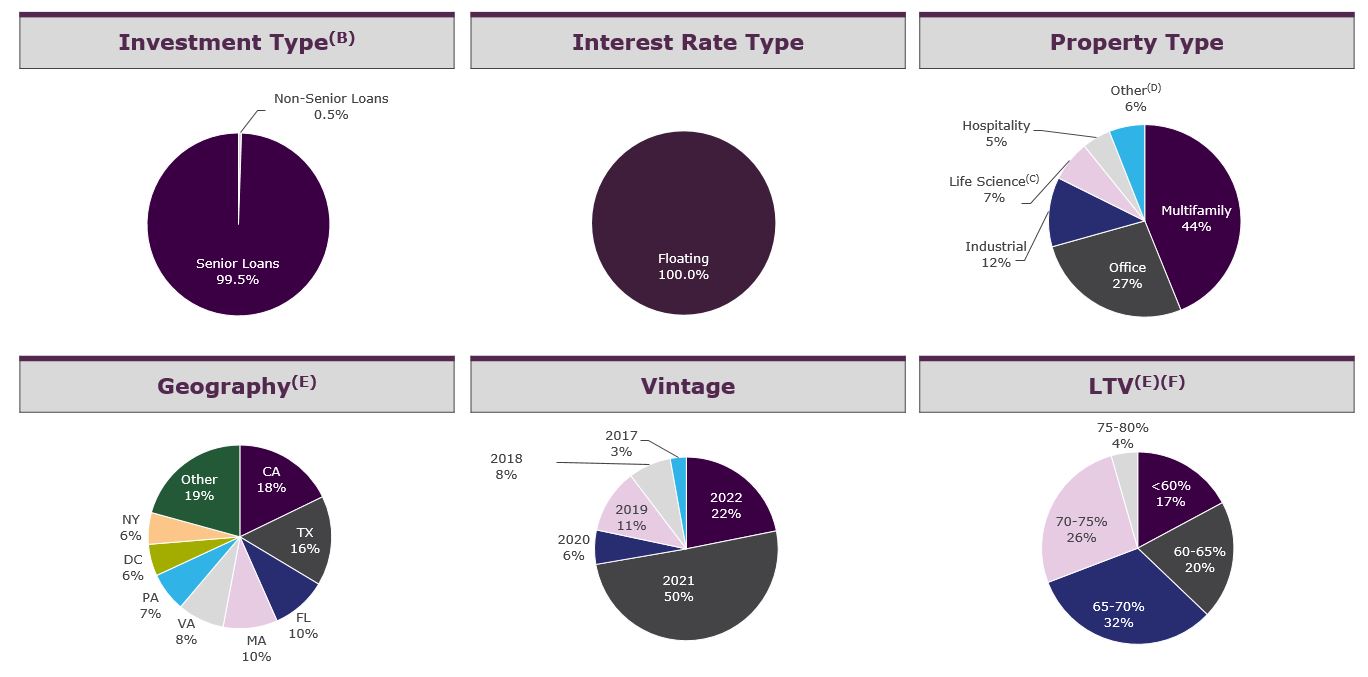
The charts above are based on total outstanding principal amount of our commercial real estate loans.
(A) Excludes: (i) one REO retail asset on a defaulted loan with net carrying value of
$79.7 million
as of September 30, 2022, (ii) CMBS B-Piece investments held through RECOP I, an equity method investment and (iii) one impaired mezzanine loan with an outstanding principal of
$5.5 million
that was fully written off.
58
(B) Senior loans include senior mortgages and similar credit quality loans, including related contiguous junior participations in senior loans where we have financed a loan with structural leverage through the non-recourse sale of a corresponding first mortgage.
(C) We classify a loan as life science if more than 50% of the gross leasable area is leased to, or will be converted to, life science-related space.
(D) “Other” property types include: 3% Condo (Residential), 3% Student Housing, and <1% Single Family Rental.
(E) Excludes (i) risk-rated 5 loans and (ii) one real estate corporate loan to a multifamily operator with an outstanding principal amount of
$40.0 million
, representing
0.5%
of our commercial real estate loans as of September 30, 2022.
(F) LTV is generally based on the initial loan amount divided by the as-is appraised value as of the date the loan was originated or by the current principal amount as of the date of the most recent as-is appraised value.
The following table details our quarterly loan activity (dollars in thousands):
| Three Months Ended | ||||||||||||||||||||||||||
| September 30, 2022 | June 30, 2022 | March 31, 2022 | December 31, 2021 | |||||||||||||||||||||||
| Loan originations | $ | 457,685 | $ | 1,034,191 | $ | 843,624 | $ | 1,804,897 | ||||||||||||||||||
|
Loan fundings
(A)
|
$ | 224,724 | $ | 1,077,132 | $ | 744,192 | $ | 1,680,890 | ||||||||||||||||||
| Loan repayments/syndications | (387,264) | (444,313) | (282,282) | (679,749) | ||||||||||||||||||||||
| Net fundings | (162,540) | 632,819 | 461,910 | 1,001,141 | ||||||||||||||||||||||
| PIK interest | 470 | 479 | 464 | 418 | ||||||||||||||||||||||
| Write-off | — | — | — | (32,905) | ||||||||||||||||||||||
| Transfer to REO | — | — | — | (77,516) | ||||||||||||||||||||||
| Total activity | $ | (162,070) | $ | 633,298 | $ | 462,374 | $ | 891,138 | ||||||||||||||||||
(A) Includes initial funding of new loans and additional fundings made under existing loans.
The following table details overall statistics for our loan portfolio as of September 30, 2022 (dollars in thousands):
|
Total Loan Exposure
(A)
|
||||||||||||||||||||||||||
| Balance Sheet Portfolio | Total Loan Portfolio | Floating Rate Loans | Fixed Rate Loans | |||||||||||||||||||||||
| Number of loans | 76 | 75 | 75 | — | ||||||||||||||||||||||
| Principal balance | $ | 7,357,481 | $ | 7,610,841 | $ | 7,610,841 | $ | — | ||||||||||||||||||
| Amortized cost | $ | 7,306,565 | $ | 7,565,426 | $ | 7,565,426 | $ | — | ||||||||||||||||||
|
Unfunded loan commitments
(B)
|
$ | 1,649,112 | $ | 1,649,112 | $ | 1,649,112 | $ | — | ||||||||||||||||||
|
Weighted-average cash coupon
(C)
|
6.5 | % | +3.3 | % | +3.3 | % | n.a. | |||||||||||||||||||
|
Weighted-average all-in yield
(C)
|
6.8 | % | +3.6 | % | +3.6 | % | n.a. | |||||||||||||||||||
|
Weighted-average maximum maturity (years)
(D)
|
3.4 | 3.4 | 3.4 | n.a. | ||||||||||||||||||||||
|
LTV
(E)
|
67 | % | 67 | % | 67 | % | n.a. | |||||||||||||||||||
(A) In certain instances, we finance our loans through the non-recourse sale of a senior interest that is not included in our condensed consolidated financial statements. Total loan exposure includes the entire loan we originated and financed and excludes one impaired mezzanine loan with an outstanding principal of $5.5 million that was fully written off.
(B) Unfunded commitments will primarily be funded to finance property improvements and renovations or lease-related expenditures by the borrowers. These future commitments will be funded over the term of each loan, subject in certain cases to an expiration date.
(C)
As of September 30, 2022, 64.1% and 35.9% of floating rate loans by loan exposure were indexed to one-month USD LIBOR and Term SOFR, respectively. In addition to cash coupon, all-in yield includes the amortization of deferred origination fees, loan origination costs and purchase discounts.
(D) Maximum maturity assumes all extension options are exercised by the borrower; however, our loans may be repaid prior to such date. As of September 30, 2022, based on total loan exposure,
65.6%
of our loans were subject to yield maintenance or other prepayment restrictions and
34.4%
were open to repayment by the borrower without penalty.
(E) LTV is generally based on the initial loan amount divided by the as-is appraised value as of the date the loan was originated or by the current principal amount as of the date of the most recent as-is appraised value. Weighted average LTV excludes risk-rated 5 loans and one real estate corporate loan to a multifamily operator with an outstanding principal of
$40.0 million
as of September 30, 2022.
59
The table below sets forth additional information relating to our portfolio as of September 30, 2022 (dollars in millions):
|
Investment
(A)
|
Location | Property Type | Investment Date |
Total Whole Loan
(B)
|
Committed Principal Amount
(B)
|
Current Principal Amount |
Net Equity
(C)
|
Coupon
(D)(E)
|
Max Remaining Term (Years)
(D)(F)
|
Loan Per SF / Unit / Key
(G)
|
LTV
(D)(H)
|
Risk Rating | ||||||||||||||||||||||||||||||||||||||||||||||||||||||||||||||||||||
|
Senior Loans
(J)
|
||||||||||||||||||||||||||||||||||||||||||||||||||||||||||||||||||||||||||||||||
| 1 | Senior Loan | Arlington, VA | Multifamily | 9/30/2021 | $ | 381.0 | $ | 381.0 | $ | 355.0 | $ | 72.4 | + | 3.2% | 4.0 | $ 319,793 / unit | 69 | % | 3 | |||||||||||||||||||||||||||||||||||||||||||||||||||||||||||||
| 2 | Senior Loan | Boston, MA | Life Science | 8/3/2022 | 312.5 | 312.5 | 44.9 | 3.7 | + | 4.2 | 4.9 | $ 649 / SF | 56 | 3 | ||||||||||||||||||||||||||||||||||||||||||||||||||||||||||||||||||
| 3 | Senior Loan | Bellevue, WA | Office | 9/13/2021 | 520.8 | 260.4 | 93.0 | 28.3 | + | 3.6 | 4.5 | $ 855 / SF | 63 | 3 | ||||||||||||||||||||||||||||||||||||||||||||||||||||||||||||||||||
| 4 | Senior Loan | Los Angeles, CA | Multifamily | 2/19/2021 | 260.0 | 260.0 | 250.0 | 38.3 | + | 3.6 | 3.4 | $ 466,400 / unit | 68 | 3 | ||||||||||||||||||||||||||||||||||||||||||||||||||||||||||||||||||
| 5 | Senior Loan | Various | Industrial | 4/28/2022 | 504.5 | 252.3 | 252.3 | 49.0 | + | 2.7 | 4.6 | $ 98 / SF | 64 | 3 | ||||||||||||||||||||||||||||||||||||||||||||||||||||||||||||||||||
| 6 | Senior Loan | Mountain View, CA | Office | 7/14/2021 | 362.8 | 250.0 | 192.2 | 48.0 | + | 3.3 | 3.9 | $ 626 / SF | 73 | 4 | ||||||||||||||||||||||||||||||||||||||||||||||||||||||||||||||||||
| 7 | Senior Loan | Bronx, NY | Industrial | 8/27/2021 | 381.2 | 228.7 | 137.5 | 36.0 | + | 4.1 | 3.9 | $ 277 / SF | 52 | 3 | ||||||||||||||||||||||||||||||||||||||||||||||||||||||||||||||||||
| 8 | Senior Loan | Various | Multifamily | 5/31/2019 | 216.5 | 216.5 | 216.5 | 39.2 | + | 4.0 | 1.7 | $ 202,336 / unit | 74 | 3 | ||||||||||||||||||||||||||||||||||||||||||||||||||||||||||||||||||
| 9 |
Senior Loan
(K)
|
Various | Industrial | 6/30/2021 | 425.0 | 212.5 | 47.0 | 45.4 | + | 5.5 | 3.8 | $ 163 / SF | 67 | 3 | ||||||||||||||||||||||||||||||||||||||||||||||||||||||||||||||||||
| 10 | Senior Loan | New York, NY | Condo (Residential) | 12/20/2018 | 211.2 | 211.2 | 200.1 | 60.9 | + | 3.6 | 1.3 | $ 1,388 / SF | 69 | 3 | ||||||||||||||||||||||||||||||||||||||||||||||||||||||||||||||||||
| 11 | Senior Loan | Minneapolis, MN | Office | 11/13/2017 | 194.4 | 194.4 | 194.4 | 33.2 | + | 3.8 | 0.2 | $ 179 / SF | n.a. | 5 | ||||||||||||||||||||||||||||||||||||||||||||||||||||||||||||||||||
| 12 | Senior Loan | Various | Industrial | 6/15/2022 | 375.5 | 187.8 | 137.5 | 30.4 | + | 2.9 | 4.8 | $ 99 / SF | 50 | 3 | ||||||||||||||||||||||||||||||||||||||||||||||||||||||||||||||||||
| 13 | Senior Loan | Washington, D.C. | Office | 11/9/2021 | 187.7 | 187.7 | 154.8 | 41.3 | + | 3.3 | 4.2 | $ 434 / SF | 55 | 3 | ||||||||||||||||||||||||||||||||||||||||||||||||||||||||||||||||||
| 14 | Senior Loan | Boston, MA | Office | 2/4/2021 | 375.0 | 187.5 | 187.5 | 37.4 | + | 3.3 | 3.4 | $ 506 / SF | 71 | 3 | ||||||||||||||||||||||||||||||||||||||||||||||||||||||||||||||||||
| 15 | Senior Loan | The Woodlands, TX | Hospitality | 9/15/2021 | 183.3 | 183.3 | 170.9 | 30.4 | + | 4.2 | 4.0 | $ 187,957 / key | 64 | 3 | ||||||||||||||||||||||||||||||||||||||||||||||||||||||||||||||||||
| 16 | Senior Loan | Philadelphia, PA | Office | 4/11/2019 | 182.6 | 182.6 | 157.3 | 25.4 | + | 2.6 | 1.6 | $ 220 / SF | n.a. | 5 | ||||||||||||||||||||||||||||||||||||||||||||||||||||||||||||||||||
| 17 | Senior Loan | Washington, D.C. | Office | 12/20/2019 | 175.5 | 175.5 | 144.2 | 37.6 | + | 3.4 | 2.3 | $ 706 / SF | 58 | 4 | ||||||||||||||||||||||||||||||||||||||||||||||||||||||||||||||||||
| 18 | Senior Loan | West Palm Beach, FL | Multifamily | 12/29/2021 | 171.5 | 171.5 | 169.8 | 25.7 | + | 2.7 | 4.3 | $ 209,072 / unit | 73 | 3 | ||||||||||||||||||||||||||||||||||||||||||||||||||||||||||||||||||
| 19 | Senior Loan | Boston, MA | Life Science | 4/27/2021 | 332.3 | 166.2 | 135.9 | 25.3 | + | 3.6 | 3.6 | $ 564 / SF | 66 | 3 | ||||||||||||||||||||||||||||||||||||||||||||||||||||||||||||||||||
| 20 | Senior Loan | Philadelphia, PA | Office | 6/19/2018 | 161.0 | 161.0 | 161.0 | 160.2 | + | 3.5 | 0.8 | $ 165 / SF | 71 | 4 | ||||||||||||||||||||||||||||||||||||||||||||||||||||||||||||||||||
| 21 | Senior Loan | Oakland, CA | Office | 10/23/2020 | 509.9 | 159.7 | 129.1 | 20.3 | + | 4.3 | 3.1 | $ 397 / SF | 65 | 3 | ||||||||||||||||||||||||||||||||||||||||||||||||||||||||||||||||||
| 22 | Senior Loan | Plano, TX | Office | 2/6/2020 | 153.7 | 153.7 | 145.3 | 22.3 | + | 2.7 | 2.4 | $ 201 / SF | 63 | 3 | ||||||||||||||||||||||||||||||||||||||||||||||||||||||||||||||||||
| 23 | Senior Loan | Chicago, IL | Office | 7/15/2019 | 150.0 | 150.0 | 117.6 | 20.3 | + | 3.3 | 1.9 | $ 113 / SF | 57 | 3 | ||||||||||||||||||||||||||||||||||||||||||||||||||||||||||||||||||
| 24 | Senior Loan | Redwood City, CA | Life Science | 9/30/2022 | 580.7 | 145.2 | — | (1.5) | + | 4.5 | 5.0 | $ 1,206 / SF | 53 | 3 | ||||||||||||||||||||||||||||||||||||||||||||||||||||||||||||||||||
| 25 | Senior Loan | Seattle, WA | Life Science | 10/1/2021 | 188.0 | 140.3 | 103.8 | 25.2 | + | 3.1 | 4.0 | $ 662 / SF | 69 | 3 | ||||||||||||||||||||||||||||||||||||||||||||||||||||||||||||||||||
| 26 | Senior Loan | Dallas, TX | Office | 12/10/2021 | 138.0 | 138.0 | 135.8 | 25.2 | + | 3.7 | 4.2 | $ 432 / SF | 68 | 3 | ||||||||||||||||||||||||||||||||||||||||||||||||||||||||||||||||||
| 27 | Senior Loan | Boston, MA | Multifamily | 3/29/2019 | 137.0 | 137.0 | 137.0 | 30.8 | + | 2.7 | 1.5 | $ 351,282 / unit | 59 | 3 | ||||||||||||||||||||||||||||||||||||||||||||||||||||||||||||||||||
| 28 | Senior Loan | Arlington, VA | Multifamily | 1/20/2022 | 135.3 | 135.3 | 130.9 | 31.7 | + | 2.9 | 4.4 | $ 436,300 / unit | 65 | 3 | ||||||||||||||||||||||||||||||||||||||||||||||||||||||||||||||||||
| 29 | Senior Loan | Fontana, CA | Industrial | 5/11/2021 | 132.0 | 132.0 | 72.6 | 43.5 | + | 4.7 | 3.7 | $ 113 / SF | 64 | 3 | ||||||||||||||||||||||||||||||||||||||||||||||||||||||||||||||||||
| 30 | Senior Loan | Fort Lauderdale, FL | Hospitality | 11/9/2018 | 130.0 | 130.0 | 130.0 | 24.3 | + | 3.4 | 1.2 | $ 375,723 / key | 66 | 3 | ||||||||||||||||||||||||||||||||||||||||||||||||||||||||||||||||||
| 31 | Senior Loan | San Carlos, CA | Life Science | 2/1/2022 | 195.9 | 125.0 | 84.9 | 24.0 | + | 3.6 | 4.4 | $ 580 / SF | 68 | 3 | ||||||||||||||||||||||||||||||||||||||||||||||||||||||||||||||||||
| 32 | Senior Loan | Irving, TX | Multifamily | 4/22/2021 | 117.6 | 117.6 | 112.2 | 17.3 | + | 3.3 | 3.6 | $ 123,586 / unit | 70 | 3 | ||||||||||||||||||||||||||||||||||||||||||||||||||||||||||||||||||
| 33 | Senior Loan | Cambridge, MA | Life Science | 12/22/2021 | 401.3 | 115.7 | 61.5 | 16.7 | + | 3.9 | 4.3 | $ 1,072 / SF | 51 | 3 | ||||||||||||||||||||||||||||||||||||||||||||||||||||||||||||||||||
| 34 | Senior Loan | Pittsburgh, PA | Student Housing | 6/8/2021 | 112.5 | 112.5 | 112.5 | 17.0 | + | 2.9 | 3.7 | $ 155,602 / unit | 74 | 3 | ||||||||||||||||||||||||||||||||||||||||||||||||||||||||||||||||||
| 35 | Senior Loan | Las Vegas, NV | Multifamily | 12/28/2021 | 106.3 | 106.3 | 102.0 | 19.8 | + | 2.7 | 4.3 | $ 193,182 / unit | 61 | 3 | ||||||||||||||||||||||||||||||||||||||||||||||||||||||||||||||||||
| 36 | Senior Loan | Doral, FL | Multifamily | 12/10/2021 | 212.0 | 106.0 | 106.0 | 21.0 | + | 2.8 | 4.2 | $ 335,975 / unit | 77 | 3 | ||||||||||||||||||||||||||||||||||||||||||||||||||||||||||||||||||
| 37 | Senior Loan | San Diego, CA | Multifamily | 10/20/2021 | 103.5 | 103.5 | 103.5 | 18.5 | + | 2.8 | 4.1 | $ 448,052 / unit | 71 | 3 | ||||||||||||||||||||||||||||||||||||||||||||||||||||||||||||||||||
60
|
Investment
(A)
|
Location | Property Type | Investment Date |
Total Whole Loan
(B)
|
Committed Principal Amount
(B)
|
Current Principal Amount |
Net Equity
(C)
|
Coupon
(D)(E)
|
Max Remaining Term (Years)
(D)(F)
|
Loan Per SF / Unit / Key
(G)
|
LTV
(D)(H)
|
Risk Rating | ||||||||||||||||||||||||||||||||||||||||||||||||||||||||||||||||||||
| 38 | Senior Loan | Orlando, FL | Multifamily | 12/14/2021 | 102.4 | 102.4 | 88.9 | 21.5 | + | 3.0 | 4.3 | $ 234,565 / unit | 74 | 3 | ||||||||||||||||||||||||||||||||||||||||||||||||||||||||||||||||||
| 39 | Senior Loan | West Hollywood, CA | Multifamily | 1/26/2022 | 102.0 | 102.0 | 102.0 | 15.3 | + | 3.0 | 4.4 | $ 2,756,757 / unit | 65 | 3 | ||||||||||||||||||||||||||||||||||||||||||||||||||||||||||||||||||
| 40 | Senior Loan | Boston, MA | Industrial | 6/28/2022 | 285.5 | 100.0 | 98.5 | 97.7 | + | 3.0 | 4.8 | $ 197 / SF | 52 | 3 | ||||||||||||||||||||||||||||||||||||||||||||||||||||||||||||||||||
| 41 | Senior Loan | Washington, D.C. | Office | 1/13/2022 | 228.5 | 100.0 | 58.5 | 10.0 | + | 3.2 | 5.4 | $ 214 / SF | 55 | 3 | ||||||||||||||||||||||||||||||||||||||||||||||||||||||||||||||||||
| 42 | Senior Loan | Phoenix, AZ | Industrial | 1/13/2022 | 195.3 | 100.0 | 33.3 | 22.1 | + | 4.0 | 4.4 | $ 57 / SF | 57 | 3 | ||||||||||||||||||||||||||||||||||||||||||||||||||||||||||||||||||
| 43 | Senior Loan | Brisbane, CA | Life Science | 7/22/2021 | 95.0 | 95.0 | 90.8 | 22.3 | + | 3.1 | 3.9 | $ 784 / SF | 71 | 3 | ||||||||||||||||||||||||||||||||||||||||||||||||||||||||||||||||||
| 44 | Senior Loan | State College, PA | Student Housing | 10/15/2019 | 93.4 | 93.4 | 91.5 | 23.5 | + | 2.7 | 2.1 | $ 76,614 / SF | 64 | 2 | ||||||||||||||||||||||||||||||||||||||||||||||||||||||||||||||||||
| 45 | Senior Loan | Brandon, FL | Multifamily | 1/13/2022 | 90.3 | 90.3 | 63.9 | 10.6 | + | 3.1 | 4.4 | $ 194,363 / unit | 75 | 3 | ||||||||||||||||||||||||||||||||||||||||||||||||||||||||||||||||||
| 46 | Senior Loan | Dallas, TX | Multifamily | 12/23/2021 | 90.0 | 90.0 | 77.5 | 15.0 | + | 2.8 | 4.3 | $ 238,488 / unit | 67 | 3 | ||||||||||||||||||||||||||||||||||||||||||||||||||||||||||||||||||
| 47 | Senior Loan | Miami, FL | Multifamily | 10/14/2021 | 89.5 | 89.5 | 89.5 | 17.2 | + | 2.9 | 4.1 | $ 304,422 / unit | 76 | 3 | ||||||||||||||||||||||||||||||||||||||||||||||||||||||||||||||||||
| 48 | Senior Loan | Dallas, TX | Office | 1/22/2021 | 87.0 | 87.0 | 87.0 | 21.2 | + | 3.3 | 3.4 | $ 288 / SF | 65 | 3 | ||||||||||||||||||||||||||||||||||||||||||||||||||||||||||||||||||
| 49 | Senior Loan | Charlotte, NC | Multifamily | 12/14/2021 | 86.8 | 86.8 | 76.0 | 10.9 | + | 3.0 | 4.3 | $ 206,522 / unit | 74 | 3 | ||||||||||||||||||||||||||||||||||||||||||||||||||||||||||||||||||
| 50 | Senior Loan | San Antonio, TX | Multifamily | 6/1/2022 | 246.5 | 86.3 | 80.3 | 79.9 | + | 2.8 | 4.7 | $ 88,134 / unit | 68 | 3 | ||||||||||||||||||||||||||||||||||||||||||||||||||||||||||||||||||
| 51 | Senior Loan | Scottsdale, AZ | Multifamily | 5/9/2022 | 169.0 | 84.5 | 84.5 | 12.8 | + | 2.9 | 4.7 | $ 457,995 / unit | 64 | 3 | ||||||||||||||||||||||||||||||||||||||||||||||||||||||||||||||||||
| 52 | Senior Loan | Raleigh, NC | Multifamily | 4/27/2022 | 82.9 | 82.9 | 77.3 | 15.5 | + | 3.0 | 4.6 | $ 241,488 / unit | 68 | 3 | ||||||||||||||||||||||||||||||||||||||||||||||||||||||||||||||||||
| 53 | Senior Loan | Hollywood, FL | Multifamily | 12/20/2021 | 81.0 | 81.0 | 81.0 | 14.8 | + | 3.0 | 4.3 | $ 327,935 / unit | 74 | 3 | ||||||||||||||||||||||||||||||||||||||||||||||||||||||||||||||||||
| 54 | Senior Loan | Seattle, WA | Office | 3/20/2018 | 80.7 | 80.7 | 80.7 | 13.2 | + | 4.1 | 0.5 | $ 468 / SF | 56 | 3 | ||||||||||||||||||||||||||||||||||||||||||||||||||||||||||||||||||
| 55 | Senior Loan | Phoenix, AZ | Single Family Rental | 4/22/2021 | 72.1 | 72.1 | 32.6 | 15.4 | + | 4.8 | 3.6 | $ 157,092 / unit | 50 | 3 | ||||||||||||||||||||||||||||||||||||||||||||||||||||||||||||||||||
| 56 | Senior Loan | Arlington, VA | Multifamily | 10/23/2020 | 141.8 | 70.9 | 70.9 | 11.7 | + | 3.8 | 3.0 | $ 393,858 / unit | 73 | 3 | ||||||||||||||||||||||||||||||||||||||||||||||||||||||||||||||||||
| 57 | Senior Loan | Denver, CO | Multifamily | 9/14/2021 | 70.3 | 70.3 | 69.6 | 11.4 | + | 2.7 | 4.0 | $ 287,596 / unit | 78 | 3 | ||||||||||||||||||||||||||||||||||||||||||||||||||||||||||||||||||
| 58 | Senior Loan | Washington, D.C. | Multifamily | 12/4/2020 | 69.0 | 69.0 | 66.4 | 10.6 | + | 3.5 | 3.2 | $ 265,617 / unit | 63 | 3 | ||||||||||||||||||||||||||||||||||||||||||||||||||||||||||||||||||
| 59 | Senior Loan | Dallas, TX | Multifamily | 8/18/2021 | 68.2 | 68.2 | 68.2 | 9.9 | + | 3.9 | 3.9 | $ 189,444 / unit | 70 | 3 | ||||||||||||||||||||||||||||||||||||||||||||||||||||||||||||||||||
| 60 | Senior Loan | Manassas Park, VA | Multifamily | 2/25/2022 | 68.0 | 68.0 | 68.0 | 13.2 | + | 2.7 | 4.4 | $ 223,684 / unit | 73 | 3 | ||||||||||||||||||||||||||||||||||||||||||||||||||||||||||||||||||
| 61 | Senior Loan | Plano, TX | Multifamily | 3/31/2022 | 67.8 | 67.8 | 65.0 | 17.9 | + | 2.8 | 4.5 | $ 244,451 / unit | 75 | 3 | ||||||||||||||||||||||||||||||||||||||||||||||||||||||||||||||||||
| 62 | Senior Loan | Nashville, TN | Hospitality | 12/9/2021 | 66.0 | 66.0 | 64.7 | 10.3 | + | 3.6 | 4.3 | $ 281,237 / key | 68 | 3 | ||||||||||||||||||||||||||||||||||||||||||||||||||||||||||||||||||
| 63 | Senior Loan | Atlanta, GA | Multifamily | 12/10/2021 | 61.5 | 61.5 | 57.3 | 15.3 | + | 3.0 | 4.3 | $ 189,893 / unit | 67 | 3 | ||||||||||||||||||||||||||||||||||||||||||||||||||||||||||||||||||
| 64 | Senior Loan | Durham, NC | Multifamily | 12/15/2021 | 60.0 | 60.0 | 52.2 | 10.4 | + | 3.0 | 4.3 | $ 151,263 / unit | 67 | 3 | ||||||||||||||||||||||||||||||||||||||||||||||||||||||||||||||||||
| 65 | Senior Loan | San Antonio, TX | Multifamily | 4/20/2022 | 57.6 | 57.6 | 55.8 | 10.6 | + | 2.7 | 4.6 | $ 163,277 / unit | 79 | 3 | ||||||||||||||||||||||||||||||||||||||||||||||||||||||||||||||||||
| 66 | Senior Loan | Sharon, MA | Multifamily | 12/1/2021 | 56.9 | 56.9 | 56.9 | 8.3 | + | 2.8 | 4.2 | $ 296,484 / unit | 70 | 3 | ||||||||||||||||||||||||||||||||||||||||||||||||||||||||||||||||||
| 67 | Senior Loan | Queens, NY | Industrial | 2/22/2022 | 55.3 | 55.3 | 52.4 | 13.3 | + | 4.0 | 1.4 | $ 85 / SF | 68 | 3 | ||||||||||||||||||||||||||||||||||||||||||||||||||||||||||||||||||
| 68 | Senior Loan | Reno, NV | Industrial | 4/28/2022 | 140.4 | 50.5 | 50.5 | 11.1 | + | 2.7 | 4.6 | $ 117 / SF | 74 | 3 | ||||||||||||||||||||||||||||||||||||||||||||||||||||||||||||||||||
| 69 | Senior Loan | Carrollton, TX | Multifamily | 4/1/2022 | 48.5 | 48.5 | 44.9 | 13.0 | + | 2.9 | 4.5 | $ 140,288 / unit | 74 | 3 | ||||||||||||||||||||||||||||||||||||||||||||||||||||||||||||||||||
| 70 | Senior Loan | Dallas, TX | Multifamily | 4/1/2022 | 43.9 | 43.9 | 39.5 | 10.4 | + | 2.9 | 4.5 | $ 110,895 / unit | 73 | 3 | ||||||||||||||||||||||||||||||||||||||||||||||||||||||||||||||||||
| 71 | Senior Loan | Georgetown, TX | Multifamily | 12/16/2021 | 41.8 | 41.8 | 41.8 | 10.1 | + | 3.4 | 4.3 | $ 199,048 / unit | 68 | 3 | ||||||||||||||||||||||||||||||||||||||||||||||||||||||||||||||||||
| 72 | Senior Loan | San Diego, CA | Multifamily | 4/29/2022 | 203.0 | 40.0 | 38.9 | 6.5 | + | 2.6 | 4.6 | $ 446,056 / unit | 63 | 3 | ||||||||||||||||||||||||||||||||||||||||||||||||||||||||||||||||||
| 73 |
Senior Loan
(L)
|
New York, NY | Condo (Residential) | 8/4/2017 | 20.1 | 20.1 | 20.1 | 20.1 | + | 4.2 | 0.6 | $ 942 / SF | 73 | 3 | ||||||||||||||||||||||||||||||||||||||||||||||||||||||||||||||||||
| 74 | Senior Loan | Denver, CO | Industrial | 12/11/2020 | 15.4 | 15.4 | 7.3 | 3.1 | + | 3.8 | 3.3 | $ 47 / SF | 61 | 3 | ||||||||||||||||||||||||||||||||||||||||||||||||||||||||||||||||||
|
Total/Weighted Average
Senior Loans Unlevered |
$ | 13,051.6 | $ | 9,245.8 | $ | 7,570.9 | $ | 1,900.8 | + | 3.3% | 3.4 | 67 | % | 3.1 | ||||||||||||||||||||||||||||||||||||||||||||||||||||||||||||||||||
61
|
Investment
(A)
|
Location | Property Type | Investment Date |
Total Whole Loan
(B)
|
Committed Principal Amount
(B)
|
Current Principal Amount |
Net Equity
(C)
|
Coupon
(D)(E)
|
Max Remaining Term (Years)
(D)(F)
|
Loan Per SF / Unit / Key
(G)
|
LTV
(D)(H)
|
Risk Rating | ||||||||||||||||||||||||||||||||||||||||||||||||||||||||||||||||||||
| Non-Senior Loans | ||||||||||||||||||||||||||||||||||||||||||||||||||||||||||||||||||||||||||||||||
| 1 | Corporate | n.a. | Multifamily | 12/11/2020 | 100.0 | 40.0 | 40.0 | 39.6 | + | 12.0 | 3.2 | n.a. | n.a. | 3 | ||||||||||||||||||||||||||||||||||||||||||||||||||||||||||||||||||
|
Total/Weighted Average
Non-Senior Loans Unlevered |
$ | 100.0 | $ | 40.0 | $ | 40.0 | $ | 39.6 | + | 12.0% | 3.2 | n.a. | 3.0 | |||||||||||||||||||||||||||||||||||||||||||||||||||||||||||||||||||
| CMBS B-Pieces | ||||||||||||||||||||||||||||||||||||||||||||||||||||||||||||||||||||||||||||||||
| 1 |
RECOP I
(I)
|
Various | Various | 2/13/2017 | n.a. | 40.0 | 35.7 | 35.7 | 4.8 | 6.7 | n.a. | 58 | n.a. | |||||||||||||||||||||||||||||||||||||||||||||||||||||||||||||||||||
|
Total/Weighted Average
CMBS B-Pieces Unlevered |
$ | 40.0 | $ | 35.7 | $ | 35.7 | 4.8% | 6.7 | 58 | % | ||||||||||||||||||||||||||||||||||||||||||||||||||||||||||||||||||||||
| Real Estate Owned | ||||||||||||||||||||||||||||||||||||||||||||||||||||||||||||||||||||||||||||||||
| 1 | Real Estate Asset | Portland, OR | Retail | 12/16/2021 | n.a. | n.a. | 79.7 | 79.7 | n.a. | n.a. | n.a. | n.a. | n.a. | |||||||||||||||||||||||||||||||||||||||||||||||||||||||||||||||||||
|
Total/Weighted Average
Real Estate Owned |
$ | 79.7 | $ | 79.7 | ||||||||||||||||||||||||||||||||||||||||||||||||||||||||||||||||||||||||||||
| Grand Total / Weighted Average | $ | 9,325.8 | $ | 7,726.3 | $ | 2,055.8 | 6.5% | 3.5 | 67 | % | 3.1 | |||||||||||||||||||||||||||||||||||||||||||||||||||||||||||||||||||||
* Numbers presented may not foot due to rounding.
(A) Our total portfolio represents the current principal amount on senior, mezzanine and corporate loans, net equity in RECOP I, which holds CMBS B-Piece investments, and net carrying value of our sole REO investment. Excludes one impaired mezzanine loan with an outstanding principal of
$5.5 million
that was fully written off.
For Senior Loan
14
, the total whole loan is $375.0 million, co-originated and co-funded by us and a KKR affiliate. Our interest was 50% of the loan or $187.5 million, of which $150.0 million in senior notes were syndicated to a third party. Post syndication, we retained a mezzanine loan with a commitment of $37.5 million, fully funded as of September 30, 2022, at an interest rate of L+
7.9%
.
For Senior Loan
21,
the total whole loan is $509.9 million, co-originated and co-funded by us and a KKR affiliate. Our interest was 31% of the loan or $159.7 million, of which $134.7 million in senior notes were syndicated to third party lenders. Post syndication, we retained a mezzanine loan with a commitment of $25.0 million, of which
$20.2 million
was funded as of September 30, 2022, at an interest rate of L+
12.9%
.
(B) Total Whole Loan represents total commitment of the entire whole loan originated. Committed Principal Amount includes participations by KKR affiliated entities and third parties that are syndicated/sold.
(C) Net equity reflects (i) the amortized cost basis of our loans, net of borrowings; and (ii) the cost basis of our investments in RECOP I and REO.
(D) Weighted average is weighted by the current principal amount for our senior, mezzanine and corporate loans and by net equity for our RECOP I CMBS B-Pieces. Non-Senior Loan 1 and risk-rated 5 loans are excluded from the weighted average LTV.
(E)
Coupon expressed as spread over the relevant floating benchmark rates, which include one-month LIBOR and Term SOFR, as applicable to each loan. As of
September 30, 2022
, 64.1% and 35.9% of floating rate loans by principal amount were indexed to one-month LIBOR and Term SOFR, respectively.
(F) Max remaining term (years) assumes all extension options are exercised, if applicable.
(G) Loan Per SF / Unit / Key is based on the current principal amount divided by the current SF / Unit / Key. For Senior Loa
ns 2, 3, 7, 9, 24, 29, 33, 42, 55, and 74, Loa
n Per SF / Unit / Key is calculated as the total commitment amount of the loan divided by the proposed SF / Unit / Key.
(H) For senior loans, LTV is generally based on the initial loan amount divided by the as-is appraised value as of the date the loan was originated or by the current principal amount as of the date of the most recent as-is
appraised value; f
or mezzanine loans, LTV is based on the current balance of the whole loan divided by the as-is appraised value as of the date the loan was originated; for RECOP I CMBS B-Pieces, LTV is based on the weighted average LTV of the underlying loan pool at issuance. Weighted Average LTV excludes one fully funded corporate loan to a multifamily operator with an outstanding principal amoun
t of $40.0 million.
For Senior Loans 10 and 73, LTV is based on the current principal amount divided by the adjusted appraised gross sellout value net of sales cost.
For Senior Loans 2, 3, 7, 9, 24, 29, 33, 42, 55 and 74, LTV is calculated as the total commitment amount of the loan divided by the as-stabilized value
as of the date the loan was originated.
(I) Represents our investment in an aggregator vehicle alongside RECOP I that invests in CMBS B-Pieces. Committed principal represents our total commitment to the aggregator vehicle whereas current principal represents the current funded amount.
(J) Senior loans include senior mortgages and similar credit quality investments, including junior participations in our originated senior loans for which we have syndicated
the senior participations and retained the junior participations for our portfolio and excludes vertical loan participations.
(K) For Senior Loa
n 9, t
he total whole loan facility is $425.0 million, co-originated and co-funded by us and a KKR affiliate. Our interest was 50% of the facility or $212.5 million. The facility is comprised of individual cross-collateralized whole loans. As of September 30, 2022, there wer
e eight un
derlying senior loans in the facility with a commitment of
$98.4 million
and outstanding principal of
$47.0 million
.
(L) For S
enior Loa
n 73, L
oan pe
r SF of $942 is bas
ed on the allocated loan amount of the residential units. Excluding the value of the retail and parking components of the collateral, the Loan per S
F is $2,061 based
on all
ocating the full amount of the loan to only the residential units.
62
Portfolio Surveillance and Credit Quality
Our Manager actively manages our portfolio and assesses the risk of any deterioration in credit quality by quarterly evaluating the performance of the underlying property, the valuation of comparable assets as well as the financial wherewithal of the associated borrower. Our loan documents generally give us the right to receive regular property, borrower and guarantor financial statements; approve annual budgets and tenant leases; and enforce loan covenants and remedies. In addition, our Manager evaluates the macroeconomic environment, prevailing real estate fundamentals and micro-market dynamics where the underlying property is located. Through site inspections, local market experts and various data sources, as part of its risk assessment, our Manager monitors criteria such as new supply and tenant demand, market occupancy and rental rate trends, and capitalization rates and valuation trends.
We maintain a robust asset management relationship with our borrowers and have utilized these relationships to maximize the performance of our portfolio, including during periods of volatility such as the COVID-19 pandemic.
We believe our loan sponsors are generally committed to supporting assets collateralizing our loans through additional equity investments, and that we will benefit from our long-standing core business model of originating senior loans collateralized by large assets in major markets with experienced, well-capitalized institutional sponsors. While we believe the principal amounts of our loans are generally adequately protected by underlying collateral value, there is a risk that we will not realize the entire principal value of certain investments.
In addition to ongoing asset management, our Manager performs a quarterly review of our portfolio whereby each loan is assigned a risk rating of 1 through 5, from lowest risk to highest risk. Our Manager is responsible for reviewing, assigning and updating the risk ratings for each loan on a quarterly basis. The risk ratings are based on many factors, including, but not limited to, underlying real estate performance and asset value, values of comparable properties, durability and quality of property cash flows, sponsor experience and financial wherewithal, and the existence of a risk-mitigating loan structure. Additional key considerations include LTVs, debt service coverage ratios, real estate and credit market dynamics, and risk of default or principal loss. Based on a five-point scale, our loans are rated "1" through "5," from less risk to greater risk, which ratings are defined as follows:
1—Very Low Risk
2—Low Risk
3—Medium Risk
4—High Risk/Potential for Loss: A loan that has a risk of realizing a principal loss.
5—Impaired/Loss Likely: A loan that has a very high risk of realizing a principal loss or has otherwise incurred a principal loss.
As of September 30, 2022, the average risk rating of our loan portfolio was
3.1
, weighted by total loan exposure, as compared to 2.9 as of December 31, 2021.
| September 30, 2022 | December 31, 2021 | |||||||||||||||||||||||||||||||||||||||||||||||||
| Risk Rating | Number of Loans | Carrying Value |
Total Loan Exposure
(A)
|
Total Loan Exposure % | Number of Loans | Carrying Value |
Total Loan Exposure
(A)
|
Total Loan Exposure % | ||||||||||||||||||||||||||||||||||||||||||
| 1 | — | $ | — | $ | — | — | % | 1 | $ | 243,549 | $ | 243,552 | 3.6 | % | ||||||||||||||||||||||||||||||||||||
| 2 | 1 | 91,287 | 91,476 | 1.2 | 3 | 410,293 | 411,424 | 6.2 | ||||||||||||||||||||||||||||||||||||||||||
| 3 | 69 | 6,367,631 | 6,670,183 | 87.6 | 54 | 5,268,590 | 5,627,927 | 84.3 | ||||||||||||||||||||||||||||||||||||||||||
| 4 | 3 | 496,219 | 497,466 | 6.6 | 4 | 394,301 | 394,336 | 5.9 | ||||||||||||||||||||||||||||||||||||||||||
| 5 | 3 | 351,428 | 351,716 | 4.6 | 1 | — | — | — | ||||||||||||||||||||||||||||||||||||||||||
| Total loan receivable | 76 | $ | 7,306,565 | $ | 7,610,841 | 100.0 | % | 63 | $ | 6,316,733 | $ | 6,677,239 | 100.0 | % | ||||||||||||||||||||||||||||||||||||
| Allowance for credit losses | (110,798) | (22,244) | ||||||||||||||||||||||||||||||||||||||||||||||||
| Loan receivable, net | $ | 7,195,767 | $ | 6,294,489 | ||||||||||||||||||||||||||||||||||||||||||||||
63
(A) In certain instances, we finance our loans through the non-recourse sale of a senior interest that is not included in our condensed consolidated financial statements under GAAP. Total loan exposure includes the entire loan we originated and financed, including
$258.9 million
and $318.6 million of such non-consolidated senior interests as of September 30, 2022 and December 31, 2021, respectively.
As of September 30, 2022, we had one risk-rated 4 senior loan secured by office properties located in Philadelphia, PA that was past its current maturity date of September 2022. The maximum maturity date of this senior loan, assuming all extension options are exercised, is July 2023. The loan had an amortized cost of $161.8 million and was not pledged to any secured financing facility as of September 30, 2022. The borrower paid its October monthly interest payment subsequent to quarter end.
CMBS B-Piece Investments
Our current CMBS exposure is through RECOP I, an equity method investment.
Our Manager has processes and procedures in place to monitor and assess the credit quality of our CMBS B-Piece investments and promote the regular and active management of these investments. This includes reviewing the performance of the real estate assets underlying the loans that collateralize the investments and determining the impact of such performance on the credit and return profile of the investments. Our Manager holds mon
thly surveillance calls with the special servicer of our CMBS B-Piece investments to monitor the performance of our portfolio and discuss issues associated with the loans underlying our CMBS B-Piece investments. At each meeting, our Manager is provided with a due diligence submission for each loan underlying our CMBS B-Piece investments, which includes both property- and loan-level information. These meetings assist our Manager in monitoring our portfolio, identifying any potential loan issues, determining if a re-underwriting of any loan is warranted and examining the timing and severity of any potential losses or impairments.
Valuations for our CMBS B-Piece investments are prepared using inputs from an independent valuation firm and confirmed by our Manager via quotes from two or more broker-dealers that actively make markets in CMBS. As part of the quarterly valuation process, our Manager also reviews pricing indications for comparable CMBS and monitors the credit metrics of the loans that collateralize our CMBS B-Piece investments.
Portfolio Financing
Our portfolio financing arrangements include term loan financing, term lending agreements, collateralized loan obligations, secured term loan, warehouse facility, asset specific financing, non-consolidated senior interest (collectively “Non-Mark-to-Market Financing Sources”) and master repurchase agreements.
Our Non-Mark-to-Market Financing Sources, which accounte
d for 76%
of our total secured financing (excluding our cor
porate revolver) as of September 30, 2022, are not subject to credit or capital markets mark-to-market provisions. The remaining 24% of our secured borrowings, which is primarily comprised of three master repurchase agreements, are only subject to credit
marks.
We continue to expand and diversify our financing sources, especially those sources that provide non-mark-to-marke
t financing, reducing our exposure to market volatility.
The following table summarizes our portfolio financing (dollars in thousands):
| Portfolio Financing Outstanding Principal Balance | ||||||||||||||||||||
| Non-/Mark-to-Market | September 30, 2022 | December 31, 2021 | ||||||||||||||||||
| Master repurchase agreements | Mark-to-Credit | $ | 1,423,355 | $ | 1,554,808 | |||||||||||||||
| Collateralized loan obligations | Non-Mark-to-Market | 1,942,750 | 1,095,250 | |||||||||||||||||
| Term lending agreements | Non-Mark-to-Market | 1,342,628 | 1,117,627 | |||||||||||||||||
| Term loan financing | Non-Mark-to-Market | 584,033 | 870,458 | |||||||||||||||||
| Secured term loan | Non-Mark-to-Market | 347,375 | 350,000 | |||||||||||||||||
| Asset specific financing | Non-Mark-to-Market | 138,165 | 60,000 | |||||||||||||||||
| Warehouse facility | Non-Mark-to-Market | — | — | |||||||||||||||||
| Non-consolidated senior interests | Non-Mark-to-Market | 258,861 | 318,634 | |||||||||||||||||
| Total portfolio financing | $ | 6,037,167 | $ | 5,366,777 | ||||||||||||||||
Financing Agreements
The following table details our financing agreements (dollars in thousands):
64
| September 30, 2022 | ||||||||||||||||||||||||||||||||
| Maximum | Collateral | Borrowings | ||||||||||||||||||||||||||||||
|
Facility Size
(A)
|
Assets
(B)
|
Potential
(C)
|
Outstanding | Available | ||||||||||||||||||||||||||||
| Master Repurchase Agreements | ||||||||||||||||||||||||||||||||
| Wells Fargo | $ | 1,000,000 | $ | 978,669 | $ | 734,002 | $ | 715,981 | $ | 18,021 | ||||||||||||||||||||||
| Morgan Stanley | 600,000 | 790,539 | 590,520 | 583,716 | 6,804 | |||||||||||||||||||||||||||
| Goldman Sachs | 240,000 | 287,517 | 206,214 | 123,658 | 82,556 | |||||||||||||||||||||||||||
| Term Loan Facility | 1,000,000 | 719,961 | 584,033 | 584,033 | — | |||||||||||||||||||||||||||
| Term Lending Agreements | ||||||||||||||||||||||||||||||||
| KREF Lending V | 567,115 | 686,622 | 540,406 | 539,050 | 1,356 | |||||||||||||||||||||||||||
| KREF Lending IX | 1,000,000 | 813,181 | 654,000 | 642,438 | 11,562 | |||||||||||||||||||||||||||
| KREF Lending XII | 350,000 | 217,395 | 163,698 | 161,140 | 2,558 | |||||||||||||||||||||||||||
| Warehouse Facility | ||||||||||||||||||||||||||||||||
| HSBC | 500,000 | — | — | — | — | |||||||||||||||||||||||||||
| Asset Specific Financing | ||||||||||||||||||||||||||||||||
| BMO Facility | 300,000 | — | — | — | — | |||||||||||||||||||||||||||
| KREF Lending XI | 100,000 | 125,000 | 100,000 | 100,000 | — | |||||||||||||||||||||||||||
| KREF Lending XIII | 265,625 | 44,900 | 38,165 | 38,165 | — | |||||||||||||||||||||||||||
| Revolver | 610,000 | — | 610,000 | — | 610,000 | |||||||||||||||||||||||||||
| $ | 6,532,740 | $ | 4,663,784 | $ | 4,221,038 | $ | 3,488,181 | $ | 732,857 | |||||||||||||||||||||||
(A) Maximum facility size represents the largest amount of borrowings available under a given facility once sufficient collateral assets have been approved by the lender and pledged by us.
(B) Represents the principal balance of the collateral assets.
(C) Potential borrowings represents the total amount we could draw under each facility based on collateral already approved and pledged. When undrawn, these amounts are available to us under the terms of each credit facility.
Master Repurchase Agreements
We utilize master repurchase facilities to finance the origination of senior loans. After a mortgage asset is identified by us, the lender agrees to advance a certain percentage of the principal of the mortgage to us in exchange for a secured interest in the mortgage. We have not
received
any margin calls on any of our master repurchase facilities to date.
Repurchase agreements effectively allow us to borrow against loans and participations that we own in an amount generally equal to (i) the market value of such loans and/or participations multiplied by (ii) the applicable advance rate. Under these agreements, we sell our loans and participations to a counterparty and agree to repurchase the same loans and participations from the counterparty at a price equal to the original sales price plus an interest factor. The transaction is treated as a secured loan from the financial institution for GAAP purposes. During the term of a repurchase agreement, we receive the principal and interest on the related loans and participations and pay interest to the lender under the master repurchase agreement. At any point in time, the amounts and the cost of our repurchase borrowings will be based upon the assets being financed—higher risk assets will result in lower advance rates (i.e., levels of leverage) at higher borrowing costs and vice versa. In addition, these facilities include various financial covenants and limited recourse guarantees, including those described below.
Each of our existing master repurchase facilities includes "credit mark-to-market" features. "Credit mark-to-market" provisions in repurchase facilities are designed to keep the lenders' credit exposure generally constant as a percentage of the underlying collateral value of the assets pledged as security to them. If the credit underlying collateral value decreases, the gross amount of leverage available to us will be reduced as our assets are marked-to-market, which would reduce our liquidity. The lender under the applicable repurchase facility sets the valuation and any revaluation of the collateral assets in its sole, good faith discretion. As a contractual matter, the lender has the right to reset the value of the assets at any time based on then-current market conditions, but the market convention is to reassess valuations on a monthly, quarterly and annual basis using the financial information delivered pursuant to the facility documentation regarding the real property, borrower and guarantor under such underlying loans. Generally, if the lender determines (subject to certain conditions) that the market value of the collateral in a repurchase transaction has decreased by more than a defined minimum amount, the lender may require us to provide additional collateral or lead to margin calls that may require us to repay all or a portion of the funds advanced. We closely monitor our liquidity and intend to maintain sufficient liquidity on our balance sheet in order to meet any margin calls in the event of any significant decreases in asset values. As of September 30, 2022 and December 31, 2021, the weighted average haircut under our repurchase agreements was
30.8%
and 30.3%, respectively (or
25.5%
and 25.9%, respectively, if we had borrowed the
65
maximum amount approved by its repurchase agreement counterparties as of such dates). In addition, our existing master repurchase facilities are not entirely term-matched financings and may mature before our CRE debt investments that represent underlying collateral to those financings. As we negotiate renewals and extensions of these liabilities, we may experience lower advance rates and higher pricing under the renewed or extended agreements.
Term Loan Financing
In connection with our efforts to diversify our financing sources, further expand our non-mark-to-market borrowing base and reduce our exposure to market volatility, we entered into a term loan financing agreement in April 2018 with third party lenders for an initial borrowing capacity of $200.0 million that was increased to $1.0 billion in October 2018 (“Term Loan Facility”). The facility provides us with asset-based financing on a non-mark-to-market basis with match-term up to five years and is non-recourse to us. Borrowings under the facility are collateralized by senior loans, held-for-investment.
The following table summarizes our borrowings under the Term Loan Facility (dollars in thousands):
| September 30, 2022 | ||||||||||||||||||||||||||||||||||||||||||||
| Term Loan Facility | Count | Outstanding Principal | Amortized Cost | Carrying Value |
Wtd. Avg. Yield/Cost
(A)
|
Guarantee
(B)
|
Wtd. Avg. Term
(C)
|
|||||||||||||||||||||||||||||||||||||
| Collateral assets | 10 | $ | 719,961 | $ | 716,517 | $ | 688,843 |
+ 3.4%
|
n.a. | February 2026 | ||||||||||||||||||||||||||||||||||
| Financing provided | n.a. | 584,033 | 583,681 | 583,681 |
+ 1.8%
|
n.a. | February 2026 | |||||||||||||||||||||||||||||||||||||
(A) Collateral loan assets are indexed to one-month LIBOR and/or Term SOFR. In addition to cash coupon, yield/cost includes the amortization of deferred origination/financing costs.
(B) Financing under the Term Loan Facility is non-recourse to us.
(C) The weighted-average term is weighted by outstanding principal, using the maximum maturity date of the underlying loans assuming all extension options are exercised by the borrower.
Term Lending Agreements
In June 2019, we entered into a Master Repurchase and Securities Contract Agreement ("KREF Lending V Facility") with Morgan Stanley Mortgage Capital Holdings LLC ("Administrative Agent"), as administrative agent on behalf of Morgan Stanley Bank, N.A. ("Initial Buyer"), which provides non-mark-to-market financing. In June 2022, the current stated maturity was extended to June 2023, subject to three additional one-year extension options, which may be exercised by us upon the satisfaction of certain customary conditions and thresholds. The Initial Buyer subsequently syndicated a portion of the facility to multiple financial institutions. As of September 30, 2022, the Initial Buyer held 23.8% of the total commitment under the facility. Borrowings under the facility are collateralized by certain loans, held for investment, and bear interest equal to one-month LIBOR, plus a 1.9% margin.
In July 2021, we entered into a $500.0 million
Master Repurchase and Securities Contract Agreement
with a financial institution (“KREF Lending IX Facility”). In
March 2022, w
e increased the borrowing capacity to $750.0 million. In August 2022, we further increased the borrowing capacity to $1,000.0 million
.
The facility, which provides financing on a non-mark-to-market basis with partial recourse to us, has a three-year draw period and match- term to the underlying loans.
In June 2022, we entered into a $350.0 million Master Repurchase Agreement and Securities Contract with a financial institution (“KREF Lending XII Facility”). The facility, which provides financing on a non-mark-to-market basis with partial recourse to KREF, has a two-year draw period and match-term to the underlying loans. In addition, we have the option to increase the facility amount to $500.0 million.
Warehouse Facility
In March 2020, we entered into a $500.0 million Loan and Security Agreement with HSBC Bank USA, National Association (“HSBC Facility”). The facility, which matures in March 2023, provides warehouse financing on a non-mark-to-market basis with partial recourse to us. Borrowings under the facility are collateralized by certain loans, held for investment, and bear interest equal to one-month LIBOR, plus a margin.
66
Asset Specific Financing
In August 2018, we entered into a $200.0 million loan financing facility with BMO Harris Bank (the "BMO Facility”). In May 2019, we increased the borrowing capacity to $300.0 million. The facility provides asset-based financing on a non-mark-to-market basis with match-term up to five years with partial recourse to us.
In April 2022, we entered into a $100.0 million loan financing facility with a financial institution ("KREF Lending XI Facility"). The facility provides match-term asset-based financing on a non-mark-to-market and non-recourse basis.
In August 2022, we entered into a $265.6 million loan financing facility with a financial institution ("KREF Lending XIII Facility"). The facility pro
vides non-recourse m
atch-term asset-based financing on a non-mark-to-market basis.
Revolving Credit Agreement
In March 2022, we upsized our corporate revolving credit facility (“Revolver”), administered by Morgan Stanley Senior Funding, Inc., to $520.0 million and extended the maturity date to March 2027. In April 2022, we further upsized our Revolver to $610.0 million. We may use our Revolver as a source of financing, which is designed to provide short-term liquidity to originate or de-lever loans, pay operating expenses and borrow amounts for general corporate purposes. Borrowings under the Revolver bear interest at a per annum rate equal to the sum of (i) Term SOFR and (ii) a fixed margin. Our Revolver is secured by corporate level guarantees and includes net equity interests in the investment portfolio.
Collateralized Loan Obligations
In August 2021, we financed a pool of loan participations from our existing loan portfolio through a managed collateralized loan obligation ("CLO" or "KREF 2021-FL2") and, in February 2022, we financed a pool of loan participations from our existing multifamily loan portfolio through a managed CLO ("KREF 2022-FL3"). The CLOs provide us with match-term financing on a non-mark-to-market and non-recourse basis. The CLOs have a two-year reinvestment feature that allows principal proceeds of the collateral assets to be reinvested in qualifying replacement assets, subject to the satisfaction of certain conditions set forth in the indentures.
The following table outlines the CLO collateral assets and respective borrowing (dollars in thousands):
| September 30, 2022 | ||||||||||||||||||||||||||||||||||||||
| Count | Outstanding Principal | Amortized Cost | Carrying Value |
Wtd. Avg. Yield/Cost
(A)
|
Wtd. Avg. Term
(B)
|
|||||||||||||||||||||||||||||||||
| KREF 2021-FL2 | ||||||||||||||||||||||||||||||||||||||
|
Collateral assets
(C)(D)
|
19 | $ | 1,300,000 | $ | 1,300,000 | $ | 1,281,618 | + 3.3% | January 2026 | |||||||||||||||||||||||||||||
| Financing provided | 1 | 1,095,250 | 1,091,258 | 1,091,258 | L + 1.7% | February 2039 | ||||||||||||||||||||||||||||||||
| KREF 2022-FL3 | ||||||||||||||||||||||||||||||||||||||
|
Collateral assets
(C)
|
15 | 1,000,000 | 1,000,000 | 995,326 | + 3.0% | September 2026 | ||||||||||||||||||||||||||||||||
| Financing provided | 1 | 847,500 | 842,398 | 842,398 | S + 2.1% | February 2039 | ||||||||||||||||||||||||||||||||
(A)
Expressed as a spread over the relevant benchmark rates, which include one-month LIBOR and Term SOFR, as applicable to each loan. As of
September 30, 2022
, 83.9% and 16.1% of the CLO collateral loan assets by principal balance earned a floating rate of interest indexed to one-month LIBOR and Term SOFR, respectively.
In addition to cash coupon, yield/cost includes the amortization of deferred origination/financing costs.
(B)
Loan term represents weighted-average final maturity, assuming all extension options are exercised by the borrower, weighted by outstanding principal. Repayments of CLO notes are dependent on timing of underlying collateral loan asset repayments post reinvestment period. The term of the CLO notes represents the rated final distribution date.
(C)
Collateral loan assets represent
30.2% of the
principal of our commercial real estate loans as of September 30, 2022. As of September 30, 2022, 100% of our loans financed through the CLOs are floating rate loans.
(D)
Including
$79.0 million
cash held in the CLOs as of September 30, 2022.
Loan Participations Sold
In connection with our investments in CRE loans, we finance certain investments through the syndication of a non-recourse, or limited-recourse, loan participation to unaffiliated third parties. Our presentation of the senior loan and related financing involved in the syndication depends upon whether GAAP recognized the transaction as a sale, though such differences in
67
presentation do not generally impact our net stockholders’ equity or net income aside from timing differences in the recognition of certain transaction costs.
To the extent that GAAP recognizes a sale resulting from the syndication, we derecognize the participation in the senior/whole loan that we sold and continue to carry the retained portion of the loan as an investment. While we do not generally expect to recognize a material gain or loss on these sales, we would realize a gain or loss in an amount equal to the difference between the net proceeds received from the third party purchaser and our carrying value of the loan participation we sold at time of sale. Furthermore, we recognize interest income only on the portion of the senior loan that we retain after the sale.
To the extent that GAAP does not recognize a sale resulting from the syndication, we do not derecognize the participation in the senior/whole loan that we sold. Instead, we recognize a loan participation sold liability in an amount equal to the principal of the loan participation syndicated less any unamortized discounts or financing costs resulting from the syndication. We continue to recognize interest income on the entire senior loan, including the interest attributable to the loan participation sold, as well as interest expense on the loan participation sold liability.
Non-Consolidated Senior Interests
In certain instances, we finance our loans through the non-recourse sale of a senior loan interest that is not included in our condensed consolidated financial statements. These non-consolidated senior interests provide structural leverage on a non-mark-to-market, match-term basis for our net investments, which are typically reflected in the form of mezzanine loans or other subordinate interests on our balance sheets and in our statements of income.
The following table details the subordinate interests retained on our balance sheet and the related non-consolidated senior interests (dollars in thousands):
| September 30, 2022 | ||||||||||||||||||||||||||||||||||||||
| Non-Consolidated Senior Interests | Count | Principal Balance | Carrying Value | Wtd. Avg. Yield/Cost | Guarantee |
Wtd. Avg.
Term
|
||||||||||||||||||||||||||||||||
| Total loan | 2 | $ | 316,566 | n.a. | L + 3.7% | n.a. | December 2025 | |||||||||||||||||||||||||||||||
| Senior participation | 2 | 258,861 | n.a. | L + 2.4% | n.a. | December 2025 | ||||||||||||||||||||||||||||||||
| Interests retained | 57,706 | L + 9.6% | January 2026 | |||||||||||||||||||||||||||||||||||
Secured Term Loan
In September 2020, we entered into a $300.0 million secured term loan at a price of 97.5%. The secured term loan is partially amortizing, with an amount equal to 1.0% per annum of the principal balance due in quarterly installments. In November 2021, we completed a repricing of a $297.8 million existing secured term loan and a $52.2 million add-on, for an aggregate principal amount of $350.0 million, which was issued at par. The new secured term loan bears interest at LIBOR plus a 3.50% margin, and is subject to a 0.50% LIBOR floor.
The secured term loan matures on September 1, 2027 and contains restrictions relating to liens, asset sales, indebtedness, investments and transactions with affiliates. Our secured term loan is secured by corporate level guarantees and does not include asset-based collateral. Refer to Notes 2 and 7 to our condensed consolidated financial statements for additional discussion of our secured term loan.
Convertible Notes
We may issue convertible debt to take advantage of favorable market conditions. In May 2018, we issued $143.75 million of 6.125% Convertible Notes due on May 15, 2023. The Convertible Notes bear interest at a rate of 6.125% per year, payable semi-annually in arrears on May 15 and November 15 of each year, beginning on November 15, 2018. The Convertible Notes mature on May 15, 2023, unless earlier repurchased or converted. Refer to Notes 2 and 8 to our condensed consolidated financial statements for additional discussion of our Convertible Notes.
68
Borrowing Activities
The following tables provide additional information regarding our borrowings (dollars in thousands):
| Nine Months Ended September 30, 2022 | |||||||||||||||||||||||
|
Outstanding Principal as of September 30, 2022
|
Average Daily Amount Outstanding
(A)
|
Maximum Amount Outstanding | Weighted Average Daily Interest Rate | ||||||||||||||||||||
| Master Repurchase Agreements | |||||||||||||||||||||||
| Wells Fargo | $ | 715,981 | $ | 716,227 | $ | 980,593 | 2.4 | % | |||||||||||||||
| Morgan Stanley | 583,716 | 514,787 | 583,716 | 3.0 | |||||||||||||||||||
| Goldman Sachs | 123,658 | 127,517 | 192,305 | 3.2 | |||||||||||||||||||
| Term Loan Facility | 584,033 | 775,801 | 918,959 | 2.6 | |||||||||||||||||||
| Term Lending Agreements | |||||||||||||||||||||||
| KREF Lending V | 539,050 | 587,020 | 617,627 | 2.9 | |||||||||||||||||||
| KREF Lending IX | 642,438 | 510,983 | 642,438 | 2.9 | |||||||||||||||||||
| KREF Lending XII | 161,140 | 154,736 | 161,140 | 3.5 | |||||||||||||||||||
| Asset Specific Financing | |||||||||||||||||||||||
| BMO Facility | — | 2,637 | 60,000 | 1.8 | |||||||||||||||||||
| KREF Lending XI | 100,000 | 97,328 | 100,000 | 4.3 | |||||||||||||||||||
| KREF Lending XIII | 38,165 | 38,165 | 38,165 | 5.5 | |||||||||||||||||||
| Revolver | — | 55,458 | 395,000 | 2.7 | |||||||||||||||||||
| Total/Weighted Average | $ | 3,488,181 | 2.9 | % | |||||||||||||||||||
(A) Represents the average for the period the facility was outstanding.
|
Average Daily Amount Outstanding
(A)
|
||||||||||||||
| Three Months Ended | ||||||||||||||
| September 30, 2022 | June 30, 2022 | |||||||||||||
| Master Repurchase Agreements | ||||||||||||||
| Wells Fargo | $ | 702,403 | $ | 671,211 | ||||||||||
| Morgan Stanley | 571,198 | 500,877 | ||||||||||||
| Goldman Sachs | 123,658 | 105,799 | ||||||||||||
| Term Loan Facility | 616,291 | 812,104 | ||||||||||||
| Term Lending Facility | ||||||||||||||
| KREF Lending V | 553,304 | 598,508 | ||||||||||||
| KREF Lending IX | 642,438 | 492,795 | ||||||||||||
| KREF Lending XII | 161,140 | 81,085 | ||||||||||||
| Asset Specific Financing | ||||||||||||||
| BMO Facility | — | — | ||||||||||||
| KREF Lending XI | 98,058 | 96,278 | ||||||||||||
| KREF Lending XIII | 38,165 | — | ||||||||||||
| Revolver | — | 147,253 | ||||||||||||
(A) Represents the average for the period the debt was outstanding.
Covenants
—Each of our repurchase facilities, term lending agreements, warehouse facility and our Revolver contain customary terms and conditions, including, but not limited to, negative covenants relating to restrictions on our operations with respect to our status as a REIT, and financial covenants, such as:
•
an interest income to interest expense ratio covenant (1.5 to 1.0);
•
a minimum consolidated tangible net worth covenant (75.0% of the aggregate net cash proceeds of any equity issuances made and any capital contributions received by us and KKR Real Estate Finance Holdings L.P. (our "Operating Partnership") or up to approximately
$1,353.4 million
, depending on the agreement;
•
a cash liquidity covenant (the greater of $10.0 million or 5.0% of our recourse indebtedness);
•
a total indebtedness covenant (83.3% of our Total Assets, as defined in the applicable financing agreements);
69
With respect to our secured term loan, we are required to comply with customary loan covenants and event of default provisions that include, but are not limited to, negative covenants relating to restrictions on operations with respect to our status as a REIT, and financial covenants. Such financial covenants include a minimum consolidated tangible net worth of $650.0 million and a maximum total debt to total assets ratio of 83.3% (the “Leverage Covenant”).
As of September 30, 2022, we were in compliance with the covenants of our financing facilities.
Guarantees
—In connection with our financing arrangements including; master repurchase agreements, our term lending agreements, and our asset specific financing, our Operating Partnership has entered into a limited guarantee in favor of each lender, under which our Operating Partnership guarantees the obligations of the borrower under the respective financing agreement (i) in the case of certain defaults, up to a maximum liability of 25.0% of the then-outstanding repurchase price of the eligible loans, participations or securities, as applicable, or (ii) up to a maximum liability of 100.0% in the case of certain "bad boy" defaults. The borrower in each case is a special purpose subsidiary of ours. In addition, some guarantees include certain full recourse insolvency-related trigger events.
With respect to our Revolver, amounts borrowed are full recourse to certain guarantor wholly-owned subsidiaries of ours.
Real Estate Owned and Joint Venture
In 2015, we originated a $177.0 million senior loan secured by a retail property in Portland, Oregon. The loan had a risk rating of 5 and was placed on a non-accrual status in October 2020, with an amortized cost and carrying value of $109.6 million and $69.3 million, respectively, as of September 30, 2021. In December 2021, we took title to the retail property; such acquisition was accounted for as an asset acquisition under ASC 805. Accordingly, we recognized the property on our balance sheet as REO with a carrying value of $78.6 million, which included the estimated fair value of the property and capitalized transaction costs. In addition, we assumed $2.0 million in other net assets of the REO. As a result, we recognized an $8.2 million benefit from the reversal of the allowance for credit losses for GAAP, and a $32.1 million realized loss on loan write-off through distributable earnings (representing the difference between the carrying value of the foreclosed loan and the fair value of the REO’s net assets).
Concurrently with taking the title of our sole REO asset, we contributed the majority of the REO's net assets to a joint venture with a third party local development operator (“JV Partner”), whereby we have a 90% interest in the joint venture and the JV Partner has a 10% interest. As of September 30, 2022, the joint venture held REO assets with a net carrying value of
$69.8 million.
We have priority of distributions up to
$70.5 million
before the JV Partner can participate in the economics of the joint venture.
70
Results of Operations
Three Months Ended September 30, 2022 Compared to Three Months Ended June 30, 2022
The following table summarizes the changes in our results of operations for the three months ended September 30, 2022 and June 30, 2022 (dollars in thousands, except per share data):
| Three Months Ended, | Increase (Decrease) | |||||||||||||||||||||||||
| September 30, 2022 | June 30, 2022 | Dollars | Percentage | |||||||||||||||||||||||
| Net Interest Income | ||||||||||||||||||||||||||
| Interest income | $ | 114,627 | $ | 90,603 | $ | 24,024 | 26.5 | % | ||||||||||||||||||
| Interest expense | 67,311 | 44,733 | 22,578 | 50.5 | ||||||||||||||||||||||
| Total net interest income | 47,316 | 45,870 | 1,446 | 3.2 | ||||||||||||||||||||||
| Other Income | ||||||||||||||||||||||||||
| Revenue from real estate owned operations | 2,092 | 1,833 | 259 | 14.1 | ||||||||||||||||||||||
| Income (loss) from equity method investments | 914 | 1,035 | (121) | (11.7) | ||||||||||||||||||||||
| Other income | 840 | 1,237 | (397) | (32.1) | ||||||||||||||||||||||
| Total other income (loss) | 3,846 | 4,105 | (259) | (6.3) | ||||||||||||||||||||||
| Operating Expenses | ||||||||||||||||||||||||||
| General and administrative | 4,286 | 4,308 | (22) | (0.5) | ||||||||||||||||||||||
| Provision for (reversal of ) credit losses, net | 80,604 | 11,798 | 68,806 | 583.2 | ||||||||||||||||||||||
| Management fee to affiliate | 6,589 | 6,506 | 83 | 1.3 | ||||||||||||||||||||||
|
Expenses from real estate owned operations
|
2,598 | 2,368 | 230 | 9.7 | ||||||||||||||||||||||
| Total operating expenses | 94,077 | 24,980 | 69,097 | 276.6 | ||||||||||||||||||||||
| Income (Loss) Before Income Taxes, Noncontrolling Interests, Preferred Dividends and Participating Securities' Share in Earnings | (42,915) | 24,995 | (67,910) | (271.7) | ||||||||||||||||||||||
| Income tax expense | — | — | — | — | ||||||||||||||||||||||
| Net Income (Loss) | (42,915) | 24,995 | (67,910) | (271.7) | ||||||||||||||||||||||
| Noncontrolling interests in (income) loss of consolidated joint venture | 161 | 66 | 95 | 143.9 | ||||||||||||||||||||||
| Net Income (Loss) Attributable to KKR Real Estate Finance Trust Inc. and Subsidiaries | (42,754) | 25,061 | (67,815) | (270.6) | ||||||||||||||||||||||
| Preferred stock dividends | 5,326 | 5,326 | — | — | ||||||||||||||||||||||
| Participating securities' share in earnings | 341 | 341 | — | — | ||||||||||||||||||||||
| Net Income (Loss) Attributable to Common Stockholders | $ | (48,421) | $ | 19,394 | $ | (67,815) | (349.7) | % | ||||||||||||||||||
| Net Income (Loss) Per Share of Common Stock | ||||||||||||||||||||||||||
| Basic | $ | (0.70) | $ | 0.28 | $ | (0.98) | (350.0) | % | ||||||||||||||||||
| Diluted | $ | (0.70) | $ | 0.28 | $ | (0.98) | (350.0) | % | ||||||||||||||||||
| Weighted Average Number of Shares of Common Stock Outstanding | ||||||||||||||||||||||||||
| Basic | 69,382,730 | 68,549,049 | 833,681 | 1.2 | % | |||||||||||||||||||||
| Diluted | 69,382,730 | 68,549,049 | 833,681 | 1.2 | % | |||||||||||||||||||||
| Dividends Declared per Share of Common Stock | $ | 0.43 | $ | 0.43 | $ | — | — | % | ||||||||||||||||||
71
Net Interest Income
Net interest income increased by $1.4 million during the three
months ended
September 30, 2022
, compared to the three
months ended
June 30, 2022. This increase was primarily due to an increase in the weighted-average index rates, including LIBOR and Term SOFR. Interest income further increased due to a $101.4 million quarter-over-quarter increase in our weighted average loan principal, as a result of continuing capital deployment from loan repayments. Interest expense increased accordingly due to an increase in market rates and an $87.6 million quarter-over-quarter increase in our weighted average portfolio financing.
In addition, interest income included $1.5 million in prepayment penalty income in connection with loan repayments during the three month ended
September 30, 2022, as compared to $4.0 million during the prior quarter
. We recognized $7.0 million and $5.9 million of deferred loan fees and origination discounts accreted into interest income during the three months ended September 30, 2022 and June 30, 2022, respectively. We recorded $6.5 million of deferred financing costs amortization into interest expense during the three
months ended
September 30, 2022
, as compared to $5.8 million during the prior quarter.
Other Income
Total other income decreased by $0.3 million during the three
months ended
September 30, 2022, as compared to the prior quarter. This decrease was primarily due to a $0.4 million one-time gain from local tax credit received during the three months ended June 30, 2022. Other income further decreased due to a $0.1 million decrease in unrealized mark-to-market gain on our RECOP I's underlying CMBS investments, which was partially offset by a $0.3 million increase in REO operating revenue.
Operating Expenses
Total operating expenses increased by $69.1 million during the three
months ended
September 30, 2022, as compared to the prior quarter. This increase was primarily due to (i) a net increase of $68.8 million in the provision for credit losses and (ii) a $0.2 million increase in REO operating expenses.
72
Nine months ended September 30, 2022 Compared to Nine months ended September 30, 2021
The following table summarizes the changes in our results of operations for the nine months ended September 30, 2022 and 2021 (dollars in thousands, except per share data):
| Nine Months Ended September 30, | Increase (Decrease) | |||||||||||||||||||||||||
| 2022 | 2021 | Dollars | Percentage | |||||||||||||||||||||||
| Net Interest Income | ||||||||||||||||||||||||||
| Interest income | $ | 278,460 | $ | 207,235 | $ | 71,225 | 34.4 | % | ||||||||||||||||||
| Interest expense | 144,503 | 84,173 | 60,330 | 71.7 | ||||||||||||||||||||||
| Total net interest income | 133,957 | 123,062 | 10,895 | 8.9 | ||||||||||||||||||||||
| Other Income | ||||||||||||||||||||||||||
| Revenue from real estate owned operations | 6,554 | — | 6,554 | 100.0 | ||||||||||||||||||||||
| Income (loss) from equity method investments | 3,835 | 4,508 | (673) | (14.9) | ||||||||||||||||||||||
| Other income | 3,992 | 296 | 3,696 | 1,248.6 | ||||||||||||||||||||||
| Total other income (loss) | 14,381 | 4,804 | 9,577 | 199.4 | ||||||||||||||||||||||
| Operating Expenses | ||||||||||||||||||||||||||
| General and administrative | 13,040 | 10,852 | 2,188 | 20.2 | ||||||||||||||||||||||
| Provision for (reversal of ) credit losses, net | 91,184 | (982) | 92,166 | 9,385.5 | ||||||||||||||||||||||
| Management fee to affiliate | 19,102 | 14,089 | 5,013 | 35.6 | ||||||||||||||||||||||
| Incentive compensation to affiliate | — | 6,810 | (6,810) | (100.0) | ||||||||||||||||||||||
|
Expenses from real estate owned operations
|
7,520 | — | 7,520 | 100.0 | ||||||||||||||||||||||
| Total operating expenses | 130,846 | 30,769 | 100,077 | 325.3 | ||||||||||||||||||||||
| Income (Loss) Before Income Taxes, Noncontrolling Interests, Preferred Dividends, Redemption Value Adjustment and Participating Securities' Share in Earnings | 17,492 | 97,097 | (79,605) | (82.0) | ||||||||||||||||||||||
| Income tax expense | — | 257 | (257) | (100.0) | ||||||||||||||||||||||
| Net Income (Loss) | 17,492 | 96,840 | (79,348) | (81.9) | ||||||||||||||||||||||
| Noncontrolling interests in (income) loss of consolidated joint venture | 283 | — | 283 | 100.0 | ||||||||||||||||||||||
| Net Income (Loss) Attributable to KKR Real Estate Finance Trust Inc. and Subsidiaries | 17,775 | 96,840 | (79,065) | (81.6) | ||||||||||||||||||||||
| Preferred stock dividends and redemption value adjustment | 15,978 | 6,403 | 9,575 | 149.5 | ||||||||||||||||||||||
| Participating securities' share in earnings | 1,028 | — | 1,028 | 100.0 | ||||||||||||||||||||||
| Net Income (Loss) Attributable to Common Stockholders | $ | 769 | $ | 90,437 | $ | (89,668) | (99.1) | % | ||||||||||||||||||
| Net Income (Loss) Per Share of Common Stock | ||||||||||||||||||||||||||
| Basic | $ | 0.01 | $ | 1.63 | $ | (1.62) | (99.4) | % | ||||||||||||||||||
| Diluted | $ | 0.01 | $ | 1.62 | $ | (1.61) | (99.4) | % | ||||||||||||||||||
| Weighted Average Number of Shares of Common Stock Outstanding | ||||||||||||||||||||||||||
| Basic | 67,029,140 | 55,629,810 | 11,399,330 | 20.5 | % | |||||||||||||||||||||
| Diluted | 67,029,140 | 55,883,197 | 11,145,943 | 19.9 | % | |||||||||||||||||||||
| Dividends Declared per Share of Common Stock | $ | 1.29 | $ | 1.29 | $ | — | — | % | ||||||||||||||||||
73
Net Interest Income
Net interest incom
e increased
by
$10.9 million
, during the nine months ended September 30, 2022, as compared to the corresponding period in the prior year.
This increase was primarily due to an increase in the weighted-average index rates, including LIBOR and Term SOFR. Interest income further
increased due to an increase in the weighted average principal of our loan portfolio of
$1,798.9 million
for the nine months ended September 30, 2022, as compared to the prior year period, as a result of continuing capital deployment from loan repayments and deployment of the proceeds from the preferred and common stock issuances.
The increase in interest expense was primarily due to an increase in market rates and an increase in the weighted average principal balance of our financing facilities o
f $1,537.0 million
for the nine months ended September 30, 2022, as compared to the prior year period. The proceeds from our financing facilities were used to fund our loan originations and funding on previously closed loans.
In addition, we recognized
$18.9 million
of deferred loan fees and origination discounts accreted into interest income during the nine months ended September 30, 2022, as compared to $20.1 million during the prior year period. We recorded
$17.1 million
of deferred financing costs amortization into interest expense during the nine months ended September 30, 2022, as compared to $10.5 million during the prior year period.
Other Income
Total other income increased by $9.6 million during the
nine months ended
September 30, 2022
, as compared to the prior year period. This increase was primarily due to a $6.6 million increase in REO operating revenue and $1.3 million of profit sharing income in connection with the repayment of an industrial senior loan. This increase was partially offset by a $0.7 million decrease in unrealized mark-to-market gain from our RECOP I's underlying CMBS investments as compared to the prior year period.
Operating Expenses
Total operating expenses increased
by
$100.1 million
during the nine months ended September 30, 2022, as compared to the prior year period. T
his increase w
as primarily due to a (i) net increase of
$92.2 million
in the provision for credit losses, (ii)
$7.5 million
increase in REO operating expenses and (iii)
$5.0 million
increase in management fees resulting from our preferred and common stock issuances. This increase was partially offset by a
$6.8 million
decrease in incentive fee, as compared to the prior year period.
The following table provides additional information regarding total operating expenses (dollars in thousands):
| Three Months Ended | ||||||||||||||||||||||||||||||||
| September 30, 2022 | June 30, 2022 | March 31, 2022 | December 31, 2021 | September 30, 2021 | ||||||||||||||||||||||||||||
| Operating expenses | $ | 2,111 | $ | 2,268 | $ | 2,320 | $ | 1,970 | $ | 1,632 | ||||||||||||||||||||||
| Stock-based compensation | 2,175 | 2,040 | 2,126 | 1,413 | 2,027 | |||||||||||||||||||||||||||
| Total general and administrative expenses | 4,286 | 4,308 | 4,446 | 3,383 | 3,659 | |||||||||||||||||||||||||||
| Provision for (reversal of) credit losses, net | 80,604 | 11,798 | (1,218) | (3,077) | 1,165 | |||||||||||||||||||||||||||
| Management fee to affiliate | 6,589 | 6,506 | 6,007 | 5,289 | 4,964 | |||||||||||||||||||||||||||
| Incentive compensation to affiliate | — | — | — | 3,463 | 2,215 | |||||||||||||||||||||||||||
|
Expenses from real estate owned operations
|
2,598 | 2,368 | 2,554 | — | — | |||||||||||||||||||||||||||
| Total operating expenses | $ | 94,077 | $ | 24,980 | $ | 11,789 | $ | 9,058 | $ | 12,003 | ||||||||||||||||||||||
COVID-19 Impact
Since its onset in 2020, the COVID-19 pandemic has created significant disruption in global supply chains, increased rates of unemployment and adversely impacted many industries, including industries related to the collateral underlying certain of our loans. Moreover, the increase in remote working arrangements in response to the pandemic may contribute to a decline in commercial real estate values and reduce demand for commercial real estate compared to pre-pandemic levels, which may adversely impact certain of our borrowers and may persist even as the pandemic continues to subside.
74
In 2021 and 2022, the global economy has, with certain setbacks, begun reopening and wider distribution of vaccines will likely encourage greater economic activity. Although we have observed signs of economic recovery and are generally encouraged by the response of our borrowers, with the potential for new strains of COVID-19 to emerge, governments and businesses may re-impose aggressive measures to help slow its spread in the future, and for this reason, among others, as the COVID-19 pandemic continues, the potential global impacts remain uncertain and difficult to assess. In addition, the COVID-19 pandemic continues to disrupt global supply chains, has caused labor shortages and has added broad inflationary pressures, which has a potential negative impact on our borrowers’ ability to execute on their business plans and potentially their ability to perform under the terms of their loan obligations. In response to such inflationary pressures, the Federal Reserve has begun raising interest rates in 2022 and has indicated that it foresees further interest rate increases throughout the year and into 2023 and 2024. Higher interest rates imposed by the Federal Reserve to address inflation may adversely impact real state asset values and increase our interest expenses, which expenses may not be fully offset by any resulting increase in interest income, and may lead to decreased prepayments from our borrowers and an increase in the number of our borrowers who exercise extension options. Further, declines in economic conditions caused by the COVID-19 pandemic could negatively impact real estate and real estate capital markets and result in lower occupancy, lower rental rates and declining values in our portfolio, which could adversely impact the value of our investments, making it more difficult for us to make distributions or meet our financing obligations.
We believe any future impact of COVID-19 on our business, financial performance and operating results will in part be significantly driven by a number of factors that we are unable to predict or control, including, for example: the severity and duration of the pandemic; the distribution and acceptance of vaccines and their impact on the timing and speed of economic recovery; the spread of new variants of the virus; the pandemic’s impact on the U.S. and global economies, including concerns regarding additional surges of the pandemic or the expansion of the economic impact thereof as a result of certain jurisdictions “re-opening” or otherwise lifting certain restrictions prematurely; the availability of U.S. federal, state, local or non-U.S. funding programs aimed at supporting the economy during the COVID-19 pandemic, including uncertainties regarding the potential implementation of new or extended programs; the timing, scope and effectiveness of additional governmental responses to the pandemic; and the negative impact on our financing sources, vendors and other business partners that may indirectly adversely affect us.
75
Liquidity and Capital Resources
Overview
We have capitalized our business to date primarily through the issuance and sale of our common stock and preferred stock, borrowings from Non-Mark-to-Market Financing Sources
(1)
, borrowings from three master repurchase agreements, the issuance and sale of convertible notes and our secured term loan. Our Non-Mark-to-Market Financing Sources, which accounted
for 76% o
f our total secured financing (excluding our corporate Revolver) as of September 30, 2022, are not subject to credit or capital markets mark-to-market provisions. The remai
ning 24% of
our secured borrowings, which are comprised of three master repurchase agreements, are only subject to credit marks.
We have not received any margin calls on our master repurchase agreements to date, nor do we expect any at this time.
Our primary sources of liquidity include
$183.3 million
of cash on our consolidated balance sheet,
$610.0 million
of available capacity on our corporate revolver,
$122.9 million
of available borrowings under our financing arrangements based on existing collateral and cash flows from operations. In addition, we had
$369.5 million
of unencumbered senior loans that can be financed, as of September 30, 2022. Our corporate revolver and secured term loan are secured by corporate level guarantees and includes net equity interests in the investment portfolio. We may seek additional sources of liquidity from syndicated financing, other borrowings (including borrowings not related to a specific investment) and future offerings of equity and debt securities.
Our primary liquidity needs include our ongoing commitments to repay the principal and interest on our borrowings and pay other financing costs, financing our assets, meeting future funding obligations, making distributions to our stockholders, funding our operations that includes making payments to our Manager in accordance with the management agreement, and other general business needs. We believe that our cash position and sources of liquidity will be sufficient to meet anticipated requirements for financing, operating and other expenditures in both the short- and long-term, based on current conditions.
As described in Note 10 to our condensed consolidated financial statements, we have off-balance sheet arrangements related to VIEs that we account for using the equity method of accounting and in which we hold an economic interest or have a capital commitment. Our maximum risk of loss associated with our interests in these VIEs is limited to the carrying value of our investment in the entity and any unfunded capital commitments. As of September 30, 2022, we held
$36.9 million
of interests in such entities, which does not include a remaining commitment of
$4.3 million
to RECOP I that we are required to fund if called.
We are continuing to monitor the COVID-19 pandemic and its impact on our operating partners, financing sources, borrowers and their tenants, and the economy as a whole.
While the availability of approved COVID-19 vaccines and their impact on the economy is encouraging, the distribution and acceptance of such vaccines and their effectiveness with respect to new variants of the virus remain unknown. Accordingly, the ultimate magnitude and duration of the COVID-19 pandemic, as well as its impact on our borrowers, lenders and the economy as a whole, remains uncertain and continues to evolve. T
o the extent that our operating partners, financing sources, borrower’s and their tenants continue to be impacted by the COVID-19 pandemic, or by the other risks disclosed in this Quarterly Report on Form 10-Q and our Annual Report on Form 10-K, it would have a material adverse effect on our liquidity and capital resources.
To facilitate future offerings of equity, debt and other securities, we have in place an effective shelf registration statement (the “Shelf”) with the SEC. The amount of securities to be issued pursuant to this Shelf was not specified when it was filed and there is no specific dollar limit on the amount of securities we may issue. The securities covered by this Shelf include: (i) common stock, (ii) preferred stock, (iii) depository shares, (iv) debt securities, (v) warrants, (vi) subscription rights, (vii) purchase contracts, and (viii) units. The specifics of any future offerings, along with the use of proceeds of any securities offered, will be described in detail in a prospectus supplement, or other offering material, at the time of any offering. In January 2022, we issued 6,210,000 shares of 6.50% Series A Preferred Stock under the Shelf, which included the exercise of the underwriters option to purchase additional shares of Series A Preferred Stock, and received net proceeds after underwriting discounts and commissions of $151.2 million. In March and June of 2022, we issued 6,494,155 and 2,750,000 shares of Common Stock under the Shelf, respectively, which included the partial exercise of the underwriters’ option to purchase additional shares of Common Stock, and received net proceeds after underwriting discounts and commissions of $133.8 million and
$53.7 million
, respectively.
(1) Comprised of term loan financing, term lending agreements, collateralized loan obligations, secured term loan, warehouse facility, asset specific financing, and non-consolidated senior interests.
76
We have also entered into an equity distribution agreement with certain sales agents, pursuant to which we may sell, from time to time, up to an aggregate sales price of $100.0 million of our common stock, pursuant to a continuous offering program (the “ATM”), under the Shelf. Sales of our common stock made pursuant to the ATM may be made in negotiated transactions or transactions that are deemed to be “at the market” offerings as defined in Rule 415 under the Securities Act. During the three and nine months ended September 30, 2022, we issued and sold 271,641 and 340,458 shares of common stock under the ATM, generating net proceeds totaling $5.3 million and
$6.7 million, respectively
. As of September 30, 2022,
$93.2 million
remained available for issuance under the ATM.
See Notes 5, 6, 7, 8 and 11 to our condensed consolidated financial statements for additional details regarding our secured financing agreements, collateralized loan obligations, secured term loan, convertible notes and stock activity.
Debt-to-Equity Ratio and Total Leverage Ratio
The following table presents our debt-to-equity ratio and total leverage ratio:
| September 30, 2022 | December 31, 2021 | |||||||||||||
|
Debt-to-equity ratio
(A)
|
1.9x | 2.3x | ||||||||||||
|
Total leverage ratio
(B)
|
3.6x | 3.7x | ||||||||||||
(A) Represents (i) total outstanding debt agreements (excluding non-recourse facilities), secured term loan and convertible notes, less cash to (ii) total permanent equity, in each case, at period end.
(B) Represents (i) total outstanding debt agreements, secured term loan, convertible notes, and collateralized loan obligations, less cash to (ii) total permanent equity, in each case, at period end.
Sources of Liquidity
Our primary sources of liquidity include cash and cash equivalents and available borrowings under our secured financing agreements, inclusive of our Revolver. Amounts available under these sources as of the date presented are summarized in the following table (dollars in thousands):
| September 30, 2022 | December 31, 2021 | |||||||||||||
| Cash and cash equivalents | $ | 183,341 | $ | 271,487 | ||||||||||
| Available borrowings under revolving credit agreements | 610,000 | 200,000 | ||||||||||||
| Available borrowings under master repurchase agreements | 107,381 | 51,601 | ||||||||||||
| Available borrowings under term lending agreements | 15,476 | 5,826 | ||||||||||||
| Available borrowings under asset specific financing | — | — | ||||||||||||
| $ | 916,198 | $ | 528,914 | |||||||||||
We also had
$369.5 million
and $235.3 million of unencumbered senior loans that can be pledged to financing facilities subject to lender approval, as of September 30, 2022 and December 31, 2021. In addition to our primary sources of liquidity, we have the ability to access further liquidity through our ATM program and public offerings of debt and equity securities. Our existing loan portfolio also provides us with liquidity as loans are repaid or sold, in whole or in part, and the proceeds from repayment become available for us to invest.
Cash Flows
The following table sets forth changes in cash and cash equivalents for the nine months ended September 30, 2022 and 2021 (dollars in thousands):
| Nine Months Ended September 30, | ||||||||||||||
| 2022 | 2021 | |||||||||||||
| Cash Flows From Operating Activities | $ | 103,953 | $ | 96,858 | ||||||||||
| Cash Flows From Investing Activities | (970,596) | (573,185) | ||||||||||||
| Cash Flows From Financing Activities | 783,510 | 674,811 | ||||||||||||
| Net Increase (Decrease) in Cash, Cash Equivalents, and Restricted Cash | $ | (83,133) | $ | 198,484 | ||||||||||
77
Cash Flows from Operating Activities
Our cash flows from operating activities were primarily driven by our net interest income, which is driven by the income generated by our investments less financing costs. The following table sets forth interest received by, and paid for, our investments for the nine months ended September 30, 2022 and 2021 (dollars in thousands):
| Nine Months Ended September 30, | ||||||||||||||
| 2022 | 2021 | |||||||||||||
| Interest Received: | ||||||||||||||
| Commercial real estate loans | $ | 237,915 | $ | 187,399 | ||||||||||
| 237,915 | 187,399 | |||||||||||||
| Interest Paid: | ||||||||||||||
| Interest expense | 119,240 | 69,492 | ||||||||||||
| Net interest collections | $ | 118,675 | $ | 117,907 | ||||||||||
Our net interest collections were partially offset by cash used to pay management and incentive fees, as follows (dollars in thousands):
| Nine Months Ended September 30, | ||||||||||||||
| 2022 | 2021 | |||||||||||||
| Management Fees to affiliate | $ | 17,802 | $ | 13,377 | ||||||||||
| Incentive Fees to affiliate | — | 6,810 | ||||||||||||
| Net decrease in cash and cash equivalents | $ | 17,802 | $ | 20,187 | ||||||||||
Cash Flows from Investing Activities
Our cash flows from investing activities consisted of cash outflows to fund new loan originations and our commitments under existing loan investments, partially offset by cash inflows from the sale/syndication and principal repayments on our loan investments. During the nine months ended September 30, 2022, we funded $2,004.6 million of CRE loans and received $1,035.1 million
f
rom repayments of CRE loans.
During the nine months ended September 30, 2021, we funded $2,247.7 million of CRE loans and received $1,674.5 million from the sale/syndication and repayments of CRE loans.
Cash Flows from Financing Activities
Our cash flows from financing activities were primarily driven by proceeds from borrowings under our financing agreements of $1,901.6 million, CLO 2022-FL3 issuance proceeds of $847.5 million, and net proceeds from Series A preferred and common stock issuances of $345.4 million du
ring the
nine months ended
September 30, 2022, partially offset by (i) repay
ments of $2,153.9 million on borrowings under our financing agreements, (ii) payment of $101.8 million in dividends and (iii) the payment of $28.3 million for our share repurchases.
During the nine months ended September 30, 2021, our cash flows from financing activities were primarily driven by proceeds from borrowings under our financing agreements of $2,080.4 million, proceeds from CLO KREF 2021-FL2 issuance of $1,095.3 million and net proceeds from Series A preferred stock issuance of $167.1 million, which were offset by (i) repayments of $1,694.6 million on borrowings under our financing agreements, (ii) principal repayment of $810.0 million under CLO KREF 2018-FL1 and (iii) payment of
$77.4 million
in dividends.
78
Contractual Obligations and Commitments
The following table presents our contractual obligations and commitments (including interest payments) as of September 30, 2022 (dollars in thousands):
| Total | Less than 1 year | 1 to 3 years | 3 to 5 years | Thereafter | |||||||||||||||||||||||||
| Recourse Obligations: | |||||||||||||||||||||||||||||
|
Master Repurchase Facilities
(A)
|
|||||||||||||||||||||||||||||
|
Wells Fargo
(B)
|
$ | 779,383 | $ | 31,964 | $ | 747,419 | $ | — | $ | — | |||||||||||||||||||
|
Morgan Stanley
(C)
|
589,266 | 589,266 | — | — | — | ||||||||||||||||||||||||
|
Goldman Sachs
(D)
|
144,250 | 6,675 | 13,350 | 124,225 | — | ||||||||||||||||||||||||
|
Term Lending Agreements
(A)
|
|||||||||||||||||||||||||||||
|
KREF Lending V
(E)
|
558,417 | 558,417 | — | — | — | ||||||||||||||||||||||||
| KREF Lending IX | 712,037 | 29,494 | 548,488 | 134,055 | — | ||||||||||||||||||||||||
| KREF Lending XII | 182,702 | 6,909 | 72,834 | 102,959 | |||||||||||||||||||||||||
| Warehouse Facility | |||||||||||||||||||||||||||||
| HSBC | — | — | — | — | — | ||||||||||||||||||||||||
| Asset Specific Financing | |||||||||||||||||||||||||||||
|
BMO Facility
(A)
|
— | — | — | — | — | ||||||||||||||||||||||||
| Total secured financing agreements | 2,966,055 | 1,222,725 | 1,382,091 | 361,239 | — | ||||||||||||||||||||||||
| Convertible Notes | 149,302 | 149,302 | — | — | — | ||||||||||||||||||||||||
| Secured Term Loan | 415,102 | 17,535 | 34,682 | 29,820 | 333,065 | ||||||||||||||||||||||||
|
Future funding obligations
(F)
|
1,649,112 | 694,873 | 814,235 | 140,004 | — | ||||||||||||||||||||||||
|
RECOP I commitment
(G)
|
4,324 | 4,324 | — | — | — | ||||||||||||||||||||||||
|
Revolver
(H)
|
— | — | — | — | — | ||||||||||||||||||||||||
| Total recourse obligations | 5,183,895 | 2,088,759 | 2,231,008 | 531,063 | 333,065 | ||||||||||||||||||||||||
| Non-Recourse Obligations: | |||||||||||||||||||||||||||||
| Collateralized Loan Obligations | 2,381,624 | 87,727 | 175,453 | 175,694 | 1,942,750 | ||||||||||||||||||||||||
| Term Loan Financing | 628,627 | 241,734 | 298,380 | 88,513 | — | ||||||||||||||||||||||||
| KREF Lending XI | 110,754 | 5,544 | 105,210 | — | — | ||||||||||||||||||||||||
| KREF Lending XIII | 46,884 | 2,262 | 4,530 | 40,092 | — | ||||||||||||||||||||||||
| Total | $ | 8,351,784 | $ | 2,426,026 | $ | 2,814,581 | $ | 835,362 | $ | 2,275,815 | |||||||||||||||||||
(A) The allocation of repurchase facilities and term lending agreements is based on the current maturity date of each individual borrowing under these facilities. The amounts include the related future interest payment obligations, which are estimated by assuming the amounts outstanding under these facilities and the interest rates in effect as of September 30, 2022 will remain constant into the future. This is only an estimate, as actual amounts borrowed and rates may vary over time. Amounts borrowed are subject to a maximum 25.0% recourse limit.
(B) The current stated maturity is September 2024, with two twelve-month facility term extensions available to us, which are contingent upon certain covenants and thresholds.
(C) The current stated maturity is December 2022, with one-year extension option upon KREF giving written notice and another two one-year extension periods subject to approval by Morgan Stanley.
(D) In September 2022, we paid an extension fee to extend the final extended maturity date to October 2025.
(E) The current stated maturity is June 2023, with three additional one-year extension options, which may be exercised by us upon the satisfaction of certain customary conditions and thresholds.
(F) We have future funding obligations related to our investments in senior loans. These future funding obligations primarily relate to construction projects, capital improvements, tenant improvements and leasing commissions. Generally, funding obligations are subject to certain conditions that must be met, such as customary construction draw certifications, minimum debt service coverage ratios, minimal debt yield tests, or executions of new leases before advances are made to the borrower. As such, the allocation of our future funding obligations is based on the earlier of the expected funding or commitment expiration date.
(G) Amounts committed to invest in an aggregator vehicle alongside RECOP I, which had a two-year investment period which ended in April 2019.
(H) Any amounts borrowed are full recourse to certain subsidiaries of KREF. Includes principal and assumes interest outstanding over a one-year period. Amounts are estimated based on the amount outstanding under the Revolver and the interest rate in effect as of September 30, 2022. This is only an estimate as actual amounts borrowed, the timing of repayments and interest rates may vary over time. The Revolver matures in March 2027.
We are required to pay our Manager a base management fee, an incentive fee and reimbursements for certain expenses pursuant to our management agreement. The table above does not include the amounts payable to our Manager under our management agreement as they are not fixed and determinable. See Note 15 to our condensed consolidated financial statements included in this Form 10-Q for additional terms and details of the fees payable under our management agreement.
79
As a REIT, we generally must distribute at least 90% of our REIT taxable income, determined without regard to the deduction for dividends paid and excluding net capital gains, to stockholders in the form of dividends to comply with the REIT provisions of the Code. Our taxable income does not necessarily equal our net income as calculated in accordance with GAAP, or our Distributable Earnings as described above under "Key Financial Measures and Indicators — Distributable Earnings."
Subsequent Events
Our subsequent events are detailed in Note 18 to our condensed consolidated financial statements.
Critical Accounting Policies and Use of Estimates
Our discussion and analysis of our financial condition and results of operations is based upon our condensed consolidated financial statements, which have been prepared in accordance with GAAP. The preparation of these condensed consolidated financial statements requires our Manager to make estimates and assumptions that affect the reported amounts of assets, liabilities, revenue and expenses, and related disclosure of contingent assets and liabilities. Actual results could differ from these estimates. There have been no material changes to our Critical Accounting Policies and Use of Estimates described in our Annual Report on Form 10-K.
Allowance for Credit Losses
We originate and purchase CRE debt and related instruments generally to be held as long-term investments at amortized cost. We adopted ASU No. 2016-13, Financial Instruments—Credit Losses, and subsequent amendments (“ASU 2016-13”), which replaced the incurred loss methodology with an expected loss model known as the Current Expected Credit Loss or CECL model. CECL amends the previous credit loss model to reflect our current estimate of all expected credit losses, not only based on historical experience and current conditions, but also by including reasonable and supportable forecasts incorporating forward-looking information.
We have implemented loan loss forecasting models for estimating expected life-time credit losses, at the individual loan level, for our commercial mortgage loan portfolio. The CECL forecasting methods used by us include (i) a probability of default and loss given default method using underlying third-party CMBS/CRE loan database with historical loan losses from 1998 to 2022, and (ii) probability weighted expected cash flow method, depending on the type of loan and the availability of relevant historical market loan loss data. We might use other acceptable alternative approaches in the future depending on, among other factors, the type of loan, underlying collateral, and availability of relevant historical market loan loss data.
We estimate our CECL allowance for our loan portfolio, including unfunded loan commitments, at the individual loan level. Significant inputs to our forecasting methods include (i) key loan-specific inputs such as loan-to-value ("LTV"), vintage year, loan-term, underlying property type, geographic location, and expected timing and amount of future loan fundings, (ii) performance against the underwritten business plan and our internal loan risk rating and (iii) a macro-economic forecast. In certain instances, we consider relevant loan-specific qualitative factors to certain loans to estimate its CECL allowance.
For collateral dependent loans that we determine foreclosure of the collateral is probable, we measure the expected losses based on the difference between the fair value of the collateral and the amortized cost basis of the loan as of the measurement date. For collateral dependent loans where we determine foreclosure is not probable, we apply a practical expedient to estimate expected losses using the difference between the collateral’s fair value (less costs to sell the asset if repayment is expected through the sale of the collateral) and the amortized cost basis of the loan. A loan is determined to be collateral dependent if (i) a borrower or sponsor is experiencing financial difficulty, and (ii) the loan is expected to be substantially repaid through the operation or sale of the underlying collateral; such determination requires the use of significant judgment and can be based on several factors subject to uncertainty.
We consider the individual loan internal risk rating as the primary credit quality indicator underlying the CECL assessment. We perform a quarterly review of our loan portfolio at the individual loan level to determine the internal risk rating for each of our loans by assessing the risk factors of each loan, including, without limitation, LTV, debt yield, property type, geographic and local market dynamics, physical condition, cash flow volatility, leasing and tenant profile, loan structure and exit plan, and project sponsorship. Considering these factors, we rate our loans based on a five-point scale, "1" though "5", from less risk to greater risk.
80
Refer to Note 2 to our condensed consolidated financial statements for the description of our significant accounting policies.
Recently Adopted Accounting Standard
Earnings per Share
On January 1, 2022, we adopted ASU No. 2020-06,
Debt — Debt with Conversion and Other Options (Subtopic 470-20) and Derivatives and Hedging — Contracts in Entity’s Own Equity (Subtopic 815-40): Accounting for Convertible Instruments and Contracts in an Entity’s Own Equity
, which requires us to include convertible instruments in the diluted EPS calculation, regardless of a company’s intent and ability to settle such debt in cash.
We included the potentially issuable shares related to our Convertible Notes, when dilutive, in the diluted EPS calculations starting with the first quarter of 2022. Prior to December 31, 2021, all potentially issuable shares related to the Convertible Notes were excluded from the calculation of diluted EPS because we had the intent and ability to settle the Convertible Notes in cash.
81
ITEM 3. QUANTITATIVE AND QUALITATIVE DISCLOSURES ABOUT MARKET RISK
We seek to manage our risks related to the credit quality of our assets, interest rates, liquidity, prepayment rates and market value, while at the same time seeking to provide an opportunity to stockholders to realize attractive risk-adjusted returns. While risks are inherent in any business enterprise, we seek to quantify and justify risks in light of available returns and to maintain capital levels consistent with the risks we undertake.
Credit Risk
Our investments are subject to credit risk, including the risk of default. The performance and value of our investments depend upon the sponsors' ability to operate the properties that serve as our collateral so that they produce cash flows adequate to pay interest and principal due to us. To monitor this risk, our Manager reviews our investment portfolio and is in regular contact with the sponsors, monitoring performance of the collateral and enforcing our rights as necessary.
The COVID-19 pandemic continues to disrupt global supply chains, has caused labor shortages and has added broad inflationary pressures, which has a potential negative impact on our borrowers’ ability to execute on their business plans and potentially their ability to perform under the terms of their loan obligations. The COVID-19 pandemic has adversely impacted the commercial real estate markets, causing reduced occupancy, requests from tenants for rent deferral or abatement, and delays in property renovations currently planned or underway. While the economy has improved significantly from the initial outbreak of the COVID-19 pandemic, these negative conditions may persist into the future and impair our borrowers’ ability to pay principal and interest due under our loan agreements. We maintain robust asset management relationships with our borrowers and have leveraged these relationships to address the potential impact of the COVID-19 pandemic on our loans secured by properties experiencing cash flow pressure, most significantly hospitality and retail assets, to which we have limited exposure.
Based on the limited loan modifications completed to date, and the relative performance of most modified loans, we are encouraged by our borrowers’ response to the COVID-19 pandemic’s impact on their properties and current trends. We believe our loan sponsors are generally committed to supporting assets collateralizing our loans through additional equity investments. While we believe the principal amounts of our loans are generally adequately protected by underlying collateral value and have adequate CECL reserves, there is a risk that we will not realize the entire principal value of certain investments.
Credit Yield Risk
Credit yields measure the return demanded on financial instruments by the lending market based on their risk of default. Increasing supply of credit-sensitive financial instruments and reduced demand will generally cause the market to require a higher yield on such financial instruments, resulting in a lower price for the financial instruments we hold.
Interest Rate Risk
Generally, the composition of our investments is such that rising interest rates will increase our net income, while declining interest rates will decrease our net income. Our net interest income currently benefits from in-the-money rate floors in our loan portfolio, which benefit is expected to decrease as the index rates increase. There can be no assurance that we will continue to utilize rate floors. There can be no assurance of how our net income may be affected in future quarters, which will depend on, among other things, the interest rate environment and our then-current portfolio.
Recently, interest rates have remained at relatively low levels on a historical basis and the Federal Reserve maintained the federal funds target range at 0.0% to 0.25% for much of 2021. However, in March 2022, the Federal Reserve approved a 0.25% rate increase and in each of June, July and September of 2022 approved a further 0.75% rate increase. The Federal Reserve has indicated that, in light of increasing signs of inflation, it foresees further increases in interest rates throughout the year and into 2023 and 2024.
As of September 30, 2022, 100.0% of our loan portfolio and related portfolio financing by principal amount earned or paid a floating rate of interest indexed to one-month USD LIBOR and/or Term SOFR. Accordingly, our interest income and expense will generally change directionally with index rates; however, in certain circumstances, rate floors relating to our loan portfolio may partially offset the impact from changing rates
. As of September 30, 2022, a 50 basis point decrease in the index rates would decrease our expected cash flows by approximately $7.4 million, or $0.11 per common share, for the following twelve-month period. Conversely, a 50 basis point and a 100 basis point increase in the index rates would increase our expected cash
82
flows by approximately $7.4 million and $14.8 million, or $0.11 and $0.21 per common share, respectively, for the same period.
LIBOR Transition
On March 5, 2021, the Financial Conduct Authority of the U.K. (the “FCA”), which regulates LIBOR, announced (the “FCA Announcement”) that all relevant LIBOR tenors will cease to be published or will no longer be representative after June 30, 2023. The FCA Announcement coincides with the March 5, 2021 announcement of LIBOR’s administrator, the ICE Benchmark Administration Limited (the “IBA”), indicating that, as a result of not having access to input data necessary to calculate relevant LIBOR tenors on a representative basis after June 30, 2023, the IBA would have to cease publication of such LIBOR tenors immediately after the last publication on June 30, 2023. Further, on March 15, 2022, the Consolidated Appropriations Act of 2022, which includes the Adjustable Interest Rate (LIBOR) Act, was signed into law in the United States. This legislation establishes a uniform benchmark replacement process for financial contracts maturing after June 30, 2023 that do not contain clearly defined or practicable fallback provisions. The legislation also creates a safe harbor that shields lenders from litigation if they choose to utilize a replacement rate recommended by the Board of Governors of the Federal Reserve.
The United States Federal Reserve has also advised banks to cease entering into new contracts that use USD LIBOR as a reference rate. The Federal Reserve, in conjunction with the Alternative Reference Rate Committee, a committee convened by the Federal Reserve that includes major market participants, has identified the Secured Overnight Financing Rate, or SOFR, a new index calculated by short-term repurchase agreements, backed by Treasury securities, as its preferred alternative rate for LIBOR. There are significant differences between LIBOR and SOFR, such as LIBOR being an unsecured lending rate while SOFR is a secured lending rate, and SOFR is an overnight rate while LIBOR reflects term rates at different maturities. If our LIBOR-based borrowings are converted to SOFR, the differences between LIBOR and SOFR, could result in higher interest costs for us, which could have a material adverse effect on our operating results. Although SOFR is the ARRC’s recommended replacement rate, it is also possible that lenders may instead choose alternative replacement rates that may differ from LIBOR in ways similar to SOFR or in other ways that would result in higher interest costs for us. We cannot predict the effect of the decision not to sustain LIBOR, or the potential transition to SOFR or another alternative reference rate as LIBOR’s replacement.
As of September 30, 2022,
64.1%
and
35.9%
of our loans by principal amount earned a floating rate of interest indexed to LIBOR and Term SOFR, respectively; and
62.0%
and
38.0%
of our outstanding floating rate financing arrangements bear interest indexed to LIBOR and Term SOFR, respectively. All of our LIBOR-based arrangements provide procedures for determining an alternative base rate in the event that LIBOR is discontinued. Regardless, there can be no assurances as to what additional alternative base rates may be and whether such base rate will be more or less favorable than LIBOR and any other unforeseen impacts of the discontinuation of LIBOR. We are monitoring the developments with respect to the phasing out of LIBOR and are working with our lenders and borrowers to minimize the impact of any LIBOR transition on our financial condition and results of operations, but can provide no assurances regarding the impact of the discontinuation of LIBOR.
Prepayment Risk
Prepayment risk is the risk that principal will be repaid at an earlier date than anticipated, potentially causing the return on certain investments to be less than expected. As we receive prepayments of principal on our assets, any premiums paid on such assets are amortized against interest income. In general, an increase in prepayment rates accelerates the amortization of purchase premiums, thereby reducing the interest income earned on the assets. Conversely, discounts on such assets are accreted into interest income. In general, an increase in prepayment rates accelerates the accretion of purchase discounts, thereby increasing the interest income earned on the assets. Additionally, we may not be able to reinvest the principal repaid at the same or higher yield of the original investment.
Higher interest rates imposed by the Federal Reserve may lead to a decrease in prepayment speeds and an increase in the number of our borrowers who exercise extension options, which could extend beyond the term of certain secured financing agreements we use to finance our loan investments. This could have a negative impact on our results of operations, and in some situations, we may be forced to sell assets to maintain adequate liquidity, which could cause us to incur losses.
83
Financing Risk
We finance our target assets using our repurchase facilities, our term lending agreements, our Term Loan Financing, Warehouse Facility, Asset Based Financing, secured term loan, collateralized loan obligations and through syndicating senior participations in our originated senior loans. Over time, as market conditions change, we may use other forms of leverage in addition to these methods of financing. Weakness or volatility in the financial markets, the CRE and mortgage markets or the economy generally could adversely affect one or more of our lenders or potential lenders and could cause one or more of our lenders or potential lenders to be unwilling or unable to provide us with financing, or to decrease the amount of our available financing through a market to market, or to increase the costs of that financing.
Real Estate Risk
The market values of commercial real estate assets are subject to volatility and may be adversely affected by a number of factors, including, but not limited to, national, regional and local economic conditions (which may be adversely affected by industry slowdowns and other factors); local real estate conditions; changes or continued weakness in specific industry segments; construction quality, age and design; demographic factors; and retroactive changes to building or similar codes. In addition, decreases in property values reduce the value of the collateral and the potential proceeds available to a borrower to repay the underlying loans, which could also cause us to suffer losses.
ITEM 4. CONTROLS AND PROCEDURES
Evaluation of Disclosure Controls and Procedures
We maintain disclosure controls and procedures (as such term is defined in Rules 13a-15(e) and 15d-15(e) under the Exchange Act) that are designed to ensure that the information required to be disclosed by us in the reports filed or submitted by us under the Exchange Act is recorded, processed, summarized and reported within the time periods specified in the SEC’s rules and forms and such information is accumulated and communicated to management, including the Chief Executive Officer and the Chief Financial Officer, as appropriate, to allow timely decisions regarding required disclosure. Any controls and procedures, no matter how well designed and operated, can provide only reasonable assurances of achieving the desired controls.
As of September 30, 2022, we carried out an evaluation, under the supervision and with the participation of our management, including the Chief Executive Officer and the Chief Financial Officer, of the effectiveness of the design and operation of our disclosure controls and procedures. Based upon that evaluation, our Chief Executive Officer and Chief Financial Officer have concluded that, as of September 30, 2022, our disclosure controls and procedures were effective to accomplish their objectives at the reasonable assurance level.
Changes in Internal Control over Financial Reporting
No change in our internal control over financial reporting (as such term is defined in Rule 13a-15(f) of the Exchange Act) occurred during the quarter ended September 30, 2022 that materially affected, or is reasonably likely to materially affect, our internal control over financial reporting.
84
PART II — OTHER INFORMATION
ITEM 1. LEGAL PROCEEDINGS
The section entitled “
Litigation
” appearing in Note 14 of our condensed consolidated financial statements included in this Form 10-Q is incorporated herein by reference.
ITEM 1A. RISK FACTORS
For information regarding the risk factors that could affect the Company’s business, results of operations, financial condition and liquidity, see the information under Part I, Item 1A. “Risk Factors” in the Form 10-K, which is accessible on the SEC’s website at
www.sec.gov
. There have been no material changes to the risk factors previously disclosed in the Form 10-K.
85
ITEM 2. UNREGISTERED SALES OF EQUITY SECURITIES AND USE OF PROCEEDS
Issuer Purchases of Equity Securities
In May 2018, our board of directors approved a $100.0 million share repurchase program, effective June 12, 2018, which was originally scheduled to expire on June 30, 2019. On June 17, 2019, we announced that our board of directors approved an extension of the program through June 30, 2020, and on June 15, 2020, our board of directors authorized a further extension of the program. Under the extended program, which no longer has an expiration date, we may repurchase up to $100.0 million of our common stock beginning July 1, 2020, of which up to $50.0 million may be repurchased under a pre-set trading plan meeting the requirements of Rule 10b5-1 under the Exchange Act that provides for repurchases of common stock when the market price per share is below book value per share (calculated in accordance with GAAP as of the end of the most recent quarterly period for which financial statements are available), and the remaining $50.0 million may be used for repurchases in the open market, pursuant to pre-set trading plans meeting the requirements of Rule 10b5-1 under the Exchange Act, in privately negotiated transactions or otherwise. The timing, manner, price and amount of any common stock repurchases will be determined by us in our discretion and will depend on a variety of factors, including legal requirements, price and economic and market conditions. The program does not require us to repurchase any specific number of shares of common stock, and the program may be suspended, extended, modified or discontinued at any time.
The following table sets forth information regarding purchases of shares of our common stock by us or on our behalf during the three months ended September 30, 2022:
| Period Beginning | Period Ending | Total number of shares purchased | Average price paid per share | Total number of shares purchased as part of publicly announced program | Amounts paid for shares purchased as part of publicly announced program |
Approximate dollar value of shares that may yet be purchased under the program
(A)
|
||||||||||||||||||||||||||||||||
| July 1, 2022 | July 31, 2022 | 401,844 | $ | 17.44 | 1,446,536 | $ | 7,019,679 | $ | 74,898,831 | |||||||||||||||||||||||||||||
| August 1, 2022 | August 31, 2022 | — | — | 1,446,536 | — | 74,898,831 | ||||||||||||||||||||||||||||||||
| September 1, 2022 | September 30, 2022 | 186,046 | 17.38 | 1,632,582 | 3,239,100 | 71,659,731 | ||||||||||||||||||||||||||||||||
| Total/Average | 587,890 | $ | 17.42 | $ | 10,258,779 | |||||||||||||||||||||||||||||||||
(A) Includes $21.7 million reserved for repurchases at prices below the then book value per share under pre-set trading plans meeting the requirements
of Rule 10b5-1 under the Exchange Act as of September 30, 2022.
ITEM 3. DEFAULTS UPON SENIOR SECURITIES
None.
ITEM 4. MINE SAFETY DISCLOSURES
Not applicable.
ITEM 5. OTHER INFORMATION
None.
86
ITEM 6. EXHIBITS
|
Exhibit
Number |
Exhibit Description | ||||||||||
| 10.1* | |||||||||||
| 31.1 | |||||||||||
| 31.2 | |||||||||||
| 32.1 | |||||||||||
| 32.2 | |||||||||||
| 101.INS | Inline XBRL Instance Document - the instance document does not appear in the Interactive Data File because its XBRL tags are embedded within the Inline XBRL document. | ||||||||||
| 101.SCH | Inline XBRL Taxonomy Extension Schema Document. | ||||||||||
| 101.CAL | Inline XBRL Taxonomy Extension Calculation Linkbase Document. | ||||||||||
| 101.DEF | Inline XBRL Taxonomy Extension Definition Linkbase Document. | ||||||||||
| 101.LAB | Inline XBRL Taxonomy Extension Label Linkbase Document. | ||||||||||
| 101.PRE | Inline XBRL Taxonomy Extension Presentation Linkbase Document. | ||||||||||
| 104 | Cover Page Interactive Data File, formatted in Inline XBRL and contained in Exhibit 101. | ||||||||||
*
Certain information contained in this agreement has been omitted because it is not material and is the type that the registrant
treats as private or confidential.
_______________________
87
SIGNATURES
Pursuant to the requirements of the Securities Exchange Act of 1934, the registrant has duly caused this report to be signed on its behalf by the undersigned thereunto duly authorized.
| KKR REAL ESTATE FINANCE TRUST INC. | |||||||||||
| Date: | October 24, 2022 | By: |
/s/
Matthew A. Salem
|
||||||||
| Name: Matthew A. Salem | |||||||||||
| Title: Chief Executive Officer | |||||||||||
| (Principal Executive Officer) | |||||||||||
| Date: | October 24, 2022 | By: | /s/ Kendra L. Decious | ||||||||
| Name: Kendra L. Decious | |||||||||||
| Title: Chief Financial Officer and Treasurer | |||||||||||
| (Principal Financial and Accounting Officer) | |||||||||||
88
TABLE OF CONTENTS
Part I Financial InformationItem 1. Condensed Consolidated Financial StatementsNote 1. Business and OrganizationNote 2. Summary Of Significant Accounting PoliciesNote 3. Commercial Real Estate LoansNote 4. Real Estate OwnedNote 5. Debt ObligationsNote 6. Collateralized Loan ObligationsNote 7. Secured Term Loan, NetNote 8. Convertible Notes, NetNote 9. Loan Participations SoldNote 10. Variable Interest EntitiesNote 11. EquityNote 12. Stock-based CompensationNote 13. Earnings (loss) Per ShareNote 14. Commitments and ContingenciesNote 15. Related Party TransactionsNote 16. Fair Value Of Financial InstrumentsNote 17. Income TaxesNote 18. Subsequent EventsItem 2. Management's Discussion and Analysis Of Financial Condition and Results Of OperationsItem 3. Quantitative and Qualitative Disclosures About Market RiskItem 4. Controls and ProceduresPart II Other InformationItem 1. Legal ProceedingsItem 1A. Risk FactorsItem 2. Unregistered Sales Of Equity Securities and Use Of ProceedsItem 3. Defaults Upon Senior SecuritiesItem 4. Mine Safety DisclosuresItem 5. Other InformationItem 6. Exhibits