KITE REALTY GROUP TRUST
10-Ks and 10-Qs
|
|
|
|
|
|
|
|
|
|
|
|
|
|
|
|
|
|
|
|
|
|
|
|
|
|
|
|
|
|
|
|
|
|
|
|
|
|
|
|
|
|
|
|
|
|
|
|
|
|
|
|
|
|
|
|
UNITED STATES
SECURITIES AND EXCHANGE COMMISSION
Washington, D.C. 20549
FORM 10-K
|
(Mark One)
|
|
|
|
|
|
x
|
Annual report pursuant to Section 13 or 15(d) of the Securities Exchange Act of 1934
|
|
|
For the fiscal year ended December 31, 2016
|
|
o
|
Transition report pursuant to Section 13 or 15(d) of the Securities Exchange Act of 1934
|
|
|
For the transition period from ___________to___________
|
|
|
Commission File Number: 001-32268 (Kite Realty Group Trust)
|
|
Commission File Number: 333-202666-01 (Kite Realty Group, L.P.)
|
|
Kite Realty Group Trust
Kite Realty Group, L.P.
(Exact name of registrant as specified in its charter)
|
Maryland (Kite Realty Group Trust)
|
11-3715772
|
|
|
Delaware (Kite Realty Group, L.P.)
|
20-1453863
|
|
|
(State or other jurisdiction of incorporation or organization)
|
(IRS Employer Identification No.)
|
|
|
30 S. Meridian Street, Suite 1100
|
||
|
Indianapolis, Indiana 46204
|
||
|
(Address of principal executive offices) (Zip code)
|
||
|
(317) 577-5600
|
||
|
(Registrant’s telephone number, including area code)
|
||
|
Title of each class
|
Name of each exchange on which registered
|
|
|
Common Shares, $0.01 par value
|
New York Stock Exchange
|
|
Securities registered pursuant to Section 12(g) of the Act: None
Indicate by check mark if the Registrant is a well-known seasoned issuer, as defined by Rule 405 of the Securities Act.
|
Kite Realty Group Trust
|
Yes
x
|
No
o
|
Kite Realty Group, L.P.
|
Yes
x
|
No
o
|
Indicate by check mark if the Registrant is not required to file reports pursuant to Section 13 of Section 15(d) of the Act.
|
Kite Realty Group Trust
|
Yes
o
|
No
x
|
Kite Realty Group, L.P.
|
Yes
o
|
No
x
|
Indicate by check mark whether the Registrant (1) has filed all reports required to be filed by Section 13 or 15(d) of the Securities Exchange Act of 1934 during the preceding 12 months (or for such shorter period that the Registrant was required to file such reports), and (2) has been subject to such filing requirements for the past 90 days.
|
Kite Realty Group Trust
|
Yes
x
|
No
o
|
Kite Realty Group, L.P.
|
Yes
x
|
No
o
|
Indicate by check mark whether the Registrant has submitted electronically and posted on its corporate Web site, if any, every Interactive Data File required to be submitted and posted pursuant to Rule 405 of Regulation S-T during the preceding 12 months (or for such shorter period that the registrant was required to submit and post such files).
|
Kite Realty Group Trust
|
Yes
x
|
No
o
|
Kite Realty Group, L.P.
|
Yes
x
|
No
o
|
Indicate by check mark if disclosure of delinquent filers pursuant to Item 405 of Regulation S-K is not contained herein, and will not be contained, to the best of Registrant’s knowledge, in definitive proxy or information statements incorporated by reference in Part III of this Form 10-K or any amendment to this Form 10-K.
x
Indicate by check mark whether the Registrant is a large accelerated filer, an accelerated filer, a non-accelerated filer, or a smaller reporting company. See the definitions of “large accelerated filer,” “accelerated filer,” and “smaller reporting company” in Rule 12b-2 of the Exchange Act.
Kite Realty Group Trust:
|
Large accelerated filer
|
x
|
Accelerated filer
|
o
|
Non-accelerated filer
(do not check if a smaller reporting company)
|
o
|
Smaller reporting company
|
o
|
Kite Realty Group, L.P.:
|
Large accelerated filer
|
o
|
Accelerated filer
|
o
|
Non-accelerated filer
(do not check if a smaller reporting company)
|
x
|
Smaller reporting company
|
o
|
Indicate by check mark whether the Registrant is a shell company (as defined in Rule 12b-2 of the Act)
|
Kite Realty Group Trust
|
Yes
o
|
No
x
|
Kite Realty Group, L.P.
|
Yes
o
|
No
x
|
The aggregate market value of the voting and non-voting common shares held by non-affiliates of the Registrant as the last business day of the Registrant’s most recently completed second quarter was
$2.3 billion
based upon the closing price on the New York Stock Exchange on such date.
The number of Common Shares outstanding as of
February 23, 2017
was
83,545,021
($.01 par value).
Documents Incorporated by Reference
Portions of the definitive Proxy Statement relating to the Registrant’s Annual Meeting of Shareholders, scheduled to be held on May 10, 2017, to be filed with the Securities and Exchange Commission, are incorporated by reference into Part III, Items 10-14 of this Annual Report on Form 10-K as indicated herein.
EXPLANATORY NOTE
This report combines the annual reports on Form 10-K for the year ended
December 31, 2016
of Kite Realty Group Trust, Kite Realty Group, L.P. and its subsidiaries. Unless stated otherwise or the context otherwise requires, references to “Kite Realty Group Trust” or the “Parent Company” mean Kite Realty Group Trust, and references to the “Operating Partnership” mean Kite Realty Group, L.P. and its consolidated subsidiaries. The terms “Company,” “we,” “us,” and “our” refer to the Parent Company and the Operating Partnership collectively, and those entities owned or controlled by the Parent Company and/or the Operating Partnership.
The Operating Partnership is engaged in the ownership, operation, acquisition, development and redevelopment of high-quality neighborhood and community shopping centers in select markets in the United States. The Parent Company is the sole general partner of the Operating Partnership and as of
December 31, 2016
owned approximately
97.7%
of the common partnership interests in the Operating Partnership (“General Partner Units”). The remaining
2.3%
of the common partnership interests (“Limited Partner Units” and, together with the General Partner Units, the “Common Units”) are owned by the limited partners.
We believe combining the annual reports on Form 10-K of the Parent Company and the Operating Partnership into this single report benefits investors by:
|
•
|
enhancing investors’ understanding of the Parent Company and the Operating Partnership by enabling investors to view the business as a whole in the same manner as management views and operates the business;
|
|
•
|
eliminating duplicative disclosure and providing a more streamlined and readable presentation of information because a substantial portion of the Company’s disclosure applies to both the Parent Company and the Operating Partnership; and
|
|
•
|
creating time and cost efficiencies through the preparation of one combined report instead of two separate reports.
|
We believe it is important to understand the few differences between the Parent Company and the Operating Partnership in the context of how we operate as an interrelated consolidated company. The Parent Company has no material assets or liabilities other than its investment in the Operating Partnership. The Parent Company issues public equity from time to time but does not have any indebtedness as all debt is incurred by the Operating Partnership. In addition, the Parent Company currently does not nor does it intend to guarantee any debt of the Operating Partnership. The Operating Partnership has numerous wholly-owned subsidiaries, and it also owns interests in certain joint ventures. These subsidiaries and joint ventures own and operate retail shopping centers and other real estate assets. The Operating Partnership is structured as a partnership with no publicly-traded equity. Except for net proceeds from equity issuances by the Parent Company, which are contributed to the Operating Partnership in exchange for General Partner Units, the Operating Partnership generates the capital required by the business through its operations, its incurrence of indebtedness and the issuance of Limited Partner Units to third parties.
Shareholders’ equity and partners’ capital are the main areas of difference between the consolidated financial statements of the Parent Company and those of the Operating Partnership. In order to highlight this and other differences between the Parent Company and the Operating Partnership, there are separate sections in this report, as applicable, that separately discuss the Parent Company and the Operating Partnership, including separate financial statements and separate Exhibit 31 and 32 certifications. In the sections that combine disclosure of the Parent Company and the Operating Partnership, this report refers to actions or holdings as being actions or holdings of the collective Company.
KITE REALTY GROUP TRUST
AND KITE REALTY GROUP, L.P. AND SUBSIDIARIES
Annual Report on Form 10-K
For the Fiscal Year Ended
December 31, 2016
TABLE OF CONTENTS
|
|
|
Page
|
|
|
|
|
|
|
|
|
|
|
|
|
Item No.
|
|
|
|
|
|
|
|
|
|
Part I
|
|
|
|
|
|
|
|
|
|
1
|
|||
|
1A.
|
|||
|
1B.
|
|||
|
2
|
|||
|
3
|
|||
|
4
|
|||
|
|
|
|
|
|
Part II
|
|
|
|
|
|
|
|
|
|
5
|
|||
|
6
|
|||
|
7
|
|||
|
7A.
|
|||
|
8
|
|||
|
9
|
|||
|
9A.
|
|||
|
9B.
|
|||
|
|
|
|
|
|
Part III
|
|
|
|
|
|
|
|
|
|
10
|
|||
|
11
|
|||
|
12
|
|||
|
13
|
|||
|
14
|
|||
|
|
|
|
|
|
Part IV
|
|
|
|
|
|
|
|
|
|
15
|
|||
|
|
|
|
|
Forward-Looking Statements
This Annual Report on Form 10-K, together with other statements and information publicly disseminated by us, contains certain forward-looking statements within the meaning of Section 27A of the Securities Act of 1933 and Section 21E of the Securities Exchange Act of 1934. Such statements are based on assumptions and expectations that may not be realized and are inherently subject to risks, uncertainties and other factors, many of which cannot be predicted with accuracy and some of which might not even be anticipated. Future events and actual results, performance, transactions or achievements, financial or otherwise, may differ materially from the results, performance, transactions or achievements, financial or otherwise, expressed or implied by the forward-looking statements. Risks, uncertainties and other factors that might cause such differences, some of which could be material, include but are not limited to:
|
•
|
national and local economic, business, real estate and other market conditions, particularly in light of low growth in the U.S. economy as well as economic uncertainty caused by fluctuations in the prices of oil and other energy sources;
|
|
•
|
financing risks, including the availability of, and costs associated with, sources of liquidity;
|
|
•
|
our ability to refinance, or extend the maturity dates of, our indebtedness;
|
|
•
|
the level and volatility of interest rates;
|
|
•
|
the financial stability of tenants, including their ability to pay rent and the risk of tenant bankruptcies;
|
|
•
|
the competitive environment in which we operate;
|
|
•
|
acquisition, disposition, development and joint venture risks;
|
|
•
|
property ownership and management risks;
|
|
•
|
our ability to maintain our status as a real estate investment trust for federal income tax purposes;
|
|
•
|
potential environmental and other liabilities;
|
|
•
|
impairment in the value of real estate property we own;
|
|
•
|
the impact of online retail and the perception that such retail has on the value of shopping center assets;
|
|
•
|
risks related to the geographical concentration of our properties in Florida, Indiana and Texas;
|
|
•
|
insurance costs and coverage;
|
|
•
|
risks associated with cybersecurity attacks and the loss of confidential information and other business disruptions;
|
|
•
|
other factors affecting the real estate industry generally; and
|
|
•
|
other risks identified in this Annual Report on Form 10-K and, from time to time, in other reports we file with the Securities and Exchange Commission (the “SEC”) or in other documents that we publicly disseminate.
|
We undertake no obligation to publicly update or revise these forward-looking statements, whether as a result of new information, future events or otherwise.
2
Unless the context suggests otherwise, references to “we,” “us,” “our” or the “Company” refer to Kite Realty Group Trust and our business and operations conducted through our directly or indirectly owned subsidiaries, including Kite Realty Group, L.P., our operating partnership (the “Operating Partnership”).
Overview
Kite Realty Group Trust is a publicly-held real estate investment trust which, through its majority-owned subsidiary, Kite Realty Group, L.P., owns interests in various operating subsidiaries and joint ventures engaged in the ownership, operation, acquisition, development, and redevelopment of high-quality neighborhood and community shopping centers in selected markets in the United States. We derive revenues primarily from activities associated with the collection of contractual rents and reimbursement payments from tenants at our properties. Our operating results therefore depend materially on, among other things, the ability of our tenants to make required lease payments, the health and resilience of the United States retail sector, interest rate volatility, job growth and overall economic and real estate market conditions.
As of
December 31, 2016
, we owned interests in
108
operating retail properties totaling approximately
21.4 million
square feet of gross leasable area (including approximately
6.3 million
square feet of non-owned anchor space) located in
20
states. Our retail operating portfolio was
95.4%
leased to a diversified retail tenant base, with no single retail tenant accounting for more than
2.8%
of our total annualized base rent. In the aggregate, our largest 25 tenants accounted for
35.2%
of our annualized base rent. See Item 2, “Properties” for a list of our top 25 tenants by annualized base rent.
As of
December 31, 2016
, we had an interest in
two
development projects under construction. Upon completion, these projects are anticipated to have approximately
0.4 million
square feet of gross leasable area. In addition to our development projects, as of
December 31, 2016
, we had
nine
redevelopment projects, which are expected to contain
1.6 million
square feet of gross leasable area upon completion.
Significant
2016
Activities
Operating Activities
We continued to drive strong operating results from our portfolio as follows:
|
•
|
Net income attributable to common shareholders was
$1.2 million
for the year ended
December 31, 2016
;
|
|
•
|
Same Property Net Operating Income ("Same Property NOI") increased
2.9%
in
2016
compared to
2015
primarily due to increases in rental rates and improved expense control and operating expense recovery;
|
|
•
|
We executed leases on
179
new and
209
renewal spaces for approximately
2.0 million
square feet of retail space in
2016
, achieving a blended rent spread of
9.8%
for comparable signed leases;
|
|
•
|
Excluding the nine properties under redevelopment, our operating portfolio annual base rent per square foot as of
December 31, 2016
was $15.53, a 2.0% increase from the end of the prior year; and
|
|
•
|
We maintained efficiency metrics, which we define as a combination of operating margin and general and administrative expenses to revenue, in the top third of our peer group.
|
3
Development and Redevelopment Activities
We believe evaluating our operating properties for development and redevelopment opportunities enhances shareholder value as it will make them more attractive for leasing to new tenants and it improves long-term values and economic returns. We initiated, advanced, and completed a number of development and redevelopment activities in 2016, including the following:
|
•
|
Parkside Town Commons – Phase II
near Raleigh, North Carolina
–
We delivered a 32,000 square foot space to Stein Mart, which is expected to open in the first half of 2017. In addition, we are negotiating a lease to replace the remaining vacant anchor space, which would increase the committed level to 91.5%.
|
|
•
|
Holly Springs Towne Center – Phase II
near Raleigh, North Carolina – We substantially completed construction on this development and transitioned this project to the operating portfolio in the second quarter of 2016. Phase II of the development is anchored by Bed Bath & Beyond, DSW, and Carmike Theatres. We have executed a lease for 23,000 square feet with O2 Fitness for the expansion phase of this development.
|
|
•
|
Tamiami Crossing
in Naples, Florida
–
We substantially completed construction on this development and transitioned this 100% occupied project to the operating portfolio in the second quarter of 2016. This center is anchored by Ross Dress for Less, Ulta, Michaels, Petsmart, Stein Mart and Marshalls.
|
|
•
|
Under Construction Redevelopment, Reposition, and Repurpose (
“
3-R
”
) Projects.
Our 3-R initiative, which includes a total of 20 projects under construction or active evaluation, continued to progress in 2016. There are a total of 10 projects currently under construction, which have an estimated combined annualized return of approximately 9% to 10%, with aggregate costs for these projects expected to range between
$58.0 million to $66.5 million
. We completed construction on the following four 3-R projects during the fourth quarter of 2016:
|
|
◦
|
Hitchcock Plaza
in Augusta-Aiken, Georgia – We completed a conversion of vacant space into multiple junior anchor boxes and incremental shop space and executed a new lease with Petco, which opened in October 2016.
|
|
◦
|
Shops at Moore
in Oklahoma City, Oklahoma – We completed the recapture and expansion of existing vacant space and executed a lease with Five Below, which opened in September 2016.
|
|
◦
|
Tarpon Bay Plaza
in Naples, Florida – We completed the recapture of a vacant junior anchor space and executed a new lease with PetSmart, which opened in December 2016.
|
|
◦
|
Traders Point
in Indianapolis, Indiana – We completed the renovation of the existing AMC theater to upgrade the space into a premier entertainment center.
|
Financing and Capital Raising Activities.
In
2016
, we were able to further strengthen our balance sheet and improve our financial flexibility and liquidity to fund future growth. We ended the year with approximately $430 million of combined cash and borrowing capacity on our unsecured revolving credit facility. In addition, we have approximately $90 million of debt maturities through December 31, 2020. Significant financing and capital raising activities in 2016 included:
|
•
|
In June 2016, we drew the remaining $100 million on our $200 million seven-year unsecured term loan ("7-Year Term Loan");
|
|
•
|
In July 2016, we amended and restated our credit agreement and extended the maturity date of our $500 million unsecured revolving credit facility to July 28, 2020 (with two six-month extension options), and separated our existing $400 unsecured term loan into a $200 million unsecured term loan maturing July 1, 2019 ("Term Loan A") and a $200 million unsecured term loan maturing July 28, 2021 ("Term Loan B").
|
|
•
|
In September 2016, we completed a $300 million public offering of 4.00% Senior Notes due October 1, 2026 ("the Notes"). The net proceeds from the issuance of the Notes were utilized to retire the $200 million Term
|
4
Loan A, to retire the $75.9 million construction loan secured by our Parkside Town Commons operating property and fund a portion of the retirement of $35 million in secured loans.
|
•
|
We issued 137,229 of our common shares at an average price per share of $29.52 pursuant to our at-the-market equity program, generating gross proceeds of approximately $4.1 million and, after deducting commissions and other costs, net proceeds of approximately $3.8 million.
|
|
•
|
We retired
$240.2 million
of property level secured debt. As a result, the ratio of secured debt to undepreciated assets declined from 23.0% to 16.9% as of December 31, 2015 and 2016, respectively.
|
|
•
|
We ended 2016 with a debt service coverage ratio of 3.5x.
|
Portfolio Recycling Activities
During the second quarter of 2016, we sold our Shops at Otty operating property in Portland, Oregon, for a net gain of
$0.2 million
. In addition, during the fourth quarter of 2016, we sold our Publix at St. Cloud operating property in St. Cloud, Florida, for a net gain of
$4.2 million
. We did not acquire any operating properties in 2016.
2016
Cash Distributions
In
2016
, we declared and paid total cash distributions of $1.165 per common share with payment dates as follows:
|
Payment Date
|
Amount Per Share
|
|||
|
April 13, 2016
|
$
|
0.2875
|
|
|
|
July 14, 2016
|
$
|
0.2875
|
|
|
|
October 13, 2016
|
$
|
0.2875
|
|
|
|
January 13, 2017
|
$
|
0.3025
|
|
|
Business Objectives and Strategies
Our primary business objectives are to increase the cash flow and build or realize capital appreciation of our properties, achieve sustainable long-term growth and maximize shareholder value primarily through the operation, acquisition, development, and redevelopment of well-located community and neighborhood shopping centers. We invest in properties with well-located real estate and strong demographics, and we use our leasing and management strategies to improve the long-term values and economic returns of our properties. We believe the properties identified as part of our 3-R initiative represent attractive opportunities for future renovation and expansion.
We seek to implement our business objectives through the following strategies, each of which is more completely described in the sections that follow:
|
•
|
Operating Strategy
: Maximizing the internal growth in revenue from our operating properties by leasing and re-leasing those properties to a diverse group of retail tenants at increasing rental rates, when possible
,
and redeveloping or renovating certain properties to make them more attractive to existing and prospective tenants and consumers;
|
|
•
|
Growth Strategy
: Using debt and equity capital prudently to selectively
acquire additional retail properties, redevelop or renovate our existing properties, and develop shopping centers on land parcels that we currently
|
5
own or newly acquired land where we believe that investment returns would meet or exceed internal benchmarks; and
|
•
|
Financing and Capital Preservation Strategy
: Maintaining a strong balance sheet with sufficient flexibility to fund our operating and investment activities. Funding sources include the public equity and debt market, our existing revolving credit facility, new secured debt, internally generated funds, proceeds from selling land and properties that no longer fit our strategy, and potential strategic joint ventures. We continuously monitor the capital markets and may consider raising additional capital when appropriate.
|
Operating Strategy.
Our primary operating strategy is to maximize rental rates and occupancy levels by attracting and retaining a strong and diverse tenant base. Most of our properties are located in regional and neighborhood trade areas with attractive demographics, which allows us to maintain and, in many cases, increase occupancy and rental rates. We seek to implement our operating strategy by, among other things:
|
•
|
increasing rental rates upon the renewal of expiring leases or re-leasing space to new tenants while minimizing vacancy to the extent possible;
|
|
•
|
maximizing the occupancy of our operating portfolio;
|
|
•
|
minimizing tenant turnover;
|
|
•
|
maintaining leasing and property management strategies that maximize rent growth and cost recovery;
|
|
•
|
maintaining a diverse tenant mix in an effort to limit our exposure to the financial condition of any one tenant or any category of tenants;
|
|
•
|
maintaining the physical appearance, condition, and design of our properties and other improvements located on our properties to maximize our ability to attract customers;
|
|
•
|
actively managing costs to minimize overhead and operating costs;
|
|
•
|
maintaining strong tenant and retailer relationships in order to avoid rent interruptions and reduce marketing, leasing and tenant improvement costs that result from re-leasing space to new tenants; and
|
|
•
|
taking advantage of under-utilized land or existing square footage, reconfiguring properties for better use, or adding ancillary income areas to existing facilities.
|
We successfully executed our operating strategy in
2016
in a number of ways, including improving our Same Property NOI by
2.9%
. We generated a blended new and renewal positive cash leasing spread of
9.8%
in
2016
. We have also been successful in maintaining a diverse retail tenant mix with no tenant accounting for more than
2.8%
of our annualized base rent. See Item 2, “Properties” for a list of our top tenants by gross leasable area and annualized base rent.
Growth Strategy.
Our growth strategy includes the selective deployment of resources to projects that are expected to generate investment returns that meet or exceed our internal benchmarks. We continue to implement our growth strategy in a number of ways, including:
|
•
|
continually evaluating our operating properties for redevelopment and renovation opportunities that we believe will make them more attractive for leasing to new tenants, right sizing anchor space while increasing rental rates, or re-leasing to existing tenants at increased rental rates;
|
|
•
|
disposing of selected assets that no longer meet our long-term investment criteria and recycling the net proceeds into assets that provide attractive returns and rent growth potential in targeted markets or using the proceeds to improve our financial position; and
|
|
•
|
selectively pursuing the acquisition of retail operating properties, portfolios and companies in markets with strong demographics.
|
6
In evaluating opportunities for potential acquisition, development, redevelopment and disposition, we consider a number of factors, including:
|
•
|
the expected returns and related risks associated with the investments relative to our combined cost of capital to make such investments;
|
|
•
|
the current and projected cash flow and market value of the property and the potential to increase cash flow and market value if the property were to be successfully re-leased or redeveloped;
|
|
•
|
the price being offered for the property, the current and projected operating performance of the property, the tax consequences of the sale, and other related factors;
|
|
•
|
the current tenant mix at the property and the potential future tenant mix that the demographics of the property could support, including the presence of one or more additional anchors (for example, value retailers, grocers, soft goods stores, theaters, office supply stores, or sporting goods retailers), as well as an overall diverse tenant mix that includes restaurants, shoe and clothing retailers, specialty shops and service retailers such as banks, dry cleaners and hair salons, some of which provide staple goods to the community and offer a high level of convenience;
|
|
•
|
the configuration of the property, including ease of access, availability of parking, visibility, and the demographics of the surrounding area; and
|
|
•
|
the level of success of existing properties in the same or nearby markets.
|
In
2016
, we delivered six strong development and redevelopment projects to the operating portfolio, and we expect to deliver several more in 2017. Our 3-R initiative currently includes 10 projects under construction with total estimated costs of
$58.0 million to $66.5 million
. In addition, we are currently evaluating
additional opportunities at 10 of our operating properties, with total estimated costs expected to be in the range of
$80 million to $100 million
.
Financing and Capital Preservation Strategy.
We finance our acquisition, development, and redevelopment activities seeking to use the most advantageous sources of capital available to us at the time. These sources may include the reinvestment of cash flows generated by operations, the sale of common or preferred shares through public offerings or private placements, the reinvestment of proceeds from the disposition of assets, the incurrence of additional indebtedness through secured or unsecured borrowings, and entering into real estate joint ventures.
Our primary financing and capital preservation strategy is to maintain a strong balance sheet and enhance our flexibility to fund operating and investment activities in the most cost-effective way. We consider a number of factors when evaluating our level and type of indebtedness and when making decisions regarding additional borrowings. Among these factors are the construction costs or purchase prices of properties to be developed or acquired, the estimated market value of our properties and the Company as a whole upon consummation of the financing, and the ability of particular properties to generate cash flow to cover expected debt service.
Strengthening our balance sheet continues to be one of our top priorities. We achieved an investment grade credit rating in 2014 and completed an inaugural public offering of our Notes in the third quarter of 2016. We expect our investment grade credit rating will continue to enable us to opportunistically access the public unsecured bond market and will allow us to lower our cost of capital and provide greater flexibility in managing the acquisition and disposition of assets in our operating portfolio. In addition, through the retirement of
$240.2 million
of property level secured debt in 2016, we were able to unencumber approximately $410 million of gross assets associated with our operating properties and maintain a strong debt service coverage ratio of 3.5x.
We intend to continue implementing our financing and capital strategies in a number of ways, which may include one or more of the following actions:
7
|
•
|
prudently managing our balance sheet, including maintaining sufficient capacity under our unsecured revolving credit facility so that we have additional capacity available to fund our development and redevelopment projects and pay down maturing debt if refinancing that debt is not feasible;
|
|
•
|
extending the maturity dates of and/or refinancing our near-term mortgage, construction and other indebtedness. Through our efforts in 2016, we increased our weighted average debt maturities to 6.4 years as of December 31, 2016 compared to 5.2 years as of December 31, 2015;
|
|
•
|
managing our cash flow from operations;
|
|
•
|
expanding our unencumbered asset pool;
|
|
•
|
raising additional capital through the issuance of common shares, preferred shares or other securities;
|
|
•
|
managing our exposure to interest rate increases on our variable-rate debt through the use of fixed rate hedging transactions;
|
|
•
|
issuing unsecured bonds in the public markets, and securing property-specific long-term non-recourse financing; and
|
|
•
|
entering into joint venture arrangements in order to access less expensive capital and to mitigate risk.
|
Competition
The United States commercial real estate market continues to be highly competitive. We face competition from other REITs and other owner-operators engaged in the ownership, leasing, acquisition, and development of shopping centers as well as from numerous local, regional and national real estate developers and owners in each of our markets. Some of these competitors may have greater capital resources than we do, although we do not believe that any single competitor or group of competitors in any of the primary markets where our properties are located are dominant in that market.
We face significant competition in our efforts to lease available space to prospective tenants at our operating, development and redevelopment properties. The nature of the competition for tenants varies based on the characteristics of each local market in which we own properties. We believe that the principal competitive factors in attracting tenants in our market areas are location, demographics, rental rates, the presence of anchor stores, competitor shopping centers in the same geographic area and the maintenance, appearance, access and traffic patterns of our properties. There can be no assurance in the future that we will be able to compete successfully with our competitors in our development, acquisition and leasing activities.
Government Regulation
We and our properties are subject to a variety of federal, state, and local environmental, health, safety and similar laws, including:
Americans with Disabilities Act.
Our properties must comply with Title III of the Americans with Disabilities Act (the "ADA"), to the extent that such properties are public accommodations as defined by the ADA. The ADA may require removal of structural barriers to access by persons with disabilities in certain public areas of our properties where such removal is readily achievable. We believe our properties are in substantial compliance with the ADA and that we will not be required to make substantial capital expenditures to address the requirements of the ADA. However, noncompliance with the ADA could result in the imposition of fines or an award of damages to private litigants. The obligation to make readily accessible accommodations is an ongoing one, and we will continue to assess our properties and make alterations as appropriate in this respect.
Affordable Care Act.
Effective January 2015, we may be subject to excise taxes under the employer mandate provisions of the Affordable Care Act ("ACA") if we (i) do not offer health care coverage to substantially all of our full-time employees and their dependents or (ii) do not offer health care coverage that meets the ACA's affordability and minimum value standards. The
8
excise tax is based on the number of full-time employees. We do not anticipate being subject to a penalty under the ACA; however, even in the event that we are, any such penalty would be less than $0.4 million, as we had
153
full-time employees as of
December 31, 2016
.
Environmental Regulations.
Some properties in our portfolio contain, may have contained or are adjacent to or near other properties that have contained or currently contain underground storage tanks for petroleum products or other hazardous or toxic substances. These storage tanks may have released, or have the potential to release, such substances into the environment.
In addition, some of our properties have tenants which may use hazardous or toxic substances in the routine course of their businesses. In general, these tenants have covenanted in their leases with us to use these substances, if any, in compliance with all environmental laws and have agreed to indemnify us for any damages we may suffer as a result of their use of such substances. However, these lease provisions may not fully protect us in the event that a tenant becomes insolvent. Finally, one of our properties has contained asbestos-containing building materials, or ACBM, and another property may have contained such materials based on the date of its construction. Environmental laws require that ACBM be properly managed and maintained, and fines and penalties may be imposed on building owners or operators for failure to comply with these requirements. The laws also may allow third parties to seek recovery from owners or operators for personal injury associated with exposure to asbestos fibers.
Neither existing environmental, health, safety and similar laws nor the costs of our compliance with these laws has had a material adverse effect on our financial condition or results operations, and management does not believe they will in the future. In addition, we have not incurred, and do not expect to incur, any material costs or liabilities due to environmental contamination at properties we currently own or have owned in the past. However, we cannot predict the impact of new or changed laws or regulations on properties we currently own or may acquire in the future.
With environmental sustainability becoming a national priority, we have continued to demonstrate our strong commitment to be a responsible corporate citizen through resource reduction and employee training that have resulted in reductions of energy consumption, waste and improved maintenance cycles.
Insurance
We carry comprehensive liability, fire, extended coverage, and rental loss insurance that covers all properties in our portfolio. We believe the policy specifications and insured limits are appropriate and adequate given the relative risk of loss, the cost of the coverage, and industry practice. Certain risks such as loss from riots, war or acts of God, and, in some cases, flooding are not insurable; and therefore, we do not carry insurance for these losses. Some of our policies, such as those covering losses due to terrorism and floods, are insured subject to limitations involving large deductibles or co-payments and policy limits that may not be sufficient to cover losses.
Offices
Our principal executive office is located at 30 S. Meridian Street, Suite 1100, Indianapolis, IN 46204. Our telephone number is (317) 577-5600.
Employees
As of
December 31, 2016
, we had
153
full-time employees. The majority of these employees were based at our Indianapolis, Indiana headquarters.
Segment Reporting
9
Our primary business is the ownership and operation of neighborhood and community shopping centers. We do not distinguish or group our operations on a geographical basis, or any other basis, when measuring performance. Accordingly, we have one operating segment, which also serves as our reportable segment for disclosure purposes in accordance with accounting principles generally accepted in the United States ("GAAP").
Available Information
Our Internet website address is
www.kiterealty.com
. You can obtain on our website, free of charge, a copy of our Annual Report on Form 10-K, our quarterly reports on Form 10-Q, our current reports on Form 8-K, and any amendments to those reports, as soon as reasonably practicable after we electronically file such reports or amendments with, or furnish them to, the SEC. Our Internet website and the information contained therein or connected thereto are not intended to be incorporated into this Annual Report on Form 10-K.
Also available on our website, free of charge, are copies of our Code of Business Conduct and Ethics, our Code of Ethics for Principal Executive Officer and Senior Financial Officers, our Corporate Governance Guidelines, and the charters for each of the committees of our Board of Trustees—the Audit Committee, the Corporate Governance and Nominating Committee, and the Compensation Committee. Copies of our Code of Business Conduct and Ethics, our Code of Ethics for Principal Executive Officer and Senior Financial Officers, our Corporate Governance Guidelines, and our committee charters are also available from us in print and free of charge to any shareholder upon request. Any person wishing to obtain such copies in print should contact our Investor Relations department by mail at our principal executive office.
The following factors, among others, could cause actual results to differ materially from those contained in forward-looking statements made in this Annual Report on Form 10-K and presented elsewhere by our management from time to time. These factors, among others, may have a material adverse effect on our business, financial condition, operating results and cash flows, and you should carefully consider them. It is not possible to predict or identify all such factors. You should not consider this list to be a complete statement of all potential risks or uncertainties. Past performance should not be considered an indication of future performance.
We have separated the risks into three categories:
|
•
|
risks related to our operations;
|
|
•
|
risks related to our organization and structure; and
|
|
•
|
risks related to tax matters.
|
RISKS RELATED TO OUR OPERATIONS
Because of our geographic concentration in Florida, Indiana and Texas, a prolonged economic downturn in these states could materially and adversely affect our financial condition and results of operations.
The specific markets in which we operate may face challenging economic conditions that could persist into the future. In particular, as of
December 31, 2016
, rents from our owned square footage in the states of Florida, Indiana and Texas comprised
24%
,
14%
, and
13%
of our annualized base rent, respectively. This level of concentration could expose us to greater economic risks than if we owned properties in numerous geographic regions. Adverse economic or real estate trends in Florida, Indiana, Texas, or the surrounding regions, or any decrease in demand for retail space resulting from the local regulatory environment,
10
business climate or fiscal problems in these states, could materially and adversely affect our financial condition, results of operations, cash flow, the trading price of our common shares and our ability to satisfy our debt service obligations and to pay distributions to our shareholders.
Disruptions in the financial markets could affect our ability to obtain financing on reasonable terms, or at all, and have other material adverse effects on our business.
Disruptions in the financial markets generally, or relating to the real estate industry specifically, may adversely affect our ability to obtain debt financing at favorable rates or at all. These disruptions could impact the overall amount of equity and debt financing available, lower loan to value ratios, cause a tightening of lender underwriting standards and terms and cause higher interest rate spreads. As a result, we may be unable to refinance or extend our existing indebtedness or the terms of any refinancing may not be as favorable as the terms of our existing indebtedness. Though we have limited debt maturities through December 31, 2020, we have approximately $
6.7 million
and $
38.5 million
of debt maturing in
2017
and
2018
, respectively. If we are not successful in refinancing our outstanding debt when it becomes due, we may have to dispose of properties on disadvantageous terms, which might adversely affect our ability to service other debt and to meet our other obligations. We currently have sufficient capacity under our unsecured revolving credit facility to retire outstanding debt maturing in 2017 and 2018 in the event we are not able to refinance such debt when it becomes due, but we cannot provide any assurance that we will be able to maintain capacity to retire any or all of our outstanding debt beyond 2018.
If economic conditions deteriorate in any of our markets, we may have to seek less attractive, alternative sources of financing and adjust our business plan accordingly. These factors may make it more difficult for us to sell properties or may adversely affect the price we receive for properties that we do sell, as prospective buyers may experience increased costs of financing or difficulties in obtaining financing. These events also may make it difficult or costly to raise capital through the issuance of our common shares or preferred shares. The disruptions in the financial markets have had, and may continue to have, a material adverse effect on the market value of our common shares and other aspects of our business, as well as the economy in general. Furthermore, there can be no assurances that government responses to disruptions in the financial markets will restore consumer confidence, stabilize the markets or increase liquidity and the availability of equity or debt financing.
If our tenants are unable to secure financing necessary to continue to operate and grow their businesses and pay us rent, we could be materially and adversely affected.
Many of our tenants rely on external sources of financing to operate and grow their businesses. As discussed above, disruptions in credit markets may adversely affect our tenants’ ability to obtain debt financing at favorable rates or at all. If our tenants are unable to secure financing necessary to continue to operate or expand their businesses, they may be unable to meet their rent obligations to us or enter into new leases with us or be forced to declare bankruptcy and reject our leases with them, which could materially and adversely affect us.
Ongoing challenging conditions in the United States and global economies and the challenges facing our retail tenants and non-owned anchor tenants may have a material adverse effect on our financial condition and results of operations.
Certain sectors of the United States economy are experiencing sustained weakness. Over the past several years, this structural weakness has resulted in the bankruptcy or weakened financial condition of a number of retailers, decreased consumer spending, increased home foreclosures, low consumer confidence, and reduced demand and rental rates for certain retail space. Market conditions remain challenging as lower consumer confidence has persisted. There can be no assurance that the recovery will continue. General economic factors that are beyond our control, including, but not limited to, economic recessions, decreases in consumer confidence and consumer spending, decreases in business confidence and business spending, reductions in consumer credit availability, increasing consumer debt levels, rising energy costs, higher tax rates, business layoffs, downsizing and industry slowdowns, and/or rising inflation, could have a negative impact on the business of our retail tenants. In turn, this could have a material adverse effect on our business because current or prospective tenants may, among other things, (i) have difficulty paying their rent obligations as they struggle to sell goods and services to consumers, (ii) be unwilling to enter into or renew leases with us on favorable terms or at all, (iii) seek to terminate their existing leases with us or request rental concessions on such leases, or (iv) be forced to curtail operations or declare bankruptcy. We are also susceptible to other developments and conditions that could
11
have a material adverse effect on our business. These developments and conditions include relocations of businesses, changing demographics (including the number of households and average household income surrounding our properties), increased Internet shopping, changes in retailers' and consumers' preferences and behaviors, infrastructure quality, federal, state, and local budgetary constraints and priorities, increases in real estate and other taxes, costs of complying with government regulations or increased regulation, decreasing valuations of real estate, and other factors.
Further, we continually monitor events and changes in circumstances that could indicate that the carrying value of our real estate assets may not be recoverable. Challenging market conditions could require us to recognize impairment charges with respect to one or more of our properties, or a loss on the disposition of one or more of our properties.
Our real estate assets may be subject to impairment charges, which may negatively affect our net income.
Our long-lived assets, primarily real estate held for investment, are carried at cost unless circumstances indicate that the carrying value of the assets may not be recoverable through future operations. On at least a quarterly basis, we evaluate whether there are any indicators, including poor operating performance or deteriorating general market conditions, that the value of our real estate properties (including any related amortizable intangible assets or liabilities) may not be recoverable. As part of this evaluation, we compare the current carrying value of the asset to the estimated undiscounted cash flows that are directly associated with the use and ultimate disposition of the asset. Our estimated cash flows are based on several key assumptions, including current and projected rental rates, costs of tenant improvements, leasing commissions, anticipated hold periods, and assumptions regarding the residual value upon disposition, including the exit capitalization rate. These key assumptions are subjective in nature and could differ materially from actual results. Changes in our disposition strategy or changes in the marketplace may alter the hold period of an asset or asset group, which may result in an impairment loss, and such loss could be material to our financial condition or operating performance. To the extent that the carrying value of the asset exceeds the estimated undiscounted cash flows, an impairment loss is recognized equal to the excess of carrying value over estimated fair value. If such negative indicators, as described above, are not identified, management will not assess the recoverability of a property's carrying value.
The estimation of the fair value of real estate assets is highly subjective and is typically determined through comparable sales information and other market data if available or through use of an income approach such as the direct capitalization method or the traditional discounted cash flow approach. Such cash flow projections consider factors, including expected future operating income, trends and prospects, as well as the effects of demand, competition and other factors, and therefore are subject to a significant degree of management judgment. Changes in those factors could impact the determination of fair value. In estimating the fair value of undeveloped land, we generally use market data and comparable sales information.
These subjective assessments have a direct impact on our net income because recording an impairment charge results in an immediate negative adjustment to net income. There can be no assurance that we will not take additional charges in the future related to the impairment of our assets. Any future impairment could have a material adverse effect on our results of operations in the period in which the charge is taken.
Our business is significantly influenced by demand for retail space generally, a decrease in which may have a greater adverse effect on our business than if we owned a more diversified real estate portfolio.
Because our portfolio of properties consists primarily of community and neighborhood shopping centers, a decrease in the demand for retail space, due to the economic factors discussed above or otherwise, may have a greater adverse effect on our business and financial condition than if we owned a more diversified real estate property portfolio. The market for retail space has been, and could be in the future, adversely affected by weakness in the national, regional and local economies, the adverse financial condition of some large retailing companies, the ongoing consolidation in the retail sector, the excess amount of retail space in a number of markets, increasing consumer purchases through the Internet and the perception such online retail has on the value of shopping center assets. To the extent that any of these conditions occur, they are likely to negatively affect market rents for retail space and could materially and adversely affect our financial condition, results of operations, cash flow, the trading price of our common shares and our ability to satisfy our debt service obligations and to pay distributions to our shareholders.
12
The closure of any stores by any non-owned anchor tenant or major tenant with leases in multiple locations, because of a deterioration of its financial condition or otherwise, could have a material adverse effect on our results of operations.
We derive the majority of our revenue from tenants who lease space from us at our properties. Therefore, our ability to generate cash from operations is dependent on the rents that we are able to charge and collect from our tenants. Our leases generally do not contain provisions designed to ensure the creditworthiness of our tenants. At any time, our tenants may experience a downturn in their business that may significantly weaken their financial condition, particularly during periods of economic uncertainty. In the event of a prolonged or severe economic downturn, our tenants may delay lease commencements, decline to extend or renew leases upon expiration, fail to make rental payments when due, close a number of stores or declare bankruptcy. Any of these actions could result in the termination of the tenant’s leases and the loss of rental income attributable to the terminated leases. Lease terminations or failure of a major tenant or non-owned anchor to occupy the premises could result in lease terminations or reductions in rent by other tenants in the same shopping centers because of contractual co-tenancy termination or rent reduction rights under the terms of some leases. In that event, we may be unable to re-lease the vacated space at attractive rents or at all. Additionally, in the event our tenants are involved in mergers or acquisitions with or by third parties or undertake other restructurings, such tenants may choose to terminate their leases, vacate the leased premises or not renew their leases if they consolidate, downsize or relocate their operations as a result of the transaction. The occurrence of any of the situations described above, particularly if it involves a substantial tenant or a non-owned anchor with ground leases in multiple locations, could have a material adverse effect on our results of operations. As of
December 31, 2016
, the five largest tenants in our operating portfolio as a percentage of total annualized base rent were as follows:
|
Tenant
|
% of Total Portfolio
Annualized Base Rent |
|
|
Publix Super Markets, Inc.
|
2.8
|
%
|
|
The TJX Companies, Inc.
|
2.5
|
%
|
|
Petsmart, Inc.
|
2.2
|
%
|
|
Bed Bath & Beyond, Inc.
|
2.2
|
%
|
|
Ross Stores, Inc.
|
2.1
|
%
|
We face potential material adverse effects from tenant bankruptcies, and we may be unable to collect balances due from such tenants, replace the tenant at current rates, or at all.
Tenant bankruptcies may increase during periods of difficult economic conditions. We cannot make any assurances that a tenant that files for bankruptcy protection will continue to pay its rent obligations. A bankruptcy filing by one of our tenants or a lease guarantor would legally prohibit us from collecting pre-bankruptcy debts from that tenant or the lease guarantor, unless we receive an order from the bankruptcy court permitting us to do so. Such bankruptcies could delay or ultimately preclude collection of amounts owed to us. If a lease is assumed by the tenant in bankruptcy, all pre-bankruptcy balances due under the lease must be paid to us in full. However, if a lease is rejected by a tenant in bankruptcy, we would have only a general unsecured claim for damages, including pre-bankruptcy balances. Any unsecured claim we hold may be paid only to the extent that funds are available and only in the same percentage as is paid to all other holders of unsecured claims, and there are restrictions under bankruptcy laws that limit the amount of the claim we can make if a lease is rejected. As a result, it is likely that we would recover substantially less than the full value of any unsecured claims we hold from a tenant in bankruptcy, which would result in a reduction in our cash flow and in the amount of cash available for distribution to our shareholders.
Moreover, we are continually re-leasing vacant spaces resulting from tenant lease terminations. The bankruptcy of a tenant, particularly an anchor tenant, may make it more difficult to lease the remainder of the affected properties. Future tenant bankruptcies could materially adversely affect our properties or impact our ability to successfully execute our re-leasing strategy.
We had
$1.7 billion
of consolidated indebtedness outstanding as of
December 31, 2016
, which may have a material adverse effect on our financial condition and results of operations and reduce our ability to incur additional indebtedness to fund our growth.
13
Required repayments of debt and related interest may materially adversely affect our operating performance. We had
$1.7 billion
of consolidated outstanding indebtedness as of
December 31, 2016
. At
December 31, 2016
, $
594.0 million
of our debt bore interest at variable rates ($
119.7 million
when reduced by our $
474.3 million
of fixed interest rate swaps). Interest rates are currently low relative to historical levels and may increase significantly in the future. If our interest expense increased significantly, it could materially adversely affect our results of operations. For example, if market rates of interest on our variable rate debt outstanding, net of cash flow hedges, as of
December 31, 2016
increased by 1%, the increase in interest expense on our unhedged variable rate debt would decrease future cash flows by approximately $
1.2 million
annually.
We may incur additional debt in connection with various development and redevelopment projects and may incur additional debt upon the future acquisition of operating properties. Our organizational documents do not limit the amount of indebtedness that we may incur. We may borrow new funds to develop or acquire properties. In addition, we may increase our mortgage debt by obtaining loans secured by some or all of the real estate properties we develop or acquire. We also may borrow funds if necessary to satisfy the requirement that we distribute to shareholders at least 90% of our annual “REIT taxable income” (determined before the deduction of dividends paid and excluding net capital gains) or otherwise as is necessary or advisable to ensure that we maintain our qualification as a REIT for federal income tax purposes or otherwise avoid paying taxes that can be eliminated through distributions to our shareholders.
Our substantial debt could materially and adversely affect our business in other ways, including by, among other things:
|
•
|
requiring us to use a substantial portion of our funds from operations to pay principal and interest, which reduces the amount available for distributions;
|
|
•
|
placing us at a competitive disadvantage compared to our competitors that have less debt;
|
|
•
|
making us more vulnerable to economic and industry downturns and reducing our flexibility in responding to changing business and economic conditions; and
|
|
•
|
limiting our ability to borrow more money for operating or capital needs or to finance development and acquisitions in the future.
|
Agreements with lenders supporting our unsecured revolving credit facility and various other loan agreements contain default provisions which, among other things, could result in the acceleration of principal and interest payments or the termination of the facilities.
Our unsecured revolving credit facility and various other debt agreements contain certain Events of Default which include, but are not limited to, failure to make principal or interest payments when due, failure to perform or observe any term, covenant or condition contained in the agreements, failure to maintain certain financial and operating ratios and other criteria, misrepresentations, acceleration of other material indebtedness and bankruptcy proceedings. In the event of a default under any of these agreements, the lender would have various rights including, but not limited to, the ability to require the acceleration of the payment of all principal and interest due and/or to terminate the agreements and, to the extent such debt is secured, to foreclose on the properties. The declaration of a default and/or the acceleration of the amount due under any such credit agreement could have a material adverse effect on our business, limit our ability to make distributions to our shareholders, and prevent us from obtaining additional funds needed to address cash shortfalls or pursue growth opportunities.
Certain of our loan agreements contain cross-default provisions which provide that a violation by the Company of any financial covenant set forth in our unsecured revolving credit facility agreement will constitute an event of default under such loans. The agreements relating to our unsecured revolving credit facility, Term Loan B and 7-Year Term Loan contain provisions providing that any “Event of Default” under one of these facilities or loans will constitute an “Event of Default” under the other facility or loan. In addition, these agreements relating to our unsecured revolving credit facility, Term Loan B and 7-Year Term Loan, as well as the agreement relating to our Notes, include a provision providing that any payment default under an agreement relating to any material indebtedness will constitute an “Event of Default” thereunder. These provisions could allow the lending institutions to accelerate the amount due under the loans. If payment is accelerated, our assets may not be sufficient to repay such debt in full, and, as a result, such an event may have a material adverse effect on our cash flow, financial condition and results of operations. We were in compliance with all applicable covenants under the agreements relating to our unsecured revolving credit
14
facility, Term Loan B, 7-Year Term Loan and Notes as of
December 31, 2016
, although there can be no assurance that we will continue to remain in compliance in the future.
Mortgage debt obligations expose us to the possibility of foreclosure, which could result in the loss of our investment in a property or group of properties subject to mortgage debt.
A significant amount of our indebtedness is secured by our real estate assets. If a property or group of properties is mortgaged to secure payment of debt and we are unable to make the required periodic mortgage payments, the lender or the holder of the mortgage could foreclose on the property, resulting in the loss of our investment. For tax purposes, a foreclosure of any of our properties would be treated as a sale of the property for a purchase price equal to the outstanding balance of the debt secured by the mortgage. If the outstanding balance of the debt secured by the mortgage exceeds our tax basis in the property, we would recognize taxable income on foreclosure, but we would not receive any cash proceeds, which could hinder our ability to meet the REIT distribution requirements imposed by the Internal Revenue Code of 1986, as amended (the "Code"). If any of our properties are foreclosed on due to a default, our ability to pay cash distributions to our shareholders and our earnings will be limited. In addition, as a result of cross-collateralization or cross-default provisions contained in certain of our mortgage loans, a default under one mortgage loan could result in a default on other indebtedness and cause us to lose other better performing properties, which could materially and adversely affect our financial condition and results of operations.
We are subject to risks associated with hedging agreements.
We use a combination of interest rate protection agreements, including interest rate swaps, to manage risk associated with interest rate volatility. This may expose us to additional risks, including a risk that the counterparty to a hedging arrangement may fail to honor its obligations. Developing an effective interest rate risk strategy is complex and no strategy can completely insulate us from risks associated with interest rate fluctuations. There can be no assurance that our hedging activities will have the desired beneficial effect on our results of operations or financial condition. Further, should we choose to terminate a hedging agreement, there could be significant costs and cash requirements involved to fulfill our initial obligation under such agreement.
Our performance and value are subject to risks associated with real estate assets and the real estate industry.
Our ability to make expected distributions to our shareholders depends on our being able to generate substantial revenues from our properties. Periods of economic slowdown or recession, rising interest rates or declining demand for real estate, or the public perception that any of these events may occur, could result in a general decline in rents or an increased incidence of defaults under existing leases. Such events would materially and adversely affect our financial condition, results of operations, cash flow, per share trading price of our common shares and our ability to satisfy debt service obligations and to make distributions to shareholders.
In addition, other events and conditions generally applicable to owners and operators of real property that are beyond our control may decrease cash available for distribution and the value of our properties. These events include but are not limited to:
|
•
|
adverse changes in the national, regional and local economic climate, particularly in Florida, where
24%
of our total annualized base rent is located; Indiana, where
14%
of our total annualized base rent is located; and Texas, where
13%
of our total annualized base rent is located;
|
|
•
|
tenant bankruptcies;
|
|
•
|
local oversupply of rental space, increased competition or reduction in demand for rentable space;
|
|
•
|
inability to collect rent from tenants or having to provide significant rent concessions to tenants;
|
|
•
|
vacancies or our inability to rent space on favorable terms;
|
|
•
|
downward trends in market rental rates;
|
15
|
•
|
inability to finance property development, tenant improvements and acquisitions on favorable terms;
|
|
•
|
increased operating costs, including costs incurred for maintenance, insurance premiums, utilities and real estate taxes and a decrease in our ability to recover such increased costs from our tenants;
|
|
•
|
the need to periodically fund the costs to repair, renovate and re-lease spaces in our operating properties;
|
|
•
|
decreased attractiveness of our properties to tenants;
|
|
•
|
weather conditions that may increase energy costs and other weather-related expenses, such as snow removal costs;
|
|
•
|
changes in laws and governmental regulations and costs of complying with such changed laws and governmental regulations, including those involving health, safety, usage, zoning, the environment and taxes;
|
|
•
|
civil unrest, acts of terrorism, earthquakes, hurricanes and other national disasters or acts of God that may result in underinsured or uninsured losses;
|
|
•
|
the relative illiquidity of real estate investments;
|
|
•
|
changing demographics (including the number of households and average household income surrounding our properties); and
|
|
•
|
changing customer traffic patterns.
|
Our financial covenants may restrict our operating and acquisition activities.
Our unsecured revolving credit facility contains certain financial and operating covenants, including, among other things, certain coverage ratios, as well as limitations on our ability to incur debt, make dividend payments, sell all or substantially all of our assets and engage in mergers and consolidations and certain acquisitions. These covenants may restrict our ability to pursue certain business initiatives or certain acquisition transactions. In addition, certain of our mortgages contain customary covenants which, among other things, limit our ability, without the prior consent of the lender, to further mortgage the property, to enter into new leases or materially modify existing leases, and to discontinue insurance coverage. Failure to meet any of the financial covenants could cause an event of default under and/or accelerate some or all of our indebtedness, which could have a material adverse effect on us.
Our current and any future joint venture investments could be adversely affected by our lack of sole decision-making authority, our reliance on joint venture partners’ financial condition, any disputes that may arise between us and our joint venture partners and our exposure to potential losses from the actions of our joint venture partners.
As of
December 31, 2016
, we owned
10
of our operating properties through consolidated joint ventures and one through an unconsolidated joint venture. As of
December 31, 2016
, the
10
properties represented 12.2% of the annualized base rent of the portfolio. In addition, we currently own land held for development through one consolidated joint venture. Our joint ventures may involve risks not present with respect to our wholly owned properties, including the following:
|
•
|
we may share decision-making authority with our joint venture partners regarding certain major decisions affecting the ownership or operation of the joint venture and the joint venture property, such as the sale of the property or the making of additional capital contributions for the benefit of the property, which may prevent us from taking actions that are opposed by our joint venture partners;
|
|
•
|
prior consent of our joint venture partners may be required for a sale or transfer to a third party of our interests in the joint venture, which restricts our ability to dispose of our interest in the joint venture;
|
|
•
|
our joint venture partners might become bankrupt or fail to fund their share of required capital contributions, which may delay construction or development of a property or increase our financial commitment to the joint venture;
|
16
|
•
|
our joint venture partners may have business interests or goals with respect to the property that conflict with our business interests and goals, which could increase the likelihood of disputes regarding the ownership, management or disposition of the property;
|
|
•
|
disputes may develop with our joint venture partners over decisions affecting the property or the joint venture, which may result in litigation or arbitration that would increase our expenses and distract our officers and/or trustees from focusing their time and effort on our business and possibly disrupt the day-to-day operations of the property, such as by delaying the implementation of important decisions until the conflict or dispute is resolved; and
|
|
•
|
we may suffer losses as a result of the actions of our joint venture partners with respect to our joint venture investments, and the activities of a joint venture could adversely affect our ability to qualify as a REIT, even though we may not control the joint venture.
|
In the future, we may seek to co-invest with third parties through joint ventures that may involve similar or additional risks.
We face significant competition, which may impede our ability to renew leases or re-lease space as leases expire or require us to undertake unexpected capital improvements.
We compete with numerous developers, owners and operators of retail shopping centers, regional malls, and outlet malls for tenants. These competitors include institutional investors, other REITs and other owner-operators of community and neighborhood shopping centers, some of which own or may in the future own properties similar to ours in the same markets as ours but which have greater capital resources. As of
December 31, 2016
, leases representing
7.3%
of our total annualized base rent were scheduled to expire in 2017. If our competitors offer space at rental rates below current market rates, or below the rental rates we currently charge our tenants, we may be unable to lease on satisfactory terms and we may be pressured to reduce our rental rates below those we currently charge in order to retain tenants when our leases with them expire. We also may be required to offer more substantial rent abatements, tenant improvements and early termination rights or accommodate requests for renovations, build-to-suit remodeling and other improvements than we have historically. As a result, our financial condition, results of operations, cash flow, trading price of our common shares and ability to satisfy our debt service obligations and to pay distributions to our shareholders may be materially adversely affected. In addition, increased competition for tenants may require us to make capital improvements to properties that we would not have otherwise planned to make which would reduce cash available for distributions to shareholders. If retailers or consumers perceive that shopping at other venues, online or by phone is more convenient, cost-effective or otherwise more attractive, our revenues and profitability also may suffer.
Our future developments, redevelopments and acquisitions may not yield the returns we expect or may result in dilution in shareholder value.
As of
December 31, 2016
, we have two development projects and 10 3-R projects under construction. New development and redevelopment projects and property acquisitions are subject to a number of risks, including, but not limited to:
|
•
|
abandonment of development and redevelopment activities after expending resources to determine feasibility;
|
|
•
|
construction delays or cost overruns that may increase project costs;
|
|
•
|
the failure of our pre-acquisition investigation of a property or building , and any related representations we may receive from the seller, to reveal various liabilities or defects or identify necessary repairs until after the property is acquired, which could reduce the cash flow from the property or increase our acquisition costs;
|
|
•
|
as a result of competition for attractive development and acquisition opportunities, we may be unable to acquire assets as we desire or the purchase price may be significantly elevated, which may impede our growth;
|
|
•
|
the failure to meet anticipated occupancy or rent levels within the projected time frame, if at all;
|
|
•
|
inability to operate successfully in new markets where new properties are located;
|
17
|
•
|
inability to successfully integrate new properties into existing operations;
|
|
•
|
exposure to fluctuations in the general economy due to the significant time lag between commencement and completion of development and redevelopment projects;
|
|
•
|
failure to receive required zoning, occupancy, land use and other governmental permits and authorizations and changes in applicable zoning and land use laws; and
|
|
•
|
difficulty or inability to obtain any required consents of third parties, such as tenants, mortgage lenders and joint venture partners
|
In addition, if a project is delayed or if we are unable to lease designated space to anchor tenants, certain tenants may have the right to terminate their leases. If any of these situations occur, development costs for a project may increase, which may result in reduced returns, or even losses, from such investments. In deciding whether to acquire, develop, or redevelop a particular property, we make certain assumptions regarding the expected future performance of that property. If these properties do not perform as expected, our financial performance may be materially and adversely affected, or an impairment charge could occur. In addition, the issuance of equity securities as consideration for any significant acquisitions could be dilutive to our shareholders.
We may not be successful in acquiring desirable operating properties, for which we face significant competition, or identifying development and redevelopment projects that meet our investment criteria, both of which may impede our growth.
Part of our business strategy is expansion through property acquisitions and development and redevelopment projects, which requires us to identify suitable opportunities that meet our criteria and are compatible with our growth and profitability strategies. We continue to evaluate the market and may acquire properties when we believe strategic opportunities exist. However, we may be unable to acquire a desired property because of competition from other real estate investors with substantial capital, including other REITs and institutional investment funds. Even if we are able to acquire a desired property, competition from other potential acquirers may significantly increase the purchase price, reducing the return to our shareholders. Additionally, we may not be successful in identifying suitable real estate properties or other assets that meet our development or redevelopment criteria, or we may fail to complete developments, redevelopments, acquisitions or investments on satisfactory terms. Failure to identify or complete developments, redevelopments or acquisitions could slow our growth, which could in turn materially adversely affect our operations.
Development and redevelopment activities may be delayed or may not perform as expected and, in the case of an unsuccessful project, our entire investment could be at risk for loss.
We currently have
two
development projects and 10 3-R projects under construction. We have also identified 10 additional 3-R opportunities at our operating properties and expect to commence redevelopment in the future. In connection with any development or redevelopment of our properties, we will bear certain risks, including the risk of construction delays or cost overruns that may increase project costs and make a project uneconomical, the risk that occupancy or rental rates at a completed project will not be sufficient to enable us to pay operating expenses or earn the targeted rate of return on investment, and the risk of incurrence of predevelopment costs in connection with projects that are not pursued to completion. In addition, various tenants may have the right to withdraw from a property if a development or redevelopment project is not completed on schedule and required third-party consents may be withheld. In the case of an unsuccessful redevelopment project, our entire investment could be at risk for loss, or an impairment charge could occur.
We may not be able to sell properties when appropriate or on terms favorable to us and could, under certain circumstances, be required to pay a 100% "prohibited transaction" penalty tax related to the properties we sell.
Real estate property investments generally cannot be sold quickly. Our ability to dispose of properties on advantageous terms depends on factors beyond our control, including competition from other sellers and the availability of attractive financing for potential buyers of our properties, and we cannot predict the various market conditions affecting real estate investments that
18
will exist at any particular time in the future. Before a property can be sold, we may need to make expenditures to correct defects or to make improvements. We may not have funds available to correct such defects or to make such improvements, and if we cannot do so, we might not be able to sell the property or might be required to sell the property on unfavorable terms. Furthermore, in acquiring a property, we might agree to provisions that materially restrict us from selling that property for a period of time or impose other restrictions, such as limitations on the amount of debt that can be placed or repaid on that property. These factors and any others that would impede our ability to respond to adverse changes in the performance of our properties could adversely affect our financial condition and results of operations.
Also, the tax laws applicable to REITs impose a 100% penalty tax on any net income from “prohibited transactions.” In general, prohibited transactions are sales or other dispositions of property held primarily for sale to customers in the ordinary course of business. The determination as to whether a particular sale is a prohibited transaction depends on the facts and circumstances related to that sale. The need to avoid prohibited transactions could cause us to forego or defer sales of properties that might otherwise be in our best interest to sell. Therefore, we may be unable to adjust our portfolio mix promptly in response to market conditions, which may adversely affect our financial position. In addition, we will be subject to income taxes on gains from the sale of any properties owned by any taxable REIT subsidiary.
Uninsured losses or losses in excess of insurance coverage could materially and adversely affect our cash flow, financial condition and results of operations.
We do not carry insurance for generally uninsurable losses such as loss from riots, war or acts of God, and, in some cases, flooding. Some of our policies, such as those covering losses due to terrorism and floods, are insured subject to limitations involving large deductibles or co-payments and policy limits that may not be sufficient to cover all losses. In addition, tenants generally are required to indemnify and hold us harmless from liabilities resulting from injury to persons or damage to personal or real property, on the premises, due to activities conducted by tenants or their agents on the properties (including without limitation any environmental contamination) and, at the tenant’s expense, to obtain and keep in full force during the term of the lease, liability and property damage insurance policies. However, tenants may not properly maintain their insurance policies or have the ability to pay the deductibles associated with such policies. If we experience a loss that is uninsured or that exceeds policy limits, we could lose the capital invested in the damaged properties as well as the anticipated future cash flows from those properties. Inflation, changes in building codes and ordinances, environmental considerations, and other factors also might make it impractical or undesirable to use insurance proceeds to replace a property after it has been damaged or destroyed. In addition, if the damaged properties are subject to recourse indebtedness, we would continue to be liable for the indebtedness, even if these properties were irreparably damaged.
Insurance coverage on our properties may be expensive or difficult to obtain, exposing us to potential risk of loss.
In the future, we may be unable to renew or duplicate our current insurance coverage at adequate levels or at reasonable prices. In addition, insurance companies may no longer offer coverage against certain types of losses, such as losses due to terrorist acts, environmental liabilities, or other catastrophic events including hurricanes and floods, or, if offered, the expense of obtaining these types of insurance may not be justified. We therefore may cease to have insurance coverage against certain types of losses and/or there may be decreases in the limits of insurance available. If an uninsured loss or a loss in excess of our insured limits occurs, we could lose all or a portion of the capital we have invested in a property, as well as the anticipated future revenue from the property after a covered period of time, but still remain obligated for any mortgage debt or other financial obligations related to the property. We cannot guarantee that material losses in excess of insurance proceeds will not occur in the future. If any of our properties were to experience a catastrophic loss, it could seriously disrupt our operations, delay revenue and result in large expenses to repair or rebuild the property. Events such as these could adversely affect our results of operations and our ability to meet our obligations.
Rising operating expenses could reduce our cash flow and funds available for future distributions, particularly if such expenses are not offset by corresponding revenues.
Our existing properties and any properties we develop or acquire in the future are and will continue to be subject to operating risks common to real estate in general, any or all of which may negatively affect us. The expenses of owning and operating
19
properties generally do not decrease, and may increase, when circumstances such as market factors and competition cause a reduction in income from the properties. Our properties continue to be subject to increases in real estate and other tax rates, utility costs, operating expenses, insurance costs, repairs and maintenance and administrative expenses, regardless of such properties’ occupancy rates. As a result, if any property is not fully occupied or if rents are being paid in an amount that is insufficient to cover operating expenses, we could be required to expend funds for that property’s operating expenses. Therefore, rising operating expenses could reduce our cash flow and funds available for future distributions, particularly if such expenses are not offset by corresponding revenues.
We could incur significant costs related to environmental matters.
Under various federal, state and local laws, ordinances and regulations, an owner or operator of real estate may be required to investigate and clean up hazardous or toxic substances or petroleum product releases at a property and may be held liable to a governmental entity or to third parties for property damage and for investigation and clean-up costs incurred by such parties in connection with contamination. The cost of investigation, remediation or removal of such substances may be substantial, and the presence of such substances, or the failure to properly remediate such substances, may adversely affect the owner’s ability to sell or rent such property or to borrow using such property as collateral. In connection with the ownership, operation and management of real properties, we are potentially liable for removal or remediation costs, as well as certain other related costs, including governmental fines and injuries to persons and property. We may also be liable to third parties for damage and injuries resulting from environmental contamination emanating from the real estate. Environmental laws also may create liens on contaminated sites in favor of the government for damages and costs it incurs to address such contamination. Moreover, if contamination is discovered on our properties, environmental laws may impose restrictions on the manner in which that property may be used or how businesses may be operated on that property.
Some of the properties in our portfolio contain, may have contained or are adjacent to or near other properties that have contained or currently contain underground storage tanks for petroleum products or other hazardous or toxic substances. These tanks may have released, or have the potential to release, such substances into the environment. In addition, some of our properties have tenants that may use hazardous or toxic substances in the routine course of their businesses. In general, these tenants have covenanted in their leases with us to use these substances, if any, in compliance with all environmental laws and have agreed to indemnify us for any damages that we may suffer as a result of their use of such substances. However, these lease provisions may not fully protect us in the event that a tenant becomes insolvent. Finally, one of our properties has contained asbestos-containing building materials, or ACBM, and another property may have contained such materials based on the date of its construction. Environmental laws require that ACBM be properly managed and maintained, and may impose fines and penalties on building owners or operators for failure to comply with these requirements. The laws also may allow third parties to seek recovery from owners or operators for personal injury associated with exposure to asbestos fibers.
Our efforts to identify environmental liabilities may not be successful.
We test our properties for compliance with applicable environmental laws on a limited basis. We cannot give assurance that:
|
•
|
existing environmental studies with respect to our properties reveal all potential environmental liabilities;
|
|
•
|
any previous owner, occupant or tenant of one of our properties did not create any material environmental condition not known to us;
|
|
•
|
the current environmental condition of our properties will not be affected by tenants and occupants, by the condition of nearby properties, or by other unrelated third parties; or
|
|
•
|
future uses or conditions (including, without limitation, changes in applicable environmental laws and regulations or the interpretation thereof) will not result in environmental liabilities.
|
Compliance with the Americans with Disabilities Act and fire, safety and other regulations may require us to make expenditures that adversely affect our cash flows.
20
Our properties must comply with Title III of the ADA to the extent that such properties are public accommodations as defined by the ADA. The ADA may require removal of structural barriers to access by persons with disabilities in certain public areas of our properties where such removal is readily achievable. Noncompliance with the ADA could result in imposition of fines or an award of damages to private litigants and the incurrence of additional costs associated with bringing the properties into compliance. Although we believe the properties in our portfolio substantially comply with present requirements of the ADA, we have not conducted an audit or investigation of all of our properties to determine our compliance. While the tenants to whom our properties are leased are obligated by law to comply with the ADA provisions, and typically under tenant leases are obligated to cover costs associated with compliance, if required changes involve greater expenditures than anticipated, or if the changes must be made on a more accelerated basis than anticipated, the ability of these tenants to cover costs could be adversely affected. As a result, we could be required to expend funds to comply with the provisions of the ADA, which could adversely affect our results of operations and financial condition. In addition, we are required to operate the properties in compliance with fire and safety regulations, building codes and other land use regulations, as they may be adopted by governmental agencies and bodies and become applicable to the properties. We may be required to make substantial capital expenditures to comply with, and we may be restricted in our ability to renovate the properties subject to, those requirements. The resulting expenditures and restrictions could have a material adverse effect on our ability to meet our financial obligations.
Inflation may adversely affect our financial condition and results of operations.
Most of our leases contain provisions requiring the tenant to pay a share of operating expenses, including common area maintenance, real estate taxes and insurance. However, increased inflation could have a more pronounced negative impact on our mortgage and debt interest and general and administrative expenses, as these costs could increase at a rate higher than our rents. Also, inflation may adversely affect tenant leases with stated rent increases or limits on such tenant’s obligation to pay its share of operating expenses, which could be lower than the increase in inflation at any given time. It may also limit our ability to recover all of our operating expenses. Inflation could also have an adverse effect on consumer spending, which could impact our tenants’ sales and, in turn, our average rents, and in some cases, our percentage rents, where applicable. In addition, renewals of leases or future leases may not be negotiated on current terms, in which event we may recover a smaller percentage of our operating expenses.
Rising interest rates could increase our borrowing costs, thereby adversely affecting our cash flows and the amounts available for distributions to our shareholders, as well as decrease our share price, if investors seek higher yields through other investments.
An environment of rising interest rates could lead investors to seek higher yields through other investments, which could adversely affect the market price of our common shares. One of the factors that may influence the price of our common shares in public markets is the annual distribution rate we pay as compared with the yields on alternative investments. Several other factors, such as governmental regulatory action and tax laws, could have a significant impact on the future market price of our common shares. In addition, increases in market interest rates could result in increased borrowing costs for us, which may adversely affect our cash flow and the amounts available for distributions to our shareholders.
We and our tenants face risks relating to cybersecurity attacks that could cause loss of confidential information and other business disruptions
.
We rely extensively on computer systems to process transactions and manage our business, and our business is at risk from and may be impacted by cybersecurity attacks. These could include attempts to gain unauthorized access to our data and computer systems. Attacks can be both individual and/or highly organized attempts by very sophisticated hacking organizations. A cybersecurity attack could compromise the confidential information of our employees, tenants, and vendors. Additionally, we rely on a number of service providers and vendors, and cybersecurity risks at these service providers and vendors create additional risks for our information and business. A successful attack could lead to identity theft, fraud or other disruptions to our business operations, any of which may negatively affect our results of operations.
21
We employ a number of measures to prevent, detect and mitigate these threats. These prevention measures include password protection, frequent password change events, firewall detection systems, frequent backups, a redundant data system for core applications and penetration testing. We conduct periodic assessments of (i) the nature, sensitivity and location of information that we collect, process and store and the technology systems we use; (ii) internal and external cybersecurity threats to and vulnerabilities of our information and technology systems; (iii) security controls and processes currently in place; (iv) the impact should our technology systems become compromised; and (v) the effectiveness of our management of cybersecurity risk. The results of these assessments are used to create and implement a strategy designed to prevent, detect and respond to cybersecurity threats. However, there is no guarantee such efforts will be successful in preventing a cyber-attack.
RISKS RELATED TO OUR ORGANIZATION AND STRUCTURE
Our organizational documents contain provisions that generally would prohibit any person (other than members of the Kite family who, as a group, are currently allowed to own up to 21.5% of our outstanding common shares) from beneficially owning more than 7% of our outstanding common shares (or up to 9.8% in the case of certain designated investment entities, as defined in our declaration of trust), which may discourage third parties from conducting a tender offer or seeking other change of control transactions that could involve a premium price for our shares or otherwise benefit our shareholders.
Our organizational documents contain provisions that may have an anti-takeover effect and inhibit a change in our management.
(1)
There are ownership limits and restrictions on transferability in our declaration of trust.
In order for us to qualify as a REIT, no more than 50% of the value of our outstanding shares may be owned, actually or constructively, by five or fewer individuals at any time during the last half of each taxable year. To make sure that we will not fail to satisfy this requirement and for anti-takeover reasons, our declaration of trust generally prohibits any shareholder (other than an excepted holder or certain designated investment entities, as defined in our declaration of trust) from owning (actually, constructively or by attribution), more than 7% of the value or number of our outstanding common shares. Our declaration of trust provides an excepted holder limit that allows members of the Kite family (Al Kite, John Kite and Paul Kite, their family members and certain entities controlled by one or more of the Kites), as a group, to own more than 7% of our outstanding common shares, so long as, under the applicable tax attribution rules, no one excepted holder treated as an individual would hold more than 21.5% of our common shares, no two excepted holders treated as individuals would own more than 28.5% of our common shares, no three excepted holders treated as individuals would own more than 35.5% of our common shares, no four excepted holders treated as individuals would own more than 42.5% of our common shares, and no five excepted holders treated as individuals would own more than 49.5% of our common shares. Currently, one of the excepted holders would be attributed all of the common shares owned by each other excepted holder and, accordingly, the excepted holders as a group would not be allowed to own in excess of 21.5% of our common shares. If at a later time, there were not one excepted holder that would be attributed all of the shares owned by the excepted holders as a group, the excepted holder limit would not permit each excepted holder to own 21.5% of our common shares. Rather, the excepted holder limit would prevent two or more excepted holders who are treated as individuals under the applicable tax attribution rules from owning a higher percentage of our common shares than the maximum amount of common shares that could be owned by any one excepted holder (21.5%), plus the maximum amount of common shares that could be owned by any one or more other individual common shareholders who are not excepted holders (7%). Certain entities that are defined as designated investment entities in our declaration of trust, which generally include pension funds, mutual funds, and certain investment management companies, are permitted to own up to 9.8% of our outstanding common shares, so long as each beneficial owner of the shares owned by such designated investment entity would satisfy the 7% ownership limit if those beneficial owners owned directly their proportionate share of the common shares owned by the designated investment entity. Our Board of Trustees may waive, and has waived in the past, the 7% ownership limit or the 9.8% designated investment entity limit for a shareholder that is not an individual if such shareholder provides information and makes representations that are satisfactory to the Board of Trustees, in its reasonable discretion, to establish that such person’s ownership in excess of the 7% limit or the 9.8% limit, as applicable, would not jeopardize our qualification as a REIT. In addition, our declaration of trust contains certain other ownership restrictions intended to prevent us from earning income from related parties if such income would cause us to fail to comply with the REIT gross income requirements. The various ownership restrictions may:
|
•
|
discourage a tender offer or other transactions or a change in management or control that might involve a premium price for our shares or otherwise be in the best interests of our shareholders; or
|
22
|
•
|
compel a shareholder who has acquired our shares in excess of these ownership limitations to dispose of the additional shares and, as a result, to forfeit the benefits of owning the additional shares. Any acquisition of our common shares in violation of these ownership restrictions will be void
ab initio
and will result in automatic transfers of our common shares to a charitable trust, which will be responsible for selling the common shares to permitted transferees and distributing at least a portion of the proceeds to the prohibited transferees.
|
(2)
Our declaration of trust permits our Board of Trustees to issue preferred shares with terms that may discourage a third party from acquiring us.
Our declaration of trust permits our Board of Trustees to issue up to 40,000,000 preferred shares, having those preferences, conversion or other rights, voting powers, restrictions, limitations as to distributions, qualifications, or terms or conditions of redemption as determined by our Board of Trustees. Thus, our Board of Trustees could authorize the issuance of additional preferred shares with terms and conditions that could have the effect of discouraging a takeover or other transaction in which holders of some or a majority of our shares might receive a premium for their shares over the then-prevailing market price of our shares. In addition, any preferred shares that we issue likely would rank senior to our common shares with respect to payment of distributions, in which case we could not pay any distributions on our common shares until full distributions were paid with respect to such preferred shares.
(3)
Our declaration of trust and bylaws contain other possible anti-takeover provisions.
Our declaration of trust and bylaws contain other provisions that may have the effect of delaying, deferring or preventing a change in control of our company or the removal of existing management and, as a result, could prevent our shareholders from being paid a premium for their common shares over the then-prevailing market prices. These provisions include advance notice requirements for shareholder proposals and our Board of Trustees’ power to reclassify shares and issue additional common shares or preferred shares and the absence of cumulative voting rights. Furthermore, our Board of Trustees has the sole power to amend our bylaws and may amend our bylaws in a way that may have the effect of delaying, deferring or preventing a change in control of our company or the removal of existing management or may otherwise be detrimental to your interests.
Certain provisions of Maryland law could inhibit changes in control.
Certain provisions of Maryland law may have the effect of inhibiting a third party from making a proposal to acquire us or of impeding a change of control under circumstances that otherwise could provide the holders of our common shares with the opportunity to realize a premium over the then-prevailing market price of such shares, including:
|
•
|
“business combination moratorium/fair price” provisions that, subject to limitations, prohibit certain business combinations between us and an “interested shareholder” (defined generally as any person who beneficially owns 10% or more of the voting power of our shares or an affiliate thereof) for five years after the most recent date on which the shareholder becomes an interested shareholder, and thereafter imposes stringent fair price and super-majority shareholder voting requirements on these combinations; and
|
|
•
|
“control share” provisions that provide that “control shares” of our company (defined as shares which, when aggregated with other shares controlled by the shareholder, entitle the shareholder to exercise one of three increasing ranges of voting power in electing trustees) acquired in a “control share acquisition” (defined as the direct or indirect acquisition of ownership or control of “control shares” from a party other than the issuer) have no voting rights except to the extent approved by our shareholders by the affirmative vote of at least two thirds of all the votes entitled to be cast on the matter, excluding all interested shares, and are subject to redemption in certain circumstances.
|
We have opted out of these provisions of Maryland law. However, our Board of Trustees may opt to make these provisions applicable to us at any time.
A substantial number of common shares eligible for future issuance or sale could cause our common share price to decline significantly and may be dilutive to current shareholders.
23
Our declaration of trust authorizes our Board of Trustees to, among other things, issue additional common shares without shareholder approval. The issuance of substantial numbers of our common shares in the public market or the perception that such issuances might occur could adversely affect the per share trading price of our common shares. In addition, any such issuance could dilute our existing shareholders' interests in our company. Furthermore, if our shareholders sell, or the market perceives that our shareholders intend to sell, substantial amounts of our common shares in the public market, the market price of our common shares could decline significantly. These sales also might make it more difficult for us to sell equity or equity-related securities in the future at a time and price that we deem appropriate. As of
December 31, 2016
, we had outstanding
83,545,398
common shares, and substantially all of these shares are freely tradable. In addition,
1,942,340
units of our Operating Partnership were owned by our executive officers and other individuals as of
December 31, 2016
, and are redeemable by the holder for cash or, at our election, common shares. Pursuant to registration rights of certain of our executive officers and other individuals, we filed a registration statement with the SEC to register common shares issued (or issuable upon redemption of units in our Operating Partnership) in our formation transactions. As units are redeemed for common shares, the market price of our common shares could drop significantly if the holders of such shares sell them or are perceived by the market as intending to sell them.
Certain officers and trustees may have interests that conflict with the interests of shareholders.
Certain of our officers own limited partner units in our Operating Partnership. These individuals may have personal interests that conflict with the interests of our shareholders with respect to business decisions affecting us and our Operating Partnership, such as interests in the timing and pricing of property sales or refinancings in order to obtain favorable tax treatment. As a result, the effect of certain transactions on these unit holders may influence our decisions affecting these properties.
Departure or loss of our key officers could have an adverse effect on us.
Our future success depends, to a significant extent, upon the continued services of our existing executive officers. The experience of our executive officers in the areas of real estate acquisition, development, finance and management is a critical element of our future success. We have employment agreements with each of our executive officers. The term of each employment agreement runs through June 30, 2017, with automatic one-year renewals commencing each July 1
st
thereafter unless either we or the officer elects not to renew. If one or more of our key executives were to die, become disabled or otherwise leave our employ, we may not be able to replace this person with an executive officer of equal skill, ability, and industry expertise within a reasonable timeframe. Until suitable replacements could be identified and hired, our operations and financial condition could be negatively affected.
We depend on external capital to fund our capital needs.
To qualify as a REIT, we are required to distribute to our shareholders each year at least 90% of our “REIT taxable income” (determined before the deduction for dividends paid and excluding net capital gains). In order to eliminate federal income tax, we are required to distribute annually 100% of our net taxable income, including capital gains. Partly because of these distribution requirements, we may not be able to fund all future capital needs, including capital for property development, redevelopment and acquisitions, with income from operations. We therefore will have to rely on third-party sources of capital, which may or may not be available on favorable terms, if at all. Any additional debt we incur will increase our leverage, expose us to the risk of default and may impose operating restrictions on us, and any additional equity we raise could be dilutive to existing shareholders. Our access to third-party sources of capital depends on a number of things, including:
|
•
|
general market conditions;
|
|
•
|
the market’s perception of our growth potential;
|
|
•
|
our current debt levels;
|
|
•
|
our current and potential future earnings;
|
|
•
|
our cash flow and cash distributions;
|
24
|
•
|
our ability to qualify as a REIT for federal income tax purposes; and
|
|
•
|
the market price of our common shares.
|
If we cannot obtain capital from third-party sources, we may not be able to acquire or develop properties when strategic opportunities exist, satisfy our principal and interest obligations or make distributions to our shareholders.
Our rights and the rights of our shareholders to take action against our trustees and officers are limited.
Maryland law provides that a director or officer has limited liability in that capacity if he or she performs his or her duties in good faith and in a manner that he or she reasonably believes to be in our best interests and that an ordinarily prudent person in a like position would use under similar circumstances. Our declaration of trust and bylaws require us to indemnify our trustees and officers for actions taken by them in those capacities to the extent permitted by Maryland law.
Our shareholders have limited ability to prevent us from making any changes to our policies that they believe could harm our business, prospects, operating results or share price.
Our investment, financing, borrowing and dividend policies and our policies with respect to all other activities, including growth, debt, capitalization and operations, will be determined by our management and, in certain cases, approved by our Board of Trustees. These policies may be amended or revised from time to time at the discretion of our Board of Trustees without a vote of our shareholders. This means that our shareholders will have limited control over changes in our policies. Such changes in our policies intended to improve, expand or diversify our business may not have the anticipated effects and consequently may adversely affect our business and prospects, results of operations and share price.
Our common share price could be volatile and could decline, resulting in a substantial or complete loss of our shareholders’ investment.
The stock markets (including The New York Stock Exchange (the “NYSE”) on which we list our common shares) have experienced significant price and volume fluctuations. The market price of our common shares could be similarly volatile, and investors in our shares may experience a decrease in the value of their shares, including decreases unrelated to our operating performance or prospects. Among the market conditions that may affect the market price of our publicly traded securities are the following:
|
•
|
our financial condition and operating performance and the performance of other similar companies;
|
|
•
|
actual or anticipated differences in our quarterly operating results;
|
|
•
|
changes in our revenues or earnings estimates or recommendations by securities analysts;
|
|
•
|
publication by securities analysts of research reports about us or our industry;
|
|
•
|
additions and departures of key personnel;
|
|
•
|
strategic decisions by us or our competitors, such as acquisitions, divestments, spin-offs, joint ventures, strategic investments or changes in business strategy;
|
|
•
|
the reputation of REITs generally and the reputation of REITs with portfolios similar to ours;
|
|
•
|
the attractiveness of the securities of REITs in comparison to securities issued by other entities (including securities issued by other real estate companies);
|
|
•
|
an increase in market interest rates, which may lead prospective investors to demand a higher distribution rate in relation to the price paid for our shares;
|
25
|
•
|
the passage of legislation or other regulatory developments that adversely affect us or our industry including tax reform;
|
|
•
|
speculation in the press or investment community;
|
|
•
|
actions by institutional shareholders or hedge funds;
|
|
•
|
increases or decreases in dividends;
|
|
•
|
changes in accounting principles;
|
|
•
|
terrorist acts; and
|
|
•
|
general market conditions, including factors unrelated to our performance.
|
In the past, securities class action litigation has often been instituted against companies following periods of volatility in their stock price. This type of litigation could result in substantial costs and divert our management’s attention and resources.
The cash available for distribution to shareholders may not be sufficient to pay distributions at expected levels, nor can we assure you of our ability to make distributions in the future. We may use borrowed funds to make cash distributions and/or may choose to make distributions in party payable in our common shares.
If cash available for distribution generated by our assets decreases in future periods from expected levels, our inability to make expected distributions could result in a decrease in the market price of our common shares. All distributions will be made at the discretion of our Board of Trustees and will depend on our earnings, our financial condition, maintenance of our REIT qualification and other factors as our Board of Trustees may deem relevant from time to time. We may not be able to make distributions in the future. In addition, some of our distributions may include a return of capital. To the extent that we decide to make distributions in excess of our current and accumulated earnings and profits, such distributions would generally be considered a return of capital for federal income tax purposes to the extent of the holder’s adjusted tax basis in their shares. A return of capital is not taxable, but it has the effect of reducing the holder’s adjusted tax basis in its investment. To the extent that distributions exceed the adjusted tax basis of a holder’s shares, they will be treated as gain from the sale or exchange of such shares. If we borrow to fund distributions, our future interest costs would increase, thereby reducing our earnings and cash available for distribution from what they otherwise would have been. Finally, although we do not currently intend to do so, in order to maintain our REIT qualification, we may make distributions that are in part payable in our common shares. Taxable shareholders receiving such distributions will be required to include the full amount of such distributions as ordinary dividend income to the extent of our current or accumulated earnings and profits and may be required to sell shares received in such distribution or may be required to sell other shares or assets owned by them, at a time that may be disadvantageous, in order to satisfy any tax imposed on such distribution. If a significant number of our shareholders determine to sell common shares in order to pay taxes owed on dividend income, such sale may put downward pressure on the market price of our common shares.
Future offerings of debt securities, which would be senior to our equity securities, may adversely affect the market prices of our common shares.
In the future, we may attempt to increase our capital resources by making offerings of debt securities, including unsecured notes, medium term notes, and senior or subordinated notes. Holders of our debt securities will generally be entitled to receive interest payments, both current and in connection with any liquidation or sale, prior to the holders of our common shares being entitled to receive distributions. Future offerings of debt securities, or the perception that such offerings may occur, may reduce the market prices of our common shares and/or the distributions that we pay with respect to our common shares. Because we may generally issue such debt securities in the future without obtaining the consent of our shareholders, our shareholders will bear the risk of our future offerings reducing the market prices of our equity securities.
If securities or industry analysts do not publish research or reports about our business, or if they downgrade their recommendations regarding our common shares, our share price and trading volume could be negatively affected.
26
The trading market for our shares is influenced by the research and reports that industry or securities analysts publish about us or our business. If any of the analysts who cover us downgrade our common shares or publish inaccurate or unfavorable research about our business, our share price may decline. If analysts cease coverage of us or fail to regularly publish reports on us, we could lose visibility in the financial markets, which in turn could cause our common share price or trading volume to decline and our shares to be less liquid. An inactive market may also impair our ability to raise capital by selling shares and may impair our ability to acquire additional properties or other businesses by using our shares as consideration, which in turn could materially adversely affect our business. In addition, the stock market in general, and the NYSE and REITs in particular, have within the last year experienced significant price and volume fluctuations. These broad market and industry factors may decrease the market price of our shares, regardless of our actual operating performance. For these reasons, among others, the market price of our shares may decline substantially and quickly.
TAX RISKS
Failure of our company to qualify as a REIT would have serious adverse consequences to us and our shareholders.
We believe that we have qualified for taxation as a REIT for federal income tax purposes commencing with our taxable year ended December 31, 2004. We intend to continue to meet the requirements for qualification and taxation as a REIT, but we cannot assure shareholders that we will qualify as a REIT. We have not requested and do not plan to request a ruling from the IRS that we qualify as a REIT, and the statements in this Annual Report on Form 10-K are not binding on the IRS or any court. As a REIT, we generally will not be subject to federal income tax on our income that we distribute currently to our shareholders. Many of the REIT requirements, however, are highly technical and complex. The determination that we are a REIT requires an analysis of various factual matters and circumstances that may not be totally within our control. For example, to qualify as a REIT, at least 95% of our gross income must come from specific passive sources, such as rent, that are itemized in the REIT tax laws. In addition, to qualify as a REIT, we cannot own specified amounts of debt and equity securities of some issuers. We also are required to distribute to our shareholders with respect to each year at least 90% of our “REIT taxable income” (determined before the deduction for dividends paid and excluding net capital gains). The fact that we hold substantially all of our assets through our Operating Partnership and its subsidiaries and joint ventures further complicates the application of the REIT requirements for us. Even a technical or inadvertent mistake could jeopardize our REIT status, and, given the highly complex nature of the rules governing REITs and the ongoing importance of factual determinations, we cannot provide any assurance that we will continue to qualify as a REIT. Furthermore, Congress and the IRS might make changes to the tax laws and regulations, and the courts might issue new rulings, that make it more difficult, or impossible, for us to remain qualified as a REIT.
If we fail to qualify as a REIT for federal income tax purposes and are unable to avail ourselves of certain savings provisions set forth in the Code, we would be subject to federal income tax at regular corporate rates. As a taxable corporation, we would not be allowed to take a deduction for distributions to shareholders in computing our taxable income or pass through long term capital gains to individual shareholders at favorable rates. We also could be subject to the federal alternative minimum tax and possibly increased state and local taxes. We would not be able to elect to be taxed as a REIT for four years following the year we first failed to qualify unless the IRS were to grant us relief under certain statutory provisions. Since we are the successor to Inland Diversified Real Estate Trust, Inc. ("Inland Diversified") for federal income tax purposes as a result of its merger with us (the "Merger"), the rule against re-electing REIT status following a loss of such status also would apply to us if Inland Diversified failed to qualify as a REIT in any of its 2011 through 2014 tax years. Although Inland Diversified believed that it was organized and operated in conformity with the requirements for qualification and taxation as a REIT for each of its taxable years prior to the Merger, Inland Diversified did not request a ruling from the IRS that it qualified as a REIT, and thus no assurance can be given that it qualified as a REIT.
If we failed to qualify as a REIT, we would have to pay significant income taxes, which would reduce our net earnings available for investment or distribution to our shareholders. Moreover, such failure would cause an event of default under our unsecured revolving credit facility and unsecured term loans and may adversely affect our ability to raise capital and to service our debt. This likely would have a significant adverse effect on our earnings and the value of our securities. In addition, we would no longer be required to pay any distributions to shareholders. If we failed to qualify as a REIT for federal income tax purposes and were able to avail ourselves of one or more of the statutory savings provisions in order to maintain our REIT status, we would nevertheless be required to pay penalty taxes of $50,000 or more for each such failure. If Inland Diversified failed to qualify as a REIT for a taxable year before the Merger or that includes the Merger and no relief is available, in connection with the Merger
27
we would succeed to any earnings and profits accumulated by Inland Diversified for taxable periods that it did not qualify as a REIT, and we would have to pay a special dividend and/or employ applicable deficiency dividend procedures (including significant interest payments to the IRS) to eliminate such earnings and profits.
We will pay some taxes even if we qualify as a REIT.
Even if we qualify as a REIT for federal income tax purposes, we will be required to pay certain federal, state and local taxes on our income and property. For example, we will be subject to income tax to the extent we distribute less than 100% of our REIT taxable income (including capital gains). Additionally, we will be subject to a 4% nondeductible excise tax on the amount, if any, by which dividends paid by us in any calendar year are less than the sum of 85% of our ordinary income, 95% of our capital gain net income and 100% of our undistributed income from prior years. Moreover, if we have net income from “prohibited transactions,” that income will be subject to a 100% tax. In general, prohibited transactions are sales or other dispositions of property held primarily for sale to customers in the ordinary course of business. The determination as to whether a particular sale is a prohibited transaction depends on the facts and circumstances related to that sale. While we will undertake sales of assets if those assets become inconsistent with our long-term strategic or return objectives, we do not believe that those sales should be considered prohibited transactions, but there can be no assurance that the IRS would not contend otherwise. The need to avoid prohibited transactions could cause us to forego or defer sales of properties that might otherwise be in our best interest to sell.
In addition, any net taxable income earned directly by our taxable REIT subsidiaries, or through entities that are disregarded for federal income tax purposes as entities separate from our taxable REIT subsidiaries, will be subject to federal and possibly state corporate income tax. We have elected to treat Kite Realty Holdings, LLC as a taxable REIT subsidiary, and we may elect to treat other subsidiaries as taxable REIT subsidiaries in the future. In this regard, several provisions of the laws applicable to REITs and their subsidiaries ensure that a taxable REIT subsidiary will be subject to an appropriate level of federal income taxation. For example, a taxable REIT subsidiary is limited in its ability to deduct interest payments made to an affiliated REIT. In addition, the REIT has to pay a 100% penalty tax on some payments that it receives or on some deductions taken by the taxable REIT subsidiaries if the economic arrangements between the REIT, the REIT’s tenants, and the taxable REIT subsidiary are not comparable to similar arrangements between unrelated parties. Finally, some state and local jurisdictions may tax some of our income even though as a REIT we are not subject to federal income tax on that income because not all states and localities treat REITs the same way they are treated for federal income tax purposes. To the extent that we and our affiliates are required to pay federal, state and local taxes, we will have less cash available for distributions to our shareholders.
If Inland Diversified failed to qualify as a REIT for a taxable year before the Merger or that includes the Merger and no relief is available, as a result of the Merger (a) we would inherit any corporate income tax liabilities of Inland Diversified for Inland Diversified’s open tax years (generally three years or Inland Diversified’s 2011 through 2014 tax years but possibly extending back six years or Inland Diversified’s initial 2009 tax year through its 2014 tax year), including penalties and interest, and (b) we would be subject to tax on the built-in gain on each asset of Inland Diversified existing at the time of the Merger if we were to dispose of the Inland Diversified asset within five years following the Merger (i.e. before July 1, 2019).
REIT distribution requirements may increase our indebtedness.
We may be required from time to time, under certain circumstances, to accrue income for tax purposes that has not yet been received. In such event, or upon our repayment of principal on debt, we could have taxable income without sufficient cash to enable us to meet the distribution requirements of a REIT. Accordingly, we could be required to borrow funds or liquidate investments on adverse terms in order to meet these distribution requirements.
Complying with REIT requirements may limit our ability to hedge effectively and may cause us to incur tax liabilities.
The REIT provisions of the Code may limit our ability to hedge our assets and operations. Under these provisions, any income that we generate from transactions intended to hedge our interest rate risk will be excluded from gross income for purposes of the REIT 75% and 95% gross income tests if the instrument hedges interest rate risk on liabilities used to carry or acquire real estate assets (each such hedge, a "Borrowing Hedge") or manages the risk of certain currency fluctuations (each
28
such hedge, a "Currency Hedge"), and such instrument is properly identified under applicable Treasury Regulations. The exclusion from 95% and 75% gross income tests also applies if we previously entered into a Borrowings Hedge or a Currency Hedge, a portion of the hedged indebtedness or property is disposed of, and in connection with such extinguishment or disposition we enter into a new properly identified hedging transaction to offset the prior hedging position. Income from hedging transactions that do not meet these requirements will generally constitute non-qualifying income for purposes of both the REIT 75% and 95% gross income tests. As a result of these rules, we may have to limit our use of hedging techniques that might otherwise be advantageous or implement those hedges through a taxable REIT subsidiary. This could increase the cost of our hedging activities because our taxable REIT subsidiary would be subject to tax on gains or expose us to greater risks associated with changes in interest rates than we would otherwise want to bear. In addition, losses in our taxable REIT subsidiary will generally not provide any tax benefit, except for being carried back or forward against past or future taxable income in the taxable REIT subsidiary.
Complying with the REIT requirements may cause us to forgo and/or liquidate otherwise attractive investments.
To qualify as a REIT, we must continually satisfy tests concerning, among other things, the sources of our income, the nature and diversification of our assets, the amounts that we distribute to our shareholders and the ownership of our shares. To meet these tests, we may be required to take actions we would otherwise prefer not to take or forgo taking actions that we would otherwise consider advantageous. For instance, in order to satisfy the gross income or asset tests applicable to REITs under the Code, we may be required to forgo investments that we otherwise would make. Furthermore, we may be required to liquidate from our portfolio otherwise attractive investments. In addition, we may be required to make distributions to shareholders at disadvantageous times or when we do not have funds readily available for distribution. These actions could reduce our income and amounts available for distribution to our shareholders. Thus, compliance with the REIT requirements may hinder our investment performance.
Dividends paid by REITs generally do not qualify for reduced tax rates.
The maximum rate applicable to “qualified dividend income” paid by regular “C” corporations to U.S. shareholders that are individuals, trusts and estates generally is 20%. Dividends payable by REITs, however, generally are not eligible for the current reduced rate, except to the extent that certain holding requirements have been met and a REIT’s dividends are attributable to dividends received by a REIT from taxable corporations (such as a REIT’s taxable REIT subsidiaries), to income that was subject to tax at the REIT/corporate level, or to dividends properly designated by the REIT as “capital gains dividends.” Although the reduced rates applicable to dividend income from regular “C” corporations do not adversely affect the taxation of REITs or dividends payable by REITs, it could cause investors who are non-corporate taxpayers to perceive investments in REITs to be relatively less attractive than investments in the shares of regular “C” corporations that pay dividends, which could adversely affect the value of our common shares.
If the Operating Partnership fails to qualify as a partnership for U.S. federal income tax purposes, we could fail to qualify as a REIT and suffer other adverse consequences
.
We believe that our Operating Partnership is organized and operated in a manner so as to be treated as a partnership and not an association or a publicly traded partnership taxable as a corporation, for U.S. federal income tax purposes. As a partnership, our Operating Partnership is not subject to U.S. federal income tax on its income. Instead, each of the partners is allocated its share of our Operating Partnership’s income. No assurance can be provided, however, that the IRS will not challenge our Operating Partnership’s status as a partnership for U.S. federal income tax purposes or that a court would not sustain such a challenge. If the IRS were successful in treating our Operating Partnership as an association or publicly traded partnership taxable as a corporation for U.S. federal income tax purposes, we would fail to meet the gross income tests and certain of the asset tests applicable to REITs and, accordingly, would cease to qualify as a REIT. Also, the failure of the Operating Partnership to qualify as a partnership would cause it to become subject to U.S. federal corporate income tax, which would reduce significantly the amount of its cash available for distribution to its partners, including us.
There is a risk that the tax laws applicable to REITs may change.
29
The IRS, the United States Treasury Department and Congress frequently review federal income tax legislation, regulations and other guidance. Legislative and regulatory changes, including comprehensive tax reform, may be more likely in the 115th Congress, which convened in January 2017, because the Presidency and both chambers of Congress will be controlled by the same political party. We cannot predict whether, when or to what extent new federal tax laws, regulations, interpretations or rulings will be adopted. Any legislative action may prospectively or retroactively modify our tax treatment and, therefore, may adversely affect taxation of us and/or our investors.
None
Retail Operating Properties
As of
December 31, 2016
, we owned interests in a portfolio of
108
retail operating properties totaling approximately
21.4 million
square feet of total Gross Leasable Area (“GLA”) (including approximately
6.3 million
square feet of non-owned anchor space). The following table sets forth more specific information with respect to our retail operating properties as of
December 31, 2016
:
30
|
Property
1
|
Location
(MSA)
|
Year
Built/ Renovated |
Owned GLA
2
|
Leased %
|
ABR
per Sq. ft. |
Major Owned Tenants
|
Major
Non-owned Tenants |
|||||||||||||
|
Total
|
Anchors
|
Shops
|
Total
|
Anchors
|
Shops
|
|||||||||||||||
|
Alabama
|
||||||||||||||||||||
|
Clay Marketplace
|
Birmingham
|
1966/2003
|
63,107
|
|
44,840
|
|
18,267
|
|
97.6
|
%
|
100.0
|
%
|
91.5
|
%
|
$
|
12.50
|
|
Publix
|
||
|
Trussville Promenade
|
Birmingham
|
1999
|
463,617
|
|
376,010
|
|
87,607
|
|
95.0
|
%
|
100.0
|
%
|
73.3
|
%
|
9.45
|
|
Wal-Mart, Regal Cinemas, Marshalls, Big Lots, PetSmart, Dollar Tree, Ross Dress for Less
|
Kohl's, Sam's Club
|
||
|
Arizona
|
||||||||||||||||||||
|
The Corner
|
Tucson
|
2008
|
79,902
|
|
55,883
|
|
24,019
|
|
100.0
|
%
|
100.0
|
%
|
100.0
|
%
|
29.03
|
|
Nordstrom Rack, Total Wine & More
|
Home Depot
|
||
|
Connecticut
|
||||||||||||||||||||
|
Crossing at Killingly Commons
3
|
Killingly
|
2010
|
208,929
|
|
148,250
|
|
60,679
|
|
97.0
|
%
|
100.0
|
%
|
89.5
|
%
|
16.44
|
|
TJ Maxx, Bed Bath & Beyond, Michaels, Petco, Staples, Stop & Shop Supermarket, Lowe's Home Improvement
|
Target
|
||
|
Florida
|
|
|||||||||||||||||||
|
12th Street Plaza
|
Vero Beach
|
1978/2003
|
135,016
|
|
121,376
|
|
13,640
|
|
97.9
|
%
|
100.0
|
%
|
79.2
|
%
|
9.64
|
|
Publix, Stein Mart, Tuesday Morning, Sunshine Furniture, Planet Fitness
|
|||
|
Bayport Commons
|
Tampa
|
2008
|
97,193
|
|
71,540
|
|
25,653
|
|
93.7
|
%
|
100.0
|
%
|
76.2
|
%
|
15.90
|
|
Gander Mountain, PetSmart, Michaels
|
Target
|
||
|
Bolton Plaza
|
Jacksonville
|
1986/2014
|
154,555
|
|
136,195
|
|
18,360
|
|
100.0
|
%
|
100.0
|
%
|
100.0
|
%
|
9.59
|
|
LA Fitness, Academy Sports, Marshalls, Aldi
|
|||
|
Centre Point Commons
|
Bradenton
|
2007
|
119,275
|
|
93,574
|
|
25,701
|
|
100.0
|
%
|
100.0
|
%
|
100.0
|
%
|
17.12
|
|
Best Buy, Dick's Sporting Goods, Office Depot
|
Lowe's Home Improvement
|
||
|
Cobblestone Plaza
|
Ft. Lauderdale
|
2011
|
133,220
|
|
68,169
|
|
65,051
|
|
98.7
|
%
|
100.0
|
%
|
97.3
|
%
|
27.24
|
|
Whole Foods, Party City
|
|||
|
Colonial Square
|
Fort Myers
|
2010
|
182,358
|
|
146,283
|
|
36,075
|
|
69.2
|
%
|
71.4
|
%
|
60.6
|
%
|
12.87
|
|
Around the Clock Fitness, Dollar Tree, Hobby Lobby, PetSmart, Kohl's
|
|||
|
Cove Center
|
Stuart
|
1984/2008
|
155,063
|
|
130,915
|
|
24,148
|
|
95.7
|
%
|
100.0
|
%
|
72.5
|
%
|
9.05
|
|
Publix, Beall's, Ace Hardware
|
|||
|
Delray Marketplace
3
|
Delray
|
2013
|
260,138
|
|
118,136
|
|
142,002
|
|
96.9
|
%
|
100.0
|
%
|
94.4
|
%
|
25.26
|
|
Frank Theatres, Publix, Jos. A. Bank, Carl's Patio, Chicos, Charming Charlie, Ann Taylor, Burt & Max's
|
|||
|
Estero Town Commons
|
Naples
|
2006
|
25,631
|
|
—
|
|
25,631
|
|
80.6
|
%
|
—
|
%
|
80.6
|
%
|
14.54
|
|
Lowe's Home Improvement, Dollar Tree
|
|||
|
Gainesville Plaza
|
Gainesville
|
1970/2015
|
162,243
|
|
125,162
|
|
37,081
|
|
86.4
|
%
|
100.0
|
%
|
40.4
|
%
|
9.42
|
|
Ross Dress for Less, Burlington Coat Factory, 2nd and Charles, Save a Lot
|
|||
|
Hunter's Creek Promenade
|
Orlando
|
1994
|
119,729
|
|
55,999
|
|
63,730
|
|
100.0
|
%
|
100.0
|
%
|
100.0
|
%
|
14.4
|
|
Publix
|
|||
|
Indian River Square
|
Vero Beach
|
1997/2004
|
142,706
|
|
109,000
|
|
33,706
|
|
92.4
|
%
|
100.0
|
%
|
68.0
|
%
|
11.2
|
|
Beall's, Office Depot, Dollar Tree
|
Target
|
||
|
International Speedway Square
|
Daytona
|
1999/2013
|
233,443
|
|
203,405
|
|
30,038
|
|
98.3
|
%
|
100.0
|
%
|
86.7
|
%
|
11.39
|
|
Bed, Bath & Beyond, Stein Mart, Old Navy, Staples, Michaels, Dick’s Sporting Goods, Total Wine & More, Shoe Carnival
|
|||
|
King's Lake Square
|
Naples
|
1986/2014
|
88,314
|
|
57,131
|
|
31,183
|
|
96.2
|
%
|
100.0
|
%
|
89.3
|
%
|
17.33
|
|
Publix, Royal Fitness
|
|||
|
Lake City Commons
|
Lake City
|
2008
|
65,723
|
|
45,600
|
|
20,123
|
|
100.0
|
%
|
100.0
|
%
|
100.0
|
%
|
14.59
|
|
Publix
|
|||
|
Lake City Commons - Phase II
|
Lake City
|
2011
|
16,291
|
|
12,131
|
|
4,160
|
|
100.0
|
%
|
100.0
|
%
|
100.0
|
%
|
15.41
|
|
PetSmart
|
|||
|
Lake Mary Plaza
|
Orlando
|
2009
|
21,370
|
|
14,880
|
|
6,490
|
|
100.0
|
%
|
100.0
|
%
|
100.0
|
%
|
37.26
|
|
Walgreens
|
|||
|
Lakewood Promenade
|
Jacksonville
|
1948/1998
|
196,796
|
|
77,840
|
|
118,956
|
|
82.8
|
%
|
100.0
|
%
|
71.6
|
%
|
11.82
|
|
SteinMart, Winn Dixie
|
|||
|
Lithia Crossing
|
Tampa
|
2003/2013
|
90,499
|
|
53,547
|
|
36,952
|
|
100.0
|
%
|
100.0
|
%
|
100.0
|
%
|
15.03
|
|
Stein Mart, Fresh Market
|
|||
|
Miramar Square
|
Ft. Lauderdale
|
2008
|
224,725
|
|
137,505
|
|
87,220
|
|
82.9
|
%
|
85.5
|
%
|
78.9
|
%
|
15.49
|
|
Kohl's, Miami Children's Hospital, Dollar General
|
|||
|
Palm Coast Landing
|
Palm Coast
|
2010
|
166,027
|
|
100,822
|
|
65,205
|
|
100.0
|
%
|
100.0
|
%
|
100.0
|
%
|
18.7
|
|
Michaels, PetSmart, Ross Dress for Less, TJ Maxx, Ulta Salon
|
Target
|
||
|
Pine Ridge Crossing
|
Naples
|
1993
|
105,867
|
|
66,351
|
|
39,516
|
|
100.0
|
%
|
100.0
|
%
|
100.0
|
%
|
17.64
|
|
Publix, Party City
|
Beall's, Target
|
||
31
|
Property
1
|
Location
(MSA)
|
Year
Built/ Renovated |
Owned GLA
2
|
Leased %
|
ABR
per Sq. ft. |
Major Owned Tenants
|
Major
Non-owned Tenants |
|||||||||||||
|
Total
|
Anchors
|
Shops
|
Total
|
Anchors
|
Shops
|
|||||||||||||||
|
Pleasant Hill Commons
|
Orlando
|
2008
|
70,642
|
|
45,600
|
|
25,042
|
|
97.2
|
%
|
100.0
|
%
|
92.2
|
%
|
$
|
14.85
|
|
Publix
|
|
|
|
Riverchase Plaza
|
Naples
|
1991/2001
|
78,291
|
|
48,890
|
|
29,401
|
|
100.0
|
%
|
100.0
|
%
|
100.0
|
%
|
15.97
|
|
Publix
|
|
||
|
Saxon Crossing
|
Orange City
|
2009
|
119,894
|
|
95,304
|
|
24,590
|
|
99.0
|
%
|
100.0
|
%
|
95.1
|
%
|
14.37
|
|
Hobby Lobby, LA Fitness
|
Lowe's Home Improvement, Target
|
||
|
Shops at Eagle Creek
|
Naples
|
1983/2013
|
70,805
|
|
50,187
|
|
20,618
|
|
94.7
|
%
|
100.0
|
%
|
81.8
|
%
|
15.48
|
|
Fresh Market, Staples
|
Lowe's Home Improvement
|
||
|
Shops at Eastwood
|
Orlando
|
1997
|
69,037
|
|
51,512
|
|
17,525
|
|
98.2
|
%
|
100.0
|
%
|
92.7
|
%
|
13.15
|
|
Publix
|
|||
|
Shops at Julington Creek
|
Jacksonville
|
2011
|
40,219
|
|
21,038
|
|
19,181
|
|
100.0
|
%
|
100.0
|
%
|
100.0
|
%
|
19.11
|
|
Fresh Market
|
|||
|
Tamiami Crossing
|
Naples
|
2016
|
121,705
|
|
121,705
|
|
—
|
|
100.0
|
%
|
100.0
|
%
|
—
|
%
|
12.49
|
|
Marshalls, Michaels, PetSmart, Ross Dress for Less, Stein Mart, Ulta
|
Wal-Mart
|
||
|
Tarpon Bay Plaza
|
Naples
|
2007
|
82,535
|
|
60,139
|
|
22,396
|
|
94.7
|
%
|
100.0
|
%
|
80.3
|
%
|
20.95
|
|
World Market, Staples, PetSmart
|
Target
|
||
|
Temple Terrace
|
Temple Terrace
|
2012
|
90,377
|
|
58,798
|
|
31,579
|
|
100.0
|
%
|
100.0
|
%
|
100.0
|
%
|
11.01
|
|
Sweetbay, United Parcel Service
|
|||
|
The Landing at Tradition
|
Port St. Lucie
|
2007
|
359,774
|
|
290,396
|
|
69,378
|
|
82.7
|
%
|
86.1
|
%
|
68.1
|
%
|
15.29
|
|
TJ Maxx, Ulta Salon, Babies "R" Us, Bed Bath & Beyond, LA Fitness, Michaels, Office Max, Old Navy, PetSmart, Pier 1, DSW
|
Target
|
||
|
Tradition Village Center
|
Port St. Lucie
|
2006
|
84,163
|
|
45,600
|
|
38,563
|
|
91.3
|
%
|
100.0
|
%
|
81.0
|
%
|
16.6
|
|
Publix
|
|||
|
Village Walk
|
Fort Myers
|
2009
|
78,533
|
|
54,340
|
|
24,193
|
|
95.9
|
%
|
100.0
|
%
|
86.8
|
%
|
16.04
|
|
Publix
|
|||
|
Waterford Lakes Village
|
Orlando
|
1997
|
77,948
|
|
51,703
|
|
26,245
|
|
100
|
%
|
100.0
|
%
|
100
|
%
|
13.03
|
|
Winn-Dixie
|
|||
|
Georgia
|
||||||||||||||||||||
|
Mullins Crossing
|
Evans
|
2005
|
251,712
|
|
205,716
|
|
45,996
|
|
99.4
|
%
|
100.0
|
%
|
96.5
|
%
|
12.47
|
|
Ross Dress for Less, Babies "R" Us, Kohls, La-Z Boy, Marshalls, Office Max, Petco
|
Target
|
||
|
Publix at Acworth
|
Atlanta
|
1996
|
69,628
|
|
37,888
|
|
31,740
|
|
98.3
|
%
|
100.0
|
%
|
96.2
|
%
|
12.39
|
|
Publix
|
|||
|
The Centre at Panola
|
Atlanta
|
2001
|
73,079
|
|
51,674
|
|
21,405
|
|
100.0
|
%
|
100.0
|
%
|
100.0
|
%
|
12.83
|
|
Publix
|
|||
|
Illinois
|
||||||||||||||||||||
|
Fox Lake Crossing
|
Chicago
|
2002
|
99,072
|
|
65,977
|
|
33,095
|
|
91.9
|
%
|
100.0
|
%
|
75.8
|
%
|
13.51
|
|
Dominick's Finer Foods, Dollar Tree
|
|||
|
Naperville Marketplace
|
Chicago
|
2008
|
83,793
|
|
61,683
|
|
22,110
|
|
98.1
|
%
|
100.0
|
%
|
92.6
|
%
|
13.56
|
|
TJ Maxx, PetSmart,
|
Caputo's
|
||
|
South Elgin Commons
|
Chicago
|
2011
|
128,000
|
|
128,000
|
|
—
|
|
100.0
|
%
|
100.0
|
%
|
—
|
%
|
14.50
|
|
LA Fitness, Ross Dress for Less, Toy "R" Us
|
Target
|
||
|
Indiana
|
||||||||||||||||||||
|
54th & College
|
Indianapolis
|
2008
|
—
|
|
—
|
|
—
|
|
—
|
%
|
—
|
%
|
—
|
%
|
—
|
|
The Fresh Market (ground lease)
|
|||
|
Beacon Hill
|
Crown Point
|
2006
|
56,897
|
|
11,043
|
|
45,854
|
|
94.4
|
%
|
100.0
|
%
|
93.0
|
%
|
15.73
|
|
Anytime Fitness
|
Strack & Van Till, Walgreens
|
||
|
Bell Oaks Centre
|
Newburgh
|
2008
|
94,959
|
|
74,122
|
|
20,837
|
|
98.3
|
%
|
100.0
|
%
|
92.3
|
%
|
11.83
|
|
Schnuck's Market
|
|||
|
Boulevard Crossing
|
Kokomo
|
2004
|
124,631
|
|
74,440
|
|
50,191
|
|
95.7
|
%
|
100.0
|
%
|
89.4
|
%
|
14.77
|
|
Petco, TJ Maxx, Ulta Salon, Shoe Carnival
|
Kohl's
|
||
|
Bridgewater Marketplace
|
Indianapolis
|
2008
|
25,975
|
|
—
|
|
25,975
|
|
74.9
|
%
|
—
|
%
|
74.9
|
%
|
18.60
|
|
Walgreens
|
|||
|
Castleton Crossing
|
Indianapolis
|
1975/2012
|
286,377
|
|
247,710
|
|
38,667
|
|
98.7
|
%
|
100.0
|
%
|
90.4
|
%
|
11.47
|
|
K&G Menswear, Value City, TJ Maxx/Home Goods, Shoe Carnival, Dollar Tree, Burlington Coat Factory
|
|||
|
Cool Creek Commons
|
Indianapolis
|
2005
|
124,272
|
|
53,600
|
|
70,672
|
|
93.8
|
%
|
100.0
|
%
|
89.2
|
%
|
17.86
|
|
The Fresh Market, Stein Mart
|
|||
|
Depauw University Bookstore and Café
|
Greencastle
|
2012
|
11,974
|
|
—
|
|
11,974
|
|
100.0
|
%
|
—
|
%
|
100.0
|
%
|
8.36
|
|
Folletts, Starbucks
|
|||
|
Eddy Street Commons
|
South Bend
|
2009
|
87,991
|
|
20,154
|
|
67,837
|
|
96.0
|
%
|
100.0
|
%
|
94.8
|
%
|
24.85
|
|
Hammes Bookstore, Urban Outfitters
|
|||
|
Geist Pavilion
|
Indianapolis
|
2006
|
63,910
|
|
29,700
|
|
34,210
|
|
96.2
|
%
|
100.0
|
%
|
92.8
|
%
|
16.52
|
|
Goodwill, Ace Hardware
|
|||
32
|
Property
1
|
Location
(MSA)
|
Year
Built/ Renovated |
Owned GLA
2
|
Leased %
|
ABR
per Sq. ft. |
Major Owned Tenants
|
Major
Non-owned Tenants |
|||||||||||||
|
Total
|
Anchors
|
Shops
|
Total
|
Anchors
|
Shops
|
|||||||||||||||
|
Glendale Town Center
|
Indianapolis
|
1958/2008
|
393,002
|
|
329,546
|
|
63,456
|
|
97.8
|
%
|
100.0
|
%
|
86.6
|
%
|
$
|
7.17
|
|
Macy’s, Landmark Theaters, Staples, Indianapolis Library, Nexus Academy of Indianapolis
|
Lowe's Home Improvement, Target, Walgreens
|
|
|
Greyhound Commons
|
Indianapolis
|
2005
|
9,152
|
|
—
|
|
9,152
|
|
100.0
|
%
|
—
|
%
|
100.0
|
%
|
13.05
|
|
Lowe's Home Improvement Center
|
|||
|
Lima Marketplace
|
Fort Wayne
|
2008
|
100,461
|
|
71,521
|
|
28,940
|
|
89.7
|
%
|
100.0
|
%
|
64.1
|
%
|
14.32
|
|
Aldi, Dollar Tree, Office Depot, PetSmart
|
Wal-Mart
|
||
|
Rangeline Crossing
|
Indianapolis
|
1986/2013
|
99,257
|
|
47,962
|
|
51,295
|
|
100.0
|
%
|
100.0
|
%
|
100.0
|
%
|
21.84
|
|
Earth Fare, Walgreens
|
|||
|
Rivers Edge
|
Indianapolis
|
2011
|
150,428
|
|
117,890
|
|
32,538
|
|
100.0
|
%
|
100.0
|
%
|
100.0
|
%
|
21.22
|
|
Nordstrom Rack, The Container Store, Arhaus Furniture, Bicycle Garage of Indy, Buy Buy Baby, J Crew Mercantile
|
|||
|
Stoney Creek Commons
|
Indianapolis
|
2000/2013
|
84,330
|
|
84,330
|
|
—
|
|
100.0
|
%
|
100.0
|
%
|
—
|
%
|
12.57
|
|
HH Gregg, Goodwill, LA Fitness
|
Lowe's Home Improvement Center
|
||
|
Traders Point
|
Indianapolis
|
2005
|
279,646
|
|
238,721
|
|
40,925
|
|
98.1
|
%
|
100.0
|
%
|
87.2
|
%
|
14.89
|
|
Dick's Sporting Goods, AMC Theatre, Marsh Supermarkets, Bed, Bath & Beyond, Michaels, Old Navy, PetSmart, Books-A-Million
|
|||
|
Traders Point II
|
Indianapolis
|
2005
|
45,977
|
|
—
|
|
45,977
|
|
96.5
|
%
|
—
|
%
|
96.5
|
%
|
25.70
|
|
Starbucks, Noodles & Company, Qdoba
|
|||
|
Whitehall Pike
|
Bloomington
|
1999
|
128,997
|
|
128,997
|
|
—
|
|
100.0
|
%
|
100.0
|
%
|
—
|
%
|
7.86
|
|
Lowe's Home Improvement Center
|
|||
|
Nevada
|
||||||||||||||||||||
|
Cannery Corner
3
|
Las Vegas
|
2008
|
30,745
|
|
—
|
|
30,745
|
|
90.7
|
%
|
—
|
%
|
90.7
|
%
|
35.37
|
|
Lowe's Home Improvement, Sam's Club
|
|||
|
Centennial Center
3
|
Las Vegas
|
2002
|
335,530
|
|
158,335
|
|
177,195
|
|
85.7
|
%
|
85.2
|
%
|
86.1
|
%
|
24.01
|
|
Wal-Mart, Sam's Club, Ross Dress for Less, Big Lots, Famous Footwear, Michaels, Party City, Petco, Rhapsodielle, Home Depot
|
|||
|
Centennial Gateway
3
|
Las Vegas
|
2005
|
193,033
|
|
139,861
|
|
53,172
|
|
93.6
|
%
|
92.1
|
%
|
97.7
|
%
|
23.93
|
|
24 Hour Fitness, Sportsman's Warehouse, Walgreens, High End Specialty Grocer
|
|||
|
Eastern Beltway Center
3
|
Las Vegas
|
1998/2006
|
162,444
|
|
83,982
|
|
78,462
|
|
93.4
|
%
|
100.0
|
%
|
86.4
|
%
|
23.93
|
|
Home Consignment Center, Office Max, Petco, Ross Dress for Less, Sam's Club, Wal-Mart
|
Home Depot
|
||
|
Eastgate
3
|
Las Vegas
|
2002
|
96,589
|
|
53,030
|
|
43,559
|
|
91.5
|
%
|
100.0
|
%
|
81.1
|
%
|
22.39
|
|
99 Cent Only Store, Office Depot, Party City
|
Wal-Mart
|
||
|
Lowe's Plaza
3
|
Las Vegas
|
2007
|
30,208
|
|
—
|
|
30,208
|
|
48.3
|
%
|
—
|
%
|
48.3
|
%
|
31.79
|
|
Lowe's Home Improvement, Sam's Club
|
|||
|
New Hampshire
|
||||||||||||||||||||
|
Merrimack Village Center
|
Merrimack
|
2007
|
78,892
|
|
54,000
|
|
24,892
|
|
100.0
|
%
|
100.0
|
%
|
100.0
|
%
|
13.89
|
|
Supervalue (Shaw's)
|
|||
|
New Jersey
|
||||||||||||||||||||
|
Bayonne Crossing
|
Bayonne
|
2011
|
106,383
|
|
52,219
|
|
54,164
|
|
100.0
|
%
|
100.0
|
%
|
100.0
|
%
|
29.59
|
|
Michaels, New York Sports Club, Lowe's Home Improvement, Wal-Mart
|
|||
|
Livingston Shopping Center
|
Newark
|
1997
|
139,605
|
|
133,125
|
|
6,480
|
|
95.4
|
%
|
100.0
|
%
|
—
|
%
|
19.77
|
|
Cost Plus, Buy Buy Baby, Nordstrom Rack, DSW, TJ Maxx, Ulta
|
|||
|
North Carolina
|
||||||||||||||||||||
|
Holly Springs Towne Center - Phase I
|
Raleigh
|
2013
|
207,527
|
|
109,233
|
|
98,294
|
|
96.8
|
%
|
100.0
|
%
|
93.3
|
%
|
16.56
|
|
Dick's Sporting Goods, Marshalls, Petco, Ulta Salon, Michaels
|
Target
|
||
|
Holly Springs Towne Center - Phase II
|
Raleigh
|
2016
|
122,009
|
|
88,843
|
|
33,166
|
|
95.9
|
%
|
100.0
|
%
|
84.9
|
%
|
19.46
|
|
Bed Bath & Beyond, DSW, Carmike Cinemas
|
|||
33
|
Property
1
|
Location
(MSA)
|
Year
Built/ Renovated |
Owned GLA
2
|
Leased %
|
ABR
per Sq. ft. |
Major Owned Tenants
|
Major
Non-owned Tenants |
|||||||||||||
|
Total
|
Anchors
|
Shops
|
Total
|
Anchors
|
Shops
|
|||||||||||||||
|
Memorial Commons
|
Goldsboro
|
2008
|
111,271
|
|
73,876
|
|
37,395
|
|
98.3
|
%
|
100.0
|
%
|
95.0
|
%
|
$
|
12.70
|
|
Harris Teeter, Office Depot
|
||
|
Northcrest Shopping Center
|
Charlotte
|
2008
|
133,674
|
|
65,576
|
|
68,098
|
|
96.2
|
%
|
100.0
|
%
|
92.5
|
%
|
22.22
|
|
REI Co-Op, David's Bridal, Dollar Tree, Old Navy, Five Below
|
Target
|
||
|
Oleander Place
|
Wilmington
|
2012
|
45,530
|
|
30,144
|
|
15,386
|
|
100.0
|
%
|
100.0
|
%
|
100.0
|
%
|
16.13
|
|
Whole Foods
|
|||
|
Perimeter Woods
|
Charlotte
|
2008
|
126,155
|
|
105,262
|
|
20,893
|
|
100.0
|
%
|
100.0
|
%
|
100.0
|
%
|
20.80
|
|
Best Buy, Off Broadway Shoes, Office Max, PetSmart, Lowe's Home Improvement
|
|||
|
Parkside Town Commons - Phase I
|
Cary
|
2015
|
55,390
|
|
22,500
|
|
32,890
|
|
100.0
|
%
|
100.0
|
%
|
100.0
|
%
|
23.90
|
|
Harris Teeter, Petco, Guitar Center
|
Target
|
||
|
Toringdon Market
|
Charlotte
|
2004
|
60,407
|
|
26,072
|
|
34,335
|
|
94.9
|
%
|
100.0
|
%
|
91.0
|
%
|
20.59
|
|
Earth Fare
|
|||
|
Ohio
|
||||||||||||||||||||
|
Eastgate Pavilion
|
Cincinnati
|
1995
|
236,230
|
|
231,730
|
|
4,500
|
|
100.0
|
%
|
100.0
|
%
|
100.0
|
%
|
9.07
|
|
Best Buy, Dick's Sporting Goods, Value City Furniture, Petsmart, DSW, Bed Bath & Beyond
|
|||
|
Oklahoma
|
||||||||||||||||||||
|
Belle Isle
|
Oklahoma City
|
2000
|
164,334
|
|
92,783
|
|
71,551
|
|
97.1
|
%
|
100.0
|
%
|
93.2
|
%
|
17.25
|
|
Shoe Carnival, Old Navy, Ross Stores, Nordstrom Rack, Babies "R" Us, Ulta Salon
|
Wal-Mart
|
||
|
Shops at Moore
|
Moore
|
2010
|
260,592
|
|
187,916
|
|
72,676
|
|
100.0
|
%
|
100.0
|
%
|
100.0
|
%
|
12.46
|
|
Bed Bath and Beyond, Best Buy, Hobby Lobby, Office Depot, PetSmart, Ross Dress for Less
|
JC Penney
|
||
|
Silver Springs Pointe
|
Oklahoma City
|
2001
|
48,444
|
|
20,515
|
|
27,929
|
|
76.7
|
%
|
100.0
|
%
|
59.6
|
%
|
15.73
|
|
Kohls, Office Depot
|
Wal-Mart, Sam's Club, Home Depot
|
||
|
University Town Center
|
Norman
|
2009
|
158,518
|
|
77,097
|
|
81,421
|
|
94.6
|
%
|
100.0
|
%
|
89.5
|
%
|
18.07
|
|
Office Depot, Petco, TJ Maxx, Ulta Salon
|
Target
|
||
|
University Town Center Phase II
|
Norman
|
2012
|
190,487
|
|
133,546
|
|
56,941
|
|
93.0
|
%
|
100.0
|
%
|
76.6
|
%
|
12.38
|
|
Academy Sports, DSW, Home Goods, Michaels, Kohls, Guitar Center
|
|||
|
South Carolina
|
||||||||||||||||||||
|
Hitchcock Plaza
|
Augusta-Aiken
|
2006
|
252,370
|
|
214,480
|
|
37,890
|
|
90.8
|
%
|
89.7
|
%
|
97.4
|
%
|
10.06
|
|
TJ Maxx, Ross Dress for Less, Academy Sports, Bed Bath and Beyond, Farmers Home Furniture, Old Navy, Petco
|
|||
|
Shoppes at Plaza Green
|
Greenville
|
2000
|
194,807
|
|
172,136
|
|
22,671
|
|
93.0
|
%
|
94.1
|
%
|
84.8
|
%
|
13.08
|
|
Bed Bath & Beyond, Christmas Tree Shops, Sears, Party City, Shoe Carnival, AC Moore, Old Navy
|
|||
|
Publix at Woodruff
|
Greenville
|
1997
|
68,055
|
|
47,955
|
|
20,100
|
|
100.0
|
%
|
100.0
|
%
|
100.0
|
%
|
10.77
|
|
Publix
|
|||
|
Tennessee
|
||||||||||||||||||||
|
Cool Springs Market
|
Nashville
|
1995
|
230,980
|
|
172,712
|
|
58,268
|
|
100.0
|
%
|
100.0
|
%
|
100.0
|
%
|
15.41
|
|
Dick's Sporting Goods, Marshalls, Buy Buy Baby, DSW, Staples, Jo-Ann Fabric
|
Kroger
|
||
|
Hamilton Crossing - Phase II & III
|
Alcoa
|
2008
|
175,464
|
|
135,737
|
|
39,727
|
|
97.7
|
%
|
100.0
|
%
|
89.9
|
%
|
15.02
|
|
Dicks Sporting Goods, Michaels, Old Navy, PetSmart, Ross Dress for Less
|
|||
|
Texas
|
||||||||||||||||||||
|
Burlington Coat Factory
|
San Antonio
|
1992/2000
|
107,400
|
|
107,400
|
|
—
|
|
100.0
|
%
|
100.0
|
%
|
—
|
|
5.50
|
|
Burlington Coat Factory
|
|||
|
Chapel Hill Shopping Center
|
Fort Worth
|
2001
|
126,755
|
|
43,450
|
|
83,305
|
|
92.5
|
%
|
100.0
|
%
|
88.6
|
%
|
24.21
|
|
H-E-B Grocery, The Container Store, Cost Plus World Market
|
|||
|
Colleyville Downs
|
Dallas
|
2014
|
190,940
|
|
142,073
|
|
48,867
|
|
97.3
|
%
|
100.0
|
%
|
89.4
|
%
|
12.44
|
|
Whole Foods, Westlake Hardware, Vineyard's Antique Mall, Goody Goody Liquor, Petco
|
|||
|
Kingwood Commons
|
Houston
|
1999
|
164,366
|
|
74,836
|
|
89,530
|
|
100.0
|
%
|
100.0
|
%
|
100.0
|
%
|
19.81
|
|
Randall's Food and Drug, Petco, Chico's, Talbots, Ann Taylor, Jos. A. Bank
|
|||
|
Market Street Village
|
Fort Worth
|
1970/2011
|
156,625
|
|
136,746
|
|
19,879
|
|
100.0
|
%
|
100.0
|
%
|
100.0
|
%
|
12.92
|
|
Jo-Ann Fabric, Ross, Office Depot, Buy Buy Baby, Party City
|
|||
34
|
Property
1
|
Location
(MSA)
|
Year
Built/ Renovated |
Owned GLA
2
|
Leased %
|
ABR
per Sq. ft. |
Major Owned Tenants
|
Major
Non-owned Tenants |
|||||||||||||
|
Total
|
Anchors
|
Shops
|
Total
|
Anchors
|
Shops
|
|||||||||||||||
|
Plaza at Cedar Hill
|
Dallas
|
2000/2010
|
302,458
|
|
244,065
|
|
58,393
|
|
100.0
|
%
|
100.0
|
%
|
100.0
|
%
|
$
|
13.19
|
|
Sprouts Farmers Market, DSW, Ross Dress for Less, Hobby Lobby, Office Max, Marshalls, Toys “R” Us/Babies “R” Us, Home Goods
|
||
|
Plaza Volente
|
Austin
|
2004
|
156,308
|
|
105,000
|
|
51,308
|
|
96.8
|
%
|
100.0
|
%
|
90.2
|
%
|
17.31
|
|
H-E-B Grocery
|
|||
|
Portofino Shopping Center
|
Houston
|
1999/2010
|
387,895
|
|
218,909
|
|
168,986
|
|
92.9
|
%
|
100.0
|
%
|
83.8
|
%
|
19.61
|
|
DSW, Michaels, PGA Superstore, SteinMart, PetSmart, Old Navy, TJ Maxx, Nordstrom Rack
|
Sam's Club
|
||
|
Sunland Towne Centre
|
El Paso
|
1996/2014
|
306,437
|
|
265,037
|
|
41,400
|
|
98.9
|
%
|
100.0
|
%
|
91.7
|
%
|
11.89
|
|
Sprouts Farmers Market, PetSmart, Ross, Kmart, Bed Bath & Beyond, Specs Fine Wines
|
|||
|
Waxahachie Crossing
|
Waxahachie
|
2010
|
97,127
|
|
72,191
|
|
24,936
|
|
100.0
|
%
|
100.0
|
%
|
100.0
|
%
|
14.71
|
|
Best Buy, PetSmart, Ross Dress for Less
|
Home Depot, JC Penney
|
||
|
Westside Market
|
Dallas
|
2013
|
93,377
|
|
70,000
|
|
23,377
|
|
100.0
|
%
|
100.0
|
%
|
100.0
|
%
|
16.17
|
|
Randall's Tom Thumb
|
|||
|
Wheatland Town Crossing
|
Dallas
|
2012
|
194,727
|
|
142,302
|
|
52,425
|
|
100.0
|
%
|
100.0
|
%
|
100.0
|
%
|
13.01
|
|
Conn's, Dollar Tree, Office Depot, Party City, PetSmart, Ross Dress for Less, Shoe Carnival
|
Target, Aldi
|
||
|
Utah
|
||||||||||||||||||||
|
Draper Crossing
|
Draper
|
2012
|
164,098
|
|
115,916
|
|
48,182
|
|
95.0
|
%
|
100.0
|
%
|
82.8
|
%
|
14.72
|
|
TJ Maxx, Dollar Tree, Downeast Home, Smiths
|
|||
|
Draper Peaks
|
Draper
|
2012
|
223,099
|
|
101,464
|
|
121,635
|
|
95.3
|
%
|
100.0
|
%
|
91.3
|
%
|
19.24
|
|
Michaels, Office Depot, Petco, Quilted Bear, Ross Dress for Less
|
Kohl's
|
||
|
Virginia
|
||||||||||||||||||||
|
Landstown Commons
|
Virginia Beach
|
2007
|
398,333
|
|
207,300
|
|
191,033
|
|
94.3
|
%
|
100.0
|
%
|
88.0
|
%
|
19.08
|
|
Bed Bath & Beyond, Best Buy, Books-A-Million, Five Below, Office Max, Pestmart, Rack Room, Ulta, Walgreens, Kirkland, AC Moore, Ross Dress for Less
|
Kohl's
|
||
|
Wisconsin
|
||||||||||||||||||||
|
Village at Bay Park
|
Ashwaubenon
|
2005
|
82,254
|
|
23,878
|
|
58,376
|
|
91.8
|
%
|
100.0
|
%
|
88.4
|
%
|
15.86
|
|
DSW, JC Penney
|
|||
|
|
||||||||||||||||||||
|
Total
|
|
|
15,097,052
|
|
10,399,662
|
|
4,697,390
|
|
95.4
|
%
|
98.4
|
%
|
88.9
|
%
|
$
|
15.53
|
|
|
||
|
Total Including 3-R Properties not in the Operating Portfolio.
|
$
|
15.78
|
|
|||||||||||||||||
|
____________________
|
|
|
1
|
All properties are wholly owned, except as indicated. Unless otherwise noted, each property is owned in fee simple by the Company.
|
|
2
|
Percentage of Owned GLA Leased reflects Owned GLA/NRA leased as of December 31, 2016, except for Greyhound Commons and 54th & College.
|
|
3
|
Operating property is a joint venture.
|
35
Office Operating Properties
As of
December 31, 2016
, we owned interests in one office operating property and an associated parking garage. In addition, two of our retail properties contain stand-alone office components. Together, these properties have a total of
0.4 million
square feet of net rentable area (“NRA”) office space. The following table sets forth more specific information with respect to our office and parking properties as of
December 31, 2016
:
|
($ in thousands)
|
|||||||||||||||||
|
Property
|
MSA
|
Year Built/
Renovated |
Acquired,
Redeveloped or Developed |
Owned
NRA |
Percentage
Of Owned NRA Leased |
Annualized
Base Rent 1 |
Percentage
of Annualized Office Base Rent |
Base Rent
Per Leased Sq. Ft. |
Major Tenants
|
||||||||
|
Office and Parking Properties
|
|
|
|
|
|
|
|
|
|
||||||||
|
Thirty South Meridian
2
|
Indianapolis
|
1905/2002
|
Redeveloped
|
287,928
|
|
99.0
|
%
|
$
|
5,215,801
|
|
75.7
|
%
|
$
|
18.31
|
|
Indiana Supreme Court, City Securities, Kite Realty Group, Lumina Foundation
|
|
|
Union Station Parking Garage
3
|
Indianapolis
|
1986
|
Acquired
|
N/A
|
|
N/A
|
|
N/A
|
|
N/A
|
|
N/A
|
|
Denison Parking
|
|||
|
Stand-alone Office Components of Retail Properties
|
|||||||||||||||||
|
Eddy Street Office (part of Eddy Street Commons)
4
|
South Bend
|
2009
|
Developed
|
81,628
|
|
100.0
|
%
|
$
|
1,218,118
|
|
17.7
|
%
|
$
|
14.92
|
|
University of Notre Dame Offices
|
|
|
Tradition Village Office (part of Tradition Village Square)
5
|
Port St. Lucie
|
2006
|
Acquired
|
24,247
|
|
87.3
|
%
|
451,744
|
|
6.6
|
%
|
21.34
|
|
||||
|
Total
|
393,803
|
|
98.5
|
%
|
$
|
6,885,663
|
|
100.0
|
%
|
$
|
17.76
|
|
|||||
|
____________________
|
|
|
1
|
Annualized Base Rent represents the monthly contractual rent for December 2016 for each applicable property, multiplied by 12.
|
|
2
|
Annualized Base Rent includes $793,117 from the Company and subsidiaries as of December 31, 2016, which is eliminated for purposes of our consolidated financial statement presentation.
|
|
3
|
The garage is managed by a third party.
|
|
4
|
The Company also owns the Eddy Street Commons retail shopping center in South Bend, Indiana, along with a parking garage that serves a hotel and the office and retail components of the property.
|
|
5
|
The Company also owns the Tradition Village Square retail shopping center in Port St. Lucie, Florida.
|
36
Development Projects
In addition to our retail and office operating properties, as of
December 31, 2016
, we owned interests in two development projects currently under construction. The following table sets forth more specific information with respect to the Company’s retail development properties as of
December 31, 2016
:
|
($ in thousands)
|
|||||||||||||||||||
|
Under Construction:
|
|
|
|
|
|
|
|
|
|
||||||||||
|
Project
|
Company Ownership %
|
MSA
|
Projected
Stabilization Date 1 |
Projected
Owned GLA 2 |
Projected
Total GLA 3 |
Percent
of Owned GLA Occupied 4 |
Percent
of Owned GLA Pre-Leased/ Committed 5 |
Total
Estimated Project Cost |
Cost Incurred as of December 31, 2016
|
Major Tenants and
Non-owned Anchors |
|||||||||
|
Parkside Town Commons, NC - Phase II
6
|
100%
|
Raleigh
|
Mid 2017
|
297,277
|
|
347,642
|
|
53.3
|
%
|
74.7
|
%
|
$
|
86,100
|
|
$
|
82,935
|
|
Frank Theatres, Golf Galaxy, Stein Mart, Chuy's, Starbucks, Panera Bread
|
|
|
Holly Springs Towne Center, NC - Phase II Expansion
|
100%
|
Raleigh
|
Mid 2018
|
31,800
|
|
31,800
|
|
0.0
|
%
|
72.3
|
%
|
4,500
|
|
—
|
|
O2 Fitness
|
|||
|
Total
|
329,077
|
|
379,442
|
|
48.2
|
%
|
74.5
|
%
|
$
|
90,600
|
|
$
|
82,935
|
|
|||||
|
____________________
|
||||||||||
|
1
|
Stabilization date represents near completion of project construction and substantial occupancy of the property.
|
|||||||||
|
2
|
Projected Owned GLA represents gross leasable area we project we will own. It excludes square footage that we project will be attributable to non-owned outlot structures on land owned by us and expected to be ground leased to tenants. It also excludes non-owned anchor space.
|
|||||||||
|
3
|
Projected Total GLA includes Projected Owned GLA, projected square footage attributable to non-owned outlot structures on land that we own, and non-owned anchor space that currently exists or is under construction.
|
|||||||||
|
4
|
Includes tenants that have taken possession of their space or have begun paying rent.
|
|||||||||
|
5
|
Excludes outlot land parcels owned by the Company and ground leased to tenants. Includes leases under negotiation for approximately 6,832 square feet for which the Company has signed non-binding letters of intent.
|
|||||||||
|
6
|
Currently negotiating lease to replace former Field & Stream anchor, which would increase Pre-leased / Committed to 91.5%.
|
|||||||||
37
Under Construction Redevelopment, Reposition, and Repurpose Projects
In addition to our development projects, as displayed in the table above, we currently have several 3-R projects under construction. The following table sets forth more specific information with respect to our ongoing 3-R projects as of December 31, 2016 and 3-R projects completed in 2016:
|
($ in thousands)
|
||||||
|
Property
|
Location (MSA)
|
Description
|
Projected ROI
|
Projected Cost
|
Percentage of Cost Spent
|
Est. Stabilized Period
|
|
Bolton Plaza, Phase II
|
Jacksonville
|
Replacing existing vacant shop space with Marshalls and a ground lease with Aldi; additionally undergoing center upgrades.
|
9.0% - 9.5%
|
$6,000 - $7,000
|
65%
|
1H 2017
|
|
Burnt Store Promenade*
|
Punta Gorda
|
New building construction of Publix into 45,000 square foot space. New 20 year lease and center upgrades.
|
10.5% - 11.5%
|
$9,000 - $10,000
|
14%
|
1H 2018
|
|
Castleton Crossing
|
Indianapolis
|
Demolition of existing structure to create new outparcel small shop building.
|
11.5% - 12.0%
|
$3,000 - $4,000
|
71%
|
1H 2017
|
|
City Center*
|
White Plains
|
Reactivating street-level retail components and enhancing overall shopping experience within multilevel project.
|
6.5% - 7.0%
|
$17,000 - $17,500
|
71%
|
1H 2018
|
|
Centennial Gateway
|
Las Vegas
|
Retenanting 13,950 square foot anchor location to enhance overall quality of the center; also includes additional structural improvements and building upgrades.
|
29% - 30%
|
$1,000 - $1,500
|
1%
|
2H 2017
|
|
Market Street Village
|
Fort Worth
|
Retenanting 15,000 square foot anchor space with Party City.
|
25.5% - 26.5%
|
$1,000 - $1,500
|
4%
|
1H 2017
|
|
Northdale Promenade*
|
Tampa
|
Multi-phase project involving rightsizing of an existing shop tenant to accommodate construction of new junior anchor, and the demolition of shop space to add another junior anchor, enhance space visibility, and improve overall small shop mix.
|
11.0% - 11.5%
|
$5,000 - $6,000
|
41%
|
1H 2017
|
|
Portofino Shopping Center, Phase I
|
Houston
|
Addition of two small shop buildings on outparcels.
|
8.5% - 9.0%
|
$5,000 - $6,000
|
95%
|
1H 2017
|
|
Portofino Shopping Center, Phase II
|
Houston
|
Demolition and expansion of existing vacant space to accommodate Nordstrom Rack; rightsizing of existing Old Navy, and relocation of shop tenants.
|
8.0% - 8.5%
|
$6,500 - $7,500
|
22%
|
2H 2018
|
|
Trussville Promenade1
|
Birmingham
|
Replacing existing vacant small shops with 22,000 square foot junior anchor.
|
6.5% - 7.5%
|
$4,500 - $5,500
|
8%
|
2H 2017
|
|
UNDER CONSTRUCTION REDEVELOPMENT, REPOSITION, REPURPOSE TOTALS
|
9.0% - 10.0%
|
$58,000 - $66,500
|
47%
|
|||
|
Note: These projects are subject to various contingencies, many of which are beyond the Company's control. Projected costs and returns are based on current estimates. Actual costs and returns may not meet our expectations.
|
||||||
|
COMPLETED PROJECTS DURING 2016
|
||||||
|
Property
|
Location (MSA)
|
Description
|
Annual Projected ROI
|
Cost
|
||
|
Hitchcock Plaza
|
Augusta-Aiken
|
Replaced recaptured vacant box with two junior anchors and incremental shop space.
|
8.0%
|
$2,700
|
||
|
Shops at Moore
|
Oklahoma City
|
Expanded existing vacant space to be reconstructed and occupied with the addition of a new junior anchor.
|
13.4%
|
$1,000
|
||
|
Tarpon Bay Plaza
|
Naples
|
Recaptured junior anchor space to enhance merchandising mix and cross shopping experience; also, upgraded exterior of the center and completed other building improvements.
|
17.4%
|
$2,100
|
||
|
Traders Point
|
Indianapolis
|
Overhauled existing AMC theatre to upgrade to a premier entertainment center; renovation included adding food and beverage component and high-end / luxury improvements.
|
9.0%
|
$2,500
|
||
|
COMPLETED PROJECTS TOTALS
|
11.3%
|
$8,300
|
||||
|
____________________
|
|
|
1
|
Refers to Trussville I
|
|
*
|
Asterisk represents assets removed from the operating portfolio.
|
38
Redevelopment, Reposition, and Repurpose Opportunities
In addition to our 3-R projects under construction, we are currently evaluating
additional redevelopment, repositioning, and repurposing opportunities at a number of operating properties.
|
($ in thousands)
|
||
|
REDEVELOPMENT
|
Location (MSA)
|
Description
|
|
Beechwood Promenade*
|
Athens
|
Remerchandising opportunity across vacant shop space via new fitness facility, fast casual, and other shops; also considering self storage opportunities.
|
|
Courthouse Shadows*
|
Naples
|
Recapture of natural lease expiration; retenanting center to add a large format tenant / grocer, as well as, additional junior box opportunities and outparcel development.
|
|
Fishers Station*
|
Indianapolis
|
Demolition, expansion, and replacement of previous anchor.
|
|
Hamilton Crossing Centre*
|
Indianapolis
|
Recapture of lease expiration; substantially enhancing merchandising mix and replacing available anchor tenant.
|
|
Rampart Commons*
|
Las Vegas
|
Addition of new tenants replacing expiring leases. Upgrades to building façades and hardscape through the center.
|
|
The Landing at Tradition
|
Port St. Lucie
|
Retenanting of 40,295 square feet, as well as, relocation of an additional existing 7,500 square feet tenant within the center to allow for the construction of a new 60,628 square feet new anchor tenant. Also, the construction of a new 10,000 square feet small shop building on an outparcel currently owned by the Company.
|
|
Targeted Return
|
9.5% - 10.5%
|
|
|
Expected Cost
|
$50,000 - $60,000
|
|
|
REPOSITION
1
|
Location (MSA)
|
Description
|
|
Centennial Center
|
Las Vegas
|
General building enhancements including improved access of main entry point. Addition of two restaurants to anchor the small shop building.
|
|
Landstown Commons
|
Virginia Beach
|
Either relocation of an existing tenant to accommodate a drive through or the addition of a new tenant with a drive through. General improvement of the main street area, including façade improvements and addition of pedestrian elements.
|
|
Miramar Square
|
Ft. Lauderdale
|
Remerchandising existing 20,000 square foot anchor space to enhance tenant mix; additional asset upgrades to improve position in market.
|
|
Targeted Return
|
9.5% - 10.5%
|
|
|
Expected Cost
|
$15,000 - $20,000
|
|
|
REPURPOSE
|
Location (MSA)
|
Description
|
|
The Corner*
|
Indianapolis
|
Creation of a mixed use (retail and multi-family) development replacing an unanchored small shop center.
|
|
Targeted Return
|
9.0% - 9.5%
|
|
|
Expected Cost
|
$15,000 - $20,000
|
|
|
Total Targeted Return
|
9.0% - 11.0%
|
|
|
Total Expected Cost
|
$80,000 - $100,000
|
|
|
____________________
|
|||||
|
1
|
Reposition refers to less substantial asset enhancements based on internal costs.
|
||||
|
*
|
Asterisk represents assets removed from the operating portfolio.
|
||||
|
Note:
|
These opportunities are merely potential at this time and are subject to various contingencies, many of which are beyond the Company's control. Targeted return is based upon our current expectations of capital expenditures, budgets, anticipated leases and certain other factors relating to such opportunities. The actual return on these investments may not meet our expectations.
|
||||
39
Tenant Diversification
No individual retail or office tenant accounted for more than
2.8%
of the portfolio’s annualized base rent for the year ended
December 31, 2016
. The following table sets forth certain information for the largest 10 tenants and non-owned anchor tenants (based on total GLA) open for business or for which ground lease payments are being made at the Company’s retail properties based on minimum rents in place as of
December 31, 2016
:
TOP 10 RETAIL TENANTS BY GROSS LEASABLE AREA
|
Tenant
|
Number of
Locations |
Total GLA
|
Number of
Leases |
Company
Owned GLA |
Ground Lease GLA
|
Number of Anchor
Owned Locations |
Anchor
Owned GLA |
||||||||||||||
|
Wal-Mart Stores, Inc.
1
|
15
|
|
2,578,323
|
|
6
|
|
203,742
|
|
811,956
|
|
9
|
|
1,562,625
|
|
|||||||
|
Target Corporation
|
16
|
|
2,301,943
|
|
—
|
|
—
|
|
—
|
|
16
|
|
2,301,943
|
|
|||||||
|
Lowe's Companies, Inc.
|
14
|
|
2,072,666
|
|
5
|
|
128,997
|
|
650,161
|
|
9
|
|
1,293,508
|
|
|||||||
|
Home Depot Inc.
|
6
|
|
788,167
|
|
1
|
|
—
|
|
131,858
|
|
5
|
|
656,309
|
|
|||||||
|
Kohl's Corporation
|
9
|
|
782,386
|
|
5
|
|
184,516
|
|
244,010
|
|
4
|
|
353,860
|
|
|||||||
|
Publix Super Markets, Inc.
|
16
|
|
773,131
|
|
16
|
|
773,131
|
|
—
|
|
—
|
|
—
|
|
|||||||
|
The TJX Companies, Inc.
2
|
22
|
|
656,931
|
|
22
|
|
656,931
|
|
—
|
|
—
|
|
—
|
|
|||||||
|
Ross Stores, Inc.
|
19
|
|
532,707
|
|
19
|
|
532,707
|
|
—
|
|
—
|
|
—
|
|
|||||||
|
Bed Bath & Beyond, Inc.
3
|
19
|
|
493,719
|
|
19
|
|
493,719
|
|
—
|
|
—
|
|
—
|
|
|||||||
|
Petsmart, Inc.
|
20
|
|
410,725
|
|
20
|
|
410,725
|
|
—
|
|
—
|
|
—
|
|
|||||||
|
Total
|
156
|
|
11,390,698
|
|
113
|
|
3,384,468
|
|
1,837,985
|
|
43
|
|
6,168,245
|
|
|||||||
|
____________________
|
|
|
1
|
Includes Sam's Club, which is owned by the same parent company.
|
|
2
|
Includes TJ Maxx, Home Goods and Marshalls, all of which are owned by the same parent company.
|
|
3
|
Includes Buy Buy Baby, Christmas Tree Shops and Cost Plus, all of which are owned by the same parent company.
|
40
The following table sets forth certain information for the largest 25 tenants open for business at the Company’s retail properties based on minimum rents in place as of
December 31, 2016
:
TOP 25 TENANTS BY ANNUALIZED BASE RENT
|
($ in thousands)
|
|||||||||||||||||||
|
Tenant
|
Number
of Stores |
Leased GLA/NRA
1
|
% of Owned
GLA/NRA of the Portfolio |
Annualized
Base Rent 2,3 |
Annualized
Base Rent per Sq. Ft. 3 |
% of Total
Portfolio Annualized Base Rent 3 |
|||||||||||||
|
Publix Super Markets, Inc.
|
16
|
773,131
|
|
3.1
|
%
|
$
|
7,686
|
|
$
|
9.94
|
|
2.8
|
%
|
||||||
|
The TJX Companies, Inc.
4
|
22
|
656,931
|
|
2.6
|
%
|
6,770
|
|
10.31
|
|
2.5
|
%
|
||||||||
|
Petsmart, Inc.
|
20
|
410,725
|
|
1.6
|
%
|
6,146
|
|
14.96
|
|
2.2
|
%
|
||||||||
|
Bed Bath & Beyond, Inc.
5
|
19
|
493,719
|
|
2.0
|
%
|
6,027
|
|
12.21
|
|
2.2
|
%
|
||||||||
|
Ross Stores, Inc.
|
19
|
532,707
|
|
2.1
|
%
|
5,851
|
|
10.98
|
|
2.1
|
%
|
||||||||
|
Lowe's Companies, Inc.
|
5
|
128,997
|
|
0.5
|
%
|
5,039
|
|
6.47
|
|
1.8
|
%
|
||||||||
|
Office Depot (11) / Office Max (6)
|
17
|
345,118
|
|
1.4
|
%
|
4,745
|
|
13.75
|
|
1.7
|
%
|
||||||||
|
Dick's Sporting Goods, Inc.
6
|
8
|
390,502
|
|
1.6
|
%
|
4,118
|
|
10.55
|
|
1.5
|
%
|
||||||||
|
Ascena Retail Group
7
|
34
|
206,082
|
|
0.8
|
%
|
4,093
|
|
19.86
|
|
1.5
|
%
|
||||||||
|
Michaels Stores, Inc.
|
14
|
295,066
|
|
1.2
|
%
|
3,927
|
|
13.31
|
|
1.4
|
%
|
||||||||
|
Nordstrom, Inc.
|
6
|
197,845
|
|
0.8
|
%
|
3,918
|
|
19.80
|
|
1.4
|
%
|
||||||||
|
Wal-Mart Stores, Inc.
8
|
6
|
203,742
|
|
0.8
|
%
|
3,655
|
|
3.60
|
|
1.3
|
%
|
||||||||
|
LA Fitness
|
5
|
208,209
|
|
0.8
|
%
|
3,447
|
|
16.56
|
|
1.3
|
%
|
||||||||
|
Best Buy Co., Inc.
|
6
|
213,604
|
|
0.9
|
%
|
3,046
|
|
14.26
|
|
1.1
|
%
|
||||||||
|
Kohl's Corporation
|
5
|
184,516
|
|
0.7
|
%
|
2,927
|
|
6.83
|
|
1.1
|
%
|
||||||||
|
Toys "R" Us, Inc.
|
6
|
179,316
|
|
0.7
|
%
|
2,924
|
|
11.82
|
|
1.1
|
%
|
||||||||
|
National Amusements
|
1
|
80,000
|
|
0.3
|
%
|
2,898
|
|
36.22
|
|
1.1
|
%
|
||||||||
|
Mattress Firm Holdings Corp (18) / Sleepy's (5)
|
23
|
105,001
|
|
0.4
|
%
|
2,840
|
|
27.05
|
|
1.0
|
%
|
||||||||
|
Petco Animal Supplies, Inc.
|
12
|
167,455
|
|
0.7
|
%
|
2,773
|
|
16.56
|
|
1.0
|
%
|
||||||||
|
The Gap, Inc.
9
|
11
|
172,701
|
|
0.7
|
%
|
2,664
|
|
15.43
|
|
1.0
|
%
|
||||||||
|
DSW Inc.
|
9
|
175,133
|
|
0.7
|
%
|
2,491
|
|
14.22
|
|
0.9
|
%
|
||||||||
|
Ulta Salon Cosmetics & Fragrance, Inc.
|
10
|
107,015
|
|
0.4
|
%
|
2,174
|
|
20.31
|
|
0.8
|
%
|
||||||||
|
Frank Theatres
|
2
|
122,224
|
|
0.5
|
%
|
2,118
|
|
17.33
|
|
0.8
|
%
|
||||||||
|
Walgreens Boots Alliance, Inc.
|
4
|
67,212
|
|
0.3
|
%
|
2,099
|
|
31.23
|
|
0.8
|
%
|
||||||||
|
Stein Mart, Inc.
|
8
|
275,222
|
|
1.1
|
%
|
2,069
|
|
7.52
|
|
0.8
|
%
|
||||||||
|
TOTAL
|
288
|
6,692,173
|
|
26.7
|
%
|
$
|
96,445
|
|
$
|
11.44
|
|
35.2
|
%
|
||||||
|
____________________
|
|
|
1
|
Excludes the estimated size of the structures located on land owned by the Company and ground leased to tenants.
|
|
2
|
Annualized base rent represents the monthly contractual rent for December 31, 2016 for each applicable tenant multiplied by 12. Annualized base rent does not include tenant reimbursements.
|
|
3
|
Annualized base rent and percent of total portfolio includes ground lease rent and is calculated using weighted average square feet.
|
|
4
|
Includes TJ Maxx (13), Marshalls (7) and HomeGoods (2), all of which are owned by the same parent company.
|
|
5
|
Includes Bed Bath and Beyond (11), Buy Buy Baby (4) Christmas Tree Shops (1) and Cost Plus (3), all of which are owned by the same parent company.
|
|
6
|
Includes Dick's Sporting Goods (7) and Golf Galaxy (1), both of which are owned by the same parent company.
|
|
7
|
Includes Ann Taylor (5), Catherine's (2), Dress Barn (11), Lane Bryant (7), Justice Stores (5) and Maurices (4), all of which are owned by the same parent company.
|
|
8
|
Includes Sam's Club, which is owned by the same parent company.
|
|
9
|
Includes Banana Republic (1), Gap (1) and Old Navy (9), all of which are owned by the same parent company.
|
41
Geographic Diversification
The Company owns interests in
119
operating and redevelopment properties consisting of
108
retail properties,
nine
retail redevelopment properties,
one
office operating property and an associated parking garage. We also own interests in
two
development properties under construction. The total operating portfolio consists of approximately
17.1 million
of owned square feet in
20
states. The following table summarizes the Company’s operating properties by region and state as of
December 31, 2016
:
|
($ in thousands)
|
|||||||||||||||||||||||||||||
|
Region/State
|
Total Operating Portfolio Excluding Developments and Redevelopments
|
Developments and Redevelopments
2
|
Total Operating Portfolio Including Developments and Redevelopments
|
||||||||||||||||||||||||||
|
Owned
GLA/NRA 1 |
Annualized
Base Rent |
Owned
GLA/NRA 1 |
Annualized
Base Rent |
Number of Properties
|
Owned
GLA/NRA 1 |
Annualized Base Rent - Ground Leases
|
Total Annualized
Base Rent |
Percent of
Annualized Base Rent |
|||||||||||||||||||||
|
Florida
|
|||||||||||||||||||||||||||||
|
Florida
|
4,264,353
|
|
$
|
60,402
|
|
283,627
|
|
$
|
2,277
|
|
38
|
4,547,980
|
|
$
|
3,755
|
|
$
|
66,433
|
|
24.4%
|
|||||||||
|
Southeast
|
|||||||||||||||||||||||||||||
|
North Carolina
|
861,963
|
|
15,810
|
|
329,077
|
|
3,513
|
|
10
|
1,191,040
|
|
3,158
|
|
22,480
|
|
8.3%
|
|||||||||||||
|
Georgia
|
394,419
|
|
4,905
|
|
353,970
|
|
3,376
|
|
4
|
748,389
|
|
500
|
|
8,781
|
|
3.2%
|
|||||||||||||
|
Tennessee
|
406,444
|
|
6,135
|
|
—
|
|
—
|
|
2
|
406,444
|
|
—
|
|
6,135
|
|
2.3%
|
|||||||||||||
|
South Carolina
|
515,232
|
|
5,409
|
|
—
|
|
—
|
|
3
|
515,232
|
|
—
|
|
5,409
|
|
2.0%
|
|||||||||||||
|
Alabama
|
526,724
|
|
4,927
|
|
—
|
|
—
|
|
2
|
526,724
|
|
201
|
|
5,129
|
|
1.9%
|
|||||||||||||
|
Total Southeast
|
2,704,782
|
|
37,186
|
|
683,047
|
|
6,889
|
|
21
|
3,387,829
|
|
3,858
|
|
47,933
|
|
17.7%
|
|||||||||||||
|
Mid-Central
|
|||||||||||||||||||||||||||||
|
Texas
|
2,284,415
|
|
33,769
|
|
—
|
|
—
|
|
12
|
2,284,415
|
|
1,082
|
|
34,851
|
|
12.8%
|
|||||||||||||
|
Oklahoma
|
822,375
|
|
11,487
|
|
—
|
|
—
|
|
5
|
822,375
|
|
1,188
|
|
12,676
|
|
4.7%
|
|||||||||||||
|
Total Mid-Central
|
3,106,790
|
|
45,256
|
|
—
|
|
—
|
|
17
|
3,106,790
|
|
2,271
|
|
47,527
|
|
17.5%
|
|||||||||||||
|
Midwest
|
|||||||||||||||||||||||||||||
|
Indiana
|
2,168,235
|
|
29,438
|
|
294,012
|
|
1,868
|
|
22
|
2,462,247
|
|
1,053
|
|
32,359
|
|
11.9%
|
|||||||||||||
|
Indiana - Office
|
369,556
|
|
6,434
|
|
—
|
|
—
|
|
2
|
369,556
|
|
—
|
|
6,434
|
|
2.4%
|
|||||||||||||
|
Illinois
|
310,865
|
|
4,200
|
|
—
|
|
—
|
|
3
|
310,865
|
|
—
|
|
4,200
|
|
1.5%
|
|||||||||||||
|
Ohio
|
236,230
|
|
2,142
|
|
—
|
|
—
|
|
1
|
236,230
|
|
—
|
|
2,142
|
|
0.8%
|
|||||||||||||
|
Wisconsin
|
82,254
|
|
1,197
|
|
—
|
|
—
|
|
1
|
82,254
|
|
381
|
|
1,578
|
|
0.6%
|
|||||||||||||
|
Total Midwest
|
3,167,140
|
|
43,411
|
|
294,012
|
|
1,868
|
|
29
|
3,461,152
|
|
1,434
|
|
46,713
|
|
17.2%
|
|||||||||||||
|
West
|
|||||||||||||||||||||||||||||
|
Nevada
|
848,549
|
|
18,291
|
|
81,292
|
|
2,149
|
|
7
|
929,841
|
|
3,819
|
|
24,259
|
|
8.8%
|
|||||||||||||
|
Utah
|
387,197
|
|
6,383
|
|
—
|
|
—
|
|
2
|
387,197
|
|
171
|
|
6,554
|
|
2.4%
|
|||||||||||||
|
Arizona
|
79,902
|
|
2,320
|
|
—
|
|
—
|
|
1
|
79,902
|
|
—
|
|
2,320
|
|
0.9%
|
|||||||||||||
|
Total West
|
1,315,648
|
|
26,994
|
|
81,292
|
|
2,149
|
|
10
|
1,396,940
|
|
3,990
|
|
33,132
|
|
12.2%
|
|||||||||||||
|
Northeast
|
|||||||||||||||||||||||||||||
|
New York
|
—
|
|
—
|
|
313,139
|
|
9,174
|
|
1
|
313,139
|
|
—
|
|
9,174
|
|
3.4%
|
|||||||||||||
|
New Jersey
|
245,988
|
|
5,779
|
|
—
|
|
—
|
|
2
|
245,988
|
|
2,251
|
|
8,030
|
|
3.0%
|
|||||||||||||
|
Virginia
|
398,333
|
|
7,165
|
|
—
|
|
—
|
|
1
|
398,333
|
|
294
|
|
7,459
|
|
2.6%
|
|||||||||||||
|
Connecticut
|
208,929
|
|
3,331
|
|
—
|
|
—
|
|
1
|
208,929
|
|
939
|
|
4,270
|
|
1.6%
|
|||||||||||||
|
New Hampshire
|
78,892
|
|
1,096
|
|
—
|
|
—
|
|
1
|
78,892
|
|
160
|
|
1,256
|
|
0.5%
|
|||||||||||||
|
Total Northeast
|
932,142
|
|
17,372
|
|
313,139
|
|
9,174
|
|
6
|
1,245,281
|
|
3,644
|
|
30,189
|
|
11.1%
|
|||||||||||||
|
15,490,855
|
|
$
|
230,620
|
|
1,655,117
|
|
$
|
22,356
|
|
121
|
17,145,972
|
|
$
|
18,952
|
|
$
|
271,927
|
|
100.0%
|
||||||||||
|
____________________
|
||||||||||||||
|
1
|
Owned GLA/NRA represents gross leasable area or net leasable area owned by the Company. It also excludes the square footage of Union Station Parking Garage.
|
|||||||||||||
|
2
|
Represents the nine redevelopment and two development projects not in the retail operating portfolio.
|
|||||||||||||
42
Lease Expirations
In
2017
, leases representing
7.3%
of total annualized base rent and
6.6%
of total GLA/NRA expire. The following tables show scheduled lease expirations for retail and office tenants and in-process development property tenants open for business as of
December 31, 2016
, assuming none of the tenants exercise renewal options.
LEASE
EXPIRATION
TABLE
– OPERATING
PORTFOLIO
|
($ in thousands)
|
||||||||||||||||||||||||
|
Number of Expiring Leases
1
|
Expiring GLA/NRA
2
|
% of Total GLA/NRA Expiring
|
Expiring Annualized
Base Rent 3 |
% of Total Annualized Base Rent
|
Expiring Annualized Base Rent per Sq. Ft.
|
Expiring Ground Lease Revenue
|
||||||||||||||||||
|
2017
|
211
|
|
1,051,836
|
|
6.6
|
%
|
$
|
18,350
|
|
7.3
|
%
|
$
|
17.45
|
|
$
|
—
|
|
|||||||
|
2018
|
328
|
|
2,018,173
|
|
12.7
|
%
|
33,452
|
|
13.2
|
%
|
16.58
|
|
1,588
|
|
||||||||||
|
2019
|
267
|
|
1,751,580
|
|
11.0
|
%
|
25,707
|
|
10.2
|
%
|
14.68
|
|
652
|
|
||||||||||
|
2020
|
251
|
|
2,125,620
|
|
13.3
|
%
|
29,253
|
|
11.6
|
%
|
13.76
|
|
1,592
|
|
||||||||||
|
2021
|
314
|
|
1,845,118
|
|
11.6
|
%
|
30,602
|
|
12.1
|
%
|
16.59
|
|
905
|
|
||||||||||
|
2022
|
177
|
|
1,634,594
|
|
10.2
|
%
|
24,932
|
|
9.9
|
%
|
15.25
|
|
1,191
|
|
||||||||||
|
2023
|
124
|
|
1,012,008
|
|
6.4
|
%
|
15,945
|
|
6.3
|
%
|
15.76
|
|
360
|
|
||||||||||
|
2024
|
94
|
|
1,018,193
|
|
6.4
|
%
|
19,667
|
|
7.8
|
%
|
19.32
|
|
288
|
|
||||||||||
|
2025
|
72
|
|
657,216
|
|
4.1
|
%
|
11,334
|
|
4.5
|
%
|
17.25
|
|
806
|
|
||||||||||
|
2026
|
84
|
|
798,900
|
|
5.0
|
%
|
11,864
|
|
4.7
|
%
|
14.85
|
|
1,404
|
|
||||||||||
|
Beyond
|
117
|
|
2,039,566
|
|
12.8
|
%
|
31,870
|
|
12.6
|
%
|
15.63
|
|
10,167
|
|
||||||||||
|
2,039
|
|
15,952,804
|
|
100.0
|
%
|
$
|
252,976
|
|
100.0
|
%
|
$
|
15.86
|
|
$
|
18,952
|
|
||||||||
|
____________________
|
|
|
1
|
Lease expiration table reflects rents in place as of December 31, 2016 and does not include option periods; 2017 expirations include 29 month-to-month tenants. This column also excludes ground leases.
|
|
2
|
Expiring GLA excludes estimated square footage attributable to non-owned structures on land owned by the Company and ground leased to tenants.
|
|
3
|
Annualized base rent represents the monthly contractual rent for December 2016 for each applicable tenant multiplied by 12. Excludes tenant reimbursements and ground lease revenue.
|
43
LEASE
EXPIRATION
TABLE
– RETAIL
ANCHOR
TENANTS
1
|
($ in thousands)
|
||||||||||||||||||||||||
|
Number of Expiring Leases
2
|
Expiring GLA/NRA
3
|
% of Total GLA/NRA Expiring
|
Expiring Annualized Base Rent
4
|
% of Total Annualized Base Rent
|
Expiring Annualized Base Rent per Sq. Ft.
|
Expiring Ground Lease Revenue
|
||||||||||||||||||
|
2017
|
20
|
|
501,932
|
|
3.1
|
%
|
$
|
5,881
|
|
2.3
|
%
|
$
|
11.72
|
|
$
|
—
|
|
|||||||
|
2018
|
47
|
|
1,287,404
|
|
8.1
|
%
|
15,118
|
|
6.0
|
%
|
11.74
|
|
1,194
|
|
||||||||||
|
2019
|
36
|
|
1,161,220
|
|
7.3
|
%
|
11,324
|
|
4.5
|
%
|
9.75
|
|
—
|
|
||||||||||
|
2020
|
40
|
|
1,606,777
|
|
10.1
|
%
|
16,641
|
|
6.6
|
%
|
10.36
|
|
1,111
|
|
||||||||||
|
2021
|
44
|
|
1,130,968
|
|
7.1
|
%
|
13,088
|
|
5.2
|
%
|
11.57
|
|
318
|
|
||||||||||
|
2022
|
46
|
|
1,181,613
|
|
7.4
|
%
|
14,515
|
|
5.7
|
%
|
12.28
|
|
745
|
|
||||||||||
|
2023
|
26
|
|
660,607
|
|
4.2
|
%
|
7,768
|
|
3.1
|
%
|
11.76
|
|
260
|
|
||||||||||
|
2024
|
22
|
|
738,131
|
|
4.6
|
%
|
13,138
|
|
5.2
|
%
|
17.80
|
|
—
|
|
||||||||||
|
2025
|
18
|
|
422,381
|
|
2.6
|
%
|
5,757
|
|
2.3
|
%
|
13.63
|
|
381
|
|
||||||||||
|
2026
|
18
|
|
537,582
|
|
3.4
|
%
|
5,429
|
|
2.1
|
%
|
10.10
|
|
750
|
|
||||||||||
|
Beyond
|
48
|
|
1,822,566
|
|
11.4
|
%
|
25,875
|
|
10.2
|
%
|
14.20
|
|
6,259
|
|
||||||||||
|
365
|
|
11,051,181
|
|
69.3
|
%
|
$
|
134,535
|
|
53.2
|
%
|
$
|
12.17
|
|
$
|
11,018
|
|
||||||||
|
____________________
|
|
|
1
|
Retail anchor tenants are defined as tenants that occupy 10,000 square feet or more.
|
|
2
|
Lease expiration table reflects rents in place as of December 31, 2016 and does not include option periods.
|
|
3
|
Expiring GLA excludes square footage for non-owned ground lease structures on land we own and ground leased to tenants.
|
|
4
|
Annualized base rent represents the monthly contractual rent for December 2016 for each applicable tenant multiplied by 12. Excludes tenant reimbursements and ground lease revenue.
|
LEASE
EXPIRATION
TABLE
– RETAIL
SHOPS
|
($ in thousands)
|
|||||||||||||||||||||
|
Number of Expiring Leases
1
|
Expiring GLA/NRA
2
|
% of Total GLA/NRA Expiring
|
Expiring Annualized Base Rent
3
|
% of Total Annualized Base Rent
|
Expiring Annualized Base Rent per Sq. Ft.
|
Expiring Ground Lease Revenue
|
|||||||||||||||
|
2017
|
188
|
463,814
|
|
2.9%
|
$
|
10,914
|
|
4.3%
|
$
|
23.53
|
|
$
|
—
|
|
|||||||
|
2018
|
279
|
712,932
|
|
4.4%
|
17,944
|
|
7.1%
|
25.17
|
|
394
|
|
||||||||||
|
2019
|
230
|
585,107
|
|
3.7%
|
14,281
|
|
5.6%
|
24.41
|
|
652
|
|
||||||||||
|
2020
|
209
|
505,532
|
|
3.2%
|
12,356
|
|
4.9%
|
24.44
|
|
481
|
|
||||||||||
|
2021
|
267
|
705,151
|
|
4.4%
|
17,286
|
|
6.8%
|
24.51
|
|
587
|
|
||||||||||
|
2022
|
128
|
401,935
|
|
2.5%
|
9,544
|
|
3.8%
|
23.74
|
|
447
|
|
||||||||||
|
2023
|
96
|
318,413
|
|
2.0%
|
7,552
|
|
3.0%
|
23.72
|
|
100
|
|
||||||||||
|
2024
|
69
|
205,836
|
|
1.3%
|
5,330
|
|
2.1%
|
25.89
|
|
288
|
|
||||||||||
|
2025
|
51
|
155,195
|
|
1.0%
|
4,307
|
|
1.7%
|
27.75
|
|
425
|
|
||||||||||
|
2026
|
66
|
261,318
|
|
1.6%
|
6,434
|
|
2.5%
|
24.62
|
|
654
|
|
||||||||||
|
Beyond
|
67
|
200,555
|
|
1.2%
|
5,607
|
|
2.1%
|
27.96
|
|
3,907
|
|
||||||||||
|
1,650
|
4,515,788
|
|
28.3%
|
$
|
111,556
|
|
44.0%
|
$
|
24.70
|
|
$
|
7,934
|
|
||||||||
|
____________________
|
|
|
1
|
Lease expiration table reflects rents in place as of December 31, 2016, and does not include option periods; 2017 expirations include 29 month-to-month tenants. This column also excludes ground leases.
|
|
2
|
Expiring GLA excludes estimated square footage attributable to non-owned structures on land we own and ground leased to tenants.
|
|
3
|
Annualized base rent represents the monthly contractual rent for December 2016 for each applicable tenant multiplied by 12. Excludes tenant reimbursements and ground lease revenue.
|
44
LEASE
EXPIRATION
TABLE
– OFFICE
TENANTS
|
($ in thousands)
|
|||||||||||||||||
|
Number of Expiring Leases
1
|
Expiring GLA/NRA
2
|
% of Total GLA/NRA Expiring
|
Expiring Annualized Base Rent
3
|
% of Total Annualized Base Rent
|
Expiring Annualized Base Rent per Sq. Ft.
|
||||||||||||
|
2017
|
3
|
86,090
|
|
0.5%
|
$
|
1,554
|
|
0.6%
|
$
|
18.05
|
|
||||||
|
2018
|
2
|
17837
|
|
0.1%
|
391
|
|
0.2%
|
21.90
|
|
||||||||
|
2019
|
1
|
5,253
|
|
—%
|
101
|
|
—%
|
19.25
|
|
||||||||
|
2020
|
2
|
13,311
|
|
0.1%
|
256
|
|
0.1%
|
19.25
|
|
||||||||
|
2021
|
3
|
8,999
|
|
0.1%
|
227
|
|
0.1%
|
25.28
|
|
||||||||
|
2022
|
3
|
51,046
|
|
0.3%
|
874
|
|
0.3%
|
17.11
|
|
||||||||
|
2023
|
2
|
32,988
|
|
0.2%
|
625
|
|
0.2%
|
18.96
|
|
||||||||
|
2024
4
|
3
|
74,226
|
|
0.5%
|
1,200
|
|
0.5%
|
16.16
|
|
||||||||
|
2025
|
3
|
79,640
|
|
0.5%
|
1,270
|
|
0.5%
|
15.95
|
|
||||||||
|
2026
|
—
|
—
|
|
—%
|
—
|
|
—%
|
—
|
|
||||||||
|
Beyond
|
2
|
16,445
|
|
0.1%
|
388
|
|
0.2%
|
23.57
|
|
||||||||
|
24
|
385,835
|
|
2.4%
|
$
|
6,886
|
|
2.7%
|
$
|
17.85
|
|
|||||||
|
____________________
|
|
|
1
|
Lease expiration table reflects rents in place as of December 31, 2016 and does not include option periods. This column also excludes ground leases.
|
|
2
|
Lease expiration table reflects rents in place as of December 31, 2016 and does not include option periods. This column also excludes ground leases.
|
|
3
|
Annualized base rent represents the monthly contractual rent for December 2016 for each applicable tenant multiplied by 12. Excludes tenant reimbursements.
|
|
4
|
Expiring annualized base rent includes $0.7 million from Kite Realty Group and subsidiaries.
|
Lease Activity – New and Renewal
In
2016
, the Company executed new and renewal leases on 388 individual spaces totaling 2,027,699 square feet. New leases were signed on 179 individual spaces for 672,085 square feet of GLA, while renewal leases were signed on 209 individual spaces for 1,355,614 square feet of GLA.
For comparable signed leases, which are defined as leases signed for which there was a former tenant within the last 12 months, we achieved a blended rent spread of
9.8%
while incurring $13.01 per square foot of incremental capital improvement costs. The average rents for the 78 new comparable leases that were signed on individual spaces in 2016 were
$20.83
per square foot compared to average expiring rents of
$17.57
per square foot. The average rents for the 209 renewals signed on individual spaces in 2016 were
$15.85
per square foot compared to average expiring rents of
$14.79
per square foot. Further, average leasing costs for new comparable leases signed in 2016 were $59.32 per square foot, while there were minimal leasing costs incurred for renewal leases.
We are not subject to any material litigation nor, to management’s knowledge, is any material litigation currently threatened against us. We are parties to routine litigation, claims, and administrative proceedings arising in the ordinary course of business. Management believes that such routine litigation, claims, and administrative proceedings will not have a material adverse impact on our consolidated financial position or consolidated results of operations.
45
Not applicable.
Market Information
Our common shares are currently listed and traded on the NYSE under the symbol “KRG.” On
February 23, 2017
, the closing price of our common shares on the NYSE was $23.29.
The following table sets forth, for the periods indicated, the high and low prices for our common shares:
|
|
High
|
Low
|
||||||
|
Quarter Ended December 31, 2016
|
$
|
27.69
|
|
$
|
22.50
|
|
||
|
Quarter Ended September 30, 2016
|
$
|
30.45
|
|
$
|
27.04
|
|
||
|
Quarter Ended June 30, 2016
|
$
|
30.00
|
|
$
|
25.58
|
|
||
|
Quarter Ended March 31, 2016
|
$
|
28.32
|
|
$
|
23.75
|
|
||
|
Quarter Ended December 31, 2015
|
$
|
27.28
|
|
$
|
23.23
|
|
||
|
Quarter Ended September 30, 2015
|
$
|
26.74
|
|
$
|
22.82
|
|
||
|
Quarter Ended June 30, 2015
|
$
|
28.47
|
|
$
|
24.40
|
|
||
|
Quarter Ended March 31, 2015
|
$
|
31.57
|
|
$
|
26.24
|
|
||
Holders
The number of registered holders of record of our common shares was 1,368 as of
February 23, 2017
. This total excludes beneficial or non-registered holders that held their shares through various brokerage firms. This figure does not represent the actual number of beneficial owners of our common shares because our common shares are frequently held in “street name” by securities dealers and others for the benefit of beneficial owners who may vote the shares.
Distributions
Our Board of Trustees declared the following cash distributions per share to our common shareholders for the periods indicated:
|
Quarter
|
Record Date
|
Distribution
Per Share
|
Payment Date
|
|||||
|
4
th
2016
|
January 6, 2017
|
$
|
0.3025
|
|
January 13, 2017
|
|||
|
3
rd
2016
|
October 6, 2016
|
$
|
0.2875
|
|
October 13, 2016
|
|||
|
2
nd
2016
|
July 7, 2016
|
$
|
0.2875
|
|
July 14, 2016
|
|||
|
1
st
2016
|
April 6, 2016
|
$
|
0.2875
|
|
April 13, 2016
|
|||
|
4
th
2015
|
January 6, 2016
|
$
|
0.2725
|
|
January 13, 2016
|
|||
|
3
rd
2015
|
October 6, 2015
|
$
|
0.2725
|
|
October 13, 2015
|
|||
|
2
nd
2015
|
July 7, 2015
|
$
|
0.2725
|
|
July 14, 2015
|
|||
|
1
st
2015
|
April 6, 2015
|
$
|
0.2725
|
|
April 13, 2015
|
|||
Our management and Board of Trustees will continue to evaluate our distribution policy on a quarterly basis as they monitor the capital markets and the impact of the economy on our operations.
Future distributions, if any, will be declared and paid at the discretion of our Board of Trustees and will depend upon a number of factors, including cash generated by operating activities, our financial condition, capital requirements, annual distribution requirements under the REIT provisions of the Code, and such other factors as our Board of Trustees deem relevant.
Distributions by us to the extent of our current and accumulated earnings and profits for federal income tax purposes will be taxable to shareholders as either ordinary dividend income or capital gain income if so declared by us. Distributions in excess of taxable earnings and profits generally will be treated as a non-taxable return of capital. These distributions, to the extent that they do not exceed the shareholder’s adjusted tax basis in its common shares, have the effect of deferring taxation until the sale of a shareholder’s common shares. To the extent that distributions are both in excess of taxable earnings and profits and in excess of the shareholder’s adjusted tax basis in its common shares, the distribution will be treated as gain from the sale of common shares. In order to maintain our qualification as a REIT, we must make annual distributions to shareholders of at least 90% of our “REIT taxable income” (determined before the deduction for dividends paid and excluding net capital gains) and we must make distributions to shareholders equal to 100% of our net taxable income to eliminate federal income tax liability. Under certain circumstances, we could be required to make distributions in excess of cash available for distributions in order to meet such requirements. For the taxable year ended
December 31, 2016
, approximately 23% of our distributions to shareholders constituted a return of capital, approximately 71% constituted taxable ordinary income dividends and approximately 6% constituted taxable capital gains.
Under our unsecured revolving credit facility, we are permitted to make distributions to our shareholders that do not exceed 95% of our Funds From Operations (“FFO”) provided that no event of default exists. If an event of default exists, we may only make distributions sufficient to maintain our REIT status. However, we may not make any distributions if any event of default resulting from nonpayment or bankruptcy exists, or if our obligations under the unsecured revolving credit facility are accelerated.
Issuer Repurchases; Unregistered Sales of Securities
During the three months ended
December 31, 2016
, certain of our employees surrendered common shares owned by them to satisfy their statutory minimum federal and state tax obligations associated with the vesting of restricted common shares of beneficial interest issued under our 2013 Equity Incentive Plan (the "Plan").
The following table summarizes all of these repurchases during the three months ended
December 31, 2016
:
|
Period
|
Total number
of shares
purchased
1
|
Average price
paid per share
|
Total number of
shares purchased
as part of publicly
announced plans
or programs
|
Maximum number
of shares that may
yet be purchased
under the plans or
programs
|
||||||||
|
October 1 - October 31
|
—
|
|
—
|
|
N/A
|
|
N/A
|
|||||
|
November 1 - November 30
|
26
|
|
$
|
24.34
|
|
—
|
|
N/A
|
||||
|
December 1 - December 31
|
—
|
|
—
|
|
N/A
|
|
N/A
|
|||||
|
Total
|
26
|
|
|
|
|
|||||||
|
____________________
|
|
|
1
|
The number of shares purchased represents common shares surrendered by certain of our employees to satisfy their statutory minimum federal and state tax obligations associated with the vesting of restricted common shares of beneficial interest issued under our Plan. With respect to these shares, the price paid per share is based on the closing price of our common shares as of the date of the determination of the statutory minimum federal and state tax obligations.
|
48
Issuances Under Equity Compensation Plans
For information regarding the securities authorized for issuance under our equity compensation plans, see Item 12 of this Annual Report on Form 10-K.
Performance Graph
Notwithstanding anything to the contrary set forth in any of our filings under the Securities Act or the Exchange Act that might incorporate SEC filings, in whole or in part, the following performance graph will not be incorporated by reference into any such filings.
The following graph compares the cumulative total shareholder return of our common shares for the period from December 31, 2011 to December 31, 2016, to the S&P 500 Index and to the published NAREIT All Equity REIT Index over the same period. The graph assumes that the value of the investment in our common shares and each index was $100 at December 31, 2011 and that all cash distributions were reinvested. The shareholder return shown on the graph below is not indicative of future performance.
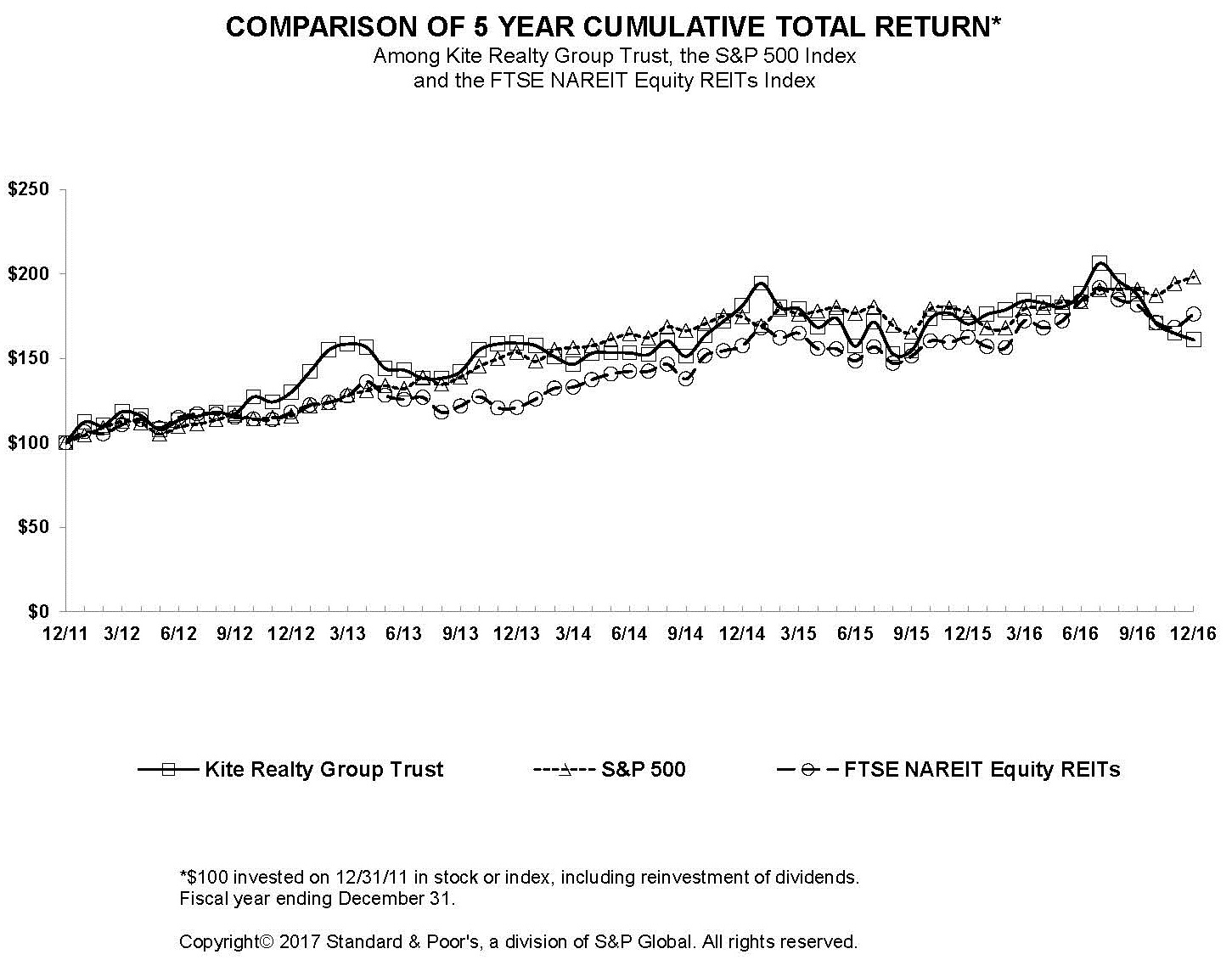
|
49
|
|
12/11
|
|
6/12
|
|
12/12
|
|
6/13
|
|
12/13
|
|
6/14
|
|
12/14
|
|
6/15
|
|
12/15
|
|
6/16
|
|
12/16
|
|
|||||||||||
|
Kite Realty Group Trust
|
100.00
|
|
113.37
|
|
130.03
|
|
143.08
|
|
159.02
|
|
153.25
|
|
181.28
|
|
157.26
|
|
170.41
|
|
188.16
|
|
160.95
|
|
|||||||||||
|
S&P 500
|
100.00
|
|
109.49
|
|
116.00
|
|
132.04
|
|
153.58
|
|
164.53
|
|
174.60
|
|
176.75
|
|
177.01
|
|
183.80
|
|
198.18
|
|
|||||||||||
|
FTSE NAREIT Equity REITs
|
100.00
|
|
114.91
|
|
118.06
|
|
125.73
|
|
120.97
|
|
142.33
|
|
157.43
|
|
148.50
|
|
162.46
|
|
184.20
|
|
176.30
|
|
|||||||||||
The following tables set forth, on a historical basis, selected unaudited financial and operating information. The financial information has been derived from our consolidated balance sheets and statements of operations. The share and per share information has been restated for the effects of our one-for-four reverse share split that occurred in August 2014. This information should be read in conjunction with our audited consolidated financial statements and Item 7, “Management’s Discussion and Analysis of Financial Condition and Results of Operations” appearing elsewhere in this Annual Report on Form 10-K.
50
|
($ in thousands)
|
Year Ended December 31 (Unaudited)
|
|||||||||||||||||||
|
|
2016
1
|
2015
2
|
2014
3
|
2013
4
|
2012
5
|
|||||||||||||||
|
Operating Data:
|
|
|
|
|
|
|
|
|
||||||||||||
|
Total rental related revenue
|
$
|
354,122
|
|
$
|
347,005
|
|
$
|
259,528
|
|
$
|
129,488
|
|
$
|
96,539
|
|
|||||
|
Expenses:
|
|
|
|
|
|
|||||||||||||||
|
Property operating
|
47,923
|
|
49,973
|
|
38,703
|
|
21,729
|
|
16,756
|
|
||||||||||
|
Real estate taxes
|
42,838
|
|
40,904
|
|
29,947
|
|
15,263
|
|
12,858
|
|
||||||||||
|
General, administrative, and other
|
20,603
|
|
18,709
|
|
13,043
|
|
8,211
|
|
7,117
|
|
||||||||||
|
Transaction costs
|
2,771
|
|
1,550
|
|
27,508
|
|
2,214
|
|
364
|
|
||||||||||
|
Litigation charge, net
|
—
|
|
—
|
|
—
|
|
—
|
|
1,007
|
|
||||||||||
|
Non-cash gain from release of assumed earnout liability
|
—
|
|
(4,832
|
)
|
—
|
|
—
|
|
—
|
|
||||||||||
|
Impairment charge
|
—
|
|
1,592
|
|
—
|
|
—
|
|
—
|
|
||||||||||
|
Depreciation and amortization
|
174,564
|
|
167,312
|
|
120,998
|
|
54,479
|
|
38,835
|
|
||||||||||
|
Total expenses
|
288,699
|
|
275,208
|
|
230,199
|
|
101,896
|
|
76,937
|
|
||||||||||
|
Operating income
|
65,423
|
|
71,797
|
|
29,329
|
|
27,592
|
|
19,602
|
|
||||||||||
|
Interest expense
|
(65,577
|
)
|
(56,432
|
)
|
(45,513
|
)
|
(27,994
|
)
|
(23,392
|
)
|
||||||||||
|
Income tax (expense) benefit of taxable REIT subsidiary
|
(814
|
)
|
(186
|
)
|
(24
|
)
|
(262
|
)
|
106
|
|
||||||||||
|
Non-cash gain on debt extinguishment
|
—
|
|
5,645
|
|
—
|
|
—
|
|
—
|
|
||||||||||
|
Gain on settlement
|
—
|
|
4,520
|
|
—
|
|
—
|
|
—
|
|
||||||||||
|
Remeasurement loss on consolidation of Parkside Town Commons, net
|
—
|
|
—
|
|
—
|
|
—
|
|
(7,980
|
)
|
||||||||||
|
Other (expense) income, net
|
(169
|
)
|
(95
|
)
|
(244
|
)
|
(62
|
)
|
209
|
|
||||||||||
|
(Loss) income from continuing operations
|
(1,137
|
)
|
25,249
|
|
(16,452
|
)
|
(726
|
)
|
(11,455
|
)
|
||||||||||
|
Discontinued operations:
|
|
|
|
|
|
|||||||||||||||
|
Income from operations, excluding impairment charge
|
—
|
|
—
|
|
—
|
|
834
|
|
656
|
|
||||||||||
|
Impairment charge
|
—
|
|
—
|
|
—
|
|
(5,372
|
)
|
—
|
|
||||||||||
|
Non-cash gain on debt extinguishment
|
—
|
|
—
|
|
—
|
|
1,242
|
|
—
|
|
||||||||||
|
Gain (loss) on sale of operating properties
|
—
|
|
—
|
|
3,198
|
|
487
|
|
7,094
|
|
||||||||||
|
Income (loss) from discontinued operations
|
—
|
|
—
|
|
3,198
|
|
(2,809
|
)
|
7,750
|
|
||||||||||
|
(Loss) income before gain on sale of operating properties
|
(1,137
|
)
|
25,249
|
|
(13,254
|
)
|
(3,535
|
)
|
(3,705
|
)
|
||||||||||
|
Gain on sale of operating properties, net
|
4,253
|
|
4,066
|
|
8,578
|
|
—
|
|
—
|
|
||||||||||
|
Consolidated net income (loss)
|
3,116
|
|
29,315
|
|
(4,676
|
)
|
(3,535
|
)
|
(3,705
|
)
|
||||||||||
|
Net (income) loss attributable to noncontrolling interests:
|
(1,933
|
)
|
(2,198
|
)
|
(1,025
|
)
|
685
|
|
(629
|
)
|
||||||||||
|
Net income (loss) attributable to Kite Realty Group Trust:
|
1,183
|
|
27,117
|
|
(5,701
|
)
|
(2,850
|
)
|
(4,334
|
)
|
||||||||||
|
Dividends on preferred shares
|
—
|
|
(7,877
|
)
|
(8,456
|
)
|
(8,456
|
)
|
(7,920
|
)
|
||||||||||
|
Non-cash adjustment for redemption of preferred shares
|
—
|
|
(3,797
|
)
|
—
|
|
—
|
|
—
|
|
||||||||||
|
Net income (loss) attributable to common shareholders
|
$
|
1,183
|
|
$
|
15,443
|
|
$
|
(14,157
|
)
|
$
|
(11,306
|
)
|
$
|
(12,254
|
)
|
|||||
|
Income (loss) per common share – basic:
|
|
|
|
|
|
|
||||||||||||||
|
Income (loss) from continuing operations attributable to Kite Realty Group Trust common shareholders
|
$
|
0.01
|
|
$
|
0.19
|
|
$
|
(0.29
|
)
|
$
|
(0.37
|
)
|
$
|
(1.04
|
)
|
|||||
|
Income (loss) from discontinued operations attributable to Kite Realty Group Trust common shareholders
|
—
|
|
—
|
|
0.05
|
|
(0.11
|
)
|
0.32
|
|
||||||||||
|
Net income (loss) attributable to Kite Realty Group Trust common shareholders
|
$
|
0.01
|
|
$
|
0.19
|
|
$
|
(0.24
|
)
|
$
|
(0.48
|
)
|
$
|
(0.72
|
)
|
|||||
|
Income (loss) per common share – diluted:
|
|
|
|
|
|
|
||||||||||||||
|
Income (loss) from continuing operations attributable to Kite Realty Group Trust common shareholders
|
$
|
0.01
|
|
$
|
0.18
|
|
$
|
(0.29
|
)
|
$
|
(0.37
|
)
|
$
|
(1.04
|
)
|
|||||
|
Income (loss) from discontinued operations attributable to Kite Realty Group Trust common shareholders
|
—
|
|
—
|
|
0.05
|
|
(0.11
|
)
|
0.32
|
|
||||||||||
|
Net income (loss) attributable to Kite Realty Group Trust common shareholders
|
$
|
0.01
|
|
$
|
0.18
|
|
$
|
(0.24
|
)
|
$
|
(0.48
|
)
|
$
|
(0.72
|
)
|
|||||
|
Weighted average Common Shares outstanding – basic
|
83,436,511
|
|
83,421,904
|
|
58,353,448
|
|
23,535,434
|
|
16,721,315
|
|
||||||||||
|
Weighted average Common Shares outstanding – diluted
|
83,465,500
|
|
83,534,381
|
|
58,353,448
|
|
23,535,434
|
|
16,721,315
|
|
||||||||||
|
Distributions declared per Common Share
|
$
|
1.17
|
|
$
|
1.09
|
|
$
|
1.02
|
|
$
|
0.96
|
|
$
|
0.96
|
|
|||||
|
Net income (loss) attributable to Kite Realty Group Trust common shareholders:
|
|
|
|
|
|
|||||||||||||||
|
Income (loss) from continuing operations
6
|
$
|
1,183
|
|
$
|
15,443
|
|
$
|
(17,268
|
)
|
$
|
(8,686
|
)
|
$
|
(17,571
|
)
|
|||||
|
Income (loss) from discontinued operations
|
—
|
|
—
|
|
3,111
|
|
(2,620
|
)
|
5,317
|
|
||||||||||
|
Net income (loss) attributable to Kite Realty Group Trust common shareholders
|
$
|
1,183
|
|
$
|
15,443
|
|
$
|
(14,157
|
)
|
$
|
(11,306
|
)
|
$
|
(12,254
|
)
|
|||||
51
|
____________________
|
|
|
1
|
In 2016, we disposed of two operating properties. The operations of these properties are not reflected as discontinued operations as none of the disposals individually, nor in the aggregate, represent a strategic shift that has or will have a major effect on our operations and financial results.
|
|
2
|
In 2015, we disposed of nine operating properties. The operations of these properties are not reflected as discontinued operations as none of the disposals individually, nor in the aggregate, represent a strategic shift that has or will have a major effect on our operations and financial results.
|
|
3
|
In 2014, we disposed of a number of operating properties. Of our 2014 disposals, the only property’s operations reflected as discontinued operations for each of the years presented is 50th and 12th, as the other disposals individually or in the aggregate did not represent a strategic shift that has or will have a major effect on our operations and financial results. Further, the 50th and 12th operating property is included in discontinued operations, as the property was classified as held for sale as of December 31, 2013.
|
|
4
|
In 2013, we disposed of the following properties: Cedar Hill Village and Kedron Village. The operations of these properties are reflected as discontinued operations for each of the years presented above.
|
|
5
|
In 2012, we sold the following operating properties: Pen Products, Indiana State Motor Pool, Sandifur Plaza, Preston Commons, Zionsville Place, Coral Springs Plaza, 50 South Morton, South Elgin Commons, and Gateway Shopping Center. The operations of these properties are reflected as discontinued operations for each of the years presented above.
|
|
6
|
Includes gain on sale of operating properties and preferred dividends.
|
|
($ in thousands)
|
As of December 31
|
|||||||||||||||||||
|
|
2016
|
2015
|
2014
|
2013
|
2012
|
|||||||||||||||
|
Balance Sheet Data (Unaudited):
|
|
|
|
|
|
|||||||||||||||
|
Investment properties, net
|
$
|
3,435,382
|
|
$
|
3,500,845
|
|
$
|
3,417,655
|
|
$
|
1,644,478
|
|
$
|
1,200,336
|
|
|||||
|
Cash and cash equivalents
|
19,874
|
|
33,880
|
|
43,826
|
|
18,134
|
|
12,483
|
|
||||||||||
|
Assets held for sale
|
—
|
|
—
|
|
179,642
|
|
—
|
|
—
|
|
||||||||||
|
Total assets
|
3,656,371
|
|
3,756,428
|
|
3,866,413
|
|
1,758,179
|
|
1,283,440
|
|
||||||||||
|
Mortgage and other indebtedness
|
1,731,074
|
|
1,724,449
|
|
1,546,460
|
|
851,396
|
|
694,692
|
|
||||||||||
|
Liabilities held for sale
|
—
|
|
—
|
|
81,164
|
|
—
|
|
—
|
|
||||||||||
|
Total liabilities
|
1,923,940
|
|
1,937,364
|
|
1,839,183
|
|
957,146
|
|
769,148
|
|
||||||||||
|
Limited partners' interests in Operating Partnership and other redeemable noncontrolling interests
|
88,165
|
|
92,315
|
|
125,082
|
|
43,928
|
|
37,670
|
|
||||||||||
|
Kite Realty Group Trust shareholders’ equity
|
1,643,574
|
|
1,725,976
|
|
1,898,784
|
|
753,557
|
|
473,086
|
|
||||||||||
|
Noncontrolling interests
|
692
|
|
773
|
|
3,364
|
|
3,548
|
|
3,536
|
|
||||||||||
|
Total liabilities and equity
|
3,656,371
|
|
3,756,428
|
|
3,866,413
|
|
1,758,179
|
|
1,283,440
|
|
||||||||||
The following discussion should be read in conjunction with the accompanying audited consolidated financial statements and related notes thereto and Item 1A, “Risk Factors,” appearing elsewhere in this Annual Report on Form 10-K. In this discussion, unless the context suggests otherwise, references to “our Company,” “we,” “us,” and “our” mean Kite Realty Group Trust and its direct and indirect subsidiaries, including Kite Realty Group, L.P.
Overview
In the following overview, we discuss, among other things, the status of our business and properties, the effect that current United States economic conditions is having on our retail tenants and us, and the current state of the financial markets and how it impacts our financing strategy.
Our Business and Properties
Kite Realty Group Trust is a publicly-held real estate investment trust which, through its majority-owned subsidiary, Kite Realty Group, L.P., owns interests in various operating subsidiaries and joint ventures engaged in the ownership, operation,
52
acquisition, development, and redevelopment of high-quality neighborhood and community shopping centers in selected markets in the United States. We derive revenues primarily from activities associated with the collection of contractual rents and reimbursement payments from tenants at our properties. Our operating results therefore depend materially on, among other things, the ability of our tenants to make required lease payments, the health and resilience of the United States retail sector, interest rate volatility, job growth and overall economic and real estate market conditions.
As of
December 31, 2016
, we owned interests in
119
operating and redevelopment properties consisting of
108
retail properties,
nine
retail redevelopment properties,
one
office operating property and an associated parking garage. We also owned
two
development projects under construction as of this date.
Portfolio Update
In evaluating acquisition, development, and redevelopment opportunities, we look for strong sub-markets where average household income is above the broader market average. We also focus on locations with population density, high traffic counts, and strong daytime workforce populations. Household incomes in our largest sub-markets are significantly higher than the medians for those broader markets.
In 2016, we transitioned the Holly Springs Towne Center – Phase II and Tamiami Crossing development projects to the operating portfolio. We also began construction on our expansion of Holly Springs – Phase II in the fourth quarter. Our 3-R initiative, which includes a total of 20 existing and potential projects, continued to progress in 2016. Ten of these projects are under construction with total estimated costs of
$58.0 million to $66.5 million
and estimated combined returns of 9.0% to 10.0%. There are 10 additional projects under active evaluation with potential estimated costs of $80 to $100 million and potential returns of 9.0% to 11.0%. We completed construction on four 3-R projects during the fourth quarter: Hitchcock Plaza, Shops at Moore, Tarpon Bay Plaza, and Traders Point.
In addition to targeting sub-markets with strong consumer demographics, we focus on having the appropriate tenant mix at each center. Many of our tenants are service-oriented or have a prominent online platform that has reduced the impact of the expansion of e-commerce on their operations. We have aggressively targeted and executed leases with notable grocers including Publix, Trader Joes, and Aldi along with soft goods retailers such as Ross Dress for Less, Ulta and Nordstrom Rack. Additionally, we have identified cost-efficient ways to optimize space for junior anchors such as right-sizing office supply stores and backfilling the existing space with a tenant more suitable to the larger space. In addition, many of our redevelopment projects include consolidating small shop space to accommodate construction of new junior anchor space.
Capital and Financing Activities
Our ability to obtain capital on satisfactory terms and to refinance borrowings as they mature is affected by the condition of the economy in general and by the financial strength of properties securing borrowings.
Throughout 2016, we strengthened our balance sheet by retiring multiple property-level secured loans and unencumbering the related assets securing the loans. We increased our liquidity through amending our existing unsecured revolving credit facility and unsecured term loan, which allows us the option to increase the borrowing capacity of the unsecured revolving credit facility to $1 billion and the option to increase our unsecured term loan to provide for an additional $200 million. We also issued $300 million of Notes in a public offering. As of December 31, 2016, we have reduced our term maturities through 2020 to approximately $90 million and extended our weighted-average debt maturities to 6.4 years.
The amount that we may borrow under our unsecured revolving credit facility is limited by the value of the assets in our unencumbered asset pool. As of
December 31, 2016
, the value of the assets in our unencumbered asset pool was
$420.4 million
. Taking into account outstanding borrowings and letters of credit, we had
$409.9 million
available under our unsecured revolving credit facility for future borrowings as of
December 31, 2016
. In addition, we had
$19.9 million
in cash and cash equivalents as of
December 31, 2016
.
53
The unencumbering of a number of properties, drawing the remaining amount on our 7-Year Term Loan, amending our existing unsecured revolving credit facility and unsecured term loan and issuing the Notes provides us with more flexibility for future capital activity. In addition, the investment grade credit ratings we received in 2014 provide us with access to the unsecured public bond market, which we may continue to use in the future to finance acquisition activity, repay debt maturing in the near term and fix interest rates.
Summary of Critical Accounting Policies and Estimates
Our significant accounting policies are more fully described in Note 2 to the accompanying consolidated financial statements. As disclosed in Note 2, the preparation of financial statements in accordance with GAAP requires management to make estimates and assumptions about future events that affect the amounts reported in the financial statements and accompanying notes. Actual results could differ from those estimates. We believe that the following discussion addresses our most critical accounting policies, which are those that are most important to the compilation of our financial condition and results of operations and require management’s most difficult, subjective, and complex judgments.
Valuation of Investment Properties
Management reviews operational and development projects, land parcels and intangible assets for impairment on at least a quarterly basis or whenever events or changes in circumstances indicate that the carrying value of the asset may not be recoverable. The review for possible impairment requires management to make certain assumptions and estimates and requires significant judgment. Impairment losses for investment properties and intangible assets are measured when the undiscounted cash flows estimated to be generated by the investment properties during the expected holding period are less than the carrying amounts of those assets. Impairment losses are recorded as the excess of the carrying value over the estimated fair value of the asset. Our impairment review for land and development properties assumes we have the intent and the ability to complete the developments or projected uses for the land parcels. If we determine those plans will not be completed or our assumptions with respect to operating assets are not realized, an impairment loss may be appropriate.
Depreciation may be accelerated for a redevelopment project, including partial demolition of existing structures after the asset is assessed for impairment.
Operating properties will be classified as held for sale only when those properties are available for immediate sale in their present condition and for which management believes it is probable that a sale of the property will be completed within one year, among other factors. Operating properties classified as held for sale are carried at the lower of cost or fair value less estimated costs to sell. Depreciation and amortization are suspended during the held-for-sale period.
Our operating properties have operations and cash flows that can be clearly distinguished from the rest of our activities. Historically, the operations reported in discontinued operations include those operating properties that were sold or were considered held for sale and for which operations and cash flows can be clearly distinguished. The operations from these properties are eliminated from ongoing operations, and we will not have a continuing involvement after disposition. In the first quarter of 2014, we adopted the provisions of ASU 2014-08,
Presentation of Financial Statements (Topic 205) and Property, Plant, and Equipment (Topic 360): Reporting Discontinued Operations and Disclosures of Disposals of Components of an Entity,
which will result in fewer real estate sales being classified within discontinued operations, as only disposals representing a strategic shift in operations will be presented as discontinued operations
.
All operating properties included in discontinued operations in 2014 were classified as such prior to the adoption of ASU 2014-08, and no properties that have been sold, or designated as held-for-sale, since the adoption of ASU 2014-08, have met the revised criteria for classification within discontinued operations.
Acquisition of Real Estate Investments
54
Upon acquisition of real estate operating properties, we estimate the fair value of acquired identifiable tangible assets and identified intangible assets and liabilities, assumed debt, and any noncontrolling interest in the acquiree at the date of acquisition, based on evaluation of information and estimates available at that date. Based on these estimates, we record the estimated fair value to the applicable assets and liabilities. In making estimates of fair values, a number of sources are utilized, including information obtained as a result of pre-acquisition due diligence, marketing and leasing activities. The estimates of fair value were determined to have primarily relied upon Level 2 and Level 3 inputs, as defined below.
Fair value is determined for tangible assets and intangibles, including:
|
•
|
the fair value of the building on an as-if-vacant basis and the fair value of land determined either by comparable market data, real estate tax assessments, independent appraisals or other relevant data;
|
|
•
|
above-market and below-market in-place lease values for acquired properties, which are based on the present value (using an interest rate which reflects the risks associated with the leases acquired) of the difference between (i) the contractual amounts to be paid pursuant to the in-place leases and (ii) management’s estimate of fair market lease rates for the corresponding in-place leases, measured over the remaining non-cancelable term of the leases. Any below-market renewal options are also considered in the in-place lease values. The capitalized above-market and below-market lease values are amortized as a reduction of or addition to rental income over the term of the lease. Should a tenant vacate, terminate its lease, or otherwise notify us of its intent to do so, the unamortized portion of the lease intangibles would be charged or credited to income;
|
|
•
|
the value of having a lease in place at the acquisition date. We utilize independent and internal sources for our estimates to determine the respective in-place lease values. Our estimates of value are made using methods similar to those used by independent appraisers. Factors we consider in our analysis include an estimate of costs to execute similar leases including tenant improvements, leasing commissions and foregone costs and rent received during the estimated lease-up period as if the space was vacant. The value of in-place leases is amortized to expense over the remaining initial terms of the respective leases; and
|
|
•
|
the fair value of any assumed financing that is determined to be above or below market terms. We utilize third party and independent sources for our estimates to determine the respective fair value of each mortgage payable. The fair market value of each mortgage payable is amortized to interest expense over the remaining initial terms of the respective loan.
|
We also consider whether there is any value to in-place leases that have a related customer relationship intangible value. Characteristics we consider in determining these values include the nature and extent of existing business relationships with the tenant, growth prospects for developing new business with the tenant, the tenant’s credit quality, and expectations of lease renewals, among other factors. To date, a tenant relationship has not been developed that is considered to have a current intangible value.
We finalize the measurement period of our business combinations when all facts and circumstances are understood, but in no circumstances will the measurement period exceed one year.
Revenue Recognition
As a lessor of real estate assets, the Company retains substantially all of the risks and benefits of ownership and account for its leases as operating leases.
Contractual rent, percentage rent, and expense reimbursements from tenants for common area maintenance costs, insurance and real estate taxes are our principal sources of revenue. Base minimum rents are recognized on a straight-line basis over the terms of the respective leases. Certain lease agreements contain provisions that grant additional rents based on a tenant’s sales volume (contingent overage rent). Overage rent is recognized when tenants achieve the specified sales targets as defined in their lease agreements. Overage rent is included in other property related revenue in the accompanying consolidated statements of operations. As a result of generating this revenue, we will routinely have accounts receivable due from tenants. We are subject to
55
tenant defaults and bankruptcies that may affect the collection of outstanding receivables. To address the collectability of these receivables, we analyze historical write-off experience, tenant credit-worthiness and current economic trends when evaluating the adequacy of our allowance for doubtful accounts and straight line rent reserve. Although we estimate uncollectible receivables and provide for them through charges against income, actual experience may differ from those estimates.
Gains or losses from sales of real estate are recognized when a sale has been consummated, the buyer’s initial and continuing investment is adequate to demonstrate a commitment to pay for the asset, we have transferred to the buyer the usual risks and rewards of ownership, and we do not have a substantial continuing financial involvement in the property. As part of our ongoing business strategy, we will, from time to time, sell land parcels and outlots, some of which are ground leased to tenants.
Fair Value Measurements
We follow the framework established under accounting standard FASB ASC 820 for measuring fair value of non-financial assets and liabilities that are not required or permitted to be measured at fair value on a recurring basis but only in certain circumstances, such as a business combination or upon determination of impairment.
Assets and liabilities recorded at fair value on the consolidated balance sheets are categorized based on the inputs to the valuation techniques as follows:
|
•
|
Level 1 fair value inputs are quoted prices in active markets for identical instruments to which we have access.
|
|
•
|
Level 2 fair value inputs are inputs other than quoted prices included in Level 1 that are observable for similar instruments, either directly or indirectly, and appropriately consider counterparty creditworthiness in the valuations.
|
|
•
|
Level 3 fair value inputs reflect our best estimate of inputs and assumptions market participants would use in pricing an instrument at the measurement date. The inputs are unobservable in the market and significant to the valuation estimate.
|
In instances where the determination of the fair value measurement is based on inputs from different levels of the fair value hierarchy, the level in the fair value hierarchy within which the entire fair value measurement falls is based on the lowest level input that is significant to the fair value measurement in its entirety. Our assessment of the significance of a particular input to the fair value measurement in its entirety requires judgment and considers factors specific to the asset or liability. As discussed in Note 10 to the Financial Statements, we have determined that its derivative valuations are classified in Level 2 of the fair value hierarchy.
Cash and cash equivalents, accounts receivable, escrows and deposits, and other working capital balances approximate fair value.
Note 7 to the Financial Statements includes a discussion of the fair values recorded for assets acquired and liabilities assumed. Note 8 to the Financial Statements includes a discussion of the fair values recorded when we recognized an impairment charge on our Shops at Otty operating property. Level 3 inputs to these transactions include our estimations of market leasing rates, tenant-related costs, discount rates, and disposal values.
Income Taxes and REIT Compliance
Parent Company
56
The Parent Company, which is considered a corporation for federal income tax purposes, has been organized and intends to continue to operate in a manner that will enable it to maintain its qualification as a REIT for federal income tax purposes. As a result, it generally will not be subject to federal income tax on the earnings that it distributes to the extent it distributes its “REIT taxable income” (determined before the deduction for dividends paid and excluding net capital gains) to shareholders of the Parent Company and meets certain other requirements on a recurring basis. To the extent that it satisfies this distribution requirement, but distributes less than 100% of its taxable income, it will be subject to federal corporate income tax on its undistributed REIT taxable income. REITs are subject to a number of organizational and operational requirements. If the Parent Company fails to qualify as a REIT in any taxable year, it will be subject to federal income tax on its taxable income at regular corporate rates for a period of four years following the year in which qualification is lost. We may also be subject to certain federal, state and local taxes on our income and property and to federal income and excise taxes on our undistributed taxable income even if the Parent Company does qualify as a REIT. The Operating Partnership intends to continue to make distributions to the Parent Company in amounts sufficient to assist the Parent Company in adhering to REIT requirements and maintaining its REIT status.
We have elected to treat Kite Realty Holdings, LLC as a taxable REIT subsidiary of the Operating Partnership, and we may elect to treat other subsidiaries as taxable REIT subsidiaries in the future. This election enables us to receive income and provide services that would otherwise be impermissible for a REIT. Deferred tax assets and liabilities are established for temporary differences between the financial reporting bases and the tax bases of assets and liabilities at the tax rates expected to be in effect when the temporary differences reverse. Deferred tax assets are reduced by a valuation allowance if it is more likely than not that some portion or all of the deferred tax asset will not be realized.
Operating Partnership
The allocated share of income and loss, other than the operations of our taxable REIT subsidiary, is included in the income tax returns of the Operating Partnership's partners. Accordingly, the only federal income taxes included in the accompanying consolidated financial statements are in connection with its taxable REIT subsidiary.
Inflation
Inflation rates have been near historical lows in recent years and, therefore, have not had a significant impact on our results of operations. Most of our leases contain provisions designed to mitigate the adverse impact of inflation by requiring the tenant to pay its share of operating expenses, including common area maintenance, real estate taxes and insurance, or include a fixed amount for these costs that escalates over time, thereby reducing our exposure to increases in operating expenses resulting from inflation. Also, most of our leases have original terms of fewer than ten years, which enables us to adjust rental rates to market upon lease renewal.
Results of Operations
As of
December 31, 2016
, we owned interests in
119
properties and two development projects currently under construction. The following table sets forth the total operating and redevelopment properties and development projects that we owned as of December 31, 2016, 2015 and 2014:
57
|
# of Properties
|
|||||||||
|
2016
|
2015
|
2014
|
|||||||
|
Retail Operating Properties
|
108
|
|
110
|
|
118
|
|
|||
|
Office Operating Properties
|
2
|
|
2
|
|
2
|
|
|||
|
Redevelopment Properties
|
9
|
|
6
|
|
3
|
|
|||
|
Total Operating and Redevelopment Properties
|
119
|
|
118
|
|
123
|
|
|||
|
Development Projects
|
2
|
|
3
|
|
4
|
|
|||
|
Total All Properties
|
121
|
|
121
|
|
127
|
|
|||
The comparability of results of operations is affected by our Merger with Inland Diversified on July 1, 2014 and by our development, redevelopment, and operating property acquisition and disposition activities in
2014
through
2016
. Therefore, we believe it is most useful to review the comparisons of our results of operations for these years (as set forth below under “Comparison of Operating Results for the Years Ended
December 31, 2016
and
2015
”
and “Comparison of Operating Results for the Years Ended
December 31, 2015
and
2014
”) in conjunction with the discussion of these activities during those periods, which is set forth below.
Property Acquisition Activities
During the three years ended
December 31, 2016
, we acquired the properties listed in the table below.
|
Property Name
|
MSA
|
Acquisition Date
|
Owned GLA
|
||||
|
Merger with Inland Diversified (60 operating properties)
|
Various
|
July 2014
|
10,719,471
|
|
|||
|
Rampart Commons
|
Las Vegas, NV
|
December 2014
|
81,292
|
|
|||
|
Colleyville Downs
|
Dallas, TX
|
April 2015
|
190,940
|
|
|||
|
Belle Isle Station
|
Oklahoma City, OK
|
May 2015
|
164,334
|
|
|||
|
Livingston Shopping Center
|
New York - Newark
|
July 2015
|
139,605
|
|
|||
|
Chapel Hill Shopping Center
|
Fort Worth / Dallas, TX
|
August 2015
|
126,755
|
|
|||
Operating Property Disposition Activities
During the three years ended
December 31, 2016
, we sold the operating properties listed in the table below.
58
|
Property Name
|
MSA
|
Disposition Date
|
Owned GLA
|
||||
|
50
th
and 12
th
(Walgreens)
1
|
Seattle, WA
|
January 2014
|
14,500
|
|
|||
|
Red Bank Commons
|
Evansville, IN
|
March 2014
|
34,258
|
|
|||
|
Ridge Plaza
|
Oak Ridge, NJ
|
March 2014
|
115,088
|
|
|||
|
Zionsville Walgreens
|
Zionsville, IN
|
September 2014
|
14,550
|
|
|||
|
Sale of eight operating properties
|
Various
2
|
November & December 2014
|
805,644
|
|
|||
|
Sale of seven operating properties
|
Various
2
|
March 2015
|
740,034
|
|
|||
|
Cornelius Gateway
|
Portland, OR
|
December 2015
|
21,326
|
|
|||
|
Four Corner Square
|
Seattle, WA
|
December 2015
|
107,998
|
|
|||
|
Shops at Otty
|
Portland, OR
|
June 2016
|
9,845
|
|
|||
|
Publix at St. Cloud
|
St. Cloud, FL
|
December 2016
|
78,820
|
|
|||
|
____________________
|
|
|
1
|
Operating property was classified in discontinued operations in the consolidated statements of operations for the year ended December 31, 2014.
|
|
2
|
Shortly after the Merger with Inland Diversified we identified and sold certain properties located in multiple MSAs that were not consistent with the Company's strategic plan.
|
Development Activities
During the three years ended
December 31, 2016
, the following significant development properties became operational or partially operational:
|
Property Name
|
MSA
|
Economic Occupancy Date
1
|
Owned GLA
|
||||
|
Parkside Town Commons – Phase I
|
Raleigh, NC
|
March 2014
|
55,390
|
|
|||
|
Parkside Town Commons – Phase II
|
Raleigh, NC
|
September 2014
|
347,642
|
|
|||
|
Holly Springs Towne Center – Phase II
|
Raleigh, NC
|
December 2015
|
122,009
|
|
|||
|
Tamiami Crossing
|
Naples, FL
|
March 2016
|
121,705
|
|
|||
|
____________________
|
|
|
1
|
Represents the earlier of 1) the date on which we started receiving rental payments under tenant leases or ground leases at the property or 2) the date the first tenant took possession of its space at the property.
|
Redevelopment Activities
During portions of the three years ended December 31,
2016
, the following properties were under redevelopment and removed from our operating portfolio:
59
|
Property Name
|
MSA
|
Transition to
Redevelopment
1
|
Transition to Operations
|
Owned GLA
|
|||||
|
King’s Lake Square
|
Naples, FL
|
July 2013
|
April 2014
|
88,314
|
|
||||
|
Bolton Plaza
|
Jacksonville, FL
|
June 2008
|
September 2014
|
154,555
|
|
||||
|
Gainesville Plaza
|
Gainesville, FL
|
June 2013
|
December 2015
|
162,243
|
|
||||
|
Cool Springs Market
|
Nashville, TN
|
July 2015
|
December 2015
|
230,980
|
|
||||
|
Courthouse Shadows
2
|
Naples, FL
|
June 2013
|
Pending
|
8,160
|
|
||||
|
Hamilton Crossing Centre
2
|
Indianapolis, IN
|
June 2014
|
Pending
|
92,283
|
|
||||
|
City Center
2
|
White Plains, NY
|
December 2015
|
Pending
|
313,139
|
|
||||
|
Fishers Station
2
|
Indianapolis, IN
|
December 2015
|
Pending
|
175,229
|
|
||||
|
Beechwood Promenade
2
|
Athens, GA
|
December 2015
|
Pending
|
353,970
|
|
||||
|
The Corner
2
|
Indianapolis, IN
|
December 2015
|
Pending
|
26,500
|
|
||||
|
Rampart Commons
2
|
Las Vegas, NV
|
March 2016
|
Pending
|
81,292
|
|
||||
|
Northdale Promenade
2
|
Tampa, FL
|
March 2016
|
Pending
|
179,680
|
|
||||
|
Burnt Store
2
|
Punta Gorda, FL
|
June 2016
|
Pending
|
95,787
|
|
||||
|
____________________
|
|
|
1
|
Transition date represents the date the property was transferred from our operating portfolio into redevelopment status.
|
|
2
|
These nine operating properties have been identified as redevelopment properties as they have been excluded from the same property pool.
|
Net Operating Income and Same Property Net Operating Income
We use property net operating income ("NOI"), a non-GAAP financial measure, to evaluate the performance of our properties. We define NOI as income from our real estate including lease termination fees received from tenants less our property operating expenses. NOI excludes amortization of capitalized tenant improvement costs and leasing commissions and corporate level expenses.
We believe that NOI, is helpful to investors as a measure of our operating performance because it excludes various items included in net income that do not relate to or are not indicative of our operating performance, such as depreciation and amortization, interest expense, and impairment, if any. We believe that Same Property NOI is helpful to investors as a measure of our operating performance because it includes only the NOI of properties that have been owned for the full period presented, which eliminates disparities in net income due to the redevelopment, acquisition or disposition of properties during the particular period presented and thus provides a more consistent metric for the comparison of our properties. NOI and Same Property NOI should not, however, be considered as alternatives to net income (calculated in accordance with GAAP) as indicators of our financial performance. Our computation of Same Property NOI may differ from the methodology used by other REITs, and therefore, may not be comparable to such other REITs.
When evaluating the properties that are included in the same property pool, we have established specific criteria for determining the inclusion of properties acquired or those recently under development. An acquired property is included in the same property pool when there is a full quarter of operations in both years subsequent to the acquisition date. Development and redevelopment properties are included in the same property pool 12 months after construction is substantially complete and the properties have been transferred to the operating portfolio. A redevelopment property is first excluded from the same property pool when the execution of a redevelopment plan is likely and we begin recapturing space from tenants. During various periods in 2016, between nine and 13 properties were excluded from the same property pool that were owned in both comparable periods but did not meet the criteria for inclusion in the same property pool.
The following table reflects Same Property NOI
1
and a reconciliation to net income attributable to common shareholders for the years ended
December 31, 2016
and
2015
(unaudited):
60
|
($ in thousands)
|
Years Ended December 31,
|
|
|||||||||
|
2016
|
2015
|
% Change
|
|||||||||
|
Leased percentage
|
95.3
|
%
|
95.5
|
%
|
|
||||||
|
Economic Occupancy percentage
2
|
93.4
|
%
|
92.9
|
%
|
|
||||||
|
Net operating income - same properties
3
|
$
|
215,330
|
|
$
|
209,229
|
|
2.9
|
%
|
|||
|
Net operating income - same properties excluding the properties in the 3-R initiative
|
3.7
|
%
|
|||||||||
|
Reconciliation of Same Property NOI to Most Directly Comparable GAAP Measure:
|
|
|
|
|
|
|
|||||
|
Net operating income - same properties
|
$
|
215,330
|
|
$
|
209,229
|
|
|
|
|||
|
Net operating income - non-same activity
4
|
48,031
|
|
46,899
|
|
|
|
|||||
|
Other expense, net
|
(983
|
)
|
(281
|
)
|
|
|
|||||
|
General, administrative and other
|
(20,603
|
)
|
(18,709
|
)
|
|
|
|||||
|
Transaction costs
|
(2,771
|
)
|
(1,550
|
)
|
|
|
|||||
|
Depreciation expense
|
(174,564
|
)
|
(167,312
|
)
|
|||||||
|
Non-cash gain from release of assumed earnout liability
|
—
|
|
4,832
|
|
|||||||
|
Impairment charge
|
—
|
|
(1,592
|
)
|
|
|
|||||
|
Interest expense
|
(65,577
|
)
|
(56,432
|
)
|
|
|
|||||
|
Gain on settlement
|
—
|
|
4,520
|
|
|||||||
|
Non-cash gain on debt extinguishment
|
—
|
|
5,645
|
|
|
|
|||||
|
Gains on sales of operating properties
|
4,253
|
|
4,066
|
|
|
|
|||||
|
Net income attributable to noncontrolling interests
|
(1,933
|
)
|
(2,198
|
)
|
|||||||
|
Dividends on preferred shares
|
—
|
|
(7,877
|
)
|
|||||||
|
Non-cash adjustment for redemption of preferred shares
|
—
|
|
(3,797
|
)
|
|||||||
|
Net income attributable to common shareholders
|
$
|
1,183
|
|
$
|
15,443
|
|
|||||
|
____________________
|
|
|
1
|
Same Property NOI excludes operating properties in redevelopment as well as office properties (Thirty South Meridian and Eddy Street Commons).
|
|
2
|
Excludes leases that are signed but under which tenants have not yet commenced the payment of cash rent. Calculated as a weighted average based on the timing of cash rent commencement during the period.
|
|
3
|
Same Property NOI excludes net gains from outlot sales, straight-line rent revenue, bad debt expense and recoveries, lease termination fees, amortization of lease intangibles and significant prior period expense recoveries and adjustments, if any.
|
|
4
|
Includes non-cash activity across the portfolio as well as net operating income from properties not included in the same property pool.
|
Our Same Property NOI increased
2.9%
in
2016
compared to
2015
. This increase was primarily due to increases in rental rates, increase in economic occupancy, and improved expense control and operating expense recovery resulting in an improvement in net recoveries of
$1.9 million
.
Funds From Operations
61
FFO is a widely used performance measure for real estate companies and is provided here as a supplemental measure of operating performance. We calculate FFO, a non-GAAP financial measure, in accordance with the best practices described in the April 2002 National Policy Bulletin of the National Association of Real Estate Investment Trusts ("NAREIT"). The NAREIT white paper defines FFO as net income (determined in accordance with GAAP), excluding gains (or losses) from sales and impairments of depreciated property, plus depreciation and amortization, and after adjustments for unconsolidated partnerships and joint ventures.
Considering the nature of our business as a real estate owner and operator, we believe that FFO is helpful to investors in measuring our operational performance because it excludes various items included in net income that do not relate to or are not indicative of our operating performance, such as gains or losses from sales of depreciated property and depreciation and amortization, which can make periodic and peer analyses of operating performance more difficult. For informational purposes, we have also provided FFO adjusted for a severance charge, accelerated amortization of debt issuance costs, a debt extinguishment loss and transaction costs in 2016, a non-cash adjustment for redemption of preferred shares in 2015, a gain on the resolution of an assumed contingency in 2015, and a gain on settlement and transaction costs in 2015. We believe this supplemental information provides a meaningful measure of our operating performance. We believe our presentation of FFO, as adjusted, provides investors with another financial measure that may facilitate comparison of operating performance between periods and among our peer companies. FFO should not be considered as an alternative to net income (determined in accordance with GAAP) as an indicator of our financial performance, is not an alternative to cash flow from operating activities (determined in accordance with GAAP) as a measure of our liquidity, and is not indicative of funds available to satisfy our cash needs, including our ability to make distributions. Our computation of FFO may not be comparable to FFO reported by other REITs that do not define the term in accordance with the current NAREIT definition or that interpret the current NAREIT definition differently than we do.
Our calculations of FFO
1
and reconciliation to consolidated net income and FFO, as adjusted for the years ended
December 31, 2016
,
2015
and
2014
(unaudited) are as follows:
|
($ in thousands)
|
Years Ended December 31,
|
|||||||||||
|
2016
|
2015
|
2014
|
||||||||||
|
Consolidated net income (loss)
|
$
|
3,116
|
|
$
|
29,315
|
|
$
|
(4,676
|
)
|
|||
|
Less: cash dividends on preferred shares
|
—
|
|
(7,877
|
)
|
(8,456
|
)
|
||||||
|
Less: non-cash adjustment for redemption of preferred shares
|
—
|
|
(3,797
|
)
|
—
|
|
||||||
|
Less: net income attributable to noncontrolling interests in properties
|
(1,844
|
)
|
(1,854
|
)
|
(1,435
|
)
|
||||||
|
Less: gains on sales of operating properties
|
(4,253
|
)
|
(4,066
|
)
|
(11,776
|
)
|
||||||
|
Add: impairment charge
|
—
|
|
1,592
|
|
—
|
|
||||||
|
Add: depreciation and amortization of consolidated entities, net of noncontrolling interests
|
173,578
|
|
166,509
|
|
120,452
|
|
||||||
|
FFO of the Operating Partnership
1
|
170,597
|
|
179,822
|
|
94,109
|
|
||||||
|
Less: Limited Partners' interests in FFO
|
(3,872
|
)
|
(3,789
|
)
|
(2,541
|
)
|
||||||
|
FFO attributable to Kite Realty Group Trust common shareholders
1
|
$
|
166,725
|
|
$
|
176,033
|
|
$
|
91,568
|
|
|||
|
FFO of the Operating Partnership
1
|
$
|
170,597
|
|
$
|
179,822
|
|
$
|
94,109
|
|
|||
|
Less: gain on settlement
|
—
|
|
(4,520
|
)
|
—
|
|
||||||
|
Add: accelerated amortization of debt issuance costs (non-cash)
|
1,121
|
|
—
|
|
—
|
|
||||||
|
Add: transaction costs
|
2,771
|
|
1,550
|
|
27,508
|
|
||||||
|
Add: severance charge
|
500
|
|
—
|
|
—
|
|
||||||
|
Add: adjustment for redemption of preferred shares (non-cash)
|
—
|
|
3,797
|
|
—
|
|
||||||
|
Less: gain from release of assumed earnout liability (non-cash)
|
—
|
|
(4,832
|
)
|
—
|
|
||||||
|
Add (less): loss (gain) on debt extinguishment
|
819
|
|
(5,645
|
)
|
—
|
|
||||||
|
FFO, as adjusted, of the Operating Partnership
|
$
|
175,808
|
|
$
|
170,172
|
|
$
|
121,617
|
|
|||
62
|
____________________
|
|
|
1
|
“FFO of the Operating Partnership" measures 100% of the operating performance of the Operating Partnership’s real estate properties. “FFO attributable to Kite Realty Group Trust common shareholders” reflects a reduction for the redeemable noncontrolling weighted average diluted interest in the Operating Partnership.
|
Earnings before Interest, Tax, Depreciation, and Amortization (EBITDA)
We define EBITDA, a non-GAAP financial measure, as net income before depreciation and amortization, interest expense and income tax expense of taxable REIT subsidiary. For informational purposes, we have also provided Adjusted EBITDA, which we define as EBITDA less (i) EBITDA from unconsolidated entities, (ii) gains on sales of operating properties or impairment charges, (iii) other income and expense, (iv) noncontrolling interest EBITDA and (v) other non-recurring activity or items impacting comparability from period to period. Annualized Adjusted EBITDA is Adjusted EBITDA for the most recent quarter multiplied by four. Net Debt to Adjusted EBITDA is our share of net debt divided by Annualized Adjusted EBITDA. EBITDA, Adjusted EBITDA, Annualized Adjusted EBITDA and Net Debt to Adjusted EBITDA, as calculated by us, are not comparable to EBITDA and EBITDA-related measures reported by other REITs that do not define EBITDA and EBITDA-related measures exactly as we do. EBITDA, Adjusted EBITDA and Annualized Adjusted EBITDA do not represent cash generated from operating activities in accordance with GAAP, and should not be considered alternatives to net income as an indicator of performance or as alternatives to cash flows from operating activities as an indicator of liquidity.
Considering the nature of our business as a real estate owner and operator, we believe that EBITDA, Adjusted EBITDA and the ratio of Net Debt to Adjusted EBITDA are helpful to investors in measuring our operational performance because they exclude various items included in net income that do not relate to or are not indicative of our operating performance, such as gains or losses from sales of depreciated property and depreciation and amortization, which can make periodic and peer analyses of operating performance more difficult. For informational purposes, we have also provided Annualized Adjusted EBITDA, adjusted as described above. We believe this supplemental information provides a meaningful measure of our operating performance. We believe presenting EBITDA and the related measures in this manner allows investors and other interested parties to form a more meaningful assessment of our operating results.
The following table presents a reconciliation of our EBITDA, Adjusted EBITDA and Annualized Adjusted EBITDA to consolidated net income (the most directly comparable GAAP measure) and a calculation of Net Debt to Adjusted EBITDA.
63
|
($ in thousands)
|
Three Months Ended
December 31, |
|||
|
Consolidated net income
|
$
|
3,900
|
|
|
|
Adjustments to net income:
|
|
|
||
|
Depreciation and amortization
|
42,939
|
|
||
|
Interest expense
|
17,613
|
|
||
|
Income tax expense of taxable REIT subsidiary
|
51
|
|
||
|
Earnings Before Interest, Taxes, Depreciation and Amortization (EBITDA)
|
64,503
|
|
||
|
Adjustments to EBITDA:
|
||||
|
Unconsolidated EBITDA
|
34
|
|
||
|
Gain on sales of operating properties
|
(4,059
|
)
|
||
|
Other income and expense, net
|
75
|
|
||
|
Noncontrolling interest
|
(461
|
)
|
||
|
Adjusted EBITDA
|
60,092
|
|
||
|
Annualized Adjusted EBITDA
1
|
$
|
240,368
|
|
|
|
Company share of net debt:
|
|
|
||
|
Mortgage and other indebtedness
|
1,731,074
|
|
||
|
Less: Partner share of consolidated joint venture debt
|
(13,737
|
)
|
||
|
Less: Cash
|
(28,911
|
)
|
||
|
Less: Debt Premium
|
(676
|
)
|
||
|
Company Share of Net Debt
|
1,687,750
|
|
||
|
Net Debt to Adjusted EBITDA
|
7.0x
|
|
||
|
____________________
|
|
|
1
|
Represents Adjusted EBITDA for the three months ended December 31, 2016 (as shown in the table above) multiplied by four.
|
Comparison of Operating Results for the Years Ended
December 31, 2016
and
2015
The comparability of results of operations is affected by our acquisitions of Colleyville Downs, Belle Isle Station, Livingston Shopping Center, and Chapel Hill Shopping Center in the second and third quarters of 2015 and the sales of seven operating properties in March 2015, two operating properties in December 2015, and two operating properties in early 2016. The following table reflects changes in the components of our consolidated statements of operations for the years ended
December 31, 2016
and
2015
:
64
|
($ in thousands)
|
2016
|
2015
|
Net change 2015 to 2016
|
||||||||
|
Revenue:
|
|
|
|
||||||||
|
Rental income (including tenant reimbursements)
|
$
|
344,541
|
|
$
|
334,029
|
|
$
|
10,512
|
|
||
|
Other property related revenue
|
9,581
|
|
12,976
|
|
(3,395
|
)
|
|||||
|
Total revenue
|
354,122
|
|
347,005
|
|
7,117
|
|
|||||
|
Expenses:
|
|
|
|
|
|
|
|||||
|
Property operating
|
47,923
|
|
49,973
|
|
(2,050
|
)
|
|||||
|
Real estate taxes
|
42,838
|
|
40,904
|
|
1,934
|
|
|||||
|
General, administrative, and other
|
20,603
|
|
18,709
|
|
1,894
|
|
|||||
|
Transaction costs
|
2,771
|
|
1,550
|
|
1,221
|
|
|||||
|
Non-cash gain from release of assumed earnout liability
|
—
|
|
(4,832
|
)
|
4,832
|
|
|||||
|
Impairment charge
|
—
|
|
1,592
|
|
(1,592
|
)
|
|||||
|
Depreciation and amortization
|
174,564
|
|
167,312
|
|
7,252
|
|
|||||
|
Total expenses
|
288,699
|
|
275,208
|
|
13,491
|
|
|||||
|
Operating income
|
65,423
|
|
71,797
|
|
(6,374
|
)
|
|||||
|
Interest expense
|
(65,577
|
)
|
(56,432
|
)
|
(9,145
|
)
|
|||||
|
Income tax expense of taxable REIT subsidiary
|
(814
|
)
|
(186
|
)
|
(628
|
)
|
|||||
|
Non-cash gain on debt extinguishment
|
—
|
|
5,645
|
|
(5,645
|
)
|
|||||
|
Gain on settlement
|
—
|
|
4,520
|
|
(4,520
|
)
|
|||||
|
Other expense, net
|
(169
|
)
|
(95
|
)
|
(74
|
)
|
|||||
|
(Loss) income before gain on sale of operating properties
|
(1,137
|
)
|
25,249
|
|
(26,386
|
)
|
|||||
|
Gain on sale of operating properties, net
|
4,253
|
|
4,066
|
|
187
|
|
|||||
|
Consolidated net income
|
3,116
|
|
29,315
|
|
(26,199
|
)
|
|||||
|
Net income attributable to noncontrolling interests
|
(1,933
|
)
|
(2,198
|
)
|
265
|
|
|||||
|
Net income attributable to Kite Realty Group Trust
|
1,183
|
|
27,117
|
|
(25,934
|
)
|
|||||
|
Dividends on preferred shares
|
—
|
|
(7,877
|
)
|
7,877
|
|
|||||
|
Non-cash adjustment for redemption of preferred shares
|
—
|
|
(3,797
|
)
|
3,797
|
|
|||||
|
Net income attributable to common shareholders
|
$
|
1,183
|
|
$
|
15,443
|
|
$
|
(14,260
|
)
|
||
|
Property operating expense to total revenue ratio
|
13.5
|
%
|
14.4
|
%
|
(0.9
|
)%
|
|||||
Rental income (including tenant reimbursements) increased
$10.5 million
, or
3.1%
, due to the following:
|
($ in thousands)
|
Net change 2015 to 2016
|
||
|
Properties acquired during 2015
|
$
|
7,275
|
|
|
Development properties that became operational or were partially operational in 2015 and/or 2016
|
4,917
|
|
|
|
Properties sold during 2015 and 2016
|
(5,762
|
)
|
|
|
Properties under redevelopment during 2015 and/or 2016
|
1,109
|
|
|
|
Properties fully operational during 2015 and 2016 and other
|
2,973
|
|
|
|
Total
|
$
|
10,512
|
|
The net increase of
$3.0 million
in rental income for properties fully operational during 2015 and 2016 is primarily attributable to an increase in rental rates, increase in economic occupancy percentage, and improved expense control and operating expense recovery resulting in an improvement in net recoveries of $1.9 million.
65
The average rents for new comparable leases signed in 2016 were
$20.83
per square foot compared to average expiring rents of
$17.57
per square foot in that period. The average rents for renewals signed in 2016 were
$15.85
per square foot compared to average expiring rents of
$14.79
per square foot in that period. Our same property economic occupancy improved to
93.4%
as of
December 31, 2016
from
92.9%
as of
December 31, 2015
. For our retail operating portfolio, annualized base rent per square foot improved to
$15.53
per square foot as of
December 31, 2016
, up from $15.22 per square foot as of
December 31, 2015
.
Other property related revenue primarily consists of parking revenues, overage rent, lease termination income and gains on sales of undepreciated assets. This revenue decreased by
$3.4 million
, primarily as a result lower gains on sales of undepreciated assets of $1.7 million, decreases of $1.1 million in lease termination income, and fluctuations in other miscellaneous activities.
Property operating expenses decreased
$2.1 million
, or
4.1%
, due to the following:
|
($ in thousands)
|
Net change 2015 to 2016
|
||
|
Properties acquired during 2015
|
$
|
1,577
|
|
|
Development properties that became operational or were partially operational in 2015 and/or 2016
|
683
|
|
|
|
Properties sold during 2015 and 2016
|
(1,288
|
)
|
|
|
Properties under redevelopment during 2015 and/or 2016
|
(444
|
)
|
|
|
Properties fully operational during 2015 and 2016 and other
|
(2,578
|
)
|
|
|
Total
|
$
|
(2,050
|
)
|
The net
$2.6 million
decrease for properties fully operational during 2015 and 2016 is primarily due to a combination of decreases of $1.2 million in bad debt expense, $0.8 million in trash removal expense as tenants began contracting for this item directly with outside vendors, $0.5 million in insurance costs as we generated efficiencies with our larger operating platform, $0.3 million in utility expense, and $0.2 million in snow removal expense. The decreases were offset by an increase of $0.5 million in landscaping expense.
As a percentage of revenue, property operating expenses decreased between years from 14.4% to 13.5%. The decrease was mostly due to an improvement in expense control and an improvement in operating expense recoveries from tenants as a result of higher occupancy rates.
Real estate taxes increased
$1.9 million
, or
4.7%
, due to the following:
|
($ in thousands)
|
Net change 2015 to 2016
|
||
|
Properties acquired during 2015
|
$
|
1,417
|
|
|
Development properties that became operational or were partially operational in 2015 and/or 2016
|
372
|
|
|
|
Properties sold during 2015 and 2016
|
(636
|
)
|
|
|
Properties under redevelopment during 2015 and/or 2016
|
(127
|
)
|
|
|
Properties fully operational during 2015 and 2016 and other
|
908
|
|
|
|
Total
|
$
|
1,934
|
|
66
The net
$0.9 million
increase in real estate taxes for properties fully operational during 2015 and 2016 is due to higher tax assessments at certain operating properties. The majority of our real estate tax expense is recoverable from tenants and reflected in tenant reimbursement revenue.
General, administrative and other expenses increased
$1.9 million
, or
10.1%
. The increase is due primarily to higher payroll costs and company overhead expenses of $1.4 million and a severance charge of $0.5 million in the first quarter of 2016.
Transaction costs generally consist of legal, lender, due diligence, and other expenses for professional services. Such costs increased
$1.2 million
as we had terminated transaction costs of $2.8 million in 2016, compared to property acquisition costs of $1.6 million over the same period in 2015.
We recorded a non-cash gain from the release of an assumed earnout liability of $4.8 million for the year ended December 31, 2015. The expiration date of the underlying third party earnout agreement was December 28, 2015, and the original sellers were unable to perform the necessary leasing activity by this date that would have resulted in payment by us of the previously recorded obligation.
We recorded an impairment charge of $1.6 million related to our Shops at Otty operating property for the year ended December 31, 2015. This charge was recorded due to our intent to sell the property in the near term, which shortened the intended holding period. This property was sold in the second quarter of 2016. See additional discussion in Note 8 to the consolidated financial statements.
Depreciation and amortization expense increased
$7.3 million
, or
4.3%
, due to the following:
|
($ in thousands)
|
Net change 2015 to 2016
|
||
|
Properties acquired during 2015
|
$
|
3,763
|
|
|
Development properties that became operational or were partially operational in 2015 and/or 2016
|
4,572
|
|
|
|
Properties sold during 2015 and 2016
|
(1,603
|
)
|
|
|
Properties under redevelopment during 2015 and/or 2016
|
2,434
|
|
|
|
Properties fully operational during 2015 and 2016 and other
|
(1,914
|
)
|
|
|
Total
|
$
|
7,252
|
|
The net increase of
$2.4 million
in properties under redevelopment during 2015 and 2016 is primarily due to an increase of $1.9 million in accelerated depreciation and amortization from the demolition of a portion of a building at one of our redevelopment properties. The net decrease of
$1.9 million
in depreciation at properties fully operational during
2015
and
2016
is due to a decrease in accelerated depreciation and amortization on tenant-specific assets from multiple tenants vacating at several operating properties in 2016, compared to the same period in 2015.
Interest expense increased $
9.1 million
or
16.2%
. The increase is due to recording $1.0 million in accelerated amortization of debt issuance costs from amending the unsecured term loans, retiring Term Loan A and securing longer-term fixed rate debt through the issuance of senior unsecured notes in the second half of 2015 and in the third quarter of 2016 that carried higher interest rates than the variable rate on our unsecured revolving credit facility, which was paid down with the proceeds. We also redeemed all of our outstanding preferred shares in the fourth quarter of 2015 using the proceeds from the senior unsecured notes. The increase is also due to certain development projects, including Parkside Town Commons - Phase I and Holly Springs Towne Center - Phase II becoming operational. As a portion of the project becomes operational, we cease capitalization of the related interest expense.
67
We recorded a non-cash gain on debt extinguishment of
$5.6 million
for the year ended December 31, 2015, related to the retirement of the $90 million loan secured by our City Center operating property.
We recorded a gain on settlement of $4.5 million for the year ended December 31, 2015, related to the settlement of a dispute related to eminent domain and related damages at one of our operating properties. See additional discussion in Note 3 to the consolidated financial statements.
Comparison of Operating Results for the Years Ended
December 31, 2015
and
2014
The comparability of results of operations is affected by our Merger with Inland Diversified and the acquisition of Rampart Commons in 2014, the acquisitions of Colleyville Downs, Belle Isle Station, Livingston Shopping Center, and Chapel Hill Shopping Center in 2015 and the sale of 15 properties sold in late 2014 and early 2015. The following table reflects income statement line items from our consolidated statements of operations for the years ended
December 31, 2015
and
2014
:
68
|
($ in thousands)
|
2015
|
2014
|
Net change 2014 to 2015
|
||||||||
|
Revenue:
|
|
|
|
||||||||
|
Rental income (including tenant reimbursements)
|
$
|
334,029
|
|
$
|
252,228
|
|
$
|
81,801
|
|
||
|
Other property related revenue
|
12,976
|
|
7,300
|
|
5,676
|
|
|||||
|
Total revenue
|
347,005
|
|
259,528
|
|
87,477
|
|
|||||
|
Expenses:
|
|
|
|
|
|
|
|||||
|
Property operating
|
49,973
|
|
38,703
|
|
11,270
|
|
|||||
|
Real estate taxes
|
40,904
|
|
29,947
|
|
10,957
|
|
|||||
|
General, administrative, and other
|
18,709
|
|
13,043
|
|
5,666
|
|
|||||
|
Merger and acquisition costs
|
1,550
|
|
27,508
|
|
(25,958
|
)
|
|||||
|
Non-cash gain from release of assumed earnout liability
|
(4,832
|
)
|
—
|
|
(4,832
|
)
|
|||||
|
Impairment charge
|
1,592
|
|
—
|
|
1,592
|
|
|||||
|
Depreciation and amortization
|
167,312
|
|
120,998
|
|
46,314
|
|
|||||
|
Total expenses
|
275,208
|
|
230,199
|
|
45,009
|
|
|||||
|
Operating income
|
71,797
|
|
29,329
|
|
42,468
|
|
|||||
|
Interest expense
|
(56,432
|
)
|
(45,513
|
)
|
(10,919
|
)
|
|||||
|
Income tax expense of taxable REIT subsidiary
|
(186
|
)
|
(24
|
)
|
(162
|
)
|
|||||
|
Non-cash gain on debt extinguishment
|
5,645
|
|
—
|
|
5,645
|
|
|||||
|
Gain on settlement
|
4,520
|
|
—
|
|
4,520
|
|
|||||
|
Other expense, net
|
(95
|
)
|
(244
|
)
|
149
|
|
|||||
|
Income (loss) from continuing operations
|
25,249
|
|
(16,452
|
)
|
41,701
|
|
|||||
|
Discontinued operations:
|
|
|
|
|
|
|
|||||
|
Gain on sales of operating properties, net
|
—
|
|
3,198
|
|
(3,198
|
)
|
|||||
|
Income (loss) from discontinued operations
|
—
|
|
3,198
|
|
(3,198
|
)
|
|||||
|
Income (loss) before gain on sale of operating properties
|
25,249
|
|
(13,254
|
)
|
38,503
|
|
|||||
|
Gain on sale of operating properties, net
|
4,066
|
|
8,578
|
|
(4,512
|
)
|
|||||
|
Consolidated net income (loss)
|
29,315
|
|
(4,676
|
)
|
33,991
|
|
|||||
|
Net income attributable to noncontrolling interests
|
(2,198
|
)
|
(1,025
|
)
|
(1,173
|
)
|
|||||
|
Net income (loss) attributable to Kite Realty Group Trust
|
27,117
|
|
(5,701
|
)
|
32,818
|
|
|||||
|
Dividends on preferred shares
|
(7,877
|
)
|
(8,456
|
)
|
579
|
|
|||||
|
Non-cash adjustment for redemption of preferred shares
|
(3,797
|
)
|
—
|
|
(3,797
|
)
|
|||||
|
Net income (loss) attributable to common shareholders
|
$
|
15,443
|
|
$
|
(14,157
|
)
|
$
|
29,600
|
|
||
|
Property operating expense to total revenue ratio
|
14.4
|
%
|
14.9
|
%
|
(0.5
|
)%
|
|||||
Rental income (including tenant reimbursements) increased $81.8 million, or 32.4%, due to the following:
69
|
($ in thousands)
|
Net change 2014 to 2015
|
||
|
Properties acquired during 2014 or 2015 and retained
|
$
|
82,672
|
|
|
Development properties that became operational or were partially operational in 2014 and/or 2015
|
3,468
|
|
|
|
Properties sold during 2014 or 2015 including properties acquired in the Merger
|
(11,420
|
)
|
|
|
Properties under redevelopment during 2014 and/or 2015 including properties acquired in the Merger
|
6,090
|
|
|
|
Properties fully operational during 2014 and 2015 and other
|
991
|
|
|
|
Total
|
$
|
81,801
|
|
The net increase of $1.0 million in rental income for properties fully operational in both years is primarily attributable to an increase in rental rates, and an improvement in economic occupancy.
The average rents for new comparable leases signed in 2015 were $20.23 per square foot compared to average expiring rents of $16.59 per square foot in that period. The average rents for renewals signed in 2015 were $12.58 per square foot compared to average expiring rents of $11.53 per square foot in that period. Our same property economic occupancy improved to 93.9% as of December 31, 2015 from 93.7% as of December 31, 2014. For our retail operating portfolio, annualized base rent per square foot improved to $15.22 per square foot as of December 31, 2015, up from $15.15 per square foot as of December 31, 2014.
Other property related revenue primarily consists of parking revenues, overage rent, specialty leasing income, lease termination income and gains related to sales of land parcels peripheral to our properties. This revenue increased by $5.7 million, primarily as a result of higher gains on land sales of $4.1 million, an increase of $0.5 million in specialty leasing income, an increase of $0.5 million in lease termination income and an increase in overage rent of $0.3 million.
Property operating expenses increased $11.3 million, or 29.1%, due to the following:
|
($ in thousands)
|
Net change 2014 to 2015
|
||
|
Properties acquired during 2014 or 2015 and retained
|
$
|
9,876
|
|
|
Development properties that became operational or were partially operational in 2014 and/or 2015
|
767
|
|
|
|
Properties sold during 2014 or 2015 including properties acquired in the Merger
|
(1,616
|
)
|
|
|
Properties under redevelopment during 2014 and/or 2015 including properties acquired in the Merger
|
1,811
|
|
|
|
Properties fully operational during 2014 and 2015 and other
|
432
|
|
|
|
Total
|
$
|
11,270
|
|
The net $0.4 million increase for properties fully operational is due to an increase of $1.5 million in on-site personnel and regional office costs, $0.7 million in bad debt expense, and $0.2 million in marketing costs, offset by a decrease of $0.5 million in insurance costs as we leveraged our larger operating platform, $1.1 million in repair and maintenance costs, and $0.4 million in snow removal costs.
Property operating expenses as a percentage of total revenue for the year ended December 31, 2015 were 14.4% compared to 14.9% over the same period in the prior year. The decrease was mostly due to higher other property related revenue and an improvement in expense recoveries from tenants as a result of higher economic occupancy rates. The overall recovery ratio for reimbursable expenses improved to 87.1% for the year ended December 31, 2015 compared to 85.3% for the year ended December 31, 2014.
70
Real estate taxes increased $11.0 million, or 36.6%, due to the following:
|
($ in thousands)
|
Net change 2014 to 2015
|
||
|
Properties acquired during 2014 or 2015 and retained
|
$
|
10,297
|
|
|
Development properties that became operational or were partially operational in 2014 and/or 2015
|
215
|
|
|
|
Properties sold during 2014 or 2015 including properties acquired in the Merger
|
(1,213
|
)
|
|
|
Properties under redevelopment during 2014 and/or 2015 including properties acquired in the Merger
|
1,012
|
|
|
|
Properties fully operational during 2014 and 2015 and other
|
646
|
|
|
|
Total
|
$
|
10,957
|
|
The net $0.6 million increase in real estate taxes for properties fully operational during 2014 and 2015 is due to higher tax assessments at certain operating properties. The majority of changes in our real estate tax expense is recoverable from tenants and, therefore, reflected in tenant reimbursement revenue.
General, administrative and other expenses increased $5.7 million, or 43.4%. The increase is due primarily to higher public company costs and personnel costs associated with the Merger. Our employee base increased from 95 full-time employees as of December 31, 2013 to 145 full-time employees as of December 31, 2015.
Transaction costs in 2014 related almost entirely to our Merger with Inland Diversified and totaled $27.5 million for the year ended December 31, 2014 compared to $1.6 million of costs for various property acquisitions for the year ended December 31, 2015.
We recorded a non-cash gain from the release of an assumed earnout liability of $4.8 million for the year ended December 31, 2015. The expiration date of the associated earnout liability was December 28, 2015, and the original sellers were unable to perform the necessary leasing activity that would have resulted in payment of the previously estimated obligation.
We recorded an impairment charge of $1.6 million related to our Shops at Otty operating property for the year ended December 31, 2015. See additional discussion in Note 8 to the consolidated financial statements.
Depreciation and amortization expense increased $46.3 million, or 38.3%, due to the following:
|
($ in thousands)
|
Net change 2014 to 2015
|
||
|
Properties acquired during 2014 or 2015 and retained
|
$
|
45,414
|
|
|
Development properties that became operational or were partially operational in 2014 and/or 2015
|
2,514
|
|
|
|
Properties sold during 2014 or 2015 including properties acquired in the Merger
|
(3,456
|
)
|
|
|
Properties under redevelopment during 2014 and/or 2015 including properties acquired in the Merger
|
3,870
|
|
|
|
Properties fully operational during 2014 and 2015 and other
|
(2,028
|
)
|
|
|
Total
|
$
|
46,314
|
|
The net $2.0 million decrease in depreciation at properties fully operational during 2014 and 2015 is mainly due to a tenant vacating at an operating property in 2014, which resulted in the acceleration of depreciation and amortization on certain assets.
71
Interest expense increased $10.9 million or 24.0%. The increase mainly resulted from our assumption of $859.6 million of debt as part of the Merger with Inland Diversified, in addition to draws on the unsecured revolving credit facility to fund a portion of our 2015 acquisitions. In addition, we secured longer-term fixed rate debt through the issuance of senior unsecured notes that carried higher interest rates than the variable rate on our unsecured revolving credit facility. The increase was also due to certain development projects, including Delray Marketplace and Parkside Town Commons - Phase I becoming operational. As a portion of the project becomes operational, we expense a pro-rata amount of related interest expense.
We recorded a non-cash gain on debt extinguishment of $5.6 million for the year ended December 31, 2015, related to the retirement of the $90 million loan secured by our City Center operating property.
We recorded a gain on settlement of $4.5 million for the year ended December 31, 2015, related to the settlement of a dispute related to eminent domain and related damages at one of our operating properties. See additional discussion in Note 3 to the consolidated financial statements.
The allocation of net income attributable to noncontrolling interests increased due to allocations to joint venture partners in certain consolidated properties acquired as part of the Merger with Inland Diversified. These partners are allocated income generally equal to the distribution received from the operations of the properties in which they hold an interest.
Liquidity and Capital Resources
Overview
Our primary finance and capital strategy is to maintain a strong balance sheet with sufficient flexibility to fund our operating and investment activities in a cost-effective manner. We consider a number of factors when evaluating our level of indebtedness and when making decisions regarding additional borrowings or equity offerings, including the estimated value of properties to be developed or acquired, the estimated market value of our properties and the Company as a whole upon placement of the borrowing or offering, and the ability of particular properties to generate cash flow to cover debt service. We will continue to monitor the capital markets and may consider raising additional capital through the issuance of our common or preferred shares, unsecured debt securities, or other securities.
Our Principal Capital Resources
For a discussion of cash generated from operations, see “Cash Flows,” beginning on page 74. In addition to cash generated from operations, we discuss below our other principal capital resources.
The increased operating cash flows of the Company have substantially enhanced our liquidity position and reduced our borrowing costs. We continue to focus on a balanced approach to growth and staggering debt maturities in order to retain our financial flexibility.
In 2016, we drew the remaining $100 million on our $200 million 7-Year Term Loan and used the proceeds to pay down the unsecured revolving credit facility. In addition, we completed a $300 million public offering of 4.00% Senior Notes due October 1, 2026. The net proceeds were utilized to retire both the $200 million Term Loan A and the $75.9 million construction loan secured by our Parkside Town Commons operating property and to fund portions of the retirement of the $25 million loan secured by our Colonial Square and Village Walk operating properties and the $10.4 million loan secured by our Geist Pavilion operating property. We also drew on our unsecured revolving credit facility to fund the retirement of an additional $128.8 million of property level secured debt in 2016.
72
As of
December 31, 2016
, we had approximately
$409.9 million
available under our unsecured revolving credit facility for future borrowings based on the unencumbered asset pool allocated to the unsecured revolving credit facility. We also had
$19.9 million
in cash and cash equivalents as of
December 31, 2016
.
We were in compliance with all applicable financial covenants under our unsecured revolving credit facility, our unsecured term loans, and our Notes as of
December 31, 2016
.
We have on file with the SEC a shelf registration statement on Form S-3 relating to the offer and sale, from time to time, of an indeterminate amount of equity and debt securities. Equity securities may be offered and sold by the Parent Company, and the net proceeds of any such offerings would be contributed to the Operating Partnership in exchange for additional General Partner Units. Debt securities may be offered and sold by the Operating Partnership with the Operating Partnership receiving the proceeds. From time to time, we may issue securities under this shelf registration statement to fund the repayment of long-term debt upon maturity and for other general corporate purposes.
We currently have an at-the-market equity program that allows us to issue new common shares from time to time, with an aggregate offering price of up to $250.0 million. During the year ended
December 31, 2016
, we issued 137,229 common shares at an average price per share of $29.52 pursuant to our at-the-market offering program, generating gross proceeds of approximately $4.1 million and, after deducting commissions and other costs, net proceeds of approximately $3.8 million. We have $245.9 million remaining available for future common share issuances under our current at-the-market equity program.
In the future, we will continue to monitor the capital markets and may consider raising additional capital through the issuance of our common shares, preferred shares or other securities. We may also raise capital by disposing of properties, land parcels or other assets that are no longer core components of our growth strategy. The sale price may differ from our carrying value at the time of sale.
Our Principal Liquidity Needs
Short-Term Liquidity Needs
Near-Term Debt Maturities
. As of
December 31, 2016
, we have
$6.7 million
of debt scheduled to mature in 2017, excluding scheduled monthly principal payments. We have sufficient liquidity to repay this obligation from current resources and our capacity on the unsecured revolving credit facility.
Other Short-Term Liquidity Needs.
The requirements for qualifying as a REIT and for a tax deduction for some or all of the dividends paid to shareholders, necessitate that we distribute at least 90% of our taxable income on an annual basis. Such requirements cause us to have substantial liquidity needs over both the short term and the long term. Our short-term liquidity needs consist primarily of funds necessary to pay operating expenses associated with our operating properties, interest expense and scheduled principal payments on our debt, expected dividend payments to our common shareholders and to Common Unit holders, and recurring capital expenditures.
In November 2016, our Board of Trustees declared a cash distribution of $0.3025 per common share and Common Unit for the fourth quarter of
2016
, which represented a 5.2% increase over our previous quarterly distribution. This distribution was paid on January 13, 2017 to common shareholders and Common Unit holders of record as of January 6, 2017. Future dividends are at the discretion of the Board of Trustees.
Other short-term liquidity needs include expenditures for tenant improvements, external leasing commissions and recurring capital expenditures. During the year ended
December 31, 2016
, we incurred
$9.3 million
of costs for tenant improvements and external leasing commissions (excluding first generation space and development and redevelopment properties) and
$1.6 million
of costs for recurring capital expenditures on our operating properties We currently anticipate incurring approximately $11 million
73
to $13 million of additional major tenant improvements and renovation costs within the next 12 months at a number of our operating properties.
We have 10 properties in our 3-R initiative that are currently under construction. Total estimated costs of this construction are expected to be in the range of
$58.0 million to $66.5 million
and are expected to be incurred through mid-2018. We expect to be able to fund these costs largely from operating cash flow.
As of
December 31, 2016
, we had
two
development projects under construction. The total estimated cost of the development projects is approximately
$90.6 million
, of which
$82.9 million
had been incurred as of
December 31, 2016
. We currently anticipate incurring the remaining
$7.7 million
of costs over the next 18 months. We believe we currently have sufficient financing in place to fund these projects and expect to do so primarily through borrowings on our unsecured revolving credit facility.
Long-Term Liquidity Needs
Our long-term liquidity needs consist primarily of funds necessary to pay for any new development projects, redevelopment of existing properties, non-recurring capital expenditures, acquisitions of properties, and payment of indebtedness at maturity.
Potential Redevelopment, Reposition, Repurpose Opportunities.
We are currently evaluating additional redevelopment, repositioning, and repurposing of several other operating properties as part of our 3-R initiative. Total estimated costs of these properties are expected to be in the range of
$80 million to $100 million
. We believe we will have sufficient funding for these projects through cash flow from operations and borrowings on our unsecured revolving credit facility.
Selective Acquisitions, Developments and Joint Ventures
. We may selectively pursue the acquisition and development of other properties, which would require additional capital. It is unlikely that we would have sufficient funds on hand to meet these long-term capital requirements. We would have to satisfy these needs through additional borrowings, sales of common or preferred shares, issuance of Operating Partnership units, cash generated through property dispositions or future property acquisitions and/or participation in joint venture arrangements. We cannot be certain that we would have access to these sources of capital on satisfactory terms, if at all, to fund our long-term liquidity requirements. We evaluate all future opportunities against pre-established criteria including, but not limited to, location, demographics, expected return, tenant credit quality, tenant relationships, and amount of existing retail space. Our ability to access the capital markets will be dependent on a number of factors, including general capital market conditions.
Capitalized Expenditures on Consolidated Properties
The following table summarizes cash capital expenditures for our development and redevelopment properties and other capital expenditures for the year ended
December 31, 2016
and on a cumulative basis since the project’s inception:
|
Year to Date
|
Cumulative
|
||||||
|
($ in thousands)
|
December 31, 2016
|
December 31, 2016
|
|||||
|
Developments
|
$
|
3,986
|
|
$
|
82,935
|
|
|
|
Under Construction 3-R Projects
|
25,543
|
|
N/A
|
|
|||
|
3-R Opportunities
|
4,815
|
|
N/A
|
|
|||
|
Recently completed developments/redevelopments
1
|
43,949
|
|
N/A
|
|
|||
|
Miscellaneous other activity, net
|
7,200
|
|
N/A
|
|
|||
|
Recurring operating capital expenditures (primarily tenant improvement payments)
|
8,826
|
|
N/A
|
|
|||
|
Total
|
$
|
94,319
|
|
$
|
82,935
|
|
|
74
|
____________________
|
|
|
1
|
This classification includes Holly Springs Towne Center - Phase II, Tamiami Crossing, and Cool Springs Market.
|
We capitalize certain indirect costs such as interest, payroll, and other general and administrative costs related to these development activities. If we were to experience a 10% reduction in development and redevelopment activities, without a corresponding decrease in indirect project costs, we would have recorded additional expense of $0.4 million for the year ended
December 31, 2016
.
Impact of Changes in Credit Ratings on Our Liquidity
In 2014, we were assigned investment grade corporate credit ratings from two nationally recognized credit rating agencies. These ratings remain unchanged at December 31, 2016.
The ratings could change based upon, among other things, the impact that prevailing economic conditions may have on our results of operations and financial condition. Credit rating reductions by one or more rating agencies could also adversely affect our access to funding sources, the cost and other terms of obtaining funding, as well as our overall financial condition, operating results and cash flow.
Cash Flows
As of
December 31, 2016
, we had cash and cash equivalents on hand of
$19.9 million
. We may be subject to concentrations of credit risk with regard to our cash and cash equivalents. We place our cash and short-term cash investments with high-credit-quality financial institutions. While we attempt to limit our exposure at any point in time, occasionally, such cash and investments may temporarily be in excess of FDIC and SIPC insurance limits. We also maintain certain compensating balances in several financial institutions in support of borrowings from those institutions. Such compensating balances were not material to the consolidated balance sheets.
Comparison of the Year Ended
December 31, 2016
to the Year Ended
December 31, 2015
Cash provided by operating activities was
$154.9 million
for the year ended
December 31, 2016
, a decrease of
$14.4 million
from the same period of
2015
. The decrease was primarily due to the timing of real estate tax payments and annual insurance payments and an increase in leasing costs.
Cash used in investing activities was $
82.7 million
for the year ended
December 31, 2016
, as compared to cash used in investing activities of
$84.4 million
in the same period of
2015
. Highlights of significant cash sources and uses are as follows:
|
•
|
Net proceeds of
$14.2 million
related to the sale of operating properties in 2016, compared to net proceeds of
$170.0 million
related to the sale of seven operating properties in March 2015 and the sale of our Four Corner Square and Cornelius Gateway operating properties in December 2015;
|
|
•
|
There were no property acquisitions in 2016, while there was a net cash outflow of
$166.4 million
related to acquisitions over the same period in 2015; and
|
|
•
|
Increase in capital expenditures of
$1.8 million
, in addition to a decrease in construction payables of
$3.0 million
. In 2016, we substantially completed construction at our Tamiami Crossing and Holly Springs Towne Center - Phase II development properties, and incurred additional construction costs at several of our redevelopment properties.
|
75
Cash used in financing activities was
$86.3 million
for the year ended
December 31, 2016
, compared to cash used in financing activities of
$94.9 million
in the same period of
2015
. Highlights of significant cash sources and uses in
2016
are as follows:
|
•
|
We retired approximately $139 million of secured loans that were secured by multiple operating properties via draws on our unsecured revolving credit facility;
|
|
•
|
We issued $300 million of our Notes in a public offering. The net proceeds of which were utilized to retire both the $200 million Term Loan A and the $75.9 million construction loan secured by our Parkside Town Commons operating property and to fund a portion of the retirement of $35 million in secured loans.
|
|
•
|
We drew the remaining $100 million on our $200 million 7-Year Term Loan and used the proceeds to pay down the unsecured revolving credit facility;
|
|
•
|
We issued
137,229
of our common shares at an average price per share of
$29.52
pursuant to our at-the-market equity program, generating gross proceeds of approximately
$4.1 million
and, after deducting commissions and other costs, net proceeds of approximately
$3.8 million
. The proceeds from these offerings were contributed to the Operating Partnership and used to pay down our unsecured revolving credit facility; and
|
|
•
|
We made distributions to common shareholders and Common Unit holders of
$98.6 million
.
|
Comparison of the Year Ended
December 31, 2015
to the Year Ended
December 31, 2014
Cash provided by operating activities was
$169.3 million
for the year ended
December 31, 2015
, a decrease of
$126.8 million
from the same period of
2014
. The increase was primarily due to the increased cash flows generated by the properties acquired in 2014.
Cash used in investing activities was
$84.4 million
for the year ended
December 31, 2015
, as compared to cash provided by investing activities of
$186.9 million
in the same period of
2014
. Highlights of significant cash sources and uses are as follows:
|
•
|
Net proceeds of $170.0 million related to the sale of seven operating properties in early 2015 and the sale of Four Corner and Cornelius Gateway operating properties in December 2015 compared to net proceeds of $191.1 million related to the sale of eight operating properties in late 2014 and the sale of Red Bank Commons, Ridge Plaza, and 50
th
and 12
th
operating properties in early 2014;
|
|
•
|
Net cash outflow of $166.4 million related to 2015 acquisitions compared to a net cash outflow of $22.5 million related to the 2014 acquisition of Rampart Commons; and
|
|
•
|
Decrease in capital expenditures of $2.0 million, in addition to a decrease in the change in construction payables of $19.5 million. In 2015, there was significant construction activity at Parkside Town Commons - Phase II, Tamiami Crossing, and Holly Springs Towne Center - Phase II.
|
Cash used in financing activities was
$94.9 million
for the year ended
December 31, 2015
, compared to cash used in financing activities of
$203.8 million
in the same period of
2014
. Highlights of significant cash sources and uses in
2015
are as follows:
|
•
|
We drew $102.6 million on the unsecured revolving credit facility to redeem all the outstanding shares of our Series A Preferred Shares; $59 million to fund a portion of the acquisitions of Colleyville Downs, Belle Isle Station, Livingston Shopping Center and Chapel Hill Shopping Center; $30 million to fund the acquisition of our partner's interest in our City Center operating property; and $14.7 million on construction loans related to development projects;
|
76
|
•
|
We retired the $12.2 million loan secured by our Indian River operating property, the $26.2 million loan secured by our Plaza Volente operating property and the $50.1 million loan secured by our Landstown Commons operating property;
|
|
•
|
We exercised the accordion option feature on the existing unsecured term loan to increase our total borrowings from $230 million to $400 million. The $170 million of proceeds were utilized to pay down our unsecured revolving credit facility by $140 million and to retire loans totaling $30.5 million that were secured by our Draper Peaks and Beacon Hill operating properties;
|
|
•
|
We issued $250 million of senior unsecured notes;
|
|
•
|
In September 2015, we paid off the remaining balance of $199.6 million on our unsecured revolving credit facility and the $33 million loan secured by our Crossing at Killingly operating property, using proceeds from the issuance of the senior unsecured notes, and then in December 2015, we entered into a new $33 million loan secured by our Crossing at Killingly operating property;
|
|
•
|
In connection with the sale of seven properties in March 2015, we retired the $24 million loan secured by the Regal Court property. We paid down our unsecured revolving credit facility by $27 million utilizing a portion of proceeds from these property sales. In addition in December 2015, we paid down our unsecured revolving credit facility utilizing gross proceeds of $44.9 million from the sales of Four Corner Square and Cornelius Gateway;
|
|
•
|
We entered into a 7-Year Term Loan for up to $200 million, and in December 2015 drew $100 million on the 7-Year Term Loan and used the proceeds to pay down the unsecured revolving credit facility that was initially utilized to retire the $90 million loan secured by our City Center operating property.
|
|
•
|
Distributions to common shareholders and Common Unit holders of $93.1 million; and
|
|
•
|
Distributions to preferred shareholders of $8.6 million.
|
In addition to the cash activity above, in August 2015, in connection with the acquisition of Chapel Hill Shopping Center, we assumed a $18.3 million loan secured by the operating property. As part of the estimated fair value determination, a debt premium of $0.2 million was recorded.
Other Matters
Financial Instruments
We are exposed to capital market risk, such as changes in interest rates. In order to reduce the volatility relating to interest rate risk, we may enter into interest rate hedging arrangements from time to time. We do not utilize derivative financial instruments for trading or speculative purposes.
Off-Balance Sheet Arrangements
We do not currently have any off-balance sheet arrangements that in our opinion have, or are reasonably likely to have, a material current or future effect on our financial condition, results of operations, liquidity, capital expenditures or capital resources. We do, however, have certain obligations related to some of the projects in our operating and development properties.
As of
December 31, 2016
, we have outstanding letters of credit totaling
$10.5 million
and no amounts were advanced against these instruments.
77
Contractual Obligations
The following table summarizes our contractual obligations to third parties based on contracts executed as of
December 31, 2016
.
|
($ in thousands)
|
Consolidated
Long-term Debt and Interest 1 |
Development Activity and Tenant
Allowances 2 |
Operating Ground
Leases |
Employment
Contracts 3 |
Total |
|||||||||||||||
|
2017
|
$
|
76,122
|
|
$
|
8,969
|
|
$
|
1,500
|
|
$
|
943
|
|
$
|
87,534
|
|
|||||
|
2018
|
106,566
|
|
—
|
|
1,357
|
|
—
|
|
107,923
|
|
||||||||||
|
2019
|
67,421
|
|
—
|
|
1,329
|
|
—
|
|
68,750
|
|
||||||||||
|
2020
|
109,063
|
|
—
|
|
1,338
|
|
—
|
|
110,401
|
|
||||||||||
|
2021
|
496,182
|
|
—
|
|
1,349
|
|
—
|
|
497,531
|
|
||||||||||
|
Thereafter
|
1,294,056
|
|
—
|
|
57,708
|
|
—
|
|
1,351,764
|
|
||||||||||
|
Total
|
$
|
2,149,410
|
|
$
|
8,969
|
|
$
|
64,581
|
|
$
|
943
|
|
$
|
2,223,903
|
|
|||||
|
____________________
|
|
|
1
|
Our long-term debt consists of both variable and fixed-rate debt and includes both principal and interest. Interest expense for variable-rate debt was calculated using the interest rates as of December 31, 2016.
|
|
2
|
Tenant allowances include commitments made to tenants at our operating and under construction development and redevelopment properties.
|
|
3
|
We have entered into employment agreements with certain members of senior management. The term of each employment agreement expires on June 30, 2017, with automatic one-year renewals each July 1st thereafter unless we or the individual elects not to renew the agreement.
|
Obligations in Connection with Development and Redevelopment Projects Under Construction
We are obligated under various completion guarantees with lenders and lease agreements with tenants to complete all or portions of our in-process development and redevelopment projects. We believe we currently have sufficient financing in place to fund our investment in any existing or future projects through cash from operations and borrowings on our unsecured revolving credit facility.
Our share of estimated future costs for our under construction and future developments and redevelopments is further discussed on page 73 in the "Short and Long-Term Liquidity Needs" section.
Outstanding Indebtedness
The following table presents details of outstanding consolidated indebtedness as of
December 31, 2016
and
2015
adjusted for hedges:
78
|
($ in thousands)
|
December 31,
2016 |
December 31,
2015 |
||||||
|
Senior unsecured notes
|
$
|
550,000
|
|
$
|
250,000
|
|
||
|
Unsecured revolving credit facility
|
79,600
|
|
20,000
|
|
||||
|
Unsecured term loans
|
400,000
|
|
500,000
|
|
||||
|
Notes payable secured by properties under construction - variable rate
|
—
|
|
132,776
|
|
||||
|
Mortgage notes payable - fixed rate
|
587,762
|
|
756,494
|
|
||||
|
Mortgage notes payable - variable rate
|
114,388
|
|
58,268
|
|
||||
|
Net debt premiums and issuance costs, net
|
(676
|
)
|
6,911
|
|
||||
|
Total mortgage and other indebtedness
|
$
|
1,731,074
|
|
$
|
1,724,449
|
|
||
Consolidated indebtedness, including weighted average maturities and weighted average interest rates at
December 31, 2016
, is summarized below:
|
($ in thousands)
|
Outstanding Amount
|
Weighted Average
Maturity (in years) |
Weighted Average
Interest Rate |
Ratio
|
||||||||
|
Fixed rate debt
1
|
$
|
1,612,054
|
|
6.5
|
|
4.09
|
%
|
93
|
%
|
|||
|
Variable rate debt
|
119,696
|
|
5.1
|
|
2.26
|
%
|
7
|
%
|
||||
|
Net debt premiums and issuance costs, net
|
(676
|
)
|
N/A
|
|
N/A
|
|
N/A
|
|
||||
|
Total
|
$
|
1,731,074
|
|
6.4
|
|
3.96
|
%
|
100
|
%
|
|||
|
____________________
|
|
|
1
|
Fixed rate debt includes, and variable rate date excludes, the portion of such debt that has been hedged by interest rate derivatives. As of December 31, 2016, $474.3 million in variable rate debt is hedged for a weighted average 2.7 years.
|
Mortgage indebtedness is collateralized by certain real estate properties and leases. Mortgage indebtedness is generally repaid in monthly installments of interest and principal and matures over various terms through 2030.
Variable interest rates on mortgage indebtedness are based on LIBOR plus spreads ranging from 160 to 225 basis points. At
December 31, 2016
, the one-month LIBOR interest rate was
0.77%
. Fixed interest rates on mortgage loans range from
3.78%
to
6.78%
.
79
Our future income, cash flows and fair values relevant to financial instruments depend upon prevailing interest rates. We are exposed to interest rate changes primarily through (1) our variable-rate unsecured credit facility and unsecured term loans, (2) property-specific variable-rate construction loans, and (3) other property-specific variable-rate mortgages. Our objectives with respect to interest rate risk are to limit the impact of interest rate changes on operations and cash flows, and to lower its overall borrowing costs. To achieve these objectives, we may borrow at fixed rates and may enter into derivative financial instruments such as interest rate swaps, hedges, etc., in order to mitigate its interest rate risk on a related variable-rate financial instrument. As a matter of policy, we do not utilize financial instruments for trading or speculative transactions.
We had
$1.7 billion
of outstanding consolidated indebtedness as of
December 31, 2016
(inclusive of unamortized net debt premiums and issuance costs, net of
$0.7 million
). As of
December 31, 2016
, we were party to various consolidated interest rate hedge agreements for a total of
$474.3 million
, with maturities over various terms ranging from
2017 through 2021
. Including the effects of these hedge agreements, our fixed and variable rate debt would have been
$1.6 billion
(93%) and
$0.1 billion
(7%), respectively, of our total consolidated indebtedness at
December 31, 2016
.
We have
$6.7 million
of fixed rate debt maturing within the next 12 months. A 100 basis point increase in market interest rates would not materially impact the annual cash flows associated with these loans. A 100 basis point change in interest rates on our unhedged variable rate debt as of
December 31, 2016
would change our annual cash flow by
$1.2 million
. Based upon the terms of our variable rate debt, we are most vulnerable to change in short-term LIBOR interest rates. The sensitivity analysis was estimated using cash flows discounted at current borrowing rates adjusted by 100 basis points.
The consolidated financial statements of the Company included in this Report are listed in Part IV, Item 15(a) of this report.
None.
Kite Realty Group Trust
Evaluation of Disclosure Controls and Procedures
An evaluation was performed under the supervision and with the participation of the Parent Company’s management, including its Chief Executive Officer and Chief Financial Officer, of the effectiveness of its disclosure controls and procedures (as defined in Rules 13a-15(e) and 15d-15(e) under the Securities and Exchange Act of 1934, as amended) as of the end of the period covered by this report. Based on that evaluation, the Parent Company's Chief Executive Officer and Chief Financial Officer concluded that these disclosure controls and procedures were effective.
Changes in Internal Control Over Financial Reporting
80
There has been no change in the Parent Company’s internal control over financial reporting (as defined in Rule 13a-15(f) under the Securities Exchange Act of 1934) identified in connection with the evaluation required by Rule 13a-15(b) under the Securities Exchange Act of 1934 of the effectiveness of our disclosure controls and procedures (as defined in Rule 13a-15(e) under the Securities Exchange Act of 1934) as of
December 31, 2016
that has materially affected, or is reasonably likely to materially affect, its internal control over financial reporting.
Management Report on Internal Control Over Financial Reporting
The Parent Company is responsible for establishing and maintaining adequate internal control over financial reporting, as that term is defined in Rule 13a-15(f) of the Exchange Act. Under the supervision of and with the participation of the Parent Company's management, including its Chief Executive Officer and Chief Financial Officer, the Parent Company conducted an evaluation of the effectiveness of its internal control over financial reporting based on the 2013 framework in
Internal Control – Integrated Framework
issued by the Committee of Sponsoring Organizations of the Treadway Commission. Based on its evaluation under the framework in
Internal Control – Integrated Framework,
the Parent Company's management has concluded that its internal control over financial reporting was effective as of
December 31, 2016
.
The Parent Company's independent auditors, Ernst & Young LLP, an independent registered public accounting firm, have issued a report on its internal control over financial reporting as stated in their report which is included herein.
The Parent Company's internal control system was designed to provide reasonable assurance to our management and Board of Trustees regarding the preparation and fair presentation of published financial statements. All internal control systems, no matter how well designed, have inherent limitations. Therefore, even those systems determined to be effective can provide only reasonable assurance with respect to financial statement preparation and presentation.
Kite Realty Group, L.P.
Evaluation of Disclosure Controls and Procedures
An evaluation was performed under the supervision and with the participation of the Operating Partnership’s management, including its Chief Executive Officer and Chief Financial Officer, of the effectiveness of its disclosure controls and procedures (as defined in Rules 13a-15(e) and 15d-15(e) under the Securities and Exchange Act of 1934, as amended) as of the end of the period covered by this report. Based on that evaluation, the Operating Partnership's Chief Executive Officer and Chief Financial Officer concluded that these disclosure controls and procedures were effective.
Changes in Internal Control Over Financial Reporting
There has been no change in the Operating Partnership’s internal control over financial reporting (as defined in Rule 13a-15(f) under the Securities Exchange Act of 1934) identified in connection with the evaluation required by Rule 13a-15(b) under the Securities Exchange Act of 1934 of the effectiveness of our disclosure controls and procedures (as defined in Rule 13a-15(e) under the Securities Exchange Act of 1934) as of
December 31, 2016
that has materially affected, or is reasonably likely to materially affect, its internal control over financial reporting.
Management Report on Internal Control Over Financial Reporting
The Operating Partnership is responsible for establishing and maintaining adequate internal control over financial reporting, as that term is defined in Rule 13a-15(f) of the Exchange Act. Under the supervision of and with the participation of the Operating Partnership's management, including its Chief Executive Officer and Chief Financial Officer, the Operating Partnership conducted an evaluation of the effectiveness of its internal control over financial reporting based on the 2013 framework in
Internal Control
– Integrated Framework
issued by the Committee of Sponsoring Organizations of the Treadway Commission. Based on its evaluation under the framework in
Internal Control – Integrated Framework,
the Operating Partnership's management has concluded that its internal control over financial reporting was effective as of
December 31, 2016
.
The Operating Partnership's independent auditors, Ernst & Young LLP, an independent registered public accounting firm, have issued a report on its internal control over financial reporting as stated in their report which is included herein.
The Operating Partnership's internal control system was designed to provide reasonable assurance to our management and Board of Trustees regarding the preparation and fair presentation of published financial statements. All internal control systems, no matter how well designed, have inherent limitations. Therefore, even those systems determined to be effective can provide only reasonable assurance with respect to financial statement preparation and presentation.
Report of Independent Registered Public Accounting Firm
The Board of Trustees and Shareholders of Kite Realty Group Trust:
We have audited Kite Realty Group Trust’s internal control over financial reporting as of December 31, 2016, based on criteria established in Internal Control - Integrated Framework issued by the Committee of Sponsoring Organizations of the Treadway Commission (2013 Framework) (the COSO criteria). Kite Realty Group Trust’s management is responsible for maintaining effective internal control over financial reporting, and for its assessment of the effectiveness of internal control over financial reporting included in the accompanying Management Report on Internal Control over Financial Reporting. Our responsibility is to express an opinion on the Company’s internal control over financial reporting based on our audit.
We conducted our audit in accordance with the standards of the Public Company Accounting Oversight Board (United States). Those standards require that we plan and perform the audit to obtain reasonable assurance about whether effective internal control over financial reporting was maintained in all material respects. Our audit included obtaining an understanding of internal control over financial reporting, assessing the risk that a material weakness exists, testing and evaluating the design and operating effectiveness of internal control based on the assessed risk, and performing such other procedures as we considered necessary in the circumstances. We believe that our audit provides a reasonable basis for our opinion.
A company’s internal control over financial reporting is a process designed to provide reasonable assurance regarding the reliability of financial reporting and the preparation of financial statements for external purposes in accordance with generally accepted accounting principles. A company’s internal control over financial reporting includes those policies and procedures that (1) pertain to the maintenance of records that, in reasonable detail, accurately and fairly reflect the transactions and dispositions of the assets of the company; (2) provide reasonable assurance that transactions are recorded as necessary to permit preparation of financial statements in accordance with generally accepted accounting principles, and that receipts and expenditures of the company are being made only in accordance with authorizations of management and directors of the company; and (3) provide reasonable assurance regarding prevention or timely detection of unauthorized acquisition, use or disposition of the company’s assets that could have a material effect on the financial statements.
Because of its inherent limitations, internal control over financial reporting may not prevent or detect misstatements. Also, projections of any evaluation of effectiveness to future periods are subject to the risk that controls may become inadequate because of changes in conditions, or that the degree of compliance with the policies or procedures may deteriorate.
In our opinion, Kite Realty Group Trust maintained, in all material respects, effective internal control over financial reporting as of December 31, 2016, based on the COSO criteria.
We also have audited, in accordance with the standards of the Public Company Accounting Oversight Board (United States), the consolidated balance sheets of Kite Realty Group Trust as of December 31, 2016 and 2015, and the related consolidated statements of operations and comprehensive income (loss), shareholders’ equity and cash flows for each of the three years in the period ended December 31, 2016 and the related financial statement schedule listed in the index at Item 15(a) as of December 31, 2016 of Kite Realty Group Trust and our report dated
February 27, 2017
expressed an unqualified opinion thereon.
/s/ Ernst & Young LLP
Indianapolis, Indiana
February 27, 2017
Report of Independent Registered Public Accounting Firm
The Board of Trustees of Kite Realty Group Trust and the Partners of Kite Realty Group, L.P. and subsidiaries:
We have audited Kite Realty Group, L.P. and subsidiaries’ internal control over financial reporting as of December 31, 2016, based on criteria established in Internal Control - Integrated Framework issued by the Committee of Sponsoring Organizations of the Treadway Commission (2013 Framework) (the COSO criteria). Kite Realty Group, L.P. and subsidiaries’ management is responsible for maintaining effective internal control over financial reporting, and for its assessment of the effectiveness of internal control over financial reporting included in the accompanying Management Report on Internal Control over Financial Reporting. Our responsibility is to express an opinion on the Partnership's internal control over financial reporting based on our audit.
We conducted our audit in accordance with the standards of the Public Company Accounting Oversight Board (United States). Those standards require that we plan and perform the audit to obtain reasonable assurance about whether effective internal control over financial reporting was maintained in all material respects. Our audit included obtaining an understanding of internal control over financial reporting, assessing the risk that a material weakness exists, testing and evaluating the design and operating effectiveness of internal control based on the assessed risk, and performing such other procedures as we considered necessary in the circumstances. We believe that our audit provides a reasonable basis for our opinion.
A company’s internal control over financial reporting is a process designed to provide reasonable assurance regarding the reliability of financial reporting and the preparation of financial statements for external purposes in accordance with generally accepted accounting principles. A company’s internal control over financial reporting includes those policies and procedures that (1) pertain to the maintenance of records that, in reasonable detail, accurately and fairly reflect the transactions and dispositions of the assets of the company; (2) provide reasonable assurance that transactions are recorded as necessary to permit preparation of financial statements in accordance with generally accepted accounting principles, and that receipts and expenditures of the company are being made only in accordance with authorizations of management and directors of the company; and (3) provide reasonable assurance regarding prevention or timely detection of unauthorized acquisition, use or disposition of the company’s assets that could have a material effect on the financial statements.
Because of its inherent limitations, internal control over financial reporting may not prevent or detect misstatements. Also, projections of any evaluation of effectiveness to future periods are subject to the risk that controls may become inadequate because of changes in conditions, or that the degree of compliance with the policies or procedures may deteriorate.
In our opinion, Kite Realty Group, L.P. and subsidiaries maintained, in all material respects, effective internal control over financial reporting as of December 31, 2016, based on the COSO criteria.
We also have audited, in accordance with the standards of the Public Company Accounting Oversight Board (United States), the consolidated balance sheets of Kite Realty Group, L.P. and subsidiaries as of December 31, 2016 and 2015, and the related consolidated statements of operations and comprehensive income (loss), partner’s equity and cash flows for each of the three years in the period ended December 31, 2016 and the related financial statement schedule listed in the index at Item 15(a) as of December 31, 2016 of Kite Realty Group, L.P. and subsidiaries and our report dated
February 27, 2017
expressed an unqualified opinion thereon.
/s/ Ernst & Young LLP
Indianapolis, Indiana
February 27, 2017
None
85
The information required by this Item is hereby incorporated by reference to the material appearing in our 2017 Annual Meeting Proxy Statement (the “Proxy Statement”), which we intend to file within 120 days after our fiscal year-end in accordance with Regulation 14A.
The information required by this Item is hereby incorporated by reference to the material appearing in our Proxy Statement.
The information required by this Item is hereby incorporated by reference to the material appearing in our Proxy Statement.
The information required by this Item is hereby incorporated by reference to the material appearing in our Proxy Statement.
The information required by this Item is hereby incorporated by reference to the material appearing in our Proxy Statement.
|
(a)
|
Documents filed as part of this report:
|
|||
|
|
(1)
|
Financial Statements:
|
||
|
|
|
Consolidated financial statements for the Company listed on the index immediately preceding the financial statements at the end of this report.
|
||
|
|
(2)
|
Financial Statement Schedule:
|
||
|
|
|
Financial statement schedule for the Company listed on the index immediately preceding the financial statements at the end of this report.
|
||
|
|
(3)
|
Exhibits:
|
||
|
|
|
The Company files as part of this report the exhibits listed on the Exhibit Index.
|
||
|
(b)
|
Exhibits:
|
|||
|
|
The Company files as part of this report the exhibits listed on the Exhibit Index. Other financial statement schedules are omitted because they are not applicable or the required information is shown in the financial statements or notes thereto.
|
|||
|
(c)
|
Financial Statement Schedule:
|
|||
|
|
The Company files as part of this report the financial statement schedule listed on the index immediately preceding the financial statements at the end of this report.
|
|||
SIGNATURES
Pursuant to the requirements of Section 13 or 15(d) of the Securities Exchange Act of 1934, the Registrant has duly caused this report to be signed on its behalf by the undersigned thereunto duly authorized.
|
|
KITE REALTY GROUP TRUST
|
|
|
|
|
(Registrant)
|
|
|
|
|
|
|
|
/s/ John A. Kite
|
|
|
|
John A. Kite
|
|
February 27, 2017
|
|
Chairman and Chief Executive Officer
|
|
(Date)
|
|
(Principal Executive Officer)
|
|
|
|
|
|
|
|
|
|
|
|
/s/ Daniel R. Sink
|
|
|
|
Daniel R. Sink
|
|
February 27, 2017
|
|
Chief Financial Officer
|
|
(Date)
|
|
(Principal Financial Officer)
|
|
|
KITE REALTY GROUP L.P. AND SUBSIDIARIES
|
|
|
|
|
(Registrant)
|
|
|
|
|
|
|
|
/s/ John A. Kite
|
|
|
|
John A. Kite
|
|
February 27, 2017
|
|
Chairman and Chief Executive Officer
|
|
(Date)
|
|
(Principal Executive Officer)
|
|
|
|
|
|
|
|
|
|
|
|
/s/ Daniel R. Sink
|
|
|
|
Daniel R. Sink
|
|
February 27, 2017
|
|
Chief Financial Officer
|
|
(Date)
|
|
(Principal Financial Officer)
|
Pursuant to the requirements of the Securities Exchange Act of 1934, this report has been signed below by persons on behalf of the Registrant and in the capacities and on the dates indicated.
88
|
Signature
|
|
Title
|
|
Date
|
|
|
|
|
|
|
|
/s/ John A. Kite
|
|
Chairman, Chief Executive Officer, and Trustee
(Principal Executive Officer)
|
|
February 27, 2017
|
|
(John A. Kite)
|
|
|
||
|
|
|
|
|
|
|
/s/ William E. Bindley
|
|
Trustee
|
|
February 27, 2017
|
|
(William E. Bindley)
|
|
|
|
|
|
|
|
|
|
|
|
/s/ Victor J. Coleman
|
|
Trustee
|
|
February 27, 2017
|
|
(Victor J. Coleman)
|
|
|
|
|
|
|
|
|
|
|
|
/s/ Christie B. Kelly
|
|
Trustee
|
|
February 27, 2017
|
|
(Christie B. Kelly)
|
|
|
|
|
|
|
|
|
|
|
|
/s/ David R. O’Reilly
|
|
Trustee
|
|
February 27, 2017
|
|
(David R. O’Reilly)
|
|
|
|
|
|
|
|
|
|
|
|
/s/ Barton R. Peterson
|
|
Trustee
|
|
February 27, 2017
|
|
(Barton R. Peterson)
|
|
|
|
|
|
|
|
|
|
|
|
/s/ Lee A. Daniels
|
|
Trustee
|
|
February 27, 2017
|
|
(Lee A. Daniels)
|
|
|
|
|
|
|
|
|
|
|
|
/s/ Gerald W. Grupe
|
|
Trustee
|
|
February 27, 2017
|
|
(Gerald W. Grupe)
|
|
|
|
|
|
|
|
|
|
|
|
/s/ Charles H. Wurtzebach
|
|
Trustee
|
|
February 27, 2017
|
|
(Charles H. Wurtzebach)
|
|
|
|
|
|
|
|
|
|
|
|
/s/ Daniel R. Sink
|
|
Chief Financial Officer (Principal Financial Officer)
|
|
February 27, 2017
|
|
(Daniel R. Sink)
|
|
|
||
|
|
|
|
|
|
|
/s/ Thomas R. Olinger
|
|
Senior Vice President, Chief Accounting Officer
|
|
February 27, 2017
|
|
(Thomas R. Olinger)
|
|
|
||
89
Kite Realty Group Trust and Kite Realty Group, L.P. and subsidiaries
Index to Financial Statements
|
|
|
Page
|
|
Consolidated Financial Statements:
|
|
|
|
Kite Realty Group Trust:
|
||
|
|
F-1
|
|
|
Kite Realty Group, L.P. and subsidiaries
|
||
|
F-2
|
||
|
Kite Realty Group Trust:
|
||
|
|
F-3
|
|
|
|
F-4
|
|
|
|
F-5
|
|
|
|
F-6
|
|
|
Kite Realty Group, L.P. and subsidiaries
|
||
|
F-7
|
||
|
F-8
|
||
|
F-9
|
||
|
F-10
|
||
|
Kite Realty Group Trust and Kite Realty Group, L.P. and subsidiaries:
|
||
|
|
F-11
|
|
|
Financial Statement Schedule:
|
|
|
|
Kite Realty Group Trust and Kite Realty Group, L.P. and subsidiaries:
|
||
|
|
F-44
|
|
|
|
F-49
|
|
|
|
All other schedules for which provision is made in the applicable accounting regulation of the Securities and Exchange Commission are not required under the related instructions or are inapplicable and therefore have been omitted.
|
|
Report of Independent Registered Public Accounting Firm
The Board of Trustees and Shareholders of Kite Realty Group Trust:
We have audited the accompanying consolidated balance sheets of Kite Realty Group Trust as of December 31, 2016 and 2015, and the related consolidated statements of operations and comprehensive income (loss), shareholders’ equity, and cash flows for each of the three years in the period ended December 31, 2016. Our audit also included the financial statement schedule listed in the index at Item 15(a). These financial statements and schedule are the responsibility of the Company’s management. Our responsibility is to express an opinion on these financial statements and schedule based on our audits.
We conducted our audits in accordance with the standards of the Public Company Accounting Oversight Board (United States). Those standards require that we plan and perform the audit to obtain reasonable assurance about whether the financial statements are free of material misstatement. An audit includes examining, on a test basis, evidence supporting the amounts and disclosures in the financial statements. An audit also includes assessing the accounting principles used and significant estimates made by management, as well as evaluating the overall financial statement presentation. We believe that our audits provide a reasonable basis for our opinion.
In our opinion, the financial statements referred to above present fairly, in all material respects, the consolidated financial position of Kite Realty Group Trust at December 31, 2016 and 2015, and the consolidated results of its operations and its cash flows for each of the three years in the period ended December 31, 2016, in conformity with U.S. generally accepted accounting principles. Also, in our opinion, the related financial statement schedule, when considered in relation to the basic financial statements taken as a whole, presents fairly in all material respects the information set forth therein.
We also have audited, in accordance with the standards of the Public Company Accounting Oversight Board (United States), the effectiveness of Kite Realty Group Trust’s internal control over financial reporting as of December 31, 2016, based on criteria established in Internal Control - Integrated Framework issued by the Committee of Sponsoring Organizations of the Treadway Commission (2013 Framework) and our report dated
February 27, 2017
expressed an unqualified opinion thereon.
/s/ Ernst & Young LLP
Indianapolis, Indiana
February 27, 2017
F-1
Report of Independent Registered Public Accounting Firm
The Board of Trustees of Kite Realty Group Trust and the Partners of Kite Realty Group, L.P. and subsidiaries:
We have audited the accompanying consolidated balance sheets of Kite Realty Group, L.P. and subsidiaries as of December 31, 2016 and 2015, and the related consolidated statements of operations and comprehensive income (loss), partner's equity, and cash flows for each of the three years in the period ended December 31, 2016. Our audit also included the financial statement schedule listed in the index at Item 15(a). These financial statements and schedule are the responsibility of the Partnership’s management. Our responsibility is to express an opinion on these financial statements and schedule based on our audits.
We conducted our audits in accordance with the standards of the Public Company Accounting Oversight Board (United States). Those standards require that we plan and perform the audit to obtain reasonable assurance about whether the financial statements are free of material misstatement. An audit includes examining, on a test basis, evidence supporting the amounts and disclosures in the financial statements. An audit also includes assessing the accounting principles used and significant estimates made by management, as well as evaluating the overall financial statement presentation. We believe that our audits provide a reasonable basis for our opinion.
In our opinion, the financial statements referred to above present fairly, in all material respects, the consolidated financial position of Kite Realty Group, L.P. and subsidiaries at December 31, 2016 and 2015, and the consolidated results of their operations and their cash flows for each of the three years in the period ended December 31, 2016, in conformity with U.S. generally accepted accounting principles. Also, in our opinion, the related financial statement schedule, when considered in relation to the basic financial statements taken as a whole, presents fairly in all material respects the information set forth therein.
We also have audited, in accordance with the standards of the Public Company Accounting Oversight Board (United States), the effectiveness of Kite Realty Group, L.P. and subsidiaries’ internal control over financial reporting as of December 31, 2016, based on criteria established in Internal Control - Integrated Framework issued by the Committee of Sponsoring Organizations of the Treadway Commission (2013 Framework) and our report dated
February 27, 2017
expressed an unqualified opinion thereon.
/s/ Ernst & Young LLP
Indianapolis, Indiana
February 27, 2017
F-2
Kite Realty Group Trust
($ in thousands, except share data)
|
|
December 31,
2016 |
December 31,
2015 |
|||||
|
Assets:
|
|
|
|
||||
|
Investment properties, at cost
|
$
|
3,996,065
|
|
$
|
3,933,140
|
|
|
|
Less: accumulated depreciation
|
(560,683
|
)
|
(432,295
|
)
|
|||
|
|
3,435,382
|
|
3,500,845
|
|
|||
|
Cash and cash equivalents
|
19,874
|
|
33,880
|
|
|||
|
Tenant and other receivables, including accrued straight-line rent of $28,703 and $23,809 respectively, net of allowance for uncollectible accounts
|
53,087
|
|
51,101
|
|
|||
|
Restricted cash and escrow deposits
|
9,037
|
|
13,476
|
|
|||
|
Deferred costs and intangibles, net
|
129,264
|
|
148,274
|
|
|||
|
Prepaid and other assets
|
9,727
|
|
8,852
|
|
|||
|
Total Assets
|
$
|
3,656,371
|
|
$
|
3,756,428
|
|
|
|
Liabilities and Equity:
|
|
|
|
|
|||
|
Mortgage and other indebtedness
|
$
|
1,731,074
|
|
$
|
1,724,449
|
|
|
|
Accounts payable and accrued expenses
|
80,664
|
|
81,356
|
|
|||
|
Deferred revenue and intangibles, net and other liabilities
|
112,202
|
|
131,559
|
|
|||
|
Total Liabilities
|
1,923,940
|
|
1,937,364
|
|
|||
|
Commitments and contingencies
|
|||||||
|
Limited partners' interests in Operating Partnership and other redeemable noncontrolling interests
|
88,165
|
|
92,315
|
|
|||
|
Equity:
|
|
|
|
|
|||
|
Kite Realty Group Trust Shareholders’ Equity
|
|
|
|
|
|||
|
Common Shares, $.01 par value, 225,000,000 shares authorized, 83,545,398 and 83,334,865 shares issued and outstanding at December 31, 2016 and
December 31, 2015, respectively |
835
|
|
833
|
|
|||
|
Additional paid in capital and other
|
2,062,360
|
|
2,050,545
|
|
|||
|
Accumulated other comprehensive loss
|
(316
|
)
|
(2,145
|
)
|
|||
|
Accumulated deficit
|
(419,305
|
)
|
(323,257
|
)
|
|||
|
Total Kite Realty Group Trust Shareholders' Equity
|
1,643,574
|
|
1,725,976
|
|
|||
|
Noncontrolling Interests
|
692
|
|
773
|
|
|||
|
Total Equity
|
1,644,266
|
|
1,726,749
|
|
|||
|
Total Liabilities and Equity
|
$
|
3,656,371
|
|
$
|
3,756,428
|
|
|
The accompanying notes are an integral part of these consolidated financial statements.
F-3
Kite Realty Group Trust
($ in thousands, except share and per share data)
|
|
Year Ended December 31,
|
||||||||||
|
|
2016
|
2015
|
2014
|
||||||||
|
Revenue:
|
|
|
|
|
|
||||||
|
Minimum rent
|
$
|
274,059
|
|
$
|
263,794
|
|
$
|
199,455
|
|
||
|
Tenant reimbursements
|
70,482
|
|
70,235
|
|
52,773
|
|
|||||
|
Other property related revenue
|
9,581
|
|
12,976
|
|
7,300
|
|
|||||
|
Total revenue
|
354,122
|
|
347,005
|
|
259,528
|
|
|||||
|
Expenses:
|
|
|
|||||||||
|
Property operating
|
47,923
|
|
49,973
|
|
38,703
|
|
|||||
|
Real estate taxes
|
42,838
|
|
40,904
|
|
29,947
|
|
|||||
|
General, administrative, and other
|
20,603
|
|
18,709
|
|
13,043
|
|
|||||
|
Transaction costs
|
2,771
|
|
1,550
|
|
27,508
|
|
|||||
|
Non-cash gain from release of assumed earnout liability
|
—
|
|
(4,832
|
)
|
—
|
|
|||||
|
Impairment charge
|
—
|
|
1,592
|
|
—
|
|
|||||
|
Depreciation and amortization
|
174,564
|
|
167,312
|
|
120,998
|
|
|||||
|
Total expenses
|
288,699
|
|
275,208
|
|
230,199
|
|
|||||
|
Operating income
|
65,423
|
|
71,797
|
|
29,329
|
|
|||||
|
Interest expense
|
(65,577
|
)
|
(56,432
|
)
|
(45,513
|
)
|
|||||
|
Income tax expense of taxable REIT subsidiary
|
(814
|
)
|
(186
|
)
|
(24
|
)
|
|||||
|
Non-cash gain on debt extinguishment
|
—
|
|
5,645
|
|
—
|
|
|||||
|
Gain on settlement
|
—
|
|
4,520
|
|
—
|
|
|||||
|
Other expense, net
|
(169
|
)
|
(95
|
)
|
(244
|
)
|
|||||
|
(Loss) income from continuing operations
|
(1,137
|
)
|
25,249
|
|
(16,452
|
)
|
|||||
|
Discontinued operations
|
|
|
|
|
|
|
|||||
|
Gain on sales of operating properties, net
|
—
|
|
—
|
|
3,198
|
|
|||||
|
Income from discontinued operations
|
—
|
|
—
|
|
3,198
|
|
|||||
|
(Loss) income before gain on sale of operating properties
|
(1,137
|
)
|
25,249
|
|
(13,254
|
)
|
|||||
|
Gain on sale of operating properties, net
|
4,253
|
|
4,066
|
|
8,578
|
|
|||||
|
Consolidated net income (loss)
|
3,116
|
|
29,315
|
|
(4,676
|
)
|
|||||
|
Net income attributable to noncontrolling interests
|
(1,933
|
)
|
(2,198
|
)
|
(1,025
|
)
|
|||||
|
Net income (loss) attributable to Kite Realty Group Trust
|
1,183
|
|
27,117
|
|
(5,701
|
)
|
|||||
|
Dividends on preferred shares
|
—
|
|
(7,877
|
)
|
(8,456
|
)
|
|||||
|
Non-cash adjustment for redemption of preferred shares
|
—
|
|
(3,797
|
)
|
—
|
|
|||||
|
Net income (loss) attributable to common shareholders
|
$
|
1,183
|
|
$
|
15,443
|
|
$
|
(14,157
|
)
|
||
|
Net income (loss) per common share – basic:
|
|
|
|
|
|
|
|||||
|
Income (loss) from continuing operations attributable to Kite Realty Group Trust common shareholders
|
$
|
0.01
|
|
$
|
0.19
|
|
$
|
(0.29
|
)
|
||
|
Income from discontinued operations attributable to Kite Realty Group Trust common shareholders
|
—
|
|
—
|
|
0.05
|
|
|||||
|
Net income (loss) attributable to Kite Realty Group Trust common shareholders
|
$
|
0.01
|
|
$
|
0.19
|
|
$
|
(0.24
|
)
|
||
|
Net income (loss) per common share – diluted:
|
|
|
|
|
|
|
|||||
|
Income (loss) from continuing operations attributable to Kite Realty Group Trust common shareholders
|
$
|
0.01
|
|
$
|
0.18
|
|
$
|
(0.29
|
)
|
||
|
Income from discontinued operations attributable to Kite Realty Group Trust common shareholders
|
—
|
|
—
|
|
0.05
|
|
|||||
|
Net income (loss) attributable to Kite Realty Group Trust common shareholders
|
$
|
0.01
|
|
$
|
0.18
|
|
$
|
(0.24
|
)
|
||
|
Weighted average common shares outstanding - basic
|
83,436,511
|
|
83,421,904
|
|
58,353,448
|
|
|||||
|
Weighted average common shares outstanding - diluted
|
83,465,500
|
|
83,534,381
|
|
58,353,448
|
|
|||||
|
Dividends declared per common share
|
$
|
1.165
|
|
$
|
1.090
|
|
$
|
1.020
|
|
||
|
Net income (loss) attributable to Kite Realty Group Trust common shareholders:
|
|
|
|
|
|
|
|||||
|
Income (loss) from continuing operations
|
$
|
1,183
|
|
$
|
15,443
|
|
$
|
(17,268
|
)
|
||
|
Income from discontinued operations
|
—
|
|
—
|
|
3,111
|
|
|||||
|
Net income (loss) attributable to Kite Realty Group Trust common shareholders
|
$
|
1,183
|
|
$
|
15,443
|
|
$
|
(14,157
|
)
|
||
|
Consolidated net income (loss)
|
$
|
3,116
|
|
$
|
29,315
|
|
$
|
(4,676
|
)
|
||
|
Change in fair value of derivatives
|
1,871
|
|
(995
|
)
|
(2,621
|
)
|
|||||
|
Total comprehensive income (loss)
|
4,987
|
|
28,320
|
|
(7,297
|
)
|
|||||
|
Comprehensive income attributable to noncontrolling interests
|
(1,975
|
)
|
(2,173
|
)
|
(932
|
)
|
|||||
|
Comprehensive income (loss) attributable to Kite Realty Group Trust
|
$
|
3,012
|
|
$
|
26,147
|
|
$
|
(8,229
|
)
|
||
The accompanying notes are an integral part of these consolidated financial statements.
F-4
Kite Realty Group Trust
Consolidated Statements of Shareholders’ Equity
($ in thousands, except share data)
|
|
Preferred Shares
|
Common Shares
|
Additional
Paid-in Capital
|
Accumulated Other
Comprehensive Loss
|
Accumulated
Deficit
|
Total
|
|||||||||||||||||||||||
|
Shares
|
Amount
|
Shares
|
Amount
|
||||||||||||||||||||||||||
|
Balances, December 31, 2013
|
4,100,000
|
|
$
|
102,500
|
|
32,706,554
|
|
$
|
327
|
|
$
|
822,507
|
|
$
|
1,353
|
|
$
|
(173,130
|
)
|
$
|
753,557
|
|
|||||||
|
Common shares issued under employee share purchase plan
|
—
|
|
—
|
|
1,812
|
|
—
|
|
46
|
|
—
|
|
—
|
|
46
|
|
|||||||||||||
|
Common shares issued as part of Merger, net of offering costs
|
—
|
|
—
|
|
50,272,308
|
|
503
|
|
1,232,684
|
|
—
|
|
—
|
|
1,233,187
|
|
|||||||||||||
|
Common shares retired in connection with reverse share split
|
—
|
|
—
|
|
(2,436
|
)
|
—
|
|
(60
|
)
|
—
|
|
—
|
|
(60
|
)
|
|||||||||||||
|
Stock compensation activity
|
—
|
|
—
|
|
490,425
|
|
5
|
|
3,294
|
|
—
|
|
—
|
|
3,299
|
|
|||||||||||||
|
Other comprehensive loss attributable to Kite Realty Group Trust
|
—
|
|
—
|
|
—
|
|
—
|
|
—
|
|
(2,528
|
)
|
—
|
|
(2,528
|
)
|
|||||||||||||
|
Distributions declared to common shareholders
|
—
|
|
—
|
|
—
|
|
—
|
|
—
|
|
—
|
|
(60,514
|
)
|
(60,514
|
)
|
|||||||||||||
|
Distributions to preferred shareholders
|
—
|
|
—
|
|
—
|
|
—
|
|
—
|
|
—
|
|
(8,456
|
)
|
(8,456
|
)
|
|||||||||||||
|
Net loss attributable to Kite Realty Group Trust
|
—
|
|
—
|
|
—
|
|
—
|
|
—
|
|
—
|
|
(5,701
|
)
|
(5,701
|
)
|
|||||||||||||
|
Exchange of redeemable noncontrolling interests for common shares
|
—
|
|
—
|
|
22,000
|
|
—
|
|
567
|
|
—
|
|
—
|
|
567
|
|
|||||||||||||
|
Adjustment to redeemable noncontrolling interests
|
—
|
|
—
|
|
—
|
|
—
|
|
(14,613
|
)
|
—
|
|
—
|
|
(14,613
|
)
|
|||||||||||||
|
Balances, December 31, 2014
|
4,100,000
|
|
$
|
102,500
|
|
83,490,663
|
|
$
|
835
|
|
$
|
2,044,425
|
|
$
|
(1,175
|
)
|
$
|
(247,801
|
)
|
$
|
1,898,784
|
|
|||||||
|
Stock compensation activity
|
—
|
|
—
|
|
(173,798
|
)
|
(2
|
)
|
3,744
|
|
—
|
|
—
|
|
3,742
|
|
|||||||||||||
|
Other comprehensive loss attributable to Kite Realty Group Trust
|
—
|
|
—
|
|
—
|
|
—
|
|
—
|
|
(970
|
)
|
—
|
|
(970
|
)
|
|||||||||||||
|
Distributions declared to common shareholders
|
—
|
|
—
|
|
—
|
|
—
|
|
—
|
|
—
|
|
(90,899
|
)
|
(90,899
|
)
|
|||||||||||||
|
Distributions to preferred shareholders
|
—
|
|
—
|
|
—
|
|
—
|
|
—
|
|
—
|
|
(7,877
|
)
|
(7,877
|
)
|
|||||||||||||
|
Redemption of preferred shares
|
(4,100,000
|
)
|
(102,500
|
)
|
—
|
|
—
|
|
3,797
|
|
—
|
|
(3,797
|
)
|
(102,500
|
)
|
|||||||||||||
|
Net income attributable to Kite Realty Group Trust
|
—
|
|
—
|
|
—
|
|
—
|
|
—
|
|
—
|
|
27,117
|
|
27,117
|
|
|||||||||||||
|
Acquisition of partners' interests in consolidated joint ventures
|
—
|
|
—
|
|
—
|
|
—
|
|
1,445
|
|
—
|
|
—
|
|
1,445
|
|
|||||||||||||
|
Exchange of redeemable noncontrolling interests for common shares
|
—
|
|
—
|
|
18,000
|
|
—
|
|
487
|
|
—
|
|
—
|
|
487
|
|
|||||||||||||
|
Adjustment to redeemable noncontrolling interests
|
—
|
|
—
|
|
—
|
|
—
|
|
(3,353
|
)
|
—
|
|
—
|
|
(3,353
|
)
|
|||||||||||||
|
Balances, December 31, 2015
|
—
|
|
$
|
—
|
|
83,334,865
|
|
$
|
833
|
|
$
|
2,050,545
|
|
$
|
(2,145
|
)
|
$
|
(323,257
|
)
|
$
|
1,725,976
|
|
|||||||
|
Stock compensation activity
|
—
|
|
—
|
|
67,804
|
|
1
|
|
5,042
|
|
—
|
|
—
|
|
5,043
|
|
|||||||||||||
|
Issuance of common shares under at-the-market plan, net
|
—
|
|
—
|
|
137,229
|
|
1
|
|
3,836
|
|
—
|
|
—
|
|
3,837
|
|
|||||||||||||
|
Other comprehensive income attributable to Kite Realty Group Trust
|
—
|
|
—
|
|
—
|
|
—
|
|
—
|
|
1,829
|
|
—
|
|
1,829
|
|
|||||||||||||
|
Distributions declared to common shareholders
|
—
|
|
—
|
|
—
|
|
—
|
|
—
|
|
—
|
|
(97,231
|
)
|
(97,231
|
)
|
|||||||||||||
|
Net income attributable to Kite Realty Group Trust
|
—
|
|
—
|
|
—
|
|
—
|
|
—
|
|
—
|
|
1,183
|
|
1,183
|
|
|||||||||||||
|
Exchange of redeemable noncontrolling interests for common shares
|
—
|
|
—
|
|
5,500
|
|
—
|
|
149
|
|
—
|
|
—
|
|
149
|
|
|||||||||||||
|
Adjustment to redeemable noncontrolling interests
|
—
|
|
—
|
|
—
|
|
—
|
|
2,788
|
|
—
|
|
—
|
|
2,788
|
|
|||||||||||||
|
Balances, December 31, 2016
|
—
|
|
$
|
—
|
|
83,545,398
|
|
$
|
835
|
|
$
|
2,062,360
|
|
$
|
(316
|
)
|
$
|
(419,305
|
)
|
$
|
1,643,574
|
|
|||||||
The accompanying notes are an integral part of these consolidated financial statements.
F-5
Kite Realty Group Trust
($ in thousands)
|
|
Year Ended December 31,
|
||||||||||
|
|
2016
|
2015
|
2014
|
||||||||
|
Cash flow from operating activities:
|
|
|
|
|
|
||||||
|
Consolidated net income (loss)
|
$
|
3,116
|
|
$
|
29,315
|
|
$
|
(4,676
|
)
|
||
|
Adjustments to reconcile consolidated net income (loss) to net cash provided by operating activities:
|
|
|
|
|
|
|
|||||
|
Gain on sale of operating properties, net of tax
|
(4,253
|
)
|
(4,066
|
)
|
(11,776
|
)
|
|||||
|
Impairment charge
|
—
|
|
1,592
|
|
—
|
|
|||||
|
Non-cash gain on debt extinguishment
|
—
|
|
(5,645
|
)
|
—
|
|
|||||
|
Loss on debt extinguishment
|
1,430
|
|
—
|
|
—
|
|
|||||
|
Straight-line rent
|
(5,453
|
)
|
(5,638
|
)
|
(4,744
|
)
|
|||||
|
Depreciation and amortization
|
179,084
|
|
170,521
|
|
123,862
|
|
|||||
|
Provision for credit losses, net of recoveries
|
2,771
|
|
4,331
|
|
1,740
|
|
|||||
|
Compensation expense for equity awards
|
5,214
|
|
4,580
|
|
2,914
|
|
|||||
|
Amortization of debt fair value adjustment
|
(4,412
|
)
|
(5,834
|
)
|
(3,468
|
)
|
|||||
|
Amortization of in-place lease liabilities
|
(6,863
|
)
|
(3,347
|
)
|
(4,521
|
)
|
|||||
|
Non-cash gain from release of assumed earnout liability
|
—
|
|
(4,832
|
)
|
—
|
|
|||||
|
Changes in assets and liabilities:
|
|
|
|
|
|
|
|||||
|
Tenant receivables
|
(519
|
)
|
(1,510
|
)
|
(10,044
|
)
|
|||||
|
Deferred costs and other assets
|
(13,509
|
)
|
(6,646
|
)
|
(5,355
|
)
|
|||||
|
Accounts payable, accrued expenses, deferred revenue, and other liabilities
|
(388
|
)
|
(903
|
)
|
(41,375
|
)
|
|||||
|
Payments on assumed earnout liability
|
(1,285
|
)
|
(2,581
|
)
|
—
|
|
|||||
|
Net cash provided by operating activities
|
154,933
|
|
169,337
|
|
42,557
|
|
|||||
|
Cash flow from investing activities:
|
|
|
|
|
|
|
|||||
|
Acquisitions of interests in properties
|
—
|
|
(166,411
|
)
|
(22,506
|
)
|
|||||
|
Capital expenditures, net
|
(94,319
|
)
|
(92,564
|
)
|
(94,553
|
)
|
|||||
|
Net proceeds from sales of operating properties
|
14,186
|
|
170,016
|
|
191,126
|
|
|||||
|
Net proceeds from sales of marketable securities acquired from Merger
|
—
|
|
—
|
|
18,601
|
|
|||||
|
Net cash received from Merger
|
—
|
|
—
|
|
108,666
|
|
|||||
|
Change in construction payables
|
(3,024
|
)
|
4,562
|
|
(14,950
|
)
|
|||||
|
Collection of note receivable
|
500
|
|
—
|
|
542
|
|
|||||
|
Net cash (used in) provided by investing activities
|
(82,657
|
)
|
(84,397
|
)
|
186,926
|
|
|||||
|
Cash flow from financing activities:
|
|
|
|
|
|
|
|||||
|
Proceeds from issuance of common shares, net
|
4,402
|
|
—
|
|
—
|
|
|||||
|
Payments for redemption of preferred shares
|
—
|
|
(102,500
|
)
|
—
|
|
|||||
|
Repurchases of common shares upon the vesting of restricted shares
|
(1,125
|
)
|
(1,002
|
)
|
(378
|
)
|
|||||
|
Offering costs
|
—
|
|
—
|
|
(1,966
|
)
|
|||||
|
Purchase of redeemable noncontrolling interests
|
—
|
|
(33,998
|
)
|
—
|
|
|||||
|
Loan proceeds
|
608,301
|
|
984,303
|
|
146,495
|
|
|||||
|
Loan transaction costs
|
(8,084
|
)
|
(4,913
|
)
|
(4,270
|
)
|
|||||
|
Loan payments
|
(589,501
|
)
|
(835,019
|
)
|
(285,244
|
)
|
|||||
|
Loss on debt extinguishment
|
(1,430
|
)
|
—
|
|
—
|
|
|||||
|
Distributions paid – common shareholders
|
(94,669
|
)
|
(89,379
|
)
|
(46,656
|
)
|
|||||
|
Distributions paid – preferred shareholders
|
—
|
|
(8,582
|
)
|
(8,456
|
)
|
|||||
|
Distributions paid – redeemable noncontrolling interests
|
(3,924
|
)
|
(3,681
|
)
|
(2,992
|
)
|
|||||
|
Distributions to noncontrolling interests
|
(252
|
)
|
(115
|
)
|
(324
|
)
|
|||||
|
Net cash used in financing activities
|
(86,282
|
)
|
(94,886
|
)
|
(203,791
|
)
|
|||||
|
(Decrease) increase in cash and cash equivalents
|
(14,006
|
)
|
(9,946
|
)
|
25,692
|
|
|||||
|
Cash and cash equivalents, beginning of year
|
33,880
|
|
43,826
|
|
18,134
|
|
|||||
|
Cash and cash equivalents, end of year
|
$
|
19,874
|
|
$
|
33,880
|
|
$
|
43,826
|
|
||
|
Supplemental disclosures
|
|
|
|
|
|
|
|||||
|
Cash paid for interest, net of capitalized interest
|
$
|
67,172
|
|
$
|
61,306
|
|
$
|
48,526
|
|
||
|
Cash paid for taxes
|
$
|
545
|
|
$
|
281
|
|
$
|
87
|
|
||
The accompanying notes are an integral part of these consolidated financial statements.
F-6
Kite Realty Group, L.P. and subsidiaries
Consolidated Balance Sheets
($ in thousands, except unit data)
|
|
December 31,
2016 |
December 31,
2015 |
|||||
|
Assets:
|
|
|
|
||||
|
Investment properties, at cost
|
$
|
3,996,065
|
|
$
|
3,933,140
|
|
|
|
Less: accumulated depreciation
|
(560,683
|
)
|
(432,295
|
)
|
|||
|
|
3,435,382
|
|
3,500,845
|
|
|||
|
Cash and cash equivalents
|
19,874
|
|
33,880
|
|
|||
|
Tenant and other receivables, including accrued straight-line rent of $28,703 and $23,809 respectively, net of allowance for uncollectible accounts
|
53,087
|
|
51,101
|
|
|||
|
Restricted cash and escrow deposits
|
9,037
|
|
13,476
|
|
|||
|
Deferred costs and intangibles, net
|
129,264
|
|
148,274
|
|
|||
|
Prepaid and other assets
|
9,727
|
|
8,852
|
|
|||
|
Total Assets
|
$
|
3,656,371
|
|
$
|
3,756,428
|
|
|
|
Liabilities and Equity:
|
|
|
|
|
|||
|
Mortgage and other indebtedness
|
$
|
1,731,074
|
|
$
|
1,724,449
|
|
|
|
Accounts payable and accrued expenses
|
80,664
|
|
81,356
|
|
|||
|
Deferred revenue and intangibles, net and other liabilities
|
112,202
|
|
131,559
|
|
|||
|
Total Liabilities
|
1,923,940
|
|
1,937,364
|
|
|||
|
Commitments and contingencies
|
|
|
|
|
|||
|
Limited partners' interests in Operating Partnership and other redeemable noncontrolling interests
|
88,165
|
|
92,315
|
|
|||
|
Partners Equity:
|
|
||||||
|
Parent Company:
|
|||||||
|
Common equity, 83,545,398 and 83,334,865 units issued and outstanding at December 31, 2016 and December 31, 2015, respectively
|
1,643,890
|
|
|
1,728,121
|
|
||
|
Accumulated other comprehensive loss
|
(316
|
)
|
(2,145
|
)
|
|||
|
Total Partners Equity
|
1,643,574
|
|
|
1,725,976
|
|
||
|
Noncontrolling Interests
|
692
|
|
773
|
|
|||
|
Total Equity
|
1,644,266
|
|
1,726,749
|
|
|||
|
Total Liabilities and Equity
|
$
|
3,656,371
|
|
$
|
3,756,428
|
|
|
The accompanying notes are an integral part of these consolidated financial statements.
F-7
Kite Realty Group, L.P. and subsidiaries
Consolidated Statements of Operations and Comprehensive Income (Loss)
($ in thousands, except unit and per unit data)
|
|
Year Ended December 31,
|
||||||||||
|
|
2016
|
2015
|
2014
|
||||||||
|
Revenue:
|
|
|
|
|
|
||||||
|
Minimum rent
|
$
|
274,059
|
|
$
|
263,794
|
|
$
|
199,455
|
|
||
|
Tenant reimbursements
|
70,482
|
|
70,235
|
|
52,773
|
|
|||||
|
Other property related revenue
|
9,581
|
|
12,976
|
|
7,300
|
|
|||||
|
Total revenue
|
354,122
|
|
347,005
|
|
259,528
|
|
|||||
|
Expenses:
|
|
|
|
|
|
|
|||||
|
Property operating
|
47,923
|
|
49,973
|
|
38,703
|
|
|||||
|
Real estate taxes
|
42,838
|
|
40,904
|
|
29,947
|
|
|||||
|
General, administrative, and other
|
20,603
|
|
18,709
|
|
13,043
|
|
|||||
|
Merger and acquisition costs
|
2,771
|
|
1,550
|
|
27,508
|
|
|||||
|
Non-cash gain from release of assumed earnout liability
|
—
|
|
(4,832
|
)
|
—
|
|
|||||
|
Impairment charge
|
—
|
|
1,592
|
|
—
|
|
|||||
|
Depreciation and amortization
|
174,564
|
|
167,312
|
|
120,998
|
|
|||||
|
Total expenses
|
288,699
|
|
275,208
|
|
230,199
|
|
|||||
|
Operating income
|
65,423
|
|
71,797
|
|
29,329
|
|
|||||
|
Interest expense
|
(65,577
|
)
|
(56,432
|
)
|
(45,513
|
)
|
|||||
|
Income tax expense of taxable REIT subsidiary
|
(814
|
)
|
(186
|
)
|
(24
|
)
|
|||||
|
Non-cash gain on debt extinguishment
|
—
|
|
5,645
|
|
—
|
|
|||||
|
Gain on settlement
|
—
|
|
4,520
|
|
—
|
|
|||||
|
Other expense, net
|
(169
|
)
|
(95
|
)
|
(244
|
)
|
|||||
|
(Loss) income from continuing operations
|
(1,137
|
)
|
25,249
|
|
(16,452
|
)
|
|||||
|
Discontinued operations:
|
|
|
|
|
|
|
|||||
|
Gain on sales of operating properties, net
|
—
|
|
—
|
|
3,198
|
|
|||||
|
Income from discontinued operations
|
—
|
|
—
|
|
3,198
|
|
|||||
|
(Loss) income before gain on sale of operating properties
|
(1,137
|
)
|
25,249
|
|
(13,254
|
)
|
|||||
|
Gain on sale of operating properties, net
|
4,253
|
|
4,066
|
|
8,578
|
|
|||||
|
Consolidated net income (loss)
|
3,116
|
|
29,315
|
|
(4,676
|
)
|
|||||
|
Net income attributable to noncontrolling interests
|
(1,906
|
)
|
(1,854
|
)
|
(1,435
|
)
|
|||||
|
Dividends on preferred units
|
—
|
|
(7,877
|
)
|
(8,456
|
)
|
|||||
|
Non-cash adjustment for redemption of preferred shares
|
—
|
|
(3,797
|
)
|
—
|
|
|||||
|
Net income (loss) attributable to common unitholders
|
$
|
1,210
|
|
$
|
15,787
|
|
$
|
(14,567
|
)
|
||
|
Allocation of net income (loss):
|
|||||||||||
|
Limited Partners
|
$
|
27
|
|
$
|
344
|
|
$
|
(410
|
)
|
||
|
Parent Company
|
1,183
|
|
15,443
|
|
(14,157
|
)
|
|||||
|
$
|
1,210
|
|
$
|
15,787
|
|
$
|
(14,567
|
)
|
|||
|
Net income (loss) per unit - basic:
|
|||||||||||
|
Income (loss) from continuing operations attributable to common unitholders
|
$
|
0.01
|
|
$
|
0.19
|
|
$
|
(0.29
|
)
|
||
|
Income from discontinued operations attributable to common unitholders
|
—
|
|
—
|
|
0.05
|
|
|||||
|
Net income (loss) attributable to common unitholders
|
$
|
0.01
|
|
$
|
0.19
|
|
$
|
(0.24
|
)
|
||
|
Net income (loss) per unit - diluted:
|
|
|
|
|
|
|
|||||
|
Income (loss) from continuing operations attributable to common unitholders
|
$
|
0.01
|
|
$
|
0.19
|
|
$
|
(0.29
|
)
|
||
|
Income from discontinued operations attributable to common unitholders
|
—
|
|
—
|
|
0.05
|
|
|||||
|
Net income (loss) attributable to common unitholders
|
$
|
0.01
|
|
$
|
0.19
|
|
$
|
(0.24
|
)
|
||
|
Weighted average common units outstanding - basic
|
85,374,910
|
|
85,219,827
|
|
60,010,480
|
|
|||||
|
Weighted average common units outstanding - diluted
|
85,403,899
|
|
85,332,303
|
|
60,250,900
|
|
|||||
|
Distributions declared per common unit
|
$
|
1.165
|
|
$
|
1.090
|
|
$
|
1.020
|
|
||
|
Net income (loss) attributable to common unitholders:
|
|
|
|
||||||||
|
Income (loss) from continuing operations
|
$
|
1,210
|
|
$
|
15,787
|
|
$
|
(17,765
|
)
|
||
|
Income from discontinued operations
|
—
|
|
—
|
|
3,198
|
|
|||||
|
Net income (loss) attributable to common unitholders
|
$
|
1,210
|
|
$
|
15,787
|
|
$
|
(14,567
|
)
|
||
|
Consolidated net income (loss)
|
$
|
3,116
|
|
$
|
29,315
|
|
$
|
(4,676
|
)
|
||
|
Change in fair value of derivatives
|
1,871
|
|
(995
|
)
|
(2,621
|
)
|
|||||
|
Total comprehensive income (loss)
|
4,987
|
|
28,320
|
|
(7,297
|
)
|
|||||
|
Comprehensive income attributable to noncontrolling interests
|
(1,906
|
)
|
(1,854
|
)
|
(1,435
|
)
|
|||||
|
Comprehensive income (loss) attributable to common unitholders
|
$
|
3,081
|
|
$
|
26,466
|
|
$
|
(8,732
|
)
|
||
The accompanying notes are an integral part of these consolidated financial statements.
F-8
Kite Realty Group, L.P. and subsidiaries
Consolidated Statements of Partner's Equity
($ in thousands)
|
|
General Partner
|
Total
|
|||||||||||||
|
Common Equity
|
Preferred Equity
|
Accumulated
Other
Comprehensive
Loss
|
|||||||||||||
|
Balances, December 31, 2013
|
$
|
649,704
|
|
$
|
102,500
|
|
$
|
1,353
|
|
$
|
753,557
|
|
|||
|
Capital contribution as part of Merger, net of offering costs
|
1,233,233
|
|
—
|
|
—
|
|
1,233,233
|
|
|||||||
|
Common units retired in connection with reverse share split
|
(60
|
)
|
—
|
|
—
|
|
(60
|
)
|
|||||||
|
Stock compensation activity
|
3,299
|
|
—
|
|
—
|
|
3,299
|
|
|||||||
|
Other comprehensive loss attributable to Parent Company
|
—
|
|
—
|
|
(2,528
|
)
|
(2,528
|
)
|
|||||||
|
Distributions declared to Parent Company
|
(60,514
|
)
|
—
|
|
—
|
|
(60,514
|
)
|
|||||||
|
Distributions to preferred unitholders
|
—
|
|
(8,456
|
)
|
—
|
|
(8,456
|
)
|
|||||||
|
Net loss
|
(14,157
|
)
|
8,456
|
|
—
|
|
(5,701
|
)
|
|||||||
|
Conversion of Limited Partner Units to shares of the Parent Company
|
567
|
|
—
|
|
—
|
|
567
|
|
|||||||
|
Adjustment to redeemable noncontrolling interests
|
(14,613
|
)
|
—
|
|
—
|
|
(14,613
|
)
|
|||||||
|
Balances, December 31, 2014
|
$
|
1,797,459
|
|
$
|
102,500
|
|
$
|
(1,175
|
)
|
$
|
1,898,784
|
|
|||
|
Stock compensation activity
|
3,742
|
|
—
|
|
—
|
|
3,742
|
|
|||||||
|
Other comprehensive loss attributable to Parent Company
|
—
|
|
—
|
|
(970
|
)
|
(970
|
)
|
|||||||
|
Distributions declared to Parent Company
|
(90,899
|
)
|
—
|
|
—
|
|
(90,899
|
)
|
|||||||
|
Distributions to preferred unitholders
|
—
|
|
(7,877
|
)
|
—
|
|
(7,877
|
)
|
|||||||
|
Redemption of preferred units
|
3,797
|
|
(102,500
|
)
|
—
|
|
(98,703
|
)
|
|||||||
|
Net income
|
15,443
|
|
7,877
|
|
—
|
|
23,320
|
|
|||||||
|
Acquisition of partners' interests in consolidated joint ventures
|
1,445
|
|
—
|
|
—
|
|
1,445
|
|
|||||||
|
Conversion of Limited Partner Units to shares of the Parent Company
|
487
|
|
—
|
|
—
|
|
487
|
|
|||||||
|
Adjustment to redeemable noncontrolling interests
|
(3,353
|
)
|
—
|
|
—
|
|
(3,353
|
)
|
|||||||
|
Balances, December 31, 2015
|
$
|
1,728,121
|
|
$
|
—
|
|
$
|
(2,145
|
)
|
$
|
1,725,976
|
|
|||
|
Stock compensation activity
|
5,043
|
|
—
|
|
—
|
|
5,043
|
|
|||||||
|
Capital Contribution from the General Partner
|
3,837
|
|
—
|
|
—
|
|
3,837
|
|
|||||||
|
Other comprehensive income attributable to Parent Company
|
—
|
|
—
|
|
1,829
|
|
1,829
|
|
|||||||
|
Distributions declared to Parent Company
|
(97,231
|
)
|
—
|
|
—
|
|
(97,231
|
)
|
|||||||
|
Net income
|
1,183
|
|
—
|
|
—
|
|
1,183
|
|
|||||||
|
Conversion of Limited Partner Units to shares of the Parent Company
|
149
|
|
—
|
|
—
|
|
149
|
|
|||||||
|
Adjustment to redeemable noncontrolling interests
|
2,788
|
|
—
|
|
—
|
|
2,788
|
|
|||||||
|
Balances, December 31, 2016
|
$
|
1,643,890
|
|
$
|
—
|
|
$
|
(316
|
)
|
$
|
1,643,574
|
|
|||
The accompanying notes are an integral part of these consolidated financial statements.
F-9
Kite Realty Group, L.P. and subsidiaries
Consolidated Statements of Cash Flows
($ in thousands)
|
|
Year Ended December 31,
|
||||||||||
|
|
2016
|
2015
|
2014
|
||||||||
|
Cash flow from operating activities:
|
|
|
|
|
|
||||||
|
Consolidated net income (loss)
|
$
|
3,116
|
|
$
|
29,315
|
|
$
|
(4,676
|
)
|
||
|
Adjustments to reconcile consolidated net income (loss) to net cash provided by operating activities:
|
|
|
|
|
|
|
|||||
|
Gain on sale of operating properties, net of tax
|
(4,253
|
)
|
(4,066
|
)
|
(11,776
|
)
|
|||||
|
Impairment charge
|
—
|
|
1,592
|
|
—
|
|
|||||
|
Non-cash gain on debt extinguishment
|
—
|
|
(5,645
|
)
|
—
|
|
|||||
|
Loss on debt extinguishment
|
1,430
|
|
—
|
|
—
|
|
|||||
|
Straight-line rent
|
(5,453
|
)
|
(5,638
|
)
|
(4,744
|
)
|
|||||
|
Depreciation and amortization
|
179,084
|
|
170,521
|
|
123,862
|
|
|||||
|
Provision for credit losses, net of recoveries
|
2,771
|
|
4,331
|
|
1,740
|
|
|||||
|
Compensation expense for equity awards
|
5,214
|
|
4,580
|
|
2,914
|
|
|||||
|
Amortization of debt fair value adjustment
|
(4,412
|
)
|
(5,834
|
)
|
(3,468
|
)
|
|||||
|
Amortization of in-place lease liabilities
|
(6,863
|
)
|
(3,347
|
)
|
(4,521
|
)
|
|||||
|
Non-cash gain from release of assumed earnout liability
|
—
|
|
(4,832
|
)
|
—
|
|
|||||
|
Changes in assets and liabilities:
|
|
|
|
|
|
|
|||||
|
Tenant receivables
|
(519
|
)
|
(1,510
|
)
|
(10,044
|
)
|
|||||
|
Deferred costs and other assets
|
(13,509
|
)
|
(6,646
|
)
|
(5,355
|
)
|
|||||
|
Accounts payable, accrued expenses, deferred revenue, and other liabilities
|
(388
|
)
|
(903
|
)
|
(41,375
|
)
|
|||||
|
Payments on assumed earnout liability
|
(1,285
|
)
|
(2,581
|
)
|
—
|
|
|||||
|
Net cash provided by operating activities
|
154,933
|
|
169,337
|
|
42,557
|
|
|||||
|
Cash flow from investing activities:
|
|
|
|
|
|
|
|||||
|
Acquisitions of interests in properties
|
—
|
|
(166,411
|
)
|
(22,506
|
)
|
|||||
|
Capital expenditures, net
|
(94,319
|
)
|
(92,564
|
)
|
(94,553
|
)
|
|||||
|
Net proceeds from sales of operating properties
|
14,186
|
|
170,016
|
|
191,126
|
|
|||||
|
Net proceeds from sales of marketable securities acquired from Merger
|
—
|
|
—
|
|
18,601
|
|
|||||
|
Net cash received from Merger
|
—
|
|
—
|
|
108,666
|
|
|||||
|
Change in construction payables
|
(3,024
|
)
|
4,562
|
|
(14,950
|
)
|
|||||
|
Collection of note receivable
|
500
|
|
—
|
|
542
|
|
|||||
|
Net cash (used in) provided by investing activities
|
(82,657
|
)
|
(84,397
|
)
|
186,926
|
|
|||||
|
Cash flow from financing activities:
|
|
|
|
|
|
|
|||||
|
Contributions from the Parent Company
|
4,402
|
|
—
|
|
—
|
|
|||||
|
Payments for redemption of preferred units
|
—
|
|
(102,500
|
)
|
—
|
|
|||||
|
Distributions to the Parent Company for repurchases of common shares upon the vesting of restricted shares
|
(1,125
|
)
|
(1,002
|
)
|
(378
|
)
|
|||||
|
Offering costs
|
—
|
|
—
|
|
(1,966
|
)
|
|||||
|
Purchase of redeemable noncontrolling interests
|
—
|
|
(33,998
|
)
|
—
|
|
|||||
|
Loan proceeds
|
608,301
|
|
984,303
|
|
146,495
|
|
|||||
|
Loan transaction costs
|
(8,084
|
)
|
(4,913
|
)
|
(4,270
|
)
|
|||||
|
Loan payments
|
(589,501
|
)
|
(835,019
|
)
|
(285,244
|
)
|
|||||
|
Loss on debt extinguishment
|
(1,430
|
)
|
—
|
|
—
|
|
|||||
|
Distributions paid – common unitholders
|
(94,669
|
)
|
(89,379
|
)
|
(46,656
|
)
|
|||||
|
Distributions paid – preferred unitholders
|
—
|
|
(8,582
|
)
|
(8,456
|
)
|
|||||
|
Distributions paid – redeemable noncontrolling interests
|
(3,924
|
)
|
(3,681
|
)
|
(2,992
|
)
|
|||||
|
Distributions to noncontrolling interests
|
(252
|
)
|
(115
|
)
|
(324
|
)
|
|||||
|
Net cash used in financing activities
|
(86,282
|
)
|
(94,886
|
)
|
(203,791
|
)
|
|||||
|
(Decrease) increase in cash and cash equivalents
|
(14,006
|
)
|
(9,946
|
)
|
25,692
|
|
|||||
|
Cash and cash equivalents, beginning of year
|
33,880
|
|
43,826
|
|
18,134
|
|
|||||
|
Cash and cash equivalents, end of year
|
$
|
19,874
|
|
$
|
33,880
|
|
$
|
43,826
|
|
||
|
Supplemental disclosures
|
|
|
|
|
|
|
|||||
|
Cash paid for interest, net of capitalized interest
|
$
|
67,172
|
|
$
|
61,306
|
|
$
|
48,526
|
|
||
|
Cash paid for taxes
|
$
|
545
|
|
$
|
281
|
|
$
|
87
|
|
||
The accompanying notes are an integral part of these consolidated financial statements.
F-10
Kite Realty Group Trust and Kite Realty Group, L.P. and subsidiaries
Notes to Consolidated Financial Statements
December 31, 2016
($ in thousands, except share and per share data)
Kite Realty Group Trust (the "Parent Company"), through its majority-owned subsidiary, Kite Realty Group, L.P. (the “Operating Partnership”), owns interests in various operating subsidiaries and joint ventures engaged in the ownership, operation, acquisition, development and redevelopment of high-quality neighborhood and community shopping centers in selected markets in the United States. The terms "Company," "we," "us," and "our" refer to the Parent Company and the Operating Partnership, collectively, and those entities owned or controlled by the Parent Company and/or the Operating Partnership.
The Operating Partnership was formed on August 16, 2004, when the Parent Company contributed properties and the net proceeds from an initial public offering of common shares to the Operating Partnership. The Parent Company was organized in Maryland in 2004 to succeed to the development, acquisition, construction and real estate businesses of its predecessor. We believe the Company qualifies as a real estate investment trust (a “REIT”) under provisions of the Internal Revenue Code of 1986, as amended.
The Parent Company is the sole general partner of the Operating Partnership, and as of
December 31, 2016
owned approximately
97.7%
of the common partnership interests in the Operating Partnership (“General Partner Units”). The remaining
2.3%
of the common partnership interests (“Limited Partner Units” and, together with the General Partner Units, the “Common Units”) were owned by the limited partners. As the sole general partner of the Operating Partnership, the Parent Company has full, exclusive and complete responsibility and discretion in the day-to-day management and control of the Operating Partnership. The Parent Company and the Operating Partnership are operated as one enterprise. The management of the Parent Company consists of the same members as the management of the Operating Partnership. As the sole general partner with control of the Operating Partnership, the Parent Company consolidates the Operating Partnership for financial reporting purposes, and the Parent Company does not have any significant assets other than its investment in the Operating Partnership.
At
December 31, 2016
, we owned interests in
119
operating and redevelopment properties consisting of
108
retail properties,
nine
retail redevelopment properties,
one
office operating property and an associated parking garage. We also owned
two
development projects under construction as of this date.
At
December 31, 2015
, we owned interests in
118
operating and redevelopment properties consisting of
110
retail properties,
six
retail redevelopment properties,
one
office operating property and an associated parking garage. We also owned
three
development projects under construction as of this date.
The accompanying financial statements have been prepared in accordance with accounting principles generally accepted in the United States (“GAAP”). GAAP requires management to make estimates and assumptions that affect the reported amounts of assets and liabilities, disclosure of contingent assets and liabilities at the date of the financial statements, and revenues and expenses during the reported period. Actual results could differ from these estimates.
Components of Investment Properties
The Company’s investment properties as of December 31, 2016 and December 31, 2015 were as follows:
F-11
|
($ in thousands)
|
Balance at
|
|||||||
|
December 31,
2016 |
December 31,
2015 |
|||||||
|
Investment properties, at cost:
|
|
|
||||||
|
Land, buildings and improvements
|
$
|
3,885,223
|
|
$
|
3,752,622
|
|
||
|
Furniture, equipment and other
|
7,246
|
|
6,960
|
|
||||
|
Land held for development
|
34,171
|
|
34,975
|
|
||||
|
Construction in progress
|
69,425
|
|
138,583
|
|
||||
|
|
$
|
3,996,065
|
|
$
|
3,933,140
|
|
||
Consolidation and Investments in Joint Ventures
The accompanying financial statements are presented on a consolidated basis and include all accounts of the Parent Company, the Operating Partnership, the taxable REIT subsidiary of the Operating Partnership, subsidiaries of the Operating Partnership that are controlled and any variable interest entities (“VIEs”) in which the Operating Partnership is the primary beneficiary. In general, a VIE is a corporation, partnership, trust or any other legal structure used for business purposes that either (a) has equity investors that do not provide sufficient financial resources for the entity to support its activities, (b) does not have equity investors with voting rights or (c) has equity investors whose votes are disproportionate from their economics and substantially all of the activities are conducted on behalf of the investor with disproportionately fewer voting rights.
As of January 1, 2016, we adopted Accounting Standards Update ("ASU") 2015-02,
Consolidation: Amendments to the Consolidation Analysis
, as required. See the below section entitled "Recently Issued Accounting Pronouncements" for further details. The Operating Partnership accounts for properties that are owned by joint ventures in accordance with the consolidation guidance. The Operating Partnership evaluates each joint venture and determines first whether to follow the VIE or the voting interest entity ("VOE") model. Once the appropriate consolidation model is identified, the Operating Partnership then evaluates whether it should consolidate the joint venture. Under the VIE model, the Operating Partnership consolidates an entity when it has (i) the power to direct the activities of the VIE that most significantly impact the VIE’s economic performance, and (ii) the obligation to absorb losses or the right to receive benefits that could potentially be significant to the VIE. Under the VOE model, the Operating Partnership consolidates an entity when (i) it controls the entity through ownership of a majority voting interest if the entity is not a limited partnership or (ii) it controls the entity through its ability to remove the other partners or owners in the entity, at its discretion, when the entity is a limited partnership.
In determining whether to consolidate a VIE with the Operating Partnership, we consider all relationships between the Operating Partnership and the applicable VIE, including development agreements, management agreements and other contractual arrangements, in determining whether we have the power to direct the activities of the VIE that most significantly affect the VIE's performance. We also periodically reassess primary beneficiary status of the VIE. Prior to the adoption of ASC 2015-02, we treated
one
of our consolidated joint ventures as a VIE. As a result of the adoption of ASC 2015-02, we concluded that
two
additional previously-consolidated joint ventures of the Operating Partnership were VIEs as the partners did not have substantive participating rights and we were the primary beneficiary. As a result, as of
December 31, 2016
, we owned investments in
three
joint ventures that were VIEs in which we were the primary beneficiary. As of this date, these VIEs had total debt of
$238.8 million
, which were secured by assets of the VIEs totaling
$496.6 million
. The Operating Partnership guarantees the debt of these VIEs. These conclusions did not impact the Company's financial position or results of operations.
As part of the adoption of ASC 2015-02, the Company concluded the Operating Partnership was a VIE as the limited partners do not hold kick-out rights or substantive participating rights. The Parent Company consolidates the Operating Partnership as it is the primary beneficiary in accordance with the VIE model.
Cornelius Gateway
F-12
In December 2015, we sold our Cornelius Gateway operating property that was owned in a consolidated joint venture. The loss, which was not material and is included in "gain on sale of operating properties, net" in the accompanying consolidated statement of operations, was allocated
80%
and
20%
between us and our partner in accordance with the joint venture's operating agreement.
Acquisition of Real Estate Properties
Upon acquisition of real estate operating properties, we estimate the fair value of acquired identifiable tangible assets and identified intangible assets and liabilities, assumed debt, and any noncontrolling interest in the acquiree at the date of acquisition, based on evaluation of information and estimates available at that date. Based on these estimates, we record the estimated fair value to the applicable assets and liabilities. In making estimates of fair values, a number of sources are utilized, including information obtained as a result of pre-acquisition due diligence, marketing and leasing activities. The estimates of fair value were determined to have primarily relied upon Level 2 and Level 3 inputs, as defined below.
Fair value is determined for tangible assets and intangibles, including:
|
•
|
the fair value of the building on an as-if-vacant basis and the fair value of land determined either by comparable market data, real estate tax assessments, independent appraisals or other relevant data;
|
|
•
|
above-market and below-market in-place lease values for acquired properties, which are based on the present value (using an interest rate which reflects the risks associated with the leases acquired) of the difference between (i) the contractual amounts to be paid pursuant to the in-place leases and (ii) management’s estimate of fair market lease rates for the corresponding in-place leases, measured over the remaining non-cancelable term of the leases. Any below-market renewal options are also considered in the in-place lease values. The capitalized above-market and below-market lease values are amortized as a reduction of or addition to rental income over the term of the lease. Should a tenant vacate, terminate its lease, or otherwise notify us of its intent to do so, the unamortized portion of the lease intangibles would be charged or credited to income;
|
|
•
|
the value of having a lease in place at the acquisition date. We utilize independent and internal sources for our estimates to determine the respective in-place lease values. Our estimates of value are made using methods similar to those used by independent appraisers. Factors we consider in our analysis include an estimate of costs to execute similar leases including tenant improvements, leasing commissions and foregone costs and rent received during the estimated lease-up period as if the space was vacant. The value of in-place leases is amortized to expense over the remaining initial terms of the respective leases; and
|
|
•
|
the fair value of any assumed financing that is determined to be above or below market terms. We utilize third party and independent sources for our estimates to determine the respective fair value of each mortgage payable. The fair market value of each mortgage payable is amortized to interest expense over the remaining initial terms of the respective loan.
|
We also consider whether there is any value to in-place leases that have a related customer relationship intangible value. Characteristics we consider in determining these values include the nature and extent of existing business relationships with the tenant, growth prospects for developing new business with the tenant, the tenant’s credit quality, and expectations of lease renewals, among other factors. To date, a tenant relationship has not been developed that is considered to have a current intangible value.
We finalize the measurement period of our business combinations when all facts and circumstances are understood, but in no circumstances will the measurement period exceed one year.
Certain properties we acquired through the merger (the "Merger") with Inland Diversified Real Estate Trust, Inc. ("Inland Diversified") in 2014 included earnout components reflected in the purchase price, meaning Inland Diversified did not pay a portion of the purchase price of the property at closing, although they owned the entire property. As these earnouts were the
F-13
original obligation of the previous owner, our assumption of these earnouts is similar to the assumption of a contingent obligation. As of December 31, 2016, all earnout components have been settled.
Investment Properties
Capitalization and Depreciation
Investment properties are recorded at cost and include costs of land acquisition, development, pre-development, construction, certain allocated overhead, tenant allowances and improvements, and interest and real estate taxes incurred during construction. Significant renovations and improvements are capitalized when they extend the useful life, increase capacity, or improve the efficiency of the asset. If a tenant vacates a space prior to the lease expiration, terminates its lease, or otherwise notifies the Company of its intent to do so, any related unamortized tenant allowances are expensed over the shortened lease period. Maintenance and repairs that do not extend the useful lives of the respective assets are reflected in property operating expense.
Pre-development costs are incurred prior to vertical construction and for certain land held for development during the due diligence phase and include contract deposits, legal, engineering, cost of internal resources and other professional fees related to evaluating the feasibility of developing or redeveloping a shopping center or other project. These pre-development costs are capitalized and included in construction in progress in the accompanying consolidated balance sheets. If we determine that the completion of a development project is no longer probable, all previously incurred pre-development costs are immediately expensed. Once construction commences on the land, it is transferred to construction in progress.
We also capitalize costs such as acquisition of land, construction of buildings, interest, real estate taxes, and the costs of personnel directly involved with the development of our properties. As a portion of a development property becomes operational, we expense a pro rata amount of related costs.
Depreciation on buildings and improvements is provided utilizing the straight-line method over estimated original useful lives ranging from
10
to
35
years. Depreciation on tenant allowances and tenant improvements are provided utilizing the straight-line method over the term of the related lease. Depreciation on equipment and fixtures is provided utilizing the straight-line method over
5
to
10
years. Depreciation may be accelerated for a redevelopment project including partial demolition of existing structure after the asset is assessed for impairment.
Impairment
Management reviews operational and development projects, land parcels and intangible assets for impairment on at least a quarterly basis or whenever events or changes in circumstances indicate that the carrying value of the asset may not be recoverable. The review for possible impairment requires management to make certain assumptions and estimates and requires significant judgment. Impairment losses for investment properties and intangible assets are measured when the undiscounted cash flows estimated to be generated by the investment properties during the expected holding period are less than the carrying amounts of those assets. Impairment losses are recorded as the excess of the carrying value over the estimated fair value of the asset. Our impairment review for land and development properties assumes we have the intent and the ability to complete the developments or projected uses for the land parcels. If we determine those plans will not be completed or our assumptions with respect to operating assets are not realized, an impairment loss may be appropriate.
Held for Sale and Discontinued Operations
Operating properties will be classified as held for sale only when those properties are available for immediate sale in their present condition and for which management believes it is probable that a sale of the property will be completed within one year,
F-14
among other factors. Operating properties classified as held for sale are carried at the lower of cost or fair value less estimated costs to sell. Depreciation and amortization are suspended during the held-for-sale period.
Escrow Deposits
Escrow deposits consist of cash held for real estate taxes, property maintenance, insurance and other requirements at specific properties as required by lending institutions and certain municipalities.
Cash and Cash Equivalents
We consider all highly liquid investments purchased with an original maturity of 90 days or less to be cash and cash equivalents. From time to time, such investments may temporarily be held in accounts that are in excess of FDIC and SIPC insurance limits; however the Company attempts to limit its exposure at any one time.
Fair Value Measurements
We follow the framework established under accounting standard FASB ASC 820 for measuring fair value of non-financial assets and liabilities that are not required or permitted to be measured at fair value on a recurring basis but only in certain circumstances, such as a business combination or upon determination of impairment.
Assets and liabilities recorded at fair value on the consolidated balance sheets are categorized based on the inputs to the valuation techniques as follows:
|
•
|
Level 1 fair value inputs are quoted prices in active markets for identical instruments to which we have access.
|
|
•
|
Level 2 fair value inputs are inputs other than quoted prices included in Level 1 that are observable for similar instruments, either directly or indirectly, and appropriately consider counterparty creditworthiness in the valuations.
|
|
•
|
Level 3 fair value inputs reflect our best estimate of inputs and assumptions market participants would use in pricing an instrument at the measurement date. The inputs are unobservable in the market and significant to the valuation estimate.
|
In instances where the determination of the fair value measurement is based on inputs from different levels of the fair value hierarchy, the level in the fair value hierarchy within which the entire fair value measurement falls is based on the lowest level input that is significant to the fair value measurement in its entirety. Our assessment of the significance of a particular input to the fair value measurement in its entirety requires judgment and considers factors specific to the asset or liability. As discussed in Note 10 to the Financial Statements, we have determined that its derivative valuations are classified in Level 2 of the fair value hierarchy.
Cash and cash equivalents, accounts receivable, escrows and deposits, and other working capital balances approximate fair value.
Note 7 to the Financial Statements includes a discussion of the fair values recorded for assets acquired and liabilities assumed. Note 8 to the Financial Statements includes a discussion of the fair values recorded when we recognized an impairment charge on our Shops at Otty operating property. Level 3 inputs to these transactions include our estimations of market leasing rates, tenant-related costs, discount rates, and disposal values.
Derivative Financial Instruments
F-15
The Company accounts for its derivative financial instruments at fair value calculated in accordance with Topic 820—“Fair Value Measurements and Disclosures” in the ASC. Gains or losses resulting from changes in the fair values of those derivatives are accounted for depending on the use of the derivative and whether it qualifies for hedge accounting. We use derivative instruments such as interest rate swaps or rate locks to mitigate interest rate risk on related financial instruments.
Changes in the fair values of derivatives that qualify as cash flow hedges are recognized in other comprehensive income (“OCI”) while any ineffective portion of a derivative’s change in fair value is recognized immediately in earnings. Gains and losses associated with the transaction are recorded in OCI and amortized over the underlying term of the hedged transaction. As of
December 31, 2016
and
2015
, all of our derivative instruments qualify for hedge accounting.
Revenue Recognition
As a lessor of real estate assets, the Company retains substantially all of the risks and benefits of ownership and account for its leases as operating leases.
Contractual rent, percentage rent, and expense reimbursements from tenants for common area maintenance costs, insurance and real estate taxes are our principal sources of revenue. Base minimum rents are recognized on a straight-line basis over the terms of the respective leases. Certain lease agreements contain provisions that grant additional rents based on a tenant’s sales volume (contingent overage rent). Overage rent is recognized when tenants achieve the specified sales targets as defined in their lease agreements. Overage rent is included in other property related revenue in the accompanying consolidated statements of operations. As a result of generating this revenue, we will routinely have accounts receivable due from tenants. We are subject to tenant defaults and bankruptcies that may affect the collection of outstanding receivables. To address the collectability of these receivables, we analyze historical write-off experience, tenant credit-worthiness and current economic trends when evaluating the adequacy of our allowance for doubtful accounts and straight line rent reserve. Although we estimate uncollectible receivables and provide for them through charges against income, actual experience may differ from those estimates.
Gains or losses from sales of real estate are recognized when a sale has been consummated, the buyer’s initial and continuing investment is adequate to demonstrate a commitment to pay for the asset, we have transferred to the buyer the usual risks and rewards of ownership, and we do not have a substantial continuing financial involvement in the property. As part of our ongoing business strategy, we will, from time to time, sell land parcels and outlots, some of which are ground leased to tenants.
Net gains realized on such sales were
$3.9 million
,
$5.6 million
, and
$1.5 million
for the years ended
December 31, 2016
,
2015
, and
2014
, respectively, and are classified as other property related revenue in the accompanying consolidated statements of operations.
Tenant and Other Receivables and Allowance for Doubtful Accounts
Tenant receivables consist primarily of billed minimum rent, accrued and billed tenant reimbursements, and accrued straight-line rent. The Company generally does not require specific collateral from its tenants other than corporate or personal guarantees. Other receivables consist primarily of receivables due from municipalities and from tenants for non-rental revenue related activities.
An allowance for doubtful accounts is maintained for estimated losses resulting from the inability of certain tenants or others to meet contractual obligations under their lease or other agreements. Accounts are written off when, in the opinion of management, the balance is uncollectible.
F-16
|
($ in thousands)
|
2016
|
2015
|
2014
|
|||||||||
|
Balance, beginning of year
|
$
|
4,325
|
|
$
|
2,433
|
|
$
|
1,328
|
|
|||
|
Provision for credit losses, net of recoveries
|
2,771
|
|
4,331
|
|
1,740
|
|
||||||
|
Accounts written off and other
|
(3,098
|
)
|
(2,439
|
)
|
(635
|
)
|
||||||
|
Balance, end of year
|
$
|
3,998
|
|
$
|
4,325
|
|
$
|
2,433
|
|
|||
For the years ended
December 31, 2016
,
2015
and
2014
, the provision for credit losses, net of recoveries, represented
0.8%
,
1.2%
and
0.7%
of total revenues, respectively.
Concentration of Credit Risk
We may be subject to concentrations of credit risk with regards to our cash and cash equivalents. We place cash and temporary cash investments with high-credit-quality financial institutions. From time to time, such cash and investments may temporarily be in excess of insurance limits. In addition, our accounts receivable from and leases with tenants potentially subjects us to a concentration of credit risk related to our accounts receivable and revenue. At
December 31, 2016
,
53%
,
7%
and
2%
of total billed receivables were due from tenants leasing space in the states of Florida, Indiana, and Texas, respectively, compared to
50%
,
11%
, and
6%
in
2015
. For the year ended
December 31, 2016
,
25%
,
15%
and
13%
of the Company’s revenue recognized was from tenants leasing space in the states of Florida, Indiana, and Texas, respectively, compared to
25%
,
14%
, and
12%
in
2015
and
26%
,
18%
, and
13%
in
2014
.
Earnings Per Share
Basic earnings per share or unit is calculated based on the weighted average number of common shares or units outstanding during the period. Diluted earnings per share or unit is determined based on the weighted average common number of shares or units outstanding during the period combined with the incremental average common shares or units that would have been outstanding assuming the conversion of all potentially dilutive common shares or units into common shares or units as of the earliest date possible.
Potentially dilutive securities include outstanding options to acquire common shares; Limited Partner Units, which may be exchanged for either cash or common shares, at the Parent Company’s option and under certain circumstances; units under our Outperformance Incentive Compensation Plan ("Outperformance Plan"); and deferred common share units, which may be credited to the personal accounts of non-employee trustees in lieu of the payment of cash compensation or the issuance of common shares to such trustees. Limited Partner Units have been omitted from the Parent Company’s denominator for the purpose of computing diluted earnings per share since the effect of including these amounts in the denominator would have no dilutive impact. Weighted average Limited Partner Units outstanding for the years ended
December 31, 2016
,
2015
and
2014
were
1.9 million
,
1.8 million
and
1.7 million
, respectively.
Approximately
0.1 million
,
0.1 million
and
0.3 million
outstanding options to acquire common shares were excluded from the computations of diluted earnings per share or unit because their impact was not dilutive for the 12 months ended
December 31, 2016
,
2015
and
2014
respectively. Due to our net loss attributable to common shareholders and Common Unit holders for the year ended December 31, 2014, no securities had a dilutive impact for that period.
On August 11, 2014, we completed a one-for-
four
reverse share split of our common shares. As a result of the reverse share split, the number of outstanding common shares of the Company was reduced from approximately
332.7 million
to approximately
83.2 million
at that date. Unless otherwise noted, all common share and per share information contained herein has been restated to reflect the reverse share split as if it had occurred as of the beginning of the first period presented.
Segment Reporting
F-17
Our primary business is the ownership and operation of neighborhood and community shopping centers. We do not distinguish or group our operations on a geographical basis, or any other basis, when measuring financial performance. Accordingly, we have
one
operating segment, which also serves as our reportable segment for disclosure purposes in accordance with GAAP.
Income Taxes and REIT Compliance
Parent Company
The Parent Company, which is considered a corporation for federal income tax purposes, has been organized and intends to continue to operate in a manner that will enable it to maintain its qualification as a REIT for federal income tax purposes. As a result, it generally will not be subject to federal income tax on the earnings that it distributes to the extent it distributes its “REIT taxable income” (determined before the deduction for dividends paid and excluding net capital gains) to shareholders of the Parent Company and meets certain other requirements on a recurring basis. To the extent that it satisfies this distribution requirement, but distributes less than 100% of its taxable income, it will be subject to federal corporate income tax on its undistributed REIT taxable income. REITs are subject to a number of organizational and operational requirements. If the Parent Company fails to qualify as a REIT in any taxable year, it will be subject to federal income tax on its taxable income at regular corporate rates for a period of four years following the year in which qualification is lost. We may also be subject to certain federal, state and local taxes on our income and property and to federal income and excise taxes on our undistributed taxable income even if the Parent Company does qualify as a REIT. The Operating Partnership intends to continue to make distributions to the Parent Company in amounts sufficient to assist the Parent Company in adhering to REIT requirements and maintaining its REIT status.
We have elected to treat Kite Realty Holdings, LLC as a taxable REIT subsidiary of the Operating Partnership, and we may elect to treat other subsidiaries as taxable REIT subsidiaries in the future. This election enables us to receive income and provide services that would otherwise be impermissible for a REIT. Deferred tax assets and liabilities are established for temporary differences between the financial reporting bases and the tax bases of assets and liabilities at the tax rates expected to be in effect when the temporary differences reverse. Deferred tax assets are reduced by a valuation allowance if it is more likely than not that some portion or all of the deferred tax asset will not be realized.
Operating Partnership
The allocated share of income and loss, other than the operations of our taxable REIT subsidiary, is included in the income tax returns of the Operating Partnership's partners. Accordingly, the only federal income taxes included in the accompanying consolidated financial statements are in connection with its taxable REIT subsidiary.
Noncontrolling Interests
We report the non-redeemable noncontrolling interests in subsidiaries as equity and the amount of consolidated net income attributable to these noncontrolling interests is set forth separately in the consolidated financial statements. The noncontrolling interests in consolidated properties for the years ended
December 31, 2016
,
2015
, and
2014
were as follows:
F-18
|
($ in thousands)
|
2016
|
2015
|
2014
|
|||||||||
|
Noncontrolling interests balance January 1
|
$
|
773
|
|
$
|
3,364
|
|
$
|
3,548
|
|
|||
|
Net income allocable to noncontrolling interests,
excluding redeemable noncontrolling interests |
171
|
|
111
|
|
140
|
|
||||||
|
Distributions to noncontrolling interests
|
(252
|
)
|
(115
|
)
|
(324
|
)
|
||||||
|
Acquisition of partner's interest in Beacon Hill operating property
|
—
|
|
(2,353
|
)
|
—
|
|
||||||
|
Partner's share of loss on sale of Cornelius Gateway operating property
|
—
|
|
(234
|
)
|
—
|
|
||||||
|
Noncontrolling interests balance at December 31
|
$
|
692
|
|
$
|
773
|
|
$
|
3,364
|
|
|||
Redeemable Noncontrolling Interests – Operating Partnership
Limited Partner Units are redeemable noncontrolling interests in the Operating Partnership. We classify redeemable noncontrolling interests in the Operating Partnership in the accompanying consolidated balance sheets outside of permanent equity because we may be required to pay cash to holders of Limited Partner Units upon redemption of their interests in the Operating Partnership or deliver registered shares upon their conversion. The carrying amount of the redeemable noncontrolling interests in the Operating Partnership is reflected at the greater of historical book value or redemption value with a corresponding adjustment to additional paid-in capital. At
December 31, 2016
, and
2015
, the redemption value of the redeemable noncontrolling interests in the Operating Partnership exceeded the historical book value, and the balance was accordingly adjusted to redemption value.
We allocate net operating results of the Operating Partnership after preferred dividends and noncontrolling interests in the consolidated properties based on the partners’ respective weighted average ownership interest. We adjust the redeemable noncontrolling interests in the Operating Partnership at the end of each reporting period to reflect their interests in the Operating Partnership or redemption value. This adjustment is reflected in our shareholders’ and Parent Company's equity. For the years ended
December 31, 2016
,
2015
, and
2014
, the weighted average interests of the Parent Company and the limited partners in the Operating Partnership were as follows:
|
|
Year Ended December 31,
|
||||||||
|
|
2016
|
2015
|
2014
|
||||||
|
Parent Company’s weighted average interest in
Operating Partnership |
97.7
|
%
|
97.9
|
%
|
97.2
|
%
|
|||
|
Limited partners' weighted average interests in
Operating Partnership |
2.3
|
%
|
2.1
|
%
|
2.8
|
%
|
|||
At
December 31, 2016
and
December 31, 2015
, the Parent Company's interest and the limited partners' redeemable noncontrolling ownership interests in the Operating Partnership were
97.7%
and
2.3%
and
97.8%
and
2.2%
, respectively.
Concurrent with the Parent Company’s initial public offering and related formation transactions, certain individuals received Limited Partner Units of the Operating Partnership in exchange for their interests in certain properties. The limited partners were granted the right to redeem Limited Partner Units on or after August 16, 2005 for cash or, at the Parent Company's election, common shares of the Parent Company in an amount equal to the market value of an equivalent number of common shares of the Parent Company at the time of redemption. Such common shares must be registered, which is not fully in the Parent Company’s control. Therefore, the limited partners’ interest is not reflected in permanent equity. The Parent Company also has the right to redeem the Limited Partner Units directly from the limited partner in exchange for either cash in the amount specified above or a number of its common shares equal to the number of Limited Partner Units being redeemed. For the years ended
December 31, 2016
,
2015
and
2014
, respectively,
5,500
,
18,000
, and
22,000
Limited Partner Units were exchanged for the same number of common shares of the Parent Company.
F-19
There were
1,942,340
and
1,901,278
Limited Partner Units outstanding as of
December 31, 2016
and
2015
, respectively. The increase in Limited Partner Units outstanding from December 31, 2015 is due primarily to non-cash compensation awards previously made to our executive officers in the form of Limited Partner Units.
Redeemable Noncontrolling Interests - Subsidiaries
Prior to the Merger in 2014, Inland Diversified formed joint ventures with the previous owners of certain properties and issued Class B units in
three
joint ventures that indirectly own those properties. The Class B units related to
two
of these three joint ventures remain outstanding subsequent to the Merger and are accounted for as noncontrolling interests in these properties. The Class B units will become redeemable at our applicable partner’s election at future dates generally beginning in March 2017 or October 2022 based on the applicable joint venture and the fulfillment of certain redemption criteria. Beginning in June 2018 and November 2022, with respect to the applicable joint venture, the Class B units can be redeemed at the election of either our partner or us for cash or Limited Partner Units in the Operating Partnership. None of the issued Class B units have a maturity date and none are mandatorily redeemable. We consolidate these joint ventures because we control the decision making of each of the joint ventures and our joint venture partners have limited protective rights.
On February 13, 2015, we acquired our partner’s redeemable interest in the City Center operating property for
$34.0 million
and other non-redeemable rights and interests held by our partner for
$0.4 million
. We funded this acquisition in part with a
$30 million
draw on our unsecured revolving credit facility and the remainder in Limited Partner Units in the Operating Partnership. As a result of this transaction, our guarantee of a
$26.6 million
loan on behalf of LC White Plains Retail, LLC and LC White Plains Recreation, LLC was terminated.
We classify redeemable noncontrolling interests in certain subsidiaries in the accompanying consolidated balance sheets outside of permanent equity because, under certain circumstances, we may be required to pay cash to Class B unitholders in specific subsidiaries upon redemption of their interests. The carrying amount of these redeemable noncontrolling interests is required to be reflected at the greater of initial book value or redemption value with a corresponding adjustment to additional paid-in capital. As of
December 31, 2016
and
2015
, the redemption amounts of these interests did not exceed the fair value of each interest. As of
December 31, 2016
, the redemption value of the redeemable noncontrolling interests did not exceed the initial book value, while the redemption value of the redeemable noncontrolling interests exceeded the initial book value as of December 31, 2015.
The redeemable noncontrolling interests in the Operating Partnership and subsidiaries for the years ended
December 31, 2016
,
2015
, and
2014
were as follows:
|
($ in thousands)
|
2016
|
2015
|
2014
|
|||||||||
|
Redeemable noncontrolling interests balance January 1
|
$
|
92,315
|
|
$
|
125,082
|
|
$
|
43,928
|
|
|||
|
Acquired redeemable noncontrolling interests from merger
|
—
|
|
—
|
|
69,356
|
|
||||||
|
Acquisition of partner's interest in City Center operating property
|
—
|
|
(33,998
|
)
|
—
|
|
||||||
|
Net income allocable to redeemable noncontrolling interests
|
1,756
|
|
2,087
|
|
891
|
|
||||||
|
Distributions declared to redeemable noncontrolling interests
|
(3,993
|
)
|
(3,773
|
)
|
(3,021
|
)
|
||||||
|
Other, net including adjustments to redemption value
|
(1,913
|
)
|
2,917
|
|
13,928
|
|
||||||
|
Total limited partners' interests in Operating Partnership and other redeemable noncontrolling interests balance at December 31
|
$
|
88,165
|
|
$
|
92,315
|
|
$
|
125,082
|
|
|||
|
Limited partners' interests in Operating Partnership
|
$
|
47,373
|
|
$
|
50,085
|
|
$
|
47,320
|
|
|||
|
Other redeemable noncontrolling interests in certain subsidiaries
|
40,792
|
|
42,230
|
|
77,762
|
|
||||||
|
Total limited partners' interests in Operating Partnership and other redeemable noncontrolling interests balance at December 31
|
$
|
88,165
|
|
$
|
92,315
|
|
$
|
125,082
|
|
|||
F-20
Reclassifications
Certain amounts in the accompanying consolidated financial statements for
2015
have been reclassified to conform to the
2016
consolidated financial statement presentation. The reclassifications had no impact on the net income or net loss previously reported.
Recently Issued Accounting Pronouncements
In April 2014, the Financial Accounting Standards Board ("FASB") issued Accounting Standards Update ("ASU") 2014-08,
Presentation of Financial Statements (Topic 205) and Property, Plant, and Equipment (Topic 360): Reporting Discontinued Operations and Disclosures of Disposals of Components of an Entity
(the “Update”). The Update changes the definition of discontinued operations by limiting discontinued operations reporting to disposals of components of an entity or assets that meet the criteria to be classified as held for sale and that represent strategic shifts that have (or will have) a major effect on an entity’s operations and financial results. The Update also requires expanded disclosures for discontinued operations and requires an entity to disclose the pretax profit or loss of an individually significant component of an entity that does not qualify for discontinued operations reporting in the period in which it is disposed of or is classified as held for sale and for all prior periods that are presented in the statement where net income is reported. The Update is effective for annual periods beginning on or after December 15, 2014, with early adoption permitted for disposals of assets that were not held for sale as of December 31, 2013. We adopted the Update in the first quarter of 2014. In March 2014, the Company disposed of its 50
th
and 12
th
operating property which had been classified as held for sale at December 31, 2013. Accordingly, the revenues and expenses of this property and the associated gain on sale have been classified in discontinued operations in the 2014 consolidated statements of operations.
In May 2014, the Financial Accounting Standards Board ("FASB") issued ASU 2014-9,
Revenue from Contracts with Customers
(“ASU 2014-9”). ASU 2014-9 is a comprehensive revenue recognition standard that will supersede nearly all existing GAAP revenue recognition guidance. It will also affect the existing GAAP guidance governing the sale of nonfinancial assets. The new standard’s core principle is that a company will recognize revenue when it satisfies performance obligations by transferring promised goods or services to customers in an amount that reflects the consideration to which the company expects to be entitled in exchange for fulfilling those performance obligations. In doing so, companies will need to exercise more judgment and make more estimates than under existing GAAP guidance.
Under this standard, entities will now generally recognize the sale, and any associated gain or loss, of a real estate property when control of the property transfers, as long as collectability of the consideration is probable.
We have preliminarily evaluated our revenue streams and for the year ended December 31, 2016, less than
1%
of our revenue will be impacted by this new standard upon its initial adoption. Additionally, we have primarily disposed of property and land in all cash transactions with no continuing future involvement in the operations, and therefore, do not expect the new standard to significantly impact the recognition of property and land sales.
ASU 2014-9 is effective for public entities for annual and interim reporting periods beginning after December 15, 2017. ASU 2014-9 allows for either recognizing the cumulative effect of application (i) at the start of the earliest comparative period presented (with the option to use any or all of three practical expedients) or (ii) as a cumulative effect adjustment as of the date of initial application, with no restatement of comparative periods presented. We expect to adopt ASU 2014-09 using the modified retrospective approach.
In February 2016, the FASB issued ASU 2016-02,
Leases
. ASU 2016-02 amends the existing accounting standards for lease accounting, including requiring lessees to recognize most leases on their balance sheets and making certain changes to lessor accounting, including the accounting for sales-type and direct financing leases. ASU 2016-02 will be effective for annual and interim reporting periods beginning on or after December 15, 2018, with early adoption permitted. The new standard requires a modified retrospective transition approach for all leases existing at, or entered into after, the date of initial application, with an
F-21
option to use certain transition relief. As a result of the adoption of ASU 2016-02, we expect common area maintenance reimbursements that are of a fixed nature to be recognized on a straight line basis over the term of the lease as these tenant reimbursements will be considered a non-lease component and will be subject to ASU 2014-09. We also expect to recognize right of use assets on our balance sheet related to certain ground leases where we are the lessee. In addition to evaluating the impact adopting the new accounting standard will have on our consolidated financial statements, we are performing an inventory of existing lease contracts, evaluating our current and potential system capabilities, and evaluating our current compensation structure.
The new leasing standard also amends ASC 340-40,
Other Assets and Deferred Costs - Contracts with Customers.
Under ASC 340-40, incremental costs of obtaining a contract are recognized as an asset if the entity expects to recover them, which will reduce the leasing costs currently capitalized. Upon adoption of the new standard, we expect an increase in general, administrative, and other expense and a decrease in amortization expense on our consolidated statement of operations, but the magnitude of that change is dependent upon the leasing compensation structure in place at the time of adoption.
In February 2015, the FASB issued ASU 2015-02,
Consolidation: Amendments to the Consolidation Analysis
. ASU 2015-02 makes changes to both the VIE and VOE models, amended the criteria for determining VIEs and eliminated the presumption that a general partner should consolidate a limited partnership. All reporting entities involved with limited partnerships and similar entities were required to re-evaluate whether these entities, including the Operating Partnership, are subject to the VIE or VOE model and whether they qualify for consolidation. We adopted ASU 2015-02 in the first quarter of 2016 and, although we classified
two
additional consolidated joint ventures of the Operating Partnership as VIEs (for a total of
three
consolidated VIEs as of March 31, 2016), there was no material effect on our consolidated financial statements.
In April 2015, the FASB issued ASU 2015-03,
Simplifying the Presentation of Debt Issuance Costs
("ASU 2015-03"). ASU 2015-03 requires that debt issuance costs related to a recognized debt liability be presented in the balance sheet as a direct deduction from the carrying amount of that debt liability. Prior to the issuance of ASU 2015-03, we presented debt issuance costs as deferred charge assets, separate from the related debt liability. ASU 2015-03 was effective for annual and interim reporting periods beginning on or after December 15, 2015. We adopted ASU 2015-03 retrospectively in the first quarter of 2016. As a result of the retrospective adoption, we reclassified unamortized debt issuance costs of
$9.6 million
as of December 31, 2015, from deferred costs and intangibles, net to a reduction in mortgage and other indebtedness, net on our consolidated balance sheets. Other than this reclassification, the adoption of ASU 2015-03 did not have an impact on our consolidated financial statements.
In September 2015, the FASB issued ASU 2015-16,
Business Combinations (Topic 805): Simplifying the Accounting for Measurement-Period Adjustments.
ASU 2015-16 eliminates the requirement for an acquirer in a business combination to account for measurement-period adjustments retrospectively. ASU 2015-16 requires that an acquirer must recognize measurement-period adjustments in the period in which they determine the amounts, including the effect on earnings of any amounts they would have recorded in previous periods if the accounting had been completed at the acquisition date. ASU 2015-16 is effective for annual and interim reporting periods beginning on or after December 15, 2015. We adopted ASU 2015-16 in the first quarter of 2016 and there was no effect on our consolidated financial statements as we did not have any business combinations during this period.
In January 2017, the FASB issued ASU 2017-01,
Business Combinations (Topic 805): Clarifying the Definition of a Business
. ASU 2017-01 amends the existing accounting standards for business combinations, by providing a screen to determine when a set of assets and activities is not a business. The screen requires that when substantially all of the fair value of the gross assets acquired (or disposed of) is concentrated in a single identifiable asset or a group of similar identifiable assets, the assets and activities are not a business. This screen reduces the number of transactions that will likely qualify as business combinations. ASU 2017-01 will be effective for annual and interim reporting periods beginning on or after December 15, 2017, with early adoption permitted. We plan to adopt ASU 2017-01 in the first quarter of 2017. As a result of the adoption, we expect future acquisitions of single investment properties will not result in the recognition of transaction cost expenses, as the single investment properties will likely not meet the definition of a business and all direct transaction costs will be capitalized.
In June 2015, we received
$4.75 million
to settle a dispute related to eminent domain and related damages at
one
of our operating properties. The settlement agreement did not restrict our use of the proceeds. These proceeds, net of certain costs, are
F-22
included in gain on settlement within the consolidated statement of operations for the year ended December 31, 2015. We used the net proceeds to pay down the secured loan at this operating property.
Overview
The Company's 2013 Equity Incentive Plan (the "Plan") authorizes options and other share-based compensation awards to be granted to employees and trustees for up to an additional
1,500,000
common shares of the Company. The Company accounts for its share-based compensation in accordance with the fair value recognition provisions provided under Topic 718—“Stock Compensation” in the ASC.
The total share-based compensation expense, net of amounts capitalized, included in general and administrative expenses for the years ended
December 31, 2016
,
2015
, and
2014
was
$5.1 million
,
$4.4 million
, and
$2.9 million
, respectively. For the years ended
December 31, 2016
,
2015
, and
2014
, total share-based compensation cost capitalized for development and leasing activities was
$1.5 million
,
$1.0 million
, and
$0.8 million
, respectively.
As of
December 31, 2016
, there were
862,152
shares and units available for grant under the Plan.
Share Options
Pursuant to the Plan, the Company may periodically grant options to purchase common shares at an exercise price equal to the grant date fair value of the Company's common shares. Granted options typically vest over a
five
year period and expire
10
years from the grant date. The Company issues new common shares upon the exercise of options.
A summary of option activity under the Plan as of
December 31, 2016
, and changes during the year then ended, is presented below:
|
($ in thousands, except share and per share data)
|
Aggregate Intrinsic Value
|
Weighted-Average Remaining
Contractual Term (in years)
|
Options
|
Weighted-Average
Exercise Price
|
|||||||||
|
Outstanding at January 1, 2016
|
233,366
|
|
$
|
32.36
|
|
||||||||
|
Granted
|
—
|
|
—
|
|
|||||||||
|
Exercised
|
(47,591
|
)
|
12.63
|
|
|||||||||
|
Expired
|
(1,250
|
)
|
59.92
|
|
|||||||||
|
Forfeited
|
(2,063
|
)
|
15.42
|
|
|||||||||
|
Outstanding at December 31, 2016
|
$
|
444,352
|
|
1.88
|
182,462
|
|
$
|
37.58
|
|
||||
|
Exercisable at December 31, 2016
|
$
|
444,079
|
|
1.88
|
182,378
|
|
$
|
37.60
|
|
||||
|
Exercisable at December 31, 2015
|
231,875
|
|
$
|
32.44
|
|
||||||||
There were
no
options granted in 2016, 2015 or 2014.
The aggregate intrinsic value of the
47,591
options exercised during the year ended
December 31, 2016
was
$0.8 million
. The aggregate intrinsic value of the
1,250
and
3,313
options exercised during the years ended December 31, 2015 and 2014 was less than
$0.1 million
.
F-23
Restricted Shares
In addition to share option grants, the Plan also authorizes the grant of share-based compensation awards in the form of restricted common shares. Under the terms of the Plan, these restricted shares, which are considered to be outstanding shares from the date of grant, typically vest over a period ranging from
three
to
five
years. The Company pays dividends on restricted shares and such dividends are charged directly to shareholders’ equity.
The following table summarizes all restricted share activity to employees and non-employee members of the Board of Trustees as of
December 31, 2016
and changes during the year then ended:
|
|
Number of Restricted
Shares
|
Weighted Average
Grant Date Fair
Value per share
|
|||||
|
Restricted shares outstanding at January 1, 2016
|
356,334
|
|
$
|
25.61
|
|
||
|
Shares granted
|
81,603
|
|
26.87
|
|
|||
|
Shares forfeited
|
(24,127
|
)
|
24.66
|
|
|||
|
Shares vested
|
(122,202
|
)
|
25.58
|
|
|||
|
Restricted shares outstanding at December 31, 2016
|
291,608
|
|
$
|
26.10
|
|
||
During the years ended
December 31, 2016
,
2015
, and
2014
, the Company granted
81,603
,
121,075
, and
499,436
restricted shares, respectively, to employees and non-employee members of the Board of Trustees with weighted average grant date fair values of
$26.87
,
$28.10
, and
$22.62
, respectively. In June 2015, the Company canceled
274,835
shares of unvested restricted shares in exchange for converting these awards into an equal number of time-based restricted units. The total fair value of shares vested during the years ended
December 31, 2016
,
2015
, and
2014
was
$3.3 million
,
$2.9 million
, and
$1.6 million
, respectively.
As of
December 31, 2016
, there was
$5.3 million
of total unrecognized compensation cost related to restricted shares granted under the Plan, which amount is expected to be recognized in the consolidated statements of operations over a weighted-average period of
1.45
years. We expect to incur
$2.4 million
of this expense in fiscal year
2017
,
$1.7 million
in fiscal year
2018
,
$0.9 million
in fiscal year
2019
,
$0.4 million
in fiscal year
2020
, and the remainder in fiscal year
2021
.
Outperformance Plans
The Compensation Committee of the Board of Trustees (the “Compensation Committee”) has previously adopted outperformance plans to further align the interests of our shareholders and management by encouraging our senior officers and other key employees to “outperform” and to create shareholder value. In 2014, the Compensation Committee adopted the 2014 Kite Realty Group Trust Outperformance Incentive Compensation Plan (the “2014 OPP”) under the Plan and the partnership agreement of our Operating Partnership for members of executive management and certain other employees, pursuant to which participants are eligible to earn profit interests ("LTIP Units") in the Operating Partnership based on the achievement of certain performance criteria related to the Company’s common shares. The 2014 OPP was adopted mid-year and the OPP awards granted at that time were intended to encompass OPP awards for both the 2014 and 2015 fiscal years. As a result, the Compensation Committee did not adopt an outperformance incentive compensation plan in 2015. No awards were granted under the 2014 OPP in the 2015 fiscal year.
On January 28, 2016, the Compensation Committee adopted the 2016 Kite Realty Group Trust Outperformance Incentive Compensation Plan (the “2016 OPP”) under the Plan and the partnership agreement of our Operating Partnership. Upon the adoption of the 2016 OPP, the Compensation Committee granted individual awards in the form of LTIP units that, subject to vesting and the satisfaction of other conditions, are exchangeable on a par unit value equal to the then trading price of one of our common shares. The terms of the 2016 OPP are similar to the terms of the 2014 OPP.
F-24
In 2014 and 2016, participants in the 2014 OPP and the 2016 OPP were awarded the right to earn, in the aggregate, up to
$7.5 million
and up to
$6.0 million
of share-settled awards (the “bonus pool”) if, and only to the extent which, our total shareholder return (“TSR”) performance measures are achieved for the
three
-year period beginning July 1, 2014 and ending June 30, 2017 and for the
three
-year period beginning January 4, 2016 and ending December 31, 2018, respectively. Awarded interests not earned based on the TSR measures are forfeited.
If the TSR performance measures are achieved at the end of each
three
-year performance period, participants will receive their percentage interest in the bonus pool as LTIP Units in the Operating Partnership. Such LTIP Units vest over an additional
two
-year service period. The compensation cost of the 2014 and 2016 Outperformance Plans were fixed as of the grant date and will be recognized regardless of whether the LTIP Units are ultimately earned or if the service requirement is met.
The 2014 and 2016 awards were valued at an aggregate value of
$2.3 million
and
$1.9 million
, respectively, utilizing a Monte Carlo model simulation that takes into account various assumptions including the nature and history of the Company, financial and economic conditions affecting the Company, past results, current operations and future prospects of the Company, the historical TSR and total return volatility of the SNL U.S. REIT Index, price return volatility, dividend yields of the Company's common shares and the terms of the awards. We expect to incur
$1.0 million
in fiscal year 2017,
$0.8 million
in fiscal year 2018,
$0.4 million
in fiscal year 2019 and
$0.1 million
in fiscal year 2020.
Performance Awards
In 2015, the Compensation Committee established overall target values for incentive compensation for each executive officer, with
50%
of the target value being granted in the form of a time-based restricted share awards that were made on a discretionary basis in the spring of 2016, based on review of the prior year's performance, and the remaining
50%
being granted in the form of a
three
-year performance share award.
In 2015 and 2016, the Compensation Committee awarded each of the
four
named executive officers a
three
-year performance award in the form of restricted performance share units ("PSUs"). The 2015 PSUs may be earned over a
three
-year performance period from January 1, 2015 to December 31, 2017 and the 2016 PSUs may be earned over a
three
-year performance period from January 1, 2016 to December 31, 2018. The performance criteria will be based on the relative TSR achieved by the Company measured against a peer group over the
three
-year measurement period. Any PSUs earned at the end of the
three
-year period will be fully vested at that date. The total number of PSUs issued each year to the executive officers was based on a target value of
$1.0 million
, but may be earned in a range from
0%
to
200%
of the target value depending on our TSR over the measurement period in relation to the peer group.
The 2015 and 2016 PSUs were valued at an aggregate value of
$1.1 million
and
$1.3 million
, respectively, utilizing a Monte Carlo simulation. We expect to incur
$0.8 million
of this expense in fiscal year 2017,
$0.5 million
in fiscal year 2018 and less than
$0.1 million
in fiscal year 2019.
The following table summarizes the activity for time-based restricted unit awards for the year ended
December 31, 2016
:
|
|
Number of Restricted
Units
|
Weighted Average
Grant Date Fair
Value per unit
|
|||||
|
Restricted units outstanding at January 1, 2016
|
206,126
|
|
$
|
21.25
|
|
||
|
Restricted units granted
|
46,562
|
|
26.48
|
|
|||
|
Restricted units vested
|
(68,709
|
)
|
21.25
|
|
|||
|
Restricted units outstanding at December 31, 2016
|
183,979
|
|
$
|
22.57
|
|
||
F-25
During the year ended
December 31, 2016
, the Company granted
46,562
restricted units to employees with weighted average grant date fair value of
$26.48
per unit. As mentioned above, in June 2015, the Company canceled
274,835
shares of unvested restricted shares that would have vested in equal amounts on July 2, 2015, July 2, 2016, July 2, 2017, and July 2, 2018 in exchange for converting these awards into an equal number of time-based restricted units, which had the same weighted average grant date fair value of
$21.25
per unit. The total fair value of shares vested during the years ended
December 31, 2016
, and
2015
, was
$1.9 million
and
$1.7 million
, respectively.
As of
December 31, 2016
, there was
$3.2 million
of total unrecognized compensation cost related to restricted units granted under the Plan, which amount will be recognized in the consolidated statements of operations over a weighted-average period of
1.00
year. We expect to incur
$1.9 million
of this expense in fiscal year
2017
,
$1.3 million
in fiscal year
2018
, and the remainder in fiscal year
2019
.
Deferred costs consist primarily of acquired lease intangible assets, broker fees and capitalized compensation and operating costs incurred in connection with lease originations. Deferred leasing costs, lease intangibles and similar costs are amortized on a straight-line basis over the terms of the related leases. At
December 31, 2016
and
2015
, deferred costs consisted of the following:
|
($ in thousands)
|
2016
|
2015
|
||||||
|
Acquired lease intangible assets
|
$
|
125,144
|
|
$
|
140,563
|
|
||
|
Deferred leasing costs and other
|
63,810
|
|
53,565
|
|
||||
|
|
188,954
|
|
194,128
|
|
||||
|
Less—accumulated amortization
|
(59,690
|
)
|
(45,854
|
)
|
||||
|
Total
|
$
|
129,264
|
|
$
|
148,274
|
|
||
The estimated net amounts of amortization from acquired lease intangible assets for each of the next five years and thereafter are as follows:
|
($ in thousands)
|
Amortization of above market leases
|
Amortization of acquired lease intangible assets
|
Total
|
||||||||
|
2017
|
$
|
3,956
|
|
$
|
13,588
|
|
$
|
17,544
|
|
||
|
2018
|
2,550
|
|
9,814
|
|
12,364
|
|
|||||
|
2019
|
1,315
|
|
7,242
|
|
8,557
|
|
|||||
|
2020
|
1,118
|
|
6,232
|
|
7,350
|
|
|||||
|
2021
|
839
|
|
5,070
|
|
5,909
|
|
|||||
|
Thereafter
|
3,400
|
|
31,206
|
|
34,606
|
|
|||||
|
Total
|
$
|
13,178
|
|
$
|
73,152
|
|
$
|
86,330
|
|
||
The accompanying consolidated statements of operations include amortization expense as follows:
F-26
|
($ in thousands)
|
For the year ended December 31,
|
|||||||||||
|
|
2016
|
2015
|
2014
|
|||||||||
|
Amortization of deferred leasing costs, lease intangibles and other
|
$
|
24,898
|
|
$
|
25,187
|
|
$
|
17,291
|
|
|||
|
Amortization of above market lease intangibles
|
6,602
|
|
6,860
|
|
4,787
|
|
||||||
Amortization of deferred leasing costs, leasing intangibles and other is included in depreciation and amortization expense. The amortization of above market lease intangibles is included as a reduction to revenue.
Deferred revenue and other liabilities consist of unamortized fair value of in-place lease liabilities recorded in connection with purchase accounting, retainage payables for development and redevelopment projects, and tenant rent payments received in advance. The amortization of in-place lease liabilities is recognized as revenue over the remaining life of the leases (including option periods for leases with below market renewal options) through 2046. Tenant rent payments received in advance are recognized as revenue in the period to which they apply, which is typically the month following their receipt.
At
December 31, 2016
and
2015
, deferred revenue and other liabilities consisted of the following:
|
($ in thousands)
|
2016
|
2015
|
||||||
|
Unamortized in-place lease liabilities
|
$
|
95,360
|
|
$
|
112,405
|
|
||
|
Retainages payable and other
|
5,437
|
|
5,636
|
|
||||
|
Assumed earnout liability (Note 14)
|
—
|
|
1,380
|
|
||||
|
Tenant rents received in advance
|
11,405
|
|
12,138
|
|
||||
|
Total
|
$
|
112,202
|
|
$
|
131,559
|
|
||
The amortization of below market lease intangibles was
$13.5 million
,
$10.2 million
and
$9.3 million
for the years ended
December 31, 2016
,
2015
and
2014
, respectively. The amortization of below market lease intangibles is included as an increase to revenue.
The estimated net amounts of amortization of in-place lease liabilities and the increasing effect on minimum rent for each of the next five years and thereafter is as follows:
|
($ in thousands)
|
|||
|
2017
|
$
|
6,633
|
|
|
2018
|
5,910
|
|
|
|
2019
|
5,337
|
|
|
|
2020
|
4,836
|
|
|
|
2021
|
4,496
|
|
|
|
Thereafter
|
68,148
|
|
|
|
Total
|
$
|
95,360
|
|
F-27
The results of operations for all properties acquired during the years ended
December 31, 2015
and
2014
have been included in continuing operations within our consolidated financial statements since their respective dates of acquisition.
The fair value of the real estate and other assets acquired by the Company were primarily determined using the income approach. The income approach required us to make assumptions about market leasing rates, tenant-related costs, discount rates, and disposal values. The estimates of fair value primarily relied upon Level 2 and Level 3 inputs, as previously defined.
Transaction costs are expensed as they are incurred, regardless of whether the transaction is ultimately completed or terminated. Transaction costs generally consist of legal, lender, due diligence, and other expenses for professional services. Transaction costs for the years ended
December 31, 2016
,
2015
, and
2014
were
$2.8 million
,
$1.6 million
and
$27.5 million
, respectively.
In 2015, we acquired
four
operating properties for total consideration of
$185.8 million
, including the assumption of an
$18.3 million
loan, which are summarized below:
|
Property Name
|
MSA
|
Acquisition Date
|
||
|
|
|
|
||
|
Colleyville Downs
|
Dallas, TX
|
April 2015
|
||
|
Belle Isle Station
|
Oklahoma City, OK
|
May 2015
|
||
|
Livingston Shopping Center
|
New York
-
Newark
|
July 2015
|
||
|
Chapel Hill Shopping Center
|
Fort Worth, TX
|
August 2015
|
||
The following table summarizes the estimation of the fair value of assets acquired and liabilities assumed for the properties acquired in 2015:
|
($ in thousands)
|
|||
|
Investment properties, net
|
$
|
176,223
|
|
|
Lease-related intangible assets, net
|
17,436
|
|
|
|
Other assets
|
435
|
|
|
|
Total acquired assets
|
194,094
|
|
|
|
|
|
|
|
|
Mortgage and other indebtedness
|
18,473
|
|
|
|
Accounts payable and accrued expenses
|
2,125
|
|
|
|
Deferred revenue and other liabilities
|
8,269
|
|
|
|
Total assumed liabilities
|
28,867
|
|
|
|
|
|
|
|
|
Fair value of acquired net assets
|
$
|
165,227
|
|
The leases at the acquired properties had a weighted average remaining life at acquisition of approximately
9.4
years.
The operating properties acquired in 2015 generated revenues of
$8.8 million
and a loss from continuing operations of
$1.3 million
(inclusive of depreciation and amortization expense of
$5.8 million
) since their respective dates of acquisition through December 31, 2015. The revenues and loss from continuing operations are included in the consolidated statement of operations for the year ended December 31, 2015.
F-28
In 2014, we acquired a total of
61
operating properties and later sold 15 of these operating properties in 2014 and 2015. Upon completion of the Merger, we acquired
60
operating properties and in December we acquired an operating property in Las Vegas, Nevada. The total purchase price of the assets acquired in the Merger was
$2.1 billion
. As part of the Merger, we assumed
$860 million
of debt, maturing in various years through March 2023. In addition, we assumed a
$12.4 million
mortgage with a fixed interest rate of
5.73%
, maturing in June 2030, as part of the Las Vegas acquisition.
The following is a summary of our 2014 operating property acquisitions.
|
Property Name
|
MSA
|
Acquisition Date
|
Purchase Price
($ in millions)
|
|||||
|
|
|
|
|
|||||
|
Merger with Inland Diversified
|
Various
|
July 2014
|
$
|
2,128.6
|
|
|||
|
|
|
|
|
|||||
|
Rampart Commons
|
Las Vegas, NV
|
December 2014
|
32.3
|
|
||||
The ranges of the most significant Level 3 assumptions utilized in determining the value of the real estate and related assets of each building acquired during the Merger are as follows:
|
|
Low
|
High
|
||||||
|
Lease-up period (months)
|
6
|
|
18
|
|
||||
|
Net rental rate per square foot – Anchors (greater than 10,000 square feet)
|
$
|
5.00
|
|
$
|
30.00
|
|
||
|
Net rental rate per square foot – Small Shops
|
$
|
11.00
|
|
$
|
53.00
|
|
||
|
Discount rate
|
5.75
|
%
|
9.25
|
%
|
||||
The following table summarizes the aggregate estimated fair values of the properties acquired in connection with the Merger with Inland Diversified on July 1, 2014:
F-29
|
($ in thousands)
|
|||
|
Assets:
|
|
||
|
Investment properties, net
|
$
|
2,095,567
|
|
|
Deferred costs, net
|
143,210
|
|
|
|
Investments in marketable securities
|
18,602
|
|
|
|
Cash and cash equivalents
|
108,666
|
|
|
|
Accounts receivable, prepaid expenses, and other
|
20,157
|
|
|
|
Total assets
|
$
|
2,386,202
|
|
|
|
|
|
|
|
Liabilities:
|
|
|
|
|
Mortgage and other indebtedness, including debt premium of $33,298
|
$
|
892,909
|
|
|
Deferred revenue and other liabilities
|
129,935
|
|
|
|
Accounts payable and accrued expenses
|
59,314
|
|
|
|
Total Liabilities
|
1,082,158
|
|
|
|
|
|
|
|
|
Noncontrolling interests
|
69,356
|
|
|
|
Common shares issued
|
1,234,688
|
|
|
|
Total estimated fair value of acquired net assets
|
$
|
2,386,202
|
|
The leases in the acquired properties had a weighted average remaining life at acquisition of approximately
5.8
years.
The following table summarizes the revenues and expenses of the properties acquired in 2014 subsequent to the respective acquisition dates. These revenues and expenses are included in the consolidated statement of operations for the year ended December 31, 2014:
|
($ in thousands)
|
Year ended December 31,
|
||
|
|
2014
|
||
|
Revenue
|
$
|
92,212
|
|
|
Expenses:
|
|
|
|
|
Property operating
|
14,262
|
|
|
|
Real estate taxes and other
|
11,254
|
|
|
|
Depreciation and amortization
|
43,257
|
|
|
|
Interest expense
|
14,845
|
|
|
|
Total expenses
|
83,618
|
|
|
|
Gain on sale and other
1
|
2,153
|
|
|
|
Net income impact from 2014 acquisitions prior to income allocable to noncontrolling interests
|
10,747
|
|
|
|
Income allocable to noncontrolling interests
|
(1,284
|
)
|
|
|
Impact from 2014 acquisitions on income attributable to Kite Realty Trust
|
$
|
9,463
|
|
|
____________________
|
|
|
1
|
We sold eight properties that were acquired through the Merger in November and December 2014.
|
The following table presents unaudited pro forma financial information for the year ended December 31, 2014 as if the Merger and the 2014 property acquisitions had been consummated on January 1, 2014. The pro forma results have been accounted for pursuant to our accounting policies and adjusted to reflect the results of Inland Diversified’s additional depreciation and
F-30
amortization that would have been recorded assuming the allocation of the purchase price to investment properties, intangible assets and indebtedness had been applied on January 1, 2014. The pro forma results exclude transaction costs and reflect the termination of management agreements with affiliates of Inland Diversified as neither had a continuing impact on the results of the operations following the Merger and the results also reflect the pay down of certain indebtedness.
|
($ in thousands)
|
Twelve Months Ended
December 31,
(unaudited)
|
|||
|
|
2014
|
|||
|
Total revenue
|
$
|
355,716
|
|
|
|
Consolidated net income
|
26,911
|
|
||
During the second quarter of 2016, we sold our Shops at Otty operating property in Portland, Oregon for a net gain of
$0.2 million
. In the fourth quarter of 2015, we wrote off the book value of this property and recorded a non-cash impairment charge of
$1.6 million
, as the estimated undiscounted cash flows over the remaining holding period did not exceed the carrying value of the asset.
During the fourth quarter of 2016, we sold our Publix at St. Cloud operating property in St. Cloud, Florida for gross proceeds of
$14.6 million
and a net gain of
$4.2 million
.
The results of these operating properties are not included in discontinued operations in the accompanying statements of operations as none of the operating properties individually, nor in the aggregate, represent a strategic shift that has had or will have a material effect on our operations or financial results (see Note 2).
During the fourth quarter of 2015, we sold our Four Corner Square operating property in Seattle, Washington, and our Cornelius Gateway operating property in Portland, Oregon, for aggregate proceeds of
$44.9 million
and a net gain of
$0.6 million
.
In March 2015, we sold
seven
properties for aggregate net proceeds of
$103.0 million
and a net gain of
$3.4 million
. See below for additional discussion.
In 2014, we sold the following operating properties Red Bank Commons in Evansville, Indiana;Ridge Plaza in Oak Ridge, New Jersey; Zionsville Walgreens in Zionsville, Indiana, and 50
th
and 12
th
in Seattle, Washington, for aggregate proceeds of
$42.5 million
and an aggregate net gain of
$9.6 million
.
The 50
th
and 12
th
operating property is included in discontinued operations in the accompanying consolidated statements of operations for the year ended December 31, 2014, as the property was classified as held for sale as of December 31, 2013, prior to our adoption of ASU 2014-8.
In late 2014, we completed the sale of
eight
operating properties for aggregate net proceeds of
$150.8 million
and an aggregate net gain of
$1.4 million
.
A summary of the operating properties acquired in the Merger and sold in late 2014 and early 2015 follows:
F-31
|
Property Name
|
MSA
|
Owned GLA
|
|||
|
Sold in late 2014
|
|
||||
|
Copps Grocery
|
Stevens Point, WI
|
69,911
|
|
||
|
Fox Point
|
Neenah, WI
|
171,121
|
|
||
|
Harvest Square
|
Harvest, AL
|
70,590
|
|
||
|
Landing at Ocean Isle Beach
|
Ocean Isle Beach, NC
|
53,220
|
|
||
|
Branson Hills Plaza
1
|
Branson, MO
|
289,986
|
|
||
|
Shoppes at Branson Hills
|
Branson, MO
|
||||
|
Shoppes at Prairie Ridge
|
Pleasant Prairie, WI
|
128,431
|
|
||
|
Heritage Square
|
Conyers, GA
|
22,385
|
|
||
|
|
|
||||
|
Sold in early 2015
|
|
||||
|
Eastside Junction
|
Athens, AL
|
79,700
|
|
||
|
Fairgrounds Crossing
|
Hot Springs, AR
|
151,927
|
|
||
|
Hawk Ridge
|
Saint Louis, MO
|
75,951
|
|
||
|
Prattville Town Center
|
Prattville, AL
|
168,842
|
|
||
|
Regal Court
|
Shreveport, LA
|
151,719
|
|
||
|
Whispering Ridge
|
Omaha, NE
|
69,676
|
|
||
|
Walgreens Plaza
|
Jacksonville, NC
|
42,219
|
|
||
|
____________________
|
|
|
1
|
Owned GLA includes Branson Hills Plaza and Shoppes at Branson Hills.
|
The results of the
15
operating properties sold are not included in discontinued operations in the accompanying statements of operations as the disposals neither individually, nor in the aggregate, represent a strategic shift that has had or will have a material effect on our operations or financial results.
Discontinued Operations
The results of the discontinued operations related to our 50
th
and 12
th
operating property that was classified as such prior to the adoption of ASU 2014-08 was comprised of the following for the year ended December 31, 2014:
|
($ in thousands)
|
Year ended December 31,
|
|||
|
|
2014
|
|||
|
Discontinued Operations:
|
|
|
||
|
Gain on sale of operating properties, net
|
$
|
3,198
|
|
|
|
Total income from discontinued operations
|
$
|
3,198
|
|
|
|
Income from discontinued operations attributable to Kite Realty Group Trust common shareholders
|
$
|
3,111
|
|
|
|
Income from discontinued operations attributable to noncontrolling interests
|
87
|
|
||
|
Total income from discontinued operations
|
$
|
3,198
|
|
|
F-32
Mortgage and other indebtedness consisted of the following as of
December 31, 2016
and
2015
:
|
($ in thousands)
|
As of December 31, 2016
|
|||||||||||||||
|
Principal
|
Unamortized Net Premiums
|
Unamortized Debt Issuance Costs
|
Total
|
|||||||||||||
|
Senior Unsecured Notes—Fixed Rate
|
||||||||||||||||
|
Maturing at various dates through September 2027; interest rates ranging from 4.00% to 4.57% at December 31, 2016
|
$
|
550,000
|
|
$
|
—
|
|
$
|
(6,140
|
)
|
$
|
543,860
|
|
||||
|
Unsecured Revolving Credit Facility
|
|
|
|
|
||||||||||||
|
Matures July 2021
1
; borrowing level up to $409.9 million available at December 31, 2016; interest at LIBOR + 1.35%
2
or 2.12% at December 31, 2016
|
79,600
|
|
—
|
|
(2,723
|
)
|
76,877
|
|
||||||||
|
Unsecured Term Loans
|
|
|
|
|
|
|
|
|
||||||||
|
$200 million matures July 2021; interest at LIBOR + 1.30%
2
or 2.07% at December 31, 2016; $200 million matures October 2022; interest at LIBOR + 1.60% or 2.37% at December 31, 2016
|
400,000
|
|
—
|
|
(2,179
|
)
|
397,821
|
|
||||||||
|
Mortgage Notes Payable—Fixed Rate
|
|
|
|
|
|
|
|
|
||||||||
|
Generally due in monthly installments of principal and interest; maturing at various dates through 2030; interest rates ranging from 3.78% to 6.78% at December 31, 2016
|
587,762
|
|
12,109
|
|
(994
|
)
|
598,877
|
|
||||||||
|
Mortgage Notes Payable—Variable Rate
|
|
|
|
|
|
|
|
|
||||||||
|
Due in monthly installments of principal and interest; maturing at various dates through 2023; interest at LIBOR + 1.60%-2.25%, ranging from 2.37% to 3.02% at December 31, 2016
|
114,388
|
|
—
|
|
(749
|
)
|
113,639
|
|
||||||||
|
Total mortgage and other indebtedness
|
$
|
1,731,750
|
|
$
|
12,109
|
|
$
|
(12,785
|
)
|
$
|
1,731,074
|
|
||||
F-33
|
($ in thousands)
|
As of December 31, 2015
|
|||||||||||||||
|
Principal
|
Unamortized Net Premiums
|
Unamortized Debt Issuance Costs
|
Total
|
|||||||||||||
|
Senior Unsecured Notes—Fixed Rate
|
||||||||||||||||
|
Maturing at various dates through September 2027; interest rates ranging from 4.23% to 4.57% at December 31, 2015
|
$
|
250,000
|
|
$
|
—
|
|
$
|
(2,755
|
)
|
$
|
247,245
|
|
||||
|
Unsecured Revolving Credit Facility
|
|
|
|
|
||||||||||||
|
Matures July 2018; borrowing level up to $339.5 million available at December 31, 2015; interest at LIBOR + 1.40%
2
or 1.83% at December 31, 2015
|
20,000
|
|
—
|
|
(1,727
|
)
|
18,273
|
|
||||||||
|
Unsecured Term Loans
|
|
|
|
|
|
|
|
|
||||||||
|
$400 million matures July 2019; interest at LIBOR + 1.35%
2
or 1.78% at December 31, 2015; $100 million matures October 2022; interest at LIBOR + 1.60%
2
or 2.03% at December 31, 2015
|
500,000
|
|
—
|
|
(2,985
|
)
|
497,015
|
|
||||||||
|
Construction Loans—Variable Rate
|
|
|
|
|
|
|
|
|
||||||||
|
Generally interest only; maturing at various dates through 2016; interest at LIBOR + 1.75%-2.10%, ranging from 2.18% to 2.53% at December 31, 2015
|
132,776
|
|
—
|
|
(133
|
)
|
132,643
|
|
||||||||
|
Mortgage Notes Payable—Fixed Rate
|
|
|
|
|
|
|
|
|
||||||||
|
Generally due in monthly installments of principal and interest; maturing at various dates through 2030; interest rates ranging from 3.78% to 6.78% at December 31, 2015
|
756,494
|
|
16,521
|
|
(1,555
|
)
|
771,460
|
|
||||||||
|
Mortgage Notes Payable—Variable Rate
|
|
|
|
|
|
|
|
|
||||||||
|
Due in monthly installments of principal and interest; maturing at various dates through 2023; interest at LIBOR + 1.70%-2.25%, ranging from 2.13% to 2.68% at December 31, 2015
|
58,268
|
|
—
|
|
(455
|
)
|
57,813
|
|
||||||||
|
Total mortgage and other indebtedness
|
$
|
1,717,538
|
|
$
|
16,521
|
|
$
|
(9,610
|
)
|
$
|
1,724,449
|
|
||||
|
____________________
|
|
|
1
|
This presentation reflects the Company's exercise of its options to extend the maturity date for two additional periods of six months each, subject to certain conditions.
|
|
2
|
The interest rates on our unsecured revolving credit facility and unsecured term loan varied at certain parts of the year due to provisions in the agreement and the amendment and restatement of the agreement.
|
The one month LIBOR interest rate was
0.77%
and
0.43%
as of
December 31, 2016
and
2015
, respectively.
Debt Issuance Costs
Effective March 31, 2016, we adopted ASC 2015-03,
Simplifying the Presentation of Debt Issuance Costs,
which changes the presentation of debt issuance costs on the consolidated balance sheets. We reclassified debt issuance costs from deferred costs and intangibles, net to a reduction in mortgage and other indebtedness, net on our consolidated balance sheets. The reclassification did not have an impact on our consolidated statement of operations.
Debt issuance costs are amortized on a straight-line basis over the terms of the respective loan agreements. As of
December 31, 2016
and
2015
, total unamortized debt issuance costs were
$12.8 million
and
$9.6 million
, respectively.
The accompanying consolidated statements of operations include amortization expense as follows:
F-34
|
($ in thousands)
|
For the year ended December 31,
|
|||||||||||
|
|
2016
|
2015
|
2014
|
|||||||||
|
Amortization of debt issuance costs
|
$
|
4,521
|
|
$
|
3,209
|
|
$
|
2,864
|
|
|||
Amortization of debt issuance costs is included in interest expense.
Seven-Year Unsecured Term Loan
On June 29, 2016, we drew the remaining
$100 million
on our
$200 million
seven
-year unsecured term loan (7-Year Term Loan") and used the proceeds to pay down the unsecured revolving credit facility. We had
$200 million
outstanding on our
7
-Year Term Loan as of
December 31, 2016
.
Unsecured Revolving Credit Facility and Unsecured Term Loan
On July 28, 2016, we entered into an amended and restated credit agreement (the “amended credit agreement”) with respect to our
$500 million
unsecured revolving credit facility maturing July 28, 2020 (with
two
six
-month extension options), our
$200 million
unsecured term loan maturing July 1, 2019 ("Term Loan A") and our
$200 million
unsecured term loan maturing July 28, 2021 ("Term Loan B"). As noted below, we paid off Term Loan A during the third quarter with the proceeds from the issuance of our
4.00%
Senior Notes (the "Notes") due October 1, 2026.
We have the option to increase the borrowing availability of the unsecured revolving credit facility to
$1 billion
and, the option to increase Term Loan B to provide for an additional
$200 million
, in each case subject to certain conditions, including obtaining commitments from any one or more lenders.
Borrowings under the amended credit agreement with respect to (i) the unsecured revolving credit facility bears interest at a rate of LIBOR plus an applicable margin of
135
to
195
basis points, (ii) Term Loan A (prior to its payoff) bore interest at a rate of LIBOR plus an applicable margin of
135
to
190
basis points, and (iii) Term Loan B bears interest at a rate of LIBOR plus an applicable margin of
130
to
190
basis points, in each case depending on the our leverage ratio and subject to certain exceptions.
We are required to pay a quarterly facility fee on the unused portion of the unsecured revolving credit facility ranging from
15
to
25
basis points.
As of
December 31, 2016
,
$79.6 million
was outstanding under the unsecured revolving credit facility. Additionally, we had letters of credit outstanding which totaled
$10.5 million
, against which
no
amounts were advanced as of
December 31, 2016
.
The amount that we may borrow under our unsecured revolving credit facility is limited by the value of the assets in our unencumbered asset pool. As of
December 31, 2016
, the value of the assets in our unencumbered asset pool was
$420.4 million
, as defined by the amended credit agreement. Taking into account outstanding borrowings and letters of credit, we had
$409.9 million
available under our unsecured revolving credit facility for borrowings as of
December 31, 2016
.
Our ability to borrow under the unsecured revolving credit facility is subject to our compliance with various restrictive and financial covenants, including with respect to liens, indebtedness, investments, dividends, mergers and asset sales. As of
December 31, 2016
, we were in compliance with all such covenants.
F-35
Senior Unsecured Notes
On September 26, 2016, we completed a
$300 million
public offering of the Notes. The net proceeds from the issuance of the Notes were utilized to retire the
$200 million
Term Loan A, retire the
$75.9 million
construction loan secured by our Parkside Town Commons operating property and to fund a portion of the retirement of
$35 million
in secured loans. The Notes contain a number of customary financial and restrictive covenants. As of
December 31, 2016
, we were in compliance with all such covenants.
Mortgage Loans
Mortgage loans are secured by certain real estate and in some cases by guarantees from the Operating Partnership, and are generally due in monthly installments of interest and principal and mature over various terms through 2030.
Debt Maturities
The following table presents maturities of mortgage debt and corporate debt as of
December 31, 2016
:
|
($ in thousands)
|
Scheduled Principal Payments
|
Term Maturities
1
|
Total
|
|||||||||
|
2017
|
$
|
4,963
|
|
$
|
6,635
|
|
$
|
11,598
|
|
|||
|
2018
|
5,635
|
|
37,584
|
|
43,219
|
|
||||||
|
2019
|
5,975
|
|
—
|
|
5,975
|
|
||||||
|
2020
|
5,920
|
|
42,339
|
|
48,259
|
|
||||||
|
2021
|
4,627
|
|
439,475
|
|
444,102
|
|
||||||
|
Thereafter
|
8,349
|
|
1,170,248
|
|
1,178,597
|
|
||||||
|
|
$
|
35,469
|
|
$
|
1,696,281
|
|
$
|
1,731,750
|
|
|||
|
Unamortized net debt premiums and issuance costs, net
|
|
|
(676
|
)
|
||||||||
|
Total
|
|
|
$
|
1,731,074
|
|
|||||||
|
____________________
|
|
|
1
|
This presentation reflects the Company's exercise of its options to extend the maturity date by one year to July 28, 2021 for the Company's unsecured credit facility.
|
Other Debt Activity
For the year ended
December 31, 2016
, we had total new borrowings of
$608.3 million
and total repayments of
$589.5 million
. Additional debt activity is as follows:
|
•
|
In 2016, we retired the
$16.3 million
loan secured by our Cool Creek Commons operating property, the
$23.6 million
loan secured by our Sunland Towne Centre operating property, the
$20.3 million
loan secured by our Mullins Crossing operating property, the
$16.5 million
loan secured by our Pine Ridge Crossing operating property, the
$9.9 million
loan secured by our Riverchase Plaza operating property, the
$42.2 million
loan secured by our Traders Point operating property, the
$25 million
loan secured by our Colonial Square and Village Walk operating properties and the
$10.4 million
loan secured by our Geist Pavilion operating property;
|
F-36
|
•
|
We borrowed
$208.2 million
on the unsecured revolving credit facility to fund the above retirements of secured debt and for development and redevelopment activity;
|
|
•
|
We refinanced the
$56.9 million
construction loan secured by our Delray Marketplace operating property and extended the maturity of the loan to February 2022;
|
|
•
|
We incurred
$6.5 million
of debt issuance costs related to amending the unsecured term loans and completing the issuance of our Notes.
|
|
•
|
We recorded
$1.2 million
in non-cash accelerated amortization of debt issuance costs as a result of amending the unsecured revolving credit facility, the unsecured term loans, retiring Term Loan A, retiring the Parkside Town Commons construction loan and refinancing the Delray Marketplace construction loan; and
|
|
•
|
We made scheduled principal payments on indebtedness during the year totaling
$5.4 million
.
|
The amount of interest capitalized in
2016
,
2015
, and
2014
was
$4.1 million
,
$4.6 million
, and
$4.8 million
, respectively.
Fair Value of Fixed and Variable Rate Debt
As of
December 31, 2016
, the estimated fair value of our fixed rate debt was
$1.2 billion
compared to the book value of
$1.1 billion
. The fair value was estimated using Level 2 and 3 inputs with cash flows discounted at current borrowing rates for similar instruments which ranged from
3.78%
to
6.78%
. As of
December 31, 2016
, the estimated fair value of variable rate debt was
$635.7 million
compared to the book value of
$594.0 million
. The fair value was estimated using Level 2 and 3 inputs with cash flows discounted at current borrowing rates for similar instruments which ranged from
2.07%
to
3.02%
.
In order to manage potential future variable interest rate risk, we enter into interest rate derivative agreements from time to time. We do not use such agreements for trading or speculative purposes nor do we have any that are not designated as cash flow hedges. The agreements with each of our derivative counterparties provide that, in the event of default on any of our indebtedness, we could also be declared in default on our derivative obligations.
As of
December 31, 2016
, we were party to various cash flow derivative agreements with notional amounts totaling
$474.3 million
. These derivative agreements effectively fix the interest rate underlying certain variable rate debt instruments over terms ranging from
2017 through 2021
. Utilizing a weighted average interest rate spread over LIBOR on all variable rate debt resulted in fixing the weighted average interest rate at
3.16%
.
In 2016, we entered into
two
interest rate swaps that effectively fixed the interest rate on
$150 million
of previously unhedged variable rate debt at
3.208%
. The effective date of the swaps was June 30, 2016, and they will expire on July 1, 2021.
These interest rate derivative agreements are the only assets or liabilities that we record at fair value on a recurring basis. The valuation of these assets and liabilities is determined using widely accepted techniques including discounted cash flow analysis. These techniques consider the contractual terms of the derivatives (including the period to maturity) and use observable market-based inputs such as interest rate curves and implied volatilities. We also incorporate credit valuation adjustments into the fair value measurements to reflect nonperformance risk on both our part and that of the respective counterparties.
We determined that the majority of the inputs used to value our derivatives fall within Level 2 of the fair value hierarchy, although the credit valuation adjustments associated with our derivatives utilize Level 3 inputs, such as estimates of current credit spreads to evaluate the likelihood of default by us and our counterparties. As of
December 31, 2016
and
December 31, 2015
, we assessed the significance of the impact of the credit valuation adjustments on the overall valuation of our derivative positions and determined the credit valuation adjustments were not significant to the overall valuation of our derivatives. As a result, we determined our derivative valuations were classified within Level 2 of the fair value hierarchy.
F-37
As of
December 31, 2016
, the estimated fair value of our interest rate derivatives was a net liability of
$2.2 million
, including accrued interest of
$0.4 million
. As of
December 31, 2016
,
$0.9 million
is reflected in prepaid and other assets and
$3.1 million
is reflected in accounts payable and accrued expenses on the accompanying consolidated balance sheet. At
December 31, 2015
the estimated fair value of our interest rate derivatives was a net liability of
$4.8 million
, including accrued interest of
$0.4 million
. As of
December 31, 2015
,
$0.2 million
is reflected in prepaid and other assets and
$5.0 million
is reflected in accounts payable and accrued expenses on the accompanying consolidated balance sheet.
Amounts reported in accumulated other comprehensive income related to derivatives will be reclassified to earnings over time as the hedged items are recognized in earnings. During the years ended
December 31, 2016
,
2015
and
2014
,
$4.8 million
,
$5.6 million
and
$5.1 million
, respectively, were reclassified as a reduction to earnings. As the interest payments on our derivatives are made over the next 12 months, we estimate the impact to interest expense to be an increase of
$2.3 million
.
Unrealized gains and losses on our interest rate derivative agreements are the only components of the change in accumulated other comprehensive loss.
Tenant Leases
The Company receives rental income from the leasing of retail and office space under operating leases. The leases generally provide for certain increases in base rent, reimbursement for certain operating expenses and may require tenants to pay contingent rentals to the extent their sales exceed a defined threshold. The weighted average remaining term of the lease agreements is approximately
4.6
years. During the years ended
December 31, 2016
,
2015
, and
2014
, the Company earned overage rent of
$1.5 million
,
$1.4 million
, and
$1.1 million
, respectively.
As of
December 31, 2016
, future minimum rentals to be received under non-cancelable operating leases for each of the next five years and thereafter, excluding tenant reimbursements of operating expenses and percentage rent based on sales volume, are as follows:
|
($ in thousands)
|
|||
|
2017
|
$
|
262,151
|
|
|
2018
|
235,549
|
|
|
|
2019
|
206,803
|
|
|
|
2020
|
182,491
|
|
|
|
2021
|
151,224
|
|
|
|
Thereafter
|
689,083
|
|
|
|
Total
|
$
|
1,727,301
|
|
Lease Commitments
As of
December 31, 2016
, we are obligated under
seven
ground leases for approximately
40
acres of land. Most of these ground leases require fixed annual rent payments. The expiration dates of the remaining initial terms of these ground leases range from 2018 to 2083. These leases have
five
- to
ten
-year extension options ranging in total from
20
to
25
years. Ground lease expense incurred by the Company on these operating leases for the years ended
December 31, 2016
,
2015
, and
2014
was
$1.8 million
,
$1.1 million
, and
$0.7 million
, respectively.
F-38
Future minimum lease payments due under ground leases for the next five years ending December 31 and thereafter are as follows:
|
($ in thousands)
|
|||
|
2017
|
$
|
1,500
|
|
|
2018
|
1,357
|
|
|
|
2019
|
1,329
|
|
|
|
2020
|
1,338
|
|
|
|
2021
|
1,349
|
|
|
|
Thereafter
|
57,708
|
|
|
|
Total
|
$
|
64,581
|
|
Reverse Share Split
On August 11, 2014, we completed a reverse share split of our common shares at a ratio of one new common share for each
four
common shares then outstanding. As a result of the reverse share split, the number of outstanding common shares was reduced from approximately
332.7 million
shares to approximately
83.2 million
shares. The reverse share split had the same impact on the number of outstanding Common Units.
Common Equity
Our Board of Trustees declared a cash distribution of
$0.3025
per common share and Common Unit for the fourth quarter of
2016
, which represents a
5.2%
increase over our previous quarterly distribution. This distribution was paid on January 13, 2017 to common shareholders and Common Unit holders of record as of January 6, 2017.
Accrued but unpaid distributions on common shares and units were
$25.9 million
and
$23.7 million
as of
December 31, 2016
and
2015
, respectively, and are included in accounts payable and accrued expenses in the accompanying consolidated balance sheets.
Preferred Equity
On December 7, 2015, we redeemed all
4,100,000
of our outstanding
8.25%
Series A Cumulative Redeemable Perpetual Preferred Shares (the “Series A Preferred Shares”). The Series A Preferred Shares were redeemed at a total price of
$25.0287
per share, which includes accrued and unpaid dividends or a total of
$102.6 million
. Prior to redemption the carrying value of these preferred shares, net of the original issuance costs, was reflected in Shareholders' Equity. In conjunction with the redemption, approximately
$3.8 million
of initial issuance costs were written off as a non-cash charge against income attributable to common shareholders.
Dividend Reinvestment and Share Purchase Plan
We maintain a Dividend Reinvestment and Share Purchase Plan, which offers investors the option to invest all or a portion of their common share dividends in additional common shares. Participants in this plan are also able to make optional cash investments with certain restrictions.
F-39
At-the-Market Equity Program
During 2016, we issued
137,229
of our common shares at an average price per share of
$29.52
pursuant to our at-the-market equity program, generating gross proceeds of approximately
$4.1 million
and, after deducting commissions and other costs, net proceeds of approximately
$3.8 million
. The proceeds from these offerings were contributed to the Operating Partnership and used to pay down our unsecured revolving credit facility.
Presented below is a summary of the consolidated quarterly financial data for the years ended
December 31, 2016
and
2015
.
|
($ in thousands)
|
Quarter Ended
March 31, 2016 |
Quarter Ended
June 30, 2016 |
Quarter Ended
September 30, 2016 |
Quarter Ended
December 31, 2016 |
||||||||||||
|
Total revenue
|
$
|
88,550
|
|
$
|
87,575
|
|
$
|
89,122
|
|
$
|
88,874
|
|
||||
|
Operating income
|
17,692
|
|
14,258
|
|
15,892
|
|
17,580
|
|
||||||||
|
Income (loss) from continuing operations
|
1,975
|
|
(1,690
|
)
|
(1,262
|
)
|
(159
|
)
|
||||||||
|
Gain on sale of operating properties, net
|
—
|
|
194
|
|
—
|
|
4,059
|
|
||||||||
|
Consolidated net income (loss)
|
1,975
|
|
(1,496
|
)
|
(1,262
|
)
|
3,900
|
|
||||||||
|
Net income (loss) attributable to Kite Realty Group Trust common shareholders
|
1,402
|
|
(1,895
|
)
|
(1,682
|
)
|
3,359
|
|
||||||||
|
Net income (loss) per common share – basic and diluted
|
0.02
|
|
(0.02
|
)
|
(0.02
|
)
|
0.04
|
|
||||||||
|
Weighted average Common Shares outstanding - basic
|
83,348,507
|
|
83,375,765
|
|
83,474,348
|
|
83,545,807
|
|
||||||||
|
Weighted average Common Shares outstanding - diluted
|
83,490,979
|
|
83,375,765
|
|
83,474,348
|
|
83,571,663
|
|
||||||||
F-40
|
($ in thousands)
|
Quarter Ended
March 31, 2015 |
Quarter Ended
June 30, 2015 |
Quarter Ended
September 30, 2015 |
Quarter Ended
December 31, 2015 |
||||||||||||
|
Total revenue
|
$
|
86,828
|
|
$
|
83,735
|
|
$
|
87,147
|
|
$
|
89,295
|
|
||||
|
Operating income
|
18,483
|
|
16,099
|
|
16,911
|
|
20,307
|
|
||||||||
|
Income from continuing operations
|
4,499
|
|
7,235
|
|
2,961
|
|
10,402
|
|
||||||||
|
Gain on sale of operating properties, net
|
3,363
|
|
—
|
|
—
|
|
854
|
|
||||||||
|
Consolidated net income
|
7,862
|
|
7,235
|
|
2,961
|
|
11,256
|
|
||||||||
|
Net income from continuing operations attributable to Kite Realty Group Trust common shareholders
|
7,179
|
|
6,727
|
|
2,526
|
|
10,685
|
|
||||||||
|
Net income attributable to Kite Realty Group Trust common shareholders
|
5,065
|
|
4,613
|
|
412
|
|
5,353
|
|
||||||||
|
Net income per common share – basic and diluted:
|
|
|
|
|
||||||||||||
|
Net income from continuing operations attributable to Kite Realty Group Trust common shareholders
|
0.06
|
|
0.06
|
|
0.00
|
|
0.06
|
|
||||||||
|
Net income attributable to Kite Realty Group Trust common shareholders
|
0.06
|
|
0.06
|
|
0.00
|
|
0.06
|
|
||||||||
|
Weighted average Common Shares outstanding - basic
|
83,532,092
|
|
83,506,078
|
|
83,325,074
|
|
83,327,664
|
|
||||||||
|
Weighted average Common Shares outstanding - diluted
|
83,625,352
|
|
83,803,879
|
|
83,433,379
|
|
83,438,844
|
|
||||||||
Other Commitments and Contingencies
We are not subject to any material litigation nor, to management’s knowledge, is any material litigation currently threatened against us. We are parties to routine litigation, claims, and administrative proceedings arising in the ordinary course of business. Management believes that such routine litigation, claims, and administrative proceedings will not have a material adverse impact on our consolidated financial position or consolidated results of operations.
We are obligated under various completion guarantees with certain lenders and lease agreements with tenants to complete all or portions of the development and redevelopment projects. We believe we currently have sufficient financing in place to fund these projects and expect to do so primarily through borrowings on our unsecured revolving credit facility.
As of
December 31, 2016
, we had outstanding letters of credit totaling
$10.5 million
. At that date, there were
no
amounts advanced against these instruments.
Earnout Liability
During 2016, we paid
$1.3 million
to settle the one remaining earnout liability acquired in connection with our merger with Inland Diversified.
F-41
The following schedule summarizes the non-cash investing and financing activities of the Company for the years ended
December 31, 2016
,
2015
and
2014
:
|
($ in thousands)
|
Year Ended
December 31,
|
|||||||||||
|
|
2016
|
2015
|
2014
|
|||||||||
|
Assumption of mortgages upon completion of Merger including debt premium of $33,298
|
$
|
—
|
|
$
|
—
|
|
$
|
892,909
|
|
|||
|
Properties and other assets acquired upon completion of Merger
|
—
|
|
—
|
|
2,367,600
|
|
||||||
|
Marketable securities acquired upon completion of Merger
|
—
|
|
—
|
|
18,602
|
|
||||||
|
Assumption of debt in connection with acquisition of Rampart Commons redevelopment property including debt premium of $2,221
|
—
|
|
—
|
|
14,586
|
|
||||||
|
Accrued distribution to preferred shareholders
|
—
|
|
—
|
|
705
|
|
||||||
|
Extinguishment of mortgages upon transfer of Tranche I operating properties
|
—
|
|
—
|
|
75,800
|
|
||||||
|
Assumption of mortgages by buyer upon sale of operating properties
|
—
|
|
40,303
|
|
—
|
|
||||||
|
Assumption of debt in connection with acquisition of Chapel Hill Shopping Center including debt premium of $212
|
—
|
|
18,462
|
|
—
|
|
||||||
Subsidiaries of the Company provide certain management, construction management and other services to certain entities owned by certain members of the Company’s management. During the years ended
December 31, 2016
,
2015
and
2014
, we earned less than
$0.1 million
during each year presented, from entities owned by certain members of management.
We reimburse an entity owned by certain members of our management for travel and related services. During the years ended
December 31, 2016
,
2015
and
2014
, we paid
$0.4 million
during each year presented to this related entity.
Kite Realty Group Trust and Kite Realty Group, L.P. and subsidiaries
Schedule III
Consolidated Real Estate and Accumulated Depreciation
|
($ in thousands)
|
|
Initial Cost
|
Cost Capitalized
Subsequent to Acquisition/Development
|
Gross Carrying Amount
Close of Period
|
|
|
|
|
||||||||||||||||||||||||||||||||
|
|
|
|
Building &
|
|
Building &
|
|
Building &
|
|
Accumulated
|
Year Built /
|
Year
|
|||||||||||||||||||||||||||||
|
Name
|
Encumbrances
|
Land
|
Improvements
|
Land
|
Improvements
|
Land
|
Improvements
|
Total
|
Depreciation
|
Renovated
|
Acquired
|
|||||||||||||||||||||||||||||
|
Operating Properties
|
|
|
|
|
|
|
|
|
|
|
|
|||||||||||||||||||||||||||||
|
12th Street Plaza
|
$
|
5,000
|
|
$
|
2,624
|
|
$
|
13,293
|
|
$
|
—
|
|
$
|
206
|
|
$
|
2,624
|
|
$
|
13,499
|
|
$
|
16,123
|
|
$
|
2,557
|
|
1978/2003
|
2012
|
|||||||||||
|
54th & College *
|
—
|
|
2,672
|
|
—
|
|
—
|
|
—
|
|
2,672
|
|
—
|
|
2,672
|
|
—
|
|
2008
|
NA
|
||||||||||||||||||||
|
Bayonne Crossing
|
45,000
|
|
47,809
|
|
44,246
|
|
—
|
|
727
|
|
47,809
|
|
44,973
|
|
92,782
|
|
4,814
|
|
2011
|
2014
|
||||||||||||||||||||
|
Bayport Commons
|
12,113
|
|
7,005
|
|
21,846
|
|
—
|
|
1,326
|
|
7,005
|
|
23,172
|
|
30,177
|
|
5,691
|
|
2008
|
NA
|
||||||||||||||||||||
|
Beacon Hill *
|
—
|
|
3,293
|
|
13,528
|
|
—
|
|
996
|
|
3,293
|
|
14,524
|
|
17,817
|
|
3,701
|
|
2006
|
NA
|
||||||||||||||||||||
|
Bell Oaks Centre
|
6,548
|
|
1,230
|
|
12,720
|
|
—
|
|
133
|
|
1,230
|
|
12,853
|
|
14,083
|
|
1,669
|
|
2008
|
2014
|
||||||||||||||||||||
|
Belle Isle *
|
—
|
|
9,130
|
|
41,449
|
|
—
|
|
164
|
|
9,130
|
|
41,614
|
|
50,744
|
|
3,527
|
|
2000
|
2015
|
||||||||||||||||||||
|
Bolton Plaza *
|
—
|
|
3,733
|
|
18,983
|
|
—
|
|
5,203
|
|
3,733
|
|
24,186
|
|
27,919
|
|
7,949
|
|
1986/2014
|
NA
|
||||||||||||||||||||
|
Boulevard Crossing
|
10,983
|
|
4,386
|
|
9,177
|
|
—
|
|
2,041
|
|
4,386
|
|
11,218
|
|
15,604
|
|
4,228
|
|
2004
|
NA
|
||||||||||||||||||||
|
Bridgewater Marketplace *
|
—
|
|
3,407
|
|
8,694
|
|
—
|
|
75
|
|
3,407
|
|
8,770
|
|
12,177
|
|
2,404
|
|
2008
|
NA
|
||||||||||||||||||||
|
Burlington Coat Factory *
|
—
|
|
29
|
|
2,773
|
|
—
|
|
—
|
|
29
|
|
2,773
|
|
2,802
|
|
1,103
|
|
1992/2000
|
2000
|
||||||||||||||||||||
|
Cannery Corner
|
—
|
|
6,267
|
|
10,516
|
|
—
|
|
167
|
|
6,267
|
|
10,684
|
|
16,951
|
|
1,300
|
|
2008
|
2014
|
||||||||||||||||||||
|
Castleton Crossing *
|
—
|
|
9,761
|
|
29,400
|
|
—
|
|
2,602
|
|
9,761
|
|
32,002
|
|
41,763
|
|
6,359
|
|
1975
|
2013
|
||||||||||||||||||||
|
Chapel Hill Shopping Center
|
18,250
|
|
—
|
|
35,189
|
|
—
|
|
57
|
|
—
|
|
35,247
|
|
35,247
|
|
2,340
|
|
2001
|
2015
|
||||||||||||||||||||
|
Centennial Center
|
70,455
|
|
58,960
|
|
72,992
|
|
—
|
|
986
|
|
58,960
|
|
73,979
|
|
132,939
|
|
13,814
|
|
2002
|
2014
|
||||||||||||||||||||
|
Centennial Gateway
|
44,385
|
|
5,305
|
|
49,259
|
|
—
|
|
603
|
|
5,305
|
|
49,862
|
|
55,167
|
|
6,904
|
|
2005
|
2014
|
||||||||||||||||||||
|
Centre Point Commons
|
14,410
|
|
2,918
|
|
22,793
|
|
—
|
|
247
|
|
2,918
|
|
23,040
|
|
25,958
|
|
2,705
|
|
2007
|
2014
|
||||||||||||||||||||
|
Clay Marketplace *
|
—
|
|
1,398
|
|
8,734
|
|
—
|
|
138
|
|
1,398
|
|
8,873
|
|
10,271
|
|
1,491
|
|
1966/2003
|
2013
|
||||||||||||||||||||
|
Cobblestone Plaza *
|
—
|
|
11,221
|
|
46,068
|
|
—
|
|
199
|
|
11,221
|
|
46,267
|
|
57,488
|
|
8,503
|
|
2011
|
NA
|
||||||||||||||||||||
|
Colonial Square *
|
—
|
|
11,743
|
|
31,299
|
|
—
|
|
789
|
|
11,743
|
|
32,088
|
|
43,831
|
|
3,008
|
|
2010
|
2014
|
||||||||||||||||||||
|
Colleyville Downs *
|
—
|
|
5,446
|
|
38,605
|
|
—
|
|
340
|
|
5,446
|
|
38,945
|
|
44,391
|
|
3,825
|
|
2014
|
2015
|
||||||||||||||||||||
|
Cool Creek Commons *
|
—
|
|
6,062
|
|
13,438
|
|
—
|
|
1,759
|
|
6,062
|
|
15,197
|
|
21,259
|
|
4,851
|
|
2005
|
NA
|
||||||||||||||||||||
|
Cool Springs Market *
|
—
|
|
12,684
|
|
22,870
|
|
—
|
|
7,997
|
|
12,684
|
|
30,867
|
|
43,551
|
|
6,151
|
|
1995
|
2013
|
||||||||||||||||||||
|
Cove Center *
|
—
|
|
2,036
|
|
18,356
|
|
—
|
|
734
|
|
2,036
|
|
19,089
|
|
21,125
|
|
6,804
|
|
1984/2008
|
2012
|
||||||||||||||||||||
|
Crossing at Killingly Commons
|
33,000
|
|
21,999
|
|
35,218
|
|
—
|
|
130
|
|
21,999
|
|
35,348
|
|
57,347
|
|
4,167
|
|
2010
|
2014
|
||||||||||||||||||||
|
Delray Marketplace
|
56,850
|
|
18,750
|
|
90,133
|
|
1,284
|
|
4,112
|
|
20,034
|
|
94,245
|
|
114,279
|
|
12,143
|
|
2013
|
NA
|
||||||||||||||||||||
|
DePauw University Bookstore & Café
|
—
|
|
64
|
|
663
|
|
—
|
|
45
|
|
64
|
|
708
|
|
772
|
|
226
|
|
2012
|
NA
|
||||||||||||||||||||
|
Draper Crossing *
|
—
|
|
9,054
|
|
28,485
|
|
—
|
|
190
|
|
9,054
|
|
28,674
|
|
37,728
|
|
4,255
|
|
2012
|
2014
|
||||||||||||||||||||
|
Draper Peaks *
|
—
|
|
11,498
|
|
48,836
|
|
522
|
|
702
|
|
12,020
|
|
49,538
|
|
61,558
|
|
6,030
|
|
2012
|
2014
|
||||||||||||||||||||
|
Eastern Beltway Center
|
34,100
|
|
23,221
|
|
49,548
|
|
—
|
|
373
|
|
23,221
|
|
49,920
|
|
73,141
|
|
7,670
|
|
1998/2006
|
2014
|
||||||||||||||||||||
|
Eastgate
|
—
|
|
4,073
|
|
20,255
|
|
—
|
|
159
|
|
4,073
|
|
20,414
|
|
24,487
|
|
2,314
|
|
2002
|
2014
|
||||||||||||||||||||
|
Eastgate Pavilion *
|
—
|
|
8,122
|
|
18,898
|
|
—
|
|
894
|
|
8,122
|
|
19,792
|
|
27,914
|
|
7,482
|
|
1995
|
2004
|
||||||||||||||||||||
|
Eddy Street Commons
|
23,535
|
|
1,900
|
|
37,806
|
|
—
|
|
681
|
|
1,900
|
|
38,487
|
|
40,387
|
|
9,043
|
|
2009
|
NA
|
||||||||||||||||||||
|
Estero Town Commons *
|
—
|
|
8,973
|
|
9,968
|
|
—
|
|
997
|
|
8,973
|
|
10,965
|
|
19,938
|
|
2,670
|
|
2006
|
NA
|
||||||||||||||||||||
|
Fox Lake Crossing *
|
—
|
|
5,685
|
|
9,274
|
|
—
|
|
323
|
|
5,685
|
|
9,597
|
|
15,282
|
|
3,461
|
|
2002
|
2005
|
||||||||||||||||||||
|
Gainesville Plaza *
|
—
|
|
5,437
|
|
18,237
|
|
—
|
|
1,097
|
|
5,437
|
|
19,334
|
|
24,771
|
|
4,873
|
|
2015
|
2004
|
||||||||||||||||||||
|
Geist Pavilion *
|
—
|
|
1,368
|
|
9,113
|
|
—
|
|
1,685
|
|
1,368
|
|
10,797
|
|
12,165
|
|
4,003
|
|
2006
|
NA
|
||||||||||||||||||||
F-43
|
|
|
Initial Cost
|
Cost Capitalized
Subsequent to Acquisition/Development
|
Gross Carrying Amount
Close of Period
|
|
|
|
|
||||||||||||||||||||||||||||||||
|
|
|
|
Building &
|
|
Building &
|
|
Building &
|
|
Accumulated
|
Year Built /
|
Year
|
|||||||||||||||||||||||||||||
|
Name
|
Encumbrances
|
Land
|
Improvements
|
Land
|
Improvements
|
Land
|
Improvements
|
Total
|
Depreciation
|
Renovated
|
Acquired
|
|||||||||||||||||||||||||||||
|
Operating Properties (continued)
|
|
|
|
|
|
|
|
|
|
|
|
|||||||||||||||||||||||||||||
|
Glendale Town Center *
|
$
|
—
|
|
$
|
1,494
|
|
$
|
44,230
|
|
$
|
—
|
|
$
|
2,150
|
|
$
|
1,494
|
|
$
|
46,380
|
|
$
|
47,874
|
|
$
|
26,466
|
|
1958/2008
|
1999
|
|||||||||||
|
Greyhound Commons *
|
—
|
|
2,629
|
|
794
|
|
—
|
|
887
|
|
2,629
|
|
1,681
|
|
4,310
|
|
614
|
|
2005
|
NA
|
||||||||||||||||||||
|
Hamilton Crossing - Phase II & III *
|
—
|
|
2,859
|
|
23,660
|
|
—
|
|
69
|
|
2,859
|
|
23,728
|
|
26,587
|
|
2,543
|
|
2008
|
2014
|
||||||||||||||||||||
|
Hitchcock Plaza *
|
—
|
|
4,260
|
|
22,051
|
|
—
|
|
2,349
|
|
4,260
|
|
24,400
|
|
28,660
|
|
2,057
|
|
2006
|
2014
|
||||||||||||||||||||
|
Holly Springs Towne Center *
|
—
|
|
12,319
|
|
46,897
|
|
—
|
|
1,283
|
|
12,319
|
|
48,180
|
|
60,499
|
|
5,831
|
|
2013
|
NA
|
||||||||||||||||||||
|
Holly Springs Towne Center - Phase II *
|
—
|
|
11,580
|
|
46,646
|
|
—
|
|
—
|
|
11,580
|
|
46,646
|
|
58,226
|
|
560
|
|
2016
|
NA
|
||||||||||||||||||||
|
Hunters Creek Promenade *
|
—
|
|
8,335
|
|
12,806
|
|
—
|
|
479
|
|
8,335
|
|
13,285
|
|
21,620
|
|
1,742
|
|
1994
|
2013
|
||||||||||||||||||||
|
Indian River Square *
|
—
|
|
5,100
|
|
6,359
|
|
—
|
|
551
|
|
5,100
|
|
6,910
|
|
12,010
|
|
2,338
|
|
1997/2004
|
2005
|
||||||||||||||||||||
|
International Speedway Square *
|
19,367
|
|
7,769
|
|
18,045
|
|
—
|
|
9,321
|
|
7,769
|
|
27,366
|
|
35,135
|
|
14,108
|
|
1999
|
NA
|
||||||||||||||||||||
|
King's Lake Square *
|
—
|
|
4,519
|
|
15,630
|
|
—
|
|
466
|
|
4,519
|
|
16,096
|
|
20,615
|
|
6,487
|
|
1986/2014
|
2003
|
||||||||||||||||||||
|
Kingwood Commons *
|
—
|
|
5,715
|
|
30,964
|
|
—
|
|
83
|
|
5,715
|
|
31,047
|
|
36,762
|
|
5,254
|
|
1999
|
2013
|
||||||||||||||||||||
|
Lake City Commons
|
5,200
|
|
3,415
|
|
10,242
|
|
—
|
|
295
|
|
3,415
|
|
10,538
|
|
13,953
|
|
1,296
|
|
2008
|
2014
|
||||||||||||||||||||
|
Lake City Commons - Phase II *
|
—
|
|
1,277
|
|
2,247
|
|
—
|
|
16
|
|
1,277
|
|
2,263
|
|
3,540
|
|
278
|
|
2011
|
2014
|
||||||||||||||||||||
|
Lake Mary Plaza
|
5,080
|
|
1,413
|
|
8,719
|
|
—
|
|
88
|
|
1,413
|
|
8,807
|
|
10,220
|
|
839
|
|
2009
|
2014
|
||||||||||||||||||||
|
Lakewood Promenade *
|
—
|
|
1,783
|
|
25,548
|
|
—
|
|
730
|
|
1,783
|
|
26,278
|
|
28,061
|
|
5,068
|
|
1948/1998
|
2013
|
||||||||||||||||||||
|
Landstown Commons *
|
—
|
|
18,672
|
|
92,051
|
|
—
|
|
2,392
|
|
18,672
|
|
94,442
|
|
113,114
|
|
11,654
|
|
2007
|
2014
|
||||||||||||||||||||
|
Lima Marketplace
|
8,383
|
|
4,703
|
|
15,724
|
|
—
|
|
548
|
|
4,703
|
|
16,272
|
|
20,975
|
|
2,027
|
|
2008
|
2014
|
||||||||||||||||||||
|
Lithia Crossing *
|
—
|
|
3,065
|
|
10,012
|
|
—
|
|
5,558
|
|
3,065
|
|
15,570
|
|
18,635
|
|
3,600
|
|
1993/2003
|
2011
|
||||||||||||||||||||
|
Livingston Shopping Center *
|
—
|
|
10,372
|
|
35,548
|
|
—
|
|
—
|
|
10,372
|
|
35,548
|
|
45,920
|
|
1,867
|
|
1997
|
2015
|
||||||||||||||||||||
|
Lowe's Plaza
|
—
|
|
2,125
|
|
6,041
|
|
—
|
|
21
|
|
2,125
|
|
6,062
|
|
8,187
|
|
755
|
|
2007
|
2014
|
||||||||||||||||||||
|
Market Street Village *
|
—
|
|
9,764
|
|
16,360
|
|
—
|
|
2,069
|
|
9,764
|
|
18,428
|
|
28,192
|
|
5,882
|
|
1970/2004
|
2005
|
||||||||||||||||||||
|
Memorial Commons *
|
—
|
|
1,568
|
|
14,645
|
|
—
|
|
333
|
|
1,568
|
|
14,978
|
|
16,546
|
|
1,439
|
|
2008
|
2014
|
||||||||||||||||||||
|
Merrimack Village Center
|
5,445
|
|
1,921
|
|
12,777
|
|
—
|
|
98
|
|
1,921
|
|
12,875
|
|
14,796
|
|
1,621
|
|
2007
|
2014
|
||||||||||||||||||||
|
Miramar Square
|
31,625
|
|
26,392
|
|
30,949
|
|
489
|
|
536
|
|
26,880
|
|
31,486
|
|
58,366
|
|
3,715
|
|
2008
|
2014
|
||||||||||||||||||||
|
Mullins Crossing *
|
—
|
|
10,582
|
|
42,188
|
|
—
|
|
347
|
|
10,582
|
|
42,535
|
|
53,117
|
|
6,832
|
|
2005
|
2014
|
||||||||||||||||||||
|
Naperville Marketplace
|
7,724
|
|
5,364
|
|
11,830
|
|
—
|
|
58
|
|
5,364
|
|
11,888
|
|
17,252
|
|
3,338
|
|
2008
|
NA
|
||||||||||||||||||||
|
Northcrest Shopping Center
|
15,780
|
|
4,044
|
|
33,921
|
|
—
|
|
742
|
|
4,044
|
|
34,663
|
|
38,707
|
|
3,211
|
|
2008
|
2014
|
||||||||||||||||||||
|
Oleander Place *
|
—
|
|
863
|
|
6,159
|
|
—
|
|
9
|
|
863
|
|
6,168
|
|
7,031
|
|
1,609
|
|
2012
|
2011
|
||||||||||||||||||||
|
Palm Coast Landing
|
22,550
|
|
4,962
|
|
37,995
|
|
—
|
|
399
|
|
4,962
|
|
38,395
|
|
43,357
|
|
4,144
|
|
2010
|
2014
|
||||||||||||||||||||
|
Parkside Town Commons - Phase I *
|
—
|
|
3,108
|
|
42,192
|
|
—
|
|
—
|
|
3,108
|
|
42,192
|
|
45,300
|
|
3,975
|
|
2015
|
N/A
|
||||||||||||||||||||
|
Perimeter Woods
|
33,330
|
|
35,793
|
|
27,277
|
|
—
|
|
318
|
|
35,793
|
|
27,595
|
|
63,388
|
|
2,774
|
|
2008
|
2014
|
||||||||||||||||||||
|
Pine Ridge Crossing *
|
—
|
|
5,640
|
|
17,088
|
|
—
|
|
1,233
|
|
5,640
|
|
18,322
|
|
23,962
|
|
5,448
|
|
1993
|
2006
|
||||||||||||||||||||
|
Plaza at Cedar Hill *
|
—
|
|
5,782
|
|
36,781
|
|
—
|
|
9,163
|
|
5,782
|
|
45,944
|
|
51,726
|
|
16,651
|
|
2000
|
2004
|
||||||||||||||||||||
|
Plaza Volente *
|
—
|
|
4,600
|
|
29,074
|
|
—
|
|
929
|
|
4,600
|
|
30,003
|
|
34,603
|
|
10,626
|
|
2004
|
2005
|
||||||||||||||||||||
|
Pleasant Hill Commons
|
6,666
|
|
3,350
|
|
10,116
|
|
—
|
|
286
|
|
3,350
|
|
10,402
|
|
13,752
|
|
1,326
|
|
2008
|
2014
|
||||||||||||||||||||
|
Portofino Shopping Center *
|
—
|
|
4,754
|
|
75,287
|
|
—
|
|
10,083
|
|
4,754
|
|
85,370
|
|
90,124
|
|
12,991
|
|
1999
|
2013
|
||||||||||||||||||||
|
Publix at Acworth
|
5,713
|
|
1,357
|
|
8,229
|
|
39
|
|
1,087
|
|
1,395
|
|
9,315
|
|
10,710
|
|
3,449
|
|
1996
|
2004
|
||||||||||||||||||||
|
Publix at Woodruff *
|
—
|
|
1,783
|
|
6,361
|
|
—
|
|
262
|
|
1,783
|
|
6,623
|
|
8,406
|
|
1,799
|
|
1997
|
2012
|
||||||||||||||||||||
F-44
|
|
|
Initial Cost
|
Cost Capitalized
Subsequent to Acquisition/Development
|
Gross Carrying Amount
Close of Period
|
|
|
|
|
||||||||||||||||||||||||||||||||
|
|
|
|
Building &
|
|
Building &
|
|
Building &
|
|
Accumulated
|
Year Built /
|
Year
|
|||||||||||||||||||||||||||||
|
Name
|
Encumbrances
|
Land
|
Improvements
|
Land
|
Improvements
|
Land
|
Improvements
|
Total
|
Depreciation
|
Renovated
|
Acquired
|
|||||||||||||||||||||||||||||
|
Operating Properties (continued)
|
|
|
|
|
|
|
|
|
|
|
|
|||||||||||||||||||||||||||||
|
Rangeline Crossing *
|
$
|
—
|
|
$
|
2,043
|
|
$
|
18,414
|
|
$
|
—
|
|
$
|
217
|
|
$
|
2,043
|
|
$
|
18,632
|
|
$
|
20,675
|
|
$
|
5,107
|
|
1986/2013
|
NA
|
|||||||||||
|
Riverchase Plaza *
|
—
|
|
3,889
|
|
11,404
|
|
—
|
|
1,348
|
|
3,889
|
|
12,752
|
|
16,641
|
|
3,956
|
|
1991/2001
|
2006
|
||||||||||||||||||||
|
Rivers Edge *
|
—
|
|
5,647
|
|
31,439
|
|
—
|
|
726
|
|
5,647
|
|
32,165
|
|
37,812
|
|
6,566
|
|
2011
|
2008
|
||||||||||||||||||||
|
Saxon Crossing
|
11,400
|
|
3,764
|
|
16,804
|
|
—
|
|
4
|
|
3,764
|
|
16,808
|
|
20,572
|
|
1,993
|
|
2009
|
2014
|
||||||||||||||||||||
|
Shoppes at Plaza Green *
|
—
|
|
3,749
|
|
23,853
|
|
—
|
|
1,191
|
|
3,749
|
|
25,044
|
|
28,793
|
|
5,018
|
|
2000
|
2012
|
||||||||||||||||||||
|
Shoppes of Eastwood *
|
—
|
|
1,688
|
|
10,581
|
|
—
|
|
422
|
|
1,688
|
|
11,004
|
|
12,692
|
|
3,178
|
|
1997
|
2013
|
||||||||||||||||||||
|
Shops at Eagle Creek *
|
—
|
|
4,550
|
|
8,844
|
|
—
|
|
4,974
|
|
4,550
|
|
13,818
|
|
18,368
|
|
4,041
|
|
1998
|
2003
|
||||||||||||||||||||
|
Shops at Julington Creek
|
4,785
|
|
2,372
|
|
8,003
|
|
—
|
|
100
|
|
2,372
|
|
8,102
|
|
10,474
|
|
1,060
|
|
2011
|
2014
|
||||||||||||||||||||
|
Shops at Moore
|
21,300
|
|
8,030
|
|
33,464
|
|
—
|
|
1,041
|
|
8,030
|
|
34,505
|
|
42,535
|
|
5,187
|
|
2010
|
2014
|
||||||||||||||||||||
|
Silver Springs Pointe
|
8,800
|
|
9,685
|
|
7,688
|
|
—
|
|
240
|
|
9,685
|
|
7,928
|
|
17,613
|
|
1,761
|
|
2001
|
2014
|
||||||||||||||||||||
|
South Elgin Commons *
|
—
|
|
3,916
|
|
22,140
|
|
—
|
|
49
|
|
3,916
|
|
22,188
|
|
26,104
|
|
2,591
|
|
2011
|
2014
|
||||||||||||||||||||
|
Stoney Creek Commons *
|
—
|
|
628
|
|
4,599
|
|
—
|
|
5,833
|
|
628
|
|
10,432
|
|
11,060
|
|
2,782
|
|
2000
|
NA
|
||||||||||||||||||||
|
Sunland Towne Centre *
|
—
|
|
14,774
|
|
22,542
|
|
—
|
|
5,034
|
|
14,774
|
|
27,577
|
|
42,351
|
|
9,807
|
|
1996
|
2004
|
||||||||||||||||||||
|
Tamiami Crossing *
|
—
|
|
19,810
|
|
27,931
|
|
—
|
|
—
|
|
19,810
|
|
27,931
|
|
47,741
|
|
555
|
|
2016
|
NA
|
||||||||||||||||||||
|
Tarpon Bay Plaza *
|
—
|
|
4,273
|
|
23,865
|
|
—
|
|
2,050
|
|
4,273
|
|
25,915
|
|
30,188
|
|
6,585
|
|
2007
|
NA
|
||||||||||||||||||||
|
Temple Terrace *
|
—
|
|
2,245
|
|
9,282
|
|
—
|
|
77
|
|
2,245
|
|
9,359
|
|
11,604
|
|
902
|
|
2012
|
2014
|
||||||||||||||||||||
|
The Centre at Panola *
|
1,979
|
|
1,986
|
|
8,191
|
|
—
|
|
367
|
|
1,986
|
|
8,558
|
|
10,544
|
|
3,420
|
|
2001
|
2004
|
||||||||||||||||||||
|
The Corner
|
14,750
|
|
3,772
|
|
24,642
|
|
—
|
|
62
|
|
3,772
|
|
24,704
|
|
28,476
|
|
2,421
|
|
2008
|
2014
|
||||||||||||||||||||
|
The Landing at Tradition *
|
—
|
|
18,505
|
|
46,227
|
|
—
|
|
1,988
|
|
18,505
|
|
48,215
|
|
66,720
|
|
6,752
|
|
2007
|
2014
|
||||||||||||||||||||
|
Toringdon Market *
|
—
|
|
5,448
|
|
9,539
|
|
—
|
|
136
|
|
5,448
|
|
9,676
|
|
15,124
|
|
1,706
|
|
2004
|
2013
|
||||||||||||||||||||
|
Traders Point *
|
—
|
|
9,443
|
|
36,433
|
|
—
|
|
2,084
|
|
9,443
|
|
38,517
|
|
47,960
|
|
13,121
|
|
2005
|
NA
|
||||||||||||||||||||
|
Traders Point II *
|
—
|
|
2,376
|
|
6,561
|
|
—
|
|
1,001
|
|
2,376
|
|
7,562
|
|
9,938
|
|
2,466
|
|
2005
|
NA
|
||||||||||||||||||||
|
Tradition Village Center *
|
—
|
|
3,140
|
|
14,853
|
|
—
|
|
252
|
|
3,140
|
|
15,105
|
|
18,245
|
|
1,925
|
|
2006
|
2014
|
||||||||||||||||||||
|
Trussville Promenade *
|
—
|
|
9,123
|
|
45,391
|
|
—
|
|
603
|
|
9,123
|
|
45,994
|
|
55,117
|
|
8,522
|
|
1999
|
2013
|
||||||||||||||||||||
|
University Town Center
|
18,690
|
|
4,125
|
|
31,711
|
|
—
|
|
187
|
|
4,125
|
|
31,898
|
|
36,023
|
|
3,634
|
|
2009
|
2014
|
||||||||||||||||||||
|
University Town Center - Phase II
|
10,500
|
|
7,902
|
|
24,199
|
|
—
|
|
441
|
|
7,902
|
|
24,640
|
|
32,542
|
|
3,284
|
|
2012
|
2014
|
||||||||||||||||||||
|
Village at Bay Park
|
9,183
|
|
8,248
|
|
9,982
|
|
—
|
|
483
|
|
8,248
|
|
10,465
|
|
18,713
|
|
1,040
|
|
2005
|
2014
|
||||||||||||||||||||
|
Village Walk *
|
—
|
|
2,554
|
|
12,426
|
|
—
|
|
63
|
|
2,554
|
|
12,489
|
|
15,043
|
|
1,218
|
|
2009
|
2014
|
||||||||||||||||||||
|
Waterford Lakes Village *
|
—
|
|
2,317
|
|
7,420
|
|
—
|
|
278
|
|
2,317
|
|
7,698
|
|
10,015
|
|
3,366
|
|
1997
|
2004
|
||||||||||||||||||||
|
Waxahachie Crossing
|
7,750
|
|
1,411
|
|
16,323
|
|
—
|
|
99
|
|
1,411
|
|
16,422
|
|
17,833
|
|
1,932
|
|
2010
|
2014
|
||||||||||||||||||||
|
Westside Market *
|
—
|
|
4,194
|
|
17,723
|
|
—
|
|
273
|
|
4,194
|
|
17,995
|
|
22,189
|
|
1,398
|
|
2013
|
2014
|
||||||||||||||||||||
|
Wheatland Towne Crossing *
|
—
|
|
6,622
|
|
31,077
|
|
—
|
|
96
|
|
6,622
|
|
31,173
|
|
37,795
|
|
3,174
|
|
2012
|
2014
|
||||||||||||||||||||
|
Whitehall Pike
|
5,170
|
|
3,689
|
|
6,109
|
|
—
|
|
233
|
|
3,689
|
|
6,342
|
|
10,031
|
|
4,260
|
|
1999
|
NA
|
||||||||||||||||||||
|
Total Operating Properties
|
655,797
|
|
770,216
|
|
2,525,766
|
|
2,333
|
|
126,069
|
|
772,549
|
|
2,651,835
|
|
3,424,384
|
|
484,976
|
|
|
|
||||||||||||||||||||
F-45
|
|
|
Initial Cost
|
C
ost Capitalized
Subsequent to Acquisition/Development
|
Gross Carrying Amount
Close of Period
|
|
|
|
|
||||||||||||||||||||||||||||||||
|
|
|
|
Building &
|
|
Building &
|
|
Building &
|
|
Accumulated
|
Year Built /
|
Year
|
|||||||||||||||||||||||||||||
|
Name
|
Encumbrances
|
Land
|
Improvements
|
Land
|
Improvements
|
Land
|
Improvements
|
Total
|
Depreciation
|
Renovated
|
Acquired
|
|||||||||||||||||||||||||||||
|
Office Properties
|
|
|
|
|
|
|
|
|
|
|
|
|||||||||||||||||||||||||||||
|
Thirty South
|
$
|
17,670
|
|
$
|
1,643
|
|
$
|
9,669
|
|
$
|
—
|
|
$
|
18,869
|
|
$
|
1,643
|
|
$
|
28,538
|
|
$
|
30,181
|
|
13,098
|
|
1905/2002
|
2001
|
||||||||||||
|
Union Station Parking Garage *
|
—
|
|
904
|
|
2,650
|
|
—
|
|
925
|
|
904
|
|
3,575
|
|
4,479
|
|
1,533
|
|
1986
|
2001
|
||||||||||||||||||||
|
Total Office Properties
|
17,670
|
|
2,547
|
|
12,319
|
|
—
|
|
19,795
|
|
2,547
|
|
32,114
|
|
34,661
|
|
14,631
|
|
|
|
||||||||||||||||||||
|
Development and Redevelopment Properties
|
|
|
|
|
|
|
|
|
|
|
|
|
|
|
|
|
|
|
||||||||||||||||||||||
|
Beechwood Promenade *
|
—
|
|
2,734
|
|
46,350
|
|
—
|
|
—
|
|
2,734
|
|
46,350
|
|
49,084
|
|
7,237
|
|
NA
|
NA
|
||||||||||||||||||||
|
Burnt Store Promenade *
|
—
|
|
5,112
|
|
8,545
|
|
—
|
|
—
|
|
5,112
|
|
8,545
|
|
13,657
|
|
3,833
|
|
NA
|
NA
|
||||||||||||||||||||
|
City Center *
|
—
|
|
20,565
|
|
174,807
|
|
—
|
|
—
|
|
20,565
|
|
174,807
|
|
195,372
|
|
16,344
|
|
NA
|
NA
|
||||||||||||||||||||
|
Courthouse Shadows *
|
—
|
|
4,999
|
|
17,085
|
|
—
|
|
—
|
|
4,999
|
|
17,085
|
|
22,084
|
|
4,521
|
|
NA
|
NA
|
||||||||||||||||||||
|
Fishers Station
|
6,868
|
|
3,736
|
|
12,742
|
|
—
|
|
—
|
|
3,736
|
|
12,742
|
|
16,478
|
|
6,255
|
|
NA
|
NA
|
||||||||||||||||||||
|
Hamilton Crossing Centre
|
10,500
|
|
5,549
|
|
10,448
|
|
—
|
|
—
|
|
5,549
|
|
10,448
|
|
15,997
|
|
3,612
|
|
NA
|
NA
|
||||||||||||||||||||
|
Northdale Promenade *
|
—
|
|
1,718
|
|
25,836
|
|
—
|
|
—
|
|
1,718
|
|
25,836
|
|
27,554
|
|
5,660
|
|
NA
|
NA
|
||||||||||||||||||||
|
Parkside Town Commons - Phase II *
|
—
|
|
20,857
|
|
61,446
|
|
—
|
|
—
|
|
20,857
|
|
61,446
|
|
82,303
|
|
3,381
|
|
NA
|
NA
|
||||||||||||||||||||
|
Rampart Commons
|
11,315
|
|
1,136
|
|
30,010
|
|
—
|
|
—
|
|
1,136
|
|
30,010
|
|
31,146
|
|
3,407
|
|
NA
|
NA
|
||||||||||||||||||||
|
The Corner *
|
—
|
|
304
|
|
4,885
|
|
—
|
|
—
|
|
304
|
|
4,885
|
|
5,189
|
|
2,994
|
|
NA
|
NA
|
||||||||||||||||||||
|
Total Development and Redevelopment Properties
|
28,683
|
|
66,710
|
|
392,153
|
|
—
|
|
—
|
|
66,710
|
|
392,153
|
|
458,863
|
|
57,244
|
|
|
|
||||||||||||||||||||
|
Other **
|
|
|
|
|
|
|
|
|
|
|
|
|
|
|
|
|
|
|
|
|
||||||||||||||||||||
|
Beacon Hill *
|
—
|
|
1,643
|
|
—
|
|
—
|
|
—
|
|
1,643
|
|
—
|
|
1,643
|
|
—
|
|
NA
|
NA
|
||||||||||||||||||||
|
Bridgewater Marketplace *
|
—
|
|
2,081
|
|
—
|
|
—
|
|
—
|
|
2,081
|
|
—
|
|
2,081
|
|
—
|
|
NA
|
NA
|
||||||||||||||||||||
|
Deerwood Lake *
|
—
|
|
—
|
|
23,669
|
|
—
|
|
—
|
|
—
|
|
23,669
|
|
23,669
|
|
—
|
|
NA
|
NA
|
||||||||||||||||||||
|
Eddy Street Commons *
|
—
|
|
2,403
|
|
—
|
|
—
|
|
—
|
|
2,403
|
|
—
|
|
2,403
|
|
—
|
|
NA
|
NA
|
||||||||||||||||||||
|
Fox Lake Crossing II
|
—
|
|
3,458
|
|
—
|
|
—
|
|
—
|
|
3,458
|
|
—
|
|
3,458
|
|
—
|
|
NA
|
NA
|
||||||||||||||||||||
|
KRG Development
|
—
|
|
—
|
|
751
|
|
—
|
|
—
|
|
—
|
|
751
|
|
751
|
|
—
|
|
NA
|
NA
|
||||||||||||||||||||
|
KRG New Hill *
|
—
|
|
5,710
|
|
—
|
|
—
|
|
—
|
|
5,710
|
|
—
|
|
5,710
|
|
—
|
|
NA
|
NA
|
||||||||||||||||||||
|
KRG Peakway
|
—
|
|
22,355
|
|
—
|
|
—
|
|
—
|
|
22,355
|
|
—
|
|
22,355
|
|
—
|
|
NA
|
NA
|
||||||||||||||||||||
|
Pan Am Plaza
|
—
|
|
8,840
|
|
—
|
|
—
|
|
—
|
|
8,840
|
|
—
|
|
8,840
|
|
—
|
|
NA
|
NA
|
||||||||||||||||||||
|
Total Other
|
—
|
|
46,492
|
|
24,420
|
|
—
|
|
—
|
|
46,492
|
|
24,420
|
|
70,912
|
|
—
|
|
|
|
||||||||||||||||||||
|
Line of credit/Term Loan/Unsecured notes
|
1,029,600
|
|
—
|
|
—
|
|
—
|
|
—
|
|
—
|
|
—
|
|
—
|
|
—
|
|
NA
|
NA
|
||||||||||||||||||||
|
Grand Total
|
$
|
1,731,750
|
|
$
|
885,965
|
|
$
|
2,954,658
|
|
$
|
2,333
|
|
$
|
145,863
|
|
$
|
888,298
|
|
$
|
3,100,521
|
|
$
|
3,988,819
|
|
$
|
556,851
|
|
|
|
|||||||||||
F-46
|
____________________
|
|
|
*
|
This property or a portion of the property is included as an unencumbered pool property used in calculating our line of credit borrowing base.
|
|
**
|
This category generally includes land held for development. We also have certain additional land parcels at our development and operating properties, which amounts are included elsewhere in this table.
|
F-47
Kite Realty Group Trust and Kite Realty Group, L.P. and subsidiaries
Notes to Schedule III
Consolidated Real Estate and Accumulated Depreciation
($ in thousands)
The changes in investment properties of the Company for the years ended
December 31, 2016
,
2015
, and
2014
are as follows:
|
2016
|
2015
|
2014
|
||||||||||
|
Balance, beginning of year
|
$
|
3,926,180
|
|
$
|
3,897,131
|
|
$
|
1,872,088
|
|
|||
|
Merger and Acquisitions
|
—
|
|
176,068
|
|
2,128,278
|
|
||||||
|
Improvements
|
97,161
|
|
92,717
|
|
103,688
|
|
||||||
|
Impairment
|
—
|
|
(2,293
|
)
|
—
|
|
||||||
|
Disposals
|
(34,522
|
)
|
(237,443
|
)
|
(206,923
|
)
|
||||||
|
Balance, end of year
|
$
|
3,988,819
|
|
$
|
3,926,180
|
|
$
|
3,897,131
|
|
|||
The unaudited aggregate cost of investment properties for federal tax purposes as of
December 31, 2016
was
$3.0 billion
.
The changes in accumulated depreciation of the Company for the years ended
December 31, 2016
,
2015
, and
2014
are as follows:
|
2016
|
2015
|
2014
|
||||||||||
|
Balance, beginning of year
|
$
|
428,930
|
|
$
|
313,524
|
|
$
|
229,286
|
|
|||
|
Depreciation expense
|
148,947
|
|
141,516
|
|
103,155
|
|
||||||
|
Impairment
|
—
|
|
(833
|
)
|
—
|
|
||||||
|
Disposals
|
(21,026
|
)
|
(25,277
|
)
|
(18,917
|
)
|
||||||
|
Balance, end of year
|
$
|
556,851
|
|
$
|
428,930
|
|
$
|
313,524
|
|
|||
Depreciation of investment properties reflected in the statements of operations is calculated over the estimated original lives of the assets as follows:
|
Buildings
|
20-35 years
|
|
Building improvements
|
10-35 years
|
|
Tenant improvements
|
Term of related lease
|
|
Furniture and Fixtures
|
5-10 years
|
F-48
All other schedules have been omitted because they are inapplicable, not required or the information is included elsewhere in the consolidated financial statements or notes thereto.
F-49
EXHIBIT INDEX
|
Exhibit No.
|
|
Description
|
|
Location
|
|
2.1
|
|
Agreement and Plan of Merger by and among Kite Realty Group Trust, KRG Magellan, LLC and Inland Diversified Real Estate Trust, Inc., dated February 9, 2014
|
|
Incorporated by reference to Exhibit 2.1 to the Current Report on Form 8-K of Kite Realty Group Trust filed with the SEC on February 11, 2014
|
|
3.1
|
|
Articles of Amendment and Restatement of Declaration of Trust of the Company, as supplemented and amended
|
|
Incorporated by reference to Exhibit 3.1 to the Annual Report on Form 10-K of Kite Realty Group Trust filed with the SEC on February 27, 2015
|
|
3.2
|
Articles of Amendment to the Articles of Amendment and Restatement of Declaration of Trust of Kite Realty Group Trust, as supplemented and amended
|
Incorporated by reference to Exhibit 3.1 to the Current Report on Form 8-K of Kite Realty Group Trust filed with the SEC on May 28, 2015
|
||
|
3.3
|
|
Second Amended and Restated Bylaws of the Company, as amended
|
|
Incorporated by reference to Exhibit 3.2 to the Annual Report on Form 10-K of Kite Realty Group Trust filed with the SEC on February 27, 2015
|
|
3.4
|
First Amendment to the Second Amended and Restated Bylaws of Kite Realty Group Trust, as amended
|
Incorporated by reference to Exhibit 3.2 to the Current Report on Form 8-K of Kite Realty Group Trust filed with the SEC on May 28, 2015
|
||
|
4.1
|
|
Form of Common Share Certificate
|
|
Incorporated by reference to Exhibit 4.1 to Kite Realty Group Trust’s registration statement on Form S-11 (File No. 333-114224) declared effective by the SEC on August 10, 2004
|
|
4.2
|
Indenture, dated September 26, 2016, between Kite Realty Group, L.P., as issuer, and U.S. Bank National Association, as trustee
|
Incorporated by reference to Exhibit 4.1 to the Current Report on Form 8-K of Kite Realty Group Trust filed with the SEC on September 27, 2016
|
||
|
4.3
|
First Supplemental Indenture, dated September 26, 2016, among Kite Realty Group, L.P., Kite Realty Group Trust, as possible future guarantor, and U.S. Bank National Association
|
Incorporated by reference to Exhibit 4.2 to the Current Report on Form 8-K of Kite Realty Group Trust filed with the SEC on September 27, 2016
|
||
|
4.4
|
Form of Global Note representing the Notes
|
Incorporated by reference to Exhibits 4.2 and 4.3 to the Current Report on Form 8-K of Kite Realty Group Trust filed with the SEC on September 27, 2016
|
||
|
10.1
|
|
Amended and Restated Agreement of Limited Partnership of Kite Realty Group, L.P., dated as of August 16, 2004
|
|
Incorporated by reference to Exhibit 10.1 to the Current Report on Form 8-K of Kite Realty Group Trust filed with the SEC on August 20, 2004
|
|
10.2
|
|
Amendment No. 1 to Amended and Restated Agreement of Limited Partnership of Kite Realty Group, L.P., dated as of December 7, 2010
|
|
Incorporate by reference to Exhibit 10.1 to the Current Report on Form 8-K of Kite Realty Group Trust filed with the SEC on December 13, 2010
|
|
10.3
|
|
Amendment No. 2 to Amended and Restated Agreement of Limited Partnership of Kite Realty Group, L.P.
|
|
Incorporated by reference to Exhibit 10.1 to the Current Report on Form 8-K of Kite Realty Group Trust filed with the SEC on March 12, 2012
|
|
10.4
|
|
Amendment No. 3 to Amended and Restated Agreement of Limited Partnership of Kite Realty Group, L.P.
|
|
Incorporated by reference to Exhibit 10.1 to the Current Report on Form 8-K of Kite Realty Group Trust filed with the SEC on July 29, 2014
|
F-50
|
10.5
|
|
Executive Employment Agreement, dated as of July 28, 2014, by and between the Company and John A. Kite*
|
|
Incorporated by reference to Exhibit 10.1 to the Current Report on Form 8-K of Kite Realty Group Trust filed with the SEC on July 29, 2014
|
|
10.6
|
|
Executive Employment Agreement, dated as of July 28, 2014, by and between the Company and Thomas K. McGowan*
|
|
Incorporated by reference to Exhibit 10.1 to the Current Report on Form 8-K of Kite Realty Group Trust filed with the SEC on July 29, 2014
|
|
10.7
|
|
Executive Employment Agreement, dated as of July 28, 2014, by and between the Company and Daniel R. Sink*
|
|
Incorporated by reference to Exhibit 10.1 to the Current Report on Form 8-K of Kite Realty Group Trust filed with the SEC on July 29, 2014
|
|
10.8
|
|
Executive Employment Agreement, dated as of August 6, 2014, by and between the Company and Scott E. Murray*
|
|
Incorporated by reference to Exhibit 10.8 the Quarterly Report on Form 10-Q of Kite Realty Group Trust for the period ended September 30, 2014.
|
|
10.9
|
|
Indemnification Agreement, dated as of August 16, 2004, by and between Kite Realty Group, L.P. and Alvin E. Kite*
|
|
Incorporated by reference to Exhibit 10.16 to the Current Report on Form 8-K of Kite Realty Group Trust filed with the SEC on August 20, 2004
|
|
10.10
|
|
Indemnification Agreement, dated as of August 16, 2004, by and between Kite Realty Group, L.P. and John A. Kite*
|
|
Incorporated by reference to Exhibit 10.17 to the Current Report on Form 8-K of Kite Realty Group Trust filed with the SEC on August 20, 2004
|
|
10.11
|
|
Indemnification Agreement, dated as of August 16, 2004, by and between Kite Realty Group, L.P. and Thomas K. McGowan*
|
|
Incorporated by reference to Exhibit 10.18 to the Current Report on Form 8-K of Kite Realty Group Trust filed with the SEC on August 20, 2004
|
|
10.12
|
|
Indemnification Agreement, dated as of August 16, 2004, by and between Kite Realty Group, L.P. and Daniel R. Sink*
|
|
Incorporated by reference to Exhibit 10.19 to the Current Report on Form 8-K of Kite Realty Group Trust filed with the SEC on August 20, 2004
|
|
10.13
|
|
Indemnification Agreement, dated as of February 27, 2015, by and between Kite Realty Group, L.P., and Scott E. Murray*
|
|
Incorporated by reference to Exhibit 10.13 to the Annual Report on Form 10-K of Kite Realty Group Trust filed with the SEC on February 27, 2015
|
|
10.14
|
|
Indemnification Agreement, dated as of August 16, 2004, by and between Kite Realty Group, L.P. and William E. Bindley*
|
|
Incorporated by reference to Exhibit 10.20 to the Current Report on Form 8-K of Kite Realty Group Trust filed with the SEC on August 20, 2004
|
|
10.15
|
|
Indemnification Agreement, dated as of August 16, 2004, by and between Kite Realty Group, L.P. and Michael L. Smith*
|
|
Incorporated by reference to Exhibit 10.21 to the Current Report on Form 8-K of Kite Realty Group Trust filed with the SEC on August 20, 2004
|
|
10.16
|
|
Indemnification Agreement, dated as of August 16, 2004, by and between Kite Realty Group, L.P. and Eugene Golub*
|
|
Incorporated by reference to Exhibit 10.22 to the Current Report on Form 8-K of Kite Realty Group Trust filed with the SEC on August 20, 2004
|
|
10.17
|
|
Indemnification Agreement, dated as of August 16, 2004, by and between Kite Realty Group, L.P. and Richard A. Cosier*
|
|
Incorporated by reference to Exhibit 10.23 to the Current Report on Form 8-K of Kite Realty Group Trust filed with the SEC on August 20, 2004
|
|
10.18
|
|
Indemnification Agreement, dated as of August 16, 2004, by and between Kite Realty Group, L.P. and Gerald L. Moss*
|
|
Incorporated by reference to Exhibit 10.24 to the Current Report on Form 8-K of Kite Realty Group Trust filed with the SEC on August 20, 2004
|
F-51
|
10.19
|
|
Indemnification Agreement, dated as of November 3, 2008, by and between Kite Realty Group, L.P. and Darell E. Zink, Jr.*
|
|
Incorporated by reference to Exhibit 10.4 to the Quarterly Report on Form 10-Q of Kite Realty Group Trust for the period ended September 30, 2008
|
|
10.20
|
|
Indemnification Agreement, dated as of March 8, 2013, by and between Kite Realty Group, L.P. and Victor J. Coleman*
|
|
Incorporated by reference to Exhibit 10.20 to the Annual Report on Form 10-K of Kite Realty Group Trust for the period ended December 31, 2013
|
|
10.21
|
|
Indemnification Agreement, dated as of March7, 2014, by and between Kite Realty Group, L.P. and Christie B. Kelly*
|
|
Incorporated by reference to Exhibit 10.21 to the Annual Report on Form 10-K of Kite Realty Group Trust for the year ended December 31, 2014
|
|
10.22
|
|
Indemnification Agreement, dated as of March 7, 2014, by and between Kite Realty Group, L.P. and David R. O’Reilly*
|
|
Incorporated by reference to Exhibit 10.22 to the Annual Report on Form 10-K of Kite Realty Group Trust for the year ended December 31, 2014
|
|
10.23
|
|
Indemnification Agreement, dated as of March 7, 2014, by and between Kite Realty Group, L.P. and Barton R. Peterson*
|
|
Incorporated by reference to Exhibit 10.23 to the Annual Report on Form 10-K of Kite Realty Group Trust for the year ended December 31, 2014
|
|
10.24
|
|
Indemnification Agreement, dated as of February 27, 2015, by and between Kite Realty Group, L.P., and Lee A. Daniels*
|
|
Incorporated by reference to Exhibit 10.24 to the Annual Report on Form 10-K of Kite Realty Group Trust filed with the SEC on February 27, 2015
|
|
10.25
|
|
Indemnification Agreement, dated as of February 27, 2015, by and between Kite Realty Group, L.P., and Gerald W. Grupe*
|
|
Incorporated by reference to Exhibit 10.24 to the Annual Report on Form 10-K of Kite Realty Group Trust filed with the SEC on February 27, 2015
|
|
10.26
|
|
Indemnification Agreement, dated as of February 27, 2015, by and between Kite Realty Group, L.P., and Charles H. Wurtzebach*
|
|
Incorporated by reference to Exhibit 10.24 to the Annual Report on Form 10-K of Kite Realty Group Trust filed with the SEC on February 27, 2015
|
|
10.27
|
|
Kite Realty Group Trust 2008 Employee Share Purchase Plan*
|
|
Incorporated by reference to Exhibit 10.1 to the Current Report on Form 8-K of Kite Realty Group Trust filed with the SEC on May 12, 2008
|
|
10.28
|
|
Registration Rights Agreement, dated as of August 16, 2004, by and among the Company, Alvin E. Kite, Jr., John A. Kite, Paul W. Kite, Thomas K. McGowan, Daniel R. Sink, George F. McMannis, Mark Jenkins, C. Kenneth Kite, David Grieve and KMI Holdings, LLC
|
|
Incorporated by reference to Exhibit 10.32 to the Current Report on Form 8-K of Kite Realty Group Trust filed with the SEC on August 20, 2004
|
|
10.29
|
|
Amendment No. 1 to Registration Rights Agreement, dated August 29, 2005, by and among the Company and the other parties listed on the signature page thereto
|
|
Incorporated by reference to Exhibit 10.2 to the Quarterly Report on Form 10-Q of Kite Realty Group Trust for the period ended September 30, 2005
|
|
10.30
|
|
Tax Protection Agreement, dated August 16, 2004, by and among the Company, Kite Realty Group, L.P., Alvin E. Kite, Jr., John A. Kite, Paul W. Kite, Thomas K. McGowan and C. Kenneth Kite
|
|
Incorporated by reference to Exhibit 10.33 to the Current Report on Form 8-K of Kite Realty Group Trust filed with the SEC on August 20, 2004
|
|
10.31
|
|
Form of 2014 Outperformance LTIP Unit Award Agreement
|
|
Incorporated by reference to Exhibit 10.1 to the Current Report on Form 8-K of Kite Realty Group Trust filed with the SEC on July 29, 2014
|
|
10.32
|
Form of 2016 Outperformance Plan LTIP Unit Agreement*
|
Incorporated by reference to Exhibit 10.1 to the Current Report on Form 8-K of Kite Realty Group Trust filed with the SEC on February 3, 2016
|
||
F-52
|
10.33
|
Kite Realty Group Trust 2013 Equity Incentive Plan*
|
Incorporated by reference to Exhibit 10.1 to the Registration Statement on Form S-8 of Kite Realty Group Trust filed with the SEC on May 8, 2013
|
||
|
10.34
|
|
Form of Nonqualified Share Option Agreement under 2013 Equity Incentive Plan*
|
|
Incorporated by reference to Exhibit 10.1 to the Current Report on Form 8-K of Kite Realty Group Trust filed with the SEC on May 14, 2013
|
|
10.35
|
|
Form of Restricted Share Agreement under 2013 Equity Incentive Plan*
|
|
Incorporated by reference to Exhibit 10.2 of the Current Report on Form 8-K of Kite Realty Group Trust filed with the SEC on May 14, 2013
|
|
10.36
|
Schedule of Non-Employee Trustee Fees and Other Compensation*
|
Incorporated by reference to Exhibit 10.36 of the Annual Report on Form 10-K of Kite Realty Group Trust filed with the SEC on February 26, 2016
|
||
|
10.37
|
Kite Realty Group Trust Trustee Deferred Compensation Plan*
|
Incorporated by reference to Exhibit 10.1 to the Quarterly Report on Form 10-Q of Kite Realty Group Trust for the period ended June 30, 2006
|
||
|
10.38
|
Form of Performance Share Unit Agreement under 2013 Equity Incentive Plan*
|
Filed herewith
|
||
|
10.39
|
|
Fifth Amended and Restated Credit Agreement, dated as of July 28, 2016, by and among Kite Realty Group, L.P., KeyBank National Association, as Administrative Agent, and the other lenders party thereto
|
|
Incorporated by reference to Exhibit 10.1 to the Current Report on Form 8-K of Kite Realty Group Trust filed with the SEC on July 29, 2016
|
|
10.40
|
First Amended and Restated Springing Guaranty, dated as of July 28, 2016, by Kite Realty Group Trust
|
Incorporated by reference to Exhibit 10.2 to the Current Report on Form 8-K of Kite Realty Group Trust filed with the SEC on July 29, 2016
|
||
|
10.41
|
Term Loan Agreement, dated as of April 30, 2012, by and among the Operating Partnership, the Company, KeyBank National Association, as Administrative Agent, Wells Fargo Bank, National Association, as Syndication Agent, the Huntington National Bank, as Documentation Agent, Keybanc Capital Markets and Wells Fargo Securities, LLC, as Joint Bookrunners and Joint Lead Arrangers, and the other lenders
|
Incorporated by reference to Exhibit 10.1 to the Current Report on Form 8-K of Kite Realty Group Trust filed with the SEC on May 4, 2012
|
||
|
10.42
|
|
First Amendment to Term Loan Agreement, dated as of February 26, 2013, by and among the Operating Partnership, the Company, certain subsidiaries of the Operating Partnership party thereto, KeyBank National Association, as a lender and as Administrative Agent, and the other lenders party thereto
|
|
Incorporated by reference to Exhibit 10.3 to the Current Report on Form 8-K of Kite Realty Group Trust filed with the SEC on March 4, 2013
|
|
10.43
|
|
Second Amendment to Term Loan Agreement, dated as of August 21, 2013, by and among the Operating Partnership, the Company, certain subsidiaries of the Operating Partnership party thereto, KeyBank National Association, as a lender and as Administrative Agent, and the other lenders party thereto
|
|
Incorporated by reference to Exhibit 10.1 to the Current Report on Form 8-K of Kite Realty Group Trust filed with the SEC on August 27, 2013
|
|
10.44
|
|
Guaranty, dated as of April 30, 2012, by the Company and certain subsidiaries of the Operating Partnership party thereto
|
|
Incorporated by reference to Exhibit 10.2 to the Current Report on Form 8-K of Kite Realty Group Trust filed with the SEC on May 4, 2012
|
|
10.45
|
|
Purchase and Sale Agreement, dated September 16, 2014, by and among Inland Real Estate Income Trust, Inc. and the subsidiaries of Kite Realty Group Trust party thereto
|
|
Incorporated by reference to Exhibit 10.1 to the Current Report on Form 8-K of Kite Realty Group Trust filed with the SEC on September 22, 2014
|
F-53
|
10.46
|
Note Purchase Agreement, dated as of August 28, 2015, by and among Kite Realty Group, L.P., and the other parties named therein as Purchasers
|
Incorporated by reference to Exhibit 10.1 to the Current Report on Form 8-K of Kite Realty Group Trust filed with the SEC on September 3, 2015
|
||
|
10.47
|
Term Loan Agreement, dated as of October 26, 2015, by and among Kite Realty Group, L.P., KeyBank National Association, as Administrative Agent, and the other lenders party thereto
|
Incorporated by reference to Exhibit 10.1 to the Current Report on Form 8-K of Kite Realty Group Trust filed with the SEC on October 30, 2015
|
||
|
10.48
|
First Amendment to Term Loan Agreement, dated as of July 28, 2016, by and among Kite Realty Group, L.P., Kite Realty Group Trust, KeyBank National Association, as Administrative Agent, and the other lenders party thereto
|
Incorporated by reference to Exhibit 10.3 to the Current Report on Form 8-K of Kite Realty Group Trust filed with the SEC on July 29, 2016
|
||
|
12.1
|
|
Statement of Computation of Ratio of Earnings to Combined Fixed Charges and Preferred Dividends of the Parent Company
|
|
Filed herewith
|
|
12.2
|
|
Statement of Computation of Ratio of Earnings to Combined Fixed Charges and Preferred Dividends of the Operating Partnership
|
|
Filed herewith
|
|
21.1
|
|
List of Subsidiaries
|
|
Filed herewith
|
|
23.1
|
|
Consent of Ernst & Young LLP relating to the Parent Company
|
|
Filed herewith
|
|
23.2
|
|
Consent of Ernst & Young LLP relating to the Operating Partnership
|
|
Filed herewith
|
|
31.1
|
|
Certification of principal executive officer of the Parent Company required by Rule 13a-14(a)/15d-14(a) under the Exchange Act, as adopted pursuant to Section 302 of the Sarbanes-Oxley Act of 2002
|
|
Filed herewith
|
|
31.2
|
|
Certification of principal financial officer of the Parent Company required by Rule 13a-14(a)/15d-14(a) under the Exchange Act, as adopted pursuant to Section 302 of the Sarbanes-Oxley Act of 2002
|
|
Filed herewith
|
|
31.3
|
|
Certification of principal executive officer of the Operating Partnership required by Rule 13a-14(a)/15d-14(a) under the Exchange Act, as adopted pursuant to Section 302 of the Sarbanes-Oxley Act of 2002
|
|
Filed herewith
|
|
|
|
|
|
|
|
31.4
|
|
Certification of principal financial officer of the Operating Partnership required by Rule 13a-14(a)/15d-14(a) under the Exchange Act, as adopted pursuant to Section 302 of the Sarbanes-Oxley Act of 2002
|
|
Filed herewith
|
|
32.1
|
|
Certification of Chief Executive Officer and Chief Financial Officer of the Parent Company pursuant to 18 U.S.C. Section 1350, as adopted pursuant to Section 906 of the Sarbanes-Oxley Act of 2002
|
|
Filed herewith
|
|
32.2
|
|
Certification of Chief Executive Officer and Chief Financial Officer of the Operating Partnership pursuant to 18 U.S.C. Section 1350, as adopted pursuant to Section 906 of the Sarbanes-Oxley Act of 2002
|
|
Filed herewith
|
|
99.1
|
United States Federal Income Tax Considerations
|
Filed herewith
|
||
|
101.INS
|
|
XBRL Instance Document
|
|
Filed herewith
|
|
101.SCH
|
|
XBRL Taxonomy Extension Schema Document
|
|
Filed herewith
|
|
101.CAL
|
|
XBRL Taxonomy Extension Calculation Linkbase Document
|
|
Filed herewith
|
|
101.DEF
|
|
XBRL Taxonomy Extension Definition Linkbase Document
|
|
Filed herewith
|
F-54
|
101.LAB
|
|
XBRL Taxonomy Extension Label Linkbase Document
|
|
Filed herewith
|
|
101.PRE
|
|
XBRL Taxonomy Extension Presentation Linkbase Document
|
|
Filed herewith
|
|
____________________
|
|
* Denotes a management contract or compensatory, plan contract or arrangement.
|
F-55
TABLE OF CONTENTS
Part IItem 1. BusinessItem 1A. Risk FactorsItem 1B. Unresolved Staff CommentsItem 2. PropertiesItem 3. Legal ProceedingsItem 4. Mine Safety DisclosuresPart IIItem 5. Market For Registrant S Common Equity, Related Shareholder Matters and Issuer Purchases Of Equity SecuritiesItem 6. Selected Financial DataItem 7. Management S Discussion and Analysis Of Financial Condition and Results Of OperationsItem 7A. Quantitative and Qualitative Disclosures About Market RiskItem 8. Financial Statements and Supplementary DataItem 9. Changes in and Disagreements with Accountants on Accounting and Financial DisclosureItem 9A. Controls and ProceduresItem 9B. Other InformationPart IIIItem 10. Directors, Executive Officers and Corporate GovernanceItem 11. Executive CompensationItem 12. Security Ownership Of Certain Beneficial Owners and Management and Related Shareholder MattersItem 13. Certain Relationships and Related Transactions and Director IndependenceItem 14. Principal Accountant Fees and ServicesPart IVItem 15. Exhibits, and Financial Statement ScheduleNote 1. OrganizationNote 2. Basis Of Presentation and Summary Of Significant Accounting PoliciesNote 3. Gain on SettlementNote 4. Share-based CompensationNote 5. Deferred Costs and Intangibles, NetNote 6. Deferred Revenue, Intangibles, Net and Other LiabilitiesNote 7. Acquisitions and Transaction CostsNote 8. Disposals, Discontinued Operations, and Impairment ChargeNote 9. Mortgage and Other IndebtednessNote 10. Derivative Instruments, Hedging Activities and Other Comprehensive IncomeNote 11. Lease InformationNote 12. Shareholders EquityNote 13. Quarterly Financial Data (unaudited)Note 14. Commitments and ContingenciesNote 15. Supplemental Schedule Of Non-cash Investing/financing ActivitiesNote 16. Related Parties and Related Party TransactionsNote 1. Reconciliation Of Investment PropertiesNote 2. Reconciliation Of Accumulated Depreciation