LCNB CORP
10-Ks and 10-Qs
|
|
|
|
|
|
|
|
|
|
|
|
|
|
|
|
|
|
|
|
|
|
|
|
|
|
|
|
|
|
|
|
|
|
|
|
|
|
|
|
|
|
|
|
|
|
|
|
|
|
|
|
|
UNITED STATES
SECURITIES AND EXCHANGE COMMISSION
Washington, D.C. 20549
FORM 10-K
(Mark One)
|
x
|
ANNUAL REPORT PURSUANT TO SECTION 13 OR 15(d) OF THE SECURITIES EXCHANGE ACT OF 1934
|
For the fiscal year ended December 31, 2011
or
|
o
|
TRANSITION REPORT PURSUANT TO SECTION 13 OR 15(d) OF THE SECURITIES EXCHANGE ACT OF 1934
|
For the transition period from _______________________ to ______________________
Commission File Number 000-26121
LCNB Corp.
(Exact name of registrant as specified in its charter)
|
Ohio
|
31-1626393
|
|
|
(State or other jurisdiction of incorporation or organization)
|
(I.R.S. Employer Identification Number)
|
2 North Broadway, Lebanon, Ohio 45036
(Address of principal executive offices, including Zip Code)
(513) 932-1414
(Registrant's telephone number, including area code)
Securities registered pursuant to Section 12(b) of the Exchange Act:
|
Title of Each Class
|
Name of each exchange
on which registered
|
|
|
None
|
None
|
Securities registered pursuant to 12(g) of the Exchange Act:
COMMON STOCK, NO PAR VALUE
(Title of Class)
Indicate by check mark if the registrant is a well-known seasoned issuer, as defined in Rule 405 of the Securities Act.
o
Yes
x
No
Indicate by check mark if the registrant is not required to file reports pursuant to Section 13 or Section 15(d) of the Act.
o
Yes
x
No
Indicate by check mark whether the registrant (1) has filed all reports required to be filed by Section 13 or 15(d) of the Securities Exchange Act of 1934 during the preceding 12 months (or for such shorter period that the registrant was required to file such reports), and (2) has been subject to such filing requirements for the past 90 days.
x
Yes
o
No
Indicate by check mark whether the registrant has submitted electronically and posted on its corporate Website, if any, every Interactive Data File required to be submitted and posted pursuant to Rule 405 of Regulation S-T (
§
232.405 of this chapter) during the preceding 12 months (or for such shorter period that the registrant was required to submit and post such files).
x
Yes
o
No
Indicate by check mark if disclosure of delinquent filers pursuant to Item 405 of Regulation S-K (
§
229.405 of this chapter) is not contained herein, and will not be contained, to the best of the registrant's knowledge, in definitive proxy or information statements incorporated by reference in Part III of this Form 10-K or any amendment to this Form 10-K.
o
Indicate by check mark whether the registrant is a large accelerated filer, an accelerated filer, a non-accelerated filer, or a smaller reporting company. See the definitions of “large accelerated filer, “accelerated filer” and “smaller reporting company” in Rule 12b-2 of the Exchange Act.
o
Large accelerated filer
x
Accelerated filer
o
Non-accelerated filer (Do not check if a smaller reporting company)
o
Smaller reporting company
Indicate by check mark whether the registrant is a shell company (as defined in Rule 12b-2 of the Act).
o
Yes
x
No
The aggregate market value of the registrant’s outstanding voting common stock held by nonaffiliates on June 30, 2011 determined using a per share closing price on that date of $11.92 as quoted on the Nasdaq Over-the-Counter Bulletin Board, was $74,869,735.
As of February 27, 2012, 6,705,307 common shares were issued and outstanding.
DOCUMENTS INCORPORATED BY REFERENCE
Portions of the Proxy Statement included in the Notice of Annual Meeting of Shareholders to be held April 24, 2012, which Proxy Statement will be mailed to shareholders within 120 days from the end of the fiscal year ended December 31, 2011 are incorporated by reference into Part III.
LCNB CORP.
For the Year Ended December 31, 2011
|
PART I
|
3
|
|
|
Item 1.
Business
|
3
|
|
|
Item 1A.
Risk Factors
|
23
|
|
|
Item 1B.
Unresolved Staff Comments
|
28
|
|
|
Item 2.
Properties
|
29
|
|
|
Item 3.
Legal Proceedings
|
30
|
|
|
Item 4.
Mine Safety Disclosures
|
30
|
|
|
PART II
|
31
|
|
|
31
|
||
|
Item 6.
Selected Financial Data
|
34
|
|
|
36
|
||
|
51
|
||
|
53
|
||
|
53
|
||
|
54
|
||
|
57
|
||
|
104
|
||
|
Item 9A.
Controls and Procedures
|
104
|
|
|
Item 9B.
Other Information
|
104
|
|
|
PART III
|
105
|
|
|
105
|
||
|
Item 11.
Executive Compensation
|
105
|
|
|
105
|
||
|
105
|
||
|
105
|
||
|
PART IV
|
106
|
|
|
106
|
||
|
108
|
||
FORWARD-LOOKING STATEMENTS
Certain matters disclosed herein may be deemed to be forward-looking statements that involve risks and uncertainties. Forward looking statements are statements that include projections, predictions, expectations or beliefs about future events or results or otherwise are not statements of historical fact. Such statements are often characterized by the use of qualifying words and their derivatives such as “expects,” “anticipates,” “believes,” “estimates,” “plans,” “projects,” or other statements concerning opinions or judgments of LCNB Corp. and its management about future events. Factors that could influence the accuracy of such forward looking statements include, but are not limited to, regulatory policy changes, interest rate fluctuations, loan demand, loan delinquencies and losses, general economic conditions and other risks. Such forward-looking statements represent management's judgment as of the current date. Actual strategies and results in future time periods may differ materially from those currently expected. LCNB Corp. disclaims, however, any intent or obligation to update such forward-looking statements. LCNB Corp. intends such forward-looking statements to be covered by the safe harbor provisions for forward-looking statements contained in the Private Securities Litigation Reform Act of 1995.
DESCRIPTION OF LCNB CORP.'S BUSINESS
General Description
LCNB Corp., an Ohio corporation formed in December, 1998, is a financial holding company headquartered in Lebanon, Ohio. Substantially all of the assets, liabilities and operations of LCNB Corp. are attributable to its wholly-owned subsidiary, LCNB National Bank (the "Bank"). LCNB Corp. completed the sale of its subsidiary, Dakin Insurance Agency, Inc. (“Dakin”) to Rixey-Berry Insurance Group on March 23, 2011. LCNB Corp. and its subsidiary are herein collectively referred to as “LCNB”.
The predecessor of LCNB Corp., the Bank, was formed as a national banking association in 1877. On May 19, 1999, the Bank became a wholly-owned subsidiary of LCNB Corp. At the close of business on December 20, 2007, Sycamore National Bank (“Sycamore”) merged with and into the Bank. A Cincinnati, Ohio based commercial bank, Sycamore operated two offices located on Cincinnati’s West side. These two offices became branches of the Bank at the time of the merger. The Bank's main office is located in Warren County, Ohio and 24 branch offices are located in Warren, Butler, Clinton, Clermont, Hamilton, and Montgomery Counties, Ohio. In addition, the Bank operates 31 automated teller machines ("ATMs") in its market area.
The Bank is a full service community bank offering a wide range of commercial and personal banking services. Deposit services include checking accounts, NOW accounts, savings accounts, Christmas and vacation club accounts, money market deposit accounts, Classic 50 accounts (a senior citizen program), individual retirement accounts, and certificates of deposit. Deposits of the Bank are insured up to applicable limits by the Deposit Insurance Fund, which is administered by the Federal Deposit Insurance Corporation (the “FDIC”).
Loan products offered include commercial and industrial loans, commercial and residential real estate loans, construction loans, various types of consumer loans, and Small Business Administration loans. The Bank's residential mortgage lending activities consist primarily of loans for purchasing or refinancing personal residences, home equity lines of credit, and loans for commercial or consumer purposes secured by residential mortgages. Consumer lending activities include automobile, boat, home improvement and personal loans. The Bank also offers indirect financing through various automotive, boat, and lawn and garden dealers.
The Trust and Investment Management Division of the Bank performs complete trust administrative functions and offers agency and trust services, retirement savings products, and mutual fund investment products to individuals, partnerships, corporations, institutions and municipalities.
Security brokerage services are offered by the Bank through arrangements with LPL Financial LLC, a registered broker/dealer. Licensed brokers offer a full range of investment services and products, including financial needs analysis, mutual funds, securities trading, annuities, and life insurance.
Other services offered include safe deposit boxes, night depositories, travelers' checks, money orders, cashier's checks, bank-by-mail, ATMs, cash and transaction services, debit cards, wire transfers, electronic funds transfer, utility bill collections, notary public service, personal computer based cash management services, 24 hour telephone banking, PC Internet banking, and other services tailored for both individuals and businesses.
The Bank is not dependent upon any one significant customer or specific industry. Business is not seasonal to any material degree.
The address of the main office of the Bank is 2 North Broadway, Lebanon, Ohio 45036; telephone (513) 932-1414.
Market Area
LCNB’s primary market area consists of Warren, Butler, and Clinton Counties and portions of Hamilton, Clermont, and Montgomery Counties in Southwestern Ohio. Certain demographic information for Warren, Butler, Clinton, Hamilton, and Montgomery Counties are as follows:
|
Warren
|
Butler
|
Clinton
|
Hamilton
|
Montgomery
|
||||||||||||||||
|
Population, 2000 census
|
158,383 | 332,807 | 40,543 | 845,303 | 559,062 | |||||||||||||||
|
Population, 2010 census
|
212,693 | 368,130 | 42,040 | 802,374 | 535,153 | |||||||||||||||
|
Percentage increase/decrease in
population
|
34.3 | % | 10.6 | % | 3.0 | % | -5.1 | % | -4.3 | % | ||||||||||
|
Estimated percentage of persons below poverty level
|
6.1 | % | 12.7 | % | 12.9 | % | 14.2 | % | 15.4 | % | ||||||||||
|
Estimated median household income
|
$ | 70,939 | $ | 54,344 | $ | 47,842 | $ | 48,363 | $ | 43,815 | ||||||||||
|
Median age
|
36.8 | 35.4 | 37.4 | 36.8 | 38.2 | |||||||||||||||
|
Unemployment rate:
|
||||||||||||||||||||
|
December 2011
|
7.0 | % | 7.9 | % | 11.1 | % | 7.5 | % | 8.5 | % | ||||||||||
|
December 2010
|
8.4 | % | 8.8 | % | 15.0 | % | 8.5 | % | 10.1 | % | ||||||||||
|
December 2009
|
9.3 | % | 9.9 | % | 18.5 | % | 9.5 | % | 12.0 | % | ||||||||||
Once primarily a rural county (its population according to the 1950 census was only 38,505), Warren County experienced significant growth during the latter half of the twentieth century and into the twenty-first century. Many people who now live in Warren County are employed by companies located in the Cincinnati and Dayton metropolitan areas. People employed within Warren County usually work in the trade, transportation, and utilities sector, the manufacturing sector, the professional and businesses services sector, and the leisure and hospitality sector. A sizable tourist industry that includes King’s Island, the Beach Waterpark, and the Ohio Renaissance Festival provides a number of temporary summer jobs. Not including local government entities and school districts, which are significant sources of employment, the top five major employers in Warren County are Macy’s Credit and Customer Service, Procter and Gamble’s Mason Business Center, Atrium Medical Center (a hospital), WellPoint (health insurance), and Luxottica.
Butler County was historically a rural area with the exception of three urban centers. Hamilton and Middletown were both manufacturing centers. As is true with many manufacturing communities in the Midwest, many of the industries in Hamilton and Middletown have either closed or greatly diminished their workforces and these jobs have been largely replaced with lower-paying service oriented jobs. Oxford is the home of Miami University and Oxford’s businesses primarily serve the college students. A fourth urban center, Fairfield, was incorporated in 1955.
Most of the growth in Butler County has occurred in West Chester, Liberty, and Fairfield Townships. Many of the people living in these townships are employed by companies located in the Cincinnati metropolitan area. People employed within Butler County usually work in the trade, transportation, and utilities sector, the manufacturing sector, the education and health services sector, the professional and business services sector, and the leisure and hospitality sector. Not including local government entities and school districts, the top five major employers in Butler County are Miami University, AK Steel, Cincinnati Financial Corp. (insurance), GE Aviation, and Fort Hamilton Hospital. In addition to Fort Hamilton Hospital, Mercy Hospital Fairfield, McCullough-Hyde Memorial Hospital, and Butler County Medical Center are located in Butler County and collectively are a significant source of health-related employment.
Clinton County remains mostly rural. Wilmington, with a 2010 census population of 12,520, is the largest city. The next largest is Blanchester, with a 2010 census population of 4,243. The unemployment rates at December 2009, 2010, and 2011 are unusually high, even for the current economy, because of the loss of a dominant employer. DHL, an overnight shipping company, owned the Wilmington Air Park, a decommissioned air force base, and maintained hub operations at this location. In May 2008 DHL announced that its sorting and air freight operations at the Wilmington Air Park would be discontinued. This resulted in the direct loss of approximately 8,000 jobs, not including job losses sustained by other businesses dependent on the air park operations. Certain services subcontracted to ABX Air and ASTAR Air Cargo continue, but with greatly diminished work forces.
Hamilton County’s economics are dominated by Cincinnati. Fortune 500 companies with their headquarters in Hamilton County include American Financial Group, Federated Department Stores, Fifth Third Bank, The Kroger Company, The Procter & Gamble Company, and Western & Southern Financial Group. The five largest employers are The Kroger Company, The University of Cincinnati, The Procter & Gamble Company, Cincinnati Children’s Hospital Medical Center, and the Health Alliance of Greater Cincinnati.
LCNB’s two offices in Montgomery County are located in the communities of Oakwood and Centerville. Similar to Cincinnati and Hamilton County, Dayton is the largest city in Montgomery County and dominates the economic demographics of the county. The largest employer of Montgomery County residents is Wright Patterson Air Force Base, which is actually located in Greene County. Large employers located in Montgomery County include Premier Health Partners, Kettering Health Network, LexisNexis, and Honda of America.
LCNB’s market area includes a portion of Clermont County primarily because of a branch office located in Goshen, Ohio. Goshen is a suburb of Cincinnati and many of its residents work in Hamilton County. Goshen’s economic demographics are similar to Hamilton County’s demographics.
Competition
The Bank faces strong competition both in making loans and attracting deposits. The deregulation of the banking industry and the wide spread enactment of state laws that permit multi-bank holding companies as well as the availability of nationwide interstate banking has created a highly competitive environment for financial services providers. The Bank competes with other national and state banks, savings and loan associations, credit unions, finance companies, mortgage brokerage firms, realty companies with captive mortgage brokerage firms, mutual funds, insurance companies, brokerage and investment banking companies, and other financial intermediaries operating in its market and elsewhere, many of whom have substantially larger financial and managerial resources.
The Bank seeks to minimize the competitive effect of other financial institutions through a community banking approach that emphasizes direct customer access to the Bank's president and other officers in an environment conducive to friendly, informed, and courteous personal services. Management believes that the Bank is well positioned to compete successfully in its primary market area. Competition among financial institutions is based upon interest rates offered on deposit accounts, interest rates charged on loans and other credit and service charges, the quality and scope of the services rendered, the convenience of the banking facilities, and, in the case of loans to commercial borrowers, relative lending limits.
Management believes the commitment of the Bank to personal service, innovation, and involvement in the communities and primary market areas it serves, as well as its commitment to quality community banking service, are factors that contribute to its competitive advantage.
Supervision and Regulation
LCNB Corp., as a financial holding company, is regulated under the Bank Holding Company Act of 1956, as amended (the "Act"), and is subject to the supervision and examination of the Board of Governors of the Federal Reserve System (the "Federal Reserve Board"). The Act requires the prior approval of the Federal Reserve Board for a bank or financial holding company to acquire or hold more than a 5% voting interest in any bank and restricts interstate banking activities.
On September 29, 1994, the Act was amended by the Interstate Banking and Branch Efficiency Act of 1994, which authorizes interstate bank acquisitions anywhere in the country, effective one year after the date of enactment, and interstate branching by acquisition and consolidation, effective June 1, 1997, in those states that have not opted out by that date.
The Bank is subject to the provisions of the National Bank Act. The Bank is subject to primary supervision, regulation and examination by the Office of the Comptroller of the Currency (the "OCC"). The Bank is also subject to the rules and regulations of the Board of Governors of the Federal Reserve System and the FDIC. Under the Bank Holding Company Act of 1956, as amended, and under Regulations of the Federal Reserve Board pursuant thereto, a bank or financial holding company and its subsidiaries are prohibited from engaging in certain tie-in arrangements in connection with the extension of credit.
LCNB Corp. and the Bank are subject to an extensive array of banking laws and regulations that are intended primarily for the protection of the customers and depositors of LCNB's subsidiary rather than holders of LCNB's securities. These laws and regulations govern such areas as permissible activities, loans and investments, and rates of interest that can be charged on loans and reserves. LCNB and the Bank also are subject to general U.S. federal laws and regulations and to the laws and regulations of the State of Ohio. Set forth below are brief descriptions of selected laws and regulations applicable to LCNB and the Bank.
The Financial Reform, Recovery and Enforcement Act of 1989 ("FIRREA") provides that a holding company and its controlled insured depository institutions are liable for any loss incurred by the FDIC in connection with the default of any FDIC assisted transaction involving an affiliated insured bank or savings association.
The Federal Deposit Insurance Corporation Improvement Act of 1991 ("FDICIA") substantially revised the bank regulatory and funding provisions of the Federal Deposit Insurance Act and several other federal banking statutes. Among its many reforms, FDICIA, as amended:
|
|
1.
|
Required regulatory agencies to take "prompt corrective action" with financial institutions that do not meet minimum capital requirements;
|
|
|
2.
|
Established five capital tiers: well capitalized, adequately capitalized, undercapitalized, significantly undercapitalized, and critically undercapitalized;
|
|
|
3.
|
Imposed significant restrictions on the operations of a financial institution that is not rated well-capitalized or adequately capitalized;
|
|
|
4.
|
Prohibited a depository institution from making any capital distributions, including payments of dividends or paying any management fee to its holding company, if the institution would be undercapitalized as a result;
|
|
|
5.
|
Implemented a risk-based premium system;
|
|
|
6.
|
Required an audit committee to be comprised of outside directors;
|
|
|
7.
|
Required a financial institution with more than $1 billion in total assets to issue annual, audited financial statements prepared in conformity with U.S. generally accepted accounting principles; and
|
|
|
8.
|
Required a financial institution with more than $1 billion in total assets to document, evaluate, and report on the effectiveness of the entity's internal control system and required an independent public accountant to attest to management's assertions concerning the bank's internal control system.
|
The members of an audit committee for banks with more than $1 billion in total assets must be independent of management. Only a majority, rather than all, of the members of an audit committee for banks with total assets between $500 million and $1 billion must be independent.
Financial institutions that are public companies, such as LCNB, are not relieved from their SOX internal control reporting and attestation requirements or their audit committee independence requirements by the provisions of FDICIA.
At December 31, 2011, the Bank was well capitalized based on FDICIA's guidelines.
The Gramm-Leach-Bliley Act, which amended the Bank Holding Company Act of 1956 and other banking related laws, was signed into law on November 12, 1999. The Gramm-Leach-Bliley Act repealed certain sections of the Glass-Steagall Act and substantially eliminated the barriers separating the banking, insurance, and securities industries. Effective March 11, 2000, qualifying bank holding companies could elect to become financial holding companies. Financial holding companies have expanded investment powers, including affiliating with securities and insurance firms and engaging in other activities that are "financial in nature or incidental to such financial activity" or "complementary to a financial activity." The Gramm-Leach-Bliley Act defines "financial in nature" to include:
|
|
1.
|
securities underwriting, dealing, and market making;
|
|
|
2.
|
sponsoring mutual funds and investment companies;
|
|
|
3.
|
insurance underwriting and agency;
|
|
|
4.
|
merchant banking activities; and
|
|
|
5.
|
other activities that the Federal Reserve Board, in consultation with and subject to the approval of the U.S. Department of the Treasury (the “Treasury Department”), determines are financial in nature.
|
Financial holding companies may commence the activities listed above or acquire a company engaged in any of those activities without additional approval from the Federal Reserve. Notice of the commencement or acquisition must be provided to the Federal Reserve within thirty days of the start of the activity. Sixty days advance notice is required before the start of any activity that is "complementary to a financial activity."
The Sarbanes-Oxley Act of 2002 ("SOX") was signed into law by President George W. Bush on July 30, 2002. The purpose of SOX is to strengthen accounting oversight and corporate accountability by enhancing disclosure requirements, increasing accounting and auditor regulation, creating new federal crimes, and increasing penalties for existing federal crimes. SOX directly impacts publicly traded companies, certified public accounting firms auditing public companies, attorneys who work for public companies or have public companies as clients, brokerage firms, investment bankers, and financial analysts who work for brokerage firms or investment bankers. Key provisions affecting LCNB include:
|
|
1.
|
Certification of financial reports by the chief executive officer ("CEO") and the chief financial officer ("CFO"), who are responsible for designing and monitoring internal controls to ensure that material information relating to the issuer and its consolidated subsidiaries is made known to the certifying officers by others within the company;
|
|
|
2.
|
Inclusion of an internal control report in annual reports that include management's assessment of the effectiveness of a company's internal control over financial reporting and a report by the company's independent registered public accounting firm attesting to the effectiveness of internal control over financial reporting;
|
|
|
3.
|
Accelerated reporting of stock trades on Form 4 by directors and executive officers;
|
|
|
4.
|
Disgorgement requirements of incentive pay or stock-based compensation profits received within twelve months of the release of financial statements if the company is later required to restate those financial statements due to material noncompliance with any financial reporting requirement that resulted from misconduct;
|
|
|
5.
|
Disclosure in a company's periodic reports stating if it has adopted a code of ethics for its CFO and principal accounting officer or controller and, if such code of ethics has been implemented, immediate disclosure of any change in or waiver of the code of ethics;
|
|
|
6.
|
Disclosure in a company's periodic reports stating if at least one member of the audit committee is a "financial expert," as that term is defined by the Securities and Exchange Commission (the "SEC"); and
|
|
|
7.
|
Implementation of new duties and responsibilities for a company's audit committee, including independence requirements, the direct responsibility to appoint the outside auditing firm and to provide oversight of the auditing firm's work, and a requirement to establish procedures for the receipt, retention, and treatment of complaints from a company's employees regarding questionable accounting, internal control, or auditing matters.
|
In addition, the SEC adopted final rules on September 5, 2002, which rules were amended in December, 2005, requiring accelerated filing of quarterly and annual reports. Under the amended rules, “large accelerated filers” includes companies with a market capitalization of $700 million or more and “accelerated filers” includes companies with a market capitalization between $75 million and $700 million. Large accelerated filers are required to file their annual reports within 60 days of year-end and quarterly reports within 40 days. Accelerated filers are required to file their annual and quarterly reports within 75 days and 40 days, respectively. These new accelerated filing deadlines were effective for fiscal years ending on or after December 15, 2005. Under the amended rules, LCNB is considered an accelerated filer.
The Federal Deposit Insurance Reform Act of 2005 and the Federal Deposit Insurance Reform Conforming Amendments Act of 2005 (collectively, the “Deposit Insurance Reform Acts”) were both signed into law during February, 2006. The provisions of the Deposit Insurance Reform Acts included:
|
|
1.
|
Merging the Bank Insurance Fund and the Savings Association Insurance Fund into a new fund called the Deposit Insurance Fund, effective March 31, 2006;
|
|
|
2.
|
Increasing insurance coverage for retirement accounts from $100,000 to $250,000, effective April 1, 2006;
|
|
|
3.
|
Adjusting deposit insurance levels of $100,000 for non-retirement accounts and $250,000 for retirement accounts every five years based on an inflation index, with the first adjustment to be effective on January 1, 2011;
|
|
|
4.
|
Eliminating a 1.25% hard target Designated Reserve Ratio, as defined, and giving the FDIC discretion to set the Designated Reserve Ratio within a range of 1.15% to 1.50% for any given year;
|
|
|
5.
|
Eliminating certain restrictions on premium rates the FDIC charges covered institutions and establishing a risk-based premium system; and
|
|
|
6.
|
Providing for a one-time credit for institutions that paid premiums to the Bank Insurance Fund or the Savings Association Insurance Fund prior to December 31, 1996.
|
President George W. Bush signed the Emergency Economic Stabilization Act of 2008 (the “EESA”) on October 3, 2008. The EESA provided broad authority to the Treasury Secretary to restore liquidity and stability to the United States’ financial system, primarily by authorizing the Secretary to establish the Troubled Asset Relief Program (“TARP”). In addition, the EESA temporarily raised the basic limit on federal deposit insurance coverage for non-retirement accounts from $100,000 to $250,000 effective immediately upon the President’s signature and continuing through December 31, 2013, as extended by the Helping Families Save Their Homes Act of 2009, at which time the insurance level would have returned to $100,000.
On October 14, 2008, the Treasury Department announced the implementation of the TARP Capital Purchase Program (the “CPP”), which provided for direct equity investments, in the form of perpetual preferred stock, by the Treasury Department in qualifying financial institutions. The CPP was voluntary and provided for a minimum investment of 1% of an institution’s total risk-weighted assets and a maximum investment of 3% of total risk-weighted assets, not to exceed $25 billion. The perpetual preferred stock had a dividend rate of 5% per year until the fifth anniversary of the CPP investment and 9% thereafter. Under the CPP, the Treasury Department received warrants for an institution’s common stock equal to 15% of the capital invested. The warrants have a ten-year term. Participants in the CPP program must comply with various restrictions and provisions, including, but not limited to, restrictions in compensation for certain executive officers, restrictions on dividends paid to shareholders, and limitations on treasury share purchases.
On January 9, 2009, LCNB received $13.4 million of new capital from the Treasury Department under the CPP and issued 13,400 shares of its Fixed Rate Cumulative Perpetual Preferred Stock, Series A and a warrant for the purchase of 217,063 common shares of LCNB stock at an exercise price of $9.26. LCNB redeemed all 13,400 shares of the preferred stock on October 21, 2009. In connection with this redemption, LCNB paid approximately $13.5 million to the Treasury Department, which included the original investment amount of $13.4 million plus accrued and unpaid dividends of approximately $123,000. LCNB did not repurchase the warrant.
On November 21, 2008, the FDIC announced the final rules for the Temporary Liquidity Guarantee Program, which was designed to strengthen confidence and encourage liquidity in the banking system. The new program had two parts:
|
|
1.
|
The FDIC guaranteed certain newly issued senior unsecured debt of eligible institutions, including FDIC-insured banks and thrifts and certain holding companies, issued on or after October 14, 2008 and before June 30, 2009; and
|
|
|
2.
|
The FDIC temporarily provided full deposit insurance coverage for non-interest bearing deposit transaction accounts in FDIC-insured institutions, regardless of the dollar amount, through December 31, 2009, later extended to December 31, 2010.
|
For purposes of the Temporary Liquidity Guarantee Program, the FDIC included NOW accounts with an interest rate of 0.50% or less and accounts commonly known as Interest on Lawyers Trust Accounts in the definition of noninterest-bearing transaction accounts. The extension for the period from July 1, 2010 through December 31, 2010 reduced the interest rate for NOW accounts eligible for coverage under the program from 0.50% to 0.25%.
All eligible banks and thrift institutions were automatically covered by the Temporary Liquidity Guarantee Program unless they opted out of one or both programs on or before December 5, 2008, as extended. Institutions that did not opt out of one or both programs were subject to additional fees for inclusion in the program or programs after the opt-out date. LCNB management chose not to opt out of either program.
The Dodd-Frank Wall Street Reform and Consumer Protection Act (the “Dodd-Frank Act”) was signed into law by President Barack Obama on July 21, 2010. The Dodd-Frank Act includes provisions that specifically affect financial institutions and other entities providing financial services and other corporate governance and compensation provisions that will affect most public companies.
The Dodd-Frank Act establishes a new independent regulatory body within the Federal Reserve System known as the Bureau of Consumer Financial Protection (the “Bureau”). The Bureau has assumed responsibility for most consumer protection laws and has broad authority, with certain exceptions, to regulate financial products offered by banks and non-banks. The Bureau has authority to supervise, examine, and take enforcement actions with respect to depository institutions with more than $10 billion in assets, non-bank mortgage industry participants, and other Bureau-designated non-bank providers of consumer financial services. The primary regulator for depository institutions with $10 billion or less in assets will continue to have primary examination and enforcement authority for these institutions. The regulations enforced, however, will be the regulations written by the Bureau.
The Dodd-Frank Act directs federal bank regulators to develop new capital requirements for holding companies and depository institutions that address activities that pose risk to the financial system, such as significant activities in higher risk areas, or concentrations in assets whose reported values are based on models.
The Dodd-Frank Act permanently raised the FDIC maximum deposit insurance amount to $250,000. The maximum amount had been temporarily set at $250,000 beginning October 3, 2008 and effective until December 31, 2013, as extended, when it would have reverted back to $100,000. The increased limit also retroactively applied to any depositors of financial institutions for which the FDIC had been appointed as receiver or conservator between January 1 and October 3, 2008. In addition, the Dodd-Frank Act places a floor on the FDIC’s reserve ratio at 1.35% of estimated insured deposits or the comparable percentage of the assessment base.
The Dodd-Frank Act provides for temporary unlimited deposit insurance for non-interest bearing transaction accounts. With several important differences, the unlimited coverage is similar to coverage provided by the FDIC’s Transaction Account Guarantee Program (the “TAGP”), which expired December 31, 2010, as extended. The Dodd-Frank Act coverage is in effect from January 1, 2011 to December 31, 2012. All insured institutions will have unlimited coverage for non-interest bearing transaction under Dodd-Frank; financial institutions could opt-out of the TAGP. Only non-interest bearing transaction accounts and accounts commonly known as Interest on Lawyers Trust Accounts (“IOLTAs”) are covered under the Dodd-Frank provisions. Under TAGP, low-interest NOW accounts were included.
General corporate governance provisions included in the Dodd-Frank Act include expanding executive compensation disclosures to be included in the annual proxy statement, requiring non-binding shareholder advisory votes on executive compensation at annual meetings, enhancing independence requirements for compensation committee members and any advisors used by the compensation committee, and requiring the adoption of certain compensation policies including the recovery of executive compensation in the event of a financial statement restatement.
On November 9, 2010, the FDIC issued a final rule implementing section 343 of the Dodd-Frank Act providing for unlimited insurance coverage of noninterest-bearing transaction accounts and Interest on Lawyers Trust Accounts beginning on December 31, 2010 and ending on December 31, 2012. The extended coverage is available to all depositors including consumer, businesses, and government entities. Money market deposit accounts and NOW accounts are not eligible for the unlimited coverage, even if no interest is paid on the accounts.
LCNB and the Bank are also subject to the state banking laws of Ohio. Ohio adopted nationwide reciprocal interstate banking effective October, 1988.
Noncompliance with laws and regulations by bank holding companies and banks can lead to monetary penalties and/or an increased level of supervision or a combination of these two items. Management is not aware of any current significant instances of noncompliance with laws and regulations and does not anticipate any problems maintaining compliance on a prospective basis. Recent regulatory inspections and examinations of LCNB and the Bank have not disclosed any significant instances of noncompliance.
The earnings and growth of LCNB are affected not only by general economic conditions, but also by the fiscal and monetary policies of the federal government and its agencies, particularly the Federal Reserve Board. Its policies influence the amount of bank loans and deposits and the interest rates charged and paid thereon and thus have an effect on earnings. The nature of future monetary policies and the effect of such policies on the future business and earnings of LCNB and the Bank cannot be predicted.
A substantial portion of LCNB's cash revenues is derived from dividends paid by the Bank. These dividends are subject to various legal and regulatory restrictions. Generally, dividends are limited to the aggregate of current year retained net income, as defined, plus the retained net income of the two prior years. In addition, dividend payments may not reduce capital levels below minimum regulatory guidelines.
Employees
As of December 31, 2011, LCNB employed 235 full-time equivalent employees. LCNB is not a party to any collective bargaining agreement. Management considers its relationship with its employees to be very good. Employee benefit programs are considered by management to be competitive with benefit programs provided by other financial institutions and major employers within LCNB’s market area.
Divestitures
In March 2011, LCNB Corp. sold Dakin to an independent insurance agency and therefore its financial results are reported in the income statements as income from discontinued operations, net of tax.
Availability of Financial Information
LCNB files unaudited quarterly financial reports on Form 10-Q, annual financial reports on Form 10-K, current reports on Form 8-K, and amendments to these reports are filed or furnished pursuant to Section 13(a) or 15 (d) of the Securities Exchange Act of 1934 with the SEC. Copies of these reports are available free of charge in the shareholder information section of the Bank's web site, www.lcnb.com, as soon as reasonably practicable after they are electronically filed or furnished to the SEC, or by writing to:
|
|
Robert C. Haines II
|
|
|
Executive Vice President, CFO
|
|
|
LCNB Corp.
|
|
|
2 N. Broadway
|
|
|
P.O. Box 59
|
|
|
Lebanon, Ohio 45036
|
Financial reports and other materials filed by LCNB with the SEC may also be read and copied at the SEC's Public Reference Room at 100 F Street, N.E., Washington, D.C. 20549. Information on the operation of the Public Reference Room may be obtained from the SEC by calling 1-800-SEC-0330. The SEC also maintains an internet site (www.sec.gov) that contains reports, proxy and information statements, and other information regarding registrants that file reports electronically, as LCNB does.
FINANCIAL INFORMATION ABOUT FOREIGN AND DOMESTIC OPERATIONS AND EXPORT SALES
LCNB and its subsidiary do not have any offices located in foreign countries and have no foreign assets, liabilities or related income and expense for the years presented.
STATISTICAL INFORMATION
The following tables and certain tables appearing in Item 7, Management's Discussion and Analysis present additional statistical information about LCNB Corp. and its operations and financial condition. They should be read in conjunction with the consolidated financial statements and related notes and the discussion included in Item 7, Management's Discussion and Analysis of Financial Condition and Results of Operations, and Item 7A, Quantitative and Qualitative Disclosures about Market Risk.
Distribution of Assets, Liabilities and Shareholders' Equity; Interest Rates and Interest Differential
The table presenting an average balance sheet, interest income and expense, and the resultant average yield for average interest-earning assets and average interest-bearing liabilities is included in Item 7, Management's Discussion and Analysis of Financial Condition and Results of Operations.
The table analyzing changes in interest income and expense by volume and rate is included in Item 7, Management's Discussion and Analysis of Financial Condition and Results of Operations.
Investment Portfolio
The following table presents the carrying values of securities for the years indicated:
|
At December 31,
|
||||||||||||
|
2011
|
2010
|
2009
|
||||||||||
|
(Dollars in thousands)
|
||||||||||||
|
Securities available-for-sale:
|
||||||||||||
|
U.S. Treasury notes
|
$ | 17,550 | 19,585 | 13,308 | ||||||||
|
U.S. Agency notes
|
82,927 | 82,862 | 45,888 | |||||||||
|
U.S. Agency mortgage-backed securities
|
52,287 | 33,094 | 49,624 | |||||||||
|
Corporate securities
|
6,365 | 2,025 | 8,488 | |||||||||
|
Municipal securities
|
91,610 | 96,396 | 83,323 | |||||||||
|
Mutual funds
|
2,125 | 1,053 | 538 | |||||||||
|
Trust preferred securities
|
564 | 604 | 344 | |||||||||
|
Equity securities
|
578 | 263 | 65 | |||||||||
|
Total securities available-for-sale
|
254,006 | 235,882 | 201,578 | |||||||||
|
Securities held-to-maturity:
|
||||||||||||
|
Municipal securities
|
10,734 | 12,141 | 13,030 | |||||||||
|
Federal Reserve Bank Stock
|
940 | 939 | 940 | |||||||||
|
Federal Home Loan Bank Stock
|
2,091 | 2,091 | 2,091 | |||||||||
|
Total securities
|
$ | 267,771 | 251,053 | 217,639 | ||||||||
Contractual maturities of securities at December 31, 2011, were as follows. Actual maturities may differ from contractual maturities when issuers have the right to call or prepay obligations.
|
Available-for-Sale
|
Held-to-Maturity
|
|||||||||||||||||||||||
|
Amortized
|
Fair
|
Amortized
|
Fair
|
|||||||||||||||||||||
|
Cost
|
Value
|
Yield
|
Cost
|
Value
|
Yield
|
|||||||||||||||||||
|
(Dollars in thousands)
|
||||||||||||||||||||||||
|
U.S. Treasury notes:
|
||||||||||||||||||||||||
|
One to five years
|
$ | 7,709 | 7,824 | 0.97 | % | - | - | - | % | |||||||||||||||
|
Five to ten years
|
9,676 | 9,726 | 1.22 | % | - | - | - | % | ||||||||||||||||
|
Total U.S. Treasury notes
|
17,385 | 17,550 | 1.11 | % | - | - | - | % | ||||||||||||||||
|
U.S. Agency notes:
|
||||||||||||||||||||||||
|
One to five years
|
81,415 | 82,927 | 1.42 | % | - | - | - | % | ||||||||||||||||
|
Total U.S. Agency notes
|
81,415 | 82,927 | 1.42 | % | - | - | - | % | ||||||||||||||||
|
Corporate securities:
|
||||||||||||||||||||||||
|
One to five years
|
6,334 | 6,365 | 1.30 | % | - | - | - | % | ||||||||||||||||
|
Total corporate securities
|
6,334 | 6,365 | 1.30 | % | - | - | - | % | ||||||||||||||||
|
Municipal securities (1):
|
||||||||||||||||||||||||
|
Within one year
|
4,364 | 4,398 | 1.70 | % | 1,837 | 1,837 | 3.05 | % | ||||||||||||||||
|
One to five years
|
42,320 | 43,987 | 3.20 | % | 678 | 678 | 5.89 | % | ||||||||||||||||
|
Five to ten years
|
35,159 | 37,833 | 4.58 | % | 4,314 | 4,314 | 6.62 | % | ||||||||||||||||
|
After ten years
|
5,080 | 5,392 | 5.64 | % | 3,905 | 3,905 | 8.62 | % | ||||||||||||||||
|
Total Municipal securities
|
86,923 | 91,610 | 3.89 | % | 10,734 | 10,734 | 6.69 | % | ||||||||||||||||
|
U.S. Agency mortgage- backed securities
|
50,923 | 52,287 | 2.84 | % | - | - | - | % | ||||||||||||||||
|
Mutual Funds
|
2,103 | 2,125 | 2.99 | % | - | - | - | % | ||||||||||||||||
|
Trust preferred securities
|
549 | 564 | 7.98 | % | - | - | - | % | ||||||||||||||||
|
Equity securities
|
526 | 578 | 3.70 | % | - | - | - | % | ||||||||||||||||
|
Totals
|
$ | 246,158 | 254,006 | 2.59 | % | 10,734 | 10,734 | 6.69 | % | |||||||||||||||
|
|
(1)
|
Yields on tax-exempt obligations are computed on a taxable-equivalent basis based upon a 34% statutory Federal income tax rate.
|
Excluding holdings in U.S. Treasury securities and U.S. Government Agencies, there were no investments in securities of any issuer that exceeded 10% of LCNB's consolidated shareholders' equity at December 31, 2011.
Loan Portfolio
Administration of the lending function is the responsibility of the Chief Lending Officer and certain senior lenders. Such lenders perform their lending duties subject to oversight and policy direction from the Board of Directors and the Loan Committee. The Loan Committee consists of LCNB’s Chief Executive Officer, President, Chief Financial Officer, Cashier, Chief Lending Officer, Chief Credit Officer, Loan Operations Officer, Loan Review Officer, Credit Analysis Officer, and the officers in charge of commercial, consumer, and real estate loans.
Employees authorized to accept loan applications have various, designated lending limits for the approval of loans. A loan application for an amount outside a particular employee’s lending limit needs to be approved by an employee with a lending limit sufficient for that loan. Residential and commercial real estate loans of any amount require the approval of two of the following designated officers: Chief Executive Officer, President, Chief Lending Officer, Chief Credit Officer, and the officers in charge of commercial and consumer lending. Any loan in excess of $2.0 million needs the approval of the Board of Directors.
Interest rates charged by LCNB vary with degree of risk, type of loan, amount, complexity, repricing frequency and other relevant factors associated with the loan.
The following table summarizes the distribution of the loan portfolio for the years indicated:
|
At December 31,
|
||||||||||||||||||||||||||||||||||||||||
|
2011
|
2010
|
2009
|
2008
|
2007
|
||||||||||||||||||||||||||||||||||||
|
Amount
|
%
|
Amount
|
%
|
Amount
|
%
|
Amount
|
%
|
Amount
|
%
|
|||||||||||||||||||||||||||||||
|
(Dollars in thousands)
|
||||||||||||||||||||||||||||||||||||||||
|
Commercial and industrial
|
$ | 30,990 | 6.7 | % | 36,122 | 7.9 | % | 42,807 | 9.3 | % | 38,724 | 8.6 | % | 37,325 | 8.4 | % | ||||||||||||||||||||||||
|
Commercial, secured by real estate
|
219,188 | 47.6 | % | 196,136 | 43.1 | % | 185,024 | 40.2 | % | 174,493 | 38.5 | % | 159,384 | 35.8 | % | |||||||||||||||||||||||||
|
Residential real estate
|
186,904 | 40.5 | % | 190,277 | 41.9 | % | 193,293 | 42.0 | % | 194,039 | 42.8 | % | 193,920 | 43.5 | % | |||||||||||||||||||||||||
|
Consumer
|
14,562 | 3.2 | % | 19,691 | 4.3 | % | 26,185 | 5.7 | % | 33,369 | 7.4 | % | 43,410 | 9.7 | % | |||||||||||||||||||||||||
|
Agricultural
|
2,835 | 0.6 | % | 2,966 | 0.7 | % | 3,125 | 0.7 | % | 3,216 | 0.7 | % | 2,707 | 0.6 | % | |||||||||||||||||||||||||
|
Other loans, including deposit overdrafts
|
6,554 | 1.4 | % | 9,413 | 2.1 | % | 9,422 | 2.1 | % | 9,203 | 2.0 | % | 9,114 | 2.0 | % | |||||||||||||||||||||||||
| 461,033 | 100.0 | % | 454,605 | 100.0 | % | 459,856 | 100.0 | % | 453,044 | 100.0 | % | 445,860 | 100.0 | % | ||||||||||||||||||||||||||
|
Deferred origination costs, net
|
229 | 386 | 560 | 767 | 1,027 | |||||||||||||||||||||||||||||||||||
|
Total loans
|
461,262 | 454,991 | 460,416 | 453,811 | 446,887 | |||||||||||||||||||||||||||||||||||
|
Less allowance for loan losses
|
2,931 | 2,641 | 2,998 | 2,468 | 2,468 | |||||||||||||||||||||||||||||||||||
|
Loans, net
|
$ | 458,331 | 452,350 | 457,418 | 451,343 | 444,419 | ||||||||||||||||||||||||||||||||||
Commercial and Industrial Loans. LCNB’s commercial and industrial loan portfolio consists of loans for various purposes, including loans to fund working capital requirements (such as inventory and receivables financing) and purchases of machinery and equipment. LCNB offers a variety of commercial and industrial loan arrangements, including term loans, balloon loans, and line of credit. Most commercial and industrial loans have a variable rate, with adjustments occurring monthly, annually, every three years, or every five years. Adjustments are generally based on a publicly available index rate plus a margin. The margin varies based on the terms and collateral securing the loan. Commercial and industrial loans are offered to businesses and professionals for short and medium terms on both a collateralized and uncollateralized basis. Commercial and industrial loans typically are underwritten on the basis of the borrower’s ability to make repayment from the cash flow of the business. Collateral, when obtained, may include liens on furniture, fixtures, equipment, inventory, receivables, or other assets. As a result, such loans involve complexities, variables, and risks that require thorough underwriting and more robust servicing than other types of loans.
Commercial Real Estate Loans.
Commercial real estate loans include loans secured by a variety of commercial, retail, and office buildings, religious facilities, multifamily (more than two-family) residential properties, construction and land development loans, and other land loans. Commercial real estate loan products generally amortize over five to twenty-five years and are payable in monthly principal and interest installments. Some have balloon payments due within one to ten years after the origination date. Many have adjustable interest rates with adjustment periods ranging from one to ten years, some of which are subject to established “floor” and “ceiling” interest rates.
Commercial real estate loans are underwritten based on the ability of the property, in the case of income producing property, or the borrower’s business to generate sufficient cash flow to amortize the debt. Secondary emphasis is placed upon collateral value, financial ability of any guarantors, and other factors. Commercial real estate loans are generally originated with a 75 percent maximum loan to appraised value ratio.
Residential Real Estate Loans.
Residential real estate loans include loans secured by first or second mortgage liens on one-to-two family residential property. Home equity lines of credit and mortgage loans secured by owner-occupied agricultural property are included in this category. First and second mortgage loans are generally amortized over five to thirty years with monthly principal and interest payments. Home equity lines of credit generally have a five year draw period with interest only payments followed by a repayment period with monthly payments based on the amount outstanding. LCNB offers both fixed and adjustable rate mortgage loans. Adjustable rate loans are available with adjustment periods ranging between one to ten years and adjust according to an established index plus a margin, subject to certain floor and ceiling rates. Home equity lines of credit have a variable rate based on Wall Street Journal prime rate plus a margin.
LCNB does not originate reverse mortgage loans or residential real estate loans generally considered to be “subprime.”
Residential real estate loans are underwritten primarily based on the borrower’s ability to repay, prior credit history, and the value of the collateral. LCNB requires private mortgage insurance for first mortgage loans that have a loan to appraised value ratio of greater than 80%.
Consumer Loans.
LCNB’s portfolio of consumer loans generally includes secured and unsecured loans to individuals for household, family and other personal expenditures. Secured loans include loans to fund the purchase of automobiles, recreational vehicles, boats, and similar acquisitions. Consumer loans made by LCNB generally have fixed rates and terms ranging up to 72 months, depending upon the nature of the collateral, size of the loan, and other relevant factors.
Consumer loans generally have higher interest rates, but pose additional risks of collectability and loss when compared to certain other types of loans. Collateral, if present, is generally subject to damage, wear, and depreciation. The borrower’s ability to repay is of primary importance in the underwriting of consumer loans.
Agricultural Loans.
LCNB’s portfolio of agricultural loans includes loans for financing agricultural production or for financing the purchase of equipment used in the production of agricultural products. LCNB’s agricultural loans are generally secured by farm machinery, livestock, crops, vehicles, or other agri-related collateral.
As of December 31, 2011, there were no concentrations of loans exceeding 10% of total loans that are not already disclosed as a category of loans in the above table.
The following table summarizes the commercial and agricultural loan maturities and sensitivities to interest rate change at December 31, 2011:
|
(Dollars in thousands)
|
||||
|
Maturing in one year or less
|
$ | 21,401 | ||
|
Maturing after one year, but within five years
|
62,946 | |||
|
Maturing beyond five years
|
168,666 | |||
|
Total commercial and agricultural loans
|
$ | 253,013 | ||
|
Loans maturing beyond one year:
|
||||
|
Fixed rate
|
$ | 70,228 | ||
|
Variable rate
|
161,384 | |||
|
Total
|
$ | 231,612 | ||
Risk Elements
The following table summarizes non-accrual, past-due, and accruing restructured loans for the dates indicated:
|
At December 31,
|
||||||||||||||||||||
|
2011
|
2010
|
2009
|
2008
|
2007
|
||||||||||||||||
|
(Dollars in thousands)
|
||||||||||||||||||||
|
Non-accrual loans
|
$ | 3,668 | 3,761 | 2,939 | 2,281 | 120 | ||||||||||||||
|
Past-due 90 days or more
and still accruing
|
39 | 300 | 924 | 806 | 247 | |||||||||||||||
|
Accruing restructured loans
|
14,739 | 9,088 | 7,173 | 332 | 2,222 | |||||||||||||||
|
Total
|
$ | 18,446 | 13,149 | 11,036 | 3,419 | 2,589 | ||||||||||||||
|
Percent to total loans
|
4.00 | % | 2.89 | % | 2.40 | % | 0.75 | % | 0.58 | % | ||||||||||
LCNB is not committed to lend additional funds to debtors whose loans have been modified to provide a reduction or deferral of principal or interest because of deterioration in the financial position of the borrower.
At December 31, 2011, there were no material additional loans not already disclosed as non-accrual, accruing restructured, or accruing past due 90 days or more where known information about possible credit problems of the borrowers causes management to have serious doubts as to the ability of such borrowers to comply with present loan repayment terms.
Summary of Loan Loss Experience
The table summarizing the activity related to the allowance for loan losses is included in Item 7, Management’s Discussion and Analysis of Financial Condition and Results of Operations.
Allocation of the Allowance for Loan Losses
The following table presents the allocation of the allowance for loan loss:
|
At December 31,
|
||||||||||||||||||||||||||||||||||||||||
|
2011
|
2010
|
2009
|
2008
|
2007 |
|
|||||||||||||||||||||||||||||||||||
|
Amount
|
Percent of Loans in Each Category to
Total Loans
|
Amount
|
Percent of Loans in Each Category to Total Loans |
Amount
|
Percent of Loans in Each Category to Total Loans |
Amount
|
Percent of Loans in Each Category to
Total Loans
|
Amount
|
Percent of Loans in Each Categoryto Total Loans |
|
||||||||||||||||||||||||||||||
|
(Dollars in thousands)
|
||||||||||||||||||||||||||||||||||||||||
|
Commercial and industrial
|
$ | 162 | 0.04 | % | 305 | 0.07 | % | 546 | 0.12 | % | 369 | 0.08 | % | 340 | 0.08 | % | ||||||||||||||||||||||||
|
Commercial, secured by real estate
|
1,941 | 0.42 | % | 1,625 | 0.36 | % | 1,628 | 0.35 | % | 1,182 | 0.26 | % | 1,233 | 0.27 | % | |||||||||||||||||||||||||
|
Residential real estate
|
656 | 0.14 | % | 459 | 0.10 | % | 491 | 0.11 | % | 471 | 0.10 | % | 388 | 0.09 | % | |||||||||||||||||||||||||
|
Consumer
|
166 | 0.04 | % | 246 | 0.05 | % | 313 | 0.07 | % | 429 | 0.10 | % | 459 | 0.10 | % | |||||||||||||||||||||||||
|
Other loans, including deposit overdrafts
|
6 | - | % | 6 | - | % | 9 | - | % | 13 | - | % | 7 | - | % | |||||||||||||||||||||||||
|
Unallocated
|
- | - | % | - | - | % | 11 | - | % | 4 | - | % | 41 | 0.01 | % | |||||||||||||||||||||||||
|
Total
|
$ | 2,931 | 0.64 | % | 2,641 | 0.58 | % | 2,998 | 0.65 | % | 2,468 | 0.54 | % | 2,468 | 0.55 | % | ||||||||||||||||||||||||
Deposits
The statistical information regarding average amounts and average rates paid for the deposit categories is included in the "Distribution of Assets, Liabilities and Shareholders' Equity" table included in Item 7, Management's Discussion and Analysis of Financial Condition and Results of Operations.
The following table presents the contractual maturity of time deposits of $100,000 or more at December 31, 2011:
|
(Dollars in thousands)
|
||||
|
Maturity within 3 months
|
$ | 10,541 | ||
|
After 3 but within 6 months
|
8,316 | |||
|
After 6 but within 12 months
|
7,860 | |||
|
After 12 months
|
56,046 | |||
| $ | 82,763 | |||
Return on Equity and Assets
The statistical information regarding the return on assets, return on equity, dividend payout ratio, and equity to assets ratio is presented in Item 6, Selected Financial Data.
There are risks inherent in LCNB’s operations, many beyond management’s control, which may adversely affect its financial condition and results from operations and should be considered in evaluating the company. Credit, market, operational, liquidity, interest rate and other risks are described elsewhere in this report. Other risk factors may include the items described below.
The Dodd-Frank Act may adversely affect LCNB’s operations and profitability.
The Dodd-Frank Act was signed into law by President Barack Obama on July 21, 2010. It includes provisions that will specifically affect financial institutions and other entities providing financial services and other corporate governance and compensation provisions that will affect most public companies. Key provisions that may affect LCNB are summarized below.
The Dodd-Frank Act established a new independent regulatory body within the Federal Reserve System known as the Bureau of Consumer Financial Protection (the “Bureau”). On July 21, 2011, the Bureau assumed responsibility for most consumer protection laws and has broad authority, with certain exceptions, to regulate financial products offered by banks. The Bureau has authority to supervise, examine, and take enforcement actions with respect to depository institutions with more than $10 billion in assets, non-bank mortgage industry participants, and other Bureau-designated non-bank providers of consumer financial services. The primary regulator for depository institutions with $10 billion or less in assets continues to have primary examination and enforcement authority for these institutions. The regulations enforced, however, will be the regulations written by the Bureau. The nature or impact of regulations to be written by the Bureau cannot be predicted at this time.
The Dodd-Frank Act directs federal bank regulators to develop new capital requirements for holding companies and depository institutions that address activities that pose risk to the financial system, such as significant activities in higher risk areas, or concentrations in assets whose reported values are based on models. The exact nature of the new capital requirements to be developed or their impact on LCNB cannot be predicted at this time.
The Dodd-Frank Act directs the Federal Reserve to set interchange rates in electronic debit card transactions involving issuers with more than $10 billion in assets. On June 29, 2011, the Federal Reserve issued a final rule, which went into effect on October 1, 2011, setting the maximum interchange fee an issuer may receive at the sum of 21 cents per transaction plus five basis points multiplied by the value of the transaction. The Federal Reserve also issued an interim final rule that allows for an upward adjustment of at most one cent to an issuer’s debit card interchange fee if the issuer develops and implements policies and procedures to achieve the fraud prevention standards detailed in the interim final rule. Although institutions with $10 billion or less in total assets are exempt from the new rules, many within the financial institutions industry believe that smaller institutions will need to match the pricing of those institutions with assets greater than $10 billion or lose business to the larger institutions. Due to the recency of these issued rules, the ultimate effect on LCNB’s income statement cannot be predicted at this time.
The Act contains many other provisions, the impact of which cannot be determined at this time.
LCNB’s financial results may be adversely affected by current economic conditions and resulting government legislation.
The United States economy had been in an economic recession during much of 2008 and 2009, which has reduced business activity across a wide range of industries and regions. In addition, while the rate of unemployment has declined in Ohio and nationally in 2010 and 2011, the rates remain at historically elevated levels. A direct consequence has been an increase in loan delinquencies and charge-offs.
In response, the United States government has established and most likely will continue to establish a variety of new programs and policies designed to mitigate the effects of the recession, stimulate the economy, and reduce the likelihood of future downturns. The nature of future laws and regulations and their effect on LCNB’s operations cannot be predicted.
LCNB’s earnings are significantly affected by market interest rates.
Fluctuations in interest rates may negatively impact LCNB’s profitability. A primary source of income from operations is net interest income, which is equal to the difference between interest income earned on loans and investment securities and the interest paid for deposits and other borrowings. These rates are highly sensitive to many factors beyond LCNB’s control, including general economic conditions, the slope of the yield curve (that is, the relationship between short and long-term interest rates), and the monetary and fiscal policies of the United States Federal government. LCNB expects the current level of interest rates and the current slope of the yield curve will cause further downward pressure on its net interest margin.
Increases in general interest rates could have a negative impact on LCNB’s results of operations by reducing the ability of borrowers to repay their current loan obligations. Some residential real estate mortgage loans, most home equity line of credit loans, and many of LCNB’s commercial loans have adjustable rates. Borrower inability to make scheduled loan payments due to a higher loan cost could result in increased loan defaults, foreclosures, and write-offs and may necessitate additions to the allowance for loan losses. In addition, increases in the general level of interest rates may decrease the demand for new consumer and commercial loans, thus limiting LCNB’s growth and profitability. A general increase in interest rates may also result in deposit disintermediation, which is the flow of deposits away from banks and other depository institutions into direct investments that have the potential for higher rates of return, such as stocks, bonds, and mutual funds. If this occurs, LCNB may have to rely more heavily on borrowings as a source of funds in the future, which could negatively impact its net interest margin.
Banking competition in Southwestern Ohio is intense.
LCNB faces strong competition for deposits, loans, trust accounts, and other services from other banks, savings banks, credit unions, mortgage brokers, and other financial institutions. Many of LCNB’s competitors include major financial institutions that have been in business for many years and have established customer bases, numerous branches, and substantially higher regulatory lending limits. Dominant competitors in the Southwestern Ohio area include U.S. Bank, PNC Bank, Fifth Third Bank, Chase, KeyBank, Park National Bank, Huntington National Bank, and First Financial Bank. In addition, credit unions are growing larger due to more flexible membership requirement regulations and are offering more financial services than they legally could in the past.
LCNB also competes with numerous real estate brokerage firms, some owned by realty companies, for residential real estate mortgage loans. Incentives offered by captive finance companies owned by the major automobile companies, primarily Ally Bank (formerly General Motors Acceptance Corporation or GMAC) and Ford Motor Credit Company (FMCC), have limited the banking industry’s opportunities for growth in the new automobile loan market. The banking industry now competes with brokerage firms and mutual fund companies for funds that would have historically been held as bank deposits.
Technology has lowered barriers to entry and made it possible for non-banks to offer products and services traditionally provided by banks, such as automatic transfer and automatic payment systems. Many of these competitors have fewer regulatory constraints and may have lower cost structures.
If LCNB is unable to attract and retain loan, deposit, brokerage, and trust customers, its growth and profitability levels may be negatively impacted.
Economic conditions in Southwestern Ohio could adversely affect LCNB’s financial condition and results of operations.
LCNB has 25 offices located in Warren, Butler, Clinton, Clermont, Hamilton, and Montgomery Counties in Southwestern Ohio. As a result of this geographic concentration, LCNB’s results are heavily influenced by economic conditions in this area. A further deterioration in economic conditions or a natural or manmade disaster in Southwestern Ohio or Ohio in general could have a material adverse impact on the ability of borrowers to make scheduled loan payments, the fair value of underlying loan collateral, the ability of depositors to maintain or add to deposit balances, the demand for trust and brokerage services, and the demand for other products and services offered by LCNB.
The allowance for loan losses may be inadequate.
The provision for loan losses is determined by management based upon its evaluation of the amount needed to maintain the allowance for loan losses at a level considered appropriate in relation to the estimated risk of losses inherent in the portfolio. In addition to historic charge-off percentages, factors taken into consideration to determine the adequacy of the allowance for loan losses include the nature, volume, and consistency of the loan portfolio, overall portfolio quality, a review of specific problem loans, the fair value of any underlying collateral, borrowers’ cash flows, and current economic conditions that may affect borrowers’ ability to make payments. Increases in the allowance result in an expense for the period. By its nature, the evaluation is imprecise and requires significant judgment. Actual results may vary significantly from management’s assumptions. If, as a result of general economic conditions or a decrease in asset quality, management determines that additional increases in the allowance for loan losses are necessary, LCNB will incur additional expenses.
LCNB’s loan portfolio includes a substantial amount of commercial and industrial loans and commercial real estate loans, which may have more risks than residential or consumer loans.
LCNB’s commercial and industrial and commercial real estate loans comprise a substantial portion of its total loan portfolio. These loans generally carry larger loan balances and involve a greater degree of financial and credit risk than home equity, residential mortgage, or consumer loans. The increased financial and credit risk associated with these types of loans is a result of several factors, including the concentration of principal in a limited number of loans, the size of loan balances, the effects of general economic conditions on income-producing properties, and the increased difficulty of evaluating and monitoring these types of loans.
The repayment of loans secured by commercial real estate is often dependent upon the successful operation, development, or sale of the related real estate or commercial business and may, therefore, be subject to adverse conditions in the real estate market or economy. If the cash flow from the project is reduced, the borrower’s ability to repay the loan may be impaired. In such cases, LCNB may take one or more actions to protect its financial interest in the loan. Such actions may include foreclosure on the real estate securing the loan, taking possession of other collateral that may have been pledged as security for the loan, or modifying the terms of the loan. If foreclosed on, commercial real estate is often unique and may not be as salable as a residential home.
The fair value of LCNB’s investments could decline.
Most of LCNB’s investment securities portfolio is designated as available-for-sale. Accordingly, unrealized gains and losses, net of tax, in the estimated fair value of the available-for-sale portfolio is recorded to other comprehensive income, a separate component of shareholders’ equity. The fair value of LCNB’s investment portfolio may decline, causing a corresponding decline in shareholders’ equity. Management believes that several factors will affect the fair values of the investment portfolio including, but not limited to, changes in interest rates or expectations of changes, the degree of volatility in the securities markets, inflation rates or expectations of inflation, and the slope of the interest rate yield curve. These and other factors may impact specific categories of the portfolio differently and the effect any of these factors may have on any specific category of the portfolio cannot be predicted.
Approximately 39% of LCNB’s investment securities portfolio at December 31, 2011 was composed of municipal securities. Many state and local governmental authorities have experienced deterioration of financial condition in recent years due to declining tax revenues, increased demand for services, and various other factors. To the extent LCNB has any municipal securities in its portfolio from issuers who are experiencing deterioration of financial condition or who may experience future deterioration of financial condition, the value of such securities may decline and could result in other-than-temporary impairment charges, which could have an adverse effect on the LCNB’s financial condition and results of operations. Additionally, a general, industry wide decline in the fair value of municipal securities could significantly affect LCNB’s financial condition and results of operations.
LCNB is subject to environmental liability risk associated with lending activities.
A significant portion of the Bank’s loan portfolio is secured by real property. During the ordinary course of business, the Bank may foreclose on and take title to properties securing certain loans. In doing so, there is a risk that hazardous or toxic substances could be found on these properties. If hazardous or toxic substances are found, the Bank may be liable for remediation costs, as well as for personal injury and property damage. Environmental laws may require the Bank to incur substantial expenses and may materially reduce the affected property’s value or limit the Bank’s ability to use or sell the affected property. In addition, future laws or more stringent interpretations or enforcement policies with respect to existing laws may increase the Bank’s exposure to environmental liability. Although the Bank has policies and procedures to perform an environmental review before initiating any foreclosure action on real property, these reviews may not be sufficient to detect all potential environmental hazards. The remediation costs and any other financial liabilities associated with an environmental hazard could have a material adverse effect on the LCNB’s financial condition and results of operations.
The banking industry is highly regulated.
LCNB is subject to regulation, supervision, and examination by the Federal Reserve Board and the Bank is subject to regulation, supervision, and examination by the OCC. LCNB and the Bank are also subject to regulation and examination by the FDIC as the deposit insurer. Federal and state laws and regulations govern numerous matters including, but not limited to, changes in the ownership or control of banks, maintenance of adequate capital, permissible business operations, maintenance of deposit insurance, protection of customer financial privacy, the level of reserves held against deposits, restrictions on dividend payments, the making of loans, and the acceptance of deposits. See the previous section titled “Supervision and Regulation” for more information on this subject.
Federal regulators may initiate various enforcement actions against a financial institution that violates laws or regulations or that operates in an unsafe or unsound manner. These enforcement actions may include, but are not limited to, the assessment of civil money penalties, the issuance of cease-and-desist or removal orders, and the imposition of written agreements.
Proposals to change the laws governing financial institutions are periodically introduced in Congress and proposals to change regulations are periodically considered by the regulatory bodies. Such future legislation and/or changes in regulations could increase or decrease the cost of doing business, limit or expand permissible activities, or affect the competitive balance among banks, savings associations, credit unions, and other financial institutions. The likelihood of any major changes in the future and their effects are impossible to determine.
FDIC deposit insurance assessments may materially increase in the future.
Bank and thrift failures during 2009 and 2008 coupled with deteriorating economic conditions significantly decreased the deposit insurance fund’s reserve ratio. The FDIC developed and implemented a restoration plan that included a special assessment on all member financial institutions in early 2009, followed by a required prepayment in December 2009 of premiums relating to the period for 2010 through 2012. These industry-wide actions have significantly increased LCNB’s non-interest expense in 2010 and 2009. The FDIC implemented a new assessment base during 2011 that uses total assets and tier one capital as opposed to deposits. LCNB’s premiums decreased under the new assessment base, but the likelihood of future rate increases and the imposition of additional special assessments are undeterminable.
The FDIC may borrow up to $100 billion from the U.S. Treasury. Although no borrowings were outstanding at December 31, 2011, LCNB cannot predict if the FDIC will borrow funds in the future. The source for repaying any future borrowings will be the premiums paid by financial institutions, which may necessitate additional rate increases or special assessments.
Future growth and expansion opportunities may contain risks.
From time to time LCNB may seek to acquire other financial institutions or parts of those institutions or may engage in de novo branch expansion. It may also consider and enter into new lines of business or offer new products or services. Such activities involve a number of risks, which may include potential inaccuracies in estimates and judgments used to evaluate the expansion opportunity, diversion of management and employee attention, lack of experience in a new market or product or service, and difficulties in integrating a future acquisition or introducing a new product or service. There is no assurance that such growth or expansion activities will be successful or that they will achieve desired profitability levels.
LCNB’s controls and procedures may fail or be circumvented.
Management regularly reviews and updates LCNB’s internal controls, disclosure controls and procedures, and corporate governance policies and procedures. Any system of controls, however well designed and operated, is based in part on certain assumptions and can provide only reasonable, not absolute, assurances that the objectives of the system are met. Any failure or circumvention of LCNB’s controls and procedures or failure to comply with regulations related to its controls and procedures could have a material adverse effect on LCNB’s business, results of operations, and financial condition.
LCNB’s information systems may experience an interruption or breach in security.
LCNB relies heavily on communications and information systems to conduct its business. Any failure, interruption, or breach in security of these systems could result in failures or disruptions in LCNB’s customer relationship management, general ledger, deposit, loan, and other systems. While LCNB has policies and procedures designed to prevent or limit the effect of the failure, interruption, or security breach of its information systems, there can be no assurance that any such occurrences will not occur or, if they do occur, that they will be adequately addressed. The occurrence of any failures, interruptions, or security breaches of LCNB’s information systems could damage LCNB’s reputation, result in a loss of customer business, subject LCNB to additional regulatory scrutiny, or expose LCNB to civil litigation and possible financial liability, any of which could have a material adverse effect on its financial condition and results of operations.
Risk factors related to LCNB’s trust business.
Competition for trust business is intense. Competitors include other commercial bank and trust companies, brokerage firms, investment advisory firms, mutual fund companies, accountants, and attorneys.
LCNB’s trust business is directly affected by conditions in the debt and equity securities markets. The debt and equity securities markets are affected by, among other factors, domestic and foreign economic conditions and the monetary and fiscal policies of the United States Federal government, all of which are beyond LCNB’s control. Changes in economic conditions may directly affect the economic performance of the trust accounts in which clients’ assets are invested. A decline in the fair value of the trust accounts caused by a decline in general economic conditions directly affects LCNB’s trust fee income because such fees are primarily based on the fair value of the trust accounts. In addition, a sustained decrease in the performance of the trust accounts or a lack of sustained growth may encourage clients to seek alternative investment options.
The management of trust accounts is subject to the risk of mistaken distributions, poor investment choices, and miscellaneous other incorrect decisions. Such mistakes may give rise to surcharge actions by beneficiaries, with damages substantially in excess of the fees earned from management of the accounts.
Not applicable
The Bank conducts its business from the following offices:
|
Name of Office
|
Address
|
|||||
|
1.
|
Main Office
|
2 North Broadway
Lebanon, Ohio 45036
|
Owned
|
|||
|
2.
|
Auto Bank
|
Silver and Mechanic Streets
Lebanon, Ohio 45036
|
Owned
|
|||
|
3.
|
Centerville Office
|
9605 Dayton-Lebanon Pike
Centerville, Ohio 45458
|
Owned
|
|||
|
4.
|
Colerain Township Office
|
3209 West Galbraith Road
Cincinnati, Ohio 45239
|
Owned
|
|||
|
5.
|
Columbus Avenue Office
|
730 Columbus Avenue
Lebanon, Ohio 45036
|
Owned
|
|||
|
6.
|
Fairfield Office
|
765 Nilles Road
Fairfield, Ohio 45014
|
Leased
|
|||
|
7.
|
Goshen Office
|
6726 Dick Flynn Blvd.
Goshen, Ohio 45122
|
Owned
|
|||
|
8.
|
Hamilton Office
|
794 NW Washington Blvd.
Hamilton, Ohio 45013
|
Owned
|
|||
|
9.
|
Hunter Office
|
3878 State Route 122
Franklin, Ohio 45005
|
Owned
|
|||
|
10.
|
Loveland Office
|
500 Loveland-Madeira Road
Loveland, OH 45140
|
Owned
|
|||
|
11.
|
Maineville Office
|
7795 South State Route 48
Maineville, Ohio 45039
|
Owned
|
|||
|
12.
|
Mason/West Chester Office
|
1050 Reading Road
Mason, Ohio 45040
|
Owned
|
|||
|
13.
|
Mason Christian Village Office
|
Mason Christian Village
411 Western Row Road
Mason, Ohio 45040
|
Leased
|
|||
|
14.
|
Middletown Office
|
4441 Marie Drive
Middletown, Ohio 45044
|
Owned
|
|
Name of Office
|
Address
|
|||||
|
15.
|
Monroe Office
|
101 Clarence F. Warner Drive
Monroe, Ohio 45050
|
Owned
|
|||
|
16.
|
Oakwood Office
|
2705 Far Hills Avenue
Oakwood, Ohio 45419
|
(2)
|
|||
|
17.
|
Okeana Office
|
6225 Cincinnati-Brookville Road
Okeana, Ohio 45053
|
Owned
|
|||
|
18.
|
Otterbein Office
|
Otterbein Retirement Community
State Route 741
Lebanon, Ohio 45036
|
Leased
|
|||
|
19.
|
Oxford Office (1)
|
30 West Park Place
Oxford, Ohio 45056
|
(2)
|
|||
|
20.
|
Rochester/Morrow Office
|
Route 22-3 at 123
Morrow, Ohio 45152
|
Owned
|
|||
|
21.
|
South Lebanon Office
|
603 Corwin Nixon Blvd.
South Lebanon, Ohio 45065
|
Owned
|
|||
|
22.
|
Springboro/Franklin Office
|
525 West Central Avenue
Springboro, Ohio 45066
|
Owned
|
|||
|
23.
|
Warrior Office
|
Lebanon High School
1916 Drake Road
Lebanon, Ohio 45036
|
Leased
|
|||
|
24.
|
Waynesville Office
|
9 North Main Street
Waynesville, Ohio 45068
|
Owned
|
|||
|
25.
|
Wilmington Office
|
1243 Rombach Avenue
Wilmington, Ohio 45177
|
Owned
|
|
|
(1)
|
Excess space in this office is leased to third parties.
|
|
|
(2)
|
The Bank owns the Oakwood and Oxford office buildings and leases the land.
|
LCNB closed its Bridgetown Office in December 2011.
Except for routine litigation incidental to its businesses, LCNB is not a party to any material pending legal proceedings and none of its property is the subject of any such proceedings.
LCNB had approximately 667 registered holders of its common stock as of December 31, 2011. The number of shareholders includes banks and brokers who act as nominees, each of whom may represent more than one shareholder. On September 8, 2011, LCNB’s stock began trading on the NASDAQ Capital Market® exchange under the symbol “LCNB.” Before that date, it traded on the NASDAQ Over-The-Counter Bulletin Board, also under the symbol "LCNB." Trade prices for shares of LCNB Common Stock are set forth below. Prior to its listing on the NASDAQ Capital Market® exchange, trade prices for shares of LCNB common stock were reported through registered securities dealers and trades could have occurred during those periods without the knowledge of LCNB. The trade prices shown below are interdealer without retail markups, markdowns, or commissions.
|
2011
|
2010
|
|||||||||||||||
|
High
|
Low
|
High
|
Low
|
|||||||||||||
|
First Quarter
|
$ | 12.25 | 11.56 | 12.50 | 10.50 | |||||||||||
|
Second Quarter
|
13.00 | 11.70 | 13.00 | 10.34 | ||||||||||||
|
Third Quarter
|
14.22 | 11.85 | 12.50 | 11.25 | ||||||||||||
|
Fourth Quarter
|
13.70 | 12.22 | 12.35 | 11.20 | ||||||||||||
The following table presents cash dividends per share declared and paid in the periods shown.
|
2011
|
2010
|
|||||||
|
First Quarter
|
$ | 0.16 | 0.16 | |||||
|
Second Quarter
|
0.16 | 0.16 | ||||||
|
Third Quarter
|
0.16 | 0.16 | ||||||
|
Fourth Quarter
|
0.16 | 0.16 | ||||||
|
Total
|
$ | 0.64 | 0.64 | |||||
It is expected that LCNB will continue to pay dividends on a similar schedule, to the extent permitted by business and other factors beyond management's control.
LCNB depends on dividends from its subsidiaries for the majority of its liquid assets, including the cash needed to pay dividends to its shareholders. National banking law limits the amount of dividends the Bank may pay to the sum of retained net income, as defined, for the current year plus retained net income for the previous two years. Prior approval from the OCC, the Bank’s primary regulator, would be necessary for the Bank to pay dividends in excess of this amount. In addition, dividend payments may not reduce capital levels below minimum regulatory guidelines. Management believes the Bank will be able to pay anticipated dividends to LCNB without needing to request approval.
During the period of this report, LCNB did not sell any of its securities that were not registered under the Securities Act.
On April 17, 2001, LCNB's Board of Directors authorized three separate stock repurchase programs, two phases of which continue. Any shares purchased will be held for future corporate purposes. However, as a participant in the Treasury Department’s Capital Purchase Program during much of 2009, LCNB was prohibited from repurchasing additional shares of its common stock without prior government permission for a period of three years from the date of participation unless the preferred shares issued were no longer held by the U.S. Treasury Department. This restriction was terminated on October 21, 2009, when LCNB redeemed all 13,400 shares of its Fixed Rate Cumulative Perpetual Preferred Stock, Series A.
Under the "Market Repurchase Program" LCNB was originally authorized to purchase up to 200,000 shares of its stock through market transactions with a selected stockbroker. On November 14, 2005, the Board of Directors extended the Market Repurchase Program by increasing the shares authorized for repurchase to 400,000 total shares. Through December 31, 2011, 290,444 shares have been purchased under this program. No shares were purchased under the Market Repurchase Program during 2011.
The "Private Sale Repurchase Program" is available to shareholders who wish to sell large blocks of stock at one time. Because LCNB's stock is not widely traded, a shareholder releasing large blocks may not be able to readily sell all shares through normal procedures. Purchases of blocks will be considered on a case-by-case basis and will be made at prevailing market prices. There is no limit to the number of shares that may be purchased under this program. A total of 466,018 shares have been purchased under this program since its inception through December 31, 2011. No shares were purchased under the Private Sale Repurchase Program during 2011.
LCNB established an Ownership Incentive Plan during 2002 that allows for the issuance of up to 200,000 shares of stock-based awards to eligible employees, as determined by the Board of Directors. The awards may be in the form of stock options, share awards, and/or appreciation rights. The following table shows information relating to stock options outstanding at December 31, 2011:
|
Plan Category
|
Number of Securities to
be Issued upon Exercise
of Outstanding Options
|
Weighted Average
Exercise Price of
Outstanding Options
|
Number of Securities
Remaining Available
for Future Issuance
|
|||||||||
|
Equity compensation plans approved by security holders
|
124,123
|
$ |
12.54
|
75,877
|
||||||||
|
Equity compensation plans not approved by security holders
|
-
|
-
|
-
|
|||||||||
|
Total
|
124,123
|
$ |
12.54
|
75,877
|
||||||||
A total of 2,511 restricted shares were granted to an executive officer in February 2010 and vested in November 2010. Until they vested, they were restricted from sale, transfer, or assignment in accordance with the terms of the agreement under which they were issued. At the date of vesting, the shares were issued from treasury stock and, therefore, did not affect the number of securities remaining available for future issuance in the table above. No restricted shares were granted prior to February 2010 or during 2011.
The graph below provides an indicator of cumulative total shareholder returns for LCNB as compared with the Nasdaq Composite and the SNL Midwest OTC-BB and Pink Sheet Banks. This graph covers the period from December 31, 2006 through December 31, 2011. The cumulative total shareholder returns included in the graph reflect the returns for the shares of common stock of LCNB. The information provided in the graph assumes that $100 was invested on December 31, 2006 in LCNB common stock, the Nasdaq Composite, and the SNL Midwest OTC-BB and Pink Sheet Banks and that all dividends were reinvested.
LCNB Corp.
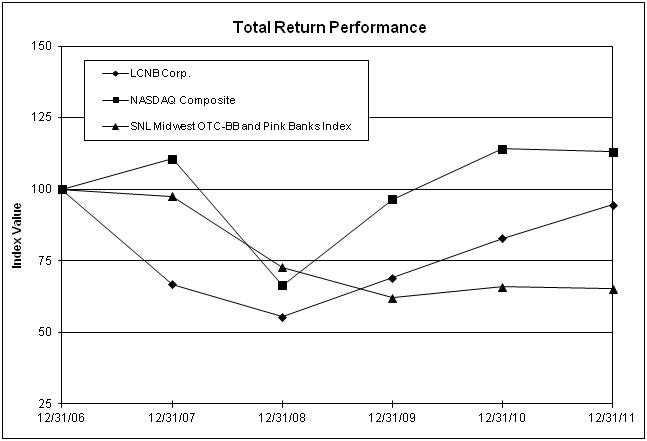
| Period Ending | ||||||||||||||||||||||||
|
Index
|
12/31/06
|
12/31/07
|
12/31/08
|
12/31/09
|
12/31/10
|
12/31/11
|
||||||||||||||||||
|
LCNB Corp.
|
100.00 | 66.76 | 55.47 | 69.06 | 82.90 | 94.64 | ||||||||||||||||||
|
NASDAQ Composite
|
100.00 | 110.66 | 66.42 | 96.54 | 114.06 | 113.16 | ||||||||||||||||||
|
SNL Midwest OTC-BB and Pink Banks Index
|
100.00 | 97.62 | 72.76 | 62.08 | 65.89 | 65.27 | ||||||||||||||||||
Source : SNL Financial LC, Charlottesville, VA
© 2012
www.snl.com
The following represents selected consolidated financial data of LCNB for the years ended December 31, 2007 through 2011 and are derived from LCNB's consolidated financial statements. Certain prior year data presented in this table have been reclassified to conform with the current year presentation. This data should be read in conjunction with the consolidated financial statements and the notes thereto included in Item 8 of this Form 10-K and Management's Discussion and Analysis of Financial Condition and Results of Operations and Quantitative and Qualitative Disclosures about Market Risk included in Items 7 and 7A, respectively, of this Form 10-K, and are qualified in their entirety thereby and by other detailed information elsewhere in this Form 10-K.
|
For the Years Ended December 31,
|
||||||||||||||||||||
|
2011
|
2010
|
2009
|
2008
|
2007
|
||||||||||||||||
|
(Dollars in thousands, except ratios and per share data)
|
||||||||||||||||||||
|
Income Statement:
|
||||||||||||||||||||
|
Interest income
|
$ | 32,093 | 34,031 | 34,898 | 34,398 | 32,041 | ||||||||||||||
|
Interest expense
|
6,387 | 8,334 | 10,060 | 13,421 | 13,838 | |||||||||||||||
|
Net interest income
|
25,706 | 25,697 | 24,838 | 20,977 | 18,203 | |||||||||||||||
|
Provision for loan losses
|
2,089 | 1,680 | 1,400 | 620 | 266 | |||||||||||||||
|
Net interest income after provision for loan losses
|
23,617 | 24,017 | 23,438 | 20,357 | 17,937 | |||||||||||||||
|
Non-interest income
|
7,764 | 8,887 | 7,180 | 6,759 | 6,614 | |||||||||||||||
|
Non-interest expenses
|
21,849 | 21,277 | 20,686 | 18,555 | 16,991 | |||||||||||||||
|
Income before income taxes
|
9,532 | 11,627 | 9,932 | 8,561 | 7,560 | |||||||||||||||
|
Provision for income taxes
|
2,210 | 2,494 | 2,245 | 2,134 | 1,823 | |||||||||||||||
|
Net income from continuing operations
|
7,322 | 9,133 | 7,687 | 6,427 | 5,737 | |||||||||||||||
|
Income from discontinued operations, net of tax
|
793 | 240 | 79 | 176 | 217 | |||||||||||||||
|
Net income
|
8,115 | 9,373 | 7,766 | 6,603 | 5,954 | |||||||||||||||
|
Preferred stock dividends and discount accretion
|
- | - | 1,108 | - | - | |||||||||||||||
|
Net income available to common shareholders
|
$ | 8,115 | 9,373 | 6,658 | 6,603 | 5,954 | ||||||||||||||
|
Dividends per common share (1)
|
$ | 0.64 | 0.64 | 0.64 | 0.64 | 0.62 | ||||||||||||||
|
Basic earnings per common share (1):
|
||||||||||||||||||||
|
Continuing operations
|
1.09 | 1.37 | 0.99 | 0.96 | 0.90 | |||||||||||||||
|
Discontinued operations
|
0.12 | 0.03 | 0.01 | 0.03 | 0.04 | |||||||||||||||
|
Diluted earnings per common share (1):
|
||||||||||||||||||||
|
Continuing operations
|
1.08 | 1.36 | 0.98 | 0.96 | 0.90 | |||||||||||||||
|
Discontinued operations
|
0.12 | 0.03 | 0.01 | 0.03 | 0.04 | |||||||||||||||
|
Balance Sheet:
|
||||||||||||||||||||
|
Securities
|
$ | 267,771 | 251,053 | 217,639 | 139,272 | 90,154 | ||||||||||||||
|
Loans, net
|
458,331 | 452,350 | 457,418 | 451,343 | 444,419 | |||||||||||||||
|
Total assets
|
791,570 | 760,134 | 734,409 | 649,731 | 604,058 | |||||||||||||||
|
Total deposits
|
663,562 | 638,539 | 624,179 | 577,622 | 535,929 | |||||||||||||||
|
Short-term borrowings
|
21,596 | 21,691 | 14,265 | 2,206 | 1,459 | |||||||||||||||
|
Long-term debt
|
21,373 | 23,120 | 24,960 | 5,000 | 5,000 | |||||||||||||||
|
Total shareholders' equity
|
77,960 | 70,707 | 65,615 | 58,116 | 56,528 | |||||||||||||||
|
Selected Financial Ratios and Other Data:
|
||||||||||||||||||||
|
Return on average assets
|
1.02 | % | 1.22 | % | 1.07 | % | 1.03 | % | 1.08 | % | ||||||||||
|
Return on average equity
|
10.89 | % | 13.36 | % | 10.43 | % | 11.35 | % | 11.41 | % | ||||||||||
|
Equity-to-assets ratio
|
9.85 | % | 9.30 | % | 8.93 | % | 8.94 | % | 9.36 | % | ||||||||||
|
Dividend payout ratio
|
52.89 | % | 45.71 | % | 64.39 | % | 64.65 | % | 65.96 | % | ||||||||||
|
Net interest margin, fully taxable equivalent
|
3.70 | % | 3.89 | % | 3.96 | % | 3.74 | % | 3.77 | % | ||||||||||
|
(1)
|
All per share data in 2007 has been adjusted to reflect a 100% stock dividend accounted for as stock split.
|
Dakin was sold during the first quarter 2011 and therefore the net gain on the sale and Dakin’s financial operating results are reported in the income statements as income from discontinued operations, net of tax.
Introduction
The following is management's discussion and analysis of the consolidated financial condition and consolidated results of operations of LCNB. It is intended to amplify certain financial information regarding LCNB and should be read in conjunction with the Consolidated Financial Statements and related Notes and the Financial Highlights contained in the 2011 Annual Report to Shareholders.
Forward-Looking Statements
Certain matters disclosed herein may be deemed to be forward-looking statements that involve risks and uncertainties. Forward looking statements are statements that include projections, predictions, expectations or beliefs about future events or results or otherwise are not statements of historical fact. Such statements are often characterized by the use of qualifying words and their derivatives such as “expects,” “anticipates,” “believes,” “estimates,” “plans,” “projects,” or other statements concerning opinions or judgments of the Company and its management about future events. Factors that could influence the accuracy of such forward looking statements include, but are not limited to, regulatory policy changes, interest rate fluctuations, loan demand, loan delinquencies and losses, general economic conditions and other risks. Such forward-looking statements represent management's judgment as of the current date. Actual strategies and results in future time periods may differ materially from those currently expected. LCNB disclaims, however, any intent or obligation to update such forward-looking statements. LCNB intends such forward-looking statements to be covered by the safe harbor provisions for forward-looking statements contained in the Private Securities Litigation Reform Act of 1995.
Overview
Net income for 2011 was $8,115,000, compared to $9,373,000 in 2010 and $7,766,000 in 2009. Preferred stock dividends and discount accretion totaled $1,108,000 during 2009, resulting in net income available to common shareholders of $6,658,000 for that year. Preferred stock was not outstanding during 2011 or 2010. Total basic earnings per share available to common shareholders for 2011, 2010, and 2009 were $1.21, $1.40, and $1.00, respectively. Total diluted earnings per share for 2011, 2010, and 2009 were $1.20, $1.39, and $0.99, respectively.
The following items significantly affected earnings for the years indicated:
|
|
·
|
Bank owned life insurance income was greater during 2010 due to death benefits received. No death benefits were received during 2011 or 2009.
|
|
|
·
|
FDIC premiums for 2009 included an industry-wide FDIC special assessment of $325,000 that LCNB recognized during the second quarter 2009. FDIC premiums for 2011 were less due to a change in the assessment base.
|
|
|
·
|
Other real estate owned expense was greater during 2010 because of valuation write-downs and related increases in holding costs. Other real estate owned expense for 2011 included a loss recognized on the sale of commercial property.
|
|
|
·
|
Gains from sales of securities were significantly greater in 2011 and 2010 than in 2009.
|
|
|
·
|
The $722,000 write-off of pension asset recognized during 2009 related to a restructuring of LCNB’s retirement plans.
|
Net Interest Income
LCNB's primary source of earnings is net interest income, which is the difference between earnings from loans and other investments and interest paid on deposits and other liabilities. The following table presents, for the years indicated, average balances for interest-earning assets and interest-bearing liabilities, the income or expense related to each item, and the resulting average yields earned or rates paid.
|
Years ended December 31,
|
||||||||||||||||||||||||||||||||||||
|
2011
|
2010
|
2009
|
||||||||||||||||||||||||||||||||||
|
Average
|
Interest
|
Average
|
Average
|
Interest
|
Average
|
Average
|
Interest
|
Average
|
||||||||||||||||||||||||||||
|
Outstanding
|
Earned/
|
Yield/
|
Outstanding
|
Earned/
|
Yield/
|
Outstanding
|
Earned/
|
Yield/
|
||||||||||||||||||||||||||||
|
Balance
|
Paid
|
Rate
|
Balance
|
Paid
|
Rate
|
Balance
|
Paid
|
Rate
|
||||||||||||||||||||||||||||
|
(Dollars in thousands)
|
||||||||||||||||||||||||||||||||||||
|
Loans (1)
|
$ | 458,049 | 25,502 | 5.57 | % | $ | 458,708 | $ | 27,020 | 5.89 | % | $ | 453,869 | $ | 27,538 | 6.07 | % | |||||||||||||||||||
|
Interest-bearing demand deposits
|
13,296 | 32 | 0.24 | % | 20,876 | 51 | 0.24 | % | 18,727 | 49 | 0.26 | % | ||||||||||||||||||||||||
|
Federal Reserve Bank Stock
|
940 | 56 | 5.96 | % | 940 | 56 | 5.96 | % | 939 | 56 | 5.96 | % | ||||||||||||||||||||||||
|
Federal Home Loan Bank Stock
|
2,091 | 89 | 4.26 | % | 2,091 | 92 | 4.40 | % | 2,091 | 97 | 4.64 | % | ||||||||||||||||||||||||
|
Investment securities:
|
||||||||||||||||||||||||||||||||||||
|
Taxable
|
176,922 | 3,843 | 2.17 | % | 133,556 | 3,686 | 2.76 | % | 110,894 | 4,237 | 3.82 | % | ||||||||||||||||||||||||
|
Nontaxable (2)
|
78,917 | 3,895 | 4.94 | % | 85,718 | 4,736 | 5.53 | % | 78,373 | 4,426 | 5.65 | % | ||||||||||||||||||||||||
|
Total earning assets
|
730,215 | 33,417 | 4.58 | % | 701,889 | 35,641 | 5.08 | % | 664,893 | 36,403 | 5.48 | % | ||||||||||||||||||||||||
|
Non-earning assets
|
64,735 | 66,489 | 61,432 | |||||||||||||||||||||||||||||||||
|
Allowance for loan losses
|
(2,936 | ) | (2,815 | ) | (2,638 | ) | ||||||||||||||||||||||||||||||
|
Total assets
|
$ | 792,014 | $ | 765,563 | $ | 723,687 | ||||||||||||||||||||||||||||||
|
Savings deposits
|
$ | 122,987 | 452 | 0.37 | % | $ | 108,734 | 653 | 0.60 | % | $ | 97,813 | 742 | 0.76 | % | |||||||||||||||||||||
|
NOW and money fund
|
232,418 | 667 | 0.29 | % | 221,926 | 1,282 | 0.58 | % | 197,805 | 1,496 | 0.76 | % | ||||||||||||||||||||||||
|
IRA and time certificates
|
219,174 | 4,583 | 2.09 | % | 231,971 | 5,678 | 2.45 | % | 240,783 | 7,196 | 2.99 | % | ||||||||||||||||||||||||
|
Short-term borrowings
|
12,415 | 28 | 0.23 | % | 7,606 | 27 | 0.35 | % | 1,468 | 3 | 0.20 | % | ||||||||||||||||||||||||
|
Long-term debt
|
22,733 | 657 | 2.89 | % | 23,826 | 694 | 2.91 | % | 20,282 | 623 | 3.07 | % | ||||||||||||||||||||||||
|
Total interest-bearing liabilities
|
609,727 | 6,387 | 1.05 | % | 594,063 | 8,334 | 1.40 | % | 558,151 | 10,060 | 1.80 | % | ||||||||||||||||||||||||
|
Demand deposits
|
101,781 | 95,273 | 86,270 | |||||||||||||||||||||||||||||||||
|
Other liabilities
|
5,964 | 6,059 | 4,802 | |||||||||||||||||||||||||||||||||
|
Capital
|
74,542 | 70,168 | 74,464 | |||||||||||||||||||||||||||||||||
|
Total liabilities and capital
|
$ | 792,014 | $ | 765,563 | $ | 723,687 | ||||||||||||||||||||||||||||||
|
Net interest rate spread (3)
|
3.53 | % | 3.68 | % | 3.68 | % | ||||||||||||||||||||||||||||||
|
Net interest income and net interest margin on a tax equivalent basis (4)
|
27,030 | 3.70 | % | $ | 27,307 | 3.89 | % | $ | 26,343 | 3.96 | % | |||||||||||||||||||||||||
|
Ratio of interest-earning assets to interest-bearing liabilities
|
119.76 | % | 118.15 | % | 119.12 | % | ||||||||||||||||||||||||||||||
|
(1)
|
Includes non-accrual loans if any. Income from tax-exempt loans is included in interest income on a taxable-equivalent basis, using an incremental rate of 34%.
|
|
(2)
|
Income from tax-exempt securities is included in interest income on a taxable-equivalent basis. Interest income has been divided by a factor comprised of the complement of the incremental tax rate of 34%.
|
|
(3)
|
The net interest spread is the difference between the average rate on total interest-earning assets and interest-bearing liabilities.
|
|
(4)
|
The net interest margin is the taxable-equivalent net interest income divided by average interest-earning assets.
|
The following table presents the changes in interest income and expense for each major category of interest-earning assets and interest-bearing liabilities and the amount of change attributable to volume and rate changes for the years indicated. Changes not solely attributable to rate or volume have been allocated to volume and rate changes in proportion to the relationship of absolute dollar amounts of the changes in each.
|
For the years ended December 31,
|
||||||||||||||||||||||||
|
2011 vs. 2010
|
2010 vs. 2009
|
|||||||||||||||||||||||
|
Increase (decrease) due to
|
Increase (decrease) due to
|
|||||||||||||||||||||||
|
Volume
|
Rate
|
Total
|
Volume
|
Rate
|
Total
|
|||||||||||||||||||
|
(In thousands)
|
||||||||||||||||||||||||
|
Interest income attributable to:
|
||||||||||||||||||||||||
|
Loans (1)
|
$ | (39 | ) | (1,479 | ) | (1,518 | ) | 291 | (809 | ) | (518 | ) | ||||||||||||
|
Interest-bearing demand deposits
|
(18 | ) | (1 | ) | (19 | ) | 5 | (3 | ) | 2 | ||||||||||||||
|
Interest-bearing deposits in banks
|
- | - | - | - | - | - | ||||||||||||||||||
|
Federal Reserve Bank stock
|
- | - | - | - | - | - | ||||||||||||||||||
|
Federal Home Loan Bank stock
|
- | (3 | ) | (3 | ) | - | (5 | ) | (5 | ) | ||||||||||||||
|
Investment securities:
|
||||||||||||||||||||||||
|
Taxable
|
1,043 | (886 | ) | 157 | 764 | (1,315 | ) | (551 | ) | |||||||||||||||
|
Nontaxable (2)
|
(359 | ) | (482 | ) | (841 | ) | 408 | (98 | ) | 310 | ||||||||||||||
|
Total interest income
|
627 | (2,851 | ) | (2,224 | ) | 1,468 | (2,230 | ) | (762 | ) | ||||||||||||||
|
Interest expense attributable to:
|
||||||||||||||||||||||||
|
Savings deposits
|
77 | (278 | ) | (201 | ) | 77 | (166 | ) | (89 | ) | ||||||||||||||
|
NOW and money fund
|
58 | (673 | ) | (615 | ) | 168 | (382 | ) | (214 | ) | ||||||||||||||
|
IRA and time certificates
|
(301 | ) | (794 | ) | (1,095 | ) | (255 | ) | (1,263 | ) | (1,518 | ) | ||||||||||||
|
Short-term borrowings
|
13 | (12 | ) | 1 | 20 | 4 | 24 | |||||||||||||||||
|
Long-term debt
|
(32 | ) | (5 | ) | (37 | ) | 105 | (34 | ) | 71 | ||||||||||||||
|
Total interest expense
|
(185 | ) | (1,762 | ) | (1,947 | ) | 115 | (1,841 | ) | (1,726 | ) | |||||||||||||
|
Net interest income
|
$ | 812 | (1,089 | ) | (277 | ) | 1,353 | (389 | ) | 964 | ||||||||||||||
|
|
(1)
|
Non-accrual loans, if any, are included in average loan balances.
|
|
|
(2)
|
Change in interest income from nontaxable investment securities is computed based on interest income determined on a taxable-equivalent yield basis. Interest income has been divided by a factor comprised of the complement of the incremental tax rate of 34%.
|
2011 vs. 2010.
Net interest income on a fully tax-equivalent basis for 2011 totaled $27,030,000, a decrease of $277,000 from 2010. The decrease resulted from a decrease in total taxable-equivalent interest income of $2,224,000, largely offset by a decrease in total interest expense of $1,947,000.
The decrease in taxable-equivalent interest income was due to a 50 basis point (a basis point equals 0.01%) decrease in the average rate earned on interest-earning assets, partially offset by a $28.3 million increase in total average interest-earning assets. The decrease in average rates earned was primarily due to general decreases in market rates. The increase in average interest-earning assets occurred primarily in the taxable investment securities portfolio, which grew $43.4 million on an average basis.
Interest expense decreased primarily due to a 35 basis point decrease in the average rate paid on interest-bearing liabilities. A secondary factor was a $12.8 million decrease in average IRA and time certificate balances, partially offset by increases in average balances of other deposit account categories and average short-term borrowings. The decrease in average rates paid was primarily due to general decreases in market rates.
The net interest margin, on a taxable-equivalent basis, decreased from 3.89% for 2010 to 3.70% for 2011 primarily due to the limited loan growth during 2011 and low market interest rates. With weak demand for loans and the sale of most residential real estate mortgage loans originated to the Federal Home Loan Mortgage Corporation, deposit growth was largely invested in the investment securities portfolio, which usually pays lower interest rates than the loan portfolio.
2010 vs. 2009.
Net interest income on a fully tax-equivalent basis for 2010 totaled $27,307,000, an increase of $964,000 from 2009. The increase resulted from a decrease in total interest expense of $1,726,000, largely offset by a decrease in total taxable-equivalent interest income of $762,000.
Taxable-equivalent interest income decreased due to a 40 basis point decrease in the average rate earned on interest-earning assets, partially offset by a $37.0 million increase in total average interest-earning assets. The decrease in average rates earned was primarily due to general decreases in market rates. The increase in average interest-earning assets occurred primarily in the investment securities portfolio, which grew $30.0 million. The loan portfolio grew $4.8 million on an average basis.
Interest expense decreased primarily due to a 40 basis point decrease in the average rate paid on interest-bearing liabilities, partially offset by a $35.9 million increase in average interest-bearing liabilities. The decrease in average rates paid was primarily due to general decreases in market rates. Most of the deposit growth occurred in the more liquid types of deposits, such as savings deposits and NOW and money fund deposits. Collectively, these deposits grew $35.0 million on an average basis, while IRA and time certificates decreased $8.8 million.
The net interest margin, on a taxable-equivalent basis, decreased from 3.96% for 2009 to 3.89% for 2010 primarily due to the limited loan growth during 2010. With weak demand for loans and the sale to the Federal Home Loan Mortgage Corporation of most residential real estate mortgage loans originated, deposit growth was largely invested in the investment securities portfolio, which usually pays lower interest rates than the loan portfolio.
Provisions and Allowance for Loan Losses
The following table presents the total loan loss provision and the other changes in the allowance for loan losses for the years 2007 through 2011:
|
2011
|
2010
|
2009
|
2008
|
2007
|
||||||||||||||||
|
(Dollars in thousands)
|
||||||||||||||||||||
|
Balance – Beginning of year
|
$ | 2,641 | 2,998 | 2,468 | 2,468 | 2,050 | ||||||||||||||
|
Allowance related to Sycamore acquisition
|
- | - | - | - | 453 | |||||||||||||||
| 2,641 | 2,998 | 2,468 | 2,468 | 2,503 | ||||||||||||||||
|
Loans charged off:
|
||||||||||||||||||||
|
Commercial and industrial
|
581 | 289 | 36 | 73 | 81 | |||||||||||||||
|
Commercial, secured by real estate
|
598 | 1,105 | 352 | - | - | |||||||||||||||
|
Residential real estate
|
512 | 331 | 152 | 129 | 71 | |||||||||||||||
|
Consumer
|
252 | 422 | 490 | 617 | 231 | |||||||||||||||
|
Agricultural
|
- | - | - | - | - | |||||||||||||||
|
Other loans, including deposit overdrafts
|
127 | 144 | 178 | 228 | 305 | |||||||||||||||
|
Total loans charged off
|
2,070 | 2,291 | 1,208 | 1,047 | 688 | |||||||||||||||
|
Recoveries:
|
||||||||||||||||||||
|
Commercial and industrial
|
- | 35 | 2 | 40 | 17 | |||||||||||||||
|
Commercial, secured by real estate
|
30 | - | - | - | - | |||||||||||||||
|
Residential real estate
|
31 | 2 | 3 | 20 | 2 | |||||||||||||||
|
Consumer, excluding credit card
|
122 | 120 | 203 | 201 | 142 | |||||||||||||||
|
Agricultural
|
- | - | - | - | - | |||||||||||||||
|
Credit Card
|
- | - | - | 1 | 3 | |||||||||||||||
|
Other loans, including deposit overdrafts
|
88 | 97 | 130 | 165 | 223 | |||||||||||||||
|
Total recoveries
|
271 | 254 | 338 | 427 | 387 | |||||||||||||||
|
Net charge offs
|
1,799 | 2,037 | 870 | 620 | 301 | |||||||||||||||
|
Provision charged to operations
|
2,089 | 1,680 | 1,400 | 620 | 266 | |||||||||||||||
|
Balance - End of year
|
$ | 2,931 | 2,641 | 2,998 | 2,468 | 2,468 | ||||||||||||||
|
Ratio of net charge-offs during the period to average loans outstanding
|
0.39 | % | 0.44 | % | 0.19 | % | 0.14 | % | 0.08 | % | ||||||||||
|
Ratio of allowance for loan losses to total loans at year-end
|
0.64 | % | 0.58 | % | 0.65 | % | 0.54 | % | 0.55 | % | ||||||||||
The $581,000 of charge-offs in the commercial and industrial loan category for 2011 is comprised of a $251,000 charge-off connected to a retail business that ceased operations during that year and the remaining $330,000 is due to one borrower. Commercial real estate charges consisted of loans to five different borrowers.
Of the $1,105,000 in commercial real estate loan charge-offs during 2010, $421,000 was due to four loans while $684,000 was due to two loans made to the same borrower. Commercial and industrial loan charge-offs of $289,000 during 2010 included one charge-off of $281,000 relating to a business that ceased operations during that year.
Charge-offs and recoveries classified as “Other” represent charge-offs and recoveries on checking and NOW account overdrafts. LCNB charges off such overdrafts when considered uncollectible, but no later than 60 days from the date first overdrawn.
LCNB continuously reviews the loan portfolio for credit risk through the use of its lending and loan review functions. Independent loan reviews analyze specific loans, providing validation that credit risks are appropriately identified and reported to the Loan Committee and Board of Directors. In addition, the Board of Directors’ Audit Committee receives loan review reports multiple times throughout each year. Specific new credits are analyzed prior to origination and are reviewed by the Loan Committee and Board of Directors.
Inputs from all of the Bank’s credit risk identification processes are used by management to analyze and validate the adequacy and methodology of the allowance quarterly. The analysis includes three basic components: specific allocations for individual loans, general historical loss allocations for pools of loans based on average historic loss ratios for the thirty-six preceding months adjusted for identified economic and other risk factors, and an unallocated component. Due to the number, size, and complexity of loans within the loan portfolio, there is always a possibility of inherent undetected losses. This, combined with the possible imprecision of management’s assumptions in the evaluation of loans, can result in the allowance also having an unallocated component.
The following table presents the components of the allowance for loan losses on the dates specified:
|
At December 31,
|
||||||||||||||||||||||||
|
2011
|
2010
|
2009
|
||||||||||||||||||||||
|
Amount
|
Percent
|
Amount
|
Percent
|
Amount
|
Percent
|
|||||||||||||||||||
|
(Dollars in thousands)
|
||||||||||||||||||||||||
|
Specific allocations
|
$ | 399 | 13.62 | % | 296 | 11.20 | % | 858 | 28.62 | % | ||||||||||||||
|
General allocations:
|
||||||||||||||||||||||||
|
Historical loss
|
1,381 | 47.29 | % | 975 | 36.91 | % | 576 | 19.21 | % | |||||||||||||||
|
Adjustments to historical loss
|
1,151 | 39.09 | % | 1,370 | 51.89 | % | 1,553 | 51.80 | % | |||||||||||||||
|
Unallocated
|
- | - | % | - | - | % | 11 | 0.37 | % | |||||||||||||||
|
Total
|
$ | 2,931 | 100.00 | % | 2,641 | 100.00 | % | 2,998 | 100.00 | % | ||||||||||||||
The decrease in the specific allocation at December 31, 2010 as compared to December 31, 2009 is primarily due to charge-offs recognized during 2010. The increases in the general historical loss from December 31, 2009 to December 31, 2010 and from December 31, 2010 to December 31, 2011 are primarily due to increases in net charge-offs during the historic look-back period.
Non-Interest Income
2011 vs. 2010.
Total non-interest income for 2011 was $1,123,000 less than for 2010. Bank owned life insurance income decreased in 2011 by $793,000 primarily due to the absence of death benefits received during 2010. Gains from sales of mortgage loans were $319,000 less primarily due to a decrease in the volume of loans sold. Loans sold during 2011 totaled $9.4 million, compared to $24.2 million in sales during 2010. Lower interest rates fueled a demand for loan refinancings during 2010. Service charges and fees on deposit accounts decreased $165,000 primarily due to a downward trend in overdraft fees, partially offset by an increase in check card fee income. These unfavorable items were partially offset by a $202,000 increase in trust income that was primarily due to executor fees received and a change in the mix of trust assets.
2010 vs. 2009.
Total non-interest income for 2010 was $1,707,000 greater than for 2009. Net gains from sales of investment securities was $838,000 greater during 2010 as compared to 2009 primarily due to an increase in the volume of securities sold as management decided to recognize gains that were inherent in the portfolio. Replacement securities generally have shorter remaining maturities. Bank owned life insurance income was $752,000 greater primarily due to death benefits received. Although mortgage loan sales declined by $3.7 million during 2010 as compared to 2009, an improvement in secondary market pricing increased the gain on sale of mortgage loans by $100,000.
Non-Interest Expense
2011 vs. 2010.
Total non-interest expense was $572,000 greater in 2011 as compared to 2010 primarily due to a $472,000 increase in salaries and employee benefits, a $149,000 increase in equipment expenses, a $109,000 increase in computer maintenance and supplies, and a $399,000 increase in other non-interest expenses. While salaries were held to a less than 4% increase, health care costs and pension costs contributed to the balance of the increase in salaries and employee benefits. Equipment expenses increased primarily due to increased depreciation caused by ATM and computer hardware replacements. The increase in other non-interest expenses includes a $56,000 loss recognized on a standby letter of credit, $59,000 in environmental remediation costs for the lot on which LCNB’s new Lebanon Drive-Up facility is located, $50,000 in NASDAQ® application fees, and other smaller miscellaneous costs. Partially offsetting these increases were a $413,000 decrease in FDIC premiums, a $156,000 decrease in other real estate owned expense, and a $114,000 decrease in occupancy expense. FDIC premiums decreased primarily due to implementation of a new assessment base that uses total assets and tier one capital as opposed to deposits. Other real estate owned expense decreased due to the absence of valuation write-downs recognized during 2010.
2010 vs. 2009.
Total non-interest expense was $591,000 greater in 2010 as compared to 2009 primarily due to a $737,000 increase in salaries and employee benefits. While salaries were held to a less than 3% increase, health care costs, incentive plan expense, and pension costs contributed to the balance of the increase in salaries and employee benefits. Other real estate owned expense increased $489,000 due to valuation write-downs and related increases in holding costs. These increases were partially offset by a $313,000 decrease in FDIC premiums expenses and the absence of a $722,000 one-time, non-recurring pension-related charge recognized during the first quarter 2009. FDIC premiums decreased due to the absence of a $325,000 payment to the FDIC made by LCNB as its share of a general industry-wide special assessment levied by the FDIC during 2009.
Income Taxes
LCNB's effective tax rates for the years ended December 31, 2011, 2010, and 2009 were 23.2%, 21.4%, and 22.6%, respectively. The difference between the statutory rate of 34.0% and the effective tax rate is primarily due to tax-exempt interest income and tax-exempt earnings from bank owned life insurance.
Assets
Net loans increased $6.0 million during 2011. The commercial real estate loan portfolio, which increased $23.1 million, was the only category that experienced growth during 2011. Commercial and industrial loans decreased $5.1 million and consumer loans also decreased $5.1 million, reflecting lower demand due to economic conditions during 2011. Residential real estate loans decreased $3.4 million as LCNB continued to originate and sell low-fixed rate mortgages in the secondary market.
Investment securities available-for-sale increased $18.1 million during 2011. This growth was primarily in the U.S. Agency mortgage-backed securities category, which increased $19.2 million. LCNB invests in both pass-through securities and collateralized mortgage obligations. Management chose to grow the mortgage-backed securities category because of the instruments’ liquidity, rate, and low risk due to government guarantees.
Deposits
Total deposits at December 31, 2011 were $25.0 million greater than at December 31, 2010. The growth was in the liquid deposit products – checking accounts, NOW and money fund deposit accounts, and savings deposits. These types of instruments increased a total of $41.5 million, while IRA and time certificate accounts decreased $16.5 million.
Liquidity
Liquidity is the ability to have funds available at all times to meet the commitments of LCNB. These commitments may include paying dividends to shareholders, funding new loans for borrowers, funding withdrawals by depositors, paying general and administrative expenses, and funding capital expenditures. Sources of liquidity include growth in deposits, principal payments received on loans, proceeds from the sale of loans, the sale or maturation of investment securities, cash generated by operating activities, and the ability to borrow funds. Management closely monitors the level of liquid assets available to meet ongoing funding requirements. It is management's intent to maintain adequate liquidity so that sufficient funds are readily available at a reasonable cost. LCNB experienced no liquidity or operational problems during the past year as a result of current liquidity levels.
The liquidity of LCNB is enhanced by the fact that 79.9% of total deposits at December 31, 2011 were "core" deposits. Core deposits, for this purpose, are defined as total deposits less public funds and certificates of deposit greater than $100,000.
Liquid assets include cash, federal funds sold and securities available-for-sale. Except for investments in the stock of the Federal Reserve Bank and the Federal Home Loan Bank of Cincinnati (“FHLB”) and certain local municipal securities, all of LCNB's investment portfolio is classified as "available-for-sale" and can be readily sold to meet liquidity needs, subject to certain pledging commitments for public funds, repurchase agreements, and other requirements. At December 31, 2011, LCNB's liquid assets amounted to $273.5 million or 34.6% of total assets, an increase from $246.8 million or 32.5% of total assets at December 31, 2010.
An additional source of funding is borrowings from the FHLB. A short-term advance of $12.0 million and long-term advances totaling $21.4 million were outstanding at December 31, 2011 and the total available borrowing capacity at that date was approximately $14.3 million. LCNB is approved to borrow up to $39.6 million in short-term advances through the FHLB’s Cash Management Advance program. One of the factors limiting availability of FHLB borrowings is a bank’s ownership of FHLB stock. LCNB could increase its available borrowing capacity by purchasing more FHLB stock and would need to purchase more stock if it were to use the full $39.6 million available in short-term advances.
Besides the short-term FHLB advances, short-term borrowings may include repurchase agreements, federal funds purchased, and advances from a line of credit with another financial institution. At December 31, 2011, LCNB could borrow up to $20 million through the line of credit and up to $17 million under federal funds arrangements with two other financial institutions. In addition to the FHLB short-term advance, short-term borrowings at December 31, 2011 included $9.6 million in repurchase agreements.
Commitments to extend credit at December 31, 2011 totaled $75.7 million and standby letters of credit totaled $5.6 million and are more fully described in Note 10 to LCNB's Financial Statements. Since many commitments to extend credit may expire without being drawn upon, the total commitment amounts do not necessarily represent future cash requirements.
Capital expenditures may include the construction or acquisition of new office buildings, improvements to LCNB's twenty-five offices, purchases of furniture and equipment, and additions or improvements to LCNB’s information technology system. Commitments for capital expenditures outstanding as of December 31, 2011 were not material.
The following table provides information concerning LCNB's contractual obligations at December 31, 2011:
|
Payments due by period
|
||||||||||||||||||||
|
Over 1
|
Over 3
|
|||||||||||||||||||
|
1 year
|
through 3
|
through 5
|
More than
|
|||||||||||||||||
|
Total
|
or less
|
years
|
years
|
5 years
|
||||||||||||||||
|
(In thousands)
|
||||||||||||||||||||
|
Long-term debt obligations
|
$ | 21,373 | 6,000 | 2,326 | 5,000 | 8,047 | ||||||||||||||
|
Short-term borrowing from Federal Home Loan Bank
|
12,000 | 12,000 | - | - | - | |||||||||||||||
|
Operating lease obligations
|
5,713 | 360 | 645 | 504 | 4,204 | |||||||||||||||
|
Purchase obligations
|
- | - | - | - | - | |||||||||||||||
|
Estimated pension plan contribution for 2012
|
902 | 902 | - | - | - | |||||||||||||||
|
Certificates of deposit:
|
||||||||||||||||||||
|
$100,000 and over
|
82,763 | 26,717 | 35,256 | 10,846 | 9,944 | |||||||||||||||
|
Other time certificates
|
126,212 | 47,425 | 52,986 | 20,077 | 5,724 | |||||||||||||||
|
Total
|
$ | 248,963 | 93,404 | 91,213 | 36,427 | 27,919 | ||||||||||||||
The following table provides information concerning LCNB's commitments at December 31, 2011:
|
Amount of Commitment Expiration Per Period
|
||||||||||||||||||||
|
Total
|
Over 1
|
Over 3
|
||||||||||||||||||
|
Amounts
|
1 year
|
through 3
|
through 5
|
More than
|
||||||||||||||||
|
Committed
|
or less
|
years
|
years
|
5 years
|
||||||||||||||||
|
(In thousands)
|
||||||||||||||||||||
|
Commitments to extend credit
|
$ | 6,717 | 6,717 | - | - | - | ||||||||||||||
|
Unused lines of credit
|
68,967 | 33,929 | 15,048 | 9,110 | 10,880 | |||||||||||||||
|
Standby letters of credit
|
5,575 | 546 | 5,029 | - | - | |||||||||||||||
|
Total
|
$ | 81,259 | 41,192 | 20,077 | 9,110 | 10,880 | ||||||||||||||
Capital Resources
LCNB and the Bank are required by banking regulators to meet certain minimum levels of capital adequacy. Failure to meet minimum capital requirements can initiate certain mandatory and possibly additional discretionary actions by regulators that, if undertaken, could have a material effect on LCNB's and the Bank's financial statements. These minimum levels are expressed in the form of certain ratios. Capital is separated into Tier 1 capital (essentially shareholders' equity less goodwill and other intangibles) and Tier 2 capital (essentially the allowance for loan losses limited to 1.25% of risk-weighted assets). The first two ratios, which are based on the degree of credit risk in the Bank's assets, provide for weighting assets based on assigned risk factors and include off-balance sheet items such as loan commitments and stand-by letters of credit. The ratio of Tier 1 capital to risk-weighted assets must be at least 4.00% and the ratio of total capital (Tier 1 capital plus Tier 2 capital) to risk-weighted assets must be at least 8.00%. The capital leverage ratio supplements the risk-based capital guidelines. Banks are required to maintain a minimum ratio of Tier 1 capital to adjusted quarterly average total assets of 3.00%. A table summarizing the regulatory capital of LCNB and the Bank at December 31, 2011 and 2010 is included in Note 11, "Regulatory Matters", of the 2011 Annual Report to Shareholders.
The FDIC, the insurer of deposits in financial institutions, has adopted a risk-based insurance premium system based in part on an institution's capital adequacy. Under this system, a depository institution is required to pay successively higher premiums depending on its capital levels and its supervisory rating by its primary regulator. It is management's intention to maintain sufficient capital to permit the Bank to maintain a "well capitalized" designation (the FDIC's highest rating).
On April 17, 2001, LCNB's Board of Directors authorized three separate stock repurchase programs, two phases of which continue. Any shares purchased will be held for future corporate purposes. However, as a participant in the Treasury Department’s Capital Purchase Program during much of 2009, LCNB was prohibited from repurchasing additional shares of its common stock without prior government permission for a period of three years from the date of participation unless the preferred shares issued are no longer held by the U.S. Treasury Department. This restriction was terminated on October 21, 2009, when LCNB redeemed all 13,400 shares of its Fixed Rate Cumulative Perpetual Preferred Stock, Series A.
Under the "Market Repurchase Program" LCNB was originally authorized to purchase up to 200,000 shares of its stock, as restated for a 100% stock dividend issued in May, 2007, through market transactions with a selected stockbroker. On November 14, 2005, the Board of Directors extended the Market Repurchase Program by increasing the shares authorized for repurchase to 400,000 total shares, as restated for the stock dividend. Through December 31, 2011, 290,444 shares, as restated for the stock dividend, had been purchased under this program. No shares were purchased under this program during 2011.
The "Private Sale Repurchase Program" is available to shareholders who wish to sell large blocks of stock at one time. Because LCNB's stock is not widely traded, a shareholder releasing large blocks may not be able to readily sell all shares through normal procedures. Purchases of blocks will be considered on a case-by-case basis and will be made at prevailing market prices. A total of 466,018 shares, as restated for the stock dividend, had been purchased under this program at December 31, 2011. No shares were purchased under this program during 2011.
LCNB established an Ownership Incentive Plan during 2002 that allows for stock-based awards to eligible employees. The awards may be in the form of stock options, share awards, and/or appreciation rights. The plan provides for the issuance of up to 200,000 shares, as restated for the stock dividend. The following table provides the stock options granted to key executive officers of LCNB for the years indicated:
|
Year
|
Options
Granted
|
|||
|
2007
|
8,116 | |||
|
2008
|
13,918 | |||
|
2009
|
29,110 | |||
|
2010
|
20,798 | |||
|
2011
|
25,083 | |||
The exercise price for stock options granted shall not be less than the fair market value of the stock on the date of grant. Options vest ratably over a five-year period and the maximum term for each grant will be specified by the Board of Directors, but cannot be greater than ten years from the date of grant. In the event of an optionee's death or incapacity, all outstanding options held by that optionee shall immediately vest and be exercisable.
On January 9, 2009, LCNB received $13.4 million of capital from the U.S. Treasury Department under the CPP and issued 13,400 shares of its Fixed Rate Cumulative Perpetual Preferred Stock, Series A and a warrant to the U.S. Treasury Department for the purchase of 217,063 common shares of LCNB stock at an exercise price of $9.26 per share. LCNB allocated $583,000 of the proceeds from the preferred stock issuance to the warrant.
On October 21, 2009, LCNB entered into a repurchase agreement with the Treasury Department pursuant to which LCNB redeemed all 13,400 shares of its preferred stock. In connection with this redemption, LCNB paid approximately $13.5 million to the Treasury Department, which includes the original investment amount of $13.4 million plus accrued and unpaid dividends of approximately $123,000. As a result of the redemption, LCNB recorded a reduction in retained earnings of approximately $463,000 in the fourth quarter of 2009 associated with accelerated discount accretion related to the difference between the amount at which the Preferred Stock sale was initially recorded and its redemption price. The Preferred Stock dividend and the acceleration of the accretion reduced 2009’s net income available to common shareholders and earnings per common share.
LCNB Corp. did not repurchase the warrant issued to the Treasury Department as part of the CPP. Instead, pursuant to the terms of the repurchase agreement, the warrant has been cancelled and LCNB has issued a substitute warrant to the Treasury Department with the same terms as the original warrant, except that Section 13(H) of the original warrant, which dealt with the reduction of shares subject to the warrant in the event that LCNB raised $13.4 million in a qualified stock offering prior to December 31, 2009, has been removed. A copy of the repurchase agreement was filed by LCNB as Exhibit 10.1 to its Current Report on Form 8-K dated October 21, 2009, and a copy of the substitute warrant is included as Exhibit 4.3 to its Form 10-Q for the quarterly period ended September 30, 2009. Both documents are incorporated by reference and the foregoing summary of certain provisions of these documents is qualified in its entirety by reference thereto. The Treasury Department sold the warrant to an investor during the fourth quarter 2011.
LCNB Corp. exceeded all regulatory requirements to be classified as “well capitalized” before accepting the CPP investment and exceeded the regulatory requirements after the redemption.
Critical Accounting Policies
Allowance for Loan Losses
. The allowance for loan losses is established through a provision for loan losses charged to expense. Loans are charged against the allowance for loan losses when management believes that the collectability of the principal is unlikely. Subsequent recoveries, if any, are credited to the allowance. The allowance is an amount that management believes will be adequate to absorb inherent losses in the loan portfolio, based on evaluations of the collectability of loans and prior loan loss experience. The evaluations take into consideration such factors as changes in the nature and volume of the loan portfolio, overall portfolio quality, review of specific problem loans, and current economic conditions that may affect the borrowers' ability to pay. This evaluation is inherently subjective as it requires estimates that are susceptible to significant revision as more information becomes available.
The allowance consists of specific and general components. The specific component relates to loans that are classified as doubtful, substandard, or special mention. For such loans an allowance is established when the discounted cash flows or collateral value is lower than the carrying value of that loan. The general component covers non-classified loans and is based on historical loss experience adjusted for qualitative factors, which include trends in underperforming loans, trends in the volume and terms of loans, economic trends and conditions, concentrations of credit, trends in the quality of loans, and borrower financial statement exceptions.
Based on its evaluations, management believes that the allowance for loan losses will be adequate to absorb estimated losses inherent in the current loan portfolio.
Accounting for Intangibles.
LCNB’s intangible assets at December 31, 2011 are composed primarily of goodwill and a core deposit intangible related to the acquisition of Sycamore during the fourth quarter 2007 and mortgage servicing rights recorded from sales of mortgage loans to the Federal Home Loan Mortgage Corporation. Goodwill is not subject to amortization, but is reviewed annually for impairment. The core deposit intangible is being amortized on a straight line basis over six years. Mortgage servicing rights are capitalized by allocating the total cost of loans between mortgage servicing rights and the loans based on their estimated fair values. Capitalized mortgage servicing rights are amortized to loan servicing income in proportion to and over the period of estimated servicing income, subject to periodic review for impairment.
Fair Value Accounting for Investment Securities.
Securities classified as available-for-sale are carried at estimated fair value. Unrealized gains and losses, net of taxes, are reported as accumulated other comprehensive income or loss in shareholders’ equity. Fair value is estimated using market quotations for U.S. Treasury and corporate securities and equity investments. Fair value for the majority of the remaining available-for-sale securities is estimated using the discounted cash flow method for each security with discount rates based on rates observed in the market.
LCNB CORP. AND SUBSIDIARIES
QUARTERLY FINANCIAL DATA (UNAUDITED)
(Dollars in thousands, except per share data)
|
Three Months Ended
|
||||||||||||||||
|
March 31
|
June 30
|
Sep. 30
|
Dec. 31
|
|||||||||||||
|
2011
|
||||||||||||||||
|
Interest income
|
$ | 8,130 | 8,099 | 7,976 | 7,888 | |||||||||||
|
Interest expense
|
1,772 | 1,667 | 1,537 | 1,411 | ||||||||||||
|
Net interest income
|
6,358 | 6,432 | 6,439 | 6,477 | ||||||||||||
|
Provision for loan losses
|
664 | 224 | 588 | 613 | ||||||||||||
|
Net interest income after provision
|
5,694 | 6,208 | 5,851 | 5,864 | ||||||||||||
|
Total non-interest income
|
1,915 | 1,835 | 2,033 | 1,981 | ||||||||||||
|
Total non-interest expenses
|
5,785 | 5,307 | 5,436 | 5,321 | ||||||||||||
|
Income before income taxes
|
1,824 | 2,736 | 2,448 | 2,524 | ||||||||||||
|
Provision for income taxes
|
346 | 713 | 581 | 570 | ||||||||||||
|
Net income from continuing operations
|
1,478 | 2,023 | 1,867 | 1,954 | ||||||||||||
|
Income (loss) from discontinued operations, net of tax
|
824 | (31 | ) | - | - | |||||||||||
|
Net income
|
$ | 2,302 | 1,992 | 1,867 | 1,954 | |||||||||||
|
Basic earnings per common share:
|
||||||||||||||||
|
Continuing operations
|
$ | 0.22 | 0.30 | 0.28 | 0.29 | |||||||||||
|
Discontinued operations
|
0.12 | - | - | - | ||||||||||||
|
Diluted earnings per common share:
|
||||||||||||||||
|
Continuing operations
|
0.22 | 0.30 | 0.28 | 0.28 | ||||||||||||
|
Discontinued operations
|
0.12 | - | - | - | ||||||||||||
|
2010
|
||||||||||||||||
|
Interest income
|
$ | 8,602 | 8,532 | 8,472 | 8,425 | |||||||||||
|
Interest expense
|
2,162 | 2,105 | 2,081 | 1,986 | ||||||||||||
|
Net interest income
|
6,440 | 6,427 | 6,391 | 6,439 | ||||||||||||
|
Provision for loan losses
|
208 | 511 | 268 | 693 | ||||||||||||
|
Net interest income after provision
|
6,232 | 5,916 | 6,123 | 5,746 | ||||||||||||
|
Total non-interest income
|
1,738 | 2,527 | 1,928 | 2,694 | ||||||||||||
|
Total non-interest expenses
|
5,192 | 5,231 | 5,540 | 5,314 | ||||||||||||
|
Income before income taxes
|
2,778 | 3,212 | 2,511 | 3,126 | ||||||||||||
|
Provision for income taxes
|
637 | 527 | 561 | 769 | ||||||||||||
|
Net income from continuing operations
|
2,141 | 2,685 | 1,950 | 2,357 | ||||||||||||
|
Income from discontinued operations, net of tax
|
71 | 67 | 39 | 63 | ||||||||||||
|
Net income
|
$ | 2,212 | 2,752 | 1,989 | 2,420 | |||||||||||
|
Basic earnings per common share:
|
||||||||||||||||
|
Continuing operations
|
$ | 0.32 | 0.40 | 0.30 | 0.35 | |||||||||||
|
Discontinued operations
|
0.01 | 0.01 | - | 0.01 | ||||||||||||
|
Diluted earnings per common share:
|
||||||||||||||||
|
Continuing operations
|
0.32 | 0.40 | 0.30 | 0.34 | ||||||||||||
|
Discontinued operations
|
0.01 | 0.01 | - | 0.01 | ||||||||||||
Market risk for LCNB is primarily interest rate risk. LCNB attempts to mitigate this risk through asset/liability management strategies designed to decrease the vulnerability of its earnings to material and prolonged changes in interest rates. LCNB does not use derivatives such as interest rate swaps, caps or floors to hedge this risk. LCNB has not entered into any market risk instruments for trading purposes.
The Bank's Asset and Liability Management Committee ("ALCO") primarily uses a combination of Interest
Rate Sensitivity Analysis (IRSA) and Economic Value of Equity (EVE) analysis for measuring and managing interest rate risk. The IRSA model is used to estimate the effect on net interest income during a one-year period of instantaneous and sustained movements in interest rates, also called interest rate shocks, of 100, 200, and 300 basis points. Management considers the results of the down 200 and 300 basis points scenarios to not be meaningful in the current interest rate environment. The base projection uses a current interest rate scenario. As shown below, the December 31, 2011 IRSA indicates that an increase in interest rates at all shock levels will have a positive effect on net interest income and a decrease in interest rates at the down 100 basis points shock level will have a negative effect on net interest income. The changes in net interest income for all rate assumptions are within LCNB’s acceptable ranges.
|
Rate Shock Scenario in
Basis Points
|
Amount
(In thousands)
|
$ Change in
Net Interest
Income
|
% Change in
Net Interest
Income
|
|||||||||
|
Up 300
|
$ | 26,497 | 1,115 | 4.39 | % | |||||||
|
Up 200
|
26,093 | 711 | 2.80 | % | ||||||||
|
Up 100
|
25,689 | 307 | 1.21 | % | ||||||||
|
Base
|
25,382 | - | - | % | ||||||||
|
Down 100
|
25,160 | (222 | ) | -0.87 | % | |||||||
IRSA shows the effect on net interest income during a one-year period only. A more long-range model is the EVE analysis, which shows the estimated present value of future cash inflows from interest-earning assets less the present value of future cash outflows for interest-bearing liabilities for the same rate shocks. As shown below, the December 31, 2011 EVE analysis indicates that an increase in interest rates would have a negative effect on the EVE and a decrease in rates would have a positive effect on the EVE. The changes in EVE for the up 300 basis points scenario is slightly outside LCNB’s policy range of a 25% change, but management has determined the change is acceptable in the current economic environment.
|
Rate Shock Scenario in
Basis Points
|
Amount
(In thousands)
|
$ Change in
EVE
|
% Change in
EVE
|
|||||||||
|
Up 300
|
$ | 62,713 | (21,719 | ) | -25.72 | % | ||||||
|
Up 200
|
69,195 | (15,237 | ) | -18.05 | % | |||||||
|
Up 100
|
76,571 | (7,861 | ) | -9.31 | % | |||||||
|
Base
|
84,432 | - | - | % | ||||||||
|
Down 100
|
93,315 | 8,883 | 10.52 | % | ||||||||
The IRSA and EVE simulations discussed above are not projections of future income or equity and should not be relied on as being indicative of future operating results. Assumptions used, including the nature and timing of interest rate levels, yield curve shape, prepayments on loans and securities, deposit decay rates, pricing decisions on loans and deposits, and reinvestment or replacement of asset and liability cash flows, are inherently uncertain and, as a result, the models cannot precisely measure future net interest income or equity. Furthermore, the models do not reflect actions that borrowers, depositors, and management may take in response to changing economic conditions and interest rate levels.
LCNB Corp. (“LCNB”) is responsible for the preparation, integrity, and fair presentation of the consolidated financial statements included in this annual report. Management of LCNB and its subsidiaries is responsible for establishing and maintaining adequate internal control over financial reporting, as such term is defined in Exchange Act Rules 13a-15f. LCNB’s internal control over financial reporting is a process designed under the supervision of LCNB’s Chief Executive Officer and the Chief Financial Officer. The purpose is to provide reasonable assurance to the Board of Directors regarding the reliability of financial reporting and the preparation of LCNB’s financial statements for external purposes in accordance with U.S. generally accepted accounting principles.
Management maintains internal controls over financial reporting. The internal controls contain control processes and actions are taken to correct deficiencies as they are identified. The internal controls are evaluated on an ongoing basis by LCNB’s Management and Audit Committee. Even effective internal controls, no matter how well designed, have inherent limitations – including the possibility of circumvention or overriding of controls – and therefore can provide only reasonable assurance with respect to financial statement preparation. Also, because of changes in conditions, internal control effectiveness may vary over time.
Management assessed LCNB’s internal controls as of December 31, 2011, in relation to criteria for effective internal control over financial reporting described in “Internal Control – Integrated Framework” issued by the Committee of Sponsoring Organizations (COSO) of the Treadway Commission. Based on this assessment, management believes that, as of December 31, 2011, LCNB’s internal control over financial reporting met the criteria.
J.D. Cloud & Co. L.L.P., an independent registered public accounting firm, has issued an attestation report on the effectiveness of LCNB’s internal control over financial reporting as of December 31, 2011.
Submitted by:
LCNB Corp.
|
/s/ Stephen P. Wilson
|
/s/ Robert C. Haines II
|
|
|
Stephen P. Wilson
Chief Executive Officer &
Chairman of the Board of Directors
February 27, 2012
|
Robert C. Haines II
Executive Vice President &
Chief Financial Officer
February 27, 2012
|
To the Board of Directors and Shareholders
LCNB Corp.
Lebanon, Ohio
We have audited LCNB Corp. and subsidiaries’ (“LCNB”) internal control over financial reporting as of December 31, 2011, based on criteria established in “Internal Control—Integrated Framework” issued by the Committee of Sponsoring Organizations of the Treadway Commission (“COSO”). LCNB’s management is responsible for maintaining effective internal control over financial reporting and for its assessment of the effectiveness of internal control over financial reporting included in the accompanying “Report of Management’s Assessment of Internal Control over Financial Reporting.” Our responsibility is to express an opinion on the effectiveness of the Company’s internal control over financial reporting based on our audit.
We conducted our audit in accordance with the standards of the Public Company Accounting Oversight Board (United States). Those standards require that we plan and perform the audit to obtain reasonable assurance about whether effective internal control over financial reporting was maintained in all material respects. Our audit included obtaining an understanding of internal control over financial reporting, assessing the risk that a material weakness exists, and testing and evaluating the design and operating effectiveness of internal control based on the assessed risk. Our audit also included performing such other procedures as we considered necessary in the circumstances. We believe that our audit provides a reasonable basis for our opinion.
A company’s internal control over financial reporting is a process designed to provide reasonable assurance regarding the reliability of financial reporting and the preparation of financial statements for external purposes in accordance with generally accepted accounting principles. A company’s internal control over financial reporting includes those policies and procedures that (1) pertain to the maintenance of records that, in reasonable detail, accurately and fairly reflect the transactions and dispositions of the assets of the company; (2) provide reasonable assurance that transactions are recorded as necessary to permit preparation of financial statements in accordance with generally accepted accounting principles, and that receipts and expenditures of the company are being made only in accordance with authorizations of management and directors of the company; and (3) provide reasonable assurance regarding prevention or timely detection of unauthorized acquisition, use, or disposition of the company’s assets that could have a material effect on the financial statements.
Because of its inherent limitations, internal control over financial reporting may not prevent or detect misstatements. Also, projections of any evaluation of effectiveness to future periods are subject to the risk that controls may become inadequate because of changes in conditions, or that the degree of compliance with the policies or procedures may deteriorate.
In our opinion, LCNB maintained, in all material respects, effective internal control over financial reporting as of December 31, 2011, based on criteria established in “Internal Control—Integrated Framework” issued by the Committee of Sponsoring Organizations of the Treadway Commission (COSO).
We have also audited, in accordance with the standards of the Public Company Accounting Oversight Board (United States), the consolidated balance sheets as of December 31, 2011 and 2010 and the related consolidated statements of income, comprehensive income, shareholders’ equity and cash flows for each of the three years in the period ended December 31, 2011 of LCNB, and our report dated February 27, 2012 expressed an unqualified opinion.
| /s/ J.D. Cloud & Co. L.L.P. | |
| Certified Public Accountant |
Cincinnati, Ohio
February 27, 2012
REPORT OF INDEPENDENT REGISTERED PUBLIC ACCOUNTING FIRM
To the Board of Directors and Shareholders
LCNB Corp.
Lebanon, Ohio
We have audited the accompanying consolidated balance sheets of LCNB Corp. and subsidiaries (“LCNB”) as of December 31, 2011 and 2010, and the related consolidated statements of income, comprehensive income, shareholders' equity, and cash flows for each of the three years in the period ended December 31, 2011. These financial statements are the responsibility of the management of LCNB. Our responsibility is to express an opinion on these financial statements based on our audits.
We conducted our audits in accordance with the standards of the Public Company Accounting Oversight Board (United States). Those standards require that we plan and perform the audit to obtain reasonable assurance about whether the financial statements are free of material misstatement. An audit includes examining, on a test basis, evidence supporting the amounts and disclosures in the financial statements. An audit also includes assessing the accounting principles used and significant estimates made by management, as well as evaluating the overall financial statement presentation. We believe that our audits provide a reasonable basis for our opinion.
In our opinion, the financial statements referred to above present fairly, in all material respects, the consolidated financial position of LCNB as of December 31, 2011 and 2010, and the results of their operations and their cash flows for each of the three years in the period ended December 31, 2011, in conformity with U.S. generally accepted accounting principles.
We also have audited, in accordance with the standards of the Public Company Accounting Oversight Board (United States), the effectiveness of LCNB’s internal control over financial reporting as of December 31, 2011, based on criteria established in “Internal Control – Integrated Framework” issued by the Committee of Sponsoring Organizations of the Treadway Commission (COSO), and our report dated February 27, 2012 expressed an unqualified opinion.
|
/s/ J.D. Cloud & Co. L.L.P.
|
||
|
Certified Public Accountants
|
||
|
Cincinnati, Ohio
|
||
|
February 27, 2012
|
||
LCNB CORP. AND SUBSIDIARIES
CONSOLIDATED BALANCE SHEETS
At December 31,
(Dollars in thousands)
|
2011
|
2010
|
|||||||
|
ASSETS:
|
||||||||
|
Cash and due from banks
|
$
|
12,449
|
10,817
|
|||||
|
Interest-bearing demand deposits
|
7,086
|
182
|
||||||
|
Total cash and cash equivalents
|
19,535
|
10,999
|
||||||
|
Investment securities:
|
||||||||
|
Available-for-sale, at fair value
|
254,006
|
235,882
|
||||||
|
Held-to-maturity, at cost
|
10,734
|
12,141
|
||||||
|
Federal Reserve Bank stock, at cost
|
940
|
939
|
||||||
|
Federal Home Loan Bank stock, at cost
|
2,091
|
2,091
|
||||||
|
Loans, net
|
458,331
|
452,350
|
||||||
|
Premises and equipment, net
|
17,346
|
16,017
|
||||||
|
Goodwill
|
5,915
|
5,915
|
||||||
|
Bank owned life insurance
|
14,837
|
14,242
|
||||||
|
Other assets
|
7,835
|
9,558
|
||||||
|
TOTAL ASSETS
|
$
|
791,570
|
760,134
|
|||||
|
LIABILITIES:
|
||||||||
|
Deposits:
|
||||||||
|
Noninterest-bearing
|
$
|
106,793
|
98,994
|
|||||
|
Interest-bearing
|
556,769
|
539,545
|
||||||
|
Total deposits
|
663,562
|
638,539
|
||||||
|
Short-term borrowings
|
21,596
|
21,691
|
||||||
|
Long-term debt
|
21,373
|
23,120
|
||||||
|
Accrued interest and other liabilities
|
7,079
|
6,077
|
||||||
|
TOTAL LIABILITIES
|
713,610
|
689,427
|
||||||
|
SHAREHOLDERS' EQUITY:
|
||||||||
|
Preferred shares - no par value, authorized 1,000,000 shares, none outstanding
|
-
|
-
|
||||||
|
Common shares - no par value, authorized 12,000,000 shares, issued 7,460,494 and 7,445,514 shares at December 31, 2011 and 2010, respectively
|
26,753
|
26,515
|
||||||
|
Retained earnings
|
57,877
|
54,045
|
||||||
|
Treasury shares at cost, 755,771 shares at December 31, 2011 and 2010
|
(11,698)
|
(11,698)
|
||||||
|
Accumulated other comprehensive income, net of taxes
|
5,028
|
1,845
|
||||||
|
TOTAL SHAREHOLDERS' EQUITY
|
77,960
|
70,707
|
||||||
|
TOTAL LIABILITES AND SHAREHOLDERS' EQUITY
|
$
|
791,570
|
760,134
|
The accompanying notes to consolidated financial statements are an integral part of these statements.
LCNB CORP. AND SUBSIDIARIES
CONSOLIDATED STATEMENTS OF INCOME
For the years ended December 31,
(Dollars in thousands, except per share data)
|
2011
|
2010
|
2009
|
||||||||||
|
INTEREST INCOME:
|
||||||||||||
|
Interest and fees on loans
|
$ | 25,502 | 27,020 | 27,538 | ||||||||
|
Interest on investment securities:
|
||||||||||||
|
Taxable
|
3,843 | 3,686 | 4,237 | |||||||||
|
Non-taxable
|
2,571 | 3,126 | 2,921 | |||||||||
|
Other investments
|
177 | 199 | 202 | |||||||||
|
TOTAL INTEREST INCOME
|
32,093 | 34,031 | 34,898 | |||||||||
|
INTEREST EXPENSE:
|
||||||||||||
|
Interest on deposits
|
5,702 | 7,613 | 9,434 | |||||||||
|
Interest on short-term borrowings
|
28 | 27 | 3 | |||||||||
|
Interest on long-term debt
|
657 | 694 | 623 | |||||||||
|
TOTAL INTEREST EXPENSE
|
6,387 | 8,334 | 10,060 | |||||||||
|
NET INTEREST INCOME
|
25,706 | 25,697 | 24,838 | |||||||||
|
PROVISION FOR LOAN LOSSES
|
2,089 | 1,680 | 1,400 | |||||||||
|
NET INTEREST INCOME AFTER PROVISION FOR LOAN LOSSES
|
23,617 | 24,017 | 23,438 | |||||||||
|
NON-INTEREST INCOME:
|
||||||||||||
|
Trust income
|
2,099 | 1,897 | 1,916 | |||||||||
|
Service charges and fees on deposit accounts
|
3,739 | 3,904 | 3,931 | |||||||||
|
Net gain on sales of securities
|
948 | 948 | 110 | |||||||||
|
Bank owned life insurance income
|
596 | 1,389 | 637 | |||||||||
|
Gains from sales of mortgage loans
|
177 | 496 | 396 | |||||||||
|
Other operating income
|
205 | 253 | 190 | |||||||||
|
TOTAL NON-INTEREST INCOME
|
7,764 | 8,887 | 7,180 | |||||||||
|
NON-INTEREST EXPENSE:
|
||||||||||||
|
Salaries and employee benefits
|
11,743 | 11,271 | 10,534 | |||||||||
|
Equipment expenses
|
1,038 | 889 | 995 | |||||||||
|
Occupancy expense, net
|
1,761 | 1,875 | 1,721 | |||||||||
|
State franchise tax
|
764 | 703 | 610 | |||||||||
|
Marketing
|
480 | 448 | 408 | |||||||||
|
FDIC premiums
|
545 | 958 | 1,271 | |||||||||
|
ATM expense
|
553 | 513 | 513 | |||||||||
|
Computer maintenance and supplies
|
565 | 456 | 449 | |||||||||
|
Telephone expense
|
407 | 414 | 407 | |||||||||
|
Other real estate owned
|
350 | 506 | 17 | |||||||||
|
Write-off of pension asset
|
- | - | 722 | |||||||||
|
Other non-interest expense
|
3,643 | 3,244 | 3,039 | |||||||||
|
TOTAL NON-INTEREST EXPENSE
|
21,849 | 21,277 | 20,686 | |||||||||
|
INCOME BEFORE INCOME TAXES
|
9,532 | 11,627 | 9,932 | |||||||||
|
PROVISION FOR INCOME TAXES
|
2,210 | 2,494 | 2,245 | |||||||||
|
NET INCOME FROM CONTINUING OPERATIONS
|
7,322 | 9,133 | 7,687 | |||||||||
|
INCOME FROM DISCONTINUED OPERATIONS, NET OF TAX
|
793 | 240 | 79 | |||||||||
|
NET INCOME
|
8,115 | 9,373 | 7,766 | |||||||||
|
PREFERRED STOCK DIVIDENDS AND DISCOUNT ACCRETION
|
- | - | 1,108 | |||||||||
|
NET INCOME AVAILABLE TO COMMON SHAREHOLDERS
|
$ | 8,115 | 9,373 | 6,658 | ||||||||
|
Basic earnings per common share:
|
||||||||||||
|
Continuing Operations
|
$ | 1.09 | 1.37 | 0.99 | ||||||||
|
Discontinued Operations
|
0.12 | 0.03 | 0.01 | |||||||||
|
Diluted earnings per common share:
|
||||||||||||
|
Continuing operations
|
1.08 | 1.36 | 0.98 | |||||||||
|
Discontinued operations
|
0.12 | 0.03 | 0.01 | |||||||||
|
Weighted average shares outstanding:
|
||||||||||||
|
Basic
|
6,692,385 | 6,687,500 | 6,687,232 | |||||||||
|
Diluted
|
6,751,599 | 6,736,622 | 6,701,309 | |||||||||
The accompanying notes to consolidated financial statements are an integral part of these statements.
LCNB CORP. AND SUBSIDIARIES
CONSOLIDATED STATEMENTS OF COMPREHENSIVE INCOME
For the years ended December 31,
(Dollars in thousands)
|
2011
|
2010
|
2009
|
||||||||||
|
Net income
|
$ | 8,115 | 9,373 | 7,766 | ||||||||
|
Other comprehensive income (loss):
|
||||||||||||
|
Net unrealized gain (loss) on available-for-sale securities (net of taxes of $1,994, $231, and $905 for 2011, 2010, and 2009, respectively)
|
3,852 | 448 | 1,756 | |||||||||
|
Change in nonqualified pension plan unrecognized net gain (loss) (net of taxes of $113, $71, and $111 for 2011, 2010 and 2009, respectively)
|
(220 | ) | 138 | (215 | ) | |||||||
|
Reversal of pension plan net unrecognized net loss (net of taxes or $1,564)
|
- | - | 3,037 | |||||||||
|
Nonqualified pension plan curtailment (net of taxes of $80)
|
155 | - | - | |||||||||
|
Reclassification adjustment for:
|
||||||||||||
|
Net realized (gain) loss on sale of available-for-sale securities included in net income (net of taxes of $323, $323, and $38 for 2011, 2010 and 2009, respectively)
|
(625 | ) | (625 | ) | (72 | ) | ||||||
|
Recognition of nonqualified pension plan net (gain) loss (net of taxes of $11 and $16 for 2011 and 2010, respectively)
|
21 | (31 | ) | - | ||||||||
|
TOTAL COMPREHENSIVE INCOME
|
$ | 11,298 | 9,303 | 12,272 | ||||||||
|
SUPPLEMENTAL INFORMATION:
|
||||||||||||
|
COMPONENTS OF ACCUMULATED OTHER COMPREHENSIVE INCOME (LOSS), NET OF TAX, AS OF YEAR-END:
|
||||||||||||
|
Net unrealized gain (loss) on securities available-for-sale
|
$ | 5,180 | 1,953 | 2,130 | ||||||||
|
Net unfunded liability for nonqualified pension plan
|
(152 | ) | (108 | ) | (215 | ) | ||||||
|
Balance at year-end
|
$ | 5,028 | 1,845 | 1,915 | ||||||||
The accompanying notes to consolidated financial statements are an integral part of these statements.
LCNB CORP. AND SUBSIDIARIES
CONSOLIDATED STATEMENTS OF SHAREHOLDERS’ EQUITY
For the years ended December 31,
(Dollars in thousands)
|
Accumulated
|
||||||||||||||||||||||||||||
|
Common
|
Other
|
Total
|
||||||||||||||||||||||||||
|
Shares
|
Preferred
|
Common
|
Retained
|
Treasury
|
Comprehensive
|
Shareholders'
|
||||||||||||||||||||||
|
Outstanding
|
Shares
|
Shares
|
Earnings
|
Shares
|
Income (Loss)
|
Equity
|
||||||||||||||||||||||
|
Balance, December 31, 2008
|
6,687,232 | $ | - | 25,860 | 46,584 | (11,737 | ) | (2,591 | ) | 58,116 | ||||||||||||||||||
|
Net income
|
7,766 | 7,766 | ||||||||||||||||||||||||||
|
Issuance of preferred stock and related warrant
|
12,817 | 583 | 13,400 | |||||||||||||||||||||||||
|
Redemption of preferred stock
|
(13,400 | ) | (13,400 | ) | ||||||||||||||||||||||||
|
Net unrealized gain (loss) on available-for-sale securities, net of tax
|
1,756 | 1756 | ||||||||||||||||||||||||||
|
Reclassification adjustment for net realized (gain) loss on sale of available-for-sale securities
included in net income, net of taxes
|
(72 | ) | (72 | ) | ||||||||||||||||||||||||
|
Change in nonqualified pension plan unrecognized net loss, net of tax
|
(215 | ) | (215 | ) | ||||||||||||||||||||||||
|
Reversal of pension plan unrecognized net loss, net of tax
|
3,037 | 3,037 | ||||||||||||||||||||||||||
|
Compensation expense relating to stock options
|
32 | 32 | ||||||||||||||||||||||||||
|
Preferred stock dividends and discount accretion
|
583 | (1,108 | ) | (525 | ) | |||||||||||||||||||||||
|
Common stock dividends, $0.64 per share
|
(4,280 | ) | (4,280 | ) | ||||||||||||||||||||||||
|
Balance, December 31, 2009
|
6,687,232 | $ | - | 26,475 | 48,962 | (11,737 | ) | 1,915 | 65,615 | |||||||||||||||||||
|
Net income
|
9,373 | 9,373 | ||||||||||||||||||||||||||
|
Net unrealized gain (loss) on available-for-sale securities, net of tax
|
448 | 448 | ||||||||||||||||||||||||||
|
Reclassification adjustment for net realized (gain) loss on sale of available-for-sale securities included in net income, net of taxes
|
(625 | ) | (625 | ) | ||||||||||||||||||||||||
|
Change in nonqualified pension plan unrecognized net gain (loss), net of tax
|
138 | 138 | ||||||||||||||||||||||||||
|
Reclassification adjustment for r
ecognition of pension plan net (gain) loss, net of taxes
|
(31 | ) | (31 | ) | ||||||||||||||||||||||||
|
Compensation expense relating to stock options
|
40 | 40 | ||||||||||||||||||||||||||
|
Restricted stock awards
|
2,511 | (10 | ) | 39 | 29 | |||||||||||||||||||||||
|
Common stock dividends, $0.64 per share
|
(4,280 | ) | (4,280 | ) | ||||||||||||||||||||||||
|
Balance, December 31, 2010
|
6,689,743 | $ | - | 26,515 | 54,045 | (11,698 | ) | 1,845 | 70,707 | |||||||||||||||||||
LCNB CORP. AND SUBSIDIARIES
CONSOLIDATED STATEMENTS OF SHAREHOLDERS’ EQUITY (continued)
For the years ended December 31,
(Dollars in thousands)
|
Accumulated
|
||||||||||||||||||||||||||||
|
Common
|
Other
|
Total
|
||||||||||||||||||||||||||
|
Shares
|
Preferred
|
Common
|
Retained
|
Treasury
|
Comprehensive
|
Shareholders'
|
||||||||||||||||||||||
|
Outstanding
|
Shares
|
Shares
|
Earnings
|
Shares
|
Income (Loss)
|
Equity
|
||||||||||||||||||||||
|
Balance, December 31, 2010
|
6,689,743 | $ | - | 26,515 | 54,045 | (11,698 | ) | 1,845 | 70,707 | |||||||||||||||||||
|
Net income
|
8,115 | 8,115 | ||||||||||||||||||||||||||
|
Net unrealized gain (loss) on available-for-sale securities, net of tax
|
3,852 | 3,852 | ||||||||||||||||||||||||||
|
Reclassification adjustment for net realized (gain) loss on sale of available-for-sale securities included in net income, net of taxes
|
(625 | ) | (625 | ) | ||||||||||||||||||||||||
|
Change in nonqualified pension plan unrecognized net gain (loss), net of tax
|
(220 | ) | (220 | ) | ||||||||||||||||||||||||
|
Reclassification adjustment for recognition of pension plan net (gain) loss, net of taxes
|
21 | 21 | ||||||||||||||||||||||||||
|
Nonqualified pension plan curtailment, net of taxes
|
155 | 155 | ||||||||||||||||||||||||||
|
Dividend Reinvestment and Stock Purchase Plan
|
14,980 | 193 | 193 | |||||||||||||||||||||||||
|
Compensation expense relating to stock options
|
45 | 45 | ||||||||||||||||||||||||||
|
Common stock dividends, $0.64 per share
|
(4,283 | ) | (4,283 | ) | ||||||||||||||||||||||||
|
Balance, December 31, 2011
|
6,704,723 | $ | - | 26,753 | 57,877 | (11,698 | ) | 5,028 | 77,960 | |||||||||||||||||||
The accompanying notes to consolidated financial statements are an integral part of these statements.
LCNB CORP. AND SUBSIDIARIES
CONSOLIDATED STATEMENTS OF CASH FLOWS
For the years ended December 31,
(Dollars in thousands)
|
2011
|
2010
|
2009
|
||||||||||
|
CASH FLOWS FROM OPERATING ACTIVITIES:
|
||||||||||||
|
Net income
|
8,115 | 9,373 | 7,766 | |||||||||
|
Adjustments to reconcile net income to net cash flows from operating activities-
|
||||||||||||
|
Depreciation, amortization and accretion
|
2,978 | 2,814 | 2,434 | |||||||||
|
Provision for loan losses
|
2,089 | 1,680 | 1,400 | |||||||||
|
Deferred income tax provision (benefit)
|
(231 | ) | (112 | ) | (375 | ) | ||||||
|
Curtailment charge for nonqualified defined benefit retirement plan
|
191 | - | - | |||||||||
|
Increase in cash surrender value of bank owned life insurance
|
(596 | ) | (597 | ) | (637 | ) | ||||||
|
Bank owned life insurance death benefits in excess of cash surrender value
|
- | (792 | ) | - | ||||||||
|
Realized gain on sales of securities available-for-sale
|
(948 | ) | (948 | ) | (110 | ) | ||||||
|
Realized (gain) loss on sale of premises and equipment
|
50 | 16 | (23 | ) | ||||||||
|
Realized gain from sale of insurance agency
|
(1,503 | ) | - | - | ||||||||
|
Realized loss from sale and write-downs of other real estate owned
|
184 | 389 | - | |||||||||
|
Realized gain from sale of repossessed assets
|
(47 | ) | (18 | ) | - | |||||||
|
Origination of mortgage loans for sale
|
(9,352 | ) | (24,200 | ) | (27,857 | ) | ||||||
|
Realized gains from sales of mortgage loans
|
(177 | ) | (496 | ) | (395 | ) | ||||||
|
Proceeds from sales of mortgage loans
|
9,430 | 24,438 | 27,974 | |||||||||
|
Compensation expense related to stock options
|
45 | 40 | 32 | |||||||||
|
Increase (decrease) due to changes in assets and liabilities:
|
||||||||||||
|
Income receivable
|
267 | 275 | (421 | ) | ||||||||
|
Other assets
|
324 | 913 | (3,678 | ) | ||||||||
|
Other liabilities
|
(162 | ) | 1,025 | 2,624 | ||||||||
|
TOTAL ADJUSTMENTS
|
2,542 | 4,427 | 968 | |||||||||
|
NET CASH FLOWS FROM OPERATING ACTIVITIES
|
10,657 | 13,800 | 8,734 | |||||||||
|
CASH FLOWS FROM INVESTING ACTIVITIES:
|
||||||||||||
|
Proceeds from sales of investment securities available-for-sale
|
36,769 | 53,365 | 14,610 | |||||||||
|
Proceeds from maturities and calls of investment securities:
|
||||||||||||
|
Available-for-sale
|
61,424 | 63,203 | 68,578 | |||||||||
|
Held-to-maturity
|
6,521 | 5,474 | 911 | |||||||||
|
Purchases of investment securities:
|
||||||||||||
|
Available-for-sale
|
(111,914 | ) | (151,589 | ) | (148,576 | ) | ||||||
|
Held-to-maturity
|
(5,114 | ) | (4,582 | ) | (11,997 | ) | ||||||
|
Proceeds from redemption of Federal Reserve Bank stock
|
- | 1 | - | |||||||||
|
Purchase of Federal Reserve Bank stock
|
(1 | ) | - | (3 | ) | |||||||
|
Net (increase) decrease in loans
|
(8,438 | ) | 3,003 | (10,196 | ) | |||||||
|
Proceeds from bank owned life insurance death benefits
|
- | 1,269 | - | |||||||||
|
Proceeds from sales of other real estate owned
|
285 | 51 | - | |||||||||
|
Proceeds from sales of repossessed assets
|
295 | 143 | 72 | |||||||||
|
Purchases of premises and equipment
|
(2,578 | ) | (1,447 | ) | (1,322 | ) | ||||||
|
Proceeds from sales of premises and equipment
|
16 | 16 | 24 | |||||||||
|
Proceeds from sale of insurance agency, net of cash disposed
|
1,523 | - | - | |||||||||
|
NET CASH FLOWS FROM INVESTING ACTIVITIES
|
(21,212 | ) | (31,093 | ) | (87,899 | ) | ||||||
|
CASH FLOWS FROM FINANCING ACTIVITIES:
|
||||||||||||
|
Net increase in deposits
|
25,023 | 14,360 | 46,557 | |||||||||
|
Net increase in short-term borrowings
|
(95 | ) | 7,426 | 12,059 | ||||||||
|
Proceeds from long-term debt
|
5,000 | - | 21,000 | |||||||||
|
Principal payments on long-term debt
|
(6,747 | ) | (1,840 | ) | (1,040 | ) | ||||||
|
Proceeds from issuance of preferred stock
|
- | 13,400 | ||||||||||
|
Redemption of preferred stock
|
- | (13,400 | ) | |||||||||
|
Proceeds from issuance of common stock
|
193 | - | - | |||||||||
|
Cash dividends paid on common stock
|
(4,283 | ) | (4,280 | ) | (4,280 | ) | ||||||
|
Cash dividends paid on preferred stock
|
- | - | (525 | ) | ||||||||
|
NET CASH FLOWS FROM FINANCING ACTIVITIES
|
19,091 | 15,666 | 73,771 | |||||||||
|
NET CHANGE IN CASH AND CASH EQUIVALENTS
|
8,536 | (1,627 | ) | (5,394 | ) | |||||||
|
CASH AND CASH EQUIVALENTS AT BEGINNING OF YEAR
|
10,999 | 12,626 | 18,020 | |||||||||
|
CASH AND CASH EQUIVALENTS AT END OF YEAR
|
$ | 19,535 | 10,999 | 12,626 | ||||||||
LCNB CORP. AND SUBSIDIARIES
CONSOLIDATED STATEMENTS OF CASH FLOWS (continued)
For the years ended December 31,
(Dollars in thousands)
|
2011
|
2010
|
2009
|
||||||||||
|
SUPPLEMENTAL CASH FLOW INFORMATION:
|
||||||||||||
|
CASH PAID DURING THE YEAR FOR:
|
||||||||||||
|
Interest
|
$ | 6,489 | 8,378 | 10,172 | ||||||||
|
Income taxes
|
3,634 | 2,471 | 2,250 | |||||||||
|
SUPPLEMENTAL DISCLOSURES OF NON-CASH INVESTING ACTIVITY:
|
||||||||||||
|
Investment securities transferred from available-for-sale to held-to-maturity
|
- | - | 1,944 | |||||||||
|
Transfer from loans to other real estate owned and repossessed assets
|
245 | 183 | 2,438 | |||||||||
The accompanying notes to consolidated financial statements are an integral part of these statements.
LCNB CORP. AND SUBSIDIARIES
NOTES TO CONSOLIDATED FINANCIAL STATEMENTS
December 31, 2011
LCNB Corp. (the "Company"), an Ohio corporation formed in December 1998, is a financial holding company whose principal activity is the ownership of LCNB National Bank (the "Bank"). The Bank was founded in 1877 and provides full banking services, including trust and brokerage services, to customers primarily in the Southwestern Ohio area of Warren, Butler, and Clinton Counties and portions of Clermont, Hamilton, and Montgomery Counties. LCNB completed the sale of its other operating subsidiary, Dakin Insurance Agency, Inc. (“Dakin”) on March 23, 2011.
BASIS OF PRESENTATION
The consolidated financial statements include the accounts of the Company and its subsidiaries. Significant intercompany accounts and transactions are eliminated in consolidation. The accounting and reporting policies of the Company conform with U.S. generally accepted accounting principles and with general practices in the banking industry. The financial results of Dakin are included as income from discontinued operations, net of tax, in the consolidated financial statements through the date of sale.
Certain prior period data presented in the financial statements have been reclassified to conform with the current year presentation.
USE OF ESTIMATES
The preparation of financial statements in conformity with U.S. generally accepted accounting principles requires management to make estimates and assumptions that affect the reported amounts of assets and liabilities and disclosure of contingent assets and liabilities at the date of the financial statements and the reported amounts of revenues and expenses during the reporting period. Actual results could differ from those estimates.
CASH AND CASH EQUIVALENTS
For purposes of reporting cash flows, cash and cash equivalents include cash, balances due from banks, federal funds sold, and interest-bearing demand deposits with original maturities of three months or less. Deposits with other banks routinely have balances greater than FDIC insured limits. Management considers the risk of loss to be very low with respect to such deposits.
INVESTMENT SECURITIES
Certain municipal debt securities that management has the positive intent and ability to hold to maturity are classified as “held-to-maturity” and recorded at amortized cost. Securities not classified as held-to-maturity are classified as “available-for-sale” and recorded at fair value, with unrealized gains and losses excluded from earnings and reported in other comprehensive income, a separate component of shareholders’ equity. Amortization of premiums and accretion of discounts are recognized as adjustments to interest income using the level-yield method. Realized gains or losses from the sale of securities are recorded on the trade date and are computed using the specific identification method.
NOTE 1 -
SUMMARY OF SIGNIFICANT ACCOUNTING POLICIES
(Continued)
Declines in the fair value of securities below their cost that are deemed to be other-than-temporarily impaired and for which the Company does not intend to sell the securities and it is not more likely than not that the securities will be sold before the anticipated recovery of the impairment are separated into losses related to credit factors and losses related to other factors. The losses related to credit factors are recognized in earnings and losses related to other factors are recognized in other comprehensive income. In estimating other than temporary impairment losses, management considers the length of time and the extent to which the fair value has been less than cost, the financial condition and near-term prospects of the issuer, and the intent and ability of the Company to retain its investment in the issuer for a period of time sufficient to allow for any anticipated recovery in fair value.
Federal Home Loan Bank ("FHLB") stock is an equity interest in the Federal Home Loan Bank of Cincinnati. It can be sold only at its par value of $100 per share and only to the FHLB or to another member institution. In addition, the equity ownership rights are more limited than would be the case for a public company because of the oversight role exercised by the Federal Housing Finance Agency in the process of budgeting and approving dividends. Federal Reserve Bank stock is similarly restricted in marketability and value. Both investments are carried at cost, which is their par value.
FHLB and Federal Reserve Bank stock are both subject to minimum ownership requirements by member banks. The required investments in common stock are based on predetermined formulae.
LOANS
The Company’s loan portfolio includes most types of residential and commercial real estate loans, consumer loans, commercial and industrial loans, agricultural loans and other types of loans. Most of the properties collateralizing the loan portfolio are located within the Company’s market area.
Loans are stated at the principal amount outstanding, net of unearned income, deferred origination fees and costs, and the allowance for loan losses. Interest income is accrued on the unpaid principal balance. The delinquency status of a loan is based on contractual terms and not on how recently payments have been received. Generally, a loan is placed on non-accrual status when it is classified as impaired or there is an indication that the borrower’s cash flow may not be sufficient to make payments as they come due, unless the loan is well secured and in the process of collection. Subsequent cash receipts on non-accrual loans are recorded as a reduction of principal and interest income is recorded once principal recovery is reasonably assured. The current year's accrued interest on loans placed on non-accrual status is charged against earnings. Previous years' accrued interest is charged against the allowance for loan losses.
Loan origination fees and certain direct loan origination costs are deferred and the net amount amortized as an adjustment of loan yields. These amounts are being amortized over the lives of the related loans.
In the ordinary course of business, the Company enters into off-balance sheet financial instruments consisting of commitments to extend credit and standby letters of credit. Such financial instruments are recorded in the financial statements when they are funded. The credit risk associated with these commitments is evaluated in a manner similar to the allowance for loan losses.
ALLOWANCE FOR LOAN LOSSES
The allowance for loan losses is established through a provision for loan losses charged to expense. Loans are charged against the allowance for loan losses when management believes that the collectability of the principal is unlikely. Consumer loans are charged off when they reach 120 days past due. Subsequent recoveries, if any, are credited to the allowance.
NOTE 1 - SUMMARY OF SIGNIFICANT ACCOUNTING POLICIES (Continued)
The provision for loan losses is determined by management based upon its evaluation of the amount needed to maintain the allowance for loan losses at a level considered appropriate in relation to the estimated risk of losses inherent in the portfolio. Current methodology used by management to estimate the allowance takes into consideration such factors as changes in the nature and volume of the loan portfolio, overall portfolio quality, review of specific problem loans, historic categorical trends, current delinquency levels as related to historical levels, portfolio growth rates, changes in composition of the portfolio, the current economic environment, as well as current allowance adequacy in relation to the portfolio. Management is cognizant that reliance on historical information coupled with the cyclical nature of the economy, including credit cycles, affects the allowance. Management considers all of these factors prior to making any adjustments to the allowance due the subjectivity and imprecision involved in allocation methodology. This evaluation is inherently subjective as it requires estimates that are susceptible to significant revision as more information becomes available.
The allowance consists of specific and general components. The specific component relates to loans that are specifically reviewed for impairment. For such loans, an allowance is established when the discounted cash flows (or collateral value or observable market price) of the impaired loan is lower than the carrying value of that loan. The general component covers loans not specifically reviewed for impairment and homogeneous loan pools, such as residential real estate and consumer loans. The general component is measured for each loan category separately based on each category’s average of historical loss experience over a thirty-six month period, adjusted for qualitative factors. Such qualitative factors may include current economic conditions if different from the three-year historical loss period, trends in underperforming loans, trends in volume and terms of loan categories, concentrations of credit, and trends in loan quality.
A loan is considered impaired when management believes, based on current information and events, it is probable that the Bank will be unable to collect all amounts due, including principal and interest, according to the contractual terms of the loan agreement. An impaired loan is measured by the present value of expected future cash flows using the loan's effective interest rate. An impaired collateral-dependent loan may be measured based on collateral value. Smaller-balance homogenous loans, including residential mortgage and consumer installment loans, that are not evaluated individually are collectively evaluated for impairment.
PREMISES AND EQUIPMENT
Premises and equipment are stated at cost less accumulated depreciation. Depreciation is computed on both the straight-line and accelerated methods over the estimated useful lives of the assets, generally 15 to 40 years for premises and 3 to 10 years for equipment. Leasehold improvements are amortized over the terms of the respective leases or the estimated useful lives of the improvements, whichever is shorter. Costs incurred for maintenance and repairs are expensed currently.
OTHER REAL ESTATE OWNED
Other real estate owned includes properties acquired through foreclosure or deed in lieu of foreclosure. Such property is held for sale and is initially recorded at fair value, less costs to sell, establishing a new cost basis. Fair value is primarily based on a property appraisal obtained at the time of transfer and any periodic updates that may be obtained thereafter. The allowance for loan losses is charged for any write down of the loan’s carrying value to fair value at the date of acquisition. Any subsequent reductions in fair value and expenses incurred from holding other real estate owned are charged to other non-interest expense. Costs, excluding interest, relating to the improvement of other real estate owned are capitalized. Gains and losses from the sale of other real estate owned are included in other non-interest expense.
NOTE 1 - SUMMARY OF SIGNIFICANT ACCOUNTING POLICIES (Continued)
Other real estate owned also includes in-substance foreclosed properties, which are properties that the Company has taken physical control of, regardless of whether formal foreclosure proceedings have occurred.
GOODWILL AND OTHER INTANGIBLE ASSETS
Goodwill is the excess of the purchase price over the fair value of the net identifiable assets acquired in a business combination. Goodwill is not amortized, but is instead subject to an annual review for impairment.
Mortgage servicing rights on originated mortgage loans that have been sold are initially recorded at their estimated fair values. Mortgage servicing rights are amortized to loan servicing income in proportion to and over the period of estimated servicing income. Such assets are periodically evaluated as to the recoverability of their carrying value.
The Company’s other intangible assets relate to core deposits acquired from Sycamore and an intangible related to the purchase of three branches from another bank. These intangible assets are amortized on a straight-line basis over their estimated useful lives. Management evaluates whether events or circumstances have occurred that indicate the remaining useful life or carrying value of amortizing intangibles should be revised.
BANK OWNED LIFE INSURANCE
The Company has purchased life insurance policies on certain officers of the Company. The Company is the beneficiary of these policies and has recorded the estimated cash surrender value in other assets in the consolidated balance sheets. Income on the policies, based on the increase in cash surrender value and any incremental death benefits, is included in other non-interest income in the consolidated statements of income.
FAIR VALUE MEASUREMENTS
Accounting guidance establishes a fair value hierarchy to prioritize the inputs to valuation techniques used to measure fair value. A financial instrument’s level within the hierarchy is based on the lowest level of input that is significant to the fair value measurement. The three broad input levels are:
|
|
·
|
Level 1 – quoted prices in active markets for identical assets or liabilities that the reporting entity has the ability to access at the reporting date;
|
|
|
·
|
Level 2 – inputs other than quoted prices included within level 1 that are observable for the asset or liability either directly or indirectly; and
|
|
|
·
|
Level 3 - inputs that are unobservable for the asset or liability.
|
Level 2 inputs may include quoted prices for similar assets in active markets, quoted prices for identical assets or liabilities in markets that are not active, inputs other than quoted prices (such as interest rates or yield curves) that are observable for the asset or liability, and inputs that are derived from or corroborated by observable market data.
Accounting guidance permits, but does not require, companies to measure many financial instruments and certain other items at fair value. The decision to elect the fair value option is made individually for each instrument and is irrevocable once made. Changes in fair value for the selected instruments are recorded in earnings. The Company did not select any financial instruments for the fair value election in 2011 or 2010.
NOTE 1 -
SUMMARY OF SIGNIFICANT ACCOUNTING POLICIES
(Continued)
ADVERTISING EXPENSE
Advertising costs are expensed as incurred and are recorded as a marketing expense, a component of non-interest expense.
EMPLOYEE BENEFITS
Effective January 1, 2009, the Company redesigned its qualified noncontributory defined benefit retirement plan and merged its single-employer plan into a multiple-employer plan, which is accounted for as a multi-employer plan because assets contributed by an employer are not segregated in a separate account or restricted to provide benefits only to employees of that employer. Employees hired on or after January 1, 2009 are not eligible to participate in this plan. Effective February 1, 2009, the Company amended the plan to reduce benefits for those whose age plus vesting service equaled less than 65 at that date. Also effective February 1, 2009, an enhanced 401(k) plan was made available to those hired on or after January 1, 2009 and to those who received benefit reductions from the amendments to the noncontributory defined benefit retirement plan. Also effective February 1, 2009, the Company established a nonqualified defined benefit retirement plan for certain highly compensated employees. The nonqualified plan ensures that participants receive the full amount of benefits to which they would have been entitled under the qualified noncontributory defined benefit retirement plan in the absence of limits on benefit levels imposed by certain sections of the Internal Revenue Code.
Prior to January 1, 2009, the retirement plan cost, as a single-employer plan, was made up of several components that reflected different aspects of the Company's financial arrangements as well as the cost of benefits earned by employees. These components were determined using the projected unit credit actuarial cost method and were based on certain actuarial assumptions. The overfunded or underfunded status of the plan, measured as the difference between the fair value of the plan assets and the projected benefit obligation, was recognized as an asset or liability in the Company’s balance sheet. Any changes in the funded status of the retirement plan were recognized through comprehensive income, net of tax, to the extent such changes were not recognized in earnings as components of periodic net benefit cost.
On January 1, 2009, in accordance with the accounting standards for a multi-employer plan, the pension plan related balance sheet accounts were eliminated and pension-related costs and contributions after that date are expensed as incurred. Contributions to the 401(k) plan are also expensed as incurred.
The nonqualified defined benefit retirement plan is a single-employer plan and therefore uses the same accounting method as the single-employer retirement plan described above, except there are no funded plan assets.
STOCK OPTIONS
The cost of employee services received in exchange for stock option grants is the grant-date fair value of the award estimated using an option-pricing model. This estimated cost is recognized over the period the employee is required to provide services in exchange for the award, usually the vesting period. The Company uses a Black-Scholes pricing model and related assumptions for estimating the fair value of stock option grants and a five-year vesting period.
INCOME TAXES
Deferred income taxes are determined using the liability method of accounting. Under this method, the net deferred tax asset or liability is determined based on the tax effects of temporary differences between the book and tax basis of the various balance sheet assets and liabilities and gives current recognition to changes in tax rates and laws.
NOTE 1 -
SUMMARY OF SIGNIFICANT ACCOUNTING POLICIES
(Continued)
Management analyzes material tax positions taken in any income tax return for any tax jurisdiction and determines the likelihood of the positions being sustained in a tax examination. A tax position is recognized as a benefit only if it is “more likely than not” that the tax position would be sustained in a tax examination, with a tax examination being presumed to occur. The amount recognized is the largest amount of tax benefit that is greater than 50% likely of being realized on examination. For tax positions not meeting the “more likely than not” test, no tax benefit is recorded.
EARNINGS PER SHARE
Basic earnings per share is calculated by dividing net income by the weighted average number of common shares outstanding during the period. Diluted earnings per share is adjusted for the dilutive effects of stock options and warrants. The diluted average number of common shares outstanding has been increased for the assumed exercise of stock options and warrants with the proceeds used to purchase treasury shares at the average market price for the period.
RECENT ACCOUNTING PRONOUNCEMENTS
Accounting Standards Update No. 2011-04, “Fair Value Measurement (ASC Topic 820): Amendments to Achieve Common Fair Value Measurement and Disclosure Requirements in U.S. GAAP and IFRSs,” was issued by the Financial Accounting Standards Board (the “FASB”) in May 2011. The update does not extend the use of fair value accounting, but provides guidance on how it should be applied where its use is already required or permitted by other standards within IFRS or U.S. GAAP. It supersedes most of the guidance in ASC Topic 820, although many of the changes are clarifications of existing guidance or wording changes to align with IFRS 13. Changes to current guidance include:
|
·
|
Clarification on using premiums and discounts in calculating fair value when level 2 or 3 inputs are used,
|
|
·
|
An expansion of disclosures about fair value measurements, and
|
|
·
|
The categorization by level of the fair value hierarchy for items that are not measured at fair value in the statement of financial position, but for which the fair value is required to be disclosed.
|
The amendments in the update must be applied prospectively. For public entities, the amendments are effective during interim and annual periods beginning after December 15, 2011. Early application by public entities is not permitted. The required disclosures will be included in LCNB’s financial statements beginning January 1, 2012.
Accounting Standards Update No. 2011-05, “Comprehensive Income (ASC Topic 220): Presentation of Comprehensive Income,” was issued by the FASB in June 2011. The update eliminates the option to present the components of other comprehensive income as part of the statement of shareholders’ equity. Instead, a company is required to report comprehensive income in either a single continuous statement of comprehensive income which contains two sections, net income and other comprehensive income, or in two separate but consecutive statements. The amendments in the update are effective for public companies during the interim and annual periods beginning after December 15, 2011 with early adoption permitted. LCNB’s presentation of the Consolidated Statements of Comprehensive Income already complies with the requirements of the update.
Accounting Standards Update No. 2011-08, “Intangibles – Goodwill and Other (ASC Topic 350): Testing Goodwill for Impairment,” was issued by the FASB in September 2011. The update simplifies the goodwill impairment test by allowing companies an option to first assess qualitative factors to determine whether it is necessary to perform the two-step quantitative goodwill impairment test. Under that option, a company no longer will be required to calculate the fair value of a reporting unit unless the company determines, based on that qualitative assessment, that it is more likely than not that its fair value is less than its carrying amount. A company has the option to bypass the qualitative assessment for any reporting unit in any period and proceed directly to performing the first step of the two-step goodwill impairment test. The company may resume performing the qualitative assessment in any subsequent period. The guidance includes examples of the types of events and circumstances to consider in conducting the qualitative assessment. The update also eliminates the provision allowing a company to carry forward its detailed calculation of a reporting unit’s fair value from a prior year. The amendments in the update will be effective for annual and interim goodwill impairment tests performed for fiscal years beginning after December 15, 2011. Early adoption is permitted. LCNB management does not anticipate that adoption of this update will have a material effect on its consolidated financial statements.
Accounting Standards Update No. 2011-09, “Compensation-Retirement Benefits-Multiemployer Plans (ASC Subtopic 715-80): Disclosures about an Employer’s Participation in a Multiemployer Plan,” was issued by the FASB in September 2011. The update requires companies to provide enhanced disclosures relating to participation in multiemployer pension plans, including:
|
|
·
|
The amount of contributions made to each significant plan and to all plans in the aggregate,
|
|
|
·
|
An indication of whether the company’s contributions represent more than 5% of total contributions to the plan,
|
|
|
·
|
An indication of which plans are subject to a funding improvement plan,
|
|
|
·
|
Information about the funded status of the plan, and
|
|
|
·
|
A description of the nature and effect of any changes affecting comparability between for each period in which an income statement is presented.
|
For public companies, the amendments in the update are effective for annual periods ending after December 15, 2011. The required disclosures are included in these financial statements.
NOTE 2 -
INVESTMENT SECURITIES
The amortized cost and fair value of available-for-sale investment securities at December 31 are summarized as follows (000’s):
|
2011
|
||||||||||||||||
|
Amortized
|
Unrealized
|
Unrealized
|
Fair
|
|||||||||||||
|
Cost
|
Gains
|
Losses
|
Value
|
|||||||||||||
|
U.S. Treasury notes
|
$ | 17,385 | 165 | - | 17,550 | |||||||||||
|
U.S. Agency notes
|
81,415 | 1,517 | 5 | 82,927 | ||||||||||||
|
U.S. Agency mortgage- backed securities
|
50,923 | 1,475 | 111 | 52,287 | ||||||||||||
|
Corporate securities
|
6,334 | 47 | 16 | 6,365 | ||||||||||||
|
Municipal securities:
|
||||||||||||||||
|
Non-taxable
|
65,896 | 3,827 | 20 | 69,703 | ||||||||||||
|
Taxable
|
21,027 | 894 | 14 | 21,907 | ||||||||||||
|
Mutual funds
|
2,103 | 22 | - | 2,125 | ||||||||||||
|
Trust preferred securities
|
549 | 37 | 22 | 564 | ||||||||||||
|
Equity securities
|
526 | 57 | 5 | 578 | ||||||||||||
| $ | 246,158 | 8,041 | 193 | 254,006 | ||||||||||||
|
2010
|
||||||||||||||||
|
Amortized
|
Unrealized
|
Unrealized
|
Fair
|
|||||||||||||
|
Cost
|
Gains
|
Losses
|
Value
|
|||||||||||||
|
U.S. Treasury notes
|
$ | 19,724 | 16 | 155 | 19,585 | |||||||||||
|
U.S. Agency notes
|
83,600 | 107 | 845 | 82,862 | ||||||||||||
|
U.S. Agency mortgage- backed securities
|
31,786 | 1,364 | 56 | 33,094 | ||||||||||||
|
Corporate securities
|
2,012 | 13 | - | 2,025 | ||||||||||||
|
Municipal securities:
|
||||||||||||||||
|
Non-taxable
|
71,902 | 2,642 | 116 | 74,428 | ||||||||||||
|
Taxable
|
22,049 | 302 | 383 | 21,968 | ||||||||||||
|
Mutual funds
|
1,063 | - | 10 | 1,053 | ||||||||||||
|
Trust preferred securities
|
549 | 57 | 2 | 604 | ||||||||||||
|
Equity securities
|
249 | 18 | 4 | 263 | ||||||||||||
| $ | 232,934 | 4,519 | 1,571 | 235,882 | ||||||||||||
The fair value of held-to-maturity investment securities, consisting of non-taxable and taxable municipal securities, approximates amortized cost at December 31, 2011 and 2010.
Substantially all securities in unrealized loss positions at December 31, 2011 have been in a loss position less than twelve months. Management has determined that the unrealized losses at December 31, 2011 are primarily due to fluctuations in market interest rates and do not reflect credit quality deterioration of the securities. Because the Company does not have the intent to sell the investments and it is more likely than not that the Company will not be required to sell the investments before recovery of their amortized cost, the Company does not consider these investments to be other-than-temporarily impaired.
NOTE 2 -
INVESTMENT SECURITIES
(Continued)
Contractual maturities of investment securities at December 31, 2011 were as follows (000’s). Actual maturities may differ from contractual maturities when issuers have the right to call or prepay obligations.
|
Available-for-Sale
|
Held-to-Maturity
|
|||||||||||||||
|
Amortized
|
Fair
|
Amortized
|
Fair
|
|||||||||||||
|
Cost
|
Value
|
Cost
|
Value
|
|||||||||||||
|
Due within one year
|
$ | 4,364 | 4,398 | 1,837 | 1,837 | |||||||||||
|
Due from one to five years
|
137,778 | 141,103 | 678 | 678 | ||||||||||||
|
Due from five to ten years
|
44,835 | 47,559 | 4,314 | 4,314 | ||||||||||||
|
Due after ten years
|
5,080 | 5,392 | 3,905 | 3,905 | ||||||||||||
| 192,057 | 198,452 | 10,734 | 10,734 | |||||||||||||
|
U.S. Agency mortgage-
backed securities
|
50,923 | 52,287 | - | - | ||||||||||||
|
Mutual funds
|
2,103 | 2,125 | - | - | ||||||||||||
|
Trust preferred securities
|
549 | 564 | - | - | ||||||||||||
|
Equity securities
|
526 | 578 | - | - | ||||||||||||
| $ | 246,158 | 254,006 | 10,734 | 10,734 | ||||||||||||
Investment securities with a market value of $157,534,000 and $143,428,000 at December 31, 2011 and 2010, respectively, were pledged to secure public deposits and for other purposes required or permitted by law.
Certain information concerning the sale of investment securities available-for-sale for the years ended December 31 was as follows (000’s):
|
2011
|
2010
|
2009
|
||||||||||
|
Proceeds from sales
|
$ | 36,769 | 53,365 | 14,610 | ||||||||
|
Gross realized gains
|
949 | 948 | 226 | |||||||||
|
Gross realized losses
|
1 | - | 116 | |||||||||
NOTE 3 -
LOANS
Major classifications of loans at December 31 were as follows (000's):
|
2011
|
2010
|
|||||||
|
Commercial and industrial
|
$ | 30,990 | 36,122 | |||||
|
Commercial, secured by real estate
|
219,188 | 196,136 | ||||||
|
Residential real estate
|
186,904 | 190,277 | ||||||
|
Consumer
|
14,562 | 19,691 | ||||||
|
Agricultural
|
2,835 | 2,966 | ||||||
|
Other loans, including deposit overdrafts
|
6,554 | 9,413 | ||||||
| 461,033 | 454,605 | |||||||
|
Deferred origination costs, net
|
229 | 386 | ||||||
| 461,262 | 454,991 | |||||||
|
Less allowance for loan losses
|
2,931 | 2,641 | ||||||
|
Loans-net
|
$ | 458,331 | 452,350 | |||||
Non-accrual, past-due, and accruing restructured loans at December 31 were as follows (000’s):
|
2011
|
2010
|
|||||||
|
Non-accrual loans:
|
||||||||
|
Commercial and industrial
|
$ | 495 | 595 | |||||
|
Commercial, secured by real estate
|
1,950 | 2,377 | ||||||
|
Residential real estate
|
1,223 | 789 | ||||||
|
Total non-accrual loans
|
3,668 | 3,761 | ||||||
|
Past-due 90 days or more and still accruing
|
39 | 300 | ||||||
|
Accruing restructured loans
|
14,739 | 9,088 | ||||||
|
Total
|
$ | 18,446 | 13,149 | |||||
Interest income that would have been recorded during 2011 and 2010 if loans on non-accrual status at December 31, 2011 and 2010 had been current and in accordance with their original terms was approximately $335,000 and $245,000, respectively.
The following is a summary of information pertaining to loans considered to be impaired at December 31 (000’s):
|
2011
|
2010
|
|||||||
|
Impaired loans without a valuation allowance
|
$ | 15,594 | 9,474 | |||||
|
Impaired loans with a valuation allowance
|
2,563 | 3,626 | ||||||
|
Total impaired loans
|
18,157 | 13,100 | ||||||
|
Valuation allowance related to impaired loans
|
$ | 399 | 296 | |||||
NOTE 3 -
LOANS
(Continued)
The average balance of impaired loans during 2011, 2010, and 2009 was $19,141,000, $14,439,000, and $12,627,000, respectively. During 2011, the Company recognized approximately $748,000 of interest income on impaired loans, $8,000 of which was recognized on a cash basis. During 2010, the Company recognized approximately $552,000 of interest income on impaired loans, none of which was recognized on a cash basis. During 2009, the Company recognized approximately $565,000 of interest income on impaired loans, of which none was recognized on a cash basis. The Company continued to accrue interest on certain loans classified as impaired during 2011, 2010, and 2009 because they were restructured or considered well secured and in the process of collection.
The Company is not committed to lend additional funds to debtors whose loans have been modified to provide a reduction or deferral of principal or interest because of deterioration in the financial position of the borrower.
NOTE 3 -
LOANS
(Continued)
The allowance for loan losses and recorded investment in loans for the years ended December 31 were as follows (000’s):
|
Commercial
& Industrial
|
Commercial, Secured by
Real Estate
|
Residential
Real Estate
|
Consumer
|
Agricultural
|
Other
|
Unallocated
|
Total
|
|||||||||||||||||||||||||
|
December 31, 2011
|
||||||||||||||||||||||||||||||||
|
Allowance for loan losses:
|
||||||||||||||||||||||||||||||||
|
Balance, beginning of year
|
$ | 305 | 1,625 | 459 | 246 | - | 6 | - | 2,641 | |||||||||||||||||||||||
|
Provision charged to expenses
|
438 | 884 | 678 | 50 | - | 39 | - | 2,089 | ||||||||||||||||||||||||
|
Losses charged off
|
(581 | ) | (598 | ) | (512 | ) | (252 | ) | - | (127 | ) | - | (2,070 | ) | ||||||||||||||||||
|
Recoveries
|
- | 30 | 31 | 122 | - | 88 | - | 271 | ||||||||||||||||||||||||
|
Balance, end of year
|
$ | 162 | 1,941 | 656 | 166 | - | 6 | - | 2,931 | |||||||||||||||||||||||
|
Ending balance: individually evaluated for impairment
|
$ | - | 257 | 142 | - | - | - | - | 399 | |||||||||||||||||||||||
|
Ending balance: collectively evaluated for impairment
|
162 | 1,684 | 514 | 166 | - | 6 | - | 2,532 | ||||||||||||||||||||||||
|
Loans:
|
||||||||||||||||||||||||||||||||
|
Ending balance
|
$ | 30,973 | 219,062 | 187,148 | 14,690 | 2,835 | 6,554 | - | 461,262 | |||||||||||||||||||||||
|
Ending balance: individually evaluated for impairment
|
3,058 | 14,493 | 596 | 10 | - | - | - | 18,157 | ||||||||||||||||||||||||
|
Ending balance: collectively evaluated for impairment
|
27,915 | 204,569 | 186,552 | 14,680 | 2,835 | 6,554 | - | 443,105 | ||||||||||||||||||||||||
|
December 31, 2010
|
||||||||||||||||||||||||||||||||
|
Allowance for loan losses:
|
||||||||||||||||||||||||||||||||
|
Balance, beginning of year
|
$ | 546 | 1,628 | 491 | 313 | - | 9 | 11 | 2,998 | |||||||||||||||||||||||
|
Provision charged to expenses
|
13 | 1,102 | 297 | 235 | - | 44 | (11 | ) | 1,680 | |||||||||||||||||||||||
|
Losses charged off
|
(289 | ) | (1,105 | ) | (331 | ) | (422 | ) | - | (144 | ) | - | (2,291 | ) | ||||||||||||||||||
|
Recoveries
|
35 | - | 2 | 120 | - | 97 | - | 254 | ||||||||||||||||||||||||
|
Balance, end of year
|
$ | 305 | 1,625 | 459 | 246 | - | 6 | - | 2,641 | |||||||||||||||||||||||
|
Ending balance: individually evaluated for impairment
|
$ | 120 | 176 | - | - | - | - | - | 296 | |||||||||||||||||||||||
|
Ending balance: collectively evaluated for impairment
|
185 | 1,449 | 459 | 246 | - | 6 | - | 2,345 | ||||||||||||||||||||||||
|
Loans:
|
||||||||||||||||||||||||||||||||
|
Ending balance
|
$ | 36,109 | 196,062 | 190,529 | 19,912 | 2,966 | 9,413 | - | 454,991 | |||||||||||||||||||||||
|
Ending balance: individually evaluated for impairment
|
1,370 | 11,197 | 533 | - | - | - | - | 13,100 | ||||||||||||||||||||||||
|
Ending balance: collectively evaluated for impairment
|
34,739 | 184,865 | 189,996 | 19,912 | 2,966 | 9,413 | - | 441,891 | ||||||||||||||||||||||||
NOTE 3 -
LOANS
(Continued)
|
Commercial
& Industrial
|
Commercial, Secured by
Real Estate
|
Residential
Real Estate
|
Consumer
|
Agricultural
|
Other
|
Unallocated
|
Total
|
|||||||||||||||||||||||||
|
December 31, 2009
|
||||||||||||||||||||||||||||||||
|
Allowance for loan losses:
|
||||||||||||||||||||||||||||||||
|
Balance, beginning of year
|
$ | 369 | 1,182 | 471 | 429 | - | 13 | 4 | 2,468 | |||||||||||||||||||||||
|
Provision charged to expenses
|
211 | 798 | 169 | 171 | - | 44 | 7 | 1,400 | ||||||||||||||||||||||||
|
Losses charged off
|
(36 | ) | (352 | ) | (152 | ) | (493 | ) | - | (175 | ) | - | (1,208 | ) | ||||||||||||||||||
|
Recoveries
|
2 | - | 3 | 206 | - | 127 | - | 338 | ||||||||||||||||||||||||
|
Balance, end of year
|
$ | 546 | 1,628 | 491 | 313 | - | 9 | 11 | 2,998 | |||||||||||||||||||||||
|
Ending balance: individually evaluated for impairment
|
$ | 293 | 565 | - | - | - | - | - | 858 | |||||||||||||||||||||||
|
Ending balance: collectively evaluated for impairment
|
253 | 1,063 | 491 | 313 | - | 9 | 11 | 2,140 | ||||||||||||||||||||||||
|
Loans:
|
||||||||||||||||||||||||||||||||
|
Ending balance
|
$ | 42,795 | 184,973 | 193,536 | 26,565 | 3,125 | 9,422 | - | 460,416 | |||||||||||||||||||||||
|
Ending balance: individually evaluated for impairment
|
1,744 | 8,429 | - | - | - | - | - | 10,173 | ||||||||||||||||||||||||
|
Ending balance: collectively evaluated for impairment
|
41,051 | 176,544 | 193,536 | 26,565 | 3,125 | 9,422 | - | 450,243 | ||||||||||||||||||||||||
NOTE 3 -
LOANS
(Continued)
The Company uses a risk-rating system to quantify loan quality. A loan is assigned to a risk category based on relevant information about the ability of the borrower to service the debt including, but not limited to, current financial information, historical payment experience, credit documentation, public information, and current economic trends. The categories used are:
|
|
·
|
Pass – loans categorized in this category are higher quality loans that do not fit any of the other categories described below.
|
|
|
·
|
Other Assets Especially Mentioned (OAEM) - loans in this category are currently protected but are potentially weak. These loans constitute a risk but not to the point of justifying a classification of substandard. The credit risk may be relatively minor yet constitute an undue risk in light of the circumstances surrounding a specific asset.
|
|
|
·
|
Substandard – loans in this category are inadequately protected by the current sound net worth and paying capacity of the obligor or of the collateral pledged, if any. Assets so classified must have a well-defined weakness or weaknesses that jeopardize the liquidation of the debt. They are characterized by the possibility that the Company will sustain some loss if the deficiencies are not corrected.
|
|
|
·
|
Doubtful – loans classified in this category have all the weaknesses inherent in loans classified substandard with the added characteristic that the weaknesses make collection or liquidation in full, on the basis of currently existing facts, conditions, and values, highly questionable and improbable.
|
An analysis of the Company’s loan portfolio by credit quality indicators at December 31were as follows (000’s):
|
Pass
|
OAEM
|
Substandard
|
Doubtful
|
Total
|
||||||||||||||||
|
December 31, 2011
|
||||||||||||||||||||
|
Commercial & industrial
|
$ | 26,099 | 1,700 | 2,804 | 370 | 30,973 | ||||||||||||||
|
Commercial, secured by real estate
|
206,728 | 2,133 | 9,633 | 568 | 219,062 | |||||||||||||||
|
Residential real estate
|
182,409 | 1,681 | 2,682 | 376 | 187,148 | |||||||||||||||
|
Consumer
|
14,601 | - | 50 | 39 | 14,690 | |||||||||||||||
|
Agricultural
|
1,430 | - | 1,405 | - | 2,835 | |||||||||||||||
|
Other
|
6,554 | - | - | - | 6,554 | |||||||||||||||
|
Total
|
$ | 437,821 | 5,514 | 16,574 | 1,353 | 461,262 | ||||||||||||||
|
December 31, 2010
|
||||||||||||||||||||
|
Commercial & industrial
|
$ | 33,707 | 1,177 | 1,225 | - | 36,109 | ||||||||||||||
|
Commercial, secured by real estate
|
181,689 | 4,897 | 8,574 | 902 | 196,062 | |||||||||||||||
|
Residential real estate
|
188,498 | 264 | 1,702 | 65 | 190,529 | |||||||||||||||
|
Consumer
|
19,759 | - | 72 | 81 | 19,912 | |||||||||||||||
|
Agricultural
|
2,966 | - | - | - | 2,966 | |||||||||||||||
|
Other
|
9,413 | - | - | - | 9,413 | |||||||||||||||
|
Total
|
$ | 436,032 | 6,338 | 11,573 | 1,048 | 454,991 | ||||||||||||||
NOTE 3 -
LOANS
(Continued)
A loan portfolio aging analysis at December 31 is as follows (000’s):
|
30-59 Days
Past Due
|
60-89
Days
Past Due
|
Greater
Than
90 Days
|
Total
Past Due
|
Current
|
Total Loans
Receivable
|
Total Loans Greater Than
90 Days and
Accruing
|
||||||||||||||||||||||
|
December 31, 2011
|
||||||||||||||||||||||||||||
|
Commercial & industrial
|
$ | 2 | - | 495 | 497 | 30,476 | 30,973 | - | ||||||||||||||||||||
|
Commercial, secured by real estate
|
- | 83 | 1,769 | 1,852 | 217,210 | 219,062 | - | |||||||||||||||||||||
|
Residential real estate
|
1,132 | 22 | 1,202 | 2,356 | 184,792 | 187,148 | - | |||||||||||||||||||||
|
Consumer
|
82 | 37 | 39 | 158 | 14,532 | 14,690 | 39 | |||||||||||||||||||||
|
Agricultural
|
- | - | - | - | 2,835 | 2,835 | - | |||||||||||||||||||||
|
Other
|
59 | - | - | 59 | 6,495 | 6,554 | - | |||||||||||||||||||||
|
Total
|
$ | 1,275 | 142 | 3,505 | 4,922 | 456,340 | 461,262 | 39 | ||||||||||||||||||||
|
December 31, 2010
|
||||||||||||||||||||||||||||
|
Commercial & industrial
|
$ | 137 | - | 594 | 731 | 35,378 | 36,109 | 1 | ||||||||||||||||||||
|
Commercial, secured by real estate
|
753 | - | 1,765 | 2,518 | 193,544 | 196,062 | 114 | |||||||||||||||||||||
|
Residential real estate
|
482 | 36 | 698 | 1,216 | 189,313 | 190,529 | 110 | |||||||||||||||||||||
|
Consumer
|
231 | 54 | 76 | 361 | 19,551 | 19,912 | 75 | |||||||||||||||||||||
|
Agricultural
|
- | - | - | - | 2,966 | 2,966 | - | |||||||||||||||||||||
|
Other
|
116 | - | - | 116 | 9,297 | 9,413 | - | |||||||||||||||||||||
|
Total
|
$ | 1, 719 | 90 | 3,133 | 4,942 | 450,049 | 454, 991 | 300 | ||||||||||||||||||||
NOTE 3 -
LOANS
(Continued)
Impaired loans for the years ended December 31 were as follows (000’s):
|
Recorded
Investment
|
Unpaid Principal
Balance
|
Related
Allowance
|
Average Recorded
Investment
|
Interest Income
Recognized
|
||||||||||||||||
|
December 31, 2011
|
||||||||||||||||||||
|
With no related allowance recorded:
|
||||||||||||||||||||
|
Commercial & industrial
|
$ | 2,881 | 2,881 | - | 3,015 | 139 | ||||||||||||||
|
Commercial, secured by real estate
|
12,373 | 12,375 | - | 12,686 | 529 | |||||||||||||||
|
Residential real estate
|
332 | 332 | - | 332 | - | |||||||||||||||
|
Consumer
|
8 | 8 | - | 5 | 1 | |||||||||||||||
|
Total
|
$ | 15,594 | 15,596 | - | 16,038 | 669 | ||||||||||||||
|
With an allowance recorded:
|
||||||||||||||||||||
|
Commercial & industrial
|
$ | 177 | 177 | - | 330 | 14 | ||||||||||||||
|
Commercial, secured by real estate
|
2,120 | 2,120 | 257 | 2,514 | 67 | |||||||||||||||
|
Residential real estate
|
264 | 264 | 142 | 257 | - | |||||||||||||||
|
Consumer
|
2 | 2 | - | 1 | - | |||||||||||||||
|
Total
|
$ | 2,563 | 2,563 | 399 | 3,102 | 81 | ||||||||||||||
|
Total:
|
||||||||||||||||||||
|
Commercial & industrial
|
$ | 3,058 | 3,058 | - | 3,345 | 153 | ||||||||||||||
|
Commercial, secured by real estate
|
14,493 | 14,495 | 257 | 15,200 | 596 | |||||||||||||||
|
Residential real estate
|
596 | 596 | 142 | 589 | - | |||||||||||||||
|
Consumer
|
10 | 10 | - | 6 | 1 | |||||||||||||||
|
Total
|
$ | 18,157 | 18,159 | 399 | 19,140 | 750 | ||||||||||||||
|
December 31, 2010
|
||||||||||||||||||||
|
With no related allowance recorded:
|
||||||||||||||||||||
|
Commercial & industrial
|
$ | 593 | 594 | - | 751 | 9 | ||||||||||||||
|
Commercial, secured by real estate
|
8,348 | 8,350 | - | 9,058 | 372 | |||||||||||||||
|
Residential real estate
|
533 | 533 | - | 534 | - | |||||||||||||||
|
Total
|
$ | 9,474 | 9,477 | - | 10,343 | 381 | ||||||||||||||
|
With an allowance recorded:
|
||||||||||||||||||||
|
Commercial & industrial
|
$ | 476 | 476 | 120 | 693 | 29 | ||||||||||||||
|
Commercial, secured by real estate
|
3,150 | 3,150 | 176 | 3,403 | 142 | |||||||||||||||
|
Residential real estate
|
- | - | - | - | - | |||||||||||||||
|
Total
|
$ | 3,626 | 3,626 | 296 | 4,096 | 171 | ||||||||||||||
|
Total:
|
||||||||||||||||||||
|
Commercial & industrial
|
$ | 1,069 | 1,070 | 120 | 1,444 | 38 | ||||||||||||||
|
Commercial, secured by real estate
|
11,498 | 11,500 | 176 | 12,461 | 514 | |||||||||||||||
|
Residential real estate
|
533 | 533 | - | 534 | - | |||||||||||||||
|
Total
|
$ | 13,100 | 13,103 | 296 | 14,439 | 552 | ||||||||||||||
NOTE 3 -
LOANS
(Continued)
Loan modifications that were classified as troubled debt restructurings during the years ended December 31 were as follows (dollars in thousands):
|
2011
|
2010
|
|||||||||||||||
|
Number
of Loans
|
Balance at Modification
|
Number
of Loans
|
Balance at Modification
|
|||||||||||||
|
Commercial and industrial
|
5 | $ | 2,718 | - | $ | - | ||||||||||
|
Commercial, secured by real estate
|
4 | 3,048 | 2 | 3,505 | ||||||||||||
|
Residential real estate
|
6 | 477 | - | - | ||||||||||||
|
Consumer
|
3 | 11 | - | - | ||||||||||||
| 18 | $ | 6,254 | 2 | $ | 3,505 | |||||||||||
Each restructured loan is separately negotiated with the borrower and includes terms and conditions that reflect the borrower’s ability to pay the debt as modified. Modifications may include interest only payments for a period of time, temporary or permanent reduction of the loan’s interest rate, or extensions of the maturity date.
LCNB is not committed to lend additional funds to borrowers whose loan terms were modified in a troubled debt restructuring.
Troubled debt restructurings that subsequently defaulted within twelve months of the restructuring date during the years ended December 31 were as follows (dollars in thousands):
|
2011
|
2010
|
|||||||||||||||
|
Number of Loans
|
Recorded Balance
|
Number of Loans
|
Recorded Balance
|
|||||||||||||
|
Commercial and industrial
|
- | $ | - | 1 | $ | 595 | ||||||||||
|
Commercial, secured by real estate
|
- | - | 2 | 957 | ||||||||||||
|
Residential real estate
|
- | - | - | - | ||||||||||||
|
Consumer
|
- | - | - | - | ||||||||||||
|
Agricultural
|
- | - | - | - | ||||||||||||
|
Other
|
- | - | - | - | ||||||||||||
| - | $ | - | 3 | $ | 1,552 | |||||||||||
Approximately $5,358,000 of impaired loans without a valuation allowance and $832,000 of impaired loans with a valuation allowance at December 31, 2011 consisted of loans that were modified during 2011 and were determined to be troubled debt restructurings. Approximately $1.2 million of impaired loans without a valuation allowance and $2.3 million of impaired loans with a valuation allowance at December 31, 2010 consisted of loans that were modified during 2010 and were determined to be troubled debt restructurings.
NOTE 3 -
LOANS
(Continued)
As a result of adopting the amendments in Accounting Standards Update No. 2011-02, “Receivables (Topic 310): A Creditor’s Determination of Whether a Restructuring Is a Troubled Debt Restructuring,” LCNB reassessed all restructurings that occurred on or after the beginning of the current fiscal year (January 1, 2011) for identification as troubled debt restructurings. LCNB identified as troubled debt restructurings certain receivables for which the allowance for credit losses had previously been measured under a general allowance for credit losses methodology. Upon identifying those receivables as troubled debt restructurings, LCNB identified them as impaired under the guidance in Section 310-10-35. The amendments in Accounting Standards Update No. 2011-02 require prospective application of the impairment measurement guidance in Section 310-10-35 for those receivables newly identified as impaired. At the end of the first interim period of adoption (September 30, 2011), the recorded investment in receivables for which the allowance for credit losses was previously measured under a general allowance for credit losses methodology and are now impaired under Section 310-10-35 was $192,000 and the allowance for credit losses associated with those receivables, on the basis of a current evaluation of loss, was $1,000.
Mortgage loans sold to and serviced for the Federal Home Loan Mortgage Corporation and other investors are not included in the accompanying consolidated balance sheets. The unpaid principal balances of those loans at December 31, 2011, 2010 and 2009 were $67,410,000, $70,705,000, and $57,369,000 respectively.
Mortgage servicing right assets were $418,000 and $474,000 at December 31, 2011 and 2010, respectively, and are included in other assets in the consolidated balance sheets. Approximately $99,000, $258,000, and $278,000 in mortgage servicing rights were capitalized and $155,000, $111,000, and $89,000 were amortized to loan servicing income, which is included with other operating income in the consolidated statements of income, during the years ended December 31, 2011, 2010, and 2009, respectively.
NOTE 4 –
OTHER REAL ESTATE OWNED
Other real estate owned includes property acquired through foreclosure or deed-in-lieu of foreclosure and also includes property deemed to be in-substance foreclosed and are included in “other assets” in the consolidated balance sheets. Changes in other real estate owned were as follows (000’s):
|
2011
|
2010
|
|||||||
|
Balance, beginning of year
|
$ | 2,088 | 2,424 | |||||
|
Additions
|
- | 104 | ||||||
|
Reductions due to sales
|
(469 | ) | (51 | ) | ||||
|
Reductions due to valuation write downs
|
- | (389 | ) | |||||
|
Balance, end of year
|
$ | 1,619 | 2,088 | |||||
Reductions due to sales during 2011 represented the sale of a commercial property. Other real estate owned at December 31, 2011 consisted of one commercial property and one single-family residential home. Additions for the 2010 period consisted of one single family residential home. Other real estate
owned at December 31, 2010 consisted of two commercial properties and one single-family residential home.
NOTE 5 -
PREMISES AND EQUIPMENT
Premises and equipment at December 31 are summarized as follows (000's):
|
2011
|
2010
|
|||||||
|
Land
|
$ | 4,708 | 4,687 | |||||
|
Buildings
|
15,488 | 14,290 | ||||||
|
Equipment
|
11,528 | 11,242 | ||||||
|
Construction in progress
|
8 | 244 | ||||||
|
Total
|
31,732 | 30,463 | ||||||
|
Less accumulated depreciation
|
14,386 | 14,446 | ||||||
|
Premises and equipment, net
|
$ | 17,346 | 16,017 | |||||
Depreciation charged to income was $1,182,000 in 2011, $1,056,000 in 2010, and $1,181,000 in 2009.
NOTE 6 -
LEASES
Some of the Bank's branches, telephone equipment, and other equipment are leased under agreements expiring at various dates through 2050. These leases are accounted for as operating leases. The leases generally provide for renewal options and most require periodic changes in rental amounts based on various indices. At December 31, 2011, required minimum annual rentals due in the future on non-cancelable leases having terms in excess of one year aggregated $5,713,000. Minimum annual rentals for each of the years 2012 through 2016 are as follows (000's):
|
2012
|
$ | 360 | ||
|
2013
|
339 | |||
|
2014
|
306 | |||
|
2015
|
271 | |||
|
2016
|
233 | |||
|
Thereafter
|
4,204 | |||
| $ | 5,713 |
Rental expense for all leased branches and equipment was approximately $453,000 in 2011, $448,000 in 2010, and $443,000 in 2009.
NOTE 7 -
GOODWILL AND OTHER INTANGIBLE ASSETS
Goodwill relating to the acquisition of Sycamore was $5,915,000 at December 31, 2011 and 2010.
Other intangible assets included in “other assets” in the consolidated balance sheets at December 31, 2011 and 2010 were as follows (000’s):
|
Gross Intangible Assets
|
Accumulated Amortization
|
Net Intangible Assets
|
||||||||||
|
December 31, 2011:
|
||||||||||||
|
Core deposit intangible
|
$ | 343 | 229 | 114 | ||||||||
|
Mortgage servicing rights
|
1,169 | 751 | 418 | |||||||||
|
Other intangibles
|
89 | 89 | - | |||||||||
|
Total
|
$ | 1,601 | 1,069 | 532 | ||||||||
|
December 31, 2010:
|
||||||||||||
|
Core deposit intangible
|
$ | 343 | 172 | 171 | ||||||||
|
Mortgage servicing rights
|
1,070 | 596 | 474 | |||||||||
|
Other intangibles
|
89 | 89 | - | |||||||||
|
Total
|
$ | 1,502 | 857 | 645 | ||||||||
The estimated aggregate future amortization expense for each of the next five years for intangible assets remaining as of December 31, 2011 is as follows (000’s):
|
2012
|
$ | 167 | ||
|
2013
|
147 | |||
|
2014
|
76 | |||
|
2015
|
64 | |||
|
2016
|
53 |
NOTE 8 -
CERTIFICATES OF DEPOSIT
Contractual maturities of time deposits at December 31, 2011 were as follows (000’s):
|
Certificates
|
||||||||||||
|
Equal to or
|
All Other
|
|||||||||||
|
Over $100,000
|
Certificates
|
Total
|
||||||||||
|
2012
|
$ | 26,717 | 47,425 | 74,142 | ||||||||
|
2013
|
20,136 | 28,907 | 49,043 | |||||||||
|
2014
|
15,120 | 24,079 | 39,199 | |||||||||
|
2015
|
7,702 | 14,542 | 22,244 | |||||||||
|
2016
|
3,144 | 5,535 | 8,679 | |||||||||
|
Thereafter
|
9,944 | 5,724 | 15,668 | |||||||||
| $ | 82,763 | 126,212 | 208,975 | |||||||||
NOTE 9 -
BORROWINGS
Funds borrowed from the FHLB at December 31 are as follows (000’s):
|
Current
|
||||||||||||
|
Interest
|
||||||||||||
|
Rate
|
2011
|
2010
|
||||||||||
|
Fixed Rate Advances, due at maturity:
|
||||||||||||
|
Advance due February 2011
|
2.10 | % | $ | - | 5,000 | |||||||
|
Advance due August 2012
|
1.99 | % | 6,000 | 6,000 | ||||||||
|
Advance due January 2015
|
2.00 | % | 5,000 | - | ||||||||
|
Advance due March 2017
|
5.25 | % | 5,000 | 5,000 | ||||||||
|
Fixed Rate Advances, with monthly principal and interest payments:
|
||||||||||||
|
Advance due March 2014
|
2.45 | % | 2,326 | 3,319 | ||||||||
|
Advance due March 2019
|
2.82 | % | 3,047 | 3,801 | ||||||||
| $ | 21,373 | 23,120 | ||||||||||
All advances from the FHLB are secured by a blanket pledge of the Company’s 1-4 family first lien mortgage loans in the amount of approximately $147 million and $148 million at December 31, 2011 and 2010, respectively. Additionally, the Company was required to hold minimum levels of FHLB stock, based on the outstanding borrowings. Total remaining borrowing capacity at December 31, 2011 was approximately $14.3 million. One of the factors limiting remaining borrowing capacity is ownership of FHLB stock. The Company could increase its remaining borrowing capacity by purchasing additional FHLB stock.
Short-term borrowings at December 31 are as follows (000’s):
|
2011
|
2010
|
|||||||||||||||
|
Amount
|
Rate
|
Amount
|
Rate
|
|||||||||||||
|
U.S. Treasury demand note
|
$ | - | - | % | 1,295 | - | % | |||||||||
|
Federal funds purchased
|
- | - | % | 7,000 | 0.50 | % | ||||||||||
|
Line of credit
|
- | - | % | 3,026 | 1.00 | % | ||||||||||
|
FHLB short-term advance
|
12,000 | 0.04 | % | - | - | % | ||||||||||
|
Repurchase agreements
|
9,596 | 0.10 | % | 10,370 | 0.30 | % | ||||||||||
| $ | 21,596 | 0.07 | % | 21,691 | 0.44 | % | ||||||||||
At December 31, 2011, the Company had short-term borrowing arrangements with three financial institutions and the Federal Home Loan Bank of Cincinnati. The first arrangement provides that the Company can borrow up to $7 million in federal funds at the interest rate in effect at the time of the borrowing. The second arrangement provides that the Company can borrow up to $10 million in federal funds at the interest rate in effect at the time of the borrowing. The third arrangement is a short-term line of credit for a maximum amount of $20 million at an interest rate equal to the lending institution’s federal funds rate plus a spread of 50 basis points.
NOTE 9 -
BORROWINGS
(continued)
Under the terms of the Cash Management Advance program with the Federal Home Loan Bank of Cincinnati, the Company can borrow up to $39.6 million in short-term advances. The Company has the option of selecting a variable rate of interest for up to 90 days or a fixed rate of interest for up to 30 days. The interest rate on the Cash Management Advance program is the published rate in effect at the time of the advance. This program was established with the Federal Home Loan of Cincinnati as of September 1, 2011.
Repurchase agreements are an option commercial customers can use in managing their cash positions. The repurchase agreements mature the next business day after issuance. They are secured by U.S. Treasury, U.S. Agency, or government guaranteed mortgage-backed securities and such collateral securities are held by the Federal Reserve Bank. The maximum amount of outstanding agreements at any month-end during 2011 and 2010 totaled $12,402,000 and $12,102,000, respectively. The average balance during 2011 and 2010 was $11,029,000 and $6,115,000, respectively.
As of December 31, 2011 and 2010, approximately $1.6 million and $1.8 million, respectively, of the repurchase agreements outstanding were held by a company owned by a member of the Company’s board of directors.
NOTE 10 -
INCOME TAXES
The provision for federal income taxes consists of (000's):
|
2011
|
2010
|
2009
|
||||||||||
|
Income taxes currently payable
|
$ | 2,441 | 2,564 | 2,661 | ||||||||
|
Deferred income tax provision (benefit)
|
(231 | ) | (70 | ) | (416 | ) | ||||||
|
Provision for income taxes
|
$ | 2,210 | 2,494 | 2,245 | ||||||||
NOTE 10 -
INCOME TAXES
(continued)
A reconciliation between the statutory income tax and the Company's effective tax rate follows:
|
2011
|
2010
|
2009
|
||||||||||
|
Statutory tax rate
|
34.0 | % | 34.0 | % | 34.0 | % | ||||||
|
Increase (decrease) resulting from -
|
||||||||||||
|
Tax exempt interest
|
(7.7 | )% | (8.6 | )% | (9.2 | )% | ||||||
|
Tax exempt income on bank owned life insurance
|
(1.9 | )% | (4.1 | )% | (2.2 | )% | ||||||
|
Other – net
|
(1.2 | )% | 0.1 | % | - | % | ||||||
|
Effective tax rate
|
23.2 | % | 21.4 | % | 22.6 | % | ||||||
Deferred tax assets and liabilities at December 31 consist of the following (000's):
|
2011
|
2010
|
|||||||
|
Deferred tax assets:
|
||||||||
|
Allowance for loan losses
|
$ | 997 | 898 | |||||
|
Writedown of other real estate owned
|
89 | 114 | ||||||
|
Amortization of intangibles
|
- | 12 | ||||||
|
Pension and deferred compensation
|
1,232 | 910 | ||||||
| 2,318 | 1,934 | |||||||
|
Deferred tax liabilities:
|
||||||||
|
Depreciation of premises and equipment
|
(796 | ) | (770 | ) | ||||
|
Unrealized gains on securities available-for-sale
|
(2,668 | ) | (1,002 | ) | ||||
|
Amortization of intangibles
|
(89 | ) | - | |||||
|
Deferred loan fees
|
(9 | ) | (21 | ) | ||||
|
FHLB stock dividends
|
(267 | ) | (267 | ) | ||||
| (3,829 | ) | (2,060 | ) | |||||
|
Net deferred tax liability
|
$ | (1,511 | ) | (126 | ) | |||
As of December 31, 2011 and 2010 there were no unrecognized tax benefits and the Company does not anticipate the total amount of unrecognized tax benefits will significantly change within the next twelve months. There were no amounts recognized for interest and penalties in the consolidated statements of income for the two year period ended December 31, 2011.
The Company is no longer subject to examination by federal tax authorities for years before 2008.
NOTE 11 -
COMMITMENTS AND CONTINGENT LIABILITIES
The Company is a party to financial instruments with off-balance-sheet risk in the normal course of business to meet the financing needs of its customers. These financial instruments include commitments to extend credit. They involve, to varying degrees, elements of credit and interest rate risk in excess of the amount recognized in the balance sheets. The Company's exposure to credit loss in the event of nonperformance by the other party to the financial instrument for commitments to extend credit is represented by the contract amount of those instruments.
NOTE 11 -
COMMITMENTS AND CONTINGENT LIABILITIES
(continued)
The Company offers the Bounce Protection product, a customer deposit overdraft program, which is offered as a service and does not constitute a contract between the customer and LCNB.
The Company uses the same credit policies in making commitments and conditional obligations as it does for on-balance-sheet instruments. Financial instruments whose contract amounts represent off-balance-sheet credit risk at December 31 were as follows (000’s):
|
2011
|
2010
|
|||||||
|
Commitments to extend credit:
|
||||||||
|
Commercial loans
|
$ | 3,227 | 1,856 | |||||
|
Other loans:
|
||||||||
|
Fixed rate
|
1,391 | 1,200 | ||||||
|
Adjustable rate
|
2,099 | 480 | ||||||
|
Unused lines of credit:
|
||||||||
|
Fixed rate
|
3,883 | 1,773 | ||||||
|
Adjustable rate
|
55,274 | 67,038 | ||||||
|
Unused overdraft protection amounts
on demand and NOW accounts
|
9,810 | 10,031 | ||||||
|
Standby letters of credit
|
5,575 | 6,528 | ||||||
| $ | 81,259 | 88,906 | ||||||
Commitments to extend credit are agreements to lend to a customer as long as there is no violation of any condition established in the contract or agreement. Unused lines of credit include amounts not drawn on line of credit loans. Commitments to extend credit and unused lines of credit generally have fixed expiration dates or other termination clauses.
Standby letters of credit are conditional commitments issued to guarantee the performance of a customer to a third party. At December 31, 2011 and 2010, outstanding guarantees of approximately $546,000 and $998,000, respectively, were issued to various types of businesses. These guarantees generally are fully secured and have varying maturities. In addition, the Company has a participation in four letters of credit securing payment of principal and interest on a bond issue. The participation amounts at December 31, 2011 and 2010 totaled approximately $5.0 million and $5.5 million, respectively. The letters of credit have a final maturity date of July 15, 2014, as extended.
The Company evaluates each customer’s credit worthiness on a case-by-case basis. The amount of collateral obtained, if deemed necessary by the Company, is based on management’s credit evaluation of the borrower. Collateral held varies, but may include accounts receivable; inventory; property, plant and equipment; residential realty; and income-producing commercial properties.
The Company and its subsidiaries are parties to various claims and proceedings arising in the normal course of business. Management, after consultation with legal counsel, believes that the liabilities, if any, arising from such proceedings and claims will not be material to the consolidated financial position or results of operations.
NOTE 12 -
REGULATORY MATTERS
The Federal Reserve Act requires depository institutions to maintain cash reserves with the Federal Reserve Bank. In 2011 and 2010, the Bank maintained average reserve balances of $9,348,000 and $10,345,000, respectively. The reserve balances at December 31, 2011 and 2010 were $4,371,000 and $1,471,000, respectively.
The principal source of income and funds for LCNB Corp. is dividends paid by the Bank. The payment of dividends is subject to restriction by regulatory authorities. For 2011, the restrictions generally limit dividends to the aggregate of net income for the year 2011 plus the net earnings retained for 2010 and 2009. In addition, dividend payments may not reduce capital levels below minimum regulatory guidelines. At December 31, 2011, approximately $9,199,000 of the Bank’s earnings retained were available for dividends in 2012 under this guideline. Dividends in excess of these limitations would require the prior approval of the Comptroller of the Currency.
The Company (consolidated) and the Bank must meet certain minimum capital requirements set by federal banking agencies. Failure to meet minimum capital requirements can initiate certain mandatory and possible additional discretionary actions by regulators that, if undertaken, could have a material effect on the Company's and Bank's financial statements. The minimum regulatory capital ratios are 8% for total risk-based, 4% for Tier 1 risk-based, and 4% for leverage. The Company’s and Bank’s capital amounts and classification are also subject to qualitative judgments by regulators about components, risk weightings, and other factors.
For various regulatory purposes, institutions are classified into categories based upon capital adequacy. The highest "well-capitalized" category requires capital ratios of at least 10% for total risk-based, 6% for Tier 1 risk-based, and 5% for leverage. As of the most recent notification from their regulators, the Company and Bank were categorized as "well-capitalized" under the regulatory framework for prompt corrective action. Management believes that no conditions or events have occurred since the last notification that would change the Bank's category.
A summary of the regulatory capital of the Consolidated Company and Bank at December 31 follows ($000's):
|
2011
|
2010
|
|||||||||||||||
|
Consolidated
|
Consolidated
|
|||||||||||||||
|
Company
|
Bank
|
Company
|
Bank
|
|||||||||||||
|
Regulatory Capital:
|
||||||||||||||||
|
Shareholders' equity
|
$ | 77,960 | $ | 72,897 | 70,707 | 68,816 | ||||||||||
|
Goodwill and other intangible assets
|
(6,071 | ) | (6,071 | ) | (6,413 | ) | (6,134 | ) | ||||||||
|
Accumulated other comprehensive income
|
(5,028 | ) | (4,974 | ) | (1,845 | ) | (1,802 | ) | ||||||||
|
Tier 1 risk-based capital
|
66,861 | 61,852 | 62,449 | 60,880 | ||||||||||||
|
Eligible allowance for loan losses
|
2,931 | 2,931 | 2,641 | 2,641 | ||||||||||||
|
Total risk-based capital
|
$ | 69,792 | 64,783 | 65,090 | 63,521 | |||||||||||
|
Capital Ratios:
|
||||||||||||||||
|
Total risk-based (required 8.00%)
|
14.54 | % | 13.55 | % | 13.82 | % | 13.52 | % | ||||||||
|
Tier 1 risk-based (required 4.00%)
|
13.93 | % | 12.94 | % | 13.26 | % | 12.96 | % | ||||||||
|
Leverage (required 3.00%)
|
8.51 | % | 7.90 | % | 8.12 | % | 7.93 | % | ||||||||
NOTE 12 -
REGULATORY MATTERS
(continued)
LCNB Corp. filed a Registration Statement on Form S-3 with the SEC on July 27, 2011 to register 400,000 shares for use in its Amended and Restated Dividend Reinvestment and Stock Purchase Plan (the “Amended Plan”). Formerly LCNB purchased the shares needed for its Dividend and Stock Purchase Plan in the secondary market. Under the Amended Plan, LCNB has the option of purchasing shares in the secondary market, using treasury shares, or issuing new shares.
On January 9, 2009, the Company received $13.4 million of new equity capital from the Treasury Department’s Capital Purchase Program (CPP) established under the Emergency Economic Stabilization Act of 2008. The investment by the Treasury Department was comprised of $13.4 million in preferred shares, with a warrant to purchase 217,063 common shares of the Company at an exercise price of $9.26, with a term of ten years. The preferred shares were scheduled to pay a dividend of 5% per year for the first five years and 9% thereafter. Participation in the CPP was voluntary and participating institutions were required to comply with a number of restrictions and provisions, including, but not limited to, restrictions on compensation of certain executive officers and limitations on stock repurchase activities and dividend payments.
On October 21, 2009, the Company entered into a repurchase agreement with the Treasury Department pursuant to which the Company redeemed all 13,400 shares of its preferred shares. In connection with this redemption, the Company paid approximately $13.5 million to the Treasury Department, which included the original investment amount of $13.4 million plus accrued and unpaid dividends of approximately $123,000. As a result of the redemption, the Company recorded a reduction in retained earnings of approximately $463,000 in the fourth quarter of 2009 associated with accelerated discount accretion related to the difference between the amount at which the preferred stock sale was initially recorded and its redemption price. The preferred stock dividend and the acceleration of the accretion reduced the fourth quarter’s net income available to common shareholders and earnings per common share.
The Company did not repurchase of the warrant issued to the Treasury Department as part of the CPP. Instead, pursuant to the terms of the repurchase agreement, the warrant has been cancelled and the Company has issued a substitute warrant to the Treasury Department with the same terms as the original warrant, except that Section 13(H) of the original warrant, which dealt with the reduction of shares subject to the warrant in the event that the Company raised $13.4 million in a qualified stock offering prior to December 31, 2009, has been removed. The Treasury Department sold the warrant to an investor during the fourth quarter 2011.
NOTE 13 -
EMPLOYEE BENEFITS
Prior to January 1, 2009, the Company had a single-employer qualified noncontributory defined benefit retirement plan that covered substantially all regular full-time employees. Effective January 1, 2009, the Company redesigned the plan and merged it into a multiple-employer plan, which is accounted for as a multi-employer plan because assets contributed by an employer are not segregated in a separate account or restricted to provide benefits only to employees of that employer. Accordingly, the assets and obligations of the single-employer plan were transferred to the multiple-employer plan in January 2009. At that time, the pension plan related balance sheet accounts were adjusted resulting in an approximate $3.0 million increase in other comprehensive income, which is included in shareholders’ equity, and a $722,000 charge to non-interest expense in the consolidated statements of income. Employees hired on or after January 1, 2009 are not eligible to participate in this plan.
NOTE 13 -
EMPLOYEE BENEFITS
(Continued)
Effective February 1, 2009, the Company amended the plan to reduce benefits for those whose age plus vesting service equaled less than 65 at that date. Also effective February 1, 2009, an enhanced 401(k) plan was made available to those hired on or after January 1, 2009 and to those who received benefit reductions from the amendments to the noncontributory defined benefit retirement plan. Employees hired on or after January 1, 2009 will receive a 50% employer match on their contributions into the 401(k) plan, up to a maximum company contribution of 3% of each individual employee’s annual compensation. Employees who received a benefit reduction under the retirement plan amendments will receive an automatic contribution of 5% or 7% of annual compensation, depending on the sum of an employee’s age and vesting service, into the 401(k) plan, regardless of the contributions made by the employees. This contribution will be made annually and these employees will not receive any employer matches to their 401(k) contributions.
Certain information pertaining to the qualified noncontributory defined benefit retirement plan is as follows:
|
Legal name
|
Pentegra Defined Benefit Plan for Financial Institutions
|
|
|
Plan’s employer identification number
|
13-5645888
|
|
|
Plan number
|
333
|
The plan is at least 80% funded as of July 1, 2011 and 2010. A funding improvement or rehabilitation plan has not been implemented, nor has a surcharge been paid to the plan.
Funding and administrative costs of the qualified noncontributory defined benefit retirement plan and 401(k) plan charged to salaries and employee benefits in the consolidated statements of income for the years ended December 31 were as follows (in thousands):
|
2011
|
2010
|
2009
|
||||||||||
|
Qualified noncontributory defined benefit retirement plan
|
$ | 543 | 360 | 197 | ||||||||
|
401(k) plan
|
290 | 277 | 304 | |||||||||
The Company expects to contribute $902,000 to the qualified noncontributory defined benefit retirement plan in 2012. The Company expects to contribute $280,000 to the 401(k) plan in 2012. The Company’s contributions to the qualified noncontributory defined benefit retirement plan do not represent more than 5% of total contributions to the plan.
The Bank has a benefit plan which permits eligible officers to defer a portion of their compensation. The deferred compensation balance, which accrues interest at 8% annually, is distributable in cash after retirement or termination of employment. The amount of such deferred compensation liability at December 31, 2011 and 2010 was $2,248,000 and $1,953,000, respectively.
NOTE 13 -
EMPLOYEE BENEFITS
(Continued)
The Bank also has a supplemental income plan which provides a covered employee an amount based on a percentage of average compensation, payable annually for ten years upon retirement. The projected benefit obligation included in other liabilities for this supplemental income plan at December 31, 2011 and 2010 is $436,000 and $395,000, respectively. The discount rate used to determine the present value of the obligation was 5.25% in 2011 and 2010. The service cost associated with this plan was $20,000 for 2011, $18,000 for 2010, and $7,000 for 2009. Interest costs were approximately $21,000, $19,000, and $18,000 for 2011, 2010, and 2009, respectively.
The deferred compensation plan and the supplemental income plan are both nonqualified and unfunded. Participation in each plan is limited to a select group of management.
Effective February 1, 2009, the Company established a nonqualified defined benefit retirement plan, which is also unfunded, for certain highly compensated employees. The nonqualified plan ensures that participants receive the full amount of benefits to which they would have been entitled under the noncontributory defined benefit retirement plan in the absence of limits on benefit levels imposed by certain sections of the Internal Revenue Code.
The components of net periodic pension cost of the nonqualified defined benefit retirement plan for the years ended December 31 are summarized as follows (
000
’s):
|
2011
|
2010
|
2009
|
||||||||||
|
Service cost
|
$ | 111 | 174 | 149 | ||||||||
|
Interest cost
|
35 | 32 | 25 | |||||||||
|
Amortization of unrecognized (gain) loss
|
(28 | ) | (1 | ) | - | |||||||
|
Amortization of unrecognized prior service cost
|
32 | 48 | 44 | |||||||||
|
Net periodic pension cost
|
$ | 150 | 253 | 218 | ||||||||
A reconciliation of changes in the projected benefit obligation of the nonqualified defined benefit retirement plan at December 31 follows (000's):
|
2011
|
2010
|
2009
|
||||||||||
|
Projected benefit obligation at beginning of year
|
$ | 636 | 544 | 434 | ||||||||
|
Service cost
|
111 | 174 | 149 | |||||||||
|
Interest cost
|
35 | 32 | 25 | |||||||||
|
Actuarial (gain) or loss
|
305 | (114 | ) | (64 | ) | |||||||
|
Settlements
|
(74 | ) | - | - | ||||||||
|
Curtailment
|
(44 | ) | - | - | ||||||||
|
Projected benefit obligation at end of year
|
$ | 969 | 636 | 544 | ||||||||
Amounts recognized in other liabilities in the consolidated balance sheets for the nonqualified defined benefit retirement plan at December 31, 2011 and 2010 were $969,000 and $636,000, respectively.
The accumulated benefit obligation for the nonqualified defined benefit retirement plan at December 31, 2011 and 2010 was $609,000 and $355,000, respectively.
NOTE 13 -
EMPLOYEE BENEFITS
(Continued)
Amounts recognized in accumulated other comprehensive income at December 31 for the nonqualified defined benefit retirement plan consists of (000’s):
|
2011
|
2010
|
2009
|
||||||||||
|
Net actuarial (gain)/loss
|
$ | 156 | (177 | ) | (64 | ) | ||||||
|
Past service cost
|
74 | 341 | 390 | |||||||||
| $ | 230 | 164 | 326 | |||||||||
The estimated amounts that will be amortized from accumulated other comprehensive income into net periodic benefit cost during 2012 for the nonqualified defined benefit retirement plan are (000’s):
|
Net actuarial loss
|
$ | 20 | ||
|
Past service cost
|
29 | |||
| $ | 49 |
The measurement date used to determine the current year’s benefit obligation for the nonqualified defined benefit retirement plan was December 31, 2011.
Key weighted-average assumptions used to determine the benefit obligation and net periodic pension costs for the nonqualified defined benefit retirement plan for the years ended December 31 were as follows:
|
2011
|
2010
|
2009
|
||||||||||
|
Benefit obligation:
|
||||||||||||
|
Discount rate
|
4.40 | % | 5.54 | % | 5.92 | % | ||||||
|
Salary increase rate
|
3.00 | % | 3.00 | % | 4.00 | % | ||||||
|
Net periodic pension cost:
|
||||||||||||
|
Discount rate
|
5.54 | % | 5.92 | % | 6.38 | % | ||||||
|
Salary increase rate
|
3.00 | % | 4.00 | % | 4.00 | % | ||||||
|
Amortization period in years
|
6.92/3.48 | 7.90 | 8.89 | |||||||||
The nonqualified defined benefit retirement plan is not funded. Therefore no contributions will be made in 2012. Estimated future benefit payments reflecting expected future service for the years ended after December 31, 2011 are (000’s):
|
2012
|
- | |||
|
2013
|
15 | |||
|
2014
|
16 | |||
|
2015
|
53 | |||
|
2016
|
58 | |||
|
2017-2021
|
556 |
NOTE 14 -
STOCK BASED COMPENSATION
The Company established an Ownership Incentive Plan (the "Plan") during 2002 that allows for stock-based awards to eligible employees, as determined by the Board of Directors. The awards may be in the form of stock options, share awards, and/or appreciation rights. The Plan provides for the issuance of up to 200,000 shares.
Options granted to date vest ratably over a five year period and expire ten years after the date of grant. Stock options outstanding at December 31, 2011 were as follows:
|
Outstanding Stock Options
|
Exercisable Stock Options
|
|||||||||||||||||||||||||
|
Exercise
Price Range
|
Number
|
Weighted Average
Exercise
Price
|
Weighted Average Remaining Contractual
Life (Years)
|
Number
|
Weighted Average
Exercise
Price
|
Weighted Average Remaining Contractual
Life (Years)
|
||||||||||||||||||||
| $ | 9.00 - $10.99 | 29,110 | $ | 9.00 | 6.3 | 13 , 891 | $ | 9.00 | 5.4 | |||||||||||||||||
| $ | 11.00 - $12.99 | 59 , 799 | 11.89 | 7.1 | 18 , 918 | 12.08 | 4.1 | |||||||||||||||||||
| $ | 13.00 - $14.99 | 11,056 | 13.09 | 1.0 | 11,056 | 13.09 | 1.0 | |||||||||||||||||||
| $ | 17.00 - $18.99 | 24,158 | 18.16 | 3.2 | 22 , 844 | 18.17 | 3.1 | |||||||||||||||||||
| 124 , 123 | 12.54 | 5.6 | 66 , 709 | 13 . 69 | 3.5 | |||||||||||||||||||||
The following table summarizes stock option activity for the years indicated:
|
Year ended December 31,
|
||||||||||||||||||||||||
|
2011
|
2010
|
2009
|
||||||||||||||||||||||
|
Options
|
Weighted Average Exercise
Price
|
Options
|
Weighted Average Exercise
Price
|
Options
|
Weighted Average Exercise
Price
|
|||||||||||||||||||
|
Outstanding, beginning of year
|
99,040 | $ | 12.71 | 78,242 | 13.04 | $ | 49,132 | 15.43 | ||||||||||||||||
|
Granted
|
25,083 | 11.85 | 20,798 | 11.50 | 29,110 | 9.00 | ||||||||||||||||||
|
Exercised
|
- | - | - | - | - | - | ||||||||||||||||||
|
Outstanding, end of year
|
124,123 | 12.54 | 99,040 | 12.71 | 78,242 | 13.04 | ||||||||||||||||||
|
Exercisable, end of year
|
66,709 | 13.69 | 41,770 | 14.78 | 29,954 | 15.73 | ||||||||||||||||||
The aggregate intrinsic value (the amount by which the current market value of the underlying stock exceeds the exercise price of the option) for options outstanding at December 31, 2011 that were “in the money” (market price greater than exercise price) was $178,000. The aggregate intrinsic value at that date for only the options that were exercisable was $71,000. The aggregate intrinsic value for options outstanding at December 31, 2010 that were in the money was $95,000 and the aggregate intrinsic value at that date for only the options that were exercisable was $17,000. The intrinsic value changes based on changes in the market value of the Company’s stock.
NOTE 14 -
STOCK BASED COMPENSATION
(continued)
The fair value of options granted is estimated at the date of grant using the Black-Scholes option-pricing model. The following table shows the estimated weighted-average fair value of options granted and the assumptions used in calculating that value for the years indicated:
|
2011
|
2010
|
2009
|
||||||||||
|
Estimated weighted-average fair value of options granted
|
$ | 2.09 | 2.27 | 1.89 | ||||||||
|
Risk-free interest rate
|
2.84 | % | 3.34 | % | 3.49 | % | ||||||
|
Average dividend yield
|
4.43 | % | 4.31 | % | 4.04 | % | ||||||
|
Volatility factor of the expected market price of the Company's common stock
|
27.37 | % | 28.32 | % | 27.54 | % | ||||||
|
Average life in years
|
6.5 | 7.0 | 9.0 | |||||||||
Total expense related to options included in salaries and wages in the consolidated statements of income for the years ended December 31, 2011, 2010, and 2009 was $45,000, $40,000, and $32,000, respectively. Total compensation cost related to option awards to be recognized ratably through the first quarter of 2016 is approximately $88,000.
A total of 2,511 restricted shares were granted to an executive officer in February 2010 and vested in November 2010. Until they vested, they were restricted from sale, transfer, or assignment in accordance with the terms of the agreement under which they were issued. At the date of vesting, the shares were issued from treasury stock and, therefore, did not affect the number of securities remaining available for future issuance in the table above. No restricted shares were granted prior to February 2010 or during 2011.
Earnings per share for the years ended December 31 were calculated as follows ($000’s except share and per share data):
|
2011
|
2010
|
2009
|
||||||||||
|
Net income from continuing operations
|
$ | 7,322 | 9,133 | 7,687 | ||||||||
|
Income from discontinued operations, net of taxes
|
793 | 240 | 79 | |||||||||
|
Net income
|
8,115 | 9,373 | 7,766 | |||||||||
|
Preferred stock dividends and discount accretion
|
- | - | 1,108 | |||||||||
|
Net income available to common shareholders
|
$ | 8,115 | 9,373 | 6,658 | ||||||||
|
Weighted average number of shares outstanding used in the calculation of basic earnings per common share
|
6,692,385 | 6,687,500 | 6,687,232 | |||||||||
|
Add dilutive effect of:
|
||||||||||||
|
Stock options
|
4,792 | 3,288 | 1,368 | |||||||||
|
Stock warrant
|
54,422 | 45,834 | 12,709 | |||||||||
|
Adjusted weighted average number of shares outstanding used in the calculation of diluted earnings per common share
|
6,751,599 | 6,736,622 | 6,701,309 | |||||||||
|
Basic earnings per common share:
|
||||||||||||
|
Continuing operations
|
$ | 1.09 | 1.37 | 0.99 | ||||||||
|
Discontinued operations
|
0.12 | 0.03 | 0.01 | |||||||||
|
Diluted earnings per common share:
|
||||||||||||
|
Continuing operations
|
1.08 | 1.36 | 0.98 | |||||||||
|
Discontinued operations
|
0.12 | 0.03 | 0.01 | |||||||||
NOTE 16 -
RELATED PARTY TRANSACTIONS
The Company has entered into related party transactions with various directors and executive officers. Management believes these transactions do not involve more than a normal risk of collectability or present other unfavorable features. At December 31, 2011 and 2010, executive officers, directors and related interests of such persons were indebted to the Bank directly or as guarantors in the aggregate amount of $712,000 and $911,000, respectively. Such activity for these officers and directors was as follows (000's):
|
2011
|
2010
|
|||||||
|
Beginning balances
|
$ | 911 | 1,580 | |||||
|
Additions
|
152 | 363 | ||||||
|
Reductions
|
(351 | ) | (1,032 | ) | ||||
|
Ending Balance
|
$ | 712 | 911 | |||||
Deposits from executive officers, directors and related interests of such persons held by the Company at December 31, 2011 and 2010 amounted to $4,943,000 and $4,285,000, respectively.
The majority of LCNB’s financial debt securities are classified as available-for-sale. The securities are reported at fair value with unrealized holding gains and losses reported net of income taxes in accumulated other comprehensive income.
The Company utilizes a pricing service for determining the fair values of most of its investment securities. Fair value for U.S. Treasury Notes and corporate securities are determined based on market quotations (level 1). Fair value for most of the other investment securities is calculated using the discounted cash flow method for each security. The discount rates for these cash flows are estimated by the pricing service using rates observed in the market (level 2). Cash flow streams are dependent on estimated prepayment speeds and the overall structure of the securities given existing market conditions. In addition, the Company has invested in two mutual funds that invest in debt securities or loans that qualify for credit under the Community Reinvestment Act. The investment in one of the mutual funds is considered to have level 2 inputs because, among other factors, the fund invests primarily in U.S. Government and Agency Obligations, which are considered to be level 2 investments. The investment in the other mutual fund is considered to have level 3 inputs because its shares are not traded in an active market, it does not publish a daily net asset value, and it is primarily a loan fund. Additionally, LCNB Corp. owns trust preferred securities in various financial institutions and equity securities in non-financial companies. Market quotations (level 1) are used to determine fair value for these investments.
NOTE 17 -
FAIR VALUE OF FINANCIAL INSTRUMENTS
(continued)
The following table summarizes the valuation of the Company’s available-for-sale securities by input levels as of December 31, 2011 and 2010 (000’s):
|
Fair Value Measurements at Reporting Date Using
|
||||||||||||||||
|
Fair Value Measurements
|
Quoted Prices
in Active
Markets for
Identical Assets
(Level 1)
|
Significant Other Observable Inputs (Level 2)
|
Significant Unobservable Inputs
(Level 3)
|
|||||||||||||
|
December 31, 2011
|
||||||||||||||||
|
U.S. Treasury notes
|
$ | 17,550 | 17,550 | - | - | |||||||||||
|
U.S. Agency notes
|
82,927 | - | 82,927 | - | ||||||||||||
|
U.S. Agency mortgage- backed securities
|
52,287 | - | 52,287 | - | ||||||||||||
|
Corporate securities
|
6,365 | 4,152 | 2,213 | - | ||||||||||||
|
Municipal securities:
|
||||||||||||||||
|
Non-taxable
|
69,703 | - | 69,703 | - | ||||||||||||
|
Taxable
|
21,907 | - | 21,907 | - | ||||||||||||
|
Mutual funds
|
2,125 | - | 1,125 | 1,000 | ||||||||||||
|
Trust preferred securities
|
564 | 564 | - | - | ||||||||||||
|
Equity securities
|
578 | 578 | - | - | ||||||||||||
|
Totals
|
$ | 254,006 | 22,844 | 230,162 | 1,000 | |||||||||||
|
December 31, 2010
|
||||||||||||||||
|
U.S. Treasury notes
|
$ | 19,585 | 19,585 | - | - | |||||||||||
|
U.S. Agency notes
|
82,862 | - | 82,862 | - | ||||||||||||
|
U.S. Agency mortgage- backed securities
|
33,094 | - | 33,094 | - | ||||||||||||
|
Corporate securities
|
2,025 | 2,025 | - | - | ||||||||||||
|
Municipal securities:
|
||||||||||||||||
|
Non-taxable
|
74,428 | - | 74,428 | - | ||||||||||||
|
Taxable
|
21,968 | - | 21,968 | - | ||||||||||||
|
Mutual funds
|
1,053 | - | - | 1,053 | ||||||||||||
|
Trust preferred securities
|
604 | 604 | - | - | ||||||||||||
|
Equity securities
|
263 | 263 | - | - | ||||||||||||
|
Totals
|
$ | 235,882 | 22,477 | 212,352 | 1,053 | |||||||||||
NOTE 17 -
FAIR VALUE OF FINANCIAL INSTRUMENTS
(continued)
The following table is a reconciliation of the beginning and ending balances of recurring fair value measurements that use significant unobservable inputs (level 3) for 2011 and 2010 (000’s):
|
Year Ended December 31,
|
||||||||||||||||
|
2011
|
2010
|
|||||||||||||||
|
Mutual
Funds
|
Total
|
Mutual
Funds
|
Equity
Securities
|
|||||||||||||
|
Beginning balance
|
$ | 1,053 | 561 | 538 | 23 | |||||||||||
|
Purchases
|
1,000 | 500 | 500 | - | ||||||||||||
|
Dividends reinvested
|
40 | 21 | 21 | - | ||||||||||||
|
Net change in unrealized gains (losses)
included in other comprehensive income
|
32 | (6 | ) | (6 | ) | - | ||||||||||
|
Transfers out of level 3
|
(1,125 | ) | - | - | - | |||||||||||
|
Reclassified to discontinued operations
|
- | (23 | ) | - | (23 | ) | ||||||||||
|
Ending balance
|
$ | 1,000 | 1,053 | 1,053 | - | |||||||||||
The inputs for an investment in a mutual fund were transferred out of level 3 into level 2 during the fourth quarter 2011 based on an analysis of the fund’s investments and the net asset value published by the fund.
Assets that may be recorded at fair value on a nonrecurring basis include impaired loans, other real estate owned, and other repossessed assets. A loan is considered impaired when management believes it is probable that payment of interest and principal will not be made in accordance with the contractual terms of the loan agreement. Impaired loans are carried at the present value of estimated future cash flows using the loan’s existing rate or the fair value of collateral if the loan is collateral dependent, if this value is less than the loan balance. When the fair value of the collateral is based on an observable market price or current appraised value, the inputs are considered to be level 2. When an appraised value is not available and there is not an observable market price, the inputs are considered to be level 3.
Other real estate owned is adjusted to fair value upon transfer of the loan to foreclosed assets, usually based on an appraisal of the property. Subsequently, foreclosed assets are carried at the lower of carrying value or fair value. The inputs for a valuation based on current appraised value are considered to be level 2.
NOTE 17 -
FAIR VALUE OF FINANCIAL INSTRUMENTS
(continued)
The following table presents the Company’s impaired loans, other real estate owned, and repossessed assets measured at fair value on a nonrecurring basis as of December 31, 2011 and 2010 by the level in the fair value hierarchy within which those measurements fall (000’s):
|
|
Fair Value Measurements at
Reporting Date Using
|
|||||||||||||||
|
Fair Value Measurements
|
Quoted Prices in Active Markets for Identical Assets
(Level 1)
|
Significant Other Observable Inputs (Level 2)
|
Significant Unobservable Inputs
(Level 3)
|
|||||||||||||
|
December 31, 2011
|
||||||||||||||||
|
Impaired loans
|
$ | 2,563 | - | 1,300 | 1,263 | |||||||||||
|
Other real estate owned
|
1,619 | - | 1,619 | - | ||||||||||||
|
Repossessed assets
|
23 | - | - | 23 | ||||||||||||
|
Totals
|
$ | 4,205 | - | 2,919 | 1,286 | |||||||||||
|
December 31, 2010
|
||||||||||||||||
|
Impaired loans
|
$ | 3,626 | - | 815 | 2,811 | |||||||||||
|
Other real estate owned
|
2,088 | - | 2,088 | - | ||||||||||||
|
Repossessed assets
|
26 | - | - | 26 | ||||||||||||
|
Totals
|
$ | 5,740 | - | 2,903 | 2,837 | |||||||||||
Carrying amounts and estimated fair values of financial instruments as of December 31, 2011 and 2010 were as follows (000’s):
|
2011
|
2011
|
|||||||||||||||
|
Carrying
|
Fair
|
Carrying
|
Fair
|
|||||||||||||
|
Amount
|
Value
|
Amount
|
Value
|
|||||||||||||
|
FINANCIAL ASSETS:
|
||||||||||||||||
|
Cash and cash equivalents
|
$ | 19,535 | 19,535 | 10,999 | 10,999 | |||||||||||
|
Securities available-for-sale
|
254,006 | 254,006 | 235,882 | 235,882 | ||||||||||||
|
Securities held-to-maturity
|
10,734 | 10,734 | 12,141 | 12,141 | ||||||||||||
|
Federal Reserve Bank and Federal Home Loan Bank stock
|
3,031 | 3,031 | 3,030 | 3,030 | ||||||||||||
|
Loans, net
|
458,331 | 470,846 | 452,350 | 465,053 | ||||||||||||
|
FINANCIAL LIABILITIES:
|
||||||||||||||||
|
Deposits
|
663,562 | 669,383 | 638,539 | 642,734 | ||||||||||||
|
Short-term borrowings
|
21,596 | 21,596 | 21,691 | 21,691 | ||||||||||||
|
Long-term debt
|
21,373 | 22,570 | 23,120 | 24,217 | ||||||||||||
The fair value of off-balance-sheet financial instruments at December 31, 2011 and 2010 was not material.
Fair values of financial instruments are based on various assumptions, including the discount rate and estimates of future cash flows. Therefore, the fair values presented may not represent amounts that could be realized in actual transactions. In addition, because the required disclosures exclude certain financial instruments and all nonfinancial instruments, any aggregation of the fair value amounts presented would not represent the underlying value of the Company. The following methods and assumptions were used to estimate the fair value of certain financial instruments:
Cash and cash equivalents
The carrying amounts presented are deemed to approximate fair value.
Investment securities
Fair values for securities, excluding Federal Home Loan Bank and Federal Reserve Bank stock, are based on quoted market prices, if available. If a quoted market price is not available, fair value is estimated using quoted market prices for similar securities and/or discounted cash flow analyses. The carrying value of Federal Home Loan Bank and Federal Reserve Bank stock approximates fair value based on the respective redemptive provisions.
Loans
Fair value is estimated by discounting the future cash flows using the current rates at which similar loans would be made to borrowers with similar credit ratings and for the same remaining maturities, incorporating assumptions of current and projected prepayment speeds.
Deposits
The fair value of demand deposits, savings accounts, and certain money market deposits is the amount payable on demand at the reporting date. The fair value of fixed-maturity certificates of deposit is estimated using the rates currently offered for deposits of similar remaining maturities.
Borrowings
The carrying amounts of federal funds purchased, repurchase agreements, and U.S. Treasury demand note borrowings are deemed to approximate fair value of short-term borrowings. For long-term debt, fair values are estimated based on the discounted value of expected net cash flows using current interest rates.
NOTE 18 -
DISCONTINUED OPERATIONS
LCNB sold its insurance agency subsidiary on March 23, 2011 and therefore its financial results are reported in the income statements as income from discontinued operations, net of taxes. Income from discontinued operations for the nine months ended September 30, 2011 include the gain recognized from the sale less certain related closing costs, taxes, and a curtailment expense recognized in LCNB’s nonqualified defined benefit retirement plan due to the sale. The following table summarizes income from discontinued operations for the years indicated (in thousands):
|
2011
|
2010
|
2009
|
||||||||||
|
Revenue
|
$ | 381 | 1,685 | 1,525 | ||||||||
|
Non-interest expenses
|
301 | 1,322 | 1,405 | |||||||||
|
Income from operations before income taxes
|
80 | 363 | 120 | |||||||||
|
Gain from sale of insurance agency
|
1,503 | - | - | |||||||||
|
Closing costs related to sale
|
(60 | ) | - | - | ||||||||
|
Curtailment expense on nonqualified defined benefit retirement plan
|
(191 | ) | - | - | ||||||||
|
Provision for income taxes
|
(539 | ) | (123 | ) | (41 | ) | ||||||
|
Net income
|
$ | 793 | 240 | 79 | ||||||||
NOTE 19 -
PARENT COMPANY FINANCIAL INFORMATION
Condensed financial information for the LCNB Corp., parent company only, follows (000’s):
|
Condensed Balance Sheets:
|
||||||||
|
December 31,
|
||||||||
|
2011
|
2010
|
|||||||
|
Assets:
|
||||||||
|
Cash on deposit with subsidiary
|
$ | 1,292 | 188 | |||||
|
Investment securities available-for-sale, at fair value
|
4,211 | 867 | ||||||
|
Investment in subsidiaries
|
72,897 | 69,673 | ||||||
|
Other assets
|
29 | - | ||||||
|
Total assets
|
$ | 78,429 | 70,728 | |||||
|
Liabilities
|
$ | 470 | 21 | |||||
|
Shareholders' equity
|
77,959 | 70,707 | ||||||
|
Total liabilities and shareholders' equity
|
$ | 78,429 | 70,728 | |||||
|
Condensed Statements of Income
|
||||||||||||
|
Year ended December 31,
|
2011
|
2010
|
2009
|
|||||||||
|
Income:
|
||||||||||||
|
Dividends from subsidiaries
|
$ | 6,893 | 4,100 | 4,400 | ||||||||
|
Interest and dividends
|
63 | 38 | 308 | |||||||||
|
Gain from sale of Dakin Insurance Agency
|
1,503 | - | - | |||||||||
|
Net gain/(loss) on sales of securities
|
10 | - | (7 | ) | ||||||||
|
Total income
|
8,469 | 4,138 | 4,701 | |||||||||
|
Total expenses
|
181 | 44 | 40 | |||||||||
|
Income before income tax benefit and equity in undistributed income of subsidiaries
|
8,288 | 4,094 | 4,661 | |||||||||
|
Income tax (expense) benefit
|
(444 | ) | 2 | (9 | ) | |||||||
|
Equity in undistributed income of subsidiaries
|
271 | 5,277 | 3,114 | |||||||||
|
Net income
|
$ | 8,115 | 9,373 | 7,766 | ||||||||
NOTE 19 -
PARENT COMPANY FINANCIAL INFORMATION
(continued)
|
Condensed Statements of Cash Flows
|
||||||||||||
|
Year ended December 31,
|
2011
|
2010
|
2009
|
|||||||||
|
Cash flows from operating activities:
|
||||||||||||
|
Net income
|
$ | 8,115 | 9,373 | 7,766 | ||||||||
| Adjustments for non-cash items - | ||||||||||||
|
(Increase) decrease in undistributed income of subsidiaries
|
(272 | ) | (5,277 | ) | (3,114 | ) | ||||||
|
Realized gain from sale of insurance agency
|
(1,503 | ) | - | - | ||||||||
|
Other, net
|
184 | (11 | ) | 97 | ||||||||
|
Net cash flows from operating activities
|
6,524 | 4,085 | 4,749 | |||||||||
|
Cash flows from investing activities:
|
||||||||||||
|
Purchases of securities available-for-sale
|
(3,389 | ) | (500 | ) | (13,432 | ) | ||||||
|
Proceeds from maturities of securities available-for-sale
|
59 | - | 600 | |||||||||
|
Proceeds from sales of available-for-sale
securities
|
- | - | 12,457 | |||||||||
|
Proceeds from sale of insurance agency
|
2,000 | - | - | |||||||||
|
Net cash flows from investing activities
|
(1,330 | ) | (500 | ) | (375 | ) | ||||||
|
Cash flows from financing activities:
|
||||||||||||
|
Proceeds from issuance of preferred stock
|
- | - | 13,400 | |||||||||
|
Redemption of preferred stock
|
- | - | (13,400 | ) | ||||||||
|
Proceeds from issuance of common stock
|
193 | - | - | |||||||||
|
Cash dividends paid on common stock
|
(4,283 | ) | (4,280 | ) | (4,280 | ) | ||||||
|
Cash dividends paid on preferred stock
|
- | - | (525 | ) | ||||||||
|
Other
|
- | 30 | - | |||||||||
|
Net cash flows from financing activities
|
(4,090 | ) | (4,250 | ) | (4,805 | ) | ||||||
|
Net change in cash
|
1,104 | (665 | ) | (431 | ) | |||||||
|
Cash at beginning of year
|
188 | 853 | 1,284 | |||||||||
|
Cash at end of year
|
$ | 1,292 | 188 | 853 | ||||||||
None
Disclosure Controls and Procedures
An evaluation of the effectiveness of LCNB’s internal controls over financial reporting was carried out under the supervision and with the participation of LCNB’s management, including the Chief Executive Officer and Chief Financial Officer. Based on that evaluation, the Chief Executive Officer and Chief Financial Officer concluded that LCNB’s disclosure controls and procedures were effective as of the end of the period covered by this annual report.
Internal Control Over Financial Reporting
Information required by this item is set forth in the “Report of Management’s Assessment of Internal Control over Financial Reporting” and the “Report of Independent Registered Public Accounting Firm” included in Item 8 of this 2011 Annual Report on Form 10-K.
Changes in Internal Control over Financial Reporting
During the fourth quarter, 2011, there were no changes in LCNB's internal control over financial reporting that have materially affected, or are reasonably likely to materially affect, LCNB's internal control over financial reporting.
None
Portions of the Company’s Definitive Proxy Statement included in the Notice of Annual Meeting of Shareholders to be held April 24, 2012, which proxy statement will be mailed to shareholders within 120 days from the end of the fiscal year ended December 31, 2011, (the “Proxy Statement”) are incorporated by reference into Part III.
The information contained in the Proxy Statement relating to "Directors and Executive Officers of the Registrant" is incorporated herein by reference.
The information contained in the Proxy Statement relating to "Compensation of Directors and Executive Officers" is incorporated herein by reference.
The information contained in the Proxy Statement relating to “Market Price of Stock and Dividend Data” and "Section 16(a) Beneficial Ownership Reporting Compliance" is incorporated herein by reference.
The information contained in the Proxy Statement relating to "Certain Relationships and Related Transactions" is incorporated herein by reference.
The information contained in the Proxy Statement relating to "Principal Accounting Fees and Services" is incorporated herein by reference.
|
(a)1.
|
Financial Statements
|
|||
|
REPORT OF INDEPENDENT REGISTERED PUBLIC ACCOUNTING FIRM
|
||||
|
FINANCIAL STATEMENTS
|
||||
|
Consolidated Balance Sheets as of December 31, 2011 and 2010.
|
||||
|
Consolidated Statements of Income for the Years Ended December 31, 2011, 2010, and 2009.
|
||||
|
Consolidated Statements of Comprehensive Income for the Years Ended December 31, 2011,
2010, and 2009.
|
||||
|
Consolidated Statements of Shareholders' Equity for the Years Ended December 31, 2011,
2010, and 2009.
|
||||
|
Consolidated Statements of Cash Flows for the Years Ended December 31, 2011, 2010,
and 2009.
|
||||
|
Notes to Consolidated Financial Statements
|
||||
|
2.
|
Financial Statement Schedules – None
|
|||
|
3.
|
Exhibits required by Item 601 Regulation S-K.
|
|||
|
(a)
Exhibit No
.
|
Exhibit Description
|
|||
|
3.1
|
Amended and Restated Articles of Incorporation of LCNB Corp., as amended – incorporated by reference to the Registrant’s Quarterly Report on Form 10-Q for the quarterly period ended March 31, 2010, Exhibit 3.1.
|
|||
|
3.2
|
Code of Regulations of LCNB Corp. - Incorporated by reference to the Registrant’s Quarterly Report on Form 10-Q for the quarterly period ended March 31, 2005, Exhibit 3(ii).
|
|||
|
4.1
|
Warrant to Purchase Shares of Common Stock of the Registrant, dated January 9, 2009 - incorporated by reference to the Registrant’s Current Report on Form 8-K filed on January 9, 2009, Exhibit 4.1.
|
|||
|
4.2
|
Letter Agreement, dated as of January 9, 2009 between the Registrant and the U.S. Department of the Treasury, which includes the Securities Purchase Agreement – Standard Terms – incorporated by reference to the Registrant’s Current Report on Form 8-K filed on January 9, 2009, Exhibit 10.1.
|
|||
|
4.3
|
Substitute Warrant to Purchase Shares of Common Stock of the Registrant, dated January 9, 2009 – incorporated by reference to the Registrant’s Quarterly Report on Form 10-Q for the quarterly period ended September 30, 2009, Exhibit 4.3.
|
|||
|
4.4
|
Repurchase Letter Agreement, dated as of October 21, 2009 between the Registrant and the U.S. Department of the Treasury – incorporated by reference to the Registrant’s Current Report on Form 8-K filed on October 21, 2009, Exhibit 10.1.
|
|||
|
10.1
|
LCNB Corp. Ownership Incentive Plan - incorporated by reference to Registrant's Form DEF 14A Proxy Statement pursuant to Section 14(a), dated March 15, 2002, Exhibit A (000-26121).
|
|||
|
(a)
Exhibit No
.
|
Exhibit Description
|
|||
|
10.2
|
Form of Option Grant Agreement under the LCNB Corp. Ownership Incentive Plan - incorporated by reference to the Registrant’s Form 10-K for the fiscal year ended December 31, 2005, Exhibit 10.2.
|
|||
|
10.3
|
Letter Agreement, dated as of January 9, 2009 between the Registrant and the U.S. Department of the Treasury, which includes the Securities Purchase Agreement – Standard Terms - incorporated by reference to the Registrant’s Current Report on Form 8-K filed on January 9, 2009, Exhibit 10.1.
|
|||
|
10.4
|
Nonqualified Executive Retirement Plan – incorporated by reference to the Registrant’s Quarterly Report on Form 10-Q for the period ended June 30, 2009, Exhibit 10.4.
|
|||
|
10.5
|
Repurchase Letter Agreement, dated as of October 21, 2009 between the Registrant and the U.S. Department of the Treasury – incorporated by reference to the Registrant’s Current Report on Form 8-K filed on October 21, 2009, Exhibit 10.1.
|
|||
|
10.6
|
Restricted Stock Grant Agreement, dated as of February 22, 2010, between the Registrant and Stephen P. Wilson – incorporated by reference to the Registrant’s Quarterly Report on Form 10-Q for the period ended March 31, 2010, Exhibit 10.6.
|
|||
|
Portions of LCNB Corp. 2011 Annual Report
|
||||
|
14.1
|
LCNB Corp. Code of Business Conduct and Ethics - incorporated by reference to Registrant’s 2003 Form 10-K, Exhibit 14.1.
|
|||
|
14.2
|
LCNB Corp. Code of Ethics for Senior Financial Officers - Incorporated by reference to Registrant’s 2003 Form 10-K, Exhibit 14.2.
|
|||
|
LCNB Corp. Subsidiaries.
|
||||
|
Consent of Independent Registered Public Accounting Firm.
|
||||
|
Certification of Chief Executive Officer under Section 302 of the Sarbanes-Oxley Act of 2002.
|
||||
|
Certification of Chief Financial Officer under Section 302 of the Sarbanes-Oxley Act of 2002.
|
||||
|
Certification of Chief Executive Officer and Chief Financial Officer under Section 906 of the Sarbanes-Oxley Act of 2002.
|
||||
|
99.1
|
Certification of Chief Executive Officer Pursuant to Section 111(b)(4) of the Emergency Stabilization Act of 2008
- incorporated by reference to Registrant’s 2009 Form 10-K, Exhibit 99.1.
|
|||
|
99.2
|
Certification of Chief Financial Officer Pursuant to Section 111(b)(4) of the Emergency Stabilization Act of 2008
- incorporated by reference to Registrant’s 2009 Form 10-K, Exhibit 99.2.
|
|||
|
101
|
The following financial information from LCNB Corp.’s Annual Report on Form 10-K for the year ended December 31, 2011 is formatted in Extensible Business Reporting Language: (i) the Consolidated Balance Sheets, (ii) the Consolidated Statements of Income, (iii) the Consolidated Statements of Comprehensive Income, (iv) the Consolidated Statements of Shareholders’ Equity, (v) the Consolidated Statements of Cash Flows, and (vi) the Notes to Consolidated Financial Statements, tagged as blocks of text.
|
|||
Pursuant to the requirements of Section 13 or 15(d) of the Securities Exchange Act of 1934, the Registrant has duly caused this report to be signed on its behalf by the undersigned, thereunto duly authorized.
|
LCNB Corp.
|
|||
|
(Registrant)
|
|||
|
/s/ Stephen P. Wilson
|
|||
|
Stephen P. Wilson
Chief Executive Officer &
Chairman of the Board of Directors
|
|||
|
February 27, 2012
|
|||
Pursuant to the requirements of the Securities Exchange Act of 1934, this report has been signed below by the following persons on behalf of the Registrant and in the capacities and on the dates indicated:
|
/s/ Stephen P. Wilson
|
/s/ Spencer S. Cropper
|
||
|
Stephen P. Wilson
Chief Executive Officer & Chairman of the Board of Directors
(Principal Executive Officer)
February 27, 2012
|
Spencer S. Cropper
Director
February 27, 2012
|
||
|
/s/ Robert C. Haines II
|
/s/ William H. Kaufman
|
||
|
Robert C. Haines II
Executive Vice President &
Chief Financial Officer (Principal Financial and Accounting Officer)
February 27, 2012
|
William H. Kaufman
Director
February 27, 2012
|
||
|
/s/ Steve P. Foster
|
/s/ Anne E. Krehbiel
|
||
|
Steve P. Foster
President, Director
February 27, 2012
|
Anne E. Krehbiel
Director
February 27, 2012
|
||
|
/s/ George L. Leasure
|
|||
|
Rick L. Blossom
Director
February 27, 2012
|
George L. Leasure
Director
February 27, 2012
|
||
|
/s/ Kathleen Porter Stolle
|
|||
|
Kathleen Porter Stolle
Director
February 27, 2012
|
|||
- 108 -
TABLE OF CONTENTS
Part IItem 1. BusinessItem 1A. Risk FactorsItem 1B. Unresolved Staff CommentsItem 2. PropertiesItem 3. Legal ProceedingsItem 4. Mine Safety Disclosures Not ApplicableItem 4. Mine Safety DisclosuresPart IIItem 5. Market For Registrant's Common Equity, Related Stockholder Matters, and Issuer Purchases Of Equity SecuritiesItem 6. Selected Financial DataItem 7. Management's Discussion and Analysis Of Financial Condition and Results Of OperationsItem 7A. Quantitative and Qualitative Disclosures About Market RiskItem 8. Financial Statements and Supplementary DataNote 1 - Summary Of Significant Accounting PoliciesNote 1 - Summary Of Significant Accounting Policies (continued)Note 2 - Investment SecuritiesNote 2 - Investment Securities (continued)Note 3 - LoansNote 3 - Loans (continued)Note 4 Other Real Estate OwnedNote 5 - Premises and EquipmentNote 6 - LeasesNote 7 - Goodwill and Other Intangible AssetsNote 8 - Certificates Of DepositNote 9 - BorrowingsNote 9 - Borrowings (continued)Note 10 - Income TaxesNote 10 - Income Taxes (continued)Note 11 - Commitments and Contingent LiabilitiesNote 11 - Commitments and Contingent Liabilities (continued)Note 12 - Regulatory MattersNote 12 - Regulatory Matters (continued)Note 13 - Employee BenefitsNote 13 - Employee Benefits (continued)Note 14 - Stock Based CompensationNote 14 - Stock Based Compensation (continued)Note 15 - Earnings Per ShareNote 16 - Related Party TransactionsNote 17 - Fair Value Of Financial InstrumentsNote 17 - Fair Value Of Financial Instruments (continued)Note 18 - Discontinued OperationsNote 19 - Parent Company Financial InformationNote 19 - Parent Company Financial Information (continued)Item 9. Changes in and Disagreements with Accountants on Accounting and Financial DisclosuresItem 9A. Controls and ProceduresItem 9B. Other InformationPart IIIItem 10. Directors, Executive Officers and Corporate GovernanceItem 11. Executive CompensationItem 12. Security Ownership Of Certain Beneficial Owners and Management and Related Stockholder MattersItem 13. Certain Relationships and Related Transactions, and Director IndependenceItem 14. Principal Accounting Fees and ServicesPart IVItem 15. Exhibits, Financial Statement SchedulesItem 15. Exhibits, Financial Statement Schedules (continued)